United States
Securities and Exchange Commission
Washington, D.C. 20549
INFORMATION
Proxy Statement Pursuant to Section 14(a) of
the Securities Exchange Act of 1934
Filed by Registrant ☒
Filed by a party other than the Registrant ☐
Check the appropriate box:
| ☒ | Preliminary Proxy Statement |
| ☐ | Confidential, for Use of the Commission Only (as permitted by Rule 14a-6(e)(2)) |
| ☐ | Definitive Proxy Statement |
| ☐ | Definitive Additional Materials |
| ☐ | Soliciting Material Under Rule 14a-12 |
(Name of Registrant as Specified In Its Charter)
(Name of Person(s) Filing Proxy Statement, if other than the Registrant)
Payment of Filing Fee (Check all boxes that apply):
| ☒ | No fee required. |
| ☐ | Fee paid previously with preliminary materials: |
| ☐ | Fee computed on table in exhibit required by Item 25(b) per Exchange Act Rules 14a-6(i)(1) and 0-11. |
PRELIMINARY PROXY STATEMENT, SUBJECT TO COMPLETION, DATED APRIL 27, 2026

May [__], 2026
Dear Stockholder:
You are cordially invited to attend the 2026 Annual Meeting of Stockholders (which we refer to as the “Annual Meeting”) of Azitra, Inc., a Delaware corporation (which we refer to as “Azitra,” “we,” “us,” “our,” or the “Company”), to be held on Thursday, June 4, 2026 at 11:00 a.m. EDT.
This year’s Annual Meeting will be held virtually by means of remote communication. Stockholders will be able to attend and listen to the Annual Meeting live, submit questions and vote their shares electronically at the Annual Meeting from any location that has Internet connectivity. There will be no physical in-person meeting. To register and receive access to the virtual meeting, registered stockholders and beneficial stockholders (those holding shares through a stock brokerage account or by a bank or other holder of record) will need to follow the instructions applicable to them provided in the accompanying Proxy Statement.
Attached to this letter are a Notice of Annual Meeting of Stockholders and Proxy Statement, which describe the business to be conducted at the Annual Meeting. We urge you to read this information carefully.
Whether or not you attend the Annual Meeting via the Internet, and regardless of the number of shares of Azitra that you own, it is important that your shares be represented and voted at the Annual Meeting. Therefore, we urge you to vote your shares of common stock via the Internet, telephone or by promptly marking, dating, signing, and returning the proxy card via mail or fax. Voting over the Internet, telephone, or by written proxy, will ensure that your shares are represented at the Annual Meeting.
On behalf of the Board of Directors of Azitra, we thank you for your participation.
Sincerely,
Francisco D. Salva
President and Chief Executive Officer
AZITRA, INC.
21 Business Park Drive
Branford, Connecticut 06405
(203) 646-6446
NOTICE OF 2026 ANNUAL MEETING OF STOCKHOLDERS
TO BE HELD ON JUNE 4, 2026
The 2026 Annual Meeting of Stockholders (which we refer to as the “Annual Meeting”) of Azitra, Inc., a Delaware corporation (which we refer to as “Azitra,” “we,” “us,” “our,” or the “Company”), will be held on Thursday, June 4, 2026 at 11:00 a.m. EDT. This year’s meeting is a virtual stockholder meeting conducted exclusively via live audio webcast. Stockholders will be able to attend and listen to the Annual Meeting live, submit questions and vote their shares electronically at the Annual Meeting from virtually any location around the world. In order to attend the Annual Meeting, you must register in advance at www.proxypush.com/AZTR prior to the deadline of 5:00 p.m. EDT on Wednesday, June 3, 2026. Upon completing your registration, you will receive further instructions via email, including your unique links that will allow you access to the Annual Meeting and will permit you to submit questions.
We will consider and act on the following items of business at the Annual Meeting:
| 1. | To elect the four director nominees named in the Proxy Statement to serve as members of the Board of Directors of the Company (which we refer to as our “Board”) until the next annual meeting of stockholders and until their successors are duly elected and qualified. The director nominees named in the Proxy Statement for election to our Board are the following individuals: Francisco D. Salva, Travis Whitfill, Barbara Ryan and John Schroer; |
| 2. | To adopt an amendment (as set forth on Exhibit A to the Proxy Statement) to our Second Amended and Restated Certificate of Incorporation (as amended, the “Certificate of Incorporation”) to increase the authorized number of shares of the Company’s common stock from 200,000,000 shares to 750,000,000 shares; |
| 3. | To approve an amendment (as set forth on Exhibit B to the Proxy Statement) to our Certificate of Incorporation, and authorize the Company’s Board, to effect one or more reverse stock splits; |
| 4. | To ratify the appointment of Grassi & Co., CPAs, P.C. as the Company’s independent registered public accounting firm for the year ending December 31, 2026; |
| 5. | To approve, for purposes of complying with NYSE American Company Guide Sections 713(a) and 713(b), the issuance of more than 19.99% of the Company’s issued and outstanding shares of common stock, comprised of shares of common stock underlying warrants, pursuant to the securities purchase agreement with Alumni Capital LP, dated November 24, 2025; |
| 6. | To approve, for purposes of complying with NYSE American Company Guide Sections 713(a) and 713(b), the issuance of more than 19.99% of the Company’s issued and outstanding shares of common stock, upon the conversion of the Company’s Series A Preferred Stock and upon the exercise of the Series B Warrants and Series C Warrants (or, in certain circumstances, upon the exercise of pre-funded warrants), pursuant to the securities purchase agreement dated March 18, 2026; |
| 7. | To approve an amendment and restatement of the Azitra, Inc. 2023 Stock Incentive Plan (the “2023 Plan”) to increase the authorized share reserve (as set forth on Exhibit C to the Proxy Statement); |
| 8. | To approve an adjournment of the Annual Meeting to a later date or time, if necessary, to permit further solicitation and vote of proxies if there are insufficient votes at the time of the Annual Meeting to approve any of the proposals presented for a vote at the Annual Meeting; and |
| 9. | To transact such other business as may properly come before the Annual Meeting or at any continuation, postponement or adjournment thereof. |
The Proxy Statement accompanying this Notice describes each of these items of business in detail. Only stockholders of record at the close of business on April 24, 2026 are entitled to notice of, to attend, and to vote at, the Annual Meeting or any continuation, postponement or adjournment thereof.
To ensure your representation at the Annual Meeting, you are urged to submit a proxy to vote your shares of common stock via the Internet, telephone or by promptly marking, dating, signing, and returning the proxy card via mail or email. Voting instructions are provided on the proxy card delivered to you and included in the accompanying Proxy Statement. Any stockholder attending the Annual Meeting may vote at the meeting even if he or she previously submitted a proxy. If your shares of common stock are held by a bank, broker or other agent, please follow the instructions from your bank, broker or other agent to have your shares voted.
Sincerely,
Francisco D. Salva
President and Chief Executive Officer
Branford, Connecticut
[__], 2026
TABLE OF CONTENTS
PRELIMINARY PROXY STATEMENT, SUBJECT TO COMPLETION, DATED APRIL 27, 2026
AZITRA, INC.
21
Business Park Drive
Branford, Connecticut 06405
(203) 646-6446
PROXY STATEMENT
FOR ANNUAL MEETING OF STOCKHOLDERS
TO BE HELD ON JUNE 4, 2026
INFORMATION ABOUT THE ANNUAL MEETING
General
Your proxy is solicited on behalf of the Board of Directors (which we refer to as our “Board”) of Azitra, Inc., a Delaware corporation (which we refer to as “Azitra,” “we,” “us,” “our,” or the “Company”), for use at our 2026 Annual Meeting of Stockholders (the “Annual Meeting”). This year’s meeting is a virtual stockholder meeting conducted exclusively via live audio webcast. The Annual Meeting will be held on Thursday, June 4, 2026 at 11:00 a.m. EDT, or at any continuation, postponement or adjournment thereof, for the purposes discussed in this Proxy Statement and in the accompanying Notice of Annual Meeting. Proxies are solicited to give all stockholders of record an opportunity to vote on matters properly presented at the Annual Meeting.
Important Notice Regarding the Availability of Proxy Materials for the Stockholders’
Meeting to Be Held Via the Internet
on June 4, 2026 at 11:00 a.m. EDT
The Annual Report, Notice of Annual Meeting, Proxy Statement and Proxy Card
are available at www.proxydocs.com/AZTR
We intend to mail this Proxy Statement, the proxy card and the Notice of Annual Meeting on or about May [14], 2026 to all stockholders of record entitled to notice of and to vote at the Annual Meeting. If you would like a hard copy of the Annual Report, Notice of Annual Meeting, Proxy Statement and proxy card for this Annual Meeting, or any future stockholder meetings, mailed or emailed to you, please telephone us at (800) 662-5200 or email us at AZTR.info@investor.sodali.com.
| 1 |
QUESTIONS AND ANSWERS ABOUT THESE PROXY MATERIALS AND VOTING
Why am I receiving these materials?
Our Board is providing these proxy materials to you, and is soliciting the enclosed proxy card, for use at the Annual Meeting to be held on Thursday, June 4, 2026 at 11:00 a.m. EDT, or at any continuation, adjournment or postponement of the meeting, for the purposes set forth in this Proxy Statement and in the accompanying Notice of Annual Meeting.
How do I attend the Annual Meeting?
The Annual Meeting will be held virtually via live audio webcast on Thursday, June 4, 2026 at 11:00 a.m. EDT. We believe that a virtual meeting provides expanded stockholder access and participation and improved communications, while affording stockholders the same rights as if the meeting were held in person, including the ability to vote shares electronically during the Annual Meeting and ask questions in accordance with the rules of conduct for the meeting.
You are entitled to attend and participate in the Annual Meeting if you were a stockholder as of the close of business on April 24, 2026, the record date for determining stockholders entitled to notice of and to vote at the Annual Meeting, or hold a valid proxy from a stockholder of record as of the record date.
In order to attend the Annual Meeting, you must register in advance at www.proxypush.com/AZTR prior to the deadline of 5:00 p.m. EDT on Wednesday, June 3, 2026. The meeting webcast will begin promptly at 11:00 a.m. EDT. Online check-in will begin approximately 15 minutes before then and we encourage you to allow ample time for check-in procedures.
If you hold your shares of common stock as a record holder (that is, your shares are registered in your name), you can register to attend the Annual Meeting at www.proxypush.com/AZTR by using the control number found on your proxy card prior to the deadline of 5:00 p.m. EDT on Wednesday, June 3, 2026. If you hold your shares of common stock as a record holder, you will be able to vote your shares at the Annual Meeting provided you register on a timely basis. However, if you hold your shares in “street name,” (that is, the shares you beneficially own are held of record by a broker, bank or other nominee on your behalf) in order to vote your shares at the Annual Meeting you will need to follow the procedures set forth in the section “How do I vote at the Annual Meeting?” below.
Information on how to vote at the Annual Meeting is discussed below.
How do I vote at the Annual Meeting?
Only stockholders of record at the close of business on April 24, 2026 will be entitled to vote at the Annual Meeting. On this record date, there were 16,192,438 shares of common stock outstanding and entitled to vote.
Stockholder of Record: Shares Registered in Your Name
If as of the close of business on April 24, 2026, the record date for determining stockholders entitled to notice of and to vote at the meeting, your shares were registered directly in your name with our transfer agent, VStock Transfer, LLC, then you are a stockholder of record as of the record date and you may vote online at the virtual meeting (provided you register on a timely basis) or submit a proxy to vote through the Internet or telephonically or by using the proxy card delivered to you. Whether or not you plan to attend the Annual Meeting, we urge you to submit a proxy to vote your shares to ensure your vote is counted.
| 2 |
Beneficial Owner: Shares Registered in the Name of a Broker or Bank
If as of the close of business on April 24, 2026, the record date for determining stockholders entitled to notice of and to vote at the meeting, your shares were not registered directly in your name with our transfer agent, but were rather held in an account at a brokerage firm, bank, or other nominee, then you are the beneficial owner of shares held in “street name” and the proxy materials are being forwarded to you by that organization. As a beneficial owner, you have the right to direct your bank, broker or other nominee regarding how to vote the shares in your account. Shares held beneficially in street name may be voted electronically at the Annual Meeting only if you obtain a legal proxy from the broker, bank or nominee that holds your shares giving you the right to vote the shares and email the legal proxy to www.legalproxy@betanxt.com by 11:59 p.m. EDT on Wednesday, June 3, 2026. You must also register to vote at the Annual Meeting prior to the deadline of 5:00 p.m. EDT on Wednesday, June 3, 2026.
Additional information regarding the rules and procedures for participating in the Annual Meeting will be set forth in our meeting rules of conduct, which stockholders can view during the meeting at the meeting website. We will also post a recording of the meeting on our investor relations website, which will be available for replay following the meeting for 60 days.
What am I voting on?
There are eight matters scheduled for a vote:
| ● | Proposal 1 ‒ Election of four directors to serve until the 2027 annual meeting of stockholders and until their successors are duly elected and qualified. |
| ● | Proposal 2 ‒ Adoption of an amendment to our Second Amended and Restated Certificate of Incorporation (as amended, the “Certificate of Incorporation”) to increase the authorized number of shares of the Company’s common stock from 200,000,000 to 750,000,000 shares. |
| ● | Proposal 3 ‒ Adoption of an amendment to our Certificate of Incorporation, and authorization for the Company’s Board, to effect one or more reverse stock splits. |
| ● | Proposal 4 ‒ Ratification of the appointment of Grassi & Co., CPAs, P.C. as our independent registered public accounting firm for the fiscal year ending December 31, 2026. |
| ● | Proposal 5 ‒ Approval, for purposes of complying with NYSE American Company Guide Sections 713(a) and 713(b), of the issuance of more than 19.99% of the Company’s issued and outstanding shares of common stock, comprised of shares of common stock underlying warrants, pursuant to the securities purchase agreement with Alumni Capital LP, dated November 24, 2025. |
| ● | Proposal 6 ‒ Approval, for purposes of complying with NYSE American Company Guide Sections 713(a) and 713(b), of the issuance of more than 19.99% of the Company’s issued and outstanding shares of common stock, upon the conversion of the Company’s Series A Preferred Stock and upon the exercise of our Series B Warrants and Series C Warrants (or, in certain circumstances, upon the exercise of pre-funded warrants) pursuant to the securities purchase agreement dated March 18, 2026. |
| ● | Proposal 7 ‒ Approval of an amendment and restatement of the Azitra, Inc. 2023 Stock Incentive Plan (the “2023 Plan”) to increase the authorized share reserve. |
| ● | Proposal 8 ‒ To approve an adjournment of the Annual Meeting to a later date or time, if necessary, to permit further solicitation and vote of proxies if there are insufficient votes at the time of the Annual Meeting to approve any of the proposals presented for a vote at the Annual Meeting. |
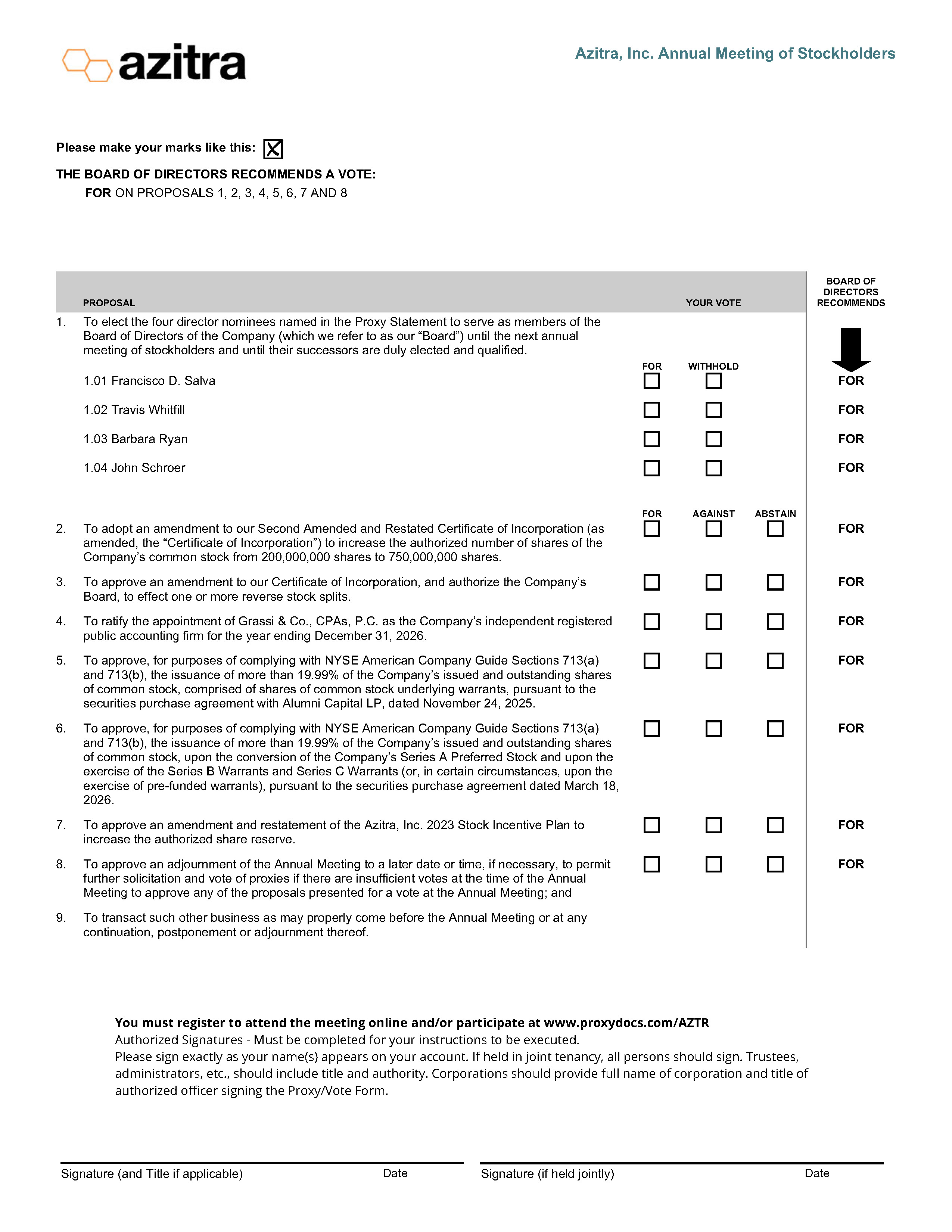
You may either vote “For” all the nominees to the Board or you may “Withhold” your vote for any nominee you specify. For Proposals 2, 3, 4, 5, 6, 7, and 8 you may vote “For” or “Against” the proposal, or “Abstain.”
YOUR VOTE IS VERY IMPORTANT. You should submit a proxy to vote your shares of common stock via the Internet, by telephone, or by promptly marking, dating, signing, and returning the enclosed proxy card via mail, even if you plan to attend the Annual Meeting. If you properly give your proxy and timely submit it to us, one of the individuals named as your proxy will vote your shares as you have directed. Any stockholder of record as of the record date attending the Annual Meeting may vote in person even if he or she previously submitted a proxy.
| 3 |
All shares entitled to vote and represented by properly submitted proxies (including those submitted electronically, telephonically and in writing) received before the polls are closed at the Annual Meeting, and not validly revoked or superseded, will be voted at the Annual Meeting in accordance with the instructions indicated on those proxies. If no direction is indicated on a proxy, your shares will be voted “For” all director nominees to the Board and “For” each proposal, and with respect to any other matter that properly comes before the Annual Meeting or any continuation, postponement or adjournment thereof, the proxyholders will vote as recommended by our Board, or if no recommendation is given, in their own discretion.
What if another matter is properly brought before the meeting?
Our Board knows of no other matters that will be presented for consideration at the Annual Meeting. If any other matters are properly brought before the meeting, it is the intention of the persons named in the proxy to vote on those matters as recommended by our Board, or if no recommendation is given, in their own discretion.
How can I vote my shares without attending the Annual Meeting?
You do not have to attend the Annual Meeting in order to vote your shares. You may submit a proxy to vote your shares prior to the Annual Meeting as follows:
Stockholder of Record: Shares Registered in Your Name
If you are a stockholder of record, you may submit a proxy to vote your shares through the Internet, by telephone or by using the proxy card delivered to you. Whether or not you plan to attend the meeting, we urge you to submit a proxy to vote your shares to ensure your vote is counted. You may still attend the meeting and vote online at the virtual meeting even if you have already voted by proxy.
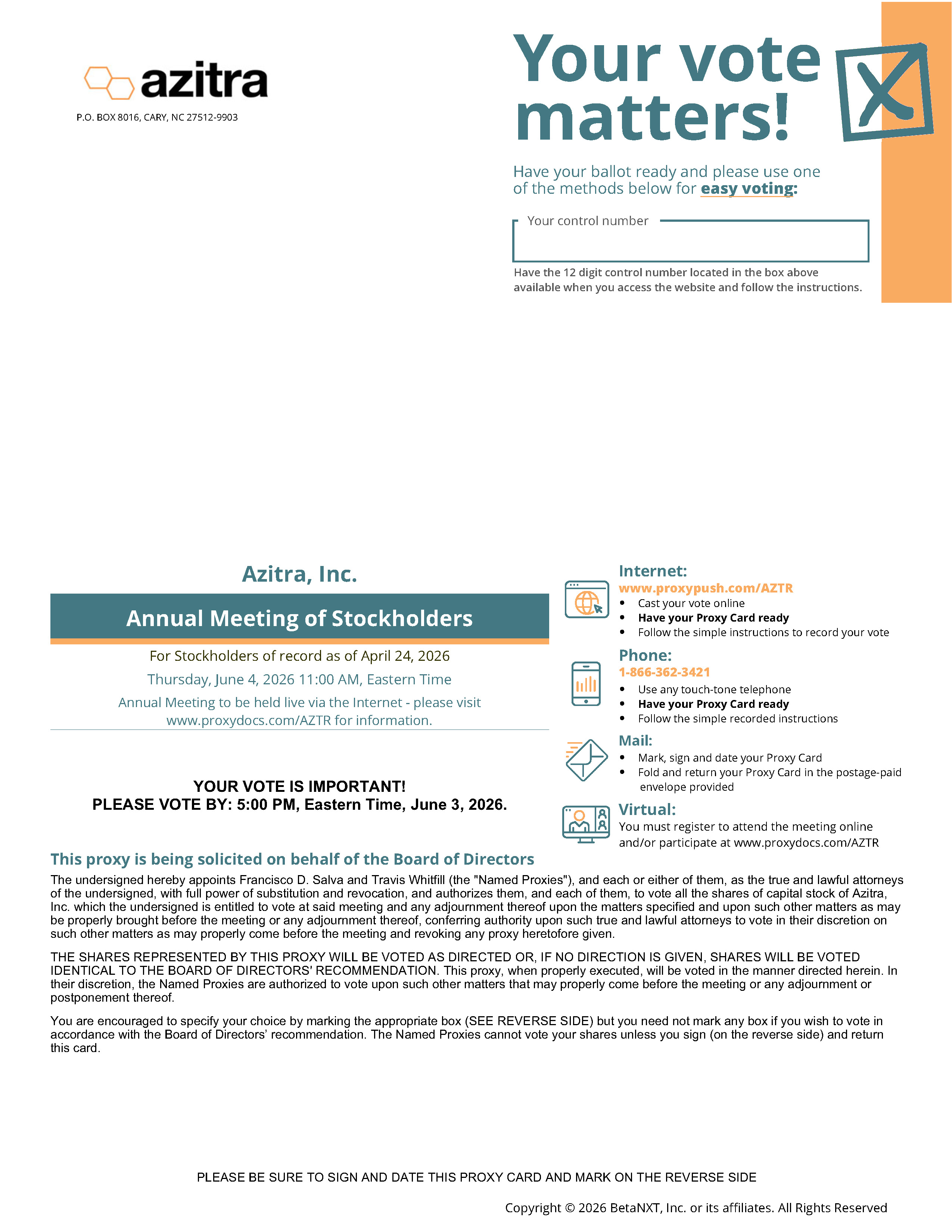
| ● | To submit a proxy to vote your shares through the Internet, go to www.proxypush.com/AZTR to complete an electronic proxy card. You will be asked to provide your 12-digit control number from the proxy card delivered to you. | |
| ● | To submit a proxy to vote your shares using the proxy card that may be delivered to you, simply complete, sign, and date the proxy card and return it promptly in the envelope provided. If you return your signed proxy card to us before the Annual Meeting, we will vote your shares as you direct. | |
| ● | To submit a proxy to vote your shares telephonically, please call the toll-free number listed on your proxy card and follow the instructions provided. |
If you plan to attend the Annual Meeting, you may vote online by visiting www.proxypush.com/AZTR. Please have your 12-digit control number to join the Annual Meeting.
Beneficial Owner: Shares Registered in the Name of Broker or Bank
If you are a beneficial owner of shares registered in the name of your broker, bank, or other nominee, you should have received proxy materials containing voting instructions from that organization rather than from Azitra. Simply follow the voting instructions in the proxy materials to ensure that your vote is counted. If you are a beneficial owner of shares, you may vote online at the virtual Annual Meeting by obtaining a valid legal proxy from your broker, bank or nominee that holds your shares giving you the right to vote the shares and email the legal proxy to www.legalproxy@betanxt.com by 11:59 p.m. EDT on Wednesday, June 3, 2026. You must also register to vote at the Annual Meeting prior to the deadline of 5:00 p.m. EDT on Wednesday, June 3, 2026.
| 4 |
How many votes do I have?
On each matter to be voted upon, you have one vote for each share of common stock you owned as of the close of business on April 24, 2026.
What happens if I do not vote?
Stockholder of Record: Shares Registered in Your Name
If you are a stockholder of record and do not submit a proxy to vote through the Internet, by telephone or by completing the proxy card delivered to you, and you do not vote your shares virtually at the Annual Meeting, your shares will not be counted for purposes of the establishment of a quorum or voted at the Annual Meeting.
Beneficial Owner: Shares Registered in the Name of Broker or Bank
If you are a beneficial owner of shares held in street name and you do not instruct your broker, bank, or other nominee how to vote your shares, your broker, bank, or other agent may still be able to vote your shares at its discretion on certain “routine” matters. In this regard, under the rules of the New York Stock Exchange, or NYSE, brokers, banks, and other securities intermediaries that are subject to NYSE rules may use their discretion to vote your “uninstructed” shares with respect to matters considered to be “routine” under NYSE rules, but not with respect to “non-routine” matters.
Proposals 1, 2, 5, 6, and 7 are considered to be “non-routine” under NYSE rules, meaning that your broker may not vote your shares regarding the election of directors (Proposal 1), the amendment to our Certificate of Incorporation to increase the number of authorized shares of common stock of the Company (Proposal 2), the issuance of more than 19.99% of the Company’s common stock, including shares of common stock underlying warrants, pursuant to the purchase agreement with Alumni Capital LP (Proposal 5), the issuance of more than 19.99% of the Company’s common stock, upon the conversion of the Company’s Series A Preferred Stock and upon the exercise of our Series B Warrants and Series C Warrants (or, in certain circumstances, upon the exercise of pre-funded warrants) (Proposal 6), or the amendment and restatement of the 2023 Plan to increase the authorized share reserve (Proposal 7) in the absence of your voting instructions. However, Proposals 3, 4 and 8 are considered to be “routine” matters under NYSE rules, meaning that if you do not return voting instructions to your bank, broker or other nominee by its deadline, your shares may be voted by your bank, broker or other nominee in its discretion on the amendment to our Certificate of Incorporation for the reverse splits (Proposal 3), the ratification of the appointment of Grassi & Co., CPAs, P.C. as our independent registered public accountants for the fiscal year ending December 31, 2026 (Proposal 4) and the approval of an adjournment of the Annual Meeting, if necessary, to solicit additional votes (Proposal 8).
What if I return a proxy card or otherwise vote but do not make specific choices?
If you return a signed and dated proxy card or otherwise vote without marking voting selections, your shares will be voted, as applicable:
| ● | FOR the election of each nominee for director; | |
| ● | FOR the adoption of an amendment to our Certificate of Incorporation to increase the authorized number of shares of the Company’s common stock from 200,000,000 shares to 750,000,000 shares; | |
| ● | FOR the adoption of an amendment (as set forth on Exhibit B to the Proxy Statement) to our Certificate of Incorporation, and authorization for the Company’s Board, to effect one or more reverse stock splits; | |
| ● | FOR the ratification of the selection of Grassi & Co., CPAs, P.C. as the Company’s independent registered public accounting firm for the fiscal year ending December 31, 2026; | |
| ● | FOR the approval, for purposes of complying with NYSE American Company Guide Sections 713(a) and 713(b), of the issuance of more than 19.99% of the Company’s issued and outstanding shares of common stock, comprised of shares of common stock underlying warrants, pursuant to the securities purchase agreement with Alumni Capital LP, dated November 24, 2025; |
| 5 |
| ● | FOR the approval, for purposes of complying with NYSE American Company Guide Sections 713(a) and 713(b), of the issuance of more than 19.99% of the Company’s issued and outstanding shares of common stock, upon the conversion of the Company’s Series A Preferred Stock and upon the exercise of our Series B Warrants and Series C Warrants (or, in certain circumstances, upon the exercise of pre-funded warrants), pursuant to the securities purchase agreement dated March 18, 2026; | |
| ● | FOR the approval of an amendment and restatement of the 2023 Plan; and | |
| ● | FOR the adjournment of the Annual Meeting to a later date or time, if necessary, to permit further solicitation and vote of proxies if there are not sufficient votes at the time of the Annual Meeting to approve any of the proposals presented for a vote at the Annual Meeting. |
If any other matter is properly presented at the meeting, your proxyholder (one of the individuals named on your proxy card) will vote your shares using his or her best judgment.
Who is paying for this proxy solicitation?
Our Board is soliciting proxies for the Annual Meeting from our stockholders. We will pay for the entire cost of soliciting proxies. In addition to these proxy materials, our directors and employees may also solicit proxies in person, by telephone, or by other means of communication. Directors and employees will not be paid any additional compensation for soliciting proxies. We may also reimburse brokerage firms, banks, and other agents for the cost of forwarding proxy materials to beneficial owners.
We have also retained Sodali & Co, a proxy solicitation firm, to perform various solicitation services via phone and email in connection with the Annual Meeting. We will pay Sodali & Co a fee not to exceed $10,000, plus phone and other related expenses, in connection with its solicitation services. We have also agreed to indemnify Sodali & Co against certain claims.
Whom Should You Call with Questions?
If you have further questions, you may contact the Company’s proxy solicitor, Sodali & Co, at:
Sodali & Co
333 Ludlow Street, 5th Floor, South Tower
Stamford, CT 06902
Telephone: (800) 662-5200
Banks and brokers: (203) 658-9400
Email: AZTR.info@investor.sodali.com
What does it mean if I receive more than one set of proxy materials?
If you receive more than one set of proxy materials, your shares may be registered in more than one name or in different accounts. Please follow the voting instructions on each set of proxy materials to ensure that all your shares are voted.
Can I change my vote after submitting my proxy?
Stockholder of Record: Shares Registered in Your Name
Yes. You can revoke your proxy at any time before the final vote at the meeting. If you are the record holder of your shares, you may revoke your proxy in any one of the following ways:
| ● | You may submit another properly completed proxy card with a later date; |
| 6 |
| ● | You may grant a subsequent proxy through the Internet; | |
| ● | You may submit a proxy to vote by telephone at a later time; | |
| ● | You may send a timely written notice that you are revoking your proxy to our Corporate Secretary at 21 Business Park Drive, Branford, Connecticut 06405. Such notice will be considered timely if it is received at the indicated address by 5:00 p.m. EDT on Wednesday, June 3, 2026; | |
| ● | You may virtually attend the Annual Meeting and vote online. Simply attending the meeting will not, by itself, revoke your proxy. |
Your most current proxy card or Internet or telephonic proxy is the one that is counted.
Beneficial Owner: Shares Registered in the Name of Broker or Bank
If your shares are held by your bank, broker or other nominee, you should follow the instructions provided by your broker, bank or other nominee.
When are stockholder proposals and director nominations due for next year’s annual meeting?
To be considered for inclusion in next year’s proxy materials, your proposal must be submitted in writing by January 7, 2027 to our Corporate Secretary at 21 Business Park Drive, Branford, Connecticut 06405, and must comply with all applicable requirements of Rule 14a-8 promulgated under the Securities Exchange Act of 1934, as amended, or the Exchange Act; provided, however, that if our 2027 annual meeting of stockholders is held before May 5, 2027 or after July 4, 2027, then the deadline is a reasonable amount of time prior to the date we begin to print and mail our proxy statement for the 2027 annual meeting of stockholders.
Pursuant to our Second Amended and Restated Bylaws, as amended (“Bylaws”), if you wish to bring a proposal before the stockholders or nominate a director at the 2027 annual meeting of stockholders, but you are not requesting that your proposal or nomination be included in next year’s proxy materials, you must notify our Corporate Secretary, in writing, no later than the close of business on March 6, 2027 nor earlier than the close of business on February 4, 2027. However, if our 2027 annual meeting of stockholders is not held between May 5, 2027 and August 13, 2027, to be timely, notice by the stockholder must be received no earlier than the close of business on the 120th day prior to the 2027 annual meeting of stockholders and no later than the close of business on the later of the 90th day prior to the 2027 annual meeting of stockholders or the 10th day following the day on which public announcement of the date of the 2027 annual meeting of stockholders is first made. You are advised to review our Bylaws, which contain additional requirements about advance notice of stockholder proposals and director nominations. In addition, stockholders who intend to solicit proxies in support of director nominees other than the Company’s nominees must provide notice that must comply with the additional requirements of Rule 14a-19(b) of the Exchange Act no later than April 5, 2027. Such notice may be mailed to our Corporate Secretary at the address above.
The chair of the 2027 annual meeting of stockholders may determine, if the facts warrant, that a matter has not been properly brought before the meeting and, therefore, may not be considered at the meeting. In addition, the proxy solicited by the Board for the 2027 annual meeting of stockholders will confer discretionary voting authority with respect to (i) any proposal presented by a stockholder at that meeting for which we have not been provided with timely notice and (ii) any proposal made in accordance with our Bylaws, if the 2027 proxy statement briefly describes the matter and how management’s proxyholders intend to vote on it, and if the stockholder does not comply with the requirements of Rule 14a-4(c)(2) promulgated under the Exchange Act.
How are votes counted?
Votes will be counted by the inspector of election appointed for the meeting. Votes will be counted by the inspector of election for Proposal 1 as votes “For” or “Withhold,” and with respect to Proposals 2, 3, 4, 5, 6, 7, and 8, “For,” “Against,” “Abstain” and, if applicable, broker non-votes.
| 7 |
What are “broker non-votes”?
As discussed above, when a beneficial owner of shares held in “street name” does not give instructions to the broker or nominee holding the shares as to how to vote on matters deemed by the NYSE to be “non-routine,” the broker or nominee cannot vote the shares. These unvoted shares are counted as “broker non-votes.”
How many votes are needed to approve each proposal?
| ● | Election of Directors. For the election of directors, the four nominees receiving the most “For” votes from the holders of shares present by remote communication (i.e., virtually) or represented by proxy and entitled to vote on the election of directors will be elected to serve on the Board of Directors until the 2027 annual meeting of stockholders and until their successors are duly elected and qualified. Only votes “For” will affect the outcome. Withheld votes and broker non-votes will have no effect. | |
| ● | Amendment to the Second Amended and Restated Certificate of Incorporation to Increase the Authorized Shares of Common Stock. The affirmative vote of a majority of votes cast thereon is required for the approval and adoption of such proposal. Brokers will not have discretionary authority to vote on this proposal. Broker non-votes and abstentions will not be counted as votes cast “For” or “Against” this proposal and, therefore, will have no impact on the outcome of the voting. | |
| ● | Reverse Split Amendment. The affirmative vote of a majority of votes cast thereon is required for the approval and adoption of such proposal. Abstentions will not be counted as votes cast “For” or “Against” this proposal and, therefore, will have no impact on the outcome of the voting. We believe that brokers will have discretionary authority to vote on the reverse split amendment to the Certificate of Incorporation and, therefore, do not expect there to be any broker non-votes. However, in the event of any broker non-votes in connection with this proposal, such broker non-votes will not be counted as votes cast “For” or “Against” this proposal and, therefore, will have no impact on the outcome of the voting. | |
| ● | Ratification of Independent Accountants. The affirmative vote of the holders of a majority of the votes cast thereon is required for the ratification of the appointment of Grassi & Co., CPAs, P.C. as our independent registered public accounting firm for the fiscal year ending December 31, 2026. Abstentions will not be counted as votes cast “For” or “Against” this proposal and, therefore, will have no impact on the outcome of the voting. Brokers will have discretionary authority to vote on the ratification of our independent registered public accounting firm and, therefore, we do not expect there to be any broker non-votes. However, in the event of any broker non-votes in connection with this proposal, such broker non-votes will not be counted as votes cast “For” or “Against” this proposal and, therefore, will have no impact on the outcome of the voting. | |
| ● | Approval, for purposes of complying with NYSE American Company Guide Sections 713(a) and 713(b), of the issuance of more than 19.99% of our issued and outstanding shares of common stock, including shares of common stock underlying warrants, pursuant to the purchase agreement with Alumni Capital LP. The affirmative vote of the holders of a majority of the votes cast thereon by stockholders entitled to vote on this proposal is required for the approval and adoption of such proposal. Brokers will not have discretionary authority to vote on this proposal. Broker non-votes and abstentions will not be counted as votes cast “For” or “Against” this proposal and, therefore, will have no impact on the outcome of the voting. | |
| ● | Approval, for purposes of complying with NYSE American Company Guide Sections 713(a) and 713(b), of the issuance of more than 19.99% of the Company’s issued and outstanding shares of common stock, upon the conversion of the Company’s Series A Preferred Stock and upon the exercise of our Series B Warrants and Series C Warrants (or, in certain circumstances, upon the exercise of pre-funded warrants), pursuant to the purchase agreement dated March 18, 2026. The affirmative vote of the holders of a majority of the votes cast thereon by stockholders entitled to vote on this proposal is required for the approval and adoption of such proposal. Brokers will not have discretionary authority to vote on this proposal. Broker non-votes and abstentions will not be counted as votes cast “For” or “Against” this proposal and, therefore, will have no impact on the outcome of the voting. |
| 8 |
| ● | Amendment and Restatement of the Azitra, Inc. 2023 Stock Incentive Plan. The affirmative vote of the holders of a majority of the votes cast thereon is required for the approval and adoption of such proposal. Brokers will not have discretionary authority to vote on this proposal. Broker non-votes and abstentions will not be counted as votes cast “For” or “Against” this proposal and, therefore, will have no impact on the outcome of the voting. | |
| ● | Approval to adjourn to solicit additional proxies if needed. The affirmative vote of the majority of votes cast thereon is required for the approval and adoption of such proposal. Abstentions will not be counted as votes cast “For” or “Against” this proposal and, therefore, will have no impact on the outcome of the voting. We believe that brokers will have discretionary authority to on the adjournment and, therefore, do not expect there to be any broker non-votes. However, in the event of any broker non-votes in connection with this proposal, such broker non-votes will not be counted as votes cast “For” or “Against” this proposal and, therefore, will have no impact on the outcome of the voting. |
We will also consider any other business that properly comes before the Annual Meeting, or any adjournment or postponement thereof. We are not currently aware of any other matters to be submitted for consideration at the Annual Meeting. If any other matters are properly brought before the Annual Meeting, the persons named on the enclosed proxy card will vote the shares as recommended by our Board or, if no recommendation is given, in their own discretion.
What is the quorum requirement?
A quorum of stockholders is necessary to hold a valid meeting. A quorum will be present if shares representing 33 1/3% of the common stock outstanding and entitled to vote are present at the Annual Meeting virtually or represented by proxy. On the record date, there were 16,192,438 shares of common stock outstanding and entitled to vote. Thus, the holders of 5,397,480 shares must be present virtually or represented by proxy at the Annual Meeting to have a quorum.
Abstentions and broker non-votes will be counted towards the quorum requirement. If there is no quorum, the chairman of the meeting or the stockholders so present, by a majority in voting power thereof, may adjourn the Annual Meeting to another date until a quorum is present or represented.
How can I find out the results of the voting at the Annual Meeting?
Preliminary voting results will be announced at the Annual Meeting. In addition, final voting results will be published in a current report on Form 8-K that we expect to file within four business days after the Annual Meeting. If final voting results are not available to us in time to file a Form 8-K within four business days after the meeting, we intend to file a Form 8-K to publish preliminary results and, within four business days after the final results are known to us, file an amended Form 8-K to publish the final results.
| 9 |
PROPOSAL 1
ELECTION OF DIRECTORS
Board Nominees
Our Board currently consists of four members, two of whom are independent under the listing standards for independence of the NYSE American Stock Exchange. Based upon the recommendation of the Nominating and Corporate Governance Committee of our Board, our Board determined to nominate each of the Company’s current directors for re-election at the Annual Meeting.
Our Board and the Nominating and Corporate Governance Committee believe the directors nominated collectively have the experience, qualifications, attributes and skills to effectively oversee the management of the Company, including a high degree of personal and professional integrity, an ability to exercise sound business judgment on a broad range of issues, sufficient experience and background to have an appreciation of the issues facing the Company, a willingness to devote the necessary time to Board duties, a commitment to representing the best interests of the Company and our stockholders and a dedication to enhancing stockholder value.
Each director elected at the Annual Meeting will serve a one-year term until the Company’s next annual meeting and until his or her successor is duly elected and qualified or until his or her earlier death, resignation or removal. Unless otherwise instructed, the proxyholders will vote the proxies received by them for the four nominees named below. If any of the nominees is unable or declines to serve as a director at the time of the Annual Meeting, the proxies will be voted for any nominee designated by the present Board to fill the vacancy. It is not presently expected that any of the nominees named below will be unable or will decline to serve as a director. If additional persons are nominated for election as directors, the proxyholders intend to vote all proxies received by them in a manner to assure the election of as many of the nominees listed below as possible. In such event, the specific nominees to be voted for will be determined by the proxyholders.
Set forth below are the names, ages and positions of our director nominees as of the date of this Proxy Statement:
| Name | Age | Position with the Company | ||
| Francisco D. Salva | 56 | President, Chief Executive Officer and Director | ||
| Travis Whitfill | 36 | Chief Operating Officer and Director | ||
| Barbara Ryan(a), (b), (c) | 66 | Independent Director | ||
| John Schroer(a), (b), (c) | 60 | Independent Director |
(a) Member of the Audit Committee of our Board.
(b) Member of the Compensation Committee of our Board.
(c) Member of the Nominating and Corporate Governance Committee of our Board.
Vacancies on our Board, including any vacancy created by an increase in the size of our Board, may be filled by a majority of the directors remaining in office (even though less than a quorum of our Board) or a sole remaining director. A director elected by our Board to fill a vacancy will serve until the next annual meeting of stockholders and until such director’s successor is elected and qualified, or until such director’s earlier retirement, resignation, disqualification, removal or death.
If any nominee should become unavailable for election prior to the Annual Meeting, an event that currently is not anticipated by our Board, the proxies will be voted in favor of the election of a substitute nominee or nominees proposed by our Board. Each nominee has agreed to serve if elected and our Board has no reason to believe that any nominee will be unable to serve.
| 10 |
Vote Required
For the election of directors, the four nominees receiving the most “For” votes from the holders of shares present by remote communication (i.e., virtually) or represented by proxy and entitled to vote on the election of directors will be elected to serve until the 2027 annual meeting of stockholders and until their successors are duly elected and qualified. Only votes “For” will affect the outcome. Withheld votes and broker non-votes will have no effect.
Board Recommendation
Our
Board recommends a vote “FOR”
each of the FOUR nominees for director named in this Proxy Statement.
Information about Director Nominees
Set forth below is biographical information for each director nominee, and a summary of the specific qualifications, attributes, skills and experiences which led our Board to conclude that each nominee should serve on our Board at this time. None of our directors has any family relationship with any other director or with any of our executive officers. To our knowledge, none of our directors or executive officers were involved in any legal proceedings described in Item 401(f) of Regulation S-K in the past 10 years.
Francisco D. Salva has served as our president and chief executive officer and a member of our Board since April 2021. Mr. Salva has over 15 years of experience in senior leadership roles in the biotechnology and pharmaceutical industries. Mr. Salva served as president and chief executive officer of Complexa, Inc., an inflammation and fibrosis focused biopharmaceutical company, from May 2018 to August 2020. From February 2011 to November 2016, Mr. Salva served as a co-founder and vice president of operations of Acerta Pharma B.V., Inc., a cancer and autoimmune focused biopharmaceutical company. Mr. Salva served as a director of Vincerx Pharma, Inc. (Nasdaq: VINC) from December 2020 to June 2025. Prior to his operating roles, Mr. Salva held various senior positions in the venture capital and investment banking industries focusing on healthcare, biotechnology and pharmaceuticals companies. Mr. Salva received a B.A. from Brown University and an MSc in economics and philosophy from the London School of Economics. We believe that Mr. Salva’s experience as a senior executive, venture capitalist and investment banker in the biotech and pharmaceutical industries qualifies him to serve on our Board.
Travis Whitfill is a co-founder of Azitra and has served on our Board since inception. Dr. Whitfill has served in various roles at Azitra, including chief scientific officer from January 2014 to September 2019 and director of advanced technology since September 2019, and as chief operating officer since June 2023. Dr. Whitfill served as a partner at Bios Equity Partners, LP, a biotechnology-focused venture capital firm, from October 2015 to June 2023 and a senior analyst at Bios Research from September 2014 to June 2023. He has also served as an associate research scientist and assistant professor adjunct at Yale University from July 2016 to March 2022 and since March 2022, respectively, with appointments in the Departments of Pediatrics and Emergency Medicine. Dr. Whitfill served on the board of directors of IN8Bio, Inc. (Nasdaq: INAB) from March 2018 to May 2025, 410 Medical from September 2017 to July 2019 and SIRPant Immunotherapeutics from September 2021 to June 2023. Dr. Whitfill has led numerous grant-funded projects, holds several patents and has co-authored over 70 publications. Dr. Whitfill received a B.S. from Dallas Baptist University, an MPH from Yale University and an MPhil from University College London. We believe that Dr. Whitfill’s strong background in entrepreneurship and in the biotech and healthcare industries qualifies him to serve on our Board.
| 11 |
Barbara Ryan has served as a member of our Board since June 2023. Ms. Ryan founded Barbara Ryan Advisors, a capital markets and communications firm, in 2012 following a more than 30-year career on Wall Street as a sell-side research analyst covering the U.S. pharmaceutical industry. Ms. Ryan has deep experience in equity and debt financings, M&A, valuation, SEC reporting, financial analysis and corporate strategy across a broad range of life sciences companies. Ms. Ryan worked on several of the industry’s largest M&A transactions, including Shire’s defense versus a hostile takeover attempt by Abbvie, Shire’s takeover of Baxalta, Allergan’s defense against Valeant and Perrigo’s defense versus Mylan. Ms. Ryan served as an executive team member and on the disclosure committee for Radius Health from January 2014 to December 2017. Previously, Ms. Ryan was a managing director at Deutsche Bank/Alex Brown and head of the company’s pharmaceutical research team for 19 years and began her research career covering the pharmaceutical industry at Bear Stearns in 1982. Ms. Ryan currently serves as a director on the board of MiNK Therapeutics, Inc. (Nasdaq: INKT), where she chairs the audit committee and serves on the compensation committee; INVO Fertility, Inc. (Nasdaq: INVO), where she chairs the compensation committee and serves on the nominating & governance and audit committees; Invidior Pharmaceuticals, Inc. (Nasdaq:INDV), where she chairs the compensation committee and serves on the audit and nominating & governance committees, and The Red Door Community (formerly Gilda’s Club NYC), a non-profit organization. Ms. Ryan is the founder of Fabulous Pharma Females, a non-profit whose mission is to advance women in the biopharma industry, is a member of the editorial advisory board of Pharmaceutical Executive Magazine, a faculty member of the GLG Institute and a member of the Prix Galien executive advisory board. We believe that Ms. Ryan is qualified to serve as a member of our Board because of her experience and knowledge of corporate finance, mergers and acquisitions, corporate governance, as well as other operational, financial and accounting matters gained as a past and present executive officer and/or director of other public and private companies.
John Schroer has served as a member of our Board since June 2023. Mr. Schroer has served as chief financial officer of Alumis, Inc. (Nasdaq: ALMS), a publicly traded biotechnology company developing precision immunology therapies, since March 2022. Mr. Schroer was chief financial officer of Arsenal Biosciences, Inc., a privately held biotechnology company developing programmable cell therapy for solid tumors, from February 2021 to February 2022. Mr. Schroer was chief financial officer of Translate Bio, Inc., a biotechnology company developing mRNA therapeutics and vaccines acquired by Sanofi in September 2021 for $3.2 billion, from May 2018 to December 2020. Previously, Mr. Schroer was Sector Head – Global Health Care for Allianz Global Investors, an international asset management firm, from January 2014 to May 2018. Mr. Schroer received his B.S. and M.B.A from the University of Wisconsin – Madison. We believe that Mr. Schroer’s strong background and leadership positions in the biotechnology industry and almost 30 years of investing in the life sciences sector qualifies him to serve on our Board.
CORPORATE GOVERNANCE
Board Composition
Our Board may establish the authorized number of directors from time to time by resolution. Our Board consists of four members, two of whom qualify as independent under the listing rules of the NYSE American. Neither Mr. Salva nor Dr. Whitfill is considered to be independent due to their roles as executive officers of the Company. However, our Board has determined that Ms. Ryan and Mr. Schroer do not have a relationship that would interfere with the exercise of independent judgment in carrying out the responsibilities of a director and that each is “independent” as that term is defined under the applicable rules and regulations of the SEC and the listing rules of the NYSE American. In making this determination, our Board considered the current and prior relationships that each of Ms. Ryan and Mr. Schroer has with our Company and all other facts and circumstances our Board deemed relevant in determining their independence, including, but not limited to, those relationships described herein under “Certain Relationships and Related Party Transactions.”
Generally, under the listing rules of the NYSE American, independent directors must comprise a majority of a listed company’s board of directors; however, the listing rules of the NYSE American provide that independent directors of smaller reporting companies, such as Azitra, must only comprise 50% of the board of directors. Our Board has undertaken a review of its composition and determined that 50% of our directors are independent, as required under applicable NYSE American listing rules, as of the date of this Proxy Statement.
Meetings and Director Attendance
During the year ended December 31, 2025, our Board held four meetings and acted by written consent nine times. All directors attended at least 75% of all meetings of the Board, and at least 75% of all meetings of the committees on which they served, during the year ended December 31, 2025. All directors attended the 2025 annual meeting. The Company does not have a formal policy requiring members of the Board to attend the annual meeting, although all directors are strongly encouraged to attend.
To promote open discussion among the independent directors, the independent directors generally meet in executive session at each regularly scheduled Board meeting.
| 12 |
Committees of the Board of Directors
Our Board has established an Audit Committee, Compensation Committee and Nominating and Corporate Governance Committee, each of which operates pursuant to a committee charter. Our Board may establish other committees to facilitate the management of our business as deemed necessary from time to time. The composition and functions of each committee are described below. Members serve on these committees until their resignation or until otherwise determined by our Board. Each of our committees operates under a written charter, a copy of which is available at our investor relations website located at https://ir.azitrainc.com/corporate-governance/governance-overview.
Audit Committee
Our Audit Committee consists of Ms. Ryan and Mr. Schroer, with Mr. Schroer serving as chairperson. Our Board has determined that each member meets the independence requirements of the Sarbanes-Oxley Act, Rule 10A-3 under the Exchange Act and the applicable listing standards of the NYSE American. Each member of our Audit Committee can read and understand fundamental financial statements in accordance with the SEC and NYSE American audit committee requirements. In arriving at this determination, our Board has examined each Audit Committee member’s scope of experience and the nature of their prior and/or current employment.
Our Board has determined that Mr. Schroer qualifies as an audit committee financial expert within the meaning of SEC regulations and meets the financial sophistication requirements of the NYSE American listing rules. Both our independent registered public accounting firm and management periodically meet with our Audit Committee.
The functions of the Audit Committee include, among other things:
| ● | selecting a qualified firm to serve as the independent registered public accounting firm to audit our financial statements; | |
| ● | discussing the scope and results of the audit with the independent registered public accounting firm, and reviewing, with management and the independent registered public accounting firm, our interim and year-end operating results; | |
| ● | reviewing and approving the engagement of our independent auditors to perform audit services and any permissible non-audit services; | |
| ● | developing procedures for employees to submit concerns anonymously about questionable accounting or audit matters; | |
| ● | reviewing our policies on risk assessment and risk management; | |
| ● | reviewing related-party transactions; and | |
| ● | reviewing and evaluating on an annual basis the performance of the Audit Committee and the Audit Committee charter. |
We believe that the composition and functioning of our Audit Committee comply with all applicable requirements of the Sarbanes-Oxley Act, and all applicable SEC and NYSE American rules and regulations. We intend to comply with future requirements to the extent they become applicable to us.
During the year ended December 31, 2025, our Audit Committee held four meetings.
Compensation Committee
Our Compensation Committee consists of Ms. Ryan and Mr. Schroer, with Ms. Ryan serving as chairperson. Each of the members is a non-employee director, as defined in Rule 16b-3 promulgated under the Exchange Act. Our Board has determined that each member is “independent” as defined under the applicable listing standards of the NYSE American, including the standards specific to members of a compensation committee.
| 13 |
The functions of the Compensation Committee include, among other things:
| ● | reviewing, modifying and approving (or if it deems appropriate, making recommendations to the full Board regarding) our overall compensation strategy and policies; | |
| ● | reviewing, modifying and approving (or if it deems appropriate, making recommendations to the full Board regarding) the compensation and other terms of employment of our executive officers; | |
| ● | recommending to the full Board the establishment and terms of the equity incentive plans, compensation plans and similar programs advisable for us, as well as modifying, amending or terminating existing plans and programs; | |
| ● | administering our equity incentive plans; | |
| ● | reviewing and approving director compensation; | |
| ● | establishing policies with respect to equity compensation arrangements; and | |
| ● | reviewing and evaluating on an annual basis the performance of the Compensation Committee and the Compensation Committee charter. |
We believe that the composition and functioning of our Compensation Committee complies with all applicable requirements of the Sarbanes-Oxley Act, and all applicable SEC and the NYSE American rules and regulations. We intend to comply with future requirements to the extent they become applicable to us.
Our chief executive officer may, from time to time, provide input and recommendation to our Compensation Committee concerning the compensation of our other executive officers. Our chief executive officer may also, from time to time, attend Compensation Committee meetings, but he is not present during the Committee’s deliberations regarding executive officer compensation.
During the year ended December 31, 2025, our Compensation Committee held two meetings and acted by written consent once.
Nominating and Corporate Governance Committee
Our Nominating and Corporate Governance Committee consists of Ms. Ryan and Mr. Schroer, with Ms. Ryan serving as chairperson. The composition of our Nominating and Corporate Governance Committee meets the requirements for independence under the NYSE American listing standards and SEC rules and regulations.
The functions of this committee include, among other things:
| ● | identifying, evaluating and making recommendations to our Board regarding nominees for election to our Board and its committees; | |
| ● | evaluating the performance of our Board and of individual directors; | |
| ● | reviewing developments in corporate governance practices; | |
| ● | evaluating the adequacy of our corporate governance practices and reporting; and | |
| ● | developing and making recommendations to our Board regarding corporate governance guidelines and matters. |
When evaluating director candidates, our Nominating and Corporate Governance Committee seeks to ensure that our Board has the requisite skills and experience and that its members consist of persons with appropriately complementary and independent backgrounds. The Nominating and Corporate Governance Committee will consider all aspects of a candidate’s qualifications in the context of Azitra’s needs, including: biopharmaceutical industry experience, preferably at an executive level; experience as an officer or director of a public company; independence from management; practical business judgment; personal and professional integrity and ethics; and the ability to commit sufficient time and attention to the activities of the Board, as well as the absence of any potential conflicts with our Company’s interests. We understand the desirability of having a Board comprised of directors with unique backgrounds, experiences and opinions, and as we look to expand our Board or replace retiring Board members, our Nominating and Governance Committee is committed to including candidates with different backgrounds, experiences, and opinions in the search. However, the Nominating and Corporate Governance Committee retains the right to modify these qualifications from time to time. Candidates for director nominees are reviewed in the context of the current composition of the Board, the operating requirements of our Company, and the long-term interests of our stockholders.
| 14 |
Our Nominating and Corporate Governance Committee will consider director candidates nominated by third parties, including stockholders. However, at this time, our Nominating and Corporate Governance Committee does not have a standalone policy with regard to the consideration of director candidates recommended by stockholders. Therefore, the Nominating and Corporate Governance Committee will evaluate nominees recommended by stockholders using the same criteria it uses to evaluate nominees recommended by the Board as described above. The Nominating and Corporate Governance Committee believes that it is in the best position to identify, review, evaluate, and select qualified candidates for Board membership, based on the comprehensive criteria for Board membership approved by our Board. For a third party to suggest a candidate, one should provide our Corporate Secretary with the name of the candidate, together with a brief biographical sketch and a document indicating the candidate’s willingness to serve if elected.
During the year ended December 31, 2025, our Nominating and Corporate Governance Committee acted by written consent once and did not hold a meeting.
Board Leadership Structure and Role in Risk Oversight
We have neither adopted a formal policy on whether the chairperson and chief executive officer positions should be separate or combined, nor do we have a lead independent director. We believe that, given the small size of our Board and establishment of separate Audit, Compensation, and Nominating and Corporate Governance Committees consisting of independent directors, our present Board structure is in the best interest of us and our stockholders. Our Board has an active role in overseeing our areas of risk. While the full Board has overall responsibility for risk oversight, our Board has assigned certain areas of risk primarily to designated committees, which report back to the full Board.
Process for Stockholders and Interested Parties to Send Communications to our Board of Directors
Because we have always maintained open channels of communication with our stockholders and interested parties, we do not have a formal policy that provides a process for stockholders or interested parties to send communications to our Board. If a stockholder or an interested party would like to send a communication to our Board, please address the letter to the attention of our Corporate Secretary and it will be distributed to each director, unless the Corporate Secretary determines that the communication is unrelated to the duties and responsibilities of the Board, such as product inquiries, resumes, advertisements or other promotional material. Communications that are unduly hostile, threatening, illegal, or similarly unsuitable will also not be distributed to the Board or any director.
Insider Trading Policy
We
have
While the Company has not adopted a formal policy governing transactions by the Company in its securities, the Company will not engage in transactions in Company securities, or adopt any securities repurchase plans, while in possession of material non-public information relating to the Company or its securities other than in compliance with applicable law, subject to the policies and procedures adopted by the Company.
Employee, Officer and Director Hedging
Under our Insider Trading Policy, no director, officer, employee or consultant of Azitra may engage in any short term or speculative transactions involving securities of the Company. These prohibited speculative transactions include short sales, publicly traded options, hedging transactions, margin accounts and pledged securities, and standing and limit orders.
Code of Ethics
We have adopted a code of ethics for all employees, including the principal executive officer, principal financial officer and principal accounting officer or controller, and/or persons performing similar functions, which is available on our website, under the link https://ir.azitrainc.com/corporate-governance/governance-overview. If we make any substantive amendments to the code of ethics or grant any waiver from a provision thereof to any officer or director, we will promptly disclose the nature or waiver on our website.
| 15 |
PROPOSAL 2
TO APPROVE AND ADOPT AN AMENDMENT TO OUR CERTIFICATE OF INCORPORATION TO INCREASE THE NUMBER OF AUTHORIZED SHARES OF COMMON STOCK
General
On April 22, 2026, the Board unanimously voted to approve, and to recommend to our stockholders that they approve and adopt at the Annual Meeting, an amendment to our Certificate of Incorporation to increase our authorized number of shares of common stock from 200,000,000 shares to 750,000,000 shares (the “Authorized Shares Increase”) by filing a Certificate of Amendment to our Certificate of Incorporation in substantially the form attached to this proxy statement as Exhibit A (the “Certificate of Amendment”) with the Secretary of State of the State of Delaware.
Background and Purpose of the Authorized Shares Increase
The Board has determined that we do not currently have enough authorized shares of common stock to accommodate our forecasted capital raising needs, based on the current outstanding shares of common stock and shares of common stock reserved for issuance upon exercise of outstanding stock options, warrants and other arrangements. As of April 24, 2026, we had 16,192,438 shares of common stock outstanding. In addition, the Board has reserved shares as of April 24, 2026:
| ● | approximately 178,659,563 shares of our common stock issuable upon exercise of outstanding warrants, with a weighted average exercise price of $0.20 per share (assuming the approval of Proposal 6 and the exercisability of the Series B Warrants and Series C Warrants); |
| ● | 3,999 shares of our common stock issuable upon exercise of outstanding options, with a weighted average exercise price of 340.20 per share, granted pursuant to our 2016 Stock Incentive Plan (the “2016 Plan”); and |
| ● | 559,432 shares of our common stock issuable upon exercise of outstanding options, with a weighted average exercise price of $0.31 per share, granted pursuant to our 2023 Plan; and |
| ● | 3,072 shares of our common stock reserved for future grants under our 2016 Plan and 69,908 shares of our common stock reserved for future grants under our 2023 Plan. |
The Board believes it is advisable and in our best interest to increase the number of authorized shares of common stock to give us greater flexibility in considering and planning for future corporate needs, including, but not limited to: raising additional capital, which is needed to fund our ongoing product development programs; making long-term equity incentive awards under our equity compensation plans; attracting and retaining key employees, consultants, advisors, executive officers, and directors; considering potential strategic transactions, including mergers, acquisitions, and business combinations; funding operations; issuing shares pursuant to the purchase agreement with Alumni Capital LP (see Proposal 5 for more information); issuing shares pursuant to the purchase agreement with the investors from March 2026 (see Proposal 6 for more information); and other general corporate purposes. The Board believes that additional authorized shares of common stock will enable us to take timely advantage of market conditions and favorable financing and acquisition opportunities that may become available to us without the delay and expense associated with convening a special meeting of our stockholders. The Board has determined that we do not currently have enough shares to accommodate these needs.
Except as discussed above and in Proposals 5 and 6, the Board has no other plans to issue any additional shares of common stock at this time; however, it desires to have shares available to provide flexibility to issue for business and financial purposes in the future, and believes that 750,000,000 shares is adequate for the foreseeable future.
| 16 |
Impact of the Authorized Shares Increase if Implemented
The adoption of the Authorized Shares Increase would not affect the rights, powers or preferences of the shares of common stock currently outstanding, although it could allow, in the future, further dilution of the outstanding shares of common stock. The Board has not proposed the Authorized Shares Increase with the intention of discouraging tender offers or takeover attempts of the Company. However, the availability of additional authorized shares for issuance may have the effect of discouraging a merger, tender offer, proxy contest, or other attempt to obtain control of the Company.
Procedure for Effecting the Authorized Shares Increase
If the stockholders approve Proposal 2 and the Board decides to implement the Authorized Shares Increase, the Authorized Shares Increase will become effective either upon the filing of the Certificate of Amendment with the Secretary of State of the State of Delaware or at such other date and time as is specified therein. Although the Board intends to file the Certificate of Amendment as soon as practicable after the Annual Meeting if Proposal 2 is approved, the Board may determine in its discretion to abandon the Authorized Shares Increase at any time prior to the effectiveness of the Certificate of Amendment.
Vote Required
The affirmative vote of the majority of votes cast thereon is required for the approval and adoption of such proposal. Abstentions will not be counted as votes cast “For” or “Against” either proposal. Brokers will not have discretionary authority to vote on Proposal 2. Any broker non-votes in connection with Proposal 2 will not be counted as votes cast “For” or “Against” such proposal.
Board Recommendation
OUR
BOARD RECOMMENDS A VOTE “FOR” THE
APPROVAL AND ADOPTION OF AN AMENDMENT TO OUR CERTIFICATE OF INCORPORATION TO INCREASE THE NUMBER OF AUTHORIZED SHARES OF COMMON STOCK.
| 17 |
PROPOSAL 3
TO APPROVE AND ADOPT AN AMENDMENT TO THE COMPANY’S CERTIFICATE OF INCORPORATION, AND AUTHORIZE THE BOARD, TO EFFECT ONE OR MORE REVERSE STOCK SPLITS
Introduction
The Board has adopted and is recommending that our stockholders approve an amendment of our Certificate of Incorporation (such amendment, the “Reverse Split Amendment”) to effect reverse stock splits of the common stock at a ratio of not less than 1-for-2 and not more than 1-for-30, with the exact ratio for each reverse stock split within such range to be determined by the Board in its sole discretion (each reverse stock split, the “Reverse Stock Split” and any such ratio, the “Reverse Stock Split Ratio”). Approval of the Reverse Split Amendment requires the affirmative vote of a majority of votes cast thereon. Because this is a routine proposal, we do not expect there to be any broker non-votes. Abstentions and broker non-votes, if any, will have no effect on the outcome of this Proposal 3.
In connection with each Reverse Stock Split, the number of authorized shares of common stock will not be changed. Pursuant to the law of the State of Delaware, our state of incorporation, the Board must adopt an Amendment and submit the Amendment to stockholders for their approval. The proposed Amendment, one or more of which would be filed with the Secretary of State of the State of Delaware (the “Secretary of State”), will be substantially in the form of Exhibit B to this Proxy Statement. Upon the effectiveness of the Amendment (the “Reverse Stock Split Effective Time”), the issued shares of common stock immediately prior to a Reverse Stock Split Effective Time will be reclassified into a smaller number of issued shares such that a stockholder will own one share of common stock for each 2 to 30 (or any number in between) shares of issued common stock held by such stockholder immediately prior to a Reverse Stock Split Effective Time, as specified.
By approving this Proposal 3, stockholders will approve the Reverse Split Amendment (which approval will constitute the approval of a Reverse Split Amendment effecting the reverse stock splits of the common stock at a Reverse Stock Split Ratio within the range of not less than 1-for-2 and not more than 1-for-30, with the exact ratio for each reverse stock split within such range to be determined by the Board in its sole discretion) and authorize the Board to file the Reverse Split Amendment effecting the reverse stock split at the Reverse Stock Split Ratio it selects and to abandon each Reverse Split Amendment effecting a reverse stock split at any other Reverse Stock Split Ratio. Upon receiving stockholder approval, the Board will have the authority, but not the obligation, in its sole discretion, to elect, without further action on the part of the stockholders, whether to effect a Reverse Stock Split and, if so, to determine the applicable Reverse Stock Split Ratio from among the approved range described above and to effect a Reverse Stock Split setting forth the Reverse Stock Split Ratio it selects in its sole discretion by filing the Reverse Split Amendment that includes such Reverse Stock Split Ratio with the Secretary of State and abandoning the Reverse Split Amendments that include each other Reverse Stock Split Ratio. The Board reserves the right to elect not to effect a Reverse Stock Split at any time prior to the effectiveness of the filing of the Reverse Split Amendment with the Secretary of State, if it determines, in its sole discretion, and without further action on the part of the stockholders, that the proposal is no longer in the best interests of the Company and its stockholders.
The Board’s decision as to whether and when to effect a Reverse Stock Split will be based on a number of factors, including market conditions, the historical, existing, and expected trading price of the common stock, the anticipated impact of each Reverse Stock Split on the trading price and number of holders of the common stock, and any applicable NYSE American listing regulations.
The Company has previously effected reverse splits on July 1, 2024 in a ratio of one-for-thirty (1:30) and on August 21, 2025 in a ratio of one-for-six and sixty-six hundredths (1:6.66). Pursuant to NYSE American regulations, the Company’s reverse splits may not be at or exceed one-for-two hundred (1:200) during a two-year period. As such, the Company will be able to effect a reverse split up to a ratio of one-for-thirty (1:30) after July 1, 2026 and such ratio will increase to one-for-two hundred (1:200) after August 21, 2027, assuming the Company has not effected a reverse stock split prior to such time.
| 18 |
Purpose and Rationale for the Reverse Stock Splits
Avoid Delisting from the NYSE American. The continued listing requirements of the NYSE American provide that the NYSE American reserves the right to delist a listed common stock should the common stock sell for a low price for a substantial period of time or the issuer of such listed common stock fail to effect a reverse split of such shares within a reasonable time after being notified of such potential actions by the NYSE American. We have not received any notification or communication from the NYSE American that we are out of compliance with the NYSE American’s minimum trading price requirement; however, the average closing price of our common stock over the period from March 25, 2026 to April 24, 2026 was $0.22, which we understand to be the approximate per share price at which the NYSE American has historically cited as below its minimum price requirement. In addition, it is our understanding the NYSE American may immediately suspend trading in the event a listed common stock trades at levels viewed to be abnormally low, which is considered by the NYSE American to be at or below a price of $0.10 per share. Furthermore, there is a current proposed NYSE American rule which, if approved would allow for automatic delisting if a company’s closing share price falls below $0.25 at any time. Any Reverse Stock Split, if effected, should have the immediate effect of increasing the price of our common stock as reported on the NYSE American, therefore reducing the risk that our common stock could be delisted from the NYSE American.
Our Board strongly believes that the approval of multiple Reverse Stock Splits is necessary to maintain our listing on the NYSE American. Accordingly, the Board has approved resolutions proposing the Reverse Split Amendment to effect the Reverse Stock Splits, with the exact Reverse Stock Split Ratios to be determined by the Board in its sole discretion, and directed that that the Reverse Split Amendment be submitted to our stockholders for approval at the Annual Meeting.
Management and the Board have considered the potential harm to us and our stockholders should the NYSE American delist our common stock from trading. Delisting could adversely affect the liquidity of our common stock since alternatives, such as the OTC Bulletin Board and the pink sheets, are generally considered to be less efficient markets. An investor likely would find it less convenient to sell, or to obtain accurate quotations in seeking to buy, our common stock on an over-the-counter market. Many investors likely would not buy or sell our common stock due to difficulty in accessing over-the-counter markets, policies preventing them from trading in securities not listed on a national exchange, or other reasons.
Other Effects. The Board also believes that the increased market price of our common stock expected as a result of implementing the Reverse Stock Splits could improve the marketability and liquidity of our common stock and will encourage interest and trading in our common stock. The Reverse Stock Splits, if effected, could allow a broader range of institutions to invest in our common stock (namely, funds that are prohibited from buying stock whose price is below a certain threshold), potentially increasing the trading volume and liquidity of our common stock. The Reverse Stock Splits could help increase analyst and broker’s interest in our common stock, as their policies can discourage them from following or recommending companies with low stock prices. Because of the trading volatility often associated with low-priced stocks, many brokerage houses and institutional investors have internal policies and practices that either prohibit them from investing in low-priced stocks or tend to discourage individual brokers from recommending low-priced stocks to their customers.
Our Board does not intend for this transaction to be the first step in a series of plans or proposals to effect a “going private transaction” within the meaning of Rule 13e-3 of the Exchange Act.
In addition, because the number of authorized shares of our common stock will not be reduced, the Reverse Stock Splits will result in an effective increase in the authorized number of shares of our common stock. The effect of the relative increase in the amount of authorized and unissued shares of our common stock would allow us to issue additional shares of common stock in connection with future financings, employee and director benefit programs and other desirable corporate activities, without requiring our stockholders to approve an increase in the authorized number of shares of common stock each time such an action is contemplated.
| 19 |
Risks of the Reverse Stock Splits
We cannot assure you that the Reverse Stock Splits will increase the price of our common stock and have the desired effect of ensuring continued compliance with the NYSE American. If the Reverse Stock Splits are implemented, our Board expects that they will increase the market price of our common stock so that we are able to regain and maintain compliance with the NYSE American minimum price requirement. However, the effect of any Reverse Stock Split upon the market price of our common stock cannot be predicted with any certainty, and the history of similar stock splits for companies in like circumstances is varied. It is possible that (i) the per share price of our common stock after any Reverse Stock Split will not rise in proportion to the reduction in the number of shares of our common stock outstanding resulting from the Reverse Stock Split, (ii) the market price per post-Reverse Stock Split share may not exceed or remain in excess of the NYSE American minimum price for a sustained period of time, or (iii) the Reverse Stock Split may not result in a per share price that would attract brokers and investors who do not trade in lower priced stocks. Even if a Reverse Stock Split is implemented, the market price of our common stock may decrease due to factors unrelated to the Reverse Stock Split. In any case, the market price of our common stock will be based on other factors which may be unrelated to the number of shares outstanding, including our future performance. If a Reverse Stock Split is consummated and the trading price of our common stock declines, the percentage decline as an absolute number and as a percentage of our overall market capitalization may be greater than would occur in the absence of the Reverse Stock Split. Even if the market price per post-Reverse Stock Split share of our common stock remains in excess of the required NYSE American minimum price, we may be delisted due to a failure to meet other continued listing requirements, including the NYSE American requirements related to the minimum stockholder equity, minimum number of shares that must be in the public float, the minimum market value of the public float, the requirement that a stock split ratio may not be at or exceed 1-for-200 during a two-year period and any requirements in proposed rules, such as the current proposed NYSE American rule which, if approved would allow for automatic delisting if a company’s closing share price falls below $0.25 at any time.
A decline in the market price of our common stock after a Reverse Stock Split is implemented may result in a greater percentage decline than would occur in the absence of a Reverse Stock Split. If a Reverse Stock Split is implemented and the market price of our common stock declines, the percentage decline may be greater than would occur in the absence of a Reverse Stock Split. The market price of our common stock will, however, also be based upon our performance and other factors, which are unrelated to the number of shares of common stock outstanding.
A Reverse Stock Split may decrease the liquidity of our common stock. The liquidity of our common stock may be harmed by a Reverse Stock Split given the reduced number of shares of common stock that would be outstanding after a Reverse Stock Split, particularly if the stock price does not increase as a result of a Reverse Stock Split.
A Reverse Stock Split may result in future dilution to our stockholders. A Reverse Stock Split will reduce the number of outstanding shares of our common stock without a proportionate reduction in the number of shares of authorized but unissued common stock in the Certificate of Incorporation, which will give the Company a larger number of authorized shares available to be issued in the future without further stockholder action, except as may be required by applicable laws or the rules of any stock exchange on which our common stock is listed. The issuance of additional shares of our common stock may have a dilutive effect on the ownership of existing stockholders.
Board Discretion to Implement any Reverse Stock Splits
The Board believes that stockholder approval of a range of ratios for the Reverse Stock Split Ratio (as opposed to a single Reverse Stock Split Ratio) and to authorize a Reverse Split Amendment is in the best interests of the Company and stockholders because it is not possible to predict market conditions at the time that any Reverse Stock Split would be effected. We believe that a range of Reverse Stock Split Ratios provides us with the most flexibility to achieve the desired results of any Reverse Stock Split through an Amendment. The Reverse Stock Split Ratio to be determined by the Board, in its sole discretion, will be a number in a range of 1-for-2 to 1-for-30. The Board reserves the right to elect not to effect any Reverse Stock Split at any time prior to the effectiveness of the filing of any Reverse Split Amendment with the Secretary of State, if it determines, in its sole discretion, and without further action on the part of the stockholders, that a Reverse Stock Split is no longer in the best interests of the Company and its stockholders.
In determining any applicable Reverse Stock Split Ratio and whether and when to effect any Reverse Stock Split pursuant to the Reverse Split Amendment following the receipt of stockholder approval, the Board may consider a number of factors, including, without limitation:
| ● | the historical trading price and trading volume of the common stock; |
| 20 |
| ● | the number of shares of common stock outstanding immediately before and after a Reverse Stock Split; | |
| ● | the dilutive impact of any potential exercise of the Company’s outstanding warrants and the related impact on the trading price of the common stock; | |
| ● | the then-prevailing trading price and trading volume of the common stock and the anticipated impact of a Reverse Stock Split on the trading price and trading volume of the common stock in the short- and long-term; | |
| ● | the anticipated impact of a Reverse Stock Split Ratio on the Company’s ability to reduce administrative and transactional costs; | |
| ● | the anticipated impact of the Reverse Stock Split Ratio on the number of holders of the common stock; and | |
| ● | prevailing general market, legal, and economic conditions. |
We believe that granting the Board the authority to elect to implement Reverse Stock Splits through the Reverse Split Amendment (within the range of 1-for-2 to one-for-30) is essential because it allows us to take these factors into consideration and to react to changing market, legal and economic conditions. If the Board chooses to implement a Reverse Stock Split, we will make a public announcement regarding the determination of the Reverse Stock Split and the applicable Reverse Stock Split Ratio.
Based on the number of shares of common stock issued and outstanding as of April 24, 2026, after completion of a Reverse Stock Split, we will have between 8,096,219 and 539,748 shares of common stock issued and outstanding, depending on the Final Split Ratio selected by the Board.
Principal Effects of a Reverse Stock Split
After the effective date of a Reverse Stock Split, each stockholder will own a reduced number of shares of common stock. Except for adjustments that may result from the treatment of fractional shares as described below, the proposed Reverse Stock Splits will affect all stockholders uniformly. The proportionate voting rights and other rights and preferences of the holders of our common stock will not be affected by a Reverse Stock Split (other than as a result of the payment of cash in lieu of fractional shares). For example, a holder of 2% of the voting power of the outstanding shares of our common stock immediately prior to a Reverse Stock Split would continue to hold 2% of the voting power of the outstanding shares of our common stock immediately after such Reverse Stock Split. The number of stockholders of record also will not be affected by a Reverse Stock Split, except to the extent that any stockholder holds only a fractional share interest and receives cash for such interest after a Reverse Stock Split.
The following table contains approximate number of issued and outstanding shares of common stock, and the estimated per share trading price following a 1:2 to 1:30 Reverse Stock Split, without giving effect to any adjustments for fractional shares of common stock or the issuance of any derivative securities or the approval of Proposals 2, 5, 6, and 7, as of April 24, 2026.
After Each Reverse Split Ratio
| Current | 1:2 | 1:16 | 1:30 | |||||||||||||
| Common Stock Authorized | 200,000,000 | 200,000,000 | 200,000,000 | 200,000,000 | ||||||||||||
| Common Stock Issued and Outstanding | 16,192,438 | 8,096,219 | 1,012,028 | 539,748 | ||||||||||||
| Number of Shares of Common Stock Reserved for Issuance (1) | 3,525,811 | 1,762,906 | 220,363 | 117,527 | ||||||||||||
| Number of Shares of Common Stock Authorized but Unissued and Unreserved | 183,807,562 | 91,903,781 | 11,487,973 | 6,126,919 | ||||||||||||
| Price per share, based on the closing price of our common stock on April 24, 2026 | $ | 0.22 | 0.44 | 3.52 | 6.60 | |||||||||||
(1) Includes (i) options to purchase 563,431 shares of our common stock and an average weighted exercise price of $2.72 per share as of April 24, 2026; (ii) warrants to purchase an aggregate of 3,525,811 shares of our common stock with a weighted average exercise price of $3.93 per share as of April 24, 2026, and (iii) 72,980 shares of our common stock reserved for future issuance under our 2016 Plan and 2023 Plan.
| 21 |
After the effective date of a Reverse Stock Split, our common stock would have a new committee on uniform securities identification procedures (CUSIP) number, a number used to identify our common stock.
Our common stock is currently registered under Section 12(b) of the Exchange Act, and we are subject to the periodic reporting and other requirements of the Exchange Act. A Reverse Stock Split will not affect the registration of our common stock under the Exchange Act. Our common stock would continue to be reported on the NYSE American under the symbol “AZTR.”
Effect on Outstanding Derivative Securities
A Reverse Stock Split will require that proportionate adjustments be made to the conversion rate, the per share exercise price and the number of shares issuable upon the vesting, exercise or conversion of the outstanding derivative securities issued by us, in accordance with the applicable Reverse Stock Split Ratio. The adjustments to such securities, as required by a Reverse Stock Split and in accordance with the applicable Reverse Stock Split Ratio, would result in approximately the same aggregate price being required to be paid under such securities upon exercise, and approximately the same value of shares of common stock being delivered upon such exercise or conversion, immediately following a Reverse Stock Split as was the case immediately preceding a Reverse Stock Split.
Effect on Stock Option Plans
As of April 24, 2026, we had 563,431 shares of common stock issuable upon exercise of options outstanding under our 2016 Stock Incentive Plan and 2023 Stock Incentive Plan (collectively, the “Plans”) and a total of 72,980 shares of common stock reserved and available for issuance pursuant to awards under the Plans. Pursuant to the terms of the Plans, the Board, or a designated committee thereof, as applicable, will adjust the number of shares of common stock underlying outstanding awards, the exercise price per share of outstanding stock options and other terms of outstanding awards issued pursuant to the Plans to equitably reflect the effects of a Reverse Stock Split. The number of shares issuable upon exercise of options outstanding under the Plans will be similarly adjusted, subject to our treatment of fractional shares. Furthermore, the number of shares available for future grant under the Plans will be similarly adjusted.
Effective Dates
A Reverse Stock Split would become effective at the time of filing of the Reverse Split Amendment with the office of the Secretary of State or at such later time as is specified in the Reverse Split Amendment. At the effective time of a Reverse Split Amendment, issued and outstanding shares of common stock and any shares of common stock held in treasury, in each case, immediately prior thereto will be reclassified and combined, automatically and without any action on the part of our stockholders, into fewer shares of common stock in accordance with the applicable Reverse Stock Split Ratio. If the Reverse Split Amendment is not approved by our stockholders, no Reverse Stock Splits will occur. Even if the Reverse Split Amendment is approved by our stockholders, the Board may determine to abandon the Reverse Split Amendment, in which case the Reverse Stock Splits will not occur.
Treatment of Fractional Shares
No fractional shares of common stock will be issued as a result of the Reverse Stock Split. Instead, in lieu of any fractional shares to which a stockholder of record would otherwise be entitled as a result of the Reverse Stock Split, we will pay cash (without interest) equal to such fraction multiplied by the average of the closing sales prices of our common stock on the NYSE American during regular trading hours for the five consecutive trading days immediately preceding the effective date of a Reverse Stock Split (with such average closing sales prices being adjusted to give effect to a Reverse Stock Split). After a Reverse Stock Split, a stockholder otherwise entitled to a fractional interest will not have any voting, dividend or other rights with respect to such fractional interest except to receive payment as described above.
Upon stockholder approval of this Proposal 3, if the Board elects to implement a Reverse Stock Split, stockholders that would otherwise receive fractional shares following the effectiveness of the Reverse Split Amendment will be paid out in cash for such fractional shares. For example, assuming the Board elected a Reverse Stock Split Ratio of 1:5, if a stockholder held six shares of common stock immediately prior to the Reverse Stock Split, then such stockholder would be paid in cash for the one-fifth fractional share of common stock but will maintain ownership of the remaining share of common stock.
| 22 |
Record and Beneficial Stockholders
If this Proposal 3 is authorized by our stockholders and our Board elects to implement any Reverse Stock Splits, stockholders of record holding some or all of their shares of common stock electronically in book-entry form under the direct registration system for securities will receive a transaction statement at their address of record indicating the number of shares of common stock they hold after a Reverse Stock Split along with payment in lieu of any fractional shares. Non-registered stockholders holding common stock through a bank, broker or other nominee should note that such banks, brokers or other nominees may have different procedures for processing the consolidation and making payment for fractional shares than those that would be put in place by us for registered stockholders. If you hold your shares with such a bank, broker or other nominee and if you have questions in this regard, you are encouraged to contact your nominee.
If this Proposal 3 is authorized by the stockholders and our Board elects to implement a Reverse Stock Split, stockholders of record holding some or all their shares in certificate form will receive a letter of transmittal, as soon as practicable after the effective date of any Reverse Stock Split. Our transfer agent will act as “exchange agent” for the purpose of implementing the exchange of stock certificates. Holders of certificated pre-Reverse Stock Split shares will be asked to surrender to the exchange agent certificates representing pre-Reverse Stock Split shares in exchange for certificated post-Reverse Stock Split shares and payment in lieu of fractional shares (if any) in accordance with the procedures to be set forth in the letter of transmittal. Until surrender, each certificate representing shares before a Reverse Stock Split would continue to be valid and would represent the adjusted number of whole shares based on the approved exchange ratio of the Reverse Stock Split selected by the Board. No new post-Reverse Split share certificates will be issued to a stockholder until such stockholder has surrendered such stockholder’s outstanding certificate(s) together with the properly completed and executed letter of transmittal to the exchange agent (or, in the case of a certificate that is alleged to have been lost, stolen or destroyed, an affidavit of lost certificate, together with a bond sufficient to indemnify the Company against any claim that may be made against it on account of the alleged loss, theft or destruction of any such certificate or the issuance of such new certificate.)
STOCKHOLDERS SHOULD NOT DESTROY ANY PRE-REVERSE STOCK SPLIT STOCK CERTIFICATES AND SHOULD NOT SUBMIT ANY CERTIFICATES UNTIL THEY ARE REQUESTED TO DO SO.
Accounting Consequences
The par value per share of common stock would remain unchanged at $0.0001 per share after any Reverse Stock Split. As a result, on the effective date of a Reverse Stock Split, the stated capital on our balance sheet attributable to the common stock will be reduced proportionally, based on the Reverse Split Ratio selected by the Board, from its present amount, and the additional paid-in capital account shall be credited with the amount by which the stated capital is reduced. The per share common stock net income or loss and net book value will be increased because there will be fewer shares of common stock outstanding. The shares of common stock held in treasury, if any, will also be reduced proportionately based on the applicable Reverse Stock Split Ratio selected by the Board. Retroactive restatement will be given to all share numbers in the financial statements, and accordingly all amounts including per share amounts will be shown on a post-Reverse Stock Split basis. We do not anticipate that any other accounting consequences would arise as a result of any Reverse Stock Split.
No Appraisal Rights
Our stockholders are not entitled to dissenters’ or appraisal rights under the Delaware General Corporation Law with respect to this Proposal 3 and we will not independently provide our stockholders with any such right if any Reverse Stock Split is implemented.
| 23 |
Material Federal U.S. Income Tax Consequences of a Reverse Stock Split
The following is a summary of certain material U.S. federal income tax consequences of a Reverse Stock Split to our stockholders. The summary is based on the Internal Revenue Code of 1986, as amended (the “Code”), applicable Treasury Regulations promulgated thereunder, judicial authority and current administrative rulings and practices as in effect on the date of this Proxy Statement. Changes to the laws could alter the tax consequences described below, possibly with retroactive effect. We have not sought and will not seek an opinion of counsel or a ruling from the Internal Revenue Service regarding the federal income tax consequences of a Reverse Stock Split. This discussion only addresses stockholders who hold common stock as capital assets. It does not purport to be complete and does not address stockholders subject to special tax treatment under the Code, including, without limitation, financial institutions, tax-exempt organizations, insurance companies, dealers in securities, foreign stockholders, stockholders who hold their pre-Reverse Stock Split shares as part of a straddle, hedge or conversion transaction, and stockholders who acquired their pre-Reverse Stock Split shares pursuant to the exercise of employee stock options or otherwise as compensation. If a partnership (or other entity treated as a partnership for U.S. federal income tax purposes) is the beneficial owner of our common stock, the U.S. federal income tax treatment of a partner in the partnership will generally depend on the status of the partner and the activities of the partnership. Accordingly, partnerships (and other entities treated as partnerships for U.S. federal income tax purpose) holding our common stock and the partners in such entities should consult their own tax advisors regarding the U.S. federal income tax consequences of a proposed Reverse Split to them. In addition, the following discussion does not address the tax consequences of a Reverse Stock Split under state, local and foreign tax laws. Furthermore, the following discussion does not address any tax consequences of transactions effectuated before, after or at the same time as a Reverse Stock Split, whether or not they are in connection with a Reverse Stock Split.
In general, the federal income tax consequences of a Reverse Stock Split will vary among stockholders depending upon whether they receive cash for fractional shares or solely a reduced number of shares of common stock in exchange for their old shares of common stock. We believe that because a Reverse Stock Split is not part of a plan to increase periodically a stockholder’s proportionate interest in our assets or earnings and profits, a Reverse Stock Split should have the following federal income tax effects. A Reverse Stock Split is expected to constitute a “recapitalization” for U.S. federal income tax purposes pursuant to Section 368(a)(1)(E) of the Code. A stockholder who receives solely a reduced number of shares of common stock will not recognize gain or loss. In the aggregate, such a stockholder’s basis in the reduced number of shares of common stock will equal the stockholder’s basis in its old shares of common stock and such stockholder’s holding period in the reduced number of shares will include the holding period in its old shares exchanged. The Treasury Regulations provide detailed rules for allocating the tax basis and holding period of shares of common stock surrendered in a recapitalization to shares received in the recapitalization. Stockholders of our common stock acquired on different dates and at different prices should consult their tax advisors regarding the allocation of the tax basis and holding period of such shares.
A stockholder that, pursuant to a proposed Reverse Stock Split, receives cash in lieu of a fractional share of our common stock should recognize capital gain or loss in an amount equal to the difference, if any, between the amount of cash received and the portion of the stockholder’s aggregate adjusted tax basis in the shares of our common stock surrendered that is allocated to such fractional share. Such capital gain or loss will be short term if the pre-Reverse Stock Split shares were held for one year or less at the effective time of the Reverse Stock Split and long term if held for more than one year. Stockholders should consult their own tax advisors regarding the tax consequences to them of a payment for fractional shares.
We will not recognize any gain or loss as a result of the proposed Reverse Stock Splits.
A stockholder of our common stock may be subject to information reporting and backup withholding on cash paid in lieu of a fractional share in connection with a proposed Reverse Stock Split. A stockholder of our common stock will be subject to backup withholding if such stockholder is not otherwise exempt and such stockholder does not provide its taxpayer identification number in the manner required or otherwise fails to comply with backup withholding tax rules. Backup withholding is not an additional tax. Any amounts withheld under the backup withholding rules may be refunded or allowed as a credit against a stockholder’s U.S. federal income tax liability, if any, provided the required information is timely furnished to the Internal Revenue Service. Stockholders of our common stock should consult their own tax advisors regarding their qualification for an exemption from backup withholding and the procedures for obtaining such an exemption.
| 24 |
THE PRECEDING DISCUSSION IS INTENDED ONLY AS A SUMMARY OF CERTAIN FEDERAL U.S. INCOME TAX CONSEQUENCES OF A REVERSE STOCK SPLIT AND DOES NOT PURPORT TO BE A COMPLETE ANALYSIS OR DISCUSSION OF ALL POTENTIAL TAX EFFECTS RELEVANT THERETO. YOU SHOULD CONSULT YOUR OWN TAX ADVISORS AS TO THE PARTICULAR FEDERAL, STATE, LOCAL, FOREIGN AND OTHER TAX CONSEQUENCES OF THE REVERSE SPLIT IN LIGHT OF YOUR SPECIFIC CIRCUMSTANCES.
Vote Required
Proposal 3, to approve and adopt an amendment to the Company’s Certificate of Incorporation, and to authorize the Board, to effect one or more reverse stock splits, with the exact ratios within such range to be determined by the Board and announced by the Company before the effectiveness of the Reverse Split Amendment, will require the affirmative vote of a majority of votes cast thereon. Abstentions and broker non-votes (if any) will not be counted as votes cast either “For” or “Against” this proposal. Approval of Proposal 3 by the Company’s stockholders includes approval that, at any time prior to the effectiveness of the filing of the Reverse Split Amendment with the Secretary of State, notwithstanding authorization of the Reverse Split Amendment by the Company’s stockholders, the Board may abandon the Reverse Split Amendment without further action by the Company’s stockholders.
Board Recommendation
OUR BOARD RECOMMENDS A VOTE “FOR” THE APPROVAL AND ADOPTION OF THE REVERSE SPLIT AMENDMENT TO THE COMPANY’S CERTIFICATE OF INCORPORATION TO EFFECT THE REVERSE SPLIT OF OUR ISSUED AND OUTSTANDING SHARES OF COMMON STOCK, AT A SPECIFIC RATIO, RANGING FROM ONE-FOR-TWO (1:2) TO ONE-FOR-THIRTY (1:30), WITH THE EXACT RATIO WITHIN SUCH RANGE TO BE DETERMINED BY THE BOARD.
| 25 |
PROPOSAL 4
RATIFICATION
OF APPOINTMENT OF
INDEPENDENT REGISTERED PUBLIC ACCOUNTING FIRM
The Audit Committee has appointed Grassi & Co., CPAs, P.C. (which we refer to as “Grassi & Co.”) as our independent registered public accounting firm for the year ending December 31, 2026, and our Board has directed that management submit the appointment of Grassi & Co. as our independent registered public accounting firm for ratification by the stockholders at the Annual Meeting. A representative of Grassi & Co. is expected to be available at the Annual Meeting and will have an opportunity to make a statement if he or she desires and will be available to respond to appropriate questions.
Stockholder ratification of the selection of Grassi & Co. as our independent registered public accountants is not required by our Bylaws or otherwise. However, our Board is submitting the appointment of Grassi & Co. to the stockholders for ratification as a matter of good corporate practice. If the stockholders fail to ratify the appointment, the Audit Committee will reconsider whether or not to retain Grassi & Co. Even if the selection is ratified, the Audit Committee, in its discretion, may direct the appointment of a different independent registered public accountant at any time during the year if the Audit Committee determines that such a change would be in the Company’s and our stockholders’ best interests.
Vote Required
The affirmative vote of the holders of a majority of the votes cast by stockholders entitled to vote on this proposal is required for the ratification of the appointment of Grassi & Co., CPAs, P.C. as our independent registered public accounting firm for the fiscal year ending December 31, 2026. Abstentions will not be counted as votes cast “For” or “Against” this proposal. Brokers will have discretionary authority to vote on the ratification of our independent registered public accounting firm and, therefore, we do not expect there to be broker non-votes resulting from the vote on Proposal 4. However, in the event of any broker non-votes in connection with Proposal 4, such broker non-votes will not be counted as votes cast “For” or “Against” this proposal.
Board Recommendation
OUR
BOARD RECOMMENDS A VOTE “FOR”
THE RATIFICATION OF Grassi & Co., CPAs, P.C.
AS OUR INDEPENDENT REGISTERED PUBLIC ACCOUNTING FIRM
FOR THE FISCAL YEAR ENDING DECEMBER 31, 2026.
Fees Incurred for Services by Principal Accountant
The following table sets forth the aggregate fees billed to us for services rendered to us for the years ended December 31, 2025 and 2024 by our independent registered public accounting firm, Grassi & Co., CPAs, P.C. (in thousands).
| 2025 | 2024 | |||||||
| Audit Fees(1) | $ | 264,000 | $ | 245,000 | ||||
| Audit - Related Fees | 115,000 | - | ||||||
| Tax Fees | $ | - | - | |||||
| Total | $ | 379,000 | $ | 245,000 | ||||
| (1) | The audit fees consisted of fees for the audit of our financial statements, the review of the interim financial statements included in our quarterly reports on Form 10-Q, and other professional services provided in connection with the statutory and regulatory filings or engagements and capital market financings. |
| 26 |
Pre-Approval Policies and Procedures
The Audit Committee has responsibility for selecting, appointing, evaluating, compensating, retaining and overseeing the work of the independent registered public accounting firm. In recognition of this responsibility, the Audit Committee has established policies and procedures in its charter regarding pre-approval of any audit and non-audit service provided to the Company by the independent registered public accounting firm and the fees and terms thereof.
The Audit Committee considered the compatibility of the provision of other services by its registered public accountant with the maintenance of their independence. The Audit Committee approved all audit services provided by Grassi & Co. in 2025 and 2024. Grassi & Co. did not perform any non-audit or tax services in 2025 or 2024.
Audit Committee Report
The Audit Committee issued the following report for inclusion in this Proxy Statement and our 2025 Annual Report on Form 10-K:
| ● | The Audit Committee has reviewed and discussed the audited consolidated financial statements for the year ended December 31, 2025 with management of Azitra, Inc. and with Azitra, Inc.’s independent registered public accounting firm, Grassi & Co. |
| ● | The Audit Committee has discussed with Grassi & Co. those matters required by Statement on Auditing Standards No. 1301, “Communications with Audit Committee,” as adopted by the Public Company Accounting Oversight Board (“PCAOB”). |
| ● | The Audit Committee has received and reviewed the written disclosures and the letter from Grassi & Co. required by the PCAOB regarding Grassi & Co.’s communications with the Audit Committee concerning the accountant’s independence and has discussed with Grassi & Co. its independence from Azitra, Inc. and its management. |
Based on the review and discussions referred to above, the Audit Committee recommended to our Board that the audited financial statements for the year ended December 31, 2025 be included in the Annual Report on Form 10-K for that year for filing with the SEC.
AUDIT COMMITTEE
John Schroer (Chairperson)
Barbara Ryan
| 27 |
PROPOSAL 5
APPROVAL OF, FOR PURPOSES OF COMPLYING WITH NYSE AMERICAN COMPANY GUIDE SECTIONS 713(a) AND 713(b), THE ISSUANCE OF MORE THAN 19.99% OF OUR ISSUED AND OUTSTANDING SHARES OF COMMON STOCK, COMPRISED OF SHARES OF COMMON STOCK UNDERLYING WARRANTS, PURSUANT TO THE SECURITIES PURCHASE AGREEMENT WITH ALUMNI CAPITAL LP, DATED NOVEMBER 24, 2025
General
We are asking stockholders to approve the sale and issuance of more than 19.99% of our outstanding shares of our common stock, comprised of shares of common stock underlying warrants, pursuant to that Securities Purchase Agreement (the “November Purchase Agreement”) entered into with Alumni Capital LP (“Alumni Capital”) on November 24, 2025.
Alumni Capital Securities Purchase Agreement
On November 24, 2025, the Company entered into the November Purchase Agreement with Alumni Capital pursuant to which the Company agreed to issue and sell to Alumni Capital in a private placement offering (the “November Offering”) an aggregate of (i) 535,759 shares (the “November Shares”) of common stock of the Company, (ii) pre-funded warrants (the “November Pre-Funded Warrants”) to purchase up to an aggregate of 4,151,741 shares of common stock (the “November Pre-Funded Warrant Shares”) at an exercise price of $0.0001 per November Pre-Funded Warrant, and (iii) common stock purchase warrants (the “November Common Stock Purchase Warrants,” and together with the November Pre-Funded Warrants, the “November Warrants”) to purchase up to an aggregate of 4,687,500 shares of common stock (the “November Common Stock Purchase Warrant Shares,” and together with November Pre-Funded Warrant Shares, the “November Warrant Shares”) at an exercise price of $0.32 per November Common Stock Purchase Warrant. The November Offering price was $0.32 per share of common stock or November Pre-Funded Warrant and accompanying November Common Stock Purchase Warrant (the “November Offering Price”).
The November Pre-Funded Warrants are immediately exercisable and do not expire until exercised in full. The November Common Stock Purchase Warrants are exercisable upon stockholder approval of the issuance of more than 19.99% of our issued and outstanding shares of common stock immediately prior to execution of the November Purchase Agreement and will expire on the five-year anniversary of the effective date of stockholder approval. Pursuant to the November Purchase Agreement, we have agreed to use our reasonable best efforts to obtain stockholder approval. If we do not obtain stockholder approval at the Annual Meeting, we are obligated to call a meeting of stockholders every four months thereafter to seek stockholder approval until the earlier of the date on which stockholder approval is obtained or the November Warrants are no longer outstanding.
The November Offering closed on November 25, 2025, resulting in aggregate gross proceeds to the Company of approximately $1.5 million, before deducting the placement agent fees and related November Offering expenses. Additionally, if Alumni Capital exercises its November Warrants for cash in full following stockholder approval, the Company will receive additional gross proceeds of approximately $1.5 million.
We are submitting this Proposal 5 to you in order to obtain the requisite stockholder authorization in accordance with the requirements of the November Purchase Agreement and New York Stock Exchange American (“NYSE American”) Company Guide Sections 713(a) and Section 713(b) to issue shares of our common stock to Alumni Capital in excess of 19.99% of our outstanding shares of common stock, comprised of shares of common stock underlying November Warrants, as of the date of the November Purchase Agreement.
The November Purchase Agreement contains customary representations and warranties of the Company, customary conditions to closing, and termination provisions. Pursuant to the terms of the November Purchase Agreement, for 60 days from the closing of the November Purchase Agreement, subject to certain exceptions, the Company could not issue, enter into any agreement to issue or announce the issuance or proposed issuance of any shares of common stock or common stock equivalents, or file any registration statement or any amendment or supplement thereto. Additionally, from the date of the November Purchase Agreement until February 26, 2027, upon any issuance by the Company of common stock or common stock equivalents for cash consideration, debt, or a combination of thereof (a “Subsequent Financing”), Alumni Capital shall have the right to participate up to an amount of the Subsequent Financing equal to an aggregate of 25% of the Subsequent Financing.
| 28 |
Under the terms of the November Warrants, Alumni Capital will not have the right to exercise any portion of the November Warrants if Alumni Capital (together with its affiliates) would beneficially own in excess of 4.99% of the number of the Company’s common stock outstanding immediately after giving effect to the exercise, as such percentage of ownership is determined in accordance with the terms of the November Warrants. However, upon notice from Alumni Capital to the Company, Alumni Capital may increase the beneficial ownership limitation to 9.99% of the number of shares of Common Stock outstanding immediately after giving effect to the exercise of the November Warrants.
In connection with the November Offering, on November 24, 2025, the Company entered into the Placement Agency Agreement with Maxim Group LLC, as sole placement agent (the “Placement Agent”), pursuant to which the Company engaged the Placement Agent as the exclusive placement agent in connection with the November Offering. Pursuant to the Placement Agency Agreement and as consideration for the Placement Agent’s services thereunder, the Company agreed to: (i) pay a cash fee equal to 7.0% of the aggregate gross proceeds received by the Company from the sale of the securities in the November Offering; (ii) issue the warrants (the “Placement Agent Warrants”) to purchase up to 187,500 shares of common stock (the “Placement Agent Warrant Shares”), equal to 4.0% of the total number of securities sold in the November Offering, at an exercise price equal to $0.40, or 125% of the November Offering Price; and (iii) reimburse the Placement Agent for certain out of pocket expenses, including the reasonable fees of legal counsel, in an amount not to exceed $50,000. The Placement Agent Warrants are exercisable on the six-month anniversary of the issuance date and expire on the five-year anniversary of the commencement of the Offering. If the Placement Agent exercises its Placement Agent Warrants for cash in full, the Company will receive additional gross proceeds of approximately $75,000. The Placement Agency Agreement also contains representations, warranties, and indemnification and other provisions customary for transactions of this nature.
The November Shares, November Warrants, November Warrant Shares, Placement Agent Warrants and Placement Agent Warrant Shares were offered in reliance upon the exemption from the registration requirement of the Securities Act, pursuant to Section 4(a)(2) thereof and/or Rule 506(b) of Regulation D promulgated thereunder, and applicable state securities laws.
Concurrently with entering into the November Purchase Agreement and the Placement Agency Agreement, on November 24, 2025, the Company and Alumni Capital entered into a registration rights agreement (the “November Registration Rights Agreement”) pursuant to which the Company agreed to file a registration statement (the “November Resale Registration Statement”), within 20 days, providing for the resale by Alumni Capital of the November Shares and November Warrant Shares and to have such registration statement declared effective within 60 days (or 90 days, if the Securities and Exchange Commission (the “Commission”) conducts a full review), and to maintain the effectiveness of such registration statement until all securities registered pursuant to the November Resale Registration Statement (i) have been sold, thereunder or pursuant to Rule 144, or (ii) may be sold without volume or manner-of-sale restrictions pursuant to Rule 144 and without the requirement for the Company to be in compliance with the current public information requirement under Rule 144. Pursuant to the Placement Agent Warrant, the Placement Agent is entitled to certain demand and piggyback registration rights. To satisfy its contractual obligations, the Company filed the November Resale Registration Statement on Form S-1 on December 10, 2025, which was declared effective by the Commission on December 15, 2025.
Under the applicable rules of the NYSE American, in no event may we issue more than 2,030,782 shares, representing 19.99% of the shares of common stock outstanding immediately prior to the execution of the November Purchase Agreement (the “November Exchange Cap”) to Alumni Capital under the November Purchase Agreement, unless we obtain stockholder approval to issue shares of Common Stock in excess of the November Exchange Cap.
Additional information with respect to the November Purchase Agreement, Placement Agency Agreement, and November Registration Rights Agreement is contained in our Current Report on Form 8-K filed with the Commission on November 25, 2025. The discussion herein relating to the November Purchase Agreement, Placement Agency Agreement, and November Registration Rights Agreement is qualified in its entirety by reference to the transaction documents filed as exhibits to such Form 8-K.
| 29 |
Reasons for Stockholder Approval
Our common stock is listed on the NYSE American, and, as such, we are subject to the applicable rules of the NYSE American LLC, including Section 713(a) of the NYSE American Company Guide, which requires stockholder approval of a transaction, other than a public offering, involving the sale, issuance or potential issuance by an issuer of common stock at a price less than the greater of book or market value which together with sales by officers, directors or principal stockholders of the issuer equals 20% or more of presently outstanding common stock (the “NYSE 20% Rule”). NYSE American Company Guide Section 713(b) requires a company listed on the NYSE American to obtain stockholder approval prior to an issuance of securities that will result in a “change of control” of the company. Although NYSE American has not adopted any rule as to what constitutes a “change of control,” a change of control may be deemed to occur when an investor or investor group acquires or has the right to acquire 20% or more of a company’s outstanding common stock or voting power and such ownership or voting power would be the largest ownership position. Accordingly, to comply with the November Exchange Cap discussed above, the NYSE 20% Rule, and Section 713(b) we are seeking stockholder approval of the issuance of shares of our common stock in excess of the November Exchange Cap pursuant to the November Purchase Agreement. Effectively, stockholder approval of this Proposal 5 is one of the conditions for the Company to receive up to an additional $1.5 million in gross proceeds upon the exercise of November Warrants, if exercised for cash in full. As a result of the foregoing, to fully realize the anticipated benefits of the November Offering and provide us with the most flexibility to raise additional capital, we are seeking stockholder approval of the elimination of the November Exchange Cap under the November Purchase Agreement, in accordance with the NYSE 20% Rule and Section 713(b).
The Board is not seeking the approval of our stockholders to authorize our entry into or consummation of the November Offering, as the November Offering has already been completed. We are only asking for approval to issue shares of common stock issuable upon exercise of the November Warrants in excess of the November Exchange Cap.
Reasons for Transaction
The Board has determined that the November Purchase Agreement is advisable and in the best interests of the Company and its stockholders because it provides the Company with a reliable source of capital from an institutional investor familiar with the Company at a relatively lower cost compared to other sources.
Effect of the Proposal
In the event that our stockholders approve this Proposal 5 at the Annual Meeting, the November Exchange Cap will be eliminated and Alumni Capital will have the option to exercise its November Warrants for cash in full. This would result in the Company receiving an additional $1.5 million in gross proceeds, increasing the amount of gross proceeds raised in the November Offering to approximately $3.0 million. As a result, the Company would have more flexibility to pursue its business growth objectives.
The failure of our stockholders to approve Proposal 5 may materially adversely affect the Company’s future ability to raise equity and also risks significantly impairing the operations, assets and ongoing viability of the Company. Our existing cash and cash equivalents and short-term investments (including the proceeds of recent financings) will not be sufficient to fund our operating expenses and capital expenditure requirements through the next twelve months. If we are not able to raise additional capital in the very near-term, it is likely that we will have to delay, reduce or eliminate significant portions of our development and other efforts relating to our products, which could, among other things, negatively impact our revenue opportunities. We also may have to reduce marketing or other resources devoted to our products or cease operations entirely. Any of these factors could have a material adverse effect on our financial condition, operating results and business. The Company has already raised approximately $1.5 million in gross proceeds from the November Offering, before giving effect to any beneficial ownership limitations contained in the November Purchase Agreement. If the November Warrants cannot be exercised, we will not receive any portion of the approximately $1.5 million in additional gross proceeds we would be entitled to if the November Warrants are exercised for cash in full. Loss of these potential funds could jeopardize our ability to execute our business plan or fund our operations and if we are not able to raise sufficient additional capital in the very near term to fund our operations, we may need to curtail or cease operations and seek protection by filing a voluntary petition for relief under the United States Bankruptcy Code. In addition, we may incur substantial additional costs and expenses because we are contractually obligated to hold additional stockholder meetings until the earlier of the date on which stockholder approval is obtained or the November Warrants are no longer outstanding.
| 30 |
Each additional share of common stock that would be issuable to Alumni Capital upon exercise of the November Warrants would have the same rights and privileges as each share of our currently authorized common stock. In addition, upon exercise of the November Warrants, the additional shares that we would issue to Alumni Capital would result in greater dilution to existing stockholders and could result in a decline in our stock price or greater price volatility.
Interests of Directors and Executive Officers
None of our directors or executive officers have a substantial interest, direct or indirect, in the matters set forth in this Proposal 5.
Vote Required
The affirmative vote of the holders of a majority of the votes cast by stockholders entitled to vote on Proposal 5 is required for the approval and adoption of such proposal. Abstentions will not be counted as votes cast “For” or “Against” this proposal. Brokers will not have discretionary authority to vote on Proposal 5. Any broker non-votes in connection with Proposal 5 will not be counted as votes cast “For” or “Against” such proposal.
Board Recommendation
THE BOARD OF DIRECTORS UNANIMOUSLY RECOMMENDS A VOTE FOR THE APPROVAL OF THE ISSUANCE OF MORE THAN 19.99% OF OUR ISSUED AND OUTSTANDING SHARES OF COMMON STOCK, COMPRISED OF SHARES OF COMMON STOCK UNDERLYING WARRANTS, PURSUANT TO THE SECURITIES PURCHASE AGREEMENT WITH ALUMNI CAPITAL LP, DATED NOVEMBER 24, 2025.
| 31 |
PROPOSAL 6
APPROVAL, FOR PURPOSES OF COMPLYING WITH NYSE AMERICAN COMPANY GUIDE SECTIONS 713(A) AND 713(B), OF THE ISSUANCE OF MORE THAN 19.99% OF THE COMPANY’S ISSUED AND OUTSTANDING SHARES OF COMMON STOCK, UPON THE CONVERSION OF THE COMPANY’S SERIES A PREFERRED STOCK AND UPON THE EXERCISE OF OUR SERIES B WARRANTS AND SERIES C WARRANTS (OR, IN CERTAIN CIRCUMSTANCES, UPON THE EXERCISE OF PRE-FUNDED WARRANTS)
General
We are asking stockholders to approve the issuance of more than 19.99% of our issued and outstanding shares of common stock, upon the conversion of the Company’s Series A Preferred Stock and upon the exercise of our Series B Warrants and Series C Warrants (or, in certain circumstances, upon the exercise of pre-funded warrants), pursuant to that securities purchase agreement (the “March Purchase Agreement”) entered into with the purchasers named therein on March 18, 2026.
Overview
The March Purchase Agreement
On March 18, 2026, the Company entered into the March Purchase Agreement with the purchasers named therein (the “March Purchasers”), pursuant to which the Company agreed to issue and sell an aggregate of (i) 10,485 shares of its Series A convertible non-redeemable preferred stock, par value $0.0001 per share (the “Series A Preferred Stock”), (ii) Series B warrants (the “Series B Warrants”) to purchase up to 85,233,126 shares of the Company’s common stock, par value $0.0001 per share (or, in certain circumstances, pre-funded warrants to purchase shares of common stock (the “March Pre-Funded Warrants”)), (iii) Series C warrants to purchase up to 85,233,126 shares of common stock (or, in certain circumstances, March Pre-Funded Warrants) (the “Series C Warrants” and, together with the Series B Warrants, the “March Warrants”) to the March Purchasers in a private placement (the “March PIPE Financing”). Each share of Series A Preferred Stock was sold together with a Series B Warrant and a Series C Warrant (collectively, each share of Series A Preferred Stock and accompanying March Warrants, a “March Security”). The March Securities were sold at a purchase price of $1,000.00 per March Security to the March Purchasers, which included the Company’s Chief Executive Officer, a consultant of the Company, and a holder of more than 5% of the Company’s outstanding common stock as of the date of the March Purchase Agreement. The March Warrants will each have an exercise price of $0.123 per share (the “March Exercise Price”). The March PIPE Financing closed on March 20, 2026 (the “March Closing Date”), and could result in gross proceeds of up to approximately $31.4 million to the Company (assuming the cash exercise in full of the March Warrants), including initial gross proceeds of approximately $10.5 million to the Company on the March Closing Date.
The March Purchase Agreement contains customary representations, warranties, covenants and agreements by the Company, customary conditions to closing, indemnification obligations, other obligations of the parties and termination provisions. The representations, warranties and covenants contained in the March Purchase Agreement were made only for purposes of such agreement and as of specific dates, were solely for the benefit of the parties to such agreement and may be subject to limitations agreed upon by the contracting parties.
If we do not obtain stockholder approval at the Annual Meeting, pursuant to the March Purchase Agreement, we are obligated to call a meeting of stockholders every 180 days thereafter to seek stockholder approval until we receive approval of (i) the issuance of the shares of common stock that are issuable upon conversion of the Series A Preferred Stock (the “Conversion Shares”) pursuant to the terms of the Certificate of Designations, (ii) the exercise of all March Warrants for shares of common stock, and (iii) an increase in the authorized number of shares of common stock (collectively, the “Requisite March Stockholder Approval”).
| 32 |
Series A Preferred Stock
Subject to the terms and limitations contained in the Certificate of Designations, Preferences and Rights of Series A Convertible Non-Redeemable Preferred Stock (the “Certificate of Designations”), the Series A Preferred Stock issued in the March PIPE Financing will not become convertible into common stock until (1) the Company’s stockholders have approved each of (a) an increase in the number of authorized shares of common stock to enable the Company to issue all of the shares of common stock that are issuable upon the conversion of the Series A Preferred Stock and (b) the conversion of the Series A Preferred Stock into shares of common stock, and (2) subject to the Company filing an amendment to the Certificate of Incorporation evidencing the stockholder approval (the “Series A Stockholder Approval”).
Effective as of 5:00 p.m. Eastern Time on the first business day after the date of the Series A Stockholder Approval and subject to the Company filing an amendment to its Certificate of Incorporation with the Secretary of State of the State of Delaware evidencing such Series A Stockholder Approval, each share of Series A Preferred Stock will automatically convert into approximately 8,128.1 shares of common stock (the “Automatic Conversion”), subject to adjustment as provided in the Certificate of Designations and subject to the Beneficial Ownership Limitation (as defined in the Certificate of Designations). The Company will not effect any conversion of shares of Series A Preferred Stock in the Automatic Conversion to the extent that, after giving effect to the Automatic Conversion, a March Purchaser would beneficially own a number of shares of Common Stock in excess of the Beneficial Ownership Limitation (the “Excess Shares”), and instead, the Company will issue such March Purchaser a March Pre-Funded Warrant exercisable for the number of shares of common stock equal to the Excess Shares, subject to the terms and conditions of the March Pre-Funded Warrant.
The March Warrants
The Series B Warrants will be exercisable following receipt of Requisite March Stockholder Approval and the Certificate of Amendment Filing (each as defined in the Series B Warrant) and will terminate eighteen months following Requisite March Stockholder Approval. The Series C Warrants will be exercisable following the receipt of Requisite March Stockholder Approval and the Certificate of Amendment Filing (each as defined in the Series C Warrant) and will terminate 30 calendar days after the date the Company publicly announces data from its cosmetic filaggrin study in humans (the “Series C Termination Date”); provided, however, if the closing sale price of the common stock is below the March Exercise Price on the Series C Termination Date, the March Exercise Price shall automatically reset to the closing sale price of the common stock on such date (subject to a floor equal to 50% of the original March Exercise Price as of the March Closing Date), and the Series C Termination Date shall be extended by an additional 30 calendar days. If the closing sale price of the common stock is at or above the March Exercise Price on the Series C Termination Date, no extension shall apply.
Under the terms of the March Warrants, the Company may not effect the exercise of any March Warrant, and the March Purchasers will not have the right to exercise any portion of any March Warrant if, upon giving effect to such exercise, the aggregate number of shares of common stock beneficially owned by the March Purchaser (together with its affiliates) would exceed 4.99%, 9.99%, or 19.99%, as elected by the March Purchaser at the date of issuance, of the number of shares of Company’s common stock outstanding immediately after giving effect to the exercise, as such percentage ownership is determined in accordance with the terms of such warrant, which percentage may be increased at the Purchaser’s election upon 61 days’ notice to the Company subject to the terms of such warrants, provided that such percentage may in no event exceed 19.99%, as elected by the March Purchaser at the date of issuance.
To the extent that specified beneficial ownership limitations described above restrict the exercise of the Series B Warrants and/or the Series C Warrants, a March Purchaser may choose, in lieu of receiving common stock upon exercise of such March Warrants, to receive a March Pre-Funded Warrant to purchase an identical number of shares of common stock it would have received upon the exercise of its Series B Warrants and/or Series C Warrants, except that the applicable March Exercise Price of the applicable March Warrant will instead be the March Exercise Price less $0.0001 per share, and the resulting issued March Pre-Funded Warrant will have an exercise price of $0.0001 per share. Each March Pre-Funded Warrant that may be issued in accordance with the Certificate of Designations and the Warrants will be exercisable immediately upon issuance and continuing through and including the date the March Pre-Funded Warrant is exercised in full.
| 33 |
In certain circumstances, upon a fundamental transaction (as described in the March Warrants and March Pre-Funded Warrants, as applicable, and generally including any reclassification, reorganization or recapitalization of the common stock, the sale, lease, license, assignment, conveyance, transfer or other disposition of all or substantially all of the Company’s assets, the Company’s consolidation or merger with or into another person in which the Company is not the surviving entity, the acquisition of more than 50.1% of the Company’s outstanding common stock, or any person or group becoming the beneficial owner of 50.1% of the voting power of the Company’s outstanding common stock and in connection with such transaction the common stock is converted into or exchanged for other securities, cash or property), the holders of March Warrants (and any March Pre-Funded Warrants) will be entitled to receive upon exercise of such warrants the kind and amount of securities, cash or other property that the holders would have received had they exercised the warrants immediately prior to such fundamental transaction.
Registration Rights Agreement
On March 20, 2026, the Company entered into a registration rights agreement (the “March Registration Rights Agreement”) with the March Purchasers, pursuant to which the Company agreed to register for resale the Conversion Shares and the shares of common stock issuable upon conversion of the March Warrants (the “March Warrant Shares”, and together with the Conversion Shares, the “March Registrable Securities”). Under the March Registration Rights Agreement, the Company has agreed to file a registration statement covering the resale by the March Purchasers of their March Registrable Securities no later than 45 days following the March Closing Date (the “March RRA Filing Deadline”). The Company has agreed to use commercially reasonable efforts to cause such registration statement to be declared effective as soon as practicable after the Company receives the Requisite March Stockholder Approval and to keep such registration statement effective until the earlier of the date that all March Registrable Securities covered by such registration statement have been sold or can be sold without restriction pursuant to Rule 144 and without the requirement to be in compliance with Rule 144(c)(1) (or any successor thereof) promulgated under the Securities Act. The Company has agreed to be responsible for all fees and expenses incurred in connection with the registration of the March Registrable Securities.
In the event (i) the registration statement has not been filed by the March RRA Filing Deadline, (ii) following receipt of the Requisite March Stockholder Approval (as defined in the March Purchase Agreement), the registration statement is not declared effective prior to the earliest of (a) five business days after the date on which the Company is notified by the Commission that the registration statement will not be reviewed by the SEC staff or is not subject to further comment by the Commission’s staff, (b) the 90th day following the closing of the March PIPE Financing, if the Commission’s staff determines not to review the registration statement, or (c) the 120th day following the closing of the March PIPE Financing, if the Commission’s staff determines to review the registration statement, or (iii) after the registration statement has been declared effective by the Commission, sales cannot be made pursuant to the registration statement for any reason, subject to certain limited exceptions, then the Company has agreed to make pro rata payments to each March Purchaser as liquidated damages in an amount equal to 1.0% of the aggregate amount invested by each such Purchaser in the March Registrable Securities per 30-day period or pro rata for any portion thereof for each such 30-day period during which such event continues, subject to certain caps set forth in the March Registration Rights Agreement.
The Company has granted the March Purchasers customary indemnification rights under the March Registration Rights Agreement. The March Purchasers have also granted the Company customary indemnification rights under the March Registration Rights Agreement. The representations, warranties and covenants contained in the March Registration Rights Agreement were made only for purposes of such agreement and as of specific dates, were solely for the benefit of the parties to such agreement and may be subject to limitations agreed upon by the contracting parties.
The offering and sale of the Series A Preferred Stock, the March Warrants, the March Warrant Shares, the Conversion Shares and the shares of common stock issuable upon conversion of any March Pre-Funded Warrants (collectively, the “March PIPE Securities”) were conducted pursuant to an exemption from registration under Section 4(a)(2) of the Securities Act and/or Rule 506(b) promulgated thereunder and the March PIPE Securities may not be offered or sold in the United States absent registration with the SEC or an applicable exemption from the registration requirements.
Under the applicable rules of the NYSE American, in no event may we issue more than 19.99% of the shares of common stock outstanding immediately prior to the execution of the March Purchase Agreement (the “March Exchange Cap”), unless we obtain stockholder approval to issue shares of common stock in excess of the March Exchange Cap.
| 34 |
Additional information with respect to the March Purchase Agreement, the Certificate of Designations, the March Warrants, and the March Registration Rights Agreement is contained in our Current Report on Form 8-K filed with the Commission on March 23, 2026. The discussion herein relating to the March Purchase Agreement, the Certificate of Designations, the March Warrants, and the March Registration Rights Agreement is qualified in its entirety by reference to the transaction documents filed as exhibits to such Form 8-K.
Interests of Directors and Executive Officers
Francisco Salva is our Chief Executive Officer and a director of the Company. Pursuant to the March Purchase Agreement, Mr. Salva purchased (i) 500 shares of Series A Preferred Stock, (ii) Series B Warrants to purchase up to 4,064,050 shares of common stock, and (iii) Series C Warrants to purchase up to 4,064,050 shares of common stock, for an aggregate purchase price of $500,000 in the March PIPE Financing. Mr. Salva is also party to the Registration Rights Agreement. Section 713(a) of the NYSE American LLC Company Guide requires that a listed company seek stockholder approval in certain circumstances, including prior to the issuance, in a transaction other than a public offering, of more than 19.99% of the Company’s outstanding common stock or voting power outstanding before the issuance at a price that is less than the lower of (i) the closing price of the common stock immediately preceding the signing of the binding agreement in connection with such transaction or (ii) the average closing price of the Common Stock for the five trading days immediately preceding the signing of such binding agreement (the “Minimum Price”). The conversion and March Exercise Price of the March Securities, including those of Mr. Salva, is less than the lower of the Minimum Price.
Reasons for Stockholder Approval
Our common stock is listed on the NYSE American, and, as such, we are subject to the applicable rules of the NYSE American LLC, including Sections 713(a) of the NYSE American Company Guide, which requires stockholder approval of a transaction, other than a public offering, involving the sale, issuance or potential issuance by an issuer of common stock at a price that is less than the lower of the Minimum Price, which together with sales by officers, directors or principal stockholders of the issuer equals 20% or more of presently outstanding common stock (the “NYSE 20% Rule”). NYSE American Company Guide Section 713(b) requires a company listed on the NYSE American to obtain stockholder approval prior to an issuance of securities that will result in a “change of control” of the company. Although NYSE American has not adopted any rule as to what constitutes a “change of control,” a change of control may be deemed to occur when an investor or investor group acquires or has the right to acquire 20% or more of a company’s outstanding common stock or voting power and such ownership or voting power would be the largest ownership position. Accordingly, to comply with the March Exchange Cap discussed above, the NYSE 20% Rule, and Section 713(b) we are seeking stockholder approval of the issuance of shares of our common stock in excess of the March Exchange Cap pursuant to the March Purchase Agreement.
Effectively, stockholder approval of this Proposal 6 is one of the conditions for the Company to receive up to an additional $20.9 million in gross proceeds upon the exercise of March Warrants, if exercised for cash in full. As a result of the foregoing, to fully realize the anticipated benefits of the March PIPE Financing and provide us with the most flexibility to raise additional capital, we are seeking stockholder approval of the elimination of the March Exchange Cap under the March Purchase Agreement, in accordance with the NYSE 20% Rule and Section 713(b).
The Board is not seeking the approval of our stockholders to authorize our entry into or consummation of the March PIPE Financing, as the March PIPE Financing has already been completed. We are only asking for approval to issue shares of common stock issuable upon exercise of the March Warrants in excess of the March Exchange Cap.
As described above, the March Purchase Agreement provided for the issuance of the securities in the March PIPE Financing to Mr. Salva, along with the other March Purchasers, at a price that is less than the Minimum Price and the March Exercise Price of the March Warrants is also less than the Minimum Price. Further, the Series C Warrants also provide that if the closing sale price of the common stock is below the March Exercise Price on the Series C Termination Date, the March Exercise Price shall automatically reset to the closing sale price of the common stock on such date (subject to a floor equal to 50% of the original March Exercise Price as of the March Closing Date), and the Series C Termination Date shall be extended by an additional 30 calendar days. If the closing sale price of the common stock is at or above the March Exercise Price on the Series C Termination Date, no extension shall apply.
| 35 |
Reasons for Transaction
The Board has determined that the March Purchase Agreement is advisable and in the best interests of the Company and its stockholders because it provides the Company with a reliable source of capital at a lower cost compared to other sources.
Effect of the Proposal
In the event that our stockholders approve each of Proposal 2 and Proposal 6 at the Annual Meeting and subject to the Certificate of Amendment Filing, each outstanding share of Series A Preferred Stock held by the March Purchasers will automatically convert in the Automatic Conversion into approximately 8,128.1 shares of our common stock effective as of 5:00 p.m. Eastern Time on the first business day following the Annual Meeting, subject to the terms of the Certificate of Designations and subject to the applicable Beneficial Ownership Limitations. The Beneficial Ownership Limitations prohibit the conversion of shares of Series A Preferred Stock into common stock in the Automatic Conversion to the extent that, after giving effect to the Automatic Conversion, a holder would beneficially own more than a percentage specified by each such March Purchaser (initially, 4.99%, 9.99% or 19.99%) of the total number of shares of our common stock outstanding immediately after giving effect to such conversion. Instead, with respect to any shares of Series A Preferred Stock that are not converted in the Automatic Conversion, we will issue such holder a March Pre-Funded Warrant exercisable for the number of shares of our common stock equal to the Excess Shares, subject to the terms and conditions of the March Pre-Funded Warrant. Further, in the event of stockholder approval of each of Proposal 2 and Proposal 6 at the Annual Meeting and subject to the Certificate of Amendment Filing, the March Warrants will become exercisable for up to 170,446,252 shares of common stock (or, in certain circumstances, March Pre-Funded Warrants), subject to the terms and limitations contained in the March Warrants.
Potential Adverse Effects of the Approval of Proposal 6
If this Proposal 6 is approved, existing stockholders will suffer dilution in their ownership interests in the future as a result of the Automatic Conversion and the potential issuance of shares of common stock upon exercise of the March Warrants. Assuming conversion in full of all shares of Series A Preferred Stock (without regard to the Beneficial Ownership Limitations), an aggregate of 85,223,189 shares of our common stock will be issued and the ownership interest of our existing stockholders would be correspondingly reduced. Assuming the exercise in full of the March Warrants (without regard to any beneficial ownership limitations), an aggregate of 170,446,252 additional shares of common stock will be issued and the ownership interest of our existing stockholders would be correspondingly reduced.
Each additional share of common stock that would be issuable to March Purchasers upon the Automatic Conversion and upon exercise of the March Warrants would have the same rights and privileges as each share of our currently authorized common stock.
The sale into the public market of these shares of common stock could also materially and adversely affect the market price of our common stock.
Potential Consequences if Proposal 6 is Not Approved
Our Board is not seeking the approval of our stockholders to authorize our entry into the March Purchase Agreement or the issuance of the Series A Preferred Stock or March Warrants, as the March PIPE Financing has already been completed and the Series A Preferred Stock and March Warrants have already been issued. The Company has already raised approximately $10.5 million from this transaction. We are only asking for approval to allow the Series A Preferred Stock to be converted to common stock and the March Warrants to become exercisable.
If we do not obtain approval of this Proposal 6 at the Annual Meeting, the Series A Preferred Stock will not convert to common stock and the March Warrants will not become exercisable and we will not be able to receive any proceeds from a potential exercise of the March Warrants. Assuming all the March Warrants are exercised for cash at the Exercise Price of $0.123 per share, we would receive approximately $20.9 million in gross proceeds.
| 36 |
If this Proposal 6 is not approved by our stockholders, then pursuant to the terms of the March Purchase Agreement, we are required to cause an additional stockholder meeting to be held every 180 days thereafter for the purpose of obtaining approval of Proposal 6. The process of continuing to hold stockholder meetings to obtain the Requisite March Stockholder Approval would cause us to incur significant legal expenses and would divert our management’s attention from the operation of our business. Additionally, the March Purchase Agreement prohibits us from selling or issuing shares of our common stock or securities convertible or exchangeable into common stock, subject to certain exceptions, until the later of (i) obtaining stockholder approval of Proposals 2 and 6 and (ii) the trading day immediately following the effective date of the registration statement filed pursuant to the March Registration Rights Agreement, which would effectively prevent us (subject to certain exceptions) from raising additional capital to fund our operations through the issuance of our equity. If this were to occur, we may have difficulty finding alternative sources of capital to fund our operations in the future on terms favorable to us or at all.
The failure of our stockholders to approve Proposal 6 may materially adversely affect the Company’s future ability to raise equity and also risks significantly impairing the operations, assets and ongoing viability of the Company. Our existing cash and cash equivalents and short-term investments (including the proceeds of recent financings) will not be sufficient to fund our operating expenses and capital expenditure requirements through the next twelve months. If we are not able to raise additional capital in the very near-term, it is likely that we will have to delay, reduce or eliminate significant portions of our development and other efforts relating to our products, which could, among other things, negatively impact our revenue opportunities. We also may have to reduce marketing or other resources devoted to our products or cease operations entirely. Any of these factors could have a material adverse effect on our financial condition, operating results and business.
Vote Required
The affirmative vote of the holders of a majority of the votes cast by stockholders entitled to vote on Proposal 6 is required for the approval and adoption of such proposal. Abstentions will not be counted as votes cast “For” or “Against” this proposal. Brokers will not have discretionary authority to vote on Proposal 6. Any broker non-votes in connection with Proposal 6 will not be counted as votes cast “For” or “Against” such proposal.
Board Recommendation
THE BOARD OF DIRECTORS UNANIMOUSLY RECOMMENDS A VOTE FOR THE APPROVAL, FOR PURPOSES OF COMPLYING WITH NYSE AMERICAN COMPANY GUIDE SECTIONS 713(A) AND 713(B), OF THE ISSUANCE OF MORE THAN 19.99% OF THE COMPANY’S ISSUED AND OUTSTANDING SHARES OF COMMON STOCK, UPON THE CONVERSION OF THE COMPANY’S SERIES A PREFERRED STOCK AND UPON THE EXERCISE OF OUR SERIES B WARRANTS AND SERIES C WARRANTS (OR, IN CERTAIN CIRCUMSTANCES, UPON THE EXERCISE OF PRE-FUNDED WARRANTS).
| 37 |
PROPOSAL 7
TO APPROVE THE AMENDED AND RESTATED 2023 STOCK INCENTIVE PLAN TO INCREASE THE AUTHORIZED SHARE RESERVE
Introduction
Section 711 of the NYSE American Company Guide requires stockholder approval for the establishment or material amendment of any equity compensation arrangement, with limited exceptions. We are seeking the approval of our stockholders in accordance with Section 711 of the NYSE American Company Guide to amend and restate our 2023 Stock Incentive Plan (the “Amended and Restated 2023 Plan”) to increase the number of shares under the 2023 Plan if the Company’s stockholders approve Proposal 6 at the Annual Meeting. Our Board has approved the Amended and Restated 2023 Plan contemplated by this Proposal 7 and recommends its approval by our stockholders in conjunction with the approval by our stockholders of Proposal 6 at the Annual Meeting.
The effectiveness of this Proposal 7 and the amendment and restatement of the 2023 Plan is contingent on the approval of Proposal 6 above. As a result, if the stockholders do not approve Proposal 6, then the amendment and restatement to the 2023 Plan cannot become operative even if the stockholders approve this Proposal 7.
The 2023 Plan was originally adopted by our stockholders in March 2023 and, at that time, we initially reserved 300,301 shares of our common stock under the 2023 Plan (as adjusted for the 1-for-6.66 reverse stock split on August 20, 2025). On November 20, 2024, our stockholders approved two amendments to the 2023 Plan (i) one amendment increased the increase in the number of shares of common stock that may be issued under the 2023 Plan by 171,832 shares (as adjusted for the 1-for-6.66 reverse stock split on August 20, 2025), and (ii) one amendment provided that the number of shares available for issuance under the 2023 Plan shall automatically increase on January 1st of each year for a period of 10 years, commencing on January 1, 2026 and ending on (and including) January 1, 2035, in an amount equal to five percent (5%) of the total number of shares of common stock outstanding on December 31st of the preceding calendar year (or such lesser number as approved by the Board).
As of April 24, 2026, only 69,908 shares of common stock remain available for issuance under the 2023 Plan.
Our Board has reviewed the 2023 Plan and the lack of available shares thereunder and determined that the 2023 Plan requires additional shares to provide flexibility with respect to stock-based compensation that our Board believes is necessary to establish appropriate long-term incentives to achieve our objectives. Specifically, our Board believes that it is advisable to increase the share limit in the 2023 Plan in order to attract and compensate employees, officers, directors and others upon whose judgment, initiative and effort we depend. The issuance of common shares and stock options to eligible participants is designed to align the interests of such participants with those of our stockholders.
The Amended and Restated 2023 Plan to Increase the Shares of Common Stock Available for Issuance under the 2023 Plan
The Amended and Restated 2023 Plan contemplated hereby calls for the increase in the number of shares of common stock that may be issued under the 2023 Plan by 14,000,000 shares.
As of April 24, 2026, there were 563,431 shares of common stock subject to outstanding stock options, which were issued under the predecessor Azitra, Inc. 2016 Stock Incentive Plan, or 2016 Plan, and the 2023 Plan. As of that date, the weighted average exercise price of the outstanding stock options was $2.72, the weighted average remaining contractual term for the stock options was 9.9 years, the closing market price of a share of common stock as reported on NYSE American was $0.22 per share. We do not have any outstanding restricted stock units or restricted stock awards. As of April 24, 2026, 3,072 shares remained available for issuance under the 2016 Plan, and 69,908 shares remained available for issuance under the 2023 Plan (disregarding the proposed increase to the share reserve under this Proposal 7).
| 38 |
As noted above, approval of this Proposal 7 is conditioned upon stockholder approval of Proposal 6. Therefore, for purposes of determining our dilution and overhang, we are assuming that the Series A Preferred Stock will convert into common stock, as provided in Proposal 6. Based on this assumption, there will be approximately 101,415,564 shares of common stock issued and outstanding at the conclusion of the Annual Meeting, consisting of 16,192,438 shares of common stock outstanding as of April 24, 2026, plus the additional 85,223,126 shares of common stock resulting from the conversion of the Series A Preferred Stock in accordance with Proposal 6 (the “Pro Forma Outstanding Shares”).
The 14,000,000 additional shares of common stock being requested under the amended 2023 Plan represent approximately 13.8% of our Pro Forma Outstanding Shares.
We measure the dilutive impact of our equity program (the so-called overhang) by dividing (i) the number of shares of common stock subject to outstanding equity awards under the 2016 Plan and the 2023 Plan, plus the number of shares available to be granted under the 2016 Plan and the 2023 Plan (the “numerator”) as of April 24, 2026, by (ii) the total number of shares of common stock outstanding (using the Pro Forma Outstanding Shares), plus the shares included in the numerator.
Our fully diluted overhang, excluding the additional shares requested under the amended 2023 Plan, was approximately 0.62% (using the Pro Forma Outstanding Shares in the denominator). The 14,000,000 additional shares of common stock being requested under the amended 2023 Plan would bring our fully diluted overhang to approximately 12.61% (using the Pro Forma Outstanding Shares in the denominator), which we believe is reasonable and within industry norms.
Based on the closing price on NYSE American for our common stock on April 24, 2026 of $0.22 per share, the aggregate market of the additional 14,000,000 shares of common stock requested under the amended 2023 Plan was $3,080,000.
Vote Required
The affirmative vote of the holders of a majority of the votes cast thereon is required for the approval and adoption of such proposal. Abstentions will not be counted as votes cast “For” or “Against” this proposal. Brokers will not have discretionary authority to vote on Proposal 7. Any broker non-votes in connection with Proposal 7 will not be counted as votes cast “For” or “Against” such proposal.
Board Recommendation
OUR
BOARD RECOMMENDS A VOTE “FOR” THE
APPROVAL OF THE AMENDED AND RESTATED 2023 PLAN TO INCREASE THE SHARES OF COMMON STOCK AVAILABLE FOR ISSUANCE THEREUNDER
Summary of the 2023 Stock Incentive Plan
This summary of the Amended and Restated 2023 Plan contemplated by Proposal 7 is qualified in its entirety by reference to the full text of the Amended and Restated 2023 Plan, a copy of which is attached to this Proxy Statement as Exhibit C. The major features of the current 2023 Plan, which will remain unchanged under the Amended and Restated 2023 Plan, are summarized below. This summary is also qualified in its entirety by Exhibit C.
| 39 |
General
The 2023 Plan is intended to advance the interests of the Company and our stockholders by enabling us to attract and retain qualified individuals through opportunities for equity participation, and to reward those individuals who contribute to the achievement of our economic objectives. The 2023 Plan allows us to award eligible recipients incentive awards, consisting of:
| ● | options to purchase shares of our common stock that qualify as “incentive stock options” within the meaning of Section 422 of the Internal Revenue Code; | |
| ● | “non-statutory stock options” that do not qualify as incentive stock options; | |
| ● | “restricted stock awards” which are shares of common stock that are subject to certain forfeiture and transferability restrictions; | |
| ● | “restricted stock units,” which are contractual obligations to issue shares of common stock to participants once vesting criteria are satisfied; and | |
| ● | “performance awards” which are shares of common stock or cash that may be subject to the future achievement of certain performance criteria or be free of any performance or vesting. |
All of our employees and any subsidiary employees (including officers and directors who are also employees), as well as all of our non-employee directors and other consultants, advisors and other persons with whom we have a relationship will be eligible to receive incentive awards under the 2023 Plan. As of April 24, 2026, there were approximately 13 employees, two non-employee directors and an indeterminate number of consultants, advisors or other persons with whom we have a relationship eligible to participate in the 2023 Plan.
Please refer to above section “Introduction” for the number of shares available for issuance under the 2023 Plan. Shares that are issued under the 2023 Plan or that are subject to outstanding incentive awards reduce the number of shares remaining available under the 2023 Plan. Any shares subject to an incentive award that lapses, expires, is forfeited, terminates unexercised or unvested, or is settled or paid in cash or other consideration will automatically again become available for issuance under the 2023 Plan.
If the exercise price of any option or any associated tax withholding obligations are paid by a participant’s tender or attestation as to ownership of shares (as described below), or if tax withholding obligations are satisfied by the Company withholding shares otherwise issuable upon exercise of an option, only the net number of shares issued will reduce the number of shares remaining available under the 2023 Plan.
In the event of any reorganization, merger, consolidation, recapitalization, liquidation, reclassification, stock dividend, stock split, combination of shares, rights offering, divestiture or extraordinary dividend (including a spin-off) or any other similar change in the corporate structure or shares of the Company, appropriate adjustment will be made to:
| ● | the number and kind of securities available for issuance under the 2023 Plan; | |
| ● | the limits on the numbers of shares that may be granted to a participant within any fiscal year or that may be granted as restricted stock awards under the 2023 Plan; and | |
| ● | in order to prevent dilution or enlargement of the rights of participants, the number, kind and, where applicable, the exercise price of securities subject to outstanding incentive awards. |
Administration
The 2023 Plan is administered by our Compensation Committee. We refer to the Compensation Committee administering the 2023 Plan as the “Committee.”
The Committee has the authority to determine all necessary or desirable provisions of incentive awards, including, the eligible recipients who will be granted one or more incentive awards under the 2023 Plan, the nature and extent of the incentive awards to be made to each participant, the time or times when incentive awards will be granted, the duration of each incentive award, and payment or vesting restrictions and other conditions. The Committee has the authority to amend or modify the terms of outstanding incentive awards so long as the amended or modified terms are permitted under the 2023 Plan and any affected participant has consented to the amendment or modification. The 2023 Plan prohibits the repricing of “underwater” options without the approval of our stockholders.
| 40 |
The 2023 Plan became effective, subject to stockholder approval, on January 26, 2023 and, unless terminated earlier, the 2023 Plan will terminate at midnight on January 26, 2033. If Proposal 7 is approved by our stockholders, contingent upon our stockholders’ approval of Proposal 6, the share reserve will be increased by 14,000,000 shares of common stock to 15,009,177 shares, all of which may be granted as incentive stock options (which includes the original 300,001 shares reserved for issuance at the 2023 Annual Meeting of Stockholders, the additional 171,832 shares approved at the 2024 Annual Meeting of Stockholders, the 537,034 additional shares added pursuant to the “evergreen” feature on January 1, 2026, and the 14,000,000 shares subject to approval by our stockholders under this Proposal 7). The number of shares available for issuance under the 2023 Plan shall automatically increase on January 1st of each year for a period of 10 years, commencing on January 1, 2026 and ending on (and including) January 1, 2035, in an amount equal to five percent (5%) of the total number of shares of common stock outstanding on December 31st of the preceding calendar year (or such lesser number as approved by the Board).
Incentive awards outstanding at the time the 2023 Plan is terminated may continue to be exercised, or become free of restriction, according to their terms. Our Board may suspend or terminate the 2023 Plan or any portion of the 2023 Plan at any time, and may amend the 2023 Plan from time to time to conform incentive awards to any change in applicable laws or regulations or in any other respect that the Board may deem to be in our best interests. However, no amendments to the 2023 Plan will be effective without stockholder approval if it is required under Section 422 of the Internal Revenue Code or the listing rules of the NYSE American.
Termination, suspension or amendment of the 2023 Plan will not adversely affect any outstanding incentive award without the consent of the affected participant, except for adjustments in the event of changes in capitalization or a “change in control,” discussed below.
In general, no right or interest in any incentive award may be assigned or transferred by a participant, except by will or the laws of descent and distribution, or subjected to any lien or encumbrance. However, the Committee may permit a participant to transfer all or a portion of a non-statutory stock option, other than for value, to certain family members or related family trusts, foundations or partnerships. Any permitted transferee of a non-statutory stock option will remain subject to all the terms and conditions of the incentive award applicable to the participant.
Options
The exercise price of an incentive stock option may not be less than 100% of the fair market value of a share of our common stock on the option grant date (or 110% if the participant beneficially owns more than 10% of our outstanding stock). Under the 2023 Plan, “fair market value” on a given day means the average of the reported high and low sale prices of our common stock on the NYSE American.
In general, the 2023 Plan requires a participant to pay an option’s exercise price in cash. The Committee may, however, allow exercise payments to be made, in whole or in part, by delivery of a broker exercise notice (pursuant to which a broker or dealer is irrevocably instructed to sell enough shares or loan the optionee enough money to pay the exercise price and to remit such sums to the Company), by tender or attestation as to ownership of shares of common stock that have been held for the period of time necessary to avoid a charge to the Company’s earnings for financial reporting purposes and that are otherwise acceptable to the Committee, or by a combination of such methods. Any shares of common stock tendered or covered by an attestation will be valued at their fair market value on the exercise date.
The aggregate fair market value of shares of common stock with respect to which incentive stock options may become exercisable by a participant for the first time during any calendar year (and under all “incentive stock option” plans of the Company or any subsidiary) may not exceed $100,000. Any incentive stock options in excess of this amount will be treated as non-statutory stock options. Options may be exercised in whole or in installments, as determined by the Committee, and the Committee may impose conditions or restrictions to the exercisability of an option, including that the participant remain continuously employed by the Company or a subsidiary for a certain period. An option may not remain exercisable after 10 years from its date of grant (or, in the case of incentive stock options, five years from its date of grant if the participant beneficially owns more than 10% of our outstanding stock).
Restricted Stock Awards
A restricted stock award is an award of common stock vesting at such times and in such installments as may be determined by the Committee and, until it vests, that is subject to restrictions on transferability and the possibility of forfeiture. Restricted stock awards may be subject to any restrictions or vesting conditions that the Committee deems appropriate, including that the participant remain continuously employed by the Company or a subsidiary for a certain period.
| 41 |
Unless the Committee determines otherwise, any dividends (other than regular quarterly cash dividends) or distributions paid with respect to shares of common stock subject to the unvested portion of a restricted stock award will be subject to the same restrictions as the shares to which such dividends or distributions relate. Holders of restricted stock awards will have the same voting rights as holders of unrestricted common stock.
Restricted Stock Units
A restricted stock unit is an award that represents a promise to issue to the participant shares of common stock once certain criteria specified in the award are satisfied. The criteria may be that the participant remain employed until a specified date or dates or that various performance objectives are satisfied. No stock ownership rights are conferred upon the participant until the restricted stock unit awards are settled upon the satisfaction of the specified criteria.
Performance Awards
The 2023 Plan permits the grant of performance-based stock and cash awards subject to such terms and conditions, if any, consistent with the other provisions of the 2023 Plan, as may be determined by the Committee. The Committee may impose such restrictions or conditions to the vesting of such Performance Awards as it deems appropriate, including, without limitation, the achievement of one or more of any performance criteria and/or that the participant remain employed or of service for a certain period.
Change in Control of the Company
In the event a “change in control” of the Company occurs, then:
| ● | options outstanding for at least six months will become immediately exercisable in full and will remain exercisable for the remainder of their terms; | |
| ● | restricted stock and restricted stock units awards outstanding for at least six months will become immediately fully vested and non-forfeitable; and | |
| ● | any conditions to the issuance of shares of common stock or payment of cash pursuant to performance awards outstanding for at least six months will lapse. |
The Committee may also determine that some or all participants holding outstanding options will receive shares or a cash payment equal to the excess of the fair market value of the option shares immediately prior to the effective date of the change in control over the exercise price per share of the options (or, in the event that there is no excess, that such options will be terminated).
For purposes of the 2023 Plan, a “change in control” of the Company generally occurs if:
| ● | all or substantially all of our assets are sold, leased, exchanged or transferred to any successor; | |
| ● | our stockholders approve any plan or proposal to liquidate or dissolve the Company; | |
| ● | any successor, other than a bona fide underwriter in a securities offering, becomes the beneficial owner of 25% or more, but not 50% or more, of our outstanding securities ordinarily having the right to vote at elections of directors, unless the transaction has been approved in advance by “continuity directors,” who are members of our Board at the time of the Annual Meeting or whose nomination for election meets certain approval requirements related to continuity with our current Board; or | |
| ● | more than 50% of our outstanding securities ordinarily having the right to vote at elections of directors (regardless of any approval by the continuity directors) | |
| ● | we are a party to a merger or consolidation that results in our stockholders beneficially owning securities representing: |
| ○ | less than 50% of the combined voting power ordinarily having the right to vote at elections of directors of the surviving corporation (regardless of any approval by the continuity directors); or | |
| ○ | the continuity directors cease to constitute at least a majority of our Board. |
| 42 |
Effect of Termination of Employment or Other Service
If a participant ceases to be employed by (or provide services to) the Company and all subsidiaries, all of the participant’s incentive awards will terminate as set forth below (unless modified by the Committee in its discretion as described below).
Upon termination due to death or disability, all outstanding options will become immediately exercisable in full and will remain exercisable for a period of 12 months (but in no event after the expiration date of the option), provided, however, that any incentive stock option exercised later than three months after the date of termination shall be treated as a non-statutory stock option. In addition, upon termination due to death or disability all unvested restricted stock, restricted stock units and performance awards that have not vested as of such event will become immediately vested.
Upon termination for any reason other than death, disability or cause (including retirement), all outstanding options will remain exercisable to the extent exercisable as of such termination for a period of three months thereafter (but in no event after the expiration date of any such option). In addition, upon termination for any reason other than death, disability or cause (including retirement), all unvested restricted stock awards, restricted stock units and performance awards will be terminated. If a participant’s termination is due to “cause” (as defined in the 2023 Plan) all rights of the participant under the 2023 Plan and any award agreements will immediately terminate without notice of any kind.
In connection with a participant’s termination, the Committee may cause the participant’s options to become or continue to become exercisable and restricted stock awards, restricted stock units and performance awards to vest and/or continue to vest or become free of restrictions.
U.S. Income Tax Consequences
The following description of the federal income tax consequences under the laws of the United States is based on current statutes, regulations and interpretations, all of which are subject to change, possibly with retroactive effect. The description does not include state or local income tax consequences. In addition, the description is not intended to address specific tax consequences applicable to an individual participant who receives an incentive award. The discussion below is presented for the information of stockholders considering how to vote on this Proposal 7 and not for plan participants.
Incentive Stock Options. There will not be any federal income tax consequences to either the participant or the company as a result of the grant of an incentive option under the 2023 Plan.
A participant’s exercise of an incentive option also will not result in any federal income tax consequences to the Company or the participant, except that an amount equal to the excess of the fair market value of the shares acquired upon exercise of the incentive option, determined at the time of exercise, over the amount paid for the shares by the participant will be includable in the participant’s alternative minimum taxable income for purposes of the alternative minimum tax. Special rules will apply if previously acquired shares of common stock are permitted to be tendered or attested to in payment of an option exercise price.
If a participant disposes of the shares acquired upon exercise of the incentive option, the federal income tax consequences will depend upon how long the participant held the shares. If the participant held the shares for at least two years after the date of grant and at least one year after the date of exercise (the “holding period requirements”), then the participant will recognize a long-term capital gain or loss. The amount of the long-term capital gain or loss will be equal to the difference between (i) the amount the participant realized on disposition of the shares, and (ii) the exercise price at which the participant acquired the shares. The Company is not entitled to any compensation expense deduction under these circumstances.
| 43 |
If the participant does not satisfy both of the above holding period requirements (a “disqualifying disposition”), then the participant will be required to report as ordinary income, in the year the participant disposes of the shares, the amount by which the lesser of (i) the fair market value of the shares at the time of exercise of the incentive option or (ii) the amount realized on the disposition of the shares, exceeds the exercise price for the shares. The Company will be entitled to a compensation expense deduction in an amount equal to the ordinary income includable in the taxable income of the participant. This compensation income may be subject to withholding. The remainder of the gain recognized on the disposition, if any, or any loss recognized on the disposition, will be treated as long-term or short-term capital gain or loss, depending on the holding period.
Non-Statutory Stock Options. Neither the participant nor the Company incurs any federal income tax consequences as a result of the grant of a non-statutory option. Upon exercise of a non-statutory option, a participant will recognize ordinary income, subject to withholding, on the date of exercise in an amount equal to the difference between (i) the fair market value of the shares purchased, determined on the date of exercise, and (ii) the consideration paid for the shares. Special rules will apply if previously acquired shares of common stock are permitted to be tendered in payment of an option exercise price.
At the time of a subsequent sale or disposition of any shares of common stock obtained upon exercise of a non-statutory option, any gain or loss will be a capital gain or loss. The capital gain or loss will be long-term or short-term capital gain or loss, depending on the holding period.
In general, the Company will be entitled to a compensation expense deduction in connection with the exercise of a non-statutory option for any amounts includable in the taxable income of the participant as ordinary income, provided the company complies with any applicable withholding requirements.
Restricted Stock Awards. With respect to shares issued pursuant to a restricted stock award that are subject to a substantial risk of forfeiture, a participant may file an election under Section 83(b) of the Internal Revenue Code within 30 days after the shares are transferred to include as ordinary income in the year of transfer an amount equal to the fair market value of the shares received on the date of transfer (determined as if the shares were not subject to any risk of forfeiture). The Company will receive a corresponding tax deduction, provided that proper withholding is made. If a Section 83(b) election is made, the participant will not recognize any additional income when the restrictions on the shares issued in connection with the stock award lapse. At the time any such shares are sold or disposed of, any gain or loss will be treated as long-term or short-term capital gain or loss, depending on the holding period from the date of receipt of the restricted stock award.
A participant who does not make a Section 83(b) election within 30 days of the transfer of a restricted stock award that is subject to a substantial risk of forfeiture will recognize ordinary income at the time of the lapse of the restrictions in an amount equal to the then fair market value of the shares, less any amount paid for the shares. The Company will receive a corresponding tax deduction, provided that proper withholding is made. At the time of a subsequent sale or disposition of any shares of common stock issued in connection with a restricted stock award as to which the restrictions have lapsed, any gain or loss will be treated as long-term or short-term capital gain or loss, depending on the holding period from the date the restrictions lapse.
Restricted Stock Units. At the time of settlement of a restricted stock unit award, when shares of common stock are transferred to the participant, the participant will recognize ordinary taxable income equal to the fair market value of the shares on the date of transfer. The Company will be entitled to a compensation expense deduction in the year of transfer of the shares in an amount equal to the amount recognized by the participant as taxable income.
Performance Awards. The participant recognizes ordinary taxable income in the year in which a performance award is paid. The amount of taxable income is equal to the amount of cash paid to the participant or the fair market value of any shares of common stock transferred to the participant. Subject to the limitations of Section 162(m), the company will be entitled to a compensation expense deduction in the year of transfer of the shares in an amount equal to the amount recognized by the participant as taxable income.
| 44 |
New Plan Benefits
The Compensation Committee and the board of directors retain discretion under the amended 2023 Plan to determine which directors, officers, employees, and consultants will receive awards and the amount and type of awards. Therefore, we are not able to determine the total number of individuals who will participate in the amended 2023 Plan or the total amount of awards granted thereunder.
Registration with the SEC
The Company intends to file a Registration Statement on Form S-8 relating to the issuance of additional shares under the amended 2023 Plan with the SEC pursuant to the Securities Act after approval of the amended and restated 2023 Plan by our stockholders.
Equity Compensation Plan Information
Securities Authorized for Issuance Under Equity Compensation Plans
The following table sets forth certain information as of December 31, 2025 about the Azitra, Inc. 2016 Stock Incentive Plan, or 2016 Plan, and our 2023 Plan under which our equity securities are authorized for issuance.
| Plan Category | (a) | (b) | (c) | |||||||||
| Equity compensation plans approved by security holders(1) | 139,922 | $ | 41.58 | 48,994 | ||||||||
| Equity compensation plans not approved by security holders | - | $ | - | - | ||||||||
| Total | 139,922 | $ | 41.58 | 48,994 | ||||||||
| (1) | Includes the 2016 Plan and the 2023 Plan. As of December 31, 2025, 1,436 shares remained available for issuance under the 2016 Plan and 47,558 shares remained available for issuance under the 2023 Plan. |
| 45 |
PROPOSAL 8
TO APPROVE AN ADJOURNMENT OF THE ANNUAL MEETING TO A LATER DATE OR TIME, IF NECESSARY, TO PERMIT FURTHER SOLICITATION AND VOTE OF PROXIES IF THERE ARE NOT SUFFICIENT VOTES AT THE TIME OF THE ANNUAL MEETING TO APPROVE ANY OF THE PROPOSALS PRESENTED FOR A VOTE AT THE ANNUAL MEETING.
General
The Company is asking its stockholders to approve, if necessary, a proposal to adjourn the Annual Meeting to a later date and time to solicit additional proxies in favor of one or more proposals submitted to a vote by the stockholders at the Annual Meeting. Any adjournment of the Annual Meeting for the purpose of soliciting additional proxies will allow stockholders who have already sent in their proxies to revoke them at any time prior to the voting of the proxies at the adjourned meeting by following the proxy revocation procedures described in this proxy statement.
Vote Required
The affirmative vote of the holders of a majority of the votes cast by stockholders entitled to vote on Proposal 8 is required for the approval and adoption of such proposal. Because this is a routine proposal, we do not expect there to be any broker non-votes. Abstentions and broker non-votes, if any, will have no effect on the outcome of this Proposal 8.
Board Recommendation
OUR
BOARD RECOMMENDS A VOTE “FOR” THE
ADJOURNMENT OF THE ANNUAL MEETING TO A LATER DATE OR TIME, IF NECESSARY, TO PERMIT FURTHER SOLICITATION AND VOTE OF PROXIES IF THERE
ARE NOT SUFFICIENT VOTES AT THE TIME OF THE ANNUAL MEETING TO APPROVE ANY OF THE PROPOSALS PRESENTED FOR A VOTE AT THE ANNUAL MEETING.
| 46 |
SECURITY OWNERSHIP OF CERTAIN BENEFICIAL OWNERS AND MANAGEMENT
The following table sets forth certain information regarding the beneficial ownership of our common stock as of April 24, 2026 by:
| ● | each person who is known by us to be the beneficial owner of more than five percent (5%) of our issued and outstanding shares of common stock; |
| ● | each of our directors, director nominees and executive officers; and |
| ● | all directors, director nominees and executive officers as a group. |
The beneficial ownership of each person was calculated based on 16,192,438 shares of common stock issued and outstanding as of April 24, 2026. The SEC has defined “beneficial ownership” to mean more than ownership in the usual sense. For example, a person has beneficial ownership of a share not only if he or she owns it, but also if he or she has the power (solely or shared) to vote, sell or otherwise dispose of the share. Beneficial ownership also includes the number of shares that a person has the right to acquire within 60 days, pursuant to the exercise of options or warrants or the conversion of notes, debentures or other indebtedness, and the currently exercisable options and warrants in the table below include all options and warrants of the reporting person exercisable within the 60-day period following April 24, 2026. Two or more persons might count as beneficial owners of the same share.
The share amounts below do not contemplate approval of Proposals 2 and 6.
Unless otherwise indicated, the address of each beneficial owner listed below is c/o Azitra, Inc., 21 Business Park Drive, Branford, Connecticut 06405.
| Name of Director and Named Executive Officer | Number of Shares | Percentage Owned | ||||||
| Francisco D. Salva(1) | 26,341 | * | ||||||
| Norman Staskey(2) | 5,922 | * | ||||||
| Travis Whitfill(3) | 10,793 | * | ||||||
| Barbara Ryan(4) | 1,163 | * | ||||||
| John Schroer(5) | 1,163 | * | ||||||
| Directors and executive officers, as a group (5 persons) | 45,382 | * | ||||||
* Less than 1%.
| Name and Address of 5% + Holders | Number of Shares | Percentage Owned | ||||||
| Alumni Capital LP(6) | 5,613,079 | 4.99 | % | |||||
| (1) | Includes 24,570 shares of our common stock issuable upon exercise of presently exercisable options. The share amount herein does not include the shares underlying the Series A Preferred Stock or the March Warrants. If Proposals 2 and 6 are approved, the number of shares of common stock owned by Mr. Salva will be increased by 12,192,150 and the percentage owned will be subject to a beneficial ownership limitation of 9.99%. | |
| (2) | Includes 5,664 shares of our common stock issuable upon exercise of presently exercisable options. | |
| (3) | Includes 9,117 shares of our common stock issuable upon exercise of presently exercisable options. | |
| (4) | Includes 1,163 shares of our common stock issuable upon exercise of presently exercisable options. | |
| (5) | Includes 1,163 shares of our common stock issuable upon exercise of presently exercisable options. | |
| (6) | The shares represent 5,613,079 warrants in connection with the equity line of credit between the Company and Alumni Capital LP and the warrants issued in the November Offering. The share amount does not include the shares underlying the Series A Preferred Stock or the March Warrants. If Proposals 2 and 6 are approved, the number of shares of common stock owned by Alumni Capital will be increased by 6,096,075 and the percentage owned will be subject to a beneficial ownership limitation of 4.99%. Alumni Capital LP is the fund and has the right to acquire securities of the Company, Alumni Capital GP LLC is the general partner of Alumni Capital LP, and Ashkan Mapar is the control person of the general partner. As such, Alumni Capital LP, Alumni Capital GP LLC and Ashkan Mapar may be deemed to beneficially own (as that term is defined in Rule 13d-3 under the Securities Exchange Act of 1934) the Company’s securities. To the extent the foregoing entities and Ashkan Mapar are deemed to beneficially own such securities, each disclaims beneficial ownership of these securities except to the extent of its pecuniary interest therein. The address of Alumni Capital LP, Alumni Capital GP LLC, and Ashkan Mapar is 601 Brickell Key Dr., Suite 700, Miami, FL 33131. |
| 47 |
EXECUTIVE OFFICERS AND COMPENSATION
Executive Officers
Set forth below are our named executive officers during the fiscal year ending December 31, 2025. Biographical information pertaining to Francisco D. Salva and Travis Whitfill, each of whom are both a director and a named executive officer of the Company, may be found in the section above titled “Proposal 1, Election of Directors-Information About Director Nominees.” None of the executive officers has any family relationship with any other executive officer or with any of our directors.
| Name | Age | Position | ||
| Francisco D. Salva | 56 | President and Chief Executive Officer | ||
| Travis Whitfill | 36 | Chief Operating Officer | ||
| Norman Staskey | 56 | Chief Financial Officer |
Norman Staskey has served as our chief financial officer since October 2022. Since May 15, 2021, Mr. Staskey has also served as a senior director of Danforth Advisors, a national consulting firm providing financial, accounting and reporting services to the life science industry. Through Danforth Advisors, Mr. Staskey has served as the interim chief financial officer of VivoSim Labs, Inc. (NASDAQ: VIVS) since December 30, 2024. From September 2014 to May 2021, Mr. Staskey was employed by EY (Ernst & Young), most recently as a managing director in EY’s Financial Accounting and Advisory services practice.
Summary Compensation Table
The following table sets forth the compensation awarded to or earned by our chief executive officer and our two other highest paid executive officers for the years ended December 31, 2025 and 2024.
| Year | Salary ($) | Bonus ($) | Option Awards $ (1) | Nonequity Incentive Plan Compensation ($)(3) | Nonqualified Deferred Compensation on Earnings ($) | All Other Compensation (2) | Total | |||||||||||||||||||||||||
| Francisco Salva, | 2025 | $ | 450,000 | $ | - | $ | 17,603 | $ | 115,500 | $ | - | $ | 1,080 | $ | 584,183 | |||||||||||||||||
| Pres. and CEO | 2024 | $ | 440,000 | $ | - | $ | - | $ | - | $ | - | $ | 1,080 | $ | 441,080 | |||||||||||||||||
| Norman Staskey, | 2025 | $ | - | $ | - | $ | 3,844 | $ | - | $ | - | $ | 493,640 | $ | 497,484 | |||||||||||||||||
| CFO | 2024 | $ | - | $ | - | $ | - | $ | - | $ | - | $ | 457,560 | $ | 457,560 | |||||||||||||||||
| Travis Whitfill, | 2025 | $ | 396,000 | $ | - | $ | 7,041 | $ | 88,350 | $ | - | $ | 1,006 | $ | 492,397 | |||||||||||||||||
| COO | 2024 | $ | 380,000 | $ | - | $ | - | $ | - | $ | - | $ | 4,460 | $ | 384,460 | |||||||||||||||||
(1) The dollar amounts in the Option Awards columns above reflect the values of options as of the grant date for the years ended December 31, 2025 and 2024, in accordance with ASC 718, Compensation-Stock Compensation (“ASC 718”) and, therefore, do not necessarily reflect actual benefits received by the individuals. Assumptions used in the calculation of these amounts are included in Note 9 to our audited financial statements included in our Annual Report on Form 10-K for the year ended December 31, 2025.
(2) All other compensation includes commuter benefits, vacation payouts, relocation reimbursements, 401K match contributions, and life insurance premiums, plus consulting fees paid for Mr. Staskey’s services as chief financial officer.
(3) The bonus payouts for fiscal 2024 were based on meeting 75% of certain company-wide metrics (i.e. pre-clinical, clinical & regulatory, financial, and investor relations) with actual payouts adjusted based on whether the individual’s goals were achieved, and a pre-determined weighted score based on job level, as approved by the Compensation Committee.
| 48 |
Narrative Disclosure to Officer Compensation Table
All of our current named executive officers are at-will employees and set forth below is a summary of the current terms of their compensatory arrangements.
Francisco D. Salva
We have entered into an executive employment agreement dated April 22, 2021 with Mr. Salva, pursuant to which Mr. Salva serves as our president and chief executive officer. We have agreed to pay Mr. Salva an annual base salary of $420,000 under the agreement. Mr. Salva is also eligible to receive a bonus of up to 35% of his base salary based on performance parameters set by our Board. Mr. Salva’s executive employment agreement entitles him to participate in health insurance and other benefits, at our expense, made available to other executive officers. In the event of Mr. Salva’s termination by us without cause or his resignation for good reason, as such terms are defined in the executive employment agreement, Mr. Salva will be entitled to the continuation of his base salary and health insurance coverage for a period of 12 months and a prorated amount of his annual bonus for the year in which the termination occurred, subject to the achievement of applicable performance targets. Mr. Salva’s executive employment agreement is an “at will” agreement subject to termination by either party at any time and for any reason, subject to certain notice requirements. The agreement contains customary provisions relating to intellectual property assignment, confidentiality and indemnification.
In connection with our execution of the executive employment agreement, we granted to Mr. Salva an option to purchase up to 2,330 shares of our common stock at an exercise price of $340.20 per share under the 2016 Plan. The options vest and become exercisable as follows: 80% of the options, or options to purchase 1,864 shares of our common stock, are subject to time-based vesting, with options to purchase 466 shares (25%) vesting on the first anniversary of the grant and options to purchase 1,398 shares (75%) vesting in equal monthly installments over the 36 months following the first anniversary; 20% of the options, or options to purchase 466 shares of our common stock, shall vest upon patient dosing in the first in-human clinical trial of ATR-12 or a substitute live biotherapeutic product, as determined by our Board in its reasonable discretion. The options expire on the ten-year anniversary of the date of grant.
On December 19, 2025, we granted Mr. Salva an option to purchase up to 59,309 shares of our common stock at an exercise price of $0.2968 under the 2023 Plan. The options are subject to time-based vesting, with options to purchase 14,827 shares (25%) vesting on the date of issuance and options to purchase the remaining balance vesting in equal monthly installments over the next 36 months of continuous service thereafter. The options expire on the ten-year anniversary of the date of grant.
Norman Staskey
Mr. Staskey serves as our chief financial officer pursuant to a Consulting Agreement dated October 12, 2020 between us and Danforth Advisors, LLC. Pursuant to the Consulting Agreement, Danforth Advisors provides to us certain strategic and financial advice and support services, including Mr. Staskey’s services as chief financial officer, at hourly rates between $135 and $575 per hour, depending on the level of service and the seniority of the service provider. The Consulting Agreement is subject to termination by either party on 30 days written notice and contains customary provisions relating to intellectual property assignment, confidentiality and indemnification.
On September 8, 2023, we granted Mr. Staskey an option to purchase up to 50 shares of our common stock at an exercise price of $413.59 per share under the 2023 Plan. The options are subject to time-based vesting, with options to purchase 13 shares (25%) vesting on the first anniversary of the grant and options to purchase 37 shares (75%) vesting in equal monthly installments over the 36 months following the first anniversary; The options expire on the ten-year anniversary of the date of grant.
| 49 |
On December 19, 2025, we granted Mr. Staskey an option to purchase up to 15,015 shares of our common stock at an exercise price of $0.2968 under the 2023 Plan. The options are subject to time-based vesting, with options to purchase 3,753 shares (25%) vesting on the date of issuance and options to purchase the remaining balance vesting in equal monthly installments over the next 36 months of continuous service thereafter. The options expire on the ten-year anniversary of the date of grant.
Travis Whitfill
We have entered into an executive employment agreement dated July 5, 2023 with Dr. Whitfill, pursuant to which Dr. Whitfill serves as our chief operating officer. We have agreed to pay Dr. Whitfill an annual base salary of $350,000 under the agreement. Dr. Whitfill is also eligible to receive a bonus of up to 30% of his base salary based on performance parameters set by our Board. Dr. Whitfill’s executive employment agreement entitles him to participate in health insurance and other benefits, at our expense, made available to other executive officers. In the event of Dr. Whitfill’s termination by us for any reason other than cause or his incapacity, as such terms are defined in the executive employment agreement, Dr. Whitfill will be entitled to the continuation of his base salary for a period of six months and, if unpaid at the time of termination, his annual bonus for the year prior to the year in which the termination occurred. Dr. Whitfill’s executive employment agreement is an “at will” agreement subject to termination by either party at any time and for any reason, subject to certain notice requirements. The agreement contains customary provisions relating to intellectual property assignment, confidentiality and indemnification.
On September 8, 2023, we granted to Dr. Whitfill an option to purchase up to 50 shares of our common stock at an exercise price of $413.59 per share under the 2023 Plan. The options are subject to time-based vesting, with options to purchase 13 shares (25%) vesting on the first anniversary of the grant and options to purchase 37 shares (75%) vesting in equal monthly installments over the 36 months following the first anniversary; The options expire on the ten-year anniversary of the date of grant.
On December 19, 2025, we granted Dr. Whitfill an option to purchase up to 23,724 shares of our common stock at an exercise price of $0.2968 under the 2023 Plan. The options are subject to time-based vesting, with options to purchase 5,931 shares (25%) vesting on the date of issuance and options to purchase the remaining balance vesting in equal monthly installments over the next 36 months of continuous service thereafter. The options expire on the ten-year anniversary of the date of grant.
The employment agreements with our executive officers were unanimously approved by our full Board. No officer or employee of our Company was involved in the Board’s deliberation over the employment agreements of our executive officers.
Limitation of Liability of Directors and Indemnification of Directors and Officers
The Delaware General Corporation Law provides that corporations may include a provision in their certificate of incorporation relieving directors of monetary liability for breach of their fiduciary duty as directors, provided that such provision shall not eliminate or limit the liability of a director (i) for any breach of the director’s duty of loyalty to the corporation or its stockholders, (ii) for acts or omissions not in good faith or which involve intentional misconduct or a knowing violation of law, (iii) for unlawful payment of a dividend or unlawful stock purchase or redemption, or (iv) for any transaction from which the director derived an improper personal benefit. Our Certificate of Incorporation provides that our directors and officers are not liable to us or our stockholders for monetary damages for breach of their fiduciary duty as directors or officers except to the extent such exemption from liability or limitation thereof is not permitted under the General Corporation law of the State of Delaware. In addition to the foregoing, our Bylaws provide that we shall indemnify directors, officers, employees or agents to the fullest extent permitted by law and we have agreed to provide such indemnification to each of our executive officers and directors by way of written indemnification agreements.
The above provisions in the Certificate of Incorporation and our Bylaws and in the written indemnity agreements may have the effect of reducing the likelihood of derivative litigation against directors and may discourage or deter stockholders or management from bringing a lawsuit against directors for breach of their fiduciary duty, even though such an action, if successful, might otherwise have benefited us and our stockholders. However, we believe that the foregoing provisions are necessary to attract and retain qualified persons as directors.
| 50 |
Insofar as indemnification for liabilities arising under the Securities Act of 1933, as amended, or the Securities Act, may be permitted to our directors, officers and controlling persons pursuant to the foregoing provisions, or otherwise, we have been advised that in the opinion of the SEC, such indemnification is against public policy as expressed in the Securities Act and is, therefore, unenforceable.
Potential Payments upon Termination
As noted above, the officer employment agreements entitle each officer to reasonable and customary health insurance and other benefits, at our expense, and a severance payment based on their then annual salary and related benefits in the event of our termination of their employment without cause or their resignation for good reason.
If a qualifying involuntary termination had occurred on December 31, 2025, our executive officers would have been eligible to receive the following amounts:
| Name | Type of Payment | Termination of Employment ($)(1) | Change in Control ($) | |||||||
| Francisco Salva | Cash Severance | $ | 565,000 | (2) | $ | - | ||||
| Equity Acceleration | $ | 10,230 | $ | 10,230 | ||||||
| Norman Staskey | Cash Severance | $ | - | $ | - | |||||
| Equity Acceleration | $ | - | $ | - | ||||||
| Travis Whitfill | Cash Severance | $ | 286,350 | (3) | $ | 286,350 | (3) | |||
| Equity Acceleration | $ | - | $ | - | ||||||
| (1) | Cash severance is available for qualified terminations that occur before or after a change in control. |
| (2) | Includes $450,000 salary and $115,500 bonus. |
| (3) | Includes $198,000 salary and $88,350 bonus. |
Outstanding Equity Awards at December 31, 2025
Set forth below is information concerning the equity awards held by our named executive officers as of December 31, 2025.
| Option Awards | ||||||||||||||
| Number of Securities Underlying Unexercised Options | Number of Securities Underlying Unexercised Options | Option Exercise | Option Expiration | |||||||||||
| Name | (#) Exercisable | (#) Unexercisable | Price ($) | Date | ||||||||||
| Francisco Salva | 2,330 | 0 | $ | 340.20 | 06/29/31 | |||||||||
| 14,827 | 44,482 | (1) | $ | 0.2968 | 12/19/35 | |||||||||
| Norman Staskey | 28 | 22 | (2) | $ | 413.59 | 09/08/33 | ||||||||
| 3,753 | 11,262 | (1) | $ | 0.2968 | 12/19/35 | |||||||||
| Travis Whitfill | 279 | 0 | $ | 95.38 | 01/01/26 | |||||||||
| 187 | 0 | $ | 340.20 | 12/16/30 | ||||||||||
| 28 | 22 | (2) | $ | 413.59 | 09/08/33 | |||||||||
| 5,931 | 17,793 | (1) | $ | 0.2968 | 12/19/35 | |||||||||
| (1) | Options continue to vest ratably over the remaining thirty-six months of continuous service. | |
| (2) | 25% of the option awards vest on the first anniversary of the grant date with the remaining shares vesting ratably each month during the remaining thirty-six months of continuous service. |
| 51 |
Policies and Practices Related to the Grant of Certain Equity Awards Close in Time to the Release of Material Nonpublic Information
Non-Employee Director Compensation
Set forth below is a summary of the compensation we paid to our non-executive directors during the year ended December 31, 2025.
| Name | Fees Earned or Paid in Cash ($) | Option Awards ($) | All Other Compensation ($) | Total ($) | ||||||||||||
| Barbara Ryan | $ | 38,500 | $ | 769 | $ | - | $ | 39,269 | ||||||||
| John Schroer | $ | 39,500 | $ | 769 | $ | - | $ | 40,269 | ||||||||
The dollar amounts in the Option Awards columns above reflect the values of options as of the grant date for the year ended December 31, 2025, in accordance with ASC 718, Compensation-Stock Compensation and, therefore, do not necessarily reflect actual benefits received by the individuals. Assumptions used in the calculation of these amounts are included in Note 9 to our audited consolidated financial statements included in our Annual Report on Form 10-K for the year ended December 31, 2025. As of December 31, 2025 both directors have 781 vested options, and 2,272 unvested options, respectively.
We do not compensate any of our executive directors for their service as a director. Our Board, on the recommendation of the Compensation Committee, approved the following compensation policy for our non-executive directors commencing with the 2024 calendar year:
| ● | An annual Board retainer of $25,000 for the non-executive directors; |
| ● | An annual retainer of $5,000 for the chairs of the Compensation Committee and Nominating and Corporate Governance Committee and an annual retainer of $7,500 for the chair of the Audit Committee; and |
| ● | An annual retainer of $3,500 for the other members of the Compensation Committee, Nominating and Corporate Governance Committee and Audit Committee. |
All retainers are payable quarterly in arrears and shall be prorated for any portion of a year to which they apply for each outside director. We also reimburse our non-executive directors for their reasonable expenses incurred in connection with attending meetings of our Board and Board Committees. From time to time, we may engage our non-executive directors to provide consulting services on our behalf, although we have not engaged any non-executive directors in a consulting capacity as of the date of this Proxy Statement.
In addition to cash retainers, in September 2023, we granted to each of Ms. Ryan and Mr. Schroer an option to purchase up to 50 shares of our common stock at an exercise price of $413.59 per share under the 2023 Plan. The options are subject to time-based vesting, with options to purchase 13 shares (25%) vesting on the first anniversary of the grant and options to purchase 37 shares (75%) vesting in equal monthly installments over the 36 months following the first anniversary, subject to their continued service on our Board. The options expire on the 10-year anniversary of the date of grant.
On December 19, 2025, we granted Barbara Ryan an option to purchase up to 3,003 shares of our common stock at an exercise price of $0.2968 under the 2023 Plan. The options are subject to time-based vesting, with options to purchase 750 shares (25%) vesting on the date of issuance and options to purchase the remaining balance vesting in equal monthly installments over the next 36 months of continuous service thereafter. The options expire on the ten-year anniversary of the date of grant.
On December 19, 2025, we granted John Schroer an option to purchase up to 3,003 shares of our common stock at an exercise price of $0.2968 under the 2023 Plan. The options are subject to time-based vesting, with options to purchase 750 shares (25%) vesting on the date of issuance and options to purchase the remaining balance vesting in equal monthly installments over the next 36 months of continuous service thereafter. The options expire on the ten-year anniversary of the date of grant.
| 52 |
CERTAIN RELATIONSHIPS AND RELATED PARTY TRANSACTIONS
Related Party Transactions, Promoters and Director Independence
Except as described in the section “Interests of Directors and Executive Officers” in Proposal 6, since January 1, 2024, we have not been a party to any transaction in which the amount involved in the transaction exceeded the lesser of $120,000 or one percent of the average of our total assets as of December 31, 2025 and 2024, and in which any of our directors, executive officers or, to our knowledge, beneficial owners of more than 5% of our voting securities or any member of the immediate family of any of the foregoing persons had or will have a direct or indirect material interest, other than compensation arrangements, which include equity and other compensation, termination, change in control and other arrangements, which are described under “Executive Officers and Compensation.” We have adopted a policy that any transactions with directors, officers, beneficial owners of five percent or more of our common stock, any immediate family members of the foregoing or entities of which any of the foregoing are also officers or directors or in which they have a financial interest, will only be on terms consistent with industry standards and approved by a majority of the disinterested directors of our Board.
| 53 |
OTHER MATTERS
Stockholder List
A list of stockholders eligible to vote at the Annual Meeting will be available for inspection, for any purpose germane to the Annual Meeting, at the principal executive office of the Company during regular business hours for a period of no less than 10 days prior to the Annual Meeting.
Forward-Looking Statements
This Proxy Statement contains “forward-looking statements” as defined in the Private Securities Litigation Reform Act of 1995. These statements are based on our current expectations and involve risks and uncertainties, which may cause results to differ materially from those set forth in the statements. The forward-looking statements may include statements regarding actions to be taken by us. We undertake no obligation to publicly update any forward-looking statement, whether as a result of new information, future events or otherwise. Forward-looking statements should be evaluated together with the many uncertainties that affect our business, particularly those mentioned in the risk factors in Item 1A of our 2025 Form 10-K and in our Quarterly Reports on Form 10-Q and our Current Reports on Form 8-K.
Householding of Proxy Materials
The SEC has adopted rules that permit companies and intermediaries (such as banks and brokers) to satisfy the delivery requirements for proxy statements and annual reports with respect to two or more stockholders sharing the same address by delivering a single proxy statement addressed to those stockholders. This process, which is commonly referred to as “householding,” potentially means extra convenience for stockholders and cost savings for companies.
This year, a number of banks and brokers with account holders who are our stockholders will be householding our proxy materials. A single proxy statement will be delivered to multiple stockholders sharing an address unless contrary instructions have been received from the affected stockholders. Once you have received notice from your bank or broker that it will be householding communications to your address, householding will continue until you are notified otherwise or until you revoke your consent. If, at any time, you no longer wish to participate in householding and would prefer to receive a separate proxy statement and annual report, please notify your bank or broker, direct your written request to Azitra, Inc., 21 Business Park Drive, Branford, Connecticut 06405, Attention: Investor Relations, or contact Investor Relations by telephone at (203) 646-6446. Stockholders who currently receive multiple copies of the proxy statement at their address and would like to request householding of their communications should contact their bank or broker.
Other Matters
We will also consider any other business that properly comes before the annual meeting, or any adjournment or postponement thereof. We are not currently aware of any other matters to be submitted for consideration at the annual meeting. If any other matters are properly brought before the annual meeting, or any adjournment, continuation or postponement thereof, the persons named on the enclosed proxy card will vote the shares they represent in their discretion.
Incorporation by Reference
We file annual and quarterly reports and other reports and information with the SEC. These reports and other information can be accessed at the SEC’s website at www.sec.gov. Notwithstanding anything to the contrary set forth in any of our previous filings under the Securities Act, or the Exchange Act, which might incorporate future filings made by us under those statutes, the preceding Audit Committee Report will not be incorporated by reference into any of those prior filings, nor will any such report be incorporated by reference into any future filings made by us under those statutes. In addition, information on our website, other than our proxy statement, notice and form of proxy, is not part of the proxy soliciting materials and is not incorporated herein by reference.
| By Order of the Board of Directors | |
| /s/ Francisco D. Salva | |
| Francisco D. Salva | |
| President and Chief Executive Officer |
Branford, Connecticut
[__], 2026
A copy of the Company’s Annual Report on Form 10-K filed with the SEC on February 27, 2026 is available without charge upon written request to: Corporate Secretary, Azitra, Inc., 21 Business Park Drive, Branford, Connecticut 06405.
| 54 |
EXHIBIT A
CERTIFICATE OF AMENDMENT
TO THE
SECOND AMENDED AND RESTATED
CERTIFICATE OF INCORPORATION
OF
AZITRA, INC.
Azitra, Inc., a corporation organized and existing under and by virtue of the General Corporation Law of the State of Delaware (the “Corporation”), does hereby certify:
FIRST: The name of the Corporation is Azitra, Inc.
SECOND: The Board of Directors of the Corporation, acting in accordance with the provisions of Sections 141 and 242 of the General Corporation Law of the State of Delaware, adopted resolutions amending its Second Amended and Restated Certificate of Incorporation, as amended, as follows:
That Section A of Article FOURTH of the Second Amended and Restated Certificate of Incorporation of the Corporation, as amended, shall be deleted and the following paragraph shall be inserted in lieu thereof:
“A. Capital Stock. The total number of shares of all classes of capital stock which the Corporation shall have authority to issue is 210,000,000 shares, divided into: (i) [__] shares, par value $0.0001 per share, of common stock (the “Common Stock”); and (ii) 10,000,000 shares, par value $0.0001 per share, of preferred stock (the “Preferred Stock”).”
THIRD: Thereafter, pursuant to a resolution of the Board of Directors, this Certificate of Amendment was submitted to the stockholders of the Corporation for their approval at a meeting thereof, and was duly adopted in accordance with the provisions of Section 242 of the General Corporation Law of the State of Delaware.
[Remainder of the Page Intentionally Left Blank]
| 55 |
IN WITNESS WHEREOF, the Corporation has caused this Certificate of Amendment to be signed by its Chief Executive Officer this ____ day of __________, 2026.
| AZITRA, INC. | ||
| By: | ||
| Name: | Francisco Salva | |
| Title: | President and Chief Executive Officer | |
| 56 |
EXHIBIT B
CERTIFICATE OF AMENDMENT
TO THE
SECOND AMENDED AND RESTATED
CERTIFICATE OF INCORPORATION
OF
AZITRA, INC.
Azitra, Inc., a corporation organized and existing under and by virtue of the General Corporation Law of the State of Delaware (the “Corporation”), does hereby certify:
1. That the amended and restated certificate of incorporation of the Corporation is hereby amended by deleting the provision appearing at the end of Article Fourth, Part A thereof that was added thereto pursuant to the Certificate of Amendment to the Certificate of Incorporation that became effective at 12:01 a.m. Eastern Time on August 20, 2025 and inserting in lieu thereof the following:
“Upon the effectiveness (the “Effective Time”) of the Certificate of Amendment inserting this paragraph in the Certificate of Incorporation, each __ (__) shares of Common Stock that are issued and outstanding immediately prior to the Effective Time shall be reclassified and combined into one (1) share of Common Stock, subject to the treatment of fractional share interests as described below (the “Reverse Split”). The Reverse Split shall occur automatically without any further action by the Corporation or its stockholders and whether or not any certificate representing such shares immediately prior to the Effective Time (an “Old Certificate”) is surrendered to the Corporation. No fractional shares of Common Stock will be issued in connection with the Reverse Split. Stockholders of record who otherwise would be entitled to receive fractional shares as a result of the Reverse Stock Split, will be entitled to receive cash (without interest) in lieu of fractional shares, equal to such fraction multiplied by the average of the closing sales prices of the Common Stock on the exchange the Corporation is currently trading during regular trading hours for the five consecutive trading days immediately preceding the effective date of the Reverse Split (with such average closing sales prices being adjusted to give effect to the Reverse Split). Following the Effective Time, each Old Certificate shall thereafter represent that number of shares of Common Stock into which the shares of Common Stock represented by the Old Certificate shall have been reclassified and combined, subject to the elimination of fractional share interests as described above, until such time as such Old Certificate has been surrendered to the Corporation.”
2. That this amendment was duly adopted in accordance with Section 242 of the General Corporation Law of the State of Delaware.
3. That this Certificate of Amendment shall become effective at [__:__] [a.m./p.m.] on [_________ __, 2026].
IN WITNESS WHEREOF, the Corporation has caused this Certificate of Amendment to be signed by its Chief Executive Officer this ____ day of __________, 2026.
| AZITRA, INC. | ||
| By: | ||
| Name: | Francisco Salva | |
| Title: | President and Chief Executive Officer | |
| 57 |
EXHIBIT C
AZITRA, INC.
2023
STOCK INCENTIVE PLAN
(Amended and Restated as of [●], 2026)
| 1. | Purpose of Plan |
The purpose of this Azitra, Inc. 2023 Stock Incentive Plan, as amended (the “Plan”) is to advance the interests of Azitra, Inc., a Delaware corporation (“Company”), and its stockholders by enabling the Company and its Subsidiaries to attract and retain qualified individuals through opportunities for equity participation in the Company, and to reward those individuals who contribute to the Company’s achievement of its economic objectives. The Plan is hereby amended and restated in its entirety, as set forth herein, effective on the date that the amendment and restatement is approved by the stockholders of the Company at the 2026 Annual Meeting of Stockholders.
| 2. | Definitions. |
The following terms will have the meanings set forth below, unless the context clearly otherwise requires:
| 2.1. | “Board” means the Company’s Board of Directors. | |
| 2.2. | “Broker Exercise Notice” means a written notice pursuant to which a Participant, upon exercise of an Option, irrevocably instructs a broker or dealer to sell a sufficient number of shares or loan a sufficient amount of money to pay all or a portion of the exercise price of the Option and/or any related withholding tax obligations and remit such sums to the Company and directs the Company to deliver stock certificates to be issued upon such exercise directly to such broker or dealer or their nominee. | |
| 2.3. | “Cause” means (i) dishonesty, fraud, misrepresentation, embezzlement or deliberate injury or attempted injury, in each case related to the Company or any Subsidiary, (ii) any unlawful or criminal activity of a serious nature, (iii) any intentional and deliberate breach of a duty or duties that, individually or in the aggregate, are material in relation to the Participant’s overall duties, (iv) any material breach of any confidentiality or noncompete agreement entered into with the Company or any Subsidiary, or (v) with respect to a particular Participant, any other act or omission that constitutes “cause” as may be defined in any employment, consulting or similar agreement between such Participant and the Company or any Subsidiary. | |
| 2.4. | “Change in Control” means an event described in Section 11.1 of the Plan. | |
| 2.5. | “Code” means the Internal Revenue Code of 1986, as amended. | |
| 2.6. | “Committee” means the Compensation Committee of the Board or its delegates who are administering the Plan, as provided in Section 3 of the Plan, or, if no such committee is designated by the Board, the Board. At any time there is no Committee to administer the Plan, any references in this Plan to the Committee shall be deemed to refer to the Board. | |
| 2.7. | “Common Stock” means the common stock of the Company, $0.0001 par value per share, or the number and kind of shares of stock or other securities into which such Common Stock may be changed in accordance with Section 4.3 of the Plan. | |
| 2.8. | “Disability” means any medically determinable physical or mental impairment resulting in the service provider’s inability to perform the duties of his or her position or any substantially similar position, where such impairment can be expected to result in death or can be expected to last for a continuous period of not less than 12 months. | |
| 2.9. | “Effective Date” means January 26, 2023, but no Incentive Stock Option shall be awarded unless the Plan has been approved by the stockholders of the Company, which approval shall be within twelve (12) months before or after the date the Plan is adopted by the Board. | |
| 2.10. | “Eligible Recipients” means all employees, officers, consultants and directors of the Company or any Subsidiary, and any person who has a relationship with the Company or any Subsidiary. |
| 58 |
| 2.11. | “Exchange Act” means the Securities Exchange Act of 1934, as amended. | |
| 2.12. | “Fair Market Value” means, with respect to the Common Stock, as of any date: (i) the mean between the reported high and low sale prices of the Common Stock at the end of the regular trading session if the Common Stock is listed, admitted to unlisted trading privileges, or reported on any national securities exchange on such date (or, if no shares were traded on such day, as of the next preceding day on which there was such a trade); or (ii) if the Common Stock is not so listed, admitted to unlisted trading privileges, or reported on any national exchange, the closing bid price as of such date at the end of the regular trading session, as reported by the OTC Bulletin Board, The OTC Market, or other comparable service; or (iii) if the Common Stock is not so listed or reported, such price as the Committee determines in good faith in the exercise of its reasonable discretion. | |
| 2.13. | “Incentive Award” means an Option, Restricted Stock Award, Restricted Stock Unit or Performance Award granted to an Eligible Recipient pursuant to the Plan. | |
| 2.14. | “Incentive Stock Option” means a right to purchase Common Stock granted to an Eligible Recipient pursuant to Section 6 of the Plan that qualifies as an “incentive stock option” within the meaning of Section 422 of the Code. | |
| 2.15. | “Non-Statutory Stock Option” means a right to purchase Common Stock granted to an Eligible Recipient pursuant to Section 6 of the Plan that does not qualify as an Incentive Stock Option. | |
| 2.16. | “Option” means an Incentive Stock Option or a Non-Statutory Stock Option. | |
| 2.17. | “Participant” means an Eligible Recipient who receives one or more Incentive Awards under the Plan. | |
| 2.18. | “Performance Awards” means an award of Common Stock or cash granted to an Eligible Recipient pursuant to Section 8 of the Plan and with respect to which shares of Common Stock or cash will be transferred to the Eligible Recipient in accordance with the provisions of such Section 8 and any agreement evidencing a Performance Award. | |
| 2.19. | “Performance Period” means, in respect of a Performance Award, a period of time established by the Committee within which any performance criteria relating to such Performance Award are to be achieved. | |
| 2.20. | “Previously Acquired Shares” means shares of Common Stock that are already owned by the Participant or, with respect to any Incentive Award, that are to be issued upon the grant, exercise or vesting of such Incentive Award. | |
| 2.21. | “Restricted Stock Award” means an award of Common Stock granted to an Eligible Recipient pursuant to Section 7 of the Plan that is subject to the restrictions on transferability and the risk of forfeiture imposed by the provisions of such Section 7. | |
| 2.22. | “Restricted Stock Unit” means an award granted to an Eligible Recipient pursuant to Section 7 of the Plan that represents a contractual obligation on the part of the Company to issue shares of Common Stock to the Participant upon the satisfaction of any specified performance criteria and/or the completion of a specified period of employment with the Company and its Subsidiaries. | |
| 2.23. | “Retirement” means normal or approved early termination of employment or service. | |
| 2.24. | “Securities Act” means the Securities Act of 1933, as amended. | |
| 2.25. | “Subsidiary” means any entity that is directly or indirectly controlled by the Company or any entity in which the Company has a significant equity interest, as determined by the Committee. |
| 59 |
| 3. | Plan Administration |
| 3.1. | The Committee. The Plan will be administered by the Committee. So long as the Company has a class of its equity securities registered under Section 12 of the Exchange Act, the Committee will consist solely of two or more members of the Board who are “non-employee directors” within the meaning of Rule 16b-3 under the Exchange Act. The Committee, if established, will act by majority approval of the members (unanimous approval with respect to action by written consent), and a majority of the members of the Committee will constitute a quorum. To the extent consistent with applicable corporate law of the Company’s jurisdiction of incorporation, the Committee may delegate to any officers of the Company the duties, power and authority of the Committee under the Plan pursuant to such conditions or limitations as the Committee may establish; provided, however, that only the Committee may exercise such duties, power and authority with respect to Eligible Recipients who are subject to Section 16 of the Exchange Act. The Committee may exercise its duties, power and authority under the Plan in its sole and absolute discretion without the consent of any Participant or other party, unless the Plan specifically provides otherwise. Each determination, interpretation or other action made or taken by the Committee pursuant to the provisions of the Plan will be conclusive and binding for all purposes and on all persons, and no member of the Committee will be liable for any action or determination made in good faith with respect to the Plan or any Incentive Award granted under the Plan. | |
| 3.2. | Authority of the Committee. |
| (a) | In accordance with and subject to the provisions of the Plan, the Committee will have the authority to determine all provisions of Incentive Awards as the Committee may deem necessary or desirable and as consistent with the terms of the Plan, including, without limitation, the following: (i) the Eligible Recipients to be selected as Participants; (ii) the nature and extent of the Incentive Awards to be made to each Participant (including the number of shares of Common Stock to be subject to each Incentive Award, any exercise price, the manner in which Incentive Awards will vest or become exercisable and whether Incentive Awards will be granted in tandem with other Incentive Awards) and the form of written agreement, if any, evidencing such Incentive Award; (iii) any performance criteria applicable to any Incentive Awards; (iv) the time or times when Incentive Awards will be granted and, where applicable, settled; (v) the duration of each Incentive Award; (vi) the restrictions and other conditions to which the payment or vesting of Incentive Awards may be subject. In addition, the Committee will have the authority under the Plan in its sole discretion to pay the economic value of any Incentive Award in the form of cash, Common Stock or any combination of both. | |
| (b) | Subject to Section 3.2(d), below, the Committee will have the authority under the Plan to amend or modify the terms of any outstanding Incentive Award in any manner, including, without limitation, the authority to modify the number of shares or other terms and conditions of an Incentive Award, extend the term of an Incentive Award, accelerate the exercisability or vesting or otherwise terminate any restrictions relating to an Incentive Award, accept the surrender of any outstanding Incentive Award or, to the extent not previously exercised or vested, authorize the grant of new Incentive Awards in substitution for surrendered Incentive Awards; provided, however that the amended or modified terms are permitted by the Plan as then in effect and that any Participant adversely affected by such amended or modified terms has consented to such amendment or modification. Notwithstanding the foregoing, no Performance Award (or any other Incentive Award) that is subject to the requirements and restrictions of Section 409A of the Code may be amended in a manner that would violate Section 409A of the Code. | |
| (b) | In the event of (i) any reorganization, merger, consolidation, recapitalization, liquidation, reclassification, stock dividend, stock split, combination of shares, rights offering, extraordinary dividend or divestiture (including a spin-off) or any other change in corporate structure or shares; (ii) any purchase, acquisition, sale, disposition or write-down of a significant amount of assets or a significant business; (iii) any change in accounting principles or practices, tax laws or other such laws or provisions affecting reported results; or (iv) any other similar change, in each case with respect to the Company or any other entity whose performance is relevant to the grant or vesting of an Incentive Award, the Committee (or, if the Company is not the surviving corporation in any such transaction, the board of directors of the surviving corporation) may, without the consent of any affected Participant, amend or modify the vesting criteria (including performance criteria) of any outstanding Incentive Award that is based in whole or in part on the financial performance of the Company (or any Subsidiary or division or other subunit thereof) or such other entity so as equitably to reflect such event, with the desired result that the criteria for evaluating such financial performance of the Company or such other entity will be substantially the same (in the sole discretion of the Committee or the board of directors of the surviving corporation) following such event as prior to such event; provided, however, that the amended or modified terms are permitted by the Plan as then in effect. |
| 60 |
| (c) | Notwithstanding any other provision of this Plan other than Section 4.3, the Committee may not, without prior approval of the Company’s stockholders, seek to effect any re-pricing of any previously granted, “underwater” Option by: (i) amending or modifying the terms of the Option to lower the exercise price; (ii) canceling the underwater Option and granting either (A) replacement Options having a lower exercise price; (B) Restricted Stock Awards; or (C) Performance Awards in exchange; or (iii) repurchasing the underwater Options and granting new Incentive Awards under this Plan. For purposes of this Section 3.2(d) and Section 11.4, an Option will be deemed to be “underwater” at any time when the Fair Market Value of the Common Stock is less than the exercise price of the Option. |
| 4. | Shares Available for Issuance. |
| 4.1. | Maximum Number of Shares Available; Certain Restrictions on Awards. |
| (a) | Subject to adjustment as provided in Section 4.1(b) and 4.3 of the Plan, the maximum number of shares of Common Stock that will be available for issuance under the Plan (“Share Reserve”) will be 15,009,177, all of which may be granted as Incentive Stock Options (which includes the original 300,301 shares reserved for issuance in connection with Board and stockholder approval obtained in March 2023, the additional 171,842 shares approved at the 2024 Annual Meeting of Stockholders, the 537,034 additional shares added pursuant to the “evergreen” feature set forth in Section 4(b) below on January 1, 2026, and the 14,000,000 shares approved at the 2026 Annual Meeting of Stockholders). The shares available for issuance under the Plan may, at the election of the Committee, be either treasury shares or shares authorized but unissued, and, if treasury shares are used, all references in the Plan to the issuance of shares will, for corporate law purposes, be deemed to mean the transfer of shares from treasury. | |
| (b) | In addition to subpart (a) above, the number of shares of Common Stock in the Share Reserve and available for issuance under the Plan shall automatically increase on January 1st of each year for a period of ten years commencing on January 1, 2026 and ending on (and including) January 1, 2035, in an amount equal to five percent (5%) of the total number of shares of Common Stock outstanding on December 31st of the preceding calendar year. Notwithstanding the foregoing, the Board may act prior to the first day of any calendar year, to provide that there shall be no increase in the Share Reserve for such calendar year or that the increase in the Share Reserve for such calendar year shall be a lesser number of shares of Common Stock than would otherwise occur pursuant to the preceding sentence. For clarity, the Share Reserve in this Section 4.1 is a limitation on the number of shares of Common Stock that may be issued pursuant to the Plan. Accordingly, this Section 4.1 does not limit the granting of Stock Awards outside of the Plan. Shares of Common Stock may be issued in connection with a merger or acquisition as permitted by, as applicable, NASDAQ Listing Rule 5635(c) or, if applicable, NYSE Listed Company Manual Section 303A.08, NYSE-American Company Guide Section 711 or other applicable rule, and any such issuance shall not reduce the number of shares of Common Stock available for issuance under the Plan. |
| 4.2 | Accounting for Incentive Awards. Shares of Common Stock that are issued under the Plan or that are subject to outstanding Incentive Awards will be applied to reduce the maximum number of shares of Common Stock remaining available for issuance under the Plan; provided, however, that shares subject to an Incentive Award that lapses, expires, is forfeited (including issued shares forfeited under a Restricted Stock Award) or for any reason is terminated unexercised or unvested or is settled or paid in cash or any form other than shares of Common Stock will automatically again become available for issuance under the Plan. To the extent that the exercise price of any Option and/or associated tax withholding obligations are paid by tender or attestation as to ownership of Previously Acquired Shares, or to the extent that such tax withholding obligations are satisfied by withholding of shares otherwise issuable upon exercise of the Option, only the number of shares of Common Stock issued net of the number of shares tendered, attested to or withheld will be applied to reduce the maximum number of shares of Common Stock remaining available for issuance under the Plan. |
| 61 |
| 4.3. | Adjustments to Shares and Incentive Awards. In the event of any reorganization, merger, consolidation, recapitalization, liquidation, reclassification, stock dividend, stock split, combination of shares or any other change in the corporate structure or shares of the Company, the Committee (or, if the Company is not the surviving corporation in any such transaction, the board of directors of the surviving corporation) will make appropriate adjustment (which determination will be conclusive) as to the number and kind of securities or other property (including cash) available for issuance or payment under the Plan and, in order to prevent dilution or enlargement of the rights of Participants, the number and kind of securities or other property (including cash) subject to outstanding Incentive Awards and the exercise price of outstanding Options. |
| 5. | Participation. |
Participants in the Plan will be those Eligible Recipients who, in the judgment of the Committee, have contributed, are contributing or are expected to contribute to the achievement of economic objectives of the Company or its Subsidiaries. Eligible Recipients may be granted from time to time one or more Incentive Awards, singly or in combination or in tandem with other Incentive Awards, as may be determined by the Committee in its sole discretion. Incentive Awards will be deemed to be granted as of the date specified in the grant resolution of the Committee, which date will be the date of any related agreement with the Participant.
| 6. | Options. |
| 6.1. | Grant. An Eligible Recipient may be granted one or more Options under the Plan, and such Options will be subject to such terms and conditions, consistent with the other provisions of the Plan, as may be determined by the Committee in its sole discretion. The Committee may designate whether an Option is to be considered an Incentive Stock Option or a Non-Statutory Stock Option. To the extent that any Incentive Stock Option granted under the Plan ceases for any reason to qualify as an “incentive stock option” for purposes of Section 422 of the Code, such Incentive Stock Option will continue to be outstanding for purposes of the Plan but will thereafter be deemed to be a Non-Statutory Stock Option. | |
| 6.2. | Exercise Price. The per share price to be paid by a Participant upon exercise of an Option will be determined by the Committee in its discretion at the time of the Option grant; provided, however, that such price will not be less than 100% of the Fair Market Value of one share of Common Stock on the date of grant (110% of the Fair Market Value with respect to an Incentive Stock Option if, at the time such Incentive Stock Option is granted, the Participant owns, directly or indirectly, more than 10% of the total combined voting power of all classes of stock of the Company or any parent or subsidiary corporation of the Company). | |
| 6.3. | Exercisability and Duration. An Option will become exercisable at such times and in such installments and upon such terms and conditions as may be determined by the Committee in its sole discretion at the time of grant (including without limitation (i) the achievement of one or more of the performance criteria and/or (ii) that the Participant remain in the continuous employ or service of the Company or a Subsidiary for a certain period); provided, however, that if the Committee does not specify the expiration date of the Option, the expiration date shall be 10 years from the date on which the Option was granted. In no case may an Option may be exercisable after 10 years from its date of grant (five years from its date of grant in the case of an Incentive Stock Option if, at the time the Incentive Stock Option is granted, the Participant owns, directly or indirectly, more than 10% of the total combined voting power of all classes of stock of the Company or any parent or subsidiary corporation of the Company). |
| 62 |
| 6.4. | Payment of Exercise Price. The total purchase price of the shares to be purchased upon exercise of an Option will be paid entirely in cash (including check, bank draft or money order); provided, however, that the Committee, in its sole discretion and upon terms and conditions established by the Committee, may allow such payments to be made, in whole or in part, by tender of a Broker Exercise Notice, by tender, or attestation as to ownership, of Previously Acquired Shares that have been held for the period of time necessary to avoid a charge to the Company’s earnings for financial reporting purposes and that are otherwise acceptable to the Committee, or by a combination of such methods. For purposes of such payment, Previously Acquired Shares tendered or covered by an attestation will be valued at their Fair Market Value on the exercise date. | |
| 6.5. | Manner of Exercise. An Option may be exercised by a Participant in whole or in part from time to time, subject to the conditions contained in the Plan and in the agreement evidencing such Option, by delivery in person, by facsimile or electronic transmission or through the mail of written notice of exercise to the Company at its legal department and by paying in full the total exercise price for the shares of Common Stock to be purchased in accordance with Section 6.4 of the Plan. |
| 7. | Restricted Stock Awards and Restricted Stock Units. |
| 7.1. | Grant. An Eligible Recipient may be granted one or more Restricted Stock Awards or Restricted Stock Units under the Plan, and such Restricted Stock Awards and Restricted Stock Units will be subject to such terms and conditions, consistent with the other provisions of the Plan, as may be determined by the Committee in its sole discretion. The Committee may impose such restrictions or conditions, not inconsistent with the provisions of the Plan, to the vesting of such Restricted Stock Awards and Restricted Stock Units as it deems appropriate, including, without limitation, (i) the achievement of one or more of any performance criteria and/or (ii) that the Participant remain in the continuous employ or service of the Company or a Subsidiary for a certain period. | |
| 7.2. | Rights as a Stockholder; Transferability. Except as provided in Sections 7.1, 7.3, 7.4 and 12.3 of the Plan, a Participant will have all voting, dividend, liquidation and other rights with respect to shares of Common Stock issued to the Participant as a Restricted Stock Award or pursuant to a Restricted Stock Unit under this Section 7 upon the Participant becoming the holder of record of such shares as if such Participant were a holder of record of shares of unrestricted Common Stock. | |
| 7.3. | Dividends and Distributions. Unless the Committee determines otherwise in its sole discretion (either in the agreement evidencing the Restricted Stock Award at the time of grant or at any time after the grant of the Restricted Stock Award), any dividends or distributions (other than regular quarterly cash dividends) paid with respect to shares of Common Stock subject to the unvested portion of a Restricted Stock Award will be subject to the same restrictions as the shares to which such dividends or distributions relate. The Committee will determine in its sole discretion whether any interest will be paid on such dividends or distributions. A Participant to whom Restricted Stock Units have been granted will have no rights to receive any dividends or distributions with respect to the shares of Common Stock underlying the Restricted Stock Units unless and until the Restricted Stock Units is settled and the Participant becomes the holder of record of any shares of Common Stock delivered in settlement of such Restricted Stock Units. | |
| 7.4. | Enforcement of Restrictions. To enforce the restrictions referred to in this Section 7, the Committee may place a legend on the stock certificates referring to such restrictions and may require the Participant, until the restrictions have lapsed, to keep the stock certificates, together with duly endorsed stock powers, in the custody of the Company or its transfer agent, or to maintain evidence of stock ownership, together with duly endorsed stock powers, in a certificateless book-entry stock account with the Company’s transfer agent. |
| 8. | Performance Awards. |
| 8.1. | Grant. An Eligible Recipient may be granted one or more Performance Awards under the Plan, and such Performance Awards will be subject to such terms and conditions, if any, consistent with the other provisions of the Plan, as may be determined by the Committee in its sole discretion. The Committee may impose such restrictions or conditions, not inconsistent with the provisions of the Plan, to the vesting of such Performance Awards as it deems appropriate, including, without limitation, (i) the achievement of one or more of any performance criteria and/or (ii) that the Participant remain in the continuous employ or service of the Company or a Subsidiary for a certain period. |
| 63 |
| 8.2. | Performance Periods. The Performance Period with respect to each Performance Award will be such period of time commencing with the date of grant as is determined by the Committee on the date of grant. | |
| 8.3. | Specification of Performance Criteria. Any grant of Performance Awards will specify any performance criteria that, if achieved, will result in payment or early payment of the Performance Award, and each grant may specify in respect of such specified performance criteria a minimum acceptable level of achievement and shall set forth a formula for determining the amount of the Performance Award that will be earned if performance is at or above the minimum level, but falls short of full achievement of the specified performance criteria. | |
| 8.4. | Settlement – Time of Payment. |
| (a) | At the time any Performance Award is granted, the agreement evidencing the Performance Award will specify the time at which the vested portion of the Performance Award will be settled. In no event may the time of payment be changed after the Performance Award is granted. | |
| (b) | The agreement may specify that settlement will be made upon vesting or the settlement will occur with respect to all vested Performance Awards as of a specified time. | |
| (c) | To the extent the agreement does not provide for the settlement of vested Performance Awards on or before the date that is 2-1/2 months after the end of the year in which the Performance Award (or the relevant portion thereof) vests, the agreement will provide for payment to occur: (a) upon the Eligible Recipient’s separation from service, death or disability; (b) upon a Change in Control of the Company; or (c) upon a specified date or pursuant to a specified schedule. In all cases in which payment is to be made in accordance with this Section 8.4(c), the times specified for payment will be interpreted and administered in accordance with the requirements of Section 409A of the Code and any applicable regulations or guidance issued in connection with that Code section. |
| 8.5. | Settlement – Form of Payment. As specified in the agreement evidencing the Performance Award, or some other written agreement between the Company and the Eligible Recipient, vested Performance Awards will be settled in cash or shares of Common Stock. | |
| 8.6. | Rights as a Stockholder. A Participant holding a Performance Award shall have no rights as a holder of Common Stock unless and until the Performance Award is settled and shares of Common Stock are delivered to the Participant in such settlement. | |
| 8.7. | Dividends and Distributions. Unless the Committee determines otherwise in its sole discretion (either in the agreement evidencing the Performance Award at the time of grant or at any time after the grant of the Performance Award), the Participant shall not be entitled to receive dividends or distributions with respect to the shares subject to a Performance Award unless and until the Performance Award is settled and shares of Common Stock are delivered to the Participant in such settlement. | |
| 8.8. | Unfunded and Unsecured Obligation of the Company. A Performance Award represents an unfunded and unsecured obligation of the Company to make payment to a Participant in accordance with the terms of this Plan or an award agreement. The Participant’s rights with respect to a Performance Award shall be those of an unsecured creditor of the Company. |
| 9. | Effect of Termination of Employment or Other Service. |
| 9.1. | Termination Due to Death or Disability. In the event a Participant’s employment or other service with the Company and all Subsidiaries is terminated by reason of death or Disability: |
| (a) | All outstanding Options then held by the Participant will become immediately exercisable in full and will remain exercisable in accordance with their terms for a period of twelve (12) months after such termination (but in no event after the expiration date of any such Option), provided, however, that any incentive stock option exercised later than three months after the date of termination shall be treated as a non-statutory stock option; and |
| 64 |
| (b) | All Restricted Stock Awards and Restricted Stock Units then held by the Participant that have not vested as of such termination will be terminated and forfeited; and | |
| (c) | All outstanding Performance Awards then held by the Participant that have not vested as of such termination will be terminated and forfeited. |
| 9.2. | Voluntary Termination. Subject to Section 9.4 of the Plan, in the event a Participant’s employment or other service with the Company and all Subsidiaries is terminated by reason other than death or Disability or Cause: |
| (a) | All outstanding Options then held by the Participant will, to the extent exercisable as of such termination, remain exercisable in full for a period of three (3) months after such termination (but in no event after the expiration date of any such Option); and | |
| (b) | All Restricted Stock Awards and Restricted Stock Units then held by the Participant that have not vested as of such termination will be terminated and forfeited; and | |
| (c) | All outstanding Performance Awards then held by the Participant that have not vested as of such termination will be terminated and forfeited. |
| 9.3. | Modification of Rights Upon Termination. Notwithstanding the other provisions of this Section 9, the Committee may, in its sole discretion (which may be exercised in connection with the grant or after the date of grant, including following such termination), determine that upon a Participant’s termination of employment or other service with the Company and all Subsidiaries, any Options (or any part thereof) then held by such Participant may become or continue to become exercisable and/or remain exercisable following such termination of employment or service, and Restricted Stock Awards, Restricted Stock Units and Performance Awards then held by such Participant may vest and/or continue to vest or become free of restrictions and conditions to issuance, as the case may be, following such termination of employment or service, in each case in the manner determined by the Committee. | |
| 9.4. | Effects of Actions Constituting Cause. Notwithstanding anything in the Plan to the contrary, in the event that a Participant is determined by the Committee, acting in its sole discretion, to have committed any action which would constitute Cause as defined in Section 2.3, irrespective of whether such action or the Committee’s determination occurs before or after termination of such Participant’s employment or service with the Company or any Subsidiary, all rights of the Participant under the Plan and any agreements evidencing an Incentive Award then held by the Participant shall terminate and be forfeited without notice of any kind. The Company may defer the exercise of any Option or the vesting of any Restricted Stock Award or Performance Award for a period of up to ninety (90) days in order for the Committee to make any determination as to the existence of Cause. | |
| 9.5. | Determination of Termination of Employment or Other Service. Unless the Committee otherwise determines in its sole discretion, a Participant’s employment or other service will, for purposes of the Plan, be deemed to have terminated on the date recorded on the personnel or other records of the Company or the Subsidiary for which the Participant provides employment or service, as determined by the Committee in its sole discretion based upon such records. |
| 10. | Payment of Withholding Taxes. |
| 10.1. | General Rules. The Company is entitled to (a) make arrangements for the collection of, all legally required amounts necessary to satisfy any and all federal, foreign, state and local withholding and employment-related tax requirements attributable to an Incentive Award, including, without limitation, the grant, exercise or vesting of, or payment of dividends with respect to, an Incentive Award or a disqualifying disposition of stock received upon exercise of an Incentive Stock Option, or (b) require the Participant promptly to remit the amount of such withholding to the Company before taking any action, including issuing any shares of Common Stock, with respect to an Incentive Award. | |
| 10.2. | Special Rules. The Committee may, in its sole discretion and upon terms and conditions established by the Committee, permit or require a Participant to satisfy, in whole or in part, any withholding or employment-related tax obligation described in Section 10.1 of the Plan by electing to tender, or by attestation as to ownership of, Previously Acquired Shares that have been held for the period of time necessary to avoid a charge to the Company’s earnings for financial reporting purposes and that are otherwise acceptable to the Committee, by delivery of a Broker Exercise Notice or a combination of such methods. For purposes of satisfying a Participant’s withholding or employment-related tax obligation, Previously Acquired Shares tendered or covered by an attestation will be valued at their Fair Market Value. |
| 65 |
| 11. | Change in Control. |
| 11.1. | A “Change in Control” shall be deemed to have occurred if the event set forth in any one of the following paragraphs has occurred: |
| (a) | the sale, lease, exchange or other transfer, directly or indirectly, of substantially all of the assets of the Company (in one transaction or in a series of related transactions) to any Successor; | |
| (b) | the approval by the stockholders of the Company of any plan or proposal for the liquidation or dissolution of the Company; | |
| (c) | any Successor (as defined in Section 11.2 below), other than a Bona Fide Underwriter (as defined in Section 11.2 below), becomes after the effective date of the Plan the “beneficial owner” (as defined in Rule 13d-3 under the Exchange Act), directly or indirectly, of (i) 25% or more, but not 50% or more, of the combined voting power of the Company’s outstanding securities ordinarily having the right to vote at elections of directors, unless the transaction resulting in such ownership has been approved in advance by the Continuity Directors (as defined in Section 11.2 below), or (ii) more than 50% of the combined voting power of the Company’s outstanding securities ordinarily having the right to vote at elections of directors (regardless of any approval by the Continuity Directors); | |
| (d) | a merger or consolidation to which the Company is a party if the stockholders of the Company immediately prior to effective date of such merger or consolidation have “beneficial ownership” (as defined in Rule 13d-3 under the Exchange Act), immediately following the effective date of such merger or consolidation, of securities of the surviving corporation representing (i) 50% or more, but not more than 80%, of the combined voting power of the surviving corporation’s then outstanding securities ordinarily having the right to vote at elections of directors, unless such merger or consolidation has been approved in advance by the Continuity Directors, or (ii) less than 50% of the combined voting power of the surviving corporation’s then outstanding securities ordinarily having the right to vote at elections of directors (regardless of any approval by the Continuity Directors); or | |
| (e) | the Continuity Directors cease for any reason to constitute at least 50% or more of the Board. |
| 11.2. | Change in Control Definitions. For purposes of this Section 11: |
| (a) | “Continuity Directors” of the Company will mean any individuals who are members of the Board on the effective date of the Plan and any individual who subsequently becomes a member of the Board whose election, or nomination for election by the Company’s stockholders, was approved by a vote of at least a majority of the Continuity Directors (either by specific vote or by approval of the Company’s proxy statement in which such individual is named as a nominee for director without objection to such nomination). | |
| (b) | “Bona Fide Underwriter” means an entity engaged in business as an underwriter of securities that acquires securities of the Company through such entity’s participation in good faith in a firm commitment underwriting until the expiration of 40 days after the date of such acquisition. | |
| (c) | “Successor” means any individual, corporation, partnership, group, association or other “person,” as such term is used in Section 13(d) or Section 14(d) of the Exchange Act, other than the Company, any “affiliate” (as defined below) or any benefit plan(s) sponsored by the Company or any affiliate that succeeds to, or has the practical ability to control (either immediately or solely with the passage of time), the Company’s business directly, by merger, consolidation or other form of business combination, or indirectly, by purchase of the Company’s outstanding securities ordinarily having the right to vote at the election of directors or all or substantially all of its assets or otherwise. For this purpose, an “affiliate” is (i) any corporation at least a majority of whose outstanding securities ordinarily having the right to vote at elections of directors is owned directly or indirectly by the Company; (ii) any other form of business entity in which the Company, by virtue of a direct or indirect ownership interest, has the right to elect a majority of the members of such entity’s governing body or (iii) any entity that at the time of the approval of this Plan owns in excess of 10% of the Company’s common stock and its affiliates. |
| 66 |
| 11.3. | Acceleration of Vesting. Without limiting the authority of the Committee under Sections 3.2 and 4.3 of the Plan, if a Change in Control of the Company occurs, then, if approved by the Committee in its sole discretion either in an agreement evidencing an Incentive Award at the time of grant or at any time after the grant of an Incentive Award: (a) all Options that have been outstanding for at least six months will become immediately exercisable in full and will remain exercisable in accordance with their terms; and (b) all Restricted Stock Awards and Restricted Stock Units that have been outstanding for at least six months will become immediately fully vested and non-forfeitable; and (c) any conditions to the issuance of cash or shares of Common Stock pursuant to Performance Awards that have been outstanding for at least six months will lapse. | |
| 11.4. | Cash Payment. If a Change in Control of the Company occurs, then the Committee, if approved by the Committee in its sole discretion either in an agreement evidencing an Incentive Award at the time of grant or at any time after the grant of an Incentive Award, and without the consent of any Participant affected thereby, may determine that: |
| (a) | Some or all Participants holding outstanding Options will receive, with respect to some or all of the shares of Common Stock subject to such Options (“Option Shares”), either (i) as of the effective date of any such Change in Control, cash in an amount equal to the excess of the Fair Market Value of such Option Shares on the last business day prior to the effective date of such Change in Control over the exercise price per share of such Option Shares, (ii) immediately prior to such Change in Control, a number of shares of Common Stock having an aggregate Fair Market Value equal to the excess of the Fair Market Value of the Option Shares as of the last business day prior to the effective date of such Change in Control over the exercise price per share of such Option Shares; or (iii) any combination of cash or shares of Common Stock with the amount of each component to be determined by the Committee not inconsistent with the foregoing clauses (i) and (ii), as proportionally adjusted; and | |
| (b) | any Options which, as of the effective date of any such Change in Control, are “underwater” (as defined in Section 3.2(d)) shall terminate as of the effective date of any such Change in Control; and | |
| (c) | some or all Participants holding Performance Awards will receive, with respect to some or all of the shares of Common Stock subject to such Performance Awards that remain subject to issuance based upon the future achievement of any performance criteria or other future event as of the effective date of any such Change in Control of the Company, cash in an amount equal the Fair Market Value of such shares immediately prior to the effective date of such Change in Control. |
| 11.5. | Limitation on Change in Control Payments. Notwithstanding anything in Section 11.3 or 11.4 of the Plan to the contrary, if, with respect to a Participant, the acceleration of the exercisability of an Option as provided in Section 11.3 or the payment of cash or shares of Common Stock in exchange for all or part of an Option as provided in Section 11.4 (which acceleration or payment could be deemed a “payment” within the meaning of Section 280G(b)(2) of the Code), together with any other “payments” that such Participant has the right to receive from the Company or any corporation that is a member of an “affiliated group” (as defined in Section 1504(a) of the Code without regard to Section 1504(b) of the Code) of which the Company is a member, would constitute a “parachute payment” (as defined in Section 280G(b)(2) of the Code), then the “payments” to such Participant pursuant to Section 11.3 or 11.4 of the Plan will be reduced to the largest amount as will result in no portion of such “payments” being subject to the excise tax imposed by Section 4999 of the Code; provided, however, that if a Participant is subject to a separate agreement with the Company or a Subsidiary which specifically provides that payments attributable to one or more forms of employee stock incentives or to payments made in lieu of employee stock incentives will not reduce any other payments under such agreement, even if it would constitute an excess parachute payment, or provides that the Participant will have the discretion to determine which payments will be reduced in order to avoid an excess parachute payment, then the limitations of this Section 11.4 will, to that extent, not apply. |
| 67 |
| 12. | Rights of Eligible Recipients and Participants; Transferability. |
| 12.1. | Employment or Service. Nothing in the Plan will interfere with or limit in any way the right of the Company or any Subsidiary to terminate the employment or service of any Eligible Recipient or Participant at any time, nor confer upon any Eligible Recipient or Participant any right to continue in the employ or service of the Company or any Subsidiary. | |
| 12.2. | Rights as a Stockholder. As a holder of Incentive Awards (other than Restricted Stock Awards), a Participant will have no rights as a stockholder unless and until such Incentive Awards are exercised for, or paid in the form of, shares of Common Stock and the Participant becomes the holder of record of such shares. Except as otherwise provided in the Plan, no adjustment will be made for dividends or distributions with respect to such Incentive Awards as to which there is a record date preceding the date the Participant becomes the holder of record of such shares, except as the Committee may determine in its discretion. | |
| 12.3. | Restrictions on Transfer. |
| (a) | Except pursuant to testamentary will or the laws of descent and distribution or as otherwise expressly permitted by subsections (b) and (c) below, no right or interest of any Participant in an Incentive Award prior to the exercise (in the case of Options) or vesting (in the case of Restricted Stock Awards) or settlement (in the case of Restricted Stock Units or Performance Awards) of such Incentive Award will be assignable or transferable, or subjected to any lien, during the lifetime of the Participant, either voluntarily or involuntarily, directly or indirectly, by operation of law or otherwise. | |
| (b) | A Participant will be entitled to designate a beneficiary to receive an Incentive Award upon such Participant’s death, and in the event of such Participant’s death, payment of any amounts due under the Plan will be made to, and exercise of any Options (to the extent permitted pursuant to Section 9 of the Plan) may be made by, such beneficiary. If a deceased Participant has failed to designate a beneficiary, or if a beneficiary designated by the Participant fails to survive the Participant, payment of any amounts due under the Plan will be made to, and exercise of any Options (to the extent permitted pursuant to Section 9 of the Plan) may be made by, the Participant’s legal representatives, heirs and legatees. If a deceased Participant has designated a beneficiary and such beneficiary survives the Participant but dies before complete payment of all amounts due under the Plan or exercise of all exercisable Options, then such payments will be made to, and the exercise of such Options may be made by, the legal representatives, heirs and legatees of the beneficiary. | |
| (c) | Upon a Participant’s request, the Committee may, in its sole discretion, permit a transfer of all or a portion of a Non-Statutory Stock Option, other than for value, to such Participant’s child, stepchild, grandchild, parent, stepparent, grandparent, spouse, former spouse, sibling, niece, nephew, mother-in-law, father-in-law, son-in-law, daughter-in-law, brother-in-law, or sister-in-law, any person sharing such Participant’s household (other than a tenant or employee), a trust in which any of the foregoing have more than fifty percent of the beneficial interests, a foundation in which any of the foregoing (or the Participant) control the management of assets, and any other entity in which these persons (or the Participant) own more than fifty percent of the voting interests. Any permitted transferee will remain subject to all the terms and conditions applicable to the Participant prior to the transfer. A permitted transfer may be conditioned upon such requirements as the Committee may, in its sole discretion, determine, including, but not limited to execution and/or delivery of appropriate acknowledgements, opinion of counsel, or other documents by the transferee. |
| 68 |
| 12.4. | Non-Exclusivity of the Plan. Nothing contained in the Plan is intended to modify or rescind any previously approved compensation plans or programs of the Company or create any limitations on the power or authority of the Board to adopt such additional or other compensation arrangements as the Board may deem necessary or desirable. |
| 13. | Securities Law and Other Restrictions. |
Notwithstanding any other provision of the Plan or any agreements entered into pursuant to the Plan, the Company will not be required to issue any shares of Common Stock under this Plan, and a Participant may not sell, assign, transfer or otherwise dispose of shares of Common Stock issued pursuant to Incentive Awards granted under the Plan, unless (a) there is in effect with respect to such shares a registration statement under the Securities Act and any applicable securities laws of a state or foreign jurisdiction or an exemption from such registration under the Securities Act and applicable state or foreign securities laws, and (b) there has been obtained any other consent, approval or permit from any other U.S. or foreign regulatory body which the Committee, in its sole discretion, deems necessary or advisable. The Company may condition such issuance, sale or transfer upon the receipt of any representations or agreements from the parties involved, and the placement of any legends on certificates representing shares of Common Stock, as may be deemed necessary or advisable by the Company in order to comply with such securities law or other restrictions.
| 14. | Plan Amendment, Modification, and Termination. |
The Board may suspend or terminate the Plan or any portion thereof at any time, and may amend the Plan from time to time in such respects as the Board may deem advisable in order that Incentive Awards under the Plan will conform to any change in applicable laws or regulations or in any other respect the Board may deem to be in the best interests of the Company; provided, however, that no such amendments to the Plan will be effective without approval of the Company’s stockholders if: (i) stockholder approval of the amendment is then required pursuant to Section 422 of the Code or the rules of any stock exchange or similar regulatory body; or (ii) such amendment seeks to modify Section 3.2(d) hereof. No termination, suspension or amendment of the Plan may adversely affect any outstanding Incentive Award without the consent of the affected Participant; provided, however, that this sentence will not impair the right of the Committee to take whatever action it deems appropriate under Sections 3.2(c), 4.3 and 11 of the Plan.
| 15. | Effective Date and Duration of the Plan. |
The Plan is effective as of the Effective Date. The Plan will terminate at midnight on January 26, 2033 and may be terminated prior to such time by Board action. No Incentive Award will be granted after termination of the Plan. Incentive Awards outstanding upon termination of the Plan may continue to be exercised, or become free of restrictions, according to their terms.
| 16. | Miscellaneous. |
| 16.1. | Governing Law. Except to the extent expressly provided herein or in connection with other matters of corporate governance and authority (all of which shall be governed by the laws of the Company’s jurisdiction of incorporation), the validity, construction, interpretation, administration and effect of the Plan and any rules, regulations and actions relating to the Plan will be governed by and construed exclusively in accordance with the laws of the State of Delaware notwithstanding the conflicts of laws principles of any jurisdictions. | |
| 16.2. | Successors and Assigns. The Plan will be binding upon and inure to the benefit of the successors and permitted assigns of the Company and the Participants |
| 69 |
PRELIMINARY PROXY STATEMENT, SUBJECT TO COMPLETION, DATED APRIL 27, 2026