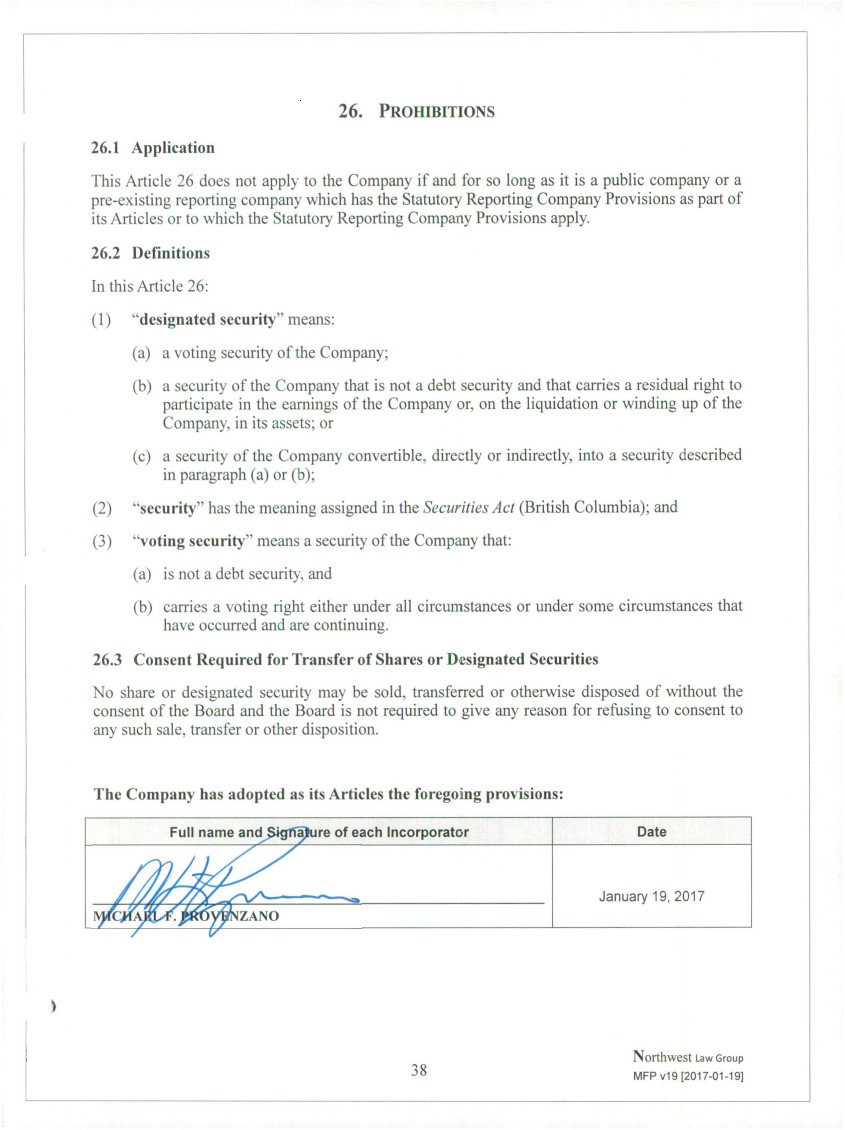
Exhibit 3.1
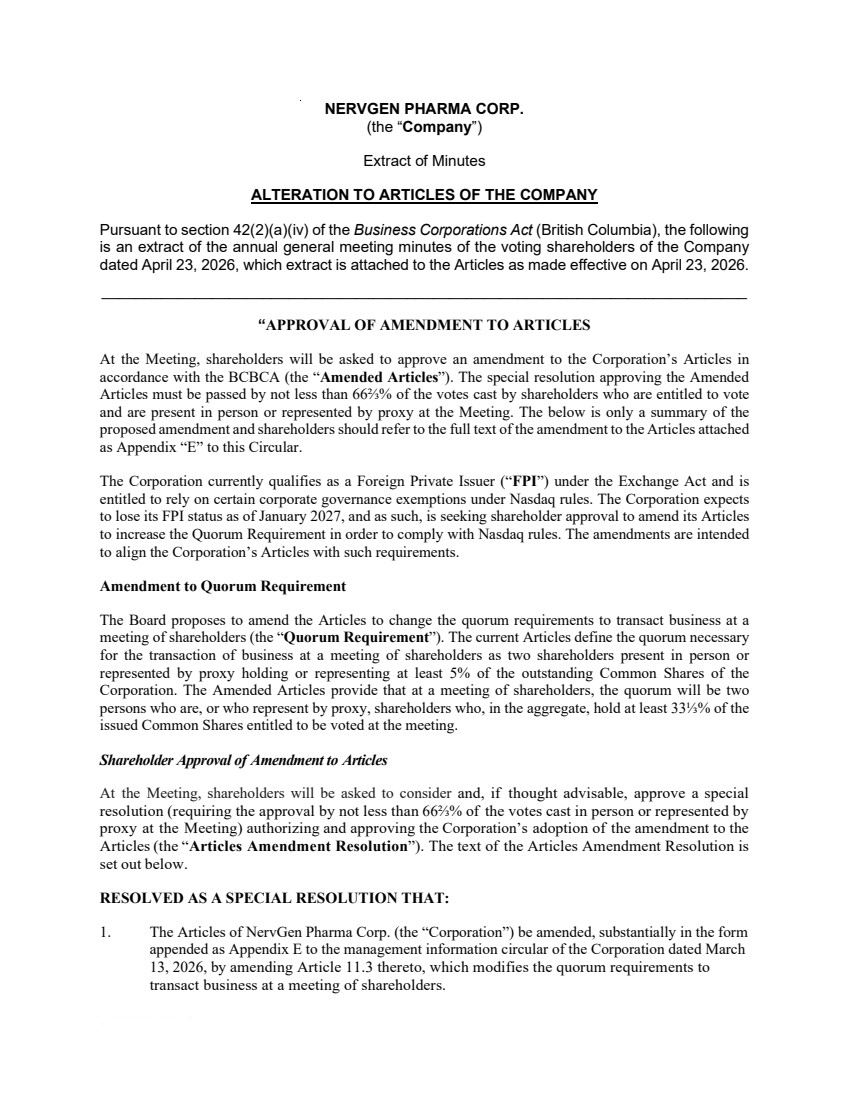
| 1381-9028-3039.1 NERVGEN PHARMA CORP. (the “Company”) Extract of Minutes ALTERATION TO ARTICLES OF THE COMPANY Pursuant to section 42(2)(a)(iv) of the Business Corporations Act (British Columbia), the following is an extract of the annual general meeting minutes of the voting shareholders of the Company dated April 23, 2026, which extract is attached to the Articles as made effective on April 23, 2026. ____________________________________________________________________________ “APPROVAL OF AMENDMENT TO ARTICLES At the Meeting, shareholders will be asked to approve an amendment to the Corporation’s Articles in accordance with the BCBCA (the “Amended Articles”). The special resolution approving the Amended Articles must be passed by not less than 66⅔% of the votes cast by shareholders who are entitled to vote and are present in person or represented by proxy at the Meeting. The below is only a summary of the proposed amendment and shareholders should refer to the full text of the amendment to the Articles attached as Appendix “E” to this Circular. The Corporation currently qualifies as a Foreign Private Issuer (“FPI”) under the Exchange Act and is entitled to rely on certain corporate governance exemptions under Nasdaq rules. The Corporation expects to lose its FPI status as of January 2027, and as such, is seeking shareholder approval to amend its Articles to increase the Quorum Requirement in order to comply with Nasdaq rules. The amendments are intended to align the Corporation’s Articles with such requirements. Amendment to Quorum Requirement The Board proposes to amend the Articles to change the quorum requirements to transact business at a meeting of shareholders (the “Quorum Requirement”). The current Articles define the quorum necessary for the transaction of business at a meeting of shareholders as two shareholders present in person or represented by proxy holding or representing at least 5% of the outstanding Common Shares of the Corporation. The Amended Articles provide that at a meeting of shareholders, the quorum will be two persons who are, or who represent by proxy, shareholders who, in the aggregate, hold at least 33⅓% of the issued Common Shares entitled to be voted at the meeting. Shareholder Approval of Amendment to Articles At the Meeting, shareholders will be asked to consider and, if thought advisable, approve a special resolution (requiring the approval by not less than 66⅔% of the votes cast in person or represented by proxy at the Meeting) authorizing and approving the Corporation’s adoption of the amendment to the Articles (the “Articles Amendment Resolution”). The text of the Articles Amendment Resolution is set out below. RESOLVED AS A SPECIAL RESOLUTION THAT: 1. The Articles of NervGen Pharma Corp. (the “Corporation”) be amended, substantially in the form appended as Appendix E to the management information circular of the Corporation dated March 13, 2026, by amending Article 11.3 thereto, which modifies the quorum requirements to transact business at a meeting of shareholders. |
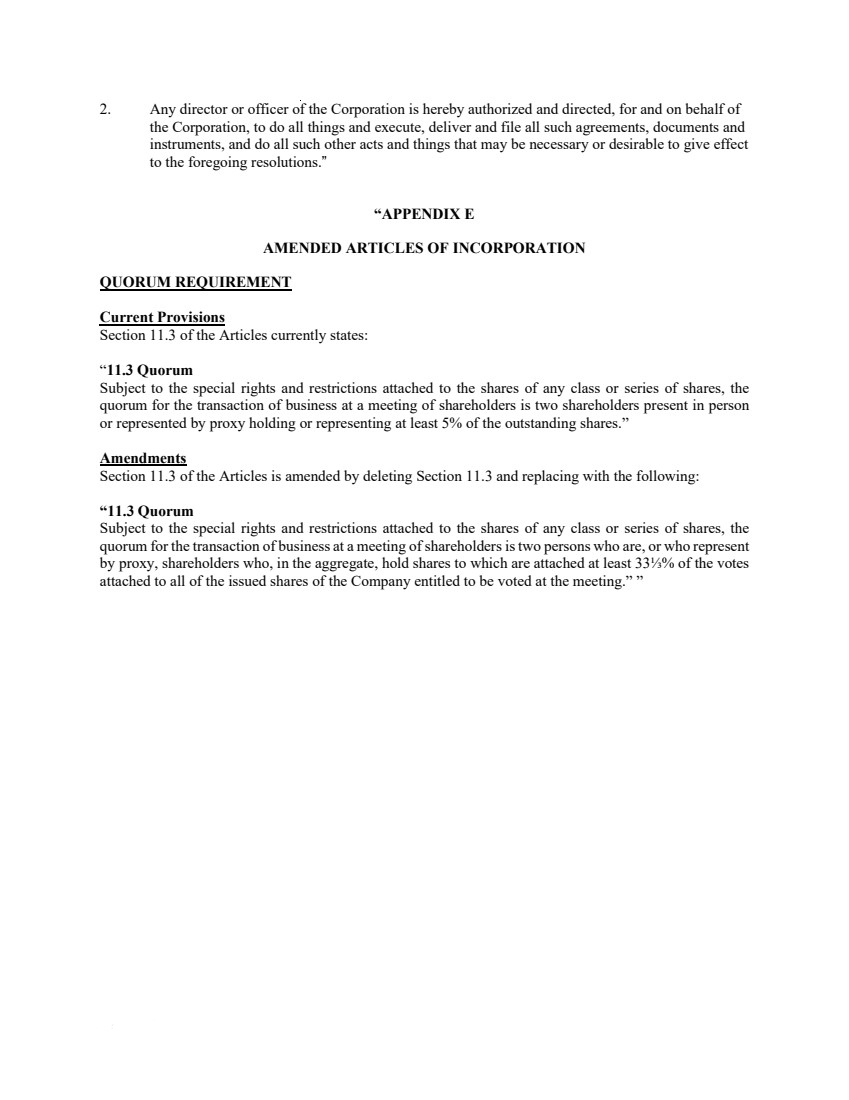
| 1381-9028-3039.1 2. Any director or officer of the Corporation is hereby authorized and directed, for and on behalf of the Corporation, to do all things and execute, deliver and file all such agreements, documents and instruments, and do all such other acts and things that may be necessary or desirable to give effect to the foregoing resolutions.” “APPENDIX E AMENDED ARTICLES OF INCORPORATION QUORUM REQUIREMENT Current Provisions Section 11.3 of the Articles currently states: “11.3 Quorum Subject to the special rights and restrictions attached to the shares of any class or series of shares, the quorum for the transaction of business at a meeting of shareholders is two shareholders present in person or represented by proxy holding or representing at least 5% of the outstanding shares.” Amendments Section 11.3 of the Articles is amended by deleting Section 11.3 and replacing with the following: “11.3 Quorum Subject to the special rights and restrictions attached to the shares of any class or series of shares, the quorum for the transaction of business at a meeting of shareholders is two persons who are, or who represent by proxy, shareholders who, in the aggregate, hold shares to which are attached at least 33⅓% of the votes attached to all of the issued shares of the Company entitled to be voted at the meeting.” ” |
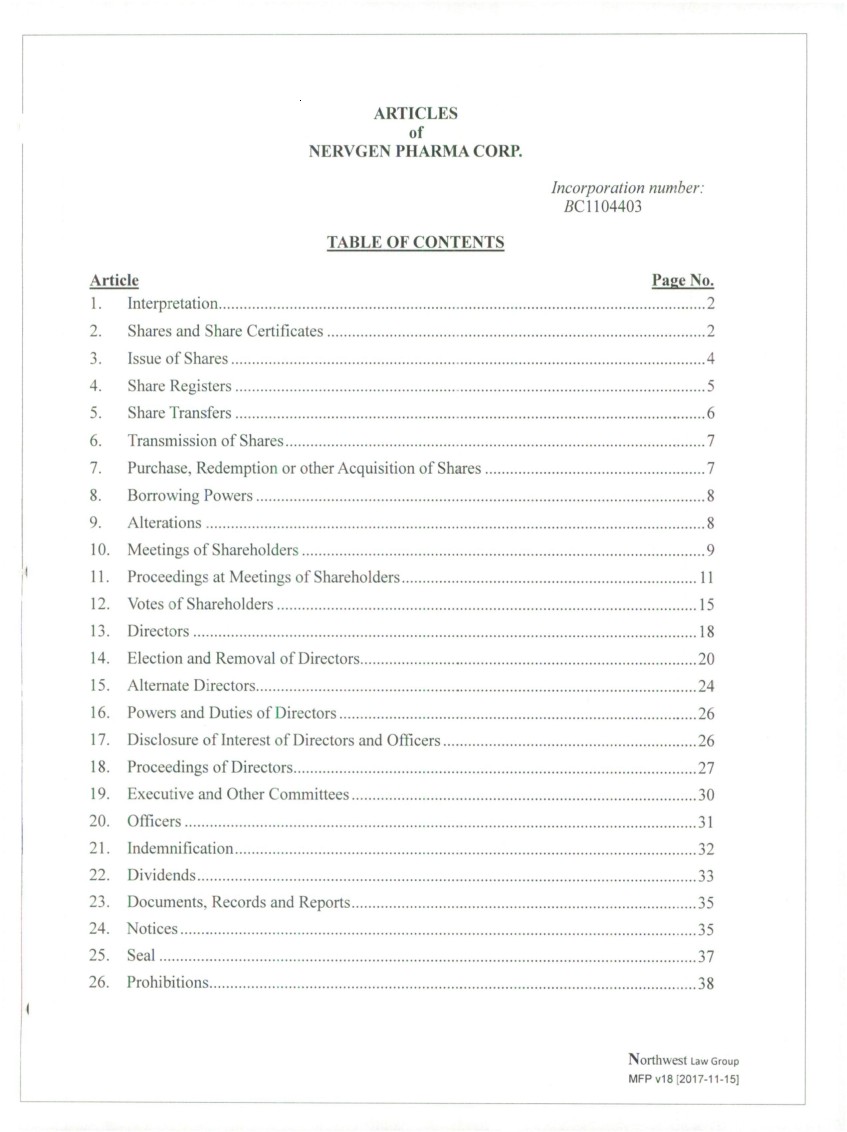
| TABLE OF CONTENTS 1. 2. 2 3. Issue of Shares 4 4. 5 5. 6 6. Transmission of Shares 7 1. 1 8. 8 9. 8 9 11 15 13. Directors 18 14. Election and Removal of Directors 20 15. Alternate Directors 24 I 16. Powers and Duties of Directors 26 17. Disclosure ofInterest of Directors and Officers 26 27 30 20. Officers 31 21. Indemnification 32 22. Dividends 33 35 35 25. Seal 37 26. Prohibitions 38 ARTICLES of NERVGEN PHARMA CORP. Share Registers Share Transfers 18. Proceedings of Directors 19. Executive and Other Committees Purchase, Redemption or other Acquisition of Shares Bonowing Powers Alterations ................. 10. Meetings of Shareholders 11. Proceedings at Meetings of Shareholders 12. Votes of Shareholders 23. Documents, Records and Reports 24. Notices Page No. 2 Northwest Law Group MFP v18 [2017-11-15] Incorporation number: BC1104403 Article Interpretation......................... Shares and Share Certificates |
| 1. Interpretation 1.1 Definitions In these Articles, the following words and phrases have the meanings set out beside them: (1) (2) (3) (4) (4) (5) (6) (7) “Seal” means the seal ofthe Company, if any. 1.2 Corporations Act and Interpretation Act Definitions Applicable 2. Shares and Share Certificates 2.1 Authorized Share Structure 2 “Board” or “Directors” means all ofthe Directors or the sole Director ofthe Company at any time; “Interpretation Act” means the Interpretation Act (British Columbia) from time to time in force and all amendments thereto and includes all regulations and amendments thereto made pursuant to that Act; The authorized share structure ofthe Company consists ofshares ofthe kinds, classes and, if any, series described in the Notice ofArticles ofthe Company. “Corporations Act” means the Business Corporations Act (British Columbia) from time to time in force and all amendments thereto and includes all regulations and amendments thereto made pursuant to that Act; “Protected Purchaser” means a “protected purchaser” under the Securities Transfer Act (British Columbia); “Registered Address” of a shareholder means the shareholder’s address as recorded in the central securities register; and “Legal Personal Representative” means the personal or other legal representative of the shareholder; “Company” means the company whose name is set out at the top of page 1, being the company which has adopted these Articles; Northwest Law Group MFP v19 [2017-01-19] The definitions in the Corporations Act and the definitions and rules of construction in the Interpretation Act, with the necessary changes, so far as applicable, and unless the context requires otherwise, apply to these Articles as if they were an enactment. If there is a conflict between a definition in the Corporations Act and a definition or rule in the Interpretation Act relating to a term used in these Articles, the definition in the Corporations Act will prevail in relation to the use of the term in these Articles. If there is a conflict between these Articles and the Corporations Act, the Corporations Act will prevail. |
| 2,2 Shares may be Certificated or Uncertificated 2.3 Form of Share Certificate 2.4 Shareholder Entitled to Certificate, Acknowledgment or Notice 2.5 Delivery by Mail 3 A share issued by the Company may be represented by a share certificate or uncertificated (not represented by a share certificate). (2) receives proofsatisfactory to it that the share certificate or acknowledgment is lost, stolen or destroyed and any indemnity the Board considers adequate. Any share certificate or non-transferable written acknowledgment of a shareholder’s right to obtain a share certificate may be sent to the shareholder by mail at the shareholder’s Registered Address and neither the Company nor any Director, officer or agent ofthe Company is liable for any loss to the shareholder because the share certificate or acknowledgement is lost in the mail or stolen. Each share certificate issued by the Company must comply with, and be signed as required by, the Corporations Act. Unless the shares of which a shareholder is the registered owner are uncertificated shares, each shareholder is entitled, without charge, to (a) one share certificate representing the shares of each class or series of shares registered in the shareholder’s name, or (b) a non-transferable written acknowledgment of the shareholder’s right to obtain such a share certificate, but in respect of a share held jointly by several persons, the Company is not bound to issue more than one share certificate and delivery of a share certificate for a share to one ofseveral joint shareholders or to one of the shareholders’ duly authorized agents will be sufficient delivery to all. If a share is uncertificated, the Company must send to the shareholder, within a reasonable period of time after the issue or transfer of that share to the shareholder, a written notice containing the information required for a share certificate under the Corporations Act. Northwest Law Group MFP v19 [2017-01-19] (1) has not been notified that the shares evidenced by such share certificate have been acquired by a Protected Purchaser; and 2.7 Replacement of Lost, Stolen or Destroyed Certificate or Acknowledgment If a share certificate or a non-transferable written acknowledgment of a shareholder’s right to obtain a share certificate is lost, stolen or destroyed, a replacement share certificate or acknowledgment, as the case may be, must be issued to the person entitled to that share certificate or acknowledgment, as the case may be, ifthe Board: 2.6 Replacement of Worn Out or Defaced Certificate or Acknowledgement If the Board is satisfied that a share certificate or a non-transferable written acknowledgment of the shareholder’s right to obtain a share certificate is worn out or defaced, it must, on production ofthe share certificate or acknowledgment, as the case may be, and on such other terms, if any, as it thinks fit, cancel the share certificate or acknowledgement and issue a replacement share certificate or acknowledgement, as the case may be. |
| 2.8 Recovery of New Share Certificates 2.10 Certificate Fee 3. Issue of Shares 3.1 Directors Authorized 3.2 Commissions and Discounts 4 Subject to the rights ofthe holders ofissued shares ofthe Company, the Company may allot, sell, issue and otherwise dispose ofthe unissued shares, and issued shares held by the Company, at the times, to the persons, including Directors, in the manner, on the terms and conditions and for the issue prices (including any premium at which shares with par value may be issued) that the Board may determine. The issue price for a share with par value must be equal to or greater than the par value ofthe share. If, after the issuance of a new share certificate, a Protected Purchaser of the original share certificate presents the original share certificate for the registration of a transfer then, in addition to any rights in the indemnity, the Company may recover the new share certificate from a person to whom it was issued or any person taking under that person other than a Protected Purchaser. The Company may pay at any time a reasonable commission or allow a reasonable discount to any person in consideration of that person purchasing or agreeing to purchase shares of the Company from the Company or any other person or procuring or agreeing to procure purchasers for shares ofthe Company. There must be paid to the Company, in relation to the issue of any share certificate under Articles 2.6, 2.7 or 2.9, the amount, if any and which must not exceed the amount prescribed under the Corporations Act, determined by the Board. Northwest Law Group MFP v19 [2017-01-19] 2.11 Recognition ofTrusts Except as required by law or statute or these Articles, no person will be recognized by the Company as holding any share upon any trust, and the Company is not bound by or compelled in any way to recognize (even when having notice thereof) any equitable, contingent, future or partial interest in any share or fraction of a share or (except as by law or statute or these Articles provided or as ordered by a court of competent jurisdiction) any other rights in respect of any share except an absolute right to the entirety thereofin the shareholder. 2.9 Splitting Share Certificates If a shareholder surrenders a share certificate to the Company with a written request that the Company issue in the shareholder’s name two or more share certificates, each representing a specified number of shares and in the aggregate representing the same number of shares as the share certificate so surrendered, the Company must cancel the surrendered share certificate and issue replacement share certificates in accordance with that request. |
| 3.4 Conditions of Issue (1) (a) past services performed for the Company; (b) property; or (c) money; and (2) 3.5 Share Purchase Warrants and Rights The 4. Share Registers 4.1 Central Securities Register (1) an agent to maintain the central securities register; and (2) 4.2 Closing Register The Company must not at any time close its central securities register. 5 one or more agents, including the agent which keeps the central securities register, as transfer agent for its shares or any class or series of its shares, as the case may be, and the same or another agent as registrar for its shares or such class or series ofits shares. Northwest Law Group MFP Vi 9 [2017-01-19] The Board may terminate such appointment of any agent at any time and may appoint another agent in its place. The Company must maintain in British Columbia a central securities register as required by the Corporations Act. The Board may appoint: consideration is provided to the Company for the issue of the share by one or more ofthe following; the value of the consideration received by the Company equals or exceeds the issue price set for the share under Article 3.1. Except as provided for by the Corporations Act, no share may be issued until it is fully paid. A share is fully paid when; Company may issue share purchase warrants, options and rights upon such terms and conditions as the Board determines. 3.3 Brokerage The Company may pay such brokerage fee or other consideration as may be lawful for or in cormection with the sale or placement ofits securities. |
| 5. Share Transfers (1) a duly signed instrument oftransfer in respect ofthe share; and (2) (3) 5.2 Form ofInstrument ofTransfer I 5.3 Transferor Remains Shareholder 5.4 Signing of Instrument ofTransfer in the name ofthe person named as transferee in that instrument oftransfer; or (1) (2) 5.5 Enquiry as to Title Not Required 6 Except to the extent that the Corporations Act otherwise provides, the transferor of shares is deemed to remain the holder of the shares until the name of the transferee is entered in the Company’s central securities register in respect ofthe transfer. if a non-transferable written acknowledgment of the shareholder’s right to obtain a share certificate has been issued by the Company in respect of the share to be transferred, that acknowledgment. if no person is named as transferee in that instrument oftransfer, in the name ofthe person on whose behalf the instrument is deposited for the purpose of having the transfer registered. Northwest Law Group MFP v19 [2017-01-19] If a shareholder, or the shareholder’s duly authorized attorney, signs an instrument oftransfer in respect of shares registered in the name of the shareholder, the signed instrument of transfer constitutes a complete and sufficient authority to the Company and its Directors, officers and agents to register the number of shares specified in the instrument oftransfer or specified in any other manner, or, if no number is specified, all the shares represented by the share certificates or set out in the written acknowledgments deposited with the instrument oftransfer: The instrument of transfer in respect of any share ofthe Company must be either in the form, if any, on the back of the Company’s share certificates or in any other form that may be approved by the Board. if a share certificate has been issued by the Company in respect of the share to be transferred, that share certificate; or Neither the Company nor any Director, officer or agent ofthe Company is bound to inquire into the title ofthe person named in the instrument oftransfer as transferee or, if no person is named as transferee in the instrument of transfer, of the person on whose behalf the instrument is deposited for the purpose of having the transfer registered or is liable for any claim related to registering the transfer by the shareholder or by any intermediate owner or holder of the shares, of any interest in the shares, of any share certificate representing such shares or of any written acknowledgment of a right to obtain a share certificate for such shares. 5.1 Registering Transfers A transfer of a share ofthe Company must not be registered unless the Company has received: |
| 5.6 Transfer Fee 6. Transmission of Shares 6.1 7. Purchase, Redemption or otherAcquisition of Shares 7.1 7.2 (1) (2) 7.3 (1) is not entitled to vote the share at a meeting ofits shareholders; (2) must not pay a dividend in respect ofthe share; and 7 There must be paid to the Company, in relation to the registration of any transfer, the amount, if any, determined by the Board. Northwest Law Group MFP v19 [2017-01-19] 6.2 Rights of Legal Personal Representative The Legal Personal Representative has the same rights, privileges and obligations that attach to the shares held by the shareholder, including the right to transfer the shares in accordance with these Articles, provided the documents required by the Corporations Act and the Board have been deposited with the Company. Legal Personal Representative Recognized on Death In case ofthe death of a shareholder, the Legal Personal Representative, or ifthe shareholder was a joint holder, the surviving joint holder, will be the only person recognized by the Company as having any title to the shareholder’s interest in the shares. Before recognizing a person as a Legal Personal Representative, the Board may require proof of appointment by a court of competent jurisdiction, a grant of letters probate, letters of administration or such other evidence or documents as the Board considers appropriate. Company Authorized to Purchase, Redeem or Otherwise Acquire Shares Subject to Article 7.2 and the special rights and restrictions attached to the shares of any class or series, the Company, if authorized by a resolution of the Board, may purchase, redeem or otherwise acquire any ofits shares at the price and upon the terms specified in such resolution. the Company is insolvent; or making the payment or providing the consideration would render the Company insolvent. Purchase, Redemption or Other Acquisition When Insolvent The Company must not make a payment or provide any other consideration to purchase, redeem or otherwise acquire any ofits shares ifthere are reasonable grounds for believing that: I I Sale and Voting of Purchased, Redeemed and Acquired Shares If the Company retains a share purchased, redeemed or otherwise acquired by it, the Company may sell, gift or otherwise dispose ofthe share, but, while such share is held by the Company, it: |
| (3) must not make any other distribution in respect ofthe share. 8. Borrowing Powers (1) (2) (3) (4) 9. Alterations 9.1 Alteration ofAuthorized Share Structure Subject to Article 9.2, the Company may by: I (1) a resolution ofthe Board (c) subdivide or consolidate all or any ofits unissued, or fully paid issued, shares; and I (c) alter the identifying name of any ofits shares. (2) an ordinary resolution: (b) ifthe Company is authorized to issue shares of a class ofshares with par value: (i) decrease the par value ofthose shares; and 8 I I guarantee the repayment of money by any other person or the performance of any obligation of any other person; and (a) create one or more classes or series of shares or, if none of the shares of a class or series ofshares are allotted or issued, eliminate that class or series ofshares; and issue bonds, debentures and other debt obligations either outright or as security for any liability or obligation of the Company or any other person and at such discounts or premiums and on such other terms as the Board considers appropriate; mortgage, charge, whether by way ofspecific or floating charge, grant a security interest in, or give other security on, the whole or any part of the present and future assets and undertaking ofthe Company. (a) increase, reduce or eliminate the maximum number of shares that the Company is authorized to issue out of any class or series ofshares or establish a maximum number ofshares that the Company is authorized to issue out of any class or series ofshares for which no maximum is established; Northwest Law Group MFPvl 9 [2017-01-19] I I I (b) change all or any of its unissued, or fully paid issued, shares with par value into shares without par value or any of its unissued shares without par value into shares with par value; The Company, if authorized by the Board, may: borrow money in the manner and amount, on the security, from the sources and on the terms and conditions that the Board considers appropriate; |
| 9.2 Special Rights and Restrictions (1) (2) 9.3 9.4 Other Alterations 10. Meetings of Shareholders 9 (3) a special resolution, otherwise alter its shares or authorized share structure when required or permitted to do so by the Corporations Act. If the Corporations Act does not specify the type of resolution and these Articles do not specify another type ofresolution, the Company may alter these Articles by a resolution ofthe Board. (ii) if none of the shares ofthat class of shares are allotted or issued, increase the par value ofthose shares. Northwest taw Group MFP v19 [2017-01-19] 10.2 Resolution Instead ofAnnual General Meeting If all the shareholders entitled to vote at an annual general meeting consent by a unanimous resolution under the Corporations Act to all of the business required to be transacted at that annual general meeting, the meeting is deemed to have been held on the date of the unanimous resolution. The shareholders must, in any unanimous resolution passed under this Article 10.2, select as the Company’s annual reference date a date that would be appropriate for the holding of the applicable annual general meeting. 10.1 Annual General Meetings The Company must, unless an annual general meeting is deferred or waived in accordance with the Corporations Act, hold its first annual general meeting within 18 months after the date on which it was incorporated or otherwise created and recognized, and after that must hold an annual general meeting at least once in each calendar year and not more than 15 months after the last annual reference date at such time and place as may be determined by the Board. The Company may by ordinary resolution: create special rights or restrictions for, and attach those special rights or restrictions to, the shares of any class or series ofshares, imless any ofthose shares have been issued in which case the Company may do so only by special resolution; or vary or delete any special rights or restrictions attached to the shares of any class or series of shares, unless any of those shares have been issued in which case the Company may do so only by special resolution. Change of Name The Company may, by a resolution ofthe Board, authorize an alteration of its Notice ofArticles to change its name or adopt or change any translation ofthat name. |
| 10.3 Calling and Location of Meetings of Shareholders 10.4 Notice for Meetings of Shareholders (1) if and for so long as the Company is a public company, 21 days; and (2) otherwise, 10 days. 10.5 Record Date for Notice (1) if and for so long as the Company is a public company, 21 days; and (2) otherwise, 10 days. 10.6 Record Date for Voting 10.7 Failure to Give Notice and Waiver of Notice 10 The accidental omission to send notice of any meeting to, or the non-receipt of any notice by, any of the persons entitled to notice does not invalidate any proceedings at that meeting. Any person entitled to notice of a meeting of shareholders may, in writing or otherwise, waive or reduce the period of notice ofsuch meeting. The Board may set a date as the record date for the purpose of determining shareholders entitled to vote at any meeting of shareholders. The record date must not precede the date on which the meeting is to be held by more than two months or, in the case of a general meeting requisitioned by shareholders under the Corporations Act, by more than four months. If no record date is set, the record date is 5:00 p.m. on the day immediately preceding the first date on which the notice is sent or, if no notice is sent, the beginning ofthe meeting. If no record date is set, it is 5:00 p.m. on the business day immediately preceding the first date on which the notice is sent or, if no notice is sent, the beginning ofthe meeting. The Board may, whenever it thinks fit, call a meeting of shareholders to be held in British Columbia, Calgary, Alberta or Toronto, Ontario or at such other location as may be approved by the Registrar ofCompanies at such time and place as may be detennined by the Board. Northwest Law Group MFPwl 9 [2017-01-19] The Board may set a date as the record date for the purpose of determining shareholders entitled to notice of any meeting ofshareholders. The record date must not precede the date on which the meeting is to be held by more than two months or, in the case of a general meeting requisitioned by shareholders under the Corporations Act, by more than four months. The record date must not precede the date on which the meeting is held by fewer than: The Company must send notice ofthe date, time and location of any meeting ofshareholders, in the manner provided in these Articles, or in such other manner, if any, as may be prescribed by ordinary resolution (whether previous notice of the resolution has been given or not), to each shareholder entitled to attend the meeting, to each Director and to the auditor of the Company, unless these Articles otherwise provide, at least the following number of days before the meeting: 10.8 Notice of Special Business at Meetings of Shareholders If a meeting of shareholders is to consider special business within the meaning of Article 11.1, the notice ofmeeting must: |
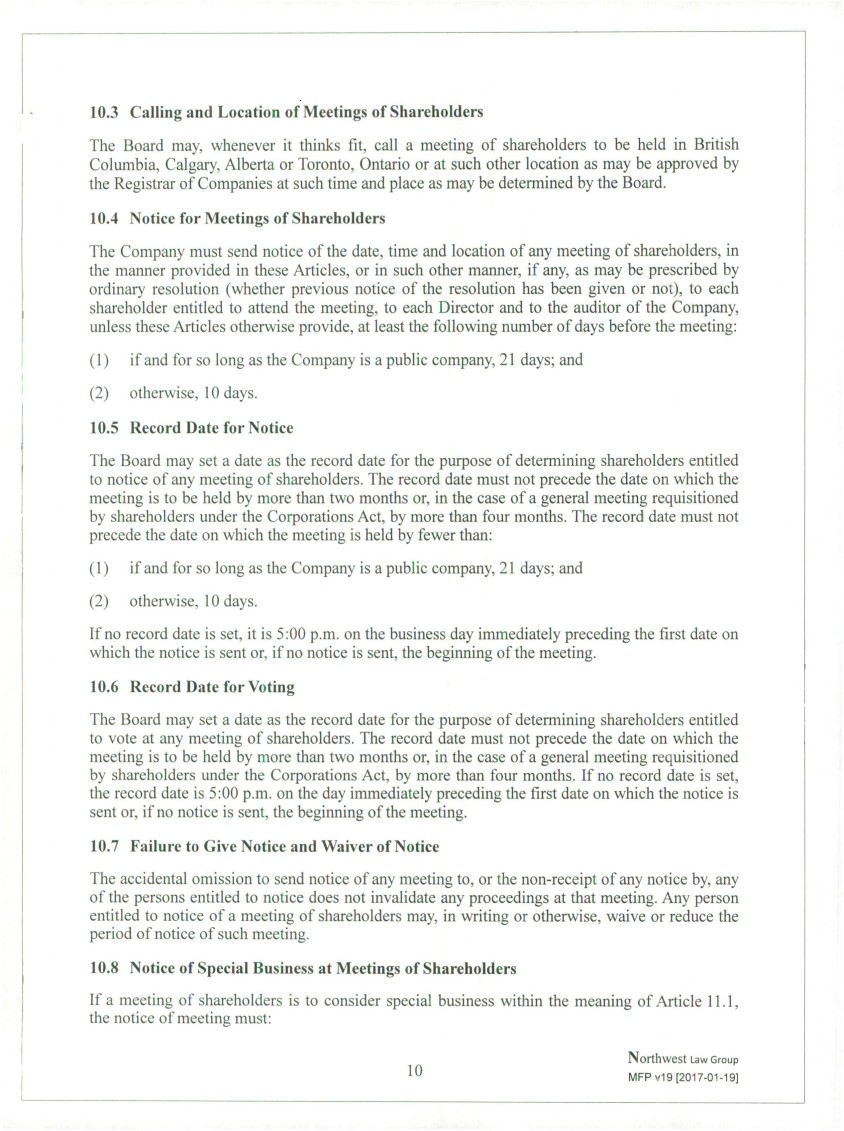
| 11. Proceedings at Meetings of Shareholders 11.1 Special Business At a meeting ofshareholders, the following business is special business: (2) at an annual general meeting, all business is special business except for the following: (a) business relating to the conduct of or voting at the meeting; (d) the setting or changing ofthe number of Directors; 11 (b) during statutory business hours on any one or more specified days before the day set for the holding ofthe meeting. Northwest Law Group MFPvl 9 [2017-01-19] (1) at a meeting of shareholders that is not an annual general meeting, all business is special business except business relating to the conduct of or voting at the meeting; (b) consideration of any financial statements ofthe Company presented to the meeting; (c) consideration of any reports ofthe Board or auditor; (e) the election or appointment of Directors; (f) the appointment of an auditor; (1) state the general nature ofthe special business; and (2) if the special business includes considering, approving, ratifying, adopting or authorizing any document or the signing of or giving of effect to any document, have attached to it a copy of the document or state that a copy ofthe document will be available for inspection by shareholders: (a) at the Company’s records office, or at such other reasonably accessible location in British Columbia as is specified in the notice; and 11.2 Special Majority The majority of votes required for the Company to pass a special resolution at a meeting of shareholders is two-thirds ofthe votes cast on the resolution. (g) the setting ofthe remuneration of an auditor; (h) business arising out of a report of the Board not requiring the passing of a special resolution or an exceptional resolution; and (i) any other business which, under these Articles or the Corporations Act, may be transacted at a meeting of shareholders without prior notice of the business being given to the shareholders. |
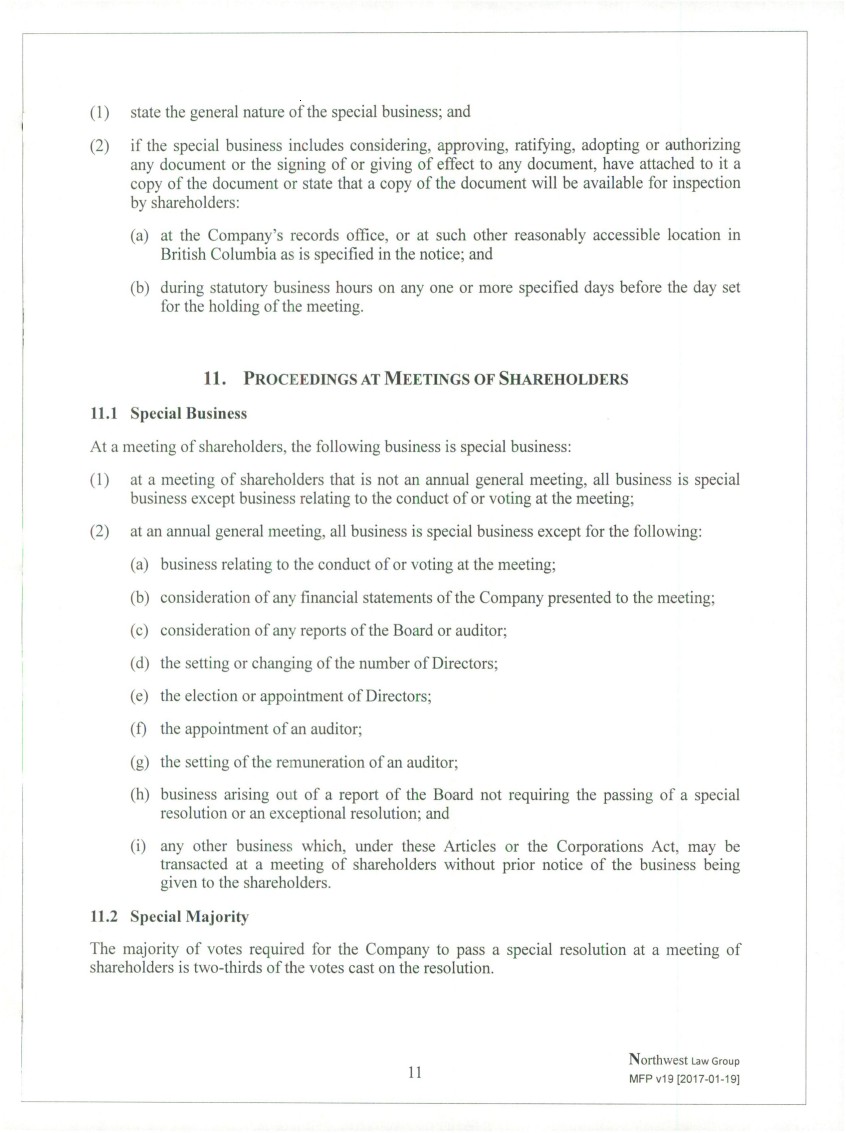
| 11.8 Chair The following individuals are entitled to preside as Chair at a meeting ofshareholders: 12 I I (2) in the case of any other meeting ofshareholders, the meeting stands adjourned to the same day in the next week at the same time and place. Northwest taw Group MFP v19 [2017-01-19] 11.7 Lack of Quorum at Succeeding Meeting If, at the meeting to which the meeting referred to in Article 11.6(2) was adjourned, a quorum is not present within one-half hour from the time set for the holding of the meeting, the person or persons present and being, or representing by proxy, one or more shareholders entitled to attend and vote at the meeting constitute a quorum. 11.5 Requirement of Quorum No business, other than the election of a Chair of the meeting and the adjournment of the meeting, may be transacted at any meeting of shareholders unless a quorum of shareholders entitled to vote is present at the commencement of the meeting, but such quorum need not be present throughout the meeting. 11.4 Other Persons May Attend The Directors, the President (if any), the Secretary (if any), the assistant Secretary (if any), any lawyer for the Company, the auditor ofthe Company and any other persons invited by the Board are entitled to attend any meeting of shareholders, but if any of those persons does attend a meeting ofshareholders, that person is not to be counted in the quorum and is not entitled to vote at the meeting unless that person is a shareholder or proxy holder entitled to vote at the meeting. 11.3 Quorum Subject to the special rights and restrictions attached to the shares of any class or series ofshares, the quorum for the transaction of business at a meeting of shareholders is two shareholders present in person or represented by proxy holding or representing at least 5% ofthe outstanding shares. 11.6 Lack of Quorum If, within one-half hour from the time set for the holding of a meeting ofshareholders, a quorum is not present: (1) in the case of a general meeting requisitioned by shareholders, the meeting is dissolved, and (1) the Chair ofthe Board, if any; or (2) if the Chair of the Board is absent or unwilling to act as Chair of the meeting, the first of the following individuals to agree to act as Chair: the President, the Chief Executive Officer, the Chief Financial Officer, a Vice-President, or the Secretary, if any. Amended pursuant to annual general meeting minutes of the voting shareholders of the Company dated April 23, 2026. |
| 11.9 Selection ofAlternate Chair 11.11 Notice ofAdjourned Meeting 11.13 Declaration of Result 11.14 Motion Need Not be Seconded 13 No motion proposed at a meeting of shareholders need be seconded unless the Chair of the meeting rules otherwise, and the Chair of any meeting of shareholders is entitled to propose or second a motion. If, at any meeting of shareholders, the Chair of the Board or President are not present within 15 minutes after the time set for holding the meeting, or ifthe Chair ofthe Board and the President are unwilling to act as Chair of the meeting, or ifthe Chair of the Board and the President have advised the Secretary, if any, or any Director present at the meeting, that he or she will not be present at the meeting, one of the Chief Executive Officer, the Chief Financial Officer, a Vice-President, the Secretary or the Company’s legal counsel may act as Chair of the meeting and, failing them, the Directors present must choose one oftheir number to be Chair ofthe meeting or if all of the Directors present decline to take the Chair or fail to so choose or if no Director is present, the shareholders entitled to vote at the meeting who are present in person or by proxy may choose any person present at the meeting to Chair the meeting. The Chair of a meeting of shareholders must declare to the meeting the decision on every question in accordance with the result ofthe show of hands or the poll, as the case may be, and that decision must be entered in the minutes of the meeting. A declaration of the Chair that a resolution is carried by the necessary majority or is defeated is, unless a poll is directed by the Chair or demanded under Article 11.12, conclusive evidence without proof of the number or proportion ofthe votes recorded in favour of or against the resolution. It is not necessary to give any notice of an adjourned meeting or of the business to be transacted at an adjourned meeting ofshareholders except that, when a meeting is adjourned for 30 days or more, notice ofthe adjourned meeting must be given as in the case ofthe original meeting. Northwest Law Group MFPvl 9 [2017-01-19] 11.12 Decisions by Show of Hands or Poll Every motion put to a vote at a meeting of shareholders will be decided on a show of hands unless a poll, before or on the declaration of the result of the vote by show of hands, is directed by the Chair or demanded by at least one shareholder entitled to vote who is present in person or by proxy. 11.10 Adjournments The Chair of a meeting ofshareholders may, and if so directed by the meeting must, adjourn the meeting from time to time and place to place, but no business may be transacted at any adjourned meeting other than the business left unfinished at the meeting from which the adjournment took place. |
| 11.15 Casting Vote 11.16 Manner of Taking Poll Subject to Article 11.17, if a poll is duly demanded at a meeting ofshareholders: the poll must be taken: (1) (b) in the manner, at the time and at the place that the Chair ofthe meeting directs; (2) (3) the demand for the poll may be withdrawn by the person who demanded it. 11.17 Demand for Poll on Adjournment 11.18 Chair Must Resolve Dispute 11.19 Casting of Votes 11.20 Demand for Poll on Election of Chair 11.21 Demand for Poll Not to Prevent Continuance of Meeting 11.22 Retention of Ballots and Proxies 14 No poll may be demanded in respect ofthe vote by which a Chair of a meeting ofshareholders is elected. In case of an equality of votes, the Chair of a meeting ofshareholders does not, either on a show of hands or on a poll, have a second or casting vote in addition to the vote or votes to which the Chair may be entitled as a shareholder. In the case of any dispute as to the admission or rejection of a vote given on a poll, the Chair of the meeting must determine the dispute, and the Chair’s determination made in good faith is final and conclusive. The demand for a poll at a meeting of shareholders does not, unless the Chair of the meeting so rules, prevent the continuation of a meeting for the transaction of any business other than the question on which a poll has been demanded. A poll demanded at a meeting of shareholders on a question of adjournment must be taken immediately at the meeting. (a) at the meeting, or within seven days after the date of the meeting, as the Chair of the meeting directs; and the result of the poll is deemed to be the decision of the meeting at which the poll is demanded; and The Company must, for at least three months after a meeting of shareholders, keep each ballot cast on a poll and each proxy voted at the meeting at its records office, and, during that period, make them available for inspection during normal business hours by any shareholder or Northwest Law Group MFPvl 9 [2017-01-19] On a poll, a shareholder entitled to more than one vote need not cast all the votes in the same way. |
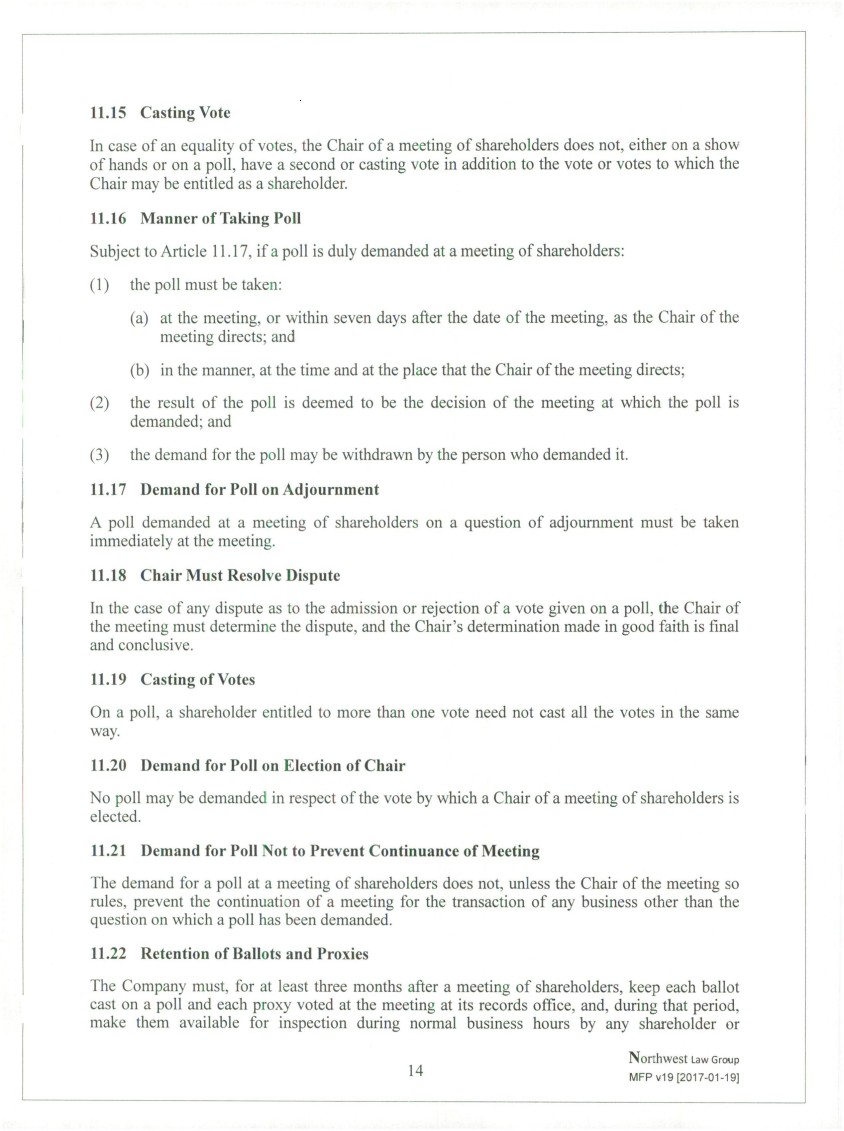
| 12. Votes of Shareholders 12.2 Votes of Persons in Representative Capacity I 12.4 Legal Personal Representatives as Joint Shareholders 12.5 Representative of a Corporate Shareholder 15 proxyholder entitled to vote at the meeting. At the end ofsuch three month period, the Company may destroy such ballots and proxies. A person who is not a shareholder may vote at a meeting of shareholders, whether on a show of hands or on a poll, and may appoint a proxy holder to act at the meeting, if, before doing so, the person satisfies the Chair of the meeting, or the Board, that the person is a Legal Personal Representative or a trustee in bankruptcy for a shareholder who is entitled to vote at the meeting. Two or more Legal Personal Representatives of a shareholder in whose sole name any share is registered are, for the purposes ofArticle 12.3, deemed to be joint shareholders. (2) ifmore than one ofthe joint shareholders is present at any meeting, personally or by proxy, and more than one of them votes in respect of that share, then only the vote of the joint shareholder present whose name stands first on the central securities register in respect of the share will be counted. Northwest Law Group MFPvt 9 [2017-01-19] (2) on a poll, every shareholder entitled to vote on the matter has one vote in respect of each share entitled to be voted on the matter and held by that shareholder and may exercise that vote either in person or by proxy. If a corporation, that is not a subsidiary of the Company, is a shareholder, that corporation may appoint a person to act as its representative at any meeting ofshareholders ofthe Company, and: (1) for that purpose, the instrument appointing a representative must: (a) be received at the registered office of the Company or at any other place specified, in the notice calling the meeting, for the receipt of proxies, at least the number of 12.1 Number of Votes by Shareholder or by Shares Subject to any special rights or restrictions attached to any shares and to the restrictions imposed on joint shareholders under Article 12.3: (1) on a vote by show of hands, every person present who is a shareholder or proxy holder and entitled to vote on the matter has one vote; and 12.3 Votes by Joint Holders Ifthere are joint shareholders registered in respect of any share: (1) any one ofthe joint shareholders may vote at any meeting, either personally or by proxy, in respect ofthe share as ifthat joint shareholder were solely entitled to it; or |
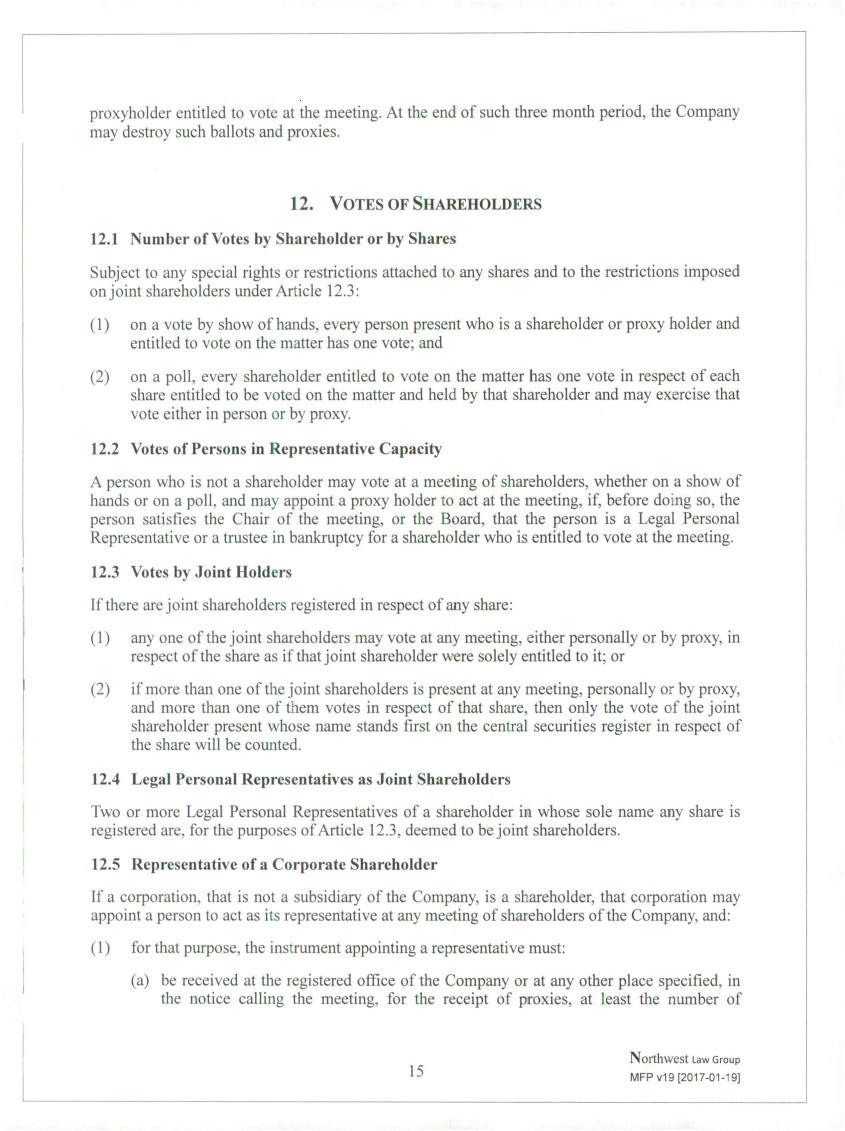
| (1) (2) (3) 16 Northwest taw Group MFPvl 9 [2017-01-19] 12.6 Proxy Provisions Do Not Apply to All Companies Articles 12.9 and 12.12 do not apply to the Company if and for so long as it is a public company or a pre-existing reporting company which has the Statutory Reporting Company Provisions as part ofits Articles or to which the Statutory Reporting Company Provisions apply. business days specified in the notice for the receipt ofproxies, or ifno number of days is specified, two business days before the day set for the holding ofthe meeting; or (b) be provided, at the meeting, to the Chair of the meeting or to a person designated by the Chair ofthe meeting; 12.8 Alternate Proxy Holders A shareholder may appoint one or more alternate proxy holders to act in the place of an absent proxy holder. 12.7 Appointment of Proxy Holders Every shareholder of the Company, including a corporation that is a shareholder but not a subsidiary ofthe Company, entitled to vote at a meeting ofshareholders ofthe Company may, by proxy, appoint one or more proxy holders to attend and act at the meeting in the manner, to the extent and with the powers confened by the proxy. (2) if a representative is appointed under this Article 12.5: (a) the representative is entitled to exercise in respect of and at that meeting the same rights on behalf ofthe corporation that the representative represents as that corporation could exercise if it were a shareholder who is an individual, including, without limitation, the right to appoint a proxy holder; and (b) the representative, if present at the meeting, is to be counted for the purpose of forming a quorum and is deemed to be a shareholder present in person at the meeting. Evidence of the appointment of any such representative may be sent to the Company by hand, mail, fax or any other method oftransmitting wTitten instruments. 12.9 When Proxy Holder Need Not Be Shareholder Subject to Article 12.6, a person must not be appointed as a proxy holder unless the person is a shareholder, although a person who is not a shareholder may be appointed as a proxy holder if: the person appointing the proxy holder is a corporation or a representative of a corporation appointed under Article 12.5; the Company has at the time of the meeting for which the proxy holder is to be appointed only one shareholder entitled to vote at the meeting; or the shareholders present in person or by proxy at and entitled to vote at the meeting for which the proxy holder is to be appointed, by a resolution on which the proxy holder is not entitled to vote but in respect of which the proxy holder is to be counted in the quorum, permit the proxy holder to attend and vote at the meeting. |
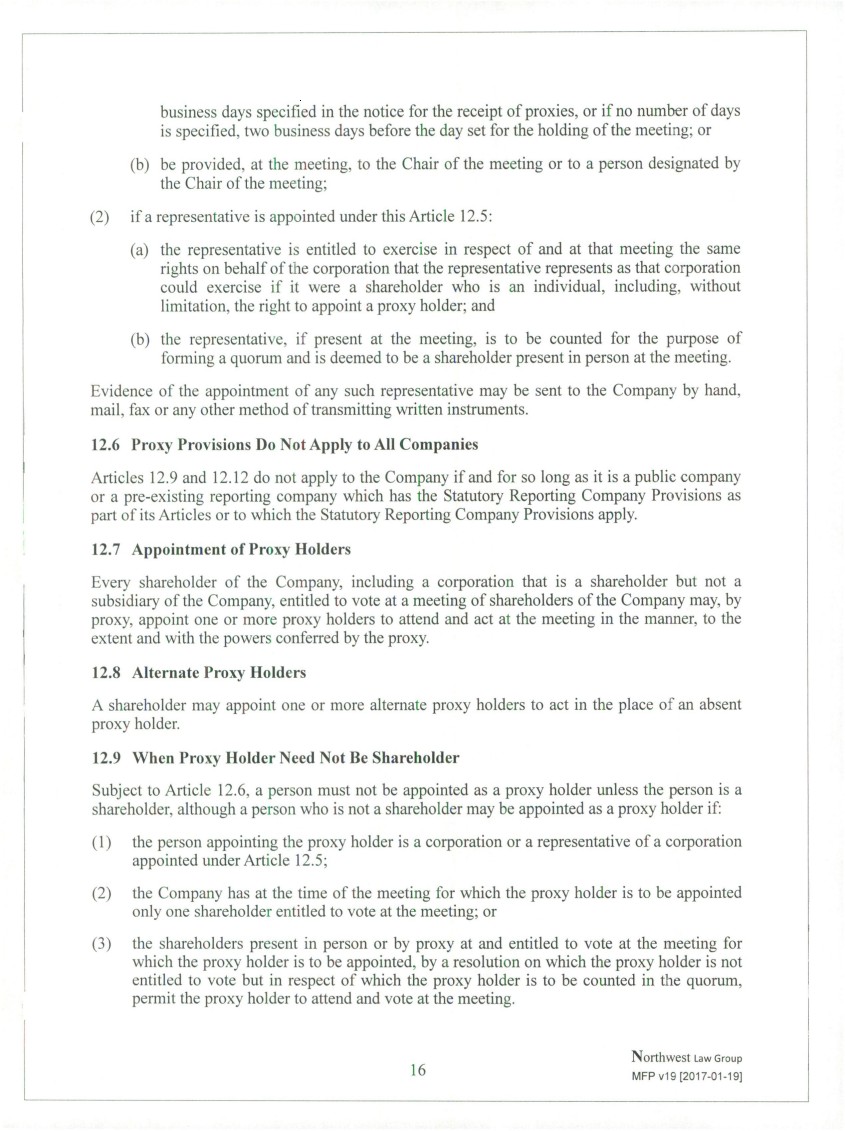
| 12.10 Deposit of Proxy (2) by the Chair ofthe meeting, before the vote is taken. [Signature ofshareholder} [Name ofshareholder—printed} [Date} 17 A proxy for a meeting ofshareholders must: (1) be received at the registered office of the Company or at any other place specified, in the notice calling the meeting, for the receipt of proxies, at least the number of business days specified in the notice, or if no number of days is specified, two business days before the day set for the holding ofthe meeting; or 12.11 Validity of Proxy Vote A vote given in accordance with the terms of a proxy is valid notwithstanding the death or incapacity of the shareholder giving the proxy and despite the revocation of the proxy or the revocation ofthe authority under which the proxy is given, unless notice in writing ofthat death, incapacity or revocation is received: (1) at the registered office of the Company, at any time up to and including the last business day before the day set for the holding ofthe meeting at which the proxy is to be used; or (2) unless the notice provides otherwise, be provided, at the meeting, to the Chair of the meeting or to a person designated by the Chair ofthe meeting. A proxy may be sent to the Company by hand, mail, fax or any other method of transmitting written instruments. Northwest Law Group MFP v19 [2017-11-15] 12.12 Form of Proxy Subject to Article 12.6, a proxy, whether for a specified meeting or otherwise, must be either in the following form or in any other form approved by the Board or the Chair ofthe meeting: NERVGEN PHARMA CORP, (the “Company”) The undersigned, being a shareholder ofthe Company, hereby appoints [name} or, failing that person, [name}, as proxy holder for the undersigned to attend, act and vote for and on behalf of the undersigned at the meeting of shareholders of the Company to be held on [date} and at any adjournment of that meeting. Number ofshares in respect of which this proxy is given (if no number is specified, then this proxy if given in respect of all shares registered in the name of the shareholder): |
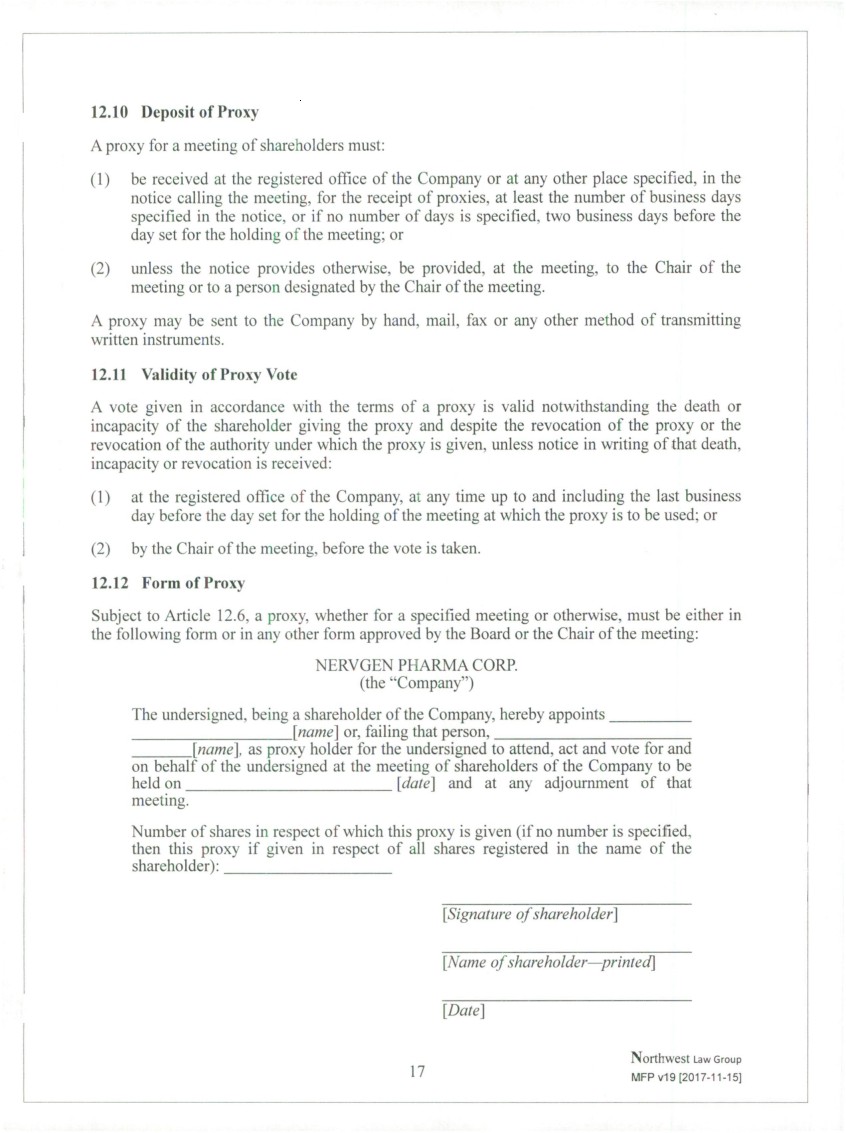
| 12.13 Revocation of Proxy (2) provided, at the meeting, to the Chair ofthe meeting. 12.14 Revocation of Proxy Must Be Signed 12.15 Production of Evidence ofAuthority to Vote 1 13. Directors 13.1 First Directors; Number of Directors (1) (2) (b) under Article 14.5; or (3) ifthe Company is not a public company, the most recent number ofDirectors set: 18 if the Company is a public company, the greater of three and the most recent number of Directors set: (2) a corporation, by the corporation or a representative appointed for the corporation under Article 12.5. An instrument referred to in Article 12.13 must be signed, ifthe shareholder for whom the proxy holder is appointed is: subject to paragraphs (2) and (3), the number ofDirectors that is equal to the number ofthe Company’s first Directors; (1) an individual, by the shareholder or the shareholder’s legal personal representative or trustee in bankruptcy; or The Chair of any meeting of shareholders may, but need not, inquire into the authority of any person to vote at the meeting and may, but need not, demand from that person production of evidence as to the existence ofthe authority to vote. Northwest taw Group MFP Vi 9 [2017-01-19] The Directors, or the first Directors after the Company is incorporated, amalgamated or continued, are the persons designated as directors of the Company in the Notice ofArticles that applies to the Company when it is recognized under the Corporations Act. The number of Directors, excluding additional Directors appointed under Article 14.9, is set at: (a) by ordinary resolution (whether or not previous notice of the resolution was given); and (a) by ordinary resolution (whether or not previous notice of the resolution was given); and Every proxy may be revoked by an instrument in writing that is: (1) received at the registered office of the Company at any time up to and including the last business day before the day set for the holding of the meeting at which the proxy is to be used; or |
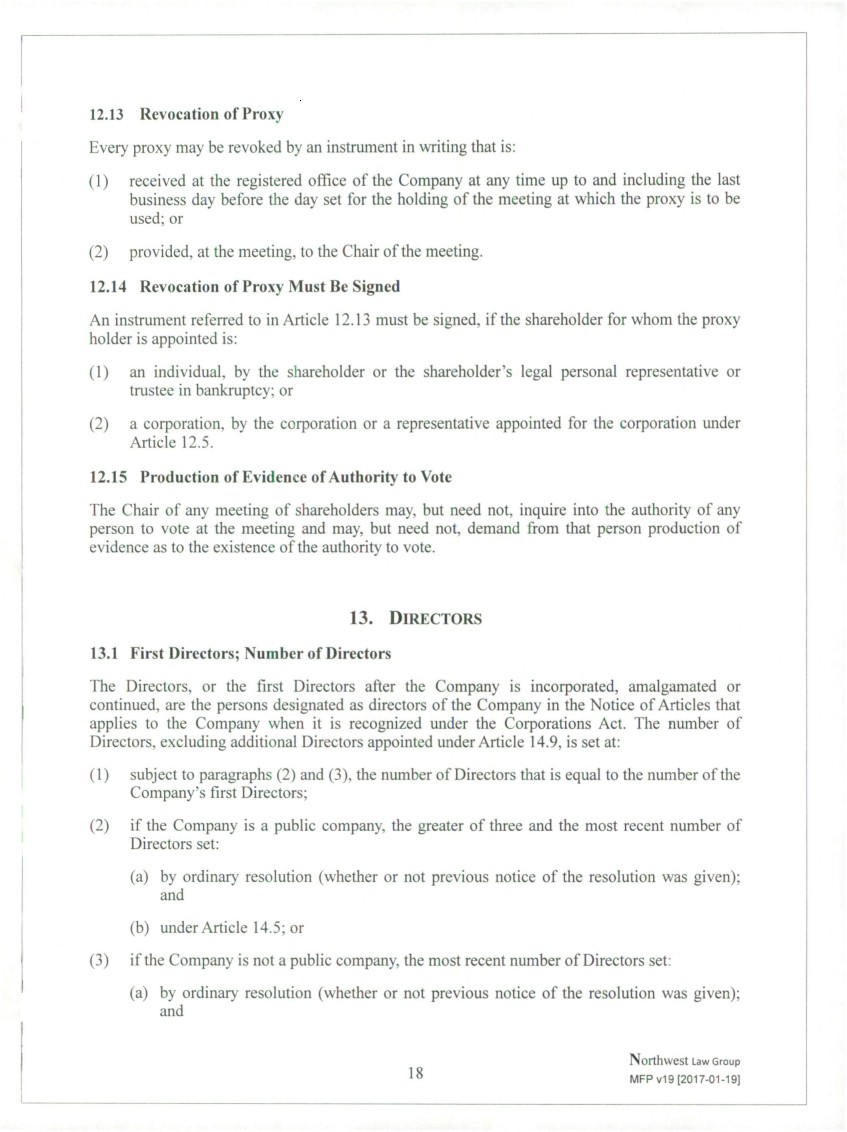
| (b) under Article 14.5. I 13.2 Change in Number of Directors Ifthe number of Directors is set under Articles 13. l(2)(a) or 13.1 (3)(a): (1) (2) 13.3 Directors’ Acts Valid Despite Vacancy 13.4 Qualifications of Directors 13.5 Remuneration of Directors 13.6 Reimbursement of Expenses of Directors 13.7 Special Remuneration for Directors 13.8 Gratuity, Pension or Allowance on Retirement of Director 19 Unless otherwise determined by ordinary resolution, the Board may authorize the Company to pay a gratuity or pension or allowance on retirement to any Director who has held any salaried office or place of profit with the Company or to his or her spouse or dependants and may make the shareholders may elect or appoint the Directors needed to fill any vacancies in the Board up to that number; and The Company must reimburse each Director for the reasonable expenses he or she may incur in and about the business ofthe Company. If any Director performs any professional or other services for the Company that in the opinion of the Board are outside the ordinary duties of a Director, or if any Director is otherwise specially occupied in or about the Company’s business, he or she may be paid remuneration fixed by the Board, or, at the option ofthat Director, fixed by ordinary resolution, and such remuneration may be either in addition to, or in substitution for, any other remuneration that he or she may be entitled to receive. ifthe shareholders do not elect or appoint the Directors needed to fill any vacancies in the Board up to that number contemporaneously with the setting of that number, then the Directors may appoint, or the shareholders may elect or appoint, Directors to fill those vacancies. A Director is not required to hold a share of the Company as qualification for such office but must be qualified as required by the Corporations Act to become, act or continue to act as a Director. The Directors are entitled to the remuneration for acting as directors of the Company, as the Board may determine. If the Board so decides, the remuneration, if any, of the Directors will be determined by the Company’s shareholders. That remuneration may be in addition to any salary or other remuneration paid to any officer or employee of the Company as such, who is also a Director. Northwest Law Group MFPvig [2017-01-19] An act or proceeding of the Board is not invalid merely because fewer than the number of Directors set or otherwise required under these Articles is in office. |
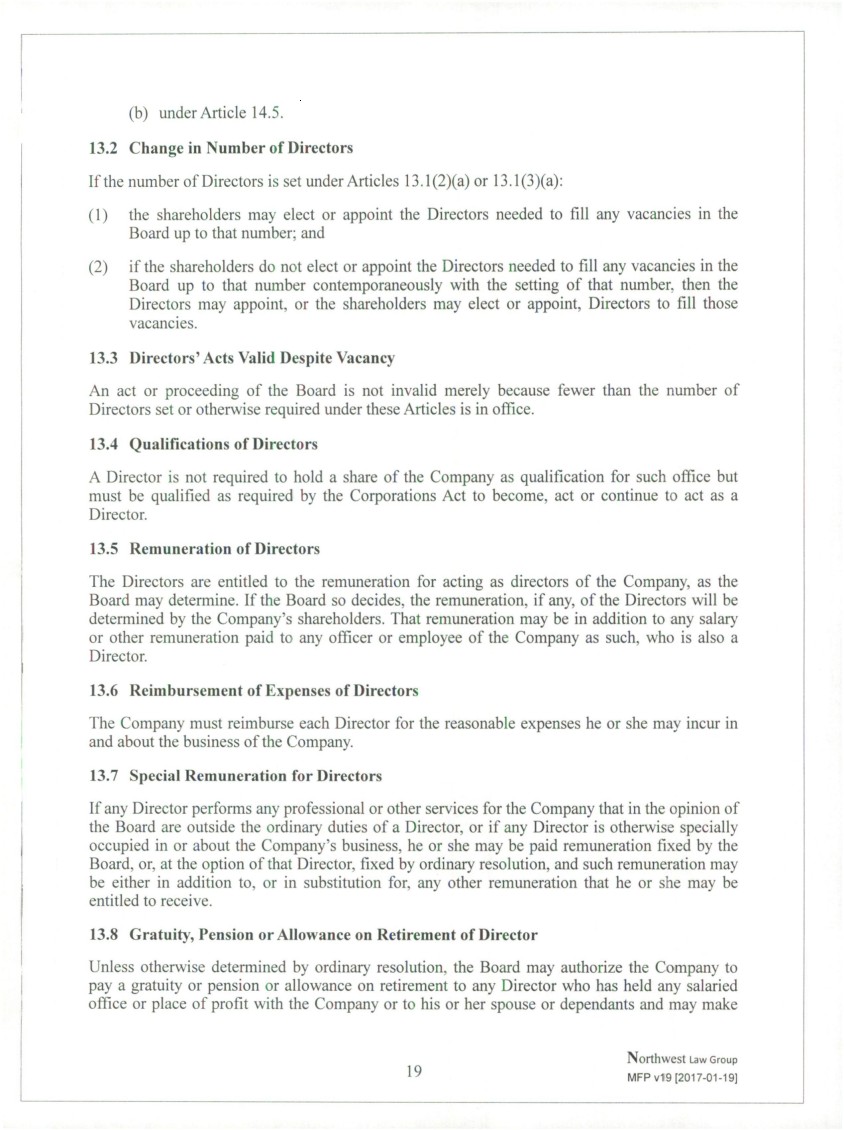
| 14. Election and Removal of Directors 14.1 Election at Annual General Meeting 14.2 Consent to be a Director No election, appointment or designation of an individual as a Director is valid unless: (1) (2) (3) 14.3 Advance Notice of Nominations for Election as Directors (1) (2) (b) (c) 1 20 contributions to any fund and pay premiums for the purchase or provision of any such gratuity, pension or allowance. that individual is elected or appointed at a meeting at which the individual is present and the individual does not refuse, at the meeting, to be a Director; or “Applicable Securities Laws” means the applicable securities legislation of each relevant province and territory of Canada, as amended from time to time, the rules, regulations and forms made or promulgated under any such statute and the published national instruments, multilateral instruments, policies, bulletins and notices of the securities commission and similar regulatory authority of each province and territory ofCanada; Northwest Law Group MFPv19 [2017-01-19] (1) the shareholders entitled to vote at the annual general meeting for the election ofDirectors must elect, or in the unanimous resolution appoint, a Board consisting of the number of Directors set under these Articles; and (2) all the Directors cease to hold office immediately before the election or appointment of Directors under paragraph (1), but are eligible for re-election or re-appointment. At every annual general meeting and in every unanimous resolution contemplated by Article 10.2: that individual consents to be a Director in the manner provided for in the Corporations Act; with respect to first Directors, the designation is otherwise valid under the Corporations Act. “Meeting” means an annual general or special meeting of the common shareholders ofthe Company; and “Public Announcement” means disclosure in a press release reported by a national news service in Canada, or in a document publicly filed by the Company under its profile on the System of Electronic Document Analysis and Retrieval at www.sedar.com. This Article 14.3 shall only apply ifthe Company is a public company. In this Article 14.3, the following terms shall have the following meanings: (a) |
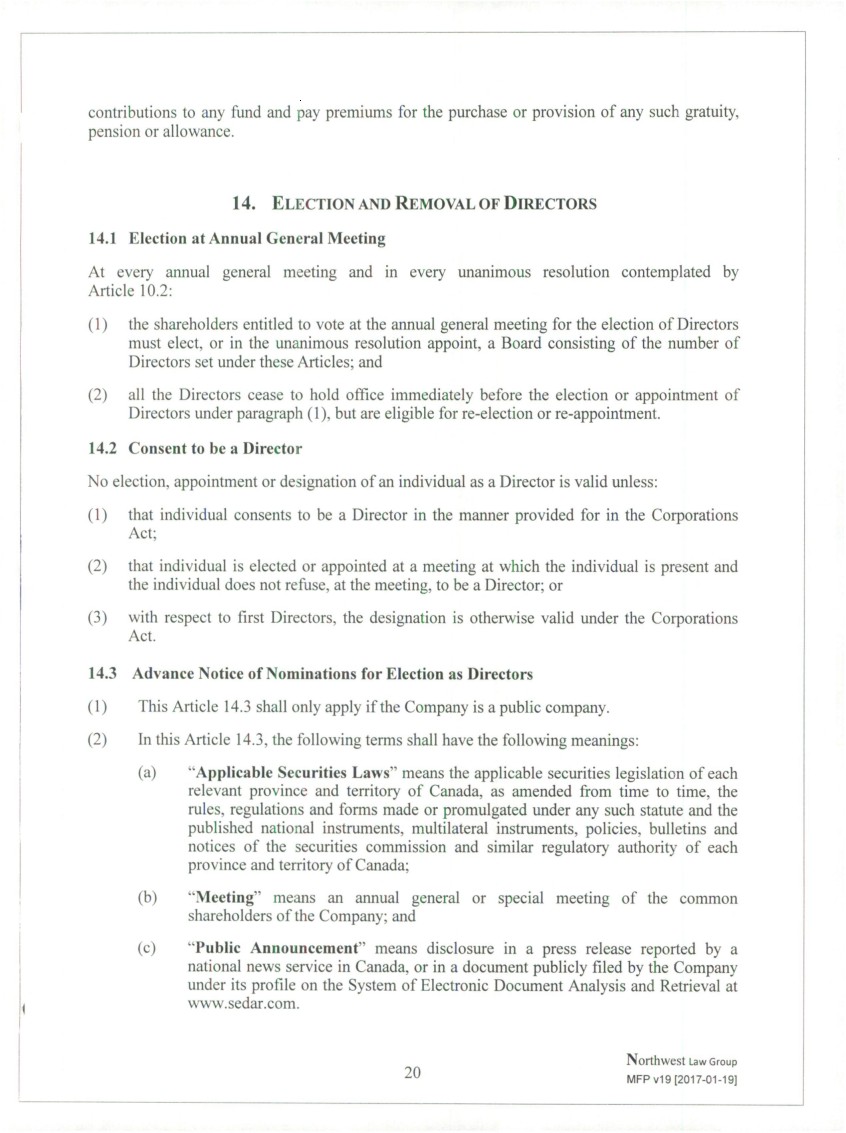
| (3) (c) (4) (5) (a) (b) (6) (a) the name, age, business address and residential address ofthe person; (i) 21 In no event shall any adjournment or postponement of a Meeting or the announcement thereof commence a new time period for the giving of a Nominating Shareholder’s notice as described above. Northwest taw Group MFP v19 [2017-01-19] (a) (b) To be in proper written form, a Nominating Shareholder’s notice to the Secretary of the Company must set forth, as to: each person whom the Nominating Shareholder proposes to nominate for election as a Director: In addition to any other applicable requirements, for a nomination to be made by a Nominating Shareholder, the Nominating Shareholder must have given timely notice thereof in proper written form to the Secretary ofthe Company at the principal executive offices ofthe Company. To be timely, a Nominating Shareholder’s notice to the Secretary of the Company must be given, in the case of a Meeting which is: an annual general meeting of shareholders, not less than 35 days and not more than 60 days before the date of the Meeting but if the Meeting is to be held on a date that is less than 50 days after the date (the “Announcement Date”) on which the first Public Announcement ofthe date ofthe Meeting was made, notice by the Nominating Shareholder must be given not later than the close of business on the 10‘ day after the Announcement Date; and a special meeting of shareholders (which is not also an annual general meeting) called for the purpose of electing Directors (whether or not called for any other purpose), not later than the close of business on the 15**’ day following the Announcement Date. Only persons nominated in accordance with the following procedures shall be eligible for election as Directors. Nominations of persons for election to the Board at any Meeting, including any special meeting ofshareholders if one ofthe purposes for which the special meeting was called was the election ofDirectors, may be made: by or at the direction ofthe Board, including pursuant to a notice of Meeting; by or at the direction or request of one or more shareholders pursuant to a proposal made in accordance with the provisions of the Corporations Act, or a requisition of the shareholders made in accordance with the provisions of the Corporations Act; or by any person (a “Nominating Shareholder”) who (i) at the close of business on the date of the giving ofthe notice provided for below in this Article 14.3 and on the record date for notice of such Meeting, is entered in the Company’s central securities register as a holder of one or more shares carrying the right to vote at such Meeting or who beneficially owns shares that are entitled to be voted at such Meeting, and (ii) complies with the notice procedures set forth below in this Article 14.3. |
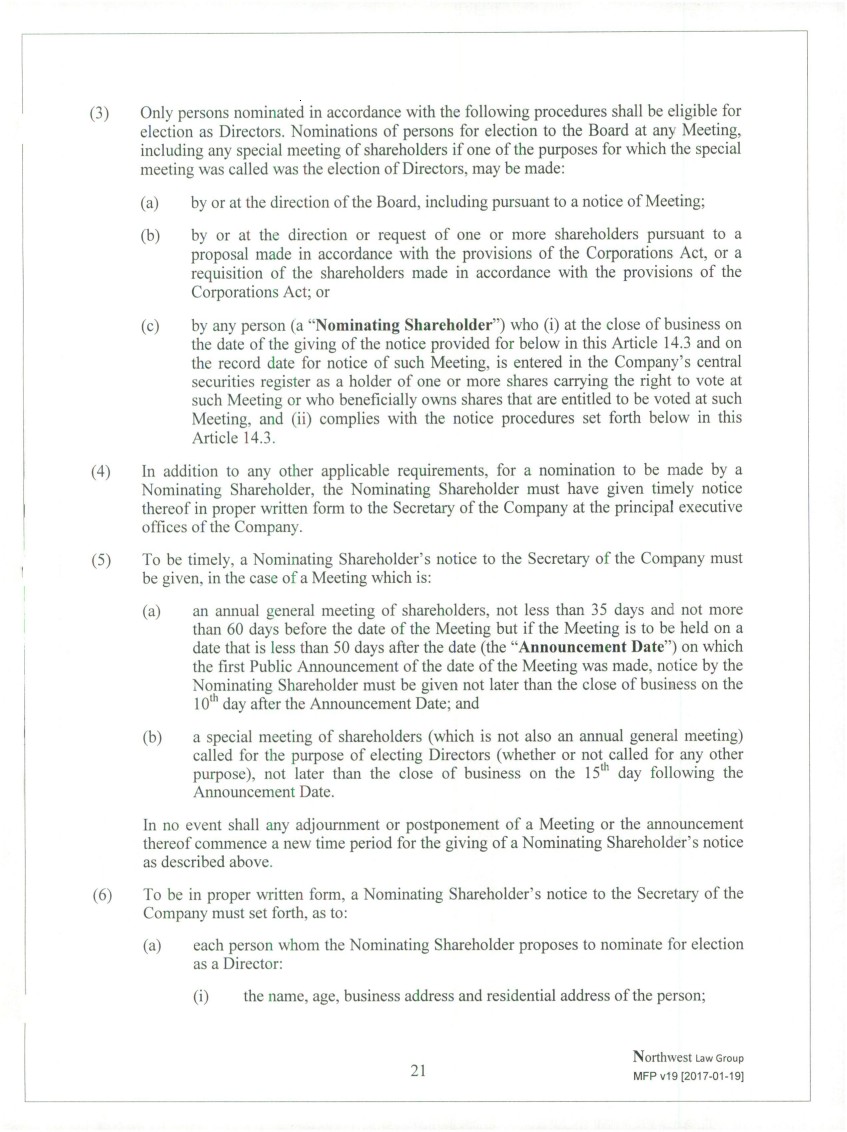
| (ii) (iii) (iv) (b) (7) (8) 14.4 Failure to Elect or Appoint Directors If: (1) (2) ( 22 The Company may require any proposed nominee to furnish such other information as may reasonably be required by the Company to determine the eligibility ofsuch proposed nominee to serve as an independent Director or that could be material to a reasonable shareholder’s understanding of the independence, or lack thereof, of such proposed nominee. any other information relating to the person that would be required to be disclosed in a dissident’s proxy circular in connection with solicitations of proxies for election of Directors pursuant to the Corporations Act and Applicable Securities Laws; and No person shall be eligible for election as a Director unless nominated in accordance with the provisions of this Article 14.3 but nothing in this Article 14.3 shall be deemed to preclude discussion by a shareholder (as distinct from the nomination of Directors) at a Meeting of any matter in respect of which it would have been entitled to submit a proposal pursuant to the provisions of the Corporations Act. The Chairman of the Meeting shall have the power and duty to determine whether a nomination was made in accordance with the procedures set forth in the foregoing provisions and, if any proposed nomination is not in compliance with such foregoing provisions, to declare that such defective nomination shall be disregarded. The Board may, in its sole discretion, waive any requirement in or provision of this Article 14.3. the Company fails to hold an annual general meeting, and all the shareholders who are entitled to vote at an annual general meeting fail to pass the unanimous resolution contemplated by Article 10.2, on or before the date by which the annual general meeting is required to be held under the Corporations Act; or Northwest Law Group MFP v19 [2017-01-19J the Nominating Shareholder giving the notice, any proxy, contract, arrangement, understanding or relationship pursuant to which such Nominating Shareholder has a right to vote any shares of the Company and any other information relating to such Nominating Shareholder that would be required to be made in a dissident’s proxy circular in connection with solicitations of proxies for election of Directors pursuant to the Corporations Act and Applicable Securities Laws. the principal occupation or employment ofthe person; the class or series and number of shares of the Company which are controlled or which are owned beneficially or ofrecord by the person as of the record date for the Meeting (if such date shall then have been made publicly available and shall have occurred) and as of the date of such notice; and the shareholders fail, at the annual general meeting or in the unanimous resolution contemplated by Article 10.2, to elect or appoint any Directors; then each Director then in office continues to hold office until the earlier of: |
| 14.6 Directors May Fill Casual Vacancies Any casual vacancy occurring in the Board may be filled by the Board. 14.7 Remaining Directors Power to Act 14.8 Shareholders May Fili Vacancies 14.9 Additional Directors 23 The Board may act notwithstanding any vacancy in the Board, but if the Company has fewer Directors in office than the number set pursuant to these Articles as the quorum of Directors, the Board may only act for the purpose of appointing Directors up to that number or ofsummoning a meeting of shareholders for the purpose of filling any vacancies on the Board or for any other purpose. If the Company has no Directors or fewer Directors in office than the number set pursuant to these Articles as the quorum of Directors, the shareholders may elect or appoint Directors to fill any vacancies on the Board. Any Director so appointed ceases to hold office immediately before the next election or appointment ofDirectors under Article 14.1(1), but is eligible for re-election or re-appointment. Notwithstanding Articles 13.1 and 13.2, between annual general meetings or unanimous resolutions contemplated by Article 10.2, the Board may appoint one or more additional Directors, but the number of additional Directors appointed under this Article 14.9 must not at any time exceed: (1) one-third of the number of first Directors, if, at the time ofthe appointments, one or more ofthe first Directors have not yet completed his or her first term of office; or (2) in any other case, one-third of the number of the current Directors who were elected or appointed as Directors other than under this Article 14.9. Northwest taw Group MFPvt 9 [2017-01-19] (3) the date on which his or her successor is elected or appointed; and (4) the date on which he or she otherwise ceases to hold office under the Corporations Act or these Articles. 14.5 Places of Retiring Directors Not Filled If, at any meeting ofshareholders at which there should be an election of Directors, the places of any ofthe retiring Directors are not filled by that election, those retiring Directors who are not re-elected and who are asked by the newly elected Directors to continue in office will, if willing to do so, continue in office to complete the number of Directors set pursuant to these Articles at such time until further new Directors are elected at a meeting of shareholders convened for that purpose. If any such election or continuance of Directors does not result in the election or continuance ofthe number of Directors set pursuant to these Articles at such time, the number of Directors of the Company is deemed to be set at the number of Directors actually elected or continued in office. |
| 14.10 Ceasing to be a Director A Director ceases to be a Director when: the term of office ofthe Director expires; (1) (2) the Director dies; (3) (4) the Director is removed from office pursuant to Articles 14.11 or 14.12. 14.11 Removal of a Director by Shareholders I I 15. Alternate Directors 24 The Company may remove any Director before the expiration of his or her term of office by special resolution. In that event, the shareholders may elect, or appoint by ordinary resolution, another individual as a Director to fill the resulting vacancy. If the shareholders do not elect or appoint a Director to fill the resulting vacancy contemporaneously with the removal, then the Board may appoint or the shareholders may elect, or appoint by ordinary resolution, a Director to fill that vacancy. the Director resigns as a Director by notice in writing provided to the Company or a lawyer for the Company; or Northwest taw Group MFPvl9 [2017-01-19] 14.12 Removal of a Director by the Board The Board may remove any Director before the expiration of his or her term of office if the Director is convicted of an indictable offence, convicted by a court of an offence under or found in breach and sanctioned by a securities regulatory authority of any Canadian or United States securities legislation, or if the Director ceases to be qualified to act as a Director of a company and does not promptly resign, and the Board may appoint a Director to fill the resulting vacancy. 15.2 Notice of Meetings Every alternate Director so appointed is entitled to notice of meetings of the Board and of committees of the Board of which his or her appointor is a member and to attend and vote as a Director at any such meetings at which his or her appointor is not present. 15.1 Appointment ofAlternate Director Any Director (an "appointor”) may by notice in writing received by the Company appoint any person (an “appointee”) who is qualified to act as a Director to be his or her alternate to act in his or her place at meetings ofthe Board or committees ofthe Board at which the appointor is not present unless (in the case of an appointee who is not a Director) the Board has reasonably disapproved the appointment ofsuch person as an alternate Director and have given notice to that effect to the appointor within a reasonable time after the notice of appointment is received by the Company. |
| I 15.3 Alternate for More Than One DirectorAttending Meetings i (1) (2) (3) (4) 15.4 Consent Resolutions 15.5 Alternate Director Not an Agent Every alternate Director is deemed not to be the agent ofhis or her appointor. 15.6 Revocation ofAppointment ofAlternate Director 15.7 Ceasing to be an Alternate Director The appointment of an alternate Director ceases when: his or her appointor ceases to be a Director and is not promptly re-elected or re-appointed; (1) (2) the alternate Director dies; (3) (4) the alternate Director ceases to be qualified to act as a Director; or (5) his or her appointor revokes the appointment ofthe alternate Director. 15.8 Remuneration and Expenses ofAlternate Director 25 the alternate Director resigns as an alternate Director by notice in writing provided to the Company or a lawyer for the Company; will be counted in determining the quorum for a meeting of a committee of Directors once for each of his or her appointors who is a member ofthat committee and, in the case of an appointee who is also a member of that committee as a Director, once more in that capacity; and has a separate vote at a meeting of a committee of Directors for each of his or her appointors who is a member ofthat committee and, in the case of an appointee who is also a member ofthat committee as a Director, an additional vote in that capacity. Northwest taw Group MFPvl 9 [2017-01-19] An appointor may at any time, by notice in writing received by the Company, revoke the appointment of an alternate Director appointed by them. The Company must reimburse an alternate Director for the reasonable expenses that would be properly reimbursed if he or she were a Director, and the alternate Director is entitled to receive A person may be appointed as an alternate Director by more than one Director, and an alternate Director: Every alternate Director, if authorized by the notice appointing them, may sign in place of his or her appointor any resolutions to be consented to in writing. will be counted in determining the quorum for a meeting of Directors once for each of his or her appointors and, in the case of an appointee who is also a Director, once more in that capacity; has a separate vote at a meeting of Directors for each of his or her appointors and, in the case of an appointee who is also a Director, an additional vote in that capacity; |
| 16. Powers and Duties of Directors 16.1 Powers of Management 17. Disclosure of Interest of Directors and Officers 17.1 Obligation to Account for Profits 17.3 Interested Director Counted in Quorum I 26 A Director who holds a disclosable interest in a contract or transaction into which the Company has entered or proposes to enter and who is present at the meeting of Directors at which the contract or transaction is considered for approval may be counted in the quorum at the meeting whether or not the Director votes on any or all ofthe resolutions considered at the meeting. The Board must, subject to these Articles, manage or supervise the management ofthe business and affairs ofthe Company and has the authority to exercise all such powers ofthe Company as are not, by the Corporations Act or by these Articles, required to be exercised by the shareholders ofthe Company. Northwest Law Group MFP v19 [2017-01-19] from the Company such proportion, if any, of the remuneration otherwise payable to the appointor as the appointor may direct. A Director or senior officer who holds a disclosable interest (as that term is used in the Corporations Act) in a contract or transaction into which the Company has entered or proposes to enter is liable to account to the Company for any profit that accrues to the Director or senior officer under or as a result ofthe contract or transaction only if and to the extent provided in the Corporations Act. 16.2 Appointment ofAttorney of Company The Board may, by power of attorney or other instrument, under Seal if so required by law, appoint any person to be the attorney ofthe Company for such purposes, and with such powers, authorities and discretions (not exceeding those vested in or exercisable by the Directors under these Articles and excepting the power to fill vacancies in the Board, to remove a Director, to change the membership of, or fill vacancies in, any committee ofthe Board, to appoint or remove officers appointed by the Board and to declare dividends) and for such period, and with such remuneration and subject to such conditions as the Board may think fit. Any such power of attorney may contain such provisions for the protection or convenience of persons dealing with such attorney as the Board thinks fit. Any such attorney may be authorized by the Board to sub-delegate all or any ofthe powers, authorities and discretions vested in them. 17.2 Restrictions on Voting by Reason ofInterest A Director who holds a disclosable interest in a contract or transaction into which the Company has entered or proposes to enter is not entitled to vote on any Directors’ resolution to approve that contract or transaction, unless all the Directors have a disclosable interest in that contract or transaction, in which case any or all ofthose Directors may vote on such resolution. |
| 17.4 Disclosure of Conflict ofInterest or Property 17.5 Director Holding Other Office in the Company 17.6 No Disqualification 17.7 Professional Services by Director or Officer 17.8 Director or Officer in Other Corporations 18. Proceedings of Directors 18.1 Meetings of Directors 18.2 Voting at Meetings 18.3 Chair of Meetings The following individual is entitled to preside as Chair at a meeting of Directors: 27 A Director or officer may be or become a Director, officer or employee of, or otherwise interested in, any person in which the Company may be interested as a shareholder or otherwise, and the Director or officer is not accountable to the Company for any remuneration or other benefits received by them as Director, officer or employee of, or from such interest in, such other person. Questions arising at any meeting of Directors are to be decided by a majority of votes and, in the case of an equality of votes, the Chair ofthe meeting does not have a second or casting vote. The Board may meet together for the conduct of business, adjourn and otherwise regulate its meetings as it thinks fit, and meetings of the Board held at regular intervals may be held at the place, at the time and on the notice, if any, as the Board may determine. A Director may hold any office or place of profit w ith the Company, other than the office of auditor ofthe Company, in addition to the office ofDirector for the period and on the terms (as to remuneration or otherwise) that the Board may determine. A Director or senior officer who holds any office or possesses any property, right or interest that could result, directly or indirectly, in the creation of a duty or interest that materially conflicts with that individual’s duty or interest as a Director or senior officer, must disclose the nature and extent ofthe conflict as required by the Corporations Act. A Director or officer, or any person in which a Director or officer has an interest, may act in a professional capacity for the Company, except as auditor of the Company, and the Director or officer or such person is entitled to remuneration for professional services as if that Director or officer were not a Director or officer. No Director or intended Director is disqualified by such office from contracting with the Company either with regard to the holding of any office or place of profit the Director holds with the Company or as vendor, purchaser or otherwise, and no contract or transaction entered into by or on behalf of the Company in which a Director is in any way interested is liable to be voided for that reason. Northwest Law Group MFPvig [2017-01-19] |
| (1) (2) (3) 18.6 Notice of Meetings (1) (2) the Director or alternate Director, as the case may be, has waived notice ofthe meeting. 1 28 the meeting is to be held immediately following a meeting of shareholders at which that Director was elected or appointed, or is the meeting of the Board at which that Director is appointed; or Northwest Law Group MFP v19 [2017-01-19] Other than for meetings held at regular intervals as determined by the Board pursuant to Article 18.1, reasonable notice of each meeting of the Board, specifying the place, day and time ofthat meeting must be given to each ofthe Directors and the alternate Directors by any method set out in Article 24.1. any other Director chosen by the Directors present if: (a) neither the Chair ofthe Board nor the President, if a Director, is present at the meeting within 15 minutes after the time set for holding the meeting; 18.5 Calling of Meetings A Director may, and the Secretary or an assistant Secretary ofthe Company, if any, on the request of a Director must, call a meeting ofthe Board at any time. the Chair ofthe Board, if any; in the absence ofthe Chair ofthe Board, the President, if any, ifthe President is a Director; or (b) neither the Chair of the Board nor the President, if a Director, is willing to Chair the meeting; or (c) the Chair of the Board and the President, if a Director, have advised the Secretary, if any, or any other Director, that he or she will not be present at the meeting. 18.4 Meetings by Telephone or Other Communications Medium A Director may participate in a meeting ofthe Board or of any committee ofthe Board in person or by telephone if all Directors participating in the meeting, whether in person or by telephone or other communications medium, are able to communicate with each other. A Director may participate in a meeting of the Board or of any committee of the Board by a communications medium other than telephone if all Directors participating in the meeting, whether in person or by telephone or other communications medium, are able to communicate with each other and if all Directors who wish to participate in the meeting agree to such participation. A Director who participates in a meeting in a manner contemplated by this Article 18.4 is deemed for all purposes of the Corporations Act and these Articles to be present at the meeting and to have agreed to participate in that manner. 18.7 When Notice Not Required It is not necessary to give notice of a meeting ofthe Board to a Director or an alternate Director if: |
| 18.8 Meeting Valid Despite Failure to Give Notice 18.9 Waiver of Notice of Meetings 18.10 Quorum 18.11 Validity ofActs Where Appointment Defective 18.12 Consent Resolutions in Writing 29 The quorum necessary for the transaction of the business of the Board may be set by the Board and, if not so set, is deemed to be set at a majority ofthe Directors last elected or appointed. Any Director or alternate Director may send to the Company a document signed by them waiving notice of any past, present or future meeting or meetings of the Board and may at any time withdraw that waiver with respect to meetings held after that withdrawal. After sending a waiver with respect to all future meetings and until that waiver is withdrawn, no notice of any meeting of the Board need be given to that Director and, unless the Director otherwise requires by notice in writing to the Company, to his or her alternate Director, and all meetings ofthe Board so held are deemed not to be improperly called or constituted by reason of notice not having been given to such Director or alternate Director. Attendance of a Director or alternate Director at a meeting of the Directors is a waiver of entitlement to notice of the meeting, unless that Director or alternate Director attends the meeting for the purpose of objecting to the transaction of any business on the grounds the meeting was not lawfully called or is for an improper purpose. The accidental omission to give notice of any meeting of Directors to, or the non-receipt of any notice by, any Director or alternate Director, does not invalidate any proceedings at that meeting. Northwest Law Group MFP v19 [2017-01-19J An act of a Director is not invalid merely because of an irregularity in the election or appointment or a defect in the qualification ofthat Director. (2) in the case of a resolution to approve a contract or transaction in respect of which a Director has disclosed that he or she has or may have a disclosable interest, if each of the other Directors who are entitled to vote on the resolution consents to it in writing. A consent in writing under this Article 18.12 may be by signed or conformed document delivered by hand, mail, fax or any other method of transmitting written instruments in which the consent of the Director is evidenced, whether or not the manual signature of the Director is included in the document. A consent in writing may be in two or more counterparts which together are deemed to constitute one consent in writing. A resolution ofthe Board or of any committee ofthe Board passed in accordance with this Article 18.12 is effective on the date stated in the consent in writing or on the latest date stated on any counterpart and is deemed to be a proceeding at a meeting ofthe Board or ofthe committee ofthe Board and to be as valid and effective as ifit had been passed at a meeting of the Board or of the committee of the Board that satisfies all the requirements of the Corporations Act and all the requirements of these Articles relating to meetings ofthe Board or of a committee ofthe Board. A resolution ofthe Board or of any committee ofthe Board may be passed without a meeting: (1) in all cases, if each of the Directors entitled to vote on the resolution consents to it in writing; or |
| 19. Executive and Other Committees the power to fill vacancies in the Board; (1) (2) the power to remove a Director from a committee ofthe Board; (3) (4) 19.2 Appointment and Powers of Other Committees (1) (2) (a) to fill vacancies in the Board; (b) to remove a Director from the committee; (c) to change the membership of, or fill vacancies in, any committee ofthe Board; and (d) the power to appoint or remove officers appointed by the Board; and (3) 19.3 Obligations of Committees (1) conform to any rules that may be imposed on it by the Board; and 19.4 Powers of Board The Board may, at any time, with respect to a committee appointed under Articles 19.1 or 19.2: 5 30 such other powers, if any, as may be set out in the resolution or any subsequent Directors’ resolution. In the exercise ofthe powers delegated to a committee appointed under Articles 19.1 or 19.2, the committee must: Northwest Law Group MFPvl 9 [2017-01-19] make any delegation referred to in paragraph (2) subject to the conditions set out in the resolution or any subsequent Directors’ resolution. delegate to a committee appointed under paragraph (1) any ofthe Directors’ powers, except the power: (2) report every act or thing done in exercise ofthose powers at such times as the Board may require. the power to change the membership of, or fill vacancies in, any committee of the Board; and 19.1 Appointment and Powers of Executive Committee The Board may appoint an Executive Committee consisting of the Director or Directors that it considers appropriate, and this committee has, during the intervals between meetings of the Board, all ofthe Directors’ powers, except: The Board may: appoint one or more committees (other than the Executive Committee) consisting of the Director or Directors that it considers appropriate; |
| (1) (2) fill vacancies in the committee. (3) the committee may meet and adjourn as it thinks proper; (1) (2) (3) (4) 20. Officers 20.2 Functions, Duties and Powers of Officers The Board may, for each officer: (1) determine the functions and duties ofthe officer; (2) (3) revoke, withdraw, alter or vary all or any ofthe functions, duties and powers ofthe officer. 20.3 Qualifications 31 questions arising at any meeting ofthe committee are determined by a majority of votes of the members present, and in case of an equality of votes, the Chair ofthe meeting does not have a second or casting vote. entrust to and confer on the officer any of the powers exercisable by the Board on such terms and conditions and with such restrictions as the Board thinks fit; and the committee may elect a Chair of its meetings but, if no Chair of a meeting is elected, or if at a meeting the Chair of the meeting is not present within 15 minutes after the time set for holding the meeting, the Directors present who are members of the committee may choose one oftheir number to Chair the meeting; a majority ofthe members ofthe committee constitutes a quorum ofthe committee but for the Audit Committee such majority must consist of members who are not officers or employees ofthe Company or an affiliate ofthe Company; and Northwest taw Group MFP v19 [2017-01-19] An officer is not required to hold a share of the Company as qualification for such office but must be qualified as required by the Corporations Act to become, act or continue to act as an officer. One person may hold more than one position as an officer of the Company. Any person 20.1 Directors May Appoint Officers The Board may appoint such officers, if any, as the Board determines and the Board may, at any time, terminate any such appointment. revoke or alter the authority given to the committee, or override a decision made by the committee, except as to acts done before such revocation, alteration or oveniding; terminate the appointment of, or change the membership of, the committee; and 19.5 Committee Meetings Subject to Article 19.3(1) and unless the Board otherwise provides in the resolution appointing the committee or in any subsequent resolution, with respect to a committee appointed under Articles 19.1 or 19.2: |
| 20.4 Remuneration and Terms ofAppointment 20.5 Validity ofActs Where Appointment Defective 21. Indemnification 21.1 Definitions In this Article 21: (1) (2) (a) is or may be joined as a party; or (3) “expenses” has the meaning set out in the Corporations Act. 21.3 Mandatory Advancement of Expenses 32 (b) is or may be liable for or in respect of a judgment, penalty or fine in, or expenses related to, the proceeding; and appointed as the Chair of the Board or as a managing Director must be a Director. Any other officer need not be a Director. An act of an officer is not invalid merely because of an irregularity in the appointment or a defect in the qualification ofthat officer. “eligible proceeding” means a legal proceeding or investigative action, whether current, threatened, pending or completed, in which a Director, former Director or alternate Director of the Company (an “eligible party”) or any of the heirs and Legal Personal Representatives of the eligible party, by reason ofthe eligible party being or having been a Director or alternate Director ofthe Company: “eligible penalty” means a judgment, penalty or fine awarded or imposed in, or an amount paid in settlement of, an eligible proceeding; Northwest Law Group MFP v19 [2017-01-19] 21.2 Mandatory Indemnification of Directors and Officers and Former Directors and Officers All appointments of officers are to be made on the terms and conditions and at the remuneration (whether by way of salary, fee, commission, participation in profits or otherwise) that the Board thinks fit and are subject to termination at the pleasure ofthe Board, and an officer, in addition to such remuneration, may receive, after he or she ceases to hold such office or leaves the employment ofthe Company, a pension or gratuity. The Company must indemnify, to the greatest extent permitted by the Corporations Act, a Director, officer, former Director or officer or alternate Director of the Company and their heirs and Legal Personal Representatives, as set out in the Corporations Act, against all eligible penalties to which such person is or may be liable, and the Company must, after the final disposition of an eligible proceeding, pay the expenses actually and reasonably incurred by such person in respect of that proceeding. Each Director, officer, former Director and officer and alternate Director is deemed to have contracted with the Company on the terms ofthe indemnity contained in this Article 21.2. |
| 21.4 Indemnification of Other Persons The Company may indemnify any other person in accordance with the Corporations Act. 21.5 Non-Compliance with Corporations Act 21.6 Company May Purchase Insurance (1) is or was a Director, alternate Director, officer, employee or agent ofthe Company; (2) (3) (4) 22. Dividends 22.2 Declaration of Dividends The Board may declare and authorize payment ofsuch dividends as it may deem advisable. 22.3 No Notice Required The Board need not give notice to any shareholder of any declaration under Article 22.2. 33 is or was a Director, alternate Director, officer, employee or agent of a corporation at a time when the corporation is or was an affiliate ofthe Company; The Company must pay, as they are incurred in advance of the final disposition of an eligible proceeding, the expenses actually and reasonably incurred by an eligible party in respect of that proceeding but the Company must first receive from the eligible party a written undertaking that, ifit is ultimately determined that the payment of expenses is prohibited by the Corporations Act, the eligible party will repay the amounts advanced. The failure of a Director, alternate Director or officer of the Company to comply with the Corporations Act or these Articles does not invalidate any indemnity to which he or she is entitled under this Article 21. Northwest taw Group MFPvig [2017-01-19] against any liability incurred by them as such Director, alternate Director, officer, employee or agent or person who holds or held such equivalent position. The Company may purchase and maintain insurance for the benefit of any person (and such person’s heirs and Legal Personal Representatives) who: at the request ofthe Company, is or was a Director, alternate Director, officer, employee or agent of a corporation or of a partnership, trust, joint venture or other unincorporated entity; and at the request of the Company, holds or held a position equivalent to that of a Director, alternate Director or officer of a partnership, trust, joint venture or other unincorporated entity; 22.1 Payment of Dividends Subject to Special Rights The provisions of this Article 22 are subject to the rights, if any, of shareholders holding shares with special rights as to dividends. |
| 22.4 Record Date 22.5 Manner of Paying Dividend 22.6 Settlement of Difficulties set the value for distribution ofspecific assets; (1) (2) vest any such specific assets in trustees for the persons entitled to the dividend. (3) 22.7 When Dividend Payable Any dividend may be made payable on such date as is fixed by the Board. 22.8 Dividends to be Paid in Accordance with Number of Shares 22.9 Receipt by Joint Shareholders 22.10 Dividend Bears No Interest No dividend bears interest against the Company. 22.11 Fractional Dividends 22.12 Payment of Dividends 34 A resolution declaring a dividend may direct payment of the dividend wholly or partly by the distribution ofspecific assets or of fully paid shares or of bonds, debentures or other securities of the Company, or in any one or more ofthose ways. If a dividend to which a shareholder is entitled includes a fraction ofthe smallest monetary unit of the currency of the dividend, that fraction may be disregarded in making payment of the dividend and that payment represents full payment ofthe dividend. Any dividend or other distribution payable in cash in respect of shares may be paid by cheque, made payable to the order of the person to whom it is sent, and mailed to the address of the If several persons are joint shareholders of any share, any one of them may give an effective receipt for any dividend, bonus or other money payable in respect ofthe share. All dividends on shares of any class or series of shares must be declared and paid according to the number ofsuch shares held. The Board may set a date as the record date for the purpose of determining shareholders entitled to receive payment of a dividend. The record date must not precede the date on which the dividend is to be paid by more than two months. If no record date is set, the record date is the date on which the Board passes the resolution declaring the dividend. determine that cash payments in substitution for all or any part of the specific assets to which any shareholders are entitled may be made to any shareholders on the basis of the value so fixed in order to adjust the rights of all parties; and Northwest Law Group MFP v19 [2017-01-19] If any difficulty arises in regard to a distribution under Article 22.5, the Board may settle the difficulty as it deems advisable, and, in particular, may; |
| 22.13 Capitalization of Surplus 23. Documents, Records and Reports 23.1 Recording of Financial Affairs 24. Notices 24.1 Method of Giving Notice (1) prepaid mail addressed to the person at the applicable address for that person as follows: 35 The Board must cause adequate accounting records to be kept to record properly the financial affairs and condition ofthe Company and to comply with the Corporations Act. Unless the Corporations Act or these Articles provides otherwise, a notice, statement, report or other record required or permitted by the Corporations Act or these Articles to be sent by or to a person may be sent by any one ofthe following methods; Notwithstanding anything contained in these Articles, the Board may capitalize any surplus ofthe Company and may issue, as fully paid, shares or any bonds, debentures or other securities ofthe Company as a dividend representing the surplus or any part ofthe surplus. shareholder, or in the case ofjoint shareholders, to the address of the joint shareholder who is first named on the central securities register, or to the person and to the address the shareholder or joint shareholders may direct in writing. The mailing of such cheque will, to the extent ofthe sum represented by the cheque (plus the amount of the tax required by law to be deducted), discharge all liability for the dividend unless such cheque is not paid on presentation or the amount oftax so deducted is not paid to the appropriate taxing authority. Northwest Law Group MFPv19 [2017-01-19] (a) for a record mailed to a shareholder, the shareholder’s Registered Address; (b) for a record mailed to a Director or officer, the prescribed address for mailing shown for the Director or officer in the records kept by the Company or the mailing address provided by the recipient for the sending ofthat record or records ofthat class; 23.2 Inspection ofAccounting Records Unless the Board determines otherwise, or unless otherwise determined by ordinary resolution, no shareholder of the Company is entitled to inspect or obtain a copy of any accounting records ofthe Company. (c) in any other case, the mailing address ofthe intended recipient; (2) delivery at the applicable address for that person as follows, addressed to the person: (a) for a record delivered to a shareholder, the shareholder’s Registered Address; |
| (c) in any other case, the delivery address ofthe intended recipient; (3) (4) (5) physical delivery to the intended recipient. 24.2 Deemed Receipt A record that is: (1) (2) (3) 24.4 Notice to Joint Shareholders t 36 delivered to a person or the person’s applicable address is deemed to be received by the person on receipt by that person or delivery to that address; and fax to the fax number provided by the intended recipient for the sending of that record or records ofthat class; e-mail to the e-mail address provided by the intended recipient for the sending of that record or records ofthat class; and (b) for a record delivered to a Director or officer, the prescribed address for delivery shown for the Director or officer in the records kept by the Company or the delivery address provided by the recipient for the sending ofthat record or records ofthat class; mailed to a person by ordinary mail to the applicable address for that person referred to in Article 24.1 is deemed to be received by the person to whom it was mailed on the day, Saturdays, Sundays and holidays excepted, following the date ofmailing; sent to a person by fax or e-mail is deemed to be received by the person on transmission if sent during business hours at the place of intended receipt by that person and, if not sent during that person’s business hours, on the next business day of the place of intended receipt ofthat person. Northwest taw Group MFP v19 [2017-01-19] (a) by name, by the title of the Legal Personal Representative of the deceased or incapacitated shareholder, by the title of trustee of the bankrupt shareholder or by any similar description; and A notice, statement, report or other record may be provided by the Company to the joint shareholders of a share by providing the notice to the joint shareholder first named in the central securities register in respect ofthe share. I 24.5 Notice to Legal Personal Representatives A notice, statement, report or other record may be provided by the Company to the persons entitled to a share in consequence ofthe death, bankruptcy or incapacity of a shareholder by: (1) mailing the record, addressed to them: 24.3 Certificate of Sending A certificate signed by the Secretary, if any, or other officer of the Company or of any other corporation acting in that behalf for the Company stating that a notice, statement, report or other record was addressed as required, and sent as permitted, by Article 24.1 is conclusive evidence of that fact. |
| 25. Seal any two Directors; (1) (2) any officer, together with any Director; (3) (4) 25.2 25.3 Mechanical Reproduction of Seal 37 Northwest Law Group MFPvl9 [2017-01-19] The Board may authorize the Seal to be impressed by third parties on share certificates or bonds, debentures or other securities of the Company as it may determine appropriate. To enable the Seal to be impressed on any share certificates or bonds, debentures or other securities of the Company, whether in definitive or interim form, on which facsimiles of any of the signatures of the Directors or officers of the Company are, in accordance with the Corporations Act or these Articles, printed or otherwise mechanically reproduced, there may be delivered to the person employed to engrave, lithograph or print such definitive or interim share certificates or bonds, debentures or other securities one or more unmounted dies reproducing the Seal and the Chair of the Board or any senior officer together with the Secretary, treasurer. Secretary-treasurer, an assistant Secretary, an assistant treasurer or an assistant Secretary-treasurer may in writing authorize such person to cause the Seal to be impressed on such definitive or interim share certificates or bonds, debentures or other securities by the use of such dies. Share certificates or bonds, debentures or other securities to which the Seal has been so impressed are for all purposes deemed to be under and to bear the Seal impressed on them. (b) at the address, if any, supplied to the Company for that purpose by the persons claiming to be so entitled; or (2) if an address referred to in paragraph (l)(b) has not been supplied to the Company, by giving the notice in a manner in which it might have been given ifthe death, bankruptcy or incapacity had not occurred. ifthe Company only has one Director, that Director; or any one or more Directors or officers or persons as may be determined by the Board. 25.1 Who May Attest Seal Except as provided in Articles 25.2 and 25.3, the Seal, if any, must not be impressed on any record except when that impression is attested by the signatures of: Sealing Copies For the purpose of certifying under seal a certificate of incumbency ofthe Directors or officers of the Company or a true copy of any resolution or other document, despite Article 25.1, the impression ofthe Seal may be attested by the signature of any Director or officer. |
| 26. Prohibitions 26.2 Definitions In this Article 26: “designated security” means: (1) (2) (3) The Company has adopted as its Articles the foregoing provisions: Full name andigffure of each Incorporator Date January 19, 2017 z > 38 26.1 Application This Article 26 does not apply to the Company if and for so long as it is a public company or a pre-existing reporting company which has the Statutory Reporting Company Provisions as part of its Articles or to which the Statutory Reporting Company Provisions apply. (a) is not a debt security, and (b) carries a voting right either under all circumstances or under some circumstances that have occurred and are continuing. 26.3 Consent Required for Transfer of Shares or Designated Securities No share or designated security may be sold, transferred or otherwise disposed of without the consent of the Board and the Board is not required to give any reason for refusing to consent to any such sale, transfer or other disposition. (a) a voting security ofthe Company; (b) a security ofthe Company that is not a debt security and that carries a residual right to participate in the earnings of the Company or, on the liquidation or winding up ofthe Company, in its assets; or (c) a security of the Company convertible, directly or indirectly, into a security described in paragraph (a) or (b); “security” has the meaning assigned in the Securities Act (British Columbia); and “voting security” means a security ofthe Company that: Northwest Law Group MFPvl 9 [2017-01-19] |