
NOTICE OF MEETING AND
MANAGEMENT PROXY CIRCULAR FOR THE
ANNUAL GENERAL MEETING OF SHAREHOLDERS
TO BE HELD AT 3:00 P.M. (ET) ON
THURSDAY, APRIL 23, 2026
AT
199 BAY ST. #4000, TORONTO, ON M5L 1A9
Exhibit 99.4
NOTICE OF MEETING AND
MANAGEMENT PROXY CIRCULAR FOR THE
ANNUAL GENERAL MEETING OF SHAREHOLDERS
TO BE HELD AT 3:00 P.M. (ET) ON
THURSDAY, APRIL 23, 2026
AT
199 BAY ST. #4000, TORONTO, ON M5L 1A9
NERVGEN PHARMA CORP.
112-970 Burrard Street, Unit 1290, Vancouver, BC V6Z 2R4
NOTICE OF ANNUAL MEETING OF SHAREHOLDERS
NOTICE IS HEREBY GIVEN THAT the annual meeting (the “Meeting”) of shareholders of NervGen Pharma Corp. (the “Corporation”) will be held at 199 Bay St. #4000, Toronto, ON M5L 1A9, on Thursday, April 23, 2026, at 3:00 p.m. (Eastern time), for the following purposes:
| 1. | to receive the consolidated financial statements of the Corporation for its fiscal year ended December 31, 2025, the report of the auditor thereon and related management’s discussion and analysis; |
| 2. | to set the number of directors for the ensuing year at eight (8); |
| 3. | to elect the directors of the Corporation for the ensuing year; |
| 4. | to appoint the auditor of the Corporation for the ensuing year and to authorize the directors to fix the auditor’s remuneration; |
| 5. | to consider, and if deemed advisable, to pass, with or without variation, an ordinary resolution of shareholders approving the adoption of a new omnibus equity incentive plan of the Corporation; |
| 6. | to consider, and if deemed advisable, to pass, with or without variation, an ordinary resolution of shareholders approving amendments to the Stock Option Plan of the Corporation; |
| 7. | to consider, and if deemed advisable, to pass, with or without variation, a special resolution to approve and adopt certain amendments to the Corporation’s Articles of Incorporation; and |
| 8. | to transact such other business as may properly come before the Meeting or any adjournment thereof. |
The specific details of the matters proposed to be put before the Meeting is set forth in the Management Proxy Circular which accompanies this Notice of Meeting.
DATED at Vancouver, British Columbia this 13th day of March, 2026.
| BY ORDER OF THE BOARD OF DIRECTORS | |
| “Adam Rogers” | |
| Adam Rogers | |
| Chairperson |
NOTES:
| (1) | A Management Proxy Circular and Proxy accompany this Notice of Meeting. Registered shareholders who are unable to be present at the Meeting are kindly requested to specify on the accompanying form of proxy the manner in which the shares represented thereby are to be voted, and to sign, date, and return same in accordance with the instructions set out in the Proxy and the Management Proxy Circular. |
| (2) | As provided in the Business Corporations Act (British Columbia), the directors have fixed
a record date of March 13, 2026. Accordingly, persons who are registered as shareholders on the books of the Corporation at the close of business on March 13, 2026, are entitled to notice of the Meeting. |
| (3) | If you are a non-registered shareholder and receive these materials through your broker or another intermediary, please complete and return the materials in accordance with the instructions provided to you by your broker or intermediary. |
- ii -
NERVGEN PHARMA CORP.
112-970 Burrard Street, Unit 1290, Vancouver, BC V6Z 2R4
MANAGEMENT PROXY CIRCULAR
as at March 13, 2026 (unless otherwise indicated)
This Management Proxy Circular (the “Circular”) is furnished in connection with the solicitation of proxies by the management of NervGen Pharma Corp. (“NervGen” or the “Corporation”) for use at the annual meeting (the “Meeting”) of its shareholders to be held on April 23, 2026 at the time and place and for the purposes set forth in the accompanying Notice of the Meeting.
GENERAL PROXY INFORMATION
Solicitation of Proxies
The solicitation of proxies will be primarily by mail, but proxies may be solicited personally or by telephone by directors, officers and regular employees of the Corporation. The Corporation will bear all costs of this solicitation.
Appointment of Proxyholders
The individuals named in the accompanying form of proxy (the “Proxy”) are officers and/or directors of the Corporation. If you are a shareholder entitled to vote at the Meeting, you have the right to appoint a person or company other than either of the persons designated in the Proxy, who need not be a shareholder, to attend and act for you and on your behalf at the Meeting. You may do so either by inserting the name of that other person in the blank space provided in the Proxy or by completing and delivering another suitable form of proxy.
Voting by Proxyholder
The persons named in the Proxy will vote or withhold from voting the common shares in the capital of the Corporation (“Common Shares”) represented thereby in accordance with your instructions on any ballot that may be called for. If you specify a choice with respect to any matter to be acted upon, your Common Shares will be voted accordingly. The Proxy confers discretionary authority on the persons named therein with respect to:
| (a) | each matter or group of matters identified therein for which a choice is not specified, other than the appointment of an auditor and the election of directors, |
| (b) | any amendment to or variation of any matter identified therein, and |
| (c) | any other matter that properly comes before the Meeting. |
In respect of a matter for which a choice is not specified in the Proxy, the persons named in the Proxy will vote the Common Shares represented by the Proxy for the approval of such matter and for the nominees of management for directors and auditors as identified in the Proxy.
Registered Shareholders
If you are a registered shareholder, you may wish to vote by proxy whether or not you attend the Meeting in person. Registered shareholders electing to submit a proxy may do so by:
- A-i -
| (a) | completing, dating and signing the enclosed form of proxy and returning it to the Corporation’s transfer agent, Computershare Investor Services Inc. (“Computershare”) (Attention: Proxy Department), 100 University Avenue, 9th Floor, Toronto, Ontario M5J 2Y1 no less than 48 hours (excluding Saturdays, Sundays and holidays) prior to the day of the Meeting or, by a registered shareholder, with the Secretary or the Chairman of the Meeting at the time and place of the Meeting or any adjournment thereof. The instrument appointing a proxyholder must be executed by the shareholder or by his or her attorney authorized in writing or, if the shareholder is a corporate body, by its authorized officer or officers; |
| (b) | using a touch-tone phone to transmit voting choices to a toll-free number. Registered shareholders must follow the instructions of the voice response system and refer to the enclosed proxy form for the toll-free number, the holder’s account number and the proxy access number; or |
| (c) | logging on to the internet through Computershare’s website at www.investorvote.com. Registered shareholders must follow the instructions that appear on the screen and refer to the enclosed proxy form for the holder’s account number and the proxy access number. |
Non-Registered (or Beneficial) Shareholders
There are two kinds of beneficial shareholders: Objecting Beneficial Owners (“OBOs”) object to their name being made known to the issuers of securities which they own; and Non-Objecting Beneficial Owners (“NOBOs”) who do not object to the issuers of the securities they own knowing who they are.
The following information is of significant importance to shareholders who do not hold Common Shares in their own name. Beneficial shareholders should note that the only proxies that can be recognized and acted upon at the Meeting are those deposited by registered shareholders (those whose names appear on the records of the Corporation as the registered holders of Common Shares) and NOBOs, or as set out in the following disclosure.
If Common Shares are listed in an account statement provided to a shareholder by a broker, then in almost all cases those Common Shares will not be registered in the shareholder’s name on the records of the Corporation. Such Common Shares will more likely be registered under the names of intermediaries, which include banks, trust companies, securities dealers or brokers and trustees or administrators of self-administered RRSPs, RRIFs, RESPs and similar plans.
Intermediaries are required to seek voting instructions from beneficial shareholders in advance of meetings of shareholders. Every intermediary has its own mailing procedures and provides its own return instructions to clients.
Voting for Beneficial Shareholders
The Corporation is taking advantage of the provisions of National Instrument 54-101 “Communication with Beneficial Owners of Securities of a Reporting Issuer” that permit the Corporation to deliver proxy-related materials directly to its NOBOs. Please see the above headings “Registered Shareholders” and “Non- Registered (or Beneficial) Shareholders”.
These securityholder materials are being sent to both registered and non-registered owners of the securities. If you are a non-registered shareholder and receive these materials through your broker or another intermediary, please complete and return the materials in accordance with the instructions provided to you by your broker or intermediary. By choosing to send these materials to you directly, the issuer (and not the intermediary holding on your behalf) has assumed responsibility for (i) delivering these materials to you, and (ii) executing your proper voting instructions. Please return your voting instructions as specified in the request for voting instructions.
- A-ii -
Beneficial shareholders who are OBOs do not appear on the list of shareholders of the Corporation maintained by the transfer agent. The Corporation will not pay for intermediaries to forward the proxy related materials for the Meeting to OBOs. Accordingly, any OBOs should note that they will not receive copies of these proxy related materials unless the intermediary for each OBO assumes the delivery costs related in any such delivery. OBOs should follow the instructions of their intermediary carefully to ensure that their Common Shares are voted at the Meeting.
Notice to Shareholders in the United States
The solicitation of proxies involves securities of an issuer located in Canada and is being effected in accordance with the corporate laws of Canada and securities laws of the Provinces of Canada. The proxy solicitation rules under the United States Securities Exchange Act of 1934, as amended, are not applicable to the Corporation or this solicitation, and this solicitation has been prepared in accordance with the disclosure requirements of the securities laws of the Provinces of Canada. Shareholders should be aware that disclosure requirements under the securities laws of the Provinces of Canada differ from the disclosure requirements under United States securities laws.
The enforcement by shareholders of civil liabilities under United States federal securities laws may be affected adversely by the fact that the Corporation is incorporated under the Business Corporations Act (British Columbia) certain of its directors and its executive officers are residents of Canada and a substantial portion of its assets and the assets of such persons are located outside the United States. Shareholders may not be able to sue a foreign company or its officers or directors in a foreign court for violations of United States federal securities laws. It may be difficult to compel a foreign company and its officers and directors to subject themselves to a judgment by a United States court.
Revocation of Proxies
In addition to revocation in any other manner permitted by law, a registered shareholder who has given a proxy may revoke it by:
| (a) | executing a proxy bearing a later date or by executing a valid notice of revocation, either of the foregoing to be executed by the registered shareholder or the registered shareholder’s authorized attorney in writing, or, if the shareholder is a corporation, under its corporate seal by an officer or attorney duly authorized, and by delivering the proxy bearing a later date to Computershare (see “Registered Shareholders” above), or at the address of the registered office of the Corporation at 1133 Melville Street, Suite 3500, The Stack, Vancouver, BC V6E 4E5, at any time up to and including the last business day that precedes the day of the Meeting or, if the Meeting is adjourned, the last business day that precedes any reconvening thereof, or to the chairman of the Meeting on the day of the Meeting or any reconvening thereof, or in any other manner provided by law; or |
| (b) | personally attending the Meeting and voting the registered shareholder’s Common Shares. |
A revocation of a proxy will not affect a matter on which a vote is taken before the revocation.
- A-iii -
INTEREST OF CERTAIN PERSONS OR COMPANIES IN MATTERS TO BE ACTED UPON
Other than as set out herein, no director or executive officer of the Corporation, or any person who has held such a position since the beginning of the last completed financial year of the Corporation to the date of this Circular, nor any nominee for election as a director of the Corporation, nor any associate or affiliate of the foregoing persons, has any substantial or material interest, direct or indirect, by way of beneficial ownership of securities or otherwise, in any matter to be acted on at the Meeting other than the election of directors and as set out herein.
VOTING SECURITIES AND PRINCIPAL HOLDERS OF VOTING SECURITIES
The board of directors (the “Board”) of the Corporation has fixed March 13, 2026 as the record date (the “Record Date”) for determination of persons entitled to receive notice of the Meeting. Only shareholders of record at the close of business on the Record Date who either attend the Meeting personally or complete, sign and deliver a form of proxy in the manner and subject to the provisions described above will be entitled to vote or to have their Common Shares voted at the Meeting.
The Common Shares of the Corporation are listed for trading on the Nasdaq Capital Market (“Nasdaq”). As of March 13, 2026, there were 80,630,871 Common Shares issued and outstanding, each carrying the right to one vote.
To the knowledge of the directors and executive officers of the Corporation, no person or corporation beneficially owns, directly or indirectly, or exercises control or direction over, more than 10% of the issued and outstanding common shares of the Corporation, except as detailed below.
| Name | Number of Common Shares | Percentage of Common Shares |
| PFP Biosciences Holdings LLC | 14,708,673 Common Shares | 18.2 |
PARTICULARS OF MATTERS TO BE ACTED UPON
Presentation of Financial Statements
The annual financial statements of the Corporation for the year ended December 31, 2025 together with the auditor’s report thereon and the related management discussion and analysis in respect of the foregoing financial statements, all of which may be obtained from SEDAR+ at www.sedarplus.ca, will be presented at the Meeting.
Number of Directors
The Articles of the Corporation (the “Articles”) set out that the number of directors of the Corporation will be a minimum of three and a maximum of the most recently set of (i) the number of directors set by ordinary resolution (whether or not previous notice of the resolution was given) and (ii) the number of directors set in the event that the places of any retiring directors are not filled by an election at a meeting of shareholders. At the Meeting, the shareholders will be asked to pass an ordinary resolution setting the number of directors of the Corporation at eight (8).
THE BOARD OF DIRECTORS RECOMMENDS THAT SHAREHOLDERS VOTE IN FAVOUR OF THE SETTING OF THE NUMBER OF DIRECTORS OF THE CORPORATION AT EIGHT (8) FOR THE ENSUING YEAR.
- A-iv -
The voting rights pertaining to Common Shares represented by duly executed proxies in favour of the persons named in the accompanying form of proxy will be exercised, in the absence of specifications to the contrary, FOR the setting of the number of directors of the Corporation at eight (8) for the ensuing year.
Election of Directors
The Corporation has nominated eight (8) persons for election as directors of the Corporation at the Meeting. At the Meeting, shareholders will be asked to elect the nominees outlined herein as directors of the Corporation. All nominees are current directors of the Corporation. Unless they resign, all directors elected at the Meeting will hold office until our next annual meeting of shareholders or until their successors are elected or appointed.
The following table sets out the names of management’s eight (8) nominees for election as directors to the Board, each nominee’s principal occupation, business or employment, the period of time during which each has been a director of the Corporation and the number of Common Shares of the Corporation beneficially owned by each, directly or indirectly, or over which each exercised control or direction, as at March 13, 2026.
| Name of Director, Province/State and Country of Residence |
Present Principal Occupation, Business or Employment |
Director Since | Common Shares |
| J. Craig Thompson2, 3, 5 California, USA | Lead Independent Director of NervGen Pharma Corp. from March 13, 2026; Chief Executive Officer (“CEO”), Cerevance since April 2022; President and CEO, Neurana Pharmaceuticals from June 2018 to April 2022; President and CEO, Anthera Pharmaceuticals from January 2016 to June 2018. | April 2022 | - |
| Krista L. McKerracher2, 3, 4 Florida, USA | Founder, FIG Advisory LLC from September 2017 to present; VP, Head of Hemoglobinopathy Programs at CRISPR Therapeutics from November 2017 to October 2019; Vice President & Global Program Franchise Head, Novartis Oncology from February 2008 to July 2017. | September 2021 | 42,758 |
| Harold M. Punnett1, 4 British Columbia, Canada | Retired since March, 2024. Previously self- employed dentist as sole owner of Dr. Harold Punnett, Inc. | January 2017 | 1,175,532 |
| Randall E. Kaye4 New York, USA |
Consultant: Hanson Drug Company LLC. Chief Medical Officer of Longboard Pharmaceuticals from March 2022 to January 2025; Chief Medical Officer of Neurana Pharmaceutical from September 2019 to March 2022; Chief Medical Officer of Click Therapeutics from September 2018 to September 2019. | October 2020 | 160,000 |
| Brian E. Bayley1, 3 ,5 British Columbia, Canada | President of Earlston Management Corp., a private management company; and Executive Chairman of Earlston Investments Corp. | May 2018 | 565,000 |
| Adam H. Rogers4 Florida, USA |
Interim CFO of NervGen Pharma Corp. from March 2026; President and CEO, NervGen Pharma Corp. from February 2026; Principal of PFP Biosciences Holdings from 2022; Interim President of NervGen from September 2022 to April 2023; Founder (2010) and CEO of Hemera Biosciences from November 2017; Assistant Professor of Ophthalmology of New England Eye Center from 2000 to 2020. | July 2022 | 14,708,6736 |
- A-v -
| Name of Director, Province/State and Country of Residence |
Present Principal Occupation, Business or Employment |
Director Since | Common Shares |
| Gianni (John) Ruffolo2, 5 Ontario, Canada | Founder & Managing Partner of Maverix Private Equity from January 2019; Chief Executive Officer of OMERS Ventures from January 2011 to December 2018. | October 2023 | 70,407 |
| Neil A. Klompas1, 5 British Columbia, Canada | President and CEO of Augurex Life Sciences Corp. since August 2024; President and Chief Operating Officer of Zymeworks since 2022 and Chief Financial Officer of Zymeworks from 2007 to 2022. | July 2024 | - |
Notes:
| (1) | Member of the Corporation’s Audit Committee. |
| (2) | Member of the Corporation’s Compensation Committee. |
| (3) | Member of the Corporation’s Nominating and Corporate Governance Committee. |
| (4) | Member of the Corporation’s Science Committee. |
| (5) | Member of the Corporation’s Corporate Finance Committee. |
| (6) | Includes 10,000,000 Common Shares held by PFP Biosciences Holdings LLC for which Dr. Rogers serves as Managing Member, 3,831,530 Common Shares held by The Paul & Phyllis Fireman Charitable Foundation, which is associated with PFP Biosciences Holdings LLC, 857,143 shares held by Paul Fireman 2006 Revocable Trust, which is affiliated with PFP Biosciences Holdings LLC, and 20,000 Common Shares personally owned. |
Director Biographies
J. Craig Thompson – Mr. Thompson currently serves as CEO and member of the Board for Cerevance. Prior to Cerevance, Mr. Thompson was at Neurana Pharmaceuticals as President & CEO and as a member of the board of directors. Prior to Neurana, Mr. Thompson was President & CEO of Anthera Pharmaceuticals, Inc. His previous biotech experience includes Chief Operating Officer for Tetraphase Pharmaceuticals, Inc. and Chief Commercial Officer for Trius Therapeutics, Inc. where he was involved in the $700M+ acquisition of Trius Therapeutics, Inc. by Cubist Pharmaceuticals, Inc., as well as a partnership with Bayer Pharma AG. Prior to Trius Therapeutics Inc., Mr. Thompson served in various global and U.S. roles at Pfizer Inc., including Therapeutic Group Leader of Allergy, Respiratory, Pulmonary Vascular Disease and Inflammation; and ultimately served as Vice President of Marketing for Pfizer’s Specialty Care Business Unit. Previous to Pfizer Inc., Mr. Thompson served in positions of increasing responsibility at Merck & Co., Inc., including the European partnership with Schering Plough.
Mr. Thompson holds a Bachelor’s of Commerce degree from McMaster University and an MBA from the University of Notre Dame.
Krista L. McKerracher – Ms. McKerracher is a biopharmaceutical leader, Board member, and strategic advisor with over 40 years’ experience in both large global pharmaceutical and small biotech companies. Her last corporate role was VP, Head of Hemoglobinopathy Programs at CRISPR Therapeutics where she and her team took the first CRISPR gene-edited product into the clinic. Prior to CRISPR Therapeutics she was VP & Global Program Franchise Head at Novartis where she led a global cross-functional development team. She also held series of commercial roles over 14 years at the Johnson & Johnson family of companies. Ms. McKerracher is currently Founder of FIG Advisory LLC focused on advising early stage companies on strategy and business development. Additionally, she is Board Chair of Genialis, a private precision oncology company and serves on Advisory Boards to Cureleads and BioAxone Biosciences and is a mentor at Springboard, an incubator for female led healthcare and technology companies.
- A-vi -
Ms. McKerracher holds a BSc in Applied Health Studies from the University of Waterloo and an MBA from the Schulich School of Business at York University.
Harold M. Punnett – Dr. Punnett is a retired member of the Canadian Dental Association, College of Dental Surgeons of British Columbia, and the British Columbia Dental Association. Dr. Punnett is an experienced angel investor and has previously acted as a director of two public issuers. A co-founder and current Board member of NervGen, he has a passion for helping those with spinal cord injuries and nerve related challenges.
Dr. Punnett holds a Doctor of Dental Medicine degree from the University of British Columbia.
Randall E. Kaye – Dr. Kaye is a physician-executive with more than three decades of leadership experience in neuroscience and rare disease drug development across public and private biopharmaceutical companies. He currently advises biotechnology companies on clinical development strategy, regulatory positioning, and corporate growth initiatives. Most recently, Dr. Kaye served as Chief Medical Officer of Longboard Pharmaceuticals, where he led the clinical development and regulatory strategy for the company’s CNS portfolio, including programs targeting rare developmental and epileptic encephalopathies. He played a central leadership role in advancing the company’s pipeline and contributed to the successful US$2.6 billion acquisition of Longboard by Lundbeck A/S. Previously, Dr. Kaye served as Chief Medical Officer at Neurana Pharmaceuticals, Click Therapeutics, Axsome Therapeutics, and Avanir Pharmaceuticals, leading clinical development programs across multiple neuroscience indications, including epilepsy, mood disorders, ALS, and other central nervous system conditions. Earlier in his career, he held senior clinical leadership roles at Scios Inc., InterMune, and Pfizer Inc., contributing to global development programs and regulatory submissions.
Dr. Kaye earned his M.D., M.P.H., and B.S. degrees from George Washington University and completed a Research Fellowship at Harvard Medical School.
Brian E. Bayley – Mr. Bayley serves as the President and Executive Chairman of Earlston Management Corp. (a private management company) and Executive Chairman of Earlston Investments Corp. (a private merchant bank). Previously, Mr. Bayley was a director and Resource Lending Advisor for Sprott Resource Lending Corp. (formerly Quest Capital Corp.), a Toronto Stock Exchange and NYSE American listed resource lending corporation. He has held active senior management positions in both private and public natural resource companies and has over 40 years of public issuer experience, both as an officer and a director.
Mr. Bayley holds an MBA from Queen’s University. He is also a director and officer of several other public companies.
Adam H. Rogers – Dr. Rogers most recently served as interim CEO of NervGen before being appointed the Corporation’s President, CEO and interim CFO. He previously held the role of interim President of NervGen, providing leadership during a key period of organizational transition. Dr. Rogers is a Principal of Boston-based PFP Biosciences Holdings and is a board-certified ophthalmologist specializing in diseases and surgery of the retina and vitreous. He co-founded Hemera Biosciences, a clinical-stage gene therapy company focused on treating dry age-related macular degeneration, later assuming the role of CEO and overseeing all aspects of the company until its assets were acquired by Janssen Pharmaceuticals, a subsidiary of Johnson & Johnson. Earlier in his career, Dr. Rogers served as an Assistant Professor of Ophthalmology at the New England Eye Center of Tufts Medical Center in Boston. Dr. Rogers has published 29 articles in peer-reviewed journals and co-authored two textbooks, as well as numerous chapters in major ophthalmic texts. He serves on the board of One Family Inc., an organization dedicated to ending homelessness in Massachusetts, and is a member of the Emory University Board of Trustees.
- A-vii -
Dr. Rogers holds an MD from Emory College and Emory University School of Medicine.
Gianni (John) Ruffolo – Mr. Ruffolo is the Founder and Managing Partner of Maverix Private Equity, a private equity firm focused on innovation-enabled growth and disruption investment strategies. Mr. Ruffolo chairs the Investment Committee, guides the strategy of the firm, is deeply involved with fundraising and sourcing and leading investment opportunities, particularly within the technology and life sciences industries. Mr. Ruffolo is also the Founder of OMERS Ventures and Co-Founder and Vice Chair of the Council of Canadian Innovators. Before joining OMERS, in addition to being a Partner at Deloitte, Mr. Ruffolo was their Global Thought Leader, Global Tax Leader, and Canadian Industry Leader for their Technology, Media, and Telecommunications (TMT) practice, and a member of the Board of Directors. Mr. Ruffolo serves as a board member across both profit and non-profit sectors, collaborating with organizations including Kepler Communications, Raptor Maps, Viral Nation, CIBC Foundation, Rick Hansen Foundation, Toronto International Film Festival (TIFF), and Schulich School of Business Dean’s Global Council.
Mr. Ruffolo holds a BBA, Accounting degree from York University. He is a Fellow of the Chartered Professional Accountants of Ontario.
Neil A. Klompas - Mr. Klompas, is an experienced life sciences and healthcare sector executive and board member. He is currently the President and Chief Executive Officer, and a member of the Board of Directors, of Augurex Life Sciences Corp. Prior to Augurex, he served as Chief Financial Officer, and later President and Chief Operating Officer of Zymeworks Inc. During his time with the company, he oversaw finance and operations, including leading the execution the company’s initial public offering on the NYSE and TSX. Prior to Zymeworks, Mr. Klompas worked with KPMG LLP as part of the Pharmaceutical, Biotech & Medical Devices M&A Transaction Services practice in Princeton, NJ, and with KPMG LLP in the life sciences assurance practice based in Vancouver. Mr. Klompas serves on the Board of Directors of HTuO Biosciences and InMed Pharmaceuticals, and has previously served as Board Chair for Ovensa Inc., and as the Chair of the Audit Committee and Special Committee of Liminal Biosciences Inc. until its acquisition in 2023.
Mr. Klompas holds a BSc in Microbiology & Immunology from the University of British Columbia and is a Chartered Professional Accountant.
Cease Trade Orders, Bankruptcies, Penalties or Sanctions
To the knowledge of the Corporation, none of the proposed Directors is, or has been, as at the date of this Circular or within the ten (10) years prior to the date of this Circular, a director, CEO or chief financial officer (“CFO”) of any corporation (including the Corporation) that:
| (a) | was subject to a cease trade order, an order similar to a cease trade order, or an order that denied the relevant Corporation access to any exemption under applicable securities legislation, that was in effect for a period of more than thirty (30) consecutive days (an “Order”), that was issued while the Director or Executive Officer was acting in the capacity as Director, CEO or CFO; or |
| (b) | was subject to an Order that was issued after the Director or Executive Officer ceased to be a director, CEO or CFO and which resulted from an event that occurred while that person was acting in the capacity as director, CEO or CFO. |
- A-viii -
To the knowledge of the Corporation, none of the proposed Directors of the Corporation:
| (a) | is, or has been, as at the date of this Circular or within the ten (10) years prior to the date of this Circular, a director or executive officer of any corporation (including the Corporation) that, while that person was acting in that capacity, or within one (1) year of that person ceasing to act in that capacity, became bankrupt, made a proposal under any legislation relating to bankruptcy or insolvency or was subject to or instituted any proceedings, arrangement or compromise with creditors or had a receiver, receiver manager or trustee appointed to hold its assets; or |
| (b) | has, within the ten (10) years prior to the date of this Circular, become bankrupt, made a proposal under any legislation relating to bankruptcy or insolvency, or become subject to or instituted any proceedings, arrangement or compromise with creditors, or had a receiver, receiver manager or trustee appointed to hold the assets of the proposed director. |
To the knowledge of the Corporation, no proposed director has been subject to:
| (a) | any penalties or sanctions imposed by a court relating to securities legislation or by a securities regulatory authority or has entered into a settlement agreement with a securities regulatory authority; or |
| (b) | any other penalties or sanctions imposed by a court or regulatory body that would likely be considered important to a reasonable security holder in deciding whether to vote for a proposed director. |
THE BOARD OF DIRECTORS RECOMMENDS THAT SHAREHOLDERS VOTE IN FAVOUR OF THE ELECTION OF THE PROPOSED NOMINEES AS DIRECTORS OF THE CORPORATION FOR THE ENSUING YEAR.
The voting rights pertaining to Common Shares represented by duly executed proxies in favour of the persons named in the accompanying form of proxy will be exercised, in the absence of specifications to the contrary, FOR the election of the proposed nominees as Directors of the Corporation for the ensuing year.
APPOINTMENT AND REMUNERATION OF THE AUDITOR
At the Meeting, shareholders will be asked to appoint the firm of KPMG LLP (“KPMG”) to hold office as the Corporation’s auditors until the close of the next annual meeting of shareholders and to authorize the Board to fix their remuneration. The auditors will hold office until the next annual meeting of shareholders or until their successors are appointed. KPMG has been acting as auditors for the Corporation since November 2022.
THE BOARD OF DIRECTORS RECOMMENDS THAT SHAREHOLDERS VOTE IN FAVOUR OF THE APPOINTMENT OF KPMG LLP AS AUDITORS FOR THE CORPORATION AND TO AUTHORIZE THE BOARD TO DETERMINE THEIR REMUNERATION.
The voting rights pertaining to Common Shares represented by duly executed proxies in favour of the persons named in the accompanying form of proxy will be exercised, in the absence of specifications to the contrary, FOR the appointment of KPMG as auditors for the Corporation and to authorize the Board to determine their remuneration.
- A-ix -
APPROVAL OF OMNIBUS EQUITY INCENTIVE PLAN
At the Meeting, shareholders will be asked to vote for the confirmation and approval of the NervGen Pharma Corp. 2026 Equity Incentive Plan (the “Omnibus Plan”). A simple majority of affirmative votes cast at the Meeting of shareholders of the Corporation is required to pass the resolution described herein.
On March 13, 2026, the Board unanimously approved and adopted the Omnibus Plan, subject to the approval of the Corporation’s shareholders. The purpose of the Omnibus Plan is to promote the success of the Corporation’s business for the benefit of its shareholders by aligning employee and shareholder interests through the grant of equity-based incentives to offer eligible employees, non-employee directors, and consultants in order to attract, retain, and reward such individuals and strengthen the alignment of interests between such individuals and the Corporation’s shareholders. The Board believes that the Omnibus Plan will attract, motivate, and retain key talent and encourage stock ownership, thereby aligning the long-term interests of the Omnibus Plan participants with those of the Corporation’s shareholders.
The Corporation currently maintains its Stock Option Plan. If the Omnibus Plan is approved by shareholders, no further grants will be made under the Stock Option Plan, though existing grants under the Stock Option Plan will continue in effect in accordance with their terms.
Material Terms of the Omnibus Equity Incentive Plan
A summary of certain provisions of the Omnibus Plan is set out below. The summary is qualified in its entirety by the full text of the Omnibus Plan set out in Appendix “A” hereto. Capitalized terms used in this section and not otherwise defined have the meaning ascribed to them in the Omnibus Plan.
Types of Awards
The Omnibus Plan provides for the grant of equity awards in the form of Incentive Stock Options, Non-Qualified Stock Options, Restricted Stock Units, Dividend Equivalent Rights, and Other Stock-Based Awards (each an “Award” and collectively, the “Awards”). Subject to the terms of the Omnibus Plan and applicable law, the specific terms and conditions applicable to each Award will be provided in the Award agreement between the Corporation and the participant (the “Award Agreement”).
Plan Administration
The Board will administer the Omnibus Plan, except to the extent that the Board duly authorizes any committee of the Board to administer the Omnibus Plan (as applicable, the “Committee”); provided that the Committee may delegate any or all of its powers and duties under the Omnibus Plan to a subcommittee of directors or to any officer of the Corporation, subject to any applicable laws and regulations. Unless otherwise limited by the Omnibus Plan or applicable law, the Committee has authority to administer the Omnibus Plan and interpret its provisions and the provisions of any Award Agreements or sub-plans relating thereto. This discretion includes, but is not limited to, the authority to (i) determine whether and to what extent Awards will be granted to Eligible Individuals, (ii) determine the number of Shares to be covered by each Award and the terms and conditions of each Award, (iii) determine whether, to what extent, and under what circumstances an Award may be settled in cash or Shares, or a combination of both, (iv) modify, waive, amend, or adjust the terms and conditions of any Award, (v) determine whether to require a participant, as a condition of the granting of any Award, to not sell or dispose of Shares acquired pursuant to the exercise, vesting, or settlement of an Award for a specified period of time following the date of the acquisition of such Award or Shares, (vi) adopt, alter, and repeal administrative rules, guidelines, and practices governing the Omnibus Plan, and (vii) adopt special rules, sub-plans, guidelines, and provisions for persons who are residing in or employed in, or subject to, the laws of any domestic or foreign jurisdictions to satisfy or accommodate such laws or to qualify for preferred tax treatment thereunder.
- A-x -
The Board may abolish any Committee or re-vest in itself any previously delegated authority from time to time and will retain the right to exercise the authority of the Committee to the extent consistent with applicable law.
Shares Available for Awards
The maximum number of Shares available for issuance under the Omnibus Plan is 3,000,000. On January 1 of each calendar year from 2027 through 2036, the number of Shares that the Corporation may issue or deliver pursuant to the Omnibus Plan will increase by the lesser of (a) 5% of the aggregate number of Shares and prefunded warrants to purchase Shares outstanding on December 31 of the immediately preceding calendar year and (b) such smaller number of Shares determined by the Board. In addition, Shares subject to an Award or an award under the Stock Option Plan will, in either case, be made available for issuance or delivery under the Omnibus Plan if they are (i) delivered, withheld, or surrendered in payment of the exercise price or tax obligations in respect of such award or (ii) subject to an award that expires or is canceled, forfeited, or terminated without issuance of the full number of Shares to which such award related. As of the date hereof, the Corporation has 80,630,871 Shares issued and outstanding, and 9,209,291 Shares issuable pursuant to Options granted under the existing Stock Option Plan (equal to approximately 11% of the issued and outstanding Shares of the Corporation). Currently, there are unallocated entitlements under the existing Stock Option Plan to purchase 1,927,238 Shares (equal to approximately 2% of the issued and outstanding Shares of the Corporation).
The Omnibus Plan imposes certain limitations on the number of Awards that can be granted to any one person. In any calendar year during any part of which the Omnibus Plan is in effect, no non-employee director may receive Awards for service on the Board that, taken together with any cash fees paid to such non-employee director during such calendar year for such individual’s service on the Board, have a value in excess of US$750,000 (or US$1,000,000 in a non-employee director’s first year of service (calculating the value of any such Awards based on the grant date fair value of such Awards for financial reporting purposes)); provided, that additional compensation may be provided in excess of such limit for any calendar year in which such non-employee director serves on a special committee or as lead director or non-executive chair of the Board and that the foregoing limitation will apply without regard to Awards or other compensation, if any, provided to a non-employee director during any period in which such individual was an employee or other service provider other than a non-employee director of the Corporation or any of its affiliates.
Insider Participation
The Omnibus Plan does not include limitations on insider participation.
Eligible Participants
Any non-employee director, employee, or consultant of the Corporation, its subsidiaries, or any of its affiliates will be eligible to participate in the Omnibus Plan, subject to approval by the Committee.
- A-xi -
Description of Awards
| A. | Options |
The Committee will be permitted to grant Stock Options under the Omnibus Plan. The exercise price per share and terms of each Stock Option will be determined by the Committee, provided, however, that the exercise price will not be less than the Fair Market Value of a Share on the date that the Stock Option is granted (or, in the case of an Incentive Stock Option granted to a Ten-Percent Stockholder, 110% of the Fair Market Value). A Stock Option will be exercisable only in accordance with the terms and conditions established by the Committee in the applicable Award Agreement. The Committee may, in its discretion, provide that a Stock Option may become vested and exercisable in whole or in part, in installments, cumulative or otherwise, for any period of time specified by the Committee and reflected in an Award Agreement. The Committee will fix the term of each Stock Option, not to exceed ten years (or, in the case of an Incentive Stock Option granted to a Ten-Percent Stockholder, five years) after the grant date.
If so provided in the applicable Award Agreement by the Committee, Stock Options may be exercised in whole or in part at any time during the Stock Option term, to the extent vested and exercisable, by giving written notice of exercise to the Corporation specifying the number of Shares to be purchased, and having the Corporation withhold Shares issuable upon exercise of such Stock Option as payment in full or in part, for the exercise price of such Stock Options. The number of Shares to be withheld as payment will be determined based on the Fair Market Value of the Shares on the exercise date, as determined by the Committee. The Committee can, in its discretion, approve, or an Award Agreement may otherwise provide for, other methods of paying the exercise price under Stock Options, including through broker-assisted exercises.
| B. | Restricted Stock Units |
The Committee will be permitted to grant awards of Restricted Stock Units under the Omnibus Plan. Shares underlying the Restricted Stock Units will be subject to any restrictions that the Committee may impose. If the Committee so provides in an Award Agreement or otherwise, a grant of Restricted Stock Units may provide Dividend Equivalent Rights, which may be paid to the Award holder currently or credited to an account for the Award holder, settled in cash or Shares, and subject to the same restrictions on transferability and forfeitability as the Restricted Stock Units to which the Dividend Equivalent Rights relate.
| C. | Other Stock-Based Awards |
The Committee is authorized to grant to participants other Awards that may be denominated or payable in, valued in whole or in part by reference to, or otherwise based on, or related to, Shares, including but not limited to, Shares awarded purely as a bonus and not subject to restrictions or conditions, Shares in payment of amounts due under an incentive or performance plan sponsored or maintained by the Corporation, stock equivalent units, and Awards valued by reference to the value of Shares. The Committee will determine the terms and conditions of such Other Stock-Based Awards.
Tax Withholdings
Each participant is required to pay to the Corporation or one of its affiliates, as applicable, or make arrangements for the payment of all income tax, social insurance contributions, and other applicable taxes required to be paid by the participant in respect of an Award. The Committee may, in its sole discretion or otherwise as specified in an Award Agreement, permit or require a participant to satisfy such tax obligations by (a) the delivery of Shares (which are not subject to any pledge or other security interest) that have been both held by the participant and vested for at least six months (or such other period as established by the Committee in order to avoid adverse accounting treatment under applicable accounting standards) having an aggregate Fair Market Value equal to such withholding liability (or portion thereof), (b) having the Corporation withhold from the Shares otherwise issuable or deliverable to, or that would otherwise be retained by, the participant upon the grant, exercise, vesting, or settlement of the Award, as applicable, a number of Shares with an aggregate Fair Market Value equal to the amount of such withholding liability, or (c) by any other means specified in the applicable Award Agreement or otherwise determined by the Committee, including, but not limited to, broker-assisted exercises.
- A-xii -
Effect of Termination of Service on Awards
The Committee may provide, by rule or regulation or in any Award Agreement, the circumstances in which Awards shall be exercised, vested, paid, or forfeited if a participant ceases to provide service to the Corporation or any affiliate prior to the vesting, exercise, or settlement of such Award. Unless otherwise provided by the Committee pursuant to the foregoing, the Omnibus Plan provides for the following treatment of Awards upon a termination of service:
| A. | Options |
Upon a participant’s termination of service with the Corporation or any of its affiliates, any unvested Stock Options will immediately terminate. Upon a participant’s termination of service with the Corporation or any of its affiliates (i) due to death or disability, any vested Stock Options held by the participant may be exercised within one year from the date of such termination, (ii) by the Corporation without cause or voluntarily by the participant, any vested Stock Options held by the participant may be exercised within 90 days following the date of such termination, or (iii) by the Corporation for cause, all Stock Options held by the participant (whether vested or unvested) will immediately terminate as of the date of such termination.
| B. | Restricted Stock Units |
The Committee may accelerate the vesting of all or any part of any Award of Restricted Stock Units and/or waive the deferral limitations for all or any part of any Award of Restricted Stock Units. Unless otherwise provided in the applicable Award agreement or determined by the Committee at the time of grant, upon a participant’s termination of service with the Corporation or any of its affiliates for any reason, all unvested Restricted Stock Units will be forfeited.
| C. | Other Stock-Based Awards |
The specific terms and conditions upon termination of service applicable to any Other Stock-Based Award will be provided for under the applicable Award Agreements.
Change in Control
Unless otherwise provided in an Award Agreement, in the event of a Change in Control, a participant’s unvested Awards will be treated in accordance with one of the following methods as determined by the Committee: (a) Awards, whether or not vested, will be continued or assumed or have new rights substituted for them as determined by the Committee consistent with any applicable law, (b) the Committee, in its sole discretion, may provide for the purchase of any Awards by the Corporation or an affiliate for an amount of cash equal to the excess of the change in control price of the shares covered by such Awards, over the aggregate exercise price (if any) of such Awards, (c) the Committee, in its sole discretion, may terminate all outstanding and unexercised stock-based Awards that provide for participant-elected exercise, effective as of the date of such change in control, by delivering notice to each participant at least 20 days prior to the date of the consummation of such change in control, with such participant having the right to exercise in full all of such participant’s then outstanding Awards prior to and contingent upon the occurrence of such change in control, or (d) the Committee may provide for accelerated vesting of Awards.
Assignability/Transferability
Awards granted under the Omnibus Plan may not be sold, pledged, or otherwise transferred, other than following the death of a participant by will or the laws of descent. A participant’s beneficiary or estate may exercise vested stock options during the applicable exercise period following the death of the participant, subject to the same conditions that would have applied to exercise by the participant.
- A-xiii -
Clawback Provisions
All awards, amounts, or benefits received or outstanding under the Omnibus will be subject to clawback, cancellation, recoupment, rescission, payback, reduction, or other similar action in accordance with any Corporation clawback or similar policy or any applicable law related to such actions. In addition, if any participant engages in Detrimental Conduct, whether during or after the participant’s service with the Corporation and its affiliates, the participant must forfeit or pay to the Corporation all then-outstanding Awards then held by him, all cash or Shares received by him in connection with the Omnibus Plan within 36 months preceding the date on which the Corporation determined that the participant engaged in Detrimental Conduct, and all profit realized by him from the sale or other disposition of any Shares received under the Omnibus Plan within 36 months preceding the date on which the Corporation determined that the participant engaged in Detrimental Conduct.
Amendment
The Board or the Committee may at any time, and from time to time, amend, in whole or in part, any or all provisions of the Omnibus Plan, or suspend or terminate the Omnibus Plan in its entirety, retroactively or otherwise without shareholder approval; provided, that unless otherwise required by applicable law, the rights of a participant may not be impaired without the consent of such participant; and provided, further, that shareholder approval will be required for any amendment that would:
| (i) | increase the Share Reserve (other than the annual increases provided for under the terms of the Omnibus Plan as described herein above in the section titled, “Shares Available for Awards”), |
| (ii) | change the classification of individuals eligible to receive Awards under the Plan, |
| (iii) | reduce the exercise price of any Stock Option, |
| (iv) | grant a new Stock Option or other Award subject to exercise in substitution for, or upon the cancellation of, any previously granted Award that has the effect of reducing the exercise price thereof, |
| (v) | exchange any Stock Option for Shares, cash, or other consideration when the exercise price per share under such Stock Option exceeds the fair market value of a Share, or |
| (vi) | take any other action that would be considered a “repricing” of a Stock Option under the applicable listing standards of the national exchange on which the Shares are listed (if any). |
Notwithstanding anything in the Omnibus Plan to the contrary, the Board or the Committee may amend the Omnibus Plan or any Award Agreement at any time without a participant’s consent to comply with applicable law.
- A-xiv -
Omnibus Plan Resolution
At the Meeting, shareholders will be asked to consider and, if thought appropriate, to approve, with or without variation, an ordinary resolution ratifying and approving the Omnibus Plan (the “Omnibus Plan Resolution”). Should the Omnibus Plan Resolution not receive the required shareholder approval at the Meeting, the Omnibus Plan will not be adopted, and the existing Stock Option Plan (or the Amended and Restated Option Plan (as defined herein), if adopted) will remain in place. The text of the resolution is set out below:
RESOLVED AS AN ORDINARY RESOLUTION THAT:
| 1. | The Omnibus Plan of NervGen Pharma Corp. (the “Corporation”), in substantially the form described in, and appended as, Appendix “A” to the management information circular of the Corporation dated March 13, 2026, be and the same is hereby ratified, confirmed, and approved. |
| 2. | Any director or officer of the Corporation is hereby authorized and directed, for and on behalf of the Corporation, to do all things and execute, deliver, and file all such agreements, documents, and instruments, and do all such other acts and things that may be necessary or desirable to give effect to the foregoing resolutions. |
THE BOARD OF DIRECTORS RECOMMENDS THAT SHAREHOLDERS VOTE IN FAVOUR OF APPROVING THE OMNIBUS PLAN.
Unless you have specified in the enclosed form of proxy that the votes attaching to the Common Shares represented by the proxy are to be voted against the Omnibus Plan Resolution, the management representatives designated in the enclosed form of proxy intend to vote the Common Shares in respect of which they are appointed proxy FOR the Omnibus Plan Resolution. Approval of the foregoing resolution will require the affirmative vote of a majority of votes cast by holders of Common Shares present in person or represented by proxy at the Meeting.
APPROVAL OF STOCK OPTION PLAN AMENDMENT
The Corporation’s stock option plan (the “Stock Option Plan”), in its current form, was last approved by Shareholders on May 6, 2025. For a summary of the terms of the Stock Option Plan, see “Material Terms of Stock Option Plan” below.
At the Meeting, shareholders will be asked to vote for the confirmation and approval of the amendment and restatement to the Corporation’s existing Stock Option Plan to make the changes summarized under the heading “Option Plan Amendments” below (the “Option Plan Amendments”). In particular, the Corporation proposes to update the Stock Option Plan with the addition of “net exercise” and cashless exercise features. For reference, a blackline copy of the amended and restated stock option plan (the “Amended and Restated Option Plan”) reflecting the Option Plan Amendments as described below is attached to this Circular as Appendix “B”. In order for the resolution described herein to pass, a simple majority of affirmative votes cast at the Meeting of shareholders of the Corporation is required.
The Corporation is separately proposing for shareholder approval of a new Omnibus Plan. If the Omnibus Plan is approved by shareholders, no further grants will be made under the Stock Option Plan, as may be amended pursuant to the Option Plan Amendments, though existing grants under the Stock Option Plan will continue in effect in accordance with their terms.
- A-xv -
Option Plan Amendments
The principal changes between the Stock Option Plan and the Amended and Restated Option Plan are the addition of the “net exercise” and cashless exercise options.
Subject to the provisions of the Stock Option Plan, an optionee may elect to exercise a vested option by either (a) a “net exercise” procedure in which the Corporation issues to the optionee the number of Common Shares (rounded down to the nearest whole number) equal to the number determined by dividing (i) the product of the number of options being exercised multiplied by the difference between (A) the Fair Market Value (as defined in the Amended and Restated Option Plan) of the underlying Common Shares and (B) the exercise price of the subject Options plus, if agreed, an amount equal to all applicable withholding taxes and other deductions payable in respect of the subject Options as determined by the Corporation by (ii) the Fair Market Value of the underlying Common Shares; or (b) a broker assisted “cashless exercise” in which the Corporation delivers irrevocable instructions to a broker engaged by the Corporation to sell the Common Shares, on behalf of the optionee, and to deliver to the Corporation an amount equal to the exercise price and all applicable required withholding obligations as determined by the Corporation against delivery of the Common Shares to settle the applicable trade, with any excess cash amount related to such sale being payable to the optionee.
The Corporation is also proposing certain amendments to the Stock Option Plan to permit greater flexibility regarding the termination and vesting provisions applicable to outstanding Options as a result of the Corporation’s recent de-listing from the TSX Venture Exchange (the “TSX-V”).
The foregoing information is intended to be a brief description of the changes between the Stock Option Plan and the Amended and Restated Option Plan and is qualified in its entirety by the full text of the Amended and Restated Option Plan, a blackline copy of which is attached as Appendix “B” of this Circular.
Stock Option Plan Resolution
At the Meeting, shareholders will be asked to consider and, if thought appropriate, to approve, with or without variation, an ordinary resolution ratifying and approving the Amended and Restated Option Plan (the “Option Plan Resolution”). Should the Option Plan Resolution not receive the required shareholder approval at the Meeting, the Amended and Restated Option Plan will not be adopted, and the existing Stock Option Plan will remain in place. The text of the resolution is set out below:
RESOLVED AS AN ORDINARY RESOLUTION THAT:
| 1. | The amended and restated option plan (the “Amended and Restated Option Plan”) of NervGen Pharma Corp. (the “Corporation”) in substantially the form described in, and blackline copy of which is attached as Appendix “B” to, the management information circular of the Corporation dated March 13, 2026, be and the same is hereby ratified, confirmed and approved. |
| 2. | Any director or officer of the Corporation is hereby authorized and directed, for and on behalf of the Corporation, to do all things and execute, deliver and file all such agreements, documents and instruments, and do all such other acts and things that may be necessary or desirable to give effect to the foregoing resolutions. |
THE BOARD OF DIRECTORS RECOMMENDS THAT SHAREHOLDERS VOTE IN FAVOUR OF APPROVING THE AMENDED AND RESTATED OPTION PLAN.
- A-xvi -
If the Amended and Restated Option Plan is not approved, the existing Stock Option Plan will continue in effect unamended.
Unless you have specified in the enclosed form of proxy that the votes attaching to the Common Shares represented by the proxy are to be voted against the Option Plan Resolution, the management representatives designated in the enclosed form of proxy intend to vote the Common Shares in respect of which they are appointed proxy FOR the Option Plan Resolution. Approval of the foregoing resolution will require the affirmative vote of a majority of the votes cast by holders of Common Shares present in person or represented by proxy at the Meeting.
APPROVAL OF AMENDMENT TO ARTICLES
At the Meeting, shareholders will be asked to approve an amendment to the Corporation’s Articles in accordance with the BCBCA (the “Amended Articles”). The special resolution approving the Amended Articles must be passed by not less than 66⅔% of the votes cast by shareholders who are entitled to vote and are present in person or represented by proxy at the Meeting. The below is only a summary of the proposed amendment and shareholders should refer to the full text of the amendment to the Articles attached as Appendix “E” to this Circular.
The Corporation currently qualifies as a Foreign Private Issuer (“FPI”) under the Exchange Act and is entitled to rely on certain corporate governance exemptions under Nasdaq rules. The Corporation expects to lose its FPI status as of January 2027, and as such, is seeking shareholder approval to amend its Articles to increase the Quorum Requirement in order to comply with Nasdaq rules. The amendments are intended to align the Corporation’s Articles with such requirements.
Amendment to Quorum Requirement
The Board proposes to amend the Articles to change the quorum requirements to transact business at a meeting of shareholders (the “Quorum Requirement”). The current Articles define the quorum necessary for the transaction of business at a meeting of shareholders as two shareholders present in person or represented by proxy holding or representing at least 5% of the outstanding Common Shares of the Corporation. The Amended Articles provide that at a meeting of shareholders, the quorum will be two persons who are, or who represent by proxy, shareholders who, in the aggregate, hold at least 331/3% of the issued Common Shares entitled to be voted at the meeting.
Shareholder Approval of Amendment to Articles
At the Meeting, shareholders will be asked to consider and, if thought advisable, approve a special resolution (requiring the approval by not less than 66⅔% of the votes cast in person or represented by proxy at the Meeting) authorizing and approving the Corporation’s adoption of the amendment to the Articles (the “Articles Amendment Resolution”). The text of the Articles Amendment Resolution is set out below.
RESOLVED AS A SPECIAL RESOLUTION THAT:
| 1. | The Articles of NervGen Pharma Corp. (the “Corporation”) be amended, substantially in the form appended as Appendix E to the management information circular of the Corporation dated March 13, 2026, by amending Article 11.3 thereto, which modifies the quorum requirements to transact business at a meeting of shareholders. |
| 2. | Any director or officer of the Corporation is hereby authorized and directed, for and on behalf of the Corporation, to do all things and execute, deliver and file all such agreements, documents and instruments, and do all such other acts and things that may be necessary or desirable to give effect to the foregoing resolutions. |
- A-xvii -
THE BOARD OF DIRECTORS RECOMMENDS THAT SHAREHOLDERS VOTE IN FAVOUR OF APPROVING THE AMENDMENT TO THE ARTICLES OF INCORPORATION.
Unless you have specified in the enclosed form of proxy that the votes attaching to the Common Shares represented by the proxy are to be voted against the Articles Amendment Resolution, the management representatives designated in the enclosed form of proxy intend to vote the Common Shares in respect of which they are appointed proxy FOR the Articles Amendment Resolution. Approval of the foregoing resolution will require the affirmative vote of not less than 662/3% of votes cast by holders of Common Shares present in person or represented by proxy at the Meeting.
EXECUTIVE COMPENSATION
Director and Named Executive Officer Compensation
As used herein, “NEO” or “Named Executive Officer” means each of the following individuals:
| (a) | the CEO of NervGen; |
| (b) | the CFO of NervGen; |
| (c) | each of the three most highly compensated executive officers of the Corporation, including any of its subsidiaries, or the three most highly compensated individuals acting in a similar capacity, other than the CEO and CFO, at the end of the most recently completed financial year whose total compensation was, individually, more than $150,000, for that financial year; and |
| (d) | each individual who would be an NEO under paragraph (c) but for the fact that the individual was neither an executive officer of the Corporation or its subsidiaries, nor acting in a similar capacity, at the end of that financial year. |
Compensation Discussion and Analysis
The Board is responsible for implementing and overseeing the human resources and compensation philosophy of the Corporation upon the recommendation of the Compensation Committee and making recommendations with respect to the compensation of the NEOs and directors of the Corporation. The Board determines director and NEO compensation annually at a meeting of the directors.
Members of the Compensation Committee
Ms. Krista McKerracher, Mr. John Ruffolo and Mr. Craig Thompson are members of the Compensation Committee and are each considered independent. The profiles for each committee member set out in the section titled “Director Biographies” of this Circular describe each member’s relevant knowledge and experience to serve on the Compensation Committee.
Objectives of the Compensation Program
The compensation program adopted by the Corporation was designed to attract and retain qualified and experienced executives who will contribute to the success of the Corporation. The executive compensation program attempts to ensure that the compensation of the Corporation’s executive officers provides a competitive base compensation package and a bonus plan with a strong link to corporate performance objectives. Executive officers will be motivated through the program to enhance long-term shareholder value.
- A-xviii -
Elements of Compensation
| Compensation Element | Link to Compensation Objectives |
Link to Corporate Objectives |
| Base Salary or Consulting Fees | Attract and retain | Competitive pay ensures access to skilled employees and consultants necessary to achieve corporate objectives. |
| Bonus | Attract and retain | Bonus plans serve to focus employees’ efforts on key objectives, increase employee motivation by establishing a clear link between pay and performance and support stakeholder ideals by allowing employees to share in the success of the business. |
| Options | Motivate and reward, align interests with shareholders |
Long-term incentives motivate and reward employees and consultants to increase shareholder value by the achievement of long-term corporate strategies and objectives. |
As the Corporation is in the development stage, it cannot staff every function that would be in place in a more mature, profitable corporation. Nevertheless, the Corporation also requires access to a similar range of expertise and hands-on capabilities. Therefore, the Corporation makes use of consultants, typically on a part-time basis. All consultants must enter into a confidential disclosure agreement with the Corporation. The specific terms of each consulting engagement differ as to the consultant’s time commitment to the Corporation and the compensation rate paid to the consultant. Industry consultant compensation norms, consultant capabilities, and the Corporation’s needs are the key factors when determining appropriate consultant compensation.
The Corporation provides executive officers with base salaries providing their minimum compensation for services rendered during a financial year. NEOs’ base compensation depends on the scope of their experience, responsibilities, performance, length of service, general industry trends and practices, competitiveness, and the Corporation’s existing financial resources. Base salaries are reviewed annually by the Board.
The Corporation provides its executive officers and employees, with a performance bonus which all or a portion is based on the attainment of the Corporation’s goals (“Corporate Goals”) as determined annually by the Board. As of December 31, 2025, the potential annual bonuses available to NEOs were: Adam Rogers, (CEO) 0%, and William Adams (Former CFO) 40%. Achievement of the Corporate Goals comprised the entirety of both Adam Rogers’ (Current CEO) and Michael Kelly’s (Former CEO) annual performance bonus award opportunity. For all other executive officers, 75% of their performance bonus award opportunity is comprised by the achievement of Corporate Goals. The relative weighting of Corporate Goals in determining performance bonuses is reviewed annually and adjusted as necessary or appropriate.
In February 2025, the Board of Directors approved the Corporate Goals for our 2025 performance-based cash bonuses. The Corporate Goals were based on the achievement of clinical, preclinical, and regulatory objectives, including delivering Phase 1b/2a topline data for the chronic cohort, the achievement of enrollment objectives in the subacute cohort of the Phase 1b/2a study, advancement of certain non-clinical initiatives for NVG-291, achievement of key milestones with the U.S. Food and Drug Administration regarding regulatory pathways of approval of NVG-291, the adequate supply of drug product for both clinical and non-clinical initiatives, and obtaining adequate financing to fund operations through 2026. As of March 13, 2026, our Compensation Committee and the Board have not evaluated the accomplishment and performance of the Corporation relative to these 2025 Corporate Goals. Therefore, performance bonuses have not been awarded for the year ended December 31, 2025.
- A-xix -
The grant of Options pursuant to the Stock Option Plan has been an integral component of the compensation arrangements of the executive officers of the Corporation, and the Corporation expects this to continue. The Board believes that the grant of stock options to executive officers and Common Share ownership by such officers motivates such officers to strive towards achievement of the Corporation’s long-term strategic objectives, which will benefit all shareholders. Options will be awarded based on determinations by the Board. Decisions with respect to Option grants will be based upon the individual’s level of responsibility and their contribution towards the Corporation’s goals and objectives and may be awarded in recognition of the achievement of a particular goal or extraordinary service. The Board will consider the overall number of Options that are outstanding relative to the number of outstanding Common Shares in determining whether to make any new grants of Options and the size of such grants.
To assist the Compensation Committee and the Board in setting competitive and appropriate compensation for the Corporation’s NEOs, the Committee and Board considers market data from a defined peer group of similar sized companies that compete within the similar clinical-stage biotechnology industry as the Corporation. Comparable companies include but were not limited to Amylyx Pharmaceuticals (NASDAQ: AMLX), Cassava Sciences (NASDAQ: SAVA), Lexeo Therapeutics (NASDAQ: LXEO), and Stoke Therapeutics. (NASDAQ: STOK). The Committee does not rely solely on peer data to set pay; discretion is exercised to reflect the Corporation’s performance, scope, and individual contributions, as well as considering general industry trends and practices.
Risk Assessment
In carrying out its mandate, the Board from time to time reviews the risk implications of the Corporation’s compensation policies and practices, including those applicable to the NEOs. This review of the risk implications ensures that the compensation plans, in their design, structure and application have a clear link between pay and performance and do not encourage excessive risk taking. Key considerations regarding risk management include the following:
| (a) | design of a compensation program to ensure all executives are compensated equally based on the same or, depending on the mandate and term of appointment of a particular executive, substantially equivalent performance goals; |
| (b) | a balance of short-term performance incentives with equity-based awards that vest over time; |
| (c) | ensuring that the overall expense to the Corporation of the compensation program does not represent a disproportionate percentage of the Corporation’s annual budget or financial resources, after giving consideration to the development stage of the Corporation; and |
| (d) | utilizing compensation policies that do not rely solely on the accomplishment of specific tasks without consideration to longer-term risks and objectives. |
- A-xx -
Hedging Policy
NEOs or directors are not permitted to purchase financial instruments that are designed to hedge or offset a decrease in market value of equity securities granted as compensation or held, directly or indirectly, by NEOs or directors, including, for greater certainty, prepaid variable forward contracts, equity swaps, collars, or units of exchange funds.
Performance Graph
The following graph compares the Total Cumulative Shareholder (TSR) return for C$100 invested in the Common Shares since the Corporation was listed and initiated trading on the TSX-V with the cumulative total return of the Toronto Stock Exchange’s S&P/TSX Venture Health Care Index (including the reinvestment of dividends). The Corporation’s Common Shares commenced trading on the TSX-V on March 15, 2019, and began trading on the Nasdaq on January 8, 2026. The Corporation’s Common Shares ceased trading on the TSX-V on March 16, 2026.
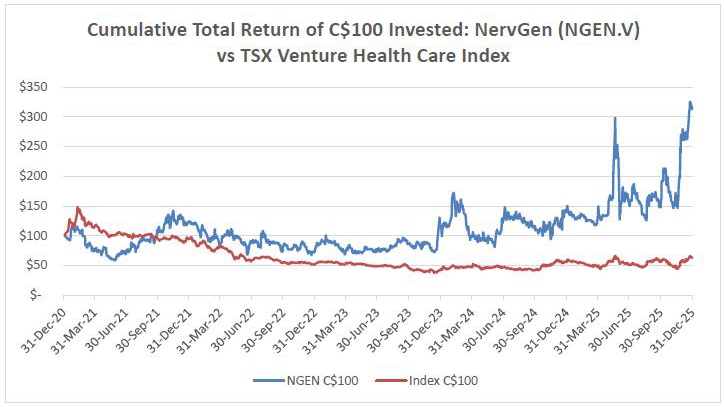
As an early-stage clinical development company, the Corporation’s TSR may not directly reflect operational progress or underlying asset value during certain periods. Executive compensation is therefore structured to reward achievement of key scientific, regulatory, and strategic milestones that are fundamental to long-term value creation. TSR remains an important reference point, but not the sole determinant of compensation outcomes.
Named Executive Officers and Director Compensation
The following table sets forth all compensation received by individuals who served as a Named Executive Officer or a director of the Corporation for the financial years ended December 31, 2025, 2024 and 2023. Adam Rogers, Current President, CEO and interim CFO, Michael Kelly, Former President and CEO, William J. Adams, Former CFO and Secretary, and Daniel D. Mikol, former Chief Medical Officer (the “CMO”) are each a NEO of the Corporation for purposes of the following disclosure. Other than as set out below, the directors of the Corporation were not compensated in cash for services rendered in the financial periods ending December 31, 2025, 2024 and 2023.
- A-xxi -
Summary Compensation Table
| Name and Principal Position | Year | Salary, consulting fee, retainer or commission ($) |
Share- Based Awards ($) |
Option- Based Awards ($) |
Non-Equity Incentive Plan Compensation ($) |
Pension Value ($) |
Value of all other compensation ($) |
Total compensation ($) | ||||||||
| Adam Rogers, Current Chair, President, CEO and Interim CFO1,9 | 2025 | - | - | 181,000 | - | - | - | 181,000 | ||||||||
| 2024 | - | - | 82,500 | - | - | - | 82,500 | |||||||||
| 2023 | - | - | 157,223 | - | - | - | 157,223 | |||||||||
| Michael Kelly Former President, CEO & Director1, 2 | 2025 | 448,7757 | - | 1,014,888 | - | - | 203,9041,8 | 1,667,567 | ||||||||
| 2024 | 781,1697 | - | 1,803,536 | 329,2206,7 | - | 1,0508 | 2,914,975 | |||||||||
| 2023 | 540,0607 | - | 5,971,960 | 199,2235,7 | - | 1,0478 | 6,712,290 | |||||||||
| William J. Adams Former Chief Financial Officer9 | 2025 | 690,467 | - | 507,200 | - | - | - | 1,197,247 | ||||||||
| 2024 | 382,774 | - | 274,400 | 100,9096 | - | - | 758,083 | |||||||||
| 2023 | 335,767 | - | 151,146 | 95,8674 | - | - | 582,780 | |||||||||
| Dr. Daniel D. Mikol Former Chief Medical Officer3 | 2025 | 338,1097 | - | 235,200 | - | - | - | 573,309 | ||||||||
| 2024 | 620,3487 | - | 274,400 | 147,5526,7 | - | - | 1,042,300 | |||||||||
| 2023 | 588,5337 | - | 151,146 | 205,4534,7 | - | - | 945,132 | |||||||||
| William J. Radvak, Former Chairperson, Director & Interim CEO1, 2 | 2025 | - | - | - | - | - | - | - | ||||||||
| 2024 | - | - | - | - | - | - | - | |||||||||
| 2023 | 60,000 | - | 174,100 | - | - | - | 234,100 |
Notes:
| (1) | Dr. Rogers was appointed interim CEO on July 17, 2025 and appointed President and CEO on February 9, 2026. Mr. Kelly was appointed CEO and Board member on April 10, 2023, and stepped down from his roles as CEO and Board member on July 17, 2025, and as a result was paid $202,785 in lieu of notice required under his Employment Agreement. Mr. Radvak stepped down as Interim CEO on April 10, 2023. |
| (2) | None of the compensation paid to Messrs. Kelly or Radvak was paid to them in their capacity as director. |
| (3) | Dr. Mikol stepped down from his role as CMO on July 1, 2025. |
| (4) | Amounts accrued but not paid at December 31, 2023. Payment was made on March 15, 2024. |
| (5) | Amounts accrued but not paid at December 31, 2023. Payment was made on April 15, 2024. |
| (6) | Amounts accrued but not paid at December 31, 2024. Payment was made on March 15, 2025. |
| (7) | These amounts were incurred in US dollars and converted at the rate of exchange effective on the transaction dates. The average exchange rates were US$1.00 = C$1.3978 for fiscal 2025, US$1.00 = C$1.3698 for fiscal 2024, and US$1.00 = C$1.3493 for fiscal 2023. |
| (8) | Represents 401(k) matching benefits. |
| (9) | Mr. Adams retired as CFO of the Corporation effective March 15, 2026. Dr. Rogers was appointed interim CFO on the same date. |
- A-xxii -
Director Compensation Table
| Director Name | Fees Earned ($) | Share- Based Awards ($) | Option- Based Awards ($) | Non-Equity Incentive Plan Compensation ($) | Pension Value ($) | All Other Compensation ($) | Total ($) | |||||||||||||||
| Harold Punnett | - | - | 181,000 | - | - | - | 181,000 | |||||||||||||||
| Brian Bayley | - | - | 181,000 | - | - | - | 181,000 | |||||||||||||||
| Neil Klompas | - | - | 217,200 | - | - | - | 217,200 | |||||||||||||||
| Krista McKerracher | - | - | 217,200 | - | - | - | 217,200 | |||||||||||||||
| John Ruffolo | - | - | 181,000 | - | - | - | 181,000 | |||||||||||||||
| Craig Thompson | - | - | 217,200 | - | - | - | 217,200 | |||||||||||||||
| Randall Kaye1 | - | - | 873,200 | - | - | 320,067 | 1,193,267 | |||||||||||||||
| Glenn A. Ives | - | - | 217,200 | - | - | - | 217,200 | |||||||||||||||
Notes:
| (1) | Dr. Randall Kaye and the Corporation entered into a consulting agreement on July 1, 2025, appointing Dr. Kaye as Chief Medical Advisor. In connection with the consulting agreement, the Corporation awarded Dr. Kaye 200,000 options. Additionally, the Corporation paid Dr. Kaye $320,067 in connection with the consulting services rendered during the year ended December 31, 2025. |
Stock Options and Other Compensation Securities
The following table sets forth Options pursuant to the Stock Option Plan and other compensation securities, granted or issued to each director and Named Executive Officer, by the Corporation for the year ended December 31, 2025, for services provided or to be provided, directly or indirectly, to the Corporation.
| Compensation Securities | ||||||||||||||
| Name
and position3 |
Type of compensation security |
Number of compensation securities, number of underlying securities and percentage of class |
Date of issue or grant |
Issue conversion or exercise price ($)4 |
Closing price of security or underlying security on date of grant ($) |
Closing price of security or underlying security at year end ($) |
Expiry date | |||||||
| Adam Rogers, Current Chair, President, CEO & Interim CFO | Options | 50,0002 | May 16, 2025 | 4.00 | 4.68 | 6.91 | May 16, 2030 | |||||||
| Michael Kelly Former President, CEO & Director | Options | 345,200 1 | February 18, 2025 | 2.97 | 2.97 | 6.91 | February 18, 2035 | |||||||
| William J. Adams Former CFO | Options | 80,0001 | February 18, 2025 | 2.97 | 2.97 | 6.91 | February 18, 2035 | |||||||
| Options | 100,0001 | March 14, 2025 | 2.74 | 2.72 | 6.91 | March 14, 2035 | ||||||||
| Randall Kaye, Director | Options | 200,0002 | July 7, 2025 | 3.55 | 3.50 | 6.91 | July 7, 2030 | |||||||
| Options | 60,0002 | May 16, 2025 | 4.00 | 4.68 | 6.91 | May 16, 2030 | ||||||||
- A-xxiii -
| Compensation Securities | ||||||||||||||
| Name and position3 |
Type of compensation security |
Number of compensation securities, number of underlying securities and percentage of class |
Date of issue or grant |
Issue conversion or exercise price ($)4 |
Closing price of security or underlying security on date of grant ($) |
Closing price of security or underlying security at year end ($) |
Expiry date | |||||||
| Daniel D. Mikol Former CMO | Options | 80,0001 | February 18, 2025 | 2.97 | 2.97 | 6.91 | February 18, 2035 | |||||||
| Brian E. Bayley, Director | Options | 50,0002 | May 16, 2025 | 4.00 | 4.68 | 6.91 | May 16, 2030 | |||||||
| Harold M. Punnett, Director | Options | 50,0002 | May 16, 2025 | 4.00 | 4.68 | 6.91 | May 16, 2030 | |||||||
| Glenn A. Ives, Director | Options | 60,0002 | May 16, 2025 | 4.00 | 4.68 | 6.91 | May 16, 2030 | |||||||
| J. Craig Thompson, Director | Options | 60,0002 | May 16, 2025 | 4.00 | 4.68 | 6.91 | May 16, 2030 | |||||||
| Krista L. McKerracher, Director | Options | 60,0002 | May 16, 2025 | 4.00 | 4.68 | 6.91 | May 16, 2030 | |||||||
| John Ruffolo Director | Options | 50,0002 | May 16, 2025 | 4.00 | 4.68 | 6.91 | May 16, 2030 | |||||||
| Neil A. Klompas, Director | Options | 60,0002 | May 16, 2025 | 4.00 | 4.68 | 6.91 | May 16, 2030 | |||||||
Notes:
| (1) | 25% vests six months following the grant date and 25% vest every six months following such grant date, thereafter until fully vested. |
| (2) | 25% vests three months following the grant date and 25% vest every three months following such grant date, thereafter until fully vested. |
| (3) | The total number of compensation securities held by each named executive officer or director on December 31, 2025 is as follows: |
| NEO or Director | Options Outstanding | Retention Securities | ||||||
| Michael Kelly | 2,818,900 | 491,667 | ||||||
| William Adams | 1,360,000 | Nil | ||||||
| Daniel Mikol | Nil | Nil | ||||||
| Brian Bayley | 275,000 | Nil | ||||||
| Harold Punnett | 275,000 | Nil | ||||||
| Randall Kaye | 585,000 | Nil | ||||||
| Glenn Ives | 200,000 | Nil | ||||||
| Adam Rogers | 390,000 | Nil | ||||||
| Craig Thompson | 385,000 | Nil | ||||||
| Krista McKerracher | 335,000 | Nil | ||||||
| John Ruffolo | 250,000 | Nil | ||||||
| Neil A. Klompas | 210,000 | Nil | ||||||
| (4) | Pursuant to the Corporation’s Amended and Restated Stock Option Plan, the exercise price is based on the most recent closing price. |
- A-xxiv -
Incentive Plan Awards – Value Vested or Earned During the Year
| Name | Option-based awards – Value ($) | Share-based awards – Value vested during the year ($) | Non-equity incentive plan compensation
– ($) | |||||
| Adam Rogers, Current Chair, President, CEO & Interim CFO1 | 6,250 | Nil | Nil | |||||
| Michael Kelly, Former President, CEO & Director1 | 2,449,285 | Nil | Nil | |||||
| William J. Adams Former CFO4 | 14,750 | Nil | Nil | |||||
| Dr. Daniel D. Mikol, Former CMO2 | (8,000 | ) | Nil | Nil | ||||
Notes:
| (1) | Dr. Rogers was appointed interim CEO, and Mr. Kelly stepped down from his roles as CEO and Board member, on July 15, 2025. Dr. Rogers was appointed President and CEO on February 9, 2026. |
| (2) | Dr. Mikol stepped down from his role as CMO on July 1, 2025. |
| (3) | The aggregate value of the option-based awards vested during the financial year is based on the difference between the closing market price of the Common Shares on the TSX-V on the vesting date of the options and the exercise price of the options. |
| (4) | Mr. Adams retired as CFO of the Corporation effective March 15, 2026. Dr. Rogers was appointed interim CFO on the same date. |
Options Exercised by Directors and Named Executive Officers
1,826,000 options were exercised during the year ended December 31, 2025 by a director or Named Executive Officer or former director or Named Executive Officer. 300,000 Options were exercised during the year ended December 31, 2024 by a director or Named Executive Officer or former director or Named Executive Officer.
Pension Plan Benefits
The Corporation does not have a pension plan for its NEOs and directors.
Securities Authorized for Issuance under Equity Compensation Plans
The following table sets forth certain details as at the end of the year ended December 31, 2025 with respect to compensation plans pursuant to which equity securities of the Corporation are authorized for issuance:
| Plan Category | Number of securities to be issued upon exercise of outstanding stock Options (a) | Weighted-average exercise price of outstanding Options (b) | Number of Common Shares remaining available for future issuance under the equity compensation plans (Excluding Common Shares reflected in Column (a)) (c) | ||||||||
| Equity compensation plans approved by shareholders | 14,197,529 | $ | 2.31 | 2,545,629 | |||||||
| Equity compensation plans not approved by shareholders | Nil | Nil | Nil | ||||||||
| Total | 14,197,259 | $ | 2.31 | 2,545,629 | |||||||
- A-xxv -
Particulars of the Stock Option Plan
The Stock Option Plan, in its current form, was last approved by Shareholders on May 6, 2025. The Stock Option Plan is intended to attract, retain and motivate persons with the training, experience and leadership to be key service providers to the Corporation and its subsidiaries, including their directors, officers and employees, and to advance the interests of the Corporation. Options may be granted to a director, officer, employee or service provider of the Corporation or any related entity (being a person that controls or is controlled by the Corporation or that is controlled by the same person that controls the Corporation).
The Corporation is proposing for shareholder approval in this Circular a new Omnibus Plan. If the Omnibus Plan is approved, no further grants will be made under the Stock Option Plan, though existing grants under the Stock Option Plan will continue in effect in accordance with their terms.
Material Terms of Stock Option Plan
The aggregate number of Common Shares reserved for Options under the Stock Option Plan is fixed at 14,197,529 Common Shares, being 20% of the issued and outstanding Common Shares as at April 2, 2025. If Options expire or are surrendered or otherwise terminated without being exercised in whole or in part, new Options may be granted in place of such Options.
The grant of Options under the Stock Option Plan is subject to the following limitations:
| (i) | the number of Common Shares reserved for issuance to any one optionee pursuant to Options, when aggregated with all other Common Shares reserved for issuance under any other Share Compensation Arrangement of the Corporation, may not exceed 5% of the outstanding Common Shares on a yearly basis unless the Corporation obtains Disinterested Shareholder Approval; |
| (ii) | the aggregate number of Common Shares reserved for issuance to any one consultant pursuant to Options in any 12 month period, when aggregated with all Common Shares reserved for issuance to such consultant under any other Share Compensation Arrangement of the Corporation, may not exceed 2% of the outstanding Common Shares on the date when the Options are granted; |
| (iii) | the aggregate number of Common Shares reserved for issuance to persons employed in Investor Relations Activities pursuant to Options, when aggregated with all Common Shares reserved for issuance to such persons under any other Share Compensation Arrangement of the Corporation, shall not exceed 2% of the outstanding Common Shares in any 12 month period calculated at the date such Options are granted and with respect to Options granted to persons employed in Investor Relations Activities, no more than one quarter of Options vest in each of the three, six, nine and twelve-month periods following the date such Options are granted; and |
| (iv) | Disinterested Shareholder Approval is required if there is a grant of Options to Insiders of the Corporation within a 12 month period which, when the Common Shares issuable under such Options are aggregated with all Common Shares reserved for issuance to Insiders of the Corporation under any other Share Compensation Arrangement of the Corporation, exceeds 10% of the issued Common Shares. |
- A-xxvi -
For the purposes of the Stock Option Plan, “Share Based Compensation” means any stock option, stock option plan, employee stock purchase plan, share distribution plan or any other compensation or incentive mechanism of the Corporation involving the issuance or potential issuance of shares to any director, officer or employee of or consultant to the Corporation or any of its subsidiaries, including a share purchase from treasury which is financially assisted by the Corporation by way of a loan, guaranty or otherwise, excluding any share or share-based compensation granted to a person not previously employed by, and not previously an Insider of, the Corporation as an inducement pursuant to Section 6.4 of TSXV Policy 4.4 – Security Based Compensation.
The exercise price of Options is determined by the Board but may not be less than the fair market value (“FMV”) of the Common Shares on the grant date of the Options. The FMV is the last closing price of a board lot of the Common Shares before the grant date on the stock exchange or over the counter market which is the principal trading market for the Common Shares, as may be determined for such purpose by the Board.
The Options have a maximum term of ten years from the date of issue and Options vest as the Board may determine upon the award of the Options.
To the extent not earlier exercised, an Option shall terminate at the earliest of the following dates:
| (i) | the expiry date specified for such Option in the Option agreement governing the specific terms of the Options granted to the optionee; |
| (ii) | where the optionee’s position as an employee, a director or an executive officer of or a consultant to the Corporation or any subsidiary is terminated for just cause, the date of such termination for just cause; and |
| (iii) | where the optionee’s position as an employee, a director or an executive officer of or a consultant to the Corporation or any subsidiary (other than a person employed to provide Investor Relation Activities), terminates for a reason other than the optionee’s death or termination for just cause, 90 days after such date of termination, or in the case of a person employed to provide Investor Relation Activities, 30 days after such termination but: |
| (a) | if an optionee’s position changes from one of the said categories to another category such change will not cause the Option to terminate; |
| (b) | upon the optionee, or guardian of an optionee, as applicable, making written application to the Board and receiving the written consent of the Board, which consent may be given at the discretion of the Board, at such later date as determined by the Board which must be no later than the original expiry date of such Option when it was granted and the first anniversary of the optionee’s termination; |
| (c) | where the optionee’s position as an employee, a director or an executive officer of or a consultant to the Corporation or any subsidiary (other than a person employed to provide Investor Relations Activities), terminates due to the optionee’s death, the first anniversary of the optionee’s death; and |
| (d) | the date of any sale, transfer, assignment or hypothecation, or any attempted sale, transfer, assignment or hypothecation, of such Option in violation of non-transferability provisions. |
- A-xxvii -
Subject to the approval of any stock exchange on which the Corporation’s securities are listed, the Stock Option Plan may be terminated at any time by resolution of the Board, but any such termination will not affect or prejudice rights of participants holding Options at that time. If the Stock Option Plan is terminated, outstanding Options will continue to be governed by the provisions of the Stock Option Plan.
The Stock Option Plan contains additional provisions to provide for incentive stock option grants for United States resident optionees, intended to qualify as an “incentive stock option” pursuant to section 422 of the United States Internal Revenue Code of 1986, as amended.
The terms of the Stock Option Plan described above are intended as a summary only and are qualified in their entirety by reference to the Stock Option Plan.
Particulars of the Omnibus Plan
The Corporation is proposing for shareholder approval of the new Omnibus Plan. For a summary of the terms of the Omnibus Plan, please refer to “Material Terms of the Omnibus Equity Incentive Plan”. The summary is qualified in its entirety by the full text of the Omnibus Plan, which is attached hereto as Appendix “A”.
Employment, Consulting and Management Agreements Dr. Adam Rogers Employment Agreement
Dr. Rogers entered into an employment agreement with the Corporation on February 9, 2026, for a term commencing on February 9, 2026 to February 8, 2028, which may be extended for an additional year, pursuant to which Dr. Rogers was appointed as President and Chief Executive Officer of the Corporation (the “Rogers Employment Agreement”). The Rogers Employment Agreement entitled Dr. Rogers to an annual salary of US$350,000 (CAD$479,7101). If the Rogers Employment Agreement was terminated by the Corporation, for any reason other than cause, death, or disability, or is terminated as a result of a change of control, or if he resigns for good reason, subject to Dr. Rogers signing a separation agreement and release, Dr. Rogers would be entitled to the lesser of (i) six (6) months of his then-current base salary, plus an additional two (2) months of base salary for each completed year of service, capped at a maximum of twelve (12) months in total or (ii) base salary that would have been paid to him had his employment with the Corporation continued through the Expiration Date. Dr. Rogers would also be entitled to payment of any cash performance bonus payable with respect to the fiscal year prior to the fiscal year in which termination occurs (if not previously paid). In addition, the Corporation will pay the applicable insurance premiums for all health insurance, subject to Dr. Rogers’ copayment of premium amounts at the applicable active employees’ rate and Dr. Rogers’ proper election to receive benefits under the Consolidated Omnibus Budget Reconciliation Act of 1985, as amended (“COBRA”). The Corporation shall pay to the group health plan provider or the COBRA provider a monthly payment equal to the monthly employer contribution that the Corporation would have made to provide health insurance to Dr. Rogers if he had remained employed by the Corporation until the earliest of either (i) twelve (12) months following the effective date of termination if terminated outside a change of control period, or (ii) six (6) months following the effective date of termination if terminated during a change in control period, the date that Dr. Rogers becomes eligible for group medical plan benefits under any other employer’s group medical plan, or the cessation of Dr. Rogers’ health continuation rights under COBRA. In addition, Dr. Rogers will be entitled to the vesting acceleration of all outstanding Options effective as of the date of termination, if terminated during a change in control period, and that number of Options that would have vested in the twelve (12) months following such termination, if terminated outside a change of control period. As the Rogers Employment Agreement was not executed until 2026, there would be no entitlements until 2026.
1 Assuming the Bank of Canada exchange rate on December 31, 2025 being US$1.00 = C$1.3706.
- A-xxviii -
Mr. Michael Kelly Employment Agreement
Mr. Kelly entered into an employment agreement with the Corporation on April 10, 2023, for an indefinite term, pursuant to which Mr. Kelly was employed as the President and Chief Executive Officer of the Corporation and the Subsidiary (the “Kelly Employment Agreement”). The Kelly Employment Agreement entitled Mr. Kelly to an annual salary of US$550,000 (CAD$753,8301). Mr. Kelly’s agreement was further amended to increase his salary to US$572,000 (CAD$783,9831 ) effective January 1, 2024, and to US$589,160 (CAD$807,5031), effective January 1, 2025. If the Kelly Employment Agreement is terminated by the Corporation, for any reason other than cause, or is terminated as a result of a change of control, or if he resigns for good reason, subject to Mr. Kelly signing a separation agreement and release, Mr. Kelly would be entitled to eighteen (18) months salary continuance or severance or a combination thereof (the “Severance Benefit Period”). Mr. Kelly would also be entitled to payment of any cash performance bonus payable with respect to the fiscal year prior to the fiscal year in which termination occurs (if not previously paid), and payment of any prorated bonus for the year in which termination occurs, which payment shall be calculated based on the bonus payable or awarded for the previous fiscal year. In addition, the Corporation will pay the applicable insurance premiums for all health insurance, subject to Mr. Kelly’s copayment of premium amounts at the applicable active employees’ rate and Mr. Kelly’s proper election to receive benefits under COBRA. The Corporation shall pay to the group health plan provider or the COBRA provider a monthly payment equal to the monthly employer contribution that the Corporation would have made to provide health insurance to Mr. Kelly if he had remained employed by the Corporation until the earliest of the end of the Severance Benefit Period or the date that Mr. Kelly becomes eligible for group medical plan benefits under any other employer’s group medical plan, or the cessation of Mr. Kelly’s health continuation rights under COBRA.
The Kelly Employment Agreement was terminated effective July 16, 2025 and replaced by a separation agreement (the “Kelly Separation Agreement”). The Kelly Separation Agreement provides for payment in lieu of notice in the amount of three (3) months of Mr. Kelly’s salary, totaling US$147,290. Additionally, the post-termination exercise period for Mr. Kelly’s outstanding stock option grants were extended twelve (12) months from the date of termination.
Mr. William Adams Employment Agreement
Mr. Adams entered into an employment agreement with the Corporation on February 21, 2020, for an indefinite term, pursuant to which Mr. Adams is employed as the Chief Financial Officer (the “Adams Employment Agreement”). Pursuant to the Adams Employment Agreement, Mr. Adams was entitled to an annual salary of $300,000. Due to the COVID-19 pandemic, Mr. Adams’ agreement was amended effective April 1, 2020 to $120,000 annually until June 30, 2020. 60,000 stock options were granted to compensate Mr. Adams for the compensation reduction. Mr. Adams’ agreement was further amended to increase his salary to $307,500, effective January 1, 2021, $318,263, effective January 1, 2022, $335,767, effective January 1, 2023, $382,774, effective January 1, 2024, and $685,878, effective January 1, 2025. If the Adams Employment Agreement is terminated by the Corporation, for any reason other than cause, Mr. Adams would be entitled to nine months’ total notice of termination, plus one month for every year of employment up to a maximum of twelve months’ total notice, or salary continuance or severance or a combination thereof. Mr. Adams would also be entitled to payment of any cash performance bonus payable with respect to the fiscal year prior to the fiscal year in which termination occurs (if not previously paid), and payment of any prorated bonus for the year in which termination occurs, which payment shall be calculated based on the bonus payable or awarded for the previous fiscal year. In addition, the Corporation will pay the applicable insurance premiums for all health insurance for Mr. Adams during the severance period or until such earlier date that substantially equivalent or better benefits are provided by a successor employer. If Mr. Adams’ employment is terminated as a result of a change of control, or if he resigns for good reason during the change of control period, then he will be entitled, in addition to the foregoing severance, an additional lump sum payment equal to twelve months’ total notice, or salary continuance, or severance, or a combination thereof at the Corporation’s discretion. As at December 31, 2025, the obligation on termination of the Adams Employment Agreement by the Corporation, other than resulting from a change of control, would be $960,229 and the total obligation if termination resulted from a change of control would be $1,646,107.
- A-xxix -
Mr. Adams retired as an officer of the Corporation effective March 15, 2026.
Dr. Daniel Mikol Employment Agreement
Dr. Mikol entered into an employment agreement with the Corporation on May 5, 2021, for an indefinite term, pursuant to which Dr. Mikol is employed as the Chief Medical Officer (the “Mikol Employment Agreement”). Pursuant to the Mikol Employment Agreement, Dr. Mikol is entitled to an annual salary of US$400,000 (CAD$548,2401). Dr. Mikol’s agreement was amended to increase his salary to US$414,000 (CAD$567,4281), effective January 1, 2022, US$436,770 (CAD$598,6371), effective January 1, 2023, US$454,241 (CAD$622,5831), effective January 1, 2024, and US$467,868 (CAD$641,2601), effective January 1, 2025. If the Mikol Employment Agreement is terminated by the Corporation, for any reason other than cause, Dr. Mikol would be entitled to nine months’ total notice of termination, plus one month for every year of employment up to a maximum of twelve months’ total notice, or salary continuance or severance or a combination thereof. In addition, the Corporation will pay the applicable insurance premiums for all health insurance for Dr. Mikol during the severance period or until such earlier date that substantially equivalent or better benefits are provided by a successor employer. If Dr. Mikol’s employment is terminated as a result of a change of control, or if he resigns for good reason during the change of control period, then he will be entitled, in addition to the foregoing severance, an additional lump sum payment equal to twelve months’ total notice, or salary continuance, or severance, or a combination thereof at the Corporation’s discretion.
Dr. Mikol stepped down from his role as CMO of the Corporation on July 1, 2025, and as such, no termination benefits or payments were made to Dr. Mikol. The Mikol Employment Agreement was terminated effective June 30, 2025 and replaced by a separation agreement (the “Mikol Separation Agreement”). Additionally, the post-termination exercise period for Mr. Mikol’s outstanding stock option grants were extended 180 days from the date of termination.
Oversight and Description of Director and Named Executive Officer Compensation
The Corporation is a biotechnology research and development Corporation that focuses on commercializing technologies in various fields and is dependent on financing to carry on its business. In order to ensure alignment with shareholder interests, as well as to conserve cash resources, the Corporation relies, when possible and prudent, on stock options, in addition to cash payments to remunerate its officers, employees, consultants and other service providers. To this end, the Corporation maintains the Stock Option Plan, pursuant to which directors, officers, employees and consultants may be granted Options to purchase Common Shares. The Corporation does not maintain any pension or retirement plan.
Use of Compensation Consultants
In January 2025, the Corporation engaged a compensation specialist, Aon Consulting Inc. (“Aon”), to provide advice to management and the Compensation Committee on our compensation program. Aon was retained to provide the following support to the Corporation in the year ended December 31, 2025:
| · | advise on trends and developments in executive and director compensation; |
- A-xxx -
| · | advise on director and management compensation programs and policies; and |
| · | conduct a review of executive and director pay levels among comparable industry peers, independent compensation surveys and across the industry. |
The results of the work performed by the compensation consultant was taken into consideration by the Compensation Committee and the Board for compensation paid to executive officers in the financial year ended December 31, 2025.
| Executive Compensation-related Fees ($) | All Other Fees ($) | |||||||||||||||
| Name of Consultant | 2025 | 2024 | 2025 | 2024 | ||||||||||||
| Aon Consulting Inc. | US$ | 99,736 | - | - | - | |||||||||||
INDEBTEDNESS OF DIRECTORS AND EXECUTIVE OFFICERS
As of the date hereof, there is no indebtedness owing to the Corporation by any employees, officers, directors or nominees of the Corporation (or any associate or affiliate thereof).
INTEREST OF INFORMED PERSONS IN MATERIAL TRANSACTIONS
Other than as set out herein, none of the persons who were directors or executive officers of the Corporation or a subsidiary of the Corporation at any time during the Corporation’s last financial year, the proposed nominees for election to the Board, any person or company who beneficially owns, directly or indirectly, or who exercises control or direction over (or a combination of both) more than 10% of the issued and outstanding common shares of the Corporation, nor any associate or affiliate of any such person, has any material interest, direct or indirect, by way of beneficial ownership of securities or otherwise, in any transaction during the year ended December 31, 2025, or has any such interest in any proposed transaction, which has materially affected or would materially affect the Corporation.
MANAGEMENT CONTRACTS
The business of the Corporation is managed by its directors and officers and the Corporation has no management agreements with persons who are not officers or directors of the Corporation.
CORPORATE GOVERNANCE
General
Corporate governance refers to the policies and structure of the board of directors of a company, whose members are elected by and are accountable to the shareholders of the company. Corporate governance encourages establishing a reasonable degree of independence of the board of directors from executive management and the adoption of policies to ensure the board of directors recognizes the principles of good management. The Board of the Corporation is committed to sound corporate governance practices; as such practices are both in the interests of shareholders and help to contribute to effective and efficient decision-making.
- A-xxxi -
The Board and management believe that the Corporation has a sound governance structure in place for both management and the Board. Of particular note, NervGen has established a written:
| · | Mandate of the Board; |
| · | Charter for the Audit, Compensation, Nominating and Corporate Governance, Corporate Finance and Science Committees; |
| · | Disclosure and Trading Policy; |
| · | Code of Ethics; and |
| · | Whistleblower Policy. |
The Canadian Securities Administrators (the “CSA”) have adopted National Policy 58-201 - Corporate Governance Guidelines, which provides non-prescriptive guidelines on corporate governance practices for reporting issuers such as the Corporation. In addition, the CSA have implemented National Instrument 58-101 - Disclosure of Corporate Governance Practices (“NI 58-101”), which prescribes certain disclosure by the Corporation of its corporate governance practices. This section sets out the Corporation’s approach to corporate governance and addresses the Corporation’s compliance with NI 58-101.
Board of Directors
Pursuant to NI 58-101, directors are considered to be independent if they have no direct or indirect material relationship with the Corporation. A “material relationship” is a relationship which could, in the Board’s view, be reasonably expected to interfere with the exercise of a director’s independent judgment.
The Board facilitates its independent supervision over management by having a majority of independent directors on both the Board and committees of the Board. The independent members of the Board, as of the date hereof, are: Krista L. McKerracher, John C. Thompson, Brian E. Bayley, Harold M. Punnett, John Ruffolo and Neil A. Klompas. Adam H. Rogers is not independent as he is a current executive officer of the Corporation and Randall E. Kaye is not independent due to his consulting relationship with the Corporation. The mandate of the Board is to manage corporate governance matters pertaining to the business and affairs of the Corporation. In fulfilling its mandate, the Board as a whole oversees the development and application of policies regarding corporate governance, deals with corporate governance issues, and is responsible for:
| (a) | adopting a strategic planning process for the Corporation; |
| (b) | understanding the principal risks of the Corporation’s business and ensuring the implementation of the appropriate systems to manage these risks; |
| (c) | succession planning for the Corporation, including identifying, appointing, training and monitoring senior management; |
| (d) | overseeing the integrity of the Corporation’s internal controls and management information systems; and |
| (e) | maintaining a continuing dialogue with management in order to ensure the ability to respond to changes, both internal and external, which may affect the Corporation and its business operations from time to time. |
In carrying out its mandate, the Board holds regular meetings and has established an audit committee. The frequency of meetings, as well as the nature of the matters dealt with, will vary from year to year depending on the state of the Corporation’s business and the opportunities or risks which the Corporation faces from time to time. The Board facilitates its exercise of independent supervision over the Corporation’s management through regular meetings of the Board being held to obtain an update on significant corporate activities and plans, both with and without members of the Corporation’s management being in attendance. Additional in-camera sessions also follow Board, Audit Committee, Compensation Committee and Nominating and Corporate Governance Committee meetings, as appropriate.
- A-xxxii -
The current Chairman of the Board is Dr. Rogers, who is not an independent director by virtue of his position as CEO of the Corporation. Given that Dr. Rogers is not considered independent of the Corporation, the Board has appointed J. Craig Thompson as Lead Independent Director. In this capacity, the Lead Independent Director works closely with the Chairman & CEO to lead and facilitate the Board’s governance oversight and deliberations, and to support the Board in fulfilling its functions and responsibilities under its charter.
Position Descriptions
The Board has developed independent written position descriptions for the chair of the Board and chair of each committee, as described in the Board mandate and each respective committee charters. The Board has also developed independent written position descriptions for the CEO and lead director.
Directorships
The following table outlines other reporting issuers that Board members are directors of:
| Name | Name of Reporting Issuer | Name of Exchange or Market |
| J. Craig Thompson | Esperion Therapeutics, Inc | NASDAQ |
| Krista L. McKerracher | None | N/A |
| Brian E. Bayley | Monitor Ventures Inc. Cypress Hills Resource Corp. Jabbo Capital Corp. Left Field Capital Corp. |
NEX NEX TSXV TSXV |
| Randall E. Kaye | None | N/A |
| Harold M. Punnett | None | N/A |
| Adam H. Rogers | None | N/A |
| Gianni (John) Ruffolo | None | N/A |
| Neil A. Klompas | InMed Pharmaceuticals | NASDAQ |
Board Mandate
The mandate of the Board is to review and approve the strategy of the Corporation, assist and oversee the performance of business operations and ensure compliance for the benefit of shareholders, employees, customers, suppliers, creditors and the communities in which the Corporation operates.
The Board is responsible for, among other things:
| · | developing and articulating the Corporation’s values, purpose, mission and strategies; |
| · | monitoring critical risks to the Corporation and the Corporation’s strategic and business plans; |
- A-xxxiii -
| · | reviewing the Corporation’s approach to corporate governance, including reviewing the succession plans of the Corporation; |
| · | ensuring that internal financial, non-financial and business controls and management information systems have been established and are being maintained by management; and |
| · | ensuring compliance with the Corporation’s bylaws. |
A copy of the Board’s mandate is attached hereto as Appendix “D”.
Orientation and Continuing Education
Management will ensure that a new appointee to the Board receives the appropriate written materials to fully apprise him or her of the duties and responsibilities of a director pursuant to applicable law and policy. Each new director brings a different skill set and professional background, and with this information, the Board is able to determine what orientation to the nature and operations of the Corporation’s business will be necessary and relevant to each new director.
Ethical Business Conduct
The Board expects management to operate the business of the Corporation in a manner that enhances shareholder value and is consistent with the highest level of integrity. Management is expected to execute the Corporation’s business plan and to meet performance objectives and goals. In addition, the Board must comply with conflict of interest provisions in Canadian corporate law, including relevant securities regulatory instruments, in order to ensure that directors exercise independent judgment in considering transactions and agreements in respect of which a director or executive officer has a material interest.
In connection with the above, the Board has adopted the Code of Ethics and the Whistleblower Policy. Copies of the Code of Ethics and Whistleblower Policy are available on the Corporation’s website at www.nervgen.com/corporate-governance.
Nomination of Directors
Given the Corporation’s current stage of development and size, the Board is of the view that it functions effectively as a committee of the whole with respect to the nomination of directors. The entire Board will assess potential nominees with the recommendation of the Nominating and Corporate Governance Committee and take responsibility for selecting new directors. Any nominees are expected to be generally the result of recruitment efforts by the Board members, including both formal and informal discussions among Board members and the President of the Corporation.
The Corporation’s articles of incorporation include a provision requiring advance notice of the nomination of persons to act as directors of the Corporation. Under this provision, subject only to the Business Corporations Act (British Columbia), nominations of persons for election to the Board may be made at any annual general meeting of shareholders, or at any special general meeting of shareholders if one of the purposes for which the special general meeting was called was the election of directors:
| (a) | by or at the direction of the Board including pursuant to a notice of meeting, |
| (b) | by or at the direction or request of one or more shareholders pursuant to a proposal made in accordance with the provisions of the Business Corporations Act (British Columbia) or a requisition of the shareholders made in accordance with the provisions of the Business Corporations Act (British Columbia) or |
- A-xxxiv -
| (c) | by any person (a “Nominating Shareholder”) who |
| (i) | at the close of business on the date of the giving of the notice of nomination and on the record date for notice of such meeting, is entered in the central securities register of the Corporation as a holder of one or more shares carrying the right to vote at such meeting or who beneficially owns shares that are entitled to be voted at such meeting, and |
| (ii) | complies with the notice procedures set out in the advance notice provision, including without limitation that such notice must be provided to the Corporation |
| (A) | in the case of an annual general meeting of shareholders, not more than 60 days and not less than 35 days prior to the date of the annual general meeting of shareholders (but if the annual general meeting of shareholders is called for a date that is less than 50 days after the date on which the first public announcement of the date of the annual general meeting was made (the “Notice Date”), notice by the Nominating Shareholder may be made not later than the close of business on the 10th business day following the Notice Date); and |
| (B) | in the case of a special meeting (which is not also an annual general meeting) of shareholders called for the purpose of electing directors (whether or not called for other purposes), not later than the close of business on the 15th business day following the day on which the first public announcement of the date of the special meeting of shareholders was made. |
Nominating and Corporate Governance Committee
The Nominating and Corporate Governance Committee is composed entirely of independent directors. The Nominating and Corporate Governance Committee assists the Board by identifying, assessing and recommending qualified director appointments.
In addition, the Nominating and Corporate Governance Committee has the responsibility of, among other things: (i) making recommendations to the Board regarding Board changes and changes to the committees; (ii) reviewing, developing and recommending to the Board corporate governance guidelines; (iii) annually evaluating the performance of the Board, CEO and officers of the Corporation, and reporting to the Board and Compensation Committee the results of that evaluation; (iv) reviewing and monitoring the Corporation’s compliance with applicable human rights laws; (v) developing and maintaining succession plans; (vi) developing a process for identifying and evaluating nominees to the Board; and (v) ensuring that procedures are in place and resources are made available to provide new directors with a proper orientation to the Corporation and their responsibilities and duties as directors and providing other directors with appropriate continuing education opportunities.
- A-xxxv -
Compensation
For disclosure on what steps are taken to determine compensation for the directors and the CEO, including:
| (i) | who determines compensation; and |
| (ii) | the process for determining compensation, see the above heading “Oversight and Description of Director and Named Executive Officer Compensation”. |
Other Board Committees
The Board has established a Science Committee to assist the Board in ensuring that the Corporation’s research and development organization is optimized to support the strategic goals of the Corporation and to provide recommendations to the Board on key strategic and tactical issues related to the Corporation’s research and development activities. The Science Committee reviews and monitors the science, processes and procedures, and infrastructure underlying the Corporation’s major discovery and development programs.
The Board has established a Corporate Finance Committee to assist the Board in ensuring that the Corporation has the financial resources to execute its strategic plan. The Corporate Finance Committee provides advice, counsel and direction to management of the Corporation regarding capital and corporate financing, capital structure management, mergers, acquisitions, divestitures, other strategic investments and risk management.
Assessments
The Board annually reviews its own performance and effectiveness. The Nominating and Governance Committee has implemented a formal review process to regularly assess the Board, its committees and the individual directors with respect to their effectiveness and contributions. Effectiveness is subjectively measured by comparing actual corporate results with stated objectives. The contributions of an individual director are informally monitored by the other Board members, having in mind the business strengths of the individual and the purpose of originally nominating the individual to the Board.
The Board is of the view that the Corporation’s corporate governance practices are appropriate and effective for the Corporation, given its relatively small size and limited operations. The Corporation’s method of corporate governance allows for the Corporation to operate efficiently, with simple checks and balances that control and monitor management and corporate functions without excessive administrative burden.
Director Attendance at Board Meetings
The directors’ attendance at Board meetings during the Corporation’s most recently completed financial year is set forth in the table below. During the year, the Board met eight (8) times.
| Name | Attendance at Board meetings |
| J. Craig Thompson | 8 |
| Krista L. McKerracher | 8 |
| Brian E. Bayley | 5 |
| Randall E. Kaye | 7 |
| Harold M. Punnett | 7 |
| Adam H. Rogers | 8 |
- A-xxxvi -
| Name | Attendance at Board meetings |
| Gianni (John) Ruffolo | 7 |
| Neil A. Klompas | 8 |
| Glenn A. Ives | 4 |
| Michael Kelly | 5 |
Director Term Limits and Other Mechanisms of Board Renewal
The Board has not established term limits or other automatic mechanisms of Board renewal, which ensures that the Corporation benefits from access to directors that have been able to develop, over a period of time, increasing insight into the Corporation and its operations. Instead of adopting formal term limits, the Nominating and Corporate Governance Committee regularly assesses the performance and competencies of the Board, each committee and each director, and reports their evaluation to the Board.
Diversity of the Board
The Corporation does not have a formal policy nor measurable objectives (such as a target) regarding board diversity for the representation of women on the Board, management team or executive officers. The Corporation expects that its priority in the selection of the Board will be to identify members who will further the interests of its shareholders through their established record of professional accomplishment, the ability to contribute positively to the collaborative culture among board members, and knowledge of the Corporation’s business and understanding of the competitive landscape. In accordance with the charter of the Board, the Board seeks members from diverse backgrounds so that the Board consists of members with a broad spectrum of experience and expertise and with a reputation for integrity.
The Corporation expects to facilitate the representation of women on its Board and in executive officer positions by ensuring that diversity considerations are taken into account in senior management, monitoring the level of female representation on the Board and in senior management positions, continuing to broaden recruiting efforts to attract and interview qualified female candidates, and committing to retention and training to ensure that the Corporation’s most talented employees are promoted from within the organization.
Currently, one of the eight members (12.5%) of the Board are women. None of our executive officers are women. Three of the seven members (43%) of the Corporation’s senior management team are women.
Audit Committee
NI 51-102 requires the Corporation to disclose annually in its information circular certain information concerning the constitution of the audit committee and its relationship with its independent auditor, as set forth below.
Audit Committee Charter
The Audit Committee is governed by its charter. A copy of the text of the Audit Committee’s charter, established in accordance with National Instrument 52-110 – Audit Committees (“NI 52-110”), is set out in Appendix “C” to this circular.
- A-xxxvii -
Composition of the Audit Committee
The current members of the Audit Committee are all independent directors, namely: Neil A. Klompas (Chair), Brian E. Bayley, and Dr. Harold M. Punnett. The Audit Committee reviews the annual and quarterly financial statements of the Corporation and certain other public disclosure documents required by regulatory authorities and makes recommendations to the Board with respect thereto. The Audit Committee also reviews with the auditors and management the adequacy of the Corporation’s financial reporting and internal control procedures to ensure they are effective and appropriate. All members of the Audit Committee are considered to be financially literate within the meaning of NI 52-110.
Relevant Education and Experience
See disclosure under the above heading “Director Biographies”. All of the Audit Committee members are independent of management of the Corporation as required by Nasdaq and applicable securities laws and each member is financially literate in that each has the ability to read and understand a set of financial statements that present a breadth and level of complexity of accounting issues that are generally comparable to the breadth and complexity of the issues that can reasonably be expected to be raised by the Corporation’s financial statements. Each individual has experience managing a company at an executive level and, in those roles, reviewing financial statements and reports. In addition to their experience as Executive Officers, each member of the Audit Committee has experience serving on public company Boards. Neil Klompas, Chair of the Audit Committee, has been appointed as the Audit Committee’s Financial Expert (as such term is defined in Item 407(d)(5) of Regulation S-K of the Securities Act of 1933, as amended).
Audit Committee Oversight
The Audit Committee has not made any recommendations to the Board to nominate or compensate any auditor other than KPMG.
External Service Auditor Fees
The fees paid by the Corporation to its auditor in the last two financial years, by category, are as follows:
| Financial Year Ending | Audit Fees(1) | Audit Related Fees(2) | Tax Fees(3) | Securities Offerings Fees(4) | All Other Fees(5) | |||||||||||
| December 31, 2025 | $ | 347,365 | Nil | $ | 88,378 | $ | 245,850 | Nil | ||||||||
| December 31, 2024 | $ | 258,140 | Nil | $ | 96,537 | $ | 115,951 | Nil | ||||||||
Notes:
| (1) | “Audit Fees” include, where applicable, fees necessary to perform the annual audit and the quarterly review of the Corporation’s consolidated financial statements. Audit Fees include fees for the review of tax provisions and for accounting consultations on matters reflected in the financial statements. Audit Fees include audit and other attest services required by legislation or regulation, such as comfort letters, consents, reviews of securities filings and statutory audits. | |
| (2) | “Audit Related Fees” include, where applicable, services that are traditionally performed by the auditor. These audit-related services include employee benefits audits, due diligence assistance, accounting consultants on proposed transactions, internal control reviews and audit or attest services not required by legislation or regulation. | |
| (3) | “Tax Fees” include, where applicable, fees for all tax services other than those included in “Audit Fees” and “Audit Related Fees”. This category includes fees for tax compliance, tax planning and tax advice. Tax planning and tax advice includes Assistance with tax audits and appeals, tax advice related to mergers and acquisitions, and requests for rulings or technical advice from tax authorities. | |
| (4) | Fees pertain to services rendered in connection with securities offerings, including the review of preliminary and final short form prospectus and prospectus supplement. | |
| (5) | “All Other Fees” includes, where applicable, all other non-audit services. |
- A-xxxviii -
ADDITIONAL INFORMATION
Additional information relating to the Corporation is on www.sedarplus.ca and under our profile on www.SEC.gov. Financial information is provided in the Corporation’s comparative financial statements and management discussion and analysis, which is filed on www.sedarplus.ca. The Corporation will provide to any person or company, upon request to the Corporation, one copy of the comparative financial statements of the Corporation filed with the applicable securities regulatory authorities for the Corporation’s most recently completed financial year in respect of which such financial statements have been issued, together with the report of the auditor, related management’s discussion and analysis and any interim financial statements of the Corporation filed with the applicable securities regulatory authorities subsequent to the filing of the annual financial statements.
Copies of the above documents are available without charge to shareholders upon written request to the Corporation by emailing info@nervgen.com.
OTHER MATTERS
As of the date of this Circular, the Board and management are not aware of any matters to come before the Meeting other than those matters specifically identified in the accompanying Notice of Meeting. However, if such other matters properly come before the Meeting or any adjournment(s) thereof, the persons designated in the accompanying form of proxy will vote thereon in accordance with their judgment, pursuant to the discretionary authority conferred by the form of proxy with respect to such matters.
- A-xxxix -
BOARD APPROVAL
The contents of this Circular and its distribution to shareholders have been approved by the Board of Directors of the Corporation.
DATED this 13th day of March, 2026.
| BY ORDER OF THE BOARD OF DIRECTORS | |
| “Adam Rogers” | |
| Adam Rogers | |
| Chairperson |
- A-xl -
APPENDIX A
OMNIBUS INCENTIVE PLAN
A-1
NERVGEN PHARMA CORP.
2026 EQUITY INCENTIVE PLAN
ARTICLE I.
PURPOSE
The purpose of this NervGen Pharma Corp., 2026 Equity Incentive Plan (this “Plan”) is to promote the success of the Company’s business for the benefit of its shareholders by aligning employee and shareholder interests through the grant of awards to offer Eligible Individuals equity-based incentives in order to attract, retain, and reward such individuals and strengthen the alignment of interests between such individuals and the Company’s shareholders.
This Plan supersedes and replaces the NervGen Pharma Corp., Amended and Restated Stock Option Plan (the “Prior Plan”) in its entirety. The Company may not grant awards under the Prior Plan on or following the Effective Date. Awards granted under the Prior Plan prior to the Effective Date will remain subject to the terms and conditions set forth in the Prior Plan.
ARTICLE II.
DEFINITIONS
2.1 “Affiliate” means a corporation or other entity controlled by, controlling, or under common control with the Company. The term “control” (including, with correlative meaning, the terms “controlled by” and “under common control with”), as applied to any Person, means the possession, directly or indirectly, of the power to direct or cause the direction of management and policies of such Person, whether through the ownership of voting or other securities, by contract or otherwise.
2.2 “Applicable Law” means the requirements applicable to the Company or any Eligible Individual relating to equity- or cash-based compensation, as applicable, and the related equity interests under U.S. and Canadian federal, state, provincial, and local law, as applicable, foreign law, the rules or requirements of any stock exchange or quotation system on which the Shares are listed or quoted, and any other applicable laws, including the Code and other tax laws.
2.3 “Award” means an award under this Plan of any Stock Option, Restricted Stock Unit, Dividend Equivalent Right, or Other Stock-Based Award.
2.4 “Award Agreement” means the written or electronic agreement, contract, certificate, or other instrument or document evidencing the terms and conditions of an individual Award.
2.5 “Board” means the Board of Directors of the Company.
1
2.6 “Cause” means, unless otherwise defined in the applicable Award Agreement, either (a) where there is an employment agreement, offer letter, consulting agreement, change in control agreement, or similar agreement in effect between the Company or an Affiliate and the Participant at the time of the grant of the Award that defines “cause” (or term of like import), “cause” (or term of like import) as defined under such agreement, or (b) where clause (a) above does not apply, the Participant’s (i) commission of, or plea of guilty or no contest to, a felony or a crime involving moral turpitude or the commission of any other act or omission involving willful malfeasance or material fiduciary breach with respect to the Company or an Affiliate, (ii) substantial and repeated failure to perform duties as reasonably directed by the person to whom the Participant reports, (iii) conduct that brings or is reasonably likely to bring the Company or an Affiliate negative publicity or into public disgrace, embarrassment, or disrepute, (iv) gross negligence or willful misconduct with respect to the Company or an Affiliate, (v) material violation of the Company’s policies or codes of conduct, including policies related to discrimination, harassment, performance of illegal or unethical activities, or ethical misconduct, or (vi) breach of any non-competition, non-solicitation, no-hire, or confidentiality covenant between the Participant and the Company or an Affiliate.
2.7 “Change in Control” means each of the following, unless otherwise set forth in the applicable Award Agreement or other written agreement with a Participant that is approved by the Committee:
(a) any Person (other than the Company, any trustee or other fiduciary holding securities under any employee benefit plan of the Company, or any entity owned, directly or indirectly, by the shareholders of the Company in substantially the same proportions as their ownership of the Company), becomes the beneficial owner (as defined in Rule 13d-3 under the Exchange Act), directly or indirectly, of securities of the Company representing 50% or more of the combined voting power of the Company’s then-outstanding securities, excluding for purposes herein, acquisitions pursuant to a Business Combination (as defined below) that does not constitute a Change in Control as defined in Section 2.7(b),
(b) a merger, amalgamation, arrangement, reorganization, or consolidation of the Company or in which equity securities of the Company are issued (each, a “Business Combination”), other than a merger, amalgamation, arrangement, reorganization, or consolidation after which the voting securities of the Company outstanding immediately prior thereto continue to represent (either by remaining outstanding or by being converted into voting securities of the surviving entity or its direct or indirect parent) more than 50% of the combined voting power of the voting securities of the Company or such surviving entity (or, as applicable, a direct or indirect parent of the Company or such surviving entity) outstanding immediately after such merger, amalgamation, arrangement, reorganization, or consolidation; provided, however, that a merger, reorganization, or consolidation effected to implement a recapitalization of the Company (or similar transaction) in which no Person (other than those covered by the exceptions in Section 2.7(a)) acquires more than 50% of the combined voting power of the Company’s then-outstanding securities will not constitute a Change in Control,
(c) during any two-year period, individuals who, at the beginning of such period, constitute a majority of the Board together with any new director(s) (other than a director designated by a Person who has entered into an agreement with the Company to effect a transaction described in Sections 2.7(a) or (b)) whose election by the Board or nomination for election by the Company’s shareholders was approved by a vote of at least a majority of the directors then still in office who either were directors at the beginning of the two-year period or whose election or nomination for election was previously so approved, cease for any reason to constitute a majority thereof, or
2
(d) a complete liquidation or dissolution of the Company or the consummation of a sale or disposition by the Company of all or substantially all of the Company’s assets other than the sale or disposition of all or substantially all of the assets of the Company to a Person or Persons who beneficially own, directly or indirectly, 50% or more of the combined voting power of the outstanding voting securities of the Company at the time of the sale.
Notwithstanding the foregoing, with respect to any Award that provides for a “deferral of compensation” within the meaning of Section 409A that is payable upon a Change in Control, an event will not constitute a Change in Control under this Plan for purposes of payment of such Award unless such event is also a “change in ownership,” a “change in effective control,” or a “change in the ownership of a substantial portion of the assets” of the Company within the meaning of Section 409A.
2.8 “Change in Control Price” means the highest price per Share paid in any transaction related to a Change in Control.
2.9 “Code” means the U.S. Internal Revenue Code of 1986, as amended from time to time. Any reference to a specific section of the Code or regulation thereunder includes such section or regulation, any valid regulation or interpretation promulgated under such section, and any comparable provision of any future legislation or regulation amending, supplementing, or superseding such section or regulation.
2.10 “Committee” means any committee of the Board duly authorized by the Board to administer this Plan; provided, however, that unless otherwise determined by the Board, the Committee must consist solely of two or more members of the Board who are each (a) a “non-employee director” within the meaning of Rule 16b-3(b) and (b) “independent” under the listing standards or rules of the securities exchange upon which the Shares is traded, but only to the extent that such independence is required in order to take the action at issue pursuant to such standards or rules. If no committee is duly authorized by the Board to administer this Plan, the term “Committee” will be deemed to refer to the Board for all purposes under this Plan. The Board may abolish any Committee or re-vest in itself any previously delegated authority from time to time and will retain the right to exercise the authority of the Committee to the extent consistent with Applicable Law.
2.11 “Company” means NervGen Pharma Corp., a corporation governed by the Business Corporations Act (British Columbia), and its successors by operation of law.
2.12 “Consultant” means any natural person who is an advisor or consultant or other service provider to the Company or any of its Affiliates unless the Committee determines that an exemption from applicable prospectus requirements is not available with respect to the grant of an Award to such person.
3
2.13 “Detrimental Conduct” means a Participant’s serious misconduct or unethical behavior, including any of the following: (a) any violation by the Participant of a restrictive covenant agreement to which the Participant is a party with the Company or an Affiliate (covering, for example, confidentiality, non-competition, non-solicitation, non-disparagement, etc.), (b) any conduct by the Participant that could result in the Participant’s Termination of Service for Cause, (c) the commission of a criminal act by the Participant, whether or not performed in the workplace, that subjects, or if generally known would subject, the Company or an Affiliate to public ridicule or embarrassment, or other improper or intentional conduct by the Participant causing reputational harm to the Company, an Affiliate, or a client or former client of the Company or an Affiliate, (d) the Participant’s breach of a fiduciary duty owed to the Company or an Affiliate or a client or customer or a former client or customer of the Company or an Affiliate, or (e) the Participant’s intentional violation, or grossly negligent disregard, of the Company’s or an Affiliate’s policies, rules, or procedures.
2.14 “Disability” means, unless otherwise defined in the applicable Award Agreement, the Participant’s inability to engage in any substantial gainful activity by reason of any medically determinable physical or mental impairment, after accounting for reasonable accommodations (if applicable and required by Applicable Law); provided, however, for purposes of an Incentive Stock Option, the term Disability will have the meaning ascribed to it under Section 22(e)(3) of the Code. The Committee will determine whether an individual has a Disability, and in so doing the Committee may rely on any determination that a Participant is disabled for purposes of eligibility for benefits under any long-term disability plan in which the Participant participates that is maintained by the Company or any Affiliate.
2.15 “Dividend Equivalent Right” means a right granted to a Participant under this Plan to receive, subject to the terms of the applicable Award Agreement, the equivalent value (in cash or Shares) of dividends paid on Shares.
2.16 “Effective Date” means the effective date of this Plan as defined in ARTICLE XIII.
2.17 “Eligible Employee” means an employee of the Company or any of its Affiliates. An employee on a leave of absence may be an Eligible Employee.
2.18 “Eligible Individual” means an Eligible Employee, Non-Employee Director, or Consultant whom the Committee designates in its discretion as eligible to receive an Award in accordance with the terms and conditions of this Plan.
2.19 “Exchange Act” means the U.S. Securities Exchange Act of 1934, as amended from time to time. Any reference to a specific section of the Exchange Act or regulation thereunder includes such section or regulation, any valid regulation or interpretation promulgated under such section, and any comparable provision of any future legislation or regulation amending, supplementing, or superseding such section or regulation.
4
2.20 “Fair Market Value” means, unless otherwise required by Applicable Law, as of any date and except as provided below, either (a) the last sales price reported for the Shares on the applicable date on the principal national securities exchange in the United States on which they are then traded, listed, or otherwise reported or quoted or the value of the Shares as determined by the Committee applying any other reasonable method using actual transactions in the Shares as reported on such exchange in accordance with the requirements of Section 409A or other Applicable Law, or (b) if the Shares are not traded, listed, or otherwise reported or quoted on a national securities exchange in the United States, the Committee will determine in good faith the Fair Market Value in whatever manner it considers appropriate. When determining Fair Market Value under clause (a) above for any purpose in connection with the grant of an Award, the date of determination will be the trading day immediately prior to the date on which the Award is granted. When determining Fair Market Value under clause (a) above for any purpose in connection with the exercise of an Award, the date of determination will be the date on which a notice of exercise is received by the Company or, if not a date on which the applicable market is open, the next day on which it is open.
2.21 “Family Member” has meaning given to it in the general instructions of Form S-8.
2.22 “Incentive Stock Option” means any Stock Option granted to an Eligible Employee who is an employee of the Company, its Parents, or its Subsidiaries and that is intended to be, and is designated in the applicable Award Agreement as, an “incentive stock option” within the meaning of Section 422 of the Code.
2.23 “Non-Employee Director” means a director on the Board who is not an employee of the Company.
2.24 “Non-Qualified Stock Option” means any Stock Option that is not an Incentive Stock Option.
2.25 “Other Stock-Based Award” means an award pursuant to ARTICLE VIII that is valued in whole or in part by reference to, or is payable in or otherwise based on, Shares, but may be settled, subject to the terms of the applicable Award Agreement, in the form of Shares or cash.
2.26 “Parent” means any “parent corporation” of the Company within the meaning of Section 424(e) of the Code.
2.27 “Participant” means an Eligible Individual who has accepted and holds an Award.
2.28 “Person” has the meaning given to it in Sections 13(d) and 14(d) of the Exchange Act.
2.29 “Restricted Stock Unit” means an unfunded, unsecured right to receive, on the applicable settlement date, subject to the terms of the applicable Award Agreement, one Share or an amount in cash or other consideration determined by the Committee to be of equal value as of such settlement date.
2.30 “Rule 16b-3” means Rule 16b-3 under Section 16(b) of the Exchange Act as then in effect or any successor provision.
2.31 “Section 409A” means Section 409A of the Code.
5
2.32 “Securities Act” means the U.S. Securities Act of 1933, as amended, and all rules and regulations promulgated thereunder. Any reference to a specific section of the Securities Act or regulation thereunder includes such section or regulation, any valid regulation or interpretation promulgated under such section, and any comparable provision of any future legislation or regulation amending, supplementing, or superseding such section or regulation.
2.33 “Shares” means the common shares, no par value per share, of the Company.
2.34 “Stock Option” means an option to purchase Shares pursuant to ARTICLE VI.
2.35 “Subsidiary” means a subsidiary corporation of the Company within the meaning of Section 424(f) of the Code.
2.36 “Ten-Percent Shareholder” means a Person owning stock representing more than ten percent (10%) of the total combined voting power of all classes of shares of the Company, its Parent, or its Subsidiaries.
2.37 “Termination of Service” means the termination of the applicable Participant’s employment with, or performance of services for, the Company and its Affiliates. Unless otherwise determined by the Committee, (a) if a Participant’s employment or services with the Company and its Affiliates terminates but such Participant continues to provide services to the Company and its Affiliates in a non-employee capacity, such change in status will not be deemed a Termination of Service with the Company and its Affiliates, and (b) a Participant employed by, or performing services for, an Affiliate that ceases to be an Affiliate will also be deemed to have suffered a Termination of Service if the Participant does not immediately thereafter become an employee of, or other service provider to, the Company or another Affiliate. Notwithstanding the foregoing, with respect to any Award that provides for a “deferral of compensation” within the meaning of Section 409A that is payable upon a Termination of Service, a Participant will not be considered to have suffered a “Termination of Service” for purposes of payment of such Award unless the Participant has suffered a “separation from service” within the meaning of Section 409A.
ARTICLE III.
ADMINISTRATION
3.1 Authority of the Committee. The Committee will administer this Plan in accordance with its terms and Applicable Law, and in furtherance thereof, the Committee will have complete authority at any time and from time to time, in its sole discretion, to cause the Company to grant Awards to Eligible Individuals and to do the following, in each case to the extent not inconsistent with the terms of this Plan:
(a) determine whether and to what extent one or more Awards are to be granted to one or more Eligible Individuals,
(b) determine the number of Shares or cash amount to be covered by Awards,
6
(c) determine the terms and conditions of Awards, including but not limited to the exercise or purchase price (if any), any condition, restriction, or limitation on receipt or retention, any vesting schedule and vesting terms, including performance-related vesting terms, and any forfeiture restrictions or waiver thereof,
(d) determine whether, to what extent, and under what circumstances Awards are to operate on a tandem basis or in conjunction with or apart from other awards made by the Company outside of this Plan,
(e) determine whether, to what extent, and under what circumstances an Award may be settled in cash, Shares, other property, or a combination of the foregoing,
(f) determine whether, to what extent, and under what circumstances cash, Shares, or other property payable with respect to an Award must or may be deferred either automatically or at the election of the Participant,
(g) modify, waive, amend, or adjust the terms and conditions of any Award,
(h) determine whether a Stock Option is an Incentive Stock Option or Non-Qualified Stock Option,
(i) determine whether to require a Participant, as a condition of the granting, retention, or settlement of any Award, to not sell or otherwise dispose of Shares acquired pursuant to the exercise, vesting, or settlement of an Award for a specified period of time following the date of the acquisition of such Award or Shares,
(j) modify, extend, or renew an Award,
(k) determine how the Disability, death, retirement, authorized leave of absence, or any other change or purported change in a Participant’s status affects an Award and the extent to which, and the period during which, the Participant or the Participant’s legal representative, conservator, guardian, or beneficiary may exercise rights under the Award, if applicable,
(l) adopt, alter, and repeal administrative rules, guidelines, and practices governing this Plan,
(m) construe and interpret the terms and provisions of this Plan and any Award (and any agreements or sub-plans relating thereto),
(n) correct any defect, supply any omission, or reconcile any inconsistency in this Plan or in any agreement relating thereto in the manner and to the extent that it deems necessary to effectuate the purpose and intent of this Plan, and
(o) adopt special rules, sub-plans, guidelines, and provisions for persons who are residing in or employed in, or subject to, the laws of any domestic or foreign jurisdictions to satisfy or accommodate such laws or to qualify for preferred tax treatment thereunder.
7
3.2 Designation of Consultants; Delegation of Authority.
(a) The Committee may employ such legal counsel, consultants, and agents as it deems desirable for the administration of this Plan and may in good faith rely upon any opinion or calculation received from any of them. The Company will pay for all expenses incurred in connection with any such engagement. To the maximum extent permitted by Applicable Law, neither the Board, the Committee, nor any of their respective members or delegates, nor any third party engaged pursuant to this Section 3.2, will be liable for any action or determination made in good faith with respect to this Plan or any Award.
(b) The Committee may delegate any or all of its powers and duties under this Plan to a subcommittee of directors or to any officer of the Company, including the power to perform administrative functions (including executing agreements or other documents on behalf of the Committee) and to grant Awards, provided that such delegation does not (i) violate Applicable Law or (ii) result in the loss of an exemption under Rule 16b-3(d)(1) for Awards granted to Participants subject to Section 16 of the Exchange Act in respect of the Company. Upon any such delegation, all references in this Plan to the “Committee” are deemed to include any subcommittee or person to whom the Committee has delegated such powers. No such delegation will limit the right of such subcommittee members or officers to receive Awards; provided, however, that no such delegate may cause the Company to grant Awards to himself or herself, a member of the Board, or any executive officer of the Company or an Affiliate, or take any action with respect to any Award previously granted to himself or herself, a member of the Board, or any executive officer of the Company or an Affiliate. The Committee may also designate employees or professional advisors who are not officers of the Company or members of the Board to assist in administering this Plan, provided, however, that such individuals may not be delegated the authority to grant or modify any Awards that will, or may, be settled in Shares.
3.3 Administrative Discretion; Decisions Final. Each decision, interpretation,
and other action made or taken in good faith by or at the direction of the Company, the Board, or the Committee (or any of its members), or any of their respective delegates, arising out of or in connection with this Plan may be made in the absolute discretion of all and each of them, as the case may be, and will be final, binding, and conclusive on the Company and all employees and other services providers, including prospective employees and service providers, and all Participants, and their respective heirs, executors, administrators, successors, and assigns.
3.4 Indemnification. To the maximum extent permitted by Applicable Law and
to the extent not covered by insurance directly insuring such person, the Company will indemnify and hold harmless each officer and employee of the Company and its Affiliates, and each member of the Committee or the Board, whether during or after his or her service with the Company and its Affiliates, against all costs and expenses (including reasonable fees of counsel acceptable to the Committee) and liabilities (including any sum paid in settlement of a claim with the approval of the Committee), arising out of any act or omission to act that is authorized by the terms of this Plan in connection with the administration of this Plan, and will advance amounts necessary to pay the foregoing as incurred, except in any case to the extent arising out of such person’s own fraud or bad faith. Such indemnification will be in addition to any right of indemnification that such person has under Applicable Law, contract with the Company, or under the articles or by-laws of the Company or any of its Affiliates.
8
ARTICLE IV.
SHARE LIMITATIONS
4.1 Shares. The aggregate number of Shares that the Company may issue or
deliver pursuant to this Plan may not exceed 3,000,000 Shares (subject to any increase or decrease pursuant to this ARTICLE IV), which Shares may be either authorized and unissued Shares or Shares held in or acquired for the treasury of the Company or both. The number of Shares that the Company may issue or deliver pursuant to this Plan will increase on January 1 of each calendar year from 2027 through 2036 by the lesser of (a) 5% of the aggregate number of Shares and prefunded warrants to purchase Shares outstanding on December 31 of the immediately preceding calendar year and (b) such smaller number of Shares determined by the Board. The aggregate number of Shares that the Company may issue or deliver with respect to any Incentive Stock Option may not exceed 3,000,000 Shares (subject to any increase or decrease pursuant to Section 4.3). Notwithstanding anything to the contrary contained herein, Shares subject to an Award or any award under the Prior Plan (a “Prior Plan Award”) will again be made available for issuance or delivery under this Plan if such Shares are (i) delivered, withheld, or surrendered in payment of the exercise or purchase price of an Award or Prior Plan Award, (ii) delivered, withheld, or surrendered to satisfy any tax withholding obligation, or (iii) subject to a stock-settled Award or Prior Plan Award that expires or is canceled, forfeited, or terminated without issuance of the full number of Shares to which the Award or Prior Plan Award related.
4.2 Substitute Awards. In connection with an entity’s merger or consolidation
with the Company or the Company’s acquisition of an entity’s property or stock, the Committee may grant Awards in substitution for any options or other stock or stock-based awards granted before such merger or consolidation by such entity or its affiliate (“Substitute Awards”). Substitute Awards may be granted on such terms as the Committee deems appropriate, notwithstanding limitations on Awards in this Plan. Substitute Awards will not count against the Shares authorized for grant under this Plan (nor will Shares subject to a Substitute Award be added to the Shares available for Awards under this Plan as provided under Section 4.1 above), except that Shares acquired by exercise of substitute Incentive Stock Options will count against the maximum number of Shares that may be issued pursuant to the exercise of Incentive Stock Options under this Plan, as set forth in Section 4.1 above. Additionally, if a Person acquired by the Company or any Subsidiary or with which the Company or any Subsidiary combines has shares available under a pre-existing plan approved by shareholders and not adopted in contemplation of such acquisition or combination, the shares available for grants pursuant to the terms of such preexisting plan (as adjusted, to the extent appropriate, using the exchange ratio or other adjustment or valuation ratio or formula used in such acquisition or combination to determine the consideration payable to the holders of common stock of the entities party to such acquisition or combination, or if such consideration is in the form of cash, such exchange ratio or other adjustment or valuation ratio or formula determined by the Committee as referring to the ratio between such cash consideration and the Fair Market Value of the Shares at the time of such transaction) may be used for Awards under this Plan without reducing the Shares authorized for issuance or delivery pursuant to this Plan (and Shares subject to such Awards will not be added back to the Shares available for Awards under this Plan as provided under Section 4.1 above); provided that Awards using such available shares may not be granted after the last date on which awards or grants could have been made under the terms of the pre-existing plan, absent the acquisition or combination, and may be granted only to individuals who were not Eligible Employees or Non-Employee Directors prior to such acquisition or combination.
9
4.3 Adjustments.
(a) The existence of this Plan and the Awards granted hereunder will not affect in any way the right or power of the Board or the shareholders of the Company to make or authorize (i) any adjustment, recapitalization, reorganization, or other change in the Company’s capital structure or its business, (ii) any merger, amalgamation, arrangement, or consolidation of the Company or any Affiliate, (iii) any issuance of bonds, debentures, or preferred or prior preference stock ahead of or affecting the Shares, (iv) the dissolution or liquidation of the Company or any Affiliate, (v) any sale or transfer of all or part of the assets or business of the Company or any Affiliate, or (vi) any other corporate act or proceeding.
(b) Subject to the provisions of ARTICLE IX:
(i) If the Company at any time subdivides the outstanding Shares into a greater number of Shares (by any split, recapitalization, or otherwise), or combines its outstanding Shares into a lesser number of Shares (by reverse split, combination, or otherwise), then the Committee will, to the extent that it deems necessary, adjust the respective exercise prices for outstanding Awards subject to exercise and the number of Shares covered by outstanding Awards to prevent dilution or enlargement of the rights granted to, or available for, Participants under this Plan.
(ii) Excepting transactions covered by Section 4.3(b)(i), if the Company effects any merger, amalgamation, arrangement, consolidation, statutory exchange, spin-off, reorganization, sale or transfer of all or substantially all the Company’s assets or business, or other corporate transaction or event in such a manner that the Company’s outstanding Shares are converted into the right to receive (or the holders of Shares are entitled to receive in exchange therefor), either immediately or upon liquidation of the Company, securities or other property of the Company or other entity, then the Committee will, to the extent that it deems necessary, adjust (A) the aggregate number or kind of securities that thereafter may be issued or delivered pursuant to this Plan, (B) the number or kind of securities or other property (including cash) to be issued or delivered pursuant to Awards (including as a result of the assumption of this Plan and the obligations hereunder by a successor entity, as applicable), and (C) the exercise or purchase price thereof to prevent dilution or enlargement of the rights granted to, or available for, Participants under this Plan.
(iii) If there occurs any change in the capital structure of the Company other than those covered by Section 4.3(b)(i) or (ii), or any conversion, adjustment, or issuance of any class of securities convertible or exercisable into, or exercisable for, any class of equity securities of the Company, then the Committee will, to the extent that it deems necessary, adjust any Award and make such other adjustments to this Plan to prevent dilution or enlargement of the rights granted to, or available for, Participants under this Plan.
(iv) If the equity interests of the Company are split up, converted, exchanged, reclassified, or in any way substituted for, or if any equity issuance, capital contribution, or other unusual or nonrecurring event occurs (including any acquisition or disposition of any line of business or other material assets), then the Committee may (but will have no obligation to) adjust any Awards outstanding (including any terms and conditions of Awards or any formula for determining the value of any Award) in a manner that the Committee deems appropriate to prevent the enlargement or dilution of the intended rights of the applicable Participant(s), and no such adjustment will be deemed an amendment to any Award or this Plan that is subject to ARTICLE 10 hereof.
10
(v) Except as expressly determined by the Committee pursuant to this Section 4.3 or in the applicable Award Agreement, no Participant will have any additional rights under this Plan by reason of any transaction or event described in this Section 4.3.
4.4 Annual Limit on Non-Employee Director Compensation. In each calendar year during any part of which this Plan is in effect, a Non-Employee Director may not receive Awards for service on the Board that, taken together with any cash fees paid to such Non-Employee Director during such calendar year for such individual’s service on the Board, have a value in excess of US$750,000 (or US$1,000,000 in a Non-Employee Director’s first year of service (calculating the value of any such Awards based on the grant date fair value of such Awards for financial reporting purposes)); provided, that for any calendar year in which a Non-Employee Director (i) serves on a special committee of the Board or (ii) serves as lead director or non-executive chair of the Board, additional compensation may be provided to such Non-Employee Director in excess of such limit with respect to such Non-Employee Director; provided, further, that the limit set forth in this Section 4.4 will apply without regard to Awards or other compensation, if any, provided to a Non-Employee Director during any period in which such individual was an employee of the Company or any Affiliate or was otherwise providing services to the Company or to any Affiliate other than in the capacity as a Non-Employee Director.
ARTICLE V.
GENERALLY APPLICABLE TERMS OF AWARDS AND PARTICIPATION
5.1 General Eligibility. All current and prospective Eligible Individuals are eligible to receive Awards as the Committee determines. No Eligible Individual is entitled to any automatic grant of Awards. In addition to any other terms and conditions in the applicable Award Agreement, the right to vest, exercise and receive Shares, cash, or other property in settlement of, Awards granted to a prospective Eligible Individual are conditioned upon such individual’s commencement of service as an Eligible Employee, Consultant, or Non-Employee Director, as applicable.
5.2 Terms and Conditions of Awards. Each Award will be evidenced by, and subject to, an Award Agreement and will be subject to the terms, conditions, and limitations in this Plan. Awards may be granted alone or in addition to, or in tandem with, other Awards.
5.3 Vesting, Exercisability, and Settlement. The Committee will determine and set forth in the applicable Award Agreement at the time of grant the terms (including performance-vesting terms), conditions, and periods for vesting into, forfeiting, and if applicable, exercise or settlement of, each Award, and the Committee may, but is not required to, provide for an acceleration of vesting and, if applicable, exercisability upon the occurrence of one or more specified events.
11
5.4 Non-Transferability. Participants may not transfer Awards other than by will or by the laws of descent and distribution, and Awards subject to exercise may not be exercised during the Participant’s lifetime other than by the Participant. Notwithstanding the foregoing, the Committee may determine that an Award that is otherwise not transferable pursuant to this Section 5.4 may be transferred to a Family Member of the Participant in whole or in part. An Award that is transferred to a Family Member pursuant to the preceding sentence (a) may not be subsequently transferred other than by will or by the laws of descent and distribution and (b) remains subject to the terms of this Plan and the applicable Award Agreement as if retained by the original grantee. A Participant may not transfer any Shares issued in respect of any Award until such shares vest in accordance with the terms of the applicable Award Agreement.
5.5 No Rights as a Shareholder. No Participant will have any rights as a shareholder in respect of Shares subject to any Award, including, without limitation, the right to receive dividends, the right to vote such Shares, and the right to tender such shares, unless and until the Company issues or delivers such Shares to the Participant and all other terms and conditions hereunder are satisfied.
5.6 Deferral of Awards. The Committee may establish one or more programs under this Plan to permit selected Participants the opportunity to elect to defer receipt of consideration upon exercise of an Award, satisfaction of performance criteria, or other event Award. The Committee may establish the election procedures, the timing of such elections, the mechanisms for payments of, and accrual of interest or other earnings, if any, on amounts, Shares, or other consideration so deferred, and such other terms, conditions, rules, and procedures that the Committee deems advisable for the administration of any such deferral program.
5.7 Non-Exempt Employees. No Stock Option, whether or not vested, granted to a Participant who is a non-exempt employee for purposes of the Fair Labor Standards Act of 1938, as amended, will be first exercisable for any Shares until at least six months following the date of grant of such Award. Notwithstanding the foregoing, in accordance with the provisions of the Worker Economic Opportunity Act, any vested portion of such Award may be exercised earlier than six months following the date of grant of such Award in the event of (i) such Participant’s death or Disability, (ii) a corporate transaction in which such Award is not assumed, continued, or substituted, (iii) a Change in Control, or (iv) such Participant’s retirement (as such term may be defined in the Award Agreement or another applicable agreement between the Participant and the Company or one of its Affiliates or, in the absence of any such definition, in accordance with the Company’s then-current employment policies and guidelines). This Section 5.7 is intended to operate so that any income derived by a non-exempt employee in connection with the exercise or vesting of a Stock Option will be exempt from his or her regular rate of pay.
12
ARTICLE VI.
STOCK OPTIONS
6.1 Stock Option Designation. The applicable Award Agreement evidencing a Stock Option must designate such Stock Option as either an Incentive Stock Option or a Non-Qualified Stock Option.
6.2 Exercise Price. The Committee will determine the exercise price per Share of each Stock Option at the time of grant, and the per-Share exercise price may not be less than 100% (or, in the case of an Incentive Stock Option granted to a Ten-Percent Shareholder, 110%) of the Fair Market Value on the date of grant. Notwithstanding the foregoing, the per-Share exercise price of a Stock Option that is a Substitute Award may be less than the Fair Market Value on the date of grant, provided that such exercise price is determined in a manner consistent with Section 409A, or Section 7(1.4) of the Income Tax Act (Canada), as applicable, and, if applicable, Section 424(a) of the Code.
6.3 Exercise Period. The Committee will determine the length of the exercise period of each Stock Option at the time of grant, and such exercise period may not extend beyond ten years (or, in the case of an Incentive Stock Option granted to a Ten-Percent Shareholder, five years) after the grant date.
6.4 Exercisability. Unless otherwise determined by the Committee, if the exercise of a Non-Qualified Stock Option within the permitted time periods is prohibited because such exercise would violate Applicable Law, the Company’s insider trading policy (including any blackout periods), or a “lock-up” agreement entered into in connection with the issuance of securities by the Company, then the expiration of exercise period will extend until the date that is 30 calendar days after the end of the period during which such prohibition exists, but in no event beyond the original term of such Award.
6.5 Method of Exercise. To the extent vested and exercisable and not subject to any prohibition on exercise contemplated by Section 6.4, a Participant may exercise any Stock Option in whole or in part at any time during its term by giving written notice of exercise (which may be electronic) to the Company specifying the number of Shares subject to exercise, together with payment in full of the exercise price (which will equal the product of such number of Shares to be purchased multiplied by the applicable per-Share exercise price). The Participant must deliver such notice and pay the exercise price and applicable tax withholdings per Section 12.4 on such terms and conditions as the Company determines from time to time or as set forth in the applicable Award Agreement. Without limiting the foregoing, the Committee may establish payment terms for the exercise of Stock Options pursuant to which the Company may withhold a number of Shares that would otherwise be issued to the Participant in connection with the exercise of the Stock Option having a Fair Market Value on the date of exercise equal to the exercise price, or that permit the Participant to deliver cash or Shares with a Fair Market Value equal to the exercise price on the date of payment, or through a simultaneous sale through a broker of Shares acquired on exercise, all to the extent permitted by Applicable Law. The Company will not issue any Shares without payment.
13
6.6 Termination. Unless the Committee determines otherwise at the time of grant or, if no rights of the Participant are materially impaired, thereafter, and subject to the provisions of the applicable Award Agreement, Stock Options will remain exercisable following a Participant’s Termination of Service as follows:
(a) Termination by Death or Disability. If a Participant’s Termination of Service is by reason of death or Disability, all Stock Options that are held by such Participant that are vested and exercisable at the time of the Participant’s Termination of Service may be exercised by the Participant (or in the case of the Participant’s death, by the legal representative of the Participant’s estate) at any time within a period of one year from the date of such Termination of Service, but in no event beyond the expiration of the stated term of such Stock Options; provided, however, that in the event of a Participant’s Termination of Service by reason of Disability, if the Participant dies within such exercise period, all unexercised Stock Options held by such Participant will thereafter be exercisable, to the same extent to which they were exercisable at the time of death, for a period of one year from the date of such death, but in no event beyond the expiration of the stated term of such Awards.
(b) Involuntary Termination Without Cause. If a Participant’s Termination of Service is by involuntary termination by the Company without Cause, all Stock Options that are held by such Participant that are vested and exercisable at the time of the Participant’s Termination of Service may be exercised by the Participant at any time within a period of 90 days from the date of such Termination of Service, but in no event beyond the expiration of the stated term of such Awards.
(c) Voluntary Resignation. If a Participant’s Termination of Service is voluntary (other than a voluntary termination described in Section 6.6(d)), all Stock Options that are held by such Participant that are vested and exercisable at the time of the Participant’s Termination of Service may be exercised by the Participant at any time within a period of 90 days from the date of such Termination of Service, but in no event beyond the expiration of the stated term of such Awards.
(d) Termination for Cause. If a Participant’s Termination of Service (i) is for Cause or (ii) is a voluntary Termination of Service (as provided in Section 6.6(c)) after the occurrence of an event that would be grounds for a Termination of Service for Cause, all Stock Options, whether vested or not vested, that are held by such Participant will thereupon immediately terminate and expire as of the date of such Termination of Service.
(e) Unvested Stock Options. Stock Options that are not vested as of the date of a Participant’s Termination of Service for any reason will terminate and expire as of the date of such Termination of Service.
6.7 Incentive Stock Option Limitations. Notwithstanding anything herein to the contrary, only Eligible Employees who are employees of the Company, its Parents, or its Subsidiaries are eligible to receive Incentive Stock Options. To the extent that the aggregate Fair Market Value (determined as of the time of grant) of the Shares with respect to which Stock Options are exercisable for the first time by an Eligible Employee during any calendar year under this Plan or any other stock option plan of the Company, any Parent, or any Subsidiary exceeds $100,000, such Stock Options will be treated as Non-Qualified Stock Options without regard to whether the Award Agreement designates them as Incentive Stock Options. In addition, if an Eligible Employee does not remain employed by the Company, any Parent, or any Subsidiary at all times from the time a Stock Option is granted until three months prior to the date of exercise thereof (or such other period as required by Applicable Law), such Stock Option will be treated as a Non-Qualified Stock Option without regard to whether the Award Agreement designates it as an Incentive Stock Option. Should any provision of this Plan not be necessary in order for the Stock Options to qualify as Incentive Stock Options, or should any additional provisions be required, the Committee may amend this Plan accordingly without the necessity of obtaining the approval of the shareholders of the Company. To the extent that any Stock Option does not qualify as an Incentive Stock Option (whether because of its provisions or the time or manner of its exercise or otherwise), such Stock Option or the portion thereof that does not so qualify will constitute a separate Non-Qualified Stock Option.
14
6.8 Modification, Extension, and Renewal of Stock Options. The Committee may (i) modify, extend, or renew outstanding Stock Options (provided that the rights of a Participant are not materially impaired without such Participant’s consent and provided further that such action does not subject the Stock Options to Section 409A), and (ii) accept the surrender of outstanding Stock Options and authorize the granting of new Stock Options in substitution therefor. Notwithstanding the foregoing, the Committee may not modify any outstanding Stock Option to reduce its exercise price or substitute a surrendered Stock Option with a new Stock Option with a lower exercise price (other than in connection with adjustments or substitutions in accordance with ARTICLE IV), unless such action is approved by the shareholders of the Company or if such outstanding Stock Option is subject to Section 7 of the Income Tax Act (Canada), any such exchange of Stock Options is implemented in a manner consistent with Section 7(1.4) of Income Tax Act (Canada).
6.9 Automatic Exercise. The Committee may include a provision in an Award Agreement providing for the automatic exercise of a Non-Qualified Stock Option (other than a Non-Qualified Stock Option that is subject to Section 7 of the Income Tax Act (Canada)) on a cashless basis on the last day of the term of such Stock Option, to the extent then exercisable, if the Participant has failed to exercise the Stock Option as of such date, and if the Fair Market Value of the Shares underlying the Stock Option exceeds the exercise price of such Stock Option on the date of expiration, subject to Section 12.4.
ARTICLE VII.
RESTRICTED STOCK UNITS
7.1 Restricted Stock Units.
(a) Settlement. The Committee may provide that settlement of Restricted Stock Units will occur upon or as soon as reasonably practical after the Restricted Stock Units vest or will instead be deferred, on a mandatory basis or at the Participant’s election, in a manner intended to comply with Section 409A.
15
(b) Dividend Equivalent Rights. If the Committee so provides, a grant of Restricted Stock Units may provide a Participant with Dividend Equivalent Rights. Dividend Equivalent Rights may be paid to the Participant currently or credited to an account for the Participant, settled in cash or Shares, and subject to the same restrictions on transferability and vesting conditions as the Restricted Stock Units to which the Dividend Equivalent Rights relate and subject to other terms and conditions as set forth in the Award Agreement.
(c) Termination. Unless the Committee determines otherwise at the time of grant or, if no rights of the Participant are materially impaired, thereafter, and subject to the provisions of the applicable Award Agreement, all Restricted Stock Units that are not vested as of the Participant’s Termination of Service for any reason will be forfeited without payment to the Participant or to any other Person.
ARTICLE VIII.
OTHER STOCK-BASED
The Committee is authorized to cause the Company to grant to Eligible Individuals Other Stock-Based Awards that are payable in, valued in whole or in part by reference to, or otherwise based on or related to Shares, including but not limited to, Shares awarded purely as a bonus and not subject to restrictions or conditions, Shares in payment of the amounts due under an incentive or performance plan sponsored or maintained by the Company, stock equivalent units, and Awards valued by reference to the book value of Shares.
ARTICLE IX.
CHANGE IN CONTROL PROVISIONS
Upon a Change in Control, and except as otherwise provided by the Committee in an Award Agreement or any applicable employment agreement, offer letter, consulting agreement, change in control agreement, or similar agreement in effect between the Company or an Affiliate and the Participant, a Participant’s unvested Awards will not vest automatically and will be treated in accordance with one or more of the following methods as determined by the Committee:
9.1 Assumption. Awards, whether or not then vested, will be continued, be assumed, or have new rights substituted therefor, in a manner consistent with the requirements of Section 409A or Section 7(1.4) of the Income Tax Act (Canada), as applicable, and any applicable vesting or other restrictions will not lapse, upon the Change in Control, and the Award will receive the Change in Control consideration consistent with the other shareholders on such terms as determined by the Committee; provided, that the Committee may decide to award additional Awards in lieu of any cash distribution. Notwithstanding anything to the contrary herein, for purposes of Incentive Stock Options, any assumed or substituted Stock Option must comply with the requirements of Treasury Regulation Section 1.424-1.
9.2 Settlement and Cancellation. Awards may be settled by the Company for an amount of cash equal to the excess (if any) of the Change in Control Price of the Shares covered by such Awards over the aggregate exercise price of such Awards (if applicable); provided, however, that if the exercise price of a Stock Option exceeds the Change in Control Price, such Award may be canceled for no consideration; provided, further, that with respect to any Award subject to Section 7 of the Income Tax Act (Canada), any settlement of such Award in cash shall require the surrender by of such Award by the Participant.
16
9.3 Termination. The Committee may terminate all outstanding and unexercised Awards subject to exercise, effective as of the closing date of the Change in Control, by delivering notice of termination to each Participant at least 20 days prior to such closing date, in which case during the period from the date on which such notice of termination is delivered to such closing date, each such Participant will have the right to exercise in full all of such Participant’s Awards that are then outstanding (without regard to any limitations on exercisability otherwise contained in the Award Agreements), but any such exercise will be contingent on the closing of the Change in Control, and if the Change in Control does not close within a specified period after giving such notice for any reason whatsoever, the notice and exercise pursuant thereto will be null and void.
9.4 Vesting Acceleration. Notwithstanding any other provision herein to the contrary, the Committee may, in its sole discretion, provide for accelerated vesting or lapse of restrictions, of an Award at any time.
ARTICLE X.
TERMINATION OR AMENDMENT OF PLAN
Notwithstanding any other provision of this Plan, the Board or the Committee may at any time, and from time to time, amend, in whole or in part, any or all of the provisions of this Plan (including any amendment deemed necessary to ensure that Plan complies with Applicable Law), or suspend or terminate it entirely, retroactively or otherwise; provided, however, that, unless otherwise required by Applicable Law or specifically provided herein, the rights of a Participant with respect to Awards granted prior to such amendment, suspension, or termination may not be materially impaired without the consent of such Participant and, provided, further, that without the approval of the holders of the Shares entitled to vote in accordance with Applicable Law, no amendment may (a) increase the aggregate number of Shares issuable under this Plan (except by operation of Section 4.1); (b) change the classification of individuals eligible to receive Awards; (c) reduce the exercise price of any Stock Option; (d) grant any new Stock Option or other Award subject to exercise in substitution for, or upon the cancellation of, any previously granted Award that has the effect of reducing the exercise price thereof; (e) exchange any Stock Option for Shares, cash, or other consideration when the exercise price per Share under such Stock Option exceeds the Fair Market Value of a Share; or (f) take any action that would be considered a “repricing” of a Stock Option under the applicable listing standards of the national exchange on which the Shares are listed (if any). Notwithstanding anything herein to the contrary, the Board or the Committee may amend this Plan or any Award Agreement at any time without a Participant’s consent to comply with Applicable Law. The Committee may amend the terms of any Award theretofore granted, prospectively or retroactively, but, subject to ARTICLE IV or as otherwise specifically provided herein, no such amendment or other action by the Committee may materially impair the rights of any Participant without the Participant’s consent.
ARTICLE XI.
UNFUNDED STATUS OF PLAN
This Plan is intended to constitute an “unfunded” plan for incentive and deferred compensation. With respect to any payment as to which a Participant has a fixed and vested interest but that is not yet made to a Participant by the Company, nothing contained herein will give any such Participant any right that is greater than those of a general unsecured creditor of the Company.
17
ARTICLE XII.
GENERAL PROVISIONS
12.1 Lock-Up; Legend. The Committee may require each person receiving Shares pursuant to an Award to represent to and agree with the Company in writing that the Participant is acquiring the Shares without a view to distribution thereof. The Company may, in connection with registering the offering of any Company securities under the Securities Act, prohibit Participants from directly or indirectly selling or otherwise transferring any Shares or other Company securities during any period determined by the underwriter or the Company. In addition to any legend required by this Plan, the certificates for such Shares may include any legend that the Committee deems appropriate to reflect any restrictions on transfer. All certificates for Shares delivered under this Plan will be subject to such stop-transfer orders and other restrictions as the Committee may deem advisable under Applicable Law, and the Committee may cause a legend or legends to be put on any such certificates to make appropriate reference to such restrictions. If the Shares are held in book-entry form, then the book-entry will indicate any restrictions on such Shares.
12.2 Other Plans. Nothing contained in this Plan prevents the Board from adopting other or additional compensation arrangements, subject to shareholder approval if such approval is required, and such arrangements may be either generally applicable or applicable only in specific cases.
12.3 No Right to Continued Service. Neither this Plan nor the grant of any Award hereunder gives any Participant or other employee, Consultant, or Non-Employee Director any right to continued employment or service with the Company or any Affiliate or limits the Company or any Affiliate in any way to terminate such employment, consultancy, or directorship at any time.
12.4 Withholding of Taxes. Each Participant is required to pay to the Company or one of its Affiliates, as applicable, or make arrangements satisfactory to the Company regarding the payment of all income tax, social insurance contributions, and other applicable taxes that are required to be paid by the Participant in respect of an Award. The Committee may (but is not obligated to), in its sole discretion, permit or require a Participant to satisfy all or any portion of the applicable taxes that are required to be withheld with respect to an Award by (a) the delivery of Shares (which are not subject to any pledge or other security interest) that have been both held by the Participant and vested for at least six months (or such other period as established from time to time by the Committee in order to avoid adverse accounting treatment under applicable accounting standards) having an aggregate Fair Market Value equal to such withholding liability (or portion thereof), (b) having the Company withhold from the Shares otherwise issuable or deliverable to, or that would otherwise be retained by, the Participant upon the grant, exercise, vesting, or settlement of the Award, as applicable, a number of Shares with an aggregate Fair Market Value equal to the amount of such withholding liability, or (c) by any other means specified in the applicable Award Agreement or otherwise determined by the Committee.
18
12.5 Fractional Shares. No fractional Shares may be issued or delivered pursuant to this Plan. The Committee will determine whether cash, additional Awards, or other securities or property will be used or paid in lieu of fractional Shares or whether any fractional shares should be rounded, forfeited, or otherwise eliminated.
12.6 No Assignment of Benefits. No Award or other benefit payable under this Plan will, except as otherwise specifically provided in this Plan or under Applicable Law or permitted by the Committee, be transferable in any manner, and any attempt to transfer any such benefit will be void, and no such benefit will in any manner be liable for or subject to the debts, contracts, liabilities, engagements, or torts of any person who is entitled to such benefit, nor will it be subject to attachment or legal process for or against such person.
12.7 Clawbacks; Detrimental Conduct.
(a) Clawbacks. All Awards, and all payments, benefits, and realizations with respect thereto, will be subject to clawback, cancellation, recoupment, rescission, payback, reduction, or other similar action in accordance with any clawback or similar policy of the Company or any Affiliate or any Applicable Law. A Participant’s acceptance of an Award will constitute the Participant’s acknowledgement of and consent to the Company’s or its Affiliate’s application, implementation, and enforcement of any clawback or similar policy of the Company or its Affiliate that may apply to the Participant, whether adopted before or after the Effective Date or the grant date of any Award, and any Applicable Law relating to clawback, cancellation, recoupment, rescission, payback, or reduction of compensation, and the Participant’s agreement that the Company may take any actions that may be necessary to effectuate any such policy or Applicable Law, without further consideration or action.
(b) Detrimental Conduct. Except as otherwise determined by the Committee, notwithstanding any other term or condition of this Plan, if a Participant engages in Detrimental Conduct, whether during or after the Participant’s service, in addition to any other penalties or restrictions that may apply under this Plan, Applicable Law, or otherwise, the Participant must forfeit or pay, or cause any permitted transferees to pay, to the Company the following:
(i) any and all outstanding Awards granted to the Participant, including Awards that have become vested or exercisable,
(ii) any cash or Shares received by the Participant in connection with this Plan within the 36-month period immediately preceding the date on which the Company determines the Participant has engaged in Detrimental Conduct, less any exercise price or purchase price paid therefor, and
(iii) the profit realized by the Participant from the sale, or other disposition for consideration, of any Shares received by the Participant under this Plan within the 36-month period immediately before the date the Company determines the Participant has engaged in Detrimental Conduct.
19
12.8 Listing and Other Conditions.
(a) Unless otherwise determined by the Committee, as long as the Shares are listed on a national securities exchange or system sponsored by a national securities association, the issuance of Shares pursuant to an Award will be conditioned upon such Shares’ being listed on such exchange or system. The Company will have no obligation to issue such Shares unless and until such Shares are so listed, and the right to exercise any Stock Option or other Award with respect to such Shares will be suspended until such listing has been made effective.
(b) If at any time counsel to the Company advises the Company that any sale or delivery of Shares pursuant to an Award is or may be unlawful or result in the imposition of excise taxes on the Company under Applicable Law, the Company will have no obligation to make such sale or delivery, or to make any application or to effect or to maintain any qualification or registration under the Securities Act or otherwise, with respect to Shares or Awards, and the right to exercise any Stock Option or other Award will be suspended until such sale or delivery is, based on the advice of said counsel, lawful or will not result in the imposition of excise taxes on the Company.
(c) Upon termination of any period of suspension under this Section 12.8, any Award affected by such suspension that has not then yet expired or terminated will be reinstated as to all Shares available before such suspension and as to Shares that would otherwise have become available during the period of such suspension, but no such suspension will extend the term of any Award.
(d) A Participant will be required to supply the Company with certificates, representations, and information that the Company requests and otherwise cooperate with the Company in obtaining any listing, registration, qualification, exemption, consent, or approval that the Committee deems necessary or appropriate.
12.9 Governing Law. This Plan and actions taken in connection herewith are governed by, and should be construed in accordance with, the laws of the Province of British Columbia and the laws of Canada applicable therein, without reference to principles of conflict of laws.
12.10 Construction. Wherever any words are used in this Plan in the masculine gender, they should be construed as though they were also used in the feminine gender in all cases where they would so apply, and wherever words are used herein in the singular form, they should be construed as though they were also used in the plural form in all cases where they would so apply.
12.11 Other Benefits. No Award granted or paid out under this Plan will be deemed compensation for purposes of computing benefits under any retirement plan of the Company or its Affiliates or affect any benefit or compensation under any other plan now or subsequently in effect under which the availability or amount of benefits is related to the level of compensation.
20
12.12 No Right to Same Benefits. The provisions of Awards need not be the same with respect to each Participant, and Awards to individual Participants need not be the same as any previously granted Awards.
12.13 Death/Disability. The Committee may in its discretion require the transferee of a Participant to supply it with written notice of the Participant’s death or Disability and to supply it with a copy of the will (in the case of the Participant’s death) or such other evidence that the Committee deems necessary to establish the validity of the transfer of an Award. The Committee may also require the agreement of the transferee to be bound by all of the terms and conditions of this Plan.
12.14 Section 16(b) of the Exchange Act. The Company intends that this Plan satisfy, and be interpreted in a manner that satisfies, the applicable requirements of Rule 16b-3 so that Participants will be entitled to the benefit of Rule 16b-3, or any other rule promulgated under Section 16 of the Exchange Act, and will not be subject to short-swing liability under Section 16 of the Exchange Act with respect to Awards. Accordingly, if the operation of any provision of this Plan would conflict with the intent expressed in this Section 12.14, such provision should be interpreted or deemed amended so as to avoid such conflict.
12.15 Section 409A. This Plan and Awards are intended to comply with or be exempt from the applicable requirements of Section 409A and should be construed and interpreted in accordance with such intent. To the extent that any Award is subject to Section 409A, it will be paid in a manner that will comply with Section 409A. Notwithstanding anything herein to the contrary, any provision in this Plan that is inconsistent with the foregoing intent will be deemed to be amended to comply with or be exempt from Section 409A as determined by the Committee, and to the extent that such provision cannot be amended to comply therewith or be exempt therefrom, such provision will be null and void. The Company will have no liability to a Participant, or any other Person, if an Award that is intended to be exempt from, or compliant with, Section 409A is not so exempt or compliant or for any action taken by the Committee or the Company, and if any amount or benefit under this Plan becomes subject to penalties under or by operation of Section 409A, responsibility for payment of such penalties will rest solely with the affected Participants and not with the Company or any Affiliate. Notwithstanding any contrary provision in this Plan or Award Agreement, any payments in respect of an Award constituting a “deferral of compensation” within the meaning of Section 409A that are otherwise required to be made under this Plan to a “specified employee” (as defined under Section 409A) as a result of such employee’s separation from service will be delayed for the first six months following such separation from service (or, if earlier, until the date of death of the specified employee) and will instead be paid (in a manner set forth in the Award Agreement) upon expiration of such delay period without interest.
21
12.16 Data Privacy. As a condition to receiving any Award, each Participant explicitly and unambiguously consents to the collection, use, and disclosure, in electronic or other form, of personal information as described in this Section 12.16 by and among, as applicable, the Company and its Affiliates, for the exclusive purpose of implementing, administering, and managing this Plan and Awards and the Participant’s participation in this Plan. In furtherance of such implementation, administration, and management, the Company and its Affiliates may collect, hold, and use certain personal information about a Participant, including but not limited to the Participant’s name, home address, telephone number, date of birth, social security or insurance number or other identification number, salary, nationality, job title(s), information regarding any securities of the Company or any of its Affiliates, and details of all Awards (the “Data”). In addition to disclosing the Data amongst themselves as necessary for the purpose of implementation, administration, and management of this Plan and Awards and the Participant’s participation in this Plan, the Company and its Affiliates may each disclose the Data to any third parties assisting them in the implementation, administration, and management of this Plan and Awards and the Participant’s participation in this Plan. Recipients of the Data may be located in the Participant’s country or elsewhere, and the Participant’s country and any given recipient’s country may have different data privacy laws and protections. By accepting an Award, each Participant authorizes such recipients to receive, possess, use, retain, and disclose the Data, in electronic or other form, for the purposes of assisting the Company in the implementation, administration, and management of this Plan and Awards and the Participant’s participation in this Plan, including any requisite disclosure of such Data as may be required to a broker or other third party with whom the Company or the Participant may elect to deposit any shares of Shares. The Data related to a Participant will be held only as long as is necessary to implement, administer, and manage this Plan and Awards and the Participant’s participation in this Plan. A Participant may, at any time, view the Data held by the Company with respect to such Participant, request additional information about the storage and processing of the Data with respect to such Participant, recommend any necessary corrections to the Data with respect to the Participant, or refuse or withdraw the consents herein in writing, in any case without cost, by contacting the Participant’s local human resources representative. The Committee may cancel the Participant’s eligibility to participate in this Plan, and in the Committee’s discretion, the Participant may forfeit any or all outstanding Awards if the Participant refuses or withdraws the consents described herein. For more information on the consequences of refusal to consent or withdrawal of consent, Participants may contact their local human resources representative.
12.17 Successor and Assigns. This Plan is binding on all successors and permitted assigns of a Participant, including, without limitation, the estate of such Participant and the executor, administrator, or trustee of such estate.
12.18 Severability of Provisions. If any provision of this Plan are held invalid or unenforceable, such invalidity or unenforceability will not affect any other provisions hereof, and this Plan should be construed and enforced as if such provisions had not been included.
12.19 Headings and Captions. The headings and captions herein are provided for reference and convenience only, should not be considered part of this Plan, and may not be employed in the construction of this Plan.
ARTICLE XIII.
PLAN EFFECTIVENESS
13.1 Effective Date of Plan. This Plan became effective on March 13, 2026, which is the date of its adoption by the Board, subject to the approval of this Plan by the shareholders of the Company in accordance with the shareholder voting rules applicable to the Company under Applicable Law and its organization documents.
22
13.2 Expiration of Plan. No Award may be granted pursuant to this Plan on or after the tenth anniversary of the earlier of the date on which this Plan was adopted by the Board or the date of shareholder approval, but Awards granted prior to such tenth anniversary may extend beyond that date.
* * *
23
APPENDIX B
BLACKLINE COPY OF AMENDED AND RESTATED STOCK OPTION PLAN
B-1
NERVGEN PHARMA CORP.
AMENDED AND RESTATED STOCK OPTION PLAN
Effective January 2, 2019, as amended on
September 5, 2019, September 30, 2020 September 9, 2021, September 28, 2022, April 6, 2023,
May 17, 2023, June 4, 2024 and,
May 6, 2025 and April 23, 2026.
| 1. | INTERPRETATION |
| 1.1 | Defined Terms - For the purposes of this Stock Option Plan, the following terms shall have the following meanings: |
| (a) | “Associate” shall have the meaning ascribed to such term in the TSX Venture Exchange Corporate Finance Manual, as amended from time to time. | |
| (b) | “Board” means the Board of Directors of the Corporation. | |
| (c) | “California Option” has the meaning ascribed to such term in Section 17 of this Plan. | |
| (d) | “Change in Control” means: |
| (i) | a takeover bid (as defined in the British Columbia Securities Act), which is successful in acquiring a majority of the outstanding Shares; |
| (ii) | the election by the Shareholders of less than a majority of the individuals nominated for election as directors of the Corporation by management of the Corporation; |
| (iii) | the sale of all or substantially all the assets or business of the Corporation; |
| (iv) | the sale, exchange or other disposition by one or more Persons formerly controlling the Corporation of a majority of the outstanding Shares in a single or series of related transactions; |
| (v) | the dissolution of the Corporation’s business or the liquidation of its assets; |
| (vi) | a merger, amalgamation or arrangement of the Corporation in a transaction or series of transactions in which the Shareholders receive less than 51% of the outstanding shares of the new or continuing entity; or |
| (vii) | the acquisition, directly or indirectly, through one transaction or a series of transactions, by any Person, of an aggregate of more than 50% of the outstanding Shares. |
| (e) | “Committee” means the Compensation Committee appointed by the Board, or if no such committee is appointed, the Board itself. |
| (f) | “Consultant” has the meaning ascribed in NI 45-106 and, to the extent that the meaning ascribed to such term in the TSX Venture Exchange Corporate Finance Manual, as amended from time to time, is narrower or more restrictive in the Corporate Finance Manual, such narrower or more restrictive provisions in such definition shall apply. |
| (g) | “Corporation” means NervGen Pharma Corp., a company incorporated under the laws of British Columbia, Canada. |
| (h) | “Disability” means a medically determinable physical or mental impairment expected to result in death or to last for a continuous period of not less than six months which causes an individual to be unable to engage in any substantial gainful activity. |
B-2
| (i) | “Disinterested Shareholder Approval” means a resolution approved by a simple majority of the votes cast by the Shareholders at a meeting of Shareholders, excluding votes attaching to the Shares beneficially owned by Insiders of the Corporation to whom Options may be issued and Associates of those Persons. | |
| (j) | “Effective Date” means the effective date of this Plan. |
| (k) | “Eligible Persons” means an employee, Executive Officer or director of or Consultant to the Corporation or any Subsidiary. |
| (l) | “Exchange Hold Period” means a four month resale restriction period imposed by the TSX Venture Exchange. | |
| (m) | “Executive Officer” has the meaning ascribed to such term in NI 45-106. | |
| (n) | “Fair Market Value” as of a given date means, where the Shares: |
| (i) | are listed for trading on a stock exchange or over the counter market, the last closing price of a board lot of the Shares before such date on the stock exchange or over the counter market which is the principal trading market for the Shares, as may be determined for such purpose by the Committee; and |
| (ii) | are not so listed for trading, the fair market value of the Shares on such date as determined by the Committee in good faith. |
| (o) | “Grant Date” means the date on which a grant of an Option becomes effective by the Corporation completing the actions necessary to grant the Option and creating a legally binding right in the Optionee, including specifying the Optionee, the number of Shares subject to the Option granted to such Optionee, and the Option Price of such Option. | |
| (p) | “Guardian” means the guardian, if any, appointed for an Optionee. |
| (q) | “Insider” shall have the meaning ascribed to such term in the British Columbia Securities Act, as amended from time to time. |
| (r) | “Investor Relations Activities” has the meaning ascribed in NI 45-106 and, to the extent that the meaning ascribed to such term in the TSX Venture Exchange Corporate Finance Manual, as amended from time to time, is narrower or more restrictive in the Corporate Finance Manual, such narrower or more restrictive provisions in such definition shall apply. |
| (s) | “NI 45-106” means National Instrument 45-106 Prospectus Exemptions of the Canadian Securities Administrators and all amendments thereto from time to time and any instrument which subsequently amends, replaces or supersedes NI 45-106. | |
| (t) | “Option” means an option to purchase Shares granted pursuant to the terms of this Plan. |
| (u) | “Option Agreement” means the agreement entered into by the Optionee and the Corporation specifying the terms of the Option being granted to the Optionee under the Plan (i) in substantially the form attached as Exhibit A hereto, (ii) in the case of a U.S. Participant, in substantially the form attached as Exhibit B hereto, or (iii) in such other form as the Board or Committee may approve from time to time. |
| (v) | “Option Price” means the exercise price per Share for an Option which shall be expressed in Canadian funds or in the United States dollar equivalent thereof. | |
| (w) | “Optionee” means a Person to whom an Option has been granted. |
B-3
| (x) | “Person” has the meaning ascribed to such term in NI 45-106 and, to the extent that the meaning ascribed to such term in the TSX Venture Exchange Corporate Finance Manual, as amended from time to time, is narrower or more restrictive in the Corporate Finance Manual, such narrower or more restrictive provisions in such definition shall apply. |
| (y) | “Plan” means this Stock Option Plan of the Corporation. |
| (z) | “Qualified Representative” means the executor or administrator of a deceased Optionee duly authorized or appointed by a court or public authority having jurisdiction to do so. |
| (aa) | “Share Compensation Arrangement” means any stock option, stock option plan, employee stock purchase plan, share distribution plan or any other compensation or incentive mechanism of the Corporation involving the issuance or potential issuance of Shares to any director, officer or employee of or Consultant to the Corporation or any of its subsidiaries, including a Share purchase from treasury which is financially assisted by the Corporation by way of a loan, guaranty or otherwise. |
| (bb) | “Shareholder” means a holder of Shares. |
| (cc) | “Shares” means the common shares in the capital of the Corporation. |
| (dd) | “Subsidiary” means a Person controlled by the Corporation directly, or indirectly through one or more intermediates, and more than 50% of whose outstanding securities representing the right, other than as affected by events of default, to vote for the election of directors, is owned by the Corporation and/or one or more of the Corporation’s other Subsidiaries. |
| (ee) | “Term” means the period of time during which an Option may be exercised. |
| (ff) | “U.S.” means the United States of America, its territories and possessions and the District of Columbia. |
| 2. | STATEMENT OF PURPOSE |
| 2.1 | Principal Purposes - The principal purposes of the Plan are to: |
| (a) | provide the Corporation with the advantages of the incentive inherent in share ownership on the part of those responsible for the continued success of the Corporation; |
| (b) | create in those individuals a proprietary interest in, and a greater concern for, the welfare and success of the Corporation; to encourage such individuals to remain with the Corporation; and |
| (c) | attract new talent to the Corporation. | |
| 2.2 | Benefit to Shareholders - The Plan is expected to benefit Shareholders by enabling the Corporation to attract and retain personnel of the highest caliber by offering such personnel an opportunity to share in any increase in value of the Shares resulting from their efforts. | |
| 3. | ADMINISTRATION |
| 3.1 | Board or Committee - Subject to the direction of the Board, the Plan shall be administered by the Committee. |
| 3.2 | Appointment of Committee - The Committee shall administer the Plan on behalf of the Board in accordance with such terms and conditions as the Board may prescribe, consistent with this Plan. The Committee shall continue to administer the Plan until otherwise directed by the Board. |
B-4
| 3.3 | Quorum and Voting – Notwithstanding the provisions of the Committee’s Charter or any resolution of the Board respecting the Committee, for the purposes of this Plan: |
| (a) | a majority of the members of the Committee shall constitute a quorum; |
| (b) | subject to the limitations in this Section 3, all actions of the Committee arising at any meeting shall be decided by a majority of votes; and |
| (c) | no member of the Committee who is a director of the Corporation or a Subsidiary to whom an Option may be granted may participate in the decision to grant such Option (but any such member may be counted in determining the existence of a quorum at any meeting of the Committee in which action is taken with respect to the granting of an Option to him or her). |
| 3.4 | Powers of Committee - Notwithstanding the provisions of the Committee’s Charter or any resolution of the Board respecting the Committee, the Committee shall have the following authority in respect of the Plan: |
| (a) | to administer the Plan in accordance with its terms; |
| (b) | to determine all questions arising in connection with the administration, interpretation, and application of the Plan, including all questions relating to the value of the Shares; |
| (c) | to correct any defect, supply any information or reconcile any inconsistency in the Plan in such manner and to such extent as shall be deemed necessary or advisable to carry out the purposes of the Plan; |
| (d) | to prescribe, amend and rescind the rules and regulations relating to the administration of the Plan; |
| (e) | to determine the duration and purpose of leaves of absence from employment which may be granted to Optionees without constituting a termination of employment for purposes of the Plan; | |
| (f) | with respect to the granting of Options, to make recommendations to the Board as to: |
| (i) | the Eligible Persons to whom Options shall be granted, based on the eligibility criteria set out in this Plan; | |
| (ii) | the terms and provisions of the Option Agreement which shall be entered into with each Optionee (which need not be identical with the terms of any other Option Agreement); | |
| (iii) | amending the terms and provisions of an Option Agreement, provided it obtains: |
| (A) | the consent of the Optionee; and |
| (B) | the approval of any stock exchange on which the Corporation is listed, where required, |
| (iv) | when Options shall be granted; |
| (v) | the number of Shares subject to each Option; and |
| (vi) | the vesting schedule, if any, for the exercise of such Option; and |
| (g) | to make other determinations necessary or advisable for administration of the Plan. |
B-5
| 3.5 | Approvals - The Corporation will use commercially reasonable efforts to obtain any regulatory or Shareholder approvals which may be required pursuant to applicable securities laws or the rules of any stock exchange or over the counter market on which the Shares are listed. |
| 3.6 | Administration by Committee - All determinations made by the Committee in good faith with respect to matters referred to in Section 3.4 shall be final, conclusive and binding upon all Eligible Persons. The Committee shall have all powers necessary or appropriate to accomplish its duties under this Plan. In addition, the Committee’s administration of the Plan shall in all respects be consistent with the policies and rules of any stock exchange or over the counter market on which the Shares are listed. |
| 4. | ELIGIBILITY |
| 4.1 | Eligibility for Options - Options shall be the only awards issuable under the Plan and may only be granted to Eligible Persons. |
| 4.2 | Limitations - The grant of Options under the Plan is subject to the following limitations: |
| (a) | the number of Shares reserved for issuance to any one Optionee pursuant to Options in any 12 month period, when aggregated with all Shares reserved for issuance to such Optionee under every other Share Compensation Arrangement, shall not exceed 5% of the outstanding Shares at the Grant Date unless the Corporation has obtained Disinterested Shareholder Approval; |
| (b) | the aggregate number of Shares reserved for issuance to any one Consultant pursuant to Options in any 12 month period, when aggregated with all Shares reserved for issuance to such Consultant under every other Share Compensation Arrangement, shall not exceed 2% of the outstanding Shares at the Grant Date; |
| (c) | the aggregate number of Shares reserved for issuance to Persons employed in Investor Relations Activities pursuant to Options shall not exceed 2% of the outstanding Shares in any 12 month period calculated at the Grant Date and Options granted to Persons employed in Investor Relations Activities must contain vesting provisions such that the vesting occurs no earlier than over at least 12 months such that no more than one quarter of Options vest in each of the three, six, nine and twelve-month periods following the Grant Date; |
| (d) | Disinterested Shareholder Approval will be required if there is a grant of Options to Insiders of the Corporation within a 12 month period which, when the Shares issuable under such Options are aggregated with all Shares reserved for issuance to Insiders of the Corporation under every other Share Compensation Arrangement, exceeds 10% of the issued Shares; |
| (e) | a press release is required at the time of grant or amendment of Options to Insiders of the Corporation and Persons employed in Investor Relations Activities; and |
| (f) | all Options must be granted within the timeframe set forth in Section 12.3. |
| 4.3 | No Violation of Securities Laws - No Option shall be granted to any Optionee unless the Committee has determined that the grant of such Option will not violate the securities law of the jurisdiction in which the Corporation and the Optionee reside. |
| 4.4 | Inducement Grants – For the purposes of this Plan, “Share Compensation Arrangement” shall not include any Share or Share-based compensation granted to a person not previously employed by, and not previously an Insider of, the Corporation as an inducement pursuant to Section 6.4 of Policy 4.4 of the TSX Venture Exchange Corporate Finance Manual. |
B-6
| 5. | SHARES SUBJECT TO THE PLAN |
| 5.1 | Number of Shares - The Board, based on recommendations
by the Committee, may grant Options under the Plan from time to time to purchase, when aggregated with all Shares reserved for issuance
under every other Share Compensation Arrangement, an aggregate of |
| 5.2 | Expiry of Option - If an Option expires or terminates for any reason without having been exercised in full, the unpurchased Shares subject thereto shall again be available for the purposes of the Plan. |
| 5.3 | Reservation of Shares - The Corporation will at all times reserve for issuance and keep available such number of Shares as shall be sufficient to satisfy the requirements of the Plan. |
| 6. | OPTION TERMS |
| 6.1 | Option Agreement - With respect to each Option granted to an Optionee, the following terms shall be specified in the Option Agreement between the Corporation and the Optionee: |
| (a) | the number of Shares subject to purchase pursuant to such Option; |
| (b) | the Grant Date; |
| (c) | the Term, provided that the length of the Term shall in no event be greater than 10 years following the Grant Date; |
| (d) | the Option Price, provided that the Option Price shall not be less than the Fair Market Value of the Shares on the Grant Date; |
| (e) | any vesting schedule upon which the exercise of an Option is contingent; |
| (f) | if the Optionee is an employee or Consultant, a representation by the Corporation and the Optionee that the Optionee is a bona fide employee or Consultant, as the case may be, of the Corporation or a Subsidiary; and |
| (g) | such other terms and conditions as the Committee deems advisable and are consistent with the purposes of this Plan. |
| 6.2 | Hold Period – An Exchange Hold Period is required, commencing on the Grant Date, for Options granted to Insiders or Consultants of the Corporation or Options granted at any discount to Fair Market Value on the Grant Date. |
| 6.3 | Vesting Schedule - The Board, taking into account the recommendations of the Committee, shall have complete discretion to set the terms of any vesting schedule for each Option granted, including, without limitation, discretion to permit: |
| (a) | partial vesting in stated percentage amounts based on the Term of such Option; and |
| (b) | full vesting after a stated period of time has passed from the Grant Date; provided that the vesting period for an Option shall be in accordance with the policies of the TSX Venture Exchange at the Grant Date. |
| 6.4 | Amendments to Options - Amendments to the terms of previously granted Options are subject to all required regulatory approvals. Disinterested Shareholder Approval shall be required for any reduction in the Option Price or extension of the Term of a previously granted Option if the Optionee is an Insider of the Corporation at the time of the proposed reduction in the Option Price or extension of the Term. |
B-7
| 6.5 | Amendment of Expiration of Term of Option During Black Out Period - Notwithstanding the provisions of Subsection 6.1(c) or the date of expiration of the Term determined in accordance with this Plan (“Fixed Term”), but subject to the limitations set forth in Section 17.1, if the Fixed Term expiration date falls within a black out period imposed on the Optionee by the Corporation, then the Fixed Term expiration date is extended to the close of business on the 10th business day after the end of such black out period by the Corporation, without being subject to Board or Committee discretion. |
| 6.6 | Uniformity - Except as expressly provided herein, nothing contained in this Plan shall require that the terms and conditions of Options granted under the Plan be uniform. |
| 7. | EXERCISE OF OPTION |
| 7.1 | Method of Exercise - Subject to any limitations or conditions imposed upon an Optionee pursuant to the Option Agreement or Section 6 hereof, an Optionee may exercise an Option by giving written notice thereof to the Corporation at its principal place of business. Options may not be exercised during a black out period unless the Committee determines otherwise. |
| 7.2 | Compliance with U.S. Securities Laws - As a condition to the exercise of an Option, the Committee may require the Optionee to represent and warrant in writing at the time of such exercise that the Shares are being purchased only for investment and without any then-present intention to sell or distribute such Shares. A stop-transfer order against such Shares may be placed on the central securities register of the Corporation, and a legend indicating that the Shares may not be pledged, sold or otherwise transferred unless an opinion of counsel is provided stating that such transfer is not in violation of any applicable U.S. federal and state securities laws may be endorsed on the certificates representing such Shares to ensure an exemption from registration. The Committee also may require such other documentation as may from time to time be necessary to comply with U.S. federal and state securities laws. The Corporation has no obligation to undertake registration of Options or the Shares issuable upon the exercise of the Options. |
| 7.3 | Payment of Option Price - The notice described
in Section 7.1 shall be accompanied by full payment of the aggregate Option Price to the extent the Option is so exercised. Such
payment shall be in lawful money (Canadian funds) by certified cheque, wire transfer |
| 7.4 | Issuance of Certificates - As soon as practicable after exercise of an Option, the Corporation shall issue a certificate or certificates evidencing the Shares with respect to which the Option has been exercised. Until the issuance of such certificate or certificates, no right to vote or receive dividends or any other rights as a Shareholder shall exist with respect to such Shares, notwithstanding the exercise of the Option. No adjustment will be made for a dividend or other right for which the record date is prior to the date the certificate is issued, except as provided by Section 10 hereof. |
| 7.5 | Net Exercise or Cashless Exercise - Subject to the provisions of the Plan (including, without limitation, Section 16.8) and prior approval of the Committee, an Optionee may elect to exercise a vested Option on a cashless basis (a “Cashless Exercise”) by either: (a) a “net exercise” procedure in which the Corporation issues to the Optionee, the number of Shares (rounded down to the nearest whole number) equal to the number determined by dividing (i) the product of the number of Options being exercised multiplied by the difference between (A) the Fair Market Value of the underlying Shares and (B) the exercise price of the subject Options plus, if agreed by the Optionee and the Committee, an amount equal to all applicable withholding taxes and other deductions payable in respect of the subject Options as determined by the Corporation by (ii) the Fair Market Value of the underlying Shares; or (b) a broker assisted “sell-to-cover exercise” in which the Corporation delivers irrevocable instructions to a broker engaged for such purposes by the Corporation to sell the Shares, on behalf of the Optionee, otherwise deliverable upon the exercise of the Options and to deliver promptly to the Corporation an amount equal to the exercise price and all applicable required withholding obligations as determined by the Corporation against delivery of the Shares to settle the applicable trade, with any excess cash amount related to such broker-assisted sale of Shares being payable to the Optionee. Subject to the Committee’s approval, an Option may be exercised pursuant to this Section 7.5 from time to time by an Optionee delivering to the Corporation, a (i) written notice of exercise specifying that the Optionee desires to effect such Cashless Exercise of such Option in accordance with this Section 7.5, and the number of Options to be exercised under such Cashless Exercise, and (ii) the payment of an amount for any tax withholding or remittance obligations of the Optionee or the Corporation or any Subsidiary arising under applicable law and verified by the Corporation to its satisfaction (or by entering into some other arrangement acceptable to the Corporation in its discretion, if any, or by fulfilling the applicable withholding obligations through the mechanics contemplated by paragraphs (a) or (b) of this Section 7.5, as applicable). Thereafter, and subject to the Committee’s approval, the Corporation will process the exercise on a net exercise or sell-to-cover exercise basis as determined by the Corporation in its sole discretion. The Optionee shall comply with Section 16.8 of this Plan with regard to any applicable required withholding obligations and with such other procedures and policies as the Corporation may prescribe or determine to be necessary or advisable from time to time including prior written consent of the Committee in connection with such exercise. |
B-8
| 8. | TRANSFERABILITY OF OPTIONS |
| 8.1 | Non-Transferable - Except as provided otherwise in this Section 8, or by applicable securities laws, Options are non-assignable and non-transferable and during an Optionee’s lifetime may only be exercised by the Optionee. |
| 8.2 | Death of Optionee - If an Optionee dies, any Options held by such Optionee shall thereafter be exercisable, to the extent exercisable, up to one year from the date of the Optionee’s death, by the Qualified Representative. |
| 8.3 | Disability of Optionee - If the employment of an Optionee as an employee of or Consultant to the Corporation or any Subsidiary or the position of an Optionee as a director or Executive Officer of the Corporation or any Subsidiary, is terminated by reason of such Optionee’s Disability, and a Guardian has been appointed with respect to such Optionee, any Option held by such Optionee shall be exercisable, to the extent exercisable, by such Optionee, or on behalf of such Optionee by his Guardian. |
| 8.4 | Unanimous Agreement - If two or more Persons constitute the Qualified Representative or the Guardian of an Optionee, the rights of such Qualified Representative or such Guardian shall be exercisable only upon the unanimous agreement of such Persons. |
| 9. | TERMINATION OF OPTIONS |
| 9.1 | Termination of Options - To the extent not earlier exercised or terminated in accordance with Section 8 above, an Option shall terminate at the earliest of the following dates: |
| (a) | the expiry date specified for such Option in the Option Agreement; |
| (b) | where the Optionee’s position as an employee, a director or an Executive Officer of or a Consultant to the Corporation or any Subsidiary is terminated for just cause, the date of such termination for just cause; |
| (c) | subject to the terms of any Option Agreement, where the Optionee’s position as an employee, a director or an Executive Officer of or a Consultant to the Corporation or any Subsidiary (other than a Person employed to provide Investor Relations Activities), terminates for a reason other than the Optionee’s death, or termination for just cause, 90 days after such date of termination, or in the case of a person employed to provide Investor Relations Activities, 30 days after such termination but: |
| (i) | if an Optionee’s position changes from one of the said categories to another category, such change shall not constitute termination for the purpose of this Subsection 9.1(c); |
B-9
| (ii) | upon the Optionee, or Guardian of an Optionee, as applicable, making written application to the Board or the Committee and receiving the written consent of the Board or the Committee, which consent may be given at the discretion of the Board or the Committee, at such later date as determined by the Board or the Committee which must be no later than the original expiry date of such Option when it was granted and the first anniversary of the Optionee’s termination; and |
| (d) | the date of any sale, transfer, assignment or hypothecation, or any attempted sale, transfer, assignment or hypothecation, of such Option in violation of Section 8.1 above. |
| 9.2 | Vesting - Subject to the Board’s right under Section 10.4 and subject to the terms of any Option Agreement, if an Optionee is terminated in circumstances described in Subsection 9.1(c), then: |
| (a) | any Options granted to such Optionee prior to June 4, 2024 shall, during the 90 day or 30 day period (as applicable) prior to the termination of the Option, continue to vest in accordance with any vesting schedule to which such Option is subject; and |
| (b) | any Options granted to such Optionee on or after June 4, 2024 that remain unvested as of the date of the Optionee’s termination shall be immediately cancelled. |
| 9.3 | Deemed Non-Interruption of Employment - Employment or engagement shall be deemed to continue intact during any military or sick leave or other bona fide leave of absence if the period of such leave does not exceed 90 days or, if longer, for so long as the Optionee’s right to reemployment with the Corporation or any Subsidiary is guaranteed either by statute or has been agreed upon by contract. If the period of such leave exceeds 90 days and the Optionee’s reemployment is not so guaranteed or agreed upon by contract, then his or her employment shall be deemed to have terminated on the 91st day of such leave. |
| 9.4 | Lapsed Options - If Options expire or are surrendered or otherwise terminated without being exercised in whole or in part, new Options may be granted covering the Shares not purchased under such Options. If an Option has been surrendered and a new Option has been granted to the same Optionee on different terms than the surrendered Option, then the new Option is subject to acceptance by the TSX Venture Exchange, if applicable. |
| 10. | ADJUSTMENTS TO OPTIONS |
| 10.1 | Alteration in Capital Structure - If there is a material alteration in the capital structure of the Corporation resulting from a share subdivision or consolidation, recapitalization, stock dividend, combination, reclassification or otherwise, or other distribution of the Corporation’s equity securities without the receipt of consideration by the Corporation, the Committee shall make, subject to prior TSX Venture Exchange acceptance if applicable, such adjustments to this Plan and to the Options then outstanding under this Plan as the Committee determines to be appropriate and equitable under the circumstances, so that the proportionate interest of the holder of each such Option shall, to the extent practicable, be maintained as before the occurrence of such event. Such adjustments may include, without limitation: |
| (a) | a change in the number or kind of shares of the Corporation covered by such Options; and |
| (b) | a change in the Option Price payable but the aggregate Option Price applicable to the unexercised portion of existing Options shall not be altered, it being intended that any adjustments made with respect to such Options shall apply only to the price per Share and the number of Shares subject thereto. |
B-10
For purposes of this Section 10.1, neither (i) the issuance of additional Shares in exchange for adequate consideration (including services), nor (ii) the conversion of outstanding preferred shares of the Corporation into Shares shall be deemed to be material alterations of the capital structure of the Corporation.
| 10.2 | Corporate Reorganization - In the event of a reorganization as defined in this Section 10.2 in which the Corporation is not the surviving or acquiring corporation, or in which the Corporation is or becomes a wholly-owned subsidiary of another corporation after the effective date of the reorganization, any Shares receivable on the exercise of an Option shall be converted into the securities, property or cash which the Optionee would have received upon such reorganization if the Optionee had exercised his Option immediately prior to the record date applicable to such reorganization, and the Option Price shall be adjusted proportionately by the Board and such adjustment shall be binding for all purposes of the Plan, subject to prior TSX-Venture Exchange acceptance. For purposes of this Section 10.2, “reorganization” shall mean any statutory merger, plan of arrangement, statutory consolidation, sale of all or substantially all of the assets of the Corporation, or sale, pursuant to an agreement with the Corporation, of securities of the Corporation pursuant to which the Corporation is or becomes a wholly-owned subsidiary of another company after the effective date of the reorganization. |
| 10.3 | Acceleration on Change of Control - Upon a Change in Control, all Options shall become immediately exercisable, subject to prior written approval of the TSXV if applicable, notwithstanding any contingent vesting provisions to which such Options may have otherwise been subject. To the extent possible, the Committee shall give notice to Optionees of a Change in Control not less than 30 days in advance thereof. |
| 10.4 | Acceleration of Date of Exercise - The Board, on the recommendation of the Committee, subject to prior written approval of the TSXV if applicable, shall have the right to accelerate the date of vesting of any installment of any Option which remains unvested. |
| 10.5 | Determinations to be Made - Adjustments and determinations under this Section 10 shall be made by the Board, on the recommendation of the Committee, and the Board’s decisions as to the adjustments or determinations which shall be made, and the extent thereof, shall be final, binding, and conclusive. |
| 10.6 | Effect of a Take-over - If a bona fide offer (the “Offer”) for Shares is made to an Optionee or to Shareholders generally or to a class of Shareholders which includes the Optionee, which Offer constitutes a take-over bid within the meaning of section 92 of the British Columbia Securities Act, as amended from time to time, the Corporation shall, immediately upon receipt of notice of the Offer, notify each Optionee of full particulars of the Offer, whereupon any Option held by an Optionee may be conditionally exercised in whole or in part by the Optionee so as to permit the Optionee to tender the Shares received upon such exercise (the “Optioned Shares”) to the Offer conditioned upon completion of the Offer within the specified time. If: |
| (a) | the Offer is not completed within the time specified therein; or |
| (b) | all of the Optioned Shares tendered by the Optionee pursuant to the Offer are not taken up and paid for by the offeror pursuant thereto; |
the Optioned Shares or, in the case of clause (b) above, the Optioned Shares that are not taken up and paid for, may be returned by the Optionee to the Corporation and reinstated as authorized but unissued shares and with respect to such returned Optioned Shares, the Option shall be reinstated as if it had not been exercised. If any Optioned Shares are returned to the Corporation under this Section, the Corporation shall refund the aggregate Option Price to the Optionee paid for such Optioned Shares.
B-11
| 11. | TERMS AND CONDITIONS OF OPTIONS GRANTED TO U.S. PARTICIPANTS |
| 11.1 | This Section 11 applies only to U.S. Participants. In this Section 11, the following words and phrases shall have the following meanings: |
| (a) | “Code” means the U.S. Internal Revenue Code of 1986, as amended. |
| (b) | “Disability” means, with respect to any U.S. Participant, that such U.S. Participant is unable to engage in any substantial gainful activity by reason of any medically determinable physical or mental impairment that can be expected to result in death or that has lasted, or can be expected to last, for a continuous period of not less than 12 months. The preceding definition of the term “Disability” is intended to comply with, and will be interpreted consistently with, Sections 22(e)(3) and 422(c)(6) of the Code. |
| (c) | “Incentive Stock Option” means an Option that is intended to qualify as an “incentive stock option” pursuant to section 422 of the Code. |
| (d) | “Non-qualified Stock Option” means an Option that is not an Incentive Stock Option. |
| (e) | “Parent” means any corporation (other than the Corporation) in an unbroken chain of corporations ending with the Corporation, if at the time of granting the option, each of the corporations other than the Corporation owns shares possessing 50% or more of the combined voting power of all classes of shares in one of the other corporations in such chain. The preceding definition of the term “Parent” is intended to comply with, and will be interpreted consistently with, section 424(f) of the Code. |
| (f) | “Subsidiary” means any corporation (other than the Corporation) in an unbroken chain of corporations beginning with the Corporation, if at the time of granting the option, each corporation (other than the last corporation) in such chain owns stock possessing 50% or more of the total combined voting power of all classes of stock in one of the other corporations in such chain. The preceding definition of the term “Subsidiary” is intended to comply with, and will be interpreted consistently with, section 424(f) of the Code. |
| (g) | “U.S. Employee” means an individual who is an employee of the Corporation (or of any Subsidiary) for purposes of section 422 of the Code. |
| (h) | “U.S. Participant” means an Optionee who is a citizen of the United States or a resident of the United States, in each case as defined in section 7701(a)(30)(A) and section 7701(b)(1)of the Code, and such other Optionees to the extent their Options awarded under the Plan are subject to U.S. federal income tax under the Code. |
| (i) | “10% Shareholder” means any Person who owns, taking into account the constructive ownership rules set forth in section 424(d) of the Code, more than 10% of the total combined voting power of all classes of stock of the Corporation (or of any Parent or Subsidiary). |
| 11.2 | Notwithstanding
any other provision of this Plan to the contrary, the aggregate number of Shares available
for Incentive Stock Options shall not exceed |
| 11.3 | Each Option Agreement with respect to an Option granted to a U.S. Participant shall specify whether the related Option is an Incentive Stock Option or a Non-qualified Stock Option. If no such specification is made in an Option Agreement, the related Option will be a Non-qualified Stock Option. |
B-12
| 11.4 | Except as otherwise provided in this Section 11.4, the Option Price will be not less than 100% of the Fair Market Value of a Share on the applicable Grant Date but (i) the Board may designate an Option Price below the Fair Market Value of a Share on the Grant Date if the Option is granted in substitution for a stock option previously granted by an entity that is acquired by or merged with the Corporation or a Subsidiary if the number of Shares covered by the Option and the Option Price are proportionately adjusted in a manner compliant with the Treasury Regulations issued under Section 409A of the Code; and (ii) the Board may grant an Option with the Option Price less than 100% of the Fair Market Value on the applicable Grant Date if such Option otherwise qualifies for exemption from Section 409A of the Code. |
| 11.5 | In addition to the other terms and conditions of this Plan (and notwithstanding any other term or condition of this Plan to the contrary), the following limitations and requirements will apply to an Incentive Stock Option: |
| (a) | An Incentive Stock Option may be granted only to a U.S. Employee. |
| (b) | The aggregate Fair Market Value of the Shares (determined as of the applicable Grant Date) with respect to which Incentive Stock Options are exercisable for the first time by any U.S. Participant during any calendar year (pursuant to this Plan and all other plans of the Corporation and of any Parent or Subsidiary) will not exceed US$ 100,000 or any other limitation subsequently set forth in section 422(d) of the Code. To the extent that such limitation is exceeded, the options in excess of such limitation will be treated as Non-qualified Stock Options. |
| (c) | The Option Price payable upon exercise of an Incentive Stock Option will be not less than 100% of the Fair Market Value of a Share on the applicable Grant Date but the Option Price payable upon exercise of an Incentive Stock Option granted to a U.S. Participant who is a 10% Shareholder on the applicable Grant Date will be not less than 110% of the Fair Market Value of a Share on the applicable Grant Date. Notwithstanding the foregoing, the Board may designate an Option Price below Fair Market Value of a Share on the Grant Date (or 110% of the Fair Market Value on the Grant Date, as applicable) if the Option is granted in substitution for a stock option previously granted by an entity that is acquired by or merged with the Corporation or a Subsidiary if the number of Shares covered by the Option and the Option Price are proportionately adjusted in a manner compliant with the Treasury Regulations issued under Section 424 of the Code. |
| (d) | No Incentive Stock Option may be granted more than 10 years after the earlier of (i) the date on which the Board adopts the most recent amendment and restatement of the Plan or (ii) the date on which the Shareholders approve such most recent amendment and restatement of the Plan. |
| (e) | An Incentive Stock Option will terminate and no longer be exercisable no later than the earlier of the term set by the Board and 10 years after the applicable Grant Date (or if the Optionee is a 10% Shareholder, five years after the applicable Grant Date). |
| (f) | If a U.S. Participant has been granted an Incentive Stock Option and ceases to be a U.S. Employee, then, to retain its status as an Incentive Stock Option for U.S. federal tax purposes such Option must be exercised within the time limits set forth below. Failure to exercise such Incentive Stock Options within the following time limits will result in the Option ceasing to be an Incentive Stock Option. The limitations below are not intended to extend the Term as set forth in the applicable Option Certificate. The limitations below merely reflect the period during which an Option intended to be an Incentive Stock Option must be exercised (assuming it otherwise could be exercised during such period) in order retain Incentive Stock Option tax treatment. |
| (i) | To retain its Incentive Stock Option status, an Incentive Stock Option of a U.S. Participant who ceases to be a U.S. Employee due to death must be exercised (to the extent such Incentive Stock Option was exercisable on the date of death) by the Qualified Representative of such U.S. Participant within one year following the date of death (but in no event beyond the Term of such Incentive Stock Option). |
B-13
| (ii) | To retain its Incentive Stock Option status, an Incentive Stock Option of a U.S. Participant who ceases to be a U.S. Employee due to Disability must be exercised (to the extent such Incentive Stock Option was exercisable on the date of termination due to Disability) by such U.S. Participant (or the U.S. Participant’s Guardian) within one year following the date of termination due to Disability (but in no event beyond the term of such Incentive Stock Option). |
| (iii) | To retain its Incentive Stock Option status, an Incentive Stock Option of a U.S. Participant who ceases to be a U.S. Employee for any reason other than the death or Disability of such U.S. Participant or termination for Cause, such Incentive Stock Option must be exercised (to the extent such Incentive Stock Option was exercisable on the date of termination) by such U.S. Participant within three months following the date of termination (but in no event beyond the term of such Incentive Stock Option). |
If an Incentive Stock Option ceases to be an Incentive Stock Option by virtue of failure to timely exercise the Option as described above, but the Option remains exercisable pursuant to its terms, the Option will be treated as a Non-qualified Stock Option and the provisions set forth in the Plan or the Option Agreement will apply with respect to the period during which the Option may be exercised.
For purposes of this Subsection 11.5(f), the employment of a U.S. Participant holding an Incentive Stock Option will not be considered interrupted or terminated upon (a) sick leave, military leave or any other leave of absence approved by the Corporation that does not exceed 90 days in the aggregate but if re-employment upon the expiration of any such leave is guaranteed by contract or applicable law, such 90 day limitation will not apply, or (b) a transfer from one office of the Corporation (or of any Parent or Subsidiary) to another office of the Corporation (or of any Parent or Subsidiary) or a transfer between the Corporation and any Parent or Subsidiary.
For greater clarity, under no circumstances shall the above limitations with respect to the period of time in which an Incentive Stock Option must be exercised to retain its status as an Incentive Stock Option be construed to extend the time during which an Option may be exercised pursuant to its terms as set forth in the Plan or applicable Option Agreement.
| (g) | An Incentive Stock Option granted to a U.S. Participant may be exercised during such U.S. Participant’s lifetime only by such U.S. Participant. |
| (h) | An Incentive Stock Option granted to a U.S. Participant may not be transferred, assigned, pledged, hypothecated or otherwise disposed of by such U.S. Participant, except by will or by the laws of descent and distribution. |
| 11.6 | If this Plan is not approved by the Shareholders as required by Section 422 of the Code within 12 months after the date on which this Plan is adopted by the Board, any Incentive Stock Option granted under this Plan will automatically be deemed to be a Non-qualified Stock Option. |
| 11.7 | Any adjustment, amendment or termination of outstanding Options granted to U.S. Participants will occur only if such actions are undertaken in accordance with Code Section 409A on a basis consistent with the regulations thereunder. |
B-14
| 12. | APPROVALS, TERMINATION AND AMENDMENT OF PLAN |
| 12.1 | Power to Terminate or Amend Plan - Subject to the approval of any stock exchange on which the Corporation’s securities are listed, the Board may terminate, suspend or amend the terms of the Plan but, except as provided in Section 10 above, and as long as the Corporation is a “reporting issuer” under the securities laws of any jurisdiction in Canada, the Board may not do any of the following without obtaining, within 12 months either before or after the Board’s adoption of a resolution authorizing such action, approval (“Shareholder Approval”) by the affirmative votes of the holders of a majority of the voting securities of the Corporation present, or represented, and entitled to vote at a meeting duly held in accordance with the applicable corporate laws, and, where required, by way of Disinterested Shareholder Approval: |
| (a) | increase the aggregate number of Shares which may be issued under the Plan; |
| (b) | materially modify the requirements as to eligibility for participation in the Plan; or |
| (c) | materially increase the benefits accruing to participants under the Plan. |
However, the Board may amend the terms of the Plan or of an Option granted under the Plan where permitted under the rules of any applicable regulatory authority without obtaining Shareholder Approval to such amendment in circumstances other than as set forth above, including but not limited to:
| (d) | amendments of a housekeeping nature to the Plan; |
| (e) | a change to the vesting provisions of an Option or the Plan, subject to prior written approval of the TSXV if applicable; and |
| (f) | a change to the termination provisions of an Option which does not entail an extension beyond the original expiry date of the Option. |
| 12.2 | No Grant During Suspension of Plan - No Option may be granted during any suspension, or after termination, of the Plan. Amendment, suspension or termination of the Plan shall not, without the consent of the Optionee, alter or impair any rights or obligations under any Option previously granted. |
| 12.3 | No Options Granted After 10 Years – No Option may be granted under this Plan after the date that is 10 years from the date the Plan is adopted by the Board or approved by the Shareholders, whichever is earlier. |
| 13. | CONDITIONS PRECEDENT TO ISSUANCE OF SHARES |
| 13.1 | Compliance with Laws - Shares shall not be issued pursuant to the exercise of an Option unless the Shares are fully paid and non-assessable and the exercise of such Option and the issuance and delivery of such Shares shall comply with all relevant provisions of law, including, without limitation, the United States Securities Act of 1933, as amended, any applicable provincial or state securities or corporate laws, the rules and regulations promulgated thereunder and the requirements of any stock exchange upon which such Shares may then be listed or otherwise traded. |
| 13.2 | Regulatory Approval to Issuance of Shares - The Corporation’s inability to obtain authority from any securities regulatory body having jurisdiction, which authority is deemed by the Corporation’s counsel to be necessary to the lawful issuance and sale of any Shares issued under this Plan, shall relieve the Corporation of any liability with respect to the failure to issue or sell such Shares. |
B-15
| 14. | USE OF PROCEEDS |
| 14.1 | Use of Proceeds - Proceeds from the sale of Shares pursuant to the Options granted and exercised under the Plan shall constitute general funds of the Corporation and shall be used for general corporate purposes. |
| 15. | NOTICES |
| 15.1 | Notices - All notices, requests, demands and other communications required or permitted to be given under this Plan and the Options granted under this Plan shall be in writing and shall be either served personally on the party to whom notice is to be given, in which case notice shall be deemed to have been duly given on the date of such service; faxed or electronically transmitted, in which case notice shall be deemed to have been duly given on the date the facsimile or electronic transmission is sent; or mailed to the party to whom notice is to be given, by first class mail, registered or certified, return receipt requested, postage prepaid, and addressed to the party at his or its most recent known address, in which case such notice shall be deemed to have been duly given on the tenth postal delivery day following the date of such mailing. |
| 16. | MISCELLANEOUS PROVISIONS |
| 16.1 | No Obligation to Exercise - Optionees shall be under no obligation to exercise Options granted under this Plan. |
| 16.2 | No Obligation to Retain Optionee - Nothing contained in this Plan shall obligate the Corporation or any Subsidiary to retain an Optionee as an employee, officer, director, or consultant for any period, nor shall this Plan interfere in any way with the right of the Corporation or any Subsidiary to reduce such Optionee’s compensation. |
| 16.3 | Binding Agreement - The provisions of this Plan and the terms set out in each Option Agreement with an Optionee shall be binding upon such Optionee and the Qualified Representative or Guardian of such Optionee. |
| 16.4 | Use of Terms - Where the context so requires, references herein to the singular shall include the plural, and vice versa, and references to a particular gender shall include either or both genders. |
| 16.5 | Headings - The headings used in this Plan are for convenience of reference only and shall not in any way affect or be used in interpreting any of the provisions of this Plan. |
| 16.6 | No Representation or Warranty - The Corporation makes no representation or warranty as to the future market value of any Shares issued or issuable in accordance with the provisions of this Plan. |
| 16.7 | Governing Law - This Plan shall be governed by and construed in accordance with the laws of the Province of British Columbia. |
| 16.8 | Withholding - If the Corporation or any of its Subsidiaries, as applicable, shall be required to withhold any amounts by reason of any federal, provincial, state, local or other laws of any jurisdiction concerning taxes, social security contributions or other source deductions in respect of the issuance or delivery of the Options or Shares to the Optionee, the Corporation or the Subsidiary, as applicable, may deduct and withhold such amount or amounts from any payment made by the Corporation or a Subsidiary to such Optionee, whether or not such payment is made pursuant to this Plan. In addition, or as an alternative to such withholding from payments, the Corporation or a Subsidiary with a withholding obligation as described above may require an Optionee, as a condition of exercise of an Option, to pay to the Corporation or the Subsidiary, as the case may be, an amount equal to the total of the withholding obligation of the Corporation or Subsidiary in respect of the issuance or delivery of the Options or Shares to the Optionee, or to reimburse the Corporation or Subsidiary for such amount. Under no circumstances shall the Corporation of Subsidiary be responsible for funding the payment of any tax, social security contributions or other source deductions on behalf of the Optionee or for providing any tax advice to the Optionee. |
B-16
| 17. | CALIFORNIA OPTIONS |
| Notwithstanding any other provision of this Plan, the provisions of this Section 17 shall apply to any Option granted or proposed to be granted to a Person in California, unless such Option is otherwise exempt from the applicable securities laws of California (a “California Option”). | |
| 17.1 | Maximum Exercise Period - A California Option may not be exercised more than 10 years after the Grant Date. |
| 17.2 | Post-Termination Exercise Period – Unless employment is terminated for cause as defined by applicable law, the terms of the Plan or Option Agreement or a contract of employment, the right to exercise a California Option in the event of termination of employment of the Optionee, to the extent that the Optionee is entitled to exercise on the date employment terminates, continues until at least the earlier of the expiration of the Term of the California Option or: |
| (a) | at least six months from the date of termination, if termination was caused by death or disability; or |
| (b) | at least 30 days from the date of termination, if termination was caused by other than death or disability. |
| 17.3 | Shareholder Approval / Grant Limitations – The Corporation will not grant California Options unless: |
| (a) | the Corporation is a foreign private issuer, as defined by Rule 3b-4 of the Securities Exchange Act of 1934, as amended, on the Grant Date of the California Option, and the aggregate number of persons in California granted options under all option plans and agreements and issued securities under all purchase and bonus plans and agreements of the Corporation does not exceed 35; or |
| (b) | prior to or within 12 months of the granting of the first California Option under the Plan, the Plan is approved by a majority of the Corporation’s outstanding securities entitled to vote, not counting for the purpose of calculating such vote any securities issued upon exercise of Options granted in California. |
B-17
EXHIBIT A
OPTION AGREEMENT
[The following legend is required in respect of Options granted to Insiders or Consultants of the Corporation or Options granted at any discount to Fair Market Value: Without prior written approval of the TSX Venture Exchange and compliance with all applicable securities legislation, the securities represented by this agreement and any securities issued upon exercise thereof may not be sold, transferred, hypothecated or otherwise traded on or through the facilities of the TSX Venture Exchange or otherwise in Canada or to or for the benefit of a Canadian resident until •, 20• [four months and one day after the date of grant].
, 20
[Name]
[Address]
Dear Optionee:
Re: Grant of Stock Option to you by the Corporation
NervGen Pharma Corp. (the “Corporation”) hereby offers you a non-assignable option to purchase common shares in the capital of the Corporation pursuant to the Corporation’s Stock Option Plan (the “Plan”), a copy of which is enclosed with this Agreement. You and the Corporation confirm that you are a bona fide Director, Officer, Employee or Consultant, as defined in the Plan.
Your stock option is subject to the terms and conditions of the Plan, which are deemed to be incorporated in this Agreement, and to the following specific provisions:
| Grant Date: | _____________________,20 |
| Number of Shares: | |
| Option Price: | C$_____per share |
| Expiry Time: | 4:00 p.m. (Vancouver time)___________, 20 |
| Vesting: | _____________________ |
Subject to first vesting, your stock option may be exercised in whole or in part at any time before the Expiry Time by notice in writing to the Corporation. Such notice shall specify the number of shares with respect to which you are exercising your stock option and must be accompanied by a certified cheque, wire transfer or bank order in favour of the Corporation payable in Canadian funds in full payment of the Option Price for the number of shares then being purchased.
[The Corporation and the Optionee hereby certify that the Optionee is a bona fide employee or consultant of the Corporation [or subsidiary of the Corporation].]
There may be restrictions imposed under securities legislation of Canada and your country of residence on your ability to sell shares acquired on exercise of this stock option. If you are in doubt about the applicable requirements, you should consult a lawyer.
You acknowledge and consent to the Corporation:
| (a) | collecting your personal information (“Personal Information”) for the purposes of this Agreement; |
| (b) | retaining the personal information for as long as permitted or required by applicable law or business practices; and |
| (c) | providing to various governmental and regulatory authorities, as may be required by applicable securities laws, stock exchange rules, and the rules of the Investment Industry Regulatory Organization of Canada (IIROC) or to give effect to this agreement any personal information provided by you. |
You also acknowledge that you have been notified by the Corporation:
| (a) | of the delivery of the Personal Information to all applicable securities regulatory authorities or regulators; |
| (b) | that the Personal Information is being collected by the securities regulatory authority or regulator under the authority granted in Canadian securities legislation for the purposes of the administration and enforcement of applicable Canadian securities legislation; and |
| (c) | of the contact information of the public official in each applicable Canadian jurisdiction who can answer questions about this indirect collection of Personal Information is set out in the attached schedule. |
If you choose to accept this stock option, please sign in the space provided below.
NERVGEN PHARMA CORP.
| Per: | ||
| Authorized Signatory |
I hereby ACCEPT the above stock option and AGREE to the terms and conditions described above, including the terms and conditions of the Plan.
| Optionee’s Signature |
Schedule
Contact Information of Public Officials Regarding Indirect Collection of Personal Information
| Alberta Securities Commission | British Columbia Securities Commission |
| Suite 600, 250 – 5th Street SW | P.O. Box 10142, Pacific Centre |
| Calgary, Alberta T2P 0R4 | 701 West Georgia Street |
| Telephone: 403-297-6454 Toll free in Canada: 1-877-355-0585 | Vancouver, British Columbia V7Y 1L2 |
| Facsimile: 403-297-2082 | Inquiries: 604-899-6854 Toll free in Canada: 1-800-373-6393 |
| Public official contact regarding indirect collection of information: | Facsimile: 604-899-6581 |
| FOIP Coordinator | Email: FOI-privacy@bcsc.bc.ca |
| Public official contact regarding indirect collection of information: | |
| The Manitoba Securities Commission | Financial and Consumer Services Commission (New Brunswick) |
| 500 – 400 St. Mary Avenue | 85 Charlotte Street, Suite 300 |
| Winnipeg, Manitoba R3C 4K5 | Saint John, New Brunswick E2L 2J2 |
| Telephone: 204-945-2561 | Telephone: 506-658-3060 Toll free in Canada: 1-866-933-2222 |
| Toll free in Manitoba 1-800-655-5244 | Facsimile: 506-658-3059 |
| Facsimile: 204-945-0330 | Email: info@fcnb.ca |
| Public official contact regarding indirect collection of information: | Public official contact regarding indirect collection of information: |
| Director | Chief Executive Officer and Privacy Officer |
| Government of Newfoundland and Labrador | Government of the Northwest Territories |
| Financial Services Regulation Division | Office of the Superintendent of Securities |
| P.O. Box 8700, Confederation Building | P.O. Box 1320 |
| 2nd Floor, West Block | Yellowknife, Northwest Territories X1A 2L9 |
| Prince Philip Drive | Telephone: 867-767-9305 Facsimile: 867-873-0243 |
| St. John’s, Newfoundland and Labrador A1B 4J6 | Public official contact regarding indirect collection of information: |
| Attention: Director of Securities | Superintendent of Securities |
| Telephone: 709-729-4189 Facsimile: 709-729-6187 | |
| Public official contact regarding indirect collection of information: | |
| Superintendent of Securities | |
| Nova Scotia Securities Commission | Government of Nunavut |
| Suite 400, 5251 Duke Street | Department of Justice |
| Duke Tower | Legal Registries Division |
| P.O. Box 458 | P.O. Box 1000, Station 570 |
| Halifax, Nova Scotia B3J 2P8 | 1st Floor, Brown Building |
| Telephone: 902-424-7768 Facsimile: 902-424-4625 | Iqaluit, Nunavut X0A 0H0 |
| Public official contact regarding indirect collection of information: | Telephone: 867-975-6590 Facsimile: 867-975-6594 |
| Executive Director | Public official contact regarding indirect collection of information: |
| Superintendent of Securities | |
| Ontario Securities Commission | Prince Edward Island Securities Office |
| 20 Queen Street West, 22nd Floor | 95 Rochford Street, 4th Floor Shaw Building |
| Toronto, Ontario M5H 3S8 | P.O. Box 2000 |
| Telephone: 416-593- 8314 Toll free in Canada: 1-877-785-1555 | Charlottetown, Prince Edward Island C1A 7N8 |
| Facsimile: 416-593-8122 | Telephone: 902-368-4569 Facsimile: 902-368-5283 |
| Email: exemptmarketfilings@osc.gov.on.ca | Public official contact regarding indirect collection of information: |
| Public official contact regarding indirect collection of information: | Superintendent of Securities |
| Inquiries Officer |
| Autorité des marchés financiers | Financial and Consumer Affairs Authority of Saskatchewan |
| 800, Square Victoria, 22e étage | Suite 601 – 1919 Saskatchewan Drive |
| C.P. 246, Tour de la Bourse | Regina, Saskatchewan S4P 4H2 |
| Montréal, Québec H4Z 1G3 | Telephone: 306-787-5842 Facsimile: 306-787-5899 |
| Telephone: 514-395-0337 or 1-877-525-0337 | Public official contact regarding indirect collection of information: |
| Facsimile: 514-864-6381 | Director |
| Email: financementdessocietes@lautorite.qc.ca | |
| Public official contact regarding indirect collection of information: | |
| Secrétaire générale | |
| Government of Yukon | |
| Department of Community Services | |
| Office of the Superintendent of Securities | |
| 307 Black Street | |
| Whitehorse, Yukon Y1A 2N1 | |
| Telephone: 867-667-5466 Facsimile: 867-393-6251 | |
| Email: securities@gov.yk.ca |
Public official contact regarding indirect collection of information: Superintendent of Securities
EXHIBIT B
OPTION AGREEMENT
(U.S. Participant)
[The following legend is required in respect of Options granted to Insiders or Consultants of the Corporation or Options granted at any discount to Fair Market Value: Without prior written approval of the TSX Venture Exchange and compliance with all applicable securities legislation, the securities represented by this agreement and any securities issued upon exercise thereof may not be sold, transferred, hypothecated or otherwise traded on or through the facilities of the TSX Venture Exchange or otherwise in Canada or to or for the benefit of a Canadian resident until •, 20• [four months and one day after the date of grant].]
, 20
[Name]
[Address]
Dear Optionee:
Re: Grant of Stock Option to you by the Corporation
NervGen Pharma Corp. (the “Corporation”) hereby offers you a non-assignable option to purchase common shares in the capital of the Corporation pursuant to the Corporation’s Stock Option Plan (the “Plan”), a copy of which is enclosed with this Agreement. You and the Corporation confirm that you are a bona fide Director, Officer, Employee or Consultant, as defined in the Plan.
Your stock option is subject to the terms and conditions of the Plan, which are deemed to be incorporated in this Agreement, and to the following specific provisions:
| Grant Date: | _____________________,20 |
| Number of Shares: | |
| Option Price: | C$per share |
| Expiry Time: | 4:00 p.m. (Vancouver time)___________, 20 |
| Type of Option: | The Company intends for the Options granted under this Agreement to qualify as Incentive Stock Options (ISOs) under Section 422 of the Internal Revenue Code of 1986, as amended, to the extent permitted by law. |
| Vesting: | _____________________ |
Subject to first vesting, your stock option may be exercised in whole or in part at any time before the Expiry Time by notice in writing to the Corporation. Such notice shall specify the number of shares with respect to which you are exercising your stock option and must be accompanied by a certified cheque, wire transfer or bank order in favour of the Corporation payable in Canadian funds in full payment of the Option Price for the number of shares then being purchased.
[The Corporation and the Optionee hereby certify that the Optionee is a bona fide employee or consultant of the Corporation [or subsidiary of the Corporation].]
There may be restrictions imposed under securities legislation of Canada and your country of residence on your ability to sell shares acquired on exercise of this stock option. If you are in doubt about the applicable requirements, you should consult a lawyer.
You hereby represent and warrant to, and covenant with, the Corporation (and it is a condition of exercising your stock option and the Corporation may require you to execute an instrument in a form acceptable to it confirming the following) that you are currently or at the time of exercise of the options in the U.S. or a U.S. resident, you:
| (a) | understand and agree that the options and the underlying shares are “restricted securities” within the meaning of Rule 144 under the Securities Act of 1933, as amended (the “U.S. Securities Act”); |
| (b) | will acquire any shares upon the exercise of your option as an investment and not with a view to distribution; |
| (c) | will not offer or sell or otherwise dispose of the shares unless the shares are subsequently registered under the U.S. Securities Act and applicable U.S. state securities laws or an exemption from registration is available; |
| (d) | consent to the placing of a restrictive legend on any share certificates issued to you or a stop transfer on any shares issued to you; and |
| (e) | acknowledge that securities laws applicable to you or the Corporation may require you to hold any shares issued to you for a certain period prior to resale thereof. |
You acknowledge and consent to the Corporation:
| (a) | collecting your personal information (“Personal Information”) for the purposes of this Agreement; |
| (b) | retaining the personal information for as long as permitted or required by applicable law or business practices; and |
| (c) | providing to various governmental and regulatory authorities, as may be required by applicable securities laws, stock exchange rules, and the rules of the Investment Industry Regulatory Organization of Canada (IIROC) or to give effect to this agreement any personal information provided by you. |
You also acknowledge that you have been notified by the Corporation:
| (a) | of the delivery of the Personal Information to all applicable securities regulatory authorities or regulators; |
| (b) | that the Personal Information is being collected by the securities regulatory authority or regulator under the authority granted in Canadian securities legislation for the purposes of the administration and enforcement of applicable Canadian securities legislation; and |
| (c) | that the contact information of the public official in British Columbia who can answer questions about this indirect collection of Personal Information is: |
British Columbia Securities Commission
P.O. Box 10142, Pacific Centre
701 West Georgia Street
Vancouver, British Columbia V7Y 1L2
Inquiries: 604-899-6854 Toll free in Canada: 1-800-373-6393
Facsimile: 604-899-6581
Email: FOI-privacy@bcsc.bc.ca
Public official contact regarding indirect collection of information: FOI Inquiries
If you choose to accept this stock option, please sign in the space provided below.
NERVGEN PHARMA CORP.
| Per: | ||
| Authorized Signatory |
I hereby ACCEPT the above stock option and AGREE to the terms and conditions described above, including the terms and conditions of the Plan.
| Optionee’s Signature |
APPENDIX C
AUDIT COMMITTEE CHARTER
Effective September 26, 2018, revised on February 23, 2022 and March 19, 2026.
Purpose
The Audit Committee (the “Audit Committee”) assists the Board of Directors (the “Board”) of NervGen Pharma Corp. (“NervGen” or the “Company”) in fulfilling its oversight responsibilities in relation to the following:
| (i) | the integrity of the Company’s financial statements; |
| (ii) | the Company’s compliance with legal and regulatory requirements; |
| (iii) | the qualifications, independence and performance of the Company’s independent auditors engaged for the purpose of preparing or issuing an audit report or performing other audit, review or attest services for the Company (the “External Auditors”); |
| (iv) | the performance of the Company’s internal audit function; and |
| (v) | the preparation of the report required by applicable securities regulators to be included in the Company’s annual proxy statement. |
Composition and Process
| (a) | The Audit Committee shall be composed of a minimum of three members of the Board of Directors, each of whom are independent. An independent director, as defined in National Instrument 52-110 - Audit Committees (“NI 52-110”) and Rule 5605(a)(2) under the Listing Rules of The Nasdaq Stock Market, is a director who has no direct or indirect material relationship which could, in the view of the Company’s Board of Directors, be reasonably expected to interfere with the exercise of a member’s independent judgment or as otherwise determined to be independent in accordance with NI 52-110 or other applicable laws, regulations, rules and guidelines. The Board may remove members of the Audit Committee at any time, with or without cause. |
| (b) | Members shall serve one-year terms and may serve consecutive terms, which are encouraged to ensure continuity of experience. Resignation or removal of a Director from the Board, for whatever reason, shall automatically constitute resignation or removal, as applicable, from the Audit Committee. Vacancies, for whatever reason, may be filled only by the Board. |
| (c) | The chairperson (the “Chair”) shall be designated by the Board; provided, that if the Board does not so designate a Chair, the Audit Committee shall choose one of its members to be its Chair by majority vote. |
| (d) | All members of the Audit Committee shall be financially literate. Financial literacy is the ability to read and understand a balance sheet, income statement and cash flow statement that present a breadth and level of complexity comparable to the Company’s financial statements. At least one member of the Audit Committee shall have past employment experience in finance or accounting, requisite professional certification in accounting, or comparable experience or background that results in the individual’s financial sophistication, including being or having been a chief executive officer, chief financial officer or other senior officer with financial oversight responsibilities. One or more members of the Audit Committee may qualify as an “audit committee financial expert” under the rules promulgated by applicable securities regulations. |
C-1
| (e) | A member of the Audit Committee may not, other than as a member of the Audit Committee, the Board or any other committee established by the Board, receive directly or indirectly any consulting, advisory or other compensatory fee from the Company. |
| (f) | The Chairperson shall, in consultation with management and the external auditor and internal auditor (if any), establish the agenda for the meetings and ensure that properly prepared agenda materials are circulated to the members with sufficient time for study prior to the meeting. The external auditor will also receive notice of all meetings of the Audit Committee. The Audit Committee may employ a list of prepared questions and considerations as a portion of its review and assessment process. |
| (g) | The Audit Committee shall meet as often as it deems appropriate, but no less frequently than quarterly. A quorum at meetings of the Audit Committee shall be a majority of its members. The Audit Committee may hold its meetings, and members of the Audit Committee may attend meetings, by telephone conference or other electronic means if this is deemed appropriate. In lieu of a meeting, the Audit Committee may act by unanimous written consent in accordance with the Company’s articles of incorporation. |
| (h) | The minutes of the Audit Committee meetings shall accurately record the decisions reached and shall be distributed to Audit Committee members with copies to the Board of Directors, the Chief Executive Officer, the Chief Financial Officer and the external auditor. |
| (i) | The Audit Committee reviews, prior to their presentation to the Board of Directors and their release, all material financial information required by securities legislation and policies. |
| (j) | The Audit Committee enquires about potential claims, assessments and other contingent liabilities. |
| (k) | The Audit Committee periodically reviews with management, depreciation and amortization policies, loss provisions and other accounting policies for appropriateness and consistency. |
| (l) | The Audit Committee shall review and reassess the adequacy of this Charter annually and recommend to the Board any amendments or modifications it deems appropriate. |
Authority
| (m) | Appointed by the Board of Directors pursuant to the provisions of the Business Corporations Act (British Columbia) and the by-laws of the Company. |
| (n) | Primary responsibility for the Company’s financial reporting, accounting systems and internal controls is vested in senior management and is overseen by the Board of Directors. The Audit Committee is a standing committee of the Board of Directors established to assist it in fulfilling its responsibilities in this regard. The Audit Committee shall have responsibility for overseeing management reporting on internal controls. While it is management’s responsibility to design and implement an effective system of internal control, it is the responsibility of the Audit Committee to ensure that management has done so. |
C-2
| (o) | In fulfilling its responsibilities, the Audit Committee shall have unrestricted access to the Company’s personnel and documents and will be provided with the resources necessary to carry out its responsibilities. |
| (p) | The Audit Committee shall have direct communication channels with the internal auditor (if any) and the external auditor to discuss and review specific issues, as appropriate. |
| (q) | The Audit Committee shall have the authority to engage independent counsel and other advisors as it determines necessary to carry out its duties. |
| (r) | The Audit Committee shall establish the compensation to be paid to any advisors employed by the Audit Committee and such compensation shall be paid by the Company as directed by the Audit Committee. |
Relationship with External Auditors
| (s) | The Audit Committee shall be directly responsible for appointing, retaining and terminating, and for determining the compensation, of the Company’s External Auditors. The Audit Committee may consult with management in fulfilling these duties, but may not delegate these responsibilities to management. |
| (t) | An external auditor must report directly to the Audit Committee. |
| (u) | The Audit Committee is directly responsible for overseeing the work of the external auditor including the review and approval of the scope and staffing of the external auditor annual audit plan and the resolution of disagreements between management and the external auditor regarding financial reporting. |
| (v) | The Audit Committee shall implement structures and procedures to ensure that it meets with the external auditor as frequently as it deems necessary and at least annually in the absence of management. |
| (w) | At least annually, and before the external auditors issue their report on the annual financial statements, the Audit Committee shall obtain from the external auditors a formal written statement describing all relationships between the external auditors and the Company; discuss with the external auditors any disclosed relationships or services that may affect the objectivity and independence of the external auditors; and obtain written confirmation from the external auditors that they are objective and independent within the meaning of the applicable Rules of Professional Conduct/Code of Ethics adopted by the provincial institute or order of chartered accountants to which the external auditors belong and other Applicable Requirements. The Audit Committee shall take appropriate action to oversee the independence of the external auditors. |
Accounting Systems, Internal Controls and Procedures
| (x) | Obtain reasonable assurance from discussions with and/or reports from management, and reports from external auditors that accounting systems are reliable and that the prescribed internal controls are operating effectively for the Company and its subsidiaries and affiliates. |
| (y) | The Audit Committee shall review to ensure to its satisfaction that adequate procedures are in place for the review of the Company’s disclosure of financial information extracted or derived from the Company’s financial statements and will periodically assess the adequacy of those procedures. |
C-3
| (z) | Direct the external auditor’s examinations to particular areas. | |
| (aa) | Review control weaknesses identified by the external auditor, together with management’s response. | |
| (bb) | Review with the external auditor its view of the qualifications and performance of the key financial and accounting executives. | |
| (cc) | In order to preserve the independence of the external auditor the Audit Committee will: |
| (i) | recommend to the Board of Directors the external auditor to be nominated; and |
| (ii) | recommend to the Board of Directors the compensation of the external auditor’s engagement; |
| (dd) | The Audit Committee shall review and pre-approve any engagements for non-audit services to be provided by the external auditor or its affiliates, together with estimated fees, and consider the impact on the independence of the external auditor. | |
| (ee) | Review with management and with the external auditor any proposed changes in major accounting policies, the presentation and impact of significant risks and uncertainties, and key estimates and judgments of management that may be material to financial reporting. |
| (ff) | The Audit Committee shall review and approve the Company’s hiring policies regarding partners, employees and former partners and employees of the present and most recent former external auditor of the Company. |
| (gg) | The Audit Committee shall establish procedures for the receipt, retention and treatment of complaints received by the Company regarding accounting, internal accounting controls or auditing matters and the confidential anonymous submission by employees of the Company of concerns regarding questionable accounting or auditing matters. |
| (hh) | The Audit Committee shall on an annual basis, prior to public disclosure of its annual financial statements, ensure that the external auditor has entered into a participation agreement and has not had its participant status terminated, or, if its participant status was terminated, has been reinstated in accordance with the Canadian Public Accountability Board (“CPAB”) and Public Company Accounting Oversight Board (“PCAOB”) bylaws and is in compliance with any restriction or sanction imposed by the CPAB or PCAOB. |
Statutory and Regulatory Responsibilities
| (ii) | Annual Financial Information - review the annual audited financial statements and related management’s discussion and analysis (“MD&A”), including any letter to shareholders and related press releases, and recommend their approval to the Board of Directors, after discussing matters such as the selection of accounting policies (and changes thereto), major accounting judgments, accruals and estimates with management and the external auditor. |
| (jj) | Annual Report - review the management MD&A section and all other relevant sections of the annual report, if prepared, to ensure consistency of all financial information included in the annual report. |
C-4
| (kk) | Interim Financial Statements - review the quarterly interim financial statements and related MD&A, including any letter to shareholders and related press releases and recommend their approval to the Board of Directors. |
| (ll) | Earnings Guidance/Forecasts - review forecasted financial information and forward-looking statements. |
| (mm) | Review the Company’s financial statements, MD&A, prospectuses or other securities offering document, earnings press releases and any other publicly disseminated material financial disclosure before the Company publicly discloses such information. |
Reporting
| (nn) | Report, through the Chairperson of the Audit Committee, to the Board of Directors following each meeting on the major discussions and decisions made by the Audit Committee. | |
| (oo) | Report annually to the Board of Directors on the Audit Committee’s responsibilities and how it has discharged them. | |
| (pp) | Review the Audit Committee’s Charter annually and recommend the approval of any proposed amendments to the Board of Directors. |
Other Responsibilities
| (qq) | Investigating fraud, illegal acts or conflicts of interest. | |
| (rr) | Discussing selected issues with corporate counsel or the external auditor or management. |
C-5
APPENDIX D
BOARD OF DIRECTORS CHARTER
As Approved by the Board
February 23, 2022 and November 13, 2024
This Board charter sets out the role, composition and responsibilities of the Board of Directors (the “Board”) of NervGen Pharma Corp. (“NervGen” or the “Company”). This charter further provides framework for the Board operations and committee structures. The conduct of the Board is also governed by the Company’s Articles of Incorporation.
| 1. | Purpose of the Company |
| Our Purpose: | Restoring Life’s Potential | |
| Our Vision: | Changing lives through revolutionary treatments that repair nervous system damage | |
| Our Unique Difference: | Our platform enables the nervous system to repair itself | |
| Our ExCITe Values: |

| 2. | Purpose of the Board |
The main purpose of the Board is to review and approve the strategy of the company, assist and oversee the performance of business operations and ensure compliance for the benefit of shareholders, employees, customers, suppliers, creditors and the communities in which the company operates.
| 3. | Roles and Responsibilities |
The members of the Board are responsible for supervising the management of the business and affairs of the Company. The Board has delegated authority for the operations and administration of the organization to the Chief Executive Officer (the “CEO”).
D-1
The functions of the Board are to:
| · | Provide effective leadership and collaborate with the executive management team in: |
| o | developing and articulating the organization’s values, purpose, mission and strategies |
| o | developing strategic plans and priorities |
| o | maintaining open lines of communication and ingraining the values, purpose, mission and strategies through the organization and with external stakeholders |
| o | developing and maintaining an organization structure to support the achievement of agreed strategic objectives |
| · | Review and approve the strategic plan on an annual basis |
| · | Review and approve the corporate goals and objectives to be considered in determining the compensation of the Company’s CEO. |
| · | Review and agree the business (action) plans and annual budget proposed by the executive management team |
| · | Approve the declaration of dividends, the purchase and redemption of securities, acquisitions and dispositions of material capital assets and material capital expenditures |
| · | Monitor the performance of the CEO against agreed performance indicators |
| · | Satisfy itself as to the integrity of the CEO and other members of senior management and that the Chief Executive Officer and other members of senior management of the Company strive to create a culture of integrity throughout the Company, to the extent feasible |
| · | Monitor the achievement and critical risks of the strategic and business plans and annual budget outcomes, providing course correction as necessary |
| · | Monitor annual and quarterly financial statements and related footnotes, management’s discussion and analysis, earnings releases and the Annual Information Form through the activities of the Audit Committee |
| · | Ensure that internal financial, non-financial and business controls and management information systems have been established and are being maintained by management |
| · | Review annually the succession plans of the Company for the Chairperson of the Board (the “Chair”) |
| · | Maintain the Company’s approach to corporate governance, including the development and maintenance of corporate governance principles and guidelines for the Company |
| · | Maintain the Company’s Code of Conduct and Business Ethics |
| · | Review any public communication of the Company |
| · | Ensure compliance with the Articles of Incorporation, laws and insurance requirements |
| · | Review and Approve compensation for the executives of the company and for the Board |
D-2
| 4. | Board Composition, Structure and Compensation |
| (a) | Size of Board. |
The Articles provide that the Board shall be comprised of at least three members or such greater number most recently set by ordinary resolution. The Board periodically reviews its size to determine that it is appropriate for its effective operation.
| (b) | Mix of Directors. |
A majority of the Board will be independent under applicable laws, regulations, rules and guidelines. The Board will be comprised of a sufficient number of independent directors with the requisite skills and qualification to ensure that the Audit, Compensation and Governance Committees can function in accordance with their charters.
| (c) | Chairperson of the Board. |
The members of the Board shall designate a Chair by majority vote of the full Board membership, following consideration of the recommendation of the Nominating and Corporate Governance Committee (the “Governance Committee”).
| (d) | Selection of Directors. |
In connection with its proxy solicitation relating to the Company’s annual meeting of shareholders, the Board recommends a slate of nominees for election by the Company’s shareholders. In addition, the Board fills vacancies on the Board when necessary or appropriate. The Board’s recommendations or determinations are made after consideration of the recommendations of, and information supplied by, the Governance Committee as to the suitability of each individual, taking into account the criteria described below and other factors, including the requirements for Board committee membership. In recommending nominees, the Governance Committee shall consider candidates for nomination duly and legally recommended by a Company shareholder.
| (e) | Board Membership Criteria. |
The Board as a whole should collectively possess a broad range of skills, expertise, industry and other knowledge, and business and other experience useful to the effective oversight of the Company’s business. The Board also seeks members from diverse backgrounds so that the Board consists of members with a broad spectrum of experience and expertise and with a reputation for integrity. Directors should have experience in positions with a high degree of responsibility, be leaders in the companies or institutions with which they are affiliated, and be selected based on contributions that they can make to the Company. In determining whether to recommend a director for reelection, the Governance Committee also considers a director’s past attendance at meetings and participation in and contributions to the activities of the Board and committees of the Board on which the director served. Each new director shall participate in an initial orientation program and each director shall participate in the Company’s continuing director education programs.
| (f) | Term Limits; Resignation. |
Term Limits. The Board does not believe that it should establish term limits. While term limits could help ensure that there are fresh ideas and viewpoints available to the Board, they have the disadvantage of causing the loss of the contribution of directors who have been able to develop, over a period of time, increasing insight into the Company and its operations and therefore provide an increasing contribution to the Board as a whole.
D-3
| (g) | Additional Directorships. |
Directors are encouraged to limit the number of other boards of directors (excluding not-for-profit boards of directors) on which they serve, taking into account their potential meeting attendance, participation, and other commitments with respect to these other boards of directors. It is generally advisable for members of the Audit Committee to limit the number of audit committees on which they serve to four. The Governance Committee and the full Board will take into account the nature of, and the time involved in, a director’s service on other boards of directors in evaluating the suitability of individual director candidates. Prior to accepting any invitation to serve on another board of directors of a potentially competing corporation, a director must seek and receive the consent of the Governance Committee and the Chair to confirm the absence of any actual or potential conflict of interest.
| (h) | Board Compensation. |
A director who is also an officer of the Company shall not receive additional compensation for such service as a director. The form and amount of non-employee director compensation will be recommended by the Compensation Committee, which will evaluate annually the level and form of Board compensation in relation to comparable public companies (in terms of size, industry, complexity, etc.) and report their findings and recommendations to the Board. Changes to director compensation will be proposed to the full Board for consideration. In order to align the interests of directors with shareholders, directors are encouraged to own stock in the Company, and to that end, the majority of director compensation shall be equity based.
| 5. | Board Committees |
Board committees will be formed only when it is efficient or necessary to facilitate effective discharge of the Board’s roles and responsibilities. Board committees will observe the same rules of conduct and procedure as the Board unless the board determines otherwise. Board committees will only speak or act for the Board when so authorized. The authority conferred on a Board committee will not derogate from the authority delegated to the CEO. The Board shall annually evaluate the performance and review the work of its committees.
| 6. | Board Meetings and Procedures |
| (a) | Number of Meetings; Attendance; Preparation. |
The Board holds a minimum of four regularly scheduled meetings per year. Directors are expected to attend all regularly scheduled meetings and to have, prior to the meetings, reviewed all written meeting materials distributed to them in advance.
| (b) | Quorum. |
No business may be transacted by the Board at a meeting unless a quorum of the Board is present, as specified in the Company’s Articles.
D-4
| (c) | Selection of Agenda Items. |
The Chair, with input from the CEO, should establish the agenda for Board meetings; however, directors may at any time suggest that particular items be placed on the agenda, and the Chair will be given an opportunity to review all proposed items to be placed on an agenda.
| (d) | Distribution of Materials. |
The Company will distribute written materials, including the agenda, for use at Board meetings sufficiently in advance of meetings to permit meaningful review. It is recognized, however, that under certain circumstances written materials may be unavailable to directors in advance of the meeting. On those occasions in which the subject matter is too sensitive to provide in writing, the Chair may elect to contact each director by telephone in advance of the meeting to discuss the subject and the principal issues the Board will need to consider. The Governance Committee will periodically review the information flow to directors to ensure that directors receive the right kind and amount of information in sufficient time to prepare for meetings.
| (e) | Attendance of Non-Directors. |
Regularly scheduled Board meetings should generally have three components: (i) an operational update in which the participation of senior management is encouraged, (ii) a closed portion which includes the Board members and the secretary of the Board, generally to discuss finance and HR issues, and (iii) an In Camera session (see below). Other persons may be invited to attend Board meetings where appropriate.
| (f) | In Camera Sessions. |
The Board will meet in camera after each of the Board’s regularly scheduled meetings and each in camera session will generally have two parts. The first part will include the CEO to (i) evaluate other Executive management; and (ii) consider such other matters as they may deem appropriate. The second part will exclude the CEO to (i) evaluate the CEO; and (ii) consider such other matters as they may deem appropriate. The non-executive directors may meet in camera at any time to consider issues that they deem important to address without management present. Following each in camera session held without the CEO, the results of the deliberations and any recommendations should be communicated to the CEO by the Chair or any other director appointed by the Board.
| 7. | Board Culture & Conduct |
| (a) | The Board actively seeks to have an ‘engaged culture’ which is characterized by candor and a willingness to challenge. |
Agendas
The agendas of the Board limit presentation time and maximize discussion time. There are lots of opportunities for informal interactions among Board members.
D-5
Norms
| · | Board members are honest yet constructive. |
| · | Members are ready to ask questions and willing to constructively challenge leadership and each other. |
| · | Members actively seek out other members’ views and contributions. | |
| · | Members spend appropriate time on important issues. |
Beliefs
| · | “If I don’t come prepared, I will be embarrassed.” | |
| · | “If I don’t actively participate, I won’t be fulfilling my responsibility.” | |
| · | “I’ll earn the respect of fellow Board members by making valuable contributions and taking responsibility for what I do.” | |
| · | “If I can’t carry my load, or if I can’t agree with what’s going on, I should resign.” |
Values
| · | The Board serves the community and its shareholders by actively participating in governance. | |
| · | The Board is primarily responsible to its shareholders. | |
| · | Board members are personally accountable for what goes on at the organization. | |
| · | the Board is responsible for maintaining the organization’s stature in the sector. | |
| · | Board members respect each other. |
| (b) | Access to Senior Management/Independent Advisors. |
Board members have complete and open access to senior members of management. The CEO will invite key employees to attend Board sessions at which the CEO believes they can meaningfully contribute to Board discussion. The Board, including the independent members of the Board, has the authority, in its discretion and at the Company’s expense, to retain independent advisors.
| (c) | Access to Shareholders and Other Interested Parties. |
The CEO is responsible for establishing effective communications with the Company’s shareholders, customers, associates, communities, suppliers, creditors, and corporate partners. Directors are not precluded from meeting with such parties, but any such meetings generally should be held with management present.
| (d) | Conduct |
Board members are required to comply with the NervGen’s Code of Conduct as outlined in the NervGen Employee Manual
| (e) | Confidentiality. |
The Board believes that maintaining the confidentiality of information and deliberations is imperative.
D-6
| 8. | Reporting |
Proceedings of all meetings are minuted and signed by the CEO or the chairperson of the meeting. Minutes of all Board meetings are circulated to directors and approved by the Board at the subsequent meeting. Resolutions are first put to the Board in draft form and, once passed, are recorded in a Resolutions Register.
| 9. | Review of Charter |
The Board will review this charter annually to ensure it remains consistent with the Board’s objectives and responsibilities.
| 10. | Publication of the Charter |
Key features of the charter are to be outlined in the organization’s Annual Report. A copy of the charter is available on the Company’s website.
D-7
APPENDIX E
AMENDED ARTICLES OF INCORPORATION
QUORUM REQUIREMENT
Current Provisions
Section 11.3 of the Articles currently states:
“11.3 Quorum
Subject to the special rights and restrictions attached to the shares of any class or series of shares, the quorum for the transaction of business at a meeting of shareholders is two shareholders present in person or represented by proxy holding or representing at least 5% of the outstanding shares.”
Amendments
Section 11.3 of the Articles is amended by deleting Section 11.3 and replacing with the following:
“11.3 Quorum
Subject to the special rights and restrictions attached to the shares of any class or series of shares, the quorum for the transaction of business at a meeting of shareholders is two persons who are, or who represent by proxy, shareholders who, in the aggregate, hold shares to which are attached at least 33⅓% of the votes attached to all of the issued shares of the Company entitled to be voted at the meeting.”
E-1