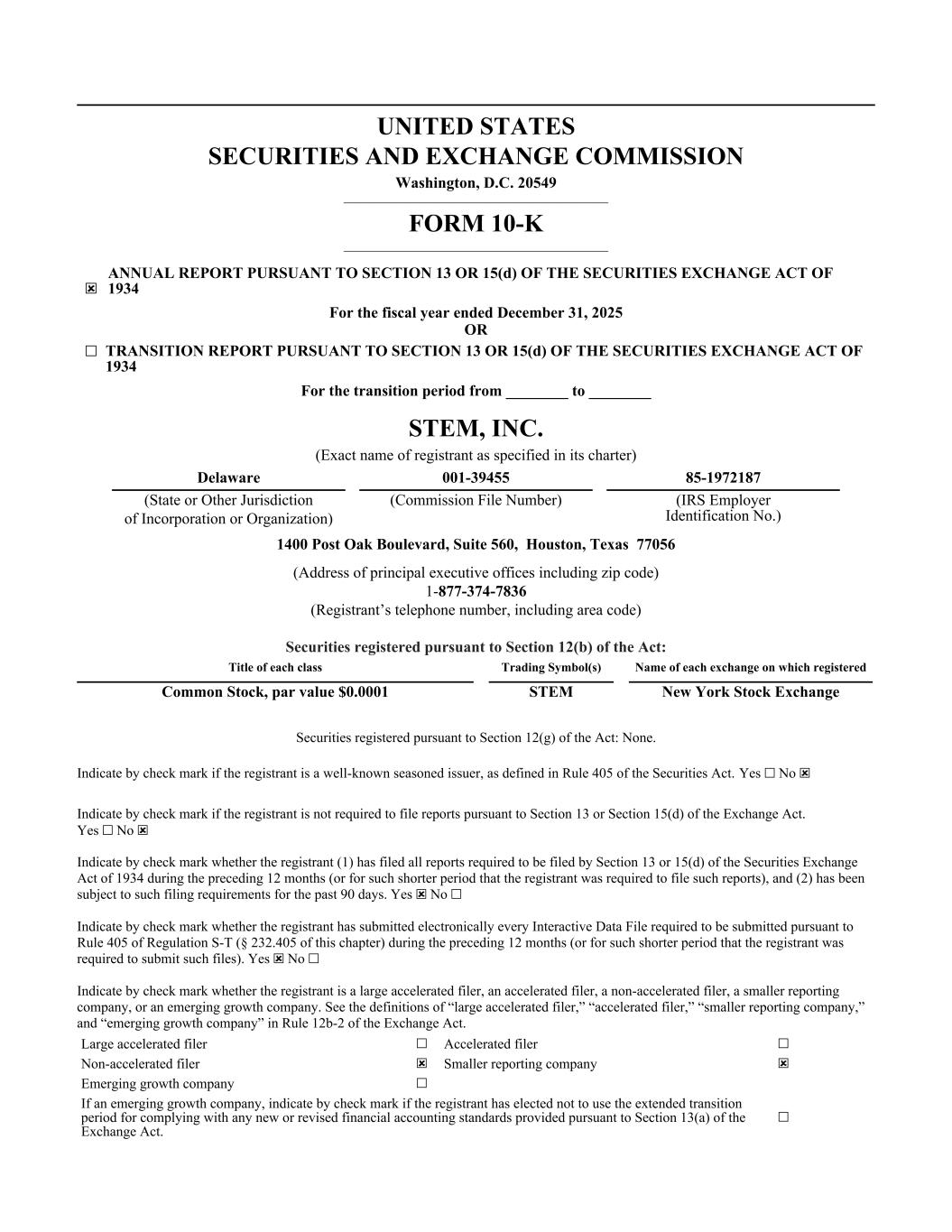
UNITED STATES SECURITIES AND EXCHANGE COMMISSION Washington, D.C. 20549 ————————————————— FORM 10-K ————————————————— ☒ ANNUAL REPORT PURSUANT TO SECTION 13 OR 15(d) OF THE SECURITIES EXCHANGE ACT OF 1934 For the fiscal year ended December 31, 2025 OR ☐ TRANSITION REPORT PURSUANT TO SECTION 13 OR 15(d) OF THE SECURITIES EXCHANGE ACT OF 1934 For the transition period from ________ to ________ STEM, INC. (Exact name of registrant as specified in its charter) Delaware 001-39455 85-1972187 (State or Other Jurisdiction of Incorporation or Organization) (Commission File Number) (IRS Employer Identification No.) 1400 Post Oak Boulevard, Suite 560, Houston, Texas 77056 (Address of principal executive offices including zip code) 1-877-374-7836 (Registrant’s telephone number, including area code) Securities registered pursuant to Section 12(b) of the Act: Title of each class Trading Symbol(s) Name of each exchange on which registered Common Stock, par value $0.0001 STEM New York Stock Exchange Securities registered pursuant to Section 12(g) of the Act: None. Indicate by check mark if the registrant is a well-known seasoned issuer, as defined in Rule 405 of the Securities Act. Yes ☐ No ☒ Indicate by check mark if the registrant is not required to file reports pursuant to Section 13 or Section 15(d) of the Exchange Act. Yes ☐ No ☒ Indicate by check mark whether the registrant (1) has filed all reports required to be filed by Section 13 or 15(d) of the Securities Exchange Act of 1934 during the preceding 12 months (or for such shorter period that the registrant was required to file such reports), and (2) has been subject to such filing requirements for the past 90 days. Yes ☒ No ☐ Indicate by check mark whether the registrant has submitted electronically every Interactive Data File required to be submitted pursuant to Rule 405 of Regulation S-T (§ 232.405 of this chapter) during the preceding 12 months (or for such shorter period that the registrant was required to submit such files). Yes ☒ No ☐ Indicate by check mark whether the registrant is a large accelerated filer, an accelerated filer, a non-accelerated filer, a smaller reporting company, or an emerging growth company. See the definitions of “large accelerated filer,” “accelerated filer,” “smaller reporting company,” and “emerging growth company” in Rule 12b-2 of the Exchange Act. Large accelerated filer ☐ Accelerated filer ☐ Non-accelerated filer ☒ Smaller reporting company ☒ Emerging growth company ☐ If an emerging growth company, indicate by check mark if the registrant has elected not to use the extended transition period for complying with any new or revised financial accounting standards provided pursuant to Section 13(a) of the Exchange Act. ☐
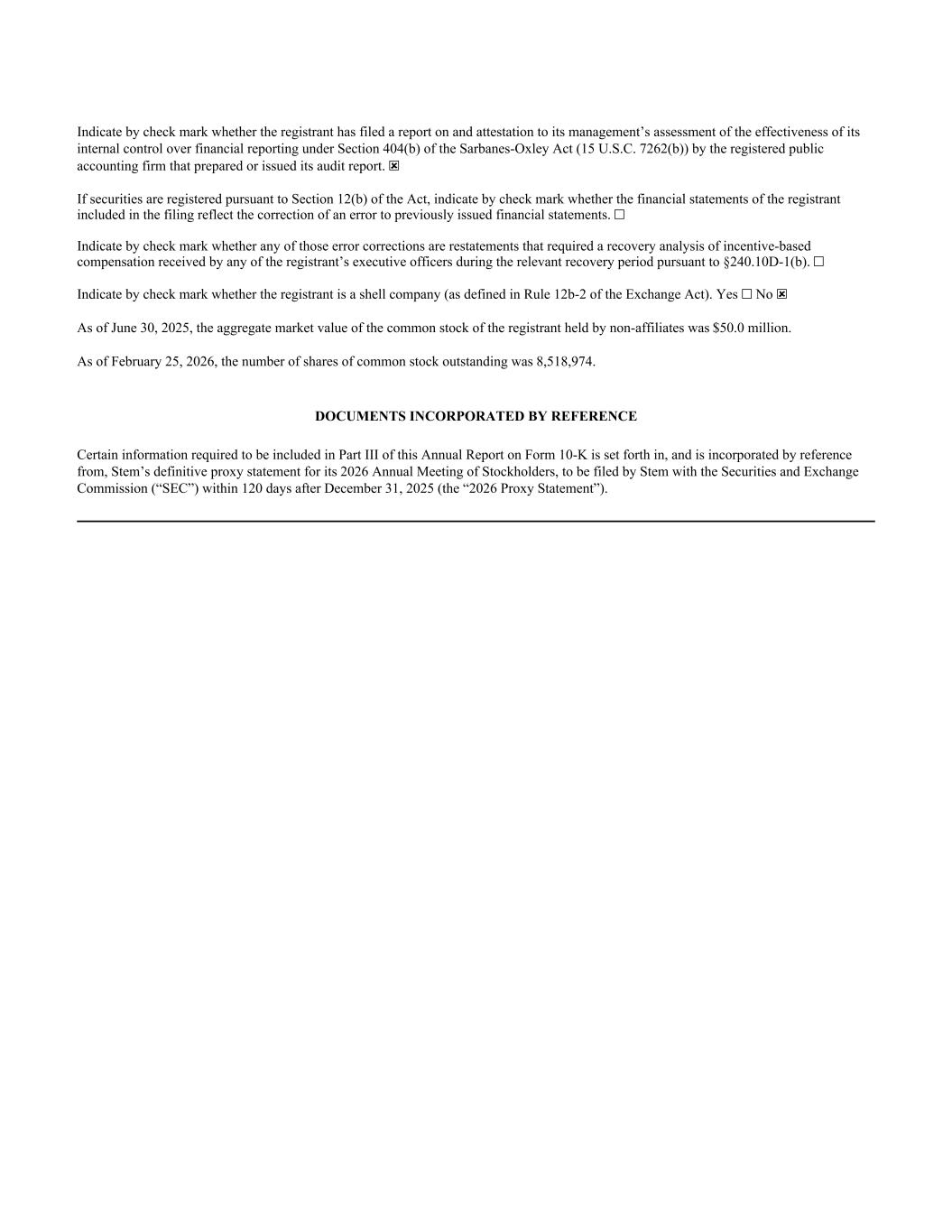
Indicate by check mark whether the registrant has filed a report on and attestation to its management’s assessment of the effectiveness of its internal control over financial reporting under Section 404(b) of the Sarbanes-Oxley Act (15 U.S.C. 7262(b)) by the registered public accounting firm that prepared or issued its audit report. ☒ If securities are registered pursuant to Section 12(b) of the Act, indicate by check mark whether the financial statements of the registrant included in the filing reflect the correction of an error to previously issued financial statements. ☐ Indicate by check mark whether any of those error corrections are restatements that required a recovery analysis of incentive-based compensation received by any of the registrant’s executive officers during the relevant recovery period pursuant to §240.10D-1(b). ☐ Indicate by check mark whether the registrant is a shell company (as defined in Rule 12b-2 of the Exchange Act). Yes ☐ No ☒ As of June 30, 2025, the aggregate market value of the common stock of the registrant held by non-affiliates was $50.0 million. As of February 25, 2026, the number of shares of common stock outstanding was 8,518,974. DOCUMENTS INCORPORATED BY REFERENCE Certain information required to be included in Part III of this Annual Report on Form 10-K is set forth in, and is incorporated by reference from, Stem’s definitive proxy statement for its 2026 Annual Meeting of Stockholders, to be filed by Stem with the Securities and Exchange Commission (“SEC”) within 120 days after December 31, 2025 (the “2026 Proxy Statement”).
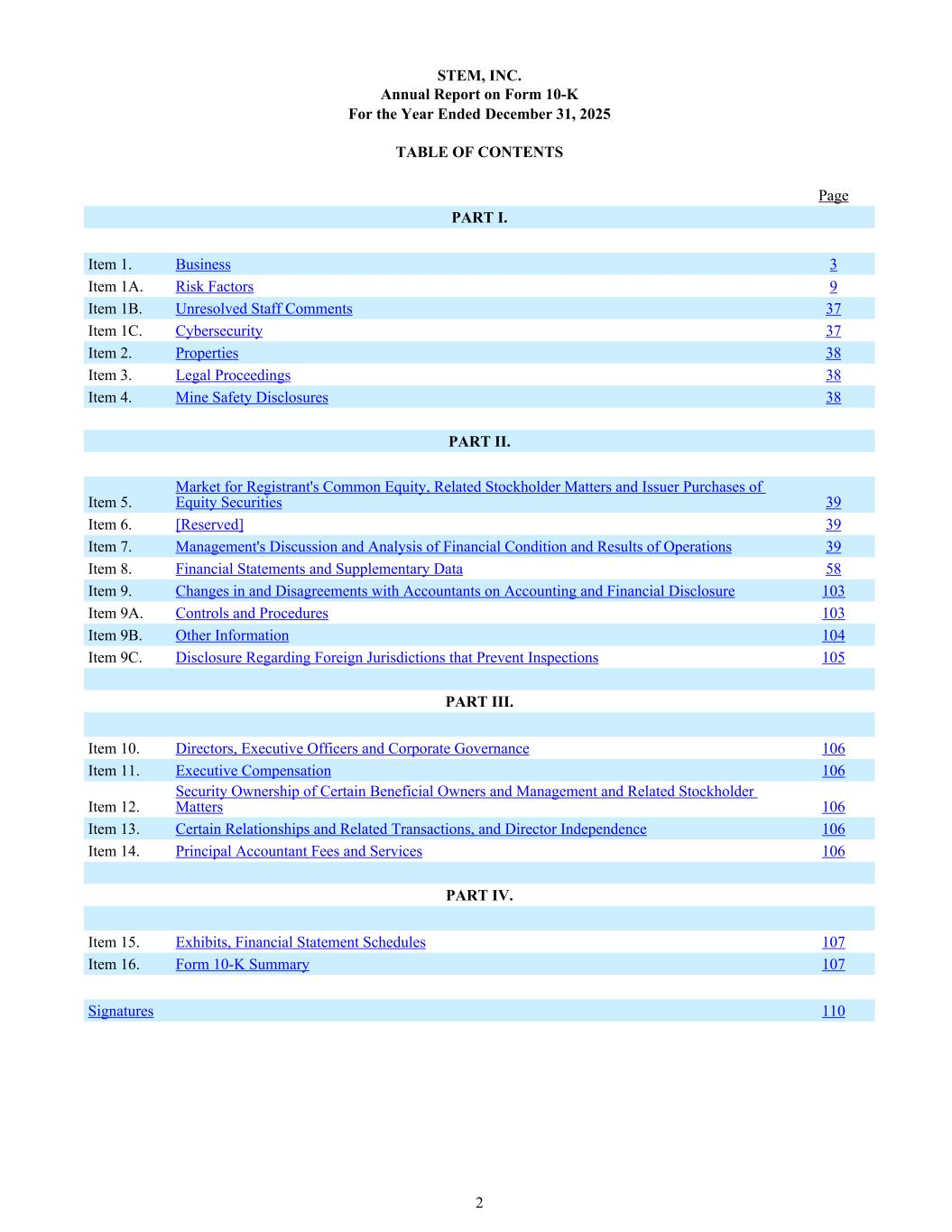
STEM, INC. Annual Report on Form 10-K For the Year Ended December 31, 2025 TABLE OF CONTENTS Page PART I. Item 1. Business 3 Item 1A. Risk Factors 9 Item 1B. Unresolved Staff Comments 37 Item 1C. Cybersecurity 37 Item 2. Properties 38 Item 3. Legal Proceedings 38 Item 4. Mine Safety Disclosures 38 PART II. Item 5. Market for Registrant's Common Equity, Related Stockholder Matters and Issuer Purchases of Equity Securities 39 Item 6. [Reserved] 39 Item 7. Management's Discussion and Analysis of Financial Condition and Results of Operations 39 Item 8. Financial Statements and Supplementary Data 58 Item 9. Changes in and Disagreements with Accountants on Accounting and Financial Disclosure 103 Item 9A. Controls and Procedures 103 Item 9B. Other Information 104 Item 9C. Disclosure Regarding Foreign Jurisdictions that Prevent Inspections 105 PART III. Item 10. Directors, Executive Officers and Corporate Governance 106 Item 11. Executive Compensation 106 Item 12. Security Ownership of Certain Beneficial Owners and Management and Related Stockholder Matters 106 Item 13. Certain Relationships and Related Transactions, and Director Independence 106 Item 14. Principal Accountant Fees and Services 106 PART IV. Item 15. Exhibits, Financial Statement Schedules 107 Item 16. Form 10-K Summary 107 Signatures 110 2
Forward-Looking Statements This Annual Report on Form 10-K (this “Report”), as well as other statements we make, contains “forward-looking statements” within the meaning of the federal securities laws, which include any statements that are not historical facts. Such statements often contain words such as “expect,” “may,” “can,” “believe,” “predict,” “plan,” “potential,” “projected,” “projections,” “forecast,” “estimate,” “intend,” “anticipate,” “ambition,” “goal,” “target,” “think,” “should,” “could,” “would,” “will,” “hope,” “see,” “likely,” and other similar words. Forward-looking statements address matters that are, to varying degrees, uncertain, such as statements about financial and operating performance guidance, outlook, targets and other forecasts or expectations regarding, or dependent on, our business outlook and strategy and expectations around our software and services-centric business; our ability to secure sufficient and timely inventory from suppliers; our ability to meet contracted customer demand; our ability to manage manufacturing or delivery delays; our ability to manage our supply chain and distribution channels; our joint ventures, partnerships and other alliances; forecasts or expectations regarding energy transition and global climate change; reduction of greenhouse gas emissions; the integration and optimization of energy resources; our business strategies and those of our customers; our ability to retain or upgrade current customers, further penetrate existing markets or expand into new markets; the effects of natural disasters and other events beyond our control; the impact of the One Big Beautiful Bill Act (“OBBB”) on our business and that of our customers; the direct or indirect effects on our business of macroeconomic factors and geopolitical instability, such as wars in Ukraine and the Middle East; and our outlook and future results of operations, including revenue, adjusted EBITDA, and the other metrics presented herein. Forward-looking statements are subject to risks, uncertainties, and other factors that could cause actual results or outcomes to differ materially from those expressed or implied by such forward-looking statements, including but not limited to our inability to execute on, and achieve the expected benefits from, our operational and strategic initiatives, including from our cost reduction, workforce reduction and restructuring efforts; our inability to successfully execute on our new software and services-centric strategy; the effects of the OBBB on our business and that of our customers; our inability to secure sufficient and timely inventory from our suppliers, as well as contracted quantities of equipment; our inability to meet contracted customer demand; supply chain interruptions and manufacturing or delivery delays; disruptions in sales, production, service or other business activities; general macroeconomic and business conditions in key regions of the world, including inflationary pressures, general economic slowdown or a recession, rising interest rates, changes in monetary policy, changes in trade policies, including tariffs or other trade restrictions or the threat of such actions, government shutdowns and instability in financial institutions; the direct and indirect effects of widespread health emergencies on our workforce, operations, financial results and cash flows; geopolitical instability, such as the armed conflicts between Russia and Ukraine and in the Gaza Strip and nearby areas; the results of operations and financial condition of our customers and suppliers; pricing pressures; severe weather and seasonal factors; our inability to continue to grow and manage our growth effectively; our inability to attract and retain qualified employees and key personnel; our inability to comply with, and the effect on our business of, evolving legal standards and regulations, including those concerning data protection, consumer privacy, sustainability, and evolving labor standards; risks relating to the development and performance of our software-enabled services; our inability to retain or upgrade current customers, further penetrate existing markets or expand into new markets; the risk that our business, financial condition and results of operations may be adversely affected by other political, economic, business and competitive factors; and other risks and uncertainties discussed in Part I, Item 1A, “Risk Factors” in this Annual Report on Form 10-K and in our other filings with the SEC. If one or more of these or other risks or uncertainties materialize (or the consequences of any such development changes), or should our underlying assumptions prove incorrect, our actual results or outcomes, or the timing of these results or outcomes, may vary materially from those reflected in our forward-looking statements. Forward-looking statements and other statements in this Report regarding our environmental, social, and other sustainability plans and goals are not an indication that these statements are necessarily material to the Company, investors or other stakeholders or required to be disclosed in our filings under U.S. securities laws or any other laws or requirements applicable to the Company. In addition, historical, current, and forward-looking environmental, social, and sustainability-related statements may be based on standards for measuring progress that are still developing, internal controls and processes that continue to evolve, and assumptions that are subject to change in the future. Forward-looking statements in this Report are made as of the date of this Report, and the Company disclaims any intention or obligation to update publicly or revise such forward-looking statement, whether as a result of new information, future events, or otherwise except as required by law. 3
PART I. ITEM 1. BUSINESS Our Strategy In 2024, we announced a new business strategy that reflects a renewed focus on developing and marketing our AI-enabled software, edge and services offerings. This transition entailed significant operational changes during calendar years 2024 and 2025, including reduction of what had historically been the source of most of our revenue (battery resales), adjustments to the way we develop and market our products and services, and realignment of our business processes. These changes have resulted in reduced revenue, increased restructuring-related costs, reduced operating expenses, and short-term disruptions in our operations, which may negatively affect our ability to effectively scale our software and services offerings and achieve our financial and operational targets. Failure to achieve the anticipated benefits of our new strategy may have a material adverse effect on our business, financial condition, and results of operations. See “Our strategy may not achieve anticipated benefits.” in Part I. Item 1A. “Risk Factors” in this Report for additional information about some risks related to our new strategy. Overview Stem, Inc., a Delaware corporation (“Stem,” the “Company,” “we,” “us,” or “our”), is a global leader reimagining technology to support the energy transition. We help asset owners, operators, and energy stakeholders unlock the full value of their energy portfolios by enabling the intelligent development, deployment and operation of clean energy assets. Our integrated software suite, PowerTrack™, provides asset monitoring and optimization software and solutions, supported by professional and managed services, under one consolidated set of solutions. Our solutions and services are designed to address complex energy challenges by transforming our customers’ raw data into clear and accurate information to inform actionable insight. With projects across 55 countries, customers have trusted Stem for nearly 20 years to maximize the value of their clean energy investments. PowerTrack is our integrated suite of software and solutions for solar, storage and hybrid assets. Within the PowerTrack product suite we offer PowerTrack Software, PowerTrack Energy Management System, PowerTrack Supervisory Control and Data Acquisition (“SCADA”), PowerTrack Power Plant Controller (“PPC”), PowerTrack Logger, and PowerTrack Optimizer. Our PowerTrack Software for solar monitoring and analytics enables the standardization of energy portfolios on one hardware agnostic application. We offer commercial- and utility-scale edge hardware solutions, which are original equipment manufacturer (“OEM”)-agnostic devices that are used to connect customers’ solar and storage assets to our software applications in a unified view. We offer project services to our PowerTrack customers to assist with designing and commissioning of solutions. We offer Managed Services, which are full lifecycle, storage services covering the design, procurement, commissioning, operation and optimization of energy storage and hybrid systems, enabled by our PowerTrack Optimizer software, to our customers. We also offer a comprehensive suite of Professional Services to support solar and storage projects through every stage of the project lifecycle, providing our customers with the expertise needed to navigate the complexity and scale of clean energy portfolios. We serve project developers, asset owners, engineering, procurement and construction firms (EPCs) and distributors. Since our inception in 2009, we have engaged in developing and marketing AI-enabled software and services, raising capital, recruiting personnel, and growing our annual recurring revenue. Over the last 15 years, we have been an industry leader in clean energy software and solutions. On April 9, 2025, we announced an approximately 27% reduction of our global workforce, as part of our broader efforts to prioritize investments in software, reduce operating costs, increase efficiency, drive profitable growth and increase stockholder value. For the year ended December 31, 2025, we incurred $6.1 million in restructuring costs related to the reduction of our global workforce. We expect to continue to exercise discipline and incur moderate expenses associated with sales and marketing, research and development, regulatory and related functions. In addition, we expect to continue to manage and reduce our general and administrative expenses associated with scaling our business operations, including legal, audit, additional insurance expenses, investor relations activities and other administrative and professional services. History We were originally known as Star Peak Energy Transition Corp. (“STPK”), which was a special purpose acquisition company that completed its public offering on August 20, 2020. On April 28, 2021 (the “Closing Date”), we consummated a business combination (the “Merger”) pursuant to an Agreement and Plan of Merger by and among STPK, STPK Merger Sub Corp., a Delaware corporation and wholly-owned subsidiary of STPK (“Merger Sub”), and Stem, Inc., a Delaware corporation (“Legacy Stem”). The Merger was effected on the Closing Date through the merger of the Merger Sub with and into Legacy Stem, with Legacy Stem surviving as a wholly-owned subsidiary of the Company. Legacy Stem was a private company and is considered the Company’s accounting predecessor. 4
Competitive Strengths Our competitive strengths include the following: • Exceptional AI and Renewable Energy Expertise: We have a seasoned leadership team with a demonstrated track record of execution and extensive experience in software, distributed energy expertise, technology development, new market commercialization, renewable project development and utility / grid program operations using AI-enabled tools. • Significant Benefits from Scale: We believe we operate one of the largest global distributed clean energy networks, with 36 Gigawatts (“GW”) of solar assets under management and nearly 2 Gigawatt-hours (“GWh”) of operating energy storage assets under management. This large network generates a significant amount of operational data which drives enhanced software performance. • Proven software capabilities: Our core asset management software, PowerTrack, provides a flexible and comprehensive interface that allows customers to monitor and control individual solar assets and portfolios. Our energy storage software is able to co-optimize multiple energy market revenue streams. Both tools function across a diverse fleet of hardware throughout multiple geographies and energy markets. • Subject Matter Expertise: Our goal is to provide a seamless customer experience from commercial proposal to installation to ongoing operations. Our advisory services span development and engineering, procurement and integration, and performance and operations. Our employees have deep industry and technical expertise, which enables us to provide a full suite of monitoring, control, optimization, scheduling, and reporting functionality for our customers. • Leading Strategic Partnerships: We have numerous partnerships with a diverse set of industry leaders to reduce execution risk and increase speed to market in certain geographies. In early 2025, we announced a 484 megawatt (“MW”) solar deployment for Neovolt, one of the largest renewable asset owners in Hungary, who will standardize its asset management on PowerTrack. Research and Development We have invested significant amounts of time and expense in the development of our software. The ability to maintain our leadership position depends in part on our ongoing research and development activities. Our software development, data science, and product professionals are responsible for the design, development, integration, and testing of our software products. We focus our efforts on developing our software to improve our algorithms, augment value with new revenue streams and localize our capabilities based on geography and regulatory considerations. Intellectual Property Intellectual property is a key differentiator for our business, and we seek protection whenever possible for the intellectual property that we own and control, including but not limited to patents, proprietary information, trade secrets and software tools and applications. We rely upon a combination of patent, copyright, trade secret and trademark laws, as well as employee and third-party non-disclosure agreements and other contractual restrictions to establish and protect our proprietary rights. We have developed a significant patent portfolio to protect elements of our proprietary technology. As of December 31, 2025, we had more than 90 patents across storage and solar asset performance. Our intellectual property encompasses a diverse mix of patents with respect to our proprietary systems and software. These patents relate to the following broad categories: • power electronics, including the basic interaction of batteries with the power grid where such electronics convert direct current (DC) battery power to alternating current (AC) compatible grid power; • analytics and control, including use cases and decisions into the operation of an energy storage system and the coordination of providing economic or operational value to a customer; • networked operations and grid services that involve the aggregation and operation of a group of energy storage systems to provide value to a utility or grid operator; and • monitoring and control of solar photo-voltaic power assets along with fault detection, performance analytics and solar generation forecasting. 5
In September 2024, we announced the rebranding of our flagship enterprise platform, Athena®, which is a registered- trademark, to PowerTrack™ Optimizer. Athena’s trademarked applications include “Analyzer™,” “Supervisor™,” “Explorer™,” and “PowerBidder™.” The services relating to these trademarks are sold as a part of our PowerTrack Optimizer offerings and include, but are not limited to, energy optimization services, software as a service for energy optimization services and energy storage charge and discharge. We routinely review our development efforts to assess the existence and patentability of our intellectual property. We pursue the registration of our domain names and trademarks and service marks in the U.S. In an effort to protect our brand, as of December 31, 2025, we had nine registered trademarks and several pending applications in the U.S. Competition The clean energy industry is highly competitive, and new regulatory requirements for carbon emissions, technological advances, the lower cost of renewable energy, the decrease in battery and solar panel costs, improving battery technology and shifting customer demands are causing the industry to evolve and expand. We believe that the principal competitive factors in the clean energy market include, but are not limited to: • safety, reliability and quality; • product performance and uptime; • historical track record and references for customer satisfaction; • experience in proving bankability for multiple stakeholders; • technological innovation; • comprehensive solution from a single provider; • upfront and ongoing costs of software and services; • ease of integration and clarity of value proposition; and • seamless edge hardware, software, and service offerings. There is rising demand for solutions that enable the deployment and operation of clean electric power assets with high availability and performance. Additionally, the transition to renewable energy sources and distributed energy infrastructure has increased the complexity and variability of power generation and end-customer electricity demand. This industry transformation has created an opportunity for an increased role for clean energy software and services like ours. We believe that these trends will drive commercial and industrial (“C&I”) customers, utilities, independent power producers and project developers to grow their use of and investment in clean energy systems. Our key competitors include energy monitoring and optimization software providers, energy storage and edge device OEMs, hardware integration providers, renewable project developers, EPC firms, and consulting firms. In our Managed Services business, our competitors are primarily asset management service providers and energy storage system optimizers, which, respectively, engage with customers to commercially and operationally manage fleets of BESS systems and dispatch those systems into market and program revenue opportunities. Unlike some competitors, Stem’s Managed Service offerings are hardware agnostic and benefit from operational data across a multitude of hardware types, geographies, utilities and grid operator service areas. Our PowerTrack software and edge device products offer highly configurable and scalable edge device and software solutions to control solar, storage and hybrid assets, ingest their performance data and visualize key metrics. Our offerings give our customers visibility and control to operate their energy assets more efficiently and effectively. We believe we are well-positioned to compete successfully in the market for software and software-enabled services. We are among the leaders in global distributed solar and energy storage assets under management, supported by proven technology, focused customer service, strong strategic partnerships and a seasoned leadership team with a track record of success. Government Regulation and Compliance There are varying policy frameworks across the U.S. and abroad designed to support and accelerate customer adoption of clean and reliable distributed generation technologies. These policy initiatives come in the form of tax incentives, cash grants, performance incentives and electric tariffs. Our AI-powered platform manages energy assets operating worldwide, with various policy frameworks across each energy market. Several U.S. states have utility procurement programs, energy system decarbonization goals and/or renewable portfolio standards for which our technology is eligible, including California, Connecticut, Hawaii, Illinois, Massachusetts, Maryland, 6
Michigan, New Jersey, New York and Texas. Additionally, these energy assets often qualify for tax or financial incentives, including certain federal tax credits. The Inflation Reduction Act of 2022 (the “IRA”) established and expanded federal tax credits for certain clean energy projects, including the storage investment tax credit (“ITC”) and solar production tax credit (“PTC”) under Section 48E of the Internal Revenue Code (the “Code”) applicable to energy storage projects. In July 2025, the One Big Beautiful Bill Act (the “OBBB”) was enacted and introduced material changes to clean energy tax credit programs, including those implemented under the IRA. The OBBB also included restrictions on the availability of energy tax credits to U.S. taxpayers owned or controlled by certain foreign entities of concern (“FEOC”) (i.e., China, Russia, Iran and North Korea) as well as limitations on “material assistance” by any such country of concern in the manufacturing of products benefitting from such tax credits. These requirements introduce significant new compliance obligations and supply chain complexity for clean energy market participants, including requirements for enhanced due diligence, component-level sourcing verification, and ongoing monitoring across vendor supply chains. The OBBB also prohibits the transfer of tax credits to specified foreign entities, which may affect the market for transferable tax credits. The availability, value or implementation of federal incentives could also change with political conditions including those related to Congress or the presidency. Federal, state and local government statutes and regulations concerning electricity heavily influence the demand for our products and services even though we are not regulated as a utility. These statutes and regulations often relate to electricity pricing, net metering, incentives, taxation, competition with utilities and the interconnection of customer-owned electricity generation. In the U.S., governments, often acting through state utility or public service commissions, change and adopt different rates for commercial customers on a regular basis. These changes can have a positive or negative effect on our ability to deliver cost savings or revenue generation for our customers. Several states have mandates or policies designed to encourage energy storage adoption. For example, California offers a cash rebate for storage installations through the Self Generation Incentive Program and Massachusetts and New York offer performance-based financial incentives for storage. Storage installations also are supported in some states by state public utility commission policies that require utilities to consider alternatives such as storage before they can build new generation. In February 2018, the Federal Energy Regulatory Commission (“FERC”) issued Order 841, directing regional transmission operators and independent system operators to remove barriers to the participation of storage in wholesale electricity markets and to establish rules to help ensure storage resources are compensated for the services they provide. In September 2020, the FERC issued Order 2222, opening up U.S. wholesale energy markets to aggregations of distributed energy resources like rooftop solar, BTM batteries, and electric vehicles. FERC Order 2222 is in various stages of implementation across the U.S. Solar and energy storage systems require interconnection agreements from the applicable local electric utilities in order to connect to the grid and operate. In almost all cases, interconnection agreements are standard form agreements that have been pre-approved by the local public utility commission or another regulatory body with jurisdiction over interconnection agreements. As such, no additional regulatory approvals are typically required once interconnection agreements are signed. For wholesale transmission, energy storage systems require interconnection agreements with transmission providers. The pace of wholesale interconnection is often a source of delay for project implementation, although FERC is requiring process improvements through Order 2023, which intended to speed up the process of connecting new energy projects . Our operations are subject to stringent and complex federal, state, and local laws and regulations governing the occupational health and safety of our employees and wage regulations. For example, we are subject to the requirements of the federal Occupational Safety and Health Act (“OSHA”), as amended, and comparable state laws that protect and regulate employee health and safety. There are government regulations pertaining to battery safety, transportation of batteries, tariffs, and disposal of hazardous materials. We and our suppliers, as applicable, are required to comply with these regulations in order to sell our batteries into the market. The license and sale of our batteries and technology abroad is likely to be subject to export controls in the future. Each installation must be designed, constructed, and operated in compliance with applicable federal, state, and local regulations, codes, standards, guidelines, policies, and laws. To install and operate energy storage systems on our platform, we, our customers or our partners are required to obtain applicable permits and approvals from various authorities with jurisdiction over energy storage systems and interconnection. 7
Human Capital Resources Driving Organizational Excellence At Stem, our people are critical to our success and the company’s mission. In 2025, we undertook significant organizational transformation to position the company for sustainable growth and operational efficiency. We established a unified “One Stem” brand and worked to sharpen our collective focus on core competencies, and optimized resource allocation across each revenue stream. Additionally, we implemented six core values to define our culture and drive accountability: Ruthlessly Resourceful, Masters of Our Craft, Uncompromising Safety, Sky’s the Limit, Future Builders and Be Real, Do Good. These values serve as the foundation for how we operate, make decisions, and hold ourselves accountable to delivering results. Human Capital As of December 31, 2025, we had 423 employees, of whom 268 were based in the United States and 155 were in international locations. We believe that our future success depends in part on our continued ability to attract, develop, and retain top talent while maintaining rigorous performance standards across the organization. Talent Development At Stem, we prioritize talent development through ongoing initiatives designed to support employee growth and success. Our approach includes talent mechanisms like the simplified annual performance review, encouraging continuous feedback and professional development opportunities. We emphasize goal tracking to align individual and company objectives, and emphasize measurable outcomes to ensure individual contributions directly support company priorities. Career progression materials provide support to employees in mapping out their long-term growth within the organization. These efforts reflect our commitment to building a high-performing team and enabling our employees to reach their full potential. This Sky’s the Limit approach to talent development creates pathways for high performers while maintaining organizational standards. Professional Development We foster continuous learning through our employees’ commitment to being Masters of Our Craft. Our workforce has access to professional development resources, new hire training, and the Stem Learning Series. These resources support both technical expertise and leadership capability development. We encourage and provide opportunities for employees to participate in targeted skill-building activities that are aligned with business needs and individual career progression. Our development investments focus on building capabilities critical to our strategic objectives. Employee Sentiment & Feedback We actively seek employee feedback through the “Your Voice” sentiment survey which measures engagement trends and provides leadership with actionable insights. Feedback data informs organizational decisions, policy refinements and leadership priorities. Consistent with our Be Real, Do Good value, we maintain open communication channels and address employee concerns while balancing organizational needs. Culture & Workplace Environment We are committed to creating an inclusive environment where employees can contribute effectively and professionally. Our One Stem culture emphasizes collaboration across functions and geographies, accountability for results, and respect for diverse perspectives. We continue to create opportunities for connection across employee populations through our global culture coalition and employee resource initiatives, while continuing to maintain focus on operational excellence and business performance. 8
Available Information Our website is www.stem.com. We use our Investor Relations website, at https://investors.stem.com, as a routine channel for distribution of important information, including news releases, investor presentations, and financial information. We make available free of charge, though our Investor Relations website, our Annual Reports on Form 10-K, Quarterly Reports on Form 10-Q, Current Reports on Form 8-K, proxy statements and Forms 3, 4 and 5 filed on behalf of directors and executive officers, and amendments to each of those reports, as soon as reasonably practicable after such documents are filed with or furnished to the SEC. Alternatively, you may access these reports at the SEC’s website at www.sec.gov. Copies are also available, without charge, from Stem Investor Relations, 1400 Post Oak Boulevard, Suite 560, Houston, Texas, 77056. Unless expressly noted, the information on our website or any other website is not incorporated by reference in this Annual Report on Form 10-K and should not be considered part of this Report or any other filing that we make with the SEC. Information About Our Executive Officers The following table sets forth, as of January 31, 2026, the names and ages of our executive officers, including all offices and positions held by each for the past five years. Name Age Current Position and Five-Year Business Experience Arun Narayanan 51 Chief Executive Officer, since January 2025; Chief Executive Officer at RES Digital Solutions, a division of RES (a global independent renewable energy company), from April 2024 to January 2025; Chief Digital Officer at RES from August 2023 to March 2024; and Chief Data Officer of Anglo American plc (a global mining company) from January 2018 to June 2023. Brian Musfeldt 51 Chief Financial Officer, since July 2025; Chief Financial Officer of ikeGPS (a platform technology company supporting above ground grid resiliency and capacity expansion for utilities) from June 2023 to July 2025; Chief Financial Officer of Also Energy, Inc. (which Stem acquired in February 2022) from November 2017 to June 2023. Saul R. Laureles 60 Chief Legal Officer and Corporate Secretary, since May 2021; Director, Corporate Legal Affairs and Assistant Corporate Secretary at Schlumberger Limited (a global energy technology company), from May 2007 to May 2021. Mike Carlson 62 Chief Operating Officer, since September 2022; Vice President of Koch Engineered Solutions (an equipment technology and services company) from August 2020 to September 2022; President of Digital Grid North America at Siemens Industries, Inc. (a technology company) from July 2014 to March 2019. Matthew Tappin 38 President, Software, since September 2024; President of Asset Management Division from March 2023 to September 2024; Vice President, Corporate Development, from May 2021 to March 2023; Corporate Development, New Energies at Shell (an energy company) from August 2019 to May 2021. ITEM 1A. RISK FACTORS. The following discussion of risk factors known to us contains important information for the understanding of our “forward- looking statements,” which are discussed immediately preceding Part I, Item 1, “Business” of this Annual Report on Form 10-K and elsewhere. These risk factors should also be read in conjunction with Part II, Item 7, “Management’s Discussion and Analysis of Financial Condition and Results of Operations,” and the Consolidated Financial Statements and related notes included in this Annual Report on Form 10-K. We urge you to consider carefully the risks described below, which discuss the material factors that make an investment in our securities speculative or risky, as well as in other reports and materials that we file with the SEC and the other information included or incorporated by reference in this Annual Report on Form 10-K. The occurrence of any of the following risks and uncertainties, or additional risks and uncertainties not currently known to us or that we currently deem immaterial, could, in circumstances we may or may not be able to accurately predict, materially adversely affect our business, operations, reputation, financial condition, results of operations, cash flows, liquidity, growth, prospects and stock price. The disclosures in this section reflect our beliefs and opinions as to factors that would be reasonably expected to materially and adversely affect us in the future. References to past events are provided by way of example only and are not intended to be a complete listing or a representation as to whether or not such factors have occurred in the past. 9
Risk Factors Summary Risks Related to Our Business and Industry • Our limited operating history at current scale and our nascent industry make evaluating our business and prospects difficult. • Our distributed generation offerings may not receive widespread market acceptance. • Sufficient demand for our software and services may not develop or take longer to develop than we anticipate. • Estimates and assumptions used to determine the size of our total addressable market may be inaccurate. • We currently face and will continue to face significant competition. • The use of artificial intelligence in our business and associated challenges could result in harm to our business. • Our future growth will depend on continuing to expand and diversify our new product and new market opportunities, and if we do not successfully execute on our new product and new market plans, or if our new product and new market opportunities are more limited than we expect, our operating results and future growth prospects could be adversely affected. Risks Relating to Our Operations • Our new strategy may not achieve anticipated benefits. • Supply chain disruption and competition could result in insufficient inventory and negatively affect our business. • We face risks resulting from supplier concentration and limited supplier capacity. • Long-term supply agreements could result in insufficient inventory. • We depend on significant customers for a substantial portion of our revenue. If we fail to retain or expand our customer relationships or significant customers reduce their purchases, our revenue could decline significantly. • Our hardware and software-enabled services involve a lengthy sales and installation cycle. If we fail to close sales on a regular and timely basis, it could adversely affect our business. • We may fail to attract and retain qualified management and technical personnel, which may adversely affect our ability to compete and grow our business. • We have incurred significant losses in the past and may continue to incur net losses through at least 2026. • We may not be able to develop, produce, market or sell our hardware and software-enabled services successfully. • We may be unable to reduce our cost structure. • Any future acquisitions we undertake may disrupt our business, adversely affect operations, dilute our stockholders, and expose us to significant costs and liabilities. • Our current and planned foreign operations will subject us to additional business, financial, regulatory, and competitive risks. • Our platform performance may not meet customer needs. • If any energy storage systems procured from OEM suppliers and provided to our customers contain manufacturing defects, our business and financial results could be adversely affected. • Estimates of useful life for our energy storage systems and related hardware and software-enabled services may be inaccurate, and our OEM suppliers may not meet service and performance warranties and guarantees. • Increases in hardware costs would adversely affect us. • Future product recalls could materially adversely affect our business, financial condition and operating results. • Any disruption of, or interference with, our use of Amazon Web Services could adversely affect our business. • Any failure to offer high-quality technical support services may adversely affect our relationships with our customers. • Our business currently depends on the availability of rebates, tax credits and other financial incentives. • The economic benefit of our energy storage systems to our customers depends on the cost of electricity available from alternative sources. 10
• Our business is subject to risks associated with construction, utility interconnection and delays. • If customers do not continue to use our subscription offerings or if we fail to expand the availability of hardware and software-enabled services, our operating results will be adversely affected. • Changes in subscriptions or pricing models may not be reflected in near-term operating results. • Severe weather events may affect our business. • Increased scrutiny from stakeholders and regulators regarding sustainability practices and disclosures could result in additional costs and adversely impact our business and reputation. Risks Related to Third-Party Partners • We are exposed to interconnection and transmission facility development and curtailment risks. • We may not successfully maintain relationships with third parties such as contractors and developers. • We must maintain customer confidence in our long-term business prospects in order to maintain and grow our business Risks Related to Our Intellectual Property and Technology • Our future growth depends on our ability to continue to develop and maintain our proprietary technology. • We may experience information technology or data security failures. • Our technology could have undetected defects, errors or bugs in hardware or software. • We may not adequately secure, protect and enforce our intellectual property rights and trademarks. • Our patent applications may not result in issued patents, and our issued patents may not provide adequate protection • We may need to defend ourselves against claims that we have infringed, misappropriated, or otherwise violated the intellectual property rights of others. Regulatory Risks • Negative attitudes toward renewable energy from lawmakers, government officials and others may adversely affect our business, including by delaying permits and government funding for our customers’ projects. • The installation and operation of our energy storage systems are subject to environmental laws and regulations. • Existing regulations and changes to such regulations may reduce demand for our energy storage systems. • Opposition to our customers’ project requests for permits could adversely affect our operating plans. • Our business could be adversely affected by trade tariffs or other trade barriers. Additional Risks Related to Our Securities and Capital Structure • Analysts may not publish sufficient or any research about our business or may publish inaccurate or unfavorable research. • The trading price of our common stock is volatile. • We may issue a significant number of shares in the future in connection with investments or acquisitions. • If we fail to maintain an effective system of disclosure controls and internal control over financial reporting, our ability to produce timely and accurate consolidated financial statements or comply with applicable regulations could be impaired. • Certain provisions of our organizational documents may have an anti-takeover effect. • Our exclusive forum provision may limit our stockholders’ ability to obtain a favorable judicial forum for disputes. • The capped call transactions entered into in connection with the pricing of our 2028 and 2030 Convertible Notes may adversely affect the market price of our stock. • Our stockholders may face dilution if we issue additional shares of our capital stock, including as a result of the exercise of the Warrants. 11
General Risk Factors • We will continue to incur significant costs as a result of operating as a public company. • Current and future litigation, investigations or regulatory or administrative proceedings could have a material adverse effect on our business. Risks Related to Our Business and Industry Our limited operating history at current scale and our nascent industry make evaluating our business and prospects difficult. From our inception in 2009 through 2012, we were focused principally on research and development activities relating to our energy storage systems technology. We did not sell any of our battery hardware and software-enabled services and did not recognize any significant revenue until much later. Moreover, in October 2024, we announced a new business strategy that reflects a renewed focus on developing and marketing our AI-enabled software and services offerings. This strategy has required significant operational changes, including reduction of what has historically been the source of most of our revenue (battery resales), adjustments to the way we develop and market our products and services, and realignment of our business processes. As a result, we have a limited history operating our business at its current scale and under our current strategy, and therefore a limited history upon which you can base an investment decision. There is rising demand for clean electric power solutions that can provide electric power with lower carbon emissions with high availability. One such solution is distributed, renewable energy generation, which is supplementing and replacing conventional generation sources, given its increasingly compelling economics. Among other renewable energy market trends, we expect our business results to be driven by declines in the cost of generation of renewable power both on an absolute basis and relative to other energy sources (as evidenced by current solar and wind generation deployments), decreases in the cost of manufacturing battery packs and a rapidly growing energy storage market driven by increasing demand from commercial and industrial customers, utilities and grid operators. However, predicting our future revenue and appropriately budgeting for our expenses is difficult, and we have limited insight into trends that may emerge and affect our business. The distributed generation industry is emerging and our distributed generation offerings may not receive widespread market acceptance. The implementation and use of distributed generation at scale is still relatively nascent, and we cannot be sure that potential customers will accept our services and solutions broadly. Enterprises may be unwilling to adopt our offerings over traditional or competing power sources for any number of reasons, including the perception that our technology is unproven, lack of confidence in our business model, unavailability of back-up service providers to operate and maintain the energy storage systems, and lack of awareness of our related products and services. Because this is an emerging industry, broad acceptance of our products and services is subject to a high level of uncertainty and risk. If the market develops more slowly than we anticipate, our business may be adversely affected. If renewable energy technologies are not suitable for widespread adoption, or if sufficient demand for our software- enabled services does not develop or takes longer to develop than we anticipate, our sales may decline and we may be unable to achieve or sustain profitability. The market for renewable, distributed energy generation is emerging and rapidly evolving, and its future success is uncertain. If renewable energy generation proves unsuitable for widespread commercial deployment or if demand for our renewable energy products and services fails to develop sufficiently, our revenue, market share and profitability would be adversely impacted. Many factors may influence the widespread adoption of renewable energy generation and demand for our products and services, including, but not limited to the cost-effectiveness of renewable energy technologies as compared with conventional and competitive technologies, the performance and reliability of renewable energy products as compared with conventional and non-renewable products, fluctuations in economic and market conditions that impact the viability of conventional and competitive alternative energy sources, increases or decreases in the prices of oil, coal and natural gas, continued deregulation of the electric power industry and broader energy industry, and the availability or effectiveness of government subsidies and incentives. You should consider our prospects in light of the risks and uncertainties emerging companies encounter when introducing new products and services into a nascent industry. 12
If the estimates and assumptions we use to determine the size of our total addressable market are inaccurate, our future growth rate may be negatively affected and the potential growth of our business may be limited. Market estimates and growth forecasts are subject to significant uncertainty and are based on assumptions and estimates that may prove to be inaccurate. Even if the markets in which we compete meet our size estimates and forecasted growth, our business could fail to grow at similar rates, if at all. The assumptions relating to our market opportunities include, but are not limited to (i) general declines in the cost of renewable energy generation assets and battery energy storage systems; (ii) growing deployment of renewable energy assets and battery energy storage systems; and (iii) continued complexity of the electrical grid and resulting demand for stability and resiliency. Our expected market opportunities are also based on the assumption that our existing and future offerings will be more attractive to our customers and potential customers than competing products and services. If these assumptions prove inaccurate, our business, financial condition and results of operations could be adversely affected. We currently face and will continue to face significant competition. We compete for customers, financing partners and incentive dollars with other providers of asset performance monitoring and control solutions and energy storage systems. Many providers of electricity, such as traditional utilities and other companies offering distributed generation products, have longer operating histories, customer incumbency advantages, access to and influence with local and state governments, and more capital resources than we do. Significant developments in alternative energy storage and management technologies or improvements in the efficiency or cost of traditional energy sources, including coal, oil, natural gas used in combustion or nuclear power, may materially and adversely affect our business and prospects in ways we cannot anticipate. We may also face new competitors who are not currently in the market, including as a result of the IRA and OBBB and their anticipated impact on our industry. If we fail to adapt to changing market conditions and to compete successfully with new competitors, we will limit our growth and adversely affect our business results. Additionally, in connection with our new business strategy, we are renewing our focus on developing and marketing our AI-enabled software and services offerings. Our competitors may be able to develop new AI-enabled offerings that negatively impact demand for our offerings, or incorporate AI into their offerings more successfully than we do and achieve greater and faster adoption. As a result, even if our services and offerings are more effective than the products and services that our competitors offer, potential customers might select competitive products and services in lieu of purchasing our services, which would limit our growth and adversely affect our business results. We use artificial intelligence in our business, and challenges with properly managing its use could result in harm to our brand, reputation, business or customers, and adversely affect our results of operations. We are renewing our focus on developing and marketing our AI-enabled software and services offerings and incorporating AI in internal tools that support our business. This emerging technology presents a number of risks inherent in its use. AI algorithms are based on machine learning and predictive analytics, which can create accuracy issues, unintended biases, and discriminatory outcomes that could harm our brand, reputation, business, or customers. Additionally, no assurance can be made that the usage of AI will assist us in being more efficient or offset the costs of its implementation. Further, dependence on AI to make certain business decisions may introduce additional operational vulnerabilities by producing inaccurate outcomes, recommendations, or other suggestions based on flaws in the underlying data or other unintended results. Our competitors or other third parties may incorporate AI into their business, services, and products more rapidly or more successfully than us, which could hinder our ability to compete effectively and adversely affect our results of operations. Implementing the use of AI successfully, ethically and as intended, will require significant resources. In addition, the use of AI may increase regulatory, cybersecurity, and data privacy risks, such as intended, unintended, or inadvertent transmission of proprietary or sensitive information. The technologies underlying AI and their use cases are rapidly developing, and it is not possible to predict all of the legal, operational or technological risks related to the use of AI. Our obligation to comply with emerging AI initiatives, laws, and regulations, including under proposed or enacted legislation regulating AI in jurisdictions such as the U.S. and European Union, could entail significant costs, negatively affect our business, or limit our ability to incorporate certain AI capabilities into our business. 13
Our future growth will depend on continuing to expand and diversify our new product and new market opportunities, and if we do not successfully execute on our new product and new market plans, or if our new product and new market opportunities are more limited than we expect, our operating results and future growth prospects could be adversely affected. At the end of 2024, we began implementing our new business strategy that reflects a renewed focus on developing and marketing our AI-enabled software and services offerings and investing in the research and development of new offerings in order to enhance our future growth opportunities. Additionally, we are continuing to seek to expand the markets in which we sell our products and services. If we do not appropriately allocate our resources in line with the market and developing opportunities, our results of operations and future growth prospects could be adversely affected. Our investments also may not result in the growth we expect, or the timing of when we expect it, for a variety of reasons, including but not limited to, changes in growth trends, evolving and changing markets and increasing competition, market opportunities, and technology and product innovation. We may introduce new technologies or products that do not work, are not delivered on a timely basis, are not developed according to product and/or cost specifications, or are not well received by customers. Moreover, there may be fewer opportunities than we expect due to a decline in business or economic conditions or a decreased demand in these markets or for our new products from our expectations, our inability to successfully execute our sales and marketing plans, or for other reasons. In addition to our current growth opportunities, our future growth may be reliant on our ability to identify and develop potential new growth opportunities. This process is inherently risky and may result in investments in time and resources for which we do not achieve any return or value. These risks are enhanced by attempting to introduce multiple breakthrough technologies and products simultaneously. Our growth opportunities and those opportunities we may pursue are subject to rapidly changing and evolving technologies and industry standards, and may be replaced by new technology concepts or platforms. If we do not develop innovative and reliable product offerings and enhancements in a cost-effective and timely manner that are attractive to customers in these markets; if we are otherwise unsuccessful in competing in these new product categories; if the new product categories in which we invest our limited resources do not emerge as expected or do not produce the growth or profitability we expect, or when we expect it, or if we do not correctly anticipate changes and evolutions in technology and platforms, our business and results of operations may be adversely affected. Risks Relating to Our Operations Our strategy may not achieve anticipated benefits. Our failure to do so could adversely affect our business, financial condition, and results of operations. On October 1, 2024, we announced our new strategy. We identified, among other things, the need to transition from reliance on hardware resales to a software- and services-focused business. While we believe this is critical to our long-term growth and profitability, our implementation of this strategy is subject to numerous risks and uncertainties. Our total hardware revenue in fiscal years 2025 and 2024 was $68.6 million and $76.8 million, which comprised 43.9% of our total revenue in fiscal year 2025 and 53.1% of our total revenue in fiscal year 2024, respectively. Our transition away from hardware resales could lead to decreased revenue in the short term, as we work to adjust our revenue streams and our customer base. This decline in revenue could strain our cash flow and temporarily worsen our cash position, which in turn may limit our ability to invest in the necessary technologies, talent and infrastructure required to fully implement the new strategy. If we are unable to generate sufficient cash flow or secure additional funding, we may experience delays in executing our new strategy, which could have a material adverse effect on our business, financial condition, and results of operations. This transition has entailed significant operational changes, including reduction of what has historically been the source of most of our revenue (battery resales), adjustments to the way we develop and market our products and services, and realignment of our business processes. These changes have led to reduced revenue, restructuring-related costs and disruptions in our operations, which may negatively impact our ability to effectively scale our software and services offerings and achieve our financial and operational targets. Failure to achieve the intended benefits of these changes may have a material adverse effect on our business, financial condition, and results of operations. Customer acceptance of our software and service offerings is also critical to our future success. Existing customers may not adopt our new offerings at the rate we expect, and new customers may not be attracted to our software-based solutions. If market demand for the types of AI-driven clean energy software and services we are developing and will seek to develop in the future does not grow as anticipated, or if competitors offer more attractive products, our revenue growth and market position could be adversely affected. As with all software offerings, there is also a risk that our solutions could be vulnerable to 14
cybersecurity threats or contain errors, bugs, or other issues affecting their functionality, which could negatively affect customer satisfaction and adoption. In addition, continuing to execute on the new strategy requires investment in new capabilities and resources, particularly in software development, data management, and AI. We may face challenges in recruiting, retaining, and training employees who have the necessary skill sets to support our new business model. A failure to build or acquire these capabilities in a timely manner could delay the successful execution of the strategy and weaken our competitive position. We are subject to supply chain risk and our suppliers may fail to deliver components according to schedules, prices, quality and volumes that are acceptable to us, which could negatively affect our results of operations. We purchase our components and materials from international and domestic vendors, and are exposed to supply chain risks arising from logistics disruptions. Unexpected changes in business conditions, the macroeconomic environment, geopolitical instability, materials pricing, including inflation of raw material costs, labor issues, wars, natural disasters, health epidemics, trade and shipping disruptions, port congestions and other factors beyond our or our suppliers’ control could also affect these suppliers’ ability to deliver components to us or to remain solvent and operational. In addition, international supply is also exposed to risks related to tariffs and sanctions, as well as political, social, and economic instability in regions where we source products and material. Since April 2025, new, substantial tariffs have been imposed on imports to the U.S. In response, several countries have imposed, or threatened to impose, reciprocal tariffs on imports from the U.S. and other retaliatory measures. These tariffs have caused increases in our supply chain costs, have led us to find alternative suppliers when possible and have also led to increased costs for our customers. These or other tariffs could continue to adversely affect our hardware component prices and negatively affect any plans to sell products in any impacted international markets. Disruptions in the availability of key equipment, components or materials such as lithium may adversely affect our business, prospects and operations, and volatility in prices and availability of such items may negatively affect our customer relationships and ability to plan for future growth. We face risks resulting from supplier concentration and limited supplier capacity. We currently rely on a very small number of suppliers of energy storage systems and other equipment. If any of our suppliers were unable or unwilling to provide us with contracted quantities in a timely manner at prices, quality levels and volumes acceptable to us, we would have very limited alternatives for supply, and we may not be able to contract for and receive suitable alternative supply in a timely manner for our customers, or at all. Such an event may impair our ability to meet scheduled deliveries of our products to customers, which may cause our customers to cancel orders and subject us to liability, including liquidated damages to our customers, and may materially adversely affect our customer relationships, business, prospects, financial condition and results of operations. We may also be unsuccessful in our continued efforts to negotiate with existing suppliers to obtain cost reductions and avoid unfavorable changes to terms. Global demand has increased for lithium- ion battery cells, which has caused challenges for our suppliers, including delays or price volatility. Any such delays or reduced availability of energy storage systems or other component materials may impact our sales and operating results. Further, these risks may increase as the market demand for our offerings grows. Additionally, some of our suppliers supply systems and components to other businesses, including businesses engaged in the production of consumer electronics and other industries unrelated to energy storage systems. There are also larger purchasers of certain parts and materials that we supply to our customers. As a result, we may be unable to procure a sufficient supply of the items we require in the event that our suppliers fail to produce sufficient quantities to satisfy the demands of all of their customers. Any of these occurrences could materially adversely affect our business, prospects, financial condition and results of operations. We have entered into long-term supply agreements that could result in insufficient inventory and negatively affect our results of operations. We have entered into long-term supply agreements with certain suppliers of battery storage systems and other components of our energy storage systems. Some of these supply agreements provide for fixed or inflation-adjusted pricing and substantial prepayment obligations. Additionally, if our suppliers provide insufficient inventory at the level of quality required to meet customer demand, or if our suppliers are unable or unwilling to provide us with the contracted quantities, we will have limited alternatives for supply and our results of operations could be materially and negatively impacted. Further, we face significant specific counterparty risk under long-term supply agreements when dealing with certain suppliers without a long, stable production and financial history. Some of our suppliers do not have a long operating history and may not have sufficient capital resources. In the event any such supplier experiences financial difficulties, it may be difficult or may require substantial time and expense to replace such a supplier. We do not know whether we will be able to maintain long-term supply relationships with our critical suppliers, or secure new long-term supply agreements. Additionally, we procure many of the battery storage systems and components of our 15
energy storage systems from non-U.S. suppliers, which exposes us to risks, including but not limited to unforeseen increases in costs or interruptions in supply arising from macroeconomic or geopolitical factors and from changes in applicable international trade regulations, such as taxes, tariffs, or quotas. Any of the foregoing could materially adversely affect our business, financial condition and results of operations. We depend on significant customers for a substantial portion of our revenue. If we fail to retain or expand our customer relationships or significant customers reduce their purchases, our revenue could decline significantly. We depend on a small number of significant customers for our sales, and a small number of customers have historically accounted for a material portion of our revenue. The loss of any one of our significant customers, their inability to perform under their contracts, their termination or failure to renew their contracts with us, or their default in payment could cause our revenue and our working capital to decline materially. As of December 31, 2025, we had $38.4 million of accounts receivable including $2.7 million of unbilled receivables. For the near future, we may continue to derive a significant portion of our revenue from a small number of customers. For the fiscal year ended December 31, 2025, no one customer accounted for more than 10% of our revenue. Loss of a significant customer or a significant reduction in pricing or order volume from a significant customer could materially reduce our revenue and operating results in any reporting period. In addition, we are subject to credit risk of our customers, and our operating results depend on receipt of timely payments from our customers. Any delay in payment by our customers may have an adverse effect on revenue and operating results. There is no assurance that we will be able to collect all or any of the amounts owed to us in a timely matter. If any of our customers face unexpected situations such as financial difficulties, we may not be able to receive full or any payment of the uncollected sums or enforce any judgment debts against such clients, and our business, results of operations and financial condition could be materially and adversely affected. Our hardware and software-enabled services involve a lengthy sales and installation cycle. If we fail to close sales on a regular and timely basis, it could adversely affect our business, financial condition and results of operations. Amounts included in our contracted backlog may not result in actual revenue or translate into profits. Our sales cycle is typically six to twelve months for our hardware and software-enabled services, but can vary considerably. In order to make a sale, we must typically provide a significant level of education to prospective customers regarding the use and benefits of our hardware and software-enabled services. The period between initial discussions with a potential customer and the sale of even a single energy storage system typically depends on a number of factors, including the potential customer’s budget and decision as to the type of financing it chooses to use, as well as the arrangement of such financing. Prospective customers often undertake a significant evaluation process, which may further extend the sales cycle, and which evaluation may be negatively impacted by general market and economic conditions such as inflation, rising interest rates, availability of capital, a recessionary environment, geopolitical instability, energy availability and costs, and the availability and effects of government initiatives. Currently, the time between the entry into a sales contract with a customer and the installation of our energy storage systems can range from nine to eighteen months, or more. This lengthy sales and installation cycle is subject to a number of significant risks over which we have little or no control. We characterize contracts that have been signed but not yet installed as a booking that becomes part of our backlog. Because of both the long sales and installation cycles, we may expend significant resources without generating a sale or producing revenue from our bookings and backlog. These lengthy sales and installation cycles increase the risk that our customers may fail to satisfy their payment obligations, cancel orders before the completion of the transaction or delay the planned date for installation. Cancellation rates may be affected by factors outside of our control including, but not limited to, an inability to install an energy storage system at the customer’s chosen location because of permitting or other regulatory issues, unanticipated changes in the cost or availability of alternative sources of electricity available to the customer or other reasons unique to each customer. Our operating expenses are based on anticipated sales levels, and many of our expenses are fixed. If we are unsuccessful in closing sales after expending significant resources or if we experience delays or cancellations, our business, financial condition and results of operations could be adversely affected. Additionally, we have ongoing arrangements with our customers and target customers. Some of these arrangements are evidenced by contracts or long-term contract partnership arrangements. If these arrangements are terminated or if we are unable to continue to fulfill the obligations under such contracts or arrangements, our business, financial condition and results of operations could be adversely affected. 16
If we are unable to attract and retain key employees and hire qualified management, technical, engineering and sales personnel, our ability to compete and successfully grow our business could be adversely affected. We believe that our success and our ability to reach our strategic objectives are highly dependent on the contributions of our key management, technical, engineering, finance and sales personnel. In 2024 and 2025, several key executives departed the Company, including our Chief Executive Officer, Chief Financial Officer, Chief Strategy Officer, Chief Technology Officer and Chief Accounting Officer. Our Board of Directors appointed a new Chief Executive Officer in January 2025, a new Chief Financial Officer in July 2025 and a new Chief Accounting Officer in December 2025. Executive leadership and senior management transitions, reductions in workforce and employee turnover can be time-consuming, difficult to manage, create instability, cause disruption to our business and result in the loss of institutional knowledge. Any of these outcomes could impede the execution of our day-to-day operations and our ability to fully implement our business strategy. These effects could also make it more difficult to attract and retain talent. The failure to successfully hire and retain key executives and employees or the further loss of any key executives, senior management or employees could have a significant impact on our operations, including declining product identity and competitive differentiation, eroding employee morale and productivity or an inability to maintain internal controls, regulatory or other compliance related requirements, any and all of which could in turn adversely impact our business, financial condition, and results of operations. In addition, our ability to manage our growth effectively, including our ability to expand our market presence in international markets, is impacted by our ability to successfully retain our management team, and hire and train new personnel. Our success in hiring, attracting and retaining senior management and other experienced and highly skilled employees will depend in part on our ability to provide competitive compensation packages and a high-quality work environment and maintain a desirable corporate culture. To help attract, retain, and motivate qualified employees, we use stock-based awards, such as restricted stock units and performance-based cash incentive awards, and in the case of our executive officers, we also use performance stock units. Further sustained declines in our stock price, or lower stock price performance relative to our competitors, can further reduce the retention value of our stock-based awards. We may not be able to attract, integrate, train, motivate or retain current or additional highly qualified personnel, and our failure to do so could adversely affect our business, financial condition and operating results. Furthermore, there is continued and increasing competition for talented individuals in our field. In addition to longstanding competition for highly skilled and technical personnel, we face increased competitive pressures and employee cost inflation in tighter labor markets. Industry competition and cross-industry labor market pressures may negatively affect our ability to attract and retain our executive officers and other key technology, sales, marketing and support personnel and drive increases in our employee costs, both of which could adversely affect our business, financial condition and results of operations. We have incurred significant losses in the past and may incur net losses through at least 2026. Since our inception in 2009, we have incurred significant net losses and have used significant cash in our business. As of December 31, 2025, we had an accumulated deficit of approximately $1,488.7 million. We expect to continue to expand our operations, including by investing in sales and marketing, research and development, staffing systems and infrastructure to support our growth. In October 2024, we announced a new business strategy, which resulted in reduced revenues and short- term disruptions in our operations. Under our current plans, we expect to continue to incur net losses on a GAAP basis through at least 2026. Our ability to achieve profitability in the future will depend on a number of factors, including: • continuing to implement our new strategy; • increasing sales to existing customers and attracting new customers for our products and services; • improving our gross margins; • growing our sales volume; • managing operating expenses; • improving our ability to procure energy storage systems from OEMs on cost-effective terms; • improving the effectiveness of our sales and marketing activities; • attracting and retaining key talent in a competitive marketplace; • operating our systems profitably for the benefit of our customers; and • the availability of incentives, including those associated with the IRA and OBBB. Even if we do achieve profitability when expected, we may be unable to sustain or increase our profitability in the future. 17
We may not realize expected benefits from our cost reduction and restructuring efforts, and our profitability or our business otherwise might be adversely affected. In order to operate more efficiently and cost effectively, we have, and we may from time to time, adjust employment levels, optimize our footprint and/or implement other restructuring activities. For example, in April 2025, we announced an approximately 27% reduction of our global workforce, as part of our broader efforts to prioritize investments in software, reduce operating costs, increase efficiency, drive profitable growth and increase stockholder value. These activities are complex and may involve or require significant changes to our operations. If we do not successfully manage these activities, expected efficiencies and benefits might be delayed or not realized. Risks associated with these actions and other workforce management issues include: unfavorable political responses and reputational harm; unforeseen delays in the implementation of the restructuring activities; additional costs; adverse effects on employee morale; the failure to meet operational targets due to the loss of employees or work stoppages; and difficulty managing our operations during or after facility consolidations, any of which may harm our business or reputation, impair our ability to achieve anticipated cost reductions, or have a material adverse effect on our competitive position, results of operations, cash flows or financial condition. Any future acquisitions we undertake may disrupt our business, adversely affect operations, dilute our stockholders, and expose us to significant costs and liabilities. We may pursue future acquisitions to increase revenue, expand our market position, add to our service offerings and technological capabilities, respond to dynamic market conditions, or for other strategic or financial purposes. However, we cannot assure you that we will be able to identify suitable acquisition candidates or complete any acquisitions on favorable terms, or at all. In addition, any acquisitions we do complete would involve a number of risks, which may include the following: • the identification, acquisition and integration of acquired businesses require substantial attention from management. The diversion of management’s attention and any difficulties encountered in the integration process could hurt our business; • the identification, acquisition and integration of acquired businesses requires significant investment, including to determine which new service offerings we might wish to acquire, harmonize service offerings, expand management capabilities and market presence, and improve or increase development efforts and technology features and functions; • the anticipated benefits from any acquisition may not be achieved on a timely basis or at all, including as a result of loss of clients or personnel of the target, other difficulties in supporting and transitioning the target's clients, difficulties in managing expanded operations and operations in foreign jurisdictions in which we have never operated, the inability to realize expected synergies from an acquisition, or negative organizational cultural effects arising from the integration of new personnel; • we may face difficulties in integrating the personnel, technologies, solutions, operations, and existing contracts of the acquired business; • we may fail to identify all of the problems, liabilities, risks or other shortcomings or challenges of an acquired company, technology or solution, including issues related to intellectual property, solution quality or architecture, income tax and other regulatory compliance practices, revenue recognition or other accounting or internal control practices, or employee or client issues; • to pay for future acquisitions, we could issue additional shares of our common stock or pay cash. Issuance of shares would dilute stockholders. See “- We may issue a significant number of shares in the future in connection with investments or acquisitions” below. Use of cash reserves could diminish our ability to respond to other opportunities or challenges. Borrowing to fund any cash purchase price would result in increased fixed obligations and could also include covenants or other restrictions that would impair our ability to manage our operations; • acquisitions expose us to the risk of assumed known and unknown liabilities including contract, tax, regulatory or other legal, and other obligations incurred by the acquired business or fines or penalties, for which indemnity obligations, escrow arrangements or insurance may not be available or may not be sufficient to provide coverage; • new business acquisitions can generate significant intangible assets that result in substantial related amortization charges and the potential for goodwill impairments in the future; • the operations of acquired businesses, or our adaptation of those operations, may require that we apply revenue recognition or other accounting methodologies, assumptions, and estimates that are different from those we use in our current business, which could complicate our financial statements, expose us to additional accounting and audit costs, and increase the risk of accounting errors; 18
• acquired businesses may have insufficient internal controls that we must remediate, and the integration of acquired businesses may require us to modify or enhance our own internal controls, in each case resulting in increased administrative expense and risk that we experience control deficiencies or fail to comply with the requirements of Section 404 of the Sarbanes-Oxley Act of 2002; and • acquisitions can sometimes lead to disputes with the former owners of the acquired company, which can result in increased legal expenses, management distraction and the risk that we may suffer an adverse judgment if we are not the prevailing party in the dispute. Our current and planned foreign operations expose us to additional business, financial, regulatory and geopolitical risks, and any adverse event could have a material adverse effect on our results of operations. We operate in more than 50 countries, including the United States and Canada, and in multiple European Union (“EU”) and Latin American countries and Asia. Prior to our acquisition of AlsoEnergy in 2022, we operated in only three countries. We have in the past, and may in the future, evaluate further opportunities to expand into new geographic markets and introduce new product offerings and services that are an extension of our existing business. We also may from time to time acquire businesses or product lines with the potential to strengthen our market position, enable us to enter attractive markets, expand our technological capabilities, or provide synergy opportunities. We have very limited experience operating outside of the U.S. Managing our international expansion will require additional resources and controls, including additional manufacturing and assembly facilities. Furthermore, any additional markets that we may enter could have different characteristics from the markets in which we currently operate, and our success will depend on our ability to adapt properly to these differences. Any further international expansion could subject our business to risks associated with international operations, including: • compliance with multiple, potentially conflicting and changing governmental laws, regulations and permitting processes, including trade, labor, environmental, banking, employment, privacy and data protection laws and regulations, such as the EU Data Privacy Directive, as well as tariffs, export quotas, customs duties and other trade restrictions; • compliance with U.S. and foreign anti-bribery laws, including the Foreign Corrupt Practices Act of 1977, as amended; • difficulties in collecting payments in foreign currencies and associated foreign currency exposure; • compliance with potentially conflicting and changing laws of taxing jurisdictions where we conduct business and applicable U.S. tax laws as they relate to international operations, the complexity and adverse consequences of such tax laws and potentially adverse tax consequences due to changes in such tax laws; • the laws of some countries do not protect proprietary rights as fully as do the laws of the U.S. As a result, we may not be able to protect our proprietary rights adequately outside of the U.S.; • regional macroeconomic and geopolitical conditions; • conformity with applicable business customs, including translation into foreign languages and associated expenses; • lack of availability of government incentives and subsidies; • potential changes to our established business model; • cost of alternative power sources, which could vary meaningfully outside the U.S.; • difficulties in staffing and managing foreign operations in an environment of diverse culture, laws and customers, and the increased travel, infrastructure and legal and compliance costs associated with international operations; • customer installation challenges which we have not encountered before, which may require the development of a unique model for each country; • differing levels of demand among members of our customer base, including commercial and industrial customers, utilities, independent power producers and project developers; and • restrictions on repatriation of earnings. As a result of these risks, any future international expansion efforts that we may undertake (as well as our acquisition of AlsoEnergy) may not be successful and may negatively affect our results of operations and profitability. In addition, there may be adverse effects to our business if there is instability, disruption or destruction in a significant geographic region, regardless of cause, including war, terrorism, riot, civil insurrection or social unrest; and natural or man- 19
made disasters, including famine, flood, fire, earthquake, storm or disease. The U.S. government and other governments in jurisdictions in which we operate have imposed severe sanctions and export controls against Russia and Russian interests, and have threatened additional sanctions and controls. The ongoing conflict between Russia and Ukraine has exacerbated shortages and shipping delays affecting certain components and supplies. It is not possible to predict the broader consequences of this conflict, which could include further sanctions, embargoes, greater regional instability, geopolitical shifts and other adverse effects on macroeconomic conditions, international trade, currency exchange rates, supply chains and financial markets. Our platform performance may not meet our customers’ expectations or needs. The renewable energy projects that our customers construct and own are subject to various operating risks that may cause them to generate less value for our customers than expected. These risks include a failure or wearing out of our or our operators’, customers’ or utilities’ equipment; an inability to find suitable replacement equipment or parts; lower than expected supply or quality of the project’s source of electricity or faster than expected diminishment of such electricity supply; or volume disruption in our supply collection and distribution system. Any extended interruption or failure of our customer’s projects for any reason to generate the expected amount of output could adversely affect our business, financial condition and results of operations. In addition, there has been in the past, and may be in the future, an adverse impact on our customers’ willingness to continue to procure additional hardware and software-enabled services from us if any of our customer’s projects incur operational issues that indicate expected future cash flows from the project are less than the project’s carrying value. Any such outcome could adversely affect our operating results or ability to continue to grow our sales volume or to increase sales to existing customers or new customers. If any energy storage systems procured from OEM suppliers and provided to our customers contain manufacturing defects, our business and financial results could be adversely affected. The energy storage systems we pair with our PowerTrack Optimizer platform are complex energy solutions. We rely on our OEM suppliers to control the quality of the battery storage equipment and other components that make up the energy storage system sold to our customers. We are not involved in the manufacture of the batteries or other components of the energy storage systems. As a result, our ability to seek recourse for liabilities and recover costs from our OEM suppliers depends on our contractual rights as well as the financial condition and integrity of such OEM suppliers that supply us with the batteries and other components of our energy storage systems. Such systems may contain undetected or latent errors or defects. In the past, we have discovered latent defects in energy storage systems. In connection with such defects, we could incur significant expenses or disruptions of our operations, including to our energy storage network, that would prevent us from performing the automated data engineering required to support our AI processes and energy storage network. Any manufacturing defects or other failures of our energy storage systems to perform as expected could cause us to incur significant re-engineering costs, divert the attention of our personnel from operating and maintenance efforts, expose us to adverse regulatory action and litigation and significantly and adversely affect customer satisfaction, market acceptance and our business reputation. Furthermore, our OEM suppliers may be unable to correct manufacturing defects or other failures of any energy storage systems in a manner satisfactory to our customers, which could adversely affect customer satisfaction, market acceptance and our business reputation. On rare occasions, lithium-ion batteries can rapidly release the energy they contain by venting smoke and flames in a manner that can ignite nearby materials as well as other lithium-ion batteries. Any such occurrences could subject us to lawsuits, product recalls or redesign efforts, all of which would be time consuming and expensive. Also, negative public perceptions regarding the suitability of lithium-ion batteries for energy applications or any future incident involving lithium-ion batteries, such as a plant, vehicle or other fire, even if such incident does not involve hardware provided by us, could adversely affect our business and reputation. If our estimates of useful life for our energy storage systems and related hardware and software-enabled services are inaccurate, or if our OEM suppliers do not meet service and performance warranties and guarantees, our business and financial results could be adversely affected. Our software and services offerings are essential to the operation of our hardware products that we sell to customers. As a result, in connection with the sales of energy storage hardware, we enter into recurring long-term services agreements with customers for the usage of our PowerTrack Optimizer platform for approximately 3 to 20 years. Our pricing of services contracts is based upon the value we expect to deliver to our customers, including considerations such as the useful life of the energy storage system and prevailing electricity prices. We also provide performance warranties and guarantees covering the efficiency and output performance of our software-enabled services. We do not have a long history with a large number of field deployments, and our estimates may prove to be incorrect. Failure to meet these performance warranties and guarantee levels may require us to refund our service contract payments to the customer, or require us to make cash payments to the customer based on actual performance, as compared to expected performance. 20
Further, the occurrence of any defects, errors, disruptions in service, or other performance problems, interruptions, or delays associated with our energy storage systems or the PowerTrack Optimizer platform, whether in connection with day-to- day operations or otherwise, could result in: • loss of customers; • loss or delayed market acceptance and sales of our hardware and software-enabled services; • delays in payment to us by customers; • injury to our reputation and brand; • legal claims, including warranty and service level agreement claims, against us; or • diversion of our resources, including through increased service and warranty expenses or financial concessions, and increased insurance costs. The costs incurred in correcting any material defects or errors in our hardware and software or other performance problems may be substantial and could adversely affect our business, financial condition and results of operations. The failure of renewable energy hardware costs to continue to decline would have a negative effect on our business and financial condition. The growth and profitability of our business depends in part on the continued decline in the cost of battery storage, solar photovoltaic (“PV”) system components and related hardware. Over the last decade, the cost of renewable energy hardware has generally declined; however, increased demand and global supply chain constraints could cause price increases. If, for whatever reason, there is a sustained increase in the price of battery storage systems, solar PV system components or related hardware, our business and financial condition will be negatively affected. Future product recalls could materially adversely affect our business, financial condition and operating results. Any product recall in the future, whether it involves our or a competitor’s product, may result in negative publicity, damage our brand and materially and adversely affect our business, financial condition and results of operations. In the future, we may voluntarily or involuntarily initiate a recall if any of our products are proven to be or possibly could be defective or noncompliant with applicable environmental laws and regulations, including health and safety standards. Such recalls involve significant expense and diversion of management attention and other resources, which could adversely affect our brand image, as well as our business, financial condition and operating results. We primarily rely on Amazon Web Services to deliver our services to users on our PowerTrack Optimizer platform, and any disruption of, or interference with, our use of Amazon Web Services could adversely affect our business, financial condition and results of operations. We currently host our PowerTrack Optimizer platform and support our energy storage network operations on one or more data centers provided by Amazon Web Services (“AWS”), a third-party provider of cloud infrastructure services. We do not have control over the operations of the facilities of AWS that we use. AWS’ facilities are vulnerable to damage or interruption from natural disasters, cybersecurity attacks, terrorist attacks, power outages, and similar events or acts of misconduct. Our PowerTrack Optimizer platform’s continuing and uninterrupted performance is critical to our success. We have experienced, and expect that in the future we will experience, interruptions, delays, and outages in service and availability from time to time due to a variety of factors, including infrastructure changes, human or software errors, website hosting disruptions and capacity constraints. In addition, any changes in AWS’ service levels may adversely affect our ability to meet the requirements of users on our PowerTrack Optimizer platform. Since our PowerTrack Optimizer platform’s continuing and uninterrupted performance is critical to our success, sustained or repeated system failures would reduce the attractiveness of our hardware and software-enabled services to customers. It may become increasingly difficult to maintain and improve our performance, as we expand and our energy storage network grows, increasing customer reliance on the PowerTrack Optimizer platform. Any negative publicity arising from any disruptions to AWS’ facilities, and as a result, our PowerTrack Optimizer platform could adversely affect our reputation and brand and may adversely affect the usage of our hardware and software- enabled services. Any of the above circumstances or events may adversely affect our reputation and brand, reduce the availability or usage of our hardware and software- enabled services, lead to a significant short-term loss of revenue, increase our costs, and impair our ability to attract new users, any of which could adversely affect our business, financial condition and results of operations. Our commercial agreement with AWS will remain in effect until terminated by AWS or us. AWS may terminate the agreement for convenience by providing us at least thirty (30) days’ advance notice. AWS may also terminate the agreement for 21
cause upon a material breach of the agreement, subject to AWS providing prior written notice and a 30-day cure period, and may in some cases terminate the agreement immediately for cause upon written notice. Even though our platform is entirely in the cloud, we believe that we could transition to one or more alternative cloud infrastructure providers on commercially reasonable terms. If our agreement with AWS is terminated or we add additional cloud infrastructure service providers, we may experience significant costs or downtime for a short period in connection with the transfer to, or the addition of, new cloud infrastructure service providers. However, we do not believe that such transfer to, or the addition of, new cloud infrastructure service providers would adversely affect our business, financial condition and results of operations over the longer term. Any failure to offer high-quality technical support services may adversely affect our relationships with our customers and adversely affect our financial results. Our customers depend on our support organization to resolve any technical issues relating to our hardware and software- enabled services. In addition, our sales process is highly dependent on the quality of our software and service offerings, on our business reputation and on strong recommendations from our existing customers. Any failure to maintain high-quality and highly-responsive technical support, or a market perception that we do not maintain high-quality and highly-responsive support, could adversely affect our reputation, our ability to sell our products to existing and prospective customers, and our business, financial condition and results of operations. We offer technical support services with our software and service offerings and may be unable to respond quickly enough to accommodate short-term increases in demand for support services, particularly as we increase the size of our customer base. We also may be unable to modify the format of our support services to compete with changes in support services provided by competitors. It is difficult to predict demand for technical support services and if demand increases significantly, we may be unable to provide satisfactory support services to our customers. Additionally, increased demand for these services, without corresponding revenue, could increase costs and adversely affect our business, financial condition and results of operations. Our business currently depends on the availability of rebates, tax credits and other financial incentives to our customers. The reduction, modification, or elimination of government economic incentives could cause our revenue to decline and adversely affect business, financial condition and results of operations. The U.S. federal government and some state and local governments provide incentives to end users and purchasers of our energy storage systems in the form of rebates, tax credits and other financial incentives, such as system performance payments and payments for renewable energy credits associated with renewable energy generation. In addition, some countries outside the United States also provide incentives to current and future end users and purchasers of our energy storage systems. We rely on these governmental rebates, tax credits and other financial incentives to significantly lower the effective price of the hardware and software-enabled services we offer to our customers. However, these incentives may expire on a particular date, end when the allocated funding is exhausted, or be reduced or terminated as a matter of regulatory or legislative policy. Our asset performance monitoring and control solutions, as well as our energy storage systems, have qualified for tax exemptions, incentives or other customer incentives in many states. Some states have utility procurement programs and/or renewable portfolio standards for which our technology is eligible. Our offerings are currently installed in various U.S. states, each of which may have its own enabling policy framework. There is no guarantee that these policies will continue to exist in their current form, or at all. Such state programs may face increased opposition on the U.S. federal, state and local levels in the future. Changes in incentive programs could reduce demand for our offerings, impair sales financing and adversely impact our business results. Under the IRA, the U.S. federal government offers certain federal tax benefits, including Investment Tax Credits (“ITC”) available under the Internal Revenue Code (the “Code”). The OBBB scaled back the ITC available under Section 25D of the Code for residential solar and storage systems purchased through cash or loans. Under the OBBB, the Section 25D credit expired on December 31, 2025. In addition, the OBBB imposed new timing requirements for eligibility under Section 48E of the Code, which governs ITCs for leased solar and storage systems. Previously under the IRA, Section 48E credits were available through 2032 or such later period when the U.S. power sector emitted 75% less carbon emissions than 2022 levels. Under the OBBB, these credits will no longer be available for solar-only projects placed in service after December 31, 2027, unless construction begins on or before July 4, 2026, pursuant to a grandfathering rule. Projects that qualify under this rule must still meet continuity requirements to remain eligible. Additionally, the OBBB introduces new compliance requirements under the Foreign Entity of Concern (“FEOC”) provisions for both Section 48E and the Advanced Manufacturing Production Tax Credit (“AMPTC”) under Section 45X. These provisions limit “material assistance” from FEOCs in projects otherwise eligible for tax credits under Section 48E and Section 45X and establish an escalating threshold of non-FEOC content that must be met by solar and storage projects beginning construction in 2026 and by manufactured components produced beginning in 2026. These federal tax benefits under both the IRA and the OBBB have certain legal and operational requirements. There may be uncertainty as to how such requirements promulgated under the IRA and the OBBB are interpreted. If IRS guidance 22
regarding implementation of the IRA or the OBBB is viewed by investors as unclear, tax credit financing may be delayed or downsized, harming our ability to secure financing for customers. Our failure to either (i) accurately interpret the new requirements under the IRA and the OBBB regarding among other things, domestic content, siting in an “energy community,” “prohibited foreign entities” or “material assistance” from “prohibited foreign entities” or (ii) adequately update our internal processes to meet such requirements, may result a partial or full reduction in the related federal tax benefit, and our customers, financiers and equity investors may require us to indemnify them for certain of such reductions. Changes in federal tax benefits over time also may affect our future performance. Changes in the availability of rebates, tax credits, and other financial programs and incentives could reduce demand for our products and services adversely impact our business results. Additionally, these incentives may expire on a particular date, end when the allocated funding is exhausted, or be reduced or terminated as a matter of regulatory or legislative policy. The continuation of these programs and incentives depends upon continued political support. The economic benefit of our offerings to our customers depends on the cost of electricity available from alternative sources, including local electric utility companies, which cost structure is subject to change. The economic benefit of our offerings to our customers includes, among other things, the benefit of reducing such customer’s payments to the local electric utility company. The rates at which electricity is available from a customer’s local electric utility company is subject to change and any changes in such rates may affect the relative benefits of our products and services. Factors that could influence these rates include the effect of energy conservation initiatives that reduce electricity consumption, construction of additional power generation plants (including nuclear, coal or natural gas), and technological developments by others in the electric power industry. Further, the local electric utility may impose “departing load,” “standby” or other charges on our customers in connection with their acquisition of our energy storage systems, the amounts of which are outside of our control and which may have a material impact on the economic benefit of our energy storage systems to our customers. Changes in the rates offered by local electric utilities and/or in the applicability or amounts of charges and other fees imposed by such utilities on customers acquiring our energy storage systems could adversely affect the demand for our energy storage systems. Additionally, even with available subsidies for our systems, the electricity produced by our energy storage systems is currently not cost competitive in some geographic markets, and we may be unable to reduce our costs to a level at which our energy storage systems would be competitive in such markets. As such, unless the cost of electricity in these markets rises or we are able to generate demand for our energy storage systems based on benefits other than electricity cost savings, our potential for growth in those markets may be limited. Our battery resale business is subject to risks associated with construction, utility interconnection and delays, including those related to obtaining government permits and other contingencies that may arise in the course of completing installations. Although we are not regulated as a utility, federal, state and local government statutes and regulations concerning electricity heavily influence the demand for our products and services. These statutes and regulations often relate to electricity pricing, net metering, incentives, taxation and the rules surrounding the interconnection of customer-owned electricity generation for specific technologies. In the U.S., governments frequently modify these statutes and regulations. Governments, often acting through state utility or public service commissions, may change or adopt different requirements for utilities and rates for commercial customers on a regular basis. Changes, or in some cases a lack of change, in any of the laws, regulations, ordinances or other rules that apply to customer installations and new technology could make it more costly for our customers to install and operate our energy storage systems on particular sites, and in turn could negatively affect our ability to deliver cost savings to customers for the purchase of electricity. The installation and operation of our energy storage systems at a particular site is also generally subject to oversight and regulation in accordance with national, state and local laws and ordinances relating to building codes, safety, environmental protection and related matters, and typically requires obtaining and keeping in good standing various local and other governmental approvals and permits, including environmental approvals and permits, that vary by jurisdiction. In some cases, these approvals and permits require periodic renewal. It is difficult and costly to track the requirements of every individual authority having jurisdiction over energy storage system installations, to design our energy storage systems to comply with these varying standards, and for our customers to obtain all applicable approvals and permits. We cannot predict whether or when all permits required for a given customer’s project will be granted or whether the conditions associated with the permits will be achievable. The denial or delay of a permit or utility connection essential to a project or the imposition of impractical conditions would impair our customer’s ability to develop the project. In addition, we cannot predict whether the permitting process will be lengthened due to complexities and appeals. Delay in the review and permitting process for a project can impair or delay our customers’ abilities to develop that project or increase the cost so substantially that the project is no longer attractive to our customers. Furthermore, unforeseen delays in the review and permitting process could delay the timing of the 23
installation of our energy storage systems and could therefore adversely affect the timing of the recognition of revenue related to hardware acceptance by our customer, which could adversely affect our operating results in a particular period. In addition, the successful installation of our energy storage systems is dependent upon the availability of and timely connection to the local electric grid. We may be unable to obtain the required consent and authorization of local utilities to ensure successful interconnection to energy grids to enable the successful discharge of renewable energy to customers. Any delays in our customers’ ability to connect with utilities, delays in the performance of installation-related services or poor performance of installation-related services will have an adverse effect on our results and could cause operating results to vary materially from period to period. Our business depends on customers renewing their services subscriptions. If customers do not continue to use our subscription offerings or if we fail to expand the availability of products and services available to our customers, our business and operating results will be adversely affected. In addition to upfront sale of hardware and network integration, we depend on customers continuing to subscribe to services enabled by our PowerTrack Optimizer platform. Therefore, it is important that customers renew their subscriptions when the contract term expires, increase their purchases of our hardware and network solutions and enhance their subscriptions. Customers may decide not to renew their subscriptions with a similar contract period, at the same prices or terms or with the same or a greater number of users or level of functionality. Customer retention may decline or fluctuate as a result of a number of factors, including satisfaction with software-enabled services and features, functionality of our energy storage hardware and software-enabled services, prices, the features and pricing of competing products, reductions in spending levels, mergers and acquisitions involving customers and deteriorating general economic conditions. If customers do not renew their subscriptions, if they renew on less favorable terms, if they fail to increase their purchase of our hardware and software-enabled services, or if they fail to refer us their customers and partners as potential new customers, our business, financial condition and results of operations will be adversely affected. Changes in subscriptions or pricing models may not be reflected in near-term operating results. We generally recognize subscription revenue from customers ratably over the terms of their contracts. As a result, most of the subscription revenue reported in each quarter is derived from the recognition of deferred revenue relating to subscriptions entered into during previous quarters. Consequently, a decline in new or renewed subscriptions in any single quarter will likely have only a small impact on revenue for that quarter. However, such a decline will negatively affect revenue in future quarters. In addition, the severity and duration of events may not be predictable and their effects could extend beyond a single quarter. Accordingly, the effect of significant downturns in sales and market acceptance of subscription services, and potential changes in pricing policies or rate of renewals, may not be fully apparent until future periods. Severe weather events, including the effects of climate change, are inherently unpredictable and may have a material adverse effect on our financial results and financial condition. Our business, including our customers and suppliers, may be exposed to severe weather events and natural disasters, such as tornadoes, tsunamis, tropical storms (including hurricanes), earthquakes, windstorms, hailstorms, severe thunderstorms, flooding, wildfires and other fires, extreme heatwaves, drought and power shut-offs causing, among other things, disruptions to our supply chain or utility interconnections and/or damage to energy storage systems installed at our customers’ sites. Such damage or disruptions may prevent us from being able to satisfy our contractual obligations or may reduce demand from our customers for our energy storage systems causing our operating results to vary significantly from one period to the next. We may incur losses in our business in excess of: (1) those experienced in prior years, (2) the average expected level used in pricing, or (3) current insurance coverage limits. The incidence and severity of severe weather conditions and other natural disasters are inherently unpredictable. Climate change is projected to affect the occurrence of certain natural events, such as an increase in the frequency or severity of wind and thunderstorm events, and tornado or hailstorm events due to increased convection in the atmosphere; more frequent wildfires and subsequent landslides in certain geographies; higher incidence of deluge flooding; and the potential for an increase in severity of the hurricane events due to higher sea surface temperatures. Changing market dynamics, global policy developments and the increasing frequency and impact of extreme weather events on critical infrastructure in the U.S. and elsewhere as a result of climate change have the potential to disrupt our business, the business of our suppliers and the business of our customers, and may cause us to experience higher attrition, losses and additional costs to maintain or resume operations. Additionally, climate change and the occurrence of severe weather events may adversely impact the demand, price, and availability of insurance. Due to significant variability associated with future changing climate conditions, we are unable to predict the impact climate change will have on our business. 24
Increased scrutiny from stakeholders and regulators regarding sustainability practices and disclosures, including those related to sustainability, and disclosure could result in additional costs and adversely impact our business and reputation. Companies across all industries are facing increased scrutiny regarding their sustainability practices and disclosures and some institutional and individual investors are using sustainability screening criteria in making investment decisions. Our disclosures on these matters or a failure to satisfy evolving stakeholder expectations for sustainability practices and reporting, which may conflict with one another, may potentially harm our reputation and impact employee retention, customer relationships and access to capital. For example, certain market participants use third-party benchmarks or scores to measure a company’s sustainability practices in making investment decisions and customers and supplies may evaluate our sustainability practices or require that we adopt certain sustainability policies as a condition of awarding contracts. In addition, our failure or perceived failure to pursue or fulfill our goals, targets and objectives or to satisfy various reporting standards within the timelines we announce, or at all, could expose us to government enforcement actions and private litigation. Furthermore, complying or failing to comply with existing or future federal, state, local, and foreign legislation and regulations applicable to our sustainability efforts, which may conflict with one another, could cause us to incur additional compliance and operational costs, suffer reputational harm or to become the target of litigation, investigations or other proceedings initiated by government authorities or private actors, which could materially and adversely affect our business, financial condition and results of operations. Our ability to achieve any goal or objective, including with respect to environmental and diversity initiatives and compliance with sustainability reporting standards, is subject to numerous risks, many of which are outside of our control. Examples of such risks include the availability and cost of technologies and products that meet sustainability and ethical supply chain standards, evolving regulatory requirements affecting sustainability standards or disclosures, our ability to recruit, develop and retain diverse talent in our labor markets, and our ability to develop reporting processes and controls that comply with evolving standards for identifying, measuring and reporting sustainability metrics. Methodologies for reporting sustainability data may be updated and previously reported sustainability data may be adjusted to reflect improvement in availability and quality of third-party data, changes in assumptions, changes in the nature and scope of our operations and other changes in circumstances. Our processes and controls for reporting sustainability matters across our operations and supply chain are evolving along with multiple disparate standards for identifying, measuring, and reporting sustainability metrics, including sustainability-related disclosures that may be required by the SEC, European and other regulators, and such standards may change over time, which could result in significant revisions to our current goals, reported progress in achieving such goals, or ability to achieve such goals in the future. As sustainability best-practices, reporting standards and disclosure requirements continue to develop, we may incur increasing costs related to sustainability monitoring and reporting. Risks Related to Third-Party Partners Our hardware and certain of our software-enabled services rely on interconnections to distribution and transmission facilities that are owned and operated by third parties, and as a result, are exposed to interconnection and transmission facility development and curtailment risks. Our hardware and certain of our software-enabled services are interconnected with electric distribution and transmission facilities owned and operated by regulated utilities necessary to deliver the electricity that our storage systems produce. A failure or delay in the operation or development of these distribution or transmission facilities could result in a loss of revenues or breach of a contract because such a failure or delay could limit the amount of renewable electricity that our energy storage systems deliver or delay the completion of our customers’ construction projects. In addition, certain of our energy storage systems’ generation may be curtailed without compensation due to distribution and transmission limitations, reducing our revenues and impairing our ability to capitalize fully on a particular customer project’s potential. Such a failure or curtailment at levels above our expectations could impact our ability to satisfy agreements entered into with our suppliers and adversely affect our business. Our growth depends in part on the success of our relationships with third parties, including contractors and project developers We rely on third-party general contractors to install energy storage systems at our customers’ sites. We currently work with a limited number of general contractors, which has impacted and may continue to impact, our ability to facilitate customer installations as planned. Our work with contractors or their subcontractors may have the effect of our being required to comply with additional rules (including rules unique to our customers), working conditions, site remediation and other union requirements, which can add costs and complexity to an installation project. The timeliness, thoroughness and quality of the installation-related services performed by our general contractors and their subcontractors in the past have not always met our expectations or standards, and in the future may not meet our expectations and standards. It may be difficult to find and train third-party general contractors that meet our standards at a competitive cost. 25
In addition, we are investing resources in establishing strategic relationships with market players across a variety of industries, including large renewable project developers, to generate new customers. These programs may not roll out as quickly as planned or produce the results we anticipated. A significant portion of our business depends on attracting new partners and retaining existing partners. Negotiating relationships with our partners, investing in due diligence efforts with potential partners, training such third parties and contractors and monitoring them for compliance with our standards require significant time and resources and may present greater risks and challenges than expanding a direct sales or installation team. If we are not successful in establishing or maintaining our relationships with these third parties, our ability to grow our business and address our market opportunity could be impaired. Even if we are able to establish and maintain these relationships, we may not be able to execute on our goal of leveraging these relationships to meaningfully expand our business, brand estimates of variable consideration related to revenue recognition, and customer base. Such circumstances would limit our growth potential and our opportunities to generate significant additional revenue or cash flows. We must maintain customer confidence in our long-term business prospects in order to maintain and grow our business. Customers may be less likely to purchase our products and services if they do not believe that our business will succeed or that our services and support and other operations will continue in the long term. Similarly, suppliers and other third parties will be less likely to invest time and resources in developing business relationships with us if they do not believe that our business will succeed. Accordingly, in order to build and maintain our business, we must maintain confidence among customers, suppliers, third-party general contractor partners, financing partners, analysts, ratings agencies and other parties in our products and services, long-term financial viability and business prospects. Maintaining such confidence may be particularly complicated by certain factors including those that are largely outside of our control, such as a decline in our stock price, the potential delisting of our common stock on the New York Stock Exchange, changes in senior management, our recent change in business strategy, customer unfamiliarity with our products and services, delivery and service operations to meet demand, competition, future changes in the evolving distributed and renewable energy markets or uncertainty regarding sales performance compared with market expectations. Our ability to maintain such confidence may be particularly complicated by factors such as: • the continued implementation of our new business strategy; • our limited operating history at current scale; • our historical and current lack of profitability; • unfamiliarity with or uncertainty about our energy storage systems and the overall perception of the distributed and renewable energy generation markets; • prices for electricity in particular markets; • competition from alternate sources of energy; • warranty or unanticipated service issues we may experience in connection with third-party manufactured hardware and our proprietary software; • the environmental consciousness and perceived value of environmental programs to our customers; • the size of our expansion plans in comparison to our existing capital base and the scope and history of operations; and • the availability and amount of incentives, credits, subsidies or other programs to promote installation of energy storage systems. Several of these factors are largely outside our control, and any negative perceptions about our long-term business prospects, even if unfounded, would likely adversely affect our business, financial condition and results of operations. 26
Risks Related to Our Intellectual Property and Technology If we are unsuccessful in developing and maintaining our proprietary technology, our ability to attract and retain partners could be impaired, our competitive position could be adversely affected and our revenue could be reduced. Our future growth depends on our ability to continue to develop and maintain our proprietary technology that supports our products and software-enabled services, including our PowerTrack platform. In the event that our current or future products and services require features that we have not developed or licensed, or we lose the benefit of an existing license, we will be required to develop or obtain such technology through purchase, license or other arrangements. If the required technology is not available on commercially reasonable terms, or at all, we may incur additional expenses in an effort to internally develop the required technology. We have received patents and have filed patent applications with respect to certain aspects of our technology, and we generally rely on patent protection with respect to our proprietary technology, as well as a combination of trade secrets and copyright law, employee and third-party non-disclosure agreements and other protective measures to protect intellectual property rights pertaining to our proprietary technology and hardware and software- enabled services. There can be no assurance that the steps taken by us to protect any of our proprietary technology will be adequate to prevent misappropriation of these technologies by third parties. If we were unable to maintain our existing proprietary technology, our ability to attract and retain customers could be impaired, our competitive position could be adversely affected, and our revenue could be reduced. A failure of our information technology (“IT”) and data security infrastructure could adversely affect our business and operations. The efficient operation of our business depends on our IT systems, some of which are managed by third-party service providers. We rely upon the capacity, reliability and security of our IT and data security infrastructure and our ability to effectively manage our business data, accounting, financial, legal and compliance functions, communications, supply chain, order entry and fulfillment, and expand and routinely update this infrastructure in response to the changing needs of our business. Our existing IT systems and any new IT systems we utilize may not perform as expected. If we experience a problem with the functioning of an important IT system or a security breach of our IT systems, including during system upgrades or new system implementations, the resulting disruptions could adversely affect our business. Despite our implementation of reasonable security measures, our IT systems, like those of other companies, are vulnerable to damages from computer viruses, natural disasters, fire, power loss, telecommunications failures, personnel misconduct, human error, unauthorized access, physical or electronic security breaches, cyber-attacks (including malicious and destructive code, phishing attacks, ransomware, and denial of service attacks), and other similar disruptions. Such attacks or security breaches may be perpetrated by bad actors internally or externally (including computer hackers, persons involved with organized crime, or foreign state or foreign state-supported actors). Cybersecurity threat actors employ a wide variety of methods and techniques that are constantly evolving, increasingly sophisticated, and difficult to detect and successfully defend against. Moreover, we may not have the current capability to detect certain vulnerabilities, which may allow those vulnerabilities to persist in our systems over long periods of time. Additionally, it may take considerable time for us to investigate and evaluate the full impact of incidents, particularly for sophisticated attacks. These factors may inhibit our ability to provide prompt, full and reliable information about the incident to our customers, partners, regulators, and the public. Geopolitical tensions or conflicts, such as Russia’s invasion of Ukraine, may further heighten the risk of cyber-attacks. The emergence and maturation of AI capabilities may also lead to new and/or more sophisticated methods of attack, including fraud that relies upon “deep fake” impersonation technology or other forms of generative automation that may scale up the efficiency or effectiveness of cyber-attacks. We have experienced such incidents in the past, and any future incidents could expose us to claims, litigation, regulatory or other governmental investigations, administrative fines and potential liability. Any system failure, accident or security breach could result in disruptions to our operations. A material network breach in the security of our or our service providers’ IT systems could include the theft of our trade secrets, customer information, human resources information or other confidential data, including but not limited to personally identifiable information. Although past incidents have not had a material adverse effect on our business operations or financial performance, to the extent that any disruptions or security breach results in a loss or damage to our data, or an inappropriate disclosure of confidential, proprietary or customer information, it could cause significant damage to our reputation, affect our relationships with our customers and strategic partners, lead to claims against us from governments and private plaintiffs, and otherwise adversely affect our business. We cannot guarantee that future cyberattacks, if successful, will not have a material effect on our business or financial results. Many governments have enacted laws requiring companies to provide notice of cyber incidents involving certain types of data, including personal data. If an actual or perceived cybersecurity breach of security measures, unauthorized access to our system or the systems of the third-party vendors that we rely upon, or any other cybersecurity threat occurs, we may incur liability, costs, or damages, contract termination, our reputation may be compromised, our ability to attract new customers could be negatively affected, and our business, financial condition, and results of operations could be materially and adversely affected. Any compromise of our security could also result in a violation of applicable domestic and foreign security, privacy or 27
data protection, consumer and other laws, regulatory or other governmental investigations, enforcement actions, and legal and financial exposure, including potential contractual liability. In addition, we may be required to incur significant costs to protect against and remediate damage caused by these disruptions or security breaches in the future. Further, our contracts may not fully protect us from liabilities, damages, or claims and, although we carry cyber insurance, we cannot be certain that our coverage will be adequate for liabilities actually incurred, that insurance will continue to be available to us on commercially reasonable terms, or at all, or that any insurer will not deny coverage as to any future claim. In addition, any data breach, security incident, or compromise of protected personal information may also result in notification requirements or other disclosure obligations and may subject us to civil fines and penalties, litigation, regulatory investigations or enforcement actions or claims for damages under applicable privacy laws. Our technology could have undetected defects, errors or bugs in hardware or software which could reduce market adoption, damage our reputation with current or prospective customers and/or expose us to product liability and other claims that could materially and adversely affect our business. We may be subject to claims that our product and service offerings, including our PowerTrack platform, have malfunctioned and persons were injured or purported to be injured. Any insurance that we carry may not be sufficient or it may not apply to all situations. Similarly, to the extent that such malfunctions are related to components obtained from third-party vendors, such vendors may not assume responsibility for such malfunctions. In addition, our customers could be subjected to claims as a result of such incidents and may bring legal claims against us to attempt to hold us liable. Any of these events could adversely affect our brand, relationships with customers, operating results or financial condition. Furthermore, our PowerTrack (formerly Athena) platform is complex, developed for over a decade by many developers, and includes a number of licensed third-party commercial and open-source software libraries. Our software has contained defects and errors and may in the future contain undetected defects or errors. We continue to evolve the features and functionality of our platform through updates and enhancements, and as we do, we may introduce additional defects or errors that may not be detected until after deployment to customers through our hardware. In addition, if our hardware and software- enabled services, including any updates or patches, are not implemented or used correctly or as intended, inadequate performance and disruptions in service may result. Any defects or errors in product or services offerings, or the perception of such defects or errors, or other performance problems could result in any of the following, each of which could adversely affect our business, financial condition and results of operations: • expenditure of significant financial and product development resources, including recalls, in efforts to analyze, correct, eliminate or work around errors or defects; • loss of existing or potential customers or partners; • interruptions or delays in sales; • delayed or lost revenue; • delay or failure to attain market acceptance; • delay in the development or release of new functionality or improvements; • negative publicity and reputational harm; • sales credits or refunds; • exposure of confidential or proprietary information; • diversion of development and customer service resources; • breach of warranty claims; • legal claims under applicable laws, rules and regulations; and • the expense and risk of litigation. Although we have contractual protections, such as warranty disclaimers and limitation of liability provisions, in many of our agreements with customers, resellers and other business partners, such protections may not be uniformly implemented in all guarantees that we have issued under certain customer contracts and, where implemented, may not fully or effectively protect from claims by customers, resellers, business partners or other third parties. Any insurance coverage or indemnification obligations of suppliers may not adequately cover all such claims, or cover only a portion of such claims. A successful product liability, warranty, or other similar claim could have an adverse effect on our business, financial condition and operating results. 28
In addition, even claims that ultimately are unsuccessful could result in expenditure of funds in litigation, divert management’s time and other resources and cause reputational harm. Our failure to adequately secure, protect and enforce our intellectual property rights may undermine our competitive position, and litigation to protect our intellectual property rights may be costly. Although we have taken many protective measures to protect our intellectual property, including trade secrets, policing unauthorized use of proprietary technology can be difficult and expensive. For example, many of our software developers reside in California and we cannot legally prevent them from working for a competitor. Also, litigation may be necessary to enforce our intellectual property rights, protect our trade secrets, or determine the validity and scope of the proprietary rights of others. Such litigation may result in our intellectual property rights being challenged, limited in scope or declared invalid or unenforceable. We cannot be certain that the outcome of any litigation will be in our favor, and an adverse determination in any such litigation could impair our intellectual property rights and may adversely affect our business, prospects and reputation. We rely primarily on patent, trade secret and trademark laws, and non-disclosure, confidentiality, and other types of contractual restrictions to establish, maintain, and enforce our intellectual property and proprietary rights. However, our rights under these laws and agreements afford us only limited protection and the actions we take to establish, maintain, and enforce our intellectual property rights may not be adequate. For example, our trade secrets and other confidential information could be disclosed in an unauthorized manner to third parties, our owned or licensed intellectual property rights could be challenged, invalidated, circumvented, infringed, or misappropriated or our intellectual property rights may not be sufficient to provide us with a competitive advantage, any of which could have a material adverse effect on our business, financial condition and results of operations. Additionally, we rely on our brand names, trade names and trademarks to distinguish our products and services, such as our PowerTrackTM platform (and previously, our Athena® platform), from the products of our competitors; however, third parties may oppose our trademark applications, or otherwise challenge our use of such trademarks. In the event that our trademarks are successfully challenged and we lose rights to use those trademarks, we could be forced to rebrand our products and services, which could result in the loss of goodwill and brand recognition. In addition, the laws of some countries do not protect proprietary rights as fully as do the laws of the U.S. As a result, we may not be able to protect our proprietary rights adequately abroad. Our patent applications may not result in issued patents, and our issued patents may not provide adequate protection, which may have a material adverse effect on our ability to prevent others from commercially exploiting products similar to ours. We cannot be certain that our pending patent applications will result in issued patents or that any of our issued patents will afford protection against a competitor. The status of patents involves complex legal and factual questions, and the breadth of claims allowed is uncertain. As a result, we cannot be certain that the patent applications that we file will result in patents being issued, or that our patents and any patents that may be issued to us in the future will afford protection against competitors with similar technology. In addition, patent applications filed in foreign countries are subject to laws, rules and procedures that differ from those of the U.S., and thus we cannot be certain that foreign patent applications related to issued U.S. patents will be issued in other regions. Furthermore, even if these patent applications are accepted and the associated patents issued, some foreign countries provide significantly less effective patent enforcement than in the U.S. In addition, patents issued to us may be infringed upon or designed around by others and others may obtain patents that we need to license or design around, either of which would increase costs and may adversely affect our business, prospects, and operating results. We may need to defend ourselves against claims that we infringe, have misappropriated or otherwise violate the intellectual property rights of others, which may be time consuming and would cause us to incur substantial costs. Companies, organizations, or individuals, including our competitors, may hold or obtain patents, trademarks, or other proprietary rights that they may in the future believe are infringed by our products and services. Although we are not currently subject to any claims related to intellectual property, these companies holding patents or other intellectual property rights allegedly relating to our technologies could, in the future, make claims or bring suits alleging infringement, misappropriation or other violations of such rights, or otherwise asserting their rights and seeking licenses or injunctions. Several of the proprietary components used in our energy storage systems have been subjected to infringement challenges in the past. We also generally indemnify our customers against claims that the hardware and software-enabled services we supply infringe, misappropriate, or otherwise violate third-party intellectual property rights, and we may therefore be required to defend our customers against such claims. If a claim is successfully brought in the future and we or our hardware and software-enabled services are determined to have infringed, misappropriated, or otherwise violated a third-party’s intellectual property rights, we may be required to do one or more of the following: 29
• cease selling products or services that incorporate the challenged intellectual property; • pay substantial damages (including treble damages and attorneys’ fees if our infringement is determined to be willful); • obtain a license from the holder of the intellectual property right, which license may not be available on reasonable terms or at all; or • redesign our products or services, which may not be possible or cost-effective. Any of the foregoing could adversely affect our business, financial condition and operating results. In addition, any litigation or claims, whether or not valid, could adversely affect our reputation, result in substantial costs, and divert resources and management attention. We also license technology from third parties, and incorporate components supplied by third parties into our hardware. We may face claims that our use of such technology or components infringes or otherwise violates the rights of others, which would subject us to the risks described above. We may seek indemnification from our licensors or suppliers under our contracts with them, but our rights to indemnification or our suppliers’ resources may be unavailable or insufficient to cover our costs and losses. Regulatory Risks Negative attitudes toward renewable energy projects from the U.S. government, other lawmakers and regulators, and activists could adversely affect our business, financial condition and results of operations. Parties with an interest in other energy sources, including lawmakers, regulators, policymakers, environmental and advocacy organizations or other activists may invest significant time and money in efforts to delay, repeal or otherwise negatively influence laws, regulations and programs that promote renewable energy. Many of these parties have substantially greater resources and influence than we have. Further, changes in U.S. federal, state or local political, social or economic conditions, including changes in U.S. Presidential administrations or deprioritization of these laws, programs and regulations, could result in their modification, delayed adoption or repeal. Any failure to adopt, delay in implementing, expiration, repeal or modification of these programs and regulations, or the adoption of any programs or regulations that encourage the use of other energy sources over renewable energy, could adversely affect our business, financial condition and results of operations. The installation and operation of our energy storage systems are subject to environmental laws and regulations in various jurisdictions, and there is uncertainty with respect to the interpretation of certain environmental laws and regulations to our energy storage systems, especially as these regulations evolve over time. We are subject to national, state and local environmental laws and regulations, as well as environmental laws in those foreign jurisdictions in which we operate. Environmental laws and regulations can be complex and are evolving. These laws can give rise to liability for administrative oversight costs, cleanup costs, property damage, bodily injury, fines and penalties. We are committed to compliance with applicable environmental laws and regulations, including health and safety standards, and we routinely review the operation of our energy storage systems for health, safety and compliance. Our energy storage systems, like other battery technology-based products of which we are aware, produce small amounts of hazardous wastes and air pollutants, and we seek to handle these materials in accordance with applicable regulatory standards. Maintaining compliance with laws and regulations can be challenging given the changing patchwork of environmental laws and regulations that prevail at the U.S. federal, state, regional and local levels and in foreign countries in which we operate. Most existing environmental laws and regulations preceded the introduction of battery technology and were adopted to apply to technologies existing at the time, namely large, coal, oil or gas-fired power plants. Currently, there is generally little guidance from these agencies on how certain environmental laws and regulations may, or may not, be applied to our technology. In many instances, our technology is moving faster than the development of applicable regulatory frameworks. It is possible that regulators could delay or prevent us from conducting our business in some way pending agreement on, and compliance with, shifting regulatory requirements. Such actions could delay the sale to and installation by customers of energy storage systems, require their modification or replacement, result in fines, or trigger claims of performance warranties and defaults under customer contracts that could require us to refund hardware or service contract payments, any of which could adversely affect our business, financial performance and reputation. 30
Existing regulations and changes to such regulations impacting the electric power industry may create technical, regulatory and economic barriers which could significantly reduce demand for our energy storage systems. The market for electricity generation products is heavily influenced by U.S. federal, state, local and foreign government regulations and policies, as well as by tariffs, internal policies and practices of electric utility providers. These regulations, tariffs and policies often relate to electricity pricing and technical interconnection of customer-owned electricity generation. These regulations, tariffs and policies are often modified and could continue to change, and this could result in a significant reduction in demand for our energy storage systems. For example, utility companies commonly charge fees industrial customers for disconnecting from the electric grid or for having the capacity to use power from the electric grid for back-up purposes. These fees could change, increasing the cost to our customers of using our offerings and making them less economically attractive. Opposition to our customers’ project requests for permits or successful challenges or appeals to permits issued for their projects could adversely affect our operating plans. A decrease in acceptance of renewable energy projects by local populations, an increase in the number of legal challenges, or an unfavorable outcome of such legal challenges could adversely affect the financial condition of our customers and reduce their demand for our hardware and software-enabled services. For example, persons, associations and groups could oppose renewable energy projects in general or our customers’ projects specifically, citing, for example, misuse of water resources, landscape degradation, land use, food scarcity or price increase and harm to the environment. Moreover, regulation may restrict the development of renewable energy plants in certain areas. In order to develop a renewable energy project, our customers are typically required to obtain, among other things, environmental impact permits or other authorizations and building permits, which in turn require environmental impact studies to be undertaken and public hearings and comment periods to be held during which any person, association or group may oppose a project. The effect of such public opposition to renewable energy projects and any resulting reduction in customer demand for our hardware and software-enabled services could adversely affect our business, financial condition and results of operations. Changes in the U.S. trade environment, including the imposition of import tariffs, could adversely affect the amount or timing of our revenues, results of operations or cash flows. The United States has imposed significant new tariffs on nearly all products and components imported into the United States and could propose additional tariffs or increases to those already in place. Escalating trade tensions, particularly between the United States and China, have led to increased tariffs and trade restrictions, including tariffs applicable to certain materials and components for products used in storage or solar energy projects and the renewable energy market more broadly, such as module supply and availability. More specifically, in March 2018, the United States imposed a 25% tariff on steel imports and a 10% tariff on aluminum imports pursuant to Section 232 of the Trade Expansion Act of 1962 and has imposed additional tariffs on steel and aluminum imports pursuant to Section 301 of the Trade Act of 1974. In February 2025, the United States expanded the Section 232 tariffs on steel and aluminum, raising them to 25% on both metals and eliminating previously available country-level and importer-specific exclusions and exemptions. In June 2025, Section 232 tariffs on steel and aluminum were further increased to 50%, and the scope was broadened to cover the steel and aluminum content of a wider range of derivative products. To the extent we source products that contain overseas supplies of steel and aluminum, these tariffs and any additional or increased tariffs could result in interruptions in the supply chain and negatively affect costs and our gross margins. Additionally, in January 2018, the United States adopted a tariff on imported solar modules and cells pursuant to Section 201 of the Trade Act of 1974. The tariff was initially set at 30%, with a gradual reduction over four years to 15%. In 2022, the United States extended the Section 201 solar tariffs for an additional four years, which declined to a rate of 14% in 2025. The Section 201 solar tariffs expired on February 7, 2026. While this tariff did not apply directly to the components we import, it may have indirectly affected us by affecting the financial viability of solar energy projects, which could in turn reduce demand for our products. Furthermore, in July 2018, the United States adopted a 10% tariff on a long list of products imported from China under Section 301 of the Trade Act of 1974, including, inverters and power optimizers, which became effective on September 24, 2018 and has been increased several times since then. In June 2019, the Office of the U.S. Trade Representative increased the rate of such tariffs from 10% to 25%. In September 2024, Section 301 tariffs on Chinese solar cells and modules were increased from 25% to 50%, and in January 2025, new 50% Section 301 tariffs took effect on Chinese polysilicon and solar wafers. The Section 301 tariff on lithium-ion non-electric vehicle batteries from China, including those used in energy storage systems, increased from 7.5% to 25% effective January 1, 2026. While these tariffs are not directly applicable to our products, they could negatively affect the solar energy projects in which our products are used, which could lead to decreased demand for our products. In 2025, the United States broadly imposed additional 10% tariffs on Chinese goods under the International Emergency Economic Powers Act of 1977. In addition, the United States currently imposes antidumping and countervailing duties on certain imported crystalline silicon photovoltaic (“PV”) cells and modules from China and Taiwan. Such antidumping and countervailing duties can change 31
over time pursuant to annual reviews conducted by the U.S. Department of Commerce (“USDOC”), and an increase in duty rates could have an adverse impact on our operating results. In February 2022, Auxin Solar Inc., a U.S. producer of crystalline silicon PV products, petitioned the USDOC to investigate alleged circumvention of antidumping and countervailing duties on crystalline silicon PV cell and module imports assembled and completed in Cambodia, Malaysia, Thailand, and Vietnam. In August 2023, USDOC issued a final determination that certain Chinese producers are circumventing antidumping and countervailing duties by shipping crystalline silicon PV cells and modules through Cambodia, Malaysia, Thailand, and Vietnam for minor processing. However, that two- year moratorium has since expired. In 2024, USDOC initiated a second solar antidumping and countervailing duties case involving these same four countries, and final antidumping and countervailing duties orders were issued in June 2025. Also in 2025, the United States also initiated an antidumping and countervailing duties case for Chinese anode material, which could affect battery prices, and USDOC initiated antidumping and countervailing duties investigations into imports of solar cell and modules from India, Indonesia, and Laos. The timing and progress of many of our customers’ projects depend upon the supply of batteries, PV cells and modules. As a result, the imposition and collection of antidumping and countervailing duties, the expanded scope of antidumping and countervailing duties investigations to additional countries and battery materials, and the stacking of multiple tariff authorities on such products, it could adversely affect our business, financial condition and results of operations. Tariffs, and the possibility of additional or increased tariffs in the future, have created uncertainty in the industry, particularly in light of the recent change in U.S. Presidential administration. This has resulted in, and may continue to result in, some project delays. If the price of solar systems or energy storage systems in the United States increases, the use of these products could become less economically feasible and could reduce our gross margins or reduce the demand of such systems manufactured and sold, which in turn may decrease demand for our products. Additionally, existing or future tariffs may negatively affect key customers, suppliers, and manufacturing partners. Such outcomes could adversely affect the amount or timing of our revenues, results of operations or cash flows, and continuing uncertainty could cause sales volatility, price fluctuations or supply shortages, or cause our customers to advance or delay their purchase of our products. It is difficult to predict what further trade-related actions governments may take, which may include additional or increased tariffs and trade restrictions, and we may be unable to quickly and effectively react to such actions. Some products that we import may also be affected by the Uyghur Forced Labor Prevention Act (the “UFLPA”), which was signed into law by former President Biden in 2021. According to U.S. Customs and Border Protection, “it establishes a rebuttable presumption that the importation of any goods, wares, articles, and merchandise mined, produced, or manufactured wholly or in part in the Xinjiang Uyghur Autonomous Region of the People’s Republic of China, or produced by certain entities, is prohibited by Section 307 of the Tariff Act of 1930 and that such goods, wares, articles, and merchandise are not entitled to entry to the U.S. The presumption applies unless the Commissioner of U.S. Customs and Border Protection determines that the importer of record has complied with specified conditions and, by clear and convincing evidence, that the goods, wares, articles, or merchandise were not produced using forced labor.” There continues to be uncertainty regarding how to achieve full compliance with the UFLPA, whether related to sufficient traceability of materials or other factors. This continues to create a significant compliance burden and cause supply chain constraints and project delays for our customers that import certain products (including solar panels and related components) from China. Although our own product delivery schedules have not been materially affected thus far, future developments in the enforcement of the UFLPA and related withhold release orders issued by the U.S. Customs and Border Protection may result in disruptions to our own supply chains and future sales, and therefore negatively impact our business, financial condition, and results of operations. Additional Risks Related to our Securities and Our Capital Structure Analysts may downgrade our common stock or drop its coverage. If analysts do not publish research about our business or publish inaccurate or unfavorable research, our stock price and trading volume could decline further. The trading market for our common stock depends in part on the research and reports that analysts publish about our business. We do not have any control over these analysts. If analysts who cover us downgrade our common stock or publish inaccurate or unfavorable research about our business, demand for our common stock could further decrease and our common stock price and trading volume may decline. 32
Our common stock price has been, and may continue to be, subject to significant volatility. The price of our common stock in 2025 continued to be highly volatile and may fluctuate in response to our results of operations in future periods or due to other factors, including factors specific to companies in our industry, many of which are beyond our control. As a result, our share price may continue to experience significant volatility and may not necessarily reflect the value of our expected performance. These fluctuations could cause you to lose all or part of your investment in our common stock. Factors that could cause fluctuations in the trading price of our common stock include the following: • The addition or loss of significant customers; • results of operations that vary from the expectations of securities analysts and investors; • financial and operating guidance, if any, that we provide to the public, and any changes in this guidance or our failure to meet this guidance; • results of operations that vary from those of our competitors; • volatility in the trading prices and trading volumes of technology stocks; • changes in expectations as to our future financial performance, including financial estimates and investment recommendations by securities analysts and investors; • declines in the market prices of stocks generally; • strategic actions by us or our competitors; • announcements by us or our competitors of significant contracts, acquisitions, joint ventures, other strategic relationships or capital commitments; • any significant change in our senior management; • changes in general macroeconomic or market conditions or trends in our industry or markets, including as a result of a general economic slowdown or a recession, increasing interest rates and changes in monetary policy, or inflationary pressures; • changes in business or regulatory conditions, including new laws or regulations or new interpretations of existing laws or regulations applicable to our business; • future sales of our common stock or other securities or the incurrence of significant debt; • investor perceptions or the investment opportunity associated with our common stock relative to other investment alternatives; • the public’s response to press releases or other public announcements by us or third parties, including our filings with the SEC; • litigation involving us, our industry, or both, or investigations by regulators into our operations or those of our competitors; • actions by institutional or activist stockholders; • changes in accounting standards, policies, guidelines, interpretations or principles; and • other events or factors, including those resulting from natural disasters, geopolitical instability or war, acts of terrorism or responses to these events. These broad market and industry fluctuations may adversely affect the market price of our common stock, regardless of our actual operating performance. In addition, in the past, following periods of market volatility, stockholders have instituted securities class action litigation against companies. For example, in May and July 2023, two putative securities class actions were filed against us and certain of our current and former officers and directors alleging claims under Sections 10(b) and 20(a) of the Securities Exchange Act of 1934 and Sections 11 and 15 of the Securities Act of 1933. On December 17, 2025, the United States District Court for the Northern District of California entered an order dismissing with prejudice all such claims. Securities litigation against us could result in substantial costs and divert our management’s time and attention from other business concerns, which could have a material adverse effect on our business, regardless of the outcome of such litigation. We may be the target of additional litigation of this type in the future. 33
Our financial condition and results of operations and other key metrics are likely to continue to fluctuate on a quarterly basis in future periods, which could cause our results for a particular period to fall below expectations, resulting in a severe decline in the price of our common stock. Our financial condition and results of operations and other key metrics have fluctuated significantly in the past and may continue to fluctuate in the future due to a variety of factors, many of which are beyond our control. For example, the amount of revenue we recognize in a given period has been materially dependent on the volume of purchases of our energy storage systems and software-enabled services in that period, as well as on a small number of customers. Furthermore, in October 2024, we announced a new business strategy, which is expected to result in reduced revenues and short-term disruptions in our operations in the near term. In addition to the other risks described herein, the following factors could also cause our financial condition and results of operations to fluctuate on a quarterly basis: • the demand in, or timing of, customer installations of our hardware, which may depend on many factors such as availability of inventory, product quality or performance issues, or local permitting requirements, utility requirements, environmental, health and safety requirements, weather and customer facility construction schedules, and availability and schedule of our third-party general contractors; • delays or cancellations of energy storage system purchases and installations; • fluctuations in our service costs, particularly due to unaccrued costs of servicing and maintaining energy storage systems; • interruptions in our supply chain; • the timing and level of additional purchases by existing customers; • unanticipated expenses or installation delays incurred by customers due to changes in governmental regulations, permitting requirements by local authorities at particular sites, utility requirements and environmental, health and safety requirements; and • disruptions in our sales, production, service or other business activities resulting from our inability to attract and retain qualified personnel. In addition, our revenue, key operating metrics and other operating results in future quarters may fall short of the expectations of investors and financial analysts, which could have an adverse effect on the price of our common stock. We may issue a significant number of shares in the future in connection with investments or acquisitions. We may issue securities in the future in connection with investments or acquisitions or otherwise. The number of shares of common stock issued in connection with an investment or acquisition could constitute a material portion of our then- outstanding shares of common stock. Any issuance of additional securities in connection with investments or acquisitions may result in additional dilution to our stockholders. If we fail to maintain an effective system of disclosure controls and internal control over financial reporting, our ability to produce timely and accurate consolidated financial statements or comply with applicable regulations could be impaired. We are subject to the reporting requirements of the Exchange Act, the Sarbanes-Oxley Act of 2002 (the “Sarbanes-Oxley Act”) and the rules and regulations of the applicable listing standards of the NYSE. We expect that the requirements of these rules and regulations will continue to increase our legal, accounting, and financial compliance costs; make some activities more difficult, time-consuming, and costly; and place significant strain on our personnel, systems, and resources. The Sarbanes-Oxley Act requires, among other things, that we maintain effective disclosure controls and procedures and internal control over financial reporting. We continue to develop and refine our disclosure controls and other procedures that are designed to ensure that information required to be disclosed by us in the reports that we will file with the SEC is recorded, processed, summarized, and reported within the time periods specified in SEC rules and forms and that information required to be disclosed in reports under the Exchange Act is accumulated and communicated to our principal executive and financial officers. We also continue to improve our internal control over financial reporting. In order to maintain and improve the effectiveness of our disclosure controls and procedures and internal control over financial reporting, we have expended, and anticipate that we will continue to expend, significant resources, including accounting-related costs and significant management oversight. Our current controls and any new controls that we develop may become inadequate because of changes in conditions in our business. In addition, changes in accounting principles or interpretations could also challenge our internal controls and require that we establish new business processes, systems, and controls to accommodate such changes. Additionally, if these new 34
systems, controls, or standards and the associated process changes do not give rise to the benefits that we expect or do not operate as intended, it could adversely affect our financial reporting systems and processes, our ability to produce timely and accurate financial reports, or the effectiveness of internal control over financial reporting. Moreover, our business may be harmed if we experience problems with any new systems and controls that result in delays in their implementation or increased costs to correct any post-implementation issues that may arise. Further, weaknesses in our disclosure controls and internal control over financial reporting may be discovered in the future. Any failure to develop or maintain effective controls or any difficulties encountered in their implementation or improvement could harm our business or cause us to fail to meet our reporting obligations and may result in a restatement of our consolidated financial statements for prior periods. Any failure to implement and maintain effective internal control over financial reporting also could adversely affect the results of periodic management evaluations and annual independent registered public accounting firm attestation reports regarding the effectiveness of our internal control over financial reporting. Ineffective disclosure controls and procedures and internal control over financial reporting could also cause investors to lose confidence in our reported financial and other information, which would likely have a negative effect on the trading price of our common stock. In addition, if we are unable to continue to meet these requirements, we may not be able to remain listed on the NYSE. We are required to provide an annual management report on the effectiveness of our internal control over financial reporting. Our independent registered public accounting firm is required to formally attest to the effectiveness of our internal control over financial reporting. Our independent registered public accounting firm may issue a report that is adverse in the event it is not satisfied with the level at which our internal control over financial reporting is documented, designed, or operating. Any failure to maintain effective disclosure controls and internal control over financial reporting could harm our business and could cause a decline in the trading price of our common stock. Certain provisions of our Charter and Bylaws may have an anti- takeover effect and may delay, defer or prevent a merger, acquisition, tender offer, takeover attempt or other change of control transaction that a stockholder might consider in its best interest, including those attempts that might result in a premium over the market price for the shares held by our stockholders. These provisions, among other things: • establish a staggered board of directors divided into three classes serving staggered three-year terms, such that not all members of our board of directors will be elected at one time; • authorize our board of directors to issue new series of preferred stock without stockholder approval and create, subject to applicable law, a series of preferred stock with preferential rights to dividends or our assets upon liquidation, or with superior voting rights to our existing common stock; • eliminate the ability of stockholders to call special meetings of stockholders; • eliminate the ability of stockholders to fill vacancies on our board of directors; • establish advance notice requirements for nominations for election to our board of directors or for proposing matters that can be acted upon by stockholders at our annual stockholder meetings; • permit our board of directors to establish the number of directors; • provide that our board of directors is expressly authorized to make, alter or repeal our Second Amended and Restated Bylaws (the “Bylaws”); • provide that stockholders can remove directors only for cause and only upon the approval of not less than 66 2⁄3 of all outstanding shares of our voting stock; • require the approval of not less than 66 2⁄3 of all outstanding shares of our voting stock to amend specific provisions of our Second Amended and Restated Certificate of Incorporation, as amended (the “Charter”) and for our shareholders to amend our Bylaws; and • limit the jurisdictions in which certain stockholder litigation may be brought. As a Delaware corporation, we are subject to the anti-takeover provisions of Section 203 of the Delaware General Corporation Law (the “DGCL”), which prohibits a Delaware corporation from engaging in a business combination specified in the statute with an interested stockholder (as defined in the statute) for a period of three years after the date of the transaction in which the person first becomes an interested stockholder, unless the business combination is approved in advance by a majority of the independent directors or by the holders of at least two-thirds of the outstanding disinterested shares. The application of Section 203 of the DGCL could also have the effect of delaying or preventing a change of control of us. 35
These anti-takeover provisions could make it more difficult for a third-party to acquire us, even if the third-party’s offer may be considered beneficial by many of our stockholders. As a result, our stockholders may be limited in their ability to obtain a premium for their shares. These provisions could also discourage proxy contests and make it more difficult for you and other stockholders to elect directors of your choosing and to cause us to take other corporate actions you desire. Our Charter designates the Court of Chancery of the State of Delaware as the sole and exclusive forum for certain types of actions and proceedings that may be initiated by our stockholders, which could limit our stockholders’ ability to obtain a favorable judicial forum for disputes with us or our directors, officers, employees or stockholders. Our Charter provides that, that, unless we consent in writing to the selection of an alternative forum, the sole and exclusive forum, to the fullest extent permitted by law, for (i) any derivative action or proceeding brought on our behalf, (ii) any action asserting a breach of a fiduciary duty owed by any director, officer or other employee to us or our stockholders, (iii) any action asserting a claim against us or any director, officer, or other employee arising pursuant to the DGCL, (iv) any action to interpret, apply, enforce, or determine the validity of our Charter or Bylaws, or (v) any other action asserting a claim that is governed by the internal affairs doctrine, shall be the Court of Chancery of the State of Delaware (or another state court or the federal court located within the State of Delaware if the Court of Chancery does not have or declines to accept jurisdiction), in all cases subject to the court’s having jurisdiction over indispensable parties named as defendants. In addition, our Charter provides that the federal district courts of the United States will be the exclusive forum for resolving any complaint asserting a cause of action arising under the Securities Act but that the forum selection provision does not apply to claims brought to enforce a duty or liability created by the Securities Exchange Act of 1934, as amended, (the “Exchange Act”). Although we believe these provisions benefit us by providing increased consistency in the application of Delaware law for the specified types of actions and proceedings, the provisions may have the effect of discouraging lawsuits against us or our directors and officers. Alternatively, if a court were to find the choice of forum provision contained in our Charter to be inapplicable or unenforceable in an action, we might incur additional costs associated with resolving such action in other jurisdictions, which could harm our business, financial condition, and operating results. For example, under the Securities Act, federal courts have concurrent jurisdiction over all suits brought to enforce any duty or liability created by the Securities Act, and investors cannot waive compliance with the federal securities laws and the rules and regulations thereunder. Any person or entity purchasing or otherwise acquiring any interest in our shares of capital stock shall be deemed to have notice of and consent to this exclusive forum provision, but will not be deemed to have waived our compliance with the federal securities laws and the rules and regulations thereunder. The capped call transactions we entered into in connection with the pricing of our 2028 and 2030 Convertible Notes may adversely affect the market price of our common stock. In connection with the pricing of the 2028 and 2030 Convertible Notes, we entered into capped call transactions with several affiliates of the Initial Purchasers (the “Option Counterparties”). The capped call transactions are expected generally to reduce potential dilution to our common stock upon conversion of any 2028 and 2030 Convertible Notes and/or offset any cash payments we are required to make in excess of the principal amount of converted notes, as the case may be, with such reduction and/or offset subject to a cap. In addition, the Option Counterparties and/or their respective affiliates may modify their hedge positions by entering into or unwinding various derivatives with respect to our common stock and/or purchasing or selling our common stock in secondary market transactions and prior to the maturity of the 2028 and 2030 Convertible Notes (and are likely to do so on each exercise date for the capped call transactions or following any termination of any portion of the capped call transactions in connection with any repurchase, redemption or early conversion of the 2028 and 2030 Convertible Notes). This activity could cause or avoid an increase or decrease in the market price of our common stock. We are subject to counterparty risk with respect to the capped call transactions. The Option Counterparties are financial institutions, and we are subject to the risk that any or all of them might default under the capped call transactions. Our exposure to the credit risk of the Option Counterparties is not secured by any collateral. Past global economic conditions have resulted in the actual or perceived failure or financial difficulties of many financial institutions. If an option counterparty becomes subject to insolvency proceedings, we will become an unsecured creditor in those proceedings with a claim equal to our exposure at that time under the capped call transactions with such option counterparty. Our exposure will depend on many factors but, generally, an increase in our exposure will be correlated to an increase in the market price and in the volatility of our common stock. In addition, upon a default by an option counterparty, we may suffer more dilution than we currently anticipate with respect to our common stock. We can provide no assurance as to the financial stability or viability of the option counterparties. 36
Our stockholders and warrantholders may experience substantial dilution in the value of their investment or may otherwise have their interests impaired if we issue additional shares of our capital stock, including as a result of the exercise of the Warrants. Our Charter allows us to issue up to 250 million shares of our Common Stock and up to one million shares of undesignated preferred stock. To raise additional capital, we may in the future sell additional shares of our common stock or other securities convertible into or exchangeable for our common stock at prices that are lower than the prices paid by existing stockholders, and investors purchasing shares or other securities in the future could have rights superior to existing stockholders, which could result in substantial dilution to the interests of existing stockholders. For example, on June 30, 2025, we issued 439,919 warrants (the “Warrants”) to acquire shares of our common stock. The Warrants will expire on the close of business on December 1, 2030 (or the close of business on the next subsequent business day). The exercise of the Warrants will dilute the value of the common stock and stockholder voting power and the ownership interest holders of Warrants who have not exercised their Warrants. Pursuant to our Charter, our board of directors may authorize the issuance of up to one million shares of preferred stock at any time and from time to time, with such terms and preferences as the board of directors determines and without any stockholder approval other than as may be required by NYSE rules. The issuance of such shares of preferred stock could dilute the interest of, or impair the voting power of, our common stockholders. The issuance of such preferred stock could also be used as a method of discouraging, delaying, or preventing a change of control. General Risk Factors Future litigation or administrative proceedings could have a material adverse effect on our business, financial condition, and results of operations. We have been and continue to be involved in legal proceedings, claims, and other litigation. Unfavorable outcomes or developments relating to proceedings to which we are a party or transactions involving our products and services, such as judgments for monetary damages, injunctions, or denial or revocation of permits, could have a material adverse effect on our business, financial condition, and results of operations. In addition, settlement of claims could adversely affect our financial condition and results of operations. Our operating results may be adversely affected by unfavorable macroeconomic, geopolitical, and market conditions. Unfavorable macroeconomic conditions, such as a general slowdown or recession of the global or U.S. economy, uncertainty and volatility in the financial markets, inflation or rising interest rates, as well as geopolitical conditions could reduce investment in projects that make use of our services. Market uncertainty and volatility in various geographies have been magnified as a result of potential shifts in U.S. and foreign trade, economic, and other policies following the recent change in U.S. Presidential administration. In addition, sustained unfavorable macroeconomic conditions might also have a negative impact on many of our customers or suppliers, which could impair their ability to meet their obligations to us. If economic and market conditions globally, in the U.S. or in other key markets become more volatile or deteriorate further, we may experience material impacts on our business, financial condition and results of operations. ITEM 1B. UNRESOLVED STAFF COMMENTS None. ITEM 1C. CYBERSECURITY We maintain a cyber risk management program that is designed to identify, assess, manage, mitigate, and respond to cybersecurity threats. The design of our program is based on recognized best practices and standards for cybersecurity and information technology, including the National Institute of Standards and Technology Cybersecurity Framework. We have implemented a cyber incident response standard operating procedure (the “SOP”) detailing actions to be taken in the event of a cyber incident. Pursuant to the SOP, any suspected cyber breaches or detected vulnerabilities are promptly reported by our cybersecurity team to our Chief Technology Officer (“CTO”) and Chief Legal Officer (“CLO”) for further assessment and/or remediation. In addition, we require our employees to regularly participate in mandatory cybersecurity training that covers critical aspects of digital security, including phishing prevention, threat awareness, and safe data handling practices. Cybersecurity risk considerations are also incorporated into our broader business continuity planning. In addition to our internal processes, our partnerships with various third-party vendors comprise a key component of our cyber risk management program. We engage several reputable third-party companies to monitor and work to maintain the performance and effectiveness of our products and services, as well as to conduct System and Organization Controls (SOC) assessments and our mandatory cybersecurity training for employees. We are also implementing systems and processes 37
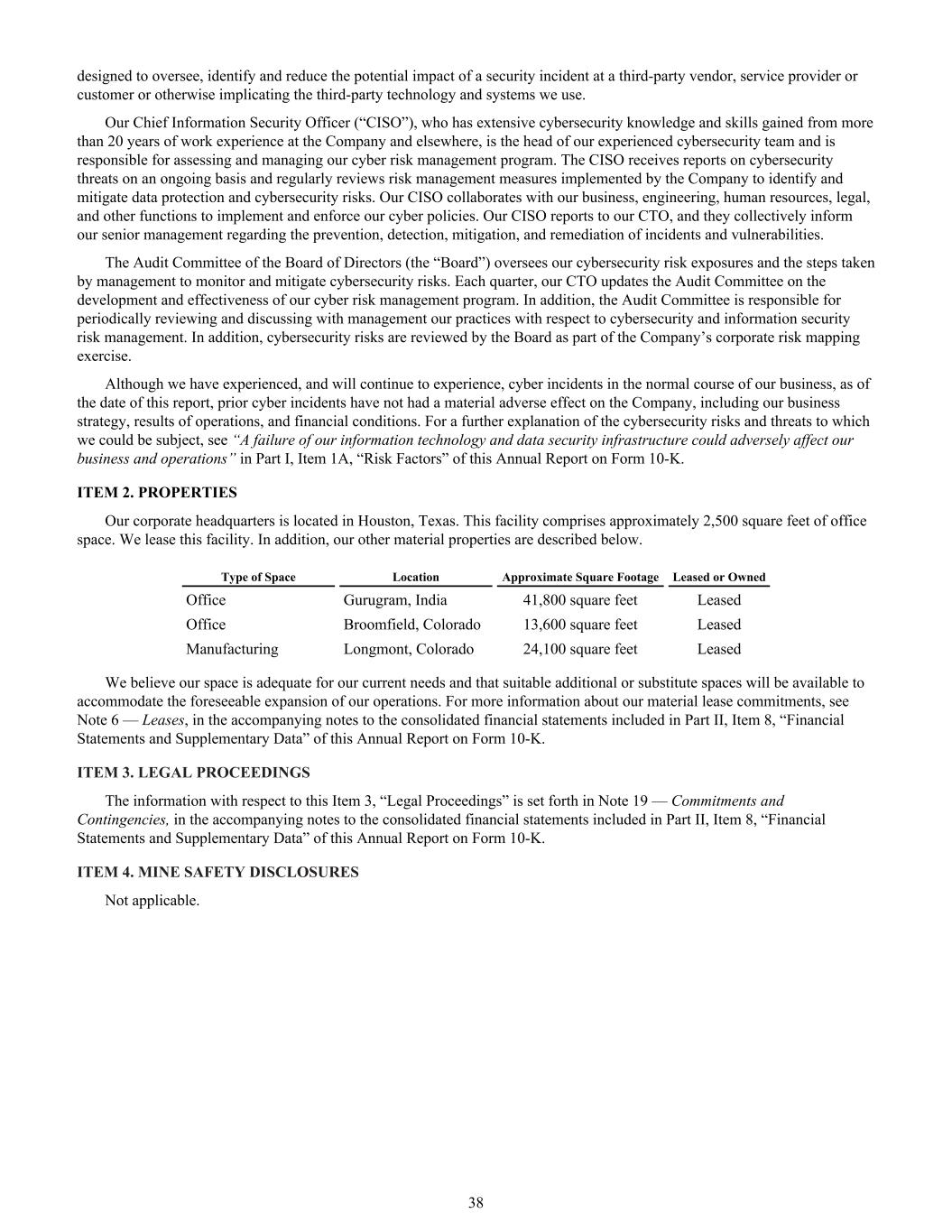
designed to oversee, identify and reduce the potential impact of a security incident at a third-party vendor, service provider or customer or otherwise implicating the third-party technology and systems we use. Our Chief Information Security Officer (“CISO”), who has extensive cybersecurity knowledge and skills gained from more than 20 years of work experience at the Company and elsewhere, is the head of our experienced cybersecurity team and is responsible for assessing and managing our cyber risk management program. The CISO receives reports on cybersecurity threats on an ongoing basis and regularly reviews risk management measures implemented by the Company to identify and mitigate data protection and cybersecurity risks. Our CISO collaborates with our business, engineering, human resources, legal, and other functions to implement and enforce our cyber policies. Our CISO reports to our CTO, and they collectively inform our senior management regarding the prevention, detection, mitigation, and remediation of incidents and vulnerabilities. The Audit Committee of the Board of Directors (the “Board”) oversees our cybersecurity risk exposures and the steps taken by management to monitor and mitigate cybersecurity risks. Each quarter, our CTO updates the Audit Committee on the development and effectiveness of our cyber risk management program. In addition, the Audit Committee is responsible for periodically reviewing and discussing with management our practices with respect to cybersecurity and information security risk management. In addition, cybersecurity risks are reviewed by the Board as part of the Company’s corporate risk mapping exercise. Although we have experienced, and will continue to experience, cyber incidents in the normal course of our business, as of the date of this report, prior cyber incidents have not had a material adverse effect on the Company, including our business strategy, results of operations, and financial conditions. For a further explanation of the cybersecurity risks and threats to which we could be subject, see “A failure of our information technology and data security infrastructure could adversely affect our business and operations” in Part I, Item 1A, “Risk Factors” of this Annual Report on Form 10-K. ITEM 2. PROPERTIES Our corporate headquarters is located in Houston, Texas. This facility comprises approximately 2,500 square feet of office space. We lease this facility. In addition, our other material properties are described below. Type of Space Location Approximate Square Footage Leased or Owned Office Gurugram, India 41,800 square feet Leased Office Broomfield, Colorado 13,600 square feet Leased Manufacturing Longmont, Colorado 24,100 square feet Leased We believe our space is adequate for our current needs and that suitable additional or substitute spaces will be available to accommodate the foreseeable expansion of our operations. For more information about our material lease commitments, see Note 6 — Leases, in the accompanying notes to the consolidated financial statements included in Part II, Item 8, “Financial Statements and Supplementary Data” of this Annual Report on Form 10-K. ITEM 3. LEGAL PROCEEDINGS The information with respect to this Item 3, “Legal Proceedings” is set forth in Note 19 — Commitments and Contingencies, in the accompanying notes to the consolidated financial statements included in Part II, Item 8, “Financial Statements and Supplementary Data” of this Annual Report on Form 10-K. ITEM 4. MINE SAFETY DISCLOSURES Not applicable. 38
PART II. ITEM 5. MARKET FOR REGISTRANT’S COMMON EQUITY, RELATED STOCKHOLDER MATTERS AND ISSUER PURCHASES OF EQUITY SECURITIES Market Information for Common Stock Our common stock is traded on The New York Stock Exchange under the symbol “STEM.” Holders As of February 25, 2026, there were 69 holders of record of our common stock, including Cede & Co., which holds shares as the nominee of The Depository Trust Company, which itself holds shares on behalf of beneficial owners of our common stock. Because many of our shares of common stock are held by brokers and other institutions on behalf of stockholders, we are unable to estimate the total number of stockholders represented by these record holders. Dividend Policy We have not paid any cash dividends on our common stock to date and currently intend to retain any future earnings to fund the growth of our business. The payment of cash dividends is at the sole discretion of the Board and may be affected by various factors, including our future earnings, financial condition, capital requirements, share repurchase activity, current and future planned strategic growth initiatives, levels of indebtedness, and other considerations our Board deems relevant. Recent Sales of Unregistered Securities None. Purchases of Equity Securities by the Issuer and Affiliated Purchasers None. ITEM 6. [RESERVED] ITEM 7. MANAGEMENT’S DISCUSSION AND ANALYSIS OF FINANCIAL CONDITION AND RESULTS OF OPERATIONS You should read the following management’s discussion and analysis of our financial condition and results of operations (“MD&A”) in conjunction with our consolidated financial statements and the related notes included in Part II, Item 8, “Financial Statements and Supplementary Data” of this Report. In addition to our historical consolidated financial information, the following discussion contains forward-looking statements that reflect our plans, estimates, and beliefs. Our actual results and the timing of certain events could differ materially from those discussed in the forward-looking statements. Factors that could cause or contribute to these differences include, but are not limited to, those discussed below and elsewhere in this Report, particularly in Part I, Item 1A, “Risk Factors.” This MD&A generally discusses 2025 and 2024 items and year-to-year comparisons between 2025 and 2024. Discussions of 2023 items and year-to-year comparisons between 2024 and 2023 that are not included in this Annual Report on Form 10-K can be found in Part II, Item 7, “Management’s Discussion and Analysis of Financial Condition and Results of Operations” contained in our Annual Report on Form 10-K filed with the SEC on March 5, 2025. The Merger The information regarding the Merger set forth in the first paragraph of Part 1, Item 1, “Business — History” above is incorporated herein by reference. For financial reporting purposes, Legacy Stem is treated as the accounting acquirer. Overview Stem is reimagining technology to drive the energy transition. We help asset owners, operators and stakeholders benefit from the full value of their energy portfolio by enabling the intelligent development, deployment and operation of clean energy assets. Our integrated software suite, PowerTrack, provides asset monitoring software and solutions, supported by professional and managed services, under one consolidated set of solutions. Our solutions and services are designed to provide customers with the information they need clearly and accurately and help harness raw data to inform actionable insight. With global projects managed in 55 countries, customers have relied on Stem for nearly 20 years to help maximize the value of their clean energy projects. 39
PowerTrack is our integrated suite of software and solutions for solar, storage and hybrid assets. Within the PowerTrack product suite we offer PowerTrack Software, PowerTrack Energy Management System, PowerTrack Supervisory Control and Data Acquisition (“SCADA”), PowerTrack Power Plant Controller (“PPC”), PowerTrack Logger, and PowerTrack Optimizer. Our PowerTrack Software for solar monitoring and analytics enables the standardization of energy portfolios on one hardware agnostic application. We offer commercial- and utility-scale edge hardware solutions, which are original equipment manufacturer (“OEM”)-agnostic devices that are used to connect customers’ solar and storage assets to our software applications in a unified view. We offer project services to our PowerTrack customers to assist with designing and commissioning of solutions. We offer Managed Services, which are full lifecycle, storage services covering the design, procurement, commissioning, operation and optimization of energy storage and hybrid systems, enabled by our PowerTrack Optimizer software, to our customers. We also offer a comprehensive suite of Professional Services to support solar and storage projects through every stage of the project lifecycle, providing our customers with the expertise needed to navigate the complexity and scale of clean energy portfolios. We serve project developers, asset owners, engineering, procurement and construction firms (EPCs) and distributors. Since our inception in 2009, we have engaged in developing and marketing AI-enabled software and services, raising capital, recruiting personnel, and growing our annual recurring revenue. Over the last 15 years, we have been an industry leader in clean energy software and solutions. Each year since our inception, we have incurred net operating losses and negative cash flows from operations. We have financed our operations primarily through cash flows from customers and the issuance of convertible senior notes. Our total revenue increased from $144.6 million for the year ended December 31, 2024 to $156.3 million for the year ended December 31, 2025. For the years ended December 31, 2025 and 2024, we generated net income of $137.8 million and incurred a net loss of $854.0 million, respectively. As of December 31, 2025, we had an accumulated deficit of $1,488.7 million. On April 9, 2025, we announced an approximately 27% reduction of our global workforce, as part of our broader efforts to prioritize investments in software, reduce operating costs, increase efficiency, drive profitable growth and increase stockholder value. For the year ended December 31, 2025, we incurred $6.1 million in restructuring costs related to the reduction of our global workforce. We expect to continue to exercise discipline and moderate expenses associated with sales and marketing, research and development, regulatory and related functions. In addition, we expect to continue to manage and reduce our general and administrative expenses associated with scaling our business operations, including legal, audit, additional insurance expenses, investor relations activities and other administrative and professional services. Key Factors, Trends and Uncertainties Affecting our Business We believe that our performance and future success depend on several factors, some of which present significant opportunities for us, and some of which pose risks and challenges, including but not limited to: Our Strategy In 2024, we announced a new business strategy that reflects a renewed focus on developing and marketing our AI-enabled software, edge and services offerings. This transition has entailed significant operational changes during calendar years 2024 and 2025, including reduction of what had historically been the source of most of our revenue (battery resales), adjustments to the way we develop and market our products and services, and realignment of our business processes. These changes have resulted in reduced revenue, increased restructuring-related costs, reduced operating expenses, and short-term disruptions in our operations, which may negatively affect our ability to effectively scale our software and services offerings and achieve our financial and operational targets. Failure to achieve the anticipated benefits of our strategy may have a material adverse effect on our business, financial condition, and results of operations. See “Our strategy may not achieve anticipated benefits.” in Part I. Item 1A. “Risk Factors” in this Report for additional information about some risks related to our strategy. Cash Reserves The execution of our new business strategy has required, and is expected to continue to require, investment in our software, our employees and infrastructure. As of December 31, 2025, we had cash and cash equivalents of $48.9 million (as compared to $43.1 million as of September 30, 2025 and $56.3 million as of December 31, 2024), while our operating expenses for the year ended December 31, 2025 were $115.6 million. If our cash flow from operations does not improve as expected, or if we are unable to secure additional sources of capital if or when the need arises, we may be constrained in our ability to make the investments required to continue execution of our new strategy. 40
Customer Concentration We have historically depended on a small number of significant customers for our sales, and a small number of customers have historically accounted for a material portion of our revenue. Although we continue to diversify our customer base, we may continue to derive a significant portion of our revenue from a small number of customers. Loss of a significant customer, the inability to close (or a delay in closing) a significant contract at any time, or a significant reduction in pricing or order volume from a significant customer, have (in the case of contractual delays) resulted in material reductions in revenue and other adverse effects in certain quarters, and may do so in the future. Reverse Stock Split On August 28, 2024, we received formal notice from the New York Stock Exchange (the “NYSE”) that we were not in compliance with Section 802.01C of the NYSE Listed Company Manual because the average closing price of our shares of common stock had fallen below $1.00 per share over a period of 30 consecutive trading days. At the Company’s 2025 Annual Meeting of Stockholders, our stockholders approved a reverse stock split of our common stock, par value $0.0001 per share. After such stockholder approval, our Board of Directors implemented the reverse stock split at a ratio of 1-for-20 and a reduction in the total number of authorized shares of common stock from 500.0 million shares to 250.0 million shares on June 23, 2025 (the “Effective Time”). At the Effective Time, every 20 shares of common stock outstanding was combined, automatically and without any action on the part of the Company or its stockholders, into one new share of common stock. No fractional shares of common stock were issued as a result of the reverse stock split. In lieu of any fractional shares to which a stockholder of record was otherwise entitled, the Company paid cash to the applicable stockholder. The common stock began trading on a split-adjusted basis at the open of trading on June 23, 2025. Adjustments proportionate to the 1-for-20 split ratio were made to the number of shares of Common Stock available for issuance under the Company’s equity incentive plans; the number of shares issuable, and the applicable exercise prices under the Company’s outstanding equity awards under such plans and any outstanding warrants; the conversion rates of outstanding convertible notes, in accordance with the related indentures; the strike prices of existing capped call options; the number of shares authorized for issuance pursuant to the convertible notes and capped call options; the shares reserved for issuance under any equity plan, outstanding equity award, convertible notes, capped call options or otherwise, and as otherwise described in the Company’s Definitive Proxy Statement filed with the Securities and Exchange Commission on April 23, 2025. Following the Effective Time, we regained compliance with the requirement of Section 802.01C, as our share price promptly exceeded $1.00 per share, and remained above that level for the following 30 trading days. All share and per share amounts, exercise prices, conversion rates and conversion prices presented herein that relate to dates, or were established, prior to the reverse stock split have been adjusted retroactively to reflect these changes. One Big Beautiful Bill Act of 2025 In July 2025, the OBBB was enacted, which introduced material changes to clean energy tax credit programs that are significant to our business and may affect our financial condition, results of operations and future prospects. Included in this legislation are provisions that allow for the immediate expensing of domestic United States research and development expenses, immediate expensing of certain capital expenditures, and other changes to the U.S. taxation of profits derived from foreign operations. The OBBB did not result in any material changes to tax expense or cash tax for 2025, primarily as a result of the valuation allowance we have on our deferred tax assets. The OBBB scales back the Investment Tax Credit (the “ITC”) available under Section 25D of the Internal Revenue Code (the “Code”) for residential solar and storage systems purchased through cash or loans. Under the OBBB, the Section 25D credit expired on December 31, 2025. In addition, the OBBB imposes new timing requirements for eligibility under Section 48E of the Code, which governs ITCs for leased solar and storage systems. Previously under the IRA, Section 48E credits were available through 2032 or such later period when the U.S. power sector emitted 75% less carbon emissions than 2022 levels. Under the OBBB, these credits will no longer be available for solar-only projects placed in service after December 31, 2027, unless construction begins on or before July 4, 2026, pursuant to a grandfathering rule. Projects that qualify under this rule must still meet continuity requirements to remain eligible. Energy storage projects are not subject to this placed-in-service deadline; however, the ITC for storage systems will begin to phase down in 2034 - decreasing to 75% in 2034, 50% in 2035 and phasing out entirely by 2036. The OBBB also amends the domestic content bonus credit rules for Section 48E projects. Projects commencing construction after June 16, 2025 and before January 1, 2026 must meet a 45% domestic cost threshold. If construction begins in 41
2026, the project’s domestic cost threshold is 50%, and if construction begins after 2026, the project’s domestic cost threshold is 55%. Additionally, the OBBB introduces new compliance requirements under the Foreign Entity of Concern (“FEOC”) provisions for both Section 48E and the Advanced Manufacturing Production Tax Credit (“AMPTC”) under Section 45X. These provisions limit “material assistance” from FEOCs in projects otherwise eligible for tax credits under Section 48E and Section 45X and establish an escalating threshold of non-FEOC content that must be met by solar and storage projects beginning construction in 2026 and by manufactured components produced beginning in 2026. On July 7, 2025, the President issued an Executive Order directing the Secretary of the Treasury to issue updated guidance on the “beginning of construction” requirements applicable to Section 48E projects under the OBBB and also to implement the FEOC restrictions set forth in the OBBB. On August 15, 2025, the Treasury Department released Notice 2025-42, which modifies the rules for determining when construction begins for purposes of qualifying for the Section 48E credits. The guidance eliminates the longstanding 5 percent safe harbor for solar projects larger than 1.5 megawatts (AC), effective for projects that begin construction on or after September 2, 2025. Projects that began construction prior to that date continue to be governed by prior IRS guidance. The 5 percent safe harbor remains available for solar facilities of 1.5 MW or smaller. Under the new rules, the physical work test is now the sole method for establishing that construction has begun for affected solar projects larger than 1.5 MW and for all wind projects. The test requires that “physical work of a significant nature” be performed, without regard to cost, and may include certain on-site and off-site activities but excludes preliminary activities such as planning, permitting, and financing. We are currently evaluating the full impact of this legislation on our consolidated financial statements. The OBBB makes permanent key elements of the Tax Cuts and Jobs Act, including 100% bonus depreciation, domestic research cost expensing, and the business interest expense limitation. ASC 740, “Income Taxes”, requires the effects of changes in tax rates and laws to be recognized in the period in which the legislation is enacted, which is the date the legislation is signed into law. The OBBB did not have a material impact on our financial statements for 2025, but we continue to evaluate the potential future impact of the OBBB on our financial statements. Parent Company Guarantees Prior to July 2023, we agreed in certain customer contracts, to provide a guarantee that the value of purchased hardware will not decline for a certain period of time, as more fully described below under Note 3 — Revenue, in the accompanying notes to the consolidated financial statements included in Part II, Item 8, “Financial Statements and Supplementary Data” of this Annual Report on Form 10-K. We accounted for such contractual terms and guarantees as variable consideration at each measurement date. As a result, the Company recorded a net revenue reduction of $38.7 million in hardware revenue during the year ended December 31, 2024. The overall reduction in revenue was related to deliveries that occurred prior to 2024. There are no remaining parent company guarantees (“PCGs”) outstanding, and the Company expects no future impact on its financial results as a result of PCGs. Because we have not included these parent company guarantees in our contracts since July 2023, and because we do not intend to provide guarantees in customer contracts going forward, we believe that excluding the effect of the $38.7 million net reduction in revenue for the year ended December 31, 2024, from adjusted EBITDA and non-GAAP gross profit enhances the comparability to these metrics in prior periods. Impairment and Accounts Receivable Write-Off For those contracts where the customers invoked PCG protection pursuant to the applicable contract, we have worked actively to remarket the remaining systems subject to PCG with a wide variety of potential customers, as more fully described below under Note 3 — Revenue, in the accompanying notes to the consolidated financial statements included in Part II, Item 8, “Financial Statements and Supplementary Data” of this Annual Report on Form 10-K. Given the uncertainty of collection from the original customers of due and unpaid amounts in those cases where we believe we have enforceable rights of recovery, we believe the likelihood for collection of the accounts receivable outstanding relating to hardware subject to these PCG’s is no longer probable. Accordingly, we wrote-off the remaining receivables of $104.1 million during the year ended December 31, 2024. As of June 30, 2025, the Company had entered into an arrangement to recover $3.5 million of the receivables previously written off. As of December 31, 2025, the Company has recovered the full balance of $3.5 million. We are pursuing all potential remedies with respect to its enforceable rights under applicable contracts. 42
Seasonality Our results of operations have typically fluctuated due to seasonal trends, which we expect to recur in future periods. Historically, we have recognized most of our revenue in the third and fourth fiscal quarters of each year due to various factors, including the requirement by our customers to reach target commercial operation dates for their renewable energy projects as well as tax equity and financing considerations. For instance, our revenue recognized in the third and fourth quarters of the fiscal year ended December 31, 2025 accounted for 55% of the total revenue recognized in the fiscal year ended December 31, 2025. The seasonality of our results of operations may be mitigated as our software and services offerings begin to comprise a greater percentage of our total revenue. DevCo Joint Ventures We, through an indirect wholly-owned development subsidiary, entered into strategic joint ventures with qualified third parties to develop select energy storage generation projects (“DevCo Projects”), as more fully described below under Note 2 — Summary of Significant Accounting Policies in the accompanying notes to the consolidated financial statements included in Part II, Item 8, “Financial Statements and Supplementary Data” of this Annual Report on Form 10-K. We have not made an investment in any DevCo Project since 2024, and we are not making further investments in these DevCo Projects. As of December 31, 2025 we have sold, or written off, all project assets associated with the DevCo Projects. Increase in Deployment of Renewables Deployment of intermittent resources has accelerated over the last decade, and today, wind and solar have become a low cost energy source. We expect the cost of generating renewable energy to continue to decline and deployments of energy storage systems to increase. As renewable energy sources of energy production are expected to represent a larger proportion of energy generation, grid instability rises due to their intermittency, which can be addressed by energy storage solutions. Competition Our key competitors include energy monitoring and optimization software providers, energy storage and edge device OEMs and hardware integration providers. Our PowerTrack software is hardware agnostic and benefits from operational data across a multitude of hardware types, geographies, utilities and grid operator service areas. Our edge devices provide customers with a flexible solution that meets their individual project needs. We believe we are well-positioned to compete successfully in the market for software and software-enabled services. We are among the leaders in global distributed solar and energy storage assets under management, supported by proven technology, focused customer service, strong strategic partnerships and a seasoned leadership team with a track record of success. Existing competitors may expand their product offerings and sales strategies, and new competitors may enter the market. Furthermore, our competitors include other types of software providers and some hardware manufacturers that offer software solutions. If our market share declines due to increased competition, our revenue and ability to generate profits in the future may be adversely affected. Government Regulation and Compliance Although we are not regulated as a utility, the market for our products and services is heavily influenced by federal, state, and local government statutes and regulations concerning electricity. These statutes and regulations affect electricity pricing, net metering, incentives, taxation, competition with utilities, and the interconnection of customer-owned electricity generation. In the United States and internationally, governments regularly modify these statutes and regulations and acting through state utility or public service commissions, regularly change and adopt different rates for commercial customers. These changes can positively or negatively affect our ability to deliver cost savings to customers. Non-GAAP Financial Measures In addition to financial results determined in accordance with U.S. generally accepted accounting principles (“GAAP”), we use adjusted EBITDA and non-GAAP gross profit and margin, which are non-GAAP financial measures, for financial and operational decision making and as a means to evaluate our operating performance and prospects, develop internal budgets and financial goals, and to facilitate period-to-period comparisons. Our management believes that these non-GAAP financial measures provide meaningful supplemental information regarding our performance and liquidity by excluding certain expenses and expenditures that may not be indicative of our operating performance, such as stock-based compensation and other non- cash charges, as well as discrete cash charges that are infrequent in nature. We believe that both management and investors benefit from referring to these non-GAAP financial measures in assessing our performance and when planning, forecasting, and analyzing future periods. These non-GAAP financial measures also facilitate management’s internal comparisons to our historical performance and liquidity as well as comparisons to our competitors’ operating results. We believe these non-GAAP 43
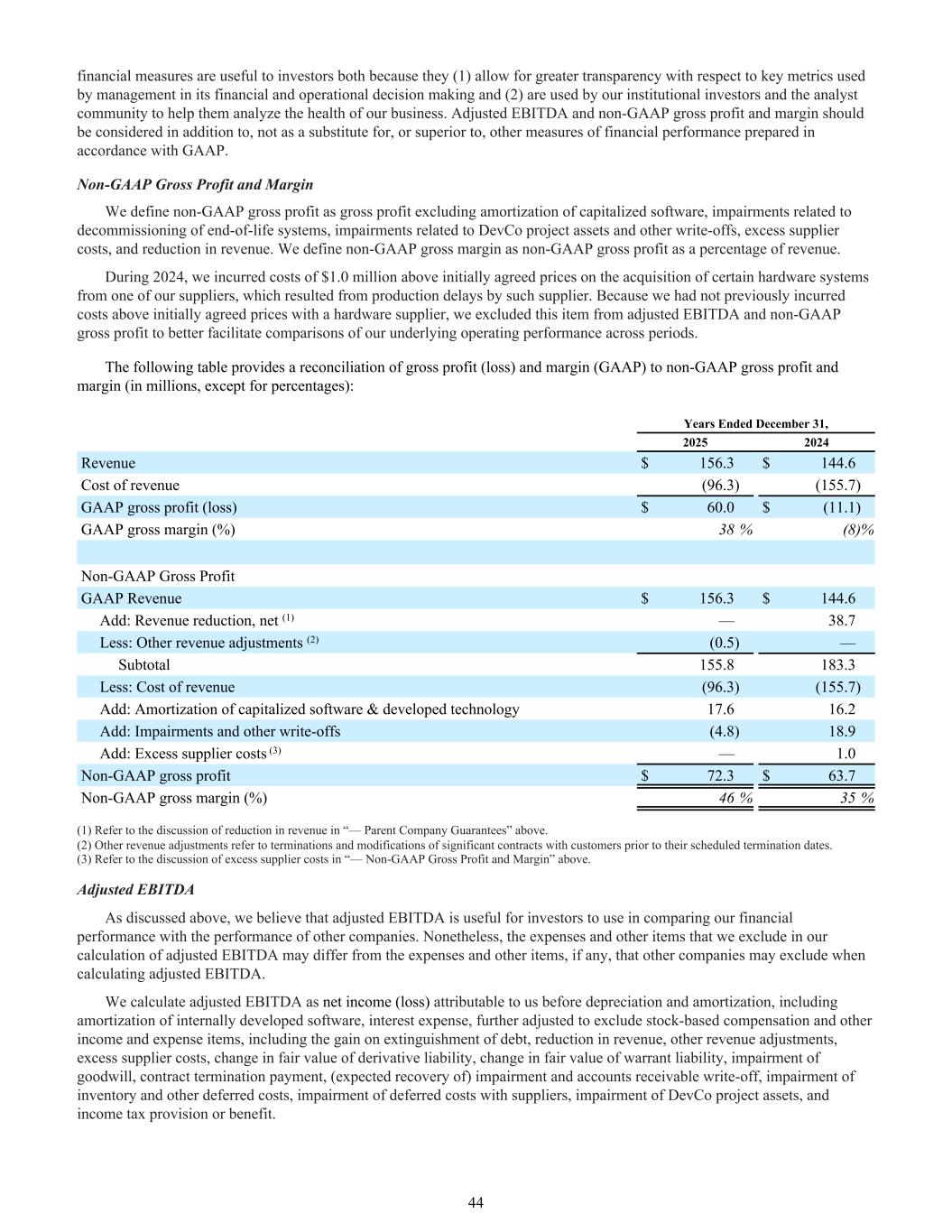
financial measures are useful to investors both because they (1) allow for greater transparency with respect to key metrics used by management in its financial and operational decision making and (2) are used by our institutional investors and the analyst community to help them analyze the health of our business. Adjusted EBITDA and non-GAAP gross profit and margin should be considered in addition to, not as a substitute for, or superior to, other measures of financial performance prepared in accordance with GAAP. Non-GAAP Gross Profit and Margin We define non-GAAP gross profit as gross profit excluding amortization of capitalized software, impairments related to decommissioning of end-of-life systems, impairments related to DevCo project assets and other write-offs, excess supplier costs, and reduction in revenue. We define non-GAAP gross margin as non-GAAP gross profit as a percentage of revenue. During 2024, we incurred costs of $1.0 million above initially agreed prices on the acquisition of certain hardware systems from one of our suppliers, which resulted from production delays by such supplier. Because we had not previously incurred costs above initially agreed prices with a hardware supplier, we excluded this item from adjusted EBITDA and non-GAAP gross profit to better facilitate comparisons of our underlying operating performance across periods. The following table provides a reconciliation of gross profit (loss) and margin (GAAP) to non-GAAP gross profit and margin (in millions, except for percentages): Years Ended December 31, 2025 2024 Revenue $ 156.3 $ 144.6 Cost of revenue (96.3) (155.7) GAAP gross profit (loss) $ 60.0 $ (11.1) GAAP gross margin (%) 38 % (8) % Non-GAAP Gross Profit GAAP Revenue $ 156.3 $ 144.6 Add: Revenue reduction, net (1) — 38.7 Less: Other revenue adjustments (2) (0.5) — Subtotal 155.8 183.3 Less: Cost of revenue (96.3) (155.7) Add: Amortization of capitalized software & developed technology 17.6 16.2 Add: Impairments and other write-offs (4.8) 18.9 Add: Excess supplier costs (3) — 1.0 Non-GAAP gross profit $ 72.3 $ 63.7 Non-GAAP gross margin (%) 46 % 35 % (1) Refer to the discussion of reduction in revenue in “— Parent Company Guarantees” above. (2) Other revenue adjustments refer to terminations and modifications of significant contracts with customers prior to their scheduled termination dates. (3) Refer to the discussion of excess supplier costs in “— Non-GAAP Gross Profit and Margin” above. Adjusted EBITDA As discussed above, we believe that adjusted EBITDA is useful for investors to use in comparing our financial performance with the performance of other companies. Nonetheless, the expenses and other items that we exclude in our calculation of adjusted EBITDA may differ from the expenses and other items, if any, that other companies may exclude when calculating adjusted EBITDA. We calculate adjusted EBITDA as net income (loss) attributable to us before depreciation and amortization, including amortization of internally developed software, interest expense, further adjusted to exclude stock-based compensation and other income and expense items, including the gain on extinguishment of debt, reduction in revenue, other revenue adjustments, excess supplier costs, change in fair value of derivative liability, change in fair value of warrant liability, impairment of goodwill, contract termination payment, (expected recovery of) impairment and accounts receivable write-off, impairment of inventory and other deferred costs, impairment of deferred costs with suppliers, impairment of DevCo project assets, and income tax provision or benefit. 44
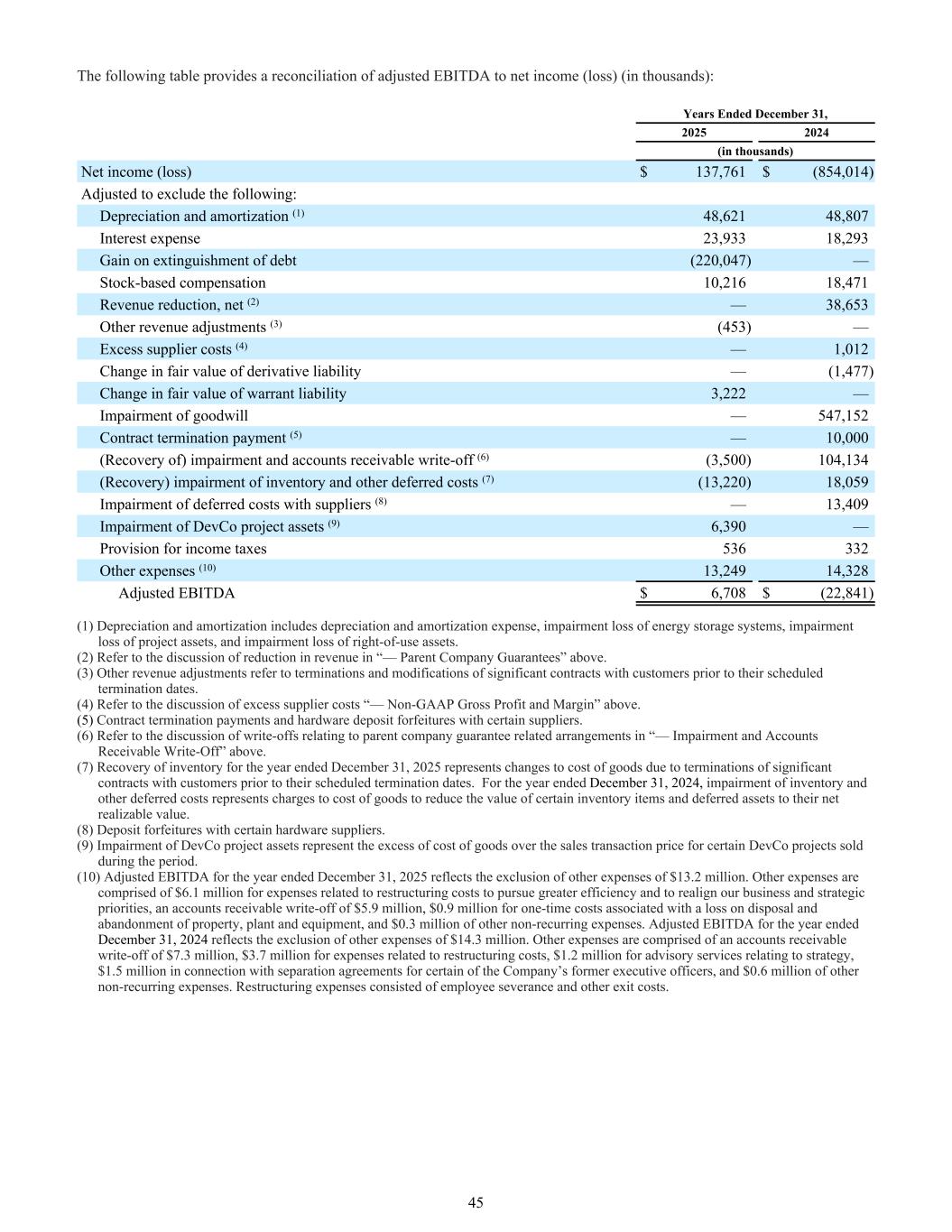
The following table provides a reconciliation of adjusted EBITDA to net income (loss) (in thousands): Years Ended December 31, 2025 2024 (in thousands) Net income (loss) $ 137,761 $ (854,014) Adjusted to exclude the following: Depreciation and amortization (1) 48,621 48,807 Interest expense 23,933 18,293 Gain on extinguishment of debt (220,047) — Stock-based compensation 10,216 18,471 Revenue reduction, net (2) — 38,653 Other revenue adjustments (3) (453) — Excess supplier costs (4) — 1,012 Change in fair value of derivative liability — (1,477) Change in fair value of warrant liability 3,222 — Impairment of goodwill — 547,152 Contract termination payment (5) — 10,000 (Recovery of) impairment and accounts receivable write-off (6) (3,500) 104,134 (Recovery) impairment of inventory and other deferred costs (7) (13,220) 18,059 Impairment of deferred costs with suppliers (8) — 13,409 Impairment of DevCo project assets (9) 6,390 — Provision for income taxes 536 332 Other expenses (10) 13,249 14,328 Adjusted EBITDA $ 6,708 $ (22,841) (1) Depreciation and amortization includes depreciation and amortization expense, impairment loss of energy storage systems, impairment loss of project assets, and impairment loss of right-of-use assets. (2) Refer to the discussion of reduction in revenue in “— Parent Company Guarantees” above. (3) Other revenue adjustments refer to terminations and modifications of significant contracts with customers prior to their scheduled termination dates. (4) Refer to the discussion of excess supplier costs “— Non-GAAP Gross Profit and Margin” above. (5) Contract termination payments and hardware deposit forfeitures with certain suppliers. (6) Refer to the discussion of write-offs relating to parent company guarantee related arrangements in “— Impairment and Accounts Receivable Write-Off” above. (7) Recovery of inventory for the year ended December 31, 2025 represents changes to cost of goods due to terminations of significant contracts with customers prior to their scheduled termination dates. For the year ended December 31, 2024, impairment of inventory and other deferred costs represents charges to cost of goods to reduce the value of certain inventory items and deferred assets to their net realizable value. (8) Deposit forfeitures with certain hardware suppliers. (9) Impairment of DevCo project assets represent the excess of cost of goods over the sales transaction price for certain DevCo projects sold during the period. (10) Adjusted EBITDA for the year ended December 31, 2025 reflects the exclusion of other expenses of $13.2 million. Other expenses are comprised of $6.1 million for expenses related to restructuring costs to pursue greater efficiency and to realign our business and strategic priorities, an accounts receivable write-off of $5.9 million, $0.9 million for one-time costs associated with a loss on disposal and abandonment of property, plant and equipment, and $0.3 million of other non-recurring expenses. Adjusted EBITDA for the year ended December 31, 2024 reflects the exclusion of other expenses of $14.3 million. Other expenses are comprised of an accounts receivable write-off of $7.3 million, $3.7 million for expenses related to restructuring costs, $1.2 million for advisory services relating to strategy, $1.5 million in connection with separation agreements for certain of the Company’s former executive officers, and $0.6 million of other non-recurring expenses. Restructuring expenses consisted of employee severance and other exit costs. 45
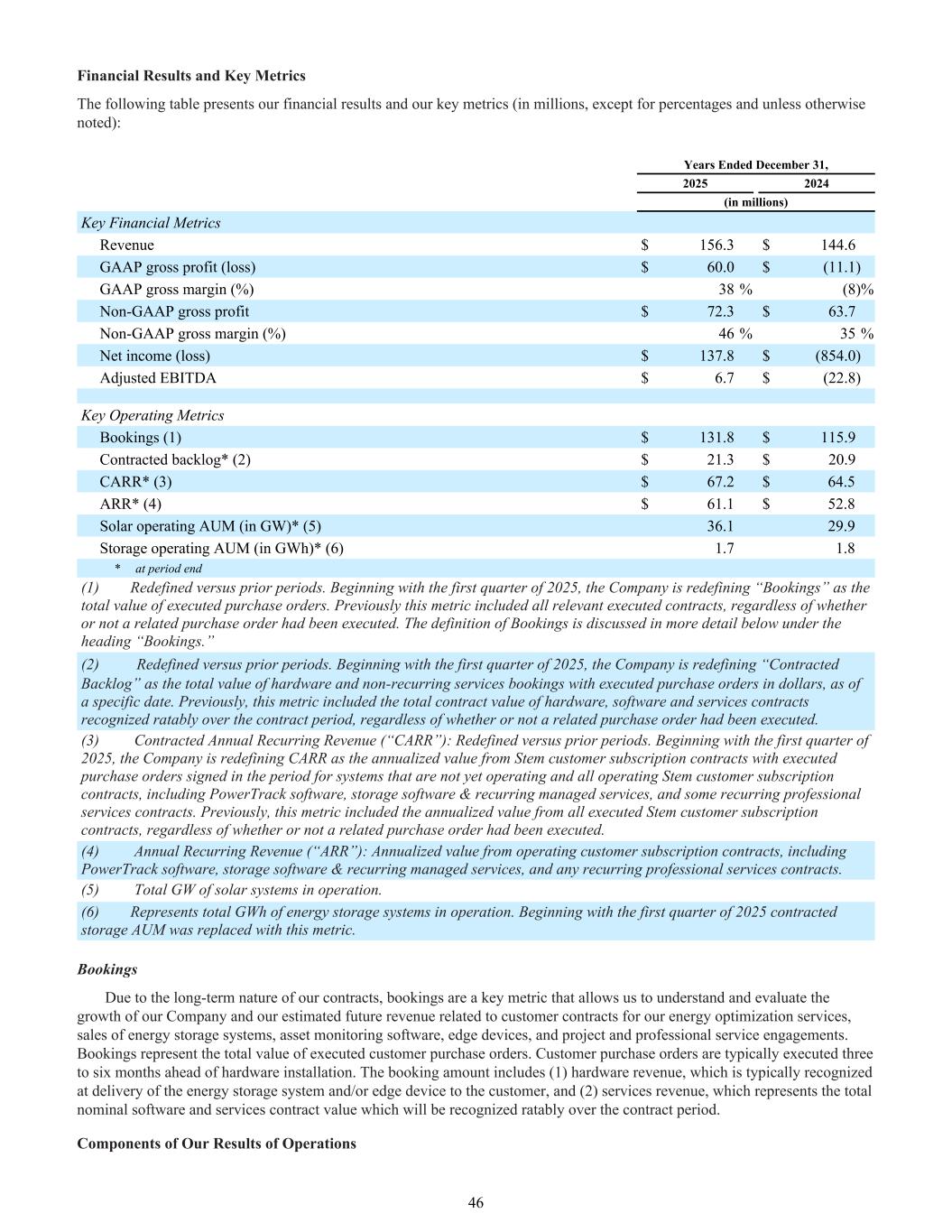
Financial Results and Key Metrics The following table presents our financial results and our key metrics (in millions, except for percentages and unless otherwise noted): Years Ended December 31, 2025 2024 (in millions) Key Financial Metrics Revenue $ 156.3 $ 144.6 GAAP gross profit (loss) $ 60.0 $ (11.1) GAAP gross margin (%) 38 % (8) % Non-GAAP gross profit $ 72.3 $ 63.7 Non-GAAP gross margin (%) 46 % 35 % Net income (loss) $ 137.8 $ (854.0) Adjusted EBITDA $ 6.7 $ (22.8) Key Operating Metrics Bookings (1) $ 131.8 $ 115.9 Contracted backlog* (2) $ 21.3 $ 20.9 CARR* (3) $ 67.2 $ 64.5 ARR* (4) $ 61.1 $ 52.8 Solar operating AUM (in GW)* (5) 36.1 29.9 Storage operating AUM (in GWh)* (6) 1.7 1.8 * at period end (1) Redefined versus prior periods. Beginning with the first quarter of 2025, the Company is redefining “Bookings” as the total value of executed purchase orders. Previously this metric included all relevant executed contracts, regardless of whether or not a related purchase order had been executed. The definition of Bookings is discussed in more detail below under the heading “Bookings.” (2) Redefined versus prior periods. Beginning with the first quarter of 2025, the Company is redefining “Contracted Backlog” as the total value of hardware and non-recurring services bookings with executed purchase orders in dollars, as of a specific date. Previously, this metric included the total contract value of hardware, software and services contracts recognized ratably over the contract period, regardless of whether or not a related purchase order had been executed. (3) Contracted Annual Recurring Revenue (“CARR”): Redefined versus prior periods. Beginning with the first quarter of 2025, the Company is redefining CARR as the annualized value from Stem customer subscription contracts with executed purchase orders signed in the period for systems that are not yet operating and all operating Stem customer subscription contracts, including PowerTrack software, storage software & recurring managed services, and some recurring professional services contracts. Previously, this metric included the annualized value from all executed Stem customer subscription contracts, regardless of whether or not a related purchase order had been executed. (4) Annual Recurring Revenue (“ARR”): Annualized value from operating customer subscription contracts, including PowerTrack software, storage software & recurring managed services, and any recurring professional services contracts. (5) Total GW of solar systems in operation. (6) Represents total GWh of energy storage systems in operation. Beginning with the first quarter of 2025 contracted storage AUM was replaced with this metric. Bookings Due to the long-term nature of our contracts, bookings are a key metric that allows us to understand and evaluate the growth of our Company and our estimated future revenue related to customer contracts for our energy optimization services, sales of energy storage systems, asset monitoring software, edge devices, and project and professional service engagements. Bookings represent the total value of executed customer purchase orders. Customer purchase orders are typically executed three to six months ahead of hardware installation. The booking amount includes (1) hardware revenue, which is typically recognized at delivery of the energy storage system and/or edge device to the customer, and (2) services revenue, which represents the total nominal software and services contract value which will be recognized ratably over the contract period. Components of Our Results of Operations 46
Revenue We generate services and other revenue and hardware revenue. Services and other revenue is generated through (i) energy optimization software, (ii) asset management software, and (iii) advisory services and (iv) the sale of project assets. Software fees charged to customers generally consist of recurring fixed monthly payments throughout the term of the contract and in some arrangements, an installation and/or upfront fee component. We may also receive incentives from utility companies in relation to the sale of our services. We generate hardware revenue through (i) edge hardware devices and (ii) sales of OEM energy storage systems. Performance obligations are satisfied when the energy storage system and edge hardware device along with all ancillary hardware components are delivered. The milestone payments received before the delivery of hardware are treated as deferred revenue. In certain customer contracts, we agreed to provide a guarantee that the value of purchased hardware will not decline for a certain period of time, as more fully described below under Note 3 — Revenue, in the accompanying notes to the consolidated financial statements included in Part II, Item 8, “Financial Statements and Supplementary Data” of this Annual Report on Form 10-K. Cost of Revenue Cost of services and other revenue primarily includes costs to service our storage and solar subscription customers. It includes expenses related to providing support to our customers and cloud-related costs, such as hosting costs. These costs primarily consist of personnel-related expenses of our services and customer support personnel, amortization of capitalized internal-use software development, and public cloud and cellular infrastructure costs. Cost of services and other revenue also includes depreciation of the cost of energy storage systems we own under long-term customer contracts, which includes capitalized fulfillment costs, such as installation services, permitting and other related costs. Additionally, cost of services and other revenue may include the costs for the development and constructions of project assets or any impairment of inventory and energy storage systems, along with system maintenance costs associated with the ongoing services provided to customers. Cost of hardware revenue generally includes the cost to produce edge hardware and the battery hardware purchased from a manufacturer, shipping, delivery, and other costs required to fulfill our obligation to deliver the edge hardware and energy storage systems to the customer location. Cost of hardware revenue may also include any impairment of energy storage systems held in our inventory for sale to our customer. Cost of hardware revenue related to the sale of energy storage systems is recognized when the delivery of the product is completed. Gross Profit (Loss) Our gross profit (loss) fluctuates significantly from quarter to quarter. Gross profit (loss), calculated as revenue less costs of revenue, has been, and will continue to be, affected by various factors, including fluctuations in the amount and mix of revenue and the amount and timing of investments to expand our customer base. Over the long term, we hope to increase both our gross profit in absolute dollars and gross margin as a percentage of revenue through enhanced operational efficiency and economies of scale. Operating Expenses Sales and Marketing Sales and marketing expense consists of payroll and other related personnel costs, including salaries, stock-based compensation, commissions, bonuses, employee benefits, and travel for our sales and marketing personnel. In addition, sales and marketing expense includes trade show costs, amortization of intangibles and other expenses. We expect our sales and marketing expense to increase in future periods to support the overall growth in our business. Research and Development Research and development expense consists primarily of payroll and other related personnel costs for engineers and third parties engaged in the design and development of products, third-party software and technologies, including salaries, bonuses and stock-based compensation expense, project material costs, services and depreciation. Our research and development expenses support our investments in optimization, accuracy and reliability of our platform and other technology improvements to support and drive efficiency in our operations. These expenses may vary from period to period as a percentage of revenue, depending primarily upon when we choose to make more significant investments. 47
General and Administrative General and administrative expense consists of payroll and other related personnel costs, including salaries, stock-based compensation, employee benefits and expenses for executive management, legal, finance, human resources and other costs. In addition, general and administrative expense includes fees for professional services and occupancy costs. We expect to continue to manage and reduce our general and administrative expense associated with scaling our business operations and being a public company, including compliance with the rules and regulations of the SEC, legal, audit, additional insurance expenses, investor relations activities, and other administrative and professional services. Impairment of Parent Company Guarantees Account balances deemed to be uncollectible are charged to bad debt expense after all means of collection have been exhausted and the potential for recovery is considered remote. Impairment of Goodwill Impairment of goodwill represents impairment charges as a result of the carrying amount being greater than the fair value. Other Income (Expense), Net Interest Expense Interest expense, net consists primarily of interest on our outstanding borrowings under our outstanding convertible senior notes, senior secured notes, financing obligations, and accretion on our asset retirement obligations. Gain on Extinguishment of Debt Gain on extinguishment of debt represents the proportional carrying value of the exchanged 2028 Convertible Notes and 2030 Convertible Notes, reduced by the collective fair value of the 2030 Senior Secured Notes and the fair value of the 2030 Private Placement Warrants, offset by cash received. Change in Fair Value of Derivative Liability Change in fair value of derivative liability is related to the revaluation of derivative feature within a revenue contract, whereby final settlement is indexed to the price per ton of lithium carbonate. Change in Fair Value of Warrant Liability Change in fair value of warrant liability is related to the revaluation at each reporting date of our private placement warrants issued in connection with our senior secured notes. Other Income, Net Other income, net consists primarily of income from equity investments and foreign exchange gains or losses. 48
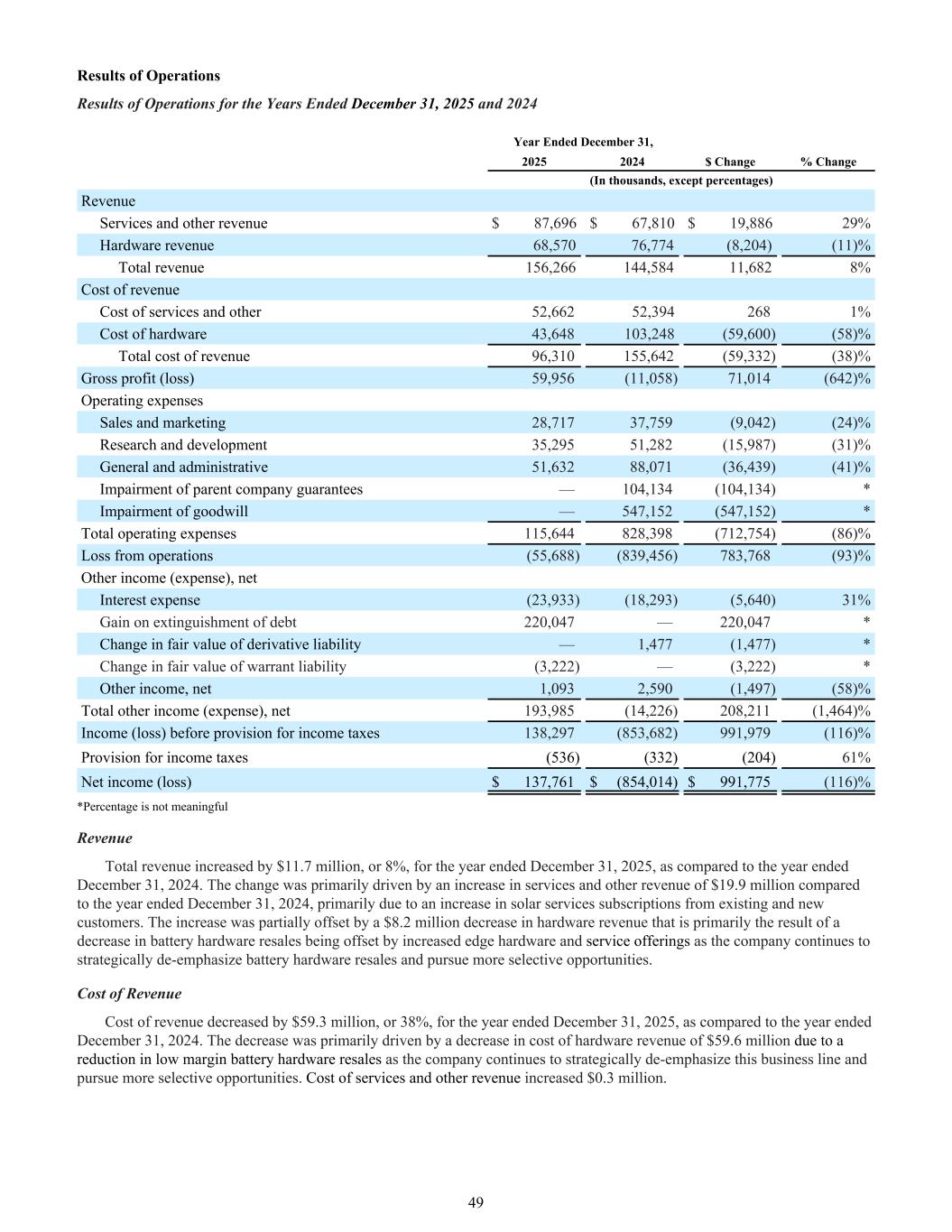
Results of Operations Results of Operations for the Years Ended December 31, 2025 and 2024 Year Ended December 31, $ Change % Change2025 2024 (In thousands, except percentages) Revenue Services and other revenue $ 87,696 $ 67,810 $ 19,886 29 % Hardware revenue 68,570 76,774 (8,204) (11) % Total revenue 156,266 144,584 11,682 8 % Cost of revenue Cost of services and other 52,662 52,394 268 1 % Cost of hardware 43,648 103,248 (59,600) (58) % Total cost of revenue 96,310 155,642 (59,332) (38) % Gross profit (loss) 59,956 (11,058) 71,014 (642) % Operating expenses Sales and marketing 28,717 37,759 (9,042) (24) % Research and development 35,295 51,282 (15,987) (31) % General and administrative 51,632 88,071 (36,439) (41) % Impairment of parent company guarantees — 104,134 (104,134) * Impairment of goodwill — 547,152 (547,152) * Total operating expenses 115,644 828,398 (712,754) (86) % Loss from operations (55,688) (839,456) 783,768 (93) % Other income (expense), net Interest expense (23,933) (18,293) (5,640) 31 % Gain on extinguishment of debt 220,047 — 220,047 * Change in fair value of derivative liability — 1,477 (1,477) * Change in fair value of warrant liability (3,222) — (3,222) * Other income, net 1,093 2,590 (1,497) (58) % Total other income (expense), net 193,985 (14,226) 208,211 (1,464) % Income (loss) before provision for income taxes 138,297 (853,682) 991,979 (116) % Provision for income taxes (536) (332) (204) 61 % Net income (loss) $ 137,761 $ (854,014) $ 991,775 (116) % *Percentage is not meaningful Revenue Total revenue increased by $11.7 million, or 8%, for the year ended December 31, 2025, as compared to the year ended December 31, 2024. The change was primarily driven by an increase in services and other revenue of $19.9 million compared to the year ended December 31, 2024, primarily due to an increase in solar services subscriptions from existing and new customers. The increase was partially offset by a $8.2 million decrease in hardware revenue that is primarily the result of a decrease in battery hardware resales being offset by increased edge hardware and service offerings as the company continues to strategically de-emphasize battery hardware resales and pursue more selective opportunities. Cost of Revenue Cost of revenue decreased by $59.3 million, or 38%, for the year ended December 31, 2025, as compared to the year ended December 31, 2024. The decrease was primarily driven by a decrease in cost of hardware revenue of $59.6 million due to a reduction in low margin battery hardware resales as the company continues to strategically de-emphasize this business line and pursue more selective opportunities. Cost of services and other revenue increased $0.3 million. 49
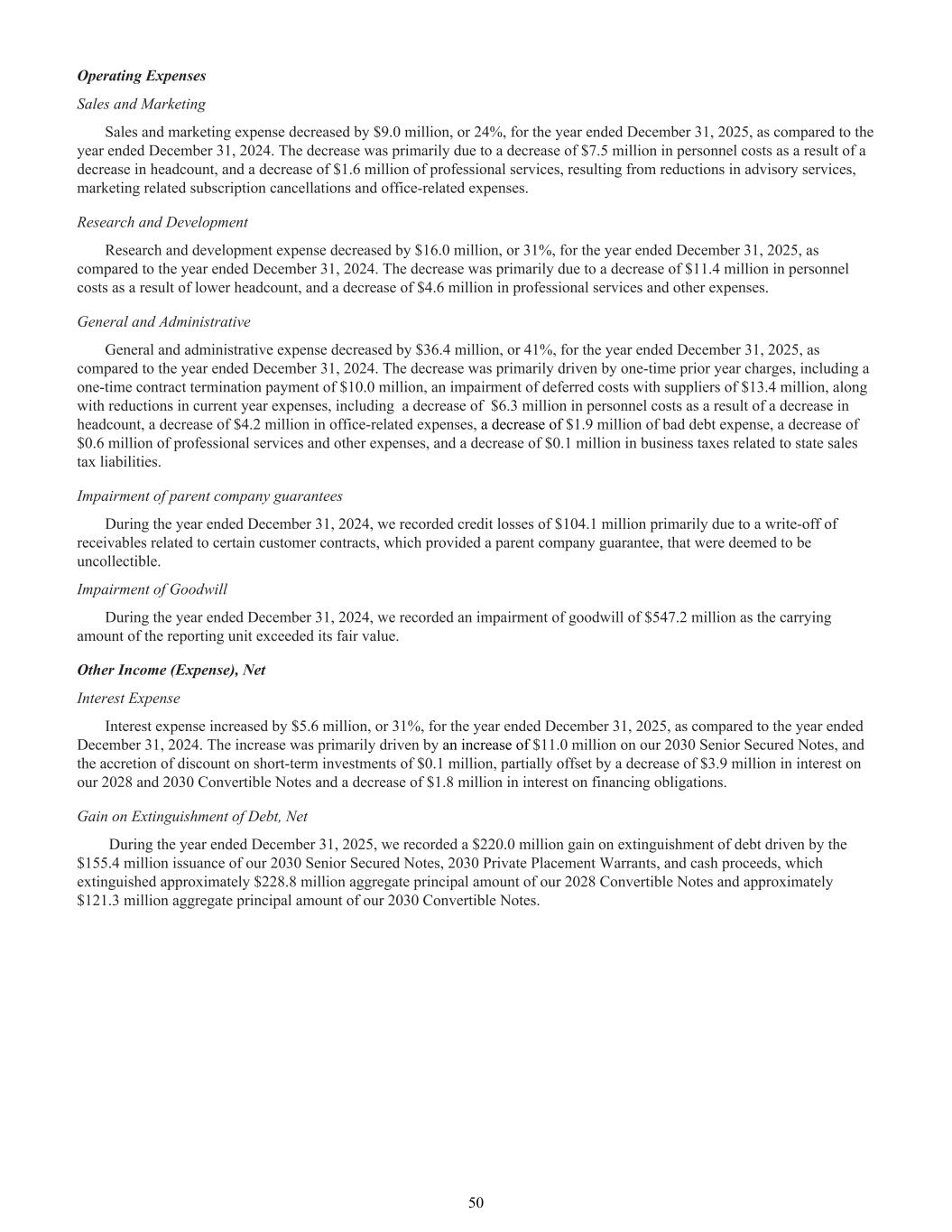
Operating Expenses Sales and Marketing Sales and marketing expense decreased by $9.0 million, or 24%, for the year ended December 31, 2025, as compared to the year ended December 31, 2024. The decrease was primarily due to a decrease of $7.5 million in personnel costs as a result of a decrease in headcount, and a decrease of $1.6 million of professional services, resulting from reductions in advisory services, marketing related subscription cancellations and office-related expenses. Research and Development Research and development expense decreased by $16.0 million, or 31%, for the year ended December 31, 2025, as compared to the year ended December 31, 2024. The decrease was primarily due to a decrease of $11.4 million in personnel costs as a result of lower headcount, and a decrease of $4.6 million in professional services and other expenses. General and Administrative General and administrative expense decreased by $36.4 million, or 41%, for the year ended December 31, 2025, as compared to the year ended December 31, 2024. The decrease was primarily driven by one-time prior year charges, including a one-time contract termination payment of $10.0 million, an impairment of deferred costs with suppliers of $13.4 million, along with reductions in current year expenses, including a decrease of $6.3 million in personnel costs as a result of a decrease in headcount, a decrease of $4.2 million in office-related expenses, a decrease of $1.9 million of bad debt expense, a decrease of $0.6 million of professional services and other expenses, and a decrease of $0.1 million in business taxes related to state sales tax liabilities. Impairment of parent company guarantees During the year ended December 31, 2024, we recorded credit losses of $104.1 million primarily due to a write-off of receivables related to certain customer contracts, which provided a parent company guarantee, that were deemed to be uncollectible. Impairment of Goodwill During the year ended December 31, 2024, we recorded an impairment of goodwill of $547.2 million as the carrying amount of the reporting unit exceeded its fair value. Other Income (Expense), Net Interest Expense Interest expense increased by $5.6 million, or 31%, for the year ended December 31, 2025, as compared to the year ended December 31, 2024. The increase was primarily driven by an increase of $11.0 million on our 2030 Senior Secured Notes, and the accretion of discount on short-term investments of $0.1 million, partially offset by a decrease of $3.9 million in interest on our 2028 and 2030 Convertible Notes and a decrease of $1.8 million in interest on financing obligations. Gain on Extinguishment of Debt, Net During the year ended December 31, 2025, we recorded a $220.0 million gain on extinguishment of debt driven by the $155.4 million issuance of our 2030 Senior Secured Notes, 2030 Private Placement Warrants, and cash proceeds, which extinguished approximately $228.8 million aggregate principal amount of our 2028 Convertible Notes and approximately $121.3 million aggregate principal amount of our 2030 Convertible Notes. 50
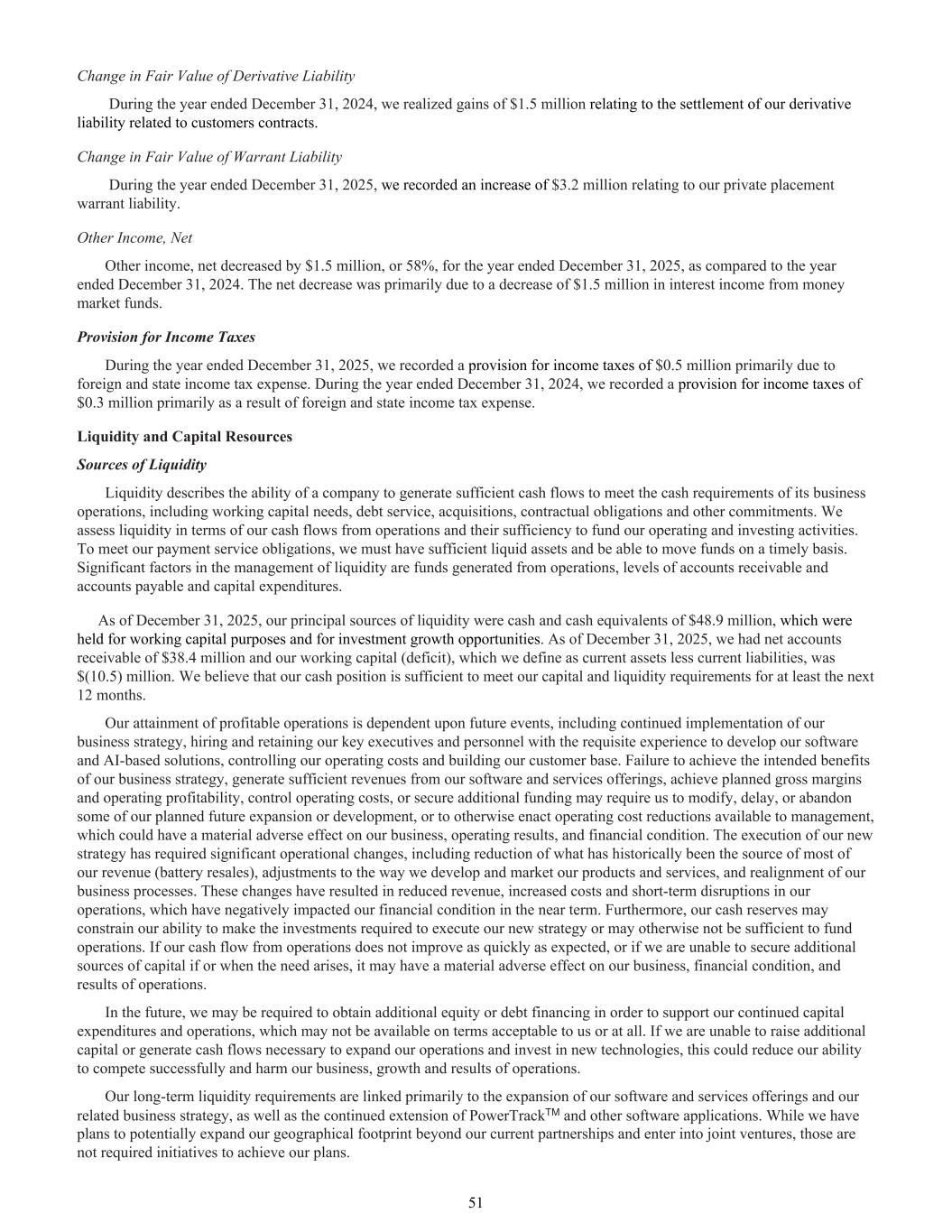
Change in Fair Value of Derivative Liability During the year ended December 31, 2024, we realized gains of $1.5 million relating to the settlement of our derivative liability related to customers contracts. Change in Fair Value of Warrant Liability During the year ended December 31, 2025, we recorded an increase of $3.2 million relating to our private placement warrant liability. Other Income, Net Other income, net decreased by $1.5 million, or 58%, for the year ended December 31, 2025, as compared to the year ended December 31, 2024. The net decrease was primarily due to a decrease of $1.5 million in interest income from money market funds. Provision for Income Taxes During the year ended December 31, 2025, we recorded a provision for income taxes of $0.5 million primarily due to foreign and state income tax expense. During the year ended December 31, 2024, we recorded a provision for income taxes of $0.3 million primarily as a result of foreign and state income tax expense. Liquidity and Capital Resources Sources of Liquidity Liquidity describes the ability of a company to generate sufficient cash flows to meet the cash requirements of its business operations, including working capital needs, debt service, acquisitions, contractual obligations and other commitments. We assess liquidity in terms of our cash flows from operations and their sufficiency to fund our operating and investing activities. To meet our payment service obligations, we must have sufficient liquid assets and be able to move funds on a timely basis. Significant factors in the management of liquidity are funds generated from operations, levels of accounts receivable and accounts payable and capital expenditures. As of December 31, 2025, our principal sources of liquidity were cash and cash equivalents of $48.9 million, which were held for working capital purposes and for investment growth opportunities. As of December 31, 2025, we had net accounts receivable of $38.4 million and our working capital (deficit), which we define as current assets less current liabilities, was $(10.5) million. We believe that our cash position is sufficient to meet our capital and liquidity requirements for at least the next 12 months. Our attainment of profitable operations is dependent upon future events, including continued implementation of our business strategy, hiring and retaining our key executives and personnel with the requisite experience to develop our software and AI-based solutions, controlling our operating costs and building our customer base. Failure to achieve the intended benefits of our business strategy, generate sufficient revenues from our software and services offerings, achieve planned gross margins and operating profitability, control operating costs, or secure additional funding may require us to modify, delay, or abandon some of our planned future expansion or development, or to otherwise enact operating cost reductions available to management, which could have a material adverse effect on our business, operating results, and financial condition. The execution of our new strategy has required significant operational changes, including reduction of what has historically been the source of most of our revenue (battery resales), adjustments to the way we develop and market our products and services, and realignment of our business processes. These changes have resulted in reduced revenue, increased costs and short-term disruptions in our operations, which have negatively impacted our financial condition in the near term. Furthermore, our cash reserves may constrain our ability to make the investments required to execute our new strategy or may otherwise not be sufficient to fund operations. If our cash flow from operations does not improve as quickly as expected, or if we are unable to secure additional sources of capital if or when the need arises, it may have a material adverse effect on our business, financial condition, and results of operations. In the future, we may be required to obtain additional equity or debt financing in order to support our continued capital expenditures and operations, which may not be available on terms acceptable to us or at all. If we are unable to raise additional capital or generate cash flows necessary to expand our operations and invest in new technologies, this could reduce our ability to compete successfully and harm our business, growth and results of operations. Our long-term liquidity requirements are linked primarily to the expansion of our software and services offerings and our related business strategy, as well as the continued extension of PowerTrackTM and other software applications. While we have plans to potentially expand our geographical footprint beyond our current partnerships and enter into joint ventures, those are not required initiatives to achieve our plans. 51
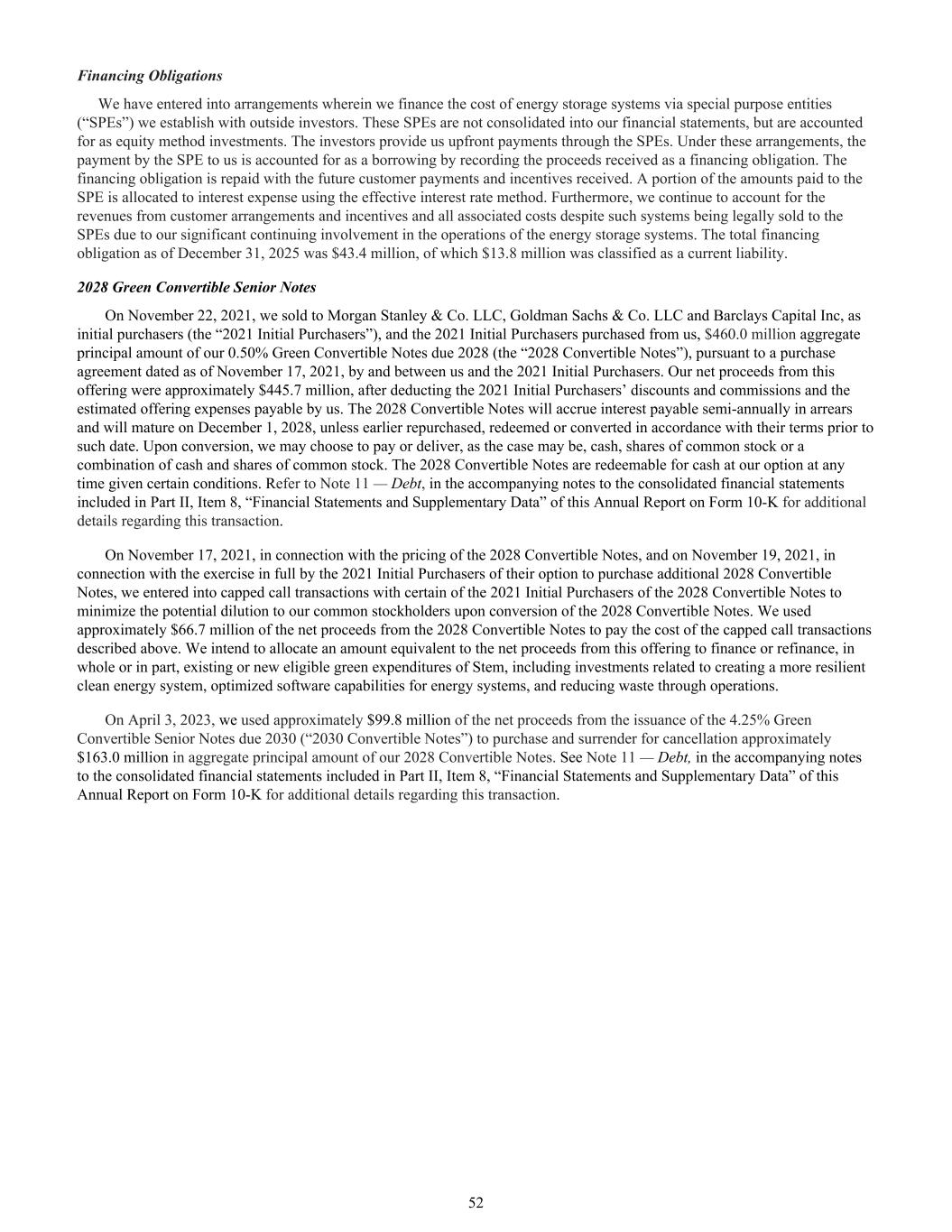
Financing Obligations We have entered into arrangements wherein we finance the cost of energy storage systems via special purpose entities (“SPEs”) we establish with outside investors. These SPEs are not consolidated into our financial statements, but are accounted for as equity method investments. The investors provide us upfront payments through the SPEs. Under these arrangements, the payment by the SPE to us is accounted for as a borrowing by recording the proceeds received as a financing obligation. The financing obligation is repaid with the future customer payments and incentives received. A portion of the amounts paid to the SPE is allocated to interest expense using the effective interest rate method. Furthermore, we continue to account for the revenues from customer arrangements and incentives and all associated costs despite such systems being legally sold to the SPEs due to our significant continuing involvement in the operations of the energy storage systems. The total financing obligation as of December 31, 2025 was $43.4 million, of which $13.8 million was classified as a current liability. 2028 Green Convertible Senior Notes On November 22, 2021, we sold to Morgan Stanley & Co. LLC, Goldman Sachs & Co. LLC and Barclays Capital Inc, as initial purchasers (the “2021 Initial Purchasers”), and the 2021 Initial Purchasers purchased from us, $460.0 million aggregate principal amount of our 0.50% Green Convertible Notes due 2028 (the “2028 Convertible Notes”), pursuant to a purchase agreement dated as of November 17, 2021, by and between us and the 2021 Initial Purchasers. Our net proceeds from this offering were approximately $445.7 million, after deducting the 2021 Initial Purchasers’ discounts and commissions and the estimated offering expenses payable by us. The 2028 Convertible Notes will accrue interest payable semi-annually in arrears and will mature on December 1, 2028, unless earlier repurchased, redeemed or converted in accordance with their terms prior to such date. Upon conversion, we may choose to pay or deliver, as the case may be, cash, shares of common stock or a combination of cash and shares of common stock. The 2028 Convertible Notes are redeemable for cash at our option at any time given certain conditions. Refer to Note 11 — Debt, in the accompanying notes to the consolidated financial statements included in Part II, Item 8, “Financial Statements and Supplementary Data” of this Annual Report on Form 10-K for additional details regarding this transaction. On November 17, 2021, in connection with the pricing of the 2028 Convertible Notes, and on November 19, 2021, in connection with the exercise in full by the 2021 Initial Purchasers of their option to purchase additional 2028 Convertible Notes, we entered into capped call transactions with certain of the 2021 Initial Purchasers of the 2028 Convertible Notes to minimize the potential dilution to our common stockholders upon conversion of the 2028 Convertible Notes. We used approximately $66.7 million of the net proceeds from the 2028 Convertible Notes to pay the cost of the capped call transactions described above. We intend to allocate an amount equivalent to the net proceeds from this offering to finance or refinance, in whole or in part, existing or new eligible green expenditures of Stem, including investments related to creating a more resilient clean energy system, optimized software capabilities for energy systems, and reducing waste through operations. On April 3, 2023, we used approximately $99.8 million of the net proceeds from the issuance of the 4.25% Green Convertible Senior Notes due 2030 (“2030 Convertible Notes”) to purchase and surrender for cancellation approximately $163.0 million in aggregate principal amount of our 2028 Convertible Notes. See Note 11 — Debt, in the accompanying notes to the consolidated financial statements included in Part II, Item 8, “Financial Statements and Supplementary Data” of this Annual Report on Form 10-K for additional details regarding this transaction. 52
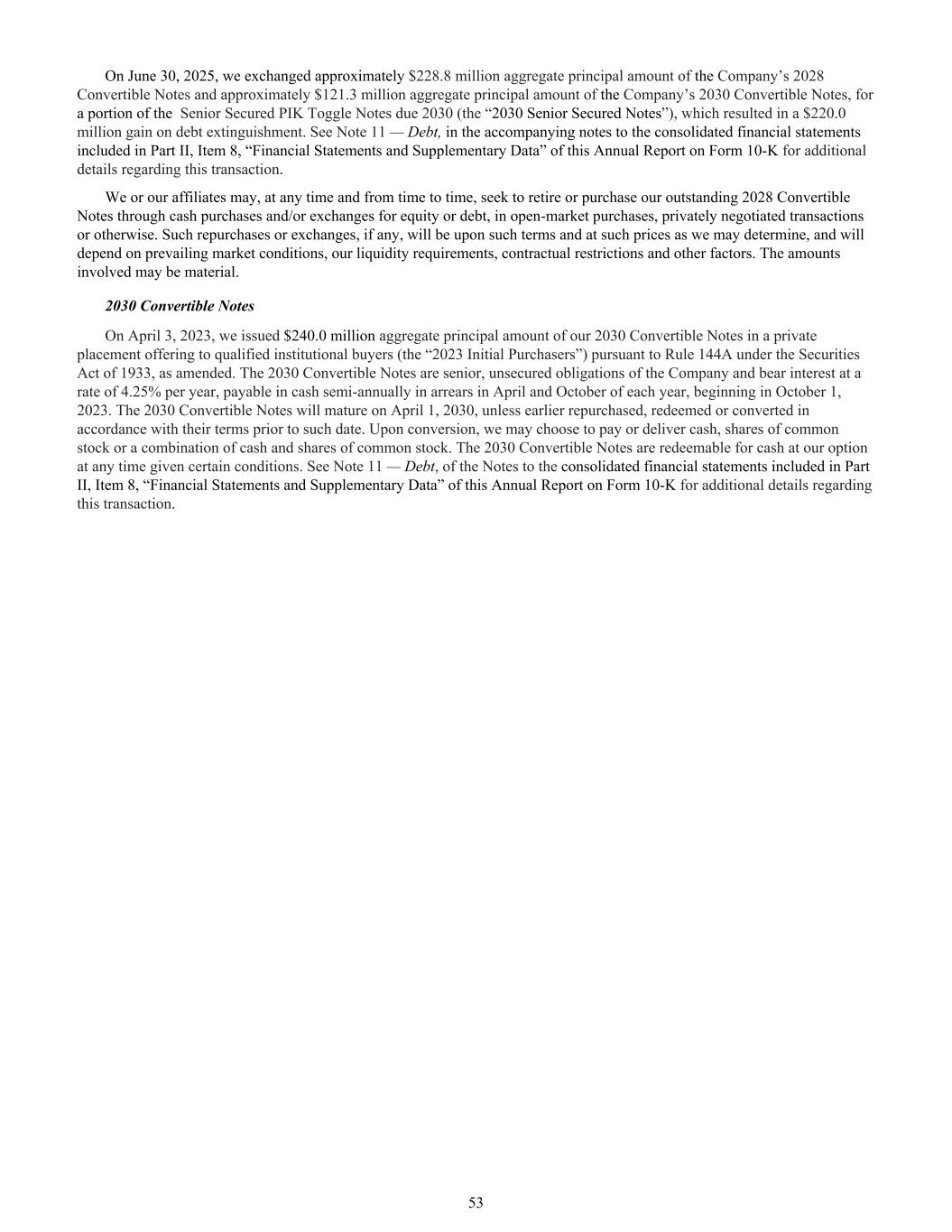
On June 30, 2025, we exchanged approximately $228.8 million aggregate principal amount of the Company’s 2028 Convertible Notes and approximately $121.3 million aggregate principal amount of the Company’s 2030 Convertible Notes, for a portion of the Senior Secured PIK Toggle Notes due 2030 (the “2030 Senior Secured Notes”), which resulted in a $220.0 million gain on debt extinguishment. See Note 11 — Debt, in the accompanying notes to the consolidated financial statements included in Part II, Item 8, “Financial Statements and Supplementary Data” of this Annual Report on Form 10-K for additional details regarding this transaction. We or our affiliates may, at any time and from time to time, seek to retire or purchase our outstanding 2028 Convertible Notes through cash purchases and/or exchanges for equity or debt, in open-market purchases, privately negotiated transactions or otherwise. Such repurchases or exchanges, if any, will be upon such terms and at such prices as we may determine, and will depend on prevailing market conditions, our liquidity requirements, contractual restrictions and other factors. The amounts involved may be material. 2030 Convertible Notes On April 3, 2023, we issued $240.0 million aggregate principal amount of our 2030 Convertible Notes in a private placement offering to qualified institutional buyers (the “2023 Initial Purchasers”) pursuant to Rule 144A under the Securities Act of 1933, as amended. The 2030 Convertible Notes are senior, unsecured obligations of the Company and bear interest at a rate of 4.25% per year, payable in cash semi-annually in arrears in April and October of each year, beginning in October 1, 2023. The 2030 Convertible Notes will mature on April 1, 2030, unless earlier repurchased, redeemed or converted in accordance with their terms prior to such date. Upon conversion, we may choose to pay or deliver cash, shares of common stock or a combination of cash and shares of common stock. The 2030 Convertible Notes are redeemable for cash at our option at any time given certain conditions. See Note 11 — Debt, of the Notes to the consolidated financial statements included in Part II, Item 8, “Financial Statements and Supplementary Data” of this Annual Report on Form 10-K for additional details regarding this transaction. 53
Our net proceeds from this offering were approximately $232.4 million, after deducting for $7.6 million of debt issuance costs primarily consisting of underwriters, advisory, legal, and accounting fees. We used approximately $99.8 million of the net proceeds to purchase and surrender for cancellation approximately $163.0 million aggregate principal amount of our 2028 Convertible Notes. On March 29, 2023 and March 31, 2023, in connection with the pricing of the 2030 Convertible Notes, and on April 3, 2023, in connection with the exercise in full by the 2023 Initial Purchasers of their option to purchase additional 2030 Convertible Notes, we entered into Capped Calls (the “2030 Capped Calls”) with certain counterparties. We used $27.8 million of the net proceeds from the 2030 Convertible Notes to pay the cost of the 2030 Capped Calls. On June 30, 2025, we exchanged approximately $121.3 million aggregate principal amount of the Company’s 2030 Convertible Notes, for a portion of the Senior Secured PIK Toggle Notes due 2030 (the “2030 Senior Secured Notes”), which resulted in a $220.0 million gain on debt extinguishment. See Note 11 — Debt, in the accompanying notes to the consolidated financial statements included in Part II, Item 8, “Financial Statements and Supplementary Data” of this Annual Report on Form 10-K for additional details regarding this transaction. We or our affiliates may, at any time and from time to time, seek to retire or purchase our outstanding 2030 Convertible Notes through cash purchases and/or exchanges for equity or debt, in open-market purchases, privately negotiated transactions or otherwise. Such repurchases or exchanges, if any, will be upon such terms and at such prices as we may determine, and will depend on prevailing market conditions, our liquidity requirements, contractual restrictions and other factors. The amounts involved may be material. 2030 Senior Secured Notes On June 30, 2025, the Company issued $155.4 million aggregate principal amount of its 2030 Senior Secured Notes to holders of the Company’s 2028 Convertible Notes and the Company’s 2030 Convertible Notes in a privately negotiated exchange (the “Exchange”) pursuant to Rule 144A under the Securities Act of 1933, as amended. The transaction included an exchange of approximately (i) $228.8 million principal amount of the 2028 Convertible Notes and (ii) $121.3 million principal amount of the 2030 Convertible Notes, less amounts in lieu of fractional notes, for the 2030 Senior Secured Notes, warrants to purchase 439,919 shares of common stock (the “2030 Private Placement Warrants”), (iii) $10.0 million of cash proceeds, and accrued and unpaid interest on the exchanged 2028 Convertible Notes and 2030 Convertible Notes. The exchange resulted in a $220.0 million gain on debt extinguishment recorded within other income (expenses), net in the unaudited consolidated statements of operations. The gain on debt extinguishment represented the proportional carrying value of the exchanged 2028 Convertible Notes and 2030 Convertible Notes, which in aggregate was $343.9 million, reduced by the collective fair value of the 2030 Senior Secured Notes of $132.0 million and the fair value of the 2030 Private Placement Warrants of $1.9 million, offset by cash received. The fair value of the 2030 Senior Secured Notes was estimated using a Black Derman-Toy lattice model with a yield of approximately 14.6%, synthetic credit rating for the Company, volatility of 32%, and the risk free rate of 3.79% for the expected term associated with the 2030 secured notes. The fair value of the 2030 Private Placement Warrants was estimated using the Black-Scholes-Merton model based on the Company’s closing strike price on the date of extinguishment of $6.23, volatility of 118.6%, and the risk free rate of 3.79% for the expected term associated with the 2030 secured notes. The Company accrued $5.2 million in debt issuance costs primarily consisting of financial advisory, legal, and accounting fees. See 2028 Convertible Notes and 2030 Convertible Notes above for further details on the impacts of the debt extinguishment. At the Company’s election for any interest period, the 2030 Senior Secured Notes bear interest at a rate of (i) 12.00% per year, if interest is paid in kind, subject to a maximum amount of interest able to be paid in kind, and (ii) 11.00% per year if interest is paid in cash. In each case, interest is payable semi-annually in arrears in January and July of each year, beginning on January 1, 2026. The 2030 Senior Secured Notes will mature on December 30, 2030 unless redeemed in accordance with their terms prior to such date. The 2030 Senior Secured Notes will be redeemable, in whole or in part, for cash at the Company’s option at any time, and from time to time, at the following redemption prices: on or after the date of issuance to December 31, 2027, at 105.00% of the principal amount of the notes being redeemed, including interest paid in kind, if any, plus accrued and unpaid interest; from January 1, 2028 to December 31, 2028, at 102.50% of the principal amount of the notes being redeemed, including interest paid in kind, if any, plus accrued and unpaid interest; and on or after January 1, 2029, at 100.00% of the principal amount of the notes being redeemed, including interest paid in kind, if any, plus accrued and unpaid interest. 54
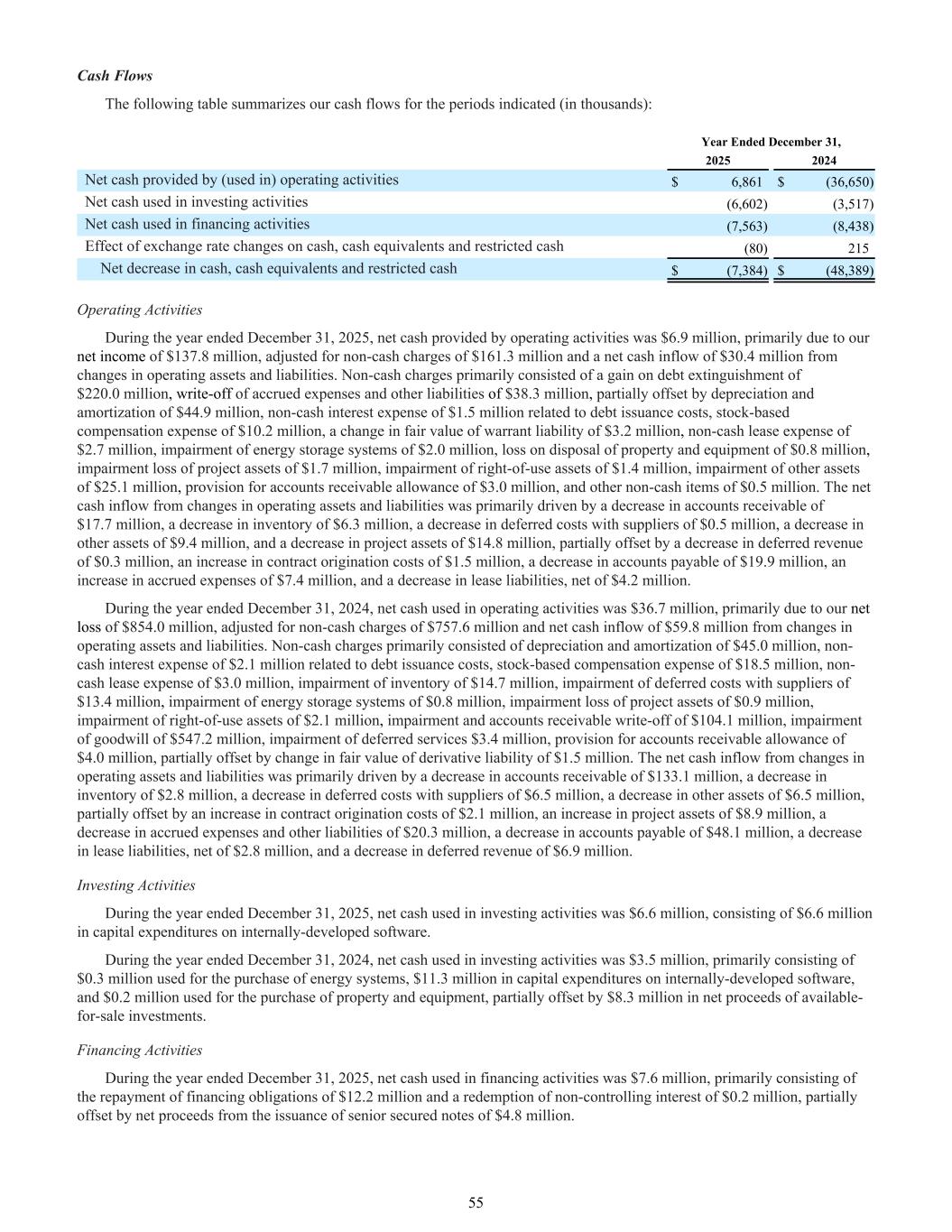
Cash Flows The following table summarizes our cash flows for the periods indicated (in thousands): Year Ended December 31, 2025 2024 Net cash provided by (used in) operating activities $ 6,861 $ (36,650) Net cash used in investing activities (6,602) (3,517) Net cash used in financing activities (7,563) (8,438) Effect of exchange rate changes on cash, cash equivalents and restricted cash (80) 215 Net decrease in cash, cash equivalents and restricted cash $ (7,384) $ (48,389) Operating Activities During the year ended December 31, 2025, net cash provided by operating activities was $6.9 million, primarily due to our net income of $137.8 million, adjusted for non-cash charges of $161.3 million and a net cash inflow of $30.4 million from changes in operating assets and liabilities. Non-cash charges primarily consisted of a gain on debt extinguishment of $220.0 million, write-off of accrued expenses and other liabilities of $38.3 million, partially offset by depreciation and amortization of $44.9 million, non-cash interest expense of $1.5 million related to debt issuance costs, stock-based compensation expense of $10.2 million, a change in fair value of warrant liability of $3.2 million, non-cash lease expense of $2.7 million, impairment of energy storage systems of $2.0 million, loss on disposal of property and equipment of $0.8 million, impairment loss of project assets of $1.7 million, impairment of right-of-use assets of $1.4 million, impairment of other assets of $25.1 million, provision for accounts receivable allowance of $3.0 million, and other non-cash items of $0.5 million. The net cash inflow from changes in operating assets and liabilities was primarily driven by a decrease in accounts receivable of $17.7 million, a decrease in inventory of $6.3 million, a decrease in deferred costs with suppliers of $0.5 million, a decrease in other assets of $9.4 million, and a decrease in project assets of $14.8 million, partially offset by a decrease in deferred revenue of $0.3 million, an increase in contract origination costs of $1.5 million, a decrease in accounts payable of $19.9 million, an increase in accrued expenses of $7.4 million, and a decrease in lease liabilities, net of $4.2 million. During the year ended December 31, 2024, net cash used in operating activities was $36.7 million, primarily due to our net loss of $854.0 million, adjusted for non-cash charges of $757.6 million and net cash inflow of $59.8 million from changes in operating assets and liabilities. Non-cash charges primarily consisted of depreciation and amortization of $45.0 million, non- cash interest expense of $2.1 million related to debt issuance costs, stock-based compensation expense of $18.5 million, non- cash lease expense of $3.0 million, impairment of inventory of $14.7 million, impairment of deferred costs with suppliers of $13.4 million, impairment of energy storage systems of $0.8 million, impairment loss of project assets of $0.9 million, impairment of right-of-use assets of $2.1 million, impairment and accounts receivable write-off of $104.1 million, impairment of goodwill of $547.2 million, impairment of deferred services $3.4 million, provision for accounts receivable allowance of $4.0 million, partially offset by change in fair value of derivative liability of $1.5 million. The net cash inflow from changes in operating assets and liabilities was primarily driven by a decrease in accounts receivable of $133.1 million, a decrease in inventory of $2.8 million, a decrease in deferred costs with suppliers of $6.5 million, a decrease in other assets of $6.5 million, partially offset by an increase in contract origination costs of $2.1 million, an increase in project assets of $8.9 million, a decrease in accrued expenses and other liabilities of $20.3 million, a decrease in accounts payable of $48.1 million, a decrease in lease liabilities, net of $2.8 million, and a decrease in deferred revenue of $6.9 million. Investing Activities During the year ended December 31, 2025, net cash used in investing activities was $6.6 million, consisting of $6.6 million in capital expenditures on internally-developed software. During the year ended December 31, 2024, net cash used in investing activities was $3.5 million, primarily consisting of $0.3 million used for the purchase of energy systems, $11.3 million in capital expenditures on internally-developed software, and $0.2 million used for the purchase of property and equipment, partially offset by $8.3 million in net proceeds of available- for-sale investments. Financing Activities During the year ended December 31, 2025, net cash used in financing activities was $7.6 million, primarily consisting of the repayment of financing obligations of $12.2 million and a redemption of non-controlling interest of $0.2 million, partially offset by net proceeds from the issuance of senior secured notes of $4.8 million. 55
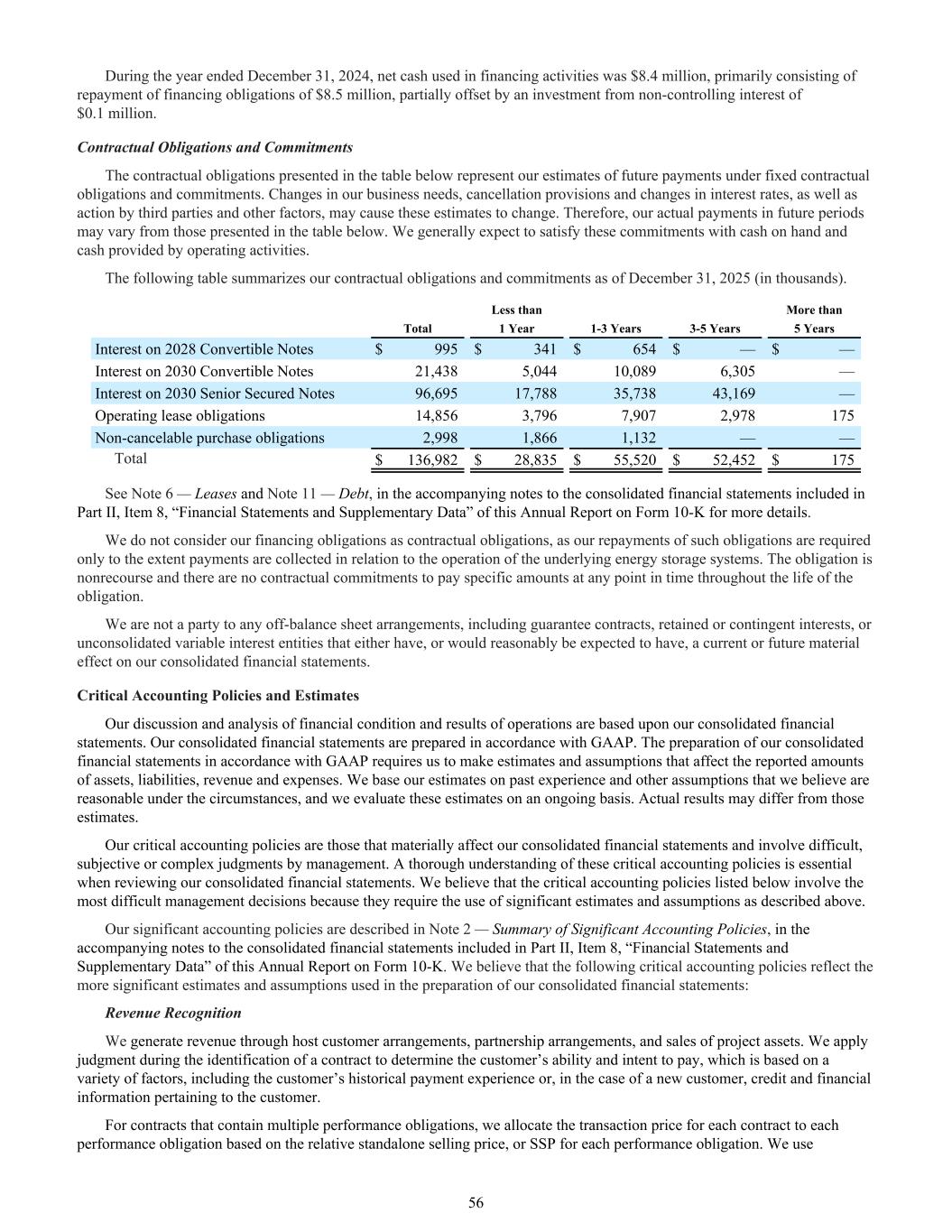
During the year ended December 31, 2024, net cash used in financing activities was $8.4 million, primarily consisting of repayment of financing obligations of $8.5 million, partially offset by an investment from non-controlling interest of $0.1 million. Contractual Obligations and Commitments The contractual obligations presented in the table below represent our estimates of future payments under fixed contractual obligations and commitments. Changes in our business needs, cancellation provisions and changes in interest rates, as well as action by third parties and other factors, may cause these estimates to change. Therefore, our actual payments in future periods may vary from those presented in the table below. We generally expect to satisfy these commitments with cash on hand and cash provided by operating activities. The following table summarizes our contractual obligations and commitments as of December 31, 2025 (in thousands). Less than More than Total 1 Year 1-3 Years 3-5 Years 5 Years Interest on 2028 Convertible Notes $ 995 $ 341 $ 654 $ — $ — Interest on 2030 Convertible Notes 21,438 5,044 10,089 6,305 — Interest on 2030 Senior Secured Notes 96,695 17,788 35,738 43,169 — Operating lease obligations 14,856 3,796 7,907 2,978 175 Non-cancelable purchase obligations 2,998 1,866 1,132 — — Total $ 136,982 $ 28,835 $ 55,520 $ 52,452 $ 175 See Note 6 — Leases and Note 11 — Debt, in the accompanying notes to the consolidated financial statements included in Part II, Item 8, “Financial Statements and Supplementary Data” of this Annual Report on Form 10-K for more details. We do not consider our financing obligations as contractual obligations, as our repayments of such obligations are required only to the extent payments are collected in relation to the operation of the underlying energy storage systems. The obligation is nonrecourse and there are no contractual commitments to pay specific amounts at any point in time throughout the life of the obligation. We are not a party to any off-balance sheet arrangements, including guarantee contracts, retained or contingent interests, or unconsolidated variable interest entities that either have, or would reasonably be expected to have, a current or future material effect on our consolidated financial statements. Critical Accounting Policies and Estimates Our discussion and analysis of financial condition and results of operations are based upon our consolidated financial statements. Our consolidated financial statements are prepared in accordance with GAAP. The preparation of our consolidated financial statements in accordance with GAAP requires us to make estimates and assumptions that affect the reported amounts of assets, liabilities, revenue and expenses. We base our estimates on past experience and other assumptions that we believe are reasonable under the circumstances, and we evaluate these estimates on an ongoing basis. Actual results may differ from those estimates. Our critical accounting policies are those that materially affect our consolidated financial statements and involve difficult, subjective or complex judgments by management. A thorough understanding of these critical accounting policies is essential when reviewing our consolidated financial statements. We believe that the critical accounting policies listed below involve the most difficult management decisions because they require the use of significant estimates and assumptions as described above. Our significant accounting policies are described in Note 2 — Summary of Significant Accounting Policies, in the accompanying notes to the consolidated financial statements included in Part II, Item 8, “Financial Statements and Supplementary Data” of this Annual Report on Form 10-K. We believe that the following critical accounting policies reflect the more significant estimates and assumptions used in the preparation of our consolidated financial statements: Revenue Recognition We generate revenue through host customer arrangements, partnership arrangements, and sales of project assets. We apply judgment during the identification of a contract to determine the customer’s ability and intent to pay, which is based on a variety of factors, including the customer’s historical payment experience or, in the case of a new customer, credit and financial information pertaining to the customer. For contracts that contain multiple performance obligations, we allocate the transaction price for each contract to each performance obligation based on the relative standalone selling price, or SSP for each performance obligation. We use 56
judgment in determining the SSP for our products and services. We typically assess the SSP for our products and services on an annual basis or when facts and circumstances change. To determine SSP, we maximize the use of observable standalone sales and observable data, where available. In instances where performance obligations do not have observable standalone sales, we utilize available information that may include other observable inputs or use the expected cost-plus margin approach to estimate the price we would charge if the products and services were sold separately. The expected cost-plus margin approach is currently used to determine SSP for each distinct performance obligation for sale of hardware. In some cases, the total transaction price is determined based on the total consideration specified in the contract, including variable consideration in the form of a performance guaranty payment that represents potential amounts payable to customers. The expected value method is generally used when estimating variable consideration, which typically reduces the total transaction price due to the nature of the performance obligations to which the variable consideration relates. These estimates reflect our historical experience and current contractual requirements which cap the maximum amount that may be paid. The expected value method requires judgment and considers multiple factors that may vary over time depending upon the unique facts and circumstances related to each performance obligation. Depending on the facts and circumstances, a change in variable consideration estimate will either be accounted for at the contract level or using the portfolio method. Impairment of Long-Lived Assets Long-lived assets, including energy storage systems, and intangible assets with finite lives, are reviewed for impairment when events or changes in circumstances indicate that the carrying amount of an asset may not be recoverable. Factors that we analyze in determining whether an impairment in our long-lived assets exists include determining if a significant decrease in the market price of a long-lived asset is present; a significant adverse change in the extent to which a long-lived asset is being used in its physical condition; legal proceedings or factors; significant business climate changes; accumulations of costs in significant excess of the amounts expected; a current-period operating or cash flow loss coupled with historical negative cash flows or expected future negative cash flows; and current expectations that more likely than not, a long-lived asset will be sold or otherwise disposed of significantly before the end of its estimated useful life. When an impairment indicator is present, we determine if the carrying value of the asset is recoverable by comparing it to its expected undiscounted future cash flows. If the asset group is not recoverable, the impairment loss is calculated as the excess of the carrying value over the fair value. Key estimates in the undiscounted cash flow model include management’s estimate of the projected revenues and operating margins. If fair value is used to determine an impairment loss, an additional key assumption is the selection of a weighted-average cost of capital to discount cash flows. We recorded impairment charges for energy storage systems amounting to $2.0 million during the year ended December 31, 2025. We recorded $1.7 million in project asset impairments during the year ended December 31, 2025. Fair Value Measurements - 2030 Senior Secured Notes The Company’s 2030 Senior Secured Notes, issued in June 2025, represent a significant component of our long-term debt. The fair value measurement of these notes is a critical accounting estimate due to the complexity of the instrument, the lack of an active market, and the significant management judgment required in the valuation process. The 2030 Senior Secured Notes are not publicly traded and do not have readily observable market prices. As a result, we estimate their fair value using an option pricing model, specifically a Black Derman-Toy lattice model. The valuation incorporates both observable and unobservable inputs, and is classified as a Level 3 measurement in the fair value hierarchy. Key inputs and assumptions used in the valuation include yield, synthetic credit rating for the Company, volatility, and risk-free rate. Refer to Note 11 — Debt , in the accompanying notes to the consolidated financial statements included in Part II, Item 8, “Financial Statements and Supplementary Data” of this Annual Report on Form 10-K. Recent Accounting Pronouncements Information with respect to recent accounting pronouncements may be found in Note 2 — Summary of Significant Accounting Policies, in the accompanying notes to the consolidated financial statements included in Part II, Item 8, "Financial Statements and Supplementary Data" of this Annual Report on Form 10-K. 57
ITEM 8. FINANCIAL STATEMENTS AND SUPPLEMENTARY DATA STEM, INC. INDEX TO CONSOLIDATED FINANCIAL STATEMENTS As of December 31, 2025 and 2024, and for Years Ended December 31, 2025, 2024 and 2023 Page Index to Audited Consolidated Financial Statements Report of Independent Registered Public Accounting Firm (PCAOB ID No. 34) 59 Financial Statements: Consolidated Balance Sheets 61 Consolidated Statements of Operations 62 Consolidated Statements of Comprehensive Income (Loss) 63 Consolidated Statements of Stockholders’ Equity (Deficit) 64 Consolidated Statements of Cash Flows 65 Notes to Consolidated Financial Statements 67 58
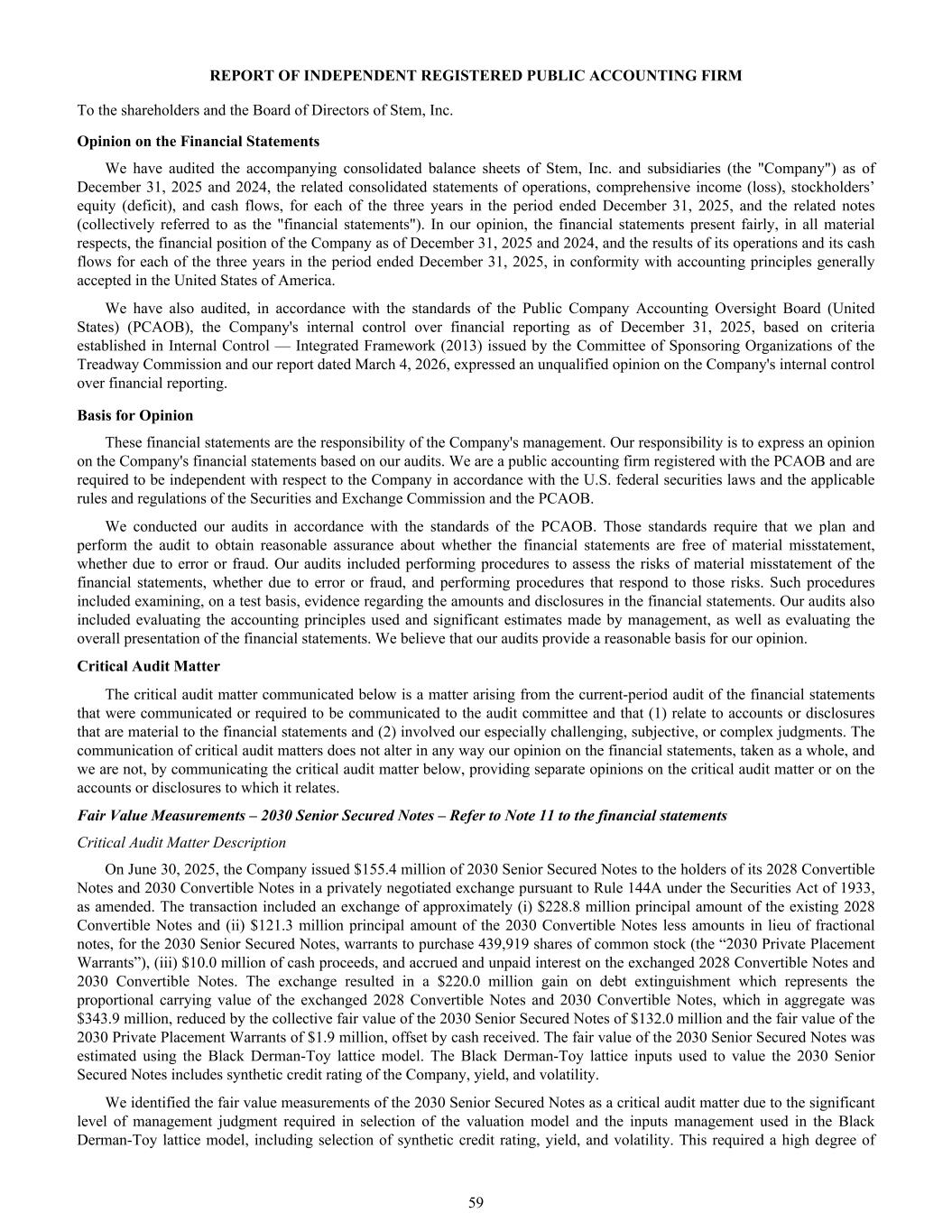
REPORT OF INDEPENDENT REGISTERED PUBLIC ACCOUNTING FIRM To the shareholders and the Board of Directors of Stem, Inc. Opinion on the Financial Statements We have audited the accompanying consolidated balance sheets of Stem, Inc. and subsidiaries (the "Company") as of December 31, 2025 and 2024, the related consolidated statements of operations, comprehensive income (loss), stockholders’ equity (deficit), and cash flows, for each of the three years in the period ended December 31, 2025, and the related notes (collectively referred to as the "financial statements"). In our opinion, the financial statements present fairly, in all material respects, the financial position of the Company as of December 31, 2025 and 2024, and the results of its operations and its cash flows for each of the three years in the period ended December 31, 2025, in conformity with accounting principles generally accepted in the United States of America. We have also audited, in accordance with the standards of the Public Company Accounting Oversight Board (United States) (PCAOB), the Company's internal control over financial reporting as of December 31, 2025, based on criteria established in Internal Control — Integrated Framework (2013) issued by the Committee of Sponsoring Organizations of the Treadway Commission and our report dated March 4, 2026, expressed an unqualified opinion on the Company's internal control over financial reporting. Basis for Opinion These financial statements are the responsibility of the Company's management. Our responsibility is to express an opinion on the Company's financial statements based on our audits. We are a public accounting firm registered with the PCAOB and are required to be independent with respect to the Company in accordance with the U.S. federal securities laws and the applicable rules and regulations of the Securities and Exchange Commission and the PCAOB. We conducted our audits in accordance with the standards of the PCAOB. Those standards require that we plan and perform the audit to obtain reasonable assurance about whether the financial statements are free of material misstatement, whether due to error or fraud. Our audits included performing procedures to assess the risks of material misstatement of the financial statements, whether due to error or fraud, and performing procedures that respond to those risks. Such procedures included examining, on a test basis, evidence regarding the amounts and disclosures in the financial statements. Our audits also included evaluating the accounting principles used and significant estimates made by management, as well as evaluating the overall presentation of the financial statements. We believe that our audits provide a reasonable basis for our opinion. Critical Audit Matter The critical audit matter communicated below is a matter arising from the current-period audit of the financial statements that were communicated or required to be communicated to the audit committee and that (1) relate to accounts or disclosures that are material to the financial statements and (2) involved our especially challenging, subjective, or complex judgments. The communication of critical audit matters does not alter in any way our opinion on the financial statements, taken as a whole, and we are not, by communicating the critical audit matter below, providing separate opinions on the critical audit matter or on the accounts or disclosures to which it relates. Fair Value Measurements – 2030 Senior Secured Notes – Refer to Note 11 to the financial statements Critical Audit Matter Description On June 30, 2025, the Company issued $155.4 million of 2030 Senior Secured Notes to the holders of its 2028 Convertible Notes and 2030 Convertible Notes in a privately negotiated exchange pursuant to Rule 144A under the Securities Act of 1933, as amended. The transaction included an exchange of approximately (i) $228.8 million principal amount of the existing 2028 Convertible Notes and (ii) $121.3 million principal amount of the 2030 Convertible Notes less amounts in lieu of fractional notes, for the 2030 Senior Secured Notes, warrants to purchase 439,919 shares of common stock (the “2030 Private Placement Warrants”), (iii) $10.0 million of cash proceeds, and accrued and unpaid interest on the exchanged 2028 Convertible Notes and 2030 Convertible Notes. The exchange resulted in a $220.0 million gain on debt extinguishment which represents the proportional carrying value of the exchanged 2028 Convertible Notes and 2030 Convertible Notes, which in aggregate was $343.9 million, reduced by the collective fair value of the 2030 Senior Secured Notes of $132.0 million and the fair value of the 2030 Private Placement Warrants of $1.9 million, offset by cash received. The fair value of the 2030 Senior Secured Notes was estimated using the Black Derman-Toy lattice model. The Black Derman-Toy lattice inputs used to value the 2030 Senior Secured Notes includes synthetic credit rating of the Company, yield, and volatility. We identified the fair value measurements of the 2030 Senior Secured Notes as a critical audit matter due to the significant level of management judgment required in selection of the valuation model and the inputs management used in the Black Derman-Toy lattice model, including selection of synthetic credit rating, yield, and volatility. This required a high degree of 59
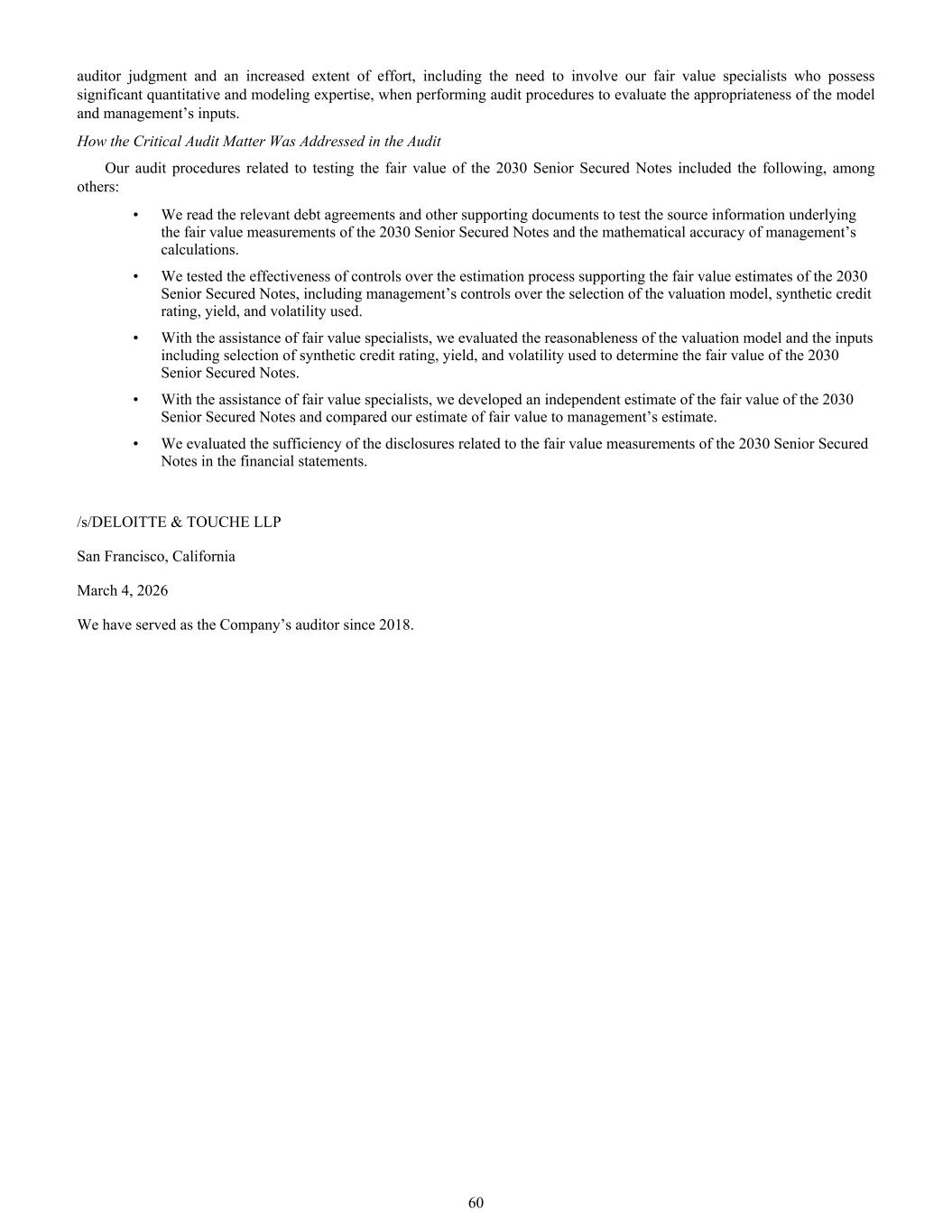
auditor judgment and an increased extent of effort, including the need to involve our fair value specialists who possess significant quantitative and modeling expertise, when performing audit procedures to evaluate the appropriateness of the model and management’s inputs. How the Critical Audit Matter Was Addressed in the Audit Our audit procedures related to testing the fair value of the 2030 Senior Secured Notes included the following, among others: • We read the relevant debt agreements and other supporting documents to test the source information underlying the fair value measurements of the 2030 Senior Secured Notes and the mathematical accuracy of management’s calculations. • We tested the effectiveness of controls over the estimation process supporting the fair value estimates of the 2030 Senior Secured Notes, including management’s controls over the selection of the valuation model, synthetic credit rating, yield, and volatility used. • With the assistance of fair value specialists, we evaluated the reasonableness of the valuation model and the inputs including selection of synthetic credit rating, yield, and volatility used to determine the fair value of the 2030 Senior Secured Notes. • With the assistance of fair value specialists, we developed an independent estimate of the fair value of the 2030 Senior Secured Notes and compared our estimate of fair value to management’s estimate. • We evaluated the sufficiency of the disclosures related to the fair value measurements of the 2030 Senior Secured Notes in the financial statements. /s/DELOITTE & TOUCHE LLP San Francisco, California March 4, 2026 We have served as the Company’s auditor since 2018. 60
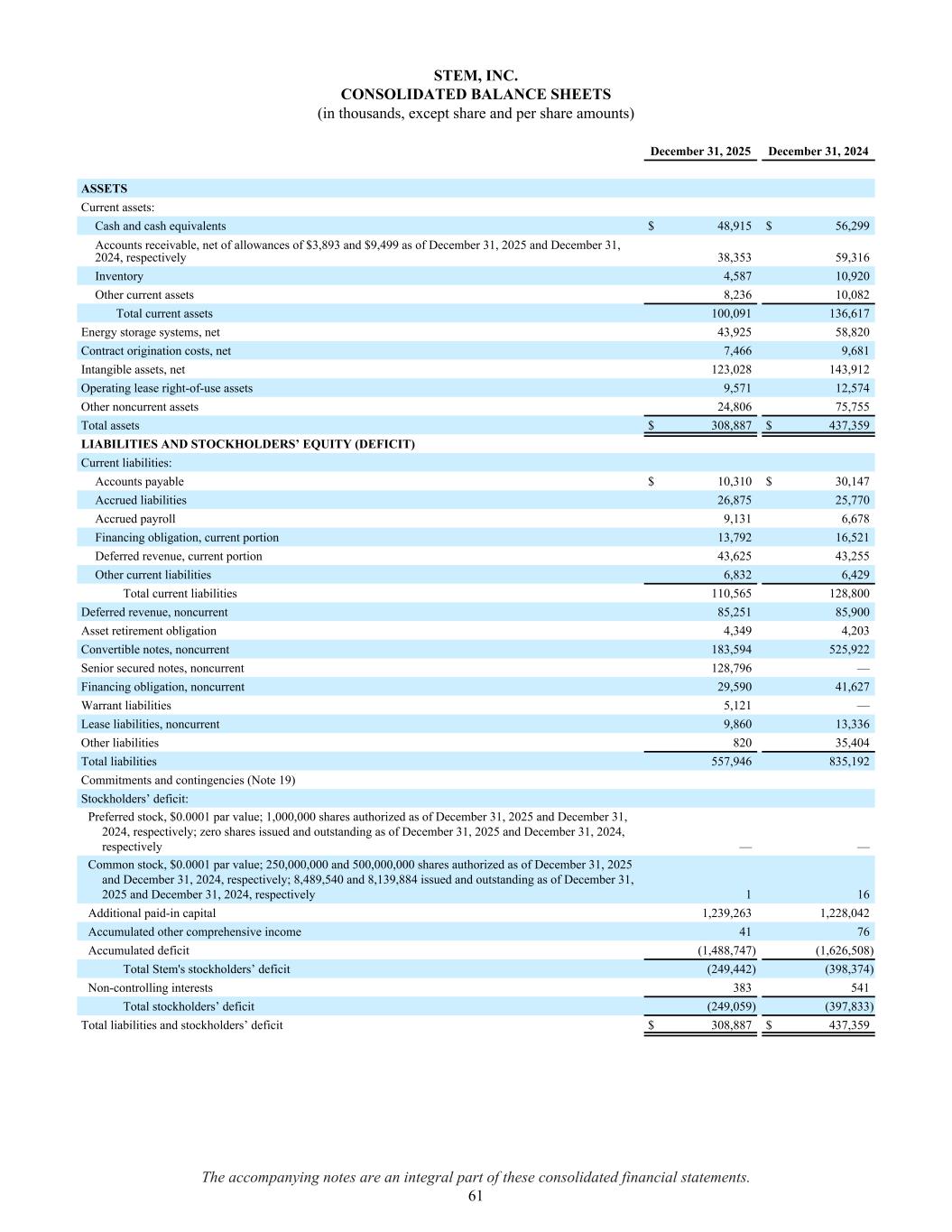
STEM, INC. CONSOLIDATED BALANCE SHEETS (in thousands, except share and per share amounts) December 31, 2025 December 31, 2024 ASSETS Current assets: Cash and cash equivalents $ 48,915 $ 56,299 Accounts receivable, net of allowances of $3,893 and $9,499 as of December 31, 2025 and December 31, 2024, respectively 38,353 59,316 Inventory 4,587 10,920 Other current assets 8,236 10,082 Total current assets 100,091 136,617 Energy storage systems, net 43,925 58,820 Contract origination costs, net 7,466 9,681 Intangible assets, net 123,028 143,912 Operating lease right-of-use assets 9,571 12,574 Other noncurrent assets 24,806 75,755 Total assets $ 308,887 $ 437,359 LIABILITIES AND STOCKHOLDERS’ EQUITY (DEFICIT) Current liabilities: Accounts payable $ 10,310 $ 30,147 Accrued liabilities 26,875 25,770 Accrued payroll 9,131 6,678 Financing obligation, current portion 13,792 16,521 Deferred revenue, current portion 43,625 43,255 Other current liabilities 6,832 6,429 Total current liabilities 110,565 128,800 Deferred revenue, noncurrent 85,251 85,900 Asset retirement obligation 4,349 4,203 Convertible notes, noncurrent 183,594 525,922 Senior secured notes, noncurrent 128,796 — Financing obligation, noncurrent 29,590 41,627 Warrant liabilities 5,121 — Lease liabilities, noncurrent 9,860 13,336 Other liabilities 820 35,404 Total liabilities 557,946 835,192 Commitments and contingencies (Note 19) Stockholders’ deficit: Preferred stock, $0.0001 par value; 1,000,000 shares authorized as of December 31, 2025 and December 31, 2024, respectively; zero shares issued and outstanding as of December 31, 2025 and December 31, 2024, respectively — — Common stock, $0.0001 par value; 250,000,000 and 500,000,000 shares authorized as of December 31, 2025 and December 31, 2024, respectively; 8,489,540 and 8,139,884 issued and outstanding as of December 31, 2025 and December 31, 2024, respectively 1 16 Additional paid-in capital 1,239,263 1,228,042 Accumulated other comprehensive income 41 76 Accumulated deficit (1,488,747) (1,626,508) Total Stem's stockholders’ deficit (249,442) (398,374) Non-controlling interests 383 541 Total stockholders’ deficit (249,059) (397,833) Total liabilities and stockholders’ deficit $ 308,887 $ 437,359 The accompanying notes are an integral part of these consolidated financial statements. 61
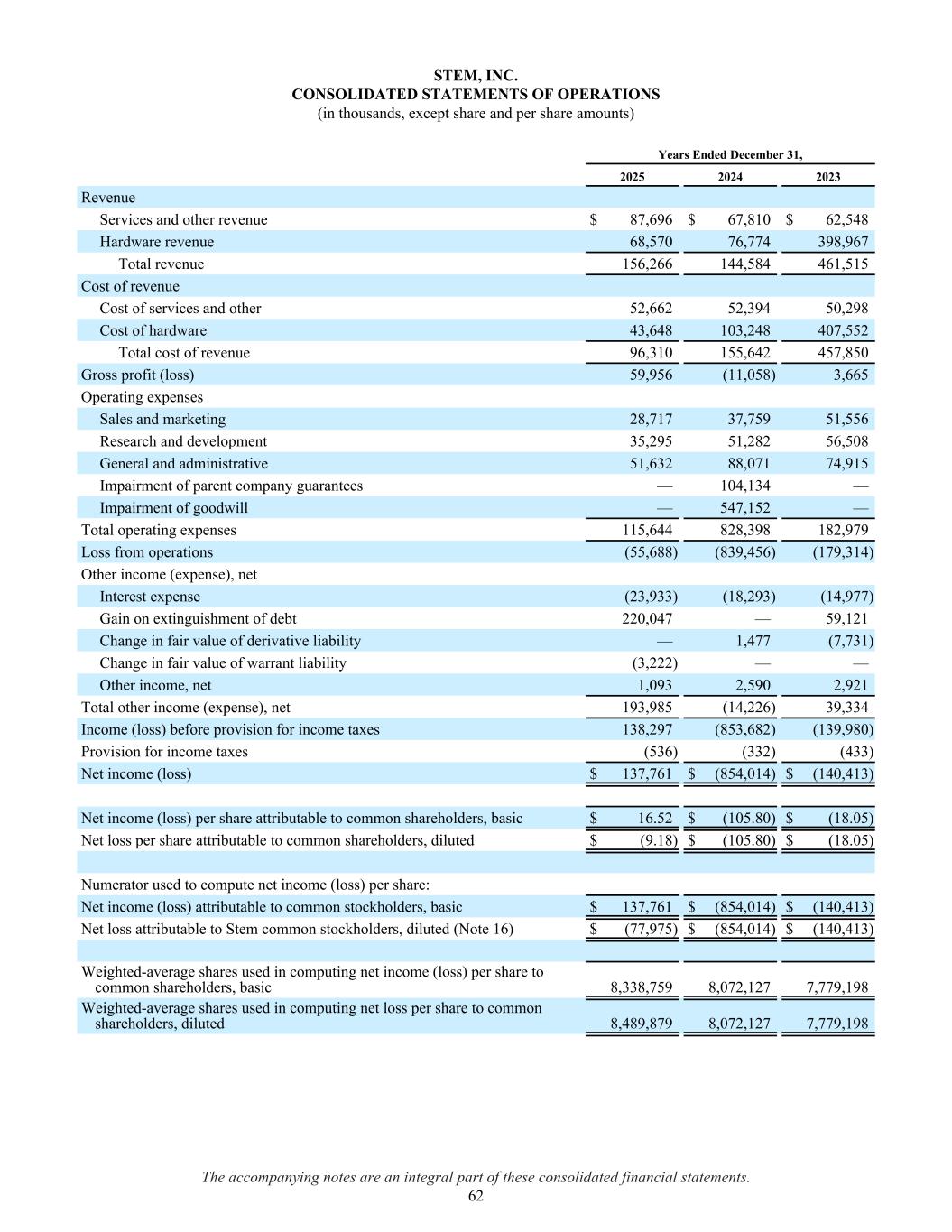
STEM, INC. CONSOLIDATED STATEMENTS OF OPERATIONS (in thousands, except share and per share amounts) Years Ended December 31, 2025 2024 2023 Revenue Services and other revenue $ 87,696 $ 67,810 $ 62,548 Hardware revenue 68,570 76,774 398,967 Total revenue 156,266 144,584 461,515 Cost of revenue Cost of services and other 52,662 52,394 50,298 Cost of hardware 43,648 103,248 407,552 Total cost of revenue 96,310 155,642 457,850 Gross profit (loss) 59,956 (11,058) 3,665 Operating expenses Sales and marketing 28,717 37,759 51,556 Research and development 35,295 51,282 56,508 General and administrative 51,632 88,071 74,915 Impairment of parent company guarantees — 104,134 — Impairment of goodwill — 547,152 — Total operating expenses 115,644 828,398 182,979 Loss from operations (55,688) (839,456) (179,314) Other income (expense), net Interest expense (23,933) (18,293) (14,977) Gain on extinguishment of debt 220,047 — 59,121 Change in fair value of derivative liability — 1,477 (7,731) Change in fair value of warrant liability (3,222) — — Other income, net 1,093 2,590 2,921 Total other income (expense), net 193,985 (14,226) 39,334 Income (loss) before provision for income taxes 138,297 (853,682) (139,980) Provision for income taxes (536) (332) (433) Net income (loss) $ 137,761 $ (854,014) $ (140,413) Net income (loss) per share attributable to common shareholders, basic $ 16.52 $ (105.80) $ (18.05) Net loss per share attributable to common shareholders, diluted $ (9.18) $ (105.80) $ (18.05) Numerator used to compute net income (loss) per share: Net income (loss) attributable to common stockholders, basic $ 137,761 $ (854,014) $ (140,413) Net loss attributable to Stem common stockholders, diluted (Note 16) $ (77,975) $ (854,014) $ (140,413) Weighted-average shares used in computing net income (loss) per share to common shareholders, basic 8,338,759 8,072,127 7,779,198 Weighted-average shares used in computing net loss per share to common shareholders, diluted 8,489,879 8,072,127 7,779,198 The accompanying notes are an integral part of these consolidated financial statements. 62
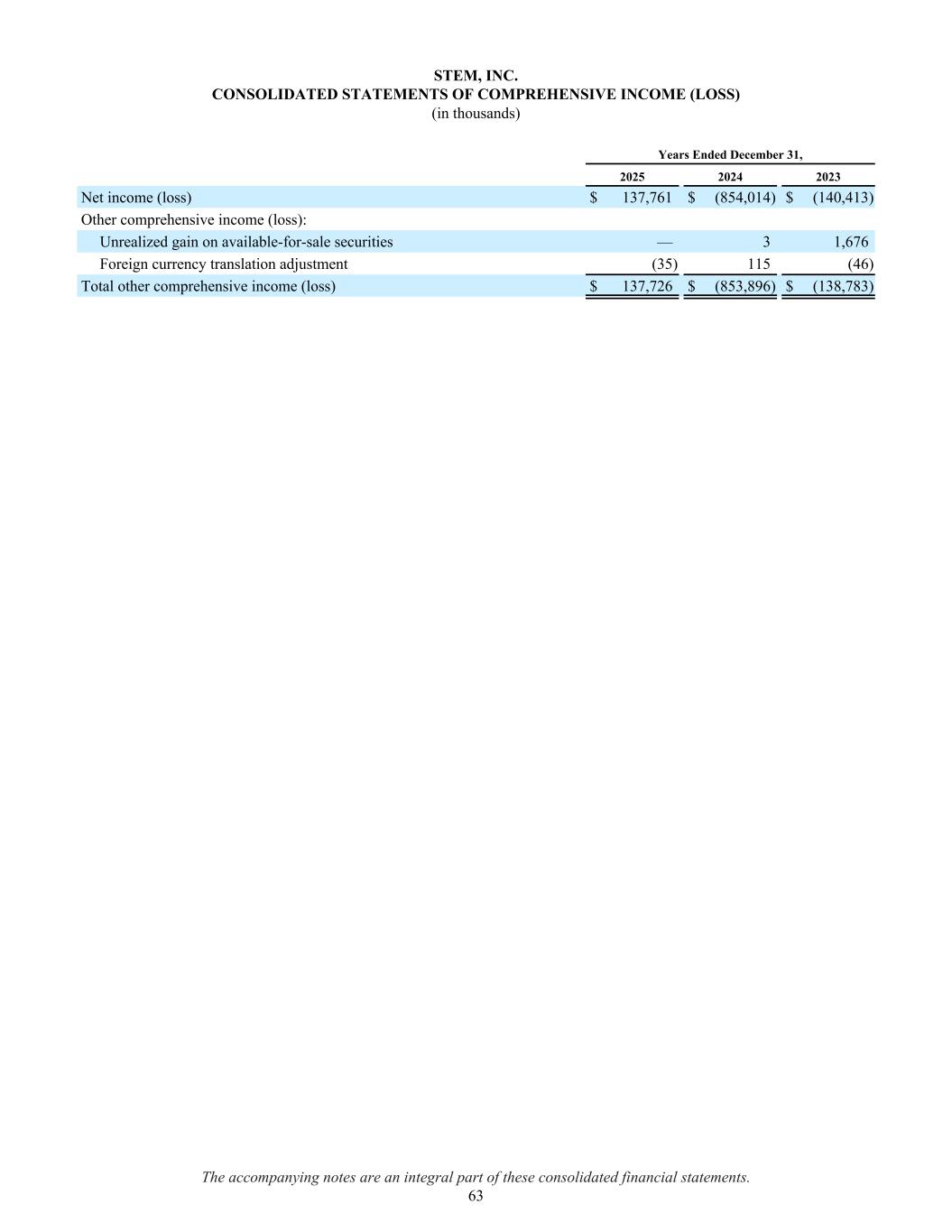
STEM, INC. CONSOLIDATED STATEMENTS OF COMPREHENSIVE INCOME (LOSS) (in thousands) Years Ended December 31, 2025 2024 2023 Net income (loss) $ 137,761 $ (854,014) $ (140,413) Other comprehensive income (loss): Unrealized gain on available-for-sale securities — 3 1,676 Foreign currency translation adjustment (35) 115 (46) Total other comprehensive income (loss) $ 137,726 $ (853,896) $ (138,783) The accompanying notes are an integral part of these consolidated financial statements. 63
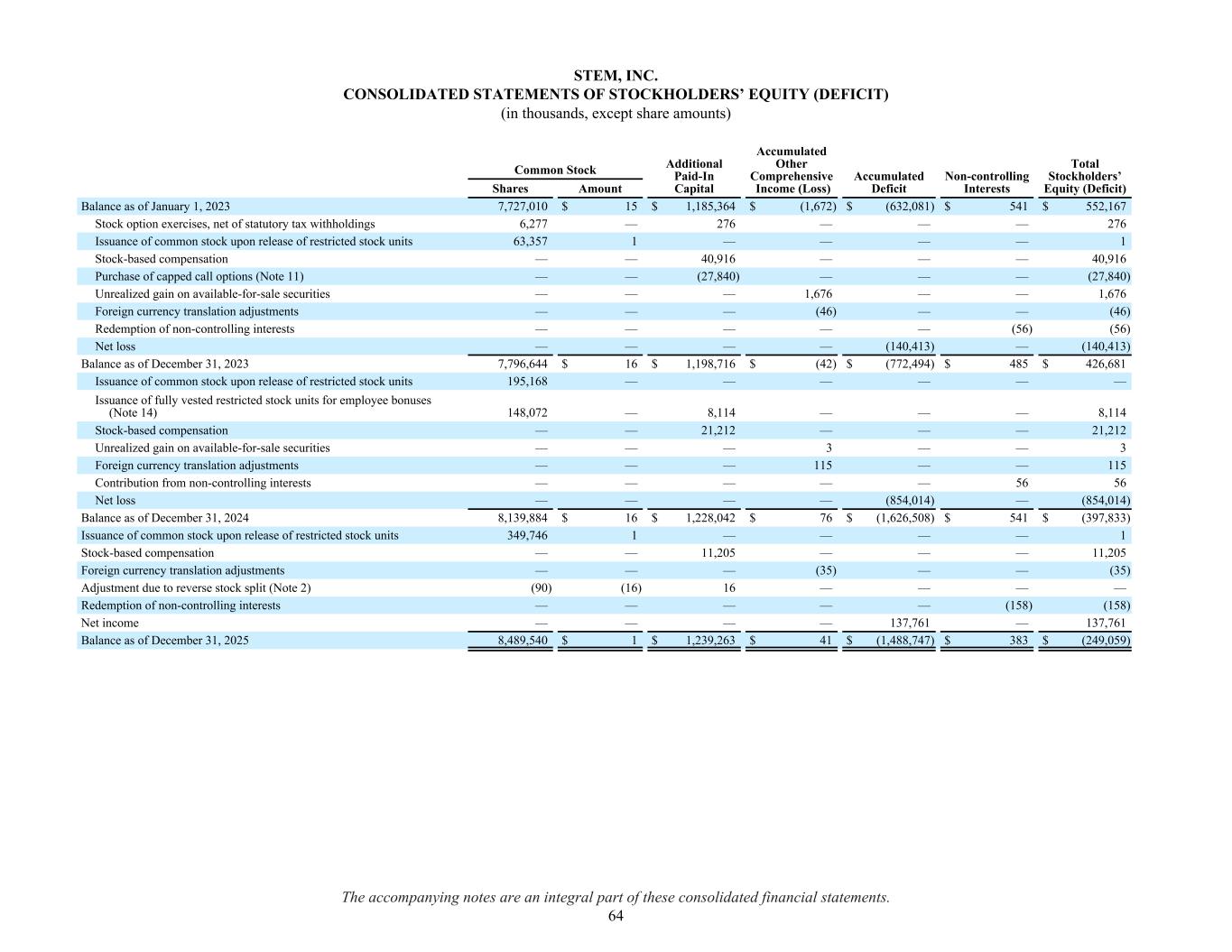
STEM, INC. CONSOLIDATED STATEMENTS OF STOCKHOLDERS’ EQUITY (DEFICIT) (in thousands, except share amounts) Common Stock Additional Paid-In Capital Accumulated Other Comprehensive Income (Loss) Accumulated Deficit Non-controlling Interests Total Stockholders’ Equity (Deficit)Shares Amount Balance as of January 1, 2023 7,727,010 $ 15 $ 1,185,364 $ (1,672) $ (632,081) $ 541 $ 552,167 Stock option exercises, net of statutory tax withholdings 6,277 — 276 — — — 276 Issuance of common stock upon release of restricted stock units 63,357 1 — — — — 1 Stock-based compensation — — 40,916 — — — 40,916 Purchase of capped call options (Note 11) — — (27,840) — — — (27,840) Unrealized gain on available-for-sale securities — — — 1,676 — — 1,676 Foreign currency translation adjustments — — — (46) — — (46) Redemption of non-controlling interests — — — — — (56) (56) Net loss — — — — (140,413) — (140,413) Balance as of December 31, 2023 7,796,644 $ 16 $ 1,198,716 $ (42) $ (772,494) $ 485 $ 426,681 Issuance of common stock upon release of restricted stock units 195,168 — — — — — — Issuance of fully vested restricted stock units for employee bonuses (Note 14) 148,072 — 8,114 — — — 8,114 Stock-based compensation — — 21,212 — — — 21,212 Unrealized gain on available-for-sale securities — — — 3 — — 3 Foreign currency translation adjustments — — — 115 — — 115 Contribution from non-controlling interests — — — — — 56 56 Net loss — — — — (854,014) — (854,014) Balance as of December 31, 2024 8,139,884 $ 16 $ 1,228,042 $ 76 $ (1,626,508) $ 541 $ (397,833) Issuance of common stock upon release of restricted stock units 349,746 1 — — — — 1 Stock-based compensation — — 11,205 — — — 11,205 Foreign currency translation adjustments — — — (35) — — (35) Adjustment due to reverse stock split (Note 2) (90) (16) 16 — — — — Redemption of non-controlling interests — — — — — (158) (158) Net income — — — — 137,761 — 137,761 Balance as of December 31, 2025 8,489,540 $ 1 $ 1,239,263 $ 41 $ (1,488,747) $ 383 $ (249,059) The accompanying notes are an integral part of these consolidated financial statements. 64
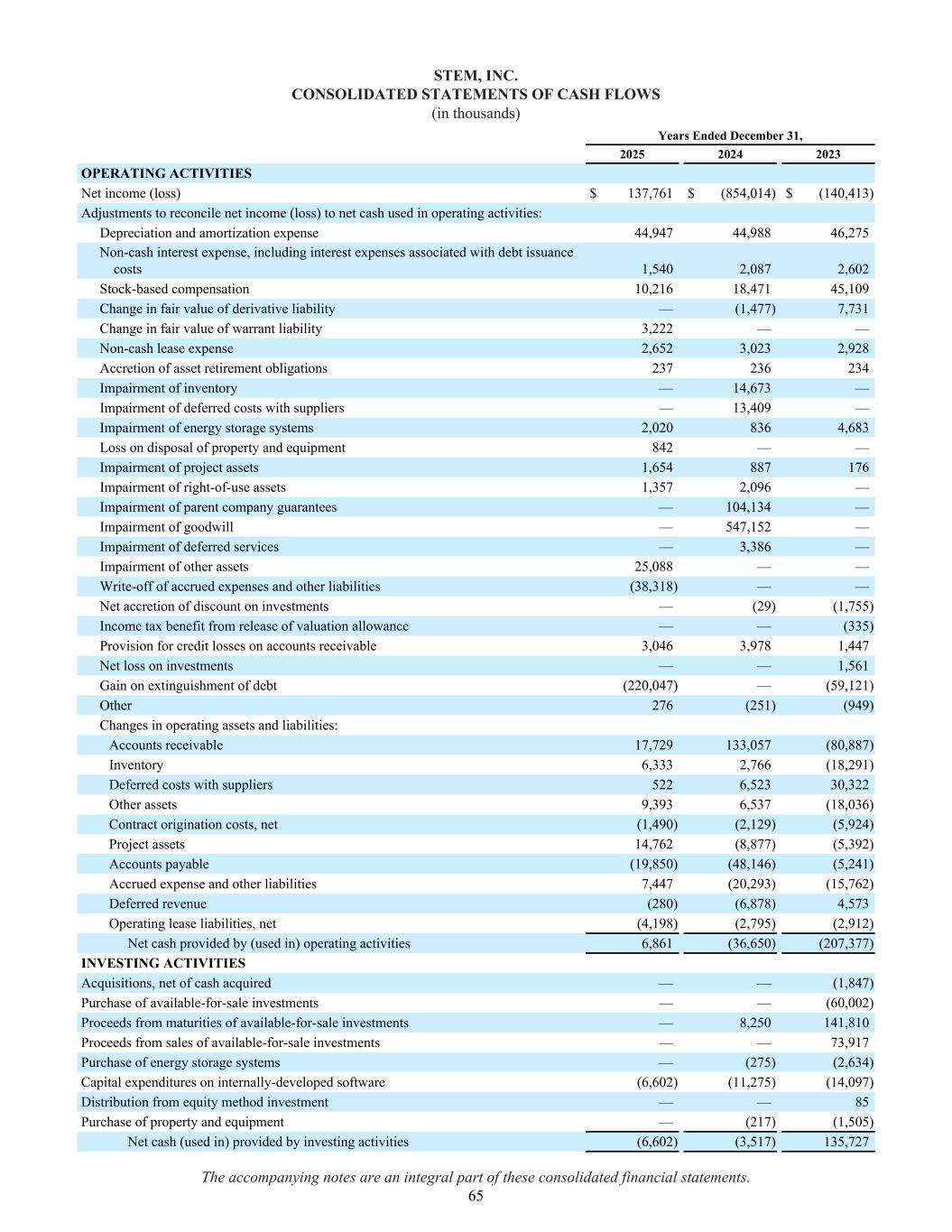
STEM, INC. CONSOLIDATED STATEMENTS OF CASH FLOWS (in thousands) Years Ended December 31, 2025 2024 2023 OPERATING ACTIVITIES Net income (loss) $ 137,761 $ (854,014) $ (140,413) Adjustments to reconcile net income (loss) to net cash used in operating activities: Depreciation and amortization expense 44,947 44,988 46,275 Non-cash interest expense, including interest expenses associated with debt issuance costs 1,540 2,087 2,602 Stock-based compensation 10,216 18,471 45,109 Change in fair value of derivative liability — (1,477) 7,731 Change in fair value of warrant liability 3,222 — — Non-cash lease expense 2,652 3,023 2,928 Accretion of asset retirement obligations 237 236 234 Impairment of inventory — 14,673 — Impairment of deferred costs with suppliers — 13,409 — Impairment of energy storage systems 2,020 836 4,683 Loss on disposal of property and equipment 842 — — Impairment of project assets 1,654 887 176 Impairment of right-of-use assets 1,357 2,096 — Impairment of parent company guarantees — 104,134 — Impairment of goodwill — 547,152 — Impairment of deferred services — 3,386 — Impairment of other assets 25,088 — — Write-off of accrued expenses and other liabilities (38,318) — — Net accretion of discount on investments — (29) (1,755) Income tax benefit from release of valuation allowance — — (335) Provision for credit losses on accounts receivable 3,046 3,978 1,447 Net loss on investments — — 1,561 Gain on extinguishment of debt (220,047) — (59,121) Other 276 (251) (949) Changes in operating assets and liabilities: Accounts receivable 17,729 133,057 (80,887) Inventory 6,333 2,766 (18,291) Deferred costs with suppliers 522 6,523 30,322 Other assets 9,393 6,537 (18,036) Contract origination costs, net (1,490) (2,129) (5,924) Project assets 14,762 (8,877) (5,392) Accounts payable (19,850) (48,146) (5,241) Accrued expense and other liabilities 7,447 (20,293) (15,762) Deferred revenue (280) (6,878) 4,573 Operating lease liabilities, net (4,198) (2,795) (2,912) Net cash provided by (used in) operating activities 6,861 (36,650) (207,377) INVESTING ACTIVITIES Acquisitions, net of cash acquired — — (1,847) Purchase of available-for-sale investments — — (60,002) Proceeds from maturities of available-for-sale investments — 8,250 141,810 Proceeds from sales of available-for-sale investments — — 73,917 Purchase of energy storage systems — (275) (2,634) Capital expenditures on internally-developed software (6,602) (11,275) (14,097) Distribution from equity method investment — — 85 Purchase of property and equipment — (217) (1,505) Net cash (used in) provided by investing activities (6,602) (3,517) 135,727 The accompanying notes are an integral part of these consolidated financial statements. 65
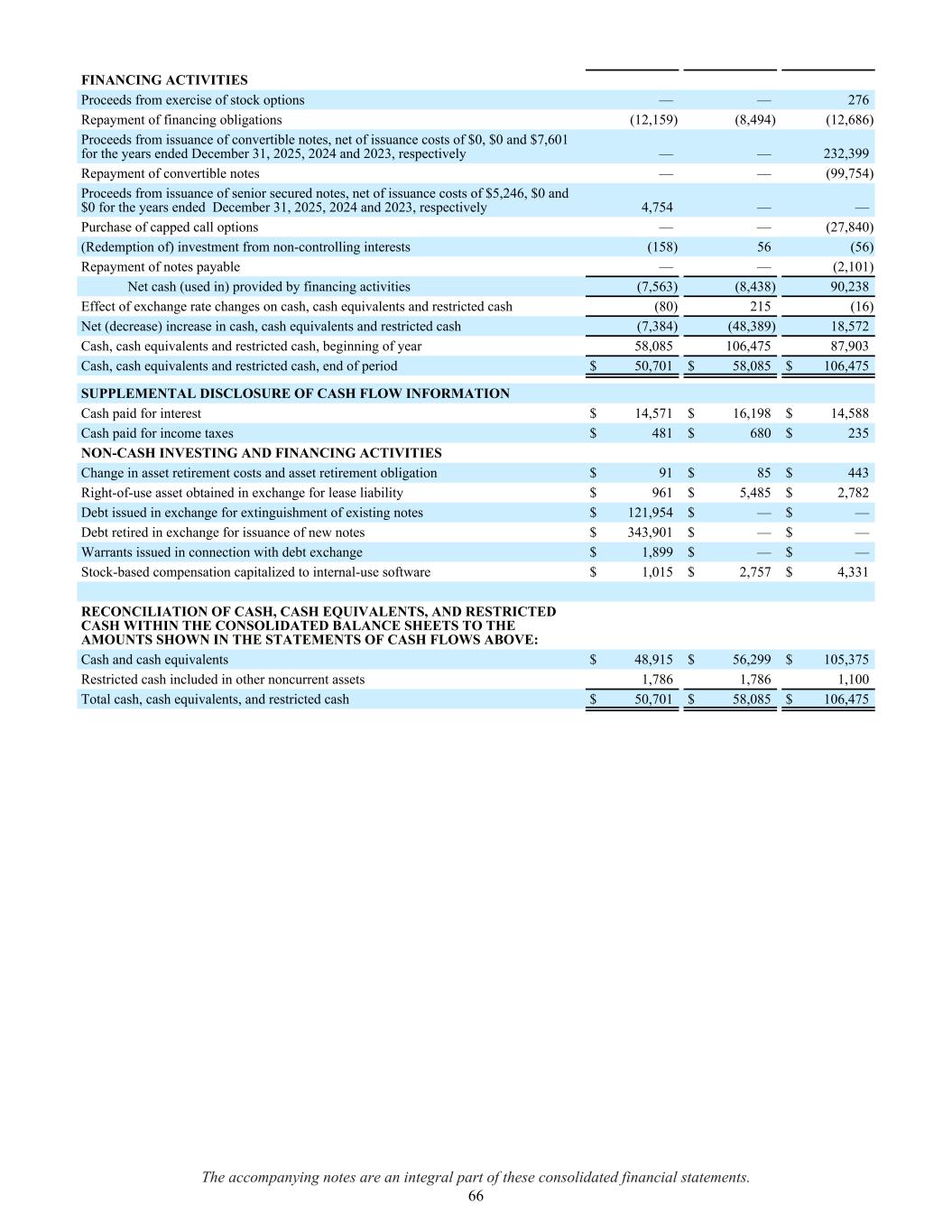
FINANCING ACTIVITIES Proceeds from exercise of stock options — — 276 Repayment of financing obligations (12,159) (8,494) (12,686) Proceeds from issuance of convertible notes, net of issuance costs of $0, $0 and $7,601 for the years ended December 31, 2025, 2024 and 2023, respectively — — 232,399 Repayment of convertible notes — — (99,754) Proceeds from issuance of senior secured notes, net of issuance costs of $5,246, $0 and $0 for the years ended December 31, 2025, 2024 and 2023, respectively 4,754 — — Purchase of capped call options — — (27,840) (Redemption of) investment from non-controlling interests (158) 56 (56) Repayment of notes payable — — (2,101) Net cash (used in) provided by financing activities (7,563) (8,438) 90,238 Effect of exchange rate changes on cash, cash equivalents and restricted cash (80) 215 (16) Net (decrease) increase in cash, cash equivalents and restricted cash (7,384) (48,389) 18,572 Cash, cash equivalents and restricted cash, beginning of year 58,085 106,475 87,903 Cash, cash equivalents and restricted cash, end of period $ 50,701 $ 58,085 $ 106,475 SUPPLEMENTAL DISCLOSURE OF CASH FLOW INFORMATION Cash paid for interest $ 14,571 $ 16,198 $ 14,588 Cash paid for income taxes $ 481 $ 680 $ 235 NON-CASH INVESTING AND FINANCING ACTIVITIES Change in asset retirement costs and asset retirement obligation $ 91 $ 85 $ 443 Right-of-use asset obtained in exchange for lease liability $ 961 $ 5,485 $ 2,782 Debt issued in exchange for extinguishment of existing notes $ 121,954 $ — $ — Debt retired in exchange for issuance of new notes $ 343,901 $ — $ — Warrants issued in connection with debt exchange $ 1,899 $ — $ — Stock-based compensation capitalized to internal-use software $ 1,015 $ 2,757 $ 4,331 RECONCILIATION OF CASH, CASH EQUIVALENTS, AND RESTRICTED CASH WITHIN THE CONSOLIDATED BALANCE SHEETS TO THE AMOUNTS SHOWN IN THE STATEMENTS OF CASH FLOWS ABOVE: Cash and cash equivalents $ 48,915 $ 56,299 $ 105,375 Restricted cash included in other noncurrent assets 1,786 1,786 1,100 Total cash, cash equivalents, and restricted cash $ 50,701 $ 58,085 $ 106,475 The accompanying notes are an integral part of these consolidated financial statements. 66
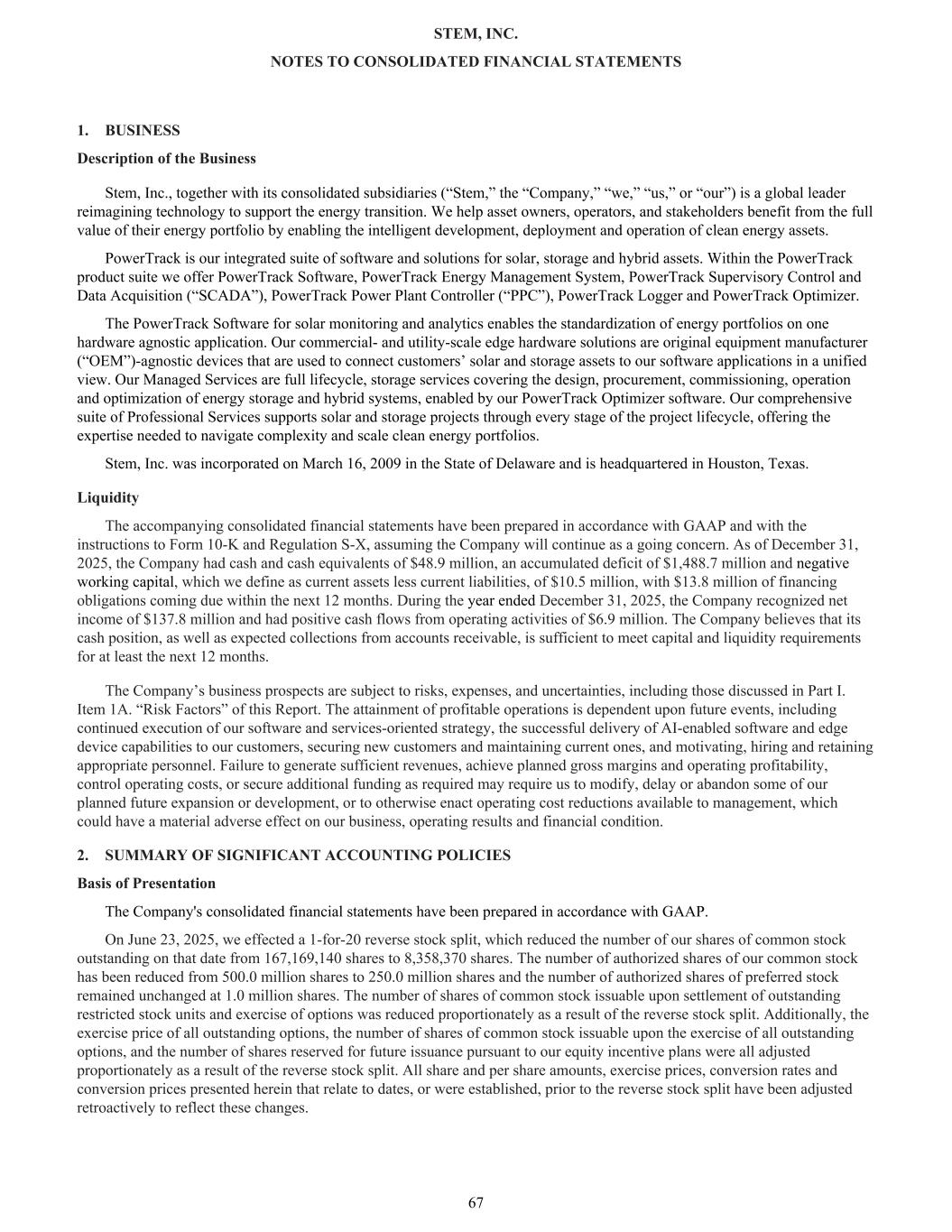
1. BUSINESS Description of the Business Stem, Inc., together with its consolidated subsidiaries (“Stem,” the “Company,” “we,” “us,” or “our”) is a global leader reimagining technology to support the energy transition. We help asset owners, operators, and stakeholders benefit from the full value of their energy portfolio by enabling the intelligent development, deployment and operation of clean energy assets. PowerTrack is our integrated suite of software and solutions for solar, storage and hybrid assets. Within the PowerTrack product suite we offer PowerTrack Software, PowerTrack Energy Management System, PowerTrack Supervisory Control and Data Acquisition (“SCADA”), PowerTrack Power Plant Controller (“PPC”), PowerTrack Logger and PowerTrack Optimizer. The PowerTrack Software for solar monitoring and analytics enables the standardization of energy portfolios on one hardware agnostic application. Our commercial- and utility-scale edge hardware solutions are original equipment manufacturer (“OEM”)-agnostic devices that are used to connect customers’ solar and storage assets to our software applications in a unified view. Our Managed Services are full lifecycle, storage services covering the design, procurement, commissioning, operation and optimization of energy storage and hybrid systems, enabled by our PowerTrack Optimizer software. Our comprehensive suite of Professional Services supports solar and storage projects through every stage of the project lifecycle, offering the expertise needed to navigate complexity and scale clean energy portfolios. Stem, Inc. was incorporated on March 16, 2009 in the State of Delaware and is headquartered in Houston, Texas. Liquidity The accompanying consolidated financial statements have been prepared in accordance with GAAP and with the instructions to Form 10-K and Regulation S-X, assuming the Company will continue as a going concern. As of December 31, 2025, the Company had cash and cash equivalents of $48.9 million, an accumulated deficit of $1,488.7 million and negative working capital, which we define as current assets less current liabilities, of $10.5 million, with $13.8 million of financing obligations coming due within the next 12 months. During the year ended December 31, 2025, the Company recognized net income of $137.8 million and had positive cash flows from operating activities of $6.9 million. The Company believes that its cash position, as well as expected collections from accounts receivable, is sufficient to meet capital and liquidity requirements for at least the next 12 months. The Company’s business prospects are subject to risks, expenses, and uncertainties, including those discussed in Part I. Item 1A. “Risk Factors” of this Report. The attainment of profitable operations is dependent upon future events, including continued execution of our software and services-oriented strategy, the successful delivery of AI-enabled software and edge device capabilities to our customers, securing new customers and maintaining current ones, and motivating, hiring and retaining appropriate personnel. Failure to generate sufficient revenues, achieve planned gross margins and operating profitability, control operating costs, or secure additional funding as required may require us to modify, delay or abandon some of our planned future expansion or development, or to otherwise enact operating cost reductions available to management, which could have a material adverse effect on our business, operating results and financial condition. 2. SUMMARY OF SIGNIFICANT ACCOUNTING POLICIES Basis of Presentation The Company's consolidated financial statements have been prepared in accordance with GAAP. On June 23, 2025, we effected a 1-for-20 reverse stock split, which reduced the number of our shares of common stock outstanding on that date from 167,169,140 shares to 8,358,370 shares. The number of authorized shares of our common stock has been reduced from 500.0 million shares to 250.0 million shares and the number of authorized shares of preferred stock remained unchanged at 1.0 million shares. The number of shares of common stock issuable upon settlement of outstanding restricted stock units and exercise of options was reduced proportionately as a result of the reverse stock split. Additionally, the exercise price of all outstanding options, the number of shares of common stock issuable upon the exercise of all outstanding options, and the number of shares reserved for future issuance pursuant to our equity incentive plans were all adjusted proportionately as a result of the reverse stock split. All share and per share amounts, exercise prices, conversion rates and conversion prices presented herein that relate to dates, or were established, prior to the reverse stock split have been adjusted retroactively to reflect these changes. STEM, INC. NOTES TO CONSOLIDATED FINANCIAL STATEMENTS 67
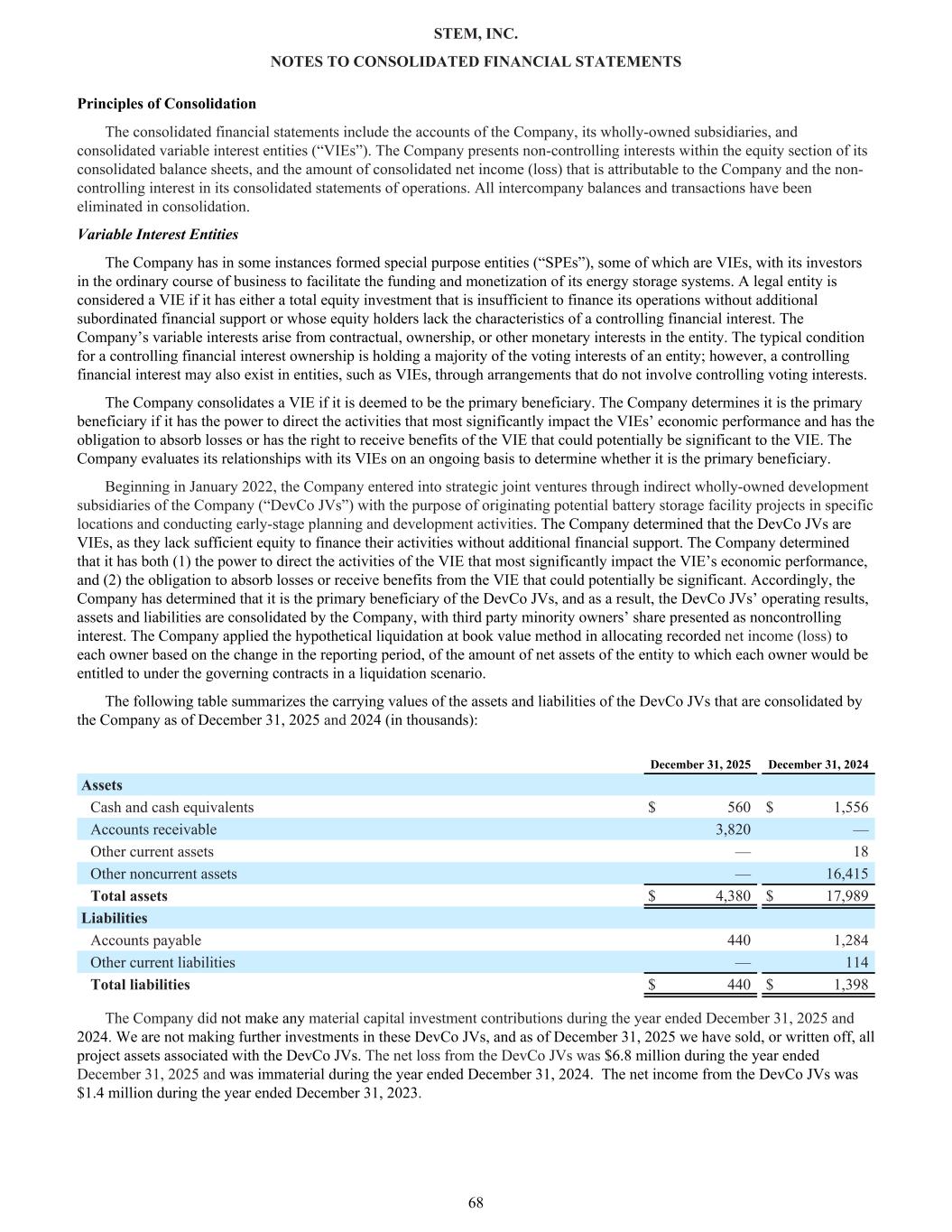
Principles of Consolidation The consolidated financial statements include the accounts of the Company, its wholly-owned subsidiaries, and consolidated variable interest entities (“VIEs”). The Company presents non-controlling interests within the equity section of its consolidated balance sheets, and the amount of consolidated net income (loss) that is attributable to the Company and the non- controlling interest in its consolidated statements of operations. All intercompany balances and transactions have been eliminated in consolidation. Variable Interest Entities The Company has in some instances formed special purpose entities (“SPEs”), some of which are VIEs, with its investors in the ordinary course of business to facilitate the funding and monetization of its energy storage systems. A legal entity is considered a VIE if it has either a total equity investment that is insufficient to finance its operations without additional subordinated financial support or whose equity holders lack the characteristics of a controlling financial interest. The Company’s variable interests arise from contractual, ownership, or other monetary interests in the entity. The typical condition for a controlling financial interest ownership is holding a majority of the voting interests of an entity; however, a controlling financial interest may also exist in entities, such as VIEs, through arrangements that do not involve controlling voting interests. The Company consolidates a VIE if it is deemed to be the primary beneficiary. The Company determines it is the primary beneficiary if it has the power to direct the activities that most significantly impact the VIEs’ economic performance and has the obligation to absorb losses or has the right to receive benefits of the VIE that could potentially be significant to the VIE. The Company evaluates its relationships with its VIEs on an ongoing basis to determine whether it is the primary beneficiary. Beginning in January 2022, the Company entered into strategic joint ventures through indirect wholly-owned development subsidiaries of the Company (“DevCo JVs”) with the purpose of originating potential battery storage facility projects in specific locations and conducting early-stage planning and development activities. The Company determined that the DevCo JVs are VIEs, as they lack sufficient equity to finance their activities without additional financial support. The Company determined that it has both (1) the power to direct the activities of the VIE that most significantly impact the VIE’s economic performance, and (2) the obligation to absorb losses or receive benefits from the VIE that could potentially be significant. Accordingly, the Company has determined that it is the primary beneficiary of the DevCo JVs, and as a result, the DevCo JVs’ operating results, assets and liabilities are consolidated by the Company, with third party minority owners’ share presented as noncontrolling interest. The Company applied the hypothetical liquidation at book value method in allocating recorded net income (loss) to each owner based on the change in the reporting period, of the amount of net assets of the entity to which each owner would be entitled to under the governing contracts in a liquidation scenario. The following table summarizes the carrying values of the assets and liabilities of the DevCo JVs that are consolidated by the Company as of December 31, 2025 and 2024 (in thousands): December 31, 2025 December 31, 2024 Assets Cash and cash equivalents $ 560 $ 1,556 Accounts receivable 3,820 — Other current assets — 18 Other noncurrent assets — 16,415 Total assets $ 4,380 $ 17,989 Liabilities Accounts payable 440 1,284 Other current liabilities — 114 Total liabilities $ 440 $ 1,398 The Company did not make any material capital investment contributions during the year ended December 31, 2025 and 2024. We are not making further investments in these DevCo JVs, and as of December 31, 2025 we have sold, or written off, all project assets associated with the DevCo JVs. The net loss from the DevCo JVs was $6.8 million during the year ended December 31, 2025 and was immaterial during the year ended December 31, 2024. The net income from the DevCo JVs was $1.4 million during the year ended December 31, 2023. STEM, INC. NOTES TO CONSOLIDATED FINANCIAL STATEMENTS 68
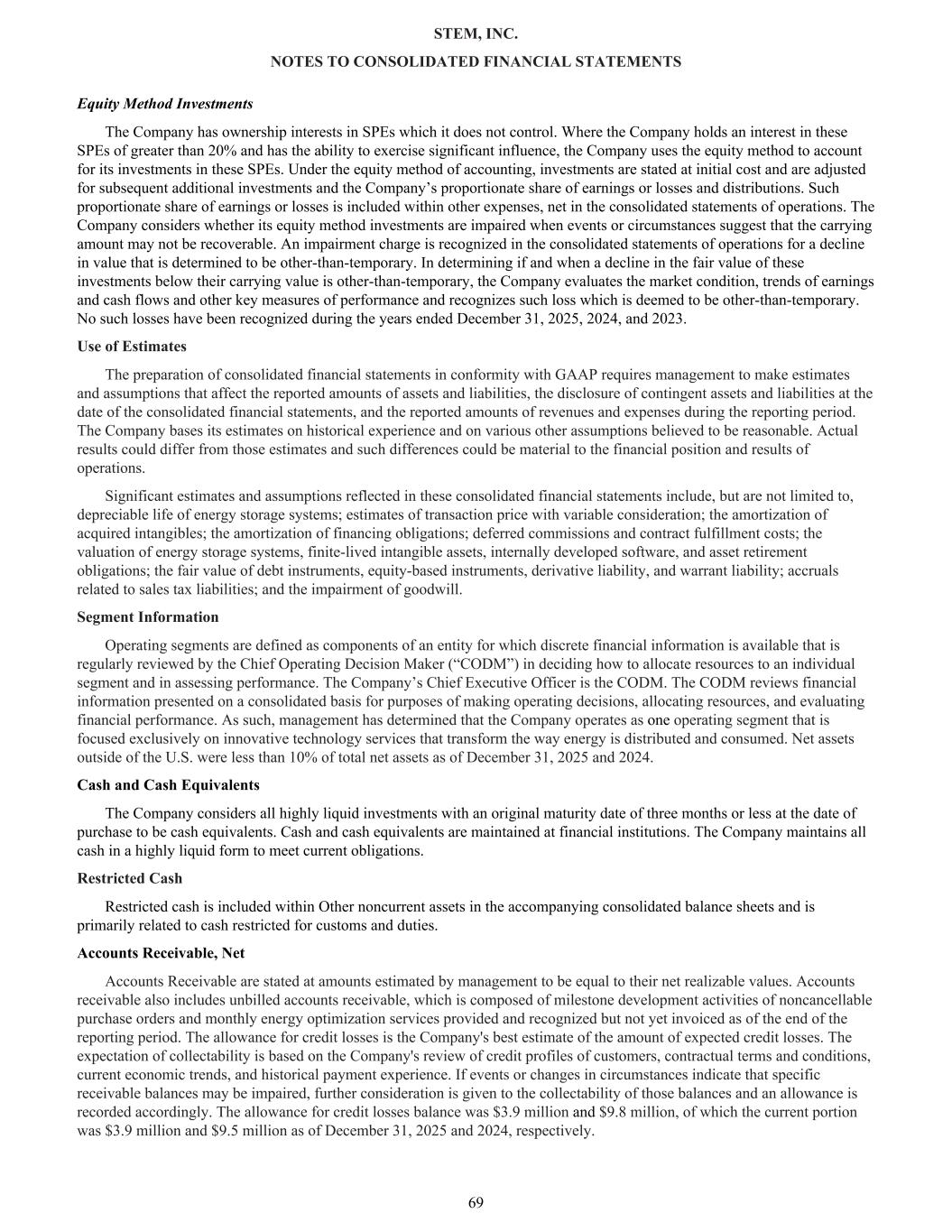
Equity Method Investments The Company has ownership interests in SPEs which it does not control. Where the Company holds an interest in these SPEs of greater than 20% and has the ability to exercise significant influence, the Company uses the equity method to account for its investments in these SPEs. Under the equity method of accounting, investments are stated at initial cost and are adjusted for subsequent additional investments and the Company’s proportionate share of earnings or losses and distributions. Such proportionate share of earnings or losses is included within other expenses, net in the consolidated statements of operations. The Company considers whether its equity method investments are impaired when events or circumstances suggest that the carrying amount may not be recoverable. An impairment charge is recognized in the consolidated statements of operations for a decline in value that is determined to be other-than-temporary. In determining if and when a decline in the fair value of these investments below their carrying value is other-than-temporary, the Company evaluates the market condition, trends of earnings and cash flows and other key measures of performance and recognizes such loss which is deemed to be other-than-temporary. No such losses have been recognized during the years ended December 31, 2025, 2024, and 2023. Use of Estimates The preparation of consolidated financial statements in conformity with GAAP requires management to make estimates and assumptions that affect the reported amounts of assets and liabilities, the disclosure of contingent assets and liabilities at the date of the consolidated financial statements, and the reported amounts of revenues and expenses during the reporting period. The Company bases its estimates on historical experience and on various other assumptions believed to be reasonable. Actual results could differ from those estimates and such differences could be material to the financial position and results of operations. Significant estimates and assumptions reflected in these consolidated financial statements include, but are not limited to, depreciable life of energy storage systems; estimates of transaction price with variable consideration; the amortization of acquired intangibles; the amortization of financing obligations; deferred commissions and contract fulfillment costs; the valuation of energy storage systems, finite-lived intangible assets, internally developed software, and asset retirement obligations; the fair value of debt instruments, equity-based instruments, derivative liability, and warrant liability; accruals related to sales tax liabilities; and the impairment of goodwill. Segment Information Operating segments are defined as components of an entity for which discrete financial information is available that is regularly reviewed by the Chief Operating Decision Maker (“CODM”) in deciding how to allocate resources to an individual segment and in assessing performance. The Company’s Chief Executive Officer is the CODM. The CODM reviews financial information presented on a consolidated basis for purposes of making operating decisions, allocating resources, and evaluating financial performance. As such, management has determined that the Company operates as one operating segment that is focused exclusively on innovative technology services that transform the way energy is distributed and consumed. Net assets outside of the U.S. were less than 10% of total net assets as of December 31, 2025 and 2024. Cash and Cash Equivalents The Company considers all highly liquid investments with an original maturity date of three months or less at the date of purchase to be cash equivalents. Cash and cash equivalents are maintained at financial institutions. The Company maintains all cash in a highly liquid form to meet current obligations. Restricted Cash Restricted cash is included within Other noncurrent assets in the accompanying consolidated balance sheets and is primarily related to cash restricted for customs and duties. Accounts Receivable, Net Accounts Receivable are stated at amounts estimated by management to be equal to their net realizable values. Accounts receivable also includes unbilled accounts receivable, which is composed of milestone development activities of noncancellable purchase orders and monthly energy optimization services provided and recognized but not yet invoiced as of the end of the reporting period. The allowance for credit losses is the Company's best estimate of the amount of expected credit losses. The expectation of collectability is based on the Company's review of credit profiles of customers, contractual terms and conditions, current economic trends, and historical payment experience. If events or changes in circumstances indicate that specific receivable balances may be impaired, further consideration is given to the collectability of those balances and an allowance is recorded accordingly. The allowance for credit losses balance was $3.9 million and $9.8 million, of which the current portion was $3.9 million and $9.5 million as of December 31, 2025 and 2024, respectively. STEM, INC. NOTES TO CONSOLIDATED FINANCIAL STATEMENTS 69
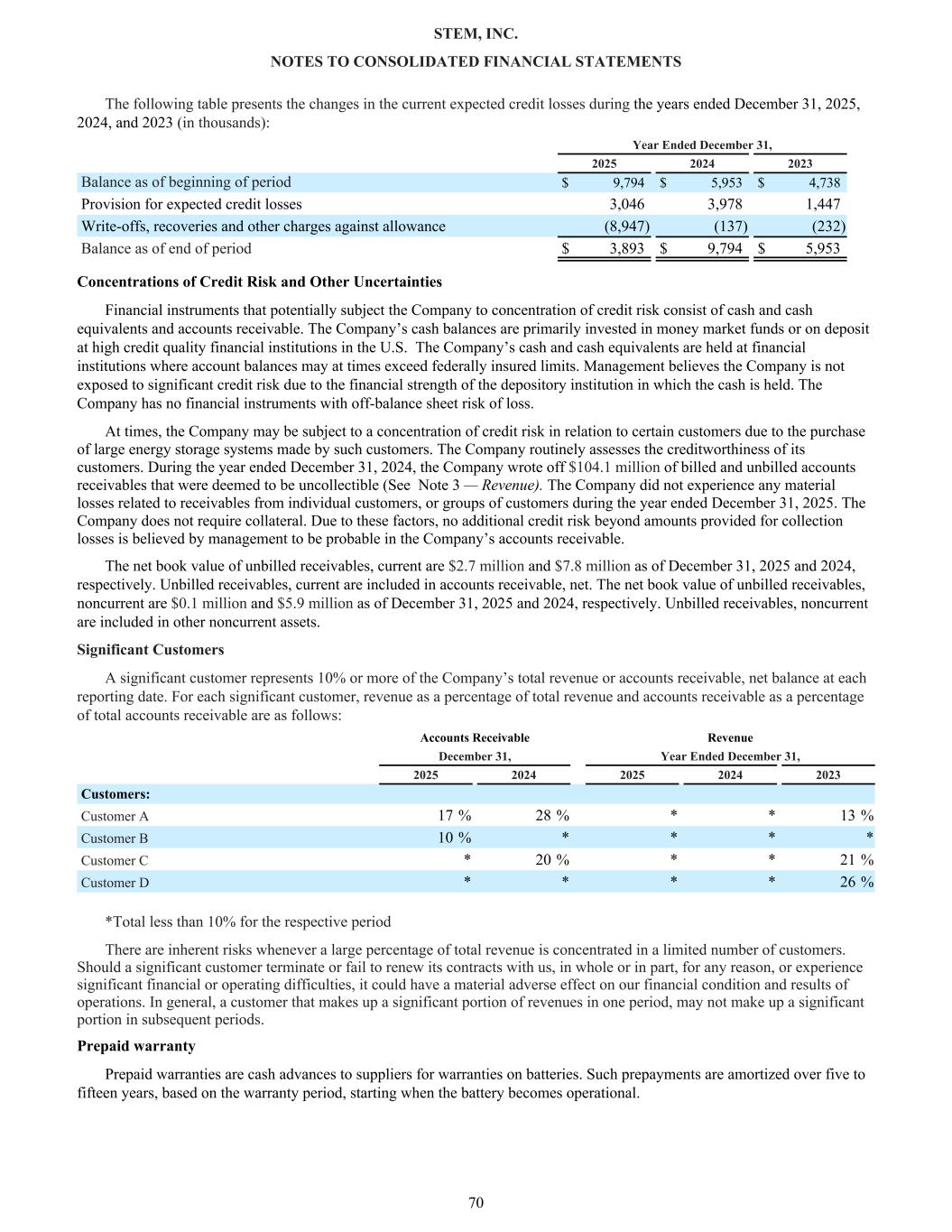
The following table presents the changes in the current expected credit losses during the years ended December 31, 2025, 2024, and 2023 (in thousands): Year Ended December 31, 2025 2024 2023 Balance as of beginning of period $ 9,794 $ 5,953 $ 4,738 Provision for expected credit losses 3,046 3,978 1,447 Write-offs, recoveries and other charges against allowance (8,947) (137) (232) Balance as of end of period $ 3,893 $ 9,794 $ 5,953 Concentrations of Credit Risk and Other Uncertainties Financial instruments that potentially subject the Company to concentration of credit risk consist of cash and cash equivalents and accounts receivable. The Company’s cash balances are primarily invested in money market funds or on deposit at high credit quality financial institutions in the U.S. The Company’s cash and cash equivalents are held at financial institutions where account balances may at times exceed federally insured limits. Management believes the Company is not exposed to significant credit risk due to the financial strength of the depository institution in which the cash is held. The Company has no financial instruments with off-balance sheet risk of loss. At times, the Company may be subject to a concentration of credit risk in relation to certain customers due to the purchase of large energy storage systems made by such customers. The Company routinely assesses the creditworthiness of its customers. During the year ended December 31, 2024, the Company wrote off $104.1 million of billed and unbilled accounts receivables that were deemed to be uncollectible (See Note 3 — Revenue). The Company did not experience any material losses related to receivables from individual customers, or groups of customers during the year ended December 31, 2025. The Company does not require collateral. Due to these factors, no additional credit risk beyond amounts provided for collection losses is believed by management to be probable in the Company’s accounts receivable. The net book value of unbilled receivables, current are $2.7 million and $7.8 million as of December 31, 2025 and 2024, respectively. Unbilled receivables, current are included in accounts receivable, net. The net book value of unbilled receivables, noncurrent are $0.1 million and $5.9 million as of December 31, 2025 and 2024, respectively. Unbilled receivables, noncurrent are included in other noncurrent assets. Significant Customers A significant customer represents 10% or more of the Company’s total revenue or accounts receivable, net balance at each reporting date. For each significant customer, revenue as a percentage of total revenue and accounts receivable as a percentage of total accounts receivable are as follows: Accounts Receivable Revenue December 31, Year Ended December 31, 2025 2024 2025 2024 2023 Customers: Customer A 17 % 28 % * * 13 % Customer B 10 % * * * * Customer C * 20 % * * 21 % Customer D * * * * 26 % *Total less than 10% for the respective period There are inherent risks whenever a large percentage of total revenue is concentrated in a limited number of customers. Should a significant customer terminate or fail to renew its contracts with us, in whole or in part, for any reason, or experience significant financial or operating difficulties, it could have a material adverse effect on our financial condition and results of operations. In general, a customer that makes up a significant portion of revenues in one period, may not make up a significant portion in subsequent periods. Prepaid warranty Prepaid warranties are cash advances to suppliers for warranties on batteries. Such prepayments are amortized over five to fifteen years, based on the warranty period, starting when the battery becomes operational. STEM, INC. NOTES TO CONSOLIDATED FINANCIAL STATEMENTS 70
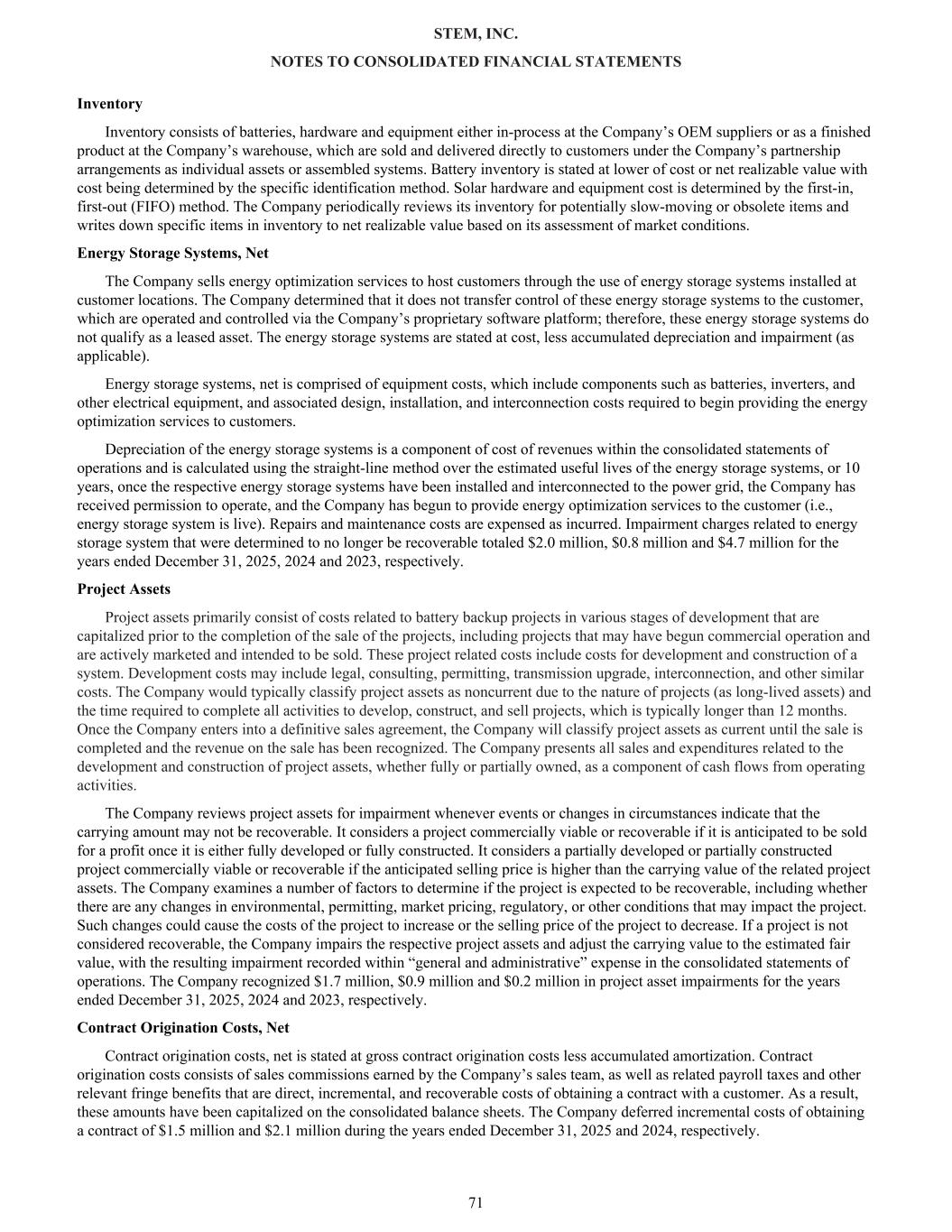
Inventory Inventory consists of batteries, hardware and equipment either in-process at the Company’s OEM suppliers or as a finished product at the Company’s warehouse, which are sold and delivered directly to customers under the Company’s partnership arrangements as individual assets or assembled systems. Battery inventory is stated at lower of cost or net realizable value with cost being determined by the specific identification method. Solar hardware and equipment cost is determined by the first-in, first-out (FIFO) method. The Company periodically reviews its inventory for potentially slow-moving or obsolete items and writes down specific items in inventory to net realizable value based on its assessment of market conditions. Energy Storage Systems, Net The Company sells energy optimization services to host customers through the use of energy storage systems installed at customer locations. The Company determined that it does not transfer control of these energy storage systems to the customer, which are operated and controlled via the Company’s proprietary software platform; therefore, these energy storage systems do not qualify as a leased asset. The energy storage systems are stated at cost, less accumulated depreciation and impairment (as applicable). Energy storage systems, net is comprised of equipment costs, which include components such as batteries, inverters, and other electrical equipment, and associated design, installation, and interconnection costs required to begin providing the energy optimization services to customers. Depreciation of the energy storage systems is a component of cost of revenues within the consolidated statements of operations and is calculated using the straight-line method over the estimated useful lives of the energy storage systems, or 10 years, once the respective energy storage systems have been installed and interconnected to the power grid, the Company has received permission to operate, and the Company has begun to provide energy optimization services to the customer (i.e., energy storage system is live). Repairs and maintenance costs are expensed as incurred. Impairment charges related to energy storage system that were determined to no longer be recoverable totaled $2.0 million, $0.8 million and $4.7 million for the years ended December 31, 2025, 2024 and 2023, respectively. Project Assets Project assets primarily consist of costs related to battery backup projects in various stages of development that are capitalized prior to the completion of the sale of the projects, including projects that may have begun commercial operation and are actively marketed and intended to be sold. These project related costs include costs for development and construction of a system. Development costs may include legal, consulting, permitting, transmission upgrade, interconnection, and other similar costs. The Company would typically classify project assets as noncurrent due to the nature of projects (as long-lived assets) and the time required to complete all activities to develop, construct, and sell projects, which is typically longer than 12 months. Once the Company enters into a definitive sales agreement, the Company will classify project assets as current until the sale is completed and the revenue on the sale has been recognized. The Company presents all sales and expenditures related to the development and construction of project assets, whether fully or partially owned, as a component of cash flows from operating activities. The Company reviews project assets for impairment whenever events or changes in circumstances indicate that the carrying amount may not be recoverable. It considers a project commercially viable or recoverable if it is anticipated to be sold for a profit once it is either fully developed or fully constructed. It considers a partially developed or partially constructed project commercially viable or recoverable if the anticipated selling price is higher than the carrying value of the related project assets. The Company examines a number of factors to determine if the project is expected to be recoverable, including whether there are any changes in environmental, permitting, market pricing, regulatory, or other conditions that may impact the project. Such changes could cause the costs of the project to increase or the selling price of the project to decrease. If a project is not considered recoverable, the Company impairs the respective project assets and adjust the carrying value to the estimated fair value, with the resulting impairment recorded within “general and administrative” expense in the consolidated statements of operations. The Company recognized $1.7 million, $0.9 million and $0.2 million in project asset impairments for the years ended December 31, 2025, 2024 and 2023, respectively. Contract Origination Costs, Net Contract origination costs, net is stated at gross contract origination costs less accumulated amortization. Contract origination costs consists of sales commissions earned by the Company’s sales team, as well as related payroll taxes and other relevant fringe benefits that are direct, incremental, and recoverable costs of obtaining a contract with a customer. As a result, these amounts have been capitalized on the consolidated balance sheets. The Company deferred incremental costs of obtaining a contract of $1.5 million and $2.1 million during the years ended December 31, 2025 and 2024, respectively. STEM, INC. NOTES TO CONSOLIDATED FINANCIAL STATEMENTS 71
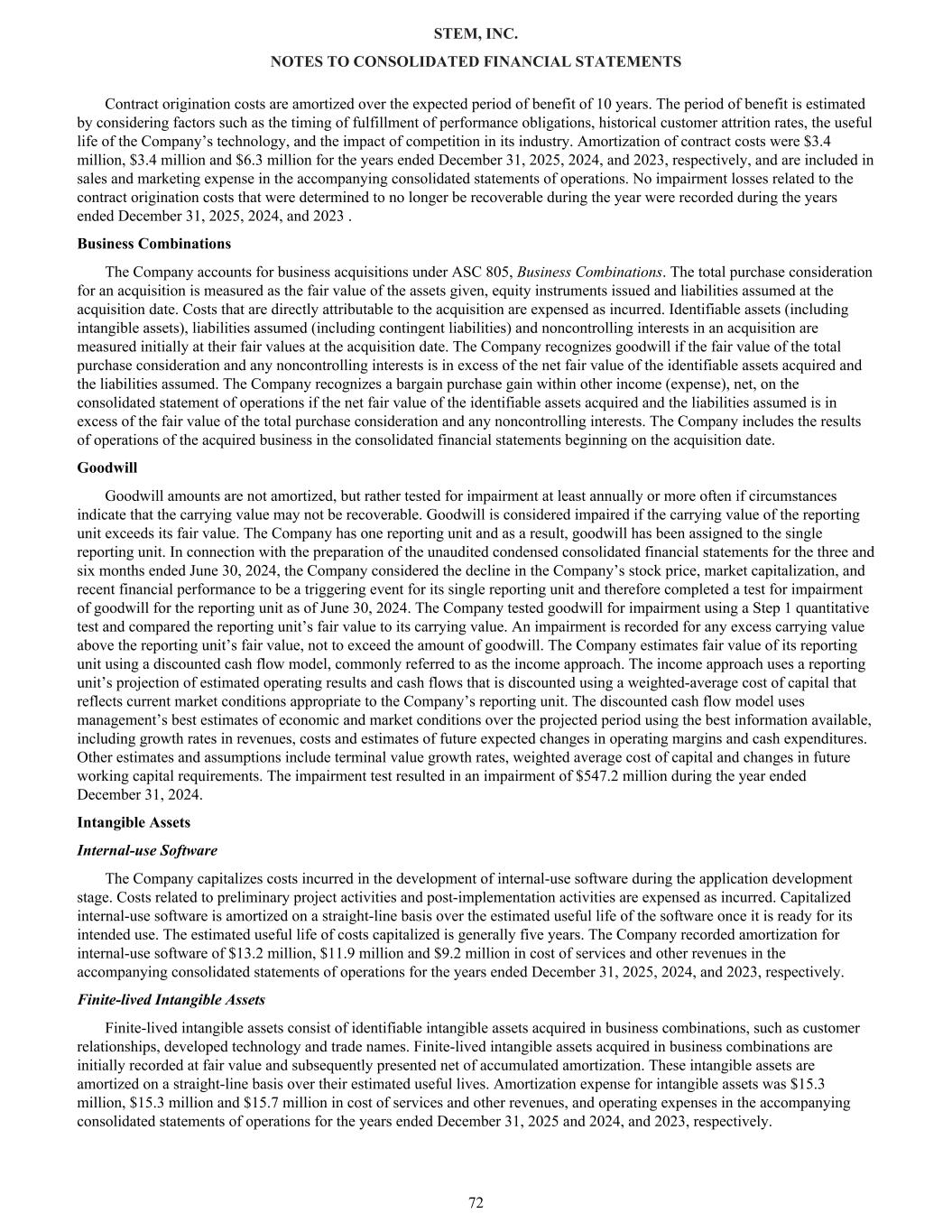
Contract origination costs are amortized over the expected period of benefit of 10 years. The period of benefit is estimated by considering factors such as the timing of fulfillment of performance obligations, historical customer attrition rates, the useful life of the Company’s technology, and the impact of competition in its industry. Amortization of contract costs were $3.4 million, $3.4 million and $6.3 million for the years ended December 31, 2025, 2024, and 2023, respectively, and are included in sales and marketing expense in the accompanying consolidated statements of operations. No impairment losses related to the contract origination costs that were determined to no longer be recoverable during the year were recorded during the years ended December 31, 2025, 2024, and 2023 . Business Combinations The Company accounts for business acquisitions under ASC 805, Business Combinations. The total purchase consideration for an acquisition is measured as the fair value of the assets given, equity instruments issued and liabilities assumed at the acquisition date. Costs that are directly attributable to the acquisition are expensed as incurred. Identifiable assets (including intangible assets), liabilities assumed (including contingent liabilities) and noncontrolling interests in an acquisition are measured initially at their fair values at the acquisition date. The Company recognizes goodwill if the fair value of the total purchase consideration and any noncontrolling interests is in excess of the net fair value of the identifiable assets acquired and the liabilities assumed. The Company recognizes a bargain purchase gain within other income (expense), net, on the consolidated statement of operations if the net fair value of the identifiable assets acquired and the liabilities assumed is in excess of the fair value of the total purchase consideration and any noncontrolling interests. The Company includes the results of operations of the acquired business in the consolidated financial statements beginning on the acquisition date. Goodwill Goodwill amounts are not amortized, but rather tested for impairment at least annually or more often if circumstances indicate that the carrying value may not be recoverable. Goodwill is considered impaired if the carrying value of the reporting unit exceeds its fair value. The Company has one reporting unit and as a result, goodwill has been assigned to the single reporting unit. In connection with the preparation of the unaudited condensed consolidated financial statements for the three and six months ended June 30, 2024, the Company considered the decline in the Company’s stock price, market capitalization, and recent financial performance to be a triggering event for its single reporting unit and therefore completed a test for impairment of goodwill for the reporting unit as of June 30, 2024. The Company tested goodwill for impairment using a Step 1 quantitative test and compared the reporting unit’s fair value to its carrying value. An impairment is recorded for any excess carrying value above the reporting unit’s fair value, not to exceed the amount of goodwill. The Company estimates fair value of its reporting unit using a discounted cash flow model, commonly referred to as the income approach. The income approach uses a reporting unit’s projection of estimated operating results and cash flows that is discounted using a weighted-average cost of capital that reflects current market conditions appropriate to the Company’s reporting unit. The discounted cash flow model uses management’s best estimates of economic and market conditions over the projected period using the best information available, including growth rates in revenues, costs and estimates of future expected changes in operating margins and cash expenditures. Other estimates and assumptions include terminal value growth rates, weighted average cost of capital and changes in future working capital requirements. The impairment test resulted in an impairment of $547.2 million during the year ended December 31, 2024. Intangible Assets Internal-use Software The Company capitalizes costs incurred in the development of internal-use software during the application development stage. Costs related to preliminary project activities and post-implementation activities are expensed as incurred. Capitalized internal-use software is amortized on a straight-line basis over the estimated useful life of the software once it is ready for its intended use. The estimated useful life of costs capitalized is generally five years. The Company recorded amortization for internal-use software of $13.2 million, $11.9 million and $9.2 million in cost of services and other revenues in the accompanying consolidated statements of operations for the years ended December 31, 2025, 2024, and 2023, respectively. Finite-lived Intangible Assets Finite-lived intangible assets consist of identifiable intangible assets acquired in business combinations, such as customer relationships, developed technology and trade names. Finite-lived intangible assets acquired in business combinations are initially recorded at fair value and subsequently presented net of accumulated amortization. These intangible assets are amortized on a straight-line basis over their estimated useful lives. Amortization expense for intangible assets was $15.3 million, $15.3 million and $15.7 million in cost of services and other revenues, and operating expenses in the accompanying consolidated statements of operations for the years ended December 31, 2025 and 2024, and 2023, respectively. STEM, INC. NOTES TO CONSOLIDATED FINANCIAL STATEMENTS 72
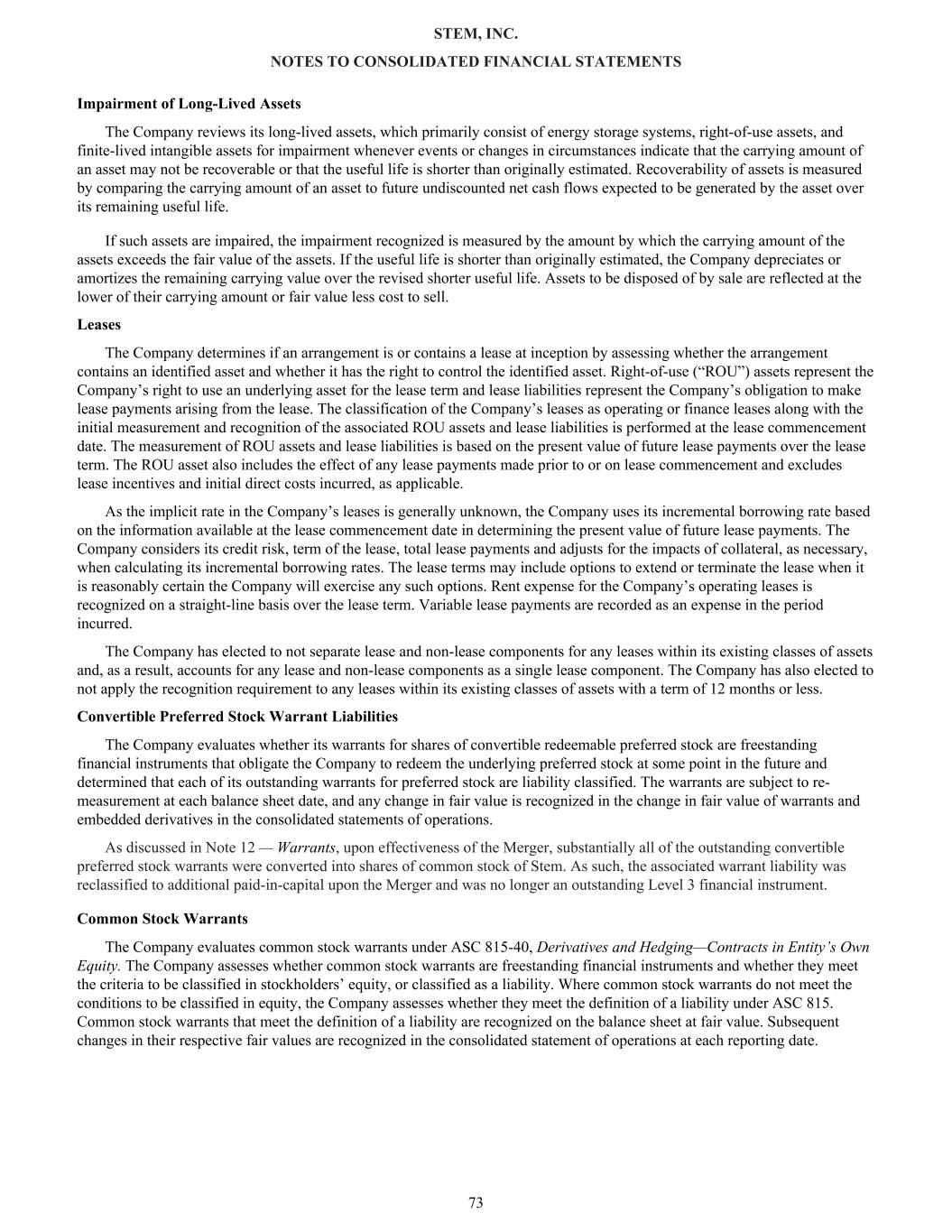
Impairment of Long-Lived Assets The Company reviews its long-lived assets, which primarily consist of energy storage systems, right-of-use assets, and finite-lived intangible assets for impairment whenever events or changes in circumstances indicate that the carrying amount of an asset may not be recoverable or that the useful life is shorter than originally estimated. Recoverability of assets is measured by comparing the carrying amount of an asset to future undiscounted net cash flows expected to be generated by the asset over its remaining useful life. If such assets are impaired, the impairment recognized is measured by the amount by which the carrying amount of the assets exceeds the fair value of the assets. If the useful life is shorter than originally estimated, the Company depreciates or amortizes the remaining carrying value over the revised shorter useful life. Assets to be disposed of by sale are reflected at the lower of their carrying amount or fair value less cost to sell. Leases The Company determines if an arrangement is or contains a lease at inception by assessing whether the arrangement contains an identified asset and whether it has the right to control the identified asset. Right-of-use (“ROU”) assets represent the Company’s right to use an underlying asset for the lease term and lease liabilities represent the Company’s obligation to make lease payments arising from the lease. The classification of the Company’s leases as operating or finance leases along with the initial measurement and recognition of the associated ROU assets and lease liabilities is performed at the lease commencement date. The measurement of ROU assets and lease liabilities is based on the present value of future lease payments over the lease term. The ROU asset also includes the effect of any lease payments made prior to or on lease commencement and excludes lease incentives and initial direct costs incurred, as applicable. As the implicit rate in the Company’s leases is generally unknown, the Company uses its incremental borrowing rate based on the information available at the lease commencement date in determining the present value of future lease payments. The Company considers its credit risk, term of the lease, total lease payments and adjusts for the impacts of collateral, as necessary, when calculating its incremental borrowing rates. The lease terms may include options to extend or terminate the lease when it is reasonably certain the Company will exercise any such options. Rent expense for the Company’s operating leases is recognized on a straight-line basis over the lease term. Variable lease payments are recorded as an expense in the period incurred. The Company has elected to not separate lease and non-lease components for any leases within its existing classes of assets and, as a result, accounts for any lease and non-lease components as a single lease component. The Company has also elected to not apply the recognition requirement to any leases within its existing classes of assets with a term of 12 months or less. Convertible Preferred Stock Warrant Liabilities The Company evaluates whether its warrants for shares of convertible redeemable preferred stock are freestanding financial instruments that obligate the Company to redeem the underlying preferred stock at some point in the future and determined that each of its outstanding warrants for preferred stock are liability classified. The warrants are subject to re- measurement at each balance sheet date, and any change in fair value is recognized in the change in fair value of warrants and embedded derivatives in the consolidated statements of operations. As discussed in Note 12 — Warrants, upon effectiveness of the Merger, substantially all of the outstanding convertible preferred stock warrants were converted into shares of common stock of Stem. As such, the associated warrant liability was reclassified to additional paid-in-capital upon the Merger and was no longer an outstanding Level 3 financial instrument. Common Stock Warrants The Company evaluates common stock warrants under ASC 815-40, Derivatives and Hedging—Contracts in Entity’s Own Equity. The Company assesses whether common stock warrants are freestanding financial instruments and whether they meet the criteria to be classified in stockholders’ equity, or classified as a liability. Where common stock warrants do not meet the conditions to be classified in equity, the Company assesses whether they meet the definition of a liability under ASC 815. Common stock warrants that meet the definition of a liability are recognized on the balance sheet at fair value. Subsequent changes in their respective fair values are recognized in the consolidated statement of operations at each reporting date. STEM, INC. NOTES TO CONSOLIDATED FINANCIAL STATEMENTS 73
As discussed in Note 12 — Warrants, under a warrant agreement dated June 30, 2025, the Company issued common stock warrants (the “2030 Private Placement Warrants”), which upon issuance met the criteria for liability classification under ASC 815. Asset Retirement Obligations The Company recognizes a liability for the fair value of asset retirement obligations associated with its energy storage systems in the period in which there is a legal obligation associated with the retirement of such assets and the amount can be reasonably estimated. The associated asset retirement costs are capitalized as part of the carrying amount of the energy storage systems and depreciated over the asset’s remaining useful life. This liability includes costs related to the removal of its energy storage systems at the conclusion of each respective customer contract. Subsequent to initial measurement, the asset retirement liability is accreted each period and such accretion is recognized as an expense in the consolidated statements of operations. If there are changes in the estimated amount or timing of cash flows, a revision is recorded to both the asset retirement obligation and the asset retirement capitalized cost. Financing Obligations The Company has formed various SPEs to finance the development and construction of its energy storage systems. These SPEs, which are structured as limited liability companies, obtain financing in the form of large upfront payments from outside investors and purchase energy storage systems from the Company under master purchase agreements. The Company accounts for the large upfront payments received from the fund investor as a borrowing by recording the proceeds received as a financing obligation, which will be repaid through host customer payments and incentives received from the utilities that will be received by the investor. The financing obligation is non-recourse once the associated energy storage systems have been placed in-service and the associated customer arrangements have been assigned to the SPE. However, the Company is responsible for any warranties, performance guarantees, accounting, performance reporting, and all other costs associated with the operation of the energy storage systems. Despite such energy storage systems being legally sold to the SPEs, the Company recognizes host customer payments and incentives as revenue during the period as discussed in Note 3 — Revenue. The amounts received by the fund investor from customer payments and incentives are recognized as interest using the effective interest method, and the balance is applied to reduce the financing obligation. The effective interest rate is the interest rate that equates the present value of the cash amounts to be received by a fund investor in relation to the underlying Projects with the present value of the cash amounts paid by the investor to the Company, adjusted for any payments made by the Company. Fair Value of Financial Instruments Assets and liabilities recorded at fair value in the consolidated financial statements are categorized based upon the level of judgment associated with the inputs used to measure their fair value. The fair value of the Company’s financial assets and liabilities reflects management’s estimate of amounts that the Company would have received in connection with the sale of the assets or paid in connection with the transfer of the liabilities in an orderly transaction between market participants at the measurement date. In connection with measuring the fair value of its assets and liabilities, the Company seeks to maximize the use of observable inputs (market data obtained from independent sources) and to minimize the use of unobservable inputs (internal assumptions about how market participants would price assets and liabilities). Hierarchical levels which are directly related to the amount of subjectivity associated with the inputs to the valuation of these assets or liabilities are as follows: Level 1 — Unadjusted quoted prices in active markets for identical assets or liabilities that the Company has the ability to access as of the measurement date. Level 2 — Inputs other than quoted prices included within Level 1 that are directly observable for the asset or liability or indirectly observable through corroboration with observable market data. Level 3 — Unobservable inputs for the asset or liability only used when there is little, if any, market activity for the asset or liability at the measurement date. This hierarchy requires the Company to use observable market data, when available, and to minimize the use of unobservable inputs when determining fair value. Assets and liabilities measured at fair value are classified in their entirety based on the lowest level of input that is significant to their fair value measurement. The Company’s assessment of the significance of a specific input to the fair value measurement in its entirety requires management to make judgments and consider factors specific to the asset or liability. STEM, INC. NOTES TO CONSOLIDATED FINANCIAL STATEMENTS 74
Financial assets and liabilities held by the Company measured at fair value on a recurring basis as of December 31, 2025 and 2024, include cash, cash equivalents and restricted cash, warrant liability, and convertible notes. Revenue Recognition Revenues are recognized when control of the promised goods or services are transferred to the Company’s customers in an amount that reflects the consideration that is expected to be received in exchange for those goods or services. The Company generates all of its revenues from contracts with its customers. The Company recognizes revenue through arrangements with customers, host customer arrangements, partnership arrangements, and sale of project assets as described below. Host Customer Arrangements Host customer contracts are generally entered into with commercial entities that have traditionally relied on power supplied directly from the grid. Host customer arrangements consist of a promise to provide energy optimization services through the Company’s proprietary software platform coupled with a dedicated energy storage system owned and controlled by the Company throughout the term of the contract. The host customer does not obtain legal title to, or ownership of the dedicated energy storage system at any point in time. The host customer is the end consumer of the energy that directly benefits from the energy optimization services provided by the Company. The term for the Company’s contracts with host customers generally ranges from 5 to 10 years, which may include certain renewal options to extend the initial contract term or certain termination options to reduce the initial contract term. Although the Company installs an energy storage system at the host customer site in order to provide the energy optimization services, the Company directs how and for what purpose the asset is used through the operation of its software platform and, as such, retains control of the energy storage system; therefore, the contract does not contain a lease. The Company determines the various energy optimization services provided throughout the term of the contract, which may include services such as remote monitoring, performance reporting, preventative maintenance and other ancillary services necessary for the safe and reliable operation of the energy storage system, are part of a combined output of energy optimization services and the Company provides a single distinct combined performance obligation representing a series of distinct days of services. The Company determines the transaction price at the outset of the arrangement, primarily based on the contractual payment terms dictated by the contract with the customer. Fees charged to customers for energy optimization services generally consist of recurring fixed monthly payments throughout the term of the contract. In certain arrangements, the transaction price may include incentive payments that are earned by the host customer from utility companies in relation to the services provided by the Company. Under such arrangements, the rights to the incentive payments are assigned by the host customer to the Company. These incentives may be in the form of fixed upfront payments, variable monthly payments, or annual performance- based payments over the first 5 years of the customer contract term. Incentive payments may be contingent on approval from utility companies or actual future performance of the energy storage system. Substantially all of the Company’s arrangements provide customers the unilateral ability to terminate for convenience prior to the conclusion of the stated contractual term or the contractual term is shorter than the estimated benefit period, which the Company has determined to be 10 years based on the estimated useful life of the underlying energy storage systems and the period over which the customer can benefit from the energy optimization services utilizing such energy storage systems. In these instances, the Company determined that upfront incentive payments received from its customers represent a material right that is, in effect, an advance payment for future energy optimization services to be recognized throughout the estimated benefit period. In contracts where the customer does not have the unilateral ability to terminate for convenience without a penalty during the estimated benefit period, the Company determined the upfront incentive payments do not represent a material right for services provided beyond the initial contractual period and are therefore a component of the initial transaction price. The Company revisits its estimate of the benefit period each reporting period. The Company’s contracts with host customers do not contain a significant financing component. STEM, INC. NOTES TO CONSOLIDATED FINANCIAL STATEMENTS 75
The Company transfers control of its energy optimization services to its customers continuously throughout the term of the contract (a stand-ready obligation) and revenue is recognized ratably as control of these services is transferred to its customers, in an amount that reflects the consideration the Company expects to be contractually entitled to in exchange for its services. Monthly incentive payments based on the performance of the energy storage system are allocated to the distinct month in which they are earned because the terms of the payments relate specifically to the outcome from transferring the distinct time increment (month) of service and because such amounts reflect the fees to which the Company expects to be entitled for providing energy optimization services each period, consistent with the allocation objective. Annual variable performance- based payments are estimated at the inception in the transaction price using the expected value method, which takes into consideration historical experience, current contractual requirements, specific known market events and forecasted energy storage system performance patterns, and the Company recognizes such payments ratably using a time-based measure of progress of days elapsed over the term of the contract to the extent that it is probable that a significant reversal of the cumulative revenue recognized will not occur in a future period. At the end of each reporting period, the Company reassesses its estimate of the transaction price. The Company does not begin recognition of revenue until the energy storage system is live (i.e., provision of energy optimization services has commenced) or, as it relates to incentive payments, when approval has been received from the utility company, if later. Partnership Arrangements Partnership arrangements consist of promises to transfer inventory in the form of an energy storage system to a “solar plus storage” project developer and separately provide energy optimization services as described previously to the ultimate owner of the project after the developer completes the installation of the project. Under partnership arrangements, the Company’s customer is the solar plus storage project developer. The customer obtains legal title to along with ownership and control of the inventory upon delivery and the customer is responsible for the installation of the project in some cases. Once installation of the project is complete, the owner of the solar plus storage project provides energy to the end consumer through a separate contractual arrangement directly with the end consumer. The term for the Company’s contracts with customers under partnership arrangements generally ranges from 3 to 20 years. The Company determined the promise to deliver the inventory as a component of the solar plus storage project for which the customer is responsible to develop is a separate and distinct performance obligation from the promise to provide energy optimization services. The Company determines the transaction price at the outset of the arrangement, primarily based on the contractual payment terms dictated by the contract with the customer. Fees charged for the sale of inventory generally consist of fixed fees payable upon or shortly after successful delivery to the customer. For some customers, the contractual payment terms are based on milestone dates of development activities, such as the date customers accept, acquire, or develop project assets or the date customers install or commission hardware on project assets. Such milestone dates may result in unbilled accounts receivable for noncancellable purchase orders when control of hardware is transferred to the customer and Company has legal right to consideration prior to the milestone date of development activities. For certain customers, the Company also guarantees the value of hardware will not decline for a certain period of time, usually six months to one year. The Company accounts for such contractual payments terms and guarantees as variable consideration at each measurement date at its most likely amount to the extent that it is probable that a significant reversal of cumulative revenue recognized will not occur. Fees charged to customers for energy optimization services consist of recurring fixed monthly payments throughout the term of the contract. The Company is responsible for designing, procuring, delivering and ensuring the proper components are provided in accordance with the requirements of the contract. Although the inventory is purchased by the Company from a third-party manufacturer, the Company determined it obtains control of the inventory prior to delivery to the customer and is the principal in the arrangement. The Company is fully responsible for responding to and correcting any customer issues related to the delivery of the inventory. The Company holds title and assumes all risks of loss associated with the inventory until the customer accepts the inventory. The Company is primarily responsible for fulfilling the delivery of the inventory to the customer, assumes substantial inventory risks and has discretion in the pricing charged to the customer. The Company has not entered into any partnership arrangements where it is not the principal in the transaction. STEM, INC. NOTES TO CONSOLIDATED FINANCIAL STATEMENTS 76
The Company allocates revenue between the hardware and energy storage services performance obligations based on the standalone selling price of each performance obligation. The standalone selling price for the hardware is established based on observable pricing. The standalone selling price for the energy optimization services is established using a residual value approach due to the significant variability in the services provided to each individual customer based on the specific requirements of each individual project and the lack of observable standalone sales of such services. The Company’s partnership arrangements do not contain a significant financing component. The Company transfers control of the inventory upon delivery and simultaneous transfer of title to the customer. The Company transfers control of its energy optimization services to its customers continuously throughout the term of the contract (a stand-ready obligation), which does not commence until the customer successfully completes the installation of the project. As a result, the time frame between when the Company transfers control of the inventory to the customer upon delivery is generally several months, and can be in excess of one year, before the Company is required to perform any subsequent energy optimization services. Revenue is recognized ratably as control of these services is transferred to its customers based on a time- based output measure of progress of days elapsed over the term of the contract, in an amount that reflects the consideration the Company expects to be entitled to in exchange for its services. In some partnership arrangements, the Company charges shipping fees for the inventory. The Company accounts for shipping as a fulfillment activity, since control transfers to the customer after the shipping is complete and includes such amounts within cost of revenue. Some contracts provide our customers the right to liquidated damages against the Company in the event equipment is not delivered according to contract specifications. Liquidated damages are accounted for as variable consideration, and the contract price is reduced by the expected penalty or liquidated damage amount when recognizing revenue. Sale of Project Assets For sales of project assets in which the Company transfers 100% of the membership interest in project assets to a customer, the Company recognizes all of the revenue for the consideration received at a point in time when the membership interest was transferred to the customer, which typically occurs when the Company delivered the membership interest assignment agreement to the customer. The transaction price of contract arrangements is comprised of both fixed and variable amounts. Variable consideration is estimated at each measurement date at its most likely amount to the extent that it is probable that a significant reversal of cumulative revenue recognized will not occur and true-ups are applied prospectively as such estimates change. Changes in estimates for sales of project assets occur when the actual development expenses vary from estimates made at the time the membership interests transferred to the customer. The cumulative effect of revisions to transaction prices are recorded in the period in which the revisions to estimates are identified and the amounts can be reasonably estimated. Variable consideration related to the sale of project assets are generally resolved within 60 days of sale of project assets and are currently not material to the Company’s financial statements. Cost of Revenue Cost of Hardware Cost of hardware relates to the sale of hardware and includes the cost of the hardware sold to project developers, which generally includes the cost to purchase the hardware from a manufacturer, shipping, and other costs required to fulfill the Company’s obligation to deliver the hardware to the customer location. Cost of hardware may also include any impairment of hardware held in inventory for sale to a customer. Cost of hardware is recognized when the delivery of the hardware is completed. Cost of Service and Other Cost of service and other relates to energy optimization services and includes depreciation of the cost of energy storage systems associated with long-term host customer contracts, which includes capitalized fulfillment costs, such as installation services, permitting and other related costs. Cost of services and other also includes the costs for the development and constructions of project assets. Cost of service and other may also include any impairment of energy storage systems along with energy storage system maintenance costs associated with the ongoing services provided to customers and other amounts not qualifying for capitalization pursuant to the Company’s internal use software capitalization policy. Cost of service and other is recognized as the energy optimization and other supporting services are provided to the Company’s customers throughout the term of the contract. STEM, INC. NOTES TO CONSOLIDATED FINANCIAL STATEMENTS 77
Sales and Marketing Sales and marketing expense consists primarily of payroll and other related personnel costs, including stock-based compensation, commissions, bonuses, employee benefits, and travel for the Company’s sales & marketing department. These costs are recognized in the period incurred. Advertising expenses for the years ended December 31, 2025, 2024, and 2023 were not material. Research and Development Research and development expense consists primarily of payroll and other related personnel costs for engineers and third parties engaged in the design and development of products, third-party software, and technologies, including salaries, bonus, and stock-based compensation expense, project material costs, services, and depreciation. The Company expenses research and development costs as they are incurred. General and Administrative General and administrative expense consists of payroll and other related personnel costs, including salaries, bonus, and stock-based compensation for executive management, legal, finance, and others. In addition, general and administrative expense includes fees for professional services and occupancy costs. Stock-Based Compensation The Company recognizes stock-based compensation expense related to employees over the requisite service period based on the grant-date fair value of the awards. The fair value of options granted is estimated using the Black-Scholes option valuation model. The Company recognizes the grant-date fair value of an award as compensation expense on a straight-line basis over the requisite service period, which typically corresponds to the vesting period for the award. The Company elects to account for forfeitures as they occur and, upon forfeiture of an award prior to vesting, the Company reverses any previously recognized compensation expense related to that award. Income Taxes The Company uses the asset and liability method of accounting for income taxes based on ASC 740, Accounting for Income Taxes. Under the asset and liability method, deferred tax assets and liabilities are recognized for the future tax consequences attributable to differences between financial statement carrying amounts and the tax basis of existing assets and liabilities. The Company records a valuation allowance to reduce tax assets to an amount for which realization is more likely than not. There are certain charges that are not deductible for tax purposes. In evaluating the ability to recover its deferred income tax assets, the Company considers all available positive and negative evidence, including its operating results, ongoing tax planning, and forecasts of future taxable income on a jurisdiction-by-jurisdiction basis. In the event the Company determines that it would be able to realize its deferred income tax assets in the future in excess of their net recorded amount, it would make an adjustment to the valuation allowance that would reduce the provision for income taxes. Conversely, in the event that all or part of the net deferred tax assets are determined not to be realizable in the future, an adjustment to the valuation allowance would be charged to earnings in the period such determination is made. The Company recognizes the tax benefit from uncertain tax positions in accordance with GAAP, which prescribes a recognition threshold and measurement attribute for the financial statement recognition and measurement of uncertain tax positions taken or expected to be taken in the Company’s tax return. No liability related to uncertain tax positions has been recognized in the financial statements. The Company includes interest and penalties for uncertain tax positions in the financial statements as a component of income tax expense. No accrual has been deemed necessary as of December 31, 2025 and 2024. Foreign Currency Translation The Company’s foreign subsidiaries financial position and results of operations are measured using the local currency as the functional currency. The functional currency is the currency of the primary economic environment in which an entity’s operations are conducted. Assets and liabilities of foreign subsidiaries are translated at exchange rates in effect as of the balance sheet date. Revenues and expenses are translated at average exchange rates in effect during the year. Translation adjustments are recorded within accumulated other comprehensive loss, a separate component of stockholders’ equity (deficit). STEM, INC. NOTES TO CONSOLIDATED FINANCIAL STATEMENTS 78
Net Loss Per Share Attributable to Common Stockholders Basic net income (loss) per share attributable to common stockholders is calculated by dividing the net income (loss) attributable to common stockholders by the weighted-average number of shares of common stock outstanding for the period, without consideration for potential dilutive securities. Diluted net loss per share is computed by dividing the net income (loss) attributable to common stockholders by the weighted- average number of common shares and common share equivalents of potentially dilutive securities outstanding for the period. For purposes of the diluted net loss per share calculation, convertible notes, warrants, restricted stock units (“RSUs”), and common stock options are considered to be potentially dilutive securities. As the Company was in a net loss position for the years ended December 31, 2024 and 2023, diluted net loss per share attributable to common stockholders is the same as basic net loss per share attributable to common stockholders because the effects of potentially dilutive securities are antidilutive. Noncontrolling Interest Noncontrolling interests represents the portion of net assets in consolidated subsidiaries that are not attributable, directly or indirectly, to us. In 2022, we have entered into arrangements with third-party investors under which the investors are determined to hold noncontrolling interests in entities fully consolidated by us. The net assets of the shared entities are attributed to the controlling and noncontrolling interests based on the terms of the governing contractual arrangements. The Company further determined the hypothetical liquidation at book value method (“HLBV Method”) to be the appropriate method for attributing net assets to the controlling and noncontrolling interests as this method most closely mirrors the economics of the governing contractual arrangements. Under the HLBV Method, we allocate recorded income (loss) to each investor based on the change, during the reporting period, of the amount of net assets each investor is entitled to under the governing contractual arrangements in a liquidation scenario. The net loss allocated to the noncontrolling interests was not material for the years ended December 31, 2025, 2024, and 2023. Recently Adopted Accounting Standards In December 2023, the FASB issued ASU 2023-09, Income Taxes (Topic 740): Improvements to Income Tax Disclosures, related to income tax disclosures. The amendments in this update are intended to enhance the transparency and decision usefulness of income tax disclosures primarily through changes to the rate reconciliation and income taxes paid information. This update is effective for annual periods beginning after December 15, 2024, though early adoption is permitted. The Company prospectively adopted this guidance in its fiscal year 2025. In July 2025, the FASB issued ASU 2025-05, Financial Instruments—Credit Losses (Topic 326): Measurement of Credit Losses for Accounts Receivable and Contract Assets, which introduces a practical expedient permitting an entity to assume that conditions at the balance sheet date remain unchanged over the life of the asset when estimating expected credit losses on current accounts receivable and current contract assets under ASC Topic 606, Revenue from Contracts with Customers. This update is effective prospectively for annual reporting periods beginning after December 15, 2025, and interim reporting periods within those annual reporting periods, though early adoption is permitted. The Company prospectively adopted this guidance in its fiscal year 2025. Recently Issued Accounting Standards In November 2024, the FASB issued ASU 2024-03, Income Statement—Reporting Comprehensive Income—Expense Disaggregation Disclosures (Subtopic 220-40). The amendments in this update enhance disaggregated disclosure of income statement expenses for companies by requiring disaggregation of certain expense captions into specified categories in disclosures within the footnotes to the financial statements. The effective date of ASU 2024-03 was amended by ASU 2025-01, Income Statement—Reporting Comprehensive Income—Expense Disaggregation Disclosures (Subtopic 220-40): Clarifying the Effective Date. This update is effective for annual periods beginning after December 15, 2026, and interim periods within annual reporting periods beginning after December 15, 2027, though early adoption of is permitted. The Company is currently evaluating the ASU to determine its impact on the Company’s disclosures. In September 2025, the FASB issued ASU 2025-06, Intangibles-Goodwill and Other-Internal-Use Software (Subtopic 350-40): Targeted Improvements to the Accounting for Internal-Use Software, which clarifies and modernizes the guidance to reflect the evolution of software development from a sequential to an agile development method. The amendments in this update remove all references to project stages to reflect this change in software development and requires capitalization of software costs to begin when management has authorized and committed to funding the project and it is probable the project will be completed and used to perform the intended function. The amendments do not change what internal-use software costs can be capitalized or when such capitalization ceases. This update is effective for annual reporting periods beginning after December 15, 2027, and interim reporting periods within those annual reporting periods, though early adoption is permitted as of the beginning of an annual reporting period. The amendments may be adopted either prospectively, using a modified STEM, INC. NOTES TO CONSOLIDATED FINANCIAL STATEMENTS 79
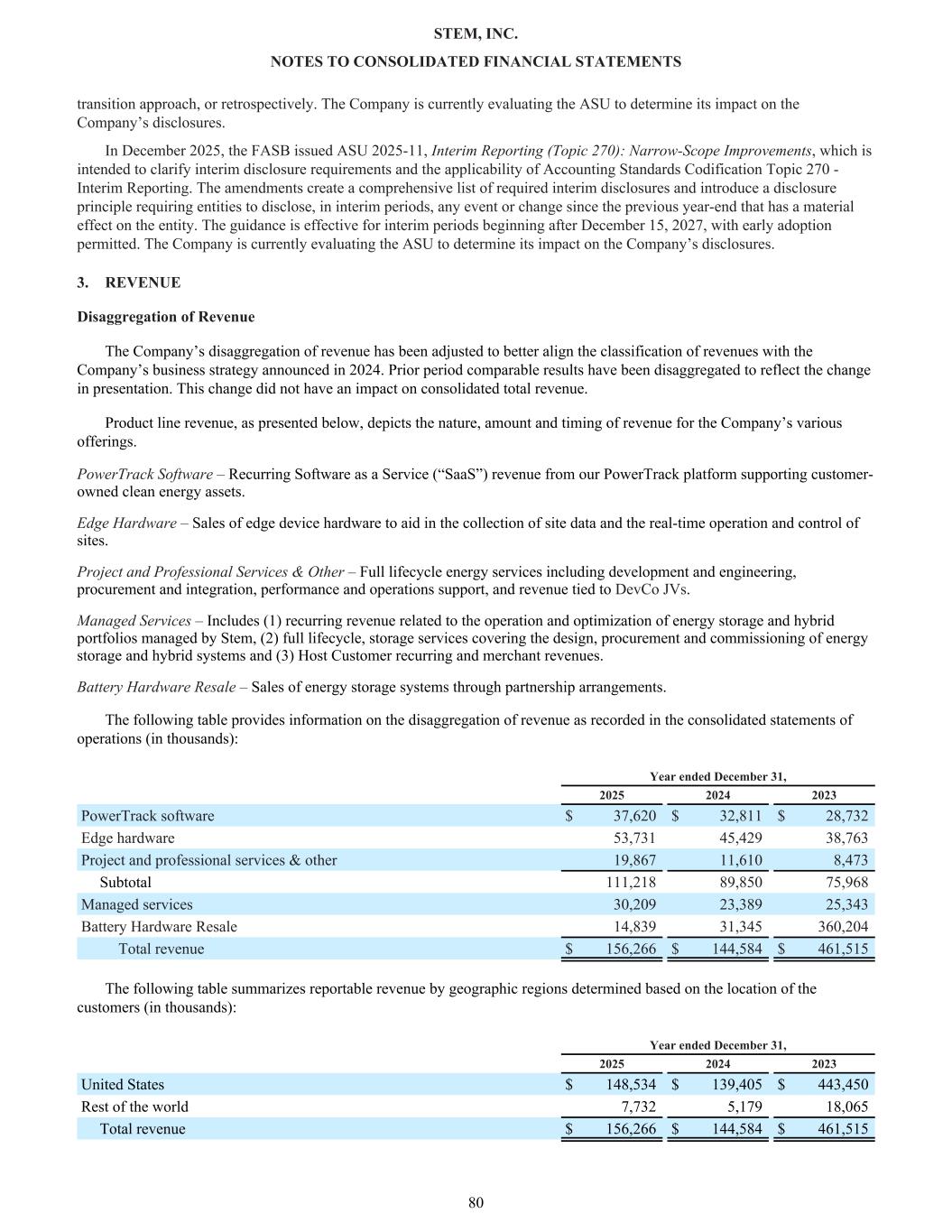
transition approach, or retrospectively. The Company is currently evaluating the ASU to determine its impact on the Company’s disclosures. In December 2025, the FASB issued ASU 2025-11, Interim Reporting (Topic 270): Narrow-Scope Improvements, which is intended to clarify interim disclosure requirements and the applicability of Accounting Standards Codification Topic 270 - Interim Reporting. The amendments create a comprehensive list of required interim disclosures and introduce a disclosure principle requiring entities to disclose, in interim periods, any event or change since the previous year-end that has a material effect on the entity. The guidance is effective for interim periods beginning after December 15, 2027, with early adoption permitted. The Company is currently evaluating the ASU to determine its impact on the Company’s disclosures. 3. REVENUE Disaggregation of Revenue The Company’s disaggregation of revenue has been adjusted to better align the classification of revenues with the Company’s business strategy announced in 2024. Prior period comparable results have been disaggregated to reflect the change in presentation. This change did not have an impact on consolidated total revenue. Product line revenue, as presented below, depicts the nature, amount and timing of revenue for the Company’s various offerings. PowerTrack Software – Recurring Software as a Service (“SaaS”) revenue from our PowerTrack platform supporting customer- owned clean energy assets. Edge Hardware – Sales of edge device hardware to aid in the collection of site data and the real-time operation and control of sites. Project and Professional Services & Other – Full lifecycle energy services including development and engineering, procurement and integration, performance and operations support, and revenue tied to DevCo JVs. Managed Services – Includes (1) recurring revenue related to the operation and optimization of energy storage and hybrid portfolios managed by Stem, (2) full lifecycle, storage services covering the design, procurement and commissioning of energy storage and hybrid systems and (3) Host Customer recurring and merchant revenues. Battery Hardware Resale – Sales of energy storage systems through partnership arrangements. The following table provides information on the disaggregation of revenue as recorded in the consolidated statements of operations (in thousands): Year ended December 31, 2025 2024 2023 PowerTrack software $ 37,620 $ 32,811 $ 28,732 Edge hardware 53,731 45,429 38,763 Project and professional services & other 19,867 11,610 8,473 Subtotal 111,218 89,850 75,968 Managed services 30,209 23,389 25,343 Battery Hardware Resale 14,839 31,345 360,204 Total revenue $ 156,266 $ 144,584 $ 461,515 The following table summarizes reportable revenue by geographic regions determined based on the location of the customers (in thousands): Year ended December 31, 2025 2024 2023 United States $ 148,534 $ 139,405 $ 443,450 Rest of the world 7,732 5,179 18,065 Total revenue $ 156,266 $ 144,584 $ 461,515 STEM, INC. NOTES TO CONSOLIDATED FINANCIAL STATEMENTS 80
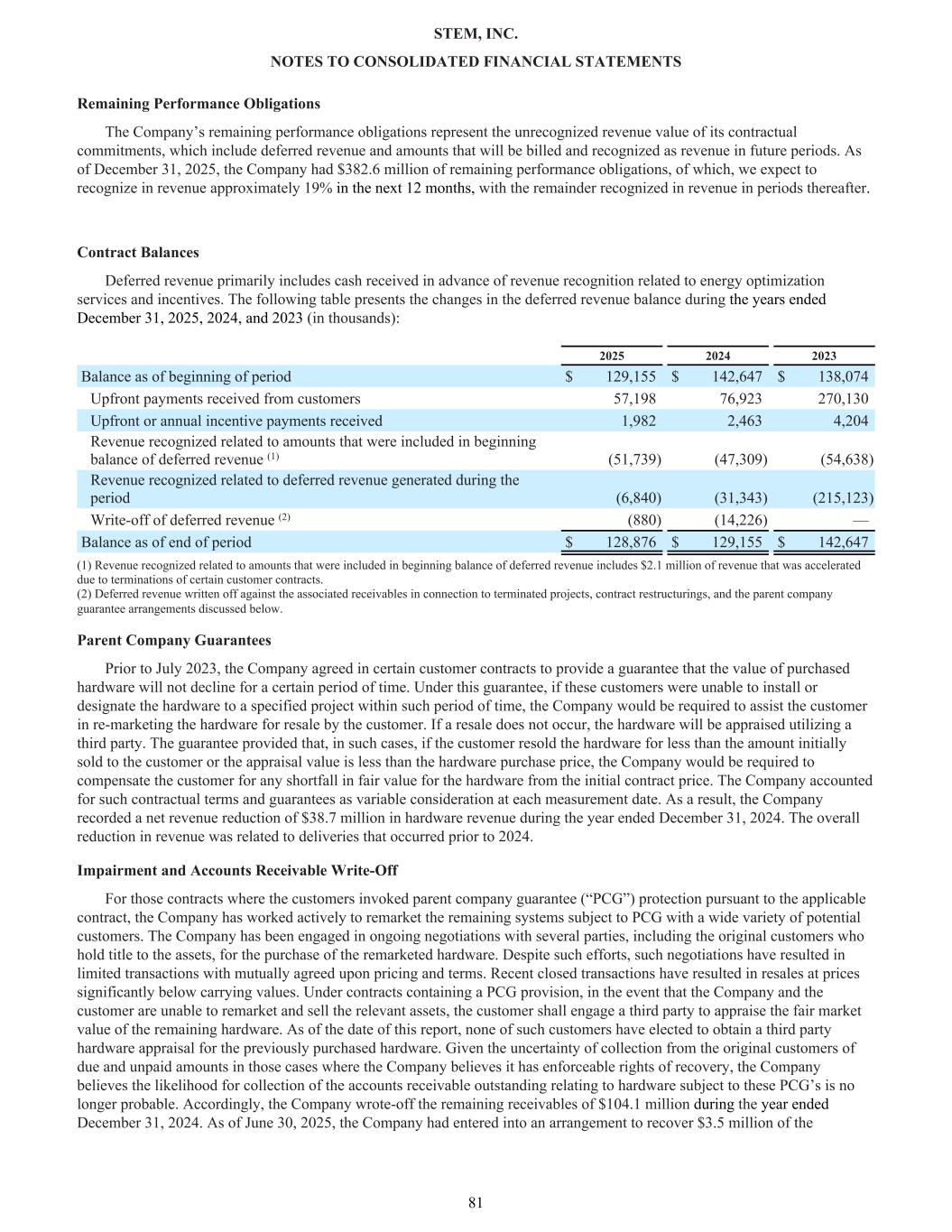
Remaining Performance Obligations The Company’s remaining performance obligations represent the unrecognized revenue value of its contractual commitments, which include deferred revenue and amounts that will be billed and recognized as revenue in future periods. As of December 31, 2025, the Company had $382.6 million of remaining performance obligations, of which, we expect to recognize in revenue approximately 19% in the next 12 months, with the remainder recognized in revenue in periods thereafter. Contract Balances Deferred revenue primarily includes cash received in advance of revenue recognition related to energy optimization services and incentives. The following table presents the changes in the deferred revenue balance during the years ended December 31, 2025, 2024, and 2023 (in thousands): 2025 2024 2023 Balance as of beginning of period $ 129,155 $ 142,647 $ 138,074 Upfront payments received from customers 57,198 76,923 270,130 Upfront or annual incentive payments received 1,982 2,463 4,204 Revenue recognized related to amounts that were included in beginning balance of deferred revenue (1) (51,739) (47,309) (54,638) Revenue recognized related to deferred revenue generated during the period (6,840) (31,343) (215,123) Write-off of deferred revenue (2) (880) (14,226) — Balance as of end of period $ 128,876 $ 129,155 $ 142,647 (1) Revenue recognized related to amounts that were included in beginning balance of deferred revenue includes $2.1 million of revenue that was accelerated due to terminations of certain customer contracts. (2) Deferred revenue written off against the associated receivables in connection to terminated projects, contract restructurings, and the parent company guarantee arrangements discussed below. Parent Company Guarantees Prior to July 2023, the Company agreed in certain customer contracts to provide a guarantee that the value of purchased hardware will not decline for a certain period of time. Under this guarantee, if these customers were unable to install or designate the hardware to a specified project within such period of time, the Company would be required to assist the customer in re-marketing the hardware for resale by the customer. If a resale does not occur, the hardware will be appraised utilizing a third party. The guarantee provided that, in such cases, if the customer resold the hardware for less than the amount initially sold to the customer or the appraisal value is less than the hardware purchase price, the Company would be required to compensate the customer for any shortfall in fair value for the hardware from the initial contract price. The Company accounted for such contractual terms and guarantees as variable consideration at each measurement date. As a result, the Company recorded a net revenue reduction of $38.7 million in hardware revenue during the year ended December 31, 2024. The overall reduction in revenue was related to deliveries that occurred prior to 2024. Impairment and Accounts Receivable Write-Off For those contracts where the customers invoked parent company guarantee (“PCG”) protection pursuant to the applicable contract, the Company has worked actively to remarket the remaining systems subject to PCG with a wide variety of potential customers. The Company has been engaged in ongoing negotiations with several parties, including the original customers who hold title to the assets, for the purchase of the remarketed hardware. Despite such efforts, such negotiations have resulted in limited transactions with mutually agreed upon pricing and terms. Recent closed transactions have resulted in resales at prices significantly below carrying values. Under contracts containing a PCG provision, in the event that the Company and the customer are unable to remarket and sell the relevant assets, the customer shall engage a third party to appraise the fair market value of the remaining hardware. As of the date of this report, none of such customers have elected to obtain a third party hardware appraisal for the previously purchased hardware. Given the uncertainty of collection from the original customers of due and unpaid amounts in those cases where the Company believes it has enforceable rights of recovery, the Company believes the likelihood for collection of the accounts receivable outstanding relating to hardware subject to these PCG’s is no longer probable. Accordingly, the Company wrote-off the remaining receivables of $104.1 million during the year ended December 31, 2024. As of June 30, 2025, the Company had entered into an arrangement to recover $3.5 million of the STEM, INC. NOTES TO CONSOLIDATED FINANCIAL STATEMENTS 81
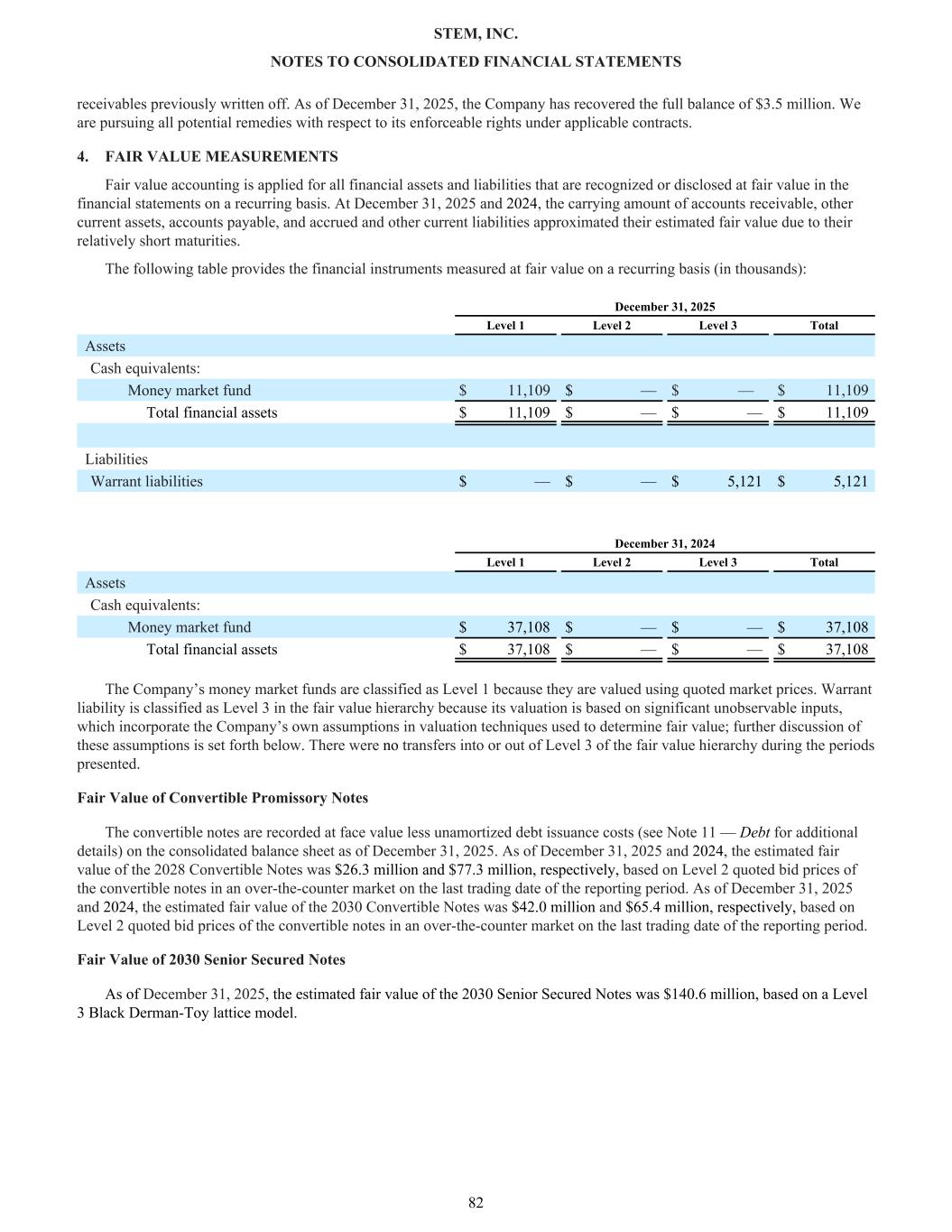
receivables previously written off. As of December 31, 2025, the Company has recovered the full balance of $3.5 million. We are pursuing all potential remedies with respect to its enforceable rights under applicable contracts. 4. FAIR VALUE MEASUREMENTS Fair value accounting is applied for all financial assets and liabilities that are recognized or disclosed at fair value in the financial statements on a recurring basis. At December 31, 2025 and 2024, the carrying amount of accounts receivable, other current assets, accounts payable, and accrued and other current liabilities approximated their estimated fair value due to their relatively short maturities. The following table provides the financial instruments measured at fair value on a recurring basis (in thousands): December 31, 2025 Level 1 Level 2 Level 3 Total Assets Cash equivalents: Money market fund $ 11,109 $ — $ — $ 11,109 Total financial assets $ 11,109 $ — $ — $ 11,109 Liabilities Warrant liabilities $ — $ — $ 5,121 $ 5,121 December 31, 2024 Level 1 Level 2 Level 3 Total Assets Cash equivalents: Money market fund $ 37,108 $ — $ — $ 37,108 Total financial assets $ 37,108 $ — $ — $ 37,108 The Company’s money market funds are classified as Level 1 because they are valued using quoted market prices. Warrant liability is classified as Level 3 in the fair value hierarchy because its valuation is based on significant unobservable inputs, which incorporate the Company’s own assumptions in valuation techniques used to determine fair value; further discussion of these assumptions is set forth below. There were no transfers into or out of Level 3 of the fair value hierarchy during the periods presented. Fair Value of Convertible Promissory Notes The convertible notes are recorded at face value less unamortized debt issuance costs (see Note 11 — Debt for additional details) on the consolidated balance sheet as of December 31, 2025. As of December 31, 2025 and 2024, the estimated fair value of the 2028 Convertible Notes was $26.3 million and $77.3 million, respectively, based on Level 2 quoted bid prices of the convertible notes in an over-the-counter market on the last trading date of the reporting period. As of December 31, 2025 and 2024, the estimated fair value of the 2030 Convertible Notes was $42.0 million and $65.4 million, respectively, based on Level 2 quoted bid prices of the convertible notes in an over-the-counter market on the last trading date of the reporting period. Fair Value of 2030 Senior Secured Notes As of December 31, 2025, the estimated fair value of the 2030 Senior Secured Notes was $140.6 million, based on a Level 3 Black Derman-Toy lattice model. STEM, INC. NOTES TO CONSOLIDATED FINANCIAL STATEMENTS 82
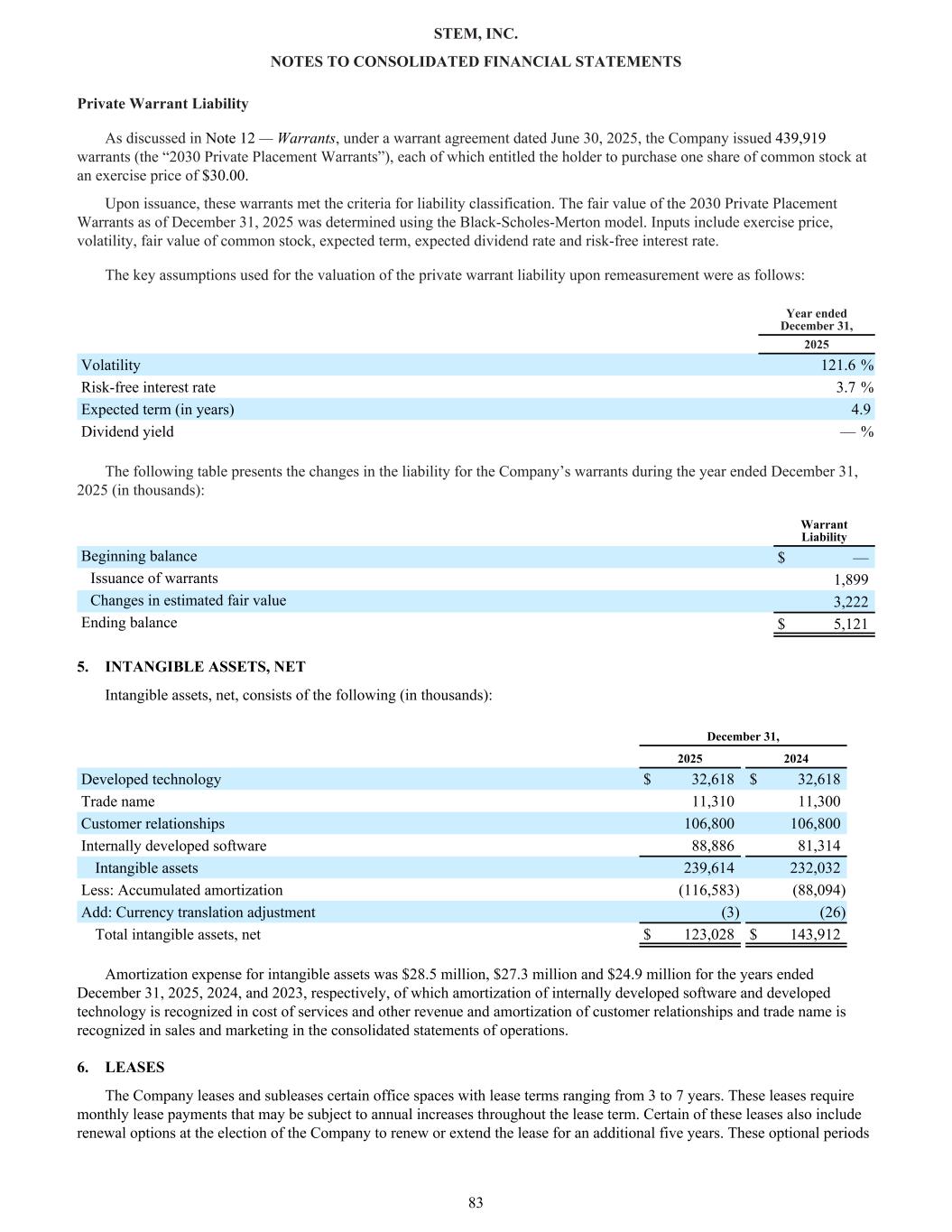
Private Warrant Liability As discussed in Note 12 — Warrants, under a warrant agreement dated June 30, 2025, the Company issued 439,919 warrants (the “2030 Private Placement Warrants”), each of which entitled the holder to purchase one share of common stock at an exercise price of $30.00. Upon issuance, these warrants met the criteria for liability classification. The fair value of the 2030 Private Placement Warrants as of December 31, 2025 was determined using the Black-Scholes-Merton model. Inputs include exercise price, volatility, fair value of common stock, expected term, expected dividend rate and risk-free interest rate. The key assumptions used for the valuation of the private warrant liability upon remeasurement were as follows: Year ended December 31, 2025 Volatility 121.6 % Risk-free interest rate 3.7 % Expected term (in years) 4.9 Dividend yield — % The following table presents the changes in the liability for the Company’s warrants during the year ended December 31, 2025 (in thousands): Warrant Liability Beginning balance $ — Issuance of warrants 1,899 Changes in estimated fair value 3,222 Ending balance $ 5,121 5. INTANGIBLE ASSETS, NET Intangible assets, net, consists of the following (in thousands): December 31, 2025 2024 Developed technology $ 32,618 $ 32,618 Trade name 11,310 11,300 Customer relationships 106,800 106,800 Internally developed software 88,886 81,314 Intangible assets 239,614 232,032 Less: Accumulated amortization (116,583) (88,094) Add: Currency translation adjustment (3) (26) Total intangible assets, net $ 123,028 $ 143,912 Amortization expense for intangible assets was $28.5 million, $27.3 million and $24.9 million for the years ended December 31, 2025, 2024, and 2023, respectively, of which amortization of internally developed software and developed technology is recognized in cost of services and other revenue and amortization of customer relationships and trade name is recognized in sales and marketing in the consolidated statements of operations. 6. LEASES The Company leases and subleases certain office spaces with lease terms ranging from 3 to 7 years. These leases require monthly lease payments that may be subject to annual increases throughout the lease term. Certain of these leases also include renewal options at the election of the Company to renew or extend the lease for an additional five years. These optional periods STEM, INC. NOTES TO CONSOLIDATED FINANCIAL STATEMENTS 83
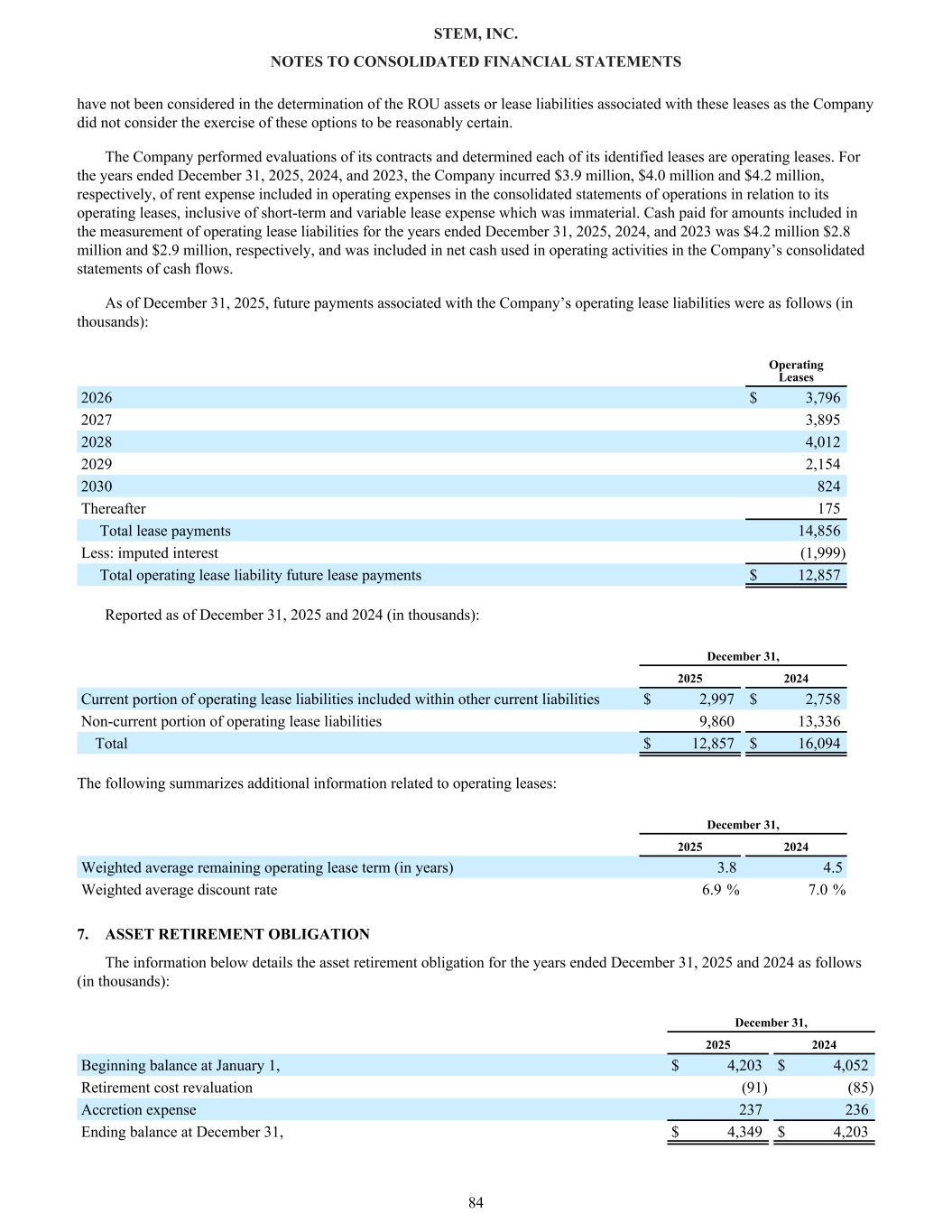
have not been considered in the determination of the ROU assets or lease liabilities associated with these leases as the Company did not consider the exercise of these options to be reasonably certain. The Company performed evaluations of its contracts and determined each of its identified leases are operating leases. For the years ended December 31, 2025, 2024, and 2023, the Company incurred $3.9 million, $4.0 million and $4.2 million, respectively, of rent expense included in operating expenses in the consolidated statements of operations in relation to its operating leases, inclusive of short-term and variable lease expense which was immaterial. Cash paid for amounts included in the measurement of operating lease liabilities for the years ended December 31, 2025, 2024, and 2023 was $4.2 million $2.8 million and $2.9 million, respectively, and was included in net cash used in operating activities in the Company’s consolidated statements of cash flows. As of December 31, 2025, future payments associated with the Company’s operating lease liabilities were as follows (in thousands): Operating Leases 2026 $ 3,796 2027 3,895 2028 4,012 2029 2,154 2030 824 Thereafter 175 Total lease payments 14,856 Less: imputed interest (1,999) Total operating lease liability future lease payments $ 12,857 Reported as of December 31, 2025 and 2024 (in thousands): December 31, 2025 2024 Current portion of operating lease liabilities included within other current liabilities $ 2,997 $ 2,758 Non-current portion of operating lease liabilities 9,860 13,336 Total $ 12,857 $ 16,094 The following summarizes additional information related to operating leases: December 31, 2025 2024 Weighted average remaining operating lease term (in years) 3.8 4.5 Weighted average discount rate 6.9 % 7.0 % 7. ASSET RETIREMENT OBLIGATION The information below details the asset retirement obligation for the years ended December 31, 2025 and 2024 as follows (in thousands): December 31, 2025 2024 Beginning balance at January 1, $ 4,203 $ 4,052 Retirement cost revaluation (91) (85) Accretion expense 237 236 Ending balance at December 31, $ 4,349 $ 4,203 STEM, INC. NOTES TO CONSOLIDATED FINANCIAL STATEMENTS 84
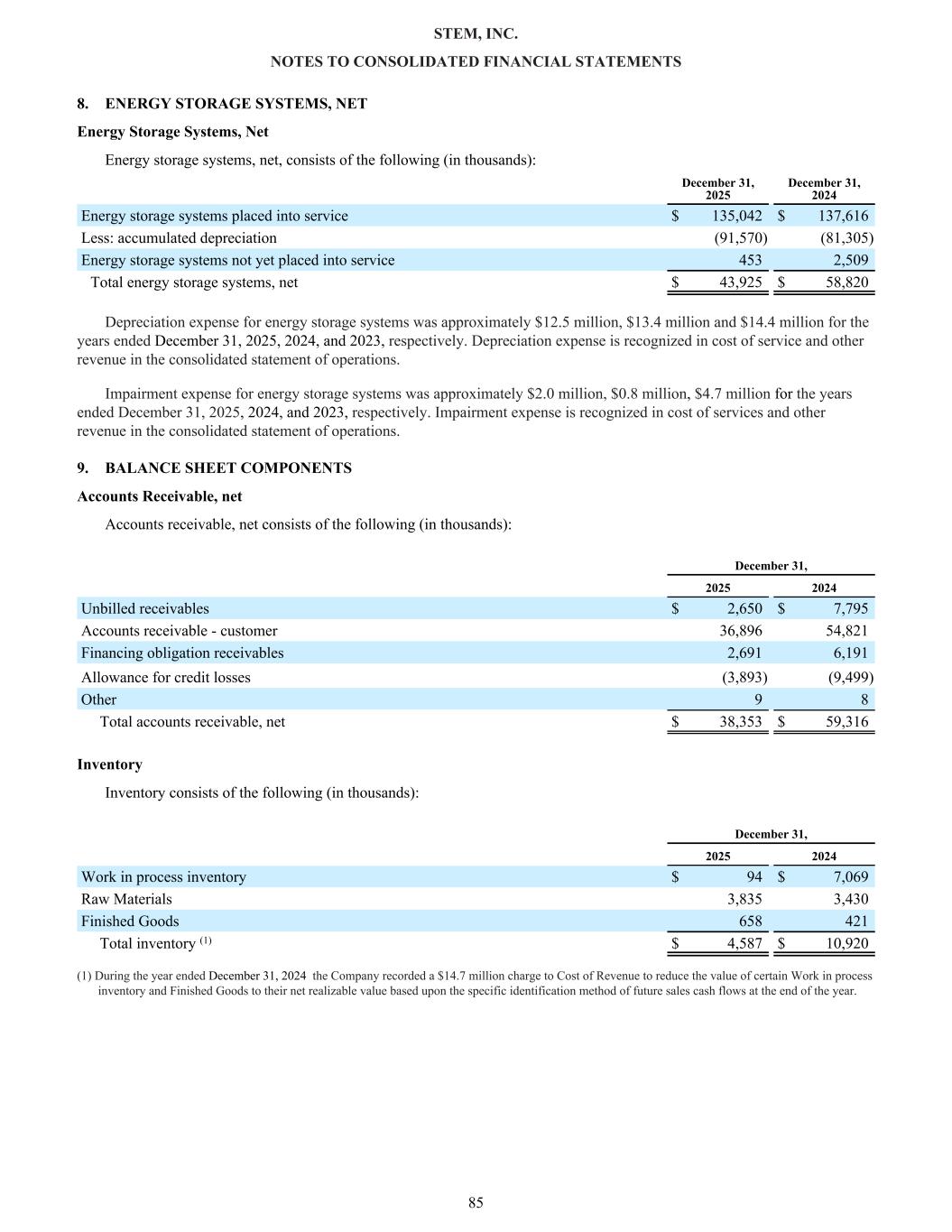
8. ENERGY STORAGE SYSTEMS, NET Energy Storage Systems, Net Energy storage systems, net, consists of the following (in thousands): December 31, 2025 December 31, 2024 Energy storage systems placed into service $ 135,042 $ 137,616 Less: accumulated depreciation (91,570) (81,305) Energy storage systems not yet placed into service 453 2,509 Total energy storage systems, net $ 43,925 $ 58,820 Depreciation expense for energy storage systems was approximately $12.5 million, $13.4 million and $14.4 million for the years ended December 31, 2025, 2024, and 2023, respectively. Depreciation expense is recognized in cost of service and other revenue in the consolidated statement of operations. Impairment expense for energy storage systems was approximately $2.0 million, $0.8 million, $4.7 million for the years ended December 31, 2025, 2024, and 2023, respectively. Impairment expense is recognized in cost of services and other revenue in the consolidated statement of operations. 9. BALANCE SHEET COMPONENTS Accounts Receivable, net Accounts receivable, net consists of the following (in thousands): December 31, 2025 2024 Unbilled receivables $ 2,650 $ 7,795 Accounts receivable - customer 36,896 54,821 Financing obligation receivables 2,691 6,191 Allowance for credit losses (3,893) (9,499) Other 9 8 Total accounts receivable, net $ 38,353 $ 59,316 Inventory Inventory consists of the following (in thousands): December 31, 2025 2024 Work in process inventory $ 94 $ 7,069 Raw Materials 3,835 3,430 Finished Goods 658 421 Total inventory (1) $ 4,587 $ 10,920 (1) During the year ended December 31, 2024 the Company recorded a $14.7 million charge to Cost of Revenue to reduce the value of certain Work in process inventory and Finished Goods to their net realizable value based upon the specific identification method of future sales cash flows at the end of the year. STEM, INC. NOTES TO CONSOLIDATED FINANCIAL STATEMENTS 85
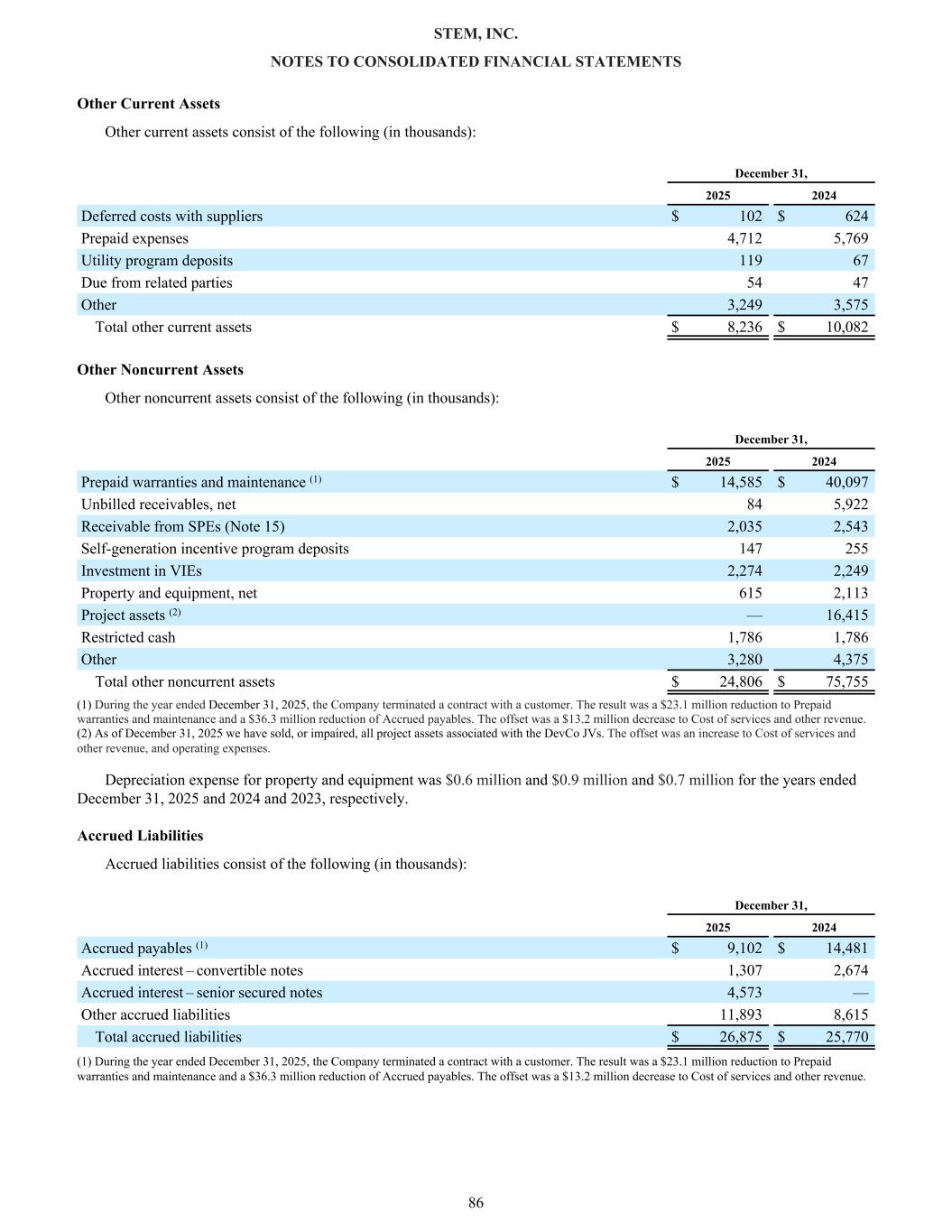
Other Current Assets Other current assets consist of the following (in thousands): December 31, 2025 2024 Deferred costs with suppliers $ 102 $ 624 Prepaid expenses 4,712 5,769 Utility program deposits 119 67 Due from related parties 54 47 Other 3,249 3,575 Total other current assets $ 8,236 $ 10,082 Other Noncurrent Assets Other noncurrent assets consist of the following (in thousands): December 31, 2025 2024 Prepaid warranties and maintenance (1) $ 14,585 $ 40,097 Unbilled receivables, net 84 5,922 Receivable from SPEs (Note 15) 2,035 2,543 Self-generation incentive program deposits 147 255 Investment in VIEs 2,274 2,249 Property and equipment, net 615 2,113 Project assets (2) — 16,415 Restricted cash 1,786 1,786 Other 3,280 4,375 Total other noncurrent assets $ 24,806 $ 75,755 (1) During the year ended December 31, 2025, the Company terminated a contract with a customer. The result was a $23.1 million reduction to Prepaid warranties and maintenance and a $36.3 million reduction of Accrued payables. The offset was a $13.2 million decrease to Cost of services and other revenue. (2) As of December 31, 2025 we have sold, or impaired, all project assets associated with the DevCo JVs. The offset was an increase to Cost of services and other revenue, and operating expenses. Depreciation expense for property and equipment was $0.6 million and $0.9 million and $0.7 million for the years ended December 31, 2025 and 2024 and 2023, respectively. Accrued Liabilities Accrued liabilities consist of the following (in thousands): December 31, 2025 2024 Accrued payables (1) $ 9,102 $ 14,481 Accrued interest – convertible notes 1,307 2,674 Accrued interest – senior secured notes 4,573 — Other accrued liabilities 11,893 8,615 Total accrued liabilities $ 26,875 $ 25,770 (1) During the year ended December 31, 2025, the Company terminated a contract with a customer. The result was a $23.1 million reduction to Prepaid warranties and maintenance and a $36.3 million reduction of Accrued payables. The offset was a $13.2 million decrease to Cost of services and other revenue. STEM, INC. NOTES TO CONSOLIDATED FINANCIAL STATEMENTS 86
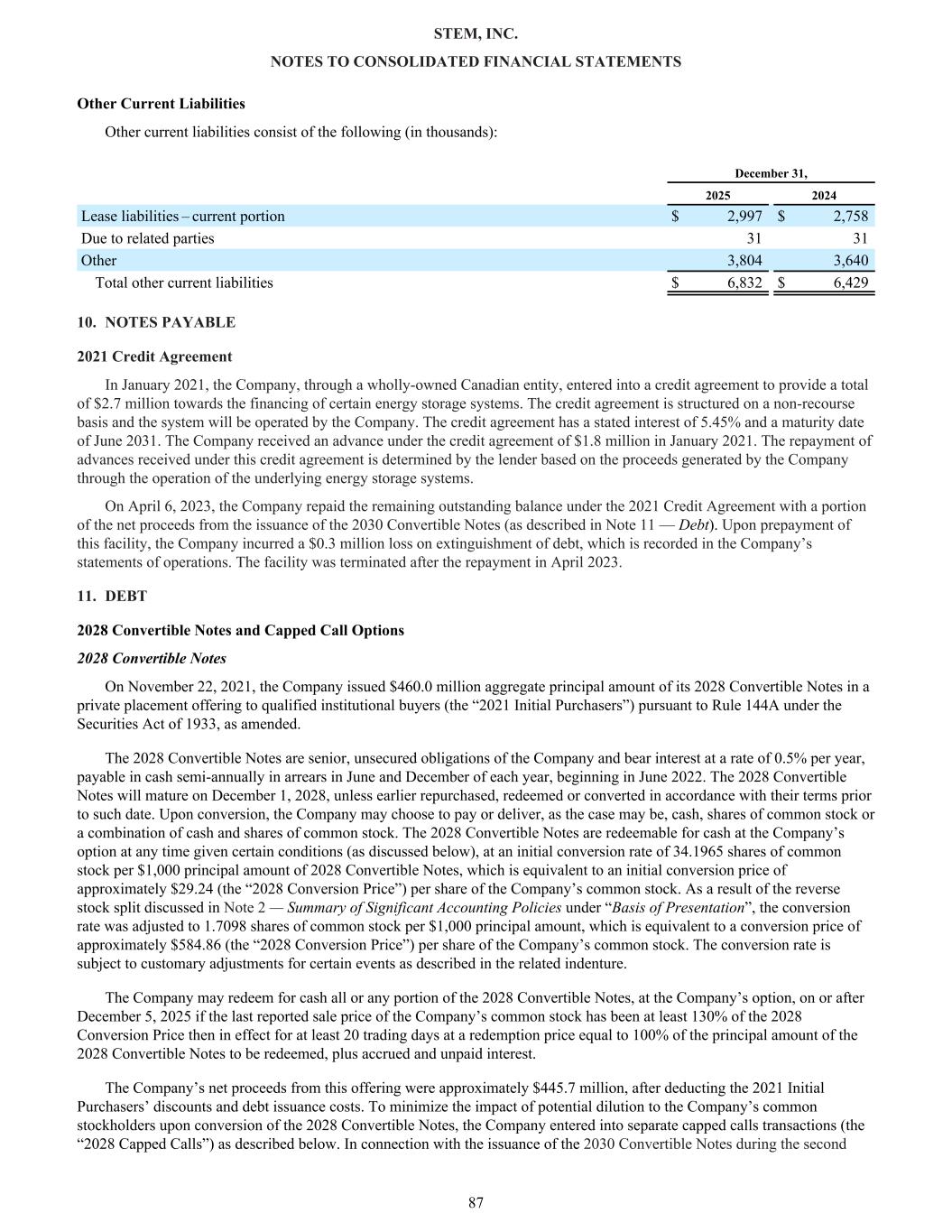
Other Current Liabilities Other current liabilities consist of the following (in thousands): December 31, 2025 2024 Lease liabilities – current portion $ 2,997 $ 2,758 Due to related parties 31 31 Other 3,804 3,640 Total other current liabilities $ 6,832 $ 6,429 10. NOTES PAYABLE 2021 Credit Agreement In January 2021, the Company, through a wholly-owned Canadian entity, entered into a credit agreement to provide a total of $2.7 million towards the financing of certain energy storage systems. The credit agreement is structured on a non-recourse basis and the system will be operated by the Company. The credit agreement has a stated interest of 5.45% and a maturity date of June 2031. The Company received an advance under the credit agreement of $1.8 million in January 2021. The repayment of advances received under this credit agreement is determined by the lender based on the proceeds generated by the Company through the operation of the underlying energy storage systems. On April 6, 2023, the Company repaid the remaining outstanding balance under the 2021 Credit Agreement with a portion of the net proceeds from the issuance of the 2030 Convertible Notes (as described in Note 11 — Debt). Upon prepayment of this facility, the Company incurred a $0.3 million loss on extinguishment of debt, which is recorded in the Company’s statements of operations. The facility was terminated after the repayment in April 2023. 11. DEBT 2028 Convertible Notes and Capped Call Options 2028 Convertible Notes On November 22, 2021, the Company issued $460.0 million aggregate principal amount of its 2028 Convertible Notes in a private placement offering to qualified institutional buyers (the “2021 Initial Purchasers”) pursuant to Rule 144A under the Securities Act of 1933, as amended. The 2028 Convertible Notes are senior, unsecured obligations of the Company and bear interest at a rate of 0.5% per year, payable in cash semi-annually in arrears in June and December of each year, beginning in June 2022. The 2028 Convertible Notes will mature on December 1, 2028, unless earlier repurchased, redeemed or converted in accordance with their terms prior to such date. Upon conversion, the Company may choose to pay or deliver, as the case may be, cash, shares of common stock or a combination of cash and shares of common stock. The 2028 Convertible Notes are redeemable for cash at the Company’s option at any time given certain conditions (as discussed below), at an initial conversion rate of 34.1965 shares of common stock per $1,000 principal amount of 2028 Convertible Notes, which is equivalent to an initial conversion price of approximately $29.24 (the “2028 Conversion Price”) per share of the Company’s common stock. As a result of the reverse stock split discussed in Note 2 — Summary of Significant Accounting Policies under “Basis of Presentation”, the conversion rate was adjusted to 1.7098 shares of common stock per $1,000 principal amount, which is equivalent to a conversion price of approximately $584.86 (the “2028 Conversion Price”) per share of the Company’s common stock. The conversion rate is subject to customary adjustments for certain events as described in the related indenture. The Company may redeem for cash all or any portion of the 2028 Convertible Notes, at the Company’s option, on or after December 5, 2025 if the last reported sale price of the Company’s common stock has been at least 130% of the 2028 Conversion Price then in effect for at least 20 trading days at a redemption price equal to 100% of the principal amount of the 2028 Convertible Notes to be redeemed, plus accrued and unpaid interest. The Company’s net proceeds from this offering were approximately $445.7 million, after deducting the 2021 Initial Purchasers’ discounts and debt issuance costs. To minimize the impact of potential dilution to the Company’s common stockholders upon conversion of the 2028 Convertible Notes, the Company entered into separate capped calls transactions (the “2028 Capped Calls”) as described below. In connection with the issuance of the 2030 Convertible Notes during the second STEM, INC. NOTES TO CONSOLIDATED FINANCIAL STATEMENTS 87
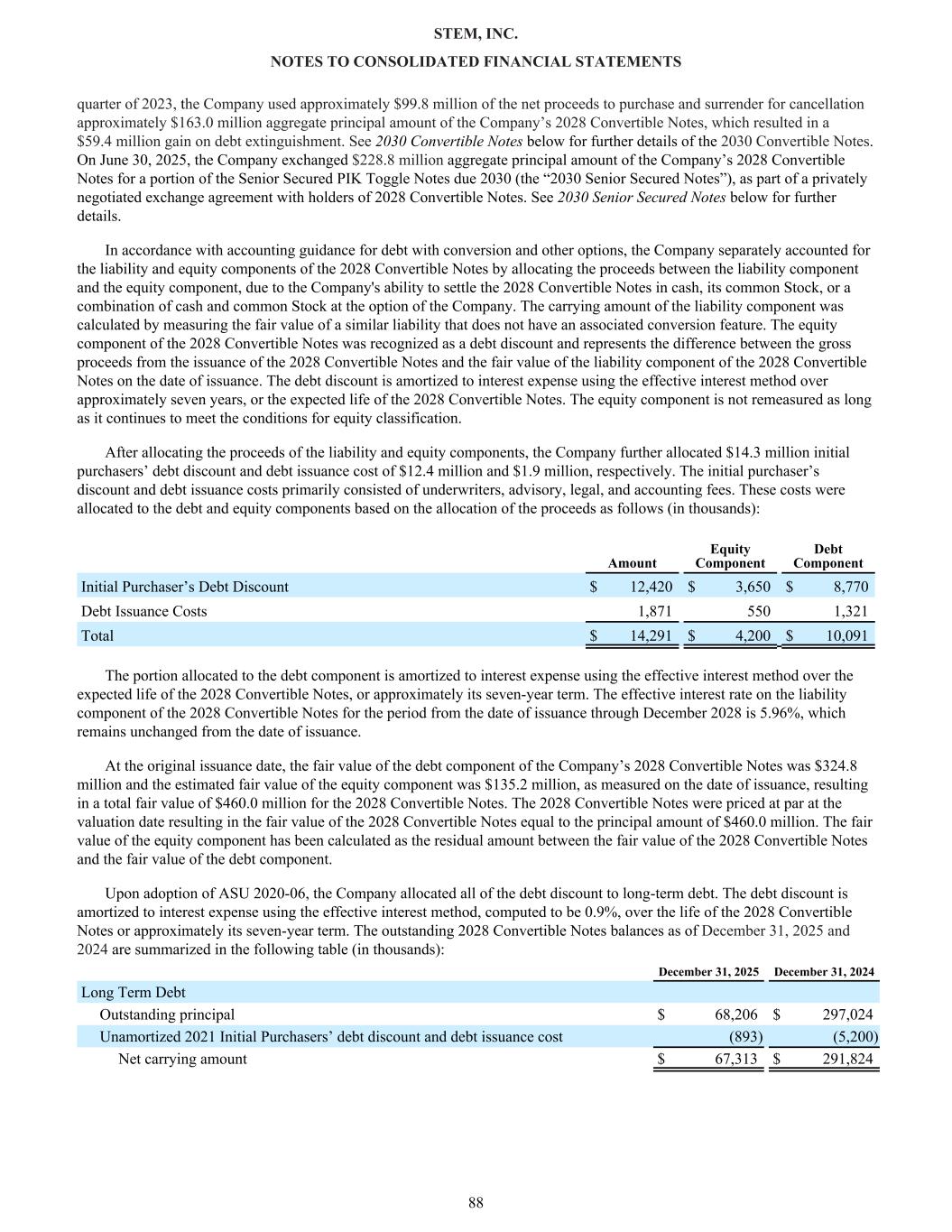
quarter of 2023, the Company used approximately $99.8 million of the net proceeds to purchase and surrender for cancellation approximately $163.0 million aggregate principal amount of the Company’s 2028 Convertible Notes, which resulted in a $59.4 million gain on debt extinguishment. See 2030 Convertible Notes below for further details of the 2030 Convertible Notes. On June 30, 2025, the Company exchanged $228.8 million aggregate principal amount of the Company’s 2028 Convertible Notes for a portion of the Senior Secured PIK Toggle Notes due 2030 (the “2030 Senior Secured Notes”), as part of a privately negotiated exchange agreement with holders of 2028 Convertible Notes. See 2030 Senior Secured Notes below for further details. In accordance with accounting guidance for debt with conversion and other options, the Company separately accounted for the liability and equity components of the 2028 Convertible Notes by allocating the proceeds between the liability component and the equity component, due to the Company's ability to settle the 2028 Convertible Notes in cash, its common Stock, or a combination of cash and common Stock at the option of the Company. The carrying amount of the liability component was calculated by measuring the fair value of a similar liability that does not have an associated conversion feature. The equity component of the 2028 Convertible Notes was recognized as a debt discount and represents the difference between the gross proceeds from the issuance of the 2028 Convertible Notes and the fair value of the liability component of the 2028 Convertible Notes on the date of issuance. The debt discount is amortized to interest expense using the effective interest method over approximately seven years, or the expected life of the 2028 Convertible Notes. The equity component is not remeasured as long as it continues to meet the conditions for equity classification. After allocating the proceeds of the liability and equity components, the Company further allocated $14.3 million initial purchasers’ debt discount and debt issuance cost of $12.4 million and $1.9 million, respectively. The initial purchaser’s discount and debt issuance costs primarily consisted of underwriters, advisory, legal, and accounting fees. These costs were allocated to the debt and equity components based on the allocation of the proceeds as follows (in thousands): Amount Equity Component Debt Component Initial Purchaser’s Debt Discount $ 12,420 $ 3,650 $ 8,770 Debt Issuance Costs 1,871 550 1,321 Total $ 14,291 $ 4,200 $ 10,091 The portion allocated to the debt component is amortized to interest expense using the effective interest method over the expected life of the 2028 Convertible Notes, or approximately its seven-year term. The effective interest rate on the liability component of the 2028 Convertible Notes for the period from the date of issuance through December 2028 is 5.96%, which remains unchanged from the date of issuance. At the original issuance date, the fair value of the debt component of the Company’s 2028 Convertible Notes was $324.8 million and the estimated fair value of the equity component was $135.2 million, as measured on the date of issuance, resulting in a total fair value of $460.0 million for the 2028 Convertible Notes. The 2028 Convertible Notes were priced at par at the valuation date resulting in the fair value of the 2028 Convertible Notes equal to the principal amount of $460.0 million. The fair value of the equity component has been calculated as the residual amount between the fair value of the 2028 Convertible Notes and the fair value of the debt component. Upon adoption of ASU 2020-06, the Company allocated all of the debt discount to long-term debt. The debt discount is amortized to interest expense using the effective interest method, computed to be 0.9%, over the life of the 2028 Convertible Notes or approximately its seven-year term. The outstanding 2028 Convertible Notes balances as of December 31, 2025 and 2024 are summarized in the following table (in thousands): December 31, 2025 December 31, 2024 Long Term Debt Outstanding principal $ 68,206 $ 297,024 Unamortized 2021 Initial Purchasers’ debt discount and debt issuance cost (893) (5,200) Net carrying amount $ 67,313 $ 291,824 STEM, INC. NOTES TO CONSOLIDATED FINANCIAL STATEMENTS 88
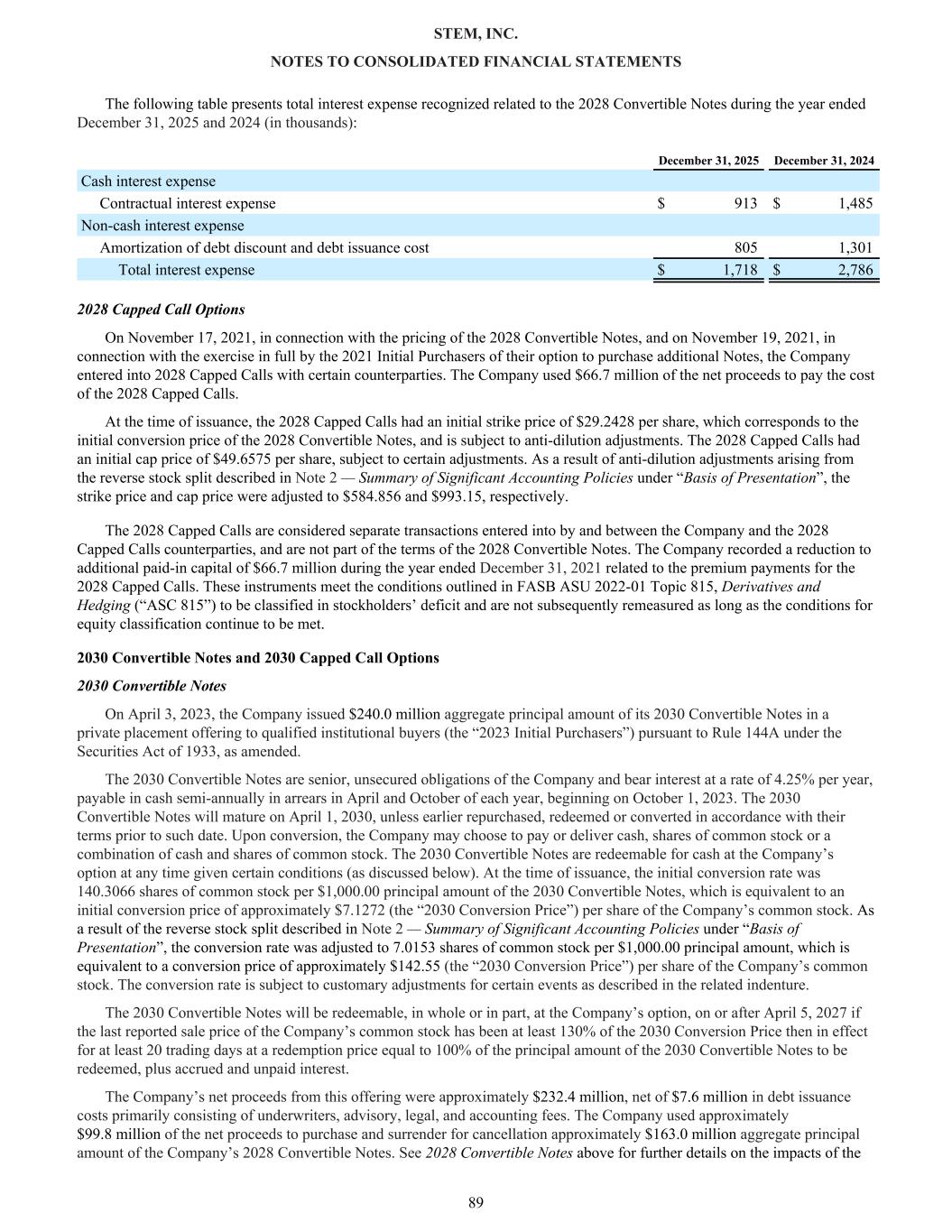
The following table presents total interest expense recognized related to the 2028 Convertible Notes during the year ended December 31, 2025 and 2024 (in thousands): December 31, 2025 December 31, 2024 Cash interest expense Contractual interest expense $ 913 $ 1,485 Non-cash interest expense Amortization of debt discount and debt issuance cost 805 1,301 Total interest expense $ 1,718 $ 2,786 2028 Capped Call Options On November 17, 2021, in connection with the pricing of the 2028 Convertible Notes, and on November 19, 2021, in connection with the exercise in full by the 2021 Initial Purchasers of their option to purchase additional Notes, the Company entered into 2028 Capped Calls with certain counterparties. The Company used $66.7 million of the net proceeds to pay the cost of the 2028 Capped Calls. At the time of issuance, the 2028 Capped Calls had an initial strike price of $29.2428 per share, which corresponds to the initial conversion price of the 2028 Convertible Notes, and is subject to anti-dilution adjustments. The 2028 Capped Calls had an initial cap price of $49.6575 per share, subject to certain adjustments. As a result of anti-dilution adjustments arising from the reverse stock split described in Note 2 — Summary of Significant Accounting Policies under “Basis of Presentation”, the strike price and cap price were adjusted to $584.856 and $993.15, respectively. The 2028 Capped Calls are considered separate transactions entered into by and between the Company and the 2028 Capped Calls counterparties, and are not part of the terms of the 2028 Convertible Notes. The Company recorded a reduction to additional paid-in capital of $66.7 million during the year ended December 31, 2021 related to the premium payments for the 2028 Capped Calls. These instruments meet the conditions outlined in FASB ASU 2022-01 Topic 815, Derivatives and Hedging (“ASC 815”) to be classified in stockholders’ deficit and are not subsequently remeasured as long as the conditions for equity classification continue to be met. 2030 Convertible Notes and 2030 Capped Call Options 2030 Convertible Notes On April 3, 2023, the Company issued $240.0 million aggregate principal amount of its 2030 Convertible Notes in a private placement offering to qualified institutional buyers (the “2023 Initial Purchasers”) pursuant to Rule 144A under the Securities Act of 1933, as amended. The 2030 Convertible Notes are senior, unsecured obligations of the Company and bear interest at a rate of 4.25% per year, payable in cash semi-annually in arrears in April and October of each year, beginning on October 1, 2023. The 2030 Convertible Notes will mature on April 1, 2030, unless earlier repurchased, redeemed or converted in accordance with their terms prior to such date. Upon conversion, the Company may choose to pay or deliver cash, shares of common stock or a combination of cash and shares of common stock. The 2030 Convertible Notes are redeemable for cash at the Company’s option at any time given certain conditions (as discussed below). At the time of issuance, the initial conversion rate was 140.3066 shares of common stock per $1,000.00 principal amount of the 2030 Convertible Notes, which is equivalent to an initial conversion price of approximately $7.1272 (the “2030 Conversion Price”) per share of the Company’s common stock. As a result of the reverse stock split described in Note 2 — Summary of Significant Accounting Policies under “Basis of Presentation”, the conversion rate was adjusted to 7.0153 shares of common stock per $1,000.00 principal amount, which is equivalent to a conversion price of approximately $142.55 (the “2030 Conversion Price”) per share of the Company’s common stock. The conversion rate is subject to customary adjustments for certain events as described in the related indenture. The 2030 Convertible Notes will be redeemable, in whole or in part, at the Company’s option, on or after April 5, 2027 if the last reported sale price of the Company’s common stock has been at least 130% of the 2030 Conversion Price then in effect for at least 20 trading days at a redemption price equal to 100% of the principal amount of the 2030 Convertible Notes to be redeemed, plus accrued and unpaid interest. The Company’s net proceeds from this offering were approximately $232.4 million, net of $7.6 million in debt issuance costs primarily consisting of underwriters, advisory, legal, and accounting fees. The Company used approximately $99.8 million of the net proceeds to purchase and surrender for cancellation approximately $163.0 million aggregate principal amount of the Company’s 2028 Convertible Notes. See 2028 Convertible Notes above for further details on the impacts of the STEM, INC. NOTES TO CONSOLIDATED FINANCIAL STATEMENTS 89
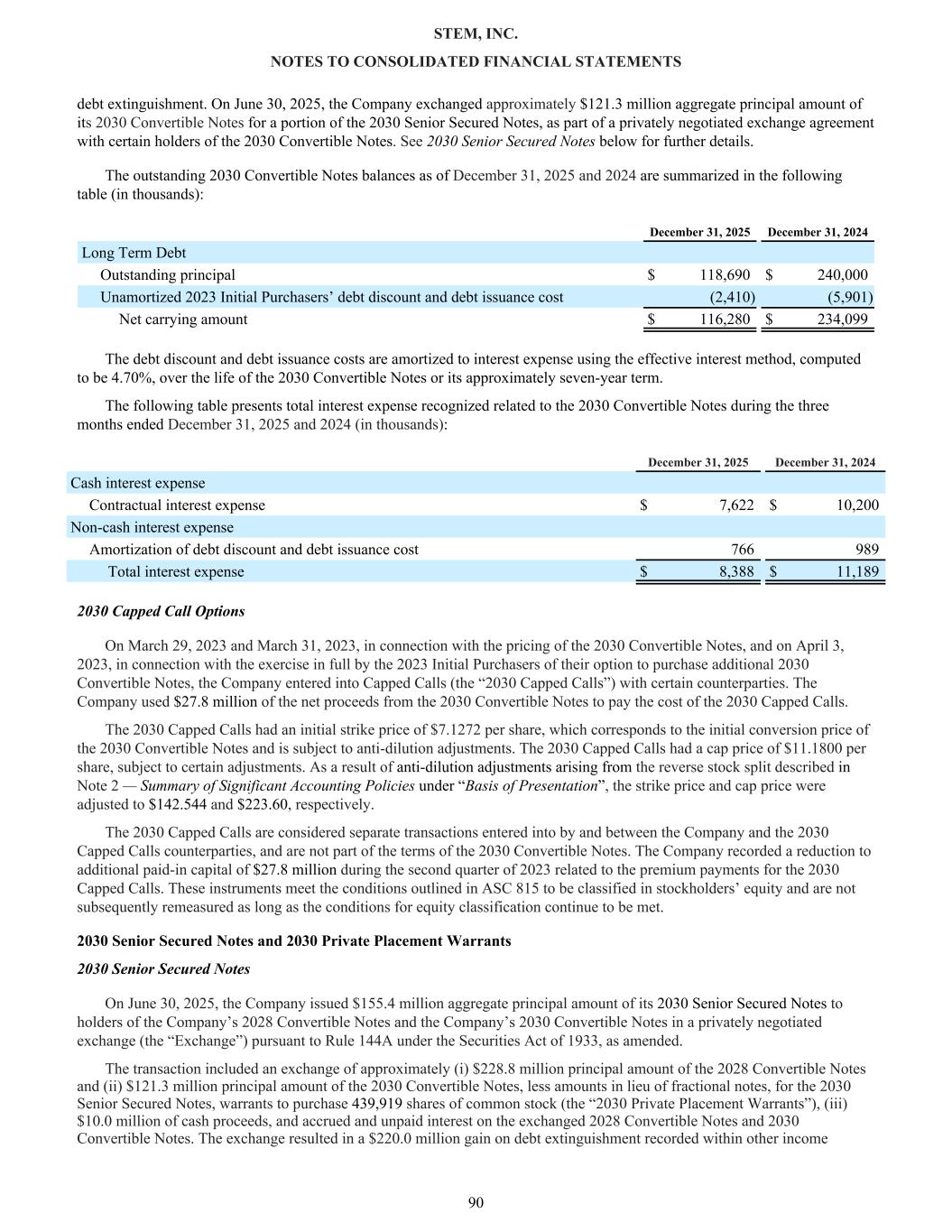
debt extinguishment. On June 30, 2025, the Company exchanged approximately $121.3 million aggregate principal amount of its 2030 Convertible Notes for a portion of the 2030 Senior Secured Notes, as part of a privately negotiated exchange agreement with certain holders of the 2030 Convertible Notes. See 2030 Senior Secured Notes below for further details. The outstanding 2030 Convertible Notes balances as of December 31, 2025 and 2024 are summarized in the following table (in thousands): December 31, 2025 December 31, 2024 Long Term Debt Outstanding principal $ 118,690 $ 240,000 Unamortized 2023 Initial Purchasers’ debt discount and debt issuance cost (2,410) (5,901) Net carrying amount $ 116,280 $ 234,099 The debt discount and debt issuance costs are amortized to interest expense using the effective interest method, computed to be 4.70%, over the life of the 2030 Convertible Notes or its approximately seven-year term. The following table presents total interest expense recognized related to the 2030 Convertible Notes during the three months ended December 31, 2025 and 2024 (in thousands): December 31, 2025 December 31, 2024 Cash interest expense Contractual interest expense $ 7,622 $ 10,200 Non-cash interest expense Amortization of debt discount and debt issuance cost 766 989 Total interest expense $ 8,388 $ 11,189 2030 Capped Call Options On March 29, 2023 and March 31, 2023, in connection with the pricing of the 2030 Convertible Notes, and on April 3, 2023, in connection with the exercise in full by the 2023 Initial Purchasers of their option to purchase additional 2030 Convertible Notes, the Company entered into Capped Calls (the “2030 Capped Calls”) with certain counterparties. The Company used $27.8 million of the net proceeds from the 2030 Convertible Notes to pay the cost of the 2030 Capped Calls. The 2030 Capped Calls had an initial strike price of $7.1272 per share, which corresponds to the initial conversion price of the 2030 Convertible Notes and is subject to anti-dilution adjustments. The 2030 Capped Calls had a cap price of $11.1800 per share, subject to certain adjustments. As a result of anti-dilution adjustments arising from the reverse stock split described in Note 2 — Summary of Significant Accounting Policies under “Basis of Presentation”, the strike price and cap price were adjusted to $142.544 and $223.60, respectively. The 2030 Capped Calls are considered separate transactions entered into by and between the Company and the 2030 Capped Calls counterparties, and are not part of the terms of the 2030 Convertible Notes. The Company recorded a reduction to additional paid-in capital of $27.8 million during the second quarter of 2023 related to the premium payments for the 2030 Capped Calls. These instruments meet the conditions outlined in ASC 815 to be classified in stockholders’ equity and are not subsequently remeasured as long as the conditions for equity classification continue to be met. 2030 Senior Secured Notes and 2030 Private Placement Warrants 2030 Senior Secured Notes On June 30, 2025, the Company issued $155.4 million aggregate principal amount of its 2030 Senior Secured Notes to holders of the Company’s 2028 Convertible Notes and the Company’s 2030 Convertible Notes in a privately negotiated exchange (the “Exchange”) pursuant to Rule 144A under the Securities Act of 1933, as amended. The transaction included an exchange of approximately (i) $228.8 million principal amount of the 2028 Convertible Notes and (ii) $121.3 million principal amount of the 2030 Convertible Notes, less amounts in lieu of fractional notes, for the 2030 Senior Secured Notes, warrants to purchase 439,919 shares of common stock (the “2030 Private Placement Warrants”), (iii) $10.0 million of cash proceeds, and accrued and unpaid interest on the exchanged 2028 Convertible Notes and 2030 Convertible Notes. The exchange resulted in a $220.0 million gain on debt extinguishment recorded within other income STEM, INC. NOTES TO CONSOLIDATED FINANCIAL STATEMENTS 90
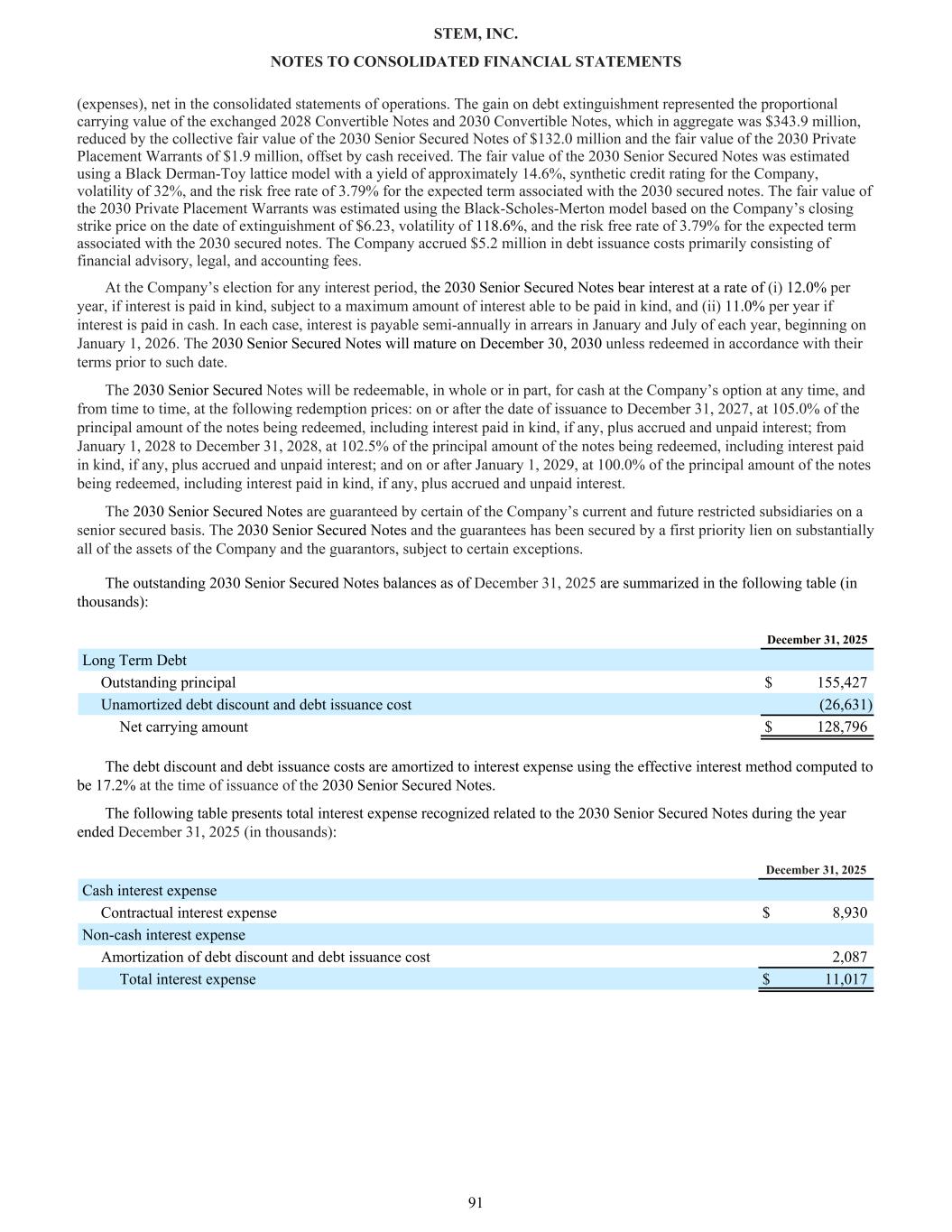
(expenses), net in the consolidated statements of operations. The gain on debt extinguishment represented the proportional carrying value of the exchanged 2028 Convertible Notes and 2030 Convertible Notes, which in aggregate was $343.9 million, reduced by the collective fair value of the 2030 Senior Secured Notes of $132.0 million and the fair value of the 2030 Private Placement Warrants of $1.9 million, offset by cash received. The fair value of the 2030 Senior Secured Notes was estimated using a Black Derman-Toy lattice model with a yield of approximately 14.6%, synthetic credit rating for the Company, volatility of 32%, and the risk free rate of 3.79% for the expected term associated with the 2030 secured notes. The fair value of the 2030 Private Placement Warrants was estimated using the Black-Scholes-Merton model based on the Company’s closing strike price on the date of extinguishment of $6.23, volatility of 118.6%, and the risk free rate of 3.79% for the expected term associated with the 2030 secured notes. The Company accrued $5.2 million in debt issuance costs primarily consisting of financial advisory, legal, and accounting fees. At the Company’s election for any interest period, the 2030 Senior Secured Notes bear interest at a rate of (i) 12.0% per year, if interest is paid in kind, subject to a maximum amount of interest able to be paid in kind, and (ii) 11.0% per year if interest is paid in cash. In each case, interest is payable semi-annually in arrears in January and July of each year, beginning on January 1, 2026. The 2030 Senior Secured Notes will mature on December 30, 2030 unless redeemed in accordance with their terms prior to such date. The 2030 Senior Secured Notes will be redeemable, in whole or in part, for cash at the Company’s option at any time, and from time to time, at the following redemption prices: on or after the date of issuance to December 31, 2027, at 105.0% of the principal amount of the notes being redeemed, including interest paid in kind, if any, plus accrued and unpaid interest; from January 1, 2028 to December 31, 2028, at 102.5% of the principal amount of the notes being redeemed, including interest paid in kind, if any, plus accrued and unpaid interest; and on or after January 1, 2029, at 100.0% of the principal amount of the notes being redeemed, including interest paid in kind, if any, plus accrued and unpaid interest. The 2030 Senior Secured Notes are guaranteed by certain of the Company’s current and future restricted subsidiaries on a senior secured basis. The 2030 Senior Secured Notes and the guarantees has been secured by a first priority lien on substantially all of the assets of the Company and the guarantors, subject to certain exceptions. The outstanding 2030 Senior Secured Notes balances as of December 31, 2025 are summarized in the following table (in thousands): December 31, 2025 Long Term Debt Outstanding principal $ 155,427 Unamortized debt discount and debt issuance cost (26,631) Net carrying amount $ 128,796 The debt discount and debt issuance costs are amortized to interest expense using the effective interest method computed to be 17.2% at the time of issuance of the 2030 Senior Secured Notes. The following table presents total interest expense recognized related to the 2030 Senior Secured Notes during the year ended December 31, 2025 (in thousands): December 31, 2025 Cash interest expense Contractual interest expense $ 8,930 Non-cash interest expense Amortization of debt discount and debt issuance cost 2,087 Total interest expense $ 11,017 STEM, INC. NOTES TO CONSOLIDATED FINANCIAL STATEMENTS 91
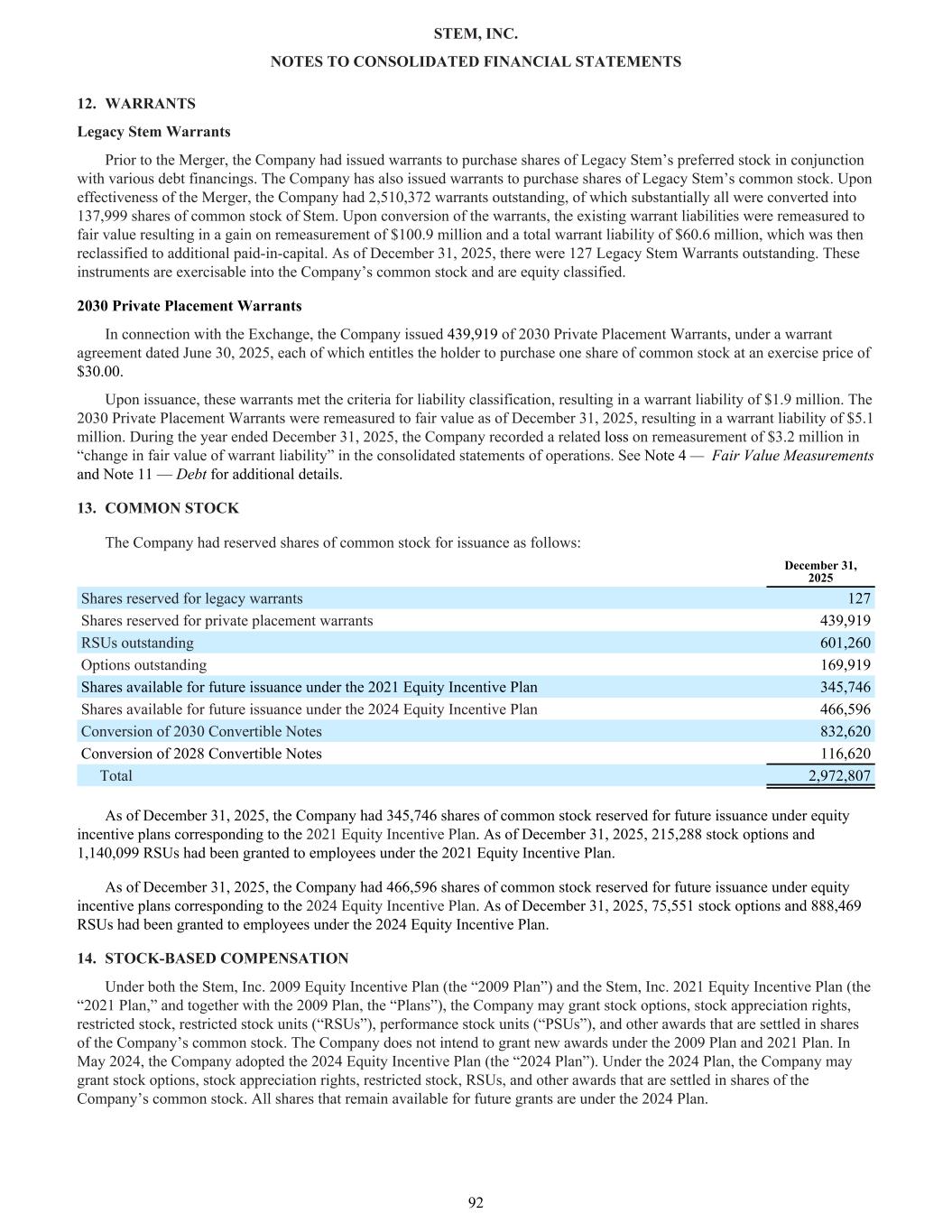
12. WARRANTS Legacy Stem Warrants Prior to the Merger, the Company had issued warrants to purchase shares of Legacy Stem’s preferred stock in conjunction with various debt financings. The Company has also issued warrants to purchase shares of Legacy Stem’s common stock. Upon effectiveness of the Merger, the Company had 2,510,372 warrants outstanding, of which substantially all were converted into 137,999 shares of common stock of Stem. Upon conversion of the warrants, the existing warrant liabilities were remeasured to fair value resulting in a gain on remeasurement of $100.9 million and a total warrant liability of $60.6 million, which was then reclassified to additional paid-in-capital. As of December 31, 2025, there were 127 Legacy Stem Warrants outstanding. These instruments are exercisable into the Company’s common stock and are equity classified. 2030 Private Placement Warrants In connection with the Exchange, the Company issued 439,919 of 2030 Private Placement Warrants, under a warrant agreement dated June 30, 2025, each of which entitles the holder to purchase one share of common stock at an exercise price of $30.00. Upon issuance, these warrants met the criteria for liability classification, resulting in a warrant liability of $1.9 million. The 2030 Private Placement Warrants were remeasured to fair value as of December 31, 2025, resulting in a warrant liability of $5.1 million. During the year ended December 31, 2025, the Company recorded a related loss on remeasurement of $3.2 million in “change in fair value of warrant liability” in the consolidated statements of operations. See Note 4 — Fair Value Measurements and Note 11 — Debt for additional details. 13. COMMON STOCK The Company had reserved shares of common stock for issuance as follows: December 31, 2025 Shares reserved for legacy warrants 127 Shares reserved for private placement warrants 439,919 RSUs outstanding 601,260 Options outstanding 169,919 Shares available for future issuance under the 2021 Equity Incentive Plan 345,746 Shares available for future issuance under the 2024 Equity Incentive Plan 466,596 Conversion of 2030 Convertible Notes 832,620 Conversion of 2028 Convertible Notes 116,620 Total 2,972,807 As of December 31, 2025, the Company had 345,746 shares of common stock reserved for future issuance under equity incentive plans corresponding to the 2021 Equity Incentive Plan. As of December 31, 2025, 215,288 stock options and 1,140,099 RSUs had been granted to employees under the 2021 Equity Incentive Plan. As of December 31, 2025, the Company had 466,596 shares of common stock reserved for future issuance under equity incentive plans corresponding to the 2024 Equity Incentive Plan. As of December 31, 2025, 75,551 stock options and 888,469 RSUs had been granted to employees under the 2024 Equity Incentive Plan. 14. STOCK-BASED COMPENSATION Under both the Stem, Inc. 2009 Equity Incentive Plan (the “2009 Plan”) and the Stem, Inc. 2021 Equity Incentive Plan (the “2021 Plan,” and together with the 2009 Plan, the “Plans”), the Company may grant stock options, stock appreciation rights, restricted stock, restricted stock units (“RSUs”), performance stock units (“PSUs”), and other awards that are settled in shares of the Company’s common stock. The Company does not intend to grant new awards under the 2009 Plan and 2021 Plan. In May 2024, the Company adopted the 2024 Equity Incentive Plan (the “2024 Plan”). Under the 2024 Plan, the Company may grant stock options, stock appreciation rights, restricted stock, RSUs, and other awards that are settled in shares of the Company’s common stock. All shares that remain available for future grants are under the 2024 Plan. STEM, INC. NOTES TO CONSOLIDATED FINANCIAL STATEMENTS 92
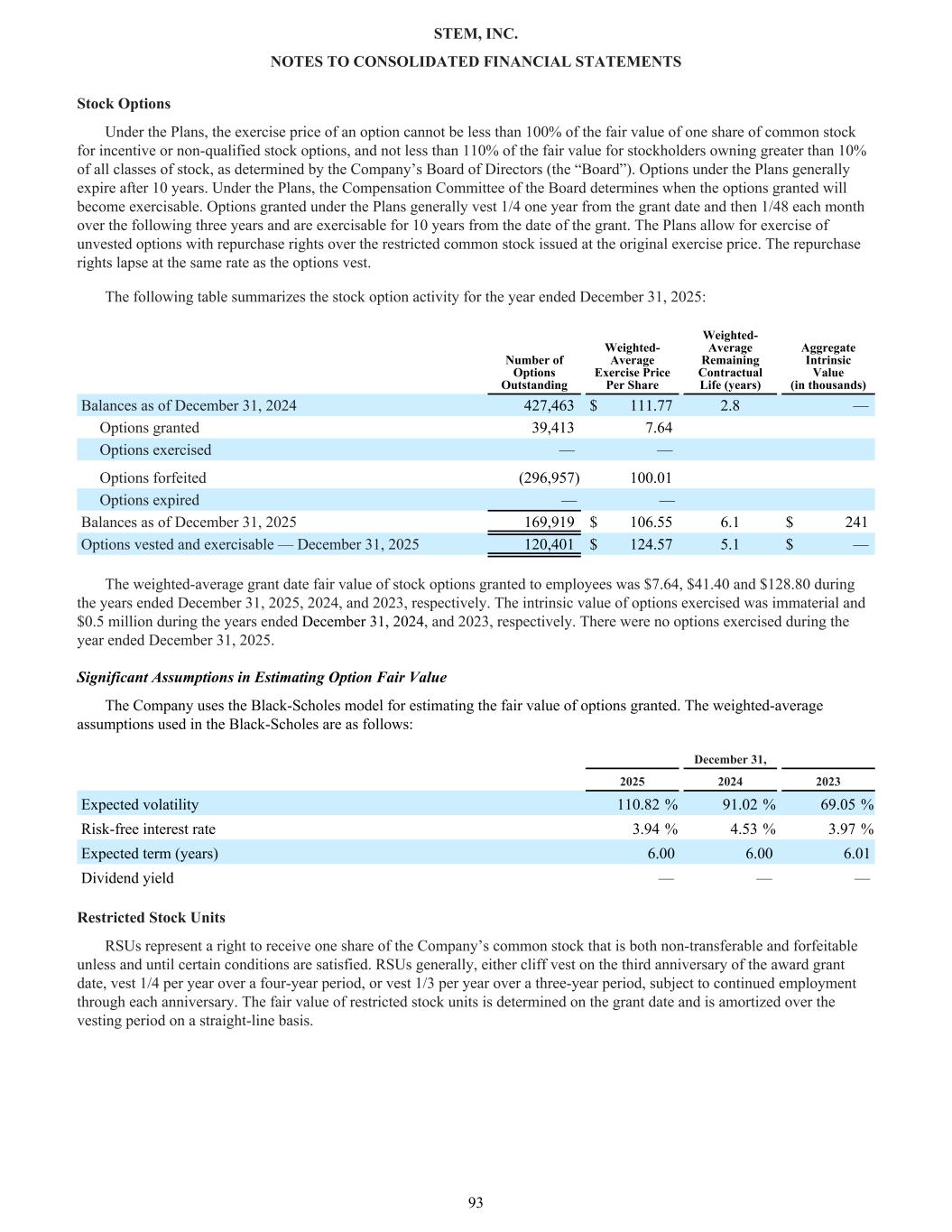
Stock Options Under the Plans, the exercise price of an option cannot be less than 100% of the fair value of one share of common stock for incentive or non-qualified stock options, and not less than 110% of the fair value for stockholders owning greater than 10% of all classes of stock, as determined by the Company’s Board of Directors (the “Board”). Options under the Plans generally expire after 10 years. Under the Plans, the Compensation Committee of the Board determines when the options granted will become exercisable. Options granted under the Plans generally vest 1/4 one year from the grant date and then 1/48 each month over the following three years and are exercisable for 10 years from the date of the grant. The Plans allow for exercise of unvested options with repurchase rights over the restricted common stock issued at the original exercise price. The repurchase rights lapse at the same rate as the options vest. The following table summarizes the stock option activity for the year ended December 31, 2025: Number of Options Outstanding Weighted- Average Exercise Price Per Share Weighted- Average Remaining Contractual Life (years) Aggregate Intrinsic Value (in thousands) Balances as of December 31, 2024 427,463 $ 111.77 2.8 — Options granted 39,413 7.64 Options exercised — — Options forfeited (296,957) 100.01 Options expired — — Balances as of December 31, 2025 169,919 $ 106.55 6.1 $ 241 Options vested and exercisable — December 31, 2025 120,401 $ 124.57 5.1 $ — The weighted-average grant date fair value of stock options granted to employees was $7.64, $41.40 and $128.80 during the years ended December 31, 2025, 2024, and 2023, respectively. The intrinsic value of options exercised was immaterial and $0.5 million during the years ended December 31, 2024, and 2023, respectively. There were no options exercised during the year ended December 31, 2025. Significant Assumptions in Estimating Option Fair Value The Company uses the Black-Scholes model for estimating the fair value of options granted. The weighted-average assumptions used in the Black-Scholes are as follows: December 31, 2025 2024 2023 Expected volatility 110.82 % 91.02 % 69.05 % Risk-free interest rate 3.94 % 4.53 % 3.97 % Expected term (years) 6.00 6.00 6.01 Dividend yield — — — Restricted Stock Units RSUs represent a right to receive one share of the Company’s common stock that is both non-transferable and forfeitable unless and until certain conditions are satisfied. RSUs generally, either cliff vest on the third anniversary of the award grant date, vest 1/4 per year over a four-year period, or vest 1/3 per year over a three-year period, subject to continued employment through each anniversary. The fair value of restricted stock units is determined on the grant date and is amortized over the vesting period on a straight-line basis. STEM, INC. NOTES TO CONSOLIDATED FINANCIAL STATEMENTS 93
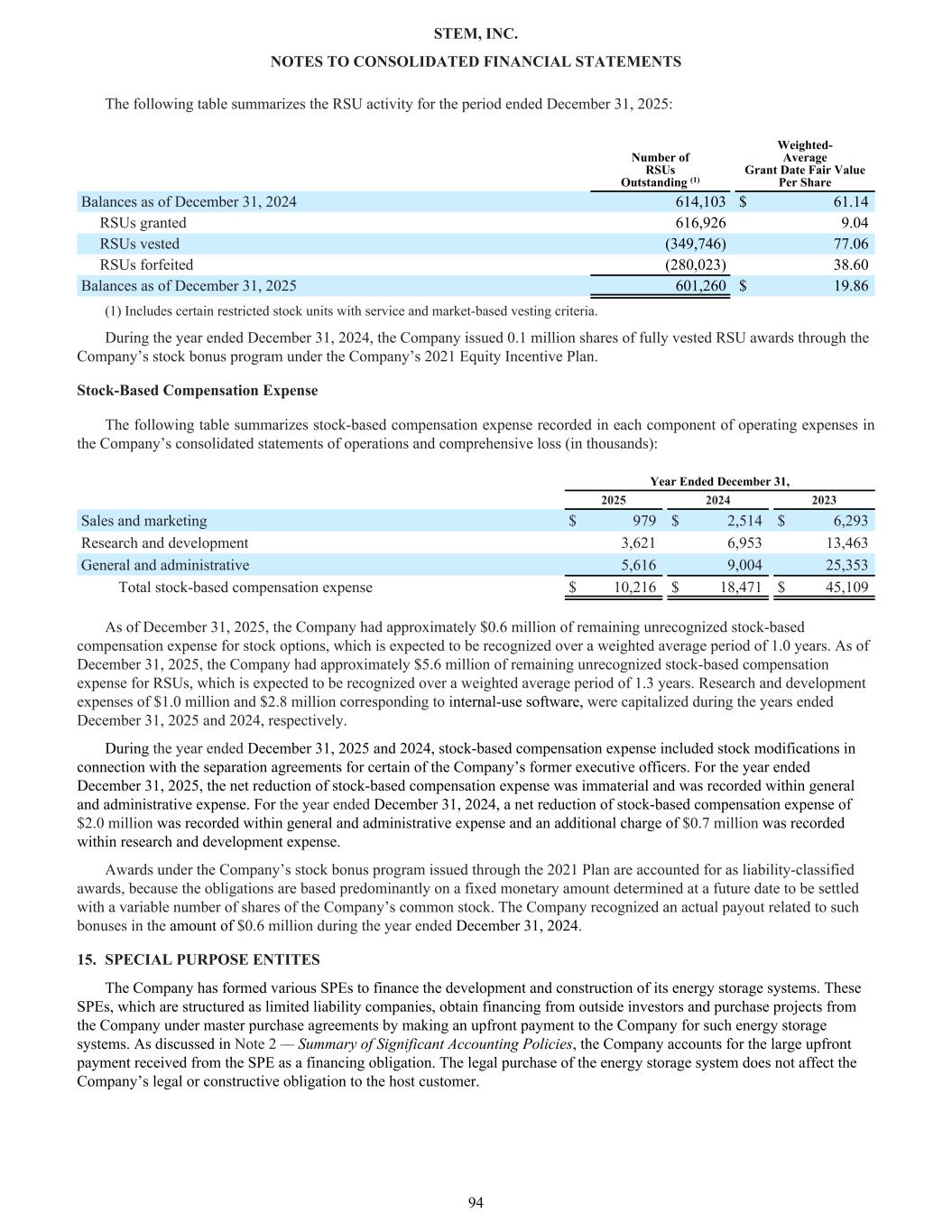
The following table summarizes the RSU activity for the period ended December 31, 2025: Number of RSUs Outstanding (1) Weighted- Average Grant Date Fair Value Per Share Balances as of December 31, 2024 614,103 $ 61.14 RSUs granted 616,926 9.04 RSUs vested (349,746) 77.06 RSUs forfeited (280,023) 38.60 Balances as of December 31, 2025 601,260 $ 19.86 (1) Includes certain restricted stock units with service and market-based vesting criteria. During the year ended December 31, 2024, the Company issued 0.1 million shares of fully vested RSU awards through the Company’s stock bonus program under the Company’s 2021 Equity Incentive Plan. Stock-Based Compensation Expense The following table summarizes stock-based compensation expense recorded in each component of operating expenses in the Company’s consolidated statements of operations and comprehensive loss (in thousands): Year Ended December 31, 2025 2024 2023 Sales and marketing $ 979 $ 2,514 $ 6,293 Research and development 3,621 6,953 13,463 General and administrative 5,616 9,004 25,353 Total stock-based compensation expense $ 10,216 $ 18,471 $ 45,109 As of December 31, 2025, the Company had approximately $0.6 million of remaining unrecognized stock-based compensation expense for stock options, which is expected to be recognized over a weighted average period of 1.0 years. As of December 31, 2025, the Company had approximately $5.6 million of remaining unrecognized stock-based compensation expense for RSUs, which is expected to be recognized over a weighted average period of 1.3 years. Research and development expenses of $1.0 million and $2.8 million corresponding to internal-use software, were capitalized during the years ended December 31, 2025 and 2024, respectively. During the year ended December 31, 2025 and 2024, stock-based compensation expense included stock modifications in connection with the separation agreements for certain of the Company’s former executive officers. For the year ended December 31, 2025, the net reduction of stock-based compensation expense was immaterial and was recorded within general and administrative expense. For the year ended December 31, 2024, a net reduction of stock-based compensation expense of $2.0 million was recorded within general and administrative expense and an additional charge of $0.7 million was recorded within research and development expense. Awards under the Company’s stock bonus program issued through the 2021 Plan are accounted for as liability-classified awards, because the obligations are based predominantly on a fixed monetary amount determined at a future date to be settled with a variable number of shares of the Company’s common stock. The Company recognized an actual payout related to such bonuses in the amount of $0.6 million during the year ended December 31, 2024. 15. SPECIAL PURPOSE ENTITES The Company has formed various SPEs to finance the development and construction of its energy storage systems. These SPEs, which are structured as limited liability companies, obtain financing from outside investors and purchase projects from the Company under master purchase agreements by making an upfront payment to the Company for such energy storage systems. As discussed in Note 2 — Summary of Significant Accounting Policies, the Company accounts for the large upfront payment received from the SPE as a financing obligation. The legal purchase of the energy storage system does not affect the Company’s legal or constructive obligation to the host customer. STEM, INC. NOTES TO CONSOLIDATED FINANCIAL STATEMENTS 94
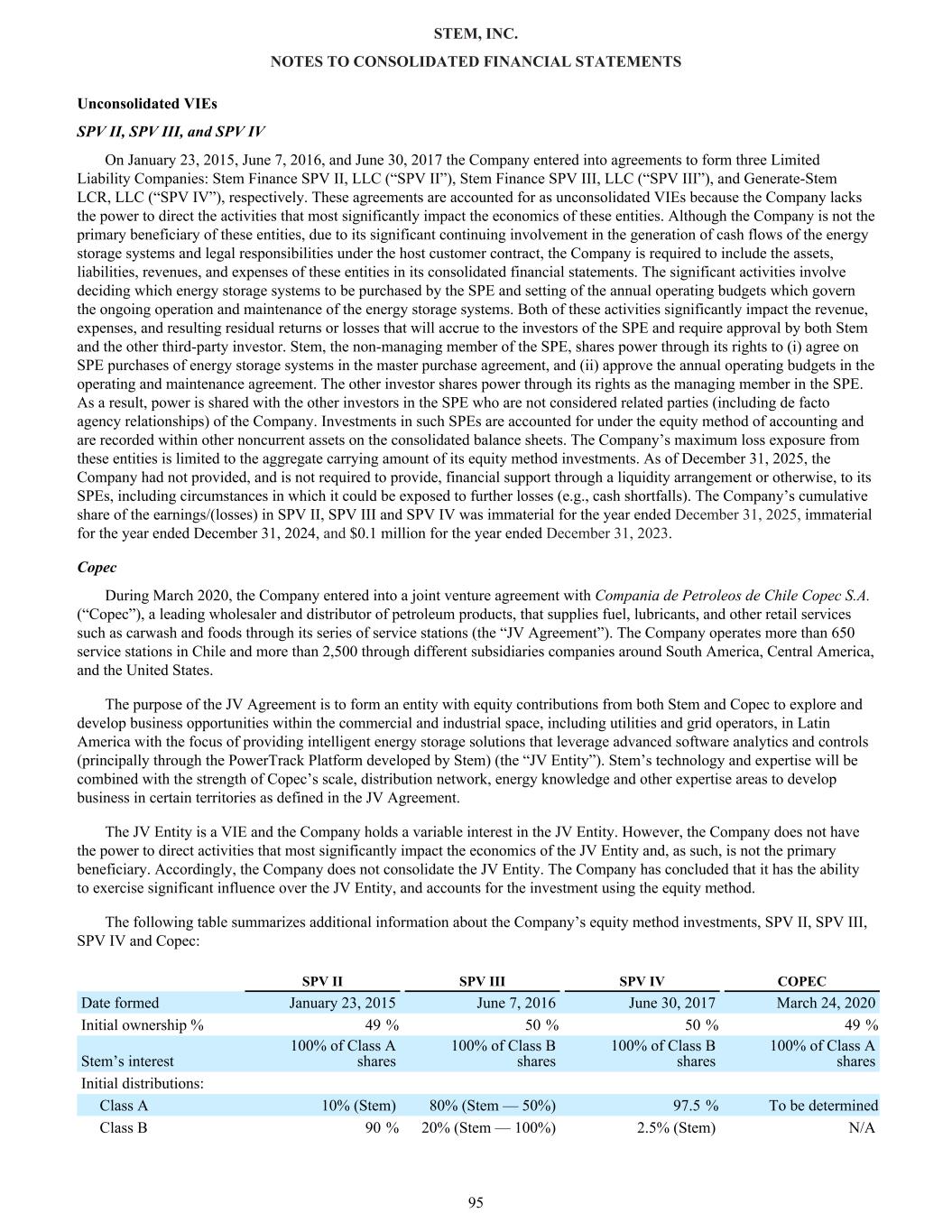
Unconsolidated VIEs SPV II, SPV III, and SPV IV On January 23, 2015, June 7, 2016, and June 30, 2017 the Company entered into agreements to form three Limited Liability Companies: Stem Finance SPV II, LLC (“SPV II”), Stem Finance SPV III, LLC (“SPV III”), and Generate-Stem LCR, LLC (“SPV IV”), respectively. These agreements are accounted for as unconsolidated VIEs because the Company lacks the power to direct the activities that most significantly impact the economics of these entities. Although the Company is not the primary beneficiary of these entities, due to its significant continuing involvement in the generation of cash flows of the energy storage systems and legal responsibilities under the host customer contract, the Company is required to include the assets, liabilities, revenues, and expenses of these entities in its consolidated financial statements. The significant activities involve deciding which energy storage systems to be purchased by the SPE and setting of the annual operating budgets which govern the ongoing operation and maintenance of the energy storage systems. Both of these activities significantly impact the revenue, expenses, and resulting residual returns or losses that will accrue to the investors of the SPE and require approval by both Stem and the other third-party investor. Stem, the non-managing member of the SPE, shares power through its rights to (i) agree on SPE purchases of energy storage systems in the master purchase agreement, and (ii) approve the annual operating budgets in the operating and maintenance agreement. The other investor shares power through its rights as the managing member in the SPE. As a result, power is shared with the other investors in the SPE who are not considered related parties (including de facto agency relationships) of the Company. Investments in such SPEs are accounted for under the equity method of accounting and are recorded within other noncurrent assets on the consolidated balance sheets. The Company’s maximum loss exposure from these entities is limited to the aggregate carrying amount of its equity method investments. As of December 31, 2025, the Company had not provided, and is not required to provide, financial support through a liquidity arrangement or otherwise, to its SPEs, including circumstances in which it could be exposed to further losses (e.g., cash shortfalls). The Company’s cumulative share of the earnings/(losses) in SPV II, SPV III and SPV IV was immaterial for the year ended December 31, 2025, immaterial for the year ended December 31, 2024, and $0.1 million for the year ended December 31, 2023. Copec During March 2020, the Company entered into a joint venture agreement with Compania de Petroleos de Chile Copec S.A. (“Copec”), a leading wholesaler and distributor of petroleum products, that supplies fuel, lubricants, and other retail services such as carwash and foods through its series of service stations (the “JV Agreement”). The Company operates more than 650 service stations in Chile and more than 2,500 through different subsidiaries companies around South America, Central America, and the United States. The purpose of the JV Agreement is to form an entity with equity contributions from both Stem and Copec to explore and develop business opportunities within the commercial and industrial space, including utilities and grid operators, in Latin America with the focus of providing intelligent energy storage solutions that leverage advanced software analytics and controls (principally through the PowerTrack Platform developed by Stem) (the “JV Entity”). Stem’s technology and expertise will be combined with the strength of Copec’s scale, distribution network, energy knowledge and other expertise areas to develop business in certain territories as defined in the JV Agreement. The JV Entity is a VIE and the Company holds a variable interest in the JV Entity. However, the Company does not have the power to direct activities that most significantly impact the economics of the JV Entity and, as such, is not the primary beneficiary. Accordingly, the Company does not consolidate the JV Entity. The Company has concluded that it has the ability to exercise significant influence over the JV Entity, and accounts for the investment using the equity method. The following table summarizes additional information about the Company’s equity method investments, SPV II, SPV III, SPV IV and Copec: SPV II SPV III SPV IV COPEC Date formed January 23, 2015 June 7, 2016 June 30, 2017 March 24, 2020 Initial ownership % 49 % 50 % 50 % 49 % Stem’s interest 100% of Class A shares 100% of Class B shares 100% of Class B shares 100% of Class A shares Initial distributions: Class A 10% (Stem) 80% (Stem — 50%) 97.5 % To be determined Class B 90 % 20% (Stem — 100%) 2.5% (Stem) N/A STEM, INC. NOTES TO CONSOLIDATED FINANCIAL STATEMENTS 95
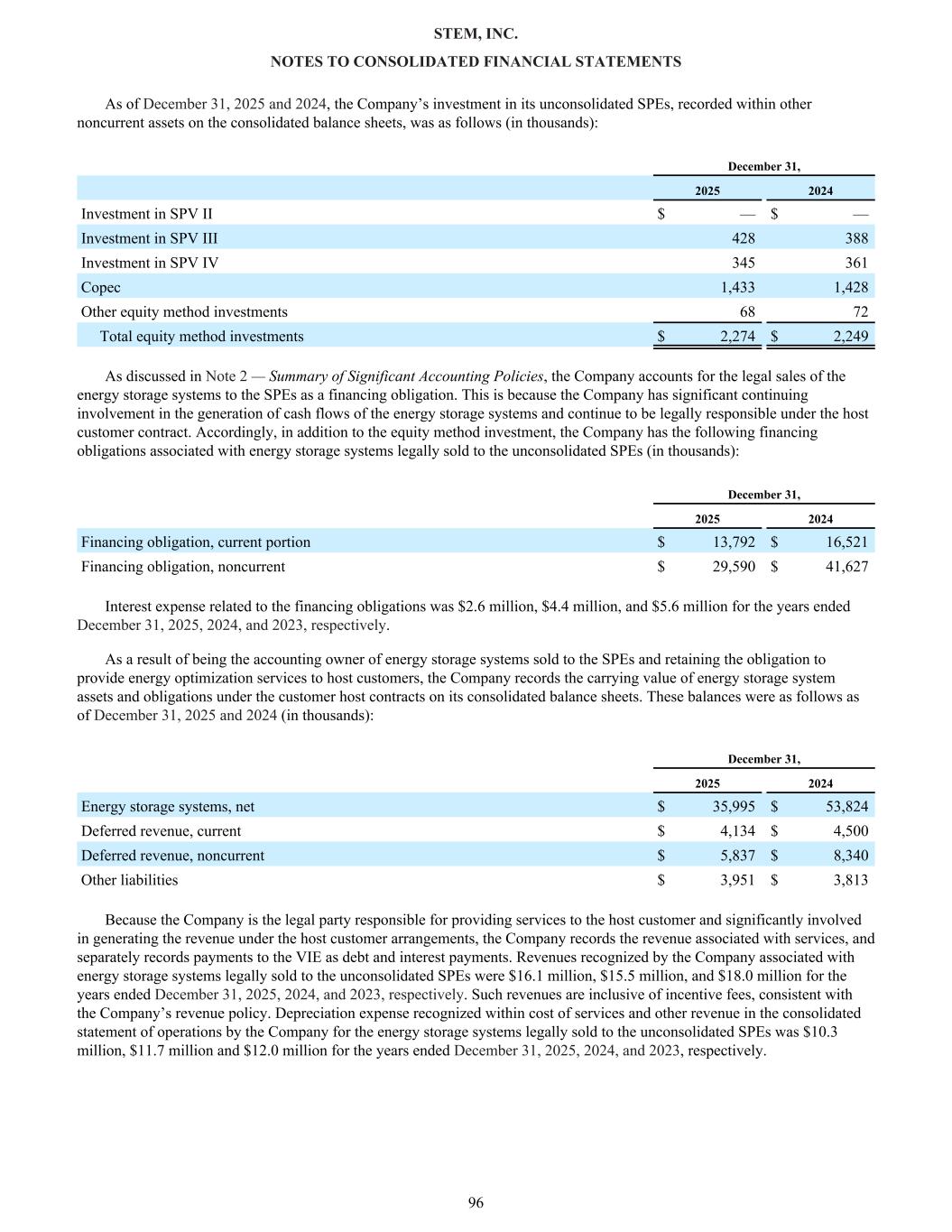
As of December 31, 2025 and 2024, the Company’s investment in its unconsolidated SPEs, recorded within other noncurrent assets on the consolidated balance sheets, was as follows (in thousands): December 31, 2025 2024 Investment in SPV II $ — $ — Investment in SPV III 428 388 Investment in SPV IV 345 361 Copec 1,433 1,428 Other equity method investments 68 72 Total equity method investments $ 2,274 $ 2,249 As discussed in Note 2 — Summary of Significant Accounting Policies, the Company accounts for the legal sales of the energy storage systems to the SPEs as a financing obligation. This is because the Company has significant continuing involvement in the generation of cash flows of the energy storage systems and continue to be legally responsible under the host customer contract. Accordingly, in addition to the equity method investment, the Company has the following financing obligations associated with energy storage systems legally sold to the unconsolidated SPEs (in thousands): December 31, 2025 2024 Financing obligation, current portion $ 13,792 $ 16,521 Financing obligation, noncurrent $ 29,590 $ 41,627 Interest expense related to the financing obligations was $2.6 million, $4.4 million, and $5.6 million for the years ended December 31, 2025, 2024, and 2023, respectively. As a result of being the accounting owner of energy storage systems sold to the SPEs and retaining the obligation to provide energy optimization services to host customers, the Company records the carrying value of energy storage system assets and obligations under the customer host contracts on its consolidated balance sheets. These balances were as follows as of December 31, 2025 and 2024 (in thousands): December 31, 2025 2024 Energy storage systems, net $ 35,995 $ 53,824 Deferred revenue, current $ 4,134 $ 4,500 Deferred revenue, noncurrent $ 5,837 $ 8,340 Other liabilities $ 3,951 $ 3,813 Because the Company is the legal party responsible for providing services to the host customer and significantly involved in generating the revenue under the host customer arrangements, the Company records the revenue associated with services, and separately records payments to the VIE as debt and interest payments. Revenues recognized by the Company associated with energy storage systems legally sold to the unconsolidated SPEs were $16.1 million, $15.5 million, and $18.0 million for the years ended December 31, 2025, 2024, and 2023, respectively. Such revenues are inclusive of incentive fees, consistent with the Company’s revenue policy. Depreciation expense recognized within cost of services and other revenue in the consolidated statement of operations by the Company for the energy storage systems legally sold to the unconsolidated SPEs was $10.3 million, $11.7 million and $12.0 million for the years ended December 31, 2025, 2024, and 2023, respectively. STEM, INC. NOTES TO CONSOLIDATED FINANCIAL STATEMENTS 96
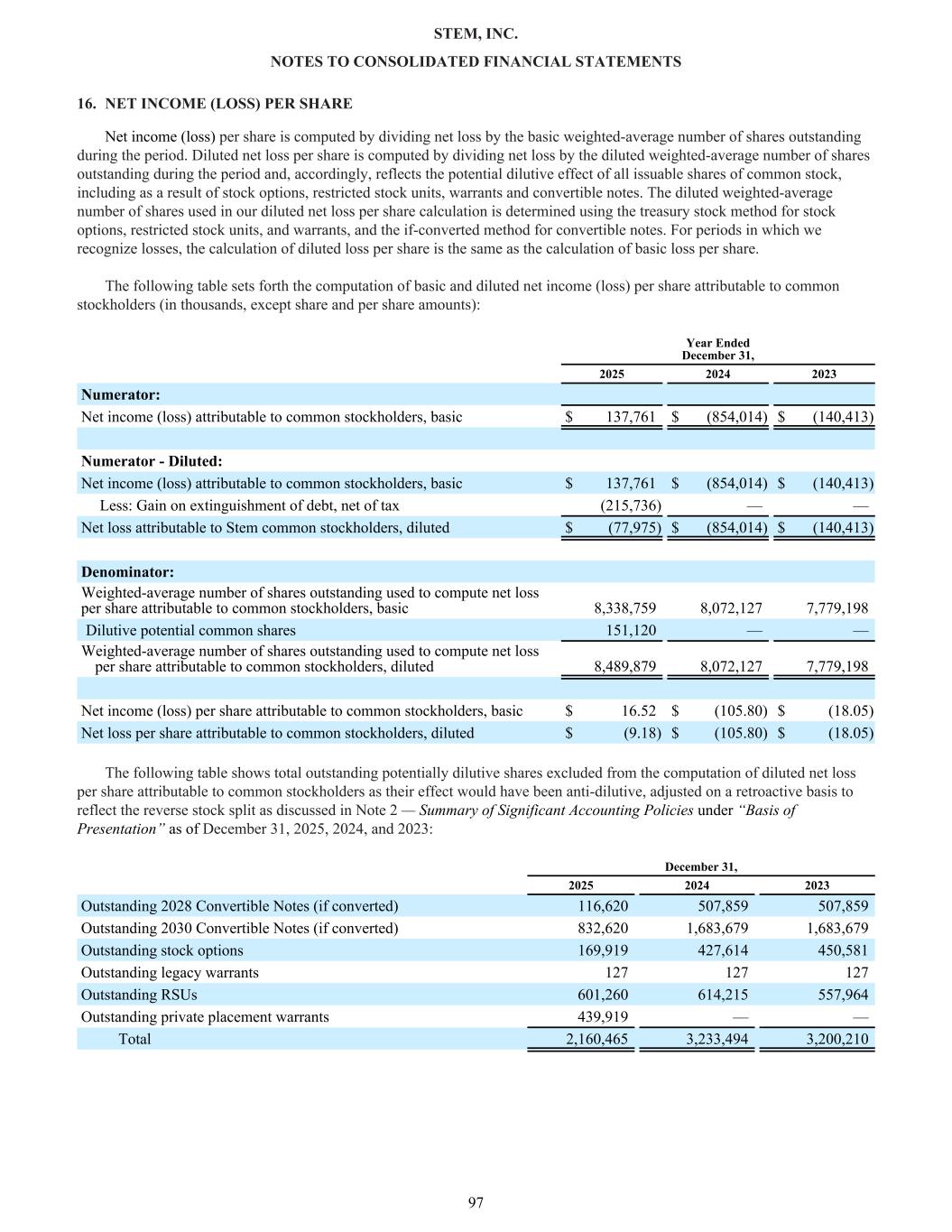
16. NET INCOME (LOSS) PER SHARE Net income (loss) per share is computed by dividing net loss by the basic weighted-average number of shares outstanding during the period. Diluted net loss per share is computed by dividing net loss by the diluted weighted-average number of shares outstanding during the period and, accordingly, reflects the potential dilutive effect of all issuable shares of common stock, including as a result of stock options, restricted stock units, warrants and convertible notes. The diluted weighted-average number of shares used in our diluted net loss per share calculation is determined using the treasury stock method for stock options, restricted stock units, and warrants, and the if-converted method for convertible notes. For periods in which we recognize losses, the calculation of diluted loss per share is the same as the calculation of basic loss per share. The following table sets forth the computation of basic and diluted net income (loss) per share attributable to common stockholders (in thousands, except share and per share amounts): Year Ended December 31, 2025 2024 2023 Numerator: Net income (loss) attributable to common stockholders, basic $ 137,761 $ (854,014) $ (140,413) Numerator - Diluted: Net income (loss) attributable to common stockholders, basic $ 137,761 $ (854,014) $ (140,413) Less: Gain on extinguishment of debt, net of tax (215,736) — — Net loss attributable to Stem common stockholders, diluted $ (77,975) $ (854,014) $ (140,413) Denominator: Weighted-average number of shares outstanding used to compute net loss per share attributable to common stockholders, basic 8,338,759 8,072,127 7,779,198 Dilutive potential common shares 151,120 — — Weighted-average number of shares outstanding used to compute net loss per share attributable to common stockholders, diluted 8,489,879 8,072,127 7,779,198 Net income (loss) per share attributable to common stockholders, basic $ 16.52 $ (105.80) $ (18.05) Net loss per share attributable to common stockholders, diluted $ (9.18) $ (105.80) $ (18.05) The following table shows total outstanding potentially dilutive shares excluded from the computation of diluted net loss per share attributable to common stockholders as their effect would have been anti-dilutive, adjusted on a retroactive basis to reflect the reverse stock split as discussed in Note 2 — Summary of Significant Accounting Policies under “Basis of Presentation” as of December 31, 2025, 2024, and 2023: December 31, 2025 2024 2023 Outstanding 2028 Convertible Notes (if converted) 116,620 507,859 507,859 Outstanding 2030 Convertible Notes (if converted) 832,620 1,683,679 1,683,679 Outstanding stock options 169,919 427,614 450,581 Outstanding legacy warrants 127 127 127 Outstanding RSUs 601,260 614,215 557,964 Outstanding private placement warrants 439,919 — — Total 2,160,465 3,233,494 3,200,210 STEM, INC. NOTES TO CONSOLIDATED FINANCIAL STATEMENTS 97
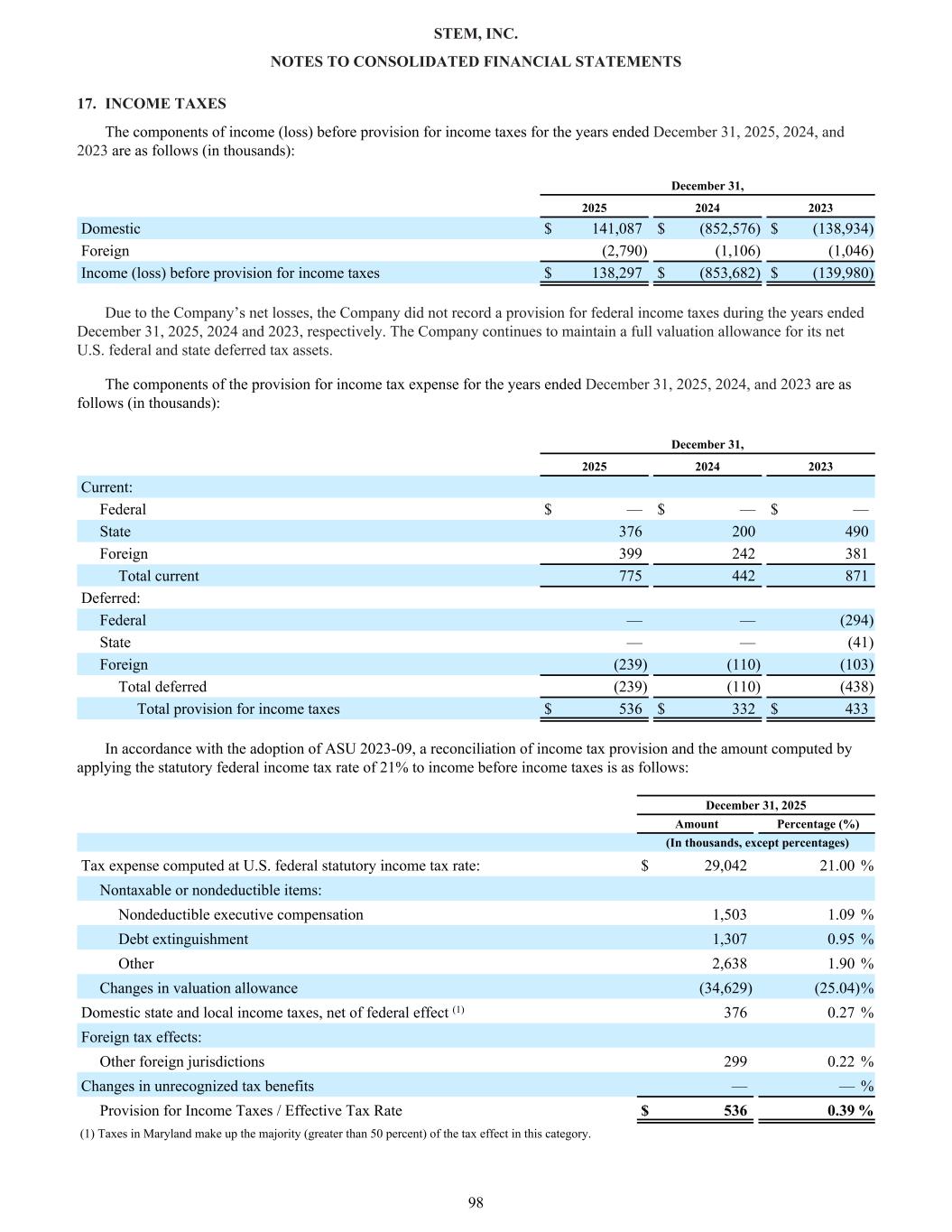
17. INCOME TAXES The components of income (loss) before provision for income taxes for the years ended December 31, 2025, 2024, and 2023 are as follows (in thousands): December 31, 2025 2024 2023 Domestic $ 141,087 $ (852,576) $ (138,934) Foreign (2,790) (1,106) (1,046) Income (loss) before provision for income taxes $ 138,297 $ (853,682) $ (139,980) Due to the Company’s net losses, the Company did not record a provision for federal income taxes during the years ended December 31, 2025, 2024 and 2023, respectively. The Company continues to maintain a full valuation allowance for its net U.S. federal and state deferred tax assets. The components of the provision for income tax expense for the years ended December 31, 2025, 2024, and 2023 are as follows (in thousands): December 31, 2025 2024 2023 Current: Federal $ — $ — $ — State 376 200 490 Foreign 399 242 381 Total current 775 442 871 Deferred: Federal — — (294) State — — (41) Foreign (239) (110) (103) Total deferred (239) (110) (438) Total provision for income taxes $ 536 $ 332 $ 433 In accordance with the adoption of ASU 2023-09, a reconciliation of income tax provision and the amount computed by applying the statutory federal income tax rate of 21% to income before income taxes is as follows: December 31, 2025 Amount Percentage (%) (In thousands, except percentages) Tax expense computed at U.S. federal statutory income tax rate: $ 29,042 21.00 % Nontaxable or nondeductible items: Nondeductible executive compensation 1,503 1.09 % Debt extinguishment 1,307 0.95 % Other 2,638 1.90 % Changes in valuation allowance (34,629) (25.04) % Domestic state and local income taxes, net of federal effect (1) 376 0.27 % Foreign tax effects: Other foreign jurisdictions 299 0.22 % Changes in unrecognized tax benefits — — % Provision for Income Taxes / Effective Tax Rate $ 536 0.39 % (1) Taxes in Maryland make up the majority (greater than 50 percent) of the tax effect in this category. STEM, INC. NOTES TO CONSOLIDATED FINANCIAL STATEMENTS 98
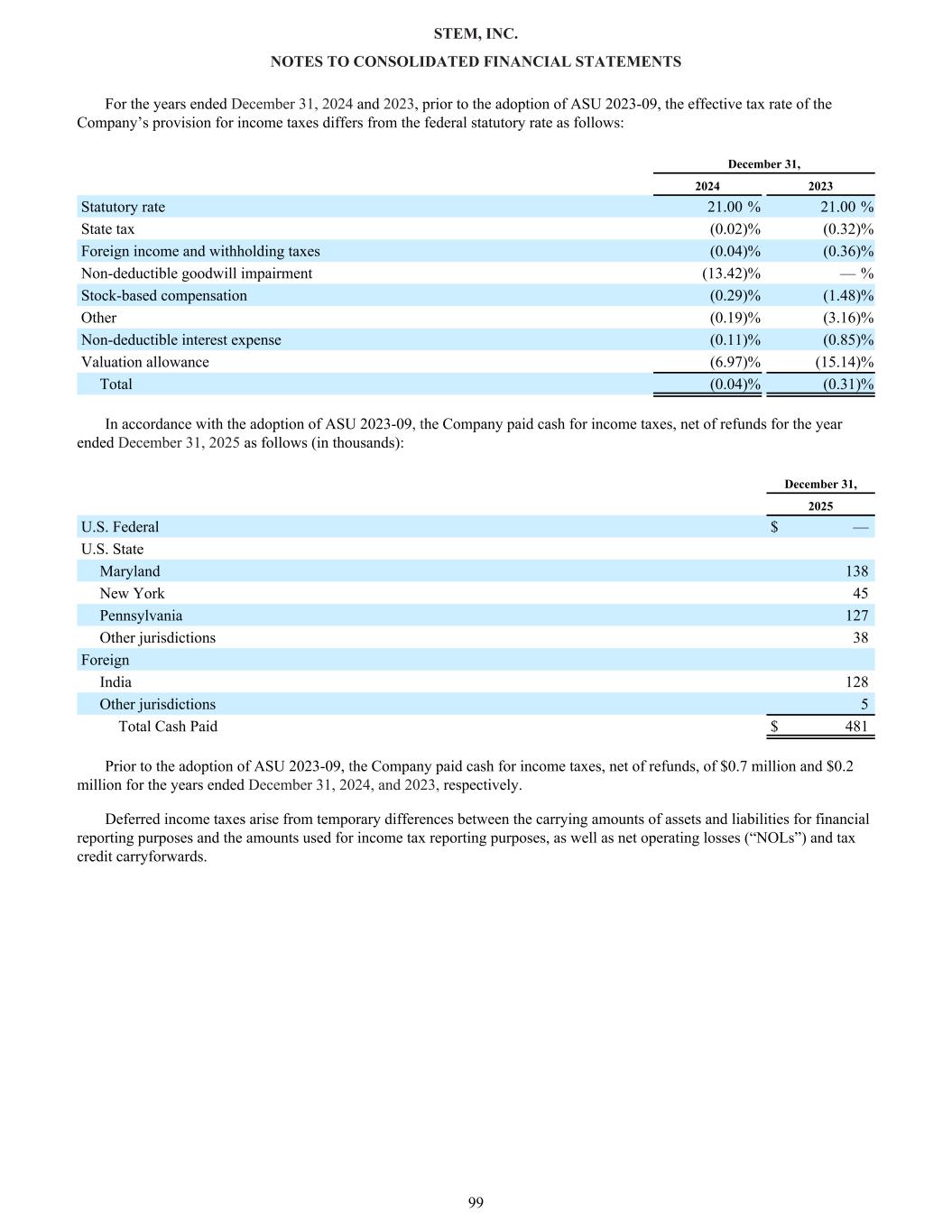
For the years ended December 31, 2024 and 2023, prior to the adoption of ASU 2023-09, the effective tax rate of the Company’s provision for income taxes differs from the federal statutory rate as follows: December 31, 2024 2023 Statutory rate 21.00 % 21.00 % State tax (0.02) % (0.32) % Foreign income and withholding taxes (0.04) % (0.36) % Non-deductible goodwill impairment (13.42) % — % Stock-based compensation (0.29) % (1.48) % Other (0.19) % (3.16) % Non-deductible interest expense (0.11) % (0.85) % Valuation allowance (6.97) % (15.14) % Total (0.04) % (0.31) % In accordance with the adoption of ASU 2023-09, the Company paid cash for income taxes, net of refunds for the year ended December 31, 2025 as follows (in thousands): December 31, 2025 U.S. Federal $ — U.S. State Maryland 138 New York 45 Pennsylvania 127 Other jurisdictions 38 Foreign India 128 Other jurisdictions 5 Total Cash Paid $ 481 Prior to the adoption of ASU 2023-09, the Company paid cash for income taxes, net of refunds, of $0.7 million and $0.2 million for the years ended December 31, 2024, and 2023, respectively. Deferred income taxes arise from temporary differences between the carrying amounts of assets and liabilities for financial reporting purposes and the amounts used for income tax reporting purposes, as well as net operating losses (“NOLs”) and tax credit carryforwards. STEM, INC. NOTES TO CONSOLIDATED FINANCIAL STATEMENTS 99
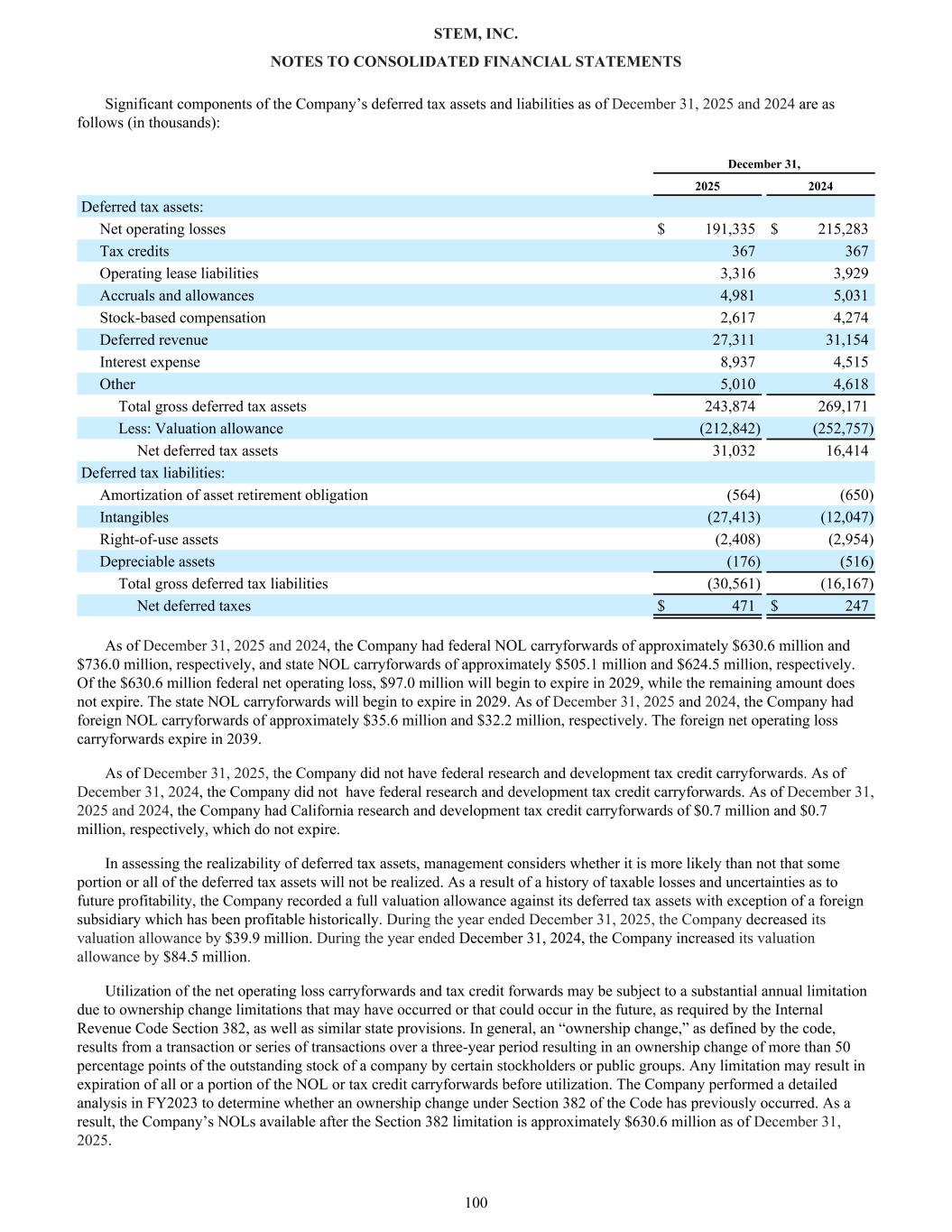
Significant components of the Company’s deferred tax assets and liabilities as of December 31, 2025 and 2024 are as follows (in thousands): December 31, 2025 2024 Deferred tax assets: Net operating losses $ 191,335 $ 215,283 Tax credits 367 367 Operating lease liabilities 3,316 3,929 Accruals and allowances 4,981 5,031 Stock-based compensation 2,617 4,274 Deferred revenue 27,311 31,154 Interest expense 8,937 4,515 Other 5,010 4,618 Total gross deferred tax assets 243,874 269,171 Less: Valuation allowance (212,842) (252,757) Net deferred tax assets 31,032 16,414 Deferred tax liabilities: Amortization of asset retirement obligation (564) (650) Intangibles (27,413) (12,047) Right-of-use assets (2,408) (2,954) Depreciable assets (176) (516) Total gross deferred tax liabilities (30,561) (16,167) Net deferred taxes $ 471 $ 247 As of December 31, 2025 and 2024, the Company had federal NOL carryforwards of approximately $630.6 million and $736.0 million, respectively, and state NOL carryforwards of approximately $505.1 million and $624.5 million, respectively. Of the $630.6 million federal net operating loss, $97.0 million will begin to expire in 2029, while the remaining amount does not expire. The state NOL carryforwards will begin to expire in 2029. As of December 31, 2025 and 2024, the Company had foreign NOL carryforwards of approximately $35.6 million and $32.2 million, respectively. The foreign net operating loss carryforwards expire in 2039. As of December 31, 2025, the Company did not have federal research and development tax credit carryforwards. As of December 31, 2024, the Company did not have federal research and development tax credit carryforwards. As of December 31, 2025 and 2024, the Company had California research and development tax credit carryforwards of $0.7 million and $0.7 million, respectively, which do not expire. In assessing the realizability of deferred tax assets, management considers whether it is more likely than not that some portion or all of the deferred tax assets will not be realized. As a result of a history of taxable losses and uncertainties as to future profitability, the Company recorded a full valuation allowance against its deferred tax assets with exception of a foreign subsidiary which has been profitable historically. During the year ended December 31, 2025, the Company decreased its valuation allowance by $39.9 million. During the year ended December 31, 2024, the Company increased its valuation allowance by $84.5 million. Utilization of the net operating loss carryforwards and tax credit forwards may be subject to a substantial annual limitation due to ownership change limitations that may have occurred or that could occur in the future, as required by the Internal Revenue Code Section 382, as well as similar state provisions. In general, an “ownership change,” as defined by the code, results from a transaction or series of transactions over a three-year period resulting in an ownership change of more than 50 percentage points of the outstanding stock of a company by certain stockholders or public groups. Any limitation may result in expiration of all or a portion of the NOL or tax credit carryforwards before utilization. The Company performed a detailed analysis in FY2023 to determine whether an ownership change under Section 382 of the Code has previously occurred. As a result, the Company’s NOLs available after the Section 382 limitation is approximately $630.6 million as of December 31, 2025. STEM, INC. NOTES TO CONSOLIDATED FINANCIAL STATEMENTS 100
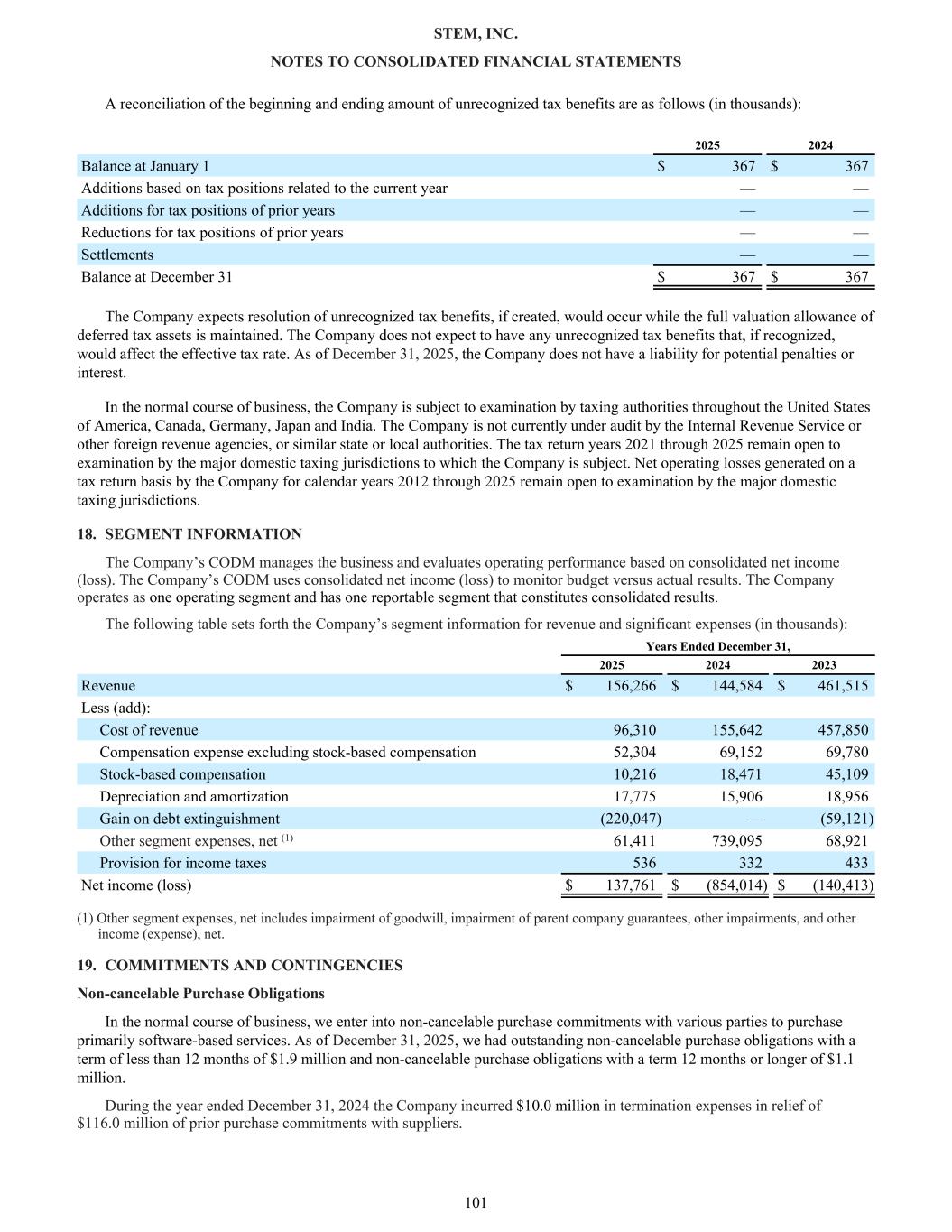
A reconciliation of the beginning and ending amount of unrecognized tax benefits are as follows (in thousands): 2025 2024 Balance at January 1 $ 367 $ 367 Additions based on tax positions related to the current year — — Additions for tax positions of prior years — — Reductions for tax positions of prior years — — Settlements — — Balance at December 31 $ 367 $ 367 The Company expects resolution of unrecognized tax benefits, if created, would occur while the full valuation allowance of deferred tax assets is maintained. The Company does not expect to have any unrecognized tax benefits that, if recognized, would affect the effective tax rate. As of December 31, 2025, the Company does not have a liability for potential penalties or interest. In the normal course of business, the Company is subject to examination by taxing authorities throughout the United States of America, Canada, Germany, Japan and India. The Company is not currently under audit by the Internal Revenue Service or other foreign revenue agencies, or similar state or local authorities. The tax return years 2021 through 2025 remain open to examination by the major domestic taxing jurisdictions to which the Company is subject. Net operating losses generated on a tax return basis by the Company for calendar years 2012 through 2025 remain open to examination by the major domestic taxing jurisdictions. 18. SEGMENT INFORMATION The Company’s CODM manages the business and evaluates operating performance based on consolidated net income (loss). The Company’s CODM uses consolidated net income (loss) to monitor budget versus actual results. The Company operates as one operating segment and has one reportable segment that constitutes consolidated results. The following table sets forth the Company’s segment information for revenue and significant expenses (in thousands): Years Ended December 31, 2025 2024 2023 Revenue $ 156,266 $ 144,584 $ 461,515 Less (add): Cost of revenue 96,310 155,642 457,850 Compensation expense excluding stock-based compensation 52,304 69,152 69,780 Stock-based compensation 10,216 18,471 45,109 Depreciation and amortization 17,775 15,906 18,956 Gain on debt extinguishment (220,047) — (59,121) Other segment expenses, net (1) 61,411 739,095 68,921 Provision for income taxes 536 332 433 Net income (loss) $ 137,761 $ (854,014) $ (140,413) (1) Other segment expenses, net includes impairment of goodwill, impairment of parent company guarantees, other impairments, and other income (expense), net. 19. COMMITMENTS AND CONTINGENCIES Non-cancelable Purchase Obligations In the normal course of business, we enter into non-cancelable purchase commitments with various parties to purchase primarily software-based services. As of December 31, 2025, we had outstanding non-cancelable purchase obligations with a term of less than 12 months of $1.9 million and non-cancelable purchase obligations with a term 12 months or longer of $1.1 million. During the year ended December 31, 2024 the Company incurred $10.0 million in termination expenses in relief of $116.0 million of prior purchase commitments with suppliers. STEM, INC. NOTES TO CONSOLIDATED FINANCIAL STATEMENTS 101
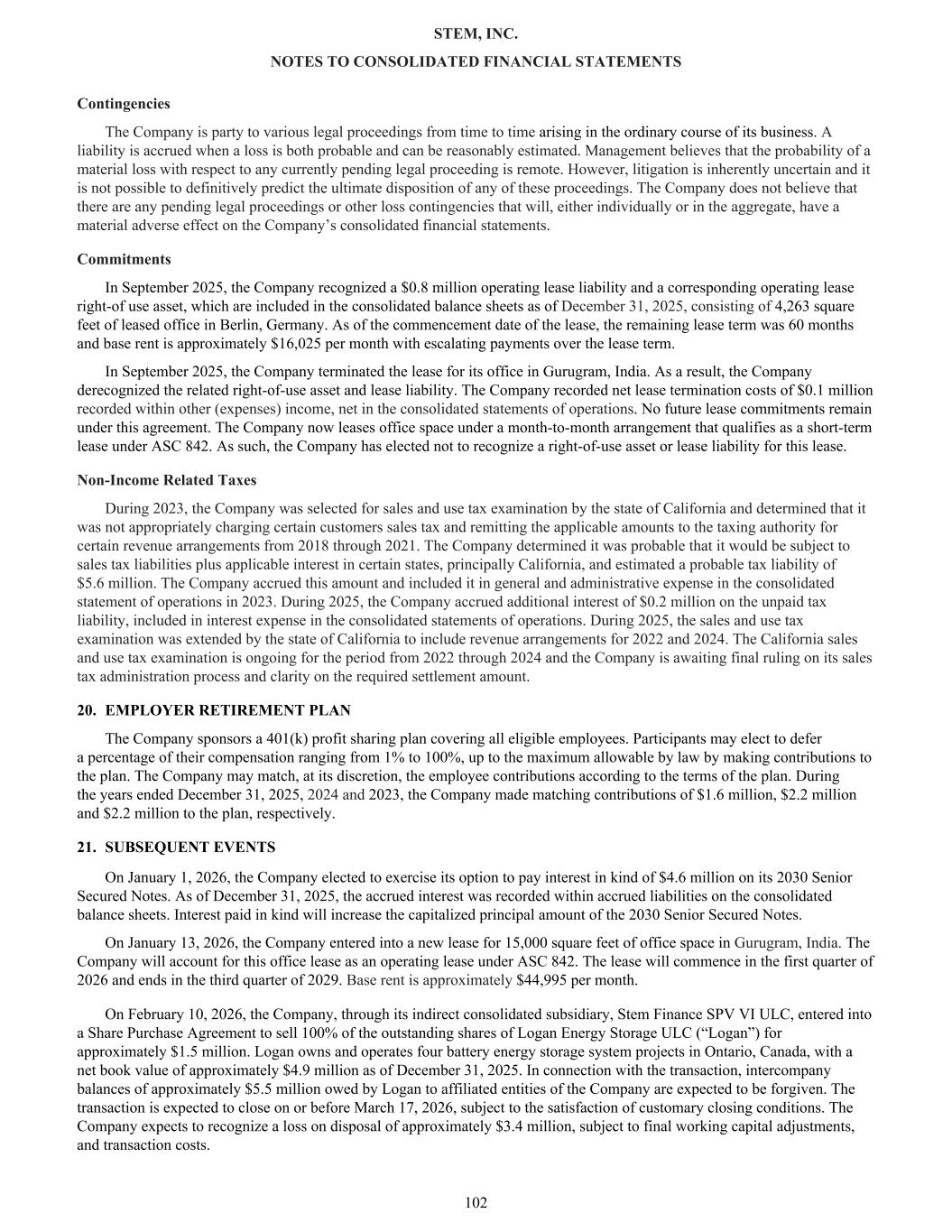
Contingencies The Company is party to various legal proceedings from time to time arising in the ordinary course of its business. A liability is accrued when a loss is both probable and can be reasonably estimated. Management believes that the probability of a material loss with respect to any currently pending legal proceeding is remote. However, litigation is inherently uncertain and it is not possible to definitively predict the ultimate disposition of any of these proceedings. The Company does not believe that there are any pending legal proceedings or other loss contingencies that will, either individually or in the aggregate, have a material adverse effect on the Company’s consolidated financial statements. Commitments In September 2025, the Company recognized a $0.8 million operating lease liability and a corresponding operating lease right-of use asset, which are included in the consolidated balance sheets as of December 31, 2025, consisting of 4,263 square feet of leased office in Berlin, Germany. As of the commencement date of the lease, the remaining lease term was 60 months and base rent is approximately $16,025 per month with escalating payments over the lease term. In September 2025, the Company terminated the lease for its office in Gurugram, India. As a result, the Company derecognized the related right-of-use asset and lease liability. The Company recorded net lease termination costs of $0.1 million recorded within other (expenses) income, net in the consolidated statements of operations. No future lease commitments remain under this agreement. The Company now leases office space under a month-to-month arrangement that qualifies as a short-term lease under ASC 842. As such, the Company has elected not to recognize a right-of-use asset or lease liability for this lease. Non-Income Related Taxes During 2023, the Company was selected for sales and use tax examination by the state of California and determined that it was not appropriately charging certain customers sales tax and remitting the applicable amounts to the taxing authority for certain revenue arrangements from 2018 through 2021. The Company determined it was probable that it would be subject to sales tax liabilities plus applicable interest in certain states, principally California, and estimated a probable tax liability of $5.6 million. The Company accrued this amount and included it in general and administrative expense in the consolidated statement of operations in 2023. During 2025, the Company accrued additional interest of $0.2 million on the unpaid tax liability, included in interest expense in the consolidated statements of operations. During 2025, the sales and use tax examination was extended by the state of California to include revenue arrangements for 2022 and 2024. The California sales and use tax examination is ongoing for the period from 2022 through 2024 and the Company is awaiting final ruling on its sales tax administration process and clarity on the required settlement amount. 20. EMPLOYER RETIREMENT PLAN The Company sponsors a 401(k) profit sharing plan covering all eligible employees. Participants may elect to defer a percentage of their compensation ranging from 1% to 100%, up to the maximum allowable by law by making contributions to the plan. The Company may match, at its discretion, the employee contributions according to the terms of the plan. During the years ended December 31, 2025, 2024 and 2023, the Company made matching contributions of $1.6 million, $2.2 million and $2.2 million to the plan, respectively. 21. SUBSEQUENT EVENTS On January 1, 2026, the Company elected to exercise its option to pay interest in kind of $4.6 million on its 2030 Senior Secured Notes. As of December 31, 2025, the accrued interest was recorded within accrued liabilities on the consolidated balance sheets. Interest paid in kind will increase the capitalized principal amount of the 2030 Senior Secured Notes. On January 13, 2026, the Company entered into a new lease for 15,000 square feet of office space in Gurugram, India. The Company will account for this office lease as an operating lease under ASC 842. The lease will commence in the first quarter of 2026 and ends in the third quarter of 2029. Base rent is approximately $44,995 per month. On February 10, 2026, the Company, through its indirect consolidated subsidiary, Stem Finance SPV VI ULC, entered into a Share Purchase Agreement to sell 100% of the outstanding shares of Logan Energy Storage ULC (“Logan”) for approximately $1.5 million. Logan owns and operates four battery energy storage system projects in Ontario, Canada, with a net book value of approximately $4.9 million as of December 31, 2025. In connection with the transaction, intercompany balances of approximately $5.5 million owed by Logan to affiliated entities of the Company are expected to be forgiven. The transaction is expected to close on or before March 17, 2026, subject to the satisfaction of customary closing conditions. The Company expects to recognize a loss on disposal of approximately $3.4 million, subject to final working capital adjustments, and transaction costs. STEM, INC. NOTES TO CONSOLIDATED FINANCIAL STATEMENTS 102
ITEM 9. CHANGES IN AND DISAGREEMENTS WITH ACCOUNTANTS ON ACCOUNTING AND FINANCIAL DISCLOSURE None. ITEM 9A. CONTROLS AND PROCEDURES REPORT OF MANAGEMENT ON INTERNAL CONTROL OVER FINANCIAL REPORTING Evaluation of Disclosure Controls and Procedures We maintain disclosure controls and procedures (“Disclosure Controls") within the meaning of Rules 13a-15(e) and 15d-15(e) of the Exchange Act. Our Disclosure Controls are designed to provide reasonable assurance that information required to be disclosed by us in the reports we file or submit under the Exchange Act, such as this Annual Report on Form 10-K, is recorded, processed, summarized and reported within the time periods specified in the SEC’s rules and forms. Our Disclosure Controls are also designed to provide reasonable assurance that such information is accumulated and communicated to our management, including our Chief Executive Officer (“CEO”) and Chief Financial Officer (“CFO”), as appropriate, to allow timely decisions regarding required disclosure. Based on management’s evaluation (under the supervision and with the participation of our CEO and our CFO) of the effectiveness of the design and operation of our Disclosure Controls, as of December 31, 2025, our CEO and CFO have concluded that our Disclosure Controls were effective at a reasonable assurance level. Management’s Report on Internal Control over Financial Reporting Our management is responsible for establishing and maintaining adequate internal control over financial reporting. Internal control over financial reporting is a process designed by, or under the supervision of, our CEO and CFO to provide reasonable assurance regarding the reliability of financial reporting and the preparation of financial statements for external reporting purposes in accordance with U.S. GAAP and includes those policies and procedures that (1) pertain to the maintenance of records that in reasonable detail accurately and fairly reflect the transactions and dispositions of our assets; (2) provide reasonable assurance that transactions are recorded as necessary to permit preparation of financial statements in accordance with U.S. GAAP, and that our receipts and expenditures are being made only in accordance with authorizations of our management and directors and (3) provide reasonable assurance regarding prevention or timely detection of unauthorized acquisition, use or disposition of our assets that could have a material effect on the financial statements. Under the supervision and with the participation of our management, including our CEO and CFO, we conducted an evaluation of the effectiveness of our internal control over financial reporting based on criteria established in Internal Control – Integrated Framework (2013) issued by the Committee of Sponsoring Organizations of the Treadway Commission (“COSO”). Based on the evaluation, our management concluded that our internal control over financial reporting was effective as of December 31, 2025. Our independent registered public accounting firm, Deloitte & Touche LLP, has audited the effectiveness of our internal control over financial reporting as of December 31, 2025, as stated in its report which is included in Item 9A. Changes in Internal Control Over Financial Reporting There was no change in our internal control over financial reporting (as defined in Rules 13a-15(f) and 15d-15(f)) under the Exchange Act) that occurred during the quarterly period ended December 31, 2025, that has materially affected, or is reasonably likely to materially affect, our internal control over financial reporting. Inherent Limitations on Effectiveness of Internal Controls Our management, including the CEO and CFO, does not expect that our disclosure controls or our internal control over financial reporting will prevent or detect all errors and all fraud. A control system, no matter how well designed and operated, can provide only reasonable, not absolute, assurance that the control system’s objectives will be met. The design of a control system must reflect the fact that there are resource constraints, and the benefits of controls must be considered relative to their costs. Furthermore, because of the inherent limitations in all control systems, no evaluation of controls can provide absolute assurance that misstatements due to error or fraud will not occur or that all control issues and instances of fraud, if any, have been detected. The design of any system of controls is based in part on certain assumptions about the likelihood of future events, and there can be no assurance that any design will succeed in achieving its stated goals under all potential future conditions. Projections of any evaluation of the effectiveness of controls to future periods are subject to risks. Over time, controls may become inadequate because of changes in business conditions or deterioration in the degree of compliance with policies or procedures. 103
REPORT OF INDEPENDENT REGISTERED PUBLIC ACCOUNTING FIRM To the shareholders and the Board of Directors of Stem, Inc. Opinion on Internal Control over Financial Reporting We have audited the internal control over financial reporting of Stem, Inc. and subsidiaries (the "Company") as of December 31, 2025, based on criteria established in Internal Control — Integrated Framework (2013) issued by the Committee of Sponsoring Organizations of the Treadway Commission (COSO). In our opinion, the Company maintained, in all material respects, effective internal control over financial reporting as of December 31, 2025, based on criteria established in Internal Control — Integrated Framework (2013) issued by COSO. We have also audited, in accordance with the standards of the Public Company Accounting Oversight Board (United States) (PCAOB), the consolidated financial statements as of and for the year ended December 31, 2025 , of the Company and our report dated March 4, 2026, expressed an unqualified opinion on those financial statements. Basis for Opinion The Company's management is responsible for maintaining effective internal control over financial reporting and for its assessment of the effectiveness of internal control over financial reporting, included in the accompanying Management's Report of Internal Control Over Financial Reporting. Our responsibility is to express an opinion on the Company's internal control over financial reporting based on our audit. We are a public accounting firm registered with the PCAOB and are required to be independent with respect to the Company in accordance with the U.S. federal securities laws and the applicable rules and regulations of the Securities and Exchange Commission and the PCAOB. We conducted our audit in accordance with the standards of the PCAOB. Those standards require that we plan and perform the audit to obtain reasonable assurance about whether effective internal control over financial reporting was maintained in all material respects. Our audit included obtaining an understanding of internal control over financial reporting, assessing the risk that a material weakness exists, testing and evaluating the design and operating effectiveness of internal control based on the assessed risk, and performing such other procedures as we considered necessary in the circumstances. We believe that our audit provides a reasonable basis for our opinion. Definition and Limitations of Internal Control over Financial Reporting A company's internal control over financial reporting is a process designed to provide reasonable assurance regarding the reliability of financial reporting and the preparation of financial statements for external purposes in accordance with generally accepted accounting principles. A company's internal control over financial reporting includes those policies and procedures that (1) pertain to the maintenance of records that, in reasonable detail, accurately and fairly reflect the transactions and dispositions of the assets of the company; (2) provide reasonable assurance that transactions are recorded as necessary to permit preparation of financial statements in accordance with generally accepted accounting principles, and that receipts and expenditures of the company are being made only in accordance with authorizations of management and directors of the company; and (3) provide reasonable assurance regarding prevention or timely detection of unauthorized acquisition, use, or disposition of the company's assets that could have a material effect on the financial statements. Because of its inherent limitations, internal control over financial reporting may not prevent or detect misstatements. Also, projections of any evaluation of effectiveness to future periods are subject to the risk that controls may become inadequate because of changes in conditions, or that the degree of compliance with the policies or procedures may deteriorate. /s/ DELOITTE & TOUCHE LLP San Francisco, California March 4, 2026 104

ITEM 9B. OTHER INFORMATION (b) Trading Plans During the three months ended December 31, 2025, no Section 16 officer or director of the Company adopted or terminated any contract, instruction or written plan for the purchase or sale of Company securities that was intended to satisfy the affirmative defense conditions of Rule 10b5-1(c), or any non-Rule 10b5-1 trading arrangement (as defined in Item 408(c) of Regulation S-K promulgated under the Exchange Act). ITEM 9C. DISCLOSURE REGARDING FOREIGN JURISDICTIONS THAT PREVENT INSPECTIONS Not applicable. 105
PART III ITEM 10. DIRECTORS, EXECUTIVE OFFICERS AND CORPORATE GOVERNANCE See Part I, Item I, “Business —Information About Our Executive Officers” of this Report for information regarding our executive officers. Information concerning our Securities Trading Policy will be included in the 2026 Proxy Statement under the caption “Corporate Governance—Other Corporate Governance Practices and Policies—Insider Trading Policy.” A copy of our Insider Trading Policy is filed as Exhibit 19 to this Form 10-K. Such information is incorporated herein by reference. The other information required for this Item will be included in the 2026 Proxy Statement, including under the headings “Corporate Governance” and “Delinquent Section 16(a) Reports,” if applicable, and is incorporated by reference. We maintain a Code of Business Conduct and Ethics that applies to all of our employees, officers and directors, including our principal executive, principal financial and principal accounting officers, or persons performing similar functions. Our Code of Business Conduct and Ethics is published on our website at investors.stem.com/governance. We intend to disclose on our website future amendments to certain provisions of our Code of Business Conduct and Ethics, or waivers of the code granted to executive officers and directors, in accordance with SEC rules. ITEM 11. EXECUTIVE COMPENSATION The information required under this Item will be included in the 2026 Proxy Statement, including under the headings “Executive Compensation,” “Executive Compensation Tables,” “Director Compensation,” “Compensation Committee Interlocks,” and “Report of the Compensation Committee,” and is incorporated herein by reference. ITEM 12. SECURITY OWNERSHIP OF CERTAIN BENEFICIAL OWNER AND MANAGEMENT AND RELATED STOCKHOLDER MATTERS The information required under this Item will be included in the 2026 Proxy Statement, including under the headings “Equity Compensation Plan Information,” “Certain Information About Our Common Stock,” and is incorporated herein by reference. ITEM 13. CERTAIN RELATIONSHIPS AND RELATED TRANSACTIONS, AND DIRECTOR INDEPENDENCE The information required under this Item will be included in the 2026 Proxy Statement, including under the headings “Certain Relationships and Related Party Transactions” and “Corporate Governance,” and is incorporated herein by reference. ITEM 14. PRINCIPAL ACCOUNTANT FEES AND SERVICES The information required under this Item will be included in the 2026 Proxy Statement, including under the heading “Ratification of Independent Auditor Selection,” and is incorporated herein by reference. 106
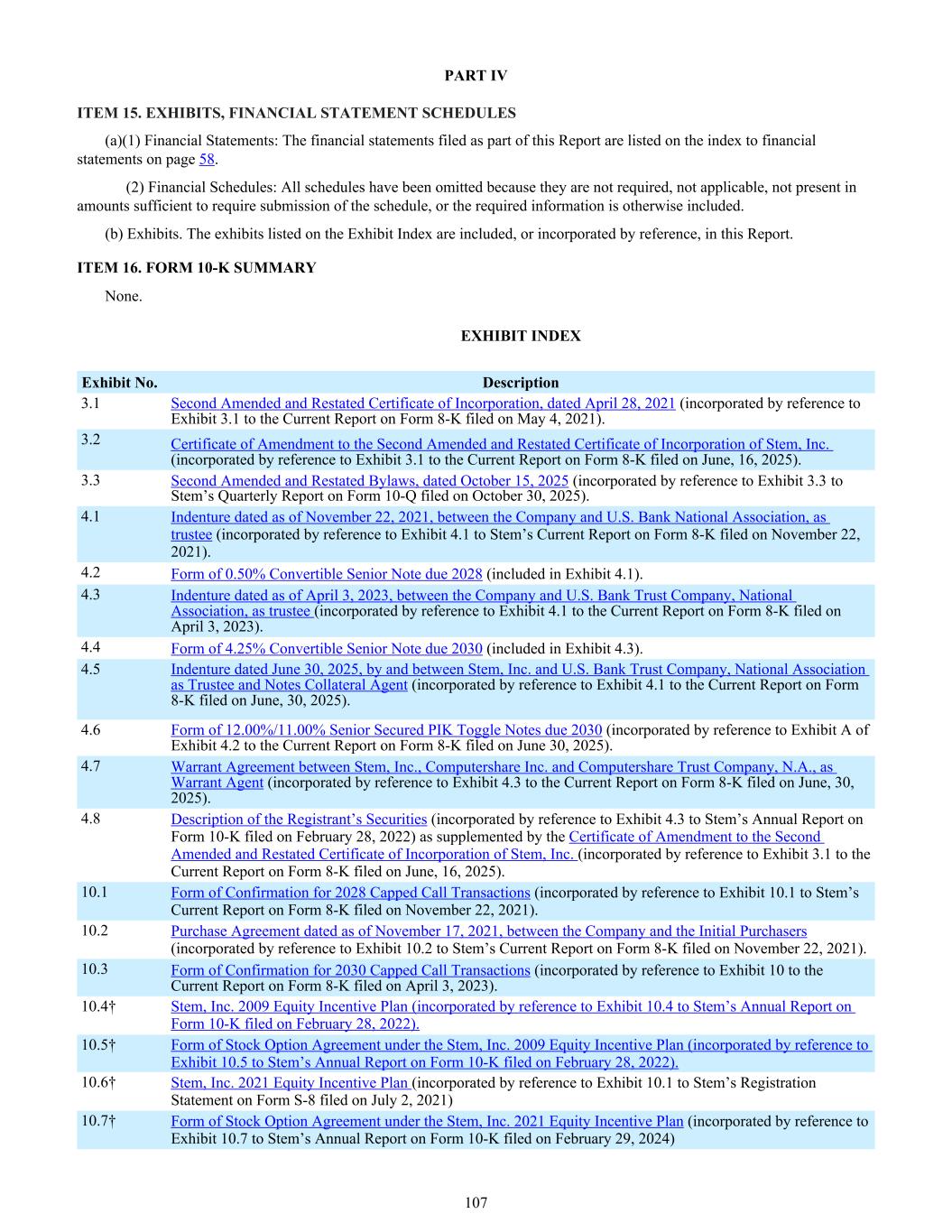
PART IV ITEM 15. EXHIBITS, FINANCIAL STATEMENT SCHEDULES (a)(1) Financial Statements: The financial statements filed as part of this Report are listed on the index to financial statements on page 58. (2) Financial Schedules: All schedules have been omitted because they are not required, not applicable, not present in amounts sufficient to require submission of the schedule, or the required information is otherwise included. (b) Exhibits. The exhibits listed on the Exhibit Index are included, or incorporated by reference, in this Report. ITEM 16. FORM 10-K SUMMARY None. EXHIBIT INDEX Exhibit No. Description 3.1 Second Amended and Restated Certificate of Incorporation, dated April 28, 2021 (incorporated by reference to Exhibit 3.1 to the Current Report on Form 8-K filed on May 4, 2021). 3.2 Certificate of Amendment to the Second Amended and Restated Certificate of Incorporation of Stem, Inc. (incorporated by reference to Exhibit 3.1 to the Current Report on Form 8-K filed on June, 16, 2025). 3.3 Second Amended and Restated Bylaws, dated October 15, 2025 (incorporated by reference to Exhibit 3.3 to Stem’s Quarterly Report on Form 10-Q filed on October 30, 2025). 4.1 Indenture dated as of November 22, 2021, between the Company and U.S. Bank National Association, as trustee (incorporated by reference to Exhibit 4.1 to Stem’s Current Report on Form 8-K filed on November 22, 2021). 4.2 Form of 0.50% Convertible Senior Note due 2028 (included in Exhibit 4.1). 4.3 Indenture dated as of April 3, 2023, between the Company and U.S. Bank Trust Company, National Association, as trustee (incorporated by reference to Exhibit 4.1 to the Current Report on Form 8-K filed on April 3, 2023). 4.4 Form of 4.25% Convertible Senior Note due 2030 (included in Exhibit 4.3). 4.5 Indenture dated June 30, 2025, by and between Stem, Inc. and U.S. Bank Trust Company, National Association as Trustee and Notes Collateral Agent (incorporated by reference to Exhibit 4.1 to the Current Report on Form 8-K filed on June, 30, 2025). 4.6 Form of 12.00%/11.00% Senior Secured PIK Toggle Notes due 2030 (incorporated by reference to Exhibit A of Exhibit 4.2 to the Current Report on Form 8-K filed on June 30, 2025). 4.7 Warrant Agreement between Stem, Inc., Computershare Inc. and Computershare Trust Company, N.A., as Warrant Agent (incorporated by reference to Exhibit 4.3 to the Current Report on Form 8-K filed on June, 30, 2025). 4.8 Description of the Registrant’s Securities (incorporated by reference to Exhibit 4.3 to Stem’s Annual Report on Form 10-K filed on February 28, 2022) as supplemented by the Certificate of Amendment to the Second Amended and Restated Certificate of Incorporation of Stem, Inc. (incorporated by reference to Exhibit 3.1 to the Current Report on Form 8-K filed on June, 16, 2025). 10.1 Form of Confirmation for 2028 Capped Call Transactions (incorporated by reference to Exhibit 10.1 to Stem’s Current Report on Form 8-K filed on November 22, 2021). 10.2 Purchase Agreement dated as of November 17, 2021, between the Company and the Initial Purchasers (incorporated by reference to Exhibit 10.2 to Stem’s Current Report on Form 8-K filed on November 22, 2021). 10.3 Form of Confirmation for 2030 Capped Call Transactions (incorporated by reference to Exhibit 10 to the Current Report on Form 8-K filed on April 3, 2023). 10.4† Stem, Inc. 2009 Equity Incentive Plan (incorporated by reference to Exhibit 10.4 to Stem’s Annual Report on Form 10-K filed on February 28, 2022). 10.5† Form of Stock Option Agreement under the Stem, Inc. 2009 Equity Incentive Plan (incorporated by reference to Exhibit 10.5 to Stem’s Annual Report on Form 10-K filed on February 28, 2022). 10.6† Stem, Inc. 2021 Equity Incentive Plan (incorporated by reference to Exhibit 10.1 to Stem’s Registration Statement on Form S-8 filed on July 2, 2021) 10.7† Form of Stock Option Agreement under the Stem, Inc. 2021 Equity Incentive Plan (incorporated by reference to Exhibit 10.7 to Stem’s Annual Report on Form 10-K filed on February 29, 2024) 107
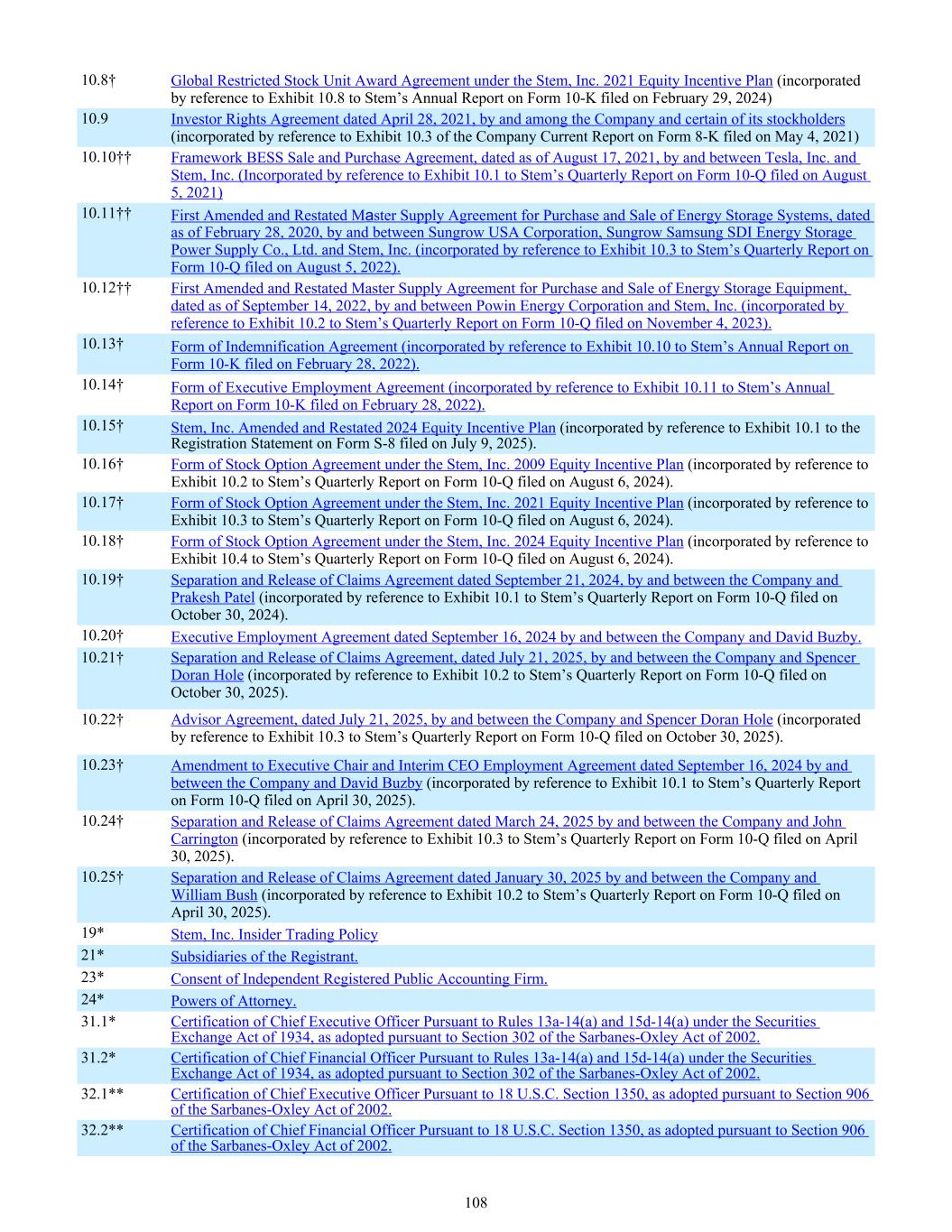
10.8† Global Restricted Stock Unit Award Agreement under the Stem, Inc. 2021 Equity Incentive Plan (incorporated by reference to Exhibit 10.8 to Stem’s Annual Report on Form 10-K filed on February 29, 2024) 10.9 Investor Rights Agreement dated April 28, 2021, by and among the Company and certain of its stockholders (incorporated by reference to Exhibit 10.3 of the Company Current Report on Form 8-K filed on May 4, 2021) 10.10†† Framework BESS Sale and Purchase Agreement, dated as of August 17, 2021, by and between Tesla, Inc. and Stem, Inc. (Incorporated by reference to Exhibit 10.1 to Stem’s Quarterly Report on Form 10-Q filed on August 5, 2021) 10.11†† First Amended and Restated Master Supply Agreement for Purchase and Sale of Energy Storage Systems, dated as of February 28, 2020, by and between Sungrow USA Corporation, Sungrow Samsung SDI Energy Storage Power Supply Co., Ltd. and Stem, Inc. (incorporated by reference to Exhibit 10.3 to Stem’s Quarterly Report on Form 10-Q filed on August 5, 2022). 10.12†† First Amended and Restated Master Supply Agreement for Purchase and Sale of Energy Storage Equipment, dated as of September 14, 2022, by and between Powin Energy Corporation and Stem, Inc. (incorporated by reference to Exhibit 10.2 to Stem’s Quarterly Report on Form 10-Q filed on November 4, 2023). 10.13† Form of Indemnification Agreement (incorporated by reference to Exhibit 10.10 to Stem’s Annual Report on Form 10-K filed on February 28, 2022). 10.14† Form of Executive Employment Agreement (incorporated by reference to Exhibit 10.11 to Stem’s Annual Report on Form 10-K filed on February 28, 2022). 10.15† Stem, Inc. Amended and Restated 2024 Equity Incentive Plan (incorporated by reference to Exhibit 10.1 to the Registration Statement on Form S-8 filed on July 9, 2025). 10.16† Form of Stock Option Agreement under the Stem, Inc. 2009 Equity Incentive Plan (incorporated by reference to Exhibit 10.2 to Stem’s Quarterly Report on Form 10-Q filed on August 6, 2024). 10.17† Form of Stock Option Agreement under the Stem, Inc. 2021 Equity Incentive Plan (incorporated by reference to Exhibit 10.3 to Stem’s Quarterly Report on Form 10-Q filed on August 6, 2024). 10.18† Form of Stock Option Agreement under the Stem, Inc. 2024 Equity Incentive Plan (incorporated by reference to Exhibit 10.4 to Stem’s Quarterly Report on Form 10-Q filed on August 6, 2024). 10.19† Separation and Release of Claims Agreement dated September 21, 2024, by and between the Company and Prakesh Patel (incorporated by reference to Exhibit 10.1 to Stem’s Quarterly Report on Form 10-Q filed on October 30, 2024). 10.20† Executive Employment Agreement dated September 16, 2024 by and between the Company and David Buzby. 10.21† Separation and Release of Claims Agreement, dated July 21, 2025, by and between the Company and Spencer Doran Hole (incorporated by reference to Exhibit 10.2 to Stem’s Quarterly Report on Form 10-Q filed on October 30, 2025). 10.22† Advisor Agreement, dated July 21, 2025, by and between the Company and Spencer Doran Hole (incorporated by reference to Exhibit 10.3 to Stem’s Quarterly Report on Form 10-Q filed on October 30, 2025). 10.23† Amendment to Executive Chair and Interim CEO Employment Agreement dated September 16, 2024 by and between the Company and David Buzby (incorporated by reference to Exhibit 10.1 to Stem’s Quarterly Report on Form 10-Q filed on April 30, 2025). 10.24† Separation and Release of Claims Agreement dated March 24, 2025 by and between the Company and John Carrington (incorporated by reference to Exhibit 10.3 to Stem’s Quarterly Report on Form 10-Q filed on April 30, 2025). 10.25† Separation and Release of Claims Agreement dated January 30, 2025 by and between the Company and William Bush (incorporated by reference to Exhibit 10.2 to Stem’s Quarterly Report on Form 10-Q filed on April 30, 2025). 19* Stem, Inc. Insider Trading Policy 21* Subsidiaries of the Registrant. 23* Consent of Independent Registered Public Accounting Firm. 24* Powers of Attorney. 31.1* Certification of Chief Executive Officer Pursuant to Rules 13a-14(a) and 15d-14(a) under the Securities Exchange Act of 1934, as adopted pursuant to Section 302 of the Sarbanes-Oxley Act of 2002. 31.2* Certification of Chief Financial Officer Pursuant to Rules 13a-14(a) and 15d-14(a) under the Securities Exchange Act of 1934, as adopted pursuant to Section 302 of the Sarbanes-Oxley Act of 2002. 32.1** Certification of Chief Executive Officer Pursuant to 18 U.S.C. Section 1350, as adopted pursuant to Section 906 of the Sarbanes-Oxley Act of 2002. 32.2** Certification of Chief Financial Officer Pursuant to 18 U.S.C. Section 1350, as adopted pursuant to Section 906 of the Sarbanes-Oxley Act of 2002. 108
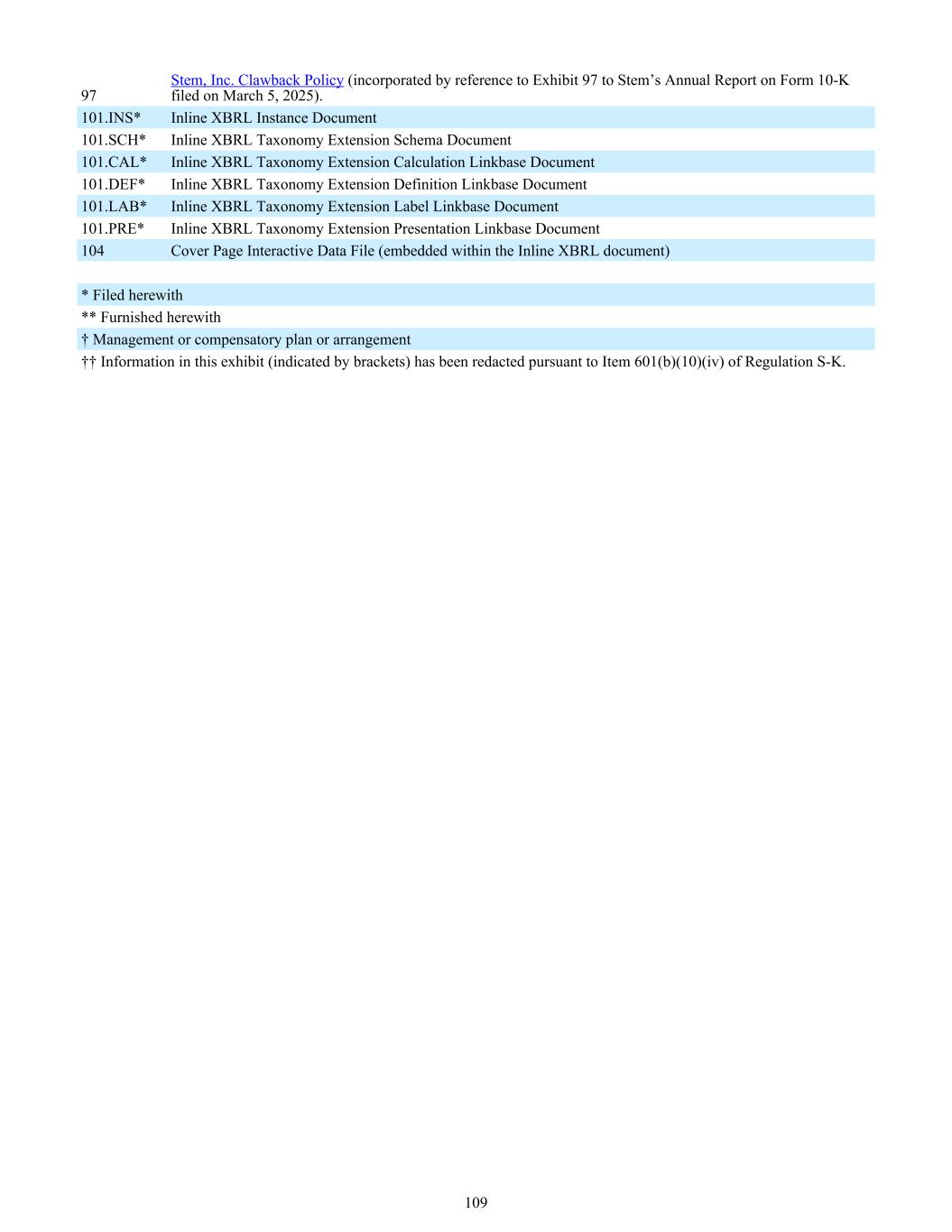
97 Stem, Inc. Clawback Policy (incorporated by reference to Exhibit 97 to Stem’s Annual Report on Form 10-K filed on March 5, 2025). 101.INS* Inline XBRL Instance Document 101.SCH* Inline XBRL Taxonomy Extension Schema Document 101.CAL* Inline XBRL Taxonomy Extension Calculation Linkbase Document 101.DEF* Inline XBRL Taxonomy Extension Definition Linkbase Document 101.LAB* Inline XBRL Taxonomy Extension Label Linkbase Document 101.PRE* Inline XBRL Taxonomy Extension Presentation Linkbase Document 104 Cover Page Interactive Data File (embedded within the Inline XBRL document) * Filed herewith ** Furnished herewith † Management or compensatory plan or arrangement †† Information in this exhibit (indicated by brackets) has been redacted pursuant to Item 601(b)(10)(iv) of Regulation S-K. 109
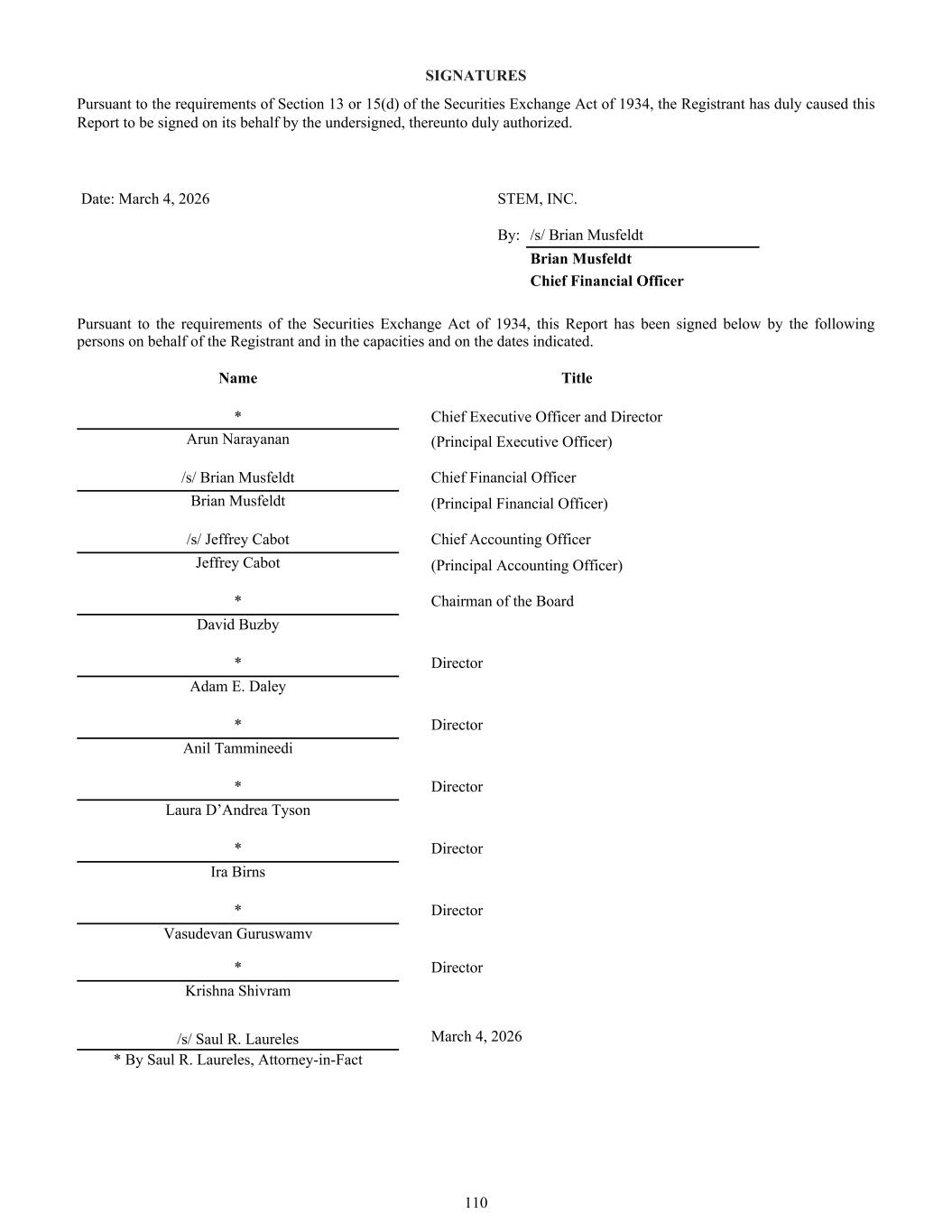
SIGNATURES Pursuant to the requirements of Section 13 or 15(d) of the Securities Exchange Act of 1934, the Registrant has duly caused this Report to be signed on its behalf by the undersigned, thereunto duly authorized. Date: March 4, 2026 STEM, INC. By: /s/ Brian Musfeldt Brian Musfeldt Chief Financial Officer Pursuant to the requirements of the Securities Exchange Act of 1934, this Report has been signed below by the following persons on behalf of the Registrant and in the capacities and on the dates indicated. Name Title * Chief Executive Officer and Director Arun Narayanan (Principal Executive Officer) /s/ Brian Musfeldt Chief Financial Officer Brian Musfeldt (Principal Financial Officer) /s/ Jeffrey Cabot Chief Accounting Officer Jeffrey Cabot (Principal Accounting Officer) * Chairman of the Board David Buzby * Director Adam E. Daley * Director Anil Tammineedi * Director Laura D’Andrea Tyson * Director Ira Birns * Director Vasudevan Guruswamy * Director Krishna Shivram /s/ Saul R. Laureles March 4, 2026 * By Saul R. Laureles, Attorney-in-Fact 110
UNITED STATES SECURITIES AND EXCHANGE COMMISSION Washington, D.C. 20549 SCHEDULE 14A Proxy Statement Pursuant to Section 14(a) of the Securities Exchange Act of 1934 (Amendment No. ) Filed by the Registrant x Filed by a Party other than the Registrant o Check the appropriate box: o Preliminary Proxy Statement o Confidential, for Use of the Commission Only (as permitted by Rule 14a-6(e)(2)) x Definitive Proxy Statement o Definitive Additional Materials o Soliciting Material under §240.14a-12 Stem, Inc. (Name of Registrant as Specified in Its Charter) (Name of Person(s) Filing Proxy Statement, if other than the Registrant) Payment of Filing Fee (Check all boxes that apply): x No fee required. o Fee paid previously with preliminary materials. o Fee computed on table in exhibit required by Item 25(b) per Exchange Act Rules 14a-6(i)(1) and 0-11.
1400 Post Oak Boulevard, Suite 560, Houston, Texas 77056 NOTICE OF 2026 ANNUAL MEETING OF STOCKHOLDERS TO BE HELD ON JUNE 3, 2026 To our Stockholders: Stem, Inc. (the “Company”) will hold its 2026 Annual Meeting of Stockholders (the “Annual Meeting”) on Wednesday, June 3, 2026, beginning at 10:00 a.m. Central Time. The Annual Meeting will be a virtual meeting conducted exclusively online via live audio webcast at www.virtualshareholdermeeting.com/STEM2026. The Annual Meeting will be held for the following purposes, as more fully described in the accompanying proxy statement (the “Proxy Statement”): (1) to elect the three Class II director nominees named in the Proxy Statement to serve until the 2029 Annual Meeting of Stockholders and until their successors are duly elected and qualified (“Proposal 1”); (2) to approve an amendment and restatement of our Amended and Restated 2024 Equity Incentive Plan to increase the number of shares available for issuance by 425,000 shares and to extend the plan term (“Proposal 2”); (3) to approve, on a non-binding, advisory basis, the compensation of our named executive officers (“Proposal 3”); (4) to ratify the selection of RSM US LLP as our independent registered public accounting firm for the year ending December 31, 2026 (“Proposal 4”); and (5) to transact any other matters that may properly come before the Annual Meeting or any adjournments or postponements thereof. Our Board of Directors (the “Board”) has fixed April 10, 2026 as the record date for the Annual Meeting. Only stockholders of record at the close of business on that date will be entitled to notice of, and to vote at, the Annual Meeting or any adjournment or postponement thereof. Instructions for accessing the virtual Annual Meeting are provided in the Proxy Statement. We believe that holding the Annual Meeting online via a live audio webcast expands stockholder access, improves communications, and lowers our costs while reducing the environmental impact of the meeting. Stockholders will be able to listen to the Annual Meeting live online, submit questions and vote their shares virtually. By Order of the Board, Saul R. Laureles Chief Legal Officer and Corporate Secretary Houston, Texas April 24, 2026 Whether or not you expect to participate in the virtual Annual Meeting, please vote as promptly as possible in order to ensure your representation at the Annual Meeting. You may vote online or, if you requested printed copies of the proxy materials, by telephone or by using the proxy card or voting instruction form provided with the printed proxy materials. i
PROXY OVERVIEW ANNUAL MEETING OF STOCKHOLDERS To Be Held on Wednesday, June 3, 2026 “Thank you for being a Stem stockholder. No matter how large or small your holdings, your vote is important to us. We encourage you to vote in accordance with the Board’s recommendations.” —David Buzby, Chairman of the Board 1. Election of three Class II director nominees to serve 3-year terms • Ira Birns • Adam E. Daley • Anil Tammineedi FOR (each nominee) 6 2. Approval of an amendment and restatement of the 2024 Equity Incentive Plan FOR 16 3. Non-binding, advisory approval of the compensation of our named executive officers FOR 27 4. Ratification of RSM US LLP as our independent auditor for 2026 FOR 28 Voting Roadmap Voting Items Board’s Voting Recommendation More Information Beginning on Page ii
TABLE OF CONTENTS Page PROPOSAL 1: ELECTION OF DIRECTORS ........................................................................................................ 6 PROPOSAL 2: APPROVAL OF AN AMENDMENT AND RESTATEMENT OF THE STEM, INC. 2024 EQUITY INCENTIVE PLAN .................................................................................................................................... 16 PROPOSAL 3: ADVISORY VOTE TO APPROVE NAMED EXECUTIVE OFFICER COMPENSATION .. 27 PROPOSAL 4: RATIFICATION OF INDEPENDENT AUDITOR SELECTION ............................................. 28 CORPORATE GOVERNANCE ................................................................................................................................ 31 EXECUTIVE OFFICERS .......................................................................................................................................... 40 EXECUTIVE COMPENSATION .............................................................................................................................. 40 DIRECTOR COMPENSATION ................................................................................................................................ 59 CERTAIN INFORMATION ABOUT OUR COMMON STOCK .......................................................................... 61 CERTAIN RELATIONSHIPS AND RELATED PARTY TRANSACTIONS ...................................................... 63 OTHER MATTERS .................................................................................................................................................... 64 APPENDIX A: STEM, INC. AMENDED AND RESTATED 2024 EQUITY INCENTIVE PLAN .................... A-1 iii
LEGAL MATTERS Important Notice Regarding the Availability of Proxy Materials for the 2026 Annual Meeting of Stockholders to Be Held on June 3, 2026. The Proxy Statement and our Annual Report on Form 10-K for the year ended December 31, 2025 are available at www.proxyvote.com. Forward-Looking Statements. The Proxy Statement may contain “forward-looking statements” within the meaning of the “safe harbor” provisions of the Private Securities Litigation Reform Act of 1995, which statements are subject to substantial risks and uncertainties and are based on estimates and assumptions. All statements other than statements of historical fact included in the Proxy Statement are forward-looking statements, including statements about the Company’s Board of Directors, corporate governance practices, executive compensation program, equity compensation utilization, and environment, social, and governance initiatives. In some cases, you can identify forward-looking statements by terms such as “may,” “might,” “will,” “objective,” “intend,” “should,” “could,” “can,” “would,” “expect,” “believe,” “design,” “estimate,” “predict,” “potential,” “plan,” or the negative of these terms, and similar expressions intended to identify forward-looking statements. These statements involve known and unknown risks, uncertainties, and other factors that could cause our actual results or outcomes to differ materially from the forward-looking statements expressed or implied in the Proxy Statement. Such risks, uncertainties, and other factors include those identified in the Company’s Annual Report on Form 10-K for the year ended December 31, 2025 filed with the U.S. Securities and Exchange Commission (“SEC”) and other subsequent documents we file with the SEC. The Company expressly disclaims any obligation to update or alter any statements whether as a result of new information, future events, or otherwise, except as required by law. Website References. Website references throughout this document are inactive textual references and provided for convenience only, and the content on the referenced websites is not incorporated herein by reference and does not constitute a part of the Proxy Statement. Use of Trademarks. Trademarks of Stem, Inc. include Stem, PowerTrack™, PowerTrack Sage™, Athena® a registered- trademark, and Athena’s trademarked applications include “Analyzer™,” “Supervisor™,” “Explorer™,” and “PowerBidder™.” Other names and brands may be claimed as the property of others. Company References. Unless the context otherwise requires, references in the Proxy Statement to “Stem,” “we,” “us,” “our,” or the “Company” refer to Stem, Inc. and its consolidated subsidiaries. The Company was originally known as Star Peak Energy Transition Corp. (“STPK”). On April 28, 2021, we merged with an affiliate of STPK (the “Merger”). Reverse Stock Split. Effective June 23, 2025, the Company effected a reverse stock split of all outstanding shares of the Company’s common stock at a ratio of 1-for-20. Unless otherwise specified, all share amounts and related figures (as applicable) reported in this Proxy Statement are presented on a post-split basis. iv
1400 Post Oak Boulevard, Suite 560, Houston, Texas 77056 PROXY STATEMENT FOR THE 2026 ANNUAL MEETING OF STOCKHOLDERS QUESTIONS AND ANSWERS ABOUT THE PROXY MATERIALS AND VOTING What Is the Purpose of These Proxy Materials? We are making these proxy materials available to you in connection with the solicitation of proxies by our Board of Directors (the “Board”) for use at our 2026 Annual Meeting of Stockholders (the “Annual Meeting”), to be held virtually on June 3, 2026 at 10:00 a.m. Central Time, or at any other time following adjournment or postponement thereof. You are invited to participate in the Annual Meeting and to vote on the proposals described in this Proxy Statement. The proxy materials will be first made available to our stockholders on or about April 24, 2026. Why Did I Receive a Notice of Internet Availability? Pursuant to SEC rules, we are furnishing the proxy materials to our stockholders primarily via the Internet instead of mailing printed copies. This process allows us to expedite our stockholders’ receipt of proxy materials, lower the costs of printing and mailing the proxy materials, and reduce the environmental impact of our Annual Meeting. If you received a Notice of Internet Availability of Proxy Materials (the “Notice”), you will not receive a printed copy of the proxy materials unless you request one. The Notice provides instructions on how to access the proxy materials for the Annual Meeting via the Internet, how to request a printed set of proxy materials, and how to vote your shares. Why Are We Holding a Virtual Annual Meeting? We have adopted a virtual meeting format for the Annual Meeting to provide a consistent experience to all stockholders regardless of geographic location. We believe this expands stockholder access, improves communications, and lowers our costs, while reducing the environmental impact of the meeting. In structuring our virtual Annual Meeting, our goal is to enhance rather than constrain stockholder participation in the meeting, and we have designed the meeting to provide stockholders with the same rights and opportunities to participate as they would have at an in-person meeting. Who Can Vote? Only stockholders of record at the close of business on April 10, 2026 (the “Record Date”) are entitled to notice of the Annual Meeting and to vote on the proposals described in this Proxy Statement. At the close of business on the Record Date, 8,567,840 shares of our common stock were issued and outstanding. What Is the Difference between Holding Shares of Common Stock as a Registered Stockholder and as a Beneficial Owner? Registered Stockholder: Shares Registered in Your Name If your shares of common stock are registered directly in your name with our transfer agent, Computershare Trust Company, N.A., you are considered to be, with respect to those shares of common stock, the registered stockholder, and these proxy materials are being sent directly to you by us. Beneficial Owner: Shares Registered in the Name of a Broker, Fiduciary, or Custodian If your shares of common stock are held by a broker, fiduciary, or custodian, you are considered the beneficial owner of shares of common stock held in “street name,” and these proxy materials are being forwarded to you from that broker, fiduciary, or custodian. 1
How Can I Participate in the Virtual Annual Meeting? Only stockholders of record and beneficial owners of shares of our common stock as of the close of business on April 10, 2026, the Record Date, may attend and participate in the virtual Annual Meeting, including to vote and ask questions. Because the Annual Meeting is solely virtual, you will not be able to attend the Annual Meeting physically in person. If you are the beneficial owner of shares held of record (i.e. in “street name”) by a broker, bank, or other nominee, you will receive voting instructions from your broker, bank, or other nominee. If your voting instruction form or Notice indicates that you may vote those shares through www.proxyvote.com, then you may access, participate in and vote at the Annual Meeting with the 16-digit access code indicated on that voting instruction form or Notice. Otherwise, stockholders who hold their shares in street name should contact their bank, broker or other nominee (preferably at least five days before the Annual Meeting) and obtain a “legal proxy” in order to be able to attend, participate in or vote at the Annual Meeting. If you are the stockholder of record, you may vote and ask questions at the meeting by logging on to the meeting website at www.virtualshareholdermeeting.com/STEM2026, enter the control number found on your proxy card or Notice, and follow the instructions on the website. We will endeavor to answer as many stockholder-submitted questions as time permits that comply with the Annual Meeting rules of conduct. We reserve the right to edit profanity or other inappropriate language and to exclude questions regarding topics that are not pertinent to meeting matters or Company business. If we receive substantially similar questions, we may group such questions together and provide a single response to avoid repetition. The meeting webcast will begin promptly at 10:00 a.m. Central Time. Online check-in will begin approximately 15 minutes before then. We encourage you to allow ample time for check-in procedures. If you experience technical difficulties during the check-in process or during the meeting, please call the number listed on the meeting website for technical support. Additional information regarding the rules and procedures for participating in the Annual Meeting will be set forth in our meeting rules of conduct, which stockholders can view during the meeting at the meeting website. What Am I Voting on? The proposals to be voted on at the Annual Meeting are as follows: (a) to elect the three Class II director nominees named in the Proxy Statement to serve until the 2029 Annual Meeting of Stockholders and until their successors are duly elected and qualified (“Proposal 1”); (b) to approve an amendment and restatement of our Amended and Restated 2024 Equity Incentive Plan to increase the number of shares available for issuance by 425,000 shares and to extend the plan term (“Proposal 2”); (c) to approve, on a non-binding, advisory basis, the compensation of our named executive officers (“Proposal 3”); (d) to ratify the selection of RSM US LLP as our independent registered public accounting firm for the year ending December 31, 2026 (“Proposal 4”); and (e) to transact any other matters that may properly come before the Annual Meeting or any adjournments or postponements thereof. How Does the Board Recommend That I Vote? The Board recommends that you vote your shares “FOR” each director nominee in Proposal 1 and “FOR” Proposals 2 through 4. What If Another Matter Is Properly Brought before the Annual Meeting? As of the date of filing this Proxy Statement, the Board knows of no other matters that will be presented for consideration at the Annual Meeting. If any other matters are properly brought before the Annual Meeting, it is the intention of the persons named as proxies in the proxy card to vote on such matters in accordance with their best judgment. 2
How Many Votes Do I Have? Each share of common stock is entitled to one vote on each proposal to be voted on at the Annual Meeting. What Does It Mean If I Receive More Than One Set of Proxy Materials? If you receive more than one set of proxy materials, your shares may be registered in more than one name or held in different accounts. Please cast your vote with respect to each set of proxy materials that you receive to ensure that all of your shares are voted. How Do I Vote? Registered Stockholder: Shares Registered in Your Name If you are the registered stockholder, you may vote your shares online during the virtual Annual Meeting (see “How Can I Participate in the Virtual Annual Meeting?” above) or by proxy in advance of the Annual Meeting by Internet at www.proxyvote.com or, if you requested paper copies of the proxy materials, by completing and mailing a proxy card or by telephone at 1-800-690-6903. Even if you plan to attend the Annual Meeting, we recommend that you also submit your vote as early as possible in advance so that your vote will be counted if you later decide not to, or are unable to, virtually attend the Annual Meeting. Beneficial Owner: Shares Registered in the Name of a Broker, Fiduciary, or Custodian If you are the beneficial owner, you will receive voting instructions from your broker, bank, or other nominee. You must follow the voting instructions provided by your broker, bank, or other nominee in order to instruct your broker, bank, or other nominee how to vote your shares. The availability of Internet and telephone voting options will depend on the voting process of your broker, bank, or other nominee. You may not vote your shares live at the Annual Meeting unless you obtain a legal proxy from your broker, bank, or other nominee. What Happens If I Do Not Vote? Registered Stockholder: Shares Registered in Your Name If you are the registered stockholder and do not vote in one of the ways described above, your shares will not be voted at the Annual Meeting and will not be counted toward the quorum requirement. Beneficial Owner: Shares Registered in the Name of a Broker, Fiduciary, or Custodian If you are the beneficial owner and do not direct your broker, fiduciary, or custodian how to vote your shares, your broker, fiduciary, or custodian will only be able to vote your shares with respect to proposals considered to be “routine.” Your broker, fiduciary, or custodian is not entitled to vote your shares with respect to “non-routine” proposals, which we refer to as a “broker non-vote.” Whether a proposal is considered routine or non-routine is subject to stock exchange rules and final determination by the stock exchange. Even with respect to routine matters, some brokers are choosing not to exercise discretionary voting authority. As a result, we urge you to direct your broker, fiduciary, or custodian how to vote your shares on all proposals to ensure that your vote is counted. What If I Sign and Return a Proxy Card or Otherwise Vote but Do Not Indicate Specific Choices? Registered Stockholder: Shares Registered in Your Name The shares represented by each signed and returned proxy will be voted at the Annual Meeting by the persons named as proxies in the proxy card in accordance with the instructions indicated on the proxy card. However, if you are the registered stockholder and sign and return your proxy card without giving specific instructions, the persons named as proxies in the proxy card will vote your shares in accordance with the recommendations of the Board. Your shares will be counted toward the quorum requirement. Beneficial Owner: Shares Registered in the Name of a Broker, Fiduciary, or Custodian If you are the beneficial owner and sign and return your voting instruction form without giving specific instructions, your broker, fiduciary, or custodian will only be able to vote your shares with respect to proposals considered to be 3

“routine.” Your broker, fiduciary, or custodian is not entitled to vote your shares with respect to “non-routine” proposals, resulting in a broker non-vote with respect to such proposals. Can I Change My Vote after I Submit My Proxy? Registered Stockholder: Shares Registered in Your Name If you are the registered stockholder, you may revoke your proxy at any time before the final vote at the Annual Meeting in any one of the following ways: (1) you may complete and submit a new proxy card, but it must bear a later date than the original proxy card; (2) you may submit new proxy instructions via telephone or the Internet; (3) you may send a timely written notice that you are revoking your proxy to our Corporate Secretary at the address set forth on the first page of this Proxy Statement; or (4) you may vote by attending the Annual Meeting virtually. However, your virtual attendance at the Annual Meeting will not, by itself, revoke your proxy. Your last submitted vote is the one that will be counted. Beneficial Owner: Shares Registered in the Name of a Broker, Fiduciary, or Custodian If you are the beneficial owner, you must follow the instructions you receive from your broker, fiduciary, or custodian with respect to changing your vote. What Is the Quorum Requirement? The holders of one-third of the shares of common stock outstanding and entitled to vote at the Annual Meeting must be present at the Annual Meeting, either virtually or represented by proxy, to constitute a quorum. A quorum is required to transact business at the Annual Meeting. Your shares will be counted toward the quorum only if you submit a valid proxy (or a valid proxy is submitted on your behalf by your broker, fiduciary, or custodian) or if you attend the Annual Meeting virtually and vote. Abstentions and broker non-votes will be counted toward the quorum requirement. If there is no quorum, the chairman of the Annual Meeting or the holders of a majority of shares of common stock virtually present at the Annual Meeting, either personally or by proxy, may adjourn the Annual Meeting to another time or date. How Many Votes Are Required to Approve Each Proposal and How Are Votes Counted? Votes will be counted by a representative of Carideo Group, who has been appointed as the independent Inspector of Elections for the Annual Meeting. Proposal 1: Election of Directors A nominee will be elected as a director at the Annual Meeting if the nominee receives a plurality of the votes cast “FOR” their election. “Plurality” means that the individuals who receive the largest number of votes cast “FOR” are elected as directors. Broker non-votes, if any, and votes that are withheld will not be counted as votes cast on the proposal and will have no effect on the outcome of the election. Stockholders do not have cumulative voting rights for the election of directors. Proposal 2: Approval of an Amendment and Restatement of the 2024 Equity Incentive Plan The affirmative vote of a majority of shares of common stock present or represented at the Annual Meeting and entitled to vote thereon is required for the approval of this proposal. Abstentions will have the same effect as a vote “AGAINST” the proposal. Broker non-votes, if any, will have no effect on the outcome of this proposal. Proposal 3: Non-binding, Advisory Approval of Named Executive Officer Compensation The affirmative vote of a majority of shares of common stock present or represented at the Annual Meeting and entitled to vote thereon is required for the approval of this proposal. Abstentions will have the same effect as a vote “AGAINST” the proposal. Broker non-votes, if any, will have no effect on the outcome of this proposal. 4
Proposal 4: Ratification of Independent Auditor Selection The affirmative vote of a majority of shares of common stock present or represented at the Annual Meeting and entitled to vote thereon is required for the approval of this proposal. Abstentions will have the same effect as a vote “AGAINST” the proposal. Broker non-votes, if any, will have no effect on the outcome of this proposal. Who Is Paying for This Proxy Solicitation? We will pay the costs associated with the solicitation of proxies, including the preparation, assembly, printing, and mailing of the proxy materials. We have retained D.F. King & Co., Inc. and its affiliate to assist in the solicitation of proxies for a fee estimated at $5,500 plus reasonable expenses. Our employees, officers, and directors may solicit proxies in person or via telephone or the Internet. We will not pay additional compensation for any of these services. We may also reimburse brokers, fiduciaries, or custodians for the cost of forwarding proxy materials to beneficial owners of shares of common stock held in “street name.” How Can I Find out the Voting Results? We expect to announce preliminary voting results at the Annual Meeting. We will disclose final voting results in a Current Report on Form 8-K that we will file with the SEC within four business days after the Annual Meeting. 5
PROPOSAL 1: ELECTION OF DIRECTORS Our Board is currently divided into three classes, with members of each class holding office for staggered three-year terms. There are currently three Class I directors, whose terms expire at the 2028 Annual Meeting of Stockholders; three Class II directors who are up for election at the Annual Meeting to serve for terms expiring at the 2029 Annual Meeting of Stockholders; and two Class III directors, whose terms expire at the 2027 Annual Meeting of Stockholders, in all cases until their successors have been duly elected and qualified or until the earlier of their resignation or removal. Our Board has nominated Ira Birns, Adam E. Daley and Anil Tammineedi for election as Class II directors. Mr. Birns was appointed to the Board in November 2023 and was identified to us by an outside law firm. Messrs. Daley and Tammineedi were most recently elected by stockholders at the 2023 Annual Meeting of Stockholders. Each has indicated that they are willing and able to serve as directors. However, if any of them becomes unable or, for good cause, unwilling to serve, proxies may be voted for the election of such other person as will be designated by our Board, or the Board may decrease the size of the Board. Information Regarding Director Nominees and Continuing Directors Biographical and other information regarding our director nominees and directors continuing in office, including the primary skills and experiences considered by our Nominating, Governance and Sustainability Committee (the “Nominating Committee”) in determining to recommend them as nominees, is set forth below. Name Class Age (as of April 24, 2026) Position David Buzby ................................................ III 66 Independent Chairman of the Board Ira Birns (1) ..................................................... II 63 Independent Director Adam E. Daley (1), (2) ....................................... II 49 Independent Director Vasudevan (Vasu) Guruswamy (3) .................. III 65 Independent Director Krishna Shivram (2) ........................................ I 63 Independent Director Anil Tammineedi (2), (3) .................................... II 49 Independent Director Laura D’Andrea Tyson (1), (3) ........................... I 78 Independent Director Arun Narayanan I 51 Chief Executive Officer and Director _______________ (1) Member of the Audit Committee. (2) Member of the Compensation Committee. (3) Member of the Nominating Committee. 6
Class II Director Nominees IRA BIRNS INDEPENDENT DIRECTOR CHAIR, AUDIT COMMITTEE PROFILE CAREER HIGHLIGHTS Mr. Birns has served as a member of our Board since November 2023. Mr. Birns is qualified to serve as a director due to his extensive experience in management, finance, and accounting, as well as his significant experience in M&A, capital markets, investor relations, and in the energy sector, including renewable fuels and power. Chief Executive Officer and Member of Board of Directors at World Kinect Corp. (f/k/a World Fuel Services Corporation) (NYSE: WKC), a global energy management company offering fulfillment and related services to customers in the aviation, marine and land transportation industries, January 2026 – present • President, October 2025 – December 2025 • President and Chief Financial Officer, April 2025 – October 2025 • Executive Vice President and Chief Financial Officer, 2007 – April 2025 Vice President – Treasurer at Arrow Electronics, Inc. (NYSE: ARW), a global provider of technology products, services, and solutions to technology manufacturers and service providers. • Vice President and Treasurer, 2002 – 2007 • Treasurer, 1996 – 2002 • Assistant Treasurer, 1989 – 1996 EDUCATION BBA Public Accounting, Hofstra University Certified Public Accountant Certified Treasury Professional 7
ADAM E. DALEY INDEPENDENT DIRECTOR MEMBER, AUDIT COMMITTEE MEMBER, COMPENSATION COMMITTEE PROFILE CAREER HIGHLIGHTS Mr. Daley has served as a member of our Board since the closing of our IPO in April 2021 and was a member of the STPK board of directors from 2020 until our IPO. Mr. Daley is qualified to serve as a director due to his broad transactional experience in the energy, energy infrastructure, and renewables sectors, his strong strategic focus and his financial expertise, all of which enable him to make valuable contributions to Stem’s financial and strategic planning and industry competitiveness. Co-Founder & Managing Partner at Elda River Capital Management, LLC, a real assets investment firm focusing on energy transition and infrastructure opportunities, 2024 – present Partner, Co-Head of Magnetar’s Energy & Infrastructure Group, and Member of the Management Committee and Investment Committee at Magnetar Capital LLC, a leading alternative investment management firm, 2005 – 2024 Investment Banker at Global Corporate & Investment Bank of Citigroup (NYSE: C), an investment bank, 1999 – 2005 OTHER COMPANY BOARDS Public Companies: Star Peak Corp. II (formerly NYSE: STPC), merged with Benson Hill, a sustainable food technology company, January 2021 – September 2021 Private Companies: Vesper Energy Development LLC, a developer and operator of utility-scale renewable energy and energy storage assets, 2020 – present Double Eagle Energy III, LLC, an energy exploration, development, and production company, 2018 – present DoublePoint Energy, LLC, a developer of energy assets, 2018 – present MC Tumbleweed Royalty, LLC, an exploration development and production company, 2020 – present Double Eagle Energy Holdings V, LLC, an energy exploration, development and production company, 2024 – present EDUCATION BS, Finance, with High Honors from the University of Illinois 8
ANIL TAMMINEEDI INDEPENDENT DIRECTOR MEMBER, COMPENSATION COMMITTEE MEMBER, NOMINATING COMMITTEE PROFILE CAREER HIGHLIGHTS Mr. Tammineedi has served as member of our Board since the closing of our IPO in April 2021 and was a member of the Legacy Stem board of directors from 2019 until our IPO. Mr. Tammineedi is qualified to serve as a director due to his extensive experience in the technology sector and with high- growth and clean energy companies, and as a director on the boards of other companies, as well as his financial expertise. Partner at the Angeleno Group, LLC, a leading global investment firm, focused on high-growth clean energy and climate solutions companies, where he has been leading investments across a number of sectors, including sustainable mobility, energy storage, resource efficiency, and smart infrastructure, 2008 – present Senior Faculty Advisor and Lecturer on Impact Investing and Entrepreneurship at UCLA Anderson School of Management, 2019 – present Various product development and management roles at Broadcom, Inc. (Nasdaq: AVGO), a semiconductor company, focused on semiconductors targeting communications, mobile, and power management applications, 1997 – 2006 OTHER COMPANY BOARDS Public Companies: None Private Companies: Locana, a geospatial location and mapping company focused on enterprise GIS products and services, 2016 – 2023 Patriot Environmental Services, Inc., an environmental services company specializing in wastewater, emergency response and industrial services, 2016 – 2022 REsurety (observer), a data analytics and transactional platform for clean energy, 2024 – present Azzo, an Australia-based energy management software and integrator focused on commercial and industrial customers, 2024 – present IND Technology, an Australia-based radio-frequency sensor company focused on early fault detection in electric transmission and distribution grid infrastructure to help prevent wildfires and improve reliability, 2025 – present EDUCATION MBA, UCLA Anderson School of Management MS, Electrical and Computer Engineering, Iowa State University Kauffman Fellow 9

Required Vote A nominee will be elected as a director at the Annual Meeting if the nominee receives a plurality of the votes cast “FOR” their election. “Plurality” means that the individuals who receive the largest number of votes cast “FOR” are elected as directors. Broker non-votes, if any, will not be counted as votes cast on this proposal and will have no effect on the outcome of the election. Recommendation of the Board The Board recommends a vote “FOR” the election of each Class II director nominee set forth above. 10
Class I Directors Continuing in Office KRISHNA SHIVRAM INDEPENDENT DIRECTOR CHAIR, COMPENSATION COMMITTEE PROFILE CAREER HIGHLIGHTS Mr. Shivram has served as a member of our Board since March 2025. Mr. Shivram is qualified to serve as a director due to his extensive experience as a public company director, as well as in senior leadership positions at public companies, and in corporate finance, capital structure management, and mergers and acquisitions. Managing Partner at Veritec Capital Partners, a private capital firm, 2023 – present General Partner at Lavni Ventures India, a venture capital firm, 2021 – present General Partner at Lavni Ventures USA, a venture capital firm, 2020 – present Chief Executive Officer at Sentinel Energy Services Inc. (formerly, Nasdaq: STNL), a former special purpose acquisition company, 2017 – 2020 Interim Chief Executive Officer at Weatherford International plc (Nasdaq: WFRD), a leading global energy services company • Interim Chief Executive Officer, 2016 – 2017 • Executive Vice-President and Chief Financial Officer, 2013 – 2016 Vice-President and Treasurer at SLB (formerly Schlumberger Limited) (NYSE: SLB), a global technology company • Vice-President and Treasurer, 2011 – 2013 • Head, M&A, 2009 – 2011 OTHER COMPANY BOARDS Public Companies: Allison Transmission Holdings, Inc. (NYSE: ALSN), a leading designer and manufacturer of propulsion solutions, 2022 – present Ranger Energy Services, Inc. (NYSE: RNGR), a provider of onshore high specification well service rigs, wireline services, and additional processing solutions, 2017 – present Superior Energy Services (formerly, NYSE: SPN), a global oilfield products and services company, 2021 – 2024 Sentinel Energy Services Inc. (formerly, Nasdaq: STNL), a former special purpose acquisition company, 2017 – 2023 GulfMark Offshore Inc. (formerly, NYSE: GLF), an offshore supply vessel operator, 2017 – 2018 EDUCATION Bachelor of Commerce, Mumbai University Chartered Accountancy Degree, Institute of Chartered Accountants of India 11
LAURA D’ANDREA TYSON INDEPENDENT DIRECTOR CHAIR, NOMINATING COMMITTEE MEMBER, AUDIT COMMITTEE PROFILE CAREER HIGHLIGHTS Dr. Tyson has been a member of our Board since the closing of our IPO in April 2021. Dr. Tyson is qualified to serve as a director due to her extensive experience in public company board and governance, technology and energy industries, economics and public policy, advisory in various business and political arenas, and her accomplishment at the highest levels of government service. Dr. Tyson was a member of President Clinton’s cabinet from 1993 to 1996 and was the first woman to serve in the positions of Chair of the President’s Council of Economic Advisors, from 1993 to 1995, and Director of the White House National Economic Council, from 1995 to 1996. She is a regular opinion columnist for Project Syndicate, an international media group that publishes on its website and in numerous print publications around the world. Dr. Tyson has held numerous advisory roles, such as Senior Advisor to the Rock Creek Group since 2009 and to APAX Partners since 2021. She is a Senior External Advisor to the McKinsey Global Institute and an Advisory Board member at the Morgan Stanley Institute for Sustainable Investing. Dr. Tyson was a member of the Commission d’experts sur les grands dèfis èconomiques for French President Emmanuel Macron from 2020-2021. She has served as an advisory board member of Generation Investment Management since 2005, and Angeleno Group since 2019. She is the co- chair of the California Governor’s Council of Economic Advisors. Other government roles include membership on the US President’s Council of Advisors on Science and Technology (Semiconductor Working Group) from 2016 to 2017; US Department of State Foreign Affairs Policy Board from 2011 to 2013; President Obama’s Council on Jobs from 2011 to 2013; and the US President’s Economic Recovery Advisory Board from 2009 to 2011. University of California, Berkeley • Distinguished Professor of the Graduate School and Professor Emeritus of the Haas School of Business, 2016 – present • Faculty Director and Interim Faculty Director of the Haas School’s Institute for Business and Social Impact, 2013 – 2020 • Ex-Officio Board Member, Haas School of Business, 2020 – present • Interim Dean of the Haas School of Business, July 2018 – December 2018 • Professor of Business Administration and Economics at the Haas School of Business, 1992 – 2016 • Dean of the Haas School of Business, 1998 – 2001 • Chair of the Board of Trustees and a Steering Committee Member of the Blum Center for Developing Economies, 2006 – present • Dean of the London Business School, University of London, 2002 – 2006 OTHER COMPANY BOARDS Public Companies: Silver Springs Networks, Inc. (formerly NYSE: SSNI), a smart grid company, 2009 – 2018 AT&T Inc. (NYSE: T), a telecommunications company, 1999 – 2020 CBRE Group, Inc. (NYSE: CBRE), a real estate company, 2010 – 2022 Morgan Stanley (NYSE: MS), an investment bank, 1997 – 2016 EDUCATION BA, Economics, Smith College Ph.D., Economics, Massachusetts Institute of Technology 12
ARUN NARAYANAN DIRECTOR AND CHIEF EXECUTIVE OFFICER PROFILE CAREER HIGHLIGHTS Mr. Narayanan has served as a member of our Board since December 2025. Mr. Narayanan is qualified to serve as a director due to his experience as Stem’s Chief Executive Officer and extensive software expertise and leadership experience. Chief Executive Officer of Stem (NYSE: STEM), January 2025 – present Chief Executive Officer at RES Digital Solutions, a division of RES, a global independent renewable energy company, 2024 – 2025 Chief Digital Officer at RES, 2023 – 2024 Chief Data Officer at Anglo American plc, a global mining company, 2018 – 2023 Various strategy, digital, technical, and management positions at SLB (formerly Schlumberger Limited) (NYSE: SLB), a global technology company, 1997 – 2018 EDUCATION Bachelor of Engg. (Computer Engg.), University of Mumbai MS, Computer Science, Iowa State University of Science and Technology MBA, University of Houston MBA, University of Texas 13

Class III Directors Continuing in Office DAVID BUZBY INDEPENDENT CHAIRMAN OF THE BOARD PROFILE CAREER HIGHLIGHTS Mr. Buzby has served as a member of our Board since the closing of our IPO in April 2021 and served on the Legacy Stem board of directors from April 2010 until our IPO. In April 2021, he was appointed Chairman of our Board. He served as Interim CEO and Executive Chair of our Board from September and August 2024, respectively, to January 2025. Mr. Buzby is qualified to serve as a director due to his extensive experience in the climate transition sector and as a director on the boards of other public companies. Chairman of Wondrwall Group Ltd., a UK-based developer of integrated software and hardware systems designed to reduce energy costs and create net- zero homes, 2023 – present Interim CEO and Executive Chair of Stem (NYSE: STEM), September 2024 – January 2025 Investment Advisory Committee Member at the PRIME Coalition, a 501(c) (3) charity focused on accelerating climate technology, 2016 – 2022 Founding Investor and CEO of Bright Plain Renewable Energy, LLC, a company focused on the acquisition and management of solar projects, 2011 – 2016 Founding Investor & Director of SunRun Inc. (Nasdaq: RUN), North America’s leading residential solar energy company, 2008 – 2012 Founding Investor, Chairman and CEO of SunEdison, Inc. (formerly NYSE: SUNE), until its sale in 2009. North America’s leading commercial and utility scale solar energy company, 2004 – 2009 Founding Investor & Director of Valueclick, Inc. (formerly Nasdaq: CNVR), an online marketing company, 1998 – 2014 Founding Investor, Director & Chief Financial Officer of Best Internet, a shared server web hosting company, 1995 – 1999 OTHER COMPANY BOARDS Public Companies: Spring Valley Acquisition Corp. IV (Nasdaq: SVIV), a special purpose acquisition company focused on sustainability, 2026 – present Spring Valley Acquisition Corp. III (Nasdaq: SVAC), a special purpose acquisition company focused on sustainability, 2025 – present Spring Valley Acquisition Corp. II (Nasdaq: SVIIU), a special purpose acquisition company focused on sustainability, 2022 – 2026 Climate Transition Capital Acquisition (AEX: CTCA 1), a special purpose acquisition company, 2021 – 2023 Private Companies: Leading Edge Equipment Technologies, a developer of solar panel technology, 2017 – 2023 Cambrian Innovation Inc., a provider of wastewater treatment and resource recovery solutions, 2016 – 2020 EDUCATION BA, Middlebury College MBA, Harvard Business School 14
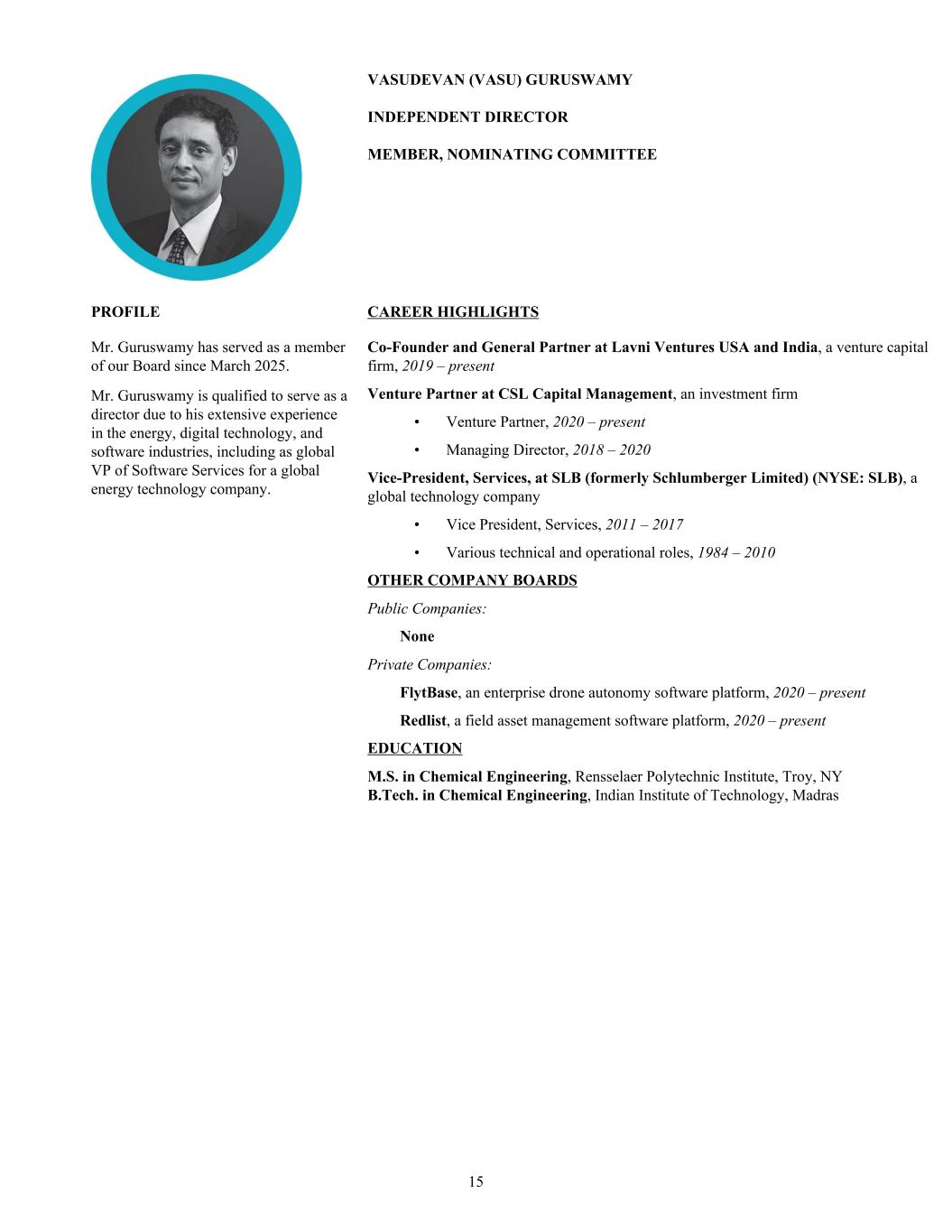
VASUDEVAN (VASU) GURUSWAMY INDEPENDENT DIRECTOR MEMBER, NOMINATING COMMITTEE PROFILE CAREER HIGHLIGHTS Mr. Guruswamy has served as a member of our Board since March 2025. Mr. Guruswamy is qualified to serve as a director due to his extensive experience in the energy, digital technology, and software industries, including as global VP of Software Services for a global energy technology company. Co-Founder and General Partner at Lavni Ventures USA and India, a venture capital firm, 2019 – present Venture Partner at CSL Capital Management, an investment firm • Venture Partner, 2020 – present • Managing Director, 2018 – 2020 Vice-President, Services, at SLB (formerly Schlumberger Limited) (NYSE: SLB), a global technology company • Vice President, Services, 2011 – 2017 • Various technical and operational roles, 1984 – 2010 OTHER COMPANY BOARDS Public Companies: None Private Companies: FlytBase, an enterprise drone autonomy software platform, 2020 – present Redlist, a field asset management software platform, 2020 – present EDUCATION M.S. in Chemical Engineering, Rensselaer Polytechnic Institute, Troy, NY B.Tech. in Chemical Engineering, Indian Institute of Technology, Madras 15
PROPOSAL 2: APPROVAL OF AN AMENDMENT AND RESTATEMENT OF THE 2024 EQUITY INCENTIVE PLAN Executive Summary The Company’s stockholders previously approved the Stem, Inc. Amended and Restated 2024 Equity Incentive Plan (referred to for purposes of this Proposal 2 as the “Plan”) on June 4, 2025, under which employees, directors, and consultants may be granted equity-based incentive awards. At the Annual Meeting, stockholders will be asked to approve an amendment and restatement of the Plan, which was approved by the Board on April 6, 2026 (the “2026 Restatement”). The 2026 Restatement would increase the number of shares of Stem’s common stock that may be issued under the Plan by 425,000 shares (the “Additional Shares”) as of the effective date of the 2026 Restatement (the “Effective Date”). The Company believes that this increase is advisable in order to ensure that the Company has an adequate number of shares available in connection with its incentive compensation programs. The 2026 Restatement would also extend the term of the Plan through the tenth anniversary of the Effective Date. The text of the Plan, as proposed to be amended by the 2026 Restatement, appears at the end of this Proxy as Appendix A. The following description of the 2026 Restatement is a summary only and should be read in conjunction with the full text of the 2026 Restatement. Reasons for the Proposal The Board unanimously recommends that the Company’s stockholders approve the 2026 Restatement. The Company’s ability to grant an appropriate number of equity-based awards continues to be crucial in helping the Company compete more effectively for key employee talent. It is in the long-term interest of the Company and its stockholders to strengthen the ability to attract, motivate, and retain officers, directors, employees, advisors and consultants, and to provide additional incentive for those persons through stock ownership and other incentives to improve operations, increase profits, and strengthen the mutuality of interest between those persons and the Company’s stockholders. If the 2026 Restatement is not approved, the number of shares currently available under the Plan is not projected to be sufficient to cover all of our future equity compensation needs. Thus, if the 2026 Restatement is not approved, we may not be able to provide persons eligible for awards who are presently providing services to the Company with compensation packages that are necessary to retain and motivate these individuals. In addition, if the 2026 Restatement is not approved, we may not be able to provide potential new hires with compensation packages necessary to attract them. Material Differences from the Plan The Additional Shares The 2026 Restatement would add 425,000 shares to the reserve available for future grants. This increased share reserve would allow the Company to continue to grant a variety of equity-based compensation alternatives in structuring compensation arrangements for our key talent, including officers, directors, employees, advisors and consultants, and to attract potential new service providers through competitive compensation packages. Our stock plan is a critical tool for motivating and retaining key talent both at the executive level and further down in the organization. 359 of our 556 employees on March 31, 2026 held outstanding equity awards (i.e., 64.6% participation), and we made equity grants to 61% of our employees during 2025. If the Additional Shares are not approved then we will not be able to make competitive equity awards after 2026 and we would risk losing key talent at various employee levels who are critical to executing our turnaround plan. Under the existing share reserve, as of March 31, 2026, there were approximately 1,090,009 shares subject to outstanding equity awards under the Plan, and approximately 169,941 shares available for future grants under the Plan. Key Data When approving the 2026 Restatement, the Board considered the “burn rate” with respect to the equity awards granted by the Company, as well as the Company’s “fully-diluted overhang.” The burn rate is equal to the total number of equity awards the Company granted in a fiscal year, divided by the weighted average common stock outstanding during the year. Fully-diluted overhang is equal to the total number of equity awards outstanding plus the total number of shares 16
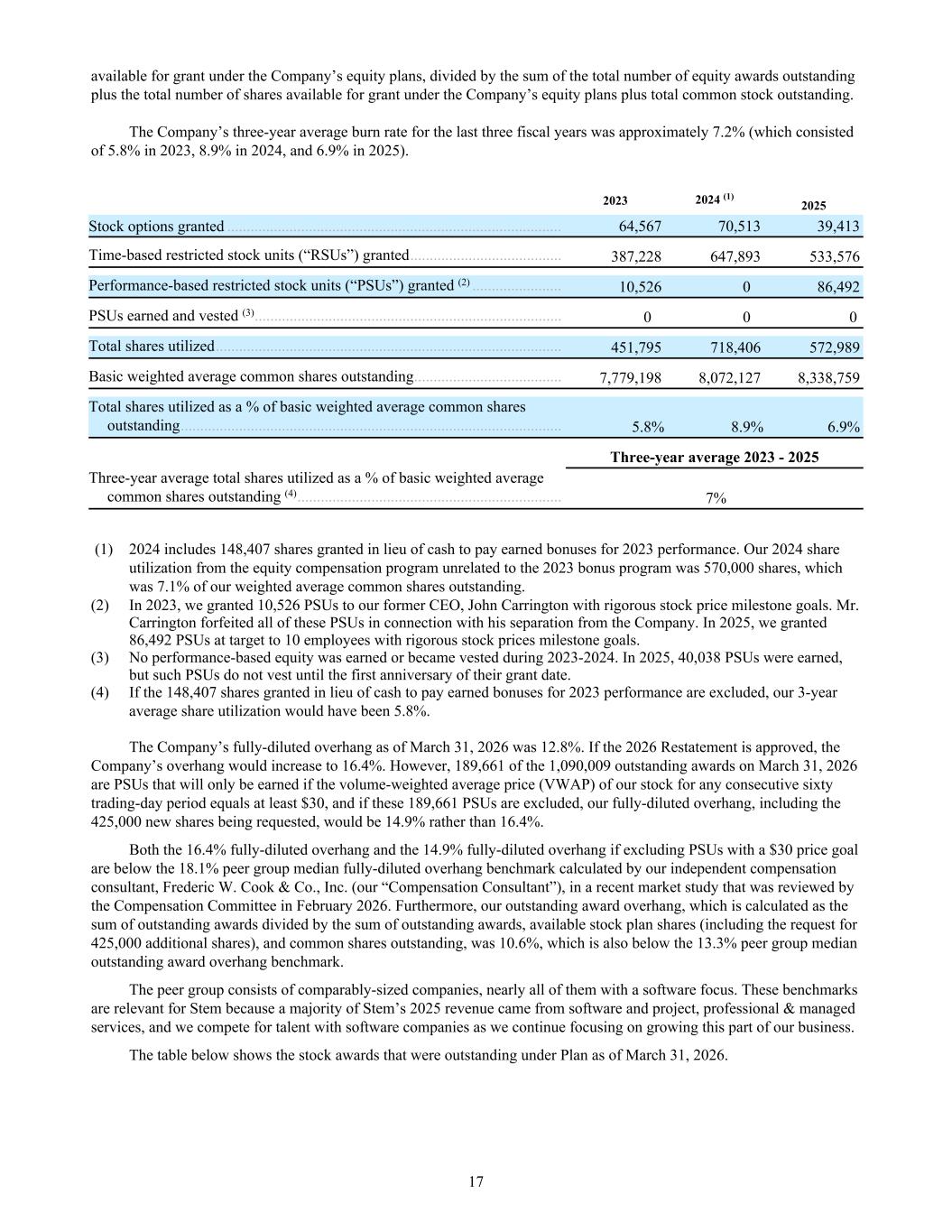
available for grant under the Company’s equity plans, divided by the sum of the total number of equity awards outstanding plus the total number of shares available for grant under the Company’s equity plans plus total common stock outstanding. The Company’s three-year average burn rate for the last three fiscal years was approximately 7.2% (which consisted of 5.8% in 2023, 8.9% in 2024, and 6.9% in 2025). Stock options granted ...................................................................................... 64,567 70,513 39,413 Time-based restricted stock units (“RSUs”) granted ....................................... 387,228 647,893 533,576 Performance-based restricted stock units (“PSUs”) granted (2) ....................... 10,526 0 86,492 PSUs earned and vested (3) ............................................................................... 0 0 0 Total shares utilized ......................................................................................... 451,795 718,406 572,989 Basic weighted average common shares outstanding ...................................... 7,779,198 8,072,127 8,338,759 Total shares utilized as a % of basic weighted average common shares outstanding .................................................................................................. 5.8 % 8.9 % 6.9 % Three-year average 2023 - 2025 Three-year average total shares utilized as a % of basic weighted average common shares outstanding (4) .................................................................... 7% 2023 2024 (1) 2025 (1) 2024 includes 148,407 shares granted in lieu of cash to pay earned bonuses for 2023 performance. Our 2024 share utilization from the equity compensation program unrelated to the 2023 bonus program was 570,000 shares, which was 7.1% of our weighted average common shares outstanding. (2) In 2023, we granted 10,526 PSUs to our former CEO, John Carrington with rigorous stock price milestone goals. Mr. Carrington forfeited all of these PSUs in connection with his separation from the Company. In 2025, we granted 86,492 PSUs at target to 10 employees with rigorous stock prices milestone goals. (3) No performance-based equity was earned or became vested during 2023-2024. In 2025, 40,038 PSUs were earned, but such PSUs do not vest until the first anniversary of their grant date. (4) If the 148,407 shares granted in lieu of cash to pay earned bonuses for 2023 performance are excluded, our 3-year average share utilization would have been 5.8%. The Company’s fully-diluted overhang as of March 31, 2026 was 12.8%. If the 2026 Restatement is approved, the Company’s overhang would increase to 16.4%. However, 189,661 of the 1,090,009 outstanding awards on March 31, 2026 are PSUs that will only be earned if the volume-weighted average price (VWAP) of our stock for any consecutive sixty trading-day period equals at least $30, and if these 189,661 PSUs are excluded, our fully-diluted overhang, including the 425,000 new shares being requested, would be 14.9% rather than 16.4%. Both the 16.4% fully-diluted overhang and the 14.9% fully-diluted overhang if excluding PSUs with a $30 price goal are below the 18.1% peer group median fully-diluted overhang benchmark calculated by our independent compensation consultant, Frederic W. Cook & Co., Inc. (our “Compensation Consultant”), in a recent market study that was reviewed by the Compensation Committee in February 2026. Furthermore, our outstanding award overhang, which is calculated as the sum of outstanding awards divided by the sum of outstanding awards, available stock plan shares (including the request for 425,000 additional shares), and common shares outstanding, was 10.6%, which is also below the 13.3% peer group median outstanding award overhang benchmark. The peer group consists of comparably-sized companies, nearly all of them with a software focus. These benchmarks are relevant for Stem because a majority of Stem’s 2025 revenue came from software and project, professional & managed services, and we compete for talent with software companies as we continue focusing on growing this part of our business. The table below shows the stock awards that were outstanding under Plan as of March 31, 2026. 17
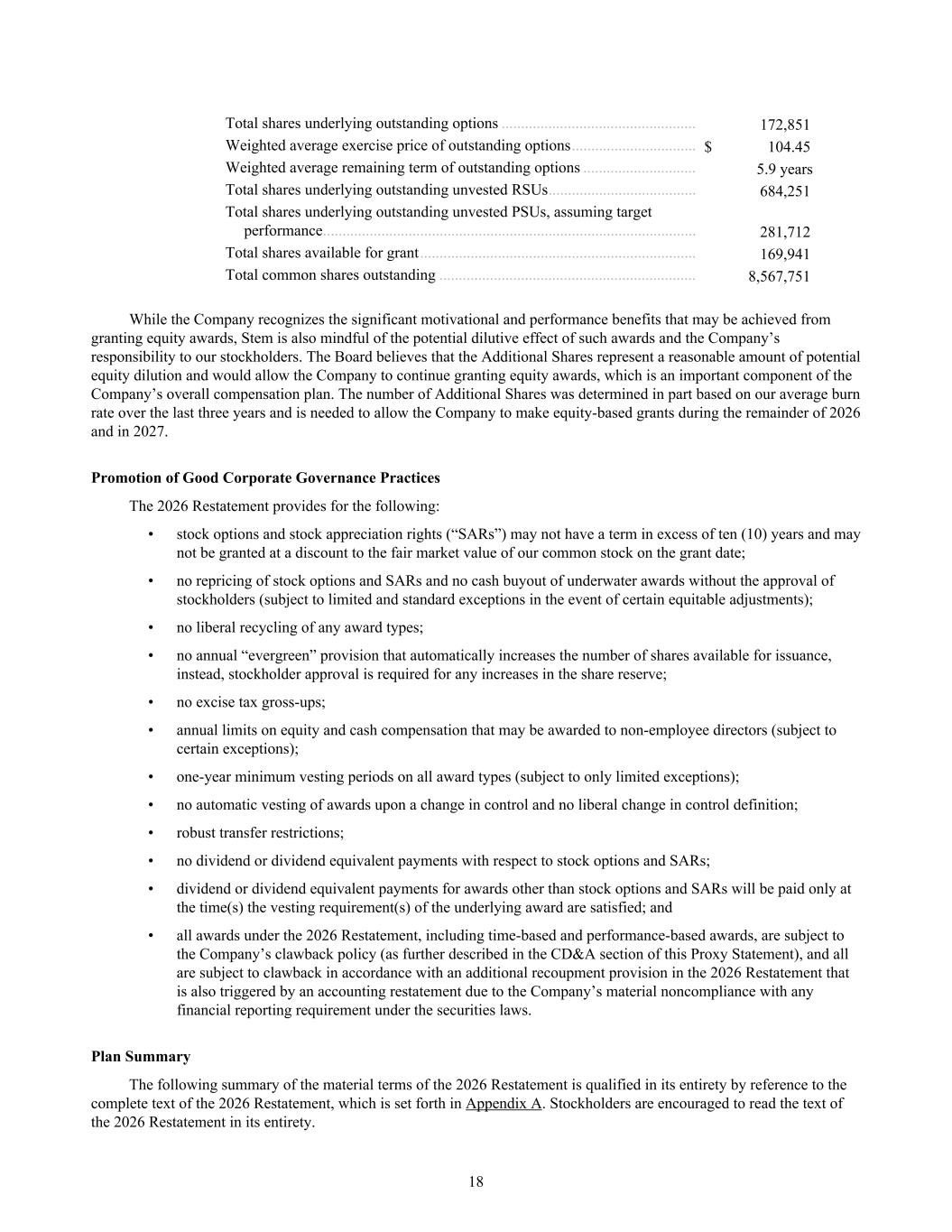
Total shares underlying outstanding options .................................................. 172,851 Weighted average exercise price of outstanding options ................................ $ 104.45 Weighted average remaining term of outstanding options ............................. 5.9 years Total shares underlying outstanding unvested RSUs ...................................... 684,251 Total shares underlying outstanding unvested PSUs, assuming target performance ................................................................................................ 281,712 Total shares available for grant ....................................................................... 169,941 Total common shares outstanding .................................................................. 8,567,751 While the Company recognizes the significant motivational and performance benefits that may be achieved from granting equity awards, Stem is also mindful of the potential dilutive effect of such awards and the Company’s responsibility to our stockholders. The Board believes that the Additional Shares represent a reasonable amount of potential equity dilution and would allow the Company to continue granting equity awards, which is an important component of the Company’s overall compensation plan. The number of Additional Shares was determined in part based on our average burn rate over the last three years and is needed to allow the Company to make equity-based grants during the remainder of 2026 and in 2027. Promotion of Good Corporate Governance Practices The 2026 Restatement provides for the following: • stock options and stock appreciation rights (“SARs”) may not have a term in excess of ten (10) years and may not be granted at a discount to the fair market value of our common stock on the grant date; • no repricing of stock options and SARs and no cash buyout of underwater awards without the approval of stockholders (subject to limited and standard exceptions in the event of certain equitable adjustments); • no liberal recycling of any award types; • no annual “evergreen” provision that automatically increases the number of shares available for issuance, instead, stockholder approval is required for any increases in the share reserve; • no excise tax gross-ups; • annual limits on equity and cash compensation that may be awarded to non-employee directors (subject to certain exceptions); • one-year minimum vesting periods on all award types (subject to only limited exceptions); • no automatic vesting of awards upon a change in control and no liberal change in control definition; • robust transfer restrictions; • no dividend or dividend equivalent payments with respect to stock options and SARs; • dividend or dividend equivalent payments for awards other than stock options and SARs will be paid only at the time(s) the vesting requirement(s) of the underlying award are satisfied; and • all awards under the 2026 Restatement, including time-based and performance-based awards, are subject to the Company’s clawback policy (as further described in the CD&A section of this Proxy Statement), and all are subject to clawback in accordance with an additional recoupment provision in the 2026 Restatement that is also triggered by an accounting restatement due to the Company’s material noncompliance with any financial reporting requirement under the securities laws. Plan Summary The following summary of the material terms of the 2026 Restatement is qualified in its entirety by reference to the complete text of the 2026 Restatement, which is set forth in Appendix A. Stockholders are encouraged to read the text of the 2026 Restatement in its entirety. 18
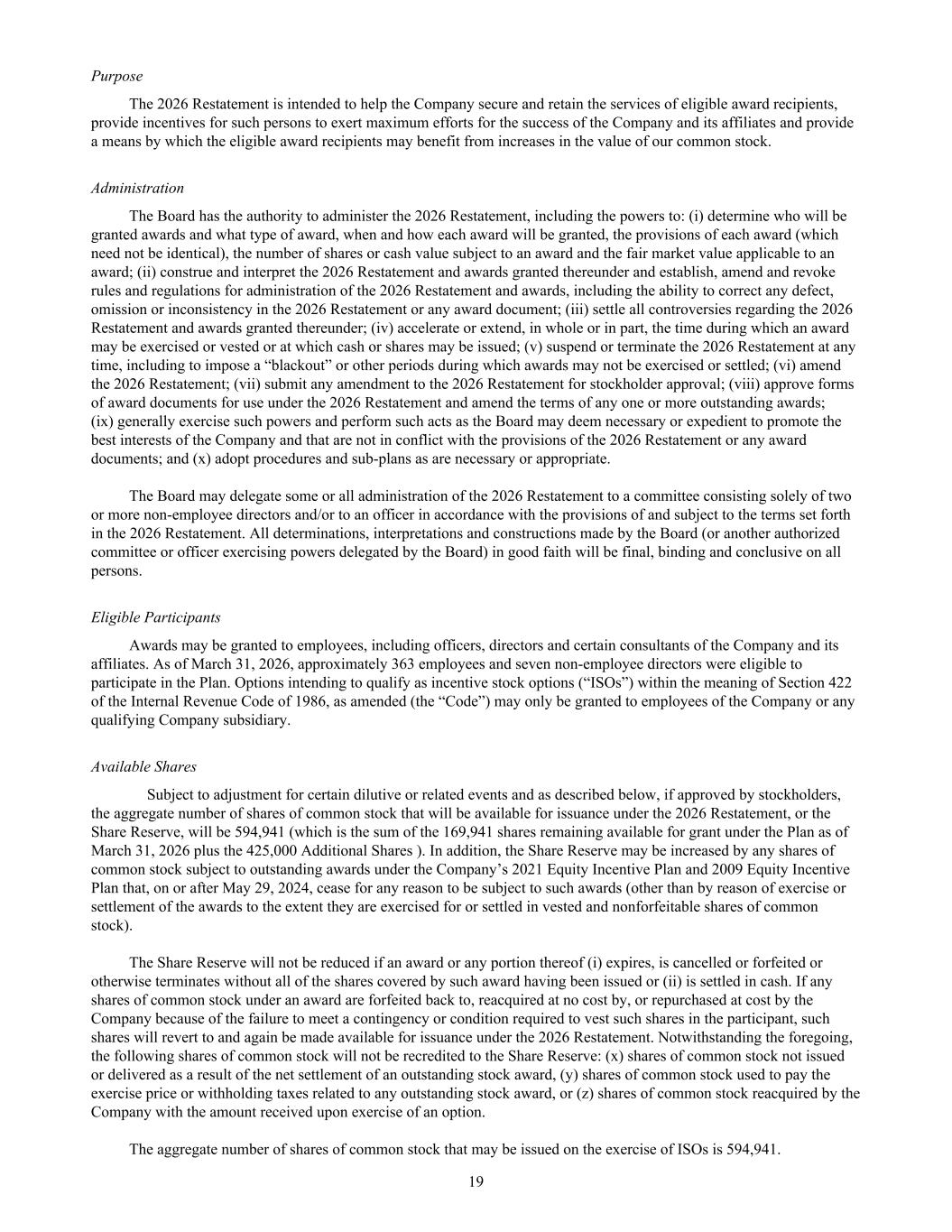
Purpose The 2026 Restatement is intended to help the Company secure and retain the services of eligible award recipients, provide incentives for such persons to exert maximum efforts for the success of the Company and its affiliates and provide a means by which the eligible award recipients may benefit from increases in the value of our common stock. Administration The Board has the authority to administer the 2026 Restatement, including the powers to: (i) determine who will be granted awards and what type of award, when and how each award will be granted, the provisions of each award (which need not be identical), the number of shares or cash value subject to an award and the fair market value applicable to an award; (ii) construe and interpret the 2026 Restatement and awards granted thereunder and establish, amend and revoke rules and regulations for administration of the 2026 Restatement and awards, including the ability to correct any defect, omission or inconsistency in the 2026 Restatement or any award document; (iii) settle all controversies regarding the 2026 Restatement and awards granted thereunder; (iv) accelerate or extend, in whole or in part, the time during which an award may be exercised or vested or at which cash or shares may be issued; (v) suspend or terminate the 2026 Restatement at any time, including to impose a “blackout” or other periods during which awards may not be exercised or settled; (vi) amend the 2026 Restatement; (vii) submit any amendment to the 2026 Restatement for stockholder approval; (viii) approve forms of award documents for use under the 2026 Restatement and amend the terms of any one or more outstanding awards; (ix) generally exercise such powers and perform such acts as the Board may deem necessary or expedient to promote the best interests of the Company and that are not in conflict with the provisions of the 2026 Restatement or any award documents; and (x) adopt procedures and sub-plans as are necessary or appropriate. The Board may delegate some or all administration of the 2026 Restatement to a committee consisting solely of two or more non-employee directors and/or to an officer in accordance with the provisions of and subject to the terms set forth in the 2026 Restatement. All determinations, interpretations and constructions made by the Board (or another authorized committee or officer exercising powers delegated by the Board) in good faith will be final, binding and conclusive on all persons. Eligible Participants Awards may be granted to employees, including officers, directors and certain consultants of the Company and its affiliates. As of March 31, 2026, approximately 363 employees and seven non-employee directors were eligible to participate in the Plan. Options intending to qualify as incentive stock options (“ISOs”) within the meaning of Section 422 of the Internal Revenue Code of 1986, as amended (the “Code”) may only be granted to employees of the Company or any qualifying Company subsidiary. Available Shares Subject to adjustment for certain dilutive or related events and as described below, if approved by stockholders, the aggregate number of shares of common stock that will be available for issuance under the 2026 Restatement, or the Share Reserve, will be 594,941 (which is the sum of the 169,941 shares remaining available for grant under the Plan as of March 31, 2026 plus the 425,000 Additional Shares ). In addition, the Share Reserve may be increased by any shares of common stock subject to outstanding awards under the Company’s 2021 Equity Incentive Plan and 2009 Equity Incentive Plan that, on or after May 29, 2024, cease for any reason to be subject to such awards (other than by reason of exercise or settlement of the awards to the extent they are exercised for or settled in vested and nonforfeitable shares of common stock). The Share Reserve will not be reduced if an award or any portion thereof (i) expires, is cancelled or forfeited or otherwise terminates without all of the shares covered by such award having been issued or (ii) is settled in cash. If any shares of common stock under an award are forfeited back to, reacquired at no cost by, or repurchased at cost by the Company because of the failure to meet a contingency or condition required to vest such shares in the participant, such shares will revert to and again be made available for issuance under the 2026 Restatement. Notwithstanding the foregoing, the following shares of common stock will not be recredited to the Share Reserve: (x) shares of common stock not issued or delivered as a result of the net settlement of an outstanding stock award, (y) shares of common stock used to pay the exercise price or withholding taxes related to any outstanding stock award, or (z) shares of common stock reacquired by the Company with the amount received upon exercise of an option. The aggregate number of shares of common stock that may be issued on the exercise of ISOs is 594,941. 19
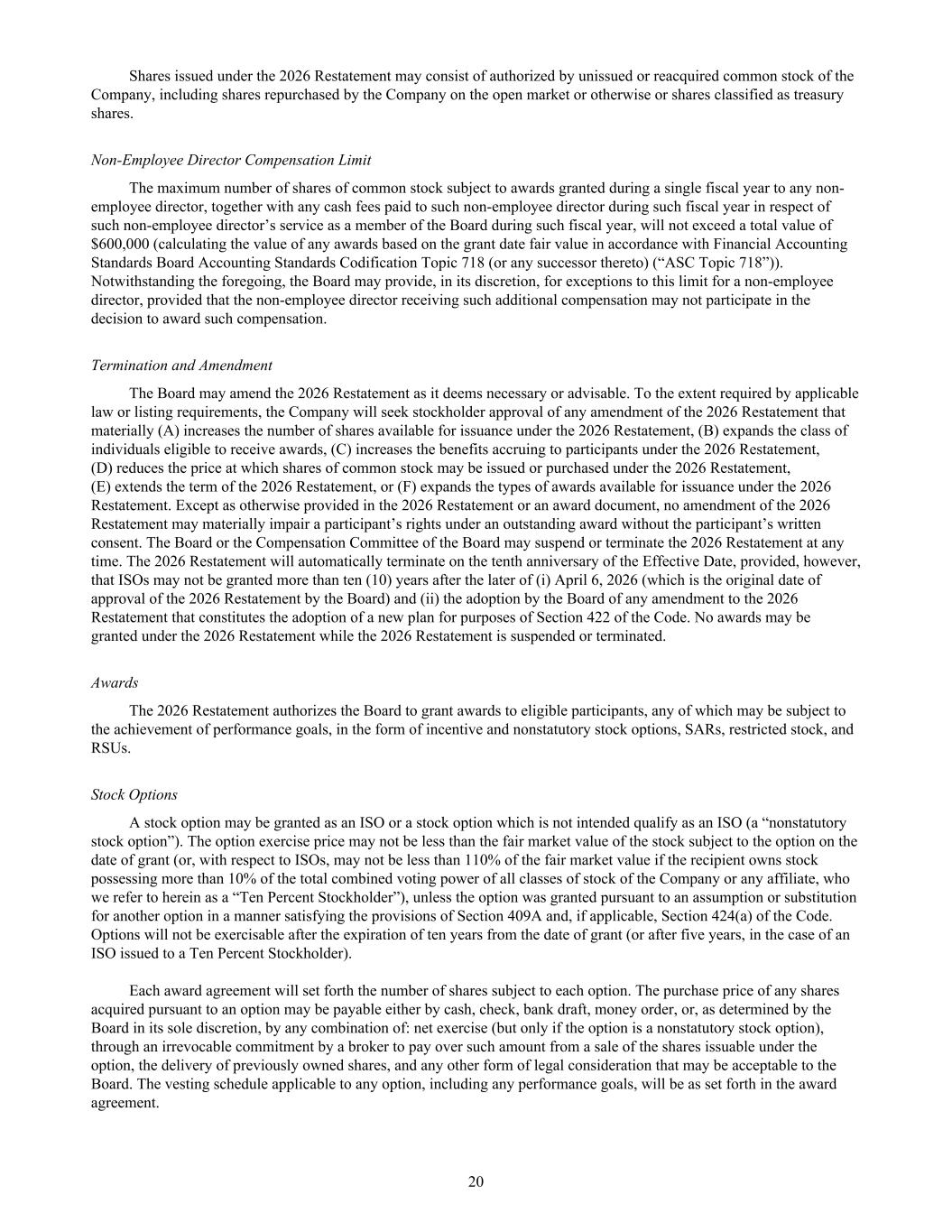
Shares issued under the 2026 Restatement may consist of authorized by unissued or reacquired common stock of the Company, including shares repurchased by the Company on the open market or otherwise or shares classified as treasury shares. Non-Employee Director Compensation Limit The maximum number of shares of common stock subject to awards granted during a single fiscal year to any non- employee director, together with any cash fees paid to such non-employee director during such fiscal year in respect of such non-employee director’s service as a member of the Board during such fiscal year, will not exceed a total value of $600,000 (calculating the value of any awards based on the grant date fair value in accordance with Financial Accounting Standards Board Accounting Standards Codification Topic 718 (or any successor thereto) (“ASC Topic 718”)). Notwithstanding the foregoing, the Board may provide, in its discretion, for exceptions to this limit for a non-employee director, provided that the non-employee director receiving such additional compensation may not participate in the decision to award such compensation. Termination and Amendment The Board may amend the 2026 Restatement as it deems necessary or advisable. To the extent required by applicable law or listing requirements, the Company will seek stockholder approval of any amendment of the 2026 Restatement that materially (A) increases the number of shares available for issuance under the 2026 Restatement, (B) expands the class of individuals eligible to receive awards, (C) increases the benefits accruing to participants under the 2026 Restatement, (D) reduces the price at which shares of common stock may be issued or purchased under the 2026 Restatement, (E) extends the term of the 2026 Restatement, or (F) expands the types of awards available for issuance under the 2026 Restatement. Except as otherwise provided in the 2026 Restatement or an award document, no amendment of the 2026 Restatement may materially impair a participant’s rights under an outstanding award without the participant’s written consent. The Board or the Compensation Committee of the Board may suspend or terminate the 2026 Restatement at any time. The 2026 Restatement will automatically terminate on the tenth anniversary of the Effective Date, provided, however, that ISOs may not be granted more than ten (10) years after the later of (i) April 6, 2026 (which is the original date of approval of the 2026 Restatement by the Board) and (ii) the adoption by the Board of any amendment to the 2026 Restatement that constitutes the adoption of a new plan for purposes of Section 422 of the Code. No awards may be granted under the 2026 Restatement while the 2026 Restatement is suspended or terminated. Awards The 2026 Restatement authorizes the Board to grant awards to eligible participants, any of which may be subject to the achievement of performance goals, in the form of incentive and nonstatutory stock options, SARs, restricted stock, and RSUs. Stock Options A stock option may be granted as an ISO or a stock option which is not intended qualify as an ISO (a “nonstatutory stock option”). The option exercise price may not be less than the fair market value of the stock subject to the option on the date of grant (or, with respect to ISOs, may not be less than 110% of the fair market value if the recipient owns stock possessing more than 10% of the total combined voting power of all classes of stock of the Company or any affiliate, who we refer to herein as a “Ten Percent Stockholder”), unless the option was granted pursuant to an assumption or substitution for another option in a manner satisfying the provisions of Section 409A and, if applicable, Section 424(a) of the Code. Options will not be exercisable after the expiration of ten years from the date of grant (or after five years, in the case of an ISO issued to a Ten Percent Stockholder). Each award agreement will set forth the number of shares subject to each option. The purchase price of any shares acquired pursuant to an option may be payable either by cash, check, bank draft, money order, or, as determined by the Board in its sole discretion, by any combination of: net exercise (but only if the option is a nonstatutory stock option), through an irrevocable commitment by a broker to pay over such amount from a sale of the shares issuable under the option, the delivery of previously owned shares, and any other form of legal consideration that may be acceptable to the Board. The vesting schedule applicable to any option, including any performance goals, will be as set forth in the award agreement. 20
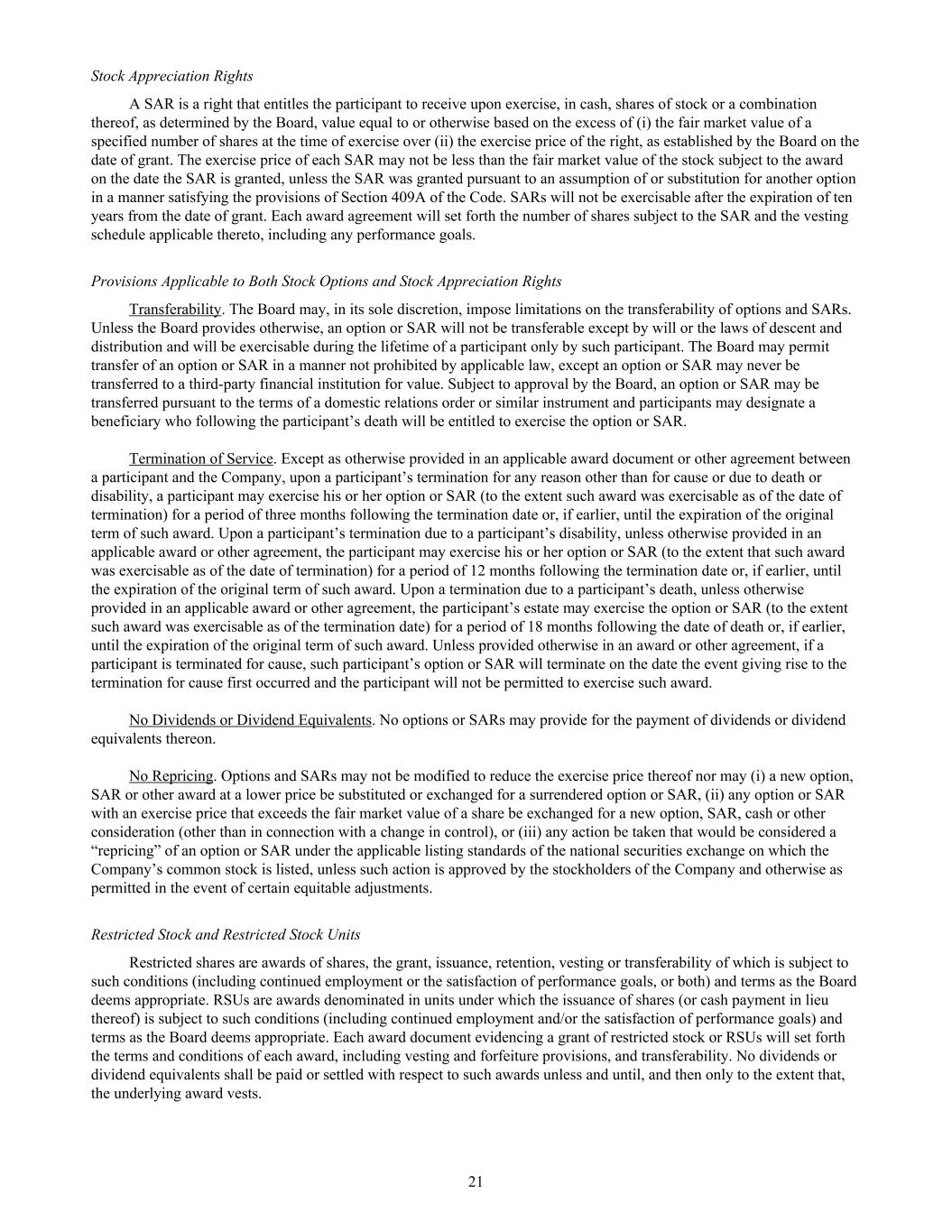
Stock Appreciation Rights A SAR is a right that entitles the participant to receive upon exercise, in cash, shares of stock or a combination thereof, as determined by the Board, value equal to or otherwise based on the excess of (i) the fair market value of a specified number of shares at the time of exercise over (ii) the exercise price of the right, as established by the Board on the date of grant. The exercise price of each SAR may not be less than the fair market value of the stock subject to the award on the date the SAR is granted, unless the SAR was granted pursuant to an assumption of or substitution for another option in a manner satisfying the provisions of Section 409A of the Code. SARs will not be exercisable after the expiration of ten years from the date of grant. Each award agreement will set forth the number of shares subject to the SAR and the vesting schedule applicable thereto, including any performance goals. Provisions Applicable to Both Stock Options and Stock Appreciation Rights Transferability. The Board may, in its sole discretion, impose limitations on the transferability of options and SARs. Unless the Board provides otherwise, an option or SAR will not be transferable except by will or the laws of descent and distribution and will be exercisable during the lifetime of a participant only by such participant. The Board may permit transfer of an option or SAR in a manner not prohibited by applicable law, except an option or SAR may never be transferred to a third-party financial institution for value. Subject to approval by the Board, an option or SAR may be transferred pursuant to the terms of a domestic relations order or similar instrument and participants may designate a beneficiary who following the participant’s death will be entitled to exercise the option or SAR. Termination of Service. Except as otherwise provided in an applicable award document or other agreement between a participant and the Company, upon a participant’s termination for any reason other than for cause or due to death or disability, a participant may exercise his or her option or SAR (to the extent such award was exercisable as of the date of termination) for a period of three months following the termination date or, if earlier, until the expiration of the original term of such award. Upon a participant’s termination due to a participant’s disability, unless otherwise provided in an applicable award or other agreement, the participant may exercise his or her option or SAR (to the extent that such award was exercisable as of the date of termination) for a period of 12 months following the termination date or, if earlier, until the expiration of the original term of such award. Upon a termination due to a participant’s death, unless otherwise provided in an applicable award or other agreement, the participant’s estate may exercise the option or SAR (to the extent such award was exercisable as of the termination date) for a period of 18 months following the date of death or, if earlier, until the expiration of the original term of such award. Unless provided otherwise in an award or other agreement, if a participant is terminated for cause, such participant’s option or SAR will terminate on the date the event giving rise to the termination for cause first occurred and the participant will not be permitted to exercise such award. No Dividends or Dividend Equivalents. No options or SARs may provide for the payment of dividends or dividend equivalents thereon. No Repricing. Options and SARs may not be modified to reduce the exercise price thereof nor may (i) a new option, SAR or other award at a lower price be substituted or exchanged for a surrendered option or SAR, (ii) any option or SAR with an exercise price that exceeds the fair market value of a share be exchanged for a new option, SAR, cash or other consideration (other than in connection with a change in control), or (iii) any action be taken that would be considered a “repricing” of an option or SAR under the applicable listing standards of the national securities exchange on which the Company’s common stock is listed, unless such action is approved by the stockholders of the Company and otherwise as permitted in the event of certain equitable adjustments. Restricted Stock and Restricted Stock Units Restricted shares are awards of shares, the grant, issuance, retention, vesting or transferability of which is subject to such conditions (including continued employment or the satisfaction of performance goals, or both) and terms as the Board deems appropriate. RSUs are awards denominated in units under which the issuance of shares (or cash payment in lieu thereof) is subject to such conditions (including continued employment and/or the satisfaction of performance goals) and terms as the Board deems appropriate. Each award document evidencing a grant of restricted stock or RSUs will set forth the terms and conditions of each award, including vesting and forfeiture provisions, and transferability. No dividends or dividend equivalents shall be paid or settled with respect to such awards unless and until, and then only to the extent that, the underlying award vests. 21
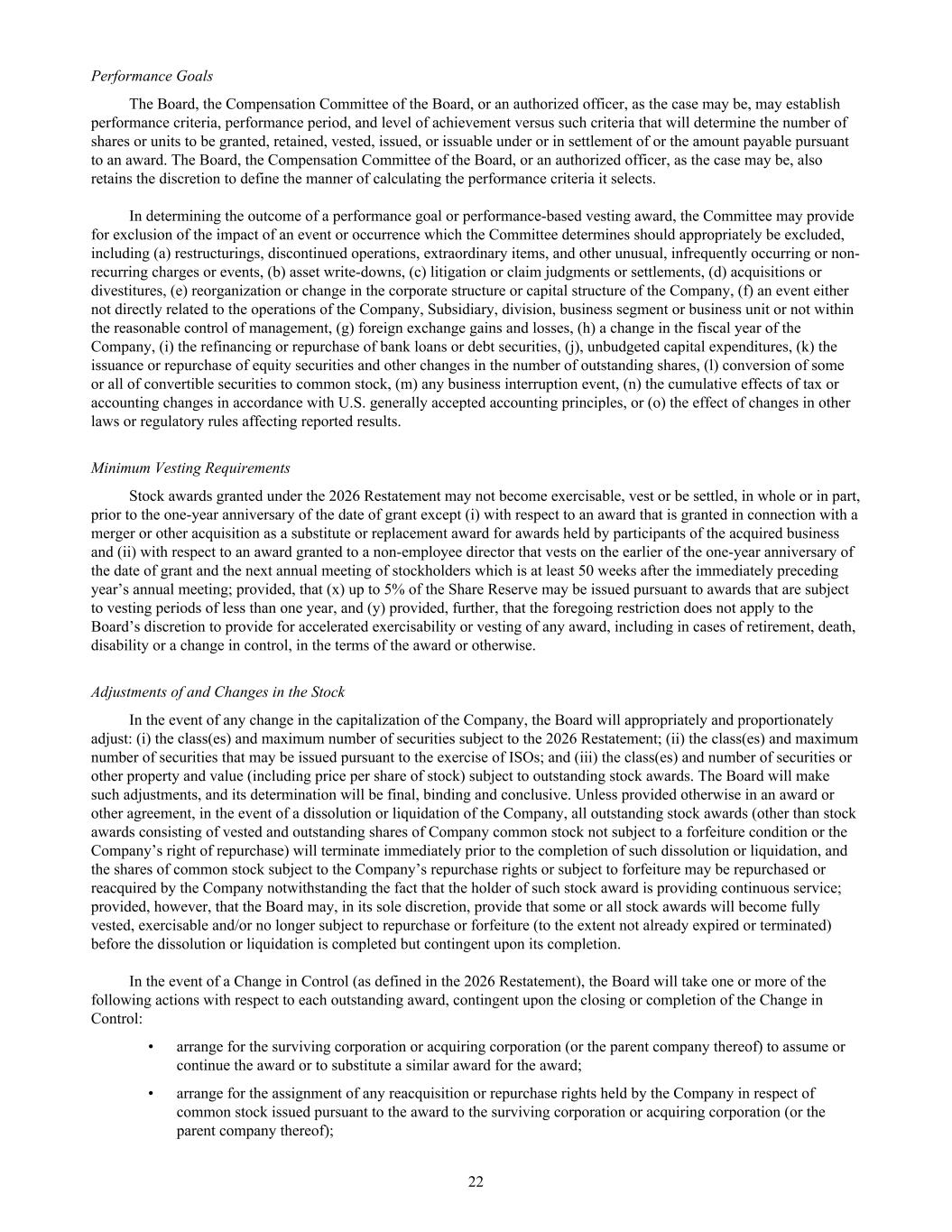
Performance Goals The Board, the Compensation Committee of the Board, or an authorized officer, as the case may be, may establish performance criteria, performance period, and level of achievement versus such criteria that will determine the number of shares or units to be granted, retained, vested, issued, or issuable under or in settlement of or the amount payable pursuant to an award. The Board, the Compensation Committee of the Board, or an authorized officer, as the case may be, also retains the discretion to define the manner of calculating the performance criteria it selects. In determining the outcome of a performance goal or performance-based vesting award, the Committee may provide for exclusion of the impact of an event or occurrence which the Committee determines should appropriately be excluded, including (a) restructurings, discontinued operations, extraordinary items, and other unusual, infrequently occurring or non- recurring charges or events, (b) asset write-downs, (c) litigation or claim judgments or settlements, (d) acquisitions or divestitures, (e) reorganization or change in the corporate structure or capital structure of the Company, (f) an event either not directly related to the operations of the Company, Subsidiary, division, business segment or business unit or not within the reasonable control of management, (g) foreign exchange gains and losses, (h) a change in the fiscal year of the Company, (i) the refinancing or repurchase of bank loans or debt securities, (j), unbudgeted capital expenditures, (k) the issuance or repurchase of equity securities and other changes in the number of outstanding shares, (l) conversion of some or all of convertible securities to common stock, (m) any business interruption event, (n) the cumulative effects of tax or accounting changes in accordance with U.S. generally accepted accounting principles, or (o) the effect of changes in other laws or regulatory rules affecting reported results. Minimum Vesting Requirements Stock awards granted under the 2026 Restatement may not become exercisable, vest or be settled, in whole or in part, prior to the one-year anniversary of the date of grant except (i) with respect to an award that is granted in connection with a merger or other acquisition as a substitute or replacement award for awards held by participants of the acquired business and (ii) with respect to an award granted to a non-employee director that vests on the earlier of the one-year anniversary of the date of grant and the next annual meeting of stockholders which is at least 50 weeks after the immediately preceding year’s annual meeting; provided, that (x) up to 5% of the Share Reserve may be issued pursuant to awards that are subject to vesting periods of less than one year, and (y) provided, further, that the foregoing restriction does not apply to the Board’s discretion to provide for accelerated exercisability or vesting of any award, including in cases of retirement, death, disability or a change in control, in the terms of the award or otherwise. Adjustments of and Changes in the Stock In the event of any change in the capitalization of the Company, the Board will appropriately and proportionately adjust: (i) the class(es) and maximum number of securities subject to the 2026 Restatement; (ii) the class(es) and maximum number of securities that may be issued pursuant to the exercise of ISOs; and (iii) the class(es) and number of securities or other property and value (including price per share of stock) subject to outstanding stock awards. The Board will make such adjustments, and its determination will be final, binding and conclusive. Unless provided otherwise in an award or other agreement, in the event of a dissolution or liquidation of the Company, all outstanding stock awards (other than stock awards consisting of vested and outstanding shares of Company common stock not subject to a forfeiture condition or the Company’s right of repurchase) will terminate immediately prior to the completion of such dissolution or liquidation, and the shares of common stock subject to the Company’s repurchase rights or subject to forfeiture may be repurchased or reacquired by the Company notwithstanding the fact that the holder of such stock award is providing continuous service; provided, however, that the Board may, in its sole discretion, provide that some or all stock awards will become fully vested, exercisable and/or no longer subject to repurchase or forfeiture (to the extent not already expired or terminated) before the dissolution or liquidation is completed but contingent upon its completion. In the event of a Change in Control (as defined in the 2026 Restatement), the Board will take one or more of the following actions with respect to each outstanding award, contingent upon the closing or completion of the Change in Control: • arrange for the surviving corporation or acquiring corporation (or the parent company thereof) to assume or continue the award or to substitute a similar award for the award; • arrange for the assignment of any reacquisition or repurchase rights held by the Company in respect of common stock issued pursuant to the award to the surviving corporation or acquiring corporation (or the parent company thereof); 22
• accelerate the vesting, in whole or in part, of the award (and, if applicable, the time at which the award may be exercised) to a date prior to the effective time of such Change in Control as determined by the Board (or, if the Board will not determine such a date, to the date that is five days prior to the effective date of the Change in Control), with such award terminating if not exercised (if applicable) at or prior to the effective time of the Change in Control, and with such exercise reversed if the Change in Control does not become effective; • arrange for the lapse, in whole or in part, of any reacquisition or repurchase rights held by the Company with respect to the award; • cancel, to the extent not vested or not exercised prior to the effective time of the Change in Control, in exchange for such consideration (in cash, property, securities or a combination thereof), if any, as the Board, in its reasonable determination, may consider appropriate as an approximation of the value of the canceled award; and • cancel, to the extent not vested or not exercised prior to the effective time of the Change in Control, in exchange for a payment equal to the excess, if any, of (A) the value in the Change in Control of the property the participant would have received upon the exercise of the award immediately prior to the effective time of the Change in Control, over (B) any exercise price payable by such holder in connection with such exercise; provided, that the Board may cancel and terminate without payment any option or SAR with an exercise price equal to or in excess of the value of the shares of common stock subject to such option or SAR determined as of immediately prior to the Change in Control. The Board need not take the same action with respect to all awards or portions thereof or with respect to all participants and may take different actions with respect to the vested and unvested portions of an award. In the absence of any affirmative determination by the Board at the time of a Change in Control, each outstanding award will be assumed or an equivalent award will be substituted by such successor corporation or a parent or subsidiary thereof, unless such successor corporation does not agree to assume or substitute the award, in which case the vesting of such award will accelerate (along with, if applicable, the time at which the award may be exercised) to a date prior to the effective time of such Change in Control as the Board will determine (or, if the Board will not determine such a date, to the date that is five days prior to the effective date of the Change in Control), with such award terminating if not exercised (if applicable) at or prior to the effective time of the Change in Control, and with such exercise reversed if the Change in Control does not become effective. An award may be subject to additional acceleration of vesting and exercisability upon or after a Change in Control as may be provided in the award agreement for such award or as may be provided in any other written agreement with the participant, but in the absence of such provision, no such acceleration will occur. U.S. Federal Income Tax Consequences The following discussion of the federal income tax consequences of the 2026 Restatement is intended to be a summary of applicable U.S. federal law as currently in effect. The discussion is intended solely for general information purposes and does not make specific representations to any participant. The discussion does not address state, local, or foreign income tax rules or other U.S. tax provisions, such as estate or gift taxes. A participant’s particular situation may be such that some variation of the basic rules is applicable to them. In addition, the federal income tax laws and regulations frequently have been revised and may be changed again at any time. Therefore, each participant is urged to consult a tax advisor before exercising any award or before disposing of any shares acquired under the 2026 Restatement both with respect to federal income tax consequences as well as any state, local, or foreign tax consequences. Stock Options ISOs and nonstatutory stock options are treated differently for federal income tax purposes. ISOs are intended to comply with the requirements of Section 422 of the Code and nonstatutory stock options are not intended to comply with such requirements. An optionee generally does not recognize taxable income on the grant or exercise of an ISO. The difference between the exercise price and the fair market value of the shares on the exercise date (the “Spread Value”) may, however, be a preference item for purposes of the alternative minimum tax. If an optionee holds the shares acquired upon exercise of an ISO for at least two years following the option grant date and at least one year following exercise, the optionee’s gain, if any, upon a subsequent disposition of such shares will be taxed as long-term capital gain. The measure of the gain is the 23
difference between the proceeds received on disposition and the optionee’s basis in the shares (which generally equals the exercise price). If an optionee disposes of stock acquired pursuant to the exercise of an ISO before satisfying these holding periods, the optionee will recognize ordinary income in the year of disposition in an amount equal to the excess of the fair market value of the shares at the time of exercise (or, if less, the amount realized on the disposition of the shares), over the exercise price paid for the shares, and any additional gain or loss recognized upon the disposition will be a capital gain or loss. The Company is not entitled to an income tax deduction on the grant or exercise of an ISO or on the optionee’s disposition of the shares after satisfying the holding period requirement described above. If the holding periods are not satisfied, the Company will be entitled to a deduction in the year the optionee disposes of the shares in an amount equal to the ordinary income recognized by the optionee. In order for an option to qualify for ISO tax treatment, the grant of the option must satisfy various other conditions more fully described in the Code. The Company does not guarantee that any option will qualify for ISO tax treatment even if the option is intended to qualify for such treatment. In the event an option intended to be an ISO fails to so qualify, it will be taxed as a nonstatutory stock option as described below. An optionee is not taxed on the grant of a nonstatutory stock option. On exercise, the optionee recognizes ordinary income equal to the Spread Value on the date of exercise. The Company is entitled to an income tax deduction in the year of exercise in the amount recognized by the optionee as ordinary income. The optionee’s gain (or loss) on a subsequent disposition of the shares will be long-term or short-term capital gain (or loss) depending on the holding period of such shares following exercise. The Company does not receive a deduction for any such gain. Stock Appreciation Rights A participant is not taxed on the grant of a SAR. On exercise, the participant recognizes ordinary income equal to the Spread Value. The Company is entitled to an income tax deduction in the year of exercise in the amount recognized by the participant as ordinary income. Restricted Stock Participants who receive restricted stock will not recognize any taxable income at the time those shares are granted but will have to report as ordinary income, as and when those shares subsequently vest, an amount equal to the excess of (i) the fair market value of the shares on the vesting date over (ii) the cash consideration (if any) paid for the shares. The participant may, however, elect under Section 83(b) of the Code within 30 days of the grant date to include as ordinary income in the year the unvested shares are granted an amount equal to the excess of (a) the fair market value of those shares on the grant date over (b) the cash consideration (if any) paid for such shares. If the Section 83(b) election is made, the participant will not recognize any additional income as and when the shares subsequently vest and if the participant forfeits the shares to the Company (e.g., upon the participant’s termination prior to vesting), the participant may not claim a deduction with respect to the income recognized as a result of the election. The Company will be entitled to an income tax deduction equal to the amount of ordinary income recognized by the participant at the time such ordinary income is recognized by the participant. Restricted Stock Units Participants who receive RSUs do not recognize income at the time of the grant. When the RSUs vest, participants generally recognize ordinary income in an amount equal to the fair market value of the stock, cash, or other consideration received in settlement of the RSUs, and the Company will receive a corresponding income tax deduction. Company Deduction and Section 162(m) Section 162(m) of the Code generally limits the federal income tax deduction for compensation paid to “covered employees” (in general, the CEO, the CFO, and the three other most highly-compensated executive officers for the year at issue and any person who was part of that group for any other year beginning after December 31, 2016) to $1,000,000. It is expected that compensation deductions for any covered employee with respect to awards granted under the 2026 Restatement will be subject to the $1,000,000 annual deduction limitation. The Board may grant awards under the 2026 Restatement or otherwise that are or may become non-deductible when it believes doing so is in the best interests of the Company and our stockholders. 24
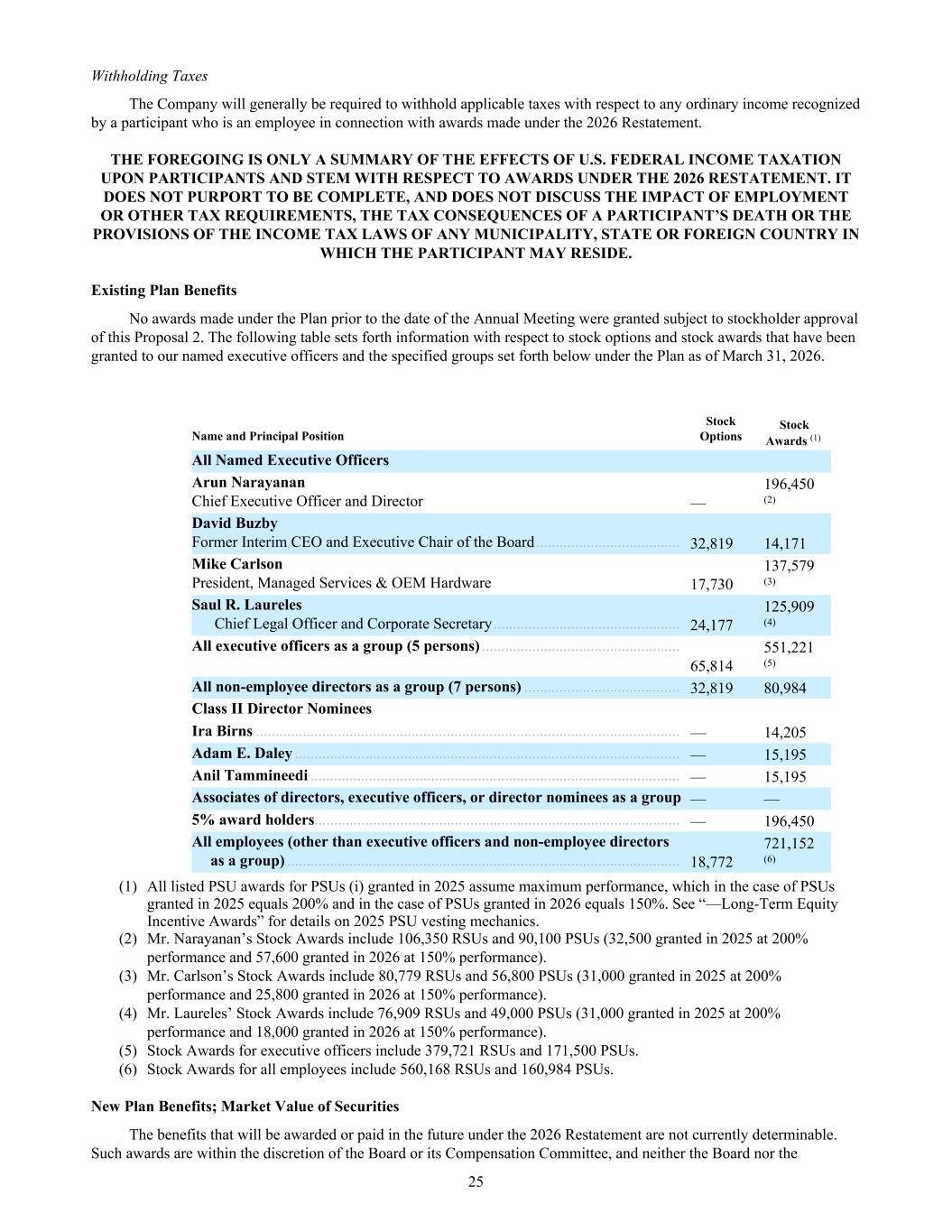
Withholding Taxes The Company will generally be required to withhold applicable taxes with respect to any ordinary income recognized by a participant who is an employee in connection with awards made under the 2026 Restatement. THE FOREGOING IS ONLY A SUMMARY OF THE EFFECTS OF U.S. FEDERAL INCOME TAXATION UPON PARTICIPANTS AND STEM WITH RESPECT TO AWARDS UNDER THE 2026 RESTATEMENT. IT DOES NOT PURPORT TO BE COMPLETE, AND DOES NOT DISCUSS THE IMPACT OF EMPLOYMENT OR OTHER TAX REQUIREMENTS, THE TAX CONSEQUENCES OF A PARTICIPANT’S DEATH OR THE PROVISIONS OF THE INCOME TAX LAWS OF ANY MUNICIPALITY, STATE OR FOREIGN COUNTRY IN WHICH THE PARTICIPANT MAY RESIDE. Existing Plan Benefits No awards made under the Plan prior to the date of the Annual Meeting were granted subject to stockholder approval of this Proposal 2. The following table sets forth information with respect to stock options and stock awards that have been granted to our named executive officers and the specified groups set forth below under the Plan as of March 31, 2026. All Named Executive Officers Arun Narayanan Chief Executive Officer and Director — 196,450 (2) David Buzby Former Interim CEO and Executive Chair of the Board ..................................... 32,819 14,171 Mike Carlson President, Managed Services & OEM Hardware 17,730 137,579 (3) Saul R. Laureles Chief Legal Officer and Corporate Secretary ................................................ 24,177 125,909 (4) All executive officers as a group (5 persons) ................................................... 65,814 551,221 (5) All non-employee directors as a group (7 persons) ........................................ 32,819 80,984 Class II Director Nominees Ira Birns ............................................................................................................. — 14,205 Adam E. Daley ................................................................................................... — 15,195 Anil Tammineedi ............................................................................................... — 15,195 Associates of directors, executive officers, or director nominees as a group — — 5% award holders .............................................................................................. — 196,450 All employees (other than executive officers and non-employee directors as a group) ..................................................................................................... 18,772 721,152 (6) Name and Principal Position Stock Options Stock Awards (1) (1) All listed PSU awards for PSUs (i) granted in 2025 assume maximum performance, which in the case of PSUs granted in 2025 equals 200% and in the case of PSUs granted in 2026 equals 150%. See “—Long-Term Equity Incentive Awards” for details on 2025 PSU vesting mechanics. (2) Mr. Narayanan’s Stock Awards include 106,350 RSUs and 90,100 PSUs (32,500 granted in 2025 at 200% performance and 57,600 granted in 2026 at 150% performance). (3) Mr. Carlson’s Stock Awards include 80,779 RSUs and 56,800 PSUs (31,000 granted in 2025 at 200% performance and 25,800 granted in 2026 at 150% performance). (4) Mr. Laureles’ Stock Awards include 76,909 RSUs and 49,000 PSUs (31,000 granted in 2025 at 200% performance and 18,000 granted in 2026 at 150% performance). (5) Stock Awards for executive officers include 379,721 RSUs and 171,500 PSUs. (6) Stock Awards for all employees include 560,168 RSUs and 160,984 PSUs. New Plan Benefits; Market Value of Securities The benefits that will be awarded or paid in the future under the 2026 Restatement are not currently determinable. Such awards are within the discretion of the Board or its Compensation Committee, and neither the Board nor the 25
Compensation Committee has determined future awards or who might receive them. Therefore, a New Plan Benefits Table is not provided. As of March 31, 2026, the closing price of a share of the Company’s common stock was $8.84. Registration With the SEC Assuming that stockholders approve the 2026 Restatement, we intend to file with the SEC a registration statement on Form S-8 covering the Additional Shares in the second quarter of calendar year 2026. Required Vote The affirmative vote of a majority of shares of common stock present or represented at the Annual Meeting and entitled to vote thereon is required for the approval of the amendment and restatement of the Amended and Restated 2024 Equity Incentive Plan. Abstentions will have the same effect as a vote “against” this proposal. Broker non-votes, if any, will have no effect on the outcome of this proposal. Recommendation of the Board The Board unanimously recommends that you vote “FOR” the approval of the amendment and restatement of the Company’s Amended and Restated 2024 Equity Incentive Plan. 26
PROPOSAL 3: NON-BINDING, ADVISORY VOTE TO APPROVE NAMED EXECUTIVE OFFICER COMPENSATION Our Board is asking you to approve, on a non-binding, advisory basis, the compensation of our named executive officers (“NEOs”), as disclosed in this Proxy Statement. This item, which is provided pursuant to Section 14A of the Securities Exchange Act of 1934, as amended (the “Exchange Act”), is commonly referred to as a “say-on-pay” resolution. This say-on-pay proposal gives our stockholders the opportunity to express their views on our NEOs’ compensation as a whole. This vote is not intended to address any specific element of compensation but rather the overall compensation of our NEOs and our compensation philosophy, policies, and practices described in this Proxy Statement. Please read the “Executive Compensation” section and the compensation tables and narrative disclosure that follow for information about our executive compensation program, including details of the 2025 compensation of our NEOs. Our Compensation Committee believes that these policies and practices are effective in implementing our compensation philosophy and achieving our compensation program goals. As an advisory vote, the outcome of the vote on this proposal is not binding. However, our Compensation Committee, which is responsible for designing and administering our executive compensation program, will consider the outcome of this vote when making future executive compensation decisions. Unless our Board modifies its current policy on the frequency of holding say-on-pay votes, the next say-on-pay vote is expected to occur at our 2027 Annual Meeting of Stockholders. Required Vote The affirmative vote of a majority of shares of common stock present or represented at the Annual Meeting and entitled to vote thereon is required for the non-binding, advisory approval of our named executive officers’ compensation. Abstentions will have the same effect as a vote “against” this proposal. Broker non-votes, if any, will have no effect on the outcome of this proposal. Recommendation of the Board The Board recommends a vote “FOR” the approval, on a non-binding, advisory basis, of our named executive officers’ compensation. 27
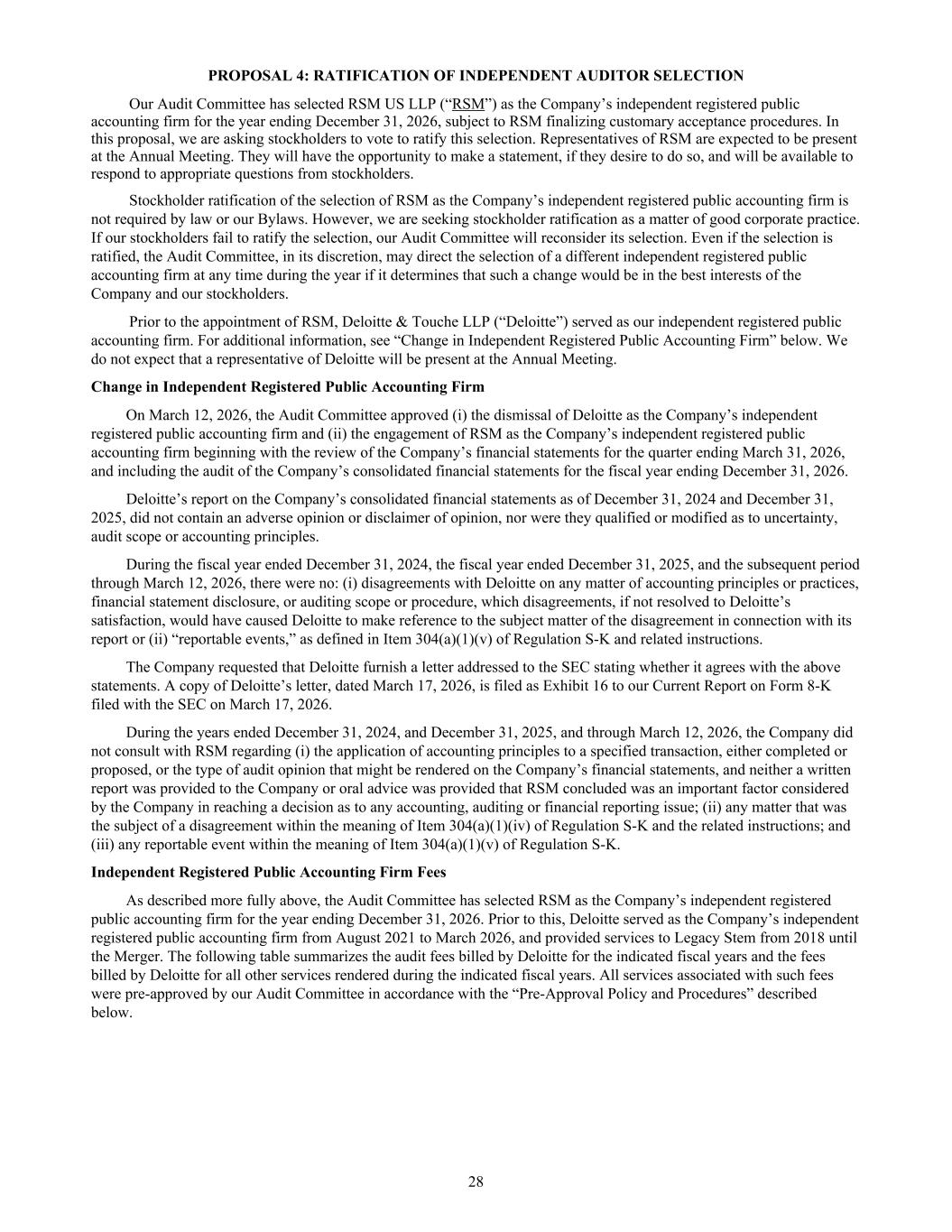
PROPOSAL 4: RATIFICATION OF INDEPENDENT AUDITOR SELECTION Our Audit Committee has selected RSM US LLP (“RSM”) as the Company’s independent registered public accounting firm for the year ending December 31, 2026, subject to RSM finalizing customary acceptance procedures. In this proposal, we are asking stockholders to vote to ratify this selection. Representatives of RSM are expected to be present at the Annual Meeting. They will have the opportunity to make a statement, if they desire to do so, and will be available to respond to appropriate questions from stockholders. Stockholder ratification of the selection of RSM as the Company’s independent registered public accounting firm is not required by law or our Bylaws. However, we are seeking stockholder ratification as a matter of good corporate practice. If our stockholders fail to ratify the selection, our Audit Committee will reconsider its selection. Even if the selection is ratified, the Audit Committee, in its discretion, may direct the selection of a different independent registered public accounting firm at any time during the year if it determines that such a change would be in the best interests of the Company and our stockholders. Prior to the appointment of RSM, Deloitte & Touche LLP (“Deloitte”) served as our independent registered public accounting firm. For additional information, see “Change in Independent Registered Public Accounting Firm” below. We do not expect that a representative of Deloitte will be present at the Annual Meeting. Change in Independent Registered Public Accounting Firm On March 12, 2026, the Audit Committee approved (i) the dismissal of Deloitte as the Company’s independent registered public accounting firm and (ii) the engagement of RSM as the Company’s independent registered public accounting firm beginning with the review of the Company’s financial statements for the quarter ending March 31, 2026, and including the audit of the Company’s consolidated financial statements for the fiscal year ending December 31, 2026. Deloitte’s report on the Company’s consolidated financial statements as of December 31, 2024 and December 31, 2025, did not contain an adverse opinion or disclaimer of opinion, nor were they qualified or modified as to uncertainty, audit scope or accounting principles. During the fiscal year ended December 31, 2024, the fiscal year ended December 31, 2025, and the subsequent period through March 12, 2026, there were no: (i) disagreements with Deloitte on any matter of accounting principles or practices, financial statement disclosure, or auditing scope or procedure, which disagreements, if not resolved to Deloitte’s satisfaction, would have caused Deloitte to make reference to the subject matter of the disagreement in connection with its report or (ii) “reportable events,” as defined in Item 304(a)(1)(v) of Regulation S-K and related instructions. The Company requested that Deloitte furnish a letter addressed to the SEC stating whether it agrees with the above statements. A copy of Deloitte’s letter, dated March 17, 2026, is filed as Exhibit 16 to our Current Report on Form 8-K filed with the SEC on March 17, 2026. During the years ended December 31, 2024, and December 31, 2025, and through March 12, 2026, the Company did not consult with RSM regarding (i) the application of accounting principles to a specified transaction, either completed or proposed, or the type of audit opinion that might be rendered on the Company’s financial statements, and neither a written report was provided to the Company or oral advice was provided that RSM concluded was an important factor considered by the Company in reaching a decision as to any accounting, auditing or financial reporting issue; (ii) any matter that was the subject of a disagreement within the meaning of Item 304(a)(1)(iv) of Regulation S-K and the related instructions; and (iii) any reportable event within the meaning of Item 304(a)(1)(v) of Regulation S-K. Independent Registered Public Accounting Firm Fees As described more fully above, the Audit Committee has selected RSM as the Company’s independent registered public accounting firm for the year ending December 31, 2026. Prior to this, Deloitte served as the Company’s independent registered public accounting firm from August 2021 to March 2026, and provided services to Legacy Stem from 2018 until the Merger. The following table summarizes the audit fees billed by Deloitte for the indicated fiscal years and the fees billed by Deloitte for all other services rendered during the indicated fiscal years. All services associated with such fees were pre-approved by our Audit Committee in accordance with the “Pre-Approval Policy and Procedures” described below. 28
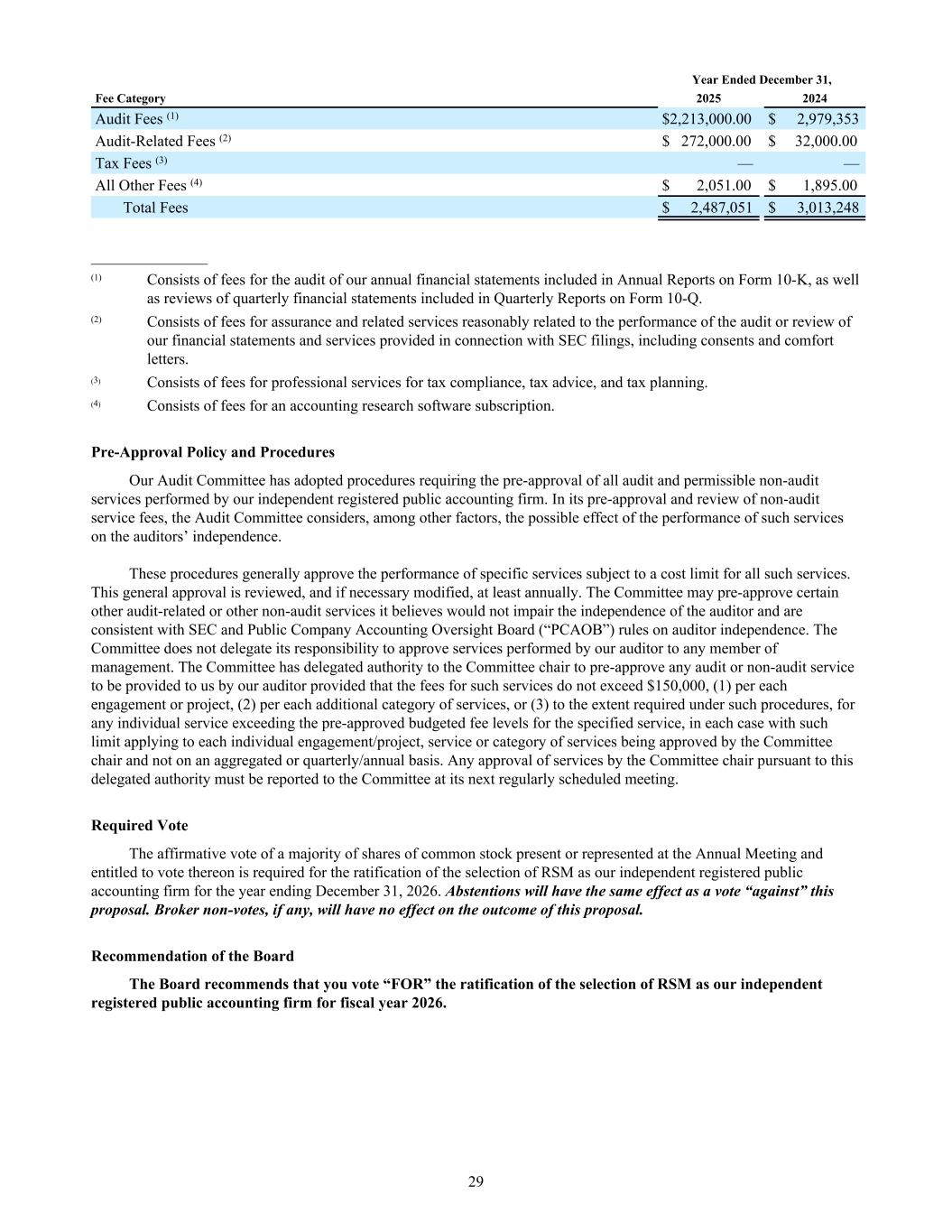
Year Ended December 31, Fee Category 2025 2024 Audit Fees (1) $ 2,213,000.00 $ 2,979,353 Audit-Related Fees (2) $ 272,000.00 $ 32,000.00 Tax Fees (3) — — All Other Fees (4) $ 2,051.00 $ 1,895.00 Total Fees $ 2,487,051 $ 3,013,248 _______________ (1) Consists of fees for the audit of our annual financial statements included in Annual Reports on Form 10-K, as well as reviews of quarterly financial statements included in Quarterly Reports on Form 10-Q. (2) Consists of fees for assurance and related services reasonably related to the performance of the audit or review of our financial statements and services provided in connection with SEC filings, including consents and comfort letters. (3) Consists of fees for professional services for tax compliance, tax advice, and tax planning. (4) Consists of fees for an accounting research software subscription. Pre-Approval Policy and Procedures Our Audit Committee has adopted procedures requiring the pre-approval of all audit and permissible non-audit services performed by our independent registered public accounting firm. In its pre-approval and review of non-audit service fees, the Audit Committee considers, among other factors, the possible effect of the performance of such services on the auditors’ independence. These procedures generally approve the performance of specific services subject to a cost limit for all such services. This general approval is reviewed, and if necessary modified, at least annually. The Committee may pre-approve certain other audit-related or other non-audit services it believes would not impair the independence of the auditor and are consistent with SEC and Public Company Accounting Oversight Board (“PCAOB”) rules on auditor independence. The Committee does not delegate its responsibility to approve services performed by our auditor to any member of management. The Committee has delegated authority to the Committee chair to pre-approve any audit or non-audit service to be provided to us by our auditor provided that the fees for such services do not exceed $150,000, (1) per each engagement or project, (2) per each additional category of services, or (3) to the extent required under such procedures, for any individual service exceeding the pre-approved budgeted fee levels for the specified service, in each case with such limit applying to each individual engagement/project, service or category of services being approved by the Committee chair and not on an aggregated or quarterly/annual basis. Any approval of services by the Committee chair pursuant to this delegated authority must be reported to the Committee at its next regularly scheduled meeting. Required Vote The affirmative vote of a majority of shares of common stock present or represented at the Annual Meeting and entitled to vote thereon is required for the ratification of the selection of RSM as our independent registered public accounting firm for the year ending December 31, 2026. Abstentions will have the same effect as a vote “against” this proposal. Broker non-votes, if any, will have no effect on the outcome of this proposal. Recommendation of the Board The Board recommends that you vote “FOR” the ratification of the selection of RSM as our independent registered public accounting firm for fiscal year 2026. 29
REPORT OF THE AUDIT COMMITTEE During 2025, only non-management directors comprised the Audit Committee. The Board determined that each member of the Audit Committee is independent under the New York Stock Exchange (“NYSE”) listing standards. The Audit Committee operates under a written charter adopted by the Board. As described more fully in its charter, the purpose of the Audit Committee is to assist the Board in its general oversight of the Company’s accounting and financial reporting processes, audits of the financial statements, internal control and audit functions, and compliance with legal and regulatory requirements and ethical standards adopted by the Company. The Audit Committee has reviewed and discussed the audited financial statements for the year ended December 31, 2025 with the Company’s management and with Deloitte & Touche LLP (“Deloitte”), the Company’s independent registered public accounting firm for the year ended December 31, 2025. The Audit Committee has discussed with Deloitte the matters required to be discussed by the applicable requirements of the PCAOB and the SEC. The Audit Committee (i) received the written disclosures and the letter from Deloitte pursuant to applicable PCAOB requirements regarding its communications with the Audit Committee concerning independence, and (ii) has discussed with Deloitte its independence. Based on the foregoing, the Audit Committee recommended to the Board, and the Board approved, the inclusion of the audited financial statements in the Company’s Annual Report on Form 10-K for the year ended December 31, 2025 for filing with the SEC. As discussed in Proposal 4, on March 12, 2026, the Audit Committee approved (i) the dismissal of Deloitte as the Company’s independent registered public accounting firm and (ii) the engagement of RSM US LLP as the Company’s independent registered public accounting firm beginning with the review of the Company’s financial statements for the quarter ending March 31, 2026, and including the audit of the Company’s consolidated financial statements for the fiscal year ending December 31, 2026. Submitted by the Stem Audit Committee Ira Birns (Chair) Adam E. Daley Laura D’Andrea Tyson 30
CORPORATE GOVERNANCE Our current governance practices provide for strong independent leadership, active participation by independent directors, and independent evaluation of, and communication with, many members of senior management. These governance practices are reflected in our Corporate Governance Guidelines and our various committee charters, which are available on our website located at investors.stem.com, under “Governance.” Our Governance Philosophy Our Board believes that there is no single set of generally accepted corporate governance practices that is appropriate across all companies, and that governance practices may evolve as circumstances change. Our Board has determined to separate the CEO and Chairman of the Board (“Chairman”) functions to allow our Chairman (or if the Chairman is not independent, the Lead Independent Director) to oversee corporate governance matters and our CEO to focus on leading the Company’s business. See “—Board Leadership Structure” below for more information. Our history as a special purpose acquisition company prior to the Merger left us with certain structural protections. For example, we currently have a classified Board and plurality voting for the election of directors, only the Board is empowered to call a special meeting of our stockholders, and we require a supermajority vote for stockholders to propose and approve amendments to our Bylaws and a limited number of items in our Certificate of Incorporation. Following careful deliberation after the closing of the Merger, our Board initially determined to retain these measures for a period to promote stability and continuity of our Board and to allow us to focus on a consistent strategy while we matured as a public company. The Board assesses our corporate governance practices at least annually, and may modify these practices from time to time to best address the Company’s unique circumstances, and respond to feedback from and advance the best interests of all stockholders, as and when it believes appropriate. At its February 2026 meeting, the Board, on recommendation of the Nominating, Governance and Sustainability Committee, determined that it was appropriate to preserve our post-IPO governance structure in 2026 to provide our senior management team (of which, our CEO and CFO are new to their roles) sufficient time to execute the Company’s new software-centric strategy and to continue to provide stability and continuity through that transitional phase. The Board expects that i8t will reconsider the potential inclusion of proposals to declassify our Board and remove the supermajority vote requirement at our 2027 Annual Meeting of Stockholders. Board Composition Director Nomination Process The Nominating Committee is responsible for, among other things, overseeing succession planning for directors and building a qualified board to oversee management’s execution of the Company’s strategy and safeguard the long-term interests of stockholders. In this regard, the Committee is charged with developing and recommending Board membership criteria to the Board for approval, evaluating the composition of the Board annually to assess the skills and experiences that are currently represented on the Board and the skills and experiences that the Board may find valuable in the future, and identifying, evaluating, and recommending potential director candidates. In identifying potential candidates for Board membership, the Nominating Committee considers recommendations from directors, stockholders, management, and others, including, from time to time, third-party search firms to assist it in locating qualified candidates. Once potential director candidates are identified, the Nominating Committee, with the assistance of senior executive management, undertakes a vetting process that considers each candidate’s background, independence, and fit with the Board’s priorities. As part of this vetting process, the Nominating Committee, as well as other members of the Board and the CEO, conduct interviews with the candidates. If the Nominating Committee 31
determines that a potential candidate meets the needs of the Board and has the desired qualifications, it recommends the candidate to the Board for appointment or nomination and to the stockholders for election at the annual meeting. Criteria for Board Membership In assessing potential candidates for Board membership and in assessing Board composition, the Nominating Committee considers a wide range of factors and generally seeks to balance the following skills, experiences, and backgrounds on the Board: • SaaS Knowledge and Experience: Directors with experience as executives, directors or in other leadership positions in Software as a Service (SaaS) and other areas in which we compete, because our success depends on developing and investing in innovative products and technologies. Among other things, this experience is critical to the Board’s ability to understand our products and business, to assess our competitive position within the clean energy industry and the strengths and weaknesses of our competitors, to be aware of technology trends and innovations, and to evaluate potential acquisitions and our acquisition strategy. • Public Company Board Experience: Directors with public company board experience understand the dynamics and operation of a corporate board, the relationship of a public company’s board to the CEO and other senior management, the legal and regulatory landscape in which public companies must operate, the importance of particular agenda and oversight issues, and how to oversee an ever-changing mix of strategic, operational and compliance-related matters. • Senior Leadership: Directors who have served in senior leadership positions are important to us because they have the experience and perspective to analyze, shape, and oversee the execution of important and complex operational and strategic issues. These directors’ insights and guidance, and their ability to assess and respond to situations encountered while serving on our Board, may be enhanced by leadership experience at businesses or organizations that involve organizational growth, expansion into new markets, navigation of the regulatory landscapes, and technology or other rapidly evolving business models. • Financial Expertise: Knowledge of financial markets, financing, and funding operations, as well as accounting and financial reporting processes, assists our directors in understanding, advising on, and overseeing Stem’s capital structure, financing, and investing activities, as well as our financial reporting and internal controls. • Business Development and M&A Experience: Directors with a background in business development and M&A provide insight into developing and implementing strategies for growing our business. Useful experiences in this area includes skills in assessing “make” vs. “buy” decisions, analyzing the “fit” of a proposed acquisition with a company’s strategy, valuing transactions, and assessing management’s plans for integration with existing operations. • Clean Energy and Renewables: Directors with experience in the energy, energy infrastructure, clean energy, and renewables industries provide valuable insight to our Board. • Government and Regulatory Experience: Directors who have served in government positions provide experience and insights that help us work constructively with governments at the federal, state, and local levels and address public policy issues, particularly as they relate to Stem’s operations and public support for renewable energy and the energy transition. Directors with a background in regulation can assist the Board in fulfilling its oversight responsibilities related to Stem’s legal and regulatory compliance and its engagement with regulatory authorities. • Diverse Perspectives and Backgrounds: We seek a diversity of perspectives and backgrounds on the Board, including with respect to gender, race, ethnic and national background, geography, age, and sexual orientation. For example, one of eight directors identifies as female and two directors identify as racially/ ethnically diverse. In addition to the above, the Nominating Committee generally believes it is important for all Board members to possess the highest personal and professional ethics, integrity, and values, an inquisitive and objective perspective, a sense for priorities and balance, the ability and willingness to devote sufficient time and attention to Board matters, and a willingness to represent the long-term interests of all our stockholders. The Nominating Committee assesses its effectiveness in balancing these considerations in connection with its annual evaluation of the composition of the Board. 32
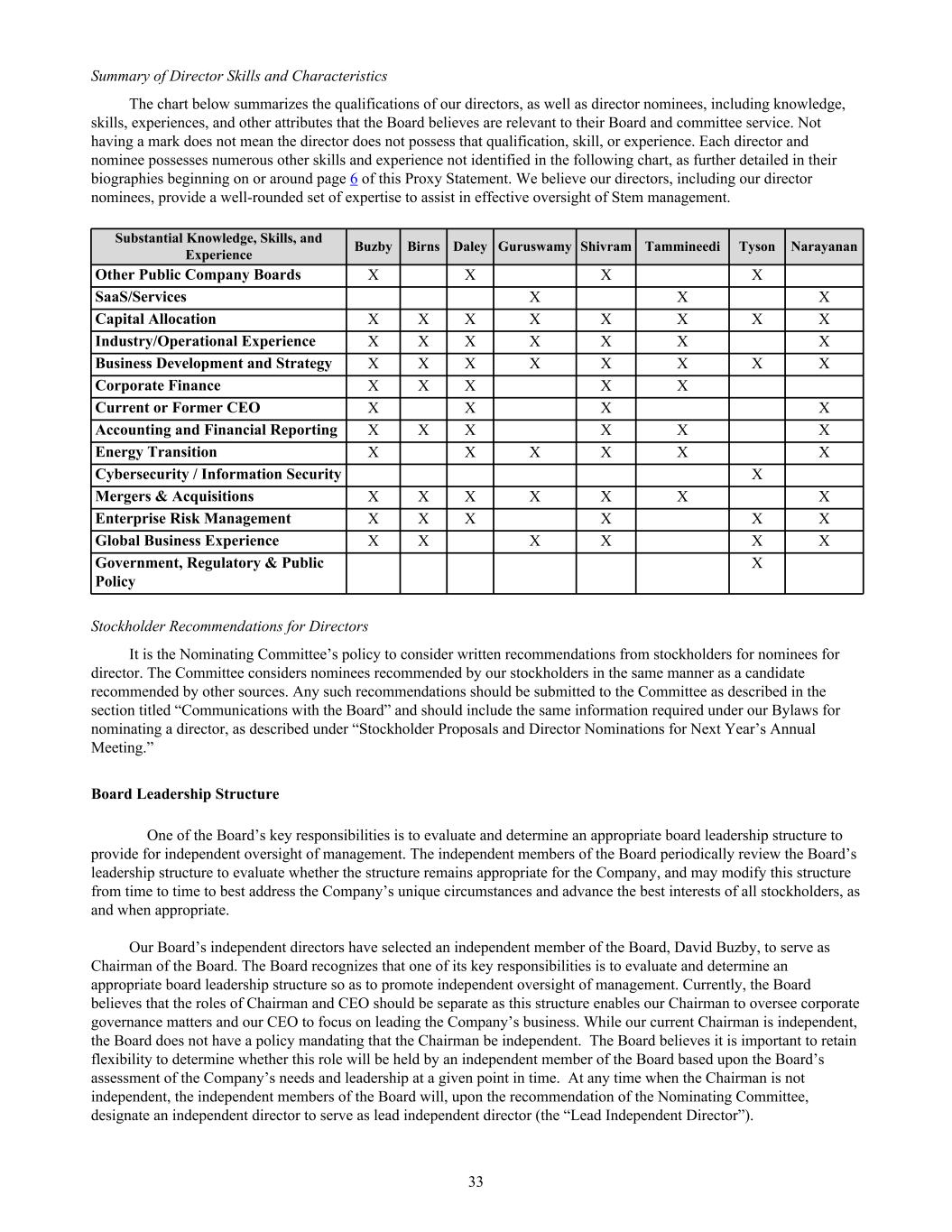
Summary of Director Skills and Characteristics The chart below summarizes the qualifications of our directors, as well as director nominees, including knowledge, skills, experiences, and other attributes that the Board believes are relevant to their Board and committee service. Not having a mark does not mean the director does not possess that qualification, skill, or experience. Each director and nominee possesses numerous other skills and experience not identified in the following chart, as further detailed in their biographies beginning on or around page 6 of this Proxy Statement. We believe our directors, including our director nominees, provide a well-rounded set of expertise to assist in effective oversight of Stem management. Substantial Knowledge, Skills, and Experience Buzby Birns Daley Guruswamy Shivram Tammineedi Tyson Narayanan Other Public Company Boards X X X X SaaS/Services X X X Capital Allocation X X X X X X X X Industry/Operational Experience X X X X X X X Business Development and Strategy X X X X X X X X Corporate Finance X X X X X Current or Former CEO X X X X Accounting and Financial Reporting X X X X X X Energy Transition X X X X X X Cybersecurity / Information Security X Mergers & Acquisitions X X X X X X X Enterprise Risk Management X X X X X X Global Business Experience X X X X X X Government, Regulatory & Public Policy X Stockholder Recommendations for Directors It is the Nominating Committee’s policy to consider written recommendations from stockholders for nominees for director. The Committee considers nominees recommended by our stockholders in the same manner as a candidate recommended by other sources. Any such recommendations should be submitted to the Committee as described in the section titled “Communications with the Board” and should include the same information required under our Bylaws for nominating a director, as described under “Stockholder Proposals and Director Nominations for Next Year’s Annual Meeting.” Board Leadership Structure One of the Board’s key responsibilities is to evaluate and determine an appropriate board leadership structure to provide for independent oversight of management. The independent members of the Board periodically review the Board’s leadership structure to evaluate whether the structure remains appropriate for the Company, and may modify this structure from time to time to best address the Company’s unique circumstances and advance the best interests of all stockholders, as and when appropriate. Our Board’s independent directors have selected an independent member of the Board, David Buzby, to serve as Chairman of the Board. The Board recognizes that one of its key responsibilities is to evaluate and determine an appropriate board leadership structure so as to promote independent oversight of management. Currently, the Board believes that the roles of Chairman and CEO should be separate as this structure enables our Chairman to oversee corporate governance matters and our CEO to focus on leading the Company’s business. While our current Chairman is independent, the Board does not have a policy mandating that the Chairman be independent. The Board believes it is important to retain flexibility to determine whether this role will be held by an independent member of the Board based upon the Board’s assessment of the Company’s needs and leadership at a given point in time. At any time when the Chairman is not independent, the independent members of the Board will, upon the recommendation of the Nominating Committee, designate an independent director to serve as lead independent director (the “Lead Independent Director”). 33
Our Board believes that its programs for overseeing risk, as described in the “Board Oversight of Risk Management” section below, would be effective under a variety of leadership frameworks. Accordingly, the Board’s risk oversight function did not significantly affect its selection of the current leadership structure. The independent directors generally meet in executive session without management present at every regular Board meeting. The purpose of these executive sessions, which are led by our independent Chairman (or if the Chairman is not independent, the Lead Independent Director), is to encourage and enhance communication among independent directors. Board Oversight of Risk Management The Board and its committees are actively involved in overseeing risk management for Stem. The Board routinely assesses the Company’s major risks and options for mitigation, in order to promote our stockholders’ interests in Stem’s long-term health, financial strength, and overall success. We believe that our Board composition provides the Company with robust and well-rounded experience to assist in effective oversight of management, as discussed on or around page 33 of this Proxy Statement. The full Board oversees assessment of major risks facing the Company, determining the extent to which such risks are applicable and, to the extent the Board deems it appropriate, evaluating management’s plans for their mitigation. The risks that the Board routinely considers broadly relate to strategic, operational, financial, regulatory, competitive and geopolitical risks. The full Board oversees risk management by the CEO and the rest of our senior management team, by reviewing major financial objectives and critical strategies and long-term plans, including, but not limited to, major allocations of capital, operating performance, and sustainability. In addition, the Board delegates to its committees responsibility for overseeing certain types of risk, some of which are reflected below: • The Audit Committee has overall responsibility for overseeing the Company’s practices with respect to risk assessment and management. Some of the specific responsibilities of the Committee are overseeing management of risks related to our financial reporting and internal controls, cybersecurity risks, and major financial risks. • The Compensation Committee is responsible for overseeing management of risks related to our compensation policies and programs and human capital resources. • The Nominating Committee is responsible for overseeing management of risks related to director succession planning, our corporate governance, and our sustainability practices and initiatives. The Board committees report regularly to the Board on activities in their respective areas of oversight. In addition, the Board and its committees receive regular reports from members of the Company’s senior management on areas of significant risk to the Company, including strategic, operational, financial, cybersecurity, legal and regulatory risks. While our Board has an oversight role, management is tasked with direct day-to-day responsibility for management and assessment of risks and the implementation of processes and controls to mitigate their effects on the Company. Our senior management team has developed a comprehensive strategic planning and enterprise risk management (“ERM”) process for identifying, assessing and managing risk. Through this process, we identify key risks through a quarterly corporate-level risk mapping exercise, which involves the CEO, CFO, CLO, and other members of senior management, along with a bottom-up operational risk assessment by our various business units and functions. Our executive leadership team and its ERM and Disclosure Committee report directly to the Board, and on a quarterly basis, present to the Board a comprehensive report on material risk identification, response, and mitigation strategies. Director Independence The NYSE listing rules require a majority of a listed company’s board of directors to be comprised of independent directors who do not have a disqualifying relationship, as described in the NYSE listing rules, and who, in the opinion of the board of directors, have no direct or indirect material relationship with the company. Subject to specified exceptions, each member of a listed company’s audit, compensation, and nominating committees must be independent, and audit and compensation committee members must satisfy additional independence criteria under the NYSE listing rules and the Exchange Act. Our Board annually undertakes a review of its composition and the independence of each director. Based upon information requested from and provided by each director concerning his or her background, employment, and affiliations, including the beneficial ownership of our capital stock by each non-employee director, our Board has determined that all of 34
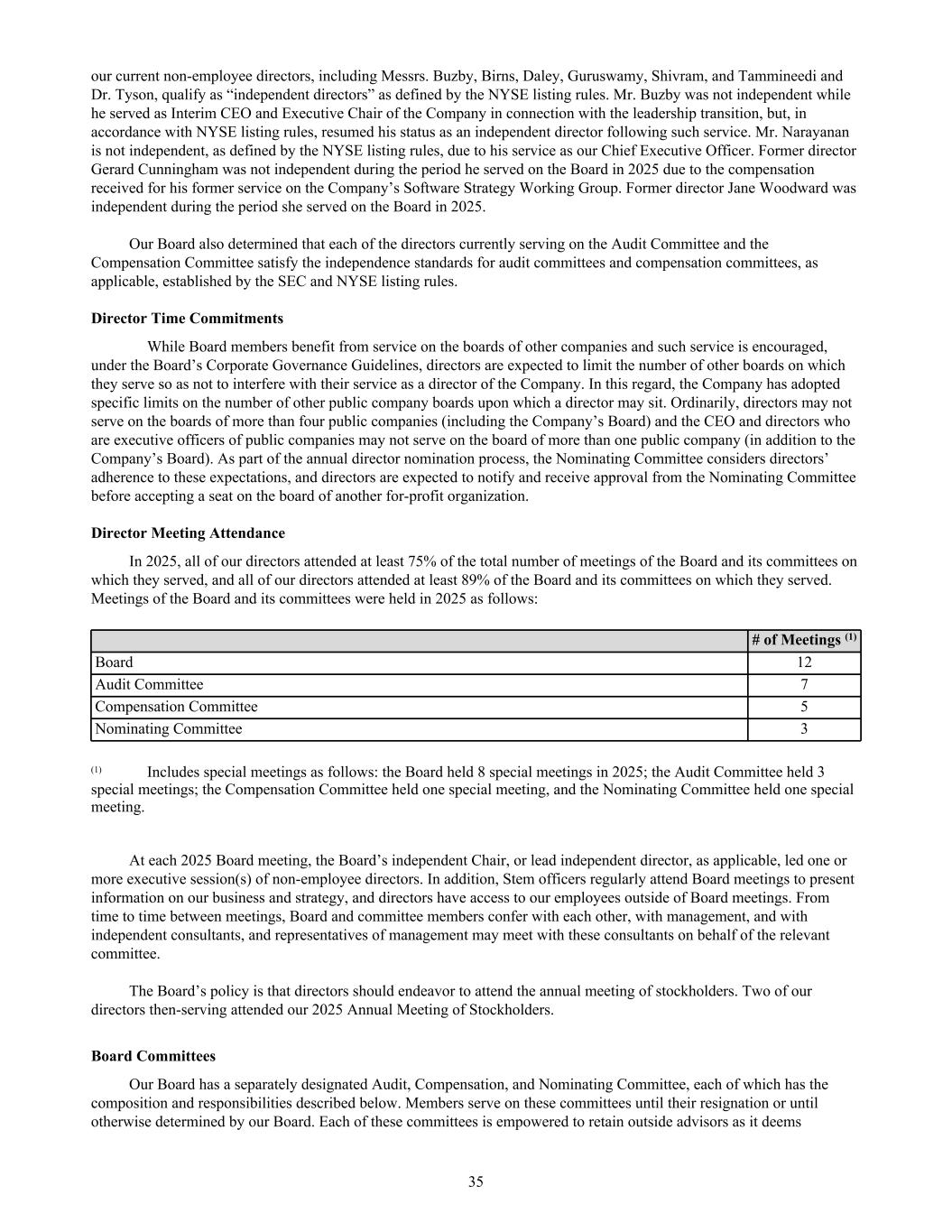
our current non-employee directors, including Messrs. Buzby, Birns, Daley, Guruswamy, Shivram, and Tammineedi and Dr. Tyson, qualify as “independent directors” as defined by the NYSE listing rules. Mr. Buzby was not independent while he served as Interim CEO and Executive Chair of the Company in connection with the leadership transition, but, in accordance with NYSE listing rules, resumed his status as an independent director following such service. Mr. Narayanan is not independent, as defined by the NYSE listing rules, due to his service as our Chief Executive Officer. Former director Gerard Cunningham was not independent during the period he served on the Board in 2025 due to the compensation received for his former service on the Company’s Software Strategy Working Group. Former director Jane Woodward was independent during the period she served on the Board in 2025. Our Board also determined that each of the directors currently serving on the Audit Committee and the Compensation Committee satisfy the independence standards for audit committees and compensation committees, as applicable, established by the SEC and NYSE listing rules. Director Time Commitments While Board members benefit from service on the boards of other companies and such service is encouraged, under the Board’s Corporate Governance Guidelines, directors are expected to limit the number of other boards on which they serve so as not to interfere with their service as a director of the Company. In this regard, the Company has adopted specific limits on the number of other public company boards upon which a director may sit. Ordinarily, directors may not serve on the boards of more than four public companies (including the Company’s Board) and the CEO and directors who are executive officers of public companies may not serve on the board of more than one public company (in addition to the Company’s Board). As part of the annual director nomination process, the Nominating Committee considers directors’ adherence to these expectations, and directors are expected to notify and receive approval from the Nominating Committee before accepting a seat on the board of another for-profit organization. Director Meeting Attendance In 2025, all of our directors attended at least 75% of the total number of meetings of the Board and its committees on which they served, and all of our directors attended at least 89% of the Board and its committees on which they served. Meetings of the Board and its committees were held in 2025 as follows: # of Meetings (1) Board 12 Audit Committee 7 Compensation Committee 5 Nominating Committee 3 (1) Includes special meetings as follows: the Board held 8 special meetings in 2025; the Audit Committee held 3 special meetings; the Compensation Committee held one special meeting, and the Nominating Committee held one special meeting. At each 2025 Board meeting, the Board’s independent Chair, or lead independent director, as applicable, led one or more executive session(s) of non-employee directors. In addition, Stem officers regularly attend Board meetings to present information on our business and strategy, and directors have access to our employees outside of Board meetings. From time to time between meetings, Board and committee members confer with each other, with management, and with independent consultants, and representatives of management may meet with these consultants on behalf of the relevant committee. The Board’s policy is that directors should endeavor to attend the annual meeting of stockholders. Two of our directors then-serving attended our 2025 Annual Meeting of Stockholders. Board Committees Our Board has a separately designated Audit, Compensation, and Nominating Committee, each of which has the composition and responsibilities described below. Members serve on these committees until their resignation or until otherwise determined by our Board. Each of these committees is empowered to retain outside advisors as it deems 35
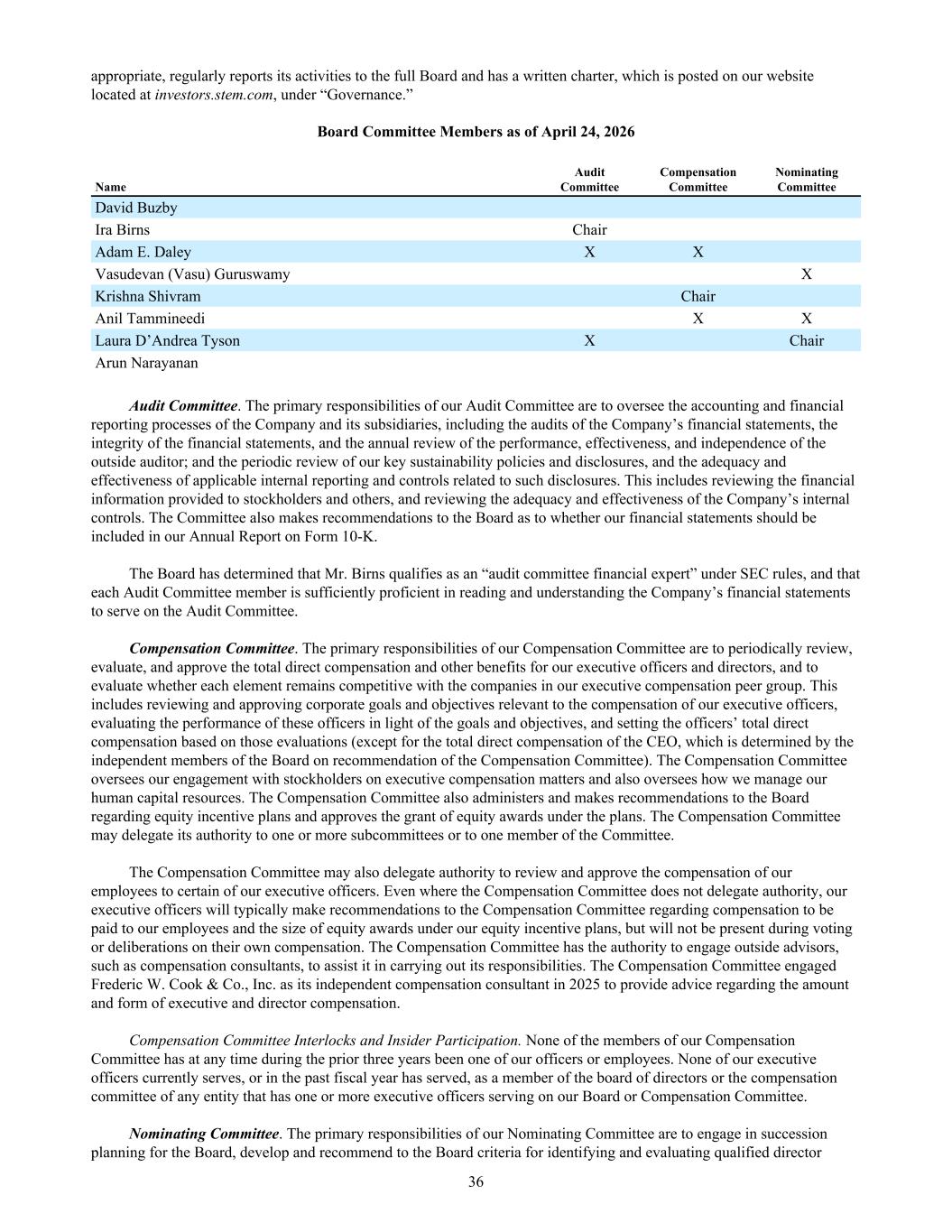
appropriate, regularly reports its activities to the full Board and has a written charter, which is posted on our website located at investors.stem.com, under “Governance.” Board Committee Members as of April 24, 2026 Name Audit Committee Compensation Committee Nominating Committee David Buzby Ira Birns Chair Adam E. Daley X X Vasudevan (Vasu) Guruswamy X Krishna Shivram Chair Anil Tammineedi X X Laura D’Andrea Tyson X Chair Arun Narayanan Audit Committee. The primary responsibilities of our Audit Committee are to oversee the accounting and financial reporting processes of the Company and its subsidiaries, including the audits of the Company’s financial statements, the integrity of the financial statements, and the annual review of the performance, effectiveness, and independence of the outside auditor; and the periodic review of our key sustainability policies and disclosures, and the adequacy and effectiveness of applicable internal reporting and controls related to such disclosures. This includes reviewing the financial information provided to stockholders and others, and reviewing the adequacy and effectiveness of the Company’s internal controls. The Committee also makes recommendations to the Board as to whether our financial statements should be included in our Annual Report on Form 10-K. The Board has determined that Mr. Birns qualifies as an “audit committee financial expert” under SEC rules, and that each Audit Committee member is sufficiently proficient in reading and understanding the Company’s financial statements to serve on the Audit Committee. Compensation Committee. The primary responsibilities of our Compensation Committee are to periodically review, evaluate, and approve the total direct compensation and other benefits for our executive officers and directors, and to evaluate whether each element remains competitive with the companies in our executive compensation peer group. This includes reviewing and approving corporate goals and objectives relevant to the compensation of our executive officers, evaluating the performance of these officers in light of the goals and objectives, and setting the officers’ total direct compensation based on those evaluations (except for the total direct compensation of the CEO, which is determined by the independent members of the Board on recommendation of the Compensation Committee). The Compensation Committee oversees our engagement with stockholders on executive compensation matters and also oversees how we manage our human capital resources. The Compensation Committee also administers and makes recommendations to the Board regarding equity incentive plans and approves the grant of equity awards under the plans. The Compensation Committee may delegate its authority to one or more subcommittees or to one member of the Committee. The Compensation Committee may also delegate authority to review and approve the compensation of our employees to certain of our executive officers. Even where the Compensation Committee does not delegate authority, our executive officers will typically make recommendations to the Compensation Committee regarding compensation to be paid to our employees and the size of equity awards under our equity incentive plans, but will not be present during voting or deliberations on their own compensation. The Compensation Committee has the authority to engage outside advisors, such as compensation consultants, to assist it in carrying out its responsibilities. The Compensation Committee engaged Frederic W. Cook & Co., Inc. as its independent compensation consultant in 2025 to provide advice regarding the amount and form of executive and director compensation. Compensation Committee Interlocks and Insider Participation. None of the members of our Compensation Committee has at any time during the prior three years been one of our officers or employees. None of our executive officers currently serves, or in the past fiscal year has served, as a member of the board of directors or the compensation committee of any entity that has one or more executive officers serving on our Board or Compensation Committee. Nominating Committee. The primary responsibilities of our Nominating Committee are to engage in succession planning for the Board, develop and recommend to the Board criteria for identifying and evaluating qualified director 36
candidates, and make recommendations to the Board regarding candidates for election or re-election to the Board at each annual meeting of stockholders. The Committee is responsible for overseeing our corporate governance practices and making recommendations to the Board concerning corporate governance matters. The Committee is also responsible for making recommendations to the Board concerning the size, structure, composition, and functioning of the Board and its committees. In addition, the Committee is responsible for overseeing our sustainability policies, activities, and opportunities, our political contributions and lobbying activities, if any, and our engagement with stockholders on governance, sustainability, and related matters. Stockholder Engagement During the past fiscal year, we met with analysts and institutional investors to inform and share our perspective, and to solicit their feedback on our performance. Our stockholder engagement program included our participation in investor conferences and other formal events, and group and one-on-one meetings throughout the year. We also invited our 25 largest stockholders to participate in individual conference calls with members of our legal team, our investor relations team and our Chairman of the Board and held meetings with the two institutional investors that responded to our invitation, as described more fully under “Executive Compensation”. Engaging directly with our stockholders provides us with a better understanding of their priorities, perspectives and positions and gives us the opportunity to receive feedback on corporate governance, executive compensation or other programs that may be under consideration by the Board. Our Commitment to Sustainability We are committed to the health and well-being of our people, our communities, and our planet. As we mature as a public company, we intend to continue to formalize our sustainability function and programs by developing our processes, strategies, and governance frameworks. Our Sustainability Policy Statement is available on our website and outlines our philosophy with respect to climate change, greenhouse gas emissions (“GHG”), and supply chain concerns, among other things. Sustainability Management and Oversight Our sustainability governance structure is evolving to include numerous participants engaging in information-sharing and decision-making, capitalizing on the depth and breadth of expertise throughout Stem. As discussed in “—Board Committees” above, our Nominating Committee has direct oversight over sustainability issues and regularly meets with key stakeholders to oversee the development of our sustainability program. Our Audit Committee also periodically reviews our key sustainability disclosures and the adequacy and effectiveness of applicable internal reporting and controls related to such disclosures. Our management-level sustainability committee, which is comprised of senior executives and other key stakeholders from our legal, investor relations, and operations functions, provides functional oversight for various sustainability activities at the Company. Sustainability Partnerships and Reporting We have engaged a third-party firm to help us develop our supply chain due diligence program, including with respect to conflict minerals and human rights issues. Our aim is to promote sustainability at all points in our supply chain, and comprehensive due diligence is step one. As we establish and grow these programs, our goal is to have a positive influence, by being open and transparent in our communication and education, with all our partners with whom we engage. Our goal is to develop sustainable relationships with our partners while being guided by the circular economy principle, a model of production and consumption that favors durability, reuse, remanufacturing, and recycling to keep materials circulating for as long as possible and reduce waste. Our Partner Code of Conduct and Human Rights Policy Statement can be found on our website and set out our philosophy with respect to our relationship with our partners and human rights concerns. In 2025, we continued to work with our carbon accounting partner to assist with tracking our GHG emissions in alignment with the GHG Protocol. In addition, we continued to work with our sustainability partner to assist us with climate and sustainability reporting in alignment with the Task Force on Climate-Related Financial Disclosures (“TCFD”) and the Sustainability Accounting Standards Board (“SASB”) frameworks. We closely follow the global consolidation of various climate and sustainability disclosure frameworks, and we are considering reporting under the Global Reporting Initiative (“GRI”), which we believe may help represent our global presence, and we intend to continue to align our disclosures in a manner that promotes transparency and accountability. 37
Valuing Inclusion We are committed to building an inclusive culture and team environment that promotes equal employment opportunities and supports our talent. In the spirit of our core values, we are “One Team” and succeed through collaboration when we respect, acknowledge, and celebrate each other’s varied perspectives. We are committed to creating an environment that promotes inclusivity and respect by implementing policies, benefits, training, recruiting, and recognition practices to support our colleagues. We believe that helping all our employees realize their highest potential by fostering a culture that supports personal development across the organization is necessary to promote inclusion. Our employees have opportunities to learn new skills to develop and advance their careers, and we provide opportunities for all our employees to receive ongoing formal training to help foster their professional development. We also value the feedback we receive from our employees. In 2023, we launched “Your Voice,” a quarterly employee sentiment portal, which is designed to facilitate communication with our employees and enhance our understanding of employee feedback. In addition, our annual employee engagement survey asks all our employees for their input on a variety of matters. The results of the employee survey are disseminated to all employees, and the results are used to design action plans to assist managers with actively responding to employees’ sentiments. We believe that the employee survey is an important tool that allows us to improve, innovate, and evolve through ongoing engagement and measurement. Other Corporate Governance Practices and Policies Board Evaluation Process In addition to regularly reviewing its leadership structure, the Board conducts an annual self-assessment of its overall functioning and effectiveness. In order to maximize input and facilitate useful feedback, our Corporate Secretary solicits from each director, on an anonymous basis, comments on overall Board and committee performance, Board priorities, interaction with management, the flow of information from management to and from the Board and its committees, Board discussion topics, agendas, and processes, and how to further improve overall Board functioning. This information is collected through written questionnaires and assessments, and individual director interviews. In addition, the Chairman of the Board makes himself available for one-on-one discussions with the other members of the Board. Our Corporate Secretary then aggregates and anonymizes the responses, which he then shares with the Nominating Committee. The Chair of the Nominating Committee, along with our Corporate Secretary, reviews the feedback from the self-evaluation process and makes recommendations to the Board for areas with respect to which the Board and its committees should consider improvements. These areas are further discussed at a meeting led by our Corporate Secretary, at which all Board members are present. At the conclusion of this meeting, the Chairman of the Board, working with the senior management team, develops action plans for any items that require follow-up. For example, in 2025, directors continued to prioritize the need for meeting discussions that allowed the Board to discuss and interact efficiently with management on key topics relating to long-term strategy, capital allocation, cost structure, risk management, and other matters relevant to the business in the dynamic external environment. Similarly, the Board made, and planned for, ongoing adjustments and improvements to its Board and committee meetings in connection with its new strategy and business needs and to help promote efficient and effective interaction and performance of its critical governance and risk oversight roles. Communications with the Board Our Board has established a process whereby interested parties may communicate with our Board or with any individual director. Interested parties, including stockholders, may send communications in writing addressed to the Board or an individual director, at Corporate_Secretary@stem.com, with a confirmation copy sent by mail to Stem, Inc., c/o the Corporate Secretary, 1400 Post Oak Boulevard, Suite 560, Houston, Texas 77056. Our Corporate Secretary will forward these communications as appropriate to the addressee, depending on the facts and circumstances outlined in the communication. Our Board has directed our Corporate Secretary not to forward certain items such as spam, junk mailings, product inquiries, resumes, and other forms of job inquiries, surveys, and business solicitations. Additionally, our Board has advised the Corporate Secretary not to forward material that is illegal or threatening, but to make our Board aware of such material which it may request be forwarded, retained, or destroyed at our Board’s discretion. To enable the Company to speak with a single voice, as a general matter, senior management serves as the primary spokesperson for the Company and is responsible for communicating with various constituencies, including stockholders, on behalf of the Company. Directors may participate in discussions with stockholders and other constituencies on issues 38
where Board-level involvement is appropriate. In addition, the Board is kept informed by Company management of the Company’s stockholder engagement efforts. Code of Business Conduct and Ethics Our Board has adopted a Code of Business Conduct and Ethics that establishes the standards of ethical conduct applicable to all our directors, officers, and employees, including our principal executive officer, principal financial officer, principal accounting officer, or persons performing similar functions. It addresses, among other matters, compliance with laws and policies, conflicts of interest, corporate opportunities, regulatory reporting, external communications, confidentiality requirements, proper use of assets, and how to report compliance concerns. A copy of the code is available on our website located at investors.stem.com, under “Employee Code of Conduct” in the “Governance” tab. Our Code of Business Conduct and Ethics was revised and approved by the Board on October 15, 2025. We intend to disclose future amendments to certain provisions of the code, or waivers of the code granted to executive officers and directors, on our website to the extent required by applicable rules. Our Board is responsible for applying and interpreting the code in situations where questions are presented to it. 39
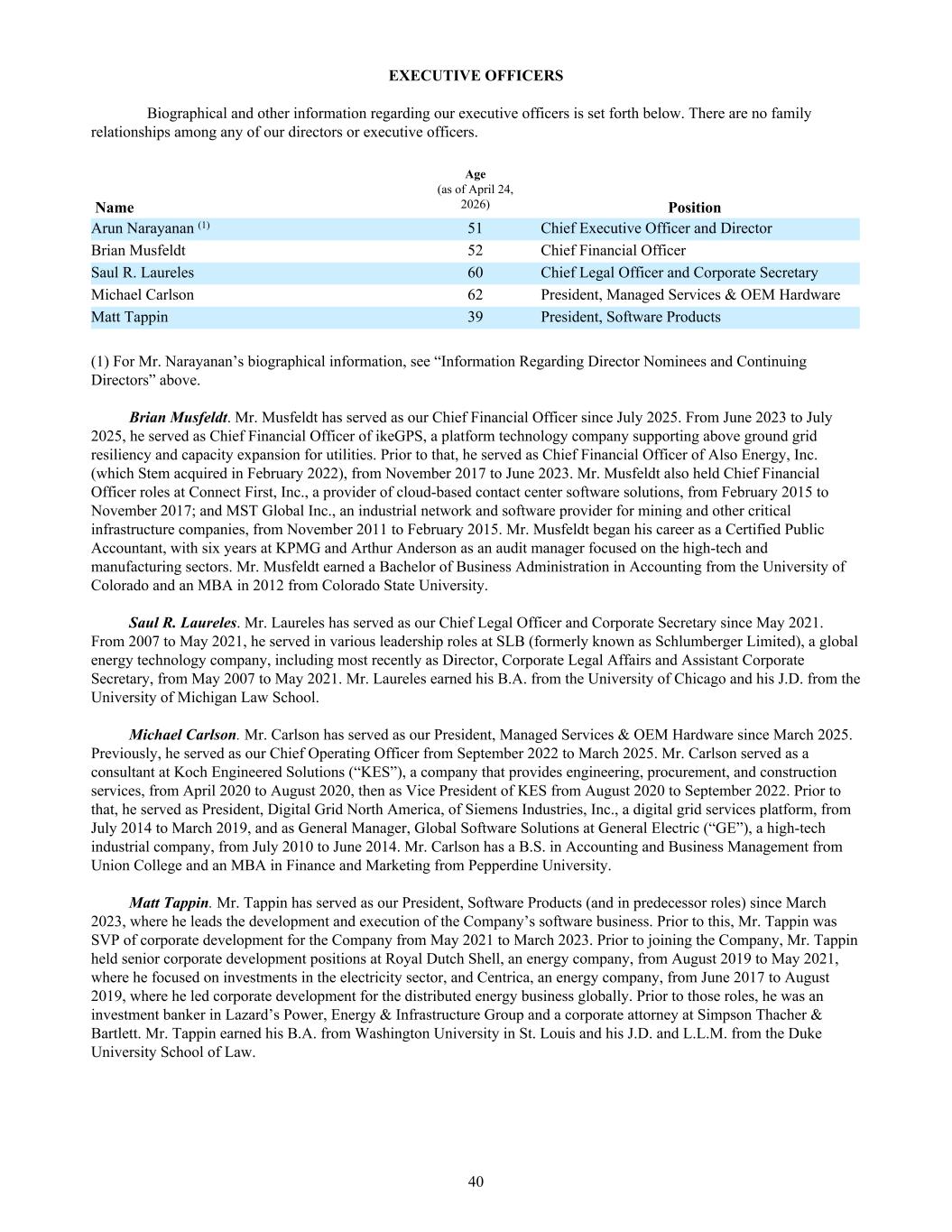
EXECUTIVE OFFICERS Biographical and other information regarding our executive officers is set forth below. There are no family relationships among any of our directors or executive officers. Name Age (as of April 24, 2026) Position Arun Narayanan (1) 51 Chief Executive Officer and Director Brian Musfeldt 52 Chief Financial Officer Saul R. Laureles 60 Chief Legal Officer and Corporate Secretary Michael Carlson 62 President, Managed Services & OEM Hardware Matt Tappin 39 President, Software Products (1) For Mr. Narayanan’s biographical information, see “Information Regarding Director Nominees and Continuing Directors” above. Brian Musfeldt. Mr. Musfeldt has served as our Chief Financial Officer since July 2025. From June 2023 to July 2025, he served as Chief Financial Officer of ikeGPS, a platform technology company supporting above ground grid resiliency and capacity expansion for utilities. Prior to that, he served as Chief Financial Officer of Also Energy, Inc. (which Stem acquired in February 2022), from November 2017 to June 2023. Mr. Musfeldt also held Chief Financial Officer roles at Connect First, Inc., a provider of cloud-based contact center software solutions, from February 2015 to November 2017; and MST Global Inc., an industrial network and software provider for mining and other critical infrastructure companies, from November 2011 to February 2015. Mr. Musfeldt began his career as a Certified Public Accountant, with six years at KPMG and Arthur Anderson as an audit manager focused on the high-tech and manufacturing sectors. Mr. Musfeldt earned a Bachelor of Business Administration in Accounting from the University of Colorado and an MBA in 2012 from Colorado State University. Saul R. Laureles. Mr. Laureles has served as our Chief Legal Officer and Corporate Secretary since May 2021. From 2007 to May 2021, he served in various leadership roles at SLB (formerly known as Schlumberger Limited), a global energy technology company, including most recently as Director, Corporate Legal Affairs and Assistant Corporate Secretary, from May 2007 to May 2021. Mr. Laureles earned his B.A. from the University of Chicago and his J.D. from the University of Michigan Law School. Michael Carlson. Mr. Carlson has served as our President, Managed Services & OEM Hardware since March 2025. Previously, he served as our Chief Operating Officer from September 2022 to March 2025. Mr. Carlson served as a consultant at Koch Engineered Solutions (“KES”), a company that provides engineering, procurement, and construction services, from April 2020 to August 2020, then as Vice President of KES from August 2020 to September 2022. Prior to that, he served as President, Digital Grid North America, of Siemens Industries, Inc., a digital grid services platform, from July 2014 to March 2019, and as General Manager, Global Software Solutions at General Electric (“GE”), a high-tech industrial company, from July 2010 to June 2014. Mr. Carlson has a B.S. in Accounting and Business Management from Union College and an MBA in Finance and Marketing from Pepperdine University. Matt Tappin. Mr. Tappin has served as our President, Software Products (and in predecessor roles) since March 2023, where he leads the development and execution of the Company’s software business. Prior to this, Mr. Tappin was SVP of corporate development for the Company from May 2021 to March 2023. Prior to joining the Company, Mr. Tappin held senior corporate development positions at Royal Dutch Shell, an energy company, from August 2019 to May 2021, where he focused on investments in the electricity sector, and Centrica, an energy company, from June 2017 to August 2019, where he led corporate development for the distributed energy business globally. Prior to those roles, he was an investment banker in Lazard’s Power, Energy & Infrastructure Group and a corporate attorney at Simpson Thacher & Bartlett. Mr. Tappin earned his B.A. from Washington University in St. Louis and his J.D. and L.L.M. from the Duke University School of Law. 40
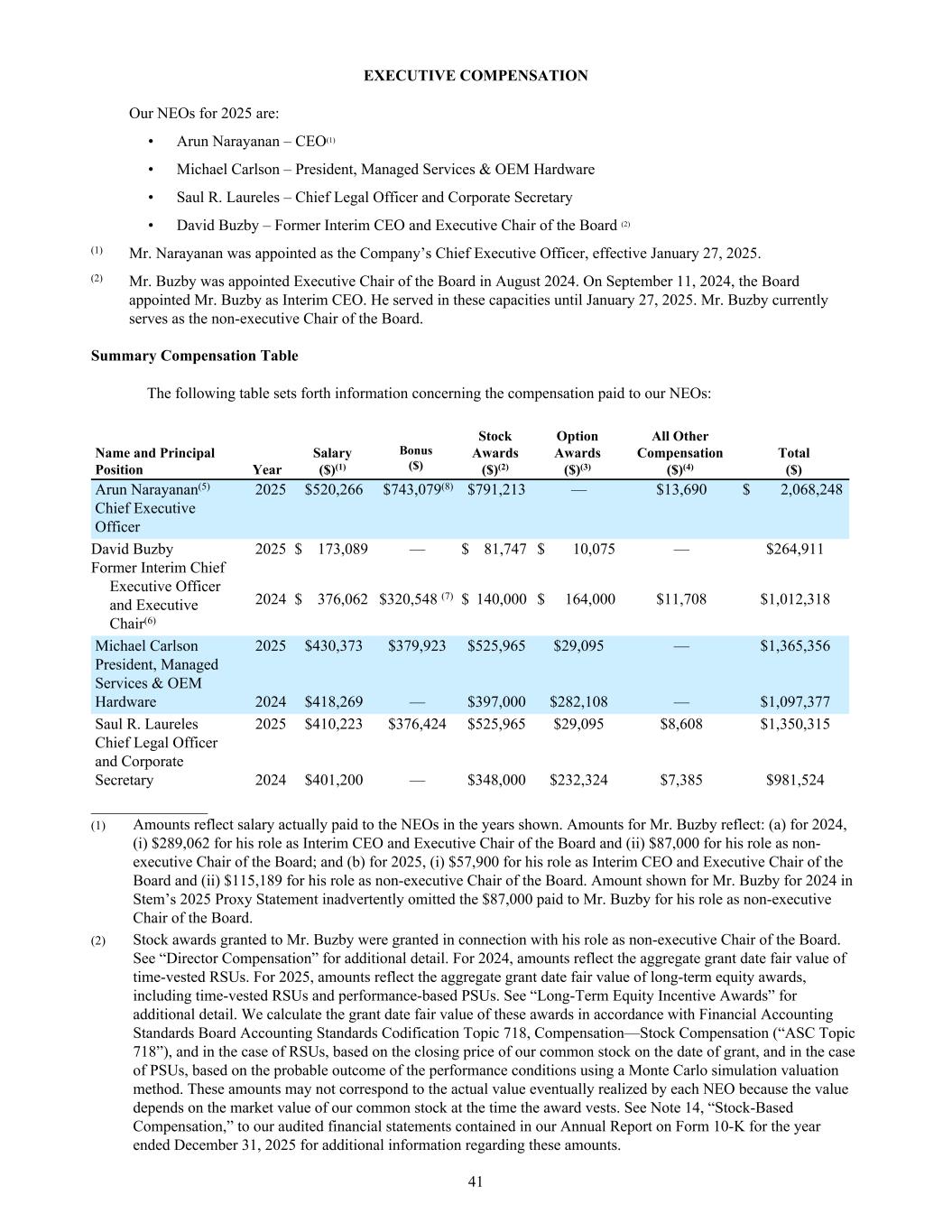
EXECUTIVE COMPENSATION Our NEOs for 2025 are: • Arun Narayanan – CEO(1) • Michael Carlson – President, Managed Services & OEM Hardware • Saul R. Laureles – Chief Legal Officer and Corporate Secretary • David Buzby – Former Interim CEO and Executive Chair of the Board (2) (1) Mr. Narayanan was appointed as the Company’s Chief Executive Officer, effective January 27, 2025. (2) Mr. Buzby was appointed Executive Chair of the Board in August 2024. On September 11, 2024, the Board appointed Mr. Buzby as Interim CEO. He served in these capacities until January 27, 2025. Mr. Buzby currently serves as the non-executive Chair of the Board. Summary Compensation Table The following table sets forth information concerning the compensation paid to our NEOs: Name and Principal Position Year Salary ($)(1) Bonus ($) Stock Awards ($)(2) Option Awards ($)(3) All Other Compensation ($)(4) Total ($) Arun Narayanan(5) Chief Executive Officer 2025 $520,266 $743,079(8) $791,213 — $13,690 $ 2,068,248 David Buzby Former Interim Chief Executive Officer and Executive Chair(6) 2025 $ 173,089 — $ 81,747 $ 10,075 — $264,911 2024 $ 376,062 $320,548 (7) $ 140,000 $ 164,000 $11,708 $1,012,318 Michael Carlson President, Managed Services & OEM Hardware 2025 $430,373 $379,923 $525,965 $29,095 — $1,365,356 2024 $418,269 — $397,000 $282,108 — $1,097,377 Saul R. Laureles Chief Legal Officer and Corporate Secretary 2025 $410,223 $376,424 $525,965 $29,095 $8,608 $1,350,315 2024 $401,200 — $348,000 $232,324 $7,385 $981,524 _______________ (1) Amounts reflect salary actually paid to the NEOs in the years shown. Amounts for Mr. Buzby reflect: (a) for 2024, (i) $289,062 for his role as Interim CEO and Executive Chair of the Board and (ii) $87,000 for his role as non- executive Chair of the Board; and (b) for 2025, (i) $57,900 for his role as Interim CEO and Executive Chair of the Board and (ii) $115,189 for his role as non-executive Chair of the Board. Amount shown for Mr. Buzby for 2024 in Stem’s 2025 Proxy Statement inadvertently omitted the $87,000 paid to Mr. Buzby for his role as non-executive Chair of the Board. (2) Stock awards granted to Mr. Buzby were granted in connection with his role as non-executive Chair of the Board. See “Director Compensation” for additional detail. For 2024, amounts reflect the aggregate grant date fair value of time-vested RSUs. For 2025, amounts reflect the aggregate grant date fair value of long-term equity awards, including time-vested RSUs and performance-based PSUs. See “Long-Term Equity Incentive Awards” for additional detail. We calculate the grant date fair value of these awards in accordance with Financial Accounting Standards Board Accounting Standards Codification Topic 718, Compensation—Stock Compensation (“ASC Topic 718”), and in the case of RSUs, based on the closing price of our common stock on the date of grant, and in the case of PSUs, based on the probable outcome of the performance conditions using a Monte Carlo simulation valuation method. These amounts may not correspond to the actual value eventually realized by each NEO because the value depends on the market value of our common stock at the time the award vests. See Note 14, “Stock-Based Compensation,” to our audited financial statements contained in our Annual Report on Form 10-K for the year ended December 31, 2025 for additional information regarding these amounts. 41
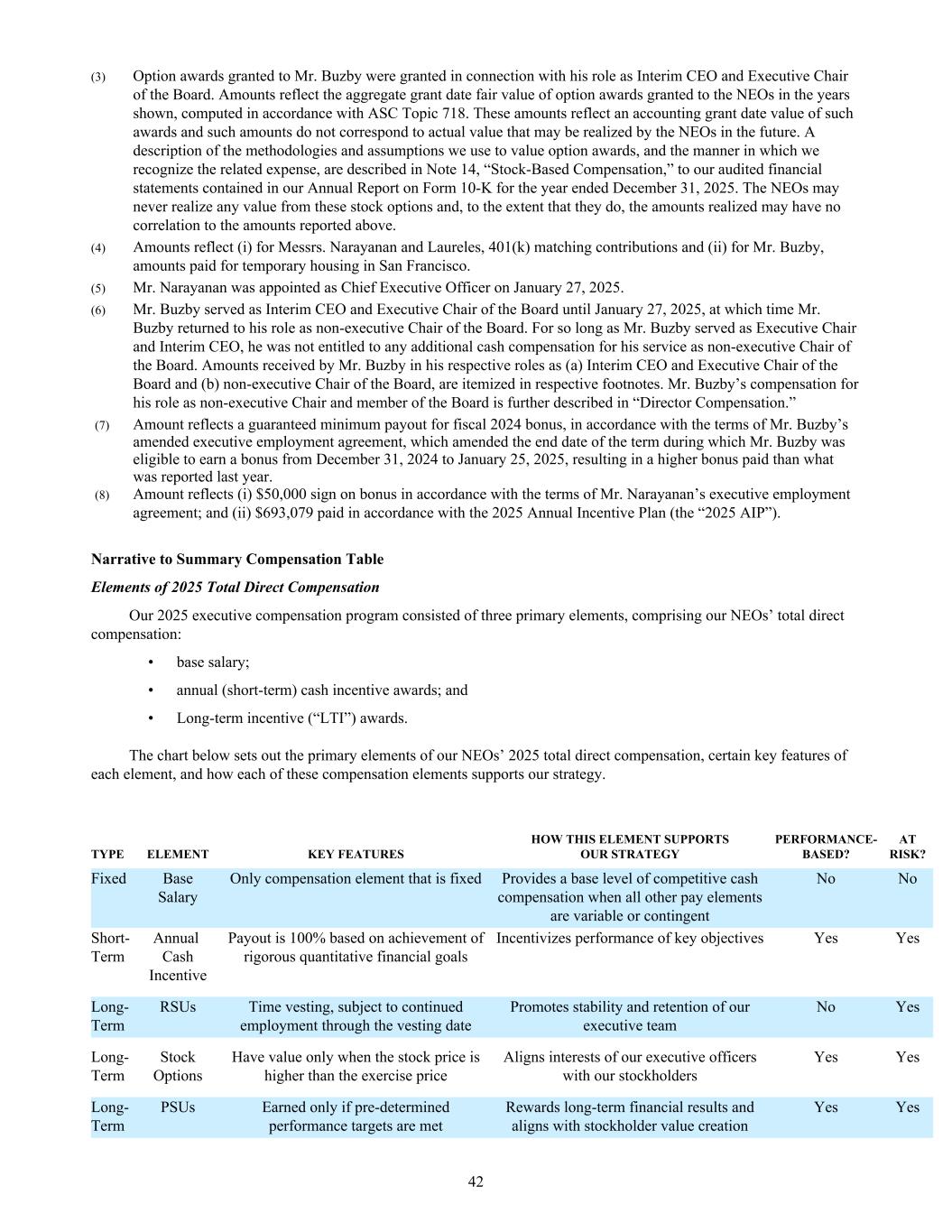
(3) Option awards granted to Mr. Buzby were granted in connection with his role as Interim CEO and Executive Chair of the Board. Amounts reflect the aggregate grant date fair value of option awards granted to the NEOs in the years shown, computed in accordance with ASC Topic 718. These amounts reflect an accounting grant date value of such awards and such amounts do not correspond to actual value that may be realized by the NEOs in the future. A description of the methodologies and assumptions we use to value option awards, and the manner in which we recognize the related expense, are described in Note 14, “Stock-Based Compensation,” to our audited financial statements contained in our Annual Report on Form 10-K for the year ended December 31, 2025. The NEOs may never realize any value from these stock options and, to the extent that they do, the amounts realized may have no correlation to the amounts reported above. (4) Amounts reflect (i) for Messrs. Narayanan and Laureles, 401(k) matching contributions and (ii) for Mr. Buzby, amounts paid for temporary housing in San Francisco. (5) Mr. Narayanan was appointed as Chief Executive Officer on January 27, 2025. (6) Mr. Buzby served as Interim CEO and Executive Chair of the Board until January 27, 2025, at which time Mr. Buzby returned to his role as non-executive Chair of the Board. For so long as Mr. Buzby served as Executive Chair and Interim CEO, he was not entitled to any additional cash compensation for his service as non-executive Chair of the Board. Amounts received by Mr. Buzby in his respective roles as (a) Interim CEO and Executive Chair of the Board and (b) non-executive Chair of the Board, are itemized in respective footnotes. Mr. Buzby’s compensation for his role as non-executive Chair and member of the Board is further described in “Director Compensation.” (7) Amount reflects a guaranteed minimum payout for fiscal 2024 bonus, in accordance with the terms of Mr. Buzby’s amended executive employment agreement, which amended the end date of the term during which Mr. Buzby was eligible to earn a bonus from December 31, 2024 to January 25, 2025, resulting in a higher bonus paid than what was reported last year. (8) Amount reflects (i) $50,000 sign on bonus in accordance with the terms of Mr. Narayanan’s executive employment agreement; and (ii) $693,079 paid in accordance with the 2025 Annual Incentive Plan (the “2025 AIP”). Narrative to Summary Compensation Table Elements of 2025 Total Direct Compensation Our 2025 executive compensation program consisted of three primary elements, comprising our NEOs’ total direct compensation: • base salary; • annual (short-term) cash incentive awards; and • Long-term incentive (“LTI”) awards. The chart below sets out the primary elements of our NEOs’ 2025 total direct compensation, certain key features of each element, and how each of these compensation elements supports our strategy. Fixed Base Salary Only compensation element that is fixed Provides a base level of competitive cash compensation when all other pay elements are variable or contingent No No Short- Term Annual Cash Incentive Payout is 100% based on achievement of rigorous quantitative financial goals Incentivizes performance of key objectives Yes Yes Long- Term RSUs Time vesting, subject to continued employment through the vesting date Promotes stability and retention of our executive team No Yes Long- Term Stock Options Have value only when the stock price is higher than the exercise price Aligns interests of our executive officers with our stockholders Yes Yes Long- Term PSUs Earned only if pre-determined performance targets are met Rewards long-term financial results and aligns with stockholder value creation Yes Yes TYPE ELEMENT KEY FEATURES HOW THIS ELEMENT SUPPORTS OUR STRATEGY PERFORMANCE- BASED? AT RISK? 42
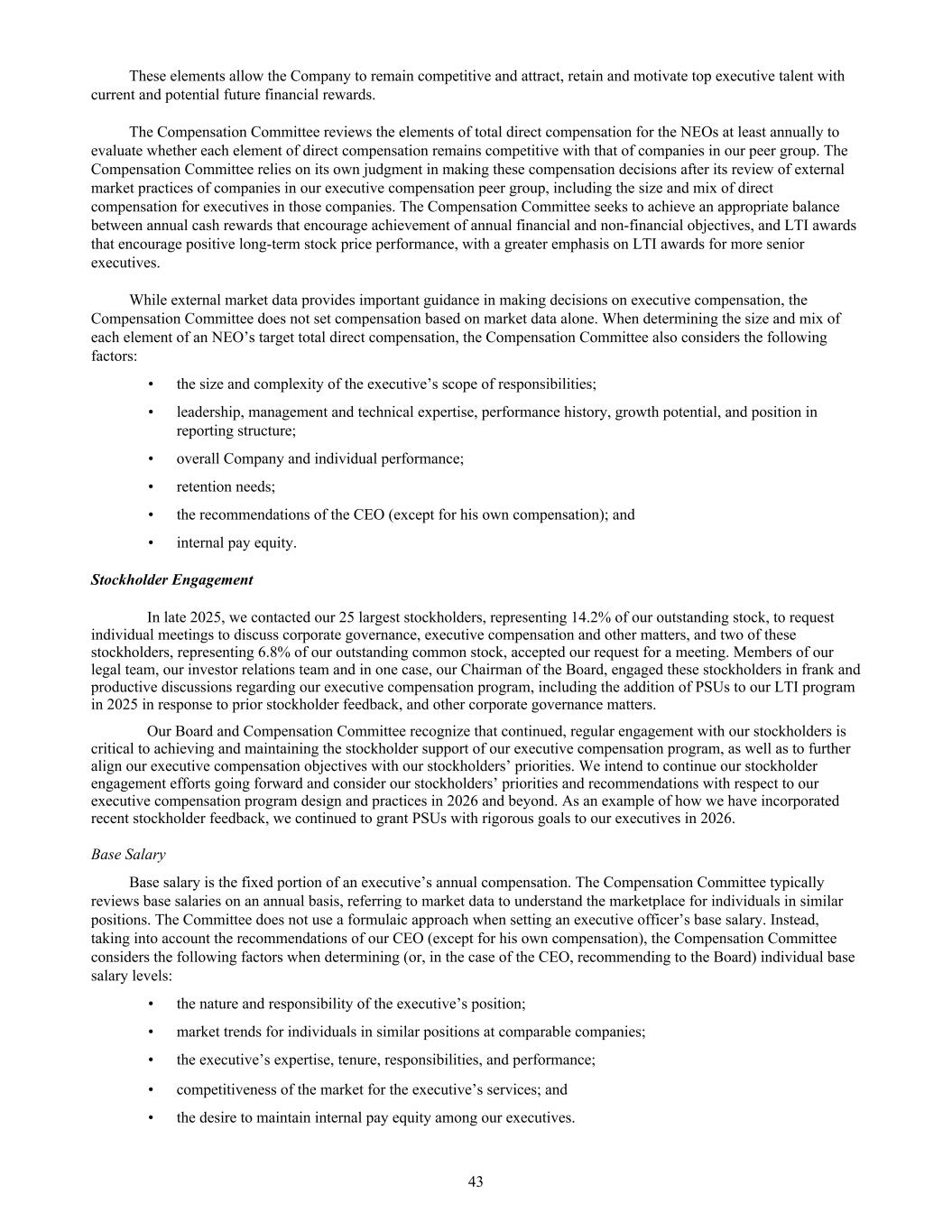
These elements allow the Company to remain competitive and attract, retain and motivate top executive talent with current and potential future financial rewards. The Compensation Committee reviews the elements of total direct compensation for the NEOs at least annually to evaluate whether each element of direct compensation remains competitive with that of companies in our peer group. The Compensation Committee relies on its own judgment in making these compensation decisions after its review of external market practices of companies in our executive compensation peer group, including the size and mix of direct compensation for executives in those companies. The Compensation Committee seeks to achieve an appropriate balance between annual cash rewards that encourage achievement of annual financial and non-financial objectives, and LTI awards that encourage positive long-term stock price performance, with a greater emphasis on LTI awards for more senior executives. While external market data provides important guidance in making decisions on executive compensation, the Compensation Committee does not set compensation based on market data alone. When determining the size and mix of each element of an NEO’s target total direct compensation, the Compensation Committee also considers the following factors: • the size and complexity of the executive’s scope of responsibilities; • leadership, management and technical expertise, performance history, growth potential, and position in reporting structure; • overall Company and individual performance; • retention needs; • the recommendations of the CEO (except for his own compensation); and • internal pay equity. Stockholder Engagement In late 2025, we contacted our 25 largest stockholders, representing 14.2% of our outstanding stock, to request individual meetings to discuss corporate governance, executive compensation and other matters, and two of these stockholders, representing 6.8% of our outstanding common stock, accepted our request for a meeting. Members of our legal team, our investor relations team and in one case, our Chairman of the Board, engaged these stockholders in frank and productive discussions regarding our executive compensation program, including the addition of PSUs to our LTI program in 2025 in response to prior stockholder feedback, and other corporate governance matters. Our Board and Compensation Committee recognize that continued, regular engagement with our stockholders is critical to achieving and maintaining the stockholder support of our executive compensation program, as well as to further align our executive compensation objectives with our stockholders’ priorities. We intend to continue our stockholder engagement efforts going forward and consider our stockholders’ priorities and recommendations with respect to our executive compensation program design and practices in 2026 and beyond. As an example of how we have incorporated recent stockholder feedback, we continued to grant PSUs with rigorous goals to our executives in 2026. Base Salary Base salary is the fixed portion of an executive’s annual compensation. The Compensation Committee typically reviews base salaries on an annual basis, referring to market data to understand the marketplace for individuals in similar positions. The Committee does not use a formulaic approach when setting an executive officer’s base salary. Instead, taking into account the recommendations of our CEO (except for his own compensation), the Compensation Committee considers the following factors when determining (or, in the case of the CEO, recommending to the Board) individual base salary levels: • the nature and responsibility of the executive’s position; • market trends for individuals in similar positions at comparable companies; • the executive’s expertise, tenure, responsibilities, and performance; • competitiveness of the market for the executive’s services; and • the desire to maintain internal pay equity among our executives. 43
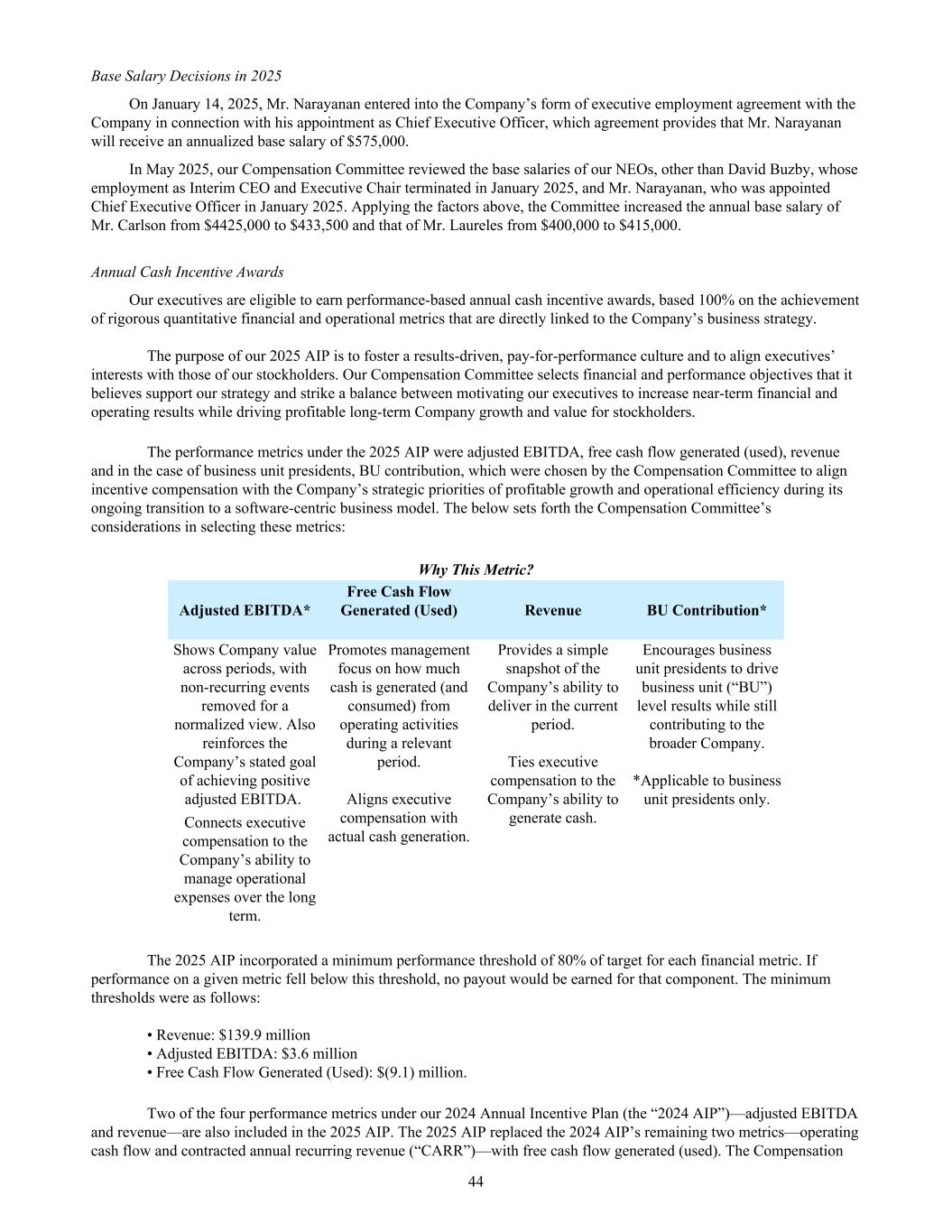
Base Salary Decisions in 2025 On January 14, 2025, Mr. Narayanan entered into the Company’s form of executive employment agreement with the Company in connection with his appointment as Chief Executive Officer, which agreement provides that Mr. Narayanan will receive an annualized base salary of $575,000. In May 2025, our Compensation Committee reviewed the base salaries of our NEOs, other than David Buzby, whose employment as Interim CEO and Executive Chair terminated in January 2025, and Mr. Narayanan, who was appointed Chief Executive Officer in January 2025. Applying the factors above, the Committee increased the annual base salary of Mr. Carlson from $4425,000 to $433,500 and that of Mr. Laureles from $400,000 to $415,000. Annual Cash Incentive Awards Our executives are eligible to earn performance-based annual cash incentive awards, based 100% on the achievement of rigorous quantitative financial and operational metrics that are directly linked to the Company’s business strategy. The purpose of our 2025 AIP is to foster a results-driven, pay-for-performance culture and to align executives’ interests with those of our stockholders. Our Compensation Committee selects financial and performance objectives that it believes support our strategy and strike a balance between motivating our executives to increase near-term financial and operating results while driving profitable long-term Company growth and value for stockholders. The performance metrics under the 2025 AIP were adjusted EBITDA, free cash flow generated (used), revenue and in the case of business unit presidents, BU contribution, which were chosen by the Compensation Committee to align incentive compensation with the Company’s strategic priorities of profitable growth and operational efficiency during its ongoing transition to a software-centric business model. The below sets forth the Compensation Committee’s considerations in selecting these metrics: Why This Metric? Adjusted EBITDA* Free Cash Flow Generated (Used) Revenue BU Contribution* Shows Company value across periods, with non-recurring events removed for a normalized view. Also reinforces the Company’s stated goal of achieving positive adjusted EBITDA. Connects executive compensation to the Company’s ability to manage operational expenses over the long term. Promotes management focus on how much cash is generated (and consumed) from operating activities during a relevant period. Aligns executive compensation with actual cash generation. Provides a simple snapshot of the Company’s ability to deliver in the current period. Ties executive compensation to the Company’s ability to generate cash. Encourages business unit presidents to drive business unit (“BU”) level results while still contributing to the broader Company. *Applicable to business unit presidents only. The 2025 AIP incorporated a minimum performance threshold of 80% of target for each financial metric. If performance on a given metric fell below this threshold, no payout would be earned for that component. The minimum thresholds were as follows: • Revenue: $139.9 million • Adjusted EBITDA: $3.6 million • Free Cash Flow Generated (Used): $(9.1) million. Two of the four performance metrics under our 2024 Annual Incentive Plan (the “2024 AIP”)—adjusted EBITDA and revenue—are also included in the 2025 AIP. The 2025 AIP replaced the 2024 AIP’s remaining two metrics—operating cash flow and contracted annual recurring revenue (“CARR”)—with free cash flow generated (used). The Compensation 44
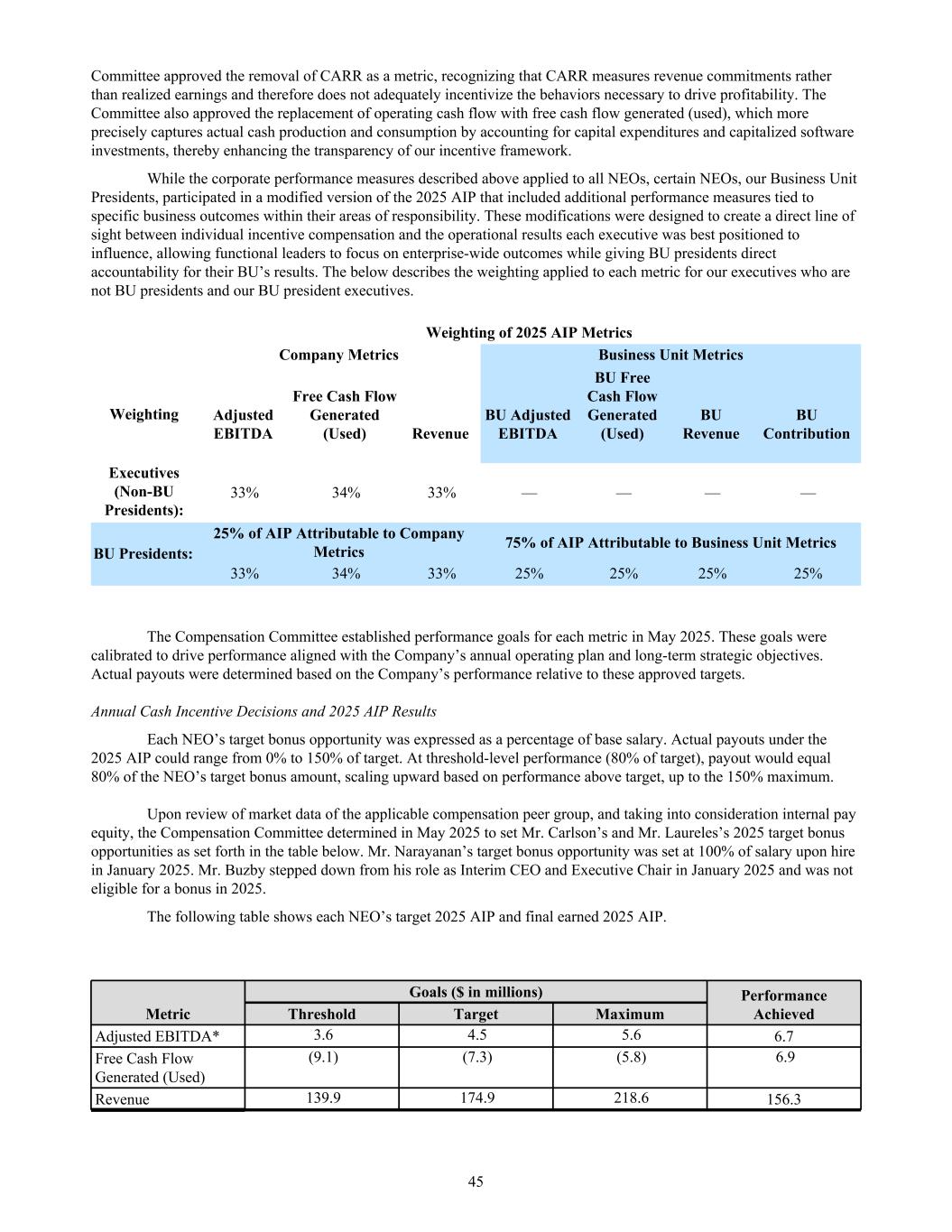
Committee approved the removal of CARR as a metric, recognizing that CARR measures revenue commitments rather than realized earnings and therefore does not adequately incentivize the behaviors necessary to drive profitability. The Committee also approved the replacement of operating cash flow with free cash flow generated (used), which more precisely captures actual cash production and consumption by accounting for capital expenditures and capitalized software investments, thereby enhancing the transparency of our incentive framework. While the corporate performance measures described above applied to all NEOs, certain NEOs, our Business Unit Presidents, participated in a modified version of the 2025 AIP that included additional performance measures tied to specific business outcomes within their areas of responsibility. These modifications were designed to create a direct line of sight between individual incentive compensation and the operational results each executive was best positioned to influence, allowing functional leaders to focus on enterprise-wide outcomes while giving BU presidents direct accountability for their BU’s results. The below describes the weighting applied to each metric for our executives who are not BU presidents and our BU president executives. Weighting of 2025 AIP Metrics Company Metrics Business Unit Metrics Weighting Adjusted EBITDA Free Cash Flow Generated (Used) Revenue BU Adjusted EBITDA BU Free Cash Flow Generated (Used) BU Revenue BU Contribution Executives (Non-BU Presidents): 33% 34% 33% — — — — BU Presidents: 25% of AIP Attributable to Company Metrics 75% of AIP Attributable to Business Unit Metrics 33% 34% 33% 25% 25% 25% 25% The Compensation Committee established performance goals for each metric in May 2025. These goals were calibrated to drive performance aligned with the Company’s annual operating plan and long-term strategic objectives. Actual payouts were determined based on the Company’s performance relative to these approved targets. Annual Cash Incentive Decisions and 2025 AIP Results Each NEO’s target bonus opportunity was expressed as a percentage of base salary. Actual payouts under the 2025 AIP could range from 0% to 150% of target. At threshold-level performance (80% of target), payout would equal 80% of the NEO’s target bonus amount, scaling upward based on performance above target, up to the 150% maximum. Upon review of market data of the applicable compensation peer group, and taking into consideration internal pay equity, the Compensation Committee determined in May 2025 to set Mr. Carlson’s and Mr. Laureles’s 2025 target bonus opportunities as set forth in the table below. Mr. Narayanan’s target bonus opportunity was set at 100% of salary upon hire in January 2025. Mr. Buzby stepped down from his role as Interim CEO and Executive Chair in January 2025 and was not eligible for a bonus in 2025. The following table shows each NEO’s target 2025 AIP and final earned 2025 AIP. Metric Goals ($ in millions) Performance AchievedThreshold Target Maximum Adjusted EBITDA* 3.6 4.5 5.6 6.7 Free Cash Flow Generated (Used) (9.1) (7.3) (5.8) 6.9 Revenue 139.9 174.9 218.6 156.3 45
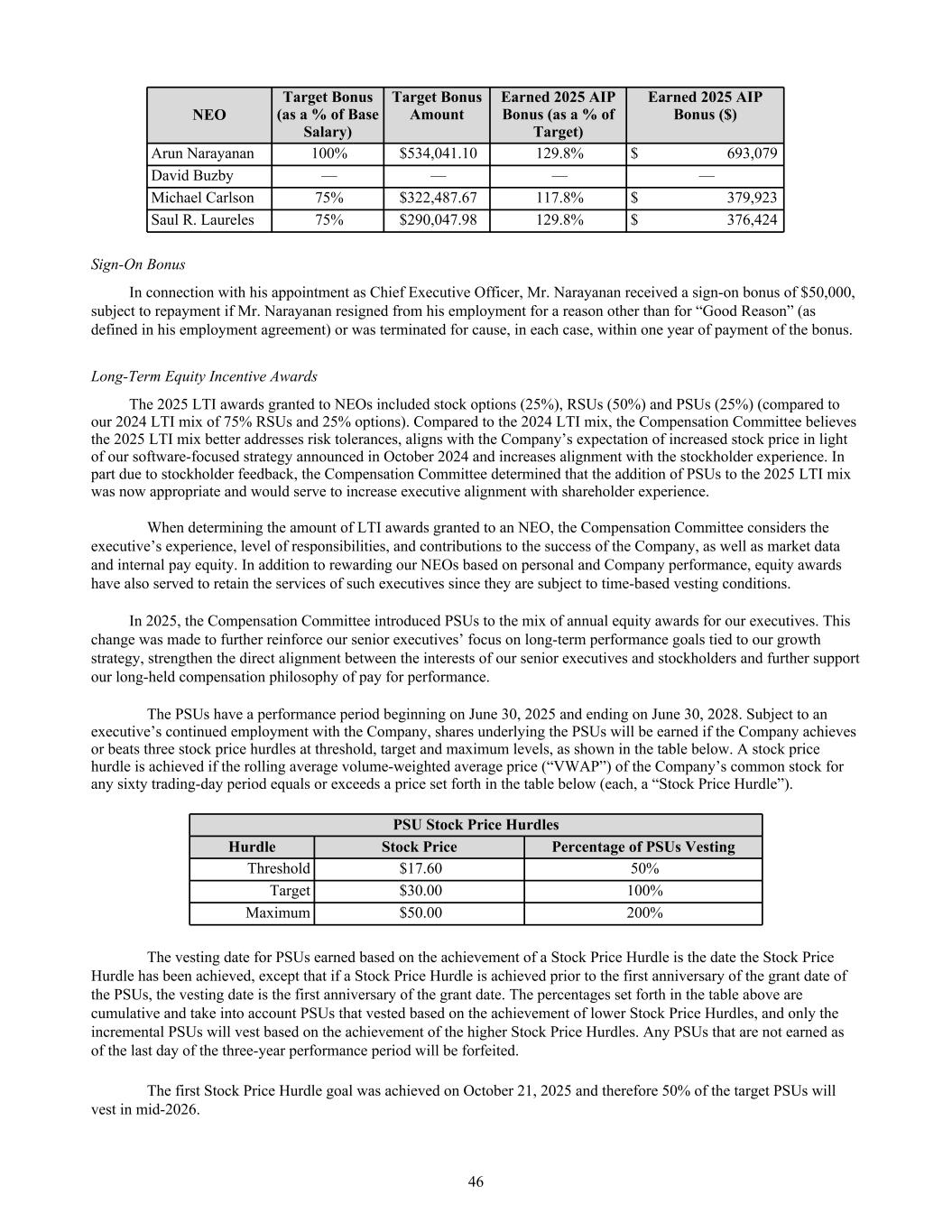
NEO Target Bonus (as a % of Base Salary) Target Bonus Amount Earned 2025 AIP Bonus (as a % of Target) Earned 2025 AIP Bonus ($) Arun Narayanan 100% $534,041.10 129.8% $ 693,079 David Buzby — — — — Michael Carlson 75% $322,487.67 117.8% $ 379,923 Saul R. Laureles 75% $290,047.98 129.8% $ 376,424 Sign-On Bonus In connection with his appointment as Chief Executive Officer, Mr. Narayanan received a sign-on bonus of $50,000, subject to repayment if Mr. Narayanan resigned from his employment for a reason other than for “Good Reason” (as defined in his employment agreement) or was terminated for cause, in each case, within one year of payment of the bonus. Long-Term Equity Incentive Awards The 2025 LTI awards granted to NEOs included stock options (25%), RSUs (50%) and PSUs (25%) (compared to our 2024 LTI mix of 75% RSUs and 25% options). Compared to the 2024 LTI mix, the Compensation Committee believes the 2025 LTI mix better addresses risk tolerances, aligns with the Company’s expectation of increased stock price in light of our software-focused strategy announced in October 2024 and increases alignment with the stockholder experience. In part due to stockholder feedback, the Compensation Committee determined that the addition of PSUs to the 2025 LTI mix was now appropriate and would serve to increase executive alignment with shareholder experience. When determining the amount of LTI awards granted to an NEO, the Compensation Committee considers the executive’s experience, level of responsibilities, and contributions to the success of the Company, as well as market data and internal pay equity. In addition to rewarding our NEOs based on personal and Company performance, equity awards have also served to retain the services of such executives since they are subject to time-based vesting conditions. In 2025, the Compensation Committee introduced PSUs to the mix of annual equity awards for our executives. This change was made to further reinforce our senior executives’ focus on long-term performance goals tied to our growth strategy, strengthen the direct alignment between the interests of our senior executives and stockholders and further support our long-held compensation philosophy of pay for performance. The PSUs have a performance period beginning on June 30, 2025 and ending on June 30, 2028. Subject to an executive’s continued employment with the Company, shares underlying the PSUs will be earned if the Company achieves or beats three stock price hurdles at threshold, target and maximum levels, as shown in the table below. A stock price hurdle is achieved if the rolling average volume-weighted average price (“VWAP”) of the Company’s common stock for any sixty trading-day period equals or exceeds a price set forth in the table below (each, a “Stock Price Hurdle”). PSU Stock Price Hurdles Hurdle Stock Price Percentage of PSUs Vesting Threshold $17.60 50% Target $30.00 100% Maximum $50.00 200% The vesting date for PSUs earned based on the achievement of a Stock Price Hurdle is the date the Stock Price Hurdle has been achieved, except that if a Stock Price Hurdle is achieved prior to the first anniversary of the grant date of the PSUs, the vesting date is the first anniversary of the grant date. The percentages set forth in the table above are cumulative and take into account PSUs that vested based on the achievement of lower Stock Price Hurdles, and only the incremental PSUs will vest based on the achievement of the higher Stock Price Hurdles. Any PSUs that are not earned as of the last day of the three-year performance period will be forfeited. The first Stock Price Hurdle goal was achieved on October 21, 2025 and therefore 50% of the target PSUs will vest in mid-2026. 46
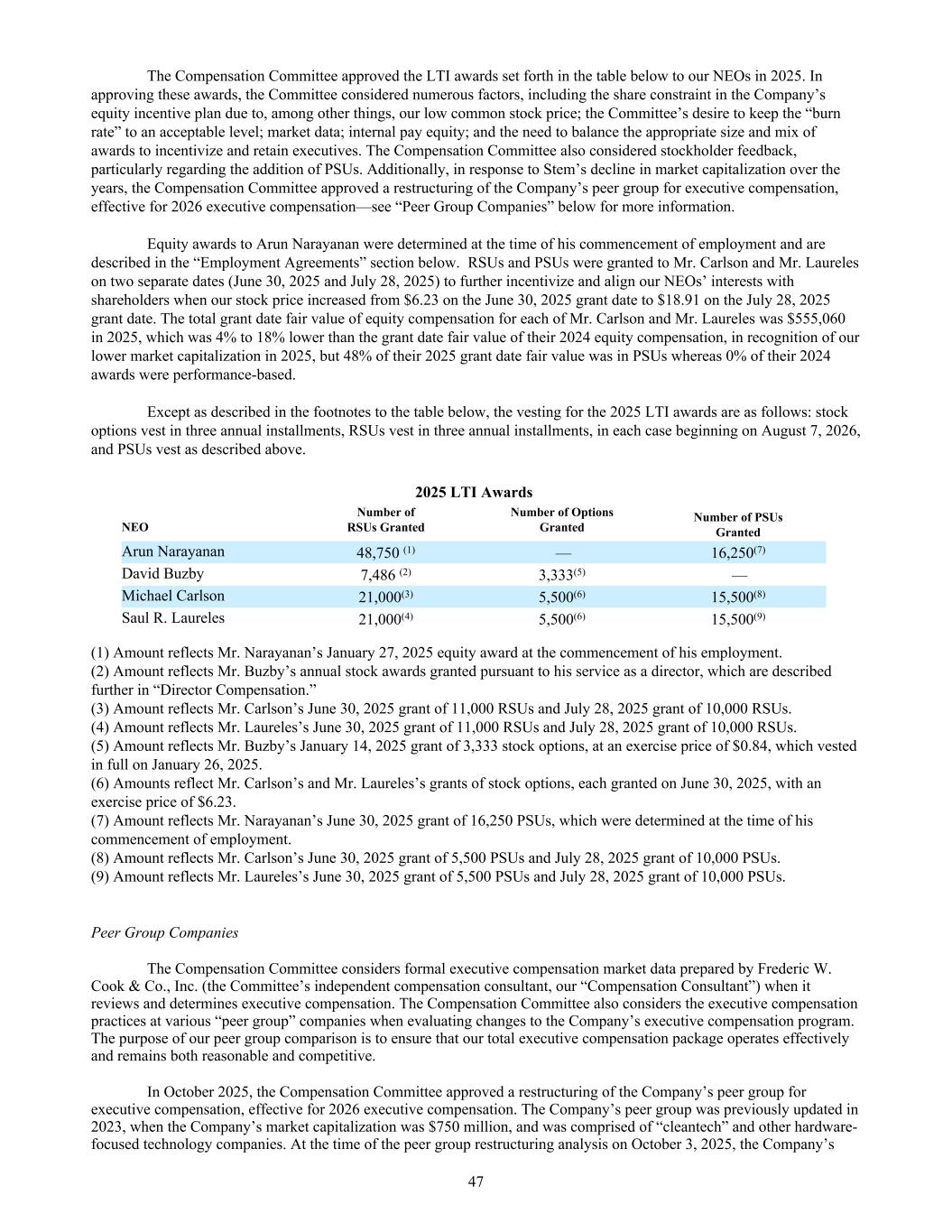
The Compensation Committee approved the LTI awards set forth in the table below to our NEOs in 2025. In approving these awards, the Committee considered numerous factors, including the share constraint in the Company’s equity incentive plan due to, among other things, our low common stock price; the Committee’s desire to keep the “burn rate” to an acceptable level; market data; internal pay equity; and the need to balance the appropriate size and mix of awards to incentivize and retain executives. The Compensation Committee also considered stockholder feedback, particularly regarding the addition of PSUs. Additionally, in response to Stem’s decline in market capitalization over the years, the Compensation Committee approved a restructuring of the Company’s peer group for executive compensation, effective for 2026 executive compensation—see “Peer Group Companies” below for more information. Equity awards to Arun Narayanan were determined at the time of his commencement of employment and are described in the “Employment Agreements” section below. RSUs and PSUs were granted to Mr. Carlson and Mr. Laureles on two separate dates (June 30, 2025 and July 28, 2025) to further incentivize and align our NEOs’ interests with shareholders when our stock price increased from $6.23 on the June 30, 2025 grant date to $18.91 on the July 28, 2025 grant date. The total grant date fair value of equity compensation for each of Mr. Carlson and Mr. Laureles was $555,060 in 2025, which was 4% to 18% lower than the grant date fair value of their 2024 equity compensation, in recognition of our lower market capitalization in 2025, but 48% of their 2025 grant date fair value was in PSUs whereas 0% of their 2024 awards were performance-based. Except as described in the footnotes to the table below, the vesting for the 2025 LTI awards are as follows: stock options vest in three annual installments, RSUs vest in three annual installments, in each case beginning on August 7, 2026, and PSUs vest as described above. Arun Narayanan 48,750 (1) — 16,250(7) David Buzby 7,486 (2) 3,333(5) — Michael Carlson 21,000(3) 5,500(6) 15,500(8) Saul R. Laureles 21,000(4) 5,500(6) 15,500(9) 2025 LTI Awards NEO Number of RSUs Granted Number of Options Granted Number of PSUs Granted (1) Amount reflects Mr. Narayanan’s January 27, 2025 equity award at the commencement of his employment. (2) Amount reflects Mr. Buzby’s annual stock awards granted pursuant to his service as a director, which are described further in “Director Compensation.” (3) Amount reflects Mr. Carlson’s June 30, 2025 grant of 11,000 RSUs and July 28, 2025 grant of 10,000 RSUs. (4) Amount reflects Mr. Laureles’s June 30, 2025 grant of 11,000 RSUs and July 28, 2025 grant of 10,000 RSUs. (5) Amount reflects Mr. Buzby’s January 14, 2025 grant of 3,333 stock options, at an exercise price of $0.84, which vested in full on January 26, 2025. (6) Amounts reflect Mr. Carlson’s and Mr. Laureles’s grants of stock options, each granted on June 30, 2025, with an exercise price of $6.23. (7) Amount reflects Mr. Narayanan’s June 30, 2025 grant of 16,250 PSUs, which were determined at the time of his commencement of employment. (8) Amount reflects Mr. Carlson’s June 30, 2025 grant of 5,500 PSUs and July 28, 2025 grant of 10,000 PSUs. (9) Amount reflects Mr. Laureles’s June 30, 2025 grant of 5,500 PSUs and July 28, 2025 grant of 10,000 PSUs. Peer Group Companies The Compensation Committee considers formal executive compensation market data prepared by Frederic W. Cook & Co., Inc. (the Committee’s independent compensation consultant, our “Compensation Consultant”) when it reviews and determines executive compensation. The Compensation Committee also considers the executive compensation practices at various “peer group” companies when evaluating changes to the Company’s executive compensation program. The purpose of our peer group comparison is to ensure that our total executive compensation package operates effectively and remains both reasonable and competitive. In October 2025, the Compensation Committee approved a restructuring of the Company’s peer group for executive compensation, effective for 2026 executive compensation. The Company’s peer group was previously updated in 2023, when the Company’s market capitalization was $750 million, and was comprised of “cleantech” and other hardware- focused technology companies. At the time of the peer group restructuring analysis on October 3, 2025, the Company’s 47
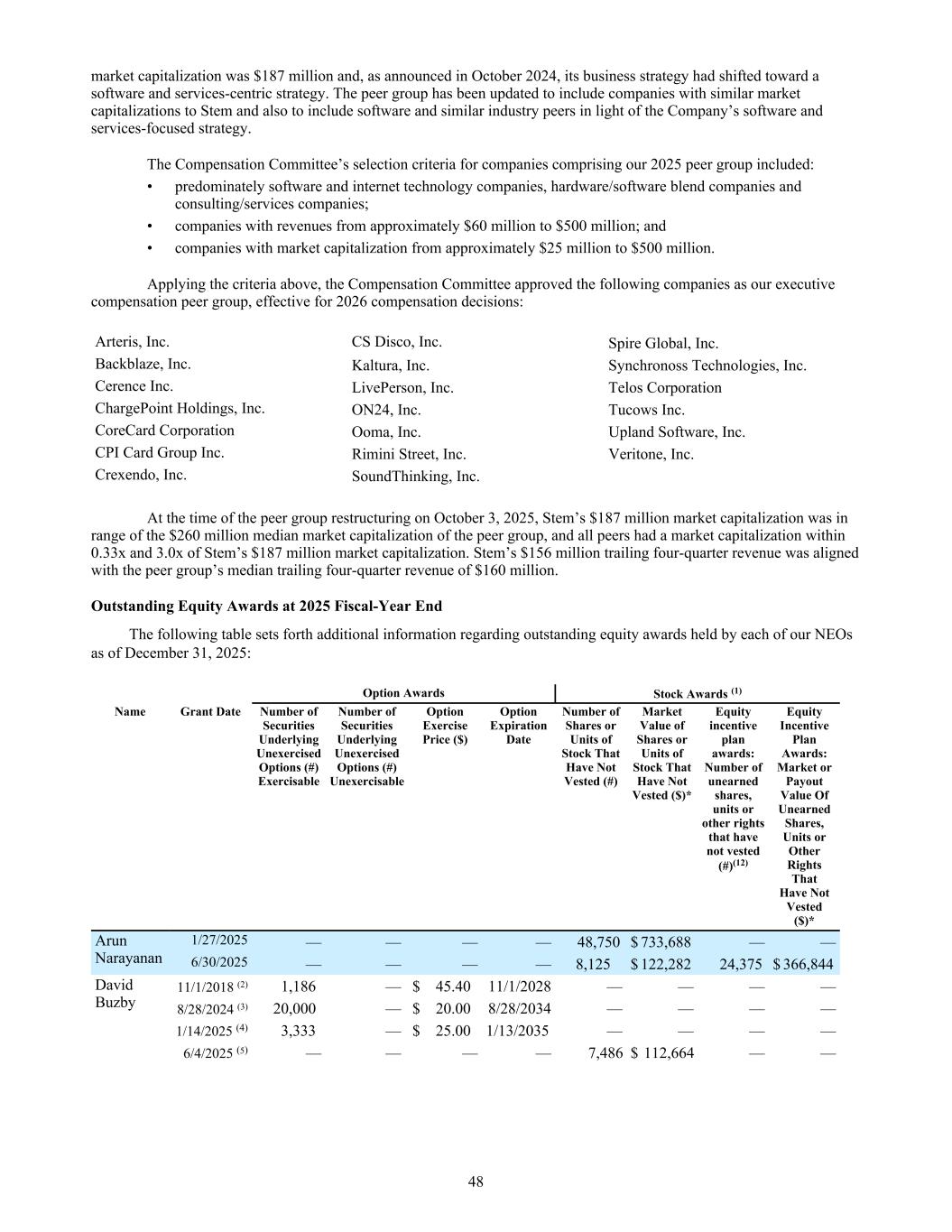
market capitalization was $187 million and, as announced in October 2024, its business strategy had shifted toward a software and services-centric strategy. The peer group has been updated to include companies with similar market capitalizations to Stem and also to include software and similar industry peers in light of the Company’s software and services-focused strategy. The Compensation Committee’s selection criteria for companies comprising our 2025 peer group included: • predominately software and internet technology companies, hardware/software blend companies and consulting/services companies; • companies with revenues from approximately $60 million to $500 million; and • companies with market capitalization from approximately $25 million to $500 million. Applying the criteria above, the Compensation Committee approved the following companies as our executive compensation peer group, effective for 2026 compensation decisions: Arteris, Inc. CS Disco, Inc. Spire Global, Inc. Backblaze, Inc. Kaltura, Inc. Synchronoss Technologies, Inc. Cerence Inc. LivePerson, Inc. Telos Corporation ChargePoint Holdings, Inc. ON24, Inc. Tucows Inc. CoreCard Corporation Ooma, Inc. Upland Software, Inc. CPI Card Group Inc. Rimini Street, Inc. Veritone, Inc. Crexendo, Inc. SoundThinking, Inc. At the time of the peer group restructuring on October 3, 2025, Stem’s $187 million market capitalization was in range of the $260 million median market capitalization of the peer group, and all peers had a market capitalization within 0.33x and 3.0x of Stem’s $187 million market capitalization. Stem’s $156 million trailing four-quarter revenue was aligned with the peer group’s median trailing four-quarter revenue of $160 million. Outstanding Equity Awards at 2025 Fiscal-Year End The following table sets forth additional information regarding outstanding equity awards held by each of our NEOs as of December 31, 2025: Option Awards Stock Awards (1) Name Grant Date Number of Securities Underlying Unexercised Options (#) Exercisable Number of Securities Underlying Unexercised Options (#) Unexercisable Option Exercise Price ($) Option Expiration Date Number of Shares or Units of Stock That Have Not Vested (#) Market Value of Shares or Units of Stock That Have Not Vested ($)* Equity incentive plan awards: Number of unearned shares, units or other rights that have not vested (#)(12) Equity Incentive Plan Awards: Market or Payout Value Of Unearned Shares, Units or Other Rights That Have Not Vested ($)* Arun Narayanan 1/27/2025 — — — — 48,750 $ 733,688 — — 6/30/2025 — — — — 8,125 $ 122,282 24,375 $ 366,844 David Buzby 11/1/2018 (2) 1,186 — $ 45.40 11/1/2028 — — — — 8/28/2024 (3) 20,000 — $ 20.00 8/28/2034 — — — — 1/14/2025 (4) 3,333 — $ 25.00 1/13/2035 — — — — 6/4/2025 (5) — — — — 7,486 $ 112,664 — — 48
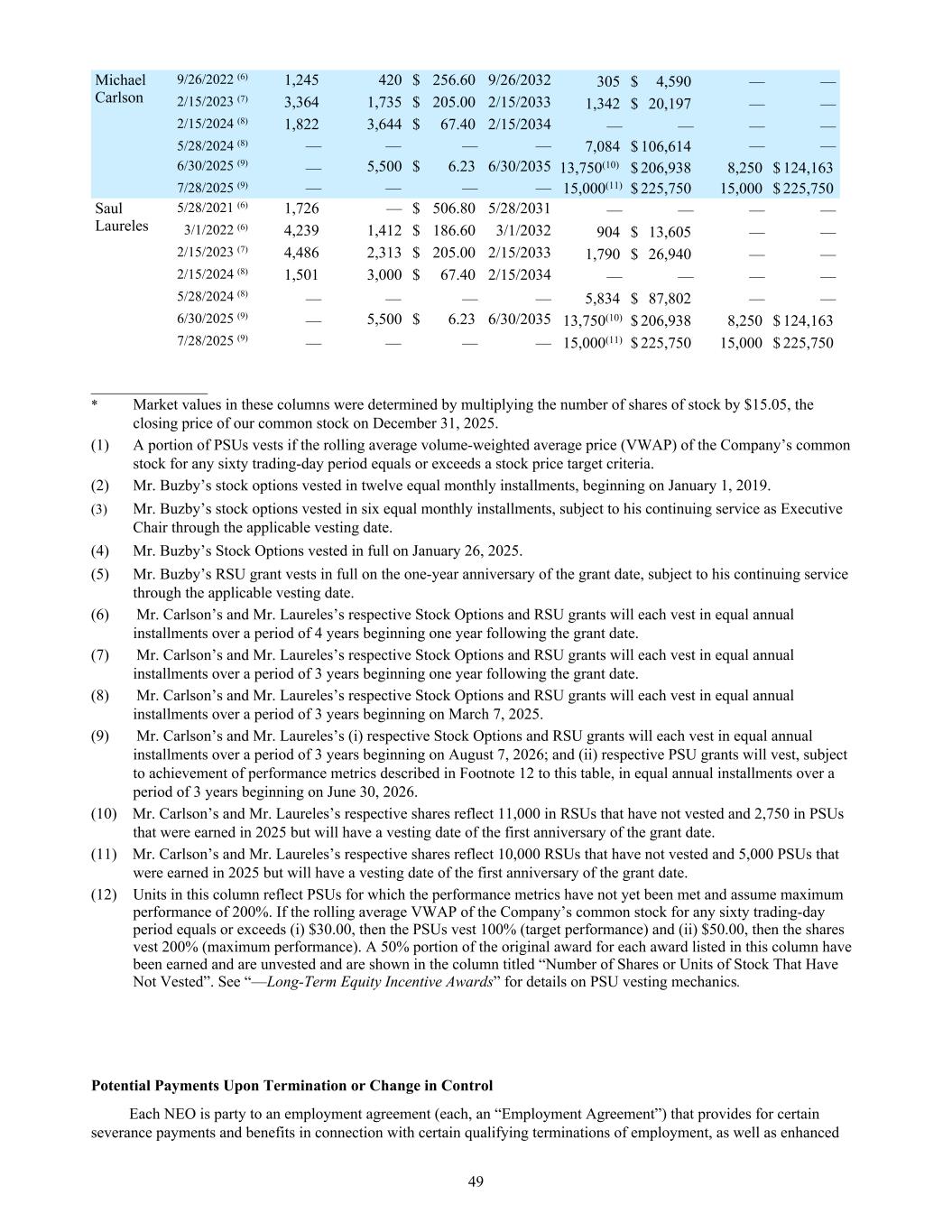
Michael Carlson 9/26/2022 (6) 1,245 420 $ 256.60 9/26/2032 305 $ 4,590 — — 2/15/2023 (7) 3,364 1,735 $ 205.00 2/15/2033 1,342 $ 20,197 — — 2/15/2024 (8) 1,822 3,644 $ 67.40 2/15/2034 — — — — 5/28/2024 (8) — — — — 7,084 $ 106,614 — — 6/30/2025 (9) — 5,500 $ 6.23 6/30/2035 13,750(10) $ 206,938 8,250 $ 124,163 7/28/2025 (9) — — — — 15,000(11) $ 225,750 15,000 $ 225,750 Saul Laureles 5/28/2021 (6) 1,726 — $ 506.80 5/28/2031 — — — — 3/1/2022 (6) 4,239 1,412 $ 186.60 3/1/2032 904 $ 13,605 — — 2/15/2023 (7) 4,486 2,313 $ 205.00 2/15/2033 1,790 $ 26,940 — — 2/15/2024 (8) 1,501 3,000 $ 67.40 2/15/2034 — — — — 5/28/2024 (8) — — — — 5,834 $ 87,802 — — 6/30/2025 (9) — 5,500 $ 6.23 6/30/2035 13,750(10) $ 206,938 8,250 $ 124,163 7/28/2025 (9) — — — — 15,000(11) $ 225,750 15,000 $ 225,750 _______________ * Market values in these columns were determined by multiplying the number of shares of stock by $15.05, the closing price of our common stock on December 31, 2025. (1) A portion of PSUs vests if the rolling average volume-weighted average price (VWAP) of the Company’s common stock for any sixty trading-day period equals or exceeds a stock price target criteria. (2) Mr. Buzby’s stock options vested in twelve equal monthly installments, beginning on January 1, 2019. (3) Mr. Buzby’s stock options vested in six equal monthly installments, subject to his continuing service as Executive Chair through the applicable vesting date. (4) Mr. Buzby’s Stock Options vested in full on January 26, 2025. (5) Mr. Buzby’s RSU grant vests in full on the one-year anniversary of the grant date, subject to his continuing service through the applicable vesting date. (6) Mr. Carlson’s and Mr. Laureles’s respective Stock Options and RSU grants will each vest in equal annual installments over a period of 4 years beginning one year following the grant date. (7) Mr. Carlson’s and Mr. Laureles’s respective Stock Options and RSU grants will each vest in equal annual installments over a period of 3 years beginning one year following the grant date. (8) Mr. Carlson’s and Mr. Laureles’s respective Stock Options and RSU grants will each vest in equal annual installments over a period of 3 years beginning on March 7, 2025. (9) Mr. Carlson’s and Mr. Laureles’s (i) respective Stock Options and RSU grants will each vest in equal annual installments over a period of 3 years beginning on August 7, 2026; and (ii) respective PSU grants will vest, subject to achievement of performance metrics described in Footnote 12 to this table, in equal annual installments over a period of 3 years beginning on June 30, 2026. (10) Mr. Carlson’s and Mr. Laureles’s respective shares reflect 11,000 in RSUs that have not vested and 2,750 in PSUs that were earned in 2025 but will have a vesting date of the first anniversary of the grant date. (11) Mr. Carlson’s and Mr. Laureles’s respective shares reflect 10,000 RSUs that have not vested and 5,000 PSUs that were earned in 2025 but will have a vesting date of the first anniversary of the grant date. (12) Units in this column reflect PSUs for which the performance metrics have not yet been met and assume maximum performance of 200%. If the rolling average VWAP of the Company’s common stock for any sixty trading-day period equals or exceeds (i) $30.00, then the PSUs vest 100% (target performance) and (ii) $50.00, then the shares vest 200% (maximum performance). A 50% portion of the original award for each award listed in this column have been earned and are unvested and are shown in the column titled “Number of Shares or Units of Stock That Have Not Vested”. See “—Long-Term Equity Incentive Awards” for details on PSU vesting mechanics. Potential Payments Upon Termination or Change in Control Each NEO is party to an employment agreement (each, an “Employment Agreement”) that provides for certain severance payments and benefits in connection with certain qualifying terminations of employment, as well as enhanced 49
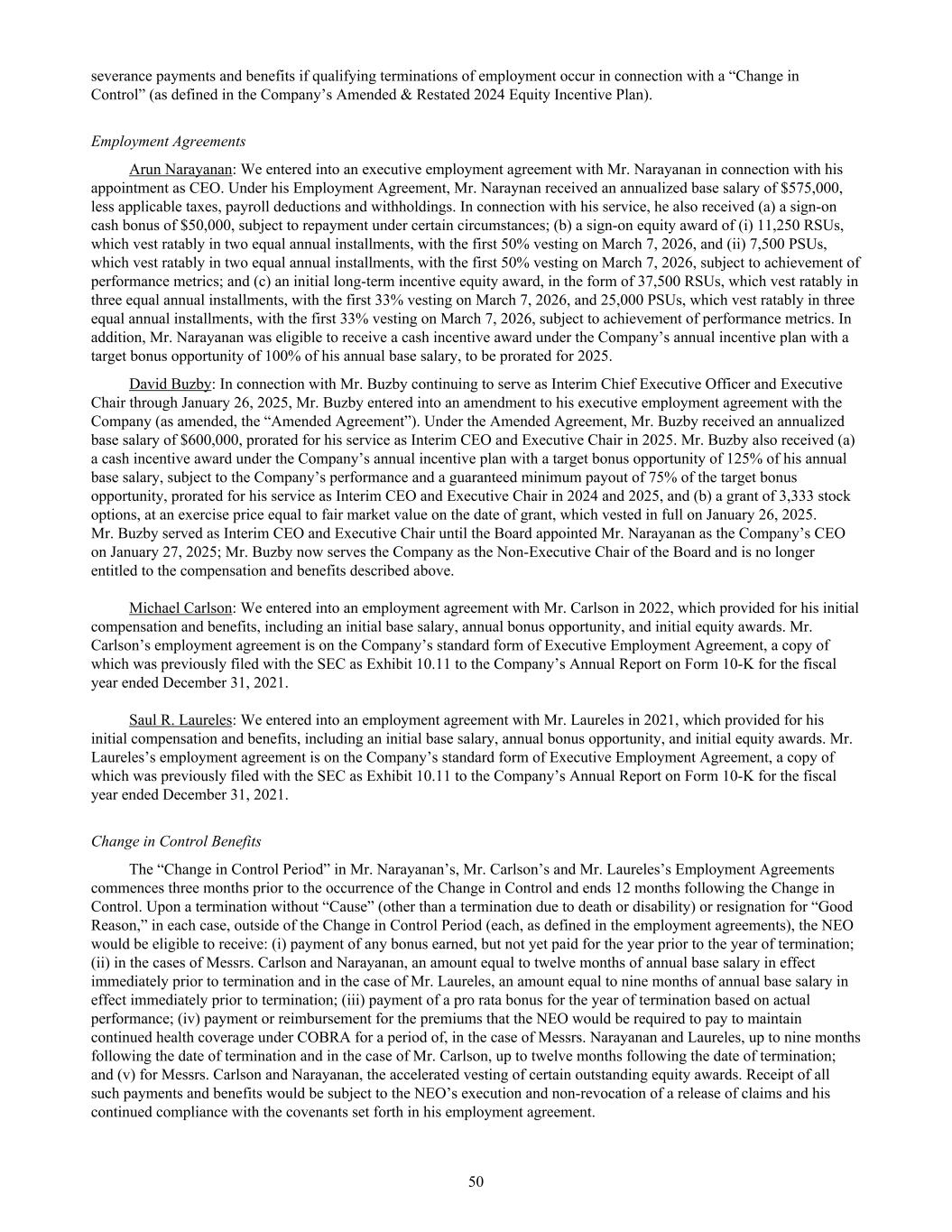
severance payments and benefits if qualifying terminations of employment occur in connection with a “Change in Control” (as defined in the Company’s Amended & Restated 2024 Equity Incentive Plan). Employment Agreements Arun Narayanan: We entered into an executive employment agreement with Mr. Narayanan in connection with his appointment as CEO. Under his Employment Agreement, Mr. Naraynan received an annualized base salary of $575,000, less applicable taxes, payroll deductions and withholdings. In connection with his service, he also received (a) a sign-on cash bonus of $50,000, subject to repayment under certain circumstances; (b) a sign-on equity award of (i) 11,250 RSUs, which vest ratably in two equal annual installments, with the first 50% vesting on March 7, 2026, and (ii) 7,500 PSUs, which vest ratably in two equal annual installments, with the first 50% vesting on March 7, 2026, subject to achievement of performance metrics; and (c) an initial long-term incentive equity award, in the form of 37,500 RSUs, which vest ratably in three equal annual installments, with the first 33% vesting on March 7, 2026, and 25,000 PSUs, which vest ratably in three equal annual installments, with the first 33% vesting on March 7, 2026, subject to achievement of performance metrics. In addition, Mr. Narayanan was eligible to receive a cash incentive award under the Company’s annual incentive plan with a target bonus opportunity of 100% of his annual base salary, to be prorated for 2025. David Buzby: In connection with Mr. Buzby continuing to serve as Interim Chief Executive Officer and Executive Chair through January 26, 2025, Mr. Buzby entered into an amendment to his executive employment agreement with the Company (as amended, the “Amended Agreement”). Under the Amended Agreement, Mr. Buzby received an annualized base salary of $600,000, prorated for his service as Interim CEO and Executive Chair in 2025. Mr. Buzby also received (a) a cash incentive award under the Company’s annual incentive plan with a target bonus opportunity of 125% of his annual base salary, subject to the Company’s performance and a guaranteed minimum payout of 75% of the target bonus opportunity, prorated for his service as Interim CEO and Executive Chair in 2024 and 2025, and (b) a grant of 3,333 stock options, at an exercise price equal to fair market value on the date of grant, which vested in full on January 26, 2025. Mr. Buzby served as Interim CEO and Executive Chair until the Board appointed Mr. Narayanan as the Company’s CEO on January 27, 2025; Mr. Buzby now serves the Company as the Non-Executive Chair of the Board and is no longer entitled to the compensation and benefits described above. Michael Carlson: We entered into an employment agreement with Mr. Carlson in 2022, which provided for his initial compensation and benefits, including an initial base salary, annual bonus opportunity, and initial equity awards. Mr. Carlson’s employment agreement is on the Company’s standard form of Executive Employment Agreement, a copy of which was previously filed with the SEC as Exhibit 10.11 to the Company’s Annual Report on Form 10-K for the fiscal year ended December 31, 2021. Saul R. Laureles: We entered into an employment agreement with Mr. Laureles in 2021, which provided for his initial compensation and benefits, including an initial base salary, annual bonus opportunity, and initial equity awards. Mr. Laureles’s employment agreement is on the Company’s standard form of Executive Employment Agreement, a copy of which was previously filed with the SEC as Exhibit 10.11 to the Company’s Annual Report on Form 10-K for the fiscal year ended December 31, 2021. Change in Control Benefits The “Change in Control Period” in Mr. Narayanan’s, Mr. Carlson’s and Mr. Laureles’s Employment Agreements commences three months prior to the occurrence of the Change in Control and ends 12 months following the Change in Control. Upon a termination without “Cause” (other than a termination due to death or disability) or resignation for “Good Reason,” in each case, outside of the Change in Control Period (each, as defined in the employment agreements), the NEO would be eligible to receive: (i) payment of any bonus earned, but not yet paid for the year prior to the year of termination; (ii) in the cases of Messrs. Carlson and Narayanan, an amount equal to twelve months of annual base salary in effect immediately prior to termination and in the case of Mr. Laureles, an amount equal to nine months of annual base salary in effect immediately prior to termination; (iii) payment of a pro rata bonus for the year of termination based on actual performance; (iv) payment or reimbursement for the premiums that the NEO would be required to pay to maintain continued health coverage under COBRA for a period of, in the case of Messrs. Narayanan and Laureles, up to nine months following the date of termination and in the case of Mr. Carlson, up to twelve months following the date of termination; and (v) for Messrs. Carlson and Narayanan, the accelerated vesting of certain outstanding equity awards. Receipt of all such payments and benefits would be subject to the NEO’s execution and non-revocation of a release of claims and his continued compliance with the covenants set forth in his employment agreement. 50
Upon a termination without Cause (other than a termination due to death or disability) or resignation for Good Reason, in each case, during the Change in Control Period, the NEO would be eligible to receive: (i) cash payment equal to, in the case of Mr. Laureles, one times the sum of his annual base salary plus target bonus and in the case of Messrs. Carlson and Narayanan, two times the sum of the NEO’s annual base salary plus target bonus; (ii) payment of any bonus earned, but not yet paid for the year prior to the year of termination; (iii) payment of a pro rata bonus for the year of termination based on actual performance; and (iv) payment or reimbursement for the premium that the NEO would be required to pay to maintain continued health coverage under COBRA for a period of, in the case of Messrs. Narayanan and Laureles, up to twelve months following the date of termination and in the case of Mr. Carlson, up to eighteen months following the date of termination. Receipt of all such payments and benefits would be subject to the NEO’s execution and non-revocation of a release of claims and his continued compliance with the covenants set forth in the employment agreements. The 2021 Plan Pursuant to the terms of the 2021 Equity Incentive Plan, and unless provided otherwise in an award agreement or other agreement between us or an affiliate and the participant, in the event of Change in Control (as defined in the 2021 Plan), our Board will take one or more of the following actions with respect to each outstanding award, contingent upon the closing or completion of the Change in Control: • arrange for the surviving corporation or acquiring corporation (or the surviving or acquiring corporation’s parent company) to assume or continue the award or to substitute a similar stock award for the award (including, but not limited to, an award to acquire the same consideration per share paid to the stockholders of the Company pursuant to the Change in Control); • arrange for the assignment of any reacquisition or repurchase rights held by us in respect of common stock issued pursuant to the award to the surviving corporation or acquiring corporation (or the surviving or acquiring corporation’s parent company); • accelerate the vesting, in whole or in part, of the award (and, if applicable, the time at which the award may be exercised) to a date prior to the effective time of such Change in Control as determined by our Board, with such award terminating if not exercised (if applicable) at or prior to the effective time of the Change in Control, and with such exercise reversed if the Change in Control does not become effective; • arrange for the lapse, in whole or in part, of any reacquisition or repurchase rights held by us with respect to the award; • cancel or arrange for the cancellation of the award, to the extent not vested or not exercised prior to the effective time of the Change in Control, in exchange for such cash consideration, if any, as our Board, in its reasonable determination, may consider appropriate as an approximation of the value of the cancelled award; and • cancel or arrange for the cancellation of the award, to the extent not vested or not exercised prior to the effective time of the Change in Control, in exchange for a payment equal to the excess, if any, of (A) the value in the Change in Control of the property the participant would have received upon the exercise of the award immediately prior to the effective time of the Change in Control, over (B) any exercise price payable by such holder in connection with such exercise. Our Board need not take the same action or actions with respect to all awards or portions thereof or with respect to all participants and may take different actions with respect to the vested and unvested portions of an award. In the absence of any affirmative determination by our Board at the time of a Change in Control, each outstanding award will be assumed or an equivalent award will be substituted by such successor corporation or a parent or subsidiary of such successor corporation, referred to as a successor corporation, unless the successor corporation does not agree to assume the award or to substitute an equivalent award, in which case the vesting of such award will accelerate in its entirety (along with, if applicable, the time at which the award may be exercised) to a date prior to the effective time of such Change in Control as our Board will determine (or, if our Board does not determine such a date, to the date that is five (5) days prior to the effective date of the Change in Control), with such award terminating if not exercised (if applicable) at or prior to the effective time of the Change in Control, and with such exercise reversed if the Change in Control does not become effective. 51
The 2024 Plan In the event of a Change in Control (as defined in the Amended & Restated 2024 Equity Incentive Plan), the Board will take one or more of the following actions with respect to each outstanding award, contingent upon the closing or completion of the Change in Control: • arrange for the surviving corporation or acquiring corporation (or the parent company thereof) to assume or continue the award or to substitute a similar award for the award; • arrange for the assignment of any reacquisition or repurchase rights held by the Company in respect of common stock issued pursuant to the award to the surviving corporation or acquiring corporation (or the parent company thereof); • accelerate the vesting, in whole or in part, of the award (and, if applicable, the time at which the award may be exercised) to a date prior to the effective time of such Change in Control as determined by the Board (or, if the Board will not determine such a date, to the date that is five days prior to the effective date of the Change in Control), with such award terminating if not exercised (if applicable) at or prior to the effective time of the Change in Control, and with such exercise reversed if the Change in Control does not become effective; • arrange for the lapse, in whole or in part, of any reacquisition or repurchase rights held by the Company with respect to the award; • cancel, to the extent not vested or not exercised prior to the effective time of the Change in Control, in exchange for such consideration (in cash, property, securities or a combination thereof), if any, as the Board, in its reasonable determination, may consider appropriate as an approximation of the value of the canceled award; and • cancel, to the extent not vested or not exercised prior to the effective time of the Change in Control, in exchange for a payment equal to the excess, if any, of (A) the value in the Change in Control of the property the participant would have received upon the exercise of the award immediately prior to the effective time of the Change in Control, over (B) any exercise price payable by such holder in connection with such exercise; provided, that the Board may cancel and terminate without payment any option or SAR with an exercise price equal to or in excess of the value of the shares of common stock subject to such option or SAR determined as of immediately prior to the Change in Control. The Board need not take the same action with respect to all awards or portions thereof or with respect to all participants and may take different actions with respect to the vested and unvested portions of an award. In the absence of any affirmative determination by the Board at the time of a Change in Control, each outstanding award will be assumed or an equivalent award will be substituted by such successor corporation or a parent or subsidiary thereof, unless such successor corporation does not agree to assume or substitute the award, in which case the vesting of such award will accelerate (along with, if applicable, the time at which the award may be exercised) to a date prior to the effective time of such Change in Control as the Board will determine (or, if the Board will not determine such a date, to the date that is five days prior to the effective date of the Change in Control), with such award terminating if not exercised (if applicable) at or prior to the effective time of the Change in Control, and with such exercise reversed if the Change in Control does not become effective. An award may be subject to additional acceleration of vesting and exercisability upon or after a Change in Control as may be provided in the award agreement for such award or as may be provided in any other written agreement with the participant, but in the absence of such provision, no such acceleration will occur. Other Compensation Plans Health and Welfare Plans and 401(k) Plan. The NEOs are eligible to participate in the Company’s employee benefit plans and programs, including medical and dental benefits, flexible spending accounts, long-term care benefits, and short- and long-term disability and life insurance, to the same extent as the Company’s other full-time employees, subject to the terms and eligibility requirements of those plans. The NEOs also participate in our 401(k) plan, subject to limits imposed by the Internal Revenue Code, to the same extent as the Company’s other full-time employees. Other Benefits. We do not maintain any defined benefit pension plans or any nonqualified deferred compensation plans. 52
Limited Perquisites. We provide only limited perquisites to our NEOs. None of our NEOs (other than David Buzby, in his capacity as Interim CEO), received $10,000 or more of perquisites or other personal benefits from the Company in 2025. Stock Ownership Guidelines In April 2022, the Compensation Committee adopted Stock Ownership Guidelines that apply to our executive officers and directors. The guidelines are intended to further the Company’s goal of promoting sound corporate governance practices by aligning the financial interests of the executive officers and directors with those of our stockholders. Under the guidelines, our CEO is expected to maintain ownership of Stem common stock representing five times his annual base salary, and each other executive officer is expected to maintain ownership of Stem common stock representing two times his or her annual base salary. Board members are each expected to maintain ownership of Stem common stock representing four times his or her annual cash retainer. Under the guidelines, our executives and board members have five years to satisfy the ownership requirements. During that time, directors and executive officers are expected to retain 50% of the net shares acquired upon stock option exercises and RSU vesting, until they achieve their minimum requirement under the guidelines. The following shares count towards the satisfaction of the Stock Ownership Guidelines for our directors and officers: • shares owned outright by a director or executive officer (including through open market purchases or acquired and held upon vesting of Company equity awards); • shares owned jointly with, or separately by, a director’s or executive’s spouse and other immediate family members residing in the same household; and • Shares held in a trust established by the director or executive, their spouse and/or children. The following shares do not count towards the satisfaction of the Stock Ownership Guidelines for our directors and officers: • unvested restricted stock, RSUs or PSUs; • shares pledged as collateral for a loan (which is prohibited for our directors and executive officers under our insider trading policy); • unexercised stock options (whether vested or unvested); and • long-term equity incentive or performance awards that may be settled in cash (whether vested or unvested). As of March 31, 2026, all of our NEOs and board members were in compliance with our stock ownership guidelines. Insider Trading Policy and Prohibitions on Hedging and Pledging In October 2025, we adopted a revised insider trading policy (the “Insider Trading Policy”) and procedures governing the purchase, sale, and other transactions in Company securities by the Company’s directors, officers and employees, that we believe are reasonably designed to promote compliance with insider trading laws, rules, and regulations and NYSE listing standards. Our Insider Trading Policy also applies to certain related persons of individuals covered by the Insider Trading Policy, including family members, other members of a person’s household and entities controlled by a person covered by the Insider Trading Policy. We may also determine that other persons, such as contractors or consultants that have access to material nonpublic information, should be subject to the Insider Trading Policy. Persons subject to our Insider Trading Policy are prohibited from trading while aware of material, non-public information. The Insider Trading Policy also prohibits for all persons subject to the Insider Trading Policy (a) short-term trading; (b) short sales; (c) transactions involving publicly traded options or other derivatives, such as trading in puts or calls with respect to Company securities and (d) hedging or monetization transactions. The Insider Trading Policy provides for restricted periods and preclearance procedures for our directors, executive officers and certain specified employees. Further, in addition to the restrictions noted above, our directors, executive officers and certain specified employees are prohibited at any time from: • purchasing, or carrying, Stem securities on margin; • pledging Stem securities as collateral; • placing a “limit” order or a “stop loss” order; and 53
• engaging in hedging transactions or speculative transactions involving Stem securities, including, but not limited to short sales, buying or selling publicly-traded options (including writing covered calls) and entering into any other type of derivative arrangement that has a similar economic effect. While our Insider Trading Policy does not prohibit Stem employees who are not directors, executive officers or the specified employees from including Stem securities in a margin account or pledging Stem securities as collateral for a loan, the Insider Trading Policy encourages individuals to exercise caution when doing so. In addition, from time to time, the Company may engage in transactions in its own securities, including share issuances and repurchases. The Company’s practices with respect to share issuances and repurchases, which are overseen by the Finance and Legal departments (and, if appropriate, approved by the Board or appropriate committee), are designed to promote compliance with applicable insider trading and other securities laws, rules, regulations, and NYSE listing standards. Transactions pursuant to equity-based compensation arrangements are conducted in accordance with the terms of the plans and agreements. For more information, please see the description of our insider trading policies and procedures, which is included as Exhibit 19 in our Annual Report on Form 10-K for the year ended December 31, 2025. Executive Compensation Recoupment Policy We adopted a clawback policy in October 2023 that is intended to comply with the requirements of NYSE Listing Standard 303A.14 implementing Rule 10D-1 under the Exchange Act. In the event the Company is required to prepare an accounting restatement of the Company’s financial statements due to material non-compliance with any financial reporting requirement under the federal securities laws, the Company will recover the excess incentive-based compensation received by any covered executive, which includes former executives and the NEOs, during the prior three fiscal years that exceeds the amount that the executive otherwise would have received had the incentive-based compensation been determined based on the restated financial statements. Our clawback policy is filed as Exhibit 97 to our Annual Report on Form 10-K for the year ended December 31, 2025. Equity Grant Timing The Compensation Committee approves and grants annual equity awards at approximately the same time each year, in late February. The Compensation Committee may also consider and approve interim or mid-year grants from time to time based on business needs, such as when a new executive joins the Company. The Committee does not take material nonpublic information into account when determining the timing and terms of equity awards and does not time the disclosure of material nonpublic information for the purpose of affecting the value of executive compensation. During 2025, the Compensation Committee did grant stock option awards to our named executive officers within the period beginning four business days before our filing of a periodic report on Form 10-K or Form 10-Q or the filing or furnishing of a current report on Form 8-K that disclosed material nonpublic information and ending one business day after the filing or furnishing of such report. The following information regarding such option grants is provided in accordance with SEC rules: Name and Position Grant Date Number of Securities Underlying Award Exercise Price Grant Date Fair Value Percentage Change in Closing Market Price of Securities Underlying the Award Between the Trading Day Ending Immediately Prior to the Disclosure of Material Nonpublic Information and the Trading Day Beginning Immediately Following the Disclosure of Material Nonpublic Information David Buzby 1/14/2025 3,333 $ 25.00 $ 10,075 4 % Michael Carlson 6/30/2025 5,500 $ 6.23 $ 29,095 (1.08) % and 33.9% Saul Laureles 6/30/2025 5,500 $ 6.23 $ 29,095 (1.08) % and 33.9% 54
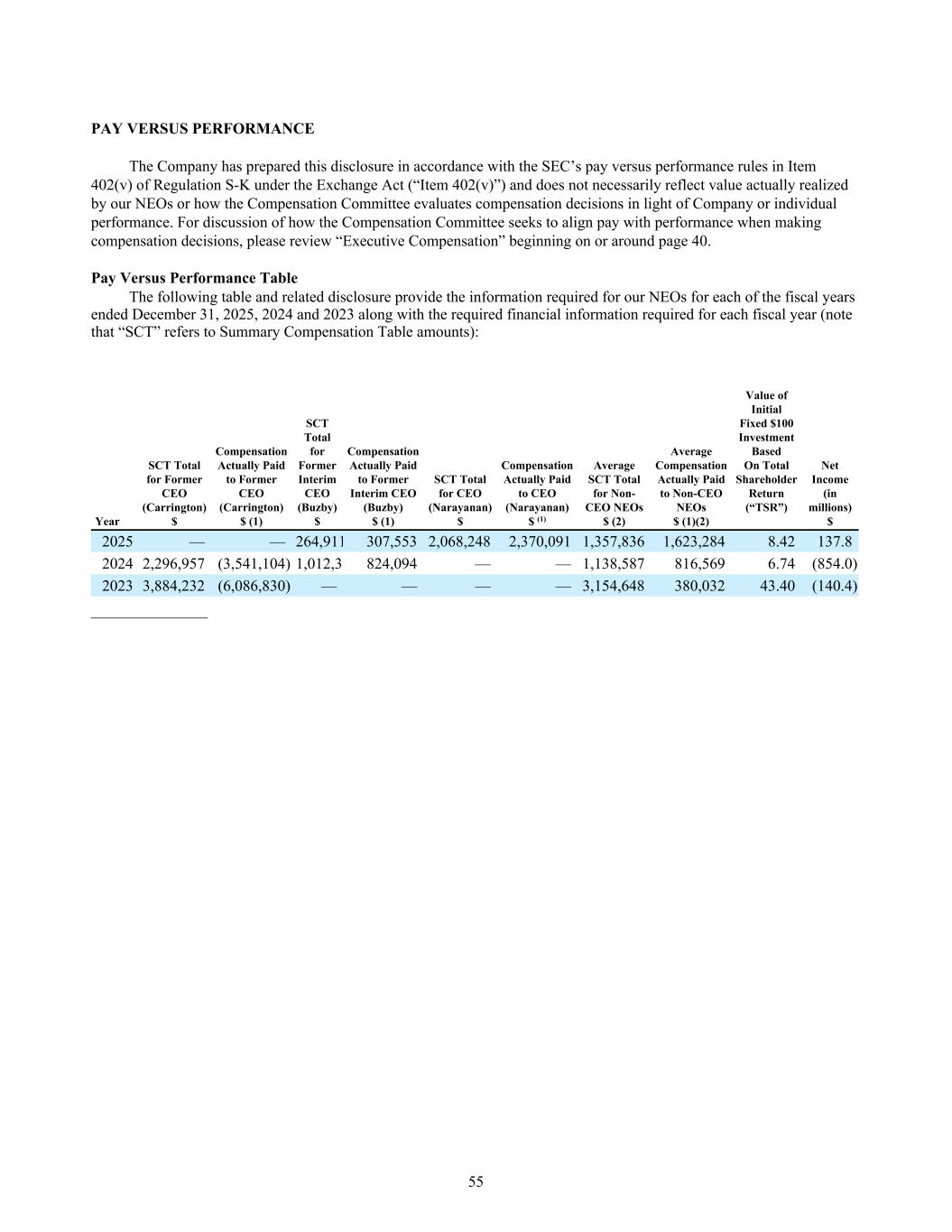
PAY VERSUS PERFORMANCE The Company has prepared this disclosure in accordance with the SEC’s pay versus performance rules in Item 402(v) of Regulation S-K under the Exchange Act (“Item 402(v)”) and does not necessarily reflect value actually realized by our NEOs or how the Compensation Committee evaluates compensation decisions in light of Company or individual performance. For discussion of how the Compensation Committee seeks to align pay with performance when making compensation decisions, please review “Executive Compensation” beginning on or around page 40. Pay Versus Performance Table The following table and related disclosure provide the information required for our NEOs for each of the fiscal years ended December 31, 2025, 2024 and 2023 along with the required financial information required for each fiscal year (note that “SCT” refers to Summary Compensation Table amounts): Year SCT Total for Former CEO (Carrington) $ Compensation Actually Paid to Former CEO (Carrington) $ (1) SCT Total for Former Interim CEO (Buzby) $ Compensation Actually Paid to Former Interim CEO (Buzby) $ (1) SCT Total for CEO (Narayanan) $ Compensation Actually Paid to CEO (Narayanan) $ (1) Average SCT Total for Non- CEO NEOs $ (2) Average Compensation Actually Paid to Non-CEO NEOs $ (1)(2) Value of Initial Fixed $100 Investment Based On Total Shareholder Return (“TSR”) Net Income (in millions) $ 2025 — — 264,911 307,553 2,068,248 2,370,091 1,357,836 1,623,284 8.42 137.8 2024 2,296,957 (3,541,104) 1,012,318 824,094 — — 1,138,587 816,569 6.74 (854.0) 2023 3,884,232 (6,086,830) — — — — 3,154,648 380,032 43.40 (140.4) _______________ 55
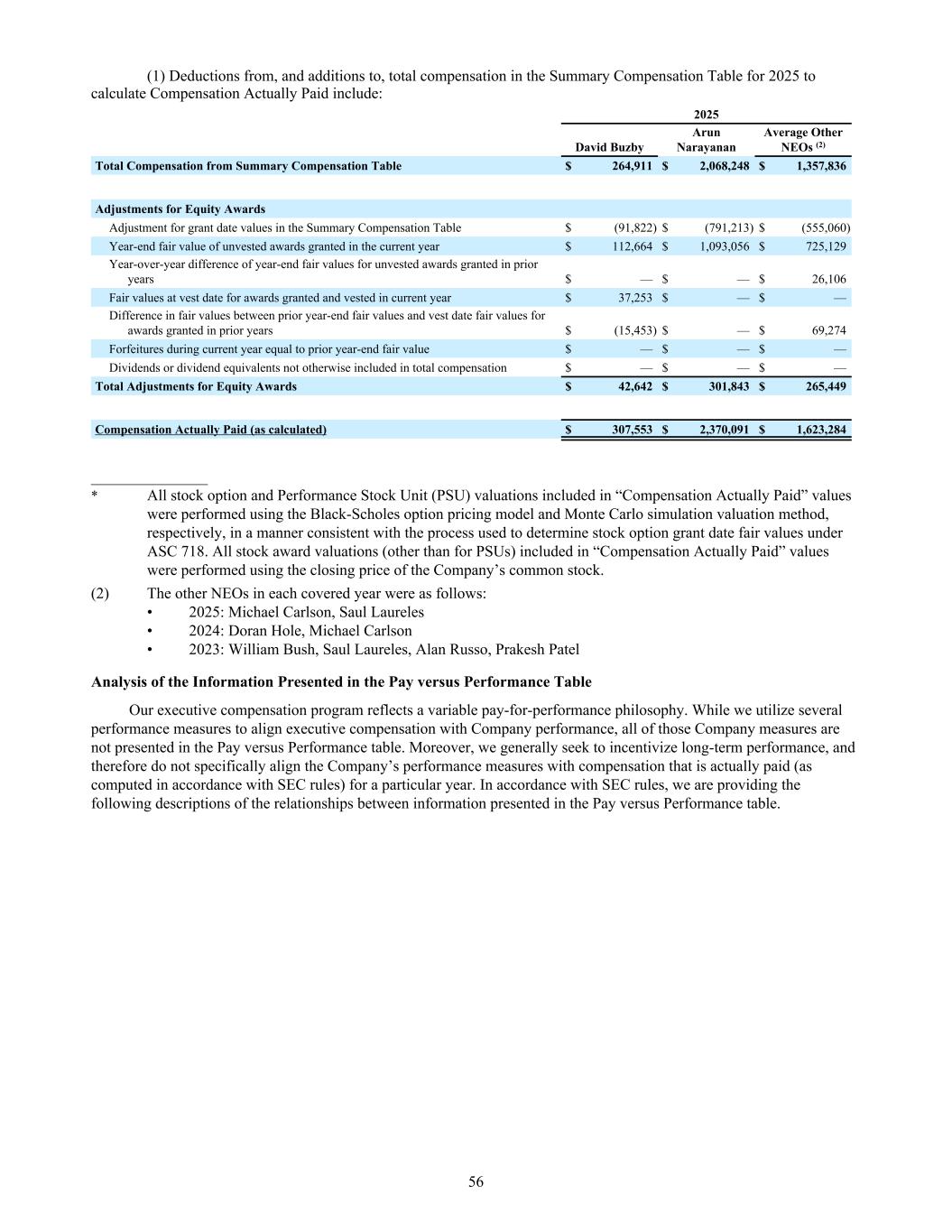
(1) Deductions from, and additions to, total compensation in the Summary Compensation Table for 2025 to calculate Compensation Actually Paid include: 2025 David Buzby Arun Narayanan Average Other NEOs (2) Total Compensation from Summary Compensation Table $ 264,911 $ 2,068,248 $ 1,357,836 Adjustments for Equity Awards Adjustment for grant date values in the Summary Compensation Table $ (91,822) $ (791,213) $ (555,060) Year-end fair value of unvested awards granted in the current year $ 112,664 $ 1,093,056 $ 725,129 Year-over-year difference of year-end fair values for unvested awards granted in prior years $ — $ — $ 26,106 Fair values at vest date for awards granted and vested in current year $ 37,253 $ — $ — Difference in fair values between prior year-end fair values and vest date fair values for awards granted in prior years $ (15,453) $ — $ 69,274 Forfeitures during current year equal to prior year-end fair value $ — $ — $ — Dividends or dividend equivalents not otherwise included in total compensation $ — $ — $ — Total Adjustments for Equity Awards $ 42,642 $ 301,843 $ 265,449 Compensation Actually Paid (as calculated) $ 307,553 $ 2,370,091 $ 1,623,284 _______________ * All stock option and Performance Stock Unit (PSU) valuations included in “Compensation Actually Paid” values were performed using the Black-Scholes option pricing model and Monte Carlo simulation valuation method, respectively, in a manner consistent with the process used to determine stock option grant date fair values under ASC 718. All stock award valuations (other than for PSUs) included in “Compensation Actually Paid” values were performed using the closing price of the Company’s common stock. (2) The other NEOs in each covered year were as follows: • 2025: Michael Carlson, Saul Laureles • 2024: Doran Hole, Michael Carlson • 2023: William Bush, Saul Laureles, Alan Russo, Prakesh Patel Analysis of the Information Presented in the Pay versus Performance Table Our executive compensation program reflects a variable pay-for-performance philosophy. While we utilize several performance measures to align executive compensation with Company performance, all of those Company measures are not presented in the Pay versus Performance table. Moreover, we generally seek to incentivize long-term performance, and therefore do not specifically align the Company’s performance measures with compensation that is actually paid (as computed in accordance with SEC rules) for a particular year. In accordance with SEC rules, we are providing the following descriptions of the relationships between information presented in the Pay versus Performance table. 56
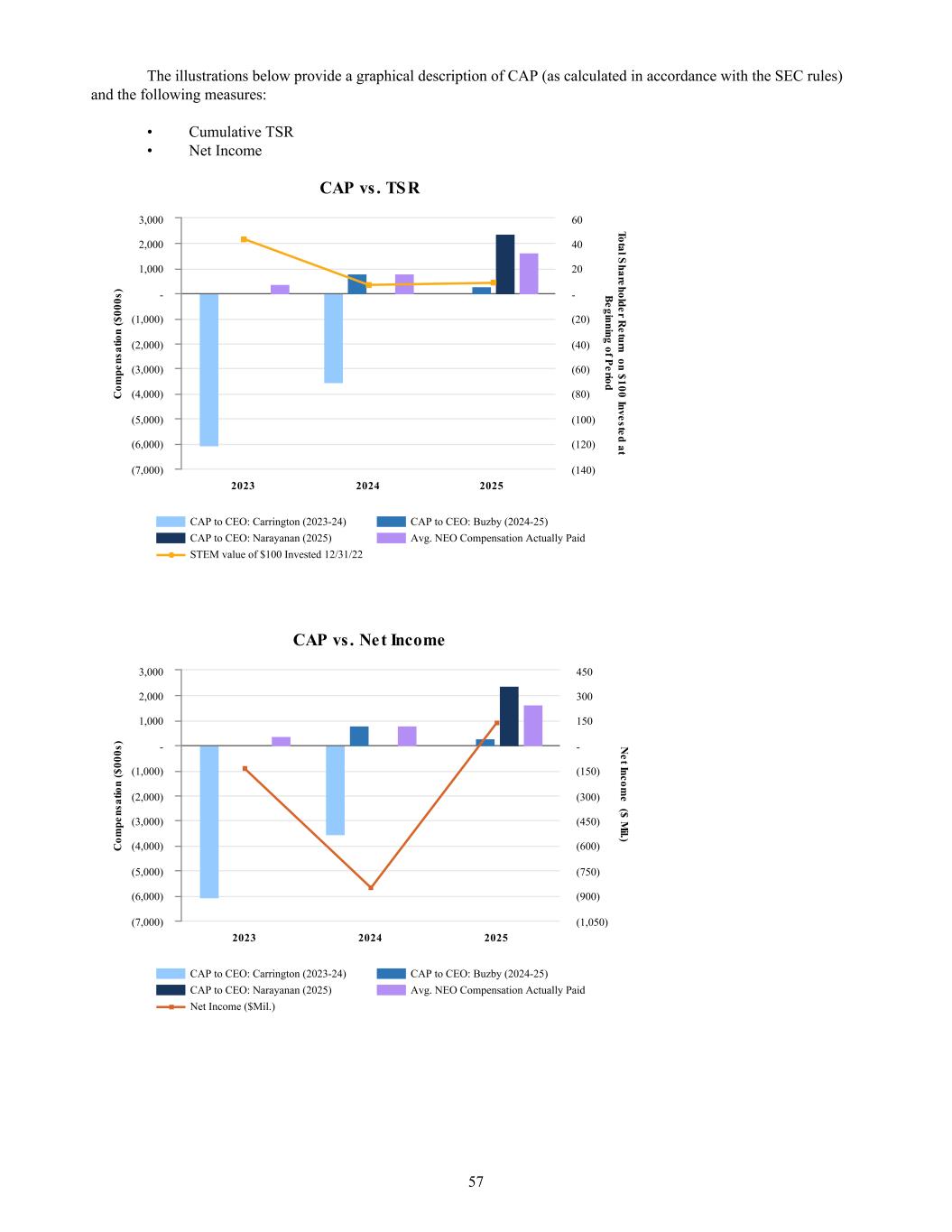
The illustrations below provide a graphical description of CAP (as calculated in accordance with the SEC rules) and the following measures: • Cumulative TSR • Net Income C om pe ns at io n ($ 00 0s ) Total S hareholder R eturn on $100 Invested at B eginning of P eriod CAP vs . TSR CAP to CEO: Carrington (2023-24) CAP to CEO: Buzby (2024-25) CAP to CEO: Narayanan (2025) Avg. NEO Compensation Actually Paid STEM value of $100 Invested 12/31/22 2023 2024 2025 (7,000) (6,000) (5,000) (4,000) (3,000) (2,000) (1,000) - 1,000 2,000 3,000 (140) (120) (100) (80) (60) (40) (20) - 20 40 60 C om pe ns at io n ($ 00 0s ) N et Incom e ($ M il.) CAP vs . Net Income CAP to CEO: Carrington (2023-24) CAP to CEO: Buzby (2024-25) CAP to CEO: Narayanan (2025) Avg. NEO Compensation Actually Paid Net Income ($Mil.) 2023 2024 2025 (7,000) (6,000) (5,000) (4,000) (3,000) (2,000) (1,000) - 1,000 2,000 3,000 (1,050) (900) (750) (600) (450) (300) (150) - 150 300 450 57
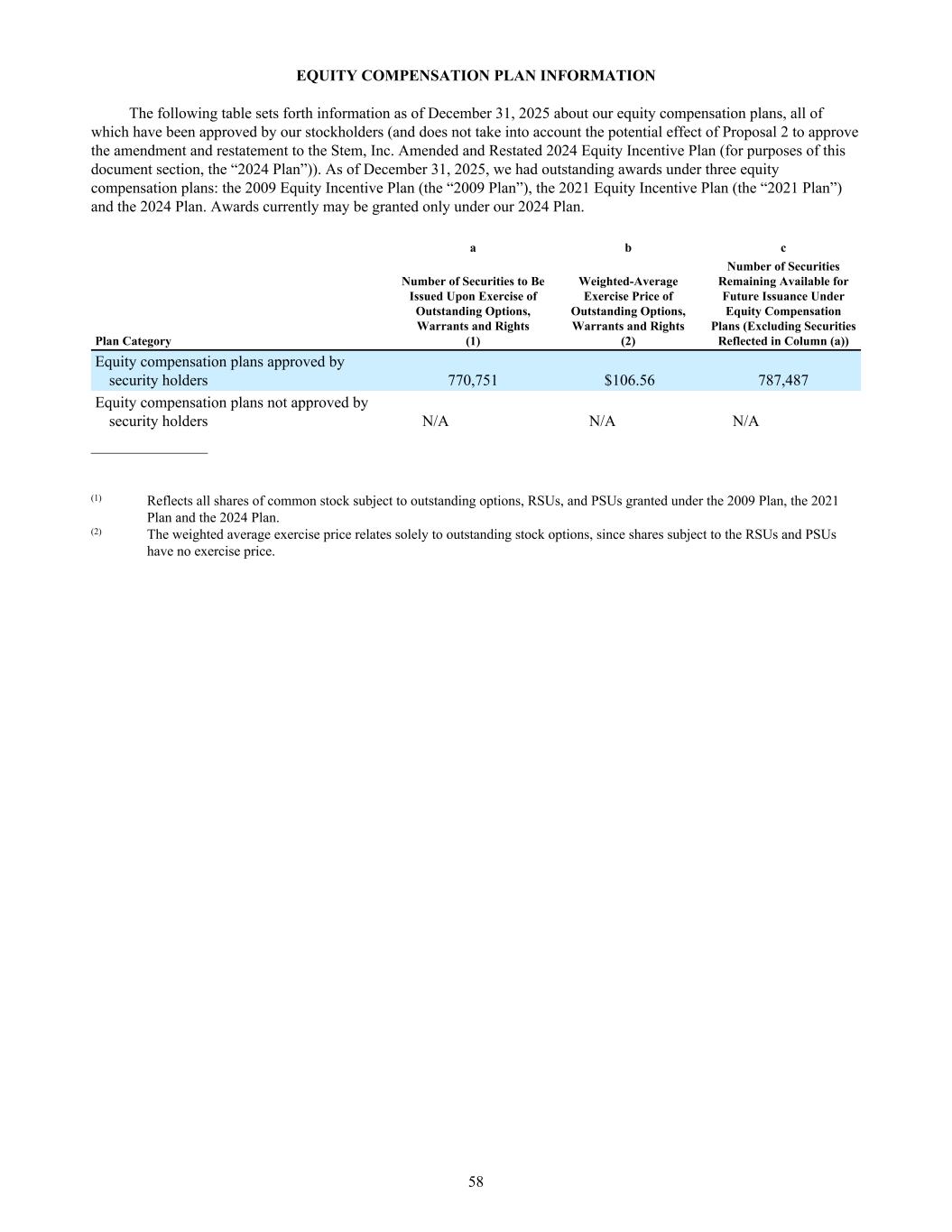
EQUITY COMPENSATION PLAN INFORMATION The following table sets forth information as of December 31, 2025 about our equity compensation plans, all of which have been approved by our stockholders (and does not take into account the potential effect of Proposal 2 to approve the amendment and restatement to the Stem, Inc. Amended and Restated 2024 Equity Incentive Plan (for purposes of this document section, the “2024 Plan”)). As of December 31, 2025, we had outstanding awards under three equity compensation plans: the 2009 Equity Incentive Plan (the “2009 Plan”), the 2021 Equity Incentive Plan (the “2021 Plan”) and the 2024 Plan. Awards currently may be granted only under our 2024 Plan. a b c Plan Category Number of Securities to Be Issued Upon Exercise of Outstanding Options, Warrants and Rights (1) Weighted-Average Exercise Price of Outstanding Options, Warrants and Rights (2) Number of Securities Remaining Available for Future Issuance Under Equity Compensation Plans (Excluding Securities Reflected in Column (a)) Equity compensation plans approved by security holders 770,751 $106.56 787,487 Equity compensation plans not approved by security holders N/A N/A N/A _______________ (1) Reflects all shares of common stock subject to outstanding options, RSUs, and PSUs granted under the 2009 Plan, the 2021 Plan and the 2024 Plan. (2) The weighted average exercise price relates solely to outstanding stock options, since shares subject to the RSUs and PSUs have no exercise price. 58
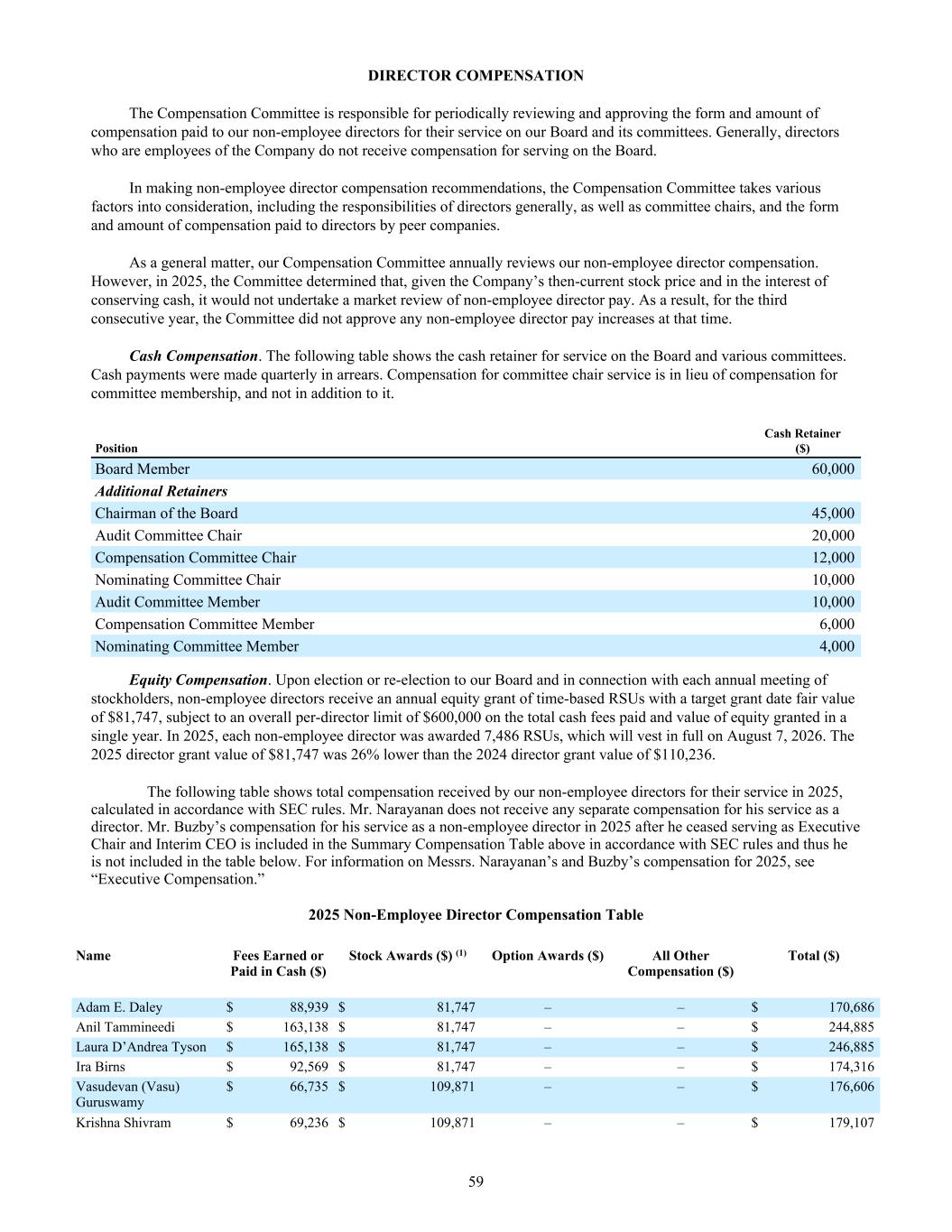
DIRECTOR COMPENSATION The Compensation Committee is responsible for periodically reviewing and approving the form and amount of compensation paid to our non-employee directors for their service on our Board and its committees. Generally, directors who are employees of the Company do not receive compensation for serving on the Board. In making non-employee director compensation recommendations, the Compensation Committee takes various factors into consideration, including the responsibilities of directors generally, as well as committee chairs, and the form and amount of compensation paid to directors by peer companies. As a general matter, our Compensation Committee annually reviews our non-employee director compensation. However, in 2025, the Committee determined that, given the Company’s then-current stock price and in the interest of conserving cash, it would not undertake a market review of non-employee director pay. As a result, for the third consecutive year, the Committee did not approve any non-employee director pay increases at that time. Cash Compensation. The following table shows the cash retainer for service on the Board and various committees. Cash payments were made quarterly in arrears. Compensation for committee chair service is in lieu of compensation for committee membership, and not in addition to it. Position Cash Retainer ($) Board Member 60,000 Additional Retainers Chairman of the Board 45,000 Audit Committee Chair 20,000 Compensation Committee Chair 12,000 Nominating Committee Chair 10,000 Audit Committee Member 10,000 Compensation Committee Member 6,000 Nominating Committee Member 4,000 Equity Compensation. Upon election or re-election to our Board and in connection with each annual meeting of stockholders, non-employee directors receive an annual equity grant of time-based RSUs with a target grant date fair value of $81,747, subject to an overall per-director limit of $600,000 on the total cash fees paid and value of equity granted in a single year. In 2025, each non-employee director was awarded 7,486 RSUs, which will vest in full on August 7, 2026. The 2025 director grant value of $81,747 was 26% lower than the 2024 director grant value of $110,236. The following table shows total compensation received by our non-employee directors for their service in 2025, calculated in accordance with SEC rules. Mr. Narayanan does not receive any separate compensation for his service as a director. Mr. Buzby’s compensation for his service as a non-employee director in 2025 after he ceased serving as Executive Chair and Interim CEO is included in the Summary Compensation Table above in accordance with SEC rules and thus he is not included in the table below. For information on Messrs. Narayanan’s and Buzby’s compensation for 2025, see “Executive Compensation.” 2025 Non-Employee Director Compensation Table Name Fees Earned or Paid in Cash ($) Stock Awards ($) (1) Option Awards ($) All Other Compensation ($) Total ($) Adam E. Daley $ 88,939 $ 81,747 – – $ 170,686 Anil Tammineedi $ 163,138 $ 81,747 – – $ 244,885 Laura D’Andrea Tyson $ 165,138 $ 81,747 – – $ 246,885 Ira Birns $ 92,569 $ 81,747 – – $ 174,316 Vasudevan (Vasu) Guruswamy $ 66,735 $ 109,871 – – $ 176,606 Krishna Shivram $ 69,236 $ 109,871 – – $ 179,107 59
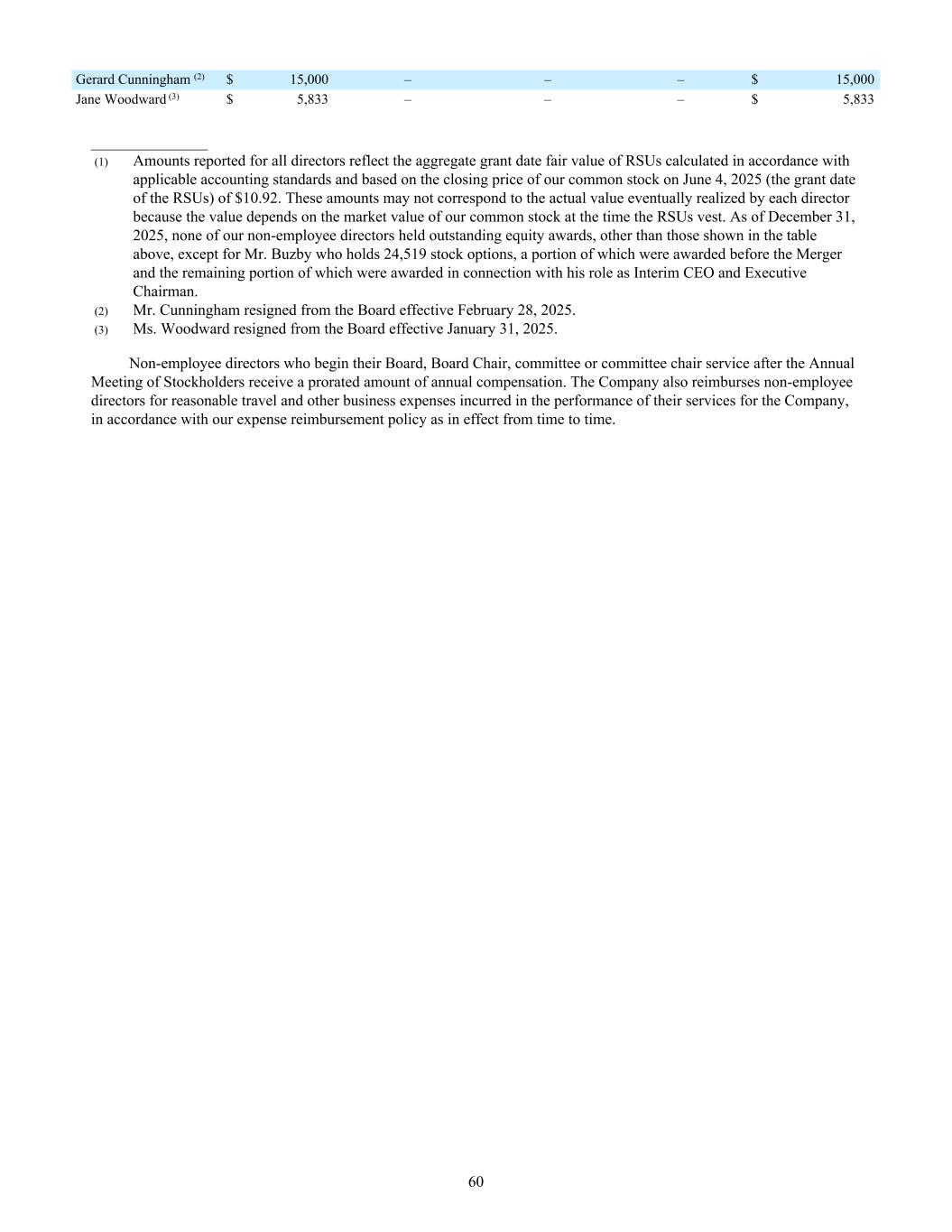
Gerard Cunningham (2) $ 15,000 – – – $ 15,000 Jane Woodward (3) $ 5,833 – – – $ 5,833 _______________ (1) Amounts reported for all directors reflect the aggregate grant date fair value of RSUs calculated in accordance with applicable accounting standards and based on the closing price of our common stock on June 4, 2025 (the grant date of the RSUs) of $10.92. These amounts may not correspond to the actual value eventually realized by each director because the value depends on the market value of our common stock at the time the RSUs vest. As of December 31, 2025, none of our non-employee directors held outstanding equity awards, other than those shown in the table above, except for Mr. Buzby who holds 24,519 stock options, a portion of which were awarded before the Merger and the remaining portion of which were awarded in connection with his role as Interim CEO and Executive Chairman. (2) Mr. Cunningham resigned from the Board effective February 28, 2025. (3) Ms. Woodward resigned from the Board effective January 31, 2025. Non-employee directors who begin their Board, Board Chair, committee or committee chair service after the Annual Meeting of Stockholders receive a prorated amount of annual compensation. The Company also reimburses non-employee directors for reasonable travel and other business expenses incurred in the performance of their services for the Company, in accordance with our expense reimbursement policy as in effect from time to time. 60
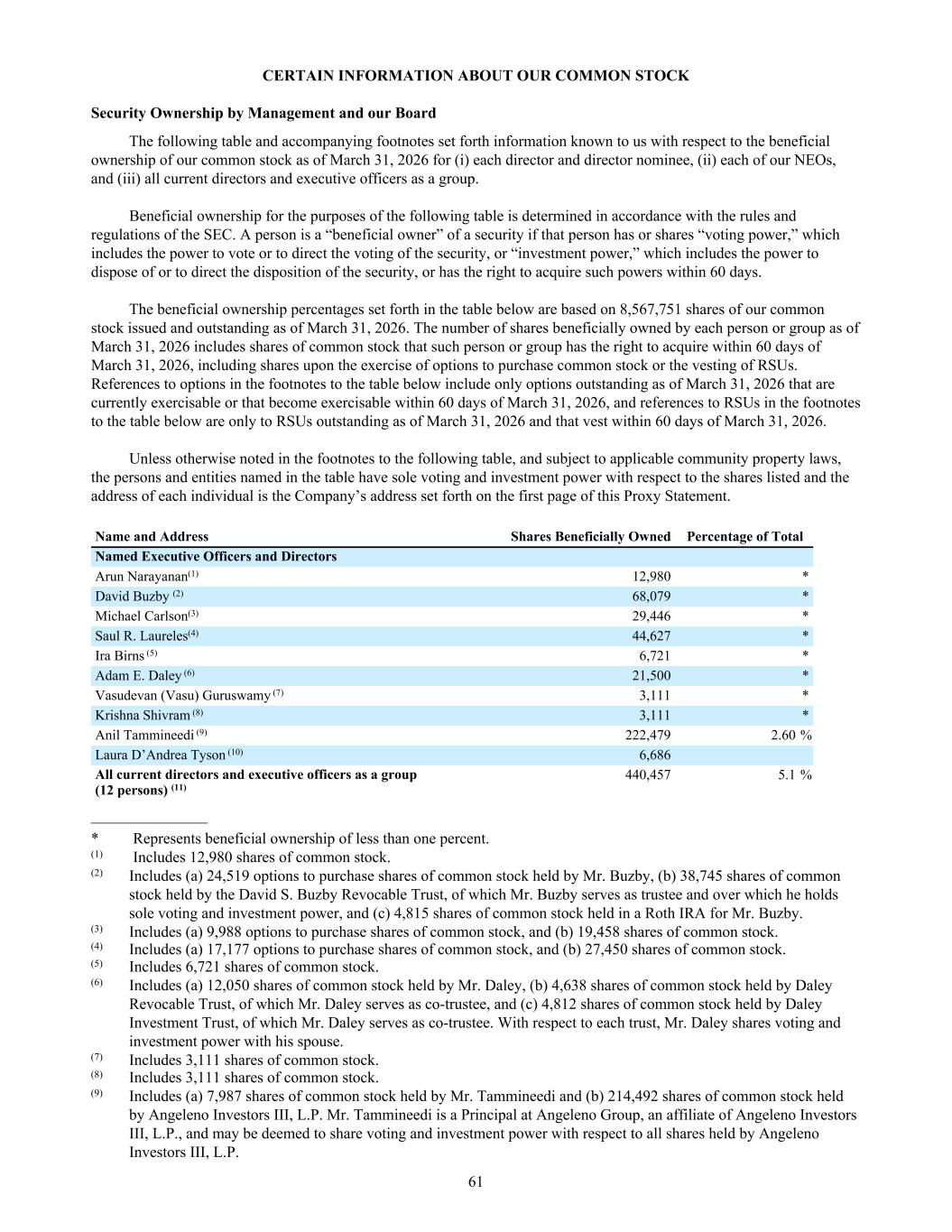
CERTAIN INFORMATION ABOUT OUR COMMON STOCK Security Ownership by Management and our Board The following table and accompanying footnotes set forth information known to us with respect to the beneficial ownership of our common stock as of March 31, 2026 for (i) each director and director nominee, (ii) each of our NEOs, and (iii) all current directors and executive officers as a group. Beneficial ownership for the purposes of the following table is determined in accordance with the rules and regulations of the SEC. A person is a “beneficial owner” of a security if that person has or shares “voting power,” which includes the power to vote or to direct the voting of the security, or “investment power,” which includes the power to dispose of or to direct the disposition of the security, or has the right to acquire such powers within 60 days. The beneficial ownership percentages set forth in the table below are based on 8,567,751 shares of our common stock issued and outstanding as of March 31, 2026. The number of shares beneficially owned by each person or group as of March 31, 2026 includes shares of common stock that such person or group has the right to acquire within 60 days of March 31, 2026, including shares upon the exercise of options to purchase common stock or the vesting of RSUs. References to options in the footnotes to the table below include only options outstanding as of March 31, 2026 that are currently exercisable or that become exercisable within 60 days of March 31, 2026, and references to RSUs in the footnotes to the table below are only to RSUs outstanding as of March 31, 2026 and that vest within 60 days of March 31, 2026. Unless otherwise noted in the footnotes to the following table, and subject to applicable community property laws, the persons and entities named in the table have sole voting and investment power with respect to the shares listed and the address of each individual is the Company’s address set forth on the first page of this Proxy Statement. Name and Address Shares Beneficially Owned Percentage of Total Named Executive Officers and Directors Arun Narayanan(1) 12,980 * David Buzby (2) 68,079 * Michael Carlson(3) 29,446 * Saul R. Laureles(4) 44,627 * Ira Birns (5) 6,721 * Adam E. Daley (6) 21,500 * Vasudevan (Vasu) Guruswamy (7) 3,111 * Krishna Shivram (8) 3,111 * Anil Tammineedi (9) 222,479 2.60 % Laura D’Andrea Tyson (10) 6,686 All current directors and executive officers as a group (12 persons) (11) 440,457 5.1 % _______________ * Represents beneficial ownership of less than one percent. (1) Includes 12,980 shares of common stock. (2) Includes (a) 24,519 options to purchase shares of common stock held by Mr. Buzby, (b) 38,745 shares of common stock held by the David S. Buzby Revocable Trust, of which Mr. Buzby serves as trustee and over which he holds sole voting and investment power, and (c) 4,815 shares of common stock held in a Roth IRA for Mr. Buzby. (3) Includes (a) 9,988 options to purchase shares of common stock, and (b) 19,458 shares of common stock. (4) Includes (a) 17,177 options to purchase shares of common stock, and (b) 27,450 shares of common stock. (5) Includes 6,721 shares of common stock. (6) Includes (a) 12,050 shares of common stock held by Mr. Daley, (b) 4,638 shares of common stock held by Daley Revocable Trust, of which Mr. Daley serves as co-trustee, and (c) 4,812 shares of common stock held by Daley Investment Trust, of which Mr. Daley serves as co-trustee. With respect to each trust, Mr. Daley shares voting and investment power with his spouse. (7) Includes 3,111 shares of common stock. (8) Includes 3,111 shares of common stock. (9) Includes (a) 7,987 shares of common stock held by Mr. Tammineedi and (b) 214,492 shares of common stock held by Angeleno Investors III, L.P. Mr. Tammineedi is a Principal at Angeleno Group, an affiliate of Angeleno Investors III, L.P., and may be deemed to share voting and investment power with respect to all shares held by Angeleno Investors III, L.P. 61
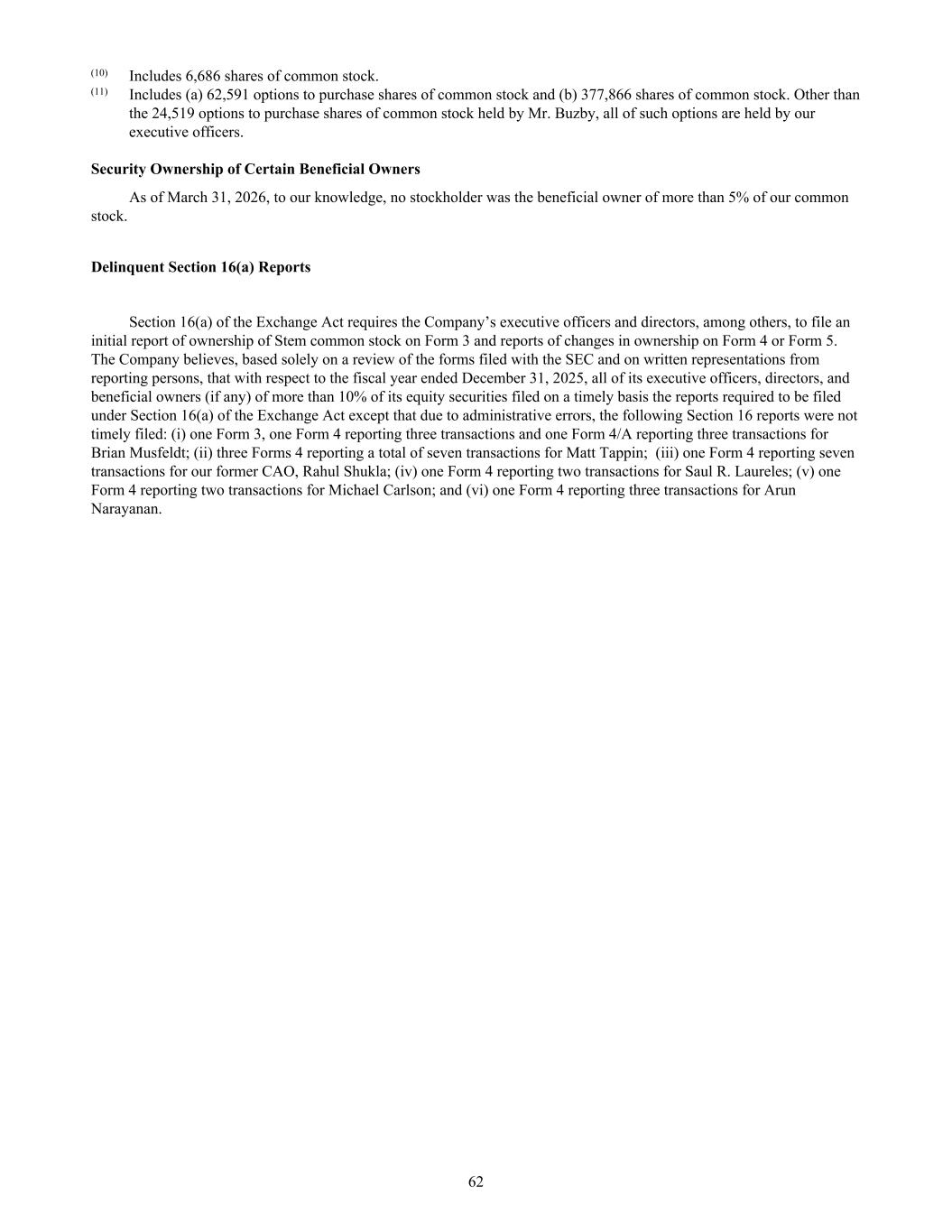
(10) Includes 6,686 shares of common stock. (11) Includes (a) 62,591 options to purchase shares of common stock and (b) 377,866 shares of common stock. Other than the 24,519 options to purchase shares of common stock held by Mr. Buzby, all of such options are held by our executive officers. Security Ownership of Certain Beneficial Owners As of March 31, 2026, to our knowledge, no stockholder was the beneficial owner of more than 5% of our common stock. Delinquent Section 16(a) Reports Section 16(a) of the Exchange Act requires the Company’s executive officers and directors, among others, to file an initial report of ownership of Stem common stock on Form 3 and reports of changes in ownership on Form 4 or Form 5. The Company believes, based solely on a review of the forms filed with the SEC and on written representations from reporting persons, that with respect to the fiscal year ended December 31, 2025, all of its executive officers, directors, and beneficial owners (if any) of more than 10% of its equity securities filed on a timely basis the reports required to be filed under Section 16(a) of the Exchange Act except that due to administrative errors, the following Section 16 reports were not timely filed: (i) one Form 3, one Form 4 reporting three transactions and one Form 4/A reporting three transactions for Brian Musfeldt; (ii) three Forms 4 reporting a total of seven transactions for Matt Tappin; (iii) one Form 4 reporting seven transactions for our former CAO, Rahul Shukla; (iv) one Form 4 reporting two transactions for Saul R. Laureles; (v) one Form 4 reporting two transactions for Michael Carlson; and (vi) one Form 4 reporting three transactions for Arun Narayanan. 62
CERTAIN RELATIONSHIPS AND RELATED PARTY TRANSACTIONS Related Party Transactions The Board has a written policy governing the review, approval, and ratification of “related person transactions.” Under SEC rules, as applied by the Board, “related persons” include any director, executive officer, director nominee, or greater than 5% stockholder of Stem since the beginning of the previous fiscal year, and their immediate family members. The policy applies to any transaction in which Stem is a participant and any related person has a direct or indirect material interest, where the amount involved exceeds $100,000, unless excluded under Item 404(a) of SEC Regulation S-K. The Nominating Committee, with assistance from the Company’s Chief Legal Officer and Corporate Secretary, is responsible for reviewing and, where appropriate, approving any related person transaction involving Stem and any related persons. The Nominating Committee approves only those related person transactions that are in, or are not inconsistent with, the best interests of Stem and its stockholders. Since the beginning of 2024, there were no related person transactions under the relevant standards. Related Party Transaction Policy and Review Process Our related party transaction policy sets forth our procedures for the identification, review, consideration, and approval or ratification of related person transactions. Transactions involving compensation for services provided to us as an employee or director, among other limited exceptions, are deemed to have standing pre-approval by the Nominating Committee but may be specifically reviewed if appropriate in light of the facts and circumstances. Under the policy, if a transaction has been identified as a related party transaction, our management must present information regarding the related party transaction to our Nominating Committee for review, consideration, and approval or ratification. We will collect information that we deem reasonably necessary from each director, executive officer and, to the extent feasible, significant stockholder to enable us to identify any existing or potential related party transactions and to effectuate the terms of the policy. In addition, under our Code of Business Conduct and Ethics, our directors, officers, and employees have an affirmative responsibility to disclose any transaction or relationship that reasonably could be expected to give rise to a conflict of interest. In considering related party transactions, our Nominating Committee will take into account the relevant available facts and circumstances including, but not limited to: (i) whether the transaction is on terms no less favorable than terms generally available to an unaffiliated third party under the same or similar circumstances and (ii) the extent of the interest of the related person in the transaction. 63
OTHER MATTERS Stockholder Proposals and Director Nominations for Next Year’s Annual Meeting Pursuant to Rule 14a-8 of the Exchange Act, stockholders who wish to submit proposals for inclusion in the proxy statement for the 2027 Annual Meeting of Stockholders must send such proposals to our Corporate Secretary at Corporate_Secretary@stem.com, with a confirmation copy sent by mail to the address set forth on the first page of this Proxy Statement. Such proposals must be received by us as of 6:00 p.m. Central Time on December 23, 2026 and must comply with Rule 14a-8 of the Exchange Act. The submission of a stockholder proposal does not guarantee that it will be included in the proxy statement. As set forth in our Bylaws, if a stockholder intends to make a nomination for director election or present a proposal for other business (other than pursuant to Rule 14a-8 of the Exchange Act) at the 2027 Annual Meeting of Stockholders, the stockholder’s notice must be received by our Corporate Secretary at the address set forth on the first page of this Proxy Statement no earlier than the 120th day and no later than the 90th day before the anniversary of the last annual meeting; provided, however, that if the date of the annual meeting is more than 30 days before or more than 60 days after such anniversary date, the stockholder’s notice must be delivered no earlier than the close of business on the 120th day before such annual meeting and no later than the close of business on the later of the 90th day before such annual meeting or the 10th day following the date on which the Company makes the first public announcement of the date of such annual meeting. Therefore, unless the 2027 Annual Meeting of Stockholders is more than 30 days before or more than 60 days after the anniversary of the Annual Meeting, notice of proposed nominations or proposals (other than pursuant to Rule 14a-8 of the Exchange Act) must be received by our Corporate Secretary no earlier than February 3, 2027 and no later than the 6:00 p.m. Central Time on March 5, 2027. Any such director nomination or stockholder proposal must be a proper matter for stockholder action and must comply with the terms and conditions set forth in our Bylaws (which include the timing and information required under Rule 14a-19 of the Exchange Act). If a stockholder fails to meet these deadlines or fails to satisfy the requirements of Rule 14a-4 of the Exchange Act, we may exercise discretionary voting authority under proxies we solicit to vote on any such proposal as we determine appropriate. We reserve the right to reject, rule out of order or take other appropriate action with respect to any nomination or proposal that does not comply with these and other applicable requirements. Delivery of Documents to Stockholders Sharing an Address A number of brokerage firms have adopted a procedure approved by the SEC called “householding.” Under this procedure, certain stockholders who have the same address and do not participate in electronic delivery of proxy materials will receive only one copy of the proxy materials, including this Proxy Statement, the Notice, and our Annual Report on Form 10-K for the year ended December 31, 2025, until such time as one or more of these stockholders notifies us that they wish to receive individual copies. This procedure helps to reduce duplicate mailings and save printing costs and postage fees, as well as natural resources. If you received a “householding” mailing this year and would like to have additional copies of the proxy materials mailed to you, please send a written request to our Corporate Secretary at the address set forth on the first page of this Proxy Statement, or call (877) 374-7836, and we will promptly deliver the proxy materials to you. Please contact your broker if you received multiple copies of the proxy materials and would prefer to receive a single copy in the future, or if you would like to opt out of “householding” for future mailings. Availability of Additional Information We will provide, free of charge, a copy of our Annual Report on Form 10-K for the fiscal year ended December 31, 2025, including exhibits, on the written or oral request of any stockholder of the Company. Please send a written request to our Corporate Secretary at the address set forth on the first page of this Proxy Statement, or call the number above. 64
APPENDIX A STEM, INC. SECOND AMENDED & RESTATED 2024 EQUITY INCENTIVE PLAN Amended and Restated as of June 3, 2026 (the “Effective Date”) 1. GENERAL. (a) Purpose. This Plan, through the granting of Awards, is intended to help the Company secure and retain the services of eligible award recipients, provide incentives for such persons to exert maximum efforts for the success of the Company and any Affiliate and provide a means by which the eligible award recipients may benefit from increases in the value of the Common Stock. (b) Eligible Award Recipients. Employees, Directors and Consultants are eligible to receive Awards. (c) Available Awards. This Plan provides for the grant of the following Awards, any of which may be subject to the achievement of Performance Goals: (i) Incentive Stock Options; (ii) Nonstatutory Stock Options; (iii) Stock Appreciation Rights; (iv) Restricted Stock Awards; and (v) Restricted Stock Unit Awards. (d) History. The Plan was originally effective on May 29, 2024 (the “Original Effective Date”) and was amended and restated on June 4, 2025.Following the Original Effective Date, no further equity compensation awards were granted pursuant to the Prior Plan. 2. ADMINISTRATION. (a) Administration by Board. The Board will administer this Plan. The Board may delegate administration of this Plan to a Committee or Committees, as provided in Section 2(c). (b) Powers of Board. The Board will have the power, subject to, and within the limitations of, the express provisions of this Plan: (i) To determine: (A) who will be granted Awards; (B) when and how each Award will be granted; (C) what type of Award will be granted; (D) the provisions of each Award (which need not be identical), including when or how a person will be permitted to exercise or otherwise receive cash or Common Stock under the Award; (E) the number of shares of Common Stock subject to, or the cash value of, an Award; and (F) the Fair Market Value applicable to a Stock Award. (ii) To construe and interpret this Plan and Awards granted under it, and to establish, amend and revoke rules and regulations for administration of this Plan and Awards. The Board, in the exercise of these powers, may correct any defect, omission or inconsistency in this Plan or in any Award Document, in a manner and to the extent it will deem necessary or expedient to make this Plan or Award fully effective. (iii) To settle all controversies regarding this Plan and Awards granted under it. A-1
(iv) To accelerate, in whole or in part, or to extend, in whole or in part, the time during which an Award may be exercised or vest, or at which cash or shares of Common Stock may be issued. (v) To suspend or terminate this Plan at any time, including to impose a “blackout” or other periods during which Awards may not be exercised or settled. Except as otherwise provided in this Plan or an Award Document, suspension or termination of this Plan will not materially impair a Participant’s rights under his or her then-outstanding Award without his or her written consent except as provided in subsection (viii) below. (vi) To amend this Plan in any respect the Board deems necessary or advisable, including, without limitation, adopting amendments relating to Incentive Stock Options and nonqualified deferred compensation under Section 409A of the Code and/or making this Plan or Awards granted under this Plan exempt from or compliant with the requirements for Incentive Stock Options or exempt from or compliant with the requirements for nonqualified deferred compensation under Section 409A of the Code, subject to the limitations, if any, of applicable law. To the extent required by applicable law or listing requirements, and except as provided in Section 9(a) relating to Capitalization Adjustments, the Company will seek stockholder approval of any amendment of this Plan that (A) materially increases the number of shares of Common Stock available for issuance under this Plan, (B) materially expands the class of individuals eligible to receive Awards under this Plan, (C) materially increases the benefits accruing to Participants under this Plan, (D) materially reduces the price at which shares of Common Stock may be issued or purchased under this Plan, (E) materially extends the term of this Plan, or (F) materially expands the types of Awards available for issuance under this Plan. Except as otherwise provided in this Plan (including subsection (viii) below) or an Award Document, no amendment of this Plan will materially impair a Participant’s rights under an outstanding Award without the Participant’s written consent. (vii) To submit any amendment to this Plan for stockholder approval, including, but not limited to, amendments to this Plan intended to satisfy the requirements of (A) Section 422 of the Code regarding “incentive stock options” or (B) Rule 16b-3 of the Exchange Act or any successor rule, if applicable. (viii) To approve forms of Award Documents for use under this Plan and to amend the terms of any one or more outstanding Awards, including, but not limited to, amendments to provide terms more favorable to the Participant than previously provided in the Award Documents for such Awards, subject to any specified limits in this Plan that are not subject to Board discretion. A Participant’s rights under any Award will not be impaired by any such amendment unless the Company requests the consent of the affected Participant, and the Participant consents in writing. However, a Participant’s rights will not be deemed to have been impaired by any such amendment if the Board, in its sole discretion, determines that the amendment, taken as a whole, does not materially impair the Participant’s rights. In addition, subject to the limitations of applicable law, if any, the Board may amend the terms of any one or more Awards without the affected Participant’s consent (A) to maintain the qualified status of the Award as an Incentive Stock Option under Section 422 of the Code, (B) to change the terms of an Incentive Stock Option, if such change results in impairment of the Award solely because it impairs the qualified status A-2
of the Award as an Incentive Stock Option under Section 422 of the Code, (C) to clarify the manner of exemption from, or to bring the Award into compliance with, Section 409A of the Code, or (D) to comply with other applicable laws or listing requirements. (ix) Generally, to exercise such powers and to perform such acts as the Board deems necessary or expedient to promote the best interests of the Company and that are not in conflict with the provisions of this Plan and/or Award Documents. (x) To adopt such procedures and sub-plans as are necessary or appropriate (A) to permit or facilitate participation in this Plan by persons eligible to receive Awards under this Plan who are not citizens of or who are not subject to taxation by or who are employed outside of the United States or (B) to allow Awards to qualify for special tax treatment in a jurisdiction other than the United States. Board approval will not be necessary for immaterial modifications to this Plan or any Award Document that are required for compliance with the laws of the relevant jurisdiction. (c) Delegation to Committee. (i) General. The Board may delegate some or all of the administration of this Plan to a Committee or Committees. If administration of this Plan is delegated to a Committee, the Committee will have, in connection with the administration of this Plan, the powers theretofore possessed by the Board that have been delegated to the Committee, including the power to delegate to a subcommittee of the Committee any of the administrative powers the Committee is authorized to exercise (and references in this Plan to the Board will thereafter be to the Committee or subcommittee). Any delegation of administrative powers will be reflected in the charter of the Committee to which the delegation is made, or resolutions, not inconsistent with the provisions of this Plan, adopted from time to time by the Board or Committee (as applicable). The Committee may, at any time, abolish the subcommittee and/or revest in the Committee any powers delegated to any subcommittee. Unless otherwise provided by the Board, delegation of authority by the Board to a Committee, or to an Officer or employee pursuant to Section 2(d), does not limit the authority of the Board, which may continue to exercise any authority so delegated and may concurrently administer this Plan with the Committee and may, at any time, revest in the Board some or all of the powers previously delegated. (ii) Rule 16b-3 Compliance. The Committee may consist solely of two or more Non-Employee Directors, in accordance with Rule 16b-3 of the Exchange Act. (d) Delegation to an Officer. The Board may delegate to one (1) or more Officers the authority to do one or both of the following, to the maximum extent permitted by applicable law: (i) designate Employees who are not Officers to be recipients of Stock Awards and the terms of such Stock Awards; and (ii) determine the number of shares of Common Stock to be subject to such Stock Awards granted to such Employees; provided, however, that the Board resolutions regarding such delegation will specify the following: (1) the total number of shares of Common Stock that may be subject to the Stock Awards granted by such Officer; (2) the time period during which such Stock Awards may be granted and the time period during which the shares of Common Stock issuable upon exercise of a Stock Award may be A-3
issued; (3) a minimum amount of consideration (if any) for which such Stock Awards may be issued and a minimum amount of consideration for the shares of Common Stock issuable upon the exercise of a Stock Award; and (4) that such Officer may not grant a Stock Award to himself or herself. Any such Stock Awards will be granted on a form that is substantially the same as the form of Stock Award Document approved by the Committee or the Board for use in connection with such Stock Awards, unless otherwise provided for in the resolutions approving the delegation authority. (e) Award Vesting Limitations. Notwithstanding any other provision of the Plan to the contrary, Stock Awards granted under the Plan may not become exercisable, vest or be settled, in whole or in part, prior to the one (1) year anniversary of the date of grant except (i) with respect to an Award that is granted in connection with a merger or other acquisition as a substitute or replacement award for awards held by grantees of the acquired business and (ii) with respect to an Award granted to a Non-Employee Director that vests on the earlier of the one-year anniversary of the date of grant and the next annual meeting of stockholders (provided that such next annual meeting is at least 50 weeks after the immediately preceding year’s annual meeting); provided, further, that (x) up to 5% of the aggregate number of shares of Common Stock authorized for issuance under this Plan (as described in Section 3(a)) may be issued pursuant to Awards that are subject to vesting periods of less than one-year, and (y) the foregoing restriction does not apply to the Board’s discretion to provide for accelerated exercisability or vesting of any Award, including in cases of retirement, death, Disability, or a Change in Control, in the terms of the Award or otherwise. (f) Effect of Board’s Decision. All determinations, interpretations and constructions made by the Board (or a duly authorized Committee, subcommittee or Officer exercising powers delegated by the Board under this Section 2) in good faith will not be subject to review by any person and will be final, binding and conclusive on all persons. 3. SHARES SUBJECT TO THIS PLAN. (a) Share Reserve. (i) As of the Effective Date, and subject to adjustment as provided in Section 9(a), a total of 594,941 shares of Common Stock shall be authorized for issuance pursuant to Stock Awards granted under the Plan, less one share for every one share granted under this Plan after March 31, 2026 and prior to the Effective Date (the “Share Reserve”). The foregoing shall also be increased by any shares of Common Stock that would have been issuable pursuant to outstanding awards under the Prior Plans that, on or after the Original Effective Date, cease for any reason to be subject to any such awards under the Prior Plans (other than by reason of exercise or settlement of the awards to the extent they are exercised for or settled in vested and nonforfeitable shares of Common Stock). (ii) For clarity, the Share Reserve is a limitation on the number of shares of Common Stock that may be issued under this Plan. As a single share may be subject to grant more than once (e.g., if a share subject to a Stock Award is forfeited, it may be made subject to grant again as provided in Section 3(b) below), the Share Reserve is not a limit on the number of Stock Awards that can be granted. A-4
(iii) Shares may be issued under the terms of this Plan in connection with a merger or acquisition as permitted by Nasdaq Listing Rule 5635(c), NYSE Listed Company Manual Section 303A.08 or other applicable rule, and such issuance will not reduce the number of shares available for issuance under this Plan. (b) Reversion of Shares to the Share Reserve. If a Stock Award or any portion of a Stock Award (i) expires, is cancelled or forfeited or otherwise terminates without all of the shares covered by the Stock Award having been issued or (ii) is settled in cash (i.e., the Participant receives cash rather than stock), such expiration, cancellation, forfeiture, termination or settlement will not reduce (or otherwise offset) the number of shares of Common Stock that are available for issuance under this Plan. If any shares of Common Stock issued under a Stock Award are forfeited back to, reacquired at no cost by, or repurchased at cost by the Company because of the failure to meet a contingency or condition required to vest such shares in the Participant, then the shares that are forfeited, reacquired or repurchased will revert to and again become available for issuance under this Plan. The following shares of Common Stock shall not be recredited to the Share Reserve and may not again be used for new Stock Awards under this Plan: (x) shares of Common Stock not issued or delivered as a result of the net settlement of an outstanding Stock Award, (y) shares of Common Stock used to pay the exercise price or withholding taxes related to any outstanding Stock Award, or (z) shares of Common Stock reacquired by the Company with the amount received upon exercise of an Option. (c) Incentive Stock Option Limit. Subject to Section 9(a) relating to Capitalization Adjustments, the aggregate maximum number of shares of Common Stock that may be issued on the exercise of Incentive Stock Options will be 594,941 shares of Common Stock. (d) Source of Shares. The stock issuable under this Plan will be shares of authorized but unissued or reacquired Common Stock, including shares repurchased by the Company on the open market or otherwise or shares classified as treasury shares. (e) Non-Employee Director Compensation Limit. The maximum number of shares of Common Stock subject to Awards granted during a single fiscal year to any Non-Employee Director, together with any cash fees paid to such Non-Employee Director during such fiscal year in respect of such Non-Employee Director’s service as a member of the Board during such fiscal year, shall not exceed a total value of $600,000 (calculating the value of any Awards based on the grant date fair value in accordance with Financial Accounting Standards Board Accounting Standards Codification Topic 718 (or any successor thereto)). Notwithstanding the foregoing, the Board may provide, in its discretion, for exceptions to any limit set forth in this Section 3(e) for a Non-Employee Director, provided that the Non-Employee Director receiving such additional compensation may not participate in the decision to award such compensation. For the avoidance of doubt, any compensation that is deferred shall be counted toward this limit for the year in which it was first earned, and not when paid or settled if later. (f) Dividends and Dividend Equivalents. Notwithstanding any other provision of the Plan to the contrary, with respect to any Award that provides for or includes a right to dividends or dividend equivalents, if dividends are declared during the period that an equity Award is outstanding, such A-5
dividends (or dividend equivalents) shall remain subject to vesting requirement(s) to the same extent as the underlying Award and shall only be paid at the time or times such vesting requirement(s) are satisfied. In no event shall dividends or dividend equivalents be paid with respect to Options or SARs. 4. ELIGIBILITY. (a) Eligibility for Specific Stock Awards. Incentive Stock Options may be granted only to employees of the Company or a “parent corporation” or “subsidiary corporation” thereof (as such terms are defined in Sections 424(e) and 424(f) of the Code). Stock Awards other than Incentive Stock Options may be granted to Employees, Directors and Consultants. (b) Ten Percent Stockholders. A Ten Percent Stockholder will not be granted an Incentive Stock Option unless the exercise price of such Option is at least 110% of the Fair Market Value on the date of grant and the Option is not exercisable after the expiration of five (5) years from the date of grant. 5. PROVISIONS RELATING TO OPTIONS AND STOCK APPRECIATION RIGHTS. Each Option or SAR will be in such form and will contain such terms and conditions as the Board deems appropriate. All Options will be separately designated Incentive Stock Options or Nonstatutory Stock Options at the time of grant, and, if certificates are issued, a separate certificate or certificates will be issued for shares of Common Stock purchased on exercise of each type of Option. If an Option is not specifically designated as an Incentive Stock Option, or if an Option is designated as an Incentive Stock Option but some portion or all of the Option fails to qualify as an Incentive Stock Option under the applicable rules, then the Option (or portion thereof) will be a Nonstatutory Stock Option. The provisions of separate Options or SARs need not be identical; provided, however, that each Award Document will conform to (through incorporation of provisions hereof by reference in the applicable Award Document or otherwise) the substance of each of the following provisions: (a) Term. Subject to Section 4(b) regarding Ten Percent Stockholders, no Option or SAR will be exercisable after the expiration of 10 years from the date of its grant or such shorter period specified in the Award Document. (b) Exercise Price. Subject to Section 4(b) regarding Ten Percent Stockholders, the exercise or strike price of each Option or SAR will be not less than 100% of the Fair Market Value of the Common Stock subject to the Option or SAR on the date the Award is granted. Notwithstanding the foregoing, an Option or SAR may be granted with an exercise or strike price lower than 100% of the Fair Market Value of the Common Stock subject to the Award if such Award is granted pursuant to an assumption of or substitution for another option or stock appreciation right pursuant to a corporate transaction and in a manner consistent with the provisions of Section 409A of the Code and, if applicable, Section 424(a) of the Code. Each SAR will be denominated in shares of Common Stock equivalents. (c) Purchase Price for Options. The purchase price of Common Stock acquired pursuant to the exercise of an Option, which shall be denominated in U.S. dollars, may be paid, to the extent permitted by applicable law, either by cash, check, bank draft or money order payable to the Company or, as A-6
determined by the Board in its sole discretion, by any combination of the methods of payment set forth below: (i) pursuant to a program developed under Regulation T as promulgated by the United States Federal Reserve Board or a successor regulation, or a similar rule in a foreign jurisdiction of domicile of a Participant, that, prior to or contemporaneously with the issuance of the stock subject to the Option, results in either the receipt of cash (or check) by the Company or the receipt of irrevocable instructions to pay the aggregate exercise price to the Company from the proceeds of sale of such stock; (ii) by delivery to the Company (either by actual delivery or attestation) of shares of Common Stock; provided, that, unless otherwise specifically provided in the Option, the exercise price of Common Stock acquired pursuant to an Option that is paid by delivery (or attestation) to the Company of other Common Stock acquired, directly or indirectly from the Company, shall be paid only by shares of the Common Stock of the Company that have been held during the period of time required to avoid a charge to earnings for financial accounting purposes or a violation of applicable law; (iii) if an Option is a Nonstatutory Stock Option, by a “net exercise” arrangement pursuant to which the Company will reduce the number of shares of Common Stock issuable upon exercise by the largest whole number of shares with a Fair Market Value that does not exceed the aggregate exercise price; provided, however, that the Company will accept cash or other payment from the Participant to the extent of any remaining balance of the aggregate exercise price not satisfied by such reduction in the number of whole shares to be issued. Shares of Common Stock will no longer be subject to an Option and will not be exercisable thereafter to the extent that (A) shares issuable upon exercise are used to pay the exercise price pursuant to the “net exercise,” (B) shares are delivered to the Participant as a result of such exercise, and (C) shares are withheld to satisfy tax withholding obligations; or (iv) in any other form of legal consideration that may be acceptable to the Board and specified in the applicable Award Document. (d) Exercise and Payment of a SAR. To exercise any outstanding SAR, the Participant must provide written notice of exercise to the Company in compliance with the provisions of the Stock Appreciation Right Award Document evidencing such SAR. The appreciation distribution payable on the exercise of a SAR will be not greater than an amount equal to the excess of (A) the aggregate Fair Market Value (on the date of the exercise of the SAR) of a number of shares of Common Stock equal to the number of Common Stock equivalents in which the Participant is vested under such SAR (with respect to which the Participant is exercising the SAR on such date), over (B) the aggregate strike price of the number of Common Stock equivalents with respect to which the Participant is exercising the SAR on such date. The appreciation distribution may be paid in Common Stock, in cash, in any combination of the two or in any other form of consideration, as determined by the Board and contained in the Award Document evidencing such SAR. (e) Transferability of Options and SARs. The Board may, in its sole discretion, impose such limitations on the transferability of Options and SARs as the Board determines. In the absence of such a A-7
determination by the Board to the contrary, the following restrictions on the transferability of Options and SARs will apply: (i) Restrictions on Transfer. An Option or SAR will not be transferable except by will or by the laws of descent and distribution (or pursuant to subsections (ii), (iii) and (iv) below), and will be exercisable during the lifetime of the Participant only by the Participant. The Board may permit transfer of the Option or SAR in a manner that is not prohibited by applicable tax and securities laws. Except as explicitly provided herein, neither an Option nor a SAR may be transferred for consideration, and in no event may an Option or SAR be transferred to a third-party financial institution for value. (ii) Domestic Relations Orders. Subject to the approval of the Board or a duly authorized Officer, an Option or SAR may be transferred pursuant to the terms of a domestic relations order, official marital settlement agreement or other divorce or separation instrument as permitted by U.S. Treasury Regulation 1.421-1(b)(2) or other applicable law. If an Option is an Incentive Stock Option, such Option may be deemed to be a Nonstatutory Stock Option as a result of such transfer. (iii) Beneficiary Designation. Subject to the approval of the Board or a duly authorized Officer, a Participant may, by delivering written notice to the Company, in a form approved by the Company (or the designated broker), designate a third party who, on the death of the Participant, will thereafter be entitled to exercise the Option or SAR and receive the Common Stock or other consideration resulting from such exercise. In the absence of such a designation, the executor or administrator of the Participant’s estate will be entitled to exercise the Option or SAR and receive the Common Stock or other consideration resulting from such exercise. However, the Company may prohibit designation of a beneficiary at any time, including due to any conclusion by the Company that such designation would be inconsistent with the provisions of applicable laws. (f) Vesting Generally. Subject to Section 2(e), the total number of shares of Common Stock subject to an Option or SAR may vest and therefore become exercisable in periodic installments that may or may not be equal. The Option or SAR may be subject to such other terms and conditions on the time or times when it may or may not be exercised (which may be based on the satisfaction of performance goals or other criteria) as the Board may deem appropriate. The vesting provisions of individual Options or SARs may vary. The provisions of this Section 5(f) are subject to any Option or SAR provisions governing the minimum number of shares of Common Stock as to which an Option or SAR may be exercised. (g) Termination of Continuous Service. Except as otherwise provided in the applicable Award Document, or other agreement between the Participant and the Company, if a Participant’s Continuous Service terminates (other than for Cause and other than upon the Participant’s death or Disability), the Participant may exercise his or her Option or SAR (to the extent that the Participant was entitled to exercise such Award as of the date of termination of Continuous Service) within the period of time ending on the earlier of (i) the date three (3) months following the termination of the Participant’s Continuous Service and (ii) the expiration of the term of the Option or SAR as set forth in the applicable Award Document. If, after termination of Continuous Service, the Participant does not exercise his or her Option or SAR within the applicable time frame, the Option or SAR will terminate. A-8
(h) Extension of Termination Date. Except as otherwise provided in the applicable Award Document, or other agreement between the Participant and the Company, if the exercise of an Option or SAR following the termination of the Participant’s Continuous Service (other than for Cause and other than upon the Participant’s death or Disability) would be prohibited at any time solely because the issuance of shares of Common Stock would violate the registration requirements under the Securities Act, then the Option or SAR will terminate on the earlier of (i) the expiration of a total period of three (3) months (that need not be consecutive) after the termination of the Participant’s Continuous Service during which the exercise of the Option or SAR would not be in violation of such registration requirements, and (ii) the expiration of the term of the Option or SAR as set forth in the applicable Award Document. In addition, unless otherwise provided in a Participant’s applicable Award Document, or other agreement between the Participant and the Company, if the sale of any Common Stock received upon exercise of an Option or SAR following the termination of the Participant’s Continuous Service (other than for Cause) would violate the Company’s insider trading policy, and the Company does not waive the potential violation of the policy or otherwise permit the sale, or allow the Participant to surrender shares of Common Stock to the Company in satisfaction of any exercise price and/or any withholding obligations under Section 8(g), then the Option or SAR will terminate on the earlier of (i) the expiration of a period of months (that need not be consecutive) equal to the applicable post-termination exercise period after the termination of the Participant’s Continuous Service during which the sale of the Common Stock received upon exercise of the Option or SAR would not be in violation of the Company’s insider trading policy, or (ii) the expiration of the term of the Option or SAR as set forth in the applicable Award Document. (i) Disability of Participant. Except as otherwise provided in the applicable Award Document, or other agreement between the Participant and the Company, if a Participant’s Continuous Service terminates as a result of the Participant’s Disability, the Participant may exercise his or her Option or SAR (to the extent that the Participant was entitled to exercise such Option or SAR as of the date of termination of Continuous Service), but only within such period of time ending on the earlier of (i) the date 12 months following such termination of Continuous Service, and (ii) the expiration of the term of the Option or SAR as set forth in the applicable Award Document. If, after termination of Continuous Service, the Participant does not exercise his or her Option or SAR within the applicable time frame, the Option or SAR (as applicable) will terminate. (j) Death of Participant. Except as otherwise provided in the applicable Award Document, or other agreement between the Participant and the Company, if (i) a Participant’s Continuous Service terminates as a result of the Participant’s death, or (ii) the Participant dies within the period (if any) specified in this Plan or the applicable Award Document, or other agreement between the Participant and the Company, for exercisability after the termination of the Participant’s Continuous Service (for a reason other than death), then the Option or SAR may be exercised (to the extent the Participant was entitled to exercise such Option or SAR as of the date of death) by the Participant’s estate, by a person who acquired the right to exercise the Option or SAR by bequest or inheritance or by a person designated to exercise the Option or SAR upon the Participant’s death, but only within the period ending on the earlier of (i) the A-9
date 18 months following the date of death, and (ii) the expiration of the term of such Option or SAR as set forth in the applicable Award Document. If, after the Participant’s death, the Option or SAR is not exercised within the applicable time frame, the Option or SAR will terminate. (k) Termination for Cause. Except as explicitly provided otherwise in a Participant’s Award Document or other individual written agreement between the Company or any Subsidiary and the Participant, if a Participant’s Continuous Service is terminated for Cause, the Option or SAR will terminate upon the date on which the event giving rise to the termination for Cause first occurred, and the Participant will be prohibited from exercising his or her Option or SAR from and after the date on which the event giving rise to the termination for Cause first occurred (or, if required by law, the date of termination of Continuous Service). If a Participant’s Continuous Service is suspended pending an investigation of the existence of Cause, all of the Participant’s rights under the Option or SAR will also be suspended during the investigation period. (l) Non-Exempt Employees. If an Option or SAR is granted to an Employee who is a non-exempt employee for purposes of the U.S. Fair Labor Standards Act of 1938, as amended, the Option or SAR will not be first exercisable for any shares of Common Stock until at least 6 months following the date of grant of the Option or SAR (although the Award may vest prior to such date). Consistent with the provisions of the U.S. Worker Economic Opportunity Act, (i) if such non-exempt Employee dies or suffers a Disability, (ii) upon a Change in Control in which such Option or SAR is not assumed, continued, or substituted, or (iii) upon the non-exempt Employee’s retirement (as such term may be defined in the non-exempt Employee’s applicable Award Document, in another agreement between the non-exempt Employee and the Company, or, if no such definition, in accordance with the Company’s then current employment policies and guidelines), the vested portion of any Options and SARs may be exercised earlier than 6 months following the date of grant. The foregoing provision is intended to operate so that any income derived by a non-exempt Employee in connection with the exercise or vesting of an Option or SAR will be exempt from his or her regular rate of pay. To the extent permitted and/or required for compliance with the U.S. Worker Economic Opportunity Act to ensure that any income derived by a non-exempt Employee in connection with the exercise, vesting or issuance of any shares under any other Stock Award will be exempt from such employee’s regular rate of pay, the provisions of this paragraph will apply to all Stock Awards and are hereby incorporated by reference into such Stock Award Documents. (m) No Repricing. Neither an Option nor SAR may be modified to reduce the exercise price thereof nor may (i) a new Option, SAR or other Award at a lower price be substituted or exchanged for a surrendered Option or SAR, (ii) any Option or SAR with an exercise price that exceeds the Fair Market Value of a share of Common Stock be exchanged for a new Option, SAR, cash or other consideration (other than in connection with a Change in Control), or (iii) any action be taken that would be considered a “repricing” of an Option or SAR under the applicable listing standards of the national securities exchange on which the Common Stock is listed, if any (other than adjustments or substitutions in accordance with Section 9(a) relating to Capitalization Adjustments), unless such action is approved by the stockholders of the Company. A-10
6. PROVISIONS OF STOCK AWARDS OTHER THAN OPTIONS AND SARS. (a) Restricted Stock Awards. Each Restricted Stock Award Document will be in such form and will contain such terms and conditions as the Board deems appropriate. To the extent consistent with the Company’s bylaws, at the Board’s election, shares of Common Stock may be (x) held in book entry form subject to the Company’s instructions until any restrictions relating to the Restricted Stock Award lapse, or (y) evidenced by a certificate, which certificate will be held in such form and manner as determined by the Board. The terms and conditions of Restricted Stock Award Documents may change from time to time, and the terms and conditions of separate Restricted Stock Award Documents need not be identical. Each Restricted Stock Award Document will conform to (through incorporation of the provisions hereof by reference in the agreement or otherwise) the substance of each of the following provisions: (i) Consideration. A Restricted Stock Award may be awarded in consideration for (A) cash, check, bank draft or money order payable to the Company, (B) past services to the Company or a Subsidiary, or (C) any other form of legal consideration (including future services) that may be acceptable to the Board, in its sole discretion, and permissible under applicable law. (ii) Vesting. Shares of Common Stock awarded under the Restricted Stock Award Document may be subject to forfeiture to the Company in accordance with a vesting schedule and subject to such conditions as may be determined by the Board (which may be based on the satisfaction of Performance Goals or other criteria). (iii) Termination of Participant’s Continuous Service. If a Participant’s Continuous Service terminates, the Company may receive through a forfeiture condition or a repurchase right, any or all of the shares of Common Stock held by the Participant that have not vested as of the date of termination of Continuous Service under the terms of the Restricted Stock Award Document. (iv) Transferability. Common Stock issued pursuant to an Award, and rights to acquire shares of Common Stock under the Restricted Stock Award Document, will be transferable by the Participant only upon such terms and conditions as are set forth in the Restricted Stock Award Document, as the Board determines in its sole discretion, so long as such Common Stock remains subject to the terms of the Restricted Stock Award Document. Notwithstanding the foregoing, subject to the approval of the Committee or a duly authorized Officer, a Participant may transfer unvested shares of Common Stock subject to a Restricted Stock Award to members of the Participant’s immediate family (which shall mean the Participant’s spouse, children, grandchildren, parents, siblings and spouses of such individuals), or to one or more trusts for the benefit of one or more such immediate family members, or to any other transferee approved by the Committee; provided, that in no event may a transfer under this Section 6(a)(iv) be for value (within the meaning of the General Instructions to Form S-8 under the Securities Act) and any such transfer shall be in compliance with all applicable securities laws; provided, further, that any transferred shares shall remain subject to the same vesting, forfeiture and other terms and conditions that were applicable immediately prior to transfer. A-11
(v) Dividends. Any dividends paid on Restricted Stock will be subject to the same vesting and forfeiture restrictions as apply to the shares subject to the Restricted Stock Award to which they relate. For avoidance of doubt, no dividends or dividend equivalents shall be paid out or settled unless and until, and then only to the extent that, the underlying Award vests. (b) Restricted Stock Unit Awards. Each Restricted Stock Unit Award Document will be in such form and will contain such terms and conditions as the Board deems appropriate. The terms and conditions of Restricted Stock Unit Award Documents may change from time to time, and the terms and conditions of separate Restricted Stock Unit Award Documents need not be identical. Each Restricted Stock Unit Award Document will conform to (through incorporation of the provisions hereof by reference in the agreement or otherwise) the substance of each of the following provisions: (i) Consideration. At the time of grant of a Restricted Stock Unit Award, the Board will determine the consideration, if any, to be paid by the Participant upon delivery of each share of Common Stock subject to the Restricted Stock Unit Award. The consideration to be paid (if any) by the Participant for each share of Common Stock subject to a Restricted Stock Unit Award may be paid in any form of legal consideration that may be acceptable to the Board, in its sole discretion, and permissible under applicable law. (ii) Vesting. At the time of the grant of a Restricted Stock Unit Award, the Board may impose such restrictions on or conditions to the vesting of the Restricted Stock Unit Award as it, in its sole discretion, deems appropriate (which may be based on the satisfaction of Performance Goals or other criteria). (iii) Payment. A Restricted Stock Unit Award may be settled by the delivery of shares of Common Stock, their cash equivalent, any combination thereof or in any other form of consideration, as determined by the Board and contained in the Restricted Stock Unit Award Document. (iv) Additional Restrictions. At the time of the grant of a Restricted Stock Unit Award, the Board, as it deems appropriate, may impose such restrictions or conditions that delay the delivery of the shares of Common Stock (or their cash equivalent) subject to a Restricted Stock Unit Award to a time after the vesting of such Restricted Stock Unit Award. (v) Dividend Equivalents. Dividend equivalents may be credited in respect of shares of Common Stock covered by a Restricted Stock Unit Award, as determined by the Board and contained in the Restricted Stock Unit Award Document. At the sole discretion of the Board, such dividend equivalents may be converted into additional shares of Common Stock covered by the Restricted Stock Unit Award in such manner as determined by the Board. Any dividend equivalents and/or additional shares covered by the Restricted Stock Unit Award credited by reason of such dividend equivalents will be subject to all of the same terms and conditions of the underlying Restricted Stock Unit Award Document to which they relate. For avoidance of doubt, no dividends or dividend equivalents shall be paid out or settled unless and until, and then only to the extent that, the underlying Award vests. (vi) Termination of Participant’s Continuous Service. Except as otherwise provided in the applicable Restricted Stock Unit Award Document, or other agreement between the Participant and the Company, A-12
such portion of the Restricted Stock Unit Award that has not vested will be forfeited upon the Participant’s termination of Continuous Service. 7. COVENANTS OF THE COMPANY. (a) Securities Law Compliance. The Company will seek to obtain from each regulatory commission or agency having jurisdiction over this Plan such authority as may be required to grant Stock Awards and to issue and sell shares of Common Stock upon exercise of the Stock Awards; provided, however, that this undertaking will not require the Company to register under the Securities Act this Plan, any Stock Award or any Common Stock issued or issuable pursuant to any such Stock Award. If, after reasonable efforts and at a reasonable cost, the Company is unable to obtain from any such regulatory commission or agency the authority that counsel for the Company deems necessary for the lawful issuance and sale of Common Stock under this Plan, the Company will be relieved from any liability for failure to issue and sell Common Stock upon exercise of such Stock Awards unless and until such authority is obtained. A Participant will not be eligible for the grant of an Award or the subsequent issuance of cash or Common Stock pursuant to the Award if such grant or issuance would be in violation of any applicable securities law. (b) No Obligation to Notify or Minimize Taxes. The Company will have no duty or obligation to any Participant to advise such holder as to the time or manner of exercising such Stock Award. Furthermore, the Company will have no duty or obligation to warn or otherwise advise such holder of a pending termination or expiration of an Award or a possible period in which the Award may not be exercised. The Company has no duty or obligation to, and does not undertake to, provide tax advice or to minimize the tax consequences of an Award to the holder of such Award. 8. MISCELLANEOUS. (a) Use of Proceeds from Sales of Common Stock. Proceeds from the sale of shares of Common Stock pursuant to Stock Awards will constitute general funds of the Company. (b) Corporate Action Constituting Grant of Awards. Corporate action constituting a grant by the Company of an Award to any Participant will be deemed completed as of the latest date that all necessary corporate action has occurred and all material terms of the Award (including, in the case of stock options, the exercise price thereof) are fixed, unless otherwise determined by the Board, regardless of when the documentation evidencing the Award is communicated to, or actually received or accepted by, the Participant. In the event that the corporate records (e.g., Board consents, resolutions or minutes) documenting the corporate action constituting the grant contain terms (e.g., exercise price, vesting schedule or number of shares) that are inconsistent with those in the Award Document as a result of a clerical error in the papering of the Award Document, the corporate records will control and the Participant will have no legally binding right to the incorrect term in the Award Document. (c) Stockholder Rights. No Participant will be deemed to be the holder of, or to have any of the rights of a holder with respect to, any shares of Common Stock subject to a Stock Award unless and until (i) such Participant has satisfied all requirements for exercise of, or the issuance of shares of Common A-13
Stock under, the Stock Award pursuant to its terms, and (ii) the issuance of the Common Stock subject to such Stock Award has been entered into the books and records of the Company. (d) No Employment or Other Service Rights. Nothing in this Plan, any Award Document or any other instrument executed thereunder or in connection with any Award granted pursuant thereto will confer upon any Participant any right to continue to serve the Company or an Affiliate in the capacity in effect at the time the Award was granted or any other capacity or will affect the right of the Company or an Affiliate to terminate (i) the employment of an Employee with or without notice and with or without cause, including, but not limited to, Cause, (ii) the service of a Consultant pursuant to the terms of such Consultant’s agreement with the Company or an Affiliate, or (iii) the service of a Director pursuant to the organizational documents of the Company or an Affiliate (including articles of incorporation and bylaws), and any applicable provisions of the corporate law of the state in which the Company or the Affiliate is incorporated, as the case may be. (e) Change in Time Commitment. In the event a Participant’s regular level of time commitment in the performance of his or her services for the Company and any Subsidiaries is reduced (for example, and without limitation, if the Participant is an Employee of the Company and the Employee has a change in status from a full-time Employee to a part-time Employee or takes an extended leave of absence), or the Participant’s role or primary responsibilities are changed to a level that, in the Board’s determination does not justify the Participant’s unvested Awards, and such reduction or change occurs after the date of grant of any Award to the Participant, the Board has the right in its sole discretion to (i) make a corresponding reduction in the number of shares or cash amount subject to any portion of such Award that is scheduled to vest or become payable after the date of such change in time commitment, and (ii) in lieu of or in combination with such a reduction, extend the vesting or payment schedule applicable to such Award. In the event of any such reduction, the Participant will have no right with respect to any portion of the Award that is so reduced or extended. (f) Incentive Stock Option Limitations. To the extent that the aggregate Fair Market Value (determined at the time of grant) of Common Stock with respect to which Incentive Stock Options are exercisable for the first time by any Optionholder during any calendar year (under all plans of the Company and any Affiliates) exceeds USD$100,000 (or such other limit established in the Code) or otherwise does not comply with the rules governing Incentive Stock Options, the Options or portions thereof that exceed such limit (according to the order in which they were granted) or otherwise do not comply with such rules will be treated as Nonstatutory Stock Options, notwithstanding any contrary provision of the applicable Option Agreement(s). (g) Withholding Obligations. Unless prohibited by the terms of an Award Document, the Company may, in its sole discretion, satisfy any national, state, local or other tax withholding obligation relating to an Award by any of the following means or by a combination of such means: (i) causing the Participant to tender a cash payment; (ii) withholding shares of Common Stock from the shares of Common Stock issued or otherwise issuable to the Participant in connection with the Award having a Fair Market Value equal to the amount required to be withheld (which may be up to the maximum individual statutory tax A-14
rate in the applicable jurisdiction at the time of such withholding, or such other rate as the Committee may determine); (iii) withholding cash from an Award settled in cash; (iv) withholding payment from any amounts otherwise payable to the Participant, including proceeds from the sale of shares of Common Stock issued pursuant to a Stock Award; or (v) by such other method as may be set forth in the Award Document. (h) Electronic Delivery. Any reference herein to a “written” agreement or document will include any agreement or document delivered electronically, filed publicly at www.sec.gov (or any successor website thereto), or posted on the Company’s intranet (or other shared electronic medium controlled by the Company to which the Participant has access). (i) Deferrals. To the extent permitted by applicable law, the Board, in its sole discretion, may determine that the delivery of Common Stock or the payment of cash, upon the exercise, vesting or settlement of all or a portion of any Award may be deferred and may establish programs and procedures for deferral elections to be made by Participants. Deferrals by Participants will be made in accordance with Section 409A of the Code (to the extent applicable to a Participant). Consistent with Section 409A of the Code, the Board may provide for distributions while a Participant is still an employee or otherwise providing services to the Company. The Board is authorized to make deferrals of Awards and determine when, and in what annual percentages, Participants may receive payments, including lump sum payments, following the Participant’s termination of Continuous Service, and implement such other terms and conditions consistent with the provisions of this Plan and in accordance with applicable law. (j) Compliance with Section 409A. Unless otherwise expressly provided for in an Award Document, or other agreement between the Participant and the Company, this Plan and Award Documents will be interpreted to the greatest extent possible in a manner that makes this Plan and the Awards granted hereunder exempt from Section 409A of the Code, to the extent that Section 409A of the Code is applicable to an Award, and, to the extent not so exempt, in compliance with Section 409A of the Code. If the Board determines that any Award granted hereunder is subject to Section 409A of the Code, the Award Document evidencing such Award will incorporate the terms and conditions necessary to avoid the consequences specified in Section 409A(a)(1) of the Code, and to the extent an Award Document is silent on terms necessary for compliance, such terms are hereby incorporated by reference into the Award Document. Notwithstanding anything to the contrary in this Plan (and unless the Award Document specifically provides otherwise), if the shares of Common Stock are publicly traded, and if a Participant holding an Award that constitutes “deferred compensation” under Section 409A of the Code is a “specified employee” for purposes of Section 409A of the Code and the Participant is otherwise subject to Section 409A of the Code, no distribution or payment of any amount that is due because of a “separation from service” (as defined in Section 409A of the Code without regard to alternative definitions thereunder) will be issued or paid before the date that is six (6) months following the date of such Participant’s “separation from service” or, if earlier, the date of the Participant’s death, unless such distribution or payment can be made in a manner that complies with Section 409A of the Code, and any amounts so deferred will be paid in a lump sum on the day after such six (6) month period elapses, with the balance paid thereafter on the original schedule. A-15
(k) Clawback/Recovery. All Awards granted under this Plan will be subject to recoupment in accordance with any clawback policy that the Company is required to adopt pursuant to the listing standards of any national securities exchange or association on which the Company’s securities are listed or as is otherwise required by the Dodd-Frank Wall Street Reform and Consumer Protection Act or other applicable law, including, without limitation, the Stem Inc. Clawback Policy. Further, if the Company is required to prepare an accounting restatement of its financial statements due to the Company’s material noncompliance with any financial reporting requirement under the securities laws, then the Board may, in its sole discretion (considering any factors the Board deems appropriate, subject to the terms of the Company’s clawback policies, if applicable), require a Participant to disgorge or forfeit to the Company that portion of time- and/or performance-based Awards that were granted, earned or vested during the Company’s three completed fiscal years immediately preceding the date the Company is required to prepare the accounting restatement, that the Board determines was in excess of the amount that would have been granted, earned or vested during such period based on the restated results. In the case of time-based Awards, a recoupment may occur, in the Board’s sole discretion, if the Board concludes that the grant, earning and/or vesting of the Awards would not have been made, or would have been lower had they been based on the restated results, and it is possible to clearly compute the amount of such lesser award. The amount to be recouped shall be determined by the Board in its sole and absolute discretion, and the form of such recoupment may be made, in the Board’s sole and absolute discretion, through the forfeiture or cancellation of vested or unvested Awards, cash repayment or both (provided that any recoupment required under the Company’s clawback policies shall serve as the minimum amount subject to recoupment). Any decision by the Board that no recoupment shall occur because of difficulties of computation or otherwise shall not be reviewable (subject to the terms of the Company’s clawback policies). In addition, the Board may impose such other clawback, recovery or recoupment provisions in an Award Document as the Board determines necessary or appropriate, including, but not limited to, a reacquisition right in respect of previously acquired shares of Common Stock or other cash or property upon the occurrence of Cause. No recovery of compensation under such a clawback policy or other recoupment provisions will be an event giving rise to a right to resign for “good reason” or “constructive termination” (or similar term) under any agreement with the Company or any Subsidiary. (l) Exclusion of Certain Events. In determining the outcome of a performance goal or performance- based vesting award, the Committee may provide for exclusion of the impact of an event or occurrence which the Committee determines should appropriately be excluded, including (a) restructurings, discontinued operations, extraordinary items, and other unusual, infrequently occurring or non-recurring charges or events, (b) asset write-downs, (c) litigation or claim judgments or settlements, (d) acquisitions or divestitures, (e) reorganization or change in the corporate structure or capital structure of the Company, (f) an event either not directly related to the operations of the Company, Subsidiary, division, business segment or business unit or not within the reasonable control of management, (g) foreign exchange gains and losses, (h) a change in the fiscal year of the Company, (i) the refinancing or repurchase of bank loans or debt securities, (j), unbudgeted capital expenditures, (k) the issuance or repurchase of equity securities and other changes in the number of outstanding shares, (l) conversion of A-16
some or all of convertible securities to common stock, (m) any business interruption event, (n) the cumulative effects of tax or accounting changes in accordance with U.S. generally accepted accounting principles, or (o) the effect of changes in other laws or regulatory rules affecting reported results. 9. ADJUSTMENTS UPON CHANGES IN COMMON STOCK; OTHER CORPORATE EVENTS. (a) Capitalization Adjustments. In the event of a Capitalization Adjustment, the Board will appropriately and proportionately adjust: (i) the class(es) and maximum number of securities subject to this Plan pursuant to Section 3(a); (ii) the class(es) and maximum number of securities that may be issued pursuant to the exercise of Incentive Stock Options pursuant to Section 3(c); and (iii) the class(es) and number of securities or other property and value (including price per share of stock) subject to outstanding Stock Awards. The Board will make such adjustments, and its determination will be final, binding and conclusive. (b) Dissolution or Liquidation. Except as otherwise provided in the Stock Award Document, or other agreement between the Participant and the Company, in the event of a dissolution or liquidation of the Company, all outstanding Stock Awards (other than Stock Awards consisting of vested and outstanding shares of Common Stock not subject to a forfeiture condition or the Company’s right of repurchase) will terminate immediately prior to the completion of such dissolution or liquidation, and the shares of Common Stock subject to the Company’s repurchase rights or subject to a forfeiture condition may be repurchased or reacquired by the Company notwithstanding the fact that the holder of such Stock Award is providing Continuous Service; provided, however, that the Board may, in its sole discretion, cause some or all Stock Awards to become fully vested, exercisable and/or no longer subject to repurchase or forfeiture (to the extent such Stock Awards have not previously expired or terminated) before the dissolution or liquidation is completed but contingent on its completion. (c) Change in Control. The following provisions will apply to Awards in the event of a Change in Control unless otherwise provided in the instrument evidencing the Award or any other written agreement between the Company or any Subsidiary and the Participant or unless otherwise expressly provided by the Board at the time of grant of an Award. In the event of a Change in Control, then, notwithstanding any other provision of this Plan, the Board will take one or more of the following actions with respect to each outstanding Award, contingent upon the closing or completion of the Change in Control: (i) arrange for the surviving corporation or acquiring corporation (or the surviving or acquiring corporation’s parent company) to assume or continue the Award or to substitute a similar award for the Award (including, but not limited to, an award to acquire the same consideration per share paid to the stockholders of the Company pursuant to the Change in Control); (ii) arrange for the assignment of any reacquisition or repurchase rights held by the Company in respect of Common Stock issued pursuant to the Award to the surviving corporation or acquiring corporation (or the surviving or acquiring corporation’s parent company); A-17
(iii) accelerate the vesting, in whole or in part, of the Award (and, if applicable, the time at which the Award may be exercised) to a date prior to the effective time of such Change in Control as the Board will determine (or, if the Board will not determine such a date, to the date that is 5 days prior to the effective date of the Change in Control), with such Award terminating if not exercised (if applicable) at or prior to the effective time of the Change in Control, and with such exercise reversed if the Change in Control does not become effective; (iv) arrange for the lapse, in whole or in part, of any reacquisition or repurchase rights held by the Company with respect to the Award; (v) cancel or arrange for the cancellation of the Award, to the extent not vested or not exercised prior to the effective time of the Change in Control, in exchange for such consideration (in cash, property, securities or a combination thereof), if any, as the Board, in its reasonable determination, may consider appropriate as an approximation of the value of the canceled Award, taking into account the value of the Common Stock subject to the canceled Award, the possibility that the Award might not otherwise vest in full, and such other factors as the Board deems relevant; and (vi) cancel or arrange for the cancellation of the Award, to the extent not vested or not exercised prior to the effective time of the Change in Control, in exchange for a payment, in such form as may be determined by the Board equal to the excess, if any, of (A) the value in the Change in Control of the property the Participant would have received upon the exercise of the Award immediately prior to the effective time of the Change in Control, over (B) any exercise price payable by such holder in connection with such exercise; provided, that the Board may cancel and terminate without payment or consideration any Option or SAR with an exercise price equal to or in excess of the value of the shares of Common Stock subject to such Option or SAR determined as of immediately prior to the Change in Control. The Board need not take the same action or actions with respect to all Awards or portions thereof or with respect to all Participants. The Board may take different actions with respect to the vested and unvested portions of an Award. Any Awards subject to performance-based vesting treatment shall be calculated or deemed earned or vested based on the terms in the individual Award Documents or as otherwise determined by the Committee. In the absence of any affirmative determination by the Board at the time of a Change in Control, each outstanding Award will be assumed or an equivalent Award will be substituted by such successor corporation or a parent or subsidiary of such successor corporation (the “Successor Corporation”), unless the Successor Corporation does not agree to assume the Award or to substitute an equivalent Award, in which case the vesting of such Award will accelerate in its entirety (along with, if applicable, the time at which the Award may be exercised) to a date prior to the effective time of such Change in Control as the Board will determine (or, if the Board will not determine such a date, to the date that is 5 days prior to the effective date of the Change in Control), with such Award terminating if not exercised A-18
(if applicable) at or prior to the effective time of the Change in Control, and with such exercise reversed if the Change in Control does not become effective. (d) Acceleration of Awards upon a Change in Control. An Award may be subject to additional acceleration of vesting and exercisability upon or after a Change in Control as may be provided in the Award Document for such Award or as may be provided in any other written agreement between the Company or any Subsidiary and the Participant, but in the absence of such provision, no such acceleration will occur. 10. TERMINATION OR SUSPENSION OF THIS PLAN. The Board or the Compensation Committee may suspend or terminate this Plan at any time. This Plan will terminate automatically on the tenth (10th) anniversary of the Effective Date; provided, however, that no Incentive Stock Option may be granted more than 10 years after the later of (i) the Adoption Date and (ii) the adoption by the Board of any amendment to this Plan that constitutes the adoption of a new plan for purposes of Section 422 of the Code. No Awards may be granted under this Plan while this Plan is suspended or after it is terminated. 11. EFFECTIVE DATE OF PLAN. This Plan, as amended and restated, was approved by the Board on April 6, 2026, and will become effective on the Effective Date. No Award may be granted under this Plan, as amended and restated, prior to the Effective Date. This Plan, as amended and restated, shall continue in effect for a term of ten (10) years after the date on which the stockholders of the Company approve this Plan, unless sooner terminated by action of the Board or the Compensation Committee. 12. CHOICE OF LAW. The laws of the State of Delaware will govern all questions concerning the construction, validity and interpretation of this Plan, without regard to that state’s conflict of laws rules. 13. DEFINITIONS. As used in this Plan, the following definitions will apply to the capitalized terms indicated below: (a) “Adoption Date” means April 6, 2026, the date this Plan was originally adopted by the Board. (b) “Affiliate” means, at the time of determination, any “parent” or “subsidiary” of the Company, as such terms are defined in Rule 405 of the Securities Act. The Board will have the authority to determine the time or times at which “parent” or “subsidiary” status is determined within the foregoing definition. (c) “Award” means a Stock Award. (d) “Award Document” means a written agreement between the Company and a Participant, or a written notice issued by the Company to a Participant, evidencing the terms and conditions of an Award. A-19
(e) “Board” means the Board of Directors of the Company. (f) “Capitalization Adjustment” means any change that is made in, or other events that occur with respect to, the Common Stock subject to this Plan or subject to any Stock Award after the Effective Date without the receipt of consideration by the Company through merger, consolidation, reorganization, recapitalization, reincorporation, stock dividend, dividend in property other than cash, large nonrecurring cash dividend, stock split, reverse stock split, liquidating dividend, combination of shares, exchange of shares, change in corporate structure or other similar equity restructuring transaction, as that term is used in Financial Accounting Standards Board Accounting Standards Codification Topic 718 (or any successor thereto). Notwithstanding the foregoing, the conversion of any convertible securities of the Company will not be treated as a Capitalization Adjustment. (g) “Cause” will have the meaning ascribed to such term in any written agreement between the Participant and the Company or any Subsidiary defining such term and, in the absence of such agreement, such term means, with respect to a Participant, the occurrence of any of the following events: (i) Participant’s failure substantially to perform his or her duties and responsibilities to the Company or any Subsidiary or violation of a policy of the Company or any Subsidiary, including policies related to discrimination, harassment, performance of illegal or unethical activities, and ethical misconduct; (ii) Participant’s commission of, or plea of guilty or no contest to, any felony or act of fraud, embezzlement, dishonesty or any other act involving a breach of fiduciary duty with respect to the Company or any Subsidiary, or any other misconduct that has caused or is reasonably expected to result in injury to the Company or any Subsidiary; (iii) unauthorized use or disclosure by Participant of any proprietary information or trade secrets of the Company or any other party to whom the Participant owes an obligation of nondisclosure as a result of his or her relationship with the Company or any Subsidiary; or (iv) Participant’s breach of any of his or her obligations under any written agreement or covenant with the Company or any Subsidiary, including, without limitation, a breach of any employment, consulting, confidentiality, non-competition, non-solicitation, non-disparagement or similar agreement. The determination as to whether a Participant is being terminated for Cause will be made in good faith by the Company and will be final and binding on the Participant. Any determination by the Company that the Continuous Service of a Participant was terminated with or without Cause for the purposes of outstanding Awards held by such Participant will have no effect upon any determination of the rights or obligations of the Company, any Affiliate or such Participant for any other purpose. (h) “Change in Control,” unless otherwise defined in an Award Document, means the occurrence, in a single transaction or in a series of related transactions, of any one or more of the following events: (i) any Exchange Act Person becomes the Owner, directly or indirectly, of securities of the Company representing more than 50% of the combined voting power of the Company’s then outstanding securities other than by virtue of a merger, consolidation or similar A-20
transaction that would not constitute a Change in Control under clause (ii) below. Notwithstanding the foregoing, a Change in Control will not be deemed to occur (A) on account of the acquisition of securities of the Company directly from the Company, (B) on account of the acquisition of securities of the Company by an investor, any affiliate thereof or any other Exchange Act Person that acquires the Company’s securities in a transaction or series of related transactions the primary purpose of which is to obtain financing for the Company through the issuance of equity securities or (C) solely because the level of Ownership held by any Exchange Act Person (the “Subject Person”) exceeds the designated percentage threshold of the outstanding voting securities as a result of a repurchase or other acquisition of voting securities by the Company reducing the number of shares outstanding, provided that if a Change in Control would occur (but for the operation of this sentence) as a result of the acquisition of voting securities by the Company, and after such share acquisition, the Subject Person becomes the Owner of any additional voting securities that, assuming the repurchase or other acquisition had not occurred, increases the percentage of the then outstanding voting securities Owned by the Subject Person over the designated percentage threshold, then a Change in Control will be deemed to occur; (ii) there is consummated a merger, consolidation or similar transaction involving (directly or indirectly) the Company and, immediately after the consummation of such merger, consolidation or similar transaction, the stockholders of the Company immediately prior thereto do not Own, directly or indirectly, either (A) outstanding voting securities representing 50% or more of the combined outstanding voting power of the surviving Entity in such merger, consolidation or similar transaction or (B) 50% or more of the combined outstanding voting power of the ultimate parent of the surviving Entity in such merger, consolidation or similar transaction, in each case in substantially the same proportions as their Ownership of the outstanding voting securities of the Company immediately prior to such transaction; (iii)there is consummated a sale, lease, license or other disposition of all or substantially all of the consolidated assets of the Company and its Subsidiaries, other than a sale, lease, license or other disposition of all or substantially all of the consolidated assets of the Company and its Subsidiaries to an Entity, more than 50% of the combined voting power of the voting securities of which are Owned by stockholders of the Company in substantially the same proportions as their Ownership of the outstanding voting securities of the Company immediately prior to such sale, lease, license or other disposition; or (iv)during any period of 24 months, individuals who, at the beginning of such period, are members of the Board (the “Incumbent Board”) cease for any reason to constitute at least a majority of the members of the Board; provided, however, that if the appointment or election (or nomination for election) of any new Board member subsequent to the Effective Date was approved or recommended by a majority vote of the members of the A-21
Incumbent Board then still in office, such new member will, for purposes of this Plan, be considered as a member of the Incumbent Board. Notwithstanding the foregoing definition or any other provision of this Plan, (A) the term Change in Control will not include a sale of assets, merger or other transaction effected exclusively for the purpose of changing the domicile of the Company, and (B) the definition of Change in Control (or any analogous term) in an individual written agreement between the Company or any Subsidiary and the Participant will supersede the foregoing definition with respect to Awards subject to such agreement; provided, however, that if no definition of Change in Control or any analogous term is set forth in such an individual written agreement, the foregoing definition will apply. If required for compliance with Section 409A of the Code, in no event will a Change in Control be deemed to have occurred if such transaction is not also a “change in the ownership or effective control of” the Company or “a change in the ownership of a substantial portion of the assets of” the Company as determined under U.S. Treasury Regulation Section 1.409A-3(i)(5) (without regard to any alternative definition thereunder). The Board may, in its sole discretion and without a Participant’s consent, amend the definition of “Change in Control” to conform to the definition of “Change in Control” under Section 409A of the Code, and the regulations thereunder. (i) “Code” means the U.S. Internal Revenue Code of 1986, as amended, including any applicable regulations and guidance thereunder. (j) “Committee” means a committee of one (1) or more Directors to whom authority has been delegated by the Board in accordance with Section 2(c). (k) “Compensation Committee” means the Compensation Committee of the Board. (l) “Common Stock” means the common stock of the Company. (m)“Company” means Stem, Inc., a Delaware corporation. (n) “Consultant” means any person, including an advisor, who is (i) engaged by the Company or a Subsidiary to render consulting or advisory services and is compensated for such services, or (ii) serving as a member of the board of directors of a Subsidiary and is compensated for such services. However, service solely as a Director, or payment of a fee for such service, will not cause a Director to be considered a “Consultant” for purposes of this Plan. Notwithstanding the foregoing, a person is treated as a Consultant under this Plan only if a Form Registration Statement on Form S-8 or a successor form under the Securities Act is available to register either the offer or the sale of the Company’s securities to such person. (o) “Continuous Service” means that the Participant’s service with the Company or a Subsidiary, whether as an Employee, Director or Consultant, is not interrupted or terminated. A change in the capacity in which the Participant renders service to the Company or a Subsidiary as an Employee, Consultant or Director or a change in the Entity for which the Participant renders A-22
such service, provided that there is no interruption or termination of the Participant’s service with the Company or a Subsidiary, will not terminate a Participant’s Continuous Service. For example, a change in status from an Employee of the Company to a Consultant of a Subsidiary or to a Director will not constitute an interruption of Continuous Service. If the Entity for which a Participant is rendering services ceases to qualify as a Subsidiary, as determined by the Board in its sole discretion, such Participant’s Continuous Service will be considered to have terminated on the date such Entity ceases to qualify as a Subsidiary. To the extent permitted by law, the Board or the chief executive officer of the Company, in that party’s sole discretion, may determine whether Continuous Service will be considered interrupted in the case of (i) any leave of absence approved by the Board or chief executive officer, including sick leave, military leave or any other personal leave, or (ii) transfers between the Company, a Subsidiary, or their successors. In addition, if required for exemption from or compliance with Section 409A of the Code, the determination of whether there has been a termination of Continuous Service will be made, and such term will be construed, in a manner that is consistent with the definition of “separation from service” as defined under U.S. Treasury Regulation Section 1.409A-1(h) (without regard to any alternative definition thereunder). A leave of absence will be treated as Continuous Service for purposes of vesting in a Stock Award only to such extent as may be provided in the applicable Award Document, the Company’s leave of absence policy, in the written terms of any leave of absence agreement or policy applicable to the Participant, or as otherwise required by applicable law. (p) “Director” means a member of the Board. (q) “Disability” means, with respect to a Participant, the inability of such Participant to engage in any substantial gainful activity by reason of any medically determinable physical or mental impairment that can be expected to result in death or that has lasted or can be expected to last for a continuous period of not less than 12 months as provided in Sections 22(e)(3) and 409A(a)(2)(C)(i) of the Code, and will be determined by the Board on the basis of such medical evidence as the Board deems warranted under the circumstances. (r) “Effective Date” means the date this Plan is approved by the Company’s stockholders. (s) “Employee” means any person providing services as an employee of the Company or a Subsidiary. However, service solely as a Director, or payment of a fee for such services, will not cause a Director to be considered an “Employee” for purposes of this Plan. (t) “Entity” means a corporation, partnership, limited liability company or other entity. (u) “Exchange Act” means the U.S. Securities Exchange Act of 1934, as amended, and the rules and regulations promulgated thereunder. (v) “Exchange Act Person” means any natural person, Entity or “group” (within the meaning of Section 13(d) or 14(d) of the Exchange Act), except that “Exchange Act Person” will not include (i) the Company or any Subsidiary of the Company, (ii) any employee benefit plan of the Company or any Subsidiary of the Company or any trustee or other fiduciary holding securities A-23
under an employee benefit plan of the Company or any Subsidiary of the Company, (iii) an underwriter temporarily holding securities pursuant to a registered public offering of such securities, (iv) an Entity Owned, directly or indirectly, by the stockholders of the Company in substantially the same proportions as their Ownership of stock of the Company, or (v) any natural person, Entity or “group” (within the meaning of Section 13(d) or 14(d) of the Exchange Act) that, as of the Effective Date, is the Owner, directly or indirectly, of securities of the Company representing more than 50% of the combined voting power of the Company’s then outstanding securities. (w)“Fair Market Value” means, as of any date, the value of the Common Stock determined as follows: (i) If the Common Stock is listed on any established stock exchange or traded on any established market, the Fair Market Value of a share of Common Stock as of any date of determination will be, unless otherwise determined by the Board, the closing sales price for such stock as quoted on such exchange or market (or the exchange or market with the greatest volume of trading in the Common Stock) on the date of determination, as reported in a source the Board deems reliable. (ii) Unless otherwise provided by the Board, if there is no closing sales price for the Common Stock on the date of determination, then the Fair Market Value will be the closing selling price on the last preceding date for which such quotation exists. (iii)In the absence of such markets for the Common Stock, the Fair Market Value will be determined by the Board in good faith and in a manner that complies with Sections 409A and 422 of the Code. (x) “Incentive Stock Option” means an option granted pursuant to Section 5 of this Plan that is intended to be, and that qualifies as, an “incentive stock option” within the meaning of Section 422 of the Code. (y) “Non-Employee Director” means a Director who either (i) is not a current employee or officer of the Company or a Subsidiary, does not receive compensation, either directly or indirectly, from the Company or a Subsidiary for services rendered as a consultant or in any capacity other than as a Director (except for an amount as to which disclosure would not be required under Item 404(a) of Regulation S-K promulgated pursuant to the Securities Act (“Regulation S-K”)), does not possess an interest in any other transaction for which disclosure would be required under Item 404(a) of Regulation S-K, and is not engaged in a business relationship for which disclosure would be required pursuant to Item 404(b) of Regulation S-K; or (ii) is otherwise considered a “non-employee director” for purposes of Rule 16b-3 of the Exchange Act. (z) “Nonstatutory Stock Option” means any option granted pursuant to Section 5 of this Plan that does not qualify as an Incentive Stock Option. A-24
(aa) “Officer” means a person who is an officer of the Company within the meaning of Section 16 of the Exchange Act. (ab) “Option” means an Incentive Stock Option or a Nonstatutory Stock Option to purchase shares of Common Stock granted pursuant to this Plan. (ac) “Option Agreement” means an Award Document evidencing the terms and conditions of an Option grant. Each Option Agreement will be subject to the terms and conditions of this Plan. (ad) “Optionholder” means a person to whom an Option is granted pursuant to this Plan or, if applicable, such other person who holds an outstanding Option. (ae) “Own,” “Owned,” “Owner,” “Ownership” means a person or Entity will be deemed to “Own,” to have “Owned,” to be the “Owner” of, or to have acquired “Ownership” of securities if such person or Entity, directly or indirectly, through any contract, arrangement, understanding, relationship or otherwise, has or shares voting power, which includes the power to vote or to direct the voting, with respect to such securities. (af)“Participant” means a person to whom an Award is granted pursuant to this Plan or, if applicable, such other person who holds an outstanding Stock Award. (ag) “Performance Goals” means, for a Performance Period, the one or more performance goals established by the Board, the Committee, or an authorized Officer, as the case may be. The Board, the Committee, or an authorized Officer, as the case may be, retains the discretion to define the manner of calculating the performance criteria it selects to use in respect of the Performance Goals established for a Performance Period. (ah) “Performance Period” means the period of time selected by the Board or the Committee over which the attainment of one or more performance goals will be measured for the purpose of determining a Participant’s right to and the payment of a Stock Award. Performance Periods may be of varying and overlapping duration, at the sole discretion of the Board or the Committee. (ai) “Plan” means this 2024 Equity Incentive Plan of Stem, Inc., as amended and restated from time to time. (aj) “Prior Plans” mean the Stem, Inc. 2021 Equity Incentive Plan and the Stem, Inc. 2009 Equity Incentive Plan. (ak) “Restricted Stock Award” means an award of shares of Common Stock which is granted pursuant to the terms and conditions of Section 6(a). (al) “Restricted Stock Award Document” means an Award Document evidencing the terms and conditions of a Restricted Stock Award grant. Each Restricted Stock Award Document will be subject to the terms and conditions of this Plan. (am) “Restricted Stock Unit Award” means a right to receive shares of Common Stock which is granted pursuant to the terms and conditions of Section 6(b). A-25
(an) “Restricted Stock Unit Award Document” means an Award Document evidencing the terms and conditions of a Restricted Stock Unit Award grant. Each Restricted Stock Unit Award Document will be subject to the terms and conditions of this Plan. (ao) “Securities Act” means the U.S. Securities Act of 1933, as amended. (ap) “Stock Appreciation Right” or “SAR” means a right to receive the appreciation on Common Stock that is granted pursuant to the terms and conditions of Section 5. (aq) “Stock Appreciation Right Award Document” means an Award Document evidencing the terms and conditions of a Stock Appreciation Right grant. Each Stock Appreciation Right Award Document will be subject to the terms and conditions of this Plan. (ar) “Stock Award” means any right to receive Common Stock granted under this Plan, including an Incentive Stock Option, a Nonstatutory Stock Option, a Restricted Stock Award, a Restricted Stock Unit Award, or a Stock Appreciation Right. (as) “Stock Award Document” means an Award Document evidencing the terms and conditions of a Stock Award grant. Each Stock Award Document will be subject to the terms and conditions of this Plan. (at) “Subsidiary” means, with respect to the Company, (i) any corporation of which more than 50% of the outstanding capital stock having ordinary voting power to elect a majority of the board of directors of such corporation (irrespective of whether, at the time, stock of any other class or classes of such corporation will have or might have voting power by reason of the happening of any contingency) is at the time, directly or indirectly, Owned by the Company, and (ii) any partnership, limited liability company or other entity in which the Company has a direct or indirect interest (whether in the form of voting or participation in profits or capital contribution) of more than 50%. (au) “Ten Percent Stockholder” means a person who Owns (or is deemed to Own pursuant to Section 424(d) of the Code) stock possessing more than 10% of the total combined voting power of all classes of stock of the Company or any Affiliate. A-26