FALSE0001801368MP Materials Corp. / DEDEF 14Aiso4217:USD00018013682025-01-012025-12-3100018013682024-01-012024-12-3100018013682023-01-012023-12-3100018013682022-01-012022-12-3100018013682021-01-012021-12-310001801368ecd:EqtyAwrdsInSummryCompstnTblForAplblYrMemberecd:PeoMember2025-01-012025-12-310001801368ecd:EqtyAwrdsAdjsExclgValRprtdInSummryCompstnTblMemberecd:PeoMember2025-01-012025-12-310001801368ecd:EqtyAwrdsInSummryCompstnTblForAplblYrMemberecd:PeoMember2024-01-012024-12-310001801368ecd:EqtyAwrdsAdjsExclgValRprtdInSummryCompstnTblMemberecd:PeoMember2024-01-012024-12-310001801368ecd:EqtyAwrdsInSummryCompstnTblForAplblYrMemberecd:PeoMember2023-01-012023-12-310001801368ecd:EqtyAwrdsAdjsExclgValRprtdInSummryCompstnTblMemberecd:PeoMember2023-01-012023-12-310001801368ecd:EqtyAwrdsInSummryCompstnTblForAplblYrMemberecd:PeoMember2022-01-012022-12-310001801368ecd:EqtyAwrdsAdjsExclgValRprtdInSummryCompstnTblMemberecd:PeoMember2022-01-012022-12-310001801368ecd:EqtyAwrdsInSummryCompstnTblForAplblYrMemberecd:PeoMember2021-01-012021-12-310001801368ecd:EqtyAwrdsAdjsExclgValRprtdInSummryCompstnTblMemberecd:PeoMember2021-01-012021-12-310001801368ecd:YrEndFrValOfEqtyAwrdsGrntdInCvrdYrOutsdngAndUnvstdMemberecd:PeoMember2025-01-012025-12-310001801368ecd:ChngInFrValOfOutsdngAndUnvstdEqtyAwrdsGrntdInPrrYrsMemberecd:PeoMember2025-01-012025-12-310001801368ecd:ChngInFrValAsOfVstngDtOfPrrYrEqtyAwrdsVstdInCvrdYrMemberecd:PeoMember2025-01-012025-12-310001801368ecd:YrEndFrValOfEqtyAwrdsGrntdInCvrdYrOutsdngAndUnvstdMemberecd:PeoMember2024-01-012024-12-310001801368ecd:ChngInFrValOfOutsdngAndUnvstdEqtyAwrdsGrntdInPrrYrsMemberecd:PeoMember2024-01-012024-12-310001801368ecd:ChngInFrValAsOfVstngDtOfPrrYrEqtyAwrdsVstdInCvrdYrMemberecd:PeoMember2024-01-012024-12-310001801368ecd:YrEndFrValOfEqtyAwrdsGrntdInCvrdYrOutsdngAndUnvstdMemberecd:PeoMember2023-01-012023-12-310001801368ecd:ChngInFrValOfOutsdngAndUnvstdEqtyAwrdsGrntdInPrrYrsMemberecd:PeoMember2023-01-012023-12-310001801368ecd:ChngInFrValAsOfVstngDtOfPrrYrEqtyAwrdsVstdInCvrdYrMemberecd:PeoMember2023-01-012023-12-310001801368ecd:YrEndFrValOfEqtyAwrdsGrntdInCvrdYrOutsdngAndUnvstdMemberecd:PeoMember2022-01-012022-12-310001801368ecd:ChngInFrValOfOutsdngAndUnvstdEqtyAwrdsGrntdInPrrYrsMemberecd:PeoMember2022-01-012022-12-310001801368ecd:ChngInFrValAsOfVstngDtOfPrrYrEqtyAwrdsVstdInCvrdYrMemberecd:PeoMember2022-01-012022-12-310001801368ecd:YrEndFrValOfEqtyAwrdsGrntdInCvrdYrOutsdngAndUnvstdMemberecd:PeoMember2021-01-012021-12-310001801368ecd:ChngInFrValOfOutsdngAndUnvstdEqtyAwrdsGrntdInPrrYrsMemberecd:PeoMember2021-01-012021-12-310001801368ecd:ChngInFrValAsOfVstngDtOfPrrYrEqtyAwrdsVstdInCvrdYrMemberecd:PeoMember2021-01-012021-12-310001801368ecd:EqtyAwrdsInSummryCompstnTblForAplblYrMemberecd:NonPeoNeoMember2025-01-012025-12-310001801368ecd:EqtyAwrdsAdjsExclgValRprtdInSummryCompstnTblMemberecd:NonPeoNeoMember2025-01-012025-12-310001801368ecd:EqtyAwrdsInSummryCompstnTblForAplblYrMemberecd:NonPeoNeoMember2024-01-012024-12-310001801368ecd:EqtyAwrdsAdjsExclgValRprtdInSummryCompstnTblMemberecd:NonPeoNeoMember2024-01-012024-12-310001801368ecd:EqtyAwrdsInSummryCompstnTblForAplblYrMemberecd:NonPeoNeoMember2023-01-012023-12-310001801368ecd:EqtyAwrdsAdjsExclgValRprtdInSummryCompstnTblMemberecd:NonPeoNeoMember2023-01-012023-12-310001801368ecd:EqtyAwrdsInSummryCompstnTblForAplblYrMemberecd:NonPeoNeoMember2022-01-012022-12-310001801368ecd:EqtyAwrdsAdjsExclgValRprtdInSummryCompstnTblMemberecd:NonPeoNeoMember2022-01-012022-12-310001801368ecd:EqtyAwrdsInSummryCompstnTblForAplblYrMemberecd:NonPeoNeoMember2021-01-012021-12-310001801368ecd:EqtyAwrdsAdjsExclgValRprtdInSummryCompstnTblMemberecd:NonPeoNeoMember2021-01-012021-12-310001801368ecd:YrEndFrValOfEqtyAwrdsGrntdInCvrdYrOutsdngAndUnvstdMemberecd:NonPeoNeoMember2025-01-012025-12-310001801368ecd:ChngInFrValOfOutsdngAndUnvstdEqtyAwrdsGrntdInPrrYrsMemberecd:NonPeoNeoMember2025-01-012025-12-310001801368ecd:VstngDtFrValOfEqtyAwrdsGrntdAndVstdInCvrdYrMemberecd:NonPeoNeoMember2025-01-012025-12-310001801368ecd:ChngInFrValAsOfVstngDtOfPrrYrEqtyAwrdsVstdInCvrdYrMemberecd:NonPeoNeoMember2025-01-012025-12-310001801368ecd:YrEndFrValOfEqtyAwrdsGrntdInCvrdYrOutsdngAndUnvstdMemberecd:NonPeoNeoMember2024-01-012024-12-310001801368ecd:ChngInFrValOfOutsdngAndUnvstdEqtyAwrdsGrntdInPrrYrsMemberecd:NonPeoNeoMember2024-01-012024-12-310001801368ecd:VstngDtFrValOfEqtyAwrdsGrntdAndVstdInCvrdYrMemberecd:NonPeoNeoMember2024-01-012024-12-310001801368ecd:ChngInFrValAsOfVstngDtOfPrrYrEqtyAwrdsVstdInCvrdYrMemberecd:NonPeoNeoMember2024-01-012024-12-310001801368ecd:YrEndFrValOfEqtyAwrdsGrntdInCvrdYrOutsdngAndUnvstdMemberecd:NonPeoNeoMember2023-01-012023-12-310001801368ecd:ChngInFrValOfOutsdngAndUnvstdEqtyAwrdsGrntdInPrrYrsMemberecd:NonPeoNeoMember2023-01-012023-12-310001801368ecd:VstngDtFrValOfEqtyAwrdsGrntdAndVstdInCvrdYrMemberecd:NonPeoNeoMember2023-01-012023-12-310001801368ecd:ChngInFrValAsOfVstngDtOfPrrYrEqtyAwrdsVstdInCvrdYrMemberecd:NonPeoNeoMember2023-01-012023-12-310001801368ecd:YrEndFrValOfEqtyAwrdsGrntdInCvrdYrOutsdngAndUnvstdMemberecd:NonPeoNeoMember2022-01-012022-12-310001801368ecd:ChngInFrValOfOutsdngAndUnvstdEqtyAwrdsGrntdInPrrYrsMemberecd:NonPeoNeoMember2022-01-012022-12-310001801368ecd:VstngDtFrValOfEqtyAwrdsGrntdAndVstdInCvrdYrMemberecd:NonPeoNeoMember2022-01-012022-12-310001801368ecd:ChngInFrValAsOfVstngDtOfPrrYrEqtyAwrdsVstdInCvrdYrMemberecd:NonPeoNeoMember2022-01-012022-12-310001801368ecd:YrEndFrValOfEqtyAwrdsGrntdInCvrdYrOutsdngAndUnvstdMemberecd:NonPeoNeoMember2021-01-012021-12-310001801368ecd:ChngInFrValOfOutsdngAndUnvstdEqtyAwrdsGrntdInPrrYrsMemberecd:NonPeoNeoMember2021-01-012021-12-310001801368ecd:VstngDtFrValOfEqtyAwrdsGrntdAndVstdInCvrdYrMemberecd:NonPeoNeoMember2021-01-012021-12-310001801368ecd:ChngInFrValAsOfVstngDtOfPrrYrEqtyAwrdsVstdInCvrdYrMemberecd:NonPeoNeoMember2021-01-012021-12-31
UNITED STATES
SECURITIES AND EXCHANGE COMMISSION
Washington, D.C. 20549
SCHEDULE 14A
Proxy Statement Pursuant to Section 14(a) of the
Securities Exchange Act of 1934
(Amendment No. )
Filed by the Registrant ☑
Filed by a Party other than the Registrant ☐
Check the appropriate box:
☐ Preliminary Proxy Statement
☐ Confidential, for Use of the Commission Only (as permitted by Rule 14a-6(e)(2))
☑ Definitive Proxy Statement
☐ Definitive Additional Materials
☐ Soliciting Material under §240.14a-12
MP MATERIALS CORP.
(Name of Registrant as Specified In Its Charter)
N/A
(Name of Person(s) Filing Proxy Statement, if other than the Registrant)
Payment of Filing Fee (Check all boxes that apply):
☑ No fee required.
☐ Fee paid previously with preliminary materials.
☐ Fee computed on table in exhibit required by Item 25(b) per Exchange Act Rules 14a-6(i)(1) and 0-11.
| | | | | | | | |
| NOTICE OF ANNUAL MEETING OF STOCKHOLDERS | |
| To be held on June 9, 2026 | |
NOTICE IS HEREBY GIVEN that the 2026 Annual Meeting of Stockholders (the “Annual Meeting”) of MP Materials Corp., a Delaware corporation (the “Company”), will be held on Tuesday, June 9, 2026, at 8:00 a.m., Pacific Time. To increase access for all of our stockholders, the Annual Meeting will be online and a completely virtual meeting of stockholders. You may attend, vote and submit questions during the Annual Meeting via the live audio webcast on the Internet at www.virtualshareholdermeeting.com/MP2026. You will not be able to attend the Annual Meeting in person nor will there be any physical location.
Only stockholders of record at the close of business on April 13, 2026, are entitled to notice of, and to vote at, the Annual Meeting and any postponement or adjournment thereof. We are committed to ensuring our stockholders have the same rights and opportunities to participate in the Annual Meeting as if it had been held in a physical location. As further described in the proxy materials for the Annual Meeting, you are entitled to attend the Annual Meeting via the live audio webcast on the Internet at www.virtualshareholdermeeting.com/MP2026. While we encourage you to vote in advance of the Annual Meeting, you may also vote and submit questions relating to meeting matters during the Annual Meeting (subject to time restrictions). You may vote by telephone, Internet or mail prior to the Annual Meeting.
To be admitted to the Annual Meeting at www.virtualshareholdermeeting.com/MP2026, you must enter the 16-digit control number found next to the box with the arrow included on your Notice of Internet Availability of Proxy Materials (the “Internet Notice”) or proxy card (if you receive a printed copy of the proxy materials).
The Annual Meeting will be held for the following purposes:
1. To elect the two Class III directors named in this Proxy Statement to serve until the 2029 annual meeting of stockholders and until their respective successors are duly elected and qualified or until such director’s earlier death, resignation or removal;
2. To hold an advisory vote to approve the compensation paid to the Company’s named executive officers;
3. To ratify the appointment of KPMG LLP as the Company’s independent registered public accounting firm for the fiscal year ending December 31, 2026; and
4. To consider and transact such other business as may properly come before the Annual Meeting.
On or about April 24, 2026, we began mailing to certain stockholders the Internet Notice containing instructions on how to access this Proxy Statement and our Annual Report on Form 10-K for the fiscal year ended December 31, 2025 (the “Annual Report”) and how to vote online.
| | | | | | | | |
| | | By order of the Board of Directors, |
| | | |
| Las Vegas, Nevada | | |
| | | |
| April 24, 2026 | | Elliot D. Hoops General Counsel and Secretary |
Important Notice Regarding the Availability of Proxy Materials for the 2026 Annual Meeting of the Company: The Internet Notice, Proxy Statement and Annual Report are available at www.proxyvote.com.
| | |
Your vote is very important. You may vote at the virtual meeting or by proxy. Whether or not you plan to virtually attend the Annual Meeting, we encourage you to access and review the proxy materials and submit your proxy or voting instructions as soon as possible. You may vote your proxy by telephone or Internet (instructions are on your proxy card, voter instruction form and the Internet Notice, as applicable) or, if you received your proxy materials by mail, by completing, signing and mailing the enclosed proxy card in the enclosed envelope. |
TABLE OF CONTENTS
FORWARD-LOOKING STATEMENTS
| | | | | | | | |
| This Proxy Statement contains certain statements that are not historical facts and are forward-looking statements for purposes of the safe harbor provisions under the United States Private Securities Litigation Reform Act of 1995. Forward-looking statements may be identified by the use of words such as “estimate,” “plan,” “project,” “forecast,” “intend,” “expect,” “anticipate,” “believe,” “seek,” “will,” “target,” or similar expressions that predict or indicate future events or trends or that are not statements of historical matters. These forward-looking statements are all subject to risks, uncertainties and changes in circumstances that could significantly affect the Company’s future financial results and business. | |
| | |
| Accordingly, the Company cautions that the forward-looking statements contained herein are qualified by important factors that could cause actual results to differ materially from those reflected by such statements. These forward-looking statements are subject to a number of risks and uncertainties, including changes in domestic and foreign business, market, financial, political and legal conditions; fluctuations and uncertainties in demand and pricing in the market for rare earth products, including magnets; uncertainty of the projected financial information with respect to the Company; continued demand for neodymium-iron-boron (“NdFeB”) alloy and magnets which may decrease materially in the future; the effects of competition on the Company’s future business; the heightened significance of the development of the Company’s midstream and downstream operations, including ramping its separation capabilities, and its ability to vertically integrate its value chain; risks related to the timing and achievement of expected business milestones, including with respect to the construction of a second domestic magnet manufacturing facility; risks related to the funding of and support for the transactions with the Department of War, and to challenges thereto and to the Company’s ability, as needed, to obtain additional or replacement funding on terms acceptable to it or at all; the Company’s ability to effectively comply with the broader legal and regulatory requirements and heightened scrutiny associated with government partnerships and contracts; risks related to the Company’s long-term agreement with Apple and General Motors and the Company’s ability to meet the obligations thereunder, including risks related to its ability to construct, develop and scale its facilities, technology and production; uncertainties relating to significant political, trade, and regulatory developments, including changes as a result of changes in trade and other policies in the United States and foreign governments, including with respect to tariffs; the impact of events outside of our control, such as natural disasters, climate change, wars or health epidemics or pandemics, on any of the foregoing risks; and those factors discussed in the Company’s Annual Report on Form 10-K for the year ended December 31, 2025, under the heading “Risk Factors,” and other documents to be filed by the Company with the Securities and Exchange Commission. If any of these risks materialize or our assumptions prove incorrect, actual results could differ materially from the results implied by these forward-looking statements. The Company does not intend to update publicly any forward-looking statements except as required by law. | |
2026 PROXY STATEMENT SUMMARY
This summary contains highlights about our Company and the upcoming 2026 Annual Meeting of Stockholders. This summary does not contain all of the information that you may wish to consider in advance of the meeting, and we encourage you to read the entire Proxy Statement before voting.
2026 Annual Meeting of Stockholders
| | | | | |
Date and Time: | Tuesday, June 9, 2026, at 8:00 a.m., Pacific Time |
Location: | Live audio webcast on the Internet at www.virtualshareholdermeeting.com/MP2026* |
Record Date: | April 13, 2026 |
* This year’s Annual Meeting will be conducted via live audio webcast. You may attend, ask questions relating to meeting matters (subject to time restrictions) and vote during the Annual Meeting via the live audio webcast on the Internet at the link above. You will not be able to attend the Annual Meeting in person. There will be no physical location for stockholders to attend.
Voting Matters and Board Recommendations
| | | | | | | | | | | | | | |
Proposal | | Matter | | Board Recommendation |
1 | | Election of the Two Class III Directors named in this Proxy Statement (Arnold W. Donald and Randall J. Weisenburger) | | FOR each Nominee |
| | | | | |
2 | | Advisory Vote to Approve Compensation Paid to the Company’s Named Executive Officers | | FOR |
| | | | | |
| 3 | | Ratification of the Appointment of KPMG LLP as the Company’s Independent Registered Public Accounting Firm for the Fiscal Year Ending December 31, 2026 | | FOR |
OVERVIEW OF MP MATERIALS CORP.
•Largest Producer of Rare Earth Materials in Western Hemisphere—Headquartered in Las Vegas, Nevada, the Company owns and operates the Mountain Pass Rare Earth Mine and Processing Facility (“Mountain Pass”) located near Mountain Pass, San Bernardino County, California, the only rare earth mining and processing site of scale in North America. Separated rare earth elements are critical inputs to the world’s most powerful and efficient magnets found in electric vehicles, unmanned aerial vehicles, defense systems, robotics, wind turbines and various advanced technologies.
•Restoring the Full Rare Earth Supply Chain to the United States—The Company also owns and operates a rare earth metal, alloy and magnet manufacturing facility in Fort Worth, Texas (“Independence” or the “Independence Facility”), where the Company produces and sells magnetic precursor products and commenced the manufacturing of neodymium-iron-boron (“NdFeB”) permanent magnets in December 2025.
•Achieved Record Production Volumes of Both REO in Concentrate and NdPr Oxide—The Company achieved record production volumes of both rare earth oxides (“REO”) in concentrate and neodymium-praseodymium (“NdPr”) oxide at Mountain Pass, producing 50,692 metric tons of REO in concentrate and 2,599 metric tons of NdPr in 2025.
•Financial Highlights—As of December 31, 2025, the Company had $1.8 billion of cash, cash equivalents and short-term investments and $750.0 million of net cash on the balance sheet.
•Significant Transactions—The Company entered into or executed several significant transactions in 2025:
◦Entered into a transformational public-private partnership with the U.S. Department of War (the “DoW”) to accelerate the build-out of an end-to-end U.S. rare earth magnet supply chain and reduce foreign dependency, which consisted of a comprehensive, long-term package of commitments from the DoW, including pricing support and a long-term offtake agreement;
◦Completed a public offering of 13.6 million shares and received net proceeds of $724.2 million;
◦Commenced sales of magnetic precursor products and manufacturing of magnets at Independence; and
◦Entered into a long-term supply agreement with Apple Inc. (NASDAQ: AAPL) (“Apple”), for magnet production at Independence and the development and installation of scaled recycling capabilities at Mountain Pass.
1700 S. Pavilion Center Drive, Suite 800
Las Vegas, Nevada 89135
PROXY STATEMENT
ANNUAL MEETING OF STOCKHOLDERS
June 9, 2026
This Proxy Statement is being furnished to the stockholders of MP Materials Corp. (the “Company,” “MP Materials” or “MP”) in connection with the solicitation of proxies for the Company’s 2026 Annual Meeting of Stockholders (the “Annual Meeting”) to be held on Tuesday, June 9, 2026, at 8:00 a.m., Pacific Time, or at any adjournment or postponement thereof, for the purposes set forth herein and in the accompanying Notice of Internet Availability of Proxy Materials (the “Internet Notice”). The Annual Meeting will be held via live audio webcast on the Internet at www.virtualshareholdermeeting.com/MP2026. This solicitation is being made by the Board of Directors of the Company (the “Board of Directors” or the “Board”). You will be able to vote and submit questions online through the virtual meeting platform during the Annual Meeting.
As permitted by the rules of the Securities and Exchange Commission (the “SEC”), we are making this Proxy Statement, the Internet Notice, the accompanying proxy card, and the Annual Report on Form 10-K for the fiscal year ended December 31, 2025, available to our stockholders electronically via the Internet at www.proxyvote.com. On or about April 24, 2026, we will mail to our stockholders the Internet Notice containing instructions on how to access this Proxy Statement and vote online or by telephone. If you received an Internet Notice by mail, you will not receive a printed copy of the proxy materials in the mail unless you specifically request them pursuant to the instructions provided in the Internet Notice. The Internet Notice instructs you on how to access and review all of the important information contained in this Proxy Statement.
THE INFORMATION PROVIDED IN THE “QUESTIONS AND ANSWERS” FORMAT BELOW IS FOR YOUR CONVENIENCE AND INCLUDES ONLY A SUMMARY OF CERTAIN INFORMATION CONTAINED IN THIS PROXY STATEMENT. YOU SHOULD READ THIS ENTIRE PROXY STATEMENT CAREFULLY.
QUESTIONS AND ANSWERS
Why am I receiving these materials?
We are distributing our proxy materials because our Board is soliciting your proxy to vote at the Annual Meeting. This Proxy Statement summarizes the information you need to vote at the Annual Meeting. You do not need to attend the Annual Meeting to vote your shares.
Pursuant to SEC rules, we are providing access to our proxy materials via the Internet at www.proxyvote.com. Accordingly, we are sending an Internet Notice to all of our stockholders as of the close of business on April 13, 2026 (the “Record Date”). All stockholders may access our proxy materials on the website referred to in the Internet Notice. You may also request to receive a printed set of the proxy materials. You can find instructions regarding how to access our proxy materials via the Internet and how to request a printed copy in the Internet Notice. Additionally, by following the instructions in the Internet Notice, you may request to receive proxy materials in printed form by mail or electronically by email on an ongoing basis. We believe that these rules allow us to provide our stockholders with the information they need while lowering the costs of delivery and reducing the environmental impact of the Annual Meeting.
How can I attend the Annual Meeting?
Stockholders as of the Record Date (or their duly appointed proxy holder) may attend, vote and submit questions virtually during the Annual Meeting by logging in at http://www.virtualshareholdermeeting.com/MP2026. To log in, stockholders (or their authorized representatives) will need the control number provided on their proxy card, voting instruction form or Internet Notice. If you are not a stockholder or do not have a control number, you may still access the Annual Meeting as a guest, but you will not be able to submit questions or vote at the Annual Meeting. The Annual Meeting will begin promptly at 8:00 a.m., Pacific Time, on Tuesday, June 9, 2026. We encourage you to access the Annual Meeting prior to the start time. Online access will open at 7:45 a.m., Pacific Time, and you should allow ample time to log in to the Annual Meeting webcast and test your computer audio system. We recommend that you carefully review the procedures needed to gain admission in advance. A recording of the Annual Meeting will be available at http://www.virtualshareholdermeeting.com/MP2026 for 90 days after the Annual Meeting.
Can I ask questions at the virtual Annual Meeting?
Stockholders as of the Record Date who attend and participate in our virtual Annual Meeting will have an opportunity to submit questions live via the Internet during a designated portion of the meeting. We also encourage you to submit questions in advance of the meeting until 11:59 p.m. Eastern Time the day before the Annual Meeting by going to www.proxyvote.com and logging in with your control number. During the Annual Meeting, we will spend up to 15 minutes answering stockholder questions that comply with the meeting rules of procedure. The rules of procedure, including the types of questions that will be accepted, will be posted on the Annual Meeting website. To ensure the orderly conduct of the Annual Meeting, we encourage you to submit questions in advance. If we receive substantially similar questions, we will group such questions together and provide a single response to avoid repetition. Stockholders must have available their control number provided on their proxy card, voting instruction form or Internet Notice to ask questions during the meeting.
What if I have technical difficulties or trouble accessing the virtual Annual Meeting?
We will have technicians ready to assist you with any technical difficulties you may have while accessing the virtual meeting. If you encounter any difficulties accessing the virtual Annual Meeting during check-in or during the meeting, please call the technical support number that will be posted on the virtual shareholder meeting login page: http://www.virtualshareholdermeeting.com/MP2026.
What proposals will be voted on at the Annual Meeting?
Stockholders will vote on three proposals at the Annual Meeting:
•the election of the two Class III directors named in this Proxy Statement to serve until the 2029 annual meeting of stockholders and until their respective successors are duly elected and qualified or until such director’s earlier death, resignation or removal;
•to hold an advisory vote to approve the compensation paid to the Company’s named executive officers; and
•the ratification of the appointment of KPMG LLP as the Company’s independent registered public accounting firm for the fiscal year ending December 31, 2026.
We will also consider other business, if any, that properly comes before the Annual Meeting.
What happens if other business not discussed in this Proxy Statement comes before the Annual Meeting?
The Company does not know of any business to be presented at the Annual Meeting other than the proposals discussed in this Proxy Statement. If other business properly comes before the Annual Meeting under our Amended and Restated Certificate of Incorporation (the “Charter”), Amended and Restated Bylaws (the “Bylaws”), and rules established by the SEC, the proxies will use their discretion in casting all of the votes that they are entitled to cast.
How does the Board recommend that stockholders vote on the proposals?
Our Board recommends that stockholders vote “FOR” the election of the two director nominees named in this Proxy Statement, “FOR” the approval, on an advisory basis, of the compensation of the Company’s named executive officers, and “FOR” the ratification of the appointment of KPMG LLP as the Company’s independent registered public accounting firm for the fiscal year ending December 31, 2026.
Who is entitled to vote?
As of the Record Date, 178,018,991 shares of common stock, par value $0.0001 per share, were outstanding. Only holders of record of our common stock as of the Record Date will be entitled to notice of, and to vote at, the Annual Meeting or any adjournment or postponement thereof. Each stockholder is entitled to one vote for each share of our common stock held by such stockholder on the Record Date.
How do I vote in advance of the Annual Meeting?
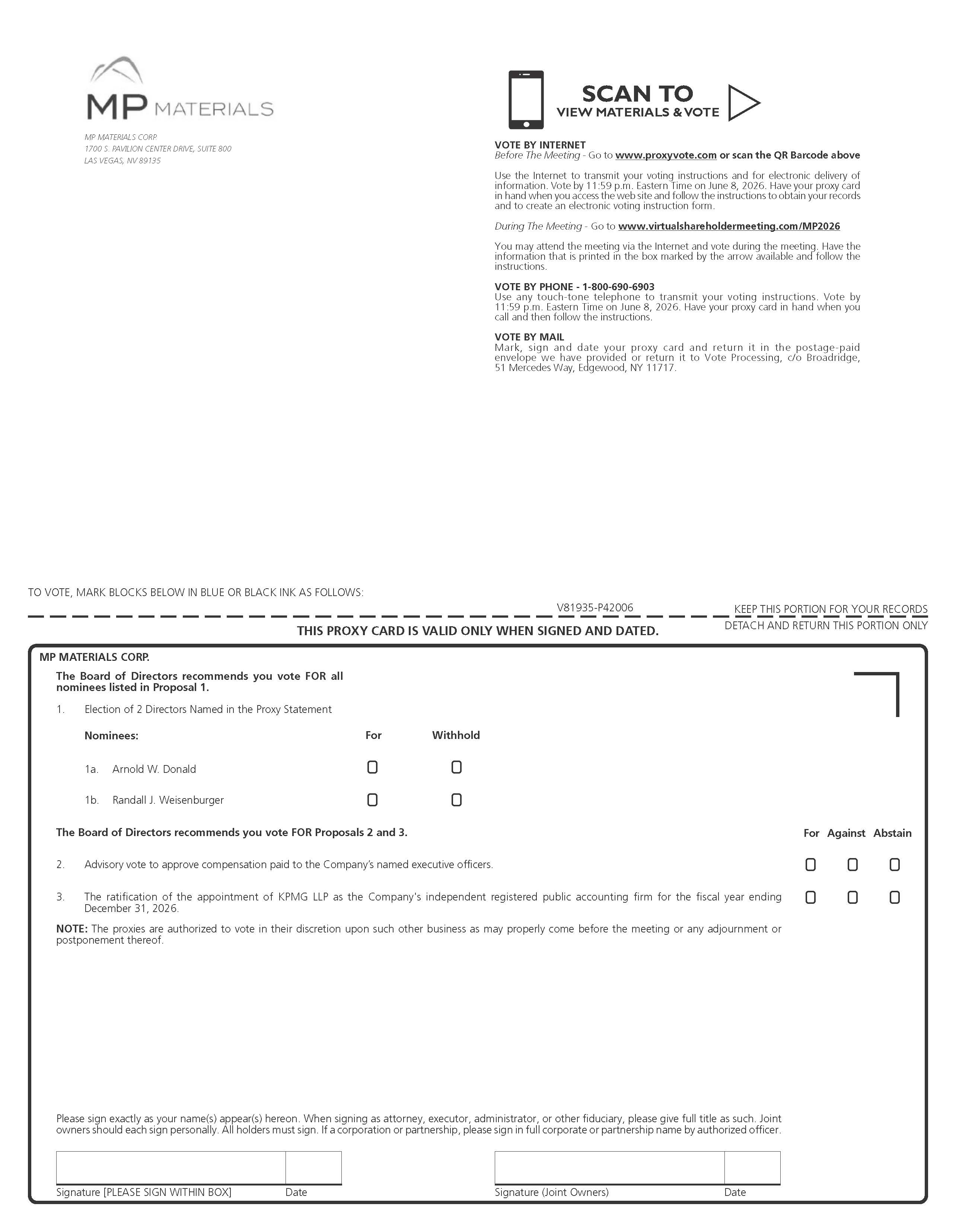
If you are a holder of record of shares of common stock of the Company, you may direct your vote without attending the Annual Meeting by following the instructions on the Internet Notice or proxy card to vote by Internet or by telephone, or by signing, dating and mailing a proxy card.
If you hold your shares in street name via a broker, bank or other nominee, you may direct your vote without attending the Annual Meeting by signing, dating and mailing your voting instruction card. Internet or telephonic voting may also be available. Please see your voting instruction card provided by your broker, bank or other nominee for further details.
How do I vote during the Annual Meeting?
Shares held directly in your name as the stockholder of record may be voted if you are attending the Annual Meeting by entering the 16-digit control number found on your proxy card or Internet Notice when you log into the Annual Meeting at http://www.virtualshareholdermeeting.com/MP2026.
Shares held in street name through a brokerage account or by a broker, bank or other nominee may be voted at the Annual Meeting by entering the 16-digit control number found on your Internet Notice or voter instruction card when you log into the meeting at http://www.virtualshareholdermeeting.com/MP2026.
Even if you plan to attend the Annual Meeting, we recommend that you vote in advance, as described above under “How do I vote in advance of the Annual Meeting?” so that your vote will be counted if you are unable to attend the Annual Meeting.
Can I change my vote or revoke my proxy?
You may change your vote or revoke your proxy at any time before it is voted at the Annual Meeting. If you are a stockholder of record, you may change your vote or revoke your proxy by:
•delivering to the attention of the Secretary at the address on the first page of this Proxy Statement a written notice of revocation of your proxy;
•delivering to us an authorized proxy bearing a later date (including a proxy over the Internet or by telephone); or
•attending the Annual Meeting and voting electronically, as indicated above under “How do I vote during the Annual Meeting?” Attendance at the Annual Meeting will not, by itself, revoke a proxy.
If your shares are held in the name of a bank, broker or other nominee, you may change your vote by submitting new voting instructions to your bank, broker or other nominee. Please note that if your shares are held of record by a bank, broker or other nominee, and you decide to attend and vote at the Annual Meeting, your vote at the Annual Meeting will not be effective unless you present a legal proxy, issued in your name from the record holder (your bank, broker or other nominee).
What is a broker non-vote?
Brokers, banks or other nominees holding shares on behalf of a beneficial owner may vote those shares in their discretion on certain “routine” matters even if they do not receive timely voting instructions from the beneficial owner. With respect to “non-routine” matters, the broker, bank or other nominee is not permitted to vote shares for a beneficial owner without timely received voting instructions. The only routine matter to be presented at the Annual Meeting is the proposal to ratify the appointment of KPMG LLP as the Company’s independent registered public accounting firm for the fiscal year ending December 31, 2026 (Proposal Three). Proposal One and Proposal Two are non-routine matters.
A broker non-vote occurs when a broker, bank or other nominee does not vote on a non-routine matter because the beneficial owner of such shares has not provided voting instructions with regard to such matter. A broker, bank or other nominee may exercise its discretionary voting authority on Proposal Three because Proposal Three is a routine matter, and as such there will be no broker non-votes on Proposal Three. Broker non-votes may occur as to Proposal One and Proposal Two, or any other non-routine matters that are properly presented at the Annual Meeting. Broker non-votes will have no impact on the voting results for Proposal One and Proposal Two.
What constitutes a quorum?
The presence at the Annual Meeting, either in person or by proxy, of the holders of shares of our outstanding capital stock representing a majority of the voting power of all of our outstanding shares of capital stock entitled to vote thereat as of the Record Date shall constitute a quorum for the transaction of business at the Annual Meeting. Abstentions and broker non-votes will be counted as present for the purpose of determining whether there is a quorum at the Annual Meeting. Your shares are counted as being present if you participate virtually at the Annual Meeting and cast your vote online during the Annual Meeting prior to the closing of the polls by visiting http://www.virtualshareholdermeeting.com/MP2026, or if you vote by proxy via the Internet, by telephone or by returning a properly executed and dated proxy card or voting instruction form by mail.
What vote is required to approve each matter to be considered at the Annual Meeting?
Proposal One: Election of the Two Class III Directors Named in this Proxy Statement.
Our Bylaws provide that the election of directors shall be determined by a plurality of the votes cast by the stockholders present in person or represented by proxy at the Annual Meeting and entitled to vote thereon. This means that once a quorum has been established, the director nominees receiving the highest number of votes are elected up to the maximum number of directors to be elected at the Annual Meeting. Thus, the nominees receiving the highest number of votes at the Annual Meeting will be elected, even if these votes do not constitute a majority of the votes cast. A withhold vote or broker non-vote on Proposal One will not have any effect.
Proposal Two: Advisory Vote to Approve Compensation Paid to the Company’s Named Executive Officers.
The proposal to approve an advisory resolution regarding the compensation of the Company’s named executive officers requires approval by the affirmative vote of a majority of the votes cast by the stockholders present in person or represented by
proxy at the Annual Meeting and entitled to vote thereon with respect to such proposal. An abstention or a broker non-vote on Proposal Two will not have any effect.
Proposal Three: Ratification of the Appointment of KPMG LLP as the Company’s Independent Registered Public Accounting Firm for the Fiscal Year Ending December 31, 2026.
The proposal to ratify the appointment of KPMG LLP as the Company’s independent registered public accounting firm for the 2026 fiscal year requires approval by the affirmative vote of a majority of the votes cast by the stockholders present in person or represented by proxy at the Annual Meeting and entitled to vote thereon with respect to such proposal. An abstention on Proposal Three will have no effect. Brokers will have discretionary authority to vote on this proposal. Accordingly, there will not be any broker non-votes on Proposal Three.
What is the deadline for submitting a proxy?
To ensure that proxies are received in time to be counted prior to the Annual Meeting, proxies submitted by Internet or by telephone should be received by 11:59 p.m. Eastern Time on June 8, 2026, and proxies submitted by mail should be received by the close of business on June 8, 2026 (the day prior to the date of the Annual Meeting).
What does it mean if I receive more than one Internet Notice or proxy card?
If you hold your shares in more than one account, you will receive an Internet Notice or proxy card for each account. To ensure that all of your shares are voted, please complete, sign, date and return a proxy card for each account or use the Internet Notice or proxy card for each account to vote by Internet or by telephone.
How will my shares be voted if I return a blank proxy card or a blank voting instruction card?
If you are a holder of record of our common stock and you sign and return a proxy card or otherwise submit a proxy without giving specific voting instructions, your shares will be voted:
•“FOR” the election of the two Class III directors named in this Proxy Statement;
•“FOR” the approval, on an advisory basis, of the compensation of the Company’s named executive officers; and
•“FOR” the ratification of the appointment of KPMG LLP as the Company’s independent registered public accounting firm for the fiscal year ending December 31, 2026.
If you hold your shares in street name via a broker, bank or other nominee and do not provide the broker, bank or other nominee with voting instructions (including by signing and returning a blank voting instruction card), your shares:
•will be counted as present for purposes of establishing a quorum;
•will be voted in accordance with the broker’s, bank’s or other nominee’s discretion on “routine” matters, which includes the proposal to ratify the appointment of KPMG LLP as the Company’s independent registered public accounting firm for the fiscal year ending December 31, 2026 (Proposal Three); and
•will not be counted in connection with the election of the two Class III director nominees named in this Proxy Statement (Proposal One) and the approval, on an advisory, of the compensation of the Company’s named executive officers (Proposal Two) or any other non-routine matters that are properly presented at the Annual Meeting. For each of these proposals, your shares will be treated as “broker non-votes.” A broker non-vote will have no impact on voting results for non-routine matters.
Our Board knows of no matter to be presented at the Annual Meeting other than Proposals One, Two, and Three. If any other matters properly come before the Annual Meeting upon which a vote properly may be taken, shares represented by all proxies received by us will be voted with respect thereto as permitted and in accordance with the judgment of the proxy holders.
Who is making this solicitation and who will pay the expenses?
This proxy solicitation is being made on behalf of our Board. The Company will pay the cost of soliciting proxies for the Annual Meeting. In addition to solicitation by mail, our employees may solicit proxies personally or by telephone or facsimile, but they will not receive additional compensation for these services. Arrangements may be made with brokerage houses, custodians, nominees and fiduciaries to send proxy materials to their principals and we may reimburse them for their expenses.
We have retained D.F. King & Co., Inc. to assist in the solicitation of proxies at a cost that is not expected to exceed $17,500 plus reasonable out-of-pocket expenses.
Will a stockholder list be available for inspection?
A list of stockholders entitled to vote at the Annual Meeting will be available for inspection by stockholders for any purpose germane to the meeting for 10 business days prior to the Annual Meeting, at MP Materials Corp., 1700 S. Pavilion Center Drive, Suite 800, Las Vegas, Nevada 89135, between the hours of 9:00 a.m. and 5:00 p.m. Pacific Time. The stockholder list will also be available to stockholders of record for examination during the Annual Meeting at http://www.virtualshareholdermeeting.com/MP2026. You will need the control number included on your Internet Notice, proxy card, or voting instruction form, or otherwise provided by your bank, broker or other nominee.
What is “householding” and how does it affect me?
We have adopted a procedure approved by the SEC called “householding.” Under this procedure, we send only one Proxy Statement, Internet Notice and one Annual Report to eligible stockholders who share a single address, unless we have received instructions to the contrary from any stockholder at that address. This practice is designed to eliminate duplicate mailings, conserve natural resources, and reduce our printing and mailing costs. Stockholders who participate in householding will continue to receive separate proxy cards.
If you share an address with another stockholder and receive only one set of proxy materials but would like to request a separate copy of these materials, please contact our mailing agent, Broadridge, by calling (866) 540-7095 or writing to Broadridge Householding Department, 51 Mercedes Way, Edgewood, NY 11717, and an additional copy of proxy materials will be promptly delivered to you. Similarly, if you receive multiple copies of the proxy materials and would prefer to receive a single copy in the future, you may also contact Broadridge at the above telephone number or address. If you own shares through a bank, broker, or other nominee, you should contact the nominee concerning householding procedures.
How can I find out the results of the voting at the Annual Meeting?
We will announce preliminary voting results at the Annual Meeting. We will also disclose voting results on a Current Report on Form 8-K that we will file with the SEC within four business days after the Annual Meeting.
When are stockholder proposals due for next year’s annual meeting of the stockholders?
Our stockholders are entitled to present proposals for action at a forthcoming meeting if they comply with the requirements of our Charter, our Bylaws, and the rules established by the SEC.
Under Rule 14a-8 under the Securities Exchange Act of 1934 (the “Exchange Act”), if you want us to include a proposal in the proxy materials for our 2027 annual meeting of stockholders, we must receive the proposal at our executive offices at 1700 S. Pavilion Center Drive, Suite 800, Las Vegas, Nevada 89135, no later than December 25, 2026, provided, however, that if the date of our 2027 annual meeting of stockholders is more than 30 days before or after June 9, 2027, then the deadline to timely receive such material shall be a reasonable time before we begin to print and send our proxy materials.
Pursuant to our Bylaws, a stockholder proposal of business submitted outside of the process established in Rule 14a-8 and nominations of directors must be received no earlier than the close of business on February 9, 2027, and not later than the close of business on March 11, 2027, provided, however, that if the date of our 2027 annual meeting of stockholders is more than 30 days before June 9, 2027, or more than 60 days after June 9, 2027, then such notice must be delivered not earlier than the close of business on the 120th day before the meeting and not later than the later of (x) the close of business on the 90th day before the meeting or (y) the close of business on the 10th day following the day on which we first publicly announce the date of the 2026 annual meeting of stockholders. All proposals submitted outside of the process established in Rule 14a-8 and nominations of directors must comply with the requirements set forth in our Bylaws. In addition, stockholders who intend to solicit proxies in support of director nominees other than the Company’s director nominees must comply with the additional requirements of Rule 14a-19(b). Any proposal or nomination should be addressed to the attention of our Secretary, and we suggest that it be sent by certified mail, return receipt requested.
Whom can I contact for further information?
You may request additional copies, without charge, of this Proxy Statement and other proxy materials or ask questions about the Annual Meeting, the proposals, or the procedures for voting your shares by writing to our Secretary at 1700 S. Pavilion Center Drive, Suite 800, Las Vegas, Nevada 89135, or by emailing our Investor Relations Group at ir@mpmaterials.com.
MATTERS TO BE CONSIDERED AT THE ANNUAL MEETING
PROPOSAL ONE
ELECTION OF THE TWO CLASS III DIRECTORS NAMED IN THIS PROXY STATEMENT
General
In accordance with our Charter, we have a classified Board, with directors in three separate classes, Class I, Class II and Class III, with only one class of directors being elected in each year. At the Annual Meeting, our stockholders will vote on two Class III directors for a three-year term and until the election and qualification of their respective successors in office, or until such director’s earlier death, resignation or removal. Each of our other current directors will continue to serve as a director until the expiration of their respective terms and until the election and qualification of his or her successor, or until his or her earlier death, resignation or removal.
Our Board nominated Arnold W. Donald and Randall J. Weisenburger for re-election to our Board as Class III directors at the Annual Meeting. Messrs. Donald and Weisenburger currently serve on our Board and have consented to be named in this Proxy Statement and have agreed to serve, if elected, until the 2029 annual meeting of stockholders and until their successors have been duly elected and qualified or until their earlier death, resignation or removal. There are no family relationships between or among any of our executive officers, nominees, or continuing directors.
Directors
The following table sets forth information with respect to our director nominees for election at the Annual Meeting and continuing directors:
| | | | | | | | | | | | | | | | | | | | |
Name | | Independent | | Age | | Director Since |
Class III Directors—Nominees for Election at the Annual Meeting | | | | | | |
Arnold W. Donald | | Yes | | 71 | | 2023 |
Randall J. Weisenburger | | Yes | | 67 | | 2020 |
Class I Directors—Term Expiring at the 2027 Annual Meeting | | | | | | |
James H. Litinsky | | No | | 48 | | 2020 |
Andrew A. McKnight | | Yes | | 48 | | 2020 |
Class II Directors—Term Expiring at the 2028 Annual Meeting | | | | | | |
Connie K. Duckworth | | Yes | | 71 | | 2020 |
Maryanne R. Lavan | | Yes | | 66 | | 2020 |
General (Retired) Richard B. Myers | | Yes | | 84 | | 2020 |
Summary of Director Experience and Qualifications
The matrix below summarizes what our Board believes are desirable types of experience, qualifications, attributes and skills possessed by one or more of the Company’s directors because of their particular relevance to the Company’s business and strategy. While all of these were considered by the Board in connection with this year’s director nomination process, the following matrix does not encompass all experience, qualifications, attributes or skills of our directors.
| | | | | | | | | | | | | | | | | | | | | | | | | | | | | | | | | | | | | | | | | |
| | Donald | | Duckworth | | Lavan | | Litinsky | | McKnight | | Myers | | Weisenburger |
Qualification and Attributes | | | | | | | | | | | | | |
Accounting/Auditing | ● | | ● | | ● | | ● | | ● | | ● | | ● |
Business Operations | ● | | ● | | ● | | ● | | ● | | ● | | ● |
Capital Management | ● | | ● | | ● | | ● | | ● | | ● | | ● |
Corporate Governance Leadership | ● | | ● | | ● | | ● | | ● | | ● | | ● |
Financial Expertise/Literacy | ● | | ● | | ● | | ● | | ● | | ● | | ● |
Independence | ● | | ● | | ● | | | | ● | | ● | | ● |
Industry Experience | ● | | | | ● | | ● | | | | | | ● |
International | ● | | ● | | ● | | ● | | ● | | ● | | ● |
Investment Markets | ● | | ● | | ● | | ● | | ● | | ● | | ● |
Other Recent Public Board Experience | ● | | ● | | | | | | ● | | ● | | ● |
Public Company Executive Experience | ● | | | | ● | | ● | | ● | | | | ● |
Regulatory/Risk Management | ● | | ● | | ● | | ● | | ● | | ● | | ● |
Government, Law or Military | ● | | | | ● | | ● | | | | ● | | ● |
Demographic Background | | | | | | | | | | | | | |
MP Board Tenure (in Years) | 3 | | 5 | | 5 | | 5 | | 5 | | 5 | | 5 |
Age (Years) | 71 | | 71 | | 66 | | 48 | | 48 | | 84 | | 67 |
Gender (Male/Female) | M | | F | | F | | M | | M | | M | | M |
Race/Ethnicity | | | | | | | | | | | | | |
African American | ● | | | | | | | | | | | | |
White/Caucasian | | | ● | | ● | | ● | | ● | | ● | | ● |
Biographies of our Board Members
Set forth below are the names and certain information about our Board of Directors and our Board Nominees, Arnold W. Donald and Randall J. Weisenburger.
Board Nominees—Class III Directors
Arnold W. Donald currently serves as a director of Bank of America Corporation (NYSE: BAC) since 2013, Salesforce, Inc. (NYSE: CRM) since January 2023, and GE Vernova Inc. (NYSE: GEV) since April 2024. Mr. Donald was President and Chief Executive Officer of Carnival Corporation (NYSE: CCL) and Carnival plc, a cruise and vacation company, from July 2013 to August 2022, and served as a director from 2001 to 2022. From November 2010 to June 2012, Mr. Donald served as President and Chief Executive Officer of The Executive Leadership Council, a nonprofit organization that seeks to support, develop, and increase the number of African American corporate executives globally. In addition, he served as President and Chief Executive Officer of the Juvenile Diabetes Research Foundation International from January 2006 to February 2008. He also served as the Chairman and Chief Executive Officer of Merisant from 2000 to 2003, a privately held global manufacturer of tabletop sweeteners, and remained as Chairman until 2005. In addition, Mr. Donald was a member of the board of directors of Crown Holdings, Inc. (NASDAQ: CCK) from 1999 to 2019. Further, Mr. Donald held several senior leadership positions with global responsibilities at Monsanto over a more than 20-year tenure, including President of its Agricultural Group and President of its Nutrition and Consumer Sector. Mr. Donald earned a B.A. in economics from Carleton College, a B.S. in mechanical engineering from Washington University in St. Louis, and an M.B.A. from The University of Chicago Booth School of Business. Mr. Donald brings to our Board extensive experience in regulated, consumer, retail, and distribution businesses both as an executive and as a director of public companies.
Randall J. Weisenburger is the Managing Member of Mile 26 Capital, LLC, a private investment company. Previously he served as the Executive Vice President and Chief Financial Officer of Omnicom Group Inc. (NYSE: OMC), a global media, marketing and corporate communications company (1998 to 2014). Prior to joining Omnicom, Mr. Weisenburger was a
founding member of Wasserstein Perella, and was the President and Chief Executive Officer of the firm’s merchant banking subsidiary, Wasserstein & Co. He also held various roles within the firm’s portfolio of companies including Co-Chairman of Collins & Aikman Corp., CEO of Wickes Manufacturing, Vice Chairman of Maybelline Inc., and Chairman of American Law Media. Before Wasserstein Perella, Mr. Weisenburger was a member of the First Boston Corporation. Mr. Weisenburger currently serves as the Presiding Director and Senior Independent Director of Carnival Corporation (NYSE: CCL), a cruise and vacation company. He is also a director of Valero Energy Corporation (NYSE: VLO), the largest independent refiner and producer of renewable fuels, and a director of Corsair Gaming Inc. (NASDAQ: CRSR), a computer gaming equipment company. Mr. Weisenburger holds an M.B.A. from the Wharton School of the University of Pennsylvania, where he was named the Henry Ford Scholar, and a B.A. in Finance and Accounting from Virginia Polytechnic Institute and State University (Virginia Tech). Mr. Weisenburger brings to our Board extensive experience in business leadership, capital markets, finance and compliance, organizational leadership and public company governance.
Continuing Directors—Class I Directors
James H. Litinsky is the Founder, Chairman, and Chief Executive Officer of MP Materials Corp. (NYSE: MP). Mr. Litinsky is also the Founder, Chief Executive Officer, and Chief Investment Officer of JHL Capital Group LLC, an alternative investment management firm. Prior to founding JHL in 2006, he was a member of the Drawbridge Special Opportunities Fund at Fortress Investment Group LLC, a global investment management firm. Prior to Fortress, he was a director of Finance at Omnicom Group, Inc., and worked as a merchant banker at Allen & Company. Mr. Litinsky received a B.A. in Economics from Yale University, cum laude, and a J.D. and M.B.A. from the Northwestern University School of Law and the Kellogg School of Management. He was admitted to the Illinois Bar. As Founder, Chairman, and CEO of the Company, Mr. Litinsky brings to our Board an extensive understanding of the Company’s business and industry. In addition, Mr. Litinsky brings to our Board valuable business, leadership, and management insights into the strategic direction and growth trajectory of the Company.
Andrew A. McKnight is Co-Chief Executive Officer of Fortress Investment Group LLC (“Fortress”) and a Managing Partner. He serves on the Leadership Committee of Fortress, and is a member of several investment committees. Prior to joining Fortress in February 2005, Mr. McKnight worked at Fir Tree Partners where he was responsible for analyzing and trading high yield and convertible bonds, bank debt, derivatives and equities for the value-based hedge fund. Prior to Fir Tree, Mr. McKnight worked at Goldman, Sachs & Co. in Leveraged Finance and the Distressed Bank Debt trading group. Mr. McKnight serves on the Board of Trustees for the American Enterprise Institute and Board of the Overseers at the Hoover Institution. He is on the Board of Advisors at University of Virginia’s Center for Politics, Southern Methodist University’s Cox School of Business Alternative Asset Management Center, and the University of Texas Southwestern Medical Center President’s Advisory Board. In addition, Mr. McKnight is a member of the Council on Foreign Relations. Mr. McKnight received a B.A. in Economics from the University of Virginia. Mr. McKnight brings to our Board extensive experience in management, finance and investments and executive leadership skills.
Continuing Directors—Class II Directors
Connie K. Duckworth was a Partner and Managing Director of Goldman Sachs, a multinational investment bank and financial services company, until 2000, when she retired following a 20-year career. Ms. Duckworth was named Partner in 1990, the first female sales and trading partner in Goldman Sachs’ history. After Goldman Sachs, Ms. Duckworth founded a social enterprise ARZU, Inc., in 2004 to empower destitute women weavers in rural Afghanistan and served pro bono as its Chairman and CEO until its merger with U.K. based Turquoise Mountain in 2019. Since 2010, Ms. Duckworth has served as a director of Steelcase Inc. (NYSE: SCS), a manufacturer of commercial furniture and related products. Previously, she served as a trustee of Equity Residential (NYSE: EQR), a Maryland real estate investment trust, until June 2022, and served on the boards of directors of Northwestern Mutual, Russell Investment Group, Nuveen Investments, Smurfit Stone Container Corporation, and DNP Select Income Fund. In her philanthropic work, Ms. Duckworth was a trustee of the University of Pennsylvania until the end of December 2023 and chairs the International Board of Advisors of the University of Texas at Austin. She serves on the board of Endeavor Health (formerly Northshore-Edward-Elmurst Health), in Evanston, Illinois, where she was the first and only female Chairman of the Board. The recipient of numerous awards for leadership, social impact and innovation, Ms. Duckworth holds an M.B.A. from the Wharton School and a B.A. from the University of Texas at Austin. Ms. Duckworth brings to our Board executive leadership experience in the financial services industry and as a non-profit entrepreneur. In addition, Ms. Duckworth brings to our Board insight into the Board’s roles and responsibilities, particularly in the areas of environmental, social, and governance matters, gained from her extensive experience as a public company board member.
Maryanne R. Lavan was the Senior Vice President, General Counsel, and Corporate Secretary of Lockheed Martin Corporation (NYSE: LMT), a global security and aerospace company until January 2025, when she retired. In this role, she was responsible for the legal affairs and law department of Lockheed Martin, including serving as counsel to its senior leadership and board of directors. She joined Lockheed Martin in 1990 and previously served as Vice President of Corporate Internal
Audit, providing independent assessments of governance, internal controls, and risk management. Ms. Lavan graduated magna cum laude from the State University of New York at Albany with a Bachelor of Science degree. She received her J.D. from the Washington College of Law, American University. Ms. Lavan is a member of the Public Contract Law Section of the American Bar Association. She serves on the governing bodies for the University at Albany Foundation, Collegiate Directions Inc., and The Potomac School. Ms. Lavan brings to our Board extensive expertise in legal issues, public company governance, and matters relating to internal controls and risk management.
Retired U.S. Air Force General Richard B. Myers loyally served the United States for 40 years before retiring as a four-star general. He served as the 15th Chairman of the Joint Chiefs of Staff from 2001 until his retirement in 2005. In this capacity, he was the highest-ranking officer in the United States military and served as the principal military advisor to the President, Secretary of Defense, and National Security Council. From 2016 to February 2022, General Myers was the President of Kansas State University. He previously served on the board of directors of Deere & Co. (NYSE: DE) from 2006 to 2015; Northrop Grumman Corporation (NYSE: NOC) from 2006 to 2017; United Technologies Corporation from 2006 to 2017; and Aon PLC (NYSE: AON) from 2006 until 2022. He was also the Colin L. Powell Chair of National Security, Leadership, Character, and Ethics at the National Defense University and was chairman of the board of directors of the United Service Organization’s World Board of Governors. In addition, he serves on the board of trustees of non-profit organization Fisher House Foundation and served on the board of directors of MRIGlobal. General Myers brings to our Board diverse leadership experience and consensus building skills as well as invaluable insights regarding supply chains, national security, and geopolitics. In addition, General Myers brings to our Board extensive public company governance expertise and board experience.
Recommendation of Our Board of Directors
OUR BOARD OF DIRECTORS RECOMMENDS THAT OUR STOCKHOLDERS VOTE “FOR” THE ELECTION OF THE TWO CLASS III NOMINEES NAMED ABOVE.
CORPORATE GOVERNANCE
Classified Board of Directors
Our Board is divided into three classes of directors that serve staggered three-year terms. At each annual meeting of stockholders, a class of directors is elected for a three-year term to succeed the same class whose term is then expiring. As a result, only one class of directors will be elected at each annual meeting of stockholders, with the other classes continuing for the remainder of their respective three-year terms. The size of the Board is seven members.
Each director’s term continues until its expiration and until the election and qualification of his or her successor, or his or her earlier death, resignation or removal. Our Charter and Bylaws authorize only our Board to fill vacancies on our Board. The Board intends that any increase or decrease in the number of directors will be distributed among the three classes so that, as nearly as possible, each class will consist of one-third of the directors. This classification of our Board may have the effect of delaying or preventing changes in control of our Company.
Director Independence
Our common stock is listed on the New York Stock Exchange (the “NYSE”). Under the rules of the NYSE, independent directors must comprise a majority of a listed company’s board of directors. In addition, the rules of the NYSE require that, subject to specified exceptions, each member of a listed company’s audit, compensation, and nominating and corporate governance committees be independent. Under the rules of the NYSE, a director will only qualify as an “independent director” if the director has no material relationship with the listed company, broadly taking into consideration all relevant facts and circumstances.
Audit Committee members must also satisfy the independence criteria set forth in Rule 10A-3 under the Exchange Act. In order to be considered independent for purposes of Rule 10A-3, a member of an audit committee of a listed company may not, other than in his or her capacity as a member of the audit committee, the board of directors or any other board committee: (1) accept, directly or indirectly, any consulting, advisory or other compensatory fee from the listed company or any of its subsidiaries or (2) be an affiliated person of the listed company or any of its subsidiaries.
At least annually, our Board evaluates all relationships between us and each director in light of relevant facts and circumstances for the purposes of determining whether a material relationship exists that might signal a potential conflict of interest or otherwise interfere with such director’s ability to satisfy his or her responsibilities as an independent director. Based on this evaluation, our Board will make an annual determination of whether each director is independent within the meaning of the independence standards of the NYSE and the SEC.
Our Board has determined that each of Messrs. Donald, McKnight, and Weisenburger, General Myers and Mses. Lavan and Duckworth qualifies as an “independent director” as defined under the rules of the NYSE. Mr. Litinsky, who serves as our Chairman and CEO, is not independent. Our Board also has determined that Mr. Weisenburger, and Mses. Duckworth and Lavan, who comprise our Audit Committee, Messrs. McKnight, Donald, and Weisenburger, who comprise our Compensation Committee, and Mses. Duckworth and Lavan, and General Myers, who comprise our Nominating and Corporate Governance Committee, satisfy the independence standards for such committees established by the SEC and the rules of the NYSE, as applicable. In making such determinations, our Board considered the relationships that each such non-employee director has with our Company and all other facts and circumstances our Board deemed relevant in determining independence, including the beneficial ownership of our capital stock by each non-employee director and any institutional stockholder with which he or she is affiliated.
Board Leadership Structure
Our Corporate Governance Guidelines provide the Board will determine the Board leadership structure in a manner that it determines to be in the best interests of the Company and its stockholders. The Chairman of the Board and CEO positions may, but need not be, filled by the same individual.
At this time, the offices of the Chairman of the Board and the CEO are combined, with Mr. Litinsky serving as the Company’s Chairman and CEO. The Board believes that combining the Chairman and CEO positions is the appropriate corporate governance structure for the Company at this time because it most effectively utilizes Mr. Litinsky’s extensive experience and knowledge of the Company and the industry and provides for the most efficient leadership of our Board and Company. Board governance is balanced with a strong Presiding Director position, which is designed to maintain the Board’s firm independent oversight.
As Presiding Director, Mr. Weisenburger has the following duties:
•serve as a liaison between the Chairman of the Board and the independent directors;
•lead any executive sessions of the Board;
•preside at, and chair, Board meetings and meetings of stockholders at which the Chairman of the Board is absent;
•serve as temporary Chairperson of the Board in the event of the inability of the Chairperson of the Board to fulfill his/her role due to crisis or other event or circumstance which would make leadership by existing management inappropriate or ineffective, in which case the Presiding Director shall have the authority to convene meetings of the Board;
•collaborate with the Chairman of the Board on the frequency of Board meetings and any need for special Board meetings, if required;
•have authority to call meetings of the independent directors;
•lead the Board in discussions concerning the CEO’s performance and CEO succession;
•together with the Chairman of the Board, approve meeting agendas and meeting schedules for the Board;
•together with the Chairman of the Board, approve information sent to the Board, as necessary;
•serve as a liaison for stockholders who request direct communications with the Board;
•recommend to the Board, in concert with the chairpersons of the respective Board committees, the retention of consultants and advisors who directly report to the Board, including such independent legal, financial or other advisors as he or she deems appropriate, without consulting or obtaining the advance authorization of any officer of the Company; and
•perform such other duties and responsibilities as requested by the Board.
Role of the Board in Risk Oversight
The Board is responsible for the oversight of risk, while management is responsible for the day-to-day management of risk. The Board, directly and through its committees, carries out its oversight role by regularly reviewing and discussing with management the risks inherent in the operation of our business and applicable risk mitigation efforts. Management meets regularly to discuss the Company’s business strategies, challenges, risks and opportunities and reviews those items with the Board at regularly scheduled meetings. The Compensation Committee is responsible for overseeing the management of risks relating to our compensation plans and arrangements, including whether the Company’s incentive compensation plans encourage excessive or inappropriate risk taking. The Audit Committee is responsible for overseeing our risk assessment and management processes related to, among other things, cybersecurity, environmental, social and governance (“ESG”) matters, our financial reports and record-keeping, major litigation and financial risk exposures and the steps management has taken to monitor and control such exposures. The Nominating and Corporate Governance Committee is responsible for risk oversight associated with corporate governance practices and the composition of our Board and its committees.
Evaluations of the Board of Directors
Under our Corporate Governance Guidelines, the Board evaluates its performance and the performance of its committees and individual directors on an annual basis through an evaluation process administered by our Nominating and Corporate Governance Committee. The Board discusses each evaluation to determine what, if any, actions should be taken to improve the effectiveness of the Board or any committee thereof or of the directors.
Board and Committee Meetings and Attendance
Directors are expected to make every effort to attend all meetings of the Board and all meetings of the committees on which they serve. In 2025, our Board had six Board meetings. During 2025, each member of our Board attended at least 75% of all Board and relevant Committee meetings held during the period in which such director served. Our independent directors hold regularly scheduled executive sessions without our management present. These executive sessions of independent directors are chaired by our Presiding Director.
Board Attendance at Annual Stockholders’ Meeting
Each director is encouraged and generally expected to attend the Company’s annual meeting of stockholders. Each of our directors (who was then serving as a director) attended the Company’s 2025 Annual Meeting of Stockholders.
Board Committees
Our Board has established an Audit Committee, a Compensation Committee and a Nominating and Corporate Governance Committee. The composition and responsibilities of each of the committees of our Board are described below. Copies of the charters of the committees, our Corporate Governance Guidelines and our Code of Business Conduct and Ethics are available on the investor relations page of our website at https://investors.mpmaterials.com/governance/governance-documents/default.aspx. The information in or accessible through our website is not incorporated into, and is not considered part of, this Proxy Statement. Members serve on these committees until their resignation or until otherwise determined by our Board. Our Board may establish other committees as it deems necessary or appropriate from time to time.
The following table provides membership and meeting information for 2025 for each of these committees of our Board with directors marked with an asterisk (*) identified as committee chair:
| | | | | | | | | | | | | | | | | | | | |
Name | | Audit | | Compensation | | Nominating and Corporate Governance |
Arnold Donald | | — | | X | | — |
Connie K. Duckworth | | X | | — | | X* |
James H. Litinsky | | — | | — | | — |
Maryanne R. Lavan | | X | | — | | X |
Andrew A. McKnight | | — | | X* | | — |
General (Retired) Richard B. Myers | | — | | — | | X |
Randall J. Weisenburger | | X* | | X | | — |
Total meetings held in 2025 | | 5 | | 4 | | 3 |
Audit Committee
Randall J. Weisenburger, Connie K. Duckworth, and Maryanne R. Lavan are the members of the Audit Committee. Mr. Weisenburger is the Chairman of the Audit Committee. Each proposed member of the Audit Committee qualifies as an independent director under the NYSE corporate governance standards and the independence requirements of Rule 10A-3 of the Exchange Act. Our Board has determined that Mr. Weisenburger qualifies as an “audit committee financial expert” as such term is defined in Item 407(d)(5) of Regulation S-K, and that each of the members is financially literate, as defined under the rules of the NYSE. Under its charter, the functions of the Audit Committee include, among other things:
•appointment, compensation, retention, replacement, and oversight of the work of, and termination of, the independent auditor and any other independent registered public accounting firm engaged by the Company, and resolution of disagreements between management and the independent auditor and any such other firm regarding accounting and financial reporting;
•pre-approval of all audit and permitted non-audit and tax services to be provided by the independent auditors or any other registered public accounting firm engaged by the Company;
•setting clear hiring policies for employees or former employees of the independent registered public accounting firm;
•obtaining and reviewing a report, at least annually, from the independent auditors describing (i) the independent auditor’s internal quality control procedures; (ii) any material issues raised by the most recent internal quality control review, or peer review, of the audit firm, or by any inquiry or investigation by governmental or professional authorities within the preceding five years respecting one or more independent audits carried out by the firm and any steps taken to deal with such issues, (iii) all relationships between the independent auditor and the Company; and (iv) any other information pertaining to the independence of the independent auditor;
•reviewing and approving any related person transaction required to be disclosed pursuant to Item 404 of Regulation S-K promulgated by the SEC;
•discussing with management and the independent auditor, as appropriate, any audit problems or difficulties and management’s response, and the Company’s risk assessment and risk management policies, including the Company’s major financial risk exposure and steps taken by management to monitor and mitigate such exposure;
•reviewing the Company’s financial reporting and accounting standards and principles, significant changes in such standards or principles or in their application and the key accounting decisions affecting the Company’s financial statements, including alternatives to, and the rationale for, the decisions made;
•discussing with management matters related to Environmental, Social and Governance (“ESG”);
•reviewing the Company’s annual ESG Report and related disclosures; and
•reviewing the Company’s information technology (“IT”) security controls with a member of the senior management team, including reviewing cyber security controls, processes, risks and threats, and related disclosures. Evaluate the adequacy of the Company’s IT security program, compliance and controls with a member of the senior management team.
Compensation Committee
Andrew A. McKnight, Arnold W. Donald, and Randall J. Weisenburger are the members of the Compensation Committee. Mr. McKnight is the Chairman of the Compensation Committee. All of the members of the Compensation Committee are independent directors and are considered to be a “non-employee director” under Rule 16b-3 of the Exchange Act.
Under its charter, the functions of the Compensation Committee include reviewing and approving annually the evaluation process and compensation structure for the Company’s or its subsidiaries’ officers; and evaluating, reviewing and recommending to the Board any changes to, or additional, stock-based and other incentive compensation plans.
The Compensation Committee charter also provides that the Compensation Committee shall have the sole authority to retain or obtain the advice of a compensation consultant, legal counsel or other adviser. However, before engaging or receiving advice from a compensation consultant, external legal counsel or any other adviser, the Compensation Committee will consider the independence of each such adviser, including the factors required by NYSE and the SEC.
Nominating and Corporate Governance Committee
Connie K. Duckworth, General Richard B. Myers, and Maryanne R. Lavan are members of the Nominating and Corporate Governance Committee. Ms. Duckworth is the Chairperson of the Nominating and Corporate Governance Committee. All of the members of the Nominating and Corporate Governance Committee are independent directors.
Under its charter, the functions of the Nominating and Corporate Governance Committee include, among other things:
•identifying individuals qualified to become a member of the Board in the event of a vacancy on the Board and recommending to the Board the director nominees for the next annual meeting of stockholders;
•reviewing periodically the committee structure of the Board and recommending to the Board any changes to committee structure, the appointment of directors to Board committees and the assignment of committee chairs;
•recommending to the Board the Corporate Governance Guidelines applicable to the Company and monitor compliance with such guidelines;
•developing and recommending to the Board a code of business conduct and ethics applicable to the Company and monitoring compliance with such code, including review of conflicts of interest or waivers;
•reviewing periodically CEO succession and reporting its findings and recommendations to the Board, and working with the Board in evaluating potential successors to executive officer positions;
•leading the Board in its annual review of the performance of (a) the Board; (b) the Board committees; and (c) management;
•recommending to the Board nominees for each Board committee; and
•overseeing the Company’s ESG efforts and progress, including the review of any such disclosures.
The Nominating and Corporate Governance Committee has the sole authority to retain and terminate any search firm to be used to identify director candidates and shall have sole authority to approve the search firm’s fees and other retention terms. In addition, on a periodic basis, the Nominating and Corporate Governance Committee will conduct an in-depth, broad scope and detailed review of succession planning efforts of the Company’s management team.
The Nominating and Corporate Governance Committee has not set specific minimum qualifications for director positions. Instead, the Nominating and Corporate Governance Committee will review nominations for election or re-election to the Board on the basis of a particular candidate’s merits and the Company’s needs after taking into account the current composition of the Board. When evaluating candidates annually for nomination for election, the Nominating and Corporate Governance Committee will consider an individual’s skills, diversity, independence, experience in areas that address the needs of the Board and ability to devote adequate time to Board duties. The Board believes that its membership should continue to reflect diversity and the Board and the Nominating and Corporate Governance Committee are committed to actively seeking women and diverse candidates for the pool from which director candidates are chosen in support of the Board’s commitment to diversity. The Nominating and Corporate Governance Committee and any search firm the Nominating and Corporate Governance Committee engages shall include (but need not be limited to) qualified female and racially/ethnically diverse candidates in the initial pool from which new director candidates are selected. In addition, the Nominating and Corporate Governance Committee shall also consider in director searches suitable director candidates from corporate backgrounds beyond the executive suite and non-corporate backgrounds. Whenever a new seat or a vacated seat on the Board is being filled, candidates that appear to best fit the needs of the Board and the Company will be identified, interviewed and evaluated by the Nominating and Corporate Governance Committee. Potential director candidates recommended by the Company’s management and stockholders are evaluated in the same manner as nominees identified by the Nominating and Corporate Governance Committee. Candidates selected by the Nominating and Corporate Governance Committee will then be recommended to the full Board.
Corporate Governance Guidelines
Our Board has adopted Corporate Governance Guidelines, which provide the framework for our corporate governance along with our Charter, Bylaws, committee charters and other key governance practices and policies. Our Corporate Governance Guidelines cover a wide range of subjects, including the conduct of Board meetings, independence and selection of directors, Board membership criteria, and Board committee composition. Our corporate governance guidelines include a commitment to include (but need not be limited to) qualified female and racially/ethnically diverse candidates in the initial pool from which new director candidates are selected.
Code of Business Conduct and Ethics
The Company has adopted a Code of Business Conduct and Ethics applicable to its directors, executive officers and employees and a Code of Ethics for Senior Executive and Financial Officers that comply with the rules and regulations of the NYSE. The Code of Business Conduct and Ethics codifies the business and ethical principles that govern all aspects of the Company’s business. Copies of the Code of Business Conduct and Ethics and the Code of Ethics for Senior Executive and Financial Officers are available at https://investors.mpmaterials.com/governance/governance-documents/default.aspx. If we ever were to amend or waive any provision of our Code of Ethics for Senior Executive and Financial Officers that applies to our directors or executive officers, we intend to satisfy our disclosure obligations with respect to any such waiver or amendment by posting such information on our internet website set forth above rather than by filing a Form 8-K. The information in or accessible through our website is not incorporated into, and is not considered part of, this Proxy Statement.
Stock Ownership by Directors
The Board believes that an ownership stake in the Company strengthens the alignment of interests between directors and stockholders. The Board has adopted stock ownership guidelines requiring each non-employee and non-affiliated director that participates in our non-employee and non-affiliated director compensation program to own common stock (or equivalents) having a value of at least five times the annual cash retainer fee, within five years of becoming a director, which shall be maintained through such director’s term of service. In the event that the annual cash retainer fee is increased, non-employee and non-affiliated directors will have five years to meet the new ownership guidelines. Until the required ownership guideline is reached, non-employee directors are required to retain at least 50% of the net profit shares acquired from the vesting or exercise of their awards. The Compensation Committee will periodically review the ownership and holding requirements for non-employee and non-affiliated directors and make recommendations to the Board with regard to any changes.
Insider Trading Policy
The Company has adopted an insider trading policy that governs the purchase, sale, and/or other transactions of our securities by our directors, officers and employees and the Company itself.
Prohibition on Hedging and Pledging of Company Securities
The Company has a policy that prohibits officers, directors and employees from engaging in hedging transactions, such as the purchase or sale of puts or calls, or the use of any other derivative instruments. Officers, directors and employees of the Company are also prohibited from holding Company securities in a margin account or pledging Company securities as collateral for a loan without the approval of the Board.
Stockholder Communications
Any stockholder or other interested party who wishes to communicate with our Board or any individual director may send written communications to our Board or such director c/o MP Materials Corp., 1700 S. Pavilion Center Drive, Suite 800, Las Vegas, Nevada 89135, Attention: Secretary. Our Secretary shall initially review and compile all such communications and may summarize such communications prior to forwarding to the appropriate party. Our Secretary will not forward communications that are not relevant to the duties and responsibilities of the Board. The Board will generally respond, or cause the Company to respond, in writing to bona fide communications from stockholders addressed to one or more members of the Board.
Director Nominations by Stockholders
Nominations of persons for election to the Board may be made by any stockholder of the Company who is a stockholder of record and complies with the notice procedures set forth in the Bylaws, and such nominations must be accompanied by a written consent from the proposed nominee to being named as a nominee and to serve as a director if elected. All candidates, regardless of the source of their recommendation, are evaluated in the same manner as nominees identified by the Nominating and Corporate Governance Committee.
Compensation Committee Interlocks and Insider Participation
During 2025, none of the members of the Compensation Committee was an officer or employee of MP Materials. No executive officer of MP Materials served on the Compensation Committee (or other board committee performing equivalent functions) or on the board of directors of any entity having an executive officer who served on the Compensation Committee.
CERTAIN RELATIONSHIPS AND RELATED PERSON TRANSACTIONS
The Company’s Audit Committee charter requires that the Audit Committee review on an ongoing basis and approve or disapprove all related person transactions that are required to be disclosed by Item 404 of Regulation S-K in accordance with the Company’s Related Person Transaction Policy. The Company reviews all relationships and transactions reported to it in which the Company and our directors and executive officers or their immediate family members or any person who is known by the Company to be the beneficial owner of more than five percent (5%) of our voting stock are participants to determine whether such persons have a direct or indirect material interest. The Company’s General Counsel is primarily responsible for the development and implementation of processes and controls to obtain information from the directors and executive officers with respect to related person transactions and for then determining, based on the facts and circumstances, whether the Company or a related person has a direct or indirect material interest in the transaction.
Agreements with Shenghe Resources Holding Co., Ltd.
On March 4, 2022, we entered into an offtake agreement with Shenghe Resources (Singapore) International Trading Pte. Ltd. (“Shenghe”), an indirect majority-owned subsidiary of Shenghe Resources Holding Co., Ltd. (the “2022 Offtake Agreement”). Pursuant to the terms of the 2022 Offtake Agreement, the Company sold to Shenghe rare earth products produced by the Company for distribution to end users. The initial term of the 2022 Offtake Agreement was two years and the Company had the option to extend the term for an additional one-year period. As provided in the 2022 Offtake Agreement, and subject to certain exclusions, Shenghe was obligated to purchase on a “take or pay” basis the rare earth concentrate produced by the Company as the exclusive distributor in China during the term, with certain exceptions for the Company’s direct sales globally. In addition, Shenghe was required to purchase on a “take or pay” basis certain non-concentrate rare earth products that the Company in its sole discretion nominated to Shenghe for distribution as the exclusive distributor of those certain non-concentrate rare earth products in China. Further, the Company could sell all non-concentrate rare earth products in its sole discretion to customers or end users in any jurisdiction. In exchange for distribution services, Shenghe was paid a variable commission on net proceeds to the Company.
In January 2024, the Company entered into a new offtake agreement with Shenghe (the “2024 Offtake Agreement”) that replaced the 2022 Offtake Agreement. The initial term of the 2024 Offtake Agreement was two years, with the option for the Company to extend the term for an additional one-year period. As provided in the 2024 Offtake Agreement, and subject to certain exclusions, Shenghe was obligated to purchase on a “take or pay” basis the rare earth concentrate produced by the Company as the exclusive distributor in China during the term, with certain exceptions for the Company’s direct sales globally. In addition, Shenghe was obligated to purchase on a “take or pay” basis the certain non-concentrate rare earth products that the Company in its sole discretion nominated to Shenghe for distribution. For certain products, Shenghe served as the exclusive distributor of those rare earth products in China. The Company continued to sell all non-concentrate rare earth products in its sole discretion to customers or end users in any jurisdiction via direct sales or other distribution channels. In exchange for distribution services, Shenghe was paid a variable commission on net proceeds to the Company. The terms of the 2024 Offtake Agreement were substantially the same as those of the 2022 Offtake Agreement with the exception of the addition of NdPr metal into the definition of non-concentrate rare earth products.
In July 2025, to align with the terms of the transaction agreements with the DoW and in further support of its domestic supply chain objectives, the Company ceased all sales of its products to China and did not extend the term of the 2024 Offtake Agreement when it expired in January 2026.
Reagent and Other Materials Purchases
The Company occasionally procures reagent products, as well as other materials, from Shenghe. Such purchases are made on a case-by-case basis pursuant to standard purchase orders. In 2025, these purchases totaled $19,701,693.
Purchase and Subsequent Sale of Equity Interest in VREX Holdco
In December 2023, the Company invested $9.7 million of cash in exchange for a 49% equity interest in VREX Holdco, pursuant to an investment agreement with VREX Holdco and Shenghe. In November 2024, VREX’s metal processing operations in Vietnam were paused, and in May 2025, the Company sold its 49% interest in VREX Holdco back to VREX Holdco in exchange for a cash payment of $9.7 million.
Agreements with Other Affiliated Persons/Entities
On November 13, 2024, the Company entered into an aircraft operating lease agreement effective as of January 1, 2025, with an entity affiliated with James H. Litinsky, the Company’s Chairman and Chief Executive Officer, providing for the lease of an aircraft (the “Aircraft Lease”). The rent payable by the Company under the Aircraft Lease is $0.5 million per year.
In addition, on November 13, 2024, the Company entered into a time sharing agreement effective as of January 1, 2025, with Mr. Litinsky, pursuant to which he may lease the aircraft from the Company for limited personal use (“Time Sharing Agreement”). For flights taken under the Time Sharing Agreement, Mr. Litinsky will pay for the actual expenses of such flights as listed in the Time Sharing Agreement, but not to exceed the maximum amount permitted under the Federal Aviation Administration rules. In connection with the Company’s use of the aircraft, the Company contracted with a third party and will pay for certain fixed and variable expenses associated with the Company’s use of the aircraft.
Todd Litinsky, the Executive Vice President of Strategic Planning of the Company, is the brother of James H. Litinsky, the Company’s Chairman of the Board and Chief Executive Officer. In November 2021, Mr. Litinsky joined the Company as a Strategic Advisor. In July 2023, Mr. Litinsky was promoted to the position of Executive Vice President of Strategic Planning. In 2015, Mr. Litinsky began working as a Managing Director at JHL Capital Group LLC, an alternative investment management firm and sponsor of MP Materials Corp. Mr. Litinsky worked for Starwood Real Estate Securities, LLC, the hedge fund affiliate of Starwood Capital Group from 2005-2015 and prior to that was the Director of Finance at Sunstone Hotel Investors, Inc. (NYSE: SHO). He began his career in investment banking at Merrill Lynch in the M&A group. Mr. Litinsky holds an M.B.A. from The Anderson School at UCLA and a B.B.A. from Emory University. In 2025, Mr. Litinsky earned a salary of $472,500 and a bonus of $786,656. In addition, Mr. Litinsky was granted 24,193 restricted stock units with a grant date fair value of $472,489 in 2025; these restricted stock units vest over four years. Mr. Litinsky was also granted 16,454 restricted stock units with performance conditions in 2025 with a grant date fair value of $1,564,117.
Procedures with Respect to Review and Approval of Related Person Transactions
The Board has adopted a written Related Person Transaction Policy that sets forth the following policies and procedures for the review and approval or ratification of related person transactions.
A “Related Person Transaction” is a transaction, arrangement or relationship in which the Company or any of its consolidated subsidiaries was, is or will be a participant, the aggregate amount of which involved will or may be expected to exceed $120,000, and in which any Related Person had, has or will have a direct or indirect material interest (including any indebtedness or guarantee of indebtedness), subject to certain exceptions as outlined in the Related Person Transaction Policy. A “Related Person” means:
•any person who is, or at any time during the applicable period was, one of the Company’s executive officers or a member or nominee of the Company’s Board of Directors;
•any person who is known by the Company to be the beneficial owner of more than five percent (5%) of our voting stock;
•any immediate family member of any of the foregoing persons, which means any child, stepchild, parent, stepparent, spouse, sibling, mother-in-law, father-in-law, son-in-law, daughter-in-law, brother-in-law or sister-in-law of a director, executive officer, director nominee or a beneficial owner of more than five percent (5%) of our voting stock, and any person (other than a tenant or employee) sharing the household of such director, executive officer, director nominee or beneficial owner of more than five percent (5%) of our voting stock; and
•any firm, corporation or other entity in which any of the foregoing persons is a partner or principal or in a similar position or in which such person has a 10 percent (10%) or greater beneficial ownership interest.
Each Related Person Transaction must be approved or ratified in accordance with the guidelines set forth in the Related Person Transaction Policy by the Audit Committee or the Chair of the Audit Committee or by the disinterested members of the Board by the vote of a majority thereof, as the case may be (the “Reviewing Directors”). In considering whether to approve or ratify any Related Person Transaction, the Reviewing Directors shall consider all relevant information available concerning the Related Person Transaction, including, but not limited to: (a) the size of the transaction and the amount payable to a Related Person and the transaction’s material terms, (b) the nature of the interest of the Related Person in the transaction, (c) whether the transaction may involve a conflict of interest or would impair the ability of a director or executive officer to act in the best interests of the Company, (d) whether the transaction was undertaken in the ordinary course of business of the Company, (e) the business rationale for the transaction, (f) whether the transaction involves the provision of goods or services to the Company
that are available from unaffiliated third parties and, if so, whether the transaction is on terms and made under circumstances that are at least as favorable to the Company as would be available in comparable transactions with or involving unaffiliated third parties and (g) any other information regarding the Related Person Transaction or Related Person that would be material to investors in light of the circumstances of the transaction.
In addition, in connection with any approval or ratification of a Related Person Transaction involving a non-employee director or nominee for director, the Reviewing Directors should consider whether such transaction would compromise such director’s status as (1) an independent director under NYSE Listing Rules, including any additional independence requirements specific to compensation committee membership set forth in such rules if such non-employee director serves, or such non-employee nominee will serve, on the Compensation Committee of the Board or Rule 10A-3 of the Exchange Act, if such non-employee director serves, or such nonemployee nominee will serve, on the Audit Committee of the Board of Directors; and (2) a “nonemployee director” under Rule 16b-3 under the Exchange Act, if such non-employee director serves, or such non-employee nominee will serve, on the relevant subcommittee of the Compensation Committee of the Board of Directors.
The Reviewing Directors may approve the Related Person Transaction only if they determine in good faith that, based on all of the relevant information available to them, the transaction is in, or is not inconsistent with the best interests of the Company and its stockholders. The Reviewing Directors, in their sole discretion, may impose such conditions as they deem appropriate on the Company or the Related Person in connection with the approval of the Related Person Transaction. The Reviewing Directors may also conclude, upon review of all relevant information available to them, that the transaction does not constitute a Related Person Transaction, and thus that no further review is required under the Related Person Transaction Policy.
The Company has also adopted policies and procedures designed to minimize potential conflicts of interest arising from any dealings it may have with its affiliates and to provide appropriate procedures for the disclosure of any real or potential conflicts of interest that may exist from time to time. Specifically, pursuant to the Related Person Transaction Policy and in accordance with NYSE rules, the Audit Committee has the responsibility to review Related Person Transactions for potential conflicts of interest and will prohibit a transaction if it determines it to be inconsistent with the interests of the Company and its stockholders.
SECURITY OWNERSHIP OF CERTAIN BENEFICIAL OWNERS AND MANAGEMENT
The following table sets forth certain information with respect to beneficial ownership of the Company’s common stock as of April 13, 2026, by each person, or group of affiliated persons, known to the Company to own beneficially more than 5% of the Company’s outstanding common stock, each director and director nominee, each named executive officer and all of the executive officers and directors of the Company as a group. Unless otherwise indicated in the footnotes to the table, the address of each such person is c/o the Company, 1700 S. Pavilion Center Drive, Suite 800, Las Vegas, Nevada 89135.
Beneficial ownership is determined in accordance with Rule 13d-3 of the Exchange Act. Shares of common stock subject to options currently exercisable or exercisable within 60 days of April 13, 2026, are deemed outstanding for purposes of computing the percentage beneficially owned by such holder, but are not deemed outstanding for purposes of computing the percentage beneficially owned by any other person. Except as otherwise indicated, the Company believes that the beneficial owners of the common stock listed below, based on information furnished by such owners, have sole investment and voting power with respect to such shares, subject to community property laws where applicable, and that there are no other affiliations among the stockholders listed in the table. The percentage for each beneficial owner is calculated based on (i) the aggregate number of shares reported to be owned by such group or individual and (ii) the aggregate number of shares of common stock outstanding as of April 13, 2026 (178,018,991 shares).
| | | | | | | | | | | | | | |
Name and Address of Beneficial Owner | | Number of Shares Beneficially Owned | | Percentage of Class |
5% or Greater Stockholders | | | | |
Hancock Prospecting Pty Limited (1) | | 13,861,212 | | 7.8% |
The Vanguard Group (2) | | 13,635,712 | | 7.7% |
James H. Litinsky (3) | | 12,809,732 | | 7.2% |
BlackRock, Inc. (4) | | 11,930,482 | | 6.7% |
| | | | |
Named Executive Officers and Directors | | | | |
James H. Litinsky (2) | | 12,809,732 | | 7.2% |
Andrew A. McKnight (5) | | 23,056 | | * |
General (Ret.) Richard B. Myers (6) | | 33,994 | | * |
Randall J. Weisenburger (7) | | 177,101 | | * |
Maryanne R. Lavan (8) | | 49,955 | | * |
Connie K. Duckworth (9) | | 67,352 | | * |
Arnold W. Donald (10) | | 22,089 | | * |
Ryan Corbett | | 38,397 | | * |
Elliot D. Hoops (11) | | 7,958 | | * |
Michael Rosenthal (12) | | 1,346,220 | | * |
All current executive officers and directors as a group (10 persons) | | 14,575,854 | | 8.2% |
| | | | |
* Indicates beneficial ownership of less than 1% of the outstanding shares of the Company’s common stock. |
(1) As reported in a statement on Schedule 13G/A filed with the SEC on November 13, 2024, as of September 30, 2024, Hancock Prospecting Pty Ltd had shared voting power and shared dispositive power over 13,861,212 shares of the Company’s common stock and Georgina Hope Rinehart had shared voting power and shared dispositive power over 13,861,212 shares of the Company’s common stock. The business address of Hancock Prospecting Pty Limited and Georgina Hope Rinehart is Level 3 HPPL House, 28-42 Ventnor Avenue, West Perth, Western Australia 6005, Australia. |
(2) As reported in a statement on Schedule 13G/A filed with the SEC on February 13, 2024, as of December 29, 2023, The Vanguard Group had shared voting power over 44,769 shares of the Company’s common stock, sole dispositive power over 13,452,667 shares of the Company’s common stock, and shared dispositive power over 183,045 shares of the Company’s common stock. The business address of The Vanguard Group is 100 Vanguard Blvd., Malvern, PA 19355. According to the most recent Schedule 13G/A filed by The Vanguard Group with the SEC on March 27, 2026, The Vanguard Group reported that it beneficially owns 0.0% as of March 13, 2026 following an internal reorganization pursuant to which The Vanguard Group’s beneficial ownership has been disaggregated. In the March 27, 2026 Schedule 13G/A, The Vanguard Group noted that certain subsidiaries or business divisions of subsidiaries of The Vanguard Group that formerly had, or were deemed to have, beneficial ownership with The Vanguard Group, will report beneficial ownership separately (on a disaggregated basis) from The Vanguard Group. |
(3) Includes 3,767 shares of the Company’s common stock directly owned by Mr. Litinsky and 12,805,965 shares of the Company’s common stock held by James Henry Litinsky, Trustee of James Henry Litinsky Revocable Trust u/a/d 10/19/2011. |
(4) As reported in a statement on Schedule 13G/A filed with the SEC on October 17, 2025, as of September 30, 2025, BlackRock, Inc. had sole voting power over 11,374,851 shares of the Company’s common stock and sole dispositive power over 11,930,482 shares of the Company’s common stock. The business address of BlackRock, Inc. is 50 Hudson Yards, New York, NY 10001. |
(5) Includes 23,056 restricted stock units held by Mr. McKnight, each of which represents a contingent right to receive one share of common stock. |
(6) Includes 3,794 deferred stock units held by General Myers, each of which represents a contingent right to receive one share of common stock and are fully vested on grant and 30,200 restricted stock units, each of which represents a contingent right to receive one share of common stock. |
(7) Includes 30,200 restricted stock units held by Mr. Weisenburger, each of which represents a contingent right to receive one share of common stock |
(8) Includes 19,755 deferred stock units held by Ms. Lavan, each of which represents a contingent right to receive one share of common stock and are fully vested on grant and 30,200 restricted stock units, each of which represents a contingent right to receive one share of common stock. |
(9) Includes 21,952 deferred stock units held by Ms. Duckworth, each of which represents a contingent right to receive one share of common stock and are fully vested on grant and 30,200 restricted stock units, each of which represents a contingent right to receive one share of common stock. |
(10) Includes 22,089 restricted stock units held by Mr. Donald, each of which represents a contingent right to receive one share of common stock. |
(11) Includes 1,000 shares of the Company’s common stock owned by Mr. Hoops’ spouse. |
(12) Includes 126,622 shares of common stock that are beneficially owned by Mr. Rosenthal which are held indirectly by the Rosenthal Family Trust. |
DIRECTOR COMPENSATION
The compensation of the Company’s non-employee directors is paid in the form of annual retainers and an annual grant of restricted stock units. Mr. Litinsky, our Chairman and CEO, does not receive separate compensation for his service on the Board. Please see the “2025 Summary Compensation” table for the compensation received by Mr. Litinsky. The fees that each non-employee director or committee chair received for his or her service during 2025 were the following:
•Annual Board Cash Retainer: $100,000
•Additional Presiding Director Cash Retainer: $50,000
•Committee Member Cash Retainers:
◦Audit Committee: $7,500
◦Compensation Committee: $5,000
◦Nominating and Corporate Governance Committee: $5,000
•Additional Committee Chair Cash Retainers:
◦Audit Committee: $15,000
◦Compensation Committee: $10,000
◦Nominating and Corporate Governance Committee: $7,500
•Annual Restricted Stock Unit Award: $135,000
◦Vesting upon the earlier to occur of the one-year anniversary of the grant date and the next annual meeting of stockholders following the grant date; and
◦Vested restricted stock units to be delivered upon the earlier to occur of (i) June 15th following the fifth (5th) anniversary of the vesting date; (ii) a change in control of the Company; and (iii) the date of the director’s separation from service.
In 2025, the Company’s Compensation Consultant, Exequity, did a compensation study of the compensation paid to the non-employee directors. Based on this compensation study, the Compensation Committee and the Board of Directors approved the following changes to the non-employee director compensation effective as of January 1, 2026: (1) the annual board cash retainer was increased to $120,000; and (2) the annual restricted stock unit award was increased to $165,000.
In addition, non-employee directors are permitted to defer cash retainers and receive deferred stock units in lieu of such cash fees. If a director elects to defer cash retainer fees, the director will receive stock-settled deferred stock units that will be delivered upon the earlier to occur of (i) June 15th following the fifth (5th) anniversary of the vesting date; (ii) a change in control of the Company; and (iii) the date of the director’s separation from service.
2025 Director Compensation Table
The following table sets forth information with respect to all compensation earned by or paid to the Company’s non-employee directors in 2025: | | | | | | | | | | | | | | | | | | | | |
Name | | Fees Earned or Paid in Cash ($) (1) | | Stock Awards ($) (2) (3) | | Total ($) |
Arnold W. Donald | | $ | 105,000 | | $ | 135,000 | | $ | 240,000 |
Connie K. Duckworth | | $ | 120,000 | | $ | 135,000 | | $ | 255,000 |
Maryanne R. Lavan | | $ | 112,500 | | $ | 135,000 | | $ | 247,500 |
Andrew A. McKnight | | $ | 115,000 | | $ | 135,000 | | $ | 250,000 |
General (Retired) Richard B. Myers | | $ | 105,000 | | $ | 135,000 | | $ | 240,000 |
Randall J. Weisenburger | | $ | 177,500 | | $ | 135,000 | | $ | 312,500 |
|
(1) All fees earned in fiscal 2025 for services as a director, including annual retainer fees, fees for committee chairs, whether paid in cash or deferred stock units are included in this column. In 2025, Messes. Duckworth and Lavan elected to receive deferred stock units in lieu of all of their cash compensation. |
(2) The amounts listed reflect the aggregate grant date fair value of restricted stock units awarded in 2025, computed in accordance with FASB ASC Topic 718, Compensation-Stock Compensation (“ASC 718”), determined based on the closing stock price on the date of grant. |
(3) As of December 31, 2025, the following stock awards were outstanding: (i) for Mr. Donald, 22,089 restricted stock units; (ii) for Ms. Duckworth, 21,227 deferred stock units and 30,200 restricted stock units; (iii) for Ms. Lavan, 19,755 deferred stock units and 30,200 restricted stock units; (iv) for Mr. McKnight, 23,056 restricted stock units; (v) for General Myers, 3,794 deferred stock units and 30,200 restricted stock units; and (vi) for Mr. Weisenburger, 30,200 restricted stock units. |
Information About Our Executive Officers
The persons serving as executive officers of MP Materials and their positions with the Company are as follows:
| | | | | | | | | | | | | | |
Name | | Age | | Position with the Company |
James H. Litinsky | | 48 | | Chairman of the Board and Chief Executive Officer |
Ryan Corbett | | 36 | | Chief Financial Officer |
| Michael Rosenthal | | 47 | | Chief Operating Officer |
| Elliot D. Hoops | | 51 | | General Counsel and Secretary |
For biographical information for Mr. Litinsky, see Proposal One on page 13. Ryan Corbett joined MP Materials as its Chief Financial Officer in 2019. Prior to joining MP Materials, he was a Managing Director at JHL, where he focused on JHL’s investment in MP Materials. Before JHL, Mr. Corbett was a member of alternative asset managers Brahman Capital Corp. and King Street Capital Management LP, both based in New York, where he focused on special situations investments across the capital structure. Mr. Corbett began his career in investment banking and corporate finance at Morgan Stanley & Co. after graduating magna cum laude from the Wharton School of the University of Pennsylvania with a concentration in Finance.
Michael Rosenthal is a Founder and the Chief Operating Officer of MP Materials. He has managed the Mountain Pass operation since the Company acquired the site in 2017. Before MP Materials, he was a Partner at QVT Financial (“QVT”), an investment management firm. At QVT, Mr. Rosenthal concentrated on investments in the global automotive sector and in China. Prior to joining QVT, he worked as a senior high yield credit analyst for Shenkman Capital Management. Mr. Rosenthal graduated from Duke University with an A.B. degree in Economics and Comparative Area Studies.
Elliot D. Hoops joined MP Materials as its General Counsel and Secretary in May 2021. Prior to joining MP Materials, he was Vice President and Deputy General Counsel at Penn National Gaming, Inc. (now known as PENN Entertainment, Inc. (“PENN”) (NASDAQ: PENN)), a regional gaming company, from January 2019 to May 2021, where he was responsible for a variety of legal matters, including commercial transactions, financings, corporate governance, securities law and gaming regulatory compliance. Prior to joining PENN, he was Vice President and Legal Counsel at Pinnacle Entertainment, Inc. (“Pinnacle”), a regional gaming company (which was acquired by PENN), from June 2007 to October 2018. Prior to Pinnacle, he was an associate at Holland & Knight LLP and an attorney advisor with the U.S. Securities and Exchange Commission. Mr. Hoops received his B.A. in English from the University of Michigan, J.D. from the University of Miami, and LL.M. in Securities and Financial Regulation from Georgetown University Law Center.
COMPENSATION DISCUSSION AND ANALYSIS
This Compensation Discussion and Analysis provides narrative disclosure regarding the compensation plans, programs and arrangements we employed for individuals serving as our Chief Executive Officer, Chief Financial Officer, and our other named executive officers, as determined under the rules of the SEC (collectively, our “named executive officers”).
During fiscal 2025, our named executive officers were:
•James H. Litinsky, Chairman of the Board and Chief Executive Officer;
•Ryan Corbett, Chief Financial Officer;
•Michael Rosenthal, Chief Operating Officer; and
•Elliot D. Hoops, General Counsel and Secretary.
Business Overview
MP Materials Corp. is the largest producer of rare earth materials in the Western Hemisphere. Separated rare earth elements are critical inputs to the world’s most powerful and efficient magnets found in electric vehicles, unmanned aerial vehicles, defense systems, robotics, wind turbines and various advanced technologies. The Company owns and operates the Mountain Pass Rare Earth Mine and Processing Facility (“Mountain Pass”) in California, North America’s only active and scaled rare earth production site. The Company also owns and operates a rare earth metal, alloy and magnet manufacturing facility in Fort Worth, Texas (the “Independence Facility”), where the Company produces and sells magnetic precursor products and commenced the manufacturing of neodymium-iron-boron (“NdFeB”) permanent magnets in December 2025.
Executive Compensation Philosophy and Objectives
In developing compensation plans for our named executive officers, the Compensation Committee seeks to balance all of our business characteristics and create a program that will motivate and reward named executive officers for their performance and for creating value for our stockholders over time. The Compensation Committee evaluates and revises, as necessary, our compensation program to assess whether they support our business objectives and provide competitive compensation levels for our named executive officers. The business objectives that we seek to recognize in our compensation program include:
•Focusing on prudent growth in both current and future projects;
•Maximizing operational efficiency;
•Managing cash flow for investment;
•Maximizing safety, operating profitability, and production at our Mountain Pass facility and our Independence Facility; and
•Creating long-term value for our stockholders.
More specifically, our compensation program strives to support our business needs through the following objectives:
•Allowing us to attract and retain a high-quality management team capable of managing and growing the business for the benefit of our stockholders;
•Providing a competitive compensation program appropriate for the size and complexity of the Company relative to the market for executive pay;
•Aligning actual pay results with performance for stockholders, with an opportunity to realize pay above target levels for excellent performance and below target levels for performance below plan;
•Incentivizing management to maximize stockholder value without taking undue financial risks and while maintaining credibility in the capital markets;
•Rewarding individual contribution, in addition to team efforts; and
•Maintaining effective incentives during difficult economic environments.
Although we reference the market from time to time for competitive pay practices in setting overall target pay levels for our executives, we do not define a specific percentile of market for targeting executive pay. We consider many factors, including
the actual performance and contribution of our executives, and internal pay comparisons between our executives, when determining individual executive pay, as discussed in more detail below.
Specifically, the Compensation Committee considers market information in light of their individual experience, knowledge of the Company, knowledge of the peer companies discussed below, knowledge of each named executive officer and their business judgment when making decisions regarding our executive compensation program.
Pay for Performance
MP Materials Corp. has a strong philosophy that executive pay should vary with performance in order to align executive interests with those of our stockholders over time. We believe that our executive pay system is thoughtfully designed to reinforce this philosophy and to drive value-creating financial, operating, and strategic results, while also taking our external environment into account. Our executive compensation program brings this philosophy to life by incorporating the following features:
•Fifty percent (50%) of our long-term incentive awards are delivered through performance-based incentives that is based on certain business goals that are to be achieved over a three year period related to oxide production, magnet production and strategic customer goals;
•Fifty percent (50%) of our long-term incentive awards are delivered in shares of MP common stock over the longer-term to encourage strong sustainable results over multiple years and to align the ultimate value of the award with stockholder interests;
•Our insider trading policy prohibits executive officers from hedging their ownership of MP common stock, including transactions in puts, calls, or other derivative instruments and also prohibits executive officers from placing shares of MP common stock in margin accounts and pledging shares of MP common stock without approval of the Board;
•We do not have any guaranteed incentive plan payouts, and all such plans contain caps to guard against windfall payments; and
•We do not provide tax gross-ups in the event of a change-of-control.
Fiscal 2025 Performance Context for Compensation Decisions
The Company achieved record production volumes of both REO in concentrate and NdPr oxide at Mountain Pass, producing 50,692 metric tons of REO in concentrate and 2,599 metric tons of NdPr in 2025.
The Company generated revenue of $224.4 million, net loss of $85.9 million, Adjusted EBITDA of $11.4 million, and net cash used in operating activities of $155.8 million. As of December 31, 2025, we had $1.8 billion of cash, cash equivalents and short-term investments and $750.0 million of net cash on the balance sheet. For further discussion regarding Adjusted EBITDA and a reconciliation of net loss to Adjusted EBITDA, please see Item 7. Management’s Discussion and Analysis of Financial Condition and Results of Operations of the Company’s Annual Report on Form 10-K for the fiscal year ended December 31, 2025, beginning on page 37. Other accomplishments for the year included the following:
•Commenced sales of magnetic precursor products and manufacturing of magnets at Independence;
•Entered into a transformational public-private partnership with the DoW to accelerate the build-out of an end-to-end U.S. rare earth magnet supply chain and reduce foreign dependency, which consisted of a comprehensive, long-term package of commitments from the DoW, including pricing support and a long-term offtake agreement;
•Completed a public offering of 13.6 million shares and received net proceeds of $724.2 million;
•Entered into a long-term supply agreement with Apple for magnet production at Independence and the development and installation of scaled recycling capabilities at Mountain Pass, whereby Apple agreed to make prepayments in the aggregate amount of $200.0 million for the purchase of magnets;
•Received the final $50.0 million prepayment for magnetic precursor products pursuant to the long-term supply agreement with General Motors Company (NYSE: GM); and
•Continued to maintain a strong balance sheet with cash, cash equivalents and short-term investments totaling $1.8 billion as of December 31, 2025, after incurring capital expenditures to advance the completion of the Independence Facility, as
well as various projects at Mountain Pass, including the facility to process HREE at Mountain Pass and the chlor-alkali facilities.
The Compensation Committee took each of these accomplishments and other relevant factors into account in assessing the performance of our named executive officers in 2025.
Oversight of Executive Compensation
Role of Compensation Committee
The Compensation Committee has overall responsibility for the compensation program and policies pertaining to our named executive officers. The specific responsibilities of the Compensation Committee related to executive compensation include:
•Overseeing development and implementation of our compensation plans for our named executive officers;
•Overseeing development, implementation, and administration of our equity compensation plans for executives and other employees;
•Reviewing and approving compensation for our Chief Executive Officer and other named executive officers, including setting goals and objectives, evaluating performance, verifying results, and determining pay levels;
•Overseeing regulatory compliance with respect to executive and equity compensation matters, including assessing the extent to which our compensation program could encourage undue risk-taking by executives and employees; and
•Approving, or recommending to the Board for approval when deemed appropriate, all employment, retention and/or severance agreements for named executive officers.
Role of Management in Compensation Process
The Compensation Committee relies significantly on the input and recommendations of our Chief Executive Officer when evaluating factors relative to the compensation of our named executive officers (other than the Chief Executive Officer). Our Chief Executive Officer provides the Compensation Committee with his assessment of the performance of each named executive officer and his perspective on the factors described above in developing his recommendations for each named executive officer’s compensation, including salary adjustments, equity grants and incentive bonuses. The Compensation Committee discusses our Chief Executive Officer’s recommendations, consults with its independent advisor, and then approves or modifies the recommendations in collaboration with the Chief Executive Officer.
The compensation of our Chief Executive Officer is determined by the Compensation Committee, which approves any adjustments to his base salary, performance incentive compensation and equity awards from year to year. The Compensation Committee makes determinations regarding our Chief Executive Officer’s compensation independently and without him present. Our Chief Executive Officer attends portions of the Compensation Committee meetings, but does not attend portions of those meetings related to making specific decisions on his compensation.
In addition to recommendations put forth by our Chief Executive Officer, other members of our executive team are involved in the compensation process by assembling data to present to the Compensation Committee and by working with the outside independent compensation consultant to give them the information necessary for them to complete its reports. Other members of our executive management team also attend portions of the Compensation Committee meetings.
Role of Outside Consultants
The Compensation Committee retains the services of an outside independent executive compensation consultant to assess the competitiveness of our compensation program, conduct other research as directed by the Compensation Committee, and support the Compensation Committee in the design of executive and director compensation. In 2025, the Compensation Committee retained Exequity LLP (“Exequity” or the “Compensation Consultant”) to assist in the review and assessment of our compensation program. Exequity is a nationally recognized independent provider of executive compensation advisory services, with no affiliation with any other MP service provider. Exequity provided the Compensation Committee with assistance on a variety of matters, including a competitive assessment of compensation pertaining to its executive officers. Exequity did not provide any other services to the Company outside of its engagement by the Compensation Committee and the Company has determined that Exequity’s services to the Compensation Committee did not raise any conflicts of interest.
Competitive Pay Comparisons
When determining the compensation opportunity for individual named executive officers, including salaries, bonuses, and equity grants, the Compensation Committee takes many factors into account, including such executive’s experience, responsibilities, management abilities, job performance, performance of the Company as a whole, current market conditions, an assessment of competitive pay for similar positions at comparable companies and at companies in other industries that could recruit the Company’s executives, and pay relative to other executives at the Company. These factors are considered by the Compensation Committee without any specific formula or weighting. The Company does not set compensation at a specific percentile of market comparisons. However, the Compensation Committee may reference the market from time to time for executives at similar companies to assess the overall competitiveness and reasonableness of pay.
In order to assist the Compensation Committee in evaluating the pay of the Chief Executive Officer and also in evaluating the Chief Executive Officer’s recommendation for the pay of the other named executive officers for 2025, the Company’s Compensation Consultant provided a competitive compensation analysis in 2024 to inform compensation decisions which relied, in part, on an analysis of compensation at peer companies that are considered to be the most suitable comparisons to the Company. In developing this group of peer companies, we considered input from Exequity, which conducted an evaluation considering industry categorizations, revenue sizes, and peer company overlap among potential peers. We also incorporated feedback from management and the Compensation Committee regarding labor markets and comparability of potential peers. The peer group was used to inform 2025 pay decisions and consisted of 14 companies in the Chemical and Metal & Mining industries. These peer companies consisted of:
•Alcoa Corporation
•Alpha Metallurgical Resources, Inc.
•Ashland Inc.
•Axalta Coating Systems Ltd.
•Cabot Corporation
•The Chemours Company
•Commercial Metals Company
•Compass Minerals International, Inc.
•Element Solutions Inc.
•Hecla Mining Company
•Materion Corporation
•The Mosaic Company, Inc.
•Olin Corporation
•Quaker Chemical Corporation
The Compensation Committee believes that our executive team has unique skills and experience that, in some cases, limit the direct comparability of market data due to the relatively few number of mining companies. From time to time, the Compensation Committee evaluates the companies that are in our peer group and for continued appropriateness.
In 2025, the Compensation Committee did a review of the peer group and determined that a new peer group was necessary based on the Company’s increased size and the competitive marketplace for top executive talent. The peer group changes were designed to provide the Compensation Committee with an understanding of the competitive range of compensation
opportunities and practices of companies with similar lines of business and market capitalizations to the Company’s market capitalization.
The Company’s new peer group, which was used to inform 2026 pay decisions, consists of the following 15 companies: Albemarle Corporation, Alcoa Corporation, ATI Inc., BWX Technologies, Inc., Celanese Corporation, Carpenter Technology Corporation, CF Industries Holdings, Inc., Dover Corporation, Eastman Chemical Company, Element Solutions Inc., Hexcel Corporation, ITT Inc., RBC Bearings Incorporated, RPM International Inc., and The Mosaic Company.
Elements of Compensation
Overview of Compensation Elements
During 2025, MP Materials’ executive compensation and benefits for its named executive officers consisted of the components listed in the table below, which provides a brief description of the principal types of compensation, how performance is factored into each type of compensation, and the objectives served by each element. A description of each element is discussed in greater detail following the table.
| | | | | | | | | | | | | | | | | | | | |
Fiscal 2025 Principal Elements of Executive Compensation |
Element | | Description | | Performance Considerations | | Primary Objectives |
Base Salaries | | Fixed cash payment | | Based on level of responsibility, experience, and individual performance, compared to other executives and the external market | | •Attract and retain talent •Recognize career experience and individual performance •Provide a competitive salary •Recognize internal relationship between pay and responsibility by level |
Annual Incentive Compensation | | Performance-based annual incentive bonuses | | Tied to level of achievement of near-term operational objectives and individual performance objectives | | •Promote and reward achievement of MP’s annual operational objectives and individual performance contribution •Align executive interests with stockholder interests •Retain talent |
| Long-Term Incentives | | Annual grants of restricted stock units with multi-year vesting | | Directly linked with long-term financial and stock price performance | | •Align executive interests with stockholder interests •Attract and retain talent |
| | Annual grants of restricted stock units with three-year performance periods | | Tied to the achievement of operational objectives | | |
| | Special grant of restricted stock units with three-, four-, and five-year performance periods | | Tied to the achievement of transformational operational objectives | | |
Base Salaries
We intend for the base salaries of our named executive officers to provide a minimum level of compensation for highly qualified executives. The base salaries of our named executive officers are subject to occasional modification based on an evaluation of each executive’s contribution, experience, responsibilities, external market data as well as the relative pay among senior executives at the Company. Each factor is considered on a discretionary basis without formulas or weights. We consider relative pay between executives because our perspective is that some consistency in pay emphasizes teamwork across the senior leadership level.
Effective as of January 1, 2025, the base salaries of each of the named executive officers was as follows:
| | | | | | | | |
Name | | Salary |
James H. Litinsky | | $ | 1,000,000 |
Ryan Corbett | | $ | 675,000 |
Michael Rosenthal | | $ | 725,000 |
Elliot D. Hoops | | $ | 600,000 |
In connection with evaluating the base salaries of the named executive officers, the Compensation Committee reviewed a report produced by Exequity regarding the base salaries of companies in its peer group.
Effective as of January 1, 2026, the Compensation Committee increased the base salaries of each of the named executive officers as follows:
| | | | | | | | |
Name | | Salary |
James H. Litinsky | | $ | 1,200,000 |
Ryan Corbett | | $ | 700,000 |
Michael Rosenthal | | $ | 750,000 |
Elliot D. Hoops | | $ | 620,000 |
Annual Incentive Compensation
We intend that our annual incentive compensation paid to our named executive officers will reward them for the achievement of successful strategic, and operational performance. The 2025 Annual Incentive Plan measures and rewards our named executive officers based on a formula directly linked to (i) production measures based on REO production; (iii) Commercial Grade NdPr Oxide Production; and (iv) personal performance. It is the perspective of the Company and the Compensation Committee that an objective annual incentive system provides clarity for the senior executive team regarding their focus and rewards and encourages the attainment of “stretch” performance objectives by providing a clearly defined upside in the incentive plan design.
The 2025 Annual Incentive Plan approved by the Compensation Committee established a clearly defined annual incentive opportunity for all of our named executive officers. The objectives included:
•Creating a clearly defined target bonus opportunity for our named executive officers, which we believe enhances motivation and competitiveness with the external market;
•Providing well-defined upside opportunities, to encourage stretch performance beyond the annual operating plans;
•Articulating threshold levels of performance, below which no incentive payouts would be made; and
•Clearly aligning pay with performance.
Specifically, our annual bonuses for the named executive officers for 2025 were based on a formula using objective factors. Each executive had a defined bonus target as a percentage of salary, and the final bonus payable at the end of the year was determined based on REO production, Commercial Grade NdPr Oxide production, and personal performance at year-end, compared to the targets set by the Compensation Committee, subject to reduction based on the Compensation Committee’s discretion. The upside potential for the quantitative performance goals was up to 200% of target bonus opportunity for each of named executive officers for superior performance, with the potential to earn zero for underperformance relative to the stated performance objective.
For 2025, the specific award opportunities at threshold, target and maximum performance for each named executive officer were as follows:
| | | | | | | | | | | | | | | | | | | | |
Name | | Threshold Incentive as % of Salary | | Target Incentive as % of Salary | | Maximum Incentive as % of Salary |
James H. Litinsky | | 65% | | 130% | | 260% |
Ryan Corbett | | 50% | | 100% | | 200% |
Michael Rosenthal | | 50% | | 100% | | 200% |
Elliot D. Hoops | | 50% | | 100% | | 200% |
To measure performance, the Compensation Committee selected three performance goals: (1) REO production goal; (2) goals related to the Materials and Magnetics segments of the Company’s business (“M&M”); and (3) personal performance. The percentages of the bonuses allocated to the achievement of REO production goals were 37.5%, M&M goals was 37.5% and personal performance was 25%.
The REO production performance goal and actual REO production are set forth below:
| | | | | | | | | | | | | | | | | | | | | | | |
| | Threshold | | Target | | Maximum | | Actual REO Production |
REO Production | 39,375 metric tons | | 42,000 metric tons | | 47,250 metric tons | | 50,692 metric tons |
The M&M production performance goal is a confidential metric that, if disclosed, could result in competitive harm to our business. The Compensation Committee believes that the established M&M production performance goals are both rigorous and achievable, and drive stockholder value by furthering the Company’s production goals.
The personal performance goals included, but were not limited to, the following:
•goals related to safety, production and profitability;
•department goals focused on team building and execution; and
•individual performance.
Based on the factors described above, the Compensation Committee approved the following bonuses for the named executive officers for 2025:
| | | | | | | | |
Name | | Bonus |
James H. Litinsky | | $ | 2,213,047 |
Ryan Corbett | | $ | 1,149,082 |
Michael Rosenthal | | $ | 1,234,199 |
Elliot D. Hoops | | $ | 1,021,406 |
Long-Term Incentives
We believe that awards of equity to our named executive officers provide a valuable incentive for them and help align their interests with the interests of our stockholders for periods of time longer than one fiscal year. For 2025, the Compensation Committee determined that the long-term incentive plan shall consist of (i) 50% in restricted stock units that vest over four years and (ii) 50% that consist of restricted stock units with performance conditions. Restricted stock units help align pay with performance as their value fluctuates with changes in the share price over time. Restricted stock units also maintain some value in difficult economic environments and, therefore, meet our objectives of retaining executive talent and maintaining effective incentives during difficult economic environments.
In addition, we granted all of our executive officers restricted stock units with performance conditions that are based on four production goals related to oxide production, magnet production and customer acquisition. Each of these goals are confidential metrics that, if disclosed, could result in competitive harm to our business. The restricted stock units provide the executive officers with the ability to receive a number of shares of MP common stock, subject to the Company achieving specified performance criteria.
In 2025, we granted our executive officers the following restricted stock units and restricted stock units with performance conditions:
| | | | | | | | | | | | | | | | | | | | | | | | | | |
Name | | Dollar Value of Restricted Stock Units | | Number of Restricted Stock Units | | Dollar Value of Restricted Stock Units with Performance Conditions | | Number of Restricted Stock Units with Performance Conditions |
James H. Litinsky | | $ | 2,325,000 | | 119,047 | | $ | 2,325,000 | | 119,047 |
Ryan Corbett | | $ | 850,000 | | 43,522 | | $ | 850,000 | | 43,522 |
Michael Rosenthal | | $ | 925,000 | | 47,363 | | $ | 925,000 | | 47,363 |
Elliot D. Hoops | | $ | 500,000 | | 25,601 | | $ | 500,000 | | 25,601 |
Special Grant of Restricted Stock Unit with Performance Conditions
On October 13, 2025, the Compensation Committee approved a one-time grant of restricted stock units with performance conditions (“PRSUs”) to the Company’s executive officers. The Compensation Committee derived the performance conditions based on certain milestones set forth in the definitive agreements with the United States Department of War, which the Company entered into on July 10, 2025, as well as other Company operational objectives.
The PRSUs will vest over a 5-year performance period subject to the achievement of certain performance metrics measured on three-year, four-year and five-year performance periods. At the end of the initial three-year performance period, up to 50.0% of the PRSUs may vest based on certain performance goals, which include (i) heavy rare earth elements refinement objectives; (ii) magnet production objectives at the Company’s Independence facility (which is the Company’s first domestic magnet manufacturing facility); and (iii) NdPr oxide production objectives. At the end of the four-year performance period, up to 25.0% of the PRSUs may vest based on certain performance goals, which include (i) magnet production objectives at the Company’s 10X facility (which is the Company’s second domestic magnet manufacturing facility); and (ii) dedicated recycling capacity at Mountain Pass to support magnet production. At the end of the five-year performance period, up to 25.0% of the PRSUs may vest based on certain performance goals, which include (i) magnet production objectives at the Company’s 10X facility; and (ii) magnet production objectives at the Company’s Independence facility.
Subject to certain exceptions, the vesting of the PRSUs is subject to each executive officer’s continued service with the Company. In the event of a termination of the executive officer’s employment with the Company, the vesting of the Performance Awards will be subject to the terms and conditions of each executive officer’s employment agreement. For further details regarding these agreements, see the “Employment Agreements” section beginning on page 48 of this Proxy Statement.
The target value of the Special Awards granted to the Company’s named executive officers based on full achievement of the performance conditions set forth above are as follows:
| | | | | | | | | | | | | | |
Name | | Dollar Value of Restricted Stock Units with Performance Conditions | | Number of Restricted Stock Units with Performance Conditions |
James H. Litinsky | | $ | 15,000,000 | | 205,676 |
Ryan Corbett | | $ | 3,500,000 | | 47,991 |
Michael Rosenthal | | $ | 7,500,000 | | 102,838 |
Elliot D. Hoops | | $ | 2,000,000 | | 27,423 |
Stock Ownership Guidelines
The Board of Directors has adopted stock ownership guidelines for its executive officers. Pursuant to its stock ownership guidelines, the Company’s executive officers are required to own the following shares of MP common stock by the end of the fifth year that the person was appointed to his position.
| | | | | | | | |
Name | | Stock Ownership Guidelines |
Chief Executive Officer | | 5 times annual base salary |
Other Covered Executives | | 2 times annual base salary |
The following interests count toward the targeted ownership: (1) shares of common stock owned outright; (2) shares held in trust for the benefit of the executive officer or such person’s family; (3) shares of unvested time-based restricted stock; and (4) unvested time-based restricted stock units. As of the date of this Proxy Statement, each of the named executive officers exceeded the targeted ownership pursuant to the stock ownership guidelines. Each executive officer exceeds the targeted ownership in the Stock Ownership Guidelines.
Agreements with Named Executive Officers
In November 2021, the Company entered into employment agreements, effective as of January 1, 2022, with Messrs. Litinsky, Corbett, Rosenthal and Hoops. For further details regarding these agreements, see the “Employment Agreements” section beginning on page 48 of this Proxy Statement. Hedging, Margin Accounts and Pledging MP Materials Common Stock
The Company’s insider trading plan prohibits executive officers and directors from hedging their ownership of MP common stock, including transactions in puts, calls, or other derivative instruments related to MP common stock. In addition, the Company’s insider trading plan prohibits executive officers and directors from placing shares of MP common stock in margin accounts and pledging shares of MP common stock without prior approval of the Board.
Risk Assessments
With respect to risk related to compensation matters, the Compensation Committee considers, in establishing and reviewing the Company’s executive compensation program, whether the program encourages unnecessary or excessive risk taking and has concluded that it does not. Executives’ base salaries are fixed in amount and thus do not encourage risk-taking. Bonuses are capped and are tied to the Company’s overall corporate performance.
A portion of compensation provided to the executive officers is in the form of restricted stock units and restricted stock units with performance conditions that are important to help further align executives’ interests with those of the Company’s stockholders. The Compensation Committee believes that these time-based restricted stock units do not encourage unnecessary or excessive risk-taking, as the value of these equity awards fluctuate dollar for dollar with the Company’s stock price and do not represent inappropriate downward/upward risk and reward.
Recovery of Incentive Compensation Policy
The Board has adopted a policy on recovery of incentive compensation in the event of a financial restatement, also known as a “clawback policy.” The policy provides that the Compensation Committee may take any action to recover all or a portion of any excess incentive compensation paid to an executive officer provided that (1) there is a restatement of the Company’s financial statements for the fiscal year for incentive-based compensation was paid, and (2) the Compensation Committee determines that the executive officer has received an excess incentive-based compensation for the relevant fiscal year. For purposes of the policy, “incentive-based compensation” means any compensation that is granted, earned, or vested based wholly or in part upon the attainment of a “financial reporting measure,” which means a measure that is determined and presented in accordance with GAAP which are used in preparing the Company’s financial statements, and any measure that is derived wholly or in part from such measures. Stock price and total shareholder return are also financial reporting measures for this purpose.
Retirement and Welfare Benefits
The named executive officers are eligible to participate in all of the Company’s normal retirement and welfare programs on the same terms as generally available to substantially all of our full-time employees. These include a 401(k) plan and matching contributions, health and disability insurance coverage, and group life insurance programs. In addition, the Company’s named executive officers are covered by the Company’s general health plan applicable to all of the Company’s employees.
Consideration of Say-on-Pay Vote Results
At the 2025 annual meeting of stockholders, the stockholders approved, on an advisory basis, the compensation of our named executive officers, as disclosed pursuant to the compensation disclosure rules of the SEC, by 90% of votes cast, excluding abstentions and broker non-votes. The Compensation Committee reviewed and considered the final vote results for that resolution, and the Compensation Committee determined that it was necessary to update the peer group for 2026 in connection with future executive compensation decisions.
In 2025, the Company continued its long-standing practice of detailed, frequent communication and discussion with stockholders, including outreach to most of our top 20 stockholders regarding executive compensation and corporate governance issues as well as typical investor relations matters.
The Company continues to hold quarterly conference calls in which management limits its prepared remarks in favor of creating an open forum to allow stockholders and analysts to ask questions. The Company also continues to provide financial and other disclosure beyond that which is required by the SEC on matters such as management’s views on Company performance, industry trends and pending legislation.
Further, members of the Company’s senior management team maintain an active schedule of participation at institutional investor conferences, stockholder meetings and management staffed tours of our Mountain Pass facility. These outreach efforts provide investors and prospective investors with constructive forums to discuss a wide variety of important subjects with management, including executive compensation, and provide useful feedback for management.
We believe our discussions with investors have been especially important with regards to our compensation program. For instance, based in part on our dialogue with stockholders, the Company has implemented performance share programs for the Company’s executive officers, which contain performance-based vesting for a meaningful portion of equity awards.
Compensation Committee Report
The Compensation Committee has reviewed and discussed the foregoing Compensation Discussion and Analysis with the management of the Company. Based on the review and discussions described above, the Compensation Committee recommended to the Board of Directors that the Compensation Discussion and Analysis be included in the Proxy Statement and incorporated by reference in the Company’s Annual Report on Form 10-K for the fiscal year ended December 31, 2025.
| | | | | |
| Compensation Committee of the Board of Directors |
| |
| Andrew A. McKnight, Chair |
| Arnold W. Donald |
| Randall J. Weisenburger |
COMPENSATION TABLES
2025 Summary Compensation
The following table sets forth information concerning the compensation earned during the fiscal year ended December 31, 2025 and, to the extent required by SEC disclosure rules, fiscal years ended December 31, 2025, 2024 and 2023 by the Company’s Chief Executive Officer, Chief Financial Officer and the Company’s other named executive officers as determined under the SEC rules (collectively, the “named executive officers”):
| | | | | | | | | | | | | | | | | | | | | | | | | | | | | | | | | | | | | | | | | | | | |
Name and Principal Position | | Year | | Salary ($) | | Bonus ($) | | Stock Awards
($) (1) | | Non-Equity Incentive Plan Compensation
($) (2) | | All Other Compensation
($) (3) | | Total ($) |
James H. Litinsky | | 2025 | | 1,000,000 | | — | | 24,783,676 | | 2,213,047 | | 14,000 | | 28,010,723 |
Chairman of the Board and Chief Executive Officer | | 2024 | | 900,000 | | — | | 3,083,184 | | 2,047,500 | | 13,800 | | 6,044,484 |
| 2023 | | 750,000 | | — | | 2,140,521 | | 1,332,606 | | — | | 4,223,127 |
Ryan Corbett | | 2025 | | 675,000 | | — | | 6,474,816 | | 1,149,082 | | 14,000 | | 8,312,898 |
Chief Financial Officer | | 2024 | | 650,000 | | — | | 1,726,546 | | 1,137,500 | | 13,800 | | 3,527,846 |
| | | 2023 | | 550,000 | | — | | 1,822,790 | | 751,726 | | 13,200 | | 3,137,716 |
Michael Rosenthal | | 2025 | | 725,000 | | — | | 11,857,384 | | 1,234,199 | | 14,000 | | 13,830,583 |
Chief Operating Officer | | 2024 | | 700,000 | | — | | 1,849,893 | | 1,225,000 | | 13,800 | | 3,788,693 |
| | | 2023 | | 600,000 | | — | | 1,949,876 | | 820,065 | | 13,200 | | 3,383,141 |
Elliot D. Hoops | | 2025 | | 600,000 | | — | | 3,731,994 | | 1,021,406 | | 14,000 | | 5,367,400 |
General Counsel and Secretary | | 2024 | | 550,000 | | — | | 1,140,748 | | 962,500 | | 13,800 | | 2,667,048 |
| | 2023 | | 500,000 | | — | | 1,268,510 | | 683,388 | | 13,200 | | 2,465,098 |
|
(1) The value in this column reflects the aggregate grant date fair value calculated in accordance with Financial Accounting Standards Board Accounting Standards Codification Topic 718 (“ASC 718”) for stock awards granted during 2025. Assumptions used in the calculation of these amounts are described in footnotes 2 and 18 to the Company’s audited financial statements included in its Annual Report on Form 10-K for the fiscal year ended December 31, 2025. |
(2) The amount in this column for each of the named executive officers includes the bonus that he earned based on the achievement of pre-established performance targets. For a more detailed discussion of these bonuses, see the “—Compensation Discussion and Analysis—Elements of Compensation” section above. |
(3) For Messrs. Litinsky, Corbett, Rosenthal and Hoops, All Other Compensation in 2025 consisted of $14,000 in matching 401(k) contributions. |
2025 Grants of Plan-Based Awards
The following table sets forth certain information regarding grants of plan-based awards to each of the named executive officers in 2025. The 2025 equity grants were granted under the Company’s 2020 Stock Incentive Plan.
| | | | | | | | | | | | | | | | | | | | | | | | | | | | | | | | | | | | | | | | | | | | | | | | | | | | | | | | | | | | | | | | | |
Name | | Grant Date | | Award Date | | Estimated Future Payouts Under Non-Equity Incentive Plan Awards (1) | | Estimated Future Payouts Under Equity Incentive Plan Awards (2) | | All Other Stock Awards: Number of Shares of Stock or Units (#) | | Grant Date Fair Value of Stock Awards
($)(3) |
| | | Threshold ($) | | Target ($) | | Maximum ($) | | Threshold (#) | | Target (#) | | Maximum (#) | | |
James H. Litinsky | | — | | | — | | 650,000 | | | 1,300,000 | | 2,600,000 | | | | | | | | | | |
| | 01/13/2025 | (4) | | 01/13/2025 | | | | | | | | | | | | | | 119,047 | | 2,324,988 |
| | 03/10/2025 | (5) | | 03/10/2025 | | | | | | | | 59,523 | | 119,047 | | 238,094 | | | | 2,907,128 |
| | 10/13/2025 | (6) | | 10/13/2025 | | | | | | | | — | | 154,258 | | 205,676 | | | | 19,551,561 |
Ryan Corbett | | — | | | — | | 337,500 | | | 675,000 | | 1,350,000 | | | | | | | | | | |
| | 01/13/2025 | (4) | | 01/13/2025 | | | | | | | | | | | | | | 43,522 | | 849,985 |
| | 03/10/2025 | (5) | | 03/10/2025 | | | | | | | | 21,761 | | 43,522 | | 87,044 | | | | 1,062,807 |
| | 10/13/2025 | (7) | | 10/13/2025 | | | | | | | | — | | 35,995 | | 47,991 | | | | 4,562,024 |
Michael Rosenthal | | — | | | — | | 362,500 | | | 725,000 | | 1,450,000 | | | | | | | | | | |
| | 01/13/2025 | (4) | | 01/13/2025 | | | | | | | | | | | | | | 47,363 | | 924,999 |
| | 03/10/2025 | (5) | | 03/10/2025 | | | | | | | | 23,681 | | 47,363 | | 94,726 | | | | 1,156,604 |
| | 10/13/2025 | (8) | | 10/13/2025 | | | | | | | | — | | 77,130 | | 102,838 | | | | 9,775,780 |
Elliot D. Hoops | | — | | | — | | 300,000 | | | 600,000 | | 1,200,000 | | | | | | | | | | |
| | 01/13/2025 | (4) | | 01/13/2025 | | | | | | | | | | | | | | 25,601 | | 499,988 |
| | 03/10/2025 | (5) | | 03/10/2025 | | | | | | | | 12,800 | | 25,601 | | 51,202 | | | | 625,176 |
| | 10/13/2025 | (9) | | 10/13/2025 | | | | | | | | — | | 20,568 | | 27,423 | | | | 2,606,830 |
|
| (1) As discussed in the “Compensation Discussion and Analysis” section above, the following bonuses were awarded under the 2025 Annual Incentive Plan adopted pursuant to the 2020 Stock Incentive Plan: (i) Mr. Litinsky received a bonus of $2,213,047; (ii) Mr. Corbett received a bonus of $1,149,082; (iii) Mr. Rosenthal received a bonus of $1,234,199; and (iv) Mr. Hoops received a bonus of $1,021,406. |
(2) On March 10, 2025, and October 13, 2025, the named executive officers received grants of shares of restricted stock units with performance conditions at target amounts shown above; the March 10, 2025 grant was issued at the target amounts shown above and the October 13, 2025 grant was issued at the maximum amounts shown above. |
| (3) Represents the full grant date fair value of awards under ASC 718. Generally, the full grant date fair value is the amount the Company expenses in its financial statements over the award’s vesting period. The equity awards made to the named executive officers consisted of restricted stock units as well as restricted stock units with performance conditions. |
| (4) Represents restricted stock units that vest in four annual installments beginning on January 13, 2026. |
| (5) Represents restricted stock units with performance conditions that cliff vest in one installment on January 1, 2028. |
(6) Represents (i) 89,985 restricted stock units with performance conditions that cliff vest in one installment on January 1, 2029; (ii) 38,564 restricted stock units with performance conditions that cliff vest in one installment on January 1, 2030; and (iii) 25,709 restricted stock units with performance conditions that cliff vest in one installment on January 1, 2031. The maximum column represents (i) 102,840 restricted stock units with performance conditions that cliff vest in one installment on January 1, 2029; (ii) 51,418 restricted stock units with performance conditions that cliff vest in one installment on January 1, 2030; and (iii) 51,418 restricted stock units with performance conditions that cliff vest in one installment on January 1, 2031. There is no threshold award. |
(7) The target column represents (i) 20,997 restricted stock units with performance conditions that cliff vest in one installment on January 1, 2029; (ii) 8,999 restricted stock units with performance conditions that cliff vest in one installment on January 1, 2030; and (iii) 5,999 restricted stock units with performance conditions that cliff vest in one installment on January 1, 2031. The maximum column represents (i) 23,996 restricted stock units with performance conditions that cliff vest in one installment on January 1, 2029; (ii) 11,998 restricted stock units with performance conditions that cliff vest in one installment on January 1, 2030; and (iii) 11,997 restricted stock units with performance conditions that cliff vest in one installment on January 1, 2031. There is no threshold award. |
(8) The target column represents (i) 44,993 restricted stock units with performance conditions that cliff vest in one installment on January 1, 2029; (ii) 19,283 restricted stock units with performance conditions that cliff vest in one installment on January 1, 2030; and (iii) 12,854 restricted stock units with performance conditions that cliff vest in one installment on January 1, 2031. The maximum column represents (i) 51,420 restricted stock units with performance conditions that cliff vest in one installment on January 1, 2029; (ii) 25,710 restricted stock units with performance conditions that cliff vest in one installment on January 1, 2030; and (iii) 25,708 restricted stock units with performance conditions that cliff vest in one installment on January 1, 2031. There is no threshold award. |
(9) The target column represents (i) 11,998 restricted stock units with performance conditions that cliff vest in one installment on January 1, 2029; (ii) 5,142 restricted stock units with performance conditions that cliff vest in one installment on January 1, 2030; and (iii) 3,428 restricted stock units with performance conditions that cliff vest in one installment on January 1, 2031. The maximum column represents (i) 13,712 restricted stock units with performance conditions that cliff vest in one installment on January 1, 2029; (ii) 6,856 restricted stock units with performance conditions that cliff vest in one installment on January 1, 2030; and (iii) 6,855 restricted stock units with performance conditions that cliff vest in one installment on January 1, 2031. There is no threshold award. |
|
|
2025 Outstanding Equity Awards at Fiscal Year End
The following table sets forth information concerning equity awards outstanding as of December 31, 2025, for the named executive officers:
| | | | | | | | | | | | | | | | | | | | | | | | | | | | | | | | |
| | | Stock Awards (1) |
Name | | Number of Shares or Units Held that Have Not Vested (#) | | Market Value of Shares or Units Held that Have Not Vested ($) (2) | | Equity Incentive Plan Awards: Number of Unearned Shares, Units or Other Rights Held that Have Not Vested (#) (3) | | Equity Incentive Plan Awards: Market or Payout Value of Unearned, Shares, Units or Other Rights Held that Have Not Vested ($) (2) |
James H. Litinsky | | 10,582 | (4) | | 534,603 | | | | | |
| | 78,948 | (5) | | 3,988,453 | | | | | |
| | 119,047 | (6) | | 6,014,254 | | | | | |
| | | | | | | 9,559 | (7) | | 482,921 |
| | | | | | | 35,132 | (8) | | 1,774,869 |
| | | | | | | 59,523 | (9) | | 3,007,102 |
| | | | | | | 154,258 | (10) | | 7,793,114 |
| | | | | | | | | | |
Ryan Corbett | | 8,919 | (11) | | 450,588 | | | | | |
| | | 8,465 | (4) | | 427,652 | | | | | |
| | 55,760 | (5) | | 2,816,995 | | | | | |
| | 43,522 | (6) | | 2,198,731 | | | | | |
| | | | | | | 7,647 | (7) | | 386,326 |
| | | | | | | 19,673 | (8) | | 993,880 |
| | | | | | | 21,761 | (9) | | 1,099,366 |
| | | | | | | 35,995 | (12) | | 1,818,467 |
| | | | | | | | | | |
Michael Rosenthal | | 9,312 | (4) | | 470,442 | | | | | |
| | 57,868 | (5) | | 2,923,491 | | | | | |
| | 47,363 | (6) | | 2,392,779 | | | | | |
| | | | | | | 8,412 | (7) | | 424,974 |
| | | | | | | 21,079 | (8) | | 1,064,911 |
| | | | | | | 23,681 | (9) | | 1,196,364 |
| | | | | | | 77,130 | (13) | | 3,896,608 |
| | | | | | | | | | |
Elliot D. Hoops | | 3,301 | (11) | | 166,767 | | | | | |
| | | 6,349 | (4) | | 320,751 | | | | | |
| | 34,498 | (5) | | 1,742,839 | | | | | |
| | 25,601 | (6) | | 1,293,363 | | | | | |
| | | | | | | 5,735 | (7) | | 289,732 |
| | | | | | | 12,998 | (8) | | 656,659 |
| | | | | | | 12,800 | (9) | | 646,656 |
| | | | | | | 20,568 | (14) | | 1,039,095 |
| | | | | | | | | | |
| (1) The stock awards consist of grants of restricted stock units and restricted stock units with performance conditions which were granted under the 2020 Stock Incentive Plan. |
(2) Calculated based on the closing price of $50.52 for the Company’s common stock on December 31, 2025, which was the last trading day of 2025. |
(3) The number of shares of restricted stock units with performance conditions shown above is based on achieving the threshold performance goals as set forth in the equity incentive plan |
| (4) The award vests in two installments on January 13, 2026, and January 13, 2027. |
| (5) The award vests in three installments on January 12, 2026, January 12, 2027, and January 12, 2028. |
| (6) The award vests in four installments on January 13, 2026, January 13, 2027, January 13, 2028, and January 13, 2029. |
| (7) The award cliff vests in one installment on January 1, 2026, with the number of awards granted subject to the achievement of the performance conditions and based on achieving threshold performance goals. |
| (8) The award cliff vests in one installment on January 1, 2027, with the number of awards granted subject to the achievement of the performance conditions and based on achieving threshold performance goals. |
| | | | | | | | | | | | | | | | | | | | | | | | | | | | | | | | |
| (9) The award cliff vests in one installment on January 1, 2028, with the number of awards granted subject to the achievement of the performance conditions and based on achieving threshold performance goals. |
(10) The number of restricted stock units includes: (i) 89,985 restricted stock units with performance conditions that cliff vest in one installment on January 1, 2029; (ii) 38,564 restricted stock units with performance conditions that cliff vest in one installment on January 1, 2030; and (iii) 25,709 restricted stock units with performance conditions that cliff vest in one installment on January 1, 2031, with the number of awards granted subject to the achievement of the performance conditions and based on achieving target performance goals. There are no threshold performance goals. |
|
|
(11) The award vests in one installment on January 14, 2026. |
(12) The number of restricted stock units includes: (i) 20,997 restricted stock units with performance conditions that cliff vest in one installment on January 1, 2029; (ii) 8,999 restricted stock units with performance conditions that cliff vest in one installment on January 1, 2030; and (iii) 5,999 restricted stock units with performance conditions that cliff vest in one installment on January 1, 2031, with the number of awards granted subject to the achievement of the performance conditions and based on achieving target performance goals. There are no threshold performance goals. |
(13) The number of restricted stock units includes: (i) 44,993 restricted stock units with performance conditions that cliff vest in one installment on January 1, 2029; (ii) 19,283 restricted stock units with performance conditions that cliff vest in one installment on January 1, 2030; and (iii) 12,854 restricted stock units with performance conditions that cliff vest in one installment on January 1, 2031, with the number of awards granted subject to the achievement of the performance conditions and based on achieving target performance goals. There are no threshold performance goals. |
(14) The number of restricted stock units includes: (i) 11,998 restricted stock units with performance conditions that cliff vest in one installment on January 1, 2029; (ii) 5,142 restricted stock units with performance conditions that cliff vest in one installment on January 1, 2030; and (iii) 3,428 restricted stock units with performance conditions that cliff vest in one installment on January 1, 2031, with the number of awards granted subject to the achievement of the performance conditions and based on achieving target performance goals. There are no threshold performance goals. |
2025 Stock Vested
The following table sets forth information concerning stock awards that vested during the year ended December 31, 2025. None of the executive officers of the Company have been granted options by the Company and therefore did not exercise any options.
| | | | | | | | | | | | | | |
| | | Stock Awards |
Name | | Number of Shares Acquired on Vesting
(#) | | Value Realized on Vesting
($) |
James H. Litinsky | | 231,607 | | 12,325,074 |
Ryan Corbett | | 32,027 | | 630,430 |
Michael Rosenthal | | 24,645 | | 490,656 |
Elliot D. Hoops | | 27,080 | | 547,151 |
Equity Compensation Plan Information
The following table summarizes certain information with respect to the Company’s compensation plans and individual compensation arrangements under which the Company’s equity securities have been authorized for issuance as of the fiscal year ended December 31, 2025:
| | | | | | | | | | | | | | | | | | | | | | | |
| | | (a) | | (b) | | (c) |
Plan Category | | Number of securities to be issued upon exercise of outstanding options, warrants and rights | | Weighted-average exercise price of outstanding options, warrants and rights ($) | | Number of securities remaining available for future issuance under equity compensation plans (excluding securities reflected in column (a)) |
Equity compensation plans approved by stockholders | | 2,699,157 | (1) | | — | | 4,150,457 |
| | | | | | | |
(1) Consists of shares of common stock to be issued upon the vesting of 1,704,123 restricted stock unit awards and 995,034 restricted stock units with performance conditions, pursuant to the Company’s 2020 Stock Incentive Plan. |
Potential Payments Upon Termination or Change in Control
The following tables describe and quantify the compensation that would become payable in the event of a termination of a named executive officer’s employment under several different circumstances or a change in control. The amounts shown are estimates of amounts that would be paid to the named executive officers assuming that such termination or change in control was effective as of December 31, 2025, and include amounts earned through such time and are based (where applicable) on the closing price of the Company’s common stock on December 31, 2025, the last trading day of 2025, which was $50.52 per share. The actual amounts to be paid can only be determined at the time of such named executive officer’s separation from the Company and/or change in control.
Post-Employment Payments—James H. Litinsky
| | | | | | | | | | | | | | | | | | | | | | | | | | | | | | | | | | | | | | |
Executive Payments | | Termination for Cause by Company ($) | | Voluntary Resignation by
Executive ($) | | Termination without Cause by Company or by Executive for Good Reason ($) | | Termination upon Death or Disability ($) | | Change in Control ($) (5) | | Change in Control Termination without Cause ($) (5) |
Cash Severance Benefit (1)(2) | | — | | 1,300,000 | | 4,750,000 | | 1,300,000 | | — | | 5,900,000 |
Restricted Stock Units (3)(4) | | — | | — | | 30,937,438 | | 30,937,438 | | 30,937,438 | | 30,937,438 |
Total | | — | | 1,300,000 | | 35,687,438 | | 32,237,438 | | 30,937,438 | | 36,837,438 |
Post-Employment Payments—Ryan Corbett
| | | | | | | | | | | | | | | | | | | | | | | | | | | | | | | | | | | | | | |
Executive Payments | | Termination for Cause by Company ($) | | Voluntary Resignation by
Executive ($) | | Termination without Cause by Company or by Executive for Good Reason ($) | | Termination upon Death or Disability ($) | | Change in Control ($) (5) | | Change in Control Termination without Cause ($) (5) |
Cash Severance Benefit (1)(2) | | — | | 675,000 | | 2,025,000 | | 675,000 | | — | | 3,375,000 |
Restricted Stock Units (3)(4) | | — | | — | | 5,126,871 | | 12,505,014 | | 12,505,014 | | 12,505,014 |
Total | | — | | 675,000 | | 7,151,871 | | 13,180,014 | | 12,505,014 | | 15,880,014 |
Post-Employment Payments—Michael Rosenthal | | | | | | | | | | | | | | | | | | | | | | | | | | | | | | | | | | | | | | |
Executive Payments | | Termination for Cause by Company ($) | | Voluntary Resignation by
Executive ($) | | Termination without Cause by Company or by Executive for Good Reason ($) | | Termination upon Death or Disability ($) | | Change in Control ($) (5) | | Change in Control Termination without Cause ($) (5) |
Cash Severance Benefit (1)(2) | | — | | 725,000 | | 2,175,000 | | 725,000 | | — | | 3,625,000 |
Benefit Continuation | | — | | — | | 9,723 | | 9,723 | | — | | 9,723 |
Restricted Stock Units (3)(4) | | — | | — | | 5,183,092 | | 15,504,689 | | 15,504,689 | | 15,504,689 |
Total | | — | | 725,000 | | 7,367,815 | | 16,239,412 | | 15,504,689 | | 19,139,412 |
Post-Employment Payments—Elliot D. Hoops
| | | | | | | | | | | | | | | | | | | | | | | | | | | | | | | | | | | | | | |
Executive Payments | | Termination for Cause by Company ($) | | Voluntary Resignation by
Executive ($) | | Termination without Cause by Company or by Executive for Good Reason ($) | | Termination upon Death or Disability ($) | | Change in Control ($) (5) | | Change in Control Termination without Cause ($) (5) |
Cash Severance Benefit (1)(2) | | — | | 600,000 | | 1,800,000 | | 600,000 | | — | | 3,000,000 |
Benefit Continuation | | — | | — | | 48,453 | | 48,453 | | — | | 48,453 |
Restricted Stock Units (3)(4) | | — | | — | | 2,619,881 | | 7,515,860 | | 7,515,860 | | 7,515,860 |
Total | | — | | 600,000 | | 4,468,334 | | 8,164,313 | | 7,515,860 | | 10,564,313 |
| | | | | | | | | | | | |
(1) In addition to the Cash Severance Benefit set forth in the table, each executive may be entitled to receive certain accrued obligations as of the termination date, as described the “Employment Agreements” section below, which generally includes all accrued but unpaid base salary through the date of termination, a pro-rated bonus for the 2025 year (except in the event of a termination for cause), a payment of any unpaid or unreimbursed business expenses, and any benefits provided under Company benefit plans. |
(2) The basis for the cash severance benefit upon a termination is the base salary for 2025 as of December 31, 2025, plus the target cash bonus opportunity for 2025, noting that the annual bonuses for the 2025 calendar year were all paid prior to December 31, 2026. |
(3) Restricted stock unit award values were computed based on the closing price of the Company’s common stock on December 31, 2025 ($50.52 per share), which was the last trading day of 2025. |
| (4) Restrictions on unvested restricted stock units automatically lapse upon death, disability, or a change of control under the terms of the applicable award agreements or pursuant to a discretionary Board action as permitted under the terms of the 2020 Equity Incentive Plan. |
| (5) In the event that executive is subject to excise taxes imposed under Code Section 4999 pursuant to Code Section 280G, payments and benefits received by the executive in relation to a change in control may be subject to reduction pursuant to the terms of the executive’s employment agreement. The amounts reflected in this table do not reflect the application of any reduction pursuant to the terms of the executive’s employment agreement. |
Employment Agreements
The Company has entered into employment agreements with Messrs. Litinsky, Corbett, Rosenthal and Hoops. None of these agreements contain a single trigger change in control provision. The Company determined to enter into these employment agreements in recognition of the continuing need to attract and retain experienced, proven executives (particularly in light of the increased competition for talent in its industry) and to protect the Company from certain competitive risk.
The discussion below provides a summary of the key terms of the employment agreements that were in effect on December 31, 2025.
Summary of Key Terms of Employment Agreements
On November 18, 2021, the Company entered into employment agreements (the “Employment Agreements”), effective as of January 1, 2022, with Messrs. Litinsky, Corbett, Rosenthal and Hoops (collectively, the “Executives” and each, an “Executive”).
Compensation. Pursuant to the Employment Agreements, the base salaries paid to the Executives in 2025 were as follows: Mr. Litinsky, $1,000,000, Mr. Corbett, $675,000, Mr. Rosenthal, $725,000, and Mr. Hoops, $600,000. Mr. Litinsky is entitled to earn an annual incentive bonus of up to 130% of his base salary as a target bonus and up to 260% of his base salary as a maximum bonus. Messrs. Corbett, Rosenthal and Hoops are also entitled to earn an annual incentive bonus of up to 100% of his base salary as a target bonus and up to 200% of his base salary as a maximum bonus. Any such bonuses are subject to: (i) except as otherwise provided in the Employment Agreement, the Executive being employed by the Company on the last day of the Company’s fiscal year or such later date as the Company’s bonus plan shall specify; and (ii) the Company’s Incentive Compensation Clawback Policy. In some circumstances, a portion of the Executives’ annual bonuses may be paid in restricted stock, restricted stock units or other equity awards.
On January 1, 2026, the base salaries for each of the executives were increased as follows: (i) Mr. Litinsky’s base salary was increased to $1,200,000; (ii) Mr. Corbett’s base salary was increased to $700,000; (iii) Mr. Rosenthal’s base salary was increased to $750,000; and (iv) Mr. Hoops’ base salary was increased to $620,000.
Term. The term of each employment agreement is for an indefinite term.
Termination Payments. If an Executive’s employment terminates, the Executive would receive all accrued but unpaid base salary and, except in the case of dismissal for “cause” (as defined in the Employment Agreements), an annual bonus for the year of termination based on the actual financial results for the full year in which the termination occurred, prorated for the portion of the year before termination of the Executive’s employment.
If an Executive’s employment is terminated by the Company without cause or by the Executive for “good reason” (as defined in the Employment Agreements) other than prior to, on or within 24 months following a “change of control” (as defined in the Employment Agreements), Mr. Litinsky would be entitled to 1.5 times the sum of his annual base salary and target bonus and Messrs. Corbett, Rosenthal and Hoops would be entitled to 1 times the sum of the Executive’s annual base salary and the Executive’s target bonus. The Executive would also be entitled to receive continuation of health benefits coverage for the Executive and the Executive’s dependents and disability insurance coverage for the Executive for up to 18 months following termination. In addition, all of Mr. Litinsky’s outstanding equity awards that do not contain performance-based vesting conditions (“Time Vested Awards”) shall immediately become vested as of the date of termination. With respect to Messrs. Corbett, Rosenthal and Hoops, (i) all of their Time Vested Awards that vest over the period of time following termination until the end of the following calendar year following termination shall vest in full as of the date of termination and (ii) outstanding equity awards that contain performance-based vesting conditions (“Performance Vested Awards”) vest based on actual performance for performance periods completed as of the date of termination and on the actual performance for performance periods that are not completed as of the date of termination, prorated for the whole number of days employed during the applicable performance period.
If an Executive’s employment is terminated by the Company without cause or by the Executive for “good reason” within ninety (90) days prior to, on or within twenty-four (24) months after a “change of control” (as such terms are defined in the Employment Agreements), the Executive would be entitled to a lump sum payment of 2 times the sum of his annual base salary and target bonus. The Executive would also be entitled to receive, as the Company’s expense, continuation of health benefits coverage for the Executive and the Executive’s dependents and disability insurance coverage for the Executive for up to 18 months following termination. In addition, all Time Vested Awards shall vest in full as of the date of termination and all Performance Vested Awards shall vest based on actual performance for performance periods completed as of the date of
termination and on the greater of target performance and actual performance for performance periods that are not completed as of the date of such a termination.
If the Executive dies or the Company terminates the Executive’s employment due to “disability” (as defined in the Employment Agreements), the Executive would be entitled to receive, as the Company’s expense, continuation of health benefits coverage for the Executive and the Executive’s dependents and disability insurance coverage for the Executive for up to 18 months following termination. In addition, all Time Vested Awards shall vest in full as of the date of termination and all Performance Vested Awards shall vest based on actual performance for performance periods completed as of the date of termination and on the actual performance for performance periods that are not completed as of the date of termination, prorated for the whole number of days employed during the applicable performance period.
All termination payments are expressly conditioned on the executive providing a written release of all liabilities to the Company and the executive’s agreement to comply with the restrictive covenants described below for the time period for which such payments are made.
CEO Pay Ratio
We calculated our CEO Pay Ratio, or the ratio of the pay of Mr. Litinsky, our Chief Executive Officer in 2025, to that of our median employee, as permitted under SEC rules. We identified our median employee using payroll compensation consistent with what is reported on each employee’s W-2, Box 1 as of October 31, 2025, for all individuals, excluding our Chief Executive Officer, who were employed by us on such date. We measured total annual compensation based on the 26 bi-weekly pay periods between November 1, 2024, and October 31, 2025. We did not make any assumptions or estimates with respect to total annual compensation. We selected the median employee from that group for purposes of preparing the ratio of Chief Executive Officer pay to median employee pay. We then calculated the compensation for our median employee based upon the same components of compensation used to determine Mr. Litinsky’s pay for purposes of Summary Compensation Table disclosure. Mr. Litinsky’s total annual compensation for 2025 was $28,010,723 as disclosed in the Summary Compensation Table above. Mr. Litinsky’s compensation in 2025 consisted of annual base salary, equity awards and a performance-based bonus. Our median employee’s total annual compensation for 2025 was $92,576. Based upon the calculation of compensation for both Mr. Litinsky and our median employee, the ratio of Chief Executive Officer pay to median employee pay for 2025 is 303:1. We believe that the CEO Pay Ratio is a reasonable estimate calculated in a manner consistent with Item 402(u) of Regulation S-K.
Pay Versus Performance
As required by Section 953(a) of the Dodd-Frank Wall Street Reform and Consumer Protection Act, and Item 402(v) of Regulation S-K, we are providing the following information about the relationship between executive compensation actually paid and certain financial performance of the Company. For further information concerning the Company’s pay-for-performance philosophy and how the Company’s aligns executive compensation with the Company’s performance, refer to the “Compensation Discussion and Analysis” section of this Proxy Statement.
| | | | | | | | | | | | | | | | | | | | | | | | | | | | | | | | | | | | | | | | | | | | | | |
Year | | Summary Compensation Table Total for PEO (1) | | Compensation Actually Paid to PEO (2) | | Average Summary Compensation Table Total for Non-PEO NEOs (3) | | Average Compensation Actually Paid to Non-PEO NEOs (4) | | Value of Initial Fixed $100 Investment Based On: | | Net Income (Loss) (Thousand) (7) | | |
Total Shareholder Return (5) | | Peer Group Total Shareholder Return (6) |
(a) | | (b) | | (c) | | (d) | | (e) | | (f) | | (g) | | (h) | | |
| 2025 | | $ | 28,010,723 | | $ | 50,813,288 | | $ | 9,170,294 | | $ | 17,161,486 | | $ | 157.04 | | $ | 169.21 | | $ | (85,874) | | |
| 2024 | | $ | 6,044,484 | | $ | 3,771,353 | | $ | 3,327,863 | | $ | 2,037,154 | | $ | 48.49 | | $ | 140.26 | | $ | (65,424) | | |
| 2023 | | $ | 4,223,127 | | $ | 129,911 | | $ | 2,995,319 | | $ | 2,235,982 | | $ | 61.70 | | $ | 138.61 | | $ | 24,307 | | |
| 2022 | | $ | 1,599,032 | | $ | (13,632,968) | | $ | 2,111,590 | | $ | (6,446,895) | | $ | 75.47 | | $ | 127.80 | | $ | 289,004 | | |
| 2021 | | $ | 34,832,000 | | $ | 36,336,000 | | $ | 984,079 | | $ | 6,001,970 | | $ | 141.19 | | $ | 141.09 | | $ | 135,037 | | |
(1) The dollar amounts reported in column (b) are the amounts of total compensation reported for Mr. Litinsky (our Chief Executive Officer) for each corresponding year in the “Total” column of the Summary Compensation Table. In 2021, the compensation paid to Mr. Litinsky consisted of only 800,000 restricted stock units that vest over four years. Refer to “Compensation Tables – Summary Compensation Table.”
(2) The dollar amounts reported in column (c) represent the amount of “compensation actually paid” to Mr. Litinsky, as computed in accordance with Item 402(v) of Regulation S-K. The dollar amounts do not reflect the actual amount of compensation earned by or paid to Mr. Litinsky during the applicable year. In accordance with the requirements of Item 402(v) of Regulation S-K, the following adjustments were made to Mr. Litinsky’s total compensation for each year to determine the compensation actually paid:
| | | | | | | | | | | | | | | | | | | | | | | | | | |
Year | | Reported Summary Compensation Table Total for PEO | | Reported Value of Equity Awards (a) | | Equity Award Adjustments (b) | | Compensation Actually
Paid to PEO |
2025 | | $ | 28,010,723 | | $ | 24,783,676 | | $ | 47,586,241 | | $ | 50,813,288 |
2024 | | $ | 6,044,484 | | $ | 3,083,184 | | $ | 810,053 | | $ | 3,771,353 |
2023 | | $ | 4,223,127 | | $ | 2,140,521 | | $ | (1,952,695) | | $ | 129,911 |
2022 | | $ | 1,599,032 | | $ | — | | $ | (15,232,000) | | $ | (13,632,968) |
2021 | | $ | 34,832,000 | | $ | 34,832,000 | | $ | 36,336,000 | | $ | 36,336,000 |
(a) The grant date fair value of equity awards represents the amounts reported in the “Stock Awards” column in the Summary Compensation Table for the applicable year.
(b) The equity award adjustments for each applicable year include the addition (or subtraction, as applicable) of the following: (i) the year-end fair value of any equity awards granted in the applicable year that are outstanding and unvested as of the end of the year; (ii) the amount of change as of the end of the applicable year (from the end of the prior fiscal year) in fair value of any awards granted in prior years that are outstanding and unvested as of the end of the applicable year; (iii) for awards that are granted and vest in the same applicable year, the fair value as of the vesting date; (iv) for awards granted in prior years that vest in the applicable year, the amount equal to the change as of the vesting date (from the end of the prior fiscal year) in fair value; (v) for awards granted in prior years that are determined to fail to meet the applicable vesting conditions during the applicable year, a deduction for the amount equal to the fair value at the end of the prior fiscal year; and (vi) the dollar value of any dividends or other earnings paid on stock awards in the applicable year prior to the vesting date that are not otherwise reflected in the fair value of such award or included in any other component of total compensation for the applicable year. The valuation assumptions used to calculate fair values did not materially differ from those disclosed at the time of grant. The amounts deducted or added in calculating the equity award adjustments are as follows:
| | | | | | | | | | | | | | | | | | | | | | | | | | |
Year | | Year End Fair Value of Equity Awards Granted in Applicable Year that are Outstanding and Unvested | | Year over Year Change in Fair Value of Outstanding and Unvested Equity Awards Granted in Prior Years | | Change in Fair Value of Equity Awards Granted in Prior Years that Vested in the Year | | Total Equity Award Adjustments |
2025 | | $ | 28,433,515 | | $ | 10,440,721 | | $ | 8,712,005 | | $ | 47,586,241 |
2024 | | $ | 2,424,811 | | $ | (1,303,859) | | $ | (310,899) | | $ | 810,053 |
2023 | | $ | 1,439,305 | | $ | (1,772,000) | | $ | (1,620,000) | | $ | (1,952,695) |
2022 | | $ | — | | $ | (12,684,000) | | $ | (2,548,000) | | $ | (15,232,000) |
2021 | | $ | 36,336,000 | | $ | — | | $ | — | | $ | 36,336,000 |
(3) The dollar amounts reported in column (d) represent the average of the amounts reported for the Company’s named executive officers (“NEOs”) as a group (excluding Mr. Litinsky) in the “Total” column of the Summary Compensation Table in each applicable year. The names of each of the NEOs (excluding Mr. Litinsky) included for purposes of calculating the average amounts in each applicable year are as follows: (i) for 2025, 2024, 2023, and 2022, Ryan Corbett, Michael Rosenthal and Elliot D. Hoops; and (ii) for 2021, Ryan Corbett, Michael Rosenthal, Elliot D. Hoops and Sheila Bangalore.
(4) The dollar amounts reported in column (e) represent the average amount of “compensation actually paid” to the NEOs as a group (excluding Mr. Litinsky), as computed in accordance with Item 402(v) of Regulation S-K. The dollar amounts do not reflect the actual average amount of compensation earned by or paid to the NEOs as a group (excluding Mr. Litinsky) during the applicable year. In accordance with the requirements of Item 402(v) of Regulation S-K, the following adjustments were made to average total compensation for the NEOs as a group (excluding Mr. Litinsky) for each year to determine the compensation actually paid, using the same methodology described above in Note 2:
| | | | | | | | | | | | | | | | | | | | | | | | | | |
Year | | Average Reported Summary Compensation Table Total for Non-PEO NEOs | | Average Reported Value of Equity Awards | | Average Equity Award Adjustments (a) | | Average Compensation Actually Paid to Non-PEO NEOs |
2025 | | $ | 9,170,294 | | $ | 7,354,731 | | $ | 15,345,923 | | $ | 17,161,486 |
2024 | | $ | 3,327,863 | | $ | 1,572,396 | | $ | 281,687 | | $ | 2,037,154 |
2023 | | $ | 2,995,319 | | $ | 1,680,392 | | $ | 921,055 | | $ | 2,235,982 |
2022 | | $ | 2,111,590 | | $ | 997,151 | | $ | (7,561,334) | | $ | (6,446,895) |
2021 | | $ | 984,079 | | $ | 482,699 | | $ | 5,500,590 | | $ | 6,001,970 |
(a) The amounts deducted or added in calculating the total average equity award adjustments are as follows:
| | | | | | | | | | | | | | | | | | | | | | | | | | | | | | | | |
Year | | Year End Fair Value of Equity Awards Granted in Applicable Year that are Outstanding and Unvested | | Year over Year Change in Fair Value of Outstanding and Unvested Equity Awards Granted in Prior Years | | Fair Value as of Vesting Date of Equity Awards Granted and Vested in the Year | | Change in Fair Value of Equity Awards Granted in Prior Years that Vested in the Year | | Total Equity Award
Adjustments |
2025 | | $ | 8,886,637 | | $ | 6,338,717 | | $ | — | | $ | 120,569 | | $ | 15,345,923 |
2024 | | $ | 1,236,631 | | $ | (408,297) | | $ | — | | $ | (546,647) | | $ | 281,687 |
2023 | | $ | 1,161,355 | | $ | (1,051,459) | | $ | — | | $ | 811,159 | | $ | 921,055 |
2022 | | $ | 395,594 | | $ | (7,244,572) | | $ | 234,150 | | $ | (946,506) | | $ | (7,561,334) |
2021 | | $ | 458,481 | | $ | 4,751,757 | | $ | 113,902 | | $ | 176,450 | | $ | 5,500,590 |
(5) The dollar amounts reported in column (f) represent Cumulative TSR as calculated by dividing the sum of the cumulative amount of dividends for the measurement period, assuming dividend reinvestment, and the difference between the Company’s share price at the end and the beginning of the measurement period by the Company’s share price at the beginning of the measurement period.
(6) The dollar amounts reported in column (g) represent the weighted peer group TSR, weighted according to the respective companies’ stock market capitalization at the beginning of each period for which a return is indicated. The peer group used for this purpose consisted of the following companies: Albemarle Corporation, Alcoa Corporation, ATI Inc., BWX Technologies, Inc., Celanese Corporation, Carpenter Technology Corporation, CF Industries Holdings, Inc., Dover Corporation, Eastman Chemical Company, Element Solutions Inc., Hexcel Corporation, ITT Inc., RBC Bearings Incorporated, RPM International Inc., and The Mosaic Company. Effective December 31, 2025, the Company revised its peer group to ensure the peer group closely aligns with the Company’s market capitalization and line of business. The 2025 peer group consisted of the following companies: Alcoa Corporation, Alpha Metallurgical Resources, Inc., Ashland Inc., Axalta Coating Systems Ltd., Cabot Corporation, The Chemours Company, Commercial Metals Company, Compass Minerals International, Inc., Element Solutions Inc., Hecla Mining Company, Materion Corporation, The Mosaic Company, Inc., Olin Corporation, and Quaker Chemical Corporation.
Below is a comparison of the Company’s TSR to that of both the 2025 and the 2026 peer group:
| | | | | | | | | | | | | | | | | | | | |
Year | | Value of Initial Fixed $100 Investment Based On: |
| Total Shareholder Return | | 2025 Peer Group Total Shareholder Return | | 2026 Peer Group Total Shareholder Return |
| 2025 | | $ | 157.04 | | $ | 157.10 | | $ | 169.21 |
| 2024 | | $ | 48.49 | | $ | 131.27 | | $ | 140.26 |
| 2023 | | $ | 61.70 | | $ | 154.28 | | $ | 138.61 |
| 2022 | | $ | 75.47 | | $ | 147.46 | | $ | 127.80 |
| 2021 | | $ | 141.19 | | $ | 151.51 | | $ | 141.09 |
(7) The dollar amounts reported in column (h) represent the amount of net income (loss) reflected in the Company’s audited financial statements for the applicable year. As discussed in the “Compensation Discussion and Analysis” section of this Proxy Statement, while we utilize performance measures to align executive compensation with company performance, these measures are focused on production volume and are non-financial in nature. As of 2025, we do not use any financial performance measures to link compensation actually paid to the PEO and our other named executive officers to the Company’s performance.
Analysis of the Information Presented in the Pay versus Performance Table
As described in more detail in the section “Compensation Discussion and Analysis,” the Company’s executive compensation program reflects a variable pay-for-performance philosophy. While the Company utilizes performance measures to align certain elements of executive compensation with Company performance, all of those Company measures are not presented in the Pay versus Performance table. Moreover, the Company generally seeks to incentivize long-term performance, and therefore does not specifically align the Company’s performance measures with compensation that is actually paid (as computed in accordance with Item 402(v) of Regulation S-K) for a particular year. In accordance with Item 402(v) of Regulation S-K, the Company is providing the following descriptions of the relationships between information presented in the Pay versus Performance table.
Compensation Actually Paid and Cumulative TSR
The following graphs further illustrate the relationship between the pay and performance figures that are included in the Pay versus Performance tabular disclosure above. As noted above, the compensation actually paid amounts for purposes of the tabular disclosure and the following graphs were calculated in accordance with SEC rules and do not fully represent the actual final amount of compensation earned by or actually paid to our NEOs during the applicable years. The first graph illustrates the relationship between compensation actually paid to the Company’s Cumulative TSR.
Compensation Actually Paid and Net Income (Loss)
The following graph illustrates the relationship between the compensation actually paid amounts to the Company’s net income (loss).
Cumulative TSR of the Company and Cumulative TSR of the Company’s 2025 and 2026 Peer Groups
The following graph illustrates the Company’s Cumulative TSR and the Cumulative TSR of the Company’s 2025 and 2026 peer groups beginning on December 31, 2020, and the past five years. For more information regarding the Company’s performance and the companies that the Compensation Committee considers when determining compensation, refer to Note 6 to the Pay Versus Performance table above.
PROPOSAL TWO
ADVISORY VOTE TO APPROVE COMPENSATION PAID TO
THE COMPANY’S NAMED EXECUTIVE OFFICERS
We are pleased to provide our stockholders with the opportunity to approve, on an advisory basis, determinations made by the Compensation Committee and the Board of Directors regarding the compensation of our named executive officers for 2025, pursuant to Section 14 of the Exchange Act, as described in the Compensation Discussion and Analysis section (the “CD&A”), and the subsequent tabular and narrative disclosure (collectively, the “Executive Compensation Disclosure”) beginning on page 30 of this Proxy Statement. We believe stockholders should approve of the Company’s 2025 compensation program because it is performance based and it is appropriate in the context of industry standards and aligns executive compensation with stockholder interests. As more specifically described in the CD&A, the Compensation Committee believes the compensation paid to Mr. Litinsky, the Company’s Chairman and Chief Executive Officer in 2025, is reasonable and appropriate in light of the Company’s scale, objectives, achievements and performance.
We urge you to carefully review the Executive Compensation Disclosure so that you have a complete understanding of how important our compensation program is to the continued success of the Company. You will find in the Executive Compensation Disclosure a detailed discussion of the Company’s pay-for-performance compensation philosophy, the elements of our compensation program and the specific payments made to named executive officers with respect to 2025. The Company’s compensation program is fundamental to the approach we employ to attract, motivate and, most importantly, retain our named executive officers. To that end, we believe we have designed a compensation program that is strongly grounded on pay-for-performance principles, and which features a significant amount of “at risk” compensation, as described in more detail in the CD&A. We believe this strategy continues to achieve its intended outcome. The Company’s recent performance, inclusive of 2025, has been strong, which we believe is based in large part on the focused and strategic leadership of the Company’s management team.
We believe that the Company’s 2025 achievements, as described in “Overview of MP Materials Corp.”, coupled with the Company’s record of providing long-term value creation amply supports the compensation paid to the named executive officers. As an advisory vote, the results of this vote will not be binding on the Board or the Company. However, we urge you to endorse our pay-for-performance compensation program, particularly in light of the Company’s strong performance and significant achievements over both the short-term and long-term.
The next advisory vote to approve the compensation of our named executive officers will take place at the 2027 annual meeting of stockholders.
The Board of Directors unanimously recommends that stockholders cast their non-binding advisory vote “FOR” the following resolution:
“RESOLVED, that the stockholders of the Company approve, on an advisory basis, the compensation of the Company’s named executive officers, as disclosed pursuant to Item 402 of Regulation S-K, including the Compensation Discussion and Analysis, the compensation tables and the accompanying narrative disclosure included in the Company’s proxy statement for the 2026 Annual Meeting of Stockholders.”
PROPOSAL THREE
RATIFICATION OF THE APPOINTMENT OF KPMG LLP AS THE COMPANY’S INDEPENDENT REGISTERED PUBLIC ACCOUNTING FIRM FOR THE FISCAL YEAR ENDING DECEMBER 31, 2026
Our Board and the Audit Committee are asking our stockholders to ratify the appointment by the Audit Committee of KPMG LLP (“KPMG”), as the independent public accounting firm to conduct the audit of our financial statements for the fiscal year ending December 31, 2026. Stockholder ratification of such appointment is not required by our Bylaws or any other applicable legal requirement. However, our Board is submitting the appointment of KPMG to our stockholders for ratification as a matter of good corporate governance.
In the event our stockholders fail to ratify the appointment, the Audit Committee will reconsider whether or not to continue to retain KPMG for the fiscal year ending December 31, 2026. Even if the appointment is ratified, the Audit Committee in its discretion may direct the appointment of a different independent registered public accounting firm at any time during the year if the Audit Committee believes that such a change should be made. Representatives of KPMG are expected to be present at the Annual Meeting. They will have an opportunity to make statements if they desire and will be available to respond to appropriate questions.
Principal Accountant Fees and Services
We were billed by KPMG in the years ended December 31, 2025 and 2024 as follows:
| | | | | | | | | | | |
| Years Ended December 31, |
| 2025 | | 2024 |
Audit fees | $ | 2,669,547 | | $ | 2,192,078 |
Audit-related fees | — | | 160,500 |
Tax fees | — | | 6,428 |
All other fees | — | | — |
Total fees | $ | 2,669,547 | | $ | 2,359,006 |
Audit fees for the year ended December 31, 2025, were $2,669,547 paid to KPMG for the audit of the Company’s year-end financial statements included in our Annual Report on Form 10-K for the fiscal year ended December 31, 2025, consents and other items related to SEC matters. There were no other fees billed by KPMG during the fiscal year ended December 31, 2025.
Audit fees for the year ended December 31, 2024, were $2,192,078 paid to KPMG for the audit of the Company’s year-end financial statements included in our Annual Report on Form 10-K for the fiscal year ended December 31, 2024, consents and other items related to SEC matters. In addition, Audit-related fees were $160,500 for professional services related to the Company’s green convertible bonds and a real-time system implementation assessment. Further, Tax fees were $6,428 related to general tax consulting. There were no All other fees billed by KPMG during the fiscal year ended December 31, 2024.
Determination of Independence
In considering the nature of the services provided by our independent registered public accounting firm, the Audit Committee determined that such services are compatible with the provision of independent audit services. The Audit Committee discussed these services with our independent registered public accounting firm and our management to determine that they are permitted under the rules and regulations concerning auditor independence.
Pre-Approval Policy
According to policies adopted by the Audit Committee and ratified by our Board, to ensure compliance with the SEC’s rules regarding auditor independence, all audit and non-audit services to be provided by our independent registered public accounting firm must be pre-approved by the Audit Committee. The Audit Committee has established a general pre-approval policy for certain audit and non-audit services, up to a specified amount for each identified service that may be provided by the independent auditors. The Audit Committee has delegated pre-approval authority to the Chair of the Audit Committee.
The Audit Committee (or its delegate) approved one hundred percent (100%) of all services provided by KPMG during the year ended December 31, 2025. The Audit Committee has considered the nature and amount of the fees billed by KPMG and believes that the provision of the services for activities unrelated to the audit is compatible with maintaining KPMG’s independence.
Recommendation of Our Board of Directors and Audit Committee
OUR BOARD OF DIRECTORS AND OUR AUDIT COMMITTEE UNANIMOUSLY RECOMMEND THAT OUR STOCKHOLDERS VOTE “FOR” THE RATIFICATION OF THE APPOINTMENT OF KPMG LLP AS THE COMPANY’S INDEPENDENT REGISTERED PUBLIC ACCOUNTING FIRM FOR THE FISCAL YEAR ENDING DECEMBER 31, 2026.
REPORT OF THE AUDIT COMMITTEE
Management is responsible for the preparation, presentation and integrity of the Company’s financial statements, accounting and financial reporting principles, internal controls and procedures designed to ensure compliance with accounting standards, applicable laws and regulations. The Audit Committee is responsible for appointing, compensating, overseeing and, where appropriate, discharging and replacing the Company’s independent registered public accounting firm (the “independent accounting firm”). In addition, the Audit Committee is involved in the selection of the lead audit engagement partner whenever a rotational change is required by applicable law or listing standards or for any other reason. The independent accounting firm is responsible for expressing an opinion on the conformity of the Company’s audited financial statements with generally accepted accounting principles. In addition, the independent accounting firm will express its own opinion on the effectiveness of the Company’s internal controls over financial reporting. The Audit Committee is responsible for monitoring and overseeing these processes.
The function of the Audit Committee is not intended to duplicate or attest as to the activities of management and the independent accounting firm, nor can the Audit Committee certify that the independent accounting firm is “independent” under applicable rules. The Audit Committee serves a board level oversight role, in which it provides advice, counsel and direction to management and the independent accounting firm on the basis of the information it receives, discussions with management and the independent accounting firm and the experience of the Audit Committee’s members in business, financial and accounting matters.
In this context, the Audit Committee met and held numerous discussions with management and the independent accounting firm during 2025. Management represented to the Audit Committee that the Company’s consolidated financial statements were prepared in accordance with GAAP, and the Audit Committee has reviewed and discussed the consolidated financial statements with management and the independent accounting firm. The Audit Committee discussed with the independent accounting firm matters required to be discussed by the applicable requirements of the Public Company Accounting Oversight Board. The independent accounting firm also provided to the Audit Committee the written disclosures and the letter required by Rule 3526 of the Public Company Accounting Oversight Board, Communications with Audit Committees Concerning Independence, and the Audit Committee discussed with the independent accounting firm the firm’s independence.
Based upon the Audit Committee’s discussion with management and the independent accounting firm and the Audit Committee’s review of the representations of management and the report of the independent accounting firm on the Consolidated Financial Statements, the Audit Committee recommended that the Board of Directors include the audited consolidated financial statements in the Company’s Annual Report on Form 10-K for the fiscal year ended December 31, 2025, filed with the SEC on February 26, 2026.
| | | | | |
| Audit Committee of the Board of Directors |
| |
| Randall J. Weisenburger, Chair |
| Connie K. Duckworth |
| Maryanne R. Lavan |