UNITED STATES
SECURITIES AND EXCHANGE COMMISSION
Washington, DC 20549
SCHEDULE 14A
(Rule 14a-101)
INFORMATION REQUIRED IN PROXY STATEMENT
SCHEDULE 14A INFORMATION
Proxy Statement Pursuant to Section 14(a) of the
Securities Exchange Act of 1934
Filed by the Registrant ☒ Filed by a Party other than the Registrant ☐
Check the appropriate box:
☐ Preliminary Proxy Statement
☐ Confidential, For Use of the Commission Only (as permitted by Rule 14a-6(e)(2))
☒ Definitive Proxy Statement
☐ Definitive Additional Materials
☐ Soliciting Material Pursuant to 14a-12
(Name of Registrant as Specified in its Charter)
(Name of Person(s) Filing Proxy Statement, if other than the Registrant)
Payment of Filing Fee (Check the appropriate box):
☒ No fee required.
☐ Fee paid previously with preliminary materials.
☐ Fee computed on table in exhibit required by Item 25(b) per Exchange Act Rules 14a-6(i)(2) and O-11

756 East Winchester Street, Suite 100
Murray, UT 84107
April 28, 2026
Dear Fellow Shareholder:
On behalf of the Board of Directors and management of FinWise Bancorp (the “Company”), you are cordially invited to attend the 2026 Annual Meeting of Shareholders of the Company (the “Annual Meeting”). The Annual Meeting will be held at Jordan Commons Megaplex Theatres, Capra Room, 9335 South State Street, Sandy, UT 84070, Thursday, June 25, 2026, at 10:00 a.m., Mountain time.
For the Annual Meeting, we are pleased to take advantage of the “Notice and Access” rule adopted by the U.S. Securities and Exchange Commission to furnish proxy materials to shareholders over the Internet. We believe this process will provide you with an efficient and quick way to access your proxy materials and vote your shares, while reducing the environmental impact of our Annual Meeting. On or about April 28, 2026, we intend to mail to most shareholders only a Notice of Internet Availability of Proxy Materials that tells them how to access and review information contained in the proxy materials and vote electronically over the Internet. If you received only the Notice in the mail, you will not receive a printed copy of the proxy materials in the mail unless you request the materials by following the instructions included in the Notice.
The attached Notice of the Annual Meeting and Proxy Statement describe in greater detail all of the formal business that will be transacted at the Annual Meeting. Directors and officers of the Company will be available at the Annual Meeting to respond to any questions that you may have regarding the business to be transacted.
The Company’s Board of Directors has determined that each of the proposals that will be presented to the shareholders for their consideration at the Annual Meeting are in the best interests of the Company and its shareholders, and unanimously recommends and urges you to vote “FOR” each Class III director nominee, “FOR” the amendment and restatement to the Company’s 2019 Stock Plan to increase the shares available under the Plan, and “FOR” ratification of Baker Tilly US, LLP as the Company’s independent registered public accounting firm for the fiscal year ending December 31, 2026. If any other business is properly presented at the Annual Meeting, the proxies will be voted in accordance with the recommendations of the Company’s Board of Directors.
We encourage you to attend the Annual Meeting, but if you are unable to attend, it is important that you vote in advance via the Internet, by telephone or by signing, dating and returning the proxy card you have received by mail. Your cooperation is appreciated since a majority of the common stock must be represented, either in person or by proxy, to constitute a quorum for the transaction of business at the Annual Meeting.
On behalf of the Board of Directors and all of the employees of the Company, we thank you for your continued support.
Sincerely,
Kent Landvatter
Executive Chairman of the Board of Directors
FINWISE BANCORP
756 East Winchester Street, Suite 100
Murray, UT 84107
NOTICE OF ANNUAL MEETING OF SHAREHOLDERS
NOTICE IS HEREBY GIVEN that the Annual Meeting of Shareholders (the “Annual Meeting”) of FinWise Bancorp (the “Company”) will be held at Jordan Commons Megaplex Theatres, Capra Room, 9335 South State Street, Sandy, UT 84070, Thursday, June 25, 2026, at 10:00 a.m., Mountain time, for the following purposes:
1.To elect two Class III directors to serve for a three-year term ending at the 2029 annual meeting of shareholders or until their successor is duly elected and qualified.
2.To approve an amendment and restatement of the FinWise Bancorp 2019 Stock Plan to increase the number of shares of common stock available for issuance under such plan.
3.To ratify the appointment of Baker Tilly US, LLP as the Company’s independent registered public accounting firm for the fiscal year ending December 31, 2026.
The Board of Directors (the “Board”) is not aware of any other business that will be presented for consideration at the Annual Meeting. If any other matters should be properly presented at the Annual Meeting or any adjournments or postponements of the Annual Meeting for action by shareholders, the persons named in the form of proxy will vote the proxy in accordance with their best judgment on that matter.
Only shareholders of record as of the close of business on April 28, 2026 (the “Record Date”) are entitled to receive notice of, to attend and to vote at the Annual Meeting. If you are a beneficial owner as of that date, you will receive communications from your broker, bank or other nominee about the Annual Meeting and how to direct the vote of your shares, and you are welcome to attend the Annual Meeting, all as described in more detail in the attached Proxy Statement.
YOUR VOTE IS IMPORTANT. If you are unable to be present personally, please vote by telephone, internet, or by mail. Please refer to the Notice of Internet Availability or Proxy Card for information on how to vote by telephone or internet. If you choose to vote by mail, please mark, sign and date the enclosed Proxy Card, which is being solicited by the Board of Directors, and return it promptly in the envelope provided.
Important Notice Regarding Availability of Proxy Materials for the Annual Meeting. Pursuant to rules promulgated by the Securities and Exchange Commission (“SEC”), we are providing access to our proxy materials by notifying you of the availability of our proxy materials on the Internet. You may access the 2026 Proxy Statement and Annual Report on Form 10-K for the year ended December 31, 2025 (“2025 Annual Report”) at our corporate website, www.finwisebancorp.com, under “Investor Relations-Financials” and at www.proxyvote.com.
By Order of the Board of Directors,

Michael C. O’Brien, Esq.
Corporate Secretary
April 28, 2026
TABLE OF CONTENTS
FINWISE BANCORP
756 East Winchester Street, Suite 100
Murray, UT 84107
PROXY STATEMENT
GENERAL INFORMATION
For the 2026 Annual Meeting of Shareholders
To Be Held on June 25, 2026
The Board of Directors of FinWise Bancorp (the “Board”) is soliciting proxies to be voted at our 2026 Annual Meeting of Shareholders (the “Annual Meeting”) to be held on Thursday, June 25, 2026, at 10:00 a.m., Mountain time, for the purposes set forth in the attached Notice of Annual Meeting of Shareholders (the “Notice”) and in this Proxy Statement.
This proxy statement and the accompanying form of proxy or the Notice of Internet Availability are first being mailed to shareholders on or about April 28, 2026.
As used in this Proxy Statement, the terms “Company,” “we,” “us” and “our” refer to FinWise Bancorp, the term “Bank” refers to FinWise Bank and the terms “Board of Directors” and “Board” refers to the Board of Directors of the Company or the Bank, as the case may be.
Questions and Answers about these Proxy Materials and the Annual Meeting
Question: What is the Notice of Internet Availability of Proxy Materials that I received in the mail and why am I receiving it?
Answer: In accordance with rules adopted by the SEC, except for shareholders who have requested otherwise, we have generally mailed to our shareholders a Notice of Internet Availability of Proxy Materials (the “Notice of Internet Availability”). The Notice of Internet Availability provides instructions either for accessing our proxy materials, including this Proxy Statement, the form of Proxy, and the 2025 Annual Report to Shareholders, which includes the Company’s Annual Report on Form 10-K for the fiscal year ended December 31, 2025, at the website address referred to in the Notice of Internet Availability, or for requesting printed copies of the proxy materials by mail or electronically by e-mail. If you would like to receive a paper or e-mail copy of our proxy materials either for this Annual Meeting or for all future meetings, you should follow the instructions for requesting such materials included in the Notice of Internet Availability we mailed to you.
The Board provided the Notice of Internet Availability and is making the proxy materials available to you in connection with the Annual Meeting, to be held on Thursday, June 25, 2026. As a shareholder of record as of April 28, 2026 (the “Record Date”), you are invited to attend the Annual Meeting, and are entitled to and requested to vote on the items of business described in this Proxy Statement.
Question: What information is contained in this Proxy Statement?
Answer: This information relates to the proposals to be voted on at the Annual Meeting, the voting process, compensation of our directors and most highly paid executives, and certain other required information.
Question: Can I access the Company’s proxy materials and 2025 Annual Report electronically?
Answer: Yes. The Proxy Statement, form of proxy card and 2025 Annual Report are available at the Company’s website, www.finwisebancorp.com, under “Investor Relations-Financials”.
Question: What does it mean if I receive more than one Notice of Internet Availability or set of proxy materials?
Answer: It means that your shares are registered differently or are in more than one account. Please provide voting instructions for each account for which you have received a Notice of Internet Availability or set of proxy materials.
Question: Who is soliciting my vote pursuant to this Proxy Statement?
Answer: Our Board is soliciting your vote at the Annual Meeting.
1
Question: Who is paying for the costs of this proxy solicitation?
Answer: The Company will bear the cost of preparing, printing and mailing the materials in connection with this solicitation of proxies. In addition to mailing these materials, officers and regular employees of the Company may, without being additionally compensated, solicit proxies personally and by mail, telephone, facsimile or electronic communication.
Question: Who is entitled to vote?
Answer: Only shareholders of record at the close of business on the Record Date will be entitled to vote at the Annual Meeting.
Question: How many shares are eligible to be voted?
Answer: As of the Record Date, we had 13,706,039 shares of common stock issued and outstanding. Each outstanding share of our common stock will entitle its holder to one vote on each of the two Class III director nominees to be elected and one vote on each other matter to be voted on at the Annual Meeting.
Question: What am I voting on?
Answer: You are voting on the following matters:
•the election of two Class III director nominees. Our Class III director nominees are Gerald E. Cunningham and Lisa Ann Nievaard;
•the approval of the amendment and restatement of the FinWise Bancorp 2019 Stock Plan (the “2019 Stock Plan”) to increase by 750,000 the number of shares of common stock available for issuance under the 2019 Stock Plan; and
•the ratification of the appointment of Baker Tilly US, LLP as the Company’s independent registered public accounting firm for the fiscal year ending December 31, 2026.
Question: How does the Board recommend that I vote?
Answer: Our Board recommends that shareholders vote their shares as follows:
•“FOR” each Class III director nominee;
•“FOR” the approval of the amendment and restatement of the 2019 Stock Plan to increase by 750,000 the number of shares of common stock available for issuance under the 2019 Stock Plan; and
•“FOR” the ratification of the appointment of Baker Tilly US, LLP as the Company’s independent registered public accounting firm for the fiscal year ending December 31, 2026.
Question: How are votes counted?
Answer: Votes will be counted by the inspector of election appointed for the meeting, who will separately count, for Proposal 1, votes “For,” “Withhold” and broker non-votes; with respect to Proposals 2 and 3, votes “For” and “Against,” abstentions and, if applicable, broker non-votes. Abstentions will not be counted towards the vote total for Proposals 2 and 3 and will have no effect on the outcome of these proposals. Broker non-votes will not exist with respect to Proposal 3 and will have no effect on Proposals 1 and 2, and will not be counted towards the vote total for those proposals. See “Question: What are “broker non-votes”?” below.
Question: How many votes are needed to approve each proposal?
•Proposal 1. Directors are elected by a plurality of the voting power of the shares present in person or represented by proxy at the Annual Meeting and entitled to vote on the election of directors. “Plurality” means that the nominees who receive the largest number of votes cast “FOR” are elected as directors. As a result, any shares not voted “FOR” a particular nominee (whether as a result of shareholder abstention or a broker non-vote) will not be counted in such nominee’s favor and will have no effect on the outcome of the election. Votes of “WITHHOLD” and broker non-votes have no legal effect on the election of directors due to the fact that such elections are by a plurality. Broker non-votes will have no effect on the outcome of this proposal.
2
•Proposal 2. The affirmative vote of at least the majority of the shares for which votes are cast at the Annual Meeting is required for approval of the proposed amendment and restatement of the 2019 Stock Plan to increase by 750,000 the number of shares of common stock available for issuance under such plan. If you “Abstain” from voting, it will have no effect on the outcome of this proposal. Broker non-votes will have no effect.
•Proposal 3. The affirmative vote of at least the majority of the shares for which votes are cast at the Annual Meeting is required for ratification of the appointment of Baker Tilly US, LLP as our independent registered public accounting firm for the fiscal year ending December 31, 2026. If you “Abstain” from voting, it will have no effect on the outcome of the proposal. Because brokers will have discretion to vote on Proposal 3, there will not be any broker non-votes in connection with this proposal.
Question: What is the quorum requirement?
Answer: A quorum of shareholders of the Company’s common stock is required to hold a valid meeting. A majority of the outstanding shares entitled to vote at the Annual Meeting, present or represented by proxy, constitutes a quorum for the purpose of adopting proposals at the Annual Meeting. On the Record Date, there were 13,706,039 shares outstanding and entitled to vote. Thus, the holders of 6,853,020 of common stock must be present or represented by proxy at the meeting to have a quorum. If you are unable to attend and vote your shares at the Annual Meeting, your shares will be counted towards the quorum only if you submit a valid proxy (or one is submitted on your behalf by your broker, bank or other nominee) or if you vote online during the meeting. Abstentions and broker non-votes will be counted towards the quorum requirement. If there is no quorum, the holders of a majority of shares present at the meeting or represented by proxy may adjourn the meeting to another date.
Question: What is the difference between a shareholder of record and a “street name” holder?
Answer: These terms describe how your shares are held. If your shares are registered directly in your name with our stock transfer agent, you are considered the shareholder of record with respect to those shares. If your shares are held in a stock brokerage account or by a bank or other nominee, the nominee is considered the shareholder of record of those shares. You are considered the beneficial owner of these shares, and your shares are held in “street name.” If this is the case, then the proxy statement and proxy card have been forwarded to you by your nominee. As the beneficial owner, you have the right to direct your nominee concerning how to vote your shares by using the voting instructions your nominee included in the mailing or by following its instructions for voting.
Question: What are “broker non-votes”?
Answer: When a beneficial owner of shares held in “street name” does not give instructions to their broker, bank or other securities intermediary holding their shares as to how to vote on matters deemed to be “non-routine” under the Nasdaq Stock Market rules, the broker, bank or other such agent cannot vote the shares. When there is at least one “routine” matter that the broker, bank or other securities intermediary votes on, these shares that are not voted on “non-routine” matters are counted as “broker non-votes.” Proposal 3 is a “routine” matter, and we therefore expect brokers, banks or other securities intermediaries to vote on that proposal. On the other hand, Proposals 1 and 2 are “non-routine” under Nasdaq Stock Market rules, and we therefore expect broker non-votes in connection with these proposals.
Question: How can I vote my shares in person and participate at the Annual Meeting?
Answer: You are entitled to attend the Annual Meeting only if you are a shareholder of record as of the close of business on April 28, 2026, the Record Date, or hold a valid proxy for the meeting. In order to be admitted to the Annual Meeting, you must present proof of ownership of company stock on the Record Date. This can be:
•a brokerage statement or letter from a bank or broker indicating ownership on April 28, 2026,
•a proxy card,
•a voting instruction form, or
•a legal proxy provided by your broker, bank or nominee.
3
Any holder of a proxy from a shareholder must present the proxy card, properly executed, and a copy of the proof of ownership. Shareholders and proxy holders must also present a form of photo identification such as a driver’s license. We will be unable to admit anyone who does not present identification or refuses to comply with our security procedures.
Shares held in your name as the shareholder of record may be voted during the Annual Meeting. Shares for which you are the beneficial owner but not the shareholder of record also may be voted during the Annual Meeting in accordance with the instructions from your broker, bank or other nominee. However, even if you plan to attend the Annual Meeting, the Company recommends that you vote your shares in advance, so that your vote will be counted if you later decide not to attend the Annual Meeting.
For you to vote the shares that you beneficially own and that are held in “street name,” you must provide us with a copy of a legal proxy from the broker, bank, or other nominee that was the record holder of your shares held in “street name” as of 5:00 p.m. Mountain Time on the Record Date, confirming that you were the beneficial owner of those shares as of 5:00 p.m. Mountain Time on the Record Date, stating the number of shares of which you were the beneficial owner that were held for your benefit at that time by that broker, bank, or other nominee, and appointing you as the record holder’s proxy to vote the shares covered by that proxy at the Annual Meeting.
To obtain instructions on how to provide the nominee-issued proxy to us in advance of the Annual Meeting, you should contact Michael O’Brien, Corporate Counsel of FinWise Bancorp by telephone at (801) 501-7200 or at the following address: FinWise Bancorp, 756 East Winchester, Suite 100, Murray UT 84107, Attn: Corporate Counsel.
Question: How can I vote my shares without attending the Annual Meeting?
Answer: If you are the shareholder of record, you may vote by one of the following three methods as instructed on the Notice of Internet Availability and proxy card:
•via the Internet;
•by telephone; or
•by mail.
If you elect to vote by mail, you may mark, sign, date and mail the proxy card you received from us in the return envelope.
Whichever method of voting you use, the proxies identified on the proxy card will vote the shares of which you are the shareholder of record in accordance with your instructions. If you submit a proxy card properly voted and returned through available channels without giving specific voting instructions, the proxies will vote the shares as recommended by our Board.
If you own your shares in “street name,” that is, through a brokerage account or in another nominee form, you must provide instructions to the broker or nominee as to how your shares should be voted. Your broker or nominee will usually provide you with the appropriate instruction forms at the time you receive the proxy materials. If you own your shares in this manner, you cannot vote in person at the Annual Meeting unless you receive a proxy to do so from the broker or the nominee.
Question: How may I cast my vote over the Internet or by telephone?
Answer: Voting over the Internet: If you are a shareholder of record, you may use the Internet to transmit your vote up until 11:59 P.M., Eastern Time, June 24, 2026 (the day before the Annual Meeting). Visit www.proxyvote.com and have your proxy card in hand when you access the website and follow the instructions to obtain your records and to create an electronic voting instruction form.
Voting by Telephone: If you are a shareholder of record, you may call toll-free 1-800-690-6903 and use any touch-tone telephone to transmit your vote up until 11:59 P.M., Eastern Time, June 24, 2026 (the day before the Annual Meeting). Have your proxy card in hand when you call and then follow the instructions.
If you hold your shares in “street name,” that is through a broker, bank or other nominee, that institution will instruct you as to how your shares may be voted by proxy, including whether telephone or Internet voting options are available.
4
Question: How may a shareholder nominate someone at the Annual Meeting to be a director or bring any other business before the Annual Meeting?
Answer: The Company’s Amended and Restated Bylaws (the “Bylaws”) require advance notice to the Company if a shareholder intends to attend an annual meeting of shareholders in person and to nominate someone for election as a director or to bring other business before the meeting. Such a notice may be made only by a shareholder of record within the time period established in the Bylaws and described in each year’s proxy statement. See “Procedure for Shareholder Proposals” beginning on page 39.
Question: How may I revoke or change my vote?
Answer: If you are the record owner of your shares, and you completed and submitted a proxy card, you may revoke your proxy at any time before it is voted at the Annual Meeting by:
•submitting a new proxy card with a later date,
•delivering written notice to our Corporate Secretary on or before June 25, 2025 (the Annual Meeting date), stating that you are revoking your proxy,
•attending the Annual Meeting and voting your shares in person, or
•if you are a record owner of your shares and you submitted your proxy by telephone or via the Internet, you may change your vote or revoke your proxy with a later telephone or Internet proxy, as the case may be.
Please note that attendance at the Annual Meeting will not, in itself, constitute revocation of your proxy.
If you own your shares in “street name,” you may later revoke your voting instructions by informing the bank, broker or other holder of record in accordance with that entity’s procedures.
Question: Who will count the vote?
Answer: A representative from American Election Services LLC will tabulate votes and will also act as the inspector of election and certify the election results.
Question: How can I find out the voting results of the Annual Meeting?
Answer: Preliminary voting results will be announced at the Annual Meeting. Final voting results will be published in a current report on Form 8-K that we expect to file with the SEC within four business days after the Annual Meeting. If final voting results are not available to us in time to file a Form 8-K within four business days after the meeting, we intend to file a Form 8-K to publish preliminary results and, within four business days after the final results are known to us, file an additional Form 8-K to publish the final results.
5
PROPOSAL 1: ELECTION OF DIRECTORS
Classification of the Company’s Board of Directors
The Company’s Fourth Amended and Restated Articles of Incorporation provides for an authorized number of directors of the Board to be set at a minimum of five members and a maximum of nine members. The Board is divided into three classes of directors serving staggered three-year terms. One class of directors is elected by our shareholders at each annual shareholders’ meeting for a term of three years, and the elected directors hold office until their successors are elected and qualified or until such director’s earlier death, resignation or removal. One Class III director position will be removed after the Annual Meeting, as the Board, upon the recommendation of the Nominating & Corporate Governance Committee, has established the size of the Board at seven members beginning after the Annual Meeting. Susan Ehrlich was the least tenured director and the Board determined to nominate Gerald E. Cunningham and Lisa Ann Nievaard for re-election as Class III directors. After the Annual Meeting, Class I directors will continue to have three seats on the Board, Class II directors will continue to have two seats on the Board and Class III directors will now have two seats on the Board. The Board reserves the right, from time to time, to increase the size of the Board in accordance with the terms of the Company’s Amended and Restated Bylaws.
•The Class I directors are James N. Giordano, Jeana Hutchings and Alan Weichselbaum, and their terms will expire at the 2027 Annual Meeting.
•The Class II directors are Kent Landvatter and Howard I. Reynolds, and their terms will expire at the 2028 Annual Meeting.
•The Class III directors are Gerald E. Cunningham, Lisa Ann Nievaard and Susan Ehrlich, and their terms will expire at the 2026 Annual Meeting.
Election Procedures; Term of Office
At each annual meeting of shareholders, or special meeting in lieu thereof, upon the expiration of the term of a class of directors, the successors to such directors will be elected to serve from the time of election and qualification until the third annual meeting following his or her election and the election and qualification of his or her successor. Any change in the Board resulting from an increase or decrease in the number of directors will be distributed by the Board among the three classes so that, as nearly as possible, each class will consist of one-third of the directors.
Nominees for Election as Directors
Our Board has approved the nomination of Gerald E. Cunningham and Lisa Ann Nievaard for re-election as Class III directors. Susan Ehrlich will retire from the Board upon the conclusion of her current term expiring at the Annual Meeting and, therefore, will not stand for re-election at the Annual Meeting for the reasons set forth above.
Information about the principal occupations, business experience and qualifications of these nominees is provided below under the heading “Qualifications of 2026 Director Nominees and Continuing Directors.”
THE BOARD OF DIRECTORS UNANIMOUSLY RECOMMENDS THAT SHAREHOLDERS
VOTE “FOR” THE ELECTION OF THE NOMINEES LISTED IN PROPOSAL 1 TO ELECT TWO DIRECTORS OF THE COMPANY
6
QUALIFICATIONS OF 2026 DIRECTOR NOMINEES AND CONTINUING DIRECTORS
Class III Director Nominees:
| Gerald E. Cunningham | Mr. Cunningham was one of the founding investors of the Bank in 1999. He has served as a director on the Bank’s Board since its inception in 1999 and on the Board since its inception in 2003. Mr. Cunningham has a background in business management, credit, finance and commercial and residential real estate construction. He owned Stonewood Inc., a commercial and residential construction firm from 1995 to 2020. He joined Goldcrest Homes as their Purchasing Manager in October 2020. As a result of these and other professional experiences, we believe Mr. Cunningham possesses knowledge and experience regarding banking, finance and general business that strengthen our Board of Directors’ collective qualifications, skills and experience. | |||||||
Age: 68 | ||||||||
Director Since: 2003 | ||||||||
| Committees: | ||||||||
None | ||||||||
| Lisa Ann Nievaard | Ms. Nievaard was appointed to the Board in July 2020. Ms. Nievaard has over 20 years of experience in strategic marketplace planning, operations management and brand development. Ms. Nievaard started with Coca-Cola in 2001 and served most recently as the general manager of franchise leadership at Coca-Cola North America, where she collaborated with multiple bottling partners to develop and to execute long-term sustainable growth plans to increase franchise value and shareholder value. Ms. Nievaard retired from Coca-Cola in 2023. Prior to joining Coca-Cola, Ms. Nievaard worked in brand strategy and media management. Beginning in 2025, Ms. Nievaard has worked in national and international business outreach for The Church of Jesus Christ of Latter-Day Saints. Ms. Nievaard received her degree in Marketing and Business Management from Brigham Young University. As a result of these and other professional experiences, we believe Ms. Nievaard possesses knowledge and experience regarding general business that strengthen our Board of Directors’ collective qualifications, skills and experience. | |||||||
Age: 57 | ||||||||
Director Since: 2020 | ||||||||
| Committees: | ||||||||
| Compensation; Nominating & Corporate Governance | ||||||||
7
Continuing Class I Directors:
| James N. Giordano | Mr. Giordano was appointed to our Board of Directors in June 2017. He started his career on Wall Street where he had worked for 17 years in both institutional and retail trading and sales. He led the team that was responsible for pricing and selling, and later trading in over 100 initial public offering transactions. He is one of the pioneers in the litigation finance industry and a founder of American Legal Finance Association. Mr. Giordano currently serves as the Chief Executive Officer of Cambridge Medical Funding Group LLC and Care Cap Plus LLC, a financial technology company that has developed innovative models in the medical finance payment industry and has been involved in medical finance for over 15 years. Mr. Giordano received Bachelor of Arts in Biology from Harvard College. As a result of these and other professional experiences, we believe Mr. Giordano possesses knowledge and experience regarding banking, finance and general business that strengthen our Board of Directors’ collective qualifications, skills and experience. | |||||||
Age: 68 | ||||||||
Director Since: 2017 | ||||||||
| Committees: | ||||||||
| Nominating & Corporate Governance; Compensation (Chair) | ||||||||
| Jeana Hutchings | Ms. Hutchings was appointed to the Board in October 2020. Ms. Hutchings began her career as a registered nurse, working in hospitals as well as certain other areas of healthcare industry, transitioning to the financing of healthcare in insurance company operations and sales. She started at Diversified Insurance Benefit Services in 2003 and became managing partner in 2006, successfully growing the employee benefits division from $1.5 million to a $12 million benefits practice, which was acquired by IMA Financial Group in 2021. Since that time, Ms. Hutchings has served as Executive Vice President of IMA Financial Group. She continues to specialize in creating unique alternative funding strategies for businesses trying to manage ever increasing healthcare and benefit costs. Ms. Hutchings received her BSN from the University of Utah. As a result of these and other professional experiences, we believe Ms. Hutchings possesses knowledge and experience regarding finance and general business that strengthen our Board of Directors’ collective qualifications, skills and experience. | |||||||
Age: 61 | ||||||||
Director Since: 2020 | ||||||||
| Committees: | ||||||||
| Audit (Chair); Compensation | ||||||||
| Alan Weichselbaum | Mr. Weichselbaum was appointed to the Board in May 2015. He served on the board until May 2021. Mr. Weichselbaum was reappointed to our Board of Directors in October 2022. Mr. Weichselbaum began his career at Price Waterhouse where he became a Certified Public Accountant before moving to Wall Street as a sell-side analyst and hedge fund manager. In 2010, Mr. Weichselbaum started a consulting firm called The Wexus Group that provides financial consulting services to small to midsize businesses. He is currently serving as CEO and Founder of The Wexus Group. Mr. Weichselbaum received his Masters in Business Administration from the New York University in 1999. As a result of these and other professional experiences, we believe Mr. Weichselbaum possesses knowledge and experience regarding banking, finance and general business that strengthen our board of directors’ collective qualifications, skills and experience. | |||||||
Age: 62 | ||||||||
Director Since: 2015 | ||||||||
| Committees: | ||||||||
Audit | ||||||||
8
Continuing Class II Directors:
| Kent Landvatter | Mr. Landvatter joined the Company and the Bank in September 2010 and served as the Chief Executive Officer of the Company until April 6, 2026. He was appointed Chairman of the Board in October 2022. Mr. Landvatter currently serves as Executive Chairman of the Company and the Bank. Mr. Landvatter has over 40 years of financial services and banking experience, including experience with distressed banks and serving as the president of two de novo banks, Comenity Capital Bank and Goldman Sachs Bank, USA. Mr. Landvatter received his Bachelor of Science and his Master of Business Administration from University of Utah. As a result of these and other professional experiences, we believe Mr. Landvatter possesses knowledge and experience regarding banking, finance and general business that strengthen our Board of Directors’ collective qualifications, skills and experience. | |||||||
Age: 71 | ||||||||
Director Since: 2010 | ||||||||
| Howard I. Reynolds | Mr. Reynolds was one of the founding investors of the Bank in 1999. He served as the Chairman of the Bank’s Board for the first 10 years and of the Company at its inception in 2003. He currently serves as the Vice Chairman and Lead Independent Director. Mr. Reynolds has extensive experience working with multiple companies negotiating long term contracts, including serving from 1990 to 2017 as the Chief Operating Officer of Pride Transport Inc., a common carrier of temperature controlled commodities. As a result of these and other professional experiences, we believe Mr. Reynolds possesses knowledge and experience regarding banking, finance and general business that strengthen our Board of Directors’ collective qualifications, skills and experience. | |||||||
Age: 69 | ||||||||
Director Since: 2002 | ||||||||
| Committees: | ||||||||
| Audit; Compensation; Nominating & Corporate Governance (Chair) | ||||||||
9
EXECUTIVE OFFICERS WHO ARE NOT SERVING AS DIRECTORS
Set forth below is information regarding each of our current executive officers who are not directors of the Company, including their title, age and brief biography describing each executive officer’s business experience.
| Name | Age | Position | ||||||||||||
| James F. Noone | 47 | President and CEO of the Company and the Bank | ||||||||||||
| Robert Wahlman | 70 | Chief Financial Officer and Executive Vice President of the Company and the Bank | ||||||||||||
| Michael O’Brien | 54 | Corporate Counsel, Corporate Secretary and Executive Vice President of the Company and the Bank | ||||||||||||
| Andrew Stines | 56 | Chief Compliance & Risk Officer and Executive Vice President of the Company and the Bank | ||||||||||||
Juan Arias | 54 | Chief Strategy Officer and Executive Vice President of the Bank | ||||||||||||
Timothy Brosnan | 39 | Chief Credit Officer and Executive Vice President of the Bank | ||||||||||||
| Natasha L. Clayton | 43 | Chief Operating Officer and Executive Vice President of the Bank | ||||||||||||
Sarah Grotta | 59 | Chief Fintech Officer and Executive Vice President of the Bank | ||||||||||||
| Richard Thiessens | 45 | Chief Technology Officer and Executive Vice President of the Bank | ||||||||||||
James F. Noone. Mr. Noone joined the Bank in February 2018 and was named Executive Vice President and Chief Credit Officer in June 2018, becoming Chief Strategy Officer in November 2022 and President of the Bank in March 2023. He was named Chief Executive Officer of the Bank in March 2025 and Chief Executive Officer of the Company on April 6, 2026. Mr. Noone has over 20 years of financial services experience including commercial and investment banking as well as private equity. Prior to joining the Bank, Mr. Noone served as Executive Vice President of Prudent Lenders, an SBA service provider from 2012 to 2018.
Robert Wahlman. Mr. Wahlman joined the Company and the Bank in March 2024 as the Executive Vice President and Chief Financial Officer. Mr. Wahlman has over 35 years of total experience in the banking industry, including nearly 20 years as a Chief Financial Officer of both private and publicly listed bank holding companies. Most recently, Mr. Wahlman served as the Chief Financial Officer of Axiom Bank and Axiom Bancshares, Inc., where he was Chief Financial Officer from December 2021 to March 2024 and played a key role in restoring the bank to profitable operations. From January 2019 to December 2021, Mr. Wahlman worked as an independent consultant advising potential bank investors and serving as interim chief financial officer for financial services companies, and as an adjunct accounting instructor at Clemson University. During his extensive banking career, Mr. Wahlman has helped lead growing organizations with public company reporting responsibilities, demonstrating a strength in building finance teams supportive of achieving the company’s vision while controlling its financial risks. During his career, Mr. Wahlman has also served on three bank boards of directors.
Michael O’Brien. Mr. O’Brien joined the Company and the Bank in September 2021 as Chief Compliance & Risk Officer, Corporate Counsel, Corporate Secretary and Executive Vice President. The Chief Compliance & Risk Officer titles were transitioned to Andrew Stines in December 2025. Mr. O’Brien has over 25 years of legal, compliance and risk management experience in the financial services industry. He practiced law in New York and Washington, D.C. with nationally recognized law firms prior to legal positions with E*TRADE Financial and Sallie Mae Bank. Mr. O’Brien also previously served as Corporate Counsel and Chief Compliance Officer of EnerBank USA, a Utah industrial bank, from 2011 to 2014, and as Founding Attorney of O’Brien Corporate & Financial Law from 2018 to 2021. He is currently licensed to practice law in Utah and Washington, D.C.
Andrew Stines. Mr. Stines joined the Company and the Bank in December 2025 as Executive Vice President, Chief Compliance & Risk Officer. Prior to joining the Company, Mr. Stines was the Chief Risk Officer at Coastal Community Bank since January 2020 where he oversaw BSA/AML, Consumer Compliance, Enterprise Risk Management, Regulatory Affairs and the bank's insurance program. Mr. Stines has nearly 25 years working in the
10
financial services industry, including working with Ernst & Young as a Managing Director in their Regulatory Practices Group where he assisted large financial institutions navigate complex compliance regulatory matters.
Juan Arias. Mr. Arias joined the Bank in November 2023. He serves as EVP and Chief Strategy Officer of the Bank and also leads Corporate Development and Investor Relations. He previously served as SVP in the Fintech & Financials Group at ICR, a strategic communications and advisory firm, helping guide FinWise through its IPO in 2021. Prior to ICR, he spent 15 years as a financials-focused hedge fund investor across long/short, event‑driven, and merger‑arbitrage strategies, including nine years at Millennium Management. Earlier in his career, he served as a bank analyst on an Institutional Investor‑ranked research team at Merrill Lynch and previously worked in research at Fidelity Investments in Boston.
Timothy Brosnan. Mr. Brosnan joined the Bank in October 2018 as Vice President, Portfolio Manager. Mr. Brosnan was named Senior Vice President, Deputy Chief Credit Officer in December 2022, Senior Vice President, Chief Credit Officer in November 2023 and Executive Vice President, Chief Credit Officer in April 2026. Mr. Brosnan has two decades of commercial lending, servicing, and workout experience. Prior to joining the Bank, Mr. Brosnan served as Senior Vice President – Special Assets at Pursuit (formerly known as New York Business Development Corporation) from May 2007 to October 2018.
Natasha L. Clayton. Ms. Clayton joined the Bank in 2022 as Vice President, Director of Change Management and became Vice President of Operations in July 2023. Ms. Clayton served as Interim Chief Operating Officer and Senior Vice President from January 2024 through October 2024, and she was named Executive Vice President and Chief Operating Officer at that time. Prior to joining the Bank, Ms. Clayton served in various roles at EnerBank USA and its successor, Regions Bank, including as Vice President, Organizational Change Manager from January 2018 to May 2022.
Sarah Grotta. Ms. Grotta joined the Bank in August 2023 as the Deputy Chief Fintech Officer and was named Executive Vice President and Chief Fintech Officer in March 2026. She has over 30 years’ experience in the banking and fintech market. Her experience includes leading payment organizations at U.S. super-regional banks, managing a payments strategy and research practice, in addition to holding key roles at fintech start-ups. Prior to joining FinWise, Ms. Grotta was Head of Payments at Lincoln Savings Bank. Ms. Grotta is often asked to provide insight as an industry commentator into payment innovation and strategy.
Richard Thiessens. Mr. Thiessens joined the Bank in 2019 and has served as Chief Technology Officer since 2021 and has been responsible for creating and utilizing various forms of technology to deliver on the Bank’s strategic plans. He was named Executive Vice President in February 2024. He oversees the Company’s Information Systems, Cyber Security, Data Services and Project Management. Mr. Thiessens’ career spans more than two decades in Information Technology. Prior to joining FinWise, he co-founded Array Technology, an IT services and security consulting company that was rebranded to become Braintrace and ultimately acquired by Sophos. He also led the infrastructure, data and cyber security teams at EnerBank USA through rapid growth and significant change.
CORPORATE GOVERNANCE
Corporate Governance Principles and Board Matters
Corporate Governance Guidelines.
We are committed to sound corporate governance principles, which are essential to running our business efficiently and maintaining our integrity in the marketplace. Our Board has adopted Corporate Governance Guidelines, which set forth the framework within which our Board, assisted by the committees of our Board, directs the affairs of our organization. The Corporate Governance Guidelines address, among other things, the composition, functions and responsibilities of our Board, director independence, compensation of directors, management succession and review, committees of our Board and selection of qualified candidates to join the Board. Our Corporate Governance Guidelines are available on our website at www.finwisebancorp.com under the “Investor Relations-Governance” tab.
11
Director Qualifications.
We believe that our directors should have the highest professional and personal ethics and values. They should have broad experience at the policy-making level in business, government or banking. They should be committed to enhancing shareholder value and should have sufficient time to carry out their duties and to provide insight and practical wisdom based on experience. Their service on boards of other companies should be limited to a number that permits them, given their individual circumstances, to perform responsibly all director duties. Each director must represent the interests of all shareholders. When considering potential director candidates, our Board also considers the candidate’s character, judgment, diversity, skill set, age, specific business background and global or international experience in the context of our needs and those of the Board.
Director Independence.
Pursuant to Rule 5605(b)(1) of the Nasdaq Rules, a majority of the members of the Board must be “independent directors” as that term is defined by Nasdaq Rule 5605(a)(2). Our Board has evaluated the independence of its members based upon the rules of the Nasdaq Stock Market and the SEC. Applying these standards, our Board has affirmatively determined that James N. Giordano, Jeana Hutchings, Lisa Ann Nievaard, Howard I. Reynolds, Gerald E. Cunningham, Susan Ehrlich and Alan Weichselbaum are “independent” under the applicable rules of the Nasdaq Stock Market and SEC.
Leadership Structure.
The Board of the Company and the Bank each have 12 regularly scheduled meetings per fiscal year and will schedule additional meetings throughout the fiscal year as necessary to properly discharge its duties and responsibilities to the Company and its shareholders. Our Board held 13 meetings during fiscal year 2025. During fiscal year 2025, the Board had three separately designated standing committees: the Audit Committee, the Compensation Committee and the Nominating & Corporate Governance Committee.
In fiscal year 2025, each incumbent director attended at least 75% of the aggregate of (1) the total number of meetings of the Board (held during the period for which that person served as a director) and (2) the total number of meetings held by all committees of the Board on which that person served (held during the period served).
It is the Company’s policy that the independent directors of the Company generally meet in executive sessions without management at least twice on an annual basis in conjunction with regularly scheduled Board meetings. Executive sessions at which the independent directors meet with the Chief Executive Officer also may be scheduled.
The Board does not have a formal policy requiring the separation of the roles of Chief Executive Officer and Chairman of the Board. It is the Board’s view that rather than having a rigid policy, the Board, with the advice and assistance of the Nominating & Corporate Governance Committee, and upon consideration of all relevant factors and circumstances, will determine, as and when appropriate, whether the two offices should be separate. Currently, our leadership structure does separate the offices of Chief Executive Officer and Executive Chairman of the Board, with Jim Noone acting as Chief Executive Officer and Kent Landvatter serving as Executive Chairman of the Board . Our Executive Chairman has been closely involved with the Company since 2010 and served as Chief Executive Officer until April 6, 2026 when this role was transitioned to Jim Noone.
Lead Independent Director.
Howard I. Reynolds, an independent director who serves as Chairman of the Nominating & Corporate Governance Committee, was appointed by the Board to serve as the Lead Independent Director in October 2022. As Lead Independent Director, Mr. Reynolds presides over all Board meetings when the Chairman is not present and meetings of the non-management directors held in executive session. Mr. Reynolds serves as a liaison between the Chairman and the independent directors and consults with the Chairman on major corporate decisions, strategy and Board meeting agendas.
12
The Lead Independent Director is nominated by the Nominating & Corporate Governance Committee and elected by the Board. When nominating and electing the Lead Independent Director, the Board considers, among other things, candidates’ independence in accordance with Nasdaq listing standards and other applicable laws and regulations, knowledge of the Board, the Company, and banking industry, familiarity with corporate governance best practices and procedures, ability to achieve consensus and alignment among independent directors and between independent directors and the Chairman and ability to work effectively and constructively with and advise the Chairman.
Code of Ethics.
Our Board adopted a Code of Ethics (the “Code”) that applies to all of our directors and employees. The Code provides fundamental ethical principles to which these individuals are expected to adhere and operates as a tool to help our directors, officers and employees understand the high ethical standards required for employment by, or association with, our Company. Our Code is available on our website at www.finwisebancorp.com under the “Investor Relations-Governance” tab.
Insider Trading Policy.
Our Board adopted an Insider Information, Market Communications and Securities Trading Policy and Procedures (“Insider Trading Policy”) governing the purchase, sale, and/or other dispositions of Company securities by directors, officers and employees. The Board of Directors has concluded that such Insider Trading Policy is reasonably designed to promote compliance with insider trading laws, rules and regulations and applicable Nasdaq listing standards, as well as procedures designed to further the foregoing purposes. The Insider Trading Policy also prohibits short sales of the Company’s securities in violation of Section 16 of the Securities Exchange Act of 1934, as amended (the “Exchange Act”), and provides for the restrictions and limitations on communications of material non-public information by those covered by the policy. Furthermore, it is the Company’s policy to comply with insider trading laws, including with respect to the Company’s transactions in its own securities. The full text of the Insider Trading Policy is filed as Exhibit 19.1 to our 2025 Annual Report.
Timing of Equity Grants.
The Board did not grant any stock options or similar option-like instruments during 2025 to any of our named executive officers. Our policy is to prohibit any grants of stock options or similar awards in advance or anticipation of the release of material non-public information that is likely to result in changes to the price of our common stock, such as a positive or negative earnings announcement, and not time the public release of such information based on the grant dates of stock options option or similar awards. In addition, neither our Board or the Compensation Committee takes material non-public information into account when determining the terms of stock options or similar awards.
Compensation Recoupment Policy.
As a matter of policy, the Board has determined that incentive compensation awards that are made on the basis of financial metrics must contain clawback provisions that would allow the Company to recoup awards under certain circumstances such as a material misstatement of financial results. In June 2023, the SEC approved a final rule directing national securities exchanges to implement listing standards that require listed companies to adopt policies mandating the recovery or “clawback” of excess incentive-based compensation earned by a current or former executive officer in certain situations. The Company adopted and administers a Compensation Recoupment Policy, and reviews such policy at least annually.
Employee, Officer and Director Hedging.
Certain transactions in the Company’s equity securities, or which are linked to the value of the Company’s equity securities, may be considered short term or speculative in nature. The Board discourages directors, officers and employees from engaging in derivative or speculative transactions involving unvested Company stock, including hedging, holding unvested stock in a margin account, or pledging unvested stock as collateral for a loan. However,
13
the Board has not implemented a policy that prohibits directors and officers from engaging in derivative or speculative transactions.
Compensation Committee Interlocks and Insider Participation.
None of the members of the Compensation Committee are or have been one of our officers or employees. In addition, none of our executive officers serves or has served as a member of the Compensation Committee or other Board committee performing equivalent functions of any entity that has one or more executive officers serving as one of our directors or on the Compensation Committee.
Risk Management and Oversight.
The Board oversees our risk management process, which is a company-wide approach to risk management that is carried out by our management. The Board determines the appropriate risk for us generally, assesses the specific risks faced by us, and reviews the steps taken by management to manage those risks. While the Board maintains the ultimate oversight responsibility for the risk management process, its committees oversee risk within their specific area of concern. The Board monitors capital adequacy in relation to risk and risks related to information security. Management regularly reports on applicable risks to the Board and its committees, as appropriate, with additional review or reporting on risks conducted as needed or as requested by the Board and its committees.
Shareholder Communications and Annual Meeting Attendance.
Shareholders may communicate with our Board by contacting Board of Directors, c/o Michael O’Brien, Corporate Counsel, FinWise Bancorp, 756 East Winchester Street, Suite 100, Murray, UT 84107. All communications will be forwarded directly to the Chairman of the Board for consideration.
The directors are not required to attend our annual meetings of shareholders. However, all directors are encouraged to attend every annual meeting of shareholders as we believe that the annual meeting is an opportunity for shareholders to communicate directly with directors. If you would like an opportunity to discuss issues directly with the directors, please consider attending this year’s Annual Meeting. At our 2025 Annual Meeting of Shareholders, all of our directors (who were serving as such) were in attendance.
14
COMMITTEES OF THE BOARD OF DIRECTORS
The Board has established standing committees to assist the discharge of its responsibilities. These committees include the Audit Committee, the Compensation Committee, and the Nominating & Corporate Governance Committee. The Board also may establish such other committees as it deems appropriate, in accordance with applicable law and regulations and our corporate governance documents. In addition, certain of the directors also serve or have served on the Bank’s Audit Committee and Loan Committee.
| Audit | Compensation | Nominating & Corporate Governance | |||||||||||||||
| Gerald E. Cunningham | |||||||||||||||||
Susan Ehrlich (1) | X | ||||||||||||||||
| James N. Giordano | Chair | X | |||||||||||||||
| Jeana Hutchings | Chair | X | |||||||||||||||
| Kent Landvatter | |||||||||||||||||
| Lisa Ann Nievaard | X | X | |||||||||||||||
| Howard I. Reynolds | X | X | Chair | ||||||||||||||
| Alan Weichselbaum | X | ||||||||||||||||
Number of Meetings in 2025 | 8 | 5 | 4 | ||||||||||||||
(1) Ms. Ehrlich will retire from the Board upon the conclusion of her current term expiring at the Annual Meeting.
Audit Committee. The current members of the Audit Committee are Ms. Hutchings (Chairwoman), Ms. Ehrlich, Mr. Reynolds and Mr. Weichselbaum, although Ms. Ehrlich will no longer serve on the Audit Committee when her current term on the Board expires at the Annual Meeting. The Board has evaluated the independence of each of the members of the Audit Committee and has affirmatively determined that (1) each of the members of the Audit Committee is an “independent director” under Nasdaq Stock Market rules, (2) each of the members satisfies the additional independence standards under applicable SEC rules for audit committee service, and (3) each of the members has the ability to read and understand fundamental financial statements. In addition, the Board has determined that both Ms. Ehrlich and Mr. Weichselbaum are financial experts and has the financial sophistication required by the rules of the Nasdaq Stock Market due to their experience and background. The Board has also determined that both Ms. Ehrlich and Mr. Weichselbaum qualify as an “audit committee financial expert” under the rules and regulations of the SEC.
The Audit Committee oversees our accounting and financial reporting processes and the audits of our financial statements and, in that regard, assists the Board of Directors in its oversight of the integrity of our financial statements, the selection, engagement, management and performance of our independent auditor that audits and reports on our consolidated financial statements, the performance of our internal audit function, the review of reports of bank regulatory agencies, monitoring management’s compliance with the recommendations contained in those reports and our compliance with legal and regulatory requirements related to our financial statements and reporting.
Among other things, the Audit Committee has responsibility for:
•overseeing the quality and integrity of the Company’s financial reporting processes, financial statements, and systems of internal accounting and financial controls;
•overseeing the annual independent audit of the Company’s financial statements and internal control over the Bank’s financial reporting, and selecting and reviewing the performance of our independent auditor and approving, in advance, all engagements and fee arrangements;
•reviewing reports from the independent auditor, at least annually, regarding its internal quality control procedures and any material issues raised by the most recent internal quality-control or peer review or by
15
governmental or professional authorities, and any steps taken to deal with such issues and obtaining and reviewing each inspection report issued by the Public Company Accounting Oversight Board;
•reviewing the independence of our independent auditor and setting policies for hiring employees or former employees of our independent auditor and for audit partner rotation and independent auditor rotation in accordance with applicable laws, rules and regulations;
•resolving any disagreements regarding financial reporting between management and the independent auditor;
•overseeing and evaluating the performance of our internal audit function and review;
•reviewing operating and control issues identified in internal audit reports, management letters, examination reports of regulatory agencies and monitoring management’s compliance with recommendations contained in those reports;
•meeting with management and the independent auditor to review the effectiveness of our system of internal controls and internal audit procedures, and to address any deficiencies in such procedures;
•monitoring management’s compliance with all applicable laws, rules and regulations;
•reviewing our earnings releases and periodic reports filed with the SEC;
•preparing the Audit Committee report required to be included in the proxy statement relating to our annual meeting of shareholders;
•reviewing the adequacy and effectiveness of our accounting and financial controls, including guidelines and policies for assessing and managing our risk exposure;
•establishing and overseeing procedures for the receipt, retention and treatment of complaints received by the Company regarding accounting, internal accounting controls or auditing matters, and for the confidential anonymous submission by Company employees of concerns regarding questionable accounting or auditing matters;
•reviewing actions by management on recommendations of the independent auditors and internal auditors;
•reviewing and either approving or ratifying related party transactions in accordance with our policies and procedures;
•reviewing reports and recommendations provided by senior management or third party consultants retained by the committee related to the Company’s financial, operational, credit, strategic, market, investment, liquidity, reputational and compliance risks;
•reviewing significant aggregate risk concentrations and other escalations, and approving significant corrective actions recommended by senior management;
•conducting an annual evaluation of the performance of the Audit Committee and the adequacy of its charter and recommending to the Board any changes that it deems necessary; and
•handling such other matters as are specifically delegated to the Audit Committee by the Board from time to time.
The Audit Committee has adopted a written charter, which sets forth the committee’s duties and responsibilities, and is available on our website at www.finwisebancorp.com, under the “Investor Relations-Governance” tab.
Compensation Committee. The members of the Compensation Committee are Messrs. Giordano (Chairman) and Reynolds, and Mses. Hutchings and Nievaard. The Board has evaluated the independence of each of the members of the Compensation Committee and has affirmatively determined that each of the members of the Compensation Committee meets the definition of an “independent director” under the Nasdaq rules.
The Board has also determined that each of the members of the Compensation Committee qualifies as a “non-employee director” within the meaning of Rule 16b-3 under the Exchange Act.
16
The Compensation Committee assists the Board in its oversight of our overall compensation structure, policies and programs and assessing whether such structure meets our corporate objectives, the compensation of our named executive officers and the administration of our compensation and benefit plans.
Among other things, the Compensation Committee has responsibility for:
•reviewing and determining, and recommending to the Board of Directors for its confirmation, the annual compensation, annual incentive compensation and any other matter relating to the compensation of our named executive officers; all employment agreements, severance or termination agreements, change in control agreements to be entered into between any executive officer and us;
•reviewing and comparing compensation practices of any relevant peer group in order to assist in the committee’s evaluation of the appropriateness of the Company’s compensation practices and programs;
•reviewing and determining, and recommending to the Board of Directors for its confirmation, the annual compensation, modifications to our philosophy and compensation practices relating to compensation of our directors and management;
•reviewing and determining, and recommending to the Board of Directors for its confirmation, the establishment of performance measures and the applicable performance targets for each performance-based cash and equity incentive award to be made under any benefit plan;
•taking all actions required or permitted under the terms of our benefit plans, with separate but concurrent authority;
•reviewing, approving and administering each of our benefit plans, and performing such other duties and responsibilities as may be assigned to the Compensation Committee under the terms of such plans;
•reviewing with our Chief Executive Officer the compensation payable to employees other than the named executive officers, including equity and non-equity incentive compensation and other benefits and our total incentive compensation program envisioned for each fiscal year;
•reviewing the performance of our executive officers for each fiscal year;
•overseeing the administration of our equity plans and other incentive compensation plans and programs and preparing recommendations and periodic reports to the Board;
•overseeing and making recommendations to the Board of Directors regarding the Company’s compliance with SEC rules and regulations regarding shareholder approval of certain executive compensation matters, including advisory votes on executive compensation and golden parachute compensation, and the requirement under the Nasdaq rules that, with limited exceptions, shareholders approve equity compensation plans;
•conducting an annual evaluation of the performance of the Compensation Committee and the adequacy of its charter and recommending to the Board of Directors any changes that it deems necessary; and
•handling such other matters as are specifically delegated to the Compensation Committee by the Board from time to time.
The Compensation Committee has adopted a written charter, which sets forth the committee’s duties and responsibilities, and is available on our website at www.finwisebancorp.com, under the “Investor Relations-Governance” tab.
Nominating & Corporate Governance Committee. The members of the Nominating & Corporate Governance Committee are Messrs. Reynolds (Chairman) and Giordano and Ms. Nievaard. The Board has evaluated the independence of each of the members of the Nominating & Corporate Governance Committee and has affirmatively determined that each of the members of the Nominating & Corporate Governance Committee meets the definition of an “independent director” under the Nasdaq rules.
17
The Nominating & Corporate Governance Committee assists the Board in its oversight of identifying and recommending persons to be nominated for election as directors and to fill any vacancies on the Boards of the Company and the Bank, monitoring the composition and functioning of the standing committees of the Boards of the Company and the Bank, developing, reviewing and monitoring the corporate governance policies and practices of the Company and the Bank.
Among other things, the Nominating & Corporate Governance Committee is responsible for:
•reviewing the performance of the Boards of the Company and the Bank;
•identifying, assessing and determining the qualification, attributes and skills of, and recommending, persons to be nominated by the Board for election as directors and to fill any vacancies on the Boards of the Company and the Bank;
•reviewing the background, qualifications and independence of individuals being considered as director candidates, including persons proposed by our shareholders;
•reviewing and recommending to the Board each director’s suitability for continued service as a director upon the expiration of his or her term and upon any material change in his or her status;
•reviewing the size and composition of the Board of the Company and the Bank and recommending any appropriate changes to reflect the appropriate balance of required independence, knowledge, experience, skills, expertise and diversity;
•monitoring the function of our standing committees and recommending any changes, including the director assignments, creation or elimination of any committee;
•developing, reviewing and monitoring compliance with our corporate governance guidelines and the corporate governance provisions of the federal securities laws and the listing rules applicable to us;
•investigating any alleged violations of such guidelines and the applicable corporate governance provisions of federal securities laws and listing rules, and reporting such violations to the Board with recommended corrective actions;
•reviewing our corporate governance practices in light of best corporate governance practices among our peers and determining whether any changes in our corporate governance practices are necessary;
•considering any resignation tendered to the Board by a director and recommend the acceptance of such resignation if appropriate; reviewing, at least annually, with the principal executive officer, the succession plans relating to the position of principal executive officer;
•reviewing, at least annually, with the principal executive officer, the succession plans relating to the position of principal executive officer;
•considering questions of possible conflicts of interest involving directors, including operations that could be considered competitive with our operations or otherwise present a conflict of interest;
•overseeing our director orientation and continuing education programs for the Board;
•reviewing its charter and recommending to the Board any modifications or changes; and
•handling such other matters as are specifically delegated to the Nominating & Corporate Governance Committee by the Board from time to time.
The Nominating & Corporate Governance Committee has adopted a written charter, which sets forth the committee’s duties and responsibilities, and is available on our website at www.finwisebancorp.com, under the “Investor Relations-Governance” tab.
In carrying out its functions, the Nominating & Corporate Governance Committee has developed qualification criteria for all potential nominees for election, including incumbent directors, newly proposed Board nominees and any shareholder nominees to be included in the Company’s proxy statements. These criteria may include, but are not limited to, the following attributes:
18
•adherence to high ethical standards and high standards of integrity;
•sufficient educational background, professional experience, business experience, service on other boards of directors and other experience, qualifications, diversity of viewpoints, attributes and skills that will allow the candidate to serve effectively on the Board of Directors and the specific committee for which he or she is being considered;
•evidence of leadership, sound professional judgment and professional acumen;
•evidence the nominee is well recognized in the community and has a demonstrated record of service to the community;
•a willingness to abide by any published code of conduct or ethics for the Company and to objectively appraise management performance;
•the ability and willingness to devote sufficient time to carrying out the duties and responsibilities required of a director;
•any related party transaction in which the candidate has or may have a material direct or indirect interest and in which we participate; and
•the fit of the individual’s skills and personality with those of other directors and potential directors in building a Board that is effective, collegial and responsive to the needs of the Company and the best interests of our shareholders.
The Nominating & Corporate Governance Committee also evaluates potential nominees for the Board to determine if they have any conflicts of interest that may interfere with their ability to serve as effective directors and to determine whether they are “independent” in accordance with applicable SEC and Nasdaq rules (to ensure that, at all times, at least a majority of our directors are independent). The Nominating & Corporate Governance Committee considers the diversity of the Company’s directors and nominees in terms of knowledge, experience, age, skills, expertise and other factors that may contribute to the effectiveness of the Company’s Board of Directors.
Prior to nominating or, if applicable, recommending an existing director for re-election to the Company’s Board of Directors, the Nominating & Corporate Governance Committee considers and reviews the following attributes with respect to each sitting director:
•attendance and performance at meetings of the Board and the committees on which such director serves;
•length of service on the Board;
•experience, skills and contributions that the sitting director brings to the Board;
•independence and any conflicts of interest; and
•any significant change in the director’s status, including with respect to the attributes considered for initial membership on the Board.
19
BENEFICIAL OWNERSHIP OF COMMON STOCK
The following table provides information regarding the beneficial ownership of our common stock as of April 21, 2026 for:
•each of our directors and named executive officers;
•all of our directors and executive officers, as a group; and
•each other person known to us to be the beneficial owner of more than 5% of our common stock.
We have determined beneficial ownership in accordance with the rules of the SEC. These rules generally provide that a person is the beneficial owner of securities if such person has or shares the power to vote or direct the voting of securities, or to dispose or direct the disposition of securities, or has the right to acquire such powers within 60 days. Except as indicated by the footnotes below, we believe, based on the information furnished to us by each person named in the table below, that such persons have sole voting and investment power with respect to all shares of common stock that they beneficially own.
The percentage of beneficial ownership is based on 13,706,693 shares of our voting common stock outstanding as of April 21, 2026. Common stock subject to stock options currently exercisable or exercisable within 60 days of April 21, 2026, is deemed to be outstanding for computing the percentage ownership of the person holding these options and the percentage ownership of any group of which the holder is a member but is not deemed outstanding for computing the percentage of any other person.
Unless otherwise noted, the address for each shareholder listed on the table below is: c/o FinWise Bancorp, 756 East Winchester Street, Suite 100, Murray, UT 84107.
| Name | Number of Shares Beneficially Owned | Percent of Class Beneficially Owned | ||||||||||||
| Greater than 5% Shareholders | ||||||||||||||
AllianceBernstein L.P.(1) | 810,266 | 5.9% | ||||||||||||
Jarret Prussin(2) | 756,430 | 5.5% | ||||||||||||
Menachem Wilenkin(3) | 829,614 | 6.1% | ||||||||||||
| Directors, Nominees and Named Executive Officers | ||||||||||||||
Gerald E. Cunningham(4) | 200,591 | 1.4% | ||||||||||||
Susan Ehrlich(5) | 5,910 | * | ||||||||||||
James N. Giordano(6) | 453,107 | 3.2% | ||||||||||||
Jeana Hutchings(7) | 38,187 | * | ||||||||||||
Kent Landvatter(8) | 1,245,552 | 8.6% | ||||||||||||
Lisa Ann Nievaard(7) | 27,987 | * | ||||||||||||
James F. Noone(9) | 534,740 | 3.7% | ||||||||||||
Howard I. Reynolds(10) | 270,532 | 1.9% | ||||||||||||
| Robert Wahlman | 61,071 | * | ||||||||||||
| Alan Weichselbaum | 59,242 | * | ||||||||||||
All Directors, Nominees and Executive Officers as a Group (17 Persons)(11) | 3,189,177 | 22.4% | ||||||||||||
20
| * | Denotes less than 1% | |||||||
| (1) | According to a Schedule 13G filed with the SEC on May 15, 2025, AllianceBernstein L.P., is reported as having sole voting and dispositive power with respect to 810,266 shares of common stock as of that date. The address of Alliance Bernstein,L.P. is 501 Commerce Street, Nashville, TN 37203. | |||||||
| (2) | According to a Schedule 13G filed with the SEC on February 6, 2024, Jarret Prussin is reported as having shared voting and dispositive power with respect to 756,430 shares of common stock as of that date. The address of the reporting persons is c/o Business Funding Group, LLC, 84 West Park Place, Stamford, CT 06901. | |||||||
| (3) | According to a Schedule 13G filed with the SEC on February 6, 2024, Menachem Wilenkin is reported as having shared voting and dispositive power with respect to 829,614 shares of common stock as of that date. The address of the reporting persons is c/o Business Funding Group, LLC, 84 West Park Place, Stamford, CT 06901. | |||||||
| (4) | Includes 84,462 shares owned in a trust over which Mr. Cunningham has voting and dispositive power and 39,000 shares of our common stock underlying vested options. | |||||||
| (5) | Ms. Ehrlich will retire from the Board upon the conclusion of her current term expiring at the Annual Meeting. | |||||||
| (6) | Includes 12,000 shares of our common stock underlying warrants owned by a limited liability company as to which Mr. Giordano shares voting and dispositive power and 39,000 shares of our common stock underlying vested options. | |||||||
| (7) | Includes 9,000 shares of our common stock underlying vested options. | |||||||
| (8) | Includes 70,200 shares of common stock held by Mr. Landvatter’s individual retirement account and 229,532 shares of our common stock underlying vested options. | |||||||
| (9) | Includes 124,851 shares of our common stock underlying vested options. | |||||||
| (10) | Includes 190,248 shares owned by a corporation as to which Mr. Reynolds shares voting and dispositive power and 39,000 shares of our common stock underlying vested options. | |||||||
| (11) | Includes 546,996 shares of our common stock underlying vested options. | |||||||
COMPENSATION OF NON-EMPLOYEE DIRECTORS
The following table sets forth compensation paid or awarded to, or earned by, each of our directors (except for Mr. Landvatter, whose compensation is disclosed under “Summary Compensation Table” below) during 2025:
| Name | Retainer Fees Earned or Paid in Cash ($) | Stock Awards ($)(1) | All Other Compensation ($) | Total ($) | ||||||||||||||||||||||
Gerald E. Cunningham(2) | 73,900 | 39,999 | 24,927 | 138,826 | ||||||||||||||||||||||
Susan Ehrlich(3) | 73,600 | 39,999 | — | 113,599 | ||||||||||||||||||||||
Thomas E. Gibson, Jr.(4) | 42,933 | 20,007 | 19,036 | 81,976 | ||||||||||||||||||||||
| James N. Giordano | 82,599 | 39,999 | — | 122,598 | ||||||||||||||||||||||
| Jeana Hutchings | 82,599 | 39,999 | — | 122,598 | ||||||||||||||||||||||
| Lisa Ann Nievaard | 77,199 | 39,999 | — | 117,198 | ||||||||||||||||||||||
| Howard I. Reynolds | 101,199 | 39,999 | — | 141,198 | ||||||||||||||||||||||
| Alan Weichselbaum | 71,499 | 39,999 | — | 111,498 | ||||||||||||||||||||||
| (1) | Represents the grant date fair value of restricted stock awards calculated in accordance with Financial Accounting Standards Board Account Standards Codification Topic 718 (“FASB ASC Topic 718”). The amounts reported may not reflect the actual economic value realized by each director. The total grant date fair market value of the restricted stock awarded to directors was approximately $0.3 million for the year ended December 31, 2025. | |||||||
(2) | Mr. Cunningham performed construction loan inspections on behalf of the Company during 2025. | |||||||
(3) | Ms. Ehrlich will retire from the Board upon the conclusion of her current term expiring at the Annual Meeting. | |||||||
(4) | Mr. Gibson performed construction loan inspections on behalf of the Company during 2025 until his retirement from the Board in June 2025. | |||||||
During 2025, the the Company’s non-employee directors’ compensation program was based on annual retainers. Pursuant to this program, approximately 35% of the compensation payable to a non-employee director was paid in the form of restricted shares of our common stock.
21
For the year ended December 31, 2025, the directors of the Company, other than Mr. Landvatter, received retainer fees as follows:
Board-Related Fees
| Cash Compensation | ||||||||||||||||||||
| Retainer ($) | ||||||||||||||||||||
| Director Role | Monthly | Annual | Total Cash ($) | |||||||||||||||||
| Normal Outside Director | 5,833 | 70,000 | 70,000 | |||||||||||||||||
| Lead Independent Director | 7,083 | 85,000 | 85,000 | |||||||||||||||||
| Committee Chairs of the three standing Committees | 750 | 9,000 | 9,000 | |||||||||||||||||
| Committee Members (non-Chair) of the three standing Committees | 300 | 3,600 | 3,600 | |||||||||||||||||
22
EXECUTIVE OFFICER COMPENSATION
Our named executive officers for the fiscal year ended December 31, 2025, which consist of our principal executive officer and the Company’s two other most highly compensated executive officers are:
•Kent Landvatter, Executive Chairman of the Company and the Bank;
•James F. Noone, President and Chief Executive Officer of the Company the Bank; and
•Robert Wahlman, Executive Vice President, Chief Financial Officer of the Company and the Bank.
Our executive compensation program is designed to attract, motivate and retain a talented team of executives who will enable us to compete successfully with other banks. We seek to accomplish this goal in a way that aligns our executives’ interests with those of our shareholders and encourages and rewards our executives for achievement of the Company's annual and longer-term performance objectives.
Summary Compensation Table
The following table presents summary information regarding the total compensation awarded to, earned by, or paid to each of our named executive officers for the years ended December 31, 2025 and 2024.
| Name and Principal Position | Year | Salary ($) | Bonus ($) | Stock Awards ($)(1)(2) | Option Awards ($) | All Other Compensation ($)(3) | Total ($) | |||||||||||||||||||||||||||||||||||||
Kent Landvatter Executive Chairman of the Company and the Bank | 2025 | $ | 589,084 | $ | 620,881 | $ | 909,901 | $ | — | $ | 46,686 | $ | 2,166,551 | |||||||||||||||||||||||||||||||
| 2024 | $ | 569,331 | $ | 402,500 | $ | 913,500 | $ | — | $ | 37,400 | $ | 1,922,731 | ||||||||||||||||||||||||||||||||
James F. Noone President and Chief Executive Officer of the Company and the Bank | 2025 | $ | 513,966 | $ | 620,881 | $ | 1,297,694 | $ | — | $ | 38,354 | $ | 2,470,895 | |||||||||||||||||||||||||||||||
| 2024 | $ | 470,833 | $ | 300,000 | $ | 710,500 | $ | — | $ | 19,494 | $ | 1,500,827 | ||||||||||||||||||||||||||||||||
Robert Wahlman Executive Vice President, Chief Financial Officer of the Company and the Bank | 2025 | $ | 409,797 | $ | 365,000 | $ | 381,804 | $ | — | $ | 28,222 | $ | 1,184,823 | |||||||||||||||||||||||||||||||
| 2024 | $ | 315,847 | $ | 300,000 | $ | 355,250 | $ | — | $ | 198,632 | $ | 1,169,729 | ||||||||||||||||||||||||||||||||
| (1) | The 2025 amounts represent the aggregate grant date fair value of stock awards granted in that year, calculated in accordance with FASB ASC Topic 718. The material terms of each stock award granted in 2025 are described below under “Outstanding Equity Awards at December 31, 2025”. | |||||||
| (2) | The stock awards granted in 2024 vest over the first five anniversaries of the grant date of May 28, 2024, based on achievement of specified levels of the Bank’s return on average assets. The 2024 amounts represent the aggregate grant date fair value of stock awards granted in that year, calculated in accordance with FASB ASC Topic 718. | |||||||
(3) | “All Other Compensation” for the named executive officers is further described below. | |||||||
23
ALL OTHER COMPENSATION
| Name and Principal Position | Year | 401(k) Match ($) | Health & Welfare(1) ($) | Other ($) | Total ($) | |||||||||||||||||||||||||||
Kent Landvatter Executive Chairman of the Company and the Bank | 2025 | $ | 14,000 | $ | 32,686 | $ | — | $ | 46,686 | |||||||||||||||||||||||
| 2024 | $ | 14,646 | $ | 22,754 | $ | — | $ | 37,400 | ||||||||||||||||||||||||
James F. Noone President and Chief Executive Officer of the Company and the Bank | 2025 | $ | 14,000 | $ | 24,354 | $ | — | $ | 38,354 | |||||||||||||||||||||||
| 2024 | $ | 14,192 | $ | 5,302 | $ | — | $ | 19,494 | ||||||||||||||||||||||||
Robert Wahlman Executive Vice President, Chief Financial Officer of the Company and the Bank | 2025 | $ | 14,000 | $ | 14,222 | $ | — | $ | 28,222 | |||||||||||||||||||||||
| 2024 | $ | 8,246 | $ | 5,386 | $ | 185,000 | $ | 198,632 | ||||||||||||||||||||||||
| (1) | A portion of these amounts includes health or medical reimbursement benefits that are not generally available to all salaried employees. Such additional health and medical benefits are in excess of the benefits generally available to all salaried employees. | |||||||
Narrative Discussion of Summary Compensation Table
General. We have compensated our named executive officers through a combination of base salary, cash bonuses, equity awards and other benefits, including certain perquisites. Each of our named executive officers has substantial responsibilities relating to our day-to-day operations. Each year, the Compensation Committee conducts an evaluation of each named executive to determine if changes in the officer’s compensation are appropriate taking into account the named executive’s performance and contributions to the performance of the Company. In evaluating compensation for our named executives, the Compensation Committee reviews tally sheets and other summaries that include the following information:
•Salary and cash bonus compensation for prior years;
•Equity-based compensation awards for prior years;
•Vested and unvested equity-based compensation held; and
•The value of benefits and perquisites.
The Compensation Committee selected and directly retained Hunt Financial Group (“Hunt Financial”), an independent compensation consultant, to review the Company’s executive compensation program for competitiveness as to levels and methods of compensation and to advise on current trends and issues in executive compensation. Specifically, the Compensation Committee engaged Hunt Financial Group to:
• Review the Company’s compensation philosophy and strategy;
• Advise and aid in the design of the CEO compensation package;
• Advise and aid in the design of executive officer compensation;
• Evaluate and make recommendations on incentive compensation plans;
• Review and advise on Board of Directors compensation; and
• Perform peer analysis.
Peer Group Selection
The Compensation Committee uses comparative peer data only as a general guide rather than for strict benchmarking, acknowledging that executive roles and companies are not directly comparable. Instead of targeting
24
specific percentiles, the Committee relies on business judgment, experience, and other various factors to determine pay. Additionally, the Committee uses broader industry data as a reference point to understand general market positioning, rather than setting compensation to match specific levels. Rather than traditional community or commercial bank holding companies, Hunt Financial selected companies for the peer group that provide banking and payments solutions to fintech brands and manage lending programs such as SBA 7(a), Owner Occupied Commercial Real Estate, and Leasing.
Base Salary. The Compensation Committee reviews and approves base salaries of our named executive officers. In setting the base salary of each named executive officer for the periods presented above, the Compensation Committee relied on market data provided by Hunt Financial. Salary levels are typically considered annually as part of our regularly scheduled performance review process and otherwise upon a promotion or other change in job responsibility.
Cash Bonuses. Messrs. Landvatter, Noone and Wahlman are also eligible to receive an annual cash bonus based on our achievement of various metrics or as determined by the Board in its discretion. Annual incentive awards are intended to recognize and reward those named executive officers who contribute meaningfully to our performance for the corresponding year. The Board has discretion to determine whether and in what amounts any such bonuses will be paid in a given year.
On March 21, 2023, our Board, acting on the recommendation of the Compensation Committee, adopted an executive compensation program for the Company’s executive officers which, in addition to base salary and a long-term incentive plan, includes a cash bonus plan (the “Cash Bonus Plan”) that was used to calculate cash bonuses that became payable with respect to 2023 and beyond. The Cash Bonus Plan is intended to align pay with financial performance and shareholder value creation by basing cash bonuses on the achievement of specified levels of pre-tax net income. Such bonuses may range from 0% of the target bonus amounts to maximum bonus amounts to be established based on an aggregate bonus pool determined utilizing actual pre-tax net income realized by the Company. Actual bonus amounts are calculated by linear interpolation of the target pre-tax net income amount and are subject to discretionary adjustments by the Board of Directors.
For 2025, the amounts payable under the Cash Bonus Plan ranged from $0 to the maximum bonus amount for Mr. Landvatter based on a target bonus of $740,000, from $0 to the maximum bonus amount for Mr. Noone based on a target bonus of $740,000 and from $0 to the maximum bonus amount for Mr. Wahlman based on a target bonus of $412,000.
The Compensation Committee can reduce the bonus for all employees covered by the Cash Bonus Plan collectively by up to 25% if it determines, in its sole discretion, that inappropriate risk was taken by the Company. In addition, the Committee retains the ability to assess the incentive plan outcomes and determine if any discretionary adjustments should be considered for any covered employee to best align with overall performance and shareholder interests.
Equity Awards. 2019 Stock Plan and 2016 Stock Plan (the “Stock Plans”) are described more fully below and in Note 10, Stock-Based Compensation, in the 2025 Annual Report. The Stock Plans authorize the Compensation Committee to establish the terms and conditions of various forms of incentive awards, subject to the terms of each plan. Our Board of Directors has also issued equity awards that are not subject to either of the Stock Plans, but intends to grant all future equity awards under the Stock Plans or a successor plan. We believe all equity awards granted to our named executive officers, whether issued pursuant to or separate from a plan, help align the interests of management and our shareholders and reward our executive officers for improved Company performance. Commencing with the 2022 equity grants, vesting is based on both continued service and achievement of specified levels of the Bank’s return on average assets. In April 2025, the Board of Directors, upon the recommendation of the Compensation Committee and Hunt Financial, determined that all future equity awards for executive officers will vest only if the Bank’s return on average assets for the most recent annual period (ending December 31st) prior to the applicable vesting date exceeds the FDIC industry median for that annual period.
FinWise Bank 401(k) Plan. The Bank’s 401(k) Plan is designed to provide retirement benefits to all eligible full-time and part-time employees of the Bank. The 401(k) Plan provides employees the opportunity to save for retirement on a tax-favored basis. Our named executive officers may elect to participate in the Bank’s 401(k) Plan on the same basis as all other employees.
25
Health and Welfare Benefits. Our named executive officers are eligible to participate in the same benefit plans of the Bank designed for all of the Bank’s full-time employees, including health, dental, vision, disability and basic group life insurance coverage. The Bank covers 100% of the health care and dental insurance costs of Messrs. Landvatter, Noone, and Wahlman. The Bank also reimburses copayments and other healthcare expenses for the aforementioned executives but not the Bank’s other employees. The purpose of the Bank’s employee benefit plans is to help attract and retain quality employees, including executives, by offering benefit plans like those typically offered by our competitors.
Perquisites. We provide our named executive officers with a limited number of perquisites that we believe are reasonable and consistent with our overall compensation program to enable us to attract and retain superior employees for key positions. The Compensation Committee periodically reviews the levels of perquisites and other personal benefits provided to named executive officers. Based on these periodic reviews, perquisites are awarded or adjusted on an individual basis.
Agreements with Named Executive Officers
Except as described below, we do not have any employment agreements with our named executive officers.
Kent Landvatter Non-qualified Stock Option Agreement
The Company is party to a Non-qualified Stock Option Agreement, dated as of December 24, 2019 (the “Landvatter NSO Agreement”), with the Company’s Chairman and Chief Executive Officer, Mr. Landvatter. The Landvatter NSO Agreement and the stock option granted thereunder (the “Landvatter Option”), to the extent not previously exercised, will expire on December 24, 2029, subject to earlier termination in the event of Mr. Landvatter’s termination of employment. The Landvatter NSO Agreement provides for the issuance of a maximum of 40,914 shares of the Company’s common stock for an exercise price of $3.64 per share pursuant to the exercise of the Landvatter Option. The Landvatter Option vested and became exercisable over four years. The Landvatter NSO Agreement is not subject to any of the provisions of the Employee Retirement Security Act of 1974, as amended, nor is it a qualified plan under section 401(a) of the Internal Revenue Code of 1986, as amended (the “Internal Revenue Code”). The Landvatter Option is not an incentive stock option within the meaning of Section 422 of the Internal Revenue Code. The Landvatter Option was not granted under the Stock Plans.
James Noone Non-qualified Stock Option Agreement
The Company is party to a Non-qualified Stock Option Agreement, dated as of January 1, 2021 (the “Noone NSO Agreement”), with the Company’s President and CEO, Mr. Noone. The Noone NSO Agreement and the stock option granted thereunder (the “Noone Option”), to the extent not previously exercised, will expire on January 1, 2031, subject to earlier termination in the event of Mr. Noone’s termination of employment. The Noone NSO Agreement provides for the issuance of a maximum of 60,000 shares of the Company’s common stock for an exercise price of $4.50 per share pursuant to the exercise of the Noone Option. The Noone Option is fully vested and exercisable as of the grant date. The Noone NSO Agreement is not subject to any of the provisions of the Employee Retirement Security Act of 1974, as amended, nor is it a qualified plan under section 401(a) of the Internal Revenue Code. The Noone Option is not an incentive stock option within the meaning of Section 422 of the Internal Revenue Code. The Noone Option was not granted under the Stock Plans.
Robert Wahlman Employment Offer Letter
In January 2024, we entered into an employment offer letter with Mr. Wahlman providing for, among other things, an annual base salary of $400,000, a 2024 target cash bonus of $150,000 and a 2024 grant of restricted stock of the Company having a value of $150,000 pursuant to the Company’s 2019 Stock Plan or other equity incentive plan of the Company. Mr. Wahlman’s cash bonus and restricted stock grant were subject to the achievement of specified performance levels and other conditions determined by the Board of Directors or the Compensation Committee. Pursuant to the offer letter, Mr. Wahlman also received a one-time relocation bonus of $185,000, which was paid in cash.
26
2016 and 2019 Stock Plans
The Company maintains two stock incentive plans, the 2016 Stock Plan (the “2016 Plan”) and the 2019 Stock Plan and together with the 2016 Plan, the “Stock Plans”). The 2016 Plan became effective on April 20, 2017 and will terminate on April 20, 2027, and the 2019 Stock Plan became effective on June 20, 2019 and will terminate on June 26, 2034, provided, that if Proposal 2 in this proxy statement is approved by the shareholders then the 2019 Plan will terminate on June 28, 2036. The purpose of the Stock Plans is to attract and retain the best available personnel for positions of substantial responsibility, to provide additional incentives to our employees, directors and consultants and to promote the success of our business. Both of the Stock Plans permit us to grant options and restricted stock as determined and administered by the Compensation Committee.
Our Stock Plans are administered by the Compensation Committee. Among other powers, the Compensation Committee has full and exclusive power to interpret the Stock Plans, grant awards, and to determine the number of shares of common stock that will be subject to the awards. The Compensation Committee, in its sole discretion, may grant incentive stock options, nonstatutory stock options and restricted stock under each of the Stock Plans. Incentive stock options can be granted only to our employees or employees of the Bank and nonstatutory stock options and restricted stock can be granted to employees, directors and consultants. The Compensation Committee will determine the term of each option, which cannot exceed 10 years from the grant date and the exercise price per share for options, provided that the exercise price can never be less than the fair market value of the underlying shares of common stock on the date of grant.
The Compensation Committee may, at any time and from time to time and in any respect, terminate, amend or modify each of the Stock Plans, including to ensure that the Stock Plans and each award granted under the Stock Plans comply with applicable law, regulations and stock exchange rules, provided that no amendment (other than a capital adjustment) may adversely affect any outstanding award without the written consent of the participant holding such outstanding award. Such termination, amendment or modification may be without shareholder approval except with respect to any action that is treated as a “repricing” of an option under generally accepted accounting principles or to the extent that such approval is required by the Internal Revenue Code, or pursuant to the rules under Section 16 of the Exchange Act or under any other applicable laws, rules or regulations.
If a change in control (as defined in the Stock Plans) occurs in which the Company is not the surviving corporation (or the Company survives only as a subsidiary of another corporation), the treatment of any and all outstanding awards that are not exercised or paid at the time of the change in control will be determined by the Compensation Committee in its sole discretion, which could entail each award being assumed, or replaced with awards that have comparable terms by, the surviving corporation (or a parent or subsidiary of the surviving corporation) or the vesting of all or any portion of any award upon the occurrence of the change of control.
The 2016 Plan provides for the issuance, pursuant to options or as restricted stock, of a maximum of 299,628 shares of our common stock. Shares of common stock related to any unexercised or unvested awards granted under the 2016 Plan that terminates or expire, or are subsequently forfeited or cancelled for any reason, will become available for re-grant under the 2016 Plan.
The 2019 Stock Plan provides for the issuance, pursuant to options or as restricted stock, of a maximum of 1,780,000 shares of our common stock (comprised of 600,000 shares initially authorized under the 2016 Plan, 180,000 shares authorized by the 2021 amendment and restatement, 500,000 shares authorized by the 2022 amendment and restatement and 500,000 shares authorized by the 2024 amendment and restatement). Shares of common stock related to any unexercised or unvested awards granted under the 2019 Stock Plan that terminate or expire, or are subsequently forfeited or cancelled for any reason, will also become available for re-grant under the 2019 Stock Plan.
Outstanding Equity Awards at December 31, 2025
27
The following table sets forth, on an award by award basis, information concerning option awards held by the named executive officers at December 31, 2025.
| Option Awards | ||||||||||||||||||||||||||||||||||||||
| Name | Grant Date | Number of Securities Underlying Unexercised Options Exercisable (#) | Number of Securities Underlying Unexercised Options Unexercisable (#) | Equity Incentive Plan Awards: Number of Securities Underlying Unexercised Unearned Options (#) | Option Exercise Price ($) | Option Expiration Date | ||||||||||||||||||||||||||||||||
| Kent Landvatter | 12/24/2019(1) | 40,914 | — | — | $ | 3.64 | 12/24/2029 | |||||||||||||||||||||||||||||||
| Kent Landvatter | 12/23/2019(2) | 137,400 | — | — | $ | 3.64 | 12/23/2029 | |||||||||||||||||||||||||||||||
| Kent Landvatter | 6/9/2022(5) | 22,352 | — | — | $ | 13.04 | 6/9/2032 | |||||||||||||||||||||||||||||||
| Kent Landvatter | 4/18/2023(5) | 19,244 | — | 9,622 | $ | 8.63 | 4/18/2033 | |||||||||||||||||||||||||||||||
| James F. Noone | 12/24/2019(3) | 45,774 | — | — | $ | 3.64 | 12/24/2029 | |||||||||||||||||||||||||||||||
| James F. Noone | 1/1/2021(4) | 60,000 | — | — | $ | 4.50 | 1/1/2031 | |||||||||||||||||||||||||||||||
| James F. Noone | 6/9/2022(5) | 6,706 | — | — | $ | 13.04 | 6/9/2032 | |||||||||||||||||||||||||||||||
| James F. Noone | 4/18/2023(5) | 8,248 | — | 4,123 | $ | 8.63 | 4/18/2033 | |||||||||||||||||||||||||||||||
| (1) | The stock options vest 20% immediately then ratably on a monthly basis over the next forty-eight months from the grant date. | |||||||
| (2) | Stock option award granted pursuant to the 2019 Stock Plan. The stock options vest 20% immediately then ratably on a monthly basis over the next forty-eight months from the grant date. | |||||||
| (3) | Stock option award granted pursuant to the 2019 Stock Plan. The stock options vest 20% immediately then ratably on a monthly basis over the next thirty-eight months from the grant date. | |||||||
| (4) | The stock options vested immediately upon grant. | |||||||
| (5) | Stock option award granted pursuant to the 2019 Stock Plan. The stock options vest based on achievement of specified levels of the Bank’s return on average assets. | |||||||
28
The following table sets forth, on an award by award basis, information concerning unvested restricted stock awards held by the named executive officers at December 31, 2025.
| Stock Awards | ||||||||||||||||||||||||||||||||
| Name | Grant Date | Number of Shares of Stock That Have Not Vested (#) | Market Value of Shares of Stock That Have Not Vested ($) | Equity Incentive Plan Awards: Number of Unearned Shares That Have Not Vested (#) | Equity Incentive Plan Awards: Market or Payout Value of Unearned Shares That Have Not Vested(5) ($) | |||||||||||||||||||||||||||
| Kent Landvatter | 4/18/2023(1) | — | — | 18,666 | $ | 334,868 | ||||||||||||||||||||||||||
| Kent Landvatter | 5/28/2024(2) | — | — | 57,600 | $ | 1,033,344 | ||||||||||||||||||||||||||
| Kent Landvatter | 7/3/2024(2)(3) | — | — | 14,400 | $ | 258,336 | ||||||||||||||||||||||||||
| Kent Landvatter | 5/27/2025(1) | — | — | 61,898 | $ | 1,110,450 | ||||||||||||||||||||||||||
| James F. Noone | 4/18/2023(1) | — | — | 8,000 | $ | 143,520 | ||||||||||||||||||||||||||
| James F. Noone | 5/28/2024(2) | — | — | 44,800 | $ | 803,712 | ||||||||||||||||||||||||||
| James F. Noone | 7/3/2024(2)(3) | — | — | 11,200 | $ | 200,928 | ||||||||||||||||||||||||||
| James F. Noone | 5/27/2025(1) | — | — | 55,020 | $ | 987,059 | ||||||||||||||||||||||||||
| James F. Noone | 5/27/2025(4) | — | — | 20,000 | $ | 358,800 | ||||||||||||||||||||||||||
| James F. Noone | 8/26/2025(1) | — | — | 10,000 | $ | 179,400 | ||||||||||||||||||||||||||
| Robert Wahlman | 5/28/2024(2) | — | — | 22,400 | $ | 401,856 | ||||||||||||||||||||||||||
| Robert Wahlman | 7/3/2024(2)(3) | — | — | 5,600 | $ | 100,464 | ||||||||||||||||||||||||||
| Robert Wahlman | 5/27/2025(1) | — | — | 24,071 | $ | 431,834 | ||||||||||||||||||||||||||
| Robert Wahlman | 6/26/2025(4) | — | — | 2,000 | $ | 35,880 | ||||||||||||||||||||||||||
| (1) | Restricted stock award granted pursuant to the 2019 Stock Plan. These shares vest ratably on each of the first three anniversaries of the grant date based on achievement of specified levels of the Bank’s return on average assets. | |||||||
| (2) | Restricted stock award granted pursuant to the 2019 Stock Plan. These shares vest in five equal installments on the first five anniversaries of May 28, 2024, based on achievement of specified levels of the Bank’s return on average assets. | |||||||
| (3) | 80% of the restricted stock award became effective as of May 28, 2024; the remaining 20% of the restricted stock award became effective on July 3, 2024. | |||||||
| (4) | Restricted stock award granted pursuant to the 2019 Stock Plan. These shares vest ratably on each of the first two anniversaries of the grant date. | |||||||
| (5) | The market value of unvested awards is based on $17.94, the closing price of our common stock on December 31, 2025 as reported by the Nasdaq Stock Market LLC. | |||||||
CERTAIN RELATIONSHIPS AND RELATED PARTY TRANSACTIONS
In addition to the compensation arrangements with directors and executive officers described in “Executive Compensation” above, the following is a description of transactions since January 1, 2023 to which we have been or are to be a party in which the amount involved exceeded or will exceed $120,000, and in which any of our directors (including nominees for election as directors), executive officers or beneficial holders of 5% or more of our capital stock, or their respective immediate family members or entities affiliated with them, had or will have a direct or indirect material interest.
Policies and Procedures Regarding Related Party Transactions
Transactions by us or the Bank with related persons are subject to regulatory requirements and restrictions. We have adopted written policies to comply with regulatory requirements and restrictions applicable to transactions by the Bank or us with related persons, including Sections 23A and 23B of the Federal Reserve Act (which govern certain transactions by the Bank with its affiliates) and the Federal Reserve’s Regulation O (which governs certain loans by the Bank to its executive officers, directors and principal shareholders).
29
In addition, the Board has adopted a written policy governing the approval of related party transactions that complies with all applicable requirements of the SEC and Nasdaq concerning related party transactions. A related party transaction is a transaction, arrangement or relationship or a series of similar transactions, arrangements or relationships in which the amount involved exceeds the lesser of $120,000 or 1% of the average of our total assets at year-end for the last two completed fiscal years, in which we or the Bank participate (whether or not we or the Bank are a direct party to the transaction), and in which a related party had, has or will have a direct or indirect material interest. Our related parties include our or any of the Bank’s directors (including nominees for election as directors), executive officers, beneficial owners of 5% or more of our voting securities and immediate family members of any of the foregoing or any entity that any of them controls or in which any of them has a substantial beneficial ownership interest.
Our related party transaction policy is administered by the Audit Committee. This policy requires the Audit Committee to ensure that we maintain an ongoing review process for all related party transactions for potential conflicts of interest and requires that the Audit Committee pre-approve any such transactions or, if for any reason pre-approval is not obtained, to review, ratify and approve or cause the termination of such transactions. The Audit Committee evaluates each related party transaction to determine whether the transaction is fair, reasonable and permitted to occur under our policy, and should be pre-approved or ratified. Relevant factors considered relating to any approval or ratification will include the benefits of the transaction to us, the terms of the transaction and whether the transaction will be or was on an arm’s-length basis and in the ordinary course of our business, the direct or indirect nature of the related party’s interest in the transaction, the size and expected term of the transaction and other facts and circumstances that bear on the materiality of the related party transaction under applicable law and listing standards. At least quarterly, management provides the Audit Committee with information pertaining to related party transactions. Related party transactions entered into, but not approved or ratified as required by our policy concerning related party transactions, are subject to termination by us or the Bank, if so directed by the Audit Committee or the Board, considering factors deemed appropriate and relevant.
Ordinary Banking Relationships
Certain of our officers, directors and principal shareholders, as well as their immediate family members and affiliates, are customers of, or have or have entered into transactions with the Bank in the ordinary course of business. These transactions include deposits, loans and other financial services-related transactions. Related party transactions are entered into in the ordinary course of business, on substantially the same terms, including interest rates and collateral (where applicable), as those prevailing at the time for comparable transactions with persons not related to us, and do not involve more than normal risk of collectability or present other features unfavorable to us. Any loans we originate with officers, directors or principal shareholders, as well as their immediate family members and affiliates, are approved by the Board in accordance with the Bank’s regulatory requirements.
As of December 31, 2025, our officers, directors and beneficial holders of 5% or more of our capital stock as well as their immediate families and affiliated companies, as a group, were not indebted directly or indirectly to us, while deposits from this group totaled $1.2 million as of such date. As of December 31, 2025, no related party loans were categorized as nonaccrual, past due, restructured or potential problem loans. We expect to continue to enter into transactions in the ordinary course of business on similar terms with our officers, directors and principal shareholders, as well as their immediate family members and affiliates.
BFG Transactions
In 2014, we launched our SBA 7(a) lending program and began receiving loan referrals from Business Funding Group, LLC (“BFG”), a nationally significant referral source of SBA loans and the Bank’s primary SBA referral source.
Standstill Agreement. We are party to a Standstill Agreement with BFG, dated January 19, 2016 (the “Standstill Agreement”), whereby BFG agreed, among other things, not to acquire shares of our common stock, participate in the solicitation of proxies or otherwise seek to acquire control of our Company. The Standstill Agreement was entered into in connection with BFG’s acquisition of our common stock. BFG no longer owns shares of our common stock. The Standstill Agreement by its terms will continue until our regulators approve a change of control of the Company.
30
Option to Acquire BFG. To further strengthen our relationship with BFG, we obtained a right of first refusal and an option to acquire 100% of BFG. Subject to the terms of the Right of First Refusal and Option Agreement, dated as of March 31, 2020, we were granted an option to acquire all of the ownership interests in BFG at any time after January 1, 2021 through January 1, 2028, at an earnings multiple mutually agreed upon by us and BFG or as determined by an independent third party provided that the earnings multiple shall not be less than 10 times BFG’s net profit based on the fiscal year ended immediately prior to the exercise of the option nor greater than 15 times BFG’s net profit. In addition, the Company has the right of first refusal, prior to the Company exercising its option, to acquire any ownership interests that any individual owner of BFG wishes to sell. As consideration for the right of first refusal and option, we issued warrants to each BFG member (other than the Company) with the right to acquire shares of our common stock on a pro rata basis according to each such person’s percentage ownership in BFG, not exceeding an aggregate of 270,000 shares, at an exercise price of $6.67 per share. The warrants will expire on March 31, 2028. The exercise of our right of first refusal or our option, and the exercise of warrants to acquire our common stock by BFG members, are subject to all required regulatory approvals, including the Federal Reserve Bank and UDFI.
Ownership of BFG Membership Interests. On July 25, 2023, we entered into a Membership Purchase Agreement, as amended (the “Purchase Agreement”) with BFG and four members of BFG (“Sellers”). Pursuant to the Purchase Agreement, we acquired an additional 10% non-voting ownership interest in BFG (the “Transaction”). On February 5, 2024, the Transaction was consummated and we issued in the aggregate 339,176 shares of our Common Stock, par value $0.001 per share, in a private placement to the Sellers in exchange for their 10% aggregate non-voting ownership interest in BFG. When combined with our existing 5.3% non-voting ownership interest and 4.7% voting ownership interest in BFG, we have a 20% ownership interest in BFG comprising a 4.7% voting ownership and a 15.3% nonvoting ownership interest.
During the years ended December 31, 2025 and 2024, we received distributions from BFG of $1.5 million and $0.6 million, respectively. During the years ended December 31, 2025 and 2024, we paid commission fees to BFG in the amounts of $3.4 million and $2.8 million, respectively.
31
PROPOSAL 2: APPROVAL OF AN AMENDMENT AND RESTATEMENT OF THE FINWISE BANCORP 2019 STOCK PLAN IN ORDER TO INCREASE THE NUMBER OF SHARES OF COMMON STOCK AVAILABLE FOR ISSUANCE UNDER THE PLAN
Purpose of the Amendment to the 2019 Stock Plan
Shareholders are being asked to approve an amendment and restatement of the 2019 Stock Plan to increase by 750,000 the maximum number of shares of common stock available for issuance under the 2019 Stock Plan, from 1,780,000 to 2,530,000 shares (the “Proposed Amendment”). On April 25, 2024, the Board approved an amendment of the 2019 Stock Plan that increased the number of shares of common stock available for issuance under the 2019 Stock Plan by 500,000 shares (from 1,280,000 to 1,780,000 shares), which was then subsequently approved by the shareholders at the annual meeting on June 27, 2024 .
To the extent shareholders do not approve this Proposal 2, the 2019 Stock Plan will continue as if the Proposed Amendment did not apply and was not adopted by the Board. A copy of the 2019 Stock Plan is attached as Exhibit 10.35 to the 2025 Annual Report.
As of the April 21, 2026, 40,712 shares remain available for future grants of equity-based incentive compensation under the 2019 Stock Plan. If the Proposed Amendment is approved, a total of 790,712 shares will be available for issuance under the 2019 Stock Plan. Currently, the number of shares remaining available for issuance under the 2019 Stock Plan is not sufficient for the Company’s expected equity compensation needs. If the Proposed Amendment is not approved, the Company believes that the shares currently available for issuance under the 2019 Stock Plan will be depleted in 2026.
The 2019 Stock Plan is intended to promote the long-term interests of the Company and shareholders by attracting and retaining the best available personnel for positions of substantial responsibility, providing additional incentives to our employees, officers, directors and consultants and promoting the success of our business.
The Company also believes the equity-based incentives and rewards provided under the 2019 Stock Plan also gives recipients a proprietary interest in the long-term success of the Company, thereby aligning their interests with those of our shareholders. The Board believes that, as a result of our strategic and organic growth, increasing the number of shares of the common stock currently available for issuance under the 2019 Stock Plan by 750,000 will provide a sufficient number of shares of common stock under the 2019 Stock Plan to enable us to remain competitive in the near term in attracting and retaining talented employees, officers, directors and consultants through equity-based incentive compensation.
Description of the Principal Features of the 2019 Stock Plan
General. The 2019 Stock Plan was adopted by the Board on May 20, 2019 (f/k/a All West Bancorporation 2019 Stock Option Plan) and approved by the Company’s shareholders on June 20, 2019. The 2019 Stock Plan was subsequently amended and restated, effective July 26, 2021 and June 9, 2022, both of which amendments and restatements were approved by the Company’s shareholders. The 2019 Stock Plan will terminate on June 27, 2034 (subject to a new ten year term for the 750,000 shares of common stock made available upon adoption of the Proposed Amendment), but awards granted before June 27, 2034 will continue in effect in accordance with their terms. The purpose of the 2019 Stock Plan is to attract and retain the best available personnel for positions of substantial responsibility, to provide additional incentives to the employees, directors and consultants and to promote the success of the business. The 2019 Stock Plan permits us to grant options and restricted stock as determined and administered by the Compensation Committee. The 2019 Stock Plan is not subject to any of the provisions of the Employee Retirement Security Act of 1974, as amended, nor is it a qualified plan under section 401(a) of the Internal Revenue Code of 1986, as amended (referred to as the “Internal Revenue Code”).
Shares Available for Awards. The 2019 Stock Plan, as initially adopted, provided for the granting of a maximum of 600,000 shares of common stock (after giving effect to the six-for-one stock split of the Company’s common stock, effective July 26, 2021, whereby each share of the Company’s common stock was automatically divided into six shares of common stock). The 2019 Stock Plan was amended to increase the maximum shares of common stock to (i) 780,000 shares in July 2021, (ii) 1,280,000 shares in June 2022 and (iii) 1,780,000 shares in June 2024. As of April 21, 2026, there were 546,996 shares subject to outstanding options or other awards and 40,712 shares available
32
for issuance under the 2019 Stock Plan. The Proposed Amendment, if adopted, would increase the maximum shares of common stock available under the 2019 Stock Plan by 750,000 from 1,780,000 to 2,530,000, with 790,712 shares of common stock available for issuance.
Administration. The 2019 Stock Plan is administered by the Compensation Committee and has full and exclusive power, among other things, to interpret the 2019 Stock Plan, grant awards, and determine the number of shares of common stock that will be subject to the awards.
Eligibility for Participation. Under our 2019 Stock Plan, incentive stock options can be granted only to our employees or employees of the Bank, while nonstatutory stock options (i.e., options that do not qualify as incentive stock options) and restricted stock can be granted to employees, directors and consultants. Subject to the provisions of the 2019 Stock Plan, the Compensation Committee has the authority to select from all eligible individuals those to whom awards are granted and to determine the nature and amount of each award.
Types of Awards. The 2019 Stock Plan provides for the granting of incentive stock options, nonstatutory stock options, and restricted stock. Each award will be evidenced by an agreement between the Company and the relevant plan recipient and will be subject to the terms of the 2019 Stock Plan, together with any other terms or conditions contained in the specific recipient award agreement that are consistent with the 2019 Stock Plan and determined appropriate by the Compensation Committee.
Stock Options. The Compensation Committee may grant stock options intended to qualify as incentive stock options (also referred to as “ISOs”), within the meaning of Section 422 of the Internal Revenue Code, and options that are not intended to so qualify as incentive stock options (referred to as “nonstatutory stock options” or “NQSOs”), or any combination of ISOs and NQSOs. Incentive stock options may provide the recipient with certain advantageous tax treatment, as described below under “Summary of Federal Tax Consequences.” The Compensation Committee, on the date of grant, will determine the term and the exercise price-per-share of each option, provided that the term cannot exceed 10 years from the grant date and the exercise price can never be less than the fair market value of the underlying shares of common stock on the date of grant. In the event that an ISO is granted to an employee who, at the time of the grant, owns common stock representing more than 10% of the voting power of our stock, the term of the ISO cannot exceed five years from the grant date and the exercise price must be at least 110% of the fair market value of the underlying shares of common stock on the date of grant. The Compensation Committee may impose in an award agreement such restrictions on the shares deliverable upon exercise of a stock option as it deems appropriate, including that such shares will constitute “restricted shares” subject to restrictions on transfer.
Restricted Stock. An award of restricted stock involves the immediate transfer by the Company to the participant of a specified number of shares of common stock which are subject to a risk of forfeiture (or repurchase by the Company, to the extent that the recipient paid for the restricted stock) and/or a restriction on transferability. This risk of forfeiture and restriction on transferability will lapse when the restricted shares vest. A recipient of a share of restricted stock will have all of the rights of a holder of a share of common stock of the Company (except for any restriction on transferability), including the right to vote and receive dividends unless otherwise determined by the Compensation Committee and set forth in the award agreement. Except as provided otherwise in an award agreement, if a participant’s employment with the Company or its subsidiaries is terminated for any reason at a time when any portion of an award of restricted stock remains unvested, the unvested portion will be forfeited (or may be repurchased by the Company at cost if the participant had paid for the restricted stock).
Amendment and Termination. The Compensation Committee may, at any time and from time to time and in any respect, terminate, amend or modify the 2019 Stock Plan, including to ensure that the 2019 Stock Plan and each award granted under the 2019 Stock Plan comply with applicable law, regulations and Nasdaq rules. However, no amendment (other than a capital adjustment) may adversely affect any outstanding award without the written consent of the recipient of such outstanding award. Any termination, amendment or modification to the 2019 Stock Plan may be without shareholder approval except to the extent that such approval is required by the Internal Revenue Code, or pursuant to the rules under Section 16 of the Exchange Act or under any other applicable laws, rules or regulations.
Certain Corporate Events. The 2019 Stock Plan includes provisions to adjust the number of shares of common stock available for grant and the number of shares and the exercise price of outstanding awards in the event of certain corporate events, such as a recapitalization, stock split, reverse stock split, reorganization or other similar events.
33
Change in Control. If a change in control (as defined in the 2019 Stock Plan) occurs in which the Company is not the surviving corporation (or the Company survives but as a subsidiary of another entity), the treatment of any and all outstanding awards that are not exercised or paid at the time of the change in control will be determined by the Compensation Committee in its sole discretion, which could entail each award being assumed, or replaced by the surviving corporation (or a parent or subsidiary of the surviving corporation) with awards that have comparable terms, or the vesting of all or any portion of any award upon the occurrence of the change of control.
Summary of Federal Tax Consequences
The following is a description of the principal United States federal income tax consequences of awards under the 2019 Stock Plan based on present United States federal tax laws. Federal tax laws may change from time to time and any legislation that may be enacted in the future by the United States Congress may significantly affect the federal income tax consequences described below. No representation is or can be made regarding whether any such legislation will or may be enacted and/or the impact of any such legislation. The description below does not purport to be a complete description of the tax consequences associated with awards under the 2019 Stock Plan applicable to any particular individual. Differences in each individual’s financial situation may cause federal, state and local and non-United States tax consequences of awards to vary. Each recipient of an award should consult his or her personal tax advisor about the detailed provisions of the applicable tax laws and regulations. No employee of the Company is authorized or permitted to give tax advice to any recipient of an award.
Nonstatutory Stock Options. In general, at the time a nonstatutory stock option is granted, the recipient will not be deemed to receive any income and the Company will not be entitled to a federal tax deduction.
When the holder of a nonstatutory stock option exercises the option, the holder will recognize ordinary compensation income equal to the excess of (a) the fair market value on the exercise date of the common stock received as a result of the option exercise over (b) the option exercise price, and the Company will be entitled to a corresponding tax deduction in that amount. The shares of common stock acquired upon exercise of the stock option will have a tax basis equal to the fair market value of the shares on the exercise date. Upon any subsequent sale of those shares, the option holder will recognize a capital gain (or loss) in an amount equal to the difference between the amount realized on the sale and such tax basis. Any such gain (or loss) will be characterized as long-term capital gain (or loss) if the shares have been held for more than one year; otherwise, the gain (or loss) will be characterized as a short-term capital gain (or loss). An individual’s holding period for federal income tax purposes for such shares will commence on the date following the date of exercise.
If all or any part of the exercise price of an option is paid by the optionee with shares of common stock, no gain or loss will be recognized by the optionee on the shares surrendered in payment. The number of shares received on such exercise of the stock option equal to the number of shares surrendered will have the same tax basis and holding period, for purposes of determining whether subsequent dispositions result in long-term or short-term capital gain or loss and the applicable tax rates, as the basis and holding period of the shares surrendered. The balance of the shares received on such exercise will be treated for federal income tax purposes as described in the preceding paragraph as though issued upon the exercise of the stock option for an exercise price equal to the consideration, if any, paid by the optionee in cash. The optionee’s compensation taxable as ordinary income upon such exercise, and the Company’s deduction, will not be affected by whether the exercise price is paid in cash or in shares of common stock.
Incentive Stock Options. In general, at the time an incentive stock option is granted, the recipient will not be deemed to receive any income and the Company will not be entitled to a federal tax deduction.
The holder of an incentive stock option will also generally not recognize taxable income when the ISO is exercised, provided that the individual was our employee during the entire period from the date of grant until the date the ISO was exercised (although the excess of the fair market value of the shares at the time of exercise over the exercise price of ISOs is included when calculating alternative minimum tax liability). If the holder of the ISO terminates employment before exercising the ISO, the employment requirement will still be met if the ISO is exercised within three months of the termination of employment for reasons other than death or disability, within one year of termination of employment due to disability, or before the expiration of the ISO in the event of death. Upon a sale of the shares acquired upon exercise of an ISO, the participant will realize a long-term capital gain (or loss), equal to the difference between the sale proceeds and the exercise price of the shares, if he or she sells the shares at least two years after the ISO grant date and has held the shares for at least one year. If the participant disposes of the shares
34
before the expiration of these periods, then he or she will recognize ordinary income at the time of the sale (or other disqualifying disposition) equal to the lesser of (i) the excess of the sale proceeds over the exercise price paid, and (ii) the excess of the fair market value of the shares on the exercise date over the exercise price. We will receive a corresponding tax deduction in the same amount that the participant recognizes as ordinary income.
Restricted Stock. A grant of restricted shares of common stock will not result in income for the recipient or a tax deduction for the Company until such time as the shares no longer are subject to both a substantial risk of forfeiture and restrictions on transferability (unless, as described below, the recipient elects otherwise under Section 83(b) of the Internal Revenue Code). Upon lapse or release of either the substantial risk of forfeiture or the restrictions on transferability, the recipient generally will be deemed to have received compensation taxable as ordinary income equal to the fair market value of the shares at the time the substantial risk of forfeiture or the restrictions lapsed less the amount, if any, paid for them, and the Company will be entitled to a tax deduction in the same amount. The recipient’s tax basis in the shares will equal the amount of income recognized plus the amount, if any, paid for the shares. Any gain or loss upon a subsequent disposition of the shares will be long-term capital gain or loss if the shares are held for more than one year from the time the restrictions lapse and otherwise will be short-term capital gain or loss.
Whenever dividends may be paid to holders of unrestricted shares of common stock, holders of restricted shares of common stock granted under the 2019 Stock Plan generally also receive dividends. Any dividends paid to the recipient during the restriction period will be compensation income to the recipient and the Company will be entitled to a corresponding deduction, to the extent that such dividends are not subject to a substantial risk of forfeiture and restrictions on transferability (for example, if dividends on unvested shares are paid directly to the recipient and not, as may be required by an award agreement, held by the Company, or when the dividends are paid to the recipient when the underlying shares vest). If the underlying shares do not vest (for example, if forfeited upon a termination of employment), and the recipient is required to repay any dividends, he or she may be entitled to a corresponding deduction, subject to applicable limitations.
Pursuant to Section 83(b) of the Internal Revenue Code, the recipient of an award of restricted stock may, within 30 days of receipt of the award, elect to be taxed at ordinary income tax rates on the fair market value at the time of grant of the common stock comprising the award (less any amount paid for the shares). If the election is made, the recipient will acquire a tax basis in the shares equal to their fair market value at the time of grant, and the Company will be entitled to a deduction in the same amount. No income will be recognized upon lapse of the restrictions. Any gain or loss upon a subsequent disposition of the shares will be long-term capital gain or loss if the shares are held for more than one year from the date of grant and otherwise will be short-term capital gain or loss. In the event of a forfeiture of the shares with respect to which a recipient previously made a Section 83(b) election, the recipient will not be entitled to a loss deduction, unless the recipient paid for the restricted stock and upon forfeiture received less than the amount previously paid for such stock.
Withholding of Taxes. Whenever a recipient of an award is required to recognize compensation taxable as ordinary income in connection with an award, the Company may be obligated to withhold amounts for the payment of federal, state and local taxes. When the income is recognized through the receipt of cash, the Company may withhold an amount in cash sufficient to satisfy its withholding obligations. When the income is recognized through the receipt of stock, the Company may require that the individual remit to the Company an amount in cash sufficient to satisfy the Company’s withholding obligations in advance of the delivery of any certificates for such shares. At the election of the award recipient and subject to the approval of the Company, which the Company shall have sole discretion whether or not to give, the individual may satisfy such withholding obligation by electing to have the Company withhold a number of shares, the fair market value of which is sufficient to satisfy such withholding requirements.
Section 409A. Section 409A of the Internal Revenue Code imposes certain restrictions on deferred compensation. If the restrictions set forth in section 409A are not followed, the recipient of an award may be subject to accelerated liability for tax on the non-complying award, as well as a 20% penalty tax. The 2019 Stock Plan is intended to be exempt from the requirements of section 409A of the Internal Revenue Code.
Section 162(m) of the Internal Revenue Code. Under Section 162(m) of the Internal Revenue Code, the deduction for a publicly held corporation for otherwise deductible compensation to a “covered employee” is limited to $1 million per year. A covered employee includes any employee who was the chief executive officer or chief financial
35
officer at any point during the applicable year, who was among the other three most highly compensated officers for the applicable year, or who was a covered employee in 2017 or any later year.
Other Tax Matters. Tax consequences different from or in addition to those described above may result in the event of the vesting or exercise of an award after the termination of an award recipient’s employment by reason of death. In addition, various state and local laws may provide for tax consequences that vary significantly from those described above.
The Board believes that the Proposed Amendment is reasonable, appropriate, and in the best interests of, and will provide long-term advantages to, the Company and our shareholders. Accordingly, the Board recommends approval of the Proposed Amendment.
THE BOARD OF DIRECTORS UNANIMOUSLY RECOMMENDS THAT SHAREHOLDERS
VOTE “FOR” THE PROPOSED AMENDMENT AND RESTATEMENT OF THE 2019 STOCK PLAN
36
REPORT OF THE AUDIT COMMITTEE
The information contained in this report shall not be deemed to be “soliciting material” or to otherwise be considered “filed” with the SEC, and such information shall not be incorporated by reference into any future filing under the Securities Act of 1933, as amended (the “Securities Act”) or the Exchange Act, except to the extent that the Company specifically incorporates this report by reference in such filing.
The Audit Committee has (i) reviewed and discussed our consolidated audited financial statements for fiscal year ended December 31, 2025 with our management; (ii) discussed with Baker Tilly US, LLP, our independent registered public accounting firm, all matters required to be discussed by the applicable requirements of the Public Company Accounting Oversight Board and the SEC; and (iii) received the written disclosures and the letter from Baker Tilly US, LLP required by applicable requirements of the Public Company Accounting Oversight Board regarding Baker Tilly US, LLP’s communications with the Audit Committee concerning independence, and discussed with Baker Tilly US, LLP its independence. Based on the foregoing review and discussions, the Audit Committee recommended to the Board that our consolidated audited financial statements for the year ended December 31, 2025 be included in our Annual Report on Form 10-K for the year ended December 31, 2025.
AUDIT COMMITTEE
By: Jeana Hutchings, Chair
Susan Ehrlich
Howard I. Reynolds
Alan Weichselbaum
37
PROPOSAL 3: RATIFICATION OF THE APPOINTMENT OF BAKER TILLY US, LLP
AS THE COMPANY’S INDEPENDENT REGISTERED PUBLIC ACCOUNTING FIRM FOR
FISCAL YEAR 2026
Shareholders will also be asked to ratify the Audit Committee’s appointment of Baker Tilly US, LLP (“Baker Tilly”) to audit the books and accounts of the Company for the fiscal year ended December 31, 2026. Baker Tilly, formerly Moss Adams LLP, has served as the Company’s independent registered public accounting firm since 2018.
A representative of Baker Tilly is expected to be present at the Annual Meeting, will have an opportunity to make a statement if he or she desires to do so, and will be available to respond to appropriate questions.
Because your vote is advisory, it will not be binding upon the Audit Committee, overrule any decision made by the Audit Committee, or create or imply any additional fiduciary duty by the Audit Committee. The Audit Committee may, however, take into account the outcome of the vote when considering future auditor appointments.
Audit Fees and Services
The following table shows the fees paid or accrued by the Company for the audit and other services provided by Baker Tilly during each of the fiscal years ended December 31, 2025 and 2024:
| Fiscal year ended December 31, | ||||||||||||||
2025 | 2024 | |||||||||||||
Audit Fees(1) | $ | 457,320 | $ | 410,000 | ||||||||||
Audit-Related Fees(2) | 37,150 | 28,500 | ||||||||||||
Tax Fees(3) | 27,750 | 265,000 | ||||||||||||
All Other Fees | — | — | ||||||||||||
| Total Fees | $ | 522,220 | $ | 703,500 | ||||||||||
(1)Audit Fees includes fees related to the Company’s annual independent financial statement audit, quarterly reviews, assessment of the Company’s internal control over financial reporting, and for services that are normally provided by the auditor in connection with statutory and regulatory filings or engagements.
(2)Audit-Related Fees include fees associated with the Company’s employee benefit plan audit and consultations concerning financial accounting and reporting standards.
(3)Tax Fees include fees for tax services rendered in preparation of state and federal tax returns for the Company and Bank, as well as allowable consultations regarding certain tax matters.
The Audit Committee has reviewed summaries of the services provided and the related fees and has determined that the provision of non-audit services is compatible with maintaining the independence of Baker Tilly .
Audit Committee Pre-Approval Policies and Procedures
The Audit Committee’s policy is to pre-approve all audit and permitted non-audit services, except that de minimis non-audit services, as defined in Section 10A(i)(1) of the Exchange Act, may be approved prior to the completion of the independent auditor’s audit. All of the 2025 and 2024 services described above were pre-approved by the Audit Committee. The Audit Committee has delegated to its Chairman authority to approve a request for pre-approval provided that the same is submitted to the Audit Committee for ratification at its next scheduled meeting.
THE BOARD OF DIRECTORS UNANIMOUSLY RECOMMENDS THAT SHAREHOLDERS
VOTE “FOR” THE RATIFICATION OF THE APPOINTMENT OF BAKER TILLY
AS THE COMPANY’S INDEPENDENT REGISTERED PUBLIC ACCOUNTING FIRM
FOR THE FISCAL YEAR ENDING DECEMBER 31, 2026
38
ANNUAL REPORT TO SHAREHOLDERS
Our 2025 Annual Report has been made available to shareholders and is posted on our website at www.finwisebancorp.com under the “Investor Relations-Financials” tab. A copy of the 2025 Annual Report may be obtained without charge by any shareholder upon written request to Investor Relations, FinWise Bancorp, 756 East Winchester Street, Suite 100, Murray, UT 84107.
The 2025 Annual Report shall not be deemed incorporated by reference in any filing under the Securities Act or the Exchange Act, whether made before or after the date hereof and irrespective of any general incorporation language in any such filing (except to the extent that we specifically incorporate this information by reference) and shall not otherwise be deemed “soliciting material” or “filed” with the SEC or subject to Regulation 14A or 14C, or to the liabilities of Section 18 of the Exchange Act (except to the extent that we specifically request that this information be treated as soliciting material or specifically incorporate this information by reference).
PROCEDURE FOR SHAREHOLDER PROPOSALS
Shareholder proposals intended to be considered for inclusion in the Company’s proxy statement for the 2027 Annual Meeting must be received by the Company’s Corporate Secretary at 756 East Winchester Street, Suite 100, Murray, UT 84107, Attn: Michael O’Brien, no later than December 29, 2026, 120 calendar days prior to the anniversary date that this Proxy Statement is released to shareholders in connection with the Annual Meeting, and must satisfy the other requirements of Rule 14a-8 under the Exchange Act regarding the inclusion of shareholder proposals in company-sponsored proxy materials. Shareholder proposals to be considered at the 2027 Annual Meeting but not included in our proxy materials must be received by our Corporate Secretary no later than March 14, 2027 to be considered timely.
As provided in the Bylaws, if a shareholder intends to nominate an individual for election to the Board directly or to present a proposal for new business to be considered at the 2027 annual meeting of shareholders but does not seek inclusion of the proposal in the Company’s proxy statement for that meeting, then such proposal, including all supporting information, must be delivered to and received by the Company’s Corporate Secretary at our principal executive offices not earlier than December 27, 2026 and no later than January 26, 2027, which is not more than 180 days nor less than 150 days before the first anniversary date of the previous year’s annual meeting; provided, however, in the event that the date of the 2027 annual meeting is changed by more than thirty (30) days from the first anniversary date of the previous year’s annual meeting, notice by the shareholder will be considered timely if it is delivered not earlier than the 180th day prior to the 2027 annual meeting and no later than the close of business on the tenth day following the date on which public notice of the date of the 2027 annual meeting is first made. Proposals received by the Company outside of these timelines will be considered untimely. If a shareholder proposal is not timely received, then the proxies will be authorized to exercise discretionary authority with respect to the proposal.
Additionally, shareholders who intend to solicit proxies in support of director nominees, other than the Company’s nominees, must provide notice that sets forth the information required by Rule 14a-19 under the Exchange Act no later than April 26, 2027, or 60 days prior to the anniversary of the Annual Meeting, unless the required information has been provided in a preliminary or definitive proxy statement previously filed by the shareholder. If the date of the 2027 annual meeting is changed by more than 30 days from the anniversary of the Annual Meeting, then such notice must be provided by the later of 60 days prior to the date of the 2027 annual meeting or the 10th day following the day on which the Company publicly announces the date of the 2027 annual meeting. In order to comply with Rule 14a-19, the notice must be postmarked or transmitted electronically on or before the applicable deadline. The notice requirements under Rule 14a-19 are in addition to the applicable advance notice requirements under the Bylaws as described above.
DELINQUENT SECTION 16(a) REPORTS
Section 16(a) of the Exchange Act requires our directors, executive officers and holders of more than 10% of our common stock to file reports with the SEC regarding their ownership and changes in ownership of the Company’s common stock. We believe that, during fiscal 2025, our directors, executive officers and 10% shareholders complied with all Section 16(a) filing requirements. In making this determination, we have relied upon examination of the
39
copies of Forms 3, 4 and 5, and any amendments of such forms, provided to us and the written representations of our directors, executive officers and 10% shareholders.
OTHER BUSINESS
As of the date of this Proxy Statement, management does not know of any other matters that will be brought before the Annual Meeting requiring action of the shareholders. However, if any other matters requiring the vote of the shareholders properly come before the Annual Meeting, it is the intention of the persons named in the enclosed form of proxy to vote the proxies in accordance with the discretion of management. The persons designated as proxies will also have the right to approve any and all adjournments of the Annual Meeting for any reason.
HOUSEHOLDING OF PROXY MATERIALS
The SEC has adopted rules that permit companies and intermediaries, such as brokers, to satisfy delivery requirements for annual reports, proxy statements, and Notices of Internet Availability with respect to two or more shareholders sharing the same address by delivering a single annual report, proxy statement, and Notice of Internet Availability addressed to those shareholders. This process, which is commonly referred to as “householding,” potentially provides extra convenience for shareholders and cost savings for companies. Only one Proxy Statement is being delivered to multiple shareholders sharing an address unless we receive contrary instructions from one or more of the shareholders. If you are eligible for householding and wish to receive one copy for all eligible shareholders in your household, or if you are receiving multiple copies of this Proxy Statement and wish to receive only one, then you may make a written request to Investor Relations, FinWise Bancorp, 756 East Winchester Street, Suite 100, Murray, UT 84107, or call the Company with your request at 877-794-2410.
40
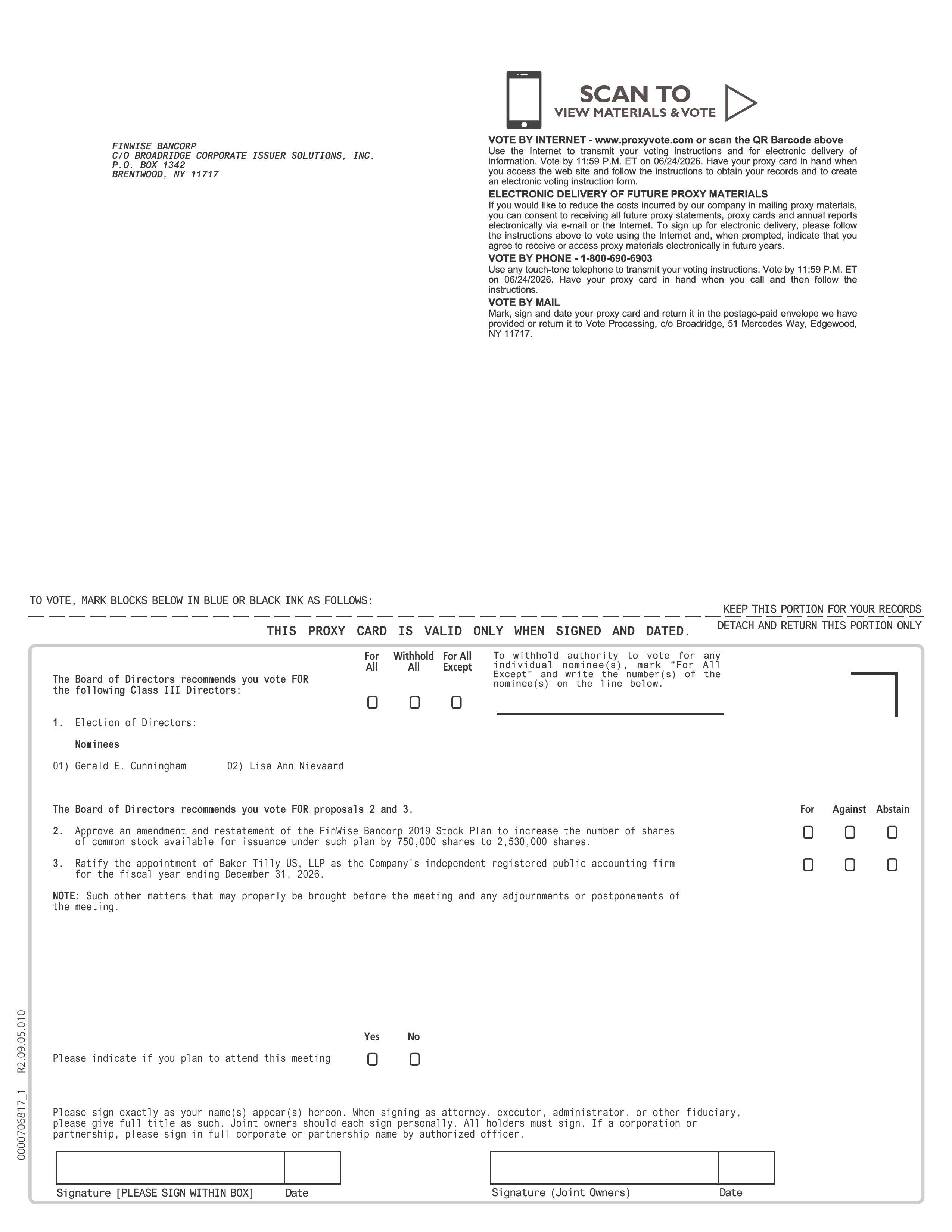
41
42