Table of Contents
DEF 14Afalse0001858681 0001858681 2025-01-01 2025-12-31 0001858681 2021-01-01 2021-12-31 0001858681 2023-01-01 2023-12-31 0001858681 2022-01-01 2022-12-31 0001858681 2024-01-01 2024-12-31 0001858681 apo:MarcRowanMember 2021-01-01 2021-12-31 0001858681 apo:LeonBlackMember 2021-01-01 2021-12-31 0001858681 ecd:ChngInFrValOfOutsdngAndUnvstdEqtyAwrdsGrntdInPrrYrsMember ecd:NonPeoNeoMember 2021-01-01 2021-12-31 0001858681 ecd:VstngDtFrValOfEqtyAwrdsGrntdAndVstdInCvrdYrMember ecd:NonPeoNeoMember 2021-01-01 2021-12-31 0001858681 ecd:ChngInFrValAsOfVstngDtOfPrrYrEqtyAwrdsVstdInCvrdYrMember ecd:NonPeoNeoMember 2021-01-01 2021-12-31 0001858681 ecd:YrEndFrValOfEqtyAwrdsGrntdInCvrdYrOutsdngAndUnvstdMember ecd:NonPeoNeoMember 2021-01-01 2021-12-31 0001858681 apo:DeductionsOfReportedEquityValuesFromSummaryCompensationMember ecd:NonPeoNeoMember 2021-01-01 2021-12-31 0001858681 ecd:EqtyAwrdsAdjsMember ecd:NonPeoNeoMember 2021-01-01 2021-12-31 0001858681 ecd:DvddsOrOthrErngsPdOnEqtyAwrdsNtOthrwsRflctdInTtlCompForCvrdYrMember ecd:NonPeoNeoMember 2021-01-01 2021-12-31 0001858681 apo:MarcRowanMember 2022-01-01 2022-12-31 0001858681 ecd:YrEndFrValOfEqtyAwrdsGrntdInCvrdYrOutsdngAndUnvstdMember ecd:NonPeoNeoMember 2022-01-01 2022-12-31 0001858681 ecd:ChngInFrValOfOutsdngAndUnvstdEqtyAwrdsGrntdInPrrYrsMember ecd:NonPeoNeoMember 2022-01-01 2022-12-31 0001858681 ecd:VstngDtFrValOfEqtyAwrdsGrntdAndVstdInCvrdYrMember ecd:NonPeoNeoMember 2022-01-01 2022-12-31 0001858681 apo:DeductionsOfReportedEquityValuesFromSummaryCompensationMember ecd:NonPeoNeoMember 2022-01-01 2022-12-31 0001858681 ecd:EqtyAwrdsAdjsMember ecd:NonPeoNeoMember 2022-01-01 2022-12-31 0001858681 ecd:ChngInFrValAsOfVstngDtOfPrrYrEqtyAwrdsVstdInCvrdYrMember ecd:NonPeoNeoMember 2022-01-01 2022-12-31 0001858681 ecd:DvddsOrOthrErngsPdOnEqtyAwrdsNtOthrwsRflctdInTtlCompForCvrdYrMember ecd:NonPeoNeoMember 2022-01-01 2022-12-31 0001858681 apo:MarcRowanMember 2023-01-01 2023-12-31 0001858681 ecd:ChngInFrValAsOfVstngDtOfPrrYrEqtyAwrdsVstdInCvrdYrMember ecd:NonPeoNeoMember 2023-01-01 2023-12-31 0001858681 apo:DeductionsOfReportedEquityValuesFromSummaryCompensationMember ecd:NonPeoNeoMember 2023-01-01 2023-12-31 0001858681 ecd:EqtyAwrdsAdjsMember ecd:NonPeoNeoMember 2023-01-01 2023-12-31 0001858681 ecd:ChngInFrValOfOutsdngAndUnvstdEqtyAwrdsGrntdInPrrYrsMember ecd:NonPeoNeoMember 2023-01-01 2023-12-31 0001858681 ecd:VstngDtFrValOfEqtyAwrdsGrntdAndVstdInCvrdYrMember ecd:NonPeoNeoMember 2023-01-01 2023-12-31 0001858681 ecd:YrEndFrValOfEqtyAwrdsGrntdInCvrdYrOutsdngAndUnvstdMember ecd:NonPeoNeoMember 2023-01-01 2023-12-31 0001858681 ecd:DvddsOrOthrErngsPdOnEqtyAwrdsNtOthrwsRflctdInTtlCompForCvrdYrMember ecd:NonPeoNeoMember 2023-01-01 2023-12-31 0001858681 apo:MarcRowanMember 2024-01-01 2024-12-31 0001858681 ecd:YrEndFrValOfEqtyAwrdsGrntdInCvrdYrOutsdngAndUnvstdMember ecd:NonPeoNeoMember 2024-01-01 2024-12-31 0001858681 ecd:ChngInFrValOfOutsdngAndUnvstdEqtyAwrdsGrntdInPrrYrsMember ecd:NonPeoNeoMember 2024-01-01 2024-12-31 0001858681 ecd:EqtyAwrdsAdjsMember ecd:NonPeoNeoMember 2024-01-01 2024-12-31 0001858681 apo:DeductionsOfReportedEquityValuesFromSummaryCompensationMember ecd:NonPeoNeoMember 2024-01-01 2024-12-31 0001858681 ecd:VstngDtFrValOfEqtyAwrdsGrntdAndVstdInCvrdYrMember ecd:NonPeoNeoMember 2024-01-01 2024-12-31 0001858681 ecd:ChngInFrValAsOfVstngDtOfPrrYrEqtyAwrdsVstdInCvrdYrMember ecd:NonPeoNeoMember 2024-01-01 2024-12-31 0001858681 ecd:DvddsOrOthrErngsPdOnEqtyAwrdsNtOthrwsRflctdInTtlCompForCvrdYrMember ecd:NonPeoNeoMember 2024-01-01 2024-12-31 0001858681 apo:MarcRowanMember 2025-01-01 2025-12-31 0001858681 ecd:DvddsOrOthrErngsPdOnEqtyAwrdsNtOthrwsRflctdInTtlCompForCvrdYrMember ecd:NonPeoNeoMember 2025-01-01 2025-12-31 0001858681 ecd:EqtyAwrdsAdjsMember ecd:NonPeoNeoMember 2025-01-01 2025-12-31 0001858681 apo:DeductionsOfReportedEquityValuesFromSummaryCompensationMember ecd:NonPeoNeoMember 2025-01-01 2025-12-31 0001858681 ecd:YrEndFrValOfEqtyAwrdsGrntdInCvrdYrOutsdngAndUnvstdMember ecd:NonPeoNeoMember 2025-01-01 2025-12-31 0001858681 ecd:ChngInFrValOfOutsdngAndUnvstdEqtyAwrdsGrntdInPrrYrsMember ecd:NonPeoNeoMember 2025-01-01 2025-12-31 0001858681 ecd:VstngDtFrValOfEqtyAwrdsGrntdAndVstdInCvrdYrMember ecd:NonPeoNeoMember 2025-01-01 2025-12-31 0001858681 ecd:ChngInFrValAsOfVstngDtOfPrrYrEqtyAwrdsVstdInCvrdYrMember ecd:NonPeoNeoMember 2025-01-01 2025-12-31 0001858681 1 2025-01-01 2025-12-31 0001858681 4 2025-01-01 2025-12-31 0001858681 2 2025-01-01 2025-12-31 0001858681 3 2025-01-01 2025-12-31 iso4217:USD
 
 
UNITED STATES
SECURITIES AND EXCHANGE COMMISSION
Washington, D.C. 20549
 
 
SCHEDULE 14A
(Rule
14a-101)
INFORMATION REQUIRED IN PROXY STATEMENT
SCHEDULE 14A INFORMATION
Proxy Statement Pursuant to Section 14(a) of the
Securities Exchange Act of 1934
 
 
Filed by the Registrant ☒
Filed by a Party other than the Registrant ☐
Check the appropriate box:
 
Preliminary Proxy Statement
 
Confidential, for Use of the Commission Only (as permitted by Rule
14a-6(e)(2))
 
Definitive Proxy Statement
 
Definitive Additional Materials
 
Soliciting Material Pursuant to
Section 240.14a-12
Apollo Global Management, Inc.
(Name of Registrant as Specified in its Charter)
(Name of Person(s) Filing Proxy Statement if other than the Registrant)
Payment of Filing Fee (Check the appropriate box):
 
No fee required.
 
Fee paid previously with preliminary materials.
 
Fee computed on table in exhibit required by Item 25(b) of Schedule 14A (17 CFR
240.14a-101)
per Item 1 of this Schedule and Exchange Act Rules
14c-5(g)
and
0-11.


Table of Contents

LOGO

Apollo Global Management, Inc.

9 West 57th Street, 42nd Floor

New York, New York 10019

NOTICE OF 2026 ANNUAL MEETING OF STOCKHOLDERS


Date  

Place


June 8, 2026


Time


12:00 p.m. ET


Record Date


April 17, 2026


The Apollo Global Management, Inc. (“AGM”) 2026 Annual Meeting of Stockholders will be held in a virtual-only format, via the Internet. In order to attend the meeting, you must register at https://web.viewproxy.com/apollo/2026 by 11:59 p.m., ET, on June 4, 2026. Stockholders can access the meeting by using the invitation provided upon registration. Registered attendees will be able to listen to the meeting live, submit questions and vote online.


We encourage you to access the Annual Meeting of Stockholders before the start time and allow ample time for online check-in, which will begin at 11:30 a.m. ET. For more information, please see “Questions and Answers About This Proxy Statement.”

Items of Business


1.

Elect directors for a one-year term


2.

Advisory vote to approve the compensation of our named executive officers (Say on Pay)


3.

Advisory vote on the frequency of future advisory votes to approve the compensation of our named executive officers (Say on Frequency)


4.

Ratify the appointment of Deloitte & Touche LLP as our independent registered public accounting firm for the fiscal year ending December 31, 2026


5.

Transact such other business as may properly come before the Annual Meeting of Stockholders

Important Notice Regarding the Availability of Proxy Materials

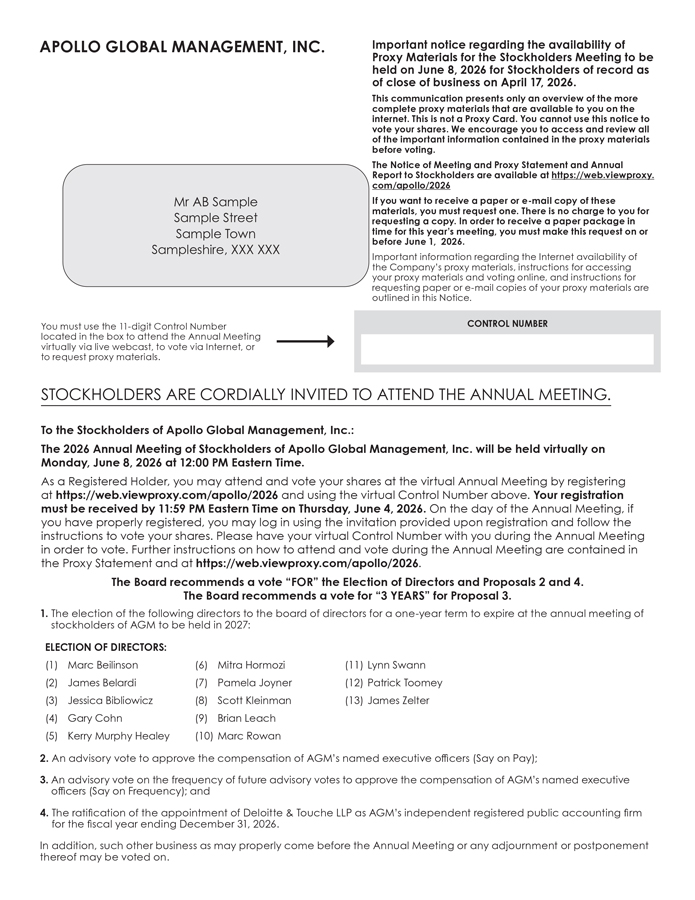
In accordance with the Securities and Exchange Commission rule permitting companies to furnish proxy materials to their stockholders via the Internet, on or about April 24, 2026, we sent to stockholders of record at the close of business on April 17, 2026, a Notice of Internet Availability of Proxy Materials, which includes instructions on how to access our 2026 Proxy Statement and 2025 Annual Report online, and how to vote online for the 2026 Annual Meeting of Stockholders.

Your vote is important. Please vote promptly.

Regardless of whether you plan to attend the Annual Meeting of Stockholders, please follow the instructions you received to vote your shares as soon as possible to ensure that your shares are represented at the Annual Meeting of Stockholders. Stockholders of record, or beneficial stockholders named as proxies by their stockholders of record, who attend the meeting may vote their shares personally, even though they have sent in proxies or voted online.

By order of the Board of Directors

Jessica L. Lomm

Secretary

April 24, 2026
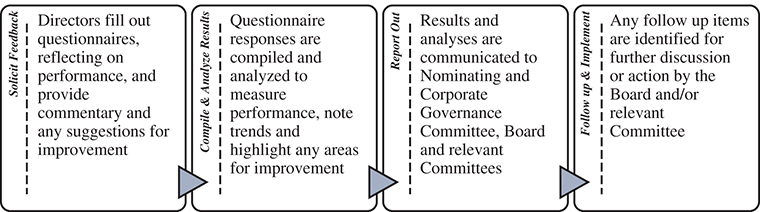

Table of Contents

TABLE OF CONTENTS


     Page  

CAUTIONARY STATEMENT REGARDING FORWARD-LOOKING STATEMENTS

     ii  

WEBSITE REFERENCES

     ii  

QUESTIONS AND ANSWERS ABOUT THIS PROXY STATEMENT

     1  

PROPOSAL 1—ELECTION OF DIRECTORS

     7  

BOARD OF DIRECTORS

     8  

CORPORATE GOVERNANCE

     16  

CERTAIN RELATIONSHIPS AND RELATED TRANSACTIONS

     27  

EXECUTIVE OFFICERS

     33  

PROPOSAL 2—ADVISORY VOTE TO APPROVE THE COMPENSATION OF OUR NAMED EXECUTIVE OFFICERS (SAY ON PAY)

     35  

EXECUTIVE COMPENSATION

     36  

PROPOSAL 3—ADVISORY VOTE ON THE FREQUENCY OF FUTURE ADVISORY VOTES ON THE COMPENSATION OF OUR NAMED EXECUTIVE OFFICERS (SAY ON FREQUENCY)

     67  

AUDIT COMMITTEE REPORT

     68  

PROPOSAL 4—RATIFICATION OF APPOINTMENT OF ACCOUNTANTS

     69  

SECURITY OWNERSHIP OF CERTAIN BENEFICIAL OWNERS AND MANAGEMENT

     71  

STOCKHOLDER PROPOSALS AND NOMINATIONS

     73  

HOUSEHOLDING MATTERS

     74  

OTHER MATTERS

     75  

Annex A – Definitions of Certain Financial Terms

     A-1  


i


Table of Contents

CAUTIONARY STATEMENT REGARDING FORWARD-LOOKING STATEMENTS

This Proxy Statement may contain forward-looking statements that are within the meaning of Section 27A of the Securities Act of 1933, as amended (the “Securities Act”), and Section 21E of the Securities Exchange Act of 1934, as amended (the “Exchange Act”). When used in this Proxy Statement, the words “believe,” “anticipate,” “estimate,” “expect,” “intend,” “target” or future or conditional verbs, such as “will,” “should,” “could,” or “may,” and variations of such words and similar expressions are intended to identify forward-looking statements. Although we believe the expectations reflected in these forward-looking statements are reasonable, we can give no assurance that these expectations will prove to have been correct. Forward-looking statements are subject to risks, uncertainties and assumptions that could cause actual results to differ materially from those expressed or implied in, or reasonably inferred from, such statements. We believe such factors include but are not limited to those described under the section entitled “Item 1A. Risk Factors” in our annual report on Form 10-K filed with the U.S. Securities and Exchange Commission (the “SEC”) on February 25, 2026, as such factors may be updated from time to time in our periodic filings with the SEC, which are accessible on the SEC’s website at www.sec.gov. These factors should not be construed as exhaustive and should be read in conjunction with the other cautionary statements that are included in this report and in our other filings with the SEC. We undertake no obligation to publicly update any forward-looking statements, whether as a result of new information, future developments or otherwise, except as required by applicable law.

WEBSITE REFERENCES

Website references and their hyperlinks have been provided for convenience only. The content on any referenced websites is not incorporated by reference into this Proxy Statement, nor does it constitute a part of this Proxy Statement.


ii


Table of Contents

LOGO

Apollo Global Management, Inc.

PROXY STATEMENT

Annual Meeting of Stockholders of Apollo Global Management, Inc. to be held on Monday, June 8, 2026

QUESTIONS AND ANSWERS ABOUT THIS PROXY STATEMENT

Why did I receive these proxy materials?

The Board of Directors (the “Board of Directors”) of Apollo Global Management, Inc. (the “Company” or “AGM” and together with its consolidated subsidiaries, “Apollo”) is soliciting proxies for our 2026 Annual Meeting of Stockholders (the “Annual Meeting”). The Annual Meeting will be held virtually on Monday, June 8, 2026 at 12:00 p.m., Eastern Time. The information included in this proxy statement (this “Proxy Statement”) relates to the proposals to be voted on at the Annual Meeting, the voting process, the compensation of directors and our most highly paid executive officers and corporate governance information. Our annual report to stockholders for the fiscal year ended December 31, 2025 (the “Annual Report”) is available to review with this Proxy Statement. We are sending a notice of the Annual Meeting (and, for those who request it, a paper copy of this Proxy Statement and the enclosed form of proxy) to our stockholders on or about April 24, 2026.

What proposals will be voted on at the Annual Meeting?

The four matters scheduled to be voted on at the Annual Meeting are:

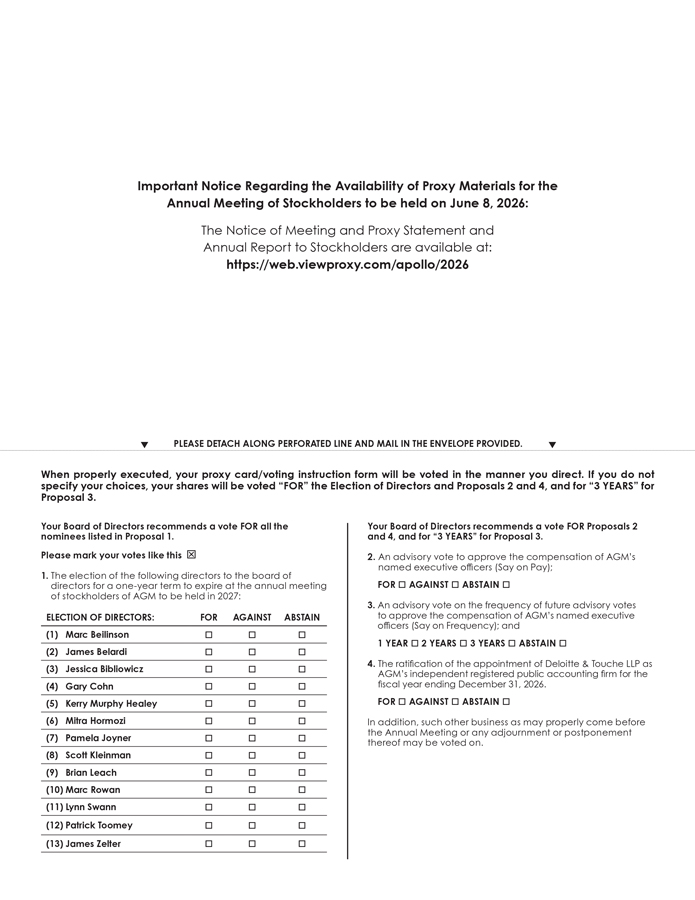
1. The election of the following directors to the board of directors for a one-year term to expire at the annual meeting of stockholders of AGM to be held in 2027: Marc Beilinson, James Belardi, Jessica Bibliowicz, Gary Cohn, Kerry Murphy Healey, Mitra Hormozi, Pamela Joyner, Scott Kleinman, Brian Leach, Marc Rowan, Lynn Swann, Patrick Toomey and James Zelter;

2. An advisory vote to approve the compensation of AGM’s named executive officers (“NEOs”) (Say on Pay);

3. An advisory vote on the frequency of future advisory votes to approve the compensation of AGM’s NEOs (Say on Frequency); and

4. The ratification of the appointment of Deloitte & Touche LLP (“Deloitte”) as AGM’s independent registered public accounting firm for the fiscal year ending December 31, 2026.

In addition, such other business as may properly come before the Annual Meeting or any adjournment or postponement thereof may be voted on.

How can I attend the Annual Meeting? Do I need to register beforehand?

We will be holding the Annual Meeting in a virtual-only format. By hosting the Annual Meeting via a live webcast, we believe we are able to communicate more effectively with our stockholders and enable increased attendance and participation from locations around the world. In order to attend the meeting, you must register at https://web.viewproxy.com/apollo/2026 by 11:59 p.m., Eastern Time, on June 4, 2026. The meeting can be accessed by using the invitation provided upon registration, where you will be able to listen to the meeting live, submit questions and vote online. We encourage you to access the Annual Meeting of Stockholders before the start time of 12:00 p.m., Eastern Time, on June 8, 2026. Please allow ample time for online check-in, which will begin at 11:30 a.m., Eastern Time, on June 8, 2026. We encourage you to vote your shares prior to the Annual Meeting.

Who can vote at the Annual Meeting?

Anyone owning shares of AGM’s common stock, par value $0.00001 per share (“common stock”), of record at the close of business on April 17, 2026, the record date for this year’s Annual Meeting, is entitled to attend and to vote on all items properly presented at the Annual Meeting.


1


Table of Contents

Who is asking me for my vote?

AGM is soliciting your proxy on behalf of the Board of Directors. We will pay the entire cost of this proxy solicitation, including the cost of preparing and sending the Notice of Internet Availability of Proxy Materials (“Notice”) and the Proxy Statement.

What are my voting rights?

Each share of common stock is entitled to one vote on each matter properly presented at the Annual Meeting. At the close of business on April 17, 2026, the record date for determining the stockholders entitled to notice of, and to vote at, the Annual Meeting, there were 576,519,062 shares of common stock outstanding. A list of all record stockholders as of the record date will be available during ordinary business hours at AGM’s principal place of business located at 9 West 57th Street, 42nd Floor, New York, New York 10019, from the Secretary of AGM, at least 10 days before the Annual Meeting.

How does the Board of Directors recommend that I vote?


Proposal   


Board Voting
Recommendation


1.  Election of 13 director nominees

   FOR each director nominee
   

2.  Approval of, on an advisory basis, the compensation of AGM’s NEOs (Say on Pay)

   FOR
   

3.  Advisory vote on the frequency of future advisory votes to approve the compensation of AGM’s NEOs (Say on Frequency)

   3 YEARS
   

4.  Ratification of the appointment of Deloitte as AGM’s independent registered public accounting firm for the fiscal year ending December 31, 2026

   FOR

Why did I receive a one-page notice in the mail regarding the internet availability of proxy materials instead of a full printed set?

In accordance with the rules of the SEC, AGM is providing access to its proxy materials via the internet in order to expedite stockholders’ receipt of proxy materials while lowering the cost of delivery and reducing the environmental impact of our Annual Meeting. Accordingly, AGM is sending the Notice, which provides instructions on how to access the proxy statement and our annual report to stockholders for the fiscal year ended December 31, 2025 via the internet and how to vote online, to stockholders of record and beneficial owners. All stockholders will have the ability to access the proxy materials on a website referred to in the Notice or to request a printed set of the proxy materials. Instructions on how to access the proxy materials via the internet or to request a printed set may be found in the Notice. In addition, stockholders may request a printed set of all future proxy materials.

Where can I view the proxy materials on the internet?

The Notice provides you with instructions on how to:


View proxy materials for the Annual Meeting via the internet; and


Instruct AGM to send future proxy materials to you by e-mail.

You can view the proxy materials for the Annual Meeting online at https://web.viewproxy.com/apollo/2026.


2


Table of Contents

How do I attend and vote my shares at the virtual Annual Meeting?

In order to attend the meeting, you must register at https://web.viewproxy.com/apollo/2026 by 11:59 p.m., Eastern Time, on June 4, 2026. You will receive a meeting invitation by e-mail with your unique join link along with a password prior to the meeting date. We encourage you to access the meeting before the start time of 12:00 p.m., Eastern Time, on June 8, 2026. Please allow ample time for online check-in, which will begin at 11:30 a.m., Eastern Time, on June 8, 2026.

If you hold shares of common stock as the stockholder of record, you have the right to vote those shares at the Annual Meeting.

If you are a beneficial owner and hold shares of common stock in street name, you must provide a legal proxy from your bank or broker during registration and you will be assigned a virtual control number in order to vote your shares during the Annual Meeting. If you are unable to obtain a legal proxy to vote your shares, you will still be able to attend the Annual Meeting (but will not be able to vote your shares) so long as you demonstrate proof of stock ownership and register at https://web.viewproxy.com/apollo/2026 by 11:59 p.m., Eastern Time, on June 4, 2026.

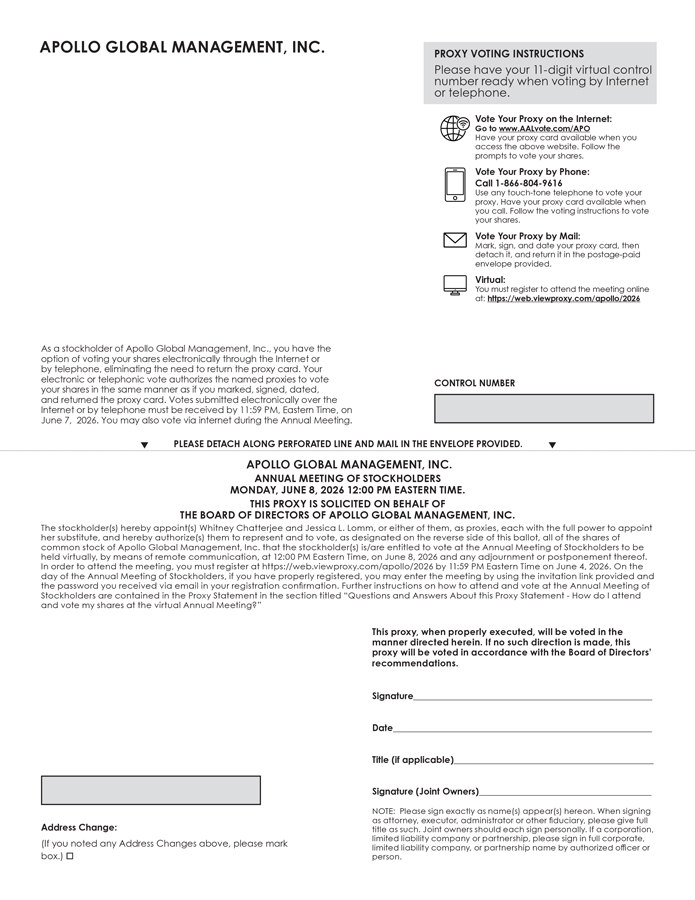
Please follow the instructions at https://web.viewproxy.com/apollo/2026 in order to attend the Annual Meeting and vote your shares during the meeting, whether you hold your shares of record or in street name. You will need the control number provided on the proxy card you received from us (the “Proxy Card”), your voting instruction form or your Notice.

Your vote is important. Even if you plan to attend the virtual Annual Meeting, we encourage you to submit a proxy or voting instructions for your shares as soon as possible in advance, so that your vote will be counted if you later decide not to attend the virtual Annual Meeting.

How may I vote my shares without attending the Annual Meeting?

Even if you plan to attend the virtual Annual Meeting, we encourage you to submit a proxy or voting instructions before the Annual Meeting by any method described below:


If you received a Notice by mail: You may access the proxy materials and voting instructions over the internet via the web address provided in the Notice. To access the materials and to submit your proxy or voting instructions, you will need the control number provided in the Notice you received in the mail. You may submit your proxy or voting instructions by following the instructions in the Notice or on the proxy voting website.


If you received the proxy materials by e-mail: You may access the proxy materials and voting instructions over the internet via the web address provided in the e-mail. To submit your proxy or voting instructions, you will need the control number set forth in the e-mail. You may submit your proxy or voting instructions by following the instructions in the e-mail or on the proxy voting website.


If you received the proxy materials by mail: You may submit your proxy or voting instructions by following the instructions provided on the Proxy Card or voting instruction form. If you submit your proxy or voting instructions via the internet or by telephone, you will need the control number provided on the Proxy Card or voting instruction form. If you submit your proxy or voting instructions by mail, please complete, sign and date the Proxy Card or voting instruction form and mail it in the accompanying pre-addressed, postage-paid envelope.

Can I change my vote after I have delivered my proxy?

Yes. You may revoke your proxy at any time before voting concludes at the Annual Meeting by:


Providing another proxy, or using any of the available methods for voting, with a later date, before 11:59 p.m., Eastern Time on June 7, 2026;


3


Table of Contents
   

Notifying AGM’s Secretary in writing that is received by 11:59 p.m., Eastern Time on June 7, 2026 that you wish to revoke your proxy; or


Voting your shares online at the Annual Meeting.

What is a quorum?

For the purposes of the Annual Meeting, a “quorum” is a majority of the voting power of the outstanding shares of common stock, represented in person or by proxy. Broker non-votes (as further described below) and abstentions are counted for purposes of determining whether a quorum is present.

What are broker non-votes and how are they treated for voting purposes?

Under the rules of the New York Stock Exchange (“NYSE”), brokers who have transmitted proxy materials to customers may vote the shares of customers who fail to provide voting instructions on “routine matters,” but not on “non-routine matters.” When a broker’s customer does not provide the broker with voting instructions on non-routine matters, the broker cannot vote on those matters and instead reports the number of such shares as broker “non-votes.” Broker non-votes are counted as present for the purpose of determining the presence of a quorum for the transaction of business, but they are not counted as shares voting for non-routine matters. Thus, broker non-votes can have the effect of preventing approval of certain proposals where the number of affirmative votes, although a majority of the votes cast, does not constitute a majority of the voting power present. The election of directors (Proposal 1), the advisory vote to approve the compensation of AGM’s NEOs (Say on Pay) (Proposal 2) and the advisory vote on the frequency of future advisory votes on the compensation of AGM’s NEOs (Say on Frequency) (Proposal 3) are non-routine matters. Therefore, if you hold your shares in street name through a broker, you must cast your vote if you want it to count in respect of these non-routine matters. The ratification of the appointment of AGM’s independent registered public accounting firm is a routine matter, so brokers will have discretion to vote any uninstructed shares on that proposal (Proposal 4).

What vote is required and how will my votes be counted?

The following table sets forth the vote standard applicable to each proposal, as determined by the Company’s bylaws and applicable regulatory guidance, at a meeting at which a quorum is present.


Proposal


Vote Required


Effect of Abstentions


Effect of

Broker Non-Votes


Proposal 1: Election of Directors

      Majority of votes cast       No effect – not counted as votes cast       No effect – not counted as shares voting

Proposal 2: Advisory Vote to Approve AGM’s NEOs Compensation (Say on Pay)

      Majority of the shares present or represented by proxy and entitled to vote on the proposal       Count as a vote AGAINST       No effect – not counted as shares voting

Proposal 3: Advisory Vote on Frequency of Advisory Votes to Approve AGM’s NEOs Compensation (Say on Frequency)

      Option for which the greatest number of votes is cast       No effect – not counted as votes cast       No effect – not counted as shares voting

Proposal 4: Ratification of Appointment of Auditor

      Majority of the shares present or represented by proxy and entitled to vote on the proposal       Count as a vote AGAINST       N/A. Brokers through which you beneficially own your shares may vote in their discretion


4


Table of Contents

May I vote confidentially?

Yes. Our policy is to keep your vote confidential, except as otherwise legally required, to allow for the tabulation and certification of votes and to facilitate proxy solicitation.

Who will count the votes?

A representative of Alliance Advisors will count the votes and act as the inspector of election for the Annual Meeting.

How are proxies solicited and what is the cost?

Apollo will pay the entire cost of this proxy solicitation, including the cost of preparing and sending the Notice and the Proxy Statement, if any are required or requested, and will reimburse banks and brokerage firms for out-of-pocket expenses incurred in connection with this solicitation. We have retained Alliance Advisors to aid in the solicitation of proxies, at an estimated cost of $68,000 plus expenses.

What if additional matters are presented at the Annual Meeting?

We do not know of any business to be considered at the Annual Meeting other than the proposals described in this Proxy Statement. If any other business is presented at the Annual Meeting, your properly executed proxy gives authority to Whitney Chatterjee, our Chief Legal Officer, and Jessica L. Lomm, our Secretary, to vote on such matters at their discretion.

Where can I find the voting results from the Annual Meeting?

We will announce preliminary voting results at the Annual Meeting and will publish final results in a Current Report on Form 8-K that we will file with the SEC within four business days after the date of the Annual Meeting.

How can I obtain information about AGM?

Copies of our public filings with the SEC are available on our website at ir.apollo.com. Stockholders may also obtain free copies of the public filings made by AGM with the SEC, including financial statements, by visiting our website or by sending a request in writing to Jessica L. Lomm, Secretary, Apollo Global Management, Inc., 9 West 57th Street, 42nd Floor, New York, New York 10019.

When are stockholder proposals due for consideration at next year’s annual meeting?

Under SEC rules, for stockholder proposals to be considered for inclusion in the proxy statement for the 2027 annual meeting of stockholders (the “2027 Annual Meeting”), they must be submitted in writing to our Secretary at Apollo Global Management, Inc., 9 West 57th Street, 42nd Floor, New York, New York 10019, on or before December 25, 2026. In addition, our bylaws provide that for directors to be nominated or other proposals to be properly presented at the 2027 Annual Meeting, an additional notice of any nomination or proposal must be received by us not less than 90 days nor more than 120 days prior to the first anniversary of the preceding year’s annual meeting. If the date of the 2027 Annual Meeting is more than 30 days before or more than 70 days after such anniversary date, any such notice by the stockholder to be timely must be received by us not earlier than the close of business on the 120th day prior to the 2027 Annual Meeting and not later than the close of business on the later of the 90th day prior to the 2027 Annual Meeting or the 10th day following the day on which public announcement of the date of the 2027 Annual Meeting is first made by AGM.


5


Table of Contents

Our bylaws also contain a “proxy access” provision that permits a stockholder or group of up to 20 stockholders owning 3% or more of our outstanding common stock continuously for at least three years to nominate and include in our proxy materials director nominees up to the greater of two or 20% of the number of directors on the Board of Directors (subject to certain adjustments and other conditions) provided the stockholder(s) and the nominee(s) satisfy the requirements specified in our bylaws. To be timely, a notice of proxy access nomination must be addressed to our Secretary and received by our Secretary (1) no earlier than one hundred fifty (150) days and no later than one hundred twenty (120) days before the anniversary of the date that the Company issued its proxy statement for the previous year’s annual meeting of stockholders or (2) in the case of such notice for a stockholder nominee who currently serves as a director of AGM, within twenty (20) days after the Board of Directors nominates directors for the next annual meeting.

In addition to satisfying the advance notice procedures in our bylaws and other requirements under the Exchange Act, stockholders who intend to solicit proxies in support of director nominees other than our nominees must provide notice that sets forth the information required by Rule 14a-19 under the Exchange Act no later than April 9, 2027.


6


Table of Contents

PROPOSAL 1—ELECTION OF DIRECTORS

Directors are elected to one-year terms and hold office until such director’s successor is duly elected and qualified, or, if earlier, until such director’s death or until such director resigns or is removed in the manner set forth in AGM’s bylaws. The term of all directors will expire at our next annual meeting of stockholders.

The Board of Directors currently consists of 13 directors. All of the nominees for re-election to the Board of Directors at the Annual Meeting are members of the current Board of Directors and have been nominated for re-election to the Board of Directors at the Annual Meeting by the Board of Directors upon the recommendation of the Nominating and Corporate Governance Committee.

If any nominee for election to the Board of Directors should be unable to accept nomination or election as a director, which is not expected, your proxy may be voted for a substitute or substitutes designated by the Board of Directors or the number of directors constituting the Board of Directors may be reduced in accordance with AGM’s certificate of incorporation.

Our organizational documents provide that, in an uncontested election, each director must receive the majority of the votes cast with respect to that director. If a director does not receive a majority vote, he or she has agreed that he or she will offer to resign from the Board of Directors. The Nominating and Corporate Governance Committee would then make a recommendation to the Board of Directors on whether to accept or reject the resignation, or whether other action should be taken. The Board of Directors would review and act on the resignation, taking into account the recommendation of the Nominating and Corporate Governance Committee, and would publicly disclose its decision and its rationale within 90 days of the certification of the election results. Abstentions and broker non-votes will not be counted for purposes of the election of directors. Brokers do not have discretion to vote any uninstructed shares for the election of directors.

Recommendation of the Board of Directors


The Board of Directors recommends that the stockholders vote FOR the election of the director nominees listed below.


7


Table of Contents

BOARD OF DIRECTORS

The following table sets forth certain information about our director nominees as of the date of this Proxy Statement. There is no family relationship between any director or executive officer. The Board of Directors provides a process for stockholders to send communications to the Board of Directors. See “Corporate Governance—Communications with the Board of Directors and Committees.” The business address for each nominee for matters regarding AGM is Apollo Global Management, Inc., 9 West 57th Street, 42nd Floor, New York, New York 10019.


Name

   Age   

Position(s)

Marc Rowan

   63    Chair and Chief Executive Officer

James Belardi

   69    Executive Chairman and Chief Investment Officer of AHL and Director

Scott Kleinman

   53    Co-President of AAM and Director

James Zelter

   63    President and Director

Gary Cohn

   65    Lead Independent Director

Marc Beilinson

   67    Director

Jessica Bibliowicz

   66    Director

Kerry Murphy Healey

   65    Director

Mitra Hormozi

   57    Director

Pamela Joyner

   68    Director

Brian Leach

   67    Director

Lynn Swann

   74    Director

Patrick Toomey

   64    Director

Marc Rowan is a Co-Founder, Chief Executive Officer and Chair of the board of directors of AGM. He is an executive officer of AGM and serves as a member of the executive committee of the AGM board of directors and AGM’s leadership team. From 2009 to August 2025, Mr. Rowan served as a member of the board of directors of Athene Holding Ltd., a Delaware corporation (“AHL” or “Athene”), and a member of the executive committee of the AHL board of directors. Currently, Mr. Rowan is Chair of the Board of Advisors of the Wharton School of Business at the University of Pennsylvania. In addition, he is involved in public policy and is an initial funder and contributor to the development of the Penn Wharton Budget Model, a nonpartisan research initiative which provides analysis of public policy’s fiscal impact. An active philanthropist and civically engaged, Mr. Rowan is Chair of the Board of UJA-Federation of New York, the world’s largest local philanthropy helping 4.5 million people annually while funding a network of nonprofits in New York, Israel, and 70 countries. He is also a founding member and Chair of Youth Renewal Fund and Vice Chair of Darca, Israel’s top educational network operating 55 schools with over 31,000 students throughout Israel’s most diverse and under-served communities. He is an Executive Committee member of the Civil Society Fellowship, a partnership of Anti-Defamation League and the Aspen Institute, designed to empower the next generation of community leaders and problem solvers. Mr. Rowan graduated summa cum laude from the University of Pennsylvania’s Wharton School of Business with a B.S. and an M.B.A. in Finance. Mr. Rowan’s extensive financial background and expertise in making and managing investments enhance the breadth of experience of AGM’s board of directors.

James Belardi is an executive officer of AGM and a member of AGM’s board of directors. He has served as a member of the AGM board of directors since January 2022. Mr. Belardi is also a member of the executive committee of AGM’s board of directors and AGM’s leadership team. Mr. Belardi is the Co-Founder, Executive Chairman and Chief Investment Officer of AHL. He is also the Chairman of AHL’s Board of Directors and a member of AHL’s executive committee. Mr. Belardi served as AHL’s Chief Executive Officer from May 2009 until July 2025. Under his leadership, AHL grew from a startup to the leading retirement services company, with nearly $400 billion in total assets, annual earnings exceeding $3 billion, and market-leading annuity and reinsurance franchises. He has over 35 years of experience in retirement services, insurance and asset management. In addition, Mr. Belardi is the founder, Chairman and Chief Executive Officer of Apollo Insurance


8


Table of Contents

Solutions Group LP (“ISG”), AHL’s investment manager, and is a member of ISG’s board of directors and executive committee. Prior to founding AHL and ISG, Mr. Belardi was President of SunAmerica Life Insurance Company and was also Executive Vice President and Chief Investment Officer of AIG Retirement Services, Inc., where he had responsibility for an invested-asset portfolio of $250 billion. He currently serves on the board of directors of Paulist Productions, where he Chairs the Investment Committee, and Southern California Aquatics. Mr. Belardi swam in the 1976 and 1980 Olympic Swimming Trials and is a nine-time Masters Swimming World Record Holder. Mr. Belardi has a B.A. in economics from Stanford University and an M.B.A. from the University of California, Los Angeles. Mr. Belardi’s demonstrated track record in and deep knowledge of the financial services business, including having founded both AHL and ISG, and his extensive experience in the insurance industry provide immense value to AGM’s and AHL’s board of directors.

Scott Kleinman is an executive officer of AGM and a member of AGM’s board of directors. He has served as a member of the AGM board of directors since January 2022. Mr. Kleinman is also a member of the executive committee of AGM’s board of directors and a member of AGM’s leadership team. Mr. Kleinman served on the AHL board of directors from December 2018 until November 2023. Mr. Kleinman is Co-President of Apollo Asset Management, Inc. (f/k/a Apollo Global Management, Inc.), a Delaware corporation (“AAM”), a private company since September 2023, co-leading AAM’s day-to-day operations, including all of AAM’s revenue-generating businesses and enterprise solutions across its integrated alternative investment platform. He joined the AAM board of directors effective March 2021, and he became Co-Chair in January 2022. Mr. Kleinman joined Apollo six years after its inception in 1996, and he was named Lead Partner for Private Equity in 2009 prior to being named Co-President in 2018. Prior to joining Apollo, Mr. Kleinman was a member of the Investment Banking division at Smith Barney Inc. Mr. Kleinman also currently serves on the board of directors of Athora Holding Ltd. and previously served on the board of directors of Apollo Strategic Growth Capital and Apollo Strategic Growth Capital II. In 2014, Mr. Kleinman founded the Kleinman Center for Energy Policy at the University of Pennsylvania. He is a member of the Board of Advisors at the University of Pennsylvania Stuart Weitzman School of Design. He is also a member of the Board of Advisors of Nature Conservancy New York as well as the Board of Directors of White Plains Hospital, where he co-chaired the COVID-19 Relief Campaign. Mr. Kleinman received a B.A. and B.S. from the University of Pennsylvania and the Wharton School of Business, respectively, graduating magna cum laude, Phi Beta Kappa. Mr. Kleinman’s extensive knowledge of Apollo’s business and expertise in private equity investments enhance the breadth of experience of AGM’s board of directors.

James Zelter has served as President of AGM since January 2025 and is a member of AGM’s board of directors. He has served as a member of the AGM board of directors since January 2022. As President, Mr. Zelter is responsible for overseeing operations and key strategic initiatives across AGM’s asset management and retirement services businesses. Mr. Zelter is also an executive officer of AGM, a member of the executive committee of AGM’s board of directors, and a member of AGM’s leadership team. Mr. Zelter previously served as a member and Co-Chair of AAM’s board of directors, a private company since September 2023, from March 2021 to January 2025 and from January 2022 to January 2025, respectively. He also served as Co-President of AAM from January 2018 to January 2025, co-leading AAM’s day-to-day operations, including all of AAM’s revenue-generating businesses and enterprise solutions across its integrated alternative investment platform. Mr. Zelter joined Apollo in 2006, and served as the Chief Investment Officer of Apollo’s credit business from 2006 to January 2025. Mr. Zelter previously served in several senior roles at MidCap Financial Investment Corporation (f/k/a Apollo Investment Corporation), a publicly traded vehicle managed by Apollo, and served as a director on its board of directors from 2006 to 2020. Prior to joining Apollo, Mr. Zelter was with Citigroup Inc. and its predecessor companies from 1994 to 2006. From 2003 to 2005, Mr. Zelter was Chief Investment Officer of Citigroup Alternative Investments, and prior to that he was responsible for Citigroup’s Global High Yield franchise. Prior to joining Citigroup in 1994, Mr. Zelter was a High Yield Trader at Goldman, Sachs & Co. Mr. Zelter has significant experience in global credit markets and has overseen the broad expansion of Apollo’s credit platform. He is a member of the Duke University Board of Trustees and a board member of DUMAC, Inc., the investment management company that oversees the Duke University endowment. Mr. Zelter also serves on the board of directors of the Partnership for New York City, and The Bridge Golf Foundation, as well as the


9


Table of Contents

Board of Fellows of Weill Cornell Medicine. Mr. Zelter has a B.A. in Economics from Duke University. Mr. Zelter’s extensive knowledge of Apollo’s business and expertise in credit investments enhance the breadth of experience of AGM’s board of directors.

Gary Cohn is the Lead Independent Director, Chair of the executive committee and Chair of the nominating and corporate governance committee of AGM’s board of directors. He has served as a member of the AGM board of directors since April 2025. Since 2021, Gary Cohn has served as Vice Chairman of IBM, working with the other IBM Executive Leadership Team members on a wide range of business initiatives and external engagement in areas including business development, public advocacy and client relationship management. Mr. Cohn previously served as Assistant to the President of the United States for Economic Policy and Director of the National Economic Council from January 2017 to April 2018. As chief economic advisor to the President, Mr. Cohn managed the administration’s economic policy agenda and led the successful effort to grow the U.S. economy, create jobs and increase wages through tax and regulatory reform. Prior to his White House tenure, Mr. Cohn was President and Chief Operating Officer of The Goldman Sachs Group, Inc. from 2006 to 2016. He joined Goldman Sachs in 1990 and held several other leadership positions including Global Co-Head of the Equities and Fixed Income, Currency and Commodities Division. Mr. Cohn is an internationally recognized expert on financial markets, economic policy and global economy. He brings extensive leadership experience in building and managing global businesses, with deep expertise in corporate strategy, financial and operational oversight and driving growth in complex, client centric organizations. Mr. Cohn is a member of the Systemic Resolution Advisory Committee of the Federal Deposit Insurance Corporation. Mr. Cohn also currently serves on the board of directors of several privately held companies. Mr. Cohn is a member of the Board of Trustees of the New York University (“NYU”) Langone Health and serves as Chairman of the Advisory Board for the NYU Langone Orthopedic Hospital. Mr. Cohn holds a B.S. degree from American University. Mr. Cohn’s extensive experience in the financial services industry and economic and tax policy expertise make him a valuable member of AGM’s board of directors.

Marc Beilinson is an independent director, Chair of the compensation committee of AGM’s board of directors and a member of the audit committee of AGM’s board of directors. He has served as a member of the AGM board of directors since January 2022. Mr. Beilinson has also served as an independent director of AHL since 2013, and he is the lead independent director and a member of AHL’s legal and regulatory committee. Mr. Beilinson served on the AHL compensation committee from August 2013 until December 2021. Since August 2011, Mr. Beilinson has been the Managing Director of Beilinson Advisory Group, a financial restructuring and hospitality advisory group that specializes in assisting distressed companies. Most recently, Mr. Beilinson served as Chief Restructuring Officer of Newbury Common Associates LLC (and certain affiliates) from December 2016 to June 2017. Mr. Beilinson previously served as Chief Restructuring Officer of Fisker Automotive from November 2013 to August 2014 and as Chief Restructuring Officer and Chief Executive Officer of Eagle Hospitality Properties Trust, Inc. from August 2011 to December 2014 and Innkeepers USA Trust from November 2008 to March 2012. Mr. Beilinson oversaw the Chapter 11 reorganization of Innkeepers USA, Fisker Automotive and Newbury Common Associates in his interim management roles as the Chief Restructuring Officer of those companies. Mr. Beilinson currently serves on the board of directors of Playtika and several privately held companies. Mr. Beilinson has previously served on the boards of directors of a number of public and privately held companies, including Exela Technologies, Westinghouse Electric, Caesars Acquisition Company, Wyndham International, Inc., Apollo Commercial Real Estate Finance, Inc., Innkeepers USA Trust and Gastar Inc. Mr. Beilinson has a B.A. in political science from the University of California, Los Angeles and a J.D. from the University of California Davis Law School. Mr. Beilinson’s over thirty years of service to the boards of both public and private companies, and his extensive knowledge of legal and compliance issues, including the Sarbanes-Oxley Act of 2002 enhances AGM’s board of directors.

Jessica Bibliowicz is an independent director and Chair of the audit committee of AGM’s board of directors. She has served as a member of the AGM board of directors since March 2022. Ms. Bibliowicz also served as an independent director and Chair of the audit committee of the AAM board of directors from March 2022 until September 2023. Ms. Bibliowicz is a successful entrepreneur and organizational leader within financial services


10


Table of Contents

with more than 30 years of experience with public and private companies. Notably, she became president and CEO of National Financial Partners (“NFP”), a leading provider of benefits, insurance and asset management services, in 1999 and Chairman of the company’s board in 2003 and took the company public later that year. She continued to serve in both roles until NFP was acquired in 2013. Earlier in her career, Ms. Bibliowicz held senior management positions at Prudential Mutual Funds and Smith Barney Mutual Funds. She is a member of the board of Prudential Insurance Funds and previously served on the board of directors for Sotheby’s until it went private in 2019. Ms. Bibliowicz has served on the Board of Fellows of Weill Cornell Medicine for more than 15 years and is currently Chair and also serves on the Board of Trustees of Cornell University and the Board of Trustees of New York-Presbyterian. Ms. Bibliowicz has a B.S. in government from Cornell University. Ms. Bibliowicz’s extensive business experience and leadership roles at both public and private companies make her a valuable member of AGM’s board of directors.

Kerry Murphy Healey is an independent director and Chair of the sustainability and corporate responsibility committee of AGM’s board of directors. She has served as a member of the AGM board of directors since January 2022. Dr. Healey served as an independent director of AAM’s board of directors from March 2021 through December 2021. Dr. Healey was the inaugural president of the Milken Center for Advancing the American Dream in Washington, DC, a position which she held from 2019 to 2022. Dr. Healey served as the President of Babson College from 2013 to 2019 and was elected President Emerita by the trustees of Babson College in 2021. Before coming to Babson, she served with distinction as the 70th lieutenant governor of Massachusetts from 2003 to 2007, where she worked to lead, enact, and implement a wide range of policy and legislative initiatives for the Romney-Healey Administration. In 2008, Dr. Healey was appointed by Secretary of State Condoleezza Rice as a founding member of the Executive Committee of the U.S. State Department’s Public-Private Partnership for Justice Reform in Afghanistan, a position to which she was later reappointed by Secretary of State Hillary Clinton. Prior to her public service, Dr. Healey worked for more than a decade as a public policy consultant to the United States Department of Justice for Cambridge-based think tank Abt Associates. Dr. Healey currently serves on the board of directors of Marti Technologies, Inc. Dr. Healey holds an A.B. in government from Harvard College and a Ph.D. in political science and law from Trinity College, Dublin. She has been a fellow at the Harvard Kennedy School’s Institute of Politics and Harvard’s Center for Public Leadership. She is a member of the Council on Foreign Relations and the Trilateral Commission and a trustee of the American University of Bahrain. Dr. Healey’s public service experience and her role in government make her a valuable member of AGM’s board of directors.

Mitra Hormozi is an independent director and a member of the compensation and sustainability and corporate responsibility committees of AGM’s board of directors. She has served as a member of the AGM board of directors since January 2022, and served as a member of the nominating and corporate governance committee until September 2023. Ms. Hormozi has served as an independent director of AHL since December 2018 and is the chair of AHL’s legal and regulatory committee. Ms. Hormozi is also a director of a number of AHL’s U.S. subsidiaries. Ms. Hormozi previously served on AHL’s compensation committee from 2019 until 2022. Ms. Hormozi has been a partner at Kaplan Martin since July 2024. Ms. Hormozi was a partner at Walden Macht & Haran LLP from January 2020 to June 2024. Ms. Hormozi was Executive Vice President and General Counsel of Revlon, Inc. from April 2015 to July 2019, where she was responsible for overseeing Revlon’s legal affairs worldwide. Earlier in her career, Ms. Hormozi was a federal prosecutor in the Eastern District of New York. She also previously served on the board of directors of Revlon from November 2019 until July 2020. Ms. Hormozi received a B.A. in history from the University of Michigan and a J.D. from the New York University School of Law. Ms. Hormozi’s extensive legal counsel experience provides value to AGM’s board of directors.

Pamela Joyner is an independent director and a member of the nominating and corporate governance committee of AGM’s board of directors. She has served as a member of the AGM board of directors since January 2022. Ms. Joyner served as an independent director of AAM’s board of directors from March 2021 through December 2021. Ms. Joyner is a founding partner of Avid Partners LLC, a strategic marketing consulting firm. Previously, she held senior positions at Bowman Capital Management LLC and Capital Guardian Trust


11


Table of Contents

Company. Ms. Joyner was an independent director of First Republic Bank until May 2023. She is a trustee emeritus of Dartmouth College, Chair Emeritus of the Tate Americas Foundation, and a trustee of the Art Institute of Chicago and J. Paul Getty Trust. She previously served on the board of Sharper Image Corp. She was previously Co-Chair of the San Francisco Ballet Association. Ms. Joyner holds a B.A. from Dartmouth College, an M.B.A. from Harvard University and an Honorary Degree from Dartmouth College. Ms. Joyner’s extensive business experience and her prior service on the board of a regulated company make her a valuable member of AGM’s board of directors.

Brian Leach is an independent director and a member of the audit and nominating and corporate governance committees of AGM’s board of directors. He has served as a member of the AGM board of directors since March 2025. Mr. Leach has served as a director of AHL since August 2016, and is a member of AHL’s risk and audit committees. Mr. Leach previously served on AHL’s conflicts committee from 2024 to 2025. From 2013 to 2015, Mr. Leach served as Head of Franchise Risk & Strategy at Citigroup with responsibility for managing all of Citibank’s global risk, audit, compliance and strategy. From 2008 to 2012, Mr. Leach served as the Chief Risk Officer of Citibank. In 2005, Mr. Leach, together with several former colleagues from Morgan Stanley, formed Old Lane and from 2005 to 2008, Mr. Leach served as Old Lane’s co-Chief Operating Officer and Chief Risk Officer. Prior to that, Mr. Leach worked his entire post-graduate career at Morgan Stanley encompassing running a successful proprietary trading business and culminating as the Risk Manager of the Institutional Securities Business reporting directly to its President. During his time with Morgan Stanley, Mr. Leach was seconded to Long-Term Capital Management (LTCM) for approximately one year. During that time, he was one of six managers selected by a consortium of 14 global financial institutions to manage the liquidation of LTCM. Mr. Leach serves on the Advisor Investment Committee of Mountain Capital. Mr. Leach has a B.A. in economics from Brown University and an M.B.A. from Harvard Business School. Mr. Leach has been awarded Risk Manager of the Year on two separate occasions: the first by Risk Magazine for his work in restructuring the hedge fund LTCM and the second by the Global Association of Risk Professionals for his work in restructuring Citigroup after the global financial crisis. Mr. Leach’s extensive experience in risk management and financial services makes him a valuable member of AGM’s board of directors.

Lynn Swann is an independent director and a member of the compensation committee of AGM’s board of directors. He has served as a member of the AGM board of directors since January 2022. Mr. Swann has also served as an independent director of AHL since September 2020, where he serves as a member of the legal and regulatory committee, and, since May 2025, as a member of the risk committee. Mr. Swann is president of Swann, Inc., a marketing and consulting firm he founded in 1976. From 2016 to 2019, Mr. Swann served as the Athletic Director of the University of Southern California, where he was responsible for overall administration of 21 women’s and men’s Division I athletic programs at the university. Mr. Swann currently serves on the board of directors of American Homes 4 Rent and several privately held companies. He has previously served on the boards of a number of publicly-traded, privately-held and non-profit entities, such as Xylem Inc., Evoqua Water Technologies and the Professional Golfers’ Association (PGA) of America. In addition to his extensive executive and board experience, Mr. Swann played nine seasons for the Pittsburgh Steelers and was elected to the Pro Football Hall of Fame in 2001. He also previously worked on-air as a host, reporter and analyst for the American Broadcast Company (ABC-TV) for nearly 30 years and served as chairman of the national board of Big Brothers Big Sisters of America. President George W. Bush appointed Mr. Swann as the Chairman of the President’s Council on Fitness, Sports and Nutrition, where he served from 2002 to 2005. Mr. Swann received a B.A. from the University of Southern California. Mr. Swann’s experience serving on the board of directors of public, private and non-profit entities provides value to AGM’s board of directors.

Patrick Toomey is an independent director and a member of the sustainability and corporate responsibility committee of AGM’s board of directors. He has served as a member of the AGM board of directors since March 2023. Senator Toomey represented Pennsylvania in the U.S. Senate from 2011 to 2023, serving on the Senate Banking, Housing, and Urban Affairs; Budget; and Finance Committees, as well as the Joint Economic Committee and the Joint Select Committee on Deficit Reduction. He also chaired the Subcommittee on Financial Institutions and Consumer Protection. Senator Toomey previously served in the U.S. House of Representatives from 1999 to 2005, where he was a member of the House Budget Committee. He began his career in financial


12


Table of Contents

services at Chemical Bank and then Morgan, Grenfell & Co. Senator Toomey has a B.A. in political science from Harvard University. Senator Toomey’s experience with economic and tax policy, financial regulation, and budgetary issues, as well as his experience in the financial services industry, make him a valuable member of AGM’s board of directors.

Director Qualifications and Attributes

The Board of Directors is composed of individuals with a variety of backgrounds and experiences, which together enable the Board of Directors to oversee Company strategy effectively. All of our directors have the following key attributes:


    Strategic thinking


    Business judgment


    Leadership and expertise in their fields
    Integrity and accountability


    High performance standards


13


Table of Contents

We believe our directors bring a well-rounded variety of experiences, qualifications, attributes and skills, and represent a mix of deep knowledge of the Company’s business and fresh perspectives. The table below summarizes some of the qualifications, experience, skills and attributes of each director nominee. This summary is not intended to be an exhaustive list of each director’s skills or contributions to the Board of Directors and the lack of a mark in a particular area does not necessarily signify a director’s lack of knowledge or skill in such area. Further information on each director is set forth in their biographies beginning on page 8.


      Beilinson     Belardi     Bibliowicz     Cohn     Healey     Hormozi     Joyner     Kleinman     Leach     Rowan     Swann     Toomey     Zelter 

Skills and Experience


Apollo Business/Industry. Deep knowledge of one or more areas of Apollo’s business or the asset management industry.


Accounting/Audit Committee. Experience with or oversight of financial reporting, accounting standards, internal controls and audit and risk management processes.


Public Board. Experience serving on public company boards and able to provide insight into governance, stockholder engagement and board oversight practices.


Senior Executive Leadership. Directors have served in senior leadership roles, bringing strategic, operational and organizational leadership experience.


Government/Public Policy. Directors have prior public service experience, providing insights into navigating governmental, regulatory and public policy environments.


Financial Literacy. Directors demonstrate strong financial acumen, including the ability to analyze financial statements, capital structures and investment performance.


Regulatory/Legal/Compliance. Directors possess expertise with or oversight of complex legal, regulatory and compliance matters and relationships with global regulators.


Technology/Cybersecurity/Digital Assets. Directors bring experience with or oversight of technology innovation, cybersecurity, fintech, digital transformation and/or digital assets.


Background


Board Tenure*

  4   4   4   1   5   4   5   5   1   15   4   3   5

Gender

  M   M   F   M   F   F   F   M   M   M   M   M   M

Race/Ethnicity


Black/African American


Hispanic/Latin American


Middle Eastern/North African


Alaskan Native or American Indian


White/Caucasian


*

Includes tenure on legacy AGM Board of Directors


14


Table of Contents

Required Vote

Our organizational documents provide that, in an uncontested election, each director must receive the majority of the votes cast with respect to that director. A majority of the votes cast means that the number of votes cast “for” a director must exceed the number of votes cast “against” that director. If a director does not receive a majority vote, he or she has agreed that he or she will offer to resign from the Board of Directors. The Nominating and Corporate Governance Committee would make a recommendation to the Board of Directors on whether to accept or reject the resignation, or whether other action should be taken. The Board of Directors would review and act on the resignation taking into account the recommendation of the Nominating and Corporate Governance Committee and would publicly disclose its decision and its rationale within 90 days of the certification of the election results. While shares for which broker non-votes or abstentions occur will be counted for purposes of determining the presence or absence of a quorum, they will not be counted for purposes of determining the number of shares voted with respect to the election of directors.


15


Table of Contents

CORPORATE GOVERNANCE

We believe our governance and ownership structure positions AGM as an industry leader with best-in-class governance practices. Our corporate governance practices include the following:


Board Structure and Independence
 

✓  Lead Independent Director: We have an experienced lead independent director with clearly defined responsibilities.


✓  Majority Independent Board: Nine of thirteen of our directors are independent.


✓  Board Refreshment: The majority of our board members are independent directors appointed in the last five years.


✓  Regular Executive Sessions: Our Board schedules executive sessions of the independent directors led by the lead independent director at every regular board meeting.


✓  Independent Committees: All members of the audit committee, compensation committee, nominating and corporate governance committee and sustainability and corporate responsibility committee are independent and such committees are led by independent committee chairs.


✓  Annual Board Evaluations: Our Board conducts annual board and committee self-evaluations, led by the Nominating and Corporate Governance Committee, to improve their effectiveness.


✓  Access to Management and Advisors: Our directors have direct access to management, and along with our board committees, have discretion to hire independent advisors at the company’s expense.


Stockholder Alignment


✓  Robust Shareholder Engagement: We have an active and ongoing shareholder engagement program, both during and outside of proxy season, in which our independent directors participate.


✓  One Share, One Vote: We have only one class of common stock outstanding, with each share entitled to one vote.


✓  Director and Executive Stock Ownership Guidelines: We have meaningful stock ownership guidelines for both our independent directors and executive officers to foster alignment with stockholders.


✓  Annual director elections: All our directors are elected on an annual basis.


✓  Majority Vote Standard and Resignation Policy for Directors: Directors are elected by majority vote in uncontested elections and we have a director resignation policy for directors not receiving majority support from our stockholders.


✓  Proxy Access Right: Subject to certain customary holding requirements, stockholders may nominate to the board the greater of two directors or 20% of our board seats under our bylaws.


✓  Special Meeting Right: Stockholders with at least 25% ownership are able to call special meetings under our bylaws.

 
Other Governance Practices
 

✓  Code of Conduct: We have a code of business conduct and ethics that is applicable to our directors and employees.


✓  Corporate Governance Policies: We have corporate governance guidelines and a related person transactions policy that are aligned with industry best practices.


✓  Annual Governance Reviews: Our board and its committees review committee charters and other corporate governance documents on an annual basis.


✓  Recoupment or “Clawback” Policies: We have two recoupment policies that encourage compliance with our policies and discourage detrimental activities.


✓  Outside Board Service Policy: We have a director board service policy that prohibits directors from serving on more than five public company boards without Board approval.


16


Table of Contents

Shareholder Engagement

We regularly seek input from stockholders throughout the year on a wide variety of topics, including financial and operating performance, business strategy, corporate governance, and executive compensation matters. During 2025, we engaged with stockholders who represented in the aggregate more than 70% of our outstanding shares of common stock. These included 20 of our 25 largest institutional stockholders, who held approximately 40% of our outstanding shares of common stock as of December 31, 2025. Specific feedback from these interactions was shared with Apollo’s management team and Board of Directors, as appropriate. In 2026, we and certain of our directors met with a major stockholder advisory firm to understand its perspective on our programs and best practices in executive compensation programs.

Given the overall nature of the stockholder feedback, we did not make any substantial changes to our governance and compensation programs in 2025. In addition to direct feedback from stockholders, the Board of Directors considers a variety of stakeholder viewpoints including investor policies and perspectives. The Board and its Committees have adopted numerous stockholder-friendly corporate governance and compensation risk-mitigating features that we believe align with market best practice as summarized above and below in the Executive Compensation—Discouragement of Excessive Risk-Taking section. As part of our ongoing stockholder engagement, we actively solicit investor perspectives on our governance practices and disclosures. The below table summarizes key feedback received during the past year and actions we have taken in response.


What We Heard from Our Investors


How We Responded to Our Investors

1. Looking for additional detail in our director skills matrix

   Enhanced our director skills matrix by defining our skills and experience categories

2. Wanted to understand the cadence of our Board’s review of its leadership structure

   Expanded disclosure to clarify that our Board reviews its leadership structure on an annual basis

3. Sought further context on how our compensation elements fit together to align pay with performance

   Included additional context and rationale for each component of our executive pay structure, including carried interest

Director Independence

Our Board of Directors currently consists of 13 directors. Our Nominating and Corporate Governance Committee recommended, and our Board of Directors determined that our current and former directors that served in 2025, Messrs. Beilinson, Clayton, Cohn, Ducey, Krongard, Leach, Simon and Swann, Mses. Bibliowicz, Hormozi, Joyner and Richards, Dr. Healey and Sen. Toomey, are independent under the NYSE rules relating to corporate governance matters and the independence standards described in our corporate governance guidelines. Under our corporate governance guidelines, directors are expected to satisfy the following criteria: (i) dedicate sufficient time, energy and attention to ensure the diligent performance of their duties; (ii) comply with the duties and responsibilities set forth therein and in the bylaws of AGM; (iii) comply with all duties of care, loyalty and confidentiality applicable to directors of publicly traded corporations organized in our jurisdiction of incorporation; and (iv) adhere to AGM’s code of business conduct and ethics, including, but not limited to, the policies on conflicts of interest expressed therein and any other Company policies that apply to directors.


17


Table of Contents

Board’s Role in Risk Oversight

The Board of Directors has an oversight role, as a whole and also at the committee level, in overseeing management of AGM’s risks. The Board of Directors regularly reviews information regarding our credit, liquidity and operations, as well as the risks associated with each, and oversees our broader risk management framework, including risks related to our investment activities, financial performance, operations, legal and regulatory compliance, cybersecurity and other key business areas. The compensation committee is responsible for overseeing the management of risks relating to employee compensation plans and arrangements, the audit committee oversees the management of major financial risk exposures and management’s risk assessment and risk management policies. The sustainability and corporate responsibility committee is responsible for overseeing the management of risks relating to corporate responsibility and sustainability matters. While each committee is responsible for overseeing the management of certain risks, the entire Board of Directors is regularly informed through committee reports about such risks. Additionally, the Board of Directors is also responsible for overseeing our cybersecurity risks. Our Chief Information Officer and/or our Chief Information Security Officer provide cybersecurity updates to either our Board of Directors and/or the Audit Committee at least annually.

Board of Directors Leadership Structure

Our governance framework provides the Board of Directors with the flexibility to select the appropriate leadership structure for Apollo. The Board of Directors understands that no single approach to board leadership is universally accepted and that the appropriate leadership structure may vary based on several factors, such as a company’s size, industry, operations, history and culture. Accordingly, our Board of Directors annually reviews its leadership structure in light of these factors and the current environment to achieve the optimal model for us and for our stockholders, as required by our corporate governance guidelines.

In April 2025, following a review of our Board leadership structure, the Nominating and Corporate Governance Committee determined that having Mr. Rowan serve as both Chair and CEO and appointing an experienced independent director, Mr. Cohn, is the most effective leadership structure for our Board and Apollo at this time. The current leadership structure is comprised of a combined Board Chair and CEO, a lead independent director, and board committees led by independent directors. The Board of Directors believes this structure effectively balances strong management and appropriate safeguards with oversight by independent directors.

Our corporate governance guidelines require that the Board of Directors elect a director to serve as the board chair and when the board chair is not an independent director, our corporate governance guidelines require that the Board of Directors appoint an independent director to serve as lead independent director. As Lead Independent Director, Mr. Cohn has the responsibilities described in our corporate governance guidelines, including:


presiding at all meetings of the Board of Directors at which the Chair is not present, including executive sessions of the independent directors;


serving as liaison between the Board Chair and the independent directors;


reviewing and approving materials to be sent to the Board of Directors;


approving the meeting agendas for the Board of Directors;


approving meeting schedules to assure that there is sufficient time for discussion of all agenda items;


having the authority to call meetings of the independent directors; and


if requested by major stockholders, ensuring that he is available for consultation and direct communication.

The composition of the Board of Directors, the tenure of the directors with AGM, the overall experience of the directors and the experience that the directors have had with the Chair and Chief Executive Officer, the Lead


18


Table of Contents

Independent Director and the executive management group permit and encourage each member to take an active role in discussions, and each member does actively participate in substantive discussions. We believe that the leadership structure of our current Board of Directors is serving AGM well at this time. The Board of Directors reviews its leadership structure on an annual basis.

Board Meetings

According to AGM’s corporate governance guidelines, directors are expected to use their best efforts to attend the annual meeting of stockholders, meetings of the Board of Directors and meetings of committees on which they serve, and to spend the time needed and meet as frequently as necessary to properly discharge their responsibilities. The Company also encourages all directors to attend each annual meeting of stockholders. During the Company’s fiscal year ended December 31, 2025, the Board of Directors held six meetings. Each director attended at least 75% of the aggregate number of meetings of the Board of Directors and the committees of the Board of Directors on which he or she served during 2025. Fourteen members of the Board of Directors attended the 2025 annual meeting of stockholders.

Board Committees

AGM has five committees of the Board of Directors:

1. Audit Committee


Meetings in 2025: 8


The primary purpose of the Audit Committee is to assist our Board of Directors in overseeing and monitoring:

Jessica Bibliowicz (Chair)

Marc Beilinson

Brian Leach


The integrity of the financial statements and other financial information provided to our stockholders, the public, any stock exchange and others;


Consists of three independent directors.   

Our compliance with legal and regulatory requirements;


The qualifications, independence and performance of our independent auditor;


The performance of our internal audit function and our system of internal controls; and


Such other matters as are assigned to the Audit Committee pursuant to our audit committee charter or as mandated under applicable laws, rules and regulations.


The Board of Directors has determined that each of the members of the Audit Committee meets the independence standards and financial literacy requirements for service on an audit committee of a board of directors pursuant to the Exchange Act and NYSE rules applicable to audit committees. Furthermore, our Board of Directors has determined that each of Ms. Bibliowicz and Messrs. Beilinson and Leach is an “audit committee financial expert” within the meaning of Item 407(d)(5) of Regulation S-K.


Our Audit Committee has a charter that complies with current SEC and NYSE rules that is available on our website at ir.apollo.com under the “Governance, Committees & Documents” section.


19


Table of Contents

2. Compensation Committee


Meetings in 2025: 9


The primary purpose of the Compensation Committee is to oversee:

Marc Beilinson (Chair)

Mitra Hormozi

Lynn Swann


Compensation of our executive officers, including AGM’s Chief Executive Officer; and


Consists of three independent directors.


Incentive compensation and equity-based plans as further provided in our compensation committee charter.


The Compensation Committee also oversees AGM’s management succession planning and makes recommendations to the Board of Directors in respect thereto.


The Compensation Committee utilizes Semler Brossy Consulting Group, LLC (“Semler Brossy”) as a third-party compensation consultant. See “Executive Compensation—Compensation Discussion and Analysis—Compensation Consultant.”


The Board of Directors has determined that each of the members of the Compensation Committee meets the independence standards for service on a compensation committee of a board of directors pursuant to the NYSE rules applicable to compensation committees.


Our Compensation Committee has a charter that complies with current SEC and NYSE rules that is available on our website at ir.apollo.com under the “Governance, Committees & Documents” section.


3. Executive Committee


The Executive Committee is responsible generally for:

Gary Cohn (Chair)

James Belardi

Scott Kleinman

Marc Rowan

James Zelter


Managing the affairs of the Board of Directors between its meetings; and


Providing guidance to senior management and recommendations to the Board of Directors regarding AGM’s strategic, financial and operating plans and performance, and key employment decisions, in each case, consistent with and subject to applicable law and securities regulations and the fiduciary duties of the Board of Directors.


The Executive Committee’s charter is available on our website at ir.apollo.com under the “Governance, Committees & Documents” section.


20


Table of Contents

4. Nominating and Corporate Governance Committee


Meetings in 2025: 3


The primary purpose of the Nominating and Corporate Governance Committee is to:

Gary Cohn (Chair)

Pamela Joyner

Brian Leach


Identify individuals qualified to become members of the Board of Directors, consistent with criteria approved by the Board of Directors;


Recommend to the Board of Directors for approval director nominees, consistent with our director qualifications criteria and any obligations under our contractual arrangements;


Review and recommend to the Board of Directors for approval the compensation of independent directors for their service to the Board of Directors;


Develop and recommend to the Board of Directors for approval corporate governance guidelines; and


Develop processes and procedures for the evaluation of the Board of Directors and its committees, and report to the Board of Directors regarding the results of such evaluation.


Consists of three independent directors.


Our Nominating and Corporate Governance Committee has a charter that complies with current SEC and NYSE rules. Our Nominating and Corporate Governance Committee’s charter is available on our website at ir.apollo.com under the “Governance, Committees & Documents” section.


5. Sustainability and Corporate Responsibility Committee


Kerry Murphy Healey (Chair)

Mitra Hormozi

Patrick Toomey


The primary purpose of the Sustainability and Corporate Responsibility Committee is to:


Consists of three independent directors.


Assist the Board of Directors in overseeing our corporate responsibility and sustainability matters, including environmental sustainability and climate, human rights, employee health and safety, and talent management, that may affect our business, strategy, operations, performance or reputation;


Monitor and review our government relations strategies and any political contributions relating to corporate responsibility and sustainability, as well as philanthropic actions and community initiatives;


Consider current and emerging matters relating to corporate responsibility and sustainability; and


Review our annual sustainability report and significant public disclosure on corporate responsibility and sustainability matters.


Our Sustainability and Corporate Responsibility Committee’s charter is available on our website at ir.apollo.com under the “Governance, Committees & Documents” section.


21


Table of Contents

Identifying and Evaluating Candidates for the Board of Directors

The Nominating and Corporate Governance Committee is responsible for recommending director candidates to the Board of Directors. Nominees for directorship are identified by the Nominating and Corporate Governance Committee in accordance with the criteria set forth below and any other criteria that may be identified by the Board of Directors or a committee of the Board of Directors, if appropriate, and in accordance with the procedures set forth in our corporate governance guidelines.

The Board of Directors seeks members from a wide variety of professional and personal backgrounds who combine a broad spectrum of experience and expertise with a reputation for integrity. The Nominating and Corporate Governance Committee’s assessment of a potential candidate will include an individual’s independence, as well as consideration of age, skills and experience, in the context of the needs of AGM.

The Nominating and Corporate Governance Committee will consider director candidates recommended by AGM’s stockholders, directors, officers and employees and third-party search firms and other sources it deems appropriate. The Nominating and Corporate Governance Committee may engage consultants or third-party search firms to assist in identifying and evaluating potential candidates. All candidates reviewed by the Nominating and Corporate Governance Committee are evaluated in accordance with the criteria used by the Nominating and Corporate Governance Committee set forth in our corporate governance guidelines, regardless of the source of the recommendation. Stockholders may recommend director candidates by writing to Jessica L. Lomm, Secretary, Apollo Global Management, Inc., 9 West 57th Street, 42nd Floor, New York, New York 10019. As set forth in greater detail in our corporate governance guidelines, the criteria used by the Nominating and Corporate Governance Committee in evaluating director candidates includes: integrity, accountability, judgment, responsibility, high performance standards, financial literacy, commitment and enthusiasm, and courage.

Our certificate of incorporation provides that, except as otherwise provided pursuant to, and subject to the terms and conditions of, the provisions of the Stockholders Agreement, dated as of January 1, 2022, by and among Leon D. Black, Marc J. Rowan, Joshua J. Harris (each a “Former Managing Partner” and collectively, the “Former Managing Partners”) and certain affiliates of the Former Managing Partners (the “Stockholders Agreement”) or any certificate of designation with respect to any potential outstanding series of Preferred Stock relating to the rights of the holders of Preferred Stock to elect additional directors, the Board of Directors shall have the sole power to set the total number of directors which shall constitute the Board of Directors. Our directors are elected at an annual meeting of stockholders in a manner described in our certificate of incorporation and each director elected will hold office until the succeeding meeting after such director’s election and until such director’s successor is duly elected and qualified, or, if earlier, until such director’s death, resignation or removal. Our organizational documents provide that, in an uncontested election, each director must receive the majority of the votes cast with respect to that director. If a director does not receive a majority vote, he or she has agreed that he or she will offer to resign from the Board of Directors. The Nominating and Corporate Governance Committee would make a recommendation to the Board of Directors on whether to accept or reject the resignation, or whether other action should be taken. The Board of Directors would review and act on the resignation taking into account the recommendation of the Nominating and Corporate Governance Committee and would publicly disclose its decision and its rationale within 90 days of the certification of the election results.

Pursuant to the Stockholders Agreement, each of the Former Managing Partners has the right to nominate himself (or a designee reasonably acceptable to the Nominating and Corporate Governance Committee) to our Board of Directors, for so long as such Former Managing Partner, together with the members of his family group, beneficially owns at least $400 million in value or 10 million in number of shares of common stock. In the event such nomination right is exercised, AGM will nominate the Former Managing Partner (or his designee reasonably acceptable to the Nominating and Corporate Governance Committee) as part of AGM’s Board of Directors slate for election at the Company’s annual meeting of stockholders. See “Certain Relationships and


22


Table of Contents

Related Transactions, and Director Independence—Stockholders Agreement.” Mr. Rowan is a current member of the Board of Directors and has been nominated for election to the Board of Directors. Each of Messrs. Black and Harris, who are not current members of the Board of Directors, has informed us that he has no current intention to exercise his nomination right for himself or a designee. All director candidates are evaluated in accordance with the criteria used by the Nominating and Corporate Governance Committee set forth in our corporate governance guidelines.

Corporate Governance Guidelines

We have corporate governance guidelines that address significant corporate governance policies and procedures by which our Board of Directors carries out its responsibilities. The guidelines are available for viewing on our website at ir.apollo.com under the “Governance—Committees & Documents” section. We will also provide the guidelines, free of charge, to stockholders who request them. Requests should be directed to our Secretary at Apollo Global Management, Inc., 9 West 57th Street, 42nd Floor, New York, New York 10019.

Evaluations of the Board and Committees

Our Board of Directors evaluates its performance and the performance of its committees on an annual basis through an evaluation process overseen by our Nominating and Corporate Governance Committee and depicted below. The Nominating and Corporate Governance Committee discusses each evaluation to determine what, if any, actions should be taken to improve the effectiveness of the Board of Directors or any committee thereof, and subsequently discusses such evaluation results with the Board of Directors.


LOGO

Code of Business Conduct and Ethics

We have a code of business conduct and ethics, which applies to, among others, our Board of Directors, our principal executive officer, principal financial officer, principal accounting officer and controller. A copy of our code of business conduct and ethics is available on our website at ir.apollo.com under the “Governance, Committees & Documents” section. We intend to disclose any substantive amendment to or waiver of the code of business conduct and ethics on behalf of an executive officer or director either on our website or in a Form 8-K filing.

Human Capital

Apollo’s talent is instrumental to our success as a global alternative asset manager and retirement services provider. Investing in and fostering a modern and inclusive high-performance culture is core to operating our business and delivering positive outcomes for our stockholders and fund investors, and our employee value proposition is designed to engage and develop our talent to deliver maximum impact. We believe our commitment to expanding opportunity across our ecosystem is central to the Apollo business model, an integrated platform which fosters strong collaboration across businesses and functions. Rooted in our core values, we strive to build a culture where all of our people can excel and grow in their careers.


23


Table of Contents

Talent Development

We believe that ongoing professional development is a critical part of our culture at Apollo and an important enabler of our investment process. Because of our entrepreneurial culture, the breadth of our integrated platform, and our reputation for strong investment performance, we believe we can attract, develop and retain top talent. We have development programs in place across a variety of levels which demonstrate our commitment to developing, engaging and retaining our employees. In addition to our training and annual review programs, we have instituted annual employee surveys that measure employee satisfaction and engagement and help evaluate and guide human capital decision-making. We work in partnership with our employees to maintain a strong culture which prioritizes excellence and outperforming expectations to advance our goal of being a modern high-performance workplace that is also a great place to work.

Compensation and Benefits

We work to offer a compelling employee value proposition to reward strong performance and support our employees’ professional development and well-being. Our pay for performance compensation philosophy is designed to reward employees for performance and to align employee interests with the firm’s long-term growth and with our stockholders. All of our employees are granted stock through a range of equity-based compensation programs, including our One Apollo stock program. Our benefits programs are intended to support our employees and their families, and include healthcare, wellness initiatives, retirement programs, paid time off and family leave.

Expanding Opportunity

Apollo is committed to championing opportunity and fostering a culture of excellence where everyone has an opportunity to thrive. We make talent decisions based on the qualities necessary to succeed in our modern high-performance workplace, focusing on skills, experience, and performance that drive results, rather than demographic characteristics or preferences. Reducing individuals to a single trait—whether gender, race, or ethnicity—misses the full picture of their capabilities, contributions, and potential impact. At the same time, we believe that a workforce of extraordinary people from a wide range of backgrounds and viewpoints helps us solve complex problems, drive innovation, and achieve great results over the long term. We are committed to expanding opportunity across our ecosystem—our workplace, in our marketplace, and in the communities where we live and work—to ensure that we attract and grow the best talent and business partners from a wide range of backgrounds, perspectives, and experiences who can perform at the highest levels for Apollo.

Citizenship

Apollo seeks to actively invest in our communities and engage our employees and other stakeholders in meaningful and impactful Citizenship Programs. Apollo offers its employees philanthropic, volunteer, and other forms of engagement to strengthen communities and expand opportunity around the globe. To empower employees to give back, Apollo hosts volunteer events and provides Citizenship Grants for matching gifts and volunteer rewards each year. Apollo is proud to amplify the efforts of employees, supporting the communities in which they live and the causes and organizations of greatest importance to them.

As part of our ongoing commitment to philanthropy, we established a new donor-advised fund (the “Fund”) and contributed Apollo shares with a value of $200 million in 2025. Mr. Rowan will make recommendations in partnership with AGM to donate through the Fund for the next four years.


24


Table of Contents
Foundations
The Apollo Opportunity Foundation and the Athene Charitable Foundation are committed to strengthening the communities where our employees live and work by creating lasting, positive impact through purposeful engagement and investment.
The Apollo Opportunity Foundation was launched in February 2022 to expand opportunity in communities where our employees live and work around the globe by deploying our capital and engaging our people to invest in career education, workforce development and economic empowerment for all. Leading with an employee-driven approach, the Apollo Opportunity Foundation partners with organizations that are championed by Apollo employees to advance economic prosperity and expand opportunity.
The Athene Charitable Foundation is deeply committed to making a meaningful difference in the communities where Athene employees live and work. Through
hands-on
volunteerism, strategic philanthropic giving, and purposeful community outreach, the Athene Charitable Foundation strives to create lasting, positive impact. Guided by four core pillars, education, human services, health and well-being, and environmental sustainability, the Athene Charitable Foundation’s efforts reflect a shared belief that strong communities are built when opportunity, compassion, and responsibility come together.
Sustainable Investing and Corporate Responsibility
At Apollo, we believe that taking all available factors into account can help drive value creation. We have taken an integrated approach to incorporating financially significant sustainability-related considerations into how we invest, how we lend, and how we operate our firm globally. Our strategy prioritizes the creation of economic value for our stockholders and addressing the needs of our clients and employees in a responsible way. Corporate responsibility and sustainability matters are reviewed by the sustainability and corporate responsibility committee of AGM’s Board of Directors. We have also adopted several policies, including an Environmental, Health and Safety policy, a Human Rights Policy, and a Supplier Code of Conduct. In addition, we publish on our website an annual sustainability report, which provides further details about our approach to corporate responsibility.
Communications with the Board of Directors and Committees
A stockholder or other interested party who wishes to communicate with our directors, a committee of our Board of Directors, our independent directors as a group or our Board of Directors generally may do so in writing. Any such communications may be sent to our Board of Directors by U.S. mail or overnight delivery and should be directed to our Secretary at Apollo Global Management, Inc., 9 West 57th Street, 42nd Floor, New York, New York 10019, who will forward them to the intended recipient(s), where appropriate or required. Any such communications may be made anonymously. Unsolicited advertisements, invitations to conferences or promotional materials, in the discretion of our Secretary, are not required, however, to be forwarded to the directors. Notwithstanding the foregoing, the Audit Committee has established procedures to enable anyone who has a concern about AGM’s conduct or about AGM’s accounting, internal accounting controls or auditing matters to communicate those concerns to the chair of the Audit Committee. Such communications may be confidential or anonymous and may be submitted in writing to: Apollo Global Management, Inc., Attn: Chair, Audit Committee of the Board of Directors, 9 West 57th Street, 42nd Floor, New York, New York 10019.
Executive Sessions of Independent Directors
The independent directors serving on our Board of Directors meet periodically in executive sessions during the year at regularly scheduled meetings of our Board of Directors. These executive sessions are presided over by our Lead Independent Director, Gary Cohn.
 
25

Table of Contents
Insider Trading Policy for Employees, Officers and Directors
Our Board of Directors has adopted, as part of our insider trading policy, prohibitions against our directors, officers and employees engaging in transactions of a speculative nature involving our securities at any time, including, but not limited to, the purchase or sale of put options or covered calls. In addition, such persons are prohibited from short-selling our securities or engaging in transactions involving other derivatives based on our securities, including options, warrants, restricted stock units, stock appreciation rights or similar rights whose value is derived from the value of our common stock or that hedge or offset, or are designed to hedge or offset, any decrease in the market value of our securities. This prohibition does not include (i) securities granted under our equity incentive plans and (ii) certain Apollo and Athene senior leaders entering into prepaid variable forward contracts or substantially similar transactions and the pledging of shares of our common stock in connection therewith if certain conditions as detailed in our insider trading policy are satisfied. It is also our policy to comply with applicable securities laws concerning trading in our securities on our own behalf.
 
 
26


Table of Contents

CERTAIN RELATIONSHIPS AND RELATED TRANSACTIONS

In the ordinary course of our business, we engage in transactions, arrangements and relationships with many other entities, including financial institutions and professional organizations. Some of our directors, executive officers, greater than 5% stockholders, and their immediate family members (each, a “related person”) may be directors, officers, partners, members, employees or stockholders of these entities. We carry out transactions with these entities on customary terms and, in many instances, these related persons may not have knowledge of them. To our knowledge, since January 1, 2025, no related person has had a material interest in any of our ongoing business transactions or relationships except as described in this section.

Stockholders Agreement

On January 1, 2022, we entered into the Stockholders Agreement with the Former Managing Partners and certain affiliates of the Former Managing Partners.

The Stockholders Agreement provides, among other things:


Each of the Former Managing Partners has the right to nominate himself (or a designee reasonably acceptable to the Nominating and Corporate Governance Committee, as applicable) to our Board of Directors as part of the director slate of the Board of Directors for election at the Company’s annual meeting of stockholders, for so long as such Former Managing Partner, together with the members of his family group, beneficially owns at least $400 million in value or 10 million in number of shares of common stock (the “Ownership Threshold”);


each Former Managing Partner (or his designee, as applicable), will, if requested by the Board of Directors, resign from the Board of Directors in the event that such Former Managing Partner no longer meets the Ownership Threshold;


each Former Managing Partner, together with the members of his family group, agrees to vote all of his or their respective shares of common stock in favor of the election of the other Former Managing Partners (or their designees, as applicable);


subject to the fiduciary duties of the directors then serving on the Board of Directors, AGM will recommend that its stockholders vote in favor of the Former Managing Partners (or their designees, as applicable) and AGM will otherwise take reasonable action to support their nomination and election (including by filling vacancies on the Board of Directors, if necessary);


each Former Managing Partner (but not his designee) will be entitled to a seat on the Executive Committee so long as such Former Managing Partner serves on the Board of Directors;


AGM will not make any non-pro rata distributions or payments to any Former Managing Partners without the consent of the other Former Managing Partners;


each Former Managing Partner and AGM agree not to take actions inconsistent with the terms of the Stockholders Agreement or in a manner that is discriminatory as to one or more of the Former Managing Partners, and will agree to oppose any such actions if proposed by others;


each Former Managing Partner will have customary information rights regarding AGM’s business, so long as such Former Managing Partner, together with the members of his family group, meets an ownership threshold equal to 50% of the Ownership Threshold; and


each Former Managing Partner will be entitled to the use of office space at AGM’s offices and administrative and logistics support provided by AGM; provided, that such Former Managing Partner continues to (a) provide services to AGM (other than as a member of the Board of Directors), (b) serve on the Executive Committee or (c) serve as the chair of the Board of Directors or of any committee of the Board of Directors.


27


Table of Contents

The Stockholders Agreement also grants to each Former Managing Partner (and his permitted transferees) the right, under certain circumstances and subject to certain restrictions, to require AGM to register under the Securities Act, shares of common stock held or acquired by them. Under the Stockholders Agreement, each Former Managing Partner (and his permitted transferees) (i) has “demand” registration rights that require AGM to register under the Securities Act the shares of common stock that he (and his permitted transferees) holds or acquires, (ii) may require AGM to make available registration statements permitting sales of shares of common stock he holds or acquires in the market from time to time over an extended period and (iii) has the ability to exercise certain piggyback registration rights in connection with registered offerings requested by other registration rights holders or initiated by AGM. AGM has agreed to indemnify each Former Managing Partner (and his permitted transferees, together with certain related parties) against any losses or damages resulting from any untrue statement or omission of material fact in any registration statement or prospectus pursuant to which such holder sells shares of common stock, unless such liability arose from the holder’s misstatement or omission, and each Former Managing Partner (and his permitted transferees) has agreed to indemnify AGM against all losses caused by his (or their) misstatements or omissions.

Registration Rights Agreement

On January 1, 2022, AGM entered into a Registration Rights Agreement with Mr. James Zelter and Mr. Scott Kleinman (the “Registration Rights Agreement”). Pursuant to the Registration Rights Agreement, AGM has granted Messrs. Zelter and Kleinman and their permitted transferees the right, under certain circumstances and subject to certain restrictions, to require AGM to register under the Securities Act, shares of common stock held or acquired by them. Under the Registration Rights Agreement, the registration rights holders (i) have “demand” registration rights that require AGM to register under the Securities Act the shares of common stock that they hold or acquire, (ii) may require AGM to make available registration statements permitting sales of shares of common stock they hold or acquire in the market from time to time over an extended period and (iii) have the ability to exercise certain piggyback registration rights in connection with registered offerings requested by other registration rights holders or initiated by AGM. AGM has agreed to indemnify each registration rights holder and certain related parties against any losses or damages resulting from any untrue statement or omission of material fact in any registration statement or prospectus pursuant to which such holder sells shares of common stock, unless such liability arose from the holder’s misstatement or omission, and each registration rights holder has agreed to indemnify AGM against all losses caused by his misstatements or omissions.

Roll-Up Agreements

Pursuant to the Roll-Up Agreements dated as of July 13, 2007, certain of AGM’s current and former employees (the “Contributing Partners”), including Messrs. Kleinman and Zelter received interests in AP Professional Holdings, L.P. (“Holdings”), which we refer to as units of Apollo Operating Group (as defined in the amended and restated certificate of incorporation of AGM) (“AOG Units”), in exchange for their contribution of assets to the limited partnerships and limited liability companies through which AAM operated its businesses. In connection with the closing of the merger transactions between AGM, AAM and AHL, which closed on January 1, 2022, the Roll-Up Agreements were amended to remove all covenants and agreements contained therein other than provisions relating to certain previously consummated roll-up transactions and the litigation cooperation covenant and to add certain matters relating to AGM’s tax receivable agreement (“TRA”).

Amended and Restated Tax Receivable Agreement

Prior to the consummation of our corporate reorganization on January 1, 2022, and subject to certain restrictions, each of the Former Managing Partners and Contributing Partners had the right to exchange the AOG Units that they held through their partnership interests in Holdings (together with the corresponding interest in AAM’s former share of Class B common stock) for AAM’s Class A shares in a taxable exchange. All Apollo Operating Group entities have made an election under Section 754 of the U.S. Internal Revenue Code (“IRC”).


28


Table of Contents

The election results in an increase to the tax basis of underlying assets which may reduce the amount of tax that AGM and its subsidiaries will otherwise be required to pay in the future. The TRA provides for payment to the Former Managing Partners and Contributing Partners of 85% of the amount of cash tax savings, if any, in U.S. federal, state, local and foreign income taxes AGM realizes as a result of the increases in tax basis of assets resulting from exchanges of AOG Units for Class A shares that have occurred in prior years. AGM and its subsidiaries retain the benefit of the remaining 15% of actual cash tax savings. If AGM does not make the required annual payment on a timely basis as outlined in the TRA, interest is accrued on the balance until the payment date. The term of the TRA will continue until all such benefits have been utilized or expired. As of December 31, 2025, TRA holders no longer own any operating units that could be exchanged pursuant to the TRA.

The Internal Revenue Service (the “IRS”) could challenge AGM’s claim to any increase in the tax basis of the assets owned by the Apollo Operating Group that resulted from the exchanges entered into by the Former Managing Partners or Contributing Partners. The IRS could also challenge any additional tax depreciation and amortization deductions or other tax benefits (including deductions for imputed interest expense associated with payments made under the TRA) that AGM claimed as a result of, or in connection with, such increases in the tax basis of such assets. If the IRS were to successfully challenge a tax basis increase or tax benefits AGM previously claimed from a tax basis increase, the Former Managing Partners and Contributing Partners would not be obligated under the TRA to reimburse AGM for any payments previously made to them (although any future payments would be adjusted to reflect the result of such challenge). As a result, in certain circumstances, payments could be made to the Former Managing Partners and Contributing Partners under the TRA in excess of 85% of AGM’s actual aggregate cash tax savings. The timing and amount of payments that will be made to the Former Managing Partners and Contributing Partners will depend on a variety of factors, including, but not limited to, the timing and amount of our future income.

From January 1, 2025 through December 31, 2025, Apollo made payments totaling $4,226,999 to the Former Managing Partners and Contributing Partners who are executive officers (or to their estate planning vehicles) pursuant to the TRA, related to tax benefits treated as realized thereunder by AGM. Those payments included the following amounts: $721,725 for Mr. Black, $2,259,762 for Mr. Harris, $1,212,653 for Mr. Rowan and $32,859 for Mr. Kleinman.

Employment Arrangements

Please see the section entitled “Executive Compensation—Employment Agreements” and “—Potential Payments upon Termination or Change in Control” for a description of the employment agreements of our named executive officers who have employment agreements.

In addition, Joshua Black, a son of Leon Black, is currently employed as a Partner in Apollo’s financial institutions group. He is entitled to receive a base salary, incentive compensation and employee benefits comparable to those offered to similarly situated employees of Apollo. He is also eligible to receive an annual performance-based bonus in an amount determined by Apollo in its discretion.

Firm Use of Private Aircraft

In the normal course of business, our personnel made use of an aircraft owned as a personal asset by an entity controlled by Mr. Rowan. Mr. Rowan paid for the purchase of the aircraft and bears all operating, personnel and maintenance costs associated with his operation for personal use. Payments by us for the business use of the aircraft by Mr. Rowan and other of our personnel are determined based on a specified hourly rate. From January 1, 2025 through December 31, 2025, Apollo made payments of $1,380,863 for the use of such aircraft owned by an entity controlled by Mr. Rowan.


29


Table of Contents

Apollo Management Holdings, L.P. (“AMH”), a subsidiary of AGM, in furtherance of the Company’s business goals and in accordance with the Company’s policy on private aircraft use, from time to time leases an aircraft from an entity controlled by Marc Rowan as owner of an aircraft beneficially owned by Mr. Rowan. For its flights under the lease, AMH pays rent to such entity and pays the costs to hire flight crew and operate the aircraft. The agreements were approved by the Audit Committee based on Apollo’s interest in ensuring the safety and security of Mr. Rowan for his business flights for Apollo. AMH also receives a waiver of liability claims from Mr. Rowan and the owner entity and owner trustee of the aircraft. From January 1, 2025 through December 31, 2025, AMH paid rent of $1,251,426 under the lease and paid additional costs of $867,717 for flight crew, fuel and operational expenses for its business use of the aircraft.

Investments in Apollo Funds and Other Transactions

Our directors and executive officers are generally permitted to invest their own capital (or capital of estate planning vehicles controlled by them or their immediate family members) directly in the funds and other accounts we manage and affiliated entities or in certain Athene annuity products. In general, such investments are not subject to management fees, and in certain instances, may not be subject to performance fees. In addition, from time to time, our directors and executive officers are offered an opportunity to invest their own capital in vehicles managed by third-party sponsors with which we have a strategic relationship (such investments with third-party sponsors, “Third-Party Sponsored Fund Investments”). Such investment opportunities may not be subject to management fees and/or performance fees. The opportunity to invest in the funds we manage, certain Athene annuity products and such third-party sponsored vehicles in this manner is available to our directors, executive officers and those of our employees (or estate planning vehicles respectively established or controlled by them or their immediate family members) whom we have determined to have a status that reasonably permits us to offer them these types of investments in compliance with applicable laws, as well as certain former directors and employees. As of December 31, 2025, our professionals have committed or invested approximately $2.2 billion of their own capital to Apollo-managed funds.

The amount committed to be invested in the funds and other accounts we manage, certain Athene annuity products and in Third-Party Sponsored Fund Investments by our current and former directors, executive officers and certain other related persons (and their immediate family members, or their or their immediate family members’ estate planning vehicles associated with them or their immediate family members) from January 1, 2025 through December 31, 2025 was $198,899 for Mr. Beilinson, $8,000,000 for Mr. Belardi, $176,764 for Mr. Black, $150,000 for Ms. Hormozi, $369,496 for Ms. Joyner, $250,000 for Mr. Kleinman, $110,000,000 for Mr. Rowan, $225,000 for Mr. Toomey, $3,000,000 for Mr. Zelter and $758,593 for Mr. Zito. The amount of distributions on these fund and account investments or annuity products, including profits and return of capital to our directors, executive officers and certain other related persons (and, in some cases, their immediate family members or certain of their or their immediate family members’ estate planning vehicles associated with them or their immediate family members) from January 1, 2025 through December 31, 2025, was $400,497 for Mr. Beilinson, $4,478,879 for Mr. Belardi, $206,703 for Ms. Bibliowicz, $6,106,376 for Mr. Black, $64,346 for Ms. Chatterjee, $64,346 for Mr. Clayton, $211,948 for Mr. Ducey, $39,040,819 for Mr. Harris, $273,924 for Ms. Hormozi, $218,830 for Ms. Joyner, $1,222,532 for Mr. Kelly, $8,666,067 for Mr. Kleinman, $965,185 for Mr. Kvalheim, $9,706 for Mr. Leach, $61,104 for Ms. Richards, $52,746,455 for Mr. Rowan, $252,933 for Mr. Simon, $21,883 for Mr. Toomey, $3,504,334 for Mr. Zelter and $664,321 for Mr. Zito.

In addition, certain of our subsidiaries engage in syndication activities pursuant to which they syndicate equity and debt financings, loans or other transactions to Apollo clients and co-investors, as well as third parties. Entities affiliated with or controlled by one or more of our executive officers may from time to time participate in one or more of these syndications by acquiring a portion of the syndication, provided that such affiliated entities participate on the same terms and subject to the same conditions, including fees paid to us, as all third parties participating in such syndication, and other required conditions have been satisfied. Similarly, certain other related persons and their related entities, including large institutional stockholders, may invest from time to time


30


Table of Contents

in such syndications, co-investment opportunities or other transactions arranged by, or including, Apollo and its affiliated entities, including, but not limited to, investments in funds we manage and in portfolio companies of such funds.

In August 2023, Athene Annuity and Life Company (“AAIA”), a subsidiary of Apollo, made a loan of $95 million to an entity affiliated with Simon Property Group, Inc. (“Simon Property Group”). The loan bears interest at a rate of 6.66%. In the year ended December 31, 2025, AAIA received $6,219,241 in interest from the loan to the Simon Property Group affiliate and there was $91,403,973 aggregate principal amount outstanding under the loan on December 31, 2025. David Simon, who formerly served as one of AGM’s independent directors, was the Chairman, CEO and President of Simon Property Group and a significant stockholder of Simon Property Group.

From time to time, related persons may purchase securities issued by Apollo or its affiliates in a public offering at the same price and on the same terms as other purchasers.

From time to time in the ordinary course of business, funds, accounts or other vehicles for which Apollo provides investment management or advisory services may acquire debt and equity securities issued by related persons or their affiliates, in open market transactions and may receive dividends, interest payments or other fees on such securities and transactions. In addition, from time to time in the ordinary course of business, Apollo, or funds, accounts or other vehicles for which Apollo provides investment management or advisory services, may acquire or manage assets pertaining to pension group annuities, which assets may include securities issued by related persons or their affiliates.

Sub-Advisory Arrangements and Strategic Investment Accounts

From time to time, we have entered into sub-advisory arrangements with, or established strategic investment accounts for, certain of our directors and executive officers or vehicles they manage. Such arrangements have been approved in advance in accordance with our policy regarding transactions with related persons. In addition, such sub-advisory arrangements or strategic investment accounts have been entered into with, or advised by, an Apollo entity serving as investment advisor registered under the Investment Advisers Act of 1940, as amended, and any fee arrangements, if applicable, have been on an arms-length basis. The amount of such fees paid to us by our directors, executive officers and certain other related persons or vehicles they manage from January 1, 2025 through December 31, 2025 was $22,107 for Mr. Rowan.

Indemnification of Directors, Officers and Others

Under our certificate of incorporation, in most circumstances we will be obligated to indemnify the following persons, to the fullest extent permitted by applicable law, from and against all losses, claims, damages, liabilities, joint or several, expenses (including legal fees and expenses), judgments, fines, penalties, interest, settlements or other amounts: AAM’s Former Manager; any Affiliate of AAM’s Former Manager; any member, partner, Tax Matters Partner, Partnership Representative, officer, director, employee, agent, fiduciary or trustee of any Corporate Group Member (each as defined in our certificate of incorporation), AAM’s Former Manager or any of its respective Affiliates; any Person who was serving at the request of AAM’s Former Manager or any of its respective Affiliates as an officer, director, employee, member, partner, Tax Matters Partner, Partnership Representative, agent, fiduciary or trustee of another Person; provided, that a Person shall not be included by reason of providing, on a fee-for-services basis, trustee, fiduciary or custodial services; and any person that our Board of Directors in its sole discretion designates as an “Indemnified Person” as permitted by applicable law. Subject to certain conditions and exceptions described in our certificate of incorporation, we may be required, from time to time, to advance expenses (including legal fees and expenses) that are incurred by indemnified persons, in appearing at, participating in or defending such indemnifiable claims, demands, actions, suits or proceedings prior to a final and non-appealable determination that the indemnified person is not entitled to be indemnified.


31


Table of Contents

We have agreed to provide this indemnification unless there has been a final and non-appealable judgment by a court of competent jurisdiction determining that these persons acted in bad faith or engaged in fraud or willful misconduct. We have also agreed to provide this indemnification for criminal proceedings. Any indemnification under these provisions will only be out of our assets. We may purchase insurance against liabilities asserted against and expenses incurred by persons for our activities, regardless of whether we would have the power to indemnify the person against liabilities under our certificate of incorporation.

We have entered into indemnification agreements with each of our directors, executive officers and certain of our employees which set forth the obligations described above. In 2025, we paid approximately $50 million in respect of such indemnification and advancement obligations. In addition, in 2025 a related party reimbursed us for certain legal expense incurred relating to a legal proceeding.

We have also agreed to indemnify each of the Former Managing Partners and certain Contributing Partners, including executive officers Messrs. Kleinman and Zelter, against certain amounts that they are required to pay in connection with a general partner obligation for the return of previously made performance fee distributions in respect of Apollo Investment Fund IV, L.P. and its parallel fund, Apollo Investment Fund V, L.P. and its parallel funds and alternative investment vehicles, and Apollo Investment Fund VI, L.P. and its parallel funds and alternative investment vehicles.

We also currently maintain liability insurance for our directors and officers.

Transactions with 5% Stockholders

In the ordinary course of our business during 2025, we entered into transactions with BlackRock, Inc. and FMR LLC on an arm’s-length basis and subject to customary terms and conditions.

Statement of Policy Regarding Transactions with Related Persons

We have adopted a written Related Person Transactions Policy (the “policy”), which sets forth our policy with respect to the review, approval, ratification and disclosure of all material related person transactions by the Audit Committee. In accordance with the policy, the Audit Committee has overall responsibility for implementation of and compliance with the policy.

For purposes of the policy, a “related person transaction” is a transaction, arrangement or relationship (or any series of similar transactions, arrangements or relationships) in which we were, are or will be a participant and the amount involved exceeded, exceeds or will exceed $120,000 and in which any related person (as defined in the policy) had, has or will have a direct or indirect material interest.

The policy requires that notice of a proposed related person transaction be provided to AGM’s Chief Legal Officer prior to entry into such transaction. If the Chief Legal Officer determines that such transaction is a related person transaction and does not fall within certain categories of pre-approved transactions listed in our policy, the proposed transaction will be submitted to our Audit Committee for consideration or in certain instances, to the Audit Committee Chair. Under the policy, our Audit Committee or the Audit Committee Chair may approve only those related person transactions that are in, or not inconsistent with, AGM’s best interests. In the event that we become aware of a related person transaction that has not been previously reviewed, approved or ratified under the policy and that is ongoing or is completed, the transaction will be submitted to the Audit Committee so that it may determine whether to ratify, rescind or terminate the related person transaction (provided that an interested director is required to be recused from such determination). The policy provides that no member of the Audit Committee shall participate in any review, consideration, or approval of any related person transaction with respect to which such member or any of his or her immediate family members is the related person. We make periodic inquiries of directors and executive officers with respect to any potential related person transaction of which they may be a party or of which they may be aware.


32


Table of Contents

EXECUTIVE OFFICERS

The names of the current executive officers of AGM (and their respective ages as of the date of this Proxy Statement) are set forth below.


Name

   Age   

Position(s)

Marc Rowan

   63    Chair and Chief Executive Officer

James Belardi

   69    Executive Chairman and Chief Investment Officer of AHL and Director

Scott Kleinman

   53    Co-President of AAM and Director

Grant Kvalheim

   69    Chief Executive Officer of AHL

James Zelter

   63    President and Director

Martin Kelly

   58    Chief Financial Officer

Whitney Chatterjee

   51    Chief Legal Officer

John Zito

   45    Co-President of AAM

Martin Kelly joined Apollo in 2012 and serves as the Chief Financial Officer of AGM. Mr. Kelly is an executive officer of AGM and a member of AGM’s leadership team. Mr. Kelly served as Chief Financial Officer of AAM from September 2012 through February 2022. From January 2019 through December 2021, Mr. Kelly also served as our Co-Chief Operating Officer. From 2008 to 2012, Mr. Kelly was with Barclays Capital and, from 2000 to 2008, Mr. Kelly was with Lehman Brothers Holdings Inc. Prior to departing Barclays Capital, Mr. Kelly served as Managing Director, CFO of the Americas, and Global Head of Financial Control for their Corporate and Investment Bank. Prior to joining Lehman Brothers in 2000, Mr. Kelly spent 13 years with PricewaterhouseCoopers LLP, including serving in the Financial Services Group in New York from 1994 to 2000. Mr. Kelly was appointed a Partner of the firm in 1999. Mr. Kelly serves as a trustee of The Hotchkiss School and as a member of the board of directors of the U.S. Olympic and Paralympic Foundation. Mr. Kelly received a degree in Commerce, majoring in Finance and Accounting, from the University of New South Wales.

Whitney Chatterjee joined Apollo in 2023 and serves as the Chief Legal Officer of AGM. Ms. Chatterjee is an executive officer of AGM and a member of AGM’s leadership team. Prior to joining Apollo, Ms. Chatterjee spent over 20 years at Sullivan & Cromwell LLP where she most recently served as a Partner in the Financial Services Group and Head of the Investment Management practice. She has extensive experience counseling investment managers to public and private funds, independent directors and trustees, fund sponsors, private investment funds and financial services companies on a wide variety of matters, including transactional, fund formation, regulatory, compliance and corporate governance matters. While at Sullivan & Cromwell LLP, Ms. Chatterjee collaborated with clients and investment management industry groups on significant legislative and regulatory developments affecting the asset management industry. Ms. Chatterjee received her J.D. from Columbia Law School and her B.A. from Hamilton College.

John Zito is Co-President of AAM, co-leading all investing activity and day-to-day management of AAM’s asset management business. Mr. Zito is also an executive officer of AGM, the Head of Credit, and a member of AGM’s leadership team. He joined the AAM board of directors as Co-Chair in January 2025. Since joining Apollo in 2012, Mr. Zito has helped scale the firm’s credit platform and played a central role in expanding Apollo’s reach into new markets and strategies, navigating periods of market dislocation, deploying significant capital at scale, and reinforcing Apollo’s leadership in innovative, long-term financing for blue-chip companies around the world. Prior to joining Apollo in 2012, Mr. Zito served as a managing director and portfolio manager at Brencourt Advisors and previously spent five years as a portfolio manager at Veritas Fund Group. Mr. Zito currently serves as chairman of the board of Atlas SP. He also serves on the Robin Hood Leadership Council. Mr. Zito is a Chartered Financial Analyst charter holder and he graduated cum laude from Amherst College with an AB in economics.


33


Table of Contents

Grant Kvalheim is an executive officer of AGM and serves as an observer on the executive committee of the AGM board of directors. Since July 2025, Mr. Kvalheim has served as the Chief Executive Officer of AHL, where he is responsible for expanding market share, prioritizing innovation, entering new markets and leading Athene through its next phase of growth. Since August 2025, Mr. Kvalheim has served as a member of AHL’s board of directors and a member of the executive committee of AHL’s board of directors. Mr. Kvalheim joined AHL in January 2011 as its Chief Financial Officer and later served as President, a role he held until July 2025. As President of AHL, Mr. Kvalheim was responsible for running Athene’s U.S. operations with a focus on growing organic origination. In that capacity, he led Athene’s entry into the U.S. annuity business where it has become the market leader. He also developed Athene’s Funding Agreement program, where Athene is the largest issuer, and guided Athene’s Pension Group Annuity franchise. Prior to joining Athene, Mr. Kvalheim was a Co-President of Barclays Capital where he grew the European investment grade credit business into a leading global credit franchise. Earlier in his career, he held senior executive positions in the investment banks of Deutsche Bank and Merrill Lynch. Mr. Kvalheim currently serves on the board of directors of the American Council of Life Insurers, Great Outdoors Foundation, SolHealth and Mottahedeh & Co., Inc. and is a member of the Geneva Association. He holds a B.S. degree in economics from Claremont McKenna College, and an M.B.A. in finance from the University of Chicago.

The biographical information for Messrs. Rowan, Belardi, Kleinman and Zelter is set forth above under “Board of Directors.”


34


Table of Contents

PROPOSAL 2— ADVISORY VOTE TO APPROVE THE COMPENSATION OF OUR NAMED EXECUTIVE OFFICERS (SAY ON PAY)

In accordance with Section 14A of the Exchange Act and the related rules of the SEC and as a matter of good corporate governance, a proposed resolution will be presented at the Annual Meeting asking our stockholders to approve, on an advisory basis, the compensation of AGM’s NEOs as disclosed in the Compensation Discussion and Analysis (“CD&A”), the Summary Compensation Table, and the related compensation tables, notes and narrative in this Proxy Statement.

As set forth in the CD&A below, AGM has designed its compensation programs to attract and retain key talent and reflect the following philosophies: (i) alignment of interests with investors and stockholders, (ii) long-term performance and commitment, (iii) significant personal investment and (iv) discouragement of excessive risk-taking. Although the vote to approve executive compensation is purely advisory and non-binding, the Compensation Committee values the opinions of our stockholders and will consider the results of the vote in determining the compensation of the NEOs. The vote is not intended to address any specific item of compensation but rather the overall compensation of our NEOs and the policies and practices described in this Proxy Statement. If any stockholder wishes to communicate with the Compensation Committee regarding executive compensation, the Compensation Committee can be contacted using the procedures outlined in “Communications with the Board of Directors and Committees” set forth in this Proxy Statement.

Accordingly, we are asking for stockholder approval, on an advisory basis, of the following resolution:

“RESOLVED, that the stockholders approve, on an advisory basis, the compensation of AGM’s named executive officers, as disclosed pursuant to Item 402 of Regulation S-K, including the “Compensation Discussion and Analysis,” the compensation tables and the narrative discussion associated with the compensation tables in AGM’s proxy statement for its 2026 Annual Meeting of Stockholders.”

The proposal will be considered to have been approved on an advisory basis if approved by the affirmative vote of a majority of the voting power of the outstanding shares of our common stock present in person or by proxy at the Annual Meeting and entitled to vote on this proposal. Abstentions will have the effect of voting “against” the proposal. Brokers do not have discretion to vote any uninstructed shares over the advisory vote to approve the compensation of our NEOs.

Recommendation of the Board of Directors


The Board of Directors recommends that the stockholders vote FOR the approval, on an advisory basis, of the compensation of AGM’s NEOs as disclosed in this Proxy Statement.


35


Table of Contents

EXECUTIVE COMPENSATION

Compensation Discussion and Analysis

Background

The following Compensation Discussion and Analysis (“CD&A”) reports on the compensation of our “named executive officers” or “NEOs” during 2025. This includes our CEO, CFO and our three most highly compensated executive officers, as follows:


Name


Title in 2025

Marc Rowan

   Chairman, Chief Executive Officer and Director

Martin Kelly

   Chief Financial Officer

James Belardi(1)

   Executive Chairman and Chief Investment Officer of AHL and Director; Former Chief Executive Officer of AHL

John Zito(2)

   Co-President of AAM

Whitney Chatterjee

   Chief Legal Officer
 
(1)

Effective July 1, 2025, Mr. Belardi was named Executive Chairman of AHL and ceased to be Chief Executive Officer of AHL.

(2)

Effective January 15, 2025, Mr. Zito was named Co-President of AAM and became an executive officer of AGM.

Financial Performance Highlights in 20252

2025 was an exceptional year of growth and execution for Apollo, highlighted by strong performance across various key performance measures. In the Asset Management business, we generated record Fee Related Earnings, which increased by 23% to $2.5 billion for the full year of 2025, driven by strong growth in fee related revenues net of continued investment in hiring and infrastructure to support the firm’s global strategic initiatives. In Retirement Services, we generated record Spread Related Earnings of $3.4 billion in 2025, driven by strong organic growth and increased alternative investment income. Our executive officers, who have deep experience in our industry, have helped build a best-in-class business with $938 billion of assets under management as of year-end 2025, increasing 25% from the prior year and translating to a compounded annual growth rate of 16% over the last five years.

In 2025, we made measured and meaningful progress against our five-year plan presented during our October 2024 Investor Day, which targets doubling the size of our business as we penetrate vast addressable markets. We generated over $300 billion of origination volume last year, exceeding our five-year average annual target outlined at Investor Day within the first eighteen months.

We believe that strong financial performance helps drive strong long-term stock performance. Since we listed on the NYSE in 2011, our market capitalization has grown from approximately $2 billion to nearly $85 billion as of 2025. Apollo reached $144.76 per share at year-end, translating to an average annual total return of 23% since 2011, outperforming the S&P 500 Index by over 3 times and the financial sector3 by 4 times over the comparable period. This result supports our long-term track record of driving outperformance for stockholders.


2 

Please see Annex A for the definitions of financial terms used herein.

3 

As measured by performance of the State Street Financial Select Sector SPDR ETF (XLF).


36


Table of Contents

LOGO


2025 BUSINESS HIGHLIGHTS

 
Meaningful Progress on Our Three Strategic Growth Pillars


Origination

➣ Origination volume totaled $309 billion in 2025 driven by significant contributions from core credit and origination platforms


Global Wealth

➣ Raised a record $18 billion of capital during 2025 driven by sustained momentum in signature semi-liquid products and growing demand towards fixed income replacement-focused products


Capital Solutions

➣ Record full-year capital solutions fees of $808 million demonstrates Apollo’s differentiated and flexible capital solutions at scale across a broad range of market conditions, geographies, and sectors

 
Strategically Allocated Capital to Drive Stockholder Value


Buybacks

➣ Repurchased approximately $1.4 billion of common stock in 2025, including $313 million of opportunistic share repurchases


Dividends

➣ Distributed more than $1 billion of common stock dividends in 2025


Strong Execution Across Key Performance Indicators
         
   
         2025 Result   YoY Growth
   
Asset Management   Fee Related Earnings   $2.5B   23%
         
   
Retirement Services   Spread Related Earnings   $3.4B   4%
         
   
Principal Investing   Principal Investing Income   $0.3B   25%


Origination &

Capital Formation

  Origination   $309B   39%
       
  Total Organic Inflows   $182B   20%
       
  Global Wealth Fundraising   $18B   50%


37


Table of Contents

Compensation Philosophy


Our Compensation Philosophy


Attract and retain outstanding
professionals in a competitive market
    Align long-term interests of employees
with stockholders and fund investors
    Encourage firmwide orientation and
ownership mindset


  Link pay to long-term performance
and fund outcomes
    Discourage excessive risk-taking and
support sustainable value creation
  

Our principal compensation philosophy is to align the long-term interests of our named executive officers and other key employees with those of our stockholders and the investors in the funds we manage. This alignment is achieved through direct beneficial ownership of common stock, participation in performance fees, personal investments in our funds, and equity-based compensation subject to vesting or in some instances delayed delivery. Our compensation program includes significant elements that mitigate excessive risk-taking, link the compensation of our professionals to our long-term performance, and encourage a firmwide orientation. Additionally, our policies, which include recoupment provisions, stock ownership guidelines, and restrictions on excessive risk-taking, further ensure that compensation practices support sustainable value creation for our stockholders and fund investors. Our programs are designed to enable us to attract and retain outstanding professionals in our highly competitive market for talent. By requiring our named executive officers to be subject to non-competition, non-solicitation, confidentiality and other limitations on behavior described below under “Potential Payments upon Termination or Change in Control,” we further reinforce our commitment to fiduciary protection of our stockholders and the investors in the funds we manage.

Our Executive Pay Practices


What We Do   

What We Don’t Do

   Align NEOs with stockholders and investors through:       No significant retirement or pension benefits
  

-Equityownership and participation in performance fee income


No single-trigger change in control severance payments


-  Significantpersonal investments in AGM common stock and Apollo funds


No excise tax gross-ups 


-Non-competeand non-solicit covenants


   Align pay with performance, with an emphasis on variable compensation, long-term stock ownership, and participation in performance fee income      


Meaningfulshare ownership guidelines covering all NEOs


   Maintain recoupment policies that provide for the recovery of equity-based awards and other incentive compensation if an employee engages in a detrimental activity (applies to employees generally) and as otherwise required by law, including (for all NEOs) following a financial restatement      


38


Table of Contents
What We Do   

What We Don’t Do

   Engage proactively with stockholders and other stakeholders      

   Include only independent directors on the Compensation Committee      

   Compensation Committee retains an independent compensation consultant      

Corporate Governance Practices

Our Board of Directors consists of a majority of independent directors and a lead independent director, with fully independent audit, compensation, governance, and sustainability committees, and holds annual elections for all directors with a majority vote standard in uncontested elections. Compensation decisions for our named executive officers are consistent with our compensation philosophy and are reviewed by our independent Compensation Committee. The Compensation Committee meets at least quarterly each year, operates pursuant to a written Compensation Committee Charter, and retains an independent compensation consultant.

In the event of a financial restatement under which the executive officers received more incentive compensation based on the original financials than they would have received under the restatement, the excess amounts received would be required to be recovered under our executive officer compensation recoupment policy. This recoupment policy is in addition to our recoupment policy that applies to all employees, including executive officers, and relates to detrimental conduct.

Compensation Consultant

The Compensation Committee retains an independent executive compensation consulting firm, Semler Brossy Consulting Group, LLC (“Semler Brossy”), to advise on competitive practices and industry trends, recommend compensation program design improvements, review and assess the effectiveness of our compensation practices, identify and evaluate compensation elements or situations that may raise material risks, review the compensation peer group and provide advice on compensation amounts and other benchmarking.

Semler Brossy regularly participates in Compensation Committee meetings. For 2025, Semler Brossy reaffirmed that our compensation practices and policies are not reasonably likely to have a material adverse impact on the Company. The Compensation Committee reviewed these findings and discussed them with Semler Brossy.

After reviewing the relevant factors, the Compensation Committee determined that the work of Semler Brossy and its employees does not create any conflicts of interest under applicable SEC and NYSE rules.

Stockholder Advisory Vote Regarding Executive Compensation

In 2020, our stockholders approved a triennial schedule for the say-on-pay advisory vote with 96% support, which we adopted as our practice. Consistent with that schedule, we held a say-on-pay advisory vote at our 2023 annual meeting, and we received strong majority support of approximately 84% of votes cast. We believe this result, along with positive feedback received through our ongoing shareholder engagement, reflects shareholder endorsement of our compensation program and continued support for our:


Pay-for-performance philosophy and emphasis on long-term compensation


Use of carried interest in directly linking executive compensation to long-term fund performance and stockholder value creation


39


Table of Contents
 

Risk balancing features that discourage excessive risk taking


Significant and sustained equity ownership by our executives, reinforcing alignment with long-term stockholder value

We continue to proactively engage with our stockholders on compensation and governance matters and the Compensation Committee considers stockholder insights, including the say-on-pay vote outcome, in assessing our executive compensation program. At this year’s annual meeting, we will hold both a say-on-pay advisory vote and an advisory vote regarding the frequency of the say-on-pay advisory vote.

Stockholder Outreach

We regularly seek input from stockholders throughout the year on a wide variety of topics, including financial and operating performance, business strategy, corporate governance, and executive compensation matters. During 2025, we engaged with stockholders who represented in the aggregate more than 70% of our outstanding shares of common stock. These included 20 of our 25 largest institutional stockholders, who held approximately 40% of our outstanding shares of common stock as of December 31, 2025. Specific feedback from these interactions was shared with Apollo’s management team and Board of Directors, as appropriate. In 2026, we and certain of our directors met with a major stockholder advisory firm to understand its perspective on our programs and best practices in executive compensation programs. Key areas of stockholder feedback are highlighted below. Our investors:


Were generally supportive of our compensation program, acknowledging Apollo’s governance enhancements and recognizing that our industry-specific pay structures, including the absence of an artificial cap on performance fee distributions, drive performance, align with market practices, and promote strong returns for stockholders;


Expressed support for our use of carried interest-based compensation given its strong alignment with long-term performance for fund investors and stockholders;


Valued the transparency of our proxy disclosure and clear explanation of how pay is aligned with performance; and


Acknowledged the context for Mr. Belardi’s compensation structure as a founder equity interest.

Given the overall nature of the stockholder feedback, we did not make any substantial changes to our compensation programs in 2025. The feedback helped inform certain disclosure-related enhancements pertaining to our existing compensation programs. In addition to direct feedback from stockholders, the Board of Directors considers a variety of stakeholder viewpoints including investor policies and perspectives. The Board and its Committees have adopted numerous stockholder-friendly corporate governance and compensation risk-mitigating features that we believe align with market best practice and stockholder feedback. Corporate governance-related changes based on stockholder feedback made this year are summarized in the Corporate Governance section herein. Executive compensation-related changes made this year based on stockholder feedback included providing additional context and rationale for each component of our executive pay structure.

Compensation Committee Actions Regarding Fiscal 2025 Compensation for Named Executive Officers

The Compensation Committee has decision-making authority for the compensation of our named executive officers. On January 30, 2025, upon the recommendation of the Compensation Committee, the independent members of the Board of Directors approved a new employment agreement for Mr. Rowan, which is described below under “Employment Agreement with Chief Executive Officer, Marc Rowan.”

Effective July 1, 2025, Mr. Belardi ceased to be Chief Executive Officer of AHL while remaining AHL’s Chairman of the Board and Chief Investment Officer. Mr. Belardi serves as Executive Chairman of AHL and also continues to serve as Chief Executive Officer of ISG, consistent with his continued leadership and importance to Apollo and AHL. Mr. Belardi’s 2025 compensation was paid in accordance with his employment agreement and partnership agreement, and the establishment of the scorecard applicable to his annual bonus (which is described below under “RSUs: Annual Incentive Bonus”) predated this change in position.


40


Table of Contents

Effective January 15, 2025, John Zito became an executive officer and for 2025 is a named executive officer. His compensation, including his 2025 compensation, reflects a preexisting 2023 employment agreement, which is described below.

In December 2025, the Compensation Committee approved a $10 million RSU grant to Mr. Kelly and a $13.5 million RSU grant to Ms. Chatterjee, in each case, to retain each of them and more closely align their compensation levels with individuals who hold similar roles in our peer group. In evaluating peer practices and competitive talent dynamics, the Compensation Committee determined, after reviewing information provided by its independent compensation consultant, that the RSU grants for Mr. Kelly and Ms. Chatterjee were appropriate to maintain market-competitive compensation and ensure retention during a critical phase of the Company’s growth and transformation. The awards will be considered when making annual compensation determinations for Mr. Kelly and Ms. Chatterjee for the next three years, and are intended to provide $3.3 and $4.5 million, respectively, per year over such period. These RSUs are subject to the achievement of performance fee hurdles within prescribed periods, as described below, and the delivery of the underlying shares will not occur before 2029. If Mr. Kelly or Ms. Chatterjee voluntarily resign prior to December 31, 2028, delivery of the shares underlying the vested RSUs will not occur until 2031.

In 2025, the Compensation Committee approved a peer group consisting of Ares, BlackRock, Blackstone, Blue Owl, Brookfield Asset Management, Carlyle, Goldman Sachs, KKR, Morgan Stanley and TPG. The peer group was determined in consultation with Semler Brossy. As part of this process, we reviewed assets under management, market capitalization, and business mix, with a focus on alternative asset managers and large investment banks with an asset management business. The composition of our peer group is reviewed annually by the Compensation Committee in consultation with Semler Brossy.

Overview of Compensation Elements

Consistent with our emphasis on alignment of interests with our stockholders and fund investors, compensation elements tied to the performance of shares of our common stock, the profitability of our different businesses and the profitability of the funds that we manage are the primary means of compensating our named executive officers. The following table provides a high-level overview of the primary elements of our executive compensation program and how they work together to support long-term performance.


Compensation Element   Structure   Purpose
Base Salary   Messrs. Rowan and Zito receive an annual base salary of $100,000; the other NEOs’ base salaries are generally based on market practice, including higher fixed compensation for individuals in control functions to reinforce their focus on risk management  

Provides a stable level of income and

is generally modest relative to total compensation

Restricted Stock Units (RSUs)   Equity awards subject to time and/or performance-based vesting and, in some instances, delayed delivery features   Aligns executives with long-term stockholder value creation and promotes sustained performance and retention
Carried Interest / Performance Fees  

Participation in fund-level carried interest or incentive fee arrangements, earned based on overall fund


performance; generally payable only upon a realization event and, for drawdown-style funds, generally subject to performance-based clawback after payment

  Directly links incentives to long-term investment performance and value creation for fund investors and stockholders, while remaining at risk


41


Table of Contents
Compensation Element   Structure   Purpose
Founder Partnership Interest  

Mr. Belardi holds a partnership interest in the parent of Apollo Insurance Solutions Group (“ISG”), which he founded; this interest relates back to 2009 and provides formula-based quarterly distributions equal to a fixed percentage of certain ISG management and subadvisory fee revenues to which Mr. Belardi is contractually entitled


Reflects founder economics and long-term value creation in the ISG business and to Apollo and its stockholders


Aligns compensation with sustained revenue growth and continued expansion of the platform

Compensation Practices Specific to Our Industry

Similar to other alternative asset managers and select diversified financial services firms, a portion of our employees’ compensation is often tied directly to the performance of the funds we manage in the form of carried interest, also known as “carry” or participation in performance fee income. Carried interest is an instrument concentrated within the asset management and investment-oriented segments of financial services, and is therefore a foundational element of our competitive compensation for senior professionals in our talent market. Carried interest awards are long-term, performance-based arrangements that directly link incentives to fund performance and investor outcomes and have value only after the funds achieve pre-determined performance hurdles.

Beyond alignment, our carried interest awards strengthen Apollo’s ability to attract, retain and motivate senior talent by offering differentiated, long-term opportunities that are uniquely available within our industry in the highly competitive market for proven investment professionals.

Illustrative Example of Carried Interest Award4


LOGO

 
4 

Example provided for illustrative purposes only; actual amounts and allocations vary.


42


Table of Contents

Why Performance Fees are a Key Long-Term Incentive


Feature   Description
Key Driver of Stockholder Value  

Carried interest is aligned with stockholders because growth in performance fees is a key driver of stockholder value


Generating performance fees requires successful fundraising and strong investment performance, which supports future growth in performance fees and is accretive to stockholder value


Specific and Predetermined Performance Requirements with Clear Payout Determination Process  

Carried interest is performance-based and fully at-risk because amounts are paid only after achieving predetermined performance hurdles (an 8% preferred return for most of the investment funds we manage), meaning that fund returns must exceed this threshold before payments to participants are made


Amounts paid are generally determined by overall fund performance rather than the outcome of a single investment and are paid only after profitable investments have actually been realized, rewarding sustainable value creation for the Company, our stockholders and the investors in the funds we manage, rather than short-term gains


Cap on Payouts  

Carried interest awards are subject to two implicit caps: (i) aggregate amount of carry generally cannot exceed 20% of the profits realized by the funds we manage, with the remaining 80% or more distributed to fund investors; and (ii) employees generally receive a specified percentage of the aggregate carry, limiting the amount each employee may receive


Structure preserves the full incentive to maximize returns for investors


Risk Management and Safeguard Features (Clawback and Personal Investment)  

Amounts paid on drawdown-style funds are generally subject to performance-based clawback, typically net of tax, if future fund performance declines below a specified hurdle (an 8% preferred return for most of the investment funds we manage), causing amounts paid to remain at risk for the entire life of the fund, which tends to be substantially longer than the three- to five-year performance periods that typically apply to performance-based compensation


Individuals are generally required to commit personal capital to the funds, ensuring alignment with investors and reinforcing our principal mindset


These mechanics discourage short-term decision making that could negatively affect long-term outcomes and prioritize the return of capital to investors before paying employees

We target sharing 65% to 75% of the performance fees that are earned from investment funds we manage with Apollo employees across all groups, in connection with our multi-year initiative to shift our compensation mix for senior employees generally, toward greater performance fee income. The portion of performance fees not allocated to our employees remains with Apollo for reinvestment in our businesses or may be returned to our stockholders through dividends or share repurchases. The value of our participating employees’ performance fee entitlements increases as the profit earned by the investment fund increases, and we believe that the lack of a predetermined maximum dollar value on this growth is both industry standard and important to aligning our employees with our fund investors. Introducing an artificial dollar value limit for carry awards could disincentivize sustained fund outperformance, which would not align with the interests of our investors and our business. We currently have two principal types of performance fee programs, which we refer to as “dedicated” and “incentive pool.”

Performance Fees: Dedicated. Messrs. Kelly, Belardi and Zito, and Ms. Chatterjee, have historically been awarded rights to participate in a dedicated percentage of the performance fee income earned by the general


43


Table of Contents

partners of certain funds that we manage, but Messrs. Belardi and Zito do not receive new rights to performance fee awards. In 2025, Messrs. Kelly and Zito, and Ms. Chatterjee, received distributions on vested dedicated performance fee rights. Dedicated performance fee rights in the private equity funds we manage are typically subject to vesting conditions, which rewards long-term commitment to the Company, thereby enhancing the alignment of participants’ interests with that of the Company. Unlike Messrs. Rowan, Belardi and Zito, Mr. Kelly and Ms. Chatterjee received new performance fee rights in 2025. Messrs. Rowan, Kelly, and Zito and Ms. Chatterjee also participate in a program under which accrued performance fees may be notionally invested by participants in a fund we manage until they are paid, although Mr. Zito’s only outstanding award under that program was granted in 2022. Rights to payments under the program vest after three years (after one year for Mr. Rowan), subject to continued employment, with payments made shortly after vesting (in Mr. Rowan’s case, his payment in respect of 2025 was deferred for another two years). As with other amounts distributed in respect of other performance fees, our financial statements characterize performance fee income allocated to participating professionals in respect of their dedicated performance fee rights as compensation. Unlike dividends, amounts paid in respect of dedicated performance fees are included in the “All Other Compensation” column of the Summary Compensation Table for the fiscal year in which such fees were paid.

We generally require employees who have dedicated rights to participate in the performance fees distributed by certain of the investment funds we manage to use a portion of the amounts to purchase restricted shares of common stock, or we distribute a portion in the form of RSUs. This practice further promotes alignment with our stockholders and motivates participating professionals to maximize the success of the Company as a whole. In 2025, Mr. Zito received RSUs as a result of his participation in performance fee programs that require a portion of the performance fee amounts to be settled in the form of RSUs or other equity-based awards. The RSUs received by Mr. Zito in respect of these performance fee amounts generally vest in three equal annual installments and he is eligible for dividend equivalents in respect of such awards. In accordance with applicable rules, both the Summary Compensation Table and Grants of Plan-Based Awards Table include the RSUs acquired by Mr. Zito in 2025 in respect of performance fee amounts received.

Performance Fees: Incentive Pool. Our performance-based incentive arrangement, referred to as the incentive pool, further aligns the overall compensation of certain of our professionals to the realized performance of our business. The incentive pool provides for compensation based on realized performance fees and enhances our capacity to offer competitive compensation opportunities to our professionals. “Realized performance fees” refers to performance fees earned by the general partners of the funds we manage under the applicable fund limited partnership agreements, based upon transactions that have closed or other rights to incentive income cash that have become fixed in the applicable calendar year period. During 2025, after considering various factors, including Company profitability, management company cash requirements and anticipated future costs, the Company, in its discretion, determined the amount of the realized performance fees to place into the incentive pool. The incentive pool consists of an amount equal to at least 1% of the realized performance fees attributable to profits generated after creation of the incentive pool that were taxable in the applicable year and not allocable to dedicated performance fee entitlements. Each participant in the incentive pool is entitled to receive, as a mandatory component of participation in the incentive pool, his or her pro rata share of this 1% amount each year, provided the participant remains employed by us at the time of allocation and the pool is funded. Of our named executive officers, only Mr. Kelly and Ms. Chatterjee received incentive pool performance fees in 2025.

The Compensation Committee determined that Mr. Kelly’s and Ms. Chatterjee’s annual distribution from the incentive pool would include an allocation that was based on the Company’s performance and the Compensation Committee’s determination of their individual contributions to the Company’s performance. In determining Mr. Kelly’s and Ms. Chatterjee’s annual performance fee incentive awards, the Compensation Committee considered the type, scope and level of their responsibilities, their corporate citizenship, enterprise-wide financial performance, their overall contributions to our success, the appropriate balance between incentives for long-term and short-term performance, competitive market dynamics and the compensation paid to their peers within AGM.


44


Table of Contents

Founder Partnership Interest Revenue Sharing. Mr. Belardi owns a partnership interest in the parent of ISG, an indirect subsidiary of AGM that manages investments for Athene, which he has held since he founded ISG in 2009. Mr. Belardi received the partnership interest in his capacity as the founder of ISG and it provides for quarterly distributions equal to 3.35% of base management fees and 4.5% of subadvisory fees. This revenue sharing arrangement creates alignment and promotes long-term investment in the ISG business to support future growth and, because the relevant percentages are fixed, the amounts Mr. Belardi receives as distributions on his partnership interest do not increase unless the Company’s revenues have also increased. Over the previous 17 years during which Mr. Belardi has served as Chairman and Chief Executive Officer and Chief Investment Officer of AHL and Chief Executive Officer of ISG, Athene has grown from a new company to the leading provider of annuities in the U.S. retirement market with gross invested assets of $387 billion as of December 31, 2025. This significant long-term growth has resulted in increased earnings for AHL. In 2025, Athene generated nearly $3.4 billion of Spread Related Earnings, net of fees paid for services from ISG, and this metric has compounded by 19% per year on average since 2016. Mr. Belardi’s partnership interest in ISG predated our Compensation Committee and because it is a vested interest and the distribution amounts are formulaic, the Compensation Committee does not have the discretion to adjust or reduce the distributions. For additional discussion, please see “-Employment and Partnership Interest Agreements with AHL Executive Chairman and Chief Investment Officer and ISG Chief Executive Officer, James R. Belardi,” below.

RSUs: Long-Term Incentive. We award RSUs to our named executive officers (excluding Mr. Rowan) to enhance their alignment with our stockholders. RSU awards provide rights to receive shares of common stock and, in some instances, dividend equivalents on those shares. In early 2025, we granted annual awards of RSUs subject to service-based vesting, which were approved by the Compensation Committee, to Messrs. Belardi and Kelly, and as noted above, Mr. Zito was also granted RSUs subject to service-based vesting under the performance fee program for credit professionals in which he participates pursuant to his employment agreement. We periodically grant other RSU awards to align with market pay and reward exceptional performance.

RSUs: Annual Incentive Bonus. In addition to receiving RSUs as a long-term incentive, Mr. Belardi receives his annual incentive bonus award in the form of RSUs that vest in two equal annual installments. Mr. Belardi’s annual incentive award was established with a target value of $1,850,000. In April 2025, the Compensation Committee approved the financial, operational and other performance objectives that would determine his annual incentive bonus RSUs to be granted in consideration for his services performed in that year, as further described below.

For 2025, the Compensation Committee established that: (i) 25% of Mr. Belardi’s target annual incentive bonus RSU award would be based on a combination of AHL corporate financial and operational measures consistent with the goals applicable to other executive officers of AHL; (ii) 25% would be based equally on absolute and relative investment portfolio total return goals; and (iii) 50% would be based on the Compensation Committee’s review of overall AHL performance. In December 2025, following a review of performance in 2025, the Compensation Committee approved a payout of Mr. Belardi’s annual incentive bonus RSU award, resulting in the grant to Mr. Belardi of RSUs representing a target award level equal to 94% of target, based on three components, consistent with prior years.


45


Table of Contents

The AHL corporate performance measurements, and 2025 performance and achievement with respect thereto, as of the date of the Compensation Committee’s December 2025 meeting, are set forth below. The targets for the corporate financial and operational measures were determined in relation to AHL’s internal business plan for the year.


Objectives


Measurement

   Target(5)      2025 Performance
Assessment
 

Business Performance

   Spread related earnings for purposes of AHL annual incentive award program(1)      $3.55B        $3.49B  
   Gross organic inflows(2)      $73.8B        $80.9B  
   New business profitability(3)             Exceeded  
   Excess capital(4)             Exceeded  
Strategic Priorities    Progress in new product development             Partially Achieved  
   Execution on financial planning and analysis and capital modernization             Partially Achieved  
   Other key initiatives as determined by the executive committee             Exceeded  

Talent and Culture

   Succession planning objectives             Exceeded  
   Culture             Exceeded  


(1)

Spread related earnings (“SRE”) is a pre-tax non-GAAP measure used to evaluate AHL’s financial performance excluding market volatility (other than with respect to alternative investments) as well as certain other expenses that are not part of AHL’s underlying profitability drivers. SRE equals net income (loss) available to AHL’s common stockholder, eliminating the impact of investment gains (losses), net of offsets; non-operating change in insurance liabilities and related derivatives; integration, restructuring, and other non-operating expenses; stock compensation expenses; and income tax (expense) benefit. SRE for purposes of the AHL annual incentive award program assumes an 11% return with respect to alternative investments to align with management’s long-term expectation of an 11% average annual return based on historical experience.

(2)

Includes all AHL organic inflows on a gross basis, including any inflows reinsured to ACRA or others.

(3)

New business profitability refers to underwritten returns on AHL products, under an internal capital model and, with respect to underwritten returns of ADIP, on an internal rate of return basis.

(4)

Change in AHL excess equity capital, with adjustments for capital transfers, debt issuances, and preferred stock issuances, between year-end 2024 and 2025.

(5)

The targets were designed to be reasonably achievable with strong management performance and the coordinated cross-functional focus and effort of AHL’s named executive officers.

AHL’s 2025 performance based on the corporate objectives described above resulted in a total achievement level of 125% of the applicable target opportunity.

The first investment portfolio total return performance objective, weighted at 12.5%, compared AHL’s non-alternative investment performance to the Barclays US Aggregate Bond Index over a trailing 33-month period. The second investment portfolio total return performance objective, also weighted at 12.5%, compared AHL’s alternative investment performance relative to a 50-50 blended index of the S&P 500 and the BofA Merrill Lynch US High Yield Index over a 33-month period, subject to maintaining a minimum return on alternative investment performance since the inception of AHL.

The investment portfolio total return performance objectives are assessed based on a prescribed formula. For the investment portfolio total return performance objective based on AHL’s non-alternative investment performance, the Compensation Committee compared AHL’s results of 5.84% for the 33-month period ending September 30, 2025, to 4.18% for the Barclays US Aggregate Bond Index, which pursuant to the formula resulted in a payout of 100% of the award for this objective. For the investment portfolio total return


46


Table of Contents

performance objective based on AHL’s alternative investment performance, the Compensation Committee compared AHL’s results of 7.77% for the 33-month period ending September 30, 2025, to 15.80% for the 50-50 blended index described above, which pursuant to the formula resulted in no payout for this objective.

The annual incentive bonus RSUs for performance in 2025 will appear in the Summary Compensation Table for 2026, as they were granted in February 2026. These RSUs vest in two equal annual installments, consistent with past practice for Mr. Belardi.

Annual Cash Partner Benefits Stipend. Messrs. Kelly and Zito and Ms. Chatterjee receive an annual cash benefits stipend of $250,000 that may be used for benefits or for other purposes and helps support the well-being of our partners. The benefits stipend assists us in recruiting talent and inspiring our professionals to become partners.

Executive Share Ownership Guidelines

The Compensation Committee adopted executive share ownership guidelines, pursuant to which all executive officers of AGM, as well as certain members of senior management of AAM and AHL, are subject to minimum stock ownership requirements in connection with their service. The required shareholding level must be attained within five years of becoming a covered employee and, until the shareholding level is met, covered employees must retain, on an after-tax basis, 25% of all shares received pursuant to an equity plan. The executive share ownership guidelines are consistent with good governance practices and enhance alignment with our stockholders. The named executive officers are required to hold shares of common stock with the following aggregate values:


Named Executive Officer


Value of Required Share Ownership


Mr. Rowan


$15 million


Messrs. Belardi and Zito


$10 million


Mr. Kelly and Ms. Chatterjee


Three times their respective annual salary


All of the named executive officers are in compliance with the executive share ownership guidelines.

Beyond satisfying these requirements, our named executive officers are further aligned with investors through their significant shareholdings, as well as their personal investments in our funds. More detail regarding our executives’ shareholdings and investments in our funds is available under “Security Ownership of Certain Beneficial Owners and Management” and “Certain Relationships and Related Transactions, and Director Independence”, respectively.


47


Table of Contents

Discouragement of Excessive Risk-Taking

The following features illustrate how our governance practices and overall compensation program include significant elements that holistically discourage excessive risk-taking while aligning the compensation of our professionals with our long-term performance and the promotion of an ownership mindset:


RSU Features    A portion of our employees’ annual incentive compensation above a specified threshold is paid in the form of RSUs that are subject to vesting. Certain other RSU awards are subject to the achievement of performance fee hurdles within prescribed periods or delayed vesting and/or delivery. In addition, the percentage of our employees’ total compensation that is paid in the form of equity increases as the employee’s total compensation increases. These features reinforce employee focus on the Company’s long-term performance and enhance alignment with our stockholders.
Performance Fee Practices   

Carried interest is generally subject to multi-year vesting, paid only upon realization of profitable investments, determined by overall fund performance rather than individual transaction outcomes, and (for drawdown-style funds) subject to clawback if fund returns fall below specified levels, ensuring compensation remains at risk throughout the life of the fund and discouraging excessive risk-taking.


For additional detail, see “Why Performance Fees are a Key Long-Term Incentive,” above.

Recoupment Policies    We have two recoupment policies, which encourages compliance with our policies and discourages activities detrimental to the Company. One of the recoupment policies provides for the recovery of equity-based awards and other incentive compensation if an employee engages in a detrimental activity, and the other provides for the recovery of any excess if a financial restatement occurs and a current or former executive officer receives more incentive compensation than would have applied based on the restated financials.
Share Ownership Guidelines    The minimum retained ownership requirements prescribed under our executive share ownership guidelines discourage excessive risk-taking because the value of the shares held is tied directly to the long-term performance of our common stock.
No Single-Trigger Vesting or Excise Tax Gross-Ups    The absence of single-trigger features in our equity awards (which would trigger vesting in the event of a change in control) and the absence of golden parachute excise tax gross-ups reduce risk by limiting the amount of compensation that executives stand to gain on a significant corporate transaction.

Employment Agreements

Our NEOs are each party to employment agreements, as summarized below. In addition, all of our NEOs are party to agreements regarding non-competition and non-solicitation, the terms of which are summarized below under “Potential Payments upon Termination or Change in Control.”

Employment Agreement with Chief Executive Officer, Marc Rowan

On January 30, 2025, we entered into a new employment, non-competition and non-solicitation agreement with Marc Rowan, our Chief Executive Officer, which governs Mr. Rowan’s employment for the next five years. Under this agreement, Mr. Rowan’s annual base salary is $100,000 and he is eligible for an annual allocation of performance fee income each year for five years, with a target annual value of $10,000,000, subject to one-year vesting. Mr. Rowan deferred the 2025 amount of such performance fee income for an additional two years, enhancing alignment with Apollo. Mr. Rowan’s compensation continues to be below the 25th percentile of our peer group.


48


Table of Contents

Employment Agreement with Chief Financial Officer, Martin Kelly

On July 2, 2012, we entered into an employment, non-competition and non-solicitation agreement with Martin Kelly, our Chief Financial Officer. Under this agreement, Mr. Kelly’s annual base salary is $1,000,000 and he is eligible for an annual allocation from the incentive pool in an amount to be determined by the Compensation Committee in its discretion.

Employment and Partnership Interest Agreements with AHL Executive Chairman and Chief Investment Officer, and ISG Chief Executive Officer, James R. Belardi

Pursuant to his employment agreement, Mr. Belardi is employed by AHL, currently as Executive Chairman and Chief Investment Officer, and serves as the Chief Executive Officer of ISG (and, prior to July 1, 2025, he also served as Chief Executive Officer of AHL). Mr. Belardi’s employment agreement provides for an annual base salary of $1,875,000 and a target annual incentive bonus opportunity of $1,850,000. Any annual incentive bonus may be paid in the form of cash or publicly tradeable securities that vest in annual installments (such amount was granted in February 2026 in the form of RSUs for services performed in 2025). Under this agreement, Mr. Belardi also receives, annually, an amount equal to 3% of the profits of Apollo’s Insurance Solutions Group International, the international arm of ISG (“ISGI”), subject to Mr. Belardi’s continued employment with AHL through the date it pays its annual bonuses for the applicable year. The initial term of Mr. Belardi’s employment agreement expired on December 31, 2025, was automatically extended until December 31, 2026, and will automatically extend for subsequent one-year terms unless Mr. Belardi gives or receives notice of non-renewal prior to expiration of the then-current term.

In 2009, when Mr. Belardi founded ISG, he was granted a partnership interest in ISG’s parent, as discussed above under “Overview of Compensation Elements—Founder Partnership Interest Revenue Sharing.” The ISG partnership interest and ISGI profits entitlement result in distributions which, unlike dividends on common stock, are reported in the “All Other Compensation” column of the 2025 Summary Compensation Table pursuant to SEC rules.

Employment Agreement with Co-President of AAM, John Zito

On October 27, 2023, we entered into an executive employment agreement, non-competition and non-solicitation agreement with John Zito, the Co-President of AAM, which governs Mr. Zito’s compensation through the end of 2028. From the time his employment agreement was entered into until his transition to Co-President of AAM on January 15, 2025, Mr. Zito was a Partner and Deputy Chief Investment Officer of Apollo Credit and not an executive officer.

Under his agreement, Mr. Zito’s annual base salary is $100,000, and he participates in an incentive program for credit professionals based on performance fee income for the applicable year. Under the program, he receives an annual award, the size of which is determined by the actual performance of the participating credit and related businesses. Amounts earned under the program are contingent on his continued employment (and not being under notice) on the payment date. This program is settled partly in cash and partly in RSUs to enhance alignment with stockholders. Mr. Zito also received a long-term RSU award in 2023 in connection with his agreement, which aligns his compensation with long-term stock performance.

Employment Agreement with Chief Legal Officer, Whitney Chatterjee

On February 20, 2023, we entered into an employment, non-competition and non-solicitation agreement with Whitney Chatterjee, our Chief Legal Officer. Pursuant to her agreement, Ms. Chatterjee is entitled to an annual base salary of $650,000, and she is eligible for an annual allocation from the incentive pool in an amount to be determined by the Compensation Committee in its discretion.


49


Table of Contents
Tax and Accounting Considerations
We consider the tax and accounting impact of compensation alongside the objectives of the executive compensation programs and our compensation philosophy.
Section 162(m) of the Code (“Section 162(m)”) generally disallows, absent a “grandfathering” or other available exemption, a tax deduction to public companies for compensation paid in excess of $1 million to “covered employees” under Section 162(m) (generally, such company’s chief executive officer, its chief financial officer, its three other highest paid executive officers and certain individuals who were covered employees in years other than the then-current taxable year).
While we consider the deductibility of compensation as a factor in making compensation decisions, we retain the flexibility to provide compensation that is consistent with the Company’s goals for its executive compensation program, even if such compensation is not tax deductible.
Certain Equity Grant Practices
We do not currently grant awards of stock options or stock appreciation rights. We do not take material nonpublic information into account when determining the timing and terms of such an award
, and do not time the disclosure of material nonpublic information for the purpose of affecting the value of executive compensation.
Compensation Committee Interlocks and Insider Participation
No member of the Compensation Committee is or has been an officer or employee of the Company. No member of the
Compensation
Committee is, or was in 2025, an executive officer of another entity at which one of our executive officers serves, or served in 2025, on either the board of directors or the compensation committee. Messrs. Kleinman and Zito, who serve as executive officers and directors of AGM, also serve as directors and executive officers of AAM, our controlled subsidiary that does not have a board committee overseeing compensation. Mr. Zelter, who serves as an executive officer and director of AGM, also served as a director and executive officer of AAM until January 15, 2025. In addition, our CEO, Mr. Rowan, served on the board of directors of AHL until August 2025, and Grant Kvalheim, who is an executive officer of AGM, joined the board of directors and executive committee of the board of directors of AHL in August 2025. Mr. Belardi, who is AHL’s Executive Chairman and Chief Investment Officer and a director of AGM, serves on the executive committee of the board of directors of AHL. The AHL executive committee is responsible for the compensation of the named executive officers of AHL other than Mr. Belardi and Mr. Kvalheim. For information about related person transactions involving members of our Board of Directors, see “Certain Relationships and Related Transactions and Director Independence.”
Compensation Committee Report
The Compensation Committee has reviewed and discussed with management the foregoing Compensation Discussion and Analysis and, based on such review and discussion, has determined that the Compensation Discussion and Analysis should be included in this Proxy Statement.
Marc Beilinson
Mitra Hormozi
Lynn Swann
 
50


Table of Contents

Summary Compensation Table

The following Summary Compensation Table sets forth information concerning the compensation earned by or awarded or paid to our principal executive officer, our principal financial officer and our three other most highly compensated executive officers for the fiscal year ended December 31, 2025. For Mr. Zito, 2025 amounts in the “Stock Awards” column relate to a performance fee program in which he participates pursuant to his employment agreement, which was entered into in 2023, before he became an executive officer. Awards reported under the “All Other Compensation” column for Mr. Belardi are distributions with respect to vested partnership interests that were awarded to him in 2009 as founder of ISG.


Name and Principal Position

   Year      Salary
($)
     Bonus
($)
   Stock
Awards
($)(1)
     All other
Compensation
($)(2)
     Total
($)
 

Marc Rowan,

Chief Executive Officer

     2025        100,000                  813,367        913,367  
     2024        100,000                  663,381        763,381  
     2023        100,000                  220,760        320,760  

Martin Kelly,

Chief Financial Officer

     2025        1,000,000           9,455,510        3,373,437        13,828,947  
     2024        1,000,000           12,486,557        1,048,585        14,535,142  
     2023        1,000,000           1,043,706        1,626,223        3,669,929  

James Belardi,

Executive Chairman and

Chief Investment Officer of AHL

     2025        1,875,000           3,377,969        65,909,181        71,162,150  
     2024        1,875,000           7,327,830        52,964,779        62,167,609  
     2023        1,875,000           6,690,787        42,216,981        50,782,768  

John Zito, Co-President of AAM

     2025        100,000           27,085,004        22,943,660        50,128,663  
Whitney Chatterjee,      2025        650,000           11,802,179        1,832,908        14,285,087  
Chief Legal Officer      2024        650,000                  2,130,801        2,780,801  
 
(1)

Represents the aggregate grant date fair value of stock awards granted, as applicable, computed in accordance with FASB ASC Topic 718. For Mr. Belardi, includes both the annual incentive bonus RSUs and the long-term incentive RSUs granted to him in 2025. The amounts shown in this column do not reflect compensation actually received by the named executive officers, but instead represent the aggregate grant date fair value of the awards. See note 15 to our consolidated financial statements in our Annual Report on Form 10-K for the year ended December 31, 2025, for further information concerning the assumptions made in valuing our RSU awards.


(2)

Amounts included for 2025 represent, in part, actual incentive pool cash distributions of $750,000 for Mr. Kelly and $1,475,000 for Ms. Chatterjee, realized carry cash distributions of $140,487 for Mr. Kelly, $19,722,303 for Mr. Zito and $93,658 for Ms. Chatterjee, other performance fee income received in the amount of $2,230,760 for Mr. Kelly and $2,865,204 for Mr. Zito, and partner benefits stipends of $250,000 for each of Messrs. Kelly and Zito and Ms. Chatterjee. For Mr. Belardi, the amount includes distributions on his ISG partnership interest totaling $64,757,530, amounts in respect of his ISGI profits entitlement totaling $1,127,048, and tax preparation service fees of $1,904 and $1,699 in related tax reimbursements. AHL maintains a corporate aircraft for efficiency and business planning purposes. Mr. Belardi used the corporate aircraft for two personal flights in 2025 and fully reimbursed AHL for this personal use. Accordingly, no amount is reflected for such use. Personal use of the AHL corporate aircraft is subject to a formal policy that was approved by the Compensation Committee that sets forth the criteria and procedures applicable to its use. Mr. Belardi and AHL have entered into a time-sharing agreement, pursuant to which Mr. Belardi may use the corporate aircraft for up to 25 flight hours per year, provided that the number of flight hours and other incidentals under such agreement shall be further limited so that the amount of payments from Mr. Belardi pursuant to such agreement (including such tax payments) shall not exceed $120,000 in any AHL fiscal year. For Ms. Chatterjee, the amount includes $14,250 attributable to her participation in a health and wellness pilot program made available to a group of executives.


51


Table of Contents

The “All Other Compensation” column for 2025 also includes costs relating to Company-provided cars and drivers with enhanced security measures for the business and personal use of Messrs. Rowan and Zito. Mr. Rowan’s personal use cost was approximately $790,352 and Mr. Zito’s was approximately $106,153. We provide these benefits because we believe that their cost is outweighed by the added security, increased efficiency, convenience and confidentiality that they offer and are also in the interests of the Company and its stockholders, including in light of Mr. Rowan’s public profile. Costs relating to Company-provided cars and drivers include both fixed and variable costs, including lease costs, driver compensation, driver meals, fuel, parking, tolls, repairs, maintenance and insurance. Except as discussed in this paragraph, no 2025 perquisites or personal benefits individually exceeded the greater of $25,000 or 10% of the total amount of all perquisites and other personal benefits reported for the named executive officer. The 2025 cost of excess liability insurance provided to our named executive officers falls below this threshold. Our named executive officers also receive secretarial support with respect to personal matters, for which we incur no incremental cost. Accordingly, no such amounts are included in the Summary Compensation Table.

Grants of Plan-Based Awards

The following table presents information regarding RSUs granted to our named executive officers under our 2019 Omnibus Equity Incentive Plans in 2025. No restricted shares or options were granted to a named executive officer in 2025.


Name

   Grant Date    All Other Stock
Awards:
Number of
Shares of Stock
or Units (#)(1)
    Grant Date Fair Value
or Modification Date
Incremental Fair
Value of Stock and
Option Awards ($)(2)
 

Marc Rowan


Martin Kelly

   February 5, 2025      4,451       713,184  
   December 18, 2025      69,022       8,742,327  

James Belardi

   February 5, 2025      6,245 (3)      1,000,636  
   February 5, 2025      14,837 (4)      2,377,333  

John Zito

   February 5, 2025      140,706       22,545,322  
   February 5, 2025      29,675       4,539,682  

Whitney Chatterjee

   December 18, 2025      93,180       11,802,179  
 
(1)

Represents the number of RSUs granted. RSUs are discussed above under “ -Compensation Elements for Named Executive Officers-RSUs” and “ -Compensation Elements for Named Executive Officers-Performance Fees: Dedicated.” Mr. Zito’s RSUs were awarded in respect of a performance fee program in which he participates pursuant to his employment agreement.


(2)

Represents the aggregate grant date fair value of the RSUs granted in 2025, computed in accordance with FASB ASC Topic 718. The amounts shown do not reflect compensation actually received, but instead represent the aggregate grant date fair value of the award.


(3)

Represents the grant made in respect of Mr. Belardi’s annual incentive award.


(4)

Represents the grant made in respect of Mr. Belardi’s long-term incentive award.


52


Table of Contents

Outstanding Equity Awards at Fiscal Year-End

The following table presents information regarding unvested RSU and restricted share awards made by us to our named executive officers under our equity plans that were outstanding at December 31, 2025. Mr. Belardi is our only named executive officer who held options at fiscal year-end, which options were granted before 2022.


Name

  Grant Date   Grant Type   Number of
Shares,
Units or
Other
Rights
That Have
Not Vested
(#)
    Market or
Payout Value
of Shares,
Units or
Other
Rights That
Have Not
Vested
($)(1)
    Equity
Incentive
Plan
Awards:
Number of
Unearned
Shares,
Units or
Other
Rights That
Have Not
Vested (#)
    Equity
Incentive
Plan
Awards:
Market or
Payout
Value of
Unearned
Shares,
Units or
Other
Rights That
Have Not
Vested ($)(2)
 

Marc Rowan


Martin Kelly

  February 19, 2021   RSUs                 11,706 (3)      1,694,561  
  May 18, 2023   Restricted Shares     111 (4)      16,068          
  February 9, 2024   RSUs     3,494 (5)      505,791          
  February 9, 2024   RSUs         19,499 (6)      2,822,675  
  February 5, 2025   RSUs     2,968 (7)      429,648      
  December 18, 2025   RSUs             69,022 (3)      9,991,625  

James Belardi

  February 9, 2024   RSUs     16,250 (5)      2,352,350              
  February 5, 2025   RSUs     9,892 (7)      1,431,966              
  February 5, 2025   RSUs     3,123 (5)      452,085              

John Zito

  February 10, 2023   RSUs     7,151 (8)      1,035,179              
  February 9, 2024   RSUs     28,609 (9)      4,141,439              
  February 5, 2025   RSUs     93,805 (7)      13,579,212              

Whitney Chatterjee

  August 4, 2023   RSUs                 54,997 (3)      7,961,366  
  December 18, 2025   RSUs                 93,180 (3)      13,488,737  


Name

   Grant Date    Grant Type    Number of
Securities
Underlying
Unexercised
Options (#)
Exercisable
     Number of
Securities
Underlying
Unexercised
Options (#)
(Unexercisable)
     Option
Exercise
Price ($)
     Option Expiration
Date

James Belardi

   June 6, 2016    Options      147,813               29.55      June 6, 2026
   March 21, 2017    Options      76,153               44.61      March 21, 2027
   February 27, 2018    Options      76,153               41.82      February 27, 2028
   April 3, 2019    Options      74,033               36.94      April 3, 2029
   February 21, 2020    Options      66,990               43.27      February 21, 2030
   February 22, 2021    Options      67,430               40.60      February 22, 2031
 
(1)

The dollar amounts shown in this column are determined by multiplying the number of shares or units reported in the “Number of Shares, Units or Other Rights That Have Not Vested” column by $144.76, the closing price of a share of common stock on the last trading day of 2025.


(2)

The dollar amounts shown in this column are determined by multiplying the number of shares or units reported in the “Equity Incentive Plan Awards: Number of Unearned Shares, Units or Other Rights That Have Not Vested” column by $144.76, the closing price of a share of common stock on the last trading day of 2025.


(3)

RSUs that vest on January 1, 2026, subject to the Company’s receipt of performance fees, within prescribed periods, sufficient to cover the associated equity-based compensation expense as of such date.


53


Table of Contents
(4)

Restricted shares that vest on February 15, 2026.


(5)

RSUs that vest on December 31, 2026.


(6)

RSUs that vest in substantially equal annual installments on January 1 of each of 2026 and 2027, subject to the Company’s receipt of performance fees, within prescribed periods, sufficient to cover the associated equity-based compensation expense as of such date.


(7)

RSUs that vest in substantially equal annual installments on December 31 of each of 2026 and 2027.


(8)

RSUs that vest on February 15, 2026.


(9)

RSUs that vest in substantially equal annual installments on February 15 of each of 2026 and 2027.

Option Exercises and Stock Vested

The following table presents information regarding the number of outstanding initially unvested RSUs and restricted shares held by our named executive officers that vested during 2025 and the number of vested RSUs that were granted during 2025. The amounts shown below do not reflect compensation actually received by the named executive officers, but instead are calculations of the number of RSUs and restricted shares that vested (or that were vested at grant) during 2025 based on the closing price of a share of common stock on the date of vesting. Shares received by our named executive officers in respect of vested RSUs are subject to our retained ownership requirements prescribed under the executive share ownership guidelines. No options were exercised by our named executive officers in 2025.


Name

   Type of Award    Number of Shares
Acquired on Vesting
(#)
   Value Realized
on Vesting
($)(1)

Marc Rowan


Martin Kelly

       RSUs        119,892        19,674,287
       Restricted Shares        121        19,434

James Belardi

       RSUs        57,490        8,322,252

John Zito

       RSUs        194,568        31,081,623

Whitney Chatterjee

       RSUs        54,997        9,121,802
 
(1)

Amounts are calculated by multiplying the number of RSUs or restricted shares held by the named executive officer that vested on each applicable vesting date in 2025 by the closing price per share on that date. Shares underlying the vested RSUs were issued to the named executive officer shortly after they vested.

Non-Qualified Deferred Compensation


Name

   Executive
Contributions
in Last Fiscal
Year ($)
   Registrant
Contributions in
Last Fiscal Year
($)
   Aggregate
Earnings in
Last Fiscal
Year ($)(1)
  Aggregate
Withdrawals /
Distributions
($)
   Aggregate
Balance at
Last Fiscal
Year-End
($)(2)

Marc Rowan


Martin Kelly

                     (4,630,718 )              32,859,941

James Belardi


John Zito

                     (55,041,934 )              390,581,878

Whitney Chatterjee


(1)

Reflects the net decrease in stock price in 2025 of shares underlying vested RSUs that have a delayed settlement date.


54


Table of Contents
(2)

Reflects the value of fully vested RSUs that are scheduled to settle in early 2027 or 2029, as determined by multiplying the number of vested RSUs as of December 31, 2025, by the 2025 closing market price of $144.76. In the event that Mr. Kelly resigns or retires before December 31, 2027, or Mr. Zito resigns or retires prior to December 31, 2028, settlement of 54,583 RSUs and 2,353,307 RSUs representing $7,901,435 and $340,664,721 of the value shown in the last column above, respectively, will instead settle in 2030 for Mr. Kelly and in 2034 for Mr. Zito, subject to the execution and non-revocation of a release of claims in favor of the Company and continued compliance with any applicable restrictive covenants. In the event that Mr. Kelly or Mr. Zito terminates employment other than for cause before December 31, 2026, settlement of 172,413 RSUs and 344,827 RSUs representing $24,958,506 and $49,917,157 of the value shown in the last column above for Messrs. Kelly and Zito, respectively, shall be conditioned on the executive’s execution and non-revocation of a release of claims in favor of the Company and continued compliance with any applicable restrictive covenants. Of the amounts shown in this column, $10,237,884 and $8,407,956, respectively, appeared in the Summary Compensation Table for fiscal year 2021 (under 2021 Stock Awards) and fiscal year 2024 (under 2024 Stock Awards), respectively, representing the grant date fair value of the associated RSUs for Mr. Kelly.

Potential Payments upon Termination or Change in Control

None of the named executive officers, except for Mr. Belardi, are entitled to payments or other benefits in connection with a change in control.

Mr. Rowan is not entitled to severance or other payments or benefits in the event of a termination of employment with AGM. Mr. Rowan is required to protect the confidential information of Apollo both during and after his employment. In addition, until two years after employment, he is required to refrain from soliciting employees or interfering with our relationships with investors and, for 18 months after employment, to refrain from competing with us in a business that involves primarily (i.e., more than 50%) third-party capital.

If Mr. Kelly’s employment is terminated by us without cause or he resigns for good reason, per his legacy 2012 employment agreement, he will be entitled to severance of six months’ base pay and reimbursement of health insurance premiums paid in the six months following his employment termination. If his employment is terminated by us without cause or by reason of his death or disability, he will vest in 50% of any unvested portion of his restricted shares and dedicated performance fee rights that are subject to vesting. If Mr. Kelly’s employment is terminated by reason of death or disability, he will vest in 100% of any unvested portion of his RSUs that are subject to vesting. All additional vesting of RSUs subject to the receipt of performance fees within prescribed periods remains subject to those requirements. If Mr. Kelly’s employment is terminated without cause, or he resigns, he will be entitled to retain his dedicated performance fee rights that are subject to vesting to the extent then vested. We may terminate Mr. Kelly’s employment with or without cause, and we will provide 90 days’ notice (or payment in lieu of such period of notice) prior to a termination without cause. Mr. Kelly is required to give us 90 days’ notice prior to a resignation for any reason. He is required to protect the confidential information of Apollo both during and after employment. In addition, Mr. Kelly is obligated to refrain from soliciting our employees until 18 months after employment, from soliciting our investors or other business relations until 12 months after employment and from competing with us until nine months after employment.

We may terminate Mr. Belardi’s employment with or without cause, and he will provide at least 90 days’ notice of his resignation without good reason. Severance is payable to Mr. Belardi on a termination of employment by AHL without cause or by reason of nonrenewal of the term of his employment agreement, by Mr. Belardi for good reason, or due to Mr. Belardi’s death or disability (each, an “involuntary termination”), equal to his annual base salary and a pro rata bonus for the year of termination based, in part, on the bonus and annual salary paid to him in the year preceding his termination. Upon an involuntary termination other than due to death or disability, Mr. Belardi is also entitled to additional severance equal to his target annual incentive bonus multiplied by a fraction, the numerator of which is his annual incentive bonus for the previous fiscal year and the denominator of which is his annual base salary for the previous fiscal year. In addition, upon an


55


Table of Contents

involuntary termination, Mr. Belardi will be entitled to the reimbursement of the cost of continued medical coverage at active employee rates for up to 18 months, any outstanding and unvested time vesting profits units that are scheduled to vest during the one-year period immediately following the termination date will immediately vest, and any outstanding and unvested equity awards granted as a component of an annual incentive bonus will immediately vest, based on target performance with respect to any performance-vesting awards.

Mr. Belardi’s employment agreement contains customary restrictive covenants, including confidentiality and nondisclosure covenants, covenants not to compete or solicit customers for 12 months following the date on which he ceases to own or control his ISG partnership interest, and a covenant not to solicit employees for 24 months following termination.

To the extent that any payment, benefit or distribution of any type to or for the benefit of Mr. Belardi would be subject to the excise tax imposed under Section 4999 of the Code, then such payments, benefits or distributions will be reduced (but not below zero) so that the maximum amount of such payments, benefits or distributions will be one dollar less than the amount which would cause them to be subject to such excise tax, unless Mr. Belardi makes the Company and its affiliates whole, on an after-tax basis, for any adverse tax consequences imposed on the Company and its affiliates under Section 280G of the Code as a result of not reducing such payments, benefits or distributions.

Under the ISG partnership agreement, on an involuntary termination or a resignation that satisfies the partnership agreement’s notice and other requirements, Mr. Belardi’s ISG partnership interest will be redeemable for an amount equal to five times the average annual distributions on the ISG partnership interest for the preceding two years. Any redemption of the ISG partnership interest is subject to Mr. Belardi’s continued compliance with all applicable restrictive covenants, and may be settled in cash or stock at our option. Mr. Belardi is obligated to protect our confidential information both during and after employment. He is also obligated to refrain from competing or soliciting customers until 12 months after he ceases to own or control his ISG partnership interest, and from soliciting employees until 24 months after such cessation.

We may terminate Mr. Zito’s employment with or without cause, and we will provide 90 days’ notice (or payment in lieu of such period of notice) prior to a termination without cause. Mr. Zito is required to provide at least 90 days’ notice of his resignation. Mr. Zito is not entitled to cash severance payments upon termination of employment. If Mr. Zito’s employment is terminated by reason of death or disability, he will vest in 100% of any unvested portion of his RSUs that are subject to vesting. Mr. Zito is required to protect the confidential information of Apollo both during and after employment. In addition, Mr. Zito is obligated to refrain from competing with us until the longer of 18 months after employment or December 31, 2028, and from soliciting our employees, investors or other business relations until the longer of 24 months after employment or December 31, 2028.

We may terminate Ms. Chatterjee’s employment with or without cause, and we will provide 90 days’ notice (or payment in lieu of such period of notice) prior to a termination without cause. Ms. Chatterjee is required to provide at least 90 days’ notice of her resignation and to protect the confidential information of Apollo both during and after employment. In addition, to the extent consistent with applicable rules, she is obligated to refrain from soliciting our employees, investors or other business relations until 24 months after employment and from competing with us until nine months after employment.

The following table lists the estimated amounts that would have been payable to each of our named executive officers under his or her employment arrangements and outstanding equity awards in connection with a termination that occurred on the last day of our last completed fiscal year, and the value of any additional equity that would vest upon such termination, assuming that the applicable triggering event occurred on December 31, 2025, and that the price per share was $144.76, which was the closing price of a share of common stock on the


56


Table of Contents

last trading day of the year. As described above and in footnote 3 below, Mr. Belardi also would have been eligible to receive an amount in redemption of his ISG partnership interest in connection with certain terminations of his employment.


Name

  Reason for Employment
Termination
  Estimated Value of
Cash Payments
($)(1)
  Estimated Value of
Equity Acceleration
($)(2)

Marc Rowan

      Cause            
      Death, disability            

Martin Kelly

      Without cause       515,903       8,034
      By executive for good reason       515,903      
      Death, disability             4,613,429

James Belardi

     
Without cause or by executive
for good reason(3)

      3,997,775      
      Death, disability(3)       2,959,451       4,236,401

John Zito

      Without cause            
      Death, disability             18,755,829

Whitney Chatterjee

      Without cause            
      Death, disability             7,961,366
 
(1)

This amount would have been payable to the named executive officer had his or her employment been terminated by the Company without cause (and other than by reason of death or disability, except with respect to Mr. Belardi) or for good reason on December 31, 2025.


(2)

This amount represents the additional equity vesting that the named executive officer would have received had his or her employment terminated in the circumstances described in the column “Reason for Employment Termination” on December 31, 2025, based on the closing price of a share of common stock on the last trading day of the year ($144.76). For this purpose, awards that are subject to performance vesting conditions have been treated as having attained such conditions. Please see our “Outstanding Equity Awards at Fiscal Year-End” table above for information regarding each of our named executive officers’ unvested equity as of December 31, 2025.


(3)

In addition, in redemption of his ISG partnership interest, Mr. Belardi would have been eligible to receive $290,271,203 in connection with the applicable involuntary termination on December 31, 2025, which amount is meant to represent a fair value for the redemption of such interest and reflects the tremendous increase in the value of the ISG business since it was founded by Mr. Belardi in 2009 as discussed above under “Fiscal 2025 Compensation for Named Executive Officers-Founder Partnership Interest Revenue Sharing.”

CEO to Median Employee Pay Ratio

SEC rules require companies to disclose the ratio of the total annual compensation of the principal executive officer (“PEO”) to the total annual compensation of the median employee (calculated excluding the PEO), and our ratio is as follows:

Mr. Rowan’s total annual compensation as PEO: $913,367

Median employee total annual compensation: $189,150

Ratio of PEO to median employee total annual compensation: 5:1

In determining the median employee, we prepared a list of all employees as of December 31, 2025. Consistent with applicable rules, we used reasonable estimates in the methodology used to identify the median employee. We determined the median employee by reviewing the annualized base salary for 2025 and the annual cash bonus paid in 2025 by employees other than the PEO. For 2025, we calculated this median employee’s total annual compensation in the same manner in which we calculated the total annual compensation of the PEO.


57


Table of Contents
Pay Versus Performance
As required by Section 953(a) of the Dodd-Frank Wall Street Reform and Consumer Protection Act and Item 402(v) of Regulation
S-K,
we are providing the following information about the relationship between executive “compensation actually paid” (as determined in accordance with the rules prescribed under Item 402(v)) to (i) each individual who has served as our principal executive officer (“PEO”) during any or all of 2021, 2022, 2023, 2024 and 2025 and (ii) our other
non-PEO
named executive officers (determined as an average, as set forth below) during each of 2021, 2022, 2023, 2024 and 2025, and our financial performance. For more information about our executive compensation program, please refer to the “Compensation Discussion and Analysis” section above.
 
   
Summary
Compensation
Table Total for
($)
 
Compensation
Actually Paid to
($)
 
Average
Summary
Compensation
Table Total
for
Non-PEO

Named
Executive
Officers

($)
(1)
(2)
 
Average
Compensation
Actually Paid
to
Non-PEO

Named
Executive
Officers

($)
(1)
(2)
 
Value of Initial Fixed
$100 Investment Based
on:
 
Net
Income (in
millions)
($)
 
Fee Related
Earnings
(FRE) (in
millions)
($)
(4)
Year
 
Marc
Rowan
 
Leon
Black
 
Marc
Rowan
 
Leon
Black
 
Total
Shareholder
Return ($)
 
Peer Group
Total
Shareholder
Return ($)
(3)
2025
      913,367       —        913,367       —        37,351,212       37,173,875       331       196       3,395       2,528
2024
      763,381       —        763,381       —        23,485,050       84,829,420       372       187       4,480       2,063
2023
      320,760       —        320,760       —        19,897,799       49,502,529       207       135       5,001       1,768
2022
      310,011       —        310,011       —        17,204,252       10,539,452       139       110       (1,961 )       1,410
2021
      302,310       356,713       302,310       356,713       223,067,825       246,673,294       153       141       1,802       1,267
 
(1)
The
non-PEO
named executive officers in 2025 consist of Messrs. Belardi, Kelly and Zito and Ms. Chatterjee, in 2024 consist of Messrs. Belardi, Kelly and Kleinman and Ms. Chatterjee, in 2023 and 2022 consist of Messrs. Belardi, Kelly, Kleinman and John Suydam, and in 2021 consist of Messrs. Anthony Civale, Kelly, Kleinman and Zelter (as applicable, the
“Non-PEO
NEOs”).
 
(2)
“Compensation actually paid” has been calculated in accordance with the requirements of Item 402(v)(2)(iii) of Regulation
S-K
and does not reflect compensation actually earned, realized or received. To calculate the “compensation actually paid,” the following amounts were deducted from and added to the applicable “Summary Compensation Table Total” set forth above:
 
    
Summary
Compensation
Table Total
($)
  
Deductions of
Reported Equity
Values from
Summary
Compensation
Table Total
(a)

($)
 
Equity Award
Adjustments to
Summary
Compensation
Table Total
(b)

($)
  
“Compensation
Actually Paid”
($)
Marc Rowan
                  
2025
       913,367        —        —         913,367
2024
       763,381        —        —         763,381
2023
       320,760        —        —         320,760
2022
       310,011        —        —         310,011
2021
       302,310        —        —         302,310
Leon Black
                  
2021
       356,713        —        —         356,713
Average of
Non-PEO
Named Executive Officers
                  
2025
       37,351,212        (12,930,166 )       12,752,828        37,173,875
2024
       23,485,050        (5,992,848 )       67,337,219        84,829,420
 
58

Table of Contents
    
Summary
Compensation
Table Total
($)
  
Deductions of
Reported Equity
Values from
Summary
Compensation
Table Total
(a)

($)
 
Equity Award
Adjustments to
Summary
Compensation
Table Total
(b)

($)
 
“Compensation
Actually Paid”
($)
2023
       19,897,799        (4,119,833 )       33,724,563       49,502,529
2022
       17,204,252        (3,862,211 )       (2,802,589 )       10,539,452
2021
       223,067,825        (206,199,646 )       229,805,115       246,673,294
 
(a)
Represents the grant date fair value of equity-based awards granted in each year, as reflected in the “Stock Awards” column of the Summary Compensation Table above.
 
(b)
Reflects adjustments to the value of Stock Awards, as calculated in accordance with the rules prescribed under Item 402(v) and in accordance with ASC Topic 718, which included the categories of adjustments for each year as set forth below. For additional information regarding the determination of fair value, see Note 7 to our consolidated financial statements in our Annual Report on Form
10-K
for the fiscal year ended December 31, 2025.
 
(3)
The Peer Group for these purposes is the Dow Jones U.S. Asset Manager Index.
 
(4)
Our company-selected measure is Fee Related Earnings (“FRE”). FRE is further described in our Annual Report on Form
10-K,
including a reconciliation of
non-GAAP
measures to the corresponding GAAP measure within “Management’s Discussion and Analysis of Financial Condition and Results of Operations-Managing Business
Performance-Key
Segment and
Non-U.S.
GAAP Performance
Measures-Fee
Related Earnings, Spread Related Earnings and Principal Investing Income.”
 
    
Year End
Fair Value of
Awards
Granted
During Year
that
Remained
Outstanding
and Unvested
at Year End
($)
  
Year Over
Year Change
in Fair Value
of
Outstanding
and Unvested
Equity
Awards
Granted in a
Prior Year
that
Remained
Outstanding
and Unvested
at Year End
($)
 
Fair Value
as of Vesting
Date of
Equity
Awards
Granted and
Vested in
Same Year
($)
  
Year Over
Year Change
in Fair Value
of Equity
Awards
Granted in a
Prior Year
that Vested in
the Year ($)
 
Fair Value
at the End
of the Prior
Year of
Equity
Awards that
Failed to
Meet
Vesting
Conditions
During
Year
($)
  
Value of
Dividends or
Other
Earnings Paid
on Equity
Awards not
Otherwise
Reflected in
Fair Value or
Total
Compensation
($)
  
Total Equity
Award
Adjustments
($)
Marc Rowan
 
         
2025
       —         —        —         —        —         —         — 
2024
       —         —        —         —        —         —         — 
2023
       —         —        —         —        —         —         — 
2022
       —         —        —         —        —         —         — 
2021
       —         —        —         —        —         —         — 
Leon Black
 
         
2021
       —         —        —         —        —         —         — 
Average of
Non-PEO
Named Executive Officers
 
         
2025
       9,121,344        347,891       1,973,508        (335,645 )       —         1,645,730        12,752,828
2024
       6,436,156        54,099,951       1,264,578        3,146,111       —         2,390,423        67,337,219
2023
       3,221,302        25,586,288       1,838,687        792,835       —         2,285,451        33,724,563
2022
       2,418,692        (8,434,175 )       1,512,065        (480,597 )       —         2,181,426        (2,802,589 )
2021
       118,424,882        13,410,784       95,087,132        1,483,123       —         1,399,194        229,805,115
 
59

Table of Contents
Narrative Disclosure to Pay Versus Performance
The following graph shows the relationship between the “compensation actually paid” to each of Messrs. Rowan and Black and the average of the “compensation actually paid” to our
Non-PEO
NEOs (in each case, with “compensation actually paid” calculated as set forth above in accordance with the rules prescribed under Item 402(v) of Regulation
S-K)
in 2021, 2022, 2023, 2024 and 2025 and our cumulative total shareholder return (“TSR”) measured starting from December 31, 2020 for each covered fiscal year. This graph also shows the relationship between our TSR performance and the TSR performance of the Peer Group in the Pay Versus Performance Table (which is the Dow Jones U.S. Asset Manager Index) over the same period.
 
LOGO
The following graph shows the relationship between the “compensation actually paid” to each of Messrs. Rowan and Black and the average of the “compensation actually paid” to
our non-PEO NEOs
(in each case, with “compensation actually paid” calculated as set forth above in accordance with the rules prescribed under Item 402(v)) in 2021, 2022, 2023, 2024 and 2025 and our net income available for our common stockholders in 2021, 2022, 2023, 2024 and 2025.
 
60

Table of Contents
LOGO
The following graph shows the relationship between the “compensation actually paid” to each of Messrs. Rowan and Black and the average of the “compensation actually paid” to our
non-PEO
NEOs (in each case, with “compensation actually paid” calculated as set forth above in accordance with the rules prescribed under Item 402(v)) in 2021, 2022, 2023, 2024 and 2025 and the performance of our company-selected measure, Fee Related Earnings, in 2021, 2022, 2023, 2024 and 2025.
 
LOGO
 
61

Table of Contents
Tabular List of Most Important Performance Measures
The following provides a list of the performance measures that we believe are the most important performance measures used to link compensation actually paid to company performance for 2025. We are providing this list in accordance with Item 402(v) of
Regulation S-K to
provide information on performance measures used by the Compensation Committee to determine NEO compensation. For more information, see the Compensation Discussion and Analysis above.


Fee Related Earnings
 
 
Adjusted Net Income
 
 
Realized Performance Fees
 
 
Spread Related Earnings
 
62


Table of Contents

Director Compensation

The Nominating and Corporate Governance Committee is responsible for reviewing and making recommendations to the Board regarding compensation paid to independent directors. Directors who also serve as employees of the Company do not receive remuneration for service as directors.

Annual Compensation

The following tables show the components of our non-employee director compensation program in 2025. Cash retainers and fees are paid quarterly in arrears and any non-employee director who joins or leaves the Board during the year receives a prorated amount of the annual cash retainer and other fees.


LOGO    Annual cash Board retainer    $150,000
   Annual committee member fee(1)    $25,000
   Annual committee chair fee(1)    $25,000
   Annual lead independent director/independent chair fee(2)    $100,000
     
LOGO    Annual equity retainer    $200,000
   Annual equity retainer for lead independent director/independent chair    $250,000


  (1)

Includes any ad hoc committees formed by the Board of Directors. The chair fee is incremental to the committee member fee.


  (2)

The lead independent director or independent chair also receives administrative assistance and office space as reasonably necessary to perform his or her duties.

Independent directors receive annual grants of RSUs with a value of $200,000 ($250,000 for the Lead Independent Director or independent Chair). Prior to 2026, independent directors received RSUs that vested on or about July 1 of the year following the year the grant was made. On January 29, 2026, upon recommendation of the Nominating and Corporate Governance Committee, the Board of Directors determined that beginning in 2026, such annual grants of RSUs will be vested at grant and receive dividend equivalents until settled on or about July 1 of the following year.

Continuing independent directors may elect to delay the receipt of shares in settlement of their annual RSU awards and/or their cash retainer until their service with Apollo terminates. Non-employee directors who serve on the Board of Directors and committees of AHL also receive fees for such service, as further described in the AHL annual report on Form 10-K and in a footnote to the Director Compensation Table.

Director Stock Ownership Guidelines

We adopted director stock ownership guidelines in our corporate governance guidelines to ensure that our independent directors maintain a meaningful equity stake in the Company and align their interests with those of our stockholders. Our director stock ownership guidelines provide that independent directors are expected to hold at least five times the director’s base annual cash retainer amount, currently $150,000, in Company stock. For purposes of satisfying these requirements, a director’s holdings in shares of common stock include, in addition to shares held outright, any vested RSUs granted to the director as compensation for board service and any shares or vested RSUs held under a deferral or similar plan. Time-based RSUs granted to our independent directors as part of their compensation for board service, whether or not vested, are counted for purposes of satisfying the guidelines. Independent directors of AGM are expected to achieve the guidelines within five years of the later of (i) the date they became subject to the guidelines, (ii) the date of a material change to the guidelines, or (iii) the date of any increase in their annual cash retainer to attain this ownership threshold. Whether a director meets the guidelines is determined at the beginning of each year by multiplying his or her share ownership by the average


63


Table of Contents

daily closing price per share of common stock on the New York Stock Exchange for the prior year. If a director is not in compliance with the stock ownership guidelines, then he or she is expected to retain all shares of common stock until the guidelines are met. Each director who has been on our Board for five years or more exceeded this ownership level as of January 1, 2026, and each director who has served less than five years is on track to meet this ownership level within five years of becoming a director.

Director Compensation Table

The following table provides the compensation for our independent directors during the year ended December 31, 2025.


Name


Fees Earned or
Paid in Cash ($)(1)(2)(3)


Stock Awards
($)(4)


All Other
Compensation
($)(5)


Total ($)

Walter (Jay) Clayton

       121,944        269,154        2,500        393,598

Gary Cohn

       293,958        231,334        —         525,292

Marc Beilinson

       275,000        185,016        —         460,016

Jessica Bibliowicz

       200,000        185,016        —         385,016

Michael Ducey

       160,764        185,016        —         345,780

Kerry Murphy Healey

       239,722        185,016        —         424,738

Mitra Hormozi

       232,361        185,016        —         417,377

Pamela Joyner

       175,000        185,016        —         360,016

A.B. Krongard

       179,167        185,016        —         364,183

Brian Leach

       211,528        185,016        —         396,544

Pauline Richards

       150,000        378,419        —         528,419

David Simon

       150,000        185,016        —         335,016

Lynn Swann

       175,000        185,016        —         360,016

Patrick Toomey

       175,000        —         —         175,000
 
(1)

Represents cash amounts earned in 2025 for service on the Board of Directors and its committees, including, for Mr. Cohn, the fee for serving as lead independent director, and for Mr. Clayton, the fee for serving as independent chair. These amounts were earned in 2025 and, accordingly, the above figures include amounts that were paid in 2026 but earned in 2025, and exclude amounts that were earned in 2024 and paid in 2025. Gary Cohn joined the Board of Directors and became lead independent director effective April 21, 2025. Brian Leach joined the Board of Directors effective March 1, 2025. Walter (Jay) Clayton resigned from the Board of Directors effective April 21, 2025. A.B. Krongard and Michael Ducey resigned from the Board of Directors effective June 5, 2025, each continuing as a director emeritus, and Pauline Richards resigned from the Board of Directors effective September 30, 2025. Each of Mses. Bibliowicz and Hormozi and Mr. Krongard elected to defer their cash retainer amounts, instead receiving RSUs that settle upon the conclusion of such director’s service to Apollo; for Mr. Krongard, $85,417 of such deferred cash retainer amount was attributable to his service as director emeritus. Such amounts appear in this column, rather than the Stock Awards column, because they would have been paid in cash absent such deferral election by the director.    


(2)

The AGM Board of Directors forms ad hoc committees from time to time and, due to the extensive demands on ad hoc committee members, the AGM Board of Directors provides certain fixed fees to compensate ad hoc committee members for their additional service. In 2025, for service on an AGM ad hoc committee, Mr. Clayton received $7,639, Mr. Cohn received $17,292, Mr. Leach received $20,833, and Dr. Healey received $25,000, with Mr. Cohn receiving an additional $17,292 for his service as chair. Mr. Clayton, Dr. Healey, Ms. Hormozi, and Mr. Leach served on a second AGM ad hoc committee that


64


Table of Contents
  dissolved on April 17, 2025, for which each received $7,361 (except for Mr. Leach, who received $3,194), with Dr. Healey receiving an additional $7,361 for her service as chair. Messrs. Beilinson, Clayton, Cohn, and Leach, and Ms. Hormozi, served on a third AGM ad hoc committee in 2025, for which they received $25,000, $7,639, $17,292, $20,833 and $25,000, respectively, with Mr. Beilinson receiving an additional $25,000 for his service as chair.


(3)

Cash board and committee fees are prorated for partial periods of service.


(4)

Represents the aggregate grant date fair value of stock awards granted, as applicable, computed in accordance with FASB ASC Topic 718. See note 15 to our consolidated financial statements in our Annual Report on Form 10-K for the year ended December 31, 2025, for further information concerning the assumptions made in valuing our RSU awards. The amounts shown do not reflect compensation actually received by the independent directors, but instead represent the aggregate grant date fair value of the awards. Unvested director RSUs are not entitled to dividends or dividend equivalents. As of December 31, 2025, each of our current independent directors held RSUs that were unvested and outstanding, in the amounts shown in the “Stock Awards” column. Each of Mses. Bibliowicz, Hormozi and Joyner elected to defer settlement of their annual director RSU award. Mr. Krongard elected to defer settlement of his annual director emeritus RSU award earned in 2025. For Mr. Clayton, this amount represents the FASB ASC Topic 718 expense taken in connection with vesting in connection with his departure in 2025 to commence government service. For Ms. Richards, $193,403 of this amount represents the expense taken in connection with vesting in connection with her separation from service in 2025 in light of her longstanding service.


(5)

For 2025, a $2,500 charitable contribution from an AGM affiliate was made on behalf of Mr. Clayton during his service as a director as part of the Company’s matching gifts program. AHL, which is a public company subject to complex, multi-jurisdictional insurance industry regulation, has a robust board of directors that meets at least quarterly, half of the members of which are independent, has numerous active committees, and assists AHL in managing conflicts. Like other AHL non-employee directors, Mr. Beilinson, Ms. Hormozi and Mr. Swann received an annual retainer of $270,000 for their service on the AHL board in 2025. In addition, Ms. Hormozi received $21,000 and Mr. Swann received $16,904 in 2025 for service on AHL standing committees. In light of his workload and broad responsibilities, Mr. Beilinson received $36,750 in 2025 for his work as lead independent director of AHL, $7,875 for his service on AHL’s conflicts committee, and $10,500 for his service on AHL’s legal and regulatory committee. The AHL board of directors forms ad hoc committees from time to time and due to the extensive demands on ad hoc committee members, the AHL board of directors provides certain fixed fees to compensate ad hoc committee members for their additional service. In 2025, Mr. Beilinson served on an AHL special litigation committee, for which he received $7,500 per month. In addition, Ms. Hormozi received $115,000 for her service on certain AHL subsidiary boards. Accordingly, aggregate fees for their service on the AHL board and its committees in 2025 were as follows: for Mr. Beilinson, $415,125; for Ms. Hormozi, $406,000; and for Mr. Swann, $286,904.


65


Table of Contents

Securities Authorized for Issuance under the Equity Plan

The following table sets forth information concerning the awards that could be issued under the Equity Plan as of December 31, 2025:


Plan category

   Number of
Securities to
be Issued Upon
Exercise of
Outstanding
Options,
Warrants and
Rights (1)
(a)
   Weighted-
Average
Exercise
Price of
Outstanding
Options,
Warrants
and Rights
(b)
        Number of
Securities
Remaining
Available for
Future Issuance
Under Equity
Compensation
Plans (excluding
securities reflected
in column (a))(2)
(c)

Equity Compensation Plans Approved by Security Holders

       26,465,255        —              60,528,237

Equity Compensation Plans Not Approved by Security Holders

       —         —              — 


Total

       26,465,255        —              60,528,237
 
(1)

Reflects the aggregate number of outstanding RSUs granted under the Equity Plan as of December 31, 2025. Excludes RSUs and options assumed by AGM in the 2022 merger transactions between AGM and AHL under the AHL 2014, 2016 and 2019 Share Incentive Plans. As of December 31, 2025, no RSUs, and options covering a total of 990,036 shares, remained outstanding under those assumed arrangements. The weighted average exercise price of those outstanding options is $38.73 per share.


(2)

The shares of common stock reserved under the AGM 2019 Omnibus Equity Incentive Plan are increased on the first day of each fiscal year by (i) the amount (if any) by which (a) 15% of the number of outstanding shares of common stock or securities exchangeable for shares of common stock on a fully converted and diluted basis on the last day of the immediately preceding fiscal year exceeds (b) the number of shares then reserved and available for issuance under such plan or the AGM 2019 Omnibus Equity Incentive Plan for Estate Planning Vehicles, or (ii) such lesser amount by which the administrator may decide to increase the number of shares of common stock as of such date. The number of shares reserved under such plans is also subject to adjustment in the event of a share split, share dividend, or other change in our capitalization. Generally, employee shares that are forfeited, canceled, surrendered or exchanged from awards under such plans will be available for future awards.


66


Table of Contents

PROPOSAL 3—ADVISORY VOTE ON THE FREQUENCY OF FUTURE ADVISORY VOTES ON THE
COMPENSATION OF OUR NAMED EXECUTIVE OFFICERS (SAY ON FREQUENCY)

Pursuant to Section 14A of the Exchange Act, we are asking our stockholders to recommend, in a non-binding, advisory vote, whether future stockholder advisory approval of the compensation of our NEOs should occur every one, two or three years.

The Board of Directors has determined that holding an advisory vote to approve the compensation of our NEOs once every three years is the most appropriate policy at this time. The Board believes a three-year frequency appropriately reflects the long-term orientation of AGM’s business and executive compensation program, including our emphasis on alignment with stockholders and investors, long-term performance and commitment, and strong risk mitigation practices. The Board of Directors believes that a triennial vote gives stockholders a more meaningful period in which to evaluate compensation decisions, pay outcomes and any changes to our compensation program, while avoiding undue focus on short-term fluctuations in compensation or business results. In addition, stockholders have the opportunity to provide feedback on our executive compensation program at any time through our engagement program.

Stockholders will be able to specify one of four choices for this proposal on the Proxy Card: 1 year, 2 years, 3 years or abstain. Although this advisory vote on the frequency of future advisory votes to approve the compensation of our NEOs is non-binding, the Compensation Committee and the Board of Directors values the opinions of our stockholders and will carefully review and consider the voting results when determining the frequency of future advisory votes to approve the compensation of our NEOs.

The voting frequency option that receives the highest number of votes cast by stockholders will be deemed the frequency for the advisory vote on executive compensation preferred by stockholders. Abstentions and broker non-votes will have no effect on the outcome of this proposal.

Recommendation of the Board of Directors


The Board of Directors recommends that you vote for the option of once every 3 YEARS as the preferred frequency for future advisory votes on the compensation of our NEOs.


67


Table of Contents

AUDIT COMMITTEE REPORT

The Audit Committee has furnished the following report for our fiscal year ended December 31, 2025:

The Audit Committee is responsible for monitoring the integrity of our consolidated financial statements, our system of internal controls, our risk management, the qualifications, independence and performance of our independent registered public accounting firm and our compliance with related legal and regulatory requirements. The Audit Committee has the sole authority and responsibility to select, determine the compensation of, evaluate and, when appropriate, replace our independent registered public accounting firm. The Audit Committee operates under a written charter adopted by our Board of Directors.

Management is primarily responsible for our financial reporting process, including the system of internal controls, for the preparation of consolidated financial statements in accordance with accounting principles generally accepted in the United States. Deloitte, our independent registered public accounting firm, is responsible for performing an independent audit of our annual consolidated financial statements and expressing an opinion as to their conformity with accounting principles generally accepted in the United States. The Audit Committee’s responsibility is to oversee and review the financial reporting process. The Audit Committee is not, however, professionally engaged in the practice of accounting or auditing and does not provide any expert or other special assurance as to such financial statements concerning compliance with laws, regulations or accounting principles generally accepted in the United States or as to auditor independence. The Audit Committee relies, without independent verification, on the information provided to it and on the representations made by our management and our independent registered public accounting firm.

The Audit Committee held eight meetings in 2025. These meetings were designed, among other things, to facilitate and encourage communication among the Audit Committee, management and Deloitte, our independent registered public accounting firm. At these meetings, among other things, the Audit Committee reviewed the consolidated financial statements contained in AGM’s quarterly and annual periodic reports, as applicable, as well as AGM’s earnings releases. In addition, the Audit Committee and management discussed with Deloitte, an independent registered public accounting firm, the overall scope and plans for its audit.

The Audit Committee also discussed with Deloitte matters that independent accounting firms must discuss with audit committees under generally accepted auditing standards and applicable requirements of the Public Company Accounting Oversight Board (“PCAOB”) and the SEC.

The Audit Committee also discussed with Deloitte its independence from us. Deloitte provided to the Audit Committee the written disclosures and the letter required by applicable requirements of the PCAOB regarding the independent accountant’s communication with audit committees concerning independence and represented that it is independent from us. The Audit Committee also received regular updates on the amount of fees and scope of audit and tax services provided by Deloitte.

Based on the Audit Committee’s review and these meetings, discussions and reports, and subject to the limitations on the Audit Committee’s role and responsibilities referred to above and in its written charter, the Audit Committee recommended to the Board of Directors that AGM’s audited consolidated financial statements for the fiscal year ended December 31, 2025 be included in its annual report filed with the SEC. The Audit Committee has also appointed Deloitte as AGM’s independent registered public accounting firm for the fiscal year ending December 31, 2026 and is presenting this selection to our stockholders for ratification.

Jessica Bibliowicz (Chair)

Marc Beilinson

Brian Leach

The foregoing Report of the Audit Committee shall not be deemed under the Securities Act or the Exchange Act, to be (i) “soliciting material” or “filed” or (ii) incorporated by reference by any general statement into any filing made by us with the SEC, except to the extent that we specifically incorporate such report by reference.


68


Table of Contents

PROPOSAL 4—RATIFICATION OF APPOINTMENT OF ACCOUNTANTS

The Audit Committee has appointed Deloitte to be AGM’s independent registered public accounting firm for the fiscal year ending December 31, 2026. Deloitte has served as the auditor to AGM (and its accounting predecessor AAM) since fiscal year 2007 and is considered by the Audit Committee and the Board of Directors to be well qualified. Representatives of Deloitte are expected to be present at the Annual Meeting. Such representatives will have the opportunity to make a statement if they desire to do so and will be available to respond to appropriate questions.

The proposal will be approved by the affirmative vote of a majority of the voting power of the outstanding shares of our common stock entitled to vote on this proposal and present in person or by proxy at the Annual Meeting. Abstentions will have the effect of voting “against” the proposal. Brokers have discretion to vote any uninstructed shares over the ratification of appointment of accountants.

Recommendation of the Board of Directors


The Board of Directors recommends that the stockholders vote FOR the ratification of appointment of Deloitte & Touche LLP as the Company’s independent registered public accounting firm for the fiscal year ending December 31, 2026

Principal Accounting Fees and Services

The following table summarizes the aggregate fees for professional services provided by Deloitte, the member firms of Deloitte Touche Tohmatsu, and their respective affiliates (collectively, the “Deloitte Entities”) for the years ended December 31, 2025 and 2024.


     For the Year Ended December 31, 2025  
     AGM      AGM Funds(1)      Total  
     (in thousands)  

Audit fees(2)

   $ 28,159      $ 54,885      $ 83,044  

Audit-related fees(3)

     3,667        979        4,646  

Tax fees


Tax compliance fees

     7,624        53,139        60,763  

Tax advisory fees

     1,196        1,158        2,354  

Total tax fees

     8,820        54,297        63,117  


Total fees

   $ 40,646      $ 110,161      $ 150,807  


     For the Year Ended December 31, 2024  
     AGM      AGM Funds(1)      Total  
     (in thousands)  

Audit fees(2)

   $ 28,026      $ 46,430      $ 74,456  

Audit-related fees(3)

     3,236        498        3,734  

Tax fees


Tax compliance fees

     6,373        50,412        56,785  

Tax advisory fees

     4,470        2,795        7,265  

Total tax fees

     10,843        53,207        64,050  


Total fees

   $ 42,105      $ 100,135      $ 142,240  


(1)

Audit and Tax fees for Apollo fund entities consisted of services to investment funds managed by affiliates of Apollo in their capacity as the general partner and/or manager of such entities.


(2)

Audit fees consisted of fees for (a) the audits of the consolidated financial statements in AGM’s Annual Reports on Form 10-K for the years ended December 31, 2025 and December 31, 2024 and services


69


Table of Contents
  attendant to, or required by, statute or regulation and (b) reviews of the interim condensed consolidated financial statements included in AGM’s quarterly reports on Form 10-Q during fiscal years 2025 and 2024.


(3)

Audit-related fees consisted of comfort letters, consents and other services related to SEC and other regulatory filings.

Our Audit Committee charter requires the Audit Committee of our Board of Directors to approve in advance all audit and non-audit related services to be provided by our independent registered public accounting firm. All services reported in the Audit, Audit-related and Tax categories above were approved by the Audit Committee.


70


Table of Contents

SECURITY OWNERSHIP OF CERTAIN BENEFICIAL OWNERS AND MANAGEMENT

The following table sets forth information regarding the beneficial ownership of our shares of common stock as of April 1, 2026 by (i) each person known to us to beneficially own more than 5% of the voting outstanding equity securities of AGM listed in the table below, (ii) each of our directors, (iii) each person who is a named executive officer for 2025 and (iv) all directors and executive officers as a group.

The number of shares of common stock issued and outstanding and the percentages of beneficial ownership are based on 576,519,195 shares of common stock issued and outstanding as of April 1, 2026.

Beneficial ownership is determined in accordance with the rules of the SEC. To our knowledge, each person named in the table below has sole voting and investment power with respect to all of the shares of common stock shown as beneficially owned by such person, except as otherwise set forth in the notes to the table and pursuant to applicable community property laws. Unless otherwise indicated, the address of each person named in the table is c/o Apollo Global Management, Inc., 9 West 57th Street, 42nd Floor, New York, NY 10019.


     Common Stock Beneficially Owned
      Number(1)     Percentage 

Directors and named executive officers:


Marc Beilinson

       108,425        *

James Belardi(2)

       6,291,180        1.1 %

Jessica Bibliowicz

       13,026        *

Gary Cohn

       —         — 

Kerry Murphy Healey

       19,259        *

Mitra Hormozi(3)

       31,398        *

Pamela Joyner

       13,489        *

Martin Kelly(4)

       129,088        *

Scott Kleinman(5)

       3,042,155        *

Brian Leach

       38,503        *

Marc Rowan(4)(6)

       34,198,816        5.9 %

Lynn Swann

       17,016        *

Patrick Toomey

       6,527        *

James Zelter(4)(7)

       2,117,985        *

Whitney Chatterjee

       45,343        *

John Zito

       138,844          *  


All directors and current executive officers as a group (seventeen persons)

       48,014,293        8.3 %


5% stockholders:


Leon Black(4)(8)

       37,961,228        6.6 %

Socrates Trust(9)

       29,629,251        5.1 %

Joshua Harris(4)(10)

       34,313,690        6.0 %

BlackRock, Inc.(11)

       35,519,094        6.2 %

Capital World Investors(12)

       28,434,037        4.9 %

FMR LLC(13)

       30,952,887        5.4 %
 
*

Represents less than 1%


(1)

The number of shares included in the table above includes the following vested RSUs that provide for deferred settlement upon separation from service: 1,520 for Ms. Bibliowicz, 1,767 for Ms. Hormozi, and 1,699 for Ms. Joyner.

(2)

Includes 360,759 vested options to acquire common stock. The number of shares presented are owned indirectly through trusts or vehicles over which the named individual exercises voting and investment control. The named individual disclaims beneficial ownership of securities held indirectly except to the extent of his pecuniary interest.


71


Table of Contents
(3)

Includes 2,500 shares held by a third-party independently managed account that belongs to an entity controlled by the named individual’s spouse and over which the named individual’s spouse has a pecuniary interest.


(4)

The number of shares presented are owned directly and indirectly through trusts or vehicles over which the named individual exercises voting and investment control.


(5)

The number of shares presented are owned directly and indirectly through trusts or vehicles over which the named individual exercises voting and investment control. The number of shares presented also includes 1,815,477 shares held by vehicles owned by trusts. Each of the trusts is formed for the benefit of the named individual’s descendants, and family members of the named individual act as trustee of each of those trusts. The named individual disclaims beneficial ownership of the securities held by these vehicles. The reporting person also disclaims beneficial ownership of securities held indirectly except to the extent of his pecuniary interest.


(6)

Based on the Schedule 13D/A filed on December 11, 2024, the number of shares includes 2,500,000 shares held by certain investment vehicles directly or indirectly owned and controlled by Mr. Rowan, pledged to an unaffiliated bank pursuant to a delayed draw variable share forward sale transaction.


(7)

Includes 149,089 shares held by the JVZ Foundation, an entity over which the named individual exercises voting and investment control but over which he retains no pecuniary interest.


(8)

Based on the Schedule 13D/A filed with the SEC on July 22, 2025, as supplemented by a Form 4 filed with the SEC on October 24, 2025, each by Mr. Black. The address of Mr. Black is c/o Elysium Management LLC, 445 Park Avenue, Suite 1401, New York, NY 10022.


(9)

Based on the Schedule 13D/A filed with the SEC on February 20, 2024, as supplemented by a Form 4 filed with the SEC on December 3, 2025, each by Socrates Trust. The address of Socrates Trust is c/o Elysium Management LLC, 445 Park Avenue, Suite 1401, New York, NY 10022.


(10)

Based on the Schedule 13D/A filed with the SEC on December 15, 2025 by Mr. Harris. The address of Mr. Harris is 404 Washington Avenue, PH 810, Miami Beach, FL 33139.


(11)

Based on information set forth in the Schedule 13G that BlackRock, Inc. (“BlackRock”) filed with the SEC on January 31, 2025. BlackRock reported that, as of December 31, 2024, it had sole voting power over 32,348,389 shares, sole dispositive power over 35,519,094 shares and no shared voting and no shared dispositive powers. The address of BlackRock is 50 Hudson Yards, New York, NY 10001.


(12)

Based on information set forth in the Schedule 13G/A that Capital World Investors filed with the SEC on November 13, 2025. Capital World Investors reported that, as of September 30, 2025, it had sole voting power over 28,236,136 shares, sole dispositive power over 28,434,037 shares and no shared voting and dispositive powers. Capital World Investors also indicated it disclaims beneficial ownership over 28,434,037 shares pursuant to Rule 13d-4. The address of Capital World Investors is 333 South Hope Street, 55th floor, Los Angeles, California 90071.


(13)

Based on information set forth in the Schedule 13G that FMR LLC (“FMR”) and Abigail P. Johnson filed with the SEC on February 5, 2026. FMR and Abigail P. Johnson reported that, as of December 31, 2025, FMR had sole voting power over 26,615,008 shares, sole dispositive power over 30,952,887 shares and no shared voting and dispositive powers, and Abigail P. Johnson had sole dispositive power over 30,952,887 shares and no sole or shared voting power and shared dispositive power. The address of FMR is 245 Summer Street, Boston, Massachusetts 02210.


72


Table of Contents

STOCKHOLDER PROPOSALS AND NOMINATIONS

To be considered for inclusion in next year’s proxy statement and form of proxy, stockholder proposals for the 2027 Annual Meeting must be received at our principal executive offices no later than the close of business on December 25, 2026, unless the date of the 2027 Annual Meeting is more than 30 days before or after June 8, 2027 in which case the proposal must be received within a reasonable time before we begin to print and mail our proxy materials.

Our bylaws also contain a “proxy access” provision that permits a stockholder or group of up to 20 stockholders owning 3% or more of our outstanding common stock continuously for at least three years to nominate and include in our proxy materials director nominees up to the greater of two or 20% of the number of directors on our board (subject to certain adjustments and other conditions) provided the stockholder(s) and the nominee(s) satisfy the requirements specified in our bylaws. To be timely, a notice of proxy access nomination must be addressed to our Secretary and received by our Secretary (1) no earlier than one hundred fifty (150) days and no later than one hundred twenty (120) days before the anniversary of the date that the Company issued its proxy statement for the previous year’s annual meeting of stockholders (i.e., no earlier than November 25, 2026 and no later than December 25, 2026) or (2) in the case of such notice for a stockholder nominee who currently serves as a director of AGM, within twenty (20) days after the Board of Directors nominates directors for the next annual meeting.

For any proposal or director nomination that is not submitted for inclusion in next year’s proxy statement pursuant to the process set forth above, but is instead sought to be presented directly at the 2027 Annual Meeting, stockholders are advised to review our bylaws as they contain requirements with respect to advance notice of stockholder proposals and director nominations. To be timely, a stockholder’s notice shall be delivered to the Secretary of AGM at the principal executive offices of AGM not less than 90 days nor more than 120 days prior to the first anniversary of the preceding year’s annual meeting. Accordingly, any such stockholder proposal or director nomination must be received between February 8, 2027 and March 10, 2027 for the 2027 Annual Meeting. If the date of the 2027 Annual Meeting is advanced by more than 30 days, or delayed by more than 70 days, from the anniversary date of the previous year’s meeting or of the stockholder’s consent in lieu thereof, or if no annual meeting was held in the preceding year, notice by the stockholder to be timely must be so delivered not earlier than 120 days prior to such annual meeting and not later than the close of business on the later of the 90th day prior to such annual meeting or the 10th day following the day on which public announcement of the date of such meeting is first made by AGM. In addition to satisfying the advance notice procedures in our bylaws and other requirements under the Exchange Act, stockholders who intend to solicit proxies in support of director nominees other than AGM’s nominees must provide notice that sets forth the information required by Rule 14a-19 under the Exchange Act no later than April 9, 2027.

All such proposals should be sent to our Secretary at Apollo Global Management, Inc., 9 West 57th Street, 42nd Floor, New York, New York 10019.

We advise you to review our bylaws for additional stipulations relating to the process for identifying and nominating directors, including advance notice and information requirements for director nominations and stockholder proposals. Copies of the pertinent bylaw provisions are available on request to the AGM Secretary at the address set forth above.


73


Table of Contents

HOUSEHOLDING MATTERS

The SEC has adopted rules that permit companies to deliver a single Notice of Internet Availability of Proxy Materials or a single copy of proxy materials to multiple stockholders sharing an address unless a company has received contrary instructions from one or more of the stockholders at that address. This means that only one copy of the Annual Report, this Proxy Statement and Notice may have been sent to multiple stockholders in your household. If you would prefer to receive separate copies of the Notice of Internet Availability of Proxy Materials and/or Proxy Statement, either now or in the future, please contact our Secretary by mailing a request to Apollo Global Management, Inc., 9 West 57th Street, 42nd Floor, New York, New York 10019, or by calling our main telephone number at (212) 515-3200 and requesting to be connected to the office of our Secretary. Upon written or oral request to the Secretary, we will promptly provide a separate copy of the Annual Report, this Proxy Statement and Notice. In addition, stockholders at a shared address who receive multiple Notices of Internet Availability of Proxy Materials or multiple copies of proxy statements may request to receive a single Notice of Internet Availability of Proxy Materials or a single copy of proxy statements in the future in the same manner as described above.


74


Table of Contents

OTHER MATTERS

The Board of Directors, at the time of the preparation of this Proxy Statement, knows of no business to come before the Annual Meeting other than that referred to herein. If any other business should properly come before the Annual Meeting or any adjournment or postponement thereof, the persons named in the enclosed proxy will have authority to vote, in their discretion, all shares represented by such proxies that have been received and not theretofore properly revoked.

We file our annual reports on Form 10-K, quarterly reports on Form 10-Q, current reports on Form 8-K, proxy statements, and other documents electronically with the SEC under the Exchange Act. You may obtain such reports from the SEC’s website at www.sec.gov.

Our Investor Relations website address is ir.apollo.com. We make available, free of charge through our Investor Relations website, our annual reports on Form 10-K, quarterly reports on Form 10-Q, current reports on Form 8-K, and amendments to those reports filed or furnished pursuant to Section 13(a) or 15(d) of the Exchange Act as soon as reasonably practicable after such material is electronically filed with, or furnished to, the SEC.

Upon the written request of any record holder or beneficial owner of common stock entitled to vote at the Annual Meeting, we will, without charge, provide copies of our public filings with the SEC, including financial statements, for the fiscal year ended December 31, 2025. Requests should be directed to Jessica L. Lomm, Secretary, Apollo Global Management, Inc., 9 West 57th Street, 42nd Floor, New York, New York 10019.


75


Table of Contents

Annex A – Definitions of Certain Financial Terms

“Segment Income”, or “SI”, is the key performance measure used by management in evaluating the performance of the asset management, retirement services, and principal investing segments. Management uses Segment Income to make key operating decisions such as the following:


decisions related to the allocation of resources such as staffing decisions including hiring and locations for deployment of the new hires;


decisions related to capital deployment such as providing capital to facilitate growth for the business and/or to facilitate expansion into new businesses;


decisions related to expenses, such as determining annual discretionary bonuses and equity-based compensation awards to its employees. With respect to compensation, management seeks to align the interests of certain professionals and selected other individuals with those of the investors in the funds and those of Apollo’s stockholders by providing such individuals a profit sharing interest in the performance fees earned in relation to the funds. To achieve that objective, a certain amount of compensation is based on Apollo’s performance and growth for the year; and


decisions related to the amount of earnings available for dividends to common stockholders and holders of RSUs that participate in dividends.

Segment Income is the sum of (i) Fee Related Earnings, (ii) Spread Related Earnings and (iii) Principal Investing Income. Segment Income excludes the effects of the consolidation of any of the related funds, interest and other financing costs related to AGM not attributable to any specific segment, taxes and related payables, and transaction-related charges, restructuring and other non-operating expenses. Transaction-related charges include equity-based compensation charges, the amortization of intangible assets, contingent consideration, and certain other charges associated with acquisitions. Non-operating expenses include certain charitable contributions and other non-operating expenses. In addition, Segment Income excludes non-cash revenue and expense related to equity awards granted by unconsolidated related parties to employees of the Company, compensation and administrative related expense reimbursements, as well as the assets, liabilities and operating results of the funds and certain VIEs that are included in the consolidated financial statements.

“Assets Under Management”, or “AUM”, refers to the assets of funds, partnerships and accounts to which Apollo provides investment management, advisory, or certain other investment-related services, including, without limitation, capital that such funds, partnerships and accounts have the right to call from investors pursuant to capital commitments. AUM equals the sum of:


  1.

the net asset value (“NAV”), plus used or available leverage and/or capital commitments, or gross assets plus capital commitments, of the credit and certain equity funds, partnerships and accounts for which we provide investment management or advisory services, other than certain collateralized loan obligations (“CLOs”), collateralized debt obligations (“CDOs”), and certain perpetual capital vehicles, which have a fee-generating basis other than the mark-to-market value of the underlying assets; for certain perpetual capital vehicles in credit, gross asset value plus available financing capacity;


  2.

the fair value of the investments of equity and certain credit funds, partnerships and accounts Apollo manages or advises, plus the capital that such funds, partnerships and accounts are entitled to call from investors pursuant to capital commitments, plus portfolio level financings;


  3.

the gross asset value associated with the reinsurance investments of the portfolio company assets Apollo manages or advises; and


  4.

the fair value of any other assets that Apollo manages or advises for the funds, partnerships and accounts to which Apollo provides investment management, advisory, or certain other investment-


A-1


Table of Contents
  related services, plus unused credit facilities, including capital commitments to such funds, partnerships and accounts for investments that may require pre-qualification or other conditions before investment plus any other capital commitments to such funds, partnerships and accounts available for investment that are not otherwise included in the clauses above.

Apollo’s AUM measure includes Assets Under Management for which Apollo charges either nominal or zero fees. Apollo’s AUM measure also includes assets for which Apollo does not have investment discretion, including certain assets for which Apollo earns only investment-related service fees, rather than management or advisory fees. Apollo’s definition of AUM is not based on any definition of Assets Under Management contained in its governing documents or in any management agreements of the funds Apollo manages. Apollo considers multiple factors for determining what should be included in its definition of AUM. Such factors include but are not limited to (1) Apollo’s ability to influence the investment decisions for existing and available assets; (2) Apollo’s ability to generate income from the underlying assets in the funds it manages; and (3) the AUM measures that Apollo uses internally or believes are used by other investment managers. Given the differences in the investment strategies and structures among other alternative investment managers, Apollo’s calculation of AUM may differ from the calculations employed by other investment managers and, as a result, this measure may not be directly comparable to similar measures presented by other investment managers. Apollo’s calculation also differs from the manner in which its affiliates registered with the SEC report “Regulatory Assets Under Management” on Form ADV and Form PF in various ways. Apollo uses AUM as one of the performance measurements of its investment activities, as well as to monitor fund size in relation to professional resource and infrastructure needs.

“Fee Related Earnings”, or “FRE”, is a component of Segment Income that is used to assess the performance of the Asset Management segment. FRE is the sum of (i) management fees, (ii) capital solutions and other related fees, (iii) fee-related performance fees from indefinite term vehicles, that are measured and received on a recurring basis and not dependent on realization events of the underlying investments, excluding performance fees from Athene and performance fees from origination platforms dependent on capital appreciation and (iv) other income, net, less (a) fee-related compensation, excluding equity-based compensation, (b) non-compensation expenses incurred in the normal course of business, (c) placement fees and (d) non-controlling interests in the management companies of certain funds the Company manages.

“Spread Related Earnings”, or “SRE” is a component of Segment Income that is used to assess the performance of the Retirement Services segment, excluding certain market volatility, which consists of investment gains (losses), net of offsets, and non-operating change in insurance liabilities and related derivatives, and certain expenses related to integration, restructuring, and equity-based compensation, as well as other items. For the Retirement Services segment, SRE equals the sum of (i) the net investment earnings on Athene’s net invested assets and (ii) management fees received on business managed for others, less (x) cost of funds, (y) operating expenses excluding equity-based compensation and (z) financing costs, including interest expense and preferred dividends, if any, paid to Athene preferred stockholders.

“Principal Investing Income”, or “PII” is a component of Segment Income that is used to assess the performance of the Principal Investing segment. For the Principal Investing segment, PII is the sum of (i) realized performance fees, including certain realizations received in the form of equity, and (ii) realized investment income, less (x) realized principal investing compensation expense, excluding expense related to equity-based compensation, and (y) certain corporate compensation and non-compensation expenses.

“ACRA” refers to Athene Co-Invest Reinsurance Affiliate Holding Ltd, together with its subsidiaries (ACRA 1), and Athene Co-Invest Reinsurance Affiliate Holding 2 Ltd, together with its subsidiaries (ACRA 2).

ADIP” refers to Apollo/Athene Dedicated Investment Program (ADIP I) and Apollo/Athene Dedicated Investment Program II (ADIP II), funds managed by Apollo including third-party capital that, through ACRA, invest alongside Athene in certain investments.


A-2


Table of Contents

“Capital solutions fees and other, net” primarily includes transaction fees earned by Apollo Capital Solutions related to underwriting, structuring, arrangement and placement of debt and equity securities, and syndication for funds managed by Apollo, portfolio companies of funds managed by Apollo, and third parties. Capital solutions fees and other, net also includes advisory fees for the ongoing monitoring of portfolio operations and directors’ fees, as well as fees and earnings related to property management activities.

These fees also include certain offsetting amounts including reductions in management fees related to a percentage of these fees recognized (“management fee offset”), and other additional revenue sharing arrangements, including with certain subsidiaries and other affiliates.

“Origination” represents (i) capital that has been invested in new equity, debt or debt like investments by Apollo’s equity and credit strategies (whether purchased by funds and accounts managed by Apollo, or syndicated to third parties) where Apollo or one of Apollo’s origination platforms has sourced, negotiated, or significantly affected the commercial terms of the investment; (ii) new capital pools formed by debt issuances, including CLOs; and (iii) net purchases of certain assets by the funds and accounts we manage that we consider to be private, illiquid, and hard to access assets and which the funds and accounts otherwise may not be able to meaningfully access. Origination generally excludes any issuance of debt or debt-like investments by the portfolio companies of the funds we manage.


A-3


Table of Contents

LOGO

APOLLO GLOBAL MANAGEMENT, INC. PROXY VOTING INSTRUCTIONS Please number have ready your when 11-digit voting virtual by Internet control or telephone. Vote Your Proxy on the Internet: Go to www.AALvote.com/APO Have your proxy card available when you access the above website. Follow the prompts to vote your shares. Vote Your Proxy by Phone: Call 1-866-804-9616 Use any touch-tone telephone to vote your proxy. Have your proxy card available when you call. Follow the voting instructions to vote your shares. Vote Your Proxy by Mail: Mark, sign, and date your proxy card, then detach it, and return it in the postage-paid envelope provided. Virtual: You must register to attend the meeting online at: https://web.viewproxy.com/apollo/2026 As a stockholder of Apollo Global Management, Inc., you have the option of voting your shares electronically through the Internet or by telephone, eliminating the need to return the proxy card. Your electronic or telephonic vote authorizes the named proxies to vote CONTROL NUMBER your shares in the same manner as if you marked, signed, dated, and returned the proxy card. Votes submitted electronically over the Internet or by telephone must be received by 11:59 PM, Eastern Time, on June 7, 2026. You may also vote via internet during the Annual Meeting. t PLEASE DETACH ALONG PERFORATED LINE AND MAIL IN THE ENVELOPE PROVIDED. t APOLLO GLOBAL MANAGEMENT, INC. MONDAY, ANNUAL JUNE MEETING 8, 2026 OF 12:00 STOCKHOLDERS PM EASTERN TIME. THE BOARD OFTHIS DIRECTORS PROXY IS OF SOLICITED APOLLO GLOBAL ON BEHALF MANAGEMENT, OF INC. The stockholder(s) hereby appoint(s) Whitney Chatterjee and Jessica L. Lomm, or either of them, as proxies, each with the full power to appoint her substitute, and hereby authorize(s) them to represent and to vote, as designated on the reverse side of this ballot, all of the shares of common stock of Apollo Global Management, Inc. that the stockholder(s) is/are entitled to vote at the Annual Meeting of Stockholders to be held virtually, by means of remote communication, at 12:00 PM Eastern Time, on June 8, 2026 and any adjournment or postponement thereof. In order to attend the meeting, you must register at https://web.viewproxy.com/apollo/2026 by 11:59 PM Eastern Time on June 4, 2026. On the day of the Annual Meeting of Stockholders, if you have properly registered, you may enter the meeting by using the invitation link provided and the password you received via email in your registration confirmation. Further instructions on how to attend and vote at the Annual Meeting of Stockholders are contained in the Proxy Statement in the section titled “Questions and Answers About this Proxy Statement - How do I attend and vote my shares at the virtual Annual Meeting?” This proxy, when properly executed, will be voted in the manner directed herein. If no such direction is made, this proxy will be voted in accordance with the Board of Directors’ recommendations. Signature Date Title (if applicable) Signature (Joint Owners) NOTE: Please sign exactly as name(s) appear(s) hereon. When signing as attorney, executor, administrator or other fiduciary, please give full Address Change: title as such. Joint owners should each sign personally. If a corporation, limited liability company or partnership, please sign in full corporate, (If you noted any Address Changes above, please mark limited liability company, or partnership name by authorized officer or box.) o person.


Table of Contents

LOGO

Important Notice Regarding the Availability of Proxy Materials for the Annual Meeting of Stockholders to be held on June 8, 2026: The Notice of Meeting and Proxy Statement and Annual Report to Stockholders are available at: https://web.viewproxy.com/apollo/2026 t PLEASE DETACH ALONG PERFORATED LINE AND MAIL IN THE ENVELOPE PROVIDED. t specify When properly your choices, executed, your your shares proxy will be card/voting voted “FOR” instruction the Election form of will Directors be voted and in Proposals the manner 2 and you 4, and direct for. If “3 you YEARS” do not for Proposal 3. Your Board of Directors recommends a vote FOR all the Your Board of Directors recommends a vote FOR Proposals 2 nominees listed in Proposal 1. and 4, and for “3 YEARS” for Proposal 3. Please mark your votes like this 2. An advisory vote to approve the compensation of AGM’s 1. The election of the following directors to the board of named executive officers (Say on Pay); directors for a one-year term to expire at the annual meeting FOR AGAINST ABSTAIN of stockholders of AGM to be held in 2027: 3. An advisory vote on the frequency of future advisory votes ELECTION OF DIRECTORS: FOR AGAINST ABSTAIN to approve the compensation of AGM’s named executive (1) Marc Beilinson officers (Say on Frequency); and (2) James Belardi 1 YEAR 2 YEARS 3 YEARS ABSTAIN 4. The ratification of the appointment of Deloitte & Touche LLP as (3) Jessica Bibliowicz AGM’s independent registered public accounting firm for the (4) Gary Cohn fiscal year ending December 31, 2026. (5) Kerry Murphy Healey FOR AGAINST ABSTAIN o (6) Mitra Hormozi In addition, such other business as may properly come before the Annual Meeting or any adjournment or postponement (7) Pamela Joyner thereof may be voted on. (8) Scott Kleinman (9) Brian Leach (10) Marc Rowan (11) Lynn Swann (12) Patrick Toomey (13) James Zelter


Table of Contents

LOGO

APOLLO GLOBAL MANAGEMENT, INC. Important notice regarding the availability of Proxy Materials for the Stockholders Meeting to be held on June 8, 2026 for Stockholders of record as of close of business on April 17, 2026. This communication presents only an overview of the more complete proxy materials that are available to you on the internet. This is not a Proxy Card. You cannot use this notice to vote your shares. We encourage you to access and review all of the important information contained in the proxy materials before voting. The Notice of Meeting and Proxy Statement and Annual Report to Stockholders are available at https://web.viewproxy. com/apollo/2026 Mr AB Sample If you want to receive a paper or e-mail copy of these materials, you must request one. There is no charge to you for Sample Street requesting a copy. In order to receive a paper package in Sample Town time for this year’s meeting, you must make this request on or before June 1, 2026. Sampleshire, XXX XXX Important information regarding the Internet availability of the Company’s proxy materials, instructions for accessing your proxy materials and voting online, and instructions for requesting paper or e-mail copies of your proxy materials are outlined in this Notice. You must use the 11-digit Control Number CONTROL NUMBER located in the box to attend the Annual Meeting virtually via live webcast, to vote via Internet, or to request proxy materials. STOCKHOLDERS ARE CORDIALLY INVITED TO ATTEND THE ANNUAL MEETING. To the Stockholders of Apollo Global Management, Inc.: The 2026 Annual Meeting of Stockholders of Apollo Global Management, Inc. will be held virtually on Monday, June 8, 2026 at 12:00 PM Eastern Time. As a Registered Holder, you may attend and vote your shares at the virtual Annual Meeting by registering at https://web.viewproxy.com/apollo/2026 and using the virtual Control Number above. Your registration must be received by 11:59 PM Eastern Time on Thursday, June 4, 2026. On the day of the Annual Meeting, if you have properly registered, you may log in using the invitation provided upon registration and follow the instructions to vote your shares. Please have your virtual Control Number with you during the Annual Meeting in order to vote. Further instructions on how to attend and vote during the Annual Meeting are contained in the Proxy Statement and at https://web.viewproxy.com/apollo/2026. The Board recommends a vote “FOR” the Election of Directors and Proposals 2 and 4. The Board recommends a vote for “3 YEARS” for Proposal 3. 1. The election of the following directors to the board of directors for a one-year term to expire at the annual meeting of stockholders of AGM to be held in 2027: ELECTION OF DIRECTORS: (1) Marc Beilinson (6) Mitra Hormozi (11) Lynn Swann (2) James Belardi (7) Pamela Joyner (12) Patrick Toomey (3) Jessica Bibliowicz (8) Scott Kleinman (13) James Zelter (4) Gary Cohn (9) Brian Leach (5) Kerry Murphy Healey (10) Marc Rowan 2. An advisory vote to approve the compensation of AGM’s named executive officers (Say on Pay); 3. An advisory vote on the frequency of future advisory votes to approve the compensation of AGM’s named executive officers (Say on Frequency); and 4. The ratification of the appointment of Deloitte & Touche LLP as AGM’s independent registered public accounting firm for the fiscal year ending December 31, 2026. In addition, such other business as may properly come before the Annual Meeting or any adjournment or postponement thereof may be voted on.


Table of Contents

LOGO

The Securities and Exchange Commission rules permit us to make our proxy materials available to our stockholders via the Internet. of Material the following for this Annual methods: Meeting and future meetings may be requested by one Internet: E-Mail: Go to https://web.viewproxy.com/apollo/2026 By e-mail at: requests@viewproxy.com Have the 11-digit virtual Control Number available when you access the website and follow the * If requesting material by e-mail, please send a instructions. blank e-mail with the company name and your 11-digit virtual Control Number in the subject line. No other requests, instructions, or other inquiries Telephone: should be included within this e-mail request. Call 1-877-777-2857 Toll Free CONTROL NUMBER VOTING METHODS Via Internet prior to the Annual Meeting: Via Mail: Go to www.AALvote.com/APO Request a paper copy of the materials which includes a proxy card. Follow the instructions on the Have your 11-digit virtual Control Number available proxy card for voting by mail. and follow the prompts. Via Telephone: • Your electronic vote prior to the Annual Meeting authorizes the named proxies to vote your shares Request a paper copy of the materials, which in the same manner as if you marked, signed, includes a proxy card. Follow the instructions on the dated, and returned a proxy card. proxy card for voting by telephone. Via Internet during the Annual Meeting: Go to www.AALvote.com/APO Have your 11-digit virtual Control Number available and follow the prompts. APOLLO GLOBAL MANAGEMENT, INC.