http://fasb.org/us-gaap/2025#RelatedPartyMemberhttp://fasb.org/us-gaap/2025#RelatedPartyMemberhttp://www.hesaitech.com/20251231#AccruedLiabilitiesAndOtherLiabilitiesCurrenthttp://fasb.org/srt/2025#SubsidiariesMember0001861737FYfalsehttp://fasb.org/us-gaap/2025#RelatedPartyMemberhttp://fasb.org/us-gaap/2025#RelatedPartyMemberhttp://fasb.org/us-gaap/2025#UsefulLifeShorterOfTermOfLeaseOrAssetUtilityMemberP1YP2Y1P50Yhttp://fasb.org/us-gaap/2025#PrimeRateMemberhttp://fasb.org/us-gaap/2025#PrimeRateMemberhttp://fasb.org/us-gaap/2025#PrimeRateMemberP2Yhttp://fasb.org/us-gaap/2025#PrimeRateMemberP1Yhttp://fasb.org/us-gaap/2025#PrimeRateMemberhttp://www.hesaitech.com/20251231#AccruedLiabilitiesAndOtherLiabilitiesCurrenthttp://xbrl.sec.gov/country/2025#CN0.02080.12500.3333http://fasb.org/srt/2025#SubsidiariesMember26998861300159050001861737us-gaap:CommonClassBMember2025-12-012025-12-310001861737us-gaap:CommonClassBMember2025-03-012025-03-310001861737us-gaap:RetainedEarningsMember2025-12-310001861737us-gaap:AdditionalPaidInCapitalMember2025-12-310001861737us-gaap:AccumulatedOtherComprehensiveIncomeMember2025-12-310001861737us-gaap:RetainedEarningsMember2024-12-310001861737us-gaap:ReceivablesFromStockholderMember2024-12-310001861737us-gaap:AdditionalPaidInCapitalMember2024-12-310001861737us-gaap:AccumulatedOtherComprehensiveIncomeMember2024-12-310001861737us-gaap:RetainedEarningsMember2023-12-310001861737us-gaap:ReceivablesFromStockholderMember2023-12-310001861737us-gaap:AdditionalPaidInCapitalMember2023-12-310001861737us-gaap:AccumulatedOtherComprehensiveIncomeMember2023-12-310001861737us-gaap:RetainedEarningsMember2022-12-310001861737us-gaap:ReceivablesFromStockholderMember2022-12-310001861737us-gaap:AccumulatedOtherComprehensiveIncomeMember2022-12-310001861737hsai:ShortTermBorrowingsEnteredInNovember2024Member2025-12-310001861737hsai:ShortTermBorrowingsEnteredInJanuary2025Member2025-12-310001861737hsai:ShortTermBorrowingsEnteredInDecember2023Member2025-12-310001861737hsai:ShortTermBorrowingsEnteredInNovember2024Member2024-12-310001861737hsai:ShortTermBorrowingsEnteredInDecember2023Member2024-12-310001861737us-gaap:CommonClassBMemberus-gaap:CommonStockMember2025-12-310001861737us-gaap:CommonClassAMemberus-gaap:CommonStockMember2025-12-310001861737us-gaap:CommonClassBMemberus-gaap:CommonStockMember2024-12-310001861737us-gaap:CommonClassAMemberus-gaap:CommonStockMember2024-12-310001861737us-gaap:CommonClassBMemberus-gaap:CommonStockMember2023-12-310001861737us-gaap:CommonClassAMemberus-gaap:CommonStockMember2023-12-310001861737us-gaap:CommonClassBMemberus-gaap:CommonStockMember2022-12-310001861737us-gaap:CommonClassAMemberus-gaap:CommonStockMember2022-12-310001861737hsai:Hsai2022OptionIncentivePlanMember2025-01-012025-12-310001861737hsai:Hsai2022OptionIncentivePlanMember2024-01-012024-12-310001861737hsai:Hsai2022OptionIncentivePlanMember2023-01-012023-12-310001861737srt:MinimumMemberhsai:Hsai2022OptionIncentivePlanMember2025-12-310001861737srt:MaximumMemberhsai:Hsai2022OptionIncentivePlanMember2025-12-310001861737srt:MinimumMemberhsai:Hsai2022OptionIncentivePlanMember2024-12-310001861737srt:MaximumMemberhsai:Hsai2022OptionIncentivePlanMember2024-12-310001861737srt:MinimumMemberhsai:Hsai2022OptionIncentivePlanMember2023-12-310001861737srt:MaximumMemberhsai:Hsai2022OptionIncentivePlanMember2023-12-310001861737us-gaap:RestrictedStockMember2024-12-310001861737us-gaap:RestrictedStockUnitsRSUMemberhsai:EmployeeStockPlan2021Memberus-gaap:SubsequentEventMember2026-03-242026-03-240001861737us-gaap:RestrictedStockMember2025-11-122025-11-120001861737us-gaap:RestrictedStockMember2025-08-292025-08-290001861737us-gaap:RestrictedStockMember2025-04-222025-04-220001861737us-gaap:RestrictedStockMember2025-03-102025-03-100001861737us-gaap:RestrictedStockMember2025-02-072025-02-070001861737us-gaap:EmployeeStockOptionMemberus-gaap:ShareBasedPaymentArrangementEmployeeMemberhsai:ShareBasedCompensationAwardVestedOnEachCalendarMonthThrough48MonthsMember2025-01-012025-12-310001861737us-gaap:EmployeeStockOptionMemberus-gaap:ShareBasedPaymentArrangementEmployeeMemberhsai:OptionsVestingOnFirstSecondAndThirdAnniversariesOfVestingMember2025-01-012025-12-310001861737us-gaap:RestrictedStockMemberus-gaap:ShareBasedCompensationAwardTrancheTwoMember2025-01-012025-12-310001861737us-gaap:RestrictedStockMemberus-gaap:ShareBasedCompensationAwardTrancheThreeMember2025-01-012025-12-310001861737us-gaap:RestrictedStockMemberus-gaap:ShareBasedCompensationAwardTrancheOneMember2025-01-012025-12-310001861737us-gaap:RestrictedStockMemberhsai:ShareBasedPaymentArrangementTrancheFourMember2025-01-012025-12-310001861737srt:MinimumMemberus-gaap:RestrictedStockUnitsRSUMemberhsai:EmployeeStockPlan2021Memberus-gaap:SubsequentEventMember2026-03-242026-03-240001861737srt:MaximumMemberus-gaap:RestrictedStockUnitsRSUMemberhsai:EmployeeStockPlan2021Memberus-gaap:SubsequentEventMember2026-03-242026-03-240001861737us-gaap:TransferredOverTimeMember2025-01-012025-12-310001861737us-gaap:TransferredAtPointInTimeMember2025-01-012025-12-310001861737us-gaap:ServiceOtherMember2025-01-012025-12-310001861737srt:NorthAmericaMember2025-01-012025-12-310001861737srt:EuropeMember2025-01-012025-12-310001861737hsai:RevenueFromLidarProductsMember2025-01-012025-12-310001861737hsai:OtherProductRevenuesMember2025-01-012025-12-310001861737hsai:OtherGeographicalRegionMember2025-01-012025-12-310001861737hsai:EngineeringDesignDevelopmentAndValidationServiceAndSolutionRevenueMember2025-01-012025-12-310001861737us-gaap:TransferredOverTimeMember2024-01-012024-12-310001861737us-gaap:TransferredAtPointInTimeMember2024-01-012024-12-310001861737us-gaap:ServiceOtherMember2024-01-012024-12-310001861737srt:NorthAmericaMember2024-01-012024-12-310001861737srt:EuropeMember2024-01-012024-12-310001861737hsai:RevenueFromLidarProductsMember2024-01-012024-12-310001861737hsai:OtherProductRevenuesMember2024-01-012024-12-310001861737hsai:OtherGeographicalRegionMember2024-01-012024-12-310001861737hsai:EngineeringDesignDevelopmentAndValidationServiceAndSolutionRevenueMember2024-01-012024-12-310001861737us-gaap:TransferredOverTimeMember2023-01-012023-12-310001861737us-gaap:TransferredAtPointInTimeMember2023-01-012023-12-310001861737us-gaap:ServiceOtherMember2023-01-012023-12-310001861737srt:NorthAmericaMember2023-01-012023-12-310001861737srt:EuropeMember2023-01-012023-12-310001861737hsai:RevenueFromLidarProductsMember2023-01-012023-12-310001861737hsai:OtherProductRevenuesMember2023-01-012023-12-310001861737hsai:OtherGeographicalRegionMember2023-01-012023-12-310001861737hsai:EngineeringDesignDevelopmentAndValidationServiceAndSolutionRevenueMember2023-01-012023-12-310001861737us-gaap:SecuredDebtMemberus-gaap:RecourseMember2025-01-012025-12-310001861737hsai:LongTermDebtAssumedInAcquisitionMember2025-01-012025-12-310001861737hsai:SharpaGroupAndItsSubsidiariesMemberhsai:PropertyTransferAgreementMember2025-12-012025-12-310001861737hsai:SharpaGroupAndItsSubsidiariesMemberhsai:IpLicensingAndTransferAgreementMember2025-05-012025-05-310001861737srt:MinimumMemberhsai:ElectronicEquipmentMember2025-12-310001861737srt:MaximumMemberhsai:ElectronicEquipmentMember2025-12-310001861737us-gaap:VehiclesMember2025-12-310001861737us-gaap:MachineryAndEquipmentMember2025-12-310001861737us-gaap:LeaseholdImprovementsMember2025-12-310001861737us-gaap:LandMember2025-12-310001861737us-gaap:FurnitureAndFixturesMember2025-12-310001861737us-gaap:BuildingMember2025-12-310001861737hsai:ElectronicEquipmentMember2025-12-310001861737us-gaap:VehiclesMember2024-12-310001861737us-gaap:MachineryAndEquipmentMember2024-12-310001861737us-gaap:LeaseholdImprovementsMember2024-12-310001861737us-gaap:LandMember2024-12-310001861737us-gaap:FurnitureAndFixturesMember2024-12-310001861737us-gaap:BuildingMember2024-12-310001861737hsai:ElectronicEquipmentMember2024-12-310001861737us-gaap:FairValueInputsLevel3Memberus-gaap:FairValueMeasurementsNonrecurringMember2025-12-310001861737us-gaap:FairValueMeasurementsNonrecurringMember2025-12-310001861737hsai:ZhejiangHertzFiveYearLongTermFacilityTwoMember2025-01-012025-12-310001861737hsai:ZhejiangHertzFiveYearLongTermFacilityOneMember2025-01-012025-12-310001861737hsai:ZhejiangHertzFiveYearLongTermFacilityOneMember2024-01-012024-12-310001861737us-gaap:CommonClassBMemberus-gaap:IPOMember2025-09-012025-09-300001861737us-gaap:CommonClassBMemberus-gaap:IPOMember2023-03-012023-03-310001861737us-gaap:CommonClassBMemberus-gaap:IPOMember2023-02-012023-02-280001861737hsai:FoundingShareholdersAndCertainShareholdersMember2025-01-012025-12-310001861737hsai:FoundingShareholdersAndCertainShareholdersMember2024-01-012024-12-310001861737hsai:FoundingShareholdersAndCertainShareholdersMember2023-01-012023-12-310001861737srt:AffiliatedEntityMember2025-12-310001861737hsai:FoundingShareholdersAndCertainShareholdersMember2025-12-310001861737srt:AffiliatedEntityMember2024-12-310001861737hsai:FoundingShareholdersAndCertainShareholdersMember2024-12-310001861737srt:AffiliatedEntityMember2023-12-310001861737hsai:FoundingShareholdersAndCertainShareholdersMember2023-12-310001861737srt:ParentCompanyMember2025-01-012025-12-310001861737srt:ParentCompanyMember2024-01-012024-12-310001861737srt:ParentCompanyMember2023-01-012023-12-310001861737us-gaap:AccumulatedOtherComprehensiveIncomeMember2025-01-012025-12-310001861737us-gaap:AccumulatedOtherComprehensiveIncomeMember2024-01-012024-12-310001861737us-gaap:AccumulatedOtherComprehensiveIncomeMember2023-01-012023-12-310001861737us-gaap:SecuredDebtMemberus-gaap:RecourseMember2025-06-300001861737us-gaap:SecuredDebtMemberus-gaap:RecourseMember2025-02-280001861737hsai:OtherCountriesMember2025-12-310001861737country:US2025-12-310001861737country:TH2025-12-310001861737country:CN2025-12-310001861737country:CH2025-12-310001861737hsai:OtherCountriesMember2024-12-310001861737country:US2024-12-310001861737country:TH2024-12-310001861737country:CN2024-12-310001861737country:CH2024-12-310001861737us-gaap:RetainedEarningsMember2025-01-012025-12-310001861737us-gaap:RetainedEarningsMember2024-01-012024-12-310001861737us-gaap:RetainedEarningsMember2023-01-012023-12-310001861737hsai:LongTermDebtAssumedInAcquisitionMember2024-12-3100018617372025-09-152025-09-150001861737us-gaap:ShortTermDebtMember2025-12-310001861737us-gaap:LongTermDebtMember2025-12-310001861737hsai:ShortTermBorrowingsEnteredInJanuary2025Member2025-01-310001861737hsai:ShortTermBorrowingsEnteredInNovember2024Member2024-11-300001861737hsai:ShortTermBorrowingsEnteredInDecember2023Member2023-12-310001861737hsai:ZhejiangHertzOneYearLongTermFacilityMember2023-10-310001861737hsai:ShanghaiHesaiLongTermFacilityMember2022-11-300001861737hsai:ZhejiangHertzOneYearLongTermFacilityMember2025-01-012025-12-310001861737hsai:ShortTermBorrowingsEnteredInNovember2024Member2025-01-012025-12-310001861737hsai:ShortTermBorrowingsEnteredInJanuary2025Member2025-01-012025-12-310001861737hsai:ShortTermBorrowingsEnteredInDecember2023Member2025-01-012025-12-310001861737hsai:ShanghaiHesaiLongTermFacilityMember2025-01-012025-12-310001861737srt:MinimumMemberhsai:ShortTermBorrowingsEnteredInDecember2023Member2024-01-012024-12-310001861737srt:MaximumMemberhsai:ShortTermBorrowingsEnteredInDecember2023Member2024-01-012024-12-310001861737hsai:ZhejiangHertzOneYearLongTermFacilityMember2024-01-012024-12-310001861737hsai:ShortTermBorrowingsEnteredInDecember2023Member2024-01-012024-12-310001861737hsai:ShanghaiHesaiLongTermFacilityMember2024-01-012024-12-310001861737hsai:ShortTermBorrowingsEnteredInNovember2024Member2025-11-300001861737hsai:ZhejiangHertzOneYearLongTermFacilityMember2025-12-310001861737hsai:ZhejiangHertzFiveYearLongTermFacilityTwoMember2025-12-310001861737hsai:ZhejiangHertzFiveYearLongTermFacilityOneMember2025-12-310001861737hsai:ShanghaiHesaiLongTermFacilityMember2025-12-310001861737hsai:ZhejiangHertzOneYearLongTermFacilityMember2024-12-310001861737hsai:ZhejiangHertzFiveYearLongTermFacilityOneMember2024-12-310001861737hsai:ShanghaiHesaiLongTermFacilityMember2024-12-310001861737hsai:SharpaGroupAndItsSubsidiariesMemberhsai:InvestmentInEquitySecuritiesWithoutReadilyDeterminableFairValueTransactionMember2025-08-012025-08-310001861737hsai:SharpaGroupAndItsSubsidiariesMemberhsai:IpLicensingAndTransferAgreementMember2025-08-012025-08-310001861737srt:MinimumMemberus-gaap:TechnologyBasedIntangibleAssetsMember2025-12-310001861737srt:MinimumMemberus-gaap:ComputerSoftwareIntangibleAssetMember2025-12-310001861737srt:MaximumMemberus-gaap:TechnologyBasedIntangibleAssetsMember2025-12-310001861737srt:MaximumMemberus-gaap:ComputerSoftwareIntangibleAssetMember2025-12-310001861737us-gaap:UseRightsMember2025-12-310001861737hsai:LandInShanghaiMemberus-gaap:UseRightsMember2021-03-310001861737us-gaap:TechnologyBasedIntangibleAssetsMember2025-12-310001861737us-gaap:ComputerSoftwareIntangibleAssetMember2025-12-310001861737us-gaap:TechnologyBasedIntangibleAssetsMember2024-12-310001861737us-gaap:ComputerSoftwareIntangibleAssetMember2024-12-310001861737hsai:SharpaGroupAndItsSubsidiariesMemberhsai:InvestmentInEquitySecuritiesWithoutReadilyDeterminableFairValueTransactionMember2025-04-300001861737us-gaap:RestrictedStockMember2025-12-310001861737us-gaap:ForeignTaxJurisdictionOtherMember2025-01-012025-12-310001861737country:VG2025-01-012025-12-310001861737country:KY2025-01-012025-12-310001861737country:US2025-01-012025-12-310001861737country:CN2025-01-012025-12-310001861737hsai:ZhejiangHertzFiveYearLongTermFacilityTwoMember2025-11-012025-11-300001861737hsai:ZhejiangHertzFiveYearLongTermFacilityOneMember2024-09-012024-09-300001861737hsai:ZhejiangHertzFiveYearLongTermFacilityTwoMember2025-11-300001861737hsai:ZhejiangHertzFiveYearLongTermFacilityOneMember2024-09-300001861737srt:MinimumMemberus-gaap:SecuredDebtMemberus-gaap:RecourseMember2025-12-012025-12-310001861737srt:MaximumMemberus-gaap:SecuredDebtMemberus-gaap:RecourseMember2025-12-012025-12-310001861737srt:MinimumMemberus-gaap:SecuredDebtMemberus-gaap:RecourseMember2025-06-012025-06-300001861737srt:MaximumMemberus-gaap:SecuredDebtMemberus-gaap:RecourseMember2025-06-012025-06-300001861737srt:MinimumMemberus-gaap:SecuredDebtMemberus-gaap:RecourseMember2025-02-012025-02-280001861737srt:MaximumMemberus-gaap:SecuredDebtMemberus-gaap:RecourseMember2025-02-012025-02-280001861737us-gaap:SecuredDebtMemberus-gaap:RecourseMember2025-12-310001861737us-gaap:SecuredDebtMemberus-gaap:RecourseMember2024-12-310001861737hsai:ZhejiangHertzOneYearLongTermFacilityMember2023-10-012023-10-310001861737hsai:ShanghaiHesaiLongTermFacilityMember2022-11-012022-11-300001861737hsai:CustomerMemberus-gaap:SalesRevenueNetMemberus-gaap:CustomerConcentrationRiskMember2025-01-012025-12-310001861737hsai:CustomerDMemberus-gaap:SalesRevenueNetMemberus-gaap:CustomerConcentrationRiskMember2025-01-012025-12-310001861737hsai:CustomerDMemberus-gaap:AccountsReceivableMemberus-gaap:CustomerConcentrationRiskMember2025-01-012025-12-310001861737hsai:CustomerCMemberus-gaap:SalesRevenueNetMemberus-gaap:CustomerConcentrationRiskMember2025-01-012025-12-310001861737hsai:CustomerCMemberus-gaap:AccountsReceivableMemberus-gaap:CustomerConcentrationRiskMember2025-01-012025-12-310001861737hsai:CustomerMemberus-gaap:SalesRevenueNetMemberus-gaap:CustomerConcentrationRiskMember2024-01-012024-12-310001861737hsai:CustomerMemberus-gaap:AccountsReceivableMemberus-gaap:CustomerConcentrationRiskMember2024-01-012024-12-310001861737hsai:CustomerDMemberus-gaap:AccountsReceivableMemberus-gaap:CustomerConcentrationRiskMember2024-01-012024-12-310001861737hsai:CustomerCMemberus-gaap:SalesRevenueNetMemberus-gaap:CustomerConcentrationRiskMember2024-01-012024-12-310001861737hsai:CustomerCMemberus-gaap:AccountsReceivableMemberus-gaap:CustomerConcentrationRiskMember2024-01-012024-12-310001861737hsai:CustomerMemberus-gaap:SalesRevenueNetMemberus-gaap:CustomerConcentrationRiskMember2023-01-012023-12-310001861737hsai:CustomerBMemberus-gaap:SalesRevenueNetMemberus-gaap:CustomerConcentrationRiskMember2023-01-012023-12-310001861737hsai:FoundingShareholdersMemberhsai:ShanghaiHesaiMemberus-gaap:CommonClassAMember2021-06-300001861737hsai:ExistingInvestorsMemberhsai:ShanghaiHesaiMemberus-gaap:CommonClassBMember2021-06-300001861737hsai:FoundingShareholdersMemberhsai:ShanghaiHesaiMemberus-gaap:CommonClassAMember2021-05-310001861737hsai:ExistingInvestorsMemberhsai:ShanghaiHesaiMemberus-gaap:CommonClassBMember2021-05-310001861737srt:ParentCompanyMembersrt:ReportableLegalEntitiesMemberus-gaap:CommonClassBMember2025-12-310001861737srt:ParentCompanyMembersrt:ReportableLegalEntitiesMemberus-gaap:CommonClassAMember2025-12-310001861737srt:ParentCompanyMembersrt:ReportableLegalEntitiesMemberus-gaap:CommonClassBMember2024-12-310001861737srt:ParentCompanyMembersrt:ReportableLegalEntitiesMemberus-gaap:CommonClassAMember2024-12-310001861737us-gaap:CommonClassBMember2024-12-310001861737us-gaap:CommonClassAMember2024-12-310001861737srt:ParentCompanyMembersrt:ReportableLegalEntitiesMember2023-12-310001861737srt:ParentCompanyMembersrt:ReportableLegalEntitiesMember2022-12-310001861737hsai:SwissCompanyMember2023-12-310001861737hsai:FoundingShareholdersMemberhsai:ShanghaiHesaiMember2021-06-300001861737us-gaap:RestrictedStockUnitsRSUMember2025-01-012025-12-310001861737us-gaap:EmployeeStockOptionMember2025-01-012025-12-310001861737hsai:TandemAwardMember2025-01-012025-12-310001861737us-gaap:RestrictedStockUnitsRSUMember2024-01-012024-12-310001861737us-gaap:EmployeeStockOptionMember2024-01-012024-12-310001861737hsai:TandemAwardMember2024-01-012024-12-310001861737us-gaap:RestrictedStockUnitsRSUMember2023-01-012023-12-310001861737us-gaap:EmployeeStockOptionMember2023-01-012023-12-310001861737hsai:TandemAwardMember2023-01-012023-12-310001861737hsai:LandInShanghaiMemberus-gaap:UseRightsMember2025-01-012025-12-310001861737hsai:LandInShanghaiMemberus-gaap:UseRightsMember2024-01-012024-12-310001861737hsai:LandInShanghaiMemberus-gaap:UseRightsMember2023-01-012023-12-310001861737us-gaap:SellingAndMarketingExpenseMember2025-01-012025-12-310001861737us-gaap:ResearchAndDevelopmentExpenseMember2025-01-012025-12-310001861737us-gaap:GeneralAndAdministrativeExpenseMember2025-01-012025-12-310001861737us-gaap:CostOfSalesMember2025-01-012025-12-310001861737hsai:TandemAwardMember2025-01-012025-12-310001861737us-gaap:SellingAndMarketingExpenseMember2024-01-012024-12-310001861737us-gaap:RestrictedStockMember2024-01-012024-12-310001861737us-gaap:ResearchAndDevelopmentExpenseMember2024-01-012024-12-310001861737us-gaap:GeneralAndAdministrativeExpenseMember2024-01-012024-12-310001861737us-gaap:CostOfSalesMember2024-01-012024-12-310001861737hsai:TandemAwardMember2024-01-012024-12-310001861737us-gaap:SellingAndMarketingExpenseMember2023-01-012023-12-310001861737us-gaap:RestrictedStockMember2023-01-012023-12-310001861737us-gaap:ResearchAndDevelopmentExpenseMember2023-01-012023-12-310001861737us-gaap:GeneralAndAdministrativeExpenseMember2023-01-012023-12-310001861737us-gaap:CostOfSalesMember2023-01-012023-12-310001861737hsai:TandemAwardMember2023-01-012023-12-3100018617372023-12-3100018617372022-12-310001861737us-gaap:AdditionalPaidInCapitalMember2025-01-012025-12-310001861737us-gaap:AdditionalPaidInCapitalMember2024-01-012024-12-310001861737us-gaap:AdditionalPaidInCapitalMember2023-01-012023-12-310001861737us-gaap:CommonClassBMemberus-gaap:CommonStockMember2023-01-012023-12-310001861737us-gaap:FairValueInputsLevel3Memberus-gaap:EstimateOfFairValueFairValueDisclosureMemberus-gaap:FairValueMeasurementsRecurringMember2025-12-310001861737us-gaap:FairValueInputsLevel2Memberus-gaap:EstimateOfFairValueFairValueDisclosureMemberus-gaap:FairValueMeasurementsRecurringMember2025-12-310001861737us-gaap:FairValueInputsLevel1Memberus-gaap:EstimateOfFairValueFairValueDisclosureMemberus-gaap:FairValueMeasurementsRecurringMember2025-12-310001861737us-gaap:FairValueInputsLevel3Memberus-gaap:EstimateOfFairValueFairValueDisclosureMemberus-gaap:FairValueMeasurementsRecurringMember2024-12-310001861737us-gaap:FairValueInputsLevel2Memberus-gaap:EstimateOfFairValueFairValueDisclosureMemberus-gaap:FairValueMeasurementsRecurringMember2024-12-310001861737us-gaap:FairValueInputsLevel1Memberus-gaap:EstimateOfFairValueFairValueDisclosureMemberus-gaap:FairValueMeasurementsRecurringMember2024-12-310001861737us-gaap:EmployeeStockOptionMemberhsai:OptionIncentivePlan2021Member2025-08-292025-08-290001861737us-gaap:EmployeeStockOptionMemberhsai:OptionIncentivePlan2021Member2025-08-142025-08-140001861737us-gaap:EmployeeStockOptionMemberhsai:OptionIncentivePlan2021Member2025-05-262025-05-260001861737us-gaap:EmployeeStockOptionMemberhsai:OptionIncentivePlan2021Member2025-04-222025-04-220001861737us-gaap:EmployeeStockOptionMemberhsai:OptionIncentivePlan2021Member2025-03-102025-03-100001861737hsai:Hsai2022OptionIncentivePlanMember2025-12-310001861737hsai:Hsai2022OptionIncentivePlanMember2024-12-310001861737hsai:Hsai2022OptionIncentivePlanMember2023-12-310001861737srt:MinimumMemberhsai:Hsai2022OptionIncentivePlanMember2025-01-012025-12-310001861737srt:MaximumMemberhsai:Hsai2022OptionIncentivePlanMember2025-01-012025-12-310001861737srt:MinimumMemberhsai:Hsai2022OptionIncentivePlanMember2024-01-012024-12-310001861737srt:MaximumMemberhsai:Hsai2022OptionIncentivePlanMember2024-01-012024-12-310001861737srt:MinimumMemberhsai:Hsai2022OptionIncentivePlanMember2023-01-012023-12-310001861737srt:MaximumMemberhsai:Hsai2022OptionIncentivePlanMember2023-01-012023-12-310001861737us-gaap:RestrictedStockMember2025-01-012025-12-310001861737hsai:ShanghaiHesaiMember2021-12-310001861737us-gaap:ReceivablesFromStockholderMember2025-01-012025-12-310001861737us-gaap:ReceivablesFromStockholderMember2023-01-012023-12-3100018617372024-10-012024-10-310001861737hsai:SharpaGroupAndItsSubsidiariesMemberhsai:SharpaGroupAndItsSubsidiariesMember2025-08-012025-08-310001861737us-gaap:SecuredDebtMemberus-gaap:RecourseMember2025-12-012025-12-310001861737us-gaap:SecuredDebtMemberus-gaap:RecourseMember2025-06-012025-06-300001861737us-gaap:SecuredDebtMemberus-gaap:RecourseMember2025-02-012025-02-280001861737country:CN2027-01-012027-12-310001861737country:CN2026-01-012026-12-310001861737country:CN2024-01-012024-12-310001861737hsai:ShortTermBorrowingsEnteredInJanuary2025Member2025-01-012025-01-310001861737hsai:ShortTermBorrowingsEnteredInNovember2024Member2024-11-012024-11-300001861737hsai:ShortTermBorrowingsEnteredInDecember2023Member2023-12-012023-12-310001861737srt:MinimumMember2025-01-012025-12-310001861737srt:MaximumMember2025-01-012025-12-310001861737country:CN2025-01-012025-12-310001861737country:CN2023-01-012023-12-310001861737hsai:NetRevenuesOfRotationalScanningProductFromUs425000ToUs2925000Member2025-01-012025-12-310001861737hsai:NetRevenuesOfRotationalScanningProductFromUs0ToUs425000Member2025-01-012025-12-310001861737hsai:SingleOperatingSegmentMember2025-01-012025-12-310001861737hsai:SingleOperatingSegmentMember2024-01-012024-12-310001861737hsai:SingleOperatingSegmentMember2023-01-012023-12-310001861737hsai:SharpaGroupAndItsSubsidiariesMemberhsai:InvestmentInEquitySecuritiesWithoutReadilyDeterminableFairValueTransactionMember2025-04-012025-04-300001861737hsai:ShanghaiHesaiMember2025-01-012025-12-310001861737hsai:ShanghaiHesaiMember2023-01-012023-12-310001861737hsai:ShanghaiHesaiMember2021-01-012021-12-310001861737us-gaap:CommonClassAMember2025-01-012025-12-310001861737hsai:LandInShanghaiMemberus-gaap:UseRightsMember2021-03-012021-03-310001861737us-gaap:CommonClassAMember2024-01-012024-12-310001861737srt:MinimumMemberhsai:NetRevenuesOfRotationalScanningProductFromUs425000ToUs2925000Member2025-01-012025-12-310001861737srt:MinimumMemberhsai:NetRevenuesOfRotationalScanningProductFromUs0ToUs425000Member2025-01-012025-12-310001861737srt:MaximumMemberhsai:NetRevenuesOfRotationalScanningProductFromUs425000ToUs2925000Member2025-01-012025-12-310001861737srt:MaximumMemberhsai:NetRevenuesOfRotationalScanningProductFromUs0ToUs425000Member2025-01-012025-12-310001861737hsai:NetRevenuesOfRotationalScanningProductFromUs2925000ToAboveMember2025-01-012025-12-310001861737srt:ParentCompanyMembersrt:ReportableLegalEntitiesMember2025-12-310001861737srt:ParentCompanyMembersrt:ReportableLegalEntitiesMember2024-12-3100018617372025-02-012025-02-280001861737us-gaap:FairValueMeasurementsNonrecurringMember2025-01-012025-12-310001861737us-gaap:FairValueMeasurementsNonrecurringMember2024-01-012024-12-310001861737us-gaap:FairValueMeasurementsNonrecurringMember2023-01-012023-12-310001861737us-gaap:SubprimeMember2025-12-310001861737us-gaap:PrimeMember2025-12-310001861737us-gaap:SubprimeMember2024-12-310001861737us-gaap:PrimeMember2024-12-310001861737country:US2025-01-012025-12-310001861737country:US2024-01-012024-12-310001861737country:US2023-01-012023-12-310001861737us-gaap:CommonClassBMemberus-gaap:CommonStockMember2025-01-012025-12-310001861737us-gaap:CommonClassAMemberus-gaap:CommonStockMember2025-01-012025-12-310001861737us-gaap:CommonClassAMember2025-01-012025-03-310001861737us-gaap:CommonClassBMemberus-gaap:CommonStockMember2024-01-012024-12-310001861737us-gaap:CommonClassAMemberus-gaap:CommonStockMember2024-01-012024-12-310001861737hsai:TandemAwardMember2022-05-012022-05-310001861737hsai:Year2030Member2025-01-012025-12-310001861737srt:ParentCompanyMembersrt:ReportableLegalEntitiesMember2025-01-012025-12-310001861737srt:ParentCompanyMembersrt:ReportableLegalEntitiesMember2024-01-012024-12-3100018617372024-01-012024-12-310001861737srt:ParentCompanyMembersrt:ReportableLegalEntitiesMember2023-01-012023-12-3100018617372023-01-012023-12-3100018617372024-12-310001861737dei:AdrMember2025-01-012025-12-310001861737us-gaap:CommonClassBMember2025-01-012025-12-310001861737us-gaap:CommonClassBMember2025-12-310001861737us-gaap:CommonClassAMember2025-12-3100018617372025-12-310001861737dei:BusinessContactMember2025-01-012025-12-3100018617372025-01-012025-12-31iso4217:CHFhsai:segmentxbrli:sharesiso4217:CNYiso4217:USDxbrli:pureiso4217:USDxbrli:shareshsai:itemutr:sqmhsai:Voteiso4217:CNYxbrli:shares

Table of Contents

UNITED STATES

SECURITIES AND EXCHANGE COMMISSION

Washington, D.C. 20549

FORM 20-F

(Mark One)

REGISTRATION STATEMENT PURSUANT TO SECTION 12(b) OR (g) OF THE SECURITIES EXCHANGE ACT OF 1934

OR

ANNUAL REPORT PURSUANT TO SECTION 13 OR 15(d) OF THE SECURITIES EXCHANGE ACT OF 1934

For the fiscal year ended December 31, 2025.

OR

TRANSITION REPORT PURSUANT TO SECTION 13 OR 15(d) OF THE SECURITIES EXCHANGE ACT OF 1934

OR

SHELL COMPANY REPORT PURSUANT TO SECTION 13 OR 15(d) OF THE SECURITIES EXCHANGE ACT OF 1934

Date of event requiring this shell company report

For the transition period from to

Commission file number: 001-41611

Hesai Group

(Exact name of Registrant as specified in its charter)

N/A

(Translation of Registrant’s name into English)

Cayman Islands

(Jurisdiction of incorporation or organization)

10th Floor, Building A

No. 658 Zhaohua Road, Changning District

Shanghai 200050

People’s Republic of China

(Address of principal executive offices)

Peng Fan, Chief Financial Officer

10th Floor, Building A

No.658 Zhaohua Road, Changning District

Shanghai 200050

People’s Republic of China

E-mail: ir@hesaitech.com

Telephone: +86 (21) 3158-8240

(Name, Telephone, Email and/or Facsimile number and Address of Company Contact Person)

Securities registered or to be registered pursuant to Section 12(b) of the Act.

Title of Each Class

  ​ ​ ​

Trading Symbol

  ​ ​ ​

Name of Each Exchange
On Which Registered

American depositary shares, each representing one Class B ordinary share

Class B ordinary share, par value US$0.0001 per share*

Class B ordinary share, par value US$0.0001 per share

HSAI

2525

The Nasdaq Stock Market LLC

The Nasdaq Stock Market LLC

The Stock Exchange of Hong Kong Limited

*

Not for trading, but only in connection with the listing on The Nasdaq Global Select Market of American depositary shares.

Securities registered or to be registered pursuant to Section 12(g) of the Act.

None excluding

(Title of Class)

Securities for which there is a reporting obligation pursuant to Section 15(d) of the Act.

None

(Title of Class)

Table of Contents

Indicate the number of outstanding shares of each of the issuer’s classes of capital or common stock as of the close of the period covered by the annual report:

As of December 31, 2025, there were 156,145,167 ordinary shares outstanding, par value of US$0.0001 per share, being the sum of 129,146,306 Class B ordinary shares, par value of US$0.0001 per share and 26,998,861 Class A ordinary shares, par value of US$0.0001 per share.

Indicate by check mark if the registrant is a well-known seasoned issuer, as defined in Rule 405 of the Securities Act.

Yes No

If this report is an annual or transition report, indicate by check mark if the registrant is not required to file reports pursuant to Section 13 or 15(d) of the Securities Exchange Act of 1934.

Yes No

Note – Checking the box above will not relieve any registrant required to file reports pursuant to Section 13 or 15(d) of the Securities Exchange Act of 1934 from their obligations under those Sections.

Indicate by check mark whether the registrant (1) has filed all reports required to be filed by Section 13 or 15(d) of the Securities Exchange Act of 1934 during the preceding 12 months (or for such shorter period that the registrant was required to file such reports), and (2) has been subject to such filing requirements for the past 90 days.

Yes No

Indicate by check mark whether the registrant has submitted electronically every Interactive Data File required to be submitted pursuant to Rule 405 of Regulation S-T (§232.405 of this chapter) during the preceding 12 months (or for such shorter period that the registrant was required to submit such files).

Yes No

Indicate by check mark whether the registrant is a large accelerated filer, an accelerated filer, a non-accelerated filer, or an emerging growth company. See definition of “large accelerated filer,” “accelerated filer,” and “emerging growth company” in Rule 12b-2 of the Exchange Act.

Large accelerated filer

Accelerated filer

Non-accelerated filer

Emerging growth company

If an emerging growth company that prepares its financial statements in accordance with U.S. GAAP, indicate by check mark if the registrant has elected not to use the extended transition period for complying with any new or revised financial accounting standards provided pursuant to Section 13(a) of the Exchange Act.  

The term “new or revised financial accounting standard” refers to any update issued by the Financial Accounting Standards Board to its Accounting Standards Codification after April 5, 2012.

Indicate by check mark whether the registrant has filed a report on and attestation to its management’s assessment of the effectiveness of its internal control over financial reporting under Section 404(b) of the Sarbanes-Oxley Act (15 U.S.C. 7262(b)) by the registered public accounting firm that prepared or issued its audit report.    

If securities are registered pursuant to Section 12(b) of the Act, indicate by check mark whether the financial statements of the registrant included in the filing reflect the correction of an error to previously issued financial statements.  

Indicate by check mark whether any of those error corrections are restatements that required a recovery analysis of incentive-based compensation received by any of the registrant’s executive officers during the relevant recovery period pursuant to §240.10D-1(b).

Indicate by check mark which basis of accounting the registrant has used to prepare the financial statements included in this filing:

U.S. GAAP  

International Financial Reporting Standards as issued by the International Accounting Standards Board 

Other  

If “Other” has been checked in response to the previous question, indicate by check mark which financial statement item the registrant has elected to follow.

Item 17 Item 18

If this is an annual report, indicate by check mark whether the registrant is a shell company (as defined in Rule 12b-2 of the Exchange Act).

Yes No

(APPLICABLE ONLY TO ISSUERS INVOLVED IN BANKRUPTCY PROCEEDINGS DURING THE PAST FIVE YEARS)

Indicate by check mark whether the registrant has filed all documents and reports required to be filed by Sections 12, 13 or 15(d) of the Securities Exchange Act of 1934 subsequent to the distribution of securities under a plan confirmed by a court.

Yes No

Table of Contents

TABLE OF CONTENTS

INTRODUCTION

  ​ ​ ​

1

FORWARD-LOOKING INFORMATION

3

Part I

  ​

4

Item 1.

Identity of Directors, Senior Management and Advisers

4

Item 2.

Offer Statistics and Expected Timetable

4

Item 3.

Key Information

4

Item 4.

Information on the Company

60

Item 4.A.

Unresolved Staff Comments

93

Item 5.

Operating and Financial Review and Prospects

93

Item 6.

Directors, Senior Management and Employees

108

Item 7.

Major Shareholders and Related Party Transactions

117

Item 8.

Financial Information

118

Item 9.

The Offer and Listing

120

Item 10.

Additional Information

120

Item 11.

Quantitative and Qualitative Disclosures about Market Risk

132

Item 12.

Description of Securities Other Than Equity Securities

133

Part II

137

Item 13.

Defaults, Dividend Arrearages and Delinquencies

137

Item 14.

Material Modifications to the Rights of Security Holders and Use of Proceeds

137

Item 15.

Controls and Procedures

137

Item 16.

[Reserved]

138

Item 16.A.

Audit Committee Financial Expert

138

Item 16.B.

Code of Ethics

138

Item 16.C.

Principal Accountant Fees and Services

139

Item 16.D.

Exemptions from the Listing Standards for Audit Committees

139

Item 16.E.

Purchases of Equity Securities by the Issuer and Affiliated Purchasers

139

Item 16.F.

Change in Registrant’s Certifying Accountant

139

Item 16.G.

Corporate Governance

139

Item 16.H.

Mine Safety Disclosure

139

Item 16.I.

Disclosure Regarding Foreign Jurisdictions That Prevent Inspections

139

Item 16.J.

Insider Trading Policies

140

Item 16.K.

Cybersecurity

140

Part III

142

Item 17.

Financial Statements

142

Item 18.

Financial Statements

142

Item 19.

Exhibits

142

SIGNATURES

144

i

Table of Contents

INTRODUCTION

Unless otherwise indicated or the context otherwise requires, references in this annual report on Form 20-F to:

“ADAS” are to advanced driver-assistance systems;
“ADRs” refers to the American depositary receipts that evidence the ADSs;
“ADSs” are to American depositary shares, each of which represents one Class B ordinary share;
“ASIC(s)” are to application-specific integrated circuits;
“channel” are to the ranging channel in the context of LiDAR, implicitly referring to a pair of transceiver modules, including one laser and one detector;
“China” or the “PRC” are to the People’s Republic of China, and only in the context of describing PRC rules, laws, regulations, regulatory authority, and any PRC entities or citizens under such rules, laws and regulations and other legal or tax matters in this prospectus, excludes Hong Kong, Macau and Taiwan;
“Class A ordinary shares” are to our Class A ordinary shares, par value US$0.0001 per share;
“Class B ordinary shares” are to our Class B ordinary shares, par value US$0.0001 per share;
“design win” are to the number of vehicle models that select our technology for the ADAS applications to be incorporated into such vehicle models;
“Hertz Center” are to a dedicated in-house manufacturing facility located in Hangzhou, Zhejiang Province, China;
“Hesai,” “we,” “us,” “our company” and “our” are to Hesai Group, our Cayman Islands holding company, and its subsidiaries, including Hesai Technology, and “Hesai Technology” are to Shanghai Hesai and its subsidiaries in Chinese Mainland and elsewhere. Unless otherwise specified, in the context of describing business and operations, we are referring to the business and operations conducted by Hesai Technology;
“Hong Kong” or “HK” are to the Hong Kong Special Administrative Region of the PRC;
“Hong Kong Listing Rules” are to the Rules Governing the Listing of Securities on The Stock Exchange of Hong Kong Limited, as amended or supplemented from time to time;
“Hong Kong Stock Exchange” refers to The Stock Exchange of Hong Kong Limited;
“L2” are to level 2 of driving automation, or partial automation. Level 2 capabilities can assist drivers in controlling speed and steering, such as help with stop-and-go traffic by maintaining the distance between the driver’s vehicle and the vehicle in front, and providing steering assist by centering the vehicle within the lane, while still requiring drivers to have hands on the wheel and be ready to take control at any given moment;
“L3” are to level 3 of driving automation, or conditional automation, which allows vehicles to drive themselves, but only under ideal conditions and with limitations, such as limited-access divided highways at a certain speed and parking lots. Drivers are still required behind the wheel whereas their hands are off the wheel;
“L4” are to level 4 of driving automation, or high automation, which allows vehicles to drive themselves without human interactions but will be restricted to known use cases, or in most environments and road conditions
“LiDAR” are to light detection and ranging, a remote sensing method that uses light to measure the distance or range of objects;
“Main Board” are to the stock market (excluding the option market) operated by the Hong Kong Stock Exchange, which is independent from and operated in parallel with the Growth Enterprise Market of the Hong Kong Stock Exchange;

1

Table of Contents

“Maxwell Center” are to an advanced research and development and intelligent manufacturing center located in Shanghai, China;
“nm” are to nanometer;
“OEM” are to original equipment manufacturer;
“ordinary shares” are to our Class A and Class B ordinary shares, par value US$0.0001 per share;
“RMB” and “Renminbi” are to the legal currency of Chinese Mainland;
“Robotics” are to autonomous vehicle fleets providing passenger and freight mobility services, robotics and other non-automotive industries, such as automated guided vehicles/autonomous mobile robots, delivery robots, agricultural vehicles, wide industrial applications such as port and yard automation, and stationary applications;
“RX” are to laser receiver;
“Shanghai Hesai” are to Hesai Technology Co., Ltd.;
“TX” are to laser transmitter; and
“US$,” “U.S. dollars,” “$,” and “dollars” are to the legal currency of the United States.

Unless otherwise noted, all translations from Renminbi to U.S. dollars and from U.S. dollars to Renminbi in this annual report are made at a rate of RMB6.9931 to US$1.0000, the exchange rate in effect as of December 31, 2025 as set forth in the H.10 statistical release of The Board of Governors of the Federal Reserve System. We make no representation that any Renminbi or U.S. dollar amounts could have been, or could be, converted into U.S. dollars or Renminbi, as the case may be, at any particular rate, or at all.

2

Table of Contents

FORWARD-LOOKING INFORMATION

This annual report on Form 20-F contains forward-looking statements that reflect our current expectations and views of future events. All statements other than statements of current or historical facts are forward-looking statements. These statements involve known and unknown risks, uncertainties and other factors that may cause our actual results, performance or achievements to be materially different from those expressed or implied by the forward-looking statements.

You can identify some of these forward-looking statements by words or phrases such as “may,” “will,” “expect,” “anticipate,” “aim,” “estimate,” “intend,” “plan,” “believe,” “is/are likely to,” “potential,” “continue” or other similar expressions. We have based these forward-looking statements largely on our current expectations and projections about future events that we believe may affect our financial condition, results of operations, business strategy and financial needs. These forward-looking statements include statements relating to:

our goals and strategies;
our future business development, financial condition and results of operations;
expected changes in our revenues, costs or expenditures;
the trends in, expected growth and the market size of the ADAS and Robotics industries;
the market for and adoption of LiDAR and related technology;
our ability to produce high-quality products with wide market acceptance;
the success of our customers in developing and commercializing products using our solutions, and the market acceptance of those products;
our ability to introduce new products that meet our customers’ requirement;
our expectations regarding the effectiveness of our marketing initiatives and the relationship with our third-party partners;
competition in our industry;
our ability to recruit and retain qualified personnel;
government policies and regulations relating to our industry;
our ability to protect our systems and infrastructures from cyber-attacks;
general economic and business conditions globally and in China; and
assumptions underlying or related to any of the foregoing.

These forward-looking statements involve various risks and uncertainties. Although we believe that our expectations expressed in these forward-looking statements are reasonable, our expectations may later be found to be incorrect. Our actual results could be materially different from our expectations. Important risks and factors that could cause our actual results to be materially different from our expectations are generally set forth in “Item 3. Key Information – D. Risk Factors,” “Item 4. Information on the Company – B. Business Overview,” “Item 5. Operating and Financial Review and Prospects,” and other sections in this annual report. You should read thoroughly this annual report and the documents that we refer to with the understanding that our actual future results may be materially different from and worse than what we expect. We qualify all of our forward-looking statements by these cautionary statements.

The forward-looking statements made in this annual report relate only to events or information as of the date on which the statements are made in this annual report. Except as required by law, we undertake no obligation to update or revise publicly any forward-looking statements, whether as a result of new information, future events or otherwise, after the date on which the statements are made or to reflect the occurrence of unanticipated events. You should read this annual report and the documents that we refer to in this annual report and have filed as exhibits to this annual report, completely and with the understanding that our actual future results may be materially different from what we expect.

3

Table of Contents

PART I

ITEM 1.IDENTITY OF DIRECTORS, SENIOR MANAGEMENT AND ADVISERS

Not applicable.

ITEM 2.OFFER STATISTICS AND EXPECTED TIMETABLE

Not applicable.

ITEM 3.KEY INFORMATION

Our Holding Company Structure and Risks Related to Doing Business in China

Hesai Group is not a Chinese operating company, but a Cayman Islands holding company with operations mainly conducted by its subsidiaries based in Chinese Mainland, and to a lesser extent by its subsidiaries based in the United States and elsewhere. This structure involves unique risks to investors. For more details, see “Item 3. Key Information - D. Risk Factors - Risks Related to Doing Business in China - Uncertainties exist with respect to how the PRC Foreign Investment Law may impact the viability of our current corporate structure and operations.” In this annual report, unless otherwise indicated or the context otherwise requires, references in this annual report to “Hesai,” “we,” “us,” “our company” and “our” are to Hesai Group, our Cayman Islands holding company, and its subsidiaries, including Hesai Technology, and “Hesai Technology” are to Shanghai Hesai and its subsidiaries in Chinese Mainland, the U.S. and elsewhere. Unless otherwise specified, in the context of describing business and operations, we are referring to the business and operations conducted by Hesai Technology.

We face various legal and operational risks associated with being based in and having the majority of our operations in Chinese Mainland and the complex and evolving Chinese Mainland laws and regulations. For example, we face risks associated with the fact that the PRC government has significant oversight in regulating our operations and may influence or intervene in our operations at any time, regulatory approvals on offerings conducted overseas by, and foreign investment in, China-based issuers, anti-monopoly regulatory actions, and oversight on data security, which may impact our ability to conduct certain businesses, accept foreign investments, or continue to list on a United States exchange. These risks could result in a material adverse change in our operations and the value of our ADSs, significantly limit or hinder our ability to offer or continue to offer securities to investors, or cause the value of such securities to significantly decline or become worthless.

Permissions Required from the PRC Authorities for Our Operations

To the extent that the discussions in this section on permissions from Chinese Mainland authorities relate to matters of Chinese Mainland law, it is the opinion of Fangda Partners, our Chinese Mainland counsel. Under Chinese Mainland laws and regulations, we are required to obtain or complete a number of licenses, approvals, registrations, filings and other permissions for our operation, including without limitation, the certificate of registration for customs declaration entity, receipt of registration for consignee and consignor of imported and exported goods with customs, receipt of registration for fixed pollution source, permit for discharge of urban sewage into public drainage system. See “Item 3. Key Information - D. Risk Factors - Risks Related to Our Business and Industry - If we fail to obtain and maintain the requisite licenses, permits, registrations and filings applicable to our business, or fail to obtain additional licenses, permits, registrations or filings that become necessary as a result of new enactment or promulgation of government policies, laws or regulations or the expansion of our business, our business and results of operations may be materially and adversely affected.” The expansion of our manufacturing facilities is also subject to a number of government supervision and approval procedures. See “Item 3. Key Information - D. Risk Factors - Risks Related to Our Business and Industry - The expansion of our manufacturing facilities may be subject to delays, disruptions, cost overruns, or may not produce expected benefits.” As of December 31, 2025, we had obtained all required permissions that are material for our current operation.

4

Table of Contents

On September 24, 2024, the Cyberspace Administration of China published the Cyber Data Security Regulations, which came into effect on January 1, 2025. The Cyber Data Security Regulations requires that if the network data processing activities have or may have an impact on national security, such activities should be subject to national security review in accordance with relevant laws and regulations. However, the Cyber Data Security Regulations do not provide any guidance for assessing the impact on national security in the context of network data processing. The Cyber Data Security Regulations restates and further specifies the legal requirements for personal information, important data, cross-border data transfer, network platform services, and data security. Any failure to comply with such requirements may subject the data processors to, among others, suspension of services, fines, revocation of relevant business permits or business licenses and penalties.

On December 28, 2021, the Cyberspace Administration of China, together with other administrative departments, jointly promulgated the Cybersecurity Review Measures, which became effective on February 15, 2022. Pursuant to the Cybersecurity Review Measures, critical information infrastructure operators that procure internet products and services, and internet platform operators engaging in data processing activities, are subject to the cybersecurity review if their activities affect or may affect national security. The Cybersecurity Review Measures further stipulate that an internet platform operator with personal information of over one million users shall apply with the Cybersecurity Review Office for a cybersecurity review before going to list abroad, and the relevant governmental authorities may initiate a cybersecurity review if they consider that the relevant network products or services or data processing activities affect or may affect national security. As of December 31, 2025, we did not receive any notice that we are a critical information infrastructure operator from any government authority; nor did we receive any request from the Cyberspace Administration of China to undergo a cybersecurity review.

In connection with our initial public offering completed in February 2023, we received confirmation in writing from the China Cybersecurity Review Technology and Certification Center, now called the China Cybersecurity Review, Certification and Market Regulation Big Data Center, the institution designated by the Cyberspace Administration of China to receive application materials for cybersecurity review and conduct examinations of such applications, that we were not required to apply for a cybersecurity review in connection with that offering and the listing on the Nasdaq Stock Market if we did not possess over one million users’ personal information prior to the completion of the offering and the listing. As a result, based on the fact that we were not in possession of more than one million users’ personal information, we were not subject to cybersecurity review by the Cyberspace Administration of China for our initial public offering on the Nasdaq Stock Market. In connection with our offering in Hong Kong completed in September 2025, according to the verbal consultation conducted on April 23, 2025 with the China Cybersecurity Review, Certification and Market Regulation Big Data Center, the Company was advised that the Company is not required to file an application for cybersecurity review under Article 7 of the Cybersecurity Review Measures with respect to its listing on the Hong Kong Stock Exchange. However, in connection with any future overseas capital markets activities, we cannot assure you that we will not be required to undergo a cybersecurity review conducted by the Cyberspace Administration of China, or meet other regulatory requirements that may be adopted in the future by Chinese Mainland authorities. To the extent such requirements are or become applicable, we cannot assure you that we would be able to comply with them. For more detailed information, see “Item 3. Key Information - D. Risk Factors - Risks Related to Doing Business in China - Any actual or alleged failure to comply with the various applicable laws and regulations related to personal information protection, data security and cybersecurity could affect our offshore listing and lead to liabilities, penalties or other regulatory actions, which could have a material and adverse effect on our business, financial condition and results of operations.”

5

Table of Contents

On July 6, 2021, the PRC government promulgated Opinions on Strictly Cracking Down on Illegal Securities Activities, which, among other things, called for enhanced administration and supervision of overseas-listed Chinese Mainland-based companies, proposed to strengthen the supervision of the overseas issuance and listing of shares by Chinese Mainland-based companies and clarified the responsibilities of competent domestic industry regulators and government authorities. We do not believe that any provision in these opinions had a material adverse impact on our business operations. Under applicable laws of Chinese Mainland, we and our Chinese Mainland subsidiaries may be required to complete certain filing procedures with the China Securities Regulatory Commission, or the CSRC, in connection with future offering and listing in an overseas market, including our follow-on offerings, issuance of convertible bonds, offshore relisting after going-private transactions, and other equivalent offering activities. If we fail to complete such filing procedures for any future offshore offering or listing, including our follow-on offerings, issuance of convertible bonds, offshore relisting after going-private transactions, and other equivalent offering activities, we may face sanctions by the CSRC or other Chinese Mainland regulatory authorities, which may include fines and penalties on our operations in Chinese Mainland, limitations on our operating privileges in Chinese Mainland, restrictions on or delays to our future financing transactions offshore, or other actions that could have a material and adverse effect on our business, financial condition, results of operations, reputation and prospects, as well as the trading price of our ADSs and our Class B ordinary shares. In addition, we are required to file a report to the CSRC after the occurrence and public disclosure of certain material corporate events, including but not limited to, change of control and voluntary or mandatory delisting. For more details, see “Item 3. Key Information - D. Risk Factors - Risks Related to Doing Business in China - If we fail to complete the CSRC filing and other procedures for any future offshore offering or listing, we may be subject to sanctions imposed by the relevant PRC governmental authority.”

Cash Flows through Our Organization

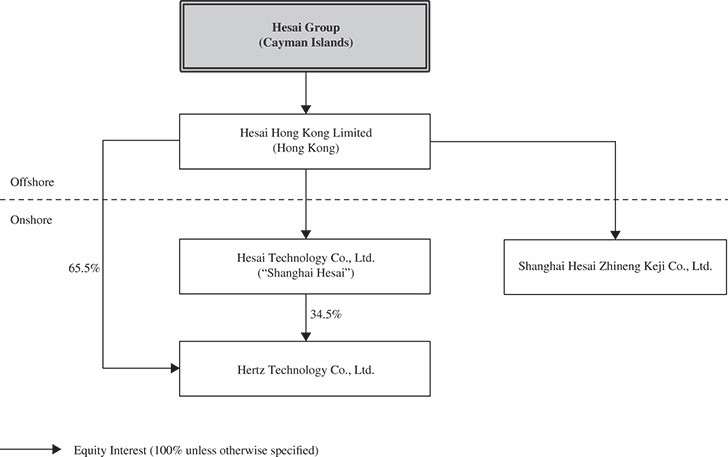
Hesai Group, our holding company, may transfer cash to Hesai Hong Kong Limited, its wholly owned subsidiary in Hong Kong, through capital injections and intra-group loans. Hesai Hong Kong Limited, in turn, may transfer cash to our Chinese Mainland subsidiaries, through capital injections and intra-group loans. Similarly, our Chinese Mainland subsidiaries may transfer cash to its wholly owned subsidiaries in Chinese Mainland and, upon approval from certain Chinese Mainland authorities, to subsidiaries in the U.S. and elsewhere, through capital injections and intra-group loans. If our wholly owned subsidiaries in Chinese Mainland realize accumulated after-tax profits, they may, upon satisfaction of statutory conditions and procedures, pay dividends or distribute earnings to Hesai Hong Kong Limited. Hesai Hong Kong Limited, in turn, may transfer cash to Hesai Group through dividends or other distributions. With necessary funds, Hesai Group may pay dividends or make other distributions to U.S. investors and service any debt it may have incurred outside of Chinese Mainland. In 2023, 2024 and 2025, Hesai Group transferred US$50.0 million, US$2.0 million and US$37.4 million, respectively, to Hesai Hong Kong Limited through intra-group loans, and Hesai Hong Kong Limited transferred nil, US$35.2 million and US$72.5 million, respectively, to Shanghai Hesai and other Chinese Mainland subsidiaries through capital injections and loans.

Cash is also transferred through our organization by way of intra-group transactions. In 2023, 2024 and 2025, Shanghai Hesai transferred US$8.3 million, US$31.7 million and US$23.5 million through service fees and payments for purchasing materials to our other Chinese Mainland subsidiaries, respectively. In 2023, 2024 and 2025, our other Chinese Mainland subsidiaries transferred nil, nil and US$4.3 million through payments for purchasing materials or finished goods to Shanghai Hesai, respectively. In 2023, Oxigraf, Inc., a subsidiary in the U.S. until November 2023, transferred US$0.1 million through payments for purchasing finished goods to a subsidiary of Shanghai Hesai in Chinese Mainland, respectively.

In 2023, 2024 and 2025, no assets other than cash were transferred between Hesai Group and a subsidiary, no subsidiaries paid dividends or made other distributions to Hesai Group, and no dividends or distributions were paid or made to U.S. investors.

6

Table of Contents

Under Chinese Mainland laws and regulations, we are subject to restrictions on foreign exchange and cross-border cash transfers, including to Hesai Group and U.S. investors. Our ability to distribute earnings to Hesai Group and U.S. investors is also limited. We are a Cayman Islands holding company and rely on dividends and other distributions on equity from our Chinese Mainland subsidiaries for our cash requirements, including the funds necessary to pay dividends and other cash distributions to our shareholders and service any debt we may incur outside of Chinese Mainland. Current Chinese Mainland regulations permit our Chinese Mainland subsidiaries to pay dividends to us only out of their accumulated after-tax profits upon satisfaction of statutory conditions and procedures, if any, determined in accordance with Chinese accounting standards and regulations. In addition, each of our Chinese Mainland subsidiaries is required to set aside at least 10% of its after-tax profits each year, if any, to fund certain statutory reserve funds until the total amount set aside reaches 50% of its registered capital. Our Chinese Mainland subsidiaries shall not distribute profits before losses are covered and the statutory reserve funds are drawn. Additionally, if our Chinese Mainland subsidiaries incur debt on their own behalf in the future, the instruments governing their debt may restrict their ability to pay dividends or make other distributions to us. In addition, the revenue and assets of our Chinese Mainland subsidiaries are generally denominated in Renminbi, which is not completely freely convertible into other currencies. As a result, any restriction on currency exchange may limit the ability of our Chinese Mainland subsidiaries to pay dividends to us. For more details, see “Item 3. Key Information - D. Risk Factors - Risks Related to Doing Business in China - We may rely on dividends and other distributions on equity paid by our PRC subsidiaries to fund any cash and financing requirements we may have, and any limitation on the ability of our PRC subsidiaries to make payments to us could have a material and adverse effect on our ability to conduct our business” and “Item 3. Key Information - D. Risk Factors - Risks Related to Doing Business in China - Governmental administration of currency conversion may affect our utilization of our revenues and affect the value of your investment.”

We have established stringent controls and procedures for cash flows within our organization. Each transfer of cash among our Cayman Islands holding company and our subsidiaries is subject to internal approval. To effect a cash transfer, a number of steps are needed, including but not limited to the issuance of payment receipt, logging into the online banking system and completing its verification process, inspection of the invoice, and payment execution. A single employee is not permitted to complete each and every stage of a cash transfer, but rather only portions of the whole procedure. Only the finance department is authorized to make cash transfers. Within the finance department, the roles of payment approval, payment execution, record keeping, and auditing are segregated to minimize risk.

The Holding Foreign Companies Accountable Act

Pursuant to the Holding Foreign Companies Accountable Act, which was enacted on December 18, 2020 and further amended by the Consolidated Appropriations Act, 2023 signed into law on December 29, 2022, or the HFCAA, if the Securities and Exchange Commission, or the SEC, determines that we have filed audit reports issued by a registered public accounting firm that has not been subject to inspections by the Public Company Accounting Oversight Board, or the PCAOB, for two consecutive years because of a position taken by authorities in a foreign jurisdiction, the SEC will prohibit our shares or the ADSs from being traded on a national securities exchange or in the over-the-counter trading market in the United States. On December 16, 2021, the PCAOB issued a report to notify the SEC of its determination that the PCAOB was unable to inspect or investigate completely registered public accounting firms headquartered in Chinese Mainland and Hong Kong, including our auditor. On December 15, 2022, the PCAOB issued a report that vacated its December 16, 2021 determination and removed Chinese Mainland and Hong Kong from the list of jurisdictions where it is unable to inspect or investigate completely registered public accounting firms. Since then, the PCAOB has not issued any new determination regarding its ability to inspect or investigate registered public accounting firms headquartered in Chinese Mainland and Hong Kong. For this reason, we do not expect to be identified as a Commission-Identified Issuer under the HFCAA after we file this annual report on Form 20-F. Each year, the PCAOB will determine whether it can inspect and investigate completely audit firms in Chinese Mainland and Hong Kong, among other jurisdictions. If the PCAOB determines in the future that it no longer has full access to inspect and investigate completely accounting firms in Chinese Mainland and Hong Kong and we use an accounting firm headquartered in one of these jurisdictions to issue an audit report on our financial statements filed with the SEC, we would be identified as a Commission-Identified Issuer following the filing of the annual report on Form 20-F for the relevant fiscal year. There can be no assurance that we would not be identified as a Commission-Identified Issuer for any future fiscal year, and if we were so identified for two consecutive years, we would become subject to the prohibition on trading under the HFCAA. See “Item 3. Key Information - D. Risk Factors - Risks Related to Our Business and Industry - The PCAOB had historically been unable to inspect our auditor in relation to their audit work.” and “Item 3. Key Information - D. Risk Factors - Risks Related to Our Business and Industry - Our ADSs may be prohibited from trading in the United States under the HFCAA in the future if the PCAOB is unable to inspect or investigate completely auditors located in China. The delisting of the ADSs, or the threat of their being delisted, may materially and adversely affect the value of your investment.”

7

Table of Contents

A.[RESERVED]

B.

CAPITALIZATION AND INDEBTEDNESS

Not Applicable.

C.

REASONS FOR THE OFFER AND USE OF PROCEEDS

Not Applicable.

D.

RISK FACTORS

Summary of Risk Factors

Investing in our ADSs involves significant risks. You should carefully consider all of the information in this annual report before making an investment in our ADSs. Below please find a summary of the principal risks we face, organized under relevant headings. These risks are discussed more fully in Item 3. Key Information—D. Risk Factors.

Risks Related to Our Business and Industry

Our limited operating history makes it difficult to evaluate our future prospects and the risks and challenges we may encounter.
Our LiDAR products used on vehicles are highly complex and may contain defects or otherwise fail to perform in line with expectations. Such defects or failures could reduce the market adoption of our new products, damage our reputation, expose us to product liability and other claims and adversely affect our operating results.
If our LiDAR products are not selected by automotive customers or their suppliers, our business will be materially and adversely affected.
We currently have and target many customers that are large corporations with substantial negotiating power, stringent product standards and potentially competitive internal solutions. If we fail to engage effectively with these customers, our prospects and results of operations will be adversely affected.
Our ability to develop, manufacture, and deliver LiDAR products of high quality and appeal to customers on schedule and at scale is still evolving.
Our efforts to continue developing and commercializing our in-house ASICs may not succeed.
We may from time to time introduce new products or expand into new business areas beyond our core LiDAR business, and these initiatives may not be successful and may adversely affect our financial performance.
The current tensions in international trade and investment and rising political tensions, particularly between the United States and China, may adversely impact our business, financial condition, and results of operations, as well as our access to international capital markets.
We have been included in a list of Chinese companies with alleged ties to the Chinese military issued by the U.S. Department of Defense, which has had and may continue to have an adverse effect on our reputation, the market prices of our ADSs and Class B ordinary shares and our business opportunities.
We operate in highly competitive markets and some market participants have substantially greater resources than us. We may not successfully compete against them.
If market adoption of LiDAR does not continue to develop, or develops more slowly than we expect, our business will be adversely affected.

8

Table of Contents

The PCAOB had historically been unable to inspect our auditor in relation to their audit work.
Our ADSs may be prohibited from trading in the United States under the HFCAA in the future if the PCAOB is unable to inspect or investigate completely auditors located in China. The delisting of our ADSs, or the threat of their being delisted, may materially and adversely affect the value of your investment.

Risks Related to Doing Business in China

The PRC government has significant oversight in regulating our operations and may influence or intervene in our operations at any time. Actions by the PRC government to exert control over offerings conducted overseas by, and foreign investment in, China-based issuers could significantly limit or completely hinder our ability to offer or continue to offer securities to investors and cause the value of such securities to significantly decline or be worthless. Implementation of industry-wide regulations in this nature may also cause the value of such securities to significantly decline or become worthless. For more details, see “— Risks Related to Doing Business in China — The PRC government’s significant oversight and discretion over our business operations could result in a material adverse change in our operations and the value of our ADSs.”
Changes in China’s economic, political or social conditions or government policies could have a material adverse effect on our business and operations.
Uncertainties exist with respect to how the PRC Foreign Investment Law may impact the viability of our current corporate structure and operations.
Risks and uncertainties arising from the legal system in China, including risks and uncertainties regarding the enforcement of laws and the fact that rules and regulations in China may evolve quickly with any public consultation and advanced notice period being relatively short in terms of the time that we may need to fully adapt to such changes, all of which could result in a material adverse change in our operations and the value of our ADSs. For more details, see “— Risks Related to Doing Business in China — Uncertainties in the interpretation and enforcement of laws, rules and regulations, typically existing in the civil law systems, could materially and adversely affect us.”
If we fail to complete the CSRC filing and other procedures for any future offshore offering or listing, we may be subject to sanctions imposed by the relevant PRC governmental authority.
Any actual or alleged failure to comply with the various applicable laws and regulations related to personal information protection, data security and cybersecurity could affect our offshore listing and lead to liabilities, penalties or other regulatory actions, which could have a material and adverse effect on our business, financial condition and results of operations.
We are subject to Chinese Mainland laws and regulations restricting capital flows which may affect our liquidity. See “- Risks Related to Doing Business in China - We may rely on dividends and other distributions on equity paid by our PRC subsidiaries to fund any cash and financing requirements we may have, and any limitation on the ability of our PRC subsidiaries to make payments to us could have a material and adverse effect on our ability to conduct our business” and “- Risks Related to Doing Business in China - PRC regulations of loans to and direct investment in the PRC entities by offshore holding companies may delay or prevent us from making loans or additional capital contributions to our PRC subsidiaries, which could materially and adversely affect our liquidity and our ability to fund and expand our business.”
The M&A Rules and certain other PRC regulations establish procedures for certain acquisitions of PRC companies, which could make it difficult for us to pursue growth through acquisitions in the PRC.

Risks Related to Our ADSs and Our Shares

The trading price of the ADSs has been and is likely to continue to be, and the trading price of our Class B ordinary shares can be, volatile, which could result in substantial losses to investors.
Our dual-class share structure with different voting rights limits your ability to influence corporate matters and could discourage others from pursuing any change of control transactions that holders of our Class B ordinary shares or ADSs may view as beneficial.

9

Table of Contents

Risks Related to Our Business and Industry

Our limited operating history makes it difficult to evaluate our future prospects and the risks and challenges we may encounter.

We have been focused on developing our LiDAR products since 2016. This relatively limited operating history makes it difficult to evaluate our future prospects and the risks and challenges we may encounter. Risks and challenges we have faced or expect to face include our ability to:

produce and deliver LiDAR products of acceptable performance;
develop and commercialize our in-house ASICs;
forecast our revenues and budget for and manage our expenses;
attract new customers and retain existing customers;
comply with existing and new or modified laws and regulations applicable to our business;
plan for and manage capital expenditures for our current and future products, and manage our supply chain and supplier relationships related to our current and future products;
anticipate and respond to macroeconomic changes and changes in the markets in which we operate;
maintain and enhance the value of our reputation and brand;
effectively manage our growth and business operations;
develop and protect intellectual property;
hire, integrate and retain talented people at all levels of our organization; and
successfully develop new products to enhance the experience of customers.

If we fail to address any of these risks and difficulties that we may face, including those associated with the challenges listed above as well as those described elsewhere in this section, our business, financial condition and results of operations could be adversely affected. Further, because we have limited historical financial data and operate in a rapidly evolving market, any predictions about our future revenues and expenses may not be as accurate as they would be if we had a longer operating history or operated in a more predictable market. We have encountered in the past, and will encounter in the future, risks and uncertainties frequently experienced by growing companies with limited operating histories in rapidly changing industries. If our assumptions regarding these risks and uncertainties, which we use to plan and operate our business, are incorrect or change, or if we do not address these risks and uncertainties successfully, our results of operations could differ materially from our expectations and our business, financial condition and results of operations could be adversely affected.

10

Table of Contents

Our LiDAR products used on vehicles are highly complex and may contain defects or otherwise fail to perform in line with expectations. Such defects or failures could reduce the market adoption of our new products, damage our reputation, expose us to product liability and other claims and adversely affect our operating results.

Our LiDAR products used on vehicles are highly technical and very complex and require high standards to manufacture and have in the past and will likely in the future experience defects, errors or reliability issues at various stages of development. We may be unable to timely release new products, manufacture existing products, correct problems that have arisen or correct such problems to our customers’ satisfaction. Additionally, undetected errors, defects or security vulnerabilities, especially as new products are introduced or as new versions are released, could result in serious injury or even death to the end users of technology incorporating our products, or those in the surrounding area, litigation against us, negative publicity and other consequences. These risks are particularly prevalent in the highly competitive ADAS and Robotics markets where we operate. Some errors or defects in our products may only be discovered after they have been tested, commercialized and deployed by customers, in which case we may incur significant additional development costs and product recall, repair or replacement costs. These problems may also result in claims, including class actions, against us by our customers or others. Our reputation or brand may be damaged as a result of these problems and customers may be reluctant to buy our products, which could adversely affect our ability to retain existing customers and attract new customers and could adversely affect our financial results.

In addition, we could face material legal claims for breach of contract, product liability, fraud, tort or breach of warranty as a result of these problems. Defending a lawsuit, regardless of its merit, could be costly and may divert management’s attention and adversely affect the market’s perception of us and our products.

Furthermore, any defects in or significant malfunctioning of our LiDAR products may weaken customer confidence in LiDAR products. As the markets for LiDAR products are emerging and evolving, loss of customer confidence in LiDAR products could have a material adverse impact on the future of such markets in general and our business prospects in particular.

If our LiDAR products are not selected by automotive customers or their suppliers, our business will be materially and adversely affected.

Automotive customers and their suppliers typically design and develop ADAS and other key technologies over several years. These customers and their suppliers undertake extensive testing or qualification processes prior to placing orders for large quantities of our LiDAR products, because such products will function as part of a larger system or platform and must meet certain other specifications. We spend significant time and resources to have our products selected by automotive customers and their suppliers. If our LiDAR products are not selected for a particular vehicle model, we may not have an opportunity to supply our products to the OEM for that model for a period of many years. In addition, if our LiDAR products are not selected by an automotive customer or its suppliers for a particular vehicle model or if our LiDAR products are not successful in that model, the automotive customer or its suppliers may select another supplier for LiDAR products, and it is unlikely that our products will be deployed in other models from the same automotive customer. If we fail to secure design wins for a significant number of vehicle models from one or more automotive customers or their suppliers, or if the vehicle models that incorporate our LiDARs cannot gain market popularity, our business, results of operations and financial condition will be materially and adversely affected.

Furthermore, even if our products are selected and we enter into framework agreements with automotive customers or their suppliers, as we have with many of our customers, we cannot assure you such framework agreements will always materialize into actual purchase orders, as in such agreements, our counterparties often retain the discretion as to whether and when to place orders for our products, and our supply of products may be subject to other conditions such as meeting certain development milestones. As a result, there is no guarantee that the design wins obtained by us would eventually lead to mass production nor any guarantee on the respective selling prices of our products generated from such design wins.

11

Table of Contents

We currently have and target many customers that are large corporations with substantial negotiating power, stringent product standards and potentially competitive internal solutions. If we fail to engage effectively with these customers, our prospects and results of operations will be adversely affected.

Many of our customers and potential customers are large, multinational corporations with substantial negotiating power relative to us and, in some instances, may have internal solutions that are competitive to our products. These large, multinational corporations also have significant development resources, which may allow them to acquire or develop independently, or in partnership with others, competitive technologies. Meeting the technical requirements of any of these companies and securing design wins from them for supplying LiDAR products will require a substantial investment of our time and resources. Even after we secure a design win, there can be a significant lead time before mass production commences, and there is no assurance that such design wins will ultimately result in commercial production or generate meaningful revenue. Following a design win, we are typically required to continue working closely with our customers to support their ongoing product development, testing, validation, and system integration efforts. We cannot assure you that our LiDAR products will be selected by these or other companies or that we will generate meaningful revenue or profit from the sales of our products to these key potential customers. Any delays, changes in customer product roadmaps, technical challenges, or shifts in market conditions could adversely affect the timing or realization of expected revenue associated with such design wins. Furthermore, if our products are not selected by these large corporations or if these corporations develop or acquire competitive in-house technology, our business and prospects will be adversely affected.

Our ability to develop, manufacture, and deliver LiDAR products of high quality and appeal to customers on schedule and at scale is still evolving.

The sustainability of our business depends, in large part, on our ability to timely execute our plan to develop, manufacture, and deliver on a large scale LiDAR products of high quality and appeal to customers. We have limited LiDAR manufacturing experience to balance production volume and product quality and appeal, and therefore cannot assure you that we will be able to achieve our targeted production volume of commercially viable LiDAR products on a timely basis, or at all.

Our continued development, manufacturing, and delivery of LiDAR products of high quality to achieve our targeted production volume are and will be subject to risks, including with respect to:

lack of necessary funding;
delays or disruptions in our supply chain;
quality control deficiencies;
compliance with environmental, workplace safety, and relevant regulations; and
cost overruns.

As we operate in highly competitive and rapidly evolving markets, to remain competitive, we may be required to introduce new LiDAR models earlier or more frequently than originally planned. We cannot assure you that any future models we launch will appeal to the customers as we expect or that any introduction of new models will not affect the sales of existing models.

Furthermore, we rely on third-party suppliers for the provision and development of many of the key components and materials used in our LiDAR products. If our suppliers experience difficulties in providing us with or developing necessary components, we could experience delays in delivering products. Any delay in the development, manufacturing, and delivery of LiDAR products could subject us to customer complaints and materially and adversely affect our reputation, demand for our products, and our growth prospects.

12

Table of Contents

We operate in highly competitive markets and some market participants have substantially greater resources than us. We may not successfully compete against them.

The markets for sensing technology in autonomous solutions for automobile and Robotics markets are highly competitive. Our future success will depend on our ability to remain a leader in our targeted markets by continuing to develop and protect from infringement advanced LiDAR technology in a timely manner and to stay ahead of existing and new competitors. Our competitors are numerous and they compete with us directly by offering LiDAR products and indirectly by attempting to solve some of the same challenges with alternative technologies. We face competition from camera and radar companies, other developers of LiDAR products, and other technology and automotive and Robotics supply companies, some of which have significantly greater resources than we do. In the automotive market, our competitors have commercialized both LiDAR- and non-LiDAR-incorporated ADAS technology that has achieved market adoption, strong brand recognition and they may continue to improve their offerings. Other competitors that are working towards commercializing autonomous driving technology, either independently or through partnerships, often have substantial financial, marketing, distribution, R&D and other resources. In markets outside of the automotive industry, such as the robotic industry, both we and our competitors seek to develop new sensing applications. Even in these emerging markets, we face substantial competition from numerous competitors seeking to prove the value of their technologies. Additionally, some of our customers in the ADAS market and Robotics market have announced development efforts or made acquisitions aimed at creating their own LiDAR-incorporated or alternative sensing technologies, which would compete with our solutions.

Increased competition may result in pricing pressure and reduced margins and may impede our ability to increase the sales of our products or cause us to lose market share, all of which may adversely affect our business, results of operations and financial condition.

If market adoption of LiDAR does not continue to develop, or develops more slowly than we expect, our business will be adversely affected.

While our LiDAR products can be applied to different uses across end markets, a substantial part of our revenues is generated from automotive applications. Despite considerable efforts by the automotive industry to research and test LiDAR products for ADAS and autonomous vehicle applications, there is no assurance that LiDAR products will be widely deployed in commercially available vehicles on a large scale basis.

Although we currently believe we are a leader in LiDAR-incorporated systems for the autonomous vehicle market, as LiDAR products remain relatively new, it is possible that other sensing technologies, including cameras, radar, and new or enhanced modalities, or new disruptive technologies, including combinations of technologies, may gain acceptance or emerge as the industry standard for ADAS and autonomous driving applications. Even if LiDAR products are used in the initial generations of certain ADAS systems and autonomous driving technologies, there is no guarantee that LiDAR products will be designed into or included in subsequent generations of such technologies. Furthermore, the initial adoption scenarios for autonomous vehicles, such as Robotaxis, are limited, and the timing for widespread mass-market adoption of autonomous vehicles remains difficult, if not impossible, to predict. If the commercialization of LiDAR products is not as successful as we or the market expects, or if alternative technologies gain broader acceptance among developers of ADAS and autonomous driving systems, automotive OEMs, regulators, or other market participants, our business, results of operations, and financial condition will be materially and adversely affected.

We continually monitor emerging and competing sensing technologies and invest in research and development to enhance our product offerings. However, any failure by us to develop new or enhanced technologies or to respond effectively to technological advancements could materially delay the development and introduction of new products, particularly in the rapidly evolving autonomous vehicle industry. There is no guarantee that our research and development efforts will be sufficient to keep pace with technological change. If we are unable to source and integrate the latest technology into our products, our LiDAR products may lose competitiveness, leading to decreased revenues and a loss of market share.

13

Table of Contents

We believe that our future revenue growth will depend in part on our ability to expand within new markets such as Robotics and to enter new markets as they develop. Each of these markets presents distinct risks and, in many cases, requires us to address the particular requirements of that market, which can be time-consuming and costly. In addition, the market for LiDAR technology outside of automotive applications is relatively new, rapidly developing and unproven in many industries. Some of our customers outside of the automotive industry are still in testing and development phases, and we cannot be certain that they will commercialize products or systems incorporating our LiDAR products. Adoption of LiDAR products outside of the automotive industry will depend on numerous factors, including whether the technological capabilities of LiDAR and LiDAR-incorporated products meet users’ needs; whether the benefits of deploying or integrating LiDAR technology outweigh the associated costs and complexity to replace or adapt solutions that may have used other sensing modalities; and whether users in non-automotive applications can progress from the testing and development phases to commercialization. If LiDAR technology does not achieve commercial success outside of the automotive industry, or if these market develops at a pace slower than we expect, our business, results of operation and financial condition may be materially and adversely affected.

Our efforts to continue developing and commercializing our in-house ASICs may not succeed.

We established a dedicated team within our organization to develop our in-house ASICs at the end of 2017. Since then, we have made significant progress in the development, production and application of our ASICs. Our current ASICs are sophisticated and technologically advanced in many aspects, but remain subject to significant technological and functional limitations. We cannot assure you that we will be able to continue to refine and upgrade our ASICs to achieve market-leading quality and functionality. In addition, we are relatively early in our efforts to apply our ASICs to LiDAR products. We may fail in our efforts to commercialize our ASICs despite the significant research and development and sales and marketing costs we have incurred and expect to incur, in which case our financial performance and business prospects will suffer.

We may from time to time introduce new products or expand into new business areas beyond our core LiDAR business, and these initiatives may not be successful and may adversely affect our financial performance.

We may, from time to time, explore, develop, launch or invest in new products, services, technologies or business areas beyond our core LiDAR business, including products or business lines that are not directly related to LiDAR. Such initiatives may involve entering markets in which we have limited or no prior operating experience, addressing customer needs and competitive dynamics that differ substantially from those of our existing business, and allocating significant management attention, financial resources and operational capacity.

These initiatives are subject to significant uncertainties and risks. In particular, because we may have limited experience in such new products or business areas, we may be unable to accurately assess market demand, identify appropriate product-market fit, develop competitive products or services in a timely and cost-effective manner, establish effective sales, distribution, supply chain or after-sales capabilities, obtain or maintain any required regulatory approvals, licenses or qualifications, recruit or retain personnel with relevant expertise, or manage execution, quality control, compliance and other operational challenges associated with such new businesses. In addition, such initiatives may require substantial upfront investments in research and development, manufacturing, talent, marketing, business development, channel development or strategic partnerships, and such investments may not generate the expected returns, if any.

Any such new products or business initiatives may adversely affect our financial performance, particularly in the initial stages of development and commercialization. For example, these initiatives may involve significant upfront costs, low production efficiency, limited economies of scale, unfavorable product mix, pricing pressure, inventory risks, and higher operating expenses, any of which could reduce our overall margins, including our gross margin, and adversely affect our profitability and results of operations. If customer adoption, commercialization or scaling takes longer than expected, or fails to materialize at all, the negative impact on our financial performance could be more pronounced.

Our expansion into new products or business areas may also expose us to new legal, regulatory, commercial, technological, operational and reputational risks. We may face unfamiliar compliance requirements, intellectual property risks, customer claims, product liability exposure, cybersecurity or data-related issues, and heightened scrutiny from regulators, business partners, customers or investors. Any failure or perceived failure in these new initiatives could adversely affect our brand, reputation and market perception.

14

Table of Contents

Moreover, our efforts in these new areas may divert management attention and other resources away from our core business, reduce our operational efficiency, increase our costs and complexity, and adversely affect our ability to execute our existing business strategy. If any of these initiatives fail to achieve commercial acceptance, are delayed, encounter operational or regulatory difficulties, or otherwise do not perform as expected, our business, financial condition, results of operations, cash flows and prospects could be materially and adversely affected.

The current tensions in international trade and investment and rising political tensions, particularly between the United States and China, may adversely impact our business, financial condition, and results of operations, as well as our access to international capital markets.

Some of our business partners are located outside of China. Furthermore, many of our customers in China may incorporate our products into goods that they sell outside China. In addition to our reliance on customers and suppliers outside China, certain of our technologies, such as those relating to autonomous driving applications, could be subject to restrictions by the U.S. or other foreign governments. As a result, government policies that restrict international trade and investment, such as capital controls, economic or trade sanctions, export controls, tariffs or foreign investment filings and approvals, may affect the demand for our products and services, impact the competitive position of our products, prevent us from being able to sell products in certain countries, or limit our ability to operate internationally, including our ability to raise capital. If any new tariffs, legislation, or regulations are implemented (including those imposing economic or trade sanctions, export control restrictions, or cross-border investment restrictions), or if existing trade agreements are renegotiated, these types of changes could adversely affect our business, financial condition, and results of operations. There have been heightened tensions in international economic relations, in particular between the United States and China. For example, the United States has tightened controls on the export to China of certain advanced items such as semiconductors and equipment to manufacture semiconductors. In addition, the ongoing conflict in Ukraine and the related sanctions on Russia have further escalated international tensions and resulted in the expanded use of economic sanctions and export controls. These types of regulatory developments could adversely affect us, our supply chain, business partners, or customers and the general state of the global economy.

The United States and China have recently taken steps in their economic relations that may substantially impact the economies of both nations, as well as the global economy. Higher tariffs rates have been applied by both countries in a series of bilateral moves, especially since April 2, 2025, and as of April 9, 2025, the United States had implemented tariffs of 145% on most goods from China, while China had imposed tariffs of 125% on most goods from the United States. On February 20, 2026, the U.S. Supreme Court struck down certain tariffs imposed by U.S. President Trump under the International Emergency Economic Powers Act (“IEEPA”). Following this decision, the U.S. administration imposed a 10% temporary import surcharge under Section 122 of the Trade Act of 1974 on imports from all U.S. trading partners for a 150-day period commencing on February 24, 2026, and discussed plans to impose other tariffs in reliance on other statutory authority. As of the date of this annual report, following the recent increase in U.S. tariffs on Chinese imports, certain exports of our LiDAR products to the U.S. are subject to 50% tariffs. As of the date hereof, it remains unclear what additional actions, if any, will be taken by the U.S. or other governments.

In addition to tariffs, the U.S. government has implemented other measures, including the expansion of export controls in respect of China, including controls on items manufactured outside the United States that are the direct product of certain controlled U.S.-origin technology or software, to specific destinations and end-users (such as certain companies on the export control Entity List), and the end-use restrictions on U.S.-origin semiconductor manufacturing and advanced computing items. In recent years, the U.S. has also placed certain entities, including an increasing number of entities in China, on the Entity List under U.S. export control regulations, which imposes licensing requirement for exports, reexport, or transfers of items on lists of controlled items maintained by the U.S. government, which in most cases prevents these named entities from receiving essentially any item subject to U.S. export controls, including in some cases those produced wholly outside the United States that rely on U.S. technology for their production. In addition, on January 14, 2025, the U.S. Department of Commerce published a final rule, effective March 17, 2025, to address perceived U.S. national security risks associated with connected vehicle technologies. This rule establishes comprehensive prohibitions targeting specific hardware and software integral to vehicle connectivity systems and automated driving systems, although LiDAR is explicitly excluded from the scope of this new rule. These prohibitions are designed to mitigate the perceived national security risks associated with entities owned by, controlled by, or subject to the jurisdiction or direction of China or Russia. Any future regulatory changes in this regard could affect our ability to sell into the U.S. market and may also affect the ability of our customers outside of China to integrate our products into vehicles or related systems that they plan to export to the United States.

15

Table of Contents

In early 2025, the President Trump issued the “America First Investment Policy” memorandum and the “America First Trade Policy” memorandum, which outlined his administration’s plans to broaden the jurisdiction and significantly revise the operations of Committee on Foreign Investment in the United States, or CFIUS, the organization that regulates foreign investments in the United States, and highlighted what it characterized as the “new and evolving threats” associated with foreign investment, with a particular focus on China. The two memorandums set forth several initiatives to incentivize investment from U.S. allies and partners while restricting investments involving “foreign adversaries” including China. Among other things, the policy outlined in the memorandums include the possible expansion of the industry sectors covered by the Outbound Investment Program, limiting the types of transactions that may be excepted from the Program’s restrictions, and through the imposition of additional sanctions. The proposed restrictions may further restrict and deepen uncertainties for cross-border collaboration, investment, and funding opportunities of China- based issuers including us.

Against this backdrop, China has, in addition to the retaliatory tariff increases noted above, implemented, and may further implement, measures in response to changing trade policies, treaties, tariffs, export controls, and sanctions and restrictions against Chinese companies initiated by the U.S. government. For example, on April 4, 2025, in response to the United States substantially raising tariffs on products from China, China expanded its export restrictions on a wide range of critical minerals and magnets, which are essential for certain technologies and defense-related industries. Under these new restrictions, the controlled items, many of which are largely or only produced in China, will only be exportable subject to licenses, and the conditions and availability of such licenses is not yet clear. In addition, in June, 2021, China enacted the Countering Foreign Sanctions Law, under which foreign persons (including both individuals and companies) may be subject to countermeasures for directly or indirectly participating in a foreign country’s “discriminatory restrictive measures” against Chinese entities, which could include adherence to U.S. or other foreign sanctions or even export controls. The countermeasures authorized under this law include the seizure of property, barring transactions with Chinese persons, denial of visas, and deportation. This law builds on the Ministry of Commerce’s Regulations on the List of Unreliable Entities issued in September 2020 and the Rules on Counteracting Unjustified Extra-Territorial Application of Foreign Legislation issued in January 2021. The latter created a private right of action under which Chinese entities may sue for damages allegedly caused by a company’s adhering to “discriminatory foreign measures”. On March 23, 2025, the State Council issued the Provisions on Implementing the Countering Foreign Sanctions Law, which became effective immediately. These provisions further clarify the implementation procedures, enforcement mechanisms and scope of countermeasures under the Countering Foreign Sanctions Law.

There is uncertainty with respect to how the Countering Foreign Sanctions Law, the List of Unreliable Entities, the Rules on Counteracting Unjustified Extra-Territorial Application of Foreign Legislation and the Provisions on Implementing the Countering Foreign Sanctions Law will be interpreted and implemented.

Because our business depends on markets and supplies located overseas, tariffs and investment and export control measures taken by the PRC, U.S. or any other government, as well as other trade tensions or unfavorable trade policies, may directly affect the costs and/or marketability of our products. For example, certain exports of our LiDAR products to the United States are subject to the recently increased U.S. tariffs on Chinese imports described above. These elevated tariff rates may adversely affect our sales in the U.S. market. The ongoing international trade and political tensions between the United States and China, and any escalation of such tensions, may have a material negative impact on our business and operations. For example, if the Entity List and other U.S. export control laws and regulations continue to expand and evolve, future U.S. export controls may materially affect or target some of our significant suppliers or customers, in which event our business may be affected if we fail to promptly secure alternative sources of supply or demand on terms acceptable to us. Rising political tensions could also reduce levels of trade, investment, technological exchange, and other economic activities between the two major economies, which would have a material adverse effect on global economic conditions and the stability of global financial markets. In particular, the heightened geopolitical uncertainty and potential for further escalation may discourage investments in securities issued by China-based issuers (including us) and affect the global macroeconomic environment. For example, during a recent television interview, in response to a journalist’s question on whether the U.S. government could include possible delistings of Chinese companies from U.S. exchanges as a possible step the United States could take in its ongoing trade disputes with China, U.S. Secretary of Treasury, Scott Bessent, declined to exclude this possibility. If the U.S. government were to take such steps, it is not known how or when the U.S. government might implement such delistings or whether there would be any transition period or exceptions. If the U.S. government were to issue any order or otherwise require or cause the delisting of equity securities issued by China-based issuers, it could have a material adverse effect on the price of our ADSs and our Class B ordinary shares. If our ADSs were to be delisted from the Nasdaq, holders of our securities may suffer losses or be unable to trade our securities on Nasdaq as a result. Any of these factors could have a material adverse effect on our business, prospects, financial condition, and the results of operations, our ability to raise capital, and the value of our securities. These types of measures could also have similar effects on our suppliers and our customers.

16

Table of Contents

We have been included in a list of Chinese companies with alleged ties to the Chinese military issued by the U.S. Department of Defense, which has had and may continue to have an adverse effect on our reputation, the market prices of our ADSs and Class B ordinary shares and our business opportunities.

On January 31, 2024, we were placed on the list of Entities Identified as Chinese Military Companies Operating in the United States under Section 1260H of the William M. Thornberry National Defense Authorization Act for Fiscal Year 2021, or Section 1260H List, also known as the “Chinese Military Companies List,” by the United States Department of Defense, or DoD. We were subsequently removed from that list and then relisted on October 15, 2024. According to the relevant law, the Chinese Military List is to identify companies operating in the United States that are either owned or controlled by the People’s Liberation Army or the Central Military Commission of the Chinese Communist Party or that have been identified as a military-civil fusion contributor to the Chinese military industrial base.

On July 11, 2025, the U.S. District Court for the District of Columbia, or District Court, issued a decision upholding the DoD’s designation of us as a “Chinese Military Company.” We believe that the DoD’s designation lacks both factual and legal bases. On July 13, 2025, we filed Notice of Appeal to the U.S. Court of Appeals, challenging the District Court’s decision. On March 19, 2026, the U.S. Court of Appeals held an oral argument in our appeal in Washington, D.C. As of the date of this annual report, we remain on the Section 1260H List and we are unable to predict the outcome of the appeal. See “Item 8. Financial Information - A. Consolidated Statements and Other Financial Information - Legal Proceedings” for details. Effective June 30, 2026, entities on this list and their controlled affiliates will be prohibited from entering into contracts with DoD for the procurement of goods, services, or technology, and effective June 30, 2027, the DoD will be prohibited from purchasing goods or services produced or developed by entities on the list indirectly through third parties. In addition, entities on the list and their subsidiaries are prohibited from receiving contracts or other funding from the U.S. Department of Homeland Security. Our inclusion on the list has had and may continue to have an adverse effect on our reputation, the market prices of our ADSs and Class B ordinary shares and our business opportunities. Particularly, the continued inclusion on the Section 1260H List has led to a false perception that we are associated with the Chinese military, which has had a negative impact on our ongoing contract negotiations and disrupted our existing and potential customer relationships globally, in particular those in the United States. Additionally, the inclusion has also had a material adverse impact on our capital market performance. Our stock price fell over 30% in a single day following our inclusion on the Section 1260H List. While the Section 1260H List is maintained by a separate part of the U.S. government with narrow implication, other sanction lists maintained by the U.S. government have broader implications. If we were to be included on a more restrictive sanctions list imposed by the U.S. government or if the U.S. government were to apply further sanctions to companies included on the Section 1260H List, our ability to conduct business with U.S. companies and the ability of U.S. investors to invest in or hold our securities could be further affected, which could have a material adverse effect on our business and results of operations and the value of our securities.

The Outbound Investment Program may adversely affect our access to capital and our business, financial condition, and results of operations.

On October 28, 2024, the U.S. Department of the Treasury, or Treasury, issued a final rule, 31 CFR Part 850, or the Final Rule, to implement an August 2023 executive order that provided for the establishment of a new national security regulatory framework, or the Outbound Investment Program, to control outbound investment from the United States in certain sensitive industry sectors in the People’s Republic of China, including Hong Kong and Macau. The Final Rule became effective on January 2, 2025.

17

Table of Contents

The Final Rule imposes investment prohibitions and notification requirements on specified investments by U.S. persons (broadly defined to include any United States citizen, lawful permanent resident, entity organized under the laws of the United States or any jurisdiction within the United States (including any foreign branch of such entity), or any person in the United States) in certain entities engaged in specified “Covered Activities” relating to three sectors: (i) advanced microchips and microelectronics, (ii) quantum computing, and (iii) AI systems. The Covered Activities in the advanced microchips and microelectronics sector that are included under the prohibited transaction include (i) developing or producing design automation software for integrated circuit design or advanced packaging, (ii) developing or producing equipment for semiconductor fabrication, volume advanced packaging, or extreme ultraviolet lithography, (iii) designing or fabricating integrated circuits exceeding specified performance characteristics, (iv) using advanced integrated circuit packaging techniques, and (v) developing, installing, selling, or producing supercomputers exceeding specified performance and density criteria. Covered Activities in the advanced microchips and microelectronics sector that are included as notifiable transactions include designing, fabricating or packaging any integrated circuit, other than those specific in the prohibited transaction definition. “Persons of a Country of Concern” (which are defined in the Final Rule to include entities with their principal place of business in China or that are controlled by Chinese citizens (including through ownership of 50% or more of the entity’s voting power, equity interests, voting power of the board, or otherwise)) that are engaged in specified activities within these three technology sectors are defined as “Covered Foreign Persons.” In addition, any person that derives more than 50% of its revenue or net income or incurs more than 50% of its operating expenses or capital expenditure from Persons of a Country of Concern in which it has specified interests (including equity interests) that are engaged in Covered Activities is also a Covered Foreign Person. The types of investments by U.S. persons that are subject to the Final Rule are defined as “Covered Transactions” and are subject to the applicable prohibitions or notification requirements include acquisitions of equity interests and contingent equity interests, certain debt financing, and joint ventures involving Covered Foreign Persons. The Final Rule excludes some investments from the scope of covered transactions, including those in publicly traded securities listed on a stock exchange and those trading on the over-the-counter markets (the “Publicly Traded Securities Exception”). The Final Rule is aimed at exerting greater U.S. government oversight over U.S. direct and indirect investments involving China, and it introduces new hurdles and uncertainties for cross-border collaborations, investments, and funding opportunities of China-based issuers, including us.

We are likely to be deemed a Covered Foreign Person under the Final Rule because our principal subsidiaries are engaged in the design of integrated circuits and we derive and incur, as applicable, more than 50% of our revenue and net income, operating expenses and capital expenditure from these subsidiaries.

Ordinary secondary trading in our Class B ordinary shares and ADSs will be able to rely on the Publicly Traded Securities Exception, and the notification filing requirements will not be applicable to those trades.

The Outbound Investment Program, including possible future modifications to it, could impose additional burdens on U.S. persons who invest, or plan to invest, in us. It could also limit our ability to raise capital or contingent equity capital (such as convertible bonds) from U.S. investors, including in any future offerings. Additionally, the Final Rule could be changed by executive actions of the U.S. government, including changes to the scope of activities and technologies applicable to prohibited transactions, the types of transactions to which it applies, and the availability of any exceptions or exemptions, including the Publicly Traded Securities Exception. Specifically, on January 20, 2025, President Trump issued a national security presidential memorandum, entitled “America First Trade Policy,” which, among other things, directs the Secretary of the Treasury and several other executive departments and offices of the U.S. government to review the Outbound Investment Program to determine if it includes “sufficient controls to address national security threats” and to determine whether the executive order implementing the Outbound Investment Program “should be modified or rescinded and replaced,” with the Secretary of the Treasury directed to provide the President a report on these subject by April 1, 2025. In addition, on February 21, 2025, President Trump issued a national security presidential memorandum entitled “America First Investment Policy,” which, among other things, states that the Trump Administration will consider possible application of the Outbound Investment Program to a wider range of technology sectors, including biotechnology, hypersonics, aerospace, advanced manufacturing, directed energy, and other areas “implicated by the PRC’s national Military-Civil Fusion strategy” and applying restrictions to a wider range of investments, including publicly traded securities. In addition, the Comprehensive Outbound Investment National Security Act of 2025 (the “COINS Act”) as part of the National Defense Authorization Act for Fiscal Year 2026, which was recently signed into law, would supersede the Final Rule following the adoption of implement regulations, the content of which is uncertain. Possible changes to the Final Rule could limit or even eliminate our ability to raise capital or contingent equity capital from U.S. investors, which could be detrimental to our capital raising capacity and our business, financial condition and prospects. In addition, changes to the Publicly Traded Securities Exception or other aspects of the Final Rule could prohibit the holding or trading of our securities by U.S. persons or make our securities less attractive to such investors. In such cases, the value of the securities may significantly decline, or in extreme cases, become worthless.

18

Table of Contents

We continue to implement strategic initiatives designed to grow our business, including developing new technologies and products, but our choices of technologies and products to focus on may prove incorrect, and our initiatives may not succeed.

We continue to make investments and implement initiatives designed to grow our business. In particular, we have formulated plans to focus our R&D efforts on certain new technologies and products which we believe will be critical to our future growth. For example, for the ADAS market, we are seeking to pack more laser/detector channels in the AT series at a lower cost. Similar upgrades may happen to other product lines to enhance performance while lowering the cost. However, as the LiDAR markets are new and rapidly evolving and we have a short operating history with limited experience, we cannot assure you that our choices of technologies and products to focus on will prove correct. In the event that our new technologies and products fail to be adopted by the market, our business prospects and financial condition could be materially and adversely affected.

In addition, our strategic initiatives may prove more expensive than we currently anticipate, and we may not succeed in increasing our revenues, if at all, in an amount sufficient to offset these higher expenses and to achieve and maintain profitability. The market opportunities we are pursuing are at an early stage of development, making it difficult to predict the size and growth rate of our target markets, customer demand for our products, commercialization timelines, developments in autonomous sensing and related technologies, the emergence of competing products, or the success of existing competitors. If our revenues do not grow over the long term, our ability to achieve and maintain profitability may be adversely affected, and the value of our business may significantly decrease.

We are susceptible to supply shortages, long lead times, and increased costs of raw materials and key components, any of which could disrupt our supply chain and could delay deliveries of our products to customers.

Some of the components used in the manufacture of our LiDAR products are sourced from third-party suppliers. Purchases from our top five suppliers for each of 2023, 2024 and 2025 accounted for 26.6%, 27.4% and 20.5%, respectively, of our total purchases during the same year. Our future success will depend, in part, on our ability to efficiently manage our supply chain to manufacture and deliver our products at scale. We rely on certain major suppliers of raw materials and key components used in our LiDAR products, which may expose us to risks such as supply shortages, long lead times, increased costs, and potential disruptions from time to time, especially for raw materials and key components that come from single or limited sources of supply. For example, our products depend on lasers and we currently consume a substantial portion of the available market supply. Any shortage of these lasers could materially and adversely affect our ability to manufacture our LiDAR products and disrupt our business operations. In addition, long lead times for certain components may restrict our ability to make rapid changes in production volumes and delivery schedules in response to demand fluctuations.

Furthermore, we procure raw materials and components from suppliers outside of China. Purchases from suppliers outside of China for each of 2023, 2024 and 2025 accounted for 17.6%, 17.5% and 22.8%, respectively, of our total purchases during the same periods. As such, we are subject to risks associated with geopolitical and trade tensions worldwide, particularly the ongoing heightened trade and political tensions between China and the United States. These tensions, and any further escalation, could result in supply chain disruptions, shortages and delays, adversely affecting our production and sales. See “— The current tensions in international trade and investment and rising political tensions, particularly between the United States and China, may adversely impact our business, financial condition, and results of operations, as well as our access to international capital markets.”

We have in the past experienced, and may in the future experience, shortages and price fluctuations in certain key components and materials, while the predictability regarding their availability and pricing may be limited. In particular, any shortages or delay in the supply of semiconductor chips, a key component of our LiDAR products, whether by specific vendors or by the chip industry generally, could result in cost increases or delays in our production and delivery to customers. Efforts to increase the use of in-house ASICs may not fully eliminate our usage of third-party chips for our LiDAR products. However, if we are unable to mitigate the impact of any future chip shortage or if we cannot obtain adequate supplies of chips on commercially acceptable terms, or at all, we may fail to fulfill our customer orders, which could result in lower sales and customer loss.

19

Table of Contents

Shortages and pricing fluctuations in raw materials and key components could also be material in the future. In the event of a supply shortage, interruption or material price fluctuations, we may not be able to develop alternative sources in a timely manner, or at all, particularly for sole or limited-source components. Developing alternative sources of supply for raw materials and key components may be time-consuming, difficult, and costly, and we may not be able to secure them on acceptable terms, or at all, which may undermine our ability to meet our production requirements and fill customer orders on time. Furthermore, rising costs of raw materials and key components could result in lower gross margins. Even if we are able to pass the increased costs along to our customers, there may be a lag before we are able to do so such that we must absorb the increased cost in the short term. If we are unable to procure raw materials and components in quantities sufficient to meet our production requirements on a timely basis, we will not be able to deliver products to our customers, which may increase the risk of customer switching to competitive products and result in revenue losses.

We may be unable to adequately control the costs associated with our operations.

We have invested significant capital in developing and growing our business, including developing and manufacturing our LiDAR products, advancing our in-house ASICs, purchasing equipment, constructing our manufacturing facilities, procuring required raw materials, and building our sales and servicing infrastructure. As we continue to scale our business, we expect to further incur significant costs that will impact our profitability, including R&D expenses related to the rollout of new LiDAR and vertically integrated models and improvement of existing models, expenditures in the expansion of our manufacturing capacities, additional operating costs and expenses for production ramp-up, procurement costs for raw material and key component, and selling and distribution expenses to build our brand and market our products. In particular, the prices for raw materials and components fluctuate due to factors beyond our control, and could adversely affect our business and results of operations. Substantial increases in the prices of key raw materials or components, such as automotive-grade chips, would increase our cost of revenues and operating expenses, and could reduce our margins. Furthermore, currency fluctuations, tariffs and other economic or political conditions may result in significant increases in freight charges and raw material costs. In addition, we may lose control over the increase of costs in connection with our services, including after-sale services. Our ability to become profitable in the future will not only depend on our ability to successfully market and sell our products and services but also our ability to control our costs. If we are unable to design, develop, manufacture, market, and service our products and provide services in a cost-efficient manner, our results of operations, profitability, and business prospects would be materially and adversely affected.

We expect to incur substantial R&D costs and devote significant resources to identifying and commercializing new products, which could significantly reduce our profitability and may never result in revenues to us.

Our future growth depends on penetrating new markets, adapting existing products to new applications and customer requirements, and introducing new products that achieve market acceptance. We have incurred, and expect continue to incur, substantial R&D costs as part of our efforts to design, develop, manufacture and commercialize new products and enhance existing products. Our R&D expenses were RMB790.5 million, RMB855.6 million and RMB796.9 million (US$114.0 million) in 2023, 2024 and 2025, respectively, and are likely to grow in the future. Because we account for R&D costs as an operating expense, these expenditures will adversely affect our results of operations in the future.

Further, our R&D program may not produce successful results, and our new products may not achieve market acceptance, create additional revenues or become profitable.

20

Table of Contents

The markets in which we compete are characterized by rapid technological change, which requires us to continue to develop new products and product innovations and could adversely affect market adoption of our products.

The LiDAR and related markets, including the ADAS and Robotics markets, are still evolving, and uncertainties in these markets could hinder the adoption of LiDAR and/or our products, either generally or for particular applications. Our future success will depend upon our ability to develop and introduce new capabilities and innovations into our existing product offerings, as well as develop and introduce new products to expand our offerings, to address the changing needs of the markets in which we offer our products. For example, we cannot guarantee that new products will be released on time, or at all, or that they will achieve market acceptance. Delays in delivering new products that meet customer requirements could damage our relationships with customers and cause them to seek alternative sources of supply. In addition, our success to date has been based on the delivery of our products to customers’ R&D programs, where the customers invest substantial capital to develop their new systems. Our continued success thus relies on the success of their transition from the R&D phase to commercialization. As autonomous technology reaches the stage of large-scale commercialization, we must develop and deliver solutions at price points that enable broader and, ultimately, mass-market adoption. Any delays in product innovations, misjudgment in choosing among technological alternatives, or failures in offering innovative products or configurations at competitive prices may cause existing and potential customers turn to our competitors’ products or alternative sensing technologies.

If we are unable to devote sufficient resources to product development or cannot successfully deliver products or solutions that meet customer requirements on a timely basis or remain competitive with technological alternatives, our products could lose market share, and our revenues may decline. Consequently, we may experience operating losses, and our business and prospects will be adversely affected.

We may experience difficulties in managing our growth and expanding our operations.

We have expanded our operations, and as we ramp up our development, production and sales, further significant expansion will be required. Our future operating results depend to a large extent on our ability to manage this expansion and our growth successfully. Risks that we face in undertaking this expansion include, among others:

keeping pace with ongoing technological advancements and evolving industry standards;
managing our supply chain to support rapid business growth;
managing a scaled organization with a greater number of employees in different divisions;
controlling expenses and investments in anticipation of expanded operations;
expanding or establishing new product development, manufacturing, sales, and service facilities;
implementing and enhancing administrative infrastructure, systems, and processes;
improving our operational, financial and management controls, compliance programs and reporting systems; and
addressing new markets and potentially unforeseen challenges as they arise.

Any failure to manage our growth effectively could materially and adversely affect our business, financial condition, results of operations, and prospects.

Continued pricing pressures may result in lower than anticipated margins, or losses, which may adversely affect our business.

Cost-cutting initiatives adopted by our customers often result in increased downward pressure on pricing. In addition, many of our customers, particularly automotive OEMs, possess significant leverage over their suppliers, including us, because they are large companies with substantial negotiating power and the automotive component supply industry is inherently highly competitive, serves a limited number of customers and has a high fixed cost base. The growing competition among both established players and new market entrants in our industry further exacerbates the pricing pressures we face.

21

Table of Contents

Accordingly, we expect to be subject to substantial continuing pressure from automotive OEMs and other major customers to reduce the prices of our products. Pricing pressures beyond our expectations could intensify as customers, including automotive OEMs, pursue restructuring, consolidation and cost-cutting initiatives. Changes in our product mix and pricing, including the launch of lower-priced new products, may negatively affect our cost structure and overall margin profile. Our cost structure may be further affected by under- utilization of our manufacturing facilities as we ramp up production, as well as fluctuating demand for and sales of our products, which are beyond our control. If we are unable to generate sufficient production cost savings in the future to offset price reductions, our gross margin and profitability would be adversely affected.

Our international operations require us to comply with trade restrictions, such as economic sanctions and export controls.

We are subject to trade restrictions, including economic sanctions and export controls, such as those administered and enforced by the Ministry of Foreign Affairs of the People’s Republic of China, the U.S. Department of the Treasury’s Office of Foreign Assets Control, the U.S. Department of State, the U.S. Department of Commerce, the United Nations Security Council and other relevant authorities. Our global operations expose us to the risk of violating, or being accused of violating economic and trade sanctions and export control laws and regulations. We have implemented an export control and sanctions compliance policy, through which we conduct screenings of new customers, end-use and end-users and relevant due diligence measures to assess compliances risks, and ensure adherence to regulatory requirements. However, we cannot guarantee that all of our products remain within approved channels. Some of our products have been found on the second-hand market or redistributed for uses that we did not authorize. In addition, the nature of hardware products makes it challenging to fully control their resale or redistribution. There is no assurance that our efforts to ensure compliance will be effective and we cannot assure compliance by our employees or representatives for which we may be held responsible. Our failure to comply with these laws and regulations may expose us to reputational harm as well as significant penalties, including criminal fines, imprisonment, civil fines, disgorgement of profits, injunctions and other remedial measures. Investigations of alleged violations can be expensive and disruptive. Any such violation could materially adversely affect our reputation, business, financial condition and results of operations.

We are subject to credit risk in relation to our accounts receivable.

As of December 31, 2023, 2024 and 2025, we had accounts receivable of RMB524.8 million, RMB765.0 million and RMB1,262.2 million (US$180.5 million), respectively. We are subject to credit risk in relation to our accounts receivable. There is no assurance that we will be able to collect our accounts receivable in a timely manner, or at all. We had allowance for expected credit losses on accounts receivable of RMB49.1 million, RMB55.0 million and RMB80.0 million (US$11.4 million) as of December 31, 2023, 2024 and 2025, respectively. Our credit risk exposure may increase if any of our customers experience financial difficulties or deterioration in creditworthiness, which could prevent us from collecting all or part of the outstanding accounts receivable. Such unforeseen circumstances may also render our accounting judgments or estimations on allowance for expected credit losses inaccurate, potentially resulting in higher losses than currently estimated. As a result, our profitability, working capital and cash flow may be materially and adversely affected.

In addition, we may from time to time offer relatively long payment terms to certain customers, and our customers may delay payments for reasons beyond our control. As a result, even where such receivables are ultimately collectible, extended collection cycles may increase our working capital needs, reduce operating cash flow, and adversely affect our financial condition and liquidity.

Fluctuations in exchange rates may have a material and adverse effect on our results of operations and the value of your investment.

The conversion of Renminbi into foreign currencies, including Hong Kong dollars and U.S. dollars, is based on rates set by the People’s Bank of China. Renminbi has fluctuated against Hong Kong dollars and the U.S. dollars, at times significantly and unpredictably. The value of Renminbi against Hong Kong dollars and the U.S. dollars and other currencies is affected by changes in global and geographical political and economic conditions, supply and demand in the monetary markets, and economic and political developments domestically and internationally, among other things. We cannot assure you that Renminbi will not appreciate or depreciate significantly in value against Hong Kong dollars and the U.S. dollars in the future. It is difficult to predict how external factors in respect of markets or policies may impact the exchange rate between Renminbi, Hong Kong dollars and the U.S. dollars in the future. Fluctuations in the exchange rate may cause us to incur foreign exchange losses and affect the relative value of any dividend issued by our subsidiaries. We recorded foreign exchange loss of RMB0.5 million, and foreign exchange gain of RMB14.6 million and RMB2.2 million (US$0.3 million) in 2023, 2024 and 2025, respectively.

22

Table of Contents

Any significant appreciation or depreciation of Renminbi may materially and adversely affect our revenues, earnings and financial position, and the value of, and any dividends payable on, our Class B ordinary shares and/or ADSs in foreign currency. As a significant portion of our cash and cash equivalents and short-term investments are denominated in U.S. dollars, fluctuations in exchange rates between Renminbi and U.S. dollars may also result in foreign exchange gains or losses. Furthermore, to the extent that we need to convert Hong Kong dollars or U.S. dollars into Renminbi to pay our operating expenses, appreciation of Renminbi against Hong Kong dollars or the U.S. dollars would reduce the Renminbi amount we receive from such conversion. Conversely, a significant depreciation of Renminbi against Hong Kong dollars or the U.S. dollar may significantly reduce the Hong Kong dollar or the U.S. dollar equivalent of our earnings, which in turn could adversely affect the price of our Class B ordinary shares and/or ADSs.

As of the data of this annual report, we have not entered into any hedging transactions to reduce our exposure to foreign currency exchange risk. The availability and effectiveness of such hedges may be limited and we may not be able to adequately hedge our exposure or at all.

We may from time to time make investments or allocate capital to financial products and other investment opportunities, and such investments may be subject to risks and may not generate the returns we expect.

From time to time, we may use a portion of our cash or other financial resources to make investments or allocate capital to a variety of financial products and investment opportunities as part of our treasury management, capital management or strategic investment activities. These investments may include, among others, publicly traded securities purchased in the secondary market, cornerstone or similar investments in initial public offerings, private or pre-initial public offering, or pre-IPO, investments, and bank wealth management or other cash management products. We may undertake such investments for a variety of reasons, including preserving or enhancing returns on available funds, supporting strategic relationships, or pursuing other financial or business objectives.

These investments are subject to various risks, many of which are beyond our control. Investments in publicly traded securities and IPO cornerstone investments may be affected by market volatility, adverse price movements, changes in investor sentiment, reduced liquidity, lock-up restrictions, and broader macroeconomic, geopolitical, regulatory or industry-specific developments. Private or pre-IPO investments involve additional risks, including limited liquidity, long investment horizons, valuation uncertainty, limited disclosure, lack of control over investee companies, dilution, execution risk, and the possibility that the investee company may fail to achieve its business objectives, complete a financing event or consummate a public offering. Bank wealth management or other cash management products may also expose us to market risk, interest rate risk, credit risk, counterparty risk, liquidity risk, and the risk of loss of principal or lower-than-expected returns.

There can be no assurance that any such investments will achieve our expected financial, strategic or commercial objectives, or that we will be able to realize anticipated returns within the expected timeframe, or at all. The value of such investments may decline, and we may incur fair value losses, impairment charges, realized losses, reduced investment income, or other accounting or economic losses. In some cases, we may be unable to exit such investments on favorable terms or within a desirable period, and our capital may remain tied up longer than expected.

In addition, our investment activities may divert management attention and financial resources from our core business and may expose us to additional legal, regulatory, compliance, accounting and internal control complexities. If any of our investments perform poorly, become impaired, result in losses, or otherwise fail to meet our expectations, our financial condition, results of operations, cash flows and prospects could be materially and adversely affected.

Changes in PRC government policies relevant to us or our customers could materially and adversely affect our business, financial condition, results of operations, and prospects.

The growth of our business benefits from PRC government policies at both central and local levels. These policies include those directly relevant to us, such as the preferential tax policy for “high and new technology enterprises,” as well as policies supporting the development of NEVs and domestically manufactured vehicles, which benefit many of our domestic automotive customers. Adverse changes in relevant PRC government policies may materially affect our business, financial condition, results of operations, and prospects.

23

Table of Contents

Under the PRC Enterprise Income Tax Law, or the EIT law, and its implementation rules, the statutory enterprise income tax rate is 25%, but certain “high and new technology enterprises” are qualified for a preferential enterprise income tax rate, subject to certain qualification criteria. A “high and new technology enterprise,” whose qualification is reassessed every three years, is entitled to a favorable income tax rate of 15%. Shanghai Hesai obtained the high and new technology enterprise accreditation in 2019, which was subsequently renewed for a three-year term in 2022 and successfully passed the re-accreditation process in 2025. Hertz Technology Co., Ltd., or Zhejiang Hertz, our another subsidiary, obtained the high and new technology enterprise accreditation in 2024, effective for three years. Both subsidiaries currently enjoy the preferential tax treatment. However, they may fail to renew their status as high and new technology enterprises when such qualifications expire. In addition, the relevant government authorities may decide to cancel or modify such preferential treatment for high and new technology enterprises in the future. Therefore, we cannot assure you of the continued availability of such tax preference we currently enjoy. In the event that either or both of these two entities fail to maintain their qualifications, face any increase in the enterprise income tax rate, or experience any discontinuation, reduction, refund or repayment of any of the preferential tax treatments currently or previously enjoyed, our business, financial condition and results of operations could be materially and adversely affected.

Many of our customers in China focus on the development and production of new energy vehicles and have been entitled to certain government incentives or subsidies. For example, producers of extended-range electric vehicles enjoy certain favorable government incentives and subsidies, including a partial exemption of 50% from vehicle purchase tax, one-time government subsidies, exemption from license plate restrictions in certain cities, exemption from driving restrictions in certain cities, and preferential utility rates for charging facilities. Any reduction or elimination of government subsidies and economic incentives or different application of government subsidies and economic incentives on different companies because of policy changes, the reduced need for such subsidies and incentives due to the perceived success of new energy vehicles, fiscal tightening or other factors may affect government incentives or subsidies and result in diminished competitiveness of the new energy vehicle industry generally. The business of our Chinese new energy vehicle customers may suffer as a result, which in turn may have a material and negative impact on us as a LiDAR supplier.

If we fail to obtain and maintain the requisite licenses, permits, registrations and filings applicable to our business, or fail to obtain additional licenses, permits, registrations or filings that become necessary as a result of new enactment or promulgation of government policies, laws or regulations or the expansion of our business, our business and results of operations may be materially and adversely affected.

Under PRC laws and regulations, we are required to obtain or complete a number of licenses, approvals, registrations, filings and other permissions for our operations, including, without limitation, the certificate of registration for customs declaration entity, receipt of registration for consignee and consignor of imported and exported goods with customs, receipt of registration for fixed pollution source, and permit for discharge of urban sewage into public drainage system. As of the date of this annual report, we had obtained all the required permissions that are material to our current operation. As a fast-growing company that is continually exploring new approaches to conduct our business and capture growth opportunities, we may become subject to additional license, approval and other requirements as we develop and expand our business scope and engage in different business activities. We may fail to meet such requirements timely or at all, in which case we may be subject to administrative penalties and our ability to expand our business and sustain our growth may be materially affected.

In addition, certain licenses, permits or registrations we hold are subject to periodic renewal. If we fail to maintain or renew one or more of our licenses and certificates when their current term expires, or obtain such renewals on a timely manner, our operations could be disrupted. Furthermore, PRC laws and regulations are statute-based and, similar to other civil law jurisdictions, the interpretation and enforcement of statutory laws and regulations involve inherent uncertainties, and additional laws and regulations may be adopted from time to time in the future. Therefore, the licenses, permits, registrations or filings we hold may be deemed insufficient by government authorities and accordingly government authorities may require us to obtain additional licenses, permits, registrations or filings or partner with a license holder for certain business activities, which may restrain our ability to expand our business scope, increase our costs of operation and compliance, and subject us to fines or other regulatory actions. If any of these risks materializes, our business and results of operations may be materially and adversely affected.

24

Table of Contents

The expansion of our manufacturing facilities may be subject to delays, disruptions, cost overruns, or may not produce expected benefits.

We have continually expanded our manufacturing facilities in recent years. Hertz Center, our main mass production facility located in Hangzhou, commenced productions in September 2023, with Phase II beginning operations in August 2025. Meanwhile, Maxwell Center, our new research and development and intelligent manufacturing center in Jiading, Shanghai, started trial operation in December 2023. In May 2025, we further expanded our manufacturing presence by leasing a property in Thailand for Galileo Factory, our new manufacturing facility, which is currently under renovation as of the date of this annual report.

We may continue to expand our manufacturing facilities. Our expansion plans could experience delays or other difficulties, and will require significant capital. Any failure to complete the expansion on schedule and within budget could adversely affect our financial condition, manufacturing capability, and results of operations.

Under PRC laws, construction projects are subject to broad and strict government supervision and approval procedures, including but not limited to project approvals and filings, construction land and project planning approvals, construction permits, occupational disease control approvals, environment protection approvals, pollution discharge permits, drainage licenses, work safety approvals, fire protection approvals, and completion of inspection and acceptance by relevant authorities. Our overseas expansion projects, including Galileo Factory in Thailand, are also subject to applicable local laws and regulatory requirements, including construction permit requirements. As of the date of this annual report, we have received material regulatory approvals currently required for our manufacturing facilities. To the extent additional approvals or permits are needed for our future construction work and we fail to secure such approvals or permits, our expansion plan may be disrupted or discontinued. In addition, any potential violation of laws and regulations related to construction may subject us to fines, suspension of construction, and other administrative penalties. Any of the foregoing could materially and adversely affect our business operations.

If we fail to comply with environmental protection, fire protection, drainage or health and safety laws and regulations, we could become subject to fines or penalties or incur costs that could have a material adverse effect on the success of our business.

We are subject to numerous environmental protection, fire protection, drainage or health and safety laws and regulations, including, but not limited to, those governing the emission of hazardous gas, the use of radioisotopes, the handling, use, storage, treatment and disposal of hazardous materials, drainage and wastes discharge of fixed pollution sources. The cost of compliance with such laws and regulations is substantial. In addition, as we continue to expand our manufacturing facilities and capabilities, we cannot assure you that there will not be violations or suspected violations in our facilities that result in us becoming subject to governmental investigations or penalties, which may include cessation of operation, fines, and confiscation of illegal gains. Furthermore, precautions taken to comply with regulations with respect to the hazardous gas generated from the welding activities in our manufacturing facilities may not fully eliminate the risk of such hazardous gas having a negative impact on the health of our employees at the facilities. Any potential failure to comply with environmental, fire protection, drainage or health and safety laws and regulations and/or failure to adequately protect the health of our employees could have a material adverse impact on our business operations and financial performance.

Our leased property interests and title to certain land and buildings we own may be defective and our right to lease and use the properties may be challenged, or we may fail to extend or renew our current leases or locate desirable alternatives for our facilities on commercially acceptable terms, which could materially and adversely affect our business.

We presently lease several premises in China. Some of the lessors of these leases have not provided us with sufficient documents to prove their ownership of the premises or their rights to lease the premises to us for our intended use. Therefore, we cannot assure you that such lessors are entitled to lease certain real properties to us. If the lessors are not entitled to lease the real properties to us and the owners of such real properties decline to ratify the lease agreements between us and the respective lessors, we may not be able to enforce our rights to lease such properties under the respective lease agreements against the owners. If our lease agreements are claimed as null and void by third parties who are the real owners of such leased real properties, we could be required to vacate the properties and have limited recourse. Furthermore, under Chinese Mainland laws, all lease agreements are required to be registered with the local housing authorities. Currently our lease agreements have not been registered with the authorities. Failure to complete these required registrations may expose us to potential monetary fines. In addition, some of our leased properties were subject to mortgage when we entered into our lease agreements. If the ownership of such properties changes as a result of foreclosure, we may not be able to enforce our rights to the leased properties under the respective lease agreements against the mortgagees.

25

Table of Contents

When our current leases expire, we may fail to extend or renew our leases for reasons such as unavailability of the premises for a new lease term or substantially higher rent demanded by the owners. We cannot assure you that suitable alternative locations will be readily available on commercially reasonable terms, or at all, and if we are unable to relocate our operations in a timely manner, our operations may be adversely affected.

In addition, the use of the land and buildings we lease or own may not be consistent with their approved usage, and some approvals, licenses and permits may not have been obtained for the construction and continuous use of some leased properties. We cannot assure you that we will be able to successfully remedy the defects or obtain all the requisite approvals, licenses or permits for the leased properties. Failure to do so could disrupt our operations and result in significant relocation expenses, which could adversely affect our business, financial condition and results of operations.

We and our suppliers may rely on complex machinery for our production, which involves a significant degree of risk and uncertainty in terms of operational performance and costs.

We, our manufacturing partners and our suppliers may rely on complex machinery for the production, assembly and installation of our LiDAR products, which will involve a significant degree of uncertainty and risk regarding operational performance and costs. Our production facilities and the facilities of our manufacturing partners and suppliers consist of large-scale machinery combining many components. These components may suffer unexpected malfunctions from time to time and may depend on repairs and spare parts to resume operations, which may not be available when needed. Unexpected malfunctions of these components may significantly affect the intended operational efficiency. Operational performance and costs can be difficult to predict and are often influenced by factors outside of our control, including, but not limited to, scarcity of natural resources, environmental hazards and remediation, costs associated with decommissioning of machines, labor disputes and strikes, difficulty or delays in obtaining governmental permits, damages or defects in electronic systems, industrial accidents, fire, seismic activity and natural disasters. Should operational risks materialize, they may result in the personal injury or death of workers, loss of production equipment, damage to production facilities, monetary losses, delays and unanticipated fluctuations in production, environmental damage, administrative fines, increased insurance costs and potential legal liabilities, all of which could have a material adverse effect on our operating results, financial condition and business prospects.

Our sales and operations in international markets outside of China expose us to operational, financial and regulatory risks.

Sales to international customers accounted for 47.2%, 25.7% and 22.2% of our revenues in 2023, 2024 and 2025, respectively. We are committed to growing our international sales, and have committed resources and are working closely with OEMs and other collaborators outside China, to expand our international operations and sales channels. However, these efforts may not be successful. International operations are subject to a number of other risks, including:

exchange rate fluctuations;
political and economic instability, international terrorism and conflicts;
global or regional health crises, such as health epidemics and outbreaks;
potential violations of anti-corruption laws and regulations, such as those related to bribery and fraud;
preference for locally branded products, and laws and business practices favoring local competition;
increased difficulty in managing inventory;
delayed revenue recognition;
less effective protection of intellectual property;
stringent regulation of the autonomous or other systems or products using our products and stringent consumer protection and product compliance regulations;
difficulties and costs of staffing and managing foreign operations;

26

Table of Contents

import and export laws and the impact of tariffs; and
changes in local tax and customs duty laws or changes in the enforcement, application or interpretation of such laws.

The occurrence of any of these risks could negatively affect our international operations and consequently our business, operating results and financial condition.

We may be subject to product liability or warranty claims that could result in significant direct or indirect costs, which could adversely affect our business and operating results.

Our customers use our products in ADAS and Robotics applications, which could present the risk of significant injury, including fatalities, as a result of, among other factors, component failures, manufacturing flaws, design defects or inadequate disclosure of product-related risks or information. These could result in product liability or warranty claims against us. For instance, we may be subject to claims if a product incorporating our LiDAR technology is involved in an accident that causes injury or alleged injury. Similarly, our customers could face claims as a result of such accidents and may seek to hold us liable through legal action. Given that the current legal framework for autonomous driving remains largely in its early stages and is yet to be developed, the extent of liability associated with the use of our products is difficult to define or predict. In addition, if lawmakers or governmental agencies were to determine that the use of our products or certain ADAS or Robotics applications increased the risk of injury to all or a subset of users, they may pass laws or adopt regulations that limit or regulate the use of our products, increase our liability associated with the use of our products, or delay the deployment of ADAS and Robotics technologies. Any of these events could cause us to incur significant costs to address product liability claims, adversely affect our brand, relationships with customers, operating results or financial condition.

We offer a standard limited-time warranty on our products. The occurrence of any material defects in our products could make us liable for damages and warranty claims. The coverage of our product liability insurance may not be adequate for potential liabilities, and we may be unable to maintain product liability insurance at reasonable costs in the future. We could incur significant costs to correct any defects, warranty claims or other problems, including costs related to product recalls. In addition, any negative publicity regarding product quality concerns could damage our brand image, weaken partner and customer confidence, reduce demand for our products, and adversely affect our operating results and financial condition. Furthermore, warranty claims, product recalls and product liability claims may result in litigation, which could be costly, lengthy and distracting, and adversely affect our business and operating results.

If we do not maintain sufficient inventory or if we do not adequately manage our inventory, we could lose sales or incur higher inventory-related expenses, which could negatively affect our operating results.

To ensure adequate inventory supply, we must forecast inventory needs and expenses, place orders sufficiently in advance with our suppliers and manufacturing partners and manufacture products based on our estimates of future demand for particular products. Our ability to accurately forecast demand for our products could be affected by many factors, including the rapidly changing nature of the ADAS and Robotics markets in which we operate, the uncertainty surrounding the market acceptance and commercialization of LiDAR technology, the emergence of new markets or competing products and services, shifts in customer needs, health epidemics and outbreaks and any associated work stoppages or interruptions, unanticipated changes in general market conditions, and the weakening of economic conditions or consumer confidence in future economic conditions. As our LiDAR products become or continue to be commercialized in ADAS and Robotics applications, both of which are experiencing rapid growth in demand, we may face challenges in acquiring adequate supplies to manufacture our products. As a result, we and our manufacturing partners may not be able to produce our products at a pace sufficient to meet short-term demand surges, which would negatively affect our revenues. This risk may be further exacerbated by our limited ability to carry, or secure for our manufacturing partners, a significant amount of inventory to satisfy such increases in short-term demand.

If we fail to accurately forecast customer demand, we may experience excess inventory levels or a shortage of products available for sale. Inventory levels in excess of customer demand may result in inventory write-downs or write-offs and the sale of excess inventory at discounted prices, which would adversely affect our financial results, including our gross margin, and have a negative effect on our brand. Conversely, if we underestimate customer demand for our products, we, or our manufacturing partners, may not be able to deliver products to meet our requirements, and this could result in damage to our brand and customer relationships and adversely affect our revenues and operating results.

27

Table of Contents

Our business plans require a significant amount of capital. In addition, our future capital needs may require us to issue additional equity or debt securities that may dilute our shareholders or introduce covenants that may restrict our operations or our ability to pay dividends.

We will need significant capital to, among other things, conduct R&D, expand our manufacturing capability, and increase our sales and marketing efforts. As we ramp up our manufacturing capability and operations, we may also require significant capital to maintain our properties, plants, and equipment and such costs may be greater than what we currently anticipate. We expect that our level of capital expenditures will be significantly affected by customer demand for our products and services. However, due to our limited operating history, we have limited historical data on the demand for our products and services. As a result, our future capital requirements may be uncertain and actual capital requirements may be different from our current expectations. We may seek equity or debt financing to finance a portion of our capital expenditures. Such financing might not be available to us in a timely manner or on terms that are acceptable to us, or at all. If we cannot obtain sufficient capital on acceptable terms, our business, financial condition, and prospects may be materially and adversely affected.

Our ability to obtain the necessary financing to carry out our business plan is subject to a number of factors, including general market conditions and investor acceptance of our business plan. These factors may affect the timing, amount, terms and availability of such financing. If we are unable to raise sufficient funds, we may need to significantly reduce our spending, delay or cancel our planned activities, or substantially change our corporate structure. We might not be able to obtain any funding or service any of the debts we incurred, and we might not have sufficient resources to conduct our business as projected, either of which could mean that we would be forced to curtail or discontinue our operations.

In addition, our future capital needs may require us to issue additional equity or debt securities or obtain a credit facility. The issuance of additional equity or equity-linked securities could dilute our shareholders’ ownership. We may also incur bank borrowings and other debt from time to time to support our business. The incurrence of additional indebtedness would raise our debt service costs and could impose operating and financing covenants that restrict our operations, limit our ability to pay dividends to our shareholders, or, in extreme cases, result in disruptions to our operations if lenders enforce mortgages or other security interests over our properties.

Our future growth depends on the continued expansion of ADAS market and the successful commercialization of Robotics technologies and products, which may not materialize.

Our LiDAR products serve primarily the ADAS and Robotics fields, both of which are new, rapidly evolving and subject to considerable uncertainty. How these fields will continue to develop, particularly whether ADAS adoption will continue to expand and whether Robotics technologies and products can be successfully commercialized on a large scale, remains largely uncertain. Various factors such as technological development, manufacturing costs, market acceptance, regulatory environment, and general economic conditions can affect the future of these fields. If ADAS market fails to expand as expected, or the Robotics technologies or products fail to achieve large-scale commercialization, or if we are unable to identify and penetrate additional commercial applications for our LiDAR products, the potential markets for our products could be significantly reduced and our business and prospects may suffer as a result.

Adverse conditions in the automotive industry or the global economy more generally could have adverse effects on our results of operations.

While we make our strategic planning based on the assumption that the markets we are targeting will grow, our business is dependent, in large part on, and directly influenced by business cycles and other factors affecting the global automobile industry and the global economy in general. Automotive production and sales are highly cyclical and depend on general economic conditions and other factors, including consumer spending and preferences, changes in interest rates and credit availability, consumer confidence, fuel costs, fuel availability, environmental concerns, governmental incentives and regulatory requirements, and political instability, especially in energy-producing countries and growth markets. For example, the U.S. Federal Reserve and other central banks have raised interest rates, thus affecting credit availability and consumer spending. Furthermore, the Russia-Ukraine conflict and the imposition of broad economic sanctions on Russia, as well as the Hamas-Israel conflict, could raise energy prices and disrupt global markets, which may affect the automotive industry. In addition, automotive production and sales are also affected by our OEM customers’ ability to continue operating in response to challenging economic conditions, labor relations issues, regulatory requirements, trade agreements and other external factors. The automotive production in China, the U.S. and the rest of the world has fluctuated, sometimes significantly, from year to year, and we expect such volatility to give rise to fluctuations in the demand for our products. Any significant adverse change in any of these factors may result in a reduction in automotive sales and production by our OEM customers and could have a material adverse effect on our business, results of operations and financial condition.

28

Table of Contents

In addition, COVID-19 had a severe and negative impact on the Chinese and the global economy from 2020 through 2022, and the global macroeconomic environment still faces numerous challenges. The Federal Reserve and other central banks outside of China have raised interest rates. The Russia-Ukraine conflict, the Hamas-Israel conflict, and attacks on shipping in the Red Sea have heightened geopolitical tensions across the world. The impact of the Russia-Ukraine conflict on Ukraine food exports has contributed to increases in food prices and thus to inflation more generally. There have also been concerns about the relationship between China and other countries which may potentially have economic effects. In particular, there is significant uncertainty about the future relationship between the United States and China with respect to a wide range of issues including trade policies, treaties, government regulations and tariffs. Economic conditions in China are sensitive to global economic conditions, as well as changes in domestic economic and political policies and the expected or perceived overall economic growth rate in China. Any severe or prolonged slowdown in the global or Chinese economy may materially and adversely affect our business, results of operations and financial condition.

The discontinuation, lack of commercial success, or loss of business with respect to a particular vehicle model or technology package for which we are a significant supplier could reduce our sales and adversely affect our profitability.

If we succeed in having our LiDAR products selected, we expect to enter into supply agreements with the relevant customers. Market practice dictates that these supply agreements typically require us to supply LiDAR units for a particular vehicle model or Robotics product. These contracts are often short-term, may be subject to renegotiation, sometimes as frequently as annually, and may be terminated by customers at any time, which could affect product pricing and revenue stability. Therefore, even if our LiDAR products are selected and the systems into which they are integrated are successfully commercialized, the discontinuation of, the loss of business with respect to, or the lack of commercial success of a particular vehicle model or technology package for which we are a significant supplier could negatively affect the expected sales of our products, which could materially and adversely affect our business.

Since many of the markets in which we compete are new and rapidly evolving, it is difficult to forecast long-term end-customer adoption rates and demand for our products.

We are pursuing opportunities in markets that are undergoing rapid changes, including technological and regulatory changes, and it is difficult to predict the timing and size of the opportunities. For example, LiDAR-incorporated ADAS and Robotics applications require complex technology. Because the development of these systems depend on technology from many companies, the commercialization of LiDAR products could be delayed or hindered if certain technological components are not ready for deployment in vehicles or other non- automotive applications. In addition, the commercial partners with whom we currently have contracts may not be able to commercialize our technology immediately, or at all. Regulatory, safety or reliability developments, many of which are outside of our control, could also cause delays or otherwise hinder the commercial adoption of these new technologies, which will adversely affect our growth. Our future financial performance will depend on our ability to make timely investments in the right market opportunities. If one or more of these markets experience a shift in customer or prospective customer demand, our products may not compete as effectively, if at all, and they may not be designed into commercialized products. Given the evolving nature of the markets in which we operate, it is difficult to predict customer demand or adoption rates for our products or the future market growth. If demand does not materialize, or if we cannot accurately forecast customer demand, the size of our markets, or inventory requirements, our business, results of operations and financial condition will be adversely affected.

Our results of operations may vary significantly from period to period due to the seasonality of our business and fluctuations in our operating costs.

Our results of operations may vary significantly from period to period due to many factors, including seasonal factors that may affect the demand for our LiDAR products. The sales volume of our LiDAR products is typically higher in the second half of the year than in the first half. However, our limited operating history makes it difficult for us to judge the exact nature or extent of this seasonality. Our results of operations could also suffer if we do not achieve revenues consistent with our expectations for seasonal demand because many of our expenses are based on anticipated levels of annual revenues.

We also expect our period-to-period results of operations to vary based on our operating costs, which we anticipate will increase significantly in future periods as we, among other things, invest more resources to design, develop, and manufacture our LiDAR products, build new manufacturing facilities, increase our sales and marketing activities, and increase our general and administrative functions to support our growing operations.

29

Table of Contents

As a result of these factors, we believe that period-to-period comparisons of our results of operations are not necessarily meaningful and that these comparisons cannot be relied upon as indicators of future performance. Moreover, our results of operations may not meet expectations of equity research analysts or investors. If this occurs, the trading price of our ADSs and/or ordinary shares could fall substantially either suddenly or over time.

We generate a substantial portion of our revenues from a limited number of customers and products, and the loss of, or a significant reduction in, revenues from such customers or products could materially and adversely affect our results of operations.

We are dependent on a group of major customers with strong purchasing power. Revenues generated from our top five customers for each of 2023, 2024 and 2025 accounted for 67.5%, 59.9% and 55.8%, respectively, of our revenues in the respective year. In particular, revenue from one customer, a leading global OEM headquartered in the United States, contributed 28.4% of our revenues in 2023. In 2024 and 2025, revenue from this customer accounted for less than 5% of our revenues. In 2023, 2024 and 2025, we primarily generated revenue from provision of LiDAR products for this customer’s multiple autonomous driving projects, as well as from provision of development services and the sales of materials to this customer. We directly received purchase orders from this customer. The purchase orders generally provide volumes and prices of the LiDAR products, packaging and delivery arrangements, payment arrangements, inspection requirements and warranty period. In addition, the purchase orders provide that the purchase agreements may be terminated by the customer if we materially breach the agreement or become insolvent, or other events occur that may adversely affect our ability to perform our contractual obligations. In 2024, we received a one-off payment from this customer following the termination by this customer of a contract entered into in March 2023. This payment was intended to compensate us for our investments in research and development, as well as the actual costs of work-in-progress and raw materials incurred in connection with this contract. The contract was terminated by this customer due to the suspension of the relevant project by such customer. We had already delivered a significant number of product units for this project with the customer, though some units have yet to reach the deployment stage. Going forward, due to the varying agreements with different customers, there is no guarantee that we will always receive compensation for our investments and costs incurred resulting from terminated contracts with our major customers. In addition, revenues from a leading new energy vehicles manufacturer headquartered in China accounted for 25.6%, 33.7% and 14.7% of our revenues in 2023, 2024 and 2025, respectively. The loss of business from any of our major customers, whether due to lower overall demand for our products, order cancelation, or failure of us to secure new business from these customers, could have a material adverse effect on our results of operations and business prospects.

Additionally, a few major customers accounted for more than 10% of our balances of accounts receivable, contract assets and notes receivable as of December 31, 2023, 2024 and 2025, respectively. In particular, a leading new energy vehicles manufacturer headquartered in China accounted for 41.3%, 23.5% and 5.3% of our balances of accounts receivable, contract assets and notes receivable as of December 31, 2023 and 2024 and 2025, respectively. There is a risk that one or more of our major customers may be unable or unwilling to pay outstanding invoices, particularly if they experience financial difficulties. If a major customer were to enter into bankruptcy proceedings or similar proceedings, where contractual obligations commitments are subject to stay of execution and the possibility of legal or other modification, we could be forced to record a substantial loss.

Furthermore, we have been dependent on a limited number of products to generate a substantial portion of our revenues. For example, AT series accounted for 37.0%, 60.9% and 63.0% of our revenues in 2023, 2024 and 2025, respectively. The markets for LiDAR products and customers’ needs and preferences are rapidly evolving. Both we and our competitors are constantly upgrading LiDAR products and rolling out new products with enhanced performance and better quality. If any of our major products loses its appeal to customers and in turn its market share, whether due to competition from our competitors’ products or our own alternative products, or an overall decline in demand for LiDAR products, among other things, our business and results of operations could be materially and adversely affected.

If we are unable to establish and maintain confidence in our long-term business prospects among customers and other third parties within our industry or are subject to negative publicity, then our financial condition, operating results, business prospects and access to capital may suffer materially.

Customers may be less likely to purchase our LiDAR products if they lack confidence in our business sustainability or doubt the continuity of our services, support, and operations. Similarly, suppliers, investors and other third parties may be reluctant to develop business relationships with us or invest time, resources and capital in our business if they are not convinced that our business will succeed.

30

Table of Contents

Accordingly, to build and maintain our business, we must build confidence among customers, industry stakeholders, investors, analysts, ratings agencies and other parties in our products, long-term financial viability and business prospects. Establishing and maintaining such confidence may be particularly challenging due to factors beyond our control, including:

our limited operating history;
customer unfamiliarity with our LiDAR products;
any delays in scaled production, delivery and service operations to meet demand;
competitive pressure and market uncertainty regarding the future of autonomous vehicles or other potential markets; and
production and sales performance that does not align with market expectations, including any negative publicity, with or without merit.

We may need to defend ourselves against intellectual property right infringement claims, which may be time-consuming and could cause us to incur substantial costs.

Entities or individuals, including our competitors, may hold or obtain patents, copyrights, trademarks, or other proprietary rights that would prevent, limit, or interfere with our ability to make, use, develop, sell or market our LiDAR products or components, which could make it more difficult for us to operate our business. From time to time, we may receive communications from intellectual property right holders regarding their proprietary rights. Companies holding patents or other intellectual property rights may bring suits alleging infringement of such rights or otherwise assert their rights and urge us to take licenses, whether or not such allegations are valid. For example, in April 2023, Ouster, Inc. filed complaints against us with the United States District Court for the District of Delaware and the U.S. International Trade Commission for alleged patent infringement relating to the production, use, sale and/or importation of certain LiDAR systems and/or components thereof. See “Item 8. Financial Information - A. Consolidated Statements and Other Financial Information - Legal Proceedings.” Our applications and uses of trademarks relating to our design or software could also be found to infringe upon existing trademark ownership and rights. In addition, if we are determined to have infringed upon a third party’s intellectual property rights, we may be required to do one or more of the following:

cease selling, incorporating certain components into, or using products or offering services that incorporate or use the challenged intellectual property;
pay substantial damages;
seek a license from the holder of the infringed intellectual property right, which may not be available on reasonable terms or at all;
redesign our products or services; or establish and maintain alternative branding for our products and services.

In the event of a successful claim of infringement against us and our failure or inability to obtain a license to the infringed technology or other intellectual property right, our business, financial condition, results of operations, and prospects could be materially and adversely affected. In addition, any litigation or claims, whether or not valid, could result in substantial costs, negative publicity, and diversion of resources and management attention.

We may not be able to prevent others from unauthorized use of our intellectual property, which could harm our business and competitive position.

We regard our trademarks, patents, domain names, trade secrets, proprietary technologies, and similar intellectual property as critical to our success. We rely on trademark and patent law, trade secret protection and confidentiality and license agreements with our employees and others to protect our proprietary rights.

We have invested significant resources to develop our own intellectual property. Failure to maintain or protect these rights could harm our business. In addition, any unauthorized use of our intellectual property by third parties may adversely affect our current and future revenues and our reputation.

31

Table of Contents

The PRC legal system relating to intellectual property has been established in recent decades and is still evolving. Accordingly, we have had to adopt measures with the aim of protecting our intellectual property, and may need to adopt many measures to effectively protect our intellectual property rights in Chinese Mainland when laws, regulations and rules relating to intellectual property are released in the future. Furthermore, policing unauthorized use of proprietary technology is difficult and expensive. We rely on a combination of patent, copyright, trademark, and trade secret laws and restrictions on disclosure to protect our intellectual property rights. Despite our efforts to protect our proprietary rights, third parties may attempt to copy or otherwise obtain and use our intellectual property or seek court declarations that they do not infringe upon our intellectual property rights. Monitoring unauthorized use of our intellectual property is difficult and costly, and we cannot assure you that the steps we have taken or will take will prevent misappropriation of our intellectual property. From time to time, we may have to resort to litigation to enforce our intellectual property rights, which could result in substantial costs and diversion of our resources.

As our patents may expire and may not be extended, our patent applications may not be granted, and our patent rights may be contested, circumvented, invalidated, or limited in scope, our patent rights may not protect us effectively.

As of December 31, 2025, we had 632 patents granted and 728 pending patent applications in China, and 157 patents granted and 554 pending patent applications in other jurisdictions, such as the United States and Europe. We cannot assure you that all our pending patent applications will result in issued patents. Even after patents are granted, there is possibility that they will be contested, circumvented, or invalidated in the future. In addition, the rights granted under issued patents may not provide adequate defensive protection or competitive advantages, if at all. The claims under our patents may not be broad enough to prevent others from developing technologies that are similar or that achieve results similar to ours. It is also possible that the intellectual property rights held by others could restrict our ability to license and exploit our patents. There are numerous patents and pending patent applications owned by others in the fields where we develop our technologies. Some of these patents and patent applications might have priority over our applications, which could result in invalidation of our applications. In addition to those who may claim priority, any of our existing patents or pending patent applications may also be challenged by others on the basis that they are otherwise invalid or unenforceable.

We and certain of our directors and officers have been named as defendants in a putative shareholder class action lawsuit, which could have a material adverse impact on our business, financial condition, results of operation, cash flows and reputation.

We and certain of our directors and officers will have to defend against the putative shareholder class action lawsuits described in “Item 8. Financial Information - A. Consolidated Statements and Other Financial Information - Legal Proceedings,” including any appeals of such lawsuits should our initial defense be unsuccessful. We are currently unable to estimate the timing, possible outcome or loss or possible range of loss, if any, associated with the resolution of these lawsuits. There can be no assurance that we will be able to prevail in our defense or reverse any unfavorable judgment on appeal, and we may decide to settle such lawsuits on unfavorable terms. Any adverse outcome of these cases, including any plaintiff’s appeal of a judgment in these lawsuits, could have a material adverse effect on our business, financial condition, results of operation, cash flows and reputation. We and our directors and officers may continue to be subject to lawsuits from time to time in the future, including but not limited to putative class action lawsuits brought by shareholders. The existence of such cases and any potential adverse outcome of these cases, including but not limited to any plaintiff’s appeal of a judgment, could have a material adverse effect on our business, reputation, financial condition, results of operations, cash flows as well as the trading price of our ADSs and Class B ordinary shares. The litigation process may utilize a significant portion of our resources and divert management’s attention from the day-to-day operations of our company, which could harm our results of operations and require us to incur significant expenses to defend the suit. We and our directors and officers also may be subject to claims for indemnification related to these matters, and we cannot predict the impact that indemnification claims may have on our business or financial results.

We may record net operating cash outflow in the future.

Our operations require substantial cash outlays to support advanced LiDAR product development and production, and, notwithstanding the net operating cash inflow in 2023, 2024 and 2025, we generated net operating cash outflow in prior periods. We cannot assure you that we will be able to generate sufficient operating cash flow in the future. Sustained negative operating cash flow could limit our ability to fund operations internally and may require us to obtain additional financing through equity or debt offerings, which cold result in shareholder dilutions, increased leverage or restrictive covenants on us. Our ability to obtain external financing is subject to uncertainties, including our future finance condition, operating results and market liquidity. There can be no assurance that such financing will be available on favorable terms, or at all. If we are unable to generate sufficient operating cash flow and fail to secure necessary external financing, we may face delays in product launches or be forced to reduce investments in next-generation LiDAR technologies, which could result in loss of key customers and sales opportunities, materially and adversely affecting our results of operations, financial condition and prospects.

32

Table of Contents

We recorded shareholders’ deficit in the past.

We recorded total shareholders’ deficit of RMB2,973.8 million as of December 31, 2025, primarily due to our historical net losses. We cannot assure you that we will be able to continue to record total shareholders’ equity and total net assets in the future. If we fail to do so, our financial condition may deteriorate. A shareholders’ deficit may also have an adverse impact on our ability to raise additional financing and could affect market perception of our financial position.

Price adjustments may negatively affect our revenue and profitability.

Due to changes in market conditions, we agreed to grant discrete price adjustments, such as sales discounts, to certain customers. These price adjustments were recorded as reductions of our revenue. For the years ended December 31, 2023, 2024 and 2025, revenue reductions caused by price adjustments were nil, RMB47,935 and RMB196,912. For further details, see note 2 to our audited consolidated financial statements included elsewhere in this annual report. We may enter into sales contracts subject to price adjustments arrangements with our customers in the future, depending on market conditions and commercial considerations, which is not uncommon for automotive industry. While price adjustments may help drive business in a competitive market, they could also reduce our revenue and profit margins and increase the complexity of revenue recognition under applicable accounting standards.

We are subject to risks associated with strategic alliances or acquisitions.

We have entered into and may in the future enter into strategic alliances, including joint ventures or minority equity investments, with various third parties to further our business purpose from time to time.

These alliances could subject us to a number of risks, including risks associated with sharing proprietary information, non-performance by third parties, and increases in expenses in establishing new strategic alliances, any of which may materially and adversely affect our business. We may have limited ability to monitor or control the actions of these third parties and, to the extent any of these third parties suffers negative publicity or harm to their reputation from events relating to their businesses, we may also suffer negative publicity or harm to our reputation by virtue of our association with any such third party.

In addition, if appropriate opportunities arise, we may acquire additional assets, products, technologies, or businesses that are complementary to our existing business. In addition to possible shareholder approval, we may have to obtain approvals and licenses from relevant government or regulatory authorities such acquisitions and to comply with any applicable laws and regulations of the PRC or other jurisdictions, which could result in increasing delay and costs, and may derail our business strategy if we fail to do so. Moreover, the costs of identifying and consummating acquisitions may be significant. Furthermore, past and future acquisitions and the subsequent integration of new assets and businesses into our own require significant attention from our management and could result in a diversion of resources from our existing business, which in turn could have an adverse effect on our operations. Acquired assets or businesses may not generate the financial results we expect. Acquisitions could result in the use of substantial amounts of cash, potentially dilutive issuances of equity securities, the occurrence of significant goodwill impairment charges, amortization expenses for other intangible assets, and exposure to potential unknown liabilities of the acquired business. Any acquired business may be involved in legal proceedings originating from historical periods prior to the acquisition, and we may not be fully indemnified, or at all, for any damage to us resulting from such legal proceedings, which could materially and adversely affect our financial position and results of operations.

We have granted and will continue to grant options and other types of awards under our share incentive plan, which may result in increased share-based compensation expenses.

We adopted a share incentive plan, or the 2021 Plan, in June 2021, which was amended and restated in September 2023, for the purpose of granting share-based compensation awards to employees, directors, and consultants to incentivize their performance and align their interests with ours. Under the 2021 Plan, we are authorized to grant options and other types of awards. The maximum number of ordinary shares that may be issued pursuant to all awards under the 2021 Plan after our listing on the Hong Kong Stock Exchange is 15,010,089 Class B ordinary shares. See “Item 6. Directors, Senior Management and Employees - B. Compensation of Directors and Executive Officers - Share Incentive Plan.” As of March 31, 2026, awards to purchase or receive an aggregate amount of 9,638,542 Class B ordinary shares had been granted and were outstanding under the 2021 Plan.

We believe the granting of share-based awards is of significant importance to our ability to attract and retain key personnel and employees, and we plan to grant share-based compensation to employees in the future. As a result, our expenses associated with share-based compensation may increase, which may have an adverse effect on our results of operations.

33

Table of Contents

Furthermore, prospective candidates and existing employees often consider the value of the equity awards they receive in connection with their employment. Thus, our ability to attract or retain highly skilled employees may be adversely affected by declines in the perceived value of our equity or equity awards. Furthermore, there are no assurances that the number of shares reserved for issuance under our share incentive plans will be sufficient to grant equity awards adequate to recruit new employees and to compensate existing employees.

Our business depends substantially on the efforts of our founders, executive officers and highly skilled personnel, and our operations may be severely disrupted if we lost their services.

We are highly dependent on Dr. Yifan Li, our co-founder and chief executive officer, Dr. Kai Sun, our co-founder and chief scientist, and Mr. Shaoqing Xiang, our co-founder and chief technology officer. Each of our co-founders leads different aspects of our business. The loss of any of our co-founders would adversely affect our business because such loss could make it more difficult to, among other things, compete with other market participants, manage our R&D activities and retain existing customers or cultivate new ones. Our other executive officers also play key roles in our business operations, and we rely on their efforts to manage and grow our business.

Our business depends on a variety of other highly skilled personnel as well. Competition for highly skilled personnel is often intense, and we may incur significant costs to attract highly skilled personnel. We may not be successful in attracting, integrating, or retaining qualified personnel to fulfill our current or future needs. We have, from time to time, experienced, and we expect to continue to experience, difficulty in hiring and retaining highly skilled employees with appropriate qualifications. In addition, job candidates and existing employees often consider the value of the equity awards they receive in connection with their employment. If the perceived value of our equity or equity awards declines, it may adversely affect our ability to retain highly skilled employees. If we fail to attract new personnel or fail to retain and motivate our existing personnel, our business and future growth prospects could be adversely affected.

Our co-founders’ involvement in other technology ventures may give rise to conflicts of interest and potential business opportunity allocation issues.

Our co-founders are involved in other business ventures, including a recently established company focused on artificial intelligence and robotics technologies. Although that company currently operates independently from us and its current business is distinct from ours, the two companies may from time to time explore commercial collaborations or enter into other business arrangements.

As a result, actual or perceived conflicts of interest may arise in connection with the allocation of management time, technical resources, business opportunities, as well as the evaluation, negotiation and approval of any transactions or cooperation arrangements between us and entities affiliated with our co-founders.

In addition, companies affiliated with our co-founders may in the future compete with us for talent, capital, strategic partners, and commercial opportunities in areas related to artificial intelligence, robotics, sensing technologies, or automation. Our co-founders’ involvement in other technology companies may also create potential or perceived conflicts relating to intellectual property development and commercialization.

While we have implemented corporate governance procedures designed to address potential conflicts of interest, we cannot assure you that such conflicts will not arise, or these measures may be effective in all circumstances. Any such conflicts, or the perception that such conflicts exist, could adversely affect our ability to pursue attractive business opportunities, our reputation, and the market price of our securities.

If we fail to develop and maintain an effective system of internal control over financial reporting, we may not be able to accurately report our financial results in a timely manner, which may adversely affect investor confidence in us and materially and adversely affect our business and operating results.

The SEC, as required by Section 404 of the Sarbanes-Oxley Act of 2002, or the Sarbanes-Oxley Act, adopted rules requiring most public companies to include a management report on such company’s internal control over financial reporting in its annual report, which contains the management’s assessment of the effectiveness of the company’s internal control over financial reporting. In addition, when a company meets the SEC’s criteria, an independent registered public accounting firm must report on the effectiveness of the company’s internal control over financial reporting.

34

Table of Contents

We are a public company in the United States subject to the Sarbanes-Oxley Act of 2002. Our management and independent registered public accounting firm have concluded that our internal control over financial reporting as of December 31, 2025 was effective. However, we cannot assure you that in the future our management or our independent registered public accounting firm will not identify material weaknesses during the Section 404 of the Sarbanes-Oxley Act audit process. In addition, because of the inherent limitations of internal control over financial reporting, including the possibility of collusion or improper management override of controls, material misstatements due to error or fraud may not be prevented or detected on a timely basis. If we fail to achieve and maintain an effective internal control environment, we could suffer material misstatements in our financial statements and fail to meet our reporting obligations, which would likely cause investors to lose confidence in our reported financial information. This could in turn limit our access to capital markets, harm our results of operations, and lead to a decline in the trading price of the ADSs and Class B ordinary shares. Additionally, ineffective internal control over financial reporting could expose us to increased risk of fraud or misuse of corporate assets and subject us to potential delisting from the stock exchange on which we list, regulatory investigations and civil or criminal sanctions. Furthermore, we have incurred and expect to continue to incur considerable costs and to use significant management time and the other resources in an effort to comply with Section 404 and other requirements of the Sarbanes-Oxley Act, which can significantly divert our management’s attention from operating our business.

If we fail to achieve and maintain an effective internal control environment, we could suffer material misstatements in our financial statements and fail to meet our reporting obligations, which would likely cause investors to lose confidence in our reported financial information. This could in turn limit our access to capital markets, harm our results of operations, and lead to a decline in the trading price of our ADSs and Class B ordinary shares. Additionally, ineffective internal control over financial reporting could expose us to increased risk of fraud or misuse of corporate assets and subject us to potential delisting from the stock exchange on which we list, regulatory investigations and civil or criminal sanctions.

We may be subject to anti-corruption, anti-bribery, anti-money laundering, financial and economic sanctions, and similar laws, and noncompliance with such laws can subject us to administrative, civil, and criminal penalties, collateral consequences, remedial measures, and legal expenses, all of which could adversely affect our business, results of operations, financial condition, and reputation.

We may be subject to anti-corruption, anti-bribery, anti-money laundering, financial and economic sanctions, and similar laws and regulations in various jurisdictions in which we conduct activities, including the U.S. Foreign Corrupt Practices Act, or the FCPA, and other anti-corruption laws and regulations. The FCPA prohibits us and our officers, directors, employees, and business partners acting on our behalf, including agents, from corruptly offering, promising, authorizing, or providing anything of value to a “foreign official” for the purposes of influencing official decisions or obtaining or retaining business or otherwise obtaining favorable treatment. The FCPA also requires companies to make and keep books, records, and accounts that accurately reflect transactions and dispositions of assets and to maintain a system of adequate internal accounting controls. A violation of these laws or regulations could adversely affect our business, reputation, financial condition, and results of operations.

We have direct or indirect interactions with officials and employees of government agencies and state-owned affiliated entities in the ordinary course of business. These interactions subject us to an increasing level of compliance-related concerns. We have adopted and implemented certain policies and procedures designed to ensure compliance by us and our directors, officers, employees, and business partners with applicable anti-corruption, anti-bribery, anti-money laundering, financial and economic sanctions, and similar laws and regulations. However, our policies and procedures may not be sufficient, and our directors, officers, employees, and business partners could engage in improper conduct for which we may be held responsible.

Non-compliance with anti-corruption, anti-bribery, anti-money laundering, or financial and economic sanctions laws could subject us to whistleblower complaints, adverse media coverage, investigations, and severe administrative, civil and criminal sanctions, collateral consequences, remedial measures, and legal expenses, all of which could materially and adversely affect our business, reputation, financial condition, and results of operations.

35

Table of Contents

We, our directors, management, employees and shareholders and their affiliates may be subject to legal proceedings in the ordinary course of our business. If the outcomes of these proceedings are adverse to us, it could have a material adverse effect on our business, results of operations, and financial condition.

We may from time to time become a party to litigation, arbitration, administrative proceedings, or disputes in the ordinary course of our business. These may be brought against us by customers, suppliers, business partners, shareholders, employees, competitors, governmental authorities, or other third parties, and may involve a variety of matters, including product liability, intellectual property, labor and employment, securities liability, contract disputes, and property rights. There is no guarantee that we will be successful in defending ourselves in such proceedings or in asserting our rights. Even if we prevail, legal proceedings can be expensive, time-consuming, and disruptive to our operations, and enforcing our rights against other parties involved may prove difficult or ultimately futile. These proceedings could also divert our management’s attention, result in negative publicity, and expense us to substantial legal costs, monetary damages, injunctive relief, and criminal, civil, or administrative fines and penalties. Any of these outcomes could materially and adversely affect our business, results of operations, and financial condition. In addition, our directors, management, shareholders and employees and their affiliates may from time to time be subject to litigation, regulatory investigations, proceedings and/or negative publicity or otherwise face potential liability and expense in relation to commercial, labor, employment, securities or other matters, which could adversely affect our reputation and results of operations.

We have limited insurance coverage, which could expose us to significant costs and business disruption.

We have limited liability insurance coverage for our products and business operations. For details of our insurance coverage, see “Item 4. Information on the Company - B. Business Overview - Insurance.” We maintain limited product liability insurance, which may not be adequate to cover potential liabilities. A successful product liability claim against us could materially and adversely affect our financial condition, results of operations, and reputation. For more details, see “— We may be subject to product liability or warranty claims that could result in significant direct or indirect costs, which could adversely affect our business and operating results.” In addition, we do not have any business disruption insurance. Any business disruptions could result in substantial costs and diversion of our resources. Furthermore, there are certain types of losses, such as losses from war, acts of terrorism, epidemics, public security hazards, earthquakes, typhoons, flooding and other natural disasters, for which we cannot obtain insurance at a reasonable cost or at all. If we suffer uninsured losses or losses in excess of our insurance coverage, we could face significant costs and business disruption. Consequently, our business, financial condition and results of operations may be materially and adversely affected.

Our business is subject to the risks of earthquakes, fire, floods and other natural catastrophic events, global pandemics, and interruptions by man-made problems, such as terrorism. Material disruptions of our business or information systems resulting from these events could adversely affect our operating results.

A significant natural disaster, such as an earthquake, fire, flood, hurricane or significant power outage or other similar events, such as infectious disease outbreaks or pandemic events, including Ebola, Zika or the Covid-19, could have an adverse effect on our business and operating results. In addition, natural disasters, acts of terrorism or war could cause disruptions in our manufacturing operations, our delivery of products and other aspects of our business, our customers’ or channel partners’ businesses, our suppliers’ businesses, or the economy as a whole. We also rely on information technology systems to communicate among our workforce and with third parties. Any disruption to our communications, whether caused by a natural disaster or by man-made problems, such as power disruptions, could adversely affect our business. We do not have a formal disaster recovery plan or policy in place and do not currently require that our suppliers’ partners have such plans or policies in place. To the extent that any such disruptions result in delays or cancelations of orders or impede our suppliers’ ability to timely deliver product components, or the deployment of our products, our business, operating results and financial condition would be adversely affected.

We are subject to cybersecurity risks with respect to operational systems, security systems, technology infrastructure and any material failure, weakness, interruption, cyber event, incident or breach of security could prevent us from effectively operating our business.

We are at risk for interruptions, outages and breaches of operational systems, including but not limited to, business, financial, accounting, product development, or production processes, owned by us or our third-party vendors or suppliers. Such cyber incidents could materially disrupt operational systems; result in loss of intellectual property, trade secrets or other proprietary or competitively sensitive information; compromise certain information of customers, employees, suppliers, or others; or jeopardize the security of our facilities.

36

Table of Contents

A cyber incident could be caused by disasters, insiders (through inadvertence or with malicious intent) or malicious third parties (including nation-states or nation-state supported actors) using sophisticated, targeted methods to circumvent firewalls, encryption and other security defenses, including hacking, fraud, trickery or other forms of deception. The techniques used by cyber attackers change frequently and may be difficult to detect for long periods of time. Our measures to protect us against intellectual property theft, data breaches and other cyber incidents will require updates and improvements from time to time, and we cannot guarantee that such measures will be adequate to detect, prevent or mitigate cyber incidents. The implementation, maintenance, segregation and improvement of these systems requires significant management time, support and cost.

Moreover, there are inherent risks associated with developing, improving, expanding and updating current systems, including the disruption of our data management, procurement, production execution, finance, supply chain and sales and service processes. These risks may affect our ability to manage our data and inventory, procure parts or supplies or produce, sell, deliver and service our products, adequately protect our intellectual property or achieve and maintain compliance with, or realize available benefits under, applicable laws, regulations and contracts. We cannot be sure that the systems upon which we rely, including those of our third-party vendors or suppliers, will be effectively implemented, maintained or expanded as planned. If we do not successfully implement, maintain or expand these systems as planned, our operations may be disrupted, our ability to accurately and timely report our financial results could be impaired, and deficiencies may arise in our internal control over financial reporting, which may impact our ability to certify our financial results. Moreover, our proprietary information or intellectual property could be compromised or misappropriated and our reputation may be adversely affected. If these systems do not operate as we expect them to, we may be required to expend significant resources to make corrections or find alternative sources for performing these functions.

A significant cyber incident could impact production capability, harm our reputation, cause us to breach our contracts with other parties or subject us to regulatory actions or litigation, any of which could materially affect our business, prospects, financial condition and operating results.

The PCAOB had historically been unable to inspect our auditor in relation to their audit work.

Our auditor, the independent registered public accounting firm that issues the audit report in our SEC filings, as an auditor of companies that are traded publicly in the United States and a firm registered with the Public Company Accounting Oversight Board (United States), or the PCAOB, is subject to laws in the United States pursuant to which the PCAOB conducts regular inspections to assess its compliance with the applicable professional standards. The auditor is located in Chinese Mainland, a jurisdiction where the PCAOB was historically unable to conduct inspections and investigations completely before 2022. The inability of the PCAOB to conduct inspections of auditors in China in the past has made it more difficult to evaluate the effectiveness of our independent registered public accounting firm’s audit procedures or quality control procedures as compared to auditors outside of China that are subject to the PCAOB inspections. On December 15, 2022, the PCAOB issued a report that vacated its December 16, 2021 determination and removed Chinese Mainland and Hong Kong from the list of jurisdictions where it is unable to inspect or investigate completely registered public accounting firms. However, if the PCAOB determines in the future that it no longer has full access to inspect and investigate completely accounting firms in Chinese Mainland and Hong Kong, and we use an accounting firm headquartered in one of these jurisdictions to issue an audit report on our financial statements filed with the SEC, we and investors in our securities would be deprived of the benefits of such PCAOB inspections, which could cause investors and potential investors in our securities to lose confidence in our audit procedures and reported financial information and the quality of our financial statements.

Our ADSs may be prohibited from trading in the United States under the HFCAA in the future if the PCAOB is unable to inspect or investigate completely auditors located in China. The delisting of our ADSs, or the threat of their being delisted, may materially and adversely affect the value of your investment.

Pursuant to the Holding Foreign Companies Accountable Act, as amended by the Consolidated Appropriations Act, 2023, or the HFCAA, if the SEC determines that we have filed audit reports issued by a registered public accounting firm that has not been subject to inspections by the PCAOB for two consecutive years because of the position taken by authorities in a foreign jurisdiction, the SEC will prohibit our shares or ADSs from being traded on a national securities exchange or in the over-the-counter trading market in the United States.

37

Table of Contents

On December 16, 2021, the PCAOB issued a report to notify the SEC of its determination that the PCAOB was unable to inspect or investigate completely registered public accounting firms headquartered in Chinese Mainland and Hong Kong, including our auditor, which was subject to this determination. On December 15, 2022, the PCAOB removed Chinese Mainland and Hong Kong from the list of jurisdictions where it is unable to inspect or investigate completely registered public accounting firms. Since then, the PCAOB has not issued any new determination regarding its ability to inspect or investigate registered public accounting firms headquartered in Chinese Mainland and Hong Kong. On December 29, 2022, the Consolidated Appropriations Act, 2023, was signed into law, which amended the HFCAA (i) to reduce the number of consecutive non-inspection years required for triggering the prohibitions under the HFCAA from three years to two, and (ii) so that any foreign jurisdiction could be the reason why the PCAOB does not have complete access to inspect or investigate a company’s auditor. As it was originally enacted, the HFCAA applied only if the PCAOB’s inability to inspect or investigate was due to a position taken by an authority in the foreign jurisdiction where the relevant public accounting firm is located. As a result of the Consolidated Appropriations Act, 2023, the HFCAA now also applies if the PCAOB’s inability to inspect or investigate the relevant accounting firm is due to a position taken by an authority in any foreign jurisdiction. The denying jurisdiction does not need to be where the accounting firm is located.

Each year, the PCAOB will determine whether it can inspect and investigate completely audit firms in Chinese Mainland and Hong Kong, among other jurisdictions. If the PCAOB determines in the future that it no longer has full access to inspect and investigate completely accounting firms in Chinese Mainland and Hong Kong and we use an accounting firm headquartered in one of these jurisdictions to issue an audit report on our financial statements filed with the SEC, we would be identified as a Commission-Identified Issuer following the filing of the annual report on Form 20-F for the relevant fiscal year. In accordance with the HFCAA, our securities would be prohibited from being traded on a national securities exchange or in the over-the-counter trading market in the United States if we are identified as a Commission-Identified Issuer for two consecutive years in the future. Although our Class B ordinary shares have been listed on the Hong Kong Stock Exchange and the ADSs and Class B ordinary shares are fully fungible, we cannot assure you that an active trading market for our Class B ordinary shares on the Hong Kong Stock Exchange will be sustained or that the ADSs can be converted and traded with sufficient market recognition and liquidity, if our shares and ADSs are prohibited from trading in the United States. A prohibition of being able to trade in the United States would substantially impair the ability of our investors to sell or purchase our ADSs when they wish to do so, and the risk and uncertainty associated with delisting would have a negative impact on the price of our Class B ordinary shares and/or ADSs. Also, such a prohibition would significantly affect our ability to raise capital on terms acceptable to us, or at all, which would have a material adverse impact on our business, financial condition, and prospects

Risks Related to Doing Business in China

The PRC government’s significant oversight and discretion over our business operations could result in a material adverse change in our operations and the value of our ADSs.

We conduct our business primarily in Chinese Mainland. Our operations in Chinese Mainland are governed by PRC laws and regulations. The PRC government has significant oversight and discretion over the conduct of our business, and it may influence or intervene in our operations at any time. The PRC government has published certain policies that significantly affected certain industries and we cannot rule out the possibility that it will in the future release regulations or policies that directly or indirectly affect our industry or require us to seek additional permission to continue our operation as it is currently carried out, which could result in a material adverse change in our operation, the value of our ADSs and Class B ordinary shares. Therefore, investors in our securities face potential uncertainty from actions taken by the PRC government affecting our industry or business. Furthermore, the PRC government has exerted more oversight and control over offerings that are conducted overseas and foreign investment in China-based issuers. Such action could significantly limit or completely hinder our ability to offer or continue to offer securities to investors and cause the value of our ADSs to significantly decline or be worthless. For more details, see “- If we fail to complete the CSRC filing and other procedures for any future offshore offering or listing, we may be subject to sanctions imposed by the relevant PRC governmental authority.”

38

Table of Contents

Changes in China’s economic, political or social conditions or government policies could have a material adverse effect on our business and operations.

We expect that most of our operations will continue to be conducted in China. Accordingly, our results of operations, financial condition and prospects are influenced by economic, political and legal developments in China. The economic, political and social conditions in China differ from those in other countries in many respects, including the role of the government in economic development, the level and rate of development, the administration of the foreign exchange, and the allocation of resources. Although the PRC government has implemented economic reforms to emphasize the use of market forces, it continues to play a significant role in promoting economic and social developments in China, including regulating the development of different industries through industrial policies, holding productive assets that are vital to the country’s economy through state-owned enterprises, and utilizing various monetary, fiscal, and other policy tools to influence economic activities in China. The significant growth of Chinese economy over the past decades may slow in the future. In particular, economic conditions in China are sensitive to global economic conditions, as well as to changes in domestic economic and political policies, laws and regulations governing various aspects of economic activities, and overall social development. Any severe or prolonged slowdown in the Chinese economy could result in reduced demand for our products and services and have a negative impact on our competitive position, materially and adversely affecting our operating results, financial condition, and prospects.

Uncertainties in the interpretation and enforcement of laws, rules and regulations, typically existing in the civil law systems, could materially and adversely affect us.

Most of our operating entities are incorporated under and governed by the laws of the PRC. The PRC legal system is a civil law system based on written statutes. In particular, unlike the common law system, prior court decisions under the civil law system may be cited for reference but have limited precedential value. Legislative developments over the past four decades have significantly enhanced the protections afforded to various forms of foreign investments in the PRC. However, the PRC legal system is still developing, and new laws and regulations may continue to be promulgated to govern additional aspects of economic activities in the PRC.

Our operations in China are subject to PRC laws and regulations generally applicable to companies incorporated in the PRC, as well as those applicable to foreign-invested enterprises. Since these laws and regulations are relatively new and the PRC legal system continues to evolve rapidly, their interpretation and enforcement may change from time to time, which may affect our assessments of applicable legal requirements and our ability to enforce our contractual rights or assert tort claims. In addition, such uncertainties may be exploited through unmerited or frivolous legal actions or threats intended to extract payments or benefits from us. The enforcement of agreements governed by PRC laws through legal or arbitral proceedings in the PRC may differ from that in jurisdictions with other legal systems. Furthermore, any administrative or court proceedings in the jurisdictions where we operate, including the PRC, may be protracted, resulting in substantial costs and diversion of resources and management attention.

If we fail to complete the CSRC filing and other procedures for any future offshore offering or listing, we may be subject to sanctions imposed by the relevant PRC governmental authority.

The Regulations on Mergers and Acquisitions of Domestic Enterprises by Foreign Investors, or the M&A Rules, purport to require offshore special purpose vehicles that are controlled by PRC entities or individuals and that have been formed for the purpose of seeking a public listing on an overseas stock exchange through acquisitions of PRC domestic companies or assets to obtain CSRC approval prior to publicly listing their securities on an overseas stock exchange. The interpretation and application of the regulations remain unclear. If the CSRC approval is required, it is uncertain how long it will take for us to obtain such approval. Any failure to obtain or a delay in obtaining CSRC approval for our future issuance of securities overseas may subject us to sanctions imposed by the CSRC and other PRC regulatory agencies, which could include fines and penalties on our operations in the PRC, restrictions or limitations on our ability to pay dividends outside of Chinese Mainland, and other forms of sanctions that may materially and adversely affect our business, financial condition, and results of operations.

39

Table of Contents

Furthermore, on July 6, 2021, the PRC government promulgated the Opinions on Strictly Cracking Down on Illegal Securities Activities, which, among other things, called for enhanced administration and supervision of overseas-listed Chinese Mainland-based companies, proposed to strengthen the supervision of the overseas issuance and listing of shares by Chinese Mainland-based companies and clarified the responsibilities of competent domestic industry regulators and government authorities. On December 28, 2021, the Cyberspace Administration of China, together with other administrative departments, jointly released the Cybersecurity Review Measures, which took effect on February 15, 2022. Pursuant to the Cybersecurity Review Measures, critical information infrastructure operators that purchase network products and services, and network platform operators engaging in data processing activities that affect or may affect national security, are subject to cybersecurity review under the Cybersecurity Review Measures. In addition, network platform operators who possess personal information of more than one million users must apply for a cybersecurity review before listing in a foreign country. The governmental authorities may initiate a cybersecurity review if they consider relevant network products or services or data processing activities affect or may affect national security. See “- Any actual or alleged failure to comply with the various applicable laws and regulations related to personal information protection, data security and cybersecurity could affect our offshore listing and lead to liabilities, penalties or other regulatory actions, which could have a material and adverse effect on our business, financial condition and results of operations.”

The CSRC promulgated the Trial Administrative Measures of the Overseas Securities Offering and Listing by Domestic Companies and five supporting guidelines (together, the “New Filing Rules”), which became effective on March 31, 2023. The New Filing Rules establish a new filing-based regime to regulate overseas offerings and listings by domestic companies. According to the New Filing Rules, (i) an overseas offering and listing by a domestic company, whether directly or indirectly, shall be filed with the CSRC; and (ii) the issuer or its affiliated domestic company, as the case may be, shall file with the CSRC for its initial public offering, follow-on offering, issuance of convertible bonds, offshore relisting after go-private transactions and other equivalent offering activities. In addition, after a domestic company has offered and listed securities in an overseas market, it is required to file a report to the CSRC after the occurrence and public disclosure of certain material corporate events, including but not limited to, change of control and voluntary or mandatory delisting. According to the New Filing Rules, we are deemed to be a domestic enterprise indirectly listed overseas. However, from March 31, 2023, enterprises that have been listed overseas shall constitute existing enterprises and are not required to conduct the overseas listing filing procedures immediately, but shall carry out filing procedures as required if they conduct future offshore offerings or capital raising activities or are involved in other circumstances that require filing with the CSRC. As such, we are required and have completed the relevant filing procedures for our public offering and listing on the Hong Kong Stock Exchange. If we fail to complete the filing procedures for any future offshore offering or listing, including our follow-on offerings, issuance of convertible bonds, offshore relisting after going-private transactions, and other equivalent offering activities, we may face sanctions by the CSRC or other PRC regulatory authorities, which may include fines and penalties on our operations in PRC, limitations on our operating privileges in PRC, restrictions on or delays to our future financing transactions offshore, or other actions that could have a material and adverse effect on our business, financial condition, results of operations, reputation and prospects, as well as the trading price of our ADSs and/or Class B ordinary shares. In addition, we are required to file a report to the CSRC after the occurrence and public disclosure of certain material corporate events, including but not limited to, change of control and voluntary or mandatory delisting.

On February 24, 2023, the CSRC, together with other government authorities, issued the Provisions on Strengthening Confidentiality and Archives Administration of Overseas Securities Offering and Listing by Domestic Companies, or the Archives Rules, which became effective on March 31, 2023. According to the Archives Rules, PRC domestic companies, whether offering and listing securities overseas directly or indirectly, must strictly abide the applicable laws and regulations when providing or publicly disclosing, either directly or through their overseas listed entities, documents and materials to securities companies, securities services providers such as accounting firms, or overseas regulators in the process of their overseas offering and listing. If such documents or materials contain any state secrets or government authorities work secrets, domestic companies must obtain the approval from competent governmental authorities according to the applicable laws, and file with the secrecy administrative department at the same level with the approving governmental authority. Furthermore, the Archives Rules also provides that securities companies and securities service providers shall also fulfill the applicable legal procedures when providing overseas regulatory institutions and other relevant institutions and individuals with documents or materials containing any state secrets or government authorities work secrets or other documents or materials that, if divulged, will jeopardize national security or public interest. For more details of the New Filing Rules, please refer to “Item 4. Information on the Company - B. Business Overview - Regulations - Regulations Relating to Overseas Listing and M&A.”

40

Table of Contents

Uncertainties exist with respect to how the PRC Foreign Investment Law may impact the viability of our current corporate structure and operations.

Laws regulating foreign investment in China include the PRC Foreign Investment Law, or the PRC FIL, effective from January 1, 2020, and the Regulation on Implementing the PRC Foreign Investment Law, or the Implementation Regulations, effective from January 1, 2020. The PRC FIL specifies that foreign investments shall be conducted in line with the “negative list” to be issued or approved to be issued by the State Council. The “negative list” proscribes special administrative measures for foreign investment in specific fields or industries, and foreign investments in businesses not included in the negative list will be granted national treatment. While our current businesses are not included in the currently effective negative list and are not otherwise restricted to foreign investment by PRC laws and regulations, it is uncertain whether our industry will be named in an updated “negative list” to be issued in the future. If our industry is included in the “negative list” or if the PRC regulatory authorities otherwise decide to limit foreign ownership in our industry, there could be a risk that we would be unable to do business in China as we are currently structured. If any new laws and/or regulations on foreign investments in China are promulgated and implemented, such changes could have a significant impact on our current corporate structure, which in turn could have a material adverse impact on our business and operations, our ability to raise capital and the market price of our Class B ordinary share and/or ADSs. In such event, despite our efforts to restructure to comply with the then applicable PRC laws and regulations in order to continue our operations in China, we may experience material changes in our business and results of operations, our attempts may prove to be futile due to factors beyond our control, and the value of the Class B ordinary share and/or ADSs you invest in may significantly decline or become worthless.

Any actual or alleged failure to comply with the various applicable laws and regulations related to personal information protection, data security and cybersecurity could affect our offshore listing and lead to liabilities, penalties or other regulatory actions, which could have a material and adverse effect on our business, financial condition and results of operations.

On December 28, 2021, Cyberspace Administration of China, or the CAC, together with other administrative departments, jointly promulgated the Cybersecurity Review Measures which took effect on February 15, 2022. According to the Cybersecurity Review Measures, or CIIOs, critical information infrastructure operators that purchase network products and services, and network platform operators engaging in data processing activities that affect or may affect national security, are subject to cybersecurity review under the Cybersecurity Review Measures. In addition, network platform operators who possess personal information of more than one million users shall apply for a cybersecurity review before listing in a foreign country. The relevant governmental authorities may initiate a cybersecurity review if they consider relevant network products or services or data processing activities affect or may affect national security. However, the Cybersecurity Review Measures do not provide any standard for determining the circumstances that would be regarded as “affect or may affect national security.” On September 24, 2024, the CAC published the Cyber Data Security Regulations, which came into effect on January 1, 2025. The Cyber Data Security Regulations requires that if the network data processing activities have or may have an impact on national security, such activities should be subject to national security review in accordance with relevant laws and regulations. However, the Cyber Data Security Regulations do not provide any guidance for assessing the impact on national security in the context of network data processing. The Cyber Data Security Regulations also restates and further specifies the legal requirements for personal information, important data, cross-border data transfer, network platform services, and data security. Any failure to comply with such requirements may subject the data processors to, among others, suspension of services, fines, revocation of relevant business permits or business licenses and penalties.

The PRC regulatory and enforcement regime with regard to data security and data protection is evolving. See “Item 4. Information on the Company - B. Business Overview - Regulations - Regulations Relating to Cybersecurity, Information Security, Privacy and Data Protection.”

Our business generally does not involve the collection or processing of personal information or data that may affect national security. As of the date of this annual report, we are not in possession of more than one million users’ personal information. As of the date of this annual report, we have not been designated by the relevant PRC authorities as a CIIO, have not been involved in any cybersecurity-related investigation initiated by the CAC or any other PRC authority, and have not received any cybersecurity-related warning or sanction from the PRC government, or any notice from relevant authorities specifying us to file for the cybersecurity review. However, as the definitions for terms such as internet platform operator and national security are broad, and the government will retain discretion as to the interpretation and enforcement of the Cybersecurity Review Measures and any implementation rules, we may be subject to related rules. We cannot preclude the possibility that the Cybersecurity Review Measures will subject us to the cybersecurity review by the CAC in relation to our operations or require us to adjust our business practices, in which case our business, financial condition and prospects and the price of our Class B ordinary share and/or ADSs may be materially and negatively affected.

41

Table of Contents

In the event that we are subject to the cybersecurity review by the CAC in relation to our operations, we may experience disruptions of our business. Such review could also result in negative publicity with respect to our company and diversion of our managerial and financial resources. Furthermore, if we were found to be in violation of applicable laws and regulations of PRC during such review, we may be subject to administrative penalties, including fines and service suspension, which could have a material and adverse impact on our business, results of operations and financial condition and the value of our Class B ordinary share and/or ADSs. We also cannot rule out the possibility that certain of our customers may be deemed CIIOs, in which case our products or services, if deemed related to national security, will be submitted for cybersecurity review before we can enter into agreements with such customers. If the reviewing authority considers that the use of our products and services by certain of our customers who are CIIOs involves risks of disruption, is vulnerable to external attacks, or may negatively affect, compromise, or weaken the protection of national security, we may not be able to provide or distribute our products or services to such customers, which could have a material adverse effect on our results of operations and business prospects.

In addition to the Cybersecurity Review Measures, the PRC government authorities have introduced a wide range of laws and regulations on personal information protection, cybersecurity and data security in recent years, which is still rapidly evolving. For example, the PRC Cyber Security Law, or the Cybersecurity Law, which was last amended on October, 28, 2025 and became effective on January 1, 2026, introduces new provisions concerning the security and development of artificial intelligence, further strengthens the legal framework for personal information protection, and refines the legal liabilities related to cybersecurity. Furthermore, the Cybersecurity Law requires network owners, network managers, and service providers that provide services via network (together, the “network operators”) to perform certain functions related to cyber security protection and the strengthening of network information management through taking technical and other necessary measures to safeguard the operation of networks, responding to network security incidents effectively, preventing illegal and criminal activities, and maintaining the integrity and confidentiality and usability of network data. In addition, the law imposes certain additional requirements on CIIOs, including that they should store the personal information and important data collected and produced during their operations in the PRC within the territory of the PRC and perform certain security obligations. The SCNPC promulgated the PRC Personal Information Protection Law (effective on November 1, 2021), which outlines the main framework and comprehensive requirements of personal information protection and processing (including but not limited to cross-border transfer). The PRC Data Security Law, on the other hand, was promulgated on June 10, 2021 and took effect in September 2021, and provides for data security obligations on entities and individuals carrying out data processing activities, including but not limited to the collection, storage, use, processing, transmission, provision, and public disclosure of data. The PRC Data Security Law also requires a national security review procedure for those data activities which may affect national security and imposes export restrictions on certain data and information. Furthermore, Regulations on the Security Protection of Critical Information Infrastructure, or the CII Protection Regulations, which was promulgated by the State Council of the PRC on July 30, 2021 and came into effect on September 1, 2021, stipulates the obligations and liabilities of the regulators, society and CIIOs in protecting the security of critical information infrastructure, or the CII. As of the date of this annual report, we were in compliance with the currently effective and applicable PRC laws on personal information protection, cybersecurity and data security in all material respects and those laws do not have a material adverse impact on our business or offshore listing plan. However, we cannot preclude the possibility that new laws, regulations or rules promulgated in the future will impose additional compliance requirements on us, will subject us to the cybersecurity or national security review in relation to our operations, or will require us to change our business practices or incur additional operating expenses, which may have material and negative impacts on our business, financial condition and prospects and the value of our ADSs and/or Class B ordinary shares.

We may rely on dividends and other distributions on equity paid by our PRC subsidiaries to fund any cash and financing requirements we may have, and any limitation on the ability of our PRC subsidiaries to make payments to us could have a material and adverse effect on our ability to conduct our business.

We are a Cayman Islands holding company and rely on dividends and other distributions on equity from our PRC subsidiaries for our cash requirements, including the funds necessary to pay dividends and other cash distributions to our shareholders and service any debt we may incur outside of the PRC. Current PRC regulations permit our PRC subsidiaries to pay dividends to us only out of their accumulated after-tax profits upon satisfaction of relevant statutory conditions and procedures, if any, determined in accordance with Chinese accounting standards and regulations. In addition, each of our PRC subsidiaries is required to set aside at least 10% of its after-tax profits each year, if any, to fund certain statutory reserve funds until the total amount set aside reaches 50% of its registered capital. For each of our subsidiaries in the PRC, after it makes an allocation to its statutory reserve funds from its after-tax profits, it may make an allocation to its discretionary reserve funds from its after-tax profits upon a resolution approved at the shareholders’ general meeting. Under the Company Law of the PRC, a company shall not distribute profits before losses are covered and the statutory reserve funds are drawn. Additionally, if our PRC subsidiaries incur debt on their own behalf in the future, the instruments governing their debt may restrict their ability to pay dividends or make other distributions to us.

42

Table of Contents

Any limitation on the ability of our PRC subsidiaries to distribute dividends or other payments to their respective shareholders could materially and adversely limit our ability to grow, make investments or acquisitions that could be beneficial to our businesses, pay dividends or otherwise fund and conduct our business.

PRC regulations of loans to and direct investment in the PRC entities by offshore holding companies may delay or prevent us from making loans or additional capital contributions to our PRC subsidiaries, which could materially and adversely affect our liquidity and our ability to fund and expand our business.

Any funds we transfer to our PRC subsidiaries, either as a shareholder loan or as an increase in registered capital, are subject to approval by or registration with relevant governmental authorities in the PRC. According to the relevant PRC regulations on foreign-invested enterprises, or FIEs, in the PRC, capital contributions to our PRC subsidiaries are subject to the registration with the State Administration for Market Regulation of the PRC, or the SAMR, or its local counterpart, reporting of foreign investment information with the MOFCOM and registration with a local bank authorized by the State Administration of Foreign Exchange, or SAFE.

SAFE promulgated the Notice of the State Administration of Foreign Exchange on Reforming the Administration of Foreign Exchange Settlement of Capital of Foreign-invested Enterprises, or SAFE Circular 19, effective on June 1, 2015 and last amended on March 23, 2023. According to SAFE Circular 19, the flow and use of the RMB capital converted from foreign currency-denominated registered capital of a foreign-invested company is regulated such that RMB capital may not be used for the issuance of RMB entrusted loans, the repayment of inter-enterprise loans or the repayment of bank loans that have been transferred to a third party. Although SAFE Circular 19 allows RMB capital converted from foreign currency-denominated registered capital of a foreign-invested enterprise to be used for equity investments within the PRC, it also reiterates the principle that RMB converted from the foreign currency-denominated capital of a foreign-invested company may not be directly or indirectly used for purposes beyond its business scope. SAFE promulgated the Notice of the State Administration of Foreign Exchange on Reforming and Standardizing the Foreign Exchange Settlement Management Policy of Capital Account, or Circular 16, effective on June 9, 2016 and recently amended on December 4, 2023, which reiterates some of the rules set forth in SAFE Circular 19, but changes the prohibition against using RMB capital converted from foreign currency-denominated registered capital of a foreign-invested company to issue RMB entrusted loans to a prohibition against using such capital to issue loans to non-associated enterprises. Violations of SAFE Circular 19 and SAFE Circular 16 could result in administrative penalties. SAFE Circular 19 and SAFE Circular 16 may negatively affect our ability to transfer any foreign currency we hold to our PRC subsidiaries, which may adversely affect our liquidity and our ability to fund and expand our business in the PRC. On October 23, 2019, SAFE promulgated the Circular of the State Administration of Foreign Exchange on Further Promoting the Facilitation of Cross-border Trade and Investment, or SAFE Circular 28, recently amended on December 4, 2023, which permits non-investment FIEs to use their capital funds to make equity investments in the PRC, with genuine investment projects and in compliance with effective foreign investment restrictions and other applicable laws.

In addition, (i) any foreign loan procured by our PRC subsidiaries is required to be registered with SAFE or its local branches and (ii) any of our PRC subsidiaries may not procure loans that exceed the statutory limits, which is either the difference between its registered capital and the total investment amount or a multiple of its net assets in the previous year. We may not be able to obtain these government approvals or complete such registrations in a timely manner, or at all, with respect to future capital contributions or foreign loans by us to our PRC subsidiaries. If we fail to receive such approvals or complete such registration or filing, our ability to use the proceeds from our securities offerings to capitalize our PRC operations may be negatively affected, which could adversely affect our liquidity and our ability to fund and expand our business.

43

Table of Contents

The M&A Rules and certain other PRC regulations establish procedures for certain acquisitions of PRC companies, which could make it difficult for us to pursue growth through acquisitions in the PRC.

A number of PRC laws and regulations have established procedures and requirements with respect to merger and acquisition activities in the PRC by foreign investors. In addition to the Anti-monopoly Law, which became effective on August 1, 2008, and was lately amended on June 24, 2022 and came into effect on August 1, 2022, these include the M&A Rules adopted by six PRC regulatory agencies in 2006 and amended in 2009, the Rules of the Ministry of Commerce on Implementation of Security Review System of Mergers and Acquisitions of Domestic Enterprises by Foreign Investors promulgated in 2011, or the Security Review Rules, and the Measures for the Security Review of Foreign Investment, or the Foreign Investment Security Review Measures, promulgated by NDRC and the MOFCOM in December 2020 and came into force on January 18, 2021. For example, the M&A Rules require that the MOFCOM be notified in advance of any change-of-control transaction in which a foreign investor takes control of a PRC domestic enterprise when certain criteria are met. The approval from the MOFCOM shall be obtained in circumstances where overseas companies established or controlled by PRC enterprises or residents acquire affiliated domestic companies. In addition, pursuant to relevant anti-monopoly laws and regulations, the SAMR should be notified in advance of any concentration of undertaking if certain thresholds are triggered. In light of the uncertainties relating to the interpretation, implementation and enforcement of the anti-monopoly laws and regulations of the PRC, we cannot assure you that the anti-monopoly law enforcement agency will not deem our future acquisitions or investments to have triggered filing requirement for anti-monopoly review. Moreover, the Security Review Rules specify that mergers and acquisitions by foreign investors that raise “national defense and security” concerns and mergers and acquisitions through which foreign investors may acquire de facto control over domestic enterprises that raise “national security” concerns are subject to strict review by the MOFCOM, and prohibit any attempt to bypass a security review, including by structuring the transaction through a proxy or contractual control arrangement. Furthermore, under the Foreign Investment Security Review Measures, investment in certain key areas which results in acquiring the actual control of the assets is required to obtain approval from designated governmental authorities in advance. There still exist uncertainties with respect to the interpretation and implementation of the Foreign Investment Security Review Measures. In the future, we may grow our business by acquiring complementary businesses. Complying with the requirements of the relevant regulations to complete such transactions could be time consuming, and any required approval processes, including clearance from the SAMR and approval from the MOFCOM and other PRC regulatory authorities, may affect our ability to complete such transactions, which could affect our ability to expand our business or maintain our market share.

The custodians or authorized users of our controlling non-tangible assets, including chops and seals, may fail to fulfill their responsibilities, or misappropriate or misuse these assets.

Under PRC laws, legal documents for corporate transactions are executed using the chop or seal of the signing entity and with the signature of a legal representative whose designation is registered and filed with the relevant branch of the SAMR. In order to secure the use of our chops and seals, we have established internal control procedures and rules for using these chops and seals. In any event that the chops and seals are intended to be used, the responsible personnel will submit the application which will then be verified and approved by authorized employees in accordance with our internal control procedures and rules. In addition, in order to maintain the physical security of our chops, we generally have them stored in secure locations accessible only to authorized employees. However, our procedures to monitor such authorized employees may not be sufficient to prevent all instances of abuse or negligence. There is a risk that our employees could abuse their authority, for example, by entering into a contract not approved by us or seeking to gain control of any of our subsidiaries. If any employee obtains, misuses or misappropriates our chops and seals or other controlling non-tangible assets for whatever reason, we could experience disruption to our normal business operations. We may have to take corporate or legal action, which could involve significant time and resources to resolve and divert management from our operations. In addition, the affected entity may not be able to recover corporate assets that are sold or transferred out of our control in the event of such a misappropriation if a transferee relies on the apparent authority of the representative and acts in good faith.

44

Table of Contents

Governmental administration of currency conversion may affect our utilization of our revenues and affect the value of your investment.

The PRC government imposes laws and regulations on the convertibility of Renminbi into foreign currencies and, in certain cases, the remittance of currency out of Chinese Mainland. We receive our revenues primarily in Renminbi. Under our current corporate structure, our Cayman Islands holding company primarily relies on dividend payments from our PRC subsidiaries to fund any cash and financing requirements we may have. Under existing PRC foreign exchange regulations, payments of current account items, including profit distributions, interest payments, trade, and service-related foreign exchange transactions, can be made in foreign currencies without prior approval of SAFE by complying with certain procedural requirements. Specifically, under the existing foreign exchange regulations, without prior approval of SAFE, cash generated from the operations of our PRC subsidiaries in the PRC may be used to pay dividends to our company, subject to the condition that the remittance of such dividends outside of Chinese Mainland complies with certain procedures under PRC foreign exchange regulation, such as the overseas investment registrations by our shareholders or the ultimate shareholders of our corporate shareholders who are PRC residents. However, approval from or registration with appropriate government authorities or designated banks is required where Renminbi is to be converted into foreign currency and remitted out of Chinese Mainland to pay capital expenses such as the repayment of loans denominated in foreign currencies. As a result, we need to obtain approval from SAFE or its designated banks to use cash generated from the operations of our PRC subsidiaries to pay off their respective debt in a currency other than Renminbi owed to entities outside Chinese Mainland, or to make other capital expenditure payments outside Chinese Mainland in a currency other than Renminbi. The PRC government may also restrict access to foreign currencies for current account transactions in the future if we are found failing to meet the procedural requirements. If the foreign exchange restrictions limit our ability to obtain sufficient foreign currencies to satisfy our foreign currency demands, we may not be able to pay dividends in foreign currencies to our shareholders, including holders of our ADSs.

PRC regulations relating to the establishment of offshore special purpose companies by PRC residents may subject our PRC resident beneficial owners or our PRC subsidiaries to liability or penalties, limit our ability to inject capital into our PRC subsidiaries, limit our PRC subsidiaries’ ability to increase their registered capital or distribute profits to us, or may otherwise adversely affect us.

In July 2014, SAFE promulgated the Notice on Issues Relating to Foreign Exchange Administration over the Overseas Investment and Financing and Round-trip Investment by Domestic Residents via Special Purpose Vehicles, or SAFE Circular 37. SAFE Circular 37 requires PRC residents (including PRC individuals and PRC corporate entities) to register with SAFE or its local branches in connection with their establishment or control of an offshore entity established for the purpose of overseas investment or financing with such PRC residents’ legally owned assets or equity interests in domestic enterprises or offshore assets or interests. The term “control” under SAFE Circular 37 is broadly defined as the operation rights, beneficiary rights or decision-making rights acquired by PRC residents in the offshore special purpose vehicles, or SPVs, by means of acquisition, trust, proxy, voting rights, repurchase, convertible bonds or other arrangements. SAFE Circular 37 is applicable to our shareholders who are PRC residents and may be applicable to any offshore acquisitions that we make in the future. In addition, such PRC residents must update their SAFE registrations when the offshore special purpose vehicle undergoes material events relating to any change of basic information (such as change of such PRC citizens or residents, name and operation term), increases or decreases in investment amount, transfers or exchanges of shares, or mergers or divisions. According to the Circular on Further Simplifying and Improving Foreign Exchange Administration Policy on Direct Investment, which became effective on June 1, 2015, local banks will examine and handle foreign exchange registration for overseas direct investment, including the initial foreign exchange registration and amendment registration, under SAFE Circular 37 from June 1, 2015. If any PRC shareholder of such SPVs fails to make the required registration or to update the previously filed registration, the subsidiary of such SPVs in the PRC may be prohibited from distributing their profits or the proceeds from any capital reduction, share transfer or liquidation to the SPVs, and the SPVs may also be prohibited from making additional capital contributions into their subsidiary in the PRC. Moreover, failure to comply with the various SAFE registration requirements described above could result in liability under PRC law for evasion of foreign exchange administration.

45

Table of Contents

Our co-founders Dr. Yifan Li, Dr. Kai Sun, and Mr. Shaoqing Xiang, who indirectly hold shares in our Cayman Islands holding company and are known to us as PRC residents, have completed the foreign exchange registrations in respect of their respective holding companies as required by SAFE regulations. However, we may not be informed of the identities of all the PRC individuals or entities holding direct or indirect interest in our company, nor can we compel our beneficial owners to comply with the SAFE registration requirements. As a result, we cannot assure you that all of our shareholders or beneficial owners who are PRC residents have complied with, and will in the future make, obtain or update any applicable registrations or approvals required by SAFE regulations. Failure by such shareholders or beneficial owners to comply with SAFE regulations, or failure by us to amend the foreign exchange registrations of our PRC subsidiaries, could subject us to fines or legal sanctions, restrict our overseas or cross-border investment activities, limit our PRC subsidiaries’ ability to make distributions or pay dividends to us or affect our ownership structure, which could adversely affect our business and prospects.

Any failure to comply with PRC regulations regarding the registration requirements for employee stock incentive plans may subject the PRC plan participants or us to fines and other legal or administrative sanctions.

Pursuant to SAFE Circular 37, PRC residents who participate in share incentive plans in overseas non-publicly-listed companies due to their position as director, senior management or employees of the PRC subsidiaries of the overseas companies may submit applications to SAFE or its local branches for the foreign exchange registration with respect to offshore special purpose companies before they obtain the incentive shares or exercise the share options. In addition, in February 2012, SAFE promulgated the Notices on Issues Concerning the Foreign Exchange Administration for Domestic Individuals Participating in Stock Incentive Plan of Overseas Publicly Listed Company, or the Stock Option Rule, replacing earlier rules promulgated in 2007. Pursuant to these rules, PRC citizens and non-PRC citizens who reside in the PRC for a continuous period of not less than one year who participate in any stock incentive plan of an overseas publicly-listed company, subject to a few exceptions, are required to register with SAFE through a domestic qualified agent, which could be the PRC subsidiaries of such overseas-listed company, and complete certain other procedures. See “Item 4. Information on the Company - B. Business Overview - Regulations - Regulations Relating to Stock Incentive Plans.” We and our executive officers and other employees who are PRC citizens or who reside in the PRC for a continuous period of not less than one year and who have been or will be granted incentive shares or options are subject to these regulations. We have designated our PRC subsidiary, Shanghai Hesai, to handle the registration and other procedures required by the Stock Option Rule. However, failure to comply with these regulations in a timely manner by either us or our domestic optionees may result in fines and legal sanctions imposed on us, our domestic optionees and their local employers. We also face regulatory uncertainties that could restrict our ability to adopt additional incentive plans for our directors, executive officers and employees under PRC law. See “Item 4. Information on the Company - B. Business Overview - Regulations - Regulations Relating to Stock Incentive Plans.”

If we are classified as a PRC resident enterprise for PRC enterprise income tax purposes, such classification could result in unfavorable tax consequences to us and our non-PRC shareholders and ADS holders.

Under the EIT Law and its implementation rules, an enterprise established outside of the PRC with its “de facto management body” within the PRC is considered a “resident enterprise” and will be subject to the enterprise income tax on its global income at the rate of 25%. The implementation rules define the term “de facto management body” as the body that exercises full and substantial control and overall management over the business, productions, personnel, accounts and properties of an enterprise. On April 22, 2009, the State Administration of Taxation, or the SAT, issued a circular, known as SAT Circular 82, with retroactive effect from January 1, 2008, which was most recently amended on December 29, 2017, which provides certain specific criteria for determining whether the “de facto management body” of a PRC-controlled enterprise that is incorporated offshore is located in the PRC. Although this circular only applies to offshore enterprises controlled by PRC enterprises or PRC enterprise groups, not those controlled by PRC individuals or foreigners, the criteria set forth in the circular may reflect the SAT’s general position on how the “de facto management body” text should be applied in determining the tax resident status of all offshore enterprises. According to SAT Circular 82, an offshore incorporated enterprise controlled by a PRC enterprise or a PRC enterprise group will be regarded as a PRC tax resident by virtue of having its “de facto management body” in the PRC, and will be subject to PRC enterprise income tax on its global income only if all of the following conditions are met: (i) the primary location where the senior management and their senior management departments responsible for the day-to-day operational management is in the PRC; (ii) decisions relating to the enterprise’s financial and human resource matters are made or are subject to approval by organizations or personnel in the PRC; (iii) the enterprise’s primary assets, accounting books and records, company seals, and board and shareholder resolutions are located or maintained in the PRC; and (iv) at least 50% of voting board members or senior executives habitually reside in the PRC.

46

Table of Contents

We believe none of our entities outside of Chinese Mainland is a PRC resident enterprise for PRC tax purposes. However, the tax resident status of an enterprise is subject to determination by PRC tax authorities and uncertainties remain with respect to the interpretation of the term “de facto management body.” If the PRC tax authorities determine that we are a PRC resident enterprise for enterprise income tax purposes, we will be subject to PRC enterprise income tax on our worldwide income at the rate of 25% and we will be required to withhold a 10% withholding tax from dividends we pay to our shareholders that are non-resident enterprises, including the holders of ADSs, unless any such foreign investor’s jurisdiction of incorporation has a tax treaty or similar agreement with the PRC that provides for a different withholding arrangement. In addition, gains realized on the sale or other disposition of our ADSs or ordinary shares may be subject to PRC tax, at a rate of 10% in the case of PRC enterprises or 20% in the case of non-PRC individuals (in each case, subject to the clauses of any applicable tax treaty), if such gains are deemed to be from the PRC. It is unclear whether non-PRC shareholders of our company would be able to claim the benefits of any tax treaties between their jurisdiction of tax residence and the PRC in the event that we are treated as a PRC resident enterprise. Any such tax may reduce the returns on your investment in the ADSs and/or Class B ordinary share.

We face uncertainty with respect to indirect transfers of equity interests in PRC resident enterprises by their non-PRC holding companies, which may have a material adverse effect on our financial condition and results of operations.

On February 3, 2015, the SAT issued the Public Notice Regarding Certain Corporate Income Tax Matters on Indirect Transfer of Properties by Non-Tax Resident Enterprises, or SAT Bulletin 7, as amended in 2017. SAT Bulletin 7 extends its tax jurisdiction to transactions involving the transfer of PRC taxable assets through offshore transfer of a foreign intermediate holding company. In addition, SAT Bulletin 7 provides certain criteria on how to assess reasonable commercial purposes and has introduced safe harbors for internal group restructurings and the purchase and sale of equity through a public securities market. SAT Bulletin 7 also brings challenges to both foreign transferor and transferee (or other person who is obligated to pay for the transfer) of taxable assets. On October 17, 2017, the SAT issued the Announcement of the State Administration of Taxation on Issues Concerning the Withholding of Non-resident Enterprise Income Tax at Source, or SAT Bulletin 37, which came into effect on December 1, 2017, and was most recently amended on June 15, 2018. SAT Bulletin 37 further clarifies the practice and procedure of the withholding of non-resident enterprise income tax.

Where a non-resident enterprise transfers PRC taxable assets indirectly by disposing of the equity interests of an overseas holding company, which is an Indirect Transfer, the non-resident enterprise as either transferor or transferee, or the PRC entity that directly owns the taxable assets, may report such Indirect Transfer to the relevant tax authority. Using a “substance over form” principle, the PRC tax authority may disregard the existence of the overseas holding company if it lacks a reasonable commercial purpose and was established for the purpose of reducing, avoiding or deferring PRC tax. As a result, gains derived from such Indirect Transfer may be subject to PRC enterprise income tax, and the transferee or other person who is obligated to pay for the transfer is obligated to withhold the applicable taxes, currently at a rate of 10% for the transfer of equity interests in a PRC resident enterprise. Gains derived from the sale of shares by investors through a public stock exchange are not subject to the PRC enterprise income tax pursuant to SAT Bulletin 7 where such shares were acquired in a transaction through a public stock exchange. As such, the sale of the ADSs or ordinary shares on a public stock exchange will not be subject to PRC enterprise income tax pursuant to SAT Bulletin 7. However, the sale of our ordinary shares or ADSs by a non-PRC resident enterprise outside a public stock exchange may be subject to PRC enterprise income tax under SAT Bulletin 7.

We face uncertainties as to the reporting and other implications of certain past and future transactions where PRC taxable assets are involved, such as offshore restructuring, sale of the shares in our offshore subsidiaries and investments. For transfer of shares in our company by investors who are non-PRC resident enterprises, our PRC subsidiaries may be requested to assist in the filing under SAT Bulletin 7 and/or SAT Bulletin 37. As a result, we may be required to expend valuable resources to comply with SAT Bulletin 7 and/or SAT Bulletin 37, or to establish that we and our non-PRC resident investors should not be taxed under these circulars, which may have a material adverse effect on our financial condition and results of operations.

47

Table of Contents

There may exist uncertainties with respect to effecting service of legal process, enforcing foreign judgments or bringing actions in the PRC against us or our management based on foreign laws.

We are an exempted company with limited liability incorporated under the laws of the Cayman Islands, we conduct most of our operations in China, and substantially all of our assets are located in the PRC. In addition, most of our senior executive officers reside within the PRC for a significant portion of the time and most of them are PRC nationals. In addition, the PRC does not have treaties providing for the reciprocal recognition and enforcement of judgments of courts with the Cayman Islands and many other countries and regions. Even if you are successful in bringing an action of this kind, you may face uncertainties with respect to the enforcement of judgments rendered under the laws of the Cayman Islands and the PRC against our assets or the assets of our directors and officers.

On July 14, 2006, the Supreme People’s Court of China and the Government of the Hong Kong Special Administrative Region entered into the Arrangement on Reciprocal Recognition and Enforcement of Judgments in Civil and Commercial Matters by the Courts of the Mainland and of the Hong Kong Special Administrative Region Pursuant to Choice of Court Agreements Between Parties Concerned, or the 2006 Arrangement, pursuant to which reciprocal recognition and enforcement of the judgment may be possible between these two jurisdictions provided that the judgment is rendered by a final court of these two jurisdictions and the parties has a expressly written choice of court. On January 18, 2019, the Supreme People’s Court of China and the Hong Kong Government signed the Arrangement on Reciprocal Recognition and Enforcement of Judgments in Civil and Commercial Matters by the Courts of the Mainland and of the Hong Kong Special Administrative Region, or the 2019 Arrangement, which came into effect on January 29, 2024 and has superseded the 2006 Arrangement. The 2019 Arrangement establishes a bilateral legal mechanism with greater clarity and certainty for reciprocal recognition and enforcement of judgments between Hong Kong and the PRC in civil and commercial matters. The 2019 Arrangement discontinued the requirement for a choice of court agreement for bilateral recognition and enforcement. However, the 2006 Arrangement will remain applicable to a “choice of court agreement in writing” as defined in the 2006 Arrangement that was entered into before the 2019 Arrangement took effect. As the 2019 Arrangement went into effect relatively recently and its implementation and interpretation are still evolving, we cannot guarantee that all judgments rendered by Hong Kong courts will be recognized and enforced in the PRC, as whether a specific judgment will be recognized and enforced remains subject to a case-by-case examination by the relevant court in accordance with the 2019 Arrangement.

It may be difficult for overseas regulators to conduct investigation or collect evidence within the PRC.

Shareholder claims or regulatory investigations that are initiated in or otherwise relevant to jurisdictions outside the PRC may be difficult to pursue as a matter of law or practicality in the PRC. For example, obtaining information needed for regulatory investigations or litigations initiated outside the PRC is subject to various legal requirements under PRC laws. Although the authorities in the PRC may establish a regulatory cooperation mechanism with the securities regulatory authorities of another country or region to implement cross-border supervision and administration, such cooperation with securities regulatory authorities in the United States or other jurisdictions may not be efficient in the absence of mutual and practical cooperation mechanism. Furthermore, according to Article 177 of the PRC Securities Law, which became effective in March 2020, no overseas securities regulator is allowed to directly conduct investigation or evidence collection activities within the territory of the PRC. The inability for an overseas securities regulator to directly conduct investigation or evidence collection activities within the PRC may further increase difficulties faced by you in protecting your interests. See also “ - Risks Related to Our ADSs - You may face difficulties in protecting your interests, and your ability to protect your rights through Hong Kong or U.S. courts may be limited, because we are incorporated under Cayman Islands law” for risks associated with investing in us as a Cayman Islands company.

48

Table of Contents

Risks Related to Our ADSs and Our Shares

The trading price of the ADSs has been and is likely to continue to be, and the trading price of our Class B ordinary shares can be, volatile, which could result in substantial losses to investors.

The trading price of the ADSs has been and is likely to continue to be volatile and could fluctuate widely due to factors beyond our control. The trading price of our Class B ordinary shares, likewise, can be volatile for similar or different reasons. This may happen because of broad market and industry factors, including the performance and fluctuation of the market prices of other companies with business operations located mainly in the PRC that have listed their securities in the Hong Kong or United States. In addition to market and industry factors, the price and trading volume for the Class B ordinary shares and/or ADSs may be highly volatile for factors specific to our own operations, including but not limited to, the following:

variations in our net revenues, earnings and cash flow;
announcements of new investments, acquisitions, strategic partnerships, or joint ventures by us or our competitors;
announcements of new products and services and expansions by us or our competitors;
changes in financial estimates by securities analysts;
fluctuations in operating metrics;
failure on our part to realize monetization opportunities as expected;
changes in revenues generated from our significant business partners;
additions or departures of key personnel;
release of lock-up or other transfer restrictions on our outstanding equity securities or sales of additional equity securities;
detrimental negative publicity about us, our management, our competitors or our industry;
fluctuations of exchange rates between RMB and the Hong Kong dollars and/or U.S. dollar;
regulatory developments affecting us or our industry;
potential litigation or regulatory investigations; and
general economic or political conditions in China or elsewhere in the world.

Any of these factors may result in large and sudden changes in the trading volume and market price of the Class B ordinary shares and/or ADSs.

In addition, the stock market in general, and companies with operations in PRC in particular, have experienced volatility that often has been unrelated to the operating performance of such companies. The securities of some China-based companies that have listed their securities in the United States have experienced significant volatility since their initial public offerings in recent years, including, in some cases, substantial declines in the trading prices of their securities. The trading performances of these companies’ securities after their offerings may affect the attitudes of investors towards Chinese companies listed in the United States in general, which consequently may impact the trading performance of our ADSs, regardless of our actual operating performance. In addition, any negative news or perceptions about inadequate corporate governance practices or fraudulent accounting, corporate structure or other matters of other Chinese companies may also negatively affect the attitudes of investors towards Chinese companies in general, including us, regardless of whether we have engaged in any inappropriate activities. In particular, the global financial crisis, the ensuing economic recessions and deterioration in the credit market in many countries, and the geopolitical tension between the U.S. and China have contributed and may continue to contribute to extreme volatility in the global stock markets. These broad market, industry and geopolitical fluctuations may adversely affect the market price of our Class B ordinary share and/or ADSs. For example, the price of our ADSs was negatively affected by our inclusion on the 1260H List. Volatility or a lack of positive performance in our ADS price may also adversely affect our ability to retain key employees, most of whom have been granted options or other equity incentives.

49

Table of Contents

Furthermore, techniques employed by short sellers may drive down the market price of our ADSs and Class B ordinary shares. Many companies listed in the United States that have a substantial majority of their operations in China have been the subject of short selling. In March 2025, Blue Orca Capital issued a short seller report that made certain allegations against us. The price of our ADSs was affected by this report. We strongly disagree with the allegations in the report and believe that the report is without merit. Going forward, we may be the subject of unfavorable allegations made by short sellers again. Any such allegations may lead to negative publicity and be followed by periods of instability in the market price of our of ADSs and Class B ordinary shares.

We are a “controlled company” within the meaning of the rules of Nasdaq and, as a result, can rely on exemptions from certain corporate governance requirements that provide protection to shareholders of other companies.

We are a “controlled company” as defined under the rules of Nasdaq. For so long as we remain a controlled company, we are permitted to rely on certain exemptions from corporate governance rules, including: (i) an exemption from the requirement that a majority of our Board must be independent directors; (ii) an exemption from the requirement that each of our compensation committee members must be an independent director; (iii) an exemption from the requirement that the compensation of our chief executive officer must be determined or recommended solely by independent directors; and (iv) an exemption from the requirement that our director nominees must be selected or recommended solely by independent directors.

If we elect to rely on these exemptions, you will not have the same protection afforded to shareholders of companies that are subject to these corporate governance requirements.

Our dual-class share structure with different voting rights limits your ability to influence corporate matters and could discourage others from pursuing any change of control transactions that holders of our Class B ordinary shares or ADSs may view as beneficial.

We have adopted a dual-class voting structure such that our ordinary shares consist of Class A ordinary shares and Class B ordinary shares. In respect of matters requiring the votes of shareholders, holders of Class B ordinary shares are entitled to one vote per share, while holders of Class A ordinary shares are entitled to ten votes per share based on our dual-class share structure (except as in relation to the Reserved Matters). Each Class A ordinary shares is convertible into one Class B ordinary share at any time by the holder thereof, while Class B ordinary shares are not convertible into Class A ordinary shares under any circumstances.

As of March 31, 2026, our founders together beneficially owned all of our issued Class A ordinary shares and 165,031 Class B ordinary shares, which constituted approximately 17.4% of our total issued and outstanding share capital and 67.6% of the aggregate voting power of our total issued and outstanding share capital due to the disparate voting powers associated with our dual-class share structure. As a result of the dual-class share structure and the concentration of ownership, holders of our Class A ordinary shares have considerable influence over matters such as decisions regarding mergers, consolidations and the sale of all or substantially all of our assets, election of directors and other significant corporate actions. They may take actions that are not in the best interest of us or our other shareholders. This concentration of ownership may discourage, delay or prevent a change in control of our company, which could have the effect of depriving our other shareholders of the opportunity to receive a premium for their shares as part of a sale of our company and may reduce the price of our ADSs and Class B ordinary shares. This concentrated control limits your ability to influence corporate matters and could discourage others from pursuing any potential merger, takeover or other change of control transactions that holders of Class B ordinary shares and ADSs may view as beneficial.

As a result of the dual-class share structure and the concentration of voting power, holders of our Class A ordinary shares have considerable influence over matters such as decisions regarding mergers, consolidations and the sale of all or substantially all of our assets, and other significant corporate actions. The interests of the holders of our Class A ordinary shares may not necessarily be aligned with the interests of our Shareholders as a whole. They may take actions that are not in the best interest of us or our other shareholders. In addition, this concentration of voting power may discourage, delay or prevent a change in control of our company, which could have the effect of depriving our other shareholders of the opportunity to receive a premium for their shares as part of a sale of our company and may reduce the market price of our Class B ordinary shares and/or ADSs. This concentrated control also limits your ability to influence corporate matters and could discourage others from pursuing any potential merger, takeover or other change of control transactions that holders of Class B ordinary shares and ADSs may view as beneficial.

50

Table of Contents

Our dual-class voting structure may render the ADSs representing our Class B ordinary shares ineligible for inclusion in certain stock market indices, and thus adversely affect the trading price and liquidity of the Class B ordinary shares and/or ADSs.

We cannot predict whether our dual-class share structure with different voting rights will result in a lower or more volatile market price of the Class B ordinary share and/or ADSs, adverse publicity, or other adverse consequences. Certain index providers have announced restrictions on including companies with multi-class share structures in certain of their indices. For example, S&P Dow Jones and FTSE Russell have changed their eligibility criteria for inclusion of shares of public companies on certain indices, including the S&P 500, to exclude companies with multiple classes of shares and companies whose public shareholders hold no more than 5% of total voting power from being added to such indices. As a result, our dual-class voting structure may prevent the inclusion of the ADSs representing our Class B ordinary shares in such indices, which could adversely affect the trading price and liquidity of the ADSs representing our Class B ordinary shares. In addition, several shareholder advisory firms have announced their opposition to the use of multiple class structure and our dual-class structure may cause shareholder advisory firms to publish negative commentary about our corporate governance, in which case the market price and liquidity of the Class B ordinary shares and/or ADSs could be adversely affected.

If securities or industry analysts cease to publish research or reports about our business, or if they adversely change their recommendations regarding the Class B ordinary shares and/or ADSs, the market price for the Class B ordinary shares and/or ADSs and trading volume could decline.

The trading market for the Class B ordinary shares and/or ADSs will be influenced by research or reports that industry or securities analysts publish about our business. If one or more analysts who cover us downgrade the Class B ordinary shares and/or ADSs, the market price for the Class B ordinary shares and/or ADSs would likely decline. If one or more of these analysts cease to cover us or fail to regularly publish reports on us, we could lose visibility in the financial markets, which, in turn, could cause the market price or trading volume for the Class B ordinary shares and/or ADSs to decline.

We currently do not expect to pay dividends in the foreseeable future and you must rely on price appreciation of our Class B ordinary shares and/or ADSs for return on your investment.

We currently intend to retain most, if not all, of our available funds and any future earnings to fund the development and growth of our business. As a result, we do not expect to pay any cash dividends in the foreseeable future. Therefore, you should not rely on an investment in our Class B ordinary shares and/or ADSs as a source for any future dividend income.

Our board of directors has complete discretion as to whether to declare dividends, subject to certain requirements of Cayman Islands law. In addition, our shareholders may by ordinary resolution declare a dividend, but no dividend may exceed the amount recommended by our directors. Our third amended and restated articles of association provide that dividends may be declared and paid out of the funds of the Company lawfully available therefor, which under Cayman Islands law means the profits of our company, realized or unrealized, or from any reserve set aside from profits which the directors determine is no longer needed. Dividends may also be declared and paid out of share premium account or any other fund or account which can be authorized for this purpose in accordance with the Companies Act (As Revised) of the Cayman Islands, or the Companies Act. Under the Companies Act, no distribution or dividend may be paid out of the share premium account unless, immediately following the date on which the distribution or dividend is proposed to be paid, the company shall be able to pay its debts as they fall due in the ordinary course of business. Even if our board of directors decides to declare and pay dividends, the timing, amount and form of future dividends, if any, will depend on our future results of operations and cash flows, our capital requirements and surplus, the amount of distributions, if any, received by us from our subsidiaries, our financial condition, contractual restrictions and other factors deemed relevant by our board of directors. Accordingly, the return on your investment in our Class B ordinary shares and/or ADSs will likely depend entirely upon any future price appreciation of our Class B ordinary shares and/or ADSs. There is no guarantee that our Class B ordinary shares and/or ADSs will appreciate in value or even maintain the price at which you purchased the Class B ordinary shares and/or ADSs in the future. You may not realize a return on your investment in our Class B ordinary shares and/or ADSs and you may even lose your entire investment in our Class B ordinary shares and/or ADSs.

51

Table of Contents

Substantial future sales or perceived potential sales of our Class B ordinary shares and/or ADSs in the public market could cause the price of our Class B ordinary share and/or ADSs to decline.

Sales of our Class B ordinary shares and/or ADSs in the public market or the perception that these sales could occur, could cause the market price of our Class B ordinary share and/or ADSs to decline. Such sales also might make it more difficult for us to sell equity or equity-related securities in the future at a time and price that we deem appropriate. We cannot predict what effect, if any market sales of securities held by a principal shareholder or any other shareholder or the availability of these securities for future sale will have on the market price of our ADSs and Class B ordinary shares. In addition, if we issue additional ordinary shares, either through private transactions or in the public markets in the United States or other jurisdiction, your ownership interests in our company would be diluted and this, in turn, would have an adverse effect on the price of our Class B ordinary shares and/or ADSs.

Certain holders of our Class B ordinary shares may cause us to register under the United States Securities Act of 1933, or the Securities Act, the sale of their shares. Registration of these shares under the Securities Act would result in ADSs representing these Class B ordinary shares becoming freely tradable without restriction under the Securities Act immediately upon the effectiveness of such registration. Sales of these registered shares in the form of Class B ordinary shares and/or ADSs in the public market could cause the price of our Class B ordinary shares and/or ADSs to decline.

Our memorandum and articles of association contain anti-takeover provisions that could have a material adverse effect on the rights of holders of our ordinary shares and the ADSs.

Our currently effective memorandum and articles of association contain provisions to limit the ability of others to acquire control of our company or cause us to engage in change-of-control transactions. These provisions could have the effect of depriving our shareholders of an opportunity to sell their shares at a premium over prevailing market prices by discouraging third parties from seeking to obtain control of our company in a tender offer or similar transaction. Subject to the memorandum and articles of association and compliance with the Hong Kong Listing Rules and The Codes and Takeovers and Mergers and Share Buy-backs, our board of directors has the authority, without further action by our shareholders, to issue preferred shares in one or more series and to fix their designations, powers, preferences, privileges and relative participating, optional or special rights and the qualifications, limitations or restrictions, including dividend rights, conversion rights, voting rights, terms of redemption and liquidation preferences, any or all of which may be greater than the rights associated with our ordinary shares, except that (a) no new class of shares with voting rights superior to those of Class B ordinary shares will be created; and (b) any variations in the relative rights as between the different classes will not result in the creation of new class of shares with voting rights superior to those of Class B ordinary shares. Preferred shares could be issued quickly with terms calculated to delay or prevent a change in control of our company or make removal of management more difficult. If our board of directors decides to issue preferred shares, the price of our Class B ordinary shares and/or ADSs may fall and the voting and other rights of the holders of our ordinary shares and the ADSs may be materially and adversely affected.

52

Table of Contents

Our memorandum and articles of association and the deposit agreement purport to limit the jurisdiction of courts over disputes relating to U.S. federal securities laws, our ADSs and the deposit agreement, which could limit the ability of holders of our ordinary shares, the ADSs or other securities to obtain a favorable judicial forum for disputes with us, our directors and officers, the depositary, and potentially others.

Our memorandum and articles of association provide that the United States District Court for the Southern District of New York (or, if the United States District Court for the Southern District of New York lacks subject matter jurisdiction over a particular dispute, the state courts in New York County, New York) is the exclusive forum within the United States for the resolution of any complaint asserting a cause of action arising out of or relating in any way to the federal securities laws of the United States, regardless of whether such legal suit, action, or proceeding also involves parties other than our company. The deposit agreement provides that, subject to the depositary’s right to require a claim to be submitted to arbitration, the United States District Court for the Southern District of New York (or, if the United States District Court for the Southern District of New York lacks subject matter jurisdiction over a particular dispute, the state courts in New York County, New York) shall have exclusive jurisdiction to hear and determine any suit, action or proceeding and to settle any dispute between us and the depositary that may arise out of or relate in any way to the deposit agreement including without limitation claims under the Securities Act. The enforceability of similar federal court choice of forum provisions in other companies’ organizational documents has been challenged in legal proceedings in the United States, and it is possible that a court could find this type of provision to be inapplicable or unenforceable. If a court were to find the federal choice of forum provision contained in our currently effective memorandum and articles of association or the deposit agreement to be inapplicable or unenforceable in an action, we may incur additional costs associated with resolving such action in other jurisdictions. If upheld, the forum selection clause in our currently effective memorandum and articles of association, as well as the forum selection provision in the deposit agreement, may limit a security-holder’s ability to bring a claim against us, our directors and officers, the depositary, and potentially others in his or her preferred judicial forum, and this limitation may discourage such lawsuits. Holders of our shares or the ADSs will not be deemed to have waived our compliance with the federal securities laws and the regulations promulgated thereunder pursuant to the exclusive forum provision in the currently effective memorandum and articles of association and deposit agreement. In addition, the forum selection provision of the deposit agreement does not affect the right of the depositary to require any claim arising directly or indirectly from the relationship created by the deposit agreement to be submitted to arbitration or to commence an action in any court in aid of that arbitration provision or to enter judgment upon or enforce any arbitration award.

The voting rights of holders of ADSs are limited by the terms of the deposit agreement, and you may not be able to exercise your right to direct the voting of the underlying ordinary shares represented by your ADSs.

Holders of ADSs do not have the same rights as our registered shareholders. As a holder of ADSs, you will not have any direct right to attend general meetings of our shareholders or to cast any votes at such meetings. You will only be able to exercise the voting rights attached to the ordinary shares underlying your ADSs indirectly by giving voting instructions to the depositary in accordance with the provisions of the deposit agreement. Where any matter is to be put to a vote at a general meeting, then upon receipt of your voting instructions, the depositary will try, as far as is practicable, to vote the underlying ordinary shares represented by your ADSs as follows:

In the event of voting by show of hands, the depositary bank will vote (or cause the custodian to vote) all ordinary shares held on deposit at that time in accordance with the voting instructions received from a majority of holders of ADSs who provide timely voting instructions.
In the event of voting by poll, the depositary bank will vote (or cause the custodian to vote) the ordinary shares held on deposit in accordance with the voting instructions received from the holders of ADSs.

You will not be able to directly exercise your right to vote with respect to the underlying ordinary shares unless you withdraw the shares represented by the ADSs and become the registered holder of such shares prior to the record date for the general meeting.

53

Table of Contents

When a general meeting is convened, you may not receive sufficient advance notice of the meeting to enable you to withdraw the ordinary shares represented by your ADSs and become the registered holder of such shares to allow you to attend the general meeting and to vote directly with respect to any specific matter or resolution to be considered and voted upon at the general meeting. In addition, under our currently effective memorandum and articles of association, for the purposes of determining those shareholders who are entitled to attend and vote at any general meeting, our directors may close our register of members and/or fix in advance a record date for such meeting, and such closure of our register of members or the setting of such a record date may prevent you from withdrawing the underlying ordinary shares represented by your ADSs and from becoming the registered holder of such shares prior to the record date, so that you would not be able to attend the general meeting or to vote directly. Where any matter is to be put to a vote at a general meeting, upon our instruction the depositary will notify you of the upcoming vote and will arrange to deliver our voting materials to you. We cannot assure you that you will receive the voting materials in time to ensure that you can instruct the depositary to vote the underlying ordinary shares represented by your ADSs.

In addition, the depositary and its agents are not responsible for failing to carry out voting instructions or for their manner of carrying out your voting instructions. This means that you may not be able to exercise your right to direct how the underlying ordinary shares represented by your ADSs are voted and you may have no legal remedy if the underlying ordinary shares represented by your ADSs are not voted as you requested. In addition, in your capacity as an ADS holder, you will not be able to call a shareholders’ meeting.

Under the deposit agreement, if voting is by poll and the depositary does not timely receive voting instructions from you, the depositary may give us a discretionary proxy to vote the ordinary shares underlying the ADSs at shareholders’ meetings if we have timely provided the depositary with notice of meeting and related voting materials and (i) we have instructed the depositary that we wish a discretionary proxy to be given, (ii) we have informed the depositary that there is no substantial opposition as to a matter to be voted on at the meeting, and (iii) a matter to be voted on at the meeting would not have a material adverse impact on shareholders.

The effect of this discretionary proxy is that you cannot prevent the underlying ordinary shares represented by the ADSs from being voted, except under the circumstances described above. This may make it more difficult for ADS holders to influence the management of the company. Holders of ordinary shares are not subject to this discretionary proxy.

An ADS holder’s right to pursue claims against the depositary is limited by the terms of the deposit agreement.

Under the deposit agreement, any legal suit, action or proceeding against or involving us or the depositary, arising out of or relating in any way to the deposit agreement or the transactions contemplated thereby or by virtue of owning the ADSs may only be instituted in the United States District Court for the Southern District of New York (or, if the United States District Court for the Southern District of New York lacks subject matter jurisdiction over a particular dispute, in the state courts in New York County, New York), and a holder of our ADSs, will have irrevocably waived any objection which such holder may have to the laying of venue of any such proceeding, and irrevocably submitted to the exclusive jurisdiction of such courts in any such action or proceeding. Accepting or consenting to this forum selection provision does not represent you are waiving compliance with the U.S. federal securities laws and the rules and regulations promulgated thereunder. Furthermore, investors cannot waive compliance with the U.S. federal securities laws and rules and regulations promulgated thereunder.

The deposit agreement provides that the depositary may, in its sole discretion, require any dispute or difference arising from the relationship created by the deposit agreement to be referred to and finally settled by an arbitration conducted under the terms described in the deposit agreement, although the arbitration provisions do not preclude you from pursuing any claim under the Securities Act or the Securities Exchange Act of 1934, or the Exchange Act, in state or federal courts.

54

Table of Contents

We and the depositary are entitled to amend the deposit agreement and to change the rights of ADS holders under the terms of such agreement, or to terminate the deposit agreement, without the prior consent of the ADS holders.

We and the depositary are entitled to amend the deposit agreement and to change the rights of the ADS holders under the terms of such agreement, without the prior consent of the ADS holders. We and the depositary may agree to amend the deposit agreement in any way we decide is necessary or advantageous to us. Amendments may reflect, among other things, operational changes in the ADS program, legal developments affecting ADSs or changes in the terms of our business relationship with the depositary. In the event that the terms of an amendment impose or increase fees or charges (other than taxes and other governmental charges, registration fees, cable (including SWIFT) or facsimile transmission costs, delivery costs or other such expenses) or that would otherwise prejudice any substantial existing right of the ADS holders, such amendment will not become effective as to outstanding ADSs until the expiration of 30 days after notice of that amendment has been disseminated to the ADS holders, but no prior consent of the ADS holders is required under the deposit agreement. Furthermore, we may decide to terminate the ADS facility at any time for any reason. For example, terminations may occur when the ADSs are delisted from the stock exchange in the United States on which the ADSs are listed and we do not list the ADSs on another stock exchange in the United States, nor is there a symbol available for over-the-counter trading of the ADSs in the United States. If the ADS facility will terminate, ADS holders will receive at least 90 days’ prior notice, but no prior consent is required from them. Under the circumstances that we decide to make an amendment to the deposit agreement that is disadvantageous to ADS holders or terminate the deposit agreement, the ADS holders may choose to sell their ADSs or surrender their ADSs and become direct holders of the underlying ordinary shares, but will have no right to any compensation whatsoever.

You may be subject to limitations on transfer of your ADSs.

Your ADSs are transferable on the books of the depositary. However, the depositary may close its books at any time or from time to time when it deems expedient in connection with the performance of its duties. The depositary may close its books from time to time for a number of reasons, including in connection with corporate events such as a rights offering, during which time the depositary needs to maintain an exact number of ADS holders on its books for a specified period. The depositary may also close its books in emergencies, and on weekends and public holidays. The depositary may refuse to deliver, transfer or register transfers of our ADSs generally when our share register or the books of the depositary are closed, or at any time if we or the depositary thinks it is advisable to do so because of any requirement of law or of any government or governmental body, or under any provision of the deposit agreement, or for any other reason.

You may experience dilution of your holdings due to inability to participate in rights offerings.

We may, from time to time, distribute rights to our shareholders, including rights to acquire securities. Under the deposit agreement, the depositary will not distribute rights to holders of ADSs unless the distribution and sale of rights and the securities to which these rights relate are either exempt from registration under the Securities Act with respect to all holders of ADSs, or are registered under the provisions of the Securities Act. The depositary may, but is not required to, attempt to sell these undistributed rights to third parties, and may allow the rights to lapse. We may be unable to establish an exemption from registration under the Securities Act, and we are under no obligation to file a registration statement with respect to these rights or underlying securities or to endeavor to have a registration statement declared effective. Accordingly, holders of ADSs may be unable to participate in our rights offerings and may experience dilution of their holdings as a result.

You may face difficulties in protecting your interests, and your ability to protect your rights through Hong Kong or U.S. courts may be limited, because we are incorporated under Cayman Islands law.

We are an exempted company with limited liability incorporated under the laws of the Cayman Islands. Our corporate affairs are governed by our memorandum and articles of association, as amended from time to time, the Companies Act, and the common law of the Cayman Islands. The rights of shareholders to take action against our directors, actions by our minority shareholders and the fiduciary duties of our directors to us under Cayman Islands law are to a large extent governed by the common law of the Cayman Islands. The common law of the Cayman Islands is derived in part from comparatively limited judicial precedent in the Cayman Islands as well as from the common law of England, the decisions of whose courts are of persuasive authority, but are not binding, on a court in the Cayman Islands. The rights of our shareholders and the fiduciary duties of our directors under Cayman Islands law are not as clearly established as they would be under statutes or judicial precedent in some jurisdictions in the Hong Kong or United States. In particular, the Cayman Islands has a less developed body of securities laws than the Hong Kong or United States. Some U.S. states, such as Delaware, have more fully developed and judicially interpreted bodies of corporate law than the Cayman Islands. In addition, with respect to Cayman Islands companies, plaintiffs may face special obstacles, including but not limited to those relating to jurisdiction and standing, in attempting to assert derivative claims in a court in Hong Kong or state or federal courts of the United States.

55

Table of Contents

Under Cayman Islands law, the address of a Cayman Islands company’s registered office in the Cayman Islands, and the name of its registered office provider, are matters of public record. A list of the names of the current directors and alternate directors (if applicable) are made available by the Registrar of Companies in the Cayman Islands for inspection by any person on payment of a fee. A Cayman Islands company is required to maintain a register of mortgages and charges, which is open to inspection by the company’s creditors and members. Shareholders of Cayman Islands exempted companies like us have no general rights under Cayman Islands law to inspect or obtain the register of members or corporate records (other than the company’s memorandum and articles of association, and any special resolutions subsequently passed by the shareholders of the company, and the register of mortgage and charges as referred to above). Except that any register of members of our company maintained in Hong Kong shall, during normal business hours (subject to such reasonable restrictions as our directors may impose), be open to inspection by our shareholders free of charge, our directors have discretion under our third amended and restated articles of association to determine whether or not, and under what conditions, our corporate records may be inspected by our shareholders, but are not obliged to make them available to our shareholders. This may make it more difficult for you to obtain the information needed to establish any facts necessary for a shareholder motion or to solicit proxies from other shareholders in connection with a proxy contest.

As a result of all of the above, our public shareholders may have more difficulty in protecting their interests in the face of actions taken by our management, members of our board of directors or our controlling shareholders than they would as public shareholders of a company incorporated in Hong Kong and the United States.

Certain judgments obtained against us by our shareholders may not be enforceable.

We are a Cayman Islands exempted company and all of our assets are located outside of the United States and Hong Kong. Substantially all of our current operations are conducted in the PRC. In addition, a majority of our current directors and officers are nationals and residents of countries or regions other than the United States and Hong Kong. Substantially all of the assets of these persons are located outside the United States and Hong Kong. As a result, it may be difficult or impossible for you to bring an action against us or against these individuals outside of the PRC in the event that you believe that your rights have been infringed under laws of non-PRC jurisdictions or otherwise. Even if you are successful in bringing an action of this kind, you may face uncertainties with respect to enforcing judgments against our assets or the assets of our directors and officers outside of the PRC.

ADS holders may not be entitled to a jury trial with respect to claims arising under the deposit agreement, which could result in less favorable outcomes to the plaintiff(s) in any such action.

The deposit agreement governing the ADSs representing our ordinary shares provides that, subject to the depositary’s right to require a claim to be submitted to arbitration, the federal or state courts in the City of New York have exclusive jurisdiction to hear and determine claims arising under the deposit agreement and in that regard, to the fullest extent permitted by law, ADS holders waive the right to a jury trial of any claim they may have against us or the depositary arising out of or relating to our shares, the ADSs or the deposit agreement, including any claim under the U.S. federal securities laws.

If we or the depositary opposed a jury trial demand based on the waiver, the court would determine whether the waiver was enforceable based on the facts and circumstances of that case in accordance with the applicable state and federal law. To our knowledge, the enforceability of a contractual pre-dispute jury trial waiver in connection with claims arising under the federal securities laws has not been finally adjudicated by the U.S. Supreme Court. However, we believe that a pre-dispute contractual waiver of jury trial is generally enforceable, including under the laws of the State of New York, which govern the deposit agreement, by the United States District Court for the Southern District of New York or a state court in New York County, New York. In determining whether to enforce a pre-dispute contractual waiver of jury trial, courts will generally consider whether a party knowingly, intelligently and voluntarily waived the right to a jury trial. We believe that this is the case with respect to the deposit agreement and the ADSs. It is advisable that you consult legal counsel regarding the jury waiver provision before entering into the deposit agreement.

If you or any other holders or beneficial owners of ADSs bring a claim against us or the depositary in connection with matters arising under the deposit agreement or the ADSs, including claims under federal securities laws, you or such other holder or beneficial owner may not be entitled to a jury trial with respect to such claims, which may have the effect of limiting and discouraging lawsuits against us and the depositary. If a lawsuit is brought against either or both of us and the depositary under the deposit agreement, it may be heard only by a judge or justice of the applicable trial court, which would be conducted according to different civil procedures and may result in different outcomes than a trial by jury would have, including results that could be less favorable to the plaintiffs in any such action.

56

Table of Contents

Nevertheless, if this jury trial waiver provision is not enforced, to the extent a court action proceeds, it would proceed under the terms of the deposit agreement with a jury trial. No condition, stipulation or provision of the deposit agreement or ADSs shall relieve us or the depositary from our respective obligations to comply with the Securities Act and the Exchange Act.

As a company incorporated in the Cayman Islands, we are permitted to adopt certain home country practices in relation to corporate governance matters that differ significantly from the Nasdaq Global Select Market listing standards.

As a Cayman Islands company listed on the Nasdaq Global Select Market, we are subject to the Nasdaq Global Select Market listing standards, which requires listed companies to have, among other things, a majority of their board members to be independent and independent director oversight of executive compensation and nomination of directors. However, Nasdaq Global Select Market rules permit a foreign private issuer like us to follow the corporate governance practices of its home country. Certain corporate governance practices in the Cayman Islands, which is our home country, may differ significantly from the Nasdaq Global Select Market listing standards.

We are permitted to elect to rely on home country practice to be exempted from the corporate governance requirements. We have relied on home country practice exemption with respect to the requirement of having a majority independent board and an audit committee composed of a minimum of three members. We have also relied on home country practice exemption with respect to the requirement that a majority of the nominating and corporate governance committee members must be independent directors within 90 days of listing. In addition, we follow home country practice with respect to annual meetings and did not hold an annual meeting of shareholders in 2025. We will hold shareholder meetings when there are significant issues that require shareholder approval. We may choose to follow additional home country practice in the future. As a result, our shareholders may be afforded less protection than they would otherwise enjoy if we complied fully with the Nasdaq Global Select Market listing standards.

We are a foreign private issuer within the meaning of the rules under the Exchange Act, and as such we are exempt from certain provisions applicable to U.S. domestic public companies.

Because we are a foreign private issuer under the Exchange Act, we are exempt from certain provisions of the securities rules and regulations in the United States that are applicable to U.S. domestic issuers, including:

the rules under the Exchange Act requiring the filing of quarterly reports on Form 10-Q or current reports on Form 8-K with the SEC;
the sections of the Exchange Act regulating the solicitation of proxies, consents, or authorizations in respect of a security registered under the Exchange Act;
the sections of the Exchange Act requiring insiders to file public reports of their stock ownership and trading activities and liability for insiders who profit from trades made in a short period of time;
the selective disclosure rules by issuers of material nonpublic information under Regulation FD; and
certain audit committee independence requirements in Rule 10A-3 of the Exchange Act.

We are required to file an annual report on Form 20-F within four months of the end of each fiscal year. In addition, we intend to publish our results on a quarterly basis through press releases, distributed pursuant to the rules and regulations of the Nasdaq Global Select Market. Press releases relating to financial results and material events are also furnished to the SEC on Form 6-K. However, the information we are required to file with or furnish to the SEC is less extensive and less timely compared to that required to be filed with the SEC by U.S. domestic issuers. As a result, you may not be afforded the same protections or information which would be made available to you were you investing in a U.S. domestic issuer.

There can be no assurance that we will not be classified as a passive foreign investment company for U.S. federal income tax purposes, which could result in adverse U.S. federal income tax consequences to U.S. Holders of our ADSs or ordinary shares.

A non-U.S. corporation, such as our company, will generally be classified as a “passive foreign investment company,” or “PFIC,” for U.S. federal income tax purposes, for any taxable year, if either (i) 75% or more of its gross income for such year consists of certain types of “passive” income or (ii) 50% or more of the value of its assets (generally determined on the basis of a quarterly average) during such year is attributable to assets that produce or are held for the production of passive income. Passive income generally includes dividends, interest, royalties, rents, annuities, net gains from the sale or exchange of property producing such income and net foreign currency gains. For this purpose, cash and assets readily convertible into cash are categorized as passive assets and a company’s goodwill and other unbooked intangibles are generally taken into account when determining the value of its assets.

57

Table of Contents

Based upon our current income and assets and the market price of our ADSs, we do not believe that we were a PFIC for the taxable year ended December 31, 2025. However, no assurance can be given that we will not be or become a PFIC in the current or future taxable years because the determination of whether we will be or become a PFIC is a factual determination made annually that will depend, in part, upon the composition of our income and assets and the value of our assets. Fluctuations in the market price of our ADSs and/or ordinary shares may cause us to be or become a PFIC for the current or future taxable years because the value of our assets for purposes of the asset test, including the value of our goodwill and unbooked intangibles, may be determined by reference to the market price of the ADSs and/or ordinary shares from time to time (which may be volatile). The market price of our ADSs and ordinary shares may fluctuate considerably and, consequently, we cannot assure you of our PFIC status for any taxable year. Furthermore, the composition of our income and assets may also be affected by how, and how quickly, we use our liquid assets. Under circumstances where our revenue from activities that produce passive income significantly increases relative to our revenue from activities that produce non-passive income, or where we determine not to deploy significant amounts of cash for active purposes, our risk of becoming a PFIC may substantially increase.

If we are a PFIC in any taxable year during which a U.S. Holder (as defined in “Item 10. Additional Information - E. Taxation - United States Federal Income Tax Considerations”) holds our ADSs or ordinary shares, the PFIC tax rules discussed under “Item 10. Additional Information - E. Taxation - United States Federal Income Tax Considerations - Passive Foreign Investment Company Rules” will generally apply to such U.S. Holder for such taxable year and, unless the U.S. Holder makes a “mark-to-market” election, will apply in future years even if we cease to be a PFIC.

An active trading market for our Class B ordinary shares on the Hong Kong Stock Exchange might not develop or be sustained and trading prices of our Class B ordinary shares might fluctuate significantly.

Since our listing in Hong Kong in September 2025, our Class B ordinary shares have been traded on the Hong Kong Stock Exchange. However, we cannot assure you that an active trading market for our Class B ordinary shares on the Hong Kong Stock Exchange will be sustained. The trading price or liquidity for our ADSs on the Nasdaq might not be indicative of those of our Class B ordinary shares on the Hong Kong Stock Exchange. If an active trading market of our Class B ordinary shares on the Hong Kong Stock Exchange is not sustained, the market price and liquidity of our Class B ordinary shares could be materially and adversely affected.

The Shanghai-Hong Kong Stock Connect was established in 2014, followed by the launch of the Shenzhen-Hong Kong Stock Connect in 2016. These programs, collectively known as Stock Connect that allows international and mainland Chinese investors to trade eligible equity securities listed in each other’s markets through the trading and clearing facilities of their home exchange. Stock Connect allows mainland Chinese investors to trade directly in eligible equity securities listed on the Hong Kong Stock Exchange, known as Southbound Trading; without Stock Connect, mainland Chinese investors would not otherwise have a direct and established means of engaging in Southbound Trading. In October 2019, the Shanghai and Shenzhen stock exchanges separately announced their amended implementation rules in connection with Southbound Trading to include shares of companies with weighted voting rights, or WVR companies, to be traded through Stock Connect. However, since these rules are relatively new, there remains uncertainty as to the implementation details, especially with respect to shares of those companies with a secondary or dual-primary listing on the Hong Kong Stock Exchange. It is unclear whether and when the Class B ordinary shares of our company, a WVR company with a dual-primary listing in Hong Kong, will be eligible to be traded through Stock Connect, if at all. The ineligibility or any delay of our Class B ordinary shares for trading through Stock Connect will affect mainland Chinese investors’ ability to trade our Class B ordinary shares and therefore may limit the liquidity of the trading of our Class B ordinary shares on the Hong Kong Stock Exchange.

The characteristics of the U.S. capital markets and the Hong Kong capital markets are different.

The Nasdaq Global Select Market and the Hong Kong Stock Exchange have different trading hours, trading characteristics (including trading volume and liquidity), trading and listing rules, and investor bases (including different levels of retail and institutional participation). As a result of these differences, the trading prices of our Class B ordinary shares and the ADSs representing them might not be the same, even allowing for currency differences. Fluctuations in the price of the ADSs due to circumstances peculiar to its home capital market could materially and adversely affect the price of the Class B ordinary shares. Certain events having significant negative impact specifically on the U.S. capital markets may result in a decline in the trading price of our Class B ordinary shares notwithstanding that such event may not impact the trading prices of securities listed in Hong Kong generally or to the same extent, or vice versa.

58

Table of Contents

Exchange between our Class B ordinary shares and the ADSs may adversely affect the liquidity or trading price of each other.

The ADSs are currently traded on the Nasdaq Global Select Market. Subject to compliance with U.S. securities laws and the terms of the deposit agreement, holders of our Class B ordinary shares may deposit Class B ordinary shares with the depositary in exchange for the issuance of the ADSs. Any holder of ADSs may also withdraw the underlying Class B ordinary shares represented by the ADSs pursuant to the terms of the deposit agreement for trading on the Hong Kong Stock Exchange. In the event that a substantial number of Class B ordinary shares are deposited with the depositary in exchange for ADSs or vice versa, the liquidity and trading price of our Class B ordinary shares on the Hong Kong Stock Exchange and the ADSs on the Nasdaq Global Select Market may be adversely affected.

The time required for the exchange between our Class B ordinary shares and the ADSs might be longer than expected and investors might not be able to settle or effect any sale of their securities during this period, and the exchange of Class B ordinary shares into ADSs involves costs.

There is no direct trading or settlement between the Nasdaq Global Select Market and the Hong Kong Stock Exchange on which the ADSs and our Class B ordinary shares are respectively traded. In addition, the time differences between Hong Kong and New York, unforeseen market circumstances, or other factors may delay the deposit of Class B ordinary shares in exchange for the ADSs or the withdrawal of Class B ordinary shares underlying the ADSs. Investors will be prevented from settling or effecting the sale of their securities during such periods of delay. In addition, we cannot assure you that any exchange for Class B ordinary shares into ADSs (and vice versa) will be completed in accordance with the timelines that investors may anticipate.

Furthermore, the depositary for the ADSs is entitled to charge holders fees for various services including for the issuance of ADSs upon deposit of Class B ordinary shares, cancelation of ADSs, distributions of cash dividends or other cash distributions, distributions of ADSs pursuant to share dividends or other free share distributions, distributions of securities other than ADSs, and annual service fees. As a result, shareholders who exchange Class B ordinary shares into ADSs, and vice versa, may not achieve the level of economic return the shareholders may anticipate.

We incur increased costs as a dual-listed public company in the United States and Hong Kong.

We are now a public company in the United States and Hong Kong, and incur significant legal, accounting and other expenses that we did not incur as a private company.

The Sarbanes-Oxley Act of 2002, as well as rules subsequently implemented by the U.S. SEC and Nasdaq Global Select Market, impose various requirements on the corporate governance practices of public companies. These rules and regulations increase our legal and financial compliance costs and make some corporate activities more time-consuming and costly. For example, as a result of becoming a public company, we need to increase the number of independent directors and adopt policies regarding internal controls and disclosure controls and procedures. In addition, as we ceased to be an “emerging growth company” starting from the fiscal year ended December 31, 2025, we need to incur significant expenses and devote substantial management effort toward ensuring compliance with the requirements of Section 404 of the Sarbanes-Oxley Act of 2002 and the other rules and regulations of the SEC that an emerging growth company is exempt from. Operating as a public company makes it more difficult and more expensive for us to obtain director and officer liability insurance, and we may be required to accept reduced policy limits and coverage or incur substantially higher costs to obtain the same or similar coverage. In addition, we have incurred and may continue to incur additional costs associated with our public company reporting requirements. It may also be more difficult for us to find qualified persons to serve on our board of directors or as executive officers. We are currently evaluating and monitoring developments with respect to these rules and regulations, and we cannot predict or estimate with any degree of certainty the amount of additional costs we may incur or the timing of such costs.

As a public company listed on the Hong Kong Stock Exchange, we are subject to laws, rules and regulations in Hong Kong as well. As a dual-listed company in Hong Kong and the United States, we have to comply with laws and regulations on both markets. However, Hong Kong and the United States have different regulatory regime governing matters related to listed companies and in certain cases have fairly different requirements on certain matters. We will incur additional costs and expenses in complying with the complex regulatory systems on both markets. Failure to comply with any regulatory requirements could result in material adverse impact on the trading of our Class B ordinary share or ADSs and reputation and subject us to administrative penalties.

59

Table of Contents

ITEM 4.INFORMATION ON THE COMPANY

A.HISTORY AND DEVELOPMENT OF THE COMPANY

We commenced our operations in October 2014 through Hesai Photonics Technology Co., Ltd., now known as Hesai Technology Co., Ltd., or Shanghai Hesai, a limited liability company incorporated under the laws of Chinese Mainland. Our initial focus was on high-performance laser sensors used in natural gas and other industries, but we shifted our primary business to the development, manufacturing and sales of LiDAR products in 2016. Since then, we have developed and produced a full range of LiDAR solutions and products for various applications in ADAS and Robotics.

Through Shanghai Hesai, we established HESAI INC., a California corporation, and Shanghai Hesai Trade Co., Ltd., a Chinese Mainland limited liability company, in October 2017 and May 2019, respectively. HESAI INC. and Shanghai Hesai Trade Co., Ltd. serve as our primary sales platforms in the U.S. and China, respectively.

To facilitate our offshore financing, we established Hesai Group, our offshore holding company incorporated under the laws of the Cayman Islands, in April 2021. Shortly following its incorporation, Hesai Group established a wholly owned subsidiary in Hong Kong, Hesai Hong Kong Limited, which now holds 100% interest in Shanghai Hesai.

In May and June 2021, as part of our reorganization, the shareholders of Shanghai Hesai transferred their equity interests in Shanghai Hesai to Hesai Hong Kong Limited, and they or their affiliates subscribed for ordinary shares of Hesai Group in proportion to their respective interests in Shanghai Hesai prior to the reorganization, where entities owned by the three founders subscribed for Class A ordinary shares and other shareholders of Shanghai Hesai subscribed for Class B ordinary shares. Around the same time, we completed a new round of financing, issuing Class B ordinary shares of Hesai Group to a number of new investors. Including that round of financing, we raised a total of approximately US$567 million prior to our initial public offering.

Through Shanghai Hesai, we established Hertz Technology Co., Ltd., a Chinese Mainland limited liability company in October 2022. Following capital injections by Hesai Hong Kong Limited in 2024 and 2025, Hertz Technology Co., Ltd. became jointly owned by Hesai Hong Kong Limited and Shanghai Hesai.

In February 2023, we completed our initial public offering and listed our ADSs on the Nasdaq Global Select Market under the symbol “HSAI.” We raised approximately US$174.5 million in net proceeds from the issuance of new shares from the initial public offering and partial exercise of over-allotment option after deducting underwriting commissions and the other offering expenses payable by us.

In September 2025, we completed our dual primary listing on the Main Board of the Hong Kong Stock Exchange under the stock code “2525.” We raised approximately US$614 million in net proceeds from the issuance of new shares from the offering and full exercise of over-allotment option.

Our principal executive offices are located at 10th Floor, Building A, No. 658 Zhaohua Road, Changning District, Shanghai 200050, People’s Republic of China. Our telephone number at this address is +86 (21) 3158-8240. Our registered office in the Cayman Islands is located at the offices of Maples Corporate Services Limited, PO Box 309, Ugland House, Grand Cayman, KY1-1104, Cayman Islands. Our agent for service of process in the United States is Cogency Global Inc., located at 122 East 42nd Street, 18th Floor, New York, NY 10168.

SEC maintains an internet site that contains reports, proxy and information statements, and other information regarding issuers that file electronically with the SEC on www.sec.gov. You can also find information on our website http://investor.hesaitech.com. The information contained on our website is not a part of this annual report.

60

Table of Contents

B.

BUSINESS OVERVIEW

Overview

Hesai Technology Co., Ltd., together with its subsidiaries in China, the U.S. and elsewhere, or Hesai Technology, is a global leader in 3D perception solutions. Leveraging full-stack proprietary ASIC capabilities and an integrated R&D-testing-manufacturing approach, Hesai Technology has established industry-leading positions across core physical AI domains, including ADAS-equipped passenger vehicles, autonomous mobility, spatial intelligence, embodied AI, as well as industrial, agricultural, and service robots. Hesai Technology has established offices in Shanghai, Palo Alto, and Stuttgart, and operates in-house factories in China and Thailand, with customers spanning more than 40 countries. As the AI-driven Fourth Industrial Revolution accelerates, Hesai Technology is committed to becoming a key enabler of physical AI — digitizing the real world and redefining how humans and robots perceive and act.

Hesai Technology is a leading LiDAR company globally in terms of commercialization and financial performance. Hesai Technology has paved the way for LiDARs from technology innovation to mass production and widespread application, driving the evolution of intelligent vehicles.

We believe there are three attributes critical to the further improvement of penetration rate of LiDARs: Performance4, Quality5, and Cost6. Hesai Technology’s current market position reflects its ability to address these key factors effectively. Depending on the scenario or the application, Hesai Technology’s customers have varying needs. Its ADAS customers generally have strict requirements on all three aspects, especially on Cost. For the Robotics market, its customers demonstrate varying levels of cost sensitivity depending on the application, including Robotaxi, lawn mowing robots, delivery robots, autonomous mobile robots, and humanoid robots. For example, its Robotaxi customers are less Cost-sensitive as they prioritize higher Performance and Quality, which are critical to the successful development and safe operation of full autonomous driving solutions. Hesai Technology designs and manufactures LiDARs to enhance each of the three elements, while striking what it believes is the optimal balance for different applications and industries, which has led to Hesai Technology’s continued success in each of its submarkets.

Solutions and Products

Based on Hesai Technology’s proprietary technology, it has developed and produced a full range of LiDAR products to suit the various needs of its customers. Its LiDAR products cater to short-, medium-, and long-range applications, with industry-leading detection range, resolution, interference rejection technology, and reliability.

4.“Performance” refers to the explicit specifications of a LiDAR unit that directly reflect its performance, including detection range (for example, 200 meters or longer at 10% reflectivity), point density (number of points generated per second, which is horizontal resolution times vertical resolution, multiplied by frame rate), distance accuracy and precision, reflectivity accuracy, and interference rejection, among others.

5.“Quality” refers to the implicit aspects of a lidar unit that represent its ability to perform consistently under a variety of circumstances over time, including robustness under extreme operating temperatures, different levels of humidity, waterproof levels, and mechanical shocks and stresses. Quality also represents a product’s manufacturing consistency, functional safety (typically ASIL-B), and viability as an automotive-grade component.

6.“Cost” refers to the per unit price for each lidar unit. Customers of lidar units for different applications and industries have varying levels of cost sensitivity, which is usually influenced by factors such as timeline for mass adoption, volume of units needed and business models of the target application, among others.

61

Table of Contents

The following table presents its selected key product series:

  ​

AT Series

  ​

ET Series (1)

  ​

FT Series (1)

  ​

Pandar Series

  ​

OT Series

  ​

XT Series

  ​

QT Series

  ​

JT Series

Graphic

Graphic

Graphic

Graphic

Graphic

Graphic

Graphic

Graphic

Application

ADAS - long range detection

ADAS - long range detection

ADAS - blind spot detection

Robotics - long- range detection

Robotics - long- range detection

Robotics – mid-range detection

Robotics – blind-spot detection

Robotics – short-range 3D detection

Release date

July 2021

April 2023

November 2022

April 2017

September 2024

October 2020

January 2020

January 2025

Operating principle

Time of Flight (ToF) (4)

ToF

ToF

ToF

ToF

ToF

ToF

ToF

Type

Hybrid Solid State

Hybrid Solid State

Solid State

Mechanical

Mechanical

Mechanical

Mechanical

Mechanical

Channel

up to 1440

up to 2160

-

up to 128

128

up to 32

up to 128

up to 256

Range(2)

up to 300 m

up to 400 m

up to 30 m

up to 200 m

up to 200 m

up to 300 m

up to 20 m

up to 60 m

Point cloud frequency

up to 34 million points/second

up to 5.60 million points/second

up to 0.49 million points/second

up to 3.46 million points/second

3.46 million points/second

up to 0.64 million points/second

up to 1.15 million points/second

up to 1.15 million points/ second

FOV(5) (vertical)

up to 25.4°

up to 20°

up to 140°

40°

40°

up to 40.3°

up to 105°

up to 189°

FOV (horizontal)

up to 120°

120°

up to 180°

360°

360°

360°

360°

360°

Resolution (vertical)

up to 0.0125°

0.05° finest

up to 0.56°

up to 0.125° finest

0.125° finest

up to 1°

up to 0.4° finest

up to 0.74°

Resolution (horizontal)
(3)

up to 0.05°

0.05° finest

up to 0.56°

up to 0.1° finest (10 Hz frame rate)

0.1° finest

0.18° (10 Hz frame rate)

up to 0.4° finest (10 Hz frame rate)

up to 0.4°

Interference rejection technology

Intelligent point cloud engine

ASIC-based one dimensional electronic scanning

X

VCSEL technology

X

X

ASIC approach

X

Minimum Power consumption

8 W

11 W

<6 W

18 W

29 W

10 W

10 W

<8W

Notes:

(1) Specifications are customizable per customers’ needs.

(2) Range data is at 10% reflectivity circumstance. Reflectivity refers to the ratio of the energy of the light reflected from a surface to the energy possessed by the light striking the surface.

(3) Resolution data is at 10 Hz frame rate circumstance.

(4) ToF refers to a method for measuring the distance between a sensor and an object, based on the time difference between the emission of the laser pulse and its return to the sensor, after being reflected by an object.

(5) FOV refers to field of view.

62

Table of Contents

Advanced Driver-Assistance Systems (ADAS)

Today, automobile manufacturers have begun to integrate LiDARs into ADAS to better visualize the changing environments encountered by their vehicles. LiDARs for ADAS share certain requirements with LiDARs for Robotics, such as detection range and resolution. For L2 ADAS, vehicles are typically equipped with one forward-facing long-range primary LiDAR for adaptive cruising and traffic assist functions. For L3 ADAS, vehicles are typically equipped with three to six LiDARs, including forward-facing long-range and blind-spot LiDARs, to enable 360-degree perception coverage. In addition, automobile manufacturers and Tier 1 suppliers require LiDARs with proper form factors to be embedded into their vehicles, in addition to automotive grade reliability and robustness.

Hesai Technology’s AT series, ET series and FT series are its breakthrough products mainly for the ADAS market.

AT Series. Hesai Technology’s AT series is its automotive grade, long-range hybrid solid-state main LiDAR designed for ADAS series production vehicles, featuring cutting-edge LiDAR technology for enhanced reliability and performance. This series is primarily designed for use in L2 and L3 ADAS systems and has also been adopted in certain L4 autonomous driving applications. As of the date of this annual report, ATX is the representative products in Hesai Technology’s AT series.

ATX. First released in April 2024 and commenced SOP in January 2025, ATX is Hesai Technology’s new ultra-compact high-performance long-range ADAS LiDAR based on its market-validated one-dimensional scanning architecture. ATX incorporates state-of-the-art technological features such as 7x optical zoom, setting it apart as a unique and innovative offering in the market. With optimized optical and mechanical design, the ATX boasts a maximum detection range of 300 meters and a detection range of 230 meters at 10% reflectivity with a 120° horizontal field of view for expansive visibility of complex road conditions such as nearby vehicles or pedestrians. It can reach a resolution up to 0.08° (horizontal) × 0.05° (vertical).

ET Series. Hesai Technology’s ET series addresses the challenge of miniaturizing high-performance, long-range LiDAR. ET series are designed for use in L2 and L3 ADAS systems. ETX is Hesai Technology’s representative product in the ET series.

ETX. ETX is a high-performance long-range LiDAR designed for L3 and L4 autonomous driving. It features our proprietary optical vector chip, which enables Class 1 eye safety while delivering up to 400 meters detection range at 10% reflectivity. ETX has channels up to 2160. It has a window height of only 32mm, enabling in-cabin integration behind the windshield. ETX has a power consumption of 11W and a weight of 600g. We expect mass production and delivery by the end of 2026, and ETX has already secured multi-year design wins from top European automakers.

FT Series. Hesai Technology’s FT series is its short-range LiDAR, designed for blind spot detection to accommodate the challenges that autonomous vehicles face within their perception system. Hesai Technology’s FT series is primarily designed for use in L2 and L3 ADAS systems, and has also been adopted in L4 autonomous driving and various robotic applications. As of the date of this annual report, FTX is Hesai Technology’s representative product in the FT series.

FTX. Launched at the CES in January 2025, FTX is a next-generation automotive grade solid-state LiDAR. It carries the upgraded ASICs and supports a maximum field of view of 180° (horizontal) × 140° (vertical), giving it the largest field of view in the world for an automotive-grade solid-state LiDAR. FTX’s range can reach 30 meters at 10% reflectivity with outstanding resolution, achieving a point rate of 492,000 points per second, over 2.5 times higher than FT120.

Robotics

LiDAR is essential to autonomous vehicle fleet, as it is one of the most reliable ways of identifying distances and shapes of objects. In contrast to cameras that require deep learning algorithms to detect objects and determine their distances to vehicles, which may be unreliable, LiDAR can measure distances to objects directly by sending and receiving laser pulses. LiDARs sense and construct a three-dimensional view of the surrounding environment in real time, through measuring millions of points per second. Autonomous vehicle fleets analyze the point clouds generated by LiDARs to accurately perceive the surroundings and safely navigate themselves. The ability to identify objects and gauge their distance is a key benefit of using LiDAR, and LiDAR products with a high level of accuracy and reliability can greatly improve safety.

63

Table of Contents

Hesai Technology’s LiDAR product lines for autonomous vehicle fleet primarily include the Pandar series and the QT series. Its customers typically purchase both product lines for these applications. In September 2024, Hesai Technology launched its breakthrough product OT128, which further reinforces its position in the industry.

Pandar Series. Hesai Technology’s Pandar series is its innovative LiDAR featured uneven channel distribution that optimized channel density to enable higher resolution at core viewing areas. Pandar series are for automotive volume production and offer ideal solutions for L4 autonomous driving applications. Pandar128 is Hesai Technology’s representative product in the Pandar series.

Pandar128. Launched in September 2020, Pandar128 is a mechanical LiDAR product designed for long-range detection. The 128-channel 360-degree surrounding view LiDAR features unrivaled detection range and point density, with a detection range of 200 meters at 10% reflectivity, a point rate of 3.45 million points per second and a resolution up to 0.1° (horizontal) × 0.125° (vertical), enabling superb perception over an extended range and provide self-driving systems with longer reaction time that is critical for safe operation at medium-to-high driving speeds. Pandar128 also offers a higher level of ingress protection, helping ensure reliability in all weather conditions. Despite doubling the number of channels of its predecessor, Pandar64, Pandar128 retains a similar compact form factor, enabling seamless integration into a vehicle’s exterior for a more aesthetic configuration.

OT Series. Hesai Technology’s OT series is its 360° mechanical automotive-grade long-range LiDAR product designed for scalable deployment in Robotaxi and industrial applications. It can be used in a wide range of application scenarios, including L4 autonomous driving, smart factories, port logistics automation, and industrial applications. OT128 is Hesai Technology’s representative product in the OT series.

OT128. OT128 was launched in September 2024. While most industry peers apply ASIC approach only to their ADAS LiDAR products, Hesai Technology has achieved a breakthrough by successfully migrating the ASIC-based architecture to mechanical LiDAR product. This innovation makes OT128 highly scalable for autonomous driving commercialization while delivering industry-leading performance. OT128 boasts a point rate of 3.45 million per second and a 200 meter detection range at 10% reflectivity. It can achieve a horizontal field of view of 360° and a resolution up to 0.1° (horizontal) × 0.125° (vertical).

QT Series. Hesai Technology’s QT series is its ultra-wide view short-range mechanical LiDAR designed for blind spot coverage on L4 autonomous driving applications such as Robotaxis and Robotrucks, as well as industrial applications. QT128 is Hesai Technology’s representative product in the QT series.

QT128. Launched in January 2022, QT128 is an upgraded model of Hesai Technology’s original QT64, offering a cutting-edge answer to blind spot detection. It features a wide vertical field of view of 105°, which is ideal for covering vehicle blind spots. It also features enhanced short-range performance to detect objects as near as 0.1 meters at 10% reflectivity, and an optimized 0.4° finest vertical resolution.

The rest of the Robotics market includes robotics and other non-automotive industries, including embodied intelligence, warehousing and logistics, industrial manufacturing and smart agriculture. Hesai Technology’s customers in these industries install LiDARs on humanoid robots, quadruped robots and unmanned vehicles for autonomous navigation, collision avoidance, and spatial perception. Hesai Technology’s LiDAR products empower participants in these markets by providing reliable perception solutions at competitive costs.

XT Series. Hesai Technology’s XT series is a cost-effective and power-efficient solution designed for multiple applications, including automated warehousing, logistics, Robotics, spatial perception, and low-to-medium-speed autonomous driving. For these scenarios, sensors require a careful balance between Performance, Quality, and Cost. The XT series was developed to address these specific industrial needs. XT32 is Hesai Technology’s representative product in the XT series.

XT32. Launched in September 2020, the 32-channel mid-range mechanical XT32 is Hesai Technology’s first product with its proprietary ASIC, and its flagship product for delivery robots and spatial perception market. It can achieve a detection rage of 120 meters at 10% reflectivity, a horizontal field of view of 360° and a resolution up to 0.18° (horizontal) × 1° (vertical).

64

Table of Contents

JT Series. Hesai Technology’s JT series features mini three-dimensional mechanical LiDARs designed for Robotics and industrial applications, including service robots, mobile robots, delivery robots, cleaning robots, and lawn mowing robots. Compact and lightweight, the miniature JT series ensures the LiDAR is easily installed and concealed in diverse Robotics applications. JT128 is Hesai Technology’s representative product in the JT series.

JT128. Launched in January 2025, JT128 leverages its world’s widest hyper- hemispherical field of view at 360° (horizontal) × 189°(vertical), enabling exceptional spatial perception range with one single unit, as well as enhanced environmental perception and dynamic detection. Integrated with Hesai Technology’s proprietary ASIC, JT128 can achieve a detection rage of 40 meters at 10% reflectivity. As of the date of this annual report, JT16, a lower-channel-count version of JT128, has commenced delivery for use in autonomous lawn mower applications.

Other Products

In addition to LiDAR products, Hesai Technology offers gas sensors to remotely detect methane leaks. These feature high gas detection sensitivity with configurable detection frequency and support real-time data and visual reports through the corresponding mobile app. It also offers oxygen sensors for high-end medical ventilators using similar technologies.

Innovative LiDAR Technology

Hesai Technology’s core LiDAR technologies include its ASIC-based architecture, system-level know-how, and automotive grade production. It also have other innovative technologies, including interference rejection technology and intelligent point cloud engine (IPE), that further enhance the performance and reliability of its LiDARs.

ASIC Approach and ASIC-based Architecture

LiDARs are highly sophisticated instruments, primarily consisting of:

TX/RX system, or the laser transmitter (TX) and receiver (RX) system, the heart of a LiDAR product, as it determines the key LiDAR specifications such as detection range, precision, and point cloud density, among others. The transmitter generates and sends out laser pulses or light signals into the environment; the receiver detects the reflected laser pulses that return after hitting an object or surface;
Scanning system, which combines the vertical and horizontal angles created by the laser beam to calculate a three-dimensional XYZ coordinate position for each point to produce a set of three-dimensional coordinate measurements; and
Other supporting system, including optics, mechanical structures, circuits, and firmware, among others.

Hesai Technology sets itself apart early by pioneering an ASIC approach, which consolidates and integrates hundreds or even thousands of discrete components into a single or a few chips. The ASIC approach simplifies product architecture, optimizes design, which thereby boosts automation in production and lowers manufacturing costs. Since early stages of its development, Hesai technology has been committed to the inhouse R&D of key components and chips for LiDAR. This extensive industry know-how and insights paved the way for Hesai becoming the first to successfully implement ASIC approach for both the TX module and the RX module, i.e., the TX/RX system.

Since the launch of its first-generation ASIC in October 2020, Hesai Technology has always been committed to advancing LiDAR technology and have successfully developed and released four generations of ASICs, each with improved integration and performance and reduced production costs. In 2024, Hesai Technology successfully launched its state-of-the-art fourth-generation ASIC, which enables single-board integration of 512 channels and 24.6 billion sampling per second. This advanced ASIC supports a maximum detection range of 500 meters and achieves a point cloud frequency of 12.3 million points per second, while realizing an 85% reduction in single-point ranging power consumption.

By the end of 2025, 16 of Hesai Technology’s proprietary chips have obtained AEC-Q automotive-grade certification, with cumulative deliveries reaching 185 million units. Its industry-leading fourth-generation ASICs consolidate all seven key components into chips, namely, lasers, detectors, laser drivers, analog front-end, analog-to-digital converters, digital signal processors, and controllers.

65

Table of Contents

By adopting the ASIC approach, Hesai Technology has developed an innovative and distinctive ASIC-based architecture, which features advanced technologies as follows, taking bold steps that others hesitated to pursue:

Highly integrated TX/RX architecture. where hundreds of channels are integrated onto a few circuit boards, largely simplifying the traditional LiDAR architecture, improving product performance and quality while reducing manufacture complexity and cost;
Utilizing VCSELs for long-range application. Traditionally, VCSELs were limited to short-range applications due to their low power density and restricted range. However, Hesai Technology’s proprietary high-power VCSEL is utilized in long-range automotive LiDAR applications, which are more cost- efficient, achieving an optimal balance of performance, quality, and cost; and
ASIC-based one-dimensional electronic scanning scheme. While many peers have adopted two-dimensional scanning, we implement one-dimensional electronic scanning on ASICs. The combination of one-dimensional scanning with rotational mirror in horizontal direction and ASIC-based solid-state electronic scanning in vertical direction provides reliable performance, significantly reduces power consumption, and minimizes optical crosstalk. This approach enhances point cloud image quality, offering a leading combination of long detection range, high image quality, reliability, and cost and power efficiency.

Hesai Technology’s ASIC-based architecture has established itself as a mainstream technology pathway. Major industry players have been shifting from their original technological approaches to adopt a LiDAR architecture similar to Hesai Technology’s ASIC-based design in their latest products.

ASIC approach simplifies product architecture, optimizes design and generally have following key advantages:

Performance Improvements. ASICs allow for application customization, reduced power consumption, and optimized signal processing tuning by leveraging architectures tailored for LiDAR applications, streamlined circuit design, and system-level signal optimization capabilities. These advantages are exemplified in Hesai Technology’s first generation flagship ASIC-based LiDAR, AT128. The introduction of AT128 not only addresses the market gap for high-performance yet cost-effective LiDAR solutions, but also advances autonomous driving perception systems toward higher accuracy and enhanced reliability. AT128leverages ASIC-based technology to integrate 128 VCSEL laser arrays, enabling genuine 128-channel scanning. Prior to AT128, similar technological architecture was only capable of achieving a modest 16-line scanning. Higher channel count allows AT128 to achieve ultra-high angular resolution and supports over a million point cloud outputs per second, enhancing the granularity and real-time performance of environmental perception. AT128 achieves effective range of over 200 meters under 10% reflectivity conditions, allowing vehicles to detect distant obstacles early in highways and providing more time for decision-making and response;
Cost Optimization. ASIC approach significantly reduces the number of components in a LiDAR product. The simplified structure and reduced component count in LiDAR minimize assembly steps compared to the legacy approach, which involves assembling hundreds of discrete off-the-shelf components. For example, OT128, which is a product designed for Robotaxi industry, replicated the ASIC-based design of AT128, which is an ADAS product, significantly slashing the price of mechanical LiDAR. It achieves a 66% reduction in components and a nearly 95% decrease in key production time as compared to Pandar128, a signature mechanical LiDAR product. The innovative use of the ASIC structure on a mechanical LiDAR makes OT128 highly scalable for Robotaxi commercialization while delivering performance comparable to peer products. Additionally, ASIC approach enhances automation, significantly boosting production efficiency and cost savings. For instance, the cost of a single-channel transceiver in 2023 was approximately less than one-twentieth of its 2016 price; and
Enhanced Quality. High level integration and simplified manufacturing process enabled by ASIC approach improve product consistency and reliability. Traditional LiDARs require assembling hundreds of discrete components and manual calibration, increasing the risk of human error. In contrast, ASIC-based LiDARs integrate key functions into a few chips, enabling automated production, more consistent optical calibration, and enhanced production quality. As a result, ASIC approach significantly reduces the defect rate.

Leveraging its industry-leading ASIC approach, Hesai Technology outperformed its peers and set a benchmark for high-performance, high quality and low-cost LiDARs, leading to significant revenue and market share growth thereafter.

66

Table of Contents

Platform-Level Know-how

A LiDAR is a complex system that incorporates many disciplines, such as optics, electronics, mechanical structure, and software, among others. Hesai Technology’s interdisciplinary team of engineers, consisting of experts in various areas, have designed and optimized its LiDAR products toward their physical limit through fundamental analysis and extensive experiments. During its years of development of LiDAR products, Hesai Technology has overcome many challenges and has accumulated a broad spectrum of know-how for LiDARs, including laser channel crosstalk reduction, point cloud interference rejection, and LiDAR performance consistency across the full LiDAR operating environment, among others.

Platform design, also known in the industry as “nesting dolls,” involves deriving and developing products that meet different needs based on the same product architecture. This maximizes the sharing of technological achievements, material supply chains, and manufacturing production lines.

Hesai Technology introduced platform thinking since 2017, one of the earliest among the industry peers. For instance, its Pandar series can achieve 40-line, 64-line, and 128-line products under the same architecture, and XT series was launched with both 16 and 32 lines. Products within the same series can maintain consistent sizes and interfaces, facilitating seamless transitions for customers.
In addition to internal platformization within each series, Hesai Technology’s cross series module re-use ratio is also high. For example, in the AT and ET product series, 70% of the components and parts can be shared, significantly reducing supply chain costs and research and development costs.
Hesai Technology’s platformization also enabled architecture sharing between different categories of products. For example, the OT128, which is a product designed for Robotaxi industry, also replicated the ASIC-based design of AT128, an ADAS product, significantly slashing the price of mechanical LiDAR.

Unlike many peers who shifted their technological approaches during the development process, Hesai Technology have been committed to its core architecture and technology approaches over the years. As a result, Hesai Technology has accumulated a broad spectrum of know-how in LiDAR technology, which can be effectively leveraged on the system-level to support the development of a diverse range of product offerings and foster continuous innovation of its next-generation LiDARs.

Automotive Grade Production

Since 2017, Hesai Technology has been working with global OEMs on LiDAR designs that can meet automotive grade requirements, including, but not limited to, viability under a wide range of working conditions, high reliability, long service life, electromagnetic compatibility (EMC), functional safety, and cybersecurity. Its LiDAR products have been running in volume on customers’ vehicle fleets across the globe. As the foundation of its automotive design, Hesai Technology makes sure that its LiDAR components fulfill automotive grade requirements. It designs and tests its proprietary ASIC-based architecture under automotive standards. For other components that it sources from its suppliers, Hesai Technology only chooses automotive grade counterparts for projects that require compliance with automotive standards. For non-automotive-grade projects, it procures components based on project-specific requirements and industrial-wise accepted standards. During the product and process design phase, Hesai Technology uses tools such as design failure mode, failure mode and respective effect analysis to ensure its design is robust. Throughout years of collaboration with global OEMs, Hesai Technology has established a comprehensive set of automotive grade design verification tests, whose parameters and standards are approved by its OEM customers as sufficient to ensure the reliability of its LiDARs during automotive usage. These tests include, for example, vibration with thermal cycling, mechanical shock, high temperature degradation, humid heat cyclic, salt spray and Xenon lamp aging test.

Hesai Technology also established its Maxwell Center with specialized equipment to conduct these tests in-house. The rigorous test standards, along with its testing capabilities, ensure that the LiDARs it designs and manufactures can be verified against the high standards. Hesai Technology has successfully acquired essential certifications crucial for automotive grade design, including ASPICE CL2, International Organization for Standardization (ISO) 9001, ISO 14001, and IATF 16949. For functional safety and cybersecurity, it also works closely with its OEM customers to ensure that its delivery meets their requirements. Hesai Technology also holds certifications from SGS, a globally renowned third-party certification entity, as the first achiever of ISO 26262 ASIL-B functional safety product certification in the LiDAR sector. Additionally, Hesai Technology has garnered recognition as the first in the LiDAR sector to receive ISO/ Society of Automotive Engineers (SAE) 21434 cybersecurity product certification from TÜV Rheinland, a leading independent technical testing organization in Germany. With a strong focus on its dedication to global automotive information security standards for LiDAR, Hesai Technology has also received ISO 27001 and Trusted Information Security Assessment Exchange, or TISAX, AL3 certifications.

67

Table of Contents

Other Innovative Technologies

In addition to the core technologies above, throughout its history, Hesai Technology has developed and applied numerous other “industry first” technologies to its core business, including interference rejection technology and intelligent point cloud engine (IPE), which have disrupted the industry and contributed to its success.

Hesai Technology released products with interference rejection technology that encrypts each laser pulse to minimize interference between LiDAR units in early 2018, and made it a standard feature for series of LiDAR products it ships. Hesai Technology’s development of this industry-leading technology marked a significant milestone in the LiDAR industry as with the number of LiDAR-equipped vehicles increased on the road, interference among these vehicles became a major safety issue. By adopting interference rejection technology, we are able to minimize pulse collisions within channels or between LiDAR units, reducing ghosting, channel crosstalk, signal interference, and noise. This leads to cleaner point clouds with sharper 3D images, improving measurement accuracy and overall reliability.

Hesai Technology developed IPE, which is capable of marking and filtering out more than 99.9% of environmental noise, such as rain, fog, exhaust from preceding vehicles, and dust, in real time. It conducts real-time wave analysis and performs “pixel-level” tagging and filtering in the point cloud, resulting in enhanced image quality and improved reliability of LiDAR. This technology significantly reduces misidentifications and false triggers, making LiDAR more stable in adverse conditions.

Manufacturing Process and Supply Chain

Hesai Technology has been engaged in in-house manufacturing from day one. This approach, compared with contract manufacturing or manufacturing through partnering with third parties, creates a self- reinforcing process that accelerates product development, enhances production efficiency, reduces costs and ensures stable production of high-quality automotive grade products at scale. Additionally, this approach provides simultaneous insights and feedback during manufacturing, accumulating valuable know-how that strengthens Hesai Technology’s capabilities as it increases production and shipment volumes. Hesai Technology’s LiDAR products are assembled in its own manufacturing facilities from a variety of raw materials and components, some of which, including mechanical parts, optical components, and electrical parts, are procured from trusted third-party suppliers. Its in-house manufacturing and testing capabilities and strict quality control measures enable it to ensure the high performance and reliability of its products.

Manufacturing Facilities

Hesai Technology owns and operates its manufacturing facilities to produce and assemble its LiDAR products. Hertz Center, its main mass production facility, is located in Hangzhou, and commenced operations in September 2023. In August 2025, Phase II of Hertz Center commenced production. The Hertz Center supports the mass production of Hesai Technology’s AT series and OT series LiDARs, while Hesai Technology’s other key LiDAR products were manufactured at the Maxwell Center in 2023, 2024 and 2025. Furthermore, prior to the completion of Hertz Center, its factory in Jiading, Shanghai has been manufacturing LiDAR products in volume to fulfill customer orders in a timely manner since 2018. It officially shut down its factory in Jiading in 2024.

In addition, Maxwell Center, Hesai Technology’s new advanced research and development and intelligent manufacturing center in Jiading, Shanghai, the hub of OEMs and Tier-1 suppliers in China, commenced trial operation in December 2023. Maxwell Center is primarily designed for R&D purpose and dedicated to new product design, testing and calibration, with limited manufacturing capacity of LiDAR products.

In May 2025, we further expanded our manufacturing presence by leasing a property in Thailand for our Galileo Factory, our new manufacturing facility, which is currently under renovation as of the date of this annual report.

68

Table of Contents

Hesai Technology has invested significant time in streamlining and automating its production process. Hesai Technology has achieved 100% automation rate in its core production processes, which significantly improves its production efficiency and reduces its production costs. Its manufacturing team, supported by its research and development team and supply chain team, systematically optimizes its production process by designing automated assembly and testing processes. For example, Hesai Technology’s automated placement machine helps ensure the alignment accuracy of the laser beams on its LiDAR by placing laser transmitters and receivers on circuit boards with micrometer accuracy. LiDARs assembled on its manufacturing line will go through its automated testing stations, which run its own proprietary software to verify the LiDAR’s ranging capability, distance measurement accuracy and precision, and reflectivity measurement capability, among others. These automated assembly and testing processes ensure not only good quality control, but also great production efficiency and the ability to scale. Hesai Technology regularly monitors and upgrades its production machinery and equipment with the aim of maximizing production efficiency. All assembly and test data will be uploaded to its manufacturing execution system for monitoring, which can be traced back for over 15 years.

Hesai Technology is also dedicated to reducing the environmental impact and ensuring safety throughout the production process. It implements various environmental protection measures, including installation of cotton filters, cartridge dust collectors, and activated carbon adsorption devices to appropriately collect and dispose of manufacturing waste. Hesai Technology works with qualified third-party waste disposal service providers for other waste, including waste glue, waste alcohol, waste filter cotton, waste activated carbon and waste packaging barrels. See “Item 3. Key Information - D. Risk Factors - Risks Related to Our Business and Industry - If we fail to comply with environmental protection, fire protection, drainage or health and safety laws and regulations, we could become subject to fines or penalties or incur costs that could have a material adverse effect on the success of our business.”

There are risks or other difficulties associated with the expansion of Hesai Technology’s manufacturing facility, such as failure to complete the expansion on schedule and within budget. Mass production enjoys economies of scale only when the manufacturing capacity is highly utilized. However, when production lines are at their early stage or when Hesai Technology launches new products, the manufacturing facilities are typically underutilized. The period between completion of product development and full manufacturing capacity utilization is known as production ramp-up. The significant investments found in manufacturing facilities may make this period of particular concern to investors. See “Item 3. Key Information - D. Risk Factors - Risks Related to Our Business and Industry - The expansion of our manufacturing facilities may be subject to delays, disruptions, cost overruns, or may not produce expected benefits.”

Supply of Raw Materials and Components

Our suppliers primarily consist of raw materials and key components suppliers of our LiDAR products. We generally have two kinds of procurement needs, one is from our product teams based on their respective production planning, and the other is for our strategic reserves in the future. Our strategic reserves are primarily intended to ensure supply chain stability and mitigate potential supply disruptions. We typically maintain internal safety stock equivalent to approximately two weeks to one month of forecasted demand, and external safety stock of around one month of expected usage, depending on the nature of the components. We have a dedicated team to procure components and raw materials to meet specific requirements of our LiDAR products. The main raw materials used in the production of our LiDAR products include mechanical parts, fasteners, packaging materials and consumables, and the key components used in the production of our LiDAR products include lasers, receivers and chips. The raw materials and key components of our LiDAR products are generally available from multiple suppliers in China and overseas with varying costs. We primarily work with third-party suppliers in China. Although most raw materials and key components essential to our products are generally available from multiple sources, a few components, such as automotive grade chips, may at times be subject to industry-wide shortage, significant pricing fluctuations and long supply cycles.

We seek to work with key material and component suppliers directly to foster long-term and in-depth cooperation. We enter into framework agreements with some of our suppliers for our key raw materials and components, such as lasers and receivers, where we may negotiate certain customized needs with such suppliers, and suppliers who have a relatively long production cycle. In general, under the framework agreements, we make separate purchase orders and negotiate the prices and volume of each purchase order. The framework agreements typically have a term of 12 months.

69

Table of Contents

Logistics and Warehouse

We mainly rely on qualified third-party logistics service providers for the transportation of equipment, supply and our products. We typically store our LiDAR products in our Hertz Center and Maxwell Center after they roll off the product line. Products that have passed quality inspections are delivered to the warehouse, where we implement strict inventory management and control measures, and ultimately ship to locations specified by our customers.

Quality Control

In a landscape defined by world-class standards, we are committed to providing our customers with high-performance products with consistent quality and reliability. With our long history of pioneering LiDAR products, we have cultivated in-house manufacturing and testing capabilities to maintain our high-quality control standards, optimize manufacturing cost structure, speed up the iteration of our product development cycle, and increase the robustness of our supply chain.

We impose rigorous quality control standards at various stages of our manufacturing process. Materials and components are systematically tested at different stages of our manufacturing process to ensure that they meet our technical specifications. Our commercialized LiDAR products undergo more than 60 stringent reliability tests following OEM standards, including mechanical shock, high temperature degradation, thermal shock, power temperature cycle, and salt spray, among others. These tests help ensure excellent and stable performance of our LiDAR products in harsh environments. We also set key metrics to control the operation of our production line. We hold numerous certifications that demonstrate our quality control capabilities, including but not limited to EMARK, EU RoHS (Restriction of Hazardous Substances), IEC 60825-1, ASPICE CL2, IATF 16949, ISO 9001, ISO 14001, ISO 14067, ISO 45001, ISO 21434 and ISO 21448 certifications. In terms of suppliers, our supply chain team and research and development team cooperate with each other during the selection process to evaluate the suppliers’ capabilities based on factors such as quality, volume delivery, pricing, timeline, and the ability to adapt, among others. With our strict quality control measures, we are able to produce high-quality LiDAR products in-house.

We have received AL3 assessment, the highest level of assessment level by TISAX in February 2023, which means our information security management has met the highest standards of the European automotive industry, allowing us to provide secure and reliable services to major automotive manufacturers. Additionally, the TISAX assessment is recognized as a “information security access certificate” for entering the German automotive supply chain, giving us a competitive edge to expand our business and collaborate with the leading players in the industry. This assessment can also enhance our credibility and reputation, attracting more clients and partners that value security and quality in their operations.

Research and Development

Our interdisciplinary team of engineers form the foundation for our continued success. As of December 31, 2025, we had 733 experienced engineers, mostly in our research and development department, amounting to 66.8% of our total employees. 57.2% of our engineers have master’s degrees or above.

Our research and development team consists of three departments: Hesai Research Institute, the ASIC center, and the research and development center. Hesai Research Institute undertakes very early-stage research, such as developing proof-of-concept prototypes and exploring the feasibility of new concept LiDARs beyond our current product lines. It also develops fundamental components that are crucial for LiDARs, such as narrow linewidth lasers, integrated optical packaging and scanners. The ASIC center is responsible for developing customized ASICs for next-generation LiDAR products, in alignment with our overall product strategy and product pipeline planning. The research and development center is responsible for the design and development of our LiDAR products. It consists of experts in various areas, such as optics, electronics, mechanics, software, and functional safety, among others. The research and development center works with our business development team to understand customers’ needs and design the LiDAR products according to the desired specifications, and works with our manufacturing team to ensure the manufacturability of our LiDARs. After the development of each product, we summarize the experience and know-how we accumulate during the process into our core technologies, which then expedites the development of our next LiDAR product.

70

Table of Contents

Intellectual Property

We believe that we have significant capabilities in LiDAR design and ASIC R&D. We regard our patents, trademarks, copyrights, know-how, proprietary technologies, domain names, and similar intellectual property as critical to our success. As of December 31, 2025, we had 632 patents granted and 728 pending patent applications in China, and 157 patents granted and 554 pending patent applications in other jurisdictions, such as the United States and Europe. Our patents cover our key technologies, including LiDAR technologies and applications, ASIC technologies, and laser-based gas sensor technologies. As of December 31, 2025, we also had 110 registered trademarks, including “禾赛” and “Hesai,” in China and overseas countries, and copyrights to 31 software programs in China developed by us relating to various aspects of our operations, and registered domain names, including hesaitech.com. We intend to continue to file additional patent applications with respect to our technology.

We seek to protect our technology and associated intellectual property rights through a combination of know-how, patent, copyright, and trademark laws, as well as internal procedures and policies, and other contractual protections. We enter into confidentiality and non-disclosure agreements with our employees, our suppliers, outsourcing partners, and others to protect our proprietary rights. The agreements we enter into with our employees also provide that all patents, software, inventions, developments, works of authorship, and trade secrets created by them during their employment are our properties. We have employed internal policies, confidentiality agreements, encryptions, and data security measures to protect our proprietary rights. However, there can be no assurance that our efforts will be successful. Even if our efforts are successful, we may incur significant costs in defending our rights. From time to time, third parties may initiate litigation against us alleging infringement of their proprietary rights or declaring their non-infringement of our intellectual property rights. See “Item 3. Key Information - D. Risk Factors - Risks Related to Our Business and Industry - We may need to defend ourselves against intellectual property right infringement claims, which may be time-consuming and could cause us to incur substantial costs,” “Item 3. Key Information - D. Risk Factors - Risks Related to Our Business and Industry - We may not be able to prevent others from unauthorized use of our intellectual property, which could harm our business and competitive position,” and “Item 3. Key Information - D. Risk Factors - Risks Related to Our Business and Industry - As our patents may expire and may not be extended, our patent applications may not be granted, and our patent rights may be contested, circumvented, invalidated, or limited in scope, our patent rights may not protect us effectively.”

Business Development

We have a dedicated business development team in each of the business areas in charge of the marketing of our LiDAR products to prospective customers. As an integral part of our marketing strategy, we attend large technology conferences and industry expositions to showcase our products, solutions, and our technology. We also focus our marketing efforts on generating word-of-mouth referrals and creating content for marketing on media platforms with the goal of increasing our product exposure and building our reputation. Our marketing content includes high-quality articles and videos developed in-house, which elaborate on our product specifications and technologies. We believe that the combination of our high-quality content and the optimization of our marketing channels, in addition to our digitalized direct sales system, form a virtuous cycle from content marketing to sales leads, which enables us to achieve continued brand exposure and attract high-quality potential customers at relatively low marketing spending.

We sell our LiDAR products primarily through direct offline sales, with only a minimal portion distributed via regional distributors and system integrators. Our website showcases our products for potential customers with insightful product descriptions and reaches our customers globally. We have a dedicated team of salespersons, divided by regions including Asia Pacific, the Americas, and Europe, and others, to pursue and maintain relationships with established regional distributors to tap into offline consumer markets. We believe that sales of our products will be enhanced by knowledgeable salespersons who can convey the value of our revolutionary technologies and demonstrate our products’ high performance. Many salespersons have previously worked at renowned technology companies and have years of sales experience and a foundation of technological knowledge to support their sales activities. We promote our products together with our regional distributors through promotional and branding activities, such as attending industry trade shows and making speeches at conferences.

Customer Service and Warranty

In our ongoing efforts to maintain customer satisfaction and improve our products and services, we have a high-quality after-sales team to provide comprehensive after-sales service. We have a dedicated team in China and globally to provide before- and after-sales services to our customers. They can diagnose issues, either at the customers’ places or remotely, and identify the solutions for the customers’ problems.

71

Table of Contents

We typically offer a standard product warranty to customers of our products. Our warranty period is generally up to one year from acceptance. During the warranty period, for any product quality issue on either our software or hardware, we will make repair or replacement free of charge under certain conditions. For product damage caused by the customer’s own improper operation, we will provide repair services with charge.

Our Environmental, Social and Governance Initiatives

We believe our continued growth rests on integrating social values into our business. We endeavor to utilize our LiDAR technology and solutions to offer public welfare resources to everyone. We have established various environmental, social and governance initiatives to comprehensively improve our corporate governance and benefit society. We recognize the importance of contributing to sustainable development for the benefit of our society and environment. With this in mind, we encourage our employees and partners to reduce their energy consumption and carbon footprint, and we promote the use of environmentally friendly technology. We strive to minimize the impact of our operations on the environment and promote sustainability and environmental awareness at all levels of our organization. We employ internal environmental protection and procedures to help minimize the use of hazardous materials, energy, and other natural resources, and to minimize the generation of waste. In addition, we implement various environmental protection measures to manage our manufacturing processes, including installation of cotton filter and activated carbon adsorption devices to appropriately dispose of the manufacturing waste. We also cooperate with qualified third-party waste disposal service providers for other waste, including waste glue, waste alcohol, waste filter cotton, waste activated carbon, and waste packaging barrels. In August 2024, we released our inaugural Environmental, Social and Governance (ESG) Report detailing our ESG strategy, achievements and progress toward our longstanding ESG goals for sustainable development.

Competition

The major downstream markets for LiDAR applications, including ADAS and Robotics markets, are rapidly evolving and competitive, with many potential applications under development. As a result, although we believe that we have the market-leading LiDAR technology, we face competition from a range of companies developing LiDAR products for these applications, some of which may have similar offerings. Our primary competitors include Tier 1 suppliers who also provide LiDAR products and existing LiDAR companies. We believe that we are strategically well-positioned in our market, and we compete with others favorably based on our advanced LiDAR technology that delivers strong results in Performance, Quality, and Cost, automotive grade manufacturing process, and strong research and development capabilities. Additionally, we expect our product costs per unit to continue to decrease over time as production volume expands and our technologies develop.

Insurance

In addition to providing social security insurance for our employees as required by Chinese Mainland law, we also provide supplemental commercial medical insurance for some of our employees. We maintain a comprehensive general liability insurance covering products liabilities arising from obligations in relation to bodily injury and property damage. In line with general market practice, we do not maintain any business interruption insurance, which is not mandatory under the laws of the Chinese Mainland. We do not maintain key-man life insurance or insurance policies covering damages to our information technology systems, although we maintain property insurance covering certain IT hardware and facilities. See “Item 3. Key Information - D. Risk Factors - Risks Related to Our Business and Industry - We have limited insurance coverage, which could expose us to significant costs and business disruption.”

Regulations

This section sets forth a summary of the most significant rules and regulations that affect our business activities in Chinese Mainland or the rights of our shareholders to receive dividends and other distributions from us.

72

Table of Contents

Regulations Relating to Foreign Investment

The Company Law of the People’s Republic of China, or the Company Law, which was promulgated by the Standing Committee of the National People’s Congress on December 29, 1993 and came into effect on July 1, 1994, and was last amended on December 29, 2023 and took effect on July 1, 2024, governs the establishment, operation and management of companies in the Chinese Mainland, including foreign-invested companies. Unless foreign investment laws provide otherwise, foreign- invested companies shall abide by the Company Law.

The PRC Foreign Investment Law was formally adopted by the National People’s Congress on March 15, 2019 and became effective on January 1, 2020. The Foreign Investment Law is formulated to further expand opening-up, vigorously promote foreign investment and protect the legitimate rights and interests of foreign investors. According to the Foreign Investment Law, foreign investment means any foreign investor’s direct or indirect investment in Chinese Mainland, including: (i) establishing foreign-invested enterprises in Chinese Mainland either individually or jointly with other investors; (ii) obtaining stock shares, stock equity, property shares, other similar interests in Chinese domestic enterprises; (iii) investing in new projects in Chinese Mainland either individually or jointly with other investors; and (iv) making investment through other means provided by laws, administrative regulations, or by State Council. Foreign investments are entitled to pre-entry national treatment and are subject to the negative list management system. The pre-entry national treatment means that the treatment given to foreign investors and their investments at the stage of investment access is not lower than that of domestic investors and their investments. The negative list management system means that the State implements special administrative procedures for access to foreign investment in specific fields. Foreign investors shall not invest in any forbidden fields stipulated in the negative list and shall meet the conditions stipulated in the negative list before investing in any restricted fields.

Foreign investors’ investment, earnings and other legitimate rights and interests within the territory of Chinese Mainland shall be protected in accordance with the law, and all national policies on supporting the development of enterprises shall equally apply to foreign-invested enterprises. The state guarantees that foreign-invested enterprises participate in the formulation of standards in an equal manner and in government procurement activities through fair competition in accordance with the law. The State shall not expropriate any foreign investment except under special circumstances. In special circumstances, the State may levy or expropriate the investment of foreign investors in accordance with the law for the needs of the public interest. The expropriation and requisition shall be conducted in accordance with legal procedures and timely and reasonable compensation shall be given. In carrying out business activities, foreign-invested enterprises shall comply with provisions on labor protection, social insurance, tax, accounting, foreign exchange and other matters stipulated in laws and regulations.

The organization form, organization and activities of foreign-invested enterprises shall be governed by the Company Law of the People’s Republic of China and the Partnership Enterprise Law of the People’s Republic of China. Foreign-invested enterprises established before the implementation of the Foreign Investment Law may retain the original business organization and so on within five years after the implementation of the Foreign Investment Law.

The Implementation Regulations on the Foreign Investment Law, which was promulgated by the State Council on December 26, 2019, and came into effect on January 1, 2020, further requires that foreign-invested enterprises and domestic enterprises be treated equally with respect to policy making and implementation. Pursuant to the Implementation Regulations on the Foreign Investment Law, if an existing foreign-invested enterprise fails to change its original form pursuant to the Foreign Investment Law as of January 1, 2025, the market regulation departments will not process other registration matters for such enterprise, and may disclose its information to the public.

73

Table of Contents

On December 30, 2019, the Ministry of Commerce and the State Administration for Market Regulation jointly issued the Measures for Reporting of Foreign Investment Information, which came into effect on January 1, 2020. Since January 1, 2020, for foreign investors carrying out investment activities directly or indirectly in Chinese Mainland, foreign investors or foreign-invested enterprises shall submit investment information through the Enterprise Registration System and the National Enterprise Credit Information Publicity System operated by the State Administration for Market Regulation. Foreign investors or foreign-invested enterprises shall disclose their investment information by submitting reports for their establishments, modifications and cancellations and their annual reports in accordance with the Foreign Investment Information Measures. If a foreign-invested enterprise investing in Chinese Mainland has finished submitting its reports for its establishment, modifications and cancellation and its annual reports, the information will be shared by the competent market regulation department to the competent commercial department, and does not require such foreign-invested enterprise to submit the reports separately. Where a foreign investor or a foreign-invested enterprise fails to submit the investment information as required, and fails to resubmit or correct such information after being notified by the competent commerce authority, the competent commerce authority shall order it to make corrections within 20 business days. Failure to make corrections within the specified period may subject the foreign investor or the foreign-invested enterprise to fines of up to RMB300,000, or a fine up to RMB500,000 if other severe violations exist.

On December 19, 2020, the National Development and Reform Commission, or the NDRC, and the Ministry of Commerce jointly promulgated the Measures on the Security Review of Foreign Investment, effective on January 18, 2021, setting forth provisions concerning the security review mechanism on foreign investment, including the types of investments subject to review, review scopes and procedures, among others. Led by the NDRC and the Ministry of Commerce, the Office of the Foreign Investment Security Review Working Mechanism shall be established under the NDRC to undertake routine work on the security review of foreign investment. Foreign investors or parties in Chinese Mainland shall take the initiative to make a declaration on their investments for security review to this office prior to (i) making investments in the military industry, military industrial support and other fields relating to the security of national defense, and investments in areas surrounding military facilities and military industry facilities; and (ii) obtaining control over enterprises involved in important agricultural products, important energy and resources, important equipment manufacturing, important infrastructure, important transport services, important cultural products and services, important information technologies and internet products and services, important financial services, key technologies and other important fields relating to national security. Control exists when a foreign investor (i) holds 50% or more equity interests in the enterprise, (ii) has voting rights that can materially impact on the resolutions of the board of directors or shareholders meeting of the enterprise even when it holds less than 50% equity interests in the enterprise, or (iii) has material impact on the enterprise’s business decisions, human resources, finance and technology. Violation of the reporting requirements may result in the order of reporting within a specified period, and, if the aforesaid parties fail to report, the order of disposition of equities or assets or adoption of any other necessary measures to restore the status before the foreign investments were made and eliminate any effect on national security.

Regulations Relating to Foreign Investment Industrial Policy

Investment activities in Chinese Mainland by foreign investors are principally governed by the Catalog of Industries for Encouraging Foreign Investment (2025 Version), which became effective on February 1, 2026, and the Special Administrative Measures for Access of Foreign Investments (2024 Version), or the negative list, which became effective on November 1, 2024 and were promulgated and are amended from time to time by the Ministry of Commerce and the NDRC, and together with the Foreign Investment Law and their respective implementation rules and ancillary regulations. The catalog and the negative list lay out the basic regulatory framework for foreign investment in Chinese Mainland, classifying businesses into three categories with regard to foreign investment: “encouraged,” “restricted,” and “prohibited.”

According to the current regulations, any industry not listed in the negative list is generally deemed as falling into a fourth category, “permitted” for foreign investment unless specifically prohibited or restricted by Chinese Mainland laws and regulations.

Our current businesses, including the production and sale of LiDAR products and gas sensors, are not included in the negative list and are not otherwise restricted to foreign investment by Chinese Mainland laws and regulations. We made this determination by considering the nature of our businesses and the fact that Shanghai Hesai, a wholly foreign owned entity, has been approved by the authorities to conduct such businesses without being subject to restrictions on foreign investment. However, as the negative list is amended from time to time, and other Chinese Mainland laws and regulations on foreign investment restrictions are subject to change as well, we cannot guarantee that our businesses will not become subject to restrictions on foreign investment in the future.

74

Table of Contents

Regulations Relating to Product Liability

Pursuant to the PRC Product Quality Law, which was promulgated on February 22, 1993 and most recently amended on December 29, 2018 and effective on the same day, a manufacturer is prohibited from producing or selling products that do not satisfy applicable standards and requirements for safeguarding human health and ensuring human and property safety. Products must be free from unreasonable dangers threatening human and property safety. Where a defective product causes personal injury or property damage, the aggrieved party may make a claim for compensation from the manufacturer or the seller of the product. Manufacturers and sellers of non-compliant products may be ordered to cease the production or sale of the products and could be subject to confiscation of the products and fines. Earnings from sales in violation of such standards or requirements may also be confiscated, and in severe cases, an offender’s business license may be revoked.

On May 28, 2020, the National People’s Congress promulgated the PRC Civil Code. Under the PRC Civil Code, if a product is found to be defective and to compromise the personal and property security of others, the victim may require compensation to be made by the manufacturer or the seller of the product. Where any manufacturer or seller knowingly produces or sells defective products or fails to take effective remedial measures in accordance with the PRC Civil Code and thus causes death or serious damage to the health of another person, such person shall be entitled to claim punitive damages. If the transporter or storekeeper is responsible for the matter, the manufacturer or seller shall have the right to demand compensation for its losses.

Regulations Relating to Import and Export of Goods

Pursuant to the Regulations of the PRC on the Administration of Import and Export of Goods promulgated by the State Council on December 10, 2001, which came into effect on January 1, 2002, and was recently amended on March 10, 2024 with effect on May 1, 2024, the import and export of goods are generally allowed by the Chinese Mainland government, but the prohibitions or restrictions explicitly stipulated in the laws or administrative regulations shall still be complied with during the conduct of import and export of goods by individuals or entities. According to the Foreign Trade Law of the PRC promulgated by the Standing Committee of National People’s Congress, on May 12, 1994, effective on July 1, 1994 and most recently amended on December 27, 2025 and became effective on March 1, 2026, unless otherwise provided by laws and regulations, the Chinese Mainland government allows free export and import of goods and technologies, and protects the intellectual property rights associated with international trade. The authorities have canceled the requirements to file records and register formalities for foreign trade operators engaging in the import or export of goods or technology with the Ministry of Commerce or the agency entrusted from December 30, 2022.

Pursuant to the Customs Law of the PRC promulgated by the Standing Committee of National People’s Congress, on January 22, 1987, effective on July 1, 1987 and last amended on April 29, 2021, and the Administrative Provisions of the Record-filing of Customs Declaration Entities promulgated by the General Administration of Customs of the PRC on November 19, 2021, effective on January 1, 2022, unless otherwise provided for, the declaration of import or export goods and the payment of duties may be made by the consignees or consignors themselves, or by entrusted customs brokers that have been registered with the customs and such declaration shall be made by filing with the customs.

On April 26, 2024, the Standing Committee of National People’s Congress promulgated the Tariff Law of the People’s Republic of China, or the Tariff Law, which took effect on December 1, 2024 and replaced the Regulations on Import and Export Tariffs promulgated by the State Council on November 23, 2003 and most recently amended on March 1, 2017. The Tariff Law stipulated that goods permitted to be imported or exported, and inbound articles, are subject to tariffs levied by the Customs in accordance with the provisions of the Tariff Law and the relevant laws and administrative regulations. The Tariff Law also stipulated that consignees of imports, consignors of exports and carriers or recipients of inbound articles shall pay tariffs and e-commerce platform operators, logistics enterprises and customs declaration enterprises engaging in cross-border e-commerce retail importation, as well as organizations and individuals obligated to withhold or collect tariffs pursuant to the provisions of laws and administrative regulations, are withholding obligors for tariffs.

Regulations Relating to Real Estate

Company-Owned Real Properties

According to the PRC Civil Code, properties referred to in this law include real property and personal property. The creation, alteration, alienation, or extinguishment of the property right of a real property shall become effective upon registration in accordance with law.

75

Table of Contents

The certificate of ownership of real property shall be evidence of the right holder’s entitlement in the real property. The right to use a land parcel for construction purposes may be created by way of grant, allocation or by other means. A person who has the right to use a land parcel for construction purposes shall make reasonable use of the land parcel and may not change its planned purpose of use.

According to the Land Administration Law of the PRC, adopted by the Standing Committee of National People’s Congress on June 25, 1986, and latest amended on August 26, 2019, the PRC implements “socialist public ownership of land,” that is, ownership by the whole people or collective ownership by the working masses. The State formulates an overall land utilization plan to stipulate land use, classifying land into agricultural land, construction land, or unused land. Entities or individuals using land must use the land strictly in accordance with the purposes of land use determined in the overall land utilization plan.

Leasing

Pursuant to the PRC Civil Code, the lessee may sublease the leased premises to a third party with the consent of the lessor. Where the lessee subleases the premises, the lease contract between the lessee and the lessor remains valid. However, the lessor is entitled to terminate the lease contract if the lessee subleases the premises without the consent of the lessor. The lessee may terminate the lease contract if the leased property could not be used due to the reasons of the lessors, such as when the ownership of the leased real estate is in dispute.

Pursuant to the PRC Civil Code, if the mortgaged property has been leased and transferred for occupation before the establishment of mortgage rights, the original tenancy shall not be affected by such mortgage rights. According to the Interpretation of the Supreme People’s Court on Several Issues concerning the Application of Law in the Trial of Cases about Disputes Over Lease Contracts on Urban Buildings (Revised 2020), which was promulgated by the Supreme People’s Court on July 30, 2009, and amended on December 29, 2020, if the ownership of the leased premises changes during the period when the lessee is in possession in accordance with the lease contract, and the lessee requests the assignee to continue to perform the original lease contract, the PRC court shall support it, except when the mortgage right has been established before the premises were leased and the ownership changes due to the mortgagee’s realization of the mortgage right occurred.

On December 1, 2010, the Ministry of Housing and Urban-Rural Development promulgated the Administrative Measures for Commodity House Leasing, which became effective on February 1, 2011. Pursuant to the measures, parties shall register and file with the local property administration authority within thirty days after entering the lease contract. Failure to comply with such registration and filing requirements shall result in fines up to RMB10,000. However, according to the PRC Civil Code, failure to register and file with the authority in accordance with the provisions of laws, administrative rules and regulations would not prejudice the validity of the contract.

Construction

Pursuant to the PRC Land Administration Law and the Administrative Measures for Commodity House Leasing, the land shall be used strictly in line with the purposes determined in the general land use plan whether by entities or individuals, and the usage of land defined in the general use plan shall not be changed without the approval of the authority who approved the plan originally.

Pursuant to the Regulation on the Quality Management of Construction Projects promulgated by the State Council on January 30, 2000, and most recently amended on April 23, 2019, and the Measures for the Administration of Filings for Post-Construction Inspection and Acceptance of Housing Building Projects and Municipal Infrastructure Projects promulgated by the Ministry of Construction, which has now been merged into the Ministry of Housing and Urban-Rural Development, on April 7, 2000 and most recently amended by the ministry with immediate effect on October 19, 2009, the construction entity shall organize the entities of design, construction, project supervision, etc. to conduct as-built acceptance check after receiving the project completion report. The construction project could be delivered for use only after it has passed the as-built acceptance check. The construction entity shall, within fifteen days from the date of passing the acceptance check, file with the competent construction department of the local government at or above the county level where the project is located for record.

76

Table of Contents

Regulations Relating to Environmental Protection and Work Safety

Environmental Protection

Pursuant to the PRC Environmental Protection Law promulgated by the Standing Committee of National People’s Congress on December 26, 1989, amended on April 24, 2014, and effective on January 1, 2015, any entity which discharges or will discharge pollutants during the course of operations or other activities must implement effective environmental protection safeguards and procedures to control and properly treat waste gas, waste water, waste residue, dust, malodorous gases, radioactive substances, noise, vibrations, electromagnetic radiation, and other hazards produced during such activities.

According to the provisions of the PRC Environmental Protection Law, in addition to other applicable laws and regulations of the PRC, the environmental protection authorities and its local counterparts are responsible for administering and supervising environmental protection matters, and may impose various administrative penalties on persons or enterprises in violation of the Environmental Protection Law. Such penalties include fines, orders to rectify within a prescribed period, orders to cease construction, orders to restrict or suspend production, orders to make recovery, orders to disclose information, imposition of administrative action against responsible persons, and orders to shut down enterprises. Any person or entity that pollutes the environment resulting in damage could also be held liable under the PRC Civil Code. In addition, environmental organizations may also bring lawsuits against any entity that discharges pollutants detrimental to the public welfare.

The National People’s Congress promulgated the Ecological Environment Code of the People’s Republic of China on March 12, 2026, which will come into effect on August 15, 2026. As a comprehensive and fundamental legal framework for ecological and environmental protection, the Ecological Environment Code systematically integrates existing environmental laws and consists of five parts: general provisions, pollution prevention and control, ecological protection, green and low-carbon development, and legal liabilities and supplementary provisions. It strengthens the legal mechanisms for environmental impact assessments, pollution control, and the promotion of green and low-carbon transformation. Upon the implementation of the Ecological Environment Code on August 15, 2026, the current PRC Environmental Protection Law will be concurrently repealed.

Environmental Impact Assessment

Pursuant to the PRC Environmental Protection Law, construction projects that have environmental impact shall be subject to environmental impact assessment. Installations for the prevention and control of pollution in construction projects must be designed, built and commissioned together with the principal construction plan of the project. Such installations shall not be dismantled or left idle without authorization from the competent government agencies.

Pursuant to the Law of the PRC on Environment Impact Assessment promulgated by the Standing Committee of National People’s Congress on October 28, 2002, and most recently amended with immediate effect on December 29, 2018, the State Council implemented an environmental impact assessment to classify construction projects according to their impact on the environment. Construction entities shall prepare an environmental impact report, or an environmental impact statement according to the following rules: (i) for projects with potentially serious environmental impacts, an environmental impact report shall be prepared to provide a comprehensive assessment of their environmental impacts; (ii) for projects with potentially mild environmental impacts, an environmental impact statement shall be prepared to provide an analysis or specialized assessment of the environmental impacts; and (iii) an environmental impact form shall be completed for projects with minimal environmental impacts that does not require environmental impact assessment.

On November 30, 2020, the Ministry of Ecology and Environment of the PRC promulgated the Classified Administration Catalogue of Environmental Impact Assessments for Construction Projects (2021 version), or Classified Administration Catalogue (2021 Version), which became effective on January 1, 2021.

77

Table of Contents

Work Safety

Under the construction safety laws and regulations, including the PRC Work Safety Law, which was promulgated by the Standing Committee of National People’s Congress on June 29, 2002, most recently amended on June 10, 2021, and effective on September 1, 2021, production and operating business entities must establish objectives and measures for work safety and improve the working conditions for workers in a planned and systematic way. A work safety protection scheme must also be set up to implement the work safety job responsibility system. In addition, production and operating business entities must arrange work safety training and provide their employees with protective equipment that meets the national or industrial standards. Automobile and components manufacturers are subject to such environment protection and work safety requirements.

Fire Control

Pursuant to the PRC Fire Safety Law, which was promulgated by the Standing Committee of National People’s Congress on April 29, 1998, and most recently amended on April 29, 2021, and the Interim Provisions on Administration of Fire Control Design Review and Acceptance of Construction Project promulgated by the Ministry of Housing and Urban-Rural Development on April 1, 2020, and most recently amended, with effect on October 30, 2023, the construction entity of a labor-intensive enterprise’s manufacturing plant whose size is over 2,500 square meters and other special construction projects must apply for fire prevention design review with fire control authorities, and complete fire assessment inspection and acceptance procedures after the construction project is completed. The construction entity of other construction projects must file with the competent department for record within five business days after passing the construction completion inspection and acceptance. If the construction entity fails to pass the fire safety inspection before such venue is put into use or fails to conform to the fire safety requirements after such inspection, it will be subject to (i) orders to suspend the construction of projects, use of such projects, or operation of relevant business, and (ii) a fine between RMB30,000 and RMB300,000.

Regulations Relating to Intellectual Property

China has adopted comprehensive legislation governing intellectual property rights, including copyrights, trademarks, patents and domain names. China is a signatory to the primary international conventions on intellectual property rights and has been a member of the Agreement on Trade Related Aspects of Intellectual Property Rights since its accession to the World Trade Organization in December 2001.

Copyright

On September 7, 1990, the Standing Committee of National People’s Congress promulgated the PRC Copyright Law, most recently amended on November 11, 2020, and effective on June 1, 2021. On August 2, 2002, the State Council promulgated the Implementation Regulations of the PRC Copyright Law, which was most recently amended on January 30, 2013 and came into effect on March 1, 2013. The amended Copyright Law and its implementation rules extend copyright protection to internet activities, products disseminated over the internet and software products. In addition, there is a voluntary registration system administered by the Copyright Protection Centre of China. According to the PRC Copyright Law, Chinese citizens, legal persons, or other organizations shall, whether published or not, own copyright in their copyrightable works, which include, among others, works of literature, art, natural science, social science, engineering technology and computer software. Copyright owners enjoy certain legal rights, including right of publication, right of authorship and right of reproduction. An infringer of the copyrights shall be subject to various civil liabilities, which include ceasing infringement activities, apologizing to the copyright owners and compensating the loss of copyright owner. Infringers of copyright may also be subject to fines and/or administrative or criminal liabilities in severe situations.

In order to further implement the Regulations on Computer Software Protection, promulgated by the State Council on December 20, 2001 and most recently amended on January 30, 2013, the National Copyright Administration issued the Measures for the Registration of Computer Software Copyright on February 20, 2002, which was revised on June 18, 2004 and specifies detailed procedures and requirements with respect to the registration of software copyrights.

78

Table of Contents

Under the Order of the State Council on the Issuance of the Regulations on the Protection of Layout-Designs of Integrated Circuits, promulgated on April 2, 2001 and coming into force on October 1, 2001, any layout-design created by a Chinese natural person, legal person or other organization shall be eligible for the exclusive right of layout-design in accordance with these regulations. Any layout-design which is to be protected shall be original in the sense that the layout-design is the result of the creator’s own intellectual effort, and it is not commonplace among creators of layout-designs and manufacturers of integrated circuits at the time of its creation. The intellectual property administration department of the State Council is responsible for the administrative work concerning the exclusive right of layout-design in accordance with these regulations.

Trademark

According to the Trademark Law of the People’s Republic of China promulgated by the Standing Committee of National People’s Congress on August 23, 1982, and most recently amended on April 23, 2019 respectively, the Trademark Office of the State Administration for Industry and Commerce Authority under the State Council is responsible for the registration and administration of trademarks in Chinese Mainland. The State Administration for Industry and Commerce Authority under the State Council has established a Trademark Review and Adjudication Board for resolving trademark disputes. Registered trademarks are valid for 10 years from the date the registration is approved. A registrant may apply to renew a registration within twelve months before the expiration date of the registration. If the registrant fails to apply in a timely manner, a grace period of six additional months may be granted. If the registrant fails to apply before the grace period expires, the registered trademark shall be deregistered. Renewed registrations are valid for ten years. On April 29, 2014, the State Council issued the revised Implementing Regulations of the Trademark Law of the People’s Republic of China, which specifies the requirements of applying for trademark registration and renewal.

Patent

According to the PRC Patent Law, promulgated by the Standing Committee of National People’s Congress on March 12, 1984, most recently amended on October 17, 2020, and effective on June 1,2021, and the Implementation Rules of the PRC Patent Law, promulgated by the State Council on June 15, 2001 and most recently revised on January 20, 2024, the patent administrative department under the State Council is responsible for the administration of patent-related work nationwide and the patent administration departments of provincial or autonomous regions or municipal governments are responsible for administering patents within the respective administrative areas. The PRC Patent Law and Implementation Rules of the PRC Patent Law provide for three types of patents, namely “inventions,” “utility models” and “designs.” Invention patents are valid for twenty years, utility model patents are valid for ten years, and since June 1, 2021, the validation period for design patents whose application date is after June 1, 2021 are extended to fifteen years in each case from the date of application. In accordance with the Measures for the Filing of Patent Licensing Agreement, which was issued by the State Intellectual Property Office on June 27, 2011, and came into effect on August 1, 2011, the State Intellectual Property Office is responsible for the filing of patent licensing agreements nationwide. The parties concerned shall complete filing within three months from the effective date of such patent licensing agreement. The Chinese patent system adopts a “first come, first file” principle, which means that where more than one person files a patent application for the same invention, a patent will be granted to the person who files the application first. An invention or a utility model must possess novelty, inventiveness and practical applicability to be patentable. Third Parties must obtain consent or a proper license from the patent owner to use the patent. Otherwise, the unauthorized use constitutes an infringement on the patent rights.

Domain Names

On August 24, 2017, the Ministry of Industry and Information Technology promulgated the Administrative Measures for Internet Domain Names, which became effective on November 1, 2017. The measures regulate the registration of domain names, such as China’s national top-level domain name “.CN.” The China Internet Network Information Center issued the Implementation Rules for Country Code Top-Level Domain Name Registration and Country Code Top-Level Dispute Resolutions Procedure Rules on June 18, 2019, pursuant to which the China Internet Network Information Center can authorize a domain name dispute resolution institution to decide domain name related disputes.

79

Table of Contents

Regulations Relating to Foreign Exchange

The principal regulations governing foreign currency exchange in Chinese Mainland are the Administrative Regulations on Foreign Exchange of the People’s Republic of China, which were promulgated by the State Council on January 29, 1996, most recently amended on August 5, 2008 and effective on August 5, 2008, and the Administrative Regulations on Foreign Exchange Settlement, Sales and Payment, which was promulgated by the People’s Bank of China, on June 20, 1996 and became effective on July 1, 1996. Under these regulations, payments of current account items, such as profit distributions and trade and service-related foreign exchange transactions, can be made in foreign currencies without prior approval from the State Administration of Foreign Exchange, or SAFE, by complying with certain procedural requirements. By contrast, approval from or registration with appropriate governmental authorities or the designated banks is required where RMB is to be converted into foreign currency and remitted outside of Chinese Mainland to pay capital account items such as the repayment of foreign currency-denominated loans, direct investment overseas and investments in securities or derivative products outside of Chinese Mainland. Foreign-invested enterprises are permitted to convert their after-tax dividends into foreign exchange and to remit such foreign exchange out of their foreign exchange bank accounts in Chinese Mainland.

The Circular of Further Improving and Adjusting Foreign Exchange Administration Policies on Foreign Direct Investment, which was promulgated by SAFE on November 19, 2012 and most recently amended on December 30, 2019, substantially amends and simplifies the current foreign exchange procedure. Pursuant to this circular, the opening of various special purpose foreign exchange accounts, such as pre-establishment expenses accounts, foreign exchange capital accounts and guarantee accounts, the reinvestment of RMB proceeds derived by foreign investors in the PRC, and remittance of foreign exchange profits and dividends by a foreign-invested enterprise to its foreign shareholders no longer require the approval or verification of SAFE, and multiple capital accounts for the same entity may be opened in different provinces, which was not possible previously. In 2013, SAFE specified that the administration by SAFE or its local branches over direct investment by foreign investors in the PRC must be conducted by way of registration, and that banks must process foreign exchange business relating to the direct investment in the PRC based on the registration information provided by SAFE and its branches. On February 13, 2015, SAFE promulgated the Circular of Further Simplifying and Improving the Administration of the Foreign Exchange Concerning Direct Investment, which was most recently amended on December 30, 2019. Instead of applying for approvals regarding foreign exchange registrations of foreign direct investment and overseas direct investment from SAFE, entities and individuals may apply for such foreign exchange registrations from qualified banks. The qualified banks, under the supervision of SAFE, may directly review the applications and conduct the registration.

On March 30, 2015, SAFE promulgated the Notice on Reforming the Administration of Foreign Exchange Settlement of Capital of Foreign-invested Enterprises, or SAFE Circular 19, which took effect on June 1, 2015 and was most recently revised on March 23, 2023. SAFE Circular 19 expands a pilot reform of the administration of the settlement of the foreign exchange capitals of foreign-invested enterprises nationwide. SAFE Circular 19 allows all foreign invested enterprises established in the PRC to settle their foreign exchange capital on a discretionary basis according to the actual needs of their business operation, provides the procedures for foreign invested companies to use RMB converted from foreign currency denominated capital for equity investments, and removes certain other restrictions that had been imposed. However, SAFE Circular 19 continues to prohibit foreign-invested enterprises from, among other things, using RMB funds converted from their foreign exchange capital for expenditure beyond their business scope and providing entrusted loans or repaying loans between non-financial enterprises.

On June 9, 2016, SAFE promulgated the Circular on Reforming and Regulating Policies on the Management of the Settlement of Foreign Exchange of Capital Accounts, or SAFE Circular 16, which was recently amended on December 4, 2023. The SAFE Circular 16 unifies the discretional foreign exchange settlement for all the domestic institutions. The discretional foreign exchange settlement refers to the foreign exchange earnings on capital account (including foreign exchange capital, foreign loans and funds remitted from the proceeds from the overseas listing) which have been confirmed by the policies to implement discretional foreign exchange settlement and can be settled at the banks based on the actual operational needs of the domestic institutions. The proportion of discretional foreign exchange settlement of the foreign exchange capital is temporarily determined as 100%. Violations of SAFE Circular 19 or SAFE Circular 16 could result in administrative penalties in accordance with the Administrative Regulations on Foreign Exchange and other provisions.

80

Table of Contents

Furthermore, SAFE Circular 16 stipulates that the use of foreign exchange incomes of capital accounts by foreign-invested enterprises shall follow the principles of authenticity and self-use within the business scope of the enterprises. The foreign exchange incomes of capital accounts and capital in RMB obtained by the foreign-invested enterprise from foreign exchange settlement shall not be used for the following purposes: (i) directly or indirectly used for the payment beyond the business scope of the enterprises or the payment prohibited by laws and regulations; (ii) directly or indirectly used for investment in securities or financial schemes other than bank guaranteed products unless otherwise provided by laws and regulations; (iii) used for granting loans to non-affiliated enterprises, unless otherwise permitted by its business scope; and (iv) used for the construction or purchase of real estate that is not for self-use (except for real estate enterprises).

On October 23, 2019, SAFE promulgated the Notice of the State Administration of Foreign Exchange on Further Promoting the Convenience of Cross-border Trade and Investment, or SAFE Circular 28, which was recently amended on December 4, 2023. The SAFE Circular 28 stipulates that non-investment foreign-invested enterprises may use capital to carry out domestic equity investment in accordance with the law under the premise of not violating the negative list and the projects invested are true and in compliance with laws and regulations. In addition, SAFE Circular 28 stipulates that qualified enterprises in certain pilot areas may use their capital income from registered capital, foreign debt and overseas listing, for the purpose of domestic payments, without providing authenticity certifications to the banks in advance for those domestic payments.

On April 10, 2020, SAFE issued the Notice of SAFE on Optimizing Foreign Exchange Administration to Support the Development of Foreign-related Business. This notice provides that under the condition that the use of funds is genuine and compliant with current administrative provisions on use of income relating to capital account, enterprises are allowed to use income under capital account such as capital funds, foreign debts and overseas listings for domestic payment, without submission to banks prior to each transaction of materials evidencing the veracity of such payment.

On December 4, 2023, SAFE issued the Notice on Further Deepening Reforms to Promote the Convenience of Cross-border Trade and Investment, or SAFE Notice 28, which provides that qualified high-tech, “professional, sophisticated, unique and new” and technology-based small and medium-sized enterprises in Shanghai and certain other areas can borrow foreign debt on their own within an amount not exceeding the equivalent of US$10 million. SAFE Notice 28 abolished the restriction that the cumulative remittance amount of up-front expenses of overseas direct investment by a domestic enterprise shall not exceed the equivalent of US$3 million, provided that the cumulative remittance amount shall not exceed 15% of the total proposed investment amount by the PRC entity. Additionally, SAFE Notice 28 restructured the asset realization account of capital accounts to the settlement account of capital accounts. The equity transfer consideration funds in foreign currency received by a domestic equity transferor (including institutions and individuals) from domestic parties, as well as the foreign exchange funds raised by domestic enterprises through overseas listing may be directly remitted to the settlement account of capital accounts. Funds in the settlement account of capital accounts may be settled and used at discretion. The equity transfer consideration funds received by a domestic equity transferor from foreign-invested enterprises which are paid with RMB funds derived from the settlement of foreign exchange (i.e., RMB funds derived from direct settlement of foreign exchange or from settlement account for pending payment) may be transferred directly to the RMB account of the domestic equity transferor.

Regulations Relating to Dividend Distribution

The principal regulations governing distribution of dividends of a wholly foreign-owned enterprise include the Company Law of the People’s Republic of China, which was recently amended by the Standing Committee of the National People’s Congress on December 29, 2023 with respect to the company’s capital system, organization, registration, responsibilities of controlling shareholders and management personnel, etc. and came into force on July 1, 2024. Under these regulations, wholly foreign-owned enterprises in Chinese Mainland may pay dividends only out of their accumulated profits, if any, determined in accordance with the Chinese Mainland accounting standards and regulations. PRC companies are not permitted to distribute any profits until any losses from prior fiscal years have been offset. Profits retained from prior fiscal years may be distributed together with distributable profits from the current fiscal year. In addition, foreign investment enterprises in Chinese Mainland are required to allocate at least 10% of their accumulated profits each year, if any, to fund certain statutory reserve funds unless these reserves have reached 50% of the registered capital of the enterprises. Foreign investment enterprises shall not distribute profits before losses are covered and the statutory reserve funds are drawn.

81

Table of Contents

Regulations Relating to Foreign Debts

A loan made by foreign investors as shareholders in a foreign-invested enterprise is considered to be foreign debt in Chinese Mainland and is regulated by various laws and regulations, including the Foreign Exchange Administrative Regulation, the Interim Provisions on the Management of Foreign Debts promulgated by SAFE, the NDRC and the Ministry of Finance, which took effect on March 1, 2003 and was amended on July 26, 2022 with effect on September 1, 2022, and the Administrative Measures for Registration of Foreign Debts promulgated by SAFE on April 28, 2013 and amended by the Notice of SAFE on Abolishing and Amending the Normative Documents Related to the Reform of the Registered Capital Registration System on May 4, 2015. Under these rules, a shareholder loan in the form of foreign debt made to a Chinese entity does not require the prior approval of SAFE. However, such foreign debt must be registered with and recorded by local banks. The SAFE Circular 28 provides that a non-financial enterprise in the pilot areas may register a permitted amount of foreign debts, which is as twice of the non-financial enterprise’s net assets, at the local foreign exchange bureau. Such non-financial enterprise may borrow foreign debts within the permitted amount and directly handle the procedures in banks without registration of each foreign debt. However, the non-financial enterprise shall report its international income and expenditure regularly.

Pursuant to the Administrative Measures for Examination and Registration of Medium and Long Term Foreign Debts of Enterprises, which came into force on February 10, 2023, prior to the borrowing of foreign debts, enterprises shall first apply to and obtain from the NDRC the Certificate of Examination and Registration of Foreign Debts Borrowed by Enterprises and shall report the information on the foreign debts to the NDRC within ten business days after completion of each borrowing. In February 2023, the NDRC circulated the Guide to the Examination and Registration of Medium and Long Term Foreign Debts of Enterprises on its official website, according to which, domestic companies (and the overseas companies or branches controlled by them) who borrowed from foreign companies (including overseas shareholders) a loan with a maturity of more than one year need to apply to the NDRC for examination and registration. However, the NDRC has not issued any other further explanation for the implementation of these measures.

Regulations Relating to Offshore Special Purpose Vehicles Held by Chinese Mainland Residents

SAFE promulgated the Circular on Printing and Distributing the Provisions on Foreign Exchange Administration over Domestic Direct Investment by Foreign Investors and the Supporting Documents on May 10, 2013, which was amended on October 10, 2018 and on December 30, 2019 respectively, which specifies that the administration by SAFE or its local branches over direct investment by foreign investors in Chinese Mainland shall be conducted by way of registration and banks shall process foreign exchange business relating to the direct investment in Chinese Mainland based on the registration information provided by SAFE and its branches.

SAFE promulgated SAFE Circular 37 on July 4, 2014 that requires Chinese Mainland residents or entities to register with SAFE or its local branch in connection with their establishment or control of an offshore entity established for the purpose of overseas investment or financing. SAFE Circular 37 regulates foreign exchange matters in relation to the use of special purpose vehicles by PRC residents or entities to seek offshore investment and financing or conduct round trip investment in the PRC. Under SAFE Circular 37, a “special purpose vehicle” refers to an offshore entity established or controlled, directly or indirectly, by PRC residents or entities for the purpose of seeking offshore financing or making offshore investment, using legitimate onshore or offshore assets or interests. “Round trip investment” refers to direct investment in the PRC by PRC residents or entities through special purpose vehicles, namely, establishing foreign-invested enterprises to obtain ownership, control rights and management rights. SAFE Circular 37 provides that, before contributing to a special purpose vehicle, PRC residents or entities are required to complete foreign exchange registration with SAFE or its local branch. In addition, such PRC residents or entities must update their SAFE registrations when the offshore special purpose vehicle undergoes material events relating to any change of basic information (including change of such Chinese Mainland citizens or residents, and name and term of operation), capital increase or reduction, transfers or exchanges of shares, or mergers or divisions.

82

Table of Contents

SAFE further enacted the Notice of the State Administration of Foreign Exchange on Further Simplifying and Improving the Foreign Exchange Management Policies for Direct Investment and amended on December 30, 2019 by a notice, which allows Chinese Mainland residents or entities to register with qualified banks in connection with their establishment or control of an offshore entity established for the purpose of overseas investment or financing. However, remedial registration applications made by Chinese Mainland residents that previously failed to comply with SAFE Circular 37 continue to fall under the jurisdiction of the local branch of SAFE. In the event that a Chinese Mainland shareholder holding interests in a special purpose vehicle fails to fulfill the required SAFE registration, the Chinese Mainland subsidiaries of that special purpose vehicle may be prohibited from distributing profits to the offshore parent and from carrying out subsequent cross-border foreign exchange activities, and the special purpose vehicle may be restricted in its ability to contribute additional capital into its Chinese Mainland subsidiary.

On January 26, 2017, SAFE issued the Notice on Improving the Check of Authenticity and Compliance to Further Promote Foreign Exchange Administration, which stipulates several capital control measures with respect to the outbound remittance of profit from domestic entities to offshore entities, including (i) under the principle of genuine transaction, banks shall check board resolutions regarding profit distribution, the original version of tax filing records and audited financial statements; and (ii) domestic entities shall hold income to account for previous years’ losses before remitting the profits. Moreover, pursuant to the notice, domestic entities shall make detailed explanations of the sources of capital and utilization arrangements, and provide board resolutions, contracts and other proof when completing the registration procedures in connection with an outbound investment.

Regulations Relating to Stock Incentive Plans

According to the Notice of the State Administration of Foreign Exchange on Issues Relating to the Foreign Exchange Administration for Domestic Individuals Participating in Stock Incentive Plan of Overseas Listed Company, which was issued on February 15, 2012, and other regulations, directors, supervisors, senior management and other employees participating in any share incentive plan of an overseas publicly listed company who are Chinese Mainland citizens or non-Chinese Mainland citizens residing in Chinese Mainland for a continuous period of not less than one year, subject to certain exceptions, are required to register with SAFE or its local branches and complete certain other procedures. All such participants who are PRC residents need to authorize a qualified Chinese Mainland agent, such as a Chinese Mainland subsidiary of the overseas publicly listed company to register with SAFE and handle foreign exchange matters such as opening accounts, and transfer and settlement of the proceeds. The notice further requires an offshore agent to be designated to handle matters in connection with the exercise of stock options and sales of proceeds for the participants of the stock incentive plans. In addition, the PRC agent is required to amend SAFE registration with respect to the stock incentive plan if there is any material change to the stock incentive plan, the PRC agent or the overseas entrusted institution or other material changes. The PRC agents must, on behalf of the PRC residents who have the right to exercise the employee stock options, apply to SAFE or its local branches for an annual quota for the payment of foreign currencies in connection with the PRC residents’ exercise of the employee stock options. The foreign exchange proceeds received by the PRC residents from the sale of stock under the stock incentive plans granted and dividends distributed by the overseas listed companies must be remitted into the bank accounts in the PRC opened by the PRC agents before distribution to such PRC residents. Failure to complete the said SAFE registrations may subject the participating directors, supervisors, senior management and other employees to fines and other legal sanctions.

In addition, the State Administration of Taxation has issued certain circulars concerning employee stock options and restricted shares. Under these circulars, employees working in Chinese Mainland who exercise stock options or are granted restricted shares will be subject to Chinese Mainland individual income tax. The Chinese Mainland subsidiaries of an overseas listed company are required to file documents relating to employee stock options and restricted shares with tax authorities and to withhold individual income taxes of employees who exercise their stock option or purchase restricted shares. If the employees fail to pay or the Chinese Mainland subsidiaries fail to withhold income tax in accordance with laws and regulations, the Chinese Mainland subsidiaries may face sanctions imposed by the tax authorities or other Chinese Mainland governmental authorities.

83

Table of Contents

Regulations Relating to Outbound Direct Investment

On December 26, 2017, the NDRC promulgated the Administrative Measures for the Outbound Investment of Enterprises, which took effect on March 1, 2018. According to these measures, non-sensitive overseas investment projects are required to make record filings with the local branch of the NDRC. On September 6, 2014, the Ministry of Commerce promulgated the Administrative Measures on Overseas Investments, which took effect on October 6, 2014. According to such regulations, overseas investments of PRC enterprises that involve non-sensitive countries and regions and non-sensitive industries must make record filings with a local branch of the Ministry of Commerce. The Notice of the State Administration of Foreign Exchange on Further Improving and Adjusting Foreign Exchange Administration Policies for Direct Investment was issued by SAFE on November 19, 2012 and amended on May 4, 2015, October 10, 2018 and December 30, 2019 respectively, under which Chinese Mainland enterprises must register for overseas direct investment with local banks. The shareholders or beneficial owners who are Chinese Mainland entities are required to be in compliance with the related overseas investment regulations. If they fail to complete the filings or registrations required by overseas direct investment regulations, the authority may order them to suspend or cease the implementation of such investment and make corrections within a specified time.

Regulations Relating to Taxation

Enterprise Income Tax

According to the PRC Enterprise Income Tax Law, which was promulgated on March 16, 2007, became effective from January 1, 2008 and amended on February 24, 2017 and December 29, 2018, respectively, an enterprise established outside Chinese Mainland with de facto management bodies within Chinese Mainland is considered a resident enterprise for Chinese Mainland enterprise income tax purposes and is generally subject to a uniform 25% enterprise income tax rate on its worldwide income. The Implementing Rules of the PRC Enterprise Income Tax Law, initially promulgated on December 6, 2007, and subsequently amended on April 23, 2019 and December 6, 2024, came into effect on January 1, 2008, with the latest amendments effective as of January 20, 2025. These rules defines a de facto management body as a managing body that in practice exercises “substantial and overall management and control over the production and operations, personnel, accounting, and properties” of the enterprise. Non-Chinese Mainland resident enterprises without any branches in Chinese Mainland pay an enterprise income tax in connection with their income originating from Chinese Mainland at the tax rate of 10%.

On February 3, 2015, the State Administration of Taxation issued the Announcement on Several Issues Concerning the Enterprise Income Tax on Indirect Transfer of Assets by Non-Resident Enterprises, or the SAT Circular 7, which was amended in 2017. The SAT Circular 7 repeals certain provisions in the Notice of the State Administration of Taxation on Strengthening the Administration of Enterprise Income Tax on Income from Equity Transfer by Non-Resident Enterprises, issued by the State Administration of Taxation on December 10, 2009 and the Announcement on Several Issues Relating to the Administration of Income Tax on Non-resident Enterprises issued by the State Administration of Taxation on March 28, 2011 and clarifies certain provisions in this notice. The SAT Circular 7 provides comprehensive guidelines relating to, and heightening the Chinese tax authorities’ scrutiny on, indirect transfers by a non-resident enterprise of assets (including assets of organizations and premises in Chinese Mainland, immovable property in Chinese Mainland, equity investments in Chinese Mainland resident enterprises). For instance, when a non-resident enterprise transfers equity interests in an overseas holding company that directly or indirectly holds certain Chinese Mainland Taxable Assets and if the transfer is believed by the Chinese tax authorities to have no reasonable commercial purpose other than to evade enterprise income tax, the SAT Circular 7 allows Chinese tax authorities to reclassify the indirect transfer of taxable assets into a direct transfer and therefore impose a 10% rate of Chinese Mainland enterprise income tax on the non-resident enterprise. The SAT Circular 7 lists several factors to be taken into consideration by tax authorities in determining if an indirect transfer has a reasonable commercial purpose. However, regardless of these factors, the overall arrangements in relation to an indirect transfer satisfying all the following criteria will be deemed to lack a reasonable commercial purpose: (i) 75% or more of the equity value of the intermediary enterprise being transferred is derived directly or indirectly from Chinese Mainland Taxable Assets; (ii) at any time during the one-year period before the indirect transfer, 90% or more of the asset value of the intermediary enterprise (excluding cash) is comprised directly or indirectly of investments in Chinese Mainland, or during the one-year period before the indirect transfer, 90% or more of its income is derived directly or indirectly from Chinese Mainland; (iii) the functions performed and risks assumed by the intermediary enterprise and any of its subsidiaries and branches that directly or indirectly hold the Chinese Mainland Taxable Assets are limited and are insufficient to prove their economic substance; and (iv) the foreign tax payable on the gain derived from the indirect transfer of the Chinese Mainland Taxable Assets is lower than the potential Chinese Mainland tax on the direct transfer of those assets. On the other hand, indirect transfers falling into the scope of the safe harbors under the SAT Circular 7 may not be subject to Chinese Mainland tax. The safe harbors include qualified group restructurings, public market trades and exemptions under tax treaties or arrangements.

84

Table of Contents

On October 17, 2017, the State Administration of Taxation issued the Announcement on Issues Relating to Withholding at Source of Income Tax of Non-resident Enterprises, or the SAT Circular 37, which took effect on December 1, 2017. Certain provisions of the SAT Circular 37 were repealed by the Announcement of the State Administration of Taxation on Revising Certain Taxation Normative Documents. According to the SAT Circular 37, the balance after deducting the equity net value from the equity transfer income shall be the taxable income amount for equity transfer income. Equity transfer income shall mean the consideration collected by the equity transferor from the equity transfer, including various income in monetary form and non-monetary form. Equity net value shall mean the tax computation basis for obtaining the said equity. The tax computation basis for equity shall be: (i) the capital contribution costs actually paid by the equity transferor to a Chinese resident enterprise at the time of investment and equity participation, or (ii) the equity transfer costs actually paid at the time of acquisition of such equity to the original transferor of the said equity. Where there is reduction or appreciation of value during the equity holding period, and the gains or losses may be confirmed pursuant to the rules of the finance and tax authorities of the State Council, the equity net value shall be adjusted accordingly. When an enterprise computes equity transfer income, it shall not deduct the amount in the shareholders’ retained earnings, such as undistributed profits, of the investee enterprise, which may be distributed in accordance with the said equity. In the event of partial transfer of equity under multiple investments or acquisitions, the enterprise shall determine the costs corresponding to the transferred equity in accordance with the transfer ratio, out of all costs of the equity.

Under the SAT Circular 7 and the Law of the People’s Republic of China on the Administration of Tax Collection promulgated by the Standing Committee of National People’s Congress on September 4, 1992 and most recently amended on April 24, 2015, in the case of an indirect transfer, entities or individuals obligated to pay the transfer price to the transferor shall act as withholding agents. Where the withholding agent does not make the withholding, and the transferor of the equity does not pay the tax payable amount, the tax authority may impose late payment interest on the transferor. In addition, the tax authority may also hold the withholding agents liable and impose a penalty of ranging from 50% to 300% of the unpaid tax on them. The penalty imposed on the withholding agents may be reduced or waived if the withholding agents have submitted the materials in connection with the indirect transfer to the Chinese Mainland tax authorities in accordance with the SAT Circular 7.

According to the Administrative Measures for Recognition of High-Tech Enterprises amended by the Ministry of Science and Technology, the Ministry of Finance and the State Administration of Taxation on January 29, 2016 with effect since January 1, 2016, upon the accreditation of the qualification of High-tech enterprises, such enterprises may apply for the entitlement of the preferential enterprise income tax treatment since the current year beginning from the valid period approved by the accreditation. A “high and new technology enterprise” is entitled to a favorable statutory tax rate of 15% and such an enterprise should keep all statutory required materials in case of future inspection. This qualification is reassessed by government authorities every three years.

Withholding Tax on Dividend Distribution

The PRC Enterprise Income Tax Law prescribes a standard withholding tax rate of 20% on dividends and other Chinese Mainland-sourced income of non-Chinese Mainland resident enterprises which have no establishment or place of business in Chinese Mainland, or if established, the dividends or other Chinese Mainland-sourced income are in fact not associated with such establishment or place of business in Chinese Mainland. However, the Implementing Rules of the PRC Enterprise Income Tax Law reduced the rate from 20% to 10%, effective from January 1, 2008. However, a lower withholding tax rate might be applied if there is a tax treaty or similar agreement between Chinese Mainland and the jurisdiction of the foreign holding company, for example, pursuant to the Arrangement Between the Mainland of China and the Hong Kong Special Administrative Region for the Avoidance of Double Taxation and Tax Evasion on Income and other applicable Chinese Mainland laws, if a Hong Kong resident enterprise is determined by the competent Chinese Mainland tax authority to have satisfied the conditions and requirements under the arrangement and other applicable laws, the 10% withholding tax on the dividends that the Hong Kong resident enterprise receives from a Chinese Mainland resident enterprise may be reduced to 5% upon receiving approval from the tax authority in charge.

Based on the Notice on Relevant Issues Relating to the Enforcement of Dividend Provisions in Tax Treaties issued on February 20, 2009 by the State Administration of Taxation, if the Chinese Mainland tax authorities determine, at their discretion, that a company benefits from such reduced income tax rate due to a structure or arrangement that is primarily tax-driven, such Chinese Mainland tax authorities may adjust the preferential tax treatment. The Announcement of the State Administration of Taxation on Issues Concerning “Beneficial Owners” in Tax Treaties, promulgated by the State Administration of Taxation on February 3, 2018 and took effect on April 1 2018 and further provided that comprehensive analysis based on the stipulated factors therein and actual circumstances shall be adopted when recognizing the “beneficial owner”. Agents, and designated wire beneficiaries are specifically excluded from being recognized as “beneficial owners.”

85

Table of Contents

Furthermore, the Administrative Measures for Convention Treatment for Non-resident Taxpayers, which became effective on January 1, 2020, require that non-resident taxpayers claiming treaty benefits shall be handled in accordance with the principles of “self-assessment, claiming for the enjoyment of treaty benefits, and retention of the materials for future inspection.” Where a non-resident taxpayer self-assesses and concludes that it satisfies the criteria for claiming treaty benefits, it may enjoy treaty benefits at the time of tax declaration or at the time of withholding through a withholding agent, simultaneously gather and retain the materials pursuant to the provisions of these Measures for future inspection, and subject to subsequent administration by competent tax authorities.

Value-Added Tax

On December 25, 2024, the Standing Committee of the National People’s Congress of the PRC issued the Value-added Tax Law of the People’s Republic of China, or the VAT Law, and became effective on January 1, 2026. On December 19, 2025, the State Council issued the Implementation Regulation of the VAT Law and became effective on January 1, 2026. According to the VAT Law, any entities and individuals (including individual businesses) engaged in the sale of goods, services, intangible assets and immovables and importation of goods within the territory of the PRC are value-added tax payers and shall pay value-added tax in accordance with the VAT Law. The value-added tax rate for general taxpayers engaging in sale of goods, services, lease of tangible and movable goods or importation of goods was adjusted to 13%, the value-added tax rate for general taxpayers engaging in, among others, the sale of transportation services, postal services, basic telecommunications services, construction services, the lease and sale of real properties, and the transfer of land use rights was adjusted to 9%.

Regulations Relating to Employment and Social Welfare

According to the PRC Labor Contract Law promulgated by the Standing Committee of National People’s Congress on June 29, 2007 and amended on December 28, 2012, and the Implementation Rules of the PRC Labor Contract Law, promulgated by the State Council on September 18, 2008, a written employment contract shall be concluded in the establishment of an employment relationship. If an employer fails to enter into a written employment contract with an employee within one year from the date on which the employment relationship is established, the employer must rectify the situation by entering into a written employment contract with the employee and pay the employee twice the employee’s salary for the period from the day following the lapse of one month from the date of establishment of the employment relationship to the day prior to the execution of the written employment contract. The PRC Labor Contract Law and its implementation rules also require compensation to be paid upon certain terminations. In addition, if an employer intends to enforce a non-compete provision in an employment contract or non-competition agreement with an employee, it has to compensate the employee on a monthly basis during the term of the restriction period after the termination or expiry of the labor contract. Employers in most cases are also required to provide severance payment to their employees after their employment relationships are terminated.

Employers in the PRC are required to contribute, for and on behalf of their employees, to a series of social insurance funds, including funds for pension, unemployment insurance, medical insurance, work-related injury insurance, maternity insurance, and housing fund. These payments are made to local administrative authorities and employers who fail to contribute may be fined and be ordered to make up for the outstanding contributions. The various laws and regulations that govern the employers’ obligations to contribute to the social insurance funds include: the Social Insurance Law of the People’s Republic of China, which was promulgated by the Standing Committee of National People’s Congress on October 28, 2010 and amended with immediate effect on December 29, 2018, the Interim Regulations on the Collection and Payment of Social Insurance Premiums, which was promulgated by the State Council on January 22, 1999, and amended with immediate effect on March 24, 2019, the Regulations on Work-related Injury Insurance, which was promulgated by the State Council on April 27, 2003 and amended on December 20, 2010, and the Regulations on Management of the Housing Fund, which was promulgated on April 3, 1999, and was most recently amended with immediate effect on March 24, 2019.

According to the Notice Concerning the Safe and Orderly Collection and Administration of Social Insurance Premiums issued by the General Office of the State Administration of Taxation on September 13, 2018, the tax authorities collect all social insurance premiums uniformly from January 1, 2019. Before the completion of the reform of the social insurance collection agency, the local authorities shall continually optimize the payment service and ensure the continuous improvement of the business environment, and shall not organize and carry out the previous year’s arrears check without permission.

86

Table of Contents

Regulations Relating to Overseas Listing and M&A

On August 8, 2006, six Chinese Mainland regulatory agencies, including the CSRC, promulgated the Rules on the Merger and Acquisition of Domestic Enterprises by Foreign Investors, or the M&A Rules, which became effective on September 8, 2006 and were amended on June 22, 2009. The M&A Rules, and other regulations and rules concerning mergers and acquisitions established additional procedures and requirements that could make merger and acquisition activities by foreign investors more time consuming and complex. For example, the M&A Rules require that the Ministry of Commerce be notified in advance of any change-of-control transaction in which a foreign investor takes control of a Chinese Mainland domestic enterprise, if (i) any important industry is concerned, (ii) such transaction involves factors that impact or may impact national economic security, or (iii) such transaction will lead to a change in control of a domestic enterprise which holds a famous trademark or Chinese Mainland time-honored brand. The M&A Rules purport, among other things, to require offshore special purpose vehicles, formed for overseas listing purposes through acquisitions of PRC domestic companies and controlled by PRC companies or individuals, to obtain the approval of the CSRC prior to publicly listing their securities on an overseas stock exchange.

In addition, according to the Notice on Establishing the Security Review System for Mergers and Acquisitions of Domestic Enterprises by Foreign Investors issued by the General Office of the State Council on February 3, 2011 and became effective on March 3, 2011, the Rules on Implementation of Security Review System for the Merger and Acquisition of Domestic Enterprises by Foreign Investors issued by the Ministry of Commerce on August 25, 2011 and became effective on September 1, 2011, mergers and acquisitions by foreign investors that raise “national defense and security” concerns and mergers and acquisitions through which foreign investors may acquire de facto control over domestic enterprises that raise “national security” concerns are subject to strict review by the Ministry of Commerce, and the regulations prohibit any activities attempting to bypass such security review, including by structuring the transaction through a proxy, contractual control arrangement or any other methods.

On July 6, 2021, the PRC government promulgated Opinions on Strictly Cracking Down on Illegal Securities Activities, which, among other things, called for the enhanced administration and supervision of China-based overseas-listed companies, and proposed to revise the regulation governing the overseas issuance and listing of shares by joint stock companies and clarified the responsibilities of competent domestic industry regulators and government authorities.

On February 17, 2023, the CSRC released the Trial Administrative Measures of the Overseas Securities Offering and Listing by Domestic Companies and five supporting guidelines, which became effective on March 31, 2023. These measures and guidelines regulate both direct and indirect overseas offering and listing of PRC domestic companies’ securities by adopting a filing-based regulatory regime. Pursuant to these measures and guidelines, the principle of “substance over form” shall be followed when determining whether an offering and listing shall be deemed as an indirect overseas offering and listing by a PRC domestic company, and if the issuer meets both the following criteria, the overseas securities offering and listing conducted by such issuer shall be deemed as indirect overseas offering by PRC domestic companies: (i) 50% or more of any of the issuer’s operating revenue, total profit, total assets or net assets as documented in its audited consolidated financial statements for the most recent fiscal year is accounted for by domestic companies; and (ii) the main parts of the issuer’s business activities are conducted in the PRC or its main place(s) of business are located in the PRC, or the majority of senior management staff in charge of its business operations and management are PRC citizens or have their habitual residence located in the PRC. Where an issuer submits an application for initial public offering or offering in other overseas market to competent overseas regulators after the initial overseas offering and listing, such issuer must file with the CSRC within three business days after such application is submitted. These measures and guidelines also require subsequent reports to be submitted to the CSRC on material events, such as change of control or voluntary or forced delisting of the issuer(s) who have completed overseas offerings and listings.

These measures and guidelines provide that an overseas offering and listing is prohibited under any of the following circumstances: (i) such securities offering and listing is explicitly prohibited by provisions in laws, administrative regulations and state rules; (ii) the intended securities offering and listing may endanger national security as reviewed and determined by competent authorities under the State Council in accordance with laws; (iii) the domestic company intending to make the securities offering and listing, or its controlling shareholder(s) and the actual controller, have committed crimes such as corruption, bribery, embezzlement, misappropriation of property or have undermined the order of the socialist market economy during the latest three years; (iv) the domestic company intending to make the securities offering and listing is currently under investigation for suspicion of criminal offenses or major violations of laws and regulations, and no conclusion has yet been made thereof; or (v) there are material ownership disputes over equities held by the domestic company’s controlling shareholder(s) or by other shareholder(s) that are controlled by the controlling shareholder(s) and/or actual controller.

87

Table of Contents

However, enterprises that have been listed overseas as of the implementation of these measures and guidelines are regarded as existing enterprises and are not required to conduct the overseas listing filing procedure immediately, but shall carry out filing procedures as required if they conduct refinancing or are involved in other circumstances that require filing with the CSRC.

On February 24, 2023, the CSRC, together with the Ministry of Finance, the National Administration of State Secrets Protection, and the National Archives Administration of China, issued the Provisions on Strengthening Confidentiality and Archives Administration of Overseas Securities Offering and Listing by Domestic Companies, which came into effect on March 31, 2023. These provisions reiterate that working papers produced in the PRC by securities companies and securities service providers for direct and indirect international offering and listing by domestic companies, should be retained in Chinese Mainland, and, without prior approval by competent authorities of Chinese Mainland, such working papers shall not be brought, mailed or otherwise transferred to recipients outside of Chinese Mainland. Furthermore, these provisions establish a cross-border regulatory cooperation mechanism as prescribed in the PRC Securities Law and strengthen cross-border regulatory cooperation as prescribed in the Trial Administrative Measures of the Overseas Securities Offering and Listing by Domestic Companies and five supporting guidelines, which shifts the overall direction of cross-border supervision of international offering and listing from a “dominated by domestic regulators or depend on the conclusions of inspections by domestic regulators” approach to a “cross-border regulatory cooperation” mechanism.

The Provisions on Strengthening Confidentiality and Archives Administration of Overseas Securities Offering and Listing by Domestic Companies provide that, among other things, (i) in relation to the international offering and listing activities of domestic enterprises, the domestic enterprises are required to strictly comply with the requirements on confidentiality and archives management, establish a sound confidentiality and archives system, and take necessary measures to implement their confidentiality and archives management responsibilities; (ii) during the course of an international offering and listing, if a domestic enterprise needs to publicly disclose or provide to securities companies, accounting firms or other securities service providers and international regulators, any materials that contain state secrets, work secrets of government agencies or that have a sensitive impact (i.e., be detrimental to national security or the public interest if divulged), the domestic enterprise should complete the approval/filing and other regulatory procedures; and (iii) working papers produced in Chinese Mainland by securities companies and securities service institutions, which provide domestic enterprises with securities services during their international issuance and listing, should be stored in Chinese Mainland, and the transmission of all such working papers to recipients outside of Chinese Mainland is required to be approved by competent authorities of Chinese Mainland.

Regulations Relating to Cybersecurity, Information Security, Privacy and Data Protection

On May 28, 2020, the NPC promulgated the Civil Code, which came into effect on January 1, 2021. Pursuant to the Civil Code, the personal information of a natural person shall be protected by the law. Any organization or individual that needs to obtain personal information of others shall obtain such information legally and ensure the security of such information, and shall not illegally collect, use, process or transmit personal information of others, or illegally purchase, sell, provide or make public personal information of others.

On August 20, 2021, the Standing Committee of National People’s Congress promulgated the PRC Personal Information Protection Law, which became effective on November 1, 2021. Pursuant to the PRC Personal Information Protection Law, personal information shall be processed (including the collection, storage, use, processing, transmission, provision, disclosure and deletion of personal information) following the principles of lawfulness, legitimacy, necessity and good faith, and shall not be processed through misleading, fraudulent, coercive and other means. The PRC Personal Information Protection Law requires, among others, that the processing of personal information should have appropriate legal basis, a clear and reasonable purpose and should be limited to the minimum scope necessary to achieve the processing purpose, adopt a method that has the least impact on personal rights and interests, and shall not process personal information that is not related to the processing purpose. The individual shall be sufficiently informed of the data processing activities before the data collection. Personal information processors shall be responsible for their personal information processing activities and take necessary measures to ensure the security of the personal information processed.

The Interpretations of the Supreme People’s Court and the Supreme People’s Procuratorate on Several Issues Concerning the Application of Law in the Handling of Criminal Cases Involving Infringement of Citizens’ Personal Information was promulgated on May 8, 2017 and became effective on June 1, 2017. The interpretations clarify several concepts regarding the crime of “infringement of citizens’ personal information” stipulated by Article 253A of the Criminal Law of the PRC, including “citizens’ personal information,” “violation of certain national provisions,” “provision of citizens’ personal information” and “illegally obtaining any citizen’s personal information by other methods.” In addition, the interpretations specify the standards for determining “serious circumstances” and “extraordinary serious circumstances” of this crime.

88

Table of Contents

The Administrative Measures for the Hierarchical Protection of Information Security which was promulgated by the Ministry of Public Security, National Administration of State Secrecy Protection and State Cryptography Administration Office and the State Council Informatized Office on June 22, 2007, and came into effect on the same day, requires the entities that operate and use information systems in China to fulfill the obligation of the hierarchical protection of information security. The operator or user of information systems at Grade II or above shall, within thirty days since the date when its security protection grade is determined, complete the record filing procedures at the local public security authority at the level of city or above.

On July 1, 2015, the Standing Committee of National People’s Congress issued the National Security Law, which became effective on the same day. The National Security Law provides that the state shall safeguard the sovereignty, security and cyber security development interests of the state, and that the state shall establish a national security review and supervision system to review, among other things, foreign investment, specific items and key technologies, internet and information technology products and services, and other important activities that are likely to impact the national security of the PRC.

On November 7, 2016, the Standing Committee of National People’s Congress promulgated the PRC Cybersecurity Law, which became effective on June 1, 2017 and last amended on October, 28, 2025 and became effective on January 1, 2026. The PRC Cybersecurity Law introduces new provisions concerning the security and development of artificial intelligence, further strengthens the legal framework for personal information protection, and refines the legal liabilities related to cybersecurity. Furthermore, the PRC Cybersecurity Law provides that network operators shall meet their cyber security obligations and shall take technical measures and other necessary measures to protect the safety and stability of their networks, respond to network security incidents effectively, prevent illegal and criminal activities, and maintain the integrity, confidentiality and usability of network data. Network operators shall not collect personal information irrelevant to the services they provide or collect or use personal information in violation of the provisions of laws or agreements concluded with users. Network operators shall strengthen management of information published by users, and when they discover information prohibited by laws and regulations from publication or dissemination, they shall immediately stop dissemination of that information, including taking measures such as deleting the information, preventing the information from spreading, saving records, and reporting to the governmental agencies. In addition, the PRC Cybersecurity Law requires critical information infrastructure operators shall store within the PRC the personal information and important data collected and produced during their operations in the PRC, and their purchase of network products and services that may affect national security shall be subject to national security review.

On July 22, 2020, the Ministry of Public Security released the Guiding Opinions on Implementing the Multi-level Cyber Security Protection System and Critical Information Infrastructure Security Protection System to further improve the national cyber security prevention and control system. On December 28, 2021, the Cyberspace Administration of China, together with certain other PRC governmental authorities, jointly released the Cybersecurity Review Measures, which took effect on February 15, 2022. Pursuant to the Cybersecurity Review Measures, critical information infrastructure operators that purchase network products and services, and network platform operators engaging in data processing activities that affect or may affect national security are subject to cybersecurity review under the Cybersecurity Review Measures. In addition, network platform operators with personal information of over one million users shall be subject to cybersecurity review before listing abroad. The cybersecurity review will evaluate, among others, the risk of critical information infrastructure, core data, important data, or the risk of a large amount of personal information being influenced, controlled or maliciously used by foreign governments after going public, and cyber information security risk. The Cybersecurity Review Measures set out certain general factors which would be the focus on assessing the national security risk during a cybersecurity review. However, the scope of network product or service or data processing activities that will or may affect national security is still unclear.

On September 24, 2024, the Cyberspace Administration of China published the Cyber Data Security Regulations, which came into effect on January 1, 2025, the Cyber Data Security Regulations restates and further specifies the legal requirements for personal information, important data, cross-border data transfer, network platform services, and data security. Among others, if the network data processing activities have or may have impacts on national security, such activities shall be subject to national security review in accordance with relevant laws and regulations. Any failure to comply with such requirements may subject the data processors to, among others, suspension of services, fines, revocation of relevant business permits or business licenses and penalties.

89

Table of Contents

On July 30, 2021, the State Council promulgated the Regulations on Security Protection of Critical Information Infrastructures, which took effect on September 1, 2021 and provide that “critical information infrastructures” shall mean any important network facilities or information systems of important industries or fields such as public communication and information service, energy, communications, water conservation, finance, public services, e-government affairs and national defense science, and any other important network facilities or information systems which may endanger national security, people’s livelihood and public interest in case of damage, function loss or data leakage. In addition, administration departments of each critical industry and sector shall be responsible for formulating eligibility criteria and determining the critical information infrastructure operators in the respective industry or field. The operators shall be informed about the final determination as to whether they are categorized as critical information infrastructure operators. The regulations further require critical information infrastructure operators, among others, (i) to report to the competent administration departments in a timely manner when the identification result may be affected due to material changes in the critical information infrastructures; (ii) to plan, construct or put into use the security protection measures and the critical information infrastructures simultaneously; and (iii) to report to the competent administration departments in a timely manner in the event of merger division or dissolution, and deal with critical information infrastructures as required by the competent administration departments. Operators in violation of the regulations may be ordered to rectify, subject to warnings, fines and other administrative penalties or even criminal liabilities, and the directly responsible personnel in charge may also be imposed on fines or other liabilities.

On June 10, 2021, the Standing Committee of National People’s Congress promulgated the PRC Data Security Law, which became effective on September 1, 2021. The PRC Data Security Law provides for data security obligations on entities and individuals carrying out data activities and introduces a data classification and hierarchical protection system based on the importance of data in economic and social development, as well as the degree of harm it will cause to national security, public interests, or legitimate rights and interests of individuals or organizations when such data is tampered with, destroyed, leaked, or illegally acquired or used. Appropriate level of protection measures is required to be taken for each respective category of data. For example, a processor of important data shall designate the personnel and the management body responsible for data security, carry out risk assessments for its data processing activities and file the risk assessment reports with the competent authorities and the national core data is subject to stricter management. In addition, the PRC Data Security Law provides a national security review procedure for those data activities which affect or may affect national security and imposes export restrictions on certain data and information.

On August 16, 2021, the Cyberspace Administration of China, together with the Ministry of Transport, the NDRC, the Ministry of Industry and Information Technology, and the Ministry of Public Security, promulgated Several Provisions on Regulation of Automobile Data Security (for Trial Implementation) to regulate the processing of automobile data, which became effective on October 1, 2021. Automobile data processors, which is broadly defined as organizations engaging in activities related to the processing of automotive data, including automobile manufacturers, component and software providers, dealers, maintenance providers, etc., are required to process personal information and important data in accordance with applicable laws during the design, manufacture, sales, operation, maintenance and management of automobiles. According to these provisions, any automotive data processor that process important data is required to submit a risk assessment report to the provincial cyberspace administration and other competent authorities, and to submit annual report with regards to data security management to the provincial cyberspace administration and other competent authorities. When important data needs to be transferred out of China for business purposes, a security assessment organized by the Cyberspace Administration of China with the relevant departments of the State Council is required, and an automotive data processor shall not transfer any important data overseas to the extent that such transfer is beyond the purpose, scope and method, type and scale of the data, and any other conditions submitted to the Cyberspace Administration of China for security assessment.

On December 8, 2022, the Ministry of Industry and Information Technology released the Administrative Measures for Data Security in the Field of Industry and Information Technology (Trial), which came into effect on January 1, 2023. The measures stipulate that industrial and telecoms data processors shall implement hierarchical management of industrial and telecoms data, which are classified into three levels according to the regulations: general data, important data and core data. The measures also stipulate certain obligations of industrial and telecoms data processors in relation to the data lifecycle security management covering data collection, data storage, data usage, data transmission, data provision, data disclosure, data destruction, data security monitoring and emergency management, data security testing, certification and assessment management, etc.

90

Table of Contents

On July 7, 2022, the Cyberspace Administration of China promulgated the Outbound Data Transfer Security Assessment Measure, which took effect on September 1, 2022. Pursuant to these measures, a data processor shall apply to competent authorities for security assessment prior to transferring any data abroad if the transfer involves (i) important data; (ii) personal information transferred overseas by a critical information infrastructure operator and a data processor that has processed personal information of more than one million individuals; (iii) personal information transferred overseas by a data processor who has already provided personal information of 100,000 persons or sensitive personal information of 10,000 persons overseas since January 1 of the previous year; or (iv) other circumstances as requested by the Cyberspace Administration of China. Furthermore, on August 31, 2022, the Cyberspace Administration of China promulgated the Guidelines for Filing the Outbound Data Transfer Security Assessment (Version 1), which provides that acts of outbound data transfer include (i) overseas transmission and storage by data processors of data generated during PRC domestic operations; (ii) the access to, use, download or export of the data collected and generated by data processors and stored in the PRC by overseas institutions, organizations or individuals; and (iii) other acts as specified by the Cyberspace Administration of China. On March 22, 2024, the Cyberspace Administration of China promulgated the second version of the Guidelines for Filing the Outbound Data Transfer Security Assessment, and on June 27, 2025, the Cyberspace Administration of China promulgated the third version of the Guidelines for Filing the Outbound Data Transfer Security Assessment, which provides more clarity on how to apply for the security assessment and renew the security assessment approval.

In addition, on February 22, 2023, the Provisions on the Standard Agreement on Cross-border Transfer of Personal Information were promulgated by the Cyberspace Administration of China, which took effect on June 1, 2023. The provisions attach the standard template for cross-border data transfer agreement that could be used as an available option to satisfy the condition for cross-border transfer of personal information under Article 38 of the PRC Personal Information Protection Law.

On May 10, 2024, the Ministry of Industry and Information Technology of the PRC issued the Implementing Rules for the Risk Assessment of Data Security in the Field of Industry and Information Technology (Trial Implementation), which took effect on June 1, 2024. Such implementing rules apply to data security risk assessment activities conducted by important data or core data processors in the field of industry and information technology in China. General data processors may also refer to these rules to conduct data security risk assessment. The implementing rules establish data security risk assessment mechanisms at both ministerial and provincial levels, refine assessment obligations of processors of important data and core data, and clarify the mechanism and procedures for competent industrial authorities to supervise and administer such assessment activities.

On March 22, 2024, the Cyberspace Administration of China issued the Provisions on Promoting and Standardizing Cross-Border Data Flows, which set forth the circumstances exempted from performing the security assessment or filing procedures for cross-border data transfer and further clarify the thresholds and scenarios for data processors to go through these procedures as stipulated under the aforementioned measures.

On February 12, 2025, the Cyberspace Administration of China issued the Administrative Measures for Personal Information Protection Compliance Audit, which came into force on May 1, 2025. The measures stipulates the categories of audit initiated by the company or required by authorities, frequency, scope, procedures and methods for audit, with an annex of the key items to be covered in the audit. The measures emphasize that, in the event of a major cybersecurity incident or where significant risks exist, the competent regulatory authorities may require the engagement of a professional institution to conduct an audit.

On September 11, 2025, the Cyberspace Administration of China issued the National Cybersecurity Incident Reporting Management Measures, which became effective on November 1, 2025. The measures require network operators in China to report incidents that endanger cybersecurity in accordance with the National Cybersecurity Incidents Reporting Measures. The measures and the accompanied Classification and Categorization Guide for Cybersecurity Incidents classify cybersecurity incidents into four levels: general, relatively serious, material or extremely material. Ordinary network operators (other than critical information infrastructure operators) shall report incidents of relatively serious level or above to the cyberspace administration at the provincial level of their locality within four hours. Network operators may submit reports through the 12387 hotline, website, e-mail, fax or other channels. Where an operator fails to fulfil its reporting obligations under the National Cybersecurity Incidents Reporting Measures, or delays, omits, mis-reports or conceals cybersecurity incidents and thereby causes material harmful consequences, the cyberspace administration will impose heavier penalties on the operator and the relevant liable persons in accordance with applicable law; operators that have adopted reasonable protective measures and reported in a timely manner as required may be subject to lighter or mitigated penalties, or be exempted from penalties.

91

Table of Contents

On January 30, 2026, eight departments including the Ministry of Industry and Information Technology, the Cyberspace Administration of China, the Department of Transportation, etc., jointly issued the Security Guideline on Cross-border Data Transfer of Automobile Data (2026 version) that provides the classification rules of important data in the automobile industry, the procedure for compliant cross-border transfer of automobile data and the security management and technical requirements for cross-border transfer of automobile data.

C.

ORGANIZATIONAL STRUCTURE

The following diagram illustrates our corporate structure, including our principal subsidiaries that are material to our business, as of the date of this report:

Graphic

92

Table of Contents

D.

PROPERTY, PLANT AND EQUIPMENT

We headquarter in Shanghai, China, and have offices across China and in other countries globally. As of December 31, 2025, we owned Maxwell Center, our in-house research and development and intelligent manufacturing facility located in Shanghai, China. We leased other factory space, office space, warehouses, as well as our manufacturing facilities at Hertz Center in Hangzhou, China and Galileo Factory in Thailand. Our material leased properties are summarized as below. We lease our premises under operating lease agreements from independent third parties. We believe that there is sufficient supply of properties in China, and thus we do not rely on existing leases for our business operations.

Approximate Space

Location

  ​ ​ ​

(Square meters)

  ​ ​ ​

Use

  ​ ​ ​

Lease Term

Shanghai, China

7,080

Office space

Six years

Hangzhou, China

28,140

Research and development and manufacturing facility

Four and a half years

Hangzhou, China

16,060

Manufacturing facility

Three years

Shanghai, China

1,000

Warehouse

Two years

Thailand


20,990


Manufacturing facility


Three years

In 2021, we obtained land usage right and construction license to build Maxwell Center, our new research and development and intelligent manufacturing center, in Jiading, Shanghai. In September 2022, we entered into a project investment agreement in connection with Hertz Center, our main manufacturing facility in Hangzhou, Zhejiang. In 2025, we entered into a lease agreement for Hertz Center Phase II in Hangzhou, Zhejiang. In 2025, we leased a property in Thailand for Galileo Factory, our new manufacturing facility in Thailand. We believe that our existing facilities are generally adequate to meet our current needs, and we expect to seek additional space as needed to accommodate future growth.

ITEM 4.A.UNRESOLVED STAFF COMMENTS

Not Applicable.

ITEM 5.OPERATING AND FINANCIAL REVIEW AND PROSPECTS

The following discussion and analysis of our financial condition and results of operations should be read in conjunction with our consolidated financial statements and the related notes included elsewhere in this annual report. This report contains forward-looking statements that involve risks and uncertainties. Our actual results and the timing of selected events could differ materially from those anticipated in these forward-looking statements as a result of various factors, including those set forth under “Item 3. Key Information—D. Risk Factors” and elsewhere in this annual report. See “Forward-Looking Information.”

A.

OPERATING RESULTS

Hesai Technology is the global leader in three-dimensional light detection and ranging (LiDAR) solutions. Its LiDAR products enable a broad spectrum of applications across (i) passenger or commercial vehicles with advanced driver assistance systems, or ADAS, (ii) autonomous vehicle fleets providing passenger and freight mobility services and other applications such as last-mile delivery robots, street sweeping robots, and logistics robots in restricted areas, or Robotics.

Hesai Technology has already started commercializing its technology and has begun shipping its LiDAR units in increasing volumes. We recognized revenues from approximately 222,100, 501,900 and 1,620,400 shipped LiDAR units in 2023, 2024 and 2025, respectively. Our net revenues increased by 10.7% from RMB1,877.0 million in 2023 to RMB2,077.2 million in 2024, and further increased by 45.8% to RMB3,027.6 million (US$432.9 million) in 2025. Our net income was RMB435.9 million (US$62.3 million) for the full year of 2025, compared with net loss of RMB476.0 million and RMB102.4 million in 2023 and 2024, respectively.

93

Table of Contents

Key Factors Affecting Our Results of Operations

Our business and operating results are affected by the general factors that impact our total addressable market, including, among others, global development and competition in the LiDAR market, overall economic growth in China and globally, the widespread adoption of LiDAR technologies in the ADAS and Robotics markets, raw material costs, regulatory, tax and geopolitical environments. Changes in any of these general factors could affect the demand for our products and solutions and our results of operations.

Despite the general factors mentioned above, we believe our results of operations are more directly affected by the following specific factors:

Global LiDAR market development and competition

Our results of operations are significantly influenced by the pace of adoption and commercialization of LiDAR technology in the global market, particularly in the automotive and Robotics markets. As the LiDAR industry remains in an early stage of development, market adoption varies across regions and industries, with expectations for continued scaling of mass production and expansion of application scenarios.

The global LiDAR industry is highly competitive. Some competitors may benefit from greater financial resources or more established relationships with automotive OEMs, and may adopt aggressive pricing strategies to gain market share. These dynamics may lead to downward pricing pressure and rising expectations on product performance, cost-efficiency, and integration capabilities. To remain competitive and secure more design wins, we need to continue to invest in research and development, enhance our product offerings, and differentiate ourselves through technological innovation. While these efforts enables us to capture new business opportunities and strengthen our customer relationships, they may also increase our operating expenses and reduce our product margins.

Our ability to maintain relationships with customers and increase sales volume

Our customers operate across a wide range of application scenarios for LiDAR products. We entered the LiDAR market in 2017 by providing autonomous vehicle fleets with passenger and freight mobility services, achieving significant success early on. As the ADAS market and Robotics market grew, we leveraged our deep industry experience and cutting-edge technologies to expand into these markets, steadily building a robust base of customers. Maintaining and deepening our collaboration and trust with existing customers, particularly OEMs, is critical to our business success. By deepening such relationships, OEMs may expand collaboration with us to more vehicle models. Retaining and expanding these customer relationships directly affect our results of operations and financial condition.

The sales volume attributable to each customer varies depending on several factors, including the size of the end market addressed by the product, the level of market penetration, product functionality, our customers’ ability to commercialize their products, their production cycles, and their financial stability and reputation. In addition to end market demand, sales volume further depends on our customers’ progression through their evaluation, integration and production processes. Our ability to achieve profitability is closely linked to the advancement of our customers’ production schedules and the successful and timely launch of LiDAR-enabled products in their respective end markets, as well as our ability to meet their volume and cost expectations.

Our ability to expand in domestic and international markets

We are committed to developing our business in both domestic and international markets to increase net revenues and achieve profitability.

We have established and continue to strengthen our leading position in the domestic LiDAR market through our first-mover advantages in the fields of technology, design, development and mass production. At the same time, with an existing presence overseas, we intend to expand further in these markets over time, leveraging our insights in LiDAR design, ASIC approach, integrated in-house manufacturing, and our ability to fulfill functional safety requirements for automotive-grade standards. Accordingly, expanded global reach will require continued investment and may expose us to additional foreign currency risk, international taxes and tariffs, legal obligations and additional operational costs, risks and challenges that may impact our ability to meet our projected sales volumes, net revenues and gross margins.

94

Table of Contents

Our ability to optimize the pricing and mix of our LiDAR products

As we offer a diverse portfolio of LiDAR products, our gross margin is affected by both product pricing and product mix. LiDAR products for the ADAS market generally have much lower average selling prices compared to those for the Robotics market. In particular, as LiDAR applications continue to expand into a wider range of industries and scenarios, our LiDAR offering is expected to be further diversified with various pricing options. In addition, our new generations of LiDAR products and our newly introduced product lines may face more pricing pressure as the industry further develops. At the same time, we are facing increasing costs related to raw materials and the global supply chain, which may further weigh on our gross margin. Consequently, our profit margin may fluctuate in the foreseeable future as market conditions continue to evolve. See “Item 3. Key Information - D. Risk Factors - Risks Related to Our Business and Industry - Continued pricing pressures may result in lower than anticipated margins, or losses, which may adversely affect our business.”

Our ability to increase volume production in a cost-efficient manner

We believe that we have the opportunity to increase our cost efficiency when operating at scale. To realize economies of scale in a timely and reliable manner, we have made significant investments in in-house manufacturing capabilities and adopted a platform approach to LiDAR design. We plan to further expand these efforts. Our future performance depends on our ability to achieve economies of scale and lower product costs to enable widespread industry adoption. This is important given that the manufacturing and labor costs of our products accounted for 27.8%, 33.8% and 21.0% of our total cost of revenues in 2023, 2024 and 2025, respectively. Our ability to effectively manage these costs by scaling up production and realizing economies of scale has had, and will continue to have, a significant impact on our financial results.

Our ability to effectively leverage our research and development efforts to maintain our leadership in product performance and quality

We invest heavily in the research and development of LiDAR technology. Our research and development expenses were RMB790.5 million, RMB855.6 million and RMB796.9 million (US$114.0 million) in 2023, 2024 and 2025, respectively, accounting for 42.1%, 41.2% and 26.3% of the net revenues for these periods, respectively. Our financial performance is significantly dependent on our ability to maintain our leading position, which in turn depends on our continued investments in research and development. We believe it is essential to continuously upgrade our LiDAR products by implementing our research and development roadmap, particularly in relation to our proprietary ASICs. If we fail to continue our innovation, our market position and net revenues may be adversely affected, and we may not be able to recover our research and development investments.

Our ability to maintain and improve operating efficiency

Our results of operations are affected by our ability to maintain and improve our operating efficiency, as measured by our total operating expenses as a percentage of our net revenues. Our total operating expenses as a percentage of our net revenues was 65.7%, 52.5% and 36.2% for 2023, 2024 and 2025, respectively. Improving operating efficiency is important to the success of our business and our prospects of gradually achieving profitability. As our business grows, we expect to further improve our operating efficiency and realize greater economies of scale.

95

Table of Contents

Key Components of Results of Operations

Net revenues

We generate net revenues from (i) the sales of LiDAR products and other products, and (ii) the provision of engineering design, development and validation services, and other services. Our product revenues are primarily generated from the sales of LiDAR products. Other product revenues represent revenues from the sales of gas detection products and accessories to our LiDAR products. The following table breaks down our net revenues by amounts and as percentages of our net revenues for the years presented:

  ​ ​ ​

For the Year Ended December 31, 

  ​ ​ ​

2023

  ​ ​ ​

2024

  ​ ​ ​

2025

(In thousands, except for percentages)

  ​ ​ ​

RMB

  ​ ​ ​

%

  ​ ​ ​

RMB

  ​ ​ ​

%

  ​ ​ ​

RMB

  ​ ​ ​

US$

  ​ ​ ​

%

Product revenues

  ​

  ​

  ​

  ​

  ​

  ​

— LiDAR products


1,735,254


92.4

1,946,775


93.7

2,973,340


425,181

98.2

— Other products


29,636


1.5

19,259


0.9

9,579


1,370

0.3

Service revenues


— Engineering design, development and validation services


100,493


5.4

100,290


4.8

36,118


5,165

1.2

— Other services


11,606


0.6

10,833


0.6

8,536


1,221

0.3

Total


1,876,989


100.0

2,077,157


100.0

3,027,573


432,937

100.0

Cost of revenues

Our cost of revenues primarily comprises (i) material and component cost, representing the cost of raw materials and components used in our LiDAR and gas detection products, including mechanical components, optical components, electronic materials and chips, (ii) manufacturing cost, including depreciation of production-related assets, and (iii) labor cost associated with the production of our LiDAR and gas detection products. Our cost of revenues also includes other costs, mainly consisting of shipping costs and tariff, royalty fees, and warranty costs.

The following table breaks down our cost of revenues by amounts and as percentages of our net revenues for the years presented:

  ​ ​ ​

For the Year Ended December 31, 

  ​ ​ ​

2023

  ​ ​ ​

2024

  ​ ​ ​

2025

  ​ ​ ​

RMB

  ​ ​ ​

%  

  ​ ​ ​

RMB

  ​ ​ ​

%  

  ​ ​ ​

RMB

  ​ ​ ​

US$

  ​ ​ ​

%  

(In thousands, except for percentages)

Cost of revenues:


  ​


  ​


  ​


  ​


  ​


  ​


  ​

Material and component cost


679,098


36.2


711,119


34.2


1,249,080


178,616


41.3

Manufacturing cost


280,284


14.9


371,910


17.9


303,827


43,447


10.0

Labor cost


57,740


3.1


31,154


1.5


66,370


9,491


2.2

Other cost(1)


198,489


10.6


78,389


3.8


143,200


20,477


4.7

Total cost of revenues


1,215,611


64.8


1,192,572


57.4


1,762,477


252,031


58.2

Note:

(1)

Includes a royalty fee of RMB35.5 million, RMB24.6 million and RMB38.7 million (US$5.5 million) in 2023, 2024 and 2025, respectively.

96

Table of Contents

Operating expenses

The following table sets forth our operating expenses and as percentages of our net revenues for the years presented:

For the Year Ended December 31, 

  ​ ​ ​

2023

  ​ ​ ​

2024

  ​ ​ ​

2025

  ​ ​ ​

RMB

  ​ ​ ​

%

  ​ ​ ​

RMB

  ​ ​ ​

%

  ​ ​ ​

RMB

  ​ ​ ​

US$

  ​ ​ ​

%

(In thousands, except for percentages)

Operating expenses:

Sales and marketing expenses


148,798


7.9


193,032


9.3

191,990


27,454


6.3

General and administrative expenses


320,144


17.1


316,913


15.3

288,828


41,302


9.5

Research and development expenses


790,547


42.1


855,641


41.2

796,940


113,961


26.3

Other operating income, net

  ​ ​ ​

(26,520)

  ​ ​ ​

(1.4)

  ​ ​ ​

(276,093)

  ​ ​ ​

(13.3)

(181,415)

  ​ ​ ​

(25,942)

  ​ ​ ​

(5.9)

Total operating expenses


1,232,969


65.7


1,089,493


52.5

1,096,343


156,775


36.2

Research and development expenses. Our research and development expenses primarily consist of (i) employee benefit expenses, representing personnel-related costs directly associated with research and development, including salaries, share-based compensation, bonuses and other benefits, (ii) material costs for research and development, (iii) depreciation and amortization, and (iv) other expenses, primarily including product development and testing expenses, and third-party engineering and contractor costs. We expect our research and development expenses to increase in absolute amount as we continue to improve our technology and develop new LiDAR products.

The following table breaks down our research and development expenses by amounts and as percentages of our net revenues for the years presented:

For the Year Ended December 31, 

  ​ ​ ​

2023

  ​ ​ ​

2024

  ​ ​ ​

2025

  ​ ​ ​

RMB

  ​ ​ ​

%  

  ​ ​ ​

RMB

  ​ ​ ​

%  

  ​ ​ ​

RMB

  ​ ​ ​

US$

  ​ ​ ​

%  

(In thousands, except for percentages)

Research and development expenses:


  ​


  ​


  ​


  ​


  ​


  ​


  ​

Employee benefit expenses


592,223


31.6


594,567


28.6


561,781


80,334


18.6

Material costs


75,093


4.0


70,057


3.4


52,856


7,558


1.7

Depreciation and amortization

29,194

1.5

75,174

3.6

73,596

10,524

2.4

Others


94,037


5.0


115,843


5.6


108,707


15,545


3.6

Total


790,547


42.1


855,641


41.2


796,940


113,961


26.3

General and administrative expenses. Our general and administrative expenses consist of (i) employee benefit expenses, including salaries, share-based compensation, bonuses and other benefits for employees involved in general corporate functions, (ii) professional service fees, (iii) expected credit losses relating to the collection of accounts receivable, (iv) depreciation and amortization, and (v) other general corporate related expenses. We expect our general and administrative expenses to increase in the near future as we will incur additional expenses related to the anticipated growth of our business as well as financial reporting, insurance, investor relations and other costs related to our operations as a public company.

Sales and marketing expenses. Our sales and marketing expenses consist of (i) employee benefit expenses, including salaries, share-based compensation, bonuses and other benefits for employees involved in sales and marketing functions, (ii) marketing and business development expenses, (iii) rental expenses, and (iv) other expenses, primarily including depreciation and amortization and freight expenses. We expect our sales and marketing expenses to increase in absolute amount as we seek to continue to expand our customer base and increase our marketing efforts.

Other operating income, net. Our other operating income primarily consists of (i) government grants, including value-added tax exemption, operating subsidies and production line construction subsidies received from PRC local governments, (ii) arbitration compensation received from Ouster, and (iii) gain from patents transfer.

97

Table of Contents

Taxation

Cayman Islands

The Cayman Islands currently levies no taxes on corporations based upon profits, income, gains, or appreciation. There are no other taxes likely to be material to us levied by the government of the Cayman Islands except for stamp duties, which may be applicable on instruments executed in, or brought within the jurisdiction of, the Cayman Islands. In addition, the Cayman Islands does not impose withholding tax on dividend payments.

Hong Kong

Our subsidiary in Hong Kong is subject to an income tax rate of 16.5% on any part of assessable profits over HKD2,000,000 and 8.25% for assessable profits below HKD2,000,000. Additionally, payments of dividends by our subsidiary in Hong Kong to our company are not subject to any Hong Kong withholding tax.

Chinese Mainland

Under the PRC Enterprise Income Tax Law effective from January 1, 2008, which was most recently amended on December 29, 2018, our Chinese Mainland subsidiaries are subject to the statutory rate of 25%, subject to preferential tax treatments available to qualified enterprises in certain encouraged sectors of the economy.

Enterprises that qualify as “high and new technology enterprises” are entitled to a preferential rate of 15% subject to renewal every three years. Shanghai Hesai, one of our subsidiaries, was certified as a “high and new technology enterprise” in 2019, which was subsequently renewed for a three-year term in 2022 and successfully passed the re-accreditation process in 2025, and enjoyed a preferential tax rate of 15% (rather than the statutory enterprise income tax rate of 25%) for each of 2023, 2024 and 2025. Zhejiang Hertz, one of our subsidiaries, was certified as a “high and new technology enterprise” in 2024, and is entitled to a preferential tax rate of 15% for the three-year period starting from 2024. Since Shanghai Hesai and Zhejiang Hertz were in accumulated tax loss status as of December 31, 2025, the aforesaid tax benefits were not utilized. Our remaining Chinese Mainland entities were subject to enterprise income tax at a rate of 25% in 2023, 2024 and 2025. Pursuant to the PRC Enterprise Income Tax Law, a 10% withholding tax is levied on dividends declared to foreign investors from Chinese Mainland effective from January 1, 2008, unless any such foreign investor’s jurisdiction of incorporation has a tax treaty or similar agreement with China that provides for a different withholding arrangement.

If our holding company in the Cayman Islands or any of our subsidiaries outside of Chinese Mainland were deemed to be a “resident enterprise” under the PRC Enterprise Income Tax Law, it would be subject to enterprise income tax on its worldwide income at a rate of 25%. See “Item 3. Key Information - D. Risk Factors - Risks Related to Doing Business in China - If we are classified as a Chinese Mainland resident enterprise for Chinese Mainland enterprise income tax purposes, such classification could result in unfavorable tax consequences to us and our non-Chinese Mainland shareholders and ADS holders.”

United States

The applicable income tax rate of the United States where our subsidiaries having had significant operations for the years ended December 31, 2023, 2024 and 2025 is 27.98%, which is a blended state and federal rate.

98

Table of Contents

Results of Operations

The following table sets forth a summary of our consolidated results of operations for the years presented, both in absolute amount and as percentages of our net revenues. This information should be read together with our consolidated financial statements and related notes included elsewhere in this annual report. The results of operations in any particular year are not necessarily indicative of our future trends.

  ​ ​ ​

For the Year Ended December 31, 

  ​ ​ ​

2023

  ​ ​ ​

2024

  ​ ​ ​

2025

  ​ ​ ​

RMB

  ​ ​ ​

%  

  ​ ​ ​

RMB

  ​ ​ ​

%  

  ​ ​ ​

RMB

  ​ ​ ​

US$

  ​ ​ ​

%  

(In thousands, except for percentage data)

Net revenues


1,876,989


100.0


2,077,157


100.0


3,027,573


432,937


100.0

Cost of revenues


(1,215,611)


(64.8)


(1,192,572)


(57.4)


(1,762,477)


(252,031)


(58.2)

Gross profit


661,378


35.2


884,585


42.6


1,265,096


180,906


41.8

Operating expenses:


Sales and marketing expenses


(148,798)


(7.9)


(193,032)


(9.3)


(191,990)


(27,454)


(6.3)

General and administrative expenses


(320,144)


(17.1)


(316,913)


(15.3)


(288,828)


(41,302)


(9.5)

Research and development expenses


(790,547)


(42.1)


(855,641)


(41.2)


(796,940)


(113,961)


(26.3)

Other operating income, net


26,520


1.4


276,093


13.3


181,415


25,942


5.9

Total operating expenses


(1,232,969)


(65.7)


(1,089,493)


(52.5)


(1,096,343)


(156,775)


(36.2)

(Loss) income from operations


(571,591)


(30.5)


(204,908)


(9.9)


168,753


24,131


5.6

Interest income


99,813


5.3


104,401


5.0


130,237


18,624


4.3

Interest expense

(3,069)

(0.2)

(12,827)

(0.6)

(18,923)

(2,706)

(0.6)

Foreign exchange (loss) gain


(452)


(0.0)


14,577


0.7


2,156


308


0.1

Other income (loss), net


34


0.0


(2,476)


(0.1)


184,566


26,393


6.0

Net loss before income tax and share of loss in equity method investments


(475,265)


(25.3)


(101,233)


(4.9)


466,789


66,750


15.4

Income tax expenses


(658)


(0.1)


(1,130)


(0.1)


(30,835)


(4,409)


(1.0)

Share of loss in equity method investment


(45)


(0.0)


(13)


(0.0)


(74)


(11)


(0.0)

Net (loss) income


(475,968)


(25.4)


(102,376)


(4.9)


435,880


62,330


14.4

Year ended December 31, 2025 compared to year ended December 31, 2024

Net revenues

Our net revenues, which mainly consisted of revenue from LiDAR products and engineering design, development and validation service and solution service, increased by 45.8% from RMB2,077.2 million in 2024 to RMB3,027.6 million (US$432.9 million) in 2025. Our revenue from LiDAR products increased by 52.7% from RMB1,946.8 million in 2024 to RMB2,973.3 million (US$425.2 million) in 2025, primarily attributable to due to robust demand, both in China and globally. We recognized revenue from approximately 501,900 and 1,620,400 LiDAR units sold with an average selling price of approximately US$530 and US$260 per unit in 2024 and 2025, respectively. The decrease of the unit price per LiDAR sold was primarily attributable to the increase in the portion of ADAS shipments with relatively lower selling price. Our revenue from gas detection products decreased by 79.2% from RMB15.4 million in 2024 to RMB3.2 million (US$0.5 million) in 2025, which was mainly attributable to contraction of our gas sensor business. Our revenue from engineering design, development and validation service and solution service decreased from RMB100.3 million in 2024 to RMB36.1 million (US$5.2 million) in 2025. Our revenues from other service decreased from RMB10.8 million in 2024 to RMB8.5 million (US$1.2 million) in 2025, primarily attributable to decrease in revenue from extended warranty services.

Cost of revenues

Our cost of revenues increased by 47.8% from RMB1,192.6 million in 2024 to RMB1,762.5 million (US$252.0 million) in 2025. The increase was primarily attributable to the increase in material and component cost and labor cost driven by higher sales volumes. The increase of our cost of revenues was partially offset by the decrease in manufacturing cost, driven by effective cost and scale optimization on both ADAS and Robotics LiDARs.

99

Table of Contents

Gross profit and gross margin

As a result of the foregoing, our gross profit increased by 43.0% from RMB884.6 million in 2024 to RMB1,265.1 million (US$180.9 million) in 2025. Our gross margin decreased from 42.6% in 2024 to 41.8% in 2025, primarily due to decrease in revenues from high-margin non-recurring engineering services.

Operating expenses

Research and development expenses. Our research and development expenses decreased by 6.9% from RMB855.6 million in 2024 to RMB796.9 million (US$114.0 million) in 2025, which was primarily attributable to decrease in payroll expense and material costs.

General and administrative expenses. Our general and administrative expenses decreased by 8.9% from RMB316.9 million in 2024 to RMB288.8 million (US$41.3 million) in 2025, which was primarily due to the decrease in professional service fees.

Sales and marketing expenses. Our sales and marketing expenses remained relatively stable at RMB193.0 million in 2024 and RMB192.0 million (US$27.5 million) in 2025.

Other operating income, net. Our other net operating income decreased by 34.3% from RMB276.1 million in 2024 to RMB181.4 million (US$25.9 million) in 2025. The change was primarily due to decrease in one-off project-based payment of RMB203.3 million from a leading global OEM headquartered in the United States in 2024, partially offset by increase in government grant, arbitration compensation, and gain from transferring patent.

(Loss) income from operations

As a result of the foregoing, our income from operations was RMB168.8 million (US$24.1 million) in 2025, compared with loss from operations of RMB204.9 million in 2024.

Interest income

Interest income represents interest earned on our cash and cash equivalents, short-term investments and long-term time deposits. Our interest income increased from RMB104.4 million in 2024 to RMB130.2 million (US$18.6 million) in 2025 which was mainly due to the increase in average balance of our short-term investments and long-term time deposits.

Foreign exchange gain, net

Our foreign exchange gain decreased from RMB14.6 million in 2024 to RMB2.2 million (US$0.3 million) in 2025, as a result of fluctuations of the exchange rates of Renminbi against U.S. dollars.

Net (loss) income

Our net loss was RMB102.4 million in 2024, in comparison with net income of RMB435.9 million (US$62.3 million) in 2025.

100

Table of Contents

Year ended December 31, 2024 compared to year ended December 31, 2023

Net revenues

Our net revenues, which mainly consisted of revenue from lidar products and engineering design, development and validation service and solution service, increased by 10.7% from RMB1,877.0 million in 2023 to RMB2,077.2 million in 2024. Our revenue from lidar products increased by 12.2% from RMB1,735.3 million in 2023 to RMB1,946.8 million in 2024, primarily attributable to increased shipments of both robotics and ADAS lidars. We recognized revenue from approximately 222,100 and 501,900 lidar units sold with an average selling price of approximately US$1,100 and US$530 per unit in 2023 and 2024, respectively. The decrease of the unit price per lidar sold was primarily attributable to increased shipments of our lower-priced ADAS lidar products. Our revenue from gas detection products decreased by 42.8% from RMB26.9 million in 2023 to RMB15.4 million in 2024, which was mainly attributable to contraction of our gas sensor business. Our revenue from engineering design, development and validation service and solution service decreased slightly from RMB100.5 million in 2023 to RMB100.3 million in 2024. Our revenues from other service decreased from RMB11.6 million in 2023 to RMB10.8 million in 2024, primarily attributable to decreased revenue from extended warranty service.

Cost of revenues

Our cost of revenues decreased by 1.9% from RMB1,215.6 million in 2023 to RMB1,192.6 million in 2024. The decrease was primarily attributable to (i) a decrease of RMB120.1 million in other costs, due to a decrease in total tariffs, which resulted from lower sales volume in the United States, and (ii) a decrease of RMB26.6 million in labor costs attributed to a higher automation rate in ADAS lidar manufacturing, which had increased shipment volume in 2024. The decrease of our cost of revenues was partially offset by an increase of RMB91.6 million in manufacturing cost, driven by increased lidar shipments.

Gross profit and gross margin

As a result of the foregoing, our gross profit increased by 33.7% from RMB661.4 million in 2023 to RMB884.6 million in 2024. Our gross margin increased from 35.2% in 2023 to 42.6% in 2024, primarily due to effective cost and scale optimization on both Robotics lidars and ADAS lidars.

Operating expenses

Research and development expenses. Our research and development expenses increased by 8.2% from RMB790.5 million in 2023 to RMB855.6 million in 2024, which was primarily attributable to an increase of RMB68.7 million in payroll expenses, due to increased average headcount for research and development increased from 2023 to 2024, and an increase in depreciation and amortization expenses of RMB46.0 million, primarily because Maxwell Center, our new research and development and intelligent manufacturing center, commenced operations in 2024, partially offset by a decrease in share-based compensation expense of RMB66.0 million, primarily due to one-off share option expenses recognized in connection with the completion of our initial public offering in 2023.

General and administrative expenses. Our general and administrative expenses decreased by 1.0% from RMB320.1 million in 2023 to RMB316.9 million in 2024, which was primarily due to a decrease in payroll and share-based compensation expenses of RMB35.6 million, partially offset by an increase in professional service expenses of RMB19.9 million.

Sales and marketing expenses. Our sales and marketing expenses increased by 29.7% from RMB148.8 million in 2023 to RMB193.0 million in 2024, which was primarily due to (i) the increase in payroll expenses of RMB28.6 million, attributable to the expansion of our sales and marketing team, and (ii) the increase in marketing expenses of RMB9.5 million attributable to increased investment in branding and marketing activities.

Other operating income, net. Our other net operating income was RMB26.5 million in 2023, as compared to other net operating income of RMB276.1 million in 2024. The change was primarily due to a one-off project-based payment from one of our leading customers.

101

Table of Contents

Loss from operations

As a result of the foregoing, our loss from operations narrowed by 64.2% from RMB571.6 million in 2023 to RMB204.9 million in 2024.

Interest income

Interest income represents interest earned on our cash and cash equivalents, as well as our short-term investments. Our interest income increased from RMB99.8 million in 2023 to RMB104.4 million in 2024 which was mainly due to the change in interest rates.

Foreign exchange gain (loss), net

We had foreign exchange loss of RMB0.5 million in 2023, in comparison with foreign exchange gain of RMB14.6 million in 2024, as a result of fluctuations of the exchange rates of Renminbi against U.S. dollars.

Net loss

As a result of the foregoing, our net loss decreased by 78.5% from RMB476.0 million in 2023 to RMB102.4 million in 2024.

B.LIQUIDITY AND CAPITAL RESOURCES

The following table sets forth a summary of our cash flows for the years presented:

For the Year Ended December 31, 

  ​ ​ ​

2023

  ​ ​ ​

2024

  ​ ​ ​

2025

  ​ ​ ​

RMB

  ​ ​ ​

RMB

  ​ ​ ​

RMB

  ​ ​ ​

US$

(in thousands)

Selected Consolidated Cash Flows Data:


  ​


  ​


  ​


  ​

Net cash provided by operating activities


57,261


63,503


116,987


16,732

Net cash (used in)/provided by investing activities


(1,060,393)


955,876


(5,553,765)


(794,180)

Net cash provided by financing activities


1,590,356


250,675


4,345,871


621,451

Net increase/(decrease) in cash and cash equivalents


587,224


1,270,054


(1,090,907)


(155,997)

Effect of foreign currency exchange rate changes on cash, cash equivalents and restricted cash


57,623


14,382


(84,147)


(12,034)

Cash, cash equivalents and restricted cash at the beginning of the year


913,277


1,558,124


2,842,560


406,481

Cash, cash equivalents and restricted cash at the end of the year


1,558,124


2,842,560


1,667,506


238,450

Our principal source of liquidity has been cash generated by historical equity financing activities. As of December 31, 2023, 2024 and 2025, our cash and cash equivalents, restricted cash, short-term investments and long-term time deposits were RMB3.1 billion, RMB3.2 billion and RMB7.5 billion (US$1.1 billion), respectively. Our cash and cash equivalents primarily consist of time deposits and money market funds with banks with original maturities of less than three months. Our short-term investments primarily consist of time deposits, and structured financial products issued by commercial banks with guaranteed principal and variable rates of return indexed to interest rates, exchange rates, commodities, broad-based index of stock market, and other financial or non-financial underlying assets, all with original maturities less than one year.

We believe that our current cash and cash equivalents and short-term investments will be sufficient to meet our current and anticipated working capital requirements and capital expenditures for at least the next 12 months. We may, however, need additional cash resources in the future if we experience changes in business conditions or other developments. We may also need additional cash resources in the future if we identify and wish to pursue opportunities for investment, acquisition, capital expenditure or similar actions.

102

Table of Contents

As of December 31, 2025, 69.4%, 26.9% and 0.7% of our cash and cash equivalents were held in Chinese Mainland, Hong Kong, and Singapore, respectively, and 24.8% and 71.8% were denominated in Renminbi and U.S. dollars, respectively. As of December 31, 2025, 76.5%, 16.5% and 7.0%of our short-term investments were held in Chinese Mainland, Hong Kong, and Singapore, respectively, and 7.2% and 92.8% were denominated in Renminbi and U.S. dollars, respectively. As of December 31, 2025, 80.2% and 19.8% of our long-term time deposits were held in Chinese mainland and Hong Kong, respectively, and all of long-term investments were denominated in US dollars. For restrictions and limitations on liquidity and capital resources as a result of our corporate structure, see “- Holding Company Structure.”

We had outstanding borrowings of RMB397.6 million, RMB614.7 million and RMB727.0 million (US$104.0 million) as of December 31, 2023, 2024 and 2025, respectively.

On November 20, 2025, we entered into an agreement with a commercial bank in China for a credit facility of RMB700 million, which was available in full until November 19, 2028. As of December 31, 2025, we had drawn down borrowings with the amount of RMB26.1 million (US$3.7 million) with an annual interest rate of 2.20% under this credit facility.
On December 1, 2025, we entered into an agreement with a commercial bank in China for a credit facility of RMB200 million, which was available in full until October 27, 2025. As of December 31, 2025, we had drawn down borrowings with the amount of RMB25.6 million (US$3.7 million) with an annual interest rate of 2.19% under this credit facility.
On November 18, 2022, we entered into an agreement with a commercial bank in China for a credit facility of RMB700 million, which was available in full until December 4, 2024. The usage of credit facility was restricted to the purchasing of property and equipment related to Maxwell Center. The credit facility was secured by the land-use rights of the new manufacturing facility, including any ongoing and completed constructions thereon. As of December 31, 2025, we had drawn down borrowings with the amount of RMB208.8 million (US$29.9 million) with an annual interest rate of 2.65% under this credit facility.
On October 17, 2023, we entered into an agreement with a commercial bank in China for a credit facility of RMB110 million, which was available in full until October 17, 2024. As of December 31, 2025, we had drawn down borrowings with the amount of RMB26.9 million (US$2.9 million) with an annual interest rate from 2.75% to 2.85% under this credit facility.
On September 27, 2024, we entered into an agreement with a commercial bank in China for a credit facility of RMB150 million, which will be available in full until September 17, 2029. As of December 31, 2025, we had drawn down borrowings with the amount of RMB159.4 million (US$22.8 million) with an annual interest rate of 2.50% under this credit facility.

Our accounts receivable, our contract assets, and notes receivable primarily represent amounts due from our customers, which are recorded net of allowance for credit loss. As of December 31, 2023, 2024 and 2025, our accounts receivable, net of allowance for credit loss, was RMB524.8 million, RMB765.0 million and RMB1,262.2 million (US$180.5 million), respectively, our contract assets were RMB19.7 million, RMB9.9 million and nil, respectively, and notes receivable, net of allowance for credit loss, were nil, RMB22.3 million and RMB94.7 million, respectively. The sum of our accounts receivable, contract assets, and notes receivable increased in 2023, 2024 and 2025 primarily due to the expansion of our customer base. Our accounts receivable, contract assets, and notes receivable’s turnover days increased from 108 days in 2023 to 122 days in 2024, and further increased to 137 days in 2025, primarily due to longer credit term granted to certain OEM customers. Accounts receivable, contract assets, and notes receivable’s turnover days for a given period are equal to the sum of the average balances of accounts receivable, contract assets and notes receivable at the beginning and the end of the period divided by net revenues during the period and multiplied by the number of days during the period.

103

Table of Contents

Our inventories primarily include raw materials, work-in-process, and finished goods and are stated at lower of cost or net realizable value. Our inventories decreased from RMB495.9 million as of December 31, 2023 to RMB482.1 million as of December 31, 2024, and increased to RMB670.5 million (US$95.9 million) as of December 31, 2025. The increase was mainly due to the increase in stock level to support anticipated sales growth. Our inventory turnover days decreased from 191 days in 2023 to 169 days in 2024, and further decreased to 122 days in 2025, primarily because of strong sales demands and our continuing optimization of inventory management. Inventory turnover days for a given period equal to average inventory balances at the beginning and the end of the period divided by cost of revenues during the period and then multiplied by the number of days during the period. Valuation of inventories is based on currently available information about expected recoverable value, dependent upon factors such as market trends, inventory ageing, and historical and forecasted customer demands. Inventory write-down is recorded as cost of revenues, and we recorded RMB9.3 million, RMB2.2 million and RMB39.9 million (US$5.7 million) inventory write-down in 2023, 2024 and 2025, respectively.

Our accounts payable primarily represents accounts payable to our suppliers of raw materials and our outsourcing labor force. As of December 31, 2023, 2024 and 2025, our accounts payable was RMB269.4 million, RMB345.0million and RMB592.6 million (US$84.7 million), respectively. The increase was primarily due to the increase of raw material and component procurement resulting from greater product demands. Our accounts payable turnover days were 71days, 94 days and 96 days, in 2023, 2024 and 2025, respectively. The increase of accounts payable turnover days from 2023 to 2025 was primarily due to more favorable credit terms granted to us by suppliers. Accounts payable turnover days for a given period are equal to average accounts payable balances at the beginning and the end of the period divided by total cost of revenues during the period and multiplied by the number of days during the period.

In utilizing the proceeds from our initial public offering in February 2023 and from our Hong Kong offering in September 2025, we may make additional capital contributions to our Chinese Mainland subsidiaries, establish new Chinese Mainland subsidiaries and make capital contributions to these new Chinese Mainland subsidiaries, make loans to our Chinese Mainland subsidiaries, or acquire offshore entities with operations in Chinese Mainland in offshore transactions. However, most of these uses are subject to Chinese Mainland regulations. See “Item 3. Key Information - D. Risk Factors - Risks Related to Doing Business in China - PRC regulations of loans to and direct investment in the PRC entities by offshore holding companies may delay or prevent us from making loans or additional capital contributions to our PRC subsidiaries, which could materially and adversely affect our liquidity and our ability to fund and expand our business.”

A substantial portion of our revenues have been, and we expect will likely to continue to be, denominated in Renminbi. Under existing Chinese Mainland foreign exchange regulations, payments of current account items, including profit distributions, interest payments and trade and service-related foreign exchange transactions, can be made in foreign currencies without prior SAFE approval as long as certain routine procedural requirements are fulfilled. Therefore, our Chinese Mainland subsidiaries are allowed to pay dividends in foreign currencies to us without prior SAFE approval by following certain routine procedural requirements. However, approval from or registration with competent government authorities is required where the Renminbi is to be converted into foreign currency and remitted out of Chinese Mainland to pay capital expenses such as the repayment of loans denominated in foreign currencies. The Chinese Mainland government may restrict access to foreign currencies for current account transactions in the future if we are found failing to meet the procedural requirements. If the foreign exchange control system affects us from obtaining sufficient foreign currencies to satisfy our foreign currency demands, we may not be able to pay dividends in foreign currencies to our shareholders, including holders of our ADSs.

Operating activities

Net cash provided by operating activities in 2025 was RMB117.0 million (US$16.7 million). The difference between the net income of RMB435.9 million (US$62.3 million) and operating cash flow was primarily due to (i) adjustment of non-cash items, which mainly consisted of depreciation and amortization of RMB123.8 million, and share-based compensation expenses of RMB114.7 million, and (ii) a net increase in operating assets and liabilities by RMB425.3 million, which was primarily attributable to an increase in accounts receivable of RMB524.8 million.

Net cash provided by operating activities in 2024 was RMB63.5 million. The difference between the net loss of RMB102.4 million and operating cash flow was primarily due to (i) adjustment of non-cash items of RMB302.2 million which mainly consisted of share-based compensation expenses of RMB116.1 million, and depreciation and amortization expenses of RMB131.8 million, (ii) a net decrease in operating assets and liabilities by RMB136.3 million, which was primarily attributable to a decrease of RMB243.3 million (US$33.3 million) in accounts receivable as a result of accelerated collection in 2024.

104

Table of Contents

Net cash provided by operating activities in 2023 was RMB57.3 million. The difference between the net loss of RMB476.0 million and operating cash flow was primarily due to (i) adjustment of non-cash items of RMB387.6 million which mainly consisted of share-based compensation expenses of RMB234.6 million, and depreciation and amortization expenses of RMB86.3 million, (ii) a net decrease in operating assets and liabilities by RMB145.6 million, which was primarily attributable to a decrease of RMB146.0 million in inventories as a result of more shipment of our LiDAR products.

Investing activities

Net cash used in investing activities in 2025 was RMB5,553.8 million (US$794.2 million), which was primarily due to purchase of short-term investments and long-term investments of RMB6,449.3 million, partially offset by maturity of short-term investments of RMB1,021 million.

Net cash provided from investing activities in 2024 was RMB955.9 million, which was primarily due to maturity of our short-term investments of RMB3,775.8 million, partially offset by purchase of short-term investments of RMB2,548.6 million and purchase of property and equipment of RMB259.5 million.

Net cash used in investing activities in 2023 was RMB1,060.4 million, which was primarily due to (i) the purchase of short-term investments of RMB5,100.9 million, and (ii) the purchase of property and equipment of RMB406.7 million, partially offset by the maturity of short-term investments of RMB4,479.3 million.

Financing activities

Net cash provided by financing activities in 2025 was RMB4,345.9 million (US$621.5 million), which primarily include proceeds from issuance of ordinary shares through our Hong Kong offering of RMB4,249.9 million and proceeds from long-term borrowings and short-term borrowings of RMB459.5 million, partially offset by repayment of short-term of RMB347.2 million.

Net cash provided by financing activities in 2024 was RMB250.7 million, which primarily include our short-term and long-term borrowings of RMB354.4 million, partially offset by repayment of short-term and long-term borrowings of RMB137.8 million.

Net cash provided by financing activities in 2023 was RMB1,590.4 million, which primarily include (i) proceeds from issuance of ordinary shares in connection to the initial public offering of RMB1,225.5 million, (ii) proceeds from long-term borrowings of RMB264.9 million and (iii) proceeds from short-term borrowings of RMB111.7 million.

Material Cash Requirements

Our material cash requirements as of December 31, 2025 primarily includes our capital expenditures and contractual obligations.

Capital Expenditures

Our capital expenditures primarily represent capital payment for construction of Hertz Center, Maxwell Center and our factory in Thailand, and purchase of electronic equipment, leasehold improvement, machinery and equipment, prototype design, and intangible assets. We incurred capital expenditures of RMB406.7 million, RMB270.4 million and RMB342.2 million (US$48.9 million) in 2023, 2024 and 2025, respectively. We have incurred RMB1.4 billion (US$203.7 million) as of December 31, 2025 and plan to additionally invest approximately RMB0.6 billion (US$87 million) in purchasing equipment, factory buildings, hardware and software to increase the manufacturing capacity for our LiDAR products. There are, however, risks or other difficulties associated with the expansion of our manufacturing facilities, such as failure to complete the expansion on schedule and within budget. See “Item 3. Key Information - D. Risk Factors - Risks Related to Our Business and Industry - The expansion of our manufacturing facilities may be subject to delays, disruptions, cost overruns, or may not produce expected benefits.” We will continue to incur capital expenditures to meet the expected growth of our business. We intend to fund our future capital expenditures with our existing cash balance, operating cash flow and proceeds.

105

Table of Contents

Contractual Obligations

The following table sets forth our contractual obligations as of December 31, 2025:

  ​ ​ ​

Payment due by December 31, 

  ​ ​ ​

Total

  ​ ​ ​

2026

  ​ ​ ​

2027

  ​ ​ ​

2028

  ​ ​ ​

After

(RMB in thousands)

Capital expenditure commitments(1)


38,377


38,377


Note:

(1)

Capital expenditure commitments refer to future minimum capital payment under equity investment and agreements and non-cancelable agreements related to overseas factory.

In addition, we are obligated to make annual royalty payments from 2020 through 2030 under the Hesai-Velodyne Agreement. The royalty payment for 2020, 2021 and 2022 is US$3.0 million annually. For each year from 2023, the royalty payment shall be the greater of US$3.0 million (except for the year of 2030, where the base payment shall be US$0.3 million) and a tiered percentage of partial net sales. In particular, the percentage should be 4%, 3% and 2% for the net sales of rotating LiDAR products from US$0 to US$425.0 million, from US$425.0 million to US$2,925 million, and from US$2,925 million to above, respectively. Net sales do not include (a) taxes, tariffs, customs duties, excise, or other governmental charges (except income tax) levied and separately stated in an invoice, or (b) reasonable charges for freight or insurance that are separately stated in an invoice and born by us.

Except for those disclosed above, we did not have any significant capital or other commitments, long-term obligations, or guarantees as of December 31, 2025.

Holding Company Structure

Hesai Group is a holding company with no material operations of its own. We conduct our operations primarily through our Chinese Mainland subsidiaries. As a result, Hesai Group’s ability to pay dividends depends upon dividends paid by our Chinese Mainland subsidiaries. If our existing Chinese Mainland subsidiaries, or any newly formed ones, incur debt on their own behalf in the future, the instruments governing their debt may restrict their ability to pay dividends to us. In addition, our wholly foreign-owned subsidiaries in Chinese Mainland are permitted to pay dividends to us only out of their retained earnings, if any, as determined in accordance with Chinese Mainland accounting standards and regulations. Under Chinese Mainland law, each of our subsidiaries in Chinese Mainland is required to set aside at least 10% of its after-tax profits each year, if any, to fund certain statutory reserve funds until such reserve funds reach 50% of their registered capital. For each of our subsidiaries in Chinese Mainland, after it makes an allocation to its statutory reserve funds from its after-tax profits, it may make an allocation to its discretionary reserve funds from its after-tax profits upon a resolution approved at the shareholders’ general meeting. Under the Company Law of the PRC, a company shall not distribute profits before losses are covered and the statutory reserve funds are drawn. Remittance of dividends by a wholly foreign-owned company out of Chinese Mainland is subject to examination by the banks designated by SAFE. Our Chinese Mainland subsidiaries have not paid dividends and will not be able to pay dividends until they generate accumulated profits and meet the requirements for statutory reserve funds.

C.RESEARCH AND DEVELOPMENT, PATENTS AND LICENSES, ETC.

See “Item 4. Information On the Company — B. Business Overview — Research and Development” and “Item 4. Information On the Company — B. Business Overview — Intellectual Property.”

D.TREND INFORMATION

Other than as disclosed elsewhere in this annual report, we are not aware of any trends, uncertainties, demands, commitments or events for the period from January 1, 2026 that are reasonably likely to have a material effect on our net revenues, income, profitability, liquidity or capital resources, or that would cause the disclosed financial information to be not necessarily indicative of future operating results or financial conditions.

106

Table of Contents

E.CRITICAL ACCOUNTING ESTIMATES

An accounting policy is considered critical if it requires an accounting estimate to be made based on assumptions about matters that are highly uncertain at the time such estimate is made, and if different accounting estimates that reasonably could have been used, or changes in the accounting estimates that are reasonably likely to occur periodically, could materially impact the consolidated financial statements.

We prepare our financial statements in conformity with U.S. GAAP, which requires us to make judgments, estimates and assumptions. We continually evaluate these estimates and assumptions based on the most recently available information, our own historical experience and various other assumptions that we believe to be reasonable under the circumstances. Since the use of estimates is an integral component of the financial reporting process, actual results could differ from our expectations as a result of changes in our estimates. Some of our accounting policies require a higher degree of judgment than others in their application and require us to make significant accounting estimates.

The following descriptions of critical accounting policies, judgments and estimates should be read in conjunction with our consolidated financial statements and accompanying notes and other disclosures included in this annual report. When reviewing our financial statements, you should consider (i) our selection of critical accounting policies, (ii) the judgments and other uncertainties affecting the application of such policies and (iii) the sensitivity of reported results to changes in conditions and assumptions.

Current expected credit loss(“CECL”) for accounts receivable and contract assets

Description

Allowance for credit loss represents our estimate of current expected credit losses on our trade accounts receivable and contract assets. Accounts receivable and contract assets from customers are generated from our sales and service businesses. The adequacy of the allowance for CECL is assessed quarterly and the assumptions and models used in establishing the allowance are evaluated regularly. Because CECL can vary substantially over time, estimating CECL requires a number of assumptions about matters that are uncertain. Changes in our assumptions affect provision for/(reversal of) CECL on our income statements and the allowance for credit losses contained within accounts receivable and contract assets, net on our balance sheets.

Judgments and Uncertainties

We divide its portfolio into six pools — domestic PRC automotive original equipment manufacturer (“OEM”) customers, domestic PRC other customers, overseas automotive OEM customers, overseas other customers, customers facing operational difficulties and other special customers for the purposes of performing ongoing credit evaluation by reviewing their credit rating and industry geographic distribution and assessing allowance for credit loss based on expected credit loss model for each pool of the portfolio. With different types of customers, the Group calculated the expected credit loss rates respectively. We develop a CECL model based on historical collection experience, the age of the accounts receivable balances, current economic conditions, the forward-looking information of future economic conditions, and other factors that may affect its ability to collect from customers. Our allowance for credit losses is based on the following key assumptions regarding:

Probability of default. The expected probability of payment and time to default which include assumptions about macroeconomic factors and recent performance.
Loss given default. The percentage of the expected balance due at default that is not recoverable. The loss given default takes into account the expected collateral value and future recoveries.
Macroeconomic factors used in our models are country specific and include variables such as consumer price index, money supply M2, non-performing loan ratios, and gross domestic product.

107

Table of Contents

Sensitivity of Estimate to Change

Changes in the probability of default and loss given default assumptions would affect the allowance for credit losses. The allowance of accounts receivable and contract assets as of December 31, 2024 and 2025 were RMB64.9 million and RMB99.8 million, respectively. The effect of the indicated increase/decrease in the assumptions is as follows:

Increase/(Decrease)

Assumption

  ​ ​ ​

Basis Point Change

  ​ ​ ​

As of December 31, 2024

  ​ ​ ​

As of December 31, 2025

Probability of default


+ / - 100

1,210/(1,210)

1,863/(1,863)

Loss given default


+ / - 100

7,995/(7,995)

12,586/(12,586)

Recent Accounting Pronouncements

A list of recently issued accounting pronouncements that are relevant to us is included in note 2 of our audited consolidated financial statements included elsewhere in this annual report.

ITEM 6.DIRECTORS, SENIOR MANAGEMENT AND EMPLOYEES

A.

DIRECTORS AND EXECUTIVE OFFICERS

The following table sets forth information regarding our directors and executive officers as of the date of this annual report.

Directors and Executive Officers

  ​ ​ ​

Age

  ​ ​ ​

Position/Title

Yifan Li


40


Chairman of the Board, Executive director, Co-Founder and Chief Executive Officer

Kai Sun


40


Executive director, Co-Founder and Chief Scientist

Shaoqing Xiang


41


Executive director, Co-Founder and Chief Technology Officer

Cailian Yang


35


Executive director and Vice President of Operations

Yi Zhang

52

Independent non-executive director

Hui Wang

67

Independent non-executive director

Jia Ren


62


Independent non-executive director

Peng Fan


43


Chief Financial Officer

Dr. Yifan Li is our executive director and our co-founder, and has been serving as our chief executive officer since our inception. Dr. Li has also been serving as our chairman of the board since September 2025. Prior to co-founding Hesai, Dr. Li worked at Western Digital Corporation (NASDAQ: WDC) in Silicon Valley from August 2013 to October 2014. Dr. Li has served as the director of Sharpa Group, an AI robotics company co-founded by our co-founders, since January 2026. Dr. Li received his master’s degree in mechanical engineering and his Ph.D. degree in mechanical engineering from University of Illinois at Urbana-Champaign in August 2009 and August 2013, respectively, with a research focus on robotics. Dr. Li also holds a bachelor’s degree in engineering, majoring in measurement and control technology and instrumentation, from Tsinghua University in July 2009. Dr. Li’s numerous accolades include being named as Fortune Magazine’s “40 Under 40 in China,” MIT Technology Review’s “2020 Innovators Under 35 of China,” and a Young Global Leader of the World Economic Forum for the Class of 2021.

Dr. Kai Sun is our executive director and our co-founder, and has been serving as our chief scientist since our inception. Prior to co-founding Hesai, Dr. Sun worked as a research associate at Stanford University in 2014. Dr. Sun’s research focus was primarily on building ultra-fast and high-sensitivity molecular detection systems with lasers and novel detection technologies. These detection systems operate in extreme conditions for the research of reaction kinetics. Dr. Sun is a first author in a number of international journals, and several of his papers were selected to IOP Select (Institute of Physics in the UK), Spotlight of OSA (Optical Society of America), and “100 Years of Combustion Kinetics at Argonne.” In 2013, Dr. Sun won an Outstanding Paper Award for his publication in the academic journal Measurement Science and Technology. Dr. Sun has served as the director of Sharpa Group, an AI robotics company co-founded by our co-founders, since January 2026. Dr. Sun graduated from Stanford University, with a Ph.D. degree in mechanical engineering (with a minor in electrical engineering) and a master’s degree in mechanical engineering in January 2014 and January 2010, respectively. Dr. Sun also obtained his bachelor’s degree in thermal energy and power engineering from Shanghai Jiao Tong University in July 2007.

108

Table of Contents

Mr. Shaoqing Xiang is our executive director and our co-founder, and has been serving as our chief technology officer since our inception. Prior to co-founding Hesai, Mr. Xiang worked at Apple, Inc. (NASDAQ: AAPL) as an iPhone hardware systems integration engineer from April 2011 to October 2014. Mr. Xiang has served as the director of Sharpa Group, an AI robotics company co-founded by our co-founders, since January 2026. Mr. Xiang received a fellowship award and obtained his dual master’s degrees in mechanical engineering and electrical engineering from Stanford University in January 2009 and March 2011, respectively. Mr. Xiang was a recipient of the prestigious Graduate Engineering Fellowship award to commence his postgraduate studies at Stanford University in September 2007. Previously, Mr. Xiang received his bachelor’s degree in engineering, majoring in micro-electromechanical systems, from Tsinghua University in July 2007.

Ms. Cailian Yang is our executive director and has served as our vice president of operations since November 2017. Ms. Yang joined us in December 2014 as the first employee of Hesai. Prior to joining us, Ms. Yang worked at Citibank (China) Company Limited from October 2014 to December 2014, and Shanghai Pudong Development Bank (SHA: 600000) from December 2012 to August 2014. Ms. Yang received her bachelor’s degree in business English from Yancheng Teachers University in June 2012.

Ms. Yi Zhang has served as our independent director since February 2023 and has been re-designated as an independent non-executive Director since September 2025. Ms. Zhang has been serving as an independent director of H World Group Limited (NASDAQ: HTHT; HKEX: 1179), a Chinese multi-brand hotel group, since August 2025, an independent non-executive director of Swire Pacific Limited (HKEX: 0019), a Hong Kong based international conglomerate with a diversified portfolio of market leading businesses, since June 2022, and an independent director of Yatsen Holding Limited (NYSE: YSG), a Chinese beauty company, since November 2020. She has also been serving as the chief financial officer of Sina Corporation (formerly NASDAQ: SINA, taken private in 2021), an online media company, since March 2015. Ms. Zhang served as an independent director of CreateAl Holdings Inc. (previously known as TuSimple Holdings Inc.) (NASDAQ: TSPH), a global artificial intelligence company, from September 2020 to June 2022 and as an independent non-executive director of Dada Nexus Limited (NASDAQ: DADA), a local on-demand retail and delivery platform in China, from June 2020 to August 2022. From March 2014 to March 2015, Ms. Zhang served as the chief financial officer of Weibo Corporation (NASDAQ: WB; HKEX: 9898), a social media platform in China and one of Sina Corporation’s subsidiaries. Before joining Weibo, Ms. Zhang was the chief financial officer of AdChina Ltd., a company operating an integrated internet advertising platform in China, from May 2011 to February 2014. Prior to that, Ms. Zhang was an audit partner of Deloitte Touche Tohmatsu based in Shanghai from October 2007 to April 2011. Ms. Zhang also worked at the National Office SEC Services group of Deloitte & Touche, LLP from 2005 to 2007, where she was responsible for pre-issuance reviews of securities offering documents and periodic reports to be filed with the SEC with a focus on foreign private issuers. Ms. Zhang received a bachelor’s degree in business administration from McDaniel College (formerly known as “Western Maryland College”) in May 1997. Ms. Zhang is a certified public accountant in the State of Maryland and is a member of the American Institution of Certified Public Accountants..

Dr. Hui Wang has served as our independent director since December 2025. Dr. Wang has served as an independent director of Beijing FJR Opto-electronic Technology Co., Ltd. (SSE: 688272) since September 2020. She has been serving as an independent director of Joyware Electronics Co., Ltd. (SZSE: 300270) since February 2026. She also served as an independent director of Arcsoft Corporation Limited (SSE: 688088) from January 2019 to December 2024. In addition, she taught at the Peking University Law School from 1992 to 2018, most recently as an associate professor. Dr. WANG obtained her Ph.D. degree in international economics law and a master’s degree in international law from Peking University Law School in June 1992 and July 1988, respectively. She also obtained her bachelor of arts degree from Peking University in July 1984.

Mr. Jia Ren has served as our independent non-executive director since September 2025. Mr. Ren has been serving as an independent director of SVG Tech Group Co., Ltd. (SZSE: 300331), a micro-nano equipment and functional material devices company based in China since October 2021, the chairman of the board of Hangzhou Xinqinghang Technology Development Co., Ltd. since January 2021, a director of Zhejiang Deyilong Technology Co., Ltd. since April 2020, as well as the chairman of the board and the general manager of Shanghai Xinwei Technology Development Co., Ltd. since July 2014. Prior to his current positions, Mr. Ren was an independent director of Beijing InHand Networks Technology Co., Ltd. (SSE: 688080), an Internet of things solutions provider in China from December 2017 to December 2023, and an independent director of Changhong Meiling Co., Ltd. (SZSE: 000521), a home appliances manufacturer in China from July 2014 to October 2020. Mr. Ren received his bachelor’s degree in engineering physics and his master’s degree in metal physics from Tsinghua University in July 1987 and December 1989, respectively.

109

Table of Contents

Mr. Peng Fan has been serving as our chief financial officer since November 2024. Mr. Fan has been serving as an independent non-executive director of Jiangsu Innovative Ecological New Materials Limited (HKEX: 2116) since March 2018. Prior to his position as our chief financial officer, Mr. Fan served as the chief financial officer of Seyond Holdings Ltd. (previously named: Innovusion Holdings Ltd) from May 2021 to September 2024, vice president of Hailiang Education Group Inc. (NASDAQ: HLG) from August 2020 to April 2021, and the chief strategy officer of Aesthetic Medical International Holdings Group Limited (NASDAQ: AIH) from August 2018 to August 2020. Prior to that, he served as the head of investor relations and capital markets of Dali Foods Group Company Limited (HKEX: 3799) from May 2016 to October 2017, and was responsible for investor relations, corporate development, mergers and acquisitions. Before that, Mr. Fan was the vice president of the corporate finance division of the Hong Kong Branch of Deutsche Bank AG from December 2007 to May 2016. Mr. Fan graduated from Tsinghua University, with a bachelor’s degree in accounting and master’s degree in business administration in July 2004 and July 2006, respectively.

B.

COMPENSATION OF DIRECTORS AND EXECUTIVE OFFICERS

For the year ended December 31, 2025, we paid an aggregate of RMB13 million (US$1.8 million) in cash to our directors and executive officers. We have not set aside or accrued any amount to provide pension, retirement or other similar benefits to our directors and executive officers. Our Chinese Mainland subsidiaries are required by law to make contributions equal to certain percentages of each employee’s salary for his or her pension insurance, medical insurance, unemployment insurance and other statutory benefits and a housing provident fund.

Employment Agreements and Indemnification Agreements

We have entered into employment agreements with each of our executive officers. Under these agreements, each of our executive officers is employed for a specified time period. We may terminate employment for cause, at any time, without advance notice or remuneration, for certain acts of the executive officer, such as conviction or plea of guilty to a felony or any misdemeanor involving moral turpitude, willful misconduct or gross negligence, or continued failure to perform agreed duties. We may also terminate an executive officer’s employment without cause upon a 60-day advance written notice. In such case of termination by us, we will provide severance payments to the executive officer as may be agreed with the executive officer. The executive officer may resign at any time with a 60-day advance written notice.

Each executive officer has agreed to hold, both during and after the termination or expiry of his or her employment agreement, in strict confidence and not to use, except as required in the performance of his or her duties in connection with the employment or pursuant to applicable law, any of our confidential information or trade secrets, any confidential information or trade secrets of our customers or prospective customers, or the confidential or proprietary information of any third-party received by us and for which we have confidential obligations. The executive officers have also agreed to disclose in confidence to us all inventions, designs and trade secrets which they conceive, develop or reduce to practice during the executive officer’s employment with us and to assign all right, title and interest in them to us, and assist us in obtaining and enforcing patents, copyrights and other legal rights for these inventions, designs and trade secrets.

In addition, each executive officer has agreed to be bound by non-competition and non-solicitation restrictions during the term of his or her employment and typically for two years following the last date of employment. Specifically, each executive officer has agreed not to (i) approach our suppliers, clients, customers or contacts or other persons or entities introduced to the executive officer in his or her capacity as a representative of us for the purpose of doing business with such persons or entities that will harm our business relationships with these persons or entities; (ii) assume employment with or provide services to any of our competitors, or engage, whether as principal, partner, licensor or otherwise, any of our competitors, without our express consent; or (iii) seek directly or indirectly, to solicit the services of any of our employees who is employed by us on or after the date of the executive officer’s termination, or in the year preceding such termination, without our express consent.

We have also entered into indemnification agreements with each of our directors and executive officers. Under these agreements, we agree to indemnify our directors and executive officers against certain liabilities and expenses incurred by such persons in connection with claims made by reason of their being a director or officer of our company.

110

Table of Contents

Share Incentive Plan

2021 Share Incentive Plan

In June 2021, our shareholders and board of directors adopted the 2021 Share Incentive Plan, or the 2021 Plan, to attract and retain the best available personnel, provide additional incentives to directors, officers, employees and consultants, and promote the success of our business. The maximum aggregate number of Class B ordinary shares which may be issued pursuant to all awards under the 2021 Plan is initially 16,365,047, plus commencing no earlier than January 1 of the year immediately following our initial public offering, an increase on the first day of the fiscal year, by an amount decided by our board of directors; provided that such increase shall not exceed 1.5% of the then total number of shares issued and outstanding on an as-converted and fully diluted basis on the last day of the immediately preceding fiscal year. The 2021 Plan replaced any share incentive plans or similar arrangements previously adopted by us. We amended and restated the 2021 Plan in September 2025 upon our listing on the Hong Kong Stock Exchange. The awards granted and outstanding prior to the September 2025 amendment and restatement survive and remain effective after the September 2025 amendment. Additionally, subject to the annual increase provision, the maximum aggregate number of Class B ordinary shares which may be granted and issued pursuant to the amended and restated 2021 Plan or any other share incentive schemes after our Hong Kong listing is 15,010,089 Class B ordinary shares.

The following paragraphs describe the principal terms of the 2021 Plan.

Types of Awards. The 2021 Plan permits the awards of options, restricted shares, restricted share units or any other type of awards, in the form of cash or otherwise, approved by the committee.

Plan Administration. Our board of directors or a committee of one or more members of the board of directors and/or one or more executive officers administers the 2021 Plan. The committee or the board of directors determines, among other things, the participants to receive awards, the type and number of awards to be granted to each participant, and the terms and conditions of each award.

Award Agreement. Awards granted under the 2021 Plan are evidenced by an award agreement that sets forth the terms, conditions and limitations for each award, which may include the term of the award, the provisions applicable in the event that the participant’s employment or service terminates, and our authority to unilaterally or bilaterally amend, modify, suspend, cancel or rescind the award.

Eligibility. We may grant awards to employees, consultants and directors of our company or a subsidiary of our company.

Vesting Schedule. In general, the committee determines the vesting schedule, if any, which is specified in the relevant award agreement.

Exercise of Options. The exercise price per share subject to an option shall be determined by the committee and set forth in the award agreement which may be a fixed price or a variable price related to the fair market value of the shares.

Transfer Restrictions. Awards may not be transferred in any manner by the participant other than in accordance with the exceptions provided in the 2021 Plan, such as transfers to us or any subsidiary of us, the immediate family members of the eligible participant by gift, by will or the laws of descent and distribution, or as approved by the committee or an executive officer or director authorized by the committee.

Termination and Amendment of the 2021 Plan. Unless terminated earlier, the 2021 Plan has a term of 10 years. Our board of directors has the authority to amend or terminate the plan. However, no such action may adversely affect in any material way any awards previously granted unless agreed by the participant.

111

Table of Contents

The following table summarizes, as of March 31, 2026, the number of outstanding options and restricted share units we had granted to our directors and executive officers:

  ​ ​ ​

Class B Ordinary

  ​ ​ ​

  ​ ​ ​

  ​ ​ ​

Shares Underlying

Exercise Price 

Date of

Name

  ​ ​ ​

Outstanding Awards

  ​ ​ ​

(US$/Share)

  ​ ​ ​

Date of Grant

  ​ ​ ​

Expiration

Cailian Yang


181,042


2.1

July 3, 2021

July 3, 2028


37,766


3.3

November 22, 2021

November 22, 2028

27,273

1.63

June 5, 2023

June 5, 2030

2,993

1.63

June 5, 2023

June 5, 2030

32,000

0.9

November 18, 2024

November 18, 2031

4,000

(1)

N/A

November 12, 2025

N/A

Yi Zhang

5,953

(1)

N/A

February 7, 2025

N/A

Hui Wang


6,565

(1)

N/A

March 25, 2026

N/A

Peng Fan

40,000

0.9

November 18, 2024

November 18, 2031

11,468

0.9

November 18, 2024

November 18, 2031

150,000

(1)

0

November 25, 2024

N/A

32,000

(1)

0

November 12, 2025

N/A

Jia Ren

7,116

(1)

0

November 12, 2025

N/A

Yifan Li

157,000

(1)

0

March 25, 2026

N/A

Kai Sun

157,000

(1)

0

March 25, 2026

N/A

Shaoqing Xiang

157,000

(1)

0

March 25, 2026

N/A

Total

1,009,176


Note:

(1)

Represents restricted share units.

As of March 31, 2026, our employees other than directors and executive officers as a group held options to purchase 7,900,639 Class B ordinary shares, with an exercise price ranging from US$0.1 to US$5.15, and 728,727 restricted share units.

C.

BOARD PRACTICES

Board of Directors

Our board of directors consists of seven directors. A director is not required to hold any shares in our company by way of qualification. A director who is in any way, whether directly or indirectly, interested in a contract or transaction or proposed contract or transaction with our company is required to declare the nature of his or her interest at a meeting of our directors. Subject to the rules of the Nasdaq Stock Market, the Hong Kong Listing Rules and disqualification by the chairperson of the relevant board meeting, a director may vote with respect to any contract or transaction, or proposed contract or transaction, notwithstanding that he or she may be interested therein, and if he or she does so his or her vote shall be counted and he or she may be counted in the quorum at any meeting of our directors at which any such contract or transaction or proposed contract or transaction is considered. Our directors may exercise all the powers of our company to raise or borrow money, and to mortgage or charge its undertaking, property and assets (present and future) and uncalled capital or any part thereof, to issue debentures, debenture stock, bonds, or other securities, whether outright or as collateral security for any debt, liability or obligation of our company or of any third party. None of our non-executive directors has a service contract with us that provides for benefits upon termination of service.

Committees of the Board of Directors

We have established three committees under the board of directors: an audit committee; a compensation committee and a nominating and corporate governance committee. We have adopted a charter for each of the three committees. Each committee’s members and functions are described below.

112

Table of Contents

Audit Committee. Our audit committee consists of Yi Zhang, Jia Ren and Hui Wang. Yi Zhang is the chairwoman of our audit committee. We have determined that Yi Zhang, Jia Ren and Hui Wang satisfies the “independence” requirements of Rule 5605(a)(2) of the Listing Rules of the Nasdaq Stock Market and Rule 10A-3 under the Exchange Act. We have determined that Yi Zhang qualifies as an “audit committee financial expert.” The audit committee oversees our accounting and financial reporting processes and the audits of the financial statements of our company. The audit committee is responsible for, among other things:

appointing the independent auditors and pre-approving all auditing and non-auditing services permitted to be performed by the independent auditors;
reviewing with the independent auditors any audit problems or difficulties and managements response;
discussing the annual audited financial statements with management and the independent auditors;
reviewing the adequacy and effectiveness of our accounting, risk management and internal control policies and procedures and any steps taken to monitor and control major financial risk exposures;
reviewing and approving all proposed related-party transactions;
meeting separately and periodically with management and the independent auditors; and
monitoring compliance with our code of business conduct and ethics, including reviewing the adequacy and effectiveness of our procedures to ensure proper compliance.

Compensation Committee. Our compensation committee consists of Yi Zhang and Hui Wang. Yi Zhang is the chairwoman of our compensation committee. We have determined that Yi Zhang and Jie Chen satisfy the “independence” requirements of Rule 5605(a)(2) of the Listing Rules of the Nasdaq Stock Market. The compensation committee assists the board in reviewing and approving the compensation structure, including all forms of compensation, relating to our directors and executive officers. Our chief executive officer may not be present at any committee meeting during which his compensation is deliberated. The compensation committee is responsible for, among other things:

reviewing and approving, or recommending to the board for its approval, the compensation for our chief executive officer and other executive officers;
reviewing and recommending to the board for determination with respect to the compensation of our non-employee directors;
reviewing periodically and approving any incentive compensation or equity plans, programs or similar arrangements; and
selecting a compensation consultant, legal counsel or other adviser only after taking into consideration all factors relevant to that persons independence from management.

Nominating and Corporate Governance Committee. Our nominating and corporate governance committee consists of Yi Zhang, Jia Ren and Hui Wang. Yi Zhang is the chairwoman of our nominating and corporate governance committee. Yi Zhang satisfies the “independence” requirements of Rule 5605(a)(2) of the Listing Rules of the Nasdaq Stock Market. The nominating and corporate governance committee assists the board of directors in selecting individuals qualified to become our directors and in determining the composition of the board and its committees. The nominating and corporate governance committee is responsible for, among other things:

selecting and recommending to the board nominees for election by the shareholders or appointment by the board;
reviewing annually with the board the current composition of the board with regard to characteristics such as independence, knowledge, experience, skills, expertise and diversity;
making recommendations on the frequency and structure of board meetings and monitoring the functioning of the committees of the board; and

113

Table of Contents

advising the board periodically with regard to significant developments in the law and practice of corporate governance as well as our compliance with applicable laws and regulations, and making recommendations to the board on all matters of corporate governance and on any remedial action to be taken.

Duties of Directors

Under Cayman Islands law, our directors owe fiduciary duties to our company, including a duty of loyalty, a duty to act honestly, and a duty to act in what they consider in good faith to be in our best interests. Our directors must also exercise their powers only for a proper purpose. Our directors also owe to our company a duty to act with skill and care. It was previously considered that a director need not exhibit in the performance of his or her duties a greater degree of skill than may reasonably be expected from a person of his or her knowledge and experience. However, English and Commonwealth courts have moved towards an objective standard with regard to the required skill and care and these authorities are likely to be followed in the Cayman Islands. In fulfilling their duty of care to us, our directors must ensure compliance with our memorandum and articles of association, as amended and restated from time to time, and the class rights vested thereunder in the holders of the shares. In certain limited exceptional circumstances, a shareholder may have the right to seek damages in our name if a duty owed by our directors is breached.

Our board of directors has all the powers necessary for managing, and for directing and supervising, our business affairs. The functions and powers of our board of directors include, among others:

·

convening shareholders’ annual and extraordinary general meetings and reporting its work to shareholders at such meetings;

·

declaring dividends and distributions;

·

appointing officers and determining the term of office of the officers;

·

exercising the borrowing powers of our company and mortgaging the property of our company; and approving the transfer of shares in our company, including the registration of such shares in our share register.

Terms of Directors and Officers

Our directors may be appointed by an ordinary resolution of our shareholders. At every annual general meeting of our company one-third of the directors for the time being (or, if their number is not three or a multiple of three, then the number nearest to, but not less than, one-third) shall retire from office by rotation provided that every director (including every independent non-executive director and/or those appointed for a specific term) shall be subject to retirement by rotation at least once every three years. A retiring director shall retain office until the close of the meeting at which he or she retires and shall be eligible for re-election thereat. Our board of directors may, by the affirmative vote of a simple majority of the remaining directors present and voting at a board meeting, appoint any person as a director, to fill a casual vacancy on the board or as an addition to the existing board. Any director so appointed shall hold office only until the first annual general meeting of our company after his or her appointment and shall then be eligible for re-election at that meeting. A director may be appointed on terms that he or she shall automatically retire from office at the next or a subsequent annual general meeting or upon any specified event or after any specified period in a written agreement between our company and the director, if any; but no such term shall be implied in the absence of express provision. Our directors (including a managing director or other executive director) may be removed (with or without cause) from office by ordinary resolution of our shareholders before the expiration of his or her term of office. A director will cease to be a director if, among other things, the director (i) becomes bankrupt or makes any arrangement or composition with his or her creditors; (ii) dies or is found by our company to be or becomes of unsound mind, (iii) resigns his or her office by notice in writing to our company, (iv) without special leave of absence from our board, is absent from three consecutive board meetings and our directors resolve that his or her office be vacated, or (v) is removed from office pursuant to any other provision of our articles of association.

Our officers are elected by and serve at the discretion of our board of directors.

114

Table of Contents

D.

EMPLOYEES

We had 1,122, 1,142 and 1,118 employees as of December 31, 2023, 2024 and 2025, respectively. The following table sets forth the numbers of our employees categorized by function as of December 31, 2025.

Function

  ​ ​ ​

Number of Employees

Research and development


587

Production and supply chain


206

Management


55

Sales and marketing


116

Others


154

Total


1,118

As of December 31, 2025, we had 1,090 employees based in Chinese Mainland and 28 overseas employees, and we also had 1,879 contracting workers primarily in our manufacturing facilities in China.

As required by regulations in Chinese Mainland, we participate in various employee social security plans that are organized by municipal and provincial governments, including pension, unemployment insurance, work-related injury insurance, medical insurance and housing insurance. We are required under Chinese Mainland law to make contributions to employee benefit plans for our Chinese Mainland-based employees at specified percentages of the salaries, bonuses and certain allowances of our employees, up to a maximum amount specified by the local government from time to time. Bonuses are generally discretionary and based in part on employee performance and in part on the overall performance of our business. We have granted, and plan to continue to grant, share-based incentive awards to our employees in the future to incentivize their contributions to our growth and development.

We enter into standard labor contracts and confidentiality agreements with our employees. To date, we have not experienced any significant labor disputes. None of our employees are represented by labor unions.

E.

SHARE OWNERSHIP

Except as specifically noted, the following table sets forth information with respect to the beneficial ownership of our ordinary shares on an as-converted basis as of March 31, 2026 by:

each of our directors and executive officers; and
each of our principal shareholders who beneficially own 5% or more of our total outstanding shares.

The calculations in the table below are based on 26,998,861 Class A ordinary shares and 129,441,178 Class B ordinary shares issued and outstanding as of March 31, 2026 (excluding the 702,172 Class B ordinary shares issued to the depositary bank for bulk issuance of ADSs reserved for future issuances upon the exercise or vesting of awards granted under our share incentive plan).

Beneficial ownership is determined in accordance with the rules and regulations of the SEC. In computing the number of shares beneficially owned by a person and the percentage ownership of that person, we have included shares that the person has the right to acquire within 60 days, including through the exercise of any option, warrant or other right or the conversion of any other security. These shares, however, are not included in the computation of the percentage ownership of any other person.

115

Table of Contents

Ordinary Shares Beneficially Owned

  ​ ​ ​

  ​ ​ ​

  ​ ​ ​

  ​ ​ ​

% of

  ​ ​ ​

% of

  ​ ​ ​

Class A

  ​ ​ ​

Class B

  ​ ​ ​

  ​ ​ ​

Total

  ​ ​ ​

Aggregate

  ​ ​ ​

Ordinary

  ​ ​ ​

Ordinary

  ​ ​ ​

Total Ordinary

  ​ ​ ​

Ordinary

  ​ ​ ​

Voting

  ​ ​ ​

shares

  ​ ​ ​

Shares

  ​ ​ ​

Shares

  ​ ​ ​

Shares

  ​ ​ ​

Power**

Directors and Executive Officers*:

  ​


  ​


  ​


  ​


  ​

Yifan Li(1)

26,998,861


165,031


27,163,892


17.4


67.6

Kai Sun(1)

26,998,861


165,031


27,163,892


17.4


67.6

Shaoqing Xiang(1)

26,998,861


165,031


27,163,892


17.4


67.6

Cailian Yang


369,852


369,852


0.2


0.1

Yi Zhang

16,479

16,479

0.0

0.0

Hui Wang

Jia Ren


Peng Fan


61,904


61,904


0.0


0.0

All Directors and Executive Officers as a Group

26,998,861


613,266


27,612,127


17.7


67.7

Principal Shareholders:


ALBJ Limited(2)

8,879,636


8,879,636


5.7


22.2

Fermat Star Limited(3)

9,228,622


9,228,622


5.9


23.1

Galbadia Limited(4)

8,890,603


165,031


9,055,634


5.8


22.3

Notes:

*Except as indicated otherwise below, the business address of our directors and executive officers is 10th Floor, Building A, No. 658 Zhaohua Road, Changning District, Shanghai 200050, People’s Republic of China. The business address of Yi Zhang is RM 35H, The NOVA, 88 Third Street, Sai Ying Pun, Hong Kong.

**For each person or group included in this column, percentage of total voting power represents voting power based on both Class A and Class B ordinary shares held by such person or group with respect to all outstanding shares of our Class A and Class B ordinary shares as a single class. Each holder of our Class A ordinary shares is entitled to 10 votes per share. Each holder of our Class B ordinary shares is entitled to one vote per share. Our Class A ordinary shares are convertible at any time by the holder into Class B ordinary shares on a one-for-one basis, while Class B ordinary shares are not convertible into Class A ordinary shares under any circumstances.

(1)On April 24, 2025, Dr. Yifan Li, Dr. Kai Sun and Mr. Shaoqing Xiang entered into a Deed of Concert Party Arrangement (the “Deed”). Pursuant to the Deed, the parties agree to consult with each other and to exercise all voting rights and other powers of control available unanimously in relation to resolutions of the Company proposed to be passed. Based on the above, each of Dr. Yifan Li, Dr. Kai Sun and Mr. Shaoqing Xiang is deemed to have shared voting power over (i) 8,879,636 Class A ordinary shares held by ALBJ Limited, a company limited by shares incorporated in British Virgin Islands, (ii) 9,228,622 Class A ordinary shares held by Fermat Star Limited, a company limited by shares incorporated in British Virgin Islands, and (iii) 8,890,603 Class A ordinary shares held by Galbadia Limited, a company limited by shares incorporated in British Virgin Islands, and 165,031 Class B ordinary shares in the form of ADSs beneficially owned by Mr. Shaoqing Xiang.
(2)Represents 8,879,636 Class A ordinary shares held by ALBJ Limited, a company limited by shares incorporated in British Virgin Islands. ALBJ Limited is wholly owned by Asian LBJ Limited, which is wholly owned by Dr. Yifan Li. The registered address of ALBJ Limited is Ritter House, Wickhams Cay II, PO Box 3170, Road Town, Tortola VG1110, British Virgin Islands.
(3)Represents 9,228,622 Class A ordinary shares held by Fermat Star Limited, a company limited by shares incorporated in British Virgin Islands. Fermat Star Limited is and wholly owned by Rock Ocean Limited, which is wholly owned by Dr. Kai Sun. The registered address of Fermat Star Limited is Ritter House, Wickhams Cay II, PO Box 3170, Road Town, Tortola VG1110, British Virgin Islands.
(4)Represents (i) 8,890,603 Class A ordinary shares and 165,031 Class B ordinary shares held by Galbadia Limited, a company limited by shares incorporated in British Virgin Islands and (ii) 165,031 Class B ordinary shares in the form of ADSs beneficially owned by Mr. Shaoqing Xiang. Galbadia Limited is wholly owned by Balamb Limited, which is wholly owned by Mr. Shaoqing Xiang. The registered address of Galbadia Limited is Ritter House, Wickhams Cay II, PO Box 3170, Road Town, Tortola VG1110, British Virgin Islands.

116

Table of Contents

To our knowledge, as of March 31, 2026, 30,569,941of our Class B ordinary shares were held by one record holder in the United States, which were held by the depositary of our ADS program. As of March 31, 2026, none of our Class A ordinary shares were held by U.S. record holders. The number of beneficial owners of our ADSs in the United States is likely to be much larger than the number of record holders of our Class B ordinary shares in the United States.

We are not aware of any arrangement that may, at a subsequent date, result in a change of control of our company.

F.

DISCLOSURE OF A REGISTRANT’S ACTION TO RECOVER ERRONEOUSLY AWARDED COMPENSATION

Not applicable.

ITEM 7.MAJOR SHAREHOLDERS AND RELATED PARTY TRANSACTIONS

A.

MAJOR SHAREHOLDERS

See “Item 6. Directors, Senior Management and Employees—E. Share Ownership.”

B.

RELATED PARTY TRANSACTIONS

Employment Agreements and Indemnification Agreements

See “Item 6. Directors, Senior Management and Employees—B. Compensation of Directors and Executive Officers—Employment Agreements and Indemnification Agreements.”

Share Incentive Plans

See “Item 6. Directors, Senior Management and Employees—B. Compensation of Directors and Executive Officers—Share Incentive Plan.”

Other Related Party Transactions

Transaction with Sharpa Group and its subsidiaries (“Sharpa”)

In April 2025, we, through a partnership, indirectly subscribed approximately 10% equity interest in an early-stage technological company, Sharpa, an associate of our founders, for a cash consideration of US$13.9 million, equivalent to approximately RMB100.0 million. We recorded this investment in equity securities without readily determinable fair value. In August 2025, we indirectly disposed our entire equity interest in Sharpa to two independent third-party investors for a cash consideration of US$38.4 million, equivalent to RMB275.6 million. The net gain on the indirect disposal of Sharpa after deduction of the related taxes and expenses were approximately US$20.7 million, equivalent to RMB148.0 million, which was recorded in other income (loss), net.

In May 2025, we entered into an intellectual property licensing and transfer agreement (the “IP Licensing and Transfer Agreement”) with Sharpa, pursuant to which (i) Sharpa agreed to acquire certain of our internally-generated know-how at a consideration of RMB37.0 million, which was determined based on the appraised value of such internally-generated know-how assessed by an independent third-party professional valuation firm, and (ii) we agreed to transfer such internally-generated know-how to Sharpa and grant to it licenses for the use for a period up to the completion of such acquisition. The transfer has been completed in August 2025.

In December 2025, we entered into property transfer agreements with Sharpa at a total consideration of RMB4.0 million. The transfer has been completed in December 2025.

C.

INTERESTS OF EXPERTS AND COUNSEL

Not applicable.

117

Table of Contents

ITEM 8.FINANCIAL INFORMATION

A.

CONSOLIDATED STATEMENTS AND OTHER FINANCIAL INFORMATION

We have appended consolidated financial statements filed as part of this annual report.

Legal Proceedings

Ouster vs. Hesai Litigations and Arbitration

On April 11, 2023, Ouster, Inc. filed a complaint against Hesai Group and Hesai Technology Co., Ltd. in the United States District Court for the District of Delaware for alleged patent infringement relating to the production, use, sale and/or importation of certain LiDAR systems and/or components thereof (captioned Ouster, Inc. v. Hesai Group and Hesai Technology Co., Ltd., No. 1:23-cv-00406-CFC). Relatedly, on the same day, Ouster, Inc. filed a complaint with the U.S. International Trade Commission, or the ITC, requesting that the ITC institute an investigation into Hesai Group, Hesai Technology Co., Ltd., and Hesai Inc. (collectively, “Hesai Defendant”), pursuant to Section 337 of the Tariff Act of 1930 for substantially similar allegations. On May 30, 2023, the United States District Court for the District of Delaware ordered a stay of case No. 1:23-cv-00406-CFC in response to Hesai Defendant’s motion. On July 14, 2023, the parties filed a joint motion to suspend all case deadlines in the ITC investigation by a period of three months, which the presiding Administrative Law Judge granted on July 17, 2023. On May 12, 2023, Hesai Defendant filed a request for arbitration before Judicial Arbitration and Mediation Services, or JAMS, against Ouster, Inc. On August 24, 2023, the presiding Administrative Law Judge issued an order granting Hesai Defendant’s motion to terminate the ITC investigation, or the Order. On October 10, 2023, the ITC affirmed the Order and terminated the investigation into the alleged patent infringement initiated by Ouster, Inc. After submitting initial rounds of briefing, the arbitration hearing occurred in November 2024. As requested by the Tribunal, both parties submitted post-hearing briefing in December 2024 and January 2025. In late March 2025, the arbitration tribunal issued a confidential interim decision, finding that Ouster was subject to the Hesai-Velodyne Agreement. As a result, in May 2025, the District Court of Delaware dismissed Ouster’s patent infringement case without any conditions, financial settlement or injunctive relief imposed. On September 15, 2025, the arbitral tribunal issued a confidential final decision confirming its interim decision and awarding the Company approximately US$6.4 million in costs and fees, which the Company received from Ouster during the fourth quarter of 2025.

Class Action

On April 7, 2023, the Company and certain of our officers, directors, authorized U.S. representative, and underwriters in our February 2023 initial public offering were named as defendants in a putative securities class action filed in the U.S. District Court for the Eastern District of New York, captioned Pacella v. Hesai Group, et al., (Case No. 1:23-cv-02634). The plaintiff in this case alleges that Company’s registration statement and prospectus, or the Offering Documents, filed in connection with its February 2023 initial public offering in the United States contained false or misleading statements in violation of Sections 11, 12(a)(2) and 15 of the U.S. Securities Act. In February 2024, the case was transferred to U.S. District Court for the Southern District of New York, under the case caption Pacella v. Hesai Group, et al., (Case No. 1:24-cv-00876). On November 3, 2025, the Court appointed lead plaintiff. On November 13, 2025, lead plaintiff filed an amended complaint. On December 29, 2025, the Defendants filed a motion to dismiss the amended complaint, and briefing on the motion to dismiss was completed on January 27, 2026. On February 18, 2026, the Court denied in part and granted in part the motion to dismiss. As the case is still in its preliminary stage, we cannot predict its timing, outcome, potential damages, or expenses that may be incurred.

118

Table of Contents

DoD Litigation

On January 31, 2024, we were placed on the list of Entities Identified as Chinese Military Companies Operating in the United States under Section 1260H of the William M. Thornberry National Defense Authorization Act for Fiscal Year 2021 by the United States Department of Defense. On May 13, 2024, we filed a complaint to challenge the listing, alleging that DoD exceeded its authority under Section 1260H, acted arbitrarily and capriciously under the Administrative Procedure Act, and violated the U.S. Constitution in both adding and failing to remove us from the Section 1260H List. After filing the lawsuit, we received DoD’s decision memorandum, which we believe fails to justify the accusation that we are associated with the Chinese military. In light of the ongoing harms caused by the listing, we asked the DoD to agree to an expedited summary judgment briefing schedule, and on July 3, 2024, we filed a motion for summary judgment. On October 15, 2024, DoD removed us from the Section 1260H List, but on the same day, added us back to the Section 1260H List based on a new rationale. We believe that the decision memorandum for the second listing still fails to justify the accusation that we are associated with the Chinese military. We filed an amended complaint challenging the second listing on the ground that it violates the Administrative Procedure Act and the U.S. Constitution on November 15, 2024, and a motion for summary judgment on December 9, 2024. On March 20, 2025, the court held a hearing on our summary judgment motion in Washington, D.C. On July 11, 2025, the U.S. District Court for the District of Columbia issued a decision upholding the DoD’s designation of us as a “Chinese Military Company.” We believe that the DoD’s designation lacks both factual and legal bases. On July 13, 2025, we filed Notice of Appeal to the U.S. Court of Appeals, challenging the District Court’s decision. On March 19, 2026, the U.S. Court of Appeals held an oral argument in our appeal in Washington, D.C. As of the date of this annual report, we remain on the Section 1260H List and we are unable to predict the outcome of the appeal.

In addition, we may from time to time be subject to various legal or administrative claims and proceedings arising in the ordinary course of our business. Litigation or any other legal or administrative proceeding, regardless of the outcome, may result in substantial cost and diversion of our resources, including our management’s time and attention. See “Item 3. Key Information - D. Risk Factors - Risks Related to Our Business and Industry - We may need to defend ourselves against intellectual property right infringement claims, which may be time-consuming and would cause us to incur substantial costs,” and “Item 3. Key Information - D. Risk Factors - Risks Related to Our Business and Industry - We, our directors, management, employees and shareholders and their affiliates may be subject to legal proceedings in the ordinary course of our business. If the outcomes of these proceedings are adverse to us, it could have a material adverse effect on our business, results of operations, and financial condition.”

Dividend Policy

Our board of directors has discretion on whether to distribute dividends, subject to certain requirements of Cayman Islands law. In addition, our shareholders may by ordinary resolution declare a dividend, but no dividend may exceed the amount recommended by our board of directors. In either case, all dividends are subject to certain restrictions under Cayman Islands law, namely that our company may only pay dividends out of profits or share premium account, and provided always that in no circumstances may a dividend be paid if this would result in our company being unable to pay its debts as they fall due in the ordinary course of business. Even if we decide to pay dividends, the form, frequency and amount will depend upon our future operations and earnings, capital requirements and surplus, general financial condition, contractual restrictions and other factors that the board of directors may deem relevant.

We do not have any present plan to pay any cash dividends on our ordinary shares in the foreseeable future. We currently intend to retain most, if not all, of our available funds and any future earnings to operate and expand our business.

We are a holding company incorporated in the Cayman Islands. We may rely on dividends from our subsidiary in Chinese Mainland for our cash requirements, including any payment of dividends to our shareholders. Chinese Mainland regulations may restrict the ability of our Chinese Mainland subsidiary to pay dividends to us. See “Item 4. Information on the Company - B. Business Overview - Regulations - Regulations Relating to Dividend Distribution.”

If we pay any dividends on our ordinary shares, we will pay those dividends which are payable in respect of the ordinary shares underlying the ADSs to the depositary, as the registered holder of such ordinary shares, and the depositary then will pay such amounts to the ADS holders in proportion to the ordinary shares underlying the ADSs held by such ADS holders, subject to the terms of the deposit agreement, including the fees and expenses payable thereunder. Cash dividends on our ordinary shares, if any, will be paid in U.S. dollars.

119

Table of Contents

B.

SIGNIFICANT CHANGES

Except as disclosed elsewhere in this annual report, we have not experienced any significant changes since the date of our audited consolidated financial statements included in this annual report.

ITEM 9.THE OFFER AND LISTING

A.

OFFERING AND LISTING DETAILS.

See “—C. Markets.”

B.

PLAN OF DISTRIBUTION

Not applicable.

C.

MARKETS

The ADSs, each representing one Class B ordinary share, have been listed on the Nasdaq Global Select Market under the symbol “HSAI” since February 9, 2023.

Our Class B ordinary shares have been listed on the Hong Kong Stock Exchange since September 16, 2025 under the stock code “2525.”

D.

SELLING SHAREHOLDERS

Not applicable.

E.

DILUTION

Not applicable.

F.

EXPENSES OF THE ISSUE

Not applicable.

ITEM 10.ADDITIONAL INFORMATION

A.

SHARE CAPITAL

Not applicable.

B.

MEMORANDUM AND ARTICLES OF ASSOCIATION

The following are summaries of material provisions of our third amended and restated memorandum and articles of association that we have adopted and of the Companies Act (As Revised) of the Cayman Islands, or the Companies Act in this section, insofar as they relate to the material terms of our ordinary shares.

Objects of Our Company. Under our memorandum and articles of association, the objects of our company are unrestricted and we have the full power and authority to carry out any object not prohibited by the Companies Act, or any other law of the Cayman Island.

Ordinary Shares. Our ordinary shares are divided into Class A ordinary shares and Class B ordinary shares. Holders of our Class A ordinary shares and Class B ordinary shares will have the same rights except for voting and conversion rights. Our ordinary shares are issued in registered form and are issued when registered in our register of members (shareholders). We may not issue shares to bearer. Our shareholders who are nonresidents of the Cayman Islands may freely hold and vote their shares.

120

Table of Contents

Conversion. Class A ordinary shares may be converted into the same number of Class B ordinary shares by the holders thereof at any time, while Class B ordinary shares cannot be converted into Class A ordinary shares under any circumstances. Class A ordinary shares shall only be held by a Co-Founder or a Co-Founder Holding Vehicle (each as defined in our memorandum and articles of association). Subject to the Hong Kong Listing Rules or other applicable laws or regulations, each Class A ordinary share (and, in the case of (e) below, each relevant Class A ordinary share) shall be automatically converted into one Class B ordinary share upon the occurrence of any of the following events: (a) the death of the holder of such Class A ordinary share (or, where the holder is a Co-Founder Holding Vehicle, the death of a Co-Founder); (b) the holder of such Class A ordinary share ceasing to be a director or a Co-Founder Holding Vehicle for any reason; (c) the holder of such Class A ordinary share (or, where the holder is a Co-Founder Holding Vehicle, a Co-Founder) being deemed by the Hong Kong Stock Exchange to be incapacitated for the purpose of performing his or her duties as a director; (d) the holder of such Class A ordinary share (or, where the holder is a Co-Founder Holding Vehicle, a Co-Founder) being deemed by the Hong Kong Stock Exchange to no longer meet the requirements of a director set out in the Listing Rules; or (e) any direct or indirect sale, transfer, assignment, or disposition of the beneficial ownership of, or economic interest in, such Class A ordinary share or the control over the voting rights attached to such Class A ordinary share through voting proxy or otherwise to any person, including by reason that a Co-Founder Holding Vehicle no longer complies with Rule 8A.18(2) of the Hong Kong Listing Rules (in which case our company and a Co-Founder or a Co-Founder Holding Vehicle must notify the Hong Kong Stock Exchange as soon as practicable with details of the non-compliance), other than a transfer of the legal title to such Class A ordinary share by a Co-Founder to another Co-Founder, or by a Co-Founder to a Co-Founder Holding Vehicle wholly-owned and wholly controlled by him or her, or by a Co-Founder Holding Vehicle to a Co-Founder or another Co-Founder Holding Vehicle wholly-owned and wholly controlled by a Co-Founder. All of the Class B ordinary shares in the authorized share capital shall be automatically re-designated into Class A ordinary shares in the event that none of the holders of Class A ordinary shares at the time of the Company’s initial listing on Hong Kong Stock Exchange hold any Class A ordinary shares.

Dividends. The holders of our ordinary shares are entitled to such dividends as may be declared by our board of directors or declared by our shareholders by ordinary resolution (provided that no dividend may be declared by our shareholders which exceeds the amount recommended by our directors). Our memorandum and articles of association provide that dividends may be declared and paid out of the funds of our Company lawfully available therefor. Under the laws of the Cayman Islands, our company may pay a dividend out of either profit or share premium account; provided that in no circumstances may a dividend be paid if this would result in our company being unable to pay its debts as they fall due in the ordinary course of business.

Voting Rights. In respect of all matters subject to a shareholders’ vote, each holder of Class B ordinary shares is entitled to one vote per share and each holder of Class A ordinary shares is entitled to ten votes per share on all matters subject to vote at our general meetings, except that each Class A ordinary share and each Class B ordinary share shall entitle its holder to one vote on a poll at a general meeting in respect of a resolution on any of the following matters: (a) any amendment to the memorandum and articles of association, including the variation of the rights attached to any class of shares; (b) the appointment, election or removal of any independent non-executive director; (c) the appointment or removal of the auditors; or (d) the voluntary liquidation or winding-up of our company. Our Class A ordinary shares and Class B ordinary shares vote together as a single class on all matters submitted to a vote of our shareholders, except as may otherwise be required by law. At any general meeting a resolution put to the vote of the meeting shall be decided on a poll.

An ordinary resolution to be passed at a meeting by the shareholders requires the affirmative vote of a simple majority of the votes attaching to the ordinary shares cast at a meeting, while a special resolution requires the affirmative vote of no less than three-fourths of the votes attaching to the ordinary shares cast at a meeting. A special resolution will be required for important matters such as a change of name or making changes to our memorandum and articles of association. Our shareholders may, among other things, sub-divide or consolidate the shares of our company by ordinary resolution.

General Meetings of Shareholders. As a Cayman Islands exempted company, we are not obliged by the Companies Act to call shareholders’ annual general meetings. Our memorandum and articles of association provide that we shall hold a general meeting as our annual general meeting for each financial year, to be held within six months (or such other period as may be permitted by the Hong Kong Listing Rules or the Hong Kong Stock Exchange) after the end of such financial year. Our annual general meeting shall be specified as such in the notices calling it, and shall be held at such time and place (or hold as a virtual meeting) as may be determined by our directors.

121

Table of Contents

Shareholders’ general meetings may be convened by the chairperson of our board of directors or by a majority of our directors. An annual general meeting shall be called by not less than 21 days’ notice in writing and any other general meeting (including an extraordinary general meeting) shall be called by not less than 14 days’ notice in writing. A quorum required for any general meeting of shareholders consists of at least one shareholder present at the meeting (whether in person or by proxy, or by means of communications facilities as may be permitted under our memorandum and articles of association), holding share which carry in aggregate (or representing by proxy) not less than 10 per cent (10%) of all votes attaching to the issued and outstanding shares in our Company entitled to vote at a general meeting.

The Companies Act provides shareholders with only limited rights to requisition a general meeting, and does not provide shareholders with any right to put any proposal before a general meeting. However, these rights may be provided in a company’s articles of association. Our memorandum and articles of association provide that upon the requisition of any one or more of our shareholders who together hold shares which carry in aggregate not less than one-tenth of the voting rights, on an one vote per share basis, of the issued shares which as at the date of the deposit carry the right to vote at general meetings, our board will convene an extraordinary general meeting and put the resolutions so requisitioned to a vote at such meeting. However, our memorandum and articles of association do not provide our shareholders with any right to put any proposals before annual general meetings or extraordinary general meetings not called by such shareholders.

Transfer of Ordinary Shares. Subject to the restrictions as set out below, any of our shareholders may transfer all or any of his or her ordinary shares by an instrument of transfer in the usual or common form or any other form approved by our board of directors.

Our board of directors may, in its absolute discretion, decline to register any transfer of any ordinary share that is not fully paid up or on which we have a lien. Our board of directors may also decline to register any transfer of any ordinary share unless:

the instrument of transfer is lodged with us, accompanied by the certificate for the ordinary shares to which it relates and such other evidence as our board of directors may reasonably require to show the right of the transferor to make the transfer;
the instrument of transfer is in respect of only one class of ordinary shares;
the instrument of transfer is properly stamped, if required;
in the case of a transfer to joint holders, the number of joint holders to whom the ordinary share is to be transferred does not exceed four; and
a fee of such maximum sum as the Nasdaq Stock Market may determine to be payable or such lesser sum as our directors may from time to time require is paid to us in respect thereof.

If our directors refuse to register a transfer they shall, within three calendar months after the date on which the instrument of transfer was lodged, send to each of the transferor and the transferee notice of such refusal.

The registration of transfers may, on 10 calendar days’ notice being given by advertisement in such one or more newspapers, by electronic means or by any other means in accordance with the rules of the Nasdaq Stock Market and the Hong Kong Listing Rules, be suspended and the register of members closed at such times and for such periods as our board of directors may from time to time determine; provided, however, that the registration of transfers shall not be suspended nor the register of members closed for more than 30 calendar days in any calendar year.

Liquidation. On the winding up of our company, if the assets available for distribution amongst our shareholders shall be more than sufficient to repay the whole of the share capital at the commencement of the winding up, the surplus shall be distributed among our shareholders in proportion to the par value of the shares held by them at the commencement of the winding up, subject to a deduction from those shares in respect of which there are monies due, all monies payable to our company for unpaid calls or otherwise. If our assets available for distribution are insufficient to repay the whole of the share capital, the assets will be distributed so that, as nearly as may be, the losses are borne by our shareholders in proportion to the par value of the shares held by them.

Calls on Shares and Forfeiture of Shares. Our board of directors may from time to time make calls upon shareholders for any amounts unpaid on their shares in a notice served to such shareholders at least 14 calendar days prior to the specified time and place of payment. The shares that have been called upon and remain unpaid are subject to forfeiture.

122

Table of Contents

Redemption, Repurchase and Surrender of Shares. We may issue shares on terms that such shares are subject to redemption, at our option or at the option of the holders of these shares, on such terms and in such manner as may be determined, before the issue of such shares, by our board of directors or by our shareholders by ordinary resolutions. Our company may also repurchase any of our shares on such terms and in such manner as have been approved by our board of directors or by an ordinary resolution of our shareholders, provided always that any such purchase shall only be made in accordance with any relevant code, rules or regulations issued by the Hong Kong Stock Exchange Hong Kong Stock Exchange or the Securities and Futures Commission of Hong Kong from time to time in force. Under the Companies Act, the redemption or repurchase of any share may be paid out of our Company’s profits or out of the proceeds of a new issue of shares made for the purpose of such redemption or repurchase, or out of capital (including share premium account and capital redemption reserve) if our company can, immediately following such payment, pay its debts as they fall due in the ordinary course of business. In addition, under the Companies Act no such share may be redeemed or repurchased (a) unless it is fully paid up, (b) if such redemption or repurchase would result in there being no shares outstanding or (c) if the company has commenced liquidation. In addition, our company may accept the surrender of any fully paid share for no consideration.

Variations of Rights of Shares. If at any time, our share capital is divided into different classes of shares, the rights attached to any class of shares may, subject to any rights or restrictions the time being attached to any class, only be varied with the consent in writing of the holders of the shares of that class which carry in aggregate at least three-fourths (3/4) of the voting rights of shares of that class or with the sanction of a special resolution passed at a separate meeting of the holders of the shares of that class. The rights conferred upon the holders of the shares of any class issued with preferred or other rights shall not, subject to any rights or restrictions for the time being attached to the shares of that class, be deemed to be varied by the creation, allotment or issue of further shares ranking pari passu with or subsequent to them, or the redemption or purchase of any shares of any class by our company.

Issuance of Additional Shares. Compliance with the Hong Kong Listing Rules (and only to such extent permitted thereby), any applicable rules and regulations of authorities of places where the securities of our company are listed, and to any direction that may be given by our company in general meeting), our memorandum and articles of association authorize our board of directors to issue additional ordinary shares from time to time as our board of directors shall determine, to the extent of available authorized but unissued shares.

Subject to our memorandum and articles of association and compliance with the Hong Kong Listing Rules and The Codes and Takeovers and Mergers and Share Buy-backs, and on the conditions that (a) no new class of shares with voting rights superior to those of Class B ordinary shares will be created; and (b) any variations in the relative rights as between the different classes will not result in the creation of new class of shares with voting rights superior to those of Class B ordinary shares, our directors may issue from time to time, out of the authorized share capital of our company (other than the authorized but unissued ordinary shares), series of preferred shares in their absolute discretion and without approval of the shareholders; provided, however, before any preferred shares of any such series are issued, our directors shall determine, with respect to any series of preference shares, the terms and rights of that series, including:

the designation of the series;
the number of shares of the series;
the dividend rights, dividend rates, conversion rights, voting rights; and
the rights and terms of redemption and liquidation preferences.

Inspection of Books and Records. Holders of our ordinary shares have no general right under Cayman Islands law to inspect or obtain copies of our register of members or our corporate records (save for our memorandum and articles of association, as amended from time to time, special resolutions passed by our shareholders, and our register of mortgages and charges). However, we will provide our shareholders with annual audited financial statements. In addition, any register of members held in Hong Kong shall during normal business hours (subject to such reasonable restrictions as our board of directors may impose) be open to inspection by a shareholder without charge. Under Cayman Islands law, the names of current directors can be obtained from a search conducted at the Registrar of Companies in the Cayman Islands.

123

Table of Contents

Anti-Takeover Provisions. Some provisions of our memorandum and articles of association may discourage, delay or prevent a change of control of our company or management that shareholders may consider favorable, including provisions that:

authorize our board of directors to issue preference shares in one or more series and to designate the price, rights, preferences, privileges and restrictions of such preference shares without any further vote or action by our shareholders, subject to compliance with the Hong Kong Listing Rules and The Codes and Takeovers and Mergers and Share Buy-backs, and on the conditions that (a) no new class of shares with voting rights superior to those of Class B ordinary shares will be created; and (b) any variations in the relative rights as between the different classes will not result in the creation of new class of shares with voting rights superior to those of Class A ordinary shares; and
limit the ability of shareholders to requisition and convene general meetings of shareholders.

However, under Cayman Islands law, our directors may only exercise the rights and powers granted to them under our memorandum and articles of association for a proper purpose and for what they believe in good faith to be in the best interests of our company.

Exempted Company. We are an exempted company with limited liability incorporated under the Companies Act. The Companies Act distinguishes between ordinary resident companies and exempted companies. Any company that is registered in the Cayman Islands but conducts business mainly outside of the Cayman Islands may apply to be registered as an exempted company. The requirements for an exempted company are essentially the same as for an ordinary company except that an exempted company:

does not have to file an annual return of its shareholders with the Registrar of Companies;
is not required to open its register of members for inspection;
does not have to hold an annual general meeting;
may obtain an undertaking against the imposition of any future taxation (such undertakings are usually given for 30 years in the first instance);
may register by way of continuation in another jurisdiction and be deregistered in the Cayman Islands;
may register as a limited duration company; and
may register as a segregated portfolio company.

“Limited liability” means that the liability of each shareholder is limited to the amount unpaid by the shareholder on the shares of the company held by such shareholder (except in exceptional circumstances, such as involving fraud, the establishment of an agency relationship or an illegal or improper purpose or other circumstances in which a court may be prepared to pierce or lift the corporate veil).

Exclusive Forum. Unless we consent in writing to the selection of an alternative forum, the United States District Court for the Southern District of New York (or, if the United States District Court for the Southern District of New York lacks subject matter jurisdiction over a particular dispute, the state courts in New York County, New York) shall be the exclusive forum within the United States for the resolution of any complaint asserting a cause of action arising out of or relating in any way to the federal securities laws of the United States, regardless of whether such legal suit, action, or proceeding also involves parties other than us. Any person or entity purchasing or otherwise acquiring any share or other securities in our company, or purchasing or otherwise acquiring American depositary shares issued pursuant to deposit agreements, shall be deemed to have notice of and consented to this exclusive forum provision. Without prejudice to the foregoing, if this exclusive forum provision is held to be illegal, invalid or unenforceable under applicable law, the legality, validity or enforceability of the rest of the articles of association shall not be affected and this exclusive forum provision shall be interpreted and construed to the maximum extent possible to apply in the relevant jurisdiction with whatever modification or deletion may be necessary so as best to give effect to our intention.

124

Table of Contents

C.

MATERIAL CONTRACTS

We have not entered into any material contracts other than in the ordinary course of business and other than those described under “Item 4. Information on the Company,” “Item 7. Major Shareholders and Related Party Transactions” or elsewhere in this annual report.

D.

EXCHANGE CONTROLS

See “Item 4. Information on the Company—B. Business Overview—Regulations—Regulations Relating to Foreign Exchange.”

E.

TAXATION

The following summary of Cayman Islands, Chinese Mainland and U.S. federal income tax considerations of an investment in the ADSs or ordinary shares is based upon laws and interpretations thereof in effect as of the date of this annual report, all of which are subject to change. This summary does not deal with all possible tax considerations relating to an investment in the ADSs or ordinary shares, such as the tax considerations under U.S. state and local tax laws or under the tax laws of jurisdictions other than the Cayman Islands, the Chinese Mainland and the United States. To the extent that the discussion relates to matters of Cayman Islands tax law, it represents the opinion of Maples and Calder (Hong Kong) LLP, our Cayman Islands legal counsel; to the extent it relates to Chinese Mainland tax law, it is the opinion of Fangda Partners, our Chinese Mainland counsel.

Cayman Islands Taxation

The Cayman Islands currently levies no taxes on individuals or corporations based upon profits, income, gains or appreciation and there is no taxation in the nature of inheritance tax or estate duty. There are no other taxes likely to be material to holders of our ADSs or ordinary shares levied by the government of the Cayman Islands except for stamp duties, which may be applicable on instruments executed in, or, after execution, brought to, or produced before a court of the Cayman Islands. The Cayman Islands is not party to any double tax treaties that are applicable to any payments made to or by our company. There are no exchange control regulations or currency restrictions in the Cayman Islands.

Payments of dividends and capital in respect of our ordinary shares or ADSs will not be subject to taxation in the Cayman Islands and no withholding will be required on the payment of a dividend or capital to any holder of our ordinary shares or ADSs, nor will gains derived from the disposal of our ordinary shares or ADSs be subject to Cayman Islands income or corporate tax.

Chinese Mainland Taxation

Under the PRC Enterprise Income Tax Law and its implementation rules, an enterprise established outside of Chinese Mainland with a “de facto management body” within Chinese Mainland is considered a resident enterprise and will be subject to the enterprise income tax at the rate of 25% on its global income. The implementation rules define the term “de facto management body” as the body that exercises full and substantial control over and overall management of the business, productions, personnel, accounts and properties of an enterprise. The SAT Circular 82 provides certain specific criteria for determining whether the “de facto management body” of a Chinese Mainland-controlled enterprise that is incorporated offshore is located in Chinese Mainland. Although this circular only applies to offshore enterprises controlled by Chinese Mainland enterprises or Chinese Mainland enterprise groups, not those controlled by Chinese Mainland individuals or foreigners, the criteria set forth in the circular may reflect the State Administration of Taxation’s general position on how the “de facto management body” test should be applied in determining the tax resident status of all offshore enterprises. According to SAT Circular 82, an offshore incorporated enterprise controlled by a Chinese Mainland enterprise or a Chinese Mainland enterprise group will be regarded as a Chinese Mainland tax resident by virtue of having its “de facto management body” in Chinese Mainland only if all of the following conditions are met: (i) the primary location of the day-to-day operational management is in Chinese Mainland; (ii) decisions relating to the enterprise’s financial and human resource matters are made or are subject to approval by organizations or personnel in Chinese Mainland; (iii) the enterprise’s primary assets, accounting books and records, company seals, and board and shareholder resolutions, are located or maintained in Chinese Mainland; and (iv) at least 50% of voting board members or senior executives habitually reside in Chinese Mainland.

125

Table of Contents

We believe that Hesai Group is not a Chinese Mainland resident enterprise for Chinese Mainland tax purposes. Hesai Group is a company incorporated outside of Chinese Mainland and is not controlled by a Chinese Mainland enterprise or Chinese Mainland enterprise group, and we do not believe that Hesai Group meets all of the conditions above. For the same reasons, we believe our other entities outside of Chinese Mainland are not Chinese Mainland resident enterprises either. However, the tax resident status of an enterprise is subject to determination by the Chinese Mainland tax authorities and uncertainties remain with respect to the interpretation of the term “de facto management body.” There can be no assurance that the Chinese Mainland government will ultimately take a view that is consistent with us.

If the Chinese Mainland tax authorities determine that Hesai Group is a Chinese Mainland resident enterprise for enterprise income tax purposes, we may be required to withhold a 10% withholding tax from dividends we pay to our shareholders that are non-resident enterprises, including the holders of the ADSs. In addition, non-resident enterprise shareholders (including the ADS holders) may be subject to a 10% Chinese Mainland tax on gains realized on the sale or other disposition of ADSs or ordinary shares, if such income is treated as sourced from within Chinese Mainland, subject to any reduction or exemption set forth in applicable tax treaties or under applicable tax arrangements between jurisdictions. It is unclear whether our non-Chinese Mainland individual shareholders (including the ADS holders) would be subject to any Chinese Mainland tax on dividends or gains obtained by such non-Chinese Mainland individual shareholders in the event we are determined to be a Chinese Mainland resident enterprise. If any Chinese Mainland tax were to apply to such dividends or gains, it would generally apply at a rate of 20% unless a reduced rate is available under an applicable tax treaty, subject to any reduction or exemption set forth in applicable tax treaties or under applicable tax arrangements between jurisdictions. It is also unclear whether non-Chinese Mainland shareholders of Hesai Group would be able to claim the benefits of any tax treaties between their jurisdiction of tax residence and Chinese Mainland in the event that Hesai Group is treated as a Chinese Mainland resident enterprise.

Provided that our Cayman Islands holding company, Hesai Group, is not deemed to be a Chinese Mainland resident enterprise, and holders of the ADSs and ordinary shares who are not Chinese Mainland residents will not be subject to Chinese Mainland income tax on dividends distributed by us or gains realized from the sale or other disposition of our ordinary shares or ADSs. However, under SAT Circular 7 and SAT Circular 37, where a non-resident enterprise conducts an “indirect transfer” by transferring taxable assets, including, in particular, equity interests in a Chinese Mainland resident enterprise, indirectly by disposing of the equity interests of an overseas holding company, the nonresident enterprise, being the transferor, or the transferee or the Chinese Mainland entity that directly owned such taxable assets may report to the tax authority such indirect transfer. Using a “substance over form” principle, the Chinese Mainland tax authority may disregard the existence of the overseas holding company if it lacks a reasonable commercial purpose and was established for the purpose of reducing, avoiding or deferring Chinese Mainland tax. As a result, gains derived from such indirect transfer may be subject to Chinese Mainland enterprise income tax, and the transferee or other person who is obligated to pay for the transfer is obligated to withhold the applicable taxes, currently at a rate of 10% for the transfer of equity interests in a Chinese Mainland resident enterprise. We and our non-Chinese Mainland resident investors may be at risk of being required to file a return and being taxed under SAT Circular 7 and SAT Circular 37, and we may be required to expend valuable resources to comply with SAT Circular 7 and SAT Circular 37, or to establish that we and our non-Chinese Mainland resident investors should not be taxed under these circulars.

United States Federal Income Tax Considerations

The following discussion is a summary of U.S. federal income tax considerations generally applicable to the ownership and disposition of the ADSs or Class B ordinary shares by a U.S. Holder (as defined below) that holds the ADSs or Class B ordinary shares as “capital assets” (generally, property held for investment) under the U.S. Internal Revenue Code of 1986, as amended, or the Code. This discussion is based upon existing U.S. federal tax law, which is subject to differing interpretations or change, possibly with retroactive effect. There can be no assurance that the Internal Revenue Service, or the IRS, or a court will not take a contrary position. This discussion, moreover, does not address the U.S. federal estate, gift, Medicare, minimum tax and other non-income tax considerations, or any state, local and non-U.S. tax considerations, relating to the ownership or disposition of the ADSs or ordinary shares. The following summary does not address all aspects of U.S. federal income taxation that may be important to particular investors in light of their individual circumstances or to persons in special tax situations such as:

banks and other financial institutions;
insurance companies;
pension plans;

126

Table of Contents

cooperatives;
regulated investment companies;
real estate investment trusts;
broker-dealers;
traders that elect to use a mark-to-market method of accounting;
certain former U.S. citizens or long-term residents;
tax-exempt entities (including private foundations);
holders who acquire their ADSs or ordinary shares pursuant to any employee share option or otherwise as compensation;
investors that will hold their ADSs or ordinary shares as part of a straddle, hedge, conversion, constructive sale or other integrated transaction for U.S. federal income tax purposes;
investors that have a functional currency other than the U.S. dollar;
persons that actually or constructively own 10% or more of our stock (by vote or value); or
partnerships or other entities taxable as partnerships for U.S. federal income tax purposes, or persons holding ordinary shares through such entities;

all of whom may be subject to tax rules that differ significantly from those discussed below.

Each U.S. Holder is urged to consult its tax advisor regarding the application of U.S. federal taxation to its particular circumstances, and the state, local, non-U.S. and other tax considerations of the ownership and disposition of the ADSs or our ordinary shares.

General

For purposes of this discussion, a “U.S. Holder” is a beneficial owner of the ADSs or ordinary shares that is, for U.S. federal income tax purposes:

an individual who is a citizen or resident of the United States;
a corporation (or other entity treated as a corporation for U.S. federal income tax purposes) created in, or organized under the laws of the United States or any state thereof or the District of Columbia;
an estate the income of which is includible in gross income for U.S. federal income tax purposes regardless of its source; or
a trust (A) the administration of which is subject to the primary supervision of a U.S. court and that has one or more U.S. persons who have the authority to control all substantial decisions of the trust or (B) that has otherwise validly elected to be treated as a U.S. person under the Code.

If a partnership (or other entity or arrangement treated as a partnership for U.S. federal income tax purposes) is a beneficial owner of the ADSs or ordinary shares, the tax treatment of a partner in the partnership will generally depend upon the status of the partner and the activities of the partnership. Partners in a partnership holding the ADSs or ordinary shares are urged to consult their tax advisors regarding an investment in the ADSs or ordinary shares.

127

Table of Contents

For U.S. federal income tax purposes, it is generally expected that a U.S. Holder of ADSs will be treated as the beneficial owner of the underlying shares represented by the ADSs. The remainder of this discussion assumes that a U.S. Holder of the ADSs will be treated in this manner. Accordingly, deposits or withdrawals of ordinary shares for ADSs will generally not be subject to U.S. federal income tax.

Passive Foreign Investment Company Considerations

A non-U.S. corporation, such as our company, will be a PFIC for U.S. federal income tax purposes for any taxable year, if either (i) 75% or more of its gross income for such year consists of certain types of “passive” income or (ii) 50% or more of the value of its assets (generally determined on the basis of a quarterly average) during such year is attributable to assets that produce or are held for the production of passive income. For this purpose, cash and assets readily convertible into cash are categorized as a passive asset and the company’s goodwill and other unbooked intangibles are taken into account. Passive income generally includes, among other things, dividends, interest, rents, royalties, and gains from the disposition of passive assets. We will be treated as owning a proportionate share of the assets and earning a proportionate share of the income of any other corporation in which we own, directly or indirectly, 25% or more (by value) of the stock.

Based upon our current and projected income and assets and the market price of our ADSs, we do not believe that we were a PFIC for the taxable year ended December 31, 2025. However, no assurance can be given that we will not be or become a PFIC in the current or future taxable years because the determination of whether we will be or become a PFIC is a factual determination made annually that will depend, in part, upon the composition of our income and assets and the value of our assets. Fluctuations in the market price of the ADSs may cause us to be or become a PFIC for the current or future taxable years because the value of our assets for purposes of the asset test, including the value of our goodwill and unbooked intangibles, may be determined by reference to the market price of the ADSs from time to time (which may be volatile). The market price of our ADSs may continue to fluctuate considerably and, consequently, we cannot assure you of our PFIC status for any taxable year. Furthermore, the composition of our income and assets may also be affected by how, and how quickly, we use our liquid assets. Under circumstances where our revenue from activities that produce passive income significantly increases relative to our revenue from activities that produce non-passive income, or where we determine not to deploy significant amounts of cash for active purposes, our risk of becoming a PFIC may substantially increase.

If we are a PFIC for any year during which a U.S. Holder holds the ADSs or ordinary shares, the PFIC rules discussed below under “— Passive Foreign Investment Company Rules” generally will apply to such U.S. Holder for such taxable year, and unless the U.S. Holder makes certain elections, will apply in future years even if we cease to be a PFIC.

The discussion below under “— Dividends” and “— Sale or Other Disposition” is written on the basis that we will not be or become a PFIC for U.S. federal income tax purposes. The U.S. federal income tax rules that apply generally if we are treated as a PFIC are discussed below under “— Passive Foreign Investment Company Rules.”

Dividends

Any cash distributions paid on the ADSs or ordinary shares (including the amount of any Chinese Mainland tax withheld) out of our current or accumulated earnings and profits, as determined under U.S. federal income tax principles, will generally be includible in the gross income of a U.S. Holder as dividend income on the day actually or constructively received by the U.S. Holder, in the case of ordinary shares, or by the depositary, in the case of ADSs. Because we do not intend to determine our earnings and profits on the basis of U.S. federal income tax principles, any distribution we pay will generally be treated as a “dividend” for U.S. federal income tax purposes. Dividends received on the ADSs or ordinary shares will not be eligible for the dividends received deduction allowed to corporations in respect of dividends received from U.S. corporations.

128

Table of Contents

Individuals and other non-corporate U.S. Holders will be subject to tax at the lower capital gain tax rate applicable to “qualified dividend income,” provided that certain conditions are satisfied, including that (1) the ADSs or ordinary shares are readily tradable on an established securities market in the United States, or, in the event that we are deemed to be a Chinese Mainland resident enterprise under the Chinese Mainland tax law, we are eligible for the benefit of the United States-Chinese Mainland income tax treaty, or the Treaty, (2) we are neither a PFIC nor treated as such with respect to a U.S. Holder (as discussed below) for the taxable year in which the dividend is paid and the preceding taxable year, and (3) certain holding period requirements are met. The ADSs are listed on the Nasdaq Stock Market. We believe that the ADSs are readily tradable on an established securities market in the United States and that we are a qualified foreign corporation with respect to dividends paid on the ADSs. There can be no assurance that the ADSs will continue to be considered readily tradable on an established securities market in later years. Because the ordinary shares will not be listed on a U.S. exchange, dividends received with respect to ordinary shares that are not represented by ADSs may not be treated as qualified dividends. U.S. Holders are urged to consult their tax advisors regarding the availability of the lower rate for dividends paid with respect to the ADSs or ordinary shares.

In the event that we are deemed to be a Chinese Mainland resident enterprise under the PRC Enterprise Income Tax Law (see “Item 10. Additional Information - E. Taxation - Chinese Mainland Taxation”), we may be eligible for the benefits of the Treaty. If we are eligible for such benefits, dividends we pay on our ordinary shares, regardless of whether such shares are represented by the ADSs, and regardless of whether the ADSs are readily tradable on an established securities market in the United States, would be eligible for the reduced rates of taxation described in the preceding paragraph.

For U.S. foreign tax credit purposes, dividends paid on the ADSs or ordinary shares generally will be treated as income from foreign sources and generally will constitute passive category income. If Chinese Mainland withholding taxes apply to dividends paid to a U.S. Holder with respect to the ADSs or ordinary shares, such U.S. Holder may be able to obtain a reduced rate of Chinese Mainland withholding taxes under the Treaty if certain requirements are met. In addition, subject to certain conditions and limitations, Chinese Mainland withholding taxes on dividends that are nonrefundable under the Treaty may be treated as foreign taxes eligible for credit against a U.S. Holder’s U.S. federal income tax liability. A U.S. Holder who does not elect to claim a foreign tax credit for foreign tax withheld may instead claim a deduction for U.S. federal income tax purposes, in respect of such withholding, but only for a year in which such holder elects to do so for all creditable foreign income taxes. The rules governing the foreign tax credit are complex and U.S. Holders are urged to consult their tax advisors regarding the availability of the foreign tax credit under their particular circumstances.

Sale or Other Disposition

A U.S. Holder will generally recognize gain or loss upon the sale or other disposition of ADSs or ordinary shares in an amount equal to the difference between the amount realized upon the disposition and the holder’s adjusted tax basis in such ADSs or ordinary shares. The gain or loss will generally be capital gain or loss. Individuals and other non-corporate U.S. Holders who have held the ADSs or ordinary shares for more than one year will generally be eligible for reduced tax rates. The deductibility of a capital loss may be subject to limitations. Any such gain or loss that the U.S. Holder recognizes will generally be treated as U.S. source income or loss for foreign tax credit limitation purposes, which will generally limit the availability of foreign tax credits. However, in the event we are deemed to be a Chinese Mainland resident enterprise under the Chinese Mainland Enterprise Income Tax Law, U.S. Holders may be eligible for the benefits of the Treaty. In such event, if Chinese Mainland tax were to be imposed on any gain from the disposition of the ADSs or ordinary shares, a U.S. Holder that is eligible for the benefits of the Treaty may elect to treat such gain as Chinese Mainland source income. Pursuant to Treasury Regulations, however, if a U.S. Holder is not eligible for the benefits of the Treaty or does not elect to apply the Treaty, then such holder may not be able to claim a foreign tax credit arising from any Chinese Mainland tax imposed on the disposition of the ADSs or ordinary shares. U.S. Holders are urged to consult their tax advisors regarding the creditability or deduction of any Chinese Mainland tax, their eligibility for benefits under the Treaty and the potential impact of the Treasury Regulations.

129

Table of Contents

Passive Foreign Investment Company Rules

If we are a PFIC for any taxable year during which a U.S. Holder holds the ADSs or ordinary shares, and unless the U.S. Holder makes a mark-to-market election (as described below), the U.S. Holder will generally be subject to special tax rules on (i) any excess distribution that we make to the U.S. Holder (which generally means any distribution paid during a taxable year to a U.S. Holder that is greater than 125 percent of the average annual distributions paid in the three preceding taxable years or, if shorter, the U.S. Holder’s holding period for the ADSs or ordinary shares), and (ii) any gain realized on the sale or other disposition of ADSs or ordinary shares. Under the PFIC rules:

the excess distribution or gain will be allocated ratably over the U.S. Holder’s holding period for the ADSs or ordinary shares;
the amount allocated to the current taxable year and any taxable years in the U.S. Holder’s holding period prior to the first taxable year in which we are a PFIC (each, a “pre-PFIC year”), will be taxable as ordinary income; and
the amount allocated to each prior taxable year, other than a pre-PFIC year, will be subject to tax at the highest tax rate in effect for individuals or corporations, as appropriate, for that year, increased by an additional tax equal to the interest on the resulting tax deemed deferred with respect to each such taxable year.

If we are a PFIC for any taxable year during which a U.S. Holder holds the ADSs or ordinary shares and any of our subsidiaries is also a PFIC, such U.S. Holder would be treated as owning a proportionate amount (by value) of the shares of the lower-tier PFIC for purposes of the application of these rules. U.S. Holders are urged to consult their tax advisors regarding the application of the PFIC rules to any of our subsidiaries.

As an alternative to the foregoing rules, a U.S. Holder of “marketable stock” (as defined below) in a PFIC may make a mark-to-market election with respect to such stock. If a U.S. Holder makes this election with respect to the ADSs, the holder will generally (i) include as ordinary income for each taxable year that we are a PFIC the excess, if any, of the fair market value of ADSs held at the end of the taxable year over the adjusted tax basis of such ADSs and (ii) deduct as an ordinary loss the excess, if any, of the adjusted tax basis of the ADSs over the fair market value of such ADSs held at the end of the taxable year, but such deduction will only be allowed to the extent of the amount previously included in income as a result of the mark-to-market election. The U.S. Holder’s adjusted tax basis in the ADSs would be adjusted to reflect any income or loss resulting from the mark-to-market election. If a U.S. Holder makes a mark-to-market election in respect of the ADSs and we cease to be a PFIC, the holder will not take into account the gain or loss described above during any period that we are not a PFIC. If a U.S. Holder makes a mark-to-market election, any gain such U.S. Holder recognizes upon the sale or other disposition of the ADSs in a year when we are a PFIC will be treated as ordinary income and any loss will be treated as ordinary loss, but such loss will only be treated as ordinary loss to the extent of the net amount previously included in income as a result of the mark-to-market election.

The mark-to-market election is available only for “marketable stock,” which is stock that is traded in other than de minimis quantities on at least 15 days during each calendar quarter (“regularly traded”) on a qualified exchange or other market, as defined in applicable United States Treasury regulations. The ADSs, but not our ordinary shares, are traded on the Nasdaq Stock Market which is a qualified exchange, and our Class B ordinary shares are listed on the Hong Kong Stock Exchange, which should constitute a qualified exchange or other market. We anticipate that the ADSs should qualify as being regularly traded, but no assurances may be given in this regard.

Because a mark-to-market election cannot technically be made for any lower-tier PFICs that we may own, a U.S. Holder may continue to be subject to the PFIC rules with respect to such U.S. Holder’s indirect interest in any investments held by us that are treated as an equity interest in a PFIC for U.S. federal income tax purposes.

We do not intend to provide information necessary for U.S. Holders to make qualified electing fund elections which, if available, would result in tax treatment different from (and generally less adverse than) the general tax treatment for PFICs described above.

If a U.S. Holder owns the ADSs or ordinary shares during any taxable year that we are a PFIC, the holder must generally file an annual IRS Form 8621. You should consult your tax advisor regarding the U.S. federal income tax consideration of owning and disposing of the ADSs or ordinary shares if we are or become a PFIC, including the availability and possibility of making a mark-to-market election.

130

Table of Contents

Foreign Financial Asset Reporting

Individual U.S. Holders that own “specified foreign financial assets” with an aggregate value in excess of U.S.$50,000 on the last day of the taxable year or U.S.$75,000 at any time during the taxable year are generally required to file an information statement along with their tax returns, currently on Form 8938, with respect to such assets. “Specified foreign financial assets” include any financial accounts held at a non-U.S. financial institution, as well as securities issued by a non-U.S. issuer that are not held in accounts maintained by financial institutions. Higher reporting thresholds apply to certain individuals living abroad and to certain married individuals. Regulations extend this reporting requirement to certain entities that are treated as formed or availed of to hold direct or indirect interests in specified foreign financial assets based on objective criteria. U.S. Holders who fail to report the required information could be subject to substantial penalties. In addition, the statute of limitations for assessment of tax would be suspended, in whole or part. Prospective investors are encouraged to consult with their own tax advisors regarding the possible application of these rules, including the application of the rules to their particular circumstances.

Backup Withholding and Information Reporting

Dividends paid to, and proceeds from a sale or other disposition by, a U.S. Holder in respect of the shares or ADSs generally may be subject to the information reporting requirements of the Code and may be subject to backup withholding unless the U.S. Holder provides an accurate taxpayer identification number and makes any other required certification or otherwise establishes an exemption. Backup withholding is not an additional tax. The amount of any backup withholding from a payment to a U.S. Holder will be allowed as a refund or credit against the U.S. Holder’s U.S. federal income tax liability, provided the required information is furnished to the IRS in a timely manner.

F.

DIVIDENDS AND PAYING AGENTS

Not Applicable.

G.

STATEMENT BY EXPERTS

Not Applicable.

H.

DOCUMENTS ON DISPLAY

We are subject to periodic reporting and other informational requirements of the Exchange Act as applicable to foreign private issuers, and are required to file reports and other information with the SEC. Specifically, we are required to file annually an annual report on Form 20-F within four months after the end of each fiscal year, which is December 31. All information filed with the SEC can be obtained over the internet at the SEC’s website at www.sec.gov. As a foreign private issuer, we are exempt from the rules under the Exchange Act prescribing the furnishing and content of quarterly reports and proxy statements, our officers and directors are exempt from the short-swing rules contained in Section 16 of the Exchange Act, and our principal shareholders are exempt from the reporting and short-swing rules contained in Section 16 of the Exchange Act.

We will furnish Deutsche Bank Trust Company Americas, the depositary of the ADSs, with our annual reports, which will include a review of operations and annual audited consolidated financial statements prepared in conformity with U.S. GAAP, and all notices of shareholders’ meetings and other reports and communications that are made generally available to our shareholders. The depositary will make such notices, reports and communications available to holders of ADSs and, upon our request, will mail to all record holders of ADSs the information contained in any notice of a shareholders’ meeting received by the depositary from us.

In accordance with Nasdaq Stock Market Rule 5250(d), we will post this annual report on Form 20-F on our website at https://investor.hesaitech.com/. In addition, we will provide hardcopies of our annual report free of charge to shareholders and ADS holders upon request.

I.

SUBSIDIARY INFORMATION

Not applicable.

131

Table of Contents

J.

ANNUAL REPORT TO SECURITY HOLDERS

As an issuer listed on the Hong Kong Stock Exchange, we are required to publish an annual report for the fiscal year ended December 31, 2025, which we plan to furnish as an exhibit to a current report on Form 6-K via EDGAR to be filed on the same date of this annual report on Form 20-F. The information contained is not incorporated by reference into and should not be considered a part of this annual report.

ITEM 11.QUANTITATIVE AND QUALITATIVE DISCLOSURES ABOUT MARKET RISK

Foreign Exchange Risk

The revenues and expenses of our entities in the Chinese Mainland are generally denominated in Renminbi and their assets and liabilities are denominated in Renminbi. Our international revenues are denominated in foreign currencies and expose us to the risk of fluctuations in foreign currency exchange rates against the Renminbi. A significant portion of our cash and cash equivalents and short-term investments are denominated in U.S. dollars, and fluctuations in exchange rates between U.S. dollars and Renminbi may result in foreign exchange gains or losses. We have not used any derivative financial instruments to hedge exposure to such risk. In addition, the value of your investment in our ADSs will be affected by the exchange rate between the U.S. dollar and Renminbi because the value of our business is effectively denominated in Renminbi, while our ADSs will be traded in U.S. dollars.

The conversion of Renminbi into other currencies, including U.S. dollars, is based on rates set by the People’s Bank of China. The Renminbi has fluctuated against other currencies, at times significantly and unpredictably. The value of Renminbi against other currencies is affected by changes in China’s political and economic conditions and by China’s foreign exchange policies, among other things. It is difficult to predict how market forces or government policies may impact the exchange rate between Renminbi and other currencies in the future.

To the extent that we need to convert U.S. dollars into Renminbi for our operations, appreciation of the Renminbi against the U.S. dollar would have an adverse effect on the Renminbi amount we receive from the conversion. Conversely, if we decide to convert Renminbi into U.S. dollars for the purpose of making payments for dividends on our ordinary shares or ADSs or for other business purposes, appreciation of the U.S. dollars against the Renminbi would have a negative effect on the U.S. dollar amounts available to us.

As of December 31, 2025, we had Renminbi-denominated cash and cash equivalents of RMB412.0 million (US$58.9 million). A 10% depreciation of Renminbi against the U.S. dollar based on the foreign exchange rate on December 31, 2025 would result in a decrease of US$5.4 million in cash and cash equivalents. A 10% appreciation of Renminbi against the U.S. dollar based on the foreign exchange rate on December 31, 2025 would result in an increase of US$6.6 million in cash and cash equivalents.

Interest rate risk

Our exposure to interest rate risk primarily relates to the interest income generated by excess cash, which is mostly held in interest-bearing bank deposits, and credit facilities that have a floating rate of interest. We have not been exposed to material risks due to changes in market interest rates, and we have not used any derivative financial instruments to manage our interest risk exposure.

We may invest the net proceeds that we received from our initial public offering in interest-earning instruments. Investments in both fixed-rate and floating rate interest-earning instruments carry a degree of interest rate risk. Fixed-rate securities may have their fair market value adversely impacted due to a rise in interest rates, while floating-rate securities may produce less income than expected if interest rates fall.

Our exposure to interest rate risk also arises from our credit facilities that have a floating rate of interest. The costs of floating rate borrowings may be affected by the fluctuations in the interest rates. For example, as of December 31, 2025, we had short-term borrowings of RMB448.2 million (US$64.1 million) and long-term borrowings of RMB278.7 million (US$39.9 million). A hypothetical one percentage point (100 basis-point) increase in interest rates would have resulted in an increase of RMB1.9 million (US$0.3 million) in the costs of floating rate borrowings/interest amount as of December 31, 2025.

132

Table of Contents

ITEM 12.DESCRIPTION OF SECURITIES OTHER THAN EQUITY SECURITIES

A.

DEBT SECURITIES

Not applicable.

B.

WARRANTS AND RIGHTS

Not applicable.

C.

OTHER SECURITIES

Not applicable.

D.

AMERICAN DEPOSITARY SHARES

Fees and Charges Our ADS holders May Have to Pay

As an ADS holder, you will be required to pay the following service fees to the depositary bank and certain taxes and governmental charges (in addition to any applicable fees, expenses, taxes and other governmental charges payable on the deposited securities represented by any of your ADSs):

Service

  ​ ​ ​

Fees

To any person to which ADSs are issued or to any person to which a distribution is made in respect of ADS distributions pursuant to stock dividends or other free distributions of stock, bonus distributions, stock splits or other distributions (except where converted to cash)

Up to US$0.05 per ADS issued

Cancellation of ADSs, including in the case of termination of the deposit agreement

Up to US$0.05 per ADS cancelled

Distribution of cash dividends

Up to US$0.05 per ADS held

Distribution of cash entitlements (other than cash dividends) and/or cash proceeds from the sale of rights, securities and other entitlements

Up to US$0.05 per ADS held

Distribution of ADS pursuant to exercise of rights.

Up to US$0.05 per

Depositary services

Up to US$0.05 per ADS held on the applicable record date(s) established by the depositary bank

As an ADS holder, you will also be responsible for paying certain fees and expenses incurred by the depositary bank and certain taxes and governmental charges (in addition to any applicable fees, expenses, taxes and other governmental charges payable on the deposited securities represented by any of your ADSs) such as:

Fees for the transfer and registration of Class B ordinary shares charged by the registrar and transfer agent for the Class B ordinary shares in the Cayman Islands (i.e., upon deposit and withdrawal of Class B ordinary shares).
Expenses incurred for converting foreign currency into U.S. dollars.
Expenses for cable, telex and fax transmissions and for delivery of securities.
Taxes and duties upon the transfer of securities, including any applicable stamp duties, any stock transfer charges or withholding taxes (i.e., when Class B ordinary shares are deposited or withdrawn from deposit).
Fees and expenses incurred in connection with the delivery or servicing of Class B ordinary shares on deposit.
Fees and expenses incurred in connection with complying with exchange control regulations and other regulatory requirements applicable to Class B ordinary shares, deposited securities, ADSs and ADRs.

133

Table of Contents

Any applicable fees and penalties thereon.

The depositary fees payable upon the issuance and cancellation of ADSs are typically paid to the depositary bank by the brokers (on behalf of their clients) receiving the newly issued ADSs from the depositary bank and by the brokers (on behalf of their clients) delivering the ADSs to the depositary bank for cancellation. The brokers in turn charge these fees to their clients. Depositary fees payable in connection with distributions of cash or securities to ADS holders and the depositary services fee are charged by the depositary bank to the holders of record of ADSs as of the applicable ADS record date.

The depositary fees payable for cash distributions are generally deducted from the cash being distributed or by selling a portion of distributable property to pay the fees. In the case of distributions other than cash (i.e., share dividends, rights), the depositary bank charges the applicable fee to the ADS record date holders concurrent with the distribution. In the case of ADSs registered in the name of the investor (whether certificated or uncertificated in direct registration), the depositary bank sends invoices to the applicable record date ADS holders. In the case of ADSs held in brokerage and custodian accounts (via DTC), the depositary bank generally collects its fees through the systems provided by DTC (whose nominee is the registered holder of the ADSs held in DTC) from the brokers and custodians holding ADSs in their DTC accounts. The brokers and custodians who hold their clients’ ADSs in DTC accounts in turn charge their clients’ accounts the amount of the fees paid to the depositary banks.

In the event of refusal to pay the depositary fees, the depositary bank may, under the terms of the deposit agreement, refuse the requested service until payment is received or may set off the amount of the depositary fees from any distribution to be made to the ADS holder.

Fees and Other Payments Made by the Depositary to Us

The depositary may make payments to us or reimburse us for certain costs and expenses, by making available a portion of the ADS fees collected in respect of the ADR program or otherwise, upon such terms and conditions as we and the depositary bank agree from time to time. For the year ended December 31, 2025, we received reimbursement of US$1.1 million from the depositary.

Dealings and Settlement of Class B Ordinary Shares in Hong Kong

Our Class B ordinary shares trade on the Hong Kong Stock Exchange in board lots of 20 Class B ordinary shares. Dealings in our Class B ordinary shares on the Hong Kong Stock Exchange are conducted in Hong Kong dollars.

The transaction costs of dealings in our Class B ordinary shares on the Hong Kong Stock Exchange include:

Hong Kong Stock Exchange trading fee of 0.00565% of the consideration of the transaction, charged to each of the buyer and seller;
the Securities and Futures Commission of Hong Kong, or the SFC, transaction levy of 0.0027% of the consideration of the transaction, charged to each of the buyer and seller;
Accounting and Financial Reporting Council of Hong Kong, or the AFRC, transaction levy of 0.00015% of the consideration of the transaction, charged to each of the buyer and seller;
transfer deed stamp duty of HK$5.00 per transfer deed (if applicable), payable by the seller;
ad valorem stamp duty at a total rate of 0.2% of the value of the transaction, with 0.1% payable by each of the buyer and the seller;
stock settlement fee, which is currently 0.002% of the gross transaction value, subject to a minimum fee of HK$2.00 and a maximum fee of HK$100.00 per side per trade;
brokerage commission, which is freely negotiable with the broker (other than brokerage commissions for certain public offering transactions, which are currently set at 1% of the subscription or purchase price and will be payable by the person subscribing for or purchasing the securities); and

134

Table of Contents

the Hong Kong share registrar will charge between HK$2.50 to HK$20.00, depending on the speed of service (or such higher fee as may from time to time be permitted under the Hong Kong Listing Rules), for each transfer of Class B ordinary shares from one registered owner to another, each share certificate canceled or issued by it and any applicable fee as stated in the share transfer forms used in Hong Kong.

Investors must settle their trades executed on the Hong Kong Stock Exchange through their brokers directly or through custodians. For an investor who has deposited his or her Class B ordinary shares in his or her stock account or in his or her designated Central Clearing and Settlement System, or CCASS, participant’s stock account maintained with CCASS, settlement will be effected in CCASS in accordance with the General Rules of HKSCC and HKSCC Operational Procedures in effect from time to time. For an investor who holds the physical certificates, settlement certificates and the duly executed transfer forms must be delivered to his or her broker or custodian before the settlement date.

Conversion between Class B Ordinary Shares Trading in Hong Kong and ADSs

In connection with the listing of our Class B ordinary shares in Hong Kong, we established a branch register of members in Hong Kong, or the Hong Kong share register, which is maintained by our Hong Kong share registrar, Tricor Investor Services Limited. Our principal register of members, or the Cayman share register, will continue to be maintained by our principal share registrar, Maples Fund Services (Cayman) Limited.

As described in further detail below, holders of Class B ordinary shares registered on the Hong Kong share register will be able to convert these Class B ordinary shares into ADSs, and vice versa.

Converting Class B Ordinary Shares Trading in Hong Kong into ADSs

An investor who holds Class B ordinary shares registered in Hong Kong and who intends to convert them to ADSs to trade on NASDAQ must deposit or have his or her broker deposit the Class B ordinary shares with the depositary’s Hong Kong custodian, Deutsche Bank AG, Hong Kong Branch, or the custodian, in exchange for ADSs.

A deposit of Class B ordinary shares trading in Hong Kong in exchange for ADSs involves the following procedures:

·

If Class B ordinary shares have been deposited with CCASS, the investor must transfer Class B ordinary shares to the depositary’s account with the custodian within CCASS by following the CCASS procedures for transfer and submit and deliver a duly completed and signed conversion form to the depositary via his or her broker.

·

If Class B ordinary shares are held outside CCASS, the investor must arrange to deposit, his or her shares into CCASS for delivery to the depositary’s account with the custodian within CCASS, submit and deliver a duly completed and signed letter of transmittal to the custodian.

·

Upon payment of its fees and expenses and of any taxes or charges, such as stamp taxes or stock transfer taxes or fees, if applicable, and subject in all cases to the terms of the deposit agreement, the depositary will issue the corresponding number of ADSs in the name(s) requested by an investor and will deliver the ADSs as instructed in the letter of transmittal.

For Class B ordinary shares deposited in CCASS, under normal circumstances, the above steps generally require two business days, provided that the investor has provided timely and complete instructions. For Class B ordinary shares held outside CCASS in physical form, the above steps may take 14 business days, or more, to complete. Temporary delays may arise. For example, the transfer books of the depositary may from time to time be closed to ADS issuances. The investor will be unable to trade the ADSs until the procedures are completed.

Converting ADSs to Class B Ordinary Shares Trading in Hong Kong

An investor who holds ADSs and who intends to convert his or her ADSs into Class B ordinary shares to trade on the Hong Kong Stock Exchange must cancel the ADSs the investor holds and withdraw Class B ordinary shares from our ADS program and cause his or her broker or other financial institution to trade such ordinary shares on the Hong Kong Stock Exchange.

An investor that holds ADSs indirectly through a broker or other financial institution should follow the procedure of the broker or financial institution and instruct the broker to arrange for cancelation of the ADSs, and transfer of the underlying Class B

135

Table of Contents

ordinary shares from the depositary’s account with the custodian within the CCASS system to the investor’s Hong Kong stock account.

For investors holding ADSs directly, the following steps must be taken:

·

To withdraw Class B ordinary shares from our ADS program, an investor who holds ADSs may turn in such ADSs at the office of the depositary (and the applicable ADR(s) if the ADSs are held in certificated form), and send an instruction to cancel such ADSs to the depositary.

·

Upon payment or net of its fees and expenses and of any taxes or charges, such as stamp taxes or stock transfer taxes or fees, if applicable, and subject in all cases to the terms of the deposit agreement, the depositary will cancel the ADSs and instruct the custodian to deliver Class B ordinary shares underlying the canceled ADSs to the CCASS account designated by an investor.

·

If an investor prefers to receive Class B ordinary shares outside CCASS, he or she must receive Class B ordinary shares in CCASS first and then arrange for withdrawal from CCASS. Investors can then obtain a transfer form signed by HKSCC Nominees Limited (as the transferor) and register Class B ordinary shares in their own names with the Hong Kong share registrar.

For Class B ordinary shares to be received in CCASS, under normal circumstances, the above steps generally require two business days, provided that the investor has provided timely and complete instructions. For Class B ordinary shares to be received outside CCASS in physical form, the above steps may take 14 business days, or more, to complete. The investor will be unable to trade the Class B ordinary shares on the Hong Kong Stock Exchange until the procedures are completed.

Temporary delays may arise. For example, the transfer books of the depositary may from time to time be closed to ADS cancellations. In addition, completion of the above steps and procedures is subject to there being a sufficient number of Class B ordinary shares on the Hong Kong share register to facilitate a withdrawal from the ADS program directly into the CCASS system. We are not under any obligation to maintain or increase the number of Class B ordinary shares on the Hong Kong share register to facilitate such withdrawals.

Depositary Requirements

Before the depositary issues ADSs or permits withdrawal of Class B ordinary shares, the depositary may require:

production of satisfactory proof of the identity and genuineness of any signature or other information it deems necessary; and
compliance with procedures it may establish, from time to time, consistent with the deposit agreement, including but not limited to presentation of transfer documents.

The depositary may refuse to deliver, transfer or register issuances, transfers and cancelations of ADSs generally when the transfer books of the depositary or our Hong Kong share registrar are closed or at any time if the depositary or we determine it advisable to do so.

All costs attributable to the transfer of Class B ordinary shares to effect a withdrawal from or deposit of ordinary shares into our ADS program will be borne by the investor requesting the transfer. In particular, holders of Class B ordinary shares and ADSs should note that the Hong Kong share registrar will charge between HK$2.50 to HK$20, depending on the speed of service (or such higher fee as may from time to time be permitted under the Hong Kong Listing Rules), for each transfer of ordinary shares from one registered owner to another, each share certificate canceled or issued by it and any applicable fee as stated in the share transfer forms used in Hong Kong. In addition, holders of Class B ordinary shares and ADSs must pay up to US$5.00 per 100 ADSs (or portion thereof) for each issuance of ADSs and each cancelation of ADSs, as the case may be, in connection with the deposit of Class B ordinary shares into, or withdrawal of Class B ordinary shares from, our ADS program.

136

Table of Contents

PART II

ITEM 13.DEFAULTS, DIVIDEND ARREARAGES AND DELINQUENCIES

None.

ITEM 14.MATERIAL MODIFICATIONS TO THE RIGHTS OF SECURITY HOLDERS AND USE OF PROCEEDS

Material Modifications to the Rights of Security Holders

None.

Use of Proceeds

Initial Public Offering

The following “Use of Proceeds” information relates to the registration statement on Form F-1, as amended (File Number 333-269247) in relation to our initial public offering, which was declared effective by the SEC on February 8, 2023.

As of December 31, 2025, we had used the proceeds of RMB882.8 million (US$126.2 million) from our initial public offering, including RMB244.1 million (US$34.9 million) for investment in our manufacturing capabilities, RMB245.8 million (US$35.2 million) for research and development, and RMB392.9 million (US$56.2 million) for general corporate purposes. There is no material change in the use of proceeds as described in our registration statement on Form F-1. We still intend to use the remainder of the proceeds from our initial public offering for purposes as disclosed in our registration statement on Form F-1.

Global Offering

The following “Use of Proceeds” information relates to the shelf registration statement on Form F-3 (File Number: 333-290069) filed on September 5, 2025 and prospectus supplements filed on September 5 and September 12, 2025, respectively, relating to our global offering in connection with the Hong Kong listing in 2025.

As of December 31, 2025, we had not used the net proceeds from the global offering. There is no material change in the use of proceeds as described in the prospectus supplements. We still intend to use the proceeds from the global offering for purposes as disclosed in the prospectus supplements.

ITEM 15.CONTROLS AND PROCEDURES

Evaluation of Disclosure Controls and Procedures

Our management, under the supervision and with the participation of our chief executive officer and chief financial officer, has performed an evaluation of the effectiveness of our disclosure controls and procedures (as defined in Rule 13a-15(e) under the Exchange Act) as of December 31, 2025, as required by Rule 13a-15(b) under the Exchange Act.

Based upon that evaluation, our management, with the participation of our chief executive officer and chief financial officer, has concluded that, as of December 31, 2025, our disclosure controls and procedures were effective in ensuring that the information required to be disclosed by us in the reports that we file or furnish under the Exchange Act was recorded, processed, summarized and reported, within the time periods specified in the SEC’s rules and forms, and that the information required to be disclosed by us in the reports that we file or submit under the Exchange Act is accumulated and communicated to our management, including our chief executive officer and chief financial officer, to allow timely decisions regarding required disclosure.

137

Table of Contents

Management’s Annual Report on Internal Control over Financial Reporting

Our management is responsible for establishing and maintaining adequate internal control over financial reporting as defined in Rules 13a-15(f) and 15d-15(f) under the Exchange Act. As required by Rule 13a-15(c) of the Exchange Act, our management conducted an evaluation of our company’s internal control over financial reporting as of December 31, 2025 based on the framework in Internal Control—Integrated Framework (2013) issued by the Committee of Sponsoring Organizations of the Treadway Commission. Based on this evaluation, our management concluded that our internal control over financial reporting was effective as of December 31, 2025.

Because of its inherent limitations, internal control over financial reporting may not prevent or detect misstatements. Also, projections of any evaluation of effectiveness of our internal control over financial reporting to future periods are subject to the risks that controls may become inadequate because of changes in conditions, or that the degree of compliance with the policies or procedures may deteriorate.

Attestation Report of the Registered Public Accounting Firm

Our independent registered public accounting firm, Deloitte Touche Tohmatsu Certified Public Accountants LLP, has audited the effectiveness of our internal control over financial reporting as of December 31, 2025, as stated in its report, which appears on page F-4 of this annual report.

Internal Control over Financial Reporting

In connection with the audits of our consolidated financial statements as of and for the year ended December 31, 2024, we identified one material weakness in our internal control over financial reporting. As defined in the standards established by the U.S. Public Company Accounting Oversight Board, a “material weakness” is a deficiency, or combination of deficiencies, in internal control over financial reporting, such that there is a reasonable possibility that a material misstatement of the annual or interim financial statements will not be prevented or detected on a timely basis.

The material weakness identified related to our lack of sufficient skilled staff with U.S. GAAP knowledge for the purpose of financial reporting to comply with U.S. GAAP and SEC requirements. To remedy identified material weaknesses, we have implemented several measures, including (i) we have been continuously hiring more accounting personnel to strengthen the financial reporting function and have set up the financial reporting controls, (ii) we have been continuously implementing U.S. GAAP and SEC financial reporting training programs for our accounting and financial personnel, (iii) we have developed a set of period-end financial reporting policies and procedures, and we are committed to continuously refining and enhancing them, and (iv) we have engaged a third-party specialist to review our current internal controls and to recommend design improvements.

As the result of these measures, the material weakness in our internal control over financial reporting identified had been fully remedied as of December 31, 2025.

Changes in Internal Control over Financial Reporting

Other than as described above, there were no changes in our internal controls over financial reporting that occurred during the period covered by this annual report on Form 20-F that have materially affected, or are reasonably likely to materially affect, our internal control over financial reporting.

ITEM 16.[RESERVED]

ITEM 16.A.AUDIT COMMITTEE FINANCIAL EXPERT

Our board of directors has determined that Yi Zhang, chairwoman of our audit committee and an independent director (under the standards set forth in Rule 5605(c)(2) of the Nasdaq Stock Market Rules and Rule 10A3 under the Securities Exchange Act of 1934), is an audit committee financial expert.

ITEM 16.B.CODE OF ETHICS

Our board of directors has adopted a code of ethics that applies to all of the directors, officers and employees. We have posted a copy of our code of business conduct and ethics on our website at http://investor.hesaitech.com.

138

Table of Contents

ITEM 16.C.PRINCIPAL ACCOUNTANT FEES AND SERVICES

The following table sets forth the aggregate fees by categories specified below in connection with certain professional services rendered by Deloitte Touche Tohmatsu Certified Public Accountants LLP, our principal external auditors, for the periods indicated.

  ​ ​ ​

2024

  ​ ​ ​

2025

  ​ ​ ​

(RMB in thousands)

Audit fees(1)

13,923

  ​ ​ ​

17,493

All other fees(2)

10


16

(1)

“Audit fees” means the aggregate fees billed in each of the fiscal years listed for professional services rendered by our principal auditors for the audit of our annual financial statements and assistance with and review of documents filed or furnished with the SEC and other regulators, including the audit fees relating to our global offering in connection with the Hong Kong listing in 2025.

(2)

“All other fees” means the aggregate fees billed in each of the fiscal years listed for professional services rendered by our principal auditors associated with certain permitted tax services.

The policy of our audit committee is to pre-approve all audit and non-audit services provided by Deloitte Touche Tohmatsu Certified Public Accountants LLP, including audit services and other services as described above, other than those for de minimis services which are approved by the audit committee prior to the completion of the audit.

ITEM 16.D.EXEMPTIONS FROM THE LISTING STANDARDS FOR AUDIT COMMITTEES

Not applicable.

ITEM 16.E.PURCHASES OF EQUITY SECURITIES BY THE ISSUER AND AFFILIATED PURCHASERS

Not applicable.

ITEM 16.F.CHANGE IN REGISTRANT’S CERTIFYING ACCOUNTANT

Not applicable.

ITEM 16.G.CORPORATE GOVERNANCE

As a Cayman Islands exempted company listed on the Nasdaq Global Select Market, we are subject to the Nasdaq Stock Market Rules. However, the Nasdaq Stock Market Rules permit a foreign private issuer like us to follow the corporate governance practices of its home country. Certain corporate governance practices in the Cayman Islands, which is our home country, may differ significantly from the Nasdaq listing standards. We have relied on home country practice exemption with respect to the requirement of having a majority independent board and an audit committee composed of a minimum of three members. We have also relied on home country practice exemption with respect to the requirement that a majority of the nominating and corporate governance committee members must be independent directors within 90 days of listing. In addition, we follow home country practice with respect to annual meetings and did not hold an annual meeting of shareholders in 2025. We will hold shareholder meetings when there are significant issues that require shareholder approval. We may choose to follow additional home country practices in the future. As a result, our shareholders may be afforded less protection than they would otherwise enjoy under the Nasdaq Stock Market’s corporate governance listing standards applicable to U.S. domestic issuers. See “Item 3. Key Information — D. Risk Factors — Risks Relating to Our ADSs — As a company incorporated in the Cayman Islands, we are permitted to adopt certain home country practices in relation to corporate governance matters that differ significantly from the Nasdaq Stock Market listing standards.”

ITEM 16.H.MINE SAFETY DISCLOSURE

Not applicable.

ITEM 16.I.DISCLOSURE REGARDING FOREIGN JURISDICTIONS THAT PREVENT INSPECTIONS

Not applicable.

139

Table of Contents

ITEM 16.J.INSIDER TRADING POLICIES

Our board of directors has established insider trading policies and procedures governing the purchase, sale, and other dispositions of our securities by our directors, officers, employees and other relevant persons to promote compliance with applicable insider trading laws, rules and regulations, and listing standards.

Our Statement of Policies Governing Material Non-Public Information and The Prevention of Insider Trading is filed as Exhibit 11.2 to this annual report on Form 20-F.

ITEM 16.K.CYBERSECURITY

Risk Management and Strategy

We have implemented comprehensive cybersecurity risk assessment procedures to ensure effectiveness in cybersecurity management, strategy, governance and reporting of cybersecurity risks. We have also integrated cybersecurity risk management into our overall enterprise risk management system.

We have developed a comprehensive cybersecurity management framework to address both internal and external threats. This framework encompasses daily monitoring, incident response and regular review, and spans multiple security domains, including networks, hosts, and application layers. In day-to-day monitoring, we deploy a variety of technical solutions to collect real-time threat information in order to prevent and detect risks and vulnerabilities in cybersecurity. We currently utilize third-party operated tools to detect and control cybersecurity threats. Our information security working group regularly monitors the performance of our information infrastructure, digital platforms and software to enable us to respond quickly to potential problems, including potential cybersecurity threats.

As of the date of this annual report, we have not experienced any material cybersecurity incidents or identified any material cybersecurity threats that have affected or are reasonably likely to materially affect us, our business strategy, results of operations or financial condition.

Governance

Our nominating and corporate governance committee of our board of directors is responsible for overseeing our cybersecurity risk management and be informed on risks from cybersecurity threats, assuming the following responsibilities: (i) maintaining oversight of the disclosure related to cybersecurity matters in periodic reports of the Company, (ii) reviewing updates to the status of any material cybersecurity incidents or material risks from cybersecurity threats to our company, and the relevant disclosure issues, if any, presented by our chief executive officer, chief financial officer and cybersecurity officer, if necessary, on a quarterly basis, and (iii) review disclosure concerning cybersecurity matters in our annual report on Form 20-F, along with a report highlighting particular disclosure issues, if any, presented by our chief executive officer, chief financial officer and cybersecurity officer if necessary. The chief executive officer, chief financial officer and cybersecurity officer are responsible for assessing, identifying and managing material risks from cybersecurity threats to our company, monitoring the prevention, detection, mitigation and remediation of material cybersecurity incident, and maintaining oversight of the disclosure in Form 6-K for material cybersecurity incidents, if any.

140

Table of Contents

In addition, we have established the information security working group, led by our cybersecurity officer. Several members in our information security working group have three to five years’ experience in system building, risk prevention and auditing in the field of cybersecurity and hold relevant certificates. They are equipped with the skill set to identify and analyze a variety of cyber threats, including malware, hacking, phishing, and denial-of-service attacks, and also capable of assessing vulnerabilities for the system and apps, and providing recommendations and solutions to fix these vulnerabilities. If a cybersecurity incident occurs, our information security working group will promptly organize relevant personnel for internal assessment, response and recovery according to the incident control process. If it is determined that the incident could potentially be a material cybersecurity event, our information security working group will promptly report the incident and assessment results to our disclosure committee, the nominating and corporate governance committee and other members of senior management and external legal counsel, to the extent appropriate. Our information security working group will prepare disclosure material on the cybersecurity incident for review and approval by the nominating and corporate governance committee or the board of directors, as appropriate, before it is disseminated to the public.

141

Table of Contents

PART III

ITEM 17.FINANCIAL STATEMENTS

We have elected to provide financial statements pursuant to Item 18.

ITEM 18.FINANCIAL STATEMENTS

The consolidated financial statements of Hesai Group and its subsidiaries are included at the end of this annual report.

ITEM 19.EXHIBITS

Exhibit Number

  ​ ​ ​

Description


1.1

Third Amended and Restated Memorandum and Articles of Association of the Registrant (incorporated herein by reference to Exhibit 3.1 to the current report on Form 6-K furnished to the SEC on March 3, 2026))

2.1

Registrant’s Specimen American Depositary Receipt (included in Exhibit 2.3)

2.2

Registrant’s Specimen Certificate for Class B Ordinary Shares (incorporated herein by reference to Exhibit 4.2 to the Form F-1/A filed on February 2, 2023 (File No. 333-269247))

2.3

Form of Deposit Agreement, among the Registrant, the depositary and the holders and beneficial owners of American Depositary Shares issued thereunder (incorporated herein by reference to Exhibit 4.3 to the Form F-1/A filed on February 2, 2023 (File No. 333-269247))

2.4*

Description of Securities

4.1

Amended and Restated 2021 Share Incentive Plan (incorporated herein by reference to Exhibit 10.1 to the Post-Effective Amendment No. 1 to Form S-8 filed on October 9, 2025 (File No. 333-272757))

4.2

Form of Indemnification Agreement between the Registrant and its directors and executive officers (incorporated herein by reference to Exhibit 10.2 to the Form F-1 filed on January 17, 2023 (File No. 333-269247))

4.3

Form of Employment Agreement between the Registrant and its executive officers (incorporated herein by reference to Exhibit 10.3 to the Form F-1 filed on January 17, 2023 (File No. 333-269247))

4.4

Form of Agreement by and among the Registrant, Hesai Hong Kong Limited, Hesai Technology Co., Ltd., the founders and each investor, and a schedule of all executed Agreements adopting the same form (incorporated herein by reference to Exhibit 10.5 to the Form F-1 filed on January 17, 2023 (File No. 333-269247))

4.5

English translation of the Fixed Assets Loan Agreement by and between Hesai Technology Co., Ltd. and China Merchants Bank Corporation, Shanghai Branch, dated November 18, 2022 (incorporated herein by reference to Exhibit 10.10 to the Form F-1 filed on January 17, 2023 (File No. 333-269247))

4.6

English translation of the Mortgage Agreement by and between Hesai Technology Co., Ltd. and China Merchants Bank Corporation, Shanghai Branch, dated November 18, 2022 (incorporated herein by reference to Exhibit 10.11 to the Form F-1 filed on January 17, 2023 (File No. 333-269247))

4.7

English translation of the Project Investment Agreement by and between Management Committee of Xiaoshan Economic and Technological Development Zone and Hesai Technology Co., Ltd., dated September 21, 2022 (incorporated herein by reference to Exhibit 10.12 to the Form F-1 filed on January 17, 2023 (File No. 333-269247))

8.1*

List of Subsidiaries of the Registrant

11.1*

Amended and Restated Code of Business Conduct and Ethics of the Registrant

11.2*

Amended and Restated Statement of Policies Governing Material Non-Public Information and the Prevention of Insider Trading

12.1*

Certification by Principal Executive Officer Pursuant to Section 302 of the Sarbanes-Oxley Act of 2002

12.2*

Certification by Principal Financial Officer Pursuant to Section 302 of the Sarbanes-Oxley Act of 2002

13.1**

Certification by Principal Executive Officer Pursuant to Section 906 of the Sarbanes-Oxley Act of 2002

13.2**

Certification by Principal Financial Officer Pursuant to Section 906 of the Sarbanes-Oxley Act of 2002

15.1*

Consent of Maples and Calder (Hong Kong) LLP

15.2*

Consent of Fangda Partners

15.3*

Consent of Deloitte Touche Tohmatsu Certified Public Accountants LLP

97.1

Clawback Policy (incorporated herein by reference to Exhibit 97.1 to the Form 20-F filed on April 25, 2024)

101.INS*

Inline XBRL Instance Document—this instance document does not appear in the Interactive Data File because its XBRL tags are embedded within the Inline XBRL document

142

Table of Contents

Exhibit Number

  ​ ​ ​

Description


101.SCH*

Inline XBRL Taxonomy Extension Scheme Document

101.CAL*

Inline XBRL Taxonomy Extension Calculation Linkbase Document

101.DEF*

Inline XBRL Taxonomy Extension Definition Linkbase Document

101.LAB*

Inline XBRL Taxonomy Extension Label Linkbase Document

101.PRE*

Inline XBRL Taxonomy Extension Presentation Linkbase Document

104*

Cover Page Interactive Data File (embedded within the Exhibit 101 Inline XBRL document set)

*Filed with this Annual Report on Form 20-F.

**Furnished with this Annual Report on Form 20-F.

143

Table of Contents

SIGNATURES

The registrant hereby certifies that it meets all of the requirements for filing its annual report on Form 20-F and that it has duly caused and authorized the undersigned to sign this annual report on its behalf.

  ​ ​ ​

Hesai Group

By:

/s/ Yifan Li

Name:

Yifan Li

Title:

Chief Executive Officer

Date: April 24, 2026

144

Table of Contents

HESAI GROUP

INDEX TO CONSOLIDATED FINANCIAL STATEMENTS

Page

Report of Independent Registered Public Accounting Firm (PCAOB ID: 1113)

F-2

Consolidated Balance Sheets as of December 31, 2024 and 2025

F-6

Consolidated Statements of Operations and Comprehensive (Loss) Income for the Years Ended December 31, 2023, 2024 and 2025

F-7

Consolidated Statements of Changes in Shareholders (Deficit) Equity for the Years Ended December 31, 2023, 2024 and 2025

F-8

Consolidated Statements of Cash Flows for the Years Ended December 31, 2023, 2024 and 2025

F-9

Notes to the Consolidated Financial Statements

F-11

Financial Statements Schedule I - Additional Information of the Parent Company

F-44

F-1

Table of Contents

REPORT OF INDEPENDENT REGISTERED PUBLIC ACCOUNTING FIRM

To the Shareholders and the Board of Directors of Hesai Group:

Opinion on the Financial Statements

We have audited the accompanying consolidated balance sheets of Hesai Group and its subsidiaries (the “Company”) as of December 31, 2025 and 2024, the related consolidated statements of operations and comprehensive (loss) income, changes in shareholders’ equity, and cash flows, for each of the three years in the period ended December 31, 2025, and the related notes and the financial statements schedule included in Schedule I (collectively referred to as the “financial statements”). In our opinion, the financial statements present fairly, in all material respects, the financial position of the Company as of December 31, 2025 and 2024, and the results of its operations and its cash flows for each of the three years in the period ended December 31, 2025, in conformity with accounting principles generally accepted in the United States of America.

We have also audited, in accordance with the standards of the Public Company Accounting Oversight Board (United States) (PCAOB), the Company’s internal control over financial reporting as of December 31, 2025, based on criteria established in Internal Control — Integrated Framework (2013) issued by the Committee of Sponsoring Organizations of the Treadway Commission and our report dated April 24, 2026, expressed an unqualified opinion on the Company’s internal control over financial reporting.

Convenience Translation

Our audits also comprehended the translation of Renminbi amounts into United States dollar amounts and, in our opinion, such translation has been made in conformity with the basis stated in Note 2. Such United States dollar amounts are presented solely for the convenience of readers outside the People’s Republic of China.

Basis for Opinion

These financial statements are the responsibility of the Company’s management. Our responsibility is to express an opinion on the Company’s financial statements based on our audits. We are a public accounting firm registered with the PCAOB and are required to be independent with respect to the Company in accordance with the U.S. federal securities laws and the applicable rules and regulations of the Securities and Exchange Commission and the PCAOB.

We conducted our audits in accordance with the standards of the PCAOB. Those standards require that we plan and perform the audit to obtain reasonable assurance about whether the financial statements are free of material misstatement, whether due to error or fraud. Our audits included performing procedures to assess the risks of material misstatement of the financial statements, whether due to error or fraud, and performing procedures that respond to those risks. Such procedures included examining, on a test basis, evidence regarding the amounts and disclosures in the financial statements. Our audits also included evaluating the accounting principles used and significant estimates made by management, as well as evaluating the overall presentation of the financial statements. We believe that our audits provide a reasonable basis for our opinion.

Critical Audit Matter

The critical audit matter communicated below is a matter arising from the current-period audit of the financial statements that was communicated or required to be communicated to the audit committee and that (1) relates to accounts or disclosures that are material to the financial statements and (2) involved our especially challenging, subjective, or complex judgments. The communication of critical audit matter does not alter in any way our opinion on the financial statements, taken as a whole, and we are not, by communicating the critical audit matter below, providing a separate opinion on the critical audit matter or on the accounts or disclosures to which it relates.

F-2

Table of Contents

Revenue recognition - Price adjustments to product revenues

Critical Audit Matter Description

As discussed in Note 2 to the consolidated financial statements the Company’s revenue is measured based on the transaction price and the quantity of parts specified in a contract with a customer. Discrete price adjustments, such as sales discounts, may occur in order for the Company to remain competitive with market prices. Revenue is measured as the amount of consideration expect to receive in exchange for transferring the promised goods, adjusted for any variable consideration such as price adjustments as estimated at contract inception. The principal consideration for our determination that the price adjustments for product revenues is a critical audit matter is the high degree of audit effort in performing procedures over price adjustments to product revenues.

How the Critical Audit Matter Was Addressed in the Audit

We obtained understanding, evaluated the design, and tested the operating effectiveness of controls over the accuracy and completeness of price adjustments.
We recalculated all the price adjustments according to agreements and related documents with customers and corresponding shipment quantity and reconciled to the amounts recorded by the Company and investigated any significant difference.
We tested, on a sample basis, price adjustments entries and price adjustments in customer settlements subsequent to year-end, by inspecting the related documents to evaluate whether they were related to transactions in 2025.
We interviewed management of the Company responsible for customer relationships and pricing decisions regarding customer negotiations and price adjustments.

/s/ Deloitte Touche Tohmatsu Certified Public Accountants LLP

Shanghai, the People’s Republic of China

April 24, 2026

We have served as the Company’s auditor since 2019.

F-3

Table of Contents

REPORT OF INDEPENDENT REGISTERED PUBLIC ACCOUNTING FIRM

To the Shareholders and the Board of Directors of Hesai Group

Opinion on Internal Control over Financial Reporting

We have audited the internal control over financial reporting of Hesai Group and its subsidiaries (the “Company”) as of December 31, 2025, based on criteria established in Internal Control — Integrated Framework (2013) issued by the Committee of Sponsoring Organizations of the Treadway Commission (COSO). In our opinion, the Company maintained, in all material respects, effective internal control over financial reporting as of December 31, 2025, based on criteria established in Internal Control — Integrated Framework (2013) issued by COSO.

We have also audited, in accordance with the standards of the Public Company Accounting Oversight Board (United States) (PCAOB), the consolidated financial statements as of and for the year ended December 31, 2025, of the Company and our report dated April 24, 2026, expressed an unqualified opinion on those financial statements and included explanatory paragraph regarding the translation of Renminbi amounts into United States dollar amounts for the convenience of readers outside the People’s Republic of China.

Basis for Opinion

The Company’s management is responsible for maintaining effective internal control over financial reporting and for its assessment of the effectiveness of internal control over financial reporting, included in the accompanying Management’s Annual Report on Internal Control over Financial Reporting. Our responsibility is to express an opinion on the Company’s internal control over financial reporting based on our audit. We are a public accounting firm registered with the PCAOB and are required to be independent with respect to the Company in accordance with the U.S. federal securities laws and the applicable rules and regulations of the Securities and Exchange Commission and the PCAOB.

We conducted our audit in accordance with the standards of the PCAOB. Those standards require that we plan and perform the audit to obtain reasonable assurance about whether effective internal control over financial reporting was maintained in all material respects. Our audit included obtaining an understanding of internal control over financial reporting, assessing the risk that a material weakness exists, testing and evaluating the design and operating effectiveness of internal control based on the assessed risk, and performing such other procedures as we considered necessary in the circumstances. We believe that our audit provides a reasonable basis for our opinion.

F-4

Table of Contents

REPORT OF INDEPENDENT REGISTERED PUBLIC ACCOUNTING FIRM

Definition and Limitations of Internal Control over Financial Reporting

A company’s internal control over financial reporting is a process designed to provide reasonable assurance regarding the reliability of financial reporting and the preparation of financial statements for external purposes in accordance with generally accepted accounting principles. A company’s internal control over financial reporting includes those policies and procedures that (1) pertain to the maintenance of records that, in reasonable detail, accurately and fairly reflect the transactions and dispositions of the assets of the company; (2) provide reasonable assurance that transactions are recorded as necessary to permit preparation of financial statements in accordance with generally accepted accounting principles, and that receipts and expenditures of the company are being made only in accordance with authorizations of management and directors of the company; and (3) provide reasonable assurance regarding prevention or timely detection of unauthorized acquisition, use, or disposition of the company’s assets that could have a material effect on the financial statements.

Because of its inherent limitations, internal control over financial reporting may not prevent or detect misstatements. Also, projections of any evaluation of effectiveness to future periods are subject to the risk that controls may become inadequate because of changes in conditions, or that the degree of compliance with the policies or procedures may deteriorate.

/s/ Deloitte Touche Tohmatsu Certified Public Accountants LLP

Shanghai, the People’s Republic of China

April 24, 2026

F-5

Table of Contents

HESAI GROUP

CONSOLIDATED BALANCE SHEETS

AS OF DECEMBER 31, 2024 and 2025

(Amounts in thousands, except share and per share data or otherwise noted)

As of December 31, 

2024

2025

  ​ ​ ​

RMB

  ​ ​ ​

RMB

  ​ ​ ​

US$

(Note 2)

ASSETS

  ​

Current assets:


  ​


  ​

Cash and cash equivalents


2,838,966


1,663,492

237,876

Restricted cash

3,594

4,014

574

Short-term investments


362,195


3,091,856

442,130

Notes receivable

22,341

94,697

13,541

Accounts receivable, net (net of allowance of RMB54,972 and RMB79,952 as of December 31,  2024 and 2025, respectively)


765,027


1,262,220

180,495

Contract assets, net (net of allowance of RMB9,901 and RMB19,810 as of December 31, 2024 and 2025, respectively)


9,909


Amounts due from related parties


5,039


Inventories


482,137


670,453

95,874

Prepayments and other current assets


193,448


282,431

40,387

Total current assets


4,682,656


7,069,163

1,010,877

Property and equipment, net


944,218


1,099,283

157,195

Intangible assets, net


76,554


95,507

13,657

Land-use rights, net


39,879


39,015


5,579

Long-term investments


31,798


2,781,670


397,774

Operating lease right-of-use assets

114,260

109,318

15,632

Other non-current assets


100,246


67,322


9,627

Total non-current assets


1,306,955


4,192,115


599,464

TOTAL ASSETS


5,989,611


11,261,278


1,610,341

LIABILITIES AND SHAREHOLDERS’ EQUITY


Current liabilities:


Short-term borrowings


345,253


448,233


64,096

Notes payable


10,096


150,199


21,478

Accounts payable


345,011


592,560


84,735

Contract liabilities


32,994


21,019


3,006

Amounts due to related parties

335,253

Accrued warranty liability


43,607


77,672


11,107

Income tax payable

27,157

3,883

Accrued expenses and other current liabilities


516,726


578,495


82,724

Total current liabilities


1,628,940


1,895,335


271,029

Operating lease liabilities

98,370

85,555

12,234

Long-term borrowings

269,438

278,727

39,857

Other non-current liabilities


61,132


42,907


6,137

Total non-current liabilities


428,940


407,189


58,228

TOTAL LIABILITIES


2,057,880


2,302,524


329,257

Commitments and contingencies (Note 26)


  ​


Shareholders’ equity


  ​


Class A Ordinary shares (US$0.0001 par value, 50,000,000 shares authorized, 30,015,905 and 26,998,861 shares issued and outstanding as of December 31, 2024 and 2025, respectively)


19


17


2

Class B Ordinary shares (US$0.0001 par value, 900,000,000 shares authorized, 101,143,806 and 130,143,350 shares issued, 101,143,806 and 129,146,306 shares outstanding as of December 31, 2024 and 2025, respectively)


70


90


13

Additional paid-in capital


7,577,113


11,925,963


1,705,390

Subscription receivables


(292,721)


Accumulated other comprehensive income


56,975


6,529


933

Accumulated deficit


(3,409,725)


(2,973,845)


(425,254)

Total Shareholders’ equity


3,931,731


8,958,754


1,281,084

TOTAL LIABILITIES AND SHAREHOLDERS’ EQUITY


5,989,611


11,261,278


1,610,341

The accompanying notes are an integral part of these consolidated financial statements.

F-6

Table of Contents

HESAI GROUP

CONSOLIDATED STATEMENTS OF OPERATIONS

AND COMPREHENSIVE (LOSS) INCOME

FOR THE YEARS ENDED DECEMBER 31, 2023, 2024 and 2025

(Amounts in thousands, except share and per share data or otherwise noted)

Year ended December 31, 

2023

2024

2025

  ​ ​ ​

RMB

  ​ ​ ​

RMB

  ​ ​ ​

RMB

  ​ ​ ​

US$

(Note 2)

Net revenues

1,876,989

2,077,157

3,027,573

432,937

Cost of revenues


(1,215,611)


(1,192,572)


(1,762,477)


(252,031)

Gross Profit


661,378


884,585


1,265,096


180,906

Operating expenses:


Sales and marketing expenses


(148,798)


(193,032)


(191,990)


(27,454)

General and administrative expenses


(320,144)


(316,913)


(288,828)


(41,302)

Research and development expenses


(790,547)


(855,641)


(796,940)


(113,961)

Other operating income, net


26,520


276,093


181,415


25,942

Total operating expenses


(1,232,969)


(1,089,493)


(1,096,343)


(156,775)

(Loss) income from operations


(571,591)


(204,908)


168,753


24,131

Interest income


99,813


104,401


130,237


18,624

Interest expenses

(3,069)

(12,827)

(18,923)

(2,706)

Foreign exchange (loss) gain, net


(452)


14,577


2,156


308

Other income (loss), net


34


(2,476)


184,566


26,393

Net (loss) income before income tax and share of loss in equity method investments


(475,265)


(101,233)


466,789


66,750

Income tax expense


(658)


(1,130)


(30,835)


(4,409)

Share of loss in equity method investment

(45)

(13)

(74)

(11)

Net (loss) income


(475,968)


(102,376)


435,880


62,330

Net (loss) income attributable to ordinary shareholders of the Company


(475,968)


(102,376)


435,880


62,330

Net (loss) earnings per share:


Basic


(3.81)


(0.79)


3.13


0.45

Diluted

(3.81)

(0.79)

2.98

0.43

Weighted average shares used in calculating net (loss) earnings per share:


Basic


124,783,013


129,188,125


139,145,475


139,145,475

Diluted

124,783,013

129,188,125

146,437,135

146,437,135

Net (loss) income


(475,968)


(102,376)


435,880


62,330

Other comprehensive income (loss), net of tax of nil:


Foreign currency translation adjustments


42,048


18,535


(50,446)


(7,214)

Comprehensive (loss) income


(433,920)


(83,841)


385,434


55,116

The accompanying notes are an integral part of these consolidated financial statements.

F-7

Table of Contents

HESAI GROUP

CONSOLIDATED STATEMENTS OF CHANGES IN SHAREHOLDERS’ (DEFICIT) EQUITY

FOR THE YEARS ENDED DECEMBER 31, 2023, 2024 and 2025

(Amounts in thousands, except share and per share data or otherwise noted)

Accumulated

Total

other

Shareholders’

Class A

Class B

Additional

Subscription

Accumulated

comprehensive

(deficit)

Ordinary shares

Ordinary shares

paid-in capital

receivables

deficit

(loss) income

equity

  ​ ​ ​

Number

  ​ ​ ​

RMB*

  ​ ​ ​

Number

  ​ ​ ​

RMB

  ​ ​ ​

RMB

  ​ ​ ​

RMB

  ​ ​ ​

RMB

  ​ ​ ​

RMB

  ​ ​ ​

RMB

Balance as of December 31, 2022


30,033,379


19


30,949,701


20


(310,227)


(2,831,381)


(3,608)


(3,145,177)

Net loss


(475,968)


(475,968)

Foreign currency translation


42,048


42,048

Share-based compensation


233,958


233,958

Issuance of ordinary shares for initial public offering in United States (“US IPO”), net of issuance cost of RMB117,774

10,125,118

7

1,193,290

1,193,297

Reclassification of redeemable shares to ordinary shares upon IPO

54,551,513

39

5,986,871

5,986,910

Issuance of ordinary shares upon the exercise of share options and vesting of restricted share units

1,368,778

1

9,743

9,744

Settlement of subscription receivables in connection with the 2021 reorganization

17,506

17,506

Balance as of December 31, 2023


30,033,379


19


96,995,110


67


7,423,862


(292,721)


(3,307,349)


38,440


3,862,318

Net loss


(102,376)


(102,376)

Foreign currency translation


18,535


18,535

Share-based compensation


117,199


117,199

Issuance of ordinary shares upon the exercise of share options and vesting of restricted share units

4,131,222

3

36,052

36,055

Conversion of Class A Ordinary shares into Class B Ordinary shares

(17,474)


17,474


Balance as of December 31, 2024


30,015,905


19


101,143,806


70


7,577,113


(292,721)


(3,409,725)


56,975


3,931,731

Net income


435,880


435,880

Foreign currency translation


(50,446)


(50,446)

Share-based compensation


114,652


114,652

Issuance of ordinary shares for global offering in Hong Kong(“HK IPO”), net of issuance cost of RMB43,689

22,482,500

16

4,206,240

4,206,256

Issuance of ordinary shares upon the exercise of share options and vesting of restricted share units

2,502,956

2

27,958

27,960

Conversion of Class A Ordinary shares into Class B Ordinary shares


(3,017,044)


(2)


3,017,044


2


Settlement of subscription receivables in connection with the 2021 reorganization

292,721

292,721

Balance as of December 31, 2025


26,998,861


17


129,146,306


90


11,925,963


(2,973,845)


6,529


8,958,754

*The amount less than RMB1 is rounded to zero

The accompanying notes are an integral part of these consolidated financial statements.

F-8

Table of Contents

HESAI GROUP

CONSOLIDATED STATEMENTS OF CASH FLOWS

FOR THE YEARS ENDED DECEMBER 31, 2023, 2024 and 2025

(Amounts in thousands, except share and per share data or otherwise noted)

Year ended December 31, 

2023

2024

2025

  ​ ​ ​

RMB

  ​ ​ ​

RMB

  ​ ​ ​

RMB

  ​ ​ ​

US$

(Note 2)

Cash flows from operating activities:


  ​


  ​


  ​


  ​

Net (loss) income


(475,968)


(102,376)


435,880


62,330

Adjustments to reconcile net (loss) income to net cash provided by operating activities:


Depreciation and amortization


86,268


131,809


123,789


17,702

Share-based compensation


234,624


116,064


114,652


16,395

Provision for allowance for credit loss


43,004


15,619


34,889


4,989

Loss from disposal of property and equipment


1,885


6,584


941

Gain from transfer of an intellectual property (Note 22(b))

(36,967)

(5,286)

Fair value change of financial instruments


(15,095)


(195)


(877)


(125)

Share of loss in equity method investee


45


13


74


11

Foreign exchange (gain) loss, net


(9)


(2,591)


2,537


363

Non-cash lease expenses

34,355

37,375

24,404

3,490

Impairment of property and equipment

21,845

3,124

Inventory write-down


9,290


2,222


39,850


5,698

Gain from disposal of a subsidiary

(6,129)

Gain from disposal of equity securities

(175,563)

(25,105)

Loss from disposal of one long-term investment

1,724

247

Changes in operating assets and liabilities:


Notes receivable


(22,341)


(72,356)


(10,347)

Accounts receivable


(90,750)


(243,339)


(524,783)


(75,043)

Contract assets


(7,088)


Inventories


145,977


26,695


(231,525)


(33,108)

Prepayments and other current assets


(82,646)


17,002


(150,604)


(21,536)

Amounts due from related parties

5,039

721

Other non-current assets


(3,178)


2,173


(3,421)


(489)

Amounts due to related parties


(5,026)


(6,038)


(863)

Contract liabilities


39,545


(46,942)


(11,967)


(1,711)

Deferred tax liabilities


(35)


Accounts payable


61,529


75,012


248,565


35,544

Notes payable


2,841


140,102


20,034

Accrued expenses and other current liabilities


80,297


88,907


165,954


23,732

Operating leases liabilities

(34,595)

(33,758)

(16,576)

(2,370)

Other non-current liabilities


37,820


2,454


(18,224)


(2,606)

Net cash provided by operating activities


57,261


63,503


116,987


16,732

Cash flows from investing activities:


Purchases of short-term investments


(5,100,868)


(2,548,575)


(3,725,664)


(532,763)

Maturity of short-term investments


4,479,302


3,775,809


1,021,000


146,000

Purchases of long-term investments

(2,723,660)

(389,479)

Purchases of property and equipment


(406,748)


(259,541)


(309,370)


(44,239)

F-9

Table of Contents

HESAI GROUP

CONSOLIDATED STATEMENTS OF CASH FLOWS — (Continued)

FOR THE YEARS ENDED DECEMBER 31, 2023, 2024 and 2025

(Amounts in thousands, except share and per share data or otherwise noted)

Year ended December 31, 

2023

2024

2025

RMB

RMB

RMB

  ​ ​ ​

US$

  ​ ​ ​

  ​ ​ ​

  ​ ​ ​

(Note 2)

Purchases of intangible assets


(7,925)


(11,817)


(32,825)


(4,694)

Proceeds from government subsidies after capital expenditure

15,893

Purchases of equity securities (Note 22(b))

(100,000)

(14,300)

Proceeds from disposal of equity securities (Note 22(b))

275,563

39,405

Proceeds from disposal of property and equipment

4,224

604

Proceeds from disposal of an intellectual property licensing (Note 22(b))

36,967

5,286

Cash inflow from disposal of subsidiary

14,407

Cash outflow from acquisition of subsidiary, net of cash acquired of RMB571

(54,454)

Net cash (used in) provided by investing activities


(1,060,393)


955,876


(5,553,765)


(794,180)

Cash flows from financing activities:


  ​


Cash distribution to shareholders of Shanghai Hesai in connection with the 2021 Reorganization


(17,506)


(292,721)


(41,859)

Cash contribution from shareholders in connection with the 2021 Reorganization


17,506


292,721


41,859

Proceeds from issuance of ordinary shares of Hesai Group


1,225,470


4,249,946


607,734

Proceeds from long-term borrowings


264,910


120,275


127,734


18,266

Repayment of long-term borrowings


(20,157)


Proceeds from short-term borrowings

111,682

234,100

331,776

47,443

Repayment of short-term borrowings


(117,682)


(347,242)


(49,655)

Payment of offering costs

(22,828)

(43,689)

(6,247)

Proceeds from issuance of ordinary shares upon the exercise of share options

2,872

34,139

27,346

3,910

Government subsidies received in advance of capital expenditure

8,250

Net cash provided by financing activities


1,590,356


250,675


4,345,871


621,451

Net increase (decrease) in cash and cash equivalents


587,224


1,270,054


(1,090,907)


(155,997)

Cash, cash equivalents and restricted cash, beginning of the year


913,277


1,558,124


2,842,560


406,481

Effect of foreign exchange rate changes on cash, cash equivalents and restricted cash


57,623


14,382


(84,147)


(12,034)

Cash, cash equivalents and restricted cash, end of the year


1,558,124


2,842,560


1,667,506


238,450

Cash paid during the year for:


Income taxes


425


3,512


502

Domestic (Chinese Mainland)

425

144

21

Foreign

3,368

481

Interest (net of capitalized amount of RMB4,433, RMB1,511 and RMB651 for the years ended December 31, 2023, 2024 and 2025, respectively)

3,069

8,054

19,006

2,718

Supplemental disclosure of non-cash investing and financing activities:


Purchase of property and equipment included in payable

179,839

124,333

69,249

9,902

The following table provides a reconciliation of cash, cash equivalents and restricted cash reported within the statement of financial position that sum to the total of the same such amounts shown in the statement of cash flows:

Cash and cash equivalents

  ​ ​ ​

1,554,583

  ​ ​ ​

2,838,966

  ​ ​ ​

1,663,492

  ​ ​ ​

237,876

Restricted cash


3,541


3,594


4,014


574

Cash, cash equivalents and restricted cash


1,558,124


2,842,560


1,667,506


238,450

The accompanying notes are an integral part of these consolidated financial statements.

F-10

Table of Contents

NOTES TO THE CONSOLIDATED FINANCIAL STATEMENTS

(Amounts in thousands, except share and per share data or otherwise noted)

1.ORGANIZATION AND NATURE OF OPERATIONS

Description of Business and Corporate History

Hesai Group (the “Company”) was incorporated under the laws of the Cayman Islands on April 21, 2021. The Company, together with its subsidiaries (collectively, the “Group”) is primarily engaged in the development, manufacture and sales of 3-dimensional light detection and ranging solutions, or LiDAR.

History of the Group

The Group’s history began in October 2014 with the establishment of Shanghai Hesai Photonics Co., Ltd. (“Hesai Photonics”), a limited liability company established in the People’s Republic of China (the “PRC”) by Mr. Kai Sun, Mr. Yifan Li and Mr. Shaoqing Xiang (collectively known as the “Founding Shareholders”).

2021 Reorganization

In 2021, the Founding Shareholders and all of the investors of Shanghai Hesai undertook an equity restructuring in order to re-domicile its business from the PRC to the Cayman Islands (the “2021 Reorganization”), which was executed in the following steps:

1)In April 2021, the Company was incorporated in the Cayman Islands to be the holding company of the Group. On May 6, 2021, the Company established Hesai Hong Kong Limited (“Hesai HK”) in Hong Kong, a wholly owned subsidiary to be the intermediate holding company.
2)In June 2021, the Company through Hesai HK acquired 100% of the equity interest of Shanghai Hesai from the Founding Shareholders and its investors, thus Shanghai Hesai became the wholly owned subsidiary of the Company.
3)In May and June 2021, the Founding Shareholders subscribed to 30,033,379 Class A ordinary shares and the existing investors subscribed to 62,834,548 Class B ordinary shares of the Company, on an as-converted basis, at the same proportion of the equity interest they held in Shanghai Hesai.

The main purpose of the 2021 Reorganization was to establish a Cayman Islands holding company for the existing business in preparation for an overseas initial public offering. The Group has accounted for the 2021 Reorganization as transaction between entities with common ownership, which is akin to a reorganization of entities under common control.

Pursuant to a framework agreement entered into by the Founding Shareholders and all of the investors of Shanghai Hesai, the consideration paid by the Company to acquire the equity interest of Shanghai Hesai is to be reinvested in the Company as capital contribution for subscription of ordinary shares at Hesai Group. For the recapitalization in connection with the 2021 Reorganization, only RMB 817,847 was required to be settled through cash redemption by Shanghai Hesai and cash investment at the Company level in accordance with foreign currency control regulations within the PRC. An amount of RMB507,620, RMB17,506 and RMB292,721 has been settled in 2021, 2023 and 2025, respectively. All payables or subscription receivables related to the 2021 Reorganization were settled as of December 31, 2025 (Note 22).

Initial Public Offering (“IPO”)

In February and March 2023, the Group, in connection with its IPO in the United States, issued 10,125,118 Class B ordinary shares with net proceeds of US$179,786 (equivalent to RMB1,225,470).

In September 2025, the Group was listed on the Main Board of the Hong Kong Stock Exchange through a global offering of 22,482,500 Class B ordinary shares with net proceeds of HK$4,654,135 (equivalent to RMB4,249,946).

F-11

Table of Contents

NOTES TO THE CONSOLIDATED FINANCIAL STATEMENTS

(Amounts in thousands, except share and per share data or otherwise noted)

2.

SUMMARY OF SIGNIFICANT ACCOUNTING POLICIES

Basis of presentation

The consolidated financial statements have been prepared in accordance with accounting principles generally accepted in the United States of America (“U.S. GAAP”).

Basis of Consolidation

The financial statements presented herein represent the consolidated financial statements of the Company and its subsidiaries. All transactions and balances among the Company and its subsidiaries have been eliminated upon consolidation.

Use of estimates

The preparation of consolidated financial statements in conformity with U.S. GAAP requires management to make estimates and assumptions that affect the reported amounts of assets and liabilities, disclosure of contingent assets and liabilities at the date of the financial statements and the reported amounts of revenues and expenses during the reporting period. Actual results could differ from those estimates. On an ongoing basis, the Group’s management reviews these estimates based on information that is currently available. Changes in facts and circumstances may cause the Group to revise its estimates. Significant accounting estimates reflected in the Group’s consolidated financial statements mainly include allowance for credit losses and inventory write-down.

Fair value measurements

The established fair value hierarchy as defined by U.S. GAAP requires an entity to maximize the use of observable inputs and minimize the use of unobservable inputs when measuring fair value. A financial instrument’s categorization within the fair value hierarchy is based upon the lowest level of input that is significant to the fair value measurement. The three levels of inputs may be used to measure fair value include:

Level 1 Valuation techniques in which all significant inputs are unadjusted quoted prices from active markets for assets or liabilities that are identical to the assets or liabilities being measured.

Level 2 Valuation techniques in which significant inputs include quoted prices from active markets for assets or liabilities that are similar to the assets or liabilities being measured and/or quoted prices for assets or liabilities that are identical or similar to the assets or liabilities being measured from markets that are not active. Also, model-derived valuations in which all significant inputs and significant value drivers are observable in active markets are Level 2 valuation techniques.

Level 3 Valuation techniques in which one or more significant inputs or significant value drivers are unobservable. Unobservable inputs are valuation technique inputs that reflect the Group’s own assumptions about the assumptions that market participants would use in pricing an asset or liability.

The Group’s financial instruments include cash and cash equivalents, time deposits with maturities of more than three months recorded in short-term investments and long-term investments, accounts receivable, notes receivable, contract assets, amounts due from/to related parties, other receivables included in other current assets, accounts payable, notes payable, other current liabilities, short -term borrowings and long-term borrowings. Carrying amounts of these short-term financial instruments measured at amortized cost approximate their fair values due to their short-term nature. The fair value of long-term borrowings approximate to their carry amounts because the annual interest rates of such borrowings are similar to the prevailing market interest rate.

F-12

Table of Contents

NOTES TO THE CONSOLIDATED FINANCIAL STATEMENTS

(Amounts in thousands, except share and per share data or otherwise noted)

2.SUMMARY OF SIGNIFICANT ACCOUNTING POLICIES (continued)

Fair value measurements – continued

The following table presents the Group’s assets that are measured at fair value on a recurring basis and are categorized using the fair value hierarchy.

As of December 31, 2024

Fair Value Measurements at Reporting Date Using

  ​ ​ ​

Quoted Prices in

  ​ ​ ​

Significant

  ​ ​ ​

Active Markets

Other

Significant

for Identical

Observable

Unobservable

Description

Assets (Level 1)

Inputs (Level 2)

Inputs (Level 3)

RMB

RMB

RMB

Short-term investments - structured financial products


362,195


As of December 31, 2025

Fair Value Measurements at Reporting Date Using

  ​ ​ ​

Quoted Prices in

  ​ ​ ​

Significant

  ​ ​ ​

Active Markets

Other

Significant

for Identical

Observable

Unobservable

Description

Assets (Level 1)

Inputs (Level 2)

Inputs (Level 3)

RMB

RMB

RMB

Short-term investments - structured financial products


220,877


The structured financial products issued by commercial banks in People’s Republic of China (the “PRC”) are financial instruments with variable interest rates indexed mainly to exchange rates and/or price of commodities. In accordance with ASC 820, Fair Value Measurement, the Group elected the fair value option at the date of initial recognition to measure structured financial products at fair value on a recurring basis with changes in the fair value are recorded as interest income in the consolidated statements of operations and comprehensive (loss) income. The fair values of these structured financial products were determined by using Level 2 significant other observable input by applying the interest rate implied by the current quotation of underlying indices. The Group recorded fair value changes of short-term investments of RMB30,158, RMB13,586 and RMB5,197 as interest income in the consolidated statements of operations and comprehensive (loss) income, for the years ended December 31, 2023, 2024 and 2025.

Certain assets are measured at a non-recurring basis. The following table presents the fair value and losses recognized for the year ended December 31, 2025 due to impairment of the related assets.

As of December 31, 2025

Fair Value Measurements at Reporting Date Using

  ​ ​ ​

  ​ ​ ​

Significant 

  ​ ​ ​

Unobservable 

Total Loss for

Description

Fair Value

Inputs (Level 3)

the Year

RMB

RMB

RMB

Property and equipment


6,788


6,788


21,845

Property and equipment, right-of-use assets, intangible assets and long-term investments were primarily valued using the income approach based on discounted cash flows associated with the underlying assets, which incorporate certain assumptions including factors that the Group considers in deciding when performing an impairment review include, but are not limited to, significant under-performance of a business in relation to expectations, and significant changes or planned changes in the use of the assets. For the years ended December 31, 2023, 2024 and 2025, the Group recorded fair value changes of property and equipment of nil, nil and RMB21,845 as other operating income, net in the consolidated statements of operations and comprehensive (loss) income, respectively

F-13

Table of Contents

NOTES TO THE CONSOLIDATED FINANCIAL STATEMENTS

(Amounts in thousands, except share and per share data or otherwise noted)

2.SUMMARY OF SIGNIFICANT ACCOUNTING POLICIES (continued)

Functional currency and foreign currency translation

The Group uses Renminbi (“RMB”) as its reporting currency. The functional currency of the Company and its subsidiaries located outside of PRC is the United States dollar (“US$”), Swiss Franc(“CHF”), Hong Kong dollar, Euro and other currencies such as Thai Baht, the functional currency of subsidiaries located in PRC is RMB.

Assets and liabilities are translated from each entity’s functional currency to the reporting currency at the exchange rate on the balance sheet date. Equity amounts are translated at historical exchange rates, and revenues, cost of revenues, expenses, gains and losses are translated using the average rate for the year. Translation adjustments are reported as cumulative translation adjustments and are shown as a separate component of accumulated other comprehensive (loss) income in the consolidated statements of changes in shareholders’ equity.

Monetary assets and liabilities denominated in currencies other than the entity’s applicable functional currencies are translated into the functional currencies at the prevailing rates of exchange at the balance sheet date. Nonmonetary assets and liabilities are remeasured into the applicable functional currencies at historical exchange rates. Transactions in currencies other than the applicable functional currencies during the year are converted into the functional currencies at the applicable rates of exchange prevailing at the transaction dates. Transaction gains and losses are recognized as foreign exchange gain (loss), net in the consolidated statements of operations and comprehensive (loss) income.

Cash and cash equivalents

The Group classifies cash on hand, money market funds, and cash in bank with original maturities of three months or less, and are unrestricted as to withdrawal or use, as cash and cash equivalents.

Restricted cash

Restricted cash mainly represents the Group’s security deposits with respect to the Group’s credit card accounts, withdrawal or use is contractually restricted of these cash balances.

Accounts receivable, net

Accounts receivable mainly consists of amounts due from the Group’s customers, which are recorded net of allowance for credit losses. The Group manages customers by six pools — domestic PRC OEM customers, domestic PRC other customers, overseas OEM customers, overseas other customers, customers facing operational difficulties and other special customers. For the purposes of performing ongoing credit evaluation, the customers are aggregated into two portfolio segments by reviewing their credit rating and assessing allowance for credit loss based on expected credit loss model. Category 1 consists of the first four pools customers who have a relatively low credit risk and no default history. Category 2 is for customers facing operational difficulties and other special circumstances who have a relatively higher credit risk. The Group develops a current expected credit loss (“CECL”) model based on historical collection experience, the age of the accounts receivable balances, current economic conditions, reasonable and supportable forecasts of future economic conditions, and other factors that may affect its ability to collect from customers. Account receivable balances are written off after all collection efforts have been exhausted. The expected credit loss rates for each Category as of December 31, 2024 and 2025 are as follows:

  ​ ​ ​

As of December 31,


2024

  ​ ​ ​

2025


Category 1


0.83

%  

1.44

%

Category 2


89.06

%  

100.00

%

F-14

Table of Contents

NOTES TO THE CONSOLIDATED FINANCIAL STATEMENTS

(Amounts in thousands, except share and per share data or otherwise noted)

2.SUMMARY OF SIGNIFICANT ACCOUNTING POLICIES (continued)

Factoring arrangements

The Group enters into factoring agreements with third-party financial institutions. If the Group has transferred substantially all the risks and rewards of ownership of the receivables under the arrangement, the receivables are derecognized since the transaction qualifies as a transfer of financial assets to be considered as a sale under ASC 860. In determining whether the Group has transferred substantially all the risks and rewards of ownership, it considers credit risk, late-payment risk and right of recourse. Arrangements in which the Group derecognizes receivables result in changes in trade receivables, which are reflected as cash flows from operating activities. When receivables are sold with limited recourse and substantially all the risks and rewards associated with these receivables are not transferred, receivables are not derecognized. Where the Group does not derecognize the receivables, the cash received from the factor is classified as a financing cash inflow, the settlement of the receivables as an operating cash inflow and the repayment to the factoring as a financing cash outflow.

Inventories

Inventories consist of raw materials, work-in-process, and finished goods and are stated at lower of cost or net realizable value. Costs are computed under the weighted average method. Net realizable value is determined as estimated selling prices in the ordinary course of business, less reasonably predictable costs to sell. Valuation of inventories is based on currently available information about expected recoverable value. The estimate is dependent upon factors such as market trends, inventory ageing, and historical and forecasted customer demands. Inventory write-down is recorded as cost of revenues.

Property and equipment, net

Property and equipment are stated at cost less accumulated depreciation and impairment. Property and equipment except land are depreciated at rates sufficient to write off its costs less impairment, if any, over the estimated useful lives on a straight-line basis. The estimated useful lives are as follows:

Buildings

  ​ ​ ​

20 years

Electronic equipment

35 years

Machinery and equipment

10 years

Furniture and fixture

5 years

Transportation vehicles

4 years

Leasehold improvements

Over the shorter of the expected lease term or useful lives

Land held by the Group in perpetuity is located in Thailand and not depreciated and is stated at cost less impairment.

Interest expenses on outstanding debt are capitalized during the period of significant capital asset construction. Capitalized interest on construction in progress is included within property, plant and equipment, net and is amortized over the life of the related assets.

Intangible assets, net

Intangible assets are recognized and measured at cost upon acquisition. Following the initial recognition, intangible assets are carried at cost less any accumulated amortization and any accumulated impairment losses. The identifiable intangible assets acquired are amortized on a straight-line basis over the respective useful lives as follows:

Software

  ​ ​ ​

310 years

Technology

38 years

F-15

Table of Contents

NOTES TO THE CONSOLIDATED FINANCIAL STATEMENTS

(Amounts in thousands, except share and per share data or otherwise noted)

2.SUMMARY OF SIGNIFICANT ACCOUNTING POLICIES (continued)

Land-use rights, net

Land-use rights are recognized and measured at cost upon acquisition. Following the initial recognition, land-use rights are carried at cost less any accumulated amortization and any accumulated impairment losses. According to the land-use rights government policy in the PRC, the useful life of land-use rights is 50 years.

Long-term investments

Investment in equity method investee

The Group uses equity method to account for common stock investments in entities over which it has significant influence but does not have controlling interests. Under the equity method of accounting, the Group’s share of the earnings or losses of the investee companies, impairments, and other adjustments required by the equity method are reflected in the consolidated statements of operations and comprehensive loss. When the Group’s share of losses in an investee equals or exceeds its carrying amount of the investment in the investee, the Group does not recognize further losses, unless the Group has guaranteed the obligations of the investee or is otherwise committed to provide further financial support for the investee. An impairment loss is recorded when there has been a loss in value of the investment that is other than temporary.

An impairment charge is recorded if the carrying amount of the investment exceeds its fair value and this condition is determined to be other-than temporary. The Group estimated the fair value of investments in equity investees under discounted cash flow analysis which requires significant judgments, including the estimation of future cash flows, which is dependent on internal forecasts, the estimation of long-term growth rate of a company’s business, the estimation of the useful life over which cash flows would occur, and the determination of the weighted average cost of capital. The Group did not record any impairment on its equity method investment during the years ended December 31, 2023 and 2024. The Group recorded loss from disposal of one long-term investment of RMB1,724 for the year ended December 31, 2025.

Equity securities without readily determinable fair value

The Group has elected to measure the investment in equity securities without readily determinable fair value at cost minus impairment, if any, adjusted up or down for observable price changes. Any adjustment to the carrying amount is recorded in other income (loss), net. At each reporting period end, the Group makes a qualitative assessment considering impairment indicators to evaluate whether any of these investments is impaired. And if the fair value of an investment is less than the carrying value, the investment in equity securities will be written down to its fair value, with the difference between the fair value of the investment and its carrying amount as an impairment loss. No fair value adjustment was recognized for the year ended December 31, 2023, 2024 and 2025.

Time deposits

Time deposits with maturities between three months and one year is recorded in short-term investments, and time deposits with maturities more than one year is recorded in long-term investments. The Company classifies the time deposits as held-to-maturity securities as the Company expects to receive all the principals and has the positive intent and ability to hold them to maturity.

Impairment of long-lived assets

The Group evaluates its long-lived assets including property and equipment, intangible assets, right-of-use assets and land-use rights for impairment whenever events or changes in circumstances indicate that the carrying amount of an asset may not be recoverable. When these events occur, the Group evaluates recoverability by comparing the carrying amount of the assets to future undiscounted net cash flows, including the estimated disposal value. If the sum of the expected undiscounted cash flows is less than the carrying amount of the assets, the Group recognizes an impairment loss equal to the difference between the carrying amount and fair value of these assets.

F-16

Table of Contents

NOTES TO THE CONSOLIDATED FINANCIAL STATEMENTS

(Amounts in thousands, except share and per share data or otherwise noted)

2.SUMMARY OF SIGNIFICANT ACCOUNTING POLICIES (continued)

Revenue recognition

The Group recognizes revenue from sales of LiDAR products at a point in time when control of the products is transferred to the customers, which generally occurs upon delivery according to the terms of the underlying contracts. The Group’s general terms and conditions for its contracts do not contain a right of return that allows the customer to return products and receive a credit, and therefore the Group does not estimate returns. The Group’s standalone selling prices are based on the prices charged to customers for the single performance obligation which is transfer of control of products upon delivery to the customers or upon expiration of the customer acceptance period. Revenue is measured based on the transaction price and the quantity of parts specified in a contract with a customer. Discrete price adjustments, such as sales discounts, may occur in order for the Company to remain competitive with market prices. Revenue is measured as the amount of consideration expect to receive in exchange for transferring the promised goods, adjusted for any variable consideration such as price adjustments as estimated at contract inception. The Group estimates variable consideration at the most likely amount they will receive from customers and reduce revenues recognized accordingly. The Group includes estimated amounts in the transaction price to the extent it is probable that a significant reversal of cumulative revenue recognized will not occur when the uncertainty associated with the variable consideration is resolved. The Group estimates of variable consideration and determination of whether to include estimated amounts in the transaction price are based largely on an assessment of their anticipated performance and all relevant information (historical, current and forecasted) that is reasonably available to the Group. The Group adjusts the estimate of revenue at the earlier of when the value of consideration they expect to receive changes or when the consideration becomes fixed. For the years ended December 31, 2023, 2024 and 2025, revenue reductions arose from price adjustments were nil, RMB47,935 and RMB196,912. Amounts billed to customers for shipping and handling are included in revenue. Taxes collected from customers and remitted to governmental authorities are excluded from revenue on the net basis of accounting. Accounts receivables are due under normal trade terms, typically within 30 to 90 days.

For LiDAR solution that the Group offers customers with a combination of hardware, software, deployment and professional services and engineering design, development and validation service projects, control of the goods and services may be transferred over time or at a point in time depending on the terms of the contract. Control of the goods and services is transferred over time when the Group’s performance does not create an asset with an alternative use to the Group and the Group has an enforceable right to payment for performance completed to date. The Group recognizes revenue over time using an input method based on contract cost incurred to date compared to total estimated contract cost (cost-to-cost) as the services are provided. Otherwise, revenue is recognized at a point in time when the customer obtains control of the goods and services.

The Group utilizes the practical expedient under ASC 606 and does not disclose unsatisfied performance obligations for the Group’s contracts as these contracts generally have an original duration of less than one year.

The Group typically provides standard product warranties on LiDARs. For LiDARs used in autonomous mobility sector, such warranties last one to five years. For those used in advanced driver assistance system sector, such warranties cover no more than five years or 150 thousand kilometers, whichever comes first. Standard warranties are considered to be assurance type warranties and are not accounted for as separate performance obligations. The Group accrues estimated future warranty costs and charges to cost of revenues in the period that the related revenue is recognized. These estimates are based on historical warranty experience and any known or expected changes in warranty exposure, such as trends of product reliability and costs of repairing and replacing defective products. The Group also provides extended warranties as a service for an additional term ranging one to two additional years. For service type extended warranty contracts, the Group allocates revenue to this performance obligation on a relative standalone selling price basis and recognizes the revenue ratably over time during the effective period of the services. The Group recognized RMB10,413, RMB8,909 and RMB4,285 for extended warranty services, for the years ended December 31, 2023, 2024 and 2025, respectively.

F-17

Table of Contents

NOTES TO THE CONSOLIDATED FINANCIAL STATEMENTS

(Amounts in thousands, except share and per share data or otherwise noted)

2.SUMMARY OF SIGNIFICANT ACCOUNTING POLICIES (continued)

Revenue recognition - continued

Changes in the Group’s accrued warranty liability were as follows:

For the Year ended December 31, 

  ​ ​ ​

2023

  ​ ​ ​

2024

  ​ ​ ​

2025

RMB

RMB

RMB

Balance as of the beginning of the year


17,694


28,425


43,607

Warranty provision


26,247


32,078


48,731

Consumption


(15,516)


(16,896)


(14,666)

Balance as of the end of the year


28,425


43,607


77,672

A contract asset is recorded when the Group has transferred products or services to the customer before payment is received or is due, and the Group’s right to consideration is conditional on future performance in the contract. The Group records a contract asset for unbilled receivables for certain customers where the control of the goods or services has been transferred. A contract liability exists when the Group has received consideration but has not transferred the related goods or services to the customer. The Group’s contract liabilities mainly consist of payments received from customers before they received the products.

Cost of revenues

Cost of revenues for our products includes the manufacturing cost of LiDAR sensors, which primarily consists of direct material costs, personnel-related costs, purchasing costs, depreciation, amortization and overhead associated with manufacturing operations, accrued warranty costs, shipping costs, licensing fees, and write-downs of excess inventories and obsolete inventories.

Cost of revenues for our services includes cost of LiDAR solution and direct labor costs and related material costs relating to the fulfillment of services.

Research and development expenses

Research and development expenses consist primarily of personnel-related costs directly associated with research and development organization, with the remainder being prototype expenses, third-party engineering and contractor costs, an allocated portion of facility and IT costs and depreciation. The Group’s research and development costs are related to enhancing and developing additional functionality for its existing products and to new product development, including new releases and upgrades to LiDAR sensors. The Group expenses research and development costs as incurred.

Government grants

Government grants consist of cash subsidies received by the Group from PRC local governments. Grants received as incentives for conducting business in certain local districts with no performance obligation or other restrictions as to the use are recognized when cash is received. Grants received with government specified performance obligations are recognized when all the obligations have been fulfilled. Government grants received related to the purchases of long-term assets are used to net the cost of the respective assets.

(Loss) earnings per share

Basic (loss) earnings per share is computed by dividing net (loss) income attributable to the holders of ordinary shares by the weighted average number of ordinary shares outstanding during the year.

Diluted earnings per share reflect the potential dilution that could occur if securities or other contracts to issue ordinary shares were exercised or converted into ordinary shares. The Group had share options and unvested RSUs, which could potentially dilute basic earnings per ordinary share in the future. To calculate the number of shares for diluted earnings per ordinary share, the effect of the share options is computed using the treasury stock method.

F-18

Table of Contents

NOTES TO THE CONSOLIDATED FINANCIAL STATEMENTS

(Amounts in thousands, except share and per share data or otherwise noted)

2.SUMMARY OF SIGNIFICANT ACCOUNTING POLICIES (continued)

Share-based compensation

The Group grants share-based awards of the Company to eligible employees and accounts for these share-based awards in accordance with ASC 718, Compensation - Stock Compensation.

Share-based awards that are subject to both the service period and the occurrence of certain events as performance condition are measured at the grant date fair value and share-based compensation expenses are recognized for the cumulatively vested amount upon the completion of certain events first and then over the remaining requisite service period, net of actual forfeitures, if any.

Share-based awards that are subject to only the service period are measured at the grant date fair value and share-based compensation expenses are recognized on a straight-line basis over the requisite service period of the individual grants. The Group recognizes share-based compensation expenses based on the target number of Class B ordinary shares that may be earned pursuant to the award. Forfeitures are recognized as reductions to share-based compensation when they occur.

The fair value of the share options granted to employees is determined with the assistance of an independent valuation specialist using widely accepted valuation techniques, including discounted cash flow analysis on the expected future free cash flows and binomial option pricing model.

The Group accounts for the effects of a modification as described in ASC 718. The Group calculates incremental compensation cost of a modification as the excess of the fair value of the modified option over the fair value of the original option immediately before its terms are modified. For vested options, the Group would recognize incremental compensation cost on the date of modification and for unvested options, the Group would recognize, prospectively and over the remaining requisite service period, the sum of the incremental compensation cost and the remaining unrecognized compensation cost for the original award.

Income Taxes

Current income taxes are provided for in accordance with the laws of the relevant tax authorities.

Deferred income taxes are provided using assets and liabilities method, which requires the recognition of deferred tax assets and liabilities for the expected future tax consequences of events that have been included in the financial statements. Under this method, deferred tax assets and liabilities are determined on the basis of the differences between financial statements and tax basis of assets and liabilities using enacted tax rates in effect for the year in which the differences are expected to reverse. Deferred tax assets are recognized to the extent that these assets are more likely than not to be realized. In making such a determination, the management considers all positive and negative evidence, including future reversals of projected future taxable income and results of recent operation. Deferred tax assets are then reduced by a valuation allowance through a charge to income tax expense when, in the opinion of management, it is more likely than not that a portion of or all of the deferred tax assets will not be realized.

The Group accounts for uncertainty in income taxes recognized in the financial statements by applying a two-step process to determine the amount of the benefit to be recognized. First, the tax position must be evaluated to determine the likelihood that it will be sustained upon external examination by the taxing authorities. If the tax position is deemed more-likely-than-not to be sustained (defined as a likelihood of more than fifty percent of being sustained upon an audit, based on the technical merits of the tax position), the tax position is then assessed to determine the amount of benefits to recognize in the consolidated financial statements. The amount of the benefits that may be recognized is the largest amount that has a greater than 50% likelihood of being realized upon ultimate settlement.

Interest and penalties on income taxes will be classified as a component of the provisions for income taxes. The Group did not recognize any income tax due to uncertain tax position or incur any interest and penalties related to potential underpaid income tax expenses for the years ended December 31, 2023, 2024 and 2025.

F-19

Table of Contents

NOTES TO THE CONSOLIDATED FINANCIAL STATEMENTS

(Amounts in thousands, except share and per share data or otherwise noted)

2.SUMMARY OF SIGNIFICANT ACCOUNTING POLICIES (continued)

Leases

The Group leases office space in Shanghai, PRC and California, USA under non-cancellable operating lease agreements that expire at various dates through December 31, 2029.

The Group determines whether an arrangement constitutes a lease and records lease liabilities and right-of-use assets (“ROU assets”) on its consolidated balance sheets at the lease commencement date. The Group measures the operating lease liabilities at the commencement date based on the present value of remaining lease payments over the lease term, which is computed using the Group’s incremental borrowing rate, an estimated rate the Group would be required to pay for a collateralized borrowing equal to the total lease payments over the lease term. The Group measures the operating lease ROU assets based on the corresponding lease liability adjusted for payments made to the lessor at or before the commencement date, and initial direct costs it incurs under the lease. The Group begins recognizing operating lease expense based on lease payments on a straight-line basis over the lease term after the lessor makes the underlying asset available to the Group. Some of the Group’s lease contracts include options to extend the leases for an additional period which have to be agreed with the lessors based on mutual negotiation. After considering the factors that create an economic incentive, the Group does not include renewal option periods in the lease term for which it is not reasonably certain to exercise.

Modification to existing lease agreements, including changes to the lease term or payment amounts, are reviewed to determine whether they result in a separate contract. For modifications that do not result in a separate contract, the Group reviews the lease classification and re-measures the related ROU assets and lease liabilities at the effective date of the modification. If the carrying amount of the ROU asset is reduced to zero, the Group will recognize the remaining amount of the remeasurement as operating expenses in the consolidated statements of operations and comprehensive (loss) income.

Comprehensive (loss) income

Comprehensive (loss) income is defined as the change in equity of the Group during a period arising from transactions and other events and circumstances excluding transactions resulting from investments by shareholders and distributions to shareholders. Comprehensive (loss) income is reported in the consolidated statements of operations and comprehensive (loss) income. Accumulated other comprehensive income, as presented on the accompanying consolidated balance sheets consists of accumulated foreign currency translation adjustments.

Segment

The Chief Executive Officer, Chief Scientist and Chief Technology Officer (collectively referred to the “founders”) are identified as the chief operating decision maker (“CODM”).

The Group operates in one operating segment, which includes all activities related to the development, manufacturing, and delivery of LiDAR products. The determination of one single operating segment is consistent with the information presented in consolidated financial information regularly provided to the Group’s CODM.

As a single reportable segment entity, segment asset information is not used by the CODM to allocate resources. The measure used by CODM to assess performance and make operating decisions is net (loss) income as reported on the Group’s consolidated statements of operations. The CODM uses performance measure to monitor budget versus actual results. See Note 18 for a description of the Group’s disaggregated revenues by product line and geographic location.

Further, the CODM reviews and utilizes cost of revenues which are presented in the Group’s consolidated statements to manage the Group’s operation. Additional disaggregated significant segment expenses that are not separately presented on the Group’s consolidated statements of operations, are presented below for disaggregated payroll expenses recorded in sales and marketing expenses, general and administrative expenses and research and development expenses which are independently reviewed by the CODM.

F-20

Table of Contents

NOTES TO THE CONSOLIDATED FINANCIAL STATEMENTS

(Amounts in thousands, except share and per share data or otherwise noted)

2.SUMMARY OF SIGNIFICANT ACCOUNTING POLICIES (continued)

Segment - continued

The following table presents the significant segment expenses and other segment items regularly reviewed by our CODM:

For the Year ended December 31, 

2023

2024

2025

  ​ ​ ​

RMB

  ​ ​ ​

RMB

  ​ ​ ​

RMB

Net Revenues


1,876,989


2,077,157


3,027,573

Less:


  ​


  ​


Cost of revenues


1,215,611


1,192,572


1,762,477

Payroll expenses in sales and marketing expenses*


104,462


124,548


136,417

Payroll expenses in general and administrative expenses


175,600


146,239


138,176

Payroll expenses in research and development expenses


592,223


594,567


562,047

Other segment items**


265,061


121,607


(7,424)

Net (loss) income


(475,968)


(102,376)


435,880

*

Payroll expenses mainly consist of salaries, bonus, defined contribution plans, other social insurances, share-based compensation and other employee benefits.

**

Other segment items primarily include other operating income, net, interest income, interest expenses and other (loss) income, net as reported in Group’s consolidated statements of operations and professional service expenses.

The following tables represent property and equipment, net, intangible assets, net, operating lease right-of-use assets, and land use rights, net by geographical region.

As of December 31,

  ​ ​ ​

2024

  ​ ​ ​

2025

Chinese Mainland


1,082,352


1,232,831

Thailand


40,555


57,165

Switzerland


46,967


44,938

United States


4,247


7,156

Other regions


790


1,033

Total


1,174,911


1,343,123

Concentration of risks

Concentration of credit risk

Financial instruments that potentially expose the Group to concentration of credit risk consist primarily of cash and cash equivalents, short-term investments, long-term investments, accounts receivable, contract assets and prepayments and other current assets.

The Group places its cash and cash equivalents, short-term investments and long-term investments in various financial institutions in the PRC, Hong Kong, and Singapore. The Group believes that no significant credit risk exists as all of the Group’s cash and cash equivalents are held with financial institutions that Group’s management assessment to be high credit quality.

Accounts receivable and contract assets are typically unsecured and are derived from revenue earned from the customers. The Group conducts credit evaluations of customers to whom credit terms are extended. The Group establishes an allowance for credit losses based on CECL model developed by the Group, which considers historical collection experience, the age of the accounts receivable balances, current economic conditions, reasonable and supportable forecasts of future economic conditions, and other factors that may affect its ability to collect from customers.

F-21

Table of Contents

NOTES TO THE CONSOLIDATED FINANCIAL STATEMENTS

(Amounts in thousands, except share and per share data or otherwise noted)

2.SUMMARY OF SIGNIFICANT ACCOUNTING POLICIES (continued)

Concentration of risks - continued

Prepayments and other current assets mainly consist of deposits of rent, and prepaid expenses, which can be applied for deduction of future payments for expenses. The Group has no significant concentration of credit risk with respect to its prepayments and other current assets.

Concentration of customers

The following customers accounted for 10% or more of revenue for the years ended December 31, 2023, 2024 and 2025:

For the Year ended


December 31, 


  ​ ​ ​

2023

  ​ ​ ​

2024

  ​ ​ ​

2025


Customer A


25.6

%  

33.7

%  

14.7

%

Customer B

28.4

%

*

*

Customer C


*

14.1

%  

17.1

%

Customer D


*

*

10.0

%

The following customers accounted for 10% or more of the Group’s accounts receivable, contract assets and notes receivable as of December 31, 2024 and 2025:

As of December 31, 

  ​ ​ ​

2024

  ​ ​ ​

2025

  ​ ​ ​

Customer A


23.5

%  

*

Customer C


16.8

%  

12.5

%  

Customer D

11.8

%  

16.3

%  

Concentration of suppliers

The Group does not have suppliers accounted for 10% or more of purchases for the years ended December 31, 2023, 2024 and 2025.

Foreign currency risk

A significant portion of Group’s cash and cash equivalents, short-term investments and long-term investments are denominated in US$, fluctuations in exchange rates between US$ and RMB may result in foreign exchange gains or losses. The value of US$ is subject to changes in central government policies and to international economic and political developments affecting supply and demand in the China Foreign Exchange Trading System market. The Group has cash and cash equivalents short-term investments and long-term investments that are denominated in US$, totaling US$295,881 and US$962,438 as of December 31, 2024 and 2025, respectively.

Recent issued accounting pronouncements adopted during the period:

In December 2023, the FASB issued ASU No. 2023-09 Income Taxes (Topic 740) Improvements to Income Tax Disclosure (“ASU 2023-09”). The ASU requires disclosure of additional information in tax rate reconciliation table about federal, state and foreign income taxes and to provide more details about the reconciling items in some categories. Further, the ASU requires certain disclosures of income taxes paid (net of refunds received) for each annual period presented, disaggregated by domestic federal, domestic state and foreign. The amendments in this ASU are required to be adopted for fiscal years beginning after December 15, 2024. The Company adopted ASU 2023-09 on a prospective basis during the year ended December 31, 2025, which resulted in updated income tax disclosures. See Note 20 in the accompanying notes to the consolidated financial statements for further details.

F-22

Table of Contents

NOTES TO THE CONSOLIDATED FINANCIAL STATEMENTS

(Amounts in thousands, except share and per share data or otherwise noted)

2.SUMMARY OF SIGNIFICANT ACCOUNTING POLICIES (continued)

Recent issued accounting pronouncements not yet adopted:

In July 2025, the FASB issued ASU No. 2025-05, Financial Instruments—Credit Losses (Topic 326): Measurement of Credit Losses for Accounts Receivable and Contract Assets. The amendments in this update provide a practical expedient permitting an entity to assume that conditions at the balance sheet date remain unchanged over the life of the asset when estimating expected credit losses for current classified accounts receivable and contract assets. This update is effective for annual periods beginning after December 15, 2025, including interim periods within those fiscal years. Adoption of this ASU can be applied prospectively for reporting periods after its effective date. Early adoption is permitted. The Company is currently evaluating the provisions of this ASU.

In September 2025, the FASB issued ASU No. 2025-06, Intangibles—Goodwill and Other—Internal-Use Software (Subtopic 350-40): Targeted Improvements to the Accounting for Internal-Use Software. The ASU simplifies the capitalization guidance by removing all references to prescriptive and sequential software development stages (referred to as “project stages”) throughout ASC 350-40. The ASU is effective for annual periods beginning after December 15, 2027, and interim periods within those fiscal years. Adoption of this ASU can be applied prospectively for reporting periods after its effective date; or follow a modified transition approach that is based on the status of the respective projects and whether software costs were capitalized before the date of adoption; or retrospectively to any or all prior periods presented in the consolidated financial statements. Early adoption is permitted. The Company is currently evaluating the provisions of this ASU.

In December 2025, the FASB issued ASU No. 2025-10, Government Grants (Topic 832): Accounting for Government Grants Received by Business Entities. The ASU establishes authoritative guidance in GAAP about accounting for government grants received by business entities, clarifies the appropriate accounting, in an effort to reduce diversity in practice, and increase consistency of application across business entities. The ASU is effective for annual reporting periods beginning after December 15, 2028, and interim reporting periods within those annual reporting periods. Adoption of this ASU can be applied a modified prospective approach, a modified retrospective approach, or a retrospective approach. Early adoption is permitted. The Company is currently evaluating the provisions of this ASU.

Convenience translation

The Group’s business is primarily conducted in Chinese Mainland and most of its revenues are denominated in RMB. However, periodic reports made to shareholders will include current period amounts translated into US$ using the then current exchange rates, for the convenience of the readers. Translations of balances in the consolidated balance sheet, consolidated statement of operations and comprehensive loss and consolidated statement of cash flows from RMB into US$ as of and for the year ended December 31, 2025 are solely for the convenience of the readers and were calculated at the rate of US$1.00=RMB6.9931 representing the noon buying rate set forth in the H.10 statistical release of the United States as of December 31, 2025.

F-23

Table of Contents

NOTES TO THE CONSOLIDATED FINANCIAL STATEMENTS

(Amounts in thousands, except share and per share data or otherwise noted)

3.SHORT-TERM INVESTMENTS

The following table summarizes the Group’s balances of short-term investments:

As of December 31, 

2024

2025

  ​ ​ ​

RMB

  ​ ​ ​

RMB

Structured bank financial products


362,195


220,877

Time deposit


2,870,979

Total short-term investments


362,195


3,091,856

4.NOTES RECEIVABLE

Notes receivable consisted of bank acceptance notes of RMB22,341 and RMB94,697 received from the Group’s customers as of December 31, 2024 and 2025, respectively. These notes within 6 months maturity dates were issued by customers to pay their payable balances to the Group. No credit loss was recognized for the years ended December 31, 2024 and 2025.

5.

ACCOUNTS RECEIVABLE, NET

Accounts receivable and expected credit losses as of December 31, 2024 and 2025 are as follows:

As of December 31, 

2024

2025

  ​ ​ ​

RMB

  ​ ​ ​

RMB

Accounts receivable


819,999


1,342,172

Less: allowance for expected credit losses


(54,972)


(79,952)

Total accounts receivable, net


765,027


1,262,220

The roll-forward of the allowance for credit losses related to accounts receivable for the years ended December 31, 2024 and 2025 consists of the following activity:

For the Year ended December 31, 

2024

2025

  ​ ​ ​

RMB

  ​ ​ ​

RMB

Balance at beginning of year


49,132


54,972

Provision for expected credit losses


5,840


24,980

Balance at end of year


54,972


79,952

6.

INVENTORIES

As of December 31, 

2024

2025

  ​ ​ ​

RMB

  ​ ​ ​

RMB

Raw materials


191,578


183,056

Work-in-process


225,726


310,477

Finished goods


64,833


176,920

Inventories


482,137


670,453

Inventory write-down was RMB2,222 and RMB39,850, respectively, for the years ended December 31, 2024 and 2025.

F-24

Table of Contents

NOTES TO THE CONSOLIDATED FINANCIAL STATEMENTS

(Amounts in thousands, except share and per share data or otherwise noted)

7.PREPAYMENTS AND OTHER CURRENT ASSETS

Prepayments and other current assets, as of December 31, 2024 and 2025 were as follows:

  ​ ​ ​

As of December 31, 

2024

2025

  ​ ​ ​

RMB

  ​ ​ ​

RMB

Advances to suppliers


112,385


158,519

Deposits


11,033


9,993

Prepaid expenses


23,076


11,436

Value-added tax recoverable


28,468


80,339

Others


18,486


22,144

Total


193,448


282,431

8.PROPERTY AND EQUIPMENT, NET

Property and equipment, as of December 31, 2024 and 2025 are as follows:

  ​ ​ ​

As of December 31, 

2024

2025

  ​ ​ ​

RMB

  ​ ​ ​

RMB

Cost

Land

39,312

42,439

Buildings

342,673

342,706

Electronic equipment


139,418


173,819

Leasehold improvements


81,431


112,866

Machinery and equipment


350,483


533,554

Furniture and fixture


193,190


193,318

Transportation vehicles


6,487


8,158

Total cost


1,152,994


1,406,860

Less: accumulated depreciation


(274,177)


(363,172)

Less: impairment provision

(21,845)

Property and equipment, net


878,817


1,021,843

Construction in Progress


65,401


77,440

Total


944,218


1,099,283

Construction in progress as of December 31, 2025 represents the Group’s renovation and upgrade of certain production lines in Hertz factory. Depreciation expenses were RMB77,701, RMB116,953 and RMB103,250 for the years ended December 31, 2023, 2024 and 2025, respectively. The Group recorded impairment provision of RMB21,845 for fixed assets with no use value due to project termination in other operating income, net for the year ended December 31, 2025.

F-25

Table of Contents

NOTES TO THE CONSOLIDATED FINANCIAL STATEMENTS

(Amounts in thousands, except share and per share data or otherwise noted)

9.

INTANGIBLE ASSETS, NET

Intangible assets, as of December 31, 2024 and 2025 are as follows:

  ​ ​ ​

As of December 31, 

2024

2025

  ​ ​ ​

RMB

  ​ ​ ​

RMB

Software


53,750


82,015

Technology


61,445


71,809

Total cost


115,195


153,824

Less: Accumulated amortization


(38,641)


(58,317)

Intangible assets, net


76,554


95,507

Amortization expenses related to intangible assets were RMB7,704, RMB13,993 and RMB19,676 for the years ended December 31, 2023, 2024 and 2025, respectively.

The estimated amortization expenses for each of the five succeeding fiscal years and thereafter are as follows:

  ​ ​ ​

Years ending

December 31, 

RMB

2026


14,578

2027


13,741

2028


11,849

2029

9,791

2030 and years after

45,548

Total


95,507

10.

LAND-USE RIGHTS, NET

In March 2021, the Group acquired a land-use right at a total cost of RMB43,188 for approximately 26,615 square meters of land in Shanghai, the PRC for the construction of a factory. According to the land-use rights policy in the PRC, the Group has a 50-year use right over the land, and it is amortized over this period on a straight - line basis. The Group recorded amortization expenses of RMB863, RMB863, and RMB863 for the years ended December 31, 2023, 2024 and 2025, respectively. The remaining lease term was 45.19 years as of December 31, 2025.

11.

LONG-TERM INVESTMENTS

  ​ ​ ​

As of December 31, 

2024

2025

  ​ ​ ​

RMB

  ​ ​ ​

RMB

Investments in equity securities without readily determinable fair value

30,000

30,000

Investments in equity method investee


1,798


Time deposit

2,751,670

Total


31,798


2,781,670

F-26

Table of Contents

NOTES TO THE CONSOLIDATED FINANCIAL STATEMENTS

(Amounts in thousands, except share and per share data or otherwise noted)

12.

OTHER NON-CURRENT ASSETS

Other non-current assets as of December 31, 2024 and 2025 are as follows:

  ​ ​ ​

As of December 31, 

2024

2025

  ​ ​ ​

RMB

  ​ ​ ​

RMB

Prepayments for purchase of property and equipment


89,847


53,502

Demonstration fleet


3,521


3,266

Long-term deposits


6,111


7,829

Others


767


2,725

Other non-current assets


100,246


67,322

Long-term deposits mainly consist of rental deposit for offices and production capacity which will not be collectible within one year.

13.BORROWINGS

The short-term and long-term borrowings as of December 31, 2024 and 2025 were as follows:

  ​ ​ ​

As of December 31, 

  ​ ​ ​

2024

  ​ ​ ​

2025

RMB

RMB

Short-term borrowings:


  ​


  ​

Short-term bank borrowings


148,800


51,776

Secured bank borrowings related to discounted notes receivable

80,000

280,000

Long-term bank borrowings, current portion


116,453


116,457

Total


345,253


448,233

Long-term borrowings:


Long-term bank borrowings


269,438


278,727

Short-term bank borrowings

In December 2023, Shanghai Hesai entered into a short-term bank credit facility agreement for up to RMB500,000 with an annual interest rate of China’s one-year loan prime rate (“LPR”) minus 80 bps. The facility of RMB500,000 was expire on December 12, 2024. During the year ended December 31, 2024, the Group drew down RMB154,800 with an annual interest rate range from 2.65% to 2.70%. The maturity dates ranged from January 31, 2025 to February 6, 2025. During the year ended December 31, 2024 and 2025, the Group repaid RMB6,000, and RMB148,800, respectively. The outstanding balance were RMB148,800 and nil as of December 31, 2024 and 2025, respectively. The weighted average interest rate on borrowings under this agreement in 2024 and 2025 was 2.70% and 2.30%, respectively.

In November 2024, Shanghai Hesai entered into a short-term bank facility agreement for up to RMB500,000 with an annual interest rate of China’s one-year LPR minus 90 bps, which will expire on November 19, 2027. In November 2025, the company updated the terms of the new facility agreement for up to RMB700,000, which will expire on November 19, 2028. During the year ended December 31, 2025, the Group drew down RMB26,136 with an annual interest of 2.20%. The maturity dates ranged from February 27 to March 4, 2026. The outstanding balance were nil, and RMB26,136 as of December 31, 2024 and 2025, respectively.

In January 2025, Shanghai Hesai entered into a short-term bank facility agreement for up to RMB200,000 with an annual interest rate of China’s one-year LPR minus 91 bps. The facility of RMB200,000 will expire on October 27, 2025. During the year ended December 31, 2025, the Group drew down RMB25,640 with an annual interest of 2.19% and a maturity date of March 6, 2026. The outstanding balance was RMB25,640 as of December 31, 2025.

The Group has RMB848,224 unused short-term bank facility as of December 31, 2025.

F-27

Table of Contents

NOTES TO THE CONSOLIDATED FINANCIAL STATEMENTS

(Amounts in thousands, except share and per share data or otherwise noted)

13.BORROWINGS (continued)

Secured bank borrowings related to discounted notes receivable

In February, June and December 2025, the Group factored certain intercompany notes receivable with a total face value of RMB280,000 to several domestic banks for total proceeds of RMB276,146 at effective interest rates ranging from 1.35% to 2.34%. As these factoring of notes receivables was with recourse, the transactions did not qualify as a transfer of financial assets and were recognized as secured bank borrowings included in short-term borrowings. During the year ended December 31, 2025, the Group repaid RMB80,000. The total intercompany notes receivable pledged for secured bank borrowings was RMB80,000 and RMB280,000 as of December 31, 2024 and 2025, respectively.

Long-term bank borrowings

In November 2022, Shanghai Hesai entered into a two-year facility of RMB700,000 with an annual interest rate of China’s LPR minus 100 bps. The facility will expire on December 4, 2024. The usage of credit facility is restricted to the purchasing of property and equipment for the production facility under construction in Jiading, Shanghai. The credit facility is secured by Shanghai Hesai’s land-use rights and new research, development and intelligent manufacturing center with a total book value of RMB362,033 as of December 31, 2025. During the year ended December 31, 2024, Shanghai Hesai drew down RMB18,570. As of December 31, 2024, the outstanding balance was RMB298,387 of which RMB89,516 will be repaid within one year and had been reclassified to short-term borrowings. As of December 31, 2025, the outstanding balance was RMB208,871 of which RMB89,516 will be repaid within one year and had been reclassified to short-term borrowings. The weighted average interest rate on borrowings under this agreement in 2024 and 2025 was 2.65% and 2.30%, respectively. The maturity dates of the remaining long-term portion ranged from June 4, 2025 to December 3, 2027.

In October 2023, Zhejiang Hertz entered into a one-year facility of RMB110,000 with an annual interest rate of China’s LPR minus 60 bps. The facility was expire on October 17, 2024. The usage of credit facility is restricted to the purchasing of property and equipment for Hertz factory in Hangzhou, Zhejiang, the borrowing was guaranteed by Shanghai Hesai. During the year ended December 31, 2024, Zhejiang Hertz drew RMB70,069 and repaid RMB21,542. During the year ended December 31, 2025, Zhejiang Hertz drew nil and repaid RMB26,933. As of December 31, 2024, the outstanding balance was RMB53,874 of which RMB26,937 will be repaid within one year and had been reclassified to short-term borrowings. As of December 31, 2025, the outstanding balance was RMB26,941 of which RMB26,941 will be repaid within one year and had been reclassified to short-term borrowings. The weighted average interest rate on borrowings under this agreement in 2024 and 2025 was 2.83% and 2.85%, respectively. The maturity dates of the remaining long-term portion ranged from April 17, 2025 to October 17, 2026.

In September 2024, Zhejiang Hertz entered into a five-year facility of RMB150,000 with a fixed annual interest rate of 2.50% per annum. The facility will expire on September 17, 2029. The usage of credit facility is restricted to the purchasing of property and equipment for Hertz factory in Hangzhou, Zhejiang, the borrowing was guaranteed by Shanghai Hesai. During the year ended December 31, 2024 and 2025, Zhejiang Hertz drew down RMB31,637 and RMB118,363, respectively. As of December 31, 2024 and 2025, the outstanding balance was RMB31,637 and RMB150,000 respectively.

In November 2025, Zhejiang Hertz entered into a five-year facility of RMB70,000 with a fixed annual interest rate of 2.51% per annum. The facility will expire on November 3, 2030. The usage of credit facility is restricted to the purchasing of property and equipment for Hertz factory in Hangzhou, Zhejiang, the borrowing was guaranteed by Shanghai Hesai. During the year ended December 31, 2025, Zhejiang Hertz drew down RMB9,372. As of December 31, 2025, the outstanding balance was RMB9,372.

In December 2023, the Group acquired a Swiss company and assumed the long-term borrowings of CHF299 (equivalent to RMB2,516) the Swiss company borrowed in 2020, which will mature in 2030. During the year ended December 31, 2024, the Group repaid CHF50. As of December 31, 2024, the outstanding balance was CHF249 (equivalent to RMB1,993), which was repaid in 2025.

F-28

Table of Contents

NOTES TO THE CONSOLIDATED FINANCIAL STATEMENTS

(Amounts in thousands, except share and per share data or otherwise noted)

13.BORROWINGS (continued)

Long-term bank borrowings - continued

The Group has RMB143,687 unused long-term bank facility as of December 31, 2025. The principal maturities of the long-term borrowings as of December 31, 2024 and 2025 are as follows:

  ​ ​ ​

As of December 31,

2024

2025

RMB

RMB

2026


116,453


2027


119,355


119,355

2028


2029 and after


33,630


159,372

Total


269,438


278,727

14.NOTES PAYABLE

The Group issued short-term notes payable to settle part of payments to the construction and raw material suppliers. As of December 31, 2024 and 2025, the remaining balance was RMB10,096 and RMB150,199, respectively.

15.ACCRUED EXPENSES AND OTHER CURRENT LIABILITIES

Accrued expenses and other current liabilities as of December 31, 2024 and 2025 are as follows:

  ​ ​ ​

As of December 31, 

2024

2025

  ​ ​ ​

RMB

  ​ ​ ​

RMB

Salaries and welfare payables


232,927


252,773

Payables for purchase of property and equipment


124,333


108,404

Accrued expenses

111,877

162,930

Current portion of operating lease liabilities


16,103


36,764

VAT and other tax payables


28,563


15,315

Advances from employees


2,923


2,309

Total


516,726


578,495

F-29

Table of Contents

NOTES TO THE CONSOLIDATED FINANCIAL STATEMENTS

(Amounts in thousands, except share and per share data or otherwise noted)

16.

LEASES

The Group has operating leases for offices and factories. The Group recognized ROU assets of RMB114,260 and RMB109,318 and corresponding current operating lease liabilities of RMB16,103 and RMB36,764 in accrued expenses and other current liabilities, and long-term operating lease liabilities of RMB98,370 and RMB85,555, as of December 31, 2024 and 2025, respectively. The weighted average remaining lease term was approximately 3.56 years as of December 31, 2025, and the weighted average discount rate were 2.70% and 3.30% for the years ended December 31, 2024 and 2025, respectively.

For the years ended December 31, 2023, 2024 and 2025, operating lease expenses were RMB37,878, RMB39,517 and RMB27,322, respectively.

The maturities of lease liabilities as of December 31, 2024 and December 31, 2025 were as follows:

  ​ ​ ​

As of December 31,

  ​ ​ ​

2024

  ​ ​ ​

2025

RMB

RMB

2025


18,963

2026

24,672

39,630

2027

24,672

35,568

2028

27,139

30,423

2029


27,139

22,313

2030

335

Total lease payment


122,585

128,269

Less: imputed interest

(8,112)

(5,950)

Present value of minimum operating lease payments

114,473

122,319

Less: Current operating lease liabilities

(16,103)

(36,764)

Long-term operating lease liabilities

98,370

85,555

Cash paid for amounts included in the measurement of operating lease liabilities for the years ended December 31, 2024 and 2025 were RMB35,900 and RMB19,494, respectively. Right-of-use assets obtained in exchange for the operating lease liabilities in non-cash transactions for the years ended December 31, 2024 and 2025 were nil and RMB48,262, respectively.

Pursuant to the lease agreement dated in February 2025, the Group’s certain leased space was decreased, which led to partial termination of the lease contract. The difference between the decrease in the carrying amount of the lease liabilities and the proportionate decrease in the carrying amount of the right-of-use assets was recorded as deduction of operating lease expenses of RMB1,743 in consolidated statements of operations and comprehensive (loss) income. The decrease of lease liabilities constituted a non-cash operating activity of RMB28,787.

F-30

Table of Contents

NOTES TO THE CONSOLIDATED FINANCIAL STATEMENTS

(Amounts in thousands, except share and per share data or otherwise noted)

17.

ORDINARY SHARES

Holders of Class A ordinary shares and Class B ordinary shares of the Company have the same rights, except for voting rights. Holders of Class A ordinary shares are entitled to ten votes per share in all shareholders’ meetings, while holders of Class B ordinary shares are entitled to one vote per share.

In 2024, 17,474 Class A ordinary shares held by certain founders were sold to third party investors and converted into Class B ordinary shares.

In March and December 2025, 2,500,000 and 1,000,000 Class B Ordinary Shares were issued, to the Company’s depositary bank, Deutsche Bank, reserved for future issuances of shares upon the exercises of share options or vesting of restricted shares under the 2021 share incentive plan (the “2021 Plan”). These shares are considered to be issued and not outstanding until such a time when the issuance occur for the exercise of share options or vesting of restricted shares.

In the first quarter of 2025, 3,017,044 Class A Ordinary Shares held by certain founders were sold to third party investors and converted into Class B Ordinary Shares.

In September 2025, the Group was listed on the Main Board of the Hong Kong Stock Exchange through a global offering of 22,482,500 Class B ordinary shares.

18.

NET REVENUES

The following table presents the Group’s net revenues for the years ended December 31, 2023, 2024 and 2025.

  ​ ​ ​

For the Year ended December 31, 

2023

2024

2025

  ​ ​ ​

RMB

  ​ ​ ​

RMB

  ​ ​ ​

RMB

Product revenues


  ​


  ​


  ​

Revenue from LiDAR products


1,735,254


1,946,775


2,973,340

Other product revenues


29,636


19,259


9,579

Service revenues


  ​


  ​


Engineering design, development and validation service and solution revenue


100,493


100,290


36,118

Other service revenues


11,606


10,833


8,536

Total


1,876,989


2,077,157


3,027,573

The following table summarizes the Group’s revenues recognized at a point in time or over time.

  ​ ​ ​

For the Year ended December 31, 

  ​ ​ ​

2023

  ​ ​ ​

2024

  ​ ​ ​

2025

RMB

RMB

RMB

Revenue recognized at a point of time

  ​ ​ ​

1,783,803

  ​ ​ ​

2,038,302

  ​ ​ ​

3,023,288

Revenue recognized over time


93,186


38,855


4,285

Total


1,876,989


2,077,157


3,027,573

F-31

Table of Contents

NOTES TO THE CONSOLIDATED FINANCIAL STATEMENTS

(Amounts in thousands, except share and per share data or otherwise noted)

18.NET REVENUES (continued)

The following table summarizes the Group’s revenues disaggregated by the different geographic location.

  ​ ​ ​

For the Year ended December 31, 

2023

2024

2025

  ​ ​ ​

RMB

  ​ ​ ​

RMB

  ​ ​ ​

RMB

Revenue by geographic location


  ​


  ​


  ​

Chinese Mainland


991,912


1,542,793


2,354,727

North America


748,147


280,874


451,689

Europe


70,500


161,095


140,002

Other regions


66,430


92,395


81,155

Total


1,876,989


2,077,157


3,027,573

The movements of the Group’s accounts receivable and contract balances are as follows:

  ​ ​ ​

Accounts

  ​ ​ ​

Contract

  ​ ​ ​

Contract

Receivable

assets

liabilities

  ​ ​ ​

RMB

  ​ ​ ​

RMB

  ​ ​ ​

RMB

Opening Balance as of January 1, 2023


485,044


12,600


40,378

Increase, net


39,774


7,088


39,547

Ending Balance as of December 31, 2023


524,818


19,688


79,925

Increase (decrease), net


240,209


(9,779)


(46,931)

Ending Balance as of December 31, 2024

765,027


9,909


32,994

Increase (decrease), net

497,193

(9,909)

(11,975)

Ending Balance as of December 31, 2025


1,262,220


21,019

Revenues at amount of RMB37,111, RMB72,585, and RMB29,964 were recognized in the years ended December 31, 2023, 2024 and 2025, respectively, that were included in the balance of contract liabilities at the beginning of each year.

19.OTHER OPERATING INCOME, NET

The following table presents the Group’s other operating income, net for the years ended December 31, 2023, 2024 and 2025.

For the year ended December 31,

2023

2024

2025

  ​ ​ ​

RMB

  ​ ​ ​

RMB

  ​ ​ ​

RMB

Project-based termination related gain


203,319


Government grants


14,280


71,174


143,409

Arbitration compensation


45,212

Gain from disposing of subsidiary


6,129


Gain from transfer of an intellectual property (Note 22(b))


6,111


36,967

Others


1,600


(44,173)

Total


26,520


276,093


181,415

F-32

Table of Contents

NOTES TO THE CONSOLIDATED FINANCIAL STATEMENTS

(Amounts in thousands, except share and per share data or otherwise noted)

19.OTHER OPERATING INCOME, NET (continued)

In October 2024, the Group received a one-off project-based payment of US$28,754 (equivalent to RMB203,319) from a leading global OEM headquartered in the United States (“the OEM customer”). This payment was intended to compensate the Group for the investments in research and development, as well as the actual costs of work-in-progress and raw materials incurred in connection with a contract with the OEM customer entered in March 2023. This contract, originally set to remain effective through December 2025, was terminated by the OEM customer due to the suspension of the project.

Government grants mainly consist of the value-added tax exemption, operating subsidies and production line construction subsidies received from PRC local governments.

On April 11, 2023, Ouster Inc. (“Ouster”) filed a complaint against the Group with the United States District Court for the District of Delaware (“Delaware Action”) for alleged patent infringement relating to the production, use, sale and/or importation of certain LiDAR systems and/or components thereof. On May 12, 2023, the Group filed a request for arbitration before Judicial Arbitration and Mediation Services against Ouster. In March 2025, the District Court of Delaware dismissed Ouster’s complaint without any conditions, financial settlement or injunctive relief imposed. On September 15, 2025, the arbitral tribunal issued a confidential final decision confirming its interim decision and awarding the Group US$6,333 (equivalent to RMB45,212) in costs and fees, which the Group received from Ouster during the fourth quarter of 2025.

20.

INCOME TAXES

United States

The applicable income tax rate of United States where the Company’s subsidiaries having significant operations for the years ended December 31, 2023, 2024 and 2025 is 27.98%, which is a blended state and federal rate.

Chinese Mainland

The PRC Enterprise Income Tax Law (“EIT Law”), which became effective on January 1, 2008, applies a uniform enterprise income tax (“EIT”) rate of 25% to both foreign-invested enterprises (“FIEs”) and domestic enterprises. Certified High and New Technology Enterprises (“HNTE”) are entitled to a favorable statutory tax rate of 15%, but need to re-apply every three years. During this three-year period, an HNTE must conduct a qualification self-review each year to ensure it meets the HNTE criteria and is eligible for the 15% preferential tax rate for that year. If an HNTE fails to meet the criteria for qualification as an HNTE in any year, the enterprise cannot enjoy the 15% preferential tax rate in that year and must instead use the regular 25% EIT rate.

Shanghai Hesai applied for the HNTE qualification and received approval in December 2019, and such qualification was renewed in November 2022 for 2022 to 2024, and renewed in December 2025 for 2025 to 2027. Shanghai Hesai is entitled to continue to enjoy the beneficial tax rate of 15% as an HNTE for the years ended December 2025, 2026 and 2027. Zhejiang Hertz applied for the HNTE qualification in December 2024 and is entitled to enjoy the beneficial tax rate of 15% as an HNTE for the years ended December 2024, 2025 and 2026. While Shanghai Hesai and Zhejiang Hertz are in accumulated tax loss status as of December 31, 2025, the aforesaid tax benefits are not utilized.

According to relevant laws and regulations promulgated by the State Administration of Tax of the PRC, enterprises engaging in R&D activities are entitled to claim 200% of their qualified research and development expenses so incurred as tax deductible expenses when determining their assessable profits for 2021 and after (“Super Deduction”) when enterprise engage in manufacturing business. The additional deduction of qualified research and development expenses can only be claimed directly in the annual EIT filing and subject to the approval from the relevant tax authorities.

F-33

Table of Contents

NOTES TO THE CONSOLIDATED FINANCIAL STATEMENTS

(Amounts in thousands, except share and per share data or otherwise noted)

20.INCOME TAXES (continued)

Withholding tax on undistributed dividends

Under the EIT Law enacted by the National People’s Congress of the PRC, dividends generated after January 1, 2008 and payable by a foreign investment enterprise in the PRC to its foreign investors who are non-resident enterprises are subject to a 10% withholding tax, unless any such foreign investor’s jurisdiction of incorporation has a tax treaty with the PRC that provides for a different withholding arrangement.

In accordance with accounting guidance, all undistributed earnings are presumed to be transferred to the parent company and are subject to the withholding taxes. All FIEs are subject to the withholding tax from January 1, 2008. The presumption may be overcome if the Group has sufficient evidence to demonstrate that the undistributed dividends will be re-invested and the remittance of the dividends will be postponed indefinitely. The Group did not record any dividend withholding tax, as it has no retained earnings for any of the years presented.

The EIT Law also provides that an enterprise established under the laws of a foreign country or region but whose “de facto management body” is located in the PRC be treated as a resident enterprise for PRC tax purposes and consequently be subject to the PRC income tax at the rate of 25% for its global income. The Implementing Rules of the EIT Law merely define the location of the “de facto management body” as “the place where the exercising, in substance, of the overall management and control of the production and business operation, personnel, accounting, properties, etc., of a non-PRC company is located.” Based on a review of surrounding facts and circumstances, the Group does not believe that it is likely that its operations outside of the PRC will be considered a resident enterprise for PRC tax purposes. However, due to limited guidance and implementation history of the EIT Law, there is uncertainty as to the application of the EIT Law. Should any of the Group’s operations outside of the PRC be treated as a resident enterprise for PRC tax purposes, such operations will be subject to PRC income tax on worldwide income at a uniform tax rate of 25%. The Company is not subject to any other uncertain tax position.

The current and deferred portion of income tax expenses included in the consolidated statements of operations and comprehensive (loss) income are as follows:

  ​ ​ ​

For the Year ended December 31, 

2023

2024

2025

  ​ ​ ​

RMB

  ​ ​ ​

RMB

  ​ ​ ​

RMB

Current tax expenses


13


1,130


30,835

Deferred tax expenses


645


Income tax expenses


658


1,130


30,835

Net (loss) income before income tax by tax jurisdiction:

  ​ ​ ​

For the Year ended December 31, 

2023

2024

2025

  ​ ​ ​

RMB

  ​ ​ ​

RMB

  ​ ​ ​

RMB

Net (loss) income before income tax from Chinese Mainland operations


(480,479)


(25,325)


237,462

Net income (loss) before income tax from operations in other tax jurisdictions


5,169


(75,921)


229,253

Total net (loss) income before income tax


(475,310)


(101,246)


466,715

The country of domicile is determined to be Chinese Mainland, as the Company’s primary place of business, headquarters, and core operational activities are all situated within Chinese Mainland.

F-34

Table of Contents

NOTES TO THE CONSOLIDATED FINANCIAL STATEMENTS

(Amounts in thousands, except share and per share data or otherwise noted)

20.INCOME TAXES (continued)

Upon adoption of ASU 2023-09, as described in Note 2, a reconciliation between the effective income tax rate and the PRC statutory income tax rate for the year ended December 31, 2025 is as follows:

  ​ ​ ​

For the Year ended December 31,


2025


Amount

  ​ ​ ​

Percent


Net income before income tax


466,715


100.00

%

Statutory income tax rate


116,679


25.00

%

Foreign tax effects


  ​


  ​

Cayman


  ​


  ​

Statutory tax rate difference between Cayman and Chinese Mainland


(29,058)


(6.23)

%

The British Virgin Islands (“BVI”)


  ​


  ​

Statutory tax rate difference between BVI and Chinese Mainland


(43,662)


(9.36)

%

United States


  ​


  ​

Statutory tax rate difference between United States and Chinese Mainland

(931)

(0.20)

%

Changes in valuation allowance


7,801


1.67

%

Other foreign jurisdictions


13,884


2.98

%

Effect of cross-border tax laws


27,517


5.90

%

Nontaxable or nondeductible items


  ​


  ​

Share-based compensation


28,663


6.14

%

Others


467


0.10

%

Effect of super deduction on R&D expenses


(83,973)


(17.99)

%

Effect of 15% preferential tax rate as an HNTE


(50,776)


(10.88)

%

Changes in valuation allowances


44,224


9.48

%

Income tax expenses


30,835


6.61

%

Reconciliations between the effective income tax rate and the PRC statutory income tax rate for the years ended December 31, 2023 and 2024 in accordance with the guidance prior to the adoption of ASU 2023-09 are as follows:

  ​ ​ ​

For the Year ended December 31, 

  ​ ​ ​

2023

  ​ ​ ​

2024

  ​ ​ ​

Statutory income tax rate

25.00

%  

25.00

%  

Effect of different tax rate of different jurisdictions

(0.79)

%  

8.00

%  

Non-deductible expenses

(12.42)

%  

(17.37)

%  

Effect of super deduction on R&D expenses

37.21

%  

105.66

%  

Tax-free income

0.32

%  

0.38

%  

Effect of change of valuation allowance

(49.46)

%  

(122.79)

%  

Income tax expenses

(0.14)

%  

(1.12)

%  

F-35

Table of Contents

NOTES TO THE CONSOLIDATED FINANCIAL STATEMENTS

(Amounts in thousands, except share and per share data or otherwise noted)

20.INCOME TAXES (continued)

Deferred tax assets and deferred tax liabilities

  ​ ​ ​

As of December 31, 

2024

2025

  ​ ​ ​

RMB

  ​ ​ ​

RMB

Deferred tax assets


  ​


  ​

– Net operating loss carry forwards


712,079


722,225

– Deductible temporary differences


79,736


116,857

– Deferred revenue


15,283


24,412

Less: valuation allowance


(807,098)


(863,494)

Net deferred tax assets


Movement of valuation allowance

Movement of valuation allowance is as follows:

  ​ ​ ​

For the Year ended December 31, 

2023

2024

2025

  ​ ​ ​

RMB

  ​ ​ ​

RMB

  ​ ​ ​

RMB

Balance at beginning of the year


410,857


639,234


807,098

Addition


228,377


167,864


56,396

Total


639,234


807,098


863,494

For the years ended December 31, 2023, 2024 and 2025, the Group had net operating loss carry forwards of approximately RMB2,221,545, RMB2,883,551 and RMB2,920,820, respectively, which mainly arose from the subsidiaries established in the PRC and United States. The loss carry forwards will expire during the period from 2025 to 2034, while the federal loss carry forwards for US entities do not expire and can be carried forward indefinitely. The Group had provided a full valuation allowance for the deferred tax assets as of December 31, 2024, and 2025, as management determined that deferred tax assets were not more likely than not to be realizable in future tax years based on all available evidence.

21.

SHARE-BASED COMPENSATION

Employee share options

On March 10, April 22, May 26, August 14, and August 29, 2025 under the 2021 Plan, the Company granted 1,572,958 share options to certain employees, the vesting schedule of the awards include:

1)

Twenty-five percent (25%) of the 1,528,797 options to be vested on each of the first, second, third and fourth anniversaries of the vesting commencement date.

2)

One forty-eighth (1/48) of the 44,161 options to be vested on each calendar month, from the first full calendar month following the vesting commencement date though the forty-eighth (48th) month.

F-36

Table of Contents

NOTES TO THE CONSOLIDATED FINANCIAL STATEMENTS

(Amounts in thousands, except share and per share data or otherwise noted)

21.

SHARE-BASED COMPENSATION (continued)

Employee share options - continued

The binomial option pricing model was applied in determining the estimated fair value of the options granted. The model requires the input of subjective assumptions. The following table presents the assumptions used to estimate the fair values of the share options granted for the years ended December 31, 2023, 2024 and 2025:

For the year ended December 31, 


  ​ ​ ​

2023

  ​ ​ ​

2024

  ​ ​ ​

2025


Expected volatility

82.00% - 85.00

%

84.00% - 89.00

%

99.00%103.00

%

Risk-free interest rate (per annum)

3.57% - 4.47

%

3.74% - 4.50

%

3.92% – 4.22

%

Expected dividend yield

0.00

%

0.00

%

0.00

%

Employee forfeiture rate (per annum)

2.40% - 7.50

%

7.50% - 13.30

%

14.20% – 15.63

%

Exercise multiples

2.50

2.50

2.50

Expected term

7.00

7.00

7.00

Fair value of underlying ordinary share (per share)

US$7.95 - 15.47

US$3.62 - 5.06

US$13.0925.77

Fair value of awards on valuation date

US$5.38 - 10.51

US$3.11 -4.74

US$11.6523.23

1)Expected volatility

Expected volatility was estimated based on historical volatility of the Company for the period before the valuation date with length commensurate to contractual life of the share options.

2)Risk-free interest rate (per annum)

Risk-free interest rate was estimated based on the US Government Bond around the valuation date.

3)Expected dividend yield

The dividend yield was estimated as zero based on the plan to retain profit for corporate expansion and no dividend will be distributed in the near future.

4)Employee forfeiture rate (per annum)

Employee forfeiture rate was estimated by the management using employee resignation statistics.

5)Exercise multiple

Assumption on exercise multiple is made with reference to academic research.

6)Expected term

The expected term was the life of options extracted from option agreements.

F-37

Table of Contents

NOTES TO THE CONSOLIDATED FINANCIAL STATEMENTS

(Amounts in thousands, except share and per share data or otherwise noted)

21.

SHARE-BASED COMPENSATION (continued)

Employee share options - continued

The following table summarizes the activities of the Group’s share options classified as equity for the year ended December 31, 2025:

Weighted

Weighted

Weighted

average

Number

average

average

remaining

Aggregate

of

exercise

grant date

contract

intrinsic

options

price

fair value

life

value

  ​ ​ ​

  ​ ​ ​

RMB

  ​ ​ ​

RMB

  ​ ​ ​

Years

  ​ ​ ​

RMB

Outstanding at December 31, 2024

9,917,509


11.52


42.10


5.41


887,259

Granted

1,572,958

23.37

105.26

Forfeited

582,202

11.87

Exercised

2,344,406

15.16

220,332

Outstanding at December 31, 2025


8,563,859


12.71


50.47


4.96


819,816

Vested and expected to vest as of December 31, 2025


8,563,859


12.71


50.47


4.96


819,816

Exercisable as of December 31, 2025


2,637,397


17.12


56.17


3.42


247,471

The weighted-average grant-date fair value of options granted during the years 2023, 2024, and 2025 was RMB55.08, RMB25.34, and RMB105.26, respectively. The total intrinsic value of options exercised during the years ended December 31, 2023, 2024, and 2025, was RMB74,380, RMB370,257 and RMB220,332 respectively.

Total compensation expense recognized for the years ended December 31, 2023, 2024, and 2025 was RMB228,312, RMB109,391 and RMB106,452, respectively.

As of December 31, 2025, there was RMB239,216 of unrecognized compensation expenses, which is expected to be recognized over a weighted average period of 2.86 years.

Restricted share units (“RSUs”)

On February 7, March 10, April 22, August 29, November 12, 2025 under the 2021 Plan, the Company granted 338,340 RSUs to eligible management team, the vesting schedule of the awards include:

1)

Fifty percent (50%) of the 17,858 RSUs to be vested on each of the first and second anniversaries of the vesting commencement date.

2)

Twenty-five percent (25%) of the 310,115 RSUs to be vested on each of the first, second, third and fourth anniversaries of the vesting commencement date.

3)

One eighth (1/8) of the 3,251 RSUs shall vest every six months from the vesting commencement date.

4)One-third (1/3) of the 7,116 RSUs shall vest on each of the first anniversary of the Vesting Commencement Date, September 8, 2027, and September 7, 2028.

F-38

Table of Contents

NOTES TO THE CONSOLIDATED FINANCIAL STATEMENTS

(Amounts in thousands, except share and per share data or otherwise noted)

21.

SHARE-BASED COMPENSATION (continued)

Restricted share units (“RSUs”) - continued

The following table summarizes the activities of the Group’s RSUs classified as equity for the year ended December 31, 2025:

  ​ ​ ​

  ​ ​ ​

Weighted 

Numbers of

average grant

 RSUs

 date fair value

RMB

Outstanding at January 1, 2025

550,347

38.25

Granted


338,340


149.68

Forfeited


58,524


62.31

Vested


158,550


45.22

Outstanding at December 31, 2025


671,613


90.65

The weighted-average grant-date fair value of share units granted during the years 2023, 2024 and 2025 was RMB76.52, RMB31.22 and RMB149.68, respectively. The total intrinsic value of share units exercised during the years ended December 31, 2023, 2024 and 2025 was RMB2,252, RMB7,789 and RMB17,028. Total compensation expense recognized for the years ended December 31, 2023, 2024 and 2025 was RMB5,646, RMB6,673 and RMB8,200.

As of December 31, 2025, there was RMB56,173 of unrecognized compensation expenses, which is expected to be recognized over a weighted average period of 3.53 years.

Tandem award

In May 2022, the Company granted an employee with a share option award of 60,000 shares with a per share exercise price of US$18.65, which is based on the fair value of the ordinary share at the date of the grant. The options will vest ratably over a four-year period with 25% vested every year. The option agreement includes a provision whereby the grantee can choose to receive cash payment at US$8 per share for any options that are vested but not exercised if his employment upon termination of employment when such grantee continuously work for the Group for four years. Exercise of share options cancels the cash award, and the cash redemption cancels all the vested share options. The Company considered this award as a combination grant of a cash settlement component with compensation cost measured based on the combined value.

This tandem award was originally classified as liability. In April 2024, share options were exercised and converted into equity. Total compensation expense recognized for the years ended December 31, 2023, 2024 and 2025 was RMB666, nil and nil, respectively.

Share-based compensation for all employee share options, restricted share units and tandem award

The Group recorded share-based compensation expense of RMB234,624, RMB116,064 and RMB114,652 for the years ended December 31, 2023, 2024 and 2025, respectively, which were classified in the accompanying consolidated statements of operations as follows:

  ​ ​ ​

For the Year ended December 31, 

  ​ ​ ​

2023

  ​ ​ ​

2024

  ​ ​ ​

2025

RMB

RMB

RMB

Cost of revenues

  ​ ​ ​

16,245

  ​ ​ ​

6,932

  ​ ​ ​

9,408

Sales and marketing expenses


20,682


12,972


17,987

General and administrative expenses


63,326


27,776


18,164

Research and development expenses


134,371


68,384


69,093

Total


234,624


116,064


114,652

F-39

Table of Contents

NOTES TO THE CONSOLIDATED FINANCIAL STATEMENTS

(Amounts in thousands, except share and per share data or otherwise noted)

22.

RELATED PARTY TRANSACTIONS

Major related parties that transacted with the Group and their respective relationship to the Group listed as below:

Name of the related parties

  ​ ​ ​

Relationship

Mr. Kai Sun

Founding Shareholder

Mr. Yifan Li

Founding Shareholder

Mr. Shaoqing Xiang

Founding Shareholder

Mr. Minglie Hu

Shareholder

Mr. Min Ai

Shareholder

Shanghai Leyi Technology L.P.

An affiliate of the shareholder of the Group

Sharpa Group and its subsidiaries(“Sharpa”)

An associate of Founding Shareholders of the Group

(a)

For the years ended December 31, 2023, 2024 and 2025, significant related party transactions were as follows:

  ​ ​ ​

For year ended December 31, 

2023

2024

2025

  ​ ​ ​

RMB

  ​ ​ ​

RMB

  ​ ​ ​

RMB

Payment for equity acquisition


  ​


  ​


  ​

Founding Shareholders and certain shareholders


17,506


292,721

Total


17,506


292,721

For year ended December 31, 

  ​ ​ ​

2023

  ​ ​ ​

2024

  ​ ​ ​

2025

RMB

RMB

RMB

Subscription consideration received from shareholders


  ​


  ​


  ​

Founding Shareholders and certain shareholders


17,506


292,721

Total


17,506


292,721

(b)Transaction with Sharpa

In April 2025, the Group subscribed approximately 10% equity interest in an early-stage technological company, Sharpa, an associate of Founding Shareholders of the Group, for a cash consideration of US$13.9 million, equivalent to approximately RMB100,000. The Group recorded this investment in equity securities without readily determinable fair value. In August 2025, the Company indirectly transferred its entire equity interest in Sharpa to two independent third-party investors for a cash consideration of US$38.4 million, equivalent to RMB275,563. The net gain on the indirect disposal of Sharpa after deduction of the related taxes and expenses were approximately US$20.7 million, equivalent to RMB148,047, which was recorded in other income(loss), net.

In May 2025, the Group entered into an intellectual property licensing and transfer agreement (the “IP Licensing and Transfer Agreement”) with Sharpa, pursuant to which (i) Sharpa agreed to acquire certain of the Group’s internally-generated know-how at a consideration of RMB36,967, which was determined based on the appraised value of such internally-generated know-how assessed by an independent third-party professional valuation firm, and (ii) the Group agreed to transfer such internally-generated know-how to Sharpa and grant to it licenses for the use for a period up to the completion of such acquisition. The transfer has been completed in August 2025, and the gain on the transfer was RMB36,967, which was recorded in other operating income, net.

In December 2025, the Group entered into aforementioned property transfer agreements with Sharpa at total consideration of RMB4,018 based on net book value. The transfer was completed in the same month.

(c)Amounts due from related parties

The amount of RMB5,039 as of December 31, 2024 represents the proceeds receivable from an affiliate of the shareholder of the Group for exercises of employee share options which are non-trade in nature. The amounts have been settled as of December 31, 2025.

F-40

Table of Contents

NOTES TO THE CONSOLIDATED FINANCIAL STATEMENTS

(Amounts in thousands, except share and per share data or otherwise noted)

22.

RELATED PARTY TRANSACTIONS (continued)

(d)Amounts due to related parties

As of December 31, 

  ​ ​ ​

2023

2024

  ​ ​ ​

2025

RMB

RMB

RMB

Amounts due to related parties, net of allowance


  ​


  ​

Founding Shareholders and certain shareholders


326,028

326,256


An affiliate of the shareholder of the Group

14,023

8,997

Total


340,051

335,253


In May 2021, as an integrated step of the 2021 Reorganization, in order to comply with certain PRC foreign currency control rules and regulations, the Founding Shareholders and certain investors are in the process of applying for permissions to pay the subscription consideration to the Company. Once they obtained the approval to pay the subscription receivables at Cayman Company level, the Group will then settle the consideration payable for the acquisition of their equity interests in Shanghai Hesai to facilitate their payment of the subscription receivable for the ordinary shares of the Company as part of the reorganization. An amount of RMB17,506, nil and RMB292,721 has been settled in 2023, 2024 and 2025, respectively. The above amounts are non-trade, interest free, repayable on demand and have been settled as of December 31, 2025.

23.

(LOSS) EARNINGS PER SHARE

The following table sets forth the computation of basic and diluted (losses) earnings per share for the years indicated:

For the year ended December 31, 

  ​ ​ ​

2023

  ​ ​ ​

2024

  ​ ​ ​

2025

RMB

RMB

RMB

Numerator


  ​


  ​


  ​

Net (loss) income attributable to ordinary shareholders


(475,968)


(102,376)


435,880

Denominator


Weighted average number of ordinary shares outstanding-basic


124,783,013


129,188,125


139,145,475

Incremental weighted-average ordinary shares from assumed exercise of share options and non-vested restricted stocks


7,291,660

Weighted average number of ordinary shares outstanding- diluted


124,783,013


129,188,125


146,437,135

Basic net (loss) earnings per share attributable to ordinary shareholders

(3.81)

(0.79)

3.13

Diluted net (loss) earnings per share attributable to ordinary shareholders


(3.81)


(0.79)


2.98

For the years ended December 31, 2023, 2024 and 2025, the following share options and RSUs were excluded from the calculation of diluted net (loss) earnings per ordinary share, as their inclusion would have been anti-dilutive for the period prescribed.

For the year ended December 31, 

  ​ ​ ​

2023

  ​ ​ ​

2024

  ​ ​ ​

2025

Number

Number

Number

Shares issuable upon exercise of share options


10,191,721


9,917,509


279,896

Shares issuable upon vest of restricted share units

153,321

550,347

7,000

Shares issuable upon exercise of tandem award

60,000

Total


10,405,042


10,467,856


286,896

F-41

Table of Contents

NOTES TO THE CONSOLIDATED FINANCIAL STATEMENTS

(Amounts in thousands, except share and per share data or otherwise noted)

24.

EMPLOYEE BENEFIT

Chinese Mainland Contribution Plan

Full time employees of the Group in the PRC participate in a government-mandated defined contribution plan pursuant to which certain pension benefits, unemployment insurance, employee housing fund and other welfare benefits are provided to employees. PRC labor regulations require that the Group to accrue for these benefits based on a certain percentage of the employees’ salaries. The total contribution for such employee benefits were RMB122,844, RMB133,066 and RMB130,797 for the years ended December 31, 2023, 2024 and 2025, respectively. The Group has no ongoing obligation to its employees subsequent to its contributions to the PRC plan.

25.STATUTORY RESERVES AND RESTRICTED NET ASSETS

The Group’s entities in the PRC are required under PRC laws to distribute its after-tax profits of the current year and set aside at least 10% of its after-tax profits each year, if any, to fund certain statutory reserve funds until such reserve funds reach 50% of their registered capital. The statutory reserve funds are not distributable as cash dividends. The Group has no statutory reserve balance as of December 31, 2024 and 2025.

The PRC entities with the Group are restricted from transferring their net assets to the Company, which include paid-in capital and statutory reserves. As of December 31, 2025, the balance of restricted net assets was RMB4,030,651.

26.

COMMITMENTS AND CONTINGENCIES

Capital expenditure commitments related to the manufacturing facilities

Future minimum capital payment under non-cancellable agreements are as follows:

  ​ ​ ​

As of December 31, 

2025

RMB

2026


38,377

Royalty fee commitments

The Group is obligated to make royalty payments to a third party from 2020 through 2030. For each year starting from 2023, the royalty payment is determined to be the greater amount of a base payment of US$3.0 million (except for the year of 2030, where the base payment shall be US$0.3 million) or amount calculated based on a tiered percentage of net revenues. In particular, the percentage should be 4%, 3% and 2% for the net revenues of rotational scanning product from US$0 to US$425,000, from US$425,000 to US$2,925,000, and from US$2,925,000 to above, respectively. Net sales do not include (a) taxes, tariffs, customs duties, excise, or other governmental charges (except income tax) levied and that are separately stated in an invoice, (b) reasonable charges for freight or insurance that are separately stated in an invoice and borne by the Group or its affiliates.

The actual royalty fees for the years ended December 31, 2023, 2024 and 2025 were RMB35,288, RMB24,542 and RMB38,644, respectively.

F-42

Table of Contents

NOTES TO THE CONSOLIDATED FINANCIAL STATEMENTS

(Amounts in thousands, except share and per share data or otherwise noted)

26.

COMMITMENTS AND CONTINGENCIES (continued)

Contingencies

The Group may from time to time be subject to various legal or administrative claims and proceedings arising in the ordinary course of business.

On April 7, 2023, the Company and certain of its officers, directors, authorized U.S. representative, and US IPO underwriters were named as defendants in a putative securities class action filed with federal court, alleging that the Company made false and misleading statements in its IPO registration statement.

The Group does not believe that any currently pending legal or administrative proceeding to which the Group is a party will have a material adverse effect on the financial statements.

27.SUBSEQUENT EVENT

On March 24, 2026, the Group granted a total of 785,356 RSUs to certain employees under the 2021 Plan, with the vesting period of three years or 48 months.

F-43

Table of Contents

ADDITIONAL INFORMATION OF THE PARENT COMPANY

FINANCIAL STATEMENTS SCHEDULE I

HESAI GROUP

CONDENSED BALANCE SHEETS

AS OF DECEMBER 31, 2024 and 2025

(Amounts in thousands, except share and per share data or otherwise noted)

As of December 31, 

  ​ ​ ​

2024

  ​ ​ ​

2025

RMB

RMB

  ​ ​ ​

US$

(Note 2)

ASSETS


  ​


  ​


  ​

Cash and cash equivalents


1,056,383


512,091


73,228

Short-term investments

2,195,535

313,957

Prepayments and other current assets


4,100


1,517


217

Investments in subsidiaries


2,915,337


3,542,692


506,598

Property and equipment, net

Long term investments

2,751,670

393,484

TOTAL ASSETS


3,975,820


9,003,505


1,287,484

LIABILITIES AND SHAREHOLDERS’ EQUITY


Amounts due to subsidiaries


8,997


Accrued expenses and other current liabilities


35,092


44,751


6,400

TOTAL LIABILITIES


44,089


44,751


6,400

Shareholders’ equity


Class A Ordinary shares (US$0.0001 par value, 50,000,000 shares authorized, 30,015,905 and 26,998,861 shares issued and outstanding as of December 31, 2024 and 2025, respectively)


19


17


2

Class B Ordinary shares (US$0.0001 par value, 900,000,000 shares authorized, 101,143,806 and 130,143,350 shares issued, 101,143,806 and 129,146,306 shares outstanding as of December 31, 2024 and 2025, respectively)


70


90


13

Additional paid-in capital


7,577,113


11,925,963


1,705,390

Subscription receivables


(292,721)


Accumulated other comprehensive income


56,975


6,529


933

Accumulated deficit


(3,409,725)


(2,973,845)


(425,254)

Total shareholders’ equity


3,931,731


8,958,754


1,281,084

TOTAL LIABILITIES AND SHAREHOLDERS’ EQUITY


3,975,820


9,003,505


1,287,484

F-44

Table of Contents

ADDITIONAL INFORMATION OF THE PARENT COMPANY

FINANCIAL STATEMENTS SCHEDULE I

HESAI GROUP

CONDENSED STATEMENTS OF

OPERATIONS AND COMPREHENSIVE LOSS (INCOME)

FOR THE YEARS ENDED DECEMBER 31, 2023, 2024 and 2025

(Amounts in thousands, except share and per share data or otherwise noted)

For the years ended December 31,

  ​ ​ ​

2023

  ​ ​ ​

2024

  ​ ​ ​

2025

RMB

RMB

RMB

  ​ ​ ​

US$

(Note 2)

Net revenues


Sales and marketing expenses


(6,741)


(2,319)


(332)

General and administrative expenses


(98,099)


(67,475)


(25,856)


(3,697)

Other operating income, net


45,212


6,465

Interest income


42,402


50,754


89,496


12,799

Foreign exchange (loss) gain


(12)


(9)


14,950


2,138

Other income, net

8,220

1,175

Equity in (deficit) earnings of subsidiaries


(420,259)


(78,905)


309,545


44,264

Net (loss) income before income tax


(475,968)


(102,376)


439,248


62,812

Income tax expense


(3,368)


(482)

Net (loss) income

(475,968)

(102,376)

435,880

62,330

Net (loss) income attributable to ordinary shareholders of the Company


(475,968)


(102,376)


435,880


62,330

Net (loss) income


(475,968)


(102,376)


435,880


62,330

Comprehensive income (loss), net of tax of nil:

Foreign currency translation adjustments


42,048


18,535


(50,446)


(7,214)

Comprehensive (loss) income


(433,920)


(83,841)


385,434


55,116

F-45

Table of Contents

ADDITIONAL INFORMATION OF THE PARENT COMPANY

FINANCIAL STATEMENTS SCHEDULE I

HESAI GROUP

CONDENSED STATEMENTS OF CASH FLOWS

FOR THE YEARS ENDED DECEMBER 31, 2023, 2024 and 2025

(Amounts in thousands, except share and per share data or otherwise noted)

Year ended December 31, 

  ​ ​ ​

2023

  ​ ​ ​

2024

  ​ ​ ​

2025

RMB

RMB

RMB

  ​ ​ ​

US$

(Note 2)

Cash flows from operating activities:


  ​


  ​


  ​


  ​

Net (loss) income


(475,968)


(102,376)


435,880


62,330

Adjustments to reconcile net loss to net cash used in operating activities:


Depreciation and amortization

3

3

1

1

Income from equity in earnings of subsidiaries


420,259


78,905


(309,545)


(44,264)

Share-based compensation


42,379


11,922


Fair value change of financial instruments

(12,500)

12,500

Foreign exchange loss (gain), net


12


9


(14,950)


(2,138)

Changes in operating assets and liabilities:


Prepayments and other current assets


(1,544)


3,905


(45,549)


(6,514)

Accrued expenses and other current liabilities


6,281


27,885


9,657


1,381

Net cash (used in) provided by operating activities


(21,078)


32,753


75,494


10,796

Cash flows from investing activities:


Purchases of short-term investments

(742,287)

(309,349)

(2,175,414)

(311,080)

Maturity of short-term investments

176,302

878,812

Purchases of long-term investments

(2,723,660)

(389,478)

Purchases of property and equipment


Payment and collection of loans to and investments in subsidiaries


(379,237)


55,792


(185,194)


(26,482)

Net cash (used in) provided by investing activities


(945,222)


625,255


(5,084,268)


(727,040)

Cash flows from financing activities:


Cash contribution from shareholders in connection with the 2021 Reorganization


17,506


292,721


41,859

Proceeds from issuance of ordinary shares in connection to IPO

1,225,470

4,249,946

607,734

Payment of offering costs

(22,828)

(43,689)

(6,247)

Proceeds from issuance of ordinary shares upon the exercise of stock options

2,872

34,139

27,346

3,910

Collection and payments of amounts due to subsidiaries


14,024


(15,710)


(17,102)


(2,446)

Net cash provided by financing activities


1,237,044


18,429


4,509,222


644,810

Net increase (decrease) in cash and cash equivalents


270,744


676,437


(499,552)


(71,434)

Cash and cash equivalents, beginning of the year


35,411


363,778


1,056,383


151,061

Effect of foreign exchange rate changes on cash and cash equivalents


57,623


16,168


(44,740)


(6,399)

Cash and cash equivalents, end of the year


363,778


1,056,383


512,091


73,228

F-46

Table of Contents

ADDITIONAL FINANCIAL INFORMATION OF PARENT COMPANY

FINANCIAL STATEMENTS SCHEDULE I

HESAI GROUP

FINANCIAL INFORMATION OF PARENT COMPANY

NOTES TO SCHEDULE I

1.Schedule I has been provided pursuant to the requirements of Rule 12-04(a) and 5-04(c) of SEC Regulation S-X, which requires condensed financial information as to the financial position, changes in financial position and results of operations of a parent company as of the same date and for the same period for which audited financial statements have been presented when the restricted net assets of consolidated subsidiaries exceed 25 percent of consolidated net assets as of the end of the most recently completed fiscal year. The Company does not include condensed financial information as to the changes in deficit as such financial information is the same as the consolidated statements of changes in shareholders’ deficit.
2.The condensed financial information has been prepared using the same accounting policies as set out in the financial statements except that the equity method has been used to account for investments in its subsidiaries. For the parent company, the Company records its investments in subsidiaries under the equity method of accounting as prescribed in ASC 323, Investments - Equity Method and Joint Ventures. Such investments are presented on the Condensed Balance Sheet as “Investment in subsidiaries” and the subsidiaries’ profit or loss as “Loss from equity in earnings of subsidiaries” on the Condensed Statements of Comprehensive Loss. Ordinarily under the equity method, an investor in an equity method investee would cease to recognize its share of the losses of an investee once the carrying value of the investment has been reduced to nil absent an undertaking by the investor to provide continuing support and fund losses. For the purpose of this Schedule I, the parent company has continued to reflect its share, based on its proportionate interest, of the losses of subsidiaries regardless of the carrying value of the investment even though the parent company is not obligated to provide continuing support or fund losses.
3.As of December 31, 2024 and 2025, there were no material contingencies, significant provisions of long-term obligations, guarantees of the Company.
4.Translations of balances from RMB into US$ as of and for the year ended December 31, 2025 are solely for the convenience of the readers and were calculated at the rate of US$1.00= RMB6.9931, as set forth in H.10 statistical release of the Federal Reserve Board on December 31, 2025. The translation is not intended to imply that the RMB amounts could have been, or could be, converted, realized or settled into United States dollars at that rate on December 31, 2025, or at any other rate.

F-47