0001922097FY0.100.100.10false4F, 168 Jiujiang RoadCarlowitz & Co, Huangpu DistrictShanghai200001CN0001922097ifrs-full:OrdinarySharesMember2022-12-142022-12-140001922097lanv:LghlOrdinaryShareMember2021-01-012021-12-310001922097lanv:RestrictedStockUnitsRsuMemberlanv:ImmediateVestingMember2020-09-232020-09-230001922097lanv:RestrictedStockUnitsRsuMember2020-09-230001922097lanv:ItochuCorporationMember2024-01-012024-12-310001922097lanv:MeritzMember2022-10-202022-10-200001922097lanv:MeritzMember2022-10-162022-10-160001922097lanv:MeritzMemberlanv:ConvertiblePreferenceSharesMember2023-12-142023-12-140001922097lanv:MeritzMember2023-12-142023-12-140001922097lanv:MeritzSecuritiesCompanyMember2025-06-302025-06-300001922097lanv:ShanghaiFosunBundPropertyCo.Ltd.3Member2024-01-012024-12-310001922097lanv:ShanghaiFosunBundPropertyCo.Ltd.3Member2023-01-012023-12-310001922097lanv:BrandsExceptLanvinBrandMemberlanv:LongTermGrowthRateMeasurementInputMember2025-12-310001922097lanv:BrandsExceptLanvinBrandMemberifrs-full:WeightedAverageCostOfCapitalMeasurementInputMember2025-12-310001922097lanv:MeritzMember2023-10-012023-12-310001922097lanv:NewcoHeldForSaleMember2025-09-240001922097lanv:CarusoBrandDiscontinuedOperationsMemberifrs-full:DisposalOfMajorSubsidiaryMember2026-02-062026-02-060001922097lanv:NewcoDiscontinuedOperationsMemberifrs-full:ClassificationOfAssetsAsHeldForSaleMember2026-01-012026-01-310001922097lanv:ItochuCorporationMember2024-12-310001922097lanv:ShanghaiFosunIndustryInvestmentCompanyLimitedMember2025-12-310001922097lanv:ShanghaiFosunBundPropertyCo.Ltd.3Member2025-12-310001922097lanv:ItochuCorporationMember2025-12-310001922097lanv:FosunHoldingsLimitedMember2025-12-310001922097lanv:BaozunHongKongInvestmentLimitedMember2025-12-310001922097lanv:ShanghaiYuGardenGroupAndItsSubsidiariesMember2024-12-310001922097lanv:ShanghaiFosunIndustryInvestmentCompanyLimitedMember2024-12-310001922097lanv:ShanghaiFosunBundPropertyCo.Ltd.3Member2024-12-310001922097lanv:FosunHoldingsLimitedMember2024-12-310001922097lanv:BaozunHongKongInvestmentLimitedMember2024-12-310001922097ifrs-full:IssuedCapitalMember2025-01-012025-12-310001922097lanv:MeritzSecuritiesCompanyMember2025-06-272025-06-270001922097lanv:LghlSharesMemberlanv:FosunFashionBrandsManagementCo.LimitedMember2022-12-012022-12-310001922097lanv:ConvertiblePreferenceSharesMemberlanv:FosunFashionBrandsManagementCo.LimitedMember2022-12-012022-12-310001922097lanv:MeritzSecuritiesCompanyMember2025-12-012025-12-310001922097lanv:LghlSharesMemberlanv:MeritzMember2023-12-012023-12-010001922097ifrs-full:OrdinarySharesMember2024-01-012024-12-310001922097lanv:NewcoHeldForSaleMember2025-12-310001922097lanv:TenUsdDollarPerShareMember2022-12-142022-12-140001922097lanv:EighteenUsdDollarPerShareMember2022-12-142022-12-140001922097lanv:MeritzMember2023-12-140001922097srt:NorthAmericaMember2025-12-310001922097lanv:OtherAsiaMember2025-12-310001922097lanv:GreaterChinaMember2025-12-310001922097lanv:EmeaMember2025-12-310001922097srt:NorthAmericaMember2024-12-310001922097lanv:OtherAsiaMember2024-12-310001922097lanv:GreaterChinaMember2024-12-310001922097lanv:EmeaMember2024-12-310001922097lanv:HauckAufhauserFundServicesS.a.Member2025-01-012025-12-310001922097lanv:BaozunHongKongInvestmentLimitedMember2025-01-012025-12-310001922097lanv:BaozunHongKongInvestmentLimitedMember2024-01-012024-12-310001922097lanv:FosunHoldingsLimitedMember2023-01-012023-12-310001922097lanv:BaozunHongKongInvestmentLimitedMember2023-01-012023-12-310001922097lanv:ShanghaiFosunHighTechnologyGroupCo.Ltd.2Member2025-01-012025-12-310001922097lanv:ItochuCorporationMember2025-01-012025-12-310001922097lanv:FpiUs1LlcMember2025-01-012025-12-310001922097lanv:ShanghaiFosunHighTechnologyGroupCo.Ltd.2Member2024-01-012024-12-310001922097lanv:ShanghaiFosunHighTechnologyGroupCo.Ltd.2Member2023-01-012023-12-310001922097ifrs-full:TradeReceivablesMember2025-01-012025-12-310001922097lanv:LanvinMemberlanv:LongTermGrowthRateMeasurementInputMember2025-01-012025-12-310001922097lanv:LanvinMemberifrs-full:WeightedAverageCostOfCapitalMeasurementInputMember2025-01-012025-12-310001922097ifrs-full:IssuedCapitalMember2023-01-012023-12-310001922097lanv:RestrictedStockUnitsRsuMemberifrs-full:OptionPricingModelMemberlanv:SeptemberTwoThousandAndTwentyOneMember2021-09-232021-09-230001922097ifrs-full:OtherReservesMemberifrs-full:ReserveOfExchangeDifferencesOnTranslationMember2025-01-012025-12-310001922097ifrs-full:OtherReservesMemberifrs-full:ReserveOfExchangeDifferencesOnTranslationMember2024-01-012024-12-310001922097ifrs-full:OtherReservesMemberifrs-full:ReserveOfExchangeDifferencesOnTranslationMember2023-01-012023-12-310001922097lanv:LghlPublicWarrantsMember2022-12-140001922097lanv:ShanghaiFosunHighTechnologyGroupFinanceCo.Ltd.2Member2025-12-310001922097lanv:ShanghaiFosunHighTechnologyGroupCo.Ltd.2Member2025-12-310001922097lanv:FpiUs1LlcMember2025-12-310001922097lanv:FosunInternationalLimited1Member2025-12-310001922097lanv:ShanghaiFosunHighTechnologyGroupFinanceCo.Ltd.2Member2024-12-310001922097lanv:ShanghaiFosunHighTechnologyGroupCo.Ltd.2Member2024-12-310001922097lanv:MeritzSecuritiesCompanyMember2024-12-310001922097lanv:FpiUs1LlcMember2024-12-310001922097lanv:FosunInternationalLimited1Member2024-12-310001922097ifrs-full:WarrantsMember2025-01-012025-12-310001922097ifrs-full:WarrantsMember2024-01-012024-12-310001922097ifrs-full:WarrantsMember2023-01-012023-12-310001922097lanv:ShanghaiYuGardenGroupAndItsSubsidiariesMember2024-01-012024-12-310001922097lanv:ShanghaiYuGardenGroupAndItsSubsidiariesMember2023-01-012023-12-310001922097lanv:ItochuCorporationMember2023-01-012023-12-310001922097ifrs-full:OtherReservesMemberifrs-full:ReserveOfRemeasurementsOfDefinedBenefitPlansMember2025-01-012025-12-310001922097ifrs-full:OtherReservesMemberifrs-full:ReserveOfRemeasurementsOfDefinedBenefitPlansMember2024-01-012024-12-310001922097ifrs-full:OtherReservesMemberifrs-full:ReserveOfRemeasurementsOfDefinedBenefitPlansMember2023-01-012023-12-310001922097lanv:ShareEconomicBeneficialInterestRightsSebirMemberlanv:AprilTwoThousandTwentyThreeMember2023-04-300001922097lanv:ShareEconomicBeneficialInterestRightsSebirMember2023-04-300001922097lanv:RestrictedStockUnitsRsuMemberifrs-full:OptionPricingModelMemberlanv:SeptemberTwoThousandAndTwentyOneMember2021-09-230001922097lanv:RestrictedStockUnitsRsuMemberifrs-full:OptionPricingModelMemberlanv:SeptemberTwoThousandAndTwentyMember2020-09-230001922097lanv:RestrictedStockUnitsRsuMemberlanv:OneSeniorManagementMember2020-09-232020-09-230001922097lanv:RestrictedStockUnitsRsuMemberlanv:EightSeniorManagementMember2020-09-232020-09-230001922097lanv:DefinedBenefitsPlansMembercountry:ITifrs-full:TopOfRangeMember2025-01-012025-12-310001922097lanv:DefinedBenefitsPlansMembercountry:ITifrs-full:BottomOfRangeMember2025-01-012025-12-310001922097lanv:DefinedBenefitsPlansMembercountry:ATifrs-full:TopOfRangeMember2025-01-012025-12-310001922097lanv:DefinedBenefitsPlansMembercountry:ATifrs-full:BottomOfRangeMember2025-01-012025-12-310001922097lanv:DefinedBenefitsPlansMembercountry:ITifrs-full:TopOfRangeMember2024-01-012024-12-310001922097lanv:DefinedBenefitsPlansMembercountry:ITifrs-full:BottomOfRangeMember2024-01-012024-12-310001922097lanv:DefinedBenefitsPlansMembercountry:ATifrs-full:TopOfRangeMember2024-01-012024-12-310001922097lanv:DefinedBenefitsPlansMembercountry:ATifrs-full:BottomOfRangeMember2024-01-012024-12-310001922097lanv:IfrsMachineryAndEquipmentMemberifrs-full:TopOfRangeMember2025-01-012025-12-310001922097lanv:IfrsMachineryAndEquipmentMemberifrs-full:BottomOfRangeMember2025-01-012025-12-310001922097ifrs-full:OtherPropertyPlantAndEquipmentMemberifrs-full:TopOfRangeMember2025-01-012025-12-310001922097ifrs-full:OtherPropertyPlantAndEquipmentMemberifrs-full:BottomOfRangeMember2025-01-012025-12-310001922097ifrs-full:OfficeEquipmentMemberifrs-full:TopOfRangeMember2025-01-012025-12-310001922097ifrs-full:OfficeEquipmentMemberifrs-full:BottomOfRangeMember2025-01-012025-12-310001922097ifrs-full:LeaseholdImprovementsMemberifrs-full:TopOfRangeMember2025-01-012025-12-310001922097ifrs-full:LeaseholdImprovementsMemberifrs-full:BottomOfRangeMember2025-01-012025-12-310001922097ifrs-full:BuildingsMemberifrs-full:TopOfRangeMember2025-01-012025-12-310001922097ifrs-full:BuildingsMemberifrs-full:BottomOfRangeMember2025-01-012025-12-310001922097lanv:TrademarksAndPatentsMemberifrs-full:TopOfRangeMember2025-01-012025-12-310001922097lanv:TrademarksAndPatentsMemberifrs-full:BottomOfRangeMember2025-01-012025-12-310001922097ifrs-full:OtherIntangibleAssetsMemberifrs-full:TopOfRangeMember2025-01-012025-12-310001922097ifrs-full:OtherIntangibleAssetsMemberifrs-full:BottomOfRangeMember2025-01-012025-12-310001922097ifrs-full:ComputerSoftwareMemberifrs-full:TopOfRangeMember2025-01-012025-12-310001922097ifrs-full:ComputerSoftwareMemberifrs-full:BottomOfRangeMember2025-01-012025-12-310001922097lanv:NoExpirationMember2025-12-310001922097lanv:ExpiryWithin5YearsMember2025-12-310001922097lanv:ExpiryOver5YearsMember2025-12-310001922097lanv:NoExpirationMember2024-12-310001922097lanv:ExpiryWithin5YearsMember2024-12-310001922097lanv:ExpiryOver5YearsMember2024-12-310001922097lanv:WolfordMemberlanv:LongTermGrowthRateMeasurementInputMember2025-12-310001922097lanv:WolfordMemberifrs-full:WeightedAverageCostOfCapitalMeasurementInputMember2025-12-310001922097lanv:St.JohnMemberlanv:LongTermGrowthRateMeasurementInputMember2025-12-310001922097lanv:St.JohnMemberifrs-full:WeightedAverageCostOfCapitalMeasurementInputMember2025-12-310001922097lanv:SergioRossiMemberlanv:LongTermGrowthRateMeasurementInputMember2025-12-310001922097lanv:SergioRossiMemberifrs-full:WeightedAverageCostOfCapitalMeasurementInputMember2025-12-310001922097lanv:LanvinMemberlanv:LongTermGrowthRateMeasurementInputMember2025-12-310001922097lanv:LanvinMemberifrs-full:WeightedAverageCostOfCapitalMeasurementInputMember2025-12-310001922097lanv:WolfordMemberlanv:LongTermGrowthRateMeasurementInputMember2024-12-310001922097lanv:WolfordMemberifrs-full:WeightedAverageCostOfCapitalMeasurementInputMember2024-12-310001922097lanv:St.JohnMemberlanv:LongTermGrowthRateMeasurementInputMember2024-12-310001922097lanv:St.JohnMemberifrs-full:WeightedAverageCostOfCapitalMeasurementInputMember2024-12-310001922097lanv:SergioRossiMemberlanv:LongTermGrowthRateMeasurementInputMember2024-12-310001922097lanv:SergioRossiMemberifrs-full:WeightedAverageCostOfCapitalMeasurementInputMember2024-12-310001922097lanv:LanvinMemberlanv:LongTermGrowthRateMeasurementInputMember2024-12-310001922097lanv:LanvinMemberifrs-full:WeightedAverageCostOfCapitalMeasurementInputMember2024-12-310001922097ifrs-full:InterestRateRiskMember2025-01-012025-12-310001922097ifrs-full:CurrencyRiskMember2025-01-012025-12-310001922097lanv:RealEstatesMember2025-12-310001922097ifrs-full:OtherAssetsMember2025-12-310001922097lanv:RealEstatesMember2024-12-310001922097ifrs-full:OtherAssetsMember2024-12-310001922097lanv:RealEstatesMember2023-12-310001922097ifrs-full:OtherAssetsMember2023-12-310001922097lanv:HandsomeCorporationMember2025-01-012025-12-310001922097lanv:HandsomeCorporationMember2024-01-012024-12-310001922097lanv:HandsomeCorporationMember2023-01-012023-12-310001922097ifrs-full:OperatingSegmentsMemberlanv:WolfordMemberlanv:InternalCustomersMember2025-01-012025-12-310001922097ifrs-full:OperatingSegmentsMemberlanv:WolfordMemberlanv:ExternalCustomersMember2025-01-012025-12-310001922097ifrs-full:OperatingSegmentsMemberlanv:St.JohnMemberlanv:InternalCustomersMember2025-01-012025-12-310001922097ifrs-full:OperatingSegmentsMemberlanv:St.JohnMemberlanv:ExternalCustomersMember2025-01-012025-12-310001922097ifrs-full:OperatingSegmentsMemberlanv:SergioRossiAcquisitionMemberlanv:InternalCustomersMember2025-01-012025-12-310001922097ifrs-full:OperatingSegmentsMemberlanv:SergioRossiAcquisitionMemberlanv:ExternalCustomersMember2025-01-012025-12-310001922097ifrs-full:OperatingSegmentsMemberlanv:OtherAndHoldingCompaniesMemberlanv:InternalCustomersMember2025-01-012025-12-310001922097ifrs-full:OperatingSegmentsMemberlanv:OtherAndHoldingCompaniesMemberlanv:ExternalCustomersMember2025-01-012025-12-310001922097ifrs-full:OperatingSegmentsMemberlanv:LanvinMemberlanv:InternalCustomersMember2025-01-012025-12-310001922097ifrs-full:OperatingSegmentsMemberlanv:LanvinMemberlanv:ExternalCustomersMember2025-01-012025-12-310001922097ifrs-full:MaterialReconcilingItemsMemberlanv:InternalCustomersMember2025-01-012025-12-310001922097srt:NorthAmericaMember2025-01-012025-12-310001922097lanv:OtherAsiaMember2025-01-012025-12-310001922097lanv:GreaterChinaMember2025-01-012025-12-310001922097lanv:GoodsSoldWholeSaleMember2025-01-012025-12-310001922097lanv:GoodsSoldOthersMember2025-01-012025-12-310001922097lanv:ExternalCustomersMember2025-01-012025-12-310001922097lanv:EmeaMember2025-01-012025-12-310001922097ifrs-full:GoodsSoldDirectlyToConsumersMember2025-01-012025-12-310001922097ifrs-full:OperatingSegmentsMemberlanv:WolfordMemberlanv:ExternalCustomersMember2024-01-012024-12-310001922097ifrs-full:OperatingSegmentsMemberlanv:St.JohnMemberlanv:ExternalCustomersMember2024-01-012024-12-310001922097ifrs-full:OperatingSegmentsMemberlanv:SergioRossiAcquisitionMemberlanv:InternalCustomersMember2024-01-012024-12-310001922097ifrs-full:OperatingSegmentsMemberlanv:SergioRossiAcquisitionMemberlanv:ExternalCustomersMember2024-01-012024-12-310001922097ifrs-full:OperatingSegmentsMemberlanv:OtherAndHoldingCompaniesMemberlanv:InternalCustomersMember2024-01-012024-12-310001922097ifrs-full:OperatingSegmentsMemberlanv:OtherAndHoldingCompaniesMemberlanv:ExternalCustomersMember2024-01-012024-12-310001922097ifrs-full:OperatingSegmentsMemberlanv:LanvinMemberlanv:ExternalCustomersMember2024-01-012024-12-310001922097ifrs-full:MaterialReconcilingItemsMemberlanv:InternalCustomersMember2024-01-012024-12-310001922097srt:NorthAmericaMember2024-01-012024-12-310001922097lanv:OtherAsiaMember2024-01-012024-12-310001922097lanv:GreaterChinaMember2024-01-012024-12-310001922097lanv:GoodsSoldWholeSaleMember2024-01-012024-12-310001922097lanv:GoodsSoldOthersMember2024-01-012024-12-310001922097lanv:ExternalCustomersMember2024-01-012024-12-310001922097lanv:EmeaMember2024-01-012024-12-310001922097ifrs-full:GoodsSoldDirectlyToConsumersMember2024-01-012024-12-310001922097ifrs-full:OperatingSegmentsMemberlanv:WolfordMemberlanv:ExternalCustomersMember2023-01-012023-12-310001922097ifrs-full:OperatingSegmentsMemberlanv:St.JohnMemberlanv:ExternalCustomersMember2023-01-012023-12-310001922097ifrs-full:OperatingSegmentsMemberlanv:SergioRossiAcquisitionMemberlanv:InternalCustomersMember2023-01-012023-12-310001922097ifrs-full:OperatingSegmentsMemberlanv:SergioRossiAcquisitionMemberlanv:ExternalCustomersMember2023-01-012023-12-310001922097ifrs-full:OperatingSegmentsMemberlanv:OtherAndHoldingCompaniesMemberlanv:InternalCustomersMember2023-01-012023-12-310001922097ifrs-full:OperatingSegmentsMemberlanv:OtherAndHoldingCompaniesMemberlanv:ExternalCustomersMember2023-01-012023-12-310001922097ifrs-full:OperatingSegmentsMemberlanv:LanvinMemberlanv:InternalCustomersMember2023-01-012023-12-310001922097ifrs-full:OperatingSegmentsMemberlanv:LanvinMemberlanv:ExternalCustomersMember2023-01-012023-12-310001922097ifrs-full:MaterialReconcilingItemsMemberlanv:InternalCustomersMember2023-01-012023-12-310001922097srt:NorthAmericaMember2023-01-012023-12-310001922097lanv:OtherAsiaMember2023-01-012023-12-310001922097lanv:GreaterChinaMember2023-01-012023-12-310001922097lanv:GoodsSoldWholeSaleMember2023-01-012023-12-310001922097lanv:GoodsSoldOthersMember2023-01-012023-12-310001922097lanv:ExternalCustomersMember2023-01-012023-12-310001922097lanv:EmeaMember2023-01-012023-12-310001922097ifrs-full:GoodsSoldDirectlyToConsumersMember2023-01-012023-12-310001922097lanv:WolfordShanghaiTradingCo.Ltd.Member2025-01-012025-12-310001922097lanv:WolfordSchweizAgMember2025-01-012025-12-310001922097lanv:WolfordScandinaviaApsMember2025-01-012025-12-310001922097lanv:WolfordProizvodnjaInTrgovinaD.o.o.Member2025-01-012025-12-310001922097lanv:WolfordParisS.a.r.l.Member2025-01-012025-12-310001922097lanv:WolfordNederlandB.v.Member2025-01-012025-12-310001922097lanv:WolfordLondonLtd.Member2025-01-012025-12-310001922097lanv:WolfordItaliaS.r.l.Member2025-01-012025-12-310001922097lanv:WolfordEspaaS.l.Member2025-01-012025-12-310001922097lanv:WolfordDeutschlandGmbhMember2025-01-012025-12-310001922097lanv:WolfordCanadaInc.Member2025-01-012025-12-310001922097lanv:WolfordBerangereMember2025-01-012025-12-310001922097lanv:WolfordBelgiumN.v.Member2025-01-012025-12-310001922097lanv:WolfordAsiaLimitedMember2025-01-012025-12-310001922097lanv:WolfordAmericaInc.Member2025-01-012025-12-310001922097lanv:StJohnKnitsIncMember2025-01-012025-12-310001922097lanv:St.JohnShanghaiTradingCo.Ltd.Member2025-01-012025-12-310001922097lanv:St.JohnDeMexicoS.a.DeC.v.Member2025-01-012025-12-310001922097lanv:St.JohnChinaLimitedMember2025-01-012025-12-310001922097lanv:St.JohnCanadaCorporationMember2025-01-012025-12-310001922097lanv:St.JohnAsiaLimitedMember2025-01-012025-12-310001922097lanv:SjkInvestmentHoldingsLimited.Member2025-01-012025-12-310001922097lanv:ShanghaiFulangBrandManagementGroupCo.Ltd.Member2025-01-012025-12-310001922097lanv:SergioRossiUsaInc.Member2025-01-012025-12-310001922097lanv:SergioRossiUkLimitedMember2025-01-012025-12-310001922097lanv:SergioRossiShanghaiTradingLimitedMember2025-01-012025-12-310001922097lanv:SergioRossiRetailS.r.l.Member2025-01-012025-12-310001922097lanv:SergioRossiJapanLimitedMember2025-01-012025-12-310001922097lanv:SergioRossiHongKongLimitedMember2025-01-012025-12-310001922097lanv:SergioRossiDeutschlandGmbhMember2025-01-012025-12-310001922097lanv:RaffaeleCarusoS.p.aMember2025-01-012025-12-310001922097lanv:LuminaryTalentLimitedMember2025-01-012025-12-310001922097lanv:LanvinTaiwanLtd.Member2025-01-012025-12-310001922097lanv:LanvinMontecarloMember2025-01-012025-12-310001922097lanv:LanvinMacauLimitedMember2025-01-012025-12-310001922097lanv:LanvinLimitedMember2025-01-012025-12-310001922097lanv:LanvinJapanK.k.Member2025-01-012025-12-310001922097lanv:LanvinInc.Member2025-01-012025-12-310001922097lanv:LanvinHongKongLimitedMember2025-01-012025-12-310001922097lanv:LanvinGroupS.r.lMember2025-01-012025-12-310001922097lanv:LanvinGroupFashionAmericaIncMember2025-01-012025-12-310001922097lanv:LanvinGroupFabricDevelopmentTechnologyHainingCo.Ltd.Member2025-01-012025-12-310001922097lanv:LanvinAsiaPacificLtd.Member2025-01-012025-12-310001922097lanv:LansAtelierShanghaiTradingCo.Ltd.Member2025-01-012025-12-310001922097lanv:L8SouthCoastPlazaLlcMember2025-01-012025-12-310001922097lanv:L6MadisonLlcMember2025-01-012025-12-310001922097lanv:L5UsEcomLlcMember2025-01-012025-12-310001922097lanv:L4RodeoDriveLlcMember2025-01-012025-12-310001922097lanv:L3MadisonLlcMember2025-01-012025-12-310001922097lanv:L2CrystalsLlcMember2025-01-012025-12-310001922097lanv:L1SpigaSrlMember2025-01-012025-12-310001922097lanv:L1OutletSrlMember2025-01-012025-12-310001922097lanv:L1BalHarbourLlcMember2025-01-012025-12-310001922097lanv:JeanneLanvinMember2025-01-012025-12-310001922097lanv:FosunFashionShanghaiConsultingManagementCoLtdMember2025-01-012025-12-310001922097lanv:FosunFashionInvestmentHoldingsHkLimitedMember2025-01-012025-12-310001922097lanv:FosunFashionGroupCaymanLimitedMember2025-01-012025-12-310001922097lanv:FosunFashionBrandManagementCoLimitedMember2025-01-012025-12-310001922097lanv:FfgWisdomLuxembourgS.R.l.Member2025-01-012025-12-310001922097lanv:FfgLuckySasMember2025-01-012025-12-310001922097lanv:FfgInvestmentLuxembourgS.R.l.Member2025-01-012025-12-310001922097lanv:WolfordShanghaiTradingCo.Ltd.Member2024-01-012024-12-310001922097lanv:WolfordSchweizAgMember2024-01-012024-12-310001922097lanv:WolfordScandinaviaApsMember2024-01-012024-12-310001922097lanv:WolfordProizvodnjaInTrgovinaD.o.o.Member2024-01-012024-12-310001922097lanv:WolfordParisS.a.r.l.Member2024-01-012024-12-310001922097lanv:WolfordNederlandB.v.Member2024-01-012024-12-310001922097lanv:WolfordLondonLtd.Member2024-01-012024-12-310001922097lanv:WolfordItaliaS.r.l.Member2024-01-012024-12-310001922097lanv:WolfordEspaaS.l.Member2024-01-012024-12-310001922097lanv:WolfordDeutschlandGmbhMember2024-01-012024-12-310001922097lanv:WolfordCanadaInc.Member2024-01-012024-12-310001922097lanv:WolfordBerangereMember2024-01-012024-12-310001922097lanv:WolfordBelgiumN.v.Member2024-01-012024-12-310001922097lanv:WolfordAsiaLimitedMember2024-01-012024-12-310001922097lanv:WolfordAmericaInc.Member2024-01-012024-12-310001922097lanv:WolfordAgMember2024-01-012024-12-310001922097lanv:StJohnKnitsIncMember2024-01-012024-12-310001922097lanv:St.JohnShanghaiTradingCo.Ltd.Member2024-01-012024-12-310001922097lanv:St.JohnKnitsInternationalIncorporatedMember2024-01-012024-12-310001922097lanv:St.JohnDeMexicoS.a.DeC.v.Member2024-01-012024-12-310001922097lanv:St.JohnChinaLimitedMember2024-01-012024-12-310001922097lanv:St.JohnChinaHoldingsLimitedMember2024-01-012024-12-310001922097lanv:St.JohnCanadaCorporationMember2024-01-012024-12-310001922097lanv:St.JohnAsiaLimitedMember2024-01-012024-12-310001922097lanv:SjkInvestmentHoldingsLimited.Member2024-01-012024-12-310001922097lanv:ShanghaiFulangBrandManagementGroupCo.Ltd.Member2024-01-012024-12-310001922097lanv:SergioRossiUsaInc.Member2024-01-012024-12-310001922097lanv:SergioRossiUkLimitedMember2024-01-012024-12-310001922097lanv:SergioRossiSPAMember2024-01-012024-12-310001922097lanv:SergioRossiShanghaiTradingLimitedMember2024-01-012024-12-310001922097lanv:SergioRossiRetailS.r.l.Member2024-01-012024-12-310001922097lanv:SergioRossiJapanLimitedMember2024-01-012024-12-310001922097lanv:SergioRossiHongKongLimitedMember2024-01-012024-12-310001922097lanv:SergioRossiDeutschlandGmbhMember2024-01-012024-12-310001922097lanv:RaffaeleCarusoS.p.aMember2024-01-012024-12-310001922097lanv:LuminaryTalentLimitedMember2024-01-012024-12-310001922097lanv:LanvinTaiwanLtd.Member2024-01-012024-12-310001922097lanv:LanvinMontecarloMember2024-01-012024-12-310001922097lanv:LanvinMacauLimitedMember2024-01-012024-12-310001922097lanv:LanvinLimitedMember2024-01-012024-12-310001922097lanv:LanvinJapanK.k.Member2024-01-012024-12-310001922097lanv:LanvinInc.Member2024-01-012024-12-310001922097lanv:LanvinHongKongLimitedMember2024-01-012024-12-310001922097lanv:LanvinGroupS.r.lMember2024-01-012024-12-310001922097lanv:LanvinGroupFashionAmericaIncMember2024-01-012024-12-310001922097lanv:LanvinGroupFabricDevelopmentTechnologyHainingCo.Ltd.Member2024-01-012024-12-310001922097lanv:LanvinAsiaPacificLtd.Member2024-01-012024-12-310001922097lanv:LanvFashionPte.LtdMember2024-01-012024-12-310001922097lanv:LansAtelierShanghaiTradingCo.Ltd.Member2024-01-012024-12-310001922097lanv:L8SouthCoastPlazaLlcMember2024-01-012024-12-310001922097lanv:L6MadisonLlcMember2024-01-012024-12-310001922097lanv:L5UsEcomLlcMember2024-01-012024-12-310001922097lanv:L4RodeoDriveLlcMember2024-01-012024-12-310001922097lanv:L3MadisonLlcMember2024-01-012024-12-310001922097lanv:L3fCroisetteMember2024-01-012024-12-310001922097lanv:L2CrystalsLlcMember2024-01-012024-12-310001922097lanv:L1SpigaSrlMember2024-01-012024-12-310001922097lanv:L1OutletSrlMember2024-01-012024-12-310001922097lanv:L1BalHarbourLlcMember2024-01-012024-12-310001922097lanv:JeanneLanvinMember2024-01-012024-12-310001922097lanv:FosunFashionShanghaiConsultingManagementCoLtdMember2024-01-012024-12-310001922097lanv:FosunFashionInvestmentHoldingsHkLimitedMember2024-01-012024-12-310001922097lanv:FosunFashionGroupCaymanLimitedMember2024-01-012024-12-310001922097lanv:FosunFashionBrandsManagementCo.LimitedMember2024-01-012024-12-310001922097lanv:FosunFashionBrandManagementCoLimitedMember2024-01-012024-12-310001922097lanv:FfgWisdomLuxembourgS.R.l.Member2024-01-012024-12-310001922097lanv:FfgLuckySasMember2024-01-012024-12-310001922097lanv:FfgLilyLuxembourgS.R.l.Member2024-01-012024-12-310001922097lanv:FfgInvestmentLuxembourgS.R.l.Member2024-01-012024-12-310001922097lanv:ArpgeSasMember2024-01-012024-12-310001922097ifrs-full:ClassificationOfAssetsAsHeldForSaleMemberlanv:NewcoMember2026-01-012026-01-310001922097ifrs-full:GrossCarryingAmountMemberlanv:TangibleFixedAssetsInProgressMember2025-12-310001922097ifrs-full:GrossCarryingAmountMemberifrs-full:OtherPropertyPlantAndEquipmentMember2025-12-310001922097ifrs-full:GrossCarryingAmountMemberifrs-full:OfficeEquipmentMember2025-12-310001922097ifrs-full:GrossCarryingAmountMemberifrs-full:MachineryMember2025-12-310001922097ifrs-full:GrossCarryingAmountMemberifrs-full:LeaseholdImprovementsMember2025-12-310001922097ifrs-full:GrossCarryingAmountMemberifrs-full:LandMember2025-12-310001922097ifrs-full:GrossCarryingAmountMemberifrs-full:BuildingsMember2025-12-310001922097ifrs-full:AccumulatedDepreciationAmortisationAndImpairmentMemberifrs-full:OtherPropertyPlantAndEquipmentMember2025-12-310001922097ifrs-full:AccumulatedDepreciationAmortisationAndImpairmentMemberifrs-full:OfficeEquipmentMember2025-12-310001922097ifrs-full:AccumulatedDepreciationAmortisationAndImpairmentMemberifrs-full:MachineryMember2025-12-310001922097ifrs-full:AccumulatedDepreciationAmortisationAndImpairmentMemberifrs-full:LeaseholdImprovementsMember2025-12-310001922097ifrs-full:AccumulatedDepreciationAmortisationAndImpairmentMemberifrs-full:BuildingsMember2025-12-310001922097lanv:TangibleFixedAssetsInProgressMember2025-12-310001922097ifrs-full:OtherPropertyPlantAndEquipmentMember2025-12-310001922097ifrs-full:OfficeEquipmentMember2025-12-310001922097ifrs-full:MachineryMember2025-12-310001922097ifrs-full:LeaseholdImprovementsMember2025-12-310001922097ifrs-full:LandMember2025-12-310001922097ifrs-full:BuildingsMember2025-12-310001922097ifrs-full:AccumulatedDepreciationAmortisationAndImpairmentMember2025-12-310001922097ifrs-full:GrossCarryingAmountMemberlanv:TangibleFixedAssetsInProgressMember2024-12-310001922097ifrs-full:GrossCarryingAmountMemberifrs-full:OtherPropertyPlantAndEquipmentMember2024-12-310001922097ifrs-full:GrossCarryingAmountMemberifrs-full:OfficeEquipmentMember2024-12-310001922097ifrs-full:GrossCarryingAmountMemberifrs-full:MachineryMember2024-12-310001922097ifrs-full:GrossCarryingAmountMemberifrs-full:LeaseholdImprovementsMember2024-12-310001922097ifrs-full:GrossCarryingAmountMemberifrs-full:LandMember2024-12-310001922097ifrs-full:GrossCarryingAmountMemberifrs-full:BuildingsMember2024-12-310001922097ifrs-full:AccumulatedDepreciationAmortisationAndImpairmentMemberifrs-full:OtherPropertyPlantAndEquipmentMember2024-12-310001922097ifrs-full:AccumulatedDepreciationAmortisationAndImpairmentMemberifrs-full:OfficeEquipmentMember2024-12-310001922097ifrs-full:AccumulatedDepreciationAmortisationAndImpairmentMemberifrs-full:MachineryMember2024-12-310001922097ifrs-full:AccumulatedDepreciationAmortisationAndImpairmentMemberifrs-full:LeaseholdImprovementsMember2024-12-310001922097ifrs-full:AccumulatedDepreciationAmortisationAndImpairmentMemberifrs-full:BuildingsMember2024-12-310001922097lanv:TangibleFixedAssetsInProgressMember2024-12-310001922097ifrs-full:OtherPropertyPlantAndEquipmentMember2024-12-310001922097ifrs-full:OfficeEquipmentMember2024-12-310001922097ifrs-full:MachineryMember2024-12-310001922097ifrs-full:LeaseholdImprovementsMember2024-12-310001922097ifrs-full:LandMember2024-12-310001922097ifrs-full:BuildingsMember2024-12-310001922097ifrs-full:AccumulatedDepreciationAmortisationAndImpairmentMember2024-12-310001922097ifrs-full:GrossCarryingAmountMemberlanv:TangibleFixedAssetsInProgressMember2023-12-310001922097ifrs-full:GrossCarryingAmountMemberifrs-full:OtherPropertyPlantAndEquipmentMember2023-12-310001922097ifrs-full:GrossCarryingAmountMemberifrs-full:OfficeEquipmentMember2023-12-310001922097ifrs-full:GrossCarryingAmountMemberifrs-full:MachineryMember2023-12-310001922097ifrs-full:GrossCarryingAmountMemberifrs-full:LeaseholdImprovementsMember2023-12-310001922097ifrs-full:GrossCarryingAmountMemberifrs-full:LandMember2023-12-310001922097ifrs-full:GrossCarryingAmountMemberifrs-full:BuildingsMember2023-12-310001922097ifrs-full:AccumulatedDepreciationAmortisationAndImpairmentMemberifrs-full:OtherPropertyPlantAndEquipmentMember2023-12-310001922097ifrs-full:AccumulatedDepreciationAmortisationAndImpairmentMemberifrs-full:OfficeEquipmentMember2023-12-310001922097ifrs-full:AccumulatedDepreciationAmortisationAndImpairmentMemberifrs-full:MachineryMember2023-12-310001922097ifrs-full:AccumulatedDepreciationAmortisationAndImpairmentMemberifrs-full:LeaseholdImprovementsMember2023-12-310001922097ifrs-full:AccumulatedDepreciationAmortisationAndImpairmentMemberifrs-full:BuildingsMember2023-12-310001922097lanv:TangibleFixedAssetsInProgressMember2023-12-310001922097ifrs-full:OtherPropertyPlantAndEquipmentMember2023-12-310001922097ifrs-full:OfficeEquipmentMember2023-12-310001922097ifrs-full:MachineryMember2023-12-310001922097ifrs-full:LeaseholdImprovementsMember2023-12-310001922097ifrs-full:LandMember2023-12-310001922097ifrs-full:BuildingsMember2023-12-310001922097ifrs-full:AccumulatedDepreciationAmortisationAndImpairmentMember2023-12-310001922097lanv:GuaranteedMember2025-01-012025-12-310001922097lanv:GuaranteedMember2024-01-012024-12-310001922097lanv:NoMajorCustomerMember2025-01-012025-12-310001922097lanv:MeritzMemberlanv:ConvertiblePreferenceSharesMember2025-12-310001922097lanv:MeritzMemberifrs-full:OrdinarySharesMember2025-12-310001922097lanv:LghlSharesMember2025-12-310001922097lanv:TenUsdDollarPerShareMember2022-12-140001922097lanv:EighteenUsdDollarPerShareMember2022-12-140001922097ifrs-full:OrdinarySharesMember2022-12-140001922097lanv:BrilliantFashionHoldingsLimitedMemberlanv:ClassBNonvotingOrdinarySharesMember2021-12-310001922097ifrs-full:OrdinarySharesMember2021-12-310001922097ifrs-full:OtherReservesMemberlanv:OtherReserveMember2025-12-310001922097ifrs-full:OtherReservesMemberifrs-full:SharePremiumMember2025-12-310001922097ifrs-full:OtherReservesMemberifrs-full:ReserveOfRemeasurementsOfDefinedBenefitPlansMember2025-12-310001922097ifrs-full:OtherReservesMemberifrs-full:ReserveOfExchangeDifferencesOnTranslationMember2025-12-310001922097ifrs-full:OtherReservesMemberlanv:OtherReserveMember2024-12-310001922097ifrs-full:OtherReservesMemberifrs-full:SharePremiumMember2024-12-310001922097ifrs-full:OtherReservesMemberifrs-full:ReserveOfRemeasurementsOfDefinedBenefitPlansMember2024-12-310001922097ifrs-full:OtherReservesMemberifrs-full:ReserveOfExchangeDifferencesOnTranslationMember2024-12-310001922097ifrs-full:OtherReservesMemberlanv:OtherReserveMember2023-12-310001922097ifrs-full:OtherReservesMemberifrs-full:SharePremiumMember2023-12-310001922097ifrs-full:OtherReservesMemberifrs-full:ReserveOfRemeasurementsOfDefinedBenefitPlansMember2023-12-310001922097ifrs-full:OtherReservesMemberifrs-full:ReserveOfExchangeDifferencesOnTranslationMember2023-12-310001922097ifrs-full:OtherReservesMemberlanv:OtherReserveMember2022-12-310001922097ifrs-full:OtherReservesMemberifrs-full:SharePremiumMember2022-12-310001922097ifrs-full:OtherReservesMemberifrs-full:ReserveOfRemeasurementsOfDefinedBenefitPlansMember2022-12-310001922097ifrs-full:OtherReservesMemberifrs-full:ReserveOfExchangeDifferencesOnTranslationMember2022-12-310001922097lanv:ProvisionsForContingenciesAndLossesMember2025-12-310001922097ifrs-full:RestructuringProvisionMember2025-12-310001922097ifrs-full:MiscellaneousOtherProvisionsMember2025-12-310001922097ifrs-full:LegalProceedingsProvisionMember2025-12-310001922097lanv:ProvisionsForContingenciesAndLossesMember2024-12-310001922097ifrs-full:MiscellaneousOtherProvisionsMember2024-12-310001922097ifrs-full:LegalProceedingsProvisionMember2024-12-310001922097lanv:ProvisionsForContingenciesAndLossesMember2023-12-310001922097ifrs-full:MiscellaneousOtherProvisionsMember2023-12-310001922097ifrs-full:LegalProceedingsProvisionMember2023-12-310001922097ifrs-full:OrdinarySharesMember2025-12-310001922097ifrs-full:IssuedCapitalMember2025-12-310001922097ifrs-full:IssuedCapitalMember2024-12-310001922097lanv:MeritzMemberlanv:FfgPrivatePlacementSubscriptionSharesMember2023-12-310001922097lanv:MeritzMemberifrs-full:OrdinarySharesMember2023-12-140001922097ifrs-full:IssuedCapitalMember2022-12-310001922097lanv:MeritzMemberlanv:FfgPrivatePlacementSubscriptionSharesMember2022-10-160001922097lanv:RestrictedStockUnitsRsuAndShareEconomicBeneficialInterestRightSchemeMemberlanv:ExpirationDateTwentySecondSeptemberTwoThousandAndTwentyNineTwoMember2025-12-310001922097lanv:RestrictedStockUnitsRsuAndShareEconomicBeneficialInterestRightSchemeMemberlanv:ExpirationDateTwentySecondSeptemberTwoThousandAndTwentyNineOneMember2025-12-310001922097lanv:RestrictedStockUnitsRsuAndShareEconomicBeneficialInterestRightSchemeMemberlanv:ExpirationDateTwentySecondSeptemberTwoThousandAndThirtyOneMember2025-12-310001922097lanv:RestrictedStockUnitsRsuAndShareEconomicBeneficialInterestRightSchemeMemberlanv:ExpirationDateTwentySecondMarchTwoThousandAndThirtyThreeMember2025-12-310001922097lanv:RestrictedStockUnitsRsuAndShareEconomicBeneficialInterestRightSchemeMember2025-12-310001922097lanv:RestrictedStockUnitsRsuAndShareEconomicBeneficialInterestRightSchemeMemberlanv:ExpirationDateTwentySecondSeptemberTwoThousandAndTwentyNineTwoMember2024-12-310001922097lanv:RestrictedStockUnitsRsuAndShareEconomicBeneficialInterestRightSchemeMemberlanv:ExpirationDateTwentySecondSeptemberTwoThousandAndTwentyNineOneMember2024-12-310001922097lanv:RestrictedStockUnitsRsuAndShareEconomicBeneficialInterestRightSchemeMemberlanv:ExpirationDateTwentySecondSeptemberTwoThousandAndThirtyOneMember2024-12-310001922097lanv:RestrictedStockUnitsRsuAndShareEconomicBeneficialInterestRightSchemeMemberlanv:ExpirationDateTwentySecondMarchTwoThousandAndThirtyThreeMember2024-12-310001922097lanv:RestrictedStockUnitsRsuAndShareEconomicBeneficialInterestRightSchemeMember2024-12-310001922097lanv:RestrictedStockUnitsRsuAndShareEconomicBeneficialInterestRightSchemeMember2023-12-310001922097lanv:RestrictedStockUnitsRsuAndShareEconomicBeneficialInterestRightSchemeMember2025-01-012025-12-310001922097lanv:RestrictedStockUnitsRsuAndShareEconomicBeneficialInterestRightSchemeMember2024-01-012024-12-310001922097lanv:ShareEconomicBeneficialInterestRightsSebirMember2023-04-012023-04-300001922097lanv:RestrictedStockUnitsRsuMember2021-09-232021-09-230001922097lanv:RestrictedStockUnitsRsuMember2020-09-232020-09-230001922097lanv:SecuredMemberlanv:IfrsAssetPledgedAsCollateralMember2025-12-310001922097lanv:GuaranteedMemberlanv:SACESPAMember2025-12-310001922097lanv:WolfordShanghaiTradingCo.Ltd.Member2025-12-310001922097lanv:WolfordSchweizAgMember2025-12-310001922097lanv:WolfordScandinaviaApsMember2025-12-310001922097lanv:WolfordProizvodnjaInTrgovinaD.o.o.Member2025-12-310001922097lanv:WolfordParisS.a.r.l.Member2025-12-310001922097lanv:WolfordNederlandB.v.Member2025-12-310001922097lanv:WolfordLondonLtd.Member2025-12-310001922097lanv:WolfordItaliaS.r.l.Member2025-12-310001922097lanv:WolfordEspaaS.l.Member2025-12-310001922097lanv:WolfordDeutschlandGmbhMember2025-12-310001922097lanv:WolfordCanadaInc.Member2025-12-310001922097lanv:WolfordBerangereMember2025-12-310001922097lanv:WolfordBelgiumN.v.Member2025-12-310001922097lanv:WolfordAsiaLimitedMember2025-12-310001922097lanv:StJohnKnitsIncMember2025-12-310001922097lanv:St.JohnShanghaiTradingCo.Ltd.Member2025-12-310001922097lanv:St.JohnDeMexicoS.a.DeC.v.Member2025-12-310001922097lanv:St.JohnChinaLimitedMember2025-12-310001922097lanv:St.JohnAsiaLimitedMember2025-12-310001922097lanv:SjkInvestmentHoldingsLimited.Member2025-12-310001922097lanv:ShanghaiFulangBrandManagementGroupCo.Ltd.Member2025-12-310001922097lanv:SergioRossiUsaInc.Member2025-12-310001922097lanv:SergioRossiUkLimitedMember2025-12-310001922097lanv:SergioRossiShanghaiTradingLimitedMember2025-12-310001922097lanv:SergioRossiRetailS.r.l.Member2025-12-310001922097lanv:SergioRossiJapanLimitedMember2025-12-310001922097lanv:SergioRossiHongKongLimitedMember2025-12-310001922097lanv:SergioRossiDeutschlandGmbhMember2025-12-310001922097lanv:RaffaeleCarusoS.p.aMember2025-12-310001922097lanv:LuminaryTalentLimitedMember2025-12-310001922097lanv:LanvinTaiwanLtd.Member2025-12-310001922097lanv:LanvinMontecarloMember2025-12-310001922097lanv:LanvinMacauLimitedMember2025-12-310001922097lanv:LanvinLimitedMember2025-12-310001922097lanv:LanvinJapanK.k.Member2025-12-310001922097lanv:LanvinInc.Member2025-12-310001922097lanv:LanvinHongKongLimitedMember2025-12-310001922097lanv:LanvinGroupS.r.lMember2025-12-310001922097lanv:LanvinGroupFashionAmericaIncMember2025-12-310001922097lanv:LanvinGroupFabricDevelopmentTechnologyHainingCo.Ltd.Member2025-12-310001922097lanv:LanvinAsiaPacificLtd.Member2025-12-310001922097lanv:LanvFashionPte.LtdMember2025-12-310001922097lanv:LansAtelierShanghaiTradingCo.Ltd.Member2025-12-310001922097lanv:L8SouthCoastPlazaLlcMember2025-12-310001922097lanv:L6MadisonLlcMember2025-12-310001922097lanv:L5UsEcomLlcMember2025-12-310001922097lanv:L4RodeoDriveLlcMember2025-12-310001922097lanv:L3MadisonLlcMember2025-12-310001922097lanv:L3fCroisetteMember2025-12-310001922097lanv:L2CrystalsLlcMember2025-12-310001922097lanv:L1SpigaSrlMember2025-12-310001922097lanv:L1OutletSrlMember2025-12-310001922097lanv:L1BalHarbourLlcMember2025-12-310001922097lanv:JeanneLanvinMember2025-12-310001922097lanv:FosunFashionShanghaiConsultingManagementCoLtdMember2025-12-310001922097lanv:FosunFashionInvestmentHoldingsHkLimitedMember2025-12-310001922097lanv:FosunFashionGroupCaymanLimitedMember2025-12-310001922097lanv:FosunFashionBrandManagementCoLimitedMember2025-12-310001922097lanv:FfgWisdomLuxembourgS.R.l.Member2025-12-310001922097lanv:FfgLuckySasMember2025-12-310001922097lanv:FfgLilyLuxembourgS.R.l.Member2025-12-310001922097lanv:FfgInvestmentLuxembourgS.R.l.Member2025-12-310001922097lanv:FamIndustrialS.r.l.Member2025-12-310001922097lanv:SecuredMemberlanv:IfrsAssetPledgedAsCollateralMember2024-12-310001922097lanv:JLSAFacilityMemberlanv:LGHLMember2024-12-310001922097lanv:GuaranteedMemberlanv:SACESPAMember2024-12-310001922097lanv:FamIndustrialS.r.l.Member2024-12-310001922097lanv:PostEmploymentBenefitsDefinedBenefitsPlanMember2025-12-310001922097lanv:OtherLongTermEmployeeBenefitsDefinedBenefitsPlanMember2025-12-310001922097lanv:PostEmploymentBenefitsDefinedBenefitsPlanMember2024-12-310001922097lanv:OtherLongTermEmployeeBenefitsDefinedBenefitsPlanMember2024-12-310001922097lanv:DefinedBenefitsPlansMembercountry:ITlanv:ItalianLeavingIndemnitiesMember2025-12-310001922097lanv:DefinedBenefitsPlansMembercountry:ATlanv:SeverancePaymentsMember2025-12-310001922097lanv:DefinedBenefitsPlansMembercountry:ATlanv:PensionLiabilityMember2025-12-310001922097lanv:DefinedBenefitsPlansMembercountry:IT2025-12-310001922097lanv:DefinedBenefitsPlansMembercountry:AT2025-12-310001922097lanv:PostEmploymentBenefitsDefinedBenefitsPlanMember2025-12-310001922097lanv:OtherLongTermEmployeeBenefitsDefinedBenefitsPlanMember2025-12-310001922097lanv:DefinedBenefitsPlansMember2025-12-310001922097lanv:DefinedBenefitsPlansMembercountry:ITlanv:ItalianLeavingIndemnitiesMember2024-12-310001922097lanv:DefinedBenefitsPlansMembercountry:ATlanv:SeverancePaymentsMember2024-12-310001922097lanv:DefinedBenefitsPlansMembercountry:ATlanv:PensionLiabilityMember2024-12-310001922097lanv:DefinedBenefitsPlansMembercountry:AT2024-12-310001922097lanv:PostEmploymentBenefitsDefinedBenefitsPlanMember2024-12-310001922097lanv:OtherLongTermEmployeeBenefitsDefinedBenefitsPlanMember2024-12-310001922097lanv:DefinedBenefitsPlansMember2024-12-310001922097lanv:DefinedBenefitsPlansMembercountry:IT2023-12-310001922097lanv:DefinedBenefitsPlansMembercountry:AT2023-12-310001922097lanv:OtherLongTermEmployeeBenefitsDefinedBenefitsPlanMember2023-12-310001922097lanv:LoanNoteMember2025-12-310001922097lanv:InterestPayableMember2025-12-310001922097lanv:IfrsBorrowingsMember2025-12-310001922097lanv:FinancingOfIntangibleAssetsMember2025-12-310001922097ifrs-full:LeaseLiabilitiesMember2025-12-310001922097lanv:InterestPayableMember2024-12-310001922097lanv:IfrsBorrowingsMember2024-12-310001922097lanv:FinancingFundMember2024-12-310001922097ifrs-full:LeaseLiabilitiesMember2024-12-310001922097lanv:InterestPayableMember2023-12-310001922097lanv:IfrsBorrowingsMember2023-12-310001922097lanv:FinancingFundMember2023-12-310001922097ifrs-full:LeaseLiabilitiesMember2023-12-310001922097lanv:MeritzMemberifrs-full:OrdinarySharesMember2023-12-142023-12-140001922097ifrs-full:SharePremiumMember2023-01-012023-12-310001922097lanv:MeritzMemberlanv:FfgPrivatePlacementSubscriptionSharesMember2022-10-162022-10-160001922097lanv:SergioRossiMember2025-12-310001922097lanv:LanvinMember2025-12-310001922097lanv:SergioRossiMember2024-12-310001922097lanv:NewcoHeldForSaleMemberifrs-full:AccumulatedImpairmentMember2025-12-310001922097ifrs-full:GrossCarryingAmountMemberifrs-full:OtherIntangibleAssetsMember2025-12-310001922097ifrs-full:GrossCarryingAmountMemberifrs-full:IntangibleAssetsUnderDevelopmentMember2025-12-310001922097ifrs-full:GrossCarryingAmountMemberifrs-full:CopyrightsPatentsAndOtherIndustrialPropertyRightsServiceAndOperatingRightsMember2025-12-310001922097ifrs-full:GrossCarryingAmountMemberifrs-full:ComputerSoftwareMember2025-12-310001922097ifrs-full:GrossCarryingAmountMemberifrs-full:BrandNamesMember2025-12-310001922097ifrs-full:AccumulatedImpairmentMemberifrs-full:OtherIntangibleAssetsMember2025-12-310001922097ifrs-full:AccumulatedImpairmentMemberifrs-full:CopyrightsPatentsAndOtherIndustrialPropertyRightsServiceAndOperatingRightsMember2025-12-310001922097ifrs-full:AccumulatedImpairmentMemberifrs-full:ComputerSoftwareMember2025-12-310001922097ifrs-full:AccumulatedImpairmentMemberifrs-full:BrandNamesMember2025-12-310001922097ifrs-full:OtherIntangibleAssetsMember2025-12-310001922097ifrs-full:IntangibleAssetsUnderDevelopmentMember2025-12-310001922097ifrs-full:CopyrightsPatentsAndOtherIndustrialPropertyRightsServiceAndOperatingRightsMember2025-12-310001922097ifrs-full:ComputerSoftwareMember2025-12-310001922097ifrs-full:BrandNamesMember2025-12-310001922097ifrs-full:GrossCarryingAmountMemberifrs-full:OtherIntangibleAssetsMember2024-12-310001922097ifrs-full:GrossCarryingAmountMemberifrs-full:IntangibleAssetsUnderDevelopmentMember2024-12-310001922097ifrs-full:GrossCarryingAmountMemberifrs-full:CopyrightsPatentsAndOtherIndustrialPropertyRightsServiceAndOperatingRightsMember2024-12-310001922097ifrs-full:GrossCarryingAmountMemberifrs-full:ComputerSoftwareMember2024-12-310001922097ifrs-full:GrossCarryingAmountMemberifrs-full:BrandNamesMember2024-12-310001922097ifrs-full:AccumulatedImpairmentMemberifrs-full:OtherIntangibleAssetsMember2024-12-310001922097ifrs-full:AccumulatedImpairmentMemberifrs-full:CopyrightsPatentsAndOtherIndustrialPropertyRightsServiceAndOperatingRightsMember2024-12-310001922097ifrs-full:AccumulatedImpairmentMemberifrs-full:ComputerSoftwareMember2024-12-310001922097ifrs-full:AccumulatedImpairmentMemberifrs-full:BrandNamesMember2024-12-310001922097ifrs-full:OtherIntangibleAssetsMember2024-12-310001922097ifrs-full:IntangibleAssetsUnderDevelopmentMember2024-12-310001922097ifrs-full:CopyrightsPatentsAndOtherIndustrialPropertyRightsServiceAndOperatingRightsMember2024-12-310001922097ifrs-full:ComputerSoftwareMember2024-12-310001922097ifrs-full:BrandNamesMember2024-12-310001922097ifrs-full:GrossCarryingAmountMemberifrs-full:OtherIntangibleAssetsMember2023-12-310001922097ifrs-full:GrossCarryingAmountMemberifrs-full:IntangibleAssetsUnderDevelopmentMember2023-12-310001922097ifrs-full:GrossCarryingAmountMemberifrs-full:CopyrightsPatentsAndOtherIndustrialPropertyRightsServiceAndOperatingRightsMember2023-12-310001922097ifrs-full:GrossCarryingAmountMemberifrs-full:ComputerSoftwareMember2023-12-310001922097ifrs-full:GrossCarryingAmountMemberifrs-full:BrandNamesMember2023-12-310001922097ifrs-full:AccumulatedImpairmentMemberifrs-full:OtherIntangibleAssetsMember2023-12-310001922097ifrs-full:AccumulatedImpairmentMemberifrs-full:CopyrightsPatentsAndOtherIndustrialPropertyRightsServiceAndOperatingRightsMember2023-12-310001922097ifrs-full:AccumulatedImpairmentMemberifrs-full:ComputerSoftwareMember2023-12-310001922097ifrs-full:AccumulatedImpairmentMemberifrs-full:BrandNamesMember2023-12-310001922097ifrs-full:OtherIntangibleAssetsMember2023-12-310001922097ifrs-full:IntangibleAssetsUnderDevelopmentMember2023-12-310001922097ifrs-full:GrossCarryingAmountMember2023-12-310001922097ifrs-full:CopyrightsPatentsAndOtherIndustrialPropertyRightsServiceAndOperatingRightsMember2023-12-310001922097ifrs-full:ComputerSoftwareMember2023-12-310001922097ifrs-full:BrandNamesMember2023-12-310001922097ifrs-full:AccumulatedImpairmentMember2023-12-310001922097ifrs-full:OtherReservesMemberifrs-full:SharePremiumMember2025-01-012025-12-310001922097ifrs-full:OtherReservesMemberifrs-full:SharePremiumMember2024-01-012024-12-310001922097ifrs-full:OtherReservesMemberifrs-full:SharePremiumMember2023-01-012023-12-310001922097ifrs-full:TreasurySharesMember2025-01-012025-12-310001922097ifrs-full:TreasurySharesMember2024-01-012024-12-310001922097ifrs-full:TreasurySharesMember2023-01-012023-12-310001922097ifrs-full:OtherReservesMemberlanv:OtherReserveMember2025-01-012025-12-310001922097ifrs-full:OtherReservesMemberlanv:OtherReserveMember2024-01-012024-12-310001922097ifrs-full:OtherReservesMemberlanv:OtherReserveMember2023-01-012023-12-310001922097lanv:ProvisionsForContingenciesAndLossesMember2025-01-012025-12-310001922097lanv:DeferredTaxAssetsMemberlanv:ProvisionsAndAccruedExpensesMember2025-01-012025-12-310001922097lanv:LoanNoteMember2025-01-012025-12-310001922097lanv:UnsecuredMember2025-01-012025-12-310001922097lanv:SecuredMember2025-01-012025-12-310001922097lanv:InterestPayableMember2025-01-012025-12-310001922097lanv:IfrsBorrowingsMember2025-01-012025-12-310001922097lanv:FinancingOfIntangibleAssetsMember2025-01-012025-12-310001922097lanv:FinancingFundMember2025-01-012025-12-310001922097ifrs-full:LeaseLiabilitiesMember2025-01-012025-12-310001922097lanv:UnsecuredMember2024-01-012024-12-310001922097lanv:SecuredMember2024-01-012024-12-310001922097lanv:InterestPayableMember2024-01-012024-12-310001922097lanv:IfrsBorrowingsMember2024-01-012024-12-310001922097lanv:FinancingFundMember2024-01-012024-12-310001922097ifrs-full:LeaseLiabilitiesMember2024-01-012024-12-310001922097lanv:BrilliantFashionHoldingsLimitedMemberlanv:ClassBNonvotingOrdinarySharesMember2021-01-012021-12-310001922097ifrs-full:ActuarialAssumptionOfDiscountRatesMember2025-12-310001922097ifrs-full:ActuarialAssumptionOfDiscountRatesMember2024-12-310001922097lanv:BeyondThreeYearsMember2025-12-310001922097lanv:BeyondThreeYearsMember2024-12-310001922097ifrs-full:GrossCarryingAmountMemberlanv:WolfordMember2025-12-310001922097ifrs-full:GrossCarryingAmountMemberlanv:St.JohnMember2025-12-310001922097ifrs-full:GrossCarryingAmountMemberlanv:LanvinMember2025-12-310001922097ifrs-full:AccumulatedImpairmentMemberlanv:LanvinMember2025-12-310001922097lanv:WolfordMember2025-12-310001922097lanv:WolfordMember2025-12-310001922097lanv:St.JohnMember2025-12-310001922097lanv:St.JohnMember2025-12-310001922097ifrs-full:GrossCarryingAmountMemberlanv:WolfordMember2024-12-310001922097ifrs-full:GrossCarryingAmountMemberlanv:St.JohnMember2024-12-310001922097ifrs-full:GrossCarryingAmountMemberlanv:LanvinMember2024-12-310001922097ifrs-full:AccumulatedImpairmentMemberlanv:LanvinMember2024-12-310001922097lanv:WolfordMember2024-12-310001922097lanv:WolfordMember2024-12-310001922097lanv:St.JohnMember2024-12-310001922097lanv:St.JohnMember2024-12-310001922097lanv:LanvinMember2024-12-310001922097lanv:LanvinMember2024-12-310001922097lanv:TradePayablesMemberifrs-full:OnDemandMember2025-12-310001922097lanv:TradePayablesMemberifrs-full:NotLaterThanOneYearMember2025-12-310001922097lanv:IfrsOtherCurrentLiabilitiesMemberifrs-full:OnDemandMember2025-12-310001922097lanv:IfrsOtherCurrentLiabilitiesMemberifrs-full:NotLaterThanOneYearMember2025-12-310001922097lanv:IfrsBorrowingsMemberifrs-full:NotLaterThanOneYearMember2025-12-310001922097lanv:IfrsBorrowingsMemberifrs-full:LaterThanThreeYearsMember2025-12-310001922097lanv:IfrsBorrowingsMemberifrs-full:LaterThanOneYearAndNotLaterThanThreeYearsMember2025-12-310001922097ifrs-full:LeaseLiabilitiesMemberifrs-full:NotLaterThanOneYearMember2025-12-310001922097ifrs-full:LeaseLiabilitiesMemberifrs-full:LaterThanThreeYearsMember2025-12-310001922097ifrs-full:LeaseLiabilitiesMemberifrs-full:LaterThanOneYearAndNotLaterThanThreeYearsMember2025-12-310001922097lanv:TradePayablesMember2025-12-310001922097lanv:IfrsBorrowingsMember2025-12-310001922097ifrs-full:OnDemandMember2025-12-310001922097ifrs-full:LeaseLiabilitiesMember2025-12-310001922097ifrs-full:LaterThanOneYearAndNotLaterThanThreeYearsMember2025-12-310001922097lanv:TradePayablesMemberifrs-full:OnDemandMember2024-12-310001922097lanv:TradePayablesMemberifrs-full:NotLaterThanOneYearMember2024-12-310001922097lanv:IfrsOtherCurrentLiabilitiesMemberifrs-full:OnDemandMember2024-12-310001922097lanv:IfrsOtherCurrentLiabilitiesMemberifrs-full:NotLaterThanOneYearMember2024-12-310001922097lanv:IfrsBorrowingsMemberifrs-full:NotLaterThanOneYearMember2024-12-310001922097lanv:IfrsBorrowingsMemberifrs-full:LaterThanThreeYearsMember2024-12-310001922097lanv:IfrsBorrowingsMemberifrs-full:LaterThanOneYearAndNotLaterThanThreeYearsMember2024-12-310001922097ifrs-full:LeaseLiabilitiesMemberifrs-full:NotLaterThanOneYearMember2024-12-310001922097ifrs-full:LeaseLiabilitiesMemberifrs-full:LaterThanThreeYearsMember2024-12-310001922097ifrs-full:LeaseLiabilitiesMemberifrs-full:LaterThanOneYearAndNotLaterThanThreeYearsMember2024-12-310001922097lanv:TradePayablesMember2024-12-310001922097lanv:IfrsBorrowingsMember2024-12-310001922097ifrs-full:OnDemandMember2024-12-310001922097ifrs-full:LeaseLiabilitiesMember2024-12-310001922097ifrs-full:LaterThanOneYearAndNotLaterThanThreeYearsMember2024-12-310001922097lanv:IfrsOtherNoncurrentAssetsMemberifrs-full:Level3OfFairValueHierarchyMember2025-12-310001922097lanv:IfrsOtherNoncurrentAssetsMemberifrs-full:Level1OfFairValueHierarchyMember2025-12-310001922097lanv:IfrsOtherCurrentLiabilitiesMemberifrs-full:Level3OfFairValueHierarchyMember2025-12-310001922097lanv:IfrsOtherCurrentLiabilitiesMemberifrs-full:Level1OfFairValueHierarchyMember2025-12-310001922097lanv:IfrsOtherNoncurrentAssetsMember2025-12-310001922097lanv:IfrsOtherCurrentLiabilitiesMember2025-12-310001922097lanv:IfrsOtherNoncurrentAssetsMemberifrs-full:Level3OfFairValueHierarchyMember2024-12-310001922097lanv:IfrsOtherNoncurrentAssetsMemberifrs-full:Level1OfFairValueHierarchyMember2024-12-310001922097lanv:IfrsOtherCurrentLiabilitiesMemberifrs-full:Level3OfFairValueHierarchyMember2024-12-310001922097lanv:IfrsOtherCurrentLiabilitiesMemberifrs-full:Level1OfFairValueHierarchyMember2024-12-310001922097lanv:IfrsOtherNoncurrentAssetsMember2024-12-310001922097lanv:IfrsOtherCurrentLiabilitiesMember2024-12-310001922097ifrs-full:GrossCarryingAmountMemberifrs-full:TradeReceivablesMemberifrs-full:CurrentMember2025-12-310001922097ifrs-full:TradeReceivablesMemberifrs-full:CurrentMember2025-12-310001922097ifrs-full:GrossCarryingAmountMemberlanv:ZeroNinetyOverDueMember2025-12-310001922097ifrs-full:GrossCarryingAmountMemberlanv:OneEightyDaysDueMember2025-12-310001922097ifrs-full:GrossCarryingAmountMemberlanv:NinetyToOneEightyDaysOverdueMember2025-12-310001922097ifrs-full:AccumulatedImpairmentMemberlanv:ZeroNinetyOverDueMember2025-12-310001922097ifrs-full:AccumulatedImpairmentMemberlanv:OneEightyDaysDueMember2025-12-310001922097ifrs-full:AccumulatedImpairmentMemberlanv:NinetyToOneEightyDaysOverdueMember2025-12-310001922097ifrs-full:AccumulatedImpairmentMemberifrs-full:TradeReceivablesMember2025-12-310001922097lanv:ZeroNinetyOverDueMember2025-12-310001922097lanv:OneEightyDaysDueMember2025-12-310001922097lanv:NinetyToOneEightyDaysOverdueMember2025-12-310001922097ifrs-full:GrossCarryingAmountMemberifrs-full:TradeReceivablesMemberifrs-full:CurrentMember2024-12-310001922097ifrs-full:TradeReceivablesMemberifrs-full:CurrentMember2024-12-310001922097ifrs-full:GrossCarryingAmountMemberlanv:ZeroNinetyOverDueMember2024-12-310001922097ifrs-full:GrossCarryingAmountMemberlanv:OneEightyDaysDueMember2024-12-310001922097ifrs-full:GrossCarryingAmountMemberlanv:NinetyToOneEightyDaysOverdueMember2024-12-310001922097ifrs-full:AccumulatedImpairmentMemberlanv:ZeroNinetyOverDueMember2024-12-310001922097ifrs-full:AccumulatedImpairmentMemberlanv:OneEightyDaysDueMember2024-12-310001922097ifrs-full:AccumulatedImpairmentMemberlanv:NinetyToOneEightyDaysOverdueMember2024-12-310001922097ifrs-full:AccumulatedImpairmentMemberifrs-full:TradeReceivablesMember2024-12-310001922097lanv:ZeroNinetyOverDueMember2024-12-310001922097lanv:OneEightyDaysDueMember2024-12-310001922097lanv:NinetyToOneEightyDaysOverdueMember2024-12-310001922097ifrs-full:AccumulatedImpairmentMemberifrs-full:TradeReceivablesMember2023-12-310001922097lanv:RestrictedStockUnitsRsuMemberlanv:AdministrationExpensesMemberlanv:SeptemberTwoThousandAndTwentyOneMember2025-01-012025-12-310001922097lanv:RestrictedStockUnitsRsuMemberlanv:AdministrationExpensesMemberlanv:SeptemberTwoThousandAndTwentyMember2025-01-012025-12-310001922097lanv:ShareEconomicBeneficialInterestRightsSebirMemberlanv:AprilTwoThousandTwentyThreeMember2025-01-012025-12-310001922097lanv:RestrictedStockUnitsRsuMemberlanv:AdministrationExpensesMemberlanv:SeptemberTwoThousandAndTwentyOneMember2024-01-012024-12-310001922097lanv:RestrictedStockUnitsRsuMemberlanv:AdministrationExpensesMemberlanv:SeptemberTwoThousandAndTwentyMember2024-01-012024-12-310001922097lanv:ShareEconomicBeneficialInterestRightsSebirMemberlanv:AprilTwoThousandTwentyThreeMember2024-01-012024-12-310001922097lanv:RestrictedStockUnitsRsuMemberlanv:AdministrationExpensesMemberlanv:SeptemberTwoThousandAndTwentyOneMember2023-01-012023-12-310001922097lanv:RestrictedStockUnitsRsuMemberlanv:AdministrationExpensesMemberlanv:SeptemberTwoThousandAndTwentyMember2023-01-012023-12-310001922097lanv:ShareEconomicBeneficialInterestRightsSebirMemberlanv:AprilTwoThousandTwentyThreeMember2023-01-012023-12-310001922097lanv:RestrictedStockUnitsRsuAndShareEconomicBeneficialInterestRightSchemeMemberlanv:ExpirationDateTwentySecondSeptemberTwoThousandAndTwentyNineTwoMember2025-01-012025-12-310001922097lanv:RestrictedStockUnitsRsuAndShareEconomicBeneficialInterestRightSchemeMemberlanv:ExpirationDateTwentySecondSeptemberTwoThousandAndTwentyNineOneMember2025-01-012025-12-310001922097lanv:RestrictedStockUnitsRsuAndShareEconomicBeneficialInterestRightSchemeMemberlanv:ExpirationDateTwentySecondSeptemberTwoThousandAndThirtyOneMember2025-01-012025-12-310001922097ifrs-full:SharePremiumMember2025-12-310001922097ifrs-full:RetainedEarningsMember2025-12-310001922097ifrs-full:OtherReservesMember2025-12-310001922097ifrs-full:NoncontrollingInterestsMember2025-12-310001922097ifrs-full:EquityAttributableToOwnersOfParentMember2025-12-310001922097ifrs-full:TreasurySharesMember2024-12-310001922097ifrs-full:SharePremiumMember2024-12-310001922097ifrs-full:RetainedEarningsMember2024-12-310001922097ifrs-full:OtherReservesMember2024-12-310001922097ifrs-full:NoncontrollingInterestsMember2024-12-310001922097ifrs-full:EquityAttributableToOwnersOfParentMember2024-12-310001922097ifrs-full:TreasurySharesMember2023-12-310001922097ifrs-full:RetainedEarningsMember2023-12-310001922097ifrs-full:OtherReservesMember2023-12-310001922097ifrs-full:NoncontrollingInterestsMember2023-12-310001922097ifrs-full:EquityAttributableToOwnersOfParentMember2023-12-310001922097ifrs-full:TreasurySharesMember2022-12-310001922097ifrs-full:SharePremiumMember2022-12-310001922097ifrs-full:RetainedEarningsMember2022-12-310001922097ifrs-full:OtherReservesMember2022-12-310001922097ifrs-full:NoncontrollingInterestsMember2022-12-310001922097ifrs-full:EquityAttributableToOwnersOfParentMember2022-12-310001922097ifrs-full:GrossCarryingAmountMemberifrs-full:BrandNamesMember2025-01-012025-12-310001922097ifrs-full:AccumulatedImpairmentMemberifrs-full:BrandNamesMember2025-01-012025-12-310001922097ifrs-full:GrossCarryingAmountMemberifrs-full:OtherIntangibleAssetsMember2024-01-012024-12-310001922097ifrs-full:GrossCarryingAmountMemberifrs-full:LandMember2024-01-012024-12-310001922097lanv:RestrictedStockUnitsRsuMemberifrs-full:OptionPricingModelMemberlanv:SeptemberTwoThousandAndTwentyMember2020-09-232020-09-230001922097lanv:WolfordAgMember2025-01-012025-12-310001922097lanv:St.JohnKnitsInternationalIncorporatedMember2025-01-012025-12-310001922097lanv:St.JohnChinaHoldingsLimitedMember2025-01-012025-12-310001922097lanv:SergioRossiSPAMember2025-01-012025-12-310001922097lanv:FulangFabricRDTechnologyHainingCo.LtdMember2025-01-012025-12-310001922097lanv:FosunFashionBrandsManagementCo.LimitedMember2025-01-012025-12-310001922097lanv:ArpgeSasMember2025-01-012025-12-310001922097ifrs-full:AccumulatedDepreciationAmortisationAndImpairmentMemberifrs-full:OtherPropertyPlantAndEquipmentMember2024-01-012024-12-310001922097ifrs-full:AccumulatedDepreciationAmortisationAndImpairmentMemberifrs-full:OfficeEquipmentMember2024-01-012024-12-310001922097ifrs-full:AccumulatedDepreciationAmortisationAndImpairmentMemberifrs-full:MachineryMember2024-01-012024-12-310001922097ifrs-full:AccumulatedDepreciationAmortisationAndImpairmentMemberifrs-full:LeaseholdImprovementsMember2024-01-012024-12-310001922097ifrs-full:AccumulatedDepreciationAmortisationAndImpairmentMemberifrs-full:BuildingsMember2024-01-012024-12-310001922097ifrs-full:AccumulatedDepreciationAmortisationAndImpairmentMember2024-01-012024-12-310001922097ifrs-full:RightofuseAssetsMemberifrs-full:OperatingSegmentsMemberlanv:WolfordMember2025-01-012025-12-310001922097ifrs-full:RightofuseAssetsMemberifrs-full:OperatingSegmentsMemberlanv:St.JohnMember2025-01-012025-12-310001922097ifrs-full:RightofuseAssetsMemberifrs-full:OperatingSegmentsMemberlanv:SergioRossiAcquisitionMember2025-01-012025-12-310001922097ifrs-full:RightofuseAssetsMemberifrs-full:OperatingSegmentsMemberlanv:LanvinMember2025-01-012025-12-310001922097ifrs-full:OtherPropertyPlantAndEquipmentMemberifrs-full:OperatingSegmentsMemberlanv:WolfordMember2025-01-012025-12-310001922097ifrs-full:OtherPropertyPlantAndEquipmentMemberifrs-full:OperatingSegmentsMemberlanv:St.JohnMember2025-01-012025-12-310001922097ifrs-full:OtherPropertyPlantAndEquipmentMemberifrs-full:OperatingSegmentsMemberlanv:SergioRossiAcquisitionMember2025-01-012025-12-310001922097ifrs-full:OtherPropertyPlantAndEquipmentMemberifrs-full:OperatingSegmentsMemberlanv:OtherAndHoldingCompaniesMember2025-01-012025-12-310001922097ifrs-full:OtherPropertyPlantAndEquipmentMemberifrs-full:OperatingSegmentsMemberlanv:LanvinMember2025-01-012025-12-310001922097ifrs-full:RightofuseAssetsMember2025-01-012025-12-310001922097ifrs-full:OtherPropertyPlantAndEquipmentMember2025-01-012025-12-310001922097ifrs-full:RightofuseAssetsMemberifrs-full:OperatingSegmentsMemberlanv:WolfordMember2024-01-012024-12-310001922097ifrs-full:RightofuseAssetsMemberifrs-full:OperatingSegmentsMemberlanv:St.JohnMember2024-01-012024-12-310001922097ifrs-full:RightofuseAssetsMemberifrs-full:OperatingSegmentsMemberlanv:SergioRossiAcquisitionMember2024-01-012024-12-310001922097ifrs-full:RightofuseAssetsMemberifrs-full:OperatingSegmentsMemberlanv:LanvinMember2024-01-012024-12-310001922097ifrs-full:OtherPropertyPlantAndEquipmentMemberifrs-full:OperatingSegmentsMemberlanv:WolfordMember2024-01-012024-12-310001922097ifrs-full:OtherPropertyPlantAndEquipmentMemberifrs-full:OperatingSegmentsMemberlanv:St.JohnMember2024-01-012024-12-310001922097ifrs-full:OtherPropertyPlantAndEquipmentMemberifrs-full:OperatingSegmentsMemberlanv:SergioRossiAcquisitionMember2024-01-012024-12-310001922097ifrs-full:OtherPropertyPlantAndEquipmentMemberifrs-full:OperatingSegmentsMemberlanv:OtherAndHoldingCompaniesMember2024-01-012024-12-310001922097ifrs-full:OtherPropertyPlantAndEquipmentMemberifrs-full:OperatingSegmentsMemberlanv:LanvinMember2024-01-012024-12-310001922097ifrs-full:RightofuseAssetsMember2024-01-012024-12-310001922097ifrs-full:OtherPropertyPlantAndEquipmentMember2024-01-012024-12-310001922097ifrs-full:RightofuseAssetsMemberifrs-full:OperatingSegmentsMemberlanv:WolfordMember2023-01-012023-12-310001922097ifrs-full:RightofuseAssetsMemberifrs-full:OperatingSegmentsMemberlanv:St.JohnMember2023-01-012023-12-310001922097ifrs-full:RightofuseAssetsMemberifrs-full:OperatingSegmentsMemberlanv:SergioRossiAcquisitionMember2023-01-012023-12-310001922097ifrs-full:RightofuseAssetsMemberifrs-full:OperatingSegmentsMemberlanv:LanvinMember2023-01-012023-12-310001922097ifrs-full:OtherPropertyPlantAndEquipmentMemberifrs-full:OperatingSegmentsMemberlanv:WolfordMember2023-01-012023-12-310001922097ifrs-full:OtherPropertyPlantAndEquipmentMemberifrs-full:OperatingSegmentsMemberlanv:St.JohnMember2023-01-012023-12-310001922097ifrs-full:OtherPropertyPlantAndEquipmentMemberifrs-full:OperatingSegmentsMemberlanv:SergioRossiAcquisitionMember2023-01-012023-12-310001922097ifrs-full:OtherPropertyPlantAndEquipmentMemberifrs-full:OperatingSegmentsMemberlanv:OtherAndHoldingCompaniesMember2023-01-012023-12-310001922097ifrs-full:OtherPropertyPlantAndEquipmentMemberifrs-full:OperatingSegmentsMemberlanv:LanvinMember2023-01-012023-12-310001922097ifrs-full:RightofuseAssetsMember2023-01-012023-12-310001922097ifrs-full:OtherPropertyPlantAndEquipmentMember2023-01-012023-12-310001922097country:AT2025-12-310001922097country:AT2024-12-310001922097lanv:DeferredTaxLiabilitiesMemberlanv:ReceivablesAndOtherAssetsMember2025-12-310001922097lanv:DeferredTaxLiabilitiesMemberlanv:DeferredTaxLiabilitiesOnRentalContractsMember2025-12-310001922097lanv:DeferredTaxLiabilitiesMemberifrs-full:OtherTemporaryDifferencesMember2025-12-310001922097lanv:DeferredTaxLiabilitiesMemberifrs-full:IntangibleAssetsOtherThanGoodwillMember2025-12-310001922097lanv:DeferredTaxAssetsMemberlanv:TangibleAssetsMember2025-12-310001922097lanv:DeferredTaxAssetsMemberlanv:ReceivablesAndOtherAssetsMember2025-12-310001922097lanv:DeferredTaxAssetsMemberlanv:ProvisionsAndAccruedExpensesMember2025-12-310001922097lanv:DeferredTaxAssetsMemberlanv:IfrsInventoriesMember2025-12-310001922097lanv:DeferredTaxAssetsMemberlanv:IfrsEmployeeBenefitsMember2025-12-310001922097lanv:DeferredTaxAssetsMemberlanv:DeferredTaxAssetsOnRentalContractsMember2025-12-310001922097lanv:DeferredTaxAssetsMemberifrs-full:UnusedTaxLossesMember2025-12-310001922097lanv:DeferredTaxAssetsMemberifrs-full:OtherTemporaryDifferencesMember2025-12-310001922097lanv:DeferredTaxAssetsMemberifrs-full:IntangibleAssetsOtherThanGoodwillMember2025-12-310001922097lanv:DeferredTaxLiabilitiesMember2025-12-310001922097lanv:DeferredTaxAssetsMember2025-12-310001922097lanv:DeferredTaxLiabilitiesMemberlanv:ReceivablesAndOtherAssetsMember2024-12-310001922097lanv:DeferredTaxLiabilitiesMemberlanv:DeferredTaxLiabilitiesOnRentalContractsMember2024-12-310001922097lanv:DeferredTaxLiabilitiesMemberifrs-full:OtherTemporaryDifferencesMember2024-12-310001922097lanv:DeferredTaxLiabilitiesMemberifrs-full:IntangibleAssetsOtherThanGoodwillMember2024-12-310001922097lanv:DeferredTaxAssetsMemberlanv:TangibleAssetsMember2024-12-310001922097lanv:DeferredTaxAssetsMemberlanv:ReceivablesAndOtherAssetsMember2024-12-310001922097lanv:DeferredTaxAssetsMemberlanv:ProvisionsAndAccruedExpensesMember2024-12-310001922097lanv:DeferredTaxAssetsMemberlanv:IfrsInventoriesMember2024-12-310001922097lanv:DeferredTaxAssetsMemberlanv:IfrsEmployeeBenefitsMember2024-12-310001922097lanv:DeferredTaxAssetsMemberlanv:DeferredTaxAssetsOnRentalContractsMember2024-12-310001922097lanv:DeferredTaxAssetsMemberifrs-full:UnusedTaxLossesMember2024-12-310001922097lanv:DeferredTaxAssetsMemberifrs-full:OtherTemporaryDifferencesMember2024-12-310001922097lanv:DeferredTaxAssetsMemberifrs-full:IntangibleAssetsOtherThanGoodwillMember2024-12-310001922097lanv:DeferredTaxLiabilitiesMember2024-12-310001922097lanv:DeferredTaxAssetsMember2024-12-310001922097lanv:DeferredTaxLiabilitiesMemberlanv:ReceivablesAndOtherAssetsMember2023-12-310001922097lanv:DeferredTaxLiabilitiesMemberlanv:DeferredTaxLiabilitiesOnRentalContractsMember2023-12-310001922097lanv:DeferredTaxLiabilitiesMemberifrs-full:OtherTemporaryDifferencesMember2023-12-310001922097lanv:DeferredTaxLiabilitiesMemberifrs-full:IntangibleAssetsOtherThanGoodwillMember2023-12-310001922097lanv:DeferredTaxAssetsMemberlanv:TangibleAssetsMember2023-12-310001922097lanv:DeferredTaxAssetsMemberlanv:ReceivablesAndOtherAssetsMember2023-12-310001922097lanv:DeferredTaxAssetsMemberlanv:ProvisionsAndAccruedExpensesMember2023-12-310001922097lanv:DeferredTaxAssetsMemberlanv:IfrsInventoriesMember2023-12-310001922097lanv:DeferredTaxAssetsMemberlanv:IfrsEmployeeBenefitsMember2023-12-310001922097lanv:DeferredTaxAssetsMemberlanv:DeferredTaxAssetsOnRentalContractsMember2023-12-310001922097lanv:DeferredTaxAssetsMemberifrs-full:UnusedTaxLossesMember2023-12-310001922097lanv:DeferredTaxAssetsMemberifrs-full:OtherTemporaryDifferencesMember2023-12-310001922097lanv:DeferredTaxAssetsMemberifrs-full:IntangibleAssetsOtherThanGoodwillMember2023-12-310001922097lanv:DeferredTaxLiabilitiesMember2023-12-310001922097lanv:DeferredTaxAssetsMember2023-12-310001922097lanv:DeferredTaxLiabilitiesMemberlanv:ReceivablesAndOtherAssetsMember2025-01-012025-12-310001922097lanv:DeferredTaxLiabilitiesMemberlanv:DeferredTaxLiabilitiesOnRentalContractsMember2025-01-012025-12-310001922097lanv:DeferredTaxLiabilitiesMemberifrs-full:OtherTemporaryDifferencesMember2025-01-012025-12-310001922097lanv:DeferredTaxLiabilitiesMemberifrs-full:IntangibleAssetsOtherThanGoodwillMember2025-01-012025-12-310001922097lanv:DeferredTaxAssetsMemberlanv:TangibleAssetsMember2025-01-012025-12-310001922097lanv:DeferredTaxAssetsMemberlanv:ReceivablesAndOtherAssetsMember2025-01-012025-12-310001922097lanv:DeferredTaxAssetsMemberlanv:IfrsInventoriesMember2025-01-012025-12-310001922097lanv:DeferredTaxAssetsMemberlanv:IfrsEmployeeBenefitsMember2025-01-012025-12-310001922097lanv:DeferredTaxAssetsMemberlanv:DeferredTaxAssetsOnRentalContractsMember2025-01-012025-12-310001922097lanv:DeferredTaxAssetsMemberifrs-full:OtherTemporaryDifferencesMember2025-01-012025-12-310001922097lanv:DeferredTaxLiabilitiesMember2025-01-012025-12-310001922097lanv:DeferredTaxAssetsMember2025-01-012025-12-310001922097lanv:DeferredTaxLiabilitiesMemberlanv:ReceivablesAndOtherAssetsMember2024-01-012024-12-310001922097lanv:DeferredTaxLiabilitiesMemberlanv:DeferredTaxLiabilitiesOnRentalContractsMember2024-01-012024-12-310001922097lanv:DeferredTaxLiabilitiesMemberifrs-full:OtherTemporaryDifferencesMember2024-01-012024-12-310001922097lanv:DeferredTaxAssetsMemberlanv:TangibleAssetsMember2024-01-012024-12-310001922097lanv:DeferredTaxAssetsMemberlanv:ReceivablesAndOtherAssetsMember2024-01-012024-12-310001922097lanv:DeferredTaxAssetsMemberlanv:ProvisionsAndAccruedExpensesMember2024-01-012024-12-310001922097lanv:DeferredTaxAssetsMemberlanv:IfrsInventoriesMember2024-01-012024-12-310001922097lanv:DeferredTaxAssetsMemberlanv:IfrsEmployeeBenefitsMember2024-01-012024-12-310001922097lanv:DeferredTaxAssetsMemberlanv:DeferredTaxAssetsOnRentalContractsMember2024-01-012024-12-310001922097lanv:DeferredTaxAssetsMemberifrs-full:UnusedTaxLossesMember2024-01-012024-12-310001922097lanv:DeferredTaxAssetsMemberifrs-full:OtherTemporaryDifferencesMember2024-01-012024-12-310001922097lanv:DeferredTaxLiabilitiesMember2024-01-012024-12-310001922097lanv:DeferredTaxAssetsMember2024-01-012024-12-310001922097ifrs-full:AccumulatedImpairmentMemberifrs-full:TradeReceivablesMember2025-01-012025-12-310001922097ifrs-full:AccumulatedImpairmentMemberifrs-full:TradeReceivablesMember2024-01-012024-12-310001922097ifrs-full:GrossCarryingAmountMemberifrs-full:LandMember2025-01-012025-12-310001922097ifrs-full:AccumulatedDepreciationAmortisationAndImpairmentMemberifrs-full:OtherPropertyPlantAndEquipmentMember2025-01-012025-12-310001922097ifrs-full:AccumulatedDepreciationAmortisationAndImpairmentMemberifrs-full:OfficeEquipmentMember2025-01-012025-12-310001922097ifrs-full:AccumulatedDepreciationAmortisationAndImpairmentMemberifrs-full:MachineryMember2025-01-012025-12-310001922097ifrs-full:AccumulatedDepreciationAmortisationAndImpairmentMemberifrs-full:LeaseholdImprovementsMember2025-01-012025-12-310001922097ifrs-full:AccumulatedDepreciationAmortisationAndImpairmentMemberifrs-full:BuildingsMember2025-01-012025-12-310001922097ifrs-full:AccumulatedDepreciationAmortisationAndImpairmentMember2025-01-012025-12-310001922097ifrs-full:GrossCarryingAmountMemberifrs-full:OtherIntangibleAssetsMember2025-01-012025-12-310001922097lanv:IfrsSevenAndIfrsNineContractsReferencingNatureDependentElectricityAmendmentsToIfrsNineAndIfrsSevenMember2025-01-012025-12-310001922097lanv:IfrsSevenAndIfrsNineClassificationAndMeasurementOfFinancialInstrumentsAmendmentsToIfrsNineAndIfrsSevenMember2025-01-012025-12-310001922097lanv:IfrsNineteenSubsidiariesWithoutPublicAccountabilityDisclosuresMember2025-01-012025-12-310001922097lanv:IfrsNineteenSubsidiariesWithoutPublicAccountabilityDisclosuresAmendmentsToIfrsNineteenMember2025-01-012025-12-310001922097lanv:IfrsEighteenPresentationAndDisclosureInFinancialStatementsMember2025-01-012025-12-310001922097lanv:IasTwentyOneLackOfExchangeAbilityAmendmentsToIasTwentyOneMember2025-01-012025-12-310001922097ifrs-full:AnnualImprovementsToIFRSAccountingStandardsVolume11Member2025-01-012025-12-310001922097lanv:PublicWarrantMember2025-12-310001922097lanv:PrivatePlacementWarrantMember2025-12-310001922097ifrs-full:WarrantsMember2025-12-310001922097lanv:PublicWarrantMember2024-12-310001922097lanv:PrivatePlacementWarrantMember2024-12-310001922097ifrs-full:WarrantsMember2024-12-310001922097lanv:LghPrivatePlacementWarrantsMember2022-12-140001922097ifrs-full:WarrantsMember2022-12-140001922097ifrs-full:GrossCarryingAmountMember2025-12-310001922097ifrs-full:AccumulatedImpairmentMember2025-12-310001922097ifrs-full:GrossCarryingAmountMember2024-12-310001922097ifrs-full:AccumulatedImpairmentMember2024-12-310001922097lanv:OtherLongTermEmployeeBenefitsDefinedBenefitsPlanMember2025-01-012025-12-310001922097lanv:UpToFebruary2026Memberifrs-full:FloatingInterestRateMemberlanv:OtherBorrowingsMember2025-12-310001922097lanv:BorrowingsExpiresOnSeptemberTwoThousandTwentySixMemberifrs-full:FloatingInterestRateMemberlanv:SergioRossiSPAMember2025-12-310001922097lanv:BorrowingsExpiresOnJuneTwoThousandTwentyNineMemberifrs-full:FloatingInterestRateMemberlanv:WolfordAgMember2025-12-310001922097lanv:BorrowingsExpiresOnAprilTwoThousandTwentySixMemberifrs-full:FloatingInterestRateMemberlanv:StJohnKnitsIncMember2025-12-310001922097lanv:UpToMarch2025Memberifrs-full:FloatingInterestRateMemberlanv:OtherBorrowingsMember2024-12-310001922097lanv:BorrowingsExpiresOnSeptemberTwoThousandTwentyFiveMemberifrs-full:FloatingInterestRateMemberlanv:SergioRossiSPAMember2024-12-310001922097lanv:BorrowingsExpiresOnMarchTwoThousandTwentyFiveMemberifrs-full:FloatingInterestRateMemberlanv:SergioRossiSPAMember2024-12-310001922097lanv:BorrowingsExpiresOnJuneTwoThousandTwentySixMemberifrs-full:FloatingInterestRateMemberlanv:SergioRossiSPAMember2024-12-310001922097lanv:BorrowingsExpiresOnJuneTwoThousandTwentyNineMemberifrs-full:FloatingInterestRateMemberlanv:WolfordAgMember2024-12-310001922097lanv:BorrowingsExpiresOnAprilTwoThousandTwentyFiveMemberifrs-full:FloatingInterestRateMemberlanv:StJohnKnitsIncMember2024-12-310001922097ifrs-full:OperatingSegmentsMemberlanv:WolfordMember2025-01-012025-12-310001922097ifrs-full:OperatingSegmentsMemberlanv:St.JohnMember2025-01-012025-12-310001922097ifrs-full:OperatingSegmentsMemberlanv:SergioRossiAcquisitionMember2025-01-012025-12-310001922097ifrs-full:OperatingSegmentsMemberlanv:OtherAndHoldingCompaniesMember2025-01-012025-12-310001922097ifrs-full:OperatingSegmentsMemberlanv:LanvinMember2025-01-012025-12-310001922097ifrs-full:MaterialReconcilingItemsMember2025-01-012025-12-310001922097ifrs-full:OperatingSegmentsMemberlanv:WolfordMember2024-01-012024-12-310001922097ifrs-full:OperatingSegmentsMemberlanv:St.JohnMember2024-01-012024-12-310001922097ifrs-full:OperatingSegmentsMemberlanv:SergioRossiAcquisitionMember2024-01-012024-12-310001922097ifrs-full:OperatingSegmentsMemberlanv:OtherAndHoldingCompaniesMember2024-01-012024-12-310001922097ifrs-full:OperatingSegmentsMemberlanv:LanvinMember2024-01-012024-12-310001922097ifrs-full:MaterialReconcilingItemsMember2024-01-012024-12-310001922097ifrs-full:OperatingSegmentsMemberlanv:WolfordMember2023-01-012023-12-310001922097ifrs-full:OperatingSegmentsMemberlanv:St.JohnMember2023-01-012023-12-310001922097ifrs-full:OperatingSegmentsMemberlanv:SergioRossiAcquisitionMember2023-01-012023-12-310001922097ifrs-full:OperatingSegmentsMemberlanv:OtherAndHoldingCompaniesMember2023-01-012023-12-310001922097ifrs-full:OperatingSegmentsMemberlanv:LanvinMember2023-01-012023-12-310001922097ifrs-full:MaterialReconcilingItemsMember2023-01-012023-12-310001922097ifrs-full:RetainedEarningsMember2025-01-012025-12-310001922097ifrs-full:OtherReservesMember2025-01-012025-12-310001922097ifrs-full:NoncontrollingInterestsMember2025-01-012025-12-310001922097ifrs-full:EquityAttributableToOwnersOfParentMember2025-01-012025-12-310001922097ifrs-full:RetainedEarningsMember2024-01-012024-12-310001922097ifrs-full:OtherReservesMember2024-01-012024-12-310001922097ifrs-full:NoncontrollingInterestsMember2024-01-012024-12-310001922097ifrs-full:EquityAttributableToOwnersOfParentMember2024-01-012024-12-310001922097ifrs-full:RetainedEarningsMember2023-01-012023-12-310001922097ifrs-full:OtherReservesMember2023-01-012023-12-310001922097ifrs-full:NoncontrollingInterestsMember2023-01-012023-12-310001922097ifrs-full:EquityAttributableToOwnersOfParentMember2023-01-012023-12-310001922097currency:USD2025-12-310001922097currency:SGD2025-12-310001922097currency:SEK2025-12-310001922097currency:MXN2025-12-310001922097currency:JPY2025-12-310001922097currency:INR2025-12-310001922097currency:HKD2025-12-310001922097currency:GBP2025-12-310001922097currency:CNY2025-12-310001922097currency:CHF2025-12-310001922097currency:USD2024-12-310001922097currency:SGD2024-12-310001922097currency:SEK2024-12-310001922097currency:MXN2024-12-310001922097currency:JPY2024-12-310001922097currency:INR2024-12-310001922097currency:HKD2024-12-310001922097currency:GBP2024-12-310001922097currency:CNY2024-12-310001922097currency:CHF2024-12-310001922097currency:USD2023-12-310001922097currency:SGD2023-12-310001922097currency:SEK2023-12-310001922097currency:MXN2023-12-310001922097currency:JPY2023-12-310001922097currency:INR2023-12-310001922097currency:HKD2023-12-310001922097currency:GBP2023-12-310001922097currency:CNY2023-12-310001922097currency:CHF2023-12-310001922097lanv:MeritzSecuritiesCompanyMember2025-01-012025-12-310001922097lanv:MeritzSecuritiesCompanyMember2024-01-012024-12-310001922097lanv:FosunJoygoHkTechnologyLimitedMember2024-01-012024-12-310001922097lanv:CarusoBrandHeldForSaleMember2025-01-012025-12-310001922097lanv:CarusoBrandHeldForSaleMember2024-01-012024-12-310001922097lanv:CarusoBrandHeldForSaleMember2023-01-012023-12-3100019220972022-12-310001922097lanv:ShanghaiFosunHighTechnologyGroupFinanceCo.Ltd.2Member2025-01-012025-12-310001922097lanv:FosunInternationalLimited1Member2025-01-012025-12-310001922097lanv:ShanghaiFosunHighTechnologyGroupFinanceCo.Ltd.2Member2024-01-012024-12-310001922097lanv:FpiUs1LlcMember2024-01-012024-12-310001922097lanv:FosunInternationalLimited1Member2024-01-012024-12-310001922097lanv:ShanghaiFosunHighTechnologyGroupFinanceCo.Ltd.2Member2023-01-012023-12-310001922097lanv:MeritzSecuritiesCompanyMember2023-01-012023-12-310001922097lanv:FpiUs1LlcMember2023-01-012023-12-310001922097lanv:FosunJoygoHkTechnologyLimitedMember2023-01-012023-12-310001922097lanv:FosunInternationalLimited1Member2023-01-012023-12-310001922097lanv:NewcoHeldForSaleMemberifrs-full:GrossCarryingAmountMember2025-12-310001922097ifrs-full:AssetsAndLiabilitiesClassifiedAsHeldForSaleMember2025-12-310001922097ifrs-full:SharePremiumMember2025-01-012025-12-310001922097lanv:BorrowingsExpiresOnDecemberTwoThousandAndTwentySixMemberifrs-full:FixedInterestRateMemberlanv:FosunFashionGroupCaymanLimitedMember2025-01-012025-12-310001922097lanv:BorrowingsExpiresOnDecemberTwoThousandAndTwentySixMemberifrs-full:FixedInterestRateMemberlanv:FosunFashionBrandManagementCoLimitedMember2025-01-012025-12-310001922097lanv:BorrowingsExpiresOnDecemberTwoThousandAndTwentySevenMemberifrs-full:FixedInterestRateMemberlanv:FosunFashionShanghaiConsultingManagementCoLtdMember2025-01-012025-12-310001922097lanv:BorrowingsExpiresOnAprilTwoThousandTwentySixMemberifrs-full:FixedInterestRateMemberlanv:FosunFashionGroupCaymanLimitedMember2025-01-012025-12-310001922097lanv:BorrowingsExpiresOnMarchTwoThousandTwentySixMemberifrs-full:FixedInterestRateMemberlanv:ArpgeSasMember2024-01-012024-12-310001922097lanv:BorrowingsExpiresOnJuneTwoThousandTwentyFiveMemberifrs-full:FixedInterestRateMemberlanv:WolfordAgMember2024-01-012024-12-310001922097lanv:BorrowingsExpiresOnDecemberTwoThousandTwentyFiveMemberifrs-full:FixedInterestRateMemberlanv:FosunFashionGroupCaymanLimitedMember2024-01-012024-12-310001922097lanv:BorrowingsExpiresOnDecemberTwoThousandTwentyFiveMemberifrs-full:FixedInterestRateMemberlanv:FosunFashionBrandManagementCoLimitedMember2024-01-012024-12-310001922097lanv:BorrowingsExpiresOnDecemberTwoThousandAndTwentySevenMemberifrs-full:FixedInterestRateMemberlanv:FosunFashionShanghaiConsultingManagementCoLtdMember2024-01-012024-12-310001922097lanv:BorrowingsExpiresOnAprilTwoThousandTwentyFiveMemberifrs-full:FixedInterestRateMemberlanv:FosunFashionGroupCaymanLimitedMember2024-01-012024-12-310001922097lanv:UpToFebruary2026Memberifrs-full:FloatingInterestRateMemberlanv:OtherBorrowingsMember2025-01-012025-12-310001922097lanv:BorrowingsExpiresOnSeptemberTwoThousandTwentySixMemberifrs-full:FloatingInterestRateMemberlanv:SergioRossiSPAMember2025-01-012025-12-310001922097lanv:BorrowingsExpiresOnJuneTwoThousandTwentyNineMemberifrs-full:FloatingInterestRateMemberlanv:WolfordAgMember2025-01-012025-12-310001922097lanv:BorrowingsExpiresOnAprilTwoThousandTwentySixMemberifrs-full:FloatingInterestRateMemberlanv:StJohnKnitsIncMember2025-01-012025-12-310001922097lanv:UpToMarch2025Memberifrs-full:FloatingInterestRateMemberlanv:OtherBorrowingsMember2024-01-012024-12-310001922097lanv:BorrowingsExpiresOnSeptemberTwoThousandTwentyFiveMemberifrs-full:FloatingInterestRateMemberlanv:SergioRossiSPAMember2024-01-012024-12-310001922097lanv:BorrowingsExpiresOnMarchTwoThousandTwentyFiveMemberifrs-full:FloatingInterestRateMemberlanv:SergioRossiSPAMember2024-01-012024-12-310001922097lanv:BorrowingsExpiresOnJuneTwoThousandTwentySixMemberifrs-full:FloatingInterestRateMemberlanv:SergioRossiSPAMember2024-01-012024-12-310001922097lanv:BorrowingsExpiresOnJuneTwoThousandTwentyNineMemberifrs-full:FloatingInterestRateMemberlanv:WolfordAgMember2024-01-012024-12-310001922097lanv:BorrowingsExpiresOnAprilTwoThousandTwentyFiveMemberifrs-full:FloatingInterestRateMemberlanv:StJohnKnitsIncMember2024-01-012024-12-310001922097lanv:BorrowingsExpiresOnDecemberTwoThousandAndTwentySixMemberifrs-full:FixedInterestRateMemberlanv:FosunFashionGroupCaymanLimitedMember2025-12-310001922097lanv:BorrowingsExpiresOnDecemberTwoThousandAndTwentySixMemberifrs-full:FixedInterestRateMemberlanv:FosunFashionBrandManagementCoLimitedMember2025-12-310001922097lanv:BorrowingsExpiresOnDecemberTwoThousandAndTwentySevenMemberifrs-full:FixedInterestRateMemberlanv:FosunFashionShanghaiConsultingManagementCoLtdMember2025-12-310001922097lanv:BorrowingsExpiresOnAprilTwoThousandTwentySixMemberifrs-full:FixedInterestRateMemberlanv:FosunFashionGroupCaymanLimitedMember2025-12-310001922097ifrs-full:TopOfRangeMember2025-12-310001922097ifrs-full:BottomOfRangeMember2025-12-310001922097lanv:MeritzSecuritiesCompanyMember2025-06-270001922097lanv:BorrowingsExpiresOnMarchTwoThousandTwentySixMemberifrs-full:FixedInterestRateMemberlanv:ArpgeSasMember2024-12-310001922097lanv:BorrowingsExpiresOnJuneTwoThousandTwentyFiveMemberifrs-full:FixedInterestRateMemberlanv:WolfordAgMember2024-12-310001922097lanv:BorrowingsExpiresOnDecemberTwoThousandTwentyFiveMemberifrs-full:FixedInterestRateMemberlanv:FosunFashionGroupCaymanLimitedMember2024-12-310001922097lanv:BorrowingsExpiresOnDecemberTwoThousandTwentyFiveMemberifrs-full:FixedInterestRateMemberlanv:FosunFashionBrandManagementCoLimitedMember2024-12-310001922097lanv:BorrowingsExpiresOnDecemberTwoThousandAndTwentySevenMemberifrs-full:FixedInterestRateMemberlanv:FosunFashionShanghaiConsultingManagementCoLtdMember2024-12-310001922097lanv:BorrowingsExpiresOnAprilTwoThousandTwentyFiveMemberifrs-full:FixedInterestRateMemberlanv:FosunFashionGroupCaymanLimitedMember2024-12-310001922097ifrs-full:TopOfRangeMember2024-12-310001922097ifrs-full:BottomOfRangeMember2024-12-310001922097lanv:UnsecuredMemberifrs-full:NotLaterThanOneYearMember2025-12-310001922097lanv:UnsecuredMemberifrs-full:LaterThanTwoYearsAndNotLaterThanThreeYearsMember2025-12-310001922097lanv:SecuredMemberifrs-full:NotLaterThanOneYearMember2025-12-310001922097lanv:GuaranteedMemberifrs-full:NotLaterThanOneYearMember2025-12-310001922097lanv:GuaranteedMemberifrs-full:LaterThanTwoYearsAndNotLaterThanThreeYearsMember2025-12-310001922097lanv:GuaranteedMemberifrs-full:LaterThanThreeYearsMember2025-12-310001922097lanv:GuaranteedMemberifrs-full:LaterThanOneYearAndNotLaterThanTwoYearsMember2025-12-310001922097lanv:UnsecuredMember2025-12-310001922097lanv:SecuredMember2025-12-310001922097lanv:GuaranteedMember2025-12-310001922097ifrs-full:NotLaterThanOneYearMember2025-12-310001922097ifrs-full:LaterThanTwoYearsAndNotLaterThanThreeYearsMember2025-12-310001922097ifrs-full:LaterThanThreeYearsMember2025-12-310001922097ifrs-full:LaterThanOneYearAndNotLaterThanTwoYearsMember2025-12-310001922097lanv:UnsecuredMemberifrs-full:NotLaterThanOneYearMember2024-12-310001922097lanv:UnsecuredMemberifrs-full:LaterThanThreeYearsMember2024-12-310001922097lanv:SecuredMemberifrs-full:NotLaterThanOneYearMember2024-12-310001922097lanv:SecuredMemberifrs-full:LaterThanOneYearAndNotLaterThanTwoYearsMember2024-12-310001922097lanv:GuaranteedMemberifrs-full:NotLaterThanOneYearMember2024-12-310001922097lanv:GuaranteedMemberifrs-full:LaterThanTwoYearsAndNotLaterThanThreeYearsMember2024-12-310001922097lanv:GuaranteedMemberifrs-full:LaterThanThreeYearsMember2024-12-310001922097lanv:GuaranteedMemberifrs-full:LaterThanOneYearAndNotLaterThanTwoYearsMember2024-12-310001922097lanv:UnsecuredMember2024-12-310001922097lanv:SecuredMember2024-12-310001922097lanv:GuaranteedMember2024-12-310001922097ifrs-full:NotLaterThanOneYearMember2024-12-310001922097ifrs-full:LaterThanTwoYearsAndNotLaterThanThreeYearsMember2024-12-310001922097ifrs-full:LaterThanThreeYearsMember2024-12-310001922097ifrs-full:LaterThanOneYearAndNotLaterThanTwoYearsMember2024-12-310001922097lanv:UnsecuredMember2023-12-310001922097lanv:SecuredMember2023-12-310001922097lanv:GuaranteedMember2023-12-3100019220972023-12-310001922097ifrs-full:TopOfRangeMember2025-01-012025-12-310001922097ifrs-full:BottomOfRangeMember2025-01-012025-12-310001922097ifrs-full:TopOfRangeMember2024-01-012024-12-310001922097ifrs-full:BottomOfRangeMember2024-01-012024-12-310001922097ifrs-full:TopOfRangeMember2023-01-012023-12-310001922097ifrs-full:BottomOfRangeMember2023-01-012023-12-310001922097currency:USD2025-01-012025-12-310001922097currency:SGD2025-01-012025-12-310001922097currency:SEK2025-01-012025-12-310001922097currency:MXN2025-01-012025-12-310001922097currency:JPY2025-01-012025-12-310001922097currency:INR2025-01-012025-12-310001922097currency:HKD2025-01-012025-12-310001922097currency:GBP2025-01-012025-12-310001922097currency:CNY2025-01-012025-12-310001922097currency:CHF2025-01-012025-12-310001922097currency:USD2024-01-012024-12-310001922097currency:SGD2024-01-012024-12-310001922097currency:SEK2024-01-012024-12-310001922097currency:MXN2024-01-012024-12-310001922097currency:JPY2024-01-012024-12-310001922097currency:INR2024-01-012024-12-310001922097currency:HKD2024-01-012024-12-310001922097currency:GBP2024-01-012024-12-310001922097currency:CNY2024-01-012024-12-310001922097currency:CHF2024-01-012024-12-310001922097currency:USD2023-01-012023-12-310001922097currency:SGD2023-01-012023-12-310001922097currency:SEK2023-01-012023-12-310001922097currency:MXN2023-01-012023-12-310001922097currency:JPY2023-01-012023-12-310001922097currency:INR2023-01-012023-12-310001922097currency:HKD2023-01-012023-12-310001922097currency:GBP2023-01-012023-12-310001922097currency:CNY2023-01-012023-12-310001922097currency:CHF2023-01-012023-12-310001922097lanv:WolfordAgMember2025-12-310001922097lanv:St.JohnKnitsInternationalIncorporatedMember2025-12-310001922097lanv:St.JohnChinaHoldingsLimitedMember2025-12-310001922097lanv:SergioRossiSPAMember2025-12-310001922097lanv:FulangFabricRDTechnologyHainingCo.LtdMember2025-12-310001922097lanv:FosunFashionBrandsManagementCo.LimitedMember2025-12-310001922097lanv:ArpgeSasMember2025-12-3100019220972024-12-310001922097ifrs-full:AccumulatedImpairmentMemberifrs-full:OtherIntangibleAssetsMember2025-01-012025-12-310001922097ifrs-full:AccumulatedImpairmentMemberifrs-full:CopyrightsPatentsAndOtherIndustrialPropertyRightsServiceAndOperatingRightsMember2025-01-012025-12-310001922097ifrs-full:AccumulatedImpairmentMemberifrs-full:ComputerSoftwareMember2025-01-012025-12-310001922097ifrs-full:AccumulatedImpairmentMember2025-01-012025-12-310001922097ifrs-full:AccumulatedImpairmentMemberifrs-full:OtherIntangibleAssetsMember2024-01-012024-12-310001922097ifrs-full:AccumulatedImpairmentMemberifrs-full:CopyrightsPatentsAndOtherIndustrialPropertyRightsServiceAndOperatingRightsMember2024-01-012024-12-310001922097ifrs-full:AccumulatedImpairmentMemberifrs-full:ComputerSoftwareMember2024-01-012024-12-310001922097ifrs-full:AccumulatedImpairmentMember2024-01-012024-12-310001922097lanv:FamIndustrialS.r.l.Member2025-01-012025-12-310001922097lanv:WolfordShanghaiTradingCo.Ltd.Member2024-01-012025-12-310001922097lanv:WolfordSchweizAgMember2024-01-012025-12-310001922097lanv:WolfordScandinaviaApsMember2024-01-012025-12-310001922097lanv:WolfordProizvodnjaInTrgovinaD.o.o.Member2024-01-012025-12-310001922097lanv:WolfordParisS.a.r.l.Member2024-01-012025-12-310001922097lanv:WolfordNederlandB.v.Member2024-01-012025-12-310001922097lanv:WolfordLondonLtd.Member2024-01-012025-12-310001922097lanv:WolfordItaliaS.r.l.Member2024-01-012025-12-310001922097lanv:WolfordEspaaS.l.Member2024-01-012025-12-310001922097lanv:WolfordDeutschlandGmbhMember2024-01-012025-12-310001922097lanv:WolfordCanadaInc.Member2024-01-012025-12-310001922097lanv:WolfordBerangereMember2024-01-012025-12-310001922097lanv:WolfordBelgiumN.v.Member2024-01-012025-12-310001922097lanv:WolfordAsiaLimitedMember2024-01-012025-12-310001922097lanv:WolfordAmericaInc.Member2024-01-012025-12-310001922097lanv:WolfordAgMember2024-01-012025-12-310001922097lanv:StJohnKnitsIncMember2024-01-012025-12-310001922097lanv:St.JohnShanghaiTradingCo.Ltd.Member2024-01-012025-12-310001922097lanv:St.JohnKnitsInternationalIncorporatedMember2024-01-012025-12-310001922097lanv:St.JohnDeMexicoS.a.DeC.v.Member2024-01-012025-12-310001922097lanv:St.JohnChinaLimitedMember2024-01-012025-12-310001922097lanv:St.JohnChinaHoldingsLimitedMember2024-01-012025-12-310001922097lanv:St.JohnCanadaCorporationMember2024-01-012025-12-310001922097lanv:St.JohnAsiaLimitedMember2024-01-012025-12-310001922097lanv:SjkInvestmentHoldingsLimited.Member2024-01-012025-12-310001922097lanv:ShanghaiFulangBrandManagementGroupCo.Ltd.Member2024-01-012025-12-310001922097lanv:SergioRossiUsaInc.Member2024-01-012025-12-310001922097lanv:SergioRossiUkLimitedMember2024-01-012025-12-310001922097lanv:SergioRossiSPAMember2024-01-012025-12-310001922097lanv:SergioRossiShanghaiTradingLimitedMember2024-01-012025-12-310001922097lanv:SergioRossiRetailS.r.l.Member2024-01-012025-12-310001922097lanv:SergioRossiJapanLimitedMember2024-01-012025-12-310001922097lanv:SergioRossiHongKongLimitedMember2024-01-012025-12-310001922097lanv:SergioRossiDeutschlandGmbhMember2024-01-012025-12-310001922097lanv:RaffaeleCarusoS.p.aMember2024-01-012025-12-310001922097lanv:LuminaryTalentLimitedMember2024-01-012025-12-310001922097lanv:LanvinTaiwanLtd.Member2024-01-012025-12-310001922097lanv:LanvinMontecarloMember2024-01-012025-12-310001922097lanv:LanvinMacauLimitedMember2024-01-012025-12-310001922097lanv:LanvinLimitedMember2024-01-012025-12-310001922097lanv:LanvinJapanK.k.Member2024-01-012025-12-310001922097lanv:LanvinInc.Member2024-01-012025-12-310001922097lanv:LanvinHongKongLimitedMember2024-01-012025-12-310001922097lanv:LanvinGroupS.r.lMember2024-01-012025-12-310001922097lanv:LanvinGroupFashionAmericaIncMember2024-01-012025-12-310001922097lanv:LanvinGroupFabricDevelopmentTechnologyHainingCo.Ltd.Member2024-01-012025-12-310001922097lanv:LanvinAsiaPacificLtd.Member2024-01-012025-12-310001922097lanv:LanvFashionPte.LtdMember2024-01-012025-12-310001922097lanv:LansAtelierShanghaiTradingCo.Ltd.Member2024-01-012025-12-310001922097lanv:L8SouthCoastPlazaLlcMember2024-01-012025-12-310001922097lanv:L6MadisonLlcMember2024-01-012025-12-310001922097lanv:L5UsEcomLlcMember2024-01-012025-12-310001922097lanv:L4RodeoDriveLlcMember2024-01-012025-12-310001922097lanv:L3MadisonLlcMember2024-01-012025-12-310001922097lanv:L3fCroisetteMember2024-01-012025-12-310001922097lanv:L2CrystalsLlcMember2024-01-012025-12-310001922097lanv:L1SpigaSrlMember2024-01-012025-12-310001922097lanv:L1OutletSrlMember2024-01-012025-12-310001922097lanv:L1BalHarbourLlcMember2024-01-012025-12-310001922097lanv:JeanneLanvinMember2024-01-012025-12-310001922097lanv:FosunFashionShanghaiConsultingManagementCoLtdMember2024-01-012025-12-310001922097lanv:FosunFashionInvestmentHoldingsHkLimitedMember2024-01-012025-12-310001922097lanv:FosunFashionGroupCaymanLimitedMember2024-01-012025-12-310001922097lanv:FosunFashionBrandsManagementCo.LimitedMember2024-01-012025-12-310001922097lanv:FosunFashionBrandManagementCoLimitedMember2024-01-012025-12-310001922097lanv:FfgWisdomLuxembourgS.R.l.Member2024-01-012025-12-310001922097lanv:FfgLuckySasMember2024-01-012025-12-310001922097lanv:FfgLilyLuxembourgS.R.l.Member2024-01-012025-12-310001922097lanv:FfgInvestmentLuxembourgS.R.l.Member2024-01-012025-12-310001922097lanv:ArpgeSasMember2024-01-012025-12-310001922097lanv:FamIndustrialS.r.l.Member2024-01-012024-12-310001922097lanv:RealEstatesMember2025-01-012025-12-310001922097ifrs-full:OtherAssetsMember2025-01-012025-12-310001922097lanv:RealEstatesMember2024-01-012024-12-310001922097ifrs-full:OtherAssetsMember2024-01-012024-12-3100019220972023-01-012023-12-310001922097ifrs-full:GrossCarryingAmountMemberlanv:TangibleFixedAssetsInProgressMember2025-01-012025-12-310001922097ifrs-full:GrossCarryingAmountMemberifrs-full:OtherPropertyPlantAndEquipmentMember2025-01-012025-12-310001922097ifrs-full:GrossCarryingAmountMemberifrs-full:OfficeEquipmentMember2025-01-012025-12-310001922097ifrs-full:GrossCarryingAmountMemberifrs-full:MachineryMember2025-01-012025-12-310001922097ifrs-full:GrossCarryingAmountMemberifrs-full:LeaseholdImprovementsMember2025-01-012025-12-310001922097ifrs-full:GrossCarryingAmountMemberifrs-full:BuildingsMember2025-01-012025-12-310001922097ifrs-full:GrossCarryingAmountMemberlanv:TangibleFixedAssetsInProgressMember2024-01-012024-12-310001922097ifrs-full:GrossCarryingAmountMemberifrs-full:OtherPropertyPlantAndEquipmentMember2024-01-012024-12-310001922097ifrs-full:GrossCarryingAmountMemberifrs-full:OfficeEquipmentMember2024-01-012024-12-310001922097ifrs-full:GrossCarryingAmountMemberifrs-full:MachineryMember2024-01-012024-12-310001922097ifrs-full:GrossCarryingAmountMemberifrs-full:LeaseholdImprovementsMember2024-01-012024-12-310001922097ifrs-full:GrossCarryingAmountMemberifrs-full:BuildingsMember2024-01-012024-12-310001922097ifrs-full:GrossCarryingAmountMemberifrs-full:IntangibleAssetsUnderDevelopmentMember2025-01-012025-12-310001922097ifrs-full:GrossCarryingAmountMemberifrs-full:CopyrightsPatentsAndOtherIndustrialPropertyRightsServiceAndOperatingRightsMember2025-01-012025-12-310001922097ifrs-full:GrossCarryingAmountMemberifrs-full:ComputerSoftwareMember2025-01-012025-12-310001922097ifrs-full:GrossCarryingAmountMember2025-01-012025-12-310001922097ifrs-full:GrossCarryingAmountMemberifrs-full:IntangibleAssetsUnderDevelopmentMember2024-01-012024-12-310001922097ifrs-full:GrossCarryingAmountMemberifrs-full:CopyrightsPatentsAndOtherIndustrialPropertyRightsServiceAndOperatingRightsMember2024-01-012024-12-310001922097ifrs-full:GrossCarryingAmountMemberifrs-full:ComputerSoftwareMember2024-01-012024-12-310001922097ifrs-full:GrossCarryingAmountMember2024-01-012024-12-310001922097ifrs-full:RestructuringProvisionMember2025-01-012025-12-310001922097ifrs-full:MiscellaneousOtherProvisionsMember2025-01-012025-12-310001922097ifrs-full:LegalProceedingsProvisionMember2025-01-012025-12-310001922097lanv:ProvisionsForContingenciesAndLossesMember2024-01-012024-12-310001922097ifrs-full:MiscellaneousOtherProvisionsMember2024-01-012024-12-310001922097ifrs-full:LegalProceedingsProvisionMember2024-01-012024-12-310001922097lanv:DefinedBenefitsPlansMembercountry:IT2025-01-012025-12-310001922097lanv:DefinedBenefitsPlansMembercountry:AT2025-01-012025-12-310001922097lanv:DefinedBenefitsPlansMembercountry:IT2024-01-012024-12-310001922097lanv:DefinedBenefitsPlansMembercountry:AT2024-01-012024-12-310001922097lanv:OtherLongTermEmployeeBenefitsDefinedBenefitsPlanMember2024-01-012024-12-3100019220972024-01-012024-12-310001922097lanv:DefinedBenefitsPlansMembercountry:IT2024-12-310001922097lanv:DefinedBenefitsPlansMembercountry:ITifrs-full:TopOfRangeMember2025-12-310001922097lanv:DefinedBenefitsPlansMembercountry:ITifrs-full:BottomOfRangeMember2025-12-310001922097lanv:DefinedBenefitsPlansMembercountry:ATifrs-full:TopOfRangeMember2025-12-310001922097lanv:DefinedBenefitsPlansMembercountry:ATifrs-full:BottomOfRangeMember2025-12-310001922097lanv:DefinedBenefitsPlansMembercountry:ITifrs-full:TopOfRangeMember2024-12-310001922097lanv:DefinedBenefitsPlansMembercountry:ITifrs-full:BottomOfRangeMember2024-12-310001922097lanv:DefinedBenefitsPlansMembercountry:ATifrs-full:TopOfRangeMember2024-12-310001922097lanv:DefinedBenefitsPlansMembercountry:ATifrs-full:BottomOfRangeMember2024-12-310001922097ifrs-full:WarrantsMember2025-01-012025-12-310001922097ifrs-full:OrdinarySharesMember2025-01-012025-12-3100019220972025-12-310001922097dei:BusinessContactMember2025-01-012025-12-3100019220972025-01-012025-12-31iso4217:JPYiso4217:MXNiso4217:SEKiso4217:SGDiso4217:EURxbrli:sharesiso4217:MOPiso4217:TWDiso4217:CADiso4217:DKKiso4217:USDxbrli:sharesxbrli:shareslanv:itemlanv:Votexbrli:pureiso4217:EURiso4217:CNYiso4217:HKDiso4217:USDiso4217:CHFiso4217:GBPiso4217:INR

Table of Contents

UNITED STATES

SECURITIES AND EXCHANGE COMMISSION

WASHINGTON, D.C. 20549

FORM 20-F

(Mark One)

REGISTRATION STATEMENT PURSUANT TO SECTION 12(b) OR 12(g) OF THE SECURITIES EXCHANGE ACT OF 1934

OR

ANNUAL REPORT PURSUANT TO SECTION 13 OR 15(d) OF THE SECURITIES EXCHANGE ACT OF 1934

For the fiscal year ended December 312025

OR

TRANSITION REPORT PURSUANT TO SECTION 13 OR 15(d) OF THE SECURITIES EXCHANGE ACT OF 1934

OR

SHELL COMPANY REPORT PURSUANT TO SECTION 13 OR 15(d) OF THE SECURITIES EXCHANGE ACT OF 1934

Date of event requiring this shell company report                

For the transition period from                to              

Commission File Number: 001-41569

LANVIN GROUP HOLDINGS LIMITED

(Exact name of Registrant as specified in its charter)

Not applicable

  ​ ​ ​ ​

Cayman Islands

(Translation of Registrant’s name into English)


(Jurisdiction of incorporation or organization)

Lanvin Group Holdings Limited

4F, 168 Jiujiang Road

Carlowitz & Co, Huangpu District

Shanghai200001China

(Address of principal executive offices)

Jiyang Han, Chief Financial Officer

Telephone: +86 (0216315 2156

Email: ir@lanvin-group.com

At the address of the Company set forth above

(Name, Telephone, Email and/or Facsimile number and Address of Company Contact Person)

Title of each class

  ​ ​ ​

Trading
Symbol(s)

  ​ ​ ​

Name of exchange
on which registered

Ordinary shares, par value $0.000001 per share


LANV


New York Stock Exchange

Warrants, each exercisable for one ordinary share at an exercise price of $11.50 per share


LANV-WT


New York Stock Exchange

Securities registered or to be registered pursuant to Section 12(b) of the Act:

None

(Title of Class)

Table of Contents

Securities for which there is a reporting obligation pursuant to Section 15(d) of the Act:

None

(Title of Class)

Indicate the number of outstanding shares of each of the issuer’s classes of capital or common stock as of the close of the period covered by the annual report: 125,595,914 ordinary shares and 31,979,969 warrants.

Indicate by check mark if the registrant is a well-known seasoned issuer, as defined in Rule 405 of the Securities Act.  Yes  No 

If this report is an annual or transition report, indicate by check mark if the registrant is not required to file reports pursuant to Section 13 or 15(d) of the Securities Exchange Act of 1934.  Yes  No 

Indicate by check mark whether the registrant (1) has filed all reports required to be filed by Section 13 or 15(d) of the Securities Exchange Act of 1934 during the preceding 12 months (or for such shorter period that the registrant was required to file such reports), and (2) has been subject to such filing requirements for the past 90 days. Yes  No 

Indicate by check mark whether the registrant has submitted electronically every Interactive Data File required to be submitted pursuant to Rule 405 of Regulation S-T (§232.405 of this chapter) during the preceding 12 months (or for such shorter period that the registrant was required to submit such files).  Yes  No 

Indicate by check mark whether the registrant is a large accelerated filer, an accelerated filer, a non-accelerated filer, or an emerging growth company.

See definition of “large accelerated filer,” “accelerated filer,” and “emerging growth company” in Rule 12b-2 of the Exchange Act.

Large accelerated filer

  ​ ​ ​

Accelerated filer

Non-accelerated filer

Emerging growth company

If an emerging growth company that prepares its financial statements in accordance with U.S. GAAP, indicate by check mark if the registrant has elected not to use the extended transition period for complying with any new or revised financial accounting standards† provided pursuant to Section 13(a) of the Exchange Act. 

The term “new or revised financial accounting standard” refers to any update issued by the Financial Accounting Standards Board to its Accounting Standards Codification after April 5, 2012.

Indicate by check mark whether the registrant has filed a report on and attestation to its management’s assessment of the effectiveness of its internal control over financial reporting over Section 404(b) of the Sarbanes-Oxley Act (15 U.S.C. 7262(b)) by the registered public accounting firm that prepared or issued its audit report. 

If securities are registered pursuant to Section 12(b) of the Act, indicate by check mark whether the financial statements of the registrant included in the filing reflect the correction of an error to previously issued financial statements. 

Indicate by check mark whether any of those error corrections are restatements that required a recovery analysis of incentive-based compensation received by any of the registrant’s executive officers during the relevant recovery period pursuant to §240.10D-1(b). 

Indicate by check mark which basis of accounting the registrant has used to prepare the financial statements included in this filing:

U.S. GAAP

  ​ ​ ​

International Financial Reporting Standards as issued by the International Accounting Standards Board 

  ​ ​ ​

Other

If “Other” has been checked in response to the previous question indicate by check mark which financial statement item the registrant has elected to follow. Item 17  Item 18 

If this is an annual report, indicate by check mark whether the registrant is a shell company (as defined in Rule 12b-2 of the Exchange Act). Yes  No 

Table of Contents

TABLE OF CONTENTS

PART I

5

ITEM 1.

IDENTITY OF DIRECTORS, SENIOR MANAGEMENT AND ADVISERS

5

ITEM 2.

OFFER STATISTICS AND EXPECTED TIMETABLE

5

ITEM 3.

KEY INFORMATION

5

ITEM 4.

INFORMATION ON THE COMPANY

37

ITEM 4.A

UNRESOLVED STAFF COMMENTS

58

ITEM 5.

OPERATING AND FINANCIAL REVIEW AND PROSPECTS

58

ITEM 6.

DIRECTORS, SENIOR MANAGEMENT AND EMPLOYEES

92

ITEM 7.

MAJOR SHAREHOLDERS AND RELATED PARTY TRANSACTIONS

102

ITEM 8.

FINANCIAL INFORMATION

105

ITEM 9.

THE OFFER AND LISTING

106

ITEM 10.

ADDITIONAL INFORMATION

106

ITEM 11.

QUANTITATIVE AND QUALITATIVE DISCLOSURES ABOUT MARKET RISK

114

ITEM 12.

DESCRIPTION OF SECURITIES OTHER THAN EQUITY SECURITIES

115

PART II

116

ITEM 13.

DEFAULTS, DIVIDEND ARREARAGES AND DELINQUENCIES

116

ITEM 14.

MATERIAL MODIFICATIONS TO THE RIGHTS OF SECURITY HOLDERS AND USE OF PROCEEDS

116

ITEM 15.

CONTROLS AND PROCEDURES

116

ITEM 16.

[RESERVED]

117

ITEM 16.A

AUDIT COMMITTEE FINANCIAL EXPERT

117

ITEM 16.B

CODE OF ETHICS

118

ITEM 16.C

PRINCIPAL ACCOUNTANT FEES AND SERVICES

118

ITEM 16.D

EXEMPTIONS FROM THE LISTING STANDARDS FOR AUDIT COMMITTEES

118

ITEM 16.E

PURCHASE OF EQUITY SECURITIES BY THE ISSUER AND AFFILIATED PURCHASERS

118

ITEM 16.F

CHANGE IN REGISTRANT’S CERTIFYING ACCOUNTANT

119

ITEM 16.G

CORPORATE GOVERNANCE

119

ITEM 16.H

MINE SAFETY DISCLOSURE

119

ITEM 16.I

DISCLOSURE REGARDING FOREIGN JURISDICTIONS THAT PREVENT INSPECTIONS

119

ITEM 16.J

INSIDER TRADING POLICIES

119

i

Table of Contents

ITEM 16.K

CYBERSECURITY

120

PART III

121

ITEM 17.

FINANCIAL STATEMENTS

121

ITEM 18.

FINANCIAL STATEMENTS

121

ITEM 19.

EXHIBITS

121

ii

Table of Contents

Conventions That Apply to This Annual Report on Form 20-F

In this annual report on Form 20-F, unless otherwise designated, the terms “we” “us” “our,” “Lanvin Group,” “the Company” and “our Company” refer to Fosun Fashion Group (Cayman) Limited (“FFG”) and its consolidated subsidiaries, prior to the consummation of the Business Combination and to Lanvin Group Holdings Limited (“LGHL”) and its consolidated subsidiaries following the Business Combination, as the context requires. The term “PCAC” refers to Primavera Capital Acquisition Corporation prior to the consummation of the Business Combination.

Unless we indicate otherwise, references in this annual report to:

“Amended Articles” means the amended and restated memorandum and articles of association of the Company, including the Second Amended and Restated Memorandum and Articles of Association.

“Assignment, Assumption and Amendment Agreement” means certain amendment and restatement of the Existing Warrant Agreement, dated March 23, 2022, by and among PCAC, LGHL, and Continental Stock Transfer & Trust Company.

“Business Combination” or “Transactions” means the Mergers and the other transactions contemplated by the Business Combination Agreement.

“Business Combination Agreement” means the Business Combination Agreement, dated as of March 23, 2022 and as amended October 17, 2022, October 20, 2022, October 28, 2022 and December 2, 2022, by and among PCAC, FFG, LGHL, Lanvin Group Heritage I Limited (“Merger Sub 1”) and Lanvin Group Heritage II Limited (“Merger Sub 2”).

“Cayman Companies Act” means the Companies Act (As Revised) of the Cayman Islands as the same may be amended from time to time.

“China” and the “PRC” means the People’s Republic of China, including the Hong Kong Special Administrative Region and the Macao Special Administrative Region (unless the context otherwise requires) but excluding, for the purposes of this annual report only, Taiwan.

“Convertible Preference Share” means the convertible preference share, par value $0.000001 per share, of the Company, which is convertible into an aggregate number of up to 15,000,000 non-voting ordinary shares and/or Ordinary Shares (subject to adjustment as a result of any share subdivision or consolidation of the shares of LGHL) at the election of Meritz upon the occurrence of certain events. On December 14, 2023, pursuant to the Meritz SBSA (as defined below), the Company repurchased from Meritz one Convertible Preference Share.

“Existing Warrant Agreement” means certain warrant agreement, dated January 21, 2021, by and between PCAC and Continental Stock Transfer & Trust Company.

“Exchange Act” means the Securities Exchange Act of 1934, as amended.

“FFG Collateral Share” means the preferred collateral share, par value EUR0.0001 per share, of FFG purchased by Meritz pursuant to the Meritz Private Placement Subscription Agreement, dated October 16, 2022, entered into by and among FFG, LGHL and Meritz, pursuant to which Meritz agreed to, among other things, subscribe for, and FFG agreed to issue to Meritz 18,569,282 ordinary shares of FFG at a subscription price of $49,999,999 and the FFG Collateral Share at a subscription price of $1, which agreement terminated upon the closing of our Business Combination. The FFG Collateral Share was automatically canceled in exchange for the right to receive one Convertible Preference Share at the Second Merger Effective Time, which means the time when the plan of Second Merger has been registered by the Registrar of Companies of the Cayman Islands or at such later time as may be agreed by FFG and PCAC in writing and specified in the plan of Second Merger (being not later than the 90th day after registration by the Registrar of Companies of the Cayman Islands).

“Fosun Group” means Fosun International and its subsidiaries.

“Fosun International” means Fosun International Limited, a company incorporated in Hong Kong with limited liability and whose shares are listed and traded on the Main Board of the Hong Kong Stock Exchange with stock code 00656.

1

Table of Contents

“founder shares” or “PCAC Class B ordinary shares” means Class B ordinary shares of PCAC, par value US$0.0001 per share initially purchased by Primavera Capital Acquisition LLC, or the Sponsor, in a private placement prior to PCAC’s initial public offering.

“Initial Merger Effective Time” means the time when the plan of Initial Merger has been registered by the Registrar of Companies of the Cayman Islands or at such later time as may be agreed by FFG and PCAC in writing and specified in the plan of Initial Merger (being not later than the 90th day after registration by the Registrar of Companies of the Cayman Islands).

“Investor Rights Agreement” means the investor rights agreement in substantially the form attached as an exhibit to the Business Combination Agreement.

“IRS” means the Internal Revenue Service of the United States.

“Mergers” means each of: (i) the merger of PCAC with and into Merger Sub 1, with Merger Sub 1 surviving such merger (the “Initial Merger”); (ii) the merger of Merger Sub 2 with and into FFG, with FFG surviving such merger (FFG is referred to for the periods from and after the Second Merger Effective Time as the “Surviving Company”) (the “Second Merger”); and (iii) the subsequent merger of Merger Sub 1 as the surviving company of the Initial Merger with and into the Surviving Company as the surviving company of the Second Merger, with the Surviving Company surviving such merger (the “Third Merger”). Pursuant to the Mergers, prior unitholders, shareholders and warrant holders of PCAC and FFG received securities of LGHL, and the surviving company became a wholly owned subsidiary of LGHL.

“Meritz” means Meritz Securities Co., Ltd, a Korean incorporated investment fund.

“Amended and Restated Meritz Relationship Agreement” means the relationship agreement, as amended and restated on December 1, 2023, entered into between LGHL and Meritz and setting forth certain rights and obligations of LGHL and Meritz as the holder of Ordinary Shares, which modified the previous relationship agreement dated October 19, 2022.

“Meritz SBSA” means the share buyback and subscription agreement, dated December 1, 2023, pursuant to which Meritz sold and surrendered, and the Company repurchased from Meritz one convertible preference share of the Company and 4,999,999 Ordinary Shares for a price equal to US$54,473,260, and immediately thereafter, Meritz agreed to subscribe for, and the Company issued 19,050,381 Ordinary Shares to Meritz at a total subscription price equal to US$69,473,260.

“Ordinary Shares” means ordinary shares, par value $0.000001 per share, of the Company.

“Private Placement Warrants” means the 11,280,000 warrants originally issued by LGHL on a private placement basis, each exercisable for one Ordinary Share at an exercise price of $11.50 per share, which are substantially identical to Public Warrants, subject to certain limited exceptions.

“Public Warrants” means the 20,699,969 warrants issued by LGHL as part of the Business Combination and listed on NYSE, each of which is exercisable for one Ordinary Share at an exercise price of $11.50 per share, in accordance with its terms.

“SEC” means the United States Securities and Exchange Commission.

“Second Amended and Restated Memorandum and Articles of Association” means the Company’s amended and restated memorandum and articles of association adopted pursuant to a special resolution of the shareholders on December 18, 2025, which, among other things, (a) removed the Convertible Preference Shares and all related provisions, (b) removed the Non-voting Ordinary Shares and all related provisions, and (c) eliminated the Board Observer position and all related provisions.

“Securities Act” means the Securities Act of 1933, as amended.

“Warrants” means Public Warrants and Private Placement Warrants.

“$,” “USD” and “U. S. dollar” each means the currency in dollars of the United States of America. “U. S.” means the United States of America.

“€,” “EUR” and “Euro” each means the currency introduced at the start of the third stage of European Economic and Monetary Union pursuant to the Treaty on the Functioning of the European Union, as amended.

2

Table of Contents

This annual report includes our audited consolidated financial statements for the years ended December 31, 2023, 2024 and 2025.

Our ordinary shares and warrants are listed on the New York Stock Exchange under the ticker symbols “LANV” and “LANV-WT,” respectively.

FORWARD-LOOKING INFORMATION

This annual report on Form 20-F contains forward-looking statements. Forward-looking statements include all statements that are not historical statements of fact and statements regarding, but not limited to, our expectations, hopes, beliefs, intentions and strategies regarding the future. You can identify these statements by forward-looking words such as “may,” “expect,” “predict,” “potential,” “anticipate,” “contemplate,” “believe,” “estimate,” “intend,” “plan,” “future,” “outlook,” “project,” “will,” “would” and “continue” or similar words. You should read statements that contain these words carefully because they:

discuss future expectations;
contain projections of future results of operations or financial condition; or
state other “forward-looking” information.

We believe it is important to communicate our expectations to our security holders. However, there may be events in the future that we are not able to predict accurately or over which we have no control. The risk factors and cautionary language discussed in this annual report on Form 20-F provide examples of risks, uncertainties and events that may cause actual results to differ materially from the expectations described by us in such forward-looking statements, including among other things:

changes adversely affecting the business in which we are engaged;
our projected financial information, anticipated growth rate, profitability and market opportunity may not be an indication of our actual results or our future results;
management of growth;
the impact of health epidemics, pandemics and similar outbreaks, including the COVID-19 pandemic on our business;
our ability to safeguard the value, recognition and reputation of our brands and to identify and respond to new and changing customer preferences;
the ability and desire of consumers to shop;
our ability to successfully implement our business strategies and plans;
our ability to effectively manage our advertising and marketing expenses and achieve desired impact;
our ability to accurately forecast consumer demand;
high levels of competition in the personal luxury products market;
disruptions to our distribution facilities or our distribution partners;
our ability to negotiate, maintain or renew our license agreements;
our ability to protect our intellectual property rights;
our ability to attract and retain qualified employees and preserve craftmanship skills;

3

Table of Contents

our ability to develop and maintain effective internal controls;
general economic conditions;
the result of future financing efforts; and
other factors discussed elsewhere in this annual report on Form 20-F, including the section entitled “Risk Factors.”

You are cautioned not to place undue reliance on these forward-looking statements, which speak only as of the date of this annual report on Form 20-F.

The foregoing factors should not be construed as exhaustive and should be read together with the other cautionary statements included in this annual report on Form 20-F. All forward-looking statements included herein are expressly qualified in their entirety by the cautionary statements contained or referred to in this section as well as any other cautionary statements contained herein. Except to the extent required by applicable laws and regulations, we undertake no obligations to update these forward-looking statements to reflect events or circumstances after the date of this annual report on Form 20-F or to reflect the occurrence of unanticipated events. In light of these risks and uncertainties, you should keep in mind that any event described in a forward-looking statement made in this annual report on Form 20-F or elsewhere might not occur.

4

Table of Contents

PART I

ITEM 1.IDENTITY OF DIRECTORS, SENIOR MANAGEMENT AND ADVISERS

Not required.

ITEM 2.OFFER STATISTICS AND EXPECTED TIMETABLE

Not required.

ITEM 3.KEY INFORMATION

We are a Cayman Islands holding company, and our operations are conducted by our subsidiaries organized in various jurisdictions, including China.

PRC Permissions and Approvals

We conduct a portion (approximately 8.1% of our revenues in 2025) of our operations in the Greater China region, and as of the date of this annual report, we have obtained all requisite permissions and approvals that are material to our operations in China. However, there can be no assurance that we will be able to maintain such permissions and approvals in the future. In addition, laws and regulations in China may change quickly with little advance notice, and the Chinese government may intervene or influence our operations in China at any time. As a result, we may be required to obtain additional permissions and approvals in the future. There can be no assurance that such permissions and approvals can be obtained in a timely manner, or at all, and our business, results of operations and financial condition could be materially and adversely affected.

Under the PRC laws, rules and regulations currently in effect, no prior permission or approval from PRC government authority is required for the transactions completed pursuant to the Business Combination Agreement, including but not limited to the listing of our securities on the NYSE. However, the Chinese government has recently indicated that it may exert more control over offerings conducted overseas and foreign investment in China-based issuers. In particular, on February 17, 2023, the China Securities Regulatory Commission, or the CSRC, released the Trial Administrative Measures of Overseas Securities Offering and Listing by Domestic Companies, or the Trial Measures, which came into effect on March 31, 2023. The Trial Measures will apply to overseas securities offerings and/or listings conducted by (i) companies incorporated in the PRC, or PRC domestic companies, directly and (ii) companies incorporated overseas with operations primarily in the PRC and valued on the basis of interests in PRC domestic companies, or indirect offerings. An equity or equity linked securities offering by an overseas company will be deemed an indirect offering if (i) more than 50% of such overseas company’s consolidated revenues, total profit, total assets or net assets that are derived from its audited consolidated financial statements for the most recently completed fiscal year are attributable to PRC domestic companies, and (ii) any of the following three circumstances applies: key components of its operations are carried out in the PRC; its principal places of business are located in the PRC; or the majority of the senior management members in charge of operation and management are PRC citizens or residents.

The Trial Measures requires filings with the CSRC within three business days after the submission of an initial public offering or listing application overseas, or three business days after the completion of a follow-on offering in the same overseas market. If a company that should have been subject to the Trial Measures (i) has completed overseas offering and listing prior to the effectiveness of the Trial Measures; or (ii) (a) has its registration statement declared effective by the SEC prior to the effectiveness of the Trial Measures, and (b) while it is not necessary to fulfill any other regulatory procedures requested by the overseas regulators or overseas stock exchanges, will further complete its overseas offering and listing by September 30, 2023, such company is not required to file for such offering immediately, but should file as required if it is involved in follow-on offerings and other matters that require filing.

Our PRC subsidiaries accounted for less than 50% of our consolidated revenues, total profit, total assets and net assets in 2023, 2024 and 2025. However, the interpretation, application and enforcement of the Trial Measures are still evolving, and it remains uncertain whether the requirements under the Trial Measures are applicable to a securities offering by us.

5

Table of Contents

On December 28, 2021, the Cyberspace Administration of China, together with certain other government authorities, promulgated the Revised Cybersecurity Review Measures that took effect from February 15, 2022, pursuant to which (i) online platform operators holding over one million users’ information must apply for a cybersecurity review before listing abroad, and (ii) operators of “critical information infrastructure” that intend to purchase internet products and services or online platform operators that carry out data processing activities, that will or may affect national security, shall apply for a cybersecurity review. Furthermore, the competent government authorities may also initiate a cybersecurity review against the relevant operators where the authorities believe that the network product or service or data processing activities affect or may affect national security. However, the scope of potential operators of “critical information infrastructure” remains unclear. In addition, the scope of network product or service or data processing activities that will or may affect national security is also unclear and subject to regulatory interpretation. As of the date of this annual report (i) we had not been informed by any PRC governmental authority of any requirement to apply for a cybersecurity review; (ii) we did not hold or process personal information of over one million users; and (iii) we had not received any investigation, notice, warning, or sanctions from applicable government authorities in relation to national security. Nonetheless, the interpretation and implementation of the Revised Cybersecurity Review Measures is subject to uncertainties, and the relevant laws and regulations may also change in the future.

As a result of such regulatory development, government authorities in China could conduct a cybersecurity review over our PRC subsidiaries, which may have a material adverse effect on our business, results of operations and financial condition. See “—D. Risk Factors—Risks Relating to Our Business and Industry—If we were to become subject to the oversight, discretion or control of PRC government authorities over overseas offerings of securities and/or foreign investments, it may result in a material adverse change in our operations, significantly limit or completely hinder our ability to offer or continue to offer securities to investors and cause the value of our securities to significantly decline, which would materially affect the interests of the investors.”

We are an offshore holding company and have operations in the PRC conducted by our PRC subsidiaries. We may make loans to our PRC subsidiaries subject to the approval from or registration with the governmental authorities and other limitations in the future. These include foreign exchange loan registrations and maximum statutory limit of the loan amount (which is either the difference between the registered capital and the total investment amount of the concerned company or the upper limit calculated based on the formula prescribed in the prevailing regulations). There can be no assurance that such permissions and approvals can be obtained in a timely manner, or at all, and our business, results of operations and financial condition could be materially and adversely affected.

Permissions and Approvals on Transfer and Repatriation of Cash within Our Group

We transfer cash to our subsidiaries through capital injections and shareholder loans. Subject to the cash needs of the subsidiaries, shareholders’ loans as granted may be capitalized (as equity) or repaid.

Cash in the subsidiaries may also be repatriated to us via dividend distribution. Nevertheless, no cash repatriation by way of distribution/dividends was made to us prior to our Business Combination or to LGHL as of the date of this annual report.

Our principal subsidiaries, being our portfolio brands, are based mainly in the U.S. (Delaware) and Europe including Italy, France and Austria. We are subject to certain restrictions or limitations regarding distribution of earnings from the portfolio brands to us, which may in turn limit the cash available to make distributions to our shareholders. For our operating subsidiaries that are Delaware corporations, to which the Delaware General Corporation Law (DGCL) applies, the power and authority to declare dividends/distributions resides with the board of directors of the corporation. Further, the DGCL permits distributions out of either a surplus or net profits (subject to certain limitations). In addition, specific provisions under credit agreements or the relevant subsidiary’s bylaws may impose specific restrictions or approval requirements regarding dividend payment (including a contingent obligation or otherwise). For our Italian subsidiaries, no distribution may be made unless a reserve fund accumulated from net profits reach at least 20% of the relevant subsidiary’s share capital. Our subsidiaries in Italy also face other general restrictions to the shareholders’ right to an earnings distribution. In Austria, our subsidiaries cannot issue a dividend unless the validly adopted financial statements for a financial year show a balance sheet profit, which represents the maximum amount of capital available for the distribution of profits. Loans by us to our subsidiaries in Austria are considered equity substitution if we are in a crisis, and will only be repaid if we are fully restructured. In France, our subsidiaries may only distribute a dividend from distributable reserves in the financial statements. In the event the subsidiary is making losses, such losses will reduce distributable reserves and prevent any distribution.

6

Table of Contents

For our portfolio brands, the cash needs of the brands’ subsidiaries are provided as necessary in the form of shareholder loans or capital injections from us or the relevant parent brand entity. Payments from local subsidiaries to their parent brands are typically for purchase of inventories from the parent brand, and generally do not face any foreign exchange or capital control limitations. However, dividends and loan repayments may face similar restrictions as mentioned above.

Dividends repatriated or paid from our Chinese subsidiaries must be made from retained earnings as per such subsidiary’s financial statements prepared in accordance with Chinese accounting rules. Additionally, each of our Chinese subsidiaries must set aside a statutory reserve fund of 10% of its after-tax profit before it may pay dividends (such statutory reserve fund is not required until the accumulative amount reaches 50% of the registered capital of the relevant subsidiary), and a 10% withholding tax or other reduced rate withholding tax under the China-Hong Kong treaty may be applied to the dividends repatriated from our Chinese subsidiaries. Also, approval from or registration with appropriate Chinese government authorities is required where RMB is to be converted into foreign currency and remitted outside of China to pay capital expenses such as the repayment of loans denominated in foreign currencies. However, we do not expect Chinese subsidiaries to declare any dividends or pay capital expenses to our portfolio brands in the near future.

We made capital injections of EUR27.0 million in 2023, EUR40.5 million in 2024 and EUR58.6 million in 2025 into Lanvin brand portfolio through Arpège SAS, Jeanne Lanvin S.A. and Lanvin Pacific Limited. We also made an advance payment of EUR1.0 million, EUR0.5 million and EUR0.5 million in Raffaele Caruso S.p.A in 2023, 2024 and 2025, respectively. Caruso also received a shareholder loan of EUR1.0 million from us in 2023. We have waived part of the repayment of shareholder loan by Caruso. We paid EUR11.78 million and EUR25.0 million for the subscription of Wolford shares in 2023 and 2025, respectively. In addition, Wolford AG received shareholder loans of EUR10.8 million, EUR29.1 million and EUR32.7 million from us in 2023, 2024 and 2025, respectively. In 2023, 2024 and 2025, we issued shareholder loans of $12.5 million, $3.5 million and $11.0 million, respectively, to St. John. Sergio Rossi S.p.A received capital injections of EUR11.0 million, EUR11.5 million and EUR15.6 million in 2023, 2024 and 2025, respectively. In 2023, 2024 and 2025, Sergio Rossi S.p.A received a shareholder loan of EUR3.5 million, EUR1.8 million and EUR0.37 million, respectively, from us. We have also made capital injections and intercompany loans totaling $2.5 million, nil and $0.98 million to our Chinese subsidiaries in 2023, 2024 and 2025, respectively.

Other than the loan repayment of $1.0 million and $2.0 million by St. John to us in August 2023 and in July 2024, respectively, and $4.0 million and EUR1.61 million by Lanvin to us in November 2024 and in June 2025, respectively, none of our direct subsidiaries made any dividends, distributions, or repayments to us in 2023, 2024 or 2025. We have also not made any transfers, dividends, or distributions to our shareholders as of the date of this annual report other than the cash dividend of $1.0 million, $2.35 million and $2.17 million paid to Meritz in 2023, 2024 and 2025, respectively. On March 30, 2023, Jeanne Lanvin S.A. (“JLSA”) as the borrower, LGHL as the guarantor and Meritz as the lender entered into a facility agreement, pursuant to which Meritz made available to JLSA a facility in the sum of JPY3,714.4 million (the “Facility”). In 2023, 2024 and 2025, repayments of JPY502.3 million, JPY962.2 million and JPY2,896.6 million, respectively, were made to Meritz under the Facility, including both principal and interest. See “Item 5. Operating and Financial Review and Prospects—B. Liquidity and Capital Resources—Meritz Private Placement” and “Item 7. Major Shareholders and Other Related Party Transactions—B. Related Party Transactions—Other Related Party Transactions—Shareholder Loans.”

The Holding Foreign Companies Accountable Act

We may be subject to the risk of trading prohibitions under the Holding Foreign Companies Accountable Act, or the HFCA Act. Our independent auditor, Grant Thornton Zhitong Certified Public Accountants LLP, is an independent registered accounting firm based in mainland China. Pursuant to the HFCA Act and related regulations, if we have filed an audit report issued by a registered public accounting firm that the PCAOB has determined is unable to inspect and investigate completely for two consecutive years, the SEC will prohibit our securities from being traded on a national securities exchange or in the over-the-counter trading market in the United States. In August 2022, the PCAOB signed a Statement of Protocol with the relevant PRC authorities governing inspections and investigations of audit firms based in China, pursuant to which the PCAOB determined that it was able to secure complete access to inspect and investigate PCAOB-registered public accounting firms headquartered in mainland China or Hong Kong in December 2022 and vacated its December 16, 2021 determinations to the contrary. However, there can be no assurance that the PCAOB will continue to have such access. Should PRC authorities fail to facilitate the PCAOB’s access in the future, the PCAOB may consider the need to issue a new determination, which may affect our ability to maintain the listing of our securities on the U.S. national securities exchanges, including the NYSE, and the trading of them in the over-the-counter trading market. A delisting would substantially impair your ability to sell or purchase our securities when you wish to do so, and the risk and uncertainty associated with a potential delisting would have a negative impact on the price of our securities. For details, see “—D. Risk Factors Risks Related to Our Securities—Our ability to maintain the listing of our securities on the NYSE may be dependent on the PCAOB’s continued access to inspect our independent auditors.

7

Table of Contents

A.

[Reserved]

B.

Capitalization and Indebtedness

Not required.

C.

Reasons for the Offer and Use of Proceeds

Not required.

D.Risk Factors

Summary of Risk Factors

Investing in our securities involves significant risks. You should carefully consider all of the information in this annual report before making an investment in our securities. Below please find a summary of the principal risks we face, organized under relevant headings:

Risks Relating to Our Business and Industry

We have incurred significant losses in the past and anticipate that we will continue to incur losses for the current year and upcoming future years.
The re-branding to Lanvin Group is being challenged by the minority shareholders of Arpège SAS, one of our subsidiaries, which holds our Lanvin brand portfolio including the “Lanvin” brand name. We cannot predict the outcome of this challenge and may be required to discontinue, at the group holding company level, our use of the Lanvin brand name.
The success of our luxury fashion businesses depends on the value of our brands and, if the value of any of those brands were to diminish, our business could be adversely affected.
Changes in global economic, political or social conditions or government policies could have a material adverse effect on our business and operations.
We face risks related to health epidemics, pandemics and similar public health events, which could have a material adverse impact on our business, financial condition and results of operations.
The long-term growth of our business depends on the successful execution of our strategic initiatives and we may not be able to continue to develop and grow our businesses.
Our growth depends, in part, on our continued retail expansion, and we may not be successful in undertaking such expansion.
Our business is dependent on consumer traffic and spending, which may be adversely affected by various external factors.
Our inability to effectively execute our e-commerce strategy could materially adversely affect our business, results of operations and brand reputation.
We utilize a range of marketing, advertising, and other initiatives to increase existing customers’ spending and to acquire new customers; if the costs of advertising or marketing increase, or if our initiatives fail to achieve their desired impact, we may be unable to grow the business profitably.

8

Table of Contents

Failure to accurately forecast consumer demand could lead to excess inventories or inventory shortages, which could result in decreased operating margins, reduced cash flows, and harm to our business.
Counterfeit or “knock-off” products, as well as products that are “inspired by” our brands may siphon off demand for our brands’ products and may result in customer confusion, harm to our brands, a loss of our market share and/or a decrease in our results of operations.
We depend on third-party suppliers for the production of our products and sourcing of raw materials, and disruptions in our supply chain could adversely affect our business.
We face intense competition in the personal luxury goods industry.
Our customer relationships and sales have been and may be negatively impacted if we do not anticipate and respond to consumer preferences and fashion trends or manage inventory levels appropriately.
We are subject to certain risks related to our direct-to-consumer (“DTC”) operations, particularly our directly operated stores.
A data security or privacy breach could damage our reputation and our relationships with our customers or employees, expose us to litigation risk, and adversely affect our business.
We are exposed to the risk that personal information of our customers, employees and other parties collected in the course of our operations may be damaged, lost, stolen, divulged or processed for unauthorized purposes.
Future economic conditions, including volatility in the financial and credit markets, may adversely affect our business.
Significant inflation could adversely affect our results of operations and financial condition.
Certain wholesale customers have experienced, and may in the future experience, financial distress, including bankruptcy, restructuring or other insolvency proceedings.
We are dependent on a limited number of distribution facilities operated by us as well as those of our distribution partners. If one or more of our distribution facilities or those of our distribution partners experience operational difficulties or becomes inoperable, it could have a material adverse effect on our business, results of operations and financial condition.
Our revenues and operating results are affected by the seasonal nature of our business and cyclical trends in consumer spending.
If our suppliers, licensees, or other business partners, or the suppliers used by our licensees fail to use legal and ethical business practices, our business could suffer.
Our potential inability to find suitable new targets to drive inorganic business growth and the risk that any acquisitions we do complete may not be successful in achieving intended benefits, cost savings and synergies.
We could be adversely affected if we are unable to negotiate, maintain or renew our license agreements.
If our trademarks and intellectual property or other proprietary rights are not adequately protected to prevent use or appropriation by third parties, the value of our brand and other intangible assets may be diminished, and our business may be adversely affected.
We are subject to certain laws, litigation, regulatory matters and ethical standards, and compliance or our failure to comply with or adequately address developments as they arise could adversely affect our reputation and operations.

9

Table of Contents

We are subject to legal and regulatory risk.
Changes to taxation or the interpretation or application of tax laws could have an adverse impact on our results of operations and financial condition.
We are subject to risks associated with climate change and other environmental impacts and increased focus by stakeholders on environment, social and governance (“ESG”) matters.
We may lose key employees or may be unable to hire qualified employees.
We depend on highly specialized craftsmanship and skills.
We are exposed to fluctuations in currency exchange rates.
We are subject to risks related to the complexity and uncertainty in interpretation of transfer pricing rules.
We operate in many countries worldwide and are exposed to various international business, regulatory, social and political risks.
There are uncertainties regarding the interpretation and enforcement of PRC laws, rules and regulations, and changes in laws, rules and regulations in China could adversely affect us.
If we were to become subject to the oversight, discretion or control of PRC government authorities over overseas offerings of securities and/or foreign investments, it may result in a material adverse change in our operations, significantly limit or completely hinder our ability to offer or continue to offer securities to investors and cause the value of our securities to significantly decline, which would materially affect the interests of the investors.
Changes in PRC tax laws, regulations and policies may materially and adversely affect our results of operations and financial condition, as well as your investment in our securities.
Costs and difficulties inherent in managing cross-border business operations may negatively affect our results of operations.
Adverse developments affecting the financial services industry, including liquidity, defaults or non-performance by financial institutions or transactional counterparties, could adversely affect our business operations, results of operations and financial condition.
We rely to a significant extent on dividends and other distributions on equity paid by our principal operating subsidiaries to fund offshore cash and financing requirements. Any limitation on the ability of our operating subsidiaries to make payments to us could have a material adverse effect on our ability to conduct our business.
We expect to incur negative operating cash flows in the next few years and may need to raise substantial additional funding. If we are unable to raise capital or obtain sufficient funding from our shareholders when needed or on attractive terms, we would be forced to delay, scale back or discontinue some of our businesses, operations, investments, acquisitions or other growth initiatives.
Failure to comply with the terms of our indebtedness could have a material adverse effect on our ability to conduct our business.

Risks Relating to Our Securities

The trading price of our securities has been and is likely to continue to be volatile, which could result in substantial losses to holders of our securities.

10

Table of Contents

Sales of a substantial number of our securities in the public market by our existing securityholders could cause the price of our Ordinary Shares and Warrants to fall.
A certain number of our Warrants have become exercisable for our Ordinary Shares, which would increase the number of shares eligible for future resale in the public market and result in dilution to our shareholders.
If securities or industry analysts do not publish research, publish inaccurate or unfavorable research or cease publishing research about us, our share price and trading volume could decline significantly.
Future resales of our Ordinary Shares issued to Fosun International and its affiliates may cause the market price of our securities to drop significantly, even if our business is doing well.
The Existing Warrant Agreement designates the courts of the State of New York or the United States District Court for the Southern District of New York as the sole and exclusive forum for certain types of actions and proceedings that may be initiated by Warrant holders, which could limit the ability of Warrant holders to obtain a favorable judicial forum for disputes with us in connection with such Warrants.
The requirements of being a public company may strain our resources and divert our management’s attention.
Our ability to maintain the listing of our securities on the NYSE may be dependent on the PCAOB’s continued access to inspect our independent auditors.
We qualify as a foreign private issuer within the meaning of the rules under the Exchange Act, and as such we are exempt from certain provisions applicable to United States domestic public companies and will follow certain home-country corporate governance practices in lieu of certain NYSE requirements applicable to U.S. issuers.
As a company incorporated in the Cayman Islands, we are permitted to adopt certain home country practices in relation to corporate governance matters that differ significantly from NYSE corporate governance listing standards applicable to domestic U.S. companies; these practices may afford less protection to shareholders than they would enjoy if we complied fully with NYSE corporate governance listing standards.
You may face difficulties in protecting your interests, and your ability to protect your rights through U.S. courts may be limited, because we are incorporated under the laws of the Cayman Islands, we conduct substantially all of our operations, and a majority of our directors and executive officers reside, outside of the United States. The ability of U.S. authorities to bring actions for violations of U.S. securities laws and regulations against us and our directors and executive officers may be limited and accordingly you may not be afforded the same protection as provided to investors in U.S. domestic companies.
We may be subject to securities litigation, which is expensive and could divert management attention.
We may not pay cash dividends in the foreseeable future.
The exercise price of our Warrants can fluctuate under certain circumstances which, if triggered can potentially result in material dilution of our then existing shareholders.
We have identified material weaknesses in our internal control over financial reporting. If we are unable to remediate these material weaknesses or otherwise fail to maintain an effective system of disclosure controls and internal control over financial reporting, our ability to produce timely and accurate financial statements or comply with applicable regulations could be impaired.
We qualify as an “emerging growth company” within the meaning of the Securities Act, and as we intend to take advantage of certain exemptions from disclosure requirements available to emerging growth companies, it could make our securities less attractive to investors and may make it more difficult to compare our performance to the performance of other public companies.

11

Table of Contents

We are a “controlled company” within the meaning of NYSE listing rules and, as a result, can rely on exemptions from certain corporate governance requirements that provide protection to shareholders of other companies.
Fosun Group, being our controlling shareholder, has substantial influence over us and its interests may not be aligned with the interests of our other shareholders, and a loss of control by Fosun Group may materially and adversely impact us and our Securities.
We have granted in the past, and we will also grant in the future, share incentives and economic beneficiary rights scheme, which may result in increased share-based compensation expenses.
We may be or become a passive foreign investment company (“PFIC”), which could result in adverse U.S. federal income tax consequences to shareholders who are U.S. persons.
We may be subject to U.S. foreign investment regulations which may limit certain investors’ ability to purchase our securities. Our existing and future investments in U.S. companies may also be subject to U.S. foreign investment regulations.

Risks Relating to Our Business and Industry

We have incurred significant losses in the past and anticipate that we will continue to incur losses for the current year and upcoming future years.

We have incurred significant losses in the past and anticipate that we will continue to incur losses in the current year and upcoming years. We incurred losses of €146.3 million, €189.3 million and €263.3 million in the years ended December 31, 2023, 2024 and 2025, respectively. We cannot assure you that we will be able to generate profit in the future. We will need to generate and sustain increased revenue levels in future periods to achieve profitability, and even if we achieve profitability, we may not be able to maintain or increase our level of profitability. Our efforts to grow our business may be more costly than we expect or may not result in the returns we anticipate, and we may not be able to increase our revenue enough to offset our higher operating expenses. As a result, there can be no assurance that we will achieve profitability, and we may continue to experience losses in the future.

The re-branding to Lanvin Group is being challenged by the minority shareholders of Arpège SAS, one of our subsidiaries, which holds our Lanvin brand portfolio including the “Lanvin” brand name. We cannot predict the outcome of this challenge and may be required to discontinue, at the group holding company level, our use of the Lanvin brand name.

In 2018, we acquired a controlling stake in Arpège SAS and its subsidiary Jeanne Lanvin SA, which in turn owns the brand “Lanvin”. The shareholders’ agreement entered into by and between Fosun Industrial Holdings Limited and certain minority shareholders of Arpège SAS (as subsequently acceded to by FFG Lily (Luxembourg) S.à.r.1 and then by FFG Lucky SAS, the “Lanvin SHA”) provides that certain matters require an affirmative vote of each member of the board of Arpège SAS representing minority shareholders, including the entry into any related party transactions. The minority shareholders currently own, in the aggregate, 4.73% of the equity securities in Arpège SAS.

12

Table of Contents

In October 2021, after rounds of discussion and negotiation with the minority shareholders, we proposed to the members of the board of Arpège SAS representing minority shareholders that an authorization letter permitting the rest of the Lanvin Group to use the “Lanvin” name and brand as part of an international re-branding of Fosun Fashion Group be approved by the board of Arpège SAS. The re-branding was worldwide and well received by our investors and the press. At that time the minority shareholders did not object to the use of the “Lanvin” corporate name and merely suggested some changes to the terms of the authorization letter. We believed such terms were generally reasonable and would be quickly resolved in an amicable fashion. In March through May 2022, the parties continued discussions and negotiations in what appeared to us to be in an amicable and reasonable fashion. In September 2022, we received a letter (the “Minority Shareholder Letter of September 2022”) from one of the minority shareholders (the “Alleging Shareholder”) alleging that we had improperly used the “Lanvin” corporate name in connection with our re-branding initiative and that they had not given formal approval pursuant to the terms of the Lanvin SHA prior to our re-branding. The Alleging Shareholder had also stated in the same letter that other minority shareholders also object to our use of the “Lanvin” name in connection with our re-branding initiative.

We have sought preliminary legal advice and believe we have strong legal defense to such allegations. No formal legal proceedings have been brought by the minority shareholders to date. Any such proceedings or claims can have an adverse impact on us because of defense and settlement costs, diversion of resources and other factors, and there can be no assurance that we will prevail in any legal proceeding that may be brought by the minority shareholders or that we will be able to settle these allegations on a timely basis or on terms that are acceptable to us, or at all. Accordingly, we might have to cease our use, at the group holding company level, of the “Lanvin” brand name, and change to another name (or revert to our previous name as Fosun Fashion Group) should we not prevail or settle these allegations. However, we do not expect that, even if we do not prevail or settle these allegations, the continued use of the Lanvin name by Arpège SAS and its subsidiaries, which constitute our Lanvin brand portfolio, will be affected.

The success of our luxury fashion businesses depends on the value of our brands and, if the value of any of those brands were to diminish, our business could be adversely affected.

Our success depends on our brands and their value. The brand names such as Lanvin, Wolford and Sergio Rossi are integral to the existing businesses, as well as to our strategies for continuing to grow and expand the business. Our sales and our ability to achieve premium pricing depend on the perception, recognition and reputation of our brands, which, in turn, depend on factors such as product design, the distinctive character and the quality of our products and customer service, the image of our stores and those of our wholesale customers, the success of our advertising and communication activities and our general corporate profile.

The recognition, integrity and reputation of our brands are among our most valuable assets, which are influenced by several factors, some of which are outside of our control. Our brands’ values could diminish significantly due to a number of factors, including changing consumer attitudes regarding social issues and consumer perception that we have acted in an irresponsible manner. Negative claims or publicity regarding our brands or products, including licensed products, especially through social media, and increase the potential scope of negative publicity, could adversely affect the reputation of the brands and sales even if the subject of such publicity is unverified or inaccurate. Other factors that may adversely affect our brands’ image include our inability to respond adequately to the needs and expectations of our customers with regard to the quality, style and design of our products, the dissemination by third parties of information that is untrue or defamatory, the commencement of litigation proceedings against us, as well as factors attributable to the parallel distribution and counterfeiting of our products. Each of these factors could harm the recognition, integrity and reputation of our brands, causing us to lose existing customers or fail to attract new customers, or otherwise having a material adverse effect on our business, results of operations and financial condition.

Our reputation may also suffer as a result of the fact that we are dependent on our suppliers. While we closely monitor our suppliers to ensure that they comply with all applicable laws and regulations by, among other things, reviewing any published violations and media reports relating to actual or alleged violations, as well as conducting internal due diligence, there can be no assurance that these measures will always be effective. If suppliers fail to comply with applicable law, including but not limited to those relating to labor, social security, health and safety, or if they deliver products that are defective or differ from our specifications or quality standards or do not comply with applicable law, this could have adverse effects on our production cycle and/or product quality and cause delays in product deliveries to our customers. Any of the foregoing in turn could damage our reputation, with possible adverse effects on our business, results of operations and financial condition.

13

Table of Contents

Changes in global economic, political or social conditions or government policies could have a material adverse effect on our business and operations.

Our business is highly dependent on global consumer demand, particularly in the luxury and discretionary segments. As a result, our performance is sensitive to macroeconomic conditions, including economic growth, consumer confidence, inflation, interest rates and currency fluctuations across our key markets, including EMEA, North America, Greater China and other parts of Asia. Geopolitical tensions, armed conflicts and political instability in various regions may adversely affect global economic conditions, disrupt international travel and reduce consumer spending, particularly in the luxury sector. In addition, changes in trade policies, tariffs and other protectionist measures among major economies may increase costs, disrupt supply chains and adversely affect demand for our products. Ongoing conflicts namely in the Middle East and Ukraine and trade tensions may continue to create uncertainty in the global economic environment. Any of the foregoing factors could adversely affect our business, financial condition, results of operations and prospects.

We face risks related to health epidemics, pandemics and similar public health events, which could have a material adverse impact on our business, financial condition and results of operations.

Past outbreaks, including the COVID-19 pandemic, have adversely affected global economic conditions, consumer confidence, and discretionary spending. Similar events in the future could result in reduced consumer demand, particularly in the luxury sector, and disrupt our operations. Such events may lead to store closures, reduced store traffic, limitations on travel and tourism, and disruptions to our supply chain, including our manufacturers, logistics providers and wholesale partners. In addition, significant volatility in demand may result in inventory imbalances, including excess inventory or product shortages, which could adversely affect our margins and brand positioning. Any of these factors could materially and adversely affect our business, financial condition, results of operations and prospects.

The long-term growth of our business depends on the successful execution of our strategic initiatives and we may not be able to continue to develop and grow our businesses.

Our strategy includes strengthening our existing brands, expanding our product offerings and distribution channels, enhancing our digital capabilities and pursuing selective strategic investments. The successful execution of these initiatives is subject to various risks and uncertainties, and we cannot assure that we will achieve the expected benefits.

Our business is also highly dependent on the strength and relevance of our brands. Our ability to maintain and enhance our brand image depends on our ability to anticipate and respond to changing consumer preferences and fashion trends. If we fail to do so, our brand perception and consumer demand may decline. In addition, our growth initiatives, including expansion into new markets, channels or product categories, may not generate the expected returns and may require significant investment. If we are unable to successfully execute our strategy or sustain the growth of our brands, our business, financial condition, results of operations and prospects could be materially adversely affected.

Our growth depends, in part, on our continued retail expansion, and we may not be successful in undertaking such expansion.

We believe that our future growth depends not only on serving existing customers, but also on continuing to get new customers and expanding our distribution base internationally, including but not limited to opening of new retail stores. When expanding into new locations and markets, we may face challenges that are different from those we currently encounter, including competitive, merchandising, distribution, hiring, legal and regulatory, and other difficulties. Although we continue to evaluate sales and marketing efforts and other strategies to expand our supplier, customer and distribution bases, there is no assurance that we will be successful. If we are not successful, this could have a material adverse effect on our business, financial condition and results of operations.

Our business is dependent on consumer traffic and spending, which may be adversely affected by various external factors.

Reduced consumer traffic and purchasing, whether in our retail stores, online channels or through our wholesale partners, could materially adversely affect our financial condition, results of operations and cash flows. Consumer demand may be impacted by a range of factors, including economic conditions, inflation, fuel prices, geopolitical events, adverse weather conditions, natural disasters, public health events and political or civil unrest.

14

Table of Contents

Such factors may reduce store traffic, limit travel and tourism, and negatively affect consumer confidence and discretionary spending, particularly in the luxury sector. In addition, changes in consumer shopping behavior, including a shift toward digital channels, increased competition from online retailers and the performance of retail locations, may adversely affect our sales and profitability. If we are unable to effectively respond to these factors or adapt to changing consumer behavior, our business, financial condition, results of operations and prospects could be materially adversely affected.

Our inability to effectively execute our e-commerce strategy could materially adversely affect our business, results of operations and brand reputation.

E-commerce is a key and growing component of our direct-to-consumer and wholesale channels. Our success in this area depends on our ability, as well as that of our third-party partners, to provide reliable, secure and engaging digital platforms that attract and retain consumers. If we fail to effectively compete in online channels or adapt to changing consumer preferences, we may lose market share and revenue.

Our e-commerce operations are subject to various risks, including technology failures, cybersecurity incidents, system disruptions, non compliance with privacy laws, and the need for ongoing investment in digital capabilities. In addition, our online business depends on efficient fulfillment and logistics operations. Any disruption in our distribution network or third-party logistics providers may result in delays, increased costs, customer dissatisfaction and lost sales.

If we are unable to successfully manage these risks or scale our e-commerce operations effectively, our brand image, customer relationships and financial performance could be adversely affected.

We utilize a range of marketing, advertising, and other initiatives to increase existing customers’ spending and to acquire new customers; if the costs of advertising or marketing increase, or if our initiatives fail to achieve their desired impact, we may be unable to grow the business profitably.

We utilize a range of marketing, advertising and other initiatives to drive customers from awareness to consideration to conversion, and promoting awareness of our brands and products is important to our ability to grow our business, drive customer engagement, and attract new customers. We invest significant resources in advertising communication and marketing, which include activities ranging from pure digital and social media marketing initiatives to events like fashion shows, product collaborations and co-marketing projects. We adopt a strategy with a dual-focus on both local and broader international audience. For details, see “Item 4. Information on the Company—B. Business Overview—Marketing and Advertising.”

If our marketing and advertising efforts are not appropriately tailored to and accepted by our target customers, we may fail to attract customers, and our brands and reputation may be harmed. In addition, our marketing initiatives may become increasingly expensive as competition increases, and generating a meaningful return on those initiatives may be difficult. Our future growth and profitability and the success of our brands will depend in part upon the effectiveness and efficiency of these marketing efforts. Additionally, as the channels through which we conduct our marketing and advertising activities continue to rapidly evolve, we must continue to establish relationships with these channels and may be unable to develop or maintain these relationships on acceptable economic and other terms. Furthermore, we currently receive a significant number of visits to our digital platform via search engine results. Search engines frequently change the algorithms that determine the ranking and display of results of a user’s search, which could reduce the number of visits to our digital platform, and, in turn, reduce new customer acquisition and adversely affect our results of operations. If we are unable to cost-effectively drive traffic to our digital platform, our ability to acquire new customers and our financial condition would suffer. Email marketing efforts are also important to our marketing efforts. If we are unable to successfully deliver emails to our customers or if customers do not engage with our emails, whether out of choice, because those emails are marked as low priority or spam, or for other reasons, our business could be adversely affected.

Our marketing initiatives may become increasingly expensive, and generating a meaningful return on those initiatives may be difficult or unpredictable. Even if we successfully increase net revenue as a result of our marketing efforts, it may not offset the additional marketing expenses we incur. If our marketing efforts are not successful in promoting awareness of our brands or products, driving customer engagement, or attracting new customers, or if we are not able to cost-effectively manage our marketing expenses, our results of operations could be adversely affected.

15

Table of Contents

Failure to accurately forecast consumer demand could lead to excess inventories or inventory shortages, which could result in decreased operating margins, reduced cash flows, and harm to our business.

To meet anticipated demand for our products, we must forecast inventory needs and arrange manufacturing activities based on our estimates of future demand for particular products. Our ability to accurately forecast demand for our products could be affected by many factors, including an increase or decrease in customer demand for our products or for products of our competitors, changing consumer preferences, changing product trends, our failure to accurately forecast consumer acceptance of new products, product introductions by competitors, unanticipated changes in general market conditions, store closures, and weakening of economic conditions or consumer confidence in future economic conditions. If we fail to accurately forecast consumer demand, we may experience excess inventory levels or a shortage of products available for sale in our stores or for delivery to customers.

Inventory levels in excess of customer demand may result in inventory write-offs, donations by us of our unsold products, inventory write-downs, and/or the sale of excess inventory at discounted prices, any of which could cause our gross margin to suffer, impair the strength and exclusivity of our brands, and have an adverse effect on our results of operations, financial condition, and cash flows.

Conversely, if we underestimate customer demand for our products and fail to arrange sufficient manufacturing capacities in advance, then we may not be able to deliver products to meet our requirements and we may experience inventory shortages. Inventory shortages in our stores or third-party distribution centers could result in delayed shipments to customers, lost sales, a negative customer experience, lower brand loyalty, and damage to our reputation and customer relationships, any of which could have an adverse effect on our results of operations, financial condition, and cash flows.

Counterfeit or “knock-off” products, as well as products that are “inspired by” our brands may siphon off demand for our brands’ products and may result in customer confusion, harm to our brands, a loss of our market share and/or a decrease in our results of operations.

We face competition from counterfeit or “knock-off” products manufactured and sold by third parties in violation of our intellectual property rights, as well as from products that are inspired by our brands’ products, including private label offerings by e-commerce retailers. In the past, third parties have targeted users on Facebook or other social media platforms intending to target individuals interested in our products and sell such individuals products that look like our brands’ products, often at steep discounts.

These activities of third parties may result in customer confusion, require us to incur additional administrative costs to manage customer complaints related to counterfeit goods, divert customers from us, cause us to miss out on sales opportunities, and result in a loss of our market share. We could also be required to increase our marketing and advertising spend. If consumers are confused by these other products and believe them to be actual products from our brands, we could be forced to deal with dissatisfied customers who mistakenly blame us for poor service or poor-quality goods.

In addressing these or similar issues in the future, we may also be required to incur substantial expense to protect our brands and enforce our intellectual property rights, including through legal action in the United States and the EU or other countries in which we and our brands operate, which could negatively impact our results of operations and financial condition.

These and similar issues related to these or similar counterfeit products or products “inspired by” our brands could recur and could again result in customer confusion, harm to our brand, a loss of our market share and/or a decrease in our results of operations.

We depend on third-party suppliers for the production of our products and sourcing of raw materials, and disruptions in our supply chain could adversely affect our business.

While we do not rely on any single supplier, our operations depend on a network of suppliers, manufacturers and logistics providers across multiple jurisdictions. Any disruption in this network could impair our ability to produce or deliver products in a timely and cost-effective manner. Our supply chain is subject to various risks, including geopolitical instability, labor disruptions, natural disasters, public health events, capacity constraints and increases in the cost or reduced availability of raw materials, particularly key commodities such as cotton, wool and cashmere.

In addition, our operations may be affected by changes in trade policies, tariffs, import restrictions and other regulatory requirements, as well as heightened scrutiny relating to environmental, social and governance matters, including human rights, labor practices and animal welfare. Any of these factors may result in production delays, increased costs, reduced margins or an inability to meet customer demand, which could materially and adversely affect our business, financial condition and results of operations.

16

Table of Contents

We face intense competition in the personal luxury goods industry.

The luxury fashion industry is highly competitive, with numerous global and regional brands, some of which have significantly greater financial, marketing and operational resources than we do. We compete across product design, brand image, pricing, marketing effectiveness and distribution channels. Our success depends on our ability to maintain strong brand recognition and relevance, anticipate and respond to changing consumer preferences, and deliver distinctive, high-quality products. If we fail to do so, our competitive position and demand for our products may decline.

In addition, we may compete directly with certain of our wholesale customers, who offer their own private label products and control key distribution channels. Increased competition, including from digitally native brands and evolving retail formats, may result in pricing pressure, reduced margins and loss of market share.

Our customer relationships and sales have been and may be negatively impacted if we do not anticipate and respond to consumer preferences and fashion trends or manage inventory levels appropriately.

Our ability to predict or respond to constantly changing fashion trends, demographics, consumer preferences and spending patterns significantly impacts our sales and operating results. If we do not identify and respond to emerging trends in consumer spending and preferences quickly enough, identify the right partners that align with our customer strategy, broaden or expand our product portfolio fast enough or in the right areas or develop, evolve, and retain our team’s talent, mindset and technical skills to support changing operating models, we may harm our ability to retain our existing customers or attract new customers. Ensuring we optimize our inventory and improve the planning and management of inventory through the use of data and analytics is critical to serving our customers, driving growth and maximizing profitability. If we maintain too much inventory, we may be forced to sell our merchandise at lower average margins, which could harm our business. Conversely, if we fail to purchase enough merchandise, or inventory does not arrive fast enough or as expected, we may lose opportunities for additional sales and potentially harm relationships with our customers.

We are subject to certain risks related to our direct-to-consumer (“DTC”) operations, particularly our directly operated stores.

Our DTC channel, including our directly operated stores (“DOSs”) and e-commerce platforms, is an important component of our business. Our retail operations involve significant fixed costs, including rent, personnel and other operating expenses. As a result, any decline in sales or store productivity may have a disproportionate adverse effect on our profitability.

We operate our stores in leased premises, often in highly competitive and premium retail locations. We may face challenges in renewing leases on favorable terms or may be required to incur higher rental costs. In addition, our ability to select and maintain attractive store locations is critical to our performance, and poor location decisions may negatively impact sales and returns.

Our retail operations also play a key role in maintaining our brand image and customer experience. Any failure to deliver a consistent and high-quality in-store experience, including due to employee conduct or operational issues, may harm our brand reputation.

A data security or privacy breach could damage our reputation and our relationships with our customers or employees, expose us to litigation risk, and adversely affect our business.

We rely extensively on information technology systems and networks, including for our direct-to-consumer operations and e-commerce platforms, and we collect and process personal and sensitive data relating to our customers and employees. We also depend on third-party service providers for certain aspects of our IT infrastructure, digital operations and marketing activities. We and our third-party providers are exposed to cyber-attacks, data breaches and other security incidents, which are increasing in frequency and sophistication. Despite the security measures we have implemented, our systems and those of our partners may be vulnerable to unauthorized access, data loss, system disruptions or other compromises.

Any actual or perceived breach of our systems, or failure to protect personal data, could result in business disruption, loss of customer trust, damage to our brand and reputation, and reduced demand for our products. In addition, such incidents could expose us to regulatory investigations, litigation, fines and other liabilities. The regulatory environment relating to data protection and privacy is increasingly complex and evolving. Compliance with applicable laws and regulations may require significant investment, and any failure to comply could result in penalties and reputational harm.

17

Table of Contents

As a luxury group with a global presence, we may be a particularly attractive target for cyber-attacks. If we are unable to effectively manage these risks, our business, financial condition and results of operations could be materially adversely affected.

We are exposed to the risk that personal information of our customers, employees and other parties collected in the course of our operations may be damaged, lost, stolen, divulged or processed for unauthorized purposes.

In carrying out our business, we collect, store and process personal data of our customers, employees and other parties with whom we deal, including data we gather for product development and marketing purposes. Therefore, we are subject to a variety of strict and ever-changing data protection and privacy laws on a global basis, including the EU General Data Protection Regulation and the PRC Personal Information Protection Law.

We collect customer data and personal information such as name, age, address, gender and contact number, in order to process sales and ensure product delivery as well as to register customers as brand members or VIP customers.

We are exposed to the risk that personal data we store and use may be damaged or lost, stolen, divulged or processed for unauthorized purposes by the individuals responsible for data management or by unauthorized individuals (including third parties and our employees). The destruction, damage to or loss of personal data, as well as its theft, unauthorized processing or dissemination, could significantly impair our reputation and impact our operations; it could also lead to governmental investigations and the imposition of fines by competent authorities, with possible adverse effects on our business, results of operations and financial condition.

Future economic conditions, including volatility in the financial and credit markets, may adversely affect our business.

Economic conditions in the past have adversely affected, and in the future may adversely affect, our business, our customers and licensees and their businesses, and our financing and other contractual arrangements, including, for example, as a result of the COVID-19 pandemic. Such conditions, among other things, have resulted, and in the future may result, in financial difficulties leading to restructurings, bankruptcies, liquidations and other unfavorable events for our customers and licensees, may cause such customers to reduce or discontinue orders of our products and licensed products sold by our licensees, and may result in customers being unable to pay us for products they have purchased from us and licensees being unable to pay us for royalties owed to us. Financial difficulties of customers and licensees may also affect the ability of our customers and licensees to access credit markets or lead to higher credit risk relating to receivables from customers and licensees.

Significant inflation could adversely affect our results of operations and financial condition.

Economies around the world have generally seen significant inflationary pressures in recent years. While inflationary pressures in the United States’ economy appear to have eased, inflation is still holding above the U.S. Federal Reserve’s target level. If inflation continues to increase or stays above levels seen in recent years, we could face further increases in costs for raw materials, energy, labor or other production costs, which could adversely affect our business and results of operations if we are not able to pass on the increased costs to our customers, or successfully implement other mitigating actions. While we plan to respond to increases in costs through pricing increases for our brands, the foregoing could reduce our profit margins, with a material adverse effect on our results of operations and financial condition. Additionally, many central banks have increased, or are considering increasing, interest rates as a result of the recent inflation, which in turn may increase our borrowing costs.

In addition, significant increases in the costs of other products required by consumers, as well as a rise in interest rates may affect consumer spending power and result in overall reduced spending. The direct impact of inflation will be reflected in pricing increases for our brands.

Certain wholesale customers have experienced, and may in the future experience, financial distress, including bankruptcy, restructuring or other insolvency proceedings.

We generate a portion of our revenues through wholesale channels, including sales to department stores, specialty retailers and other distribution partners. The financial condition of these wholesale customers may be affected by macroeconomic conditions, changes in consumer demand and structural shifts in the retail industry. The recent Chapter 11 filing of Saks Global, a major U.S. luxury department store group, highlights the potential risks associated with this channel.

18

Table of Contents

As a result of such developments, we may experience reduced or cancelled orders, delayed payments or non-payment of outstanding receivables, and we may be required to recognize impairment charges on such receivables. In addition, financial instability of wholesale customers may result in decreased demand for our products, increased returns, or excess inventory. We may also be required to modify our commercial terms with certain wholesale customers, including extending payment terms or providing other concessions, which could further impact our liquidity and cash flows.

We are dependent on a limited number of distribution facilities operated by us as well as those of our distribution partners. If one or more of our distribution facilities or those of our distribution partners experience operational difficulties or becomes inoperable, it could have a material adverse effect on our business, results of operations and financial condition.

We operate a limited number of distribution facilities, and our portfolio brands work with licensees for distribution of specific products, including but not limited to CWF as Lanvin’s exclusive childrenswear licensee and distributor, and Delta as Wolford’s licensee of lingerie, production and distribution license. Our ability to meet the needs of our own retail stores and e-commerce channels, as well as our wholesale customers, depends on the proper and uninterrupted operation of distribution facilities, such as warehouses and/or distribution centers, operated by us and third parties. If any of these distribution facilities were to shut down or otherwise become inoperable or inaccessible for any reason (including as a result of a government mandate or order due to the COVID-19 pandemic), we could suffer a substantial loss of inventory and/or disruptions of deliveries to our retail and wholesale customers. In addition, we could incur significantly higher costs and longer lead times associated with the distribution of our products during the time it takes to reopen or replace the affected facility. Any of the foregoing factors could result in decreased sales and have a material adverse effect on our business, results of operations and financial condition.

In addition, we continue to look for new and larger facilities as and when needed to further support our efforts to operate with increased efficiency and flexibility. There are risks inherent in operating in new distribution environments and implementing new warehouse management systems, including technological and operational difficulties that may arise with such transitions. We may experience shipping delays should there be any disruptions in our new warehouse management systems or warehouses themselves.

Our revenues and operating results are affected by the seasonal nature of our business and cyclical trends in consumer spending.

The apparel business is subject to seasonal fluctuations and cyclical trends in consumer spending. Our sales are typically higher in the last quarter of the year, driven by the holiday shopping season and in January and February, driven by Chinese New Year celebrations. To provide shareholders a better understanding of management’s expectations surrounding results, we may provide a financial outlook on our expected operating and financial results for future periods comprised of forward-looking statements subject to certain risks and uncertainties. Any factor that negatively impacts these selling seasons could have an adverse and disproportionate effect on our results of operations for the entire year.

Additionally, factors such as results differing from guidance, changes in sales and operating income in the peak seasons, changes in our market valuations, performance results for the general retail industry, announcements by us or our industry peers or changes in analysts’ recommendations may cause volatility in the price of our common stock and our shareholder returns.

If our suppliers, licensees, or other business partners, or the suppliers used by our licensees fail to use legal and ethical business practices, our business could suffer.

We require our suppliers, licensees and other business partners, and the suppliers used by our licensees, to operate in compliance with applicable laws, rules and regulations regarding working conditions, employment practices and environmental compliance. Additionally, we impose upon our business partners operating guidelines that require additional obligations in those areas in order to promote ethical business practices. We audit, or have third parties audit, the operations of these independent parties to determine compliance, through onsite inspections, reviewing certification and sustainability reports, and reviewing whether suppliers are observing compliance standards. This process also includes ad hoc on-site visits from our sourcing and product development department, factory tours and on-site due diligence of new suppliers. We also collaborate with factories, suppliers, industry participants and other stakeholders to improve the lives of the workers and others in our sourcing communities. However, we do not control our business partners, or the suppliers used by our licensees, including with respect to their labor, manufacturing and other business practices.

19

Table of Contents

If any of these suppliers or business partners violates labor, environmental, building and fire safety, or other laws or implements labor, manufacturing or other business practices that are generally regarded as unethical, the shipment of finished products to us or our customers could be interrupted, orders could be canceled and relationships could be terminated. Further, we could be prohibited from importing goods by governmental authorities. In addition, we could be the focus of adverse publicity and our reputation and the reputation of our brands could be damaged. Any of these events could have a material adverse effect on our revenue and, consequently, our results of operations.

Our potential inability to find suitable new targets to drive inorganic business growth and the risk that any acquisitions we do complete may not be successful in achieving intended benefits, cost savings and synergies.

We may not be able to identify or successfully complete suitable acquisition opportunities on favorable terms, or at all. In addition, due to inherent limitations in due diligence, we may not identify all risks or liabilities associated with acquired businesses.

The integration of acquired businesses may be complex, time-consuming and costly, and may divert management attention and resources. We may encounter difficulties in integrating operations, systems and personnel, and in realizing anticipated synergies, cost savings or growth opportunities. Acquisitions may also expose us to additional operational, regulatory and geopolitical risks in new markets or jurisdictions.

Any future acquisitions may not be successful, may not benefit our business strategy, may not generate sufficient revenues to offset the associated acquisition costs or may not otherwise result in the intended benefits.

We could be adversely affected if we are unable to negotiate, maintain or renew our license agreements.

We are a party to various strategic alliances. See “Item 4. Information on the Company—A. History and Development of the Company” for details. If we were to fail to comply with our obligations in relation to those strategic alliances (including with respect to required quality standards and timeliness of deliveries), our strategic alliance partners may terminate, fail to renew or amend in a manner adverse to us the existing arrangements, which may have material adverse consequences on our business, results of operations and financial condition. We are also party to certain license agreements, as licensor, whereby we grant, for a certain period of time, the use of our brands to third parties.

If any of these licensees were not to perform their obligations to us (including by failing to ensure the required quality standards and failing to comply with our directions with respect to distribution channels and after sale services), we may be unable in a commercially reasonable time, to replace such licensee with another licensee capable of ensuring equivalent quality and production standards, or procure our services upon the same or substantially the same financial terms. Our inability to maintain a presence in these adjacent luxury sectors or to provide products in these sectors, such as eyewear, childrenswear and lingerie, of a quality comparable to that of our other products may reflect negatively on the reputation and integrity of our brands.

If any of the foregoing licensing agreements or strategic alliances are terminated for any reason, not renewed upon their expiration or renewed but with less favorable terms and conditions, this could have a material adverse effect on our business, results of operations and financial condition.

20

Table of Contents

If our trademarks and intellectual property or other proprietary rights are not adequately protected to prevent use or appropriation by third parties, the value of our brand and other intangible assets may be diminished, and our business may be adversely affected.

Our trademarks and other intellectual property rights are important to our success and our competitive position. We are susceptible to others imitating our products and infringing on our intellectual property rights, especially with respect to our brands, as they enjoy significant worldwide consumer recognition and the generally premium pricing of our brands and products creates additional incentive for counterfeiters and infringers. Imitation or counterfeiting of our products or infringement of our intellectual property rights could diminish the value of our brands, undermine our reputation or otherwise adversely affect our revenue and profitability. We cannot assure you that the actions we take to establish and protect our trademarks and other intellectual property rights will be adequate to prevent imitation of our products by others. We cannot assure you that other third parties will not seek to invalidate our trademarks or block sales of our products as a violation of their own trademarks and intellectual property rights. In addition, we cannot assure you that others will not assert rights in, or ownership of, trademarks and other intellectual property rights of ours or in marks that are similar to ours or marks that we license or market or that we will be able to successfully resolve these types of conflicts to our satisfaction. In some cases, there may be trademark owners who have prior rights to our marks because the laws of certain foreign countries may not protect intellectual property rights to the same extent as do the laws of the United States. In other cases, there may be holders who have prior rights to similar trademarks. Other than certain trademark disputes described below, the management team is not aware of other trademark or IP disputes of sort, we have in the past and may in the future become involved in proceedings relating to a company’s claim of prior rights to some of our trademarks or marks similar to some of our brands, and any future proceeding (whether actual, potential, or threatened) may have an impact on our business and the financial position of the Group. There is an ongoing trademark dispute between Sergio Rossi and Stefano Ricci, which challenges the trademark registrations for “sr,” “sr 1,” “sr Milano,” and “sr twenty,” as well as challenges the use of “SR (rectangle)” and “SR (oval)”. We do not believe this is material to our brands as the use of such logos is minimal.

We are subject to certain laws, litigation, regulatory matters and ethical standards, and compliance or our failure to comply with or adequately address developments as they arise could adversely affect our reputation and operations.

Our policies, procedures and practices and the technology we implement are intended to comply with applicable federal, state, local and foreign laws, tariffs, rules and regulations, including those imposed by jurisdictions that our businesses have presence in, consumer protection and other regulatory agencies, the marketplace, as well as responsible business, social and environmental practices, all of which may change from time to time. Compliance with these requirements and/or changes to them may cause our business to be adversely impacted, or even limit or restrict the activities of our business. In addition, if we fail to comply with applicable laws and regulations or implement responsible business, social, environmental and supply chain practices, we could be subject to damage to our reputation, class action lawsuits, regulatory investigations, legal and settlement costs, charges and payments, civil and criminal liability, increased cost of regulatory compliance, losing our ability to accept credit and debit card payments from our customers, restatements of our financial statements, disruption of our business and loss of customers. New and emerging privacy and data protection laws may increase compliance expenses and limit business opportunities and strategic initiatives, including customer engagement. Any required changes to our employment practices could result in the loss of employees, reduced sales, increased employment costs, potential labor disputes, low employee morale and harm to our business and results of operations. In addition, political and economic factors could lead to unfavorable changes in tax laws, which may affect our tax assets or liabilities and adversely affect our results of operations. We are also regularly involved in various litigation matters that arise in the ordinary course of business. In addition, our directors, officers, employees, affiliates and other third-parties associated with us may be subject to investigations, litigation or other legal proceedings, including those that are unrelated to their relationships and dealings with us.

Any such litigation, legal proceedings or regulatory developments could adversely affect our business, financial condition or reputation.

21

Table of Contents

We are subject to legal and regulatory risk.

We are required to comply with the laws and regulations applying to our products and operations in the various jurisdictions in which we operate, particularly in relation to the protection of intellectual property rights, competition, product safety, packaging and labeling, import and processing of certain raw materials and finished goods, data protection, limits on cash payments, worker health and safety and the environment. New legislation (or amendments to existing legislation) may require us to adopt stricter standards, which could lead to increased costs for production or limit our operations, and this may have a material adverse effect on our business, results of operations and financial condition. We are subject to the U.S. Foreign Corrupt Practices Act of 1977, as amended, and other anti-bribery, anti-corruption and anti-money laundering laws in the countries in which we conduct activities. We and our distribution partners may have direct or indirect interactions with officials and employees of government agencies or state owned or affiliated entities and other third parties where we may be held liable for corrupt or other illegal activities, with or without our explicit authorization. We are also subject to sanctions and export control laws and regulations, which may lead to commercial and economic sanctions and export control, prohibitions and other restrictive measures imposed by the different authorities and governments involved, including the European Union, the United States, the United Nations and other countries and international organizations. From time to time, we may conduct some limited activities in countries subject to sanctions, export control or other restrictive measures. While we believe that our activities are in compliance with the applicable laws and sanctions legislation, including embargoes, we cannot exclude the possibility that we or our distribution partners may violate such laws. Any violation of the foregoing laws could lead to regulatory and/or judicial proceedings and sanctions (including civil penalties, denial of export privileges, injunctions, asset seizures and revocations or restrictions of licenses, as well as criminal fines and imprisonment), which may have a material adverse effect on our reputation, business, results of operations and financial condition.

Changes to taxation or the interpretation or application of tax laws could have an adverse impact on our results of operations and financial condition.

Our business is subject to various taxes in different jurisdictions across EMEA, North America and Asia, which include, among others, value added tax, excise duty, registration tax and other indirect taxes. We are exposed to the risk that our overall tax burden may increase in the future. Changes in tax laws or regulations, or in the position of the relevant authorities regarding the application, administration or interpretation of these laws or regulations, particularly if applied retrospectively, could have a material adverse effect on our business, results of operations and financial condition. These changes include the introduction of a global minimum tax at a rate of 15% under the Two-Pillar Solution to Address the Tax Challenges of the Digitalisation of the Economy (“Pillar 2”), agreed upon by over 130 jurisdictions under the Organization for Economic Co-operation and Development/G20 Inclusive Framework on Base Erosion and Profit Shifting and implemented from 2024. While it is uncertain whether the U.S. will enact legislation to adopt Pillar 2, certain countries in which we operate have adopted legislation, and other countries are in the process of introducing legislation to implement Pillar 2. We do not expect Pillar 2 to have a material impact on our effective tax rate or our consolidated results of operation, financial position, and cash flows.

In addition, tax laws are complex and subject to subjective valuations and interpretive decisions, and we periodically may be subject to tax audits aimed at assessing our compliance with direct and indirect taxes. The tax authorities may not agree with our interpretations of, or the positions we have taken or intend to take on, tax laws applicable to our ordinary activities and extraordinary transactions. In case of challenges by the tax authorities to our interpretations, we could face long tax proceedings that could result in the payment of additional tax and penalties, with potential material adverse effects on our business, results of operations and financial condition.

We are subject to risks associated with climate change and other environmental impacts and increased focus by stakeholders on environment, social and governance (“ESG”) matters.

Our business is subject to risks associated with climate change, including in particular disruption to our supply chain, which may impact the production and distribution of our products and availability and price of raw materials. Increased frequency and intensity of weather events (including storms and floods) due to climate change could also lead to more frequent store closures and/or lost sales as customers prioritize basic needs.

22

Table of Contents

There is also increased focus from our stakeholders, including consumers, employees and investors, on corporate responsibility (including ESG matters). We plan to announce in the near future our sustainability strategy and ESG goals. There can be no assurance that our stakeholders will agree with our strategy or will be satisfied with our disclosure, or that we will be successful in achieving our goals. If our ESG practices do not meet our stakeholders’ expectations and standards, or if we fail (or are perceived to fail) to implement our strategy or achieve our goals, our reputation could be damaged, causing our investors or consumers to lose confidence in us and our brands, negatively impacting our employee retention and our business, or having a negative effect on our sales and results of operations. In addition, implementing our ESG strategy and pursuing our ESG goals might involve higher than expected costs and investments which might adversely affect our results of operations.

We may lose key employees or may be unable to hire qualified employees.

We depend on the services and management experience of our executive officers, who have substantial experience and expertise in our business. We also depend on other key employees involved in our design, merchandising and marketing operations. Competition for qualified personnel in the apparel industry is intense and competitors may use aggressive tactics to recruit our key employees. The unexpected loss of services of one or more of these individuals could have a material adverse effect on us.

We depend on highly specialized craftsmanship and skills.

One of the distinguishing features of certain of our products is the highly specialized craftsmanship involved in their manufacturing, which is also a result of the experience that our specialized employees have acquired over the course of years.

Although we try to preserve these craftsmanship skills and ensure that they are passed on to the next generations, the number of our specialized employees may decrease in the future and their craftsmanship skills may no longer be readily available. If this were to occur, it could affect our ability to ensure the distinctive quality of certain of our products in the future, which in turn could have a material adverse effect on our business, results of operations and financial condition.

We are exposed to fluctuations in currency exchange rates.

We operate in multiple jurisdictions, which exposes us to the effects of fluctuations in currency exchange rates with respect to both revenues and costs related to the production and supply and material procurement processes. We earn revenue denominated in a number of currencies with the substantial majority of our revenue denominated in U.S. dollar and Euro. Fluctuations in foreign currency exchange rates will affect LGHL’s financial results, which LGHL reports in Euro. In particular, depreciation of the U.S. dollar against the Euro would generally have a negative impact on our results of operations as this would result in a decrease in the results of our U.S. business (which are generally denominated in U.S. dollar) when translated into Euro for financial reporting purposes. On the other hand, the appreciation of U.S. dollar against the Euro would generally have a positive impact on our business given the revenue contribution from our U.S. business.

We cannot assure you that movements in foreign currency exchange rates will not have a material adverse effect on our results of operations in future periods. Furthermore, foreign exchange markets have recently experienced significant volatility, and there can be no assurance that our results of operations will not be adversely affected by such volatility.

We are subject to risks related to the complexity and uncertainty in interpretation of transfer pricing rules.

We operate in multiple countries worldwide with integrated industrial, commercial, design and communication functions, trademarks used in different jurisdictions and are subject to taxation in countries in which our subsidiaries are located. Within our Group, transactions between related parties located in different countries are carried out in the ordinary course of business and are mainly related to the purchase and sale of goods and the provision of services.

These transactions are subject to transfer pricing rules defined globally by the Organization for Economic and Co-operation and Development (“OECD”) and local tax laws. In this respect, our intercompany prices are set up consistently with the guidance provided by the OECD Transfer Pricing Guidelines and we and our subsidiaries prepare specific transfer pricing documentation with respect to such transactions. Although we believe that our transfer pricing is correct, due to the complexity of these rules and the uncertainties in their interpretation, the tax authorities might challenge the prices of certain of our intercompany transactions and propose transfer pricing adjustments. Consequently, such adjustments may increase the related taxes and impose penalties and late payment interests, which may result in a material adverse effect on our business, results of operations and financial condition.

23

Table of Contents

We operate in many countries worldwide and are exposed to various international business, regulatory, social and political risks.

Our global operations subject us to a range of risks, including differing consumer preferences, competition with local and international brands, changes in economic conditions, geopolitical developments, and evolving regulatory and tax regimes. We may also be affected by trade restrictions, tariffs, import regulations, political instability, civil unrest and disruptions in international markets. In addition, unauthorized parallel imports (or “gray market” activity) may affect our distribution strategies and brand positioning. Operating in multiple jurisdictions increases the complexity of our business and may result in higher compliance costs and operational challenges. If we are unable to effectively manage these risks, our business, financial condition and results of operations could be materially adversely affected.

There are uncertainties regarding the interpretation and enforcement of PRC laws, rules and regulations, and changes in laws, rules and regulations in China could adversely affect us.

A portion of our operations are conducted (through our subsidiaries) in the PRC, and are governed by PRC laws, rules and regulations. The PRC legal system is a civil law system based on written statutes. Unlike the common law system, prior court decisions may be cited for reference but have limited precedential value.

Legislative efforts over the past three decades have significantly enhanced the protections afforded to various forms of foreign investment in China. However, China’s legal system remains evolving, and recently enacted laws, rules and regulations, which involve uncertainties and can be inconsistent and unpredictable, may be subject to significant degrees of interpretation and enforcement by PRC regulatory agencies.

Since PRC administrative and court authorities have significant discretion in interpreting and implementing statutory and contractual terms, it may be more difficult to evaluate the outcome of administrative and court proceedings and the level of legal protection we enjoy as compared to other legal systems. These uncertainties may impede our ability to enforce the contracts we have entered into and/or our intellectual property rights.

If we were to become subject to the oversight, discretion or control of PRC government authorities over overseas offerings of securities and/or foreign investments, it may result in a material adverse change in our operations, significantly limit or completely hinder our ability to offer or continue to offer securities to investors and cause the value of our securities to significantly decline, which would materially affect the interests of the investors.

The Regulations on Mergers and Acquisitions of Domestic Companies by Foreign Investors (the “M&A Rules”), adopted by six PRC regulatory agencies in 2006 and amended in 2009, include, among other things, provisions that purport to require any offshore special purpose vehicle that is controlled by PRC companies or individuals and formed for the purpose of seeking a public listing on an overseas stock exchange through acquisition of PRC domestic companies to obtain the approval of the CSRC prior to the listing and trading of its securities on an overseas stock exchange. On September 21, 2006, the CSRC published on its official website procedures specifying documents and materials required to be submitted to it by any such special purpose vehicle seeking CSRC’s approval of overseas listings. We believe that under the PRC laws, regulations and rules currently in effect, the CSRC’s approval under the M&A Rules is not required for the transactions contemplated by the Business Combination Agreement, including but not limited to the listing of our securities on the NYSE, given that our PRC subsidiaries were incorporated as foreign-invested enterprises by means of foreign direct investments rather than by acquisitions of any PRC domestic companies owned by PRC companies or individuals as defined under the M&A Rules. However, substantial uncertainty remains regarding the scope and applicability of the M&A Rules and the CSRC approval requirement. Therefore, it is uncertain whether we will be required to obtain permission from the PRC government to maintain our listing status on U.S. exchanges in the future, and even when such permission is obtained, whether it will be later denied or rescinded. In addition, we may be required to receive approval under anti-monopoly and competition laws for our past and future acquisitions. We cannot guarantee that we will be able to obtain such regulatory approval when needed in a timely manner, or at all, failure of which will subject us to anti-monopoly regulatory actions.

24

Table of Contents

The Opinions on Strictly Cracking Down on Illegal Securities Activities According to Law (the “Opinions”) jointly issued by the General Office of the Central Committee of the Communist Party of China and the General Office of the State Council, which were made available to the public on July 6, 2021, call for strengthened regulation over illegal securities activities and supervision of overseas listings by China-based companies and propose to take effective measures to deal with the risks and incidents faced by China-based overseas-listed companies. The Opinions also provide that the State Council will revise provisions regarding the overseas issuance and listing of shares by companies limited by shares and will clarify the duties of domestic regulatory authorities. On February 17, 2023, the CSRC released the Trial Measures, which came into effect on March 31, 2023. Pursuant to the Trial Measures:

PRC domestic companies that seek to offer or list equity or equity linked securities overseas, both directly and indirectly, should fulfill the filing procedure and report relevant information to the CSRC. If a PRC domestic company fails to complete the filing procedure or conceals any material fact or falsifies any major content in its filing documents, such PRC domestic company may be subject to administrative penalties, such as order to rectify, warnings, fines, and its controlling shareholders, actual controllers, the person directly in charge and other directly liable persons may also be subject to administrative penalties, such as warnings and fines;
if an overseas company satisfies both of the following conditions, its overseas offering and listing will be deemed an indirect offering by a PRC domestic company: (i) more than 50% of such overseas company’s consolidated revenues, total profit, total assets or net assets that are derived from its audited consolidated financial statements for the most recently completed fiscal year are attributable to PRC domestic companies, and (ii) any of the following three circumstances applies: key components of its operations are carried out in the PRC; its principal places of business are located in the PRC; or the majority of the senior management members in charge of operation and management are PRC citizens or residents. The determination will be made on the basis of “substance over form;” and
where a PRC domestic company seeks to indirectly offer and list securities in an overseas market, such company is required to designate a major domestic operating entity responsible for all filing procedures with the CSRC; where a company makes an application for initial public offerings or listings in an overseas market, such company is required to submit filings with the CSRC within three business days after such application is submitted, and where an issuer conducts follow-on offerings in the same overseas market where it has previously offered and listed securities, the issuer shall submit filings with the CSRC within three business days after the follow-on offering is completed.

On the same day, the CSRC also held a press conference for the release of the Trial Measures and issued the Notice on Administration for the Filing of Overseas Offering and Listing by Domestic Companies, which, among others, clarifies that: (i) on or prior to the effective date of the Trial Measures, domestic companies that have already submitted valid applications for overseas offering and listing but have not obtained approval from overseas regulatory authorities or stock exchanges may reasonably arrange the timing for submitting their filing applications with the CSRC, and should complete the filing before the completion of their overseas offering and listing; (ii) a six-month transition period will be granted to PRC domestic companies which, prior to the effective date of the Trial Measures, have already obtained the approval from overseas regulatory authorities or stock exchanges (such as the completion of registration in the market of the United States), but have not completed the indirect overseas listing; and follow-on offerings of such companies will need to comply with the Trial Measures.

In February 2023, the CSRC and other PRC governmental authorities jointly issued the revised Provisions on Strengthening Confidentiality and Archives Administration of Overseas Securities Offering and Listing by Domestic Companies (the “Revised Confidentiality Provisions”), which became effective as of March 31, 2023. According to the Revised Confidentiality Provisions, PRC domestic companies that directly or indirectly conduct overseas offerings and listings, shall strictly abide by the laws and regulations on confidentiality when providing or publicly disclosing, either directly or through their overseas listed entities, materials to securities services providers. In the event such materials contain state secrets or working secrets of government agencies, the PRC domestic companies shall first obtain approval from authorities, and file with the secrecy administrative department at the same level with the approving authority; in the event that such materials, if divulged, will jeopardize national security or public interest, the PRC domestic companies shall comply with procedures stipulated by national regulations. The PRC domestic companies shall also provide a written statement of the specific sensitive information provided when providing materials to securities service providers, and such written statements shall be retained for inspection. The interpretation and implementation of the Revised Confidentiality Provisions may continue to evolve.

Our PRC subsidiaries accounted for less than 50% of our consolidated revenues, total profit, total assets and net assets in 2023, 2024 and 2025. However, the interpretation, application and enforcement of the Trial Measures are still evolving and it remains uncertain whether the requirements under the Trial Measures are applicable to a securities offering by us.

25

Table of Contents

Any failure to obtain or delay in obtaining such approval, filing or completing such procedures for the Business Combination, the offering conducted by us under our effective registration statement or any other capital raising activities, or a rescission of any such approval or filing obtained by us, would subject us to sanctions by the CSRC or other PRC regulatory authorities. These regulatory authorities may impose fines and penalties on our operations in China, limit our ability to pay dividends outside of China, limit our operating privileges in China, delay or restrict the repatriation of cash or future capital raising activities into China, or take other actions that could materially and adversely affect our business, financial condition, results of operations and prospects, as well as limit our ability to offer or continue to offer securities to investors and cause the value of such securities to significantly decline.

Corresponding to the proposed new rules on overseas listing, the Special Administrative Measures (Negative List) for Foreign Investment Access (2024 Edition) (the “2024 National Negative List”) and the Special Administrative Measures (Negative List) for Foreign Investment Access in Pilot Free Trade Zones (2021 Edition) (the “2021 FTZ Negative List”) promulgated on December 27, 2021 (collectively the “Negative Lists”) provide that any domestic enterprise engaged in businesses prohibited by the Negative Lists that intends to issue and list shares overseas shall obtain pre-approval from relevant authorities, the foreign investors shall not participate in the management of the enterprise, and that the shareholding percentage of foreign investors shall comply with the relevant measures applicable to foreign investors’ domestic securities investments by reference. We believe we are not currently engaged in any business that falls into the Negative Lists.

On December 28, 2021, the Cyberspace Administration of China, together with certain other government authorities, promulgated the Revised Cybersecurity Review Measures that took effect from February 15, 2022, pursuant to which (i) online platform operator holding over one million users’ information must apply for a cybersecurity review before listing abroad, and (ii) operators of “critical information infrastructure” that intend to purchase internet products and services or online platform operators that carry out data processing activities, that will or may affect national security, shall apply for a cybersecurity review. Furthermore, the competent government authorities may also initiate a cybersecurity review against the relevant operators where the authorities believe that the network product or service or data processing activities affect or may affect national security. However, the scope of potential operators of “critical information infrastructure” remains unclear. In addition, the scope of network product or service or data processing activities that will or may affect national security is also unclear and subject to regulatory interpretation. As of the date of this annual report (i) we had not been informed by any PRC governmental authority of any requirement that we were required to apply for a cybersecurity review; (ii) we did not hold or process personal information of over one million users; and (iii) we had not received any investigation, notice, warning, or sanctions from applicable government authorities in relation to national security. Nonetheless, the interpretation and implementation of the Revised Cybersecurity Review Measures is subject to uncertainties, and the relevant laws and regulations may also change in the future. As a result of such regulatory development, government authorities in China could conduct a cybersecurity review over our PRC subsidiaries, which may have a material adverse effect on our business, results of operations and financial condition.

Changes in PRC tax laws, regulations and policies may materially and adversely affect our results of operations and financial condition, as well as your investment in our securities.

Under the PRC Enterprise Income Tax Law and its implementation rules, an enterprise established outside of the PRC with its “de facto management body” within the PRC is considered a “resident enterprise” and will be subject to the enterprise income tax on its global income at the rate of 25%. The implementation rules define the term “de facto management body” as the body that exercises full and substantial control and overall management over the business, productions, personnel, accounts and properties etc. of an enterprise. In 2009, the State Administration of Taxation, or SAT, issued a circular, known as SAT Circular 82, which provides certain specific criteria for determining whether the “de facto management body” of a PRC-controlled enterprise that is incorporated offshore is located in the PRC. Although this circular applies only to offshore enterprises controlled by PRC enterprises or PRC enterprise groups, rather than those controlled by PRC individuals or foreigners, the criteria set forth in the circular may reflect the SAT’s general position on how the “de facto management body” text should be applied in determining the tax resident status of all offshore enterprises. According to SAT Circular 82, an offshore incorporated enterprise controlled by a PRC enterprise or a PRC enterprise group will be regarded as a PRC tax resident by virtue of having its “de facto management body” in the PRC, and will be subject to PRC enterprise income tax on its global income only if all of the following conditions are met: (i) the places where the senior management personnel responsible for the execution of the daily management and operation of production and business of our offshore enterprises and the relevant senior personnel departments performing such duties are mainly located within China; (ii) the decisions of our offshore enterprises over finance (e.g. borrowing, lending, financing, financial risk controls, etc.) and personnel (e.g. appointment, dismissal and remuneration, etc.) matters are made by organization(s) or individual(s) located in China or subject to approval of organization(s) or individual(s) located in China; (iii) the main properties, accounting ledger, corporate seal, minutes of the board meetings and shareholders’ meetings, etc. of our offshore enterprises are situated or kept in China, and (iv) 50% (inclusive) or above of directors with voting rights or senior management personnel of our offshore enterprises ordinarily reside in China.

26

Table of Contents

We believe our company is not a PRC resident enterprise for PRC tax purposes. However, the tax resident status of an enterprise is subject to determination by the PRC tax authorities and uncertainties remain with respect to the interpretation of the term “de facto management body.” If the PRC tax authorities determine that our company is a PRC resident enterprise for enterprise income tax purposes, we would be subject to PRC enterprise income on our worldwide income at the rate of 25%. In the event of such regulatory development, we would seek to claim deductions in other relevant jurisdictions, but there can be no assurance that such efforts would effectively mitigate the incremental tax burdens on us. Furthermore, we would be required to withhold a 10% tax from dividends we pay to our shareholders that are non-resident enterprises. In addition, non-resident enterprise shareholders (including the common stockholders) may be subject to PRC tax on gains realized on the sale or other disposition of the common stock, if such income is treated as sourced from within the PRC. Furthermore, if we are deemed a PRC resident enterprise, dividends paid to our non-PRC individual shareholders (including the common stockholders) and any gain realized on the transfer of the common stock or ordinary shares by such shareholders may be subject to PRC tax at a rate of 20% (which, in the case of dividends, may be withheld at source by us). These rates may be reduced by an applicable tax treaty, but it is unclear whether non- PRC shareholders of our company would be able to claim the benefits of any tax treaties between their country of tax residence and the PRC in the event that we are treated as a PRC resident enterprise. Any such tax may reduce the returns on your investment in our common stock.

Costs and difficulties inherent in managing cross-border business operations may negatively affected our results of operations.

Managing a business, operations, personnel or assets in another country is challenging and costly. Any management that we may have may be inexperienced in cross-border business practices and unaware of significant differences in accounting rules, legal regimes and labor practices. Even with a seasoned and experienced management team, the costs and difficulties inherent in managing cross-border business operations, personnel and assets can be significant (and much higher than in a purely domestic business) and may negatively impact our financial and operational performance.

Adverse developments affecting the financial services industry, including liquidity, defaults or non-performance by financial institutions or transactional counterparties, could adversely affect our business operations, results of operations and financial condition.

Adverse developments affecting financial institutions or the broader financial services industry, including liquidity constraints, defaults or other financial distress, could adversely affect our business operations, results of operations and financial condition. While we currently do not have material direct exposure to any specific financial institution, we may be indirectly affected by financial distress impacting our vendors, suppliers or other transactional counterparties. Such developments could disrupt their operations or ability to perform their obligations to us, which in turn could lead to delays in the delivery of goods or services, or other operational disruptions. In addition, financial instability in the banking sector may lead to broader market volatility and reduced access to liquidity or credit, which could adversely affect our business, results of operations and financial condition.

We rely to a significant extent on dividends and other distributions on equity paid by our principal operating subsidiaries to fund offshore cash and financing requirements. Any limitation on the ability of our operating subsidiaries to make payments to us could have a material adverse effect on our ability to conduct our business.

We are a holding company, and to a significant extent, rely on dividends and other distributions on equity paid by our principal operating subsidiaries for the funds necessary to fund inter-company loans, service any debt we may incur, pay our expenses, including our expenses as a publicly traded company, and to pay any dividends and other cash distributions to our shareholders. The earnings from, or other available assets of, our principal operating subsidiaries may not be sufficient to make distributions or pay dividends, pay expenses or satisfy our other financial obligations. Losses incurred by our principal operating subsidiaries may further limit their ability to make distributions or pay dividends, pay expenses or satisfy our other financial obligations.

In addition, when our principal operating subsidiaries incur additional debt, the instruments governing the debt may restrict their ability to pay dividends or make other distributions or remittances to us. Further, the laws, rules and regulations applicable to most of our subsidiaries permit payments of dividends only out of their retained earnings, if any, determined in accordance with applicable local accounting standards and regulations. In addition, under the laws and regulations applicable to certain of our subsidiaries, statutory reserves for employees and pensions are required to be maintained. There are also other limitations under applicable local rules and regulations that may limit the portion of the available capital in our operating subsidiaries which may be transferred to shareholders as dividends. Any such limitations on the ability of our operating subsidiaries to make payments to us could have a material adverse effect on our ability to conduct our business.

27

Table of Contents

We expect to incur negative operating cash flows in the next few years and may need to raise substantial additional funding. If we are unable to raise capital or obtain sufficient funding from our shareholders when needed or on attractive terms, we would be forced to delay, scale back or discontinue some of our businesses, operations, investments, acquisitions or other growth initiatives.

We expect to incur negative operating cash flows over the next few years and accordingly may require additional funding in the future to support our operations and growth strategies. There can be no assurance that we will be able to raise sufficient capital from the capital markets or through borrowings, shareholder loans or other fundings sources on acceptable terms or at all. If we are unable to obtain sufficient funding on a timely basis and on acceptable terms and continue as a going concern, we may be required to significantly curtail, delay or discontinue one or more of our product development programs, investments, acquisitions or other growth initiatives or to otherwise reduce or discontinue our operations. In general, we may be unable to retain our suppliers to source our materials and manufacture our products, expand our operations or otherwise capitalize on business opportunities, and defend against and prosecute litigation necessary to commercialize our product candidates as desired, which could materially affect our business, financial condition and results of operations. If we are ultimately unable to continue as a going concern, we may have to seek the protection of bankruptcy laws or liquidate our assets and may receive less than the value at which those assets are carried on our audited financial statements, and it is likely that our securityholders will lose all or a part of their investment. In particular, various investments in the pipeline, including our incubator project dedicated to minority investments in fast-growing companies with strengths in creativity, digitalization, as well as sustainable and intelligent supply chains may be put on hold.

Failure to comply with the terms of our indebtedness could have a material adverse effect on our ability to conduct our business.

Under the terms of our existing indebtedness and any debt financing arrangement that we may enter into in the future, we are and may be subject to covenants that could, among other things, restrict our business and operations. If we breach any of these covenants, our lenders under our credit facilities will be entitled to accelerate our debt obligations. Any default under our debts could require repayments prior to maturity as well as limit our ability to obtain additional financing, which in turn may have a material adverse effect on our cash flow and liquidity.

Risks Relating to Our Securities

The trading price of our securities has been and is likely to continue to be volatile, which could result in substantial losses to holders of our securities.

The market price of our securities has been, and may continue to be, highly volatile and may fluctuate significantly in response to a variety of factors, many of which are beyond our control. These factors include our financial performance, changes in market expectations, developments affecting the luxury goods industry, the performance of comparable companies, actions by competitors, and broader economic, political and market conditions.

In addition, stock markets in general, and the securities of retail and luxury companies in particular, have experienced significant price and volume fluctuations that are not always correlated with operating performance. As a result, our securities may trade at prices significantly below the price paid by investors, and such declines may be sustained. Volatility in the trading price of our securities may also adversely affect our ability to raise capital or pursue strategic transactions. Any of these factors could result in substantial losses to holders of our securities.

Sales of a substantial number of our securities in the public market by our existing securityholders could cause the price of our Ordinary Shares and Warrants to fall.

Certain of our existing securityholders, including Fosun International and its affiliates, the PIPE Investors (as defined below), the Sponsor, Aspex Master Fund, or Aspex, and certain former shareholders of FFG, can resell, under our effective registration statements, a substantial percentage of our issued and outstanding Ordinary Shares and Warrants. The sale of such securities in the public market by our existing securityholders, or the perception that those sales might occur, could depress the market price of our Ordinary Shares and Warrants and could depress the market price of our Ordinary Shares and Warrants and could impair our ability to raise capital through the sale of additional equity securities. We are unable to predict the effect that such sales may have on the prevailing market price of our Ordinary Shares and Warrants. See also “ —Future resales of our Ordinary Shares issued to Fosun International and its affiliates may cause the market price of our securities to drop significantly, even if our business is doing well.

28

Table of Contents

In addition, certain of our existing securityholders acquired the Ordinary Shares at prices ranging from $0.005 per share to $10.00 per share. By comparison, the offering price to public shareholders in PCAC’s initial public offering was $10.00 per unit, which consisted of one share and one-half of one warrant. Consequently, certain of our existing securityholders may realize a positive rate of return on the sale of their shares even if the market price of Ordinary Share is below $10.00 per share, in which case the public shareholders may experience a negative rate of return on their investment.

A certain number of our Warrants have become exercisable for our Ordinary Shares, which would increase the number of shares eligible for future resale in the public market and result in dilution to our shareholders.

Our Warrants to purchase an aggregate of 31,979,969 Ordinary Shares have become exercisable in accordance with the terms of the Assignment, Assumption and Amendment Agreement and the Existing Warrant Agreement governing those securities on January 13, 2023. The exercise price of these Warrants is $11.50 per share. Our Warrants will expire on December 14, 2027 (i.e., five years after the completion of the Business Combination) or earlier upon redemption or liquidation in accordance with their terms. To the extent such Warrants are exercised, additional Ordinary Shares will be issued, which will result in dilution to the holders of our Ordinary Share and increase the number of shares eligible for resale in the public market. Sales of substantial numbers of such shares in the public market or the fact that such Warrants may be exercised could adversely affect the market price of our Ordinary Shares.

Assuming the exercise of all outstanding Warrants for cash, we would receive aggregate proceeds of approximately $367.8 million. However, we will only receive such proceeds if all Warrant holders fully exercise their Warrants. The exercise price of our Warrants is $11.50 per share, subject to adjustment. We believe that the likelihood that Warrant holders determine to exercise their Warrants, and therefore the amount of cash proceeds that we would receive, is dependent upon the market price of our Ordinary Shares. If the market price for our Ordinary Shares is less than the exercise price of the Warrants (on a per share basis), we believe that Warrant holders will be very unlikely to exercise any of their Warrants, and accordingly, we will not receive any such proceeds. There is no assurance that the Warrants will be “in the money” prior to their expiration or that the Warrant holders will exercise their Warrants. Warrant holders have the option to exercise the Warrants on a cashless basis in accordance with the Existing Warrant Agreement. To the extent that any Warrants are exercised on a cashless basis, the amount of cash we would receive from the exercise of the Warrants will decrease.

If securities or industry analysts do not publish research, publish inaccurate or unfavorable research or cease publishing research about us, our share price and trading volume could decline significantly.

The trading market for our securities will depend, in part, on the research and reports that securities or industry analysts publish about us or our business. We may be unable to sustain coverage by well-regarded securities and industry analysts. If either none or only a limited number of securities or industry analysts maintain coverage, or if these securities or industry analysts are not widely respected within the general investment community, the demand for our Ordinary Shares could decrease, which might cause our share price and trading volume to decline significantly. In the event that we obtain securities or industry analyst coverage, if one or more of the analysts who cover us downgrade their assessment or publish inaccurate or unfavorable research about our business, the market price and liquidity for our Ordinary Shares could be negatively impacted.

Future resales of our Ordinary Shares issued to Fosun International and its affiliates may cause the market price of our securities to drop significantly, even if our business is doing well.

In connection with the Business Combination, Fosun International and its affiliates received, among other things, a significant amount of Ordinary Shares. Fosun International and its affiliates have certain registration rights with respect to their Ordinary Shares. The previously lock-up arrangement with Fosun International and its affiliates has expired. We have filed a registration statement registering for resale of certain of our securities, including Ordinary Shares held by Fosun International and its affiliates, which has become effective.

In addition, Fosun International may cause its affiliates to sell Ordinary Shares pursuant to Rule 144 under the Securities Act (“Rule 144”), if available. In such event, the resales must meet the criteria and conform to the requirements of that rule.

Pursuant to our effective resale registration statement or upon satisfaction of the requirements of Rule 144, or another applicable exemption from registration, Fosun International and its affiliates may sell large amounts of Ordinary Shares in the open market or in privately negotiated transactions, which could have the effect of increasing the volatility in our Ordinary Shares price or putting significant downward pressure on the price of our securities.

29

Table of Contents

The Existing Warrant Agreement, which has been assigned to us pursuant to the Assignment, Assumption and Amendment Agreement, designates the courts of the State of New York or the United States District Court for the Southern District of New York as the sole and exclusive forum for certain types of actions and proceedings that may be initiated by Warrant holders, which could limit the ability of Warrant holders to obtain a favorable judicial forum for disputes with us in connection with such Warrants.

Under the terms of the Assignment, Assumption and Amendment Agreement, the Existing Warrant Agreement was assigned by PCAC to us at the closing of our Business Combination. In connection with this assignment, each PCAC warrant was converted into one Warrant of us at such time and all of the terms of the Existing Warrant Agreement not amended by the Assignment, Assumption and Amendment Agreement remain in effect and applicable to each Warrant holder and to us after such Closing.

The Existing Warrant Agreement provides that, subject to applicable law, (i) any action, proceeding or claim against us arising out of or relating in any way to the Existing Warrant Agreement, including under the Securities Act, will be brought and enforced in the courts of the State of New York or the United States District Court for the Southern District of New York, and (ii) that we irrevocably submit to such jurisdiction, which jurisdiction shall be the exclusive forum for any such action, proceeding or claim. We have waived any objection to such exclusive jurisdiction and that such courts represent an inconvenient forum. Notwithstanding the foregoing, these provisions of the Existing Warrant Agreement do not apply to suits brought to enforce any liability or duty created by the Exchange Act or any other claim for which the federal district courts of the United States of America are the sole and exclusive forum. Any person or entity purchasing or otherwise acquiring any interest in any Warrants under the Existing Warrant Agreement shall be deemed to have notice of and to have consented to the forum provisions of the Existing Warrant Agreement. If any action, the subject matter of which is within the scope the forum provisions of the Existing Warrant Agreement, is filed in a court other than a court of the State of New York or the United States District Court for the Southern District of New York (a “foreign action”) in the name of any holder of the Warrants, such holder shall be deemed to have consented to: (x) the personal jurisdiction of the state and federal courts located in the State of New York in connection with any action brought in any such court to enforce the forum provisions (an “enforcement action”), and (y) having service of process made upon such Warrant holder in any such enforcement action by service upon such holder’s counsel in the foreign action as agent for such Warrant holder.

Since the provisions of the Existing Warrant Agreement continue to apply unless amended by the Assignment, Assumption and Amendment Agreement and the conversion of each Warrant from a PCAC warrant into a Warrant, and since the choice-of-forum and related provisions have not been amended by the Assignment, Assumption and Amendment Agreement, the choice-of-forum provision limits a Warrant holder’s ability to bring a claim in a judicial forum that it finds favorable for disputes with us, which may discourage such lawsuits. Alternatively, if a court were to find this provision of the Existing Warrant Agreement inapplicable or unenforceable with respect to one or more of the specified types of actions or proceedings, we may incur additional costs associated with resolving such matters in other jurisdictions, which could materially and adversely affect our business, financial condition and results of operations and result in a diversion of the time and resources of our management and board of directors.

The requirements of being a public company may strain our resources and divert our management’s attention.

We are subject to the reporting requirements of the Exchange Act, the Sarbanes-Oxley Act, the Dodd-Frank Act, NYSE listing requirements and other applicable securities rules and regulations. As such, we incur relevant legal, accounting and other expenses, and these expenses may increase even more if we no longer qualify as an “emerging growth company,” as defined in Section 2(a) of the Securities Act. The Exchange Act requires, among other things, that we file annual and current reports with respect to our business and operating results. The Sarbanes-Oxley Act requires, among other things, that we maintain effective disclosure controls and procedures and internal control over financial reporting. We may need to hire more employees or engage outside consultants to comply with these requirements, which will increase our costs and expenses.

Changing laws, regulations and standards relating to corporate governance and public disclosure are creating uncertainty for public companies, increasing legal and financial compliance costs and making some activities more time-consuming. These laws, regulations and standards are subject to varying interpretations, in many cases due to their lack of specificity, and, as a result, their application in practice may evolve over time as new guidance is provided by regulatory and governing bodies. This could result in continuing uncertainty regarding compliance matters and higher costs necessitated by ongoing revisions to disclosure and governance practices. We expect these laws and regulations to increase our legal and financial compliance costs and to render some activities more time-consuming and costly, although we are currently unable to estimate these costs with any degree of certainty.

30

Table of Contents

The need to establish the corporate infrastructure demanded of a public company may divert the management’s attention from implementing our growth strategy, which could prevent us from improving our business, financial condition and results of operations. Furthermore, we expect these rules and regulations to make it more difficult and more expensive for us to obtain director and officer liability insurance, and consequently we may be required to incur substantial costs to maintain the same or similar coverage. These additional obligations could have a material adverse effect on our business, financial condition, results of operations and prospects.

As a result of disclosure of information in this annual report and in filings required of a public company, our business and financial condition will become more visible, which we believe may result in threatened or actual litigation, including by competitors and other third parties. If such claims are successful, our business and operating results could be adversely affected, and, even if the claims do not result in litigation or are resolved in our favor, these claims, and the time and resources necessary to resolve them, could cause an adverse effect on our business, financial condition, results of operations, prospects and reputation.

Our ability to maintain the listing of our securities on the NYSE may be dependent on the PCAOB’s continued access to inspect our independent auditors.

Pursuant to the HFCA Act, if the SEC determines that we have filed audit reports issued by a registered public accounting firm that has not been subject to inspection by the PCAOB for two consecutive years, the SEC shall prohibit our securities from being traded on a national securities exchange or in the over-the-counter trading market in the U.S. Our independent auditor, Grant Thornton Zhitong Certified Public Accountants LLP, is an independent registered accounting firm based in mainland China, a jurisdiction where the PCAOB historically had been unable to conduct full inspections. In December 2022, the PCAOB announced that it had secured complete access to inspect and investigate registered public accounting firms headquartered in mainland China and Hong Kong and vacated its previous determinations to the contrary.

The PCAOB continues to conduct inspections in these jurisdictions on an ongoing basis. However, if the PCAOB determines in the future that it is unable to inspect or investigate completely accounting firms in these jurisdictions, including our independent auditor, we may be identified as a “covered issuer” under the HFCA Act, and our securities could be subject to trading prohibitions if such inability persists for the applicable period. Any such development could have a material adverse effect on our ability to maintain the listing of our securities on the NYSE.

We qualify as a foreign private issuer within the meaning of the rules under the Exchange Act, and as such we are exempt from certain provisions applicable to United States domestic public companies and will follow certain home-country corporate governance practices in lieu of certain NYSE requirements applicable to U.S. issuers.

Because we qualify as a foreign private issuer under the Exchange Act, we are exempt from certain provisions of the securities rules and regulations in the United States that are applicable to U.S. domestic issuers, including: (i) the rules under the Exchange Act requiring the filing of quarterly reports on Form 10-Q or current reports on Form 8-K with the SEC; (ii) the sections of the Exchange Act regulating the solicitation of proxies, consents, or authorizations in respect of a security registered under the Exchange Act; (iii) the sections of the Exchange Act requiring insiders to file public reports of their share ownership and trading activities and liability for insiders who profit from trades made in a short period of time; and (iv) the selective disclosure rules by issuers of material nonpublic information under Regulation FD.

We are required to file an annual report on Form 20-F within four months of the end of each fiscal year. In addition, we intend to publish our results on a half-year basis through press releases, distributed pursuant to the rules and regulations of the NYSE. Press releases relating to financial results and material events will also be furnished to the SEC on Form 6-K. However, the information we are required to file with or furnish to the SEC will be less extensive and less timely compared to that required to be filed with the SEC by U.S. domestic issuers. Accordingly, you may receive less or different information about us than you would receive about a U.S. domestic public company.

31

Table of Contents

In addition, as a “foreign private issuer,” we are permitted to follow certain home-country corporate governance practices in lieu of certain NYSE requirements. A foreign private issuer must disclose in its annual reports filed with the SEC each NYSE requirement with which it does not comply followed by a description of its applicable home country practice. We currently intend to follow some, but not all of the corporate governance requirements of NYSE for U.S. domestic issuers. With respect to the corporate governance requirements of the NYSE that we do follow, we cannot make any assurances that we will continue to follow such corporate governance requirements in the future, and may therefore in the future, rely on available NYSE exemptions that would allow us to follow our home country practice. Unlike the requirements of the NYSE for U.S. domestic issuers, we are not required to, under the corporate governance practice and requirements in the Cayman Islands, have a board consisting of a majority of independent directors, nor are we required to have a compensation committee or a nomination or corporate governance committee consisting entirely of independent directors, obtain shareholders’ approval for issuance of securities in certain situations or have regularly scheduled executive sessions with only independent directors each year. Such Cayman home country practices may afford less protection to holders of our Ordinary Shares. For additional information regarding the home country practices we intend to follow in lieu of the NYSE requirements, see the section entitled “Item 6. Directors, Senior Management and Employees—C. Board Practices—Foreign Private Issuer Status.”

We could lose our status as a foreign private issuer under current SEC rules and regulations if more than 50% of our outstanding voting securities become directly or indirectly held of record by U.S. holders and any one of the following is true: (i) the majority of our directors or executive officers are U.S. citizens or residents; (ii) more than 50% of our assets are located in the United States; or (iii) our business is administered principally in the United States. If we lose our status as a foreign private issuer in the future, we will no longer be exempt from the rules described above and, among other things, will be required to file periodic reports and annual and quarterly financial statements as if we were a company incorporated in the United States. If this were to happen, we would likely incur substantial costs in fulfilling these additional regulatory requirements and members of our management would likely have to divert time and resources from other responsibilities to ensuring these additional regulatory requirements are fulfilled. See “Item 6. Directors, Senior Management and Employees—C. Board Practices—Foreign Private Issuer Status.”

As a company incorporated in the Cayman Islands, we are permitted to adopt certain home country practices in relation to corporate governance matters that differ significantly from NYSE corporate governance listing standards applicable to domestic U.S. companies; these practices may afford less protection to shareholders than they would enjoy if we complied fully with NYSE corporate governance listing standards.

We are a company incorporated in the Cayman Islands and are listed on the NYSE. NYSE market rules permit a foreign private issuer like us to follow the corporate governance practices of our home country. Certain corporate governance practices in the Cayman Islands, which is our home country, may differ significantly from NYSE corporate governance listing standards applicable to domestic U.S. companies.

Among other things, we are not required to have: (i) a majority-independent board of directors; (ii) a compensation committee consisting of independent directors; (iii) a nominating and corporate governance committee consisting of independent directors; or (iv) regularly scheduled executive sessions with only independent directors each year.

We rely on the exemptions listed above. As a result, you may not be provided with the benefits of certain corporate governance requirements of the NYSE applicable to U.S. domestic public companies. See “Item 6. Directors, Senior Management and Employees—C. Board Practices—Foreign Private Issuer Status.”

You may face difficulties in protecting your interests, and your ability to protect your rights through U.S. courts may be limited, because we are incorporated under the laws of the Cayman Islands, we conduct substantially all of our operations, and a majority of our directors and executive officers reside, outside of the United States. The ability of U.S. authorities to bring actions for violations of U.S. securities laws and regulations against us and our directors and executive officers may be limited and accordingly you may not be afforded the same protection as provided to investors in U.S. domestic companies.

We are an exempted company limited by shares incorporated under the laws of the Cayman Islands, and conduct a majority of our operations through our subsidiary, FFG, outside the United States. A majority of our assets are located outside the United States. A majority of our officers and directors reside outside the United States and a substantial portion of the assets of those persons are located outside of the United States. As a result, it could be difficult or impossible for you to bring an action against us or against these individuals outside of the United States in the event that you believe that your rights have been infringed upon under the applicable securities laws or otherwise. Even if you are successful in bringing an action of this kind, the laws of the Cayman Islands and jurisdictions of our subsidiaries could render you unable to enforce a judgment against our assets or the assets of our directors and officers.

32

Table of Contents

Our management has been advised that jurisdictions where we are operating such as the PRC, do not have treaties providing for the reciprocal recognition and enforcement of judgments of courts with the United States. Further, it is unclear if extradition treaties now in effect between the United States and these jurisdictions would permit effective enforcement of criminal penalties for violations of U.S. federal securities laws. In addition, our corporate affairs are governed by the Amended Articles, the Cayman Companies Act and the common law of the Cayman Islands. The rights of shareholders to take action against the directors, actions by minority shareholders and the fiduciary duties of our directors to us under Cayman Islands law are to a large extent governed by the common law of the Cayman Islands. The common law of the Cayman Islands is derived in part from comparatively limited judicial precedent in the Cayman Islands as well as from the common law of England, the decisions of whose courts are of persuasive authority, but are not binding, on a court in the Cayman Islands. The rights of our shareholders and the fiduciary duties of our directors under Cayman Islands law may not be as clearly established as they would be under statutes or judicial precedent in some jurisdictions in the United States. In particular, the Cayman Islands has a different body of securities laws than the United States. Some U.S. states, such as Delaware, may have more fully developed and judicially interpreted bodies of corporate law than the Cayman Islands. In addition, Cayman Islands companies may not have standing to initiate a shareholder derivative action in a federal court of the United States.

Shareholders of Cayman Islands exempted companies like us have no general rights under Cayman Islands law to inspect corporate records (other than the memorandum and articles of association, special resolutions and register of mortgages and charges) or to obtain copies of lists of shareholders of these companies. Our directors will have discretion under the Amended Articles to determine whether or not, and under what conditions, our corporate records may be inspected by our shareholders, but we are not obliged to make them available to the shareholders. This may make it more difficult for you to obtain the information needed to establish any facts necessary for a shareholder motion or to solicit proxies from other shareholders in connection with a proxy contest.

The courts of the Cayman Islands are unlikely (i) to recognize or enforce against us judgments of courts of the United States predicated upon the civil liability provisions of the federal securities laws of the United States or any state; and (ii) in original actions brought in the Cayman Islands, to impose liabilities against us predicated upon the civil liability provisions of the federal securities laws of the United States or any state, so far as the liabilities imposed by those provisions are penal or punitive in nature. In those circumstances, although there is no statutory enforcement in the Cayman Islands of judgments obtained in the United States, the courts of the Cayman Islands will recognize and enforce a foreign money judgment of a foreign court of competent jurisdiction without retrial on the merits based on the principle that a judgment of a competent foreign court imposes upon the judgment debtor an obligation to pay the sum for which judgment has been given provided certain conditions are met. For a foreign judgment to be enforced in the Cayman Islands, such judgment must be final and conclusive and for a liquidated sum, and must not be in respect of taxes or a fine or penalty, inconsistent with a Cayman Islands judgment in respect of the same matter, impeachable on the grounds of fraud or obtained in a manner, or be of a kind the enforcement of which is, contrary to natural justice or the public policy of the Cayman Islands (awards of punitive or multiple damages may well be held to be contrary to public policy). A Cayman Islands Court may stay enforcement proceedings if concurrent proceedings are being brought elsewhere.

Certain corporate governance practices in the Cayman Islands, which is our home country, differ significantly from requirements for companies incorporated in other jurisdictions such as the United States. To the extent we choose to follow home country practice with respect to corporate governance matters, our shareholders may be afforded less protection than they otherwise would under rules and regulations applicable to U.S. domestic issuers. See “Item 6. Directors, Senior Management and Employees—C. Board Practices—Foreign Private Issuer Status.”

As a result of all of the above, our shareholders may have more difficulty in protecting their interests in the face of actions taken by management, members of the board of directors or controlling shareholders than they would as public shareholders of a company incorporated in the United States.

33

Table of Contents

Additionally, the SEC, the U.S. Department of Justice, or the DOJ, and other U.S. authorities often have substantial difficulties in bringing and enforcing actions against non-U.S. companies and non-U.S. persons. Due to jurisdictional limitations, matters of comity and various other factors, the SEC, the DOJ and other U.S. authorities may be limited in their ability to pursue bad actors, including in instances of fraud, in emerging markets such as China. A portion of our operations and assets are located in China. In addition, a majority of our directors and executive officers reside within China. There will be significant legal and other obstacles for U.S. authorities to obtain information needed for investigations or litigation against us or our directors and executive officers if we or any of these individuals engage in fraud or other wrongdoing. In addition, local authorities in China may be constrained in their ability to assist U.S. authorities and overseas investors in connection with legal proceedings. As a result, if we or our directors or executive officers commit any securities law violation, fraud or other financial misconduct, the U.S. authorities may not be able to conduct effective investigations or bring and enforce actions against such parties. Therefore, you may not be able to enjoy the same protection provided by various U.S. authorities as it is provided to investors in U.S. domestic companies.

We may be subject to securities litigation, which is expensive and could divert management attention.

The market price of our Ordinary Shares and Warrants may be volatile and, in the past, companies that have experienced volatility in the market price of their stock have been subject to securities class action litigation. We may be the target of this type of litigation and investigations. For example, as a result of the historical material weaknesses PCAC identified, we may face potential litigation or other disputes which may include, among others, claims invoking the federal and state securities laws, contractual claims or other claims arising from the material weaknesses in PCAC’s internal control over financial reporting and the preparation of PCAC’s financial statements. Securities litigation against us could result in substantial costs and divert management’s attention from other business concerns, which could seriously harm our business.

We may not pay cash dividends in the foreseeable future.

Any decision to declare and pay dividends in the future will be made at the discretion of our board of directors and will depend on, among other things, applicable law, regulations, restrictions, our results of operations, financial condition, cash requirements, contractual restrictions, our future projects and plans and other factors that the board of directors may deem relevant. In addition, our ability to pay dividends depends significantly on the extent to which we receive dividends from FFG and there can be no assurance that FFG will pay dividends. As a result, capital appreciation, if any, of our Ordinary Shares may be an investor’s sole source of gain for the foreseeable future.

The exercise price of our Warrants can fluctuate under certain circumstances which, if triggered can potentially result in material dilution of our then existing shareholders.

As of the date of this annual report, we have a total of 31,979,969 Warrants outstanding, which are exercisable to purchase up to 31,979,969 Ordinary Shares at an exercise price of $11.50 per share. The price at which such Ordinary Shares may be purchased upon exercise of the Warrants may be adjusted in certain circumstances, including, but not limited to, when (i) we undertake certain share capitalizations, share subdivisions, rights offerings or other similar events, or (ii) we pay certain dividends or makes certain distributions in cash, securities or other assets to the holders of Ordinary Shares on account of such Ordinary Shares. These adjustments are intended to provide the investors in our Warrants with partial protection from the effects of actions that dilute their interests in us on a fully-exercised basis. These provisions could result in substantial dilution to investors in our Ordinary Shares.

We have identified material weaknesses in our internal control over financial reporting. If we are unable to remediate these material weaknesses or otherwise fail to maintain an effective system of disclosure controls and internal control over financial reporting, our ability to produce timely and accurate financial statements or comply with applicable regulations could be impaired.

As a public company, we are subject to the reporting requirements of the Exchange Act, the Sarbanes-Oxley Act, and the applicable listing standards of the NYSE. Compliance with these requirements increases our legal, accounting and financial costs, and places significant demands on our management, systems and resources.

34

Table of Contents

The Sarbanes-Oxley Act requires, among other things, that we maintain effective disclosure controls and procedures and internal control over financial reporting. In particular, Section 404 of the Sarbanes-Oxley Act (“Section 404”) will require us to perform system and process evaluation and testing of our internal control over financial reporting to allow management to report on, and our independent registered public accounting firm to attest to, the effectiveness of our internal control over financial reporting. We are required to provide an annual management report on the effectiveness of our internal control over financial reporting commencing with our fiscal year ending December 31, 2025. In addition, once we cease to be an “emerging growth company,” our independent registered public accounting firm must attest to and report on the effectiveness of our internal control over financial reporting. Our independent registered public accounting firm may issue a report that is adverse in the event it is not satisfied with the level at which our internal control over financial reporting is documented, designed or operating.

We do not expect that our disclosure controls and procedures will prevent all errors and all instances of fraud. Disclosure controls and procedures, no matter how well conceived and operated, can provide only reasonable, not absolute, assurance that the objectives of the disclosure controls and procedures are met. Further, the design of disclosure controls and procedures must reflect the fact that there are resource constraints, and the benefits must be considered relative to their costs. Because of the inherent limitations in all disclosure controls and procedures, no evaluation of disclosure controls and procedures can provide absolute assurance that we have detected all control deficiencies and instances of fraud, if any. The design of disclosure controls and procedures also is based partly on certain assumptions about the likelihood of future events, and there can be no assurance that any design will succeed in achieving its stated goals under all potential future conditions.

Our management has identified certain material weaknesses in our internal control over financial reporting as of December 31, 2025, and concluded that our internal control over financial reporting was not effective. For a discussion of these material weaknesses and our remediation efforts, see “Item 15. Controls and Procedures—Management’s Annual Report on Internal Control over Financial Reporting.” If we fail to remediate these material weaknesses, or if we identify additional material weaknesses in the future, we may be unable to produce timely and accurate financial statements or comply with applicable reporting requirements. This could result in a loss of investor confidence, a decline in the trading price of our securities and potential impact on our ability to maintain our listing.

We qualify as an “emerging growth company” within the meaning of the Securities Act, and as we intend to take advantage of certain exemptions from disclosure requirements available to emerging growth companies, it could make our securities less attractive to investors and may make it more difficult to compare our performance to the performance of other public companies.

We qualify as an “emerging growth company” as defined in Section 2(a)(19) of the Securities Act, as modified by the JOBS Act. As such, we will be eligible for and intend to take advantage of certain exemptions from various reporting requirements applicable to other public companies that are not emerging growth companies for as long as we continue to be an emerging growth company, including the exemption from the auditor attestation requirements with respect to internal control over financial reporting under Section 404(b) of the Sarbanes-Oxley Act. We will remain an emerging growth company until the earliest of (i) becoming a “large accelerated filer,” with at least $700 million of equity securities held by non-affiliates, (ii) the last day of the fiscal year in which we have total annual gross revenue of $1.235 billion or more during such fiscal year (as indexed for inflation), (iii) the date on which we have issued more than $1 billion in non-convertible debt in the prior three-year period or (iv) the last day of the fiscal year following the fifth anniversary of the closing date of our Business Combination. Investors may find our Securities less attractive because we rely on these exemptions, which may result in a less active trading market for our Securities and the price of our Securities may be more volatile.

As a foreign private issuer, we also intend to take advantage of certain exemptions from various reporting and corporate governance requirements applicable to U.S. domestic issuers. See “—As a ‘foreign private issuer’ under the rules and regulations of the SEC, we are permitted to, and will, file less or different information with the SEC than a company incorporated in the United States or otherwise subject to these rules, and will follow certain home-country corporate governance practices in lieu of certain NYSE requirements applicable to U.S. issuers.

35

Table of Contents

We are a “controlled company” within the meaning of NYSE listing rules and, as a result, can rely on exemptions from certain corporate governance requirements that provide protection to shareholders of other companies.

We are a “controlled company” within the meaning of the NYSE listing rules as Fosun Group owns more than 50% of our voting power as of the date of this annual report. Under these rules, a listed company of which more than 50% of the voting power is held by an individual, group, or another company is a “controlled company” and will be permitted to elect to not comply with certain corporate governance requirements, including the requirement that a majority of the board of directors consist of independent directors, the requirement that the nominating and corporate governance committee is composed entirely of independent directors, and the requirement that the compensation committee is composed entirely of independent directors. Currently, we do not plan to utilize the exemptions available for controlled companies, but will rely on the exemption available for foreign private issuers to follow our home country governance practices instead. See “—As a ‘foreign private issuer’ under the rules and regulations of the SEC, we are permitted to, and will, file less or different information with the SEC than a company incorporated in the United States or otherwise subject to these rules, and will follow certain home-country corporate governance practices in lieu of certain NYSE requirements applicable to U.S. issuers.” If we cease to be a foreign private issuer or if we cannot rely on the home country governance practice exemption for any reason, we may decide to invoke the exemptions available for a controlled company as long as we remain a controlled company. As a result, you will not have the same protection afforded to shareholders of companies that are subject to all of the NYSE corporate governance requirements.

Fosun Group, being our controlling shareholder, has substantial influence over us and its interests may not be aligned with the interests of our other shareholders, and a loss of control by Fosun Group may materially and adversely impact us and our Securities.

Fosun Group holds a significant percentage of our voting equity and is able to exert substantial influence over key corporate matters, including decisions regarding mergers and acquisitions, consolidations, the sale of assets, election of directors, declaration of dividends and other significant corporate actions. As a result, Fosun Group may take actions that are not in the best interests of our other shareholders.

In addition, pursuant to the Lanvin SHA, if Fosun Group loses its control over us (i.e., the possession, directly or indirectly, of the ability to direct or cause the direction of our policies and management), we may be obligated to cause the equity interest we hold indirectly in Arpège SAS to be transferred back to Fosun International or its controlled affiliates. FFG Lucky SAS, a wholly-owned subsidiary of LGHL, acquired certain equity securities in Arpège SAS in a series of permitted transfers by virtue of being an affiliate of Fosun Industrial Holdings Limited, the original shareholder of such equity securities. In the Minority Shareholder Letter of September 2022, the Alleging Shareholder stated that, if FFG Lucky SAS ceases to be an affiliate of Fosun Industrial Holdings Limited and/or Fosun Group, FFG Lucky SAS may be obligated to transfer the relevant equity securities in Arpège SAS back to Fosun Industrial Holdings Limited and/or Fosun Group. Fosun Group losing control over us will likely result in FFG Lucky SAS ceasing to be an affiliate of Fosun Industrial Holdings Limited and/or Fosun Group, and may result in FFG Lucky SAS being obligated to transfer the relevant equity securities in Arpège SAS back to Fosun Industrial Holdings Limited and/or Fosun Group.

We believe that the possibility of Fosun Group losing control over us in the foreseeable future is remote because: (1) Fosun International and its affiliates holds in the aggregate hold approximately 71.92% of our voting power as of April 21, 2026; (2) Fosun Group has confirmed to us that there is no current commercial intention for Fosun Group to lose control of us in the foreseeable future; and (3) Fosun Group has delivered an undertaking to us in which it has undertaken not to take, or permit to be taken, any action that could result in FFG Lucky SAS ceasing to be an affiliate of Fosun Group or Fosun Industrial Holdings Limited, or any other action that could result in FFG Lucky SAS being obligated under the Lanvin SHA to transfer the relevant equity securities in Arpège SAS to any person who is not us or our subsidiaries. Further, even if Fosun Group were to cease control of us and, in turn, FFG Lucky SAS, we believe there are valid defenses to the request by the minority shareholders of Arpège SAS that FFG Lucky SAS should transfer the relevant equity securities of Arpège SAS back to Fosun Group. Nevertheless, we cannot assure you that Arpège SAS will remain as our subsidiary at all times. If the relevant equity securities in Arpège SAS were to be transferred to Fosun International or its controlled affiliates other than the Lanvin Group, Lanvin Group will lose a substantial part of its revenue and operations, and we would likely lose all rights to use of the Lanvin name and Lanvin brand. The occurrence of any of the foregoing could result in substantial decline in the trading price of our securities.

36

Table of Contents

We have granted in the past, and we will also grant in the future, share incentives and economic beneficiary rights scheme, which may result in increased share-based compensation expenses.

We have granted, and may continue to grant in the future, share-based incentives and economic beneficiary rights, which may result in increased share-based compensation expenses. We have a share-based incentive arrangement under which awards were originally granted in the form of restricted share units and subsequently converted into share economic beneficial interest rights. These awards are administered under our current equity incentive scheme. At an appropriate time, we may consider a revised and more comprehensive incentive plan to further align the interests of directors, brand management teams and key employees. We incurred share-based compensation expenses of €0.2 million, €0.6 million and €2.7 million for the years ended December 31, 2025, 2024 and 2023, respectively. We believe share-based compensation is important to attract and retain key personnel, but future grants may increase such expenses.

We may be or become a passive foreign investment company (“PFIC”), which could result in adverse U.S. federal income tax consequences to shareholders who are U.S. persons.

If we are, for U.S. federal income tax purposes, a PFIC for any taxable year, or portion thereof, that is included in the holding period of a beneficial owner of our Ordinary Shares or Public Warrants that is a U.S. Holder (as defined below in the section entitled “Item 10. Additional Information - E. Taxation - United States Federal Income Tax Considerations General”), such U.S. Holder may be subject to certain adverse U.S. federal income tax consequences and may be subject to additional reporting requirements. We do not believe we were a PFIC for our most recently completed taxable year and do not currently expect to be classified as a PFIC for the current taxable year or foreseeable future taxable years. However, this conclusion is a factual determination that must be made annually at the end of our taxable year, and our status will depend among other things upon changes in the composition and relative value of our gross receipts and assets. Accordingly, no assurance can be given that we will not be classified as a PFIC in the current year or in any future taxable year. Please see the section entitled “Item 10. Additional Information—E. Taxation—United States Federal Income Tax Considerations—Passive Foreign Investment Company Status” for a more detailed discussion with respect to our PFIC status and consequences for U.S. Holders. U.S. Holders are urged to consult their tax advisors regarding the possible application of the PFIC rules to holders of our Ordinary Shares and Public Warrants.

We may be subject to U.S. foreign investment regulations which may limit certain investors’ ability to purchase our securities. Our existing and future investments in U.S. companies may also be subject to U.S. foreign investment regulations.

The Committee on Foreign Investment in the United States (“CFIUS”) has broad authority to review direct or indirect foreign investments in U.S. businesses to determine the effect of such transactions on U.S. national security. CFIUS may initiate reviews of transactions that were not previously notified and may impose mitigation measures, block transactions or require divestitures. As a company with foreign ownership, certain acquisitions, investments or other transactions involving U.S. businesses by us, or investments in us by foreign investors, may be subject to CFIUS review. If CFIUS were to determine that any of our past, current or future investments raise national security concerns, we could be required to modify or divest such investments or otherwise comply with mitigation measures, which could adversely affect our business and financial condition. In addition, the possibility of CFIUS review may limit our ability to pursue certain strategic transactions, including acquisitions or investments in U.S. businesses, and may reduce the attractiveness of our securities to certain investors.

ITEM 4.INFORMATION ON THE COMPANY

A.

History and Development of the Company

Lanvin Group Holdings Limited (together with our subsidiaries, currently trading as the “Lanvin Group” (formerly as “Fosun Fashion Group”) after the rebranding in October 2021 as discussed below), an exempted company incorporated with limited liability under the laws of the Cayman Islands, is an affiliate of Fosun International.

Fosun was founded in 1992. After more than 30 years of development, Fosun has become a global innovation-driven consumer group. Adhering to the mission of creating happier lives for families worldwide, Fosun is committed to creating a global happiness ecosystem fulfilling the needs of families worldwide in Health, Happiness and Wealth. In 2007, Fosun International Limited was listed on the main board of the Hong Kong Stock Exchange (stock code: 00656.HK).

37

Table of Contents

In 2018, we were founded with the vision of building a leading global luxury group with unparalleled access to Asia. From 2018 to 2021, we successively acquired majority stakes in St. John, Caruso, Lanvin, Wolford and Sergio Rossi. While we were founded in 2018, each of our portfolio brands acquired has a long-standing history with a combined heritage over 350 years, excluding Caruso which was disposed of in February 2026. Since incorporation, we have helped our brands to reinforce their organizational infrastructure with the aim to build a global luxury platform. Our near to mid-term growth strategy is centered around diversification through (i) differentiated product categories that allow brands to further expand their customer demographics and (ii) omni-channel distribution with a focus on developing brands’ direct-to-consumer channels including e-commerce. From time to time, our growth strategy will also include acquisitions, while the core focus of the growth strategy will continue to be organic.

Since 2019, we have welcomed a group of partners through multiple capital rounds into a comprehensive strategic alliance, which has a shared vision to empower our portfolio brands and drive growth both in Asia and overseas.

The alliance partners include ITOCHU Corporation (TSE Stock Code: 8001), a preeminent Japanese trading conglomerate; Stella International (HKSE Stock Code: 1836), a leading developer and manufacturer of luxury footwear and leather goods; Baozun (NASDAQ: BZUN and HKSE Stock Code: 9991), a leading global e-commerce business partner of global fashion, luxury and other brands in China; Activation Group (HKSE Stock Code: 9919), a leading interactive data performance marketing group for fashion and luxury brands in Greater China, Neo-Concept Group, a leading apparel manufacturer with over thirty years of experience focusing on innovative and sustainable textiles and fashion; and Handsome Corporation (KRX Stock Code: 020000), a South Korea-headquartered fashion retailer affiliated with South Korean retail conglomerate Hyundai Department Store Group.

In October 2021, we announced our rebranding from Fosun Fashion Group to Lanvin Group. The rebranding to Lanvin Group exemplifies our clear vision to build a global portfolio of iconic luxury fashion brands as we embark on a new phase of growth. Behind the decision to rebrand as Lanvin Group lies a strong belief that the spirit and ethos of Jeanne Lanvin when she started her business— entrepreneurship, creativity, openness and flair for life—which have helped build Lanvin over the past 136 years, remain as strong as ever and will be core to our continued success as we enter the next phase of our global development. The rebranding to Lanvin Group did not entail a change in Fosun Fashion Group’s legal name, which remains Fosun Fashion Group (Cayman) Limited.

In February 2026, we announced the strategic disposal of Caruso to MondeVita Italy S.r.l., a subsidiary of Mondevo Group. This carve-out reflects our commitment to focus on the sustainable development of our core brands.

Since our incorporation in 2018, we have operated under a two-tier management structure involving both global and local levels, as well as strong localized operational teams.

These teams contribute to implementing our global vision with a clear portfolio strategy. With cross-sector resources and the breadth of experience of our founding shareholder, Fosun International, and the combined support from our partners who are industry specialists, we have demonstrated the strength of our global platform. We aim to continue to scale up out business with our unique objective to transform heritage brands, and invest in the future of our brands and talent.

38

Table of Contents

Milestone Events

Below are our milestone events:

April 2013

  ​ ​ ​

·

  ​

First investment in a minority stake of St. John Knits International Inc. by Fosun Group

September 2013


·

  ​

First investment in a minority stake of Raffaele Caruso S.p.A. by Fosun Group

February 2018


·

  ​

Incorporation of Fosun Fashion Group (Cayman) Limited

April 2018


·

  ​

Acquisition of a majority stake in Jeanne Lanvin SA by Fosun Group

May 2018


·

  ​

Acquisition of a majority stake in Wolford AG by Fosun Group

May 2019


·

  ​

Transfer of the majority stake in Wolford AG to Fosun Fashion Group

September 2019


·

  ​

Transfer of the majority stakes in Jeanne Lanvin SA, St. John Knits International Inc. and Raffaele Caruso S.p.A. to Fosun Fashion Group

July 2021


·

  ​

Acquisition of a majority stake in Sergio Rossi S.p.A. by Fosun Fashion Group

September 2021


·

  ​

Closing of four successive capital rounds

October 2021


·

  ​

Official rebranding from Fosun Fashion Group to Lanvin Group

December 2022


·

  ​

Completed the Business Combination and Listed on the NYSE

February 2026


·

  ​

Disposal of Caruso to MondeVita Italy S.r.l

Principal Offices

Our principal executive office is at 4F, 168 Jiujiang Road, Carlowitz & Co, Huangpu District, Shanghai, 200001, China and our telephone number is +86 (021) 6315 2156. Our registered office in the Cayman Islands is located at the offices of Maples Corporate Services Limited, PO Box 309, Ugland House, Grand Cayman, KY1-1104, Cayman Islands. Investors should submit any inquiries to the address and telephone number of our principal executive office set forth above.

Our website is https://lanvin-group.com. The information contained in, or accessible through, our website does not constitute a part of this annual report.

The SEC maintains an internet site that contains reports, proxy and information statements, and other information regarding issuers, such as we, that file electronically, with the SEC at www.sec.gov.

Our agent for service of process in the United States is Puglisi & Associates, 850 Library Avenue, Suite 204, Newark, Delaware 19711.

39

Table of Contents

B.

Business Overview

Overview of the Business

We are a global luxury fashion group with four portfolio brands, namely Lanvin, Wolford, Sergio Rossi and St. John.

Founded in 1889, Lanvin is one of the oldest French couture houses still in operation, offering products ranging from apparel to leather goods, footwear, and accessories.
Wolford, founded in 1950, is one of the largest luxury skinwear brands in the world, offering luxury legwear and bodywear, with a recent successful diversification into leisurewear and athleisure.
Sergio Rossi is a highly recognized Italian shoemaker brand and has been a household name for luxury shoes since 1951.
St. John is a classic, timeless and sophisticated American luxury womenswear house founded in 1962.

We are looking to focus and capitalize on our four portfolio brands in our current growth strategy.

Our goal is to build a leading global luxury group with access to Asia, and to provide customers with excellent products that reflect our brands’ tradition of fine craftsmanship with exclusive design content and a style that preserves the exceptional manufacturing quality for which those brands are known. This is consistently achieved through the sourcing of superior raw materials, the careful finish of each piece, and the way the products are manufactured and delivered to our customers. In 2023, 2024 and 2025, we recorded revenues of €386,976 thousand, €291,864 thousand and €240,498 thousand, respectively, loss for the year of €146,253 thousand, €189,295 thousand and €263,345 thousand, respectively and adjusted EBITDA (non-IFRS measure) of €(65,293) thousand, €(93,547) thousand, and €(90,114) thousand, respectively. See “Item 5. Operating and Financial Review and Prospects—A. Operating Results—Non-IFRS Financial Measures.”

Our products are sold through an extensive network of around 635 points of sale (“POSs”), including approximately 174 directly operated retail stores (across our four portfolio brands) as of December 31, 2025. We distribute our products worldwide via our retail and outlet stores, our wholesale customers and e-commerce platforms. Taking into account our DTC (including both directly-operated stores and e-commerce sites) and wholesale channels, we are present in more than 80 countries.

The following table sets forth a breakdown of our revenues by geographic areas for the years ended December 31, 2025, 2024 and 2023.

  ​ ​ ​

For the years ended December 31, 

  ​ ​ ​

Increase/ (Decrease)


(Euro thousands, except percentages)

2023*

  ​ ​ ​

2024*

  ​ ​ ​

2025

  ​ ​ ​

2024 vs 2023

  ​ ​ ​

%  

  ​ ​ ​

2025 vs 2024

  ​ ​ ​

%

EMEA(1)


169,175


114,667


90,529


(54,508)


(32.2)

%  

(24,138)


(21.1)

%

North America(2)


142,765


123,786


116,048


(18,979)


(13.3)

%  

(7,738)


(6.3)

%

Greater China(3)


53,153


33,882


19,487


(19,271)


(36.3)

%  

(14,395)


(42.5)

%

Other Asia(4)


21,883


19,529


14,434


(2,354)


(10.8)

%  

(5,095)


(26.1)

%

Total Revenues


386,976


291,864


240,498


(95,112)


(24.6)

%  

(51,366)


(17.6)

%

(1)EMEA includes EU countries, the United Kingdom, Switzerland, the countries of Balkan Peninsula, Eastern Europe, Scandinavian countries, Kazakhstan, Azerbaijan and Middle East.
(2)North America includes the United States of America and Canada.
(3)Greater China includes Mainland China, Hong Kong Special Administrative Region, Macao Special Administrative Region and Taiwan.
(4)Other Asia includes Japan, South Korea, Thailand, Malaysia, Vietnam, Indonesia, Philippines, Australia, New Zealand, India and other Southeast Asian countries.

40

Table of Contents

The following table sets forth a breakdown of revenues by sales channel for the years ended December 31, 2025, 2024 and 2023.

  ​ ​ ​

For the years ended December 31, 

  ​ ​ ​

Increase/ (Decrease)


(Euro thousands, except percentages)

  ​ ​ ​

2023*

  ​ ​ ​

2024*

  ​ ​ ​

2025

  ​ ​ ​

2024 vs 2023

  ​ ​ ​

%  

  ​ ​ ​

2025 vs 2024

  ​ ​ ​

%

DTC

246,973

200,752

164,049

(46,221)

(18.7)

%  

(36,703)

(18.3)

%

Wholesale

122,354

78,898

66,670

(43,456)

(35.5)

%  

(12,228)

(15.5)

%

Other (1)


17,649


12,214


9,779


(5,435)


(30.8)

%  

(2,435)


(19.9)

%

Total Revenues


386,976


291,864


240,498


(95,112)


(24.6)

%  

(51,366)


(17.6)

%

(1)Fees for royalties and licenses received from third parties, and clearance.

The following table sets forth a breakdown of revenues by brand for the years ended December 31, 2025, 2024 and 2023.

  ​ ​ ​

For the years ended December 31, 

  ​ ​ ​

Increase/ (Decrease)


(Euro thousands, except percentages)

  ​ ​ ​

2023*

  ​ ​ ​

2024*

  ​ ​ ​

2025

  ​ ​ ​

2024 vs 2023

  ​ ​ ​

%  

  ​ ​ ​

2025 vs 2024

  ​ ​ ​

%

Lanvin

111,740

82,720

57,627

(29,020)

(26.0)

%  

(25,093)

(30.3)

%

Wolford

126,280

87,891

75,586

(38,389)

(30.4)

%  

(12,305)

(14.0)

%

St. John


90,398


79,267


78,238


(11,131)


(12.3)

%  

(1,029)


(1.3)

%

Sergio Rossi


59,518


41,910


29,535


(17,608)


(29.6)

%  

(12,375)


(29.5)

%

Other and holding companies(1)


10,545


10,615


8,198


70


0.7

%  

(2,417)


(22.8)

%

Eliminations and unallocated


(11,505)


(10,539)


(8,686)


966


(8.4)

%  

1,853


(17.6)

%

Total


386,976


291,864


240,498


(95,112)


(24.6)

%  

(51,366)


(17.6)

%

(1)Revenues from other and holding companies mainly refer to the intra–group sales, which have been eliminated for the consolidated results. It mainly includes the brand management fees charged from portfolio brands to Lanvin Group holding company.

Brands, Collections and Products

We are a holding company operating mainly four portfolio brands, namely Lanvin, Wolford, Sergio Rossi and St. John, offering products including apparel, leather goods, footwear, and accessories.

Lanvin

Founded in 1889 by Jeanne Lanvin, Lanvin is an iconic French luxury brand and one of the world’s oldest and longest running luxury French couture houses currently in operation. As of today, Lanvin is a reference for the Parisian industry of luxury for women’s ready-to-wear, men’s ready-to-wear, leather goods, footwear (including sneakers), costume jewelry, eyewear, and childrenswear. Lanvin continues to evolve to respond to changing consumer preferences.

In parallel, Lanvin has strengthened its creative organization, with the appointment of Peter Copping as Artistic Director in September 2024, overseeing all key product categories, including ready-to-wear and accessories, to ensure greater coherence and brand elevation.

For the years ended December 31, 2023, 2024 and 2025, Lanvin generated revenues of €111,740 thousand, €82,720 thousand, and €57,627 thousand, respectively, representing 28.9%, 28.3%, and 24.0% of revenues.

Ready to wear. Lanvin is a historic couture house, where ready-to-wear is a key category in terms of image and revenue. Widely recognized for formal occasion and red carpet creations, Lanvin has recently developed a casual and chic line to accompany the diverse needs of today’s luxury client, with daily wear and more formal evening wear. As such, the brand today offers a well-rounded wardrobe for men and women.

41

Table of Contents

Footwear (including sneakers). The footwear selection includes formal and casual styles made by hand in Europe. Built to address diverse moments ranging from the professional and formal to the casual and off-duty, the objective is for the Lanvin leather shoe category to become a reference in the marketplace.

Leather Goods. With a breadth of styles, function and price range, the leather goods offering is composed of elegant items in premium materials and with the finest Italian manufacturing. A custom order service is available for our top clients allowing them to personalize their favorite styles.

Costume Jewelry. Jewelry has been part of the dress code at Lanvin since its founding. Known for ornate, striking costume jewelry pieces, this category is set to be an important feature of Lanvin’s accessory business in the future.

Small Accessories. Lanvin’s small accessory products include scarves, hats, belts, ties, sleeve cuffs and other items.

Childrenswear. Children Worldwide Fashion (CWF) has been Lanvin’s exclusive licensee since 2019 for the production and worldwide distribution of children’s clothes, shoes and accessories. CWF’s knowledge of the childrenswear sector and its distribution power are important to the future growth of this promising business.

Wolford

Established in Austria in 1950, Wolford is the leading global brand, in luxury skinwear, listed on the Vienna Stock Exchange. Driven by passion and a spirit of innovation, the company produces exceptional fabrics and high quality legwear, lingerie and bodywear designed to fit and feel like a second skin. Wolford is famous for its exquisite fabrics and top-notch innovations, meeting the highest environmental and sustainability standards in the textile industry.

Wolford’s business model covers the entire value chain - from sourcing of materials through suppliers, design and product development to global omnichannel distribution including proprietary boutiques. That makes Wolford highly autonomous and enables it to react quickly to the latest fashion trends. Wolford is supported by external partners and selected suppliers in legwear, ready-to-wear and lingerie sectors. Tasks relating to product development are centralized at Wolford’s headquarters in Bregenz, Austria while tasks of merchandising, commercial and marketing are in Milan, Italy.

For the years ended December 31, 2023, 2024 and 2025, Wolford generated revenues of €126,280 thousand, €87,891 thousand, and €75,586 thousand, respectively, representing 32.6%, 30.1%, and 31.4% of our revenues.

Wolford offers luxury legwear and ready-to-wear, lingerie, and beachwear, with a successful diversification into leisurewear and athleisure (as part of the ready-to-wear offerings).:

Ready to wear. Wolford’s ready-to-wear offerings include bodysuits, tops, trousers, dresses, skirts, jumpsuits, jackets and cardigans. Wolford’s ready-to-wear products are characterized by high-quality and innovative materials in timeless designs. These contemporary and luxurious styles are incredibly comfortable and soft against the skin. Subtle and effective shaping technology accentuates the feminine silhouette without sacrificing comfort. All of the ready-to-wear products are made from high-quality materials with expert craftsmanship and innovative techniques. Wolford’s designers are always searching for the newest materials and methods to improve and advance their shapewear.

Legwear. Wolford is widely recognized for its luxury legwear, including stockings, socks and leggings. Wolford started out in 1950 as a producer of pure silk and rayon stockings on Lake Constance. In 1954, Wolford proudly presented its first seamless nylon stockings to start its compelling story of utmost comfort and finest quality. In 1977, Wolford launched the first transparent support stocking called Miss Wolford. The transparent and glistening tights - Satin Touch - was born and has since become a bestseller in its product category. Besides Satin Touch, Wolford has created a lot of timeless classics of legwear products such as Fatal Tights, Pure 50 Tights and Pure 10 Tights.

42

Table of Contents

Lingerie and beachwear. Wolford licenses its brand to a third-party for the manufacturing and distribution of lingerie and beachwear. The licensed products are partly sold by Wolford through the DTC channel and partly through the licensee’s wholesale customers and other prestigious retailers. With respect to the licensed products sold through the DTC channel, Wolford purchases such products from the licensee. The licensee pays fees and royalties to Wolford under the licenses.

Sergio Rossi

Founded in 1951, Sergio Rossi is an Italian brand that focuses on the design, production, distribution, and sale of leather footwear and accessories, all crafted in Italy. Since its creation, Sergio Rossi has become a benchmark in the luxury shoemaking sector and is known worldwide for its artisanship and for creating iconic models. Over the past 70 years, the company has fostered its distinctiveness by enhancing the quality of its material, the craftsmanship and elegance of its products, and its luxury allure, which remain the foundations of Sergio Rossi’s unique style. While the showroom and managerial offices are based in Milan, Italy, the heart of Sergio Rossi’s production activity is the San Mauro Pascoli factory, where skillful artisans and technicians have been hand-crafting Sergio Rossi shoes for the past six decades. In January 2026, we completed a strategic transaction involving the San Mauro Pascoli factory, which was structured whereby Sergio Rossi established a new subsidiary (“Newco”) and transferred the factory’s assets (including land, buildings, and machinery) and necessary workforce into it. Subsequently, we sold a 70% equity stake in this Newco to the Massimo Bonini Group (“Bonini”), a global leader in the distribution and wholesale of luxury fashion footwear. We, through Sergio Rossi, retain the remaining 30% minority stake in the entity. A key objective of the transaction is to transition Sergio Rossi to an asset-light business model with improved flexibility in business development as substantial fixed costs shifted to variable costs.

For the years ended December 31, 2023, 2024 and 2025, Sergio Rossi generated revenues of €59,518 thousand, €41,910 thousand, and €29,535 thousand, respectively, representing 15.4%, 14.4%, and 12.3% of our revenues.

Sergio Rossi offers handcrafted footwear for both women and men:

Footwear for women. Traditionally, Sergio Rossi mainly focused on products with seasonless designs, which helped the brand become a symbol of the Italian maestria recognized worldwide. In recent seasons, the collection has evolved to reflect a more dynamic, modern lifestyle, with new product lines defined by versatility in both style and function. Today, the women’s footwear offering includes pumps, heeled and flat sandals, ankle boots, boots, ballerinas, sneakers, slingbacks, and wedges.

Footwear for men. Sergio Rossi believes men’s footwear represents enormous growth potential for the luxury accessory market. Sergio Rossi has taken another step forward and re-introduced the men’s collection, inspired by the modern, sharp and passion driven men of today. The distinctive signs of the brand’s DNA, such as the iconic square plate, the ultra glam details and the urban inspiration are reinterpreted in the luxurious men’s footwear. Sergio Rossi’s luxury men’s footwear offering ranges from sneakers, loafers, derby shoes to lace-ups.

St. John

St. John is a Southern California-based American luxury fashion house founded in 1962, widely recognized for high-quality women’s knitwear. St. John designs, produces, markets and distributes luxury womenswear, footwear and accessories, including handbags, jewelry, and leather goods.

For the years ended December 31, 2023, 2024 and 2025, St. John generated revenues of €90,398 thousand, €79,267 thousand, and €78,238 thousand, respectively, representing 23.4%, 27.2%, and 32.5% of our revenues.

St. John’s products are categorized into Collection, Evening, Classics, and Accessories. St. John currently has four collections each year, Spring, Pre-Fall, Fall, and Resort, as well as occasional capsule collections.

Operations

Our primary operations are divided among the locations where our portfolio brands are based, including France, Austria, Italy, the United States and Slovenia (where Wolford’s second manufacturing facility is located).
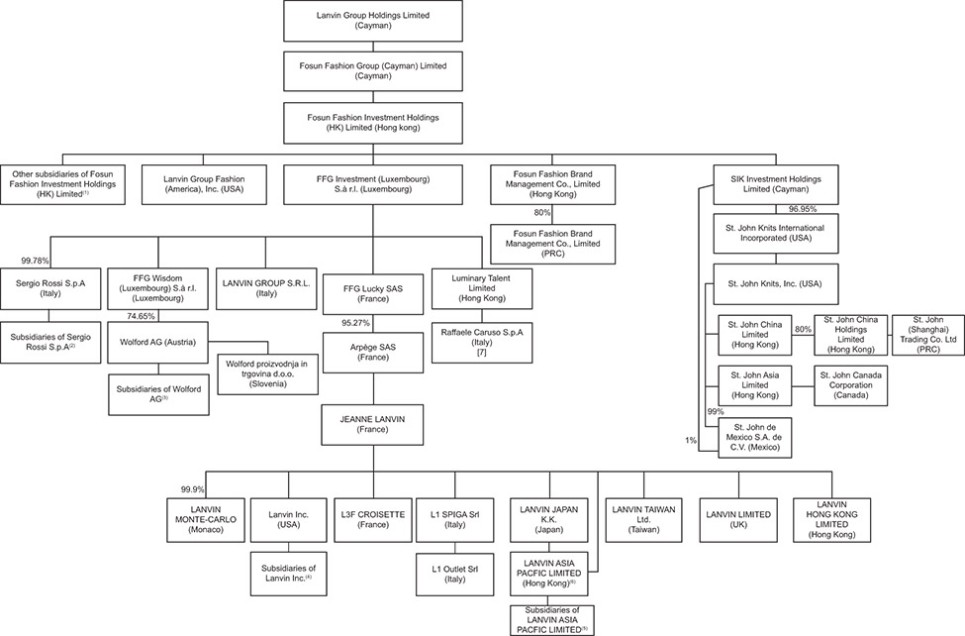

43

Table of Contents

Our primary activities consist of creating, manufacturing and marketing of our pre-collections and main collections, organized into two seasons (Fall/Winter and Spring/Summer) for Lanvin, Wolford, Sergio Rossi and the four seasonal collections (namely, Spring, Pre-fall, Fall and Resort) for St. John. Generally, each collection within our portfolio brands takes approximately six months from design to delivery of the finished products to our customers.

Our primary activities can be subdivided into the following major stages, overseen by different functions in our organization: (i) design, product development and merchandising; (ii) sales campaign; (iii) procurement; (iv) manufacturing; (v) logistics and inventory management; and (vi) marketing and advertising, as further described below.

Design, Product Development and Merchandising

Each portfolio brand has its own dedicated in-house creative, product development and merchandising teams, complemented by additional design capabilities from shared creative platforms managed by us, which bring together emerging creative talents and resources from different markets and facilitate collaborations or freelance design projects with the brands. The new collections are therefore created by the designers and merchandisers jointly considering market analysis and seasonal fashion trends while reflecting the brands’ true genuine creative visions.

Our experienced merchandising teams of each portfolio brand work on OTB (Open-to-Buy) for collections of each season and provide guidelines to the manufacturing and procurement functions for the quantity of products based on their assessment. Currently, we adopt a “small order, quick reaction” mode within our own factories, which provides flexibility to increase or decrease the orders according to the latest sales performance/forecast, as well as any recent market trends. We also implement a “monthly drop product calendar” for brands including Lanvin and Wolford to limit the risk of over-/ under-production.

At Lanvin, the development of a collection is carried out through a collaboration between the in-house creative studio and ateliers. In the heart of Paris, Lanvin’s ateliers passionately commit themselves each season to the service of a high-end ready-to-wear line. Once the styles of the new collection are drawn and selected, the sketches are presented by the Artistic Director to the sample makers tasked with bringing them to life, from toiling (the construction of a sketch in a plain fabric that will then be scrutinized and fine-tuned during the fittings), fitting, pattern making, fabric selection, cutting and the final assembling, until a collection is strut down the runway under the spotlight. For leather goods and footwear, a dedicated product development team works hand-in-hand with the creative and merchandise teams from sketch to the first prototype with selected craftsmen and luxury manufacturers in Europe.

At Wolford, when developing a new collection, product management, the design team, and product development all work hand-in-hand. Product management analyzes trends, colors and shapes and identifies the products that will be in demand in the market—these findings then form the basis for the work performed by the design team. The close cooperation between design and product development in-turn results in a stream of new products, often based on new production methods, such as 3D printing or the adhesive technology developed by Wolford and now patented, “Pure Tights,” the world’s first glued tights. Product and merchandise management also handles demand planning for the retail areas of proprietary boutiques, for online business and for wholesale customers. This department determines which articles have to be produced in which sizes and colors and for which retail areas. It also controls the flow of goods from the warehouse to retail areas.

At Sergio Rossi, each new collection is created by the in-house design team, working in strong coordination with the merchandising, retail and wholesale teams, allowing for a continuous cross-pollination of ideas and proposals, also considering the market needs and desires. The new collections are therefore created by the designers and stylists considering market analysis and seasonal fashion trends. The brand and merchandising teams of Sergio Rossi are supported by a unique expert team of product developers, who also work in close cooperation with the modelers of the supply chain team. The modelers transform the designers’ sketches first into paper or 3D models, and then into prototypes to assess the look, feel and functionality of the product, and allow the design and merchandising team to fine-tune the prototypes and the internal supply chain technicians to anticipate any issues that may arise during the manufacturing process. Once the prototypes are approved, a sample collection is produced based on such prototypes. After the spin-off of Sergio Rossi production operations, the modeling and prototyping activities will be still carried out by the factory, while the design, technical information (i.e. sketches, lasts, components, heels etc.) and know-how will be kept under Sergio Rossi’s strict control. The merchandising and supply chain team oversee and ensure that the products are manufactured on time and consistent with the delivery plans for our collections. From the launch of “The Living Heritage Project” in January 2017, Sergio Rossi has established a comprehensive physical and digital archive of its brand heritage, including thousands of restored vintage models and over 18,000 digitized documents such as drawings, lookbooks and editorial materials. This archive supports the preservation of the brand’s identity and informs future design development.

44

Table of Contents

At St. John, each new collection is created by the design team, reflecting the creative genius of the designers, market analysis, and seasonal trends. The designers also take directions from the merchandising team, who provide guidelines on the makeup of the collections, with target numbers of styles and recommended pricing. The design team also works closely with design purchasing and knit design teams to acquire the best yarns and create incredible, exclusive fabrics. The product development team converts designers’ sketches into patterns and then prototypes (either internally or through outsourced production facilities) to assess the look, feel, and quality of the items, allowing the merchandising team to fine-tune the prototypes and the supply chain technicians to anticipate any issues that may arise during the manufacturing process. Once the prototypes are approved, a sample collection is produced for internal review.

Sales Campaign

The sample collections, once ready, are presented to wholesale customers and retail buyers at each brand’s showrooms. Lanvin has a showroom in Paris. Wolford has showrooms in Milan, New York and Shanghai. Sergio Rossi has a showroom in Milan. St. John has a showroom in Anaheim.

The sample collections highlight key styles, themes and occasions, and present products across categories, price ranges and looks. Our showrooms for each portfolio brand display the full product offerings, providing guidance on in-store presentation and point-of-sale merchandising. While this process has traditionally been conducted through in-person meetings, we have also adopted digital tools that enable wholesale customers and retail buyers to view collections and place orders online. These tools continue to complement the traditional sales campaign process.

During the sales campaign, orders are taken by each brand’s wholesale area managers from wholesale customers (including franchisees) and retail buyers to form an order portfolio. Retail buyers place orders by selecting products in accordance with each brand’s buying guidelines, in particular with respect to DOSs, in order to ensure the consistency of the products’ assortment in various stores.

Sales campaigns usually last approximately two months. During the sales campaign, and based on preliminary orders placed by the retail buyers and wholesale customers, each brand’s merchandising and supply chain teams regularly share information on the evolution of the order portfolio to align the initial forecasts for raw material procurement and production planning.

Procurement

Wolford is our only brand with a vertically-integrated manufacturing facility, which can fulfill most of its production needs, providing stability and flexibility in its supply chain capabilities. Sergio Rossi completed a majority disposal of its manufacturing facility in January 2026 and is now a minority shareholder in its previous manufacturing facility with a long-term supply agreement to secure its production. Our two other brands have relatively stable and long-term relationships with their key raw material suppliers (with generally over 10 years of relationship with the top 10 suppliers in terms of expenditure in 2025). We have over 400 raw material suppliers in total (although sourcing activities are separately carried out for each portfolio brand). To date, none of our portfolio brands sources raw materials from suppliers based in Russia or Ukraine, and accordingly our supply chain has not been exposed to any material risks in light of the ongoing conflict between Russia and Ukraine.

Lanvin works with a portfolio of renowned and “best-in-class” manufacturers selected for their exceptional expertise across all product categories, including ready-to-wear, leather goods and footwear. The brand operates under a dual production model, combining full-package manufacturing (Finished Product) with Cut, Make & Trim (CMT), where Lanvin sources and provides raw materials directly to its manufacturing partners. Fabrics and raw materials are sourced exclusively in Europe, primarily Italy, with the exception of certain technical textiles originating from Japan and Korea.

Lanvin’s quality control procedures are applied across all stages of production, covering both components and finished goods. These controls are conducted either directly by Lanvin or via certified external partners located in France, Italy, Portugal and Spain. An internal process of self-inspection is also being progressively implemented across manufacturing sites to strengthen quality assurance. Once product development and pricing negotiations are finalized, purchase orders are placed with our suppliers and manufacturers. Our production and buying teams closely monitor the planning and delivery schedules throughout the season to ensure a seamless execution.

45

Table of Contents

Wolford’s procurement consists of mostly raw materials but also includes other items such as accessories. In 2025, Wolford’s supply base included 91 material suppliers, of which approximately 22 suppliers supply yarn for the internal knitting production, and approximately 11 suppliers supply fabrics, and approximately 58 suppliers supply accessories such as zippers, buttons or elastic bands. A majority of the aforementioned suppliers is located in Europe (approximately 90%) including Austria, Italy, Germany, Switzerland, France and other countries in Europe, while the remaining are located in Japan, South Korea and others. All raw materials procured by Wolford are stored at its headquarters in Bregenz for subsequent production and assembly or in our production plant in Slovenia. Finished products are stored in three warehouses—at the central warehouse in Germany, which also supplies the online business in Europe, and two other warehouses in the U.S. and China. The warehouse in the U.S. supplies the online business for the American market, while the warehouse in China supplies Asia.

In January 2026, Sergio Rossi ceased to manufacture products in-house and is now a minority shareholder in its previous manufacturing facility operated by Bonini. In 2025, when Sergio Rossi was still operating its manufacturing facility, it sourced raw materials and finished goods from approximately 128 suppliers, of which around 123 provided raw materials and around 5 provided finished goods. In 2025, the top 10 suppliers of Sergio Rossi accounted for around 38% of annual purchase and 98% of the procurement of raw materials, products and service came from Italian suppliers, while the remaining 42% came from other countries in the European area and from the Greater China region. Sergio Rossi has two warehouses, storing most of the raw materials, components including bottoms, leather and accessories, and prototypes. Depending on the categories of products and other factors such as production lead time, production costs, quantity and availability of the relevant know-how, the outsourced products are manufactured using two different approaches: façon manufacturing or “full package” manufacturing. When using the façon manufacturing model, Sergio Rossi outsources those products that cannot be assembled in-house —namely men’s shoes, sneaker, and espadrille-style footwear—while providing all raw materials and packaging materials. Intermediate stages (cutting, stitching, heel covering, mignons, etc.) are also outsourced, but assembly and finishing remain in-house. All samples and prototypes are produced internally. Sergio Rossi remains always responsible for providing the designs, product specifications, raw materials and coordinating the entire production process throughout the various stages. Conversely, in the full package manufacturing model, Sergio Rossi outsources to external manufacturers the entire production process (excluding design and specifications), including the procurement of raw materials, coordination of the various production stages including the most crucial part of assembly, final packaging and quality control. The full package manufacturing model is employed for selected products, such as sneakers and espadrilles; the quality control is always direct responsibility.

St. John works with third-party contractors to support a wide array of knit and woven garments from the U.S., Portugal, Italy, India, Dubai, Korea, Vietnam and China. St. John sources a wide variety of raw materials and trimmings through a vast network of trusted suppliers. In 2025, St. John had maintained relationships with 126 reputable raw material suppliers and 18 garment manufacturers. 81% of the materials are yarns and fabrics, sourced primarily in Europe and Asia, and the remaining 19% are items such as trimmings and hardware. The top 10 suppliers comprise 49% of St. John’s yearly spend. With regard to the network of external contractors, 11 are “full package,” whereby they are responsible for the entire manufacturing process, including the purchase of raw materials as specified by the St. John purchasing team from nominated suppliers. The remaining contractors are “façon,” responsible for the garment construction and execution, with the raw materials supplied by St. John. St. John’s leather products are mainly sourced from India. Regardless of the model, all St. John’s outsourced products are closely managed with stringent quality control.

While we are experiencing higher costs due to increased commodity prices and material cost, in line with the entire industry, such cost increases do not apply to all types of raw materials sourced by our businesses. Therefore, all of our portfolio brands have been, and are continuously analyzing the pricing by SKU from time to time and adjusting the pricing by SKU accordingly. To address increased commodity and material prices, the portfolio brands have generally been adjusting retail prices of the products in line with such increase given that the demand for luxury goods generally does not vary with price and the price increases implemented are not expected to have a significant adverse impact on consumers’ demand.

Manufacturing

While the sales campaign is ongoing, we start planning our manufacturing activities. Production quantities are continuously refined based on the results of the sales campaign allowing us to be efficient. Manufacturing planning is based on several factors, including the type of products to be manufactured (e.g. whether they are seasonal, continuative or made-to-measure). The manufacturing phase consists of industrializing the samples based on the outcome of the product developers’ research, and recreating them in various sizes and colors for large production.

46

Table of Contents

While Lanvin does not have its own production facilities, it maintains a diversified pool of suppliers for each category and works closely with its supply chain partners on a daily basis to mitigate the risk of supply chain disruptions. We are continuously building our global sourcing capabilities in Europe and Asia to avoid any supply disruptions in particular region(s).

Having started out in 1950 as a producer of pure silk and rayon stockings on Lake Constance, Wolford is now the go-to legwear and bodywear brand for many women worldwide. This success is based on a round-knitting technology specially developed and constantly refined by Wolford, as well as on its workmanship and quality checks. In combination with the finest yarns, this technology creates the specific comfort and product quality underlying the Wolford brand and its reputation. Nearly all products are made in Europe: the tights and bodies are produced in Bregenz on around 200 individually customized round-knitting machines operated in premises with optimized climatic conditions. Alongside the research and development department, Wolford’s headquarters is also home to a doubling mill, steaming facility, dyeing room, and molding workshop, as well as a proprietary color laboratory. The finishing including sewing and packaging of products take place in Murska Sobota, Slovenia, where textile manufacturing has a long tradition. In the areas of knitting, whole garment and intimate apparel, we also source from third-party finished goods suppliers, which are located in Italy, Turkey, Slovenia, Croatia, North Macedonia and China.

In January 2026, Sergio Rossi disposed of a majority stake in its previous factory located in San Mauro Pascoli, which carries out all of the activities of shoe production and logistics and has signed a long term supply agreement to continue to secure its production from this factory. Sergio Rossi continues to design its shoes and manage product development, ensuring quality control and quick lead time on an innovative bulk production basis.

St. John is widely recognized for its knit and tweed techniques, refined and evolved over six decades. We carefully manage our production operations, with a selected network of external suppliers in Europe, Korea, India, China and other locations. Our sourcing team is committed to carefully selecting all of our suppliers and managing the supply relationships. In determining where to manufacture our products, we consider a number of factors such as the source of the materials, product quality, lead time and service levels, safety, and overall cost efficiency.

Logistics and Inventory Management

Lanvin’s logistics department is responsible for organizing and managing the distribution of finished products and preparing the documentation required for global shipments, as well as the management of our warehouses, including the inflow/outflow of product and its inventory. Lanvin has a central warehouse located in France (near Paris) and two regional warehouses in the United States (Florida) and in China (near Shanghai). Transportation is conducted via third-party specialists engaged to transport goods by freight, air or sea, based on factors such as shipment size, distance travelled and urgency. The logistics department oversees after-sales facilities and other expedition-related services for the business across channels (retail/e-commerce/wholesale).

Wolford’s logistics is outsourced to a third-party logistics vendor with the central warehouse located in Munich, Germany, which has started its operations for Wolford in March 2024 after operations had been moved from a third-party service provider in Northern Germany to the new one in Southern Germany. In addition to this warehouse, Wolford has two other warehouses, one in the United States and one in China. With respect to the shipment of products, third-party transportation specialists are engaged to transport goods by road, air or sea, based on factors such as distance to destination and urgency of the shipment.

In 2025, Sergio Rossi was responsible for the entire logistics management, from storage to final destination delivery. In 2026, Sergio Rossi’s logistics department is responsible for organizing and managing the distribution of the finished products and preparing the documentation required for shipment, while the warehousing activities are performed by Bonini being the majority owner of the production site as well as the finished-good products warehouse. The logistics department is responsible for managing primary distribution center and product inventory, the shipment of products, and the logistics of the distribution of the finished products in all regions (included intercompany subsidiaries). With respect to the shipment of products, third-party transportation specialists are engaged to transport goods by road, air or sea, based on factors such as distance to destination and urgency of the shipment.

St. John ships all finished goods products through a centralized distribution center in Anaheim, California. The logistics department also manages e-commerce shipments and returns, as well as drop-ship orders from wholesale partners. With respect to the shipment of products, St. John’s logistics team partners with third-party transportation companies to transport goods by road, air or sea, based on factors such as distance to destination, urgency of the shipment, or adherence to partner routing guides.

47

Table of Contents

Marketing and Advertising

Advertising and promotional support is a crucial tool for luxury companies like us to influence purchase selection, enhance brand recognition and encourage brand loyalty over time. We invest significant resources in advertising communication and marketing, which include a full set of activities ranging from pure digital and social media marketing initiatives to events like fashion shows, product collaborations and co-marketing projects.

We adopt a strategy that has a dual-focus on both local and broader international audiences. We focus on local content, events and story-telling targeting specific groups of customers, and we also organize international campaigns and to ensure a consistent brand image in our marketing plans.

Each brand has its own internal teams dedicated to marketing and advertising activities, following slightly different marketing strategies depending on the brand. To better reach a wide but selected consumer segment, we use various communication tools, from organic institutional and products press coverage to media partnerships, to achieve a varied media-mix including digital marketing, digital media campaign, print, billboards, direct marketing and ad-hoc initiatives in our boutiques where visual merchandising and windows displays are conceived to consistently adhere to the seasonal marketing strategy plan. In addition to seasonal fashion shows, January Fall/Winter and June Spring/Summer collection presentations, specific shows and events are organized globally to strengthen our brands’ profiles and positioning and increase awareness on the most recent collections in local markets worldwide. Besides presenting new products, these events are planned to promote a direct involvement of the customers, media, celebrities, influencers, and industry key opinion leaders through exclusive events, as well as to reinforce the popularity of the brand and enhance its image.

Lanvin presents its seasonal collections in Paris during the Spring/Summer and Fall/Winter fashion weeks through elegant and elevated fashion shows, each carrying a particular creative theme as a tribute to the house’s identity, updated for today’s world. These shows play a significant role in demonstrating the brand’s luxury positioning as one of the oldest French couture houses still in operation, while revealing the conceptual direction of the newest season. They also help generate significant coverage on both editorial and digital publications and attract presence and participations of celebrities, culture influencers and VIPs around the world. Lanvin entered a new creative chapter in September 2024 with the appointment of Peter Copping as Artistic Director for both womenswear and menswear. Following the announcement, Lanvin made its official return to the Paris Fashion Week calendar with an intimate runway presentation in January 2025. Peter Copping’s debut collection for the Maison embodied what Jeanne Lanvin once described as le chic ultime — a return to timeless French elegance and exceptional savoir-faire. The collection received overwhelmingly positive media coverage across global markets, with widespread praise for the synergy between the designer and the Maison.

Lanvin also maintains a strong focus on localized content and engagement, adapting activations to the tastes and cultural rhythms of key markets such as Europe, the U.S., and Greater China.

Wolford’s marketing strategy is built around three core brand pillars: Essentials & Icons, the foundation of Wolford’s product offering, featuring its most timeless and iconic styles across all categories; Trend Collections that closely reflect current trends while expressing Wolford identity and embracing a contemporary vision of femininity and Collaborations, exclusive partnerships with acclaimed designers and renowned fashion brands. To reinforce its luxury positioning and support strategic product launches, Wolford consistently delivers compelling marketing messages across key touchpoints. The brand and product narratives are crafted to highlight Wolford’s unique value proposition—blending heritage, innovation, and meticulous attention to detail —to position its products as the finest on the market, justifying their premium status. Collaborations have become a cornerstone of Wolford’s strategy, driven by a strong desire to maintain cultural relevance: by partnering with top fashion and luxury players, the brand has successfully expanded its reach, strengthening its appeal among a more fashion-savvy audience. This strategic storytelling is further reinforced through PR activities and celebrity placements, which play a crucial role in enhancing brand visibility and desirability. Social media—primarily Instagram and TikTok—serve as essential platforms for engaging a global audience, driving brand awareness, and fostering community interaction. Partnerships with talents and content creators further amplify Wolford’s presence, crafting bespoke narratives that enhance brand consideration. Another key focus is elevating the customer experience across both digital and physical retail spaces. Dedicated marketing initiatives and loyalty programs are designed to engage and reward both existing and new customers, reinforcing long-term brand affinity.

48

Table of Contents

Sergio Rossi’s marketing strategy focuses on a customer-centered approach that connects digital and physical experiences. Through an omnichannel model, the brand encourages interaction between online platforms and stores, making it easy for customers to engage and shop across different channels. Digital tools like newsletters, help maintain regular communication, sharing updates on new campaigns, product launches, and collaborations through original content. In its communication, Sergio Rossi aims to deliver tailored messages that speak to different audiences. Social media plays an important role, presenting products through simple and engaging storytelling that builds interest and strengthens the brand’s identity. While keeping a consistent global image, the brand also adapts its content to local markets to stay relevant and close to its customers.

As a widely recognized luxury brand, St. John utilizes various marketing tools to strengthen the brand image, influence purchase behavior, and maintain the brand loyalty. Primary marketing channels include digital and social media marketing, collection presentations, and print advertising. The public relations team facilitates relationships with earned media and influencers within entertainment, fashion, and more. St. John also organizes special events to strengthen brand profiles, create deeper connections with customers and the community.

Sales Channels

Our sales teams bring our customers into our community, sharing with them our creativity and craft, as well as our story and the journey of each item. These relationships are nurtured in-store and online with respect to our DTC channel and in our showrooms with respect to our wholesale channel, with the aim of delivering a consistent and unique customer experience.

We distribute and sell our products in around 62 countries worldwide through a well-established omni-channel network comprised of our DTC (including e-commerce), and wholesale distribution channels. We are harnessing the power of technology to reinforce our customer database and CRM strategies, in order to quickly react to the evolving demands of today’s consumers.

On top of the brands’ own digital channels, we have also established a North America Digital Platform to amplify the luxury online shopping experience and operational efficiency for our brands in the North American markets.

Lanvin

For the year ended December 31, 2025, approximately 56.2% of our revenues from Lanvin were generated through our DTC channel including both retail DTC channel and e-commerce DTC channel, approximately 24.9% was generated through the points of sale operated by our wholesale distribution channel including online multi-brand stores.

DTC Channel

As of December 31, 2025, Lanvin operated 20 DOSs, of which 5 were in Greater China, 7 were in EMEA, and 8 were in North America. The latest store opening was in Cannes (France). The DTC channel is distributed throughout the main markets in which Lanvin operates. These main markets help Lanvin focus on maintaining a presence in prestigious and strategic locations.

The concepts and aesthetics of the DOSs are carefully planned and designed by Lanvin’s creative team jointly with external design agencies. Boutiques are created in several different concepts based on the regional characteristics and store conditions. Once opened, an internal staff of architects and visual merchandisers who are supported by external professional firms continually maintain and restyle the DOSs as required.

In addition, Lanvin has in place specific training programs dedicated to sales staff, focusing on product knowledge and customer service. To select the range of products sold in DOSs, buyers and merchandisers in regional offices select the best selection of products in terms of models, materials and color variants.

The DTC channel also includes an e-commerce shop operated directly through the website www.lanvin.com, outlets and other e-commerce platforms through which Lanvin sells directly to customers (such as TMall, Farfetch and market place) and whose sales systems are integrated with Lanvin’s sales and warehouse management systems.

49

Table of Contents

Wholesale Channel

As of December 31, 2025, the wholesale distribution network included 246 points of sale operated by wholesale customers and franchisees, of which 9 were in APAC, 150 were in EMEA and 87 were in North America. In 2025, the wholesale channel generated revenues representing 24.9% of revenues from Lanvin.

The wholesale distribution channel has developed through agreements with different types of wholesale customers, including, in particular:

Department stores and multi-brand specialty stores, which purchase Lanvin products for re-sale in their stores, sometimes in specific Lanvin branded wall units or corners. The contractual arrangements with this type of customer vary based on the retailer’s standard terms.
Online multi-brand stores. Lanvin branded products are also sold via prestigious online multi-brand stores such as Net-a-Porter, 24 Sevres, Luisa Via Roma and SSENSE.
Duty Free stores in generic spaces. As with the DTC channel, Lanvin carefully manages and, if necessary, customizes the distribution policies for wholesale customers.

Wolford

In 2025, approximately 67.0% of revenues from Wolford were generated through the DTC channel including retail DTC channel and e-commerce DTC channel, and approximately 33.0% was generated through the points of sale operated by the wholesale distribution channel including online multi-brand stores.

DTC Channel

As of December 31, 2025, Wolford products were globally sold in 41 Countries, and operated 89 DOSs worldwide, of which 8 were in APAC, 68 were in EMEA and 13 were in North America. These DOSs include boutiques, outlets, and concession shop-in-shops.

The Global Retail Division is responsible for the guidelines of aesthetic design and decoration standards. Once opened, an internal staff of architects and visual merchandisers who are supported by external professional firms constantly maintain and restyle the DOSs as required. In June 2021, Wolford opened Hangzhou Tower boutique - the first boutique in China in Hangzhou Tower and new concept of green and sustainability was first applied in Wolford’s store design and decoration.

The DTC channel also includes an e-commerce shop operated directly through the website www.wolfordshop.com and other e-commerce platforms through which Wolford sells directly to customers (such as TMall, Farfetch and WeChat) and whose sales systems are integrated with Wolford’s sales and warehouse management systems.

Wholesale Channel

As of December 31, 2025, the wholesale distribution network included 43 boutiques by Wolford’s partners. Wolford also sells products via approximately 1,068 wholesale partners, such as department stores and specialist retail stores. In 2025, the wholesale channel generated revenues representing 33% of revenues from Wolford.

The wholesale distribution channel has developed through agreements with different types of wholesale customers, including, in particular:

Franchisees, which operate mono-brand points of sale exclusively under the Wolford brands. The franchising agreements governing these relationships typically have a medium term (providing for an automatic renewal or a renegotiation period prior to the term expiry). The contractual arrangements may also provide for minimum purchase obligations by the franchisee, and for the obligation by Wolford and/or the franchisee to invest certain amounts in marketing activities.

50

Table of Contents

Department stores and multi-brand specialty stores, which purchase Wolford products for re-sale in their stores, sometimes in specific Wolford branded wall units. The contractual arrangements with this type of customers vary based on the relevant store’s standard terms.
Online multi-brand stores. Wolford branded products are also sold via prestigious online multi-brand stores such as SSENSE, Luisa via Roma, Shopbop.

As with the DTC channel, Wolford carefully manages and, if necessary, customizes the distribution policies for wholesale customers.

Sergio Rossi

In 2025, approximately 68.8% of revenues from Sergio Rossi were generated through the DTC channel including retail DTC channel and e-commerce DTC channel, and approximately 31.2% were generated through the points of sale operated by the wholesale distribution channel including online multi-brand stores and third-party production activity.

DTC Channel

As of December 31, 2025, Sergio Rossi operated 30 DOSs, of which 17 were in Japan, 10 in EMEA and 3 in Greater China. During fiscal year 2025, the DTC channel underwent a store rationalization initiative, aimed at concentrating efforts on the most promising markets and enhancing overall profitability. In 2025, the DTC channel generated revenues representing 68.8% of our revenues from Sergio Rossi. The DTC channel is distributed throughout the main markets in which Sergio Rossi operates. Sergio Rossi focuses on maintaining a presence in prestigious and strategic locations.

The aesthetics and customer experience of Sergio Rossi DOSs are carefully planned, designed and constantly maintained by an internal dedicated team supported by external professional firms. In addition, Sergio Rossi has in place specific training programs dedicated to the sales staff, focusing on product knowledge and customer service. To select the range of products sold thought DOSs, we establish guidelines at the group-level based on market potential and the characteristics of the points of sale. Buyers and merchandisers in our regional offices then select the best selection of products in terms of models, materials and color variants.

The DTC channel also includes an e-commerce shop operated through the website www.sergiorossi.com, outlets, concessions within department stores around the world and other e-commerce platforms through which Sergio Rossi sells directly to customers (such as TMall and Farfetch) and whose sales systems are integrated with Sergio Rossi’s sales and warehouse management systems.

Wholesale Channel and Third Parties Production

As of December 31, 2025, the wholesale distribution network included 130 points of sale operated by wholesale customers and franchisees, of which 91 were in EMEA, 24 were in Japan, 11 were in APAC and 4 were in North America.

In 2025, the wholesale channel and third parties production activity generated revenues representing 31.2% of revenues from Sergio Rossi.

The wholesale distribution channel has developed through agreements with different types of wholesale customers, including in particular:

Franchisees, which operate mono-brand points of sale exclusively under the Sergio Rossi brands. The franchising agreements governing these relationships typically have a medium term (providing for an automatic renewal or a renegotiation period prior to the term expiry). The contractual arrangements may also provide for minimum purchase obligations by the franchisee, and for the obligation by Sergio Rossi and/or the franchisee to invest certain amounts in marketing activities.
Department stores and multi-brand specialty stores, which purchase Sergio Rossi products for re-sale in their stores, sometimes in specific Sergio Rossi branded wall units. The contractual arrangements with this type of customers vary based on the relevant store’s standard terms.

51

Table of Contents

Online multi-brand stores. Sergio Rossi products are also sold via prestigious online multi-brand stores such as Luisa via Roma and Zalando.

As with the DTC channel, Sergio Rossi carefully manages and, if necessary, customizes distribution policies for wholesale customers.

Third parties production is the luxury shoes production for important and upcoming external brands (such as Amina Muaddi). The services offered, in addition to production, can be design, product development, sample development, sourcing, packaging, logistics and distribution. As a result of the manufacturing spin-off in January 2026, Sergio Rossi will shift its focus to the sale of its own products, with no further full ownership of production facilities and consequently on third-party manufacturing.

St. John

In 2025, approximately 76.4% of revenues from St. John were generated through the DTC channel including retail DTC channel and e-commerce DTC channel, and approximately 23.3% was generated through the points of sale operated by the wholesale distribution channel including online multi-brand stores.

DTC Channel

As of December 31, 2025, St. John operated 35 DOSs, of which 1 was in APAC and 34 were in North America. The DTC channel is distributed throughout the main markets in which St. John operates. St. John focuses on maintaining a presence in prestigious and strategic locations.

The DTC channel also includes an e-commerce shop operated directly through the website www.stjohnknits.com

Wholesale Channel

As of December 31, 2025, the wholesale distribution network included over 42 points of sale operated by wholesale customers and franchisees, of which 1 was in EMEA, 1 was in Asia, and 40 were in North America. This included drop ships activities through our other e-commerce platform clients (e.g. Farfetch) whose sales systems are integrated with St. John’s sales and warehouse management systems.

In 2025, the wholesale channel generated revenues representing 23.3% of revenues from St. John. As with the DTC channel, St. John carefully manages and, if necessary, customizes the distribution policies for wholesale customers.

Intellectual Property

As of the date of this annual report, and with an overall trademark portfolio including more than 1,200 registrations, the principal owned trademarks or trade names that we use in the business of our portfolio brands business are “Lanvin”, “Wolford,” “Sergio Rossi” and “St. John,” which we have registered in all of the countries in which we operate and jurisdictions of which our branded products are offered (i.e. all POSs operated by third parties), either in the logo version and in the word/standard characters version or in versions which are adapted to various local alphabets or ideographs. Additionally, we have a portfolio of domain names, including (i) registrations in most the countries in which we operate and in the case of Sergio Rossi and Wolford, jurisdictions of which our branded products are offered (and in the case of St. John, with a primary focus on.com domain names), (ii) some variations of the trademarks, and (iii) early and basic protection for our main business and marketing projects.

We devote significant resources to the protection and enhancement of our intellectual property assets and actively monitor the market for infringements or abuses of our trademarks and product designs. We are also active in enforcing our rights against third-party infringements. In addition, we monitor third-party applications for registration of trademarks that could be confused with our trademarks, and file oppositions against the applications for, or the registration of such trademarks in accordance with the laws and regulations of the relevant jurisdictions and cooperate with competent authorities worldwide to fight the counterfeiting of our products.

52

Table of Contents

Thanks to the long-standing efforts discussed above, judicial and/or administrative decisions in countries including China have recognized the trademark “Lanvin” as a mark with certain reputation on the goods of clothing and so on and have rejected applications of third parties’ use of the mark on the goods of “lending library services; zoological garden services,” “Beer, water (beverage)” and “Unprocessed wood; natural followers; etc.”

We are involved in a potential dispute with certain minority shareholders of Arpège SAS in relation to the use of the “Lanvin” name and brand by us at the group holding company level. We have sought preliminary legal advice and believe we have defenses to such allegations. Nevertheless, we may need to cease the use of the “Lanvin” name and brand by us at the group holding company level. See “Item 3. Key Information—D. Risk Factors—Risks Relating to Our Business and Industry—The re-branding to Lanvin Group is being challenged by the minority shareholders of Arpège SAS. Arpège SAS, one of our subsidiaries, owns Jeanne Lanvin SA which holds our Lanvin brand portfolio including the ‘Lanvin’ brand name. We cannot predict the outcome of such challenge and may have to discontinue the use by us, at the Group holding company level, of the Lanvin brand name.”

Employees

As of December 31, 2025, 2024 and 2023, respectively, we had the following number of employees, categorized by brand and geographic locations as set forth in the tables below.

  ​ ​ ​

As of December 31, 

  ​ ​ ​

2025

  ​ ​ ​

2024

  ​ ​ ​

2023

Lanvin Group


49


57


62

Lanvin


263


353


384

Wolford


712


881


952

Sergio Rossi


313


394


423

St. John


250


248


357

Discontinued Operation

479

473

459

Total


2,066


2,406


2,637

  ​ ​ ​

As of December 31, 

  ​ ​ ​

2025

  ​ ​ ​

2024

  ​ ​ ​

2023

EMEA


1,534


1,692


2,075

North America


368


395


136

Greater China


105


245


363

Japan


59


74


63

Total


2,066


2,406


2,637

Historically, we have had good labor relationships with our employees and we are committed to maintaining a positive and constructive relationship with them. In the past, we have not experienced any material job action or labor stoppage that has had a material impact on our business.

We currently do not expect any labor shortages in the future that would significantly affect our business, except for labor shortages that result from any unforeseen and uncontrollable circumstances including wars, pandemic and natural disasters.

Research and Development

Our competitiveness depends on, among other things, our ability to anticipate trends and to identify and respond to new and changing consumer preferences. We therefore devote significant resources to various research and development activities to design, create and develop new products for our collections.

Our research and development activities mainly relate to the development of new patterns and designs for our fabrics, the research of innovative and technological materials with specific features, the design, modeling and development of new products and the creation of prototypes.

Each of our four existing brands has its own product development team who is responsible for research and development.

53

Table of Contents

Lanvin, as a high fashion luxury brand, invested significantly in creative design and new product development. In recent years, Lanvin’s creative studio team made great efforts in studying the colors, characteristics, patterns of Jeanne Lanvin’s creative archives and interpreting them in a much more modern way.

Innovation remains a defining characteristic of Wolford AG and continues to be a central pillar of its strategic repositioning in 2025. The Company’s product portfolio remains focused on its core competence: body-hugging circular knit products such as legwear, shapewear and bodysuits — collectively referred to as skinwear — combining technical excellence, comfort and premium aesthetics.In 2025, R&D activities were increasingly aligned with three strategic priorities: technological refinement of circular knit engineering, sustainable and recyclable material innovation, and digitalization of product development and presentation.

Under the continued creative leadership of Nao Takekoshi, Wolford further strengthened the integration of Japanese Wholegarment® technology across selected collections. This seamless knitting technology reduces material waste, enhances comfort and enables complex silhouettes without additional seams, supporting both innovation and sustainability objectives.

Rather than focusing solely on individual hero products, 2025 marked a shift toward platform innovation — embedding functional performance, shaping technology and circular material logic across broader product categories. Digital transformation of product development advanced significantly in 2025. Full 3D integration now enables: substantial reduction of physical prototypes, accelerated design validation across international teams, real-time implementation of color and pattern variations, and high-resolution photorealistic rendering for digital and wholesale presentation.

The expanded use of digital sampling contributes to shorter development cycles, lower material consumption and improved cost efficiency. In addition, digital showrooms increasingly complement traditional collection presentations.

Collaboration with academic institutions, including the University of Innsbruck, as well as specialized yarn suppliers and technology partners, remains an important innovation driver. In 2025, research initiatives focused particularly on recyclable elastane alternatives, energy-efficient knitting processes and material traceability.

Wolford continues to position itself as a technology-driven skinwear specialist, combining fashion, engineering and sustainability.

The DNA of Sergio Rossi is at the core of every collection, expressed through a continuous dialogue between past and present. The brand’s archive plays a fundamental role as both inspiration and starting point for design. This heritage was brought back into focus with the launch of The Living Heritage Project in January 2017.

Innovation is a constant at St. John, as the design team is perpetually researching trends throughout the world, finding inspiration from vintage archives, and collaborating with fabric mills and yarn vendors. St. John’s research and development ensures that their knitwear techniques remain innovative and fresh, maintaining their spot as the leader in modern knitwear. Yarns are sourced throughout the world. The knitting machines range from 3.5g to 18g, with seven different types of machine gauges enabling different types of knitted fabrics. Tweeds, for instance, incorporate up to eight different kinds of yarn, resulting in a textured weave with the comfort of a knit. On finer gauge machines, St. John utilizes advanced techniques to create streamlined dresses and gowns with details like pleats, flares, and patterns. These knitted fabrications remain the DNA of the brand.

Regulatory Environment

We are required to comply with the laws and regulations applying to our products and operations in the various jurisdictions in which we operate, particularly in relation to the protection of intellectual property rights, competition, product safety, packaging and labeling, import and processing of certain raw materials and finished goods, data protection, limits on cash payments, worker health and safety and the environment. Compliance with the applicable laws and regulations is monitored by governmental authorities and the principal objective of such regulations is to ensure that the products we market are safe and duly labeled and imported. Virtually all of our imported products are subject to custom duties and other taxes, which may impact the price of such products. We maintain compliance procedures and policies to assist in managing our import and export activities and ensure compliance with the laws and regulations of the jurisdictions where we operate.

54

Table of Contents

Property, Plant and Equipment

We operate through manufacturing facilities, corporate offices, showrooms, warehouses, stores, land and other buildings around the world, which are in part owned by our portfolio brands and in part leased from third parties.

As of December 31, 2025, the Group owns one real estate asset used in its operations, consisting of a Wolford manufacturing facility located at Nemčavci 78, 9000 Murska Sobota, Slovenia, with an approximate area of 27,145 square meters. The total carrying value of the Group’s property, plant and equipment as of December 31, 2025 was €18,430 thousand.

Legal Proceedings

We are party to civil and administrative proceedings (including tax audits) and to legal actions in the normal course of our business, including with respect to labor matters and commercial agreements matters. Adverse decisions in one or more of these proceedings could require us to pay substantial damages. Litigation is subject to many uncertainties, and the outcome of individual matters is not predictable with assurance. An accrual is established in connection with pending or threatened litigation if a loss is probable and a reliable estimate can be made.

Lanvin Dispute

In 2018, we acquired a controlling stake in Arpège SAS and its subsidiary Jeanne Lanvin SA, which in turn owns the brand “Lanvin”. The shareholders’ agreement entered into by and between Fosun Industrial Holdings Limited and certain minority shareholders of Arpège SAS (as subsequently acceded to by FFG Lily (Luxembourg) S.à r.l and then by FFG Lucky SAS, the “Lanvin SHA”) provides that certain matters require an affirmative vote of each member of the board of Arpège SAS representing minority shareholders, including the entry into any related party transactions. The minority shareholders currently own, in the aggregate, 4.73% of the equity securities in Arpège SAS.

In October 2021, after rounds of discussion and negotiation with the minority shareholders, we proposed to the members of the board of Arpège SAS representing minority shareholders that an authorization letter permitting the rest of the Lanvin Group to use the “Lanvin” name and brand as part of an international re-branding of Fosun Fashion Group be approved by the board of Arpège SAS. The re-branding was worldwide and well received by our investors and the press. At that time the minority shareholders did not object to the use of the “Lanvin” corporate name and merely suggested some changes to the terms of the authorization letter. We believed such terms were generally reasonable and would be quickly resolved in an amicable fashion. In March through May 2022, the parties continued discussions and negotiations in what appeared to us to be in an amicable and reasonable fashion.

In September 2022, we received a letter (the “Minority Shareholder Letter of September 2022”) from one of the minority shareholders (the “Alleging Shareholder”) alleging that we had improperly used the “Lanvin” corporate name in connection with our re-branding initiative and that they had not given formal approval pursuant to the terms of the Lanvin SHA prior to our re-branding. The Alleging Shareholder had also stated in the same letter that other minority shareholders also object to our use of the “Lanvin” name in connection with our re-branding initiative.

We have sought preliminary legal advice and believe we have strong legal defense to the foregoing allegations. No formal legal proceedings have been brought by the minority shareholders to date. Any such proceedings or claims could present challenges on us because of defense and settlement costs, diversion of resources and other factors, and there can be no assurance that we will prevail in any legal proceeding that may be brought by the minority shareholders or that we will be able to settle these allegations on a timely basis or on terms that are acceptable to us, or at all. Accordingly, we might have to adjust our use, at the group holding company level, of the “Lanvin” brand name, and change to another name (or revert to our previous name as Fosun Fashion Group) should we not prevail or settle these allegations. However, we do not expect that, even if we do not prevail or settle these allegations, the continued use of the Lanvin name by Arpège SAS and its subsidiaries, which constitute our Lanvin brand portfolio, will be affected.

55

Table of Contents

Furthermore, pursuant to the Lanvin SHA, if Fosun loses its control over us, i.e., the possession, directly or indirectly, of the ability to direct or cause the direction of our policies and management, we may be obligated to cause the equity interest we hold indirectly in Arpège SAS to be transferred back to Fosun or its controlled affiliates. FFG Lucky SAS, our wholly-owned subsidiary, acquired certain equity securities in Arpège SAS in a series of permitted transfers by virtue of being an affiliate of Fosun Industrial Holdings Limited, the original shareholder of such equity securities. In the Minority Shareholder Letter of September 2022, the Alleging Shareholder further stated that, if FFG Lucky SAS ceases to be an affiliate of Fosun Industrial Holdings Limited and/or Fosun, FFG Lucky SAS may be obligated to transfer the relevant equity securities in Arpège SAS back to Fosun Industrial Holdings Limited and/or Fosun.

We believe that the possibility of Fosun losing control over us in the foreseeable future is remote. Further, even if Fosun were to cease control of us and, in turn, FFG Lucky SAS, we believe there are valid defenses to the request by the minority shareholders of Arpège SAS that FFG Lucky SAS should transfer the relevant equity securities of Arpège SAS back to Fosun. Nevertheless, we cannot assure you that Arpège SAS will remain as our subsidiary at all times. If the relevant equity securities in Arpège SAS were to be transferred to Fosun or its controlled affiliates other than us, we could see some impact on our revenue and operations, and we might experience changes in our ability to utilize certain rights to use of the Lanvin name and Lanvin brand. The occurrence of any of these could affect our financial performance and the trading price of our Securities.

See “Item 3. Key Information—D. Risk Factors—Risks Relating to Our Business and Industry—The re-branding to Lanvin Group is being challenged by the minority shareholders of Arpège SAS. Arpège SAS, one of our subsidiaries, holds our Lanvin brand portfolio including the ‘Lanvin’ brand name. We cannot predict the outcome of such challenge and may have to discontinue the use by us, at the group holding company level, of the Lanvin brand name.”

Cantor Dispute

In 2023, Cantor Fitzgerald & Co. (“Cantor”) filed an action against us, as well as Fosun Fashion Group (Cayman) Limited and Primavera Capital Acquisition Corporation, in the Supreme Court of the State of New York, County of New York (Index No. 650028/2023), alleging breach of a financial advisor agreement and a private placement agreement (the “Complaint”). The Complaint seeks damages of approximately $5.18 million, plus interest and attorneys’ fees. We (along with the other defendants) filed an answer to the Complaint in which it asserted numerous defenses to Cantor’s claims. As of August 1, 2024, the relevant parties entered into a settlement agreement resolving the matter. Pursuant to the agreement, the litigation was dismissed with prejudice upon payment by defendants to Cantor of $4.5 million, which payment was made as called for by the agreement.

56

Table of Contents

C.Organizational Structure

The following diagram depicts an organizational structure of the Company as of the date hereof. Except as otherwise specified, equity interests depicted in this diagram are held as to 100%.

Graphic

(1)Includes two other wholly-owned subsidiaries incorporated in the PRC: (i) Shanghai Fulang Brand Management (Group) Co., Ltd., and (ii) Fosun Fashion (Shanghai) Consulting Management Co., Ltd. Shanghai Fulang Brand Management (Group) Co., Ltd. holds 60% equity interest in Lanvin Group Fabric Development Technology (Haining) Co., Ltd., a company incorporated in the PRC to focus on sustainable fashion materials R&D and supply chain.
(2)Includes a total of seven wholly-owned subsidiaries: (i) Sergio Rossi Hong Kong Limited, a company incorporated in Hong Kong, (ii) Sergio Rossi Japan Limited, a company incorporated in Japan, (iii) Sergio Rossi UK Limited, a company incorporated in United Kingdom, (iv) Sergio Rossi USA Inc., a company incorporated in the U.S., (v) Sergio Rossi Retail s.r.1., a company incorporated in Italy, (vi) Sergio Rossi Deutschland GmbH, a company incorporated in Germany and (vii) FAM Industries S.r.l., a company incorporated in Italy. On 22 January 2026, 70% of FAM Industries S.r.l. was sold to Bonini. Sergio Rossi Shanghai Trading Limited, a company incorporated in the PRC, is 95.5% owned by Sergio Rossi Hong Kong Limited and 4.5% owned by Fosun Fashion Brand Management Co., Limited.

57

Table of Contents

(3)Includes a total of 13 wholly-owned subsidiaries: (i) Wolford Deutschland GmbH, a company incorporated in Germany, (ii) Wolford (Schweiz) AG, a company incorporated in Switzerland, (iii) Wolford London Ltd. (UK), a company incorporated in United Kingdom, (iv) Wolford Paris S.A.R.L., a company incorporated in France, (v) Wolford Italia S.r.1., a company incorporated in Italy, (vi) Wolford Espana S.L., a company incorporated in Spain, (vii) Wolford Scandinavia ApS, a company incorporated in Denmark, (viii) Wolford America, Inc., a company incorporated in the U.S., (ix) Wolford Nederland B.V., a company incorporated in Netherlands, (x) Wolford Canada Inc., a company incorporated in Canada, (xi) Wolford Asia Limited, a company incorporated in Hong Kong, (xii) Wolford Belgium N.V., a company incorporated in Belgium, and (xiii) Wolford (Shanghai) Trading Co., Ltd., a company incorporated in the PRC. Wolford Berangere, a company incorporated in France, is a wholly-owned subsidiary of Wolford Paris S.A.R.L.
(4)Includes a total of seven wholly-owned subsidiaries incorporated in the U.S.: (i) L1 Bal Harbour LLC, (ii) L2 Crystals LLC, (iii) L3 Madison LLC, (iv) L4 Rodeo Drive LLC, (v) L5 US ECOM LLC, (vi) L6 MADISON, LLC, and (vii) L8 South Coast Plaza LLC.
(5)Includes a total of two wholly-owned subsidiaries: (i) Lans Atelier (SHANGHAI) Trading Co., Ltd., a company incorporated in the PRC and (ii) LANVIN MACAU LIMITED, a company incorporated in Macao.
(6)One ordinary share of LANVIN ASIA PACIFIC LIMITED is held by LANVIN JAPAN K.K.
(7)In February 2026, Luminary Talent Limited sold 100% of the share capital of Raffaele Caruso S.p.A to MondeVita Italy S.r.l.

D.Property, Plants and Equipment

Please refer to “—B. Business Overview—Property, Plant and Equipment” for a discussion of our property, plants and equipment.

ITEM 4.AUNRESOLVED STAFF COMMENTS

None.

ITEM 5.OPERATING AND FINANCIAL REVIEW AND PROSPECTS

You should read the following discussion and analysis of our financial position and results of operations in conjunction with our consolidated financial statements and the related notes included elsewhere in this annual report. This discussion contains forward-looking statements that involve risks and uncertainties. Our actual results and the timing of selected events could differ materially from those anticipated in these forward-looking statements as a result of various factors, including those set forth under “Item 3. Key Information—D. Risk Factors” and elsewhere in this annual report.

A.Operating Results

Overview

We are a global luxury fashion group with four portfolio brands, namely Lanvin, Wolford, Sergio Rossi and St. John. Founded in 1889, Lanvin is one of the oldest French couture houses still in operation, offering products ranging from apparel to leather goods, footwear, and accessories. Wolford, founded in 1950, is one of the largest luxury skinwear brands in the world, offering luxury legwear and bodywear, with a recent successful diversification into leisurewear and athleisure. Sergio Rossi is a highly recognized Italian shoemaker brand and has been a household name for luxury shoes since 1951. St. John is a classic, timeless and sophisticated American luxury womenswear house founded in 1962. On February 6, 2026 we sold Caruso to MondeVita Italy S.r.l., a subsidiary of Mondevo Group. In addition to our current four portfolio brands, we are also looking at potential add-on acquisitions as part of our growth strategy.

58

Table of Contents

Our goal is to build a leading global luxury group with access to Asia and to provide customers with excellent products that reflect our brands’ tradition of fine craftsmanship with exclusive design content and a style that preserves the exceptional manufacturing quality for which those brands are known. This is consistently achieved through the sourcing of superior raw materials, the careful finish of each piece, and the way the products are manufactured and delivered to our customers. In 2023, 2024 and 2025, we recorded revenues of €386,976 thousand, €291,864 thousand and €240,498 thousand, respectively, loss for the year of €146,253 thousand, €189,295 thousand and €263,345 thousand, respectively and adjusted EBITDA (non-IFRS measure) of €(65,293) thousand, €(93,547) thousand, and €(90,114) thousand, respectively. See “—non-IFRS Financial Measures.”

We operate a combination of direct-to-consumer or DTC, and wholesale channels worldwide through our extensive network of around 635 points of sale, or POSs, including 174 directly operated retail stores (across our four portfolio brands) as of December 31, 2025. We distribute our products worldwide via retail and outlet stores, wholesale customers and e-commerce platforms. Taking into account the DTC (including both directly-operated stores and e-commerce sites) and wholesale channels, we are present in around 80 countries.

Key Factors Affecting Our Financial Condition and Results of Operations

Our financial condition and results of operations are affected by a number of factors, including those that are outside of our control.

Creating new luxury products within our current brands

We believe there are significant growth opportunities in capitalizing on our brands’ recognition and customer base by rebalancing our current product portfolio and introducing new product categories. Each portfolio brand is fully equipped to optimize its product mix and expand into new categories, such as accessories and lifestyle products, which represent significant growth opportunities on their own. The portfolio brands will continue to tap into new trends including athleisure, and will evolve with the emerging, young client base globally with high spending power. As we expand into new product categories, we expect that these product categories will contribute to revenue growth over time.

DTC network expansion

We intend to grow our global presence through expanding our DTC network, by entering new geographies, developing e-commerce channels and executing an omnichannel distribution strategy. While today we have a presence in Europe, North America and Asia, we believe there is significant future runway for growth driven by new opportunities for the global luxury goods market. According to the Bain–Altagamma Luxury Goods Worldwide Market Study (Fall 2025, dated November 20, 2025), the global personal luxury goods market was estimated at approximately €358 billion in 2025. Following the post-pandemic rebound, the market has entered a period of normalization, with a slight contraction in 2024 and a further modest decline expected in 2025. Looking ahead, the study anticipates a return to moderate growth from 2026 onward, with the market projected to reach approximately €525 billion to €640 billion by 2035, supported by sustained demand across key regions and structural growth in the global luxury consumer base. In addition to our omnichannel distribution strategy will involve expansion of our e-commerce offering and development of our digital marketing capabilities. We believe that revenue growth will in part be driven by the pace and success of our DTC network expansion.

Identifying new strategic investment and partnerships that complement our luxury fashion ecosystem

We will continue to seek partners and investments in high-quality assets in diverse markets and product categories that can flourish within our luxury fashion ecosystem. We currently have a strong group of strategic partners that support our brands in production, distribution and sourcing. We plan to find additional strategic partners to further expand our footprint in new categories as well as improve our supply chain. We believe these will be important future partners who will further help drive the growth of our business and broaden our ecosystem.

Implementing an asset light operational model to enhance supply chain flexibility

We have made adjustments on our manufacturing structure in 2025 and will continue to focus on an asset-light operational model for our brands to achieve additional flexibility in our supply chain, continue to adapt our cost structure and continue to invest on the sourcing of superior raw materials, the quality of our products, fine craftsmanship in the manufacturing process, exclusive designs and style and experienced multi-cultural teams with intimate knowledge of our customers and their needs.

59

Table of Contents

Fluctuations in exchange rates

A significant portion of our operations are in international markets outside the Eurozone, where we record revenues and expenses in various currencies other than the Euro, mainly the Chinese Renminbi and U.S. dollar, as well as other currencies.

The table below shows the exchange rates of the main foreign currencies used to prepare Lanvin Group’s annual consolidated financial statements compared to the Euro.

  ​ ​ ​

  ​ ​ ​

2025

  ​ ​ ​

Exchange

  ​ ​ ​

2024

  ​ ​ ​

Exchange

  ​ ​ ​

2023

Exchange rate

Average

rate at

Average

rate

Average

at December 31, 

Exchange

December 31, 

Exchange

December 31, 

Exchange

2025

rate

2024

rate

2023

rate

U.S. Dollar

1.1717

1.1319

1.0469

1.0853

1.1096

1.0841

Chinese Renminbi

8.2355

8.0866

7.5257

7.7257

7.8592

7.6352

Hong Kong Dollar


9.1181


8.8242


8.1271


8.4686


8.6727


8.4863

British Pound


0.8729


0.8567


0.8291


0.8466


0.8693


0.8694

Japanese Yen


183.8281


168.6815


162.7882


163.4023


156.5266


151.4929

The following table shows the sensitivity at the end of the reporting period to a reasonably possible change in the main foreign currencies against the Euro, with all other variables held constant, of our profit before tax due to differences arising on settlement or translation of monetary assets and liabilities and our equity excluding the impact of retained earnings due to the changes of exchange fluctuation reserve of certain overseas subsidiaries of which the functional currencies are currencies other than the Euro.

  ​ ​ ​

As of December 31, 

2025

2024

2023

Increase /

  ​

Increase /

Increase /

Increase / 

Increase / 

Increase /

 (decrease) in

 (decrease) in

 (decrease) in 

(decrease) in

(decrease) in

 (decrease) in

 loss before 

 loss before 

loss before 

 loss before 

 loss before

 loss before 

tax if Euro

tax if Euro

tax if Euro 

tax if Euro 

 tax if Euro 

tax if Euro 

 strengthens 

 weakens by

strengthens

weakens

strengthens

weakens

  ​ ​ ​

by 5%

  ​ ​ ​

 5%

  ​ ​ ​

 by 5%

  ​ ​ ​

 by 5%

  ​ ​ ​

 by 5%

  ​ ​ ​

 by 5%

U.S. Dollar


(11,721)


11,721


(12,342)


12,342


(12,046)


12,046

Chinese Renminbi


(375)


375


(438)


438


72


(72)

Hong Kong Dollar


44


(44)


(31)


31


(256)


256

British Pound


14


(14)


30


(30)


136


(136)

Japanese Yen


(720)


720


(1,169)


1,169


(1,094)


1,094

Total


(12,758)


12,758


(13,950)


13,950


(13,188)


13,188

General economic conditions and consumers’ confidence

Purchases of our products tend to be discretionary and therefore sales may be volatile, particularly during periods of economic slowdown and are influenced by, among other factors, general economic conditions, consumer confidence and disposable consumer income. In times of economic growth, consumers tend to have more disposable income and travel more frequently, which may increase the demand for our products. Conversely, when economic growth is stagnant or negative, consumers may delay or avoid discretionary spending, which may result in reduced demand for our products.

Global political events and other disruptions

Global political developments, social and geopolitical sources of unrest, export restrictions, sanctions, tariffs, natural disasters, travel restrictions imposed by governments and other events may also result in a shift in travel patterns or a decline in travel volumes, which have had in the past, and may have in the future, an adverse effect on our business, financial position, results of operations and cash flows. Although (i) the conflict in Ukraine and the resulting U.S. and European Union sanctions on Russia and (ii) the instability in the Middle East manifested through regional power struggles have had minimal impact to our business so far, further spread or extension of the conflict may result in lower sales for our EMEA business due to reduced tourism spending and negative consumer sentiment.

60

Table of Contents

In addition, changes, potential changes or uncertainties in laws and policies governing foreign trade, manufacturing, and investment in the territories and countries where we operate, or sell our products could adversely affect our business, results of operations, and financial condition. Uncertainty surrounding international trade policy and regulations as well as disputes and protectionist measures could also have an adverse effect on consumer confidence and spending. Policy actions under the new administration in the United States, including the imposition of tariffs and other trade actions, could affect global supply chains, disrupt markets, and result in currency fluctuations. In particular, trade tensions have escalated recently between the United States and the PRC. As of the date of this annual report, it remains uncertain whether increased tariffs and trade tensions will create further disruptions and uncertainties to the international trade and lead to a downturn to the global economy. As we work with a wide range of business partners in different countries in the world, should any of our major business partners become subject to new or additional tariffs imposed by the U.S. government, our business may be adversely affected.

Seasonality

The luxury apparel market in which we operate is subject to seasonal fluctuations in sales. Our sales are usually higher in the months of the year in which wholesale customers concentrate their purchases. For example, deliveries of seasonal goods to wholesale customers tend to concentrate from November to February for the Spring/Summer collection and from June to September for the Fall/Winter collection. With regards to retail sales at our DOSs and e-commerce channels, sales tend to be higher in the last quarter of the year, driven by the holiday shopping season and in January and February, in correspondence of the Chinese New Year celebrations. However, several events may affect retail sales, including adverse weather conditions or other macroeconomic and external events.

Operating costs, in contrast, do not generally experience significant seasonal fluctuations, except for certain increases in the months of November and December due to the variable costs associated with sales commissions and leases. We expect such seasonal trends to continue.

Inflation

In 2025, we have seen significant inflationary pressure from higher logistics costs for shipping of both raw materials and finished goods. Inflation has impacted our costs of goods sold by affecting production costs, raw materials, energy costs, labor costs, and costs of goods sourced from third-party vendors. We are also subject to wage inflation at multiple locations. We have been able to offset the impact of inflation with cost savings from product portfolio optimization and supplier term improvement. And we have continued to monitor our costs to ensure we can respond quickly when macroeconomic landscape changes again.

Fluctuations in tax obligations and changes in tax laws, estimates, treaties and regulations

We and our portfolio brands are subject to taxation in Europe, the U.S. and China, as well as various other jurisdictions, with the applicable tax rates varying by jurisdiction. As a result, our overall effective tax rate is affected by the proportion of earnings from the various tax jurisdictions and by the ability to generate sufficient and suitable future taxable profits from which the reversal of any deferred tax assets can be deducted. We recognize tax expenses in multiple tax jurisdictions based on (i) the estimates of taxable income, the required reserves for uncertain tax positions, (iii) deductible temporary differences, tax loss carry-forwards and tax credits to the extent that their future offset is probable, (iv) withholdings tax on unremitted earnings, and (v) the way in which we intend to recover or settle the carrying amount of deferred tax assets and liabilities. At any time, there are multiple tax years that may be subject to examinations and audits by various tax authorities.

Additionally, we are subject to duties applicable to the importation of our products in various countries, which may impact the cost of such products. In addition, countries to which we ship our products may impose safeguard quotas to limit the quantity of products that may be imported. We rely on free trade agreements and other supply chain initiatives in order to maximize efficiencies relating to the importation of our products.

Factors Affecting the Comparability of Our Results of Operations

Impairment of Goodwill and Brand

Our results of operations reflect goodwill impairment and brand losses of €66.7million in 2025. See Note 15 – Goodwill and Note 16 – Impairment testing of intangible assets with indefinite useful lives to Lanvin Group’s consolidated financial statements included elsewhere in this annual report for additional information.

61

Table of Contents

Financial Information

Overview of Segmental Reporting

We have four operating segments which are described as follows:

Lanvin segment - Includes all activities related to the Lanvin brand.
Wolford segment - Includes all activities related to the Wolford brand.
St. John segment - Includes all activities related to the St. John brand.
Sergio Rossi segment - Includes all activities related to the Sergio Rossi brand.

All of the brands deal with the same category of products that use similar production and distribution processes.

Results of Operations

Year ended December 31, 2025 compared with year ended December 31, 2024

The following is a discussion of our results of operations for the year ended December 31, 2025 as compared to the year ended December 31, 2024.

  ​ ​ ​

  ​ ​ ​

Percentage of

  ​ ​ ​

  ​ ​ ​

Percentage of


(Euro thousands, except percentages)

2025

revenues

2024*

revenues


Revenues


240,498


100.0

%  

291,864


100.0

%

Cost of sales


(100,620)


(41.8)

%  

(119,368)


(40.9)

%

Gross profit


139,878


58.2

%  

172,496


59.1

%

Marketing and selling expenses


(170,591)


(70.9)

%  

(206,942)


(70.9)

%

General and administrative expenses


(107,311)


(44.6)

%  

(109,007)


(37.3)

%

Impairment of goodwill and brand

(66,730)

(27.7)

%

(31,208)

(10.7)

%

Other operating income and expenses


(10,631)


(4.4)

%  

7,896


2.7

%

Loss from operations before non–underlying items


(215,385)


(89.6)

%  

(166,765)


(57.1)

%

Non–underlying items


(16,263)


(6.8)

%  

10,243


3.5

%

Loss from operations


(231,648)


(96.3)

%  

(156,522)


(53.6)

%

Financial cost–net


(35,490)


(14.8)

%  

(29,398)


(10.1)

%

Loss before income tax


(267,138)


(111.1)

%  

(185,920)


(63.7)

%

Income tax benefits / (expenses)


15,775


6.6

%  

(3,086)


(1.1)

%

Loss from continuing operations

(251,363)

(104.5)

%

(189,006)

(64.8)

%

Loss from discontinued operations

(11,982)

(5.0)

%

(289)

(0.1)

%

Loss for the year


(263,345)


(109.5)

%  

(189,295)


(64.9)

%

Non–IFRS Financial Measures(1):


Contribution loss


(30,713)


(12.8)

%  

(34,446)


(11.8)

%

Adjusted EBIT


(215,201)


(89.5)

%  

(166,214)


(56.9)

%

Adjusted EBITDA


(90,114)


(37.5)

%  

(93,547)


(32.1)

%

(1)See “—Non–IFRS Financial Measures.”

62

Table of Contents

Year ended December 31, 2024 compared with year ended December 31, 2023

The following is a discussion of our results of operations for the year ended December 31, 2024 as compared to the year ended December 31, 2023.

  ​ ​ ​

  ​ ​ ​

Percentage of

  ​ ​ ​

  ​ ​ ​

Percentage of


(Euro thousands, except percentages)

2024*

revenues

2023*

revenues


Revenues


291,864


100.0

%  

386,976

100.0

%

Cost of sales


(119,368)


(40.9)

%  

(146,576)

(37.9)

%

Gross profit


172,496


59.1

%  

240,400

62.1

%

Marketing and selling expenses


(206,942)


(70.9)

%  

(224,850)

(58.1)

%

General and administrative expenses


(109,007)


(37.3)

%  

(129,182)

(33.4)

%

Impairment of goodwill and brand

(31,208)

(10.7)

%


Other operating income and expenses


7,896


2.7

%  

(4,549)


(1.2)

%

Loss from operations before non–underlying items


(166,765)


(57.1)

%  

(118,181)


(30.5)

%

Non–underlying items


10,243


3.5

%  

(3,781)


(1.0)

%

Loss from operations


(156,522)


(53.6)

%  

(121,962)


(31.5)

%

Financial cost–net


(29,398)


(10.1)

%  

(20,014)


(5.2)

%

Loss before income tax


(185,920)


(63.7)

%  

(141,976)


(36.7)

%

Income tax expenses


(3,086)


(1.1)

%  

(3,323)


(0.9)

%

Loss from continuing operations

(189,006)

(64.8)

%  

(145,299)

(37.5)

%

Loss from discontinued operations

(289)

(0.1)

%  

(954)

(0.2)

%

Loss for the year


(189,295)


(64.9)

%  

(146,253)


(37.8)

%

Non–IFRS Financial Measures(1):


  ​


  ​

Contribution profit/(loss)


(34,446)


(11.8)

%  

15,550


4.0

%

Adjusted EBIT


(166,214)


(56.9)

%  

(115,432)


(29.8)

%

Adjusted EBITDA


(93,547)


(32.1)

%  

(65,293)


(16.9)

%

(1)See “—Non–IFRS Financial Measures.”

Revenues

We generate revenue primarily through our four brands: Lanvin, Wolford, St. John and Sergio Rossi, whose revenues are generated from the sale of their products, manufacturing and services for private labels and other luxury brands, as well as from royalties received from third parties and licensees. Revenue is measured at the transaction price which is based on the amount of consideration that we expect to receive in exchange for transferring the promised goods or services to the customer. For each period presented, revenue is exclusive of sales incentives, rebates and sales discount. As such, sales incentives, rebates and sales discount did not contribute to the Company’s revenue. Revenues for the year ended December 31, 2025 amounted to €240.5 million, an decrease of €51.4 million or (17.6)%, compared to €291.9 million for the year ended December 31, 2024. Revenues for the year ended December 31, 2024 amounted to €291.9million, a decrease of €95.1million or (24.6)%, compared to €387.0 million for the year ended December 31, 2023.

The following table sets forth a breakdown of revenues by portfolio brand for the years ended December 31, 2025, 2024 and 2023.

  ​ ​ ​

For the years ended December 31, 

  ​ ​ ​

Increase/ (Decrease)


(Euro thousands, except percentages)

  ​ ​ ​

2025

  ​ ​ ​

2024*

  ​ ​ ​

2023*

  ​ ​ ​

2025 vs 2024

  ​ ​ ​

%  

  ​ ​ ​

2024 vs 2023

  ​ ​ ​

%

Lanvin


57,627


82,720


111,740


(25,093)


(30.3)

%  

(29,020)


(26.0)

%

Wolford


75,586


87,891


126,280


(12,305)


(14.0)

%  

(38,389)


(30.4)

%

St. John


78,238


79,267


90,398


(1,029)


(1.3)

%  

(11,131)


(12.3)

%

Sergio Rossi


29,535


41,910


59,518


(12,375)


(29.5)

%  

(17,608)


(29.6)

%

Other and holding companies


8,198


10,615


10,545


(2,417)


(22.8)

%  

70


0.7

%

Eliminations and unallocated


(8,686)


(10,539)


(11,505)


1,853


(17.6)

%  

966


(8.4)

%

Total


240,498


291,864


386,976


(51,366)


(17.6)

%  

(95,112)


(24.6)

%

63

Table of Contents

The following table sets forth a breakdown of revenues by sales channel for the years ended December 31, 2025, 2024 and 2023.

  ​ ​ ​

For the years ended December 31, 

  ​ ​ ​

Increase/ (Decrease)


(Euro thousands, except percentages)

  ​ ​ ​

2025

  ​ ​ ​

2024*

  ​ ​ ​

2023*

  ​ ​ ​

2025 vs 2024

  ​ ​ ​

%  

  ​ ​ ​

2024 vs 2023

  ​ ​ ​

%

DTC


164,049


200,752


246,973


(36,703)


(18.3)

%  

(46,221)


(18.7)

%

Wholesale


66,670


78,898


122,354


(12,228)


(15.5)

%  

(43,456)


(35.5)

%

Other (1)


9,779


12,214


17,649


(2,435)


(19.9)

%  

(5,435)


(30.8)

%

Total Revenues


240,498


291,864


386,976


(51,366)


(17.6)

%  

(95,112)


(24.6)

%

(1)Fees for royalties and licenses received from third parties, and clearance.

The following table sets forth a breakdown of revenues by geographical area for the years ended December 31, 2025, 2024 and 2023.

  ​ ​ ​

For the years ended December 31, 

  ​ ​ ​

Increase/ (Decrease)


(Euro thousands, except percentages)

  ​ ​ ​

2025

  ​ ​ ​

2024*

  ​ ​ ​

2023*

  ​ ​ ​

2025 vs 2024

  ​ ​ ​

%  

  ​ ​ ​

2024 vs 2023

  ​ ​ ​

%  

EMEA(1)


90,529


114,667


169,175


(24,138)


(21.1)

%  

(54,508)


(32.2)

%

North America(2)


116,048


123,786


142,765


(7,738)


(6.3)

%  

(18,979)


(13.3)

%

Greater China(3)


19,487


33,882


53,153


(14,395)


(42.5)

%  

(19,271)


(36.3)

%

Other Asia(4)


14,434


19,529


21,883


(5,095)


(26.1)

%  

(2,354)


(10.8)

%

Total


240,498


291,864


386,976


(51,366)


(17.6)

%  

(95,112)


(24.6)

%

(1)EMEA includes EU countries, the United Kingdom, Switzerland, the countries of Balkan Peninsula, Eastern Europe, Scandinavian countries, Kazakhstan, Azerbaijan and Middle East.
(2)North America includes the United States of America and Canada.
(3)Greater China includes Mainland China, Hong Kong Special Administrative Region, Macao Special Administrative Region and Taiwan.
(4)Other Asia includes Japan, South Korea, Thailand, Malaysia, Vietnam, Indonesia, Philippines, Australia, New Zealand, India and other Southeast Asian countries.

By segment

Year ended December 31, 2025 compared with year ended December 31, 2024

By segment, the decrease in revenues was mainly related to (i) a decrease of €25.1 million in sales (or (30.3)%) from Lanvin segment, which was mainly due to the brand’s creative transition in the first half of 2025, the strategic optimization of retail channels and market headwinds, (ii) a decrease of €12.4 million (or (29.5)%) from Sergio Rossi segment, which was mainly attributed to the softness in global markets and strategic optimization of retail network in Greater China, (iii) a decrease of €12.3 million (or (14.0)%) in sales from Wolford segment, which was mainly due to strategic optimization of retail network.

Year ended December 31, 2024 compared with year ended December 31, 2023

By segment, the decrease in revenues was mainly related to (i) a decrease of €38.4 million (or (30.4)%) in sales from Wolford segment, which was mainly due to market headwinds and logistic disruptions caused by a transition to a new logistics supplier, (ii) a decrease of €29.0 million in sales (or (26.0)%) from Lanvin segment, which was mainly due to market headwinds and Lanvin’s transition of artistic director, (iii) a decrease of €17.6 million (or (29.6)%) from Sergio Rossi segment, which was mainly attributed to its decline in the wholesale channel, (iv) a decrease of €11.1 million (or (12.3)%) from St. John segment, which was mainly due to market softness in North America.

64

Table of Contents

By sales channel

Year ended December 31, 2025 compared with year ended December 31, 2024

By sales channel, the decrease in revenues was mainly related to (i) a decrease of €36.7million (or (18.3)%) in the DTC channel, (ii) a decrease of €12.2 million (or (15.5)%) in the wholesale channel, and (iii) a decrease of €2.4 million (or (19.9)%) in the other channel.

The decrease in the DTC channel was mainly due to strategic optimization of retail network for Lanvin, Wolford and Sergio Rossi, coupled with market headwinds.

The decrease in wholesale revenues was mainly due to the decrease of Lanvin and Sergio Rossi’s wholesales business, which was partially offset by the increase in Wolford and St. John. Sales to our five largest customers were 9.6% and 7.1% of our revenues for the years ended December 31, 2025 and 2024, respectively.

The following table sets forth a breakdown of store count at the end of the years ended December 31, 2025 and 2024:

  ​ ​ ​

December 31, 

  ​ ​ ​

2025

  ​ ​ ​

2024*

  ​ ​ ​

Number of Stores

Lanvin


20


33

Wolford


89


112

St. John


35


37

Sergio Rossi


30


43

Total


174


225

Year ended December 31, 2024 compared with year ended December 31, 2023

By sales channel, the decrease in revenues was mainly related to a decrease of €46.2 million (or (18.7)%) in the DTC channel, a decrease of €43.5 million (or (35.5)%) in the wholesale channel, and a decrease of €5.4 million (or (30.8)%) in the other channel.

The decrease in the DTC channel was primarily due to reduced retail traffic and optimization of retail network globally.

The decrease in wholesale revenues was mainly due to the decrease of Wolford, Lanvin and Sergio Rossi’s wholesale business, which was mainly impacted by the softening demand for luxury goods. Sales to our five largest customers were 7.1% and 5.7% of our revenues for the years ended December 31, 2024 and 2023, respectively. No single customer accounted for more than 5% of our consolidated revenues for the years ended December 31, 2024 and 2023.

The decrease in other channel was mainly due to the decrease of Lanvin’s clearance income.

The following table sets forth a breakdown of store count as of December 31, 2024 and 2023:

  ​ ​ ​

December 31, 

  ​ ​ ​

2024*

  ​ ​ ​

2023*

Number of Stores

Lanvin


33


36

Wolford


112


150

St. John


37


45

Sergio Rossi


43


48

Total


225


279

65

Table of Contents

By geography

Year ended December 31, 2025 compared with year ended December 31, 2024

By geographical region, the decrease in revenues was mainly driven by (i) a decrease of €24.1m (or (21.1)%) in EMEA, (ii) a decrease of €14.4m (or (42.5)%) in Greater China, (iii) a decrease of €7.7m (or (6.3)%) in North America, and (iv) a decrease of €5.1m (or (26.1)%) in other Asia.

The decrease in EMEA was due to the decrease of Lanvin, Wolford and Sergio Rossi. Lanvin’s EMEA business decreased €11.4 million (or (29.4)%) year-on-year to €27.4 million in the year ended December 31 2025, mainly attributable to its reduction in wholesale channel. Wolford’s EMEA business decreased €6.2 million (or (11.3)%) year-on-year to €48.7 million in the year ended December 31 2025, mainly attributable to strategic optimization of retail network, which was partially offset by increasing in wholesale channels. Sergio Rossi’s EMEA business decreased €5.5 million (or (26.6)%) year-on-year to €15.2 million in the year ended December 31 2025, mainly due to the softness in global markets.

The decrease in Greater China was mainly due to the strategic optimization of retail network for all brands.

The decrease in North America was due to the decrease of Lanvin and Wolford, offset by the increase of St. John. St. John’s North America business increased €2.5 million (or (3.3)%) year-on-year to €76.9 million in the year ended December 31, 2025. Wolford’s North America business decreased €4.9 million (or (19.0)%) year-on-year to €21.0 million in the year ended December 31 2025. Lanvin’s North America business decreased €4.8 million (or (20.9)%) year-on-year to €18.1 million in the year ended December 31 2025. The decrease in North America of Lanvin and Wolford were mainly attributable to optimization of retail network.

The decrease in other Asia was driven by the decrease of Sergio Rossi and Lanvin. Sergio Rossi’s other Asia business decreased €3.4 million (or (27.0)%) year-on-year to €9.3 million in the year ended December 31 2025, mainly due to decrease in DTC business. Lanvin’s other Asia business decreased €1.4 million (or (21.6)%) year-on-year to €4.9 million in the year ended December 31 2025, mainly affected by the license business.

Year ended December 31, 2024 compared with year ended December 31, 2023

By geographical region, the decrease in revenues was mainly due to (i) a decrease of €54.5 million (or (32.2)%) in EMEA, (ii) a decrease of €19.3 million (or (36.3)%) in Greater China, (iii) a decrease of €19.0 million (or (13.3)%) in North America, and (iv) a decrease of €2.4 million (or (10.8)%) in other Asia.

The decrease in EMEA was mainly due to the decrease of Wolford, Lanvin, Sergio Rossi. Wolford’s EMEA business decreased €30.2 million (or (35.5)%) year-over-year to €54.9 million in the year ended December 31, 2024, mainly attributed to the impact of actively review and close non-profitable stores actions. Lanvin’s EMEA business decreased €12.7 million (or (24.7)%) year-over-year to €38.9 million in the year ended December 31, 2024. Sergio Rossi’s EMEA business decreased €11.1 million (or (34.9)%) year-over-year to €20.7 million in the year ended December 31, 2024, mainly attributable to its decline in wholesale channels (including third-party production).

The decrease in Greater China was mainly due to the decrease of Lanvin, Sergio Rossi, St. John and Wolford. In the year ended December 31, 2024, Lanvin’s revenue in Greater China decreased by 40.1% to €14.8 million, Sergio Rossi decreased by 34.8% to €7.7 million, St. John decreased by 42.7% to €4.1 million and Wolford decreased by 27.4% to €6.7 million.

The decrease in North America was mainly due to the decrease of Wolford, Lanvin and Sergio Rossi. Wolford’s North America business decreased €5.4 million (or (17.2)%) year-over-year to €25.9 million in the year ended December 31, 2024. Lanvin’s North America business decreased €5.4 million (or (19.0)%) year-over-year to €22.8 million in the year ended December 31, 2024. Sergio Rossi’s North America business decreased €1.3 million (or (63.1)%) year-over-year to €0.7 million in the year ended December 31, 2024.

The decrease in other Asia was mainly due to the decrease of Sergio Rossi and Lanvin. Sergio Rossi’s other Asia business decreased €1.1 million (or (8.0)%) year-over-year to €12.7 million in the year ended December 31, 2024, which was mainly due to the decrease in wholesale channel while its DTC channel remained almost flat. Lanvin’s other Asia business decreased €1.0 million (or (14.3)%) year-over-year to €6.3 million in the year ended December 31, 2024, which was mainly impacted by its license business.

66

Table of Contents

The decrease across all regions was primarily attributed to the softening demand for luxury fashion goods globally.

Cost of sales

Cost of sales includes the raw material cost, production labor, assembly overhead including depreciation expense, procurement of the merchandise, and inventory valuation adjustments. In addition, cost of sales also includes customs duties, product packaging cost, and freight charges.

Year ended December 31, 2025 compared with year ended December 31, 2024

The following table sets forth a breakdown of cost of sales by nature for the years ended December 31, 2025 and 2024.

For the years ended

  ​ ​ ​

Increase/


December 31, 

(Decrease)


2025 vs


(Euro thousands, except percentages)

  ​ ​ ​

2025

  ​ ​ ​

2024*

  ​ ​ ​

2024

  ​ ​ ​

%

Purchases of raw materials, finished goods and manufacturing services

64,457


85,674


(21,217)


(24.8)

%

Change in inventories

8,304


4,503


3,801


84.4

%

Labor cost

12,362


13,066


(704)


(5.4)

%

Logistics costs, duties and insurance

14,140


14,426


(286)


(2.0)

%

Depreciation and amortization

821


661


160


24.2

%

Others

536


1,038


(502)


(48.4)

%

Total cost of sales by nature

100,620


119,368


(18,748)


(15.7)

%

The following table sets forth a breakdown of cost of sales by portfolio brand for the years ended December 31, 2025 and 2024.

For the years ended

Increase/


December 31, 

(Decrease)


  ​ ​ ​

  ​ ​ ​

  ​ ​ ​

2025 vs


(Euro thousands, except percentages)

2025

2024*


2024

%  

Lanvin


23,952


34,280


(10,328)

(30.1)

%

Wolford


31,626


36,896


(5,270)

(14.3)

%

St. John


24,639


24,816


(177)

(0.7)

%

Sergio Rossi


20,056


24,043


(3,987)

(16.6)

%

Other and holding companies


720


820


(100)


(12.2)

%

Eliminations and unallocated


(373)


(1,487)


1,114


(74.9)

%

Total


100,620


119,368


(18,748)


(15.7)

%

Cost of sales for the year ended December 31, 2025 amounted to €100.6 million, an decrease of €18.7 million, compared to €119.4 million for the year ended December 31, 2024.

By segment, the decrease in cost of sales was mainly related to the decrease sales of Lanvin, Wolford and Sergio Rossi.

Cost of sales as a percentage of revenue increased slightly to 41.8% for the year ended December 31, 2025 compared to 40.9% for the year ended December 31, 2024, mainly attributed to the gross margin decrease of Sergio Rossi.

67

Table of Contents

Year ended December 31, 2024 compared with year ended December 31, 2023

The following table sets forth a breakdown of cost of sales by nature for the years ended December 31, 2024 and 2023.

For the years ended

Increase/


December 31, 

(Decrease)


  ​ ​ ​

  ​ ​ ​

  ​ ​ ​

2024 vs

  ​ ​ ​


(Euro thousands, except percentages)

2024*

2023*


2023

%  

Purchases of raw materials, finished goods and manufacturing services


85,674


110,972


(25,298)


(22.8)

%

Change in inventories


4,503


(1,935)


6,438


(332.7)

%

Labor cost


13,066


18,927


(5,861)


(31.0)

%

Logistics costs, duties and insurance


14,426


16,232


(1,806)


(11.1)

%

Depreciation and amortization


661


856


(195)


(22.8)

%

Others


1,038


1,524


(486)


(31.9)

%

Total cost of sales by nature


119,368


146,576


(27,208)


(18.6)

%

The following table sets forth a breakdown of cost of sales by portfolio brand for the years ended December 31, 2024 and 2023.

For the years ended

Increase/


December 31, 

(Decrease)


2024 vs

(Euro thousands, except percentages)

  ​ ​ ​

2024*

  ​ ​ ​

2023*

  ​ ​ ​

2023

  ​ ​ ​

%

Lanvin


34,280


47,193


(12,913)


(27.4)

%

Wolford


36,896


42,941


(6,045)


(14.1)

%

St. John


24,816


33,024


(8,208)


(24.9)

%

Sergio Rossi


24,043


29,083


(5,040)


(17.3)

%

Other and holding companies


820


414


406


98.1

%

Eliminations and unallocated


(1,487)


(6,079)


4,592


(75.5)

%

Total


119,368


146,576


(27,208)


(18.6)

%

Cost of sales for the year ended December 31, 2024 amounted to €119.4 million, a decrease of €27.2 million, compared to €146.6 million for the year ended December 31, 2023.

By segment, the decrease in cost of sales was mainly related to the decrease in scale and sales for all of our brands.

Cost of sales as a percentage of revenue increased to 40.9% for the year ended December 31, 2024 compared to 37.9% for the year ended December 31, 2023. Such increase was primarily due to the gross profit margin decrease of Wolford and Sergio Rossi.

Gross profit

Year ended December 31, 2025 compared with year ended December 31, 2024

For the years ended

Increase/


December 31, 

(Decrease)


  ​ ​ ​

  ​ ​ ​

  ​ ​ ​

2025 vs

  ​ ​ ​

  ​

(Euro thousands, except percentages)

2025

2024*


2024

%

Lanvin


33,675


48,440


(14,765)


(30.5)

%

Wolford


43,960


50,995


(7,035)


(13.8)

%

St. John


53,599


54,451


(852)


(1.6)

%

Sergio Rossi


9,479


17,867


(8,388)


(46.9)

%

Other and holding companies


7,478


9,795


(2,317)


(23.7)

%

Eliminations and unallocated


(8,313)


(9,052)


739


(8.2)

%

Total


139,878


172,496


(32,618)


(18.9)

%

Gross profit for the year ended December 31, 2025 amounted to €139.9 million, an decrease of €32.6 million or (18.9)%, compared to €172.5 million for the year ended December 31, 2024.

68

Table of Contents

The decrease in gross profit was mainly related to the decrease in revenue. Gross profit margin declined to 58.2 % for the year ended December 31, 2025 from 59.1% in 2024, which was mainly due to the gross profit margin decrease of Sergio Rossi. The decline in gross margin of Sergio Rossi was primarily attributed to the decrease in revenue, while fixed production cost remained.

Year ended December 31, 2024 compared with year ended December 31, 2023

For the years

Increase/

  ​ ​ ​

ended December 31, 

  ​ ​ ​

 (Decrease)


(Euro thousands, except percentages)

  ​ ​ ​

2024*

  ​ ​ ​

2023*

  ​ ​ ​

2024 vs 2023

  ​ ​ ​

%

Lanvin

48,440

64,547

(16,107)


(25.0)

%

Wolford


50,995


83,339


(32,344)


(38.8)

%

St. John


54,451


57,374


(2,923)


(5.1)

%

Sergio Rossi


17,867


30,435


(12,568)


(41.3)

%

Other and holding companies


9,795


10,131


(336)


(3.3)

%

Eliminations and unallocated


(9,052)


(5,426)


(3,626)


66.8

%

Total


172,496


240,400


(67,904)


(28.2)

%

Gross profit for the year ended December 31, 2024 amounted to €172.5 million, a decrease of €67.9 million or (28.2)%, compared to €240.4 million for the year ended December 31, 2023.

The decrease in gross profit was mainly related to the double digit decrease in revenue. Gross profit margin declined to 59.1% for the year ended December 31, 2024 from 62.1% in the same period in 2023, which was mainly due to the gross profit margin decrease in Wolford and Sergio Rossi despite all the other brands improved. The decline in gross margin for Wolford and Sergio Rossi is primarily attributed to their fixed production costs, which were not offset by lower net revenues.

Marketing and selling expenses

Marketing and selling expenses include store employee compensation, occupancy costs, depreciation, supply costs for store equipment, wholesale and retail account administration compensation globally, as well as depreciation and amortization which includes depreciation on right-of-use assets under IFRS 16. These expenses are affected by the number of stores that are open during any fiscal period and store performance, as compensation and rent expenses can vary with sales. Marketing and selling expenses also include advertising and marketing expenses, which consist of media space and production costs, advertising agency fees, public relations and market research expenses. In addition, marketing and selling expenses include distribution and customer service expenses which consist of warehousing, order fulfillment, shipping and handling, customer service, employee compensation and bag repair costs.

Year ended December 31, 2025 compared with year ended December 31, 2024

For the years

Increase/ 

  ​ ​ ​

 ended December 31,

  ​ ​ ​

(Decrease)


(Euro thousands, except percentages)

  ​ ​ ​

2025

  ​ ​ ​

2024*

  ​ ​ ​

2025 vs 2024

  ​ ​ ​

%

Lanvin

(56,818)

(72,241)

15,423

(21.3)

%

Wolford


(57,089)


(69,603)


12,514


(18.0)

%

St. John


(43,738)


(46,445)


2,707


(5.8)

%

Sergio Rossi


(13,425)


(18,923)


5,498


(29.1)

%

Other and holding companies


(2,791)


(3,765)


974


(25.9)

%

Eliminations and unallocated


3,270


4,035


(765)


(19.0)

%

Total


(170,591)


(206,942)


36,351


(17.6)

%

Marketing and selling expenses for the year ended December 31, 2025 amounted to €170.6 million, an decrease of €36.4 million (or (17.6)%), compared to €206.9 million for the year ended December 31, 2024.

By segment, the decrease in marketing and selling expenses was mainly related to (i) a decrease of €15.4 million (or (21.3)%) from Lanvin, (ii) a decrease of €12.5 (or (18.0)%) million from Wolford, (iii) a decrease of €5.5 million (or (29.1)%) from Sergio Rossi, and (iv) a decrease of €2.7 million (or (5.8)%) from St. John.

69

Table of Contents

The reduction in marketing and selling expenses was mainly attributed to the strategic optimization of retail network and improvement in operational efficiency. Marketing and selling expenses as a percentage of revenue for the year ended December 31, 2025 remained stable as compared with the year ended December 31, 2024.

Year ended December 31, 2024 compared with year ended December 31, 2023

  ​ ​ ​

For the years

  ​ ​ ​

Increase/


 ended December 31,

 (Decrease)

(Euro thousands, except percentages)

2024*

  ​ ​ ​

2023*

  ​ ​ ​

2024 vs 2023

  ​ ​ ​

%

Lanvin

(72,241)

(76,533)

4,292

(5.6)

%

Wolford


(69,603)


(79,060)


9,457


(12.0)

%

St. John


(46,445)


(46,695)


250


(0.5)

%

Sergio Rossi


(18,923)


(23,097)


4,174


(18.1)

%

Other and holding companies


(3,765)


(4,589)


824


(18.0)

%

Eliminations and unallocated


4,035


5,124


(1,089)


(21.3)

%

Total


(206,942)


(224,850)


17,908


(8.0)

%

Marketing and selling expenses for the year ended December 31, 2024 amounted to €206.9 million, a decrease of €17.9 million (or (8.0)%), compared to €224.9 million for the year ended December 31, 2023.

By segment, the decrease in marketing and selling expenses was mainly related to (i) a decrease of €9.5 million (or (12.0)%) from Wolford, (ii) a decrease of €4.3 million (or (5.6)%) from Lanvin, (iii) a decrease of €4.2 million (or (18.1)%) from Sergio Rossi, and (iv) a decrease of €0.3 million (or (0.5)%) from St. John.

The reduction in marketing and selling expenses was also tied to global store optimization efforts, while advertising and marketing expenses were remained at the same percentage of revenue for the year ended December 31, 2024, compared to 2023 with better cost control and improved ROI. Marketing and selling expenses increased as a percentage of revenue due to higher store related costs and expense deleverage on lower revenue.

Contribution profit

Contribution profit is defined as net revenues less the cost of sales and selling and marketing expenses, which constitutes the majority of our variable costs. Contribution profit is a non-IFRS financial measure. See “—Non IFRS Financial Measures.

Year ended December 31, 2025 compared with year ended December 31, 2024

Our consolidated contribution loss decreased by €3.7million (or (10.8)%) to €30.7 million for the year ended December 31, 2025 from €34.4 million in 2024. The decrease was mainly related to (i) reduction in loss of €5.5 million from Wolford, (ii) reduction in loss of €1.9 million from St. John, which were partially offset by an increase in loss from Sergio Rossi of €2.9 million.

Year ended December 31, 2024 compared with year ended December 31, 2023

Our consolidated contribution profit decreased by €50.0 million (or (321.5)%) to €34.4 million loss for the year ended December 31, 2024 from €15.6 million in 2023. The decrease was mainly related to (i) a decrease of €22.9 million from Wolford, (ii) a decrease of €11.8 million from Lanvin, (iii) a decrease of €8.4 million from Sergio Rossi, and (iv) a decrease of €2.7 million from St. John.

General and administrative expenses

General and administrative expenses include administrative and management staff costs, product creation and sample costs, rent, depreciation, and amortization expenses for our administrative staff, as well as IT system development and maintenance expenses.

70

Table of Contents

Year ended December 31, 2025 compared with year ended December 31, 2024

General and administrative expenses decreased to €107.3 million or by (1.6)% for the year ended December 31, 2025, from €109.0 million for the year ended December 31, 2024. General and administrative expenses increased as a percentage of revenue to 44.6% for the year ended December 31, 2025 from 37.3% for the year ended December 31, 2024, due to expense deleverage on lower revenue.

Year ended December 31, 2024 compared with year ended December 31, 2023

General and administrative expenses decreased to €109.0 million or by (15.6)% for the year ended December 31, 2024, from €129.2 million for the year ended December 31, 2023. But general and administrative expenses increased as a percentage of revenue to 37.3% for the year ended December 31, 2024 from 33.4% for the year ended December 31, 2023, due to expense deleverage on lower revenue.

Other operating income and expenses

Other operating income and expenses include foreign exchange gains or losses and impairment losses.

Year ended December 31, 2025 compared with year ended December 31, 2024

Other operating income and expenses decreased to €10.6 million loss for the year ended December 31, 2025 from €7.9 million gain for the year ended December 31, 2024, mainly due to foreign exchange loss compared to gain in the same period in 2024.

Year ended December 31, 2024 compared with year ended December 31, 2023

Other operating income and expenses increased to €7.9 million gain for the year ended December 31, 2024 from €4.5 million loss for the year ended December 31, 2023, mainly due to foreign exchange gain compared to loss in the same period in 2023.

Loss from operations before non-underlying items

Year ended December 31, 2025 compared with year ended December 31, 2024

Loss from operations before non-underlying items for the year ended December 31, 2025 increased by €48.6 million (or (29.2)%) to €215.4 million, compared to €166.8 million for the year ended December 31, 2024. The increase in loss from operations before non-underlying items was due to (i)the increase of impairment of goodwill and brand, (ii) the increase of loss of other operating income and expenses, partially offset by the decrease of contribution loss and saving in general and administrative expenses.

Year ended December 31, 2024 compared with year ended December 31, 2023

Loss from operations before non-underlying items for the year ended December 31, 2024 increased by €48.6 million (or (41.1)%) to €166.8 million, compared to €118.2 million for the year ended December 31, 2023. The increase of loss from operations before non-underlying items was due to the decrease of gross profit which was not sufficiently offset by the decrease of expenses.

Adjusted EBITDA

Year ended December 31, 2025 compared with year ended December 31, 2024

Adjusted EBITDA, which is a non-IFRS financial measure, for the year ended December 31, 2025 increased to €(90.1) million from €(93.5) million for the year ended December 31, 2024. This increase was mainly due to reduction in marketing and selling expenses and general administrative expenses, partially offset by decrease of gross profit. Adjusted EBITDA as a percentage of total revenue decreased to (37.5)% in 2025 from (32.1)% in 2024. See “—Non-IFRS Financial Measures.”

Year ended December 31, 2024 compared with year ended December 31, 2023

Adjusted EBITDA, which is a non-IFRS financial measure, for the year ended December 31, 2024 decreased to €(93.5) million from €(65.3) million for the year ended December 31, 2023. This decrease was mainly due to the decrease in gross profit, which was partially offset by the decrease of expenses. Adjusted EBITDA as a percentage of total revenue decreased to (32.1)% in 2024 from (16.9)% in 2023. See “—Non-IFRS Financial Measures.”

71

Table of Contents

Non-underlying items

Non-underlying items comprise net gains on disposals, negative goodwill from acquisition of a subsidiary, impairment on assets classified as held for sale, restructuring costs, government grants and others.

Year ended December 31, 2025 compared with year ended December 31, 2024

The non-underlying items were €16.3 million loss or (6.8)% of revenues for the year ended December 31, 2025, versus €10.2 million gain or 3.5% of revenues for the year ended December 31, 2024. The decrease in the non-underlying items by €26.5 million (or (258.8)%) was mainly due to restructuring cost.

Year ended December 31, 2024 compared with year ended December 31, 2023

The non-underlying items were €10.2 million gain or 3.5% of revenues for the year ended December 31, 2024, versus €3.8 million loss or (1.0)% of revenues for the year ended December 31, 2023. The increase in the non-underlying items by €14.0 million (or (370.9)%) was mainly due to an increase of net gain of €5.4 million on disposals and a net decrease of €6.4 million on cost in respect of disputes.

Operating Loss

Year ended December 31, 2025 compared with year ended December 31, 2024

Operating loss for the year ended December 31, 2025 amounted to €231.6 million, an increase of €75.1 million or 48.0%, compared to €156.5 million for the year ended December 31, 2024.

Year ended December 31, 2024 compared with year ended December 31, 2023

Operating loss for the year ended December 31, 2024 amounted to €156.5 million, an increase of €34.6 million or 28.3%, compared to €122.0 million for the year ended December 31, 2023. The increase in operating loss was resulted from an increase in loss from operations before non-underlying items and the decrease of non-underlying items.

Finance cost - (net)

Finance costs (net) primarily include income and expenses relating to our interest income and expenses on financial assets and liabilities, including interest expense resulting from IFRS 16 lease liability.

Year ended December 31, 2025 compared with year ended December 31, 2024

Finance costs for the year ended December 31, 2025 amounted to €35.5 million, an increase of €6.1million or 20.7%, compared to finance costs of €29.4 million for the year ended December 31, 2024. The increase was primarily attributable to the increase of €14.8 million in interest expenses on borrowings, partially offset by net foreign exchange gains of €7.6 million and decrease of interest expenses on leased liabilities of €0.9 million.

Year ended December 31, 2024 compared with year ended December 31, 2023

Finance costs for the year ended December 31, 2024 amounted to €29.4 million, an increase of €9.4 million or 46.9%, compared to finance costs of €20.0 million for the year ended December 31, 2023. The increase was primarily attributable to an increase of €8.7 million of interest expense on borrowings and an increase of €0.4 million of interest expense on lease liability.

Loss before income tax

Year ended December 31, 2025 compared with year ended December 31, 2024

Loss before income tax for the year ended December 31, 2025 amounted to €267.1million, an increase of €81.2 million or (43.7)%, compared to €185.9 million for the year ended December 31, 2024.

72

Table of Contents

Year ended December 31, 2024 compared with year ended December 31, 2023

Loss before income tax for the year ended December 31, 2024 amounted to €185.9 million, an increase of €43.9 million or 30.9%, compared to €142.0 million for the year ended December 31, 2023.

Income tax benefits / (expenses)

Income taxes include the current taxes on the results of our operations and any changes in deferred income taxes.

Year ended December 31, 2025 compared with year ended December 31, 2024

Income tax expenses for the year ended December 31, 2025 amounted to €15.8 million benefit, decreased by €18.9 million, compared to €3.1 million losses for the year ended December 31, 2024.

The decrease in income tax expenses for the year ended December 31, 2025 compared to the year ended December 31, 2024 was primarily due to recognition of deferred income taxes €15.8 million in 2025, compared to €0.5 million loss in 2024.

Year ended December 31, 2024 compared with year ended December 31, 2023

Income tax expenses for the year ended December 31, 2024 amounted to €3.1 million losses, decreased by €0.2 million, compared to €3.3 million losses for the year ended December 31, 2023.

The decrease in income tax expenses for the year ended December 31, 2024 compared to the year ended December 31, 2023 was primarily due to €0.5 million deferred taxes loss in 2024, compared to €2.3 million loss in 2023.

Loss from discontinued operations

At the end of 2025, management approved a plan for the strategic carve-out of Caruso. This decision was driven by the Group’s commitment to refocus its operations on the sustainable development of heartland brands. As a result, the Group has concluded that the conditions in IFRS 5 were met at the balance sheet date and so the assets and liabilities of Caruso are classified as held for sale, with its results for the period presented as discontinued operations.

Total loss from discontinued operations amounted to €12.0 million for the year ended December 31, 2025, mainly attributable to the fair value loss.

Loss for the year

Year ended December 31, 2025 compared with year ended December 31, 2024

Loss for the year ended December 31, 2025 amounted to €263.3 million, an increase of €74.1 million or 39.1%, compared to €189.3 million for the year ended December 31, 2024.

Year ended December 31, 2024 compared with year ended December 31, 2023

Loss for the year ended December 31, 2024 amounted to €189.3 million, an increase of €43.0 million or 29.4%, compared to €146.3 million for the year ended December 31, 2023.

Results by Segment

Year ended December 31, 2025 compared with year ended December 31, 2024

The following is a discussion of revenues, gross profit and contribution profit for each segment for the year ended December 31, 2025 as compared to the year ended December 31, 2024.

73

Table of Contents

Lanvin Segment

The following table sets forth revenues and gross profit for the Lanvin segment for the years ended December 31, 2025 and 2024:

  ​ ​ ​

For the years 

  ​ ​ ​

Increase/ 


ended December 31,

(Decrease)

(Euro thousands, except percentages)

  ​ ​ ​

2025

  ​ ​ ​

2024

  ​ ​ ​

2025 vs 2024

  ​ ​ ​

%

Revenues

57,627

82,720

(25,093)

(30.3)

%

Gross profit


33,675


48,440


(14,765)


(30.5)

%

Gross profit margin


58.4

%  

58.6

%  

(0.2)

%  

Marketing and selling expenses


(56,818)


(72,241)


15,423


(21.3)

%

Contribution profit/(loss)(1)(3)


(23,143)


(23,801)


658


(2.8)

%

Contribution profit margin(2)(3)


(40.2)

%  

(28.8)

%  

(11.4)

%  

(1)Contribution profit equals gross profit less marketing and selling expenses.
(2)Contribution profit margin equals contribution profit divided by revenue.
(3)Contribution profit and contribution profit margin are non-IFRS financial measures.

Revenues

Revenues for the year ended December 31, 2025 decreased to €57.6 million, a decrease of €25.1 million (or (30.3)%) compared to €82.7 million for the year ended December 31, 2024. The decrease was mainly attributed to the brand’s creative transition in the first half of 2025, the strategic optimization of retail channels and market headwinds. With the launch of the new collection in the second half of 2025, there were sequential improvements in the second half of the year.

DTC revenues decreased by 25.7% from €43.6 million for the year ended December 31, 2024, to €32.4 million for the year ended December 31, 2025. The decline in DTC channels was mainly due to the strategic optimization of retail store network in Greater China and North America.

Wholesale revenues decreased by 47.1% from €27.1 million for the year ended December 31, 2024, to €14.3 million for the year ended December 31, 2025, mainly due to the brand’s creative transition in the first half of 2025 and market headwinds. The wholesale revenues as percentage of Lanvin’s total revenues decreased from 32.8% in 2024 to 24.9% in 2025.

Gross profit

Gross profit for the year ended December 31, 2025 decreased to €33.7 million, a decrease of €14.8 million (or (30.5)%) compared to €48.4 million for the year ended December 31, 2024, primarily due to lower revenue. Gross margin rate for the year ended December 31, 2025 remained stable at 58.4%, as compared with 58.6% for the year ended December 31, 2024.

Contribution profit/(loss)

Contribution loss for the year ended December 31, 2025 was €23.1million (or (40.2)% of revenue), a reduction in loss of €0.7million from the €23.8 million loss (or (28.8)% of revenue) for the year ended December 31, 2024, reflecting efforts to optimize store network and increasing cost efficiency.

74

Table of Contents

Wolford Segment

The following table sets forth revenues and gross profit for the Wolford segment for the years ended December 31, 2025 and 2024:

  ​ ​ ​

For the years

  ​ ​ ​

Increase


 ended December 31,

/ (Decrease)

(Euro thousands, except percentages)

  ​ ​ ​

2025

  ​ ​ ​

2024

  ​ ​ ​

2025 vs 2024

  ​ ​ ​

%

Revenues

75,586

87,891

(12,305)

(14.0)

%

Gross profit


43,960


50,995


(7,035)


(13.8)

%

Gross profit margin


58.2

%  

58.0

%  

0.2

%  

Marketing and selling expenses


(57,089)


(69,603)


12,514


(18.0)

%

Contribution profit/(loss)(1)(3)


(13,129)


(18,608)


5,479


(29.4)

%

Contribution profit margin(2)(3)


(17.4)

%  

(21.2)

%  

3.8

%  

(1)Contribution profit equals gross profit less marketing and selling expenses.
(2)Contribution profit margin equals contribution profit divided by revenue.
(3)Contribution profit and contribution profit margin are non-IFRS financial measures.

Revenues

Revenues for the year ended December 31, 2025 amounted to €75.6 million, a decrease of €12.3 million (or (14)%) compared to €87.9 million for the year ended December 31, 2024. The decrease was mainly due to strategic optimization of offline stores.

Gross profit

Gross profit margin for the year ended December 31, 2025 increased to 58.2% from 58.0% for the year ended December 31, 2024. Gross profit decreased by €7.0 million to €44.0 million for the year ended December 31, 2025, compared to €51.0 million for the year ended December 31, 2024. The decrease in gross profit in 2025 versus the previous year was primarily attributable to the decrease in sales.

Contribution profit/(loss)

For the year ended December 31, 2025, contribution loss was €13.1 million (or (17.4)% of revenue), representing a €5.5 million improvement from the €18.6 million loss (or (21.2)% of revenue) reported for the year ended December 31, 2024. This was primarily driven by lower marketing and selling expenses, which decreased to €57.1 million (75.5% of revenue) in 2025 from €69.6 million (79.2% of revenue) in 2024.

The decline in marketing and selling expenses in 2025 was primarily attributed to reductions in rental expenses, sales personnel costs, and marketing activities. This decrease was due to the closure of non-profitable stores and a strategic shift of focus on the wholesale channel.

75

Table of Contents

St. John Segment

The following table sets forth revenues and gross profit for the St. John segment for the years ended December 31, 2025 and 2024:

For the years ended

  ​ ​ ​

Increase/


December 31,

(Decrease)


2025 vs

  ​


(Euro thousands, except percentages)

  ​ ​ ​

2025

  ​ ​ ​

2024

  ​ ​ ​

2024

  ​ ​ ​

%

Revenues


78,238


79,267


(1,029)


(1.3)

%

Gross profit


53,599


54,451


(852)


(1.6)

%

Gross profit margin


68.5

%  

68.7

%  

(0.2)

%  

Marketing and selling expenses


(43,738)


(46,445)


2,707


(5.8)

%

Contribution profit/(loss)(1)(3)


9,861


8,006


1,855


23.2

%

Contribution profit margin(2)(3)


12.6

%  

10.1

%  

2.5

%  

(1)Contribution profit equals gross profit less marketing and selling expenses.
(2)Contribution profit margin equals contribution profit divided by revenue.
(3)Contribution profit and contribution profit margin are non-IFRS financial measures.

Revenues

Revenues for the year ended December 31, 2025 amounted to €78.2 million, a decrease of €1.1 million (or (1.3)%) compared to €79.3 million for the year ended December 31, 2024. The decrease was mainly driven by foreign exchange losses on the USD/EUR rate.

Gross profit

Gross profit for the year ended December 31, 2025 was €53.6 million, a decrease of €0.9 million compared to €54.5 million for the year ended December 31, 2024. Gross profit margin landed at 68.5% in the year ended December 31, 2025 versus 68.7% for the year ended December 31, 2024. Gross profit margin remained stable despite the pressure from U.S. duties in Q1 2025 and foreign exchange losses on the USD/EUR rate. This achievement was mainly due to worldwide outsourcing actions, which contributed to lower Cost of Goods Sold (COGS).

Contribution profit/(loss)

Contribution profit for the year ended December 31, 2025 was €9.9 million (or (12.6)% of revenue), versus a contribution profit of €8.0 million (or (10.1)% of revenue) for the year ended December 31, 2024. Marketing and selling expenses decreased to €43.7 million (or (55.9)% of revenue) in 2025 from €46.4 million (or (58.6)% of revenue) in 2024.

The decrease in both the dollar amount and the percentage of marketing and selling expenses relative to sales was primarily attributed to strategic channel optimization, particularly the exit from the retail channel in Mainland China.

76

Table of Contents

Sergio Rossi Segment

The following table sets forth revenues and gross profit for the Sergio Rossi segment for the years ended December 31, 2025 and 2024:

For the years ended

Increase/


December 31,

(Decrease)


  ​ ​ ​

  ​ ​ ​

  ​ ​ ​

2025 vs

  ​ ​ ​


(Euro thousands, except percentages)

2025

2024


2024

%  

Revenues


29,535


41,910


(12,375)


(29.5)

%

Gross profit


9,479


17,867


(8,388)


(46.9)

%

Gross profit margin


32.1

%  

42.6

%  

(10.5)

%  

Marketing and selling expenses


(13,425)


(18,923)


5,498


(29.1)

%

Contribution profit/(loss)(1)(3)


(3,946)


(1,056)


(2,890)


273.7

%

Contribution profit margin(2)(3)


(13.4)

%  

(2.5)

%  

(10.9)

%  

(1)Contribution profit equals gross profit less marketing and selling expenses.
(2)Contribution profit margin equals contribution profit divided by revenue.
(3)Contribution profit and contribution profit margin are non-IFRS financial measures.

Revenues

Revenues for the year ended December 31, 2025 amounted to € 29.5 million, a decrease of €12.4 million (or (29.5)%) compared to €41.9 million for the year ended December 31, 2024. The decrease was primarily due to global market softness and the strategic optimization of retail channels in Greater China.

Gross profit

Gross profit for the year ended December 31, 2025 was €9.5 million, a decrease of €8.4 million compared to €17.9 million for the year ended December 31, 2024. Gross profit margin decreased to 32.1% in the year ended December 31, 2025 compared to 42.6% for the year ended December 31, 2024, mainly due to lower net revenue, coupled with higher proportion of low margin business.

Contribution profit/(loss)

Contribution loss for the year ended December 31, 2025 was €3.9 million (or (13.4)% of revenue), versus a contribution loss of €1.1 million (or (2.5)% of revenue) for the year ended December 31, 2024. Marketing and selling expenses declined to €13.4 million (or (45.5)% of revenue) in 2025 from €18.9 million (or (45.2)% of revenue) in 2024, driven by the optimization of retail channels in Greater China and improved cost efficiency.

Lanvin Segment

The following table sets forth revenues and gross profit for the Lanvin segment for the years ended December 31, 2024 and 2023:

For the years ended

  ​ ​ ​

Increase/


December 31,

(Decrease)


2024 vs


(Euro thousands, except percentages)

  ​ ​ ​

2024

  ​ ​ ​

2023

  ​ ​ ​

2023

  ​ ​ ​

%

Revenues


82,720

111,740


(29,020)

(26.0)

%

Gross profit


48,440


64,547


(16,107)


(25.0)

%

Gross profit margin


58.6

%  

57.8

%  

0.8

%  

Marketing and selling expenses


(72,241)


(76,533)


4,293


(5.6)

%

Contribution profit/(loss)(1)(3)


(23,801)


(11,986)


(11,815)


98.6

%

Contribution profit margin(2)(3)


(28.8)

%  

(10.7)

%  

(18.1)

%  

(1)Contribution profit equals gross profit less marketing and selling expenses.

(2)Contribution profit margin equals contribution profit divided by revenue.

(3)Contribution profit and contribution profit margin are non-IFRS financial measures.

77

Table of Contents

Revenues

Revenues for the year ended December 31, 2024 decreased to €82.8 million, a decrease of €29.0 million (or (26.0)%) compared to €111.7 million for the year ended December 31, 2023. The decrease is mainly attributable to market headwinds and Lanvin’s transition of artistic director.

DTC revenues decreased by 21.3% from €55.4 million for the year ended December 31, 2023, to €43.6 million for the year ended December 31, 2024. The decline in DTC channels was mainly due to lower sales from softer market in Greater China and North America.

Wholesale revenues decreased by 32.1% from €39.9 million for the year ended December 31, 2023, to €27.1 million for the year ended December 31, 2024, mainly due to the softness in global luxury market as well as general challenges in the wholesale market. The wholesale revenues as percentage of Lanvin’s total revenues decreased from 35.7% in 2023 to 32.8% in 2024.

Gross profit

Gross profit for the year ended December 31, 2024 decreased to €48.4 million, a decrease of €16.1 million (or (25.0)%) compared to €64.5 million for the year ended December 31, 2023.

The decrease in gross profit was primarily attributable to the decrease in revenue. But gross margin increased to 58.6% in 2024 compared to 57.8% in 2023, which was mainly driven by its optimization of channel mix as well as the improvement in inventory management.

Contribution profit/(loss)

Contribution loss for the year ended December 31, 2024 was €23.8 million (or (28.8)% of revenue), a further loss of €11.8 million from the €12.0 million loss (or (10.7)% of revenue) for the year ended December 31, 2023.

The increase in contribution loss was mainly due to the loss in gross margin and expense deleverage on lower revenue. Going forward, we expect our marketing and selling expenses to decline as a percentage of revenues as we scale and further improve our operational efficiency in stores and directly operated online channels.

Wolford Segment

The following table sets forth revenues and gross profit for the Wolford segment for the years ended December 31, 2024 and 2023:

For the years ended

Increase/


December 31,

(Decrease)


  ​ ​ ​

  ​ ​ ​

  ​ ​ ​

2024 vs

  ​ ​ ​


(Euro thousands, except percentages)

2024

2023


2023

%

Revenues


87,891

126,280

(38,389)

(30.4)

%

Gross profit


50,995


83,339


(32,344)


(38.8)

%

Gross profit margin


58.0

%  

66.0

%  

(8.0)

%  

Marketing and selling expenses


(69,603)


(79,060)


9,457


(12.0)

%

Contribution profit/(loss)(1)(3)


(18,608)


4,279


(22,887)


(534.9)

%

Contribution profit margin(2)(3)


(21.2)

%  

3.4

%  

(24.6)

%  

(1)Contribution profit equals gross profit less marketing and selling expenses.

(2)Contribution profit margin equals contribution profit divided by revenue.

(3)Contribution profit and contribution profit margin are non-IFRS financial measures.

Revenues

Revenues for the year ended December 31, 2024 amounted to €87.9 million, a decrease of €38.4 million (or (30.4)%) compared to €126.3 million for the year ended December 31, 2023. The decrease is mainly due to market headwinds and logistic disruptions caused by a transition to a new logistics supplier.

78

Table of Contents

Gross profit

Gross profit margin for the year ended December 31, 2024 decreased to 58.0% from 66.0% for the year ended December 31, 2023. Gross profit decreased by €32.3 million to €51.0 million for the year ended December 31, 2024, compared to €83.3 million for the year ended December 31, 2023.

The decrease in gross profit margin in 2024 versus the previous year was primarily attributable to the delays in integrating with the new logistic provider, which resulted in higher fixed production costs.

Contribution profit/(loss)

Contribution loss for the year ended December 31, 2024 was €18.6 million (or (21.2)% of revenue), versus a profit of €4.3 million (or (3.4)% of revenue) for the year ended December 31, 2023. Marketing and selling expenses decreased to €69.6 million (or (79.2)% of revenues) in the year ended December 31, 2024 from €79.1 million (or (62.6)% of revenues) for the year ended December 31, 2023.

The decrease in marketing and selling expenses in 2024 was mainly due to the closure of 40 stores in 2024, which reduced selling expenses and led to cost-cutting measures in marketing expenses. As a percentage of revenue, personnel costs rose to 32.7% of revenues in 2024 versus 22.3% in 2023 due to the decrease in revenue and expense deleverage on lower revenues.

St. John Segment

The following table sets forth revenues and gross profit for the St. John segment for the years ended December 31, 2024 and 2023:

For the years ended

  ​ ​ ​

Increase/


December 31,

(Decrease)


2024 vs


(Euro thousands, except percentages)

  ​ ​ ​

2024

  ​ ​ ​

2023

  ​ ​ ​

2023

  ​ ​ ​

%  

Revenues


79,267


90,398


(11,131)


(12.3)

%

Gross profit


54,451


57,374


(2,923)


(5.1)

%

Gross profit margin


68.7

%  

63.5

%  

5.2

%  

Marketing and selling expenses


(46,445)


(46,695)


250


(0.5)

%

Contribution profit/(loss)(1)(3)


8,006


10,679


(2,673)


(25.0)

%

Contribution profit margin(2)(3)


10.1

%  

11.8

%  

(1.7)

%  

(1)Contribution profit equals gross profit less marketing and selling expenses.

(2)Contribution profit margin equals contribution profit divided by revenue.

(3)Contribution profit and contribution profit margin are non-IFRS financial measures.

Revenues

Revenues for the year ended December 31, 2024 amounted to €79.3 million, a decrease of €11.1 million (or (12.3)%) compared to €90.4 million for the year ended December 31, 2023. The decrease was mainly due to the decline in luxury demand in North America and the strategic contraction in Greater China.

Gross profit

Gross profit for the year ended December 31, 2024 was €54.5 million, a decrease of €2.9 million compared to €57.4 million for the year ended December 31, 2023. Gross profit margin improved to 68.7% in the year ended December 31, 2024 versus 63.5% for the year ended December 31, 2023, primarily due to the well-controlled production costs and better full-price sales.

79

Table of Contents

Contribution profit/(loss)

Contribution profit for the year ended December 31, 2024 was €8.0 million (or (10.1)% of revenue), versus a contribution profit of €10.7 million (or (11.8)% of revenue) for the year ended December 31, 2023, driven by the loss in revenues. Marketing and selling expenses decreased to €46.4 million (or (58.6)% of revenue) in 2024 from €46.7 million (or (51.7)% of revenue) in 2023.

The decrease in marketing and selling expenses was mainly due to the cost saving in Greater China. The percentage of marketing and selling expenses of revenue increased to 58.6% in 2024 from 51.7% in 2023 was mainly due to the decrease in revenue and expense deleverage on lower revenues.

Sergio Rossi Segment

The following table sets forth revenues and gross profit for the Sergio Rossi segment for the years ended December 31, 2024 and 2023:

  ​ ​ ​

For the years 

  ​ ​ ​

Increase/ 


ended December 31,

(Decrease)

(Euro thousands, except percentages)

  ​ ​ ​

2024

  ​ ​ ​

2023

  ​ ​ ​

2024 vs 2023

  ​ ​ ​

%

Revenues

41,910


59,518


(17,608)


(29.6)

%

Gross profit

17,867


30,435


(12,568)


(41.3)

%

Gross profit margin


42.6

%  

51.1

%  

(8.5)

%  

Marketing and selling expenses


(18,923)


(23,097)


4,174


(18.1)

%

Contribution profit/(loss)(1)(3)


(1,056)


7,338


(8,394)


(114.4)

%

Contribution profit margin(2)(3)


(2.5)

%  

12.3

%  

(14.8)

%  

(1)Contribution profit equals gross profit less marketing and selling expenses.

(2)Contribution profit margin equals contribution profit divided by revenue.

(3)Contribution profit and contribution profit margin are non-IFRS financial measures.

Revenues

Revenues for the year ended December 31, 2024 amounted to €41.9 million, a decrease of €17.6 million (or (29.6)%) compared to €59.5 million for the year ended December 31, 2023. The decrease was primarily due to sales decrease in wholesale channel, including third-party production business.

Gross profit

Gross profit for the year ended December 31, 2024 was €17.9 million, a decrease of €12.6 million compared to €30.4 million for the year ended December 31, 2023. Gross profit margin decreased to 42.6% in the year ended December 31, 2024 compared to 51.1% for the year ended December 31, 2023. The decrease in the gross profit margin was mainly due to fixed production costs on lower net revenues. Excluding third parties production, gross profit margin was 50.9% for the year ended December 31, 2024, compared to 61.0% for the year ended December 31, 2023.

Contribution profit/(loss)

Contribution loss for the year ended December 31, 2024 was €1.1 million (or (2.5)% of revenue), versus a contribution profit of €7.3 million (or (12.3)% of revenue) for the year ended December 31, 2023. Marketing and selling expenses decreased to €18.9 million (or (45.2)% of revenue) in 2024 from €23.1 million (or (38.8)% of revenue) in 2023, as a result of cost control and implementation of efficiency improvement measures.

80

Table of Contents

Non-IFRS Financial Measures

Our management monitors and evaluates operating and financial performance using several non-IFRS financial measures including: contribution profit, contribution profit margin, adjusted earnings before interest and taxes (“Adjusted EBIT”), adjusted earnings before interest, taxes, depreciation and amortization (“Adjusted EBITDA”). Our management believes that these non-IFRS financial measures provide useful and relevant information regarding our performance and improve their ability to assess financial performance and financial position. They also provide comparable measures that facilitate management’s ability to identify operational trends, as well as make decisions regarding future spending, resource allocations and other operational decisions. While similar measures are widely used in the industry in which we operate, the financial measures that we use may not be comparable to other similarly named measures used by other companies nor are they intended to be substitutes for measures of financial performance or financial position as prepared in accordance with IFRS.

Contribution profit and contribution profit margin

Contribution profit is defined as revenues less the cost of sales, and marketing and selling expenses. Contribution profit margin is defined as contribution profit divided by revenues.

Contribution profit subtracts the main variable expenses of marketing and selling expenses from gross profit, and our management believes this measure is an important indicator of profitability at the marginal level. This measure helps investors assess how efficiently the Company is managing its variable costs relative to its revenue. Importantly, the Company is not excluding these normal recurring expenses from non-IFRS measures that are most directly comparable to net income under IFRS. Contribution profit as used by the Company is more directly comparable to gross profit, rather than net income.

Below contribution profit, the main expenses are general administrative expenses and other operating expenses (which include foreign exchange gains or losses and impairment losses). As we continue to improve the management of our portfolio brands, we believe we can achieve greater economy of scale across the different brands by maintaining the fixed expenses at a lower level as a proportion of revenue. We therefore use contribution profit margin as a key indicator of profitability at the group level as well as the portfolio brand level.

The table below reconciles revenue to contribution profit and contribution profit margin for the periods indicated.

  ​ ​ ​

For the years ended December 31,


(Euro thousands, except percentages)

2025

  ​ ​ ​

2024*

  ​ ​ ​

2023*

Revenue

240,498

291,864

386,976


Cost of Sales

(100,620)

(119,368)

(146,576)


Gross profit

139,878

172,496

240,400


Marketing and selling expenses


(170,591)


(206,942)


(224,850)

Contribution profit

(30,713)

(34,446)

15,550

Contribution profit margin


(12.8)

%

(11.8)

%

4.0

%

Adjusted EBIT

Adjusted EBIT is defined as profit or loss before income taxes, net finance cost, share based compensation, adjusted for income and costs which are significant in nature and that management considers not reflective of underlying operational activities, mainly including net gains on disposal of long-term assets, impairment loss on a disposal group classified as held for sale, restructuring cost, provision or reversal of provision for disputed-related cost and government grants.

81

Table of Contents

The table below reconciles loss for the year to adjusted EBIT for the periods indicated.

  ​ ​ ​

For the years ended December 31,

(Euro thousands, except percentages)

  ​ ​ ​

2025

  ​ ​ ​

2024*

  ​ ​ ​

2023*

Loss for the year

(263,345)

(189,295)

(146,253)

Add / (Deduct) the impact of:

Loss from discontinued operations

11,982

289

954

Income tax benefits / (expenses)


(15,775)


3,086


3,323

Finance cost–net


35,490


29,398


20,014

Non–underlying items


16,263


(10,243)


3,781

Loss from operations before non–underlying items


(215,385)


(166,765)


(118,181)

Add / (Deduct) the impact of:


Share based compensation


184


551


2,749

Adjusted EBIT


(215,201)


(166,214)


(115,432)

Adjusted EBITDA

Adjusted EBITDA is defined as profit or loss before income taxes, net finance cost, exchange gains/(losses), depreciation, amortization, share based compensation and provisions and impairment losses adjusted for income and costs which are significant in nature and that management considers not reflective of underlying operational activities, including net gains on disposal of long-term assets, impairment loss on a disposal group classified as held for sale, restructuring cost, provision or reversal of provision for disputed-related cost and government grants.

The table below reconciles loss for the year to adjusted EBITDA for the periods indicated.

  ​ ​ ​

For the years ended December 31,

(Euro thousands)

  ​ ​ ​

2025

  ​ ​ ​

2024*

  ​ ​ ​

2023*

Loss for the year

(263,345)

(189,295)

(146,253)

Add / (Deduct) the impact of:

Loss from discontinued operations

11,982

289

954

Income tax benefits / (expenses)

(15,775)

3,086

3,323

Finance cost–net


35,490


29,398


20,014

Non–underlying items


16,263


(10,243)


3,781

Loss from operations before non–underlying items


(215,385)


(166,765)


(118,181)

Add / (Deduct) the impact of:


Share based compensation


184


551


2,749

Provisions and impairment losses


72,608


35,027


(265)

Net foreign exchange (gains) / losses


13,248


(7,709)


4,610

Depreciation/Amortization


39,231


45,349


45,794

Adjusted EBITDA


(90,114)


(93,547)


(65,293)

B.Liquidity and Capital Resources

Overview

We and our portfolio brands’ principal sources of liquidity have been through issuance of additional Ordinary Shares and preferred shares, loans from our shareholder Fosun International (including its subsidiaries and joint ventures), and bank borrowings, and which have historically been sufficient to meet our working capital and capital expenditure requirements. As of December 31, 2025, 2024 and 2023, we had cash and cash equivalents of €28.3 million, €18.0 million and €27.9 million, respectively.

In October 2019 and October 2020, we raised €137.8 million from Series A and Series A+ capital rounds ordinary shares, of which Fosun International and affiliates invested €46.0 million. In May 2021 and October 2021, we raised €117.1 million from Series B preferred shares, of which Fosun International and affiliates invested €59.7 million. In December 2021, we adopted a share economic beneficial interest right scheme for the purpose of recognizing the contribution of participants including our senior management members and consultants to our growth via Brilliant Fashion Holdings Limited, and as a result of which 32,129,493 treasury shares were issued to Brilliant Fashion Holdings Limited.

82

Table of Contents

In October 2022, we entered into an agreement with Meritz for a $50 million investment with half of the investment funded and the other half to be released upon satisfactions of certain conditions, including having an effective resale registration statement. In April 2023, Meritz subsequently funded the remaining half of the investment. In December 2023, we received from Meritz a net amount of $15 million through a repurchase of shares issued in the initial investment and issuance of new Ordinary Shares pursuant to the Meritz SBSA. Pursuant to the Meritz SBSA and the Amended and Restated Meritz Relationship Agreement, we may be required to use a substantial portion of our cash to fulfill our obligations to Meritz under certain circumstances. See “—B. Liquidity and Capital Resources—Meritz Private Placement” and “Item 3. Key Information—D. Risk Factors—Certain rights granted to Meritz in the Amended and Restated Meritz Relationship Agreement could limit the funds available to us or potentially result in dilution of our then existing shareholders.”

In connection with the completion of the Business Combination, we received cash of approximately $190 million, including proceeds of approximately $153 million from the issuance of PIPE Shares (including the re-investment proceeds funded by our repayment of certain shareholder loans from Fosun International), proceeds of approximately $35 million from Aspex’s forward purchase transaction (net of cash used for transaction expenses) and PCAC’s cash held in trust account of approximately $2 million (net of cash used for PCAC’s share redemptions and transaction expenses in connection with the Business Combination).

On June 27, 2025, we consummated the following transactions pursuant to a share buyback agreement with Meritz dated June 27, 2025: (i) Meritz sold and surrendered, and we repurchased from Meritz 13,804,733 Ordinary Shares for a price equal to €48.1 million and (ii) we issued to Meritz a fixed rate 11.40% secured loan note for a principal amount equal to the Repurchase Price. Pursuant to the Loan Note, we agreed to repay the Loan in two instalments by repaying (i) €8.5 million on June 30, 2025, and (ii) all outstanding amounts of the Loan on December 14, 2026. We granted certain rights to Meritz, which are governed by the terms and conditions set forth in the Loan Note, including the cash pay interest obligations, the mandatory prepayment obligation, and the coverage ratio prepayment obligation.

Additionally, we have relied on liquidity provided by revenue generated from our operating activities. We require liquidity in order to meet our obligations and fund our business. Short-term liquidity is required to fund ongoing cash requirements, including to purchase inventory and to fund costs for services and other expenses. In addition to our general working capital and operational needs, we use significant amounts of cash for capital expenditures related to the opening of new stores or the renovation of existing stores, as well as for acquisitions. Taking into account the source of liquidity discussed above, we have not experienced any material adverse changes in our liquidity position since the completion of the Business Combination.

Assuming the exercise of all outstanding Warrants for cash, we would receive aggregate proceeds of approximately $367.8 million. However, we will only receive such proceeds if all Warrant holders fully exercise their Warrants. The exercise price of our Warrants is $11.50 per share, subject to adjustment. We believe that the likelihood that Warrant holders determine to exercise their Warrants, and therefore the amount of cash proceeds that we would receive, is dependent upon the market price of our Ordinary Shares. If the market price for our Ordinary Shares is less than the exercise price of the Warrants (on a per share basis), we believe that Warrant holders will be very unlikely to exercise any of their Warrants, and accordingly, we will not receive any such proceeds. There is no assurance that the Warrants will be “in the money” prior to their expiration or that the Warrant holders will exercise their Warrants. In addition, Warrant holders have the option to exercise their Warrants on a cashless basis in accordance with the Existing Warrant Agreement and the Assignment, Assumption and Amendment Agreement. To the extent that any Warrants are exercised on a cashless basis, the amount of cash we would receive from the exercise of Warrants will decrease. The resale of Ordinary Shares issuable upon the exercise of Warrants, or the perception of such sales, may cause the market price of our Ordinary Shares to decline.

83

Table of Contents

As a growing business, we may need additional cash resources from time to time to meet our obligations and fund our business and capital expenditures for the foreseeable future, or if we find and wish to pursue opportunities for investments, acquisitions, capital expenditures or similar actions. Our shareholder Fosun International will continue to provide adequate support to us, in order to maintain our continued operation and also strategic growth plan for at least 36 months after December 31, 2025. If we determine that our cash requirements exceed the amount of cash and cash equivalents we have on hand at the time, we may also seek to issue equity or debt securities or obtain credit facilities. A decline in the market price of our Ordinary Shares, resulting from sale of all or substantial amounts of the Ordinary Shares or Warrants being offered pursuant to our effective registration statement, or the perception in the market that our existing securityholders may or intend to sell all or a significant portion of such securities, could adversely affect our ability to issue additional securities and our ability to raise additional capital on acceptable terms at a time that we deem appropriate or at all in the future. See “Item 3. Key Information—D. Risk Factors—We expect to incur negative operating cash flows in the next few years and may need to raise substantial additional funding. If we are unable to raise capital when needed or on attractive terms, we would be forced to delay, scale back or discontinue some of our businesses, operations, investments, acquisitions or other growth initiative” and “Item 3. Key Information—D. Risk Factors—Risks Relating to Our Securities” for more details. In addition, issuance and sale of additional equity would result in further dilution to our shareholders. The incurrence of indebtedness would result in increased fixed obligations and could result in operating covenants that would restrict our operations. We cannot assure you that financing will be available in amounts or on terms acceptable to us, if at all.

Cash Flows

Year ended December 31, 2025 compared to the year ended December 31, 2024

The following table summarizes the cash flows provided by/used in operating, investing and financing activities for each of the years ended December 31, 2025 and 2024. Refer to the consolidated cash flows statement and accompanying notes included elsewhere in this annual report for additional information.

For the years ended

Increase/


December 31,

Decrease


  ​ ​ ​

  ​ ​ ​

  ​ ​ ​

2025 vs

  ​ ​ ​


(Euro thousands, except percentages)

2025

2024


2024

%

Net cash used in operating activities


(107,308)


(59,381)


(47,927)


80.7

%

Net cash generated from/(used in) investing activities


1,658


(125)


1,783


(1,426.4)

%

Net cash generated from financing activities


119,357


49,066


70,291


143.3

%

Net change in cash and cash equivalents


13,707


(10,440)


24,147


(231.3)

%

Cash and cash equivalents less bank overdrafts at the beginning of the year


18,043


27,850


(9,807)


(35.2)

%

Effect of foreign exchange differences on cash and cash equivalents


(1,040)


633


(1,673)


(264.3)

%

Cash and cash equivalents less bank overdrafts at the end of the year


30,710


18,043


12,667


70.2

%

Net cash used in operating activities

Net cash used in operating activities increased by €47.9 million to €107.3 million for the year ended December 31, 2025 from €59.4 million for the year ended December 31, 2024. The increase was primarily attributable to (i) a decrease in trade payables, and (ii) loss for the period.

Net cash generated from/(used in) investing activities

Net cash generated from investing activities increased by €1.8 million to €1.7 million or the year ended December 31, 2025 from €(0.1) million net cash used for the year ended December 31, 2024. The increase was primarily attributable to (i) the decrease of payment for the purchase of long-term assets from €13.0 million in 2024 to €2.8 million in 2025, and (ii) the decrease in proceeds from disposal of long-term assets from €12.9 million in 2024 to €4.5 million in 2025.

84

Table of Contents

Net cash flows generated from financing activities

Net cash flows generated from financing activities increased by €70.3 million to €119.4 million for the year ended December 31, 2025 from €49.1 million for the year ended December 31, 2024. The increase in cash flows from financing activities was primarily attributable to (i) increase of net borrowings, and (ii) an increase of proceeds from financing of intangible assets.

Year ended December 31, 2024 compared to the year ended December 31, 2023

The following table summarizes the cash flows provided by/used in operating, investing and financing activities for each of the years ended December 31, 2024 and 2023. Refer to the consolidated cash flows statement and accompanying notes included elsewhere in this annual report for additional information.

For the years ended

Increase/


December 31,

Decrease


  ​ ​ ​

  ​ ​ ​

  ​ ​ ​

2024 vs

  ​ ​ ​


(Euro thousands, except percentages)

2024

2023


2023

%

Net cash used in operating activities


(59,381)


(57,891)


(1,490)


2.6

%

Net cash used in investing activities


(125)


(38,615)


38,490


(99.7)

%

Net cash generated from financing activities


49,066


34,131


14,935


43.8

%

Net change in cash and cash equivalents


(10,440)


(62,375)


51,935


(83.3)

%

Cash and cash equivalents less bank overdrafts at the beginning of the year


27,850


91,749


(63,899)


(69.6)

%

Effect of foreign exchange differences on cash and cash equivalents


633


(1,524)


2,157


(141.5)

%

Cash and cash equivalents less bank overdrafts at the end of the year


18,043


27,850


(9,807)


(35.2)

%

Net cash used in operating activities

Net cash used in operating activities increased by €1.5 million to €(59.4) million for the year ended December 31, 2024 from €(57.9) million for the year ended December 31, 2023. The increase was primarily attributable to an increase in loss for the year of €43.0 million (or (29.4)%) to €189.3 million, which was partially offset by a decrease in trade receivables of €17.6 million (or (38.5)%) to €28.1 million at the end of 2024.

Net cash used in investing activities

Net cash used in investing activities decreased by €38.5 million to €(0.1) million net cash used for the year ended December 31, 2024 from €(38.6) million net cash used for the year ended December 31, 2023. The increase was primarily attributable to (i) the decrease of payment for the purchase of long-term assets from €42.7 million in 2023 to €13.0 million in 2024, and (ii) the increase in proceeds from disposal of long-term assets from €4.4 million in 2023 to €12.9 million in 2024.

Net cash flows generated from financing activities

Net cash flows generated from financing activities increased by €14.9 million to €49.1 million for the year ended December 31, 2024 from €34.1 million for the year ended December 31, 2023. The increase in cash flows from financing activities was primarily attributable to (i) increased proceeds from borrowings of €228.9 million, (ii) higher payment of borrowings interest of €(7.8) million, (iii) lack of proceeds from financing fund compared to €36.5 million in 2023, (iv) higher repayment of lease liabilities of € (32.4) million, (v) lower capital contribution from non-controlling interests of €5 thousands compared to €5.6 million in 2023, (vi) higher payment of lease liabilities interest of €(7.7) million, which was partially offset by an increase of proceeds from shareholders’ capital injection of €(18.3) million.

85

Table of Contents

Meritz Private Placement and Loan

2023 Private Placement

On December 14, 2023, we consummated the following transactions pursuant to the Meritz SBSA and the Amended and Restated Meritz Relationship Agreement, both dated December 1, 2023: (i) Meritz sold and surrendered, and we repurchased from Meritz one Convertible Preference Share and 4,999,999 Ordinary Shares for a price equal to $54.5 million, or the repurchase price; and immediately thereafter, we issued 19,050,381 Ordinary Shares (the “Subscription Shares”) to Meritz at a total subscription price equal to $69.5 million (the “Total Subscription Price”). The shares repurchased were issued to Meritz in 2022. The Subscription Shares were structured into two tranches, with the subscription price for the first tranche shares equal to the repurchase price, and the subscription price for the second tranche shares equal to $15.0 million.

The Amended and Restated Relationship Agreement became effective on December 14, 2023, and modified certain rights and obligations in the original Meritz relationship agreement, including the underwriting fees, put option, security, events of default, call option and registration rights described below. We entered into a side letter with Meritz on April 30, 2024, which modified the Amended and Restated Relationship Agreement. Pursuant to the side letter, we repurchased from Meritz 5,245,648 Ordinary Shares in aggregate for a total purchase price of $20.0 million.

Underwriting Fees

Pursuant to the aforementioned side letter, Meritz is entitled to underwriting fees in cash per each quarter with the first quarterly payment payable on the date that falls three months after the closing and the last quarterly payment payable on the third anniversary of the closing. The underwriting fees are calculated based on an amount of $0.0359 for each first tranche share then held by Meritz at the time of payment and an amount of US$0.0385 for each second tranche share then held by Meritz at the time of payment. In 2024, we paid Meritz underwriting fees with an aggregate amount of $2.3 million.

Put Option

Meritz has a right to put all (and not only some) Subscription Shares held by Meritz to us or any (the “Put Option”) at a price equal to the Agreed Return (the “Put Option Price”) upon occurrence of the following events: (a) any Credit Event (as defined below) of us; (b) our failure to provide replacement security within 10 business days after occurrence of any credit event related to Fosun Tourism Group (“FTG”) which results in the Coverage Ratio (as defined below) falling below 150%; (c) the lapse of the Call Option 2 (as defined below); (d) the second anniversary of the closing on December 14, 2023; and (e) the third anniversary of the closing on December 14, 2023.

The Put Option will lapse if (i) Meritz fails to serve the relevant exercise notice within ninety days after the Put Option is triggered; or (ii) Meritz has not exercised the Put Option by the date that falls ninety days after the third anniversary of the closing.

“Agreed Return” means the higher of an amount that: (a) provides Meritz with an eleven and a half per cent (11.5%) XIRR, compounding every 12 months, of: (i) the Total Subscription Price calculated for the period between the closing date and the date of realization; or (b) equals to 1.115 times the sum of the Total Subscription Price, in each case, less an amount that yields a XIRR of 11.5%, compounding every 12 months, on any Interim Return received by Meritz calculated for the period between the date such Interim Return is paid and the date when the Agreed Return is realized.

“Credit Events” means, among other things, insolvency, bankruptcy, liquidation or winding up of, and Mr. Guo Guangchang ceasing to have control of FTG, FFG, Fosun International or us, delisting or suspension of trading of shares of FTG or Fosun International for 15 trading days, delisting or suspension of trading of our shares for 5 trading days, non-payment or events of default by FTG, FFG, Fosun International and us with respect to borrowings over specified amount, and failure to pay Meritz any Underwriting Fee.

Security

Our obligations to pay the Put Option Price and our indemnity obligations under the Meritz SBSA are secured by a charge over certain shares of FTG held by Fosun International, subject to a top up adjustment with (a) subject to Meritz’s consent which will not be unreasonably withheld, additional shares of FTG, (b) subject to Meritz’s consent which will not be unreasonably withheld, our Ordinary Shares, and/or (c) additional cash in $ to be charged (the “Fixed Charges”).

86

Table of Contents

In the event that the Coverage Ratio (defined below) falls below 150%, upon Meritz’s notice, we are obligated to, among other things, provide additional security by either (i) depositing additional cash in US dollars by way of cash account charge in favor of Meritz (the “Cash Top Up”); (ii) (a) subject to Meritz’s consent which will not be unreasonably withheld, procuring Fosun International to grant a charge over additional shares of FTG in favor of Meritz, or (b) subject to Meritz’s consent which will not be unreasonably withheld, procuring Fosun International to grant a charge over our shares in favor of Meritz (each of (a) and (b), “Share Top Up”); (iii) subject to Meritz’s consent which will not be unreasonably withheld, making a combination of Cash Top Up and Share Top Up; in each case so that the Coverage Ratio increases to no lower than 200%; or (iv) acquiring all Subscription Shares then held by Meritz at a price equal to the Agreed Return (“Top Up Obligations”). As of the date of this report, our obligations were also secured by 48.5 million Ordinary Shares pledged by Fosun International pursuant to the top up adjustment. Subject to certain conditions set forth in the aforementioned side letter, our Ordinary Shares pledged by Fosun International will be released.

“Coverage Ratio” equals to (i) the aggregate sum of (a) market value of the Subscription Shares held by Meritz; (b) market value of FTG security shares (applicable only if no Credit Event in respect of FTG is subsisting); (c) the amount of cash in the charged cash accounts; and (d) market value of the topped-up Ordinary Shares (if any), divided by (ii) the Total Subscription Price multiplied by a factor equal to the number of the Subscription Shares then held by Meritz divided by the total number of the Subscription Shares.

Events of Default

“Events of Defaults” are deemed to have occurred if we fail to fulfill our obligations with respect to the Put Option or fails to fulfill our Top Up Obligations, as well as our share repurchase obligations and obligations with respect to the pledge of Paref SA shares under the aforementioned side letter.

If an Event of Default occurs, Meritz has the right to enforce the Fixed Charges to recover the amount equal to the Agreed Return, and to the extent there is a shortfall between the gross proceeds that Meritz has realized from enforcement of the Fixed Charges and the Agreed Return, we remain liable to pay such shortfall to Meritz by acquiring all Subscription Shares then held by Meritz at a price equal to such shortfall amount or having a third party investor purchase the Subscription Shares from Meritz. Immediately after Meritz has realized the Agreed Return, Meritz will surrender any remaining Subscription Shares held by it to us at nil consideration.

Call Option

Following the closing on December 14, 2023, we have the right to acquire from Meritz (i) up to 70% of the Subscription Shares then held by Meritz (“Call Option 1”) after the date on which our closing share price has been less than 50% of the Total Subscription Price divided by total number of the Subscription Shares for three consecutive trading days at a purchase price equal to the Agreed Return multiplied by a fraction, the numerator of which is the total number of our Ordinary Shares that is subject to Call Option 1 and the denominator of which is the total number of the Subscription Shares; and (ii) up to 50% of the Subscription Shares then held by Meritz (“Call Option 2,” together with Call Option 1, the “Call Options”) after expiry of the twelvemonth period following the closing at a purchase price equal to the higher of (a) the Agreed Return; multiplied by a fraction, the numerator of which is the total number of our Ordinary Shares that are subject to Call Option 2 and the denominator of which is the total number of the Subscription Shares and (b) the market price of the Subscription Shares multiplied by the number of the Subscription Shares subject to the Call Option 2. We may nominate third party investors to acquire the shares from Meritz in connection with its exercise of the Call Options.

Registration Rights

Under the Amended and Restated Meritz Relationship Agreement, we agreed to file a registration statement with the Securities and Exchange Commission (the “SEC”) covering the resale of the Ordinary Shares to be issued to Meritz as soon as reasonably practicable and within 30 days after the closing and to use commercially reasonable efforts to have the registration statement declared effective as soon as possible thereafter but in no event later than 60 days thereafter, or 120 days thereafter in the event of a “review” by the SEC. We have filed a registration statement with the SEC covering the resale of the Ordinary Shares issued to Meritz, which has been declared effective.

87

Table of Contents

2025 Private Placement and Loan

On June 27, 2025, we consummated the following transactions pursuant to a share buyback agreement with Meritz dated June 27, 2025 (the “2025 Meritz Share Buyback Agreement”): (i) Meritz sold and surrendered, and we repurchased from Meritz 13,804,733 Ordinary Shares for a price equal to €48.1 million (the “Repurchase Price”) and (ii) we issued to Meritz a fixed rate 11.40% secured loan note (the “Loan Note”) for a principal amount equal to the Repurchase Price (the “Loan”). Pursuant to the Loan Note, we agreed to repay the Loan in two instalments by repaying (i) €8.5 million on June 30, 2025, and (ii) all outstanding amounts of the Loan on December 14, 2026. We granted certain rights to Meritz, which are governed by the terms and conditions set forth in the Loan Note, including the cash pay interest obligations, the mandatory prepayment obligation, and the coverage ratio prepayment obligation as described below.

Cash Pay Interest Obligations

We are obligated to pay Meritz the amount of interest on the Loan in cash at a percentage equal to 5% per annum on the last day of each interest period. Interest period shall be three months and shall not extend beyond December 14, 2026, except that the first interest period for the Loan shall start on June 27, 2025 and end on September 30th, 2025. Each subsequent interest period shall start on the last day of the preceding interest period.

Mandatory Prepayment Obligations

In the event that a Mandatory Prepayment Event occurs, within 90 days after occurrence of such, Meritz may deliver a written notice requesting us to prepay the Loan and accrued interest within 30 days of receipt of such notice.

“Mandatory Prepayment Event” means, among other things, insolvency, bankruptcy, liquidation or winding up of, and Mr. Guo Guangchang ceasing to have control of Fosun International Limited (“Fosun International”) or us, delisting or suspension of trading of shares of Fosun International for 15 consecutive trading days, delisting or suspension of trading of our shares for 5 consecutive trading days, non-payment us with respect to borrowings over specified amount when due or within any originally applicable grace period, our borrowings being declared due and payable as a result of any event of default, our failure to pay Meritz any cash pay interest, or the average closing price of our Ordinary Shares in any 3 consecutive trading days is less than US$1.00 per share (subject to any adjustment as a result of any share split or consolidation of our Ordinary Shares).

Coverage Ratio Prepayment Obligations

In the event that a pre-agreed coverage ratio is below 175% on any date while the Loan Note remains outstanding, within 15 business days after occurrence of such, Meritz may deliver a written notice requesting us to prepay the Loan within three business days after receipt of such notice, to the extent that the coverage ratio, after giving effect to such repayment, will increase to a level that is no lower than 200%.

“Coverage Ratio” equals to (a) the aggregate sum of (i) market value of our Ordinary Shares charged as security; and (ii) 60% of market value of certain shares of Fosun Tourism Group (“FTG”) held by Fosun International charged as security, divided by (b) the amount of the outstanding Loan.

Security

Our payment obligations under the Loan Note are secured by a charge over our certain Ordinary Shares and certain shares of FTG held by Fosun International.

As of the date of this report, our obligations were secured by 53,671,565 Ordinary Shares. Upon repayment of and subject to certain other conditions, our Ordinary Shares and shares of FTG charged by Fosun International will be released.

Events of Default

“Events of Defaults” are deemed to have occurred if we fail to fulfill our repayment obligations with respect to the Loan, including the mandatory prepayment obligation, or the coverage ratio prepayment obligation.

88

Table of Contents

If an Event of Default occurs, Meritz has the right to declare that all or part of the Loan, together with accrued interest, be immediately due and payable, or payable demand, and/or exercise any or all of its rights or remedies under the security documents.

Borrowing

We enter into and manage debt facilities centrally in order to satisfy the short and medium-term needs of each of our subsidiaries based on criteria of efficiency and cost-effectiveness. Our portfolio brands have historically entered into and maintained with a diversified pool of lenders a total amount of committed credit lines that is considered consistent with their needs and suitable to ensure at any time the liquidity needed to satisfy and comply with all of their financial commitments, as well as guaranteeing an adequate level of operational flexibility for any expansion programs.

As of December 31, 2025, borrowings amounted to €3.0 million were guaranteed by a third party SACE S.p.A. As of December 31, 2025, borrowings amounted to €4.0 million were secured by pledges of our assets including property, plant and equipment, inventories and trade receivables.

Our unsecured borrowings are principally used for operations. The borrowings for the year ended December 31, 2025 are at rates ranging from 3.85% to 10% per annum.

For additional information, see Note 24—Borrowings to Lanvin Group’s consolidated financial statements included elsewhere in this annual report.

In addition, Fosun International extends various shareholders loans to us for working capital purposes. See “Item 7. Major Shareholders and Other Related Party Transactions—B. Related Party Transactions—Other Related Party Transactions—Shareholder Loans.”

We are subject to certain covenants, including financial and otherwise, under our financing agreements. As of December 31, 2025, we were in material compliance with all covenants.

Contractual Obligations and Commitments

The following table summarizes our contractual obligations and commitments as of December 31, 2025:

Payments Due by Period

  ​ ​ ​

On

  ​ ​ ​

Less than

  ​ ​ ​

1 to 3

  ​ ​ ​

Over 3

  ​ ​ ​

  ​

(Euro thousands, except percentages)

demand

1 year

years

years

Total

Trade payables


33,970


11,829


45,799

Other current liabilities


12,187


91,650


103,837

Lease liabilities


45,852


49,222


57,500


152,574

Borrowings


325,067


9,618


70


334,755

Total contractual obligations


46,157


474,398


58,840


57,570


636,965

Other non-current liabilities (bonds and other)

As of December 31, 2025, 2024 and 2023, we had bonds and other related to government grants and others of €30.2 million, €16.0 million and €14.7 million, respectively.

89

Table of Contents

Cash and Cash Equivalents

The table below sets forth the breakdown of our cash and cash equivalents as of the dates indicated.

For the years ended


December 31

Increase/ (Decrease)


  ​ ​ ​

  ​ ​ ​

  ​ ​ ​

  ​ ​ ​

2025 vs

  ​ ​ ​

  ​ ​ ​

2024 vs

  ​ ​ ​


(Euro thousands, except percentages)

2025

2024

2023


2024

%


2023

%

Cash on hand


155


566


710


(411)


(72.6)

%  

(144)


(20.3)

%

Bank balances


28,128


17,477


27,420


10,651


60.9

%  

(9,943)


(36.3)

%

Cash and cash equivalents


28,283


18,043


28,130


10,240


56.8

%  

(10,087)


(35.9)

%

Restricted cash


Cash and bank balances


28,283


18,043


28,130


10,240


56.8

%  

(10,087)


(35.9)

%

The cash and cash equivalents (which include cash on hand and bank balances) were offset by bank overdrafts of nil, nil and €0.3 million as of December 31, 2025, 2024 and 2023, respectively. Our cash and cash equivalents are held with reputable commercial banks at various jurisdictions including Greater China, France, Italy and U.S. Certain jurisdictions may not have official deposit insurance program or agency similar to the Federal Deposit Insurance Corporation (FDIC) in the U.S. The Group does not foresee substantial credit risk with respect to cash and cash equivalents held at commercial banks in such jurisdictions.

We may be subject to restrictions which limit our ability to use cash. In particular, our cash held at banks in China is subject to certain repatriation restrictions and may only be repatriated as dividends. We do not believe that such transfer restrictions have any adverse impacts on our ability to meet liquidity requirements. There was no material restricted cash as of December 31, 2025, 2024 and 2023.

Other current assets

The table below sets forth the breakdown of our other current assets as of the dates indicated.

For the years ended


December 31

Increase/ (Decrease)


  ​ ​ ​

  ​ ​ ​

  ​ ​ ​

2025 vs

  ​ ​ ​

2024 vs

  ​ ​ ​


(Euro thousands, except percentages)

2025

2024

2023


2024

%  


2023

%  

Tax recoverable


5,781


7,444


7,078


(1,663)


(22.3)

%  

366


5.2

%

Advances and payments on account to vendors


3,721


4,261


4,486


(540)


(12.7)

%  

(225)


(5.0)

%

Prepaid expenses


4,291


5,592


5,374


(1,301)


(23.3)

%  

218


4.1

%

Deposits of rental, utility and other


1,983


1,808


1,859


175


9.7

%  

(51)


(2.7)

%

Other receivable of royalties


1,428


4,975


4,147


(3,547)


(71.3)

%  

828


20.0

%

Other


5,464


5,032


2,706


432


8.6

%  

2,326


86.0

%

Total other current financial assets


22,668


29,112


25,650


(6,444)


(22.1)

%  

3,462


13.5

%

Off–Balance Sheet Arrangements

The Group has evaluated subsequent events through April 30, 2026 which is the date the Consolidated Financial Statements were authorized for issuance and identified the following events, all of which are non-adjusting as defined in IAS 10:

Sale of the Caruso Brand

On February 6, 2026, the Group completed the sale of 100% of the share capital of Caruso to MondeVita Italy S.r.l., a subsidiary of Mondevo Group. The transaction reflects the Group’s commitment to focus on the sustainable development of heartland brands. As a result of this transaction, Caruso Brand is presented as a discontinued operation in these financial statements.

90

Table of Contents

Strategic Partnership for the Sergio Rossi Factory

In January 2026, the Group completed a strategic transaction involving Sergio Rossi factory in San Mauro Pascoli. The transaction was structured whereby Sergio Rossi established a new subsidiary (“Newco”) and transferred the factory’s assets (including land, buildings, and machinery) and necessary workforce into it. Subsequently, the Group sold a 70% equity stake in this Newco to the Massimo Bonini Group (“Bonini”), a global leader in the distribution and wholesale of luxury fashion footwear. The Group, through Sergio Rossi, retain the remaining 30% minority stake in the entity.

A key objective of the transaction is to transition Sergio Rossi to an asset-light business model with improved flexibility in business development as substantial fixed costs shifted to variable costs.

C.Research and Development, Patents and Licenses, etc.

See “Item 4. Information on the Company—B. Business Overview—Research and Development” and “Item 4. Information on the Company—B. Business Overview—Intellectual Property.”

D.Trend Information

Other than as disclosed elsewhere in this annual report, we are not aware of any trends, uncertainties, demands, commitments or events since December 31, 2025 that are reasonably likely to have a material and adverse effect on our revenues, income, profitability, liquidity or capital resources, or that would cause the disclosed financial information to be not necessarily indicative of future results of operations or financial conditions.

E.

Critical Accounting Estimates

We have selected accounting policies that we believe provide an accurate, true and fair view of our consolidated financial condition and results of operations. These accounting policies are applied in a consistent manner, unless stated otherwise, which will mainly be a result of the application of new accounting pronouncements. For a summary of all of our significant accounting policies, refer to Note 3 - Summary of significant accounting policies to Lanvin Group’s annual consolidated financial statements included elsewhere in this annual report.

The preparation of consolidated financial statements in accordance with IFRS issued by the International Accounting Standards Board requires management to make estimates, judgments and assumptions in order to determine the carrying amounts of certain assets, liabilities, income and expense items, as well as certain amounts disclosed in the explanatory notes to the financial statements relating to contingent assets and liabilities.

The estimates and assumptions used are those deemed by management to be the most pertinent and accurate in view of our circumstances and past experience, based on elements that are known when the financial statements are prepared.

The estimates and underlying assumptions are reviewed periodically and continuously by our management. If the items subject to estimates do not perform as assumed, then the actual results could differ from the estimates, which would require adjustment accordingly.

A description of the critical accounting policies which our management believes have the most significant impact on Lanvin Group’s consolidated financial statements is provided below:

Recoverability of goodwill and brands with indefinite useful life

In accordance with IAS 36 Impairment of Assets, goodwill and brands with indefinite useful life are not amortized and are tested for impairment annually or more frequently if facts or circumstances indicate that the asset may be impaired. The impairment test is performed by comparing the carrying amount and the recoverable amount of the CGU. The recoverable amount of the CGU is the higher of its fair value, less costs of disposal and its value in use. For additional information refer to Note 16 - Impairment testing of intangible assets with indefinite useful lives to Lanvin Group’s annual consolidated financial statements included elsewhere in this annual report.

91

Table of Contents

The Company performs its annual impairment assessment of goodwill as well as brand intangibles during the fourth quarter of each fiscal year. The Company determined that except Lanvin brand, there was no impairment in fiscal 2025 as the fair values of the Wolford and St. John cash generating units and indefinite-lived brands and the fair value of Sergio Rossi’s indefinite-lived brands significantly exceeded their carrying values.

In contrast, the Lanvin brand was subject to an impairment during fiscal 2025. We acquired Lanvin five years ago with a long-term vision for growth and integration. Since the second half of last year, however, the luxury market has experienced a noticeable slowdown, driven by weaker consumer sentiment in key markets and a more cautious retail environment globally. As part of our commitment to financial discipline, we have recognized an impairment to reflect these evolving market conditions. While this is a prudent and necessary step, we remain confident in Lanvin’s long-term potential and continue to pursue strategic opportunities to enhance the brand’s positioning and growth as the market stabilizes.

Impairment of non-current assets with definite useful lives

Non-current assets with definite useful lives include property, plant and equipment, investment property and intangible assets. We periodically review the carrying amount of non-current assets with definite useful lives when events and circumstances indicate that an asset may be impaired. Impairment tests are performed by comparing the carrying amount and the recoverable amount of the cash-generating unit (“CGU”). The recoverable amount is the higher of the CGU’s fair value less costs of disposal and its value in use. In assessing the value in use, the estimated future cash flows are discounted to their present value using a pre-tax discount rate that reflects current market assessments of the time value of money and the risks specific to the CGU. For additional information refer to Note 17 - Property, plant and equipment to Lanvin Group’s annual consolidated financial statements included elsewhere in this annual report.

The calculation of value in use for property, plant and equipment and right-of-use assets is most sensitive to the assumptions relating to discount rates, the growth rates used to extrapolate cash flows beyond the forecast period and the revenue CAGR.

New Standards, Amendments and Interpretations under IFRS

For a description of certain recently adopted, issued or proposed accounting standards which may impact our consolidated financial statements in future reporting periods, refer to the sections “New Standards and Amendments issued by the IASB and applicable to the Lanvin Group from January 1, 2025” and “New standards, amendments and interpretations not yet effective” in Note 3.1—Summary of significant accounting policies to Lanvin Group’s consolidated financial statements included elsewhere in this annual report.

In accordance with IFRS 5, the consolidated statements of profit or loss for 2024 and 2023 (the years marked with *) have been restated (P&L items only), with the Caruso Brand presented as a discontinued operation. Other asterisked items are not subject to this restatement.

ITEM 6.DIRECTORS, SENIOR MANAGEMENT AND EMPLOYEES

A.Directors and Senior Management

The following table sets forth certain information relating to our directors as of the date of this annual report.

Name

  ​ ​ ​

Age

  ​ ​ ​

Position

Zhen Huang

  ​

54

  ​

Chairman and Director

Tong “Max” Chen

  ​

45

  ​

Director

Qiang Liu

  ​

46

  ​

Director

Chao Zou

43

Director

Philippe Heim

  ​

58

  ​

Director

Mitchell Alan Garber

  ​

61

  ​

Independent Director

Jennifer Fleiss

  ​

42

  ​

Independent Director

Claes Jurjan Wouda Kuipers

  ​

63

  ​

Independent Director

Ceci Kurzman

  ​

56

  ​

Independent Director

92

Table of Contents

Zhen Huang is chairman of our board of directors. He is also an Executive Director of Fosun International, the chairman of Shanghai Yuyuan Tourist Mart (Group) Co., Ltd. (SSE Stock Code: 600655), a board member of Shede Spirits Co., Ltd. (SSE Stock Code: 600702), and the vice chairman of Beijing Sanyuan Foods Co., Ltd. (SSE Stock Code: 600429). Mr. Huang is the non-executive director of Fosun Tourism Group, a company within Fosun Group. Mr. Huang was awarded “Top Ten Economic Figures in China’s Circulation Industry” and “National Outstanding Commercial Entrepreneur”. Mr. Huang holds a bachelor’s degree in economics from Shanghai University of Finance and Economics and an MBA degree from Webster University.

Tong “Max” Chen is a member of our board of directors. Mr. Chen is a partner and a founding member of Primavera Capital Group, which he joined in 2010. At Primavera, Mr. Chen is responsible for sourcing, executing and exiting a variety of deals in the consumer and technology sectors, including investments in Alibaba Group, Cainiao Smart Logistics, Alibaba Local Services Group, iResearch, Vitaco Health and Love Bonito. Prior to joining Primavera, Mr. Chen worked at the Investment Banking Division of Goldman Sachs in both Hong Kong and New York from 2003 to 2006. Mr. Chen holds a bachelor’s degree in applied mathematics from Harvard College. He also received his JD and MBA degrees from Harvard Law School and Harvard Business School, respectively.

Qiang Liu is a member of our board of directors. He also serves as Fosun Global Partner, Vice President of Fosun International Limited, Co-Chief Executive Officer of Technology & Finance Overseas, and General Manager of the Strategic Development Department within Fosun. Prior to joining Fosun Group, Mr. Liu served as investment director at Pingan Trust, and investment assistant director at Pan Asian Alliance Capital. Mr. Liu holds a Bachelor’s degree in Finance from Nankai University and a Master’s degree in Finance from the Hanken School of Economics (Helsinki).

Chao Zou is a member of our board of directors. He also serves as the Executive President, and Chief Financial Officer of Shanghai Yuyuan Tourist Mart (Group) Co., Ltd., the Chairman of Supervisory Board of Tom Tailor GmbH, a board member of Shede Spirits Co., Ltd. and Jinhui Liquor Co., Ltd. (SSE Stock Code: 603919), and a board member of Shanghai Diamond Exchange. Prior to joining Fosun Group, Mr. Zou served as the Incharge of Innovation Finance Department of Shimao Group, and Assurance Manager in KPMG China. Mr. Zou holds a bachelor’s degree in business administration and a master’s degree in business management from Shanghai University of Finance and Economics. He also holds Fellow - Institute of Public Accountants (FIPA) in Australia and Fellow-Institute of Financial Accountants (FFA) in the UK.

Philippe Heim is a member of our board of directors. He has been the Co-Chief Financial Officer and Co-Chief Strategy Enabler Officer (CSEO) of Fosun International since November 15, 2024. Prior to joining Fosun International, Mr. Heim served as Chief Executive Officer of La Banque Postale; Deputy Chief Executive Officer and, earlier, Group Chief Financial Officer and member of the Group Executive Committee at Société Générale; and Senior Advisor in the Financial Services Practice at Oliver Wyman. Earlier in his career, Mr. Heim held various positions at the French Ministry of Finance and the French Embassy in Singapore. Mr. Heim graduated from the Paris School of Management (ESCP Europe, 1991), the Paris Institute of Political Studies (Sciences Po Paris, 1993) and the National School of Administration (ENA, 1997).

Mitchell Alan Garber C.M is one of our independent directors. Mr. Garber is a Canadian born lawyer and business executive. He is currently a board member of Shutterfly Inc, Rackspace Technologies, The NHL Seattle Kraken and Aiola Inc. He is a senior advisor to Apollo Global Management and has been CEO of public companies on the NASDAQ, NYSE, and LSE, and has led numerous large M&A transactions. He was awarded the Order of Canada in 2019. Mr. Garber holds a bachelor’s degree from McGill University, a law degree from the University of Ottawa, an honorary doctorate from both the University of Ottawa and the University of Montreal, The McGill/Desautels Business School Achievement award, and The University of Ottawa Order of Merit.

Jennifer Fleiss is one of our independent directors. Ms. Fleiss is a co-founder of Rent the Runway, a former executive within Walmart’s tech incubator, a former Partner at Initialized Capital and Volition Capital, a board member of Rent the Runway (RENT) and Shutterfly. She currently serves as CEO of a family travel product company, Roll Rider. Ms. Fleiss holds a bachelor’s degree (cum laude) in political science from Yale University and an MBA from Harvard Business School.

93

Table of Contents

Claes Jurjan Wouda Kuipers is one of our independent directors. Before his appointment as an independent director, Mr. Wouda Kuipers spent 22 years at Ernst & Young (EY) in New York. From 2017 until his retirement in July 2020, Mr. Wouda Kuipers was EY’s Senior International Tax Partner heading the Financial Services Offices’ Tax Desks, and his previous work experience includes the following positions as: Associate General Tax Counsel at Unilever and Associate at tax law firm Loyens & Volkmaars. For the past twenty two years, Mr. Wouda Kuipers has served on the board of the Netherland-America Foundation (NAF) and now he is the Chairman of the NAF. Mr. Wouda Kuipers holds three master of law degrees (University of Amsterdam, Taxation, 1991; Erasmus University Rotterdam, Corporate Law, Civil Law, 1987).

Ceci Kurzman is one of our independent directors. Ms. Kurzman is an experienced board member having served on several public and private boards spanning the last 15 years. She is an entertainment industry veteran and the founder of Nexus Management Group, Inc., a private investment company dedicated to innovative growth-stage businesses in the consumer, media and technology sectors. Ms. Kurzman currently serves on the board of directors of United Talent Agency and Warner Music Group (NASDAQ: WMG), where she serves on the compensation and nomination and governance committees, as well as other public and private companies including Man Group (LON: EMG), FC3 Corp, Sprint Studios and The Observer. Ms. Kurzman also serves as a senior advisor to Dynasty Equity and Cityrock Funds. Ms. Kurzman is a graduate of Harvard College.

Mr. Eric Chan was a member of our board of directors from January 15, 2025 until his resignation in May 2025. Mr. Chan’s resignation did not result from any dispute or disagreement with our Company or our board of directors regarding our practices, policies, or otherwise.

The following individuals comprise our senior management as of the date of this annual report:

Andy Lew as Executive President;
Jiyang Han as Chief Financial Officer; and
Benjamin Dornic as General Counsel.

Summary biographies of members of the senior management are set out below:

Andy Lew, 55, has been our Executive President since January 2025. In addition to this role, Mr. Lew holds several key leadership positions, serving as the Chief Executive Officer and Chairman of Lanvin, Chairman of St. John Knits, and Chairman of the Supervisory Board of Wolford. Mr. Lew brings more than 35 years of experience in the fashion industry, with a proven track record of leadership and operational excellence in the luxury sector. He oversees Lanvin Group’s operations, including strategic implementation, business development and growth, financial management, supply chain, information technology, and brand operations. He has continued to serve as a key leader within St. John Knits International Inc., with day-to-day operations managed by a newly established management committee. Prior to his leadership role at St. John Knits, Mr. Lew held senior positions at Brooks Brothers Group, Ermenegildo Zegna Group, and Nordstrom Inc., where he played a pivotal role in driving business expansion, leading high-performing teams, and navigating complex global markets. Additionally, Mr. Lew has served on the boards of August Purple, Soles4Souls, and several Brooks Brothers subsidiaries.

Jiyang Han, 41, was appointed as Chief Financial Officer of the Company, effective November 1, 2025. Mr. Han has served as Co-CIO and Assistant President of Yuyuan (SHSE: 600655) since June 2025. Prior to that, he was the M&A and Strategy Leader, Greater China at 3M Company (NYSE: MMM). From 2011 to 2019, he headed Ivory Capital’s Investment Banking team in Greater China. Earlier in his career, he worked as a CPA and Senior Consultant at Ernst & Young China. Mr. Han holds a Bachelor of Commerce degree in Accounting from the University of British Columbia.

Benjamin Dornic, 56, was appointed as General Counsel of the Company, effective December 1, 2025. Prior to that, he served as deputy Chief Risk Officer of the Fosun Happiness business group. From 2015 to 2024, he was the General Counsel and Company Secretary of Louvre Hotels Group, a European hospitality chain part of Jing Jiang International. Previously, Mr. Dornic held general counsel positions in the wines and spirits division of the LVMH group, in the Lafarge cement group and at iMediation a software company. He started his career as an attorney with Linklaters in Paris specializing in capital markets, securities and financial law. Mr. Dornic holds a Bachelor of Law degree from the University of Paris X. He received a Master of Laws degree from the University of Paris X and from the Georgetown University Law Center as well as an Executive MBA degree from HEC Paris. He is a member of the New York and Paris bars.

94

Table of Contents

B.

Compensation

In 2025, we paid an aggregate of €1.896 million (based on the average exchange rate for the year of 2025) in cash compensation and benefits to our directors and executive officers as a group. Our executive officers and independent directors are also eligible for the share awards under the BF Plan. For information regarding share awards granted to our directors and executive officers, see the section entitled “ —Share Incentive Plan.

Employment Agreements and Indemnification Agreements

Our executive officers are employed under separate arrangements in Europe, the United States or China, depending on their principal place of work. The term of such employment varies by jurisdiction and may be renewed by mutual agreement. These arrangements generally contain customary terms relating to termination, confidentiality, non-disclosure and, in certain cases, non-competition, non-solicitation and proprietary information and inventions assignment.

We have entered into indemnification agreements with each of our directors. Under these agreements, we agree to indemnify each director against certain liabilities and expenses incurred by such persons in connection with claims made by reason of their being a director of the Company.

Share Incentive Plan

Brilliant Fashion Incentive Award Plan

In December 2021, we adopted a share economic beneficial interest right scheme that modifies all RSUs granted under the RSU Scheme into share economic beneficial interest rights under the share economic beneficial interest rights scheme (the “SEBIRs scheme” or “BF Plan”) administered by Brilliant Fashion Holdings Limited (“BF”), which has been established for the BF Plan. The BF Plan seeks to modify the RSU scheme originally adopted by FFG in 2020, which demonstrates our intention to attract the best available personnel and to provide additional incentives to employees, directors and consultants to us. The BF Plan provides for the issuance of up to an aggregate of 32,129,493 class B ordinary shares with the par value of $1.00 in BF (“BF Shares”), which corresponds to the economic interests in 8,651,247 Ordinary Shares (the “Awards”), by virtue of BF’s shareholding in our Company. The BF Plan allows us to grant Awards and options to purchase Awards to persons including our employees, non-employee directors and consultants. As of the date of this annual report, Awards and options to purchase Awards that tie to the economic beneficiary interests in relation to 4,250,984 Ordinary Shares are outstanding, of which Awards and options to purchase Awards that tie to the economic beneficiary interests in relation to 206,455 Ordinary Shares are held by our current directors as a group.

Plan Administration. The BF Plan is administered by the board of directors of BF from time to time.

Eligibility. Employees, directors and consultants of BF and its Related Entities. A “Related Entity” for the purpose of this clause includes any parent or subsidiary of BF and Lanvin Group and any business, corporation, partnership, limited liability company or other entity in which (i) BF, (ii) Lanvin Group or (iii) a parent or subsidiary of BF or Lanvin Group holds a substantial ownership interest, directly or indirectly.

ParticipationParticipants of the BF Plan will be offered the Awards under an Award Agreement, with such terms and conditions of each Award including, but not limited to, repurchase provisions, termination provisions, form of payment (cash or other consideration) upon settlement of the Award, payment contingencies, and satisfaction of any performance criteria as may be determined by the administrator of the BF Plan.

TransferabilitySubject always to applicable laws, Awards shall be transferable (i) by will and by the laws of descent and distribution and (ii) during the lifetime of the participant, to the extent and in the manner as set forth in the Award Agreement or otherwise authorized by the administrator, in accordance with the terms and conditions of the BF Plan and the respective Award Agreement.

Certain transactions. In the event of certain transactions or events affecting our shares, we or our respective successor entities, such as a “Corporate Transaction,” including (as determined by the board of directors of BF acting reasonably) (i) a merger or consolidation in which we are not the surviving entity; (ii) the sale, transfer of other disposition of all or substantially all of our assets; (iii) the completion liquidation or dissolution of us; (iv) certain reserve merger involving us; or (v) certain acquisitions by any person or related group of persons of beneficial ownership of securities possessing more than fifty percent (50%) of the total combined voting power of our outstanding securities, the outstanding Awards may automatically become fully vested and exercisable.

95

Table of Contents

Plan amendment termination. The board of BF may amend, suspend or terminate the BF Plan at any time, subject to shareholders’ approval (if so required under applicable laws). The BF Plan will terminate on the tenth anniversary of the later of: (i) its effective date; and (ii) the date when the board of BF approved the most recent increase in the number of BF Shares subject to the BF Plan.

The following table summarizes, as of the date of this annual report, the number of ordinary shares underlying the outstanding Awards and options to purchase Awards we have granted to our directors and executive officers:

  ​ ​ ​

Ordinary Shares

  ​ ​ ​

  ​ ​ ​

 Underlying 

Awards / 

Options to 

Purchase 

Exercise Price

Date of

Date of

  ​ ​ ​

Awards

  ​ ​ ​

 (€/Share)

  ​ ​ ​

 Grant

  ​ ​ ​

 Expiration

Executive Officers

  ​

  ​

  ​

  ​

Tong “Max” Chen

*

(2)

April 1, 2023, December 14, 2023, 2024 and 2025

Mitchell Alan Garber

*

(2)

April 1, 2023, December 14, 2023, 2024 and 2025

Jennifer Fleiss

*

(2)

April 1, 2023, December 14, 2023, 2024 and 2025

Claes Jurjan Wouda Kuipers

*

(2)

April 1, 2023, December 14, 2023, 2024 and 2025

Ceci Kurzman

*

(2)

April 1, 2023, December 14, 2023, 2024 and 2025

Gong Cheng(5)


*

(1)

3.71 and 7.58


December 7, 2021

December 31, 2027


*

(2)


December 7, 2021

Yun Cheng(3)


2,204,658

(1)

3.71 and 7.58


December 7, 2021

September 23, 2029 and 2031


*

(2)


December 7, 2021

Kat Yu David, Chan (4)

*

(1)

3.71 and 7.58

December 7, 2021

October 27, 2027

*

(2)

December 7, 2021

*

Less than 1% of our total outstanding shares.

(1)Represents options to purchase Awards.
(2)Represents Awards.

96

Table of Contents

(3)Ms. Cheng was the Chief Executive Officer of Lanvin Group since our inception until her resignation in December 2023. Ms. Cheng’s resignation did not result from any dispute or disagreement with our Company or our board of directors regarding our practices, policies, or otherwise. Vested Awards as of the date of her resignation were retained by Ms. Cheng, and unvested Awards as of the same date were forfeited and canceled.
(4)Mr. Chan was the Chief Financial Officer of Lanvin Group until his resignation, effective October 27, 2025. Mr. Chan’s resignation did not result from any dispute or disagreement with our Company or our board of directors regarding our practices, policies, or otherwise. Vested Awards as of the date of his resignation were retained by Mr. Chan, and unvested Awards as of the same date were forfeited and canceled.
(5)Mr. Cheng was the Chief Risk Officer and Global General Counsel until his resignation, effective December 1, 2025. Mr. Cheng’s resignation did not result from any dispute or disagreement with our Company or our board of directors regarding our practices, policies, or otherwise. Vested Awards as of the date of his resignation were retained by Mr. Cheng, and unvested Awards as of the same date were forfeited and canceled.

Clawback Policy

Since 2023, we have implemented a Clawback Policy to adhere to SEC rules and New York Stock Exchange listing criteria. This policy enables us to reclaim any surplus incentive-based compensation from both current and former executive officers subsequent to an accounting restatement.

C.

Board Practices

Board of Directors

Our board of directors consists of nine directors as of the date of this annual report. Of these nine directors, four are independent. These four independent directors were selected and approved by our board of directors through a process that sought to find diversity of experience, expertise and perspectives, as well as deep understandings of different businesses, practices and markets relevant to our operations. We may by a resolution of the directors from time to time fix the maximum and minimum number of directors to be appointed, but unless such numbers are fixed as aforesaid, our board of directors shall consist of not less than one director and there shall be no maximum number of directors. A director may vote in respect of any contract or transaction in which he/she is interested provided that the nature of the interest of any director in any such contract or transaction is disclosed at or prior to its consideration and any vote thereon, and such director may be counted in the quorum at any meeting of directors at which any such contract or transaction is considered. A director who is interested in a contract or proposed contract with us must declare the nature of his interest at a meeting of the directors. No non-employee director has a service contract with us that provides for benefits upon termination of service.

Duties of Directors

Under Cayman Islands law, our directors owe fiduciary duties to us, including a duty of loyalty, a duty to act honestly, and a duty to act in what they consider in good faith to be in the best interests of the Company. Our directors also have a duty to exercise their powers only for a proper purpose, a duty to avoid conflicts of interest and duty, a duty to disclose personal interest in contracts involving us, a duty not to make secret profits from the office as a board member and a duty to act with skill, care and diligence. It was previously considered that a director need not, in the performance of his or her duties, exhibit a greater degree of skill than may reasonably be expected from a person of his or her knowledge and experience. However, English and Commonwealth courts have moved towards an objective standard with regard to the required skill and care and these authorities are likely to be followed in the Cayman Islands. In fulfilling their duty of care to us, our directors must ensure compliance with our memorandum and articles of association, as amended and restated from time to time, and the rights vested thereunder in the holders of the shares. We have the right to seek damages if a duty owed by our directors is breached. In certain limited exceptional circumstances, one or more shareholders may have the right to seek damages in our name if a duty owed by our directors is breached.

Terms of Directors and Executive Officers

A director shall hold office until such time as he or she is removed from office by ordinary resolution or in accordance with the Amended Articles.

97

Table of Contents

Our executive officers (i.e., chief executive officer, executive president, chief financial officer and chief risk officer) are elected by, and serve at the discretion of, the board of directors.

Board Committees

Our board of directors has an audit committee, a compensation committee and a nominating and corporate governance committee. Each committee’s members and functions are described below.

Audit Committee

The audit committee consists of Claes Jurjan Wouda Kuipers, Ceci Kurzman and Mitchell Alan Garber. Mr. Wouda Kuipers is the chairperson of the audit committee. He satisfies the criteria of an audit committee financial expert as set forth under the applicable rules of the SEC. Each of Mr. Garber, Ms. Kurzman and Mr. Wouda Kuipers satisfies the requirements for an “independent director” within the meaning of the NYSE listing rules and the criteria for independence set forth in Rule 10A-3 of the Exchange Act and is financially literate.

The audit committee oversees our accounting and financial reporting processes. The audit committee is responsible for, among other things:

overseeing the relationship with our independent auditors, including:
appointing, retaining and determining the compensation of our independent auditors;
approving auditing and pre-approving non-auditing services permitted to be performed by the independent auditors;
discussing with the independent auditors the overall scope and plans for their audits and other financial reviews;
reviewing at least annually the qualifications, performance and independence of the independent auditors;
reviewing reports from the independent auditors regarding all critical accounting policies and practices to be used by us and all other material written communications between the independent auditors and management;
reviewing and resolving any disagreements between management and the independent auditors regarding financial controls or financial reporting;
overseeing the internal audit function, including conducting an annual appraisal of the internal audit function, reviewing and discussing with management the appointment of the head of internal audit, at least quarterly meetings between the chairperson of the audit committee and the head of internal audit, reviewing any significant issues raised in reports to management by internal audit and ensuring that there are no unjustified restrictions or limitations on the internal audit function and that it has sufficient resources;
reviewing and approving all related party transactions, and reviewing and approving all changes to our related party transactions policy;
reviewing and discussing with management the annual audited financial statements and the design, implementation, adequacy and effectiveness of our internal controls;
overseeing risks and exposure associated with financial matters; and
establishing and overseeing procedures for the receipt, retention and treatment of complaints received from our employees regarding accounting, internal accounting controls or audit matters and the confidential, anonymous submission by our employees of concerns regarding questionable accounting, auditing and internal control matters.

98

Table of Contents

Compensation Committee

The compensation committee consists of Mitchell Alan Garber, Jennifer Fleiss, Tong “Max” Chen and Zhen Huang. Mr. Garber is the chairperson of the compensation committee. Each of Ms. Fleiss and Mr. Garber satisfies the requirements for an “independent director” within the meaning of the NYSE listing rules.

The compensation committee is responsible for, among other things:

reviewing at least annually the goals and objectives of our executive compensation plans, and amending, or recommending that our board of directors amend, these goals and objectives if the committee deems it appropriate;
reviewing at least annually our executive compensation plans in light of our goals and objectives with respect to such plans, and, if the committee deems it appropriate, adopting, or recommending to our board of directors the adoption of, new, or the amendment of existing, executive compensation plans;
evaluating at least annually the performance of our executive officers in light of the goals and objectives of our compensation plans, and determining and approving the compensation of such executive officers;
evaluating annually the appropriate level of compensation for our board of directors and committee service by non-employee directors;
reviewing and approving any severance or termination arrangements to be made with any executive officer of us;
reviewing perquisites or other personal benefits to our executive officers and directors and recommend any changes to our board of directors; and
administering our equity plans.

Nominating and Corporate Governance Committee

The nominating and corporate governance committee consists of Zhen Huang, Ceci Kurzman, Jennifer Fleiss and Tong “Max” Chen. Mr. Huang is the chairperson of the nominating and corporate governance committee. Each of Ms. Kurzman and Ms. Fleiss satisfy the requirements for an “independent director” within the meaning of the NYSE listing rules.

The nominating and corporate governance committee assists the board of directors in evaluating nominees other than the existing directors to the board of directors and its committees. In addition, the nominating and corporate governance committee is responsible for, among other things:

reviewing annually with the board of directors the characteristics such as knowledge, skills, qualifications, experience and diversity of directors other than the existing directors;
overseeing our environmental, social and governance risks, strategies, policies, programs and practices to further our business purpose, strategy, culture, values and reputation;
overseeing director training and development programs; and
advising the board of directors periodically with regards to significant developments in the law and practice of corporate governance as well as compliance with applicable laws and regulations, and making recommendations to the board of directors on all matters of corporate governance and on any remedial action to be taken.

99

Table of Contents

Foreign Private Issuer Status

We are a Cayman Islands exempted company incorporated in 2021 with limited liabilities. We report under the Exchange Act as a non-U.S. company with foreign private issuer status. Under Rule 405 of the Securities Act, the determination of foreign private issuer status is made annually on the last business day of an issuer’s most recently completed second fiscal quarter and, accordingly, the next determination will be made with respect to us on June 30, 2026. For so long as we qualify as a foreign private issuer, we will be exempt from certain provisions of the Exchange Act that are applicable to U.S. domestic public companies, including:

the rules under the Exchange Act requiring the filing of quarterly reports on Form 10-Q or current reports on Form 8-K with the SEC;
the sections of the Exchange Act regulating the solicitation of proxies, consents, or authorizations in respect of a security registered under the Exchange Act;
certain provisions of Section 16 of the Exchange Act, including the short-swing profit recovery provisions and restrictions on short sales applicable to insiders of U.S. domestic public companies; however, effective March 18, 2026, our directors and executive officers (i.e., our Chief Executive Officer, Executive President, Chief Financial Officer and Chief Risk Officer) are required to comply with the beneficial ownership reporting requirements under Section 16(a), including the filing of Forms 3, 4 and 5; and
Regulation FD, which regulates selective disclosure of material non-public information by issuers.

We are required to file an annual report on Form 20-F within four months of the end of each fiscal year. In addition, we intend to publish our results on a half-year basis through press releases, distributed pursuant to the rules and regulations of the NYSE. Press releases relating to financial results and material events will also be furnished to the SEC on Form 6-K. However, the information we are required to file with or furnish to the SEC will be less extensive and less timely compared to that required to be filed with the SEC by U.S. domestic issuers. Accordingly, our shareholders will receive less or different information about us than a shareholder of a U.S. domestic public company would receive.

We are a non-U.S. company with foreign private issuer status and are listed on the NYSE. NYSE market rules permit a foreign private issuer like us to follow the corporate governance practices of our home country. Certain corporate governance practices in the Cayman Islands, our home country, may differ significantly from NYSE corporate governance listing standards. Among other things, we are not required to have:

a majority of the board of directors consisting of independent directors;
a compensation committee consisting of independent directors;
a nominating and corporate governance committee consisting of independent directors; or
regularly scheduled executive sessions with only independent directors each year.

We intend to rely on the exemptions listed above. As a result, you may not be provided with the benefits of certain corporate governance requirements of the NYSE applicable to U.S. domestic public companies.

Diversity and Inclusion Policy

We have adopted a Diversity and Inclusion Policy intended to achieve our diversity goals through regular review and monitoring. As an international organization across various continents, we are mindful of the different market practices that apply in the countries in which will operate and recognizes the importance of ethnic and cultural diversity in our management and workforce. We recognize that each individual is unique, and diversity encompasses many dimensions. As such, we recognize all types of diversity under the policy. The policy applies to all directors, officers, employees and extended workforce, including our directors and executive officers.

100

Table of Contents

D.Employees

See “Item 4. Information on the Company—B. Business Overview—Employees.”

E.Share Ownership

The following table sets forth information as of April 21, 2026 with respect to the beneficial ownership of our Ordinary Shares by:

each person who beneficially owns 5.0% or more of the issued and outstanding Ordinary Shares;
each person who is an executive officer or director; and
all executive officers and directors as a group.

Beneficial ownership is determined in accordance with the rules of the SEC and includes voting or investment power with respect to, or the power to receive the economic benefit of ownership of, the securities. In computing the number of shares beneficially owned by a person and the percentage ownership of that person, shares that the person has the right to acquire within 60 days are included, including through the exercise of any option or other right or the conversion of any other security. Such securities, however, are deemed to be outstanding only for the purpose of computing the percentage beneficial ownership of that person but are not deemed to be outstanding for the purpose of computing the percentage beneficial ownership of any other person. Under these rules, more than one person may be deemed to be a beneficial owner of the same securities.

The percentage of our Ordinary Shares beneficially owned is computed on the basis of 125,595,914 Ordinary Shares issued and outstanding as of the date of April 21, 2026.

Unless otherwise indicated, we believe that all persons named in the table below have sole voting and investment power with respect to all Ordinary Shares beneficially owned by them.

  ​ ​ ​

  ​ ​ ​

% of Total Ordinary


Name of Beneficial Owner

  ​ ​ ​

Ordinary Shares

  ​ ​ ​

Shares / Voting Power

Principal Shareholders

  ​

  ​


Fosun International Limited(1)

90,334,215

71.92

%

Fosun Fashion Holdings (Cayman) Limited(1)


18,811,415


14.98

%

Brilliant Fashion Holdings Limited(2)


8,651,247


6.89

%

Directors and Executive Officers(3)


Zhen Huang


Tong “Max” Chen


Qiang Liu


Philippe Heim


Chao Zou


Mitchell Alan Garber(4)


*


*

Jennifer Fleiss(5)


*


*

Claes Jurjan Wouda Kuipers(5)


*


*

Ceci Kurzman(5)


*


*

Andy Lew


Jiyang Han


All directors and executive officers as a group (11 individuals)


*


*

(1)Based solely upon information contained in the most recent Schedule 13D/A of Fosun International, filed with the SEC on July 1, 2025, reflecting beneficial ownership as of June 27, 2025. According to this Schedule 13D/A, the aggregate amount of 90,334,215 Ordinary Shares beneficially owned by Fosun International included (i) 18,811,415 Ordinary Shares held by Fosun Fashion Holdings (Cayman) Limited and (ii) 6,071,591 Ordinary Shares held by Yujing Fashion (BVI) Limited. Fosun Fashion Holdings (Cayman) Limited is wholly-owned by Fosun International. Yujing Fashion (BVI) Limited is wholly-owned by Yu Jing Industrial Limited, which is in turn wholly-owned by Shanghai Yuyuan Tourist Mart (Group) Co., Ltd. Shanghai Yuyuan Tourist Mart (Group) Co., Ltd is majority-owned by Fosun International indirectly through a number of intermediate subsidiaries. The business address of Fosun Fashion Holdings (Cayman) Limited is 4F, 168 Jiujiang Road, Carlowitz & Co, Huangpu District Shanghai, 200001, China. The business address of Yujing Fashion (BVI) Limited is Fuxing Rd East 2, Shanghai, 200010, China.

101

Table of Contents

(2)Based solely upon information contained in the most recent Schedule 13G/A of Brilliant Fashion Holdings Limited, filed with the SEC on July 14, 2025, reflecting beneficial ownership as of June 27, 2025. According to this Schedule 13G/A, it represented 8,651,247 Ordinary Shares held by Brilliant Fashion Holdings Limited, which is the settlor of our employee incentive award plan trust with Futu Trustee Limited as the trustee. See the section titled “Item 6. Directors, Senior Management and Employees—B. Compensation—Share Incentive Plan.”
(3)The business address of each of the directors and executive officers of the Company is 4F, 168 Jiujiang Road, Carlowitz & Co, Huangpu District Shanghai, 200001, China.
(4)Represents (i) 421,912 Ordinary Shares held by Stephenson Management Inc., a holding company wholly-owned by Mitchell Alan Garber and his spouse Anne-Marie Boucher, and (ii) certain Ordinary Shares held by Brilliant Fashion Holdings Limited over which Mitchell Alan Garber has dispositive power due to his right to receive within 60 days after April 21, 2026 the economic beneficiary interest corresponding to such number of Ordinary Shares pursuant to our employee incentive award plan. The business address of Stephenson Management Inc. is 2200 Stanley Street, Montreal, Quebec H3A1R6, Canada.
(5)Represents Ordinary Shares held by Brilliant Fashion Holdings Limited over which such person has dispositive power due to such person’s right to receive within 60 days after April 21, 2026 the economic beneficiary interest corresponding to such number of Ordinary Shares pursuant to our employee incentive award plan.

*

Less than 1% of the total number of issued and outstanding Ordinary Shares.

We are not aware of any arrangement that may, at a subsequent date, result in a change of control of our Company.

According to our transfer agent, as of April 21, 2026, there were three record holders in the United States (including Cede & Co., the nominee of the Depositary Trust Company, holding approximately 66.2% of our outstanding Ordinary Shares) holding a total of 83,241,927 Ordinary Shares, representing approximately 66.2% of our total outstanding shares. The number of record holders in the United States is not representative of the number of beneficial holders nor is it representative of where such beneficial holders are resident since some of these Ordinary Shares are held by brokers or other nominees.

F.Disclosure of A Registrant’s Action to Recover Erroneously Awarded Compensation

Not applicable.

ITEM 7.MAJOR SHAREHOLDERS AND RELATED PARTY TRANSACTIONS

A.

Major Shareholders

See “Item 6. Directors, Senior Management and Employees—E. Share Ownership.”

B.

Related Party Transactions

Sponsor Private Placement Warrants

The Sponsor purchased an aggregate of 10,280,000 private placement warrants of PCAC, each exercisable to purchase one PCAC Class A ordinary share at $11.50 per share, at a price of $1.00 per warrant, or $10,280,000 in the aggregate, in a private placement that closed simultaneously with the closing of PCAC’s initial public offering. Upon the consummation of the Business Combination, each PCAC warrant outstanding immediately prior to the Business Combination was assumed by us and converted into our Warrant.

Forward Purchase Agreements

Prior to its initial public offering, PCAC entered into a forward purchase agreement with each of Sky Venture and Aspex, pursuant to which each of Sky Venture and Aspex committed to subscribe for and purchase 4,000,000 PCAC Class A ordinary shares, plus 1,000,000 PCAC warrants, or the forward purchase units, for an aggregate purchase price equal to $40 million immediately prior to the Initial Merger Effective Time. In connection with these forward purchase agreements, the Sponsor transferred to each of Sky Venture and Aspex 500,000 founder shares for no cash consideration. Sky Venture subsequently defaulted on its obligations under its forward purchase agreement to purchase the forward purchase units at the agreed time and PCAC canceled the 500,000 founder shares held by Sky Venture.

102

Table of Contents

The founder shares transferred to Aspex were subject to similar contractual conditions and restrictions as the founder shares issued to the Sponsor. The forward purchase warrants had the same terms as PCAC’s public warrants. The forward purchase agreement also provides that Aspex is entitled to registration rights with respect to its (A) forward purchase securities and PCAC Class A ordinary shares underlying the forward purchase warrants and founder shares, and (B) any other PCAC Class A ordinary shares or warrants acquired by Aspex, including any time after consummation of the Business Combination.

In connection with the closing of the Business Combination, we issued 4,500,000 Ordinary Shares in exchange for (i) the 4,000,000 PCAC Class A ordinary shares and (ii) 500,000 founder shares held by Aspex.

Business Combination

On March 23, 2022, we entered into the Business Combination Agreement, by and among LGHL, PCAC, FFG, Merger Sub 1 and Merger Sub 2, which was subsequently amended on October 17, 2022, October 20, 2022, October 28, 2022 and December 2, 2022. Pursuant to the Business Combination Agreement, (i) PCAC merged with and into Merger Sub 1, with Merger Sub 1 surviving and remaining as a wholly-owned subsidiary of LGHL, (ii) following the Initial Merger, Merger Sub 2 merged with and into FFG, with FFG being the surviving entity and becoming a wholly-owned subsidiary of LGHL, and (iii) subsequently, Merger Sub 1 as the surviving company of the Initial Merger merged with and into FFG as the surviving company of the Second Merger, with FFG surviving such merger.

As part of the Business Combination: (i) each of PCAC units (each consisting of one PCAC Class A ordinary share and one-half of one redeemable PCAC warrant) outstanding immediately prior to the Initial Merger Effective Time (to the extent not already separated) was separated into one PCAC Class A ordinary shares and one-half of one PCAC warrant; (ii) immediately following the separation of each PCAC units, each (x) PCAC Class A ordinary share and (y) PCAC Class B ordinary shares, issued and outstanding immediately prior to the Initial Merger Effective Time was canceled in exchange for the right to receive one Ordinary Share; (iii) each PCAC warrant outstanding immediately prior to the Initial Merger Effective Time was assumed by us and converted into one Warrant, subject to substantially the same terms and conditions as were applicable to such PCAC warrant immediately prior to the Initial Merger Effective Time; (iv) each ordinary share, non-voting ordinary share and preferred share in FFG held by the shareholders of FFG issued and outstanding immediately prior to the effective time of the Second Merger (excluding the FFG Collateral Share) was canceled in exchange for the right to receive such number of newly issued Ordinary Shares that is equal to the quotient obtained by dividing $2.6926188 by $10.00 (subject to rounding); and (v) the FFG Collateral Share was canceled in exchange for the right to receive one Convertible Preference Share.

Concurrently with the execution of the Business Combination Agreement, LGHL, PCAC and certain investors (the “Initial PIPE Investors”), including Fosun Fashion Holdings (Cayman) Limited, a majority shareholder of FFG, entered into the initial subscription agreements (as restated and amended from time to time (including the amended and restated subscription agreement entered into on October 28, 2022), the “Initial PIPE Subscription Agreements”), pursuant to which the Initial PIPE Investors committed to subscribe for and purchase, in the aggregate, 5,000,000 Ordinary Shares for $10.00 per share for an aggregate purchase price equal to $50 million. Fosun Fashion Holdings (Cayman) Limited initially agreed to subscribe for and purchase 3,800,000 Ordinary Shares for an aggregate purchase price of $38 million. Subsequently, on October 28, 2022, LGHL, PCAC, Fosun Fashion Holdings (Cayman) Limited, FFG and Fosun International entered into an amended and restated subscription agreement, pursuant to which the number of Ordinary Shares to be purchased by Fosun Fashion Holdings (Cayman) Limited was increased to 13,327,225, upsizing the PIPE subscription investment of Fosun Fashion Holdings (Cayman) Limited to approximately $133 million. The subscription commitment of $125 million from Fosun Fashion Holdings (Cayman) Limited was effected by way of re-investment of all of the repayment proceeds of certain existing shareholder loans that were borrowed by FFG from Fosun International for working capital purposes. On December 5, 2022, LGHL, PCAC and Handsome Corporation (the “Additional PIPE Investor,” and together with the Initial PIPE Investors, the “PIPE Investors”) entered into a subscription agreement (the “Additional PIPE Subscription Agreement,” and together with the Initial PIPE Subscription Agreements, the “PIPE Subscription Agreements”), pursuant to which the Additional PIPE Investor committed to subscribe for and purchase, in the aggregate, 800,000 Ordinary Shares for $10.00 per share for an aggregate purchase price equal to $8 million.

103

Table of Contents

In addition, around the time of PCAC’s initial public offering, PCAC entered into a forward purchase agreement with each of Sky Venture and Aspex, pursuant to which each of Sky Venture and Aspex committed to subscribe for and purchase 4,000,000 PCAC Class A ordinary shares, plus 1,000,000 PCAC warrants, or the forward purchase units, for an aggregate purchase price equal to $40 million immediately prior to the Initial Merger Effective Time. In connection with these forward purchase agreements, the Sponsor transferred to each of Sky Venture and Aspex 500,000 PCAC Class B ordinary shares for no cash consideration. Sky Venture subsequently defaulted on its obligations under its forward purchase agreement to purchase the forward purchase units at the agreed time and PCAC canceled the 500,000 PCAC Class B ordinary shares held by Sky Venture.

The Business Combination was consummated on December 14, 2022. The transaction was unanimously approved by PCAC’s board of directors and was approved at the extraordinary general meeting of PCAC’s shareholders held on December 9, 2022, or the extraordinary general meeting. PCAC’s shareholders also voted to approve all other proposals presented at the extraordinary general meeting. As a result of the Business Combination, PCAC has ceased to exist and the surviving company from the Mergers has become a wholly-owned subsidiary of the Company.

PIPE Subscription Agreements

Concurrently with the execution of the Business Combination Agreement, PCAC, the Company and the Initial PIPE Investors entered into the Initial PIPE Subscription Agreements pursuant to which the Initial PIPE Investors agreed to subscribe for, in the aggregate, 5,000,000 Ordinary Shares for $10.00 per share for an aggregate purchase price equal to $50 million. Pursuant to the Initial PIPE Subscription Agreements, Fosun Fashion Holdings (Cayman) Limited agreed to subscribe for 3,800,000 Ordinary Shares for an aggregate purchase price of $38 million. Subsequently, on October 28, 2022, PCAC, the Company, Fosun Fashion Holdings (Cayman) Limited, FFG and Fosun International entered into an amended and restated subscription agreement, pursuant to which Fosun Fashion Holdings (Cayman) Limited agreed to subscribe for a total of 13,327,225 Ordinary Shares at a price of $10.00 per share, upsizing its PIPE subscription investment by approximately $95 million, from $38 million to approximately $133 million. The subscription commitment of $125 million from Fosun Fashion Holdings (Cayman) Limited was effected by way of re-investment of all of the repayment proceeds of certain existing shareholder loans that were borrowed by us from Fosun International for working capital purposes. See “—Other Related Party Transactions—Shareholder Loans” below.

Lock-Up Agreements

Concurrently with the execution of the Business Combination Agreement, PCAC, the Company, a substantial number of FFG shareholders, the Sponsor and certain PCAC insiders holding founder shares entered into a lock-up agreement. Certain additional FFG shareholders subsequently entered into lock-up agreements with PCAC and FFG, on terms that are substantially the same as those applicable to the minority shareholders of FFG party to the initial lock-up agreement. Pursuant to these lock-up agreements, our securities (other than our Ordinary Shares acquired pursuant to the PIPE Subscription Agreements or in the public market) received by the Sponsor, certain PCAC insiders and such FFG shareholders in the Business Combination (relating to more than 94% of the outstanding shares of FFG prior to the closing of the Business Combination) were locked-up and subject to transfer restrictions for a period of time following the closing of the Business Combination subject to certain exceptions. As of December 14, 2023, all these lock-up agreements have expired.

Warrant Assignment, Assumption and Amendment Agreement

Concurrently with the execution of the Business Combination Agreement, the Company, PCAC and Continental Stock Transfer & Trust Company entered into an amendment and restatement (the “Assignment, Assumption and Amendment Agreement”) of the Existing Warrant Agreement, pursuant to which, among other things, PCAC assigned all of its right, title and interest in the Existing Warrant Agreement to us effective upon the Closing, and we assumed the warrants provided for under the Existing Warrant Agreement.

Employment Agreements and Indemnification Agreements

See “Item 6. Directors, Senior Management and Employees—B. Compensation—Employment Agreements and Indemnification Agreements.”

104

Table of Contents

Share Incentive Plan

See “Item 6. Directors, Senior Management and Employees—B. Compensation—Share Incentive Plan.”

Other Related Party Transactions

Shareholder Loans

We received certain unsecured shareholder loans for working capital purposes from our shareholder Fosun International and its subsidiaries, being Shanghai Fosun High Technology (Group) Co., Ltd., Shanghai Fosun High Technology Group Finance Co., Ltd, FPI (US) I LLC and Fosun JoyGo (HK) Technology Limited. Most of such shareholder loans have interest rates ranging from 6% to 10% per annum, with terms ranging from one to two years. As of December 31, 2023, 2024 and 2025, we had amounts due to Fosun International and its subsidiaries (excluding accrued interest) of €26.9 million, €148.8 million and €327.1 million.

On March 30, 2023, Jeanne Lanvin S.A. (“JLSA”) as the borrower, LGHL as the guarantor and our shareholder Meritz as the lender entered into a facility agreement, pursuant to which Meritz made available to JLSA a facility in the sum of JPY3,714.4 million (as novated, amended and restated by the novation, amendment and restatement agreement dated August 14, 2023 between Lanvin Hong Kong Limited as the new borrower, JLSA as the original borrower and new guarantor, LGHL as guarantor and Meritz as the lender, the “Facility”). JLSA used the Facility to buy back the Lanvin trademarks owned by ITOCHU Corporation (“Itochu”) according to the buy-back agreement entered into by and between JLSA and Itochu on May 21, 2021. The Facility has a term of three years and bears a fixed interest of 9.10% per annum. As of December 31, 2024, the amount owed to Meritz (excluding accrued interest) was €16.7 million. The Facility was mainly secured by royalties to be paid by Itochu for selling Lanvin-branded licensed products in Japan. Lanvin Hong Kong Limited held the right to receive such royalties, and its shares were also charged in favor of Meritz. In June 2025, the Facility and accrued interest were fully repaid by Lanvin Hong Kong Limited to Meritz and the charge on its shares removed.

Lease Agreement

We leased certain property from Shanghai Fosun Bund Property Co., Ltd., which is a joint venture of Fosun International. In 2023, 2024 and 2025, we recognized rental expenses of €1.1 million, €0.2 million and nil to Shanghai Fosun Bund Property Co., Ltd.

C.Interests of Experts and Counsel

Not applicable.

ITEM 8.FINANCIAL INFORMATION

A.

Consolidated Statements and Other Financial Information

The consolidated financial statements are filed as part of this annual report.

Legal Proceedings

See “Item 4. Information on the Company—B. Business Overview—Legal Proceedings and Compliance.”

Dividend Policy

We have never declared or paid any cash dividend on our Ordinary Shares. Pursuant to our original relationship agreement with Meritz, we paid dividend of $1.0 million and $1.0 million in 2022 and 2023, respectively, on the Convertible Preference Share held by Meritz. The Convertible Preference Share had been subsequently redeemed in full in December 2023. We currently intend to retain any future earnings and do not expect to pay any dividends on our Ordinary Shares in the foreseeable future. Any future determination to pay dividends on our Ordinary Shares would be at the discretion of our board of directors, subject to applicable laws, and would depend on our financial condition, results of operations, capital requirements, general business conditions, and other factors that our board of directors may deem relevant.

105

Table of Contents

B.

Significant Changes

Except as disclosed elsewhere in this annual report, we have not experienced any significant changes since the date of our audited consolidated financial statements included in this annual report.

ITEM 9.THE OFFER AND LISTING

A.

Offer and Listing Details

Our ordinary shares and warrants are listed on the New York Stock Exchange under the ticker symbols “LANV” and “LANV-WT,” respectively.

B.

Plan of Distribution

Not required.

C.

Markets

Our ordinary shares and warrants are listed on the New York Stock Exchange under the ticker symbols “LANV” and “LANV-WT,” respectively.

D.

Selling Shareholders

Not required.

E.

Dilution

Not required.

F.

Expenses of the Issue

Not required.

ITEM 10.ADDITIONAL INFORMATION

A.

Share Capital

Not required.

B.

Memorandum and Articles of Association

We incorporate by reference into this annual report the description of our amended and restated memorandum and articles of association contained in our registration statement on Form F-1 (File No. 333-269150), initially filed with the SEC on January 6, 2023. Such description should be read together with, and is supplemented and updated by, the Company’s Second Amended and Restated Memorandum and Articles of Association, adopted by a special resolution of the shareholders on December 18, 2025.

C.

Material Contracts

In the past two fiscal years, we have not entered into any material contracts other than in the ordinary course of business or other than those described elsewhere in this annual report. See “Item 5. Operating and Financial Review and Prospects—B. Liquidity and Capital Resources - Borrowing,” “Item 4. Information on the Company—B. Business Overview,” and “Item 7. Major Shareholders and Related Party Transactions—B. Related Party Transactions.”

106

Table of Contents

D.

Exchange Controls

There are no governmental laws, decrees, regulations or other legislation in the Cayman Islands that may affect the import or export of capital, including the availability of cash and cash equivalents for use by the Company, or that may affect the remittance of dividends, interest, or other payments by the Company to non-resident holders of its Ordinary Shares. For a discussion of certain restrictions or limitations in certain countries in which we operate, see “Item 4. Information on the Company—B. Business Overview—Permissions and Approvals on Transfer and Repatriation of Cash Within Our Group” and “Item 3. Key Information—D. Risk Factors—We rely to a significant extent on dividends and other distributions on equity paid by our principal operating subsidiaries to fund offshore cash and financing requirements. Any limitation on the ability of our operating subsidiaries to make payments to us could have a material adverse effect on our ability to conduct our business.”

E.

Taxation

United States Federal Income Tax Considerations

General

The following is a general discussion of the material U.S. federal income tax consequences of the acquisition, ownership and disposition of our Ordinary Shares and Warrants (the “Securities”). This discussion applies only to U.S. Holders (as defined below). No ruling has been requested or will be obtained from the IRS regarding the U.S. federal income tax consequences of the acquisition, ownership and disposition of our Securities; thus, there can be no assurance that the IRS will not challenge the U.S. federal income tax treatment described below or that, if challenged, such treatment will be sustained by a court.

This summary is limited to U.S. federal income tax considerations relevant to U.S. Holders that hold Securities as “capital assets” within the meaning of section 1221 of the Internal Revenue Code of 1986, as amended (the “Code”) (generally, property held for investment). This discussion does not address all aspects of U.S. federal income taxation that may be important to holders in light of their individual circumstances, including holders subject to special treatment under the U.S. tax laws, such as, for example:

our officers or directors;
banks, financial institutions or financial services entities;
insurance companies;
broker-dealers;
taxpayers that are subject to the mark-to-market accounting rules;
tax-exempt entities;
governments or agencies or instrumentalities thereof,
real estate investment trusts;
regulated investment companies;
partnerships, S corporations or other pass-through entities or their partners, shareholders or other beneficial owners;
persons required to accelerate the recognition of any item of gross income as a result of such income being recognized on an applicable financial statement;
expatriates or former long-term residents of the United States;
persons that actually or constructively own five percent or more of our shares by vote or value;

107

Table of Contents

persons that hold Securities as part of a straddle, constructive sale, hedging, conversion or other integrated or similar transaction; or
U.S. Holders (as defined below) whose functional currency is not the U.S. dollar.

As used in this annual report, the term “U.S. Holder” means a beneficial owner of Securities that is for U.S. federal income tax purposes:

an individual citizen or resident of the United States;
a corporation (or other entity treated as a corporation for U.S. federal income tax purposes) that is created or organized (or treated as created or organized) in or under the laws of the United States, any state thereof or the District of Columbia;
an estate the income of which is subject to U.S. federal income taxation regardless of its source; or
a trust if a court within the United States is able to exercise primary supervision over the administration of the trust and one or more U.S. persons have the authority to control all substantial decisions of the trust.

The discussion below is based upon the provisions of the Code, the Treasury regulations promulgated thereunder and administrative and judicial interpretations thereof, all as of the date hereof. Those authorities may be repealed, revoked, modified or subject to differing interpretations, possibly on a retroactive basis, so as to result in U.S. federal income tax consequences different from those discussed below. Furthermore, this discussion does not address any aspect of U.S. federal non-income tax laws, such as gift, estate or Medicare contribution tax laws, or state, local or non-U.S. tax laws.

This discussion does not consider the tax treatment of partnerships or other pass-through entities or persons who hold Securities through such entities. If a partnership (or other entity or arrangement classified as a partnership for U.S. federal income tax purposes) is the beneficial owner of Securities, the U.S. federal income tax treatment of a partner in the partnership generally will depend on the status of the partner and the activities of the partner and the partnership. If you are a partner of a partnership holding Securities, we urge you to consult your own tax advisor.

THIS SUMMARY DOES NOT PURPORT TO BE A COMPREHENSIVE ANALYSIS OR DESCRIPTION OF ALL POTENTIAL U.S. FEDERAL INCOME TAX CONSEQUENCES OF ACQUIRING, OWNING AND DISPOSING OF SECURITIES. HOLDERS OF SECURITIES SHOULD CONSULT WITH THEIR TAX ADVISORS REGARDING THE PARTICULAR TAX CONSEQUENCES TO THEM OF THE ACQUISITION, OWNERSHIP AND DISPOSITION OF SECURITIES, INCLUDING THE APPLICABILITY AND EFFECTS OF U.S. FEDERAL, STATE, LOCAL, AND OTHER TAX LAWS.

U. S. Holders

Taxation of Distributions

Subject to the possible applicability of the PFIC rules discussed below, a U.S. Holder generally will be required to include in gross income as a foreign-source dividend the amount of any distribution paid on our Ordinary Shares (including the amount of any tax withheld on such distribution) to the extent the distribution is paid out of our current or accumulated earnings and profits (as determined under U.S. federal income tax principles). Distributions in excess of our earnings and profits generally will be applied against and reduce the U.S. Holder’s basis in our Ordinary Shares (but not below zero) and, to the extent in excess of such basis, will be treated as gain from the sale or exchange of such ordinary shares (see “ Gain or Loss on Sale, Taxable Exchange or Other Taxable Disposition of Ordinary Shares and Warrants” below). However, because we do not determine our earnings and profits under U.S. federal income tax principles, distributions on our Ordinary Shares generally will be reported to U.S. Holders as dividends taxable at ordinary income tax rates.

108

Table of Contents

Dividends paid by us to a corporate U.S. Holder will not be eligible for the dividends-received deduction. With respect to non-corporate U.S. Holders, subject to certain exceptions (including, but not limited to, dividends treated as investment income for purposes of investment interest deduction limitations), dividends on our Ordinary Shares generally will be qualified dividend income subject to tax at preferential rates applicable to long-term capital gains provided that our Ordinary Shares are readily tradable on an established securities market in the United States, and we are not treated as a PFIC in the year the dividend is paid or in the preceding year and certain holding period and other requirements are met. U.S. Treasury Department guidance indicates that shares listed on NYSE (on which our Ordinary Shares are listed) will be considered readily tradable on an established securities market in the United States. Even if the Ordinary Shares are listed on NYSE, there can be no assurance that our Ordinary Shares will be considered readily tradable on an established securities market in future years. U.S. Holders should consult their tax advisors regarding the availability of such lower rate for any dividends paid with respect to Ordinary Shares.

In the event that we are deemed to be a PRC resident enterprise under the PRC Enterprise Income Tax Law (see “Item 3. Key Information—D. Risk Factors—Changes in tax laws, regulations and policies in jurisdictions in which we operate may materially and adversely affect our results of operations and financial condition”), a U.S. Holder may be subject to PRC withholding taxes on dividends paid on our Ordinary Shares. We may, however, be eligible for the benefits of the US-PRC Tax Treaty (the “Treaty”) if we are considered a PRC resident enterprise. If we are eligible for such benefits, dividends we pay on our Ordinary Shares would be eligible for the reduced rates of taxation. In addition, a U.S. Holder may be entitled, subject to generally applicable limitations and conditions, to claim a foreign tax credit in respect of PRC taxes withheld on dividends received at the applicable Treaty rate. U.S. Holders who do not elect to claim a credit for any foreign income taxes paid or accrued during the taxable year may instead claim a deduction of such taxes. The rules relating to the foreign tax credit are complex, and recently issued Treasury Regulations (the “Foreign Tax Credit Regulations”) have introduced additional requirements and limitations to the foreign tax credit rules. U.S. Holders are urged to consult their own tax advisors regarding the availability of foreign tax credits or deductions with respect to the Ordinary Shares in the event any PRC tax is withheld from our dividends.

Dividends paid in a currency other than U.S. dollars will be includable in income in a U.S. dollar amount based on the exchange rate in effect on the date of receipt whether or not the non-U.S. currency received is converted into U.S. dollars or otherwise disposed of at that time. If dividends paid in a currency other than U.S. dollars are converted into U.S. dollars on the day they are received, the U.S. Holder generally will not be required to recognize foreign currency gain or loss in respect of the dividend income.

Gain or Loss on Sale, Taxable Exchange or Other Taxable Disposition of Ordinary Shares and Warrants

Subject to the PFIC rules discussed below, a U.S. Holder generally will recognize capital gain or loss on the sale or other taxable disposition of our Ordinary Shares or Warrants in an amount equal to the difference between the amount realized on the disposition and such U.S. Holder’s adjusted tax basis in such Ordinary Shares or Warrants. Any such capital gain or loss generally will be long-term capital gain or loss if the U.S. Holder’s holding period for such Ordinary Shares or Warrants exceeds one year. Long-term capital gain realized by a non-corporate U.S. Holder is currently eligible to be taxed at reduced rates. The deduction of capital losses is subject to certain limitations.

In the event that gain from the disposition of our Ordinary Shares is subject to tax in the PRC, such gain may be treated as PRC source gain under the Treaty. However, under the recently issued Foreign Tax Credit Regulations, a U.S. Holder that is not eligible for the benefits of the Treaty or that does not elect to apply the benefits of the Treaty may not be able to claim a foreign tax credit in respect of any PRC tax imposed on the disposition of the Ordinary Shares. U.S. Holders are urged to consult their tax advisors regarding the tax consequences if any PRC tax were to be imposed on a disposition of our Ordinary Shares, including the availability of the foreign tax credit under their particular circumstances and the potential impact of the Foreign Tax Credit Regulations.

Exercise, Lapse or Redemption of a Warrant

Subject to the PFIC rules and except as discussed below with respect to the cashless exercise of a warrant, a U.S. Holder generally will not recognize gain or loss upon the acquisition of an Ordinary Share on the exercise of a Warrant. A U.S. Holder’s tax basis in an Ordinary Share received upon exercise of the Warrant generally will be an amount equal to the sum of the U.S. Holder’s tax basis in the Warrant exchanged therefor and the exercise price. The U.S. Holder’s holding period for an Ordinary Share received upon exercise of the Warrant will begin on the date following the date of exercise (or possibly the date of exercise) of the Warrant and will not include the period during which the U.S. Holder held the Warrant. If a Warrant is allowed to lapse unexercised, a U.S. Holder generally will recognize a capital loss equal to such holder’s tax basis in the Warrant.

109

Table of Contents

The tax consequences of a cashless exercise of a warrant are not clear under current law. Subject to the PFIC rules discussed below, a cashless exercise may not be taxable, either because the exercise is not a realization event or because the exercise is treated as a “recapitalization” for U.S. federal income tax purposes. Although we expect a U.S. Holder’s cashless exercise of our warrants (including after we provide notice of our intent to redeem warrants for cash) to be treated as a recapitalization, a cashless exercise could alternatively be treated as a taxable exchange in which gain or loss would be recognized.

In either tax-free situation, a U.S. Holder’s tax basis in the Ordinary Shares received generally would equal the U.S. Holder’s tax basis in the Warrants. If the cashless exercise is not treated as a realization event, it is unclear whether a U.S. Holder’s holding period for the Ordinary Share will commence on the date of exercise of the warrant or the day following the date of exercise of the warrant. If the cashless exercise is treated as a recapitalization, the holding period of the Ordinary Shares would include the holding period of the warrants.

It is also possible that a cashless exercise may be treated in part as a taxable exchange in which gain or loss would be recognized. In such event, a portion of the Warrants to be exercised on a cashless basis could, for U.S. federal income tax purposes, be deemed to have been surrendered in consideration for the exercise price of the remaining Warrants, which would be deemed to be exercised. For this purpose, a U.S. Holder may be deemed to have surrendered a number of Warrants having an aggregate value equal to the exercise price for the total number of Warrants to be deemed exercised. Subject to the PFIC rules discussed below, the U.S. Holder would recognize capital gain or loss in an amount equal to the difference between the fair market value of the total number of Warrants deemed surrendered and the U.S. Holder’s tax basis in such Warrants. In this case, a U.S. Holder’s tax basis in the Ordinary Shares received would equal the U.S. Holder’s tax basis in the Warrants exercised plus (or minus) the gain (or loss) recognized with respect to the surrendered Warrants. It is unclear whether a U.S. Holder’s holding period for the Ordinary Shares would commence on the date of exercise of the Warrant or the day following the date of exercise of the Warrant.

Because of the absence of authority on the U.S. federal income tax treatment of a cashless exercise, there can be no assurance which, if any, of the alternative tax consequences and holding periods described above would be adopted by the IRS or a court of law. Accordingly, a U. S. Holder should consult its tax advisor regarding the tax consequences of a cashless exercise.

Subject to the PFIC rules described below, if we redeem warrants for cash or purchase warrants in an open market transaction, such redemption or purchase generally will be treated as a taxable disposition to the U.S. Holder, taxed as described above under “ Exercise, Lapse or Redemption of a Warrant.

Possible Constructive Distributions

The terms of each Warrant provide for an adjustment to the number of Ordinary Shares for which the Warrant may be exercised or to the exercise price of the warrant in certain events, as discussed in the Description of Securities Registered under Section 12 of the Securities Exchange Act of 1934, which is filed as an exhibit to this annual report. An adjustment which has the effect of preventing dilution generally is not taxable. The U.S. Holders of the Warrants would, however, be treated as receiving a constructive distribution from us if, for example, the adjustment increases such U.S. Holders’ proportionate interests in our assets or earnings and profits (e.g. through an increase in the number of Ordinary Shares that would be obtained upon exercise or through a decrease to the exercise price of a Warrant) as a result of a distribution of cash or other property to the holders of Ordinary Shares which is taxable to the U.S. Holders of such Ordinary Shares as described under “ Taxation of Distributions above. Such constructive distribution would be subject to tax as described under that section in the same manner as if the U.S. Holders of the warrants received a cash distribution from us equal to the fair market value of such increased interest, and would increase a U.S. Holder’s adjusted tax basis in its Warrants to the extent that such distribution is treated as a dividend.

Passive Foreign Investment Company Status

The treatment of U.S. Holders of our Ordinary Shares and Warrants could be materially different from that described above if we are or were treated as a passive foreign investment company (“PFIC”) for U.S. federal income tax purposes for any taxable year during which such U.S. Holders held our Ordinary Shares and/or Warrants.

110

Table of Contents

A non-U.S. corporation will be classified as a PFIC for U.S. federal income tax purposes if either (i) at least 75% of its gross income in a taxable year, including its pro rata share of the gross income of any corporation in which it is considered to own at least 25% of the shares by value, is passive income or (ii) at least 50% of its assets in a taxable year (ordinarily determined based on fair market value and averaged quarterly over the year), including its pro rata share of the assets of any corporation in which it is considered to own at least 25% of the shares by value, are held for the production of, or produce, passive income. Passive income generally includes dividends, interest, rents and royalties (other than rents or royalties derived from the active conduct of a trade or business) and gains from the disposition of passive assets.

We do not believe we were a PFIC for our most recently completed taxable year and, based on the composition of our current gross assets and income and the manner in which we expect to operate our business in future years, do not currently expect to be classified as a PFIC for the current taxable year or foreseeable future taxable years. However, this conclusion is a factual determination that must be made annually at the end of our taxable year, and our status will depend among other things upon changes in the composition and relative value of our gross receipts and assets. Accordingly, no assurance can be given that we will not be classified as a PFIC in the current year or in any future taxable year.

If we are determined to be a PFIC for any taxable year (or portion thereof) that is included in the holding period of a U.S. Holder of Ordinary Shares or Warrants and, in the case of Ordinary Shares, such U.S. Holder generally would be subject to special and adverse rules with respect to (i) any gain recognized by the U.S. Holder on the sale or other disposition of its Ordinary Shares or Warrants and (ii) any “excess distribution” made to the U.S. Holder (generally, any distributions to such U.S. Holder during a taxable year of the U.S. Holder that are greater than 125% of the average annual distributions received by such U.S. Holder in respect of the Ordinary Shares during the three preceding taxable years of such U.S. Holder or, if shorter, such U.S. Holder’s holding period for the Ordinary Shares).

Under these rules:

the U.S. Holder’s gain or excess distribution will be allocated ratably over the U.S. Holder’s holding period for the Ordinary Shares or Warrants;
the amount allocated to the U.S. Holder’s taxable year in which the U.S. Holder recognized the gain or received the excess distribution, or to the period in the U.S. Holder’s holding period before the first day of our first taxable year in which we were a PFIC, will be taxed as ordinary income;
the amount allocated to other taxable years (or portions thereof) of the U.S. Holder and included in its holding period will be taxed at the highest tax rate in effect for that year and applicable to the U.S. Holder; and
an additional tax equal to the interest charge generally applicable to underpayments of tax will be imposed on the U.S. Holder with respect to the tax attributable to each such other taxable year of the U.S. Holder.

If we are a PFIC and, at any time, have a non-U.S. subsidiary that is classified as a PFIC, a U.S. Holder generally would be deemed to own a portion of the shares of such lower-tier PFIC, and generally could incur liability for the deferred tax and interest charge described above if we (or our subsidiary) receive a distribution from, or disposes of all or part of its interest in, the lower-tier PFIC or the U.S. Holders otherwise were deemed to have disposed of an interest in the lower-tier PFIC. U.S. Holders are urged to consult their tax advisors regarding the tax issues raised by lower-tier PFICs.

A U.S. Holder may avoid some of the adverse PFIC tax consequences described above in respect of the Ordinary Shares (but not the Warrants) by making and maintaining a timely and valid QEF election (if eligible to do so) to include in income its pro rata share of our net capital gains (as long-term capital gain) and other earnings and profits (as ordinary income), on a current basis, in each case whether or not distributed, in the taxable year of the U.S. Holder in which or with which our taxable year ends. In order to comply with the requirements of a QEF election, a U.S. Holder must receive a PFIC Annual Information Statement from us. However, we do not expect to furnish U.S. Holders with the tax information necessary to enable a U.S. Holder to make a QEF election.

111

Table of Contents

Alternatively, if we are a PFIC and our Ordinary Shares constitute “marketable stock,” a U.S. Holder may avoid some of the adverse PFIC tax consequences discussed above if such U.S. Holder, at the close of the first taxable year in which it holds (or is deemed to hold) the Ordinary Shares, makes a mark-to-market election with respect to such shares for such taxable year. Such U.S. Holder generally will include for each of its taxable years as ordinary income the excess, if any, of the fair market value of its Ordinary Shares at the end of such year over its adjusted basis in its Ordinary Shares. The U.S. Holder also will recognize an ordinary loss in respect of the excess, if any, of its adjusted basis of its Ordinary Shares over the fair market value of its Ordinary Shares at the end of its taxable year (but only to the extent of the net amount of previously included income as a result of the mark-to-market election). The U.S. Holder’s basis in its Ordinary Shares will be adjusted to reflect any such income or loss amounts, and any further gain recognized on a sale or other taxable disposition of its Ordinary Shares will be treated as ordinary income. Currently, a mark-to-market election may not be made with respect to Warrants. The mark-to-market election is available only for “marketable stock,” generally, stock that is regularly traded on a national securities exchange that is registered with the SEC, including NYSE (on which the Ordinary Shares are listed), or on a foreign exchange or market that the IRS determines has rules sufficient to ensure that the market price represents a legitimate and sound fair market value.

The rules dealing with PFICs are complex and are affected by various factors in addition to those described above. Accordingly, U.S. Holders of the Ordinary Shares and Warrants should consult their tax advisors concerning the application of the PFIC rules to Securities under their particular circumstances.

Non-U.S. Holders

This section applies to you if you are a “Non-U.S. Holder.” As used herein, the term “Non-U.S. Holder” means a holder who, for U.S. federal income tax purposes, is a beneficial owner of Securities (other than a partnership or other entity or arrangement treated as a partnership for U.S. federal income tax purposes) that is not a U.S. Holder.

Dividends (including constructive dividends) paid or deemed paid to a Non-U.S. Holder in respect of Ordinary Shares generally will not be subject to U.S. federal income tax unless the dividends are effectively connected with the Non-U.S. Holder’s conduct of a trade or business within the United States (and, if required by an applicable income tax treaty, are attributable to a permanent establishment or fixed base that such holder maintains in the United States). In addition, a Non-U.S. Holder generally will not be subject to U.S. federal income tax on any gain attributable to a sale or other disposition of Securities unless such gain is effectively connected with its conduct of a trade or business in the United States (and, if required by an applicable income tax treaty, is attributable to a permanent establishment or fixed base that such holder maintains in the United States), or the Non-U.S. Holder is an individual who is present in the United States for a period or periods aggregating 183 days or more in the taxable year of sale or other disposition and certain other conditions are met (in which case, such gain from the United States sources generally is subject to tax at a 30% rate or a lower applicable treaty rate).

Dividends (including constructive dividends) and gains that are effectively connected with the Non-U.S. Holder’s conduct of a trade or business in the United States (and, if required by an applicable income tax treaty, are attributable to a permanent establishment or fixed base in the United States) generally will be subject to U.S. federal income tax at the same regular U.S. federal income tax rates applicable to a comparable U.S. Holder and, in the case of a Non-U. S. Holder that is a corporation for U.S. federal income tax purposes, also may be subject to an additional branch profits tax at a 30% rate or a lower applicable tax treaty rate.

The U. S. federal income tax treatment of a Non-U. S. Holder’s exercise of a Warrant, or the lapse of a Warrant held by a Non-U.S. Holder, generally will correspond to the U.S. federal income tax treatment of the exercise or lapse of a warrant by a U.S. Holder, as described in “Exercise, Lapse or Redemption of a Warrant above, although to the extent a cashless exercise results in a taxable exchange, the consequences would be similar to those described in the preceding paragraphs above for a Non-U.S. Holder’s gain on the sale or other disposition of Securities.

112

Table of Contents

Information Reporting and Backup Withholding

Dividend payments (including constructive dividends) with respect to Ordinary Shares and proceeds from the sale, exchange or redemption of Securities may be subject to information reporting to the IRS and possible United States backup withholding. Backup withholding (currently at a rate of 24%) will not apply, however, to a U.S. Holder who furnishes a correct taxpayer identification number (generally on an IRS Form W-9 provided to the paying agent of the U.S. Holder’s broker) and makes other required certifications, or who is otherwise exempt from backup withholding and establishes such exempt status. A Non-U.S. Holder generally will not be subject to the requirement for information reporting and backup withholding by providing certification of its foreign status, under penalties of perjury, on a duly executed applicable IRS Form W-8 or by otherwise establishing an exemption. Backup withholding is not an additional tax. Any amounts withheld under the backup withholding rules may be allowed as a refund or credit against a holder’s U. S. federal income tax liability, if any, provided the required information is timely furnished to the IRS.

Certain U.S. Holders holding specified foreign financial assets with an aggregate value in excess of an applicable dollar threshold are required to report information to the IRS relating to Securities, subject to certain exceptions (including an exception for Securities held in an account maintained with a U.S. financial institution), by attaching a complete IRS Form 8938, Statement of Specified Foreign Financial Assets, with their tax return, for each year in which they hold Securities.

Cayman Islands Tax Considerations

The following summary contains a description of certain Cayman Islands income tax consequences of the acquisition, ownership and disposition of ordinary shares, but it does not purport to be a comprehensive description of all the tax considerations that may be relevant to a decision to purchase ordinary shares. The summary is based upon the tax laws of Cayman Islands and regulations thereunder as of the date hereof, which are subject to change.

Prospective investors should consult their professional advisers on the possible tax consequences of buying, holding or selling any shares under the laws of their country of citizenship, residence or domicile.

The following is a discussion on certain Cayman Islands income tax consequences of an investment in the Securities. The discussion is a general summary of present law, which is subject to prospective and retroactive change. It is not intended as tax advice, does not consider any investor’s particular circumstances, and does not consider tax consequences other than those arising under Cayman Islands law.

Under Existing Cayman Islands Laws:

Payments of dividends and capital in respect of Securities will not be subject to taxation in the Cayman Islands and no withholding will be required on the payment of interest and principal or a dividend or capital to any holder of Ordinary Shares, as the case may be, nor will gains derived from the disposal of the Ordinary Shares be subject to Cayman Islands income or corporation tax. The Cayman Islands currently have no income, corporation or capital gains tax and no estate duty, inheritance tax or gift tax.

No stamp duty is payable in respect of the issue of Securities or on an instrument of transfer in respect of a Security, unless the relevant instruments are executed in, or after execution brought within, the jurisdiction of the Cayman Islands or our Company holds interests in land in the Cayman Islands.

The Tax Concessions Law

We have been incorporated under the laws of the Cayman Islands as an exempted company with limited liability and, as such, pursuant to section 6 of the Tax Concessions Act (As Revised) of the Cayman Islands, we may obtain undertakings from the Financial Secretary of the Cayman Islands:

(a)that no law which is thereafter enacted in the Cayman Islands imposing any tax to be levied on profits, income, gains or appreciations shall apply to us or our operations; and
(b)in addition, that no tax to be levied on profits, income, gains or appreciations or which is in the nature of estate duty or inheritance tax shall be payable:

113

Table of Contents

(i)on or in respect of our shares, debentures or other obligations; or
(ii)by way of the withholding in whole or in part of any relevant payment as defined in the Tax Concessions Act.

The Cayman Islands currently levy no taxes on individuals or corporations based upon profits, income, gains or appreciations and there is no taxation in the nature of inheritance tax or estate duty. There are no other taxes likely to be material to us levied by the Government of the Cayman Islands save certain stamp duties which may be applicable, from time to time, on certain instruments executed in or brought within the jurisdiction of the Cayman Islands.

F.

Dividends and Paying Agents

Not required.

G.

Statement by Experts

Not required.

H.

Documents on Display

We are subject to certain of the informational filing requirements of the Exchange Act. Since we are a “foreign private issuer,” we are exempt from the rules and regulations under the Exchange Act prescribing the furnishing and content of proxy statements, and our officers, directors and principal shareholders are exempt from the reporting and “short-swing” profit recovery provisions contained in Section 16 of the Exchange Act, with respect to their purchase and sale of our shares. In addition, we are not required to file reports and financial statements with the SEC as frequently or as promptly as U.S. companies whose securities are registered under the Exchange Act. However, we are required to file with the SEC an Annual Report on Form 20-F containing financial statements audited by an independent accounting firm. We may, but are not required, to furnish to the SEC, on Form 6-K, unaudited financial information after each of our first three fiscal quarters. The SEC also maintains a website at http://www.sec.gov that contains reports and other information that we file with or furnish electronically with the SEC.

I.

Subsidiary Information

Not applicable.

J.

Annual Report to Security Holders

Not applicable.

ITEM 11.QUANTITATIVE AND QUALITATIVE DISCLOSURES ABOUT MARKET RISK

We are exposed to market risks in the ordinary course of our business. These risks primarily include foreign exchange risk, interest rate risk, credit risk and liquidity risk. See Note 4.2—Financial risk factors to Lanvin Group’s consolidated financial statements included elsewhere in this annual report for further details.

Our overall risk management program focuses on the unpredictability of financial markets and seeks to minimize potential adverse effects on our financial performance. We did not use any derivative financial instruments to hedge certain risk exposures.

Foreign exchange risk

We have a vast international presence, and therefore is exposed to the risk that changes in currency exchange rates could adversely impact revenue, expenses, margins and profit. Our management manages our foreign exchange risk by performing regular review.

Interest rate risk

We do not have any significant interest bearing financial assets or liabilities except for cash and cash equivalents and borrowings, details of which are disclosed in Notes 23 and 24 to Lanvin Group’s consolidated financial statements, respectively.

114

Table of Contents

Our exposure to the risk of changes in market interest rates relates primarily to our borrowings with floating interest rates. Our policy is to manage our interest cost using a mix of fixed and variable rate debts. As of December 31, 2025, 2024 and 2023, approximately 98%, 91% and 71% of our interest-bearing borrowings bore interest at fixed rates, respectively.

Credit risk

Credit risk is defined as the risk of financial loss caused by the failure of a counterparty to repay amounts owed or meet its contractual obligations. The maximum risk to which an entity is exposed is represented by all the financial assets recognized in the financial statements. Management considers our credit risk to relate primarily to trade receivables generated from the wholesale channel and mitigates the related effects through specific commercial and financial strategies.

With regards to trade receivables, credit risk management is carried out by monitoring the reliability and solvency of customers.

Liquidity risk

Liquidity risk refers to the difficulty we could have in meeting our financial obligations.

According to management, the funds and credit lines currently available and the financial support from one of the Group’s shareholders, Fosun International Limited, in addition to those that will be generated by operating and financing activities, will enable us to meet our financial requirement arising from investing activities, working capital management and punctual loan repayment as planned.

As of December 31, 2025, 2024 and 2023, we had undrawn cash credit lines of $1.73 million, $6 million and $13 million available at banks, respectively.

ITEM 12.DESCRIPTION OF SECURITIES OTHER THAN EQUITY SECURITIES

A.

Debt Securities

Not applicable.

B.

Warrants and Rights

A description of our Warrants is set forth in this annual report, in Exhibit 2.5 “Description of Securities” and is incorporated by reference herein.

C.

Other Securities

Not applicable.

D.

American Depositary Shares

Not applicable.

115

Table of Contents

PART II

ITEM 13.DEFAULTS, DIVIDEND ARREARAGES AND DELINQUENCIES

None.

ITEM 14.MATERIAL MODIFICATIONS TO THE RIGHTS OF SECURITY HOLDERS AND USE OF PROCEEDS

None.

ITEM 15.CONTROLS AND PROCEDURES

Evaluation of Disclosure Controls and Procedures

As of the end of the period covered by this annual report, an evaluation has been carried out under the supervision and with the participation of our management, including our executive president and chief financial officer, of the effectiveness of the design and operation of our disclosure controls and procedures, as such term is defined under Rules 13a-15(e) and 15d-15(e) promulgated under the U.S. Exchange Act. Based on that evaluation, our management has concluded that our disclosure controls and procedures were not effective as of December 31, 2025 due to the material weaknesses in our internal control over financial reporting as described below in “—Management’s Annual Report on Internal Control over Financial Reporting”.

Management’s Annual Report on Internal Control over Financial Reporting

Our management is responsible for establishing and maintaining adequate internal control over financial reporting, as defined in Rule 13a-15(f) and 15d-15(f) of the Exchange Act. Our management evaluates the effectiveness of our internal control over financial reporting based on the framework in Internal Control—Integrated Framework (2013) issued by the Committee of Sponsoring Organizations of the Treadway Commission.

Based on its assessment, our management has concluded that our internal control over financial reporting was not effective as of December 31, 2025, due to the material weaknesses described below.

Material Weaknesses in Internal Control over Financial Reporting

We had previously identified certain material weaknesses in our internal control over financial reporting as of December 31, 2023: (i) we did not fully design, implement and monitor general information technology controls in the areas of user access, and segregation of duties for systems supporting substantially all of the Group’s internal control processes; and (ii) (a) we did not design and implement, and retain appropriate documentation of formal accounting policies, procedures and controls across substantially all of the Group’s business processes to achieve timely, complete and accurate financial accounting, reporting, and disclosures; and (b) we did not design and implement adequate controls pertaining to the period-end financial reporting, classification of contingent consideration, journal entries, completeness and accuracy of underlying data used in the performance of controls and account reconciliations.

During fiscal year 2025, under the oversight of our board of directors, our management continued to implement remedial actions to enhance the internal control framework, including:

Continuing to enhance the governance framework for IT controls, including remediation tracking with relevant business units, updates to IT policies, and enhancements to security configurations for certain high-priority accounts.
Continuing the rollout of the Group Accounting Policy formally announced on December 31, 2024, including standing touchpoints with all brands, deployment of the Group Finance Closing Checklist, completion of the first round of the checklist program in April 2025, and CFO sign-offs and supporting documentation aligned with the Group’s reporting policy.
Further strengthening documentation and monitoring through certifications and addenda addressing key judgments, contingencies and fraud indicators, as well as structured follow-up of exception items.

116

Table of Contents

Continuing technical review sessions in complex accounting areas and refreshing key assumptions and supporting analyses to drive more consistent application of accounting policies and management review controls.
Advancing finance system upgrade and broader transformation initiatives intended to strengthen financial control and, over time, increase control automation and reduce reliance on legacy processes.

Despite these efforts, the material weaknesses were not fully remediated as of December 31, 2025. Certain control enhancements remain in the process of implementation, and some newly designed or enhanced controls have not yet operated for a sufficient period of time for management to conclude, through testing, that they are operating effectively. In addition, legacy system limitations and inconsistent execution of controls across brands continue to impact the effectiveness of our internal control framework.

In conclusion, although progress was made during 2025, certain material weaknesses in our internal control over financial reporting continued to exist as of December 31, 2025.

Management’s Remediation Plan for Material Weaknesses in Internal Control over Financial Reporting

We and our board of directors remain committed to remediating these material weaknesses and will continue to prioritize remediation efforts including:

enhancing IT general controls, including user access and segregation of duties;
advancing system upgrades and reducing reliance on legacy systems;
strengthening accounting policies, closing processes and management review controls;
improving documentation, monitoring and consistency of control execution across brands; and
continuing testing and validation of controls to demonstrate operating effectiveness.

We cannot give assurance that the measures we are taking to remediate the material weaknesses will be sufficient or that they will prevent future material weaknesses. If we are unable to remediate these material weaknesses, or if we are unable to develop and maintain an effective system of internal controls, we may not be able to produce timely and accurate financial statements or comply with applicable laws and regulations, which may adversely affect our businesses and our securities. Even if we are able to remediate these material weaknesses, internal control over financial reporting, because of its inherent limitations, may not prevent or detect misstatements. Also, projections of any evaluation of effectiveness to future periods are subject to the risks that controls may become inadequate because of changes in conditions, or that the degree of compliance with the policies or procedures may deteriorate.

Changes in Internal Control over Financial Reporting

Other than the remedial actions taken above for material weaknesses, there were no changes in our internal controls over financial reporting that occurred during the period covered by this annual report on Form 20-F that have materially affected, or are reasonably likely to materially affect, our internal control over financial reporting.

As an “emerging growth company” as defined in the JOBS Act, we are not required to provide an attestation report of our independent registered public accounting firm on our internal control over financial reporting for the fiscal year ended December 31, 2025.

ITEM 16.[RESERVED]

ITEM 16.AAUDIT COMMITTEE FINANCIAL EXPERT

Our board of directors has determined that Mr. Claes Jurjan Wouda Kuipers, who is an independent director, satisfies the criteria of an audit committee financial expert as defined in Item 16A of the instruction to Form 20-F.

117

Table of Contents

ITEM 16.BCODE OF ETHICS

We have adopted a code of business conduct and ethics that applies to our directors, employees and officers, including our Chief Executive Officer and Chief Financial Officer. No changes have been made to the code of business conduct and ethics since its adoption and no waivers have been granted therefrom to our directors or employees. This code of business conduct and ethics is available on our website at https://lanvin-group.com.

ITEM 16.CPRINCIPAL ACCOUNTANT FEES AND SERVICES

Grant Thornton Zhitong Certified Public Accountants LLP has served as our independent public accountant for each of the fiscal years in the three-year period ended December 31, 2025, for which audited financial statements appear in this annual report.

The following table sets forth the aggregate fees by categories specified below in connection with certain professional services rendered by Grant Thornton Zhitong Certified Public Accountants LLP, the member firms of Grant Thornton International Ltd (“GTIL”) and their respective affiliates (collectively, the “Grant Thornton Entities”), for the years indicated.

  ​ ​ ​

For the Year Ended December 31,

  ​ ​ ​

2023

  ​ ​ ​

2024

  ​ ​ ​

2025

(In Euro millions)

Audit fees(1)


2.9


2.5


2.3

Audit-related fees(2)


*


*


*

Tax fees(3)

*

*

*

All other fees(4)


*


*


*

Total


2.9


2.5


2.3

Notes:

*

Amounts less than €50 thousand.

(1)Audit fees are the aggregate fees charged by the Grant Thornton Entities for the audit of our annual consolidated financial statements, the review of documents filed with the SEC and attestation services that are provided in connection with statutory and regulatory filings or engagements.
(2)Audit-related fees are the aggregate fees charged by the Grant Thornton Entities for assurance and related services that are reasonably related to the performance of the audit or review of our financial statements and are not reported under “Audit fees.” This category comprises fees for agreed upon procedures engagements and other attestation services subject to regulatory requirements.
(3)Tax fees are the aggregate fees charged by the Grant Thornton Entities for services related to tax compliance, tax advice and tax planning.
(4)All other fees are the aggregate fees charged by the Grant Thornton Entities for non-audit services rendered which are not listed above.

Pre-Approval Policies and Procedures

Our audit committee is responsible for the oversight of our independent accountants’ work. The policy of our audit committee is to pre-approve all audit and non-audit services provided by Grant Thornton Entities, including audit services, audit-related services, tax services and other services, as described above.

ITEM 16.DEXEMPTIONS FROM THE LISTING STANDARDS FOR AUDIT COMMITTEES

None.

ITEM 16.EPURCHASE OF EQUITY SECURITIES BY THE ISSUER AND AFFILIATED PURCHASERS

On December 14, 2023, pursuant to the Meritz SBSA and the Amended and Restated Meritz Relationship Agreement, we repurchased from Meritz one Convertible Preference Share for a price equal to US$54,473,260.

118

Table of Contents

Pursuant to a side letter between us and Meritz to the Amended and Restated Relationship Agreement, we repurchased from Meritz 5,245,648 Ordinary Shares in aggregate for a total purchase price of $20.0 million based on the following schedule: (i) 1,328,704 Ordinary Shares on April 30, 2024 for $5.0 million, (ii) 1,318,129 Ordinary Shares on June 28, 2024 for $5.0 million, (iii) 1,305,220 on July 31, 2024 for $5.0 million and (iv) 1,293,595 on August 30, 2024 for $5.0 million.

On June 27, 2025, we consummated the following transactions pursuant to a share buyback agreement with Meritz dated June 27, 2025: (i) Meritz sold and surrendered, and we repurchased from Meritz 13,804,733 Ordinary Shares for a price equal to €48.1 million and (ii) we issued to Meritz a fixed rate 11.40% secured loan note for a principal amount equal to the Repurchase Price. Pursuant to the Loan Note, we agreed to repay the Loan in two instalments by repaying (i) €8.5 million on June 30, 2025, and (ii) all outstanding amounts of the Loan on December 14, 2026. We granted certain rights to Meritz, which are governed by the terms and conditions set forth in the Loan Note, including the cash pay interest obligations, the mandatory prepayment obligation, and the coverage ratio prepayment obligation.

For details of the Meritz SBSA, Amended and Restated Meritz Relationship Agreement, the side letter and 2025 Meritz Share Buyback Agreement, see “Item 5. Operating and Financial Review and Prospects—B. Liquidity and Capital Resources—Meritz Private Placement.”

ITEM 16.FCHANGE IN REGISTRANT’S CERTIFYING ACCOUNTANT

Not applicable.

ITEM 16.GCORPORATE GOVERNANCE

We are a “foreign private issuer” (as such term is defined in Rule 3b-4 under the Exchange Act), and are listed on the New York Stock Exchange. Under Section 303A of the New York Stock Exchange Listed Company Manual, New York Stock Exchange listed companies that are foreign private issuers are permitted to follow home country practice in lieu of the corporate governance provisions specified by the New York Stock Exchange with limited exceptions. The following summarizes some significant ways in which our corporate governance practices differ from those followed by domestic companies under the listing standards of the New York Stock Exchange.

Under the New York Stock Exchange Listed Company Manual, or the NYSE Manual, U.S. domestic listed companies are required to have a majority of the board consisting of independent directors and have a compensation committee and a nominating/corporate governance committee, each composed entirely of independent directors, which are not required under the Cayman Companies Act, our home country. Among other things, we are not required to have: (i) a majority-independent board of directors; (ii) a compensation committee consisting of independent directors; (iii) a nominating and corporate governance committee consisting of independent directors; or (iv) regularly scheduled executive sessions with only independent directors each year. We rely on the exemptions listed above. As a result, you may not be provided with the benefits of certain corporate governance requirements of the NYSE applicable to U. S. domestic public companies. In addition, the NYSE Manual requires shareholder approval for certain matters, such as requiring that shareholders must be given the opportunity to vote on all equity compensation plans and material revisions to those plans, which is not required under the Cayman Islands law. We intend to follow the home country practice in determining whether shareholder approval is required.

ITEM 16.HMINE SAFETY DISCLOSURE

Not applicable.

ITEM 16.IDISCLOSURE REGARDING FOREIGN JURISDICTIONS THAT PREVENT INSPECTIONS

Not applicable.

ITEM 16.JINSIDER TRADING POLICIES

We have adopted an insider trading policy which governs the purchase, sale and other dispositions of our securities by directors, senior management, and employees that are reasonably designed to promote compliance with applicable insider trading laws, rules and regulations, and any listing standards applicable to us. Our Insider Trading Policy is filed as Exhibit 11 to this annual report on Form 20-F.

119

Table of Contents

ITEM 16.KCYBERSECURITY

Cybersecurity Implementation

We have established a comprehensive cybersecurity risk management program aimed at safeguarding the confidentiality, integrity, and availability of our critical IT systems and data. This involves utilizing various security tools and techniques, such as penetration test and vulnerability scanning programs conducted by the respective outsourced cybersecurity service provider, to proactively identify, investigate, contain and recover from potential vulnerabilities and security incidents.

Our cybersecurity risk management program is built based on the National Institute of Standards and Technology Cybersecurity Framework integrates with our broader enterprise risk management framework, utilizing consistent methodologies and reporting channels across all risk domains. Oversight of this program falls under the purview of our IT team, which ultimately reports to the Audit Committee.

Our cybersecurity risk management program includes:

an Information Security Policy outlining practices for maintaining confidence in our business and safeguarding information;
utilization of internal and external resources for security assessments and audits;
annual external audits and penetration tests for our systems;
mandatory cybersecurity training for all employees and management;
a comprehensive incident response plan for assessing, responding to, and resolving cybersecurity incidents; and
a vendor assessment program to mitigate cybersecurity risks from third-party service providers, including contractual obligations for prompt reporting of security incidents or risks.

As of the date of this report, the Company is not aware of any risks from cybersecurity threats that have materially affected or are reasonably likely to materially affect the Company, including its business strategy, results of operations, or financial condition. However, there can be no assurance that we will not be materially affected by such risks in the future. For information on the cybersecurity threats and risks we face and the potential impacts on the business related thereto, see “Item 3. Key Information—D. Risk Factors—Risks Relating to Our Business and Industry—A data security or privacy breach could damage our reputation and our relationships with our customers or employees, expose us to litigation risk, and adversely affect our business.”

Cybersecurity Governance

Our board of directors oversees cybersecurity risk and has assigned the Audit Committee to manage our cybersecurity risk management program. The Audit Committee receives regular updates on these programs from management, along with related trends or metrics. Our Deputy Chief Technology Officer provides regular updates on program status, key issues, priorities, and challenges to the Audit Committee. Our Deputy Chief Technology Officer has extensive experience in the areas of information security and cybersecurity risk management, who is supported by a team of experienced information systems security professionals specializing in network security, application security, data protection, and incident response. Additionally, management informs our board of directors about significant cybersecurity incidents, while also providing briefings on program components and important risk or compliance matters.

120

Table of Contents

PART III

ITEM 17.FINANCIAL STATEMENTS

The Registrant has elected to provide the financial statements and related information specified in Item 18.

ITEM 18.FINANCIAL STATEMENTS

The consolidated financial statements of Lanvin Group Holdings Limited are included at the end of this annual report.

ITEM 19.EXHIBITS

Exhibit
Number

  ​ ​ ​

Description of Exhibit

1.1*

Amended and Restated Memorandum and Articles of Association of Lanvin Group Holdings Limited.

2.1

Specimen ordinary share certificate of Lanvin Group Holdings Limited (incorporated herein by reference to Exhibit 4.1 to the registration statement on Form F-1 (File No. 333-269150), as amended, initially filed with the Securities and Exchange Commission on January 6, 2023).

2.2

Specimen warrant certificate of Lanvin Group Holdings Limited (incorporated herein by reference to Exhibit 4.2 to the registration statement on Form F-1 (File No. 333-269150), as amended, initially filed with the Securities and Exchange Commission on January 6, 2023).

2.3

Warrant Agreement, dated as of January 21, 2021, between Primavera Capital Acquisition Corporation and Continental Stock Transfer & Trust Company (incorporated herein by reference to Exhibit 4.3 to the registration statement on Form F-1 (File No. 333-269150), as amended, initially filed with the Securities and Exchange Commission on January 6, 2023).

2.4

Assignment, Assumption and Amendment Agreement, dated as of March 23, 2022, by and among Primavera Capital Acquisition Corporation, Lanvin Group Holdings Limited and Continental Stock Transfer & Trust Company (incorporated herein by reference to Exhibit 4.4 to the registration statement on Form F-1 (File No. 333-269150), as amended, initially filed with the Securities and Exchange Commission on January 6, 2023).

2.5

Description of Securities Registered under Section 12 of the Securities Exchange Act of 1934 (incorporated herein by reference to Exhibit 2.5 to the Form 20 - F (File No. 001 - 41569), as amended, initially filed with the Securities and Exchange Commission on April 30, 2024).

4.1

Business Combination Agreement, dated as of March 23, 2022, by and among Primavera Capital Acquisition Corporation, Fosun Fashion Group_(Cayman) Limited, Lanvin Group Holdings Limited, Lanvin Group Heritage I Limited and Lanvin Group Heritage II Limited (incorporated herein by reference to Exhibit 2.1 to the registration statement on Form F-1 (File No. 333-269150), as amended, initially filed with the Securities and Exchange Commission on January 6, 2023).

4.2

Amendment No.1 to the Business Combination Agreement, dated as of October 17, 2022, by and among Primavera Capital Acquisition Corporation, Fosun Fashion Group (Cayman) Limited, Lanvin Group Holdings Limited, Lanvin Group Heritage I Limited and Lanvin Group Heritage II Limited (incorporated herein by reference to Exhibit 2.2 to the registration statement on Form F-1 (File No. 333-269150), as amended, initially filed with the Securities and Exchange Commission on January 6, 2023).

4.3

Amendment No. 2 to the Business Combination Agreement, dated as of October 20, 2022, by and among Primavera Capital Acquisition Corporation, Fosun Fashion Group (Cayman) Limited, Lanvin Group Holdings Limited, Lanvin Group Heritage I Limited and Lanvin Group Heritage II Limited (incorporated herein by reference to Exhibit 2.3 to the registration statement on Form F-1 (File No. 333-269150), as amended, initially filed with the Securities and Exchange Commission on January 6, 2023).

121

Table of Contents

Exhibit
Number

  ​ ​ ​

Description of Exhibit

4.4

Amendment No. 3 to the Business Combination Agreement, dated as of October 28, 2022, by and among Primavera Capital Acquisition Corporation, Fosun Fashion Group (Cayman) Limited, Lanvin Group Holdings Limited, Lanvin Group Heritage I Limited and Lanvin Group Heritage II Limited (incorporated herein by reference to Exhibit 2.4 to the registration statement on Form F-1 (File No. 333-269150), as amended, initially filed with the Securities and Exchange Commission on January 6, 2023).

4.5

Amendment No. 4 to the Business Combination Agreement, dated as of December 2, 2022, by and among Primavera Capital Acquisition Corporation, Fosun Fashion Group (Cayman) Limited, Lanvin Group Holdings Limited, Lanvin Group Heritage I Limited and Lanvin Group Heritage II Limited (incorporated herein by reference to Exhibit 2.5 to the registration statement on Form F-1 (File No. 333-269150), as amended, initially filed with the Securities and Exchange Commission on January 6, 2023).

4.6

Form of PIPE Subscription Agreements (incorporated herein by reference to Exhibit 10.1 to the registration statement on Form F-1 (File No. 333-269150), as amended, initially filed with the Securities and Exchange Commission on January 6, 2023).

4.9

Lock-Up Agreement, dated as of March 23, 2022, by and among Primavera Capital Acquisition Corporation, Primavera Capital Acquisition LLC, Lanvin Group Holdings Limited, and certain other parties thereto (incorporated herein by reference to Exhibit 10.4 to the registration statement on Form F-1 (File No. 333-269150), as amended, initially filed with the Securities and Exchange Commission on January 6, 2023).

4.10

Investor Rights Agreement, dated as of March 23, 2022, by and among Primavera Capital Acquisition Corporation, Primavera Capital Acquisition LLC, Fosun Fashion Group (Cayman) Limited, Lanvin Group Holdings Limited, and certain other parties thereto (incorporated herein by reference to Exhibit 10.5 to the registration statement on Form F-1 (File No. 333-269150), as amended, initially filed with the Securities and Exchange Commission on January 6, 2023).

4.11

English translation of the form of Employment Agreement between the Registrant and its executive officers (incorporated herein by reference to Exhibit 10.6 to the registration statement on Form F-1 (File No. 333-269150), as amended, initially filed with the Securities and Exchange Commission on January 6, 2023).

4.12

Form of Indemnification Agreement between Lanvin Group Holdings Limited and each director and executive officer of Lanvin Group Holdings Limited, (incorporated herein by reference to Exhibit 10.7 to the registration statement on Form F-1 (File No. 333-269150), as amended, initially filed with the Securities and Exchange Commission on January 6, 2023).

4.13

Letter Agreement, dated January 21, 2021, among Primavera Capital Acquisition Corporation and its officers and directors and Primavera Capital Acquisition LLC (incorporated herein by reference to Exhibit 10.8 to the registration statement on Form F-1 (File No. 333-269150), as amended, initially fled with the Securities and Exchange Commission on January 6, 2023).

4.14

Investment Management Trust Agreement, dated January 21, 2021, between Primavera Capital Acquisition Corporation and Continental Stock Transfer & Trust Company as trustee (incorporated herein by reference to Exhibit 10.9 to the registration statement on Form F-1 (File No. 333-269150), as amended, initially filed with the Securities and Exchange Commission on January 6, 2023).

4.15

Registration Rights Agreement, dated January 21, 2021, between Primavera Capital Acquisition Corporation and certain security holders (incorporated herein by reference to Exhibit 10.10 to the registration statement on Form F-1 (File No. 333-269150), as amended, initially filed with the Securities and Exchange Commission on January 6, 2023).

4.16

Administrative Services Agreement, dated January 21, 2021, between Primavera Capital Acquisition Corporation and Primavera Capital Acquisition LLC (incorporated herein by reference to Exhibit 10.11 to the registration statement on Form F-1 (File No. 333-269150), as amended, initially filed with the Securities and Exchange Commission on January 6, 2023).

122

Table of Contents

Exhibit
Number

  ​ ​ ​

Description of Exhibit

4.17

Private Placement Warrants Purchase Agreement, dated January 21, 2021, between Primavera Capital Acquisition Corporation and Primavera Capital Acquisition LLC (incorporated herein by reference to Exhibit 10.12 to the registration statement on Form F-1 (File No. 333-269150), as amended, initially fled with the Securities and Exchange Commission on January 6, 2023).

4.18

Indemnity Agreement, dated January 21, 2021, between Primavera Capital Acquisition Corporation and Tong Chen (incorporated herein by reference to Exhibit 10.13 to the registration statement on Form F-1 (File No. 333-269150), as amended, initially filed with the Securities and Exchange Commission on January 6, 2023).

4.19

Indemnity Agreement, dated January 21, 2021, between Primavera Capital Acquisition Corporation and Chenling Zhang (incorporated herein by reference to Exhibit 10.14 to the registration statement on Form F-1 (File No. 333-269150), as amended, initially filed with the Securities and Exchange Commission on January 6, 2023).

4.20

Indemnity Agreement, dated January 21, 2021, between Primavera Capital Acquisition Corporation and Muktesh Pant (incorporated herein by reference to Exhibit 10.15 to the registration statement on Form F-1 (File No. 333-269150), as amended, initially filed with the Securities and Exchange Commission on January 6, 2023).

4.21

Indemnity Agreement, dated January 21, 2021, between Primavera Capital Acquisition Corporation and Teresa Teague (incorporated herein by reference to Exhibit 10.16 to the registration statement on Form F-1 (File No. 333-269150), as amended, initially filed with the Securities and Exchange Commission on January 6, 2023).

4.22

Indemnity Agreement, dated January 21, 2021, between Primavera Capital Acquisition Corporation and Sonia Cheng Chi-Man (incorporated herein by reference to Exhibit 10.17 to the registration statement on Form F-1 (File No. 333-269150), as amended, initially filed with the Securities and Exchange Commission on January 6, 2023).

4.23

Promissory Note, dated January 28, 2022, issued by Primavera Capital Acquisition Corporation to Primavera Capital Acquisition LLC (incorporated herein by reference to Exhibit 10.18 to the registration statement on Form F-1 (File No. 333-269150), as amended, initially filed with the Securities and Exchange Commission on January 6, 2023).

4.24

Forward Purchase Agreement, dated as of January 5, 2021, between Primavera Capital Acquisition Corporation, Primavera Capital Acquisition LLC and Aspex Master Fund (incorporated herein by reference to Exhibit 10.19 to the registration statement on Form F-1 (File No. 333-269150), as amended, initially filed with the Securities and Exchange Commission on January 6, 2023).

4.25

Forward Purchase Agreement, dated as of January 4, 2021, between Primavera Capital Acquisition Corporation, Primavera Capital Acquisition LLC and Sky Venture Partners L.P. (incorporated herein by reference to Exhibit 10.20 to the registration statement on Form F-1 (File No. 333-269150), as amended, initially filed with the Securities and Exchange Commission on January, 6 2023).

4.26

Share Subscription Agreement in relation to the shares of Fosun Fashion Group (Cayman) Limited, dated as of October 16, 2022, between Fosun Fashion Group (Cayman) Limited, Lanvin Group Holdings Limited and Meritz Securities Co. Ltd. (incorporated herein by reference to Exhibit 10.21 to the registration statement on Form F-1 (File No. 333-269150), as amended, initially filed with the Securities and Exchange Commission on January 6, 2023).

4.27

Relationship Agreement, dated October 19, 2022, between Lanvin Group Holdings Limited, and Meritz Securities Co. Ltd. (incorporated herein by reference to Exhibit 10.22 to the registration statement on Form F-1 (File No. 333-269150), as amended, initially filed with the Securities and Exchange Commission on January 6, 2023).

123

Table of Contents

Exhibit
Number

  ​ ​ ​

Description of Exhibit

4.28

Letter Agreement dated September 29, 2022, between Primavera Capital Acquisition Corporation and Primavera Capital Acquisition LLC (incorporated herein by reference to Exhibit 10.23 to the registration statement on Form F-1 (File No. 333-269150), as amended, initially filed with the Securities and Exchange Commission on January 6, 2023).

4.29

Amended and Restated Subscription Agreement, dated October 28, 2022, between Lanvin Group Holdings Limited, Primavera Capital Acquisition Corporation, Fosun Fashion Holdings (Cayman) Limited, Fosun Fashion Group (Cayman) Limited and Fosun International Limited (incorporated herein by reference to Exhibit 10.24 to the registration statement on Form F-1 (File No. 333-269150), as amended, initially filed with the Securities and Exchange Commission on January 6, 2023).

4.30

Amendment No.1 to Sponsor Support Deed, dated October 28, 2022, by and among Primavera Capital Acquisition Corporation, Fosun Fashion Group (Cayman) Limited, Primavera Capital Acquisition LLC, Lanvin Group Holdings Limited, and certain other parties thereto (incorporated herein by reference to Exhibit 10.25 to the registration statement on Form F-1 (File No. 333-269150), as amended, initially filed with the Securities and Exchange Commission on January 6, 2023).

4.31

Letter Agreement to the Shareholder Support Deed, dated October 28, 2022, between Primavera Capital Acquisition Corporation, Lanvin Group Holdings Limited, Fosun Fashion Group (Cayman) Limited and Fosun Fashion Holdings (Cayman) Limited (incorporated herein by reference to Exhibit 10.26 to the registration statement on Form F-1 (File No. 333-269150), as amended, initially filed with the Securities and Exchange Commission on January 6, 2023).

4.32

Form of Non-redemption agreement to be entered into between Primavera Capital Acquisition Corporation, Lanvin Group Holdings Limited, Fosun Fashion Group (Cayman) Limited and certain holders of Class A Ordinary Shares of Primavera Capital Acquisition Corporation (incorporated herein by reference to Exhibit 10.27 to the registration statement on Form F-1 (File No. 333-269150), as amended, initially filed with the Securities and Exchange Commission on January 6, 2023).

4.33

Share Surrender Letter Agreement, dated as of December 2, 2022, by and among Primavera Capital Acquisition Corporation, Lanvin Group Holdings Limited, Primavera Capital Acquisition LLC and Fosun Fashion Holdings (Cayman) Limited (incorporated herein by reference to Exhibit 10.28 to the registration statement on Form F-1 (File No. 333-269150), as amended, initially filed with the Securities and Exchange Commission on January 6, 2023).

4.34

Waiver Letter Agreement, dated as of December 2, 2022, by and among Primavera Capital Acquisition Corporation and Primavera Capital Acquisition LLC (incorporated herein by reference to Exhibit 10.29 to the registration statement on Form F-1 (File No. 333-269150), as amended, initially filed with the Securities and Exchange Commission on January 6, 2023).

4.35

Brilliant Fashion Incentive Award Plan (incorporated herein by reference to Exhibit 10.30 to the registration statement on Form F-1 (File No. 333-269150), as amended, initially filed with the Securities and Exchange Commission on January 6, 2023).

4.36

Form of Independent Non-Executive Director Agreement (incorporated herein by reference to Exhibit 10.31 to the registration statement on Form F-1 (File No. 333-269150), as amended, initially filed with the Securities and Exchange Commission on January 6, 2023).

124

Table of Contents

Exhibit
Number

  ​ ​ ​

Description of Exhibit

4.37

Share Buyback and Subscription Agreement, dated December 1, 2023, by and between Meritz Securities Co., Ltd. and Lanvin Group Holdings Limited (incorporated herein by reference to Exhibit 99.1 to the Form 6-K (File No. 001- 41569), as amended, initially filed with the Securities and Exchange Commission on December 1, 2023).

Share Buyback Agreement, dated June 27, 2025, by and between Meritz Securities Co., Ltd and Lanvin Group Holdings Limited (incorporated herein by reference to Exhibit 99.1 to the Form 6-K(File No. 001-41569), as amended, initially filed with the Security and Exchange Commision on July 1, 2025)

Form of Certificate of Loan Note, dated June 27, 2025 (incorporated herein by reference to Exhibit 99.2 to the Form 6-K(File No. 001-41569), as amended, initially filed with the Security and Exchange Commision on July 1, 2025)

4.38

Amended and Restated Relationship Agreement, dated December 1, 2023, by and between Meritz Securities Co., Ltd. and Lanvin Group Holdings Limited (incorporated herein by reference to Exhibit 99.2 to the Form 6-K (File No. 001-41569), as amended, initially filed with the Securities and Exchange Commission on December 1, 2023).

4.39

Side Letter to the Amended and Restated Relationship Agreement, dated April 30, 2024, by and between Meritz Securities Co., Ltd. and Lanvin Group Holdings Limited (incorporated herein by reference to Exhibit 4.39 to the Form 20 - F (File No. 001 - 41569), as amended, initially filed with the Securities and Exchange Commission on April 30, 2024).

8.1*

List of subsidiaries of Lanvin Group Holdings Limited

11*

Insider Trading Policy

11.1*

Code of Business Conduct and Ethics

12.1*

Certification of our Principal Executive Officer pursuant to Section 302 of the Sarbanes-Oxley Act of 2002

12.2*

Certification of our Chief Financial Officer pursuant to Section 302 of the Sarbanes-Oxley Act of 2002

13.1**

Certification of our Principal Executive Officer pursuant to 18 U.S.C. Section 1350 as adopted pursuant to Section 906 of the Sarbanes-Oxley Act of 2002

13.2**

Certification of our Chief Financial Officer pursuant to 18 U.S.C Section 1350 as adopted pursuant to Section 906 of the Sarbanes-Oxley Act of 2002

15.1*

Consent of Grant Thornton Zhitong Certified Public Accountants LLP

97.1

Lanvin Group Holdings Limited Clawback Policy (incorporated herein by reference to Exhibit 97.1 to the Form 20-F (File No. 001-41569), as amended, initially filed with the Securities and Exchange Commission on April 30, 2024)

10LINS*

Inline XBRL Instance Document- the instance document does not appear in the Interactive Data File because its XBRL tags are embedded within the Inline XBRL document.

101.SCH*

Inline XBRL Taxonomy Extension Schema Document.

101.CAL*

Inline XBRL Taxonomy Extension Calculation Linkbase Document.

101.DEF*

Inline XBRL Taxonomy Extension Definition Linkbase Document.

101.LAB*

Inline XBRL Taxonomy Extension Labels Linkbase Document.

101.PRE*

Inline XBRL Taxonomy Extension Presentation Linkbase Document.

104*

Cover Page Interactive Data File (formatted as inline XBRL and contained in Exhibit 101)

*

Filed herewith.

**

Furnished herewith.

125

Table of Contents

SIGNATURES

The registrant hereby certifies that it meets all of the requirements for filing on Form 20-F and that it has duly caused and authorized the undersigned to sign this annual report on its behalf.

  ​ ​ ​

Lanvin Group Holdings Limited

By:

/s/ Jiyang Han

Name:

Jiyang Han

Title:

Chief Financial Officer

Date: April 30, 2026

126

Table of Contents

Lanvin Group Holdings Limited

Consolidated financial statements and

report of independent registered public accounting firm

At December 31, 2025 and 2024 and

for each of the three years ended December 31, 2025

Table of Contents

Page(s)

Report of Independent Registered Public Accounting Firm (PCAOB ID Number 1487)

F-2

Consolidated statements of profit or loss

F-3

Consolidated statements of comprehensive loss

F-4

Consolidated statements of financial position

F-5

Consolidated statements of cash flows

F-6

Consolidated statements of changes in equity

F-7

Notes to consolidated financial statements

F-8-F-59

-

F-1

Table of Contents

Graphic

REPORT OF INDEPENDENT REGISTERED PUBLIC ACCOUNTING FIRM

Board of Directors and Shareholders of Lanvin Group Holdings Limited

Opinion on the Financial Statements

We have audited the accompanying consolidated statements of financial position of Lanvin Group Holdings Limited and its subsidiaries (the “Company”) as of December 31, 2025 and 2024, the related consolidated statements of profit or loss, comprehensive loss, cash flows and changes in equity for each of the three years in the period ended December 31, 2025, and the related notes (collectively referred to as the “financial statements”). In our opinion, the financial statements present fairly, in all material respects, the financial position of the Company as of December 31, 2025 and 2024 and the results of its operations and its cash flows for each of the three years in the period ended December 31, 2025, in conformity with International Financial Reporting Standards as issued by the International Accounting Standards Board.

Basis for Opinion

These financial statements are the responsibility of the Company’s management. Our responsibility is to express an opinion on the Company’s financial statements based on our audits. We are a public accounting firm registered with the Public Company Accounting Oversight Board (United States) (“PCAOB”) and are required to be independent with respect to the Company in accordance with the U.S. federal securities laws and the applicable rules and regulations of the Securities and Exchange Commission and the PCAOB.

We conducted our audits in accordance with the standards of the PCAOB. Those standards require that we plan and perform the audit to obtain reasonable assurance about whether the consolidated financial statements are free of material misstatement, whether due to error or fraud. The Company is not required to have, nor were we engaged to perform, an audit of its internal control over financial reporting. As part of our audits, we are required to obtain an understanding of internal control over financial reporting but not for the purpose of expressing an opinion on the effectiveness of the Company’s internal control over financial reporting. Accordingly, we express no such opinion.

Our audits included performing procedures to assess the risks of material misstatement of the financial statements, whether due to error or fraud, and performing procedures that respond to those risks. Such procedures included examining, on a test basis, evidence regarding the amounts and disclosures in the financial statements. Our audits also included evaluating the accounting principles used and significant estimates made by management, as well as evaluating the overall presentation of the financial statements. We believe that our audits provide a reasonable basis for our opinion.

/s/ Grant Thornton Zhitong Certified Public Accountants LLP

We have served as the Company’s auditor since 2021.

Shanghai, the People’s Republic of China

April 30, 2026

F-2

Table of Contents

Lanvin Group Holdings Limited

Consolidated statements of profit or loss

For the years ended December 31, 2025, 2024 and 2023


For the years ended December 31, 

(Euro thousands except for loss per share)

  ​ ​ ​

Notes

  ​ ​ ​

2025

  ​ ​ ​

2024*

  ​ ​ ​

2023*

CONTINUING OPERATIONS

Revenue


7


240,498


291,864


386,976

Cost of sales


8


(100,620)


(119,368)


(146,576)

Gross profit


139,878


172,496


240,400

Marketing and selling expenses


8


(170,591)


(206,942)


(224,850)

General and administrative expenses


8


(107,311)


(109,007)


(129,182)

Impairment of goodwill and brand

8,16

(66,730)

(31,208)

Other operating income and expenses


8


(10,631)


7,896


(4,549)

Loss from operations before non-underlying items


  ​


(215,385)


(166,765)


(118,181)

Non-underlying items


9


(16,263)


10,243


(3,781)

Loss from operations


(231,648)


(156,522)


(121,962)

Finance cost – net


10


(35,490)


(29,398)


(20,014)

Loss before income tax


(267,138)


(185,920)


(141,976)

Income tax benefits / (expenses)


11


15,775


(3,086)


(3,323)

Loss from continuing operations

(251,363)

(189,006)

(145,299)

DISCONTINUED OPERATIONS

Loss from discontinued operations

12

(11,982)

(289)

(954)

Loss for the year


(263,345)


(189,295)


(146,253)

Attributable to:


  ​


  ​


  ​


  ​

- Owners of the Company


(238,494)


(165,255)


(129,313)

- Continuing operations

(226,512)

(164,966)

(128,359)

- Discontinued operations

(11,982)

(289)

(954)

- Non-controlling interests


  ​


(24,851)


(24,040)


(16,940)

Loss per share in Euro


  ​


  ​


  ​


  ​

- Basic and diluted (in Euro per share)


13


(2.04)


(1.41)


(0.98)

- From continuing operations

(1.93)

(1.41)

(0.98)

- From discontinued operations

(0.11)

**

**

*

In accordance with IFRS 5, the consolidated statements of profit or loss for 2024 and 2023 have been restated, with the Caruso Brand presented as a discontinued operation (see Note 12).

**

Between €(0.01) and 0.

The accompanying notes are an integral part of these Consolidated Financial Statements.

F-3

Table of Contents

Lanvin Group Holdings Limited

Consolidated statements of comprehensive loss

For the years ended December 31, 2025, 2024 and 2023

For the years ended December 31, 

(Euro thousands)

  ​ ​ ​

2025

  ​ ​ ​

2024

  ​ ​ ​

2023

Loss for the year


(263,345)


(189,295)


(146,253)

Other comprehensive loss:


  ​


  ​


  ​

Items that may be subsequently reclassified to profit or loss


  ​


  ​

- Currency translation differences, net of tax


15,817


(9,451)


4,109

Items that will not be subsequently reclassified to profit or loss


  ​


  ​


  ​

- Employee benefit obligations: change in value resulting from actuarial gains/(losses), net of tax


444


52


(1,251)

Total comprehensive loss for the year


(247,084)


(198,694)


(143,395)

Attributable to:


  ​


  ​


  ​

- Owners of the Company


(224,662)


(173,217)


(126,741)

- Non-controlling interests


(22,422)


(25,477)


(16,654)

The accompanying notes are an integral part of these Consolidated Financial Statements.

F-4

Table of Contents

Lanvin Group Holdings Limited

Consolidated statements of financial position

At December 31, 2025 and 2024

At December 31, 

(Euro thousands)

  ​ ​ ​

Notes

  ​ ​ ​

2025

  ​ ​ ​

2024

Assets


  ​


  ​


  ​

Non-current assets


  ​


  ​


  ​

Intangible assets


14


156,982


213,501

Goodwill


15


23,392


38,115

Property, plant and equipment


17


18,430


39,440

Right-of-use assets


18


95,510


131,597

Deferred income tax assets


11


7,634


11,598

Other non-current assets


19


14,967


14,869

316,915


449,120

Current assets


  ​


  ​


  ​

Inventories


20


57,174


89,712

Trade receivables


21


15,382


28,099

Other current assets


22


22,668


29,112

Cash and bank balances


23


28,283


18,043

Assets classified as held for sale

12

29,838

153,345


164,966

Total assets


470,260


614,086

Liabilities


  ​


  ​


  ​

Non-current liabilities


  ​


  ​


  ​

Non-current borrowings


24


9,688


25,222

Non-current lease liabilities


25


93,375


117,966

Non-current provisions


26


13,071


3,560

Employee benefits


27


11,642


17,240

Deferred income tax liabilities


11


34,757


51,390

Other non-current liabilities


33

30,216


16,005


192,749


231,383

Current liabilities


  ​


  ​


  ​

Trade payables


45,799


80,424

Current borrowings


24


325,067


158,540

Current lease liabilities


25


28,798


36,106

Current provisions


26


2,984


1,524

Other current liabilities


28


134,017


139,020

Liabilities associated with assets held for sale

12

22,517

559,182


415,614

Total liabilities


751,931


646,997

Net assets

(281,671)


(32,911)

Equity


Equity attributable to owners of the Company

Share capital


29


*


*

Treasury shares

29


*


(46,576)

Other reserves


30


727,547


779,356

Accumulated losses


(975,680)


(737,186)


(248,133)


(4,406)

Non- controlling interests


31


(33,538)


(28,505)

Total deficits


(281,671)


(32,911)

*

Amount less than € 1,000.

The accompanying notes are an integral part of these Consolidated Financial Statements.

F-5

Table of Contents

Lanvin Group Holdings Limited

Consolidated statements of cash flows

For the years ended December 31, 2025, 2024 and 2023

For the years ended December 31, 

(Euro thousands)

  ​ ​ ​

Notes

  ​ ​ ​

2025

  ​ ​ ​

2024

  ​ ​ ​

2023

Operating activities

  ​

  ​

  ​

  ​

Loss for the year


(263,345)


(189,295)


(146,253)

Adjustments for:


Income tax benefits / (expenses)


(15,472)


3,078


3,407

Depreciation and amortization


42,577


46,542


46,946

Impairment of goodwill and brand

66,730

31,208

Provisions and impairment losses (exclude goodwill and brand)


20,620


3,727


79

Impairment loss on a disposal group classified as held for sale

12,009

Employee share-based compensation


184


551


2,749

Finance cost – net


35,087


29,504


20,204

Reversal of / (provision for) dispute-related costs


(3,185)


(1,095)


5,305

Fair value changes on warrants


(950)


(2,818)


(4,961)

Net gains on disposals


(2,934)


(9,079)


(3,564)

Change in inventories


26,557


22,099


8,528

Change in trade receivables


2,526


15,789


2,905

Change in trade payables


(29,728)


1,848


5,462

Change in other operating assets and liabilities


2,048


(8,804)


2,435

Income tax paid


(32)


(2,636)


(1,133)

Net cash used in operating activities


(107,308)


(59,381)


(57,891)

Investing activities


Payment for the purchase of property, plant and equipment, intangible assets and other long-term assets


(2,821)


(13,028)


(42,710)

Proceeds from disposal of property, plant and equipment, intangible assets and other long-term assets


34


4,479


12,903


4,443

Purchase of financial assets at fair value through profit or loss


(348)

Net cash generated from / (used in) investing activities


1,658


(125)


(38,615)

Financing activities


Repurchase of ordinary shares


(669)


Proceeds from financing of intangible assets


33


22,610


Proceeds from financing fund


36,541

Proceeds from borrowings


331,491


228,939


153,319

Repayments of loan note

(8,547)

Repayments of financing fund

(18,274)

Repayments of borrowings


(174,454)


(113,717)


(117,552)

Repayments of lease liabilities


(34,625)


(32,443)


(31,352)

Payment of borrowings interest


(8,536)


(7,792)


(5,115)

Payment of lease liabilities interest


(6,722)


(7,652)


(7,178)

Capital contribution from non-controlling interests


5


5,645

Changes in ownership interest in a subsidiary without change of control


(1,191)


(177)

Net cash generated from financing activities


34


119,357


49,066


34,131

Net change in cash and cash equivalents


13,707


(10,440)


(62,375)

Cash and cash equivalents less bank overdrafts at the beginning of the year


18,043


27,850


91,749

Effect of foreign exchange differences on cash and cash equivalents


(1,040)


633


(1,524)

Cash and cash equivalents less bank overdrafts at the end of the year


30,710


18,043


27,850

The accompanying notes are an integral part of these Consolidated Financial Statements.

F-6

Table of Contents

Lanvin Group Holdings Limited

Consolidated statements of changes in equity

For the years ended December 31, 2025, 2024 and 2023

  ​ ​ ​

Attributable to owners of the Company

  ​ ​ ​

Issued

  ​ ​ ​

Treasury

  ​ ​ ​

Other

  ​ ​ ​

Accumulated

  ​ ​ ​

  ​ ​ ​

Non-controlling

  ​ ​ ​

(Euro thousands)

  ​ ​ ​

Notes

  ​ ​ ​

capital

  ​ ​ ​

shares

  ​ ​ ​

Reserves

  ​ ​ ​

losses

  ​ ​ ​

Total

  ​ ​ ​

interests

  ​ ​ ​

Total deficits

Balance at January 1, 2023

  ​ ​ ​

  ​ ​ ​

*

(25,023)

762,961

(442,618)

295,320

5,486

300,806

Comprehensive loss


Loss for the year


(129,313)

(129,313)

(16,940)

(146,253)

Currency translation difference


3,333

3,333

776

4,109

Net actuarial losses from defined benefit plans


(761)

(761)

(490)

(1,251)

Total comprehensive loss


2,572

(129,313)

(126,741)

(16,654)

(143,395)

Transactions with owners


Repurchase of Ordinary Shares


29

*

25,023

(25,023)

Issuance of Ordinary Shares


29

*

(65,405)

65,405

Employee share-based compensation


32

2,749

2,749

2,749

Capital contribution from non-controlling interests


5,645

5,645

Changes in ownership interest in a subsidiary without change of control

(1,987)

(1,987)

1,810

(177)

Total transactions with owners


*

(40,382)

41,144

762

7,455

8,217

Balance at December 31, 2023


*

(65,405)

806,677

(571,931)

169,341

(3,713)

165,628

Balance at January 1, 2024


*

(65,405)

806,677

(571,931)

169,341

(3,713)

165,628

Comprehensive loss


Loss for the year


(165,255)

(165,255)

(24,040)

(189,295)

Currency translation difference


(8,007)

(8,007)

(1,444)

(9,451)

Net actuarial gains from defined benefit plans


45

45

7

52

Total comprehensive loss


(7,962)

(165,255)

(173,217)

(25,477)

(198,694)

Transactions with owners


Repurchase of Ordinary Shares


29

*

18,829

(18,829)

Employee share-based compensation


32

551

551

551

Capital contribution from non-controlling interests


5

5

Others


(1,081)

(1,081)

680

(401)

Total transactions with owners


*

18,829

(19,359)

(530)

685

155

Balance at December 31, 2024


*

(46,576)

779,356

(737,186)

(4,406)

(28,505)

(32,911)

Balance at January 1, 2025


*

(46,576)

779,356

(737,186)

(4,406)

(28,505)

(32,911)

Comprehensive loss


Loss for the year


(238,494)

(238,494)

(24,851)

(263,345)

Currency translation difference


13,497

13,497

2,320

15,817

Net actuarial losses from defined benefit plans


335

335

109

444

Total comprehensive loss


13,832

(238,494)

(224,662)

(22,422)

(247,084)

Transactions with owners


Repurchase of ordinary shares


29

*

46,576

(47,245)

(669)

(669)

Employee share-based compensation


32

184

184

184

Changes in ownership interest in a subsidiary without change of control

(18,580)

(18,580)

17,389

(1,191)

Total transactions with owners


*

46,576

(65,641)

(19,065)

17,389

(1,676)

Balance at December 31, 2025


*

*

727,547

(975,680)

(248,133)

(33,538)

(281,671)

*

Amount less than € 1,000.

The accompanying notes are an integral part of these Consolidated Financial Statements.

F-7

Table of Contents

Lanvin Group Holdings Limited

Notes to the Consolidated Financial Statements

For the years ended December 31, 2025, 2024 and 2023

1.General information

Lanvin Group Holdings Limited (formerly known as Fosun Fashion Group (Cayman) Limited and hereinafter referred to as the “Company” or the “LGHL” and together with its consolidated subsidiaries, the “Group”) is the holding company of the Group and its ordinary shares are listed on the New York Stock Exchange under the “LANV” ticker. The Company is domiciled in Cayman Islands, the incorporation number of the Company is 382280 and the registered office is at PO Box 309, Ugland House, Grand Cayman, KY1-1104, Cayman Islands.

The Group is the leading global luxury fashion group, managing iconic brands worldwide including French couture house Lanvin, Italian luxury shoemaker Sergio Rossi, Austrian skinwear specialist Wolford, American womenswear brand St. John, and high-end Italian menswear maker Caruso. FFG Group’s brand portfolio covers a wide variety of fashion categories and leverages a combination of e-commerce, offline retail and wholesale channels, providing both growth opportunities as well as stability and resilience throughout the fashion cycle.

2.Basis of preparation

2.1 Statement of compliance with IFRS

These consolidated financial statements of the Group have been prepared in compliance with the International Financial Reporting Standards (“IFRS”) as issued by International Accounting Standards Board (“IASB”).

These consolidated financial statements were approved and authorized for issue by the Board of Directors of the Group on April 30, 2026.

2.2 Contents and structure of the Consolidated Financial Statements

The consolidated financial statements include the consolidated statements of profit or loss, consolidated statements of comprehensive loss, consolidated statements of financial position, consolidated statements of cash flows, consolidated statements of changes in equity and the accompanying notes (the “Consolidated Financial Statements”).

The Group has prepared the consolidated statements of financial position presenting separately the current and non-current assets and liabilities. All details needed for accurate and complete disclosure are provided in the Notes to the Consolidated Financial Statements. Consolidated statements of profit or loss items are classified by destination. The consolidated statements of cash flows have been prepared with the indirect method. The Consolidated Financial Statements are presented in Euro, which is the functional and presentation currency of the Company, and amounts are stated in thousands of Euros, unless otherwise indicated.

2.3 Going concern

For the year ended December 31, 2025, the Group has incurred operating losses of €231.65 million (2024: €156.52 million) and net losses of €263.35 million (2024: €189.30 million). The Group had net current liabilities of €405.84 million, net liabilities of €281.67 million and an accumulated losses of €975.68 million as of December 31, 2025 (December 31, 2024: net current liabilities of €250.65 million, net liabilities of €32.91 million, accumulated losses of €737.19 million ).

Management closely monitors the Group’s financial performance and liquidity position. Historically, the Group has been able to obtain debt and equity financing as disclosed in these consolidated financial statements. The Group has funded operations primarily with issuances of preferred shares, debt and net proceeds from revenues.

The Consolidated Financial Statements have been prepared on a going concern basis given the Group’s reliance on the financial support of one of the Group’s shareholders, Fosun International Limited. This support will continue to be provided adequately for the Group to meet its obligations as they become due for at least 36 months from December 31, 2025.

F-8

Table of Contents

3.Summary of significant accounting policies

3.1 Changes in accounting policies

New Standards and Amendments issued by the IASB and applicable to the Group from January 1, 2025

New IFRS Standards and Amendments to existing standards

  ​ ​ ​ ​

Effective date


IAS 21 Lack of Exchangeability (Amendments to IAS 21)

  ​

January 1, 2025


The introduction of this amendment did not have any effect on these Consolidated Financial Statements.

New standards, amendments and interpretations not yet effective

At the date of authorization of these consolidated financial statements, several new, but not yet effective, Standards and amendments to existing Standards, and Interpretations have been published by the IASB. None of these Standards or amendments to existing Standards have been adopted early by the Group.

New IFRS Standards and Amendments to existing standards

  ​ ​ ​

Effective date

IFRS 7 and IFRS 9 Classification and Measurement of Financial Instruments (Amendments to IFRS 9 and IFRS 7)

January 1, 2026

IFRS 7 and IFRS 9 Contracts Referencing Nature-dependent Electricity (Amendments to IFRS 9 and IFRS 7)

January 1, 2026

Annual Improvements to IFRS Accounting Standards—Volume 11

January 1, 2026

IFRS 18 Presentation and Disclosure in Financial Statements

January 1, 2027

IFRS 19 Subsidiaries without Public Accountability: Disclosures

January 1, 2027

IFRS 19 Subsidiaries without Public Accountability: Disclosures (Amendments to IFRS 19)

January 1, 2027

Except as described below, the introduction of these amendments did not have any material effect on these Consolidated Financial Statements.

IFRS 18- Presentation and Disclosure in Financial Statements:

In April 2024, the IASB issued IFRS 18 — Presentation and Disclosure in Financial Statements, primarily in response to investors’ concerns about comparability and transparency of entities’ performance reporting. IFRS 18 replaces IAS 1 — Presentation of Financial Statements, carrying forward many of the requirements in IAS 1 unchanged and complementing them with new requirements. In addition, some IAS 1 paragraphs have been moved to IAS 8 — Accounting Policies, Changes in Accounting Estimates and Errors and IFRS 7 — Financial Instruments: Disclosures. Furthermore, the IASB has made minor amendments to IAS 7 — Statement of Cash Flows and IAS 33 — Earnings Per Share. IFRS 18 introduces new requirements to: (i) present specified categories and defined subtotals in the statement of profit or loss; (ii) provide disclosures related to management-defined performance measures (MPMs) in the notes to the financial statements, (iii) and improve aggregation and disaggregation. The standard is effective on or after January 1, 2027 and the Group is currently working to identify all of the impacts that IFRS 18 will have on the primary financial statements and notes to the financial statements.

3.2 Basis of consolidation Subsidiaries

Subsidiaries

Subsidiaries are entities over which the Group has control. Control is achieved when the Group has the power over the investee, it is exposed, or has rights to, variable returns from its involvement with the investee, and has the ability to use its power to affect its returns. Subsidiaries are consolidated on a line by line basis from the date on which the Group obtains control. The Group reassesses whether or not it controls an investee if facts and circumstances indicate that there are changes to one or more of the three elements of control listed above.

F-9

Table of Contents

Subsidiaries are deconsolidated from the date when control ceases. When the Group ceases to have control over a subsidiary, it derecognizes the assets (including any goodwill) and liabilities of the subsidiaries at their carrying amounts, derecognizes the carrying amount of non-controlling interests in the former subsidiary and recognizes the fair value of any consideration received from the transaction. Any retained interest in the former subsidiary is then re-measured to its fair value.

The Group recognizes any non-controlling interests (“NCI”) in the acquiree on an acquisition-by-acquisition basis, either at fair value or at the non-controlling interests’ share of the acquiree’s identifiable net assets. Net profit or loss and each component of other comprehensive income/(loss) are attributed to the owners of the parent and to the non-controlling interests.

All intra-group balances and transactions and any unrealized gains and losses arising from intra-group transactions are eliminated in preparing the Consolidated Financial Statements.

Business combinations

The Group applies the acquisition method of accounting to account for acquisitions of businesses. The cost of an acquisition is measured as the aggregate of the fair values at the date of exchange of the assets given, liabilities incurred and equity instruments issued. Identifiable assets, liabilities and contingent liabilities acquired or assumed are measured separately at their fair value as of the acquisition date. The excess of the cost of the acquisition over the Group’s interest in the fair value of the identifiable net assets acquired is recorded as goodwill. Positive goodwill will be stated in the consolidated statements of financial position as a separate asset at cost less accumulated impairment losses. Negative goodwill is recognized in the consolidated statements of profit or loss immediately on acquisition as a bargain purchase gain.

The allocation of fair values to the identifiable assets acquired and liabilities assumed is based on various assumptions requiring management judgment.

Acquisition-related costs are expensed as incurred.

If the business combination is achieved in stages, the acquisition date carrying value of the Group’s previously held interest in the acquiree is re-measured to fair value at the acquisition date; any gains or losses arising from such re-measurement are recognized in profit or loss.

Reverse acquisitions

A “reverse acquisition” is a merger of entities in which, for accounting purposes, the legal acquirer is identified as the accounting acquiree and the legal acquiree is identified as the accounting acquirer. The identification of the accounting acquirer and acquiree is based on the principles of business combination accounting. If the accounting acquiree is identified as business, business combination accounting is applied. However if the accounting acquiree does not meet the definition of a business, share-based payment accounting is applied for share based consideration.

F-10

Table of Contents

3.3 Foreign currency transactions

Functional and presentation currency

The Consolidated Financial Statements are presented in euros. The functional currency of the Group’s entities is the currency of their primary economic environment. Transactions in foreign currencies are recorded at the exchange rate prevailing at the date of the transaction. Monetary assets and liabilities denominated in foreign currencies at the balance sheet date are translated at the foreign currency exchange rate prevailing at that date. Exchange differences arising on the settlement of monetary items or on reporting monetary items at rates different from those at which they were initially recorded during the period or in previous financial statements are recognized in the consolidated statements of profit or loss.

Consolidation of foreign entities

Upon consolidation, all assets and liabilities of Group entities with a functional currency other than the Euro are translated using the closing rates at the date of the consolidated statements of financial position. Income and expenses are translated into Euro at the average foreign currency exchange rate for the period. Translation differences resulting from the application of this method are recognized within other comprehensive income / (loss) until the disposal of the investment. Average foreign currency exchange rates for the period are used to translate the cash flows of foreign subsidiaries in preparing the consolidated statements of cash flows. Goodwill, assets acquired and liabilities assumed arising from the acquisition of entities with a functional currency other than the Euro are recognized in the Consolidated Financial Statements in the functional currency and translated at the foreign currency exchange rate at the acquisition date. These balances are translated at subsequent balance sheet dates at the relevant foreign currency exchange rate.

The principal foreign currency exchange rates used by the Group to translate other currencies into Euro, were as follows:

2025

2024

2023

  ​ ​ ​

At

  ​ ​ ​

  ​ ​ ​

At

  ​ ​ ​

  ​ ​ ​

At 

  ​ ​ ​

December 31

Average

December 31

Average

December 31

Average

CNY

8.2355

8.0866

7.5257

7.7257

7.8592

7.6352

CHF


0.9305


0.9372


0.9410


0.9524


0.9336


0.9709

GBP


0.8729


0.8567


0.8291


0.8466


0.8693


0.8694

HKD


9.1181


8.8242


8.1271


8.4686


8.6727


8.4863

INR


105.6375


97.9243


88.1436


89.7706


91.9420


88.9784

JPY


183.8281


168.6815


162.7882


163.4023


156.5266


151.4929

MXN


21.1232


21.6346


21.5161


19.8808


18.7952


19.1355

SEK


10.8120


11.0542


11.4634


11.4271


11.0537


11.4722

SGD


1.5087


1.4761


1.4142


1.4462


1.4616


1.4524

USD


1.1717


1.1319


1.0469


1.0853


1.1096


1.0841

F-11

Table of Contents

3.4 Scope of consolidation

Lanvin Group Holdings Limited is the parent company of the Group and holds, directly or indirectly, interests in the Group’s subsidiaries. The Group’s scope of consolidation at December 31, 2025 and 2024 was as follows:

Nominal value of

% of Group

Company

Registered office

registered capital

  ​ ​ ​

2025


2024

Fosun Fashion Group (Cayman) Limited

  ​ ​ ​

Grand Cayman, Cayman Islands

  ​ ​ ​

Euro50,000


100.00

  ​ ​ ​

100.00

Fosun Fashion Investment Holdings (HK) Limited


Hong Kong, P.R.C.


HKD100


100.00


100.00

Fosun Fashion (Shanghai) Consulting Management Co.,Ltd.


Shanghai, P.R.C.


USD4,000,000


100.00


100.00

SJK Investment Holdings Limited


Grand Cayman, Cayman Islands


USD1,000


100.00


100.00

FFG Investment (Luxembourg) S.à r.l.


The Grand Duchy of Luxembourg


Euro12,000


100.00


100.00

Fosun Fashion Brand Management Co.,Limited


Hong Kong, P.R.C.


HKD31,878


100.00


100.00

Luminary Talent Limited


Hong Kong, P.R.C.


HKD1


100.00


100.00

FFG Lily (Luxembourg) S.à r.l.


The Grand Duchy of Luxembourg


Euro12,000


N.A.


100.00

FFG Wisdom (Luxembourg) S.à r.l.


The Grand Duchy of Luxembourg


Euro12,000


100.00


100.00

Fosun Fashion Brands Management Co.,Limited


Shanghai, P.R.C.


CNY48,805,000


80.00


80.00

FFG Lucky SAS


Paris, France


Euro1


100.00


100.00

Shanghai Fulang Brand Management (Group) Co., Ltd.


Shanghai, P.R.C.


USD3,000,000


100.00


100.00

LANVIN GROUP S.R.L.


Milan, Italy


Euro10,000


100.00


100.00

Lanv Fashion Pte. Ltd.


Singapore


SGD1


N.A.


100.00

Lanvin Group Fashion (America) Inc.


Newark, U.S.A.


USD20


100.00


100.00

Lanvin Group Fabric Development Technology (Haining) Co., Ltd.


Haining, P.R.C.


CNY1,000,000


60.00


60.00

Arpège SAS


Paris, France


Euro110,352,772


95.27


95.27

Wolford AG


Breagaz, Austria


Euro14,868,447


74.65


61.02

Raffaele Caruso S.p.A


Soragna, Italy


Euro2,937,145


100.00


100.00

St. John Knits International, Incorporated


Delaware, U.S.A.


USD379,547


96.95


96.95

Sergio Rossi S.p.A


San Mauro Pascoli, Italy


Euro44,084,197


99.78


99.09

JEANNE LANVIN


Paris, France


Euro16,297,330


95.27


95.27

LANVIN MONTE-CARLO


Monaco, Monaco


Euro150,000


95.17


95.17

Lanvin Inc.


New York, U.S.A.


USD12,028,400


95.27


95.27

L3F CROISETTE


Paris, France


Euro20,000


N.A.


95.27

L1 Bal Harbour LLC


Miami, U.S.A.


USD1,000


95.27


95.27

L2 Crystals LLC


Las Vegas, U.S.A.


USD1,000


95.27


95.27

L3 Madison LLC


New York, U.S.A.


USD1,000


95.27


95.27

L4 Rodeo Drive LLC


Beverly Hills, U.S.A.


USD1,000


95.27


95.27

L5 US ECOM LLC


New York, U.S.A.


USD1,000


95.27


95.27

L6 MADISON, LLC


New York, U.S.A.


USD1,000


95.27


95.27

L8 South Coast Plaza LLC


Costa Mesa, U.S.A.


USD1,000


95.27


95.27

L1 SPIGA Srl


Milan, Italy


Euro46,587


95.27


95.27

L1 Outlet Srl


San Remo, Italy


Euro10,000


95.27


95.27

LANVIN JAPAN K.K.


Tokyo, Japan


JPY100,000,000


95.27


95.27

LANVIN ASIA PACIFIC LIMITED


Hong Kong, P.R.C.


HKD12,000,000


95.27


95.27

Lans Atelier (SHANGHAI) Trading Co., Ltd.


Shanghai, P.R.C.


USD50,000,000


95.27


95.27

LANVIN MACAU LIMITED


Macao, P.R.C.


MOP25,000


95.27


95.27

LANVIN TAIWAN Ltd.


Taipei, P.R.C.


TWD31,000,000


95.27


95.27

LANVIN LIMITED


London, U.K.


GBP1


95.27


95.27

LANVIN HONG KONG LIMITED


Hong Kong, P.R.C.


HKD1


95.27


95.27

Wolford proizvodnja in trgovina d.o.o. (Note 30)


Murska Sobota, Slovenia


Euro500,000


74.65


61.02

Wolford Deutschland GmbH (Note 30)


Bielefeld, Germany


Euro260,000


74.65


61.02

Wolford (Schweiz) AG (Note 30)


Chiasso, Switzerland


CHF200,000


74.65


61.02

Wolford London Ltd. (Note 30)


Harrow, U.K.


GBP100,000


74.65


61.02

Wolford Paris S.A.R.L. (Note 30)


Paris, France


Euro1,525,000


74.65


61.02

Wolford Italia S.r.l. (Note 30)


Milan, Italy


Euro500,000


74.65


61.02

Wolford España S.L. (Note 30)


Madrid, Spain


Euro60,000


74.65


61.02

Wolford Scandinavia ApS (Note 30)


Kopenhagen, Danmark


DKK800,000


74.65


61.02

Wolford America, Inc. (Note 30)


New York, U.S.A.


N.A.


74.65


61.02

F-12

Table of Contents

  ​ ​ ​

  ​ ​ ​

Nominal value of

  ​ ​ ​

% of Group

Company

Registered office


registered capital

2025

  ​ ​ ​

2024*

Wolford Nederland B.V. (Note 30)


Amsterdam,Netherlands


Euro50,000


74.65


61.02

Wolford Canada Inc. (Note 30)


Toronto,Canada


CAD100


74.65


61.02

Wolford Asia Limited (Note 30)


Hong Kong,P.R.C.


HKD2,850,000


74.65


61.02

Wolford Belgium N.V. (Note 30)


Antwerpen,Belgium


Euro124,000


74.65


61.02

Wolford (Shanghai) Trading Co.,Ltd. (Note 30)


Shanghai,P.R.C.


Euro3,000,000


74.65


61.02

Wolford Berangere (Note 30)


Paris,France


Euro7,622


74.65


61.02

St.John Knits,Inc.


California,U.S.A.


USD379,547.46


96.95


96.95

ST.JOHN ASIA LIMITED


Hong Kong,P.R.C.


HKD1,000,000


96.95


96.95

St.John Canada Corporation


Nova Scotia,Canada


N.A.


96.95


96.95

St.John China Limited


Hong Kong,P.R.C.


HKD100


96.95


96.95

St.John China Holdings Limited


Hong Kong,P.R.C.


USD35,000,000


77.56


77.56

St.John (Shanghai) Trading Co.,Ltd.


Shanghai,P.R.C.


USD7,000,000


96.95


96.95

St.John de Mexico S.A.de C.V.


Tijuana Baja,Mexico


PES50,000


96.95


96.95

Sergio Rossi Retail s.r.l.


San Mauro Pascoli,Italy


Euro30,000


99.78


99.09

Sergio Rossi USA Inc.


New York,U.S.A.


USD150,000


99.78


99.09

Sergio Rossi UK Limited


London,U.K.


GBP2,350,000


99.78


99.09

Sergio Rossi Japan Limited


Tokyo,Japan


JPY100,000,000


99.78


99.09

Sergio Rossi Hong Kong Limited


Hong Kong,P.R.C.


HKD99,582,000


99.78


99.09

Sergio Rossi Shanghai Trading Limited


Shanghai,P.R.C.


Euro11,000,000


98.89


99.09

Sergio Rossi Deutschland GmbH


München,Germany


Euro25,000


99.78


99.09

FAM Industrial S.r.l. (Note 12)

San Mauro Pascoli, Italy

EUR 44,084,196.50

99.78

N.A.

3.5 Property, plant and equipment

Cost

Property, plant and equipment is initially recognized at cost, which comprises the purchase price, any costs directly attributable to bringing the assets to the location and condition necessary to be capable of operating in the manner intended by management, capitalized borrowing costs and any initial estimate of the costs of dismantling and removing the item and restoring the site on which it is located. Self-constructed assets are initially recognized at their production cost, including labor costs. Subsequent costs are capitalized only if they increase the future economic benefits embodied in the related assets. All other expenditures are expensed as incurred. When parts are replaced, the carrying amount of the parts that are replaced are written off in the consolidated statements of profit or loss.

Property, plant and equipment is presented net of accumulated depreciation, calculated on the basis of the useful lives of the assets, and any impairment losses.

Depreciation

Depreciation is calculated on a straight-line basis over the estimated useful lives of the assets, as follows:

Buildings

10 to 50 years

Machinery and equipment


3 to 20 years

Leasehold improvements


5 to 15 years

Office equipment


2 to 10 years

Other


2 to 10 years

Land and assets under construction are not depreciated.

If the asset being depreciated consists of separately identifiable components whose useful life differs from that of the other parts making up the asset, depreciation is charged separately for each of its component parts through the application of the “component approach”.

F-13

Table of Contents

Property, plant and equipment is tested for impairment when impairment indicators are identified, such as a scheduled closure of a store or site, a redundancy plan or a downward revision of market forecasts. When an asset’s recoverable amount is less than its net carrying amount, an impairment loss is recognized. Where the recoverable amount of an individual asset cannot be determined precisely, the Group determines the recoverable amount of the cash-generating unit (“CGU”) or group of CGUs to which the asset belongs.

3.6 Goodwill

Goodwill represents the future economic benefits arising from a business combination that are not individually identified and separately recognised.

Goodwill is not amortized but tested for impairment every year to determine if its value has been impaired. If specific events or altered circumstances indicate the possibility that goodwill has been impaired, the impairment test is performed more frequently.

3.7 Intangible assets

Only identifiable assets controlled by the Group and capable of producing future economic benefits are included in intangible assets. Intangible assets include brands, trademarks and patents and software.

Brands and trademark with indefinite useful life

Brands and trademark with indefinite useful lives are not amortized but are tested for impairment at least annually, or more frequently if facts or circumstances indicate that the asset may be impaired.

Intangible assets with a finite useful life

Identifiable non-monetary assets without physical substance, controlled by the Group and capable of producing future economic benefits are recognized as intangible assets.

Intangible assets with a finite useful life include trademarks and patents and software.

Trademarks and patents

Trademarks and patents with a finite useful life are recognized at cost or at the value attributed upon acquisition and include the cost of trademark registration in the various countries in which the Group operates, assuming there are no risks or limitations on control over their use.

Software

Software acquired as part of recurring operations and software developed in-house by the Group which meet all the relevant criteria are capitalized and amortized on a straight-line basis over their useful lives.

Intangible assets with a definite useful life are amortized on a straight-line basis at the following periods:

Trademarks and patents


3 to 10 years

Software


2 to 10 years

Other


1 to 5 years

F-14

Table of Contents

3.8 Leases

Right-of-use asset and lease liability are regulated by IFRS 16 Leases which applies to all lease contracts that provide for the payment of fixed rents, including those indexed and those that set a guaranteed minimum. The Group recognizes the right-of-use asset and the lease liability at the commencement date of the lease and based on the lease term. The identification of a lease term is very important because the form, legislation and common business practice can vary considerably from one jurisdiction to another. The Group determines the lease term as the non-cancellable period of a lease, together with the periods covered by an option to extend or to terminate the lease under the control of the Company. The management evaluates the exercise of the option if it’s considered “reasonably certain” based on several factors and circumstances that create an incentive for the lessee to exercise, or not to exercise the option, including any expected changes in facts and circumstances from the commencement date until the exercise date of the option.

The lease term begins on the “commencement date” of the lease. This is defined as the date on which the lessor makes an underlying asset available for use by a lessee. It is the date on which the lessee initially recognizes and measures right-of-use asset and lease liability. The commencement date is not necessarily the date on which start the depreciation of the right-of-use asset. For retail premises, the asset leased is ready for use when works on premises are completed and, therefore, the depreciation of right-of-use asset shall begin after the completion of works necessary to bring a store to its working condition according to the management instructions (consistently with the IAS 16 requirements).

The right-of-use asset is measured at cost, identified as the initial measurement of the lease liability, increased by any initial direct costs incurred by the lessee (key money, legal fees, agent fees or other incremental costs incurred to conclude the contract) or by any dismantling cost necessary to bring back the premises to its original condition. The right-of-use asset is depreciated over the lease term. The lease liability is measured at the present value of the lease payments that are not paid at that date. The lease payments are discounted using an incremental borrowing rate calculated at Group level. The profit or loss caption “Interest expenses IFRS 16” represents the adjustment of the present value of the lease liability. Since most leases stipulated by the Group do not have an interest rate implicit in the lease, the discount rate applicable to future lease payments is determined as the risk-free rate of each country in which the leases are stipulated, with payment dates based on the terms of the specific lease, increased by the parent company’s credit spread. A lease modification occurs when there is a change in the scope of a lease, or the consideration for a lease, that was not part of the original terms and conditions of the lease (for example, adding or terminating the right to use one or more underlying assets, or extending or shortening the contractual lease term). The effective date of the modification is defined as “the date when both parties agree to a lease modification”. When this occurs, the right-of-use asset and the lease liability are updated accordingly. If a lease is terminated before the original lease term date defined at the commencement date, both right-of-use asset and the lease liability are re-measured, impacting also the profit of loss statement.

In addition, options for the extension and early termination of the lease agreements are re-evaluated and re-considered when a significant event or a change occurs in the circumstances that are under the control of the Group and this will influence the assessment of the reasonable certainty of the exercise options. Low-value contracts (the price of the asset, when new and recognized on a single component basis approach, is less than €5,000) and leases whose lease term is shorter than 12 months are not in the scope of “IFRS 16 Leases”, so they are recognized through profit or loss on a straight-line basis over the lease term. Purely variable rent, typically linked to sales without a guaranteed minimum, is excluded too from the scope of application of such standard.

A lessee is expected to make judgement about whether other changes are substantive based on its understanding of those changes and based on how they were historically managed by the Group. As a result in the Group’s view, a modification of the contract such as a renewal or the extension of the lease term is to be considered substantive only when it is not consistent with the usual practices applied by the Group and in the industry as a whole.

3.9 Impairment of non-current assets

The Group continuously monitors its operations to assess whether there is any indication that its non-current assets are impaired, including goodwill, brands with an indefinite useful life, other intangible assets, property, plant and equipment and right-of-use assets.

For impairment assessment purposes, assets are grouped at the lowest levels for which there are largely independent cash inflows (cash-generating units). As a result, some assets are tested individually for impairment and some are tested at cash-generating unit level. Goodwill is allocated to those cash-generating units that are expected to benefit from synergies of a related business combination and represent the lowest level within the Group at which management monitors goodwill.

F-15

Table of Contents

Cash-generating units to which goodwill and intangible asset that has an indefinite useful life has been allocated (determined by the Group’s management as equivalent to its operating segments) are tested for impairment at least annually, or whenever events or circumstances indicate that an impairment loss is likely. All other individual assets or cash-generating units are tested for impairment whenever events or changes in circumstances indicate the carrying amount may not be recoverable.

If impairment indicators are present, the carrying amount of the asset is reduced to its recoverable amount, which is the higher of fair value less costs of disposal and value in use, as calculated based on an estimate of the future cash flows expected to derive from the cash-generating unit tested for impairment. The recoverable amount is determined for the individual asset, unless the asset does not generate cash inflows that are largely independent of the cash inflows from other assets or groups of assets, in which case the asset is tested as part of the cash-generating unit to which the asset belongs. An impairment loss is recognized in profit or loss for the period whenever the recoverable amount is lower than its book value. An impairment loss recognized for goodwill is never reversed in subsequent years.

Impairment losses for cash-generating units reduce first the carrying amount of any goodwill allocated to the cash-generating unit. Any remaining impairment loss is charged pro rata to the other assets in the cash-generating unit.

With the exception of goodwill, all assets are subsequently reassessed for indications an impairment loss previously recognised may no longer exist. An impairment loss is reversed if the asset’s or cash-generating unit’s recoverable amount exceeds its carrying amount.

3.10 Financial instruments

The classification of a financial asset is based on the Group’s business model for managing the related financial assets and their contractual cash flows. The Group considers whether the contractual cash flows represent solely payments of principal and interest that are consistent with a basic lending arrangement. Where the contractual terms introduce exposure to risk or volatility that are inconsistent with a basic lending arrangement, the related financial assets are classified and measured at fair value through profit or loss.

With the exception of trade receivables that do not contain a significant financing component (or for which the Group has applied the practical expedient available under IFRS 15 - Revenue from contracts with customers (“IFRS 15”)), which are measured at the transaction price (as defined in IFRS 15), all financial assets are initially measured at their fair value plus, in the case of financial assets not at fair value through profit or loss only, transaction costs that are directly attributable to the acquisition of the asset.

Measurement subsequent to initial recognition is based on the classification of the financial assets into one of the following categories:

Financial assets at amortized cost;
Financial assets at fair value through other comprehensive income/(loss), with subsequent recycling of cumulative gains and losses to the statement of profit or loss (“FVOCI”); or
Financial assets at fair value through profit or loss (“FVPL”).

Financial assets at amortized cost

Financial assets at amortized cost are subsequently measured using the effective interest rate method and are subject to impairment testing. Gains and losses are recognized in the statement of profit or loss when the asset is derecognized, modified or impaired.

The Group’s financial assets at amortized cost primarily include trade receivables, guarantee deposits and certain other non-current financial assets.

F-16

Table of Contents

Financial assets at fair value through other comprehensive income/(loss)

Financial assets at FVOCI are initially recognized at fair value and subsequent fair value changes are recognized within other comprehensive income/(loss). Interest income, foreign exchange revaluations and impairment losses or reversals are recognized in the consolidated statements of profit or loss. Upon de-recognition, the cumulative reserve of fair value changes recognized within other comprehensive income/(loss) is recycled to profit or loss.

The Group’s financial assets at FVOCI primarily include derivative instruments fixed income and floating income securities.

Financial assets at fair value through profit or loss

Financial assets at FVPL are initially recognized at fair value and subsequent fair value changes are recognized in the consolidated statements of profit or loss. Financial assets at FVTPL include derivative instruments and listed equity investments for which the Group has not irrevocably elected to classify the instruments at FVOCI. Dividends from listed equity investments are recognized as other income in the consolidated statements of profit or loss when the right of payment has been established.

The Group’s financial assets measured at FVPL primarily include insurance contracts, equity instruments and fixed income securities, as well as investments in hedge funds and private equity private debts, money market funds, floating income and real estate funds.

Reclassification

A financial asset is only reclassified when there is a change in the contractual terms that significantly affects the previously expected cash flows or when the Group changes its business model for managing financial assets. Reclassifications are only made prospectively from the reclassification date, without restating any previously recognized gains, losses or interest.

Derecognition

The Group derecognizes a financial asset only when the contractual rights to the cash flows from the asset expire, or when it transfers the financial asset and substantially all the risks and rewards of ownership of the asset to another entity. If the Group neither transfers nor retains substantially all the risks and rewards of ownership and continues to control the transferred asset, the Group recognizes its retained interest in the asset and an associated liability for any obligations created or retained. If the Group retains substantially all the risks and rewards of ownership of a transferred financial asset, the Group continues to recognize the financial asset and also recognizes a collateralized borrowing for the proceeds received.

On derecognition of a financial asset measured at amortized cost, the difference between the asset’s carrying amount and the sum of the consideration received and receivable is recognized in profit or loss. In addition, on derecognition of an investment in a debt instrument classified as FVOCI, the cumulative gain or loss previously accumulated in the investment revaluation reserve within other comprehensive income/(loss) is reclassified to profit or loss.

Impairment of financial assets

The Group recognizes a loss allowance for expected credit losses on investments in debt instruments that are measured at amortized cost or at FVOCI, lease receivables, trade receivables and contract assets, as well as on financial guarantee contracts. The amount of expected credit losses is updated at each reporting date to reflect changes in credit risk since initial recognition of the respective financial instrument.

The Group always recognizes lifetime expected credit losses for trade receivables, contract assets, lease receivables and securities. The expected credit losses on these financial assets are estimated using a provision matrix based on the Group’s historical credit loss experience, adjusted for factors that are specific to the debtors, general economic conditions and an assessment of both the current as well as the forecast direction of conditions at the reporting date, including time value of money where appropriate.

F-17

Table of Contents

3.11 Financial liabilities

Financial liabilities include loans, bonds, lease liabilities, trade payables and other liabilities. These instruments are recorded at fair value on initial recognition, net of any costs that can be ascribed to them. Subsequently, the financial liabilities are measured at amortized cost using the effective interest method. The Group derecognizes a financial liability when, and only when, it is extinguished, i.e. when the obligation in the contract is discharged, cancelled or expired.

3.12 Warrant liabilities

The Group accounts for warrants as either equity-classified or liability-classified instruments based on an assessment of the warrant’s specific terms.

For issued or modified warrants that meet all of the criteria for equity classification, the warrants are required to be recorded as a component of additional paid-in capital at the time of issuance. For issued or modified warrants that do not meet all of the criteria for equity classification, the warrants are recognized as a liability at their initial fair value on the date of issuance, and each balance sheet date thereafter. Changes in the estimated fair value of liability-classified warrants are recognized as a non-cash gain or loss in the statement of profit and loss. In order to determine their fair value, the Group’s public warrants are measured at their trading price and the Group’s private warrants are measured at fair value using a Black-Scholes model.

3.13 Cash and bank balances

Cash and bank balances comprise cash on hand and demand deposits, together with other short-term, highly liquid investments maturing within 90 days from the date of acquisition that are readily convertible into known amounts of cash and which are subject to an insignificant risk of changes in value. Bank overdrafts are included in liabilities. In the consolidated statements of cash flows, cash and cash equivalents are presented net of bank overdrafts.

3.14 Trade receivables and payables

Trade receivables are amounts due from clients for goods sold or services provided in the ordinary course of business. Trade receivables are recognized initially at fair value and subsequently measured at amortized cost using the effective interest rate method, less any loss allowances.

Trade receivables are recognized at their nominal value net of the bad debt provision determined on the basis of the requirements set by IFRS 9. According to this standard, receivables are written off following the application of the “expected loss” impairment method together with, if necessary, further impairments recognized upon specific doubtful conditions on the single credit positions.

Trade accounts payable are recorded at nominal amount.

3.15 Inventories

Inventories are recognized at the lower of cost (acquisition or production) and net realizable value. Cost includes direct production costs and indirect costs that have been incurred in bringing the inventories to the location and condition necessary to be capable for their use in the production process. Cost is determined on a weighted average basis. Net realizable value is the estimated selling price less the estimated costs of completion and the estimated costs for sale and distribution.

Inventories are presented net of provisions for slow moving and obsolete inventories.

F-18

Table of Contents

3.16 Employee benefits

Post-employment benefits

The Group operates a number of defined benefit plans, the assets of which are generally held in separate trustee-managed funds. The pension plans are generally funded by payments from employees and the Group, and for defined benefit plans, taking account of the recommendations of independent actuaries. The Group maintains funded and unfunded pension plans. Typically, defined benefit plans define an amount of pension benefit that an employee will receive on retirement, usually dependent on one or more factors such as age, years of service and compensation. For defined benefit plans, the pension expenses are assessed separately for each plan using the projected unit credit method. The projected unit credit method considers each period of service as giving rise to an additional unit of benefit entitlement. Under this method, the cost of providing pensions is charged to the consolidated income statement so as to spread the regular cost over the service lives of employees in accordance with the advice of qualified actuaries who carry out a full valuation of the plans at least every three years. The amounts charged to the consolidated income statement include current service costs, net interest cost (income), past service costs and the effect of any curtailments or settlements. Past service costs are recognized at the earlier of when the amendment/curtailment occurs or when the Group recognizes related restructuring or termination costs. The pension obligations recognized in the consolidated statements of financial position are measured at the present value of the estimated future cash outflows using interest rates based on high-quality corporate bond yields, which have terms to maturity approximating the terms of the related liability, less the fair value of any plan assets. Re-measurements, comprising of actuarial gains and losses, the effect of the asset ceiling (excluding net interest) and the return on plan assets (excluding net interest) are recognized in full in the year in which they occur in the consolidated statements of comprehensive income/(loss). Re-measurements are not reclassified to profit or loss in subsequent years.

Where the calculated amount of a defined benefit liability is negative (an asset), the Group recognizes such pension asset to the extent that economic benefits are available to the Group either from refunds or reductions in future contributions.

Other long-term employee benefits

The Group’s obligations represent the present value of future benefits that employees have earned in return for their service during the current and prior periods. Re-measurement components on other long-term employee benefits are recognized in the consolidated statements of profit or loss in the period in which they arise.

3.17 Provisions for risks and charges

Provisions are recognized when the Group has a present obligation, legal or constructive, as a result of a past event, it is probable that an outflow of resources embodying economic benefits will be required to settle the obligation and a reliable estimate of the amount of the obligation can be made.

When some or all of the economic benefits required to settle a provision are expected to be recovered from a third party, a receivable is recognized as an asset if it is virtually certain that reimbursement will be received and the amount of the receivable can be measured reliably.

A restructuring provision is recognized when the Group has developed a detailed formal plan for the restructuring and has raised a valid expectation in those affected that it will carry out the restructuring by starting to implement the plan or announcing its main features to those affected by it. The measurement of a restructuring provision includes only the direct expenditures arising from the restructuring, which are those amounts that are both necessarily entailed by the restructuring and not associated with the ongoing activities of the entity.

Present obligations arising under onerous contracts are recognized and measured as provisions. An onerous contract is considered to exist where the Group has a contract under which the unavoidable costs of meeting the obligations under the contract exceed the economic benefits expected to be received under it.

Provisions for the costs to restore leased plant assets to their original condition, as required by the terms and conditions of the lease, are recognized when the obligation is incurred, either at the commencement date or as a consequence of having used the underlying asset during a particular period of the lease, at the directors’ best estimate of the expenditure that would be required to restore the assets. Estimates are regularly reviewed and adjusted as appropriate for new circumstances.

F-19

Table of Contents

3.18 Share Capital

Ordinary shares are classified as equity. Incremental costs directly attributable to the issue of new shares or options are shown in equity as a deduction, net of tax, from the proceeds.

Treasury shares, whether specifically allocated for grant to the Group’s senior managements and consultants or allocated to the liquidity agreement or in any other case, as well as directly related transaction costs, are deducted directly from equity attributable to the Group. On disposal, the consideration received for these shares, net of transaction costs and the related tax impacts, is also recognized directly in equity attributable to the Group.

3.19 Revenue recognition

Revenue mainly comprises sales of goods, together with income from royalties of operating licenses.

Revenue is measured at the transaction price which is based on the amount of consideration that the Group expects to receive in exchange for transferring the promised goods or services to the customer and excludes any sales incentives, rebates or discounts (including end-of-season discounts offered by the retail channel), as well as taxes collected from customers that are remitted to government authorities.

Revenue from wholesale operations and direct sales to customers, through retail stores and online channels, is recognized at a point in time when control over a product is transferred to the customers.

Revenue from sales of services is recognized when the Group satisfies its performance obligation.

Under the Group’s standard contract terms, retail customers are entitled to a right to return products within specified days, which enables them to receive a full or partial cash refund of the amount paid, a store coupon or another product in exchange. Exchanges of one product for another of the same type, quality, condition and price are not considered returns, unless product exchange occurs after specified days from the original sale.

Wholesalers generally do not have a contractual right of return.

Provisions for returns are presented in the consolidated statements of financial position under liabilities with a corresponding adjustment to revenue in respect of future refunds. A corresponding asset (with an offsetting adjustment to cost of sales) representing the right to recover the goods from the customer is also recognized.

The Group uses its historical experience to estimate the number of returns on a portfolio level using the expected value method.

Royalties received with respect to operating licenses are recognized in accordance with the contractual obligations specific to each agreement, which is generally when the sales occur for sales-based licensing agreements, otherwise over time as the performance obligations are satisfied for other types of licensing agreements.

Payment for retail sales is typically required at the time of purchase or within specified days, or, on occasion, in advance. Payment terms for wholesale sales are generally longer and the Group may adopt various measures aimed at ensuring collectability of the related consideration, such as requiring customers to provide advanced payments or financial guarantees, as well as performing credit analysis of customers and obtaining insurance over receivables.

3.20 Personnel costs

Personnel expenses primarily consist of wages, salaries and payroll taxes, expenses relating to pensions and other post-employment benefits under defined benefit plans. Wages, salaries and payroll taxes include fixed remuneration, variable short-term remuneration, long-term remuneration plans, expenses related to employee profit-sharing and other incentive plans, and any associated payroll taxes. Other personnel expenses notably include severance paid to individual employees or as part of a restructuring plan, and directors’ fees paid to directors of Group entities.

F-20

Table of Contents

3.21 Advertising and promotion expenses

Advertising and promotion expenses include the costs of producing advertising media, purchasing media space, manufacturing samples, publishing catalogs and, in general, the cost of all activities designed to promote the Group’s brands and products.

Advertising and promotion expenses are recorded within marketing and selling expenses upon receipt or production of goods or upon completion of services rendered.

3.22 Government grants

Government grants are recognized at their fair value where there is reasonable assurance that the grant will be received and all attaching conditions will be complied with. When the grant relates to an expense item, it is recognized as income on a systematic basis over the periods that the costs, for which it is intended to compensate, are expensed.

Where the grant relates to an asset, the fair value is credited to a deferred income account and is released to the consolidated statements of profit or loss over the expected useful life of the relevant asset by equal annual instalments.

3.23 Equity-settled share-based payments

The Group’s management operates an equity-settled, share-based compensation plan, under which the entity receives services from directors and employees of the Group as consideration for equity instruments of the Group. The fair value of the employee services received in exchange for the grant of the equity instruments is recognized as an expense. The total amount to be expensed is determined by reference to the fair value of the equity instrument granted:

including any market performance conditions (for example, an entity’s share price);
excluding the impact of any service and non-market performance vesting conditions (for example, profitability, sales growth targets and remaining an employee of the entity over a specified time period); and
including the impact of any non-vesting conditions (for example, the requirement for employees to save or hold shares for a specified period of time).

At the end of each reporting period, the Group’s management revises its estimates of the number of equity instrument that are expected to vest based on the non-marketing performance and service conditions. It recognizes the impact of the revision to original estimates, if any, in profit or loss, with a corresponding adjustment to equity.

In addition, in some circumstances employees may provide services in advance of the grant date and therefore the grant date’s fair value is estimated for the purposes of recognizing the expense during the period between service commencement period and grant date.

Where there is any modification of terms and conditions which increases the fair value of the equity instruments granted, the Group includes the incremental fair value granted in the measurement of the amount recognized for the services received over the remainder of the vesting period. The incremental fair value is the difference between the fair value of the modified equity instrument and that of the original equity instrument, both estimated as at the date of the modification. An expense based on the incremental fair value is recognized over the period from the modification date to the date when the modified equity instruments vest in addition to any amount in respect of the original instrument, which should continue to be recognized over the remainder of the original vesting period.

F-21

Table of Contents

3.24 Income taxes

Income tax expense comprises the current and deferred tax expenses.

Current tax

The tax currently payable is based on taxable profit for the year. The Group’s liability for current tax is calculated using tax rates that have been enacted or substantively enacted by the end of the reporting period.

A provision is recognized for those matters for which the tax determination is uncertain but it is considered probable that there will be a future outflow of funds to a tax authority.

Deferred tax

Deferred tax is calculated using the liability method on all temporary differences between the carrying amounts recorded in the consolidated balance sheet and the tax value of assets and liabilities, except for goodwill that is not deductible for tax purposes and certain other exceptions. The valuation of deferred tax balances depends on the way in which the Group intends to recover or settle the carrying amount of assets and liabilities, using tax rates that have been enacted or substantively enacted at the end of the reporting period.

Deferred tax assets and liabilities are not discounted and are presented separately in the balance sheet within non-current assets and liabilities. A deferred tax asset is recognized on deductible temporary differences and for tax loss carry-forwards and tax credits to the extent that their future offset is probable. A deferred tax liability is recognized on taxable temporary differences relating to investments in subsidiaries and associates unless the Group is able to control the timing of the reversal of the temporary difference, and it is probable that the temporary difference will not reverse in the foreseeable future.

3.25 Earnings/(loss) per share

Basic

Basic earnings/(loss) per share is calculated by dividing the profit or loss attributable to shareholders of the parent company by the weighted average number of ordinary shares outstanding during the period, excluding treasury shares.

Diluted

Diluted earnings/(loss) per share is calculated by dividing the profit or loss attributable to holders of the parent company, excluding treasury shares, by the weighted average number of ordinary shares outstanding, taking into account all dilutive potential ordinary shares. To calculate diluted earnings/(loss) per share, the weighted average number of shares outstanding is adjusted assuming the conversion of all potential shares with dilutive effects, and the entity’s net profit is adjusted to take into account any effects, net of taxes, of the conversion.

3.26 Segment information

Operating segments are reported in a manner consistent with the internal reporting provided to the chief operating decision-maker. The chief operating decision-maker, who is responsible for allocating resources and assessing the performance of the operating segments, has been identified as the Group’s chief executive officer (the Chief Operating Decision Maker or “CODM”). All inter-segment transfers are carried out at arm’s length prices based on prices charged to unrelated customers in stand-alone sales of identical goods or services.

F-22

Table of Contents

3.27 Non-underlying items

Non-underlying items are either income or expenses which do not occur regularly as part of the normal activities of the Group, that in management’s judgment need to be disclosed separately by virtue of their size or incidence. Such items are disclosed on the face of the consolidated income statement or separately disclosed in the notes to the consolidated financial statements. Transactions which may give rise to non-underlying items are principally debt restructuring activities, impairments and gains or losses on the acquisition or disposal of businesses.

3.28 Discontinued operations, assets held for sale and liabilities associated with assets held for sale

The Group applies IFRS 5, which requires the separate recognition and presentation of assets (or disposal groups) held for sale and discontinued operations. When assessing whether a sale is highly probable, the probability of shareholders’ approval (if required in the jurisdiction) is considered as part of that assessment.

Non-current assets, or groups of assets and liabilities directly associated with those assets, are considered as held for sale if it is highly probable that their carrying amount will be recovered principally through a sale rather than through continuing use. Non-current assets (or disposal groups) held for sale are measured and recognized at the lower of their net carrying amount and their fair value less the costs of disposal. These assets are no longer depreciated or amortized from the time they qualify as assets (or disposal groups) held for sale. They are presented on separate lines in the consolidated balance sheet, without restatement for previous periods.

A discontinued operation is defined as a component of the Group that either has been disposed of, or is classified as held for sale, and (i) represents a separate major line of business or geographical area of operations, (ii) is part of a single co-ordinated plan to dispose of a separate major line of business or geographical area of operations or (iii) is a subsidiary acquired exclusively with a view to resale. For all periods presented, the net income or loss from these activities is shown on a separate line of the income statement within discontinued operations and is restated in the statement of cash flows.

3.29 Rounding of amount

All amounts disclosed in the financial statements and notes have been rounded off to the nearest thousand Euro unless otherwise stated.

4.Financial risk management

4.1 Fair value estimation

The different levels have been defined as follows:

Quoted prices (unadjusted) in active markets for identical assets or liabilities (level 1).
Inputs other than quoted prices included within level 1 that are observable for the asset or liability, either directly (that is, as prices) or indirectly (that is, derived from prices) (level 2).
Inputs for the asset or liability that are not based on observable market data (that is, unobservable inputs) (level 3).

F-23

Table of Contents

The following table presents the Group’s assets and liabilities that are measured at fair value at December 31, 2025 and 2024.

  ​ ​ ​

At December 31, 

(Euro thousands)

2025

  ​ ​ ​

2024

Assets

Other non-current assets

- Financial assets at fair value through profit or loss

Level 1


1,034


1,054

Level 3


593


1,656


1,627


2,710

Liabilities


  ​


  ​

Other current liabilities


  ​


  ​

- Warrant liabilities


  ​


  ​

Level 1


177


791

Level 3


96


432


273


1,223

Financial assets at fair value through profit or loss included in Level 1 are publicly listed investment fund shares and included in Level 3 are non-listed investment fund shares, the fair value of which are determined using a valuation model for which not all inputs are market observable rates.

Warrant liabilities included in Level 1 are public warrants with using of an observable market quote in an active market and included in Level 3 are private placement warrants with using a Black-Scholes Model.

During the years ended December 31, 2025 and 2024, there are no transfers among levels of the fair value hierarchy used in measuring the fair value of financial instruments, and also no changes in the classification of financial assets as a result of a change in the purpose or use of those assets.

The carrying amount of cash and cash equivalents, trade receivables and most other current assets, as adjusted for impairment where necessary as required by IFRS 9, approximates their estimated realizable value and their fair value. Lease liabilities are reported at present value, while all of the other financial liabilities recorded at amortized cost approximate fair value.

4.2 Financial risk factors

The Group’s activities expose it to a variety of financial risks: market risk (including foreign exchange risk and interest rate risk), credit risk and liquidity risk. The Group’s overall risk management program focuses on the unpredictability of financial markets and seeks to minimize potential adverse effects on the Group’s financial performance. The Group did not use any derivative financial instruments to hedge certain risk exposures.

(a)Market risk

Foreign exchange risk

The Group has a vast international presence, and therefore is exposed to the risk that changes in currency exchange rates could adversely impact revenue, expenses, margins and profit. The Group’s management assesses its foreign exchange risk by performing a regular review.

F-24

Table of Contents

The following table demonstrates the sensitivity at the end of the reporting period to a reasonably possible change in the main foreign currencies against the Euro, with all other variables held constant, of the Group’s loss before tax due to differences arising on settlement or translation of monetary assets and liabilities and the Group’s equity excluding the impact of accumulated losses due to the changes of exchange fluctuation reserve of certain overseas subsidiaries of which the functional currencies are currencies other than Euro.

  ​ ​ ​

At December 31, 2025

  ​ ​ ​

At December 31, 2024

Increase / (decrease) in

  ​ ​ ​

Increase / (decrease) in

Increase / (decrease) in

  ​ ​ ​

Increase / (decrease) in

loss before tax if Euro

loss before tax if Euro

loss before tax if Euro

loss before tax if Euro

(Euro thousands)

strengthens by 5%

weakens by 5%

strengthens by 5%

weakens by 5%

USD


(11,721)


11,721


(12,342)


12,342

CNY


(375)


375


(438)


438

HKD


44


(44)


(31)


31

GBP


14


(14)


30


(30)

JPY


(720)


720


(1,169)


1,169

Total


(12,758)


12,758


(13,950)


13,950

Interest rate risk

The Group does not have any significant interest-bearing financial assets or liabilities except for cash and cash equivalents and borrowings, details of which are disclosed in Notes 23 and 24 respectively.

The Group’s exposure to the risk of changes in market interest rates relates primarily to the Group’s borrowings with floating interest rates. The Group’s policy is to manage its interest cost using a mix of fixed and variable rate debts. As at December 31, 2025, approximately 98% (December 31, 2024: 91%) of the Group’s interest-bearing borrowings bore interest at fixed rates.

The following table demonstrates the sensitivity to a reasonably possible change in interest rate, with all other variables held constant, of the Group’s loss before tax (through the impact on floating rate borrowings).

  ​ ​ ​

Increase/(decrease)

  ​ ​ ​

Increase/(decrease)

(Euro thousands)

in basis points

in loss before tax

2025


100


76


(100)


(76)

2024


100


163


(100)


(163)

(b)Credit risk

Credit risk is defined as the risk of financial loss caused by the failure of a counterparty to repay amounts owed or meet its contractual obligations. The maximum risk to which an entity is exposed is represented by all the financial assets recognized in the financial statements. Management considers its credit risk to relate primarily to trade receivables generated from the wholesale channel and mitigates the related effects through specific commercial and financial strategies.

With regards to trade receivables, credit risk management is carried out by monitoring the reliability and solvency of customers.

The following table provides the aging of trade receivables:

  ​ ​ ​

  ​ ​ ​

0-90 days

  ​ ​ ​

90-180 days

  ​ ​ ​

>180 days

  ​ ​ ​

(Euro thousands)

Not yet due

overdue

overdue

overdue

Total

Trade receivables, gross


6,910


10,021


385


7,082


24,398

Loss allowance (Note 21)


(2,186)


(243)


(6,587)


(9,016)

Total trade receivables at December 31, 2025


6,910


7,835


142


495


15,382

Trade receivables, gross


8,479


13,728


4,072


8,271


34,550

Loss allowance


(153)


(617)


(5,681)


(6,451)

Total trade receivables at December 31, 2024


8,479


13,575


3,455


2,590


28,099

F-25

Table of Contents

(c)Liquidity risk

Liquidity risk refers to the difficulty the Group could have in meeting its financial obligations.

According to management, the funds, the credit lines currently available and the financial support from one of the Group’s shareholders, Fosun International Limited, in addition to those that will be generated by operating and financing activities, will enable the Group to meet its financial requirement arising from investing activities, working capital management and punctual loan repayment as planned.

As of December 31, 2025, the Group has undrawn cash credit lines of $1.73 million (December 31, 2024:$6 million) available at banks.

The table below analysis the Group’s financial liabilities into relevant maturity groupings based on the remaining period at the balance sheet date to the contractual maturity date. The amounts disclosed in the table are the contractual undiscounted cash flows.

  ​ ​ ​

As at December 31, 2025

Less than 1 

1 to 3 

Over 3 

On demand

year

years

years

Total

Trade payables


33,970


11,829


45,799

Other current liabilities


12,187


91,650


103,837

Lease liabilities


45,852


49,222


57,500


152,574

Borrowings


325,067


9,618


70


334,755

46,157


474,398


58,840


57,570


636,965

  ​ ​ ​

As at December 31, 2024

Less than 1 

1 to 3 

Over 3 

On demand

year

years

years

Total

Trade payables


38,845


41,579


80,424

Other current liabilities


9,358


93,231


102,589

Lease liabilities


53,348


55,169


76,700


185,217

Borrowings


158,540


14,792


10,430


183,762

48,203


346,698


69,961


87,130


551,992

5.Use of estimates

The preparation of the Consolidated Financial Statements in accordance with IFRS requires the use of estimates, judgements and assumptions that affect the carrying amounts of assets and liabilities (as well as the assessment of contingent assets and liabilities) and the amount of income and expenses recognized. The estimates and associated assumptions are based on historical experience and on any other factors that are considered to be relevant. Actual results might not fully correspond to estimates.

The estimates and underlying assumptions are reviewed continuously by the Group. The effects of any changes to accounting estimates are recognized in the consolidated statements of profit or loss in the period in which the adjustment is made, or prospectively in future periods.

The items requiring estimates for which there is a risk that a material difference may arise in respect of the carrying amounts of assets and liabilities in the future are discussed below.

5.1 Recoverability of goodwill and brands with indefinite useful life

In accordance with IAS 36 — Impairment of Assets (“IAS 36”), goodwill and brands with indefinite useful life are not amortized and are tested for impairment annually or more frequently if facts or circumstances indicate that the asset may be impaired. The impairment test is performed by comparing the carrying amount and the recoverable amount of the CGU. The recoverable amount of the CGU is the higher of its fair value less costs of disposal and its value in use.

F-26

Table of Contents

5.2 Impairment of non-current assets with definite useful lives

Non-current assets with definite useful lives include property, plant and equipment, right-of-use assets, investment property and intangible assets. The Group periodically reviews the carrying amount of non-current assets with definite useful lives when events and circumstances indicate that an asset may be impaired. Impairment tests are performed by comparing the carrying amount and the recoverable amount of the CGU. The recoverable amount is the higher of the CGU’s fair value less costs of disposal and its value in use. In assessing the recoverable amount, the estimated future cash flows are discounted to their present value using a post-tax discount rate that reflects current market assessments of the time value of money and the risks specific to the CGU.

5.3 Recoverability of deferred tax assets

The deferred tax assets are recognized on the premise that it is more likely than not that the Group will be able to generate sufficient and suitable future taxable profits from which the reversal of the asset can be deducted. If the Group is unable to generate sufficient taxable profits in certain jurisdictions, or if there is a significant change in the actual effective tax rates or the time period within which the underlying temporary differences become taxable or deductible, the Group could be required to write-off any deferred tax assets, resulting in an increase in its effective tax rate and an adverse impact on future operating results.

5.4 Provisions for obsolete inventory

Since the Group’s products are subject to market trends and changes in fashion trends, product inventories at the end of the season are subject to impairment. Specifically, the provision for obsolete inventory of finished products reflects management’s estimate of the expected impairment losses on the products of the collections of previous seasons, considering the ability to sell them through the Group’s various distribution channels.

Generally, impairment assumptions involve percentages of impairment that become greater the older the collections are, so as to reflect the decline in selling prices in secondary channels (mainly outlets), and on the other hand, the decrease in the probability of selling them as time goes by.

The provision for obsolete raw materials reflects management’s estimates of the decline in the probability they will be used based on the calculation of slow-moving raw materials.

5.5 Provision for risks

The Group recognizes a liability when facing legal and tax disputes and lawsuits if it believes it is probable that they will require an outflow of financial resources and a reliable estimate can be made of the amount of the potential losses. Given the uncertainty surrounding the outcome of these proceedings, it is hard to reliably estimate the outflow of resources that will be required to settle them, therefore the amount of the provisions for legal and tax disputes may change as a result of future developments in the outstanding proceedings. The Group monitors the status of ongoing lawsuits and proceedings and consults with its legal advisors as well as legal and tax experts.

5.6 Fair value estimates

Fair value is defined as the price that would be received for sale of an asset or paid for transfer of a liability, in an orderly transaction between market participants at the measurement date. IFRS 13— fair value measurement (“IFRS 13”) establishes a three-tier fair value hierarchy, which prioritizes the inputs used in measuring fair value. The hierarchy gives the highest priority to unadjusted quoted prices in active markets for identical assets or liabilities (Level 1 measurements) and the lowest priority to unobservable inputs (Level 3 measurements).

In some circumstances, the inputs used to measure fair value might be categorized within different levels of the fair value hierarchy. In those instances, the fair value measurement is categorized in its entirety in the fair value hierarchy based on the lowest level input that is significant to the fair value measurement.

F-27

Table of Contents

6.Segment reporting

The CODM reviews the Group’s internal reporting for purposes of business management, resource allocation, operating decision making and performance evaluation. The CODM has determined the operating segments based on their reports. The Group’s brands and trade names are organized into five business groups – Lanvin, Wolford, Caruso, St. John and Sergio Rossi – comprise brands dealing with the same category of products that use similar production and distribution processes.

At December 31, 2025, in accordance with IFRS 5 - Non-current Assets Held for Sale and Discontinued Operations, the Caruso business is no longer included in segment information and is classified as a discontinued operation. The segment information note for the years ended December 31, 2024 and 2023 have been restated to exclude the Caruso business, to ensure consistency of presentation. Refer to Note 12 for further details of the disposal.

The following tables summarize selected financial information by segment for the years ended December 31, 2025, 2024 and 2023:

  ​ ​ ​

For the year ended December 31, 2025


Other and 


Sergio 


holding 


Eliminations 


Group 

(Euro thousands)

Lanvin


Wolford


St. John

Rossi


companies

and Unallocated

Consolidated

Segment results


  ​


  ​


  ​


  ​


  ​


  ​


  ​

Sales outside the Group


57,503


75,481


77,763


28,958


793


240,498

Intra-Group sales


124


105


475


577


7,405


(8,686)


Total revenue


57,627


75,586


78,238


29,535


8,198


(8,686)


240,498

Cost of sales


(23,952)


(31,626)


(24,639)


(20,056)


(720)


373


(100,620)

Gross profit


33,675


43,960


53,599


9,479


7,478


(8,313)


139,878

Loss from operations before non-underlying items


  ​


  ​


  ​


  ​


  ​


  ​


(215,385)

Non-underlying items


  ​


  ​


  ​


  ​


  ​


  ​


(16,263)

Finance cost – net


  ​


  ​


  ​


  ​


  ​


  ​


(35,490)

Loss before income tax


  ​


  ​


  ​


  ​


  ​


  ​


(267,138)

Income tax benefits


  ​


  ​


  ​


  ​


  ​


  ​


15,775

Loss from continuing operations

(251,363)

Other segment information


  ​


  ​


  ​


  ​


  ​


  ​


  ​

Depreciation and amortization


15,243


10,165


9,991


3,773


59


39,231

Of which: Right-of-use assets


11,388


8,132


8,114


2,172


29,806

 Other


3,855


2,033


1,877


1,601


59


9,425

Provisions and impairment losses


(2,501)


5,093


1,904


1,382


66,730


72,608

  ​ ​ ​

For the year ended December 31, 2024*


Other and 


Sergio


holding 


Eliminations 


Group 

(Euro thousands)

Lanvin

Wolford

St. John

 Rossi


companies

and Unallocated

Consolidated

Segment results


  ​


  ​


  ​


  ​


  ​


  ​


  ​

Sales outside the Group


82,720


87,891


79,267


41,297


689


291,864

Intra-Group sales


613


9,926


(10,539)


Total revenue


82,720


87,891


79,267


41,910


10,615


(10,539)


291,864

Cost of sales


(34,280)


(36,896)


(24,816)


(24,043)


(820)


1,487


(119,368)

Gross profit


48,440


50,995


54,451


17,867


9,795


(9,052)


172,496

Loss from operations before non-underlying items


  ​


  ​


  ​


  ​


  ​


  ​


(166,765)

Non-underlying items


  ​


  ​


  ​


  ​


  ​


  ​


10,243

Finance cost – net


  ​


  ​


  ​


  ​


  ​


  ​


(29,398)

Loss before income tax


  ​


  ​


  ​


  ​


  ​


  ​


(185,920)

Income tax expenses


  ​


  ​


  ​


  ​


  ​


  ​


(3,086)

Loss from continuing operations


  ​


  ​


  ​


  ​


  ​


  ​


(189,006)

Other segment information


  ​


  ​


  ​


  ​


  ​


  ​


  ​

Depreciation and amortization


17,822


12,644


10,065


4,747


71


45,349

Of which: Right-of-use assets


12,242


10,769


7,890


3,020


33,921

 Other


5,580


1,875


2,175


1,727


71


11,428

Provisions and impairment losses


(4,085)


6,476


(310)


1,951


30,995


35,027

*In accordance with IFRS 5, the segment information for 2024 has been restated, with the Caruso Brand presented as a discontinued operation (see Note 12).

F-28

Table of Contents

  ​ ​ ​

For the year ended December 31, 2023*


Other and


Sergio 


 holding 


Eliminations 


Group 

(Euro thousands)

Lanvin

Wolford

St. John

Rossi


companies

and Unallocated

Consolidated

Segment results


  ​


  ​


  ​


  ​


  ​


  ​


  ​

Sales outside the Group


111,725


126,280


90,398


58,186


387


386,976

Intra-Group sales


15


1,332


10,158


(11,505)


Total revenue


111,740


126,280


90,398


59,518


10,545


(11,505)


386,976

Cost of sales


(47,193)


(42,941)


(33,024)


(29,083)


(414)


6,079


(146,576)

Gross profit


64,547


83,339


57,374


30,435


10,131


(5,426)


240,400

Loss from operations before non-underlying items

  ​


  ​


  ​


  ​


  ​


  ​


(118,181)

Non-underlying items

  ​


  ​


  ​


  ​


  ​


  ​


(3,781)

Finance cost – net

  ​


  ​


  ​


  ​


  ​


  ​


(20,014)

Loss before income tax

  ​


  ​


  ​


  ​


  ​


  ​


(141,976)

Income tax benefits

  ​


  ​


  ​


  ​


  ​


  ​


(3,323)

Loss from continuing operations

  ​


  ​


  ​


  ​


  ​


  ​


(145,299)

Other segment information


  ​


  ​


  ​


  ​


  ​


  ​


  ​

Depreciation and amortization


15,115


14,190


10,071


6,254


164


45,794

Of which: Right-of-use assets


9,714


11,979


7,193


3,449


32,335

 Other


5,401


2,211


2,878


2,805


164


13,459

Provisions and impairment losses


(6,309)


7,611


1,492


1,077


(4,136)


(265)

*In accordance with IFRS 5, the segment information for 2023 has been restated, with the Caruso Brand presented as a discontinued operation (see Note 12).

F-29

Table of Contents

The following table summarizes non-current assets by geography at December 31, 2025 and 2024.

  ​ ​ ​

At December 31, 

(Euro thousands)


2025


2024

EMEA (1)


165,152


255,836

North America (2)


96,200


125,662

Greater China (3)


49,750


53,187

Other Asia (4)


1,179


2,837

Total non-current assets (other than deferred tax assets)


309,281


437,522

(1)EMEA includes EU countries, the United Kingdom, Switzerland, the countries of the Balkan Peninsula, Eastern Europe, Scandinavian, Azerbaijan, Kazakhstan and the Middle East.
(2)North America includes the United States of America and Canada.
(3)Greater China includes Mainland China, Hong Kong, Macao and Taiwan.
(4)Other Asia includes Japan, South Korea, Thailand, Malaysia, Vietnam, Indonesia, Philippines, Australia, New Zealand, India and other Southeast Asian countries.

7.

Revenue

The Group generates revenue primarily from the sale of its products (net of returns and discounts), and from fees for royalties and licenses received from third parties.

Breakdown of revenue by sales channel:

  ​ ​ ​

For the years ended December 31, 

(Euro thousands)


2025


2024*


2023*

Direct To Consumer (DTC)


164,049


200,752


246,973

Wholesale


66,670


78,898


122,354

Other(1)


9,779


12,214


17,649

Total revenue by sales channel


240,498


291,864


386,976

*

In accordance with IFRS 5, the revenue information for 2024 and 2023 has been restated, with the Caruso Brand presented as a discontinued operation (see Note 12).

(1)Other revenues mainly include royalties and certain sales of old season products.

Breakdown of revenue by geographic area:

  ​ ​ ​

For the years ended December 31, 

(Euro thousands)


2025


2024*


2023*

North America


116,048


123,786


142,765

EMEA


90,529


114,667


169,175

Greater China


19,487


33,882


53,153

Other Asia


14,434


19,529


21,883

Total revenue by geographic area


240,498


291,864


386,976

F-30

Table of Contents

8.Expenses by nature

  ​ ​ ​

For the years ended December 31, 

(Euro thousands)


2025


2024*


2023*

Personnel costs


118,571


134,215


148,932

Raw materials, consumables and finished goods used


64,457


85,674


110,972

Changes in inventories of finished goods and work in progress


11,415


9,763


3,890

Freight and selling expenses


38,037


40,210


50,018

Depreciation and amortization


39,231


45,349


45,794

Professional service fees


31,982


32,534


40,419

Advertising and marketing expenses


17,367


27,861


35,725

Lease expenses


18,108


25,818


27,631

Studies and research expenses


6,859


5,231


6,311

Office expenses


5,227


4,502


5,949

Travel expenses


2,823


3,389


4,383

Net foreign exchange losses/(gains)


13,248


(7,709)


4,610

Taxes and surcharges


2,321


3,325


2,058

Impairment of goodwill and brand(Note 15、16)

66,730

31,208

Provisions and impairment losses(exclude goodwill and brand)


5,878


3,819


(265)

Fair value changes on warrants


(950)


(2,818)


(4,961)

Other


14,579


16,258


23,691

Total expenses


455,883


458,629


505,157

*

In accordance with IFRS 5, the expense information for 2024 and 2023 has been restated, with the Caruso Brand presented as a discontinued operation (see Note 12).

Breakdown for personnel costs:

  ​ ​ ​

For the years ended December 31, 

(Euro thousands)


2025

  ​ ​ ​

2024*

  ​ ​ ​

2023*

Salaries and wages


86,196


99,974


107,843

Social contributions and pension plans


23,297


27,200


26,545

Employee share-based compensation


184


551


2,749

Severance indemnities


3,304


922


3,416

Other benefits


5,590


5,568


8,379

Total personnel costs


118,571


134,215


148,932

Breakdown for lease expenses:

  ​ ​ ​

For the years ended December 31, 

(Euro thousands)


2025

  ​ ​ ​

2024*

  ​ ​ ​

2023*

Variable lease payments


17,659


25,206


25,964

Expenses relating to low-value leases


226


134


293

Expenses relating to short-term leases


223


478


1,374

Total lease expenses


18,108


25,818


27,631

F-31

Table of Contents

The Group’s variable lease payments are typically linked to sales without a guaranteed minimum.

Lease payments not required to be capitalized as right-of-use assets under IFRS 16 (short-term and low-value leases) are recognized as the expense is incurred.

Breakdown for provisions and impairment losses (exclude goodwill and brand):

For the years ended December 31, 

(Euro thousands)

  ​ ​ ​

2025

  ​ ​ ​

2024*

  ​ ​ ​

2023*

Reversal of obsolete inventories


(3,111)


(5,474)


(5,824)

Provisions for trade and other receivables


3,462

1,439

157

Other provisions


962


804


(918)

Impairment of right-of-use assets


3,728


5,789


3,516

Impairment of property, plant and equipment


837


1,261


2,804

Total provisions and impairment losses (exclude goodwill and brand)


5,878


3,819


(265)

Impairment of property, plant and equipment and right-of-use assets primarily relate to impairment of leased stores.

9.Non-underlying items

The non-underlying items included in the consolidated income statement are as follows:

For the years ended December 31, 

(Euro thousands)

  ​ ​ ​

2025

  ​ ​ ​

2024

  ​ ​ ​

2023*

Net gain on disposals


2,934


9,079


3,641

Impairment loss on a disposal group classified as held for sale

(1,371)

Government grants


395


69


2,850

Restructuring costs


(21,406)


(4,967)

Reversal of / (provision for) dispute-related costs


3,185


1,095


(5,305)

Total non-underlying items


(16,263)


10,243


(3,781)

*

In accordance with IFRS 5, the non-underlying items information for 2023 has been restated, with the Caruso Brand presented as a discontinued operation (see Note 12).

Non-underlying items included the net gains on disposals primarily related to disposal of long-term assets.

Non-underlying items included government grants primarily related to various grants and incentives given by local governments, based on the Group’s operations and developments in those regions.

Non-underlying items included an impairment loss on a disposal group classified as held for sale within continuing operations. The impairment was recognised to write down the carrying amount of the disposal group to its fair value less costs of disposal, in accordance with IFRS 5 Non-current Assets Held for Sale and Discontinued Operations. The write-down mainly reflects the impact of updated market conditions and valuation assumptions in respect of relevant assets and liabilities (see Note 12).

The non-underlying restructuring costs primarily relate to organizational alignments. These changes aim to optimizing the organizations or processes. These expenses, as a result of the series of decisions, provide the Group with a lower cost base in addition to a stronger focus on the Group’s core activities, quicker decision-making and improvements to efficiency, service and quality.

The non-underlying cost in respect of disputes primarily related to the claims and legal proceedings the Group was involved in that arise in certain non-operating transactions.

F-32

Table of Contents

10.Finance cost – net

Breakdown for finance income, finance expenses and net foreign exchange gains or losses:

For the years ended December 31, 

(Euro thousands)

2025

2024*

2023*

Finance income

  ​ ​ ​

  ​ ​ ​

  ​ ​ ​

-  Net foreign exchange gains


7,575


-  Interest income


103


363


287

Total finance income


7,678


363


287

Finance expenses


  ​

-  Interest expense on lease liabilities


(6,579)


(7,517)


(7,086)

-  Interest expense on borrowings


(35,849)


(21,050)


(12,329)

-  Net foreign exchange losses


(731)


(585)

-  Other


(740)


(463)


(301)

Total finance expenses


(43,168)


(29,761)


(20,301)

Total finance cost - net


(35,490)


(29,398)


(20,014)

*

In accordance with IFRS 5, the finance cost information for 2024 and 2023 has been restated, with the Caruso Brand presented as a discontinued operation (see Note 12).

11.Income tax benefits / (expenses)

Income tax benefits / (expenses)

For the years ended December 31, 

(Euro thousands)

  ​ ​ ​

2025

  ​ ​ ​

2024*

  ​ ​ ​

2023*

Current taxes


(44)


(2,599)


(1,069)

Deferred taxes


15,819


(487)


(2,254)

Income tax benefits / (expenses)


15,775


(3,086)


(3,323)

*

In accordance with IFRS 5, the income tax benefits / (expenses) information for 2024 and 2023 has been restated, with the Caruso Brand presented as a discontinued operation (see Note 12).

Breakdown of difference between statutory and effective tax rates:

The effective tax rate is as follows:

For the years ended December 31, 


(Euro thousands)

  ​ ​ ​

2025

  ​ ​ ​

2024*

  ​ ​ ​

2023*

  ​

Loss before tax


(267,138)


(185,920)


(141,976)

Total income tax benefits / (expenses)


15,775


(3,086)


(3,323)

Effective tax rate


5.91

%  

(1.66)

%  

(2.34)

%

F-33

Table of Contents

The reconciliation between the Group’s theoretical tax and its income taxes is presented in the table below:

For the years ended December 31, 

(Euro thousands)

  ​ ​ ​

2025

  ​ ​ ​

2024*

  ​ ​ ​

2023*

Loss before tax


(267,138)


(185,920)


(141,976)

Group’s weighted theoretical tax (calculated in absolute values on the basis of subsidiaries’pre-taxable income / loss)


74,361


51,444


37,737

Tax effect on:


  ​

Differences between foreign tax rates and the theoretical applicable tax rate and tax holidays


(11,835)


(6,261)


(8,257)

Taxes relating to prior years


51


(772)


(705)

Deferred tax assets not recognized


(61,879)


(51,525)


(34,021)

Reversal of deferred tax assets arising from impairment of brand value within intangible assets

16,063

Other tax items


(986)


4,028


1,923

Total income tax benefits / (expenses)


15,775


(3,086)


(3,323)

Deferred tax assets and deferred tax liabilities

Deferred taxes reflect the net tax effect of temporary differences between the book value and the taxable amount of assets and liabilities.

Breakdown for deferred tax assets and deferred tax liabilities:

  ​ ​ ​

  ​ ​ ​

  ​ ​ ​

Recognized in

  ​ ​ ​

  ​ ​ ​

At

Recognized

other

Exchange

At

December 31, 

in profit or

comprehensive

difference

December 31, 

(Euro thousands)

2024

loss

loss

and other(1)

2025

Deferred tax assets arising on:


  ​


  ​


  ​


  ​


  ​

Employee benefits


959


82


(81)


(236)


724

Property plant and equipment


254


(13)


241

Deferred tax assets on rental contracts; if any


6,981


(1,089)


(49)


5,843

Intangible assets


1,252


1,252

Inventories


4,170


(129)


(1,686)


2,355

Provisions and accrued expenses


2,814


(1,282)


1,532

Receivables and other assets


621


6


627

Tax losses


217


217

Other


10


173


(128)


55

Total deferred tax assets


17,278


(970)


(81)


(3,381)


12,846

Deferred tax liabilities arising on:


  ​


  ​


  ​


  ​

Deferred tax liabilities on rental contracts; if any


3,685


(457)


(627)


2,601

Intangible assets


51,994


(16,063)


35,931

Receivables and other assets


83


(31)


52

Other


1,308


77


1,385

Total deferred tax liabilities


57,070


(16,474)


(627)


39,969

F-34

Table of Contents

  ​ ​ ​

  ​ ​ ​

  ​ ​ ​

Recognized in

  ​ ​ ​

  ​ ​ ​

At

Recognized

other

Exchange

At

December 31, 

in profit or

comprehensive

difference

December 31, 

(Euro thousands)

2023

loss

loss

and other(1)

2024

Deferred tax assets arising on:


  ​


  ​


  ​


  ​


  ​

Employee benefits


885


75


1


(2)


959

Property plant and equipment


313


(59)


254

Deferred tax assets on rental contracts; if any


11,098


(4,295)


178


6,981

Intangible assets


1,252


1,252

Inventories


3,934


229


7


4,170

Provisions and accrued expenses


2,864


(50)


2,814

Receivables and other assets


709


(88)


621

Tax losses


182


35


217

Other


638


(629)


1


10

Total deferred tax assets


21,875


(4,782)


1


184


17,278

Deferred tax liabilities arising on:


  ​


  ​


  ​


  ​


Deferred tax liabilities on rental contracts; if any


8,454


(4,933)


164


3,685

Intangible assets


51,994


51,994

Receivables and other assets


14


75


(6)


83

Other


790


518


1,308

Total deferred tax liabilities


61,252


(4,340)


158


57,070

(1)“Exchange difference and other” includes foreign exchange differences and the reclassification of Caruso’s deferred tax under “Assets/Liabilities held for sale”.

Each company in the Group decides to recognize deferred tax assets by assessing whether the conditions exist for the future recoverability of such assets by taking into account the basis of the most recent forecasts.

Based on the Group’s best estimate, for jurisdictions subject to the Pillar II rules, the Group has concluded that no Qualified Domestic Minimum Top-up Tax accrual is required to be recognized as of December 31, 2025.

The following table provides the details of tax losses carried forward for which no deferred tax assets were recognized:

At December 31, 

(Euro thousands)

2025

2024*

Expiry within 5 years

  ​ ​ ​

73,705

  ​ ​ ​

59,018

Expiry over 5 years


162,540


168,994

No expiration


1,058,255


976,213

Total tax losses carried forward


1,294,500


1,204,225

The Group’s management updated the deferred tax assets recognized on tax loss carry forward taking into consideration, for their recoverability, the macroeconomic scenario and the business developments of each of the Group’s companies.

12.Discontinued operations, assets held for sale and liabilities associated with assets held for sale

Sale of the Caruso Brand

At the end of 2025, management approved a plan for the strategic carve-out of Caruso Brand. This decision was driven by the Group’s commitment to refocus its operations on the sustainable development of heartland brands. At that point, the distribution was considered highly probable and the internal separation had been completed, meaning the Caruso Brand was available for distribution in its current condition. Furthermore, Caruso Brand represents a separate major line of business and generates cash flows that can be clearly distinguished from the rest of the Group. Therefore, the Group has concluded that the conditions in IFRS 5 were met at the balance sheet date. Accordingly, its assets and liabilities are classified as held for sale, with its results for the period presented as discontinued operations. On February 6, 2026, the Group completed the sale of Caruso, a luxury Italian menswear manufacturer and brand, to MondeVita Italy S.r.l., a subsidiary of Mondevo Group.

F-35

Table of Contents

The results of discontinued operations included in loss for the period are presented below.

(Euro thousands)

  ​ ​ ​

For the years ended December 31,

  ​ ​ ​

2025

  ​ ​ ​

2024

  ​ ​ ​

2023

Revenue

34,383


36,746


39,202

Cost of sales

(24,583)


(26,479)


(28,660)

Gross profit

9,800


10,267


10,542

Marketing and selling expenses

(2,032)


(1,861)


(1,900)

General and administrative expenses

(8,474)


(8,361)


(9,033)

Other operating income and expenses


81


15

Loss from operations before non-underlying items

(706)


126


(376)

Non-underlying items

(10,604)


(77)

Loss from operations

(11,310)


126


(453)

Finance cost–net

(369)


(423)


(417)

Loss before income tax

(11,679)


(297)


(870)

Income tax (expenses) / benefits

(303)


8


(84)

Loss from discontinued operations

(11,982)


(289)


(954)

Cash flows generated from/(used in) discontinued operations are as follows:

(Euro thousands)

  ​ ​ ​

For the years ended December 31,

  ​ ​ ​

2025

  ​ ​ ​

2024

  ​ ​ ​

2023

Net cash generated from / (used in) operating activities

890


3,012


(372)

Net cash used in investing activities

(311)


(349)


(652)

Net cash (used in) / generated from financing activities

(278)


(3,118)


1,705

Cash flows generated from / (used in) discontinued operations

301


(455)


681

Strategic Partnership for the Sergio Rossi Factory

On September 24, 2025, SERGIO ROSSI S.p.A. entered into a binding agreement pursuant to which GIEFFEBI S.r.l. would acquire 70% of the share capital of FAM Industrial S.r.l. (“NewCo”), a new company to be established by Sergio Rossi. NewCo will assume the production business unit of Sergio Rossi, comprising specifically the production facilities, production equipment and necessary production employees. As a result, the Group has concluded that the conditions in IFRS 5 were met at the balance sheet date, and accordingly the assets and liabilities of the disposal group are classified as held for sale. The transaction was completed on January 22, 2026. Since this disposal group represents only a factory of Sergio Rossi rather than the entire business unit, it does not meet the definition under Note 3.28 and is therefore not classified as a discontinued operation.

F-36

Table of Contents

Assets and liabilities associated with held for sale

The Group has two disposal groups classified as held for sale during the period. The carrying amounts of assets and liabilities in these disposal groups are summarised as follows:

(Euro thousands)

  ​ ​ ​

Transfer in
held for sale

  ​ ​ ​

Impairment

  ​ ​ ​

At December 31, 2025

Intangible assets


1,119

(1,119)

Property, plant and equipment


9,108

(2,437)

6,671

Right-of-use assets


5,787

(5,787)

Deferred income tax assets


3,310

3,310

Other non-current assets


137

137

Inventories

11,676

(2,666)

9,010

Trade receivables

6,918

6,918

Other current assets


1,365

1,365

Cash and bank balances


2,427

2,427

Assets classified as held for sale


41,847

(12,009)

29,838

Non-current lease liabilities


2,783

2,783

Non-current provisions


66

66

Long-term employee benefits


1,729

1,729

Deferred income tax liabilities


603

603

Other non-current liabilities


379

379

Trade payables


4,897

4,897

Current lease liabilities


696

696

Current provisions


36

36

Other current liabilities


11,328

11,328

Liabilities associated with assets held for sale


22,517

22,517

13.Loss per share

Basic and diluted loss per share were calculated as the ratio of net profit or loss attributable to the shareholders of the Company by the weighted average number of outstanding shares (basic and diluted) of the Company.

Basic and diluted net loss per share attributable to ordinary shares for the three years ended December 31, 2025 are calculated as follows (in thousands, except share and per share amounts):

  ​ ​ ​

For the years ended December 31, 

(Euro thousands)

2025

  ​ ​ ​

2024

  ​ ​ ​

2023

Loss from continuing operations attributable to ordinary shares

(226,512)

(164,966)

(128,359)

Loss from discontinued operations attributable to ordinary shares

(11,982)

(289)

(954)

Net loss attributable to ordinary shares


(238,494)


(165,255)


(129,313)

Weighted-average shares outstanding-basic and diluted (thousand shares)


117,128


117,320


131,625

Net loss per share:


  ​

From continuing operations

(1.93)

(1.41)

(0.98)

From discontinued operations

(0.11)

*

*

Total basic and diluted (in Euro)


(2.04)


(1.41)


(0.98)

*Between €(0.01) and 0.

As the Group incurred net losses for the three years ended December 31, 2025, basic loss per share was the same as diluted loss per share.

F-37

Table of Contents

In the calculation of diluted earnings per shares, the warrants have been excluded as the average market price of ordinary shares during the period was lower than the exercise price of the warrants.

The following potentially dilutive outstanding securities were excluded from the computation of diluted loss per ordinary share because their effects would have been antidilutive for the three years ended December 31, 2025 or issuance of such shares is contingent upon the satisfaction of certain conditions which were not satisfied by the end of the period:

  ​ ​ ​

At December 31, 

(Thousand shares)

2025

  ​ ​ ​

2024

  ​ ​ ​

2023

Warrants


31,980


31,980


31,980

Treasury shares


8,651


65,405


65,405

Total outstanding shares of potentially dilutive securities


40,631


97,385


97,385

14.Intangible assets

  ​ ​ ​

  ​ ​ ​

  ​ ​ ​

  ​ ​ ​

Intangible 

  ​ ​ ​

  ​ ​ ​

Trademarks 

assets in 

(Euro thousands)

Brands

and patents

Software

progress

Other

Total

Historical cost

  ​

  ​

  ​

  ​

  ​

  ​

At January 1, 2024

177,387


43,242


26,489


770


6,826


254,714

Additions


1,396


1,338


392


3,126

Transfer from construction in progress


111


(111)


Disposals


(98)


(31)


(2,050)


(2,179)

Net foreign exchange differences


2,075


18


20


2,113

At December 31, 2024


177,387


46,615


27,925


1,051


4,796


257,774

Additions


523

571

1,230

2,324

Transfer from construction in progress


814

(814)


Disposals


(5,053)

(320)

(950)

(144)

(2,018)

(8,485)

Transfer to held for sale

(691)

(1,494)

(97)

(2,282)

Net foreign exchange differences


(3,505)

(38)

(1)

(3,544)

At December 31, 2025


172,334

42,622

26,828

1,323

2,680

245,787

Amortization and impairment


  ​


  ​


  ​


  ​


  ​


  ​

At January 1, 2024


(5,053)


(11,394)


(23,257)


(4,571)


(44,275)

Amortization


(937)


(1,078)


(19)


(2,034)

Disposals


98


31


2,030


2,159

Net foreign exchange differences


(106)


(17)


(123)

At December 31, 2024


(5,053)


(12,339)


(24,321)


(2,560)


(44,273)

Amortization


(823)

(1,353)

(19)

(2,195)

Impairment losses

(52,007)

(52,007)

Disposals


5,053

315

950

2,018

8,336

Transfer to held for sale

599

520

44

1,163

Net foreign exchange differences


138

33

171

At December 31, 2025


(52,007)

(12,110)

(24,171)

(517)

(88,805)

Carrying amount


  ​


  ​


  ​


  ​


  ​


  ​

At January 1, 2024


172,334


31,848


3,232


770


2,255


210,439

At December 31, 2024


172,334


34,276


3,604


1,051


2,236


213,501

At December 31, 2025


120,327

30,512

2,657

1,323

2,163

156,982

F-38

Table of Contents

15.Goodwill

Goodwill originated from acquisitions made by the Group and is attributable to the following operating segments:

  ​ ​ ​

At December 31, 

2025

2024

(Euro thousands)

Gross

  ​ ​ ​

Impairment

  ​ ​ ​ ​

Net

  ​ ​ ​

Gross

  ​ ​ ​

Impairment

  ​ ​ ​

Net

Lanvin


45,931


45,931

45,931


31,208

14,723

Wolford


11,701


11,701

11,701


11,701

St. John


11,691


11,691

11,691


11,691

Total goodwill


69,323


45,931

23,392

69,323


31,208

38,115

16.Impairment testing of intangible assets with indefinite useful lives

Brands and other intangible assets with indefinite useful lives as well as the goodwill arising on acquisition were subject to annual impairment testing. As described in Note 3.6, 3.7 and 3.9, these assets are generally valued on the basis of the present value of forecast cash flows determined in the context of multi-year business plans drawn up each fiscal year.

The discounted cash flow is based on a 10-year cash flow model. The Group uses a 10-year rather than a 5-year model as this accords with the Group’s long-term planning and business acquisition valuation methodology. The key judgments, estimates and assumptions used in the discounted cash flow calculations are generally as follows:

In the first one or two years of the model, free cash flows are based on the Group’s strategic plan as approved by key management. The Group’s strategic plan is prepared per cash-generating unit and is based on external sources in respect of macro-economic assumptions, industry, inflation and foreign exchange rates, past experience and identified initiatives in terms of market share, revenue, cost, capital expenditure and working capital assumptions;
For the subsequent years of the model, data from the strategic plan is extrapolated generally using simplified assumptions such as macro-economic and industry assumptions as obtained from external sources;
Cash flows after the first ten-year period are extrapolated generally using expected annual long-term GDP growth rates, based on external sources, in order to calculate the terminal value, considering sensitivities on this metric; and
Projections are discounted at the unit’s post-tax weighted average cost of capital (“WACC”). The WACC was calculated for each CGU subject to impairment, considering the parameters specific to the geographical area, market risk premium and sovereign bond yield.

Although the Group believes that its judgments, assumptions and estimates are appropriate, actual results may differ from these estimates under different assumptions or market or macro-economic conditions.

The Group performed its annual goodwill and indefinite-lived intangible asset impairment analysis for all the reporting units. The Group concluded that the recoverable amount of the Lanvin brand did not exceed its related carrying amounts and recorded impairment charge amounted to €14,723 thousand and €52,007 thousand for goodwill and indefinite-lived intangible assets respectively.

The Group cannot predict whether an event that triggers impairment will occur, when it will occur or how it will affect the value of the asset reported.

F-39

Table of Contents

The Group believes that all of its estimates are reasonable: they are consistent with the Group’s internal reporting and reflect management’s best estimates. However, inherent uncertainties exist that management may not be able to control. As of December 31, 2025, the intangible assets with indefinite useful lives that are the most significant in terms of their carrying amounts and the criteria used for impairment testing are as follows:

  ​ ​ ​

At December 31, 2025

Long-term

  ​ ​ ​

  ​ ​ ​

  ​ ​ ​

WACC 

  ​ ​ ​

  ​growth

(Euro thousands)

Goodwill

Brands

Total

(bps)

 rate (bps)

Lanvin

48,899

48,899

1,333

184

Wolford


11,701

37,856

49,557

1,274

308

St. John


11,691

30,271

41,962

1,297

285

Sergio Rossi


3,301

3,301

1,559

196

Total


23,392


120,327


143,719


  ​


  ​

  ​ ​ ​

At December 31, 2024

Long-term

  ​ ​ ​

  ​ ​ ​

  ​ ​ ​

WACC

  ​ ​ ​

growth

(Euro thousands)

Goodwill

Brands

Total

(bps)

rate (bps)

Lanvin

14,723

100,906

115,629

1,337

184

Wolford


11,701


37,856


49,557


1,292


308

St. John


11,691


30,271


41,962


1,457


288

Sergio Rossi


3,301


3,301


1,812


196

Total


38,115


172,334


210,449


  ​


  ​

As of December 31, 2025, the sensitivity analysis for impairment testing was run for key assumptions including the weighted average cost of capital and the long-term growth rate.

For Lanvin brand which was subject to an impairment loss in 2025, an adverse change of 10 bps in WACC or the long-term growth rate would result of €1,798 thousand or €800 thousand additional impairment.

While for the other brands, the adverse change of 10bps in WACC or long-term growth rate would not cause a cash generating unit’s carrying amount to exceed its recoverable amount.

F-40

Table of Contents

17.Property, plant and equipment

  ​ ​ ​

  ​ ​ ​

  ​ ​ ​

  ​ ​ ​

  ​ ​ ​

  ​ ​ ​

Tangible fixed 

  ​ ​ ​

  ​ ​ ​


Machinery and 


Leasehold 


Office 


assets in 

(Euro thousands)

Land

Buildings

equipment

improvements

equipment


progress

Other

Total

Historical cost


  ​


  ​


  ​


  ​


  ​


  ​


  ​


  ​

At January 1, 2024


4,748


33,582


63,040


100,096


45,613


2,896


2,534


252,509

Additions


785


424


2,628


729


4,910


55


9,531

Disposals


(1,544)


(6,095)


(6,482)


(11,529)


(5,156)


(78)


(30,884)

Transfer from tangible fixed assets in progress


449


6,650


468


(7,567)


Net foreign exchange differences


34


779


1,149


2,515


761


11


32


5,281

At December 31, 2024


3,238


29,051


58,580


100,360


42,415


250


2,543


236,437

Additions


104

224

396

188

947

63

1,922

Disposals


(309)

(1,944)

(8,531)

(1,699)

(346)

(12,829)

Transfer from tangible fixed assets in progress


236

735

65

(1,036)

Transfer to held for sale

(2,717)

(24,945)

(11,006)

(186)

(1,581)

(25)

(1,507)

(41,967)

Net foreign exchange differences


(1,298)

(1,955)

(4,997)

(1,558)

(2)

(40)

(9,850)

At December 31, 2025


521


2,603


44,135


87,777


37,830


134


713


173,713

Depreciation and impairment


  ​


  ​


  ​


  ​


  ​


  ​


  ​


  ​

At January 1, 2024


(25,413)


(60,516)


(77,703)


(42,724)


(2,422)


(208,778)

Depreciation


(1,211)


(993)


(6,484)


(1,165)


(59)


(9,912)

Impairment losses


(500)


(361)


(400)


(1,261)

Disposals


6,052


6,460


9,345


5,106


76


27,039

Net foreign exchange differences


(643)


(1,093)


(1,779)


(539)


(31)


(4,085)

At December 31, 2024


(21,715)


(56,142)


(76,982)


(39,722)


(2,436)


(196,997)

Depreciation


(1,365)

(866)

(6,583)

(982)

(46)

(9,842)

Impairment losses


(1)

(575)

(261)

(837)

Disposals


309

1,927

7,637

1,534

343

11,750

Transfer to held for sale

19,644

10,218

119

1,467

1,411

32,859

Net foreign exchange differences


1,051

1,848

3,466

1,379

40

7,784

At December 31, 2025


(2,076)


(43,016)


(72,918)


(36,585)


(688)


(155,283)

Carrying amount


  ​


  ​


  ​


  ​


  ​


  ​


  ​


  ​

At January 1, 2024


4,748


8,169


2,524


22,393


2,889


2,896


112


43,731

At December 31, 2024


3,238


7,336


2,438


23,378


2,693


250


107


39,440

At December 31, 2025


521


527


1,119


14,859


1,245


134


25


18,430

F-41

Table of Contents

18.Right-of-use assets

  ​ ​ ​

  ​ ​ ​

Total net 

(Euro thousands)

Real estates

  ​ ​ ​

Other

carrying amount

At January 1, 2024


128,196


657


128,853

Additions


46,180


656


46,836

Disposals


(442)


(22)


(464)

Depreciation


(34,246)


(350)


(34,596)

Impairment losses


(5,789)


(5,789)

Contract modifications


(7,115)


(52)


(7,167)

Net foreign exchange differences


3,915


9


3,924

At December 31, 2024


130,699


898


131,597

Additions


11,722

475

12,197

Disposals


(2,097)

(59)

(2,156)

Depreciation


(30,103)

(437)

(30,540)

Impairment losses


(7,828)

(7,828)

Contract modifications


5,856

11

5,867

Transfer to held for sale

(5,261)

(526)

(5,787)

Net foreign exchange differences


(7,826)

(14)

(7,840)

At December 31, 2025


95,162


348


95,510

19.Other non-current assets

  ​ ​ ​

At December 31, 

(Euro thousands)


2025


2024

Deposits of rental, utility and other


7,070


11,096

Financial assets at fair value through profit or loss


1,627


2,710

Other


6,270


1,063

Total other non-current assets


14,967


14,869

Other non-current assets include financial assets at fair value through profit or loss in accordance with IFRS 9. The losses in fair value recognized through profit or loss in the 2025 amounted to €914 thousand (2024: €50 thousand gain).

20.Inventories

  ​ ​ ​

At December 31, 

(Euro thousands)


2025


2024

Raw materials, ancillary materials and consumables


6,567


12,688

Work-in-progress and semi-finished products


6,660


7,784

Finished goods


43,947


69,240

Total inventories


57,174


89,712

The cost of inventories recognized as an expense in cost of sales and loss from discontinued operations amounted to €125,203 thousand and €145,847 thousand for the years ended December 31, 2025 and 2024 respectively.

For the years ended December 31, 2025 and 2024, the net amount of €4,095 thousand and €5,667 thousand inventory impairment loss was reversed respectively as the goods were sold at an amount in excess of the written-down value. The net amount was within cost of sales and loss from discontinued operations.

F-42

Table of Contents

21.Trade receivables

  ​ ​ ​

At December 31, 

(Euro thousands)


2025


2024

Trade receivables


24,398


34,550

Loss allowance


(9,016)


(6,451)

Total trade receivables


15,382


28,099

The trade receivables are comprised essentially of receivables from wholesalers or agents, who are limited in number and with whom the Group maintains long-term relationships.

The following table provides a breakdown for the loss allowance:

  ​ ​ ​

For the years ended December 31, 

(Euro thousands)


2025


2024

At January 1,


6,451


6,183

Provisions


3,961


1,656

Recoveries


(470)


Write off


(402)


(1,501)

Net foreign exchange differences

(218)

113

Transfer to held for sale

(306)

At December 31, 


9,016


6,451

In 2025, the Group recognised additional provisions to the loss allowance of €1,761 thousand in respect of expected credit losses on trade receivables from Saks Global Enterprises LLC, which filed voluntarily for reorganization under Chapter 11 of the U.S. Bankruptcy Code in January 2026. The Group has recorded an impairment provision equal to the full carrying amount of the receivable.

For each of the fiscal years presented, no single customer balance accounted for more than 5% of the Group’s consolidated revenue. The present value of trade receivables is identical to its carrying amount.

22.Other current assets

(Euro thousands)

At December 31, 

2025

2024

Tax recoverable

  ​ ​ ​

5,781

  ​ ​ ​

7,444

Prepaid expenses


4,291


5,592

Advances and payments on account to vendors


3,721


4,261

Deposits of rental, utility and other


1,983


1,808

Other receivable of royalties


1,428


4,975

Other


5,464


5,032

Total other current assets


22,668


29,112

23.Cash and bank balances

(Euro thousands)

At December 31, 

2025

2024

Cash on hand

  ​ ​ ​

155

  ​ ​ ​

566

Bank balances


28,128


17,477

Total cash and bank balances


28,283


18,043

Cash and cash equivalents include cash on hand and bank balances.

F-43

Table of Contents

24.Borrowings

The following table provides a breakdown for non-current and current borrowings:

  ​ ​ ​

2025

  ​ ​ ​

2024

  ​ ​ ​

Total 

  ​ ​ ​

  ​ ​ ​

  ​ ​ ​

Total 

(Euro thousands)

Guaranteed

  ​ ​ ​

Secured

  ​ ​ ​

Unsecured

  ​ ​ ​

borrowings

  ​ ​ ​

Guaranteed

  ​ ​ ​

Secured

  ​ ​ ​

Unsecured

  ​ ​ ​

borrowings

At January 1,


5,694


26,114


151,954


183,762


8,580


29,895


29,626


68,101

Repayments


(2,707)


(102,930)


(68,817)


(174,454)


(2,896)


(97,488)


(13,333)


(113,717)

Proceeds


25


81,676


249,790


331,491


10


94,019


134,910


228,939

Net foreign exchange difference


(847)


(5,197)


(6,044)


(312)


751


439

At December 31, 


3,012


4,013


327,730


334,755


5,694


26,114


151,954


183,762

Repayable:


  ​


  ​


  ​


  ​


  ​


  ​


  ​


  ​

-  Within one year


2,664


4,013


318,390


325,067


3,333


13,475


141,732


158,540

-  In the second year


139


139


2,014


12,639


14,653

-  In the third year


139


9,340


9,479


139


139

-  Over three years


70


70


208


10,222


10,430


3,012


4,013


327,730


334,755


5,694


26,114


151,954


183,762

Portion classified as current liabilities


(2,664)


(4,013)


(318,390)


(325,067)


(3,333)


(13,475)


(141,732)


(158,540)

Non-current portion


348


9,340


9,688


2,361


12,639


10,222


25,222

As at December 31, 2025, borrowings amounted to €3,012 thousand (December 31, 2024: €5,694 thousand) were guaranteed by a third party, SACE S.p.A.,the Italian export credit agency.

As of December 31, 2025, the secured borrowings owed to Meritz Securities Co., Ltd. (“Meritz”) have been repaid in full (December 31, 2024: €16,710 thousand).

As at December 31, 2025, borrowings amounted to €4,013 thousand (December 31, 2024: €9,404 thousand) were secured by the pledge of assets with carrying values at the end of each reporting period as follows:

At December 31, 

(Euro thousands)

2025

2024

Pledge of assets:

  ​ ​ ​

  ​

  ​ ​ ​

  ​

-  Inventories


11,161


17,773

-  Property, plant and equipment


7,053


8,977

-  Trade receivables


1,016


1,865

-  Other current assets


1,039


1,462

At December 31, 


20,269


30,077

Apart from the above, certain borrowings are guaranteed by two subsidiaries, namely St. John Knits, Inc. and St. John Canada Corporation as at December 31, 2025.

The unsecured borrowings are principally used for operation of the Group.

The borrowings at rates ranging from 3.85% to 10% (2024: 4.04% to 12.00%) per annum.

F-44

Table of Contents

The main terms of the borrowings are detailed as follows:

  ​ ​ ​

  ​ ​ ​

  ​ ​ ​

  ​ ​ ​

At December 31, 2025

Interest

Of which current

Of which non-

Borrower

rate

Terms

Expiry date

portion

  ​ ​ ​

current portion

  ​ ​ ​

(Euro thousands)

St. John Knits, Inc.


Variable


SOFR+6.75

%  

April 2026


4,013


Fosun Fashion Group (Cayman) Limited

Fixed

7.56

%  

April 2026

2,305

Sergio Rossi S.p.A


Variable


Euribor 3m+1.90

%  

September 2026


2,525


Fosun Fashion Group (Cayman) Limited

Fixed

10.00

%  

December 2026

313,750

Fosun Fashion Brand Management Co.,Limited


Fixed


7.50

%  

December 2026


1,715


Fosun Fashion (Shanghai) Consulting Management Co.,Ltd.


Fixed


10.00

%  

December 2027


9,340

Wolford AG


Variable


Euribor 3m+4.00

%  

June 2029


139


348

Other borrowings


Variable


3.85%-4.38

%  

Up to February 2026


620


Total


  ​


  ​


  ​


325,067


9,688

  ​ ​ ​

At December 31, 2024

Interest

Of which current

Of which non-

Borrower

rate

Terms

Expiry date

portion

  ​ ​ ​

current portion

  ​ ​ ​

(Euro thousands)

Sergio Rossi S.p.A


Variable


Euribor 3m+4.50

%  

March 2025


8


Fosun Fashion Group (Cayman) Limited

  ​ ​ ​

Fixed

  ​ ​ ​

8.06

%  

April 2025

  ​ ​ ​

2,579

  ​ ​ ​

St. John Knits, Inc.


Variable


SOFR+7.5

%  

April 2025


9,404


Wolford AG


Fixed


12.00

%  

June 2025


1,985


Sergio Rossi S.p.A


Variable


ECB 3m+6.00

%  

September 2025


695


Fosun Fashion Brand Management Co.,Limited


Fixed


7.50

%  

December 2025


1,349


Fosun Fashion Group (Cayman) Limited


Fixed


10.00

%  

December 2025


134,649


Arpège SAS


Fixed


9.10

%  

March 2026


4,071


12,639

Sergio Rossi S.p.A


Variable


Euribor 3m+1.90

%  

June 2026


2,500


1,875

Fosun Fashion (Shanghai) Consulting Management Co., Ltd.


Fixed


10.00

%  

December 2027


10,221

Wolford AG


Variable


Euribor 3m+4.00

%  

June 2029


139


487

Other borrowings


Variable


4.04%-4.53

%  

Up to March 2025


1,161


Total


  ​


  ​


  ​


158,540


25,222

25.Lease liabilities

(Euro thousands)

  ​ ​ ​

2025

  ​ ​ ​

2024

At January 1,


154,072


145,769

Additions due to new leases and store renewals


13,622


46,465

Interest expense


6,722


7,652

Repayment of lease liabilities (including interest expense)


(41,347)


(40,095)

Contract modifications


4,611


(10,057)

Disposals


(1,839)


(505)

Transfer to held for sale

(3,479)

Net foreign exchange differences


(10,189)


4,843

At December 31, 


122,173


154,072

Of which:


  ​

Non-current


93,375


117,966

Current


28,798


36,106

In certain countries, leases for stores entail the payment of both minimum amounts and variable amounts, especially for stores with lease payments indexed to revenue. As required by IFRS 16, only the minimum fixed lease payments are capitalized.

The following table summarizes the undiscounted contractual cash flows of lease liabilities by maturity date:

  ​ ​ ​

Total contractual

  ​ ​ ​

  ​ ​ ​

  ​ ​ ​

  ​ ​ ​

cash flows of

(Euro thousands)

lease liabilities

Year 1

Year 2

Year 3

Beyond

At December 31, 2025


152,574


45,852


27,180


22,042


57,500

At December 31, 2024


185,217


53,348


30,506


24,663


76,700

F-45

Table of Contents

26.Provisions

The Provisions, which amount to €16,055 thousand as at December 31, 2025 (December 31, 2024: €5,084 thousand) represent management’s best estimate of the potential liabilities. In managements’ opinion, based on the information available to them, the total amount allocated for risks and charges at the reporting date is adequate in respect of the liabilities that could arise from the underlying circumstances.

The following tables show the movement of the provisions in 2025 and 2024:

  ​ ​ ​

  ​ ​ ​

Provisions for

  ​ ​ ​

  ​ ​ ​

  ​ ​ ​

Provisions for

contingencies

Provision for

Other

Total

(Euro thousands)

litigation

and losses

restructuring

provisions

provisions

At January 1, 2024


7,191


1,930


323


9,444

Of which current


5,181


954


135


6,270

Of which non-current


2,010


976


188


3,174

Provisions


509


582


406


1,497

Releases


(1,217)


(93)


(1,310)

Utilizations


(4,146)


(48)


(31)


(4,225)

Exchange differences


(413)


91


(322)

At December 31, 2024


1,924


2,555


605


5,084

Of which current


1,117


407


1,524

Of which non-current


1,924


1,438


198


3,560

Provisions


726


11,527


1,333


13,586

Releases


(1,025)


(1,025)

Utilizations

(611)

(552)

(73)

(1,236)

Transfer to held for sale

(20)

(82)

(102)

Exchange differences


(252)


(252)

At December 31, 2025


994


1,751

11,527


1,783


16,055

Of which current


574


778


1,632


2,984

Of which non-current


420


973

11,527


151


13,071

The provision for litigation includes provisions for various litigated matters that have occurred in the ordinary course of business.

The provision for restructuring includes costs directly associated with reorganization plans, covering tax exposures, litigation risks arising from restructuring activities, employee severance arrangement and other incremental costs directly attributable to the restructuring.

The Group is a defendant in various other legal and fiscal lawsuits arising in the ordinary course of business. It is the opinion of the management of the Company that it has meritorious defenses against all such outstanding claims, which the Company will vigorously pursue, and that the outcome of such claims, individually or in the aggregate, will not have a material adverse effect on the Group’s consolidated financial position or results of operations.

27.Employee benefits

The following table shows the employee benefits of the Group.

At December 31, 

(Euro thousands)

  ​ ​ ​

2025

  ​ ​ ​

2024

Post-employee benefits


10,006


12,838

Other long-term employee benefits


1,636


4,402

Total long-term employee benefits


11,642


17,240

F-46

Table of Contents

The net balance of post-employee benefits as at December 31, 2025 is a liability of €10,006 thousand (December 31, 2024: €12,838 thousand) and all the benefits are classified as defined-benefit plans.

The following table presents the changes in long-term employee benefits:

  ​ ​ ​

Defined-benefit

  ​ ​ ​

Defined-benefit

  ​ ​ ​

Other long-term

  ​ ​ ​

(Euro thousands)

plan in Italy (TFR)

plans in Austria

employee benefits

Total

At January 1, 2024


2,290


11,306


4,376


17,972

Current service costs


49


482


147


678

Interest expenses


64


380


62


506

Actuarial losses in other comprehensive loss


(46)


(18)


13


(51)

Actuarial gains in profit or loss


(91)


(91)

Benefits paid


(276)


(1,326)


(105)


(1,707)

Contributions


(65)


(65)

Exchange differences


(2)


(2)

At December 31, 2024


2,081


10,757


4,402


17,240

Current service costs


38


421


80


539

Interest expenses


60


367


38


465

Actuarial gains in other comprehensive loss


(10)


(515)


(525)

Actuarial gains in profit or loss


(2,686)


(2,686)

Benefits paid


(131)


(1,329)


(198)


(1,658)

Transfer to held for sale


(1,729)


(1,729)

Exchange differences


(4)


(4)

At December 31, 2025


309


9,697


1,636


11,642

The current service costs and interest expenses are recognized in the statement of profit or loss. The actuarial differences for other long-term employee benefits are also recognized in the statement of profit or loss.

The breakdown of the defined-benefit obligations by type of benefit plan is as follows:

At December 31, 

(Euro thousands)

  ​ ​ ​

2025

  ​ ​ ​

2024

Defined-benefit plan in Italy


  ​


  ​

- Italian leaving indemnities


309


2,081

Defined-benefit plans in Austria


  ​


  ​

- Severance payments


5,724


6,375

- Pensions liability


3,973


4,382


9,697


10,757

Total defined-benefit obligations


10,006


12,838

Defined-benefit plan in Italy

Defined-benefit plan in Italy was Trattamento di Fine Rapporto (“TFR”), a legally required end-of-service allowance, paid regardless of the reason for the employee’s departure from the company.

F-47

Table of Contents

Defined-benefit plans in Austria

These commitments include the legal requirements for entitled employees who joined the Austrian parent company before 2003 to a one-off severance compensation payment if their employment relationship is terminated or when they retire. The amount of these payments depends on the length of service and the employee’s wages or salaries at the end of employment. These commitments include individual commitments to three former Management Board members.

As at December 31, 2025, the fair value of defined-benefit plans attributable to Group companies operating in the Austria is a net recognized commitment of €9,697 thousand (December 31, 2024: €10,757 thousand). It is detailed below:

At December 31, 

(Euro thousands)

  ​ ​ ​

2025

  ​ ​ ​

2024

Fair value of plan liabilities


10,894


11,894

Fair value of plan assets


(1,197)


(1,137)

Defined-benefit plans in Austria


9,697


10,757

The composition of the main plan assets on the reporting date is as follows:

At December 31, 

(Euro thousands)

  ​ ​ ​

2025

  ​ ​ ​

2024

Equity investments


558


585

Real estates


259


273

Bonds


135


131

Alternative investments


100

Qualified insurance policies

245

Liquid funds


48

Total plan assets


1,197


1,137

The main actuarial assumptions used are as follows:

At December 31, 2025

At December 31, 2024


  ​ ​ ​

Defined-benefit

  ​ ​ ​

Defined-benefit

  ​ ​ ​

Defined-benefit

  ​ ​ ​

Defined-benefit


plan in

plans in

plan in

plans in


Italy (TFR)

Austria

Italy (TFR)

Austria


Average duration of plan (years)


15.50~15.76


8.30~11.30


7.8~17.53


7.40~11.00

Discount rate


2.36%~3.98

%  

3.88%~4.06

%  

2.57%~3.41

%  

3.25%~3.45

%

Inflation rate


1.61%~2.18

%  

N.A.

1.84%~2.21

%  

N.A.

Salary increase rate


0.50%~2.50

%  

1.70%~3.00

%  

2.50

%  

1.70%~3.00

%

For the demographic assumptions used in measuring the defined benefit liabilities, the figure used as a benchmark for the mortality rate is the standard one for each local population, broken down by age and gender, while for the staff turnover rate annual frequencies have been calculated based on the individual companies’ data.

With respect to the December 31, 2025 liability, a sensitivity analysis was performed on the main actuarial variables such as discount rate, salary changes and inflation rate. The analysis did not lead to significant changes in the liability, except for the sensitivity analysis conducted on the discount rate. 100-basis-point decrease in the discount rate would result in a €1.30 million increase in the amount of the defined-benefit obligation as of December 31, 2025 (December 31, 2024: €1.01 million).

F-48

Table of Contents

28.Other current liabilities

At December 31, 

(Euro thousands)

  ​ ​ ​

2025

  ​ ​ ​

2024

Loan note

40,779

Due to related companies


37,553


23,504

Payroll and employee benefits payables


17,618


21,222

Accrued expenses


16,528


17,809

Tax payables


7,372


11,069

Customer advances


5,190


4,140

Warrant liabilities


273


1,223

Financing fund

51,874

Other


8,704


8,179

Total other current liabilities


134,017


139,020

Loan note and financing fund

Financing fund is the investment to be made by Meritz in the Company. On October 16, 2022, FFG and LGHL entered into the Meritz Private Placement Subscription Agreement with Meritz, pursuant to which, among other things, Meritz agreed to subscribe for, and FFG agreed to issue to Meritz 18,569,282 ordinary shares of FFG (“FFG Private Placement Subscription Shares”) at a subscription price equal to $49,999,999 and the FFG Collateral Share at a subscription price equal to $1. In December 2022, after FFG completed its listing through De-SPAC trading, 18,569,282 ordinary shares of FFG were converted into 4,999,999 ordinary shares of LGHL and 1 convertible preferred share.

On December 14, 2023, the Company consummated the previously announced share buyback and subscription agreement with Meritz dated December 1, 2023 (the “Meritz SBSA”) and amended and restated relationship agreement dated December 1, 2023 (the “Amended and Restated Relationship Agreement”). On December 14, 2023, the following transactions occurred pursuant to the terms of the Meritz SBSA:

Meritz sold and surrendered, and the Company repurchased from Meritz one convertible preference share of the Company and 4,999,999 ordinary shares par value $0.000001 of the Company for a price equal to $54,473,260;
Immediately thereafter, Meritz agreed to subscribe for, and the Company issued 19,050,381 ordinary shares par value $0.000001 of the Company to Meritz at a total subscription price equal to $69,473,260.

Meritz is entitled to underwriting fees (the “Underwriting Fees”) in the fixed amount of 4% of the Total Subscription Price per annum for each of the two twelve-month periods following the closing. The Underwriting Fees will be paid quarterly by the Company to Meritz, with the first quarterly payment payable on the date that falls three months after the closing and the last quarterly payment payable on the second anniversary of the closing.

Meritz has the right to put, upon the occurrence of certain credit events, the lapse of certain LGHL’s call options or the second or third anniversary of Meritz’s investment, all, and not just a portion, of the ordinary shares then held by it to LGHL at an agreed return which is the higher of (i) 11.5% internal rate, compounded annually, of return on Meritz’s investment in LGHL Private Placement Subscription Shares and (ii) 1.115 times the sum of the total subscription prices, in each case minus any interim return that Meritz has realized from its investment. Meritz’s rights described above are secured by shares of Fosun Tourism Group (“FTG”) and the shares of LGHL, and if the market value of FTG’s shares or LGHL’s shares declines below a certain level, LGHL may be required to provide cash security.

In connection with the consummation of the transactions contemplated under the Meritz SBSA and the Amended and Restated Relationship Agreement on December 14, 2023, Fosun International Limited (“FIL”) agreed to mortgage and charge 5,171,565 Ordinary Shares (the “Charged Shares”) in favor of Meritz. The Charged Shares will be deposited into a secured securities account charged in favor of Meritz pursuant to an account security agreement, dated as of December 14, 2023, between FIL and Meritz (the “Account Security Agreement”).

F-49

Table of Contents

Meritz Investment may require the Company to deliver cash or another financial asset, or otherwise to settle it in such a way that it would be a financial liability, in the event of the occurrence or non-occurrence of uncertain future events that are beyond the control of the Company. The Company does not have the unconditional right to avoid delivering cash or another financial asset. Therefore, Meritz Investment is recognized as a financial liability, and relevant shares issued by LGHL were regarded as treasury shares.

LGHL and Meritz entered into a side letter to an amended and restated relationship agreement as of December 1, 2023 between the aforementioned parties (the “Side Letter”). Meritz shall sell to the LGHL, and LGHL shall purchase from the Investor 5,245,648 ordinary shares in total in LGHL held by Meritz free and clear from any encumbrance and with all rights, title, and interest attaching thereto, for a total purchase of $20,000 thousand. As of the end of 2024, LGHL has completed the repurchase of all shares, which were originally treated as treasury shares.

On June 27, 2025, LGHL consummated the following transactions pursuant to a share buyback agreement with Meritz:

Meritz sold and surrendered, and LGHL repurchased from Meritz 13,804,733 Ordinary Shares for a price equal to 48.1 million (the “Repurchase Price”);
Immediately thereafter, LGHL issued to Meritz a fixed rate 11.40% secured loan note (the “Loan Note”) for a principal amount equal to the Repurchase Price (the “Loan”). Pursuant to the Loan Note, LGHL agreed to repay the Loan in two installments by repaying (i) 8.50 million on June 30, 2025, and (ii) all outstanding amounts of the Loan on December 14, 2026;
The Repurchase Price payable by LGHL to Meritz was offset in its entirety against the issuance of the Loan Note by LGHL to Meritz.

As of the end of December 2025, LGHL has completed the repurchase of all shares held by Meritz, and all the repurchased 19,050,381 shares have been cancelled.

Warrant liabilities

Breakdown for warrant liabilities:

At December 31, 

(Euro thousands)

  ​ ​ ​

2025

  ​ ​ ​

2024

Public Warrant


177


791

Private Placement Warrant


96


432

Total warrant liabilities


273


1,223

On December 14, 2022, as result of Reverse Recapitalization:

20,699,969 outstanding PCAC public warrants were converted to an equivalent number of LGHL public warrants representing a right to acquire ordinary shares of LGHL which were measured at fair value by using the Euro equivalent of the closing price of PCAC warrants on December 14, 2022, amounting to a total of € 5,261 thousand.
11,280,000 PCAC private placement warrants were exchanged for an equivalent number of LGHL private placement warrants representing a right to acquire ordinary shares of LGHL which were measured at fair value using a Black-Scholes model, amounting to a total of € 2,609 thousand.

Each public warrant entitles the holder to purchase one Ordinary Share at a price of $11.50 per share and may be exercised within 5 years from the completion of the Reverse Recapitalization. The public warrants may be redeemed by the Company:

at a price of $ 0.01 per warrant, if, and only if, the last reported sale price of the LGHL ordinary shares equals or exceeds $ 18.00 per share for any 20 trading days within a 30-trading day period ending three trading days before sending the notice of redemption to each warrant holder;

F-50

Table of Contents

at a price of $ 0.10 per warrant, if, and only if, the last reported sale price of the LGHL ordinary shares equals or exceeds $ 10.00 per share for any 20 trading days within a 30-trading day period ending three trading days before sending the notice of redemption to each warrant holder.

The exercise price and number of LGHL ordinary shares issuable on exercise of the public warrants, as well as the terms of redemption, may be subject to adjustments in certain circumstances, including, among other events, in the event of a share dividend, extraordinary dividend or LGHL’s recapitalization, reorganization, merger or consolidation.

Private placement warrants are identical to public warrants in all material respects, except that with respect to the private placement warrants held by the Sponsor, so long as they are held by the Sponsor or its permitted transferees, such private placement warrants (i) are not redeemable subject to limited exceptions, (ii) may be exercised by the holders on a cashless basis, and (iii) are entitled to registration rights.

The warrants are listed on NYSE under the trading symbol “LANV-WT”. At December 31, 2025, all of the public warrants and private placement warrants were outstanding and recognized as liabilities at fair value. For the year ended December 31, 2025, the Group recorded warrant liabilities of €273 thousand which resulted in a gain on revaluation of €950 thousand.

29.Share capital

  ​ ​ ​

Number of shares

  ​ ​ ​

Nominal value of shares

  ​ ​ ​

Share premium

(thousands)

(Euro thousands)

(Euro thousands)

Issued and paid:


  ​


  ​


  ​

As at January 1, 2023


130,971


*


743,501

Repurchase of ordinary shares


(5,000)


*


(25,023)

Issuance of ordinary shares of $0.000001 each


19,050


*


65,405

Cancellation of convertible preference share

(*)

*

*

As at December 31, 2024 and 2023


145,021


*


783,883

Cancellation of treasury shares (including repurchase of 14,180 thousand ordinary shares in 2025 and 5,246 thousand ordinary shares in 2024)


(19,426)


*


(66,074)

As at December 31, 2025


125,595


*


717,809

*

Less than 1,000 shares or €1,000.

As of December 31, 2025, the share capital amounted to €118, comprising 116,944,667 fully paid-up ordinary shares with a par value of $0.000001. Excluding the 8,651,247 treasury shares, there were 116,944,667 shares issued and outstanding as of December 31, 2025.

Ordinary share

LGHL ordinary shares have a par value of $0.000001 and are ranked equally with regard to the LGHL’s residual assets. Amounts received above the par value are recorded as share premium. Each holder of LGHL ordinary shares will be entitled to one vote per share. LGHL ordinary shares are listed on NYSE under the trading symbol “LANV”.

Convertible preference share

The convertible preference share of the Company has a par value $0.000001 per share, which is convertible into an aggregate number of up to 15,000,000 non-voting ordinary shares with a par value of $0.000001 each and/or ordinary shares at the election of Meritz upon the occurrence of certain events. On December 14, 2023, Meritz sold and surrendered, and the Company repurchased from Meritz and cancelled such one convertible preference share. On December 18, 2025, the Company removed the shareholding structure of Convertible Preference Shares.

F-51

Table of Contents

30.Other reserve

Other comprehensive income reserve

  ​ ​ ​

  ​ ​ ​

Cumulative

  ​ ​ ​

Re-measurement

  ​ ​ ​

  ​ ​ ​

Share

translation

of defined

Other

(Euro thousands)

premium

adjustment

benefit plans

reserves

Total

Balance at January 1, 2023


743,501


(716)


675


19,501


762,961

Repurchase of Ordinary Shares


(25,023)


(25,023)

Issuance of Ordinary Shares

65,405

65,405

Employee share-based compensation


2,749

2,749

Changes in ownership interest in a subsidiary without change of control


(1,987)


(1,987)

Currency translation differences


3,333


3,333

Actuarial reserve relating to employee benefit


(761)


(761)

Balance at December 31, 2023


783,883


2,617


(86)


20,263


806,677

Repurchase of ordinary shares


(18,829)

(18,829)

Employee share-based compensation


551


551

Currency translation differences


(8,007)


(8,007)

Actuarial reserve relating to employee benefit


45


45

Others

(1,081)

(1,081)

Balance at December 31, 2024


765,054


(5,390)


(41)


19,733


779,356

Repurchase of ordinary shares

(47,245)

(47,245)

Employee share-based compensation


184


184

Changes in ownership interest in a subsidiary without change of control(1)


(18,580)


(18,580)

Currency translation differences


13,497


13,497

Actuarial reserve relating to employee benefit


335


335

Balance at December 31, 2025


717,809


8,107


294


1,337


727,547

Other comprehensive income reserve includes the following:

a translation reserve for the translation differences arising from the consolidation of subsidiaries with a functional currency different from the Euro;
gains and losses on the re-measurement of defined benefit plans for actuarial gains and losses arising during the period which are offset against the related net defined benefit liabilities;

(1)

Wolford AG carried out a capital increase in 2025. A total of 5,214,781 new shares with a value of €25,031 thousand were issued. Approximately 99.9% of the new shares (5,208,509 shares) were allocated to FFG Wisdom (Luxembourg) S.à r.l. As a result, the Group’s shareholding increased from 61.02% to 74.65% (Note 3.4), and a corresponding change in other reserves.

F-52

Table of Contents

31.Non-controlling interests

The following table shows the financial information of consolidated companies not entirely controlled by the Group, as required by IFRS 12. The amounts disclosed for each subsidiary are before intercompany eliminations and at and for the year ended December 31, 2025.

  ​ ​ ​

  ​ ​ ​

Non-

  ​ ​ ​

  ​ ​ ​

  ​ ​ ​

  ​ ​ ​

  ​ ​ ​

Group’s

controlling

Total

(Functional currency thousand)

percentage

interest

Functional

Total

equity/

Company

interest

percentage

currency

assets

(deficits)

Revenues

Net loss

Arpège SAS


95.27

%  

4.73

%  

Euro


143,010


(103,839)


57,627


(93,669)

Wolford AG


74.65

%  

25.35

%  

Euro


124,991


(86,331)


75,586


(57,930)

St. John Knits International, Incorporated


96.95

%  

3.05

%  

USD


89,474


(171,681)


78,238


(25,960)

St. John China Holdings Limited


77.56

%  

22.44

%  

HKD


875


(9,205)


374


(22)

Sergio Rossi S.p.A


99.78

%  

0.22

%  

Euro


51,983


16,348


29,535


(20,317)

Fosun Fashion Brands Management Co., Limited


80.00

%  

20.00

%  

CNY


7,795


(1,728)


252


(1,935)

Fulang Fabric R&D Technology (Haining) Co., Ltd

60.00

%  

40.00

%  

CNY

403

(97)

539

(190)

32.Share-based payment

Prior to consummation of the Reverse Recapitalization, FFG Group had in place equity-settled share-based payment arrangements as follows:

On September 23, 2020, a restricted share units scheme (“the RSUs Scheme”) was adopted for the purpose of recognizing the contribution of participants including its senior management members and consultants. The RSUs Scheme will remain in force for the period of 10 years up to September 22, 2030 and the maximum number of shares to be granted will not exceed 32,129,493 shares.
On September 23, 2020, restricted share units (“RSUs”) to subscribe for an aggregate of 17,051,419 ordinary shares were granted to nine senior management members and consultants. The exercise price of granted restricted share unit is € 1.00 per share to eight of them and € 2.04 per share to one of them. The RSUs included certain performance conditions, which required the senior management members and consultants to complete a service period and still in the same position as when granted. The vesting term of the RSUs includes a three-year vesting schedule respectively. The first twenty-five percent (25%) of RSUs immediately vested as of the grant date. The remaining portions vesting schedule consists of a cliff vesting of twenty-five percent (25%) on every anniversary of the grant date. All options shall expire in nine years from the respective grant dates.
On September 23, 2021, RSUs to subscribe for an aggregate of 12,688,696 ordinary shares were granted to 15 senior management members and consultants. The exercise price of granted restricted share unit is € 2.04 per ordinary share. The RSUs included certain performance conditions, which required the senior management members and consultants to complete a service period and still in the same position as when granted. The vesting term of the RSUs includes a four-year vesting schedule respectively. The vesting schedule consists of a cliff vesting of twenty-five percent (25%) on every anniversary of the grant date. All options shall expire in ten years from the respective grant dates.
In December 2021, a share economic beneficial interest right scheme (the “SEBIRs Scheme”) was adopted that modifies all RSUs originally granted to senior management members and consultants according to the RSUs scheme into share economic beneficial interest rights (“SEBIRs”), in which RSUs that have met the vesting conditions will be converted the same copies of SEBIRs that can be exercised immediately, RSUs that fail to meet the vesting conditions will be converted into the same copies of SEBIRs, vesting period and conditions as those under the original grant agreement. 32,129,493 class B non-voting ordinary shares were issued with the par value of €0.0001 to Brilliant Fashion Holdings Limited, which has been established for the SEBIRs Scheme, as the maximum number of shares granted by Brilliant Fashion Holdings Limited to senior management members and consultants under the SEBIRs Scheme.

In connection with the Reverse Recapitalization, the number and exercise price of FFG ordinary shares under SEBIRs Scheme that were outstanding at the time of consummation of the Reverse Recapitalization have been replaced by LGHL ordinary shares, based on an exchange ratio for the right to receive 0.26926188 LGHL ordinary share for each FFG ordinary share.

F-53

Table of Contents

On April 2023, SEBIRs to subscribe for an aggregate of 60,000 ordinary shares were granted to five directors. The SEBIRs included certain performance conditions, which required the directors to complete a service period and still in the same position as when granted. The vesting term of the SEBIRs includes a three-year vesting schedule respectively. One-third of Awards shall vest at the end of the first twelve months after December 14, 2022; then half of the remaining portions (being one-third of Awards) shall vest each twelve months over next 24 months. All options shall expire in ten years from the respective grant dates.

For the years ended December 31, 2025 and 2024, movements in the number of RSUs / copies of SEBIRs granted but not yet vested according to the SEBIRs Scheme and their related weighted average exercise prices are as follows (each copy of SEBIR corresponds to one share of the Company):

  ​ ​ ​

For the years ended December 31, 

2025

2024

Average exercise

Average exercise

price in Euro

  ​ ​ ​

SEBIRs/RSUs

  ​ ​ ​

price in Euro

  ​ ​ ​

SEBIRs/RSUs

per share/copy

(thousand)

per share/copy

(thousand)

At January 1,


5.17


4,347


5.30


4,579

Canceled and forfeited


7.70


(232)

At December 31, 


5.17


4,347


5.17


4,347

The RSUs and SEBIRs outstanding in thousands at the end of the year have the following expiry dates and exercise prices:

  ​ ​ ​

Exercise price in Euro

  ​ ​ ​

  ​ ​ ​

  ​ ​ ​

Expiry date

per RSU/ SEBIR

Shares/Copies (thousand)

2025

2024

September 22, 2029


3.77


2,314


2,314

September 22, 2029


3.77


369


369

September 22, 2031


7.70


1,604


1,604

March 23, 2033


60


60


4,347


4,347

The fair value of RSUs granted on September 23, 2020 was determined using the Binomial Option-Pricing Model. The significant inputs into the model included the share price of €1.82 per share at the grant date, exercise price shown above, expected annual risk-free interest rate of 0.61%, expected no dividend and volatility of 32.61%. The total fair value of these RSUs was €14,652 thousand. €869 thousand was charged to administrative expenses for the years ended December 31, 2023, respectively. (2025 and 2024: Nil)

The fair value of RSUs granted on September 23, 2021 was determined using the Binomial Option-Pricing Model. The significant inputs into the model included the share price of €2.23 per share at the grant date, exercise price shown above, expected annual risk-free interest rate of 1.35%, expected no dividend and volatility of 32.52%. The total fair value of these RSUs was €10,492 thousand. €136 thousand, €406 thousand and €1,773 thousand was charged to administrative expenses for the year ended December 31, 2025, 2024 and 2023, respectively.

The fair value of SEBIRs granted on April, 2023 was determined based on the closing price of the shares on the grant date. The weighted average fair value of SEBIRs granted during the year ended was $5.47. The total fair value of these SEBIRs was €302 thousand. €48 thousand, €147 thousand and €107 thousand were charged to administrative expenses for the years ended December 31, 2025, 2024 and 2023, respectively.

F-54

Table of Contents

33.Related party transactions

Transactions with directors and executive board management members (key management personnel)

Pursuant to IAS 24 — Related Party Disclosures, the related parties of the Group are all entities and individuals capable of exercising control, joint control or significant influence over the Group and its subsidiaries. In addition, members of the Board of Directors and executives with strategic responsibilities and their families are also considered related parties. The following tables summarize remuneration of directors, key executives with strategic responsibilities:

  ​ ​ ​

For the years ended December 31, 

(Euro thousands)

2025

  ​ ​ ​

2024

  ​ ​ ​

2023

Short-term employee benefits (1)


2,536


478


2,694

Employee share-based compensation


173


1,394


1,486

Total


2,709


1,872


4,180

(1)Includes corporate bodies fees, consultancy fees and personnel compensation.

Transactions with related parties

In addition to the transactions and balances detailed elsewhere in these financial statements, the Group had the following material transactions with related parties during the year:

  ​ ​ ​

For the years ended December 31, 

(Euro thousands)

2025

  ​ ​ ​

2024

  ​ ​ ​

2023

(i) Proceeds of shareholder loan


  ​


  ​


  ​

Fosun International Limited (1)


198,841


120,744


18,465

Shanghai Fosun High Technology Group Finance Co.,Ltd.(2)

1,748

1,314

829

FPI (US) I LLC (2)


2,866


1,845

Meritz Securities Co., Ltd. (4)


59,959

Fosun JoyGo (HK) Technology Limited (2)


1,107

Total proceeds of shareholder loan


200,589


124,924


82,205

(ii) Repayments of shareholder loan


  ​


  ​


  ​

Meritz Securities Co., Ltd.


16,710


4,071


2,187

Fosun International Limited


16,454


1,845


3,220

Shanghai Fosun High Technology Group Finance Co.,Ltd.

1,144

843

3,803

Fosun JoyGo (HK) Technology Limited


1,081


FPI (US) I LLC


287


1,845

Total repayments of shareholder loan


34,308


8,127


11,055

(iii) Proceeds of financing fund

Meritz Securities Co., Ltd.

36,541

(iv) Repayments of financing fund

Meritz Securities Co., Ltd.

48,091

18,274

(v) Proceeds from financing of intangible assets

Itochu Corporation(1)

22,610

The Group entered into an agreement to transfer certain Lanvin trademark rights to Itochu Corporation, retaining a call option to repurchase the rights. The proceeds received are recognized as a non-current liability rather than revenue in accordance with lFRS 15.

F-55

Table of Contents

  ​ ​ ​

For the years ended December 31, 

(Euro thousands)

2025

  ​ ​ ​

2024

  ​ ​ ​

2023

(vi) Interest expenses


  ​


  ​


  ​

Fosun International Limited

22,376

6,976

392

Meritz Securities Co., Ltd.


2,442


9,084


7,877

Shanghai Fosun High Technology (Group) Co., Ltd.


964


1,039


1,021

Itochu Corporation

888

FPI (US) I LLC


192


221


16

Shanghai Fosun High Technology Group Finance Co., Ltd.


96


146

Fosun JoyGo (HK) Technology Limited


2


4

Total interest expenses


26,862


17,418


9,456

(vii) Rental expenses


  ​


  ​


  ​

Shanghai Fosun Bund Property Co., Ltd. (3)


166


1,143

(viii) Sales of goods


  ​


  ​


  ​

Handsome Corporation (1)


636


1,338


1,499

(ix) Royalty


  ​


  ​


  ​

Handsome Corporation

2,631

2,795

3,143

Itochu Corporation (1)


2,508


2,804


2,305

Total royalty


5,139


5,599


5,448

(x) Other service expenses


  ​


  ​


  ​

Baozun Hong Kong Investment Limited and its subsidiaries(1)


694


1,331


1,631

Hauck & Aufhäuser Fund Services S.A.(2)

236

Fosun Holdings Limited (2)


271

Total other service expenses


930


1,331


1,902

(xi)Purchase of trademarks


  ​


  ​


  ​

Itochu Corporation


27,074

(xii) Received in advance


  ​


  ​


  ​

Shanghai Yu Garden Group and its subsidiaries (2)


9,671


1,358

Itochu Corporation


4,753

Total received in advance


9,671


6,111

F-56

Table of Contents

Balances with related parties

  ​ ​ ​

At December 31, 

(Euro thousands)

2025

  ​ ​ ​

2024

(i) Borrowings


  ​


  ​

Fosun International Limited


313,750


134,649

Shanghai Fosun High Technology (Group) Co., Ltd.


9,340


10,221

FPI (US) I LLC


2,304


2,579

Shanghai Fosun High Technology Group Finance Co., Ltd.


1,715


1,349

Meritz Securities Co.,Ltd.

16,710

Total borrowings


327,109


165,508

(ii) Other current liabilities


  ​


  ​

Fosun International Limited

29,532

7,362

Shanghai Fosun Bund Property Co.,Ltd.

1,906

2,114

Itochu Corporation

1,656

Baozun Hong Kong Investment Limited

1,585

1,105

Shanghai Fosun High Technology (Group) Co.,Ltd.

1,118

403

Shanghai Fosun Industrial Investment Co.,Ltd.(2)

1,106

1,030

FPI (US) I LLC

390

229

Fosun Holdings Limited

257

289

Shanghai Fosun High Technology Group Finance Co.,Ltd.

3

3

Meritz Securities Co., Ltd.


53,172

Shanghai Yu Garden Group and its subsidiaries


9,671

Total other current liabilities


37,553


75,378

(iii) Other current assets


  ​


  ​

Fosun International Limited


239


267

(iv) Other non-current liabilities


  ​


  ​

Itochu Corporation


22,061


4,570

Shanghai Fosun High Technology (Group) Co., Ltd.


3,571


2,872

Total other non-current liabilities


25,632


7,442

Notes:

(1)A shareholder of the Group.
(2)Subsidiaries of Fosun International Limited.
(3)Joint venture of Fosun International Limited.
(4)One of the shareholders of the Group from January 1, 2025 to June 26, 2025 and the related party transactions are accumulated transactions for this period. It ceased to be a related party from June 27, 2025, when the Group repurchased its shares.

34.

Notes to consolidated statements of cash flows

Major non-cash transactions

During the year 2025, the Group had non-cash additions to right-of-use assets and lease liabilities of €12,197 thousand and €13,622 thousand, respectively, in respect of lease arrangements for real estate and other equipment (2024: €46,836 thousand and €46,465 thousand; 2023: €36,854 thousand and €35,094 thousand).

Proceeds from disposal of long-term assets

  ​ ​ ​

For the years ended December 31, 

(Euro thousands)

2025

  ​ ​ ​

2024

  ​ ​ ​

2023

Net book value


1,545


3,824


879

Net gain on disposals (Note 9)


2,934


9,079


3,564

Total proceeds from disposal of long-term assets


4,479


12,903


4,443

F-57

Table of Contents

Changes in liabilities arising from financing activities

The table below details changes in the Group’s liabilities arising from financing activities, including both cash and non-cash changes. Liabilities arising from financing activities are those for which cash flows were, or future cash flows will be classified in the Group’s consolidated statements of cash flows from financing activities.

Financing of

  ​ ​ ​

Financing

Lease 

Interest


intangible

(Euro thousands)

Borrowings

  ​ ​ ​

 fund

  ​ ​ ​

Loan note

liabilities

  ​ ​ ​

 payable

assets

As at December 31, 2023

68,101


63,320


145,769


2,184


Changes from financing cash flows


115,222


(18,274)


(32,443)


Interest paid


(3,999)


(7,652)


(3,793)

New leases


46,465


Contract modifications


(10,057)


Disposals


(505)


Interest expense


7,787


7,652


13,334

Foreign exchange movement


439


3,040


4,843


(2,800)

As at December 31, 2024


183,762


51,874


154,072


8,925

Changes from financing cash flows


157,037


(8,547)

(34,625)


22,610

Transfer from financing fund to loan note (non-cash)

(48,091)

48,091

Increase arising from other non-current liabilities

4,570

Interest paid


(896)


(1,016)

(6,722)


(6,624)

New leases


13,622


Contract modifications


4,611


Disposals


(1,839)


Interest expense


2,642


2,251

6,722


30,156

888

Transfer to held for sale

(3,479)

Foreign exchange movement


(6,044)


(5,529)


(10,189)


(1,414)

(3,463)

Others

(888)

As at December 31, 2025


334,755


40,779

122,173


31,043

23,717

Total cash outflow for leases

The total cash outflow for leases included in the statement of cash flows is as follows:

  ​ ​ ​

For the years ended December 31, 

(Euro thousands)

2025

  ​ ​ ​

2024

  ​ ​ ​

2023

Within operating activities


(18,108)


(25,818)


(27,631)

Within investing activities


1,742


(428)


(3,282)

Within financing activities


(41,347)


(40,095)


(38,530)

Total cash outflow for leases


(57,713)


(66,341)


(69,443)

F-58

Table of Contents

35.Subsequent events

The Group has evaluated subsequent events through April 30, 2026 which is the date the Consolidated Financial Statements were authorized for issuance and identified the following events, all of which are non-adjusting as defined in IAS 10:

Sale of the Caruso Brand

On February 6, 2026, the Group completed the sale of 100% of the share capital of Caruso to MondeVita Italy S.r.l., a subsidiary of Mondevo Group. The transaction reflects the Group’s commitment to focus on the sustainable development of heartland brands.

Strategic Partnership for the Sergio Rossi Factory

In January 2026, the Group completed a strategic transaction involving Sergio Rossi factory in San Mauro Pascoli. Sergio Rossi transferred the factory’s assets (including land, buildings, and machinery) and necessary workforce into Newco Subsequently, the Group sold a 70% equity stake in this Newco to the Massimo Bonini Group (“Bonini”), a global leader in the distribution and wholesale of luxury fashion footwear. The Group, through Sergio Rossi, retain the remaining 30% minority stake in the entity.

A key objective of the transaction is to transition Sergio Rossi to an asset-light business model with improved flexibility in business development as substantial fixed costs shifted to variable costs.

F-59