UNITED STATES
SECURITIES AND EXCHANGE COMMISSION
WASHINGTON, D.C. 20549
FORM
OR
For the fiscal year ended
OR
OR
Date of event requiring this shell company report
For the transition period from to
Commission file number:
(Exact name of Registrant as specified in its charter)
N/A
(Translation of Registrant’s name into English)
(Jurisdiction of incorporation or organization)
(Address of principal executive offices)
Telephone:
Email:
(Name, Telephone, E-mail and/or Facsimile number and Address of Company Contact Person)
Securities registered or to be registered pursuant to Section 12(b) of the Act.
| Title of each class | Trading Symbol(s) | Name of each exchange on which registered | ||
Securities registered or to be registered pursuant to Section 12(g) of the Act.
None
(Title of Class)
Securities for which there is a reporting obligation pursuant to Section 15(d) of the Act.
None
(Title of Class)
Indicate the number of outstanding shares of each of the issuer’s classes of capital or common stock as of the close of the period covered by the annual report.
An aggregate of
Indicate by check mark if the registrant is a well-known seasoned issuer, as defined in Rule 405 of the Securities Act.
Yes ☐
If this report is an annual or transition report, indicate by check mark if the registrant is not required to file reports pursuant to Section 13 or 15(d) of the Securities Exchange Act of 1934.
Yes ☐
Note – Checking the box above will not relieve any registrant required to file reports pursuant to Section 13 or 15(d) of the Securities Exchange Act of 1934 from their obligations under those Sections.
Indicate by check mark whether the registrant (1) has filed all reports required to be filed by Section 13 or 15(d) of the Securities Exchange Act of 1934 during the preceding 12 months (or for such shorter period that the registrant was required to file such reports), and (2) has been subject to such filing requirements for the past 90 days.
Indicate by check mark whether the registrant has submitted electronically every Interactive Data File required to be submitted pursuant to Rule 405 of Regulation S-T (§232.405 of this chapter) during the preceding 12 months (or for such shorter period that the registrant was required to submit such files).
Indicate by check mark whether the registrant is a large accelerated filer, an accelerated filer, a non-accelerated filer, or an emerging growth company. See definition of “large accelerated filer,” “accelerated filer,” and “emerging growth company” in Rule 12b-2 of the Exchange Act.
| Large accelerated filer | ☐ | Accelerated filer | ☐ |
| ☒ | Emerging growth company |
If an emerging growth company that prepares its
financial statements in accordance with U.S. GAAP, indicate by check mark if the registrant has elected not to use the extended transition
period for complying with any new or revised financial accounting standards provided pursuant to Section 13(a) of the Exchange
Act.
Indicate by check mark whether the registrant
has filed a report on and attestation to its management’s assessment of the effectiveness of its internal control over financial
reporting under Section 404(b) of the Sarbanes-Oxley Act (15 U.S.C. 7262(b)) by the registered public accounting firm that prepared
or issued its audit report.
If securities are registered pursuant to Section
12(b) of the Act, indicate by check mark whether the financial statements of the registrant included in the filing reflect the correction
of an error to previously issued financial statements.
Indicate by check mark whether any of those error corrections are restatements that required a recovery analysis of incentive- based compensation received by any of the registrant’s executive officers during the relevant recovery period pursuant to §240.10D-1(b). ☐
Indicate by check mark which basis of accounting the registrant has used to prepare the financial statements included in this filing:
| International Financial Reporting Standards as issued by the International Accounting Standards Board ☐ | Other ☐ |
| * | If “Other” has been checked in response to the previous question, indicate by check mark which financial statement item the registrant has elected to follow. Item 17 ☐ Item 18 ☐ |
If this is an annual report, indicate by check
mark whether the registrant is a shell company (as defined in Rule 12b-2 of the Exchange Act). Yes ☐
No
(APPLICABLE ONLY TO ISSUERS INVOLVED IN BANKRUPTCY PROCEEDINGS DURING THE PAST FIVE YEARS)
Indicate by check mark whether the registrant has filed all documents and reports required to be filed by Sections 12, 13 or 15(d) of the Securities Exchange Act of 1934 subsequent to the distribution of securities under a plan confirmed by a court. Yes ☐ No ☐
TABLE OF CONTENTS
i
INTRODUCTION
In this annual report on Form 20-F, unless the context otherwise requires, references to:
| ● | “ALEO” are to Aleo, a layer 1 blockchain platform that utilizes zero-knowledge cryptography; |
| ● | “ALPH” are to Alephium, a cryptocurrency operating on a sharded layer 1 blockchain; |
| ● | “amended and restated memorandum and articles” are to the amended and restated memorandum and articles of association of Bgin currently in effect; |
| ● | “ASIC(s)” are to application-specific integrated circuit(s), microchip(s) designed for a special application; |
| ● | “BGA” are to Bugna, a digital currency using proof-of-work consensus mechanism; |
| ● | “Bgin CA” are to Bgin CA Limited, a limited liability company formed under the laws of the British Virgin Islands and a former indirect wholly-owned subsidiary of Bgin, which was dissolved on March 13, 2025; |
| ● | “Bgin Chip” are to Bgin Chip Limited, a limited liability company formed in Hong Kong and an indirect wholly-owned subsidiary of Bgin; |
| ● | “Bgin Construction” are to BGIN CONSTRUCTION INC., a corporation incorporated in the State of Delaware and a wholly-owned subsidiary of Bgin EU; |
| ● | “Bgin EU” are to BGIN EU LIMITED, a private company limited by shares formed under the laws of Ireland (as defined below) and an indirect wholly-owned subsidiary of Bgin; |
| ● | “Bgin Field” are to Bgin Field Limited, a limited liability company formed under the laws of the British Virgin Islands and a wholly-owned subsidiary of Bgin; |
| ● | “Bgin HK” are to Bgin Tech Limited, a Hong Kong company incorporated on March 18, 2019 and an indirect wholly-owned subsidiary of Bgin; |
| ● | “Bgin Infrastructure US” are to Bgin Infrastructure, LLC, a limited liability company formed in the State of Delaware and an indirect wholly-owned subsidiary of Bgin; |
| ● | “Bgin Management” are to BGIN MANAGEMENT, LLC, a limited liability company formed in the State of Delaware and an indirect wholly-owned subsidiary of Bgin; |
| ● | “Bgin Mining” are to Bgin Mining Inc., a corporation formed in the State of Nebraska and an indirect wholly-owned subsidiary of Bgin; |
| ● | “Bgin Rig” are to Bgin Rig Limited, a limited liability company formed under the laws of the British Virgin Islands and a wholly-owned subsidiary of Bgin; |
| ● | “Bgin SG” are to Bgin Technologies Pte Ltd, a limited liability company formed in Singapore and an indirect wholly-owned subsidiary of Bgin; |
| ● | “Bgin Singapore” are to Bgin Tech Pte. Ltd., a limited liability company formed in Singapore and an indirect wholly-owned subsidiary of Bgin; |
| ● | “Bgin Trade HK” are to Bgin Trade HK Limited, a limited liability company formed in Hong Kong and an indirect wholly-owned subsidiary of Bgin; |
| ● | “Bgin Trading” are to Bgin Trading Limited, a limited liability company formed in Hong Kong and an indirect wholly-owned subsidiary of Bgin; |
| ● | “Bgin US” are to Bgin US Limited, a limited liability company formed under the laws of the British Virgin Islands and an indirect wholly-owned subsidiary of Bgin; |
| ● | “BVI” are to the British Virgin Islands; |
ii
| ● | “CAGR” are to compound annual growth rate; |
| ● | “China” or the “PRC” are to the People’s Republic of China, including the special administrative regions of Hong Kong and Macau for the purposes of this annual report only; |
| ● | “Class A ordinary shares” are to the Class A Ordinary Shares, par value US$0.0000695652173913043 per share, of Bgin; |
| ● | “Class B ordinary shares” are to Class B Ordinary Shares, par value US$0.0000695652173913043 per share, of Bgin; |
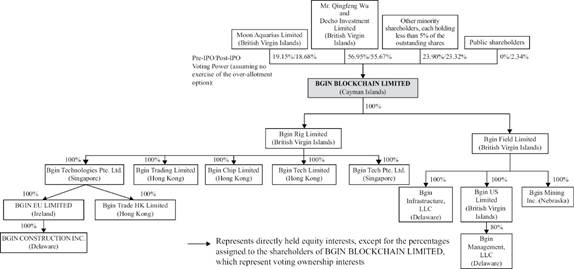
| ● | “Company,” “Bgin,” “we”, “us”, or “our,” are to BGIN BLOCKCHAIN LIMITED, a Cayman Islands exempted company; |
| ● | “cryptocurrency” are to any form of currency that only exists digitally, that usually has no central issuing or regulating authority but instead uses a decentralized system to record transactions and manage the issuance of new units, and that relies on cryptography to prevent counterfeiting and fraudulent transactions; |
| ● | “Decho Investment” are to Decho Investment Limited, a limited liability company formed under the laws of the British Virgin Islands and controlled by Mr. Qingfeng Wu; |
| ● | “digital assets” are to any digital representation of value that may function as a medium of exchange, a unit of account, and/or a store of value. Digital assets may include, but not limited to, cryptocurrencies; |
| ● | “FPGA(s)” are to field-programmable gate array(s), the integrated circuit(s) designed to be configured by customers after manufacturing; |
| ● | “GH” are to GigaHashes and “GH/s” are to GigaHashes per second, representing 1,000,000,000 hashes per second; |
| ● | “GPU(s)” are to graphics processing unit(s); |
| ● | “hash” are to the computation run by mining machines in support of the blockchain; |
| ● | “hash rate” are to the speed at which a computer can solve computations in support of the blockchain; |
| ● | “Hong Kong” or “HK” are to the Hong Kong Special Administrative Region of the People’s Republic of China; |
| ● | “HK$” and “HK dollars” are to the legal currency of Hong Kong; |
| ● | “Investment Company Act” or “1940 Act” are to the Investment Company Act of 1940; |
| ● | “Ireland” are to the Republic of Ireland; |
| ● | “KAS” are to “Kaspa”, a cryptocurrency relying on proof-of-work system; |
| ● | “MH” are to MegaHashes and “MH/s” are to MegaHashes per second, representing 1,000,000 hashes per second; |
| ● | “Moon Aquarius” are to Moon Aquarius Limited, a limited liability company formed under the laws of the British Virgin Islands and controlled by Mr. Qiuhua Li; |
| ● | “Mainland China” are to the People’s Republic of China, excluding Taiwan, the Hong Kong Special Administrative Region and the Macao Special Administrative Region; |
| ● | “ordinary shares” are to our Class A ordinary shares and Class B ordinary shares; |
| ● | “PCB” are to printed circuit board, a base for mounting microelectronic components in electronics; |
| ● | “PH” are to PetaHash and “PH/s” are to PetaHashes per second, representing 1,000,000,000,000,000 hashes per second; |
iii
| ● | “RMB” and “Renminbi” are to the legal currency of China; |
| ● | “RXD” are to Radiant, a peer-to-peer programmable digital asset system; |
| ● | “SDR” are to Special Drawing Rights, an international reserve asset created by the International Monetary Fund to supplement the official reserves of its member countries; |
| ● | “Shenzhen Bgin” are to Shenzhen Bgin Technology Co., Ltd., a company formed in the PRC, where Mr. Qiuhua Li, our director and the executive chairman of our board of directors, serves as the supervisor, and Mr. Qi Shao, our chief technology officer, serves as the general manager; |
| ● | “Singapore dollars” and “S$” are to the legal currency of Singapore; |
| ● | “Tether” or “USDT” are to an asset-backed cryptocurrency “stablecoin” with an exchange rate pegged to fiat currency and designed to be valued at US$1.0; |
| ● | “TH” are to TeraHashes and “TH/s” are to TeraHashes per second, representing 1,000,000,000,000 hashes per second; |
| ● | “U.S.”, “US” or “United States” are to United States of America, its territories, its possessions and all areas subject to its jurisdiction; |
| ● | “U.S. GAAP” are to generally accepted accounting principles in the United States; and |
| ● | “$,” “dollars,” “US$” or “U.S. dollars” are to the legal currency of the United States. |
This annual report on Form 20-F includes our audited consolidated financial statements for the years ended December 31, 2025, 2024, and 2023.
We do not have any operations of our own. We are a holding company with operations conducted (i) in Hong Kong through our Hong Kong operating subsidiaries Bgin HK, Bgin Trading, Bgin Trade HK and Bgin Chip, using U.S. dollars as their functional currency, (ii) in Singapore through our Singapore subsidiaries, Bgin Singapore and Bgin SG, using U.S. dollars as their functional currency, and (iii) in the U.S. through our U.S. subsidiaries, Bgin Infrastructure US, Bgin Management and Bgin Mining, using U.S. dollars as their functional currency. This annual report contains translations of certain foreign currency amounts into U.S. dollars for the convenience of its readers. Assets and liabilities are translated into U.S. dollars at the closing rate of exchange as of the balance sheet dates, the statement of income is translated using average rate of exchange in effect during the reporting periods, and the equity accounts are translated at historical exchange rates. Translation adjustments resulting from this process are included in accumulated other comprehensive income. Transaction gains and losses that arise from exchange rate fluctuations on transactions denominated in a currency other than the functional currency are included in the results of operations as incurred. The shareholders’ equity accounts were stated at their historical rate. Cash flows are also translated at average translation rates for the periods, therefore, amounts reported on the statements of cash flows will not necessarily agree with changes in the corresponding balances on the consolidated balance sheets. No representation is made that the Renminbi amounts could have been, or could be, converted, realized or settled into US$ at such rate, or at any other rate.
Translations from HK dollars to U.S. dollars and from U.S. dollars to HK dollars in this annual report are made at a pegged exchange rate of US$1=HK$7.8. Unless otherwise noted, all translations from Renminbi to U.S. dollars and from U.S. dollars to Renminbi in this annual report are made as follows:
| December 31, 2023 | December 31, 2024 | December 31, 2025 | ||||||||||
| Period-end spot rate | Average rate | Period-end spot rate | Average rate | Period-end spot rate | Average rate | |||||||
| US$ against Renminbi | US$1=RMB 7.0999 | US$1=RMB 7.0809 | US$1=RMB 7.2993 | US$1=RMB 7.1957 | US$1=RMB 6.9931 | US$1=RMB 7.1875 | ||||||
iv
Part I
ITEM 1. IDENTITY OF DIRECTORS, SENIOR MANAGEMENT AND ADVISERS
Not Applicable.
ITEM 2. OFFER STATISTICS AND EXPECTED TIMETABLE
Not Applicable.
ITEM 3. KEY INFORMATION
This annual report refers to (i) BGIN BLOCKCHAIN LIMITED, a Cayman Islands holding company, as the “Company,” “Bgin”, “we”, “our” and “us”, and (ii) the Company’s subsidiaries as “our subsidiaries” or the “subsidiaries.” The Cayman Islands holding company does not conduct any business operations and the Company’s subsidiaries are entities that conduct business operations in Singapore, the Hong Kong Special Administrative Region of the People’s Republic of China (“Hong Kong”), and the U.S. Investors in our Class A ordinary shares and other equity securities we issue are not purchasing equity interests in our subsidiaries but instead are purchasing equity interests in the Company, the ultimate Cayman Islands holding company.
Bgin is not an operating company, but an exempted company with limited liability incorporated in the Cayman Islands. As an exempted company with no material operations, our operations are conducted by our subsidiaries, including (i) our subsidiaries in Singapore, Bgin Tech Pte. Ltd. (“Bgin Singapore”) and Bgin Technologies Pte Ltd (“Bgin SG”), (ii) our subsidiaries in Hong Kong, Bgin Tech Limited (“Bgin HK”), Bgin Trading Limited (“Bgin Trading”), Bgin Trade HK Limited (“Bgin Trade HK”), and Bgin Chip Limited (“Bgin Chip”), (iii) our subsidiaries in the U.S., Bgin Infrastructure, LLC (“Bgin Infrastructure US”), BGIN MANAGEMENT, LLC (“Bgin Management”) and Bgin Mining Inc. (“Bgin Mining”). This structure involves unique risks to the investors as you may never directly hold any equity interest in our operating subsidiaries, and our ability to receive dividends and other contribution from our subsidiaries in Hong Kong is significantly affected by regulations promulgated by Hong Kong or PRC authorities. Any change in the interpretation of existing rules and regulations or the promulgation of new rules and regulations would likely result in a material change in the operations of our operating entities and/or a material change in the value of the securities we are registering for sale, including that such event could cause the value of such securities to significantly decline or become worthless. See “Item 3. Key Information—D. Risk Factors — Risks Related to Doing Business in Hong Kong — Uncertainties arising from the legal system in Mainland China, including uncertainties regarding the interpretation and enforcement of laws in Mainland China and the possibility that regulations and rules can change quickly with little advance notice, could hinder our ability to offer or continue to offer our securities, result in a material adverse change to our business operations, and damage our reputation, which would materially and adversely affect our financial condition and results of operations and cause the Class A ordinary shares to significantly decline in value or become worthless.”
In addition to our operations in the U.S. and Singapore, a portion of our operations are conducted in Hong Kong by Bgin HK, Bgin Trading, Bgin Trade HK and Bgin Chip, our subsidiaries in Hong Kong. As such, we are subject to certain legal and operational risks associated with such operating subsidiaries being based in Hong Kong and having all of their operations to date in Hong Kong. Pursuant to the Basic Law of the Hong Kong Special Administrative Region (the “Basic Law”), which is a national law of the PRC and the constitutional document for Hong Kong, national laws of the PRC shall not be applied in Hong Kong except for those listed in Annex III of the Basic Law and applied locally by promulgation or local legislation. The Basic Law expressly provides that the national laws of the PRC which may be listed in Annex III of the Basic Law shall be confined to those relating to defense and foreign affairs as well as other matters outside the autonomy of Hong Kong. The basic policies of the PRC regarding Hong Kong as a special administrative region of the PRC are reflected in the Basic Law, providing Hong Kong with executive, legislative and independent judicial powers, including that of final adjudication under the principle of “one country, two systems”. Nevertheless, the Chinese government may intervene or influence our current or future operations in Hong Kong at any time. For details relating to risks of doing business in Hong Kong, see “Item 3. Key Information—D. Risk Factors — Risks Related to Doing Business in Hong Kong.”
1
In general, any risks related to doing business in Mainland China also apply to doing business in Hong Kong. Uncertainties arising from the legal system in the PRC, including Hong Kong, in which uncertainties regarding the interpretation and enforcement of laws and the possibility that regulations and rules can change quickly with little advance notice, could hinder our ability to offer or continue to offer our securities, result in a material adverse change to our business operations, and damage our reputation, which would materially and adversely affect our financial condition and results of operations and cause our Class A ordinary shares to significantly decline in value or become worthless. See “Item 3. Key Information—D. Risk Factors — Risks Related to Doing Business in Hong Kong.” In recent years, the PRC government initiated a series of regulatory actions and statements to regulate business operations in certain areas in China with little advance notice, including a cracking down on illegal activities in the securities market, enhancing supervision over China-based companies listed overseas using the variable interest entity structure, adopting new measures to extend the scope of cybersecurity reviews, and expanding the efforts in anti-monopoly enforcement, which may in the future impact our ability to conduct out business, accept foreign investments or list on a U.S. or other foreign exchange if we were to become subject to such regulations. In light of the PRC government’s recent expansion of authority in Hong Kong, we may be subject to uncertainty about any future actions of the PRC government or authorities in Hong Kong. Moreover, all the legal and operational risks associated with having operations in the PRC also apply to operations in Hong Kong. There is no assurance that there will not be any changes in the economic, political and legal environment in Hong Kong. The PRC government has intervened and may continue to intervene or influence our current and future operations in Hong Kong at any time or may exert more oversight and control over offerings conducted overseas and/or foreign investment in issuers like ourselves. On February 17, 2023, the China Securities Regulatory Commission (“CSRC”) issued the Trial Administrative Measures of Overseas Securities Offering and Listing by Domestic Companies, or the Overseas Listing Trial Measures, and five relevant supporting guidelines, which took effect on March 31, 2023. According to the Overseas Listing Trial Measures, PRC domestic companies that seek to offer and list securities in overseas markets, either by direct or indirect means, are required to fulfill the filing procedures with the CSRC and report relevant information. The Overseas Listing Trial Measures also provides that if the issuer both meets the following criteria, the overseas securities offering and listing conducted by such issuer will be deemed as indirect overseas offering by PRC domestic companies: (i) more than 50% of any of the issuer’s operating revenue, total profit, total assets or net assets as documented in its audited consolidated financial statements for the most recent fiscal year is accounted for by PRC domestic companies; and (ii) the main parts of the issuer’s business activities are conducted in mainland China, or its main place(s) of business are located in mainland China, or the majority of senior management staff in charge of its business operations and management are PRC citizens or have their usual place(s) of residence located in mainland China. Where a domestic company seeks to indirectly offer and list securities in overseas markets, the issuer shall designate a major domestic operating entity, which shall, as the domestic responsible entity, fulfil the filing procedure with the CSRC. As advised by our PRC legal counsel, we are not required to obtain the approval from or complete filings with the CSRC for our follow-on offerings based on the facts that: (1) we do not meet the above explicit conditions set out in the Overseas Listing Trial Measures to determine whether an overseas offering shall be deemed as an indirect overseas offering and listing by a domestic company; (2) we do not have any subsidiary in mainland China or use any VIE structure to control any entity in mainland China; and (3) the main parts of our business activities are not conducted in mainland China and our main place of business is located in Singapore, the U.S. and Hong Kong. However, as the Overseas Listing Trial Measures was newly published, there are substantial uncertainties as to the implementation and interpretation, and the CSRC may take a view that is contrary to our understanding of the Overseas Listing Trial Measures because the Overseas Listing Trial Measures adopts the principle of “substance over form” regarding the determination of “indirect overseas offering and listing by a domestic company”, over which the CSRC may have substantial discretions. If we are required by the CSRC to submit and complete the filing procedures for our follow-on offerings, we cannot assure you that we will be able to complete such filings in a timely manner, or even at all. Any failure by us to comply with such filing requirements under the Overseas Listing Trial Measures may result in an order to rectify, warnings and fines against us and could materially hinder our ability to offer or to continue to offer our securities. If certain PRC laws and regulations were to become applicable to a company such as us in the future, the application of such laws and regulations may have a material adverse impact on our business, financial condition and results of operations, and significantly limited or completely hinder our ability to continue our operations and/or our ability to offer or continue to offer securities to investors, any of which may cause the value of our securities, including the Class A ordinary shares, to significantly decline or become worthless. See “Item 3. Key Information—D. Risk Factors — Risks Related to Doing Business in Hong Kong — Uncertainties arising from the legal system in Mainland China, including uncertainties regarding the interpretation and enforcement of laws in Mainland China and the possibility that regulations and rules can change quickly with little advance notice, could hinder our ability to offer or continue to offer our securities, result in a material adverse change to our business operations, and damage our reputation, which would materially and adversely affect our financial condition and results of operations and cause the Class A ordinary shares to significantly decline in value or become worthless,” “Item 3. Key Information—D. Risk Factors — Risks Related to Doing Business in Hong Kong — The enactment of Law of the PRC on Safeguarding National Security in Hong Kong (the “Hong Kong National Security Law”) and the enactment of Safeguarding National Security Ordinance in Hong Kong (the “Hong Kong National Security Ordinance”) could impact our Hong Kong subsidiaries,” “Item 3. Key Information—D. Risk Factors — Risks Related to Doing Business in Hong Kong — Failure to comply with cybersecurity, data privacy, data protection, or any other laws and regulations related to data may materially and adversely affect our business, financial condition, and results of operations” and “Item 3. Key Information—D. Risk Factors — Risks Related to Doing Business in Hong Kong — If we were to be required to obtain any permission or approval from or complete filings with the CSRC, the CAC, or other PRC authorities in connection with our follow-on offerings under PRC law, our ability to offer or continue to offer our securities to investors could be significantly limited or hindered, which could cause the value of our Class A ordinary shares to significantly decline or become worthless, and we may be fined or subject to other sanctions, and our business, reputation financial condition, and results of operations may be materially and adversely affected.”
2
As of the date of this annual report, our subsidiaries’ mining operations (otherwise referred to as “self-mining”) are conducted in the United States, and a substantial amount of our assets are located in the United States. Since April 2023, our business of selling mining machines designed by us has also been conducted in the United States through Bgin Mining, in Hong Kong through Bgin Trading and in Singapore through Bgin SG. However, many of our directors and officers, including Mr. Zhao Xiang and Mr. Pengju Wang, are nationals and residents of mainland China, and a substantial portion of their assets are located in mainland China. Additionally, Mr. Qiuhua Li, Mr. Qingfeng Wu and Mr. Qi Shao, our directors and officers, while being nationals of Mainland China, are residents of Singapore, Hong Kong, and Hong Kong, respectively. Further, Mr. Boquan He and Mr. Chung Shing Paul Tsang, our independent directors, are residents of Hong Kong, and a substantial portion of their assets are located in Hong Kong. As a result, it may be difficult for a shareholder to effect service of process within the United States upon these persons, or to bring actions or enforce against us or our directors and officers judgments obtained in United States courts, including judgments predicated upon the civil liability provisions of the securities laws of the United States or any state in the United States.
Additionally, our current and former auditors, the independent registered public accounting firms that issue the audit report included elsewhere in this annual report, as auditors of companies that are traded publicly in the United States and firms registered with the Public Company Accounting Oversight Board (“PCAOB”), are subject to laws in the United States pursuant to which the PCAOB conducts regular inspections to assess its compliance with the applicable professional standards. Our current and former auditors are subject to PCAOB inspections and PCAOB is able to inspect our current and former auditors, and they are not subject to the determinations announced by the PCAOB on December 16, 2021. However, an exchange may determine to delist our securities, and our Class A ordinary shares may be prohibited from being traded on a national exchange, or an exchange under the Holding Foreign Companies Accountable Act if the PCAOB is unable, or determines that it cannot, inspect or fully investigate our auditors for two consecutive years. On June 22, 2021, the U.S. Senate passed the Accelerating Holding Foreign Companies Accountable Act, and on December 29, 2022, legislation entitled “Consolidated Appropriations Act, 2023” (the “Consolidated Appropriations Act”), was signed into law. The Consolidated Appropriations Act contained, among other things, an identical provision to Accelerating Holding Foreign Companies Accountable Act, which reduces the number of consecutive non-inspection years required for triggering the prohibitions under the Holding Foreign Companies Accountable Act from three years to two, thus reducing the time period before our securities may be prohibited from trading or delisted. On August 26, 2022, the CSRC, the Ministry of Finance of the PRC (the “MOF”), and the PCAOB signed a Statement of Protocol (the “Protocol”), governing inspections and investigations of audit firms based in China and Hong Kong. Pursuant to the fact sheet with respect to the Protocol disclosed by the SEC, the PCAOB shall have independent discretion to select any issuer audits for inspection or investigation and has the unfettered ability to transfer information to the SEC. On December 15, 2022, the PCAOB Board determined that the PCAOB was able to secure complete access to inspect and investigate registered public accounting firms headquartered in mainland China and Hong Kong and voted to vacate its previous determinations to the contrary. However, whether the PCAOB will continue to be able to satisfactorily conduct inspections of PCAOB-registered public accounting firms headquartered in mainland China and Hong Kong is subject to uncertainty and depends on a number of factors out of our, and our auditor’s, control. The PCAOB is continuing to demand complete access in mainland China and Hong Kong moving forward and is already resuming regular inspections, as well as to continue pursuing ongoing investigations and initiate new investigations as needed. The PCAOB has indicated that it will act immediately to consider the need to issue new determinations with the Holding Foreign Companies Accountable Act if needed and does not have to wait another year to reassess its determinations. Our securities may be delisted or prohibited from trading if the PCAOB determines that it cannot inspect or investigate completely our auditor under the Holding Foreign Companies Accountable Act. The delisting of our Class A ordinary shares, or the threat of their being delisted, may materially and adversely affect the value of your investment in the future. See “Item 3. Key Information—D. Risk Factors — Risks Related to Doing Business in Hong Kong — Regulatory developments regarding auditor inspection requirements may affect our securities.”
We are permitted under the laws of the Cayman Islands to provide funding to our subsidiaries in Hong Kong through loans or capital contributions without restrictions on the amount of the funds. Bgin HK, Bgin Trading, Bgin Trade HK and Bgin Chip are permitted under the laws of Hong Kong to provide funding to Bgin, the holding company incorporated in the Cayman Islands, through dividend distribution or payments without restrictions on the amount of the funds.
3
The PRC government’s significant authority to intervene in or influence operations of an offshore holding company at any time could limit our ability to transfer cash both into and outside of China, including Hong Kong. See “Item 3. Key Information—D. Risk Factors — Risks Related to Doing Business in Hong Kong — The PRC government’s significant authority to intervene in or influence the China operations of an offshore holding company at any time could limit our ability to transfer or use our cash outside of China, and otherwise result in material adverse change in our operations and the value of our Class A ordinary shares.” From time to time, cash may be transferred between our Cayman Islands holding company and its subsidiaries, and among the Company’s subsidiaries as intercompany cash transfers. For the fiscal year ended December 31, 2023, (i) Bgin HK transferred cash in the amount of US$5,352,200 to Bgin Infrastructure US, US$8,800 to Bgin Chip, US$9,222,745 to Bgin Singapore, US$36,884,440 to Bgin Trading, and US$298,500 to Bgin Mining, (ii) Bgin Chip transferred cash in the amount of US$22,113 to Bgin HK and US$413,002 to Bgin Singapore, (iii) Bgin Singapore transferred cash in the amount of US$58,913 to Bgin HK, US$650,776 to Bgin Trading, US$446,186 to Bgin Chip, and US$59,467 to Bgin Infrastructure US, (iv) Bgin Trading transferred cash in the amount of US$45,181,002 to Bgin HK, US$27,668,359 to Bgin Singapore, US$1,203,102 to Bgin Mining, and US$8,000 to Bgin Chip, (v) Bgin Infrastructure US transferred cash in the amount of US$10,010 to Bgin Mining, and (vi) Bgin Mining transferred cash in the amount of US$680,000 to Bgin Infrastructure US. For the fiscal year ended December 31, 2024, (i) Bgin HK transferred cash in the amount of SG$400,000 (approximately US$298,418) to Bgin Singapore, US$220,651,271 to Bgin Trading, US$66,107,110 to Bgin Singapore, US$41,224 to Bgin Chip, and US$100 to Bgin Management, US$3,750,000 to Bgin Infrastructure; (ii) Bgin Trading transferred cash in the amount of US$15,665,000 to Bgin Infrastructure, US$134,485,959 to Bgin Singapore, and US$295,192,349 to Bgin HK, US$3,000,000 to Bgin Chip, US$1,000,000 to Bgin Mining, US$6,200,000 to Bgin SG, US$50,000 to Bgin Trade; (iii) Bgin Singapore transferred cash in the amount of US$1,964,400 to Bgin HK, US$3,290,000 to Bgin Infrastructure, US$1,390,000 to Bgin SG; (iv) Bgin Infrastructure transferred cash in the amount of US$793,400 to Bgin Mining, US$451,780 to Bgin HK, US$970,000 to Bgin Trading, US$1,000,000 to Bgin Singapore; (v) Bgin Management transferred cash in the amount of US$6,403,934 to Bgin HK, US$3,379,800 to Bgin Infrastructure, US$8,248 to Bgin Mining; (vi) Bgin Mining transferred cash in the amount of US$280,000 to Bgin Infrastructure, US$328,384 to Bgin HK, US$994,965 to Bgin Singapore; (vii) Bgin Chip transferred cash in the amount of US$102,716 to Bgin Singapore; (viii) Bgin SG transferred cash in the amount of US$10,550,992 to Bgin HK; and (ix) Bgin Trade transferred cash in the amount of US$701,009 to Bgin HK. For the fiscal year ended December 31, 2025, (i) Bgin HK transferred cash in the amount of US$1,370,000 to Bgin Mining, US$8,530,100 to Bgin Trading, US$3,006,132 to Bgin Management, US$57,530,099 to Bgin SG, US$31,000 to Bgin Singapore, US$993,888 to the Company, US$14,000 to Bgin Chip, US$418,746 to Bgin Trade, and US$3,190,000 to Bgin Infrastructure, (ii) Bgin Trading transferred cash in the amount of US$8,846,142 to Bgin HK, US$932,828 to Bgin Singapore, US$31,600,000 to Bgin Infrastructure, US$45,209,412 to Bgin SG, US$5,750,000 to the Company, US$50,000 to Bgin Chip, US$99,057 to Bgin Management, US$357,060 to Bgin Rig, and US$217,956 to Bgin Trade, (iii) Bgin Singapore transferred cash in the amount of US$970,000 to Bgin HK, US$24,624 to Bgin Mining, and US$308,064 to Bgin Chip, (iv) Bgin Infrastructure US transferred cash in the amount of US$2,886,200 to Bgin Management, US$73,000 to Bgin HK, US$634,339 to Bgin Singapore, and US$100 to Bgin Mining, (v) Bgin SG transferred cash in the amount of US$11,580,082 to Bgin HK, US$74,200,000 to Bgin Singapore, US$4,000,000 to Bgin Infrastructure, US$50,000 to Bgin EU, US$24,709,412 to Bgin Mining, and US$1,002,523 to the Company, (vi) Bgin Management transferred cash in the amount of US$2,321,384 to Bgin HK, US$500 to Bgin Singapore, and US$3,095,000 to Bgin Infrastructure, (vii) Bgin Mining transferred cash in the amount of US$605,806 to Bgin HK, US$300,000 to Bgin Management, and US$24,709,412 to Bgin SG, (viii) Bgin Trade transferred cash in the amount of US$1,049,996 to Bgin HK, US$20,016 to Bgin Singapore, US$6,230 to Bgin Infrastructure, and US$356,505 to Bgin Mining, (ix) the Company transferred cash in the amount of US$520,000 to Bgin Field, US$1,379,686 to Bgin Infrastructure, US$14,388,906 to Bgin SG, US$58,047 to Bgin Chip, US$4,070,489 to Bgin Singapore, US$2,900,181 to Bgin HK, and US$3,420,000 to Bgin Rig, (x) Bgin Chip transferred cash in the amount of US$39,937 to Bgin HK, US$314,013 to Bgin Trading, and US$800,100 to Bgin Infrastructure, (xi) Bgin Field transferred cash in the amount of US$500,000 to Bgin HK, and US$2,900,000 to Bgin SG, (xii) Bgin Rig transferred cash in the amount of US$500,000 to Bgin Infrastructure. From January 1, 2026 to the date of this annual report, (i) Bgin Trading transferred a cash dividend in the amount of US$127,400,000 to Bgin Rig, (ii) Bgin Rig transferred a cash dividend in the amount of US$118,000,000 to the Company, (iii) the Company injected capital in the amount of US$118,000,000 into Bgin Field, (iv) Bgin Field injected capital in the amount of US$100,000,000 into Bgin Mining and US$18,000,000 into Bgin Infrastructure US, (v) Bgin Trading transferred cash in the amount of US$164,985 to Bgin HK, US$2,000,000 to Bgin Singapore, US$600,000 to Bgin Mining, US$500,000 to Bgin SG, and US$400,000 to the Company, (vi) Bgin Chip transferred cash in the amount of US$1,000,000 to Bgin Trading, (vii) Bgin HK transferred cash in the amount of US$12,600 to Bgin Chip, US$21,500 to Bgin Management, US$900,000 to Bgin SG, US$24,618,002 to Bgin Trading, and US$40,000 to the Company, (viii) Bgin Singapore transferred cash in the amount of US$29,139,021 to Bgin Trading, (ix) Bgin SG transferred cash in the amount of US$6,608,002 to Bgin HK, US$481,235 to Bgin Singapore, and US$500,000 to the Company, (x) Bgin Management transferred cash in the amount of US$450,000 to Bgin SG, (xi) Bgin Mining transferred cash in the amount of US$25,579,832 to Bgin SG, (xii) Bgin Infrastructure US transferred cash in the amount of US$18,000,000 to Bgin HK, and US$51,618,096 to Bgin Trading.
4
On January 13, 2024, the board of directors of Bgin Trading declared a dividend with an aggregate amount of US$17,005,000, payable in USDT coins to Bgin Rig, which has been paid to Bgin Rig in full. On January 14, 2024, the sole director of Bgin Rig declared a dividend with an aggregate amount of US$17,000,000, payable in USDT coins to the Company, which has been paid to the Company in full. On January 15, 2024, our board of directors declared a final dividend with an aggregate amount of US$5,000,000, payable in USDT coins to our shareholders of record as of December 31, 2023, to be paid on or before February 29, 2024. As of February 2024, all of the US$5,000,000 of declared dividend had been paid. On March 12, 2024, our board of directors passed resolutions reclassifying the dividend as an interim dividend rather than a final dividend. On March 15, 2024, our shareholders unanimously passed written resolutions ratifying, approving and confirming in all respects the reclassification by the board of directors of the dividend as an interim dividend rather than a final dividend.
On June 2, 2025, the board of directors of Bgin Trading declared a dividend with an aggregate amount of US$5,005,000, payable in USDT coins to Bgin Rig, which has been paid to Bgin Rig in full. On June 3, 2025, the sole director of Bgin Rig declared a dividend with an aggregate amount of US$5,000,000, payable in USDT coins to the Company, which has been paid to the Company in full. On June 6, 2025, our board of directors recommended a final dividend with an aggregate amount of US$5,000,000 be declared by ordinary resolution of the shareholders of the Company and that any such dividend declared by the shareholders of the Company be settled in cash. On June 21, 2025, our board of directors passed further resolutions updating the recommendation of June 6, 2025, to recommend that a final dividend with an aggregate amount of US$5,000,000 be declared by ordinary resolution of the shareholders of the Company and that any such dividend declared by the shareholders of the Company be settled in cash or by a distribution in specie of USDT coins, in each case at the sole discretion of the shareholder entitled to payment of the said final dividend. On June 21, 2025, our board of directors passed resolutions recommending that a final dividend with an aggregate amount of US$5,000,000 be declared by ordinary resolution of the shareholders of the Company, and that any such dividend declared by the shareholders of the Company be settled either in cash or by a distribution in specie of USDT coins, in each case at the sole discretion of the shareholders entitled to payment of the said final dividend, to our shareholders of record as of December 31, 2024. On June 23, 2025, our shareholders unanimously passed written resolutions declaring a final dividend with an aggregate amount of US$5,000,000 to be paid, at the election of each relevant shareholder, in either cash or by a distribution in specie of USDT coins. As of June 30, 2025, all US$5,000,000 of the declared final dividend had been paid to the shareholders, among which US$949,000 was paid in USDT coins.
On February 6, 2026, Bgin Rig declared and made a dividend of US$118,000,000 to the Company. On February 13, 2026, the Company resolved to transfer the sum of the aforementioned dividend to Bgin Field by way of capital contribution. The Company transferred monies by way of capital contribution to Bgin Field in three tranches separately on March 4, 2026, March 9, 2026, and March 14, 2026. Notwithstanding the Company’s prior resolution to transfer the sum by way of capital contribution, the Company was issued 59,000,000 ordinary shares of a single class with a par value of US$2.00 each in the capital of Bgin Field, in consideration of the receipt of the sum of US$118,000,000 from the Company. Bgin Field subsequently injected capital in the amount of US$100,000,000 into Bgin Mining and US$18,000,000 into Bgin Infrastructure US.
On April 17, 2026, Bgin Rig injected capital in the amount of S$25,000,000 (approximately US$19,590,941) into Bgin SG.
As of the date of this annual report, no other dividend declarations have been made by our board of directors or by a subsidiary to the Company. For a discussion of the risks in connection with distributing USDT coins to our shareholders as dividends, see “Item 3. Key Information—D. Risk Factors — Risks Related to Our Business and Industry — If USDT were to be deemed a “security” under the Securities Act, we might have liabilities arising out of a possible violation of Section 5 of the Securities Act in connection with our distributions of dividends to shareholders in the form of USDT coins and our compensation payments to certain service providers in USDT.” Our board of directors has complete discretion on whether to distribute dividends, subject to applicable laws. See “Item 3. Key Information—D. Risk Factors — Risks Related to Our Class A ordinary shares — We may or may not pay dividends in the foreseeable future, and any future determination related to our dividend policy will be made at the discretion of our board of directors. In the event that our board of directors does not declare any dividends, you must rely on price appreciation of our Class A ordinary shares for return on your investment” and our consolidated financial statements and notes for the fiscal years ended December 31, 2025, 2024 and 2023 included elsewhere in this annual report. Subject to certain contractual, legal and regulatory restrictions, cash and capital contributions may be transferred among our Cayman Islands holding company and its subsidiaries.
5
Under the current practice of the Inland Revenue Department of Hong Kong, generally no tax is payable in Hong Kong in respect of dividends paid by us on the Class A ordinary shares. As of the date of this annual report, there are no restrictions or limitation under the laws of Hong Kong imposed on the conversion of Hong Kong dollars into foreign currencies and the remittance of currencies out of Hong Kong or across borders and to U.S. investors.
Bgin and our subsidiaries may from time to time declare or pay dividends in the foreseeable future. Any future determination related to our dividend policy will be made at the discretion of our board of directors after considering our financial condition, results of operations, capital requirements, contractual requirements, business prospects and other factors the board of directors deems relevant, and subject to the restrictions contained in any future financing instruments.
A. [Reserved]
B. Capitalization and Indebtedness
Not applicable.
C. Reasons for the Offer and Use of Proceeds
Not applicable.
D. Risk Factors
Summary of Risk Factors
Investing in our securities involves significant risks. You should carefully consider all of the information in this annual report before investing in our securities. Below is a summary of the principal risks we face. These risks are discussed more fully under “Item 3. Key Information—D. Risk Factors.”
Risks Related to Doing Business in Hong Kong (for a more detailed discussion, see “Item 3. Key Information—D. Risk Factors—Risks Related to Doing Business in Hong Kong”)
A portion of our operations are conducted in Hong Kong through Bgin HK, Bgin Trading, Bgin Trade HK and Bgin Chip, our Hong Kong subsidiaries, and therefore, we face risks arising from the legal system in Hong Kong and Mainland China, including risks and uncertainties regarding the enforcement of laws and that rules and regulations in China can change quickly with little advance notice. In addition, the Chinese government has intervened and may continue to intervene or influence our operations at any time or may exert more oversight and control over offerings conducted overseas and/or foreign investment in Hong Kong based issuers, which could result in a material change in our operations and/or the value of our Class A ordinary shares. Any actions by the Chinese government to exert more oversight and control over offerings that are conducted overseas and/or foreign investment in Hong Kong-based issuers could significantly limit or completely hinder our ability to offer or continue to offer our securities to investors and cause the value of such securities to significantly decline or be worthless. See “Item 3. Key Information—D. Risk Factors — Risks Related to Doing Business in Hong Kong and Mainland China.”
If we do not receive or maintain the approvals, or we inadvertently conclude that such approvals are not required, or applicable laws, regulations, or interpretations change such that we are required to obtain approval in the future, we may be subject to an investigation by competent regulators, fines or penalties, ordered to suspend our relevant business and rectify, prohibited from engaging in relevant business, or subject to an order prohibiting us from conducting an offering, and these risks could result in a material adverse change in our operations, significantly limit or completely hinder our ability to offer or continue to offer securities to investors or cause such securities to significantly decline in value or become worthless. For details, see “Item 3. Key Information—D. Risk Factors — Risks Related to Doing Business in Hong Kong.”
6
In general, we face risks and uncertainties relating to doing business in Hong Kong, including, but not limited to, the following:
| ● | As of the date of this annual report, through our Hong Kong subsidiaries, we maintain service or freelancer agreements with 52 PRC individuals, including our officer, Mr. Pengju Wang, who is based in Mainland China, and provides services to us. The service relationship between our Hong Kong subsidiaries and such PRC citizens does not constitute a labor relationship which refers to a relationship between domestic enterprises and employees under the PRC Labor Law. As a result of this relationship, we may be subject to arbitration or litigation filed by such service providers or required to adjust such form of services in the future. (see page 12 of this annual report); |
| ● | The compensation to the PRC service providers who entered into service or freelancer agreements with Bgin HK is paid through one or more of the following methods: (i) in Renminbi by Bgin HK through a third-party payment institution, which exchanges the U.S. dollars received from Bgin HK for Renminbi; (ii) in USDT transferred directly from Bgin HK’s cold wallet to the relevant individual; or (iii) in Hong Kong dollars by Bgin HK to such individuals’ bank accounts in Hong Kong. In addition, prior to July 2023, Shenzhen Bgin, an affiliated entity of ours, was responsible for engaging with third-party production partners on behalf of Bgin HK. The payment to third-party suppliers was first made by Shenzhen Bgin in Renminbi, and then Bgin HK reimbursed Shenzhen Bgin through a third-party payment institution, which exchanged the U.S. dollars received from Bgin HK for Renminbi. If the third-party payment institution providing service for us fails to hold the relevant licenses for cross-border payment business, we shall have to make arrangements with other qualified third-party payment institutions or otherwise make the cross-border payment through a bank. (see page 12 of this annual report); |
| ● | The PRC government’s significant authority to intervene in or influence the China operations of an offshore holding company at any time could limit our ability to transfer or use our cash outside of China and limit our ability to transfer cash both into and outside of China, including Hong Kong, and otherwise result in material adverse change in our operations and the value of our Class A ordinary shares. (see page 13 of this annual report); |
| ● | Uncertainties arising from the legal system in Mainland China, including uncertainties regarding the interpretation and enforcement of laws in Mainland China and the possibility that regulations and rules can change quickly with little advance notice, could hinder our ability to offer or continue to offer our securities, result in a material adverse change to our business operations, and damage our reputation, which would materially and adversely affect our financial condition and results of operations and cause the Class A ordinary shares to significantly decline in value or become worthless. (see page 13 of this annual report); |
| ● | The Holding Foreign Companies Accountable Act calls for additional and more stringent criteria to be applied to emerging market companies upon assessing the qualification of their auditors, especially the non-U.S. auditors who are not inspected by the PCAOB. On June 22, 2021, the U.S. Senate passed the Accelerating Holding Foreign Companies Accountable Act, and on December 29, 2022, the Consolidated Appropriations Act was signed into law. The Consolidated Appropriations Act contained, among other things, an identical provision to Accelerating Holding Foreign Companies Accountable Act, which reduces the number of consecutive non-inspection years required for triggering the prohibitions under the Holding Foreign Companies Accountable Act from three years to two, thus reducing the time period before our securities may be prohibited from trading or delisted. The delisting of our Class A ordinary shares, or the threat of their being delisted, may materially and adversely affect the value of your investment in the future. Our current and former auditors are subject to PCAOB inspections and PCAOB are able to inspect our current and former auditors, and they are not subject to the determinations announced by the PCAOB on December 16, 2021. On August 26, 2022, the CSRC, the MOF and the PCAOB signed the Protocol, governing inspections and investigations of audit firms based in China and Hong Kong. Pursuant to the fact sheet with respect to the Protocol disclosed by the SEC, the PCAOB shall have independent discretion to select any issuer audits for inspection or investigation and has the unfettered ability to transfer information to the SEC. On December 15, 2022, the PCAOB Board determined that the PCAOB was able to secure complete access to inspect and investigate registered public accounting firms headquartered in mainland China and Hong Kong and voted to vacate its previous determinations to the contrary. However, whether the PCAOB will continue to be able to satisfactorily conduct inspections of PCAOB-registered public accounting firms headquartered in mainland China and Hong Kong is subject to uncertainty and depends on a number of factors out of our, and our auditor’s, control. The PCAOB is continuing to demand complete access in mainland China and Hong Kong moving forward and is already resuming regular inspections, as well as to continue pursuing ongoing investigations and initiate new investigations as needed. The PCAOB has indicated that it will act immediately to consider the need to issue new determinations with the Holding Foreign Companies Accountable Act if needed and does not have to wait another year to reassess its determinations. Our securities may be delisted or prohibited from trading if the PCAOB determines that it cannot inspect or investigate completely our auditor under the Holding Foreign Companies Accountable Act. (see page 14 of this annual report); |
7
| ● | Failure to comply with cybersecurity, data privacy, data protection, or any other laws and regulations related to data may materially and adversely affect our business, financial condition, and results of operations. (see page 14 of this annual report); |
| ● | If we were to be required to obtain any permission or approval from or complete filings with the CSRC, the CAC, or other PRC authorities in connection with our follow-on offerings under PRC law, we may be fined or subject to other sanctions, and our business, reputation financial condition, and results of operations may be materially and adversely affected. (see page 17 of this annual report); |
| ● | It may be difficult for overseas shareholders and/or regulators to conduct investigations or collect evidence within the territory of China, including Hong Kong. (see page 18 of this annual report); |
| ● | You may incur additional costs and procedural obstacles in effecting service of legal process, enforcing foreign judgments or bringing actions in Mainland China/Hong Kong against us or our management based on Mainland China/Hong Kong laws. (see page 19 of this annual report); |
| ● | The enactment of Law of the PRC on Safeguarding National Security in Hong Kong (the “Hong Kong National Security Law”) and the enactment of Safeguarding National Security Ordinance in Hong Kong (the “Hong Kong National Security Ordinance”) could impact our Hong Kong subsidiaries. (see page 19 of this annual report); |
| ● | The Hong Kong legal system embodies uncertainties which could limit the availability of legal protections. (see page 20 of this annual report); and |
| ● | There are some political risks associated with conducting business in Hong Kong. (see page 20 of this annual report). |
In general, any risks related to doing business in Mainland China also apply to doing business in Hong Kong. Uncertainties arising from the legal system in the PRC, including Hong Kong, in which uncertainties regarding the interpretation and enforcement of laws and the possibility that regulations and rules can change quickly with little advance notice, could hinder our ability to offer or continue to offer our securities, result in a material adverse change to our business operations, and damage our reputation, which would materially and adversely affect our financial condition and results of operations and cause our Class A ordinary shares to significantly decline in value or become worthless. See “Item 3. Key Information—D. Risk Factors — Risks Related to Doing Business in Hong Kong.”
Risks Relating to Doing Business in Singapore (for a more detailed discussion, see “Item 3. Key Information—D. Risk Factors—Risks Relating to Doing Business in Singapore”)
We are subject to risks and uncertainties relating to doing business in Singapore, which include without limitation the following:
| ● | We are subject to the laws of Singapore, which differ in certain material respects from the laws of the United States. (see page 21 of this annual report); |
8
| ● | We are subject to risks associated with operating in rapidly evolving Southeast Asia region, and we might therefore be exposed to various risks inherent in operating and investing in the region. (see page 21 of this annual report); |
| ● | Adverse changes in government regulations in Singapore may materially and adversely affect our operations and financial condition. (see page 22 of this annual report); |
| ● | The ability of our subsidiaries in Singapore to distribute dividends to us may be subject to restrictions under applicable laws. (see page 22 of this annual report); and |
| ● | It is not certain if the Company will be classified as a Singapore tax resident. (see page 22 of this annual report). |
Risks Relating to Our Business and Industry (for a more detailed discussion, see “Item 3. Key Information—D. Risk Factors— Risks Relating to Our Business and Industry”)
We are subject to risks and uncertainties relating to our business and industry, which include without limitation the following:
| ● | We have a limited operating history and have grown significantly in a short period of time. If we fail to manage our growth effectively, our business could be materially adversely affected. (see page 23 of this annual report); |
| ● | Our business operations are heavily dependent upon the stability and popularity of KAS coins and ALEO coins. (see page 24 of this annual report); |
| ● | Our business operations are subject to special risks with respect to the KAS blockchain and the ALEO blockchain. (see page 24 of this annual report); |
| ● | Our mining machines exported from Asia to the United States may be subject to the additional tariffs recently imposed by the U.S. government on certain products imported from China, which could adversely affect our supply chain, cost structure, and results of operations. (see page 25 of this annual report); |
| ● | There is no assurance that cryptocurrencies will maintain their long-term value and volatility in the market price of cryptocurrencies may adversely affect our business and results of operations. (see page 26 of this annual report); |
| ● | Bankruptcies and financial distress among cryptocurrency market participants, including the bankruptcy of FTX, a large cryptocurrency exchange, have caused widespread disruption in these markets and have negatively impacted our business operations, results of operations and financial condition. (see page 26 of this annual report); |
| ● | We use payment platforms to receive cash exchanged from Tethers and to make payments to our suppliers and other business partners. Such practice could expose us to substantial risks. (see page 27 of this annual report); |
| ● | We may experience reputational harm if disruption in the cryptocurrency markets occurs. (see page 27 of this annual report); |
| ● | If our policies and procedures surrounding the safeguarding of cryptocurrencies, conflicts of interest, or comingling of assets fail, we may be subject to risks of loss of assets and damaged reputation, which could negatively affect our business, financial position, and results of operations. (see page 28 of this annual report); |
9
| ● | If USDT were to be deemed a “security” under the Securities Act, we might have liabilities arising out of a possible violation of Section 5 of the Securities Act in connection with our distributions of dividends to shareholders in the form of USDT coins and our compensation payments to certain service providers in USDT. (see page 29 of this annual report); |
| ● | We have identified deficiencies in our risk management processes and policies in light of current cryptocurrency market conditions and plan to adopt changes to address these deficiencies. Nevertheless, if our risk management process and policies are still inadequate to protect our assets, we may experience material loss and our business, financial condition and results of operations may be adversely affected. (see page 31 of this annual report); |
| ● | Disruptions in the cryptocurrency markets have caused and may continue to cause price declines and volatilities in cryptocurrencies. Additionally, prices of cryptocurrencies are volatile in nature, including those of the cryptocurrencies we mine. We adjust our mining strategy primarily based on the overall rate of return. The rate of return for mining a particular type of cryptocurrency typically depends upon a few crucial factors, including its trading price, mining difficulty, and the hash rate it takes to mine a unit of such cryptocurrency. An increase in a cryptocurrency’s trading price attracts more miners, and leads to an increase in mining difficulty of such cryptocurrency. As the cryptocurrency market is volatile in nature, we monitor the trading prices of alternative cryptocurrencies on a constant basis, and adjust the mining ratios of different types of cryptocurrencies on a daily basis to maximize the overall rate of return. However, in the event that the prices of cryptocurrencies our subsidiaries mine decrease, we may not be able to achieve the optimal rate of return or any return at all, and our financial position and results of operations may suffer as a result. (see page 32 of this annual report); |
| ● | We are subject to regulatory risks with regard to mining, holding, using, or transferring cryptocurrencies, which could negatively affect our business, results of operations and financial position. (see page 33 of this annual report); |
| ● | Erosion or loss of user confidence in cryptocurrencies could adversely impact our business, results of operations and financial condition. (see page 34 of this annual report); |
| ● | Producing new mining machines and obtaining machine components for such production has historically been capital intensive, and is likely to continue to be very capital intensive, which may have a material and adverse effect on our business and results of operations. (see page 34 of this annual report); |
| ● | Our subsidiaries source a substantial portion of the components for their mining machines from a major supplier and, historically, have depended on one manufacturer for their miners, making them vulnerable to supply disruption and price fluctuation. (see page 35 of this annual report); |
| ● | We rely on a steady and inexpensive power supply for operating mining farms and running mining machines. Failure to access large quantities of power at reasonable costs could significantly increase our expense related to certain businesses and adversely affect our business and results of operations. (see page 36 of this annual report); |
| ● | The quality of our subsidiaries’ mining machines relies on third-party production partners that we maintain business relationships with. Any failure by such third-party production partners to manufacture mining machines with high quality could materially and adversely affect our business, financial condition and results of operations. (see page 37 of this annual report); |
| ● | Our subsidiaries do not maintain long-term contracts with most of their suppliers. If our subsidiaries are unable to source from their current suppliers and unable to find acceptable substitutes at reasonable costs or at all, our production costs may increase and our business and results of operations may be materially and adversely affected. (see page 37 of this annual report); |
10
| ● | Changes in market conditions, including the competitive environment, may restrict our ability to price our mining machines and our services at our desired margins or sell our mining machines. (see page 44 of this annual report); |
| ● | If we fail to maintain an effective quality control system, our business could be materially and adversely affected. (see page 44 of this annual report); and |
| ● | Product defects resulting in a large-scale product recall or product liability claims against us could materially and adversely affect our business, results of operations and reputation. (see page 44 of this annual report). |
Risks Related to the Regulatory Framework
We are subject to risks and uncertainties relating to the regulatory framework, which include without limitation the following:
| ● | We invest a significant portion of our crypto assets in crypto short-term investments, if such crypto short-term investments or the cryptocurrencies we mine were deemed to be “investment securities”, we may inadvertently violate the Investment Company Act. We could incur significant losses in modifying our operations to avoid the need to register as an investment company or could incur significant expenses to register as an investment company or could terminate operations altogether. (see page 48 of this annual report); |
| ● | We may be required to register as an investment company under the 1940 Act, in which event, we may be deemed to be operating as an unregistered investment company in violation of the 1940 Act and required to either register as an investment company or to adjust our business strategies. (see page 49 of this annual report); |
| ● | If a regulator with jurisdiction on our activities concludes that we improperly characterized a cryptocurrency, we may be subject to regulatory scrutiny, inquiries, investigations, fines, and other penalties, which may adversely affect our business, operating results, and financial condition. (see page 49 of this annual report); |
| ● | Regulatory developments related to cryptocurrencies and cryptocurrency markets may impact our business, financial condition, and results of operations. (see page 52 of this annual report); and |
| ● | If U.S. and/or foreign regulators and other governmental authorities, including the Chinese government, assert jurisdiction over cryptocurrencies and cryptocurrency markets, we may become subject to additional regulations imposed by such regulators and governmental authorities and may be required to alter our business operations in order to achieve compliance therewith, which could result in increased compliance costs and could materially and adversely affect our business operations, financial position, and results of operations. (see page 53 of this annual report). |
Risks Related to Our Class A Ordinary Shares
We are subject to risks and uncertainties relating to our Class A ordinary shares, which include without limitation the following:
| ● | The trading price of our Class A ordinary shares is likely to be volatile, which could result in substantial losses to investors. (see page 53 of this annual report); |
| ● | If securities or industry analysts cease to publish research or reports about our business, or if they adversely change their recommendations regarding the Class A ordinary shares, the market price for the Class A ordinary shares and trading volume could decline. (see page 55 of this annual report); and |
11
| ● | We may or may not pay dividends in the foreseeable future, and any future determination related to our dividend policy will be made at the discretion of our board of directors. In the event that our board of directors does not declare any dividends, you must rely on price appreciation of our Class A ordinary shares for return on your investment. (see page 55 of this annual report). |
We also face other challenges, risks and uncertainties that may materially adversely affect our business, financial condition, results of operations and prospects. You should consider the risks discussed in “Item 3. Key Information—D. Risk Factors” and elsewhere in this annual report before investing in our Class A ordinary shares.
Risks Related to Doing Business in Hong Kong and Mainland China
Through our Hong Kong subsidiaries, we maintain service or freelancer agreements with PRC individuals, including our officer, Mr. Pengju Wang, who is based in Mainland China and provides services to us. Such service relationship does not constitute a labor relationship under the PRC laws and the service providers are unable to enjoy the protection under the PRC Labor Law and other related regulations, as a result of which we may be subject to arbitration or litigation filed by such service providers or required to adjust such form of services in the future.
As of the date of this annual report, through our Hong Kong subsidiaries, we maintained service or freelancer agreements with 52 PRC individuals, including our officer, Mr. Pengju Wang, who is based in Mainland China and provides services to us. The service relationship between our Hong Kong subsidiaries and such PRC citizens does not constitute a labor relationship which refers to a relationship between enterprises in mainland China and employees under the PRC Labor Law but rather a civil legal relationship of the provision and receipt of services under the PRC laws, as a result of which, we are not required to pay social insurance premiums and housing provident funds for such PRC individuals. Currently, there are no explicit regulations under the PRC laws that apply to or restrict the provision of services by PRC individual in mainland China to a Hong Kong company. However, if these PRC individuals believe that they have a substantial labor relationship under the PRC laws with Bgin HK, they may initiate labor arbitration or litigation against Bgin HK for compensation alleging their inability to enjoy the protection of the PRC Labor Law and such other related regulations of mainland China. In addition, we cannot assure you that this form of service provision will not be regulated by new legislation in the PRC in the future and then we may be required to make further adjustments to this kind of business service practice. Any such events may result in substantial and unexpected expenditures and could materially and adversely affect our business, financial condition, and results of operations.
The compensation to the PRC service providers and procurement and service fees to our affiliated entity are and were paid through one or more of the following methods: (i) in Renminbi by Bgin HK through a third-party payment institution; (ii) in USDT transferred directly from Bgin HK’s cold wallet to the relevant individual; or (iii) in Hong Kong dollars by Bgin HK to such individuals’ bank accounts in Hong Kong. If the third-party payment institution providing service for us fails to hold the relevant licenses for cross-border payment business, we shall have to make arrangements with other qualified third-party payment institutions or otherwise make the cross-border payments through a bank.
The compensation to the PRC service providers who entered into service or freelancer agreements with Bgin HK is paid through one or more of the following methods: (i) in Renminbi by Bgin HK through a third-party payment institution, which exchanges the U.S. dollars received from Bgin HK for Renminbi; (ii) in USDT transferred directly from Bgin HK’s cold wallet to the relevant individual; or (iii) in Hong Kong dollars by Bgin HK to such individuals’ bank accounts in Hong Kong. In addition, prior to July 2023, Shenzhen Bgin, an affiliated entity of ours, was responsible for engaging with third-party production partners on behalf of Bgin HK. The payment to third-party suppliers was first made by Shenzhen Bgin in Renminbi, and then Bgin HK reimbursed Shenzhen Bgin through a third-party payment institution, which exchanged the U.S. dollars received from Bgin HK for Renminbi.
According to the Regulation on Supervision and Administration of Non-bank Payment Institutions issued by the State Council on November 24, 2023 and effective on May 1, 2024, and the Implementation Rules for the Regulations on Supervision and Administration of Non-Bank Payment Institutions issued by the People’s Bank of China, or PBOC, on July 9, 2024 and effective on the same day, non-financial institutions are required to obtain the Payment Business License for their payment services. Furthermore, payment institutions may only conduct foreign exchange business after going through the formalities for the registration in the directory of trade foreign exchange receipt and payment enterprises (“Directory Registration”) pursuant to the Administrative Measures for the Foreign Exchange Business of Payment Institutions promulgated by the State Administration of Foreign Exchange (“SAFE”) on April 29, 2019 and effective on the same day. Therefore, third-party payment institutions shall not be permitted to provide cross-border payment services unless they obtain the Payment Business License and complete the Directory Registration. We cannot assure you that the third-party payment institution providing payment services for us could obtain or hold the relevant cross-border payment licenses and if it fails to obtain and hold the required licenses or cooperate with other institutions with such licenses, it may be subject to a fine of up to 30% of the amount involved in the illegal conversion of foreign exchange or ordered to terminate its payment business. If this were to occur, we would have to make arrangements with other qualified third-party payment institutions or make payments to the PRC service providers and our affiliated entities through a qualified bank.
12
The PRC government’s significant authority to intervene in or influence the China operations of an offshore holding company at any time could limit our ability to transfer or use our cash outside of China and limit our ability to transfer cash both into and outside of China, including Hong Kong, and otherwise result in material adverse change in our operations and the value of our Class A ordinary shares.
Our business, prospects, financial condition, and results of operations may be influenced to a significant degree by political, economic, and social conditions in China generally. In general, any risks related to doing business in Mainland China also apply to doing business in Hong Kong. Uncertainties arising from the legal system in the PRC, including Hong Kong, in which uncertainties regarding the interpretation and enforcement of laws and the possibility that regulations and rules can change quickly with little advance notice, could hinder our ability to offer or continue to offer our securities, result in a material adverse change to our business operations, and damage our reputation, which would materially and adversely affect our financial condition and results of operations and cause our Class A ordinary shares to significantly decline in value or become worthless. See “— Risks Related to Doing Business in Hong Kong” for other risk factors relating to doing business in Hong Kong.
The PRC government has significant authority to intervene in or influence the China operations of an offshore holding company at any time as the government deems appropriate to advance regulatory and social objectives and policy positions. We cannot assure you that policies and regulations implemented by the PRC government will not be extended in the future to cover businesses operating in Hong Kong including our subsidiaries. The PRC government may also prevent us from transferring the cash we maintain in Hong Kong outside of China, or restrict our ability to deploy our cash into the Company or the ability of our Hong Kong subsidiaries to pay dividends. The PRC government may also limit our ability to transfer cash both into and outside of China, including Hong Kong. Any such action could materially and adversely limit our ability to grow, make investments or acquisitions that could be beneficial to our subsidiaries’ business, pay dividends, or otherwise fund and conduct our subsidiaries’ business, and could result in a material adverse change to our subsidiaries’ business operations, including our Hong Kong subsidiaries’ operations, our prospects, financial condition, and results of operations, require us to seek additional permission to continue our subsidiaries’ operations, and damage our reputation, which could cause the Class A ordinary shares to significantly decline in value or become worthless. See also “— Failure to comply with cybersecurity, data privacy, data protection, or any other laws and regulations related to data may materially and adversely affect our business, financial condition, and results of operations.”
Uncertainties arising from the legal system in Mainland China, including uncertainties regarding the interpretation and enforcement of laws in Mainland China and the possibility that regulations and rules can change quickly with little advance notice, could hinder our ability to offer or continue to offer our securities, result in a material adverse change to our business operations, and damage our reputation, which would materially and adversely affect our financial condition and results of operations and cause the Class A ordinary shares to significantly decline in value or become worthless.
We may be affected directly or indirectly by laws and regulations in Mainland China. The legal system in Mainland China is a civil law system based on written statutes. Unlike common law systems, it is a system in which decided legal cases may be cited for reference but have less precedential value. The laws, regulations, and legal requirements in China are quickly evolving and their interpretation and enforcement involve uncertainties. These uncertainties could limit the legal protections available to you and us. In addition, we cannot predict the effect of future developments in the legal system in Mainland China, particularly those affecting emerging industries, including the cryptocurrency industry, including the promulgation of new laws, changes to existing laws or the interpretation or enforcement thereof, or the preemption of local regulations by national laws. Furthermore, the legal system in Mainland China is based in part on government policies and internal rules, some of which are not published on a timely basis or at all. As a result, we may not be aware of our violation of these policies and rules. In addition, any administrative and court proceedings in China may be protracted and result in substantial costs and diversion of resources and management attention.
13
New laws and regulations may be enacted from time to time and substantial uncertainties exist regarding the interpretation and implementation of current and any future laws and regulations in Mainland China applicable to our businesses. In particular, the PRC government authorities may continue to promulgate new laws, regulations, rules and guidelines governing companies operating in emerging industries with respect to a wide range of issues including but not limited to intellectual property, unfair competition and antitrust, privacy and data protection. Compliance with these laws, regulations, rules, guidelines, and their implementation may be costly, and any noncompliance or associated inquiries, investigations, and other governmental actions may divert significant management time and attention and our financial resources, bring negative publicity, subject us to liabilities or administrative penalties, or materially and adversely affect our business, financial condition, results of operations, and the value of the Class A ordinary shares.
Regulatory developments regarding auditor inspection requirements may affect our securities.
U.S. regulatory authorities, including the SEC and PCAOB, have issued statements and rules highlighting risks associated with investing in companies with operations in emerging markets, particularly where the PCAOB cannot inspect auditors. The Holding Foreign Companies Accountable Act requires foreign companies to certify they are not owned or controlled by a foreign government if the PCAOB cannot audit their reports, and prohibits trading of securities if the PCAOB cannot inspect the company’s auditors for two consecutive years.
The independent registered public accounting firms that issue the audit report included elsewhere in this annual report, as auditors of companies that are traded publicly in the United States and firms registered with the PCAOB, are subject to laws in the United States pursuant to which the PCAOB conducts regular inspections to assess its compliance with the applicable professional standards. Our current and former auditors are not subject to PCAOB determinations regarding inability to inspect firms in mainland China or Hong Kong. However, if the PCAOB becomes unable to inspect our auditor in the future or we become owned or controlled by a foreign government, our Class A ordinary shares may be required to be delisted.
In August 2022, the CSRC, MOF and PCAOB signed a protocol governing inspections of audit firms in China and Hong Kong. In December 2022, the PCAOB determined it had secured complete access to inspect firms in mainland China and Hong Kong. However, continued access remains subject to uncertainty and factors outside our control. The PCAOB may issue new determinations at any time if it cannot maintain complete inspection access.
If our auditors fail to meet the PCAOB inspection requirement in time, our Class A ordinary shares may be prohibited from trading on the Nasdaq Stock Market.
We plan to empower our audit committee to take the PCAOB’s lack of inspection, as applicable, into account in connection with the oversight of our independent registered public accounting firm’s audit procedures and establish relevant internal quality control procedures. However, we cannot assure you that our audit committee’s oversight would be effective. In addition, the SEC may initiate proceedings against our independent registered public accounting firm, which could result in the imposition of penalties against our independent registered public accounting firm, such as suspension of its ability to practice before the SEC. All of these could cause our shareholders and investors to lose confidence in our reported financial information and procedures and the quality of our financial statements, which may have a material effect on our business.
Failure to comply with cybersecurity, data privacy, data protection, or any other laws and regulations related to data may materially and adversely affect our business, financial condition, and results of operations.
We may be subject to a variety of cybersecurity, data privacy, data protection, and other laws and regulations related to data, including those relating to the collection, use, sharing, retention, security, disclosure, and transfer of confidential and private information, such as personal information and other data. These laws and regulations apply not only to third-party transactions, but also to transfers of information within our organization. These laws and regulations may restrict our business activities and require us to incur increased costs and efforts to comply, and any breach or noncompliance may subject us to proceedings against us, damage our reputation, or result in penalties and other significant legal liabilities, and thus may materially and adversely affect our business, financial condition, and results of operations.
14
In some jurisdictions, including Mainland China where we do not have material operations, the cybersecurity, data privacy, data protection, or other data-related laws and regulations are relatively new and evolving, and their interpretation and application may be uncertain. Uncertainties arising from the legal system in the PRC, including Hong Kong, in which uncertainties regarding the interpretation and enforcement of laws and the possibility that regulations and rules can change quickly with little advance notice, could hinder our ability to offer or continue to offer our securities, result in a material adverse change to our business operations, and damage our reputation, which would materially and adversely affect our financial condition and results of operations and cause our Class A ordinary shares to significantly decline in value or become worthless.
The following summarizes some of the key recent legislative initiatives in mainland China on the matters of data security and privacy.
Data Security
| ● | In June 2021, the Standing Committee of the NPC promulgated Data Security Law of the People’s Republic of China, or the Data Security Law, which took effect in September 2021. The Data Security Law, among other things, provides for security review procedure for data-related activities that may affect national security. In July 2021, the state council promulgated the Regulations on the Protection of Critical Information Infrastructure Security, which became effective on September 1, 2021. Critical information infrastructure encompasses, under this regulation, key network facilities or information systems of critical industries or sectors, such as public communication and information service, energy, transportation, water conservation, finance, public services, e-government affairs and national defense science, the damage, malfunction or data leakage of which may endanger national security, people’s livelihoods and the public interest. In December 2021, the CAC, together with other authorities, jointly promulgated the Cybersecurity Review Measures, which became effective on February 15, 2022 and replaces its predecessor regulation. Pursuant to the Cybersecurity Review Measures, critical information infrastructure operators that procure internet products and services must be subject to the cybersecurity review if their activities affect or may affect national security. The Cybersecurity Review Measures further stipulates that network platform operators that hold personal information of over one million users shall apply with the Cybersecurity Review Office for a cybersecurity review before any public offering at a foreign stock exchange. Furthermore, the exact scope of “critical information infrastructure operators” under the current regulatory regime remains unclear, and the PRC government authorities may have wide discretion in the interpretation and enforcement of the applicable laws. As of the date of this annual report, we have not been informed that we are a critical information infrastructure operator by any government authorities. We have not collected, stored, or managed any personal information in Mainland China. As such, we currently do not expect the foregoing measures will have an impact on our business, financial condition, or results of operations, and we believe that we are compliant with these measures to date. However, we still face uncertainties regarding the interpretation and implementation of these laws and regulations in the future. Cybersecurity review could result in disruption in our operations, negative publicity with respect to our company, and diversion of our managerial and financial resources. Furthermore, if we were found to be in violation of applicable laws and regulations in China during such review, we could be subject to fines or other government sanctions and reputation damages. Therefore, potential cybersecurity review, if applicable to us, could materially and adversely affect our business, financial condition, and results of operations. |
15
| ● | On September 24, 2024, the State Council released the Administrative Regulations on the Network Data Security, or the Data Security Regulations, which became effective on January 1, 2025. The Data Security Regulations may apply to the use of networks to carry out data processing activities and the supervision and administration of network data security in mainland China and apply to activities outside mainland China to process personal information of any natural persons in mainland China under any of the following circumstances: (i) for the purpose of providing products or services to natural persons in mainland China; (ii) analyze and evaluate the behavior of natural persons in mainland China; and (iii) other circumstances stipulated by laws and administrative regulations. The Data Security Regulations further stipulate that where it is indeed necessary to transfer “important data” collected and generated by a network data processor during its operation within the territory of mainland China to overseas parties, it shall pass the security assessment for cross-border data transfer organized by the CAC. Network data processors should identify and declare “important data” in accordance with the relevant provisions, but they are not required to conduct security assessment for outbound data transfer for data that has not been notified or published as “important data” by relevant departments or regions. In addition, the Data Security Regulations provides that data processors that process “important data” must conduct an annual data security assessment with regard to the data process activities, and submit the assessment report to relevant competent authorities at or above the provincial level. Since the Data Security Regulations is newly promulgated, there remains uncertainty as to how it will be implemented and interpreted by the competent authorities and whether the PRC regulatory agencies, including the CAC, will adopt new laws, regulations, rules, or detailed implementation and interpretation related to security assessment. We cannot predict the impact of the Data Security Regulations on us, if any, at this stage, and we will closely monitor and assess any development in the implementation and interpretation of the Data Security Regulations. If any new laws, regulations, rules, or implementation and interpretation mandate clearance of cybersecurity review and other specific actions to be completed by companies operating in Hong Kong like us, we face uncertainties as to whether such clearance can be timely obtained, or at all. |
Personal Information and Privacy
| ● | The Anti-monopoly Guidelines for the Platform Economy Sector published by the Anti-monopoly Committee of the State Council, effective on February 7, 2021, or the Anti-monopoly Guideline, which aims to provide guidelines for supervising and prohibiting the monopolistic conducts in connection with the internet platform business operations and further elaborate on the factors for recognizing such monopolistic conducts in the internet platform industry. In particular, pursuant to the Anti-monopoly Guideline the methods of an internet platform collecting, using the privacy information of the internet users may also be one of the factors to be considered for analyzing and recognizing the monopolistic conducts in the internet platform industry. For example, whether the relevant business operator compulsorily collects unnecessary user information may be considered to analyze whether there is a bundled sale or additional unreasonable trading condition, which is one of the behaviors constituting the abuse of dominant market position. |
| ● | In August 2021, the Standing Committee of the NPC promulgated the Personal Information Protection Law, which integrates the scattered rules with respect to personal information rights and privacy protection and took effect on November 1, 2021. The Personal Information Protection Law steps up the protection for personal information and imposes additional requirements in terms of its processing. Nonetheless, many provisions under this law remain to be clarified by the CAC, other regulatory authorities, and courts in practice. We may be required to make further adjustments to our business practices to comply with the personal information protection laws and regulations. Although as of the date of this annual report, we have not collected, stored, or managed any personal information in Mainland China, given that there remain uncertainties regarding the further interpretation and implementation of the relevant laws and regulations, if they are deemed to be applicable to companies operating in Hong Kong like us, we cannot assure you that we will be able to comply or remain compliant with such new regulations in all respects, and we may be ordered to rectify and terminate any actions that are deemed illegal by the government authorities and become subject to fines and other government sanctions, which may materially and adversely affect our business, financial condition, and results of operations. |
16
If we were to be required to obtain any permission or approval from or complete the filing with the CSRC, the CAC, or other PRC authorities in connection with our follow-on offerings under PRC law, our ability to offer or continue to offer our securities to investors could be significantly limited or hindered, which could cause the value of our Class A ordinary shares to significantly decline or become worthless, and we may be fined or subject to other sanctions, and our business, reputation, financial condition, and results of operations may be materially and adversely affected.
The Regulations on Mergers and Acquisitions of Domestic Companies by Foreign Investors, or the M&A Rules, adopted by six PRC regulatory agencies in 2006 and amended in 2009, require offshore special purpose vehicles that are controlled by companies or individuals in Mainland China and that have been formed for the purpose of seeking a public listing on an overseas stock exchange through acquisitions of PRC domestic companies or assets to obtain CSRC approval prior to publicly listing their securities on an overseas stock exchange. The interpretation and implementation of the regulations remain unclear.
In addition, the PRC government authorities may strengthen oversight over offerings that are conducted overseas and/or foreign investment in China-based issuers, and any such action by the Chinese government could significantly limit or completely hinder our ability to offer or continue to offer our securities to investors and cause the value of such securities to significantly decline or be worthless. On July 6, 2021, the relevant PRC governmental authorities promulgated the Opinions on Strictly Cracking Down on Illegal Securities Activities, which emphasized the need to strengthen the supervision over overseas listings by PRC companies. Effective measures, such as promoting the establishment of relevant regulatory systems, are to be taken to deal with the risks and incidents of overseas listing of China-based companies, cybersecurity and data privacy protection requirements and similar matters. As a follow-up, on December 24, 2021, the State Council issued a draft of the Provisions of the State Council on the Administration of Overseas Securities Offering and Listing by Domestic Companies, or the Draft Provisions, and the CSRC issued a draft of Administration Measures for the Filing of Overseas Securities Offering and Listing by Domestic Companies, or the Draft Administration Measures, for public comments. The Draft Provisions and the Draft Administration Measures propose to establish a new filing-based regime to regulate overseas offerings and listings by PRC domestic companies. On December 28, 2021, the Cyberspace Administration of China and other PRC authorities promulgated the Cybersecurity Review Measures, which took effect on February 15, 2022, and further restates and expands the applicable scope of the cybersecurity review in effect. Pursuant to the Cybersecurity Review Measures, critical information infrastructure operators that procure internet products and services and network platform operators engaging in data processing activities must be subject to the cybersecurity review if their activities affect or may affect national security. The Cybersecurity Review Measures further stipulates that network platform operators holding personal information of over one million users must apply to the Cybersecurity Review Office for a cybersecurity review before an overseas listing. On September 6, 2024, the NDRC and the Ministry of Commerce jointly issued the Special Administrative Measures (Negative List) for Foreign Investment Access (2024 Version), or the 2024 Negative List, which became effective on November 1, 2024. Pursuant to such Special Administrative Measures, if a domestic company engaging in the prohibited business stipulated in the 2024 Negative List seeks an overseas offering and listing, it must obtain the approval from the competent governmental authorities. Besides, the foreign investors of the company should not be involved in the company’s operation and management, and their shareholding percentage should be subject to the relevant regulations on the domestic securities investments by foreign investors. On February 17, 2023, the CSRC promulgated the Trial Administrative Measures of Overseas Securities Offering and Listing by Domestic Companies, or the Overseas Listing Trial Measures, and five relevant supporting guidelines, which took effect on March 31, 2023. According to the Overseas Listing Trial Measures, PRC domestic companies that seek to offer and list securities in overseas markets, either in direct or indirect means, are required to fulfil the filing procedures with the CSRC and report relevant information. The Overseas Listing Trial Measures also provides that if the issuer both meets the following criteria, the overseas securities offering and listing conducted by such issuer will be deemed as indirect overseas offering by PRC domestic companies: (i) more than 50% of any of the issuer’s operating revenue, total profit, total assets or net assets as documented in its audited consolidated financial statements for the most recent fiscal year is accounted for by PRC domestic companies; and (ii) the main parts of the issuer’s business activities are conducted in mainland China, or its main place(s) of business are located in mainland China, or the majority of senior management staff in charge of its business operations and management are PRC citizens or have their usual place(s) of residence located in mainland China. Where a domestic company seeks to indirectly offer and list securities in overseas markets, the issuer shall designate a major domestic operating entity, which shall, as the domestic responsible entity, fulfil the filing procedure with the CSRC. The foregoing regulations are recently issued and there remain substantial uncertainties with respect to their interpretation and implementation.
17
As of the date of this annual report, based on the facts that (i) we have not collected, stored, or managed any personal information in Mainland China; (ii) we do not meet the above explicit conditions set out in the Overseas Listing Trial Measures to determine whether an overseas offering shall be deemed as an indirect overseas offering and listing by a domestic company; (iii) we do not have any subsidiary in mainland China or use any VIE structure to control any entity in mainland China; and (iv) the main parts of our business activities are not conducted in mainland China and our main place of business is located in Singapore, the U.S. and Hong Kong, we believe that, based on the advice of Commerce & Finance Law Offices, our PRC counsel, we are not required to obtain any permission from, or complete the filing with authorities of mainland China to operate and issue our Class A ordinary shares to foreign investors for our follow-on offerings, including permissions from or filing with the CSRC or CAC. However, as the foregoing regulations were newly published, there are substantial uncertainties as to the implementation and interpretation. For example, the Overseas Listing Trial Measures adopts the principle of “substance over form” regarding the determination of “indirect overseas offering and listing by a domestic company”, over which the CSRC may have substantial discretions. We cannot assure you that the CSRC will not adopt the principle of “substance over form”, and that we may need to complete the filing procedure. There can be no assurance that the relevant PRC governmental authorities, including the CSRC, would reach the same conclusion as us, or that the CSRC or any other PRC governmental authorities would not promulgate new rules or new interpretation of current rules (with retrospective effect) to require us to obtain CSRC or other PRC governmental approvals or complete the filing for any follow-on offering that we conduct. If (i) we do not receive or maintain any permission or approval or complete the filing required of us, (ii) we inadvertently concluded that certain permissions, approvals or filing have been acquired or are not required, or (iii) applicable laws, regulations, or interpretations thereof change and we become subject to the requirement of additional permissions, approvals or filings in the future, we may have to expend significant time and costs to procure them. If we are unable to do so, on commercially reasonable terms, in a timely manner or otherwise, we may become subject to sanctions imposed by the PRC regulatory authorities, which could include fines and penalties, proceedings against us, and other forms of sanctions, and our ability to conduct our business, invest into Mainland China as foreign investments or accept foreign investments, or list on a U.S. or other overseas exchange may be restricted, and our business, reputation, financial condition, and results of operations may be materially and adversely affected. See also “— The PRC government’s significant authority to intervene in or influence the China operations of an offshore holding company at any time could limit our ability to transfer or use our cash outside of China, and could otherwise result in a material adverse change to our business operations, including our Hong Kong operations and cause the Class A ordinary shares to significantly decline in value or become worthless” and “— Uncertainties arising from the legal system in Mainland China, including uncertainties regarding the interpretation and enforcement of laws in Mainland China and the possibility that regulations and rules can change quickly with little advance notice, could hinder our ability to offer or continue to offer our securities, result in a material adverse change to our business operations, and damage our reputation, which would materially and adversely affect our financial condition and results of operations and cause the Class A ordinary shares to significantly decline in value or become worthless.”
It may be difficult for overseas shareholders and/or regulators to conduct investigations or collect evidence within the territory of China, including Hong Kong.
Shareholder claims or regulatory investigations that are common in the United States generally are difficult to pursue as a matter of law or practicality in China. For example, in China, there are significant legal and other obstacles to providing information needed for regulatory investigations or litigation initiated outside China. Although the authorities in China may establish a regulatory cooperation mechanism with the securities regulatory authorities of another country or region to implement cross-border supervision and administration, such cooperation with the securities regulatory authorities in the United States may not be efficient in the absence of a mutual and practical cooperation mechanism. Furthermore, according to Article 177 of the PRC Securities Law, or Article 177, which became effective in March 2020, no overseas securities regulator is allowed to directly conduct investigations or evidence collection activities within the territory of the PRC. While detailed interpretation of or implementation rules under Article 177 have yet to be promulgated, the inability for an overseas securities regulator to directly conduct investigations or evidence collection activities within China may further increase difficulties faced by you in protecting your interests.
A portion of our business operations is conducted in Hong Kong through our Hong Kong subsidiaries, Bgin HK, Bgin Trading, Bgin Trade HK and Bgin Chip. In the event that the U.S. regulators carry out an investigation on us and there is a need to conduct such investigation, or collect evidence within, the territory of the PRC, the U.S. regulators may not be able to carry out such investigation or evidence collection directly in the PRC under the PRC laws. The U.S. regulators may, in the future, consider cross-border cooperation with a securities regulatory authority of the PRC by way of judicial assistance, diplomatic channels or regulatory cooperation mechanism established with the securities regulatory authority of the PRC. However, there is no assurance that such cooperation will materialize, or if it does, whether it will adequately address any efforts to investigate or collect evidence to the extent that may be sought by U.S. regulators.
18
You may incur additional costs and procedural obstacles in effecting service of legal process, enforcing foreign judgments or bringing actions in Mainland China/Hong Kong against us or our management based on Mainland China/Hong Kong laws.
As of the date of this annual report, a majority of our operations are conducted in the United States, and a substantial amount of our assets are located in the United States. However, many of our directors and officers, including Mr. Zhao Xiang and Mr. Pengju Wang, are nationals and residents of Mainland China and a substantial portion of their assets are located in Mainland China. Additionally, Mr. Qiuhua Li, Mr. Qingfeng Wu and Mr. Qi Shao, our directors and officers, while being nationals of Mainland China, are residents of Singapore, Hong Kong, and Hong Kong, respectively. Further, Mr. Boquan He and Mr. Chung Shing Paul Tsang, our independent directors, are residents of Hong Kong, and a substantial portion of their assets are located in Hong Kong.
It may be difficult for you to effect service of process upon us or the individuals who are residing in Mainland China or Hong Kong. It may also be difficult for you to bring actions or enforce in U.S. courts judgments obtained in U.S. courts based on the civil liability provisions of the U.S. federal securities laws against us and those officers and directors of ours who do not reside in the United States nor have substantial assets located in the United States. In addition, there is uncertainty as to whether the courts of Mainland China would recognize or enforce judgments of U.S. courts against us or such persons predicated upon the civil liability provisions of the securities laws of the United States or any state.
The recognition and enforcement of foreign judgments are provided for under the PRC Civil Procedures Law. The courts of mainland China may recognize and enforce foreign judgments in accordance with the requirements of the PRC Civil Procedures Law based either on treaties between China and the country where the judgment is made or on principles of reciprocity between jurisdictions. China does not have any treaties or other forms of written arrangement with the United States that provide for the reciprocal recognition and enforcement of foreign judgments. In addition, according to the PRC Civil Procedures Law, the courts of mainland China will not enforce a foreign judgment against us or our directors and officers if they decide that the judgment violates the basic principles of PRC laws or national sovereignty, security or public interest. As a result, it is uncertain whether and on what basis a PRC court of mainland China would enforce a judgment rendered by a court in the United States.
You may incur additional costs and procedural obstacles in effecting service of legal process, enforcing foreign judgments or bringing actions in Hong Kong against us or our management named in the annual report, as judgments entered in the United States can be enforced in Hong Kong only at common law. If you want to enforce a judgment of the United States in Hong Kong, it must be a final judgment conclusive upon the merits of the claim, for a liquidated amount in a civil matter and not in respect of taxes, fines, penalties, or similar charges, the proceedings in which the judgment was obtained were not contrary to natural justice, and the enforcement of the judgment is not contrary to public policy of Hong Kong. Such a judgment must be for a fixed sum and must also come from a “competent” court as determined by the private international law rules applied by the Hong Kong courts.
The enactment of Law of the PRC on Safeguarding National Security in Hong Kong (the “Hong Kong National Security Law”) and the enactment of Safeguarding National Security Ordinance in Hong Kong (the “Hong Kong National Security Ordinance”) could impact our Hong Kong subsidiaries.
On June 30, 2020, the Standing Committee of the PRC National People’s Congress adopted the Hong Kong National Security Law. This law defines the duties and government bodies of the Hong Kong National Security Law for safeguarding national security and four categories of offences — secession, subversion, terrorist activities, and collusion with a foreign country or external elements to endanger national security — and their corresponding penalties. On March 23, 2024, the Hong Kong National Security Ordinance took effect upon gazettal in Hong Kong, which is similar to the Hong Kong National Security Law, for the purpose of safeguarding national security and setting out the corresponding penalties. It is difficult to predict the full impact of the Hong Kong National Security Law and the Hong Kong National Security Ordinance on Hong Kong and companies located in Hong Kong. If our Hong Kong subsidiaries are determined to be in violation of the Hong Kong National Security Law or the Hong Kong National Security Ordinance by competent authorities, our business operations, financial position and results of operations could be materially and adversely affected.
19
The effect of the Hong Kong Autonomy Act (“HKAA”) and other U.S. government policies in response to the enactment of Law of the PRC on Safeguarding National Security in the Hong Kong Special Administrative Region (the “Hong Kong National Security Law”) could impact our Hong Kong subsidiaries.
On July 14, 2020, U.S. President Donald Trump signed the Hong Kong Autonomy Act (“HKAA”) into law, authorizing the U.S. administration to impose sanctions against foreign individuals and entities who are determined by the U.S. administration to have materially contributed to the failure to preserve Hong Kong’s autonomy. On August 7, 2020 the U.S. government imposed HKAA-authorized sanctions on eleven individuals, including Hong Kong’s then chief executive, Carrie Lam. On October 14, 2020, the U.S. State Department submitted to relevant committees of Congress the report required under HKAA, identifying persons materially contributing to “the failure of the Government of China to meet its obligations under the Joint Declaration or the Basic Law.” The HKAA further authorizes secondary sanctions, including the imposition of blocking sanctions, against foreign financial institutions that knowingly conduct a significant transaction with foreign persons sanctioned under this authority. The imposition of sanctions may directly affect the foreign financial institutions as well as any third parties or clients dealing with any foreign financial institution that is targeted. It is difficult to predict the full impact of the HKAA on Hong Kong and companies located in Hong Kong. If we were determined to be in violation of the HKAA for any reason, however unlikely, our business operations, financial position and results of operations could be materially and adversely affected.
The Hong Kong legal system embodies uncertainties which could limit the availability of legal protections.
As one of the conditions for the handover of the sovereignty of Hong Kong to China, China accepted conditions such as Hong Kong’s Basic Law. The Basic Law ensured Hong Kong will retain its own currency (the Hong Kong Dollar), legal system, parliamentary system and people’s rights and freedom for fifty years from 1997. The Special Administrative Region of Hong Kong is responsible for its own domestic affairs including, but not limited to, the judiciary and courts of last resort, immigration and customs, public finance, currencies and extradition. Hong Kong continues using the English common law system.
However, the Chinese government may intervene or influence our current or future operations in Hong Kong at any time. If the PRC attempts to alter its agreement to allow Hong Kong to function autonomously, this could potentially impact Hong Kong’s common law legal system and may in turn bring about uncertainty in, for example, the enforcement of our contractual rights. This could, in turn, materially and adversely affect our business and operations. Additionally, intellectual property rights and confidentiality protections in Hong Kong may not be as effective as in the United States or other countries. Accordingly, we cannot predict the effect of future developments in the Hong Kong legal system, including the promulgation of new laws, changes to existing laws or the interpretation or enforcement thereof, or the preemption of local regulations by national laws. These uncertainties could limit the legal protections available to us, including the ability to enforce agreements with the customers.
There are some political risks associated with conducting business in Hong Kong.
A portion of our operations are based in Hong Kong. Accordingly, our business operations and financial conditions will be affected by the political and legal developments in Hong Kong. During the fiscal years ended December 31, 2023, 2024 and 2025, we derived approximately 95.72%, 80.12% and 11.69% of our revenue from operations of our Hong Kong subsidiaries, Bgin HK, Bgin Trading and Bgin Trade HK. Any adverse economic, social and/or political conditions, material social unrest, strike, riot, civil disturbance or disobedience, may affect the market and may adversely affect the business operations of our Hong Kong subsidiaries. Hong Kong is a special administrative region of the PRC and the basic policies of the PRC regarding Hong Kong are reflected in the Basic Law, namely, Hong Kong’s constitutional document, which provides Hong Kong with executive, legislative and independent judicial powers, including that of final adjudication under the principle of “one country, two systems”. However, there is no assurance that there will not be any changes in the economic, political and legal environment in Hong Kong in the future. The Chinese government may intervene or influence our current or future operations in Hong Kong at any time. Since a portion of our operations are based in Hong Kong and we derive a significant percentage of our revenue from operations of our Hong Kong subsidiaries, any change of such political arrangements may pose an immediate threat to the stability of the economy in Hong Kong, thereby directly and adversely affecting our results of operations and financial positions.
20
Under the Basic Law, Hong Kong is exclusively in charge of its internal affairs and external relations, while the government of the PRC is responsible for its foreign affairs and defense. As a separate customs territory, Hong Kong maintains and develops relations with foreign states and regions. Based on certain recent development including the Hong Kong National Security Law issued by the Standing Committee of the PRC National People’s Congress in June 2020, the U.S. State Department has indicated that the United States no longer considers Hong Kong to have significant autonomy from China and President Trump signed an executive order and HKAA, to remove Hong Kong’s preferential trade status and to authorize the U.S. administration to impose blocking sanctions against individuals and entities who are determined to have materially contributed to the erosion of Hong Kong’s autonomy. The United States may impose the same tariffs and other trade restrictions on exports from Hong Kong that it places on goods from Mainland China. These and other recent actions may represent an escalation in political and trade tensions involving the U.S., China and Hong Kong, which could potentially harm our business.
Our revenue is susceptible to the ongoing incidents or factors which affect the stability of the social, economic and political conditions in Hong Kong. Any drastic events may adversely affect our business operations. Such adverse events may include changes in economic conditions and regulatory environment, social and/or political conditions, civil disturbance or disobedience, as well as significant natural disasters. Given the relatively small geographical size of Hong Kong, any of such incidents may have a widespread effect on our business operations, which could in turn adversely and materially affect our business, results of operations and financial condition. It is difficult to predict the full impact of the HKAA on Hong Kong and companies with operations in Hong Kong like us. Furthermore, legislative or administrative actions in respect of China-U.S. relations could cause investor uncertainty for affected issuers, including us, and the market price of our Class A ordinary shares could be adversely affected.
We may be affected by the currency peg system in Hong Kong.
Since 1983, Hong Kong dollars have been pegged to the U.S. dollar at the rate of approximately HK$7.80 to US$1.00. We cannot assure you that this policy will not be changed in the future. If the pegging system collapses and Hong Kong dollars suffer devaluation, the Hong Kong dollar cost of our expenditures denominated in foreign currency may increase. This would in turn adversely affect the operations and profitability of our business.
Risks Related to Doing Business in Singapore
We are subject to the laws of Singapore, which differ in certain material respects from the laws of the United States.
We are required to comply with the laws of Singapore, certain of which are capable of extra-territorial application, as well as the constitution of our Singapore subsidiaries. In particular, we are required to comply with certain provisions of the Securities and Futures Act 2001 of Singapore (“SFA”), which prohibit certain forms of market conduct and information disclosures, and impose criminal and civil penalties on corporations, directors and officers in respect of any breach of such provisions.
The laws of Singapore and of the United States differ in certain significant respects. The application of Singapore law may, in certain circumstances, impose more restrictions on us, our directors and officers than would otherwise be applicable to U.S. corporations. For instance, under the Central Provident Fund Act 1953 of Singapore, we are required to make Central Provident Fund contributions for all employees who are Singapore citizens or permanent residents who are employed in Singapore under a contract of service (save for employees who are employed as a master, a seaman or an apprentice in any vessel, subject to an exception for non-exempted owners). Generally, we are also required to take out mandatory insurance for accidents which arise in the course of an employee’s employment under the Work Injury Compensation Act 2019 of Singapore.
We are subject to risks associated with operating in rapidly evolving Southeast Asia region, and we might therefore be exposed to various risks inherent in operating and investing in the region.
We conduct a portion of our operations in Singapore, a country located in Southeast Asia, and we intend to continue to develop and expand our business and penetration in Singapore. Our operations in Singapore are subject to various risks related to the economic, political and social conditions of Southeast Asia in general, including risks related to the following:
| ● | currencies may be devalued or may depreciate or currency restrictions or other restraints on transfer of funds may be imposed; |
| ● | the effects of inflation within Southeast Asia generally and/or within Singapore may increase our cost of operations; |
| ● | health epidemics, pandemics or disease outbreaks may affect our operations and demand for our products or services; |
21
| ● | the performance of our operations in Singapore and the success of the operating strategy of our operations in Singapore, where applicable, could be significantly impacted by changing external economic conditions in the economies of the Southeast Asia region. The stability and sustainability of growth in the economies of the Southeast Asia region may be impacted by terrorism or acts of war. Changing economic conditions could potentially adversely impact the performance of our operations in Singapore; and |
| ● | political changes may lead to changes in the business, legal and regulatory environments in which we operate. Volatile political situations in certain Southeast Asian countries could impact our business in Singapore. |
Any disruptions in our business activities or volatility or uncertainty in the economic, political or regulatory conditions in the markets we operate in could adversely affect our business, financial condition, results of operations and prospects.
Adverse changes in government regulations in Singapore may materially and adversely affect our operations and financial condition.
A portion of our business operations is based in Singapore. Our operations in Singapore are subject to laws and government regulations of Singapore. These include requirements to obtain and maintain several statutory and regulatory permits and approvals under the laws of Singapore, generally for carrying out our business. Some these approvals are granted for a limited duration and require renewal and are generally subject to conditions stipulated in the licenses and permits and/or relevant laws or regulations under which such licenses and permits are issued. Failure to comply with such conditions could result in the revocation or non-renewal of the relevant license or permit. As such, we have to constantly monitor and ensure our compliance with such conditions. Should there be any failure to comply with such conditions resulting in the revocation of any of the licenses and permits, we will not be able to carry out our operations.
Currently, we believe we have obtained all licenses, permits and approvals necessary for carrying on our business operations in the current scope in Singapore. Should there be any changes in the regulatory requirements and we are not able to comply with them in a timely manner or if compliance of these requirements involved substantial costs, the business, results of operations and our financial position may be adversely affected.
The ability of our subsidiaries in Singapore to distribute dividends to us may be subject to restrictions under applicable laws.
We are a holding company, and we have operating subsidiaries formed in Singapore. Part of our sources of funds to meet our cash needs is our share of the dividends, if any, paid by our operating subsidiaries. The distribution of dividends to us from our subsidiaries is subject to restrictions imposed by the applicable laws and regulations in the jurisdictions where we operate. Although there are currently no foreign exchange control regulations which restrict the ability of our operating subsidiaries in Singapore to distribute dividends to us, the relevant regulations may be changed and the ability of our subsidiaries in Singapore to distribute dividends to us may be restricted in the future.
It is not certain if the Company will be classified as a Singapore tax resident.
Under the Singapore Income Tax Act 1947 (the “ITA”), a company established outside Singapore but exercises control and management in Singapore (i.e., where its board of directors meetings where strategic decisions are made) could still be considered a tax resident in Singapore if there are valid reasons for the company not incorporating in Singapore.
We believe that the Company, which is a Cayman Islands exempted company, is not a Singapore tax resident for Singapore income tax purposes. However, the tax residence status of the Company and the grant of a certificate of residence is subject to determination by the Inland Revenue Authority of Singapore (the “IRAS”). Regardless of the tax residency of the Company, any income that is accruing in or derived from Singapore or foreign-sourced income that is received or deemed received in Singapore from outside Singapore is chargeable to income tax at the prevailing corporate tax rate of 17.0%, unless any applicable exemption applies. Income is considered to have been received in Singapore when it is: (i) remitted to, transmitted or brought into Singapore; (ii) applied in or towards satisfaction of any debt incurred in respect of a trade or business carried on in Singapore; or (iii) applied to purchase any movable property that is brought into Singapore. If the Company derives any dividend income from its foreign subsidiary and such income is received or deemed received in Singapore, such income may be exempt from Singapore income tax (subject to certain other conditions) assuming it is subject to corporate income tax under the laws of that jurisdiction, and that such jurisdiction has a corporate income tax rate of at least 15.0%.
22
In addition, as Singapore does not impose withholding tax on dividends declared by Singapore resident companies, if the Company is considered a Singapore tax resident, dividends paid to the holders of our shares will not be subject to withholding tax in Singapore. In respect of any gains from disposal of our shares that is considered by IRAS as income in nature, such gain will generally be subject to Singapore income tax, and not taxable in Singapore if the gain is considered by IRAS as capital gains in nature (unless such disposal is in respect of a disposal of foreign assets under Section 10L of the ITA). For more details, please see also “Item 10. Additional Information — E. Taxation — Singapore Taxation.”
Risks Related to Our Business and Industry
We have a limited operating history and have grown significantly in a short period of time. If we fail to manage our growth effectively, our business could be materially adversely affected.
We were organized and began our mining activities through our subsidiaries in 2019 and started selling mining machines in April 2023. Accordingly, we have a limited operating history, which makes an evaluation of our future prospects difficult. Revenue generated from selling mining machines designed by us contributed approximately 85.43% of our total revenue of US$257,268,371 for the fiscal year ended December 31, 2023, 63.57% of our total revenue of US$302,277,581 for the fiscal year ended December 31, 2024, and 22.63% of our total revenue of US$67,395,903 for the fiscal year ended December 31, 2025. However, our historical results, particularly the significant revenue growth we experienced from selling mining machines, may not be indicative of our future performance.
Several factors could impact our business differently in the future compared to the past. Market conditions, technological advancements, and competitive dynamics within the cryptocurrency mining industry are constantly evolving. For instance, fluctuations in cryptocurrency prices can directly affect the demand for mining machines, which in turn could impact our sales and revenue.
As of December 31, 2025, our subsidiaries owned a total of 74,743 mining machines for operation purposes, among them 69,082 were “KS” series machines designed for KAS mining. The average per unit price of KAS coins was $0.1440 and $0.0816 in 2024 and 2025, respectively. The substantial decrease in the market price of KAS has adversely affected the mining profitability of our machines designed for KAS mining. In order to optimize overall mining efficiency and profitability, the Company significantly reduced the number of “KS” series machines in operation since the beginning of 2025. As of December 31, 2025, out of the 74,743 mining machines owned for operation purposes, 4,655, or approximately 6.23%, were under operation, compared with 37,864 out of 46,989 units under operation as of December 31, 2024, primarily as a result of the decline in the market price of KAS, which rendered KAS mining uneconomical relative to prevailing electricity costs. Additionally, a majority of the models we have currently available for sale are designed for mining KAS coins. With the decreased per unit price of KAS, the sales volume of our “KS” series machines in the fiscal year ended December 31, 2025 decreased to 1,377 units from 84,544 units in the fiscal year ended December 31, 2024. As a result, our business operations, results of operations and financial condition for the year ended December 31, 2025 were materially and adversely affected by the decreased price of KAS coins. If the price of KAS coins does not appreciate in the future, our revenues may continue to decline, our profitability may be further reduced, and we may face additional challenges in maintaining sufficient liquidity to fund our operations. Prolonged periods of depressed KAS coin prices could also impair our ability to expand our business, pursue strategic opportunities, or meet our obligations as they become due.
Our operating results will likely fluctuate moving forward as we focus on increasing the capacity of our subsidiaries’ mining farms and mining machines and as the market prices of cryptocurrencies fluctuate, and as we upgrade our mining machines for sale or internal use. We may need to make business decisions that could adversely affect our operating results, such as modifications to our business strategy, structure, or operations. In addition, we have grown rapidly since inception. This growth has placed significant demands on our management, financial, operational, technological, and other resources, and we expect that additional growth could place significant demands on our management and other resources and require us to continue developing and improving our operational, financial, and other internal controls. We may not be able to address these challenges in a cost-effective manner or at all. If we do not effectively manage our growth, we may not be able to execute on our business plan, respond to competitive pressures or take advantage of market opportunities and our business, financial condition, and results of operations could be materially harmed.
23
Our business operations are heavily dependent upon the stability and popularity of KAS coins and ALEO coins.
Our current business operations are heavily dependent upon the stability and popularity of KAS coins and ALEO coins and their respective underlying blockchains. For the fiscal year ended December 31, 2023, the sale of our KAS mining machines contributed 85.43% of our total revenue, the KAS coins we mined contributed 71.5% of our mining revenue, and our mining pool revenue, which were solely derived from the mining of KAS coins, contributed 9.3% of our total revenue. For the fiscal year ended December 31, 2024, the sale of our KAS mining machines contributed 57.77% of our total revenue, the KAS coins we mined contributed 84.80% of our mining revenue, and our mining pool revenue derived from the mining of KAS coins, contributed 19.46% of our total revenue. For the fiscal year ended December 31, 2025, the sale of our KAS mining machines contributed 1.74% of our total revenue, the KAS coins we mined contributed 97.60% of our mining revenue, and our mining pool revenue derived from the mining of KAS coins, contributed 7.92% of our total revenue. With respect to our machine sales business for the fiscal year ended December 31, 2025, our “AL” series mining machines, designed for the mining of ALEO coins, constituted approximately 88% of our machine sales for the fiscal year ended December 31, 2025. As such, our current business operations rely heavily on the stability and popularity of the KAS blockchain and, with respect to our machine sales business, the stability and popularity of the ALEO blockchain.
Any technical issues, security vulnerabilities, or operational disruptions to the KAS blockchain or the ALEO blockchain could directly impact our ability to conduct business. If either the KAS blockchain or the ALEO blockchain suffers from reduced efficiency, security flaws, or prolonged downtime, our platform’s performance could suffer significantly, potentially leading to financial losses and damage to our reputation. Additionally, if KAS becomes less popular among miners due to competition from coins derived from other blockchains, shifts in market trends, or regulatory constraints, our business operations may face challenges in attracting new customers to participate in our mining pools or retaining existing customers. Similarly, if ALEO becomes less popular among miners or if demand for ALEO mining machines declines due to competition from other blockchains, shifts in market trends, or regulatory constraints, our machine sales business may face challenges in attracting new customers to purchase our ALEO mining machines or retaining existing customers. In such events, our revenue streams may be impacted and our potential for future growth may be limited.
Our business operations are subject to special risks with respect to the KAS blockchain and the ALEO blockchain.
Special risks exist with respect to the KAS blockchain. For instance, KAS’ setup is more advanced than some other established blockchains, which makes it harder to check for problems. This extra complexity means there are possibilities that hidden issues could go undetected, making it potentially less secure than simpler systems that can be tested more easily. Further, KAS allows multiple blocks, or groups of transactions, to be created at the same time. While this makes the system faster, blocks sometimes get left out of the main network flow. If too many blocks get left out, it could cause delays or confusion in confirming transactions. Additionally, KAS’ approach is still new and not as widely adopted as other blockchains, meaning that it does not have as much developer support, compatibility with apps, or wallet and exchange options as some bigger networks like Bitcoin or Ethereum. If issues occur, fixing them could take more time since the network has fewer experts familiar with its design. Special risks also exist with respect to the ALEO blockchain. ALEO is a relatively nascent blockchain that utilizes a novel zero-knowledge proof-based architecture, which, while designed to enhance privacy and scalability, introduces additional technical complexity and may be more susceptible to undiscovered vulnerabilities than more established blockchain networks. As ALEO has a smaller developer community and a more limited ecosystem of supporting infrastructure, including wallets, exchanges, and compatible applications, compared to more widely adopted networks such as Bitcoin or Ethereum, any technical failures or security incidents affecting the ALEO network may be more difficult to remediate in a timely manner. Furthermore, the market for ALEO coins and ALEO-compatible mining machines is at an early stage of development, and there can be no assurance that demand for ALEO mining machines will be sustained or will grow. If any of these risks materializes, our current business operations, which are heavily dependent upon the success of KAS and, with respect to our machine sales business, the success of ALEO, could be materially and adversely affected.
24
Our revenues may be materially and adversely affected by our operational adjustments in response to fluctuations in coin prices.
Our business model requires us to continuously evaluate the economics of operating our mining machines in light of prevailing coin prices and associated operating costs, such as electricity and maintenance. When coin prices decline to levels that make certain mining activities uneconomical, we may be required to reduce the number of machines in operation or temporarily suspend portions of our mining activities. Conversely, when prices rise, we may seek to increase machine utilization. This operational flexibility, while intended to preserve profitability, exposes us to the risk that frequent or prolonged reductions in machine usage will result in lower mining output and revenues. Moreover, our ability to rapidly scale operations back up may be limited by technical, logistical, or capital constraints, which could further reduce our competitiveness and negatively impact our business, financial condition, and results of operations.
We may be unable to raise additional capital needed to grow our business.
We expect to need to raise additional capital to expand our operations and pursue our growth strategies, and to respond to competitive pressures or unanticipated working capital requirements. We may not be able to obtain additional financing on favorable terms, if at all, which could impair our growth and adversely affect our existing operations. If we raise additional equity, or equity-linked, financing, our shareholders may experience significant dilution of their ownership interests, and the per share value of our Class A ordinary shares could decline. Furthermore, if we engage in debt financing, the holders of debt likely would have priority over the holders of our Class A ordinary shares on order of payment preference. We may be required to accept terms that restrict our ability to incur additional indebtedness or take other actions including terms that require us to maintain specified liquidity or other ratios that could otherwise not be in the interests of our shareholders.
Our mining machines exported from Asia to the United States may be subject to the additional tariffs recently imposed by the U.S. government on certain products imported from China, which could adversely affect our supply chain, cost structure, and results of operations.
In 2025, U.S. President Donald J. Trump announced that the U.S. would impose significant additional tariffs on Chinese imports. There have been ongoing negotiations between U.S. and Chinese government officials regarding these tariffs and the reciprocal tariffs introduced by the government of China. As of the date of this annual report, the effective average tariff rate on Chinese imports exceeds 30%. We cannot assure you that additional tariffs or other trade restrictions will not be imposed on short notice. The additional tariffs imposed by the U.S. government on certain products imported from China may impact our supply chain and cost structure. In the manufacturing of our mining machines, we collaborate with a leading foundry located in Asia outside of China for chip fabrication and manufacturing, some of our materials and components are sourced from China. These materials and chips are then shipped to our partner manufacturers in Malaysia, Singapore and China for final manufacturing and assembly. See “Item 4. Information on the Company—B. Business Overview — Mining Machines.” Assembled machines are shipped to the United States for our own mining operations and hosting services, while machines for our mining machine sales business are typically shipped directly to customers by our manufacturing partners, including customers located in the United States.
We are currently evaluating the impact of the recently imposed additional tariffs as a whole. If our mining machines are deemed to be subject to the additional tariffs as a result of our using machine components sourced from China in the manufacturing of our mining machines or using a partner manufacturer based in China, the profitability of several existing lines of business, including our own mining operations, hosting services, and sales of mining machines, may all be materially and negatively affected. If our customers in the U.S. are required to pay additional tariffs on our products, demand for our mining machines could decline, negatively affecting our sales and revenue.
Additionally, there is no guarantee that the trade relations between the U.S. and the PRC will remain stable in the future. Any deterioration in the relationship between the U.S. and the PRC could further increase our costs of exporting mining machines to the U.S., or limit our ability to export mining machines to the U.S., which could have an adverse effect on our business, financial condition and results of operations.
Finally, the evolving regulatory landscape and potential for further tariff adjustments or trade restrictions create uncertainty. Compliance with tariff-related regulations, including classification and valuation requirements, may increase operational complexity and costs. Any escalation in trade tensions or additional tariffs could further disrupt our supply chain, limit access to certain materials, and negatively impact our ability to meet customer demand, posing significant risks to our business.
25
Any increase in tariffs on products imported from certain Asian countries may negatively affect our business, supply chain and results of operations.
We are subject to risks associated with international trade policies and tariffs, particularly those affecting our supply chain in Asia. As of January 2026, the U.S. has initiated actions to raise tariffs on South Korean imports to 25% on various products, including autos, lumber, and pharmaceuticals, citing trade agreement non-compliance. While some Malaysian goods may have exemptions, others are subject to potential adjustments. As of February 2026, the U.S. has imposed a global surcharge of 10% to 15% on most imports from Singapore, notwithstanding the existing U.S.–Singapore Free Trade Agreement. These tariffs could materially increase our costs of operations and adversely affect our gross margins. In addition, any retaliatory measures, regulatory uncertainty, or prolonged trade tensions may disrupt our supply chain, delay production and delivery timelines of our mining machines, and negatively impact our ability to operate in a timely and cost-effective manner. These risks could materially and adversely affect our business, financial condition, and results of operations.
There is no assurance that cryptocurrencies will maintain their long-term value and volatility in the market price of cryptocurrencies may adversely affect our business and results of operations.
As a relatively new product and technology, cryptocurrencies have only in recent years been accepted as a means of payment for goods and services by selected industries, the use of cryptocurrencies is not anchored by any reserve currency or precious metal, is not backed by any government or commercial enterprise, and the long-term value of cryptocurrencies is uncertain, which may further increase the volatility in cryptocurrency prices. Banks and other established financial institutions may refuse to process funds for cryptocurrency transactions, process wire transfers to or from cryptocurrency exchanges, or maintain accounts for persons or entities transacting in cryptocurrencies. Meanwhile, a significant portion of cryptocurrency demand is generated by speculators and investors seeking to profit from the short- or long-term holding of cryptocurrencies. The prices of cryptocurrencies may also be impacted by an evolving and uncertain regulatory environment and the development of blockchain technology.
Our business and financial condition highly correlate with the market price of cryptocurrencies. During the fiscal years ended December 31, 2023 and 2024, a majority of our revenue was generated from mining machine sales, and during the fiscal year ended December 31, 2025, a majority of our revenue was generated from self-mining, and we held a significant amount of cryptocurrencies in all fiscal years. As of December 31, 2024 and 2025, the cryptocurrencies held by us in aggregate accounted for approximately 11.87% and 24.18% of our total assets, respectively. Through our subsidiaries, we have adopted measures to minimize the risks associated with the fluctuation in the market price of cryptocurrencies. For example, our subsidiaries utilize their proprietary cloud-based mining machine management software to monitor the amount and fluctuation of the market price of cryptocurrencies mined on a daily basis and, on an as-needed basis, adjust the ratio of cryptocurrencies to be mined. However, there can be no assurance that this measure can effectively eliminate or reduce the price risk of cryptocurrencies. Any drastic fluctuation in the market price of cryptocurrencies may have a material adverse impact on our business, financial condition and results of operations.
On the other hand, if there is a rapid increase in the market price of cryptocurrencies, market demand for mining machine components and other cryptocurrency mining services is likely to surge. In such event, in response to increasing market demand, suppliers may increase prices for the machine components sourced by our subsidiaries and, as such, we may incur higher production costs associated with the manufacturing of mining machines by our subsidiaries. Furthermore, a rise in cryptocurrency prices could result in substantial increases in the supply of mining machines connected to the cryptocurrency network. The increased computing power would lead to increasing mining difficulty, which would reduce the economic return of mining and thereby lead to a material adverse impact on our business, financial condition, and results of operations.
Bankruptcies and financial distress among cryptocurrency market participants, including the bankruptcy of FTX, a large cryptocurrency exchange, have caused widespread disruption in these markets and have negatively impacted our business operations, results of operations and financial condition.
Some cryptocurrency market participants have experienced bankruptcies and financial distress, which have caused widespread disruption in the cryptocurrency markets. FTX, a Bahamas-based cryptocurrency exchange, filed for Chapter 11 bankruptcy on November 10, 2022. The rapid collapse and bankruptcy of FTX had a negative impact on cryptocurrency markets. The negative effects in the immediate aftermath of FTX’s bankruptcy announcement included; (i) a broad based drop in cryptocurrency valuations; (ii) a high volume of withdrawal requests from clients of other cryptocurrency exchanges, and (iii) some crypto exchanges announced temporary withdrawal suspensions due to market volatility.
26
We had stored cryptocurrencies valued at $1.08 million, which consisted only of Bitcoins, in the hot wallets maintained on FTX prior to its bankruptcy, and as of the date of this annual report, we have not been able to withdraw any cryptocurrencies from FTX since its bankruptcy.
For the fiscal year ended December 31, 2023, we primarily used cryptocurrency exchanges including MEXC, TXBIT, KuCoin, Gate.io and OKX to exchange cryptocurrencies we mined into Tethers. For the fiscal year ended December 31, 2024, we primarily used cryptocurrency exchanges including OKX, Binance.com, MEXC KuCoin, Kraken, Gate.io, Bitget, Xeggex and CoinEx to exchange cryptocurrencies we mined into Tethers. For the fiscal year ended December 31, 2025, we used one cryptocurrency exchange, Kraken, to exchange cryptocurrencies we mined into Tethers. For the fiscal year ended December 31, 2023, the crypto exchanges we used to exchange Tethers we held into fiat currency included CD Digital, WD Global, MCE, Actyve and ONC. For the fiscal year ended December 31, 2024, the crypto exchanges we used to exchange Tethers we held into fiat currency included MCE, Actyve, ONC, and HashKey Exchange. For the fiscal year ended December 31, 2025, the crypto exchanges we used to exchange Tethers we held into fiat currency included MCE and Actyve. The exchanges we use do not impose limits on exchanges of USDT to U.S. dollars. However, we have set daily limits on the exchanges we initiate. Currently, we have set daily exchange limits of US$8 million for each of MCE and Actyve. If any of these cryptocurrency exchanges or payment platforms were to suspend redemptions, we may not be able to exchange cryptocurrencies for fiat currency at rates favorable to us or at all, as a result of which our business operations could be disrupted. In such event, our business operations, financial condition, and results of operations may be materially and negatively impacted.
We use payment platforms to receive cash exchanged from Tethers and to make payments to our suppliers and other business partners. Such practice could expose us to substantial risks.
Currently, we use Pyvio, a payment platform to receive cash exchanged from Tethers and to make payments to our suppliers and other business partners. These platforms provide fiat currency distribution services to clients including us, including taking in, storing and safeguarding funds for clients, which are subsequently deposited by these payment platforms into local banks of these platforms, and distributing funds based on clients’ instructions. For ease of administration, we often make payments to our business partners, including suppliers, using funds stored with these payment platforms. Such practice could expose us to substantial risks to the security of our funds. Any technical failure, system downtime, or glitches in the systems of these payment platforms can lead to delays or disruptions in the disbursement processes, and any errors in the operational processes may result in erroneous transactions or even loss of our funds. Cybersecurity threats such as hacking, phishing, or other malicious activities can compromise the security of these platforms’ systems. Unauthorized access to sensitive client information or financial transactions can lead to financial losses and privacy breaches. Additionally, any non-compliance by these platforms with ever-evolving regulatory requirements related to the services they offer may subject us to regulatory and legal risks. Further, delays in transaction processing times, whether due to internal issues within these platforms or external factors, can impact our ability to access and distribute our funds on a timely basis, which can adversely and materially affect our business operations and payment plans. If any of the platforms we rely on faces financial instability or difficulty, there is an increased risk to the security of our funds. If any of these events occur, our business operations, reputation, financial position and results of operations could be negatively and adversely affected.
We may experience reputational harm if disruption in the cryptocurrency markets occurs.
We may face reputational harm if disruption in the cryptocurrency markets occurs. In addition to the business of cryptocurrency mining and sale of mining machines, our subsidiaries also launched mining pool services in September 2023, which currently supports the mining of KAS. As of December 31, 2024, the mineable assets at our mining pools included five types of cryptocurrencies, namely KAS, RXD, SDR, ALPH, and BGA. As of December 31, 2025, the mineable assets at our mining pools included KAS only. See “Item 4. Information on the Company—B. Business Overview — Mining Pools.” If customers of our mining pools lose confidence in our subsidiaries’ mining pool services or the cryptocurrency markets in general, our subsidiaries may not be able to attract enough customers to generate profit. Additionally, if disruption in the cryptocurrency markets occurs, regulators, including the SEC, may impose additional regulations and/or tighten control of cryptocurrency market participants. In such event, we may be required to comply with additional regulatory requirements, which can lead to increased compliance costs and adjustment of our subsidiaries’ current business activities.
27
Additionally, we used Binance.com as one of the primary exchanges through which we exchanged cryptocurrencies mined into Tethers for the fiscal year ended December 31, 2024 and through part of the fiscal year ended December 31, 2025. As of December 31, 2024, crypto assets (excluding crypto short-term investments) worth approximately US$2.15 million were stored with Binance.com, representing approximately 6.68% of our total crypto assets as of December 31, 2024. In addition, we held US$16.19 million in crypto short-term investments with Binance.com as of December 31, 2024. As of December 31, 2025 and the date of this annual report, we did not have any crypto assets stored, nor any crypto short-term investments held with, Binance.com. On June 5, 2023, the SEC charged Binance with operating its digital asset trading platform as an unregistered national securities exchange, broker and clearing agency, asserting that certain assets supported on each trading platform are securities. In November 2023, Binance.com pleaded guilty to the Department of Justice’s investigations into violations relating to the Bank Secrecy Act, failure to register as a money transmitting business and the International Emergency Economic Powers Act, and agreed to pay US$4.3 billion to settle with the Department of Justice and the Commodity Futures Trading Commission over illicit finance breaches. The chief executive officer of Binance.com. at the time pled guilty to failing to maintain an effective anti-money-laundering program in violation of the Bank Secrecy Act and agreed to step down as the chief executive officer of Binance.com. To the extent that we continue to use Binance.com as one of our primary exchanges or continue to store crypto assets with Binance.com, we may suffer reputational harm, and our relationships with our suppliers, business partners, and any future customers of our mining pool operations may be damaged as well. If Binance.com’s operations are influenced by recent SEC charges or any other proceedings it becomes subject to, our business operations may be negatively impacted.
If our policies and procedures surrounding the safeguarding of cryptocurrencies, conflicts of interest, or comingling of assets fail, we may be subject to risks of loss of assets and damaged reputation, which could negatively affect our business, financial position, and results of operations.
We have adopted the following policy to safeguard and store our crypto assets, which have been approved by our chief executive officer and executive chairman of the board of directors:
| i. | holding a portion of our assets in USDT coins, not to exceed 20% of our net assets at any given time. To achieve this goal, we have been converting any extra USDT coins exceeding the 20% limit into fiat currency through exchanges including Actyve and MCE; |
| ii. | store cryptocurrency holdings in licensed, U.S.-regulated centralized custodians in the future; and |
| iii. | implement a multi-level authorization mechanism for access to ensure security. As of December 31, 2025, 0.18% of our crypto assets were stored in hot wallets maintained with crypto exchanges and the remaining 99.82% of the crypto assets were stored in self-custodied cold wallets. |
In order to protect our cryptocurrencies, we take a series of precautionary measures, including opening accounts on reputable and reliable exchanges, setting up complex passwords and changing passwords on a frequent basis, adopting two-factor authentication for log-in, avoiding the use of public Wi-Fi for account access, and staying informed of the latest cybersecurity threats. We also adopted a cash management policy on April 29, 2022, which sets forth the controls and procedures for cash outflows and cash transfers among entities within our organization. Additionally, we launched mining pool services in September 2023, and have adopted certain measures to protect the mining pools from disruption. For details, see “Item 4. Information on the Company—B. Business Overview — Mining Pools.” Even though we have adopted and plan to adopt policies and procedures to protect cryptocurrencies owned by us and mining pool participants, we cannot assure you that these measures will be effective. If these policies and procedures fail, we may be exposed to risks of loss of assets and experience damaged reputation, which could negatively affect our business, financial condition, and results of operations.
28
We are subject to the risks of maintaining a significant balance in Tethers.
We maintain a significant balance in Tethers given it is not practical to convert most of our Tether holdings into fiat currency in a timely manner. See “— If our policies and procedures surrounding the safeguarding of cryptocurrencies, conflicts of interest, or comingling of assets fail, we may be subject to risks of loss of assets and damaged reputation, which could negatively affect our business, financial position, and results of operations.” As such, we are subject to the risk that Tether breaks its U.S. dollar peg in response to market events. Tether has previously broken its U.S. dollar peg. For instance, in May 2022, the value of Tether dropped to $0.95 after the collapse of TerraUSD, a stable coin, and after the bankruptcy of FTX in November 2022, the value of Tether again temporarily dropped to $0.98. Any similar material negative market event may cause Tether to break its U.S. dollar peg again in the future. In such event, we may be subject to the risks of losing some or all of the value of the Tethers we own, and as a result, our financial position and results of operations may be materially and negatively impacted.
If USDT were to be deemed a “security” under the Securities Act, we might have liabilities arising out of a possible violation of Section 5 of the Securities Act in connection with our distributions of dividends to shareholders in the form of USDT coins and our compensation payments to certain service providers in USDT.
On January 13, 2024, the board of directors of Bgin Trading declared a dividend with an aggregate amount of US$17,005,000, payable in USDT coins to Bgin Rig, which has been paid to Bgin Rig in full. On January 14, 2024, the sole director of Bgin Rig declared a dividend with an aggregate amount of US$17,000,000, payable in USDT coins to the Company, which has been paid in full. On January 15, 2024, our board of directors declared a final dividend with an aggregate amount of US$5,000,000, payable in USDT coins to our shareholders of record as of December 31, 2023, to be paid on or before February 29, 2024. As of February 2024, all of the US$5,000,000 of the declared dividend had been paid. On March 12, 2024, our board of directors passed resolutions reclassifying the dividend as an interim dividend rather than a final dividend. On March 15, 2024, our shareholders unanimously passed written resolutions ratifying, approving and confirming in all respects the reclassification by the board of directors of the dividend as an interim dividend rather than a final dividend. On June 2, 2025, the board of directors of Bgin Trading declared a dividend with an aggregate amount of US$5,005,000, payable in USDT coins to Bgin Rig, which has been paid to Bgin Rig in full. On June 3, 2025, the sole director of Bgin Rig declared a dividend with an aggregate amount of US$5,000,000, payable in USDT coins to the Company, which has been paid to the Company in full. On June 6, 2025, our board of directors recommended a final dividend with an aggregate amount of US$5,000,000 be declared by ordinary resolution of the shareholders of the Company and that any such dividend declared by the shareholders of the Company be settled in cash. On June 21, 2025, our board of directors passed further resolutions updating the recommendation of June 6, 2025, to recommend that a final dividend with an aggregate amount of US$5,000,000 be declared by ordinary resolution of the shareholders of the Company and that any such dividend declared by the shareholders of the Company be settled in cash or by a distribution in specie of USDT coins, in each case at the sole discretion of the shareholder entitled to payment of the said final dividend. On June 21, 2025, our board of directors passed resolutions recommending that a final dividend with an aggregate amount of US$5,000,000 be declared by ordinary resolution of the shareholders of the Company, and that any such dividend declared by the shareholders of the Company be settled either in cash or by a distribution in specie of USDT coins, in each case at the sole discretion of the shareholder entitled to payment of the said final dividend, to our shareholders of record as of December 31, 2024. On June 23, 2025, our shareholders unanimously passed written resolutions declaring a final dividend with an aggregate amount of US$5,000,000 to be paid, at the election of each relevant shareholder, in either cash or by a distribution in specie of USDT coins. As of June 30, 2025, all US$5,000,000 of the declared final dividend had been paid to the shareholders, among which US$949,000 was paid in USDT coins.
In addition, certain PRC service providers who have entered into service or freelancer agreements with Bgin HK are compensated, in part, through direct transfers of USDT from Bgin HK’s cold wallet to the relevant individual. Such compensation may alternatively be settled in Renminbi by Bgin HK through a third-party payment institution, or in Hong Kong dollars paid directly to such individuals’ bank accounts in Hong Kong. To the extent that compensation is settled in USDT, such transfers may constitute a “sale” or “delivery” of a security within the meaning of Section 5 of the Securities Act if USDT were to be deemed a security thereunder. See “Item 3. Key Information—D. Risk Factors — Risks Related to Doing Business in Hong Kong and Mainland China — The compensation to the PRC service providers and procurement and service fees to our affiliated entity are and were paid through one or more of the following methods: (i) in Renminbi by Bgin HK through a third-party payment institution; (ii) in USDT transferred directly from Bgin HK’s cold wallet to the relevant individual; or (iii) in Hong Kong dollars by Bgin HK to such individuals’ bank accounts in Hong Kong. If the third-party payment institution providing service for us fails to hold the relevant licenses for cross-border payment business, we shall have to make arrangements with other qualified third-party payment institutions or otherwise make the cross-border payments through a bank.”
29
On April 4, 2025, the SEC’s Division of Corporation Finance issued guidance clarifying that certain “covered” U.S. dollar-backed stablecoins, including USDT, are not considered securities under existing federal law, based on the conditions that such stablecoins are “marketed solely for use in commerce, as a means of making payments, transmitting money, and/or storing value, and not as investments.” In the event that USDT fail to satisfy such conditions at a future time and it were to be deemed a “security” under the Securities Act in the future, we may have retroactive liabilities arising out of a possible violation of Section 5 of the Securities Act in connection with distributing unregistered USDT coins to shareholders from this dividend distribution, or in connection with compensating certain service providers in USDT, or incur similar liabilities under any similar dividend distributions or compensation arrangements in the future, including civil penalties or monetary fines, injunctions and cease-and-desist orders imposed by the SEC, disgorgement of any profits from distributing the USDT coins, and criminal penalties. Additionally, our reputation may be harmed and the trading price of our Class A ordinary shares might decline in value or become worthless in the event we are deemed to have liability, and our financial condition may be materially and adversely affected if we were required to make payments or face sanctions in connection with the potential claims described above.
We depend on banks insured by the FDIC to safeguard our cash deposits, and should one of our depository banks be put into receivership by the FDIC we could experience delays in accessing our cash deposits or lose our cash deposits that may exceed the FIDC insured amounts of $250,000.
Actual events involving limited liquidity, defaults, non-performance or other adverse developments that affect financial institutions, transactional counterparties or other companies in the financial services industry or the financial services industry generally, or concerns or rumors about any events of these kinds or other similar risks, have in the past and may in the future lead to market-wide liquidity problems. Our ability to fund our operations depends on the safety and soundness of the banks that hold our cash deposits. If one of our depository banks experiences losses or a rapid loss of deposits, it may be put into receivership by the FDIC and its applicable banking regulatory authority. As of December 31, 2024 and 2025, we held 3.4% and 10.58% of our cash in the U.S., respectively. As of December 31, 2024 and 2025, the deposits held at some of the bank accounts in the U.S. exceeded the amount insured by the FDIC. As of the date of this annual report, we maintain our U.S. bank accounts with several commercial banks in the U.S. If any of these banks, or any other banks and financial institutions enter receivership or become insolvent in the future, our ability to access our existing cash, cash equivalents and investments may be threatened and could have a material adverse effect on our business and financial condition.
Banks may be reluctant to provide banking services, or may cut off banking services, to businesses that provide crypto asset-related services or that accept crypto assets as payment.
A number of businesses that provide crypto asset-related services have found it difficult to find banks that are willing to provide them with bank accounts and banking services. In some instances, banks have closed existing bank accounts of such businesses. In the future, banks may refuse to provide bank accounts and other banking services to crypto asset-related companies or companies that accept crypto assets, such as us, for a number of reasons, such as perceived compliance risks or costs. As our business continues to grow and the average value of crypto assets we carry on a daily basis continues to increase, if we are unable to secure bank accounts or banking services in the countries or jurisdictions in which we operate, it could have a material adverse effect on our business operations and results of operations.
Customers may submit cryptocurrencies, including USDT, as a form of payment through our designated payment platform, which creates substantial risks to us.
When placing orders for mining machines on our website, customers have the option to submit the payment electronically in U.S. dollars through wire transfer, or alternatively customers may choose to pay using crypto assets via our designated payment platform and a related party of ours, CoinPal. On CoinPal’s payment portal, our customers may submit payment using Bitcoins, USDT, and Ethereum. The total price of an order in any cryptocurrency will be calculated automatically by CoinPal based on real-time exchange rate information between USDT and the chosen cryptocurrency. We have been advised by CoinPal that they retrieve real-time exchange rate information from Binance.com. Our customers are responsible for any transfer costs associated with transferring crypto assets as payment. For each payment, we are charged processing fees of 0.8% of the total payment amount by CoinPal, and the remaining payment will be remitted to us by CoinPal in USDT based on the conversion rate at the time of purchase. We do not receive Bitcoins or Ethereum from CoinPal. Once CoinPal receives a customer’s payment, we are able to initiate a request to withdraw the available USDT to our wallet account. We have been advised by CoinPal that it stores the crypto assets received as payment for our mining machines in their own hot wallets or with Binance.com.
30
This practice could expose us to substantial risks. Even though USDT is regarded by industry participants as a “stable coin,” there is no guarantee that USDT will not break its U.S. dollar peg, which could lead to us receiving less value than expected for goods sold. Furthermore, transactions involving cryptocurrencies are irreversible, pseudonymous, and subject to cyber-attacks and fraud. We must implement robust security measures and continuously upgrade them to protect our crypto assets and customer information from theft and cyber-attacks. Also, the perception of accepting cryptocurrencies can vary among different stakeholders, including our customers, investors, and business partners. Any negative publicity or concerns about security and volatility from us accepting cryptocurrencies as a form of payment could affect our reputation.
We rely on CoinPal, a related-party payment platform, to facilitate the receipt of payments in the form of crypto assets from customers, which exposes us to operational, financial, and regulatory risks, including potential conflicts of interest.
We utilize CoinPal, a payment platform operated by a related party to receive payments in the form of crypto assets from our customers as part of our business operations. See “Item 4. Information on the Company—B. Business Overview — Sale of Mining Machines — Pricing and Sales Model — Submitting Payments through CoinPal” and “Item 7. Major Shareholders and Related Party Transactions — B. Related Party Transactions — Business transactions with CoinPal.” While we believe that using this platform offers certain operational efficiencies, this arrangement exposes us to a number of material risks.
As the platform is operated by a related party, the arrangement may give rise to potential conflicts of interest. Even though we believe that our business transactions with CoinPal were performed on an arm’s length basis, CoinPal’s practices may not always be subject to the same level of independent oversight and scrutiny as transactions with unrelated third parties. Additionally, in the event that CoinPal experiences technological failures, service interruptions, or security breaches, our ability to process transactions or receive customer payments in a timely and secure manner could be materially and adversely affected, which could have a material adverse effect on our business, financial condition, and results of operations. Further, if CoinPal experiences financial distress or becomes subject to insolvency proceedings, we may have limited recourse and could lose access to customer-submitted crypto assets or suffer delays in accessing funds. Such events could negatively impact our liquidity and our relationships with customers.
There can be no assurance that the above risks associated with this related-party arrangement will not materialize or that we will be able to mitigate them effectively. Any such risks could have a material adverse effect on our business, prospects, financial condition, and results of operations.
We have identified deficiencies in our risk management processes and policies in light of current cryptocurrency market conditions and plan to adopt changes to address these deficiencies. Nevertheless, if our risk management process and policies are still inadequate to protect our assets, we may experience material loss and our business, financial condition and results of operations may be adversely affected.
We have adopted the following policy to safeguard and store our crypto assets, which have been approved by our chief executive officer and executive chairman of the board of directors:
| i. | holding a portion of our assets in USDT coins, not to exceed 20% of our net assets at any given time. To achieve this goal, we have been converting any extra USDT coins exceeding the 20% limit into fiat currency through exchanges including Actyve and MCE; |
| ii. | store cryptocurrency holdings in licensed, U.S.-regulated centralized custodians in the future; and |
| iii. | implement a multi-level authorization mechanism for access to ensure security. As of December 31, 2025, 0.18% of our crypto assets were stored in hot wallets maintained with crypto exchanges and the remaining 99.82% of the crypto assets were stored in self-custodied cold wallets. |
31
Despite the adoption of the internal policy described above, as of December 31, 2024, our inventory of cryptocurrencies had an aggregate value of approximately US$32.14 million, 10.73% of which was stored in hot wallets maintained with crypto exchanges and 89.27% was stored in our self-custodied cold wallets. As of December 31, 2025, our inventory of cryptocurrencies had an aggregate value of approximately US$22.45 million, 0.18% of which was stored in hot wallets maintained with crypto exchanges and 99.82% was stored in our self-custodied cold wallets. In addition, as of December 31, 2024, we held US$16.19 million in crypto short-term investments with Binance.com. As of December 31, 2025, we did not hold any crypto short-term investments with any exchanges. Storing cryptocurrencies in hot wallets present significant risks to us. For instance, hot wallets are constantly connected to the Internet, and are more vulnerable to hacking attempts. Cybercriminals can exploit security flaws in wallet software or phishing scams to gain unauthorized access to our hot wallets. Additionally, devices used to access hot wallets can be infected with malware or keyloggers, which could steal login credentials or private keys. If the private keys for any of our hot wallets are compromised, the assets within that wallet can be stolen, and recovery is impossible since blockchain transactions are irreversible. Furthermore, since our hot wallets are maintained with crypto exchanges, in the event that an exchange suffers a security breach, we may lose all the cryptocurrencies maintained with such exchange. Hot wallets are also more susceptible to phishing attacks.
We intend to continue monitoring the cryptocurrencies market and adopting changes to address deficiencies in our risk management processes and policies as we identify them. Nevertheless, if our risk management process and policies are inadequate to protect our assets, we may experience material loss and our business, financial condition, and results of operations may be adversely affected.
Disruptions in the cryptocurrency markets have caused and may continue to cause price declines and volatilities in cryptocurrencies.
Disruptions in the cryptocurrency markets have caused price declines and volatility in cryptocurrencies. Any market volatilities and disruptions may negatively impact our financial position and results of operations if the trading prices of those types of cryptocurrencies our subsidiaries mine materially decline.
Additionally, prices of cryptocurrencies are volatile in nature, including those of the cryptocurrencies we mine. We adjust our mining strategy primarily based on the overall rate of return. The rate of return for mining a particular type of cryptocurrency typically depends upon a few crucial factors, including its trading price, mining difficulty, and the hash rate it takes to mine a unit of such cryptocurrency. An increase in a cryptocurrency’s trading price attracts more miners, and leads to an increase in mining difficulty of such cryptocurrency. As the cryptocurrency market is volatile in nature, we monitor the trading prices of alternative cryptocurrencies on a constant basis, and adjust the mining ratios of different types of cryptocurrencies on a daily basis to maximize the overall rate of return. However, in the event that the prices of cryptocurrencies our subsidiaries mine decrease, we may not be able to achieve the optimal rate of return or any return at all, and our financial position and results of operations may suffer as a result.
We may face several risks due to disruptions in the crypto asset markets, including but not limited to, financing risk, risk of increased losses or impairments in our investments or other assets, loss of customer demand, risks of legal proceedings and government investigations, and risks from price declines or price volatility of crypto assets.
In the second half of 2022 and beginning of 2023, some well-known crypto asset market participants, including digital asset lenders Celsius Network LLC (“Celsius”), Voyager Digital Ltd. (“Voyager”), Three Arrows Capital (“Three Arrows”) and Genesis Global Holdco, LLC (“Genesis”) declared bankruptcy, resulting in a loss of confidence in participants of the digital asset ecosystem and negative publicity surrounding digital assets more broadly. In November 2022, FTX, the third largest digital asset exchange by volume at the time, halted customer withdrawals and shortly thereafter, FTX and its subsidiaries filed for bankruptcy.
In response to these events, the digital asset markets experienced extreme price volatility and several other entities in the digital asset industry have been, and may continue to be, negatively affected, further undermining confidence in the digital assets markets. If the liquidity of the digital assets markets is negatively impacted by events of this nature, digital asset prices (including the price of cryptocurrencies we mine) might experience significant volatility and confidence in the digital asset markets may be undermined.
Any failure or insolvency of any large crypto exchange may cause the price of crypto assets to fall and decrease confidence in the ecosystem, which could adversely affect an investment in us. Such market volatility has had a material and adverse effect on our results of operations and financial condition and we expect our results of operations to continue to be affected by the price of crypto assets, particularly the prices of those types of cryptocurrencies we mine. If we do not continue adjusting our short-term strategy to optimize our operating efficiency in the current dynamic market conditions, such market conditions could have a further negative result on our business, prospects or operations.
To date, we have financed our operations primarily through cash generated by our business activities. However, to the extent that we require external financing in support of our operations in the future, investor concerns over our business or the crypto asset markets in general could make it difficult for us to obtain adequate financing, at terms favorable to us or at all, and we may be compelled to finance with higher interest rates or costs, tighter financial and operating covenants, or stricter limitations on access to credit and liquidity sources. Any material decline in available funding or our ability to access our cash and cash equivalents could adversely impact our ability to meet our operating expenses or result in breaches of our contractual obligations, either of which could have material adverse impacts on our operations and liquidity.
32
We also generate revenue from offering mining pool services since September 2023 through the mining pools operated by our subsidiaries, and currently support the mining of KAS. As of December 31, 2024, the mineable assets at our mining pools included five types of cryptocurrencies, namely KAS, RXD, SDR, ALPH, and BGA. As of December 31, 2025, the mineable assets at our mining pools included KAS only. For details, see “Item 4. Information on the Company—B. Business Overview — Mining Pools.” Any perceived or actual lack of stability in the digital asset markets and the closure or temporary shutdown of digital asset exchanges due to business failure, hackers or malware, government-mandated regulation, or fraud, may reduce participants’ confidence in digital asset markets and result in greater volatility in the markets and values of cryptocurrencies. These events could result in a loss of customer demand for any products and/or services we may offer through our subsidiaries in the future.
From time to time, we become subject to legal proceedings or government investigations in the United States or in other jurisdictions, in the ordinary course of our business. See “Item 4. Information on the Company—B. Business Overview — Legal Proceedings.” The nature and complexity of our business could make us susceptible to various claims, both in legal proceedings and government investigations, due to the heightened regulatory scrutiny following disruptions in the crypto asset markets. Since cryptocurrency mining, and the digital asset industry in general, is a relatively new business sector involving higher financial risks, it is more likely subject to government investigation and regulatory determination. Any claims, regulatory proceedings or litigation that could arise in the course of our business could have a material adverse effect on our business, prospects or operations.
Additionally, we cannot assure you that the price of cryptocurrencies will not decline substantially in the future or will remain high enough for our operations to continue being profitable. Fluctuations in the price of cryptocurrencies have had in the past and are expected to continue materially affecting our business, financial position, and results of operations, and may adversely affect the trading price and market value of our Class A ordinary shares.
We are subject to regulatory risks with regard to mining, holding, using, or transferring cryptocurrencies, which could negatively affect our business, results of operations and financial position.
Our business is subject to governmental supervision and regulation across multiple jurisdictions. These governmental authorities are likely to continue enhancing their oversight of the cryptocurrency industry by issuing new laws, rules and regulations or modifying existing ones. Cryptocurrencies have in the past been, and may in the future, be used by market participants for black market transactions, to conduct fraud, money laundering, terrorism-funding, tax evasion, economic sanction evasion or other illegal activities. We cannot assure you that we will successfully detect all money laundering or other illegal activities which may adversely affect our reputation, business, financial condition and results of operations.
There is also no assurance that existing or future regulations on mining, holding, using, or transferring of cryptocurrencies would not result in an adverse effect on our business operations and results of operations. As cryptocurrency mining employs sophisticated and high energy-consuming computing devices, future developments in the regulation of energy consumption, including possible restrictions on energy usage in jurisdictions where our subsidiaries conduct mining activities, may affect our business operations. For instance, on September 15, 2021, ten PRC government authorities, including the People’s Bank of China, jointly issued the Notice on Further Preventing and Resolving the Risks of Virtual Currency Trading and Speculation (the “Notice”). The Notice reinforced the concept that cryptocurrency is illegal and provides that all related services, such as offering trades, exchanging between legal tender and cryptocurrency or between different cryptocurrencies, or providing information, intermediary and pricing services for cryptocurrency transactions, are all deemed illegal financial activities. On February 6, 2026, the People’s Bank of China (“PBOC”) and seven other PRC regulatory agencies jointly issued the Notice on Further Preventing and Handling the Risks Concerning Speculation in Virtual Currency Trading and Other Matters (the “Further Notice”), which repealed the Notice. The Further Notice continues to rectify virtual currency “mining” activities and provides that the National Development and Reform Commission, in collaboration with relevant authorities, shall strictly control and continue to advance the rectification of such activities. Furthermore, without the prior approval of the relevant authorities in accordance with applicable laws and regulations, PRC domestic entities and their controlled overseas entities are prohibited from issuing virtual currency offshore. As of the date of this annual report, we have not engaged in any activities or transactions in the PRC which are strictly prohibited by the Notice and the Further Notice. Nevertheless, if the PRC government adopts further laws and regulations prohibiting or restricting business activities involving cryptocurrency mining in the future, our business operations, financial condition and results of operations may be materially and adversely affected.
33
We are subject to regulatory risks with respect to the international shipping of our mining machines, including those associated with investigations by U.S. Customs and Border Protection and the Federal Communications Commission, which could result in disruptions to our operations, penalties, financial losses, or reputational damage.
Our mining machines are subject to various regulatory requirements when shipped internationally, including compliance with FCC regulations and U.S. Customs requirements. The international shipping of our mining machines may be subject to detention, inspection, or other regulatory actions by customs authorities or other governmental agencies in the jurisdictions to which we ship our products. Such actions could result from questions regarding regulatory compliance, product classification, or other matters related to importation.
Any detention, delay, or seizure of our mining machine shipments by customs or regulatory authorities could disrupt our supply chain, delay the deployment of machines for our operations or delivery to customers, and result in additional costs, including storage fees, re-export expenses, legal fees, or potential penalties. Such disruptions could also strain our relationships with customers and hosting facility operators who depend on timely delivery of equipment.
Regulatory compliance risks in connection with the international shipping of our mining machines, including those related to FCC standards, customs classifications, and import regulations, may pose ongoing challenges to our operations. Any failure to address these risks promptly and effectively could have a material adverse effect on our business, financial condition, and results of operations.
Erosion or loss of user confidence in cryptocurrencies could adversely impact our business, results of operations and financial condition.
Cryptocurrencies are open source and not related to or backed by any sovereign or business entities and are usually not anchored to or pegged to any standard currency, commodity, or rate. The value of cryptocurrencies is greatly dependent on user confidence. Diverging beliefs in the concept of decentralization and negative publicity of cryptocurrencies may erode user confidence in cryptocurrencies and significantly reduce the market prices of cryptocurrencies.
Additionally, the confirmation process and trust in the cryptocurrency network could also be undermined by any centralization of such cryptocurrency. A key reason that cryptocurrencies have attracted many new and committed users in a short period of time is its decentralized nature, or the lack of control by a central authority. Individuals, companies or groups that control vast amounts of computing power of any given cryptocurrency can affect the market price of such cryptocurrency. Moreover, if a malicious actor obtains control of 50% of the aggregate hash rate active on a cryptocurrency’s network, it could prevent new transactions from being confirmed, turn off hashing power as a coercive tactic and possibly reverse transactions that were previously completed, despite the intended decentralized structure. Such concerns or skepticism about the decentralized nature of cryptocurrencies may cause current participants to lose confidence in the cryptocurrency industry. This in turn could adversely affect our business and results of operations as we derive a substantial majority of our revenue from mining cryptocurrencies and selling those we mine.
Producing new mining machines and obtaining components for such production has historically been capital intensive, and is likely to continue to be very capital intensive, which may have a material and adverse effect on our business and results of operations.
The success and profitability of the mining operations conducted by our subsidiaries depends largely on the costs, including costs of mining machines and electricity, associated with our subsidiaries’ mining activities. We can be profitable only if such costs are lower than the prices of the cryptocurrencies our subsidiaries mine when they sell such cryptocurrencies.
34
Although the adoption of certain measures, including our subsidiaries’ proprietary mining machine management software, which permits our subsidiaries to turn each mining machine on or off and monitor certain crucial data of these machines in real time, and the equipping of our subsidiaries’ mining machines with high-efficiency cooling systems, which can dissipate heat efficiently and may help maintain the normal functions of our subsidiaries’ mining machines for a longer period of time, all of the mining machines deployed by our subsidiaries will degrade due to ordinary wear and tear from usage. Based on historical data, we estimate that our subsidiaries’ ASIC mining machines can function normally for an average of two years, and our subsidiaries’ FPGA mining machines can function normally for an average of three years. Additionally, all of these machines will eventually become obsolete. Our subsidiaries’ mining machines may also face malfunctions due to unforeseen factors. Over time, our subsidiaries will replace mining machines which are no longer functional with new mining machines our subsidiaries manufacture. Additionally, as technology evolves, our subsidiaries are required to continue investing in developing newer models of mining machines to remain competitive in the market. This replacement process requires substantial capital investment, and we may face challenges in doing so on a timely and cost-effective basis based on our ability to develop new mining machines with greater processing power and our access to adequate capital resources. If we are unable to obtain adequate numbers of new and replacement mining machines at scale, we may be unable to remain competitive in our highly competitive and evolving industry. If this happens, we may not be able to mine cryptocurrencies through our subsidiaries as efficiently or in similar amounts as our competitors and, as a result, our business and financial results could suffer. This could, in turn, materially and adversely affect the trading price of our securities and our investors could lose part or all of their investment.
We depend on a few customers for a significant portion of our revenues and the loss of any such customers could adversely affect our business, financial condition, results of operations and cash flows.
Since April 2023, through our subsidiaries, we have sold our self-designed mining machines to third party customers. For the fiscal year ended December 31, 2023, we generated a total of approximately $219.78 million in revenue from selling mining machines, representing approximately 85.43% of our total revenue for that fiscal year. Two customers’ purchases each contributed more than 10% of our total revenue for the fiscal year ended December 31, 2023, representing approximately 17.38% and 13.3% of our total revenue, respectively. The largest customer is based in Vietnam, and the second largest customer is based in Hong Kong. For the fiscal year ended December 31, 2024, we generated a total of approximately $192.16 million in revenue from selling mining machines, representing approximately 63.57% of our total revenue of that fiscal year. For the fiscal year ended December 31, 2024, no customer contributed more than 10% of our total revenue. For the fiscal year ended December 31, 2025, we generated a total of approximately $15.25 million in revenue from selling mining machines, representing approximately 22.63% of our total revenue of that fiscal year. During the fiscal year ended December 31, 2025, one customer accounted for more than 10% of the Company’s total revenue, representing 15.92% of the Company’s total revenue.
Any fluctuation or decline in business with our major customers could have an adverse impact on our business, financial condition and results of operations. Our dependence on a small number of major customers may expose us to additional risks. For instance, a slowdown, delay or reduction in a customer’s orders could result in excess inventories or unexpected fluctuations in our operating results and liquidity. Our major customers may have significant purchasing leverage over us to require changes in sales terms including pricing, payment terms and product delivery schedules, which could adversely affect our business, financial condition, results of operations and cash flows. If one of our major customers delays payment or is unable to make payments, that could have a material adverse effect on our business, financial condition, results of operations and cash flows.
Our subsidiaries source a substantial portion of the components for their mining machines from a major supplier and, historically, have depended on one manufacturer for their miners, making them vulnerable to supply disruption and price fluctuation.
In 2025, our subsidiaries sourced components, including chips, PCBs, other electronic components, and structure components, from external suppliers. For the fiscal year ended December 31, 2023, one supplier contributed over 10% of our total purchases during the period, representing approximately 22.32% of our total purchases. For the fiscal year ended December 31, 2024, one supplier contributed over 10% of our total purchases during the period, representing approximately 61.5% of our total purchases. For the fiscal year ended December 31, 2025, two suppliers each contributed over 10% of our total purchases during the period, representing approximately 49.54% and 10.04%, respectively, or approximately 59.58% in the aggregate, of our total purchases. Even though we believe our subsidiaries will be able to locate suppliers who will be able to deliver quality components at reasonable costs should the business relationship with the major supplier terminates, in the event that they are unsuccessful or experience delays in finding a suitable alternative supplier, it could result in component delivery problems and delays and reduced control over the pricing and quality of those components our subsidiaries source. Though in some cases, we may prefer to have multiple sources to procure certain key items used in our operations, in some cases it is not practical or feasible to do so, particularly in our industry.
35
If our subsidiaries lose one or more of the large suppliers, our subsidiaries may suffer a disruption in the supply of components if they are unable to acquire them from an alternate supplier on a timely basis on reasonable commercial terms or at all for any reason. Any supply disruption, including delay in delivery by our suppliers, increased demand in their products causing them to delay production or delivery to our subsidiaries, or the bankruptcy or shutdown of these suppliers, could prevent our subsidiaries from competing with other cryptocurrency mining companies, or could force our subsidiaries to purchase supplies from parties other than those with which our subsidiaries presently have business relationships, which may charge our subsidiaries more, and all of which may materially and adversely affect our business and results of operations. Furthermore, as we do not maintain an inventory of machines for our machine selling business, and only place orders with third-party production partners after an order is received, any supply disruption could also lead to a delay in delivery or potentially a breach of our sales agreements with customers, which could lead to loss of customers, substantial litigation, and material damage to our brand and reputation. See also “Item 4. Information on the Company—B. Business Overview — Sale of Mining Machines.”
Additionally, we rely on five partner manufacturers located in Malaysia, Singapore and China to assemble our mining machines. If our business relationship with either partner manufacturer were to terminate or deteriorate, whether due to contractual disputes, operational disruptions, regulatory restrictions, geopolitical tensions, or other unforeseen events, we may face significant difficulties in securing alternative partner manufacturers that can match the same standards of quality, production speed, and cost-efficiency. Any inability to replace these manufacturers in a timely manner, or at all, could result in production delays, increased production costs, lower product quality, and an inability to meet customer demand, all of which could materially and adversely affect our business, financial condition, and results of operations.
We rely on a steady and inexpensive power supply for operating mining farms and running mining machines. Failure to access large quantities of power at reasonable costs could significantly increase our expense related to certain businesses and adversely affect our business and results of operations.
Cryptocurrency mining consumes a significant amount of energy to process the computations and cool down the mining hardware. Therefore, a steady and inexpensive power supply is critical to cryptocurrency mining. To lower mining costs, our subsidiaries currently operate their mining machines in the State of Nebraska in the U.S., where energy is less expensive. There can be no assurance that our operations will not be affected by power shortages or increase in energy prices in the future. In particular, the power supply could be disrupted by natural disasters, such as floods, mudslides and earthquakes, or other similar events beyond our control. Power shortages, power outages or increased power prices could negatively impact the normal operation of our mining farms and reduce the expected economic returns from our mining operations. Under such circumstances, our business, results of operations and financial condition could be materially and adversely affected.
Shortages in, or rises in the prices of, the components for our subsidiaries’ mining machines may adversely affect our business, financial condition, and results of operations.
Given the long production period to manufacture, assemble, and deliver certain components, problems could arise in the production process that could seriously interrupt our operations, including the possibility of defective parts, an increase in input costs, delays in delivery schedules, and shortages of machine components. The components our subsidiaries use for the production of mining machines used for operations and to be sold include chips, PCBs, other electronic components, and structure components. The production of mining machines depends on obtaining adequate supplies of these machine components on a timely basis and at competitive prices. Our subsidiaries do not maintain inventories of these components, and rather, our subsidiaries purchase such components on an as-needed basis from various third-party suppliers that satisfy our quality standards and meet our production requirements.
Shortages of machine components could result in reduced production and delays in production, as well as increases in production costs, which may negatively affect our subsidiaries’ abilities to conduct their mining operations according to their plans or to timely fulfill customer orders or at all. Machine components shortages may also increase our costs of operations because we may be required to pay higher prices for these machine components in short supply, or redesign or reconfigure products to accommodate for substitute components. As a result, our subsidiaries’ business and our results of operations could be materially and adversely affected.
36
The quality of our subsidiaries’ mining machines relies on third-party production partners that we maintain business relationships with. Any failure by such third-party production partners to manufacture mining machines with high quality could materially and adversely affect our business, financial condition and results of operations.
Our subsidiaries rely on third-party production partners to manufacture mining machines for them and conduct quality control testing and, as such, the quality of our subsidiaries’ mining machines and our business operations may be affected by actions taken by the third-party production partners that are outside of our control. Despite the measures our subsidiaries have taken to ensure the quality of mining machines, to the extent that any of the production partners is unable to maintain its production facilities’ efficiency or deliver quality mining machines in a timely manner, we may not be able to carry out our mining operations as planned and our business, financial condition, and results of operations may be materially and adversely affected. While we have not experienced such incidents in the fiscal years ended December 31, 2023, 2024 and 2025, we cannot assure you that they will not occur in the future. If we are unable to effectively address these risks, our business operations and financial performance may be materially and adversely affected.
Our subsidiaries rely upon a single chip foundry for the manufacturing of our proprietary ASIC chips. Any failure by us to procure a sufficient number of chips from this chip foundry or shift to another chip foundry may adversely affect our business operations.
Even though we developed our proprietary ASIC chips through our subsidiaries’ in-house research and development team, the production of the ASIC chips is completed by a single third-party chip foundry. It is important for us to maintain a stable relationship with this chip foundry to ensure an adequate supply of ASIC chips, both to satisfy the needs for our subsidiaries’ daily operations and to meet customer demand for mining machines.
We cannot guarantee that this chip foundry will be able to meet our manufacturing requirements at all times. If it is unable to provide quality ASIC chips to our subsidiaries in a consistent manner, the quality of our subsidiaries’ mining machines can suffer, and our subsidiaries’ mining operations, their relationships with customers, and our reputation may be materially and adversely affected. If the chip foundry raises its prices or is unable to provide our subsidiaries the requested products for any reason, or if our business relationship with this chip foundry deteriorates, we may not be able to obtain the required ASIC chips and would have to seek alternatives, which may not be available immediately on commercially reasonable terms, or at all. In such event, our business and results of operations may be materially and adversely affected.
Our subsidiaries do not maintain long-term contracts with most of their suppliers. If our subsidiaries are unable to source from their current suppliers and unable to find acceptable substitutes at reasonable costs or at all, our production costs may increase and our business and results of operations may be materially and adversely affected.
We source the components for mining machines from third party suppliers. Our subsidiaries do not maintain long-term contracts with most of their suppliers. In the fiscal years ended December 31, 2023, 2024 and 2025, our subsidiaries had a total of 67, 124 and 125 suppliers, respectively, for sourcing the components required for producing the machines both used in our own operations and to be sold to customers. We intend to rely upon our subsidiaries exclusively for the sourcing of machine components in the future. If our subsidiaries lose any of these major suppliers and are unable to find acceptable substitutes at reasonable costs or at all, our production costs may increase, and our production process may be delayed or suspended. In such event, our business and results of operations may be materially and adversely affected.
Our subsidiaries’ mining operations, including the mining farms and hosting facilities in which our subsidiaries’ mining machines are operated, may experience damages, and any resulting damages are not covered by insurance.
Our subsidiaries’ current mining operations are, and any future mining operations our subsidiaries establish, will be, subject to a variety of risks relating to such mining operations’ physical condition, including, but not limited to:
| ● | the presence of construction or repair defects or other structural or building damage; |
| ● | any noncompliance with or liabilities under applicable environmental, health or safety regulations or requirements or building permit requirements; |
37
| ● | any damage resulting from natural disasters, such as hurricanes, earthquakes, fires, floods and windstorms; and |
| ● | claims by employees and others for injuries sustained at our properties, including as a result of exposure to high voltage operations, extreme temperature conditions in the mining farms and hosting facilities where our subsidiaries’ mining machines are located, and exposure to on-site contaminants and pollutants. |
For example, the mining farms and hosting facilities where our subsidiaries’ mining machines are located could be rendered temporarily or permanently inoperable as a result of a fire or other natural disaster or by a terrorist or other attack on such mining farms and hosting facilities. The security and other measures our subsidiaries take to protect against these risks may not be sufficient. Additionally, the mining farms and hosting facilities where our subsidiaries’ mining machines are located could be materially adversely affected by a power outage or loss of access to the electrical grid or loss by the grid of cost-effective sources of electrical power generating capacity. Our subsidiaries currently do not maintain any commercial insurance and, as such, they may suffer substantial losses as a result of any of these events. In the event of an uninsured loss, including a loss in excess of insured limits, at any of the mining farms and hosting facilities where our subsidiaries’ mining machines are located, our subsidiaries may not be able to remediate that loss in a timely manner or at all and we may lose some or all of the future revenues anticipated to be derived from such mining farms and hosting facilities.
We face risks related to disputes with hosting service providers, which could result in operational disruptions, financial losses, and adverse effects on our business.
We rely on third-party hosting service providers to operate a portion of our mining machines. These arrangements are governed by hosting services agreements that typically set forth the parties’ respective obligations regarding machine operation, maintenance, power supply, hash rate performance, payment terms, and return of equipment upon termination. Hosting service providers may terminate such agreements for various reasons, including alleged non-payment, breach of contract, or other disputes. In the event of termination, whether initiated by us or by the hosting provider, disagreements may arise regarding the parties’ respective performance under the agreement, outstanding payment obligations, the condition of the mining machines, and the timing and manner of return of our equipment.
Disputes with hosting service providers may involve conflicting interpretations of contractual obligations, allegations of breach by one or both parties, and disagreements over financial obligations or performance standards. Such disputes may result in threats of legal action, actual litigation, or other adversarial proceedings. During the pendency of any such dispute, our ability to access, retrieve, or redeploy our mining machines may be significantly impaired or delayed.
In certain circumstances, third parties with interests in the hosting facility, such as landlords or creditors of the hosting service provider, may assert claims to, or take possession of, our mining machines without our authorization. Such third parties may operate our equipment for their own benefit, refuse to return the equipment to us, or assert liens or other security interests in the equipment based on debts or obligations owed to them by the hosting service provider. These actions could result in loss of mining revenue, damage to or loss of our equipment, and the need to pursue legal remedies to recover our assets.
Resolving disputes with hosting service providers or third parties claiming interests in our equipment may require us to initiate legal proceedings, including actions for replevin, breach of contract, conversion, or other claims. Such litigation can be costly, time-consuming, and uncertain in outcome. We may incur substantial legal fees, court costs, and other expenses in pursuing our rights, and there can be no assurance that we will prevail in any such proceedings or recover our equipment or damages in a timely manner or at all.
Disputes with hosting service providers may be resolved through settlement agreements, arbitration, mediation, or continued litigation. Settlement outcomes may involve compromises regarding financial obligations, return of equipment, releases of claims, and confidentiality provisions. Even where disputes are resolved and equipment is returned, we may experience significant operational disruptions, loss of mining revenue during the dispute period, potential damage to equipment, and reputational harm. The time and resources required to resolve such disputes and redeploy recovered equipment can materially impact our operations and financial performance.
38
As of December 31, 2025, out of the total 74,743 machines that we owned, 5,237, or approximately 7.0%, were located at a mining facility managed by a third party. As of the date of this annual report, these machines are in the process of being dismounted and undergoing an orderly unwind. We are subject to substantial risks associated with our reliance on third-party hosting service providers, including the potential for operational disruptions, contractual disputes, unauthorized interference by third parties with interests in hosting facilities, delays or inability to retrieve our assets in the event of disputes, and the costs and uncertainties associated with legal proceedings to protect our rights. To the extent that we utilize third-party hosting facilities in the future, all of the foregoing risks would continue to apply.
The proper functioning of our subsidiaries’ technology infrastructure is essential to our subsidiaries’ business, and any failure to maintain the satisfactory performance, security and integrity of our subsidiaries’ technology infrastructure would materially and adversely impair our subsidiaries’ ability to conduct business operations and affect our financial condition and results of operations.
The proper functioning of our subsidiaries’ technology infrastructure is essential to the conduct of our subsidiaries’ business. For instance, the functioning of our subsidiaries’ mining network is potentially vulnerable to damage or interruption as a result of earthquakes, floods, fires, extreme temperatures, power loss, telecommunications failures, technical error, computer viruses, hacking and similar events. Additionally, our subsidiaries may encounter problems when upgrading their systems and undetected programming errors could adversely affect the performance of the technologies used by our subsidiaries. If the normal functioning of such technologies experience frequent or persistent disruptions, our business operations may be interrupted, which may result in a material adverse impact on our business, financial condition and results of operations.
Our subsidiaries may fail to anticipate or adapt to technological innovations in a timely manner, or at all.
The cryptocurrency market is undergoing rapid technological innovations. Failure to anticipate or adapt to such innovations in a timely manner, or at all, may result in our subsidiaries’ mining machines becoming obsolete at sudden and unpredictable intervals. To maintain our competitiveness, through our subsidiaries, we have actively invested in research and development. See “Item 4. Information on the Company—B. Business Overview — Research and Development.” The process of research and development is inherently complex and involves significant uncertainties. There are a number of risks involved in the process, including failure to translate development plans into commercially feasible mining machines, lack of adequate funding and resources necessary for continuous investments in research and development, or chances that our subsidiaries’ mining machines may become obsolete due to rapid advancements in technology, especially new product launches and changes in consumer preferences, and lack of protection of our subsidiaries’ newly developed technologies as proprietary intellectual property rights. If our subsidiaries are not able to develop and deploy mining machines that are able to profitably mine cryptocurrencies, we may not be able to compete effectively in the market through our subsidiaries and our business and results of operations could be materially and adversely affected.
Any delays in the timely completion of the construction of our subsidiaries’ mining farms and commencement of their commercial operations could negatively affect our business operations.
We operate two mining farms through our subsidiaries in Nebraska, generating power consumption of approximately 22MW. We previously had a portion of our mining machines hosted by a third-party hosting service provider in the State of Ohio, currently subject to an orderly unwind. As we grow our business, we may construct additional mining farms from time to time. We remain in a proactive process of expanding our mining farm network through constructing, leasing or acquiring additional farms. In pursuing this expansion, we prioritize strategic cost-efficiency over a singular focus on aggregate scale. Our evaluation of cost-efficiency is centered on a rigorous cost-control discipline, specifically targeting the optimization of low electricity rates in combination with a scalable, technology-driven low operating expense structure. We recognize, however, that current market conditions may limit our ability to scale significantly in the near term. Recent volatility in cryptocurrency prices, rising power rates, and the impact of global trade disruptions have affected the industry at large. We cannot give assurances that our expansion plans will be completed as scheduled, without cost overrun or at all. Even if the construction of a mining farm is completed on a timely basis, we cannot give assurances that the full commercial operations will begin as we expected. In addition, we may not be able to attract a sufficient number of skilled workers to meet the needs of these mining farms. If our subsidiaries experience delays in construction, leasing, acquisition of mining farms or delays in the commencement of full commercial operations, supply chain disruptions, increased costs of component parts, increased costs or lack of skilled labor, or if other unforeseen events occur, our business, financial condition and results of operations could be adversely impacted. Operating results could also be unfavorably impacted by start-up costs until production at a new mining farm achieves scale. Cost overruns associated with constructing, acquiring or leasing mining farms could require us to raise additional funds.
39
We are subject to environmental, health and safety laws and regulations that may expose us to significant liabilities for penalties, damages or costs of remediation or compliance.
Our subsidiaries’ operations and properties are subject to laws and regulations governing occupational health and safety, and a variety of environmental protection requirements in the countries and municipalities in which we operate. These laws and regulations may impose numerous obligations that are applicable to our operations, including acquisition of a permit or other approval before conducting construction or regulated activities; limitation or prohibition of construction and operating activities in environmentally sensitive areas; imposing specific health and safety standards addressing worker protection; and imposition of significant liabilities for pollution resulting from our operations, including investigation, remedial and clean-up costs. Failure to comply with these requirements may expose us to fines, penalties and/or interruptions in our operations that could have a material adverse effect on our financial position, results of operations and cash flows. Certain environmental laws may impose strict, joint and several liability for costs required to clean up and restore sites where hazardous substances have been disposed of or otherwise released into the environment, even under circumstances where the hazardous substances were released by prior owners or operators or the activities conducted and from which a release emanated complied with applicable law.
The trend in environmental regulation has been to place more restrictions and limitations on activities that may be perceived to impact the environment, and thus there can be no assurance as to the amount or timing of future expenditures for environmental regulation compliance or remediation. New or revised regulations that result in increased compliance costs or additional operating restrictions could have a material adverse effect on our financial position, results of operations and cash flows.
Our subsidiaries’ mining business is subject to local government regulation.
We and our subsidiaries are subject to extensive and varied government regulations, including those relating to public health, safety and zoning codes. Our subsidiaries operate in accordance with standards and procedures designed to comply with applicable codes and regulations. However, any failure to obtain or retain any required permits and/or licenses could adversely affect our subsidiaries’ operations. Although our subsidiaries have not experienced, and do not anticipate experiencing any significant difficulties, delays or failures in obtaining required licenses, permits or approvals, any such problem could delay or prevent our subsidiaries from mining at their current mining farms or hosting facilities or further expanding their operations.
Some of our subsidiaries conducted business in certain states without first obtaining certificates of authority. These entities may face adverse consequences for their business activities conducted prior to obtaining such certificates.
As of the date of this annual report, our mining farm operations in the U.S. are conducted in the State of Nebraska, through our subsidiaries, (i) Bgin HK, a company formed in Hong Kong, (ii) Bgin Management and Bgin Infrastructure US, companies formed in the State of Delaware, and (iii) Bgin Mining, a company formed in the State of Nebraska. Through Bgin Infrastructure US, we also previously had a portion of our mining machines hosted by a third-party hosting service provider in the State of Ohio, currently subject to an orderly unwind. From October 2022 to April 2023, through Bgin HK, we also conducted operations in the State of West Virginia. From August 2024 to December 2024, through Bgin Infrastructure US, we conducted operations in the State of Pennsylvania and from October 2024 to January 2025 in the State of North Dakota.
As of October 2024, Bgin Infrastructure US has begun conducting business in the State of Massachusetts, not in the form of mining farm operations, but as the employer of a Massachusetts based staff member. As of January 2025, Bgin Management has begun conducting business in the State of Arizona, not in the form of mining farm operations, but as the employer of an Arizona based staff members. In addition, as of August 2025, Bgin Management has begun conducting business in the State of California, not in the form of mining farm operations, but as the employer of a California based staff member.
40
Furthermore, in July 2025 we incorporated a new subsidiary, Bgin Construction, in the State of Delaware. Bgin Construction obtained a certificate of authority to conduct business in the State of Nebraska in August 2025.
Bgin Infrastructure US obtained a certificate of authority to conduct business in the State of Nebraska in June 2022. Also, Bgin Infrastructure US obtained certificates of authority to conduct business in the State of Texas in December 2024, and in the States of Iowa, Ohio, Pennsylvania, West Virginia, Massachusetts and North Dakota in January 2025.
Bgin Management obtained certificates of authority to conduct business in the States of Nebraska and West Virginia in August 2022 and December 8, 2022, respectively, and Bgin HK obtained certificates of authority to conduct business in the States of Nebraska and West Virginia in February 2023. Also, Bgin Management obtained certificates of authority to conduct business in the State of Texas in December 2024, in the States of Iowa, North Dakota and Ohio in January 2025, as well as in the States of Arizona and California in August 2025.
We may face adverse consequences for any business activities conducted by these entities prior to obtaining certificates of authority. For example, a company may be liable for a civil penalty of up to $10,000 each year it transacts business in Nebraska without a certificate of authority, and a company may be liable for all taxes and fees for the period it has transacted business in the State of West Virginia without a certificate of authority in an amount equal to all taxes and fees which would have been imposed had the certificate been duly obtained, plus all penalties for failure to pay such taxes and fees.
The cryptocurrencies stored by our subsidiaries may be subject to accidental or unauthorized loss or theft or otherwise may be access restricted.
There is a risk that some or all of our subsidiaries’ cryptocurrencies could be lost or stolen. Cryptocurrencies are stored in cryptocurrency sites commonly referred to as “wallets” by holders of cryptocurrencies which may be accessed to exchange a holder’s cryptocurrencies. Access to our subsidiaries’ cryptocurrencies could also be restricted or otherwise compromised by cybercrime (such as a denial-of-service attack) against a service at which we maintain a hosted hot wallet. A hot wallet refers to any cryptocurrency wallet that is connected to the Internet. Generally, hot wallets are easier to set up and access as compared to wallets in cold storage, but they are also more susceptible to hackers and other technical vulnerabilities. Cold storage or cold wallets refers to any cryptocurrency wallet that is not connected to the Internet. Cold storage is generally more secure than hot storage, but is not ideal for quick or regular transactions. We store our cryptocurrency holdings on both hot wallets and cold wallets. As of December 31, 2025, 0.18% of our crypto assets were stored in hot wallets maintained with crypto exchanges and the remaining 99.82% of the crypto assets were stored in self-custodied cold wallets.
Hackers or malicious actors may launch attacks to steal, compromise or gain access to our cryptocurrency assets, such as by attacking the cryptocurrency network source code, exchange miners, third-party platforms, cold and hot storage locations or software, or by other means. We may be in control and possession of one of the more substantial holdings of cryptocurrency. As we increase in size, we may become a more appealing target for hackers, malware, cyber-attacks or other security threats. Any of these events may adversely affect our operations and, consequently, our investments and profitability. The loss or destruction of a private key required to access one or more of our digital wallets may be irreversible and we may be denied access for all time to our cryptocurrency holdings associated with that wallet. While we would be able to set up a new wallet to hold cryptocurrencies mined in the future, such a loss in holdings could adversely affect our investments and assets.
In addition, as with any computer code generally, flaws in cryptocurrency codes may be exposed by malicious actors. Several errors and defects have been found in various cryptocurrency codes, including those that disabled some functionality for users and exposed their information. Exploitations of flaws in the source code that allow malicious actors to take or create cryptocurrency have previously occurred. Despite our efforts and processes to prevent such defects and breaches, our subsidiaries’ devices, as well as their mining machines, computer systems and those of third parties that they use in operations, are vulnerable to cyber security risks, including cyber-attacks such as viruses and worms, phishing attacks, denial-of-service attacks, physical or electronic break-ins, employee theft or misuse and similar disruptions from unauthorized tampering with our mining machines and computer systems or those of third parties that our subsidiaries use in their operations. Such events could have a material adverse effect on our business, prospects or operations and potentially the value of any cryptocurrencies our subsidiaries mine or otherwise acquire or hold for their own account now or in the future.
41
Moreover, our subsidiaries’ cryptocurrencies may be access restricted based on the inaccessibility or compromise of digital wallets. Cryptocurrencies are controllable only by the possessor of both the unique public and private keys relating to the local or online digital wallet in which they are held, which wallet’s public key or address is reflected in the network’s public blockchain. We will publish the public key relating to digital wallets in use when we verify the receipt of transfers and disseminate such information into the network, but we will need to safeguard the private keys relating to such digital wallets. As part of our custody policies, we store cryptocurrencies in our self-custodied cold wallets located in Hong Kong. Each wallet is assigned to and safeguarded by one of three authorized individuals, each of whom holds the private keys to their respective wallet. Only the individual with cold wallet access has the authority to release proceeds from our self-custodied cold wallets. This practice may present significant risks in the event that the private keys are lost. To the extent such private keys are lost, destroyed or otherwise compromised, we will be unable to access our subsidiaries’ cryptocurrencies and such private keys may not be capable of being restored by any network. Any loss of private keys relating to digital wallets used to store our cryptocurrencies could have a material adverse effect on our ability to operate our business or to pursue our new strategy at all, which could have a material adverse effect on our existing and prospective business, operations, or the value of any cryptocurrencies our subsidiaries mine or otherwise acquire or hold.
We evaluate custody risk and have established processes to manage wallets that are associated with the holdings of our subsidiaries’ cryptocurrencies. There can be no assurances that any processes we have adopted or will adopt in the future are or will be secure or effective, and we would suffer significant and immediate adverse effects if we suffered a loss of our subsidiaries’ cryptocurrencies due to an adverse software or cybersecurity event.
We periodically evaluate third-party custodial wallet alternatives, but there can be no assurance we will utilize such services or any other new options may develop in the future, and if a custodial wallet is used there can be no assurance that such services will be more secure than those presently employed by our subsidiaries. Human error and the constantly evolving state of cybercrime and hacking techniques may render present security protocols and procedures ineffective in ways which we cannot predict.
We operate mining pools. Any cyber-attacks or other occurrences that negatively impact the operations of the mining pools may result in a materially negative impact on our business, financial position, and results of operations.
Through our subsidiaries, we launched mining pool services in September 2023, which currently support the mining of KAS. Should the operating system of our mining pools suffer downtime due to a cyber-attack, software malfunction or other similar issues, it will negatively impact the ability of our mining pools to function normally and the ability of mining pool participants to mine and receive revenue. Furthermore, as a mining pool operator, we are responsible for maintaining the accuracy of record keeping to accurately record the total processing power provided to the pools for a given cryptocurrency mining application in order to assess the proportion of that total processing power each participant provides. In the event that our record keeping function is inaccurate and we pay out incorrect amounts of reward to pool participants, we may be required to compensate pool participants for the difference in reward, and experience reputational damage, all of which could have an adverse effect on our business and operations and make our mining pools less attractive to miners.
In addition, as a common practice in the industry, we temporarily hold the mining rewards of the pools in designated hot wallets until they are distributed to mining pool participants. During this time, cryptocurrencies held by us may be subject to risk of loss due to theft or loss of private keys, among other things, and distributions of such cryptocurrencies from us to other wallets may be intercepted by malicious actors. If we experience a cyberattack, software malfunction or other similar issue, or discover a shortfall in the cryptocurrencies held by the pool, we may be subject to complaints, litigations, compensation requirements and reputational damage, and our business, financial condition, and results of operations may be materially and adversely suffered as a result.
Our success in selling mining machines depends largely on external factors in the crypto mining industry.
Customers who purchase our subsidiaries’ self-designed mining machines are crypto asset miners. The crypto mining industry is subject to various risks which could adversely affect customers’ ability to continue to operate their businesses, including, but not limited to:
| ● | ongoing and future government or regulatory actions that could effectively prevent the mining operations of the customers of our subsidiaries, with little to no access to policymakers and lobbying organizations in many jurisdictions; |
42
| ● | any newly enacted laws and regulations that determine crypto assets’ status as a “security,” a “commodity” or a “financial instrument” in any relevant jurisdiction which may subject our subsidiaries’ customers to regulatory scrutiny, investigations, fines, and other penalties; |
| ● | banks or financial institutions may close the accounts of businesses engaging in crypto asset related activities as a result of compliance risk, cost of service, government regulation or public pressure; |
| ● | use of crypto assets in the retail and commercial marketplace is limited; |
| ● | extreme volatility in the market price of crypto assets that may harm the financial resources of our subsidiaries’ customers or cause them to reduce or cease mining operations; |
| ● | use of a ledger-based platform may not necessarily benefit from viable trading markets or the rigors of listing requirements for securities creating higher potential risk for fraud or the manipulation of the ledger due to a control event when a party gains disproportionate control over the ledger or the platform; |
| ● | concentrated ownership, large sales of crypto assets, or distributions or redemptions by vehicles invested in crypto assets could have an adverse effect on the demand or, and market price of, such crypto asset; |
| ● | our subsidiaries’ customers could face difficulty adapting to emergent digital ledgers, blockchains, or alternatives thereto, rapidly changing technology or methods of, rules of, or access to, ledger-based platforms; |
| ● | the number of crypto assets awarded for solving a block in a blockchain could decrease which may adversely affect the incentive of our subsidiaries’ customers to expend processing power to solve blocks and/or continue mining and our subsidiaries’ customers may not have access to resources to invest in increasing processing power when necessary in order to in order to maintain the continuing revenue production of their mining operations; |
| ● | our subsidiaries’ customers may face third parties’ intellectual property claims or claims relating to the holding and transfer of crypto assets and their source code, which, regardless of the merit of any such action, could reduce confidence in some or all crypto asset networks’ long-term viability or the ability of end-users to hold and transfer crypto assets; |
| ● | contributors to the open-source structure of the crypto asset network protocols are generally not directly compensated for their contributions in maintaining and developing the protocol and may lack incentive to properly monitor and upgrade the protocols; |
| ● | a disruption of the Internet on which the business of mining crypto assets is dependent; |
| ● | decentralized nature of the governance of crypto asset systems, generally by voluntary consensus and open competition with no clear leadership structure or authority, may lead to ineffective decision making that slows development or prevents a network from overcoming emergent obstacles; and |
| ● | security breaches, hacking, or other malicious activities or loss of private keys relating to, or hack or other compromise of, digital wallets used to store crypto assets could adversely affect the ability of our subsidiaries’ customers to access or sell their crypto assets or effectively utilize impacted platforms. |
Even if our subsidiaries are able to diversify their customer base, negative impacts to the crypto mining industry in general may negatively affect our business, financial condition, operating results, liquidity and prospects.
43
Changes in market conditions, including the competitive environment, may restrict our ability to price our mining machines and our services at our desired margins or sell our mining machines.
We set prices for our mining machines and services taking into consideration the market price of cryptocurrencies, price of comparable products or services of our competitors, the expected economic return of cryptocurrency mining, product and service types and demand for our mining machines and services, Additionally, we review and adjust the pricing of our mining machines and services on a periodic basis. We cannot assure you that we will be able to maintain our pricing ability, and our gross profit margin may be driven down by market conditions and/or other factors. In the event that we face higher pricing pressure due to intensified competition from other manufacturers, or if we otherwise lose pricing ability due to weaker demand for our mining machines or services, we may need to cut our prices and lower profit margins. Moreover, we may not be able to accurately estimate our costs or pass on all or part of any increase in our costs of operations to our customers, including the costs of machine components. Our competitors may offer mining machines that our customers may find more appealing for any number of reasons and we may not be able to sell our mining machines at all or in very limited quantities, which may result in excess inventory that may need to be written down as a reflection of reduced demand. In the event any of the above events occurs, our business operations, financial position and results of operations could be materially and adversely affected.
If we fail to maintain an effective quality control system, our business could be materially and adversely affected.
We believe that quality is essential to the success of our products, and we place significant emphasis on product quality. We adhere to stringent quality control measures in order to meet our customers’ requirements and expectations for the quality and safety of our products, as well as to ensure the efficiency and safety of our own mining machines. See “Item 4. Information on the Company—B. Business Overview — Mining Machines — Quality Control.” Any failure to maintain an effective quality control system may result in a decrease in demand for our products or cancellation or loss of purchase orders from customers. Moreover, our reputation could be impaired. As a result, our business and results of operations could be materially and adversely affected.
Product defects resulting in a large-scale product recall or product liability claims against us could materially and adversely affect our business, results of operations and reputation.
Despite the quality control measures we have in place, we cannot assure you that all products produced by us are free of defects. Consequently, any product defects identified by our customers or end users may erode our reputation and negatively affect our customer relationships and future business. Product defects may also result in product returns and large-scale product recalls or product liability claims against us for substantial damages. Such claims, even if unsuccessful, may be time-consuming and costly to defend and could divert significant resources and management attention. As a result, our business, results of operations and reputation could be materially and adversely affected by any product defects.
The loss of any member of our senior management team, or our failure to attract, train and retain qualified personnel could impair our ability to grow our business and effectively execute our business strategy.
Since our inception, the growth and expansion of our business operations has depended on the capabilities and strategic vision of our senior management. Our future success depends, in large part, on the continued contribution of our senior management team. We cannot assure you that we will be able to retain key existing employees and/or PRC individuals. The loss of any of our co-founders, senior management or key research and development team members could harm our ability to implement our business strategies and to respond to the rapidly changing market conditions in which we operate, or otherwise give rise to significant operational risks. The loss of one or more of our key employees and/or PRC individuals or our inability to retain, attract and motivate qualified personnel could have a material adverse effect on our business, financial condition and results of operations.
Our future success also depends on our ability to retain, attract and motivate qualified personnel. The process of hiring new employees with the combination of skills and characteristics required to implement our strategy can be competitive and time-consuming. We cannot assure you that we will be able to attract and retain adequate personnel as we continue to pursue our business strategies.
The involvement of Mr. Qi Shao and Mr. Qiuhua Li in Shenzhen Bgin could present conflicts of interest.
Mr. Qiuhua Li has served as the supervisor of Shenzhen Bgin since 2018. Mr. Qi Shao, our chief technology officer, serves as the general manager of Shenzhen Bgin and oversees the operations of the company. As of the date of this annual report, we are not aware of any conflicts between Mr. Qi Shao and our Company or between Mr. Li and our Company. However, Mr. Shao or Mr. Li may, however, have actual or potential conflicts of interest with us in the future. In the event that any such conflict of interest arises between Shenzhen Bgin and the Company, Mr. Shao and/or Mr. Li may not act in the best interests of the Company. We cannot assure you that, when conflicts of interest arise, Mr. Shao and/or Mr. Li will act in the best interests of the Company or that such conflicts will be resolved in our favor.
44
On January 1, 2025, we entered into a Conflict of Interests Agreement with Shenzhen Bgin, pursuant to which Mr. Qi Shao agrees to act in the best interests of the Company, devote sufficient time, effort and resources to fulfill his obligations as the chief technology officer of the Company, and, without the prior written approval of our board of directors, not to engage in or facilitate any business operations of Shenzhen Bgin that would compete with the Company’s business operations. Mr. Qi Shao also agreed to disclose to us any actual or potential conflicts of interest arising from his role at Shenzhen Bgin as they arise and, in the event that we experience any damages as a result of Mr. Qi Shao’s conflict of interests as a result of his ownership in Shenzhen Bgin, Mr. Qi Shao agrees to indemnify us for such damages in an amount to be determined by our board of directors or an independent third-party auditor. This agreement remains in effect during the term in which Mr. Shao serves as our chief technology officer and holds an equity interest in Shenzhen Bgin.
If we cannot resolve a conflict of interest or dispute between us and Mr. Shao and/or Mr. Li, we may lose the services of Mr. Shao and/or Mr. Li, together with the industry expertise they possess, and we may have to rely on legal proceedings, which could result in disruption of our business and subject us to substantial uncertainty as to the outcome of any such legal proceedings.
Third parties may claim that we and/or our subsidiaries are infringing upon their intellectual property rights, which may prevent or inhibit our subsidiaries’ operations and cause us and/or our subsidiaries to suffer significant litigation expense even if these claims have no merit.
Our success depends significantly on our ability to operate without infringing the patents and other intellectual property rights of third parties. In recent years, there has been considerable patent, copyright, trademark, domain name, trade secret and other intellectual property development activity in the cryptocurrency space, as well as litigation, based on allegations of infringement or other violations of intellectual property, including by large financial institutions. Furthermore, individuals and groups may acquire patents and other intellectual property assets solely for the purpose of asserting infringement claims in order to extract settlements from companies such as ours.
From time to time, third parties may claim that we and/or our subsidiaries are infringing upon or misappropriating their intellectual property rights, and we and/or our subsidiaries may be found to be infringing upon such rights. Any claims or litigation could cause us and/or our subsidiaries to incur significant expenses and, if successfully asserted against us and/or our subsidiaries, could require that we and/or our subsidiaries pay substantial damages or ongoing royalty payments.
Furthermore, the occurrence of infringement claims is likely to increase as the cryptocurrency ecosystem grows and matures. Accordingly, our exposure to damages resulting from infringement claims could increase and this could further strain our financial and management resources. Even if intellectual property claims do not result in litigation or are resolved in our favor, these claims, and the time and resources necessary to resolve them, could divert the resources of our management and require significant expenditures. Any of the foregoing could prevent us from competing effectively and could have an adverse effect on our subsidiaries’ business and our operating results and financial condition.
Third parties may infringe upon our intellectual property rights, including our trade names, and we may not be able to adequately protect or enforce our rights, which could harm our brand, competitive position, and business prospects.
Our success depends, in part, on our ability to establish, maintain, and protect our intellectual property rights, including our trademarks, trade names, copyrights, trade secrets, proprietary technologies, and other intellectual property. We rely on a combination of intellectual property laws and contractual protections to protect and enforce these rights. However, such measures may be insufficient to prevent third parties from infringing, misappropriating, or otherwise violating our intellectual property rights.
We may be subject to attempts by third parties to imitate or use our brand names, logos, or other distinctive elements of our product offerings without authorization. For example, we recently became aware of a European-based entity operating under the name “IceRiver.eu” (the “Infringer”) and falsely claiming to be an official European branch or affiliate of the Company. It is believed that the Infringer entity is a company registered in the Czech Republic as ICERIVER EU s.r.o. The Infringer entity is believed to be controlled by an individual who is believed to be resident in Slovakia. The Infringer entity maintains a website, IceRiver.eu, and associated social media accounts, through which it markets and sells products under the “ICERIVER” name and branding. The Company has not authorized any such relationship, and IceRiver.eu is not affiliated with, endorsed by, or authorized to act on behalf of us in any capacity.
45
On December 24, 2025, Bgin Trading and Bgin EU filed a complaint via the World Intellectual Property Organization (“WIPO”) Domain Name Dispute Resolution Service for .EU domain names. The disputed domain name <ICERIVER.EU> is registered in the name of the individual (the “Individual Registrant”) who is believed to control the Infringer entity. On March 4, 2026, a panel appointed by the WIPO Arbitration and Mediation Center decided in favor of Bgin Trading and Bgin EU in a case against the Individual Registrant and ordered the transfer of the disputed domain name IceRiver.eu from the Individual Registrant to Bgin EU. For details related to this case, see “Item 4. Information on the Company—B. Business Overview — Legal Proceedings — Ice.River.eu Case.”
Such unauthorized use or imitation of our trade names, trademarks, or other intellectual property could dilute the value of our brand, create market confusion, and harm our reputation and the trust of our customers. The detection and remediation of infringement can be difficult, costly, and time-consuming, particularly in markets where our resources are limited or where intellectual property enforcement mechanisms are weak. We may not always be successful in identifying instances of infringement or in taking timely and effective action to enforce our rights. Furthermore, the legal standards for protection, validity, and enforcement of intellectual property rights vary across jurisdictions, and our rights may not receive uniform or adequate protection across all relevant jurisdictions. If we are unable to adequately protect or enforce our intellectual property rights, or if third parties independently develop similar or competing technologies or brands, our competitive position, brand equity, and business prospects could be materially and adversely affected.
Cryptocurrencies and cryptocurrency transactions may be subject to further taxation in the future.
In recent years, the rise of cryptocurrency prices and transaction volume has attracted the attention of tax authorities in different jurisdictions. As the laws governing cryptocurrencies are still evolving, the tax treatment of cryptocurrencies and cryptocurrency transactions in various jurisdictions are subject to change. While some countries intend to or have imposed taxation on cryptocurrencies and cryptocurrency transactions, other tax authorities are silent. As there is considerable uncertainty over the taxation of cryptocurrencies, we cannot guarantee that the cryptocurrencies and transactions denominated in cryptocurrencies will not be subject to further taxation in the future, including additional taxes and increased tax rates. Any such developments could reduce the economic returns of cryptocurrency and increase the holding costs of cryptocurrency assets, which could materially and adversely affect our business, results of operations and financial condition.
Cryptocurrency exchanges and wallets, and to a lesser extent, a cryptocurrency blockchain itself, may suffer from hacking and fraud risks, which may adversely erode user confidence in cryptocurrencies and result in declining market prices of cryptocurrencies.
Cryptocurrency transactions are entirely digital and, as with any virtual system, are subject to risks posed by hackers, malware, and operational glitches. For example, hackers can target cryptocurrency exchanges, wallets, and custodians to gain unauthorized access to the private keys associated with the wallet addresses where cryptocurrencies are stored. Cryptocurrency transactions and accounts are not insured by any type of government program and cryptocurrency transactions generally are permanent by design of the networks. Certain features of cryptocurrency networks, such as decentralization, open-source protocols, and the reliance on peer-to-peer connectivity, may increase the risk of fraud or cyber-attack by potentially reducing the likelihood of a coordinated response. Cryptocurrencies have suffered from hacking risks and several cryptocurrency exchanges and miners have reported cryptocurrency losses, which highlight concerns over the security of cryptocurrencies and in turn affect the demand and the market price of cryptocurrencies. In addition, while cryptocurrencies use private key encryption to verify owners and register transactions, fraudsters and scammers may attempt to sell false cryptocurrencies. These risks may adversely affect the operation of the cryptocurrency network which would erode user confidence in cryptocurrencies, which could result in declining market prices of cryptocurrencies. As of the date of this annual report, we have not experienced such hacking, fraud, or other types of cyberattacks. If we experience such an event, our business, financial condition and results of operations may be materially and adversely affected.
46
The functionality of most cryptocurrency networks relies on the Internet. A significant disruption of Internet connectivity could adversely affect our business, results of operations and financial condition.
We may be subject to information technology system failure or network disruptions caused by natural disasters, accidents, power disruptions, telecommunication failures, acts of terrorism or war, malware, physical or electronic break-ins, or other events or disruptions. System redundancy and other continuity measures may be ineffective or inadequate, and our business continuity and disaster recovery planning may not be sufficient for all eventualities. Such a significant disruption of Internet connectivity affecting large numbers of users or geographic areas could impede the functionality of a cryptocurrency network by, among other things, preventing access to the cryptocurrency networks, interfering with transactions on our cryptocurrency exchange or impeding the confirmation process of cryptocurrency mining. In particular, certain cryptocurrencies have been subject to a number of attacks. Moreover, it is possible that as cryptocurrencies increase in value, they may become more attractive targets for hackers and subject to more frequent hacking and attacks.
The impact of geopolitical and economic events on the supply and demand for cryptocurrencies is uncertain.
Geopolitical crises may motivate large-scale purchases of cryptocurrencies, which could rapidly increase the price of cryptocurrencies, thereby increasing the likelihood of a subsequent price decline as crisis-driven purchasing behavior dissipates and adversely affecting the value of our cryptocurrency holdings and mining machine inventory. Alternatively, as an emerging asset class with limited acceptance as a payment system or commodity, global crises and general economic downturns may discourage investment in cryptocurrencies as investors redirect capital toward less volatile asset classes as a means of hedging investment risk.
Cryptocurrencies, which are relatively new, are subject to supply and demand forces. How such supply and demand will be impacted by geopolitical events is largely uncertain, but such events could have a material adverse effect on our business, prospects, and results of operations, and consequently on investors in our Class A ordinary shares.
Acceptance and/or widespread use of cryptocurrency is uncertain.
There are increasing public reports of businesses, insurance companies and local governments, among other organizations, either holding or planning to utilize cryptocurrencies as a store of value or as a medium of exchange and payment method. Other companies, typically through partnerships with digital currency processors, have also begun to expand the adoption of cryptocurrencies in the retail and commercial marketplace. Despite these public reports, there is still a relatively limited use of any cryptocurrency in the retail and commercial marketplace, thereby contributing to price volatility that could adversely affect an investment in our securities. Banks and other established financial institutions may refuse to process funds for cryptocurrency transactions, to process wire transfers to or from cryptocurrency exchanges, cryptocurrency-related companies, or service providers, or to maintain accounts for persons or entities transacting in cryptocurrency. Conversely, a significant portion of cryptocurrency demand is generated by investors seeking a long-term store of value or speculators seeking to profit from the short- or long-term holding of the asset. Price volatility, slow processing speeds, and high transaction costs undermine cryptocurrencies’ role as a medium of exchange, as retailers are less likely to accept them as a direct form of payment.
The relative lack of acceptance of cryptocurrencies in the retail and commercial marketplace, or a reduction of such use, limits the ability of end users to use cryptocurrencies to pay for goods and services. Such lack of acceptance or further decline in acceptance could have a material adverse effect on our business operations and financial condition and results of operations.
Our operations, investment strategies, and profitability may be adversely affected by competition from other methods of investing in cryptocurrencies.
We compete with other users and companies engaged in the mining of cryptocurrencies, as well as with other potential financial vehicles, including securities backed by or linked to cryptocurrencies through entities similar to ours. Market, financial, and other conditions beyond our control may make it more attractive to invest in other financial vehicles or to invest in cryptocurrencies directly, which could limit the market for our shares and reduce their liquidity. The emergence of other financial vehicles and exchange-traded funds have been scrutinized by regulators and such scrutiny and the negative impressions or conclusions resulting from such scrutiny could be applicable to us and impact our ability to successfully pursue our strategy or operate at all, or to establish or maintain a public market for our securities. Such circumstances could have a material adverse effect on our business operations and results of operations.
We do not currently own any intellectual property rights in connection with our existing technologies, which may limit our ability to protect our competitive position and expose us to the risk of misappropriation by third parties.
Although we have developed proprietary technologies through our subsidiaries, including our ASIC chips, mining machine management software, and related hardware designs, we do not currently hold any patents, registered copyrights, or other registered intellectual property rights with respect to such technologies. See “Item 4. Information on the Company—B. Business Overview—Intellectual Property.” Our ability to protect these technologies relies primarily on trade secret protections, contractual confidentiality obligations, and other informal measures, which may be insufficient to prevent unauthorized use, disclosure, or misappropriation by third parties, including current or former employees, contractors, or competitors.
47
Without registered intellectual property rights, we may face significant challenges in asserting claims against parties who copy, reverse-engineer, or otherwise exploit our technologies without authorization. Even if we were to pursue legal remedies, the absence of registered rights may limit the scope of available relief and increase the cost and uncertainty of any enforcement action. In addition, competitors may independently develop technologies that are substantially similar to ours, and we may have limited recourse to prevent such development or commercialization.
Furthermore, our failure to obtain intellectual property protection for our technologies may adversely affect our ability to attract investment, enter into strategic partnerships, or otherwise capitalize on the value of our proprietary innovations. If our technologies are misappropriated or replicated by competitors, our competitive position, business prospects, and results of operations could be materially and adversely affected.
We intend to seek intellectual property protection for our technologies, including through patent applications, as our business continues to develop. However, there can be no assurance that any such applications will be granted, that any patents obtained will provide meaningful protection, or that our efforts to protect our technologies will be successful.
Risks Related to the Regulatory Framework
We invest a significant portion of our crypto assets in crypto short-term investments, if such crypto short-term investments or the cryptocurrencies we mine were deemed to be “investment securities”, we may inadvertently violate the Investment Company Act. We could incur significant losses in modifying our operations to avoid the need to register as an investment company or could incur significant expenses to register as an investment company or could terminate operations altogether.
The SEC has identified numerous crypto assets as securities, and the staff of the SEC have issued reports, orders and statements that provide guidance on when a crypto asset may be a security for purposes of the U.S. federal securities laws. Further, U.S. Supreme Court precedent has established legal tests for determining whether a particular digital asset could be deemed a “security.” Nevertheless, there is no guarantee that any risk-based assessment by us regarding the likelihood that a particular cryptocurrency could be deemed a “security” under applicable laws would turn out to be an accurate assessment. In the event that we were determined to be transacting securities without complying with any applicable laws and regulations, we could be subject to penalties, orders, and/or sanctions, any of which could materially and negatively affect our business operations, results of operations, and financial position.
Additionally, under the Investment Company Act, a company may fall within the definition of an investment company under Section 3(c)(1)(A) thereof if it is, or holds itself out as being engaged primarily, or proposes to engage primarily, in the business of investing, reinvesting, or trading in securities, or under Section 3(a)(1)(C) thereof if it is engaged or proposes to engage in the business of investing, reinvesting, owning, holding, or trading in securities, and owns or proposes to acquire “investment securities” (as defined therein) having a value exceeding 40% of its total assets (exclusive of government securities and cash items) on an unconsolidated basis. There is no authoritative law, rule, or binding guidance published by the SEC regarding the status of cryptocurrencies as “securities” or “investment securities” for purposes of the Investment Company Act.
As of December 31, 2023, our inventory of cryptocurrencies had an aggregate value of approximately US$116.08 million, 0.4% of which was stored in hot wallets maintained with crypto exchanges and 99.6% was stored in our self-custodied cold wallets. As of December 31, 2024, our inventory of cryptocurrencies had an aggregate value of approximately US$32.14 million, 10.73% of which was stored in hot wallets maintained with crypto exchanges and 89.27% was stored in our self-custodied cold wallets. As of December 31, 2025, our inventory of cryptocurrencies had an aggregate value of approximately US$22.45 million, 0.18% of which was stored in hot wallets maintained with crypto exchanges and 99.82% was stored in our self-custodied cold wallets. In addition, as of December 31, 2024, we held US$16.19 million in crypto short-term investments with Binance.com. As of December 31, 2025, we did not hold any crypto short-term investments with any exchanges. As of December 31, 2024, the amount of crypto assets invested in crypto short-term investments represented 5.98% of our total assets (exclusive of government securities and cash items) on an unconsolidated basis. We do not believe that we are engaged in the business of investing, reinvesting, or trading in securities, and we do not hold ourselves out as being engaged in those activities. However, to the extent any of such crypto short-term investments, the crypto assets underlying any of such funds or futures, or the cryptocurrencies that our subsidiaries mine, own, or otherwise acquire are deemed “securities” or “investment securities” by the SEC or a court of competent jurisdiction, such investment securities are more than 40% of our total assets (exclusive of government securities and cash items) on a consolidated basis, and that we are deemed by the SEC or a court of competent jurisdiction as being engaged in the business of investing, reinvesting, or trading in securities, we may be deemed as an investment company. If we fall within the definition of an investment company under the Investment Company Act, we would be required to register with the SEC. If an investment company fails to register, it likely would have to stop doing almost all business, and its contracts would become voidable. Generally non-U.S. issuers may not register as an investment company without an SEC order. One exclusion, Rule 3a-2 under the Investment Company Act, allows an inadvertent investment company a grace period of one year from the earlier of (a) the date on which an issuer owns securities and/or cash having a value exceeding 50% of the issuer’s total assets on either a consolidated or unconsolidated basis and (b) the date on which an issuer owns or proposes to acquire investment securities having a value exceeding 40% of the value of such issuer’s total assets (exclusive of government securities and cash items) on an unconsolidated basis. As Rule 3a-2 is available to a company no more than once every three years, and assuming no other exclusion were available to us, if we were to be deemed as an investment company, we would have to keep within the 40% limit for at least three years after we cease being an inadvertent investment company. This may limit our ability to make certain investments or enter into joint ventures that could otherwise have a positive impact on our earnings. In any event, we do not intend to become an investment company engaged in the business of investing and trading securities.
48
If we were unable to qualify for an exemption from registration as an investment company, or fail to take adequate steps within the one-year grace period for inadvertent investment companies, we would need to register with the SEC as an investment company under the Investment Company Act or cease almost all business, and our contracts would become voidable. Registration as an investment company is time-consuming and would require a significant restructuring of our operations. Moreover, the operation of an investment company is very costly and restrictive, as investment companies are subject to substantial regulation concerning management, operations, transactions with affiliated persons and portfolio composition, and Investment Company Act filing requirements. The cost of such compliance would result in us incurring substantial additional expenses, and the failure to register if required would have a materially adverse impact on our operations.
There can be no assurance that we will properly characterize any given cryptocurrency as a security or non-security for purposes of determining which cryptocurrencies to mine, hold and trade, or that the SEC or a court, if the question were presented to it, would agree with our assessment. We could be subject to judicial or administrative sanctions for failing to offer or sell cryptocurrencies in compliance with the registration requirements, or for acting as a broker or dealer without appropriate registration. Such an action could result in injunctions, cease and desist orders, as well as civil monetary penalties, fines, and disgorgement, criminal liability, and reputational harm. Further, if any cryptocurrency that our subsidiaries mine, hold and trade is deemed to be a security under the laws of any U.S. federal, state, or foreign jurisdiction, or in a proceeding in a court of law or otherwise, it may have adverse consequences for such cryptocurrency. For instance, all transactions in such supported cryptocurrency would have to be registered with the SEC or other foreign authority, or conducted in accordance with an exemption from registration, which could severely limit its liquidity, usability and transactability. Further, it could draw negative publicity and a decline in the general acceptance of digital assets. Also, it may make it difficult for such cryptocurrency to be traded, cleared, and custodied as compared to other cryptocurrencies that are not considered to be securities.
We may be required to register as an investment company under the 1940 Act, in which event we may be deemed to be operating as an unregistered investment company in violation of the 1940 Act and required either to register as an investment company or to adjust our business strategies.
We intend to conduct our operations in such a way that we will not be required to register as an investment company under the 1940 Act. However, under the 1940 Act, a company may fall within the definition of an investment company under section 3(a)(1)(C) thereof if it is engaged or proposes to engage in business of investing, reinvesting, owning, holding, or trading in securities, and owns or proposes to acquire “investment securities” (as defined therein) having a value exceeding 40% of its total assets (exclusive of government securities and cash items) on an unconsolidated basis. If the cryptocurrencies we mine or hold, or plan to mine or hold, are determined to be securities, we may be required to register as an investment company or otherwise adjust our business strategies. There can be no assurance that we will be able to maintain our exclusion from the registration requirements applicable to investment companies under the 1940 Act. In addition, as a consequence of our seeking to avoid the need to register under the 1940 Act on an ongoing basis, we may be limited in the ability to engage in cryptocurrency mining operations or otherwise make certain investments, and these limitations could result in our holding those cryptocurrencies we may wish to sell or selling the cryptocurrencies we may wish to hold, which could materially and adversely affect our business, financial condition and results of operations.
If a regulator with jurisdiction on our activities concludes that we improperly characterized a cryptocurrency, we may be subject to regulatory scrutiny, inquiries, investigations, fines, and other penalties, which may adversely affect our business, operating results, and financial condition.
As cryptocurrencies have grown in both popularity and market size, governments around the world have reacted differently, with certain governments deeming cryptocurrencies illegal and others permitting their use and trade without restriction. In certain jurisdictions, including the United States, digital assets such as cryptocurrencies are subject to extensive, and in some cases overlapping, unclear, and evolving regulatory requirements.
Digital assets are viewed differently by different regulators and standard-setting organizations globally as well as in the U.S. on the federal and state levels. For example, the Financial Action Task Force (“FATF”) and the Internal Revenue Service (“IRS”) consider a cryptocurrency as currency or an asset or property. Further, the IRS applies the general tax principles applicable to property transactions to transactions involving virtual currency.
49
On the other hand, the SEC has identified numerous crypto assets as securities, and the staff of the SEC have issued reports, orders and statements that provide guidance on when a crypto asset may be a security for purposes of the U.S. federal securities laws. Moreover, U.S. Supreme Court precedent has established legal tests for determining whether a particular digital asset may be deemed a “security.” Nevertheless, there is no assurance that any risk-based assessment by us regarding the likelihood that a particular cryptocurrency may be deemed a “security” under applicable law will prove to be accurate. The classification of a cryptocurrency as a security under applicable law has wide-ranging implications for the regulatory obligations arising from the offer, sale, trading, and clearing of such assets. For example, a cryptocurrency that is a security in the U.S. may generally only be offered or sold in the U.S., pursuant to a registration statement filed with the SEC or in an offering that qualifies for an exemption from registration. Persons that effect transactions in cryptocurrencies that are defined as securities in the U.S. may be subject to registration with the SEC as a “broker” or “dealer.” Platforms that bring together purchasers and sellers to trade cryptocurrencies that are securities in the U.S. are generally subject to registration as national securities exchanges, or must qualify for an exemption. Persons facilitating clearing and settlement of securities may be subject to registration with the SEC as a clearing agency. Foreign jurisdictions may have similar licensing, registration, and qualification requirements.
If regulatory changes or interpretations require the regulation of digital assets under the securities laws of the United States or elsewhere, including the Securities Act, the Exchange Act, and the 1940 Act, or under similar laws of other jurisdictions, as interpreted by the SEC, the Commodity Futures Trading Commission (“CFTC”), the IRS, the Department of the Treasury, or other agencies or authorities, we may be required to register and comply with such regulations, including at a state or local level. To the extent that we decide to continue operations, the required registrations and regulatory compliance steps may result in extraordinary expense or burdens to us. We may also decide to cease certain operations and change our business model. Any disruption of our operations in response to the changed regulatory circumstances may be at a time that is disadvantageous to us.
Current and future legislation, SEC rulemaking, and other regulatory developments, including interpretations released by a regulatory authority, may impact the manner in which cryptocurrencies are viewed or treated for classification and clearing purposes. In particular, cryptocurrencies may not be excluded from the definition of “security” by SEC rulemaking or interpretation, which may require registration of all transactions in such cryptocurrencies unless another exemption is available, including transactions among owners, and may require registration of trading platforms as “exchanges.”
Furthermore, when the interests of investor protection are paramount, for example in the offer or sale of Initial Coin Offering (“ICO”) tokens, the SEC has no difficulty determining that the token offerings are securities under the “Howey” test as stated by the United States Supreme Court. As such, ICO offerings would require registration under the Securities Act or an available exemption therefrom for offers or sales in the United States to be lawful. Section 5(a) of the Securities Act provides that, unless a registration statement is in effect as to a security, it is unlawful for any person, directly or indirectly, to engage in the offer or sale of securities in interstate commerce. Section 5(c) of the Securities Act provides a similar prohibition against offers to sell, or offers to buy, unless a registration statement has been filed. Although we do not intend to engage in the offer or sale of securities in the form of Initial Coin Offering (“ICO”) tokens, and we do not believe our planned mining activities would require registration under the Securities Act, the SEC, the CFTC, Nasdaq, or another governmental or quasi-governmental agency or organization may conclude that our activities involve the offer or sale of “securities,” or the ownership of “investment securities,” and we may become subject to regulation under the Securities Act or the 1940 Act. Complying with such regulation, or the inability to satisfy the requirements necessary to continue operations, would have a material adverse effect on our business and operations. We may also face similar issues with various state securities regulators who may interpret our activities as requiring registration under state securities laws, banking laws, or money transmitter and similar laws, which remain an unsettled area of regulation that exposes us to significant risks.
We cannot be certain as to how future regulatory developments will impact the treatment of cryptocurrencies. If we fail to comply with such additional regulatory and registration requirements, we may have to cease all or certain of our operations, or be subjected to fines, penalties, and other governmental action. Such circumstances could have a material adverse effect on our ability to continue as a going concern or to pursue our business model, which could have a material adverse effect on our business, prospects, or results of operations, and potentially the value of any cryptocurrencies we plan to hold or otherwise acquire for our own account.
50
We cannot be certain as to how future regulatory developments will impact our business and any such additional regulatory requirements, or changes in the interpretation and application of existing requirements, may require us to cease all or certain of our operations or otherwise modify our business model.
We cannot be certain as to how future regulatory developments will impact the treatment of cryptocurrencies. For example, if regulatory changes or interpretations require the regulation digital assets under certain laws and regulatory regimes in the United States such as those administered by the SEC, the CFTC, the IRS, the Department of Treasury or other agencies or authorities or similar laws and regulations of other jurisdictions, including if our digital asset activities cause us to be deemed a “money transmitter,” “money services business” or equivalent designation under U.S. federal law, the law of any U.S. state, or foreign jurisdiction in which we operate, we may be required to register, seek licensure and comply with such regulations, including at a federal, state or local level, and implement an anti-money laundering program, reporting and recordkeeping regimes, consumer protective safeguards, and other operational requirements, and the distribution of cryptocurrencies to our mining pool participants may be deemed as money transfer and subject to licensing requirements. To the extent that we decide to continue operations, the required registrations and regulatory compliance steps may result in extraordinary, non-recurring expenses or burdens to us, as well as on-going recurring compliance costs, which may materially and adversely affect holders of our Class A ordinary shares or our net income. We may also decide to cease some or all operations. Any termination or disruption of our operations in response to the changed regulatory circumstances may be at a time that is disadvantageous to investors. Furthermore, we and our service providers may not be capable of complying with certain federal or state regulatory obligations applicable to money services businesses or money transmitters (as applicable). If we are deemed subject to, and determined not to be in compliance with, such additional regulatory and registration requirements, we may be required to dissolve and liquidate the Company. Any such action may adversely affect an investment in us.
If we fail to comply with such additional regulatory, licensure, and registration requirements, we may be required to cease all or certain of our operations, or be subjected to fines, penalties, and other governmental action. Such circumstances could have a material adverse effect on our ability to continue as a going concern or to pursue our business model, which could have a material adverse effect on our business, prospects, or operations, and potentially the value of any cryptocurrencies or digital assets we plan to hold or otherwise acquire for our own account.
If it is subsequently determined that we have participated in the unregistered issuance or distribution of securities, we may be deemed to be in violation of Section 5 of the Securities Act, which may have a material and adverse impact on our business operations, financial condition, and results of operations.
A portion of our business operations relate to the mining of alternative cryptocurrencies. Alternative cryptocurrencies are generally considered to have more growth potential with higher risks compared to large-cap cryptocurrencies. To mitigate such risks and maximize profit potential, our subsidiaries adopt a flexible approach to mining operations by monitoring mining results on a daily basis and, on an as-needed basis, adjusting the ratio of cryptocurrencies to be mined. Inherent in this business model is the possibility that we may switch the type of cryptocurrencies mined from time to time, and, accordingly, we are subject to the risk, with respect to each such cryptocurrency, that it may be deemed a “security” within the meaning of Section 2(a)(1) of the Securities Act.
We have internal procedures in place for analyzing whether a particular cryptocurrency that we intend to mine, invest in, or transact is a “security” within the meaning of Section 2(a)(1) of the Securities Act. Once we identify a cryptocurrency as potentially mineable, we will submit information relating to such cryptocurrency to our internal legal counsel for review, who will provide an assessment as to the likelihood of such cryptocurrency being deemed a “security” within the meaning of Section 2(a)(1) of the Securities Act, based on the state of the law and any guidance available at the time of determination. Additionally, we plan to take steps to implement internal compliance procedures for this purpose. Any such policies and procedures do not constitute a legal standard but rather represent a framework for our analysis, which permits us to make a risk-based assessment regarding the likelihood that a particular cryptocurrency could be deemed a “security” under applicable laws. Our risk-based assessments do not constitute a legal determination binding on regulators or the courts and do not preclude legal or regulatory action. In the event that we are determined to have participated in the unregistered issuance or distribution of securities, we may be deemed as in violation of Section 5 of the Securities Act and become subject to significant legal and regulatory consequences, which may have a material and adverse impact on our business operations, financial condition, and results of operations. For instance, Section 12(a)(1) allows any purchaser of such unregistered securities to bring a lawsuit to rescind the purchase of the securities or to receive the damages suffered from the purchase. The SEC may also initiate a civil cause of action against the issuer who issues or distributes unregistered securities in violation of Section 5 of the Securities Act. We may also experience adverse publicity arising from any such non-compliance, which could negatively affect our brand and reputation.
51
Regulatory developments related to cryptocurrencies and cryptocurrency markets may impact our business, financial condition, and results of operations.
Legislators have devoted increasing attention to cryptocurrencies and cryptocurrency markets. Legislatures across the states of the U.S. may pass various cryptocurrency-related bills that differ in subject matter and scope, thereby creating new regulatory frameworks or clarifying existing regulations.
In 2025, Congress undertook significant legislative efforts to address the rapidly evolving landscape of digital assets and cryptocurrencies, culminating in the passage of two significant pieces of legislation: the Digital Asset Market Clarity Act of 2025 (the “CLARITY Act”) and the Guiding and Establishing National Innovation for U.S. Stablecoins Act (the “GENIUS Act”). These legislative measures represent the first comprehensive federal regulatory frameworks for the regulation of digital assets and stablecoins in the United States.
The CLARITY Act, which has been passed by the House of Representatives but remains pending before the Senate, was designed to resolve longstanding regulatory uncertainty regarding the classification and oversight of digital assets. The CLARITY Act establishes a clear framework for distinguishing between digital assets that are securities, commodities, or payment stablecoins. The CLARITY Act delineates the respective jurisdictions of the SEC and the CFTC, granting the CFTC exclusive authority over “digital commodities” and the SEC authority over “digital securities.” The CLARITY Act also introduces criteria for determining when a digital asset is sufficiently decentralized to be treated as a commodity rather than a security.
In addition, the CLARITY Act imposes registration requirements and operational standards for digital asset intermediaries, including exchanges, brokers, and dealers. It mandates consumer protection measures, anti-money laundering (“AML”) and counter-financing of terrorism (“CFT”) compliance, and enhanced disclosure obligations. The CLARITY Act aims to foster innovation while providing market participants with greater regulatory certainty and aligning U.S. regulatory policy with emerging international standards.
The GENIUS Act, signed into law in July 2025, establishes the first federal regulatory framework for the issuance and operation of payment stablecoins — digital assets designed to maintain a stable value relative to a fiat currency, such as U.S. dollars. The GENIUS Act requires that all payment stablecoins be fully backed on a one-to-one basis by high-quality liquid assets, such as U.S. dollars or short-term U.S. Treasury securities, and subjects issuers to rigorous reserve maintenance, audit, and disclosure requirements.
The GENIUS Act introduces a dual licensing regime, allowing stablecoin issuers to operate under either federal or state regulatory oversight, provided that state regimes are “substantially similar” to federal standards. Issuers with more than US$10 billion in outstanding stablecoins must obtain a federal license. The GENIUS Act also imposes strict AML, sanctions compliance, and consumer protection obligations, including prioritizing stablecoin holders’ claims in the event of issuer insolvency. Notably, the GENIUS Act prohibits non-financial commercial entities that are public companies from issuing stablecoins without special approval and restricts the payment of interest or yield on stablecoins.
These legislative efforts were accompanied by additional legislative measures, including the Anti-CBDC Surveillance State Act, which prohibits the Federal Reserve from issuing a retail central bank digital currency without congressional authorization. While the CLARITY Act and the GENIUS Act represent significant progress toward a comprehensive regulatory regime for digital assets, substantial uncertainty remains as to the implementation and interpretation of these new laws. The effectiveness of these frameworks will depend upon subsequent rulemaking by federal and state regulators, interagency coordination, and the approach taken to enforcement. Market participants may face transitional risks as regulatory standards are developed and applied, and further legislative or regulatory changes remain possible as the digital asset ecosystem continues to evolve. Currently, we do not expect our current operations to be materially impacted by the CLARITY Act or the GENIUS Act.
Additionally, regulatory developments related to cryptocurrencies and cryptocurrency markets as well as the regulatory environment in which our subsidiaries operate can impact our operating costs and interfere with our business strategy with respect to where our subsidiaries operate and what alternative cryptocurrencies our subsidiaries mine. For instance, as a result of cryptocurrency mining being designated as an “eliminated industry” by the NDRC on December 30, 2021, we were directly affected and made a strategic decision to relocate our subsidiaries’ operations to the U.S. As of December 31, 2025, other than 211 mining machines located in our warehouse in Hong Kong and 26,584 mining machines stored by our partner manufacturer in Malaysia, all of our subsidiaries’ mining machines were located in the U.S. We expect our electricity costs, the main components of our operating costs, to decrease in the future. Additionally, to the extent that certain types of cryptocurrencies, but not others, are affected by regulatory developments — including being categorized and regulated as securities — our business strategy with respect to which cryptocurrencies our subsidiaries mine could also be affected. Should legislation that limits or regulates our business activities be enacted and/or the regulatory environment otherwise change, our operating costs could significantly increase, and our business strategy with respect to where our subsidiaries operate and what alternative cryptocurrencies our subsidiaries mine could be affected. This could adversely affect our business operations and the financial results of our operations.
52
If U.S. and/or foreign regulators and other governmental authorities, including the Chinese government, assert jurisdiction over cryptocurrencies and cryptocurrency markets, we may become subject to additional regulations imposed by such regulators and governmental authorities and may be required to alter our business operations in order to achieve compliance therewith, which could result in increased compliance costs and could materially and adversely affect our business operations, financial position, and results of operations.
There is a risk that U.S. and/or foreign regulators and other governmental authorities, including the Chinese government, may assert jurisdiction over cryptocurrencies and cryptocurrency markets. In such event, we may be subject to additional regulations imposed by these regulators and government entities. If any part of our business is found to be subject to the jurisdiction of such regulators, we may experience increased compliance costs and may be required to alter our business operations in order to achieve compliance with the applicable regulations. For example, if the SEC has jurisdiction over the cryptocurrencies our subsidiaries mine and they are deemed to be securities by the SEC, any transactions involving our mined cryptocurrencies and our subsidiaries’ mining activities may be subject to the regulations of the Securities Act and the Exchange Act, and any additional regulations published by the SEC. Further, if overseas cryptocurrency mining or transactions involve money laundering, cross-border gambling, illegal issuance of securities, illegal outbound transmission of data from Mainland China, or other circumstances that damage China’s national security, public interests, or the legitimate rights and interests of PRC citizens and organizations, parties conducting such activities may be subject to the jurisdiction of PRC laws and regulations, including the Criminal Law of the PRC, the PRC Securities Law, and the Data Security Law. In such event, to the extent that we incur material increases in compliance costs or our business operations are no longer compliant with then-applicable regulations, our business operations, financial position, and results of operations could be materially and adversely affected.
Risks Related to Our Class A Ordinary Shares
The trading price of our Class A ordinary shares may be volatile, which could result in substantial losses to investors.
The trading price of our Class A ordinary shares has been and may continue to be volatile and could fluctuate widely due to factors beyond our control. This may happen because of broad market and industry factors, including the performance and fluctuation of the market prices of other companies in the same industry. In addition to market and industry factors, the price and trading volume for our Class A ordinary shares may be highly volatile for factors specific to our own operations, including the following:
| ● | actual or anticipated variations in our revenues, earnings, cash flow, and changes or revisions of our expected results; |
| ● | fluctuations in operating metrics; |
| ● | announcements of new activities, investments, acquisitions, strategic partnerships, or joint ventures by us or our competitors; |
| ● | announcements of expansions by us or our competitors; |
| ● | changes in financial estimates by securities analysts; |
53
| ● | announcements of studies and reports relating to the quality of our product and service offerings or those of our competitors; |
| ● | changes in the economic performance or market valuations of other companies in our industry; |
| ● | detrimental negative publicity about us, our competitors, or our industry; |
| ● | additions or departures of key personnel; |
| ● | regulatory developments affect us or our industry; |
| ● | general economic or political conditions in Singapore, Hong Kong, the U.S., or elsewhere in the world; |
| ● | fluctuations of exchange rates between Singapore dollars and U.S. dollars, and between Hong Kong dollars and U.S. dollars; and |
| ● | potential litigation or regulatory investigations. |
Any of these factors may result in large and sudden changes in the volume and price at which our Class A ordinary shares trade. Furthermore, the stock market in general experiences price and volume fluctuations that are often unrelated or disproportionate to the operating performance of companies like ours. These broad market and industry fluctuations may adversely affect the market price of our Class A ordinary shares. Volatility or a lack of positive performance in the price of our Class A ordinary shares may also adversely affect our ability to retain key employees and/or PRC individuals, most of whom have been granted equity incentives.
In the past, shareholders of public companies have often brought securities class action suits against companies following periods of instability in the market price of their securities. If we were involved in a class action suit, it could divert a significant amount of our management’s attention and other resources from our business and operations and require us to incur significant expenses to defend the suit, which could harm our results of operations. Any such class action suit, whether or not successful, could harm our reputation and restrict our ability to raise capital in the future. In addition, if a claim is successfully made against us, we may be required to pay significant damages, which could have a material adverse effect on our financial condition and results of operations.
We may experience extreme share price volatility unrelated to our actual or expected operating performance, financial condition or prospects, making it difficult for prospective investors to assess the rapidly changing value of our Class A ordinary shares.
In recent years, there have been instances of extreme stock price run-ups followed by rapid price declines and strong stock price volatility, especially among companies with relatively smaller public floats. As a relatively small-capitalization company with a relatively small public float, we may experience greater share price volatility, extreme price run-ups, lower trading volume and less liquidity than large-capitalization companies. In particular, our Class A ordinary shares may be subject to rapid and substantial price volatility, low volumes of trades and large spreads in bid and ask prices. Such volatility, including any stock-run up, may be unrelated to our actual or expected operating performance, financial condition or prospects, making it difficult for investors to assess the rapidly changing value of our Class A ordinary shares.
In addition, if the trading volumes of our Class A ordinary shares are low, persons buying or selling in relatively small quantities may easily influence prices of our Class A ordinary shares. This low volume of trades could also cause the price of our Class A ordinary shares to fluctuate greatly, with large percentage changes in price occurring in any trading day session. Holders of our Class A ordinary shares may also not be able to readily liquidate their investment or may be forced to sell at depressed prices due to low volume trading. Broad market fluctuations and general economic and political conditions may also adversely affect the market price of our Class A ordinary shares. As a result of this volatility, investors may experience losses on their investment in our Class A ordinary shares. A decline in the market price of our Class A ordinary shares also could adversely affect our ability to issue additional Class A ordinary shares or other securities and our ability to obtain additional financing in the future. No assurance can be given that an active market in our Class A ordinary shares will develop or be sustained. If an active market does not develop, holders of our Class A ordinary shares may be unable to readily sell the shares they hold or may not be able to sell their shares at all.
54
If securities or industry analysts cease to publish research or reports about our business, or if they adversely change their recommendations regarding the Class A ordinary shares, the market price for the Class A ordinary shares and trading volume could decline.
The trading market for our Class A ordinary shares will be influenced by research or reports that industry or securities analysts publish about our business. If one or more analysts who cover us downgrade the Class A ordinary shares, the market price for the Class A ordinary shares would likely decline. If one or more of these analysts cease to cover us or fail to regularly publish reports on us, we could lose visibility in the financial markets, which, in turn, could cause the market price or trading volume for the Class A ordinary shares to decline.
We may or may not pay dividends in the foreseeable future, and any future determination related to our dividend policy will be made at the discretion of our board of directors. In the event that our board of directors does not declare any dividends, you must rely on price appreciation of our Class A ordinary shares for return on your investment.
Our board of directors has complete discretion as to whether to distribute dividends, subject to certain requirements of Cayman Islands law. In addition, our shareholders may by ordinary resolution declare a dividend, but no dividend may exceed the amount recommended by our directors. Under Cayman Islands law, a Cayman Islands company may pay a dividend out of either profit or from the share premium account, provided that in no circumstances may a dividend be paid if this would result in the company being unable to pay its debts as they fall due in the ordinary course of business. Even if our board of directors decides to declare and pay dividends, the timing, amount and form of future dividends, if any, will depend on our future results of operations and cash flow, our capital requirements and surplus, the amount of distributions, if any, received by us from our subsidiaries, our financial condition, contractual restrictions and other factors deemed relevant by our board of directors. Accordingly, the return on your investment in our Class A ordinary shares may depend entirely upon any future price appreciation of our Class A ordinary shares. There is no guarantee that our Class A ordinary shares will appreciate in value or even maintain the price at which you purchased the Class A ordinary shares. You may not realize a return on your investment in our Class A ordinary shares and you may even lose your entire investment in our Class A ordinary shares.
Substantial future sales or perceived potential sales of our Class A ordinary shares in the public market could cause the price of our Class A ordinary shares to decline.
Sales of our Class A ordinary shares in the public market, or the perception that these sales could occur, could cause the market price of our Class A ordinary shares to decline. To the extent any Class A ordinary shares are sold into the market, the market price of our Class A ordinary shares could decline.
Certain holders of our shares may cause us to register under the Securities Act the sale of their shares. Registration of these shares under the Securities Act would result in these Class A ordinary shares becoming freely tradable without restriction under the Securities Act immediately upon the effectiveness of such registration. Sales of these registered shares in the public market could cause the price of our Class A ordinary shares to decline.
Our dual-class share structure with different voting rights will limit your ability to influence corporate matters and could discourage others from pursuing any change of control transactions that holders of our Class A ordinary shares may view as beneficial.
Under our dual-class share structure, our ordinary shares consist of Class A ordinary shares and Class B ordinary shares. In respect of matters requiring the votes of shareholders, holders of Class B ordinary shares will be entitled to five votes per share, while holders of Class A ordinary shares will be entitled to one vote per share based on our dual-class share structure. Each Class B ordinary share is convertible into one Class A ordinary share at any time by the holder thereof, while Class A ordinary shares are not convertible into Class B ordinary shares under any circumstances. Upon any sale, transfer, assignment, or disposition of any Class B ordinary shares by a holder thereof, such Class B ordinary shares are automatically and immediately converted into an equal number of Class A ordinary shares.
As of the date of this annual report, Mr. Qingfeng Wu, our chief executive officer, beneficially owns all of our issued and outstanding Class B ordinary shares. These Class B ordinary shares constitute approximately 19.94% of our total issued and outstanding ordinary shares and 55.51% of the aggregate voting power of our total issued and outstanding ordinary shares, due to the disparate voting powers associated with our dual-class share structure. See “Item 6. Directors, Senior Management and Employees—E. Share Ownership.” As a result of the dual-class share structure and the concentration of ownership, holders of Class B ordinary shares have considerable influence over matters such as decisions regarding mergers, consolidations, and the sale of all or substantially all of our assets, election of directors, and other significant corporate actions. Such holders may take actions that are not in the best interest of us or our other shareholders. This concentration of ownership may discourage, delay, or prevent a change in control of our Company, which could have the effect of depriving our other shareholders of the opportunity to receive a premium for their shares as part of a sale of our Company and may reduce the price of the Class A ordinary shares. This concentrated control may limit your ability to influence corporate matters and could discourage others from pursuing any potential merger, takeover, or other change of control transactions that holders of Class A ordinary shares may view as beneficial.
Our dual-class capital structure has the effect of concentrating voting control with our chief executive officer, and his interests may not be aligned with the interests of our other shareholders.
Mr. Qingfeng Wu, our chief executive officer, beneficially owns all of our issued and outstanding Class B ordinary shares. These Class B ordinary shares constitute approximately 19.94% of our total issued and outstanding ordinary shares and 55.51% of the aggregate voting power of our total issued and outstanding ordinary shares, due to the disparate voting powers associated with our dual-class share structure. See “Item 6. Directors, Senior Management and Employees—E. Share Ownership.” As such, we are deemed a “controlled company” as defined under Nasdaq Listing Rules 5615(c). However, we do not intend to avail ourselves of the corporate governance exemptions afforded to a “controlled company” under the Nasdaq Listing Rules.
55
Mr. Qingfeng Wu, as the controlling shareholder of our Company, has substantial influence over our business, including decisions regarding mergers, consolidations, and the sale of all or substantially all of our assets, election of directors, and other significant corporate actions. He may take actions that are not in the best interests of us or our other shareholders. These corporate actions may be taken even if they are opposed by our other shareholders. Further, such concentration of voting power may discourage, prevent, or delay the consummation of change of control transactions that shareholders may consider favorable, including transactions in which shareholders might otherwise receive a premium for their shares. Future issuances of Class B ordinary shares may also be dilutive to the holders of Class A ordinary shares. As a result, the market price of our Class A ordinary shares could be materially and adversely affected.
The dual-class structure of our ordinary shares may adversely affect the trading market for the Class A ordinary shares.
S&P Dow Jones and FTSE Russell have announced changes to their eligibility criteria for inclusion of shares of public companies in certain indices, including the S&P 500, to exclude companies with multiple classes of shares and companies whose public shareholders hold no more than 5% of total voting power from being added to such indices. In addition, several shareholder advisory firms have announced their opposition to the use of multiple class capital structures. As a result, the dual class structure of our ordinary shares may prevent the inclusion of the Class A ordinary shares in such indices and may cause shareholder advisory firms to publish negative commentary about our corporate governance practices or otherwise seek to cause us to change our capital structure. Any such exclusion from indices could result in a less active trading market for the Class A ordinary shares. Any actions or publications by shareholder advisory firms critical of our corporate governance practices or capital structure could also adversely affect the value of the Class A ordinary shares.
You may face difficulties in protecting your interests, and your ability to protect your rights through U.S. courts may be limited, because we are incorporated under Cayman Islands law.
We are an exempted company incorporated under the laws of the Cayman Islands with limited liability. As a result, it may be difficult for investors to effect service of process within the U.S. upon our directors or officers, or enforce judgments obtained in U.S. courts against our directors or officers.
Our corporate affairs are governed by our amended and restated memorandum and articles, as amended and restated from time to time, the Companies Act (Revised) of the Cayman Islands, as may be supplemented or amended from time to time (the “Companies Act”), and the common law of the Cayman Islands. The rights of shareholders to take action against our directors, actions by our minority shareholders and the fiduciary duties of our directors to us under Cayman Islands law are to a large extent governed by the common law of the Cayman Islands. The common law of the Cayman Islands is derived in part from comparatively limited judicial precedent in the Cayman Islands as well as from the common law of England, the decisions of whose courts are of persuasive authority, but are not binding, on a court in the Cayman Islands. The rights of our shareholders and the fiduciary duties of our directors under Cayman Islands law are not as clearly established as they would be under statutes or judicial precedents in some jurisdictions in the United States. In particular, the Cayman Islands has a less developed body of securities laws than the United States. Some U.S. states, such as Delaware, have more fully developed and judicially interpreted bodies of corporate law than the Cayman Islands. In addition, Cayman Islands companies may not have the standing to initiate a shareholder derivative action in a federal court of the United States.
Shareholders of Cayman Islands exempted companies like us have no general rights under Cayman Islands law to inspect corporate records or to obtain copies of the register of members of these companies. Our directors have discretion under our amended and restated memorandum and articles to determine whether or not, and under what conditions, our corporate records may be inspected by our shareholders, but are not obliged to make them available to our shareholders. This may make it more difficult for you to obtain the information needed to establish any facts necessary for a shareholder motion or to solicit proxies from other shareholders in connection with a proxy contest.
Certain corporate governance practices in the Cayman Islands, which is our home country, differ significantly from requirements for companies incorporated in other jurisdictions such as the U.S. Currently, we do not rely on home country practice with respect of any corporate governance matter. However, if we choose to follow our home country practice in the future, our shareholders may be afforded less protection than they otherwise would under rules and regulations applicable to U.S. domestic issuers.
56
As a result of all of the above, our public shareholders may have more difficulty in protecting their interests in the face of actions taken by management, members of our board of directors or controlling shareholders than they would as public shareholders of a company incorporated in the United States. For a discussion of significant differences between the provisions of the Companies Act and the laws applicable to companies incorporated in the United States and their shareholders, see “Item 10. Additional Information — B. Memorandum and Articles of Association — Differences in Corporate Law.”
Certain judgments obtained against us by our shareholders may not be enforceable.
We are a Cayman Islands exempted company and a substantial amount of our assets are located outside of the U.S. In addition, some of our current directors and officers are nationals and residents of countries other than the United States, and substantially all of the assets of such persons are located outside the United States. As a result, it may be difficult or impossible for you to bring an action against us or against these individuals in the United States in the event that you believe that your rights have been infringed under the U.S. federal securities laws or otherwise. Even if you are successful in bringing an action of this kind, the laws of the Cayman Islands and of China may render you unable to seek recognition and/or enforce a judgment against our assets or the assets of our directors and officers.
There can be no assurance that we will not be a passive foreign investment company for U.S. Federal income tax purposes for any taxable year, which could subject U.S. holders of our Class A ordinary shares to significant adverse U.S. federal income tax consequences.
A non-U.S. corporation will be a passive foreign investment company, or PFIC, for U.S. federal income tax purposes for any taxable year if either (i) at least 75% of its gross income for such taxable year is passive income or (ii) at least 50% of the value of its assets (based on average of the quarterly values of the assets) during such year is attributable to assets that that produce or are held for the production of passive income. Based on the current and anticipated value of our assets and the composition of our income assets, we do not expect to be a PFIC for U.S. federal income tax purposes for our current taxable year ending December 31, 2026 or in the foreseeable future. However, the determination of whether or not we are a PFIC according to the PFIC rules is made on an annual basis and depends on the composition of our income and assets and the value of our assets from time to time. Therefore, changes in the composition of our income or assets or value of our assets may cause us to become a PFIC. The determination of the value of our assets (including goodwill not reflected on our balance sheet) may be based, in part, on the quarterly market value of Class A ordinary shares, which is subject to change and may be volatile.
The classification of certain of our income as active or passive, and certain of our assets as producing active or passive income, and hence whether we are or will become a PFIC, depends on the interpretation of certain U.S. Treasury Regulations as well as certain IRS guidance relating to the classification of assets as producing active or passive income. Such regulations guidance is potentially subject to different interpretations. If due to different interpretations of such regulations and guidance the percentage of our passive income or the percentage of our assets treated as producing passive income increases, we may be a PFIC in one of more taxable years.
If we are a PFIC for any taxable year during which a U.S. person holds Class A ordinary shares, certain adverse U.S. federal income tax consequences could apply to such U.S. person. For more information see “Item 10. Additional Information — E. Taxation — Material U.S. Federal Income Tax Consequences — Passive Foreign Investment Company.”
For as long as we are an emerging growth company, we will not be required to comply with certain reporting requirements, including those relating to accounting standards and disclosure about our executive compensation, that apply to other public companies.
We are classified as an “emerging growth company” under the JOBS Act because we generated less than US$1.235 billion in revenues for our last fiscal year. For as long as we are an emerging growth company, which may be up to five full fiscal years, unlike other public companies, we will not be required to, among other things, (i) provide an auditor’s attestation report on management’s assessment of the effectiveness of our system of internal control over financial reporting pursuant to Section 404(b) of the Sarbanes-Oxley Act, (ii) comply with any new requirements adopted by the PCAOB requiring mandatory audit firm rotation or a supplement to the auditor’s report in which the auditor would be required to provide additional information about the audit and the financial statements of the issuer, (iii) provide certain disclosure regarding executive compensation required of larger public companies, or (iv) hold nonbinding advisory votes on executive compensation. We will remain an emerging growth company for up to five years, although we will lose that status sooner if we have more than $1.235 billion of revenues in a fiscal year, have more than $700 million in market value of our Class A ordinary shares held by non-affiliates, or issue more than $1.0 billion of non-convertible debt over a three-year period.
57
To the extent that we rely on any of the exemptions available to emerging growth companies, you will receive less information about our executive compensation and internal control over financial reporting than issuers that are not emerging growth companies. If some investors find our Class A ordinary shares to be less attractive as a result, there may be a less active trading market for our Class A ordinary shares and our share price may be more volatile.
If we fail to establish and maintain proper internal financial reporting controls, our ability to produce accurate financial statements or comply with applicable regulations could be impaired.
Pursuant to Section 404 of the Sarbanes-Oxley Act, we will be required to file a report by our management on our internal control over financial reporting, including an attention report on internal control over financial reporting issued by our independent registered public accounting firm. However, while we remain an emerging growth company, we will not be required to include an attestation report on internal control over financial reporting issued by our independent registered public accounting firm. The presence of material weakness in internal control over financial reporting could result in financial statement errors, which, in turn, could lead to error our financial reports and/or delays in our financial reporting, which could require us to restate our operating results. We might not identify one or more material weaknesses in our internal controls in connection with evaluating our compliance with Section 404 of the Sarbanes-Oxley Act. In order to maintain and improve the effectiveness of our disclosure controls and procedures and internal controls over financial reporting, we will need to expend significant resources and provide significant management oversight.
We have identified a certain material weakness in our internal control over financial reporting. Specifically, we lacked formal documentation of our internal controls, including a comprehensive set of formal internal control policies and consistent evidence of the performance of control reviews.
To address the material weakness, we have appointed Ms. Katarzyna (Katherine) Sikora Nelson as our Legal Officer and Compliance Officer. She is currently overseeing the development of formal documentation governing our internal control over financial reporting for review and adoption by the Board of Directors. Furthermore, we have engaged a Big Four accounting firm to assist the Company with developing formal internal control documentation and establishing a proper system for maintaining control review evidence, with a view to facilitating the Company’s compliance with Section 404 of the Sarbanes-Oxley Act.
In addition, the Company has established an independent Audit Committee and appointed Mr. Chung Shing Paul Tsang, an independent director with extensive accounting and financial reporting experience, as the Chairman of the Audit Committee to oversee our remediation efforts.
Implementing any appropriate changes to our internal controls may require specific compliance training of our directors and employees, entail substantial costs in order to modify our existing accounting systems, take a significant period of time to complete and divert management’s attention from other business concerns. These changes may not, however, be effective in maintaining the adequacy of our internal control.
If we are unable to conclude that we have effective internal controls over financial reporting, investors may lose confidence in our operating results, the price of the Class A ordinary shares could decline and we may be subject to litigation or regulatory enforcement actions. In addition, if we are unable to meet the requirements of Section 404 of the Sarbanes-Oxley Act, the Class A ordinary shares may not be able to remain listed on the Nasdaq.
As a company incorporated in the Cayman Islands, we are permitted to adopt certain home country practices in relation to corporate governance matters that differ significantly from the Nasdaq listing standards. These practices may afford less protection to shareholders than they would enjoy if we complied fully with corporate governance listing standards.
As a foreign private issuer, we are permitted to take advantage of certain provisions in the Nasdaq listing standards that allow us to follow Cayman Islands law for certain governance matters. Certain corporate governance practices in the Cayman Islands may differ significantly from corporate governance listing standards as, except for general fiduciary duties and duties of care, Cayman Islands law has no corporate governance regime which prescribes specific corporate governance standards. Currently, we do not rely on home country practice with respect to our corporate governance. However, if we choose to follow home country practice in the future, our shareholders may be afforded less protection than they otherwise would have under corporate governance listing standards applicable to U.S. domestic issuers.
58
We are a foreign private issuer within the meaning of the rules under the Exchange Act, and as such we are exempt from certain provisions applicable to U.S. domestic public companies.
Because we qualify as a foreign private issuer under the Exchange Act, we are exempt from certain provisions of the securities rules and regulations in the United States that are applicable to U.S. domestic issuers, including:
| ● | the rules under the Exchange Act requiring the filing with the SEC of quarterly reports on Form 10-Q or current reports on Form 8-K; |
| ● | the sections of the Exchange Act regulating the solicitation of proxies, consents, or authorizations in respect of a security registered under the Exchange Act; |
| ● | the selective disclosure rules by issuers of material nonpublic information under Regulation FD. |
On December 18, 2025, the Holding Foreign Insiders Accountable Act was enacted as part of the National Defense Authorization Act for Fiscal Year 2026, mandating directors and officers of foreign private issuers to file Section 16(a) reports (Forms 3, 4, and 5) with the SEC to report beneficial ownership interests in companies, effective on March 18, 2026. Our principal shareholders who are not our officers or directors, however, will remain exempt from Section 16(a) reporting requirements.
We are required to file an annual report on Form 20-F within four months of the end of each fiscal year. Press releases relating to financial results and material events are also furnished to the SEC on Form 6-K. However, the information we are required to file with or furnish to the SEC is less extensive and less timely compared to that required to be filed with the SEC by U.S. domestic issuers. As a result, you may not be afforded the same protections or information that would be made available to you were you investing in a U.S. domestic issuer.
We incur increased costs as a result of being a public company, particularly after we cease to qualify as an “emerging growth company.”
As a public company, we incur significant legal, accounting and other expenses that we did not incur as a private company. The Sarbanes-Oxley Act of 2002, as well as rules subsequently implemented by the SEC and Nasdaq Stock Market, impose various requirements on the corporate governance practices of public companies. These rules and regulations have increased our legal and financial compliance costs and have made some corporate activities more time-consuming and costly.
As a public company, we have needed to increase the number of independent directors and adopt policies regarding internal controls and disclosure controls and procedures. Operating as a public company has also made it more difficult and more expensive for us to obtain director and officer liability insurance, and we may be required to accept reduced policy limits and coverage or incur substantially higher costs to obtain the same or similar coverage. In addition, we incur additional costs associated with our public company reporting requirements. It may also be more difficult for us to find qualified persons to serve on our board of directors or as executive officers. We are currently evaluating and monitoring developments with respect to these rules and regulations, and we cannot predict or estimate with any degree of certainty the amount of additional costs we may incur or the timing of such costs.
In addition, after we are no longer an “emerging growth company,” we will be required to incur significant expenses and devote substantial management effort toward ensuring compliance with the requirements of Section 404 of the Sarbanes-Oxley Act of 2002 and the other rules and regulations of the SEC.
We may lose our foreign private issuer status in the future, which could result in significant additional costs and expenses.
As discussed above, we are a foreign private issuer, and therefore, we are not required to comply with all of the periodic disclosure and current reporting requirements of the Exchange Act. The determination of foreign private issuer status is made annually on the last business day of an issuer’s most recently completed second fiscal quarter. We would lose our foreign private issuer status if, for example, more than 50% of our outstanding voting securities are directly or indirectly held by residents of the U.S. and we fail to meet additional requirements necessary to maintain our foreign private issuer status. If we lose our foreign private issuer status on this date, we will be required to file with the SEC periodic reports and registration statements on U.S. domestic issuer forms, which are more detailed and extensive than the forms available to a foreign private issuer. We will also have to mandatorily comply with U.S. federal proxy requirements, and our officers, directors and principal shareholders will become subject to the short-swing profit disclosure and recovery provisions of Section 16 of the Exchange Act. In addition, we will lose our ability to rely upon exemptions from certain corporate governance requirements under the Nasdaq listing rules. As a U.S. listed public company that is not a foreign private issuer, we will incur significant additional legal, accounting and other expenses that we will not incur as a foreign private issuer, and accounting, reporting and other expenses in order to maintain a listing on a U.S. securities exchange.
59
The obligation to disclose information publicly may put us at a disadvantage to competitors that are private companies.
As a public company in the U.S., we are required to file periodic reports with the SEC upon the occurrence of matters that are material to our Company and shareholders. Although we may be able to attain confidential treatment of some of our developments, in some cases, we are required to disclose material agreements or results of financial operations that we would not be required to disclose if we were a private company. Our competitors may have access to this information, which would otherwise be confidential. This may give them advantages in competing with our Company. Similarly, as a U.S. public company, we are governed by U.S. laws that our competitors, which are mostly private Chinese companies, are not required to follow. To the extent compliance with U.S. laws increases our expenses or decreases our competitiveness against such companies, our public company status could affect our results of operations.
Item 4. INFORMATION ON THE COMPANY
A. History and Development of the Company
Our Corporate History
In March 2019, we commenced our operations in the cryptocurrency mining business through Bgin Tech Limited, our subsidiary in Hong Kong, which was co-founded by Mr. Qiuhua Li, our director and executive chairman of the board of directors, and Mr. Qingfeng Wu, our director and chief executive officer.
In September 2021, we decided to expand our operations to the North American market. On September 10, 2021, Bgin Infrastructure US and Bgin Management were formed in the State of Delaware, through which we conducted our mining business in the State of Nebraska.
On March 23, 2022, BGIN BLOCKCHAIN LIMITED was incorporated under the laws of the Cayman Islands as our offshore holding company.
From January 2022 to July 2022, in anticipation of our initial public offering, we completed a series of reorganizational steps.
In April 2023, we started selling self-designed mining machines to customers under our “ICERIVER” brand. Such business is conducted in the U.S. through Bgin Mining, in Hong Kong through Bgin Trading and Bgin Trade HK, and in Singapore through Bgin SG.
Since September 2023, we have been providing mining pool services, which currently support the mining of KAS. Our mining pool services are mainly conducted through Bgin HK.
Since November 2023, we have been offering miner hosting services as an elective, value-added service to customers who purchase selected models of our self-designed mining machines. Hosting services are operated in the U.S. by Bgin Management and Bgin Infrastructure US.
On November 14, 2024, we incorporated BGIN EU LIMITED in Ireland as a wholly-owned subsidiary of Bgin SG. Through Bgin EU, we intend to launch after-sales services to customers who purchased our “ICERIVER” brand mining machines.
On February 3, 2025, our board of directors passed unanimous written resolutions to approve, among other things, a subdivision of the Company’s authorized and issued share capital on a 1:10 basis (the “February 2025 Share Subdivision”), such that (i) the authorized share capital of the Company be amended from US$50,000 divided into 39,540,000 Class A ordinary shares of par value US$0.001 each and 10,460,000 Class B ordinary shares of par value US$0.001 each to US$50,000.00 divided into 395,400,000 Class A ordinary shares of par value US$0.0001 each and 104,600,000 Class B ordinary shares of par value US$0.0001 each and (ii) the issued share capital of the Company be amended from 3,954,000 Class A ordinary shares of par value US$0.001 each and 1,046,000 Class B ordinary shares of par value US$0.001 each to 39,540,000 Class A ordinary shares of par value US$0.0001 each and 10,460,000 Class B ordinary shares of par value US$0.0001 each.
60
Through the same set of resolutions, our board of directors approved an increase in the Company’s authorized share capital from US$50,000.00 divided into 395,400,000 Class A ordinary shares of par value US$0.0001 each and 104,600,000 Class B ordinary shares of par value US$0.0001 each to US$75,000.00 divided into 593,100,000 Class A ordinary shares of par value US$0.0001 each and 156,900,000 Class B ordinary shares of par value US$0.0001 each (the “Share Capital Increase”), and the issuance of an aggregate of 19,770,000 Class A ordinary shares and 5,230,000 Class B ordinary shares to existing shareholders of the Company on a pro rata basis (the “Share Issuance”).
On February 4, 2025, our shareholders, passed unanimous written resolutions, to approve the February 2025 Share Subdivision, the Share Capital Increase, and the Share Issuance, which all became effective as of the same date.
On July 16, 2025, our board of directors passed unanimous written resolutions to approve, among other things, a subdivision of the Company’s authorized and issued share capital on a 1:1.4375 basis (the “July 2025 Share Subdivision”, together with the February 2025 Share Subdivision, the “Share Subdivisions”), such that (i) the authorized share capital of the Company be amended from US$75,000.00 divided into 593,100,000 Class A ordinary shares of par value US$0.0001 each and 156,900,000 Class B ordinary shares of par value US$0.0001 each to US$75,000.00 divided into 852,581,250 Class A ordinary shares of par value US$0.0000695652173913043 each and 225,543,750 Class B ordinary shares of par value US$0.0000695652173913043 each, and (ii) the issued share capital of the Company be amended from 59,535,000 Class A ordinary shares of par value US$0.0001 each and 15,690,000 Class B ordinary shares of par value US$0.0001 each to 85,581,566 Class A ordinary shares of par value US$0.0000695652173913043 each and 22,554,375 Class B ordinary shares of par value US$0.0000695652173913043 each.
On July 16, 2025, our shareholders, passed unanimous written resolutions, to approve the July 2025 Share Subdivision, which became effective as of the same date.
On February 6, 2026, Bgin Rig declared and made a dividend of US$118,000,000 to the Company. On February 13, 2026, the Company resolved to transfer the sum of the aforementioned dividend to Bgin Field by way of capital contribution. The Company transferred monies by way of capital contribution to Bgin Field in three tranches separately on March 4, 2026, March 9, 2026, and March 14, 2026. Notwithstanding the Company’s prior resolution to transfer the sum by way of capital contribution, the Company was issued 59,000,000 ordinary shares of a single class with a par value of US$2.00 each in the capital of Bgin Field, in consideration of the receipt of the sum of US$118,000,000 from the Company. Bgin Field subsequently injected capital in the amount of US$100,000,000 into Bgin Mining and US$18,000,000 into Bgin Infrastructure US.
On April 17, 2026, Bgin Rig injected capital in the amount of S$25,000,000 (approximately US$19,590,941) into Bgin SG.
As of the date of this annual report, we conduct our operations primarily through (i) our subsidiaries in Singapore, Bgin Singapore, which was incorporated in Singapore on December 27, 2021, and Bgin SG, which was incorporated in Singapore on May 27, 2024, (ii) our subsidiaries in Hong Kong, Bgin HK, which was incorporated in Hong Kong on March 18, 2019, Bgin Trading, which was incorporated in Hong Kong on December 8, 2022, Bgin Trade HK, which was incorporated in Hong Kong on August 20, 2024, and Bgin Chip, which was incorporated in Hong Kong on June 24, 2022, and (iii) our subsidiaries in the U.S., including Bgin Infrastructure US, which was formed in the State of Delaware on September 10, 2021, Bgin Management, which was formed in the State of Delaware on September 10, 2021, Bgin Mining, which was incorporated in the State of Nebraska on December 5, 2022.
Under our dual-class share structure, our shares are divided into Class A ordinary shares and Class B ordinary shares. Except for voting rights (each Class A ordinary share shall entitle the holder thereof to one vote on all matters subject to vote at general meetings while each Class B ordinary share shall entitle the holder thereof to five votes on all matters subject to vote at general meetings) and conversion rights (each Class B ordinary share is convertible into one Class A ordinary share at any time by the holder thereof but Class A ordinary shares are not convertible into Class B ordinary shares under any circumstances), Class A ordinary shares and Class B ordinary shares rank pari passu with one another and have the same rights, preferences, privileges, and restrictions. Although Class B ordinary shares have super voting power, any rights attached to Class A ordinary shares can only be materially and adversely varied if (a) the shareholders holding two thirds of the issued Class A ordinary shares consent in writing to the variation; or (b) the variation is made with the sanction of a special resolution passed at a separate general meeting of the shareholders holding the issued Class A ordinary shares. Therefore, notwithstanding the fact that Mr. Qingfeng Wu, our chief executive officer, beneficially owns 249,500 Class A ordinary shares and all of our Class B ordinary shares and has the ability to control the outcome of matters put to a shareholder vote at general meetings, he does not have the right to conclude on proposals that will materially and adversely affect the rights of Class A ordinary shares in any way without affecting the rights of Class B ordinary shares in the same way unless with the approval of the holders of all Class A ordinary shares.
61
Recent Development
On April 16, 2026, Mr. Benjamin Thomison resigned from his position as operations officer of the Company, effective April 16, 2026. Mr. Thomison’s resignation was due to personal reasons and not a result of any disagreement with the Company on any matter related to the operations, policies, or practices of the Company.
On April 23, 2026, the board of directors of the Company approved the appointment of Mr. Rezwan Hasan Mirza as Chief Corporate Development Officer of the Company, effective April 23, 2026. Mr. Mirza has consented to act in such capacity. For a description of Mr. Mirza’s background and experience, see “Item 6. Directors, Senior Management and Employees—A. Directors and Senior Management.”
On April 23, 2026, the board of directors of the Company approved the removal of Mr. Qiuhua Li as Chairman and his appointment as Executive Chairman of the Board of Directors of the Company, effective April 23, 2026. Mr. Li has consented to act in such capacity. In his role as Executive Chairman, Mr. Li’s responsibilities include, among others, investor and shareholder relations, capital markets and related fundraising efforts, and such other duties as may be delegated by the board of directors from time to time.
Our Corporate Structure
The following diagram illustrates our corporate structure as of the date of this annual report, including our principal subsidiaries:
Corporate Information
Our principal executive offices are located at #09-12 Paya Lebar Square, 60 Paya Lebar Road, Singapore 409051 and our telephone number is +65 9658 5681. Our registered office in the Cayman Islands is at the offices of Ogier Global (Cayman) Limited, 89 Nexus Way, Camana Bay, Grand Cayman KY1-9009, Cayman Islands.
Investors should submit any inquiries to the address and telephone number of our principal executive offices. We maintain a website at www.bgin.io. The information contained on our website is not a part of this annual report.
The SEC maintains a website at www.sec.gov that contains reports, proxies, and information statements, and other information regarding issuers that file electronically with the SEC using its EDGAR system.
B. Business Overview
Overview
Through our operating subsidiaries, we are a digital asset technology company based in Singapore, Hong Kong and the U.S. with proprietary cryptocurrency-mining technologies.
We were established as a cryptocurrency mining business in 2019. Given our limited financial resources at the time, we decided to focus on selected alternative cryptocurrencies as it was more cost effective. We leveraged our in-house technical expertise to design the software and the chips that could efficiently mine different types of cryptocurrencies that we focused on. This experience has built our understanding of how to approach designing appropriate software to address the PoW algorithms of various cryptocurrencies.
62
Over time, we have scaled our business and presently operate through subsidiaries located in the United States, Hong Kong and Singapore. We primarily generate revenue from selling self-designed mining machines, conducting mining operations, operating mining pools, and providing mining machine hosting services to customers. Sales of mining machines contributed approximately 85.43%, 63.57% and 22.63% of our total revenue for the fiscal years ended December 31, 2023, 2024 and 2025, respectively.
While our long-term strategic focus has always been on self-mining and generating service revenue from hosting and mining pools that leverage our mining farm capacity, we recognized early on that other miners valued our proprietary chip design and mining machines. As an early-stage growth company, we recognized the opportunity to fund our growth strategy by exploiting this interest in our mining machines.
We design our mining machines to address the needs of miners of all sizes. Different models of our machines cater to a diverse range of size segments: from small-scale models for home miners to industrial-scale machines tailored for mid-to-large mining enterprises. Our focus has always been on delivering cost effective and energy efficient machines. Our subsidiaries design and sell mining machines equipped with our proprietary ASIC chips under different series dedicated to the mining of KAS coins and ALEO coins, and, prior to March 2025, also ALPH coins and RXD coins. For the years ended December 31, 2023, 2024, and 2025, mining machine sales was a key source of our revenue, representing 85.43%, 63.57%, and 22.63% of our total revenue in the respective fiscal year. These machines are available for purchase only through our website: iceriver.io. Customers may view and place orders for machines they intend to purchase directly through the website, and have the option to enroll in our miner hosting services, through which we operate and manage mining machines on customers’ behalf in return for service fees. As of the date of this annual report, customers purchasing machines sold by our subsidiaries are primarily based in Hong Kong and the U.S. For the fiscal years ended December 31, 2023, 2024 and 2025, we sold an aggregate of 67,998, 102,849 and 9,410 mining machines, respectively, to customers across the world. As of December 31, 2025, we hosted a total of 825 machines on behalf of our customers, of which three were in operation and 822 were non-operational at our mining farm located in York, Nebraska.
KAS coin mining machines constitute 90.88% and 7.7% of our machine sales for the fiscal years ended December 31, 2024 and 2025, respectively. “AL” series mining machines, designed for the mining of ALEO coins, constituted approximately 88% of our machine sales for the fiscal year ended December 31, 2025. There continues to be significant competition in the KAS and many other coin mining machine segments. We continually work on refining and developing newer, more efficient ASIC chips and mining machines to retain our status as a market leading brand. We had strategically targeted developing an expertise in designing and developing ASIC chips for KAS as the mining algorithm underlying this coin is similar to the algorithm utilized by Bitcoin. The experience and insights we have gained has positioned us well to leverage our enhanced financial capacity to design, for our own use and for external sales, mining machines that can expand our business into mining larger cryptocurrencies such as Bitcoin.
As our subsidiaries produce cryptocurrencies through their mining operations, they exchange cryptocurrencies mined for fiat currency on a regular basis to generate cash flow to fund our subsidiaries’ business operations. We attribute our substantial growth in the cryptocurrency mining business since our inception to our strategic focus on selected alternative cryptocurrency mining. These selected alternative cryptocurrencies are generally considered to have more growth potential with higher risks compared to large-capitalization cryptocurrencies. To mitigate such risks and maximize profit potential, our subsidiaries adopt a flexible approach to mining operations by using their cloud-based mining machine management software to monitor mining results on a daily basis and, on an as-needed basis, adjust the ratio of cryptocurrencies to be mined. As our business evolves to potentially include additional currencies such as Bitcoin, we presently anticipate maintaining this policy with respect to our mining operations.
We believe that our innovative research and development capabilities are a key competitive strength as this has enabled us to design and deliver mining machines that are robust and come in various sizes to address the needs of various size segments of the mining industry. Users of our machines, including our subsidiaries, have the ability to conduct cryptocurrency mining while retaining the flexibility to select a machine size that suits their specific needs and storage facility specifications. Our subsidiaries fully rely on our self-designed mining machines for their daily cryptocurrency mining operations. To date, through our subsidiaries, we have designed 29 and put into use nine different models of cryptocurrency mining machines, each specifically adapted and dedicated to mining a specific cryptocurrency. The most recently designed of these machines is dedicated to the mining of Bitcoin, and as of the date of this annual report, a functional prototype of such machine has been developed.
63
As of December 31, 2025, our subsidiaries owned a total of 74,743 mining machines for operation purposes, of which 4,655 were in operation, and 70,088 were not operated and were stored in mining farms and a hosting facility in the U.S., our warehouses in Hong Kong and in Nebraska, or stored by our partner manufacturers in Malaysia and the U.S. Through our subsidiaries, we currently manage and operate some of our mining machines in the U.S. at mining farms owned by our subsidiaries in Omaha, Nebraska and York, Nebraska. The remaining mining machines were previously hosted by a third-party hosting service provider in the state of Ohio, currently subject to an orderly unwind. As of December 31, 2025, other than 211 mining machines located in our warehouse in Hong Kong and 26,584 mining machines stored by our partner manufacturer in Malaysia, all the mining machines owned by our subsidiaries were located in the U.S. See “— Growth Strategies — Further Integrating Our Business Model across the Value Chain.”
We strive to continuously develop and implement technological improvement into our subsidiaries’ mining processes. The technological cornerstone of our subsidiaries’ cryptocurrency mining operations is their proprietary cloud-based mining machine management software, which is used at all of the mining farms in which our subsidiaries currently, or historically, maintain and operate mining machines, and allows them to make timely and informed decisions as to the use and management of their mining machines.
Since September 2023, we have been providing mining pool services, which currently support the mining of KAS, through which we generate income by receiving crypto coins as rewards and deducting a percentage of such rewards as pool fees from payouts to pool participants. Our management team continuously evaluates our financial metrics and operating efficiency and in 2025 determined that the mining pool service does not meet our targeted financial metrics or operational efficiency metrics. As a result, we have determined that the mining pool business will be wound down and have proactively taken steps to implement this rundown of the business segment. See “— Mining Pools.”
For the fiscal years ended December 31, 2023, 2024 and 2025, the Company’s business operations were heavily dependent upon KAS coins. See “Item 3. Key Information—D. Risk Factors — Risks Related to Our Business and Industry — Our business operations are heavily dependent upon the stability and popularity of KAS coins and ALEO coins.”
Our revenue increased from US$257,268,371 for the fiscal year ended December 31, 2023 to US$302,277,581 for the fiscal year ended December 31, 2024, representing an increase of 17.5%, and decreased to US$67,395,903 for the fiscal year ended December 31, 2025, representing a decrease of 77.7%. We had a net income of US$139,760,782 for the fiscal year ended December 31, 2023, a net income of US$66,140,805 for the fiscal year ended December 31, 2024 and a net loss of US$176,952,806 for the fiscal year ended December 31, 2025.
Competitive Strengths
We believe that the following strengths differentiate us from our competitors:
Experience Driven Innovative Research and Development Capabilities
We believe that we recognize the practical requirements of mining machine operator. We believe that this insight combined with our innovative research and development capabilities are a key competitive strength as this has enabled us to design and deliver robust mining machines that come in different sizes to address the needs of various size segments of the mining industry. The operators of our machines, including our subsidiaries, have the ability to conduct cryptocurrency mining while retaining the flexibility to select a machine size that suits their specific needs and storage facility specifications. Our subsidiaries fully rely on our self-designed mining machines for their daily cryptocurrency mining operations. To date, through our subsidiaries, we have designed 29 and put into use nine different models of cryptocurrency mining machines, each specifically adapted and dedicated to mining a specific cryptocurrency. The most recently designed of these machines is dedicated to the mining of Bitcoin, and as of the date of this annual report, a functional prototype of such machine has been developed.
In addition to hardware design, we have also developed proprietary software to make our operations more efficient. In order to minimize the risks associated with the fluctuation in the market price of cryptocurrencies, our cryptocurrency mining subsidiaries utilize our proprietary cloud-based mining machine management software to monitor the amount and fluctuation of the market price of cryptocurrencies mined on a daily basis and, on an as-needed basis, adjust the ratio of cryptocurrencies to be mined.
64
We intend to continue investing in research and development to expand our product and service offerings, venture into new markets, and capture new business opportunities. Our efforts are currently focused on designing and developing ASIC chips suitable to mine additional cryptocurrencies including Bitcoin and developing new models of mining machines. For details on the research and development capacities of our subsidiaries, see “— Research and Development.”
A Strategic Focus on Maintaining Operational Flexibility
We believe that our management team’s continuous focus on retaining operational flexibility has enabled our Company to proactively seize revenue opportunities and to strategically position ourselves for future growth. We were established as a cryptocurrency mining business in 2019. Given our limited financial resources at the time, we decided to focus on selected alternative cryptocurrencies as it was more cost effective, but we avoided committing to any single cryptocurrency. We leveraged our in-house technical expertise to design the software and the ASIC chips that could efficiently mine the different types of cryptocurrencies that we focused on. This experience has built our understanding of how to approach designing the appropriate software to address the PoW algorithms of various cryptocurrencies which we can leverage opportunistically to address the evolving dynamics of cryptocurrencies for which we presently build mining machines, or for additional cryptocurrencies for which we may consider developing and building mining machines in the future.
While our long-term strategic focus has always been on self-mining and generating service revenue from hosting and mining pools that leverage our mining farm capacity, we recognized early on that other miners valued our proprietary chip design and mining machines. As an early stage growth company, we recognized the opportunity to fund our growth strategy by exploiting this interest in our mining machines. We expect to continue to leverage our research and development capabilities to address the various market segments of cryptocurrency mining machine operators We also recognize that our mining machine customers also represent an ongoing potential source of clients for our mining machine hosting businesses.
By retaining operating flexibility, we have been able to navigate through evolving regulatory landscapes in different jurisdictions and still scale our business to optimize operational efficiency, energy costs and presently operate through subsidiaries located in the United States, Hong Kong and Singapore.
We monitor existing and newly launched cryptocurrencies and hold internal sessions on a regular basis to evaluate the viability and profitability of mining such cryptocurrencies. In conducting such evaluations, we research the details of the background and development team of the cryptocurrency, (i) determine whether our subsidiaries’ existing mining machines will be capable of mining such type of cryptocurrency, be able to do so in a cost-effective manner and whether we need a new mining machine for such mining work, (ii) estimate the growth potential of such type of cryptocurrency, and (iii) assess its liquidity. Our subsidiaries are typically able to start mining a cryptocurrency within two to four weeks after completing their evaluations of such newly launched cryptocurrencies if we conclude that the opportunity is feasible from a cost-benefit perspective.
We believe that our current focus on selected cryptocurrencies and business strategies with respect to newly launched cryptocurrencies, combined with our cloud-based mining machine management software is a distinctive competitive advantage that gives us the operational flexibility required to react to market fluctuations in an expedient manner and maximize our profitability. With this competitive advantage, we believe that we are well-positioned to continue growing our business and strengthen our market position in the industry as the market for cryptocurrencies continues to expand.
Proprietary Technologies Support a Defensible Business Model
We have focused on research and development since our inception. Through our subsidiaries, we have designed and manufactured energy-efficient and powerful cryptocurrency mining machines, specially designed for mining selected cryptocurrencies, which our subsidiaries fully rely on for their day-to-day cryptocurrency mining activities. As of the date of this annual report, our subsidiaries had designed 29 and put into use nine different models of mining machines, with power consumption ranging from 10W to 5,920W and hash rate of up to approximately 30 TH/s, and we have a proven track record in designing ASIC mining machines with seven successful tape-outs. Our “M” series mining machines are equipped with FPGA chips sourced from third party suppliers, the “KS,” “AE,” “AL” and “RX” series machines are equipped with our self-developed ASIC chips. On March 17, 2026, we announced the successful tape out of our BT1 ASIC chip which is designed for mining Bitcoin. The BT1 chip is presently in the process of continued efficiency refinement but a prototype miner has been developed though not commercially released at the time of this annual report. For details of our subsidiaries’ mining machines, see “— Mining Machines.”
65
Additionally, through our subsidiaries, we have designed and developed technology specifically for the smooth operations of our subsidiaries’ mining machines, including a proprietary cloud-based mining machine management software. This management software allows our subsidiaries to turn each mining machine on or off and monitor certain crucial data of their machines in real time, including, but not limited to, the current status, settings, computing power, and the total active time of each machine. Mining farm facilities maintained and operated by our subsidiaries are equipped with this cloud-based mining machine management software. For details, see “— Mining Machine Management Software.”
We intend to continue investing in research and development through our subsidiaries to expand our product and service offerings, venture into new markets, and capture new business opportunities. Our efforts are currently focused on developing new models of mining machines. We expect to continue designing different models of ASIC chips and starting additional mining farms. We recognize that in addition to proprietary technology, access to sufficient, economical power supply is a key competitive advantage and a barrier to entry for our competition. We remain in a proactive process of expanding our mining farm network through constructing, leasing or acquiring additional farms. In pursuing this expansion, we prioritize strategic cost-efficiency over a singular focus on aggregate scale. Our evaluation of cost-efficiency is centered on a rigorous cost-control discipline, specifically targeting the optimization of low electricity rates in combination with a scalable, technology-driven low operating expense structure. We recognize, however, that current market conditions may limit our ability to scale significantly in the near term. Recent volatility in cryptocurrency prices, rising power rates, and the impact of global trade disruptions have affected the industry at large. For details on the research and development capacities of our subsidiaries, see “— Research and Development.”
We regard the ability to innovate as critical to our success and future growth, and we believe that our strong in-house research and development capabilities and continued investment in research and development will provide us with an advantage over our competitors.
Experienced and Visionary Management Team with Proven Track Records
Our management team is led by our co-founders Mr. Qiuhua Li and Mr. Qingfeng Wu, who both have extensive technology sector experience and senior management experience. Mr. Qingfeng Wu is also experienced in hardware development. Our co-founders are complemented by other colleagues on the team who bring their own diverse, relevant experiences and expertise to the business. We believe that our management team’s clear vision regarding our business objectives and their commitment to our overall strategy has been a key enabler in helping us achieve the success and growth we have delivered over the past few years. We believe that in the future we will continue to benefit from our senior management team’s industry knowledge, diverse background and skills, and clear version for our ongoing development.
Growth Strategies
Through our subsidiaries, we plan to implement the following growth strategies:
Further Integrating Our Business Model Across the Value Chain
We believe that there are multiple synergies across the cryptocurrency mining value chain. We intend to capture additional value for our business by focusing on even greater integration and cross selling across the spectrum of opportunities that are available to us given our business model that encompasses research and development, chip design and development, mining machine design, manufacturing, and selling, cryptocurrency mining, and mining farm hosting services. We believe that by focusing on the complete suite of capabilities, we can scale revenue faster by identifying and leveraging opportunities to cross sell products and services to external customers and also by scaling our own proprietary mining business faster as the larger revenue base reduces our marginal fixed cost burden thus enabling economical revenue growth. In addition to providing a platform for growth, our integrated business model also helps reduce our dependency on any single business segment which mitigates revenue volatility and promotes greater stability in our overall operating model. As part of our continuing effort to grow via further integrating our business segments, we intend to continue focusing on designing and developing new, improved ASIC chips, more efficient mining machines and adding additional mining farms.
66
Mining farms and Hosting Facilities. As of the date of this annual report, through our subsidiaries, we manage and operate mining farms owned by our subsidiaries in York, Nebraska and Omaha, Nebraska. In both these facilities, we operate our own mining machines and host mining machines for our cryptocurrency mining customers. Some of these customers also participate in the mining pools that we still operate though in the process of winding down. The remaining mining machines were previously hosted by a third-party hosting service provider in the State of Ohio, currently subject to an orderly unwind. As of the date of this annual report, machines in operation are utilizing approximately 22MW in power consumption, and our mining farms have an aggregate power capacity of 22MW. For the criteria for selecting sites for our subsidiaries’ mining farms, see “— Mining Farms and Hosting Facilities.” We remain in a proactive process of expanding our mining farm network through constructing, leasing or acquiring additional farms. In pursuing this expansion, we prioritize strategic cost-efficiency over a singular focus on aggregate scale. Our evaluation of cost-efficiency is centered on a rigorous cost-control discipline, specifically targeting the optimization of low electricity rates in combination with a scalable, technology-driven low operating expense structure. We recognize, however, that current market conditions may limit our ability to scale significantly in the near term. Recent volatility in cryptocurrency prices, rising power rates, and the impact of global trade disruptions have affected the industry at large. We are currently engaged in preliminary discussions with owners of selected mining farms, or land suitable for such mining farms, with respect to the construction or acquisition of new mining farm capacity, though no definitive agreement has been entered into as of the date of this annual report. We are also continuing to evaluate additional leasing options to support our growth plans.
ASIC Chips. An ASIC chip is an application-specific integrated circuit and, in cryptocurrency mining, it is a microchip designed to solve cryptographic algorithms as quickly as possible and is one of the most crucial components of a mining machine. Compared to its predecessors, including CPUs and GPUs, ASIC chips are able to solve cryptographic algorithms much faster and with greater energy efficiency. Given the importance of ASIC chips in the cryptocurrency value chain, a focus of our subsidiaries’ research and development efforts has been on developing their own ASIC chips, such that our subsidiaries are able to further increase the computing power and power efficiency of their mining machines and advance their competitive position in the industry. As of the date of this annual report, our subsidiaries have developed a number of proprietary ASIC chips for a select set of alternative cryptocurrency coins. On March 17, 2026, we announced the successful tape out of our BT1 ASIC chip which is designed for mining Bitcoin. The BT1 chip is presently in the process of continued efficiency refinement but a prototype miner has been developed though not commercially released at the time of this annual report. Historically, some of the ASIC chips we have designed, have been put into production and installed in our “KS” series, “AL” series, “RX” series, and “AE” series mining machines. Currently, the “KS” series machines we operate represent approximately 87.52% of the total mining machines we have in operation, including the machines we host on behalf of customers.
Sale of Mining Machines. In April 2023, we started selling mining machines designed by us, installed with our proprietary ASIC chips, to customers. This line of business has contributed approximately 85.43% of our total revenue for the fiscal year ended December 31, 2023, 63.57% of our total revenue for the fiscal year ended December 31, 2024, and 22.63% of our total revenue for the fiscal year ended December 31, 2025, and has since its launch become a crucial business segment. Going forward, we plan to launch marketing campaigns for our mining machines through a combination of online advertisements including social media advertisements, and attending industry conferences in-person, in order to boost sales to our target customers, comprising mining machine distributors, mining companies and individual miners. See “— Sale of Mining Machines.” Higher external sales also enable us to achieve economies of scale in our ASIC mining machine manufacturing processes which helps reduce the marginal cost of production of individual units which in turn makes our machines more competitive from a cost and return on investment perspective.
67
Designing New ASIC Chips and Mining Machines
To date, we have designed 29 and put into use nine different models of cryptocurrency mining machines that leverage our various proprietary ASIC chips. We are continuously making efforts to develop ASIC chips and mining machine models with greater computing power compared to current models that are dedicated to a growing number of cryptocurrencies using proof-of-work consensus algorithms. At the end of calendar year 2024, our research and development team successfully developed two new models under the “KS” series, which were launched in March 2025. The newly developed KS7 model is capable of achieving a hash rate of up to 30 TH/s, doubling the hash rate of the best-performing machines of our previous KS5M model. Leveraging our experience with designing ASIC chips and mining machines for selected alternative cryptocurrencies, our research and development team is currently in the process of designing and developing two new series of ASIC chips and mining machines: (i) the “BL1” series ASIC chips and mining machines, dedicated to the mining of Dogecoin, and (ii) “BT1” series ASIC chips and mining machines, dedicated to the mining of Bitcoin. As of the date of this annual report, we have entered a tape-out phase, the critical milestone in the development process as we have completed the design and simulation verification of the “BT1” model ASIC chip. Tape-out represents a key stage in the overall ASIC chip development process, as it marks the pivotal step in transition from design to physical production. We believe that these new mining machines will enable us to address a much larger market opportunity as Bitcoin and Dogecoin both have larger market capitalizations compared to the selected alternative cryptocurrencies that we have been historically focusing on. Expanding into these new markets represents a growth opportunity for our various revenue segments. As of the date of this annual report, the Company’s research and development team has developed a prototype Bitcoin miner based on the BT1 ASIC chip. We expect the total research and development expenses to be incurred for both the “BL1” and “BT1” projects to be approximately US$10 million, and we plan to use our cash on hand and cash generated from operating activities to fund our research and development efforts in connection with these projects.
Increasing Research and Development Efforts
The global cryptocurrency industry is characterized by rapid technological development and continual introduction of new models of mining machines equipped with chips of a new generation. As a technology company with substantially all of our revenue generated from business operations related to the cryptocurrency industry, including sale of mining machines and cryptocurrency mining, among others, we believe that our future success depends largely on our ability to mine cryptocurrencies at a faster pace and with greater computing power, lower energy costs, and lower environmental impact than our competitors. We will continue to invest in research and development and leverage the knowledge acquired to further grow our business in the different segments of the cryptocurrency industry. Specifically, we have been and will continue to expand our research and development efforts to design proprietary ASIC chips and power efficient mining machines. For details, see “— Research and Development.”
We plan to continue investing in enhancing our research and development capabilities. This is expected to include; (i) recruiting additional talented personnel specialized in chip design, algorithm optimization, software development, and mining machine development, and (ii) upgrading existing research and development facilities. As of December 31, 2025, we had 50 members in our various research and development teams, including PRC individuals and employees based in Hong Kong and the U.S.
We plan to implement the abovementioned strategies and create a value chain in the cryptocurrency industry and the blockchain technology ecosystem, which we believe will contribute to the diversification of our revenue streams and our continued growth and success.
Blockchain and Cryptocurrency Mining Overview
Blockchain is the ledger technology that underlies cryptocurrencies. A blockchain is a decentralized, distributed and encrypted digital public ledger that stores information in a secure, verifiable and permanent way. An advantage of blockchain over other database technologies is that it is completely decentralized, meaning that no entity or computer owns and stores the full database, and blockchain guarantees the security of a record of data and generates trust without the need for a trusted third party.
A cryptocurrency is a type of decentralized, encrypted digital asset that acts as a medium of exchange and/or store of value. Cryptocurrencies are not backed by a central bank or governmental entity, have no physical form and are usually not tied to a value index. Instead, cryptocurrencies are created and allocated through a process called “mining” and the persons that create new cryptocurrencies through mining are called “miners.”
68
Cryptocurrency mining and miners
Cryptocurrency mining is the process of using specialized and high-powered mining machines to solve advanced cryptographic math computations, verifying the authenticity of such cryptocurrency transactions for the blockchain transaction public ledger. These solved math problems or authenticated transactions are then combined into blocks, with these blocks having specific requirements in terms of size and proof-of-work, and later published to the blockchain. A miner that verifies and solves a new block is awarded a portion of newly generated digital coins, which can then be sold on the market to generate transaction fees and profits for the mining company or retained by the miner for future use.
Mining pools
An individual miner’s daily expected rewards in mining a type of cryptocurrency are proportionate to its contribution to such cryptocurrency’s aggregate hash rate on its network. However, given the nature of how the mining process works, the chance of successfully mining blocks is probabilistically determined by the law of large numbers and there is significant variance involved in mining, especially for individual miners. To address this issue, smaller or individual miners increase their probability of being awarded coins by pooling their processing resources into a “mining pool.” A mining pool is a platform where miners use their computing power to jointly provide cryptocurrency transaction verification services on a blockchain and share mining rewards in proportion to the amount of hashing power contributed by each participant. By participating in a mining pool, a miner is more likely to receive a smaller, yet steady, stream of mining rewards.
Performance metrics
Network hash rate
Mining machines conduct complex computations to verify transactions in the blockchain and these computations are measured in “hash rate” or “hashes per second.” “Hash rate” is defined as the speed at which a computer can take any set of information and turn it into letters and numbers of a certain length, known as a “hash.” A “hash” is the computation run by mining machines in support of the blockchain; therefore, a miner’s “hash rate” refers to the rate at which it is capable of solving such computations. The total hash rate is a measure of the computing power of the network. A participant in a blockchain network’s mining function has a hash rate total of mining machines deployed by such participant seeking to mine a specific digital asset and, network-wide, there is a total hash rate of all miners seeking to mine each specific type of digital asset. If a mining participant has a higher total hash rate than the blockchain network’s total hash rate, this participant generally sees a higher success rate in digital asset rewards over time as compared to other mining participants with relatively lower total hash rates.
Mining Difficulty
Mining difficulty refers to the level of process power, or hash rate, required for solving and authenticating a complex cryptographic block. Mining difficulty automatically adjusts by increasing or decreasing the computing requirement for verifying a block when there is a corresponding increase or decrease in the total hash rate of a network.
Mining Machines
Since our inception in 2019, our subsidiaries have worked towards the design of energy-efficient and powerful mining machines, which our subsidiaries fully rely on for their day-to-day cryptocurrency mining activities. As the cryptographic algorithms involved for mining different types of cryptocurrencies differ, our subsidiaries have developed machines suitable for mining different types of cryptocurrencies. To date, our subsidiaries have designed 29 and put into use nine different models of cryptocurrency mining machines. The most recently designed of these machines, BT0, is dedicated to the mining of Bitcoin, and as of the date of this annual report, a functional prototype of such machine has been developed.
Set forth below is a summary of the features of each cryptocurrency mining machine model put into use as of the date of this annual report:
| Model | Launch Date | Power Consumption | Hash Rate | |||
| KS0 ULTRE | June 2024 | 3,400W | up to 400Ghash | |||
| KS7 | March 2025 | 3,500W | up to 30Thash | |||
| KS7LITE | March 2025 | 500W | up to 4.1Thash | |||
| AL0 | July 2024 | 100W | up to 400Ghash | |||
| AL3 | September 2024 | 500W | up to 15Thash | |||
| AE0 | March 2025 | 3,400W | up to 0.01Ghash | |||
| AE1 | April 2025 | 100W | up to 0.03Ghash | |||
| AE3 | October 2025 | 3,500W | up to 2Ghash | |||
| BT0 | April 2026 | 3,500W | up to 500Ghash |
69
As of the date of this annual report, our subsidiaries own, for their own operational purposes, 1,008 M5 machines, 506 M6 machines, 370 M8 machines, 1,168 M9 machines, 982 M10 machines, 741 M11 machines, 7 KS2 machines, 300 KS3M machines, 10,586 KS5L machines, 7,041 KS5M machines, 4,826 KS7 machines, 325 KS7H machines (testing model), 19 AE3 machines, and 620 AE5 machines (testing model), and as of the same date, our subsidiaries have deployed 16 AE3 machines, 596 AE5 machines (testing model), 4,002 KS7 machines, and 291 KS7H machines (testing model) in their cryptocurrency mining activities. With their mining machines, on a daily basis, our subsidiaries mined cryptocurrencies of an average value of US$35,617, US$123,370 and US$117,645 or the fiscal years ended December 31, 2023, 2024 and 2025, respectively.
Through our subsidiaries, we have developed mining machines under the series “KS”, “AL”, “RX” and “AE”, with each series designed for mining KAS coins, ALPH coins, RXD coins and ALEO coins, respectively. We are presently focused on developing the “BL1” and “BT1” series of mining machines, dedicated to the mining of Dogecoin and Bitcoin, respectively. As the next step and before the end of April 2026, we plan to debut a prototype of our “PortableBTC,” BT0, as a commemorative prototype model created to mark our entry into the bitcoin mining hardware journey.
Consistent with the Company’s existing practice, these new ASIC mining machines series are also expected to utilize our proprietary ASIC chips. See “— Growth Strategies — Further Integrating Our Business Model across the Value Chain.” For details of our research and development efforts, see “— Research and Development.”
Procurement, Production and Assembly
Our subsidiary, Bgin Singapore, coordinates with four different third-party production partners for the manufacturing and assembly of our subsidiaries’ mining machines. Prior to July 2023, Shenzhen Bgin, an affiliated entity of ours, was responsible for engaging and coordinating with such third-party production partners on behalf of Bgin HK. The following flowchart illustrates the general production process of mining machines.
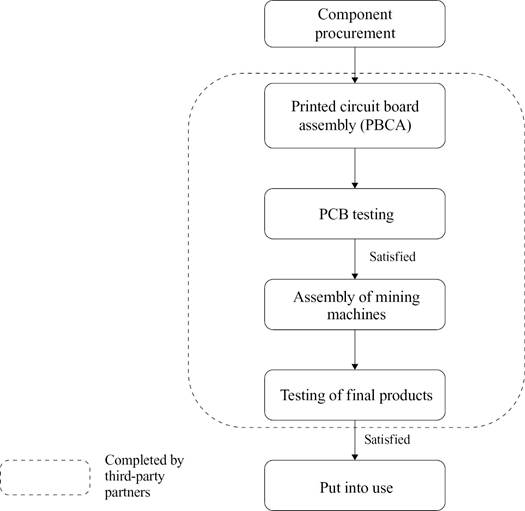
70
Machine component procurement
Our subsidiaries utilize FPGA chips sourced from third-party suppliers for their M series machines, and their proprietary ASIC chips for their “KS,” “AE,” “AL” and “RX” series machines. We expect to utilize our own proprietary ASIC chips for our “BL1” and “BT1” series machines. The other main components of our subsidiaries’ mining machines include, but not limited to, PCBs, other electronic components, and structure components. From March 2019 to February 2022, Shenzhen Bgin procured most of these components on our behalf from suppliers in China in accordance with our subsidiaries’ production plans. Shenzhen Bgin then stored these produced components at its warehouses and distributed such components to the third-party production partners based on each order. Since March 2022, we have sourced machine components exclusively through our subsidiaries and we do not intend to source components through Shenzhen Bgin or any other affiliated entity in the future.
Suppliers
To help ensure the consistent quality of their mining machines, our subsidiaries carefully evaluate the suitability of potential suppliers. In particular, our subsidiaries take into account factors including, but not limited to, a potential supplier’s operating history, operational scale, industry reputation, product quality, quality control effectiveness, technological expertise, pricing, reliability, production capacity, and its ability to meet our subsidiaries’ delivery timeline. Our subsidiaries also constantly monitor the machine components being sourced, and conduct reviews and evaluations on a regular basis with respect to each supplier’s performance, based on which our subsidiaries regularly adjust the list of suppliers from whom machine components are sourced for our subsidiaries’ mining machines. Our subsidiaries do not maintain strategic framework agreements or long-term procurement agreements with most of the suppliers, and our subsidiaries purchase machine components from most of the suppliers on an order-by-order basis. See “Item 3. Key Information—D. Risk Factors — Risks Related to Our Business and Industry — Our subsidiaries do not maintain long-term contracts with most of their suppliers. If our subsidiaries are unable to source from their current suppliers and unable to find acceptable substitutes at reasonable costs or at all, our production costs may increase and our business and results of operations may be materially and adversely affected.” Despite the absence of long-term agreements, during the fiscal years ended December 31, 2023, 2024 and 2025, our subsidiaries did not experience any significant difficulties in procuring machine components, and nor did they encounter any significant problems with the quality of their machine components procured. In the fiscal years ended December 31, 2023, 2024 and 2025, our subsidiaries sourced machine components from a total of 67, 124 and 125 suppliers, respectively. Currently, our largest component supplier is based in Hong Kong.
ASIC Chips
We focus on the design and development of ASIC chips tailored for our self-developed mining machines and outsource the manufacturing process to specialized third-party partners. Specifically, we collaborate with a leading foundry in Asia outside of China for wafer fabrication, after which the chips are shipped to our partner manufacturers in Malaysia, China and Singapore for final assembly into mining machines. This strategy enables us to leverage the expertise of industry-leading suppliers, optimizing both efficiency and quality.
On October 11, 2024, Bgin SG entered into a three-year master foundry product development agreement with the foundry. The agreement outlines key terms such as each party’s deliverables, responsibilities in foundry projects, acceptance timelines, and ownership and use restrictions. For each foundry project, specific details, including design and product specifications, delivery schedules, and payment terms, are documented in separate project statement agreements.
For example, in connection with the October 2024 master agreement, we also executed a project statement agreement with the foundry for the production of certain ASIC chips to be used in our “KS” series machines designed for KAS mining. Under this agreement, we agreed to pay the fees of US$10.5 million for the services rendered by the foundry related to this project.
Production and assembly
Once chips and other components have been procured, production of our subsidiaries’ mining machines entails PCB assembly and general assembly. PCB assembly is the process of creating mounted circuit boards and, through general assembly, the circuit boards are then integrated with other components and parts to produce the final products.
Our subsidiary, Bgin Singapore, engages third-party production partners to assemble our subsidiaries’ products, including PCB assembly and general assembly. The terms and details of the arrangement with third-party production partners are set out in individual written work orders placed by Bgin Singapore, and the amount of work for each work order is determined on an as-needed basis. To maintain product quality, our subsidiaries impose stringent quality control standards and measures, in addition to those of the production partners. Such measures include mandatory product testing after PCB assembly and general assembly. See “— Quality Control.”
71
Quality Control
Our subsidiaries focus on quality control in all aspects of the production of mining machines. Our subsidiaries impose stringent quality control standards and measures to ensure that our subsidiaries’ products can function properly and are able to mine cryptocurrencies with their target computing power.
After the production partners complete the stage of PCB assembly, the production partners conduct quality tests based on our subsidiaries’ protocols to ensure that the quality of PCBs produced meets the standards set by our subsidiaries. Only those PCBs that pass our subsidiaries’ quality standards will be used for general assembly. After the final products are assembled, the production partners conduct both quality tests and sampling accelerated aging tests to assess the final quality and understand the lifespan of those mining machines produced. Once a batch of final products passes both tests, they will be shipped to mining farms or hosting facilities where our subsidiaries’ mining machines are operated and put into use.
Mining Machine Management Software
Part of our research and development efforts have been dedicated to designing and developing software to manage and optimize the performance of their mining machines and infrastructure in real-time and provide critical controls to our subsidiaries’ mining operations. To date, our subsidiaries have equipped all mining farms where our subsidiaries’ mining machines are operated with our proprietary cloud-based mining machine management software. With this proprietary management software, our subsidiaries are able to turn each mining machine on or off and monitor certain crucial data of these machines in real time, including, but not limited to, the current status, settings, computing power, and the total active time of each machine. We believe that with this proprietary mining machine management software, our subsidiaries are empowered to make timely and informed decisions regarding their mining machines and more effectively manage such machines’ energy use by putting mining machines online or offline.
The interface of our management software has been designed in a manner which we believe enables a user to access four different main functions of the software with ease:
| ● | Monitoring. Users may monitor the status of each mining machine at any time, including the cryptocurrencies being mined, computing power, temperature, active time, IP address, and other information. |
| ● | Classification. The classification function of the software allows users to view and manage mining machines by model. |
| ● | Settings. Users can change settings for each mining machine through the interface, including the mining parameters and the cryptocurrencies being mined. |
| ● | Maintenance. Users can manage maintenance activities through the interface by locating the malfunctioning machines, analyzing the causes and remedies of malfunction, and if necessary, restarting any particular mining machine. |
Mining Farms and Hosting Facilities
A mining farm or hosting facility functions as a storage facility where mining machines mine cryptocurrencies. Our subsidiaries construct and operate mining farms, whereas hosting facilities are owned and operated by third parties, with whom we enter into agreements for the hosting of our subsidiaries’ mining machines. We select sites for mining farms managed by our subsidiaries and for hosting facilities to place and operate our subsidiaries’ mining machines based on criteria including but not limited to:
| ● | favorable local laws and regulations on cryptocurrency mining activities; |
| ● | low land and electricity costs to reduce mining expense; |
| ● | political stability of the surrounding area; and |
| ● | local tax policies on income generated from mining activities. |
Through our subsidiaries, we manage and operate some of our mining machines at mining farms owned by our subsidiaries in York, Nebraska and Omaha, Nebraska. The remaining mining machines were previously hosted by a third-party hosting service provider in the State of Ohio, currently subject to an orderly unwind. Currently, our subsidiaries’ mining farms are used to host our subsidiaries’ mining machines which engage in their proprietary mining activities and to host machines owned by our customers. Our subsidiaries also equip these mining farms and hosting facilities with supporting staff to monitor the functioning of the mining machines and trouble shoot basic everyday technical difficulties.
72
As of December 31, 2025, among all these machines, 4,655, or approximately 6.23% of the total 74,743 mining machines our subsidiaries owned for operation purposes, were in operation, primarily as a result of the decline in the market price of KAS, which rendered KAS mining uneconomical relative to prevailing electricity costs. Other than those located at our mining farms and a hosting facility in the U.S., as of December 31, 2025, we had 211 mining machines located in our warehouse in Hong Kong, 35,344 in our warehouse in Papillion, Nebraska, 26,584 stored at our partner manufacturer’s warehouse in Malaysia, and 225 machines in the possession of a partner manufacturer in San Jose, California, which assists the Company in upgrading certain mining machine models.
The following chart sets forth the details of the mining farms, hosting facility and warehouses with the location of our subsidiaries’ mining machines as of December 31, 2025:
| Machines for Our Own Operations | Machines Hosted for Our Customers (including | |||||||||||||||||||
| Type of Facilities | Location | Total Mining Machines | Machines Under Operation | Machines Not Under Operation | Machines Not Under Operation) | |||||||||||||||
| 1 | Mining Farm | Omaha, Nebraska | 2,077 | — | 2,077 | — | ||||||||||||||
| 2 | Mining Farm | York, Nebraska | 5,065 | 4,655 | 410 | 825 | ||||||||||||||
| 3 | Hosting Facility | Akron, Ohio | 5,237 | — | 5,237 | — | ||||||||||||||
| 4 | Warehouses | Hong Kong and Papillion, Nebraska | 35,555 | — | 35,555 | — | ||||||||||||||
| 5 | Partner Manufacturer’s Warehouse | Malaysia and San Jose, California | 26,809 | — | 26,809 | — | ||||||||||||||
| Total: | 74,743 | 4,655 | 70,088 | 825 | ||||||||||||||||
Sale of Mining Machines
Since April 2023, through our subsidiaries, we have sold our self-designed mining machines to customers. As of the date of this annual report, the models of mining machines sold include all the models under the “KS” series, “AL” series, “RX” series and “AE” series, dedicated to the mining of KAS coins, ALPH coins, RXD coins, and ALEO coins, respectively. See “— Mining Machines.”
For the fiscal year ended December 31, 2023, our subsidiaries sold a total number of 67,998 machines, with the KS0 model representing approximately 47.53% of the number, the KS0 Pro model representing approximately 19.92% of the number, the KS3M model representing approximately 19.68% of the number, the KS1 model representing approximately 4.74%, the KS2 model representing approximately 4.12%, and the models KS3 and KS3L representing approximately 4.01%. For the fiscal year ended December 31, 2023, we generated a total of approximately $219.78 million in revenue from selling mining machines, representing approximately 85.43% of our total revenue for that fiscal year.
For the fiscal year ended December 31, 2024, our subsidiaries sold a total number of 102,849 machines, the KS0 model representing approximately 0.02% of the number, the KS0 Pro model representing approximately 19.77% of the number, the KS0 Ultra model representing approximately 31.44% of the number, the KS1 model representing approximately 0.04%, the KS2 model representing approximately 0.05%, the KS2LITE model representing approximately 0.89%, the KS3M model representing approximately 6.86% of the number, the model KS3 representing approximately 0.14%, the model K5L representing approximately 19.22%, the model K5M representing approximately 3.78%, the model AL0 representing approximately 10.60%, the model AL2LITE representing approximately 2.62%, the model AL3 representing approximately 2.30%, and the model RX0 representing approximately 2.27%. For the fiscal year ended December 31, 2024, we generated a total of approximately $192.16 million in revenue from selling mining machines, representing approximately 63.57% of our total revenue of that fiscal year.
For the fiscal year ended December 31, 2025, our subsidiaries sold a total number of 9,410 machines, with the KS0 Pro model representing approximately 0.2%, the KS0 Ultra model representing approximately 2.87%, the KS2LITE model representing approximately 0.22%, the model K5L representing approximately 0.7%, the model K5M representing approximately 2.06%, the model KS7 representing approximately 3.73%, the model KS7LITE representing approximately 4.85%, the model AL0 representing approximately 1.7%, the model AL2LITE representing approximately 0.38%, the model AL3 representing approximately 0.14%, the model RX0 representing approximately 0.01%, the model AE0 representing approximately 32.75%, the model AE1LITE representing approximately 36.99%, the model AE1300M representing approximately 3.89%, the model AE2 representing approximately 6.93%, the model AE3 representing approximately 2.57%. For the fiscal year ended December 31, 2025, we generated a total of approximately $15.25 million in revenue from selling mining machines, representing approximately 22.63% of our total revenue of that fiscal year.
73
Our subsidiary, Bgin Singapore, engages third-party production partners to assemble our subsidiaries’ mining machines. The production process of the mining machines we sell is identical to that of the mining machines we use in our daily operations. For details, see “— Mining Machines.”
Pricing and Sales Model
We determine the pricing of machines based on the prices of machines with similar capacities and performance available on the market, the trading price and attractiveness of the crypto assets these machines are designed for, and the prices of each model vary based on their hash rates. Generally, a model with higher hash rate affords us with greater flexibility in pricing, as we expect these models to be more popular due to their enhanced efficiency in mining KAS or other selected alternative cryptocurrency coins. As of the date of this annual report, our subsidiaries offer their machines at prices ranging from US$129 to US$5,999.
Our machines are available for purchase only through our website, iceriver.io. Customers may view and place orders for machines they intend to purchase directly through the website. Such orders typically contain the price, quantity, and model of the machines, as well as fulfillment methods and expected date of delivery or availability.
After a customer order is received, we then place an order with our third-party production partners to assemble the machines required. Customers may opt for delivery or in-person pick-up as the fulfillment method. If the customer chooses delivery as the fulfillment method, delivery is carried out by a third-party logistics partner, with whom we maintain a long-term agreement, which will be shipped directly by our third-party production partners for delivery at the customer’s designated address. If the customer chooses to pick up the machines, machines will be available for pick-up at our subsidiaries’ warehouse in Hong Kong. For machines purchased by customers opting for miner hosting services, they will be shipped to one of our mining farms in Nebraska for subsequent installment and operations. See “— Miner Hosting Services.”
Submitting Payment through CoinPal
The sales price is stipulated in the U.S. dollars. However, customers may choose to pay using crypto assets. To make a payment in crypto asset coins, customers will be re-directed to our designated payment platform, CoinPal, on which customers may submit payment using Bitcoins, USDT, and Ethereum. The total price of an order in any cryptocurrency will be calculated automatically by CoinPal based on real-time exchange rate information between USDT and the chosen cryptocurrency. We have been advised by CoinPal that they retrieve real-time exchange rate information from Binance.com. Our customers are responsible for any transfer costs associated with transferring crypto assets as payment. For each payment, we are charged processing fees of 0.8% of the total payment amount by CoinPal, and the remaining payment will be remitted to us by CoinPal in USDT based on the conversion at the time of the purchase. We do not receive Bitcoins or Ethereum from CoinPal. Once CoinPal receives a customer’s payment, we are able to initiate a request to withdraw the available USDT to our wallet account. We have been advised by CoinPal that it stores the crypto assets received as payment for our mining machines in their own hot wallets or with Binance.com. See “Item 3. Key Information—D. Risk Factors — Risks Related to Our Business and Industry — Customers may submit cryptocurrencies, including USDT, as a form of payment through our designated payment platform, which creates substantial risks to us.”
By using CoinPal’s services, we agree to the terms set forth in CoinPal’s standard user agreement, which outlines CoinPal’s policies on account registration, scope of services, service fees, and other matters.
Since November 2022, Mr. Qiuhua Li has served as the chief executive officer of CoinPal Limited, a company formed in the BVI, which, through its subsidiaries, operates CoinPal. On April 10, 2025, Mr. Li acquired 100% of the issued and outstanding share capital of CoinPal Limited and CoinPal became a related party of the Company since then. For the fiscal years ended December 31, 2023, 2024 and 2025, USDT coins valued at US$199.8 million, US$188.7 million and US$17.17 million, respectively, were remitted to us by CoinPal. See “Item 7. Major Shareholders and Related Party Transactions — B. Related Party Transactions — Business transactions with CoinPal.”
74
Our Suppliers
Similar to the machines used in our daily operations, production of machines to be sold to customers require the same set of main components, including PCBs, other electronic components, and structure components. For the fiscal year ended December 31, 2023, one supplier contributed over 10% of our total purchases during the period, representing approximately 22.32% of our total purchases. Our largest supplier is based in Singapore, and our second and third largest suppliers are based in Hong Kong. For the fiscal year ended December 31, 2024, one supplier contributed over 10% of our total purchases during the period, representing approximately 61.5% of our total purchases. The largest supplier is based in Hong Kong, the second largest supplier is based in mainland China, and the third largest supplier is based in Singapore. For the fiscal year ended December 31, 2025, two suppliers each contributed over 10% of our total purchases during the period, representing approximately 49.54% and 10.04%, respectively, or 59.58% in the aggregate, of our total purchases. The largest supplier is based in Hong Kong, the second largest supplier is based in South Korea, and the third largest supplier is based in Malaysia. Our subsidiaries do not maintain any long-term contracts with most of their suppliers, and our subsidiaries purchase machine components mostly on an order-by-order basis based on their needs. If our subsidiaries lose any of these major suppliers and are unable to find acceptable substitutes at reasonable costs or at all, our production costs may increase, and our production process may be delayed or suspended. In such event, our business and results of operations may be materially and adversely affected. See “Item 3. Key Information—D. Risk Factors — Risks Related to Our Business and Industry — Our subsidiaries do not maintain long-term contracts with most of their suppliers. If our subsidiaries are unable to source from their current suppliers and unable to find acceptable substitutes at reasonable costs or at all, our production costs may increase and our business and results of operations may be materially and adversely affected.”
Our Customers
For the fiscal years ended December 31, 2023, 2024, and 2025, we sold our self-designed mining machines to approximately 4,445, 7,231, and 659 customers, respectively, who are primarily based in Hong Kong, the U.S. and Southeast Asia. Two customers’ purchases each contributed more than 10% of our aggregate revenue for the fiscal year ended December 31, 2023, representing approximately 17.38% and 13.3% of our aggregate revenue, respectively. For the fiscal year ended December 31, 2023, our largest customer was based in Vietnam, and the second largest customer was based in Hong Kong. For the fiscal year ended December 31, 2024, no customer contributed more than 10% of our total revenue. During the fiscal year ended December 31, 2025, one customer accounted for more than 10% of the Company’s total revenue, representing 15.92%. Such revenue was derived from our self-mining activity through a third-party mining pool under the cryptocurrency network standards. For the fiscal year ended December 31, 2025, this largest customer was based in Hong Kong. See “Item 3. Key Information—D. Risk Factors — Risks Related to Our Business and Industry — We depend on a few customers for a significant portion of our revenues and the loss of any such customers could adversely affect our business, financial condition, results of operations and cash flows.”
Customers who purchase our mining machines include individual miners, who use our machines for their own mining purposes, and distributors, who distribute and resell our machines to end users, who are typically individual miners. For the fiscal year ended December 31, 2023, individual miners and distributors represented 10.26% and 89.74% of our total customers, respectively. For the fiscal year ended December 31, 2024, individual miners and distributors represented 12.05% and 87.95% of our total customers, respectively. For the fiscal year ended December 31, 2025, individual miners and distributors represented 6.69% and 93.31% of our total customers, respectively.
The terms and conditions of surrounding the purchase and sale of our mining machines are set forth on our website, https://www.iceriver.io. By placing purchase orders through the online website, customers imply their consent to the terms and conditions set forth therein, including the following:
| ● | Orders. Orders are accepted and confirmed only when the order status is updated to “awaiting shipment.” We reserve the right to cancel orders due to pricing errors, product unavailability, or delivery restrictions. |
| ● | Pricing and taxes. Orders are in settled in U.S. dollars and can be subject to change after an order is placed. In such instances, we will contact the purchasers and receive confirmations that the updated pricing is acceptable before the order is shipped. Customers are responsible for any additional taxes and customs duties. |
| ● | Delivery. Delivery will be promptly arranged after the order is paid in full. We use third-party carriers to deliver the machines. Delays or address issues may result in additional fees or cancellations. |
75
| ● | Exchange or Refunds. We normally do not provide exchanges or refunds for products after an order is confirmed. |
| ● | Warranty. If a machine is defective, the customer may ship the machine back for repair or exchange. The warranty period for an exchanged machine is 30 days. |
Miner Hosting Services
Since November 2023, we have been offering miner hosting services as an elective, value-added service to customers who purchase selected models of our self-designed mining machines. With our miner hosting services, we handle the setup, housing, operation and monitoring of our customers’ mining machines at our mining farms, providing daily maintenance on the mining hardware and other infrastructure. We believe that we have designed our hosting service as a simple and efficient option that offers our customers the ability to easily control their hosted machines globally via a desktop and mobile interface.
Customers interested in opting for miner hosting services may do so while placing a machine purchase order with us on our website, www.iceriver.io. To register for miner hosting services, customers are required to create an account with us and review and accept the terms of our hosting services agreement.
Machines purchased by customers enrolling in miner hosting services will be delivered to our mining farms or hosting facilities and installed by our team. The fees we charge to customers include a one-time set-up fee of US$20 per machine unit, and an electricity fee of US$0.08 per kWh incurred. Customers are required to make an advance payment covering set up fees up to two months’ worth of electricity fees and a deposit equivalent to 15 days’ electricity fees, and are encouraged to deposit funds with us on a regular basis. We deduct funds from our customers’ account balance on a monthly basis for electricity fees.
We offer professional support to our hosting customers and ensure that our customers’ servers operate for at least 97% of the time within a one-month period, except in the event of maintenance of the hosting facility or its associated infrastructure, any client server failure, or force majeure events. We conduct regular maintenance for customers’ machines without extra charge to customers. We provide a 6-month free warranty service for newly deployed mining machines. During the warranty period, if a mining machine malfunctions, we will provide repair services, and customers do not need to pay repair fees. If a mining machine malfunctions after the warranty period ends, the customer shall submit a repair work order. We will evaluate the specific fault conditions and provide a repair quotation, and the customer will decide whether to proceed with the repair. If on-site maintenance personnel cannot resolve the malfunction, we will make reasonable efforts to send the mining machine to the original manufacturer or a third-party repair service provider for handling.
Under the hosting services agreements we enter into with each customer, either party has a right to terminate the agreement with or without cause upon a 45-day prior written notice to the other party. Additionally, if a customer’s arrears reach 60 days, the hosting service agreement shall terminate automatically. Following the termination of the service relationship, we will return to customer the customer’s machines and any other related equipment owned by the customer, at the sole cost, expense and risk of the customer. If a customer does not provide his or her retrieval instructions within 15 days following the termination of service relationship, we retain the right to sell or retain possession of such customer’s machines.
As of December 31, 2025, we hosted 825 machines as part of our mining hosting services provided to customers, of which three were in operation and 822 were non-operational at our mining farm located in York, Nebraska. We believe that as we add mining farm capacity, we will be able to further scale this business segment. For details, see “— Mining Farms and Mining Facilities.”
Mining Operations
Through our subsidiaries, we started our mining operations in March 2019. We measure the success of our mining operations by the value of the cryptocurrency rewards our subsidiaries earn from their mining activities. As our subsidiaries produce cryptocurrencies through their mining activities, our subsidiaries exchange those cryptocurrencies for fiat currency such as U.S. dollars to generate cash flow to fund our business operations, subject to a combination of market and operational conditions. Since cryptocurrencies are generally susceptible to market changes and risks, our subsidiaries typically exchange the cryptocurrencies mined for Tethers within a reasonable timeframe after obtaining them, and then exchange the Tethers held into fiat currency on a regular basis. We have implemented the following plans to safeguard and store our crypto assets, which have been approved by our chief executive officer and executive chairman of the board of directors. First, given our current business scale, profitability, and risk tolerance, we hold a portion of our assets in USDT coins, not to exceed 20% of our net assets at any given time. To achieve this goal, we have been converting any extra USDT coins exceeding the 20% limit into fiat currency through exchanges including Actyve and MCE. Second, going forward, we intend to store our cryptocurrencies in licensed, U.S.-regulated centralized custodians and implement a multi-level authorization mechanism for access to ensure security.
76
On average, cryptocurrency exchanges impose a fee of approximately 0.2% for such transactions. We prioritize safety and reliability in selecting exchanges for conducting transactions. We take a series of precautionary measures to protect our cryptocurrencies, including opening accounts on reputable and reliable exchanges, setting up complex passwords and changing passwords on a frequent basis, adopting two-factor authentication for log-in, avoiding the use of public Wi-Fi for account access, and staying informed of the latest cybersecurity threats.
For the fiscal year ended December 31, 2023, we mined six cryptocurrencies, including KAS, IRON, RXD, NIM, KLS, and ALPH, which contributed 71.5%, 27.92%, 0.28%, 0.25%, 0.03%, and 0.02% of our total revenue for the fiscal year, respectively.
For the fiscal year ended December 31, 2024, we mined 13 cryptocurrencies, including KAS, ALPH, IRON, RXD, NIM, KLS, PYRIN, SEDRA, NEXELLIA, BUGNA, HOOSAT, PUG, and GRAM, which contributed 84.80%, 6.46%, 3.51%, 2.22%, 0.39%, 1.48%, 0.10%, 0.30%, 0.06%, 0.09%, 0.00%, 0.01%, and 0.57% of our total mining revenue for the fiscal year, respectively.
For the year ended December 31, 2025, we mined seven cryptocurrencies, including KAS and six other cryptocurrencies, which contributed 97.60% and 2.40% of our total mining revenue for the fiscal year, respectively.
The following table sets forth the revenue/value of cryptocurrencies mined, electricity costs, depreciation and other costs, and margin of each cryptocurrency mined during the fiscal years ended December 31, 2025, 2024 and 2023:
| For the Year Ended December 31, 2025 | For the Year Ended December 31, 2024 | For the Year Ended December 31, 2023 | ||||||||||||||||||||||||||||||||||||||||||||||||||||||||||
| Cryptocurrency | Revenue/
Value of cryptocurrencies mined | Electricity costs | Depreciation and other costs | Margin | % of margin | Revenue/
Value of cryptocurrencies mined | Electricity costs | Depreciation and other costs | Margin | % of margin | Revenue/
Value of cryptocurrencies mined | Electricity costs | Depreciation and other costs | Margin | % of margin | |||||||||||||||||||||||||||||||||||||||||||||
| (in US$) | (in US$) | (in US$) | (in US$) | (in US$) | (in US$) | (in US$) | (in US$) | (in US$) | (in US$) | (in US$) | (in US$) | |||||||||||||||||||||||||||||||||||||||||||||||||
| ALPH | 4,597 | 50,836 | 7,165 | (53,404 | ) | (1,162 | )% | 2,908,700 | 582,037 | 770,753 | 1,555,910 | 53 | % | — | — | — | — | — | ||||||||||||||||||||||||||||||||||||||||||
| KAS | 41,911,210 | 37,120,240 | 23,881,665 | (19,090,695 | ) | (46 | )% | 38,187,369 | 16,406,167 | 10,118,967 | 11,662,235 | 31 | % | 9,294,807 | 2,568,662 | 3,140,944 | 3,585,201 | 39 | % | |||||||||||||||||||||||||||||||||||||||||
| IRON | — | — | — | — | 1,581,609 | 262,441 | 419,098 | 900,070 | 57 | % | 3,629,731 | 1,462,880 | 1,226,576 | 940,275 | 26 | % | ||||||||||||||||||||||||||||||||||||||||||||
| Others | 1,024,511 | 1,024,022 | 1,249,818 | (1,249,329 | ) | (122 | )% | 2,352,523 | 528,282 | 623,377 | 1,200,864 | 51 | % | 75,536 | 27,118 | 25,526 | 22,892 | 30 | % | |||||||||||||||||||||||||||||||||||||||||
| Total | $ | 42,940,318 | $ | 38,195,098 | 25,138,648 | $ | (20,393,428 | ) | (47 | )% | $ | 45,030,201 | $ | 17,778,927 | 11,932,195 | $ | 15,319,079 | 34 | % | $ | 13,000,074 | $ | 4,058,660 | 4,393,046 | 4,548,368 | 35 | % | |||||||||||||||||||||||||||||||||
77
Performance Metrics
The following tables present the number of cryptocurrencies mined by our subsidiaries in the fiscal years ended December 31, 2023, 2024 and 2025 by type, total number of units in circulation of such cryptocurrencies, representing the number of units created and in existence as of a certain date, our market share, mining difficulty across the global network, and our hash rate and hash rate across the global network for mining each type of cryptocurrency.
NIM
| For the month ended | Number of units mined by our subsidiaries | Total number of units in circulation | Our market share | Mining difficulty across global network | Our hash rate | Hash rate across global network | ||||||||||||||||
| January 31, 2023 | 3,678,473 | 108,651,747 | 3.39 | % | 7,183,299 | 0.26GH/s | 7.662GH/s | |||||||||||||||
| February 28, 2023 | 2,767,703 | 97,101,575 | 2.85 | % | 9,438,840 | 0.29GH/s | 10.068GH/s | |||||||||||||||
| March 31, 2023 | 3,300,374 | 106,486,033 | 3.10 | % | 7,758,995 | 0.26GH/s | 8.276GH/s | |||||||||||||||
| April 30, 2023 | 2,931,746 | 101,951,024 | 2.88 | % | 5,272,147 | 0.16GH/s | 5.623GH/s | |||||||||||||||
| May 31, 2023 | 1,756,578 | 104,270,715 | 1.68 | % | 8,554,780 | 0.15GH/s | 9.125GH/s | |||||||||||||||
| June 30, 2023 | 1,340,341 | 99,864,187 | 1.34 | % | 7,227,590 | 0.10GH/s | 7.709GH/s | |||||||||||||||
| July 31, 2023 | 1,941,024 | 102,144,119 | 1.90 | % | 8,210,764 | 0.17GH/s | 8.758GH/s | |||||||||||||||
| August 31, 2023 | 2,546,260 | 101,069,268 | 2.52 | % | 4,388,287 | 0.12GH/s | 4.68GH/s | |||||||||||||||
| September 30, 2023 | 2,072,479 | 96,775,793 | 2.14 | % | 6024787 | 0.14GH/s | 6.426GH/s | |||||||||||||||
| October 31, 2023 | 30,036 | 99,095,282 | 0.03 | % | 6,698,825 | 0.002GH/s | 7.14GH/s | |||||||||||||||
| November 30, 2023 | 515,122 | 95,196,836 | 0.54 | % | 6,152,732 | 0.035GH/s | 6.56GH/s | |||||||||||||||
| December 31, 2023 | 2,739,800 | 97,410,076 | 2.81 | % | 4,204,248 | 0.126GH/s | 4.48GH/s | |||||||||||||||
| January 31, 2024 | 2,632,308 | 95,924,271 | 2.74 | % | 3,511,313 | 0.102GH/s | 3.745GH/s | |||||||||||||||
| February 28, 2024 | 1,775,810 | 88,789,364 | 2.00 | % | 4,273,799 | 0.091GH/s | 4.558GH/s | |||||||||||||||
| March 31, 2024 | 2,089,556 | 93,975,990 | 2.22 | % | 4,225,916 | 0.100GH/s | 4.507GH/s | |||||||||||||||
| April 30, 2024 | 2,670,184 | 89,984,248 | 2.97 | % | 4,661,100 | 0.147GH/s | 4.971GH/s | |||||||||||||||
| May 31, 2024 | 13,491,208 | 92,037,011 | 14.66 | % | 5,884,430 | 0.919GH/s | 6.276GH/s | |||||||||||||||
| June 30, 2024 | 13,698,265 | 88,127,922 | 15.54 | % | 4,860,257 | 0.805GH/s | 5.18GH/s | |||||||||||||||
| July 31, 2024 | 13,673,745 | 90,106,627 | 15.18 | % | 8,676,222 | 1.404GH/s | 9.25GH/s | |||||||||||||||
| August 31, 2024 | 19,846,533 | 89,143,627 | 22.26 | % | 7,145,857 | 1.697GH/s | 7.62GH/s | |||||||||||||||
| September 30, 2024 | 16,187,294 | 85,373,758 | 18.96 | % | 8,287,630 | 1.676GH/s | 8.84GH/s | |||||||||||||||
| October 31, 2024 | 21,186,863 | 87,305,570 | 24.27 | % | 8,311,814 | 2.152GH/s | 8.86GH/s | |||||||||||||||
| November 30, 2024 | 11,387,539 | 83,853,547 | 13.58 | % | 4,531,303 | 0.656GH/s | 4.83GH/s | |||||||||||||||
78
KAS
| For the month ended | Number of units mined by our subsidiaries | Total number of units in circulation | Our market share | Mining difficulty across global network | Our hash rate | Hash rate across global network | ||||||||||||||
| January 31, 2023 | 164,643,404 | 750,946,464 | 21.92 | % | 424,131,333,173,370 | 92.99TH/s | 424.13TH/s | |||||||||||||
| February 28, 2023 | 144,075,221 | 640,987,949 | 22.48 | % | 336,085,850,451,100 | 75.54TH/s | 336.09TH/s | |||||||||||||
| March 31, 2023 | 109,521,329 | 671,556,355 | 16.31 | % | 451,882,418,149,760 | 73.7TH/s | 451.88TH/s | |||||||||||||
| April 30, 2023 | 41,890,277 | 612,530,229 | 6.84 | % | 749,286,786,201,000 | 51.24TH/s | 749.29TH/s | |||||||||||||
| May 31, 2023 | 5,716,008 | 598,290,195 | 0.96 | % | 1,116,832,227,278,200 | 10.67TH/s | 1,116.83TH/s | |||||||||||||
| June 30, 2023 | 4,065,707 | 545,702,651 | 0.75 | % | 1,025,560,020,003,500 | 7.64TH/s | 1,025.56TH/s | |||||||||||||
| July 31, 2023 | 14,624,951 | 533,015,899 | 2.74 | % | 1,116,661,361,920,700 | 30.64TH/s | 1,116.66TH/s | |||||||||||||
| August 31, 2023 | 57,928,860 | 502,149,603 | 11.54 | % | 3,171,073,940,233,500 | 365.82TH/s | 3,171.07TH/s | |||||||||||||
| September 30, 2023 | 12,815,040 | 458,879,446 | 2.79 | % | 16,343,931,316,756,000 | 456.43TH/s | 16,343.93TH/s | |||||||||||||
| October 31, 2023 | 3,694,982 | 445,865,481 | 0.83 | % | 29,972,432,090,416,000 | 248.38TH/s | 29,972.43TH/s | |||||||||||||
| November 30, 2023 | 2,930,664 | 405,170,736 | 0.72 | % | 50,398,250,636,275,000 | 364.53TH/s | 50,398.25TH/s | |||||||||||||
| December 31, 2023 | 1,445,251 | 397,126,689 | 0.36 | % | 80,237,303,251,544,000 | 292.00TH/s | 80,237.30TH/s | |||||||||||||
| January 31, 2024 | 1,733,045 | 368,019,936 | 0.47 | % | 133,328,622,571,770,000 | 628TH/s | 133,329TH/s | |||||||||||||
| February 28, 2024 | 10,958,835 | 329,409,504 | 3.33 | % | 174,809,215,572,460,000 | 5,816TH/s | 174,809TH/s | |||||||||||||
| March 31, 2024 | 7,424,998 | 334,507,104 | 2.22 | % | 171,418,126,036,020,000 | 3,805TH/s | 171,418TH/s | |||||||||||||
| April 30, 2024 | 6,372,331 | 305,065,440 | 2.09 | % | 211,244,565,380,820,000 | 4,413TH/s | 211,245TH/s | |||||||||||||
| May 31, 2024 | 6,150,712 | 298,014,336 | 2.06 | % | 256,262,020,489,210,000 | 5,289TH/s | 256,262TH/s | |||||||||||||
| June 30, 2024 | 4,236,090 | 271,771,200 | 1.56 | % | 333,736,239,330,520,000 | 5,202TH/s | 333,736TH/s | |||||||||||||
| July 31, 2024 | 4,059,856 | 265,078,830 | 1.53 | % | 454,869,298,139,543,000 | 6,967TH/s | 454,869TH/s | |||||||||||||
| August 31, 2024 | 14,436,822 | 249,927,995 | 5.78 | % | 778,409,974,161,313,000 | 44,964TH/s | 778,410TH/s | |||||||||||||
| September 30, 2024 | 33,931,081 | 228,093,580 | 14.88 | % | 1,058,843,891,216,660,000 | 157,513TH/s | 1,058,844TH/s | |||||||||||||
| October 31, 2024 | 47,032,864 | 222,586,077 | 21.13 | % | 1,159,964,544,885,800,000 | 245,103TH/s | 1,159,965TH/s | |||||||||||||
| November 30, 2024 | 58,220,985 | 203,076,013 | 28.67 | % | 1,338,865,382,740,300,000 | 383,847TH/s | 1,338,865TH/s | |||||||||||||
| December 31, 2024 | 59,784,554 | 198,523,696 | 30.11 | % | 1,348,060,490,945,600,000 | 405,963TH/s | 1,348,060TH/s | |||||||||||||
| January 31, 2025 | 56,355,298 | 187,023,946 | 30.13 | % | 1,297,265,723,594,200,000 | 390,901 TH/s | 1,297,266 TH/s | |||||||||||||
| February 28, 2025 | 51,868,844 | 159,238,224 | 32.57 | % | 1,272,781,255,187,400,000 | 414,584 TH/s | 1,272,781 TH/s | |||||||||||||
| March 31, 2025 | 64,693,283 | 167,254,070 | 38.68 | % | 1,237,468,019,484,000,000 | 478,648 TH/s | 1,237,468 TH/s | |||||||||||||
| April 30, 2025 | 56,256,125 | 152,532,720 | 36.88 | % | 9,949,286,139,066,700,000 | 3,669,431 TH/s | 9,949,286 TH/s | |||||||||||||
| May 31, 2025 | 54,871,074 | 149,007,168 | 36.82 | % | 1,136,331,508,462,800,000 | 418,448 TH/s | 1,136,332 TH/s | |||||||||||||
| June 30, 2025 | 44,168,016 | 135,892,080 | 32.50 | % | 928,192,794,950,500,000 | 301,684 TH/s | 928,193 TH/s | |||||||||||||
| July 31, 2025 | 37,630,143 | 131,241,600 | 28.67 | % | 693,684,748,655,910,000 | 198,896 TH/s | 693,685 TH/s | |||||||||||||
| August 31, 2025 | 28,754,710 | 123,742,080 | 23.24 | % | 690,171,505,337,160,000 | 160,379 TH/s | 690,172 TH/s | |||||||||||||
| September 30, 2025 | 20,280,448 | 113,270,400 | 17.90 | % | 852,539,352,744,830,000 | 152,643 TH/s | 852,539 TH/s | |||||||||||||
| October 31, 2025 | 21,664,960 | 110,350,080 | 19.63 | % | 655,405,597,218,300,000 | 128,675 TH/s | 655,406 TH/s | |||||||||||||
| November 30, 2025 | 27,350,865 | 100,828,800 | 27.13 | % | 616,890,858,546,150,000 | 167,338 TH/s | 616,891 TH/s | |||||||||||||
| December 31, 2025 | 23,485,720 | 98,297,280 | 23.89 | % | 476,774,183,427,290,000 | 113,913 TH/s | 476,774 TH/s | |||||||||||||
79
IRON
| For the month ended | Number of units mined by our subsidiaries | Total number of units in circulation | Our market share | Mining difficulty across global network | Our hash rate | Hash rate across global network | ||||||||||||||
| January 31, 2023 | — | — | — | — | — | — | ||||||||||||||
| February 28, 2023 | — | — | — | — | — | — | ||||||||||||||
| March 31, 2023 | — | — | — | — | — | — | ||||||||||||||
| April 30, 2023 | 35,303 | 259,200 | 13.62 | % | 274,952,264,192,150,000 | 624.13Th/s | 4,582.54Th/s | |||||||||||||
| May 31, 2023 | 263,522 | 892,800 | 29.52 | % | 259,435,253,155,990,000 | 1,276.26Th/s | 4,323.92Th/s | |||||||||||||
| June 30, 2023 | 373,108 | 864,000 | 43.18 | % | 137,488,489,086,020,000 | 989.54Th/s | 2,291.47Th/s | |||||||||||||
| July 31, 2023 | 491,299 | 892,800 | 55.03 | % | 106,945,559,529,090,000 | 980.85Th/s | 1,782.43Th/s | |||||||||||||
| August 31, 2023 | 484,941 | 892,800 | 54.32 | % | 79,453,190,443,371,000 | 719.28Th/s | 1,324.22Th/s | |||||||||||||
| September 30, 2023 | 343,192 | 864,000 | 39.72 | % | 100,100,749,301,190,000 | 662.69Th/s | 1,668.35Th/s | |||||||||||||
| October 31, 2023 | 412,345 | 892,800 | 46.19 | % | 103,258,542,581,820 | 794.84TH/s | 1,720.97TH/s | |||||||||||||
| November 30, 2023 | 454,425 | 864,000 | 52.60 | % | 118,754,812,113,130 | 1040.99TH/s | 1,979.24TH/s | |||||||||||||
| December 31, 2023 | 189,987 | 892,800 | 21.28 | % | 77,861,255,374,889 | 276.14TH/s | 1,297.68TH/s | |||||||||||||
| January 31, 2024 | 246,992 | 892,800 | 27.66 | % | 107,961,282,962,830,000 | 498TH/s | 1,799.35TH/s | |||||||||||||
| February 28, 2024 | 219,496 | 835,200 | 26.28 | % | 111,107,722,513,240,000 | 487TH/s | 1,851.8TH/s | |||||||||||||
| March 31, 2024 | 274,038 | 892,800 | 30.69 | % | 99,128,330,830,857,000 | 507TH/s | 1,652.14TH/s | |||||||||||||
| April 30, 2024 | 11,712 | 864,000 | 1.36 | % | 245,299,044,796,000 | 0.055Th/s | 4TH/s | |||||||||||||
| May 31, 2024 | — | 848,160 | — | 250,839,471,490,850 | — | 4.25TH/s | ||||||||||||||
| June 30, 2024 | — | 820,800 | — | 193,816,474,723,378 | — | 3.28TH/s | ||||||||||||||
| July 31, 2024 | — | 848,160 | — | 170,297,811,330,365.00 | — | 2.88TH/s | ||||||||||||||
| August 31, 2024 | — | 848,160 | — | 176,662,939,123,763.00 | — | 2.99TH/s | ||||||||||||||
| September 30, 2024 | — | 820,800 | — | 108,738,902,263,152.00 | — | 1.84TH/s | ||||||||||||||
| October 31, 2024 | — | 848,160 | — | 85,673,846,451,321 | — | 1.45TH/s | ||||||||||||||
| November 30, 2024 | — | 820,800 | — | 97,087,878,345,800.50 | — | 1.64TH/s | ||||||||||||||
| December 31, 2024 | — | 848,160 | — | 101,863,294,793,924.00 | — | 1.69TH/s | ||||||||||||||
RXD
| For the month ended | Number of units mined by our subsidiaries | Total number of units in circulation | Our market share | Mining difficulty across global network | Our hash rate | Hash rate across global network | ||||||||||||||
| January 31, 2023 | — | — | — | — | — | — | ||||||||||||||
| February 28, 2023 | — | — | — | — | — | — | ||||||||||||||
| March 31, 2023 | — | — | — | — | — | — | ||||||||||||||
| April 30, 2023 | 2,600,077 | 432,000,000 | 0.60 | % | 9,401,651 | 0.81TH/s | 134.59TH/s | |||||||||||||
| May 31, 2023 | — | — | — | — | — | — | ||||||||||||||
| June 30, 2023 | — | — | — | — | — | — | ||||||||||||||
| July 31, 2023 | — | — | — | — | — | — | ||||||||||||||
| August 31, 2023 | — | — | — | — | — | — | ||||||||||||||
| September 30, 2023 | — | — | — | — | — | — | ||||||||||||||
| October 31, 2023 | — | — | — | — | — | — | ||||||||||||||
| November 30, 2023 | 5,843,654 | 432,000,000 | 1.35 | % | 6,680,854 | 1.29TH/s | 95.64TH/s | |||||||||||||
| December 31, 2023 | 4,806,361 | 432,000,000 | 1.11 | % | 6,083,834 | 0.969TH/s | 87.10TH/s | |||||||||||||
| January 31, 2024 | 81,622,624 | 446,400,000 | 18.28 | % | 4,582,355 | 11.99TH/s | 65.6TH/s | |||||||||||||
| February 28, 2024 | 103,752,886 | 417,600,000 | 24.85 | % | 4,097,242 | 14.57TH/s | 58.65TH/s | |||||||||||||
| March 31, 2024 | 171,421,541 | 446,400,000 | 38.40 | % | 3,947,506 | 21.70TH/s | 56.51TH/s | |||||||||||||
| April 30, 2024 | 51,998,839 | 352,800,000 | 14.74 | % | 5,147,159 | 10.85TH/s | 73.68TH/s | |||||||||||||
| May 31, 2024 | 24,014 | 223,200,000 | 0.01 | % | 13,729,270 | 0.02TH/s | 196.55TH/s | |||||||||||||
| June 30, 2024 | 29,190 | 216,000,000 | 0.01 | % | 12,004,923 | 0.02TH/s | 171.86TH/s | |||||||||||||
| July 31, 2024 | — | 223,200,000 | 0.00 | % | 12,923,982.07 | — | 185.02TH/s | |||||||||||||
| August 31, 2024 | — | 223,200,000 | 0.00 | % | 12,683,064.37 | — | 181.57TH/s | |||||||||||||
| September 30, 2024 | — | 216,000,000 | 0.00 | % | 49,863,061.45 | — | 713.86TH/s | |||||||||||||
| October 31, 2024 | — | 223,200,000 | 0.00 | % | 160,475,971.56 | — | 2,297.46TH/s | |||||||||||||
| November 30, 2024 | — | 216,000,000 | 0.00 | % | 220,245,685.00 | — | 3,153.16TH/s | |||||||||||||
| December 31, 2024 | — | 223,200,000 | 0.00 | % | 211,418,327.73 | — | 2,959.3Th/s | |||||||||||||
80
ALPH
| For the month ended | Number of units mined by our subsidiaries | Total number of units in circulation | Our market share | Mining difficulty across global network | Our hash rate | Hash rate across global network | ||||||||||||||
| January 31, 2023 | — | — | — | — | — | — | ||||||||||||||
| February 28, 2023 | — | — | — | — | — | — | ||||||||||||||
| March 31, 2023 | — | — | — | — | — | — | ||||||||||||||
| April 30, 2023 | — | — | — | — | — | — | ||||||||||||||
| May 31, 2023 | — | — | — | — | — | — | ||||||||||||||
| June 30, 2023 | — | — | — | — | — | — | ||||||||||||||
| July 31, 2023 | — | — | — | — | — | — | ||||||||||||||
| August 31, 2023 | — | — | — | — | — | — | ||||||||||||||
| September 30, 2023 | — | — | — | — | — | — | ||||||||||||||
| October 31, 2023 | — | — | — | — | — | — | ||||||||||||||
| November 30, 2023 | — | — | — | — | — | — | ||||||||||||||
| December 31, 2023 | 2,884 | 89,410 | 3.23 | % | 18,751,717 | 2.41TH/s | 75.00TH/s | |||||||||||||
| January 31, 2024 | 139,415 | 1,605,744 | 8.68 | % | 77,611,786 | 7.06TH/s | 81.38TH/s | |||||||||||||
| February 28, 2024 | 200,933 | 1,471,608 | 13.65 | % | 96,128,487 | 13.76TH/s | 100.79TH/s | |||||||||||||
| March 31, 2024 | 220,980 | 1,538,784 | 14.36 | % | 92,735,902 | 13.96TH/s | 97.24TH/s | |||||||||||||
| April 30, 2024 | 312,223 | 1,455,192 | 21.46 | % | 107,754,982 | 24.24TH/s | 112.99TH/s | |||||||||||||
| May 31, 2024 | 198,077 | 1,469,880 | 13.48 | % | 171,535,693 | 24.23TH/s | 179.86TH/s | |||||||||||||
| June 30, 2024 | 87,462 | 1,370,404 | 6.38 | % | 61,414,080 | 65.75TH/s | 1,030.36TH/s | |||||||||||||
| July 31, 2024 | 28,302 | 1,386,034 | 2.04 | % | 81,618,746 | 27.96TH/s | 1,369.35TH/s | |||||||||||||
| August 31, 2024 | 325 | 1,351,864 | 0.02 | % | 207,928,935 | 0.84TH/s | 3,488,50TH/s | |||||||||||||
| September 30, 2024 | — | 1,317,693 | 0.00 | % | 756,803,188.23 | 0.00Th/s | 12,697.15TH/s | |||||||||||||
| October 31, 2024 | — | 1,283,523 | 0.00 | % | 1,347,926,162.58 | 0.00Th/s | 22,614.62TH/s | |||||||||||||
| November 30, 2024 | — | 1,257,895 | 0.00 | % | 1,403,191,580.52 | 0.00Th/s | 23,541.83TH/s | |||||||||||||
| December 31, 2024 | — | 1,223,725 | 0.00 | % | 1,749,648,653.41 | 0.00Th/s | 29,354.46TH/s | |||||||||||||
KLS
| For the month ended | Number of units mined by our subsidiaries | Total number of units in circulation | Our market share | Mining difficulty across global network | Our hash rate | Hash rate across global network | ||||||||||||||
| January 31, 2023 | — | — | — | — | — | — | ||||||||||||||
| February 28, 2023 | — | — | — | — | — | — | ||||||||||||||
| March 31, 2023 | — | — | — | — | — | — | ||||||||||||||
| April 30, 2023 | — | — | — | — | — | — | ||||||||||||||
| May 31, 2023 | — | — | — | — | — | — | ||||||||||||||
| June 30, 2023 | — | — | — | — | — | — | ||||||||||||||
| July 31, 2023 | — | — | — | — | — | — | ||||||||||||||
| August 31, 2023 | — | — | — | — | — | — | ||||||||||||||
| September 30, 2023 | — | — | — | — | — | — | ||||||||||||||
| October 31, 2023 | — | — | — | — | — | — | ||||||||||||||
| November 30, 2023 | — | — | — | — | — | — | ||||||||||||||
| December 31, 2023 | 80,276 | 2,488,557 | 3.23 | % | 410,639,421,078,970 | 13.24TH/s | 410.63TH/s | |||||||||||||
| January 31, 2024 | 323,031 | 133,920,000 | 0.24 | % | 229,454,238,795,300 | 0.55TH/s | 229.45TH/s | |||||||||||||
| February 28, 2024 | 3,818,412 | 125,280,000 | 3.05 | % | 146,629,657,594,770 | 4.47TH/s | 146.63TH/s | |||||||||||||
| March 31, 2024 | 9,938,893 | 133,920,000 | 7.42 | % | 113,648,508,900,710 | 8.43TH/s | 113.65TH/s | |||||||||||||
| April 30, 2024 | 16,816,835 | 129,600,000 | 12.98 | % | 107,698,717,742,830 | 13.98TH/s | 107.7TH/s | |||||||||||||
| May 31, 2024 | 30,039,102 | 119,145,600 | 25.21 | % | 81,712,790,081,592 | 20.6TH/s | 81.71TH/s | |||||||||||||
| June 30, 2024 | 30,922,768 | 111,096,576 | 27.83 | % | 64,340,279,149,057 | 17.91TH/s | 64.34TH/s | |||||||||||||
| July 31, 2024 | 38,452,281 | 111,664,228 | 34.44 | % | 57,242,160,237,168 | 19.71TH/s | 57.24TH/s | |||||||||||||
| August 31, 2024 | 28,259,017 | 108,520,066 | 26.04 | % | 57,148,525,876,926 | 14.88TH/s | 57.14TH/s | |||||||||||||
| September 30, 2024 | 1,909,686 | 102,064,784 | 1.87 | % | 40,623.134778 | 3.25TH/s | 173.93TH/s | |||||||||||||
| October 31, 2024 | — | 102,667,774 | 0.00 | % | 506,440,174,623 | — | 507.20GH/s | |||||||||||||
| November 30, 2024 | — | 96,763,910 | 0.00 | % | 350,124,987,033 | — | 350.65GH/s | |||||||||||||
| December 31, 2024 | — | 86,565,888 | 0.00 | % | 425,185,607,813.64 | — | 425.78GH/s | |||||||||||||
81
PUG
| For the month ended | Number of units mined by our subsidiaries | Total number of units in circulation | Our market share | Mining difficulty across global network | Our hash rate | Hash rate across global network | ||||||||||||||
| January 31, 2024 | — | — | — | — | — | — | ||||||||||||||
| February 28, 2024 | — | — | — | — | — | — | ||||||||||||||
| March 31, 2024 | — | — | — | — | — | — | ||||||||||||||
| April 30, 2024 | — | — | — | — | — | — | ||||||||||||||
| May 31, 2024 | 39,104,987 | 388,800,000 | 10.06 | % | 34,157,158,203,719 | 3TH/s | 34TH/s | |||||||||||||
| June 30, 2024 | 56845243.29 | 1,230,965,560 | 4.62 | % | 2,067,234,530,737 | 0.092TH/s | 2TH/s | |||||||||||||
BUGNA
| For the month ended | Number of units mined by our subsidiaries | Total number of units in circulation | Our market share | Mining difficulty across global network | Our hash rate | Hash rate across global network | ||||||||||||||
| January 31, 2024 | — | — | — | — | — | — | ||||||||||||||
| February 28, 2024 | — | — | — | — | — | — | ||||||||||||||
| March 31, 2024 | 51,497,922 | 2,592,000,000 | 1.99 | % | 3,123,295,437,954,700 | 62TH/s | 3,123TH/s | |||||||||||||
| April 30, 2024 | 190,525,487 | 5,020,596,347 | 3.79 | % | 1,361,603,927,662,900 | 52TH/s | 1,362TH/s | |||||||||||||
| May 31, 2024 | 332,525,168 | 4,897,163,298 | 6.79 | % | 757,942,204,228,810 | 51TH/s | 758TH/s | |||||||||||||
| June 30, 2024 | 695,438,072.9 | 4,472,308,326 | 15.55 | % | 278,858,128,731,380 | 43TH/s | 279TH/s | |||||||||||||
| July 31, 2024 | 688,874,855 | 4,361,998,301 | 15.79 | % | 332,982,199,815,813 | 52.58TH/s | 332.98TH/s | |||||||||||||
| August 31, 2024 | 127,945,008 | 4,112,700,820 | 3.11 | % | 1,649,787,634,016,040 | 51.32TH/s | 1,649.78TH/s | |||||||||||||
| September 30, 2024 | 81,164,392 | 3,755,517,774 | 2.16 | % | 2,079,510,037,743,500 | 44,94TH/s | 2,079.51TH/s | |||||||||||||
| October 31, 2024 | 279,750,794 | 3,663,074,391 | 7.64 | % | 1,525,375,931,496,060 | 116.49TH/s | 1,525.37TH/s | |||||||||||||
| November 30, 2024 | 38,439,240 | 3,344,997,151 | 1.15 | % | 1,239,902,710,816,330 | 14.24TH/s | 1,239.90TH/s | |||||||||||||
| December 31, 2024 | — | 3,374,572,406 | 0.00 | % | 916,862,175,530,270.00 | — | 916.86TH/s | |||||||||||||
HOOSAT
| For the month ended | Number of units mined by our subsidiaries | Total number of units in circulation | Our market share | Mining difficulty across global network | Our hash rate | Hash rate across global network | ||||||||||||||
| January 31, 2024 | — | — | — | — | — | — | ||||||||||||||
| February 28, 2024 | — | — | — | — | — | — | ||||||||||||||
| March 31, 2024 | 142,405 | 138,240,000 | 0.10 | % | 123,866,831,898,880 | 0.13TH/s | 124TH/s | |||||||||||||
| April 30, 2024 | 567,219 | 259,200,000 | 0.22 | % | 96,085,800,094,329 | 0.21TH/s | 96TH/s | |||||||||||||
| May 31, 2024 | — | — | — | — | — | — | ||||||||||||||
| June 30, 2024 | — | — | — | — | — | — | ||||||||||||||
PYRIN
| For the month ended | Number of units mined by our subsidiaries | Total number of units in circulation | Our market share | Mining difficulty across global network | Our hash rate | Hash rate across global network | ||||||||||||||
| January 31, 2024 | — | — | — | — | — | — | ||||||||||||||
| February 28, 2024 | 145,622 | 42,595,200 | 0.34 | % | 322,433,519,318,130 | 1.1TH/s | 322TH/s | |||||||||||||
| March 31, 2024 | 48,857 | 45,532,800 | 0.11 | % | 748,333,689,543,840 | 0.8TH/s | 748TH/s | |||||||||||||
| April 30, 2024 | 105,919 | 44,064,000 | 0.24 | % | 1,117,910,650,046,900 | 2.69TH/s | 1,118TH/s | |||||||||||||
| May 31, 2024 | 8,071 | 43,029,954 | 0.02 | % | 836,832,977,037,020 | 0.16TH/s | 837TH/s | |||||||||||||
| June 30, 2024 | 197,052.3178 | 35,663,321.88 | 0.55 | % | 531,637,099,363,350 | 2.94TH/s | 532TH/s | |||||||||||||
| July 31, 2024 | 361,898 | 34,767,362 | 1.04 | % | 372,541,079,120,070 | 3.878TH/s | 372TH/s | |||||||||||||
| August 31, 2024 | 33,902 | 32,781,581 | 0.10 | % | 472,12,252,891,430 | 0.488TH/s | 472TH/s | |||||||||||||
| September 30, 2024 | 10,130 | 28,849,866 | 0.04 | % | 196,137,629,704,510 | 0.069TH/s | 196TH/s | |||||||||||||
| October 31, 2024 | 688,552 | 28,069,632 | 2.45 | % | 42,197,937,709,218 | 1.035TH/s | 42TH/s | |||||||||||||
| November 30, 2024 | 114,897 | 25,634,880 | 0.45 | % | 4,415,057,038,175 | 0.02TH/s | 4TH/s | |||||||||||||
82
SEDRA
| For the month ended | Number of units mined by our subsidiaries | Total number of units in circulation | Our market share | Mining difficulty across global network | Our hash rate | Hash rate across global network | ||||||||||||||
| January 31, 2024 | — | — | — | — | — | — | ||||||||||||||
| February 28, 2024 | 282,242 | 302,400,000 | 0.09 | % | 6,796,806,069,830,500 | 6TH/s | 6,797TH/s | |||||||||||||
| March 31, 2024 | 33,764,390 | 1,339,200,000 | 2.52 | % | 4,571,546,589,340,700 | 115TH/s | 4,572TH/s | |||||||||||||
| April 30, 2024 | 38,979,161 | 1,296,000,000 | 3.01 | % | 5,794,734,199,002,900 | 174TH/s | 5,795TH/s | |||||||||||||
| May 31, 2024 | 46,450,031 | 1,339,200,000 | 3.47 | % | 3,580,778,491,875,000 | 124TH/s | 3,581TH/s | |||||||||||||
| June 30, 2024 | 62,784,969 | 1,296,000,000 | 4.84 | % | 3,310,999,829,533,700 | 160TH/s | 3,311TH/s | |||||||||||||
| July 31, 2024 | — | 1,339,200,000 | — | 2,578,713,169,566,800 | — | 2,578.71TH/s | ||||||||||||||
| August 31, 2024 | — | 1,230,813,820 | — | 7,980,207,767,376,600 | — | 7,980.20TH/s | ||||||||||||||
| September 30, 2024 | — | 1,096,768,554 | — | 9,155,346,370,956,060 | — | 9,155.34TH/s | ||||||||||||||
| October 31, 2024 | — | 1,069,975,123 | — | 7,245,025,244,115,660 | — | 7,245.02TH/s | ||||||||||||||
| November 30, 2024 | — | 976,900,029 | — | 5,911,493,182,159,560 | — | 5,911.49TH/s | ||||||||||||||
| December 31, 2024 | — | 990,993,062 | — | 5,074,555,884,953,000 | — | 5,074.55TH/s | ||||||||||||||
NEXELLIA
| For the month ended | Number of units mined by our subsidiaries | Total number of units in circulation | Our market share | Mining difficulty across global network | Our hash rate | Hash rate across global network | ||||||||||||||
| January 31, 2024 | — | — | — | — | — | — | ||||||||||||||
| February 28, 2024 | 64,473 | 2,505,600 | 2.57 | % | 122,096,755,251,810 | 3.14TH/s | 122TH/s | |||||||||||||
| March 31, 2024 | 204,036 | 32,140,800 | 0.63 | % | 27,091,031,761,153 | 0.17TH/s | 27TH/s | |||||||||||||
| April 30, 2024 | 1,310,591 | 31,104,000 | 4.21 | % | 19,285,650,588,665 | 0.8TH/s | 19TH/s | |||||||||||||
| May 31, 2024 | 7,076,583 | 32,140,800 | 22.02 | % | 6,187,643,149,710 | 1.32TH/s | 6TH/s | |||||||||||||
| June 30, 2024 | 2,879,384 | 31,104,000 | 9.26 | % | 4,432,080,392,597 | 0.37TH/s | 4TH/s | |||||||||||||
| July 31, 2024 | — | 32,140,800 | — | 2,112,245,776,540 | — | 2.11TH/s | ||||||||||||||
| August 31, 2024 | — | 32,140,800 | — | 5,401,851,559,104 | — | 5.40TH/s | ||||||||||||||
| September 30, 2024 | — | 31,104,000 | — | 3,669,215,491,638 | — | 3.66TH/s | ||||||||||||||
| October 31, 2024 | — | 32,140,800 | — | 3,079,389,714,512 | — | 3.07TH/s | ||||||||||||||
| November 30, 2024 | — | 15,552,000 | — | 35.07 | — | 151.48TH/s | ||||||||||||||
| December 31, 2024 | — | 16,070,400 | — | 33.392597 | — | 144.18GH/s | ||||||||||||||
ALEO
| For the month ended | Number of units mined by our subsidiaries | Total number of units in circulation | Our market share | Mining difficulty across global network | Our hash rate | Hash rate across global network | ||||||||||||||
| January 31, 2025 | — | — | — | — | — | — | ||||||||||||||
| February 28, 2025 | — | — | — | — | — | — | ||||||||||||||
| March 31, 2025 | — | — | — | — | — | — | ||||||||||||||
| April 30, 2025 | — | — | — | — | — | — | ||||||||||||||
| May 31, 2025 | 568,820 | 10,540,000 | 5.40 | % | 12,492,781,815,740 | 67 GH/s | 1,238 GH/s | |||||||||||||
| June 30, 2025 | 345,346 | 10,200,000 | 3.39 | % | 26,061,177,089,477 | 65 GH/s | 1,916 GH/s | |||||||||||||
| July 31, 2025 | 280,232 | 10,540,000 | 2.66 | % | 39,526,624,941,636 | 82 GH/s | 3,074 GH/s | |||||||||||||
| August 31, 2025 | 83,653 | 10,385,000 | 0.81 | % | 54,749,167,193,254 | 34 GH/s | 4,258 GH/s | |||||||||||||
| September 30, 2025 | 55,944 | 10,050,000 | 0.56 | % | 51,702,275,633,267 | 22 GH/s | 4,021 GH/s | |||||||||||||
| October 31, 2025 | 45,701 | 10,385,000 | 0.44 | % | 57,606,484,002,563 | 20 GH/s | 4,481 GH/s | |||||||||||||
| November 30, 2025 | 190,540 | 10,050,000 | 1.90 | % | 60,303,372,008,570 | 89 GH/s | 4,690 GH/s | |||||||||||||
| December 31, 2025 | 2,509,354 | 10,385,000 | 24.16 | % | 47,625,500,881,987 | 895 GH/s | 3,704 GH/s | |||||||||||||
83
TARI
| For the month ended | Number of units mined by our subsidiaries | Total number of units in circulation | Our market share | Mining difficulty across global network | Our hash rate | Hash rate across global network | ||||||||||||||
| January 31, 2025 | — | — | — | — | — | — | ||||||||||||||
| February 28, 2025 | — | — | — | — | — | — | ||||||||||||||
| March 31, 2025 | — | — | — | — | — | — | ||||||||||||||
| April 30, 2025 | — | — | — | — | — | — | ||||||||||||||
| May 31, 2025 | — | — | — | — | — | — | ||||||||||||||
| June 30, 2025 | 9,596,113 | 91,984,608 | 10.43 | % | 124,700,511,146,620,000 | 15 TH/s | 141 TH/s | |||||||||||||
| July 31, 2025 | 26,368,206 | 96,146,856 | 27.42 | % | 166,962,944,918,160,000 | 24 TH/s | 86 TH/s | |||||||||||||
| August 31, 2025 | 35,322,920 | 97,445,772 | 36.25 | % | 122,958,359,524,040,000 | 24 TH/s | 65 TH/s | |||||||||||||
| September 30, 2025 | 32,228,699 | 92,497,680 | 34.84 | % | 163,638,684,859,650,000 | 14 TH/s | 40 TH/s | |||||||||||||
| October 31, 2025 | 699,384 | 95,579,597 | 0.73 | % | 105,946,481,721,040,000 | 1 TH/s | 78 TH/s | |||||||||||||
| November 30, 2025 | — | — | — | — | — | — | ||||||||||||||
| December 31, 2025 | — | — | — | — | — | — | ||||||||||||||
We intend to start mining additional cryptocurrencies in the future. We adjust our mining strategy primarily based on the overall rate of return. The rate of return for mining a particular type of cryptocurrency typically depends upon a few crucial factors, including its trading price, mining difficulty, and the hash rate it takes to mine a unit of each cryptocurrency. An increase in a cryptocurrency’s trading price attracts more miners, and leads to an increase in mining difficulty of that cryptocurrency. As the cryptocurrency market is volatile in nature, we monitor the trading prices of selected alternative cryptocurrencies on a constant basis, and adjust the mining ratios of different cryptocurrencies on a daily basis to maximize the overall rate of return. Specifically, we will start mining a cryptocurrency only when all of four conditions are met: (i) the daily value of coins mined across the network exceeds $10,000, (ii) we will be able to generate a gross margin exceeding 40% by mining that cryptocurrency, and (iii) the cryptocurrency is freely tradable on well-known cryptocurrency exchanges, and (iv) the daily trading volume is no less than three times the daily value of coins mined across the network.
We have internal procedures in place for analyzing whether a particular cryptocurrency that we intend to mine, invest in, or transact is a “security” within the meaning of Section 2(a)(1) of the Securities Act. Once we identify a cryptocurrency as potentially mineable, we will submit information relating to such cryptocurrency to our internal legal counsel to provide an assessment as to the likelihood of such cryptocurrency being deemed a “security” within the meaning of Section 2(a)(1) of the Securities Act, based on the state of the law and any guidance available at the time of determination. We plan to take additional steps to implement internal compliance procedures for this purpose, including working with employees trained to identify the indicia of a “security” and outside legal counsel experienced in cryptocurrency regulatory matters to make a determination with respect to each type of cryptocurrencies proposed to be mined, invested in, or transacted. In making such determinations, we and our outside legal counsel consider compliance with judicial precedents, and reports, orders and statements issued by the SEC and other related guidance, including the Framework for “Investment Contract” Analysis of Digital Assets. Under these proposed procedures, if we conclude that a cryptocurrency is reasonably likely to be regarded as a “security” within the meaning of Section 2(a)(1) of the Securities Act, the Company will either choose to not mine, invest in, or transact such cryptocurrency, or work with our outside legal counsel to adopt procedures or set up the process that complies with applicable laws and regulations. Any policies and procedures we plan to adopt for this purpose in the future do not constitute a legal standard but rather represent a framework for our analysis, which permits us to make a risk-based assessment regarding the likelihood that a particular cryptocurrency could be deemed a “security” under applicable laws. Our risk-based assessments do not constitute a legal determination binding on regulators or the courts and do not preclude legal or regulatory action.
As of December 31, 2023, 2024 and 2025, we had 5,288, 37,864 and 4,655 mining machines in operation, respectively, and 564, 9,125 and 70,088 mining machines not in operation, respectively. As of December 31, 2023, 287 mining machines were in transit from Hong Kong to the U.S. As of December 31, 2024, 2,412 mining machines were detained by the U.S. Customs, and as of December 31, 2025, other than 211 mining machines located in our warehouse in Hong Kong and 26,584 mining machines stored by our partner manufacturer in Malaysia, all of our machines were located in the U.S.
84
Mining Pools
A mining pool is a platform where miners use their computing power to jointly provide cryptocurrency transaction verification services on a blockchain and share mining rewards. Mining pools reduce the risk of mining and the expected rewards for the mining pools are generally proportionate to a member’s contribution to the aggregate computing power of the blockchain network.
Currently, we operate a mining pool which are open to participants and support the mining of KAS. As of December 31, 2024, the mineable assets at our mining pools included five types of cryptocurrencies, namely KAS, RXD, SDR, ALPH, and BGA. As of December 31, 2025, the mineable asset at our mining pools included KAS only. As of December 31, 2025, there were approximately 10,958 participants in the mining pools we operate, with a majority of them being purchasers of our subsidiaries’ KS series machines dedicated to the mining of KAS coins. We attract participants through (i) setting up a referral program and providing rebates and incentives to existing participants who recommend new participants to join the pool, and (ii) setting up lower pool fees compared to the industry average, and (iii) provide customizable services to pool participants. In our experience, mining pool margins have been quite narrow due to relatively high administrative and compliance costs. Therefore, we intend to wind down this business almost completely over the next 24 months as the business segment does not meet our desired financial and operating metrics.
We maintain a website, HumPool.com, for our mining pools. Miners interested in joining our mining pools may access current information on the pools through the website, including the mineable crypto assets, and their respective pool and network hash rates, current trading prices, minimum payout thresholds, and blockchain addresses through which machines can be connected to our mining pools. We usually provide multiple blockchain addresses for each type of crypto asset, tailored to miners located in different geographic locations or using different models of mining machines with disparate mining powers. To start mining, a pool participant needs to register an online account with us. We do not require pool participants to install any software to participate in mining.
We generate income by receiving crypto coins as rewards and deducting a percentage of such rewards as pool fees from payouts to pool participants. We do not charge any entry fees for participating in the mining pools. The following tables shows the type of crypto asset available for mining on our mining pools, pool fees, minimum payout thresholds, and combined hash rate for each crypto asset as of December 31, 2025.
| Pool Fees (% of Rewards Earned) | ||||||||||||||||
| Crypto Asset | Combined Hash Rate | Minimum Payout Threshold | Registered Users | Non- registered Users | ||||||||||||
| KAS | 71.32Ph/s | 15 units | 1 | % | 1 | % | ||||||||||
Currently, pool participants mining KAS coins will automatically receive rewards in CAU coins for each KAS coin accumulated and distributable to them, provided by CAU’s official team. The amount of rewards is currently at 0.00011 CAU coin for each KAS coin mined, and will be subject to change depending on CAU network parameters and KAS network difficulty. The minimum payout threshold for CAU coins is set at 0.5 unit.
The following table shows the percentages of our total revenue contributed by mining pool services fees by crypto asset for the years ended December 31, 2023, 2024 and 2025.
| Crypto Asset | Percentage of Our Total Revenue Contributed by Mining Pool Services Fees by Crypto Asset for the Year Ended December 31, 2023 | Percentage of Our Total Revenue Contributed by Mining Pool Services Fees by Crypto Asset for the Fiscal Year Ended December 31, 2024 | Percentage of Our Total Revenue Contributed by Mining Pool Services Fees by Crypto Asset for the Fiscal Year Ended December 31, 2025 | |||||||||
| KAS | 100 | % | 91.49 | % | 91.06 | % | ||||||
| ALPH | 0 | % | 4.99 | % | 7.24 | % | ||||||
| Others | 0 | % | 3.52 | % | 1.7 | % | ||||||
85
Through websites, mobile apps and other types of management software, pool participants may monitor their mining status at any time, from anywhere. In order to protect the mining pools from disruption, we have implemented security measures including (i) utilizing Distributed Denial of Service (“DdoS”) protection services to detect and mitigate DdoS attacks, filter website traffic and prevent non-legitimate access or requests, (ii) setting up black and whitelists for crypto wallet addresses, (iii) conducting penetration testing on a regular basis, (iv) employing two-factor authentication for log-ins, (v) synchronizing mining pool data on multiple servers, and (vi) encrypting data with private key. The mined cryptocurrencies from the mining pools are automatically stored in a designated hot wallet, and distributed to each participant based on the percentage of computing power it contributes to the mining pools twice a day. After cryptocurrencies are mined and before they are distributed to pool participants, we have temporary possession of such cryptocurrencies. In the event that we suffer from cyberattacks and mined cryptocurrencies are lost, we and pool participants may lose mined cryptocurrencies. See “Item 3. Key Information—D. Risk Factors — Risks Related to Our Business and Industry — We operate mining pools. Any cyber-attacks or other occurrences that negatively impact the operations of the mining pools may result in a materially negative impact on our business, financial position, and results of operations.”
Technology
Chip Configuration Technology
Our subsidiaries have adopted Double Data Rate 3 (DDR3) program protocols for the chips in their mining machines. This is a type of chip configuration technology that allows for a significant reduction in the time spent on chip configuration in cryptocurrency mining when implementing a change in algorithm or the type of cryptocurrency to be mined by a mining machine, thereby enhancing the overall computing power of our subsidiaries’ mining machines.
High-efficiency Cooling System
Our subsidiaries equip their mining machines with a high-efficiency cooling system using materials with high thermal conductivities and heavy-duty cooling fans, which protects their mining machines from high temperatures, dust and vibration, all of which can result in damages to these mining machines over time. Our subsidiaries’ high-efficiency cooling system allow them to optimize the computing power of their mining machines and mine cryptocurrencies with higher productivity and efficiency.
Multi-chip Coordination Technology
Our subsidiaries’ mining machines are equipped with multi-chip coordination technology, which automatically connects the chips in a module in series or parallel in such combination that the resulting multi-chip module will enable the mining machine to operate with greater energy efficiency and higher computing power.
Research and Development
Research and development is key to our continued innovation and business growth, and we have invested significant resources in the research and development of cryptocurrency mining hardware.
We also place a strong emphasis on building our individual research and development teams at various subsidiaries to ensure focus on specific areas. As of December 31, 2025, our subsidiaries had 50 members in their research and development teams, including 12 full-time PRC individuals and 38 employees located in the U.S. and Hong Kong. Many members of our subsidiaries’ research and development team have prior work experience in the blockchain and cryptocurrency industry. For example, Mr. Qi Shao, our chief technology officer, had ten years of experience in the research and development of electronics before he joined us as the chief technology officer of Bgin HK at its founding.
Our research and development team is currently in the process of designing and developing two new series of ASIC chips and mining machines: (i) the “BL1” series ASIC chips and mining machines, dedicated to the mining of Dogecoin, and (ii) “BT1” series ASIC chips and mining machines, dedicated to the mining of Bitcoin. As of the date of this annual report, we have entered a tape-out phase, the critical milestone in the development process as we have completed the design and simulation verification of the “BT1” model ASIC chip. Tape-out represents a key stage in the overall ASIC chip development process, as it marks the pivotal step in transition from design to physical production. We believe that these new mining machines will enable us to address a much larger market opportunity as Bitcoin and Dogecoin both have larger market capitalizations compared to the selected alternative cryptocurrencies that we have been historically focusing on. Expanding into these new markets represents a growth opportunity for our various revenue segments. As of the date of this annual report, the Company’s research and development team has developed a prototype Bitcoin miner based on the “BT1” ASIC chip. We expect the total research and development expenses to be incurred for both the “BL1” and “BT1” projects to be approximately US$10 million, and we plan to use our cash on hand and cash generated from operating activities to fund our research and development efforts in connection with these projects.
86
Marketing and Branding
Since April 2023, we have generated revenue from selling mining machines designed by us, contributing approximately 85.43% of our total revenue for the fiscal year ended December 31, 2023, 63.57% of our total revenue for the fiscal year ended December 31, 2024 and 22.63% of our total revenue for the fiscal year ended December 31, 2025. From time to time, we participate in cryptocurrency events and exhibitions to promote and showcase our mining machines. For instance, we showcased our mining machines in the Blockchain Life 2023 exhibition in Dubai, the United Arab Emirates in November 2023, and the Mining Disrupt exhibition in Miami, Florida in June 2024 and March 2025. In addition, our representatives attended the Bitcoin 2025 Conference in May 2025, held in Las Vegas, Nevada; Bitcoin Asia in August 2025, held in Hong Kong; and TOKEN2049 in October 2025, held in Singapore. In April 2026, we became one of the sponsors of the Bitcoin 2026 Conference, held in Las Vegas, Nevada, featuring our debut prototype — “PortableBTC” — as a commemorative prototype model created to mark our entry into the bitcoin mining hardware journey.
Methods of Power Generation and Environmental Initiatives
Historically, our subsidiaries have used fossil energy, hydropower, and renewable energy in their business activities. In 2023, Nebraska obtained approximately 45% of its in-state electricity net generation from coal, 30% from wind, 17% from nuclear power, 6% from natural gas, and 2% from hydropower. We do not avail ourselves of any renewable energy credits or tax credits.
For the fiscal years ended December 31, 2023, 2024 and 2025, the total electricity fees we paid in connection with cryptocurrency mining operations were $4.10 million, $17.78 million and $38.20 million, respectively, and the costs per kilowatt hour for the respective period was approximately $0.0749 per kWh, $0.1049 per kWh and $0.0640 per kWh, respectively. The average costs per cryptocurrency mined during the fiscal years ended December 31, 2023, 2024 and 2025 were $0.0067, $0.0628 and $0.064, respectively.
We are aware of the amount of energy our subsidiaries use in their business activities, and we intend to expand our energy-saving efforts in the future. Specifically, we have equipped machines under the “KS” series, “AL” series, “RX” series and “AE” series with proprietary ASIC chips, which are able to provide greater energy efficiency compared to the traditional miners with FPGA chips. We are currently in the process of developing two other series of machines, “BL1” and “BT1”, dedicated to the mining of Dogecoin and Bitcoin, respectively. See “— Growth Strategies — Integrating Our Business Model across the Value Chain.” Furthermore, accessibility and availability of renewable energy has always been and will continue to be a significant factor in our evaluation process for selecting the sites of our subsidiaries’ mining farms and hosting facilities to place our subsidiaries’ mining machines. Additionally, our subsidiaries intend to adopt energy-efficient miner cooling methods, such as water cooling and immersion cooling, at our subsidiaries’ mining farms. We believe that growing with sustainability is important for our success in the long run.
Properties and Facilities
We lease the properties for our principal executive offices, which are located in Singapore with an aggregate floor area of approximately 549 square feet. We also lease office space in Hong Kong with an aggregate floor area of approximately 1,295 square feet and another office space in Singapore. We believe that the properties we currently lease for our executive offices are adequate to meet our needs for the foreseeable future.
Through our subsidiaries, we own the property for our mining farm located in Omaha, Nebraska, with an aggregate floor area of approximately 5,000 square feet. We also own a parcel of land in York, Nebraska, which we acquired on April 8, 2022, for another mining farm which has been operational since August 28, 2023, with an aggregate floor area of approximately 16 to 17 acres. Through Bgin Singapore, we have leased a warehouse in Hong Kong since December 1, 2023, with an aggregate floor area of 1,932 square feet. Through Bgin Infrastructure US, we have leased a warehouse in Papillion, Nebraska since October 8, 2025, with an aggregate floor area of 54,080 square feet, and have taken possession of it on October 20, 2025.
Other than the machines hosted and operated by our subsidiaries at the properties they own or lease, the remaining machines were previously hosted by a third-party hosting service provider in the State of Ohio, currently subject to an orderly unwind. Through our subsidiaries, we enter into a hosting agreement with such third-party hosting service provider.
We are authorized by Shanghai HuiShi Information Technology Co., Ltd., a related party controlled by Mr. Qiuhua Li, the executive chairman of our board of directors, to occupy a space for office use, with an aggregate floor area of approximately 215 square feet, located in Shanghai, the PRC, free of charge and until January 31, 2027.
We intend to enter into leases or purchase properties through our subsidiaries to start additional mining farms primarily focusing on the U.S. and/or Canada, and we believe that suitable additional space will be available in the future on commercially reasonable terms to accommodate our current expansion plans.
87
Intellectual Property
Through our subsidiaries, we have developed proprietary technologies for mining operations. We do not currently own any intellectual properties in connection with our existing technologies. However, we may in the future rely upon patents, trade secrets, trademarks, service marks, trade names, copyrights or other intellectual property rights. In addition, we expect to continue developing our technologies through our subsidiaries to enhance our operational efficiency.
Through our subsidiaries, we have registered one trademark in Hong Kong, one trademark in Singapore, one trademark in the U.S., and one trademark in Canada, all of which are for our brand name, “BGIN”. We have also registered three trademarks in mainland China, two trademarks in Hong Kong, two trademarks in Singapore, two trademarks in Malaysia, two trademarks in the European Union, three trademarks in the U.S., and two trademarks in Canada, as related to the brand name of our mining machines, “ICERIVER,” with additional one “IR” trademark application pending in each of Hong Kong, Canada, Singapore, Mainland China, and the European Union.
Competition
In cryptocurrency mining, all types of companies, groups, and individuals can generate cryptocurrency units through solving blocks. Miners can range from individual enthusiasts to professional mining operations with dedicated data centers. Through our subsidiaries, we compete with other companies that focus all or a portion of their activities on mining activities at scale and face significant competition in every aspect of our business, including the ability to research and develop new mining machines with stronger performance capabilities, raise additional capital for our growth, scale our power capacity and operate with the low electricity costs, and other factors.
We believe that, through our subsidiaries, we are well-positioned in the industry based on our subsidiaries’ strong in-house research and development capabilities. However, we expect competition to increase in 2026 from some of our existing competitors that have more resources than we do, and may be able to devote greater resources than we can, and new market entrants may offer products priced lower than ours in order to expand their business.
Employees and PRC Individuals
We and our subsidiaries had a total of 88, 109, 36 employees and PRC individuals whom we maintain service or freelancer agreements with as of December 31, 2025, 2024 and 2023, respectively. The following table sets forth
the number of our employees and PRC individuals whom we maintain service or freelancer agreements with by function as of December 31, 2025:
| Function | Number | |||
| Management | 16 | |||
| Accounting and Finance | 3 | |||
| After Sales Services | 1 | |||
| Inventory | 2 | |||
| Research and Development | 50 | |||
| Administration and Human Resources | 7 | |||
| Sales and Marketing | 2 | |||
| Repair and Maintenance | 2 | |||
| Legal | 1 | |||
| Analyst | 2 | |||
| Investors Relationship | 2 | |||
| Total | 88 | |||
88
As of December 31, 2025, we and our subsidiaries had a total of 30 employees and PRC individuals with whom we maintain services or freelancer agreements. Among all of our employees and PRC individuals whom we maintained service or freelancer agreements with as of December 31, 2025, 26 of the PRC individuals, were located in Mainland China, 29 of our employees were located in the U.S., 29 of our employees were located in Hong Kong, and four employees were located in Singapore. We engage one outside consultant located in Poland. Our chief executive officer, Mr. Qingfeng Wu and our chief technology officer, Mr. Qi Shao, both work and reside in Hong Kong; our co-chief financial officer, Mr. Zhao Xiang, while maintaining residence in Mainland China, works from Hong Kong; our co-chief financial officer, Mr. Pengju Wang, resides and works in Mainland China. Through our subsidiaries, we have entered into employment agreements with our employees based outside of Mainland China, and service or freelancer agreements with most of the PRC individuals located in Mainland China, including our officer, Mr. Pengju Wang. We maintain employment with Mr. Zhao Xiang, who works in Hong Kong and resides in Mainland China. Bgin HK pays compensation to the PRC individuals through one or more of the following methods: (i) in Renminbi by Bgin HK through a third-party payment institution; (ii) in USDT transferred directly from Bgin HK’s cold wallet to the relevant individual; or (iii) in Hong Kong dollars by Bgin HK to such individuals’ bank accounts in Hong Kong. The relationship between us and the PRC individuals does not constitute a labor relationship under the PRC Labor Law but rather a civil legal relationship of the provision and receipt of services under the PRC laws. Under the PRC Labor Law and other related regulations, this arrangement might result in our employees being regarded as services providers to us, rather than our employees. As a result of this treatment, services providers under the PRC Labor Law are unable to enjoy the protection under the PRC Labor Law and other related regulations, and we may be subject to labor arbitration or litigation filed by such service providers or required to adjust such form of services in the future. See “Item 3. Key Information—D. Risk Factors — Risks Related to Doing Business in Hong Kong and Mainland China — Through Bgin HK, our Hong Kong subsidiary, we have entered into service or freelancer agreements with PRC individuals who are based in Mainland China and provide services for us. Such service relationship does not constitute a labor relationship under the PRC laws and the service providers are unable to enjoy the protection under the PRC Labor Law and other related regulations, as a result of which we may be subject to labor arbitration or litigation filed by such service providers or required to adjust such form of services in the future.” PRC individuals mainly provide chip and algorithm research and development and daily operation and management services for us. A portion of our research and development activities are conducted in the PRC with research personnel based in the PRC. In the opinion of Commerce & Finance Law Offices, our PRC legal counsel, as of the date of this annual report, there are no explicit regulations under the laws of mainland China that apply to, restrict or prohibit the provision of the aforementioned services, including the research and development of ASIC chips, by PRC individuals to a Hong Kong company which is not a virtual currency exchange and not conduct carrying out exchange services between legal currencies and virtual currencies or between virtual currencies, buying and selling virtual currencies as a central counterparty, providing information intermediary and pricing services for virtual currency transactions, token issuance financing, virtual currency derivative transactions and other virtual currency-related business activities such as Bgin HK. Therefore, we believe that having officers located in mainland China or research and development activities conducted by PRC individuals will not expose the Company to liability with regard to the operation of a cryptocurrency mining company which conducts mining outside mainland China as there is no explicit prohibition or limitation imposed by the laws of mainland China.
We have entered into employment agreements with all of our employees based in Hong Kong, Singapore, and the U.S., including all of our officers except for our co-chief financial officer, Mr. Pengju Wang. We will then terminate the service agreements with the PRC individuals once we determine that our teams based in the U.S., Singapore and Hong Kong are able to adequately support the Company’s research and development and operations functions.
We believe that our success and continued growth depend on our ability to attract, retain, and motivate qualified employees and/or PRC individuals. Through our subsidiaries, we offer our employees and PRC individuals competitive salaries, comprehensive training, and other fringe benefits and incentives. We believe that through our subsidiaries, we maintain a good working relationship with our employees and PRC individuals, and we have not experienced any material labor disputes or work stoppages. None of our employees or PRC individuals are represented by labor unions, and no collective bargaining agreement has been put in place.
Through our subsidiaries, we enter into standard employment agreements with our employees.
89
Seasonality
Our subsidiaries’ business operations are not subject to seasonality.
Insurance
Other than directors’ and officers’ liability insurance and the general liability insurance policy maintained by Bgin Infrastructure US, effective through November 7, 2026, we and our subsidiaries do not currently maintain any other commercial insurance. As such, we are susceptible to losses including property damage, accidents, or liabilities. In the event that such damages are substantial, we may experience materially negative impact on our business operations, financial condition, and results of operations. See “Item 3. Key Information—D. Risk Factors — Risks Related to Our Business and Industry — Our subsidiaries’ mining operations, including the mining farms and hosting facilities in which our subsidiaries’ mining machines are operated, may experience damages, and any resulting damages are not covered by insurance.”
Legal Proceedings
IceRiver.eu Case
The Company recently became aware of a European-based entity operating under the name “IceRiver.eu” (the “Infringer”) and falsely claiming to be an official European branch or affiliate of the Company. The disputed domain name <ICERIVER.EU> is registered in the name of the individual (the “Registrant”) who is believed to control the Infringer entity. The Infringer entity maintains a website, IceRiver.eu (the “Infringing Website”), and associated social media accounts, through which it markets and sells products under the “ICERIVER” name and branding. The Company has not authorized any such relationship, and IceRiver.eu is not affiliated with, endorsed by, or authorized to act on behalf of the Company in any capacity. The Company believes the conduct of IceRiver.eu has caused confusion among customers and partners, and has undermined the integrity of its brand in the U.S., European and other international markets.
On May 15, 2025, the Company caused its U.S. counsel to deliver a formal demand letter to the Infringer Entity, asserting that it is infringing the Company’s registered “ICERIVER” trademarks (the “ICERIVER Marks”). The Company demanded that the operators of the Infringing Website, and all affiliated social-media accounts (including YouTube, TikTok, Instagram, and X) cease all use of the ICERIVER Marks and any marks confusingly similar thereto, transfer the Infringing Website to Company; identify those in the chain of infringement; provide an accounting of importation and sales; turnover or destroy existing inventory; compensate the Company for damages; and execute a written settlement agreement.
On December 24, 2025, Bgin Trading and Bgin EU filed a complaint at the WIPO Domain Name Dispute Resolution Service for .EU domain names. The disputed domain name <ICERIVER.EU> is registered in the name of the individual (the “Individual Registrant”) who is believed to control the Infringer entity. The complaint has argued that the IceRiver.eu domain name (“Disputed Domain Name”) is identical or confusingly similar to the Company’s registered European trademark rights to the ICERIVER mark, that the Infringer has no rights or legitimate interests in respect of the Disputed Domain Name, and that the Disputed Domain Name is being used in bad faith. The complaint requested that the Disputed Domain Name be transferred to an affiliated company (registered in a country in Europe) of the Company.
On March 4, 2026, a panel appointed by the WIPO Arbitration and Mediation Center (the “WIPO Panel”) decided in favor of Bgin Trading and Bgin EU and ordered the transfer of the Disputed Domain Name IceRiver.eu from the Individual Registrant to Bgin EU Limited. The WIPO Panel found that the Individual Registrant registered the domain name and activated the associated website targeting the ICERIVER brand of the Company in an attempt to, among other things, impersonate the Company and its subsidiaries, create confusion among Internet users as to the affiliation with the Company and its subsidiaries, confuse and attract the customers of the Company and its subsidiaries, and sell the products of the Company and its subsidiaries for commercial gain.
Despite receiving from the WIPO Panel a decision favorable to the Company, the Company cannot assure that litigation will not be necessary. If the Company determines to initiate enforcement action or a suit for other or related causes of action, it could seek preliminary and permanent injunctive relief, monetary damages (including statutory damages and disgorged profits), and attorneys’ fees, among other types of claims, which could be material. Even if ultimately successful, any injunction or takedown proceedings could divert management’s attention, require further legal and consulting expenditures.
90
During a waiting period for implementing the decision of the WIPO panel, the Company was notified by the European Registry for Internet Domains (EURid) that on April 1, 2026, Michal Beno, the current registrant of the ICERIVER.EU domain name, initiated court proceedings in the Municipal Court in Prague that temporarily delay—and might, depending on the outcome, potentially affect—the implementation of aspects of the decision from the WIPO Panel, potentially including those aspects that are favorable to BGIN Trading and Bgin EU. We currently have no further information on the matter, as the documents associated with the court proceedings in Prague have not yet been served on Bgin Trading and Bgin EU.
As of the date of this annual report, management has reserved in its financial statements for the cost of counsel and consultants. The Company does not believe that the outcome of this matter, individually or in the aggregate, will have a material adverse effect on its consolidated financial position, results of operations, or cash flows. However, if enforcement proves more burdensome or protracted than anticipated, the Company could incur additional legal costs and experience an adverse impact on its brand recognition, goodwill, sales, and profitability.
Class Actions
On March 24, 2026 and April 13, 2026, respectively, two putative class action complaints were filed in the Supreme Court of the State of New York, County of New York, captioned Johnson et al. v. Syla Technologies Co., Ltd. et al. (Index No. Unassigned, filed March 24, 2026) and Briones et al. v. Syla Technologies Co., Ltd. et al. (Index No. 154747/2026, filed April 13, 2026) (together, the “Class Actions”). The Class Actions were filed by The Rosen Law Firm, P.A. on behalf of putative classes of investors who purchased securities of certain issuer defendants in connection with their respective initial public offerings. The Company is named as one of numerous issuer defendants in each of the Class Actions. The complaints allege violations of Sections 11, 12(a)(2), and 15 of the Securities Act of 1933, arising from alleged material misstatements and omissions in the registration statements and prospectuses issued in connection with the relevant initial public offerings, and assert that the offerings were susceptible to coordinated social media-driven “pump-and-dump” schemes. As of the date of this annual report, the Company has not been served with either complaint. The Company intends to evaluate its legal position upon service and will defend itself vigorously against any claims asserted. The Company does not believe that the outcome of the Class Actions, individually or in the aggregate, will have a material adverse effect on its consolidated financial position, results of operations, or cash flows.
We may from time to time be subject to various legal or administrative claims and proceedings arising in the ordinary course of our business. Other than the above, we are not, and none of our subsidiaries is, a party to any litigation, arbitration or administrative proceedings, that we believe would, individually or taken as a whole, have a material adverse effect on our business, financial condition or results of operations, and, insofar as we are aware, no other litigation, arbitration or administrative proceedings are pending, threatened, or contemplated. Litigation or any other legal or administrative proceeding, regardless of the outcome, is likely to result in substantial costs and diversion of our resources, including our management’s time and attention.
Regulations
This section sets forth a summary of applicable laws, rules, regulations, government and industry policies and requirements that have a significant impact on our operations and business. This summary does not purport to be a complete description of all laws and regulations, which apply to our business and operations. Investors should note that the following summary is based on relevant laws and regulations in force as of the date of this annual report, which may be subject to change.
91
OVERVIEW OF HONG KONG LAWS AND REGULATIONS
Regulations Related to our Business Operation in Hong Kong
Treatment of cryptocurrency
Generally, Hong Kong law does not recognize cryptocurrency as currency, money or legal tender. Cryptocurrency is considered as a virtual asset (“VA”). A virtual asset is defined as a cryptographically secured digital representation of value that is expressed as a unit of account or a store of economic value, used or intended to be used as a medium of exchange accepted by the public for payment for goods or services, discharge of debt or investment or the governance tokens of a decentralized autonomous organization, generally referred to as a “DAO”. A VA is defined in Section 53ZRA of the Anti-Money Laundering and Counter-Terrorist Financing Ordinance (Cap. 615) (“AMLO”).
Currently, there is no Hong Kong law, regulation or restriction specifically directed at VA. Hong Kong’s Legislative Council passed the “Anti-Money Laundering and Counter-Terrorist Financing (Amendment) Ordinance 2022” on 7 December 2022. The legislation was published on 16 December 2022 and came into operations on 1 April 2023 and became part of the AMLO. Under the AMLO, those providing VA services are required to be licensed by the Securities and Futures Commission (“SFC”). Currently, Schedule 3B of the AMLO limits the definition of VA service to include operating a VA exchange only. Since neither the Company nor its subsidiaries operate a VA exchange in or from Hong Kong, neither the Company nor its subsidiaries will be subject to such licensing requirements under the proposed amendment of the AMLO.
The Basic Law of the Hong Kong Special Administrative Region of the People’s Republic of China (“Basic Law”) serves as its “mini” constitution. The Basic Law assures that Hong Kong would continue its capitalist system and way of life until 2047 (Article 5, Basic Law).
This includes safeguarding the free movement of goods, intangible assets (such as VAs) and capital (Article 115, Basic Law) and the provision of an economic and legal environment for encouraging investments, technological progress and the development of new industries (Article 118, Basic Law).
As a free port and in view of the assurances provided by the Basic Law, in the opinion of our Hong Kong legal counsel, TWSL Partners, it is highly unlikely that Hong Kong will ban the ownership, use and transfer of VA.
Regulation of activities relating to cryptocurrency
Although neither the Company nor its subsidiaries will be subject to licensing requirements under the AMLO, it is noted that future amendments of the AMLO may capture operating a mining farm as providing a VA service business which will be subject to licensing requirements. Even if that is the case, the amended AMLO applies to VA services provided in Hong Kong or if such services are actively marketed to the public in Hong Kong. Since neither the Company nor its subsidiaries is operating mining farms located in Hong Kong and neither the Company nor its subsidiaries actively markets its mining farm services in Hong Kong or to the Hong Kong public, it is the opinion of our Hong Kong legal counsel, TWSL Partners, that the Company and its subsidiaries will not be subject to licensing requirements even if operating a mining farm is included in the definition of providing a VA service business under future amendments of the AMLO as currently contemplated.
92
Limited scope of authority of the Securities and Futures Commission
The SFC is Hong Kong’s securities regulator. Its authority is derived from the Securities and Futures Ordinance (“SFO”). As such, its direct authority extends only to securities as defined in the SFO. Under the SFO and the AMLO centralized VA trading platforms carrying on their businesses in Hong Kong, or actively marketing their services to Hong Kong investors, are required to be licensed and regulated by the SFC. As the SFC is a securities regulator, its jurisdiction extends to VA platforms trading ‘securities’ VA. Platforms not trading VA are outside the SFC’s authority and are not currently regulated. Since the Company, including its subsidiaries, does not provide VA platform services, it is the opinion of our Hong Kong legal counsel, TWSL Partners, that it is not required to be licensed in Hong Kong. The stated purpose of the amendment to the AMLO was for combating money laundering and terrorist financing to fulfill Hong Kong’s obligations under the Financial Action Task Force. The AMLO, as amended, gives the SFC the authority to grant licenses and regulate VA providers even if the underlying VAs are not “securities”.
Mining pool as collective investment scheme
The SFC regulates the offering and promotion of collective investment schemes (“CIS”). A CIS is defined as (i) an arrangement of property; (ii) where participants do not have day-to-day control over the management of the property even if they have the right to be consulted or to give directions about the management of the property; (iii) the property is managed as a whole by or on behalf of the person operating the arrangements, and/or the contributions of the participants and the profits or income from which payments are made to them are pooled and (iv) the purpose of the arrangement is for participants to participate in or receive profits, income or other returns from the acquisition or management of the property (Schedule 1, Part 1, Section 1, SFO). Unauthorized offering or promotion of a CIS is a criminal offence under the SFO.
It is arguable that a mining pool meets the four elements of a CIS. Even assuming that a mining pool is deemed a CIS, it is only an offence under the SFO if participation in the mining pool is offered and promoted to the Hong Kong public without authorization of the SFC. Neither the Company nor its subsidiaries offers or promotes participation in the mining pool in Hong Kong or to the Hong Kong public. Participation in the mining pool is only for persons outside Hong Kong so there is no promoting or marketing in Hong Kong or for the Hong Kong public. Thus, it is the opinion of our Hong Kong legal counsel, TWSL Partners, that even if a mining pool is considered a CIS, without such Hong Kong directed promotion or marketing, there is no offense under the SFO.
Business registration requirement
The Business Registration Ordinance (Chapter 310 of the Laws of Hong Kong) (the “BRO”) requires that every person, other than those specifically exempted, carrying on business in Hong Kong must register his or her business with the Business Registration Office of the Inland Revenue Department. In general, an application for business registration must be made within one month of the commencement of business. The Commissioner of Inland Revenue must register each business for which a business registration application is made and as soon as practicable after the prescribed business registration fee and levy are paid and issue a business registration certificate or branch registration certificate for the relevant business or the relevant branch, as the case may be.
Under the BRO, the valid business or the branch registration certificate must be displayed in a conspicuous place at the address where the business or branch is carried on and should be produced for official inspection on demand. In cases where the registration certificate is issued in the form of an electronic record, a printed copy of the registration certificate shall be displayed. As of the date of this annual report, the Company believes that it has satisfied the requirements under the BRO.
93
Regulations related to employment and labor protection
Employment Ordinance (Chapter 57 of the Laws of Hong Kong)
The Employment Ordinance (Chapter 57 of the Laws of Hong Kong) (the “EO”), is the ordinance enacted for governing conditions of employment in Hong Kong, which amongst other things, governs the protection of the wages of employees and the regulation of the general conditions of employment and employment agencies.
The EO provides the fundamental protection to employees including but not limited to, payment of wages, restrictions on wages deductions and provision of statutory holidays to all employees in Hong Kong, no matters the hours of work done by an employee. In addition, an employee is generally entitled to, amongst other things, notice of termination of his or her employment contract; payment in lieu of notice; maternity protection in the case of a female pregnant employee and paternity leave for a male employee for each confinement of his spouse or partner; not less than one rest day in every period of seven days; severance payments or long service payments; sickness allowance; and paid annual leave of up to 14 days depending on the period of employment.
Employees’ Compensation Ordinance (Chapter 282 of the Laws of Hong Kong)
The Employees’ Compensation Ordinance (Chapter 282 of the Laws of Hong Kong) (the “ECO”), lays down the rights and obligations of employers and employees in respect of injuries or death caused by accidents arising out of and in the course of employment, or by prescribed occupational diseases under the ECO. The ECO applied to all full-time or part-time employees who are employed under contracts of service or apprenticeship.
As stipulated under section 40 of the ECO, no employer shall employ any employee in any employment unless there is in force a policy of insurance issued by an insurer to cover his or her liabilities under the laws (including the common law) for injuries at work in respect of all his or her employees, irrespective of the length of employment contract or working hours, full-time or part-time employment. Under the ECO, the insured amount shall be not less than HK$100,000,000 per event if a company has no more than 200 employees or not less than HK$200,000,000 per event if a company has more than 200 employees. Any employer who contravenes this requirement commits a criminal offence and is liable on conviction to a fine and imprisonment. An employer who has taken out an insurance policy under the ECO is required to display a notice in both English and Chinese of the insurance in a conspicuous place on each of its premises where any employee is employed.
Mandatory Provident Fund Schemes Ordinance (Chapter 485 of the Laws of Hong Kong)
The Mandatory Provident Fund Schemes Ordinance (Chapter 485 of the Laws of Hong Kong) (the “MPFSO”), is an ordinance enacted for the purposes of providing for the establishment of non-governmental mandatory provident fund schemes (the “MPF Scheme”). The MPFSO requires every employer of an employee of 18 years of age or above but under 65 years of age to take all practical steps to ensure the employee becomes a member of a registered MPF Scheme. Subject to the minimum and maximum relevant income levels, it is mandatory for both employers and their employees to contribute 5% of the employee’s relevant income as mandatory contributions for and in respect of the employee to the MPF Scheme. For employee whose income is less than prescribed amount is not required to contribute, while his or her employer is still required to make mandatory contributions for him or her.
Any employer who contravenes this requirement commits a criminal offence and is liable on conviction to a fine and imprisonment. As of the date of this annual report, the Company confirmed that it has made all contributions under the MPFSO.
94
Regulations related to Hong Kong taxation
Inland Revenue Ordinance (Chapter 112 of the Laws of Hong Kong)
Under the Inland Revenue Ordinance (Chapter 112 of the Laws of Hong Kong) (the “IRO”), where an employer commences to employ in Hong Kong an individual who is or is likely to be chargeable to tax, or any married person, the employer shall give a written notice to the Commissioner of Inland Revenue not later than three months after the date of commencement of such employment. Where an employer ceases or is about to cease to employ in Hong Kong an individual who is or is likely to be chargeable to tax, or any married person, the employer shall give a written notice to the Commissioner of Inland Revenue not later than one month before such individual ceases to be employed in Hong Kong.
Tax on dividends
Under the current practice of the Inland Revenue Department of Hong Kong, generally no tax is payable in Hong Kong in respect of dividends paid by the Company on the Class A ordinary shares.
Profits tax
Under the IRO, profits tax for a corporation is applicable where the trading gains by persons carrying on a trade, profession or business in Hong Kong, and such gains are derived from or arise in Hong Kong, will be subject to Hong Kong profits tax. The profits tax is chargeable at the rates of 8.25% on assessable profits up to HK$2,000,000 and 16.5% on any part of assessable profits over HK$2,000,000 on corporations from the year of assessment commencing on or after April 1, 2018.
Exchange control and remittance
There are no foreign exchange controls in force in Hong Kong, and the Hong Kong dollar is freely convertible into other currencies.
Since October 17, 1983, the Hong Kong dollar has been linked to the U.S. dollar. The link is maintained through the mechanism of certificates of indebtedness which are used by the three Hong Kong banknote-issuing banks as cover for banknote issues. The certificates are issued and redeemed by the Hong Kong Exchange Fund only against payment in U.S. dollars at a fixed exchange rate of HK$7.80 to US$1.00. The free market exchange rate of the Hong Kong dollar against the U.S. dollar for the nonbank public is determined by supply and demand, but has not deviated significantly from the fixed exchange rate.
On September 5, 1998, the Hong Kong government announced seven technical measures to improve the way the linked exchange rate is managed. These measures are intended to strengthen the currency board arrangement and to stabilize unusual local interest rate movements. The measures include the provision by the Hong Kong Monetary Authority of a convertibility undertaking to all licensed banks in Hong Kong to convert Hong Kong dollars in their clearing accounts into U.S. dollars at a fixed rate of HK$7.75 to US$1.00. Currently, the Hong Kong Monetary Authority commits to sell Hong Kong dollars upon request by banks at the strong-side Convertibility Undertaking (“CU”) of HK$7.75 per U.S. dollar, and to buy Hong Kong dollars upon request by banks at the weak-side CU of HK$7.85 per U.S. dollar.
There is no restriction on the remittance of money in Hong Kong, but to meet the standards laid down by the Financial Action Task Force on money laundering, the Anti-Money Laundering and Counter-Terrorist Financing Ordinance (Chapter 615 of the Laws of Hong Kong) requires customer due diligence and record keeping before carrying out transactions of or above HK$120,000 or its equivalent, or transactions that are wire transfer and virtual asset transfer of or above HK$8,000 or its equivalent.
95
OVERVIEW OF PRC LAWS AND REGULATIONS
Regulations Related to Cryptocurrency Mining in Mainland China
In recent years, the PRC government has been actively advancing a crackdown on cryptocurrency mining and trading in the PRC. On September 3, 2021, the NDRC and ten other authorities jointly issued a Notice on Regulating Virtual Currency “Mining” Activities, or Circular No.1283, to restrict virtual currency mining activities in the PRC, the definition of which covers cryptocurrency mining activities. Circular No.1283 imposes an outright ban on greenfield cryptocurrency mining projects, by including cryptocurrency mining as an “eliminated industry” in the Catalogue for Guiding Industry Restructuring, or the Catalogue. Once the projects fall into the eliminated category, the investment in these projects will be prohibited and they shall be eliminated within a specified time limit and the production technique, equipment and products to be eliminated by explicit orders of the state must not be imported, transferred, produced, sold, used or adopted in accordance with the Interim Provisions on Promoting Industry Restructuring promulgated by the State Council on December 2, 2005. The revised Catalogue came into effect on December 30, 2021, and before the effective date, cryptocurrency mining would be deemed as an eliminated industry and subject to relevant provisions. Circular No. 1283 also calls for existing cryptocurrency mining projects to be phased out at a quicker pace. Required actions include stopping and penalizing illicit power supply, differential electricity tariffs, withdrawing access to the power market, termination of financial and fiscal support and financial services for these projects, and phase-out within the time limits according to the Catalogue.
On September 15, 2021, the PBOC, with nine other authorities, jointly promulgated the Circular on Further Preventing and Handling the Risks Concerning Speculation in Virtual Currency Trading, or the Circular No. 237. According to the Circular No. 237, all cryptocurrency-related business activities, including: (i) exchange services between fiat currencies and cryptocurrencies or between different types of cryptocurrencies, (ii) trading cryptocurrencies as central counterparty, (iii) provision of intermediary services or pricing services for cryptocurrency transactions, (iv) issuance of tokens for financing, and (v) cryptocurrency related derivatives trading, are deemed as “illegal financial activities” that could involve illegal offerings of token notes, unauthorized public offerings of securities, illegal operation of futures business or illegal fundraising and are strictly prohibited and resolutely banned. It also provides that any cryptocurrency exchange offering services to Chinese residents from outside mainland China through the internet will also be regarded as conducting “illegal financial activities”. On February 6, 2026, the PBOC and seven other PRC regulatory agencies jointly issued the Circular on Further Preventing and Handling the Risks Concerning Speculation in Virtual Currency Trading and Other Matters, or Circular No. 42, which repealed Circular No. 237. Circular No. 42 continues to rectify virtual currency “mining” activities and reaffirms that business activities related to virtual currencies constitute illegal financial activities. In particular, the virtual currency-related business activities enumerated in Circular No. 237, including trading cryptocurrencies as a central counterparty and the provision of intermediary or pricing services for cryptocurrency transactions, remain strictly prohibited and resolutely banned within the territory of the PRC in accordance with applicable law. Circular No. 42 further provides that overseas entities and individuals are prohibited from illegally providing virtual currency-related services to domestic entities in any form. The National Development and Reform Commission, in collaboration with relevant authorities, shall strictly control virtual currency “mining” activities and continue to advance the rectification of such activities. Furthermore, without the prior approval of the relevant authorities in accordance with applicable laws and regulations, PRC domestic entities and their controlled overseas entities are prohibited from issuing virtual currency offshore.
Regulations Related to Cybersecurity and Data Security
On November 7, 2016, the SCNPC promulgated the Cybersecurity Law of the PRC, or the Cybersecurity Law, which became effective on June 1,2017, and applies to the construction, operation, maintenance and use of networks as well as the supervision and administration of cybersecurity in the PRC. According to the Cybersecurity Law, network operators are broadly defined as owners and administrators of networks and network service providers, and such network operators shall comply with laws and regulations and fulfill their obligations to safeguard security of the network when conducting business and providing services.
96
On June 10, 2021, the SCNPC promulgated the Data Security Law of PRC, or the Data Security Law, which became effective on September 1,2021. According to the Data Security Law, “data” is defined as any record of information in electronic or other forms, and the processing activities of data includes the collection, storage, use, processing, transmission, provision and disclosure of data. The Data Security Law is broadly applicable to such processing activities of data which are carried out in the PRC or, where carried out outside the PRC, damage the national security, public interests or the legitimate rights and interests of citizens and organizations of the PRC.
On December 28, 2021, the CAC, together with other authorities, jointly promulgated the Cybersecurity Review Measures, which became effective on February 15, 2022 and replaces its predecessor regulation. Pursuant to the Cybersecurity Review Measures, critical information infrastructure operators that procure internet products and services and network platform operators engaging in data processing activities must be subject to the cybersecurity review if their activities affect or may affect national security. The Cybersecurity Review Measures further stipulates that network platform operators that hold personal information of over one million users shall apply with the Cybersecurity Review Office for a cybersecurity review before any public offering at a foreign stock exchange.
On September 24, 2024, the State Council released the Administrative Regulations on the Network Data Security, or the Data Security Regulations, which became effective on January 1, 2025. The Data Security Regulations may apply to the use of networks to carry out data processing activities and the supervision and administration of network data security in mainland China and apply to activities outside mainland China to process personal information of any natural persons in mainland China under any of the following circumstances: (i) for the purpose of providing products or services to natural persons in mainland China; (ii) analyze and evaluate the behavior of natural persons in mainland China; and (iii) other circumstances stipulated by laws and administrative regulations. The Data Security Regulations further stipulate that where it is indeed necessary to transfer “important data” collected and generated by a network data processor during its operation within the territory of mainland China to overseas parties, it shall pass the security assessment for cross-border data transfer organized by the CAC. Network data processors should identify and declare “important data” in accordance with the relevant provisions, but they are not required to conduct security assessment for outbound data transfer for data that has not been notified or published as “important data” by relevant departments or regions. In addition, the Data Security Regulations provides that data processors that process “important data” must conduct an annual data security assessment with regard to the data process activities, and submit the assessment report to relevant competent authorities at or above the provincial level.
On July 7, 2022, the CAC issued Measures on Security Assessment of Cross-Border Data Transfer, or the Security Assessment Measures, which sets out a security assessment framework for cross-border data transfers out of mainland China as well as ground rules for a security assessment filing for cross-border data transfers which was stipulated in the Cybersecurity Law and the Personal Information Protection Law. Subsequently, in March 2024, the CAC issued the Guideline on Application for Security Assessment of Cross-Border Data Transfer (Second Version). A security assessment will be triggered if a cross-border data transfer out of mainland China falls into any of the following scenarios: (i) outbound transfer of personal information or important data by critical information infrastructure operators; and (ii) outbound transfer of important data by data processors other than critical information infrastructure operators, or outbound transfer of personal information by data processors that have transferred either personal information of over 1,000,000 individuals or sensitive personal information of over 10,000 individuals abroad since January 1 of the preceding year. According to statements by the CAC, a cross-border data transfer includes (i) an outbound transfer and overseas storage of data collected and generated during a data processor’s operation in mainland China; (ii) a remote access or use of data collected and generated by a data processor stored within mainland China by overseas institutions, organizations, and individuals; and (iii) processing personal information of natural persons in mainland China overseas and other data processing activities that fall under the circumstances specified in Paragraph 2 of Article 3 of the Personal Information Protection Law. “important data” defined under Security Assessment Measures as any data, the tampering, damage, leakage, or illegal acquisition or use of which, if it happens, may endanger national security, the operation of the economy, social stability, public health and security, etc.
On March 22, 2024, the CAC issued the Provisions on Promoting and Regulating Cross-Border Data Flow, or the Cross-Border Data Regulation. The Cross-Border Data Regulation provides for several circumstances in which the application for security assessment of cross-border data transfer could be exempted and clarifies that data processors are not required to conduct security assessment for outbound data transfer for data that has not been notified or published as “important data” by relevant departments or regions.
97
The Company, through its subsidiaries, has created the Mining Machine Management Software, proprietary cloud-based mining machine management software that allows for monitoring certain crucial data of each mining machine in real time and the ability to turn on and off each machine remotely. This software is used in all of the mining farms operated by the Company and its subsidiaries.
As mentioned above, security assessment is required if the data to be transferred is considered ‘important data’, which is broadly defined. An important function of the Mining Machine Management Software provides for remote access and monitoring of each mining machine and the ability to turn on and off each machine remotely. As of the date of this annual report, the Company and its subsidiaries do not have any miners or servers operating in mainland China, which are not engaged in data activities as defined under the Cybersecurity Law and Data Security Law. Shenzhen Bgin and Zhongshan Bgin, which are merely the Company’s affiliated entities in mainland China, being incorporated and conducting business in the PRC, their incorporation and business operations within the PRC inherently involve the collection, storage, use, processing, transmission, provision, or disclosure of certain data in mainland China, which are recognized as components of data processing activities under the Data Security Law. If such data is considered “important data,” compliance with security assessment may be required under the Cybersecurity Law and Data Security Law. These laws have extra-territorial effects which may reach the Company or its subsidiaries if they have access to data collected or generated in mainland China that may be accessed remotely. Assessment by the CAC may be required if it determines that data accessible through the Mining Machine Management Software is considered “important data” by the CAC.
On October 28, 2025, the SCNPC promulgated the Cybersecurity Law of the PRC (Amended in 2025), or the Cybersecurity Law, which became effective on January 1, 2026. The Cybersecurity Law among other things, aggravates legal liabilities for violations of cybersecurity obligations and critical information infrastructure operators’ obligations. Pursuant to the Cybersecurity Law, the construction and operation of networks, or the provision of services through networks, shall be in accordance with the provisions of laws and regulations and the mandatory requirements of State or industry standards, and network operators are required to adopt technical measures and other necessary measures to protect cybersecurity and operational stability, effectively respond to cybersecurity incidents, prevent cyber crimes, and safeguard the integrity, confidentiality, and usability of online data.
Regulations Related to Offering of Securities outside Mainland China
On July 6, 2021, the General Office of the Communist Party of China Central Committee and the General Office of the State Council jointly issued the Opinions on Strictly Cracking Down on Illegal Securities Activities to crack down on illegal activities and promote the high-quality development of the securities market, which, among other things, requires the relevant governmental authorities to strengthen cross-border oversight of law-enforcement and judicial cooperation, to enhance supervision over China-based companies listed overseas, and to establish and improve the system of extraterritorial application of the PRC securities laws.
On February 17, 2023, the CSRC issued the Trial Administrative Measures of Overseas Securities Offering and Listing by Domestic Companies, or the Overseas Listing Trial Measures, and five relevant supporting guidelines (together with the Overseas Listing Trial Measures, collectively referred to as the “New Regulations on Filing”), which took effect on March 31, 2023. The New Regulations on Filing refine the regulatory system for domestic company’s overseas offering and listing by subjecting both direct and indirect overseas offering and listing activities to the filing-based administration, and clearly define the circumstances where provisions for direct and indirect overseas offering and listing apply and relevant regulatory requirements. According to the Overseas Listing Trial Measures, where a domestic company seeks to indirectly offer and list securities in overseas markets, the issuer shall designate a major domestic operating entity, which shall, as the domestic responsible entity, fulfil the filing procedure with the CSRC. Initial public offerings or listings in overseas markets shall be filed with the CSRC within three (3) working days after the relevant application is submitted overseas. The Overseas Listing Trial Measures also provides that if the issuer both meets the following criteria, the overseas securities offering and listing conducted by such issuer will be deemed as indirect overseas offering by PRC domestic companies: (i) more than 50% of any of the issuer’s operating revenue, total profit, total assets or net assets as documented in its audited consolidated financial statements for the most recent fiscal year is accounted for by domestic companies; and (ii) the main parts of the issuer’s business activities are conducted in mainland China, or its main place(s) of business are located in mainland China, or the majority of senior management staff in charge of its business operations and management are PRC citizens or have their usual place(s) of residence located in mainland China. The determination as to whether or not an overseas offering and listing by domestic companies is indirect, shall be made on a substance over form basis. According to the Overseas Listing Trial Measures, if a domestic company fails to fulfil filing procedure, or offers and lists securities in an overseas market in violation of the measures, the CSRC shall order rectification, issue warnings to such domestic company, and impose relevant fines. Directly liable persons-in-charge and other directly liable persons shall be warned and each imposed relevant fine. Besides, controlling shareholders and actual controllers of the domestic company that organize or instruct the aforementioned violations as well as directly liable persons-in-charge and other directly liable persons shall be imposed fines according to the measures.
98
In addition, on February 24, 2023, the CSRC promulgated the Provisions on Strengthening Confidentiality and Archives Administration of Overseas Securities Offering and Listing by Domestic Companies, or the Confidentiality and Archives Administration Provisions, which took effect on March 31, 2023. According to the Confidentiality and Archives Administration Provisions, where a PRC domestic company provides or publicly discloses to the relevant securities companies, securities service institutions, overseas regulatory authorities and other entities and individuals, or provides or publicly discloses through its overseas listing subjects, documents and materials involving state secrets and working secrets of state organs, shall first obtain approval from competent authorities according to law and file with the secrecy administrative department at the same level. PRC domestic companies providing accounting archives or copies thereof to entities and individuals concerned such as securities companies, securities service institutions and overseas regulatory authorities shall perform the corresponding procedures in compliance with applicable national regulations. Working papers produced in the mainland China by securities companies and securities service institutions in the process of undertaking businesses related to overseas offering and listing by PRC domestic companies shall be retained in the mainland China. Where such documents need to be transferred or transmitted to outside the mainland China, relevant approval procedures stipulated by regulations shall be followed.
OVERVIEW OF U.S. LAWS AND REGULATIONS
Laws and Regulations on Blockchain and Cryptocurrencies
Government regulation of blockchain and cryptocurrency is being actively considered by the United States federal government via a number of agencies and regulatory bodies. State government regulations also may apply to our subsidiaries’ operating activities and other activities in which our subsidiaries participate or may participate in the future. Other regulatory bodies are governmental or semi-governmental and have shown an interest in regulating or investigating companies engaged in the blockchain or cryptocurrency business.
Businesses that are engaged in the transmission and custody of cryptocurrencies, including brokers and custodians, can be subject to U.S. Treasury Department regulations as money services businesses as well as state money transmitter licensing requirements. Cryptocurrencies are subject to anti-fraud regulations under federal and state commodity laws, and cryptocurrency derivative instruments are substantively regulated by the Commodity Futures Trading Commission. Certain jurisdictions, including, among others, New York and a number of countries outside the United States, have developed regulatory requirements specifically for cryptocurrency and companies that transact in them.
In January 2025, President Trump signed an Executive Order titled “Strengthening American Leadership in Digital Financial Technology,” which, among other things, stated that the current administration’s policy will be “to support the responsible growth and use of digital assets, blockchain technology, and related technologies across all sectors of the economy” by “providing regulatory clarity and certainty” regarding digital assets and blockchain technologies. More recently, the GENIUS Act, providing a regulatory framework for stablecoins, was signed into law and market structure legislation, the CLARITY Act, was passed by the U.S. House of Representatives. These legislative actions represent the first comprehensive federal frameworks for the regulation of digital assets and stablecoins in the United States.
The CLARITY Act, which was passed by the House of Representatives but awaits consideration by the Senate, was designed to resolve longstanding regulatory uncertainty regarding the classification and oversight of digital assets. The CLARITY Act establishes a clear framework for distinguishing between digital assets that are securities, commodities, or payment stablecoins. It delineates the respective jurisdictions of the SEC and the CFTC, granting the CFTC exclusive authority over “digital commodities” and the SEC authority over “digital securities.” The CLARITY Act also introduces criteria for determining when a digital asset is sufficiently decentralized to be treated as a commodity rather than a security.
99
In addition, the CLARITY Act imposes registration requirements and operational standards for digital asset intermediaries, including exchanges, brokers, and dealers. It mandates consumer protection measures, anti-money laundering (“AML”) and countering the financing of terrorism (“CFT”) compliance, and enhanced disclosure obligations. The CLARITY Act aims to foster innovation while providing market participants with greater regulatory certainty and aligning U.S. policy with emerging international standards.
The GENIUS Act, signed into law in July 2025, establishes the first federal regulatory framework for the issuance and operation of payment stablecoins — digital assets designed to maintain a stable value relative to a fiat currency, such as the USD. The GENIUS Act requires that all payment stablecoins be fully backed on a one-to-one basis by high-quality liquid assets, such as U.S. dollars or short-term U.S. Treasury securities, and subjects issuers to rigorous reserve, audit, and disclosure requirements.
The GENIUS Act introduces a dual licensing regime, allowing stablecoin issuers to operate under either federal or state regulatory oversight, provided that state regimes are “substantially similar” to federal standards. Issuers with more than $10 billion in outstanding stablecoins must obtain a federal license. The GENIUS Act also imposes strict AML, sanctions compliance, and consumer protection obligations, including prioritizing stablecoin holders’ claims in the event of issuer insolvency. Notably, the GENIUS Act prohibits non-financial public companies from issuing stablecoins without special approval and restricts the payment of interest or yield on stablecoins.
Regulations on blockchain and cryptocurrencies may substantially change in the future and it is presently not possible to know how regulations will apply to our businesses, or when they will be effective. As the regulatory and legal environment evolves, we may become subject to new laws, further regulation by the SEC and other agencies, which may affect our mining and other activities. For instance, various bills have also been proposed in Congress related to our business, which may be adopted and have an impact on us.
Employment and Labor Law
Private businesses operating in the United States are subject to employment laws of the federal governments, state government, and, to a lesser extent, local counties or municipalities. These laws govern many aspects of the workplace as set forth herein and failure to comply can result in fines and penalties from relevant oversight agencies and liability to employees, which can include a multiple of actual damages, counsel fees, and punitive damages for certain violations.
Businesses that operate in Nebraska must comply with governing federal laws and Nebraska State laws (together, “US-NEB Employment Laws”). The default rule in Nebraska is that, in the absence of a labor agreement or contract for employment for a specified term, employment is terminable at will. Employers have a right to discharge an employee at any time, for any reason, or for no reason, provided the termination is not for a reason prohibited by law.
Broadly, our obligation to comply with applicable US-NEB Employment Laws, includes laws and rules relating to:
| (i) | Wage and hour standards, such as paying required overtime for employees who do not meet exemption requirements and work in excess of 40 hours in a week, paying minimum wage, and paying wages when due; |
| (ii) | Providing leave and leave benefits to eligible employees, including requirements that unpaid family leave and unpaid leave for reasons including domestic violence or sexual assault shall be provided by covered employers; |
| (iii) | Non-discrimination and anti-retaliation; |
100
| (iv) | Providing reasonable accommodations to and engaging in the interactive process with employees with disabilities, religious needs, or other protected characteristics; |
| (v) | Ensuring employees are eligible to be employed in the United States; and |
| (vi) | Occupational safety. |
Failure to comply with the US-NEB Employment Laws may, in some instances, expose us to civil liability to employees or former employees for compensatory damages, statutory damages, as well as punitive damages and counsel fees. We could also be subject to fines, penalties, and assessments from various regulatory authorities.
Environmental Laws and Regulations
We are subject to federal, state and local environmental laws and regulations concerning waste disposal, pollution, protection of the environment, and the presence, discharge, storage, handling, release and disposal of, or exposure to, hazardous or toxic substances. Federal and state environmental regulations have not had a material effect on our operations to date, however, these environmental laws can provide for significant fines and penalties for non-compliance and liabilities for remediation, sometimes without regard to whether the owner or operator of the property knew of, or was responsible for, the release or presence of the hazardous or toxic substances. Third parties may also make claims against owners or operators of properties for personal injuries and property damage associated with releases of, or actual or alleged exposure to, such substances. We cannot predict what environmental laws will be enacted in the future, how existing or future environmental laws will be administered, interpreted or enforced, or the amount of future expenditures that we may need to make to comply with, or to satisfy claims relating to, environmental laws. It is possible that we will become subject to environmental liabilities on our properties, and any such liabilities could materially affect our business, financial condition or results of operations.
Real Estate and Property Laws
We are subject to state and local laws and regulations as well as common law principals concerning real estate and property, including real estate ownership and leasing. Real property ownership in the State of Nebraska can be held individually, jointly, or through various forms of collective ownership such as tenancy in common or joint tenancy. Nebraska follows a system of recording deeds, wherein property ownership transfers are typically recorded at the county level to provide public notice of changes in ownership. Nebraska law also governs various aspects of property transactions, including contracts for sale, mortgages, leases, and easements. Landlords and tenants are subject to specific rights and obligations outlined in state statutes, covering areas such as rent payments, security deposits, and eviction procedures. Zoning and land use regulations, administered at the local level, also determine how property can be utilized and developed within the state. As of the date of this annual report, we own and lease real properties in the State of Nebraska. As real property laws and regulations evolve in the State of Nebraska, it is possible that we will become subject to additional compliance obligations, which could increase our costs, divest management attention, and potentially affect our business, financial condition or results of operations.
OVERVIEW OF SINGAPORE LAWS AND REGULATIONS
Regulations Related to our Business Operation in Singapore
Regulation of activities relating to cryptocurrency
In general, the Monetary Authority of Singapore (“MAS”) serves as the primary regulatory authority overseeing cryptocurrency, digital assets and payment service providers in Singapore. Under the Payment Services Act 2019 (No.2 of 2019) of Singapore (“PS Act”), the Financial Services and Markets Act 2022 of Singapore (“FSMA”) and associated regulations, MAS licenses and supervises entities engaged in digital payment token services and digital token services respectively, ensuring compliance with regulatory requirements and safeguarding the integrity of the financial system. Cryptocurrencies are not legal tender and are not backed by the Singapore government.
101
Under the PS Act, a person must not carry on a business of providing any type of payment service in Singapore, unless such person has in force a license that entitles the person to carry on a business of providing that type of payment service, or is an exempt payment service provider in respect of that type of payment service.
Under the PS Act, “payment services” would include inter alia digital payment token service and e-money issuance as specified in Part 1 of the First Schedule. “Digital payment token service” includes (a) any service of dealing in digital payment tokens, (b) facilitating the exchange of digital payment tokens, (c) any service of accepting or arranging (whether as principal or agent) digital payment tokens from one digital payment token account for the purposes of transmitting or arranging for the transmission of the digital payment tokens to another digital payment token account, (d) any service of inducing or attempting to induce any person to enter into or to offer to enter into any agreement for or with a view to buying or selling any digital payment token in exchange for money or other digital payment tokens, (e) any service of safeguarding a digital payment token where the service provider has control over the digital payment tokens, or safeguarding a digital payment token instrument. Additionally, “e-money issuance service” refers to the service of issuing e-money to any person for the purpose of allowing a person to make payment transactions. However, this excludes certain services specified in Part 2 of the First Schedule of the PS Act, including any service provided by a technical service provider such as information technology security, trust or privacy protection service, information technology service, service of providing and maintaining any terminal or device used for any payment service, and such services while supporting the provision of any payment service, does not at any time enter into possession of money under that payment service. Additionally, classes of exempt payment service providers, being persons exempt from the requirement to have in force a license to carry on a business of providing any payment service, are also set out in Section 13(1) of the PS Act, and these include banks or merchant banks licensed under the Banking Act 1970 of Singapore, or finance companies licensed under the Finance Companies Act 1967 of Singapore.
Under the FSMA, a Singapore corporation must not carry on a business, whether from Singapore or elsewhere, of providing any type of digital token service outside Singapore unless the Singapore corporation has in force a license or is otherwise exempted from licensing pursuant to Section 137(5) of the FSMA.
Under the FSMA, a “digital token” is defined as a “digital payment token” or a digital representation of a “capital markets product” which can be transferred, stored and traded electronically and satisfies such other characteristics as MAS may prescribe, unless the digital token is an excluded digital token as prescribed by MAS. Under Part 1 of the First Schedule of the FSMA, a “digital token service” includes inter alia (a) any service of dealing in digital tokens (other than any such service that MAS may prescribe); (b) any service of facilitating the exchange of digital tokens (other than any such service that MAS may prescribe); (c) any service of accepting (whether as principal or agent) digital tokens from one digital token account, for the purposes of transmitting, or arranging for the transmission of, the digital tokens to another digital token account; (d) any service of arranging (whether as principal or agent) for the transmission of digital tokens from one digital token account to another digital token account; (e) any service of inducing or attempting to induce any person to enter into or to offer to enter into any agreement for or with a view to buying or selling any digital tokens in exchange for any money or any other digital tokens (whether of the same or a different type); (f) any service of safeguarding the digital token, where the service provider has control over the digital token; (g) any service of carrying out for a customer an instruction relating to a digital token, where the service provider has control over the digital token; (h) any service of safeguarding a digital token instrument, where the service provider has control over one or more digital tokens associated with the digital token instrument; (i) any service of carrying out for a customer an instruction relating to one or more digital tokens associated with a digital token instrument, where the service provider has control over the digital token instrument; and (j) any service relating to the sale or offer for sale of digital tokens which involves (A) providing advice, either directly or through publications or writings, and whether in electronic, print or other form, relating to any digital tokens; or (B) providing advice by issuing or promulgating research analyses or research reports, whether in electronic, print or other form, relating to any digital tokens.
Offers or issues of digital tokens that constitute capital markets products (“CMP”) are regulated under the SFA. CMPs include any securities, units in a collective investment scheme, derivatives contracts, spot foreign exchange contracts for the purposes of leveraged foreign exchange trading or such other products as the MAS may prescribe. Parties who market or deal in CMPs must obtain a capital markets services license for dealing in CMPs, unless otherwise exempted pursuant to Section 99 of the SFA.
102
Given that the Singapore incorporated companies are only engaging in the manufacture, sale and purchase, as well as the research and development of mining machines and mining machine chips, the business activities of the Singapore incorporated companies do not involve the provision of the aforementioned regulated services. As such, no regulatory approval or license is required pursuant to the PS Act, FSMA or SFA.
Anti-Money Laundering and Countering of Terrorism Financing and Proliferation Financing (AML/CFT/CPF)
Singapore is a member of the FATF and a founding member of the Asia-Pacific Group on Money Laundering (“APG”).
The primary legislation setting out Singapore’s AML/CFT/CPF framework comprise the Corruption, Drug Trafficking and Other Serious Crimes (Confiscation of Benefits) Act 1992 of Singapore (“CDSA”) and the Terrorism (Suppression of Financing) Act 2002 of Singapore (“TSFA”). Under the CDSA, the assistance of another to retain the benefits of drug dealing or specified criminal conduct, and the acquisition, possession, use, concealment or transfer of such benefits, are offences. The CDSA also imposes a duty on persons who know or have reasonable grounds to suspect that any property that in whole or in part, directly or indirectly, represent the proceeds of, was used in connection with, or is intended to be used in connection with any drug dealing or criminal conduct, where such information or matter on which the knowledge or suspicion is based came to the person’s attention in the course of the person’s trade, profession, business or employment, to file a suspicious transaction report with an authorized officer appointed under the CDSA. The TSFA prohibits the use of property to commit any terrorist act, the provision of property and services for terrorist purposes, and any dealing with property that a person knows or has reasonable grounds to believe is owned or controlled by or on behalf of any terrorist or terrorist entity, including funds derived or generated from property owned or controlled directly or indirectly by any terrorist or terrorist entity. The TSFA imposes a duty on every person in Singapore and Singapore citizens outside Singapore who have possession, custody or control of any property belonging to any terrorist or terrorist entity, or who has information about any transaction or proposed transaction in respect of such property to immediately inform the Commissioner of Police of such fact or information. Sectoral legislation has also been enacted to address AML/CFT/CPF relevant to the sector. Financial institutions supervised by the MAS are required to additionally comply with customer due diligence, ongoing monitoring and suspicious transaction reporting requirements under regulations, notices, and guidelines issued by the MAS pursuant to the FSMA.
Regulations related to employment and labor protection
Employment Act 1968 of Singapore (“Employment Act”)
The Employment Act of Singapore is administered by the Ministry of Manpower (“MOM”) and sets out the basic terms and conditions of employment and the rights and responsibilities of employers as well as employees who are covered under the Employment Act comprising local and foreign employees under a contract of service with an employer on a full-time, part-time, temporary or contract basis, but which excludes persons employed as:
| (i) | a seafarer; |
| (ii) | a domestic worker; and |
| (iii) | a statutory board employee or civil servant. |
As an illustration, Sections 88A and 89 of the Employment Act prescribes the minimum number of days of paid annual leave and paid sick leave that an employee is respectively entitled to, which varies depending on their period of service. For example, Section 88A(1) of the Employment Act provides that an employee who has served an employer for a period of not less than 3 months is, in addition to the rest days, holidays and sick leave to which the employee is entitled under Sections 36, 88 and 89 of the Employment Act, respectively, entitled to (a) 7 days of paid annual leave, for the first 12 months of continuous service with the same employer; (b) subject to paragraph (c), an additional one day of paid annual leave, for every subsequent 12 months of continuous service with the same employer; (c) a maximum of 14 days of paid annual leave. Section 89(1) of the Employment Act provides that any employee who has served an employer for a period of not less than 6 months is entitled, after examination by a medical practitioner, to such paid sick leave, as may be certified by the medical practitioner, not exceeding in the aggregate — (a) if no hospitalization is necessary, 14 days in each year; or; (b) if hospitalization is necessary, the lesser of 60 days in a year or the aggregate of 14 days plus the number of days on which the employee is hospitalized. Any employer who employs any person as an employee contrary to the provisions of Part 10 of the Employment Act (including Sections 88A and 89) or fails to pay any salary in accordance with the provisions of Part 10 of the Employment Act shall be guilty of an offence and shall be liable on conviction to a fine not exceeding $5,000, and for a second or subsequent offence to a fine not exceeding $10,000 or to imprisonment for a term not exceeding 12 months or to both.
103
Central Provident Fund Act 1953 of Singapore (“CPF Act”)
The Central Provident Fund (“CPF”) system is a mandatory social security savings scheme funded by contributions from employers and employees. Pursuant to the CPF Act, an employer is obliged to make CPF contributions for all employees who are Singapore citizens or permanent residents who are employed in Singapore under a contract of service (save for employees who are employed as a master, a seaman or an apprentice in any vessel, subject to an exception for non-exempted owners). CPF contributions are not applicable for foreigners who hold employment passes, S Passes or work permits. CPF contributions are required for both ordinary wages and additional wages (subject to a yearly additional wage ceiling) of employees at the applicable prescribed rates which is dependent on, among others, the amount of monthly wages and the age of the employee. An employer must pay both the employer’s and employee’s share of the monthly CPF contribution. However, an employer can recover the employee’s share of CPF contributions by deducting it from their wages when the contributions are paid for that month. An employer who breaches the abovementioned obligation to make CPF contributions will be liable for:
| (a) | A court fine of between S$1,000 and S$5,000 per offence and/or up to 6 months’ imprisonment for the first conviction; or |
| (b) | A court fine of between S$2,000 and S$10,000 per offence and/or up to 12 months’ imprisonment for subsequent convictions. |
Workplace Safety and Health Act 2006 of Singapore (“WSHA”)
Under the WSHA administered by the MOM, every employer has the duty to take, so far as reasonably practicable, measures necessary to ensure the safety and health of his employees at work. These measures include providing and maintaining a safe working environment for the employees, without risk to health, and adequate facilities and arrangements for their welfare at work, ensuring that adequate safety measures are taken in respect of any machinery, equipment, plant, article or process used by the employees, developing and implementing procedures for dealing with emergencies that may arise while the employees are at work and ensuring that the employee at work has adequate instruction, information, training and supervision as is necessary for that employee to perform his work. More specific duties imposed on employers are laid out in the Workplace Safety and Health (General Provisions) Regulations of Singapore, which include taking all reasonably practicable measures to prevent the workplace from being overcrowded and ensuring adequate ventilation of the workplace.
Work Injury Compensation Act 2019 of Singapore (“WICA”)
The WICA regulated by the MOM applies to local or foreign employees under a contract of service or contract of apprenticeship in respect of injuries suffered by them arising out of and in the course of their employment and sets out, amongst others, the amount of compensation they are entitled to and the methods of calculating such compensation.
The WICA provides that the employer shall be liable to pay compensation under the WICA if personal injury is caused to an employee by accident arising out of and in the course of the employee’s employment with the employer. The amount of compensation shall be computed in accordance with the First Schedule of the WICA, subject to a maximum and minimum limit, taking into account factors such as the severity and permanence of the personal injury suffered. The types of compensation include medical leave wages, medical expenses and lump sum compensation for permanent incapacity, current incapacity or death. Moreover, corporations can also be found liable of offences under the WICA where an officer, employee or agent of the corporation commits such offences within the scope of his or her actual or apparent authority. Likewise, if an officer of the corporation, or a person in a position to influence the conduct of the corporation in relation to the commission of the offence had consented or had reasonable knowledge of the offences committed by a corporation but had not taken action, liability would apply in the same way to him.
Further, Section 13 of the WICA provides that where any person (referred to as the principal) in the course of or for the purpose of his trade or business contracts with any other person (referred to as the contractor) for the execution by the contractor of the whole or any part of any work, or for the supply of labor to carry out any work, undertaken by the principal, the Singapore Commissioner for Labor may direct the principal to fulfil the obligations of the employer under the WICA in relation to any employee of the contractor employed in the execution of the work. Where such a direction has been made, the principal shall be liable to pay to any employee of the contractor employed in the execution of the work any compensation which he would have been liable to pay under the WICA if that employee had been immediately employed by the principal, except that the amount of compensation is to be calculated with reference to the earnings of the employee under the contractor. Notwithstanding this, where the principal pays compensation under Section 13 of the WICA, the principal is entitled to be indemnified by the employer who would have been liable to pay compensation under the WICA to the employee independently of this section of the WICA.
104
Laws and Regulations Related to Intellectual Property Rights
While Bgin SG and Bgin Singapore currently do not hold any trademark or intellectual property rights in Singapore, the Company holds two trademarks in Singapore through Bgin Trading, and one trademark in Singapore through Bgin HK. For the consideration of business development, we may transfer to, or acquire, certain trademarks in the name of Bgin SG or Bgin Singapore.
Trademarks
Registered Trademarks: Trade Marks Act 1998 of Singapore
The Trade Marks Act 1998 of Singapore (“TMA”), which is supplemented by the Trade Marks Rules, governs the registration, enforcement, and all connected matter related to registered trademarks.
Under the TMA, a person infringes a registered trademark if, without the consent of the trademark’s proprietor, they use in the course of trade or business a sign that:
| (a) | is identical to the trademark and is used in relation to goods or services identical to those for which the trademark is registered; |
| (b) | is identical to the trademark and is used in relation to goods or services similar to those for which the trademark is registered, where there exists a likelihood of confusion on the part of the public; or |
| (c) | is similar to the trademark and is used in relation to goods or services identical with or similar to those for which the trademark is registered, where there exists a likelihood of confusion on the part of the public. |
The TMA also provides that a person infringes a registered trademark that is well-known in Singapore, if:
| (a) | without the consent of the trademark proprietor, they use in the course of trade or business, a sign that is identical with or similar to the well-known trademark in relation to goods or services that are not similar to those for which the trademark is registered; |
| (b) | the use of the trademark in relation to those goods or services would indicate a connection between those goods or services and the proprietor; |
| (c) | such use creates a likelihood of confusion on the part of the public; and |
| (d) | the proprietor’s interests are likely to be damaged by such use. |
Under the TMA, the registered owner of a trademark or an exclusive licensee of the trademark (if permitted under the license) may bring infringement proceedings in their own name against the infringer, seeking damages, an account of profits, injunction, or any other relief available in law.
Infringement of a registered trademark can also lead to criminal liability. These include offences such as counterfeiting of a registered trademark, selling of goods with a falsely applied registered trademark, making or possessing of article for the purpose of committing an offence, or importing or selling goods with a falsely applied trademark. A person who contravenes these provisions may be liable on conviction to a fine or an imprisonment term, or to both.
105
Unregistered Trademarks
Unregistered trademarks are marks used in the course of trade or business that have not been registered under the TMA. Although these marks lack statutory protection under the TMA, these marks may still be protected under the common law doctrine of passing off, which prevents others from misrepresenting their goods or services as being associated with the proprietor of the unregistered trademark.
To succeed in a passing off action, the proprietor of the unregistered trademark must establish:
| (a) | Goodwill: An attractive force that brings in custom attached to the business, which may be associated with the goods or services that the proprietor supplies in the mind of the purchasing public by association with the trademark. |
| (b) | Misrepresentation: A false representation by the defendant leading or likely to lead the public to believe that goods or services offered by him are the goods or services of the proprietor, or are connected in some way with the proprietor. |
| (c) | Damage: The actual or likely damage suffered by the proprietor as a result of the defendant’s misrepresentation. |
Copyright
Singapore
The Copyright Act 2021 of Singapore makes provisions in respect of enforcement of copyright and all other connected matter related to copyright.
It grants the copyright owner exclusive right to, among other things, reproduce, publish, rent, and make available copies of the work to the public. Any of these acts, if carried out without the consent or license of the copyright owner, constitute primary infringement of the copyright.
Secondary infringement occurs when a person deals commercially with, imports, or distributes an article in a manner that prejudicially affect the copyright owner, and the person knows or ought reasonably to know that the article was made without the owner’s consent.
Infringement of copyright is actionable through civil litigation. The remedies the Court may grant for copyright infringement includes an injunction, damages (including additional damages), an account of profits, statutory damages (if the claimant so elects), a delivery up order, or a disposal order.
Certain acts of copyright infringement may also attract criminal liability. These include making an article for sale or hire, dealing commercially in an article, or possessing an article for the purpose of commercial dealing, where the alleged infringer knows or ought to know that the article is an infringing copy. A person who contravenes these provisions may be liable on conviction to a fine or an imprisonment, or to both.
106
Patents
Patents Act 1994 of Singapore
The Patents Act 1994 of Singapore (“PA”), which is supplemented by the Patents Rules, makes provisions in respect of registration, enforcement, and all other connected matters related to patents.
The PA provides that patent infringement occurs where the following acts are done in Singapore in relation to the invention without the consent of the patent proprietor:
| (a) | where the invention is a product, a person makes, disposes, or offers to dispose of, uses or imports or keeps it; |
| (b) | where the invention is a process, a person uses or offers the process for use in Singapore when the person knows or it is obvious to a reasonable person that the use would be an infringement of the patent; or |
| (c) | where the invention is a process, a person disposes, offers to dispose of, uses or imports or keeps a product obtained directly by that process. |
Infringement of patent rights is actionable through civil litigation. Under the PA, the patent proprietor or exclusive licensee under a patent may bring infringement proceedings against the infringer in their own name. If found liable, the patent owner or exclusive licensee is entitled to a claim for damages or an account of profits, an injunction, an order to deliver up or destroy an infringing product, and for a declaration that the patent is valid and has been infringed by the defendant. Despite the foregoing, it should be highlighted that the law does not permit the award of both damages and an account of profits for the same act of infringement. As such, the successful party may only claim either damages or an account of profits, but not both.
Under the PA, it is a criminal offence to (a) make or cause to be made a false entry in the Singapore patent register, (b) produces a false document claiming to be a copy of an entry in the register, (c) make unauthorized claims about patent rights or a patent has been applied for, or (d) misuse the title “Registry of Patents” on a person’s place of business, or on any document issued by the person. If a party is guilty of an offence under the PA, he shall be liable on conviction to a fine or to imprisonment for a term, or to both.
Registered Designs
Registered Designs Act 2000 of Singapore
The Registered Designs Act 2000 of Singapore (“RDA”), which is supplemented by the Registered Designs Rules, makes provisions in respect of the registration, enforcement, and all other connected matters related to registered designs.
A registered design protects the aesthetic aspects of a product, specifically the design elements that appeal to the eye and contribute to the product’s overall visual appeal, and is intended for designs created for industrial application. Such designs should be registered under the RDA and are not eligible for copyright protection. This principle ensures that designs created for mass production, which could otherwise gain long-term copyright protection, do not bypass the shorter and more specific protection offered by the RDA.
107
The RDA provides that a registered design is infringed when the following acts are done in Singapore without the consent of the registered proprietor:
| (a) | Making or importing for sale, hire, or business use: |
| (i) | any product that uses the registered design or a design similar to it; or |
| (ii) | any device for projecting a non-physical product that uses the registered design or a similar design; |
| (b) | Selling, hiring, or offering for sale or hire: |
| (i) | any product or non-physical product that uses the registered design or a similar design; or |
| (ii) | any device for projecting such a non-physical product; |
| (c) | Making anything that enables the production of a product or non-physical product that uses the registered design; |
| (d) | Using or selling kits that, when assembled, would infringe the design; or |
| (e) | Making or supplying parts to assemble a kit that would result in an infringing product. |
Infringement of registered rights is actionable through civil litigation. Under the RDA, the registered proprietor or exclusive licensee of a registered design may bring infringement proceedings against the infringer in their own name. If found liable, the registered proprietor or exclusive licensee is entitled to a claim for damages or an account of profits, and an injunction.
Under the RDA, it is a criminal offence to (a) make or cause to be made a false entry in the Singapore registered design register, (b) creates anything falsely claiming to be a copy of an entry in the register, or (c) make false representation that a design is registered. If a party is guilty of an offence under the RDA, he shall be liable on conviction to a fine or to imprisonment for a term, or to both.
Trade Secrets
In Singapore, trade secrets are primarily protected under common law principles, particularly the law of confidence, which safeguards confidential business information from unauthorized use or disclosure. The law of confidence provides protection when one party discloses confidential information to another in circumstances which imports an obligation that the information will not be disclosed or used without authorization. This duty of confidentiality arises in a variety of contexts, such as in employment relationships, contractual agreements, or when information is shared in confidence during negotiations or business dealings.
Therefore, to qualify for protection under the law of confidence, it must be shown that:
| (a) | the information sought to be protected was confidential in nature; |
| (b) | the information was disclosed in circumstances where a duty of confidentiality was imposed; and |
| (c) | there was a breach of that duty. |
108
Domain Names
The Singapore Country Code Top level Domain (ccTLD), SG domains, can be registered in Singapore through a Singapore Network Information Centre (“SGNIC”) accredited registrar on a first-come-first-serve basis. Registration of a domain name in Singapore gives the registrant the right to use the domain name and to prevent others from using the same name. However, registrants are not conferred ownership of the domain name.
There is no recognition of legal, equitable, or proprietary rights over domain names in Singapore. If a registrant registers a domain name that infringes on a trademark, the domain registration does not provide a defense to trademark infringement and thus does not protect the registrant from claims by the trademark owner. A third party (e.g. a trademark owner) may commence proceedings under the Singapore Domain Name Dispute Resolution Policy in respect of a disputed. SG domain name before the Singapore Mediation Centre or Singapore International Arbitration Centre to seek the transfer or cancellation of a disputed. SG domain name.
Laws and Regulations Related to Data Security and Data Privacy
Data Privacy
The Personal Data Protection Act 2012 of Singapore (“PDPA”) governs the collection, use and disclosure of individuals’ personal data, and seeks to ensure that organizations comply with a baseline standard of protection for personal data.
Under the PDPA, an organization is required to comply with the following obligations:
| (a) | Accountability obligation — Organizations must develop and implement the necessary policies and practices in order to meet its obligations under the PDPA, and make information about such policies and practices available on request. Organizations must also designate a data protection officer and make their business contact information available to the public. |
| (b) | Notification obligation — Individuals must be notified of the purposes for the collection, use or disclosure of their personal data, prior to such collection, use or disclosure. |
| (c) | Consent obligation — The consent of individuals must be obtained for the collection, use or disclosure of their personal data, unless any exceptions prescribed under the PDPA apply. Additionally, an organization must allow the withdrawal of consent, and inform the individual of the consequences of withdrawal. Once consent has been withdrawn, the organization must ensure that it ceases to collect, use or disclose the individual’s personal data. |
| (d) | Purpose limitation obligation — Personal data must be collected, used or disclosed only for purposes that a reasonable person would consider appropriate in the circumstances, and if applicable, such purposes must be notified to the individual concerned. An organization must not require an individual to consent to the collection, use, or disclosure of their personal data beyond what is necessary to provide the product or service. |
| (e) | Accuracy obligation — An organization must make reasonable efforts to ensure that personal data collected by or on its behalf is accurate and complete, especially if such data is likely to be used to make a decision affecting the individual. |
| (f) | Protection obligation — An organization must implement reasonable security arrangements for the protection of personal data in its possession or under its control. |
| (g) | Retention limitation obligation — An organization must not keep personal data for longer than it is necessary to fulfil: (i) the purposes for which it was collected; or (ii) a legal or business purpose. |
| (h) | Transfer limitation obligation — Personal data must not be transferred out of Singapore, except in accordance with the requirements prescribed under the PDPA; and |
109
| (i) | Access and correction obligations — When requested by an individual, and unless exceptions apply, an organization must: (i) provide that individual with access to their personal data in the possession or under the control of the organization; (ii) provide information about the ways in which his personal data may have been used or disclosed during the past year; and/or (iii) correct an error or omission in his personal data. |
| (j) | Data breach notification obligation — In the event of a data breach, organizations must take steps to determine if a breach is notifiable. A breach is notifiable when it is likely to result in significant harm to individuals and/or are of significant scale. A notifiable breach must be brought to the attention of the Personal Data Protection Commission (“PDPC”) of Singapore and the affected individuals. |
If an organization is found to be in breach of the PDPA, the PDPC may require the organization to (i) stop the collection, use or disclosure of personal data in contravention of the PDPA; (ii) destroy personal data collected in contravention of the PDPA; (iii) provide access to or correct the personal data; and/or (iv) pay a financial penalty of an amount not exceeding S$1 million or 10% of the organization’s annual turnover in Singapore, whichever is higher. A contravention of the PDPA may also give rise to civil or criminal liabilities.
Data Security
The Computer Misuse Act 1993 of Singapore (“CMA”), while primarily focused on criminalizing unauthorized access to computers and data, is closely related to data privacy. The act addresses issues that intersect with the protection of sensitive information and the security of computer systems, which are fundamental aspects of data privacy. For example, the CMA criminalizes acts such as the unauthorized access to computer programs and data, unauthorized use or interception of computer service, unauthorized disclosure of access code, and supplying the credential of another person, all of which are related to the maintenance of data privacy. If a party is found guilty of an offence under the CMA, they may be liable on conviction to a fine, imprisonment, or both. Enhanced penalties may be imposed for offences involving “protected computers”, which are systems critical to areas such as national security, public safety, or essential services (e.g. communications, banking, public utilities, and transportation).
Data security is also dealt with under PDPA, in particular the protection obligation, such that organizations are required to implement reasonable security arrangements to protect personal data under its possession or control.
Exchange Controls
There are no Singapore government laws, decrees, regulations or other legislation that may affect the following:
| (a) | the import or export of capital, including the availability of cash and cash equivalents for use by our Company; and |
| (b) | the remittance of dividends, interest or other payments to non-resident holders of our Company’s securities. |
C. Organizational Structure
See “—A. History and Development of the Company.”
D. Property, Plants and Equipment
See “—B. Business Overview—Properties and Facilities.”
110
Item 4A. UNRESOLVED STAFF COMMENTS
Not applicable.
Item 5. OPERATING AND FINANCIAL REVIEW AND PROSPECTS
The following discussion and analysis of our financial condition and results of operations should be read in conjunction with our consolidated financial statements and related notes that appear in this annual report. In addition to historical consolidated financial information, the following discussion contains forward-looking statements that reflect our plans, estimates, and beliefs. Our actual results could differ materially from those discussed in the forward-looking statements. Factors that could cause or contribute to these differences include those discussed below and elsewhere in this annual report, particularly in “Item 3. Key Information—D. Risk Factors.”
A. Operating Results
We commenced our operations in 2019 and principally engaged in the business of cryptocurrency mining. Since 2023, we started generating revenue from sales of mining machines, hosting services, and mining pool services.
Our revenue for the year ended December 31, 2025 was US$67.4 million, a decrease of 77.7% as compared to the revenue of US$302.3 million for the year ended December 31, 2024. The decrease was primarily due to the decreases in our mining pool revenue and machine sales revenue. See “—Results of Operations” for details.
Our net loss for the year ended December 31, 2025 was US$177.0 million, a decrease of US$243.1 million as compared to net income of US$66.1 million for the year ended December 31, 2024. The decrease in net income was primarily due to the significant increase in our operating expenses and significant decrease in our revenue. See “—Results of Operations” for details.
Our revenue for the year ended December 31, 2024 was US$302.3 million, an increase of 17.5% as compared to the revenue of US$257.3 million for the year ended December 31, 2023. The increase was primarily due to the increases in our mining revenue and mining pool revenue which were partially offset by a decline in machine sales revenue. See “—Results of Operations” for details.
Our net income for the year ended December 31, 2024 was US$66.1 million, a decrease of US$73.7 million as compared to net income of US$139.8 million for the year ended December 31, 2023. The decrease in net income was primarily due to the significant increase in our cost of revenue. See “—Results of Operations” for details.
Key Factors Affecting Our Results of Operations
Our business and results of operations are affected by general factors affecting the global cryptocurrency mining industry, which include, among other things:
| ● | changes in global regulatory environments regarding uses of cryptocurrencies; and |
| ● | volatility in the market price of cryptocurrencies. |
Regulatory environments regarding cryptocurrencies
Our business is subject to governmental supervision and regulation by U.S. government authorities and authorities of such other jurisdictions in which we operate our businesses. In addition, governmental authorities are likely to continue to issue new laws, rules and regulations governing the cryptocurrency industry in which we operate and enhance enforcement of existing laws, rules and regulations. Cryptocurrencies have in the past been, and may in the future be, utilized for money laundering and other illegal transactions, and governments around the world are focused on developing and strengthening applicable laws to combat these illegal activities. Concurrently, some national governments and regulatory authorities are exploring legal frameworks to facilitate cryptocurrency transactions. Changes in regulatory environments have had, and will likely continue to have, a significant influence on our business operations and associated financial results.
111
Cryptocurrency mining employs sophisticated, energy-intensive computing devices. Future developments in the regulation of energy consumption, including possible restrictions on energy usage in jurisdictions where our subsidiaries conduct mining activities, may affect our business operations.
The regulatory and legal framework of different jurisdictions can significantly impact the manner in which we conduct our operations. In October 2022, our mining operations were relocated to the U.S., where the regulatory environment is relatively more hospitable than the PRC, subsequent to changes in various applicable PRC laws. See “Item 3. Key Information—D. Risk Factors — Risks Related to Doing Business in Hong Kong and Mainland China.” Historically, the different regulatory environments have not had a significant impact on the type of crypto assets we determine to mine, but future regulations could influence our decision making. At present, our primary consideration with respect to the cryptocurrencies we determine to mine is the overall rate of return of the different crypto assets. We have, however, experienced that operating in different regulatory environments impacts our operating results. We expect our costs for electricity, which is the primary cost of the crypto asset mining business, to decrease in the long run as a result of the relocation of our business from China to the U.S. In 2025, the average number of machines under operation throughout the year was higher than that in 2024. The increase in electricity expenses was driven by the higher machine utilization in 2025. Electricity unit costs rose slightly in 2025 because a larger portion of our mining machines were hosted at third-party mining farms when comparing to 2024. Nevertheless, our ongoing investment in self-owned mining farms will lead to sustainable cost reductions, and our long-term price projections remain unchanged. For the years ended December 31, 2025, 2024 and 2023, we incurred electricity costs of US$38.2 million, US$17.8 million and US$4.1 million, respectively.
Volatility in market price of cryptocurrencies
As a relatively new product and technology, cryptocurrencies have only in recent years gained acceptance as a means of payment for goods and services by certain industries. The use of cryptocurrencies is not anchored by any reserve currency or precious metal and is not backed by any government or commercial enterprise. Accordingly, the long-term value of cryptocurrencies remains uncertain, which may further increase the volatility of cryptocurrency prices. Banks and other established financial institutions may refuse to process funds for cryptocurrency transactions, process wire transfers to or from cryptocurrency exchanges, or maintain accounts for persons or entities transacting in cryptocurrencies. Meanwhile, a significant portion of cryptocurrency demand is generated by speculators and investors seeking to profit from the short- or long-term holding of cryptocurrencies. The prices of cryptocurrencies can be influenced by a number of factors, including (i) their attractiveness to investors and the possibility of being accepted by a wider population, which may be affected by media exposure, production costs, price volatility and regulatory pressure, (ii) an evolving and uncertain regulatory environment, and (iii) the development of blockchain technology. Several other factors can also contribute to changes in cryptocurrency prices and volatility, including market sentiment, macroeconomic factors, and idiosyncratic events such as exchange outages or social media activity. For instance, industry-wide developments, including the downfall and Chapter 11 bankruptcy filings of crypto exchange FTX, crypto hedge funds Three Arrows and Genesis, and several crypto miners, have led to volatility and drops in crypto asset prices. Any significant crypto asset market developments may continue to cause price drops and volatility, thereby impacting our business operations, financial position, and results of operations.
During the year ended December 31, 2025, the market price of KAS, the largest cryptocurrency we mine in terms of value, declined from US$0.1445 to US$0.0816, which represent the average KAS price for the years ended December 31, 2024 and 2025, respectively, a decrease of approximately 43.5%. The lower KAS price reduced the returns on our mining operations, and we accordingly slowed placements of machines into operation. Refer to “—Results of Operations” for more discussions of the impact of price to our revenue.
As of December 31, 2025, we owned 74,743 mining machines, of which 4,655 were in operation and 70,088 were not in operation. As of December 31, 2024, we owned 46,989 mining machines, of which 37,864 were in operation and 9,125 were not in operation.
These dynamics adversely affected our mining revenue and reduced our mining machine sales for the current fiscal year ending December 31, 2026, as customers moderated purchasing and deployment plans. If KAS prices remain at or below recent levels, we expect continued pressure on mining margins, utilization of installed capacity, and demand for new machines.
112
We have adopted measures to minimize the risks associated with fluctuations in the market prices of cryptocurrencies. For example, we utilize our proprietary cloud-based mining machine management software to monitor the volume and price fluctuations of cryptocurrencies mined on a daily basis and, on an as-needed basis, adjust the ratio of cryptocurrencies to be mined.
Cryptocurrency prices are inherently volatile. The following table shows the historical prices and price volatility, obtained from the principal markets, of the major crypto assets we mine for the periods presented in this annual report:
| Fiscal Year Ended December 31, 2025 | Fiscal Year Ended December 31, 2024 | Fiscal Year Ended December 31, 2023 | ||||||||||||||||||||||||||||||||||||
| Cryptocurrency | Periods Mined | High | Low | Average | High | Low | Average | High | Low | Average | ||||||||||||||||||||||||||||
| US$ | US$ | US$ | US$ | US$ | US$ | US$ | US$ | US$ | ||||||||||||||||||||||||||||||
| KAS | June 2022 to December 2025 | 0.1565 | 0.0086 | 0.0816 | 0.2079 | 0.0930 | 0.1445 | 0.1549 | 0.0043 | 0.0796 | ||||||||||||||||||||||||||||
| IRON | April 2023 to September 2024 | — | — | — | 2.95 | 0.2752 | 1.1227 | 25 | 0.5620 | 12.7810 | ||||||||||||||||||||||||||||
| ALPH | December 2023 to December 2025 | 1.399 | 0.1008 | 0.3602 | 4.0400 | 0.8755 | 1.9216 | 1.1683 | 0.0465 | 0.6074 | ||||||||||||||||||||||||||||
We adjust our mining strategy primarily based on the overall rate of return. The rate of return for mining a particular cryptocurrency typically depends on several key factors, including its trading price, mining difficulty, and the hash rate required to mine a unit of such cryptocurrency. An increase in a cryptocurrency’s trading price attracts additional miners, which in turn leads to an increase in the mining difficulty of such cryptocurrency. Given the inherent volatility of the cryptocurrency market, we continuously monitor the trading prices of alternative cryptocurrencies and adjust the mining ratios of different types of cryptocurrencies on a daily basis to maximize the overall rate of return.
Results of Operations
The following table presents an overview of our results of operations for the years ended December 31, 2025, 2024 and 2023:
| For The Year Ended December 31, 2025 | For The Year Ended December 31, 2024 | For The Year Ended December 31, 2023 | ||||||||||
| US$ | US$ | US$ | ||||||||||
| Revenues | 67,395,903 | 302,277,581 | 257,268,371 | |||||||||
| Costs of revenues | 142,988,309 | 174,591,671 | 58,095,028 | |||||||||
| Gross (loss) profit | (75,592,406 | ) | 127,685,910 | 199,173,343 | ||||||||
| Operating costs and expenses: | ||||||||||||
| Selling expenses | 393,458 | 702,916 | 1,148,308 | |||||||||
| General and administrative | 13,868,940 | 7,157,554 | 14,570,383 | |||||||||
| Research and development | 20,191,147 | 16,374,310 | 10,099,575 | |||||||||
| Realized loss on future contracts | 560,492 | 726,746 | — | |||||||||
| Rewards earned from crypto short-term investments (right to receive cryptocurrencies) | (438,266 | ) | (3,653,722 | ) | — | |||||||
| Impairment of property and equipment | 42,570,833 | 16,297,933 | — | |||||||||
| Change in fair value of cryptocurrencies | 23,355,675 | 8,446,437 | (312,722 | ) | ||||||||
| Total operating costs and expenses | 100,502,279 | 46,052,174 | 25,505,544 | |||||||||
| (Loss) income from operations | (176,094,685 | ) | 81,633,736 | 173,667,799 | ||||||||
| Other (income) expenses: | ||||||||||||
| Foreign exchange loss | 189,490 | 509,319 | 131,366 | |||||||||
| Interest income | (942,892 | ) | (1,174,582 | ) | (63,112 | ) | ||||||
| Other (income) expenses, net | (729,507 | ) | 1,512,933 | 26,073 | ||||||||
| Total other (income) expenses | (1,482,909 | ) | 847,670 | 94,327 | ||||||||
| (Loss) income before provision for income taxes | (174,611,776 | ) | 80,786,066 | 173,573,472 | ||||||||
| Current income tax expenses | 228,677 | 16,757,614 | 34,090,755 | |||||||||
| Deferred income tax expense (recovery) | 2,112,353 | (2,112,353 | ) | (278,065 | ) | |||||||
| Income taxes expense | 2,341,030 | 14,645,261 | 33,812,690 | |||||||||
| Net (loss) income | (176,952,806 | ) | 66,140,805 | 139,760,782 | ||||||||
| Foreign currency translation adjustment – gain | — | — | 870 | |||||||||
| Total comprehensive (loss) income | (176,952,806 | ) | 66,140,805 | 139,761,652 | ||||||||
113
Revenue, costs of sales and gross profit margin
The following table sets forth the revenue, costs of sales and gross (loss) profit margin of the Company:
Mining revenue
| For The Year Ended December 31, 2025 | For The Year Ended December 31, 2024 | For The Year Ended December 31, 2023 | ||||||||||
| US$ | US$ | US$ | ||||||||||
| Revenues – mining | 42,940,318 | 45,030,201 | 13,000,074 | |||||||||
| Costs of services | 63,333,746 | 29,711,122 | 8,451,706 | |||||||||
| Gross (loss) profit | (20,393,428 | ) | 15,319,079 | 4,548,368 | ||||||||
| Gross (loss) profit margin % | (47 | )% | 34 | % | 35 | % | ||||||
Revenue consists of the mining of various types of cryptocurrencies. Our revenue from mining for the year ended December 31, 2025 decreased by US$2.1 million, or 4.6%, compared to our revenue for the year ended December 31, 2024, which was attributable to a decrease of US$2.9 million due to decrease in the average price of ALPH and a decrease of US$1.6 million due to the cessation of IRON mining during fiscal 2025 and a total decrease of US$1.3 million in other cryptocurrencies, offset by an increase of US$3.7 million in KAS due to more machines were deployed to mine KAS in 2025. For details, see the table below titled “Key Performance Indicators by Cryptocurrency.” As of December 31, 2025, we owned a total of 74,743 mining machines, of which 4,655 were in operation, and 70,088 mining machines were idle and not in operation.
Our revenue from mining for the year ended December 31, 2024 increased by US$32.0 million, or 246.38%, compared to our revenue for the year ended December 31, 2023, primarily due to an increase of US$28.9 million in KAS due to more machines were deployed to mine KAS in 2024 and an increase of US$2.3 million in other cryptocurrencies due to deployment of additional mining machines. As of December 31, 2024, we owned a total of 46,989 mining machines, of which 37,864 were in operation, and 9,125 mining machines, including 2,412 units in transit to the U.S. were idle and not operating.
The following table sets forth the revenue/value of cryptocurrencies mined, electricity costs, depreciation and other costs, and margin of each cryptocurrency mined during the fiscal years ended December 31, 2025, 2024 and 2023:
| For the Year Ended December 31, 2025 | For the Year Ended December 31, 2024 | |||||||||||||||||||||||||||||||||||||||
| Cryptocurrency | Revenue/ Value of cryptocurrencies mined | Electricity costs | Depreciation and other costs | Margin | % of margin | Revenue/ Value of cryptocurrencies mined | Electricity costs | Depreciation and other costs | Margin | %of margin | ||||||||||||||||||||||||||||||
| US$ | US$ | US$ | US$ | US$ | US$ | US$ | US$ | |||||||||||||||||||||||||||||||||
| ALPH | 4,597 | 50,836 | 7,165 | (53,404 | ) | (1,162 | )% | 2,908,700 | 582,037 | 770,753 | 1,555,910 | 53 | % | |||||||||||||||||||||||||||
| KAS | 41,911,210 | 37,120,240 | 23,881,665 | (19,090,695 | ) | (46 | )% | 38,187,369 | 16,406,167 | 10,118,967 | 11,662,235 | 31 | % | |||||||||||||||||||||||||||
| IRON | — | — | — | — | 1,581,609 | 262,441 | 419,098 | 900,070 | 57 | % | ||||||||||||||||||||||||||||||
| Others | 1,024,511 | 1,024,022 | 1,249,818 | (1,249,329 | ) | (122 | )% | 2,352,523 | 528,282 | 623,377 | 1,200,864 | 51 | % | |||||||||||||||||||||||||||
| Total | 42,940,318 | 38,195,098 | 25,138,648 | (20,393,428 | ) | (47 | )% | 45,030,201 | 17,778,927 | 11,932,195 | 15,319,079 | 34 | % | |||||||||||||||||||||||||||
| For the Year Ended December 31, 2023 | ||||||||||||||||||||
| Cryptocurrency | Revenue/ Value of cryptocurrencies mined | Electricity costs | Depreciation and other costs | Margin | % of margin | |||||||||||||||
| US$ | US$ | US$ | US$ | |||||||||||||||||
| ALPH | — | — | — | — | — | |||||||||||||||
| KAS | 9,294,807 | 2,568,662 | 3,140,944 | 3,585,201 | 39 | % | ||||||||||||||
| IRON | 3,629,731 | 1,462,880 | 1,226,576 | 940,275 | 26 | % | ||||||||||||||
| Others | 75,536 | 27,118 | 25,526 | 22,892 | 30 | % | ||||||||||||||
| Total | 13,000,074 | 4,058,660 | 4,393,046 | 4,548,368 | 35 | % | ||||||||||||||
114
As shown in the table above, comparing to 2024, our revenues for IRON and ALPH significantly decreased for the year ended December 31, 2025, as we decreased the mining activities of these cryptocurrencies.
Comparing to 2023, our revenues for KAS and ALPH increased for the year ended December 31, 2024, as we increased the mining activities of these cryptocurrencies.
Our mining gross profit (loss) margin decreased from gross profit of 34% for the year ended December 31, 2024 to gross loss of 47% for the year ended December 31, 2025, mainly because: (i) an increase of US$20.4 million in electricity cost since we deployed a large number of mining machines starting from the end of 2024; and (ii) an increase of US$11.5 million in depreciation cost since we deployed a large number of mining machines starting from the end of 2024. For the year ended December 31, 2025, we deployed an average of 24,924 mining machines and generated US$43.0 million in revenue compared to the year ended December 31, 2024, where we deployed an average of 13,241 mining machines and generated $45.0 million in revenue.
Our overall gross profit margin decreased from 35% for the year ended December 31, 2023 to 34% for the year ended December 31, 2024, mainly because: (i) the prices of cryptocurrencies fluctuated and the availability of high-priced cryptocurrencies continued to decrease in the market; (ii) the cost of mining cryptocurrencies continued to increase due to the increased competition in the industry; and (iii) the gross margin of KAS, the largest cryptocurrency by revenue that we mined in fiscal year 2024, was lower than that of fiscal year 2023. For the year ended December 31, 2024, we deployed an average of 13,241 mining machines and generated US$45.0 million in revenue compared to the year ended December 31, 2023, where we deployed an average of 4,272 mining machines and generated US$13.0 million in revenue.
For details, please refer to the table immediately below.
Our revenue is also driven by the following key performance indicators, which include major cryptocurrencies only, generally relevant to the cryptocurrency mining industry:
| Key Performance Indicators by Cryptocurrency | ||||||||||||||||||||||||||||||||||||||||
| For the Year Ended December 31, 2025 | For the Year Ended December 31, 2024 | |||||||||||||||||||||||||||||||||||||||
| Cryptocurrency | Revenue US$ | Average price US$ | Average hash rate | Average difficulty (network) | Daily Average Number of Mining Machines Deployed | Revenue US$ | Average price US$ | Average hash rate | Average difficulty (network) | Daily Average Number of Mining Machines Deployed | ||||||||||||||||||||||||||||||
| ALPH | 4,597 | 0.3602 | * | * | * | 2,908,700 | 2.3914 | 22.23 TH/S | 512,858,183 | 763 | ||||||||||||||||||||||||||||||
| KAS | 41,911,210 | 0.0816 | 549,628 TH/S | 1,650,565,973,889,600,000 | 24,143 | 38,187,369 | 0.1440 | 105792.39 TH/S | 618,317,697,622,501,000 | 11,156 | ||||||||||||||||||||||||||||||
| IRON | — | — | — | — | 1,581,609 | 2.0840 | 373.01 TH/S | 26,635,634,664,187,100 | 542 | |||||||||||||||||||||||||||||||
(* Not provided for 2025 as revenue is not material)
| For the Year Ended December 31, 2023 | ||||||||||||||||||||
| Cryptocurrency | Revenue US$ | Average price US$ | Average hash rate | Average difficulty (network) | Daily Average Number of Mining Machines Deployed | |||||||||||||||
| ALPH | — | — | — | — | — | |||||||||||||||
| KAS | 9,294,807 | 0.0165 | 172.47TH/s | 15,445,285,936,033,500 | 2,274 | |||||||||||||||
| IRON | 3,629,731 | 1.1610 | 818.3TH/s | 106,519,486,701,987,000 | 1,901 | |||||||||||||||
115
As illustrated by the table above, KAS, the major cryptocurrency mined in both fiscal 2025 and 2024, experienced significant decreases in the relevant key indicators, especially the average price in U.S. dollars. The lower the average price, the lower the revenue we were able to generate. Hash rate is directly proportional to the profitability of a miner. The higher our average hash rate as a miner, the higher the probability for us to mine a block and receive the cryptocurrency reward. Network difficulty represents how hard and time-consuming it is to find a suitable hash for each block on the blockchain. Network difficulty increases when the total mining hash rate on the network increases, in an effort to keep the time to process a block relatively constant. When network difficulty increases, it also makes the blockchain network more expensive to mine. As a result, mining revenue will generally decrease, reflecting a decreased overall margin due to increased difficulty and heightened competition among miners in processing blocks on the blockchain. The average price of KAS, the cryptocurrency representing the highest aggregate value we mined among all cryptocurrencies mined in 2025, was US$0.0816, which was significantly lower than the average price of US$0.1440 in 2024.
As illustrated by the table above, KAS, the major cryptocurrency mined in both fiscal 2024 and 2023, experienced significant increases in the relevant key indicators, including the average price in U.S. dollars and our average hash rate. The average price of KAS was US$0.1440, which was significantly higher than the average price of US$0.0165 in 2023.
Cost of mining revenue
Cost of mining revenue consist primarily of the following expenses:
| For the Year Ended December 31, 2025 | For the Year Ended December 31, 2024 | For the Year Ended December 31, 2023 | ||||||||||
| US$ | US$ | US$ | ||||||||||
| Depreciation | 20,930,507 | 9,418,435 | 2,639,240 | |||||||||
| Other costs | 4,208,141 | 2,513,760 | 1,753,806 | |||||||||
| Utility expenses | 38,195,098 | 17,778,927 | 4,058,660 | |||||||||
| Total | 63,333,746 | 29,711,122 | 8,451,706 | |||||||||
Our cost of revenue in 2025 increased significantly by US$33.6 million compared to 2024, due to the combined effects of: (i) an increase of US$11.5 million in depreciation costs attributable to the deployment of additional mining machines in 2025, (ii) an increase of US$1.7 million in other costs, primarily comprising logistics, duties, rental costs and labor, driven by higher operating costs associated with the increased number of mining machines deployed, and (iii) an increase of US$20.4 million in utility expenses, which was consistent with the higher average number of mining machines we deployed in 2025, being 24,924 units (2024: 13,241 units).
Our cost of revenue in 2024 increased significantly by US$21.3 million compared to 2023, due to the combined effects of: (i) an increase of US$6.8 million in depreciation attributable to the deployment of additional mining machines in 2024, (ii) an increase of US$0.8 million in other costs, driven by higher operating costs associated with the increased number of mining machines deployed, and (iii) an increase of US$13.7 million in utility expenses, which was consistent with the higher average number of mining machines we deployed in 2024, being 13,241 units (2023: 4,272 units).
The following table details the breakeven point for each of the material cryptocurrency assets we mined on a per unit basis:
| For the Year Ended December 31, 2025 | For the Year Ended December 31, 2024 | |||||||||||||||||||||||||||||||
| Cryptocurrency | Revenue/unit | Electricity costs/unit | Depreciation and other costs/unit | Breakeven point/unit | Revenue/unit | Electricity costs/unit | Depreciation and other costs/unit | Breakeven point/unit | ||||||||||||||||||||||||
| (i) | (ii) | (iii) | (i) | (ii) | (iii) | |||||||||||||||||||||||||||
| US$ | US$ | US$ | US$ | US$ | US$ | US$ | US$ | |||||||||||||||||||||||||
| ALPH | 0.7928 | 8.7669 | 1.2357 | 10.0026 | 2.3914 | 0.4785 | 0.6337 | 1.1122 | ||||||||||||||||||||||||
| KAS | 0.0864 | 0.0765 | 0.0492 | 0.1257 | 0.1440 | 0.0618 | 0.0381 | 0.0999 | ||||||||||||||||||||||||
| IRON | — | — | — | — | 2.0840 | 0.3458 | 0.5522 | 0.8980 | ||||||||||||||||||||||||
116
| For the Year Ended December 31, 2023 | ||||||||||||||||
| Cryptocurrency | Revenue/ unit | Electricity costs/unit | Depreciation and other costs/unit | Breakeven point/unit | ||||||||||||
| (i) | (ii) | (iii) | ||||||||||||||
| US$ | US$ | US$ | US$ | |||||||||||||
| ALPH | — | — | — | — | ||||||||||||
| KAS | 0.0165 | 0.0052 | 0.0056 | 0.0108 | ||||||||||||
| IRON | 1.1610 | 0.3625 | 0.3923 | 0.7548 | ||||||||||||
| i. | Revenue/unit represents the total revenue generated from the cryptocurrency divided by the total quantity of that particular cryptocurrency mined during the fiscal year. During the fiscal years of 2025, 2024 and 2023, the range of value for each cryptocurrency calculated on a monthly basis was as follows, respectively: |
| ● | KAS: Fiscal 2025, US$0.0482/unit to US$0.1266/unit (Fiscal 2024, US$0.1077/unit to US$0.1799/unit; Fiscal 2023: US$0.0055/unit to US$0.1695/unit) |
| ● | IRON: Fiscal 2025, N/A (Fiscal 2024, US$0.4084/unit to US$7.8020/unit; Fiscal 2023: US$0.6317/unit to US$8.7944/unit) |
| ● | ALPH: Fiscal 2025, US$0.1275/unit to US$1.4254/unit (Fiscal 2024, US$1.1962/unit to US$2.8059/unit; Fiscal 2023: N/A) |
| ii. | Electricity costs/unit represents the total electricity costs incurred mining the cryptocurrency divided by the total quantity of that particular cryptocurrency mined during the fiscal year. During the fiscal years of 2025, 2024 and 2023, the range of costs for each cryptocurrency calculated on a monthly basis was as follows, respectively: |
| ● | KAS: Fiscal 2025, US$0.0306/unit to US$0.1020/unit (Fiscal 2024, US$0.0182/unit to US$0.0852/unit; Fiscal 2023: US$0.0023/unit to US$0.0789/unit) |
| ● | IRON: Fiscal 2025, N/A (Fiscal 2024, US$0.1151/unit to US$2.7914/unit; Fiscal 2023: US$0.0906/unit to US$1.7232/unit) |
| ● | ALPH: Fiscal 2025, US$0.0853/unit to US$1.0922/unit (Fiscal 2024, US$0.3295/unit to US$0.7996/unit; Fiscal 2023: N/A) |
| iii. | Other costs in fiscal years 2025, 2024 and 2023 primarily related to logistics, duties, rental costs and labor. |
Sales of mining machines
| For The Year Ended December 31, 2025 | For The Year Ended December 31, 2024 | For The Year Ended December 31, 2023 | ||||||||||
| US$ | US$ | US$ | ||||||||||
| Revenues – sales of mining machines | 15,254,872 | 192,162,144 | 219,782,989 | |||||||||
| Costs of sales | 71,207,327 | 81,713,511 | 25,389,335 | |||||||||
| Gross (loss) profit | (55,952,455 | ) | 110,448,633 | 194,393,654 | ||||||||
| Gross (loss) profit margin % | (367 | )% | 58 | % | 88 | % | ||||||
Revenues from the sales of mining machines represented 22.6% of the Company’s total revenues for the year ended December 31, 2025. Costs of sales of mining machines are primarily related to machine components we procure directly.
Revenue from sales of mining machines significantly decreased by US$176.9 million in 2025 compared to 2024, primarily due to the decline in the average per unit selling price of KAS mining machines (approximately US$853 in 2025 and approximately US$2,523 in 2024) and decrease in the number of KAS machines sold (1,377 units sold in 2025 and 84,544 units sold in 2024), driven by increased competition and decreased demand in the market.
117
Revenue from sales of mining machines decreased by US$27.6 million in 2024 compared to 2023, primarily due to the decline in the average per unit selling price of KAS mining machines, driven by increased competition in the market.
Cost of sales decreased by US$10.5 million in 2025 compared to 2024, primarily due to: i) significantly lower volume of machines sold in 2025 (9,410 units) compared to 2024 (102,849 units), resulting in a decrease of US$32 million in costs of sales; and ii) US$3 million write-off of obsolete mining machines and machine components in 2025 compared to a write-off of US$24.1 million in 2024. The decrease in costs of sales from lower sales volume and write-off of obsolete machines in 2025 was offset by an increase in inventory provision of US$46.7 million (2025: US$59.3 million vs. 2024: US$12.6 million), recognized based on a net realizable value assessment following the decline in KAS prices.
Cost of sales significantly increased by US$56.3 million in 2024 compared to 2023, primarily due to: i) a write-off of obsolete mining machines and machine components totaling US$24.1 million in 2024; ii) an inventory provision of US$12.6 million, recognized based on a net realizable value assessment following the decline in KAS prices; and iii) the remaining increase attributable to the higher volume of machines sold in 2024 (102,849 units) compared to 2023 (67,998 units).
As a result, gross margin decreased from gross profit of 58% in 2024 to gross loss of 367% in 2025. Gross margin decreased from 88% in 2023 to 58% in 2024.
Hosting revenue
| For The Year Ended December 31, 2025 | For The Year Ended December 31, 2024 | For The Year Ended December 31, 2023 | ||||||||||
| US$ | US$ | US$ | ||||||||||
| Revenues – hosting revenue | 3,339,426 | 6,247,292 | 482,186 | |||||||||
| Costs of hosting revenue | 2,643,980 | 4,897,740 | 488,837 | |||||||||
| Gross profit | 695,446 | 1,349,552 | (6,651 | ) | ||||||||
| Gross profit margin % | 21 | % | 22 | % | (1 | )% | ||||||
Hosting revenue accounted for a small portion of the Company’s total revenue. As hosting revenue decreased in 2025, the associated cost of services also decreased accordingly. The absence of significant change in gross margin in 2025 reflects the continued maturation of the business.
The increase in gross margin in 2024 reflects the maturation of the business. In contrast, the gross margin in 2023 was not representative of the economic potential of this line of business, as operations were still in the early ramp-up phase.
Mining Pool Revenue
| For The Year Ended December 31, 2025 | For The Year Ended December 31, 2024 | For The Year Ended December 31, 2023 | ||||||||||
| US$ | US$ | US$ | ||||||||||
| Revenues – hosting revenue | 5,861,287 | 58,837,944 | 24,003,122 | |||||||||
| Costs of mining pool revenue | 5,803,256 | 58,269,298 | 23,765,150 | |||||||||
| Gross profit | 58,031 | 568,646 | 237,972 | |||||||||
| Gross profit margin % | 1 | % | 1 | % | 1 | % | ||||||
118
Revenues from operating our mining pools represented 8.7% of the Company’s total revenues for the year ended December 31, 2025 (2024: 19.5%). Costs of mining pool revenue primarily related to consideration, including the allocated block rewards and transaction fees, paid to mining pool participants.
The significant decrease in mining pool revenue in 2025 was primarily due to: (i) a decrease of US$48.5 million due to a decrease in the average price of KAS, the primary cryptocurrency mined in our pool; (ii) a decrease of US$4.5 million due to a reduction in the mining of other cryptocurrencies due to market conditions and strategic adjustments; and (iii) the tightening of our pool entry requirements, requiring miners to provide more rigorous information for acceptance, which resulted in a decrease in the number of miners in 2025.
The increase in mining pool revenue in 2024 was primarily due to the business being launched in the second half of 2023. As a result, revenue in 2023 reflected only a partial year of operations.
As mining pool revenue decreased significantly in 2025, the associated cost of services also decreased accordingly.
Gross margin in 2025 remained consistent with 2024 and 2023, reflecting the typical earnings percentage the Company expects to generate from this line of business.
The following table shows the revenue/value of cryptocurrencies mined and the margin of the different cryptocurrencies mined related to the operations of our mining pools in the fiscal year ended December 31, 2025:
| Cryptocurrency | Revenue/ Value of cryptocurrencies mined | Margin | % of margin | |||||||||
| US$ | US$ | |||||||||||
| KAS | 5,336,776 | 53,369 | 1.0 | % | ||||||||
| Others | 524,511 | 4,662 | — | % | ||||||||
| Total | 5,861,287 | 58,031 | 1.0 | % | ||||||||
As shown in the table above, 91.05% of our revenue for mining pools was generated from KAS.
The following table shows the revenue/value of cryptocurrencies mined and margin of the different cryptocurrencies mined related to the operations of our mining pools in the fiscal year ended December 31, 2024:
| Cryptocurrency | Revenue/ Value of cryptocurrencies mined | Margin | % of margin | |||||||||
| US$ | US$ | |||||||||||
| KAS | 53,833,043 | 538,331 | 1.0 | % | ||||||||
| Others | 5,004,901 | 30,315 | — | % | ||||||||
| Total | 58,837,944 | 568,646 | 1.0 | % | ||||||||
As shown in the table above, 91.49% of our revenue for mining pool was generated from KAS.
The following table shows the revenue/value of cryptocurrencies mined and the margin of the different cryptocurrencies mined related to the operations of our mining pools in the fiscal year ended December 31, 2023:
| Cryptocurrency | Revenue/ Value of cryptocurrencies mined | Margin | % of margin | |||||||||
| US$ | US$ | |||||||||||
| KAS | 23,978,628 | 237,972 | 1.0 | % | ||||||||
| Others | 24,494 | — | — | % | ||||||||
| Total | 24,003,122 | 237,972 | 1.0 | % | ||||||||
119
Operating expenses
Our operating expenses consist of general and administrative expenses, which consist primarily of the following expenses:
| For the Year Ended December 31, 2025 | For the Year Ended December 31, 2024 | For the Year Ended December 31, 2023 | ||||||||||
| US$ | US$ | US$ | ||||||||||
| Employee bonuses | — | 74,839 | 10,593,544 | |||||||||
| Office expenses | 1,074,107 | 412,375 | 153,679 | |||||||||
| Rental expenses | 437,355 | 243,923 | 71,415 | |||||||||
| Salary and benefits | 4,575,001 | 1,727,494 | 550,883 | |||||||||
| Technical services and maintenance | 77,273 | 13,739 | 28,022 | |||||||||
| Travel expenses | 572,098 | 360,847 | 94,422 | |||||||||
| Utilities expenses | 34,536 | 27,163 | 26,821 | |||||||||
| Management services | — | 74,930 | 32,199 | |||||||||
| Meal & entertainment | 11,612 | 76,177 | 10,297 | |||||||||
| Professional fees | 4,034,134 | 1,375,160 | 537,566 | |||||||||
| Other expenses | 1,054,763 | 67,888 | 5,049 | |||||||||
| Depreciation | 13,818 | 11,972 | 290,269 | |||||||||
| Merchant service charges | 334,590 | 2,691,047 | 2,176,217 | |||||||||
| Credit loss expenses | 1,649,653 | — | — | |||||||||
| Total | 13,868,940 | 7,157,554 | 14,570,383 | |||||||||
Our general and administrative (“G&A”) expenses increased significantly by US$6.7 million from 2024 to 2025, which was primarily due to: (i) a significant increase of US$2.8 million in salary and benefits in 2025 to accommodate the expansion of business, especially our increased business activities in the U.S.; (ii) a significant increase of US$2.7 million in professional fees primarily in relation to our initial public offering activities; iii) an increase of US$1.6 million in credit loss expense as there was no similar loss provision in 2024; offset by iv) a significant decrease of US$2.4 million in merchant service charges due to the decreased business activity in sales of mining machines.
Our G&A expenses decreased significantly by US$7.4 million from 2023 to 2024, which was primarily due to: (i) a significant decrease of US$10.5 million in employee bonuses as the bonuses paid in 2023 were discretionary in nature. The decrease in bonus in 2024 was partially offset by (i) a significant increase of US$1.2 million in salary and benefits in 2024 to accommodate the expansion of business; (ii) an increase of US$0.8 million in professional fees; and (iii) an increase of US$0.5 million in merchant service charges due to increased business activity.
Research and development expenses
During the year ended December 31, 2025, we incurred US$20.2 million in research and development (“R&D”) expenses primarily related to the development of our own ASIC chips for mining machines, representing an increase of US$3.8 million from US$16.4 million incurred in 2024.
120
During the year ended December 31, 2024, we incurred US$16.4 million in R&D expenses primarily related to the development of our own ASIC chips for mining machines, representing an increase of US$6.3 million from US$10.1 million incurred in 2023. Of the R&D expenses incurred in 2023, US$7.8 million was associated with ASIC chip development, while the remaining US$2.3 million related to bonuses granted to the R&D team.
Net Income (Loss)
As a result of the factors described above, our net loss for the fiscal year ended December 31, 2025 was US$177.0 million, compared to net income of US$66.1 million for the year ended December 31, 2024, representing a decrease in net income of US$243.1 million.
As a result of the factors described above, our net income for the fiscal year ended December 31, 2024 was US$66.1 million, compared to net income of US$139.8 million for the year ended December 31, 2023, representing a decrease in net income of US$73.7 million.
B. Liquidity and Capital Resources
Cash Flows and Working Capital
To date, we have financed our operations primarily through cash generated by our business activities. As of December 31, 2025 and 2024, we had US$26.3 million and US$114.8 million, respectively, in cash, which primarily consists of cash deposited in banks.
Our working capital requirements primarily comprise costs of services, general and administrative expenses, and research and development expenses (as discussed in the operating expenses disclosure above). We believe that our current cash, together with our anticipated cash flows from investing activities, such as proceeds received from sale of cryptocurrencies, will be sufficient to meet our anticipated working capital requirements and capital expenditures for at least the next 12 months from the date of this annual report.
Cash Flow Summary
Years Ended December 31, 2025, 2024 and 2023
| For the Year Ended December 31, 2025 | For the Year Ended December 31, 2024 | For the Year Ended December 31, 2023 | ||||||||||
| US$ | US$ | US$ | ||||||||||
| Net cash used in operating activities | (166,896,438 | ) | (199,337,316 | ) | (31,285,401 | ) | ||||||
| Net cash provided by investing activities | 55,548,565 | 267,983,491 | 77,741,089 | |||||||||
| Net cash provided by (used in) financing activities | 22,829,858 | (538,686 | ) | (361,584 | ) | |||||||
| Effect of exchange rate changes on cash | — | — | 1,024 | |||||||||
| Net (decrease) increase in cash and cash equivalents | (88,518,015 | ) | 68,107,489 | 46,095,128 | ||||||||
| Cash and cash equivalents, beginning of the year | 114,804,348 | 46,696,859 | 601,731 | |||||||||
| Cash and cash equivalents, end of the year | 26,286,333 | 114,804,348 | 46,696,859 | |||||||||
We had a balance of cash of US$26.3 million as of December 31, 2025, compared to a balance of US$114.8 million as of December 31, 2024 and a balance of US$46.7 million as of December 31, 2023. We primarily derived our cash inflow from investing activities and financing activities.
121
Operating Activities:
Net cash used in operating activities was US$166.9 million for the year ended December 31, 2025, which was primarily attributable to (i) net loss of US$177.0 million adjusted by (ii) depreciation expense of US$21.1 million; (iii) inventories provision and write-off of US$62.3 million; (iv) impairment of property and equipment of US$42.6 million; (v) write-down of prepaid expenses of US$4.0 million; (vi) change in fair value of cryptocurrencies of US$23.4 million; (vii) expenses settled by cryptocurrencies of US$4.4 million and (viii) cryptocurrencies paid to mining pool participants of US$5.8 million, which was partially offset by (i) cryptocurrencies mined of US$48.8 million; (ii) cryptocurrencies received from mining machine revenue of US$13.9 million and (iii) cryptocurrencies received from hosting revenue of US$3.3 million. Net cash used in operating activities in 2025 was also attributable to (i) an increase in inventories of US$74.1 million and (ii) a decrease in tax payable of US$17.8 million.
Net cash used in operating activities in 2024 was US$199.3 million, which was primarily attributable to (i) net income of US$66.1 million adjusted by (ii) inventory provision and write-off of US$36.7 million; (iii) impairment of property and equipment of US$16.3 million; (iv) change in fair value in cryptocurrencies of US$8.4 million and (v) cryptocurrencies paid to mining pool participants of US$58.3 million; which was partially offset by (i) cryptocurrencies mined of US$103.9 million and (ii) cryptocurrencies received from mining machine revenue of US$183.7 million. Net cash used in operating activities in 2024 was also attributable to (i) an increase in inventories of $US120.8 million and (ii) an increase in taxes payable of US$16.4 million.
Net cash used in operating activities in 2023 was US$31.3 million, which was primarily attributable to (i) net income of US$139.8 million adjusted by (ii) employee compensation settled by cryptocurrencies ofUS$10.3 million; (iii) cryptocurrencies paid to mining pool participants of US$23.8 million, which was partially offset by (i) cryptocurrencies mined of US$37.0 million and (ii) cryptocurrencies received from mining machine revenue of US$198.1 million. Net cash used in operating activities in 2023 was also attributable to (i) an increase in inventories of $US3.5 million and (ii) an increase in taxes payable of US$34.1 million.
Investing Activities:
Net cash provided by investing activities was US$55.5 million for the year ended December 31, 2025, which was primarily attributable to the combined effect of (i) cash used for the purchase of property and equipment in the amount of US$4.2 million, and (ii) US$59.5 million in proceeds received from sales of cryptocurrencies.
Net cash provided by investing activities was US$268.0 million for the year ended December 31, 2024, which was attributable to the combined effect of (i) cash used for the purchase of property and equipment in the amount of US$13.0 million, and (ii) US$281.0 million in proceeds provided by the sales of cryptocurrencies.
Net cash generated from investing activities was US$77.7 million for the year ended December 31, 2023, which was attributable to the combined effect of (i) cash used for the purchase of property and equipment in the amount of US$6.7 million, and (ii) US$84.4 million in proceeds provided by the sales of cryptocurrencies.
Financing Activities:
Net cash provided by financing activities was US$22.8 million for the year ended December 31, 2025, which was primarily attributable to the combined effect of (i) US$4.1 million for dividend paid, and (ii) US$26.9 million for proceeds from initial public offering, net of issuance.
Net cash used in financing activities was US$0.5 million for the year ended December 31, 2024, which was primarily attributable to the combined effect of (i) increase in deferred issuance costs of US$0.4 million, and (ii) US$0.1 million in repayment to related parties.
122
For the year ended December 31, 2023, the Company had net cash used in financing activities of US$0.4 million, which was primarily attributable to the combined effect of (i) increase in deferred issuance costs of US$0.5 million, and (ii) US$0.1 million from repayments of related parties.
C. Research and development, patents and licenses
Our R&D expenses primarily relate to the development of our own ASIC chips for mining machines. During the years ended December 31, 2025, 2024 and 2023, we incurred US$20.2 million, US$16.4 million and US$7.8 million, respectively, in R&D expenses.
D. Trend Information
Other than as disclosed elsewhere in this annual report, we are not aware of any trends, uncertainties, demands, commitments or events that are reasonably likely to have a material effect on our net revenues, income from continuing operations, profitability, liquidity or capital resources, or that would cause reported financial information not necessarily to be indicative of future operating results or financial condition or results of operations.
Analysis of Items with Major Changes on the Consolidated Balance Sheets
| December 31, 2025 | December 31, 2024 | |||||||
| US$ | US$ | |||||||
| Assets | ||||||||
| Current Assets | ||||||||
| Cash | 26,286,333 | 114,804,348 | ||||||
| Accounts receivable, net | 9,544 | — | ||||||
| Inventories | 7,849,479 | 12,491,133 | ||||||
| Prepaid expenses | 6,112,779 | 9,188,914 | ||||||
| Other receivables | 195,417 | 8,945,986 | ||||||
| Deferred issuance costs | — | 795,797 | ||||||
| Due from related parties | 949,914 | 101,336 | ||||||
| Intangible assets – cryptocurrencies | 22,450,733 | 32,143,476 | ||||||
| Rights to receive cryptocurrencies | — | 16,193,593 | ||||||
| Total current assets | 63,854,199 | 194,664,583 | ||||||
| Non-current assets | ||||||||
| Deposits and other non-current assets | 1,436,415 | 1,834,897 | ||||||
| Right-of-use assets | 227,320 | 431,707 | ||||||
| Deferred income tax assets | — | 2,112,353 | ||||||
| Property and equipment, net | 27,317,731 | 71,744,370 | ||||||
| Total assets | 92,835,665 | 270,787,910 | ||||||
| LIABILITIES AND SHAREHOLDERS’ EQUITY | ||||||||
| Liabilities: | ||||||||
| Current liabilities | ||||||||
| Accounts payable and accrued liabilities | 3,288,728 | 7,190,436 | ||||||
| Taxes payable | 34,086,665 | 51,845,186 | ||||||
| Contract liabilities | 267,726 | 952,340 | ||||||
| Due to related party | 23,781 | 10,363 | ||||||
| Operating lease liabilities – current | 131,672 | 322,388 | ||||||
| Other payables | 199,384 | 281,898 | ||||||
| Total current liabilities | 37,997,956 | 60,602,611 | ||||||
| Operating lease liabilities – non current | 88,125 | 123,015 | ||||||
| Total liabilities | 38,086,081 | 60,725,626 | ||||||
| Total shareholders’ equity | 54,749,584 | 210,062,284 | ||||||
| Total liabilities and shareholders’ equity | 92,835,665 | 270,787,910 | ||||||
123
Cryptocurrencies
The carrying amount of cryptocurrencies decreased by US$9.6 million from US$32.1 million as of December 31, 2024 to US$22.5 million as of December 31, 2025 mainly due to the significant decrease in our revenue, resulting in fewer cryptocurrencies received from our revenue streams.
Prepaid expenses
Prepaid expenses as of December 31, 2025 and 2024 primarily represent prepaid expenditures for materials and utilities. The prepaid expense balance in 2025 decreased by US$3.1 million compared to 2024 due to a decrease in our mining machine sales business.
Other receivables
Other receivables as of December 31, 2024 primarily represent cryptocurrencies to be received from a cryptocurrency payment platforms, which became our related party in 2025, that process payments in cryptocurrencies from our mining machine sales customers. The balance in 2025 decreased by US$8.7 million compared to 2024 due to the aforementioned platform became our related party and therefore the corresponding balance was reclassed to due from related parties in 2025.
Inventory
Inventory was related to sales of mining machines. The decrease of US$4.7 million in inventory balance compared to 2024 was due to a decrease in our mining machine sales business.
Property and equipment
The carrying amount of property and equipment significantly decreased by US$44.4 million from US$71.7 million as of December 31, 2024 to US$27.3 million as of December 31, 2025 due to the combined effect of (i) additions of mining machines, buildings, other equipment and assembly-in-progress mining equipment with total costs of US$21.2 million, (ii) a depreciation charge of US$21.1 million, (iii) an impairment charge of US$42.6 million and (iv) the disposal of mining machines with a net book value of US$1.9 million.
Accounts payable
Accounts payable were primarily related to trade payables and salaries payable. The decrease of US$3.9 million from US$7.2 million as of December 31, 2024 to US$3.3 million as of December 31, 2025 was primarily due to the timing of payments made to vendors and fewer purchases of raw materials for sales of mining machines in 2025.
Taxes payable
Taxes payable were primarily related to income taxes. The balance decreased by US$17.7 million from US$51.8 million as of December 31, 2024 to US$34.1 million as of December 31, 2025, primarily due to certain payments made by the Company in 2025.
Commitments and contractual obligations
The Company did not have significant commitments, long-term obligations, or guarantees as of December 31, 2025 and 2024.
124
E. Critical Accounting Policies and Estimates
We prepare our consolidated financial statements in accordance with U.S. GAAP, which requires us to make judgments, estimates and assumptions. We continually evaluate these judgments, estimates and assumptions based on our own historical experience, knowledge and assessment of current business and other conditions and our expectations regarding the future based on available information, which together form our basis for making judgments about matters that are not readily apparent from other sources. Since the use of estimates is an integral component of the financial reporting process, actual results could differ from those estimates. We believe it is helpful for readers to understand the critical accounting policies underlying our financial statements. Please refer to the critical accounting policy discussed below and to Note 2 to our consolidated financial statements included elsewhere in this annual report for a discussion of our other accounting policies. We believe critical accounting policies as disclosed herein reflect the more significant judgments and estimates used in preparation of our consolidated financial statements. We did not identify any critical accounting estimate.
Revenue recognition
i) Cryptocurrency mining
The core principle of the revenue standard is that a company should recognize revenue to depict the transfer of promised goods or services to customers in an amount that reflects the consideration to which the company expects to be entitled in exchange for those goods or services. The following five steps are applied to achieve that core principle:
| (i) | Step 1: Identify the contract with the customer |
| (ii) | Step 2: Identify the performance obligations in the contract |
| (iii) | Step 3: Determine the transaction price |
| (iv) | Step 4: Allocate the transaction price to the performance obligations in the contract |
| (v) | Step 5: Recognize revenue when the Company satisfies a performance obligation |
Company’s own mining machines
The Company performs cryptocurrency mining activities with its own mining machines as a pool operator and as a pool participant:
Mining as an operator of its own mining pool
The Company maintains and operates its own mining machines by connecting to the blockchain networks to provide transaction verification services by solving the algorithms. When the Company is an operator of the mining pool, the Company provides transaction verification services to the transaction requestor, in addition to the blockchain network. Transaction verification services are an output of the Company’s ordinary activities. Therefore, the Company views the transaction requestor as a customer and recognizes the transaction fees as revenue from contracts with customers under ASC 606. The blockchain network is not an entity such that it may not meet the definition of a customer. However, the Company has concluded that it is appropriate to apply ASC 606 by analogy to block rewards earned from the blockchain network. The Company is entitled to the block rewards from the blockchain network upon each successful validation of a block. The Company is also entitled to the transaction fees paid by the transaction requester payable in cryptocurrency for each successful validation of a block. The Company assessed the following factors in the determination of the inception and duration of each individual contract to validate a block and satisfaction of its performance obligation as follows:
| ● | For each individual contract, the parties’ rights, the transaction price, and the payment terms are fixed and known as of the inception of each individual contract. |
| ● | The transaction requestor and the blockchain network each have a unilateral enforceable right to terminate their respective contracts at any time without penalty. |
| ● | For each of these respective contracts, contract inception and completion occur simultaneously upon block validation; that is, the contract begins upon, and the duration of the contract does not extend beyond, the validation of an individual blockchain transaction; and each respective contract contains a single performance obligation to perform a transaction validation service and this performance obligation is satisfied at the point-in-time when a block is successfully validated. |
125
The Company recognizes revenue at the point-in-time when the block is successfully validated. In accordance with ASC 606-10-32-21, the Company measures the estimated fair value of the non-cash consideration (block rewards and transactions fees denominated in cryptocurrency) at contract inception, which is at the time the performance obligation to the requester and the network is fulfilled by successfully validating a block. The Company measures the non-cash consideration which is fixed as of the inception of each individual contract using the quoted spot rate for the cryptocurrency determined using the Company’s principal market for that particular cryptocurrency at the time the Company successfully validates a block.
Mining as a participant in other third-party mining pools
The Company also enters into third-party cryptocurrency mining pools, by executing contracts with the mining pool operators to provide hash calculation services to the mining pools. The contracts are terminable at any time by either party and the Company’s enforceable right to compensation only begins when, and lasts as long as, the Company provides hash calculation services to the mining pool operators. In exchange for providing hash calculation services, the Company is entitled to considerations in the form of cryptocurrencies from the mining pool operators (less pool operator fees to the mining pool operators which are recorded net with revenues), which is calculated based on a predetermined formula agreed by the Company and the mining pool operators as a part of the contracts. For accounting purpose, the agreement by and between the Company and the mining pool operator has a duration of less than 24 hours as a result of the agreement being continually renewed at the beginning of each measurement period. However, the continual renewal of the agreement does not represent a material right requiring separate performance obligations because the predetermined formula remains the same upon each renewal. Providing hash calculation services is an output of the Company’s ordinary activities and is the only performance obligation in the Company’s contract with the pool operators. The transaction consideration the Company receives is noncash consideration in the form of cryptocurrencies. The Group measures the cryptocurrencies at fair value at contract inception. All considerations are variable and revenue is recognized on the same day that control of the contracted service transfers to the mining pool operator, which is the same day as contract inception. There is no significant financing component in these transactions.
Mining pool operated by the Company
During the year ended December 31, 2023, the Company established a mining pool and engaged unrelated third-party mining participants (“pool participants”) to contribute hash calculations, and in exchange, remitted transaction fees and block rewards to pool participants on a pro rata basis according to each respective pool participant’s contributed hash calculations. The HumPool wallet (owned by the Company as Operator) is recorded on the distributed ledger as the winner of proof of work block rewards and assignee of all validations and, therefore, the transaction verifier of record.
Revenue recognition for mining pool operated by the Company follows the same revenue recognition policy above for mining with the Company’s own mining machines as an operator of its own mining pool.
The pool participants entered into contracts with the Company. The pool participants contribute their hash calculations in the pool maintained by us. These third-party pool participants will not create and/or propose individual blocks to be broadcasted to the blockchain. The mining pool requires the participants to direct their hashing rates to nonce ranges specified by the mining pool in order to earn a reward from the pool. As such, they did not directly enter into contracts with the network or the requester and were not known verifiers of the transactions assigned to the pool. Therefore, the Company determined that it controlled the service of providing transaction verification services to the network and requester. Accordingly, the Company recorded all of the transaction fees and block rewards earned from transactions assigned to HumPool as revenue, and the portion of the transaction fees and block rewards remitted to HumPool participants as costs of revenue.
In accordance with ASC 606-10-32-21, the Company measures the estimated fair value of the non-cash consideration (block rewards and transactions fees denominated in cryptocurrency) at contract inception, which is at the time the performance obligation to the requester and the network is fulfilled by successfully validating a block. The Company measures the non-cash consideration which is fixed as of the inception of each individual contract using the quoted spot rate for the cryptocurrency determined using the Company’s principal market for that particular cryptocurrency at the time the Company successfully validates a block.
126
ii) Sale of mining machines
The Company recognizes revenue using ASC 606 for sale of mining machines. The Company enters into sales contract with customers and sale of mining machines is the only performance obligation. Revenue is recognized based on the transaction prices stipulated in the sale contract and at a point in time when the control of the mining machines is transferred to the customers.
The sales price in each the contract is stipulated in the U.S. dollars. Customers are allowed to settle the contract using the equivalent amount in USDT cryptocurrency at the time of payment.
Contract liabilities represented the amount prepaid by customers for future purchases of the Company’s mining machines. Of the total revenue recognized during the year ended December 31, 2025, US$530,706 (2024: US$1,967,666, 2023: US$nil) was released from the beginning contract liability.
iii) Hosting services
In general, the Company provides hosting to cryptocurrency miners (the “customer”). A customer pays the Company monthly fees for the specific amount of power utilized multiplied at fixed rates specified in each contract. For monthly hosting service, it is based on a fixed electricity rate stated in the contract multiplied by the actual electricity consumed by the customer’s mining machines. Revenue is recognized over time since the customer consumes/receives the benefits simultaneously when the hosting service is provided by the Company to the customer over a monthly basis.
Item 6. DIRECTORS, SENIOR MANAGEMENT AND EMPLOYEES
A. Directors and Senior Management
The following table sets forth information regarding our directors and executive officers as of the date of this annual report.
| Directors and Executive Officers | Age | Position/Title | ||
| Mr. Qiuhua Li | 43 | Executive Chairman of the Board of Directors and Director | ||
| Mr. Qingfeng Wu | 42 | Chief Executive Officer and Director | ||
| Mr. Zhao Xiang | 38 | Co-Chief Financial Officer | ||
| Mr. Pengju Wang | 35 | Co-Chief Financial Officer | ||
| Mr. Qi Shao | 37 | Chief Technology Officer | ||
| Ms. Katherine (Katarzyna) Sikora Nelson | 61 | Legal Officer and Compliance Officer | ||
| Mr. Rezwan Hasan Mirza | 55 | Chief Corporate Development Officer | ||
| Mr. Boquan He | 65 | Independent Director | ||
| Mr. Chung Shing Paul Tsang | 55 | Independent Director | ||
| Ms. Talila Millman | 62 | Independent Director |
The following is a brief biography of each of our executive officers and directors:
Mr. Qiuhua Li has served as our director and the chairman of our board of directors since April 2022, and as our Executive Chairman since April 2026. Mr. Li co-founded Bgin HK in March 2019 and has since served as its chairman of the board of directors. In June 2009, Mr. Li founded Shanghai HuiShi Information Technology Co., Ltd, a company focusing on cross-border e-commerce, and has since served as the chairman of its board of directors. Since November 2022, Mr. Qiuhua Li has served as the chief executive officer of CoinPal Limited, the operator of CoinPal, a cryptocurrency payment platform, where Mr. Li is responsible for managing the company’s daily functions. Mr. Li also serves as the director of a number of our subsidiaries, and the director or supervisor of several privately owned companies in China. Mr. Li has approximately 16 years of experience in business and corporate management. Mr. Li graduated from Tongji University with a bachelor’s degree in computer science in June 2006, and completed the Advanced Management Program at China Europe International Business School in July 2014.
127
Mr. Qingfeng Wu has served as our director since April 2022. Mr. Wu co-founded Bgin HK in March 2019 and has served as its director since March 2021. Mr. Wu also serves as the director of a number of our subsidiaries. Mr. Wu has extensive work experience in the electronic design industry and has over 15 years of experience in the design of complete electronic products. Mr. Wu has served as a director of Bgin HK since March 2019. Since January 2018, Mr. Wu has served as the general manager of Shenzhen Bgin. From March 2012 to December 2017, Mr. Wu served as the manager of radio-frequency, hardware and research and development department at Shenzhen Chenggu Technology Co., Ltd. Prior to that, Mr. Wu worked as a radio-frequency engineer at Comba Telecom System (Guangzhou) Ltd. from May 2009 to February 2012. Mr. Wu obtained his bachelor’s degree in Electronic Information Engineering in July 2006 and his master’s degree in Electromagnetic Field and Microwave Technology in March 2009 from Xidian University.
Mr. Zhao Xiang has served as our co-chief financial officer since April 2022. Mr. Xiang has 12 years of experience in financial management. From November 2017 to April 2022, Mr. Xiang served as the Finance Manager and Finance Director consecutively at Shenzhen Likeshuo Network Technology Co., Ltd., a former variable interest entity of BTC Digital Ltd. (formerly known as Meten Holding Group Ltd.) (Nasdaq: BTCT). Mr. Xiang studied accounting at Hunan University, from which he graduated in 2016. Mr. Xiang received his master’s degree in business administration from Sun Yat-sen University in China in 2025.
Mr. Pengju Wang has served our co-chief financial officer since April 2022. From July 2018 to March 2022, Mr. Wang served as the Finance Manager of Shanghai Huishi Information Technology Co., Ltd. From April 2017 to October 2017, Mr. Wang served as treasury assistant at the financial department of Mr. Bricolage Group in France. Mr. Wang obtained his bachelor’s degree in accounting in September 2015 and his master’s degree in finance in September 2017 from the School of Business Administration of the Université de Rennes I.
Mr. Qi Shao has served as the chief technology officer of Bgin HK since March 2019 and of Bgin since April 2022, where Mr. Shao oversees the company’s development of proprietary technology and leads the research and development team. From March 2018 to February 2019, Mr. Shao served as the chief technology officer at Shenzhen Bgin and since February 2019, Mr. Shao has served as the general manager at Shenzhen Bgin, where he was responsible for overseeing the company’s research and development activities. From September 2014 to February 2018, Mr. Shao served as a field applications engineer at Shenzhen Beigaozhi Electronics Co., Ltd., where he was responsible for providing on-site technical support and addressing technical issues with the company’s products. Mr. Shao has over 10 years of experience in the research and development of electronics and has rich experience in developing technology related to blockchain and digital currencies. Mr. Shao obtained his bachelor’s degree in communication engineering from Anhui Jianzhu University in July 2011.
Ms. Katherine (Katarzyna) Sikora Nelson has served as our legal officer and compliance officer since November 2024. Ms. Nelson has over 20 years of compliance and governance experience within the global FinTech industry. In January 2024, Ms. Nelson was appointed to serve as the Commissioner at Catawba Banking Commission of the Catawba Digital Economic Zone (“CDEZ”), a sovereign regulatory zone, established by the Catawba Indian Nation, where she advises on the regulations for digital banking and Web3 within the CDEZ. From August 2022 to June 2023, Ms. Nelson served as the Global Compliance Officer at ARDU Prime Crypto Services US, Inc., a blockchain and cryptocurrency exchange, where she oversaw licensing for custodial virtual asset wallets, lending, crowdfunding, and exchange services. From July 2021 to May 2022, Ms. Nelson served as the Global Chief Legal & Compliance Officer at Buckzy Payments, Inc., a FinTech company specializing in cross-border payment solutions. From June 2017 to October 2019, Ms. Nelson also served as an Advisory Board Member at Jassby, Inc. (a digital, mobile wallet payment solution). Concurrently, from July 2017 to April 2020, she served as the Chief Compliance Officer — USA at Intesa Sanpaolo S.p.A., a global commercial and investment bank headquartered in Italy.
Ms. Nelson started her career with Fidelity Investments, serving as the U.S. Head of Investment Advisory Compliance and then as the Global Economic Sanctions Officer. She was also a consultant with KPMG, followed by a role as the Director with Citigroup Inc., and then as the Managing Director at the Bank of New York Mellon (BNY), responsible, among others, for BNY’s compliance oversight of industry efforts driven by the U.S. Tri-Party Repo Infrastructure Reform project, led under the auspices of the Federal Reserve Bank of New York to “practically eliminate” intra-day credit exposure and assure liquidity funding efficiencies in the marketplace, as mandated by the Financial Stability Board (FSB). Ms. Nelson received her Master of Law (J.D. equivalent) from Jagiellonian University, School of Law in Poland in 1990, her Master’s degree in International Relations from University of Notre Dame in 1991, her Master of Arts in Law and Diplomacy degree from the Fletcher School of Law and Diplomacy at Tufts University in 1993, and her LL.M degree in Banking and Financial Law from Boston University School of Law in 2005. Ms. Nelson is a licensed attorney in the State of New York.
128
Mr. Rezwan Hasan Mirza has joined the Company in November 2025 and has served as our Chief Corporate Development Officer since April 2026. Mr. Mirza is responsible for managing corporate development activities, including financing, mergers acquisitions, and strategic initiatives. From July 2025 to November 2025, Mr. Mirza served as a Senior Advisor to Board of Directors of the Company, where he supported the Company’s initial public offering process. From November 2024 to November 2025, Mr. Mirza served as the Chief Financial Officer of Beyond Global Management LLC, where he managed finance and accounting department of the company. From January 2022 to October 2024, Mr. Mirza the Chief Financial Officer of US Modular Holding Corp, where he managed the finance and accounting function of the company. From January 2021 to January 2022, Mr. Mirza served as Executive Vice President Mergers & Acquisitions at Landover Wireless Corp, where he managed the mergers and acquisitions process and associated capital raising activities. Mr. Mirza also serves as director and treasurer Houston Texas Angel Network Inc., a non-profit entity, and is the sole owner of Zamzama Ventures 1 LLC, an entity through which he has provided consulting services, including to the Company’s board of directors in connection with the Company’s initial public offering process. Mr. Mirza received his Bachelor of Arts degree in Economics from Rice University in May 1992, his Masters of Accounting degree from Rice University in May 1993, and his Master of Business Administration degree with a concentration in Finance from the University of Chicago in May 1999.
Mr. Boquan He has served as our independent director since July 2022. Mr. He is the founder and has been serving as the chairman of the board of directors of Guangdong Nowaday Investment Co., Ltd. since August 2000, a private investment company specializing in greenfield investments in retail and service industries in China. In 1989, he founded and, until 2000, served as the chief executive officer of Guangdong Robust Group, a then renowned food and beverage company which was acquired by Danone Group in 2000. Mr. He has served as a director since August 2007 and as an independent director since October 2011 at Noah Holdings Limited (NYSE: NOAH; HKEX: 6686). Mr. He also serves as the chairman or vice chairman of the board of directors of several privately owned companies in China. From July 2007 to January 2019, Mr. He served as a director of iKang Healthcare Group Inc., the shares of which were previously listed on the Nasdaq Stock Market (Nasdaq: KANG) till its delisting in January 2019. Mr. He graduated from Guangdong Television Public University (currently known as Guangdong Open University) in Guangdong, China, in July 1986.
Mr. Chung Shing Paul Tsang has served as our independent director since February 2025. Mr. Chung Shing Paul Tsang served as the Chief Risk Officer of Asia at Blackrock Asia from June 2015 to April 2023, where he led risk management for Blackrock’s institutional and retail businesses in all asset classes across Asia and oversaw all risks, including market, credit operational, investment, technology, liquidity, franchise, and regulatory risks during his tenure there. Prior to that, from September 2016 to February 2023, Mr. Chung Shing Paul Tsang served as a director and the chairman of the risk committee of the board of directors of Bank of China Investment Management (“BOCIM”), a fund management joint venture in China with Bank of China, where Mr. Tsang led senior leadership in shaping strategy across product development, distribution, and investment. From August 2008 to June 2015, Mr. Chung Shing Paul Tsang served as the Chief Risk Officer of Asia Pacific at Morgan Stanley Asia, where Mr. Tsang led the independent Firm Risk Management team overseeing market, credit, and operational risks for Morgan Stanley in Asia (excluding Japan), and supervised risk management for institutional sales and trading (equities and fixed income), capital markets, investment banking, investment management, and wealth management. Mr. Chung Shing Paul Tsang received his bachelor’s degree of business administration with area of study in Actuarial Science and Finance from University of Wisconsin – Madison in 1993, and his master of business administration with area of study in Finance from The Wharton School of the University of Pennsylvania in 1997.
Ms. Talila Millman has served as our independent director since March 2025. Since June 2025, Ms. Talila Millman has been serving as the Chief Technology Officer of Tait International Limited, a company providing mission critical communication solutions including devices, networks and services, where she is responsible for the company’s technology development, by setting direction, driving innovation, prioritizing technology bets, and building the internal and external relationships. Ms. Talila Millman formed Millman Tech in March 2022, a technology advisory firm, and has since served as the firm’s managing director and chief technology officer, where Ms. Millman is responsible for managing client engagements, offering fractional chief technology officer and advisory services, and giving workshops on organizational transformation and leadership. From January 2020 to February 2022, Ms. Millman served as the vice president of innovation and engineering at Stanley Healthcare and Stanley Access Technologies, divisions of Stanley Black & Decker, where she led global technology and engineering teams, developed technology roadmap and evaluated partnerships and acquisitions, and oversaw security and privacy compliance of the companies. From October 2017 to November 2019, Ms. Millman served as the senior vice president of product and engineering at Vidyo, a cloud and on-premise Application Program Interface-based and Software-as-a-Service platform for business to business video solutions, where she led product strategy and engineering execution of the company. She is the author of The TRIUMPH Framework: 7 Steps to Leading Organizational Transformation (May 2024), an acclaimed guide for driving change and fostering leadership excellence. Ms. Talila Millman received her Bachelor of Science degree in math and computer science in 1987 and her Master of Science degree in computer science in 1993 from Tel Aviv University in Israel.
129
Family Relationships
None of our directors or executive officers has a family relationship as defined in Item 401 of Regulation S-K.
Controlled Company
Our chief executive officer, Mr. Qingfeng Wu, beneficially owns 249,500 Class A ordinary shares and 22,554,375 Class B ordinary shares, or 100% of our total issued and outstanding Class B ordinary shares, representing 55.64% of our total voting power. As a result, we are a “controlled company” for the purpose of the Nasdaq listing rules. As a controlled company, we are permitted to elect to rely on certain exemptions from the obligations to comply with certain corporate governance requirements, even though we do not currently intend to elect to opt out of these corporate governance requirements at this time, which include:
| ● | the requirement that our director nominees be selected or recommended solely by independent directors; and |
| ● | the requirement that we have a nominating and corporate governance committee and a compensation committee that are composed entirely of independent directors with a written charter addressing the purposes and responsibilities of the committees. |
Although we do not currently and do not intend to rely on the controlled company exemptions under the Nasdaq listing rules even if we are deemed a controlled company, we could elect to rely on these exemptions in the future, and if so, you would not have the same protection afforded to shareholders of companies that are subject to all of the corporate governance requirements of Nasdaq.
B. Compensation
For the year ended December 31, 2025, we paid an aggregate of approximately US$1.46 million in the form of cash compensation to our executive officers and directors, and we paid an aggregate of approximately US$0.17 million in the form of cash compensation to our non-executive directors. We have not set aside or accrued any amount to provide pension, retirement or other similar benefits to our directors and executive officers.
In addition to the foregoing cash compensation, on February 12, 2025, our board of directors passed unanimous written resolutions to approve, among other things, the issuance of 323,438 Class A ordinary shares (retroactively adjusted to reflect the July 2025 Share Subdivision) to Mr. Chung Shing Paul Tsang, our independent director, as share-based compensation. The 323,438 Class A ordinary shares issued to Mr. Chung Shing Paul Tsang are subject to a three-year vesting schedule, with one-third of the shares vesting on each anniversary of the grant date. For any unvested shares, the voting rights attached to such shares are suspended, and Mr. Chung Shing Paul Tsang is prohibited from transferring any unvested shares. As of the date of this annual report, one-third of the 323,438 Class A ordinary shares, or 107,802 Class A ordinary shares, have vested, and Mr. Chung Shing Paul Tsang has voting and investment power over such 107,802 Class A ordinary shares and is considered a beneficial owner thereof under Rule 13d-3 of the Exchange Act. If Mr. Chung Shing Paul Tsang ceases to be an independent director of the Company before the third anniversary of the grant date, any unvested shares shall be forfeited, and the Company shall have the irrevocable, exclusive option to purchase all such unvested shares.
Our Hong Kong subsidiaries are required by the Hong Kong Mandatory Provident Fund Schemes Ordinance to make monthly contributions to the mandatory provident fund scheme in an amount equal to at least 5% of an employee’s salary.
130
C. Board Practices
Board of Directors
Our board of directors consists of five directors. A director is not required to hold any shares in our company by way of qualification. A director who is in any way, whether directly or indirectly, interested in a contract or proposed contract with us is required to declare the nature of his interest at a meeting of our directors.
A general notice by any director to the effect that he is a member, shareholder, director, partner, officer or employee of any specified company or firm and is to be regarded as interested in any contract or transaction with that company or firm, shall be deemed a sufficient declaration of interest for the purposes of voting on a resolution in respect to a contract or transaction in which he has an interest.
After such general notice, special notice relating to any particular transaction shall not be required. A director may vote in respect of any contract or proposed contract or arrangement notwithstanding that he may be interested therein. If he does so his vote shall be counted and he may be counted in the quorum at any meeting of the directors at which any such contract or proposed contract or arrangement is considered.
The directors may exercise all the powers of the company to borrow money, mortgage its undertaking, property and uncalled capital, and issue debentures or other securities whenever money is borrowed or as security for any obligation of the company or of any third party. None of our directors has a service contract with us that provides for benefits upon termination of service.
Duties of Directors
Under Cayman Islands law, all of our directors owe three types of duties to us: (i) statutory duties, (ii) fiduciary duties, and (iii) common law duties. The Companies Act imposes a number of statutory duties on a director. A Cayman Islands director’s fiduciary duties are not codified, however, the courts of the Cayman Islands have held that a director owes the following fiduciary duties: (a) a duty to act in what the director bona fide considers to be in the best interests of the company, (b) a duty to exercise their powers for the purposes they were conferred, (c) a duty to avoid fettering his or her discretion in the future; and (d) a duty to avoid conflicts of interest and of duty. The common law duties owed by a director are those to act with skill, care and diligence that may reasonably be expected of a person carrying out the same functions as are carried out by that director in relation to the company and, also, to act with the skill, care and diligence in keeping with a standard of care commensurate with any particular skill they have which enables them to meet a higher standard than a director without those skills. In fulfilling their duty of care to us, our directors must ensure compliance with our amended and restated memorandum and articles, as amended and restated from time to time. We have the right to seek damages where certain duties owed by any of our directors are breached.
Our directors have all the powers necessary for managing, and for directing and supervising, our business affairs. The functions and powers of our board of directors include, among others:
| ● | convening shareholders’ annual and extraordinary general meetings and reporting its work to shareholders at such meetings; |
| ● | declaring dividends and distributions, subject to the restrictions and consent requirements set forth in the amended and restated memorandum and articles, as amended and restated from time to time; |
| ● | appointing officers and determining the term of office of the officers; |
| ● | exercising the borrowing powers of the company and mortgaging the property of the company; |
| ● | approving the transfer of shares of our Company, including the registering of such shares in our register of members; and |
| ● | maintaining or registering a register of mortgages, charges, or other encumbrances of the company. |
131
Terms of Directors and Executive Officers
Our officers are elected by and serve at the discretion of the board of directors and the shareholders voting by ordinary resolution. Our directors are not subject to a set term of office and hold office until the next-following annual general meeting of the Company or such time as they die, resign or are removed from office by a shareholders’ ordinary resolution. The office of a director will be vacated automatically if, among other things, the director resigns in writing, becomes bankrupt or makes any arrangement or composition with his/her creditors generally or is found to be or becomes of unsound mind.
Interested Transactions
A director may, subject to any separate requirement for audit committee approval under applicable law, the amended and restated memorandum and articles, as amended and restated from time to time, or the Nasdaq Stock Market Listing Rules, or disqualification by the chairman of the relevant board meeting, vote in respect of any contract or transaction in which he or she is interested, provided that the nature of the interest of any directors in such contract or transaction is disclosed by him or her at or prior to its consideration and any vote in that matter, and the interest does not constitute a material interest for the purposes of the amended and restated memorandum and articles, as amended and restated from time to time.
Employment Agreements and Indemnification Agreements
We have entered into employment agreements with our executive officers. Each of our executive officers is employed for a continuous term unless either we or the executive officer gives prior notice to terminate such employment, or for a specified time period, or for a specified time period which will be renewed automatically unless a notice of non-renewal is given. We may terminate an executive officer’s employment for cause, at any time, without notice or remuneration, including but not limited to as a result of the executive officer’s commitments of any serious or persistent breach or non-observance of the terms and conditions of the employment, conviction of a criminal offence, fraud or dishonesty, habitual neglect of his or her duties, material misconduct being inconsistent with the due and faithful discharge of the executive officer’s material duties or material breach of internal procedures or regulations which causes damage to the Company. An executive officer may terminate his or her employment at any time with prior written notice to the Company.
We have entered into indemnification agreements with each of our directors and executive officers. Under these agreements, we agree to indemnify our directors and executive officers against all liabilities and expenses incurred by such persons in connection with claims made by reason of their being a director or officer of our company to the fullest extent permitted by law with certain limited exceptions.
Committees of the Board of Directors
We have established three committees under the board of directors: an audit committee, a compensation committee and a nominating and corporate governance committee. We have adopted a charter for each of the three committees. Each committee’s members and functions are described below.
Audit Committee
Our audit committee consists of Mr. Boquan He, Mr. Chung Shing Paul Tsang, and Ms. Talila Millman. Mr. Chung Shing Paul Tsang is the chairman of our audit committee. We have determined that Mr. Boquan He, Mr. Chung Shing Paul Tsang and Ms. Talila Millman satisfy the “independence” requirements of the Rule 5605(c)(2) of the Nasdaq Stock Market Listing Rules and meets the independence standards under Rule 10A-3 under the Exchange Act. Our audit committee consists solely of independent directors. Our board of directors has also determined that Mr. Chung Shing Paul Tsang qualifies as an “audit committee financial expert” within the meaning of the SEC rules and possesses financial sophistication within the meaning of the Nasdaq Stock Market Listing Rules.
132
The audit committee oversees our accounting and financial reporting processes and the audits of our financial statements. The audit committee is responsible for, among other things:
| ● | selecting our independent registered public accounting firm and pre-approving all auditing and non-auditing services performed by our independent registered public accounting firm; |
| ● | reviewing with the independent registered public accounting firm any audit problems or difficulties and management’s response; |
| ● | reviewing and approving all proposed related-party transactions, as defined in Item 404 of Regulation S-K under the Securities Act; |
| ● | discussing the annual audited financial statements with management and our independent registered public accounting firm; |
| ● | annually reviewing and reassessing the adequacy of our audit committee charter; |
| ● | meeting separately and periodically with management and our independent registered public accounting firms; |
| ● | reporting regularly to the full board of directors; and |
| ● | performing such other matters that are specifically delegated to our audit committee by our board of directors from time to time. |
Compensation Committee
Our compensation committee consists of Mr. Boquan He, Mr. Chung Shing Paul Tsang, and Ms. Talila Millman. Mr. Chung Shing Paul Tsang is the chairman of our compensation committee. We have determined that Mr. Boquan He, Mr. Chung Shing Paul Tsang and Ms. Talila Millman satisfy the “independence” requirements of Rule 5605(a)(2) of the Nasdaq Stock Market Listing Rules.
The compensation committee assists the board in reviewing and approving the compensation structure, including all forms of compensation, relating to our directors and executive officers. Our chief executive officer may not be present at any committee meeting during which his compensation is deliberated.
The compensation committee is responsible for, among other things:
| ● | reviewing and approving, or recommending to the board for its approval, the compensation for our chief executive officer and other executive officers; |
| ● | reviewing and recommending to the board for determination with respect to the compensation of our non-employee directors; |
| ● | reviewing and making recommendations to the board of directors with respect to the compensation of our directors; |
| ● | reviewing periodically and approving any long-term incentive compensation or equity plans, programs or similar arrangements, annual bonuses, employee pension and welfare benefit plans; and |
| ● | selecting compensation consultant, legal counsel or other adviser only after taking into consideration all factors relevant to that person’s independence from management. |
133
Nominating and Corporate Governance Committee
Our nominating and corporate governance committee consists of Mr. Boquan He, Mr. Chung Shing Paul Tsang, and Ms. Talila Millman. Mr. Boquan He is the chairman of our nominating and corporate governance committee. We have determined that Mr. Boquan He, Mr. Chung Shing Paul Tsang, and Ms. Talila Millman satisfy the “independence” requirements of Rule 5605(a)(2) of the Nasdaq Stock Market Listing Rules.
The nominating and corporate governance committee assists the board of directors in selecting directors and in determining the composition of our board and board committees. The nominating and corporate governance committee is responsible for, among other things:
| ● | identifying and recommending nominees for election or re-election to our board of directors, or for appointment to fill any vacancy; |
| ● | reviewing annually with our board of directors its composition in light of the characteristics of independence, age, skills, experience and availability of service to us; |
| ● | identifying and recommending to our board the directors to serve as members of committees; |
| ● | advising the board periodically with respect to developments in the law and practice of corporate governance as well as our compliance with applicable laws and regulations; |
| ● | making recommendations to our board of directors on corporate governance matters and on any corrective action to be taken; and |
| ● | monitoring compliance with our code of business conduct and ethics, including reviewing the adequacy and effectiveness of our procedures to ensure compliance. |
Code of Ethics and Corporate Governance
We have adopted a code of ethics, which is applicable to all of our directors, executive officers and employees. Our code of ethics is publicly available on our website.
In addition, our board of directors has adopted a set of corporate governance guidelines covering a variety of matters, including (i) a policy governing the approval of related party transactions and (ii) an executive compensation recovery policy that apply to our executive officers.
Foreign Private Issuer Status
As a foreign private issuer, we are exempt from the rules under the Exchange Act, prescribing the furnishing and content of proxy statements, and its officers, directors and principal shareholders are exempt from the short-swing profit recovery provisions contained in Section 16 of the Exchange Act. On December 18, 2025, the Holding Foreign Insiders Accountable Act was enacted as part of the National Defense Authorization Act for Fiscal Year 2026, mandating directors and officers of foreign private issuers to file Section 16(a) reports (Forms 3, 4, and 5) with the SEC to report beneficial ownership interests in companies, effective on March 18, 2026. Our principal shareholders who are not our officers or directors, however, will remain exempt from Section 16(a) reporting requirements. In addition, we are not required under the Exchange Act to file quarterly periodic reports and financial statements with the SEC as frequently or as promptly as U.S. domestic issuers and are not required to disclose in its periodic reports all of the information that U.S. domestic issuers are required to disclose. We are permitted to follow corporate governance practices in accordance with Cayman Islands law in lieu of most of the corporate governance rules set forth by Nasdaq. As a result, our corporate governance practices differ in some respects from those required to be followed by U.S. companies listed on a national securities exchange.
134
D. Employees
See “Item 4. Information on the Company—B. Business Overview—Employees and PRC Individuals.”
E. Share Ownership
The following table sets forth information with respect to the beneficial ownership, within the meaning of Rule 13d-3 under the Exchange Act, of our ordinary shares as of the date of this annual report:
| ● | each of our directors and executive officers who beneficially own our ordinary shares; |
| ● | our directors and executive officers as a group; and |
| ● | each person known to us to own beneficially more than 5.0% of our ordinary shares. |
Beneficial ownership includes voting or investment power with respect to the securities. Except as indicated below, and subject to applicable community property laws, the persons named in the table have sole voting and investment power with respect to all ordinary shares shown as beneficially owned by them. Percentage of beneficial ownership of each listed person is based on 90,581,566 Class A ordinary shares and 22,554,375 Class B ordinary shares issued and outstanding as of the date of this annual report. Percentage of beneficial ownership of each listed person includes Class A ordinary shares and Class B ordinary shares issued and outstanding.
Information with respect to beneficial ownership has been furnished by each director, officer, or beneficial owner of 5% or more of our ordinary shares. Beneficial ownership is determined in accordance with the rules of the SEC and generally requires that such person have voting or investment power with respect to securities. In computing the number of shares beneficially owned by a person listed below and the percentage ownership of such person, shares underlying options, warrants, or convertible securities held by each such person that are exercisable or convertible within 60 days of the date of this annual report are deemed outstanding, but are not deemed outstanding for computing the percentage ownership of any other person. Except as otherwise indicated in the footnotes to this table, or as required by applicable community property laws, all persons listed have sole voting and investment power for all shares shown as beneficially owned by them.
| Ordinary Shares Beneficially Owned** | ||||||||||||||||||||
| Class A Ordinary Shares | Class B Ordinary Shares | Total Ordinary Shares | Percentage of Total Ordinary Shares | Percentage of Votes Held | ||||||||||||||||
| Directors and Executive Officers:* | ||||||||||||||||||||
| Qiuhua Li(1) | 37,977,656 | — | 37,977,656 | 33.57 | % | 18.70 | % | |||||||||||||
| Qingfeng Wu(2) | 249,500 | 22,554,375 | 22,803,875 | 20.16 | % | 55.64 | % | |||||||||||||
| Zhao Xiang | — | — | — | — | — | |||||||||||||||
| Pengju Wang | — | — | — | — | — | |||||||||||||||
| Qi Shao(3) | 4,851,563 | — | 4,851,563 | 4.29 | % | 2.39 | % | |||||||||||||
| Katherine (Katarzyna) Sikora Nelson(4) | — | — | — | — | — | |||||||||||||||
| Rezwan Hasan Mirza(5) | — | — | — | — | — | |||||||||||||||
| Boquan He(6) | 4,036,500 | — | 4,036,500 | 3.57 | % | 1.99 | % | |||||||||||||
| Chung Shing Paul Tsang(7) | 115,902 | — | 115,902 | 0.10 | % | 0.06 | % | |||||||||||||
| Talila Millman(8) | — | — | — | — | — | |||||||||||||||
| All directors and executive officers as a group: | 47,231,121 | 22,554,375 | 69,785,496 | 61.68 | % | 78.77 | % | |||||||||||||
| 5% Shareholders: | ||||||||||||||||||||
| Moon Aquarius Limited(9) | 37,917,656 | — | 37,917,656 | 33.52 | % | 18.67 | % | |||||||||||||
| Decho Investment Limited(10) | — | 22,554,375 | 22,554,375 | 19.94 | % | 55.51 | % | |||||||||||||
| * | Except as indicated otherwise below, the business address of our directors and executive officers is 1310-1312 Level 13, Landmark North, 39 Lung Sum Avenue, Sheung Shui, New Territories, Hong Kong. |
| ** | Beneficial ownership information disclosed herein represents direct and indirect holdings of entities owned, controlled or otherwise affiliated with the applicable holder as determined in accordance with the rules and regulations of the SEC. |
135
| (1) | The business address of Mr. Qiuhua Li is #09-12 Paya Lebar Square, 60 Paya Lebar Road, Singapore 409051. Represents 60,000 Class A ordinary shares directly held by Mr. Qiuhua Li and 37,917,656 Class A ordinary shares beneficially owned by Mr. Qiuhua Li through Moon Aquarius Limited, a British Virgin Islands company, an entity wholly owned by Gentle OD Limited, a British Virgin Islands company. Gentle OD Limited is controlled by the Gentle OD Trust, a trust managed by Maples Trustee Services (Cayman) Limited as trustee. Mr. Qiuhua Li is the settlor of the Gentle OD Trust. Under the terms of this trust, Mr. Qiuhua Li has the power to direct the trustee to exercise the voting power, including voting the shares held by Gentle OD Limited in the Company, while the dispositive powers in respect of the Company shares are exercised by the trustee with Mr. Qiuhua Li’s prior written consent. |
| (2) | Represents 249,500 Class A ordinary shares directly held by Mr. Qingfeng Wu and 22,554,375 Class B ordinary shares beneficially owned by Mr. Qingfeng Wu through Decho Investment Limited, a British Virgin Islands company, an entity wholly owned by Mister NK Limited, a British Virgin Islands company. Mister NK Limited is controlled by The Xiantaipai Trust, a trust managed by Dedao Trust Limited as trustee. Mr. Qingfeng Wu is the settlor of The Xiantaipai Trust. Under the term of this trust, Mr. Qingfeng Wu has the power to direct the trustee with respect to the exercise of any voting and other rights attached to the shares held by Decho Investment Limited in the Company. |
| (3) | Represents 4,851,563 Class A ordinary shares beneficially owned by Mr. Qi Shao through Inchoi Investment Limited, a British Virgin Islands company, an entity wholly owned by M.A. Virgo Limited, a British Virgin Islands company wholly owned and controlled by Mr. Qi Shao. The address of Inchoi Investment Limited and M.A. Virgo Limited is 2/F, Palm Grove House, P.O. Box 3340, Road Town, Tortola, British Virgin Islands. The person having voting, dispositive or investment powers over Inchoi Investment Limited is Mr. Qi Shao. |
| (4) | The business address of Ms. Katherine (Katarzyna) Sikora Nelson is 110 Ida St. Omaha, NE 68110. |
| (5) | The business address of Mr. Rezwan Hasan Mirza is 110 Ida St. Omaha, NE 68110. |
| (6) | The business address of Mr. Boquan He is Floor 32, Metro Plaza 183-187, Tianhe Orad, Guangzhou, Guangdong, People’s Republic of China. Represents 4,036,500 Class A ordinary shares beneficially owned by Mr. Boquan He through Prototal Enterprises Limited, a British Virgin Islands company wholly owned and controlled by Mr. Boquan He. The address of Prototal Enterprises Limited is P.O. Box 957, Offshore Incorporations Centre, Road Town, Tortola, British Virgin Islands. The person having voting, dispositive or investment powers over Prototal Enterprises Limited is Mr. Boquan He. |
| (7) | The business address of Mr. Chung Shing Paul Tsang is Level 35, Two Pacific Place, 88 Queensway, Admiralty, Hong Kong. Mr. Chung Shing Paul Tsang directly holds Class A ordinary shares. Additionally, on February 12, 2025, we issued 323,438 Class A ordinary shares to Mr. Chung Shing Paul Tsang, subject to a three-year vesting schedule, with one-third of the shares vesting on each anniversary of the grant date. For any unvested shares, the voting rights attached to such shares are suspended, and Mr. Chung Shing Paul Tsang is prohibited from transferring any unvested shares. Accordingly, as of the date of this annual report, one-third of the 323,438 Class A ordinary shares, or 107,802 Class A ordinary shares have vested, and Mr. Chung Shing Paul Tsang has voting and investment power over these 107,802 Class A ordinary shares, and is considered as a beneficial owner of 107,802 Class A ordinary shares under Rule 13d-3 of the Exchange Act. If Mr. Chung Shing Paul Tsang ceases to be an independent director of the Company before the third anniversary of the grant date, any unvested shares shall be forfeited, and the Company shall have the irrevocable, exclusive option to purchase all of such unvested shares. |
| (8) | The business address of Ms. Talila Millman is 12 Stoneybrook Circle, Andover, MA 01810. |
| (9) | Represents 37,917,656 Class A ordinary shares held by Moon Aquarius Limited, a British Virgin Islands company wholly owned by Gentle OD Limited, a British Virgin Islands company and controlled by the Gentle OD Trust, of which Mr. Qiuhua Li is the settlor with the power to direct the trustee with respect to the exercise of any voting and other rights attached to the shares held by Gentle OD Limited in the Company. The address of Moon Aquarius Limited is 2/F, Palm Grove House, P.O. Box 3340, Road Town, Tortola, British Virgin Islands. The address of Gentle OD Limited is Kingson Chambers, P.O. Box 173, Road Town, Tortola, British Virgin Islands. |
| (10) | Represents 22,554,375 Class B ordinary shares held by Decho Investment Limited, a British Virgin Islands company wholly owned by Mister NK Limited, a British Virgin Islands company and controlled by The Xiantaipai Trust, of which Mr. Qingfeng Wu is the settlor with the power to direct the trustee with respect to the exercise of any voting and other rights attached to the shares held by Decho Investment Limited in the Company. The address of Decho Investment Limited is 2/F, Palm Grove House, P.O. Box 3340, Road Town, Tortola, British Virgin Islands. The address of Mister NK Limited is 2/F, Palm Grove House, P.O. Box 3340, Road Town, Tortola, British Virgin Islands. |
As of the date of this annual report, approximately 5.52% of our issued and outstanding Class A ordinary shares are held in the United States by one record holder (Cede & Co.).
We are not aware of any other arrangement that may, at a subsequent date, result in a change of control of our Company.
136
F. Disclosure of a Registrant’s Action to Recover Erroneously Awarded Compensation
Not applicable.
Item 7. MAJOR SHAREHOLDERS AND RELATED PARTY TRANSACTIONS
A. Major Shareholders
See “Item 6. Directors, Senior Management and Employees—E. Share Ownership.”
B. Related Party Transactions
Employment Agreements and Indemnification Agreements
See “Item 6. Directors, Senior Management and Employees—C. Board Practices—Employment Agreements and Indemnification Agreements.”
Share Issuance to Related Parties
On February 4, 2025, as part of the Share Issuance, we issued (i) 12,639,218.75 Class A ordinary shares (retroactively adjusted to reflect the July 2025 Share Subdivision) to Moon Aquarius Limited, an entity indirectly controlled by Mr. Qiuhua Li, our director and the executive chairman of our board of directors, (ii) 1,617,187.5 Class A ordinary shares (retroactively adjusted to reflect the July 2025 Share Subdivision) to Inchoi Investment Limited, an entity indirectly controlled by Mr. Qi Shao, our chief technology officer, (iii) 1,345,500 Class A ordinary shares (retroactively adjusted to reflect the July 2025 Share Subdivision) to Prototal Enterprises Limited, an entity controlled by Mr. Boquan He, our independent director, and (iv) 7,518,125 Class B ordinary shares (retroactively adjusted to reflect the July 2025 Share Subdivision) to Decho Investment Limited, an entity indirectly controlled by Mr. Qingfeng Wu, our chief executive officer.
On February 12, 2025, our board of directors passed unanimous written resolutions to approve, among other things, the issuance of 323,438 Class A ordinary shares (retroactively adjusted to reflect the July 2025 Share Subdivision) to Chung Shing Paul Tsang, our independent director. The 323,438 Class A ordinary shares issued to Chung Shing Paul Tsang are subject to a three-year vesting schedule, with one-third of the shares vesting on each anniversary of the grant date. For any unvested shares, the voting rights attached to such shares are suspended, and Mr. Chung Shing Paul Tsang is prohibited from transferring any unvested shares. Accordingly, as of the date of this annual report, one-third of the 323,438 Class A ordinary shares, or 107,802 Class A ordinary shares have vested, and Mr. Chung Shing Paul Tsang has voting and investment power over these 107,802 Class A ordinary shares, and is considered as a beneficial owner of 107,802 Class A ordinary shares under Rule 13d-3 of the Exchange Act. If Mr. Chung Shing Paul Tsang ceases to be an independent director of the Company before the third anniversary of the grant date, any unvested shares shall be forfeited, and the Company shall have the irrevocable, exclusive option to purchase all of such unvested shares.
Share Purchases By Related Parties
In October 2025, Mr. Qingfeng Wu, our chief executive officer and director, purchased 249,500 Class A ordinary shares in our initial public offering at the initial public offering price.
From October 2025 to December 2025, Mr. Qiuhua Li, our director and the executive chairman of our board of directors, and Mr. Chung Shing Paul Tsang, our independent director, purchased 60,000 and 8,100 Class A ordinary shares, respectively, in the open market.
Other Related Party Transactions
Related Parties
| Name of related parties | Relationship with the Company | |
| Qingfeng Wu (“Mr. Wu”) | Chief Executive Officer, Director, founder and Principal Shareholder | |
| Qiuhua Li (“Mr. Li”) | Executive Chairman of the Board of Directors, Director, founder and Principal Shareholder | |
| CoinPal Limited | Entity controlled by Mr. Li, who acquired the entity in April 2025 | |
| Shanghai Chuangye Information Tech Co., Ltd. (“SCITC”) | Company controlled by Mr. Li | |
| Shenzhen Bgin Tech Co., Ltd. (“Shenzhen Bgin”) | Company jointly controlled by Mr. Li and Mr. Shao | |
| Zhongshan Bgin Tech Co., Ltd (“Zhongshan Bgin”) | Wholly owned subsidiary of Shenzhen Bgin | |
| Igvault HK limited (“IGV HK”) | Company controlled by Mr. Li’s spouse | |
| Shanghai HuiShi Information Technology Co., Ltd. | Company controlled by Mr. Li | |
| Glocash Co., Limited | Company controlled by Mr. Li | |
| Qi Shao (“Mr. Shao”) | Chief Technology Officer | |
| Icing Trading Limited | Company controlled by Qingfeng Wu |
137
Business transactions with CoinPal
Since November 2022, Mr. Qiuhua Li has served as the chief executive officer of CoinPal Limited, a company formed in the BVI, which, through its subsidiaries, operates CoinPal. On April 10, 2025, Mr. Li acquired 100% of the issued and outstanding share capital of CoinPal Limited and CoinPal became a related party company of the Company since then. CoinPal is the designated payment platform for customers who purchase our ICERIVER mining machines and choose to submit payments using crypto assets. For each payment, we are charged processing fees of 0.8% of the total payment amount by CoinPal, and the remaining payment will be remitted to us by CoinPal in USDT based on the conversion rate at the time of purchase. For the fiscal years ended December 31, 2023, 2024 and 2025, USDT coins valued at US$199.8 million, US$188.7 million and US$17.17 million, respectively, were remitted to us by CoinPal.
By using CoinPal’s services, we agree to the terms set forth in CoinPal’s standard user agreement, which outlines CoinPal’s policies on account registration, scope of services, service fees, and other matters.
Agreements with Affiliated Entities Controlled by Our Directors and Officers
Shenzhen Bgin is a company formed in the PRC on January 9, 2018 and controlled by Mr. Qingfeng Wu, our chief executive officer, who holds 70% of the equity interests in Shenzhen Bgin, and Mr. Qiuhua Li, our director and the executive chairman of our board of directors, who holds 30% of the equity interests in Shenzhen Bgin.
Services Agreement with Shenzhen Bgin (Expired)
On December 31, 2024, Bgin SG and Shenzhen Bgin entered into a services agreement (the “December 2024 Services Agreement”), pursuant to which Shenzhen Bgin agreed to provide services to Bgin SG for the period from January 1, 2025 to June 30, 2025, including without limitation providing project requirement development services and maintenance services. Bgin SG agreed to pay Shenzhen Bgin monthly services fees of US$70,000. Bgin SG did not renew the December 2024 Services Agreement and does not intend to enter into similar agreement with Shenzhen Bgin in the future. On March 3, 2025, each of Bgin SG and Bgin Singapore entered into a services agreement with Shenzhen ATKE Tech Limited, a non-affiliate of the Company (“ATKE”), pursuant to which ATKE agreed to provide production operation and maintenance advisory services and on-site counseling to Bgin Singapore in consideration for US$100,000 per month until August 31, 2025, and provide labor dispatch and remote support services to Bgin SG in consideration for US$190,000 per month until August 31, 2025, respectively. Bgin Singapore’s services agreement with ATKE was renewed with the exact same terms on September 1, 2025, with a service period ended on February 28, 2026.
The abovementioned agreements with Shenzhen Bgin and Zhongshan Bgin were entered into and performed on an arm’s length basis.
Use of office space
We are authorized by Shanghai HuiShi Information Technology Co., Ltd., a related party controlled by Mr. Li, to occupy a space for office use, with an aggregate floor area of approximately 215 square feet, located in Shanghai, the PRC, free of charge and until January 31, 2027.
Related party transactions
During the year ended December 31, 2025, the Company received management services rendered by Shenzhen Bgin valued at $420,000.
During the year ended December 31, 2025, the Company incurred management consulting services from IGV HK in the amount of US$169,062 and made full payments in the amount of USDT 169,062 (equivalent of US$169,062), with no remaining outstanding due to related party balance as of December 31, 2025.
During the period from April 10, 2025 to December 31, 2025, CoinPal Limited collected cryptocurrencies from the Company’s customers on behalf of the Company in the amount of USDT 14,606,943 (equivalent of US$14,606,943) and remitted cryptocurrencies to the Company in the amount of USDT 15,200,040 (equivalent of US$15,200,040), with a due from related party balance of USDT 949,914 (equivalent of US$949,914) as of December 31, 2025. For each payment collected from the Company’s customers on behalf of the Company, CoinPal Limited charged the Company processing fees of 0.8% of the total payment amount. During the period from April 10, 2025 to December 31, 2025, the Company incurred processing fees in the amount of USDT 117,835 (equivalent of US$117,835). All processing fees incurred during the year ended December 31, 2025 were fully paid, with no outstanding due to related party balance as of December 31, 2025.
138
During the year ended December 31, 2025, the Company received loan repayment from Mr. Wu in the amount of USDT 68,238 (equivalent of US$68,238), with no outstanding due from related party balance as of December 31, 2025.
During the year ended December 31, 2025, the Company received loan repayment from Mr. Wu in the amount of USDT 33,098 (equivalent of US$33,098), with no outstanding due from related party balance as of December 31, 2025.
From January 1, 2026 to the date of this annual report, CoinPal Limited collected cryptocurrencies from the Company’s customers on behalf of the Company in the amount of USDT 384,137 (equivalent of US$384,137), remitted cryptocurrencies to the Company in the amount of USDT 950,000 (equivalent of US$950,000), and the Company incurred processing fees in the amount of USDT 3,105 (equivalent of US$3105).
From January 1, 2026 to the date of this annual report, Icing Trading Limited made purchases from vendors and payments to payees designated by the Company in the amount of US$18,861, the Company repaid to Icing Trading Limited in the amount of US$19,500, and incurred service fees in the amount of US$566.
Due from and due to related party balance
As of December 31, 2025, the Company had a total due from related party balance of US$949,914, consisting entirely of amounts due from CoinPal Limited. This balance represents proceeds from customer payments collected by CoinPal Limited on behalf of the Company, which are expected to be settled in the ordinary course of business.
As of December 31, 2025, the Company had a total due to related party balance of US$23,781, consisting entirely of amounts due to Icing Trading Limited. The balance is related to the payments Icing Trading Limited made to the vendors on behalf of the Company and the related service fees.
C. Interests of Experts and Counsel
Not applicable.
Item 8. FINANCIAL INFORMATION
A. Consolidated Statements and Other Financial Information
We have appended consolidated financial statements filed as part of this annual report. See “Item 18. Financial Statements.”
Legal Proceedings
From time to time, we may be subject to legal proceedings, investigations and claims incidental to the conduct of our business. We are not currently a party to any legal proceeding or investigation which, in the opinion of our management, is likely to have a material adverse effect on our business, financial condition, or results of operations, except for the disclosure under “Item 4. Information on the Company—B. Business Overview—Legal Proceedings.”
139
Dividend Policy
On January 13, 2024, the board of directors of Bgin Trading declared a dividend with an aggregate amount of US$17,005,000, payable in USDT coins to Bgin Rig, which has been paid to Bgin Rig in full. On January 14, 2024, the sole director of Bgin Rig declared a dividend with an aggregate amount of US$17,000,000, payable in USDT coins to the Company, which has been paid in full. On January 15, 2024, our board of directors declared a final dividend with an aggregate amount of US$5,000,000, payable in USDT coins to our shareholders of record as of December 31, 2023, to be paid on or before February 29, 2024. As of February 2024, all of the US$5,000,000 of the declared dividend had been paid. On March 12, 2024, our board of directors passed resolutions reclassifying the dividend as an interim dividend rather than a final dividend. On March 15, 2024, our shareholders unanimously passed written resolutions ratifying, approving and confirming in all respects the reclassification by the board of directors of the dividend as an interim dividend rather than a final dividend.
On June 2, 2025, the board of directors of Bgin Trading declared a dividend with an aggregate amount of US$5,005,000, payable in USDT coins to Bgin Rig, which has been paid to Bgin Rig in full. On June 3, 2025, the sole director of Bgin Rig declared a dividend with an aggregate amount of US$5,000,000, payable in USDT coins to the Company, which has been paid to the Company in full. On June 6, 2025, our board of directors recommended a final dividend with an aggregate amount of US$5,000,000 be declared by ordinary resolution of the shareholders of the Company and that any such dividend declared by the shareholders of the Company be settled in cash. On June 21, 2025, our board of directors passed further resolutions updating the recommendation of June 6, 2025, to recommend that a final dividend with an aggregate amount of US$5,000,000 be declared by ordinary resolution of the shareholders of the Company and that any such dividend declared by the shareholders of the Company be settled in cash or by a distribution in specie of USDT coins, in each case at the sole discretion of the shareholder entitled to payment of the said final dividend. On June 21, 2025, our board of directors passed resolutions recommending that a final dividend with an aggregate amount of US$5,000,000 be declared by ordinary resolution of the shareholders of the Company, and that any such dividend declared by the shareholders of the Company be settled either in cash or by a distribution in specie of USDT coins, in each case at the sole discretion of the shareholder entitled to payment of the said final dividend, to our shareholders of record as of December 31, 2024. On June 23, 2025, our shareholders unanimously passed written resolutions declaring a final dividend with an aggregate amount of US$5,000,000 to be paid, at the election of each relevant shareholder, in either cash or by a distribution in specie of USDT coins. As of June 30, 2025, all US$5,000,000 of the declared final dividend had been paid to the shareholders, among which US$949,000 was paid in USDT coins.
On February 6, 2026, Bgin Rig declared and made a dividend of US$118,000,000 to the Company. On February 13, 2026, the Company resolved to transfer the sum of the aforementioned dividend to Bgin Field by way of capital contribution. The Company transferred monies by way of capital contribution to Bgin Field in three tranches separately on March 4, 2026, March 9, 2026, and March 14, 2026. Notwithstanding the Company’s prior resolution to transfer the sum by way of capital contribution, the Company was issued 59,000,000 ordinary shares of a single class with a par value of US$2.00 each in the capital of Bgin Field, in consideration of the receipt of the sum of US$118,000,000 from the Company. Bgin Field subsequently injected capital in the amount of US$100,000,000 into Bgin Mining and US$18,000,000 into Bgin Infrastructure US. On April 17, 2026, Bgin Rig injected capital in the amount of S$25,000,000 (approximately US$19,590,941) into Bgin SG. For a discussion of the risks in connection with distributing USDT coins to our shareholders as dividends, see “Item 3. Key Information—D. Risk Factors — Risks Related to Our Business and Industry — If USDT were to be deemed a “security” under the Securities Act, we might have liabilities arising out of a possible violation of Section 5 of the Securities Act in connection with our distributions of dividends to shareholders in the form of USDT coins and our compensation payments to certain service providers in USDT.”
Any future determination related to our dividend policy will be made at the discretion of our board of directors after considering our financial condition, results of operations, capital requirements, contractual requirements, business prospects and other factors the board of directors deems relevant, and subject to the restrictions contained in any future financing instruments, Cayman Islands law and our amended and restated memorandum and articles, as amended and restated from time to time. We are a holding company incorporated in the Cayman Islands. We may rely on dividends from our subsidiaries for our cash requirements, including any payment of dividends to our shareholders. Our board of directors has complete discretion on the declaration and payment of interim dividends and may recommend final dividends for the approval of the shareholders, subject to applicable laws and our amended and restated memorandum and articles, as amended and restated from time to time, if it appears to them that they are justified by the financial position of the Company and that such dividends may lawfully be paid. In addition, our shareholders may by ordinary resolution declare a dividend, but no dividend may exceed the amount recommended by our board of directors. Under Cayman Islands law, a Cayman Islands company may pay a dividend either out of profit or from the share premium account, provided that in no circumstances may a dividend be paid if the dividend payment would result in the company being unable to pay its debts as they fall due in the ordinary course of business. Even if our board of directors decides to declare and pay dividends or if our shareholders by ordinary resolution declare a dividend recommended by the board of directors, the form, frequency, and amount will depend upon our future operations and earnings, capital requirements and surplus, general financial condition, contractual restrictions, and other factors that the board of directors may deem relevant.
140
B. Significant Changes
Except as disclosed elsewhere in this annual report, we have not experienced any significant changes since the date of our audited consolidated financial statements included in this annual report.
Item 9. THE OFFER AND LISTING
A. Offer and Listing Details.
Our Class A ordinary shares have been listed on the Nasdaq Global Market since October 21, 2025 under the symbol “BGIN.”
B. Plan of Distribution
Not applicable.
C. Markets
Our Class A ordinary shares have been listed on the Nasdaq Global Market since October 21, 2025 under the symbol “BGIN.”
D. Selling Shareholders
Not applicable.
E. Dilution
Not applicable.
F. Expenses of the Issue
Not applicable.
Item 10. ADDITIONAL INFORMATION
A. Share Capital
Not applicable.
B. Memorandum and Articles of Association
We are an exempted company incorporated under the laws of the Cayman Islands and our affairs are governed by our amended and restated memorandum and articles, as amended and restated from time to time, the Companies Act, and the common law of the Cayman Islands.
We incorporate by reference into this annual report the description of our amended and restated memorandum and articles, which was filed as Exhibit 3.2 to our registration statement on Form F-1, as amended (File No. 333-285108) (the “Registration Statement”), and the description of differences in corporate laws in the Registration Statement.
C. Material Contracts
We have not entered into any material contracts other than in the ordinary course of business and other than those described in “Item 4. Information on the Company” or elsewhere in this annual report.
141
D. Exchange Controls
There are currently no exchange control regulations in the Cayman Islands, Hong Kong or Singapore applicable to us or our shareholders.
E. Taxation
Cayman Islands Taxation
The following is a discussion on certain Cayman Islands income tax consequences of an investment in our securities. The discussion is a general summary of present law, which is subject to prospective and retroactive change. It is not intended as tax advice, does not consider any investor’s particular circumstances, and does not consider tax consequences other than those arising under Cayman Islands law.
The Cayman Islands currently levies no taxes on individuals or corporations based upon profits, income, gains or appreciation and there is no taxation in the nature of inheritance tax, gift tax or estate duty. There are no other taxes likely to be material to us levied by the Government of the Cayman Islands except for stamp duties which may be applicable on instruments executed in, or, after execution, brought within the jurisdiction of the Cayman Islands. No stamp duty is payable in the Cayman Islands on the issue of shares by, or any transfer of shares of, Cayman Islands companies (except those which hold interests in land in the Cayman Islands). There are no exchange control regulations or currency restrictions in the Cayman Islands.
Payments of dividends and capital in respect of our ordinary shares will not be subject to taxation in the Cayman Islands and no withholding will be required on the payment of a dividend or capital to any holder of our ordinary shares, as the case may be, nor will gains derived from the disposal of our ordinary shares be subject to Cayman Islands income or corporation tax.
No stamp duty is payable in respect of the issue of ordinary shares. An instrument of transfer in respect of an ordinary share is stampable if executed in or brought into the Cayman Islands.
The Company has been incorporated under the laws of the Cayman Islands as an exempted company with limited liability and, as such, has applied for and received an undertaking from the Financial Secretary of the Cayman Islands in a form substantially similar to the following:
The Tax Concessions Act Undertaking as to Tax Concessions
In accordance with the provision of Section 6 of The Tax Concessions Act (Revised), the following undertaking is given to the Company:
| 1. | That no law which is thereafter enacted in the Cayman Islands imposing any tax to be levied on profits, income, gains or appreciations shall apply to the Company or its operations; and |
| 2. | In addition, that no tax to be levied on profits, income, gains or appreciations or which is in the nature of estate duty or inheritance tax shall be payable: |
| 2.1 | on or in respect of the shares, debentures or other obligations of the Company; or |
| 2.2 | by way of the withholding in whole or part, of any relevant payment as defined in Section 6(3) of the Tax Concessions Act (Revised). |
These concessions shall be for a period of 20 years from 28 March 2022.
142
Hong Kong Taxation
The following summary of certain relevant taxation provisions under the laws of Hong Kong is based on current law and practice and is subject to changes therein. This summary does not purport to address all possible tax consequences relating to purchasing, holding or selling the Class A ordinary shares, and does not take into account the specific circumstances of any particular investors, businesses or multinational enterprises in Hong Kong, some of whom may be subject to special rules or exceptions. Accordingly, holders or prospective purchasers (particularly those subject to special tax rules, such as banks, dealers, insurance companies and tax-exempt entities) should consult their own tax advisors regarding the tax consequences of purchasing, holding or selling the Class A ordinary shares. Under the current laws of Hong Kong:
| ● | Generally, no profit tax is imposed in Hong Kong in respect of capital gains from the sale of the Class A ordinary shares. |
| ● | Revenue gains from the sale of Class A ordinary shares by persons carrying on a trade, profession or business in Hong Kong where the gains are derived from or arise in Hong Kong from the trade, profession or business will be chargeable to Hong Kong profits tax, which is currently imposed at a maximum rate of 16.5% on corporations and 15% on unincorporated businesses. |
| ● | Generally, gains arising from the sale of Class A ordinary shares, where the purchases and sales of Class A ordinary shares are effected outside of Hong Kong such as, for example, on Nasdaq, should not be subject to Hong Kong profits tax. |
According to the current tax practice of the Hong Kong Inland Revenue Department, dividends paid on the Class A ordinary shares would generally not be subject to any Hong Kong tax.
No Hong Kong stamp duty is payable on the purchase and sale of the Class A ordinary shares.
Singapore Taxation
Corporate Income Tax
Under the ITA, income tax is chargeable on (a) income that is accruing in or derived from Singapore (i.e., Singapore-sourced income), or (b) income derived from outside Singapore (i.e., foreign-sourced income) that is received or deemed received in Singapore, unless any exemption applies.
Under Section 10(25) of the ITA, foreign-sourced income is deemed to be received in Singapore, whether or not the source from which the income is derived has ceased, in circumstances where it is:
| (a) | remitted to, transmitted or brought into Singapore; |
| (b) | applied in or towards the satisfaction of any debt incurred in respect of a trade or business carried on in Singapore; or |
| (c) | applied to purchase any movable property brought into Singapore. |
Foreign-sourced income in the form of branch profits, dividends and service fee income (“specified foreign income”) received or deemed received in Singapore by a Singapore tax resident corporate taxpayer are exempted from Singapore income tax provided that the following qualifying conditions are met:
| (a) | such income has been subject to corporate income tax under the law of the territory from which such income is received; |
| (b) | at the time such income is received in Singapore by the person resident in Singapore, the highest corporate income tax rate of the foreign jurisdiction from which the income is received is at least 15.0% at the time the foreign income is received in Singapore; and |
| (c) | the Comptroller of Income Tax (the “Comptroller”) is satisfied that the tax exemption is beneficial to Singapore tax resident company. |
Tax exemptions may be available to Singapore-resident companies on certain types of foreign-sourced income received in Singapore. This includes dividends, branch profits and service income, provided that the qualifying conditions are met. Under the one-tier corporate tax system for dividends, dividends paid by Singapore-resident companies are tax-exempt in the hands of the shareholder, irrespective of whether the shareholder is a company or an individual and whether or not the shareholder is a Singapore tax resident.
143
Generally, Singapore does not have a capital gains tax regime. However, with effect from January 1, 2024, gains from the disposal of foreign assets (as defined under the ITA) may be subject to tax under certain circumstances.
A company is regarded as tax resident in Singapore for a particular year of assessment if the control and management of the company’s business is exercised in Singapore in the preceding calendar year. The place of incorporation of a company is not necessarily indicative of the tax residence of the company. Control and management is defined as the making of decisions on strategic matters, such as those concerning the company’s policy and strategy. Where the control and management of a company is performed is a question of fact. Generally, the location of the company’s board of directors meetings where strategic decisions are made determines where the control and management is exercised. However, under certain scenarios, holding board meetings in Singapore may not be sufficient and other factors will be considered to determine if the control and management of the business is indeed exercised in Singapore. A company may obtain a certificate of residence (“COR”) from IRAS certifying that it is a tax resident of Singapore.
A board of directors meeting which involves the use of virtual meeting technology will generally be regarded as having strategic decisions made in Singapore if either at least 50% of the directors (with the authority to make strategic decisions) are physically in Singapore during the meetings; or the chairman of the board of directors (if the company has such an appointment) is physically in Singapore during the meeting.
Examples of scenarios where the control and management of a company may be considered not exercised in Singapore include where (a) there is no board of directors meeting held in Singapore. Instead, the directors’ resolutions are merely passed by circulation; (b) the local director is a nominee director while the rest of the directors are based outside Singapore; and (c) no strategic decisions are made by the local director in Singapore.
In the case of foreign-owned investment holding companies deriving purely passive sources of income or receiving only foreign-sourced income, IRAS will only issue a COR if certain additional conditions are satisfied, in addition to the company being controlled and managed in Singapore.
The prevailing corporate tax rate in Singapore is 17.0%.
With effect from year of assessment 2020, the partial tax exemption scheme will be limited to the first S$200,000 (instead of S$300,000 previously) of the normal chargeable income — 75.0% of the first S$10,000 and 50.0% of the next S$190,000. The remaining chargeable income that exceeds S$200,000 will be fully taxable at the prevailing corporate tax rate.
For the year of assessment 2026, a corporate income tax rebate (“CIT Rebate”) of 40% of the corporate tax payable will be granted to all taxpaying companies, whether tax resident or not. Active companies that have employed at least one local employee in 2025 will receive a minimum benefit of $1,500 in the form of a CIT Rebate Cash Grant. The total maximum benefits of the CIT Rebate and CIT Rebate Cash Grant that a company may receive is $30,000.
Withholding Tax
Under Sections 45 and 45A of the ITA, certain amounts paid or payable (including interest, royalties, and management fees) by a resident payor or permanent establishment in Singapore to a non-resident person are subject to withholding tax. Subject to conditions, the withholding tax rates may be reduced or exempt under applicable avoidance of double taxation agreements concluded by Singapore with other countries.
Goods and Services Tax
Under the Goods and Services Tax Act 1993 (“GSTA”), goods and services tax (“GST”) is charged on any supply of goods or services made in Singapore where it is a taxable supply made by a taxable person in the course or furtherance of any business carried on by the taxable person, as well as certain imported supplies procured by a taxable person that is not entitled to full input tax credit or that belongs to a GST group that is not entitled to full input tax credit. The prevailing GST rate with effect from January 1, 2024 is 9%.
144
A taxable person for GST purposes is a person who is registered or required to be registered under the GSTA. A company is liable to be registered for GST if the total value of its taxable supplies made in Singapore for the past one year exceeds S$1 million, or where there are reasonable grounds for believing that its taxable supplies will exceed S$1 million in the following 12 months.
Material U.S. Federal Income Tax Consequences
The following brief discussion is a summary of U.S. federal income tax considerations generally applicable to the ownership and disposition of our Class A ordinary shares by a U.S. Holder (as defined below) that acquires our Class A ordinary shares and holds our Class A ordinary shares as “capital assets” (generally, property held for investment) under the U.S. Internal Revenue Code of 1986, as amended, or the Code. This discussion is based upon existing U.S. federal tax law, which is subject to differing interpretations or change, possibly with retroactive effect. No ruling has been sought from the Internal Revenue Service, or the IRS, with respect to any U.S. federal income tax consequences described below, and there can be no assurance that the IRS or a court will not take a contrary position. This discussion, moreover, does not address the U.S. federal estate, gift, Medicare, and alternative minimum tax considerations, any withholding or information reporting requirements, or any state, local and non-U.S. tax considerations relating to the ownership or disposition of our Class A ordinary shares. The following brief summary does not address all aspects of U.S. federal income taxation that may be important to particular investors in light of their individual circumstances or to persons in special tax situations such as:
| ● | banks and other financial institutions; |
| ● | insurance companies; |
| ● | pension plans; |
| ● | cooperatives; |
| ● | regulated investment companies; |
| ● | real estate investment trusts; |
| ● | broker-dealers; |
| ● | traders that elect to use a market-to-market method of accounting; |
| ● | certain former U.S. citizens or long-term residents; |
| ● | governments or agencies or instrumentalities thereof; |
| ● | tax-exempt entities (including private foundations); |
| ● | holders who acquired our Class A ordinary shares pursuant to the exercise of any employee share option or otherwise as compensation; |
| ● | investors that will hold our Class A ordinary shares as part of a straddle, hedging, conversion or other integrated transaction for U.S. federal income tax purposes; |
| ● | persons holding their Class A ordinary shares in connection with a trade or business outside the United States; |
| ● | persons that actually or constructively own 10% or more of our voting power or value (including by reason of owning our Class A ordinary shares); |
| ● | investors required to accelerate the recognition of any item of gross income with respect to their Class A ordinary shares as a result of such income being recognized on an applicable financial statement; |
| ● | investors that have a functional currency other than the U.S. dollar; |
| ● | partnerships or other entities taxable as partnerships for U.S. federal income tax purposes, or persons holding Class A ordinary shares through such entities, all of whom may be subject to tax rules that differ significantly from those discussed below. |
The discussion set forth below is addressed only to U.S. Holders that purchase the Class A ordinary shares. Purchasers are urged to consult their own tax advisors about the application of the U.S. federal income tax rules to their particular circumstances as well as the state, local, foreign and other tax consequences to them of the purchase, ownership and disposition of our Class A ordinary shares.
145
General
For purposes of this brief discussion, a “U.S. Holder” is a beneficial owner of our Class A ordinary shares that is, for U.S. federal income tax purposes:
| ● | an individual who is a citizen or resident of the United States; |
| ● | a corporation (or other entity taxable as a corporation for U.S. federal income tax purposes) organized under the laws of the United States, any state thereof or the District of Columbia; |
| ● | an estate whose income is subject to U.S. federal income taxation regardless of its source; or |
| ● | a trust that (1) is subject to the primary supervision of a court within the United States and the control of one or more U.S. persons for all substantial decisions or (2) has a valid election in effect under applicable U.S. Treasury regulations to be treated as a U.S. person. |
If a partnership (or other entity treated as a partnership for U.S. federal income tax purposes) is a beneficial owner of our Class A ordinary shares, the tax treatment of a partner in the partnership will generally depend upon the status of the partner and the activities of the partnership. Partnerships holding our Class A ordinary shares and their partners are urged to consult their tax advisors regarding an investment in our Class A ordinary shares.
Passive Foreign Investment Company (“PFIC”) Consequences
A non-U.S. corporation is considered a PFIC, as defined in Section 1297(a) of the US Internal Revenue Code, for any taxable year if either:
| ● | at least 75% of its gross income for such taxable year is passive income; or |
| ● | at least 50% of the value of its assets (based on an average of the quarterly values of the assets during a taxable year) is attributable to assets that produce or are held for the production of passive income (the “asset test”). |
Passive income generally includes dividends, interest, rents and royalties (other than rents or royalties derived from the active conduct of a trade or business) and gains from the disposition of passive assets. We will be treated as owning our proportionate share of the assets and earning our proportionate share of the income of any other corporation in which we own, directly or indirectly, at least 25% (by value) of the stock. In determining the value and composition of our assets for purposes of the PFIC asset test, (1) the cash we raised in our previous securities offerings will generally be considered to be held for the production of passive income and (2) the value of our assets must be determined based on the market value of our Class A ordinary shares from time to time, which could cause the value of our non-passive assets to be less than 50% of the value of all of our assets on any particular quarterly testing date for purposes of the asset test.
Based on our operations, current and projected income and assets, and the composition of our income and assets (taking into account the current and expected income generated from our investment products purchased from banks), we believe that we are not a PFIC for the current taxable year or the foreseeable future under the current PFIC rules. We must make a separate determination each year as to whether we are a PFIC, however, there can be no assurance with respect to our status as a PFIC for any future taxable years. Depending on our assets held for the production of passive income, it is possible that, for any subsequent taxable year, more than 50% of our assets may be assets held for the production of passive income. We will make this determination following the end of any particular tax year. Because the value of our assets for purposes of the asset test will generally be determined based on the market price of our Class A ordinary shares and because cash is generally considered to be an asset held for the production of passive income, our PFIC status will depend in large part on the market price of our Class A ordinary shares. Accordingly, fluctuations in the market price of the Class A ordinary shares may cause us to become a PFIC. In addition, the application of the PFIC rules is subject to uncertainty in several respects. We are under no obligation to take steps to reduce the risk of our being classified as a PFIC, and as stated above, the determination of the value of our assets will depend upon material facts (including the market price of our Class A ordinary shares from time to time) that may not be within our control. If we are a PFIC for any year during which you hold Class A ordinary shares, we will continue to be treated as a PFIC for all succeeding years during which you hold Class A ordinary shares. If we cease to be a PFIC and you did not previously make a timely “mark-to-market” election as described below, you may avoid some of the adverse effects of the PFIC regime by making a “purging election” (as described below) with respect to the Class A ordinary shares.
146
If we are a PFIC for your taxable year(s) during which you hold Class A ordinary shares, you will be subject to special tax rules with respect to any “excess distribution” that you receive and any gain you realize from a sale or other disposition (including a pledge) of the Class A ordinary shares, unless you make a “mark-to-market” election as discussed below. Distributions you receive in a taxable year that are greater than 125% of the average annual distributions you received during the shorter of the three preceding taxable years or your holding period for the Class A ordinary shares will be treated as an excess distribution. Under these special tax rules:
| ● | the excess distribution or gain will be allocated ratably over your holding period for the Class A ordinary shares; |
| ● | the amount allocated to your current taxable year, and any amount allocated to any of your taxable year(s) prior to the first taxable year in which we were a PFIC, will be treated as ordinary income, and |
| ● | the amount allocated to each of your other taxable year(s) will be subject to the highest tax rate in effect for that year and the interest charge generally applicable to underpayments of tax will be imposed on the resulting tax attributable to each such year. |
The tax liability for amounts allocated to years prior to the year of disposition or “excess distribution” cannot be offset by any net operating losses for such years, and gains (but not losses) realized on the sale of the Class A ordinary shares cannot be treated as capital, even if you hold the Class A ordinary shares as capital assets.
A U.S. Holder of “marketable stock” (as defined below) in a PFIC may make a mark-to-market election under Section 1296 of the US Internal Revenue Code for such stock to elect out of the tax treatment discussed above. If you make a mark-to-market election for first taxable year which you hold (or are deemed to hold) Class A ordinary shares and for which we are determined to be a PFIC, you will include in your income each year an amount equal to the excess, if any, of the fair market value of the Class A ordinary shares as of the close of such taxable year over your adjusted basis in such Class A ordinary shares, which excess will be treated as ordinary income and not capital gain. You are allowed an ordinary loss for the excess, if any, of the adjusted basis of the Class A ordinary shares over their fair market value as of the close of the taxable year. Such ordinary loss, however, is allowable only to the extent of any net mark-to-market gains on the Class A ordinary shares included in your income for prior taxable years. Amounts included in your income under a mark-to-market election, as well as gain on the actual sale or other disposition of the Class A ordinary shares, are treated as ordinary income. Ordinary loss treatment also applies to any loss realized on the actual sale or disposition of the Class A ordinary shares, to the extent that the amount of such loss does not exceed the net mark-to-market gains previously included for such Class A ordinary shares. Your basis in the Class A ordinary shares will be adjusted to reflect any such income or loss amounts. If you make a valid mark-to-market election, the tax rules that apply to distributions by corporations which are not PFICs would apply to distributions by us, except that the lower applicable capital gains rate for qualified dividend income discussed below under “— Taxation of Dividends and Other Distributions on our Class A ordinary shares” generally would not apply.
The mark-to-market election is available only for “marketable stock”, which is stock that is traded in other than de minimis quantities on at least 15 days during each calendar quarter (“regularly traded”) on a qualified exchange or other market (as defined in applicable U.S. Treasury regulations), including Nasdaq. If the Class A ordinary shares continue to be regularly traded on Nasdaq and if you are a holder of Class A ordinary shares, the mark-to-market election would be available to you were we to be or become a PFIC.
147
Alternatively, a U.S. Holder of stock in a PFIC may make a “qualified electing fund” election under Section 1295(b) of the US Internal Revenue Code with respect to such PFIC to elect out of the tax treatment discussed above. A U.S. Holder who makes a valid qualified electing fund election with respect to a PFIC will generally include in gross income for a taxable year such holder’s pro rata share of the corporation’s earnings and profits for the taxable year. The qualified electing fund election, however, is available only if such PFIC provides such U.S. Holder with certain information regarding its earnings and profits as required under applicable U.S. Treasury regulations. We do not currently prepare or provide the information that would enable you to make a qualified electing fund election. If you hold Class A ordinary shares in any taxable year in which we are a PFIC, you will be required to file U.S. Internal Revenue Service Form 8621 in each such year and provide certain annual information regarding such Class A ordinary shares, including regarding distributions received on the Class A ordinary shares and any gain realized on the disposition of the Class A ordinary shares.
If you do not make a timely “mark-to-market” election (as described above), and if we were a PFIC at any time during the period you hold our Class A ordinary shares, then such Class A ordinary shares will continue to be treated as stock of a PFIC with respect to you even if we cease to be a PFIC in a future year, unless you make a “purging election” for the year we cease to be a PFIC. A “purging election” creates a deemed sale of such Class A ordinary shares at their fair market value on the last day of the last year in which we are treated as a PFIC. The gain recognized by the purging election will be subject to the special tax and interest charge rules treating the gain as an excess distribution, as described above. As a result of the purging election, you will have a new basis (equal to the fair market value of the Class A ordinary shares on the last day of the last year in which we are treated as a PFIC) and holding period (which new holding period will begin the day after such last day) in your Class A ordinary shares for tax purposes.
IRC Section 1014(a) provides for a step-up in basis to the fair market value for our Class A ordinary shares when inherited from a decedent that was previously a holder of our Class A ordinary shares. However, if we are determined to be a PFIC and a decedent that was a U.S. Holder did not make either a timely qualified electing fund election for our first taxable year as a PFIC in which the U.S. Holder held (or was deemed to hold) our Class A ordinary shares, or a mark-to-market election and ownership of those Class A ordinary shares are inherited, a special provision in IRC Section 1291(e) provides that the new U.S. Holder’s basis should be reduced by an amount equal to the Section 1014 basis minus the decedent’s adjusted basis just before death. As such if we are determined to be a PFIC at any time prior to a decedent’s passing, the PFIC rules will cause any new U.S. Holder that inherits our Class A ordinary shares from a U.S. Holder to not get a step-up in basis under Section 1014 and instead will receive a carryover basis in those Class A ordinary shares.
You are urged to consult your tax advisors regarding the application of the PFIC rules to your investment in our Class A ordinary shares and the elections discussed above.
Taxation of Dividends and Other Distributions on our Class A Ordinary Shares
Subject to the PFIC rules discussed above, the gross amount of distributions made by us to you with respect to the Class A ordinary shares (including the amount of any taxes withheld therefrom) will generally be includable in your gross income as dividend income on the date of receipt by you, but only to the extent that the distribution is paid out of our current or accumulated earnings and profits (as determined under U.S. federal income tax principles). With respect to corporate U.S. Holders, the dividends will not be eligible for the dividends-received deduction allowed to corporations in respect of dividends received from other U.S. corporations.
With respect to non-corporate U.S. Holders, including individual U.S. Holders, dividends will be taxed at the lower capital gains rate applicable to qualified dividend income, provided that (1) the Class A ordinary shares are readily tradable on an established securities market in the United States, or we are eligible for the benefits of an approved qualifying income tax treaty with the United States that includes an exchange of information program, (2) we are not a PFIC for either our taxable year in which the dividend is paid or the preceding taxable year, and (3) certain holding period requirements are met. Because there is not income tax treaty between the United States and the Cayman Islands, clause (1) above can be satisfied only if the Class A ordinary shares are readily tradable on an established securities market in the United States. Under U.S. Internal Revenue Service authority, Class A ordinary shares are considered for purpose of clause (1) above to be readily tradable on an established securities market in the United States if they continue to be listed on certain exchanges, which presently include the NYSE and the Nasdaq Stock Market. We did not issue any dividends in the current taxable year. You are urged to consult your tax advisors regarding the availability of the lower rate for any dividends paid with respect to our Class A ordinary shares, including the effects of any change in law after the date of this annual report.
148
Dividends will constitute foreign source income for foreign tax credit limitation purposes. If the dividends are taxed as qualified dividend income (as discussed above), the amount of the dividend taken into account for purposes of calculating the foreign tax credit limitation will be limited to the gross amount of the dividend, multiplied by the reduced rate divided by the highest rate of tax normally applicable to dividends. The limitation on foreign taxes eligible for credit is calculated separately with respect to specific classes of income. For this purpose, dividends distributed by us with respect to our Class A ordinary shares will constitute “passive category income” but could, in the case of certain U.S. Holders, constitute “general category income.”
To the extent that the amount of the distribution exceeds our current and accumulated earnings and profits (as determined under U.S. federal income tax principles), it will be treated first as a tax-free return of your tax basis in your Class A ordinary shares, and to the extent the amount of the distribution exceeds your tax basis, the excess will be taxed as capital gain. We do not calculate our earnings and profits under U.S. federal income tax principles. Therefore, a U.S. Holder should expect that a distribution will be treated as a dividend even if that distribution would otherwise be treated as a non-taxable return of capital or as capital gain under the rules described above. We did not issue any dividends in the current taxable year.
Taxation of Dispositions of Class A Ordinary Shares
Subject to the passive foreign investment company rules discussed above, you will recognize taxable gain or loss on any sale, exchange or other taxable disposition of a share equal to the difference between the amount realized (in U.S. dollars) for the share and your tax basis (in U.S. dollars) in the Class A ordinary shares. The gain or loss will be capital gain or loss. If you are a non-corporate U.S. Holder, including an individual U.S. Holder, who has held the Class A ordinary shares for more than one year, you will generally be eligible for reduced tax rates. The deductibility of capital losses is subject to limitations. Any such gain or loss that you recognize will generally be treated as United States source income or loss for foreign tax credit limitation purposes which will generally limit the availability of foreign tax credits.
Information Reporting and Backup Withholding
Dividend payments with respect to our Class A ordinary shares and proceeds from the sale, exchange or redemption of our Class A ordinary shares may be subject to information reporting to the U.S. Internal Revenue Service and possible U.S. backup withholding under Section 3406 of the US Internal Revenue Code with at a current flat rate of 24%. Backup withholding will not apply, however, to a U.S. Holder who furnishes a correct taxpayer identification number and makes any other required certification on U.S. Internal Revenue Service Form W-9 or who is otherwise exempt from backup withholding. U.S. Holders who are required to establish their exempt status generally must provide such certification on U.S. Internal Revenue Service Form W-9. U.S. Holders are urged to consult their tax advisors regarding the application of the U.S. information reporting and backup withholding rules.
Backup withholding is not an additional tax. Amounts withheld as backup withholding may be credited against your U.S. federal income tax liability, and you may obtain a refund of any excess amounts withheld under the backup withholding rules by filing the appropriate claim for refund with the U.S. Internal Revenue Service and furnishing any required information. We do not intend to withhold taxes for individual shareholders. Transactions effected through certain brokers or other intermediaries, however, may be subject to withholding taxes (including backup withholding), and such brokers or intermediaries may be required by law to withhold such taxes.
Under the Hiring Incentives to Restore Employment Act of 2010, certain U.S. Holders are required to report information relating to our Class A ordinary shares, subject to certain exceptions (including an exception for Class A ordinary shares held in accounts maintained by certain financial institutions), by attaching a complete Internal Revenue Service Form 8938, Statement of Specified Foreign Financial Assets, with their tax return for each year in which they hold Class A ordinary shares.
F. Dividends and Paying Agents
Not applicable.
G. Statement by Experts
Not applicable.
149
H. Documents on Display
We are subject to the periodic reporting and other informational requirements of the Exchange Act. Under the Exchange Act, we are required to file reports and other information with the SEC. Specifically, we are required to file annually a Form 20-F within four months after the end of each fiscal year. The SEC maintains a website at http://www.sec.gov that contains reports, proxy and information statements, and other information regarding registrants that make electronic filings with the SEC using its EDGAR system. As a foreign private issuer, we are exempt from the rules of the Exchange Act prescribing, among other things, the furnishing and content of proxy statements to shareholders, and our executive officers, directors and principal shareholders are exempt from the short-swing profit recovery provisions contained in Section 16 of the Exchange Act. On December 18, 2025, the Holding Foreign Insiders Accountable Act was enacted as part of the National Defense Authorization Act for Fiscal Year 2026, mandating directors and officers of foreign private issuers to file Section 16(a) reports (Forms 3, 4, and 5) with the SEC to report beneficial ownership interests in companies, effective on March 18, 2026. Our principal shareholders who are not our officers or directors, however, will remain exempt from Section 16(a) reporting requirements.
I. Subsidiary Information
Not applicable.
J. Annual Report to Security Holders
Not applicable.
Item 11. QUANTITATIVE AND QUALITATIVE DISCLOSURES ABOUT MARKET RISK
Credit Risk
The Company’s financial instruments that potentially subject the Company to significant concentrations of credit risk consist primarily of cash, accounts receivable, other receivables and rights to receive cryptocurrencies. As of December 31, 2025 and 2024, substantially all of the Company’s cash were held in major financial institutions located in the U.S., Hong Kong and Singapore, which management considers to be of high credit quality. Accounts receivable and other receivables balances as of December 31, 2025 were immaterial. The majority of other receivables balances as of December 31, 2024 were with short aging periods and were collected in the year ended December 31, 2025. Rights to receive cryptocurrencies represent the cryptocurrencies that the Company invests in cryptocurrency denoted short-term investments to earn investment income with creditable cryptocurrency exchange. These short-term investments can be redeemed anytime. During the year ended December 31, 2025, all of the Company’s rights to receive cryptocurrencies have been redeemed.
Inflation Risk
Since inception, inflation in the United States, Hong Kong and Singapore has not materially affected our results of operations. Although we have not been materially affected by inflation in the past, we may be affected if the United States, Hong Kong or Singapore experiences higher rates of inflation in the future.
Interest Rate Risk
We have not used derivative financial instruments to hedge interest risk. Interest-earning instruments carry a degree of interest rate risk. We have not been exposed, nor do we anticipate being exposed to material risks due to changes in market interest rates. However, our future interest income may fall short of expectations due to changes in market interest rates.
Item 12. DESCRIPTION OF SECURITIES OTHER THAN EQUITY SECURITIES
A. Debt Securities
Not applicable.
B. Warrants and Rights
Not applicable.
C. Other Securities
Not applicable.
D. American Depositary Shares
Not applicable.
150
Part II
Item 13. DEFAULTS, DIVIDEND ARREARAGES AND DELINQUENCIES
None.
Item 14. MATERIAL MODIFICATIONS TO THE RIGHTS OF SECURITY HOLDERS AND USE OF PROCEEDS
See “Item 10. Additional Information” for a description of the rights of securities holders, which remain unchanged.
Use of Proceeds
The following “Use of Proceeds” information relates to the registration statement on Form F-1 (Registration Number 333-285108), as amended, which was declared effective by the SEC on September 30, 2025, for our initial public offering, which was closed on October 22, 2025. We issued and sold an aggregate of 5,000,000 Class A ordinary shares, at a price of $6.00 per share with gross proceeds of US$30.00 million. D. Boral Capital LLC was the representative of the underwriters of our initial public offering.
We incurred approximately US$3,917,439 in expenses in connection with our initial public offering. None of the transaction expenses included payments to directors or officers of our Company or their associates, persons owning more than 10% or more of our equity securities or our affiliates. None of the net proceeds we received from our initial public offering were paid, directly or indirectly, to any of our directors or officers or their associates, persons owning 10% or more of our equity securities or our affiliates.
Net proceeds raised from our initial public offering were approximately $26.1 million after deducting underwriting discounts and the offering expenses payable by us. For the period from the closing of the initial public offering to the date of this annual report, we used approximately US$1.38 million for the construction of additional mining farms, approximately US$4.07 million for research and development of proprietary ASIC chips, and approximately US$1.72 million for general corporate purposes and operating expenses. We intend to use the proceeds from our initial public offering consistent with what was described in the Registration Statement.
Item 15. CONTROLS AND PROCEDURES
Disclosure Controls and Procedures
Our management, with the participation of our chief executive officer and chief financial officer, has performed an evaluation of the effectiveness of our disclosure controls and procedures (as defined in Rule 13a-15(e) under the Exchange Act) as of the end of the period covered by this report, as required by Rule 13a-15(b) under the Exchange Act.
Based upon that evaluation, our management has concluded that, due to the material weaknesses identified below, as of December 31, 2025, our disclosure controls and procedures were not effective. As defined in the standards established by the Public Company Accounting Oversight Board of the United States, a “material weakness” is a deficiency, or a combination of deficiencies, in internal control over financial reporting such that there is a reasonable possibility that a material misstatement of our annual or interim financial statements will not be prevented or detected on a timely basis. The material weakness identified related to our lack of formal documentation of internal controls over financial reporting, which includes formal internal control policies and related control review evidence.
151
In response to the material weakness identified, we are in the process of implementing a number of remedial measures. We have appointed Ms. Katarzyna (Katherine) Sikora Nelson as our Legal Officer and Compliance Officer, who is currently overseeing the development of formal documentation governing our internal control over financial reporting for review and adoption by the Board of Directors. Furthermore, we have engaged a Big Four accounting firm to assist the Company with developing formal internal control documentation and establishing a proper system for maintaining control review evidence, with a view to facilitating the Company’s compliance with Section 404 of the Sarbanes-Oxley Act. In addition, the Company has established an independent Audit Committee and appointed Mr. Chung Shing Paul Tsang, an independent director with extensive accounting and financial reporting experience, as the Chairman of the Audit Committee to oversee our remediation efforts.
Notwithstanding the identified material weakness, management, including our chief executive officer and chief financial officer, believes the consolidated financial statements included in this annual report on Form 20-F present fairly, in all material respects, our financial condition, results of operations, and cash flows in conformity with U.S. GAAP.
However, we cannot assure you that we will remediate our material weakness in a timely manner. See “Item 3. Key Information—D. Risk Factors — Risks Related to Our Business and Industry — If we fail to establish and maintain proper internal financial reporting controls, our ability to produce accurate financial statements or comply with applicable regulations could be impaired.”
Management’s Annual Report on Internal Control over Financial Reporting
This annual report on Form 20-F does not include a report of management’s assessment regarding internal control over financial reporting due to a transition period established by rules of the SEC for newly public companies.
Attestation Report of the Registered Public Accounting Firm
This annual report on Form 20-F does not include an attestation report of our registered public accounting firm regarding internal control over financial reporting. Management’s report was not subject to attestation by our registered public accounting firm pursuant to rules of the SEC where domestic and foreign registrants that are non-accelerated filers, which we are, and “emerging growth companies,” which we also are, are not required to provide the auditor attestation report.
Changes in Internal Control over Financial Reporting
There were no changes in our internal controls over financial reporting that occurred during the period covered by this annual report on Form 20-F that have materially affected, or are reasonably likely to materially affect, our internal control over financial reporting.
Item 16. [RESERVED]
Item 16A. AUDIT COMMITTEE FINANCIAL EXPERT
Mr. Chung Shing Paul Tsang qualifies as an “audit committee financial expert” as defined in Item 16A of Form 20-F. Mr. Chung Shing Paul Tsang satisfies the “independence” requirements of Section 5605(a)(2) of the Nasdaq Listing Rules as well as the independence requirements of Rule 10A-3 under the Exchange Act.
152
Item 16B. CODE OF ETHICS
Our board of directors has adopted a code of business conduct and ethics, which is applicable to all of our directors, officers, and employees. Our code of business conduct and ethics is publicly available on our website.
Item 16C. PRINCIPAL ACCOUNTANT FEES AND SERVICES
The following table sets forth the aggregate fees by categories specified below in connection with certain professional services rendered and billed by MaloneBailey, LLP and ZH CPA, LLC, our independent registered public accounting firms for the periods indicated.
MaloneBailey, LLP
| For the years ended December 31, | ||||||||
| 2024 | 2025 | |||||||
| (in USD) | ||||||||
| Audit fees (1) | $ | — | $ | 651,000 | ||||
| Audit-related fees (2) | — | — | ||||||
| Tax fees (3) | — | — | ||||||
| All other fees | — | — | ||||||
| Total | $ | — | $ | 651,000 | ||||
| (1) | Audit fees include the aggregate fees billed for each of the fiscal years for professional services rendered by our independent registered public accounting firm for the audit of our annual financial statements or for the audits of our financial statements and review of the interim financial statements. |
| (2) | Audit related fees include the aggregate fees billed for related services by our principal accountant that are reasonably related to the performance of the audit or review of our financial statements and are not reported under audit fees. |
| (3) | Tax fees represent the aggregated fees billed for professional services rendered by our independent registered public accounting firm for tax compliance, tax advice, and tax planning. |
ZH CPA, LLC
| For the years ended December 31, | ||||||||
| 2024 | 2025 | |||||||
| (in USD) | ||||||||
| Audit fees (1) | $ | 830,000 | $ | — | ||||
| Audit-related fees (2) | 17,500 | — | ||||||
| Tax fees (3) | — | — | ||||||
| All other fees | — | — | ||||||
| Total | $ | 847,500 | $ | — | ||||
| (1) | Audit fees include the aggregate fees billed for each of the fiscal years for professional services rendered by our independent registered public accounting firm for the audit of our annual financial statements or for the audits of our financial statements and review of the interim financial statements. |
| (2) | Audit related fees include the aggregate fees billed for related services by our principal accountant that are reasonably related to the performance of the audit or review of our financial statements and are not reported under audit fees. |
| (3) | Tax fees represent the aggregated fees billed for professional services rendered by our independent registered public accounting firm for tax compliance, tax advice, and tax planning. |
153
Item 16D. EXEMPTIONS FROM THE LISTING STANDARDS FOR AUDIT COMMITTEES
Not applicable.
Item 16E. PURCHASES OF EQUITY SECURITIES BY THE ISSUER AND AFFILIATED PURCHASERS
None.
Item 16F. CHANGE IN REGISTRANT’S CERTIFYING ACCOUNTANT
There has been no change in independent accountants for our Company during the two most recent fiscal years or any subsequent interim period except as previously reported in our Form 6-K filed with the SEC on December 15, 2025. There have been no disagreements of the type required to be disclosed by Item 16F(b).
Item 16G. CORPORATE GOVERNANCE
As a Cayman Islands company listed on the Nasdaq Global Market, we are subject to the Nasdaq corporate governance listing standards. Nasdaq rules, however, permit a foreign private issuer like us to follow the corporate governance practices of its home country. Certain corporate governance practices in the Cayman Islands, which is our home country, may differ significantly from the Nasdaq corporate governance listing standards.
There are currently no significant differences between our corporate governance practices and those followed by U.S. domestic companies under Nasdaq Global Market corporate governance listing standards.
Item 16H. MINE SAFETY DISCLOSURE
Not applicable.
Item 16I. DISCLOSURE REGARDING FOREIGN JURISDICTIONS THAT PREVENT INSPECTIONS.
Not applicable.
Item 16J. INSIDER TRADING POLICIES.
We have
Item 16K. CYBERSECURITY.
Risk Management and Cybersecurity Strategy
We recognize the critical importance of establishing, implementing, and continuously enhancing robust cybersecurity measures to safeguard our information systems and ensure the confidentiality, integrity, and availability of our data assets.
Our cybersecurity strategy is designed to proactively identify, assess, and mitigate risks while aligning with our overall business objectives and operational requirements.
154
Managing Material Risks & Integrated Overall Risk Management
By embedding our cybersecurity management operations within our broader risk management practice, we ensure that cybersecurity considerations are incorporated into our risk management and operational decision-making. This cross-functional approach enables us to identify potential vulnerabilities, monitor evolving risks, and implement mitigation measures in a timely manner. Where appropriate, we leverage internal and external professional support, including support from an accounting and advisory firm, to strengthen our cybersecurity controls and risk management processes.
Overseeing Third-party Risks
As
we acknowledge potential risks associated with third-party service providers,
| 1. | Pre-Contract Assessment: Rigorous technical evaluations of vendor security protocols. |
| 2. | Risk-Based Governance: Monitoring measures tailored to the sensitivity of the data accessed. |
| 3. | Privileged Access Management (PAM): Strict isolation of third-party access to prevent lateral movement. |
This approach is designed to mitigate potential risks related to data breaches or other security incidents originating from third-parties.
Risks from Cybersecurity Threats
We have not encountered cybersecurity threats or incidents that have materially impaired or affected our operations, business strategy or financial condition as of the date of this annual report.
Governance
Our board of directors acknowledges the critical nature of managing risks associated with cybersecurity threats and the significance of these threats to our operational integrity and stakeholder confidence. Accordingly, the Company has established oversight mechanisms to ensure effective governance in managing risks associated with cybersecurity threats.
Board of Directors Oversight
The
Audit Committee is central to the board of directors’ oversight of cybersecurity risks and bears the primary responsibility for
this domain.
Management’s Role in Managing Risks
155
Part III
Item 17. FINANCIAL STATEMENTS
We have elected to provide financial statements pursuant to Item 18.
Item 18. FINANCIAL STATEMENTS
The consolidated financial statements of BGIN BLOCKCHAIN LIMITED and its subsidiaries are included at the end of this annual report.
Item 19. EXHIBITS
EXHIBIT INDEX
156
| * | Filed with this annual report on Form 20-F |
| ** | Furnished with this annual report on Form 20-F |
| + | Portions of this exhibit have been omitted in accordance with Item 601(b)(10)(iv) of Regulation S-K. The Registrant undertakes to furnish a copy of all omitted schedules and exhibits to the SEC upon its request. |
157
SIGNATURES
The registrant hereby certifies that it meets all of the requirements for filing on Form 20-F and that it has duly caused and authorized the undersigned to sign this annual report on its behalf.
| BGIN BLOCKCHAIN LIMITED | ||
| By: | /s/ Qingfeng Wu | |
| Qingfeng Wu | ||
| Chief Executive Officer and Director | ||
| Date: April 28, 2026 | ||
158
BGIN
BLOCKCHAIN limited
INDEX TO CONSOLIDATED FINANCIAL STATEMENTS
F-1
REPORT OF INDEPENDENT REGISTERED PUBLIC ACCOUNTING FIRM
To the Shareholders
and Board of Directors of
BGIN BLOCKCHAIN LIMITED
Opinion on the Financial Statements
We have audited the accompanying consolidated balance sheet of BGIN BLOCKCHAIN LIMITED and its subsidiaries (collectively, the “Company”) as of December 31, 2025, and the related consolidated statements of operations and comprehensive (loss) income, changes in shareholders’ equity, and cash flows for the year then ended, and the related notes (collectively referred to as the “financial statements”). In our opinion, the financial statements present fairly, in all material respects, the financial position of the Company as of December 31, 2025, and the results of its operations and its cash flows for the year then ended, in conformity with accounting principles generally accepted in the United States of America.
Basis for Opinion
These financial statements are the responsibility of the Company’s management. Our responsibility is to express an opinion on the Company’s financial statements based on our audit. We are a public accounting firm registered with the Public Company Accounting Oversight Board (United States) ("PCAOB") and are required to be independent with respect to the Company in accordance with the U.S. federal securities laws and the applicable rules and regulations of the Securities and Exchange Commission and the PCAOB.
We conducted our audit in accordance with the standards of the PCAOB. Those standards require that we plan and perform the audit to obtain reasonable assurance about whether the financial statements are free of material misstatement, whether due to error or fraud. The Company is not required to have, nor were we engaged to perform, an audit of its internal control over financial reporting. As part of our audit we are required to obtain an understanding of internal control over financial reporting but not for the purpose of expressing an opinion on the effectiveness of the Company's internal control over financial reporting. Accordingly, we express no such opinion.
Our audit included performing procedures to assess the risks of material misstatement of the financial statements, whether due to error or fraud, and performing procedures that respond to those risks. Such procedures included examining, on a test basis, evidence regarding the amounts and disclosures in the financial statements. Our audit also included evaluating the accounting principles used and significant estimates made by management, as well as evaluating the overall presentation of the financial statements. We believe that our audit provides a reasonable basis for our opinion.
/s/
www.malonebailey.com
We have served as the Company's auditor since 2025.
April 28, 2026
F-2

REPORT OF INDEPENDENT REGISTERED PUBLIC ACCOUNTING FIRM
To the Shareholders and Board of Directors of
BGIN BLOCKCHAIN LIMITED
Opinion on the Consolidated Financial Statements
We have audited the accompanying consolidated balance sheet of BGIN BLOCKCHAIN LIMITED and its subsidiaries (the “Company”) as of December 31, 2024, and the related consolidated statement of operations and comprehensive income, changes in shareholders’ equity, and cash flows for each of the years in the two-year period ended December 31, 2024 and the related notes (collectively referred to as the consolidated financial statements). In our opinion, the consolidated financial statements present fairly, in all material respects, the financial position of the Company as of December 31, 2024, and the results of its operations and its cash flows for each of the years in the two-year period ended December 31, 2024 in conformity with accounting principles generally accepted in the United States of America.
Basis for Opinion
These consolidated financial statements are the responsibility of the Company’s management. Our responsibility is to express an opinion on the Company’s consolidated financial statements based on our audits. We are a public accounting firm registered with the Public Company Accounting Oversight Board (United States) (the “PCAOB”) and are required to be independent with respect to the Company in accordance with the U.S. federal securities laws and the applicable rules and regulations of the Securities and Exchange Commission and the PCAOB.
We conducted our audits in accordance with the standards of the PCAOB. Those standards require that we plan and perform the audit to obtain reasonable assurance about whether the consolidated financial statements are free of material misstatement, whether due to error or fraud. The Company is not required to have, nor were we engaged to perform, an audit of its internal control over financial reporting. As part of our audits, we are required to obtain an understanding of internal control over financial reporting, but not for the purpose of expressing an opinion on the effectiveness of the Company’s internal control over financial reporting. Accordingly, we express no such opinion.
Our audits included performing procedures to assess the risks of material misstatement of the consolidated financial statements, whether due to error or fraud, and performing procedures that respond to those risks. Such procedures included examining, on a test basis, evidence regarding the amounts and disclosures in the consolidated financial statements. Our audits also included evaluating the accounting principles used and significant estimates made by management, as well as evaluating the overall presentation of the consolidated financial statements. We believe that our audits provide a reasonable basis for our opinion.
| /s/ ZH CPA, LLC |
|
We have served as the Company’s auditor from 2022 to 2025.
|
|
Denver, Colorado
|
July 31, 2025

F-3
BGIN
BLOCKCHAIN LIMITED
CONSOLIDATED BALANCE SHEETS
AS OF DECEMBER 31, 2025 AND 2024
(US$, except for number of shares data, or otherwise noted)
| December 31, 2025 | December 31, 2024 | |||||||
| US$ | US$ | |||||||
| Assets | ||||||||
| Current Assets | ||||||||
| Cash | ||||||||
| Accounts receivable, net | ||||||||
| Inventories | ||||||||
| Prepaid expenses | ||||||||
| Other receivables | ||||||||
| Deferred issuance costs | ||||||||
| Due from related parties | ||||||||
| Intangible assets – cryptocurrencies | ||||||||
| Rights to receive cryptocurrencies | ||||||||
| Total current assets | ||||||||
| Non-current assets | ||||||||
| Deposits and other non-current assets | ||||||||
| Right-of-use assets | ||||||||
| Deferred income tax assets | ||||||||
| Property and equipment, net | ||||||||
| Total assets | ||||||||
| LIABILITIES AND SHAREHOLDERS’ EQUITY | ||||||||
| Liabilities: | ||||||||
| Current liabilities | ||||||||
| Accounts payable and accrued liabilities | ||||||||
| Taxes payable | ||||||||
| Contract liabilities | ||||||||
| Due to related party | ||||||||
| Operating lease liabilities – current | ||||||||
| Other payables | ||||||||
| Total current liabilities | ||||||||
| Operating lease liabilities – non-current | ||||||||
| Total liabilities | ||||||||
| Commitments and contingencies | ||||||||
| Shareholders’ equity | ||||||||
| Class A ordinary shares, $ | ||||||||
| Class B ordinary shares, $ | ||||||||
| Additional paid-in capital | ||||||||
| Retained earnings | ||||||||
| Accumulated other comprehensive loss | ( | ) | ( | ) | ||||
| Total shareholders’ equity | ||||||||
| Non-controlling interest | ||||||||
| Total liabilities and shareholders’ equity | ||||||||
| * |
The accompanying notes form an integral part of these consolidated financial statements.
F-4
BGIN
BLOCKCHAIN LIMITED
CONSOLIDATED STATEMENTS OF OPERATIONS AND COMPREHENSIVE (LOSS) INCOME
FOR THE YEARS ENDED DECEMBER 31, 2025, 2024 AND 2023
(US$, except for number of shares data, or otherwise noted)
| For The Year Ended December 31, 2025 | For The Year Ended December 31, 2024 | For The Year Ended December 31, 2023 | ||||||||||
| US$ | US$ | US$ | ||||||||||
| Revenues: | ||||||||||||
| Mining revenue | ||||||||||||
| Sales of mining machines | ||||||||||||
| Hosting revenue | ||||||||||||
| Mining pool revenue | ||||||||||||
| Total Revenue | ||||||||||||
| Costs of Revenues: | ||||||||||||
| Costs of mining revenue | ||||||||||||
| Costs of sales of mining machines | ||||||||||||
| Costs of hosting revenue | ||||||||||||
| Costs of mining pool revenue | ||||||||||||
| Total costs of revenues | ||||||||||||
| Gross (loss) profit | ( | ) | ||||||||||
| Operating costs and expenses: | ||||||||||||
| Selling expenses | ||||||||||||
| General and administrative | ||||||||||||
| Research and development | ||||||||||||
| Realized loss on future contracts | ||||||||||||
| Rewards earned from crypto short-term investments (right to receive cryptocurrencies) | ( | ) | ( | ) | ||||||||
| Change in fair value of cryptocurrencies | ( | ) | ||||||||||
| Impairment of property and equipment | ||||||||||||
| Total operating costs and expenses | ||||||||||||
| (Loss) income from operations | ( | ) | ||||||||||
| Other (income) expenses: | ||||||||||||
| Foreign exchange loss | ||||||||||||
| Interest income | ( | ) | ( | ) | ( | ) | ||||||
| Other (income) expenses, net | ( | ) | ||||||||||
| Total other (income) expenses | ( | ) | ||||||||||
| (Loss) income before provision for income taxes | ( | ) | ||||||||||
| Current income tax expenses | ||||||||||||
| Deferred income tax expense (recovery) | ( | ) | ( | ) | ||||||||
| Income tax expense | ||||||||||||
| Net (loss) income | ( | ) | ||||||||||
| Net (loss) income attributable to non-controlling interest | ( | ) | ||||||||||
| Net (loss) income attributable to ordinary shareholders | ( | ) | ||||||||||
| Total | ( | ) | ||||||||||
| Foreign currency translation adjustment - gain | ||||||||||||
| Total comprehensive (loss) income | ( | ) | ||||||||||
| Comprehensive (loss) income attributable to non-controlling interest | ( | ) | ||||||||||
| Comprehensive (loss) income attributable to ordinary shareholders | ( | ) | ||||||||||
| Total | ( | ) | ||||||||||
| Basic & diluted (losses) earnings per share attribute to BGIN BLOCKCHAIN LIMITED ordinary shareholders* | ( | ) | ||||||||||
| Weighted average number of Class A and Class B ordinary shares outstanding*-basic and diluted | ||||||||||||
| * | The number of ordinary shares has been retrospectively adjusted for the 1-for-10 share subdivision effected on February 3, 2025 (the “February 2025 Share Subdivision”), the increase of share capital effected on February 3, 2025 (the “Share Capital Increase”) and the issuance of an aggregate of 19,770,000 Class A ordinary shares and 5,230,000 Class B ordinary shares on February 3, 2025 to existing shareholders of BGIN BLOCKCHAIN LIMITED on a pro rata basis (the “Share Issuance”), and the 1-for-1.4375 share subdivision effected on July 16, 2025 (the “July 2025 Share Subdivision”) |
The accompanying notes form an integral part of these consolidated financial statements.
F-5
BGIN
BLOCKCHAIN LIMITED
CONSOLIDATED STATEMENTS OF CHANGES IN SHAREHOLDERS’ EQUITY
FOR THE YEARS ENDED DECEMBER 31, 2025, 2024 AND 2023
(US$, except for number of shares data, or otherwise noted)
Class
A ordinary | Class
A ordinary | Class B ordinary shares (number)* | Class B ordinary shares (amount) | Additional paid-in capital | Retained earnings | Non- controlling interest | Accumulated other comprehensive loss | Total equity | ||||||||||||||||||||||||||||
| Balance as of December 31, 2022* | ( | ) | ||||||||||||||||||||||||||||||||||
| Net income | — | |||||||||||||||||||||||||||||||||||
| Adoption of new accounting policy | — | — | ||||||||||||||||||||||||||||||||||
| Currency translation adjustment | — | — | ||||||||||||||||||||||||||||||||||
| Balance as of December 31, 2023* | ( | ) | ||||||||||||||||||||||||||||||||||
| Net income | — | — | ||||||||||||||||||||||||||||||||||
| Dividend distribution | — | — | ( | ) | ( | ) | ||||||||||||||||||||||||||||||
| Balance as of December 31, 2024* | ( | ) | ||||||||||||||||||||||||||||||||||
| Net loss | — | — | ( | ) | ( | ) | ( | ) | ||||||||||||||||||||||||||||
| Share issuance | — | — | ||||||||||||||||||||||||||||||||||
| Share-based compensation | — | |||||||||||||||||||||||||||||||||||
| Issuance of ordinary shares for cash | — | |||||||||||||||||||||||||||||||||||
| Dividend distribution | — | — | ( | ) | ( | ) | ||||||||||||||||||||||||||||||
| Balance as of December 31, 2025 | ( | ) | ||||||||||||||||||||||||||||||||||
| * | The number of ordinary shares has been retrospectively adjusted for the 1-for-10 share subdivision effected on February 3, 2025 (the “February 2025 Share Subdivision”), the increase of share capital effected on February 3, 2025 (the “Share Capital Increase”) and the issuance of an aggregate of 19,770,000 Class A ordinary shares and 5,230,000 Class B ordinary shares on February 3, 2025 to existing shareholders of BGIN BLOCKCHAIN LIMITED on a pro rata basis (the “Share Issuance”), and the 1-for-1.4375 share subdivision effected on July 16, 2025 (the “July 2025 Share Subdivision”) |
The accompanying notes form an integral part of these consolidated financial statements.
F-6
BGIN
BLOCKCHAIN LIMITED
CONSOLIDATED STATEMENTS OF CASH FLOWS
FOR THE YEARS ENDED DECEMBER 31, 2025, 2024 AND 2023
| For The Year Ended December 31, 2025 | For The Year Ended December 31, 2024 | For The Year Ended December 31, 2023 | ||||||||||
| US$ | US$ | US$ | ||||||||||
| Cash Flows from Operating Activities: | ||||||||||||
| Net (loss) income | ( | ) | ||||||||||
| Adjustments to reconcile net (loss) income to net cash used in operating activities: | ||||||||||||
| Depreciation | ||||||||||||
| Inventories provision and write-off | ||||||||||||
| Impairment of property and equipment | ||||||||||||
| Provision for expected credit losses | ||||||||||||
| Write-down of prepaid expenses | ||||||||||||
| Change in fair value of cryptocurrencies | ( | ) | ||||||||||
| Cryptocurrencies mined | ( | ) | ( | ) | ( | ) | ||||||
| Loss from disposal of property and equipment | ||||||||||||
| Share-based compensation | ||||||||||||
| Employee compensation settled by cryptocurrencies | ||||||||||||
| Expenses settled by cryptocurrencies | ||||||||||||
| Cryptocurrencies paid to mining pool participants | ||||||||||||
| Cryptocurrencies received from mining machine revenue | ( | ) | ( | ) | ( | ) | ||||||
| Cryptocurrencies received from hosting revenue | ( | ) | ( | ) | ( | ) | ||||||
| Realized loss on future contracts | ||||||||||||
| Rewards earned from crypto short-term investments (right to receive cryptocurrencies) | ( | ) | ( | ) | ||||||||
| Non-cash operating leases expense | ||||||||||||
| Deferred income tax expense (recovery) | ( | ) | ( | ) | ||||||||
| Expense of deferred issuance costs | ||||||||||||
| Changes in operating assets and liabilities | ||||||||||||
| Accounts receivable | ( | ) | ||||||||||
| Inventories | ( | ) | ( | ) | ( | ) | ||||||
| Prepaid expenses and other assets | ( | ) | ( | ) | ( | ) | ||||||
| Other receivables | ( | ) | ( | ) | ||||||||
| Accounts payable and accrued liabilities | ( | ) | ||||||||||
| Contract liabilities | ( | ) | ( | ) | ||||||||
| Taxes payable | ( | ) | ||||||||||
| Other payables | ( | ) | ( | ) | ||||||||
| Operating lease liabilities | ( | ) | ||||||||||
| Due to related party | ||||||||||||
| Net cash used in operating activities | ( | ) | ( | ) | ( | ) | ||||||
| Cash Flows from Investing Activities: | ||||||||||||
| Proceeds from disposal of property and equipment | ||||||||||||
| Purchase of property and equipment | ( | ) | ( | ) | ( | ) | ||||||
| Proceeds received from sale of cryptocurrencies | ||||||||||||
| Net cash provided by investing activities | ||||||||||||
| Cash Flows from Financing Activities: | ||||||||||||
| Advance from (Repayments to) related parties | ( | ) | ||||||||||
| Increase in deferred issuance costs | ( | ) | ( | ) | ||||||||
| Dividend paid | ( | ) | ||||||||||
| Proceeds from initial public offering, net of issuance cost | ||||||||||||
| Proceeds from share issuance | ||||||||||||
| Net cash provided by (used in) financing activities | ( | ) | ( | ) | ||||||||
| Effect of foreign exchange rate changes | ||||||||||||
| Net (decrease) increase in cash and cash equivalents | ( | ) | ||||||||||
| Cash and cash equivalents, beginning of year | ||||||||||||
| Cash and cash equivalents, end of year | ||||||||||||
| SUPPLEMENTAL DISCLOSURE OF CASH FLOWS INFORMATION: | ||||||||||||
| Income taxes paid | ||||||||||||
| Cryptocurrencies invested in short-term investments and future contracts | ||||||||||||
| Accounts payable and accrued liabilities settled cryptocurrencies | ||||||||||||
| Redemption of cryptocurrency short-term investments and future contracts | ||||||||||||
| Cryptocurrencies used for payments of due to related parties | ||||||||||||
| Cryptocurrencies used to pay dividends | ||||||||||||
| Cryptocurrencies received from loan lent to related parties | ||||||||||||
| Cryptocurrencies lent to third party | ||||||||||||
| Cryptocurrencies received from repayment of cryptocurrency loan to third party | ||||||||||||
| Deferred offering costs recognized against the proceeds from the offering | ||||||||||||
| Property and equipment transferred from inventory | ||||||||||||
| Right-of-use assets acquired in exchange for operating lease liabilities | ||||||||||||
The accompanying notes form an integral part of these consolidated financial statements.
F-7
BGIN
BLOCKCHAIN LIMITED
NOTES TO CONSOLIDATED FINANCIAL STATEMENTS
1. Organization and principal activities
General
The Company was incorporated
in the Cayman Islands on
2. Summary of significant accounting policies
Basis of presentation
Principles of consolidation
The consolidated financial statements include the financial statements of the Company and its subsidiaries. All transactions and balances among the Company and its subsidiaries have been eliminated upon consolidation.
| Principal activities | Percentage of ownership | Date of incorporation | Place of incorporation | |||||||
| BGIN BLOCKCHAIN LIMITED (the “Company”) | ||||||||||
| Bgin Rig Limited (“BRL”) | % | |||||||||
| Bgin Field Limited (“BFL”) | % | |||||||||
| Bgin Tech Limited (“BTL HK”) | % | |||||||||
| Bgin Infrastructure, LLC (“BILC”) | % | |||||||||
| Bgin Management, LLC (“BMLC”) | % | |||||||||
| Bgin Tech Pte. Ltd. (“BTPS”) | % | |||||||||
| Bgin US Limited (“BUL”) | % | |||||||||
| Bgin CA Limited (“BCL US”)** | % | |||||||||
| Gestion Bgin INC (“GBI”)** | % | |||||||||
| Infrastructure Bgin INC (“IBI”)** | % | |||||||||
| Subsidiaries incorporated after reorganization | ||||||||||
| Bgin Chip Limited (“BCL”) | % | |||||||||
| Bgin Mining INC (“BMI”) | % | |||||||||
| Bgin Trading Limited (“BTL”) | % | |||||||||
| Bgin Technologies Pte. Ltd. (“BTPL”) | % | |||||||||
| Bgin Trade HK Limited (“BTH”) | % | |||||||||
| Bgin EU Limited (“BEU”) | % | |||||||||
| Bgin Construction INC (“BCI”) | % | |||||||||
| ** |
F-8
2. Summary of significant accounting policies (cont.)
Use of estimates
The preparation of consolidated financial statements in accordance with U.S. GAAP requires management to make estimates and assumptions that affect the amounts reported and disclosed in the consolidated financial statements and accompanying notes. Actual amounts could differ from those estimates and differences could be material. Changes in estimates are recorded in the period they are identified. Accounting estimates reflected in the Company’s consolidated financial statements include: revenue recognition, allowance for credit losses, net realizable value of inventory, useful lives of property and equipment and recoverability of long-lived assets, assumptions used in impairment assessment of long-lived assets, realization of deferred tax assets, uncertain income tax positions, and share-based compensation.
Reclassification
Certain prior period amounts have been reclassified to conform to the current period presentation. These reclassifications had no impact on the Company’s net earnings and financial position.
Foreign currency and foreign currency translation
The Company’s reporting currency is the United States dollar (“US$”). The US$ is the functional currency of the Company and all of its subsidiaries for the years ended December 31, 2025 and 2024.
During the year ended December 31, 2023, BTL HK changed its functional currency from Chinese Renminbi (“RMB”) to US$ since its mining machines had been relocated to the US and its major operating expenses were denominated in the US$. The change in functional currency was accounted for prospectively.
The RMB was the functional currency of the BCL for the year ended December 31,2023. There were limited transactions for BCL for the year ended December 31, 2023 and expenses of BCL were mainly settled in RMB. During the year ended December 31, 2024, BCL changed its functional currency from RMB to US$. As there were no significant activities at BCL, the change of functional currency did not result in a significant impact on the consolidated financial statements.
Transactions denominated in foreign currencies other than the functional currencies are re-measured into the functional currency of the entity at the exchange rates prevailing on the transaction dates. Monetary assets and liabilities denominated in currencies other than the applicable functional currencies are translated into the functional currency at the prevailing rates of exchange at the balance sheet date. The resulting exchange differences are reported in the consolidated statements of operations and comprehensive (loss) income.
Certain risks and concentration
The Company’s financial instruments that potentially subject the Company to significant concentrations of credit risk consist primarily of cash, accounts receivable, other receivables and rights to receive cryptocurrencies. As of December 31, 2025 and 2024, substantially all of the Company’s cash were held in major financial institutions located in the U.S., Hong Kong and Singapore, which management considers to be of high credit quality. Accounts receivable and other receivables balances as of December 31, 2025 were immaterial. The majority of other receivables balances as of December 31, 2024 were with short aging periods and were collected in the year ended December 31, 2025. Rights to receive cryptocurrencies represent the cryptocurrencies that the Company invests in cryptocurrency denoted short-term investments to earn investment income with creditable cryptocurrency exchange. These short-term investments can be redeemed anytime. During the year ended December 31, 2025, all of the Company’s rights to receive cryptocurrencies have been redeemed.
During the year ended December
31, 2025, two suppliers each accounted for more than 10% of the Company’s total purchases, representing
During the year ended December 31, 2025, one customer accounted for
more than 10% of the Company’s total revenue, representing
F-9
2. Summary of significant accounting policies (cont.)
Accounts receivable
The Company’s receivables are recorded when billed and represent amounts owed by third-party customers. The carrying value of the Company’s receivables, net of the expected credit loss, represents their estimated net realizable value. The Company evaluates the expected credit losses on accounts receivable, using a loss rate method based on historical information adjusted for current conditions and future estimated economic performance.
Inventories
Inventories comprise of components and finished products. The cost of inventory comprises the considerations paid to suppliers for acquisitions of components and production costs to bring the inventory to their present location and condition. Cost is determined using the weighted average method. Inventory is stated at the lower of cost and net realizable value, which is the estimated selling price in the ordinary course of business, less the estimated costs of completion and the estimated costs necessary to make the sale. Inventories that the Company determines to be obsolete or in excess of forecasted demand are reduced to its estimated realizable value based on assumptions about future demand and market conditions.
Management conducted the net realizable analysis based on factors such as recent sales prices, inventory turnover, market trends, and expected future demand. The net realizable analysis identified certain slow-moving and obsolete inventory items whose estimated selling prices had declined below cost.
Revenue recognition
i) Cryptocurrency mining
The core principle of the revenue standard is that a company should recognize revenue to depict the transfer of promised goods or services to customers in an amount that reflects the consideration to which the company expects to be entitled in exchange for those goods or services. The following five steps are applied to achieve that core principle:
(i) Step 1: Identify the contract with the customer
(ii) Step 2: Identify the performance obligations in the contract
(iii) Step 3: Determine the transaction price
(iv) Step 4: Allocate the transaction price to the performance obligations in the contract
(v) Step 5: Recognize revenue when the Company satisfies a performance obligation
Company’s own mining machines
The Company performs cryptocurrency mining activities with its own mining machines as a pool operator and as a pool participant:
Mining as an operator of its own mining pool
The Company maintains and operates its own mining machines by connecting to the blockchain networks to provide transaction verification services by solving the algorithms. When the Company is an operator of the mining pool, the Company provides transaction verification services to the transaction requestor, in addition to the blockchain network. Transaction verification services are an output of the Company’s ordinary activities. Therefore, the Company views the transaction requestor as a customer and recognizes the transaction fees as revenue from contracts with customers under ASC 606. The blockchain network is not an entity such that it may not meet the definition of a customer. However, the Company has concluded that it is appropriate to apply ASC 606 by analogy to block rewards earned from the blockchain network. The Company is entitled to the block rewards from the blockchain network upon each successful validation of a block. The Company is also entitled to the transaction fees paid by the transaction requestor payable in cryptocurrency for each successful validation of a block. The Company assessed the following factors in the determination of the inception and duration of each individual contract to validate a block and satisfaction of its performance obligation as follows:
| ● | For each individual contract, the parties’ rights, the transaction price, and the payment terms are fixed and known as of the inception of each individual contract. |
F-10
2. Summary of significant accounting policies (cont.)
| ● | The transaction requestor and the blockchain network each have a unilateral enforceable right to terminate their respective contracts at any time without penalty. |
| ● | For each of these respective contracts, contract inception and completion occur simultaneously upon block validation; that is, the contract begins upon, and the duration of the contract does not extend beyond, the validation of an individual blockchain transaction; and each respective contract contains a single performance obligation to perform a transaction validation service and this performance obligation is satisfied at the point-in-time when a block is successfully validated. |
The Company recognizes revenue at the point-in-time when the block is successfully validated. In accordance with ASC 606-10-32-21, the Company measures the estimated fair value of the non-cash consideration (block rewards and transactions fees denominated in cryptocurrency) at contract inception, which is at the time the performance obligation to the requester and the network is fulfilled by successfully validating a block. The Company measures the non-cash consideration which is fixed as of the inception of each individual contract using the quoted spot rate for the cryptocurrency determined using the Company’s principal market for that particular cryptocurrency at the time the Company successfully validates a block.
Mining as a participant in other third-party mining pools
The Company also enters into third-party cryptocurrency mining pools, by executing contracts with the mining pool operators to provide hash calculation services to the mining pools. The contracts are terminable at any time by either party and the Company’s enforceable right to compensation only begins when, and lasts as long as, the Company provides hash calculation services to the mining pool operators. In exchange for providing hash calculation services, the Company is entitled to considerations in the form of cryptocurrencies from the mining pool operators (less pool operator fees to the mining pool operators which are recorded net with revenues), which is calculated based on a predetermined formula agreed by the Company and the mining pool operators as a part of the contracts. For accounting purposes, the agreement by and between the Company and the mining pool operator has a duration of less than 24 hours as a result of the agreement being continually renewed at the beginning of each measurement period. However, the continual renewal of the agreement does not represent a material right requiring separate performance obligations because the predetermined formula remains the same upon each renewal. Providing hash calculation services is an output of the Company’s ordinary activities and is the only performance obligation in the Company’s contract with the pool operators. The transaction consideration the Company receives is noncash consideration in the form of cryptocurrencies. The Group measures the cryptocurrencies at fair value at contract inception. All considerations are variable and revenue is recognized on the same day that control of the contracted service transfers to the mining pool operator, which is the same day as contract inception. There is no significant financing component in these transactions.
Mining pool operated by the Company
During the year ended December 31, 2023, the Company established a mining pool and engaged unrelated third-party mining participants (“pool participants”) to contribute hash calculations, and in exchange, remitted transaction fees and block rewards to pool participants on a pro rata basis according to each respective pool participant’s contributed hash calculations. The HumPool wallet (owned by the Company as Operator) is recorded on the distributed ledger as the winner of proof of work block rewards and assignee of all validations and, therefore, the transaction verifier of record.
Revenue recognition for mining pool operated by the Company follows the same revenue recognition policy above for mining with the Company’s own mining machines as an operator of its own mining pool.
F-11
2. Summary of significant accounting policies (cont.)
The pool participants entered into contracts with the Company. The pool participants contribute their hash calculations in the pool maintained by us. These third-party pool participants will not create and/or propose individual blocks to be broadcasted to the blockchain. The mining pool requires the participants to direct their hashing rates to nonce ranges specified by the mining pool in order to earn a reward from the pool. As such, they did not directly enter into contracts with the network or the requester and were not known verifiers of the transactions assigned to the pool. Therefore, the Company determined that it controlled the service of providing transaction verification services to the network and requester. Accordingly, the Company recorded all of the transaction fees and block rewards earned from transactions assigned to HumPool as revenue, and the portion of the transaction fees and block rewards remitted to HumPool participants as costs of revenue.
In accordance with ASC 606-10-32-21, the Company measures the estimated fair value of the non-cash consideration (block rewards and transactions fees denominated in cryptocurrency) at contract inception, which is at the time the performance obligation to the requester and the network is fulfilled by successfully validating a block. The Company measures the non-cash consideration which is fixed as of the inception of each individual contract using the quoted spot rate for the cryptocurrency determined using the Company’s principal market for that particular cryptocurrency at the time the Company successfully validates a block.
ii) Sale of mining machines
The Company recognizes revenue using ASC 606 for sale of mining machines. The Company enters into sales contract with customers and sale of mining machines is the only performance obligation. Revenue is recognized based on the transaction prices stipulated in the sales contract and at a point in time when the control of the mining machines is transferred to the customers.
The sales price in each the contract is stipulated in the U.S. dollars. Customers are allowed to settle the contract using the equivalent amount in USDT cryptocurrency at the time of payment.
Contract liabilities represented
the amount prepaid by customers for future purchases of the Company’s mining machines. Of the total revenue recognized during the
year ended December 31, 2025, US$
iii) Hosting services
In general, the Company provides hosting to cryptocurrency miners (the “customer”). A customer pays the Company monthly fees for the specific amount of power utilized multiplied at fixed rates specified in each contract. For monthly hosting service, it is based on a fixed electricity rate stated in the contract multiplied by the actual electricity consumed by the customer’s mining machines. Revenue is recognized over time since the customer consumes/receives the benefits simultaneously when the hosting service is provided by the Company to the customer over a monthly basis.
The following table presents the Company’s revenues disaggregated by revenues from contracts with customers and other sources:
| December 31, 2025 | December 31, 2024 | December 31, 2023 | ||||||||||
| US$ | US$ | US$ | ||||||||||
| Revenues from contracts with customers | ||||||||||||
| Transaction fees from cryptocurrency mining | ||||||||||||
| Cryptocurrency mining in third-party mining pools | ||||||||||||
| Sale of mining machines | ||||||||||||
| Hosting services | ||||||||||||
| Total revenues from contracts with customers | ||||||||||||
| Other sources: block rewards | ||||||||||||
| Total revenues | ||||||||||||
Fair value measurement
The Company follows the accounting guidance in ASC 820, Fair Value Measurement, (“ASC 820”) for its fair value measurements of financial assets and liabilities measured at fair value on a recurring basis. Under this accounting guidance, fair value is defined as an exit price, representing the amount that would be received to sell an asset or paid to transfer a liability in an orderly transaction between market participants at the measurement date. As such, fair value is a market-based measurement that should be determined based on assumptions that market participants would use in pricing an asset or a liability.
F-12
2. Summary of significant accounting policies (cont.)
The accounting guidance requires fair value measurements be classified and disclosed in one of the following three categories:
| Level 1: | Quoted prices (unadjusted) in active markets for identical assets or liabilities. | |
| Level 2: | Observable inputs other than Level 1 prices, for similar assets or liabilities that are directly or indirectly observable in the marketplace. | |
| Level 3: | Unobservable inputs which are supported by little or no market activity and that are financial instruments whose values are determined using pricing models, discounted cash flow methodologies, or similar techniques, as well as instruments for which the determination of fair value requires significant judgment or estimation. |
The fair value hierarchy also requires an entity to maximize the use of observable inputs and minimize the use of unobservable inputs when measuring fair value. Assets and liabilities measured at fair value are classified in their entirety based on the lowest level of input that is significant to the fair value measurement.
The Company’s financial instruments include cash, accounts receivable, other receivables, rights to receive cryptocurrencies, accounts payable and accrued liabilities, tax payable, other payables, due from related parties, and due to related party. The carrying amounts of these financial instruments approximate their fair values due to the short-term nature of these instruments. For lease liabilities, fair value approximates their carrying value at the year-end as the interest rates used to discount the host contracts approximate market rates.
The Company noted no transfers between levels during any of the periods presented. Fair value of cryptocurrencies is based on quoted prices in active markets. Cryptocurrencies are measured at fair value on a recurring basis. In addition to assets and liabilities that are measured at fair value on a recurring basis, the Company also measures certain assets at fair value on a nonrecurring basis. The Company’s non-financial assets, including property and equipment and operating lease right of use assets, are measured at fair value when there is an indication of impairment and the carrying amount exceeds the asset’s projected undiscounted cash flows. These assets are recorded at fair value only when an impairment charge is recognized.
Property and equipment
Other than land, which is not
depreciable, property and equipment is stated at cost and depreciated using the straight-line method over the estimated useful lives
of the assets. Estimated useful lives for leasehold improvements are typically the lesser of the estimated useful life of the asset or
the life of the term of the lease.
| Category | Life (Years) | |
| Buildings and improvements | ||
| Mining equipment | ||
| Vehicles | ||
| Other equipment and fixtures | ||
| Land | ||
| Assembly-in-progress mining equipment |
Expenditures for maintenance and repairs are expensed as incurred. Gains and losses on disposals are the differences between net sales proceeds and carrying amount of the relevant assets and are recognized in general and administrative expenses or other (income) expenses on the consolidated statements of operations and comprehensive (loss) income.
Cryptocurrencies
Cryptocurrencies are included in current assets in the accompanying consolidated balance sheets. Cryptocurrencies purchased are initially recorded at cost and cryptocurrencies awarded to the Company through its mining activities, sales of mining machines and hosting services are accounted for in connection with the Company’s revenue recognition policy disclosed above.
Although cryptocurrencies awarded to the Company through its mining activities and cryptocurrencies received from sales of mining machines and hosting services are noncash items, they are included within operating activities in the accompanying consolidated statements of cash flows. As the Company does not have the practice to convert cryptocurrencies nearly immediately into cash, the purchase and sales of cryptocurrencies are included within investing activities in the accompanying consolidated statements of cash flows and any realized gains or losses from such sales are included in operating costs and expenses in the consolidated statements of operations and comprehensive (loss) income. The Company accounts for its gains or losses in accordance with the first-in-first-out (“FIFO”) method of accounting.
F-13
2. Summary of significant accounting policies (cont.)
The Company measures cryptocurrencies at fair value, which is the quoted price of the cryptocurrency based on its principal market, with changes recognized in operating expenses in the consolidated statements of operations and comprehensive (loss) income.
Right to receive cryptocurrencies
Right to receive cryptocurrencies represents the cryptocurrencies that the Company invests in cryptocurrency-denominated short-term investments to earn investment income. These short-term investments have flexible terms and therefore can be redeemed at any time. The Company follows the January 2025 updated AICPA’s Practice Aid, Accounting for and Auditing of Digital Assets (“Digital Assets Practice Aid”) and accounts for these cryptocurrency-denominated short-term investments as cryptocurrency lending arrangements since the Company has transferred the present rights to the economic benefits associated with the cryptocurrencies for a different rights to receive cryptocurrencies in the future and the Company cannot sell, pledge, loan, or otherwise use the invested (lent) cryptocurrencies while the investment is outstanding. Upon investing (lending), the Company derecognizes the cryptocurrencies invested (lent) and concurrently recognizes receivables settled in cryptocurrencies which are measured at the fair value of the cryptocurrencies invested (lent) based on their respective quoted prices initially and subsequently on the measurement date and adjusted for expected credit losses. Any differences between the carrying amount of the derecognized cryptocurrencies and the initial measurement of the receivables settled in cryptocurrencies, if applicable, and the change in fair value of the cryptocurrencies invested (lent), are recognized in other (income) expenses on the consolidated statements of operations and comprehensive (loss) income.
The arrangements with the counterparties to invest (lend) cryptocurrencies are on an unsecured basis. No collateral is held for the cryptocurrencies invested (lent). The investments are not protected by any deposit insurance scheme and are unsecured, and the Company may lose some or all of the amount deposited in extreme market conditions. Upon withdrawal, the Company receives the same type of cryptocurrency in the same quantity in principal plus additional interest returns. The investments can be withdrawn on demand by the Company and transferred to the Company in real time other than in exceptional circumstances, which may include, without limitation, extreme market volatility, network outages and delays, validator or protocol failure, a significant number of simultaneous redemption requests from other users, or other unanticipated events.
The Company recognizes an allowance for receivables settled in cryptocurrencies using the general expected credit losses model in a manner similar to the model and considerations used for assessing credit losses from financial instruments. Under this model, the Company calculates the allowance for credit losses by considering on a discounted basis, all expected shortfalls which are the difference between the quantity of cryptocurrency due to the Company in accordance with the contract and the quantity of cryptocurrency that the Company expects to receive, in various default scenarios for prescribed future periods and multiplying the shortfalls by the probability of each scenario occurring. The allowance on the financial asset is the sum of these probability-weighted outcomes.
The Company considers both internal and external, and quantitative and qualitative factors when estimating expected credit losses for receivables settled in cryptocurrencies such as the creditworthiness of the counterparty, the results of the historical transactions with the counterparty, the business practices of the counterparty, regulatory developments relating to the industry, liquidity of the underlying cryptocurrency, and the trend of the general economy.
The Company recognizes expected credit losses from receivables settled in cryptocurrencies with a corresponding adjustment to their carrying amount through a loss allowance account. Subsequent recoveries of receivables settled in cryptocurrencies previously written off are recognized as a reversal of impairment in profit or loss in the period in which the recovery occurs.
No allowance, write-offs or recoveries were recognized against the receivables settled in cryptocurrencies for the years ended December 31, 2025, 2024 and 2023 due to the short-term and readily redeemable nature of the investments. The right to receive cryptocurrencies has been fully collected as of December 31, 2025. There were no such investments during the year ended December 31, 2023.
Cryptocurrency future contracts
During the years ended December 31, 2025 and 2024, the Company entered into some future contracts to buy cryptocurrencies. The cryptocurrency future contract is an agreement between counterparties to purchase a specified underlying cryptocurrency for a specified price at a future date. All of the Company’s cryptocurrency future contracts are held and used for trading purposes. Initial margin deposits required upon entering into future contracts are satisfied by the segregation of specific cryptocurrencies as collateral with the broker. During the period the future contracts are open, changes in the value of the contracts are recognized as unrealized gains or losses. Subsequent or variation margin payments are received or made depending upon whether unrealized gains or losses are incurred. These amounts are reflected as derivative assets or liabilities on the consolidated balance sheets. When the contracts are closed or expire, the Company recognizes a realized gain or loss equal to the difference between cost of the closing transaction and the Company’s basis in the contract. Realized gains (losses) and changes in unrealized appreciation (depreciation) on open positions are determined on a specific identification basis and recognized in the consolidated statements of operations and comprehensive (loss) income in the period in which the contract is closed or the changes occur, respectively.
F-14
2. Summary of significant accounting policies (cont.)
Cryptocurrency future contracts are valued at the period end price for open contracts or the final settlement price for closed contracts set by an exchange on which they are principally traded.
Restrictive cryptocurrencies deposits represent the margin deposited as collateral for the future contracts. The Company follows the same accounting policy for cryptocurrency as disclosed above and measures restrictive cryptocurrencies deposits at fair value at each period end with changes recognized in operating expenses in the consolidated statements of operations and comprehensive (loss) income.
Costs of Revenues
Costs of service for cryptocurrency mining business consist primarily of direct costs of mining operations, including utilities, other service charges, transaction fees and block rewards remitted to pool participants, and depreciation expenses of mining equipment.
Costs of sale of mining machines business consist primarily of direct costs of producing mining machines, including raw materials and outsourced production costs, and freight costs. Adjustments or write-downs to inventory are also included in costs of sale of mining machines.
Costs of service for hosting services consist primarily of the utility costs, labors and depreciation expenses related to the hosting facility.
Impairment of long-lived assets
The Company evaluates its long-lived assets for impairment whenever events or changes in circumstances indicate that the carrying amount of an asset may not be recoverable. Recoverability is measured by comparison of the carrying amounts to the expected future undiscounted cash flows attributable to these assets. If it is determined that an asset is not recoverable, an impairment loss is recorded in the amount by which the carrying amount of the assets exceeds the expected discounted cash flows arising from those assets.
Taxation
Current income taxes are provided on the basis of net profit for financial reporting purposes, adjusted for income and expense items which are not assessable or deductible for income tax purposes, in accordance with the regulations of the relevant tax jurisdictions.
Deferred income taxes are recognized for temporary differences between the tax bases of assets and liabilities and their reported amounts in the consolidated financial statements, net operating loss carry forwards and income tax credits. Deferred tax assets are reduced by a valuation allowance when, in the opinion of management, it is more likely than not that some portion or all of the deferred tax assets will not be realized. Current income taxes are provided in accordance with the laws of the relevant taxing authorities. Deferred tax assets and liabilities are measured using enacted rates expected to apply to taxable income in which temporary differences are expected to be reversed or settled. The effect on deferred tax assets and liabilities of changes in tax rates is recognized in the consolidated statements of operations in the period of the enactment of the change.
The Company considers positive and negative evidence when determining whether a portion or all of its deferred tax assets will more likely than not be realized. This assessment considers, among other matters, the nature, frequency and severity of current and cumulative losses, forecasts of future profitability, the duration of statutory carry-forward periods, its experience with tax attributes expiring unused, and its tax planning strategies. The ultimate realization of deferred tax assets is dependent upon its ability to generate sufficient future taxable income within the carry-forward periods provided for in the tax law and during the periods in which the temporary differences become deductible. When assessing the realization of deferred tax assets, the Company has considered possible sources of taxable income including (i) future reversals of existing taxable temporary differences, (ii) future taxable income exclusive of reversing temporary differences and carry-forwards, (iii) future taxable income arising from implementing tax planning strategies, and (iv) specific known trends of profits expected to be reflected within the industry.
F-15
2. Summary of significant accounting policies (cont.)
The Company recognizes a tax benefit associated with an uncertain tax position when, in its judgment, it is more likely than not that the position will be sustained upon examination by a taxing authority. For a tax position that meets the more-likely-than-not recognition threshold, the Company initially and subsequently measures the tax benefit as the largest amount that the Company judges to have a greater than 50% likelihood of being realized upon ultimate settlement with a taxing authority. The Company’s liability associated with unrecognized tax benefits is adjusted periodically due to changing circumstances, such as the progress of tax audits, case law developments and new or emerging legislation. Such adjustments are recognized entirely in the period in which they are identified. The Company’s effective tax rate includes the net impact of changes in the liability for unrecognized tax benefits and subsequent adjustments as considered appropriate by management. The Company classifies interest and penalties recognized on the liability for unrecognized tax benefits as income tax expense.
(Loss) earnings per share
Basic earnings per share is computed by dividing net income attributable to ordinary shareholders by the weighted average number of ordinary shares outstanding during the period. Diluted earnings per share is calculated by dividing net income attributable to ordinary shareholders by the weighted average number of ordinary and dilutive ordinary equivalent shares outstanding during the period. Ordinary equivalent shares are not included in the denominator of the diluted loss per share calculation when inclusion of such shares would be anti-dilutive.
Stock-Based Compensation
Stock-based awards are measured at fair value on the date of the grant, and the related compensation expense is recognized over the requisite service period of the employees or consultants to whom the awards are granted, which is three years. The fair value of stock-based awards is determined using the estimated share price of the Company at the date of grant based on a market approach. Stock-based compensation expense related to stock-based awards is recognized over the requisite service period on a graded vesting basis. Forfeitures are accounted for as they occur.
Related party transactions
The Company identifies related parties, and accounts for, discloses related party transactions in accordance with ASC Topic 850, “Related Party Disclosures,” and other relevant ASC standards.
Parties, which can be an entity or individual, are considered to be related if they have the ability, directly or indirectly, to control the Company or exercise significant influence over the Company in making financial and operational decisions. Entities are also considered to be related if they are subject to common control or common significant influence.
Transactions involving related parties cannot be presumed to be carried out on an arm’s-length basis, as the requisite conditions of competitive, free market dealings may not exist. Representations about transactions with related parties, if made, shall not imply that the related party transactions were consummated on terms equivalent to those that prevail in arm’s-length transactions unless such representations can be substantiated.
Segment information
FASB ASC 280, Segment Reporting
(“ASC 280”), establishes standards for reporting information about operating segments. Operating segments are defined as components
of an enterprise about which separate financial information is available that is evaluated regularly by the chief operating decision maker,
or decision-making group, in deciding how to allocate resources and in assessing performance. The Company’s chief operating decision
maker (“CODM”), the , manages the Company’s business activities in two primary reportable segments,
which were the cryptocurrency mining and the sale of mining machines. Other business activities that are currently not classified as a
reportable segment is combined in the category of “Other”.
Recently issued accounting standards
New accounting standard which has been adopted
In December 2023, the Financial Accounting Standards Board (“FASB”) issued Accounting Standards Update (“ASU”) No. 2023-09, Income Taxes (Topic 740): Improvements to Income Tax Disclosures (“ASU 2023-09”). ASU 2023-09 expands existing income tax disclosures for rate reconciliations by requiring disclosure of certain specific categories and additional reconciling items that meet quantitative thresholds and expands disclosures for income taxes paid by requiring disaggregation by certain jurisdictions. ASU 2023-09 is effective for annual periods beginning after December 15, 2024. The Company adopted the updated guidance for the year ended December 31, 2025, and applied the new disclosure requirements prospectively to the current annual period. Prior period disclosures have not been adjusted to reflect the new disclosure requirements.
F-16
2. Summary of significant accounting policies (cont.)
New accounting standards which have not yet been adopted
In November 2024, the FASB issued ASU No. 2024-03, Income Statement—Reporting Comprehensive Income—Expense Disaggregation Disclosures (Subtopic 220-40) (“ASU 2024-03”). ASU 2024-03 requires, in the notes to the annual and interim financial statements, disaggregated information about certain income statement expense line items. ASU 2024-03 is effective for annual reporting periods beginning after December 15, 2026, and interim reporting periods beginning after December 15, 2027. Early adoption is permitted. The Company is evaluating the impact the updated guidance will have on the Company’s consolidated financial statements and disclosures.
In July 2025, the FASB issued ASU No. 2025-05, Financial Instruments—Credit Losses (Topic 326): Measurement of Credit Losses for Accounts Receivable and Contract Assets (“ASU 2025-05”). ASU 2025-05 simplifies credit loss calculations and permits the election of a practical expedient to assume that conditions as of the balance sheet date do not change for the remaining life of the asset when estimating credit losses on current accounts receivable and current contract assets under ASC 606, Revenue from Contracts with Customers. ASU 2025-05 is effective for annual reporting periods beginning after December 15, 2025. Early adoption is permitted. The Company is evaluating the impact the updated guidance will have on the Company’s consolidated financial statements and disclosures.
In July 2025, the FASB issued ASU No. 2025-06, Intangibles—Goodwill and Other—Internal-Use Software (Subtopic 350-40): Targeted Improvements to Capitalization Guidance (“ASU 2025-06”). The amendments clarify and refine the accounting for internal-use software development costs by (i) aligning the guidance more closely with the software development life cycle, (ii) addressing the treatment of certain preliminary project and post-implementation costs, and (iii) requiring additional disclosures about significant internal-use software projects. The amendments in this update are effective for fiscal years beginning after December 15, 2027, including interim periods within those fiscal years. Early adoption is permitted. Entities are required to apply the guidance prospectively to costs incurred after the date of adoption; retrospective application is not permitted. The Company is evaluating the effects, if any, of the adoption of this guidance on its consolidated financial statements and related disclosure.
In December 2025, the FASB issued ASU No. 2025-11, Interim Reporting (Topic 270): Narrow-Scope Improvements, which provides clarifications intended to improve the consistency and usability of interim disclosure requirements, including a comprehensive listing of required interim disclosures and a new disclosure principle for reporting material events occurring after the most recent annual period (“ASU 2025-11”). ASU 2025-11 is effective for public business entities for fiscal years beginning after December 15, 2027, including interim periods within those fiscal years. For entities other than public business entities, this amendment is effective for fiscal years beginning after December 15, 2028, including interim periods within those fiscal years. Early adoption is permitted. The Company is currently evaluating the impact of this accounting standard update on its consolidated financial statements and related disclosures.
Management does not believe that any other recently issued, but not yet effective, accounting pronouncements, if currently adopted, would have a material effect on the Company’s financial statements.
3. Inventories
Inventories as of December 31, 2025 and 2024 consisted of the following:
| December 31, 2025 | December 31, 2024 | |||||||
| US$ | US$ | |||||||
| Raw materials | ||||||||
| Finished goods | ||||||||
| Total | ||||||||
During the year ended December
31, 2025, the Company recorded an inventory provision of US$
F-17
4. Prepaid Expenses
Prepaid expenses as of December 31, 2025 and 2024 consisted of the following:
| December 31, 2025 | December 31, 2024 | |||||||
| US$ | US$ | |||||||
| Prepayment for materials | ||||||||
| Prepayment for utilities | ||||||||
| Prepayment for others | ||||||||
| Total | ||||||||
During the year ended December 31, 2025, the Company
recorded an impairment of US$
5. Property and Equipment, net
Property and equipment, net consist of the following:
| December 31, 2025 | December 31, 2024 | |||||||
| US$ | US$ | |||||||
| Mining equipment | ||||||||
| Assembly-in-progress mining equipment | ||||||||
| Vehicle | ||||||||
| Other equipment and fixtures | ||||||||
| Building | ||||||||
| Land | ||||||||
| Total | ||||||||
| Less: Accumulated depreciation | ( | ) | ( | ) | ||||
| Property and equipment, net | ||||||||
During the years ended December
31, 2025 and 2024, the Company identified certain indicators of potential impairment related to specific long-lived assets within
its mining equipment and assembly-in-progress mining equipment, primarily due to decreased market price of KASPA mining machines. In accordance
with ASC 360-10-35, the Company performed a recoverability test by comparing the carrying amount of the asset group to the sum of the
undiscounted expected future cash flows. Based on this analysis, since the sum of the undiscounted expected cash flows is lower than its
carrying amount, an impairment is required. The Company then determined the discounted future cash flows, which is lower than the carrying
amount of the related assets, and as such, an impairment charge of $
During the year ended December
31, 2025, the Company recorded depreciation expenses of US$
During the year ended December
31, 2025, the Company recorded US$
F-18
6. Cryptocurrencies
The following table presents information about our cryptocurrencies:
| December 31, 2025 | December 31, 2024 | December 31, 2023 | ||||||||||
| US$ | US$ | US$ | ||||||||||
| Beginning balance | ||||||||||||
| Adoption of ASC 2023-08 | ||||||||||||
| Cryptocurrencies mined | ||||||||||||
| Cryptocurrencies from mining machine revenue | ||||||||||||
| Cryptocurrencies from hosting revenue | ||||||||||||
| Cryptocurrencies paid to mining pool participants | ( | ) | ( | ) | ( | ) | ||||||
| Disposal of cryptocurrencies | ( | ) | ( | ) | ( | ) | ||||||
| Cryptocurrencies received from repayment from related parties | ||||||||||||
| Cryptocurrencies lent to third party | ( | ) | ||||||||||
| Cryptocurrencies received from repayment from third party | ||||||||||||
| Cryptocurrencies received from (invested in) short-term investments, net | ( | ) | ||||||||||
| Cryptocurrencies paid to settle futures contracts, net | ( | ) | ( | ) | ||||||||
| Cryptocurrencies used for payments of dividends | ( | ) | ( | ) | ||||||||
| Cryptocurrencies used for payments of employee compensation | ( | ) | ( | ) | ( | ) | ||||||
| Cryptocurrencies used for payments of expenses | ( | ) | ( | ) | ( | ) | ||||||
| Cryptocurrencies used for payments of accounts payable | ( | ) | ( | ) | ||||||||
| Cryptocurrency paid to related party | ( | ) | ( | ) | ||||||||
| Cryptocurrency received to settle other receivables | ||||||||||||
| Change in fair value | ( | ) | ( | ) | ||||||||
| Ending balance | ||||||||||||
During the year ended December 31, 2025, a total gain of US$
During the year ended December 31, 2024, a total
gain of US$
During the year ended December 31,
2023, a total gain of US$
The following table presents ending balance about each of the Company’s cryptocurrencies:
| December 31, 2025 | ||||||||||||
| Quantity | Cost | Fair Value | ||||||||||
| US$ | US$ | |||||||||||
| USDT | ||||||||||||
| KASPA | ||||||||||||
| Others | ||||||||||||
| Total | ||||||||||||
| December 31, 2024 | ||||||||||||
| Quantity | Cost | Fair Value | ||||||||||
| US$ | US$ | |||||||||||
| USDT | ||||||||||||
| KASPA | ||||||||||||
| Others | ||||||||||||
| Total | ||||||||||||
| * |
F-19
7. Right to receive cryptocurrencies
The following table presents information about movements of the Company’s rights to receive cryptocurrencies.
| December 31, 2025 | December 31, 2024 | |||||||
| US$ | US$ | |||||||
| Beginning balance | ||||||||
| Cryptocurrencies invested in short-term investments | ||||||||
| Rewards earned from cryptocurrency short-term investment | ||||||||
| Redemption of cryptocurrency short-term investments | ( | ) | ( | ) | ||||
| Ending Balance | ||||||||
8. Accounts Payable and Accrued Liabilities
Accounts payable and accrued liabilities consist of the following:
| December 31, 2025 | December 31, 2024 | |||||||
| US$ | US$ | |||||||
| Trades payable | ||||||||
| Salary payables | ||||||||
| Total | ||||||||
9. Income Taxes
Components of income (loss) before income taxes
The following table presents the components of loss before income taxes by geographic region for the year ended December 31, 2025, in accordance with the updated requirements of ASU 2023-09:
| December 31, 2025 | ||||
| US$ | ||||
| United States | ( | ) | ||
| Other jurisdictions | ( | ) | ||
| Total loss before income taxes | ( | ) | ||
The following tables present the provision for benefit from income taxes for 2025, in accordance with the updated requirements of ASU 2023-09:
| December 31, 2025 | ||||
| US$ | ||||
| Current | ||||
| Other jurisdictions | ||||
| Total current | ||||
| Deferred | ||||
| Other jurisdictions | ||||
| Total deferred | ||||
F-20
9. Income Taxes (cont.)
Reconciliation of the differences between statutory tax rate and the effective tax rate
The Company operates in several tax jurisdictions. Therefore, its income
is subject to various rates of taxation.
| December 31, 2024 | December 31, 2023 | |||||||
| US$ | US$ | |||||||
| Income before income tax expenses | ||||||||
| Cayman Islands statutory income tax rate | % | % | ||||||
| Income tax calculated at statutory rate | ||||||||
| Change in income tax expense resulting from: | ||||||||
| Rate differences in various jurisdictions | ||||||||
| Current period operating loss carried forward to future tax years | ( | ) | ( | ) | ||||
| Temporary differences | ||||||||
| Inventory provision | ( | ) | ||||||
| Impairment of property and equipment | ( | ) | ||||||
| Others | ( | ) | ||||||
| Valuation allowance | ||||||||
| Income tax expense (recovery) | ||||||||
During the year ended December 31, 2025, the Company adopted ASU 2023-09.
| For the year ended December 31, 2025 | ||||||||
| US$ | % | |||||||
| Provision for income taxes at Cayman statutory rate | % | |||||||
| State and local income taxes, net of federal benefit | % | |||||||
| Foreign tax effects: | ||||||||
| US | ||||||||
| Effect of rates different than statutory | ( | ) | % | |||||
| Impairment of property and equipment | ( | ) | % | |||||
| Depreciation of property and equipment | ( | ) | % | |||||
| Change in valuation allowances | - | % | ||||||
| Other | ( | ) | % | |||||
| Singapore | ||||||||
| Effect of rates different than statutory | ( | ) | % | |||||
| Inventory provision | ( | ) | % | |||||
| Change in valuation allowances | - | % | ||||||
| Other | ( | ) | % | |||||
| Hong Kong | ||||||||
| Effect of rates different than statutory | ( | ) | % | |||||
| Change in valuation allowances | - | % | ||||||
| Other | ( | ) | % | |||||
| Total tax expense (benefit) and effective tax rate | - | % | ||||||
F-21
9. Income Taxes (cont.)
Deferred tax assets and liabilities
Deferred tax assets (liabilities), net as of December 31, 2025, 2024 and 2023 consisted of the following:
| December 31, 2025 | December 31, 2024 | December 31, 2023 | ||||||||||
| Deferred tax assets | ||||||||||||
| Net operating loss carrying forward | $ | $ | $ | |||||||||
| Inventory provision | ||||||||||||
| Impairment of property and equipment | ||||||||||||
| Others | ||||||||||||
| Total deferred tax assets | $ | $ | $ | |||||||||
| Valuation allowance | ( | ) | ( | ) | ( | ) | ||||||
| Total deferred tax assets, net | $ | $ | $ | |||||||||
As of December 31, 2025, the Company had net operating loss carryforwards
of $
As of December 31, 2024 and 2023, the Company had net operating
loss carryforwards of $
During the years ended December 31, 2025, 2024 and 2023, the movement of valuation allowance is as follows:
| December 31, 2025 | December 31, 2024 | December 31, 2023 | ||||||||||
| Beginning | $ | $ | $ | |||||||||
| Change | ||||||||||||
| Ending | $ | $ | $ | |||||||||
The Company conducts a significant portion of its business activities in Hong Kong, Singapore and the U.S., and is subject to taxation in these jurisdictions. As a result of these activities, the Company’s subsidiaries file separate tax returns that are subject to examination by the respective tax authorities. As of December 31, 2025, the tax returns for the Company’s Hong Kong entities for the years 2019 through 2025 remain open for statutory examination by the Hong Kong tax authorities. The tax returns for the Company’s Singapore entities for the years 2021 through 2025 remain open for statutory examination by the Singapore tax authorities. The tax returns for the Company’s United States entities for the years 2022 through 2025 remain open for statutory examination by the United States tax authorities.
Uncertain tax positions
The Company assesses uncertain tax positions, including potential interest
and penalties, based on their technical merits. The Company’s unrecognized tax benefits remained immaterial at December 31, 2025
and 2024, other than a single tax position currently under the review by the Hong Kong taxing authorities, of which the additions of related
unrecognized tax benefits amounted to US$
The Company did not incur any interest and penalties
related to potential underpaid income tax expenses for the years ended December 31, 2025, 2024 and 2023, respectively, and also does not
anticipate any significant increases or decreases in unrecognized tax benefits in the next
Income Taxes Paid by Jurisdiction
For the year ended December 31, 2025, the Company’s total cash
paid for income taxes was $
$
$
$
F-22
10. Ordinary Shares
The Company’s authorized ordinary shares include:
| i) |
| ii) |
Share issuances
On February 12, 2025, the Company’s
board of directors passed unanimous written resolutions to approve, among other things, the issuance of
On October 22, 2025, the Company
closed its initial public offering (the “IPO”) of
Share Subdivisions, Share Capital Increase and Share Issuance
On February 3, 2025, the
Company’s board of directors passed unanimous written resolutions to approve, among other things, a subdivision of the Company’s
authorized and issued share capital on a 1:10 basis (the “February 2025 Share Subdivision”), such that (i) the authorized
share capital of the Company be amended from US$
Through the same set of resolutions, the Company’s
board of directors approved an increase in the Company’s authorized share capital from US$
On July 16, 2025, the
Company’s board of directors passed unanimous written resolutions to approve, among other things, a subdivision of the Company’s
authorized and issued share capital on a 1:1.4375 basis (the “July 2025 Share Subdivision”), such that the authorized share
capital of the Company be amended to US$
The effects of the February 2025 Share Subdivision, the July 2025 Share Subdivision, the Share Capital Increase, and the Share Issuance have been retrospectively applied to all relevant financial data, including shares outstanding, earnings per share, and any other per-share metrics disclosed in the financial statements.
Dividends
On January 15, 2024, the Company declared dividends
of US$
F-23
10. Ordinary Shares (cont.)
On June 23, 2025, the Company declared dividends
of US$
11. (Loss) earnings per share
Basic and diluted net (loss) earnings per share for each of the periods presented are calculated as follows:
| December 31, 2025 | December 31, 2024 | December 31, | ||||||||||
| US$ | US$ | US$ | ||||||||||
| Numerator: | ||||||||||||
| Net (loss) income attributable to ordinary shareholders – basic and diluted | ( | ) | ||||||||||
| Denominator: | ||||||||||||
| Weighted average number of ordinary shares outstanding – basic and diluted | ||||||||||||
| (Loss) earnings per share attributable to ordinary shareholders – basic and diluted | ( | ) | ||||||||||
Basic (loss) earnings per share is computed using the weighted average number of ordinary shares outstanding during the period. Diluted (loss) earnings per share is computed using the weighted average number of ordinary shares and dilutive ordinary share equivalents outstanding during the period. No securities were anti-dilutive for diluted earnings per share for the periods presented.
12. Stock-based compensation
On February 12,
2025, the Company’s board of directors passed unanimous written resolutions to approve, among other things, the issuance of
As of December 31, 2025,
the aggregate intrinsic value of all outstanding stock award granted was estimated at $
13. Commitments and Contingencies
Operating leases
The Company did have material operating leases as of December 31, 2025, 2024 and 2023.
Other commitments
The Company did not have other significant commitments, long-term obligations, or guarantees as of December 31, 2025 and 2024.
Contingencies
The Company is subject to legal proceedings and regulatory actions in the ordinary course of business. The results of such proceedings cannot be predicted with certainty, but the Company does not anticipate that the final outcome arising out of any such matter will have a material adverse effect on the Company’s consolidated business, financial position, cash flows or results of operations taken as a whole. As of December 31, 2025, the Company was subject to the following material legal or administrative proceedings.
F-24
13. Commitments and Contingencies (cont.)
Class Action
On March 24, 2026 and April 13, 2026, respectively, two putative securities class actions were filed in the Supreme Court of the State of New York against multiple issuer defendants, underwriters, and related individuals in connection with initial public offerings of micro-cap and nano-cap companies conducted between 2023 and 2026. BGIN Blockchain Ltd. was named as one of numerous issuer defendants in the lawsuit. The complaints generally allege violations of Sections 11, 12(a)(2), and 15 of the Securities Act of 1933, arising from alleged material misstatements and omissions in the registration statements and prospectuses issued in connection with the relevant initial public offerings, and assert that the offerings were susceptible to coordinated social media-driven “pump-and-dump” schemes.
The Company believes the claims are without merit and intends to defend itself vigorously. At this time, the Company has not been served with a court summons and no estimate of possible loss can be made.
14. Related Party Transactions and Balances
Related Parties
| Name of related parties | Relationship with the Company | |
| Qingfeng Wu (Mr. Wu) | ||
| Qiuhua Li (Mr. Li) | ||
| Shenzhen Bgin Tech Co., Ltd. (“SZ Bgin”) | ||
| Igvault HK limited (“IGV HK”) | ||
| Icing Trading Limited | ||
| CoinPal Limited |
Related Party Transactions
The Company had the following related party transactions:
| (i) | During the year ended December 31, 2025, the Company incurred technical development and maintenance services,
including core research and development activities, supplemented by certain administrative support services and provision of workspace
facilities, from SZ Bgin in the amount of US$ |
| (ii) | During the year ended December 31, 2025, the Company incurred management consulting services from IGV
HK in the amount of US$ |
| (iii) | During the period from April 10, 2025 to December 31, 2025, CoinPal Limited collected cryptocurrencies
from the Company’s customers on behalf of the Company in the amount of USDT 14,606,943 (equivalent of US$ |
| (iv) | During the year ended December 31, 2025, the Company received loan repayment from Mr. Wu in the amount
of USDT |
| (v) | During the year ended December 31, 2025, the Company received loan repayment from Mr. Li in the amount
of USDT |
F-25
14. Related Party Transactions and Balances (cont.)
The Company’s due from related party balances as of December 31, 2025 and 2024 are as follows:
| December 31, 2025 | December 31, 2024 | |||||||
| US$ | US$ | |||||||
| Qiuhua Li | ||||||||
| Qingfeng Wu | ||||||||
| CoinPal Limited | ||||||||
| Total | ||||||||
| * |
The due from related party balances associated with Mr. Li and Mr. Wu as of December 31, 2024 are unsecured, interest-free and due on demand.
Due to related party balance
The Company’s due to related party balances as of December 31, 2025 and 2024 are as follows:
| December 31, 2025 | December 31, 2024 | |||||||
| US$ | US$ | |||||||
| Icing Trading Limited | ||||||||
| Total | ||||||||
The due to related party balances as of December 31, 2025 and 2024 are related to the payments Icing Trading Limited made to the vendors on behalf of the Company and the related service fees.
During the year ended December 31,
2023, the Company received a short-term loan with the principal amount of USDT
15. Segment Reporting
During the years ended December
31, 2025, 2024 and 2023, the Company operated in
| Year ended December 31, 2025 | Cryptocurrency mining | Sale of mining machines | Other | Total | ||||||||||||
| US$ | US$ | US$ | US$ | |||||||||||||
| Revenue | ||||||||||||||||
| Costs of revenues – excluding depreciation | ||||||||||||||||
| Costs of revenues – depreciation | ||||||||||||||||
| Segment gross (loss) profit | ( | ) | ( | ) | ( | ) | ||||||||||
| Impairment of property and equipment | ||||||||||||||||
| Segment (loss) profit after impairment of property and equipment | ( | ) | ( | ) | ( | ) | ||||||||||
| Selling expenses | ||||||||||||||||
| General and administrative | ||||||||||||||||
| Research and development | ||||||||||||||||
| Change in fair value of cryptocurrencies | ||||||||||||||||
| Realized loss on future contracts | ||||||||||||||||
| Rewards earned from crypto short-term investments | ( | ) | ||||||||||||||
| Other gain – interest income | ( | ) | ||||||||||||||
| Other (income) expenses, net | ( | ) | ||||||||||||||
| Foreign exchange loss | ||||||||||||||||
| Income before income taxes | ( | ) | ||||||||||||||
| Current income taxes | ||||||||||||||||
| Deferred income taxes | ||||||||||||||||
| Net loss | ( | ) | ||||||||||||||
F-26
15. Segment Reporting (cont.)
Geographic revenue information for sale of mining machines for the year ended December 31, 2025 is as follows:
Geographic location | US$ | |||
| Hong Kong, China | ||||
| United States (the U.S.) | ||||
| Others | ||||
| Total revenue from sale of mining machines | ||||
For the year ended December 31, 2025, total mining revenue from third-party
mining pools amounted to US$
Year ended December 31, 2024 | Cryptocurrency mining | Sale of mining machines | Other | Total | ||||||||||||
| US$ | US$ | US$ | US$ | |||||||||||||
| Revenue | ||||||||||||||||
| Costs of revenues – excluding depreciation | ||||||||||||||||
| Costs of revenues – depreciation | ||||||||||||||||
| Segment gross profit | ||||||||||||||||
| Impairment of property and equipment | ||||||||||||||||
| Segment (loss) profit after impairment of property and equipment | ( | ) | ||||||||||||||
| Selling expenses | ||||||||||||||||
| General and administrative | ||||||||||||||||
| Research and development | ||||||||||||||||
| Change in fair value of cryptocurrencies | ||||||||||||||||
| Realized loss on future contracts | ||||||||||||||||
| Rewards earned from crypto short-term investments | ( | ) | ||||||||||||||
| Other (income) expenses, net | ||||||||||||||||
| Foreign exchange loss | ||||||||||||||||
| Income before income taxes | ||||||||||||||||
| Current income taxes | ||||||||||||||||
| Deferred income taxes | ( | ) | ||||||||||||||
| Net income | ||||||||||||||||
Geographic revenue information for sale of mining machines for the year ended December 31, 2024 is as follows:
Geographic location | US$ | |||
| Hong Kong, China | ||||
| United States (the U.S.) | ||||
| Singapore | ||||
| Taiwan, China | ||||
| Vietnam | ||||
| The BVI | ||||
| England and Wales | ||||
| Malaysia | ||||
| Hungary | ||||
| Others | ||||
| Total revenue from sale of mining machines | ||||
F-27
15. Segment Reporting (cont.)
| Year ended December 31, 2023 | Cryptocurrency mining | Sale of mining machines | Other | Total | ||||||||||||
| US$ | US$ | US$ | US$ | |||||||||||||
| Revenue | ||||||||||||||||
| Costs of revenues – excluding depreciation | ||||||||||||||||
| Costs of revenues – depreciation | ||||||||||||||||
| Segment gross profit | ( | ) | ||||||||||||||
| Selling expenses | ||||||||||||||||
| General and administrative | ||||||||||||||||
| Research and development | ||||||||||||||||
| Change in fair value of cryptocurrencies | ( | ) | ||||||||||||||
| Other (income) expenses, net | ( | ) | ||||||||||||||
| Foreign exchange loss | ||||||||||||||||
| Income before income taxes | ||||||||||||||||
| Current income taxes | ||||||||||||||||
| Deferred income taxes | ( | ) | ||||||||||||||
| Net income | ||||||||||||||||
Geographic revenue information for sale of mining machines for the year ended December 31, 2023 is as follows:
Geographic location | US$ | |||
| Hong Kong, China | ||||
| United States (US) | ||||
| Singapore | ||||
| Taiwan, China | ||||
| Vietnam | ||||
| The BVI | ||||
| Others | ||||
| Total revenue from sale of mining machines | ||||
As of December 31, 2025 and 2024, long-term assets are comprised of property and equipment, long-term deposits and rights of use assets.
As of December 31, 2025, long-term assets
located in the U.S., Singapore and Hong Kong were US$
As of December 31, 2024, long-term
assets located in the U.S., Hong Kong, Malaysia and Mainland China were $
16. Subsequent Events
The Company evaluated subsequent events through the date of the consolidated financial statements to be issued and determined no such events would require disclosure.
F-28