UNITED STATES
SECURITIES AND EXCHANGE COMMISSION
WASHINGTON, D.C. 20549
FORM
(Mark One)
| REGISTRATION STATEMENT PURSUANT TO SECTION 12(b) OR 12(g) OF THE SECURITIES EXCHANGE ACT OF 1934 |
OR
| ANNUAL REPORT PURSUANT TO SECTION 13 OR 15(d) OF THE SECURITIES EXCHANGE ACT OF 1934 |
For
the fiscal year ended
OR
| TRANSITION REPORT PURSUANT TO SECTION 13 OR 15(d) OF THE SECURITIES EXCHANGE ACT OF 1934 |
OR
| SHELL COMPANY REPORT PURSUANT TO SECTION 13 OR 15(d) OF THE SECURITIES EXCHANGE ACT OF 1934 |
Date of event requiring this shell company report __________
Commission
file number
(Exact name of Registrant as specified in its charter)
(Jurisdiction of incorporation or organization)
(Address of principal executive offices)
Telephone:
Email:
At the address of the Company set forth above
(Name, Telephone, E-mail and Address of Company Contact Person)
Securities registered or to be registered pursuant to Section 12(b) of the Act:
| Title of each class | Trading Symbol(s) | Name of each exchange on which registered | ||
| The
|
* Not for trading, but only in connection with the listing of the American depositary shares on The Nasdaq Stock Market LLC
Securities registered or to be registered pursuant to Section 12(g): None
Securities for which there is a reporting obligation pursuant to Section 15(d) of the Act: None
Indicate the number of outstanding shares of each of the issuer’s classes of capital or common stock as of the close of the period covered by the annual report.
Class A ordinary shares and Class B ordinary shares were outstanding as of December 31, 2025
Indicate
by check mark if the registrant is a well-known seasoned issuer, as defined in Rule 405 of the Securities Act. ☐ Yes ☒
If
this report is an annual or transition report, indicate by check mark if the registrant is not required to file reports pursuant to Section
13 or 15(d) of the Securities Exchange Act of 1934. ☐ Yes ☒
Indicate
by check mark whether the registrant: (1) has filed all reports required to be filed by Section 13 or 15(d) of the Securities Exchange
Act of 1934 during the preceding 12 months (or for such shorter period that the registrant was required to file such reports), and (2)
has been subject to such filing requirements for the past 90 days. ☒
Indicate
by check mark whether the registrant has submitted every Interactive Data File required to be submitted pursuant to Rule 405 of Regulation
S-T (§232.405 of this chapter) during the preceding 12 months (or for such shorter period that the registrant was required to submit
such files). ☒
Indicate by check mark whether the registrant is a large accelerated filer, an accelerated filer, a non-accelerated filer, or an emerging growth company. See the definitions of “large accelerated filer”, “accelerated filer” and “emerging growth company” in Rule 12b-2 of the Exchange Act.
| Large accelerated filer | ☐ | ☒ | |
| Non-accelerated filer | ☐ | Emerging growth company |
If
an emerging growth company that prepares its financial statements in accordance with U.S. GAAP, indicate by check mark if the registrant
has elected not to use the extended transition period for complying with any new or revised financial accounting standards† provided
pursuant to Section 13(a) of the Exchange Act.
† The term “new or revised financial accounting standard” refers to any update issued by the Financial Accounting Standards Board to its Accounting Standards Codification after April 5, 2012.
Indicate
by check mark whether the registrant has filed a report on and attestation to its management’s assessment of the effectiveness
of its internal control over financial reporting under Section 404(b) of the Sarbanes-Oxley Act (15 U.S.C. 7262(b)) by the registered
public accounting firm that prepared or issued its audit report.
If
securities are registered pursuant to Section 12(b) of the Act, indicate by check mark whether the financial statements of the registrant
included in the filing reflect the correction of an error to previously issued financial statements.
Indicate by check mark whether any of those error corrections are restatements that required a recovery analysis of incentive- based compensation received by any of the registrant’s executive officers during the relevant recovery period pursuant to §240.10D-1(b). ☐
Indicate by check mark which basis of accounting the registration has used to prepare the financial statements included in this filing:
| U.S. GAAP ☐ | Other ☐ |
If “Other” has been checked in response to the previous question, indicate by check mark which consolidated financial statement item the registrant has elected to follow. ☐ Item 17 ☐ Item 18
If
this is an annual report, indicate by check mark whether the registrant is a shell company (as defined in Rule 12b-2 of the Securities
Exchange Act of 1934). ☐ Yes
(APPLICABLE ONLY TO ISSUERS INVOLVED IN BANKRUPTCY PROCEEDINGS DURING THE PAST FIVE YEARS)
Indicate
by check mark whether the registrant has filed all documents and reports required to be filed by Sections 12, 13 or 15(d) of the Securities
Exchange Act of 1934 subsequent to the distribution of securities under a plan confirmed by a court. ☐ Yes
Table of Contents
| i |
CONVENTIONS THAT APPLY TO THIS ANNUAL REPORT ON FORM 20-F
Unless we indicate otherwise, references in this report to:
| ● | “ADSs” are to American depositary shares, each of which represents eight Class A Ordinary Shares; | |
| ● | “BVI” are to the British Virgin Islands; | |
| ● | “BVI Act” are to BVI Business Companies Act, 2004 as amended from time to time | |
| ● | “Class A Ordinary Shares” are to our class A ordinary shares, with par value of US$0.001 each, which carry 1 vote per share; | |
| ● | “Class B Ordinary Shares” are to our class B ordinary shares, with par value of US$0.001 each, which carry 50 votes per share; | |
| ● | “FSC” are to the Forest Stewardship Council; | |
| ● | “Hong Kong” are to the Hong Kong Special Administrative Region in the People’s Republic of China; | |
| ● | “IPO” are to the Company’s initial public offering which was consummated on September 14, 2023; | |
| ● | “Macau” are to the Macao Special Administrative Region in the People’s Republic of China; | |
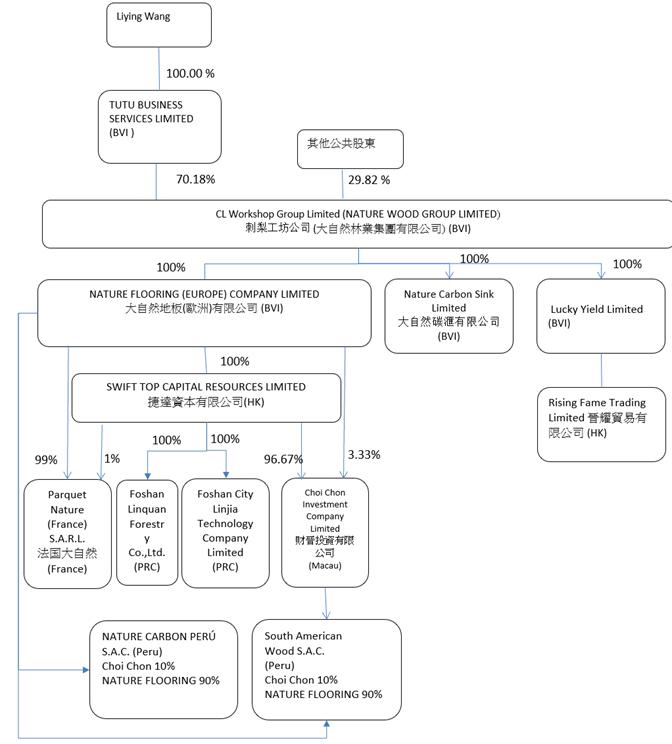
| ● | “Operating Subsidiaries” are to Swift Top Capital Resources Limited, Parquet Nature (France) S.A.R.L., Choi Chon Investment Company Limited, South American Wood S.A.C., Nature Carbon Sink Limited, Nature Carbon Peru S.A.C., Foshan City Linjia Technology Company Limited and Foshan Linquan Forestry Co., Ltd., each a subsidiary of our Company; | |
| ● | “Ordinary Shares” are to the ordinary shares of our Company, par value of $0.001 per share; | |
| ● | “Our Board” are to the board of Directors; | |
| ● | “our Company” are to CL Workshop Group Limited, the holding company incorporated in the BVI; | |
| ● | “our Forests” are to parcels of land in Peru with an aggregate area of approximately 615,333 hectares, of which our Group owned the natural forest concessions and cutting rights for the exploitation of timber, as at December 31, 2025; | |
| ● | “our Group”, “the Group”, “we”, “us” and “our” are to our Company and its subsidiaries; where the discussions in the context relate to business operations and/or financial performance, then the terms “Company”, “we”, “us”, “our”, “our Company”, “our Group”, “the Group” and “our business” refer to the business operations and/or financial performance of the Operating Subsidiaries; | |
| ● | “our Director(s)” are to the director(s) of our Company; | |
| ● | “PEFC” are to Programme for the Endorsement of Forest Certification; | |
| ● | “PRC” or “China” are to the People’s Republic of China, excluding Hong Kong, Macau and Taiwan for the purposes of this report only; | |
| ● | “RMB” or “Renminbi” are to the legal currency of China; | |
| ● | “sawn timber” are to square timber and commercial materials; | |
| ● | “$”, “USD”, “US$” or “U.S. dollars” are to the legal currency of the United States; | |
| ● | “HKD” or “HK$” are to the legal currency of Hong Kong; | |
| ● | “EUR” are to the legal currency of the European Union; | |
| ● | “MOP” are to the legal currency of Macau; | |
| ● | “SOL” or “S/” are to the legal currency of Peru. |
| ii |
Our Company is a holding company incorporated in the BVI. As a holding company with no material operations of our own, we conduct our operations mainly in Peru, France, Hong Kong and Macau, through our subsidiaries (collectively, the “Operating Subsidiaries”). See Part I – Item 4 on the information of our Operating Subsidiaries.
As our Company is a holding company incorporated in the BVI and not a Chinese operating company, our operations in Hong Kong, Macau and China are conducted by our subsidiaries based in Hong Kong, Macau and China. Investors in our Company hold interests in the BVI holding company and do not directly hold equity interests in the Operating Subsidiaries. This structure involves unique risks to investors. See Part I – Item 3 for a discussion of risks facing the Company as a result of this structure. We may be subject to unique risks due to uncertainty of the interpretation and the application of the PRC laws and regulations, including but not limited to the cybersecurity review and regulatory review of overseas listing of our ADSs through an offshore holding company. We are also subject to the risks of uncertainty about any future actions of the Chinese government or authorities in Hong Kong and Macau in this regard.
Should the Chinese government choose to exercise significant oversight and discretion over the conduct of our business, they may intervene in or influence our operations. Such governmental actions:
| ● | could affect our operations; | |
| ● | could significantly limit or completely hinder our ability to continue our operations; | |
| ● | could hinder our ability to continue to offer securities to investors; and | |
| ● | may cause the value of our ADSs to significantly decline or be worthless. |
The PRC legal system is based on written statutes and their legal interpretations by the Standing Committee of the National People’s Congress. Previous court decisions may be cited for reference but have limited precedential value. Since 1979, the PRC government has been developing a comprehensive system of commercial laws, and considerable progress has been made in introducing laws and regulations dealing with economic matters such as foreign investment, corporate organization and governance, commerce, taxation and trade.
The PRC legal system is constantly evolving and may change quickly with little advance notice, and the PRC government may promulgate new laws and regulations in the future that may cover operations in Hong Kong. If we are deemed not to comply with these requirements, we may be subject to fines and other administrative penalties imposed by relevant PRC authorities. Any change in foreign investment regulations, and other laws, regulations and policies in China or any punishment imposed or actions taken by the PRC government for our violation of such regulations or policies could result in a material change in our operations and/or the value of the securities we registered for sale and could significantly limit or completely hinder our ability to offer or continue to offer our securities to investors or cause the value of our ADSs to significantly decline or be worthless.
Any failure to respond to changes in the regulatory environment in China could materially and adversely affect our business and impede our ability to continue our operations.
In addition, our ADSs may be prohibited from trading on a national exchange or over-the-counter under the Holding Foreign Companies Accountable Act (the “HFCA Act”) (as amended by the Accelerating Holding Foreign Companies Accountable Act, which was enacted on December 29, 2022) if the Public Company Accounting Oversight Board (United States) (the “PCAOB”) is unable to inspect our auditors for two consecutive years. Our auditor has been inspected by the PCAOB on a regular basis, and our auditor is not subject to the determinations announced by the PCAOB on December 16, 2021, which determinations were vacated on December 15, 2022. If trading in our ADSs is prohibited under the HFCA Act in the future because the PCAOB determines that it cannot inspect or fully investigate our auditor at such future time, Nasdaq may determine to delist our ADSs and trading in our ADSs could be prohibited. On August 26, 2022, the PCAOB signed SOP Agreements with the China Securities Regulatory Commission and China’s Ministry of Finance. The SOP Agreements established a specific, accountable framework to make possible complete inspections and investigations by the PCAOB of audit firms based in mainland China and Hong Kong, as required under U.S. law. On December 15, 2022, the PCAOB announced that it was able to secure complete access to inspect and investigate PCAOB-registered public accounting firms headquartered in mainland China and Hong Kong completely in 2022. The PCAOB vacated its previous 2021 determinations that the PCAOB was unable to inspect or investigate completely registered public accounting firms headquartered in mainland China and Hong Kong. However, whether the PCAOB will continue to be able to satisfactorily conduct inspections of PCAOB-registered public accounting firms headquartered in mainland China and Hong Kong is subject to uncertainty and depends on a number of factors out of our, and our auditor’s, control.
| iii |
SPECIAL NOTE REGARDING FORWARD-LOOKING STATEMENTS
This annual report on Form 20-F contains forward-looking statements that involve risks and uncertainties, including statements based on our current expectations, assumptions, estimates and projections about us and our industry. These forward-looking statements are made under the “safe harbor” provision under Section 21E of the Securities Exchange Act of 1934, as amended, or the Exchange Act, and as defined in the Private Securities Litigation Reform Act of 1995. These statements involve known and unknown risks, uncertainties and other factors that may cause our actual results, performance or achievements to be materially different from those expressed or implied by the forward-looking statements. In some cases, these forward-looking statements can be identified by words or phrases such as “may”, “will”, “expect”, “anticipate”, “aim”, “estimate”, “intend”, “plan”, “believe”, “potential”, “continue”, “is/are likely to” or other similar expressions. The forward-looking statements included in this annual report relate to, among others:
| ● | timing of the development of future business; | |
| ● | capabilities of our business operations; | |
| ● | expected future economic performance; | |
| ● | competition in our market; | |
| ● | continued market acceptance of our services and products; | |
| ● | changes in the laws that affect our operations; | |
| ● | inflation and fluctuations in foreign currency exchange rates; | |
| ● | our ability to obtain and maintain all necessary government certifications, approvals, and/or licenses to conduct our business; | |
| ● | continued development of a public trading market for our securities; | |
| ● | the cost of complying with current and future governmental regulations and the impact of any changes in the regulations on our operations; | |
| ● | managing our growth effectively; | |
| ● | projections of revenue, earnings, capital structure and other financial items; | |
| ● | fluctuations in operating results; | |
| ● | health crisis, including due to pandemics such as the COVID-19 pandemic and government measures taken in response thereto; and | |
| ● | war, armed conflicts, or geopolitical tensions and the resulting impact on our operations and markets. |
You should read these statements in conjunction with the risks disclosed in “Item 3. Key Information—3.D. Risk Factors” of this annual report and other risks outlined in our other filings with the Securities and Exchange Commission, or the SEC. Moreover, we operate in an evolving environment. New risks may emerge from time to time, and it is not possible for our management to predict all risks, nor can we assess the impact of such risks on our business or the extent to which any risk, or combination of risks, may cause actual results to differ materially from those contained in any forward-looking statements. The forward-looking statements made in this annual report relate only to events or information as of the date on which the statements are made in this annual report. Except as required by law, we undertake no obligation to update any forward-looking statements to reflect events or circumstances after the date on which the statements are made or to reflect the occurrence of unanticipated events. You should read this annual report and the documents that we have referred to in this annual report, completely and with the understanding that our actual future results may be materially different from what we expect.
| iv |
PART I.
| ITEM 1. | IDENTITY OF DIRECTORS, SENIOR MANAGEMENT AND ADVISERS |
Not Applicable.
| ITEM 2. | OFFER STATISTICS AND EXPECTED TIMETABLE |
Not Applicable.
| ITEM 3. | KEY INFORMATION |
3.A. [Reserved]
3.B. Capitalization and Indebtedness
Not Applicable.
3.C. Reasons for the Offer and Use of Proceeds
The information required by Item 3.C. is included in Item 14 below.
3.D. Risk Factors
You should carefully consider each of the following risks and all the other information contained in this 2025 20-F Report in evaluating us and our common stock. Although the risks are organized by headings, and each risk is discussed separately, many are interrelated. Our business, financial condition, results of operations and cash flows could be materially and adversely affected by these risks, and, as a result, the trading price of our common stock could decline. We have in the past been adversely affected by certain of, and may in the future be affected by, these risks. You should not interpret the disclosure of any risk factor to imply that the risk has not already materialized.
Risks Related to Our Business and Industry
Our revenues are sensitive to fluctuations of log price and selling price of our products in the forestry industry.
Historically, prices for logs have been volatile and are affected by numerous factors that are not under control, including demand for wood and wood products, supply from illegal logging, changes in currency exchange rates, economic growth rates, foreign and domestic interest rates, trade policies, and prevailing fuel and transportation costs.
In addition, industry-wide increases in the supply of logs during a favorable price period can also lead to downward pressure on prices through oversupply. Increased production by us and our competitors could lead to oversupply and lower prices. Oversupply and lower prices may also result from illegal logging activity or decreased government enforcement of logging restrictions. Our revenues and profits are extremely sensitive to changes in log prices and selling prices of our products. Slight changes in log prices and selling prices of our products may cause a disproportionally large change in our revenues and our results of operation. If market prices for logs or our products were to decline, it could have a material adverse effect on our business, financial condition and results of operation.
Our financial statements for the year ended December 31, 2025 contain an explanatory paragraph regarding substantial doubt about our ability to continue as a going concern.
Our financial statements for the year ended December 31, 2025 contain an explanatory paragraph regarding substantial doubt about our ability to continue as a going concern. This going concern assessment may prevent us from obtaining new financing on reasonable terms, if at all, and imperil our ability to continue operating as a going concern.
We depend on certain major customers.
For each of the years ended December 31, 2025, 2024 and 2023, we had a total of 55, 64 and 62 customers respectively, which had purchased our wood products. Our five largest customers during the respective periods accounted for approximately 71.4%, 67.1% and 71.2% of our total turnover respectively; whilst our largest customer accounted for approximately 37.7%, 22.9% and 40.7% of our total turnover respectively.
Our inability to obtain certificates from the FSC could reduce our future revenues.
We cannot assure you that we will be able to retain or renew our existing FSC certificates or obtain new certificates. If we are unable to renew or retain certificates, our business, results of operations and financial condition will be materially and adversely affected.
| 1 |
The current global market fluctuations and economic downturn could materially and adversely affect our business, financial condition and results of operations.
The global capital and credit markets have been experiencing extreme volatility and disruption in recent times. Concerns over inflation or deflation, energy costs, geopolitical issues, and the availability and cost of credit have contributed to unprecedented levels of market volatility and diminished expectations for the global economy and the capital and consumer markets in the future. These factors, combined with volatile oil prices, declining business activities and consumer confidence and increased unemployment, have precipitated an economic slowdown and a possible prolonged global recession. These events have led to a slowdown in the global economy which a number of economists predict could be significant and protracted. As a result, the demand for our wood products may significantly decrease, thereby materially and adversely affecting our business, financial condition and results of operations.
Social conflicts may disrupt our operations.
Despite Peru’s ongoing economic growth and stabilization, high levels of poverty and unemployment and social and political tensions continue to be pervasive problems in the country. Peru has, from time to time, experienced social and political turmoil, including riots, nationwide protests, strikes and street demonstrations. In the past, Peru has experienced periods of political instability that has included a succession of regimes with differing economic policies and programs. Since December 2022, Peru has experienced unrelenting political turmoil. Part of our operations are conducted in Peru and depend on economic and political developments in the country. As a result, any social conflicts may disrupt our business operations, which could have a material adverse effect on our business and financial performance.
Security, political and economic instability in the Middle East may harm our business.
The escalating conflicts between Israel and its neighboring countries and Islamist militia and political groups since late 2023, particularly the Israel-Gaza Strip and attacks targeting vessels in the southern Red Sea, has introduced geopolitical tensions and security risks within the Middle East region. Such instability may affect the global markets and potentially cause disruptions to the international trade and financial systems. As such, the conflicts and heightened tensions in the Middle East could have an indirect, adverse impact on our business and financial condition and results of operations.
We are subject to risks related to U.S. tariffs imposed on imports.
We are subject to risks related to U.S. tariffs imposed on imports. Since March 2025, the United States government has imposed tariffs on various imports to strengthen its domestic production. In particular, the U.S. imposed duty on imports of wood products as of March 25, 2025. For the years ended December 31, 2025 and 2024, 2.2% and 3.2% of our total revenue were generated from customers located in North America. These tariffs may lead to increase in costs for our wood products, compressing our profit margins and causing potential disruptions in our supply chain that could hinder production. Market volatility and fluctuations in consumer demand may adversely affect our sales, coupled with the complexities of regulatory compliance. Furthermore, retaliatory actions from Peru, France and China could restrict our export opportunities, creating challenges for our long-term strategic planning. As such, the imposition of U.S tariffs on imports could materially impact our financial performance and operational stability.
We face competition from other companies in the forestry industry.
We face many local and overseas competitors who also supply wood products to the market. Our primary competitors operate either domestically or within the Asia Pacific region. In particular, we face competition from a host of small logging firms, some of which may not comply with environmental and other industry standards to the same extent as we do, resulting in their potentially lower operating costs.
Competition in our industry is influenced by factors including the costs of new forest acquisitions, regulatory compliance, and forest insurance. Some of our competitors may have lower costs than we do, or, if their operations are located in less developed countries, may be subject to less stringent environmental and other governmental regulations than we are, because of different or regional laws and business practices. If we are unable to compete effectively, or if competition increases in the future, our revenues could decline, and there may be material adverse effects on our business, financial condition, results of operations and cash flows.
| 2 |
The forestry industry faces competition from solid wood substitutes.
In addition to competition within the forestry industry, the forest industry faces competition from solid wood substitutes. We face competition from companies that manufacture wood substitutes, such as imitation wood, fiber-cement wood, ceramic tile and other materials that are used as alternative materials mainly in construction and furniture production. The demand for wood products is also affected by changes in consumer trends and tastes. Preference for wood substitutes among manufacturers, construction companies and consumers could decrease demand for our products and have a material adverse effect on our revenue, financial condition and results of operations.
We are subject to certain risks relating to the delivery of our products.
We often rely on third-party logistics service providers for the delivery of our wood products to customers. Such delivery services could be suspended and thus interrupt the supply of our wood products if unforeseen events occur which are beyond our control, such as transportation bottlenecks, natural disasters, disease outbreaks or labor strikes. Any failure of this personnel to provide high-quality or timely delivery to our customers may negatively impact the purchase experience of our customers, damage our reputation and cause us to lose customers. Any negative publicity or poor feedback regarding our customer service overall may harm our brand and reputation and in turn cause us to lose customers and market share.
Disruption to the supply of raw materials or increase in raw material prices could materially and adversely affect our Group’s business, financial condition and results of operations.
The major raw materials used to produce our wood products are logs and wooden materials. However, our Group has not entered into any long-term supply contracts with our suppliers. In the event that the ban on commercial logging is imposed by the French government or the places where our suppliers are located or natural disasters, the supply of timber for the production of our wood products and the hosting of timber auctions may be affected. It is therefore possible that our Group will not be able to purchase sufficient raw materials from our suppliers, in a timely manner and on commercially acceptable terms, or at all.
In addition, if we are unable to acquire raw materials from our existing suppliers for any reason, we cannot assure that our Group will be able to source the raw materials from alternative sources within a reasonable period of time, and at acceptable prices or at all. Our Group cannot assure that such shortages will not occur in the future. Any failure to obtain adequate supplies of raw materials on a timely basis may disrupt our Group’s operation, and may have a material adverse effect on the business, financial condition and results of operations of our Group.
Our networks and those of our third-party service providers may be vulnerable to cybersecurity risks.
Our network and those of our third-party service providers and our customers may be vulnerable to unauthorized access, computer attacks, viruses and other security problems. Persons who circumvent security measures could wrongfully access and obtain or use information on our network or cause service interruptions, delays or malfunctions in our devices, services or operations, any of which could harm our reputation, cause demand for our products and services to fall, and compromise our ability to pursue our business plans. Recently, there have been reported several significant, widespread security attacks and breaches that have compromised network integrity for many companies and governmental agencies, in some cases reportedly originating from outside the United States. In addition, there are reportedly private products available in the market today that may attempt to unlawfully intercept communications made using our network. We may be required to expend significant resources to respond to, contain, remediate, and protect against these attacks and threats, including compliance with applicable data breach and security laws and regulations, and to alleviate problems, including reputational harm and litigation, caused by these security incidents. Although we have implemented and intend to continue to implement security measures, these measures may prove to be inadequate. These security incidents could have a significant effect on our systems, devices and services, including system failures and delays that could limit network availability, which could harm our business and our reputation and result in substantial liability.
| 3 |
Risks Related to Doing Business in China
Due to the long arm provisions under the current PRC laws and regulations, if the Chinese government exercises any significant oversight and discretion over the conduct of our business and intervenes in or influences our operations, our operations and/or the value of our ADSs could be affected. The policies, regulations, rules, and the enforcement of laws of the Chinese government may also be changed or amended with little advance notice and our assertions and beliefs of the risk imposed by the PRC legal and regulatory system could be uncertain.
Our Company is a holding company and we conduct our operations through our Operating Subsidiaries in Peru, France, Hong Kong, Macau and China. As at the date of this report, we are not materially affected by recent statements by the Chinese Government indicating an extent to exert more oversight and control over offerings that are conducted overseas and/or foreign investment in China-based issuers. However, due to long arm provisions under the current PRC laws and regulations, there remains regulatory uncertainty with respect to the implementation and interpretation of laws in China. The PRC government may choose to exercise significant oversight and discretion, and the policies, regulations, rules, and enforcement of laws of the Chinese government to which we are subject may change from time to time. As a result, the application, interpretation, and enforcement of new and existing laws and regulations in the PRC and our assertions and beliefs of the risk imposed by the PRC legal and regulatory system could also be uncertain. In addition, these laws and regulations may be interpreted and applied inconsistently by different agencies or authorities, and inconsistently with current policies and practices. New laws, regulations, and other government directives in the PRC may also be costly to comply with, and such compliance or any associated inquiries or investigations or any other government actions may:
| ● | delay or impede our development; | |
| ● | result in negative publicity or increase our operating costs; | |
| ● | require significant management time and attention; and | |
| ● | subject us to remedies, administrative penalties and even criminal liabilities that may harm our business, including fines assessed for our current or historical operations, or demands or orders that we modify or even cease our business practices. |
We are aware that since 2021, the PRC government has initiated a series of regulatory actions and statements to regulate business operations in certain areas in China, including cracking down on illegal activities in the securities market, enhancing supervision over China-based companies listed overseas using variable interest entity structure, adopting new measures to extend the scope of cybersecurity reviews, and expanding the efforts in anti-monopoly enforcement. Since these statements and regulatory actions are new, it is highly uncertain how soon legislative or administrative regulation-making bodies will respond and what existing or new laws or regulations or detailed implementations and interpretations will be modified or promulgated, if any, and the potential impact such modified or new laws and regulations will have on our daily business operation, the ability to accept foreign investments and list on a U.S. or other foreign exchange.
The Chinese government may intervene or influence our operations at any time or may exert more control over offerings conducted overseas and foreign investment in China-based issuers, which may affect our operations and/or the value of our ADSs. The promulgation of new laws or regulations, or the new interpretation of existing laws and regulations, in each case that restricts or otherwise unfavorably impacts the ability or way we conduct our business and could require us to change certain aspects of our business to ensure compliance, which could decrease demand for our services, reduce revenues, increase costs, require us to obtain more licenses, permits, approvals or certificates, or subject us to additional liabilities. To the extent any new or more stringent measures are required to be implemented, our business, financial condition and results of operations could be adversely affected as well as materially decrease the value of our ADSs, potentially rendering them worthless.
| 4 |
If the Chinese government chooses to exert more oversight and control over offerings that are conducted overseas and/or foreign investment in China-based issuers, such action may significantly limit or completely hinder our ability to offer or continue to offer ADSs to investors and cause the value of our ADSs to significantly decline or be worthless.
Some statements by the Chinese government have indicated an intent to exert more oversight and control over offerings that are conducted overseas and/or foreign investments in China-based issuers. On July 6, 2021, the General Office of the Communist Party of China Central Committee and the General Office of the State Council jointly issued a document to crack down on illegal activities in the securities market and promote the high-quality development of the capital market, which, among other things, requires the relevant governmental authorities to strengthen cross-border oversight of law-enforcement and judicial cooperation, to enhance supervision over China-based companies listed overseas, and to establish and improve the system of extraterritorial application of the PRC securities laws. On December 24, 2021, the CSRC published the drafts of the Provisions of the State Council on the Administration of Overseas Securities Offering and Listing by Domestic Companies, and the Administrative Measures for the Filing of Overseas Securities Offering and Listing by Domestic Companies for public comment. On February 17, 2023, the CSRC published the formal Overseas Listing Measures to regulate overseas securities offering and listing activities by domestic companies.
Furthermore, on December 28, 2021, the CAC, the National Development and Reform Commission (“NDRC”), and several other administrations jointly issued the revised Measures for Cybersecurity Review, or the “Revised Review Measures”, which became effective on February 15, 2022 and replaced the existing Measures for Cybersecurity Review. According to the Revised Review Measures, if an “online platform operator” that is in possession of the personal data of more than one million users intends to list in a foreign country, it must apply for a cybersecurity review. Moreover, the CAC released the draft of the Regulations on Network Data Security Management in November 2021 for public consultation, which among other things, stipulates that a data processor listed overseas must conduct an annual data security review by itself or by engaging a data security service provider and submit the annual data security review report for a given year to the municipal cybersecurity department before January 31 of the following year. On July 7, 2022, the CAC released the Measures for the Security Assessment of Cross-Border Data, which becomes effective on September 1, 2022. According to the Measures for the Security Assessment of Cross-Border Data, where a data processor provides data abroad under any of the following circumstances, it shall apply for exit security assessment of data to the national cyberspace administration through the local provincial cyberspace administration: (1) the data processor provides important data abroad; (2) the operators of key information infrastructure and data processors that process the personal information of more than 1 million people provide personal information abroad; (3) data processors who have provided 100,000 personal information or 10,000 sensitive personal information abroad in aggregate since January 1 of last year provide personal information abroad; and (4) other situations required for security assessment as stipulated by the state cyberspace administration. Given the recency of the issuance of the Measures for the Security Assessment of Cross-Border Data, no guidance on the interpretation or implementation of such Measures has been published.
We sell a range of logs and flooring primarily in Hong Kong and Macau respectively. Our subsidiaries in Hong Kong and Macau have not collected or stored any data (including certain personal information) from PRC individuals. As a result, the likelihood of us being subject to the review of the CAC is remote.
In the event that we rely on dividends and other distributions on equity paid by our PRC or Hong Kong subsidiaries to fund any cash and financing requirements, we may have, any limitation on the ability of our PRC or Hong Kong subsidiaries to make payments to us could have a material and adverse effect on our ability to conduct our business.
In general, our PRC subsidiary’s ability to distribute dividends is based upon their distributable earnings. Current PRC regulations permit our PRC subsidiary to pay dividends to its shareholders only out of its accumulated profits, if any, determined in accordance with PRC accounting standards and regulations. In addition, our PRC subsidiary, as a Foreign Invested Enterprise, or FIE, is required to draw 10% of its after-tax profits each year, if any, to fund a common reserve, which may stop drawing its after-tax profits if the aggregate balance of the common reserve has already accounted for over 50 percent of its registered capital. These reserves are not distributable as cash dividends. If our PRC subsidiary incurs debt on its own in the future, the instruments governing the debt may restrict its ability to pay dividends or make other payments to us. Any limitation on the ability of our PRC subsidiary to distribute dividends or other payments to its shareholders could materially and adversely limit our ability to grow, make investments or acquisitions that could be beneficial to our business, pay dividends or otherwise fund and conduct our business.
The Enterprise Income Tax Law and its implementation rules provide that a withholding tax rate of up to 10% will be applicable to dividends payable by Chinese companies to non-PRC-resident enterprises unless otherwise exempted or reduced according to treaties or arrangements between the PRC central government and governments of other countries or regions where the non-PRC resident enterprises are incorporated.
| 5 |
Under Hong Kong law, dividends could only be paid out of distributable profits (that is, accumulated realized profits less accumulated realized losses) or other distributable reserves. Dividends cannot be paid out of share capital. Under the current practice of the Inland Revenue Department of Hong Kong, no tax is payable in Hong Kong in respect of dividends paid by us.
Any limitation on the ability of our PRC or Hong Kong subsidiaries to pay dividends or make other distributions to us could materially and adversely limit our ability to grow, make investments or acquisitions that could be beneficial to our business, pay dividends, or otherwise fund and conduct our business.
To the extent cash or assets in our business is in the PRC or in our PRC subsidiaries, the funds or assets may not be available to fund operations or for other use outside of the PRC due to interventions in or the imposition of restrictions and limitations on our ability or the ability of our subsidiaries by the PRC government to transfer cash or assets.
We may in the future depend on dividends and other distributions on equity paid by our PRC subsidiaries or depend on our assets located in China for our cash and financing requirements. The PRC government imposes controls on the convertibility of the Renminbi into foreign currencies and, in certain cases, the remittance of currency out of China. Shortages in the availability of foreign currency may then restrict the ability of our PRC subsidiary to remit sufficient foreign currency to our offshore entities for our offshore entities to pay dividends or make other payments or otherwise to satisfy our foreign-currency-denominated obligations. Therefore, to the extent cash or assets in our business is in the PRC or in our PRC subsidiaries, the funds or assets may not be available to fund operations or for other use outside of the PRC due to interventions in or the imposition of restrictions and limitations on our ability or the ability of our subsidiaries by the PRC government to transfer cash or assets.
The PRC government may continue to strengthen its capital controls, and more restrictions and substantial vetting processes may be put forward by the State Administration of Foreign Exchange of the PRC for cross-border transactions. Any limitation on the ability of our PRC subsidiaries to pay dividends or make other kinds of payments to us could materially and adversely limit our ability to grow, make investments or acquisitions that could be beneficial to our business, pay dividends or otherwise fund and conduct our business.
Although the audit report included in this report is prepared by U.S. auditors who are currently inspected by the PCAOB, there is no guarantee that future audit reports will be prepared by auditors inspected by the PCAOB and, as such, in the future investors may be deprived of the benefits of such inspection. Furthermore, trading in our ADSs may be prohibited under the HFCA Act if the SEC subsequently determines our audit work is performed by auditors that the PCAOB is unable to inspect or investigate completely, and as a result, U.S. national securities exchanges, such as the Nasdaq, may determine to delist our securities. Furthermore, on December 29, 2022, the Accelerating Holding Foreign Companies Accountable Act was enacted, which amended the HFCA Act and requires the SEC to prohibit an issuer’s securities from trading on any U.S. stock exchanges if its auditor is not subject to PCAOB inspections for two consecutive years instead of three, and thus reducing the time before our ADSs may be prohibited from trading or delisted.
As an auditor of companies that are registered with the SEC and publicly traded in the United States and a firm registered with the PCAOB, our auditor is required under the laws of the United States to undergo regular inspections by the PCAOB to assess their compliance with the laws of the United States and professional standards. The PCAOB is currently unable to conduct inspections without the approval of the Chinese government authorities. Inspections of other auditors conducted by the PCAOB outside mainland China have at times identified deficiencies in those auditors’ audit procedures and quality control procedures, which may be addressed as part of the inspection process to improve future audit quality. The lack of PCAOB inspections of audit work undertaken in mainland China prevents the PCAOB from regularly evaluating auditors’ audits and their quality control procedures. As a result, if there is any component of our auditor’s work papers become located in mainland China in the future, such work papers will not be subject to inspection by the PCAOB. As a result, investors would be deprived of such PCAOB inspections, which could result in limitations or restrictions on our access to the U.S. capital markets.
On May 20, 2020, the U.S. Senate passed the HFCA Act, which includes requirements for the SEC to identify issuers whose audit work is performed by auditors that the PCAOB is unable to inspect or investigate completely because of a restriction imposed by a non-U.S. authority in the auditor’s local jurisdiction. The U.S. House of Representatives passed the HFCA Act on December 2, 2020, and the HFCA Act was signed into law on December 18, 2020. Additionally, in July 2020, the U.S. President’s Working Group on Financial Markets issued recommendations for actions that can be taken by the executive branch, the SEC, the PCAOB or other federal agencies and departments with respect to Chinese companies listed on U.S. stock exchanges and their audit firms, in an effort to protect investors in the United States. In response, on November 23, 2020, the SEC issued guidance highlighting certain risks (and their implications to U.S. investors) associated with investments in China-based issuers and summarizing enhanced disclosures the SEC recommends China-based issuers make regarding such risks.
| 6 |
On March 24, 2021, the SEC adopted interim final rules relating to the implementation of certain disclosure and documentation requirements in the HFCA Act. On December 2, 2021, the SEC adopted amendments to finalize rules implementing the submission and disclosure requirements in the HFCA Act. The rules apply to registrants that the SEC identifies as having filed an annual report with an audit report issued by a registered public accounting firm that is located in a foreign jurisdiction and that PCAOB is unable to inspect or investigate. We will be required to comply with these rules if the SEC identifies us as having a “non-inspection” year under a process to be subsequently established by the SEC. The final amendments require any identified registrant to submit documentation to the SEC establishing that the registrant is not owned or controlled by a government entity in the public accounting firm’s foreign jurisdiction, and also require, among other things, disclosure in the registrant’s annual report regarding the audit arrangements of, and government influence on, such registrants. Under the HFCA Act (as amended by the Accelerating Holding Foreign Companies Accountable Act, which was enacted on December 29, 2022), our securities may be prohibited from trading on the Nasdaq or other U.S. stock exchanges if our auditor is not inspected by the PCAOB for two consecutive years, and this ultimately could result in our ADSs being delisted.
On June 22, 2021, the U.S. Senate passed the Accelerating Holding Foreign Companies Accountable Act, which, if enacted, would amend the HFCA Act and require the SEC to prohibit an issuer’s securities from trading on any U.S. stock exchanges if its auditor is not subject to PCAOB inspections for two consecutive years instead of three, and thus, would reduce the time before our ADSs may be prohibited from trading or delisted.
On September 22, 2021, the PCAOB adopted a final rule implementing the HFCA Act, which provides a framework for the PCAOB to use when determining, as contemplated under the HFCA Act, whether the Board is unable to inspect or investigate completely registered public accounting firms located in a foreign jurisdiction because of a position taken by one or more authorities in that jurisdiction.
On November 5, 2021, the SEC approved the PCAOB’s Rule 6100, Board Determinations Under the Holding Foreign Companies Accountable Act. Rule 6100 provides a framework for the PCAOB to use when determining, as contemplated under the HFCA Act, whether it is unable to inspect or investigate completely registered public accounting firms located in a foreign jurisdiction because of a position taken by one or more authorities in that jurisdiction.
On December 16, 2021, the PCAOB issued a report on its determinations that it was unable to inspect or investigate completely PCAOB-registered public accounting firms headquartered in Mainland China and in Hong Kong, because of positions taken by PRC authorities in those jurisdictions, which determinations were vacated on December 15, 2022. The PCAOB made its determinations pursuant to PCAOB Rule 6100, which provides a framework for how the PCAOB fulfills its responsibilities under the HFCA Act, which determinations were vacated on December 15, 2022. The report further listed in its Appendix A and Appendix B, the Registered Public Accounting Firms Subject to the Mainland China Determination and Registered Public Accounting Firms Subject to the Hong Kong Determination, respectively, which determinations were vacated on December 15, 2022. Our auditor, WWC, P.C. is headquartered in the United States, and did not appear as part of the report under the lists in its Appendix A or Appendix B.
On August 26, 2022, the PCAOB signed SOP Agreements with the China Securities Regulatory Commission (the “CSRC”) and China’s Ministry of Finance. The SOP Agreements established a specific, accountable framework to make possible complete inspections and investigations by the PCAOB of audit firms based in mainland China and Hong Kong, as required under U.S. law. On December 15, 2022, the PCAOB announced that it was able to secure complete access to inspect and investigate PCAOB-registered public accounting firms headquartered in mainland China and Hong Kong completely in 2022. The PCAOB vacated its previous 2021 determinations that the PCAOB was unable to inspect or investigate completely registered public accounting firms headquartered in mainland China and Hong Kong. However, whether the PCAOB will continue to be able to satisfactorily conduct inspections of PCAOB-registered public accounting firms headquartered in mainland China and Hong Kong is subject to uncertainty and depends on a number of factors out of our, and our auditor’s control. However, if the PCAOB continues to be prohibited from conducting complete inspections and investigations of PCAOB-registered public accounting firms in mainland China and Hong Kong, the PCAOB is likely to determine by the end of 2023 that positions taken by authorities in the PRC obstructed its ability to inspect and investigate registered public accounting firms in mainland China and Hong Kong completely, then the companies audited by those registered public accounting firms would be subject to a trading prohibition on U.S. markets pursuant to the HFCA Act.
The SEC is assessing how to implement other requirements of the HFCA Act, including the listing and trading prohibition requirements described above. Future developments in respect of increasing U.S. regulatory access to audit information are uncertain, as the legislative developments are subject to the legislative process and the regulatory developments are subject to the rule-making process and other administrative procedures.
| 7 |
While we understand that there has been dialogue among the CSRC, the SEC and the PCAOB regarding the inspection of PCAOB-registered accounting firms in mainland China, there can be no assurance that we will be able to comply with requirements imposed by U.S. regulators if there is a significant change to current political arrangements between mainland China, Macau and Hong Kong, or if any component of our auditor’s work papers become located in mainland China in the future. Delisting of our ADSs would force holders of our ADSs to sell their ADSs. The market price of our ADSs could be adversely affected as a result of anticipated negative impacts of these executive or legislative actions, regardless of whether these executive or legislative actions are implemented and regardless of our actual operating performance.
If we fail to comply with work safety or environmental regulations, we could be exposed to penalties, fines, suspensions or action in other forms.
Our operations are subject to the work safety, fire safety and environmental protection laws and regulations promulgated by the PRC government. These laws and regulations require us to maintain safe working conditions and adopt effective measures to control and properly dispose of solid waste and other environmental pollutants. We could be exposed to penalties, fines, suspensions or actions in other forms if we fail to comply with these laws and regulations. The laws and regulations in China may be amended from time to time and changes in those laws and regulations may cause us to incur additional costs in order to comply with the more stringent rules. In the event that changes to existing laws and regulations require us to incur additional compliance costs or require costly changes to our production process, our costs could increase and we may suffer a decline in sales for certain products, as a result of which our business, results of operations and financial condition could be materially and adversely affected.
Increases in labor costs and enforcement of stricter labor laws and regulations in China and our additional payments of statutory employee benefits may adversely affect our business and profitability.
The average wage in China has increased in recent years and is expected to continue to grow. The average wage level for our employees has also increased in recent years. We expect that our labor costs, including wages and employee benefits, will continue to increase. Unless we are able to pass on these increased labor costs to our customers, our profitability and results of operations may be materially and adversely affected. In addition, we have been subject to stricter regulatory requirements in terms of entering into labor contracts with our employees and paying various statutory employee benefits, including pensions, housing funds, medical insurance, work related injury insurance, unemployment insurance and maternity insurance to designated government agencies for the benefit of our employees. Pursuant to the PRC Labor Contract Law and its implementation rules, employers are subject to stricter requirements in terms of signing labor contracts, paying remuneration, determining the term of employee’s probation and unilaterally terminating labor contracts. In the event that we decide to terminate some of our employees or otherwise change our employment or labor practices, the PRC Labor Contract Law and its implementation rules may limit our ability to effect those changes in a desirable or cost-effective manner, which could adversely affect our business and results of operations.
Pursuant to PRC laws and regulations, companies registered and operating in China are required to apply for social insurance registration and housing fund deposit registration within 30 days of their establishment and to pay for their employees various social insurance including pension insurance, medical insurance, work-related injury insurance, unemployment insurance and maternity insurance to the extent required by law. According to the Social Insurance Law, if an employing entity does not pay the full amount of social insurance premiums as scheduled or required, the social insurance premium collection institution shall order it to make the payment or make up the difference within the stipulated period and impose a daily fine equivalent to 0.05% of the overdue payment from the day on which the payment is overdue. If the payment is not made within the prescribed time ordered by the social insurance authority, the authority shall impose a fine ranging from one to three times of the overdue payment amount. According to the Regulations on Management of Housing Provident Funds, where an entity fails to deposit the housing provident fund in full within the prescribed deadline, it shall be ordered by the housing provident fund management center to deposit the fund within a time limit; if it still fails to deposit the fund within the time limit, the housing provident fund management center may apply to the People’s Court for enforcement. We have paid social insurance for all employees and housing provident fund for most of our employees in China. While our payment base of social insurance and housing provident fund meets the respective local government’s minimum requirements in respect of the locations of our PRC subsidiary, it is lower than the national legal standard. As of the date of this report, we have not received any notice of warning or been subject to any material administrative penalties or other material disciplinary actions from the relevant governmental authorities for our historical shortfall in social insurance and housing fund contribution. However, as the PRC government enhanced its enforcement measures relating to social insurance collection, we may be required to make up the contributions for our employees, and may be further subjected to late fees payment and administrative fines, which may adversely affect our financial condition and results of operations. As the interpretation and implementation of labor-related laws and regulations are still evolving, we cannot assure you that our current employment practices do not and will not violate other effective or future labor-related laws and regulations in China, which may subject us to labor disputes or government investigations. In addition, we may incur additional expenses in order to comply with such laws and regulations, which may adversely affect our business and profitability.
| 8 |
The enactment of the Law of the PRC on Safeguarding National Security in the Hong Kong Special Administrative Region (the “Hong Kong National Security Law”) could impact our Hong Kong subsidiaries.
On June 30, 2020, the Standing Committee of the PRC National People’s Congress adopted the Hong Kong National Security Law. This law defines the duties and government bodies of the Hong Kong National Security Law for safeguarding national security and four categories of offences — secession, subversion, terrorist activities, and collusion with a foreign country or external elements to endanger national security — and their corresponding penalties. On July 14, 2020, former U.S. President Donald Trump signed the Hong Kong Autonomy Act, or HKAA, into law, authorizing the U.S. administration to impose blocking sanctions against individuals and entities who are determined to have materially contributed to the erosion of Hong Kong’s autonomy. The spokesperson of the PRC government has issued statements that this document was grossly trampled on the international law and basic norms of international relations, seriously interfered in China’s internal affairs, and should have been repealed a long time ago. On August 7, 2020 the U.S. government imposed HKAA-authorized sanctions on eleven individuals, including HKSAR chief executive Carrie Lam. On October 14, 2020, the U.S. State Department submitted to relevant committees of Congress the report required under HKAA, identifying persons materially contributing to “the failure of the Government of China to meet its obligations under the Joint Declaration or the Basic Law.” The HKAA further authorizes secondary sanctions, including the imposition of blocking sanctions, against foreign financial institutions that knowingly conduct a significant transaction with foreign persons sanctioned under this authority. The imposition of sanctions may directly affect foreign financial institutions as well as any third parties or customers dealing with any foreign financial institution that is targeted. It is difficult to predict the full impact of the Hong Kong National Security Law and HKAA on Hong Kong and companies located in Hong Kong. Any such continued tension between the U.S. and the PRC may affect the economy of Hong Kong and in turn, materially and adversely affect our business and operation. If our subsidiaries in Hong Kong are determined to be in violation of the Hong Kong National Security Law or the HKAA by competent authorities, our business operations, financial position and results of operations could be materially and adversely affected.
A downturn in Hong Kong, China or the global economy, and the economic and political policies of China could materially and adversely affect our business and financial condition.
We conduct our operation through our Operating Subsidiaries in Europe, the U.S. and Asia, primarily in Hong Kong and China. Accordingly, our business, prospects, financial condition and results of operations may be influenced to a significant degree by political, economic and social conditions in Hong Kong and China generally and by continued economic growth in Hong Kong and China as a whole. The Chinese economy differs from the economies of most developed countries in many respects, including the amount of government involvement, level of development, growth rate, control of foreign exchange and allocation of resources. While the Chinese economy has experienced significant growth over the past decades, growth has been uneven, both geographically and among various sectors of the economy. The Chinese government has implemented various measures to encourage economic growth and guide the allocation of resources. Some of these measures may benefit the overall Chinese economy but may have a negative effect on us.
Economic conditions in Hong Kong and China are sensitive to global economic conditions. Any prolonged slowdown in the global or Chinese economy may affect potential clients’ confidence in the financial market as a whole and have a negative impact on our business, results of operations and financial condition. Additionally, continued turbulence in the international markets may adversely affect our ability to access the capital markets to meet liquidity needs.
The Hong Kong legal system embodies uncertainties which could limit the legal protections available to our Company.
Hong Kong is a Special Administrative Region of the PRC and enjoys a high degree of autonomy under the “one country, two systems” principle. The Hong Kong Special Administrative Region’s constitutional document, the Basic Law, ensures that the current political situation will remain in effect for 50 years. Hong Kong has enjoyed the freedom to function with a high degree of autonomy for its affairs, including currencies, immigration and custom, an independent judiciary system and a parliamentary system. The National People’s Congress of the PRC has the right to amend the Basic Law. We cannot assure you that there will not be any amendment to the Basic Law that may affect the judiciary and legal systems of Hong Kong and guarantee the implementation of the “one country, two systems” principle and the level of autonomy as currently in place at the moment. Any changes in the state of the political environment in Hong Kong may materially and adversely affect our business and operation. Additionally, intellectual property rights and confidentiality protections in Hong Kong may not be as effective as in the United States or other countries. These uncertainties could limit the legal protections available to us, including our ability to enforce our agreements with our clients.
| 9 |
Changes in international trade policies, trade disputes, barriers to trade, or the emergence of a trade war may dampen growth in China and other markets where the majority of our clients reside.
Political events, international trade disputes, and other business interruptions could harm or disrupt international commerce and the global economy, and could have a material adverse effect on us and our customers, service providers and other partners. International trade disputes could result in tariffs and other protectionist measures which may materially and adversely affect our business.
Tariffs could increase the cost of goods and products which could affect customers’ investment decisions. In addition, political uncertainty surrounding international trade disputes and the potential of the escalation to trade war and global recession could have a negative effect on customer confidence, which could materially and adversely affect our business. We may have also access to fewer business opportunities, and our operations may be negatively impacted as a result. In addition, the current and future actions or escalations by either the United States or China that affect trade relations may cause global economic turmoil and potentially have a negative impact on our markets, our business, or our results of operations, as well as the financial condition of our clients. and we cannot provide any assurances as to whether such actions will occur or the form that they may take.
Under the Basic Law of the Hong Kong Special Administrative Region of the People’s Republic of China, Hong Kong is exclusively in charge of its internal affairs and external relations, while the government of the PRC is responsible for its foreign affairs and defense. As a separate customs territory, Hong Kong maintains and develops relations with foreign states and regions. However, based on recent political development, the U.S. State Department has indicated that the United States no longer considers Hong Kong to have significant autonomy from China. Hong Kong’s preferential trade status was removed by the United States government and the United States may impose the same tariffs and other trade restrictions on exports from Hong Kong that it places on goods from mainland China. These and other recent actions may represent an escalation in political and trade tensions involving the U.S., China and Hong Kong, which could potentially harm our business.
Fluctuations in exchange rates could have a material and adverse effect on our results of operations and the value of your investment.
Our revenues and expenses will be denominated in Hong Kong dollars, EUR, Renminbi and U.S. dollars. Although the exchange rate between the Hong Kong dollar to the U.S. dollar has been pegged since 1983, we cannot assure you that the Hong Kong dollar will remain pegged to the U.S. dollar. Any significant fluctuations in the exchange rates between Hong Kong dollars to the U.S. dollars may have a material adverse effect on our revenue and financial condition. We have not used any forward contracts, futures, swaps or currency borrowings to hedge our exposure to foreign currency risk.
Risks Related to Our ADSs
An active trading market for the ADSs on Nasdaq might not develop or be sustained, their trading prices might fluctuate significantly and the liquidity of our ADSs would be materially affected.
We cannot assure you that an active trading market for the ADSs on Nasdaq will develop or be sustained. If an active trading market of our ADSs on Nasdaq does not develop or is not sustained, the market price and liquidity of our ADSs could be materially and adversely affected.
We incurred increased costs as a result of being a public company, and will continue to incur increased costs particularly after we cease to qualify as an “emerging growth company.”
We incurred significant legal, accounting and other expenses as a public company that we did not incur as a private company. The Sarbanes-Oxley Act of 2002, as well as rules subsequently implemented by the SEC, impose various requirements on the corporate governance practices of public companies. We are an “emerging growth company” as defined in the JOBS Act and will remain an emerging growth company until the earlier of (1) the last day of the fiscal year (a)following the fifth anniversary of the completion of this offering, (b) in which we have total annual gross revenue of at least $1.235 billion, or (c) in which we are deemed to be a large accelerated filer, which means the market value of our ADSs that are held by non-affiliates exceeds $700 million as of the last business day of our most recently completed second fiscal quarter, and (2) the date on which we have issued more than $1.0 billion in non-convertible debt during the prior three-year period. An emerging growth company may take advantage of specified reduced reporting and other requirements that are otherwise applicable generally to public companies. These provisions include exemption from the auditor attestation requirement under Section 404 in the assessment of the emerging growth company’s internal control over financial reporting and permission to delay adopting new or revised accounting standards until such time as those standards apply to private companies.
| 10 |
Compliance with these rules and regulations increases our legal and financial compliance costs and makes some corporate activities more time-consuming and costly. After we are no longer an “emerging growth company”, or until five years following the completion of our initial public offering, whichever is earlier, we expect to incur significant expenses and devote substantial management effort toward ensuring compliance with the requirements of Section 404 and the other rules and regulations of the SEC. For example, as a public company, we have been required to increase the number of independent directors and adopt policies regarding internal controls and disclosure controls and procedures. We have incurred additional costs in obtaining director and officer liability insurance. In addition, we incur additional costs associated with our public company reporting requirements. It may also be more difficult for us to find qualified persons to serve on our board of directors or as executive officers. We are currently evaluating and monitoring developments with respect to these rules and regulations, and we cannot predict or estimate with any degree of certainty the amount of additional costs we may incur or the timing of such costs.
If we fail to meet applicable listing requirements, Nasdaq may delist our ADSs from trading, in which case the liquidity and market price of our ADSs could decline.
We cannot assure you that we will be able to meet the continued listing standards of Nasdaq in the future. If we fail to comply with the applicable listing standards and Nasdaq delists our ADSs, we and our shareholders could face significant material adverse consequences, including:
| ● | a limited availability of market quotations for our ADSs; | |
| ● | reduced liquidity for our ADSs; | |
| ● | a determination that our ADSs are “penny stock”, which would require brokers trading in our ADSs to adhere to more stringent rules and possibly result in a reduced level of trading activity in the secondary trading market for our ADSs; | |
| ● | a limited amount of news about us and analyst coverage of us; and | |
| ● | a decreased ability for us to issue additional equity securities or obtain additional equity or debt financing in the future. |
The National Securities Markets Improvement Act of 1996, which is a federal statute, prevents or preempts the states from regulating the sale of certain securities, which are referred to as “covered securities.” Because we expect that our ADSs will be listed on Nasdaq, such securities will be covered securities. Although the states are preempted from regulating the sale of our securities, the federal statute does allow the states to investigate companies if there is a suspicion of fraud, and, if there is a finding of fraudulent activity, then the states can regulate or bar the sale of covered securities in a particular case. Further, if we were no longer listed on Nasdaq, our securities would not be covered securities and we would be subject to regulations in each state in which we offer our securities.
Volatility in our ADSs price may subject us to securities litigation.
The market for our ADSs may have, when compared to seasoned issuers, significant price volatility and we expect that our ADS price may continue to be more volatile than that of a seasoned issuer for the indefinite future. In the past, plaintiffs have often initiated securities class action litigation against a company following periods of volatility in the market price of its securities. We may, in the future, be the target of similar litigation. Securities litigation could result in substantial costs and liabilities and could divert management’s attention and resources.
The price and the trading volume of our ADSs may be volatile which could result in substantial losses for investors.
The price and trading volume of our ADSs may be volatile. The market price of our ADSs may fluctuate significantly and rapidly as a result of the following factors, among others, some of which are beyond our control:
| ● | fluctuations in stock market price and volume; | |
| ● | depth and liquidity of the market for our ADSs; | |
| ● | investors’ perceptions of us and our business; | |
| ● | actions by institutional shareholders; | |
| ● | changes in accounting standards, policies, guidance, interpretations and principles; |
| 11 |
| ● | additions or departures of our key personnel; | |
| ● | regulatory or legal developments, including involvement in litigation; and | |
| ● | general global economic, political and stock market conditions. |
There were instances of extreme stock price run-ups followed by rapid price declines and stock price volatility seemingly unrelated to company performance following a number of recent initial public offerings, particularly among companies with relatively smaller public floats. Such volatility, including stock run-up, may be unrelated or disproportionate to the actual or expected operating performance and financial condition or prospects of such companies, making it difficult for investors to assess the rapidly changing value of our ADSs.
In addition, if the trading volumes of our ADSs are low, persons buying or selling in relatively small quantities may easily influence prices of our ADSs. This low volume of trades could also cause the price of our ADSs to fluctuate greatly, with large percentage changes in price occurring in any trading day session. Holders of our ADSs may also not be able to readily liquidate their investment or may be forced to sell at depressed prices due to low volume trading. Broad market fluctuations and general economic and political conditions may also adversely affect the market price of our ADSs. As a result of this volatility, investors may experience losses on their investment in our ADSs. A decline in the market price of our ADSs also could adversely affect our ability to issue additional ADSs and our ability to obtain additional financing in the future. No assurance can be given that an active market in our ADSs will develop or be sustained. If an active market does not develop, holders of our ADSs may be unable to readily sell the ADSs they hold or may not be able to sell their shares at all.
We are a “controlled company” within the meaning of Nasdaq rules and we will qualify for and may rely on exemptions from certain corporate governance requirements.
We are a “controlled company” within the meaning of Nasdaq Stock Market Rules. As at the date of this report, TUTU Business Services Limited, our controlling shareholder, which is owned as to 100% by Ms. Wang Liying, our Director and Chief Executive Officer, owns 92,932,850 Class B Ordinary Shares, representing 100% of our total issued and outstanding Class B Ordinary Shares and approximately 99.16% of the total voting power of our capital stock. As a result of the dual-class share structure and the concentration of ownership, Ms. Wang Liying, through TUTU Business Services Limited, will be able to control the management and affairs of our Company and all matters requiring shareholder approval, including without limitation, the election of directors, amendment of organizational documents, and approval of major corporate transactions, such as a change in control, merger, consolidation, or sale of assets.
Under the Nasdaq rules, a company of which more than 50% of the voting power with respect to the election of directors is held by an individual, a company or a group of persons acting together is a “controlled company” and may elect not to comply with certain stock exchange rules regarding corporate governance, including the following requirements:
| – | that a majority of its board of directors consists of independent directors; | |
| – | that its director nominees be selected or recommended for the board’s selection by a majority of the board’s independent directors in a vote in which only independent directors participate or by a nominating committee comprised solely of independent directors, in either case, with a formal written charter or board resolutions, as applicable, addressing the nominations process and such related matters as may be required under the federal securities laws; and | |
| – | that its compensation committee is composed solely of independent directors with a written charter addressing the committee’s purpose and responsibilities. |
If we elect to be treated as a controlled company and use these exemptions, you may not have the same protections afforded to stockholders of companies that are subject to all of Nasdaq rules regarding corporate governance, which could make our ADSs less attractive to investors or otherwise harm our stock price.
Our disclosure controls and procedures may not prevent or detect all errors or acts of fraud.
We are subject to the periodic reporting requirements of the Exchange Act. We will design our disclosure controls and procedures to provide reasonable assurance that information we must disclose in reports we file or submit under the Exchange Act is accumulated and communicated to management, and recorded, processed, summarized and reported within the time periods specified in the rules and forms of the SEC. We believe that any disclosure controls and procedures, no matter how well-conceived and operated, can provide only reasonable, not absolute, assurance that the objectives of the control system are met.
| 12 |
These inherent limitations include the realities that judgments in decision-making can be faulty, and that breakdowns can occur because of simple errors or mistakes. Additionally, controls can be circumvented by the individual acts of some persons, by collusion of two or more people or by an unauthorized override of the controls. Accordingly, because of the inherent limitations in our control system, misstatements due to error or fraud may occur and not be detected.
We may not pay any dividends on the ADSs.
For the years ended December 31, 2025, 2024 and 2023 and up to the date of this report, we did not declare or pay any dividends. We cannot guarantee when, if, or in what form, dividends will be paid on the ADSs following the listing. A declaration of dividends must be proposed by our board of directors and will be based on, and limited by, various factors, including our business and financial performance, capital and regulatory requirements and general business conditions. Furthermore, we may not have sufficient profits to make dividend distributions to our shareholders in the future, even if our financial statements prepared in accordance with IFRS indicate that our operations have been profitable.
Securities analysts may not publish favorable research or reports about our business or may publish no information at all, which could cause our share price or trading volume to decline.
If a trading market for our ADSs develops, the trading market will be influenced to some extent by the research and reports that industry or financial analysts publish about us and our business. We do not control these analysts. As a newly public company, we may be slow to attract research coverage and the analysts who publish information about our ADSs will have had relatively little experience with us or our industry, which could affect their ability to accurately forecast our results and could make it more likely that we fail to meet their estimates. In the event we obtain securities or industry analyst coverage, if any of the analysts who cover us provide inaccurate or unfavorable research or issue an adverse opinion regarding our share price, our share price could decline. If one or more of these analysts cease coverage of us or fail to publish reports covering us regularly, we could lose visibility in the market, which in turn could cause our share price or trading volume to decline and result in the loss of all or a part of your investment in us.
Investors may have difficulty enforcing judgments against us, our Directors and management.
We are incorporated under the laws of the BVI and all of our Directors and officers reside outside the United States. Moreover, many of these persons do not have significant assets in the United States. As a result, it may be difficult or impossible to effect service of process within the United States upon these persons, or to recover against us or them on judgments of U.S. courts, including judgments predicated upon the civil liability provisions of the U.S. federal securities laws. Even if you are successful in bringing an action of this kind, the laws of the BVI could render you unable to enforce a judgment against our assets or the assets of our Directors and officers.
There is uncertainty as to whether the courts of the BVI would (i) recognize or enforce judgments of U.S. courts obtained against us or our Directors or officers predicated upon the civil liability provisions of the securities laws of the U.S. or any state in the U.S. or (ii) entertain original actions brought in the BVI against us or our Directors or officers predicated upon the securities laws of the U.S. or any state in the U.S.
The U.S. and the BVI do not have a treatment providing for reciprocal recognition and enforcement of judgments of courts of the U.S. in civil and commercial matters and that a final judgment for the payment of money rendered by any general or state court in the U.S. based on civil liability, whether or not predicated solely upon the U.S. federal securities laws would not be enforceable in the BVI. A final and conclusive judgment obtained in U.S. federal or state courts under which a sum of money is payable as compensatory damages (i.e., not being a sum claimed by a revenue authority for taxes or other charges of a similar nature by a governmental authority, or in respect of a fine or penalty or multiple or punitive damages) may be the subject of an action on a debt in the court of the BVI under the common law doctrine of obligation. Furthermore, it is uncertain that BVI courts would: (1) recognize or enforce judgments of U.S. courts obtained in actions against us or our Directors or officers predicated upon the civil liability provisions of the U.S. federal securities laws; or (2) entertain original actions brought against us or other persons predicated upon the Securities Act.
You may have more difficulty protecting your interests than you would as a shareholder of a U.S. corporation.
Our corporate affairs are governed by the provisions of our memorandum and articles of association, as amended and restated from time to time, and by the provisions of applicable BVI law. The rights of shareholders and the fiduciary responsibilities of our Directors and officers under BVI law are not as clearly established as they would be under statutes or judicial precedents in some jurisdictions in the U.S., and some states (such as Delaware) have more fully developed and judicially interpreted bodies of corporate law.
| 13 |
These rights and responsibilities are to a large extent governed by the BVI Act and the common law of the BVI. The common law of the BVI is derived in part from judicial precedent in the BVI as well as from English common law, which has persuasive, but not binding, authority on a court in the BVI. In addition, BVI law does not make a distinction between public and private companies and some of the protections and safeguards (such as statutory pre-emption rights, save to the extent expressly provided for in the memorandum and articles of association) that investors may expect to find in relation to a public company are not provided for under BVI law.
There may be less publicly available information about us than is regularly published by or about U.S. issuers. Also, the BVI regulations governing the securities of BVI companies may not be as extensive as those in effect in the U.S., and the BVI law and regulations regarding corporate governance matters may not be as protective of minority shareholders as state corporation laws in the U.S. Therefore, you may have more difficulty protecting your interests in connection with actions taken by our Directors and officers or our principal shareholders than you would as a shareholder of a corporation incorporated in the U.S.
The laws of BVI may provide less protections for minority shareholders than those under U.S. law, so minority shareholders will not have the same options for recourse in comparison to the United States if the shareholders are dissatisfied with the conduct of our affairs.
Under the laws of the BVI, there is limited statutory protection of minority shareholders other than the provisions of the BVI Act dealing with shareholder remedies. The principal protections under BVI statutory law are derivative actions, actions brought by one or more shareholders for relief from unfair prejudice, oppression and unfair discrimination and/or to enforce the BVI Act or the memorandum and articles of association. Shareholders are entitled to have the affairs of the company conducted in accordance with the BVI Act and the memorandum and articles of association, and are entitled to payment of the fair value of their respective shares upon dissenting from certain enumerated corporate transactions.
There are common law rights for the protection of shareholders that may be invoked, largely dependent on English company law since the common law of the BVI is limited. Under the general rule pursuant to English company law known as the rule in Foss v. Harbottle, a court will generally refuse to interfere with the management of a company at the insistence of a minority of its shareholders who express dissatisfaction with the conduct of the company’s affairs by the majority of the board of directors. However, every shareholder is entitled to seek to have the affairs of the company conducted properly according to the law and the constitutional documents of the company. As such, if those who control the company have persistently disregarded the requirements of company law or the provisions of the company’s memorandum and articles of association, then the courts may grant relief. Generally, the areas in which the courts will intervene are the following: (i) an act complained of which is outside the scope of the authorized business or is illegal or not capable of ratification by the majority; (ii) where the company has not complied with provisions requiring approval of a special or extraordinary majority of shareholders; (iii) acts that infringe or are about to infringe on the personal rights of the shareholders, such as the right to vote; or (iv) acts that constitute fraud on the minority where the wrongdoers control the company.
These rights may be more limited than the rights afforded to minority shareholders under the laws of states in the United States.
Other than as set forth in the BVI Act, shareholders of BVI companies like us have no general rights under BVI law to inspect corporate records or to obtain copies of lists of shareholders of these companies. Our Directors have the discretion to determine whether or not, and under what conditions, our corporate records may be inspected by our shareholders, but are not obliged to make them available to our shareholders, other than as set forth in the BVI Act. This may make it more difficult for you to obtain the information needed to establish any facts necessary for a shareholder motion or to solicit proxies from other shareholders in connection with a proxy contest.
As a result of all of the above, our public shareholders may have more difficulty in protecting their interests in the face of actions taken by our management, members of the board of directors or controlling shareholders than they would as public shareholders of a company incorporated in the United States.
| 14 |
We are a foreign private issuer and, as a result, will not be subject to U.S. proxy rules and will be subject to more lenient and less frequent Exchange Act reporting obligations than a U.S. issuer.
We report under the Exchange Act as a non-U.S. company with foreign private issuer status. Because we qualify as a foreign private issuer under the Exchange Act, we are exempt from certain provisions of the Exchange Act that are applicable to U.S. domestic public companies, including (i) the sections of the Exchange Act regulating the solicitation of proxies, consents or authorizations in respect of a security registered under the Exchange Act; (ii) the sections of the Exchange Act requiring insiders to file public reports of their stock ownership and trading activities and liability for insiders who profit from trades made in a short period of time; and (iii) the rules under the Exchange Act requiring the filing with the SEC of quarterly reports on Form 10-Q containing unaudited financial and other specified information, or current reports on Form 8-K upon the occurrence of specified significant events. In addition, our officers, directors and principal shareholders are exempt from the reporting and “short-swing” profit recovery provisions of Section 16 of the Exchange Act and the rules thereunder. Therefore, our shareholders may not know on a timely basis when our officers, directors and principal shareholders purchase or sell our shares. In addition, foreign private issuers are not required to file their annual report on Form 20-F until one hundred twenty (120) days after the end of each fiscal year, while U.S. domestic issuers that are accelerated filers are required to file their annual report on Form 10-K within seventy-five (75) days after the end of each fiscal year. Foreign private issuers also are exempt from Regulation Fair Disclosure, aimed at preventing issuers from making selective disclosures of material information. As a result of the above, you may not have the same protections afforded to shareholders of companies that are not foreign private issuers.
If we lose our status as a foreign private issuer, we would be required to comply with the Exchange Act reporting and other requirements applicable to U.S. domestic issuers, which are more detailed and extensive than the requirements for foreign private issuers. We may also be required to make changes in our corporate governance practices in accordance with various SEC and Nasdaq rules. The regulatory and compliance costs to us under U.S. securities laws if we are required to comply with the reporting requirements applicable to a U.S. domestic issuer may be significantly higher than the cost we would incur as a foreign private issuer. As a result, we expect that a loss of foreign private issuer status would increase our legal and financial compliance costs and would make some activities highly time-consuming and costly. We also expect that if we were required to comply with the rules and regulations applicable to U.S. domestic issuers, it would make it more difficult and expensive for us to obtain and maintain directors’ and officers’ liability insurance, and we may be required to accept reduced coverage or incur substantially higher costs to obtain coverage. These rules and regulations could also make it more difficult for us to attract and retain qualified members of our board of directors.
As a foreign private issuer, we are permitted to adopt certain home country practices in relation to corporate governance matters that differ significantly from Nasdaq corporate governance listing standards. These practices may afford less protection to shareholders than they would enjoy if we complied fully with corporate governance listing standards.
As a foreign private issuer, we are permitted to take advantage of certain provisions in the Nasdaq rules that allow us to follow our home country’s law for certain governance matters. Certain corporate governance practices in our home country, the BVI, may differ significantly from Nasdaq corporate governance listing standards.
Pursuant to the home country rule exemption set forth under Nasdaq Listing Rule 5615(a)(3)(A), which provides (with certain exceptions not relevant to the conclusions expressed herein) that a foreign private issuer may follow its home country practice in lieu of the requirements of the Nasdaq Marketplace Rule 5600 Series, we elected to be exempt from the requirements:
| ● | Nasdaq Marketplace Rule 5635(c) which requires a Nasdaq-listed company to obtain shareholder approval prior to the issuance of securities when a stock option or purchase plan is to be established or materially amended or other equity compensation arrangement made or materially amended, pursuant to which stock may be acquired by officers, directors, employees, or consultants, subject to certain exceptions. |
Except for the foregoing, we endeavor to comply with the Nasdaq corporate governance practices and except for the foregoing, there is no significant difference between our corporate governance practices and what the Nasdaq requires of domestic U.S. companies.
If we choose to further follow home country practices in the future, our shareholders may be afforded less protection than they would otherwise enjoy under the Nasdaq corporate governance listing standards applicable to U.S. domestic issuers.
| 15 |
There can be no assurance that we will not be a passive foreign investment company, or PFIC, for U.S. federal income tax purposes for any taxable year, which could result in adverse U.S. federal income tax consequences to U.S. holders of our ADSs.
A non-U.S. corporation will be a PFIC for any taxable year if either (i) at least 75% of its gross income for such year consists of certain types of “passive” income; or (ii) at least 50% of the value of its assets (based on an average of the quarterly values of the assets) during such year is attributable to assets that produce passive income or are held for the production of passive income, or the asset test. Based on our current and expected income and assets, we do not presently expect to be a PFIC for the current taxable year or the foreseeable future. However, no assurance can be given in this regard because the determination of whether we are or will become a PFIC is a fact-intensive inquiry made on an annual basis that depends, in part, upon the composition of our income and assets. In addition, there can be no assurance that the Internal Revenue Service, or IRS, will agree with our conclusion or that the IRS would not successfully challenge our position. Fluctuations in the market price of our ADSs may cause us to become a PFIC for the current or subsequent taxable years because the value of our assets for the purpose of the asset test may be determined by reference to the market price of our ADSs. The composition of our income and assets may also be affected by how, and how quickly, we use our liquid assets and the cash raised in the IPO. If we were to be or become a PFIC for any taxable year during which a U.S. Holder holds our ADSs, certain adverse U.S. federal income tax consequences could apply to such U.S. Holder.
We may not be able to pay any dividends on our ADSs in the future due to BVI law.
Under BVI law, we may only pay dividends to our shareholders if the value of our assets exceeds our liabilities and we are able to pay our debts as they become due. We cannot give any assurance that we will declare dividends of any amounts, at any rate, or at all in the future. Future dividends, if any, will be at the discretion of our board of directors, and will depend upon our results of operations, cash flows, financial condition, payment to us of cash dividends by our subsidiaries, capital needs, future prospects and other factors that our Directors may deem appropriate.
We may lose our foreign private issuer status in the future, which could result in significant additional costs and expenses.
We are a foreign private issuer, and therefore, we are not required to comply with all of the periodic disclosure and current reporting requirements of the Exchange Act. The determination of foreign private issuer status is made annually on the last business day of an issuer’s most recently completed second fiscal quarter. We would lose our foreign private issuer status if, for example, more than 50% of our ADSs are directly or indirectly held by residents of the United States and we fail to meet additional requirements necessary to maintain our foreign private issuer status. If we lose our foreign private issuer status on this date, we will be required to file with the SEC periodic reports and registration statements on U.S. domestic issuer forms, which are more detailed and extensive than the forms available to a foreign private issuer. We will also have to mandatorily comply with U.S. federal proxy requirements, and our officers, directors and principal shareholders will become subject to the short-swing profit disclosure and recovery provisions of Section 16 of the Exchange Act. In addition, we will lose our ability to rely upon exemptions from certain corporate governance requirements under the Nasdaq rules. As a U.S. listed public company that is not a foreign private issuer, we will incur significant additional legal, accounting and other expenses that we will not incur as a foreign private issuer, and accounting, reporting and other expenses in order to maintain a listing on a U.S. securities exchange.
We are an emerging growth company within the meaning of the Securities Act and may take advantage of certain reduced reporting requirements.
We are an emerging growth company, as defined in the JOBS Act, and we may take advantage of certain exemptions from requirements applicable to other public companies that are not emerging growth companies, including, most significantly, not being required to comply with the auditor attestation requirements of Section 404 of the Sarbanes-Oxley Act of 2002 for so long as we remain an emerging growth company. As a result, if we elect not to comply with such auditor attestation requirements, our investors may not have access to certain information they may deem important.
The JOBS Act also provides that an emerging growth company does not need to comply with any new or revised financial accounting standards until such date that a private company is otherwise required to comply with such new or revised accounting standards. We do not plan to opt out of such exemptions afforded to an emerging growth company. As a result of this election, our financial statements may not be comparable to companies that comply with public company effective data.
| 16 |
We may amend the deposit agreement without consent from holders of ADSs and, if such holders disagree with our amendments, their choices will be limited to selling the ADSs or cancelling and withdrawing the underlying Class A Ordinary Shares.
We may agree with the depositary to amend the deposit agreement without consent from holders of ADSs. If an amendment increases fees to be charged to ADS holders or prejudices a substantial existing right of ADS holders, it will not become effective until 30 days after the depositary notifies ADS holders of the amendment. At the time an amendment becomes effective, ADS holders are considered, by continuing to hold their ADSs, to have agreed to the amendment and to be bound by the amended deposit agreement. If holders of ADSs do not agree with an amendment to the deposit agreement, their choices will be limited to selling the ADSs or cancelling and withdrawing the underlying Class A Ordinary Shares. No assurance can be given that a sale of ADSs could be made at a price satisfactory to the holder in such circumstances.
Holders of ADSs may be subject to limitations on transfer of their ADSs.
ADSs are transferable on the books of the depositary. However, the depositary may close its transfer books at any time or from time to time when it deems expedient in connection with the performance of its duties. In addition, the depositary may refuse to deliver, transfer, or register transfers of ADSs generally when our books or the books of the depositary are closed, or at any time if we or the depositary deems it advisable to do so because of any requirement of law or of any government or governmental body, or under any provision of the deposit agreement, or for any other reason.
| ITEM 4. | INFORMATION ON THE COMPANY |
4.A. History and Development of the Company
With more than 15 years of experience in forest land operation, our Group has become a diversified enterprise integrating the production and sales of a range of wood products, including logs, decking, flooring, sawn timber and carbon credits. Our Group has a supply chain throughout USA, South America, Africa and Europe.
With Mr. Hok Pan Se becoming our principal shareholder in June 2016, he pursued his vision of developing our Group into a vertically-integrated forestry company by acquiring more new forests with a view to reducing the impact of our business from market fluctuations on raw materials.
As part of these earlier vertical integration efforts, our Group expanded downstream capabilities by acquiring wood processing facility in Peru (in January 2017 and June 2020, respectively). These steps enabled the introduction of ready-to-use decking products sold directly to end customers—unlike the flooring products handled prior to 2017, which generally required further reprocessing—as well as supporting business growth for a period and facilitating the launch of essential oils in November 2020, a new product line refined from forest resources and exported to customers.
However, amid challenging global conditions including a downturn in the home building and renovation markets, ongoing geopolitical conflicts affecting trade, and weakness in key demand drivers such as the Chinese property sector, our forests and processing facilities operations in Peru (held through Peru Forestry Management Co., Limited and its subsidiaries) incurred persistent losses over recent years. In June 2025, our Group completed the disposal of the entire issued share capital of Peru Forestry Management Co., Limited and its subsidiaries. This transaction eliminated the ongoing negative impact of these losses on our Group’s overall profitability and cash flows, while allowing management to refocus resources on a more agile business model centered on trading of wood products, exploring new opportunities, and optimizing the product mix in a volatile industry environment.
In October 2025, Mr. Se Hok Pan, Easy Bliss Limited, Linking Stars Limited, More Choice Global Limited, Mr. Chan Wing Luk and Mr. Huang Qing Cai completed the transfer of an aggregate of 114,974,179 Ordinary Shares, representing approximately 86.82% of the Company’s issued and outstanding Ordinary Shares, to TUTU Business Services Limited, Ms. Liang Yanxia, Mr. Li Xianfeng, Ms. Miao Huiping, Mr. Wang Lei and Mr. Wang Gang, pursuant to a share purchase agreement dated October 22, 2025. This transaction was effected by private sale of existing Ordinary Shares. The Company did not issue any new shares and was not a party to the share purchase agreement. Following closing, TUTU Business Services Limited became the controlling shareholder of our Group.
In December 2025, following approval by the shareholders at the Company’s Annual General Meeting, the name of the Company was officially changed from “Nature Wood Group Limited” to “CL Workshop Group Limited”, with the corresponding foreign (Chinese) name updated from “大自然林業集團有限公司” to “刺梨工坊公司”. The change reflects the Company’s evolution under new strategic direction and ownership structure following recent developments.
| 17 |
4.B. Business Overview
BUSINESS
Overview
We are a forestry company headquartered in Macau that focuses on trading of wooden product. We offer a broad line of products, including logs, decking and flooring, primarily through our sales network in Europe, South Asia, South America, North America and China.
Our Products
We sell a broad line of products, mainly logs, decking, flooring and sawn timber. The table below sets out our revenue by product type during the years ended December 31, 2025, 2024 and 2023:
| For the year ended December 31, 2025 | For the year ended December 31, 2024 | For the year ended December 31, 2023 | ||||||||||||||||||||||
| $ (‘000) | % | $ (‘000) | % | $ (‘000) | % | |||||||||||||||||||
| Logs | 5,633 | 38.6 | % | 12,161 | 74.4 | % | 10,024 | 56.8 | % | |||||||||||||||
| Flooring | 7,524 | 51.6 | % | 745 | 4.6 | % | 2,124 | 12.0 | % | |||||||||||||||
| Decking | 1,157 | 7.9 | % | 3,376 | 20.7 | % | 5,393 | 30.5 | % | |||||||||||||||
| Sawn timber | 270 | 1.9 | % | 53 | 0.3 | % | 132 | 0.7 | % | |||||||||||||||
| Carbon credits | - | - | 6 | 0.1 | % | - | - | |||||||||||||||||
| Total | $ | 14,584 | 100.0 | % | $ | 16,341 | 100.0 | % | $ | 17,673 | 100.0 | % | ||||||||||||
Customers
During the years ended December 31, 2025, 2024 and 2023, we sold our wood products principally to our customers located in China, Europe, South America, North America and Asia. The following table sets out our revenue by the location of our customers:
| For the year ended December 31, 2025 | For the year ended December 31 2024 | For the year ended December 31 2023 | ||||||||||||||||||||||
| $ (‘000) | % | $ (‘000) | % | $ (‘000) | % | |||||||||||||||||||
| Location of customers | ||||||||||||||||||||||||
| China | 6,503 | 44.6 | 7,651 | 46.8 | 10,303 | 58.3 | ||||||||||||||||||
| Europe | 1,968 | 13.5 | 4,091 | 25.0 | 6,036 | 34.2 | ||||||||||||||||||
| South America | 16 | 0.1 | - | - | 896 | 5.1 | ||||||||||||||||||
| North America | 317 | 2.2 | 515 | 3.2 | 43 | 0.2 | ||||||||||||||||||
| Asia | 5,531 | 37.9 | 4,057 | 24.8 | 395 | 2.2 | ||||||||||||||||||
| Africa | 249 | 1.7 | 27 | 0.2 | - | - | ||||||||||||||||||
| Total | $ | 14,584 | 100.0 | $ | 16,341 | 100.0 | $ | 17,673 | 100.0 | |||||||||||||||
Pricing
Our Group has adopted a pricing policy largely based on production costs, transportation costs, profit margin and the market price of similar products, taking into account factors such as costs of major raw materials, in particular logs and flooring, the prices of which may fluctuate from time to time.
| 18 |
Sales and Marketing
We believe that based on our proven track record, our relationships with our customers, our extensive supply network, our reputation and our years of experience in the wood industry, we do not rely heavily on marketing and promotional activities. Our sales and marketing team is generally responsible for liaising and maintaining our relationships with customers and keeping abreast of market developments and potential business opportunities.
Competition
Competition in the international timber market will become more intense in the future. Environmental protection-related policies have been introduced one after another, and the number of countries restricting log exports has increased again, implying that the competition in the international seller’s timber market is bound to be more intense.
It is believed that there will still be a number of restrictions on the export trade of forest products in export markets in the near future and exports of forest products will continue to be hampered by trade obstacles like formaldehyde, tariffs, and double anti-barriers. To get around these obstacles, businesses will have to invest in third-party nations while also stepping up their R&D efforts to create more innovative and value-added products.
Seasonality
We are exposed to fluctuations in quarterly sales volumes due to seasonal factors. These seasonal factors are common in the building products industry. Seasonal changes in levels of building activity affect our building products businesses, which are dependent on housing, repair and remodeling activities and light commercial construction activities. We typically report lower sales in the first and fourth quarters due to the impact of poor weather on the construction market, and we generally have higher sales in the second and third quarters, reflecting an increase in construction due to more favorable weather conditions. In addition, the sales volumes and selling price of decking would generally increase a few months before the summer holiday and Christmas holiday, i.e. from February to May and from October to December. There would also be a surge in demand for flooring products in the second and third quarters of each year.
Properties
Our headquarters are located at Avenida da Amizade no. 1287, Chong Fok Centro Comercial, 13 E Macau S.A.R. The following table sets forth the location, use and size of our owned and leased facilities as of December 31, 2025:
| Location | Use | Leased/Owned | Approximate Area | |||
| Lima, Peru | Office | Owned | 619 m2 | |||
| Val de Marne, France | Office | Leased | 60 m2 | |||
| Guangdong, China | Office | Leased | 318 m2 |
Intellectual Property
As of December 31, 2025, we registered the following domain name:
| Domain name | Registered owner | Registration date | Expiry date | |||
| www.nature-wood.com | Foshan City Linjia Technology Company Limited | December 27, 2018 | December 27, 2026 |
During the years ended December 31, 2023, 2024 and 2025, we were not involved in any proceedings with regard to, and we did not receive notice of any claim of, infringement of any intellectual property rights that may be threatened or pending in which we may be involved either as a claimant or respondent which would have a material impact on our business, financial conditions or results of operations.
| 19 |
Legal and Regulatory Compliance
During the years ended December 31, 2023, 2024 and 2025, we obtained the certificates that are required and material for our business and operations, which demonstrates our commitment to sustainable forest management. Further, we have complied in all material aspects with the relevant laws and regulations and there was no incident relating to our material certificates that are material to our business and operations which constitutes non-compliance during the years ended December 31, 2023, 2024 and 2025. The following table sets out the details of the material certificates held by our Group as of December 31, 2025:
| Certificate | Holding entity | Issuing authority | Certification code | Date of grant | Date of expiry | |||||
| FSC CoC certification | Swift Top Capital Resources Limited, Foshan City Linjia Technology Company Limited and Choi Chon Investment Company Limited | FSC | BV-COC-207557 | September 13, 2024 | September 12, 2029 |
REGULATIONS
This section sets forth a summary of the most significant rules and regulations that affect our business activities in Peru, France and the PRC.
Overview of the Laws and Regulations Relating to Our Business and Operations in Peru
The following sets forth a summary of the major laws and regulations applicable to our business in relation to forestry business in Peru.
Regulations relating to forestry operation
In Peru the forestry regulations are published at the national (Congress of the Republic, Executive Branch, Ministries), regional and local (Municipal) levels. Resolutions and circulars intended for administrations may complete this regulatory system.
Provisions with a national scope are integrated in:
| - | the Organic Law for the Sustainable Use of Natural Resources (“Ley Orgánica para el Aprovechamiento Sostenible de los Recursos Naturales”), approved by Law No. 26821; | |
| - | the Forest and Wildlife Law (“Ley Forestal y de Fauna Silvestre”), approved by Law No. 29763, and its implementing regulations, including the Regulation for Forest Management approved by Supreme Decree No. 018-2015-MINAGRI, as amended; and | |
| - | in addition, forestry activities are subject to complementary sectoral, environmental, territorial, and local rules, including zoning rules and the specific title enabling the relevant activity. |
The legislation relating to forest exploitation is relatively complex given the numerous regulations that coexist and apply under specific criteria (e.g., forest zoning, the kind of forest, the surface area of the cut to be carried out, the presence or absence of native and rural communities, etc.).
Forestry activities in Peru generally require an applicable enabling title, permit, authorization, concession or other operating right, depending on the nature of the activity, the legal status of the relevant land, and the applicable regulatory regime. Such rights are subject to management, operational, reporting, compensation and supervisory requirements.
The Peruvian Forestry Supervisory Agency (Organismo de Supervisión de los Recursos Forestales y de Fauna Silvestre, or “OSINFOR”) supervises compliance with obligations associated with forestry titles within its legal mandate. OSINFOR’s supervisory role is complemented by the National Forest and Wildlife Service (Servicio Nacional Forestal y de Fauna Silvestre, or “SERFOR”) and regional forestry authorities, which exercise administrative, regulatory and permitting functions within their respective competences.
| 20 |
Holders of forestry concessions are required to pay economic compensation in favour of the Peruvian government for the right of use granted over the forest, calculated on the basis of payment per area and/or payment for the exploitation value of the natural resource. In addition, concessionaires must maintain a guarantee of faithful compliance throughout the concession period, in the form of a standby letter of credit (carta fianza), surety bond (póliza de caución), cash deposit, or security interest over assets, as provided by the forestry regulations.
Regulations on Environmental Matters
Peruvian operations are subject to environmental laws and regulations, including the framework established by Law No. 27446 and its implementing regulations. Projects requiring environmental certification may not commence until the competent authority has issued the corresponding approval. Depending on the anticipated level of environmental impact, a project may be required to obtain a Declaration of Environmental Impact (DIA), a Semi-detailed Environmental Impact Study (EIA-sd) or a Detailed Environmental Impact Study (EIA-d).
Operations are also subject to obligations relating to emissions, effluents, noise, vibrations, solid waste management and environmental remediation, including obligations arising under applicable environmental management instruments and administrative orders. OEFA (“Organismo de Evaluación y Fiscalización Ambiental”) is responsible for supervising compliance with applicable environmental obligations and may impose fines, corrective measures or other administrative sanctions, including the suspension of activities in certain circumstances.
Regulations Relating to Dividend Distributions
According to the General Companies Law (“Ley General de Sociedades”), approved by Law No. 26887 and its amendments, companies duly incorporated under Peruvian law may pay dividends only if the general shareholders’ meeting (junta general de accionistas) approves the distribution of up to one hundred percent (100%) of their accumulated profit (after payment of income tax).
Peruvian regulations require that at least ten percent (10%) of the company’s after-tax profit be set aside as a legal reserve, until such reserve equals one-fifth (20%) of the paid-in capital (capital social), pursuant to Article 229 of the General Companies Law.
Additionally, according to Article 40 of the General Companies Law, in order to distribute dividends, profits must be determined in accordance with the individual financial statements of the company duly approved by the general shareholders’ meeting of the company.
Finally, dividend distributions to non-domiciled shareholders (whether individuals or legal entities) are subject to a five percent (5%) withholding tax in Peru. Dividend distributions between Peruvian-domiciled legal entities are not subject to withholding tax.
Regulations Relating to Foreign Investments and Foreign Exchange Control
The official currency of Peru is the SOL. The country has a free-floating exchange rate regime, with the central bank occasionally intervening only for purposes of inflation control. There are no restrictions or limitations on the number of bank accounts in foreign currency or the remittance of funds abroad that an individual or legal entity may make.
According to Legislative Decree No. 662 and its regulations, foreign investments made by non-domiciled individuals and/or legal entities must be channelled through (i) companies of the Peruvian financial system or (ii) non-domiciled banking or financial companies. In addition, under the TUO of Law No. 28194, approved by Supreme Decree No. 150-2007-EF, certain transactions must be made through the Peruvian financial system for purposes of traceability and formalization. Thus, the transfer of funds from foreign territories (i.e. USA, PRC, France, BVI or offshore) to Peru should be exercisable without any significant restriction that could otherwise render the operation unviable.
As consequence of the aforementioned, the financial relations between Peruvian and foreign individuals are free due to the lack of exchange control or restrictive currency regulations.
| 21 |
Regulations Relating to Labor
Peruvian labour regime is a sum of specific regulations that regulate the hiring, labour conditions and benefits and extinction of the labour contract, among others. This regulation is complemented by collective agreements – signed with labour unions – and/or individual agreements, signed directly with the employee.
Among the most important regulation of the private sector, we have regulations that govern the minimum wage, compensation for time of service, legal bonus, paid leave, weekly rest, maximum working time and overtime, profit sharing, family allowance, and contributions and taxes levied on the remuneration of employees.
Companies performing forestry activities under the regime of Law No. 31110, as amended by Law No. 32434, are also subject to a special labour regime which provides differentiated rules regarding compensation for time of service (CTS), profit sharing (7.5% of the company’s pre-tax profits for 2024 through 2026, and 10% from 2027 onwards), and other employment benefits.
Regulations Relating to Foreign Trade
According to the General Customs Law (“Ley General de Aduanas”), approved by Legislative Decree No. 1053, as amended, and its Regulations, SUNAT (“Superintendencia Nacional de Aduanas y Administración Tributaria”) administers and enforces Peru’s customs regime. Companies engaging in import or export operations must be duly registered with the taxpayers’ registration number (“Registro Único de Contribuyente” or the “RUC”) and comply with the customs formalities applicable to the relevant operation, including the customs declaration, transport document, invoice or equivalent proof of transfer, and any additional document required by the nature of the goods.
The General Customs Law and its regulations govern customs infractions and their respective sanctions, which are classified as fines and administrative sanctions: (i) suspension; (ii) cancellation; and (iii) disablement. It is essential to mention that SUNAT has the power to apply the sanctions objectively or subjectively.
Peruvian companies must obtain a valid single RUC before they can carry out trade operations, such as import and export. The primary documents required by the administration for the definitive export of goods out of the country are as follows:
| - | Customs declaration of goods. | |
| - | Transport document, depending on the mode of transport. | |
| - | Invoice, document of the participant or operator, or ballot sale, or any other proof of transfer of goods to a customer domiciled abroad; or affidavit of value and description of goods where there is no sale. | |
| - | A document testifying to the power vested in the customs clearance agent: transport document duly endorsed or special power of attorney. | |
| - | Any other document required for export due to the nature of the goods. |
On April 28, 2009, Peru executed a free trade agreement with the PRC, which entered into force on March 1, 2010. Customs affairs and trade facilitation are covered in such agreement, helping Peruvian products enter the Chinese market under more competitive conditions by eliminating and/or reducing tariffs applicable to certain goods.
Tax Regime applicable to Forestry Activities
Pursuant to the Fourteenth Complementary Final Rule of Law No. 29763, persons carrying out forestry activities may enjoy the preferential income tax regime originally set forth in Law No. 31110 for agricultural companies. The tax regime applicable to the forestry sector has been substantially modified by Law No. 32434 (“Ley que promueve la transformación productiva, competitiva y sostenible del sector agrario con protección social hacia la agricultura moderna”), published on September 10, 2025 and effective as of January 1, 2026.
| 22 |
Under Law No. 32434, the income tax rates applicable to companies engaged in forestry activities (classified as “empresas agrarias” under the new law) are as follows:
| (a) | For the period from January 1, 2026 through December 31, 2035, a preferential income tax rate of 15% applies to all qualifying companies, regardless of revenue level. | |
| (b) | From January 1, 2036 onwards, the general income tax rate of 29.5% shall apply. |
The amount of the tax unit (“Unidad Impositiva Tributaria” or the “UIT”) is set by the Peruvian government on a yearly basis. For 2026, the UIT is S/ 5,500, as established by Supreme Decree No. 301-2025-EF.
Prior to the enactment of Law No. 32434, Law No. 31110 had established escalating income tax rates for companies with net revenues exceeding 1,700 UIT (15% for 2021–2022, 20% for 2023–2024, 25% for 2025–2027, and 29.5% from 2028 onwards). Law No. 32434 replaced this escalating structure with a flat 15% rate for all qualifying companies through 2035.
Additionally, pursuant to Law No. 32434, companies performing forestry activities may enjoy an accelerated depreciation rate of 20% per annum on investments in infrastructure works related to hydraulic infrastructure and irrigation acquired or constructed between 2026 and 2035. This benefit replaces and extends the prior accelerated depreciation regime under Law No. 31110, which expired on December 31, 2025.
Incompatibility with Other Tax Regimes
Law No. 32434 expressly provides that its beneficiaries may not simultaneously avail themselves of other preferential tax regimes, including: (a) the MYPE Tax Regime; (b) the income tax regime under Law No. 27037 (“Ley de Promoción de la Inversión en la Amazonía”); (c) the benefits under Law No. 27688 (Zona Franca de Tacna); (d) certain benefits under Article 10 of Law No. 31110; and (e) the benefits under Article 8 of Law No. 31969.
Separately, companies located in the departments of Loreto and Madre de Dios, and in the districts of Iparia and Masisea of the Coronel Portillo province, and in the provinces of Atalaya and Purus of the department of Ucayali, may enjoy a 5% preferential income tax rate under Law No. 27037 (Ley de Promoción de la Inversión en la Amazonía) so long as they carry out forest extraction activities (a benefit set to expire in 2048). However, under Law No. 32434, the Amazonia regime and the agrarian/forestry regime are mutually exclusive.
Overview of the Laws and Regulations Relating to Our Business and Operations in France
The following sets forth a summary of the major laws and regulations applicable to our business in relation to forestry business in France.
Regulations Relating to Forestry Operation
In the field of forestry, regulations are published at the national (Council of State, ministries), regional and departmental (prefectures) or communal (town councils) level. Their scope of application is therefore broad. Circulars intended for administrations may complete this regulatory system.
The provisions with a national scope are integrated in:
| - | the Forestry Code; | |
| - | the Environment Code; and | |
| - | the Rural and Maritime Fishing Code. |
Concerning public forests, it is necessary to mention the National Book of Forestry Prescriptions (CNPEF), which is mandatory for all those involved in public forests - service providers or clients purchasing wood - for forestry operations. This booklet replaces the National Forestry Regulations (RNEF) for all new agreements signed from 2020 onwards and lists all the applicable requirements in terms of environmental preservation, protection of forest stands, safety, the conduct of the operation and details the responsibilities of the operator and the repair of damage.
| 23 |
The legislation relating to forest exploitation is relatively complex from the point of view of both the owner of the parcel and the operator, given the numerous rules that coexist and apply under specific criteria (e.g. the size of the property, the nature of the stand, the surface area of the cut to be carried out, the presence or absence of a document or directive of forest management, etc.).
It is noteworthy that the activity of logging is not subject, as such, to the obtaining by the operator of a specific license of general scope. Instead, any logging on public domain is subject to obtaining a logging permit issued by the National Forestry Organization (under the supervision of the Ministry of Agriculture and the Ministry of the Environment) for a particular cut / parcel. With respect to logging within a private forest, it is the responsibility of the forest owner, depending on the situation, either to set up a Simple Management Plan approved by the Regional Center of Forest Ownership (CRPF), or to obtain a prior administrative authorization (from the prefecture or from the town council) in order to enable harvesting on his property.
In addition to the legal provisions, there are a number of standards:
| - | at the European level, the “EN” standards known as “harmonized standards”, give presumption of conformity of a product in relation to the European Directives concerned; they are taken over in France by the AFNOR (French Association for Standardization); | |
| - | at the worldwide level, the “ISO” standards. |
A standard only becomes mandatory if a regulatory text refers to it. In the other cases, it is simply a technical specification of voluntary application. As mentioned in the “Business” section above, our French subsidiary, PARQUET NATURE (FRANCE), holds a certificate of conformity issued by the PEFC. This certificate establishes that our subsidiary meets the requirements for PEFC Chain of Custody according to several standards within the scope of round woods and sawn woods – Physical Separation Method.
Lastly, there are prescriptions fixed by the general sales clause, in the case of purchase of standing timber from a forest owner. These clauses impose, for example, the respect of the infrastructures and timber of the remaining stand. They are not of a regulatory nature but contractual between the seller (forest owner or his representative) and the buyer (forest operator).
Regulations Relating to Foreign Investments and Foreign Exchange Control
Financial relations between France and foreign countries are free. As an exception, in a limited number of sectors related to national defense or likely to jeopardize public order and activities that are essential to guaranteeing the country’s interests, Article L. 151-3 of the Monetary and Financial Code requires prior authorization for foreign investments.
Foreign investments in France by non-residents must be reported to the French Treasury under certain circumstances. In accordance with Article R152-3 of the Monetary and Financial Code, if a non-resident acquires 10% or more of the equity or voting rights in a resident company, or if foreign-held equity or voting rights in a company rise above the 10% threshold, a return must be filed by a non-resident (for statistical reasons) with the Banque de France if the amount of the transactions exceeds EUR 15 million.
Lastly, a foreign investment is subject to authorization under the IEF procedure if three conditions are cumulatively met: condition relating to the source of the investment; condition relating to the nature of the planned transaction; condition relating to the nature of the target company’s activity, such as aerospace, civil protection, cybersecurity, artificial intelligence, robotics, some data centers, some semiconductors. If one of these conditions is not met, the investment is not subject to authorization. These criteria are provided for in the Monetary and Financial Code.
There are no exchange control or currency regulations.
Regulations Relating to Labor
Employment relationships in France are mainly regulated by:
| - | EU regulations. | |
| - | The Labor Code. | |
| - | Industry and company collective bargaining agreements. | |
| - | Internal regulations and practices. | |
| - | Individual contractual terms. |
| 24 |
Employment contracts must be drawn up for each specific job category, according to employment legislation and collective agreements in force. Statutory rights including notice period, minimum salaries, severance payment etc. are frequently enhanced by national industry sector collective bargaining agreements, which may apply simply on the basis of the company’s business activity and location.
The French social security system requires contributions from both employers and employees. Employees’ social security contributions are withheld from salary by the employer.
Staff representation
The workers in small and medium sized enterprises have the right to be represented by a collective body: the members of the “Comité Social et Economique”, who are elected by the employees. The CSE is mandatory for all enterprises with at least 11 employees. The numbers of the elects increase with the enterprise’s size.
Regulations Relating to Business Operation
Registration
Prior to the commencement of business operations in France, any company must be registered with the Trade and Companies Register (Registre du commerce et des sociétés) (RCS). Each establishment operated by any company must also be declared and registered as a secondary establishment with the relevant Trade and Companies Register.
Reporting Requirements
Every French commercial company, including French branches of foreign companies, must comply with accounting requirements and keep annual financial statements (balance sheet, profit and loss account, and, if required, management reports, minutes of the annual meeting regarding the approval of the accounts and allocation of profit), which must be filed with the registry of the competent commercial court.
French law imposes beneficial ownership reporting requirements on all unlisted companies and foreign companies with a French branch. These companies must identify and disclose the identity of any individual who:
| - | Directly or indirectly owns more than 25% of the company’s capital or voting rights, or otherwise | |
| - | Exercises control over the company within the meaning of the Commercial Code. |
Statutory Auditors
An auditor must be appointed by commercial companies that exceed at least two of the three following thresholds.
The rules governing the mandatory appointment of statutory auditors in commercial companies have been amended following Decree No. 2024-152 of 28 February 2024.
| - | Before 1 March 2024: (i) turnover of 8 million Euros, (ii) total balance sheet of 4 million Euros and (iii) 50 employees); | |
| - | After 1 March 2024: (i) turnover of 10 million Euros, (ii) total balance sheet of 5 million Euros and (iii) 50 employees. |
If a statutory auditor has already been appointed, their mandate continues for its full term, even if the company no longer meets the applicable thresholds.
The mandate of the statutory auditor of our French subsidiary, PARQUET NATURE (FRANCE), was renewed at the Ordinary General Meeting held on 30 June 2021 for a period of six financial years, in accordance with the applicable legal provisions. This mandate will expire at the General Meeting to be held in 2027 to approve the financial statements for the financial year ending in 2026.
| 25 |
Regulations Relating to Personal Data Protection
Organizations processing personal data (which includes employee data, customer data, and business contact information) must comply with the Regulation (EU) 2016/679 of 27 April 2016 (General Data Protection Regulation - GDPR), applicable since May 25, 2018, and with the French law n°78-17 of January 6, 1978 on Data Processing, Data Files and Individual Liberties, as amended in June 2018.
Organizations are also encouraged to appoint a Data Protection Officer we will oversees compliance with data protection obligations.
An independent administrative authority is responsible for monitoring compliance with the legislation and has the power to impose sanctions, namely the Commission nationale de l’informatique et des libertés (CNIL).
Regulations Relating to Anti-Money Laundering (AML) and Counter-Terrorism Financing (CTF)
Beginning in 2016, France has taken several important steps to strengthen its approach to anti-money laundering. These steps included incorporating EU Directives into the country’s laws.
In particular, France transposed Directive (EU) 2018/843 of 3 May 2018 (the Fifth EU AMLD) by Ordinance No. 2020-115 of 12 February 2020.
Provisions relating to the fight against AML/CFT are found primarily in the Criminal Code and the Monetary and Financial Code (CMF).
The CMF imposes the following main obligations on financial institutions and other designated businesses concerning AML/CTF requirements:
| - | Customer due diligence, with a duty to clearly: (i) identify/verify the customer’s identity, (ii) identify/verify the beneficial owner’s identity, (iii) obtain information on the nature and purpose of the business relationship to establish the customer’s risk profile, (iv) establish ongoing monitoring to report risky transactions and to maintain and update customer information. | |
| - | Obligation to keep information record for five years from the account closure date or from the termination date of the business relationship. | |
| - | Obligation to report specific transactions or suspicious operations and activities, where applicable. | |
| - | Obligation to implement AML procedures and policies, as well as internal controls and compliance programs. |
The Intelligence Processing and Action against Illicit Financial Networks Unit (“TRACFIN”) is the designated financial intelligence unit and the national reporting authority for collecting, analyzing, and enriching information reported by, inter alia, financial institutions and other businesses subject to AML requirement. The designated businesses subject to AML requirements are listed under Article L. 561-2 of the Monetary and Financial Code. Amongst the non-financial entities subject to AML requirements include real estate agents, accountants, auditors, auction sellers, notaries, gambling and betting operators, sports agents, art and antiques dealers and lawyers.
Aside from the above-mentioned specific requirements, all companies and economic interest groups registered in France, all foreign commercial companies with a branch in France and all other legal entities registered in France are required to file at the Trade and Companies Registry a document identifying their beneficial owners, and the type of control over the legal entity such owners exercise.
Our French subsidiary, PARQUET NATURE (FRANCE) is not deemed to be a reporting institution. Nevertheless, we are required to comply with the provisions relating to the fight against AML/CFT.
Regulations Relating to Intellectual Property
French law on intellectual property rights is the result of national statutory and regulatory provisions, including those implementing international and multilateral agreements, and European regulations having direct effect in France as a Member State of the European Union.
| 26 |
In this respect, France is a party to the Paris Convention for the Protection of Industrial Property of 20 March 1883, which introduces key mechanisms, such as the priority right.
France is also a party to a number of special agreements. Some of these allow for an international filing of applications for registered intellectual property rights: including trademarks, patents and designs, the Madrid Agreement Concerning the International Registration of Marks of 14 April 1891 and the Madrid Protocol of 27 June 1989.
The implementation of these international rules and the articulation of French law and notably French intellectual property law with these international rules is codified with French national substantive law in the French Intellectual Property Code (CPI).
French law as codified in the CPI provides for specific provisions regarding several intellectual property rights, including trademarks. Trade secrets law is codified in the French Commerce Code.
Regulations Relating to the Commercial Relationships
In France, commercial relationships between professionals are mainly regulated by the Commercial Code.
This Code establishes the obligations to be respected by professionals in relationships between professionals (B2B relationships) at the several steps of the commercial relationships: negotiation, billing, payment.
During negotiations, the seller is required to communicate his general terms and conditions of sale to any business customer who requests them, however, the establishment of these general conditions of sale is not an obligation.
If general terms and conditions of sale are issued, some mandatory mentions must appear such as (the list is not exhaustive): terms of sale and payment, the elements for determining the price, such as the unit price scale and any price reductions.
The issuing of invoices is also regulated. Several mandatory mentions must appear on the invoice such as:
| - | Parties’ name and address; | |
| - | Date of sale or service; | |
| - | Quantity and precise name of products or services; | |
| - | Unit price before tax and possible discounts; | |
| - | Due date for payment and penalties for late payment; | |
| - | Invoice address, if different from the customer’s, and purchase order number if applicable. |
Other mentions are set out in the Commercial Code relating to the identification of the company (i.e.: registration number, registered office).
It should be noted that in addition to the rules of the Commercial Code on this topic, there are those of tax law.
The payment is also subject to regulations, this latter must respect the deadlines set out in the Commercial Code failure to do so may result in sanctions (i.e.: administrative fine, interest on arrears, fixed compensation for recovery costs).
Overview of the Laws and Regulations Relating to Our Business and Operations in China
Regulations Related to Foreign Investment
Investment activities in China by foreign investors are principally governed by the Catalog of Industries for Encouraging Foreign Investment (the “Encouraged Industries Catalog”) and the Special Management Measures (Negative List) for the Access of Foreign Investment (the “Negative List”), which were promulgated and are amended from time to time by the Ministry of Commerce (“MOFCOM”) and the National Development and Reform Commission (the “NDRC”), and together with the PRC Foreign Investment Law (the “FIL”), and their respective implementation rules and ancillary regulations. The Encouraged Industries Catalog and the Negative List lay out the basic framework for foreign investment in China, classifying businesses into three categories in terms of the level of participation permitted to foreign investment: “encouraged”, “restricted” and “prohibited.” Industries not listed in the Encouraged Industries Catalog are generally deemed as falling into a fourth category of “permitted” industries unless specifically restricted by other PRC laws.
| 27 |
On December 15, 2025, MOFCOM and the NDRC released the Encouraged Industries Catalogue (2025 Version), which became effective on February 1, 2026, to replace the then existing Encouraged Industries Catalog. On September 6, 2024, MOFCOM and the NDRC released Negative List (2024 Version), which became effective on November 1, 2024, to replace the then existing Negative List. The Negative List (2024 Version) sets forth the industries in which foreign investments are restricted or prohibited. Industries that are not listed in the Negative List (2024 Version) are generally permitted to foreign investment unless otherwise specifically restricted by other PRC rules and regulations.
On March 15, 2019, the National People’s Congress (the “NPC”) promulgated the FIL, which became effective on January 1, 2020 and replaced the main body of laws and regulations then governing foreign investment in China. Pursuant to the FIL, “foreign investments” refer to investment activities conducted by foreign investors directly or indirectly in China, which include any of the following circumstances: (1) foreign investors setting up foreign-invested enterprises in China solely or jointly with other investors, (2) foreign investors obtaining shares, equity interests, interests in property or other similar rights and interests of enterprises within China, (3) foreign investors investing in new projects in China solely or jointly with other investors, and (4) investment by other means as specified in laws, administrative regulations, or as stipulated by the State Council.
According to the FIL, foreign investment shall enjoy pre-entry national treatment, except for those foreign invested entities that operate in industries deemed to be either “restricted” or “prohibited” in the Negative List. The FIL provides that foreign invested entities operating in “restricted” or “prohibited” industries will require entry clearance and other approvals.
On December 26, 2019, the State Council promulgated the Implementing Rules of Foreign Investment Law, which became effective on January 1, 2020. The implementation rules further clarified that the state encourages and promotes foreign investment, protects the lawful rights and interests of foreign investors, regulates foreign investment administration, continues to optimize foreign investment environment, and advances a higher-level of openness.
On December 30, 2019, MOFCOM and the State Administration for Market Regulation (the “SAMR”) jointly promulgated the Measures for Information Reporting on Foreign Investment, which became effective on January 1, 2020. Pursuant to the Measures for Information Reporting on Foreign Investment, where a foreign investor carries out investment activities in China directly or indirectly, the foreign investor or the foreign-invested enterprise shall submit information relating to the investment to the competent commerce department.
Regulations Related to Foreign Exchange
General Administration of Foreign Exchange
According to the Regulations on the Control of Foreign Exchange, which were promulgated by the State Council on January 29, 1996, came into effect on April 1, 1996, and were amended on January 14, 1997, and August 5, 2008, payments for transactions that take place within the PRC must be made in RMB. RMB is convertible into other currencies for current account items, such as trade-related receipts and payments and payment of interest and dividends. The conversion of RMB into other currencies and remittance of the converted foreign currency outside the PRC for capital account items, such as direct equity investments, loans and repatriation of investment, requires the prior approval from the SAFE or its local office.
SAFE Circular No. 59
Pursuant to the Circular of the SAFE on Further Improving and Adjusting Foreign Exchange Administration Policies for Direct Investment, promulgated by SAFE on November 19, 2012, which became effective on December 17, 2012, and was further amended on May 4, 2015, October 10, 2018 and December 30, 2019, approval is not required for opening a foreign exchange account and depositing foreign exchange into the accounts relating to the direct investments. SAFE Circular No. 59 also simplified foreign exchange-related registration required for the foreign investors to acquire the equity interests of Chinese companies and further improve the administration on foreign exchange settlement for FIEs.
SAFE Circular No. 13
Pursuant to the Circular on Further Simplifying and Improving the Foreign Currency Management Policy on Direct Investment, effective from June 1, 2015, and was further amended on December 30, 2019, which cancels the administrative approvals of foreign exchange registration of direct domestic investment and direct overseas investment and simplifies the procedure of foreign exchange-related registration, the investors shall register with banks for direct domestic investment and direct overseas investment.
| 28 |
SAFE Circular No. 19
The Notice of the State Administration of Foreign Exchange on Reforming the Mode of Management of Settlement of Foreign Exchange Capital of Foreign-Funded Enterprises, or the SAFE Circular No.19, which was promulgated by the SAFE on March 30, 2015, and became effective on June 1, 2015, and was further amended on December 30, 2019 and March 23, 2023, provides that a foreign-invested enterprise may, according to its actual business needs, settle with a bank the portion of the foreign exchange capital in its capital account for which the relevant foreign exchange administration has confirmed monetary capital contribution rights and interests (or for which the bank has registered the injection of the monetary capital contribution into the account), and cancelled the restriction prohibiting the settlement of foreign exchange funds held in special accounts for inbound overseas margin deposits and domestic margin deposits. Pursuant to the SAFE Circular No.19, for the time being, FIEs are allowed to settle 100% of their foreign exchange capitals on a discretionary basis; a foreign- invested enterprise shall truthfully use its capital for its own operational purposes within the scope of business; where an ordinary foreign- invested enterprise makes domestic equity investment with the amount of foreign exchanges settled, the invested enterprise shall first go through domestic re-investment registration and open a corresponding account for foreign exchange settlement pending payment with the foreign exchange administration or the bank at the place where it is registered.
Based on the foregoing, when setting up a new foreign-invested enterprise, the foreign invested enterprise shall register with the bank located at its registered place after obtaining the business license, and if there is any change in capital or other changes relating to the basic information of the foreign-invested enterprise, including without limitation any increase in its registered capital or total investment, the foreign invested enterprise shall register such changes with the bank located at its registered place after obtaining the approval from or completing the filing with competent authorities. Pursuant to the relevant foreign exchange laws and regulations, the above-mentioned foreign exchange registration with the banks will typically take less than four weeks upon the acceptance of the registration application. If we intend to provide funding to our WFOE through capital injection at or after their establishment, we shall register the establishment of and any follow-on capital increase in our wholly foreign owned subsidiaries with the SMAR or its local counterparts, file such and register such with the local banks for the foreign exchange related matters.
Offshore Investment
Under the Circular of the State Administration of Foreign Exchange on Issues Concerning the Foreign Exchange Administration over the Overseas Investment and Financing and Round-trip Investment by Domestic Residents via Special Purpose Vehicles, or the SAFE Circular 37, issued by the SAFE and effective on July 4, 2014, PRC residents are required to register with the local SAFE branch prior to the establishment or control of an offshore special purpose vehicle, or SPV, which is defined as offshore enterprises directly established or indirectly controlled by PRC residents for offshore equity financing of the enterprise assets or interests they hold in China. An amendment to registration or subsequent filing with the local SAFE branch by such PRC resident is also required if there is any change in basic information of the offshore company or any material change with respect to the capital of the offshore company. At the same time, the SAFE has issued the Operation Guidance for the Issues Concerning Foreign Exchange Administration over Round-trip Investment regarding the procedures for SAFE registration under the SAFE Circular 37, which became effective on July 4, 2014, as an attachment of Circular 37. On February 13, 2015, SAFE promulgated the SAFE Circular No. 13, effective from June 1, 2015, which further amended SAFE Circular 37 by requiring domestic residents to register with qualified banks rather than SAFE or its local branches in connection with their establishment or control of an offshore entity established for the purpose of overseas investment or financing.
Under the relevant rules, failure to comply with the registration procedures set forth in SAFE Circular 37 may result in bans on the foreign exchange activities of the relevant onshore company, including the injection of capital, payment of dividends and other distributions to its offshore parent or affiliates, and may also subject relevant PRC residents and onshore company to penalties under PRC foreign exchange administration regulations. In addition, the failure of the Chinese resident shareholders to complete Circular 37 registration may subject each of the shareholders to fines of less than RMB50,000. Ms. Liying Wang, our director and controlling shareholder, who is a citizen of China, is required to comply with the applicable PRC laws and regulations for the overseas foreign investments. We cannot assure you that each of our Chinese resident shareholders has completed or will complete the registration process as required by the applicable PRC laws and regulations, including but not limited to the SAFE Circular 37.
| 29 |
Regulations Related to Dividend Distributions
The principal laws and regulations regulating the dividend distribution of dividends by foreign-invested enterprises in China include the PRC Company Law and the FIL. The PRC company law was recently amended on December 29, 2023 and will come into force on July 1, 2024. Under the current regulatory regime in China, foreign-invested enterprises in China may pay dividends only out of their accumulated profit, if any, determined in accordance with PRC accounting standards and regulations. A PRC company, including foreign-invested enterprise, is required to set aside as general reserves at least 10% of its after-tax profit, until the cumulative amount of such reserves reaches 50% of its registered capital unless the provisions of laws regarding foreign investment otherwise provided, and shall not distribute any profits until any losses from prior fiscal years have been offset. Profits retained from prior fiscal years may be distributed together with distributable profits from the current fiscal year.
Regulations on Intellectual Property Rights
Regulations on Trademarks
According to the current Chinese trademark law and regulations, a trademark which has been approved and registered by the trademark office is a registered trademark, including a trademark of goods, services, collective trademark and certification trademark. The trademark registrant shall enjoy the exclusive right to use the trademark and the protections afforded by law. The trademark law also specifies the scope of registered trademarks, procedures for registration of trademarks and the rights and obligations of trademark owners.
Regulations on Domain Names
The Ministry of Industry and Information Technology of the PRC, or the MIIT, promulgated the Measures on Administration of Internet Domain Names, or the Domain Name Measures, on August 24, 2017, which took effect on November 1, 2017 and replaced the Administrative Measures on China Internet Domain Name promulgated by the MIIT on November 5, 2004. According to the Domain Name Measures, the MIIT is in charge of the administration of PRC internet domain names. The domain name registration follows a first-to-file principle. Applicants for registration of domain names shall provide true, accurate and complete information of their identities to the domain name registration service institutions. The applicant will become the holder of such domain names upon completion of the registration procedure.
Regulations on Employment and Social Welfare
Labor Contract Law
The Labor Contract Law of the PRC, or the Labor Contract Law, which was promulgated on June 29, 2007 and amended on December 28, 2012, is primarily aimed at regulating the rights and obligations of employers and employees, including the establishment, performance and termination of such relationship. Pursuant to the Labor Contract Law, labor contracts shall be concluded in writing if labor relationships are to be or have been established between employers and the employees. Employers are prohibited from forcing employees to work above certain time limit and employers shall pay employees for overtime work in accordance with certain national regulations. In addition, employee wages shall be no lower than local standards on minimum wages and shall be paid to employees timely.
Social Insurance and Housing Fund
Under the Social Insurance Law of the PRC that was promulgated by the SCNPC on October 28, 2010, and came into force as of July 1, 2011, and most recently amended on December 29, 2018, together with other laws and regulations, employers are required to pay basic pension insurance, unemployment insurance, basic medical insurance, employment injury insurance, maternity insurance, and other social insurance for its employees at specified percentages of the salaries of the employees, up to a maximum amount specified by the local government regulations from time to time. When an employer fails to pay social insurance premiums in full, relevant social insurance collection agency shall order it to make up for any shortfall within a prescribed time limit, and may impose a late payment fee at the rate of 0.05% per day of the outstanding amount from the due date. If such employer still fails to make up for the shortfalls within the prescribed time limit, the relevant administrative authorities shall impose a fine of one to three times the outstanding amount upon such employer.
In accordance with the Regulations on the Management of Housing Fund which was promulgated by the State Council in April 3, 1999 and recently amended in March 24, 2019, employers must register at the designated administrative centers and open bank accounts for depositing employees’ housing funds. Employer and employee are also required to pay and deposit housing funds, with an amount no less than 5% of the monthly average salary of the employee in the preceding year in full and on time.
| 30 |
Regulations on Tax
Enterprise Income Tax
On March 16, 2007, the National People’s Congress promulgated the PRC Enterprise Income Tax Law, which was amended on February 24, 2017 and December 29, 2018. On December 6, 2007, the State Council enacted the Regulations for the Implementation of the Enterprise Income Tax Law, which became effective on January 1, 2008 and was amended on April 23, 2019 and January 20, 2025. Under the Enterprise Income Tax Law and the relevant implementing regulations, both resident enterprises and non-resident enterprises are subject to tax in China. Resident enterprises are defined as enterprises that are established in China in accordance with PRC laws, or that are established in accordance with the laws of foreign countries but are actually or in effect controlled from within China. Non-resident enterprises are defined as enterprises that are organized under the laws of foreign countries and whose actual management is conducted outside China, but have established institutions or premises in China, or have no such established institutions or premises but have income generated from inside China. Under the Enterprise Income Tax Law and relevant implementing regulations, a uniform corporate income tax rate of 25% is applied. However, if non-resident enterprises have not formed permanent establishments or premises in China, or if they have formed permanent establishments or premises in China but there is no actual relationship between the relevant income derived in China and the established institutions or premises set up by them, withholding income tax is set at the rate of 10% with respect to their income sourced from inside the PRC.
Withholding Income Tax
The Enterprise Income Tax Law and its implementation rules provide that since January 1, 2008, an income tax withholding rate of 10% will normally apply to dividends declared to non-PRC resident investors that do not have an establishment or place of business in China, or that have such establishment or place of business but the relevant income is not effectively connected with the establishment or place of business, to the extent such dividends are derived from sources within China.
Pursuant to the Arrangement Between the Mainland of China and the Hong Kong Special Administrative Region on the Avoidance of Double Taxation and the Prevention of Fiscal Evasion with Respect to Taxes on Income and Capital, and other applicable PRC laws, if a Hong Kong resident enterprise is determined by the competent PRC tax authority to have met the relevant conditions and requirements under this arrangement and other applicable laws, the 10% withholding tax on the dividends the Hong Kong resident enterprise receives from a PRC resident enterprise may be reduced to 5%. However, based on the Circular on Certain Issues with Respect to the Enforcement of Dividend Provisions in Tax Treaties issued on February 20, 2009, if the relevant PRC tax authorities determine, in their discretion, that a company benefits from such reduced income tax rate due to a structure or arrangement that is primarily tax-driven, such PRC tax authorities may adjust the preferential tax treatment. Pursuant to the Circular on Several Questions regarding the “Beneficial Owner” in Tax Treaties, which was issued on February 3, 2018 by SAT and became effective on April 1, 2018, when determining the applicant’s status as the “beneficial owner” regarding tax treatment in connection with dividends, interest, or royalties in the tax treaties, several factors, including, without limitation, whether the applicant is obligated to pay more than 50% of his or her income in twelve months to residents in a third country or region, whether the business operated by the applicant constitutes the actual business activities, and whether the counterparty country or region to the tax treaties does not levy any tax or grant any tax exemption on relevant incomes or levy tax at an extremely low rate, will be taken into account, and such factors will be analyzed according to the actual circumstances of the specific cases.
Value-Added Tax
The PRC Provisional Regulations on Value-Added Tax were promulgated by the State Council on December 13, 1993, became effective on January 1, 1994, and were subsequently amended from time to time. On December 25, 2024, the SCNPC promulgated the Value-added Tax Law of the PRC, or the VAT Law, and the State Council promulgated the Implementation Regulations of the VAT Law, which both came into effect on January 1, 2026, and the PRC Provisional Regulations on Value-added Tax were simultaneously abolished. Pursuant to the VAT Law and its implementation regulations, entities and individuals (including individual industrial and commercial proprietors) selling goods, services, intangible assets, real estate and importing goods within the territory of the PRC are taxpayers of Value-added Tax, or VAT and shall pay VAT in accordance with the provisions of the law. On January 30, 2026 and February 1, 2026, the Ministry of Finance, the State Administration of Taxation, or SAT, and the General Administration of Customs separately or jointly issued a number of announcements on various matters for the implementation of the VAT Law, such as matters concerning the transition of VAT preferential policies following the implementation of the VAT Law, the specific scope of VAT levying, the filing of VAT returns, the input VAT credit and others related matters. Pursuant to these laws, regulations and announcements, the generally applicable VAT rate is 13%, except as otherwise specified, and in certain specific circumstances, the VAT rates are 9%, 6%, and 0%, and the VAT rate applicable to small-scale taxpayers is 3%. If a small-scale taxpayer’s total monthly sales amount does not exceed RMB100 thousand and its quarterly sales volume does not exceed RMB300 thousand, the VAT will be exempted.
| 31 |
Tax on Indirect Transfer
On February 3, 2015, SAT issued the Bulletin on Issues of Enterprise Income Tax on Indirect Transfers of Assets by Non PRC Resident Enterprises, or Bulletin 7. Pursuant to Bulletin 7, an “indirect transfer” of assets, including equity interests in a PRC resident enterprise, by non-PRC resident enterprises, may be recharacterized and treated as a direct transfer of PRC taxable assets if such arrangement does not have a reasonable commercial purpose and was established for the purpose of avoiding payment of PRC enterprise income tax. As a result, gains derived from such indirect transfer may be subject to PRC enterprise income tax. When determining whether there is a “reasonable commercial purpose” in the transaction arrangement, features to be taken into consideration include, inter alia, whether the main value of the equity interest of the relevant offshore enterprise derives directly or indirectly from PRC taxable assets; whether the assets of the relevant offshore enterprise mainly consists of direct or indirect investment in China or if its income is mainly derived from China; and whether the offshore enterprise and its subsidiaries directly or indirectly holding PRC taxable assets have a real commercial nature which is evidenced by their actual function and risk exposure. Pursuant to Bulletin 7, where the payer fails to withhold any or sufficient tax, the transferor shall declare and pay such tax to the tax authority by itself within the statutory time limit. Late payment of applicable tax will subject the transferor to default interest. Bulletin 7 does not apply to transactions of sale of shares by investors through a public stock exchange where such shares are acquired on a public stock exchange. On October 17, 2017, SAT issued the Announcement of the State Administration of Taxation on Issues Concerning the Withholding of Non- resident Enterprise Income Tax at Source, or Bulletin 37, which was amended by the Announcement of the State Administration of Taxation on Revising Certain Taxation Normative Documents issued on June 15, 2018 by SAT. Bulletin 37 further elaborates the relevant implemental rules regarding the calculation, reporting, and payment obligations of the withholding tax by the non-resident enterprises. Nonetheless, there remain uncertainties as to the interpretation and application of Bulletin 7. Bulletin 7 may be determined by the tax authorities to be applicable to our offshore transactions or sale of our shares or those of our offshore subsidiaries where non-resident enterprises, being the transferors, are involved.
Regulations Related to Securities Offering and Listing Overseas
On February 17, 2023, the CSRC published the Overseas Listing Measures, which became effective on March 31, 2023, and was subsequently supplemented by seven Guidelines on the Application of Regulatory Rules to date. Pursuant to these Measures and Guidelines, PRC domestic companies that directly or indirectly offer or list their securities in an overseas market are required to file with the CSRC within three business days after submitting their listing application documents to the regulator in the place of intended listing. In addition, a domestic company that seeks to directly or indirectly list its domestic assets in overseas markets through single or multiple acquisitions, share swaps, transfers of shares or other means, shall also fulfil the filing procedure within three business days after the application submission. Where overseas application documents are not required, the filing shall be made within 3 business days after the first public disclosure of the specifics of the transaction is made by the listed company. The identification of indirect overseas offering and listing by a domestic enterprise shall follow the principle of substance over form, where an issuer falls under both of the following conditions, it shall be deemed as indirect overseas offering and listing by a domestic enterprise, if:(i) 50% or more of the issuer’s operating revenue, total profit, total assets or net assets as documented in its audited consolidated financial statements for the most recent accounting year is accounted for by domestic companies, and (ii) the main parts of the issuer’s business activities are conducted in the Chinese Mainland, or its main places of business are located in the Chinese Mainland, or the senior managers in charge of its business operation and management are mostly Chinese citizens or domiciled in the Chinese mainland. If a PRC domestic company fails to complete the filing procedure or conceals any material fact or falsifies any major content in its filing documents, such domestic company may be subject to penalties or administrative actions, such as order to rectify, warnings, fines, and its controlling shareholders, actual controllers, the person directly in charge and other directly liable persons may also be subject to penalties, such as warnings and fines.
Regulation on Data Protection and Cybersecurity
Personal Information Protection Law
According to the Personal Information Protection Law of PRC, which came into force on November 1, 2021, no organization or individual may illegally collect, use, process, or transmit any personal information of another person, or illegally deal in, provide, or disclose any personal information of another person. Any personal information processor to provide personal information abroad shall meet certain conditions and take necessary measure to ensure that the activities carried out by overseas recipients on such personal information shall meet the same standards of protection provided in this Law.
Cybersecurity Law
According to Cybersecurity Law of the People’s Republic of China, which came into force on June 1, 2017, and was amended effective January 1, 2026, the network operators shall neither collect personal information unrelated to the service they provide, collect or use personal information in violation of the PRC laws and regulations, disclose, distort or damage personal information they collect, nor provide such information to others without the agreement of the person whose information is collected except on certain circumstances provided in this Law.
Data Security Law
According to Data Security Law of the People’s Republic of China, which came into force on September 1, 2021, the government shall establish a classified and graded data protection system to protect the data security. Any organization or individual collecting data shall adopt lawful and proper methods and shall not steal data or obtain them by other illegal means.
| 32 |
4.C. Organizational Structure
The following diagram illustrates our corporate structure as of the date of this report.
All of the entities held by our Group below are direct or indirect subsidiaries of our Company.
Notes:
| 1. | South American Wood S.A.C. and NATURE CARBON PERÚ S.A.C. are both held 90% by Nature Flooring (Europe) Company Ltd. and 10% by Choi Chon Investment Company Limited respectively. |
| 33 |
Our Subsidiaries
Branching from our corporate structure above, our subsidiaries as of the date of this prospectus are set forth in the table below.
| Name | Background | Ownership | Principal Activities | |||
| Nature Carbon Sink Limited | A BVI company incorporated on April 18, 2024 | 100% owned by our Company | Trading of carbon credits | |||
| Nature Flooring (Europe) Company Limited | A BVI company incorporated on October 4, 2011 | 100% owned by our Company | Investment holding | |||
| Swift Top Capital Resources Limited | A Hong Kong company incorporated on November 20, 2012 | 100% owned by Nature Flooring (Europe) Company Limited | Trading of logs | |||
| Parquet Nature (France) S.A.R.L. | A French company incorporated on August 21, 2012 | Owned as to 99% and 1% by Nature Flooring (Europe) Company Limited and Swift Top Capital Resources Limited, respectively | Trading of logs | |||
| Foshan City Linjia Technology Company Limited | A PRC company incorporated on December 20, 2018 | 100% owned by Swift Top Capital Resources Limited | IT consultancy, and business consultancy | |||
| Choi Chon Investment Company Limited | A Macau company incorporated on March 12, 2015 | Owned as to 96.67% and 3.33% by Swift Top Capital Resources Limited and Nature Flooring (Europe) Company Limited, respectively | Trading of wood products | |||
| South American Wood S.A.C. | A Peruvian company incorporated on December 16, 2019 | Owned as to 90% and 10% by Nature Flooring (Europe) Company Limited and Swift Top Capital Resources Limited, respectively | Trading of wood products | |||
| Nature Carbon Peru S.A.C. | A Peruvian company incorporated on May 6, 2025 | Owned as to 90% and 10% by Nature Flooring (Europe) Company Limited and Swift Top Capital Resources Limited, respectively | Trading of wood products | |||
| Foshan Linquan Forestry Co., Ltd. | A PRC company incorporated on August 15, 2024 | 100% owned by Swift Top Capital Resources Limited | Inactive | |||
| Lucky Yield Limited | A BVI company incorporated on February 16, 2026 | 100% owned by our Company | Inactive | |||
| Rising Fame Trading Limited | A Hong Kong company incorporated on March 2, 2026 | 100% owned by Lucky Yield Limited | Inactive |
4.D. Property, plant and equipment
We own and lease the following properties from independent third parties for our operations:
| Location | Use | Leased/Owned | Approximate Area | |||
| Lima, Peru | Office | Owned | 619 m2 | |||
| Val de Marne, France | Office | Leased | 60 m2 | |||
| Guangdong, China | Office | Leased | 318 m2 |
| ITEM 4A. | UNRESOLVED STAFF COMMENTS |
Not applicable.
| 34 |
| ITEM 5. | OPERATING AND FINANCIAL REVIEW AND PROSPECTS |
You should read the following discussion and analysis of the Group’s financial condition and results of operations in conjunction with the Group’s consolidated financial statements and the related notes included elsewhere in this annual report. This discussion may contain forward-looking statements based upon current expectations that involve risks and uncertainties. The Group’s actual results may differ materially from those anticipated in these forward-looking statements as a result of various factors, including those set forth under “Item 3. Key Information — 3.D. Risk Factors” or in other parts of this annual report.
5.A. Operating Results
Business Overview
We are a holding company incorporated as an exempted company under the laws of the BVI. As a holding company with no material operations of our own, we conduct our substantial operations mainly in Peru, France, Hong Kong and Macau, through our Operating Subsidiaries.
We are a forestry company. We trade a range of products, including logs, decking and flooring. We are committed to provide high-quality products to our customers consistently. Our goal is to become a leading player in the wood industry and provide sustainable and high-quality wood products at an affordable price to our customers.
Our products and services provide significant value for consumers, through our “NATU” brand. We also seek to maximize consumers’ access to our products and services through competitive pricing and regular evaluations of our pricing arrangements and contracts with our distributors.
Our customers include importers, retailers and processors located in China, Peru, France, Hong Kong, Belgium, the United States and South Asia.
Macroeconomic Environment
Coronavirus (COVID-19) Update
The outbreak of COVID-19, which was declared a pandemic by the World Health Organization in March 2020, has created significant volatility, uncertainty and disruption in the global economy.
In January 2020, the Chinese government issued a series of policies to prevent the spread of COVID-19. The Chinese government has shown signs of relaxing its COVID-19 policies. For instance, the Chinese government has eased the border restrictions by reopening certain border crossing points between mainland China and Hong Kong to travelers since January 8, 2023. On March 15, 2020, Peru announced a nationwide lockdown due to the pandemic, which was lifted in June of the same year. After that, various pandemic prevention measures have been introduced in various countries and regions around the world.
With regard to our production base in Peru, during the lockdown period, production in all of our factories was suspended for around three months, many businesses ceased to operate and shops were closed, and all government departments (including, among others, the forestry bureau and tax bureau) did not work normally, which hindered our business operations in terms of production, delivery as well as raw materials procurement. The pandemic and lockdown measures also raised concerns over health and safety among the workers and led to changes in their mentality, which resulted in instability in personnel and high turnover rate, in turn affecting the normal work progress in our production base. Furthermore, the resulting inflation, which significantly raised diesel prices, electricity fees as well as employee base salary, had an impact on our costs of operation. To mitigate the inflationary pressures, we have adjusted prices to our customers to reflect changes in our operating costs. Other control measures imposed as a response to the pandemic also led to delay in the development of various parts of the forests, resulting in a period of supply shortage and rising costs of raw materials for our business operations.
| 35 |
With regard to our sales, COVID-19 related lockdown and other control measures imposed in other countries which form part of the overseas market for our products had and may continue to have an impact on our international exports. For instance, the Chinese market will not be able to receive delivery of our products during the period of lockdown, and consumers’ demand for wooden floors will decline, which will significantly affect the quantity and price of flooring materials we sell in China. In addition, as the price of sea freight has increased by 300% as compared with that before the pandemic, this has led to higher overall costs for our customers. The shortage in supply of cargo containers, reduction in shipping frequency and longer shipping period have also affected the shipment and delivery of our products to a certain extent. Additionally, the pandemic has resulted in the shutdown of factory production, rising costs, delays in transportation and delivery, and shortage in supply of raw materials, which raised the price of wood products in the whole market. At the same time, due to the impact of the pandemic on the global economy, market consumption was weak, resulting in a backlog of goods, which in turn affected the number of orders placed by our customers.
In the second half of 2022, COVID-19 has subsided and many countries lifted entirely its epidemic prevention measures in the first quarter of 2023. Now, this far-reaching epidemic can be regarded as over. During the years ended December 31, 2025, 2024 and 2023, COVID-19 has had a limited impact on the Company’s operations.
Russia-Ukraine Conflict
Due to the Russian-Ukrainian war, the conflicts in the Middle East and the weakening global economic growth momentum, there has been a decline in consumer demand for wood. In light of the changing market conditions, we have downsized the operations in Peru and underwent a cost control and reduction exercise to make its operations competitively efficient and cost effective whilst seeking new profitable growth opportunities.
US-Iran War
The escalation of armed conflict between the United States and Iran has further exacerbated geopolitical instability in global markets. The resulting disruptions to international shipping routes, increased energy prices, and heightened uncertainty have adversely affected supply chains and input costs across various industries. These factors have contributed to a more cautious investment climate and reduced consumer confidence, particularly in regions dependent on stable energy supplies. In response, we have implemented additional risk mitigation measures, including adjusting our procurement strategies to manage potential cost escalations and ensure business continuity.
US Tariffs
In addition, the imposition of new tariffs by the United States government on a range of imported goods has significantly impacted global trade flows and increased the cost of sourcing materials for our operations. These tariffs have resulted in higher raw material costs and have placed additional pressure on profit margins, especially for products exported to or imported from the United States. To address these challenges, we have undertaken a comprehensive review of our supply chain and are actively seeking alternative sourcing arrangements, renegotiating supplier contracts, and optimizing our product mix to mitigate the adverse financial effects of these tariff measures.
Key Factors that Affect Operating Results
We believe the following key factors may affect our financial condition and results of operations:
| ● | our ability to achieve product certification approvals for all our products in the jurisdictions we planned to expand into; | |
| ● | our ability to commercialize our logs, flooring, decking and other products; | |
| ● | our ability to launch successful marketing and sales activities to sell our products; | |
| ● | our ability to enter into production agreements with our existing and potential suppliers for our flooring and decking products at competitive prices; | |
| ● | our ability to raise additional funds for accelerating business growth; | |
| ● | our ability to enhance our operational efficiency; and | |
| ● | force majeure factors, such as disasters and warfare. |
| 36 |
Results of Operations
The following provides a summary of our consolidated results of operations for the years ended December 31, 2025, 2024 and 2023:
For the year ended December 31, 2025 | For the year ended December 31, 2024 | For the year ended December 31, 2023 | ||||||||||
| $(‘000) | $(‘000) | $(‘000) | ||||||||||
| Revenue | 14,584 | 16,341 | 17,673 | |||||||||
| Cost of revenue | (13,184 | ) | (10,902 | ) | (10,514 | ) | ||||||
| Gross profit | 1,400 | 5,439 | 7,159 | |||||||||
| Net foreign exchange (losses) gains | (29 | ) | (253 | ) | 10 | |||||||
| Other income, net | 68 | (10 | ) | 20 | ||||||||
| Impairment loss recognized on financial asset | (3,003 | ) | 183 | (180 | ) | |||||||
| Selling and distribution expenses | (885 | ) | (3,297 | ) | (3,740 | ) | ||||||
| Administrative expenses | (3,416 | ) | (2,381 | ) | (2,683 | ) | ||||||
| Finance income | 3 | 13 | 23 | |||||||||
| Finance costs | (503 | ) | (705 | ) | (1,363 | ) | ||||||
| Loss before income tax | $ | (6,365 | ) | $ | (1,011 | ) | $ | (753 | ) | |||
| Income tax (expenses) credits | (52 | ) | 74 | 49 | ||||||||
| Loss from continuing operation | $ | (6,417 | ) | $ | (938 | ) | $ | (704 | ) | |||
| Net profit (loss) from discontinued operations | 561 | (7,791 | ) | (11,229 | ) | |||||||
| Net loss for the year | (5,856 | ) | (8,729 | ) | (11,933 | ) | ||||||
For the year ended December 31, 2025 | For the year ended December 31, 2024 | For the year ended December 31, 2023 | ||||||||||
| $(‘000) | $(‘000) | $(‘000) | ||||||||||
| Revenue | 14,584 | 16,341 | 17,673 | |||||||||
| Cost of revenue | (13,184 | ) | (10,901 | ) | (10,514 | ) | ||||||
| Gross Profit | 1,400 | 5,439 | 7,159 | |||||||||
| Operating Expenses | ||||||||||||
| Selling and distribution expenses | $ | (885 | ) | $ | (3,297 | ) | $ | (3,740 | ) | |||
| Administrative expenses | (3,416 | ) | (2,381 | ) | (2,683 | ) | ||||||
| Other non-operating expenses, net | (3,464 | ) | (772 | ) | (1,489 | ) | ||||||
| Loss before income tax | $ | (6,365 | ) | $ | (1,011 | ) | $ | (753 | ) | |||
| Income tax credits (expenses) | (52 | ) | 74 | 49 | ||||||||
| Loss from continuing operation | $ | (6,417 | ) | $ | (938 | ) | $ | (704 | ) | |||
| Net profit (loss) from discontinued operations | 561 | (7,791 | ) | (11,229 | ) | |||||||
| Net loss for the year | (5,856 | ) | (8,729 | ) | (11,933 | ) | ||||||
| 37 |
Revenue
We generate our revenues from sales of logs, decking, flooring and sawn timbers.
Set forth below are the revenues generated from our business and the percentage of total revenues for the years indicated:
For the year ended December 31, 2025 | For the year ended December 31, 2024 | For the year ended December 31, 2023 | ||||||||||||||||||||||
| $(‘000) | $(‘000) | $(‘000) | ||||||||||||||||||||||
| Logs | 5,633 | 38.6 | % | 12,161 | 74.4 | % | 10,024 | 56.8 | % | |||||||||||||||
| Flooring | 7,524 | 51.6 | % | 745 | 4.6 | % | 2,124 | 12.0 | % | |||||||||||||||
| Decking | 1,157 | 7.9 | % | 3,376 | 20.7 | % | 5,393 | 30.5 | % | |||||||||||||||
| Sawn timber | 270 | 1.9 | % | 53 | 0.3 | % | 132 | 0.7 | % | |||||||||||||||
| Carbon credits | - | - | 6 | 0.1 | % | - | - | |||||||||||||||||
| Total | $ | 14,584 | 100.0 | % | $ | 16,341 | 100.0 | % | $ | 17,673 | 100.0 | % | ||||||||||||
The following table sets forth disaggregation of revenue by customer location:
| 2025 | 2024 | 2023 | ||||||||||
| USD | USD | USD | ||||||||||
| Geographical locations: | ||||||||||||
| China | 6,503,329 | 7,650,663 | 10,303,013 | |||||||||
| Europe | 1,968,041 | 4,091,360 | 6,036,052 | |||||||||
| South America | 16,089 | - | 895,851 | |||||||||
| North America | 317,137 | 514,777 | 43,036 | |||||||||
| Asia | 5,531,033 | 4,056,712 | 395,521 | |||||||||
| Africa | 248,542 | 27,063 | - | |||||||||
| Total | 14,584,171 | 16,340,575 | 17,673,473 | |||||||||
| Timing of revenue recognition: | ||||||||||||
| At a point in time | 14,584,171 | 16,340,575 | 17,673,473 | |||||||||
Revenue was approximately $14.6 million and $16.3 million for the years ended December 31, 2025 and 2024, respectively. The decrease in revenue was due to drop of both market demand and market prices of our logs and decking following the global economic downturn that has continuously impacted the home building and home renovation sectors. The outbreak of Chinese property sector crisis, Russia-Ukraine Wand, Iran-Israel War and US-China tariffs have further worsened the revenue.
Revenue was approximately $16.3 million and $17.7 million for the years ended December 31, 2024 and 2023, respectively. The decrease in revenue was primarily attributable to the drop of market prices of our solid wood flooring and decking products following the global economic downturn, ongoing wars and armed conflicts around the world that has continuously impacted the home building and home renovation sectors. The revenue was further dampened by the outbreak of Chinese property sector crisis in China.
Cost of revenue
The cost of revenue for the years ended December 31, 2025, 2024 and 2023 was $13.2 million, $10.9 million and $10.5 million, respectively. The increase in cost of revenue was primarily due to the drop of the average gross profit and increase in material cost following the ongoing wars and armed conflicts around the world that has continuously impacted the home building and home renovation sectors.
| 38 |
Gross profit
Set forth below table are the gross profit and gross profit margin generated from our business for the years indicated:
| For the year ended December 31, 2025 | For the year ended December 31, 2024 | For the year ended December 31, 2023 | ||||||||||||||||||||||
| Gross profit | Gross profit margin | Gross profit | Gross profit margin | Gross profit | Gross profit margin | |||||||||||||||||||
| $ (‘000) | $ (‘000) | $ (‘000) | ||||||||||||||||||||||
| Logs | (357 | ) | (6.3 | )% | 3,565 | 29.3 | % | 4,565 | 45.5 | % | ||||||||||||||
| Flooring | 1,750 | 23.3 | % | 148 | 19.8 | % | 291 | (13.7 | )% | |||||||||||||||
| Decking | (5 | ) | (0.5 | )% | 1,758 | 52.1 | % | 2,301 | 42.7 | % | ||||||||||||||
| Sawn timber | 12 | 4.6 | % | (31 | ) | (58.9 | )% | 2 | 1.5 | % | ||||||||||||||
| Carbon credits | - | - | 1 | 3.3 | % | - | - | |||||||||||||||||
| Total | $ | 1,400 | 9.6 | % | $ | 5,439 | 33.3 | % | $ | 7,159 | 40.5 | % | ||||||||||||
Gross profit for the years ended December 31, 2025 and 2024 were $1.4 million and $5.4 million, respectively. The decrease in gross profit was due to drop of both market demand and market prices of our products following the global economic downturn, and the Israel-Palestine conflict and tariff.
Gross profit for the years ended December 31, 2024 and 2023 were $5.4 million and $7.2 million, respectively. The significant decrease in gross profit was primarily due to the unfavorable market conditions arising in the construction and home improvement sector attributable to the Russian-Ukrainian war.
Net Foreign Exchange Gains (Losses)
Net foreign exchange losses were approximately $0.03 million for the year ended December 31, 2025 and losses were approximately $0.25 million for the year ended December 31, 2024. Net foreign exchange gains of approximately $0.01 million for the year ended December 31, 2023. No material fluctuation during the report periods.
Operating Expenses
Operating expenses for the years ended December 31, 2025 and 2024 were $4.3 million and $5.6 million, respectively. The decrease in operating expenses was primarily attributable to the decrease in shipping costs and sales-related expenses, which aligned with the drop in revenue. The Company will continue to review its workforce and may implement further staff reductions in response to business conditions. Management remains focused on increasing cost efficiency and aligning operating expenses with revenue trends.
Operating expenses for the years ended December 31, 2024 and 2023 were $5.6 million and $6.4 million, respectively. The decrease in operating expenses was primarily attributable to decrease in staff costs following layoffs and in line with decrease in revenue.
Other Income, Net
For the years ended December 31, 2025, 2024 and 2023, our other income, net amounting to approximately $0.07 million, -$0.01 million and $0.02 million, respectively was primarily consisted of VAT tax concessions and sales of side products and spare parts.
Finance Costs
The finance cost amounted to approximately $0.5 million and $0.7 million for the years ended December 31, 2025 and 2024, respectively. The decrease in interest expense was primarily due to reduced overall bank borrowing balance.
The finance cost for the years ended December 31, 2024 and 2023 remained stable and amounted to approximately $0.7 million and $1.4 million, respectively. The decrease in interest expense was primarily due to the conversion of convertible bond into share capital upon listing in 2023.
| 39 |
Income tax (credits) expenses
Income tax (credits) expenses of approximately ($52,000) and $74,000 were recorded for the years ended December 31, 2025 and 2024 while income tax expenses of approximately $49,000 was recorded for the year ended December 31, 2023. The turnaround from income tax expense to income tax credit was mainly due to decrease in taxable profits of the Group and over-provision in respect of prior years.
Total loss for the years
For the years ended December 31, 2025 and 2024, our total loss was approximately $5.9 million and $8.7 million, respectively. The decrease in loss was primarily due to an gain from disposal on discontinued operation and decrease in selling and distribution expenses resulting from decrease in sales-related expenses which aligned with the drop in revenue and benefited from our effective cost control measures.
For the years ended December 31, 2024 and 2023, our total loss was approximately $8.7 million and total loss was approximately $11.9 million respectively. The decrease in loss was primarily due to operating expenses resulting from the decrease in operating expenses as a result in staff costs and sales-related expenses.
Commitments and Contingencies
Capital Expenditures
We have contractual obligations for ongoing capital expenditures at the end of the reporting period.
| 2025 | 2024 | |||||||
| $(‘000) | $(‘000) | |||||||
| Contracted, but not provided for: | ||||||||
| Property, plant and equipment | - | 42 | ||||||
Lease liabilities
The Group entered into short-term and long-term lease agreements for offices. The Group’s lease obligations under the operating leases are as follows:
As of December 31, 2025 | As of December 31, 2024 | |||||||
| $(‘000) | $(‘000) | |||||||
| Within one year | 40 | 121 | ||||||
| More than one year | 54 | 462 | ||||||
| Total lease liabilities | 94 | 583 | ||||||
Contingencies
The Group is currently not a defendant in any material legal proceedings, investigation, or claims.
Cash Flows
The following table reflects the major categories of cash flows (in thousands). For additional details, please see the Consolidated Statement of Cash Flows.
| For the year ended December 31, 2025 | For the year ended December 31, 2024 | For the year ended December 31, 2023 | ||||||||||
| $(‘000) | $(‘000) | $(‘000) | ||||||||||
| Cash (used in) generated from operating activities | (907 | ) | 2,319 | (239 | ) | |||||||
| Cash generated from (used in) investing activities | 58 | (705 | ) | (1,153 | ) | |||||||
| Cash used in financing activities | (2,245 | ) | (2,045 | ) | (287 | ) | ||||||
| Effect of exchange rate changes | 1,098 | (585 | ) | 575 | ||||||||
| Change in cash during the year | (3,094 | ) | (431 | ) | (1,679 | ) | ||||||
| Cash, beginning of the year | 2,963 | 3,979 | 5,083 | |||||||||
| Cash, end of the year | $ | 967 | $ | 2,963 | $ | 3,979 | ||||||
| 40 |
Cash (used in) generated from operating activities
Net cash used in operating activities was approximately $0.9 million for the year ended December 31, 2025 and net cash generated from operating activities was approximately $2.3 million for the year ended December 31, 2024, respectively. The decrease in cash generated from operations was mainly due to decrease in gross profit.
Net cash generated from operating activities was approximately $2.3 million for the year ended December 31, 2024 and net cash used in operating activities was approximately $0.2 million for the year ended December 31, 2023, respectively. The increase in cash generated from operations was mainly due to increase in gross profit of the Group.
Cash generated from (used in) investing activities
Net cash generated from investing activities was approximately $0.1 million for the year 2025 and net cash used was approximately $0.7 million and $1.2 million for the years ended December 31, 2024 and 2023, respectively. The cash generated from investing activities was primarily contributed by the proceed from disposal of property, plant and equipment for the year ended December 31, 2025 and the net cash used was for acquisition of property, plant and equipment and acquisition of intangible assets for the year ended December 31, 2024 and 2023, respectively.
Cash used in financing activities
Net cash used in financing activities was $2.2 million, $2 million and $0.3 million for the years ended December 31, 2025 2024 and 2023, respectively. The cash used in financing activities was primarily attributable to interest paid and repayment of borrowings for the years.
5.B. Liquidity and Capital Resources
Liquidity to fund working capital is a significant priority for the Group’s bunker business. Our views concerning liquidity are based on currently available information and if circumstances change significantly, the future availability of trade credit or other sources of financing may be reduced, and our liquidity would be adversely affected accordingly.
To date, the Group has financed its operations primarily through internally-generated cash flows, proceed from IPO and financing.
Our financial statements for the year ended December 31, 2025 contain an explanatory paragraph regarding substantial doubt about our ability to continue as a going concern.
The Company is confident that it will be able to raise additional funds as required to meet its obligations as and when they fall due and are of the opinion that the use of the going concern basis remains appropriate. The Company will improve liquidity through cost control measures, revenue growth initiatives, obtaining financing from banks, controlling shareholders or investors, and enhancing operational efficiency through cost reduction and process standardization. The Group’s ability to continue as a going concern is dependent upon the successful execution of these plans, particularly obtaining the necessary financing.
The Company reviews the capital structure on an ongoing basis. As a part of this review, the directors consider the cost of capital and the risks associated with each class of capital. The Company will balance its overall capital structure through the payment of dividends, new share issues and the issue of new debt or the repayment of existing debt.
Based on the information currently available, we believe that our cash and cash equivalents as of December 31, 2025 and available funds from our credit facility, as described below, together with cash flows generated by operations and financing, are sufficient to fund our working capital and capital expenditure requirements for at least the next twelve months.
5.C. Research and Development, Patent and Licenses, etc.
Not applicable. The Company has not undertaken any Research and Development activities in the past three years.
5.D. Trend Information
Other than as disclosed elsewhere in this annual report, we are not aware of any trends, uncertainties, demands, commitments or events for the year ended December 31, 2025 that are reasonably likely to have a material effect on our total net revenues, income, profitability, liquidity or capital reserves, or that caused the disclosed financial information to be not necessarily indicative of future operating results or financial conditions.
5.E. Critical Accounting Estimates
Our consolidated financial statements are prepared in accordance with International Financial Reporting Standards (or “IFRSs”) as issued by the International Accounting Standards Board (the “IASB”). The preparation of consolidated financial statements in conformity with IFRS requires the Company to make certain estimates and assumptions that affect the amounts reported and disclosed in the consolidated financial statements and related notes. Our material accounting policies are set forth in note 2 to our audited consolidated financial statements included in this annual report.
| 41 |
| ITEM 6. | DIRECTORS, SENIOR MANAGEMENT AND EMPLOYEES |
6.A. Directors and Senior Management
The following table sets forth certain information regarding our directors and senior management during the year and as of the date of this annual report.
| Directors and Executive officers | Age | Position | ||
| Ms. Liying Wang | 30 | Director, chairman of the Board (appointed on Nov 3, 2025) | ||
| Ms. Hong Wang | 51 | Director, Chief financial officer (appointed on Nov 3, 2025) | ||
| Mr. Hok Pan Se | 64 | Director, chairman of the Board (resigned on Nov 3, 2025) | ||
| Mr. Zhihua Liang | 60 | Director, senior consultant (resigned on Nov 3, 2025) | ||
| Mr. Kam Pang Chim | 47 | Chief financial officer (resigned on Nov 3, 2025) | ||
| Mr. Hubei Song | 44 | Chief executive officer (resigned on Nov 3, 2025) | ||
| Mr. Heung Ming Henry Wong | 55 | Independent Director | ||
| Dr. Kin Shing Charles Lau | 70 | Independent Director | ||
| Mr. Mu Xu | 32 | Independent Director |
Below is a summary of the business experience of each of our executive officers and directors:
Ms. Liying Wang, age 30, is our Director and our chief executive officer, and is primarily responsible for the overall strategic direction, corporate management, and operational oversight of our Group. Ms. Wang holds a Bachelor’s Degree from Sichuan Fine Arts Institute and brings approximately six years of experience in corporate management, creative design, and media operations.
She is currently the general manager and a director of Chongqing Chami Culture and Media Co., Ltd., a company she founded in 2023. In this role, she has led the company’s overall strategic planning and operations, assembled a core team spanning creative design, marketing promotion, and customer service, defined key business directions including corporate brand visual design and new media content operations, coordinated major projects from IP positioning and image design to derivative planning, and driven market expansion through partnerships with local cultural institutions and media platforms to meet revenue targets.
Prior to that, from 2022 to 2023, Ms. Wang served as general manager of Yingbing (Shanghai) Business Management Co., Ltd., where she oversaw business management, corporate brand promotion, event planning, investment attraction strategies, project operations, and the optimization of merchant services and communication mechanisms.
From 2019 to 2022, she worked as a creative design editor at Chongqing Qiuyu Culture and Media Co., Ltd., focusing on graphic and short video creative design, new media visual materials, 3D design, and dynamic visual design.
Ms. Hong Wang, age 51, is our Director and our chief financial officer, and is primarily responsible for overseeing the Group’s financial strategy, reporting, risk management, budgeting, and compliance functions. Ms. Wang holds a Bachelor’s Degree from Shandong University and brings approximately seventeen years of experience in finance, accounting, cost control, and financial system development across various industries.
She has served as chief financial officer of Baishimi (Nanjing) Brand Management Co., Ltd. since 2021. In this role, she has led the optimization of financial processes, implemented strategic financial plans, enhanced profitability through refined management practices, and provided professional financial insights to support key business decisions.
From 2016 to 2020, Ms. Wang was chief financial officer of Nanjing Dayu Hotpot (Huofengxiang), where she planned and established the financial system for a chain enterprise, managed budgeting and cost control, conducted financial analysis and team leadership, and implemented risk controls during the brand’s large-scale expansion.
Earlier in her career, from 2008 to 2015, she worked as finance staff at Jinan Tianmao Construction Engineering Co., Ltd., handling daily financial accounting, fund management, tax declarations, and providing essential support for project cost control and financial compliance.
| 42 |
Mr. Hok Pan Se, age 65, is our Director and chairman of the Board and resigned on November 3, 2025. Mr. Se began his career in the flooring products industry in 1995 and has over 20 years of experience in the flooring products industry. Since 2007, Mr. Se has been a director and chairman of Nature Home Holding Company Limited (“Nature Home”), a company which was formerly listed on The Stock Exchange of Hong Kong Limited (stock code: 2083) and privatized in October 2021. As at the date of this report, Mr. Se also held the following prominent positions outside of our Group: member of the Standing Committee of the Gansu Provincial Committee of the Chinese People’s Political Consultative Conference (CPPCC), one of the draftsmen for the National Standard for Solid Wood Flooring in China, vice-chairman of Flooring Committee of China Timber Circulation Association, member of the China Association for Quality Inspection, member of the China Timber Standardization Technical Committee, honorary president of Macau General Association of Real Estate, vice president of The Industry and Commerce Association of Macau as well as adjunct professor at Nanjing Forestry University. To recognize Mr. Se’s contribution to the field, he has received the following awards: the Most Influential Figures in the 15-Year Development of China’s Flooring Industry (2010), 2015 Top Ten Persons of the Year in China’s Timber and Wood Products Industry, 2016 World Flooring Industry Business Summit Outstanding Entrepreneur, 2016 Elected Person for China Home Furnishing Industry Hall of Fame, 2016 Person of the China Economic News as well as Top Ten People in China’s Home Furnishing Industry in 2017.
Mr. Zhihua Liang, age 61, was our Director and senior consultant and resigned on November 3, 2025. Mr. Liang has extensive experience in the flooring industry as well as human resources and production management. Mr. Liang has been a director of our Group since January 2018. Mr. Liang held different major positions in Nature Home and its subsidiaries (the “Nature Home Group”) from 2006 to 2019, including serving as the general manager of human resources and the production department of the Nature Home Group. Mr. Liang was appointed as an executive director and the president of the Nature Home in January 2014 and ceased to be the president of Nature Home in February 2018. Mr. Liang was re-designated as a non-executive director of Nature Home since March 2019. He was awarded the “Foshan Dacheng Entrepreneur” in 2019 and the “Outstanding Entrepreneur” in Gaogang District of Taizhou in 2017. Mr. Liang obtained his Bachelor of Preventive Medicine degree from the Guangdong Pharmaceutical University in July 1990.
Mr. Kam Pang Chim, age 48, was our chief financial officer Board and resigned on November 3, 2025. Mr. Chim has over ten years of experience in finance performance control, multi-location finance team management and fundraising. Mr. Chim has worked as the chief financial officer of a subsidiary of our Group since September 2019. Prior to joining our Group, from August 2009 to January 2019, Mr. Chim served in the positions of chief financial officer in an OTC trade public company in the U.S. and a then HK listed company, and was primarily responsible for initial public offerings, strategic planning, business model development and finance management. Mr. Chim obtained his Bachelor of Business Administration degree from Lingnan University in November 2003.
Mr. Hubei Song, aged 45, was our chief executive officer and resigned on November 3, 2025. He has over 20 years of experience in the wood industry. He was employed by Nature Home (China) Co., Ltd. from 2004 to 2018 with his last position as the deputy general manager of the supply chain center of the company. He was primarily responsible for overseeing the management and operation of the supply chain. From 2019 to 2020, he was the executive vice president of the Company, and was responsible for overseeing the business development and operation of the Group. From 2021 to May 2024, he served as the deputy general manager of the production center of Nature Home (China) Co., Ltd. and was primarily responsible for strategic production planning. Mr. Song obtained an undergraduate degree in business philosophy from Peking University Shenzhen Graduate School.
Mr. Heung Ming Henry Wong, age 55, has been appointed as our independent Director, and the chairman of each of the audit committee, compensation committee and nominating and corporate governance committee since September 11, 2023. Mr. Wong has more than 29 years of experience in finance, accounting, internal controls and corporate governance in Singapore, China and Hong Kong. Mr. Wong has served as an independent director of several listed companies on Nasdaq including E-Home Household Service Holding Ltd. (stock ticker: EJH) since March 2023, Ostin Technology Group Co., Ltd. (stock ticker: OST) since April 2022, TD Holdings, Inc. (stock ticker: GLG) since August 2021. He also served as an independent director of Meihua International Medical Technologies Co., Ltd. (stock ticker: MHUA) from April 2022 to June 2022. Mr. Wong has also been serving as an independent non-executive director for several listed companies in Hong Kong including Sansheng Holdings (Group) Co. Ltd (stock code: 2183) since August 2022, Raffles Interiors Limited (stock code: 1376) since March 2020 which he became the non-executive chairman and the lead independent non-executive director since September 2022, Helens International Holdings Company Limited (stock code: 9896) since August 2021, and Shifang Holding Limited (stock code: 1831) from November 2010 to April 2023.
| 43 |
Mr. Wong also worked as the chief financial officer and senior finance executives of various companies, including being the chief financial officer of Meten Holding Group Ltd, a company listed on Nasdaq (stock ticker: METX), Frontier Services Group Limited, a company listed in Hong Kong (stock code: 0500) and Beijing Oriental Yuhong Waterproof Technology Co., Ltd., a leading waterproof materials manufacturer in China and a company listed on the Shenzhen Stock Exchange (stock code: 2271). Mr. Wong has been helping a number of companies listed in oversea stock exchanges including that of the United States and Hong Kong. Mr. Wong began his career in an international accounting firm and moved along in audit fields by taking some senior positions both in internal and external audits including being a senior manager and a manager in PricewaterhouseCoopers, Beijing office and Deloitte Touche Tohmatsu, Hong Kong, respectively. Mr. Wong graduated from the City University of Hong Kong in 1993 with a bachelor’s degree in Accountancy and also obtained a master’s degree in Electronic Commerce from The Open University of Hong Kong in 2003. He is a fellow member of the Association of Chartered Certified Accountants and the Hong Kong Institute of Certified Public Accountants.
Dr. Kin Shing Charles Lau, age 70, has been appointed as our independent Director, and a member of each of the audit committee, compensation committee and nominating and corporate governance committee since September 11, 2023. Dr. Lau is a chartered accountant with over 35 years of corporate management experiences from multi-national firms, specializing in corporate governance, corporate finance, internal control and risk management.
Dr. Lau has been an independent non-executive director of Zibuyu Group Limited since October 2022, a company listing in Hong Kong (stock code: 2420) and KOS International Holdings Limited since February 2021, a company listed in Hong Kong (stock code: 8042), and an independent director of Lingyi Itech (Guangdong) Company since June 2021, a company listed on the Shenzhen Stock Exchange (stock code: 2600). Dr. Lau successively served as the chief financial officer, an executive director and the company secretary of Sitoy Group Holdings Limited from August 2015 to July 2021, a company listed in Hong Kong (stock code: 1023), and has been its non-executive director since August 2021. From December 2013 to August 2015, he served as the chief operating officer of Imaginex Group, primarily responsible for financial management and logistics services. Dr. Lau also worked at China Public Procurement Limited from December 2012 to March 2014 as its executive director, chief investment officer and company secretary, a company listed in Hong Kong (stock code: 1094). Prior to that, he successively served as the chief financial officer and a joint company secretary of Miramar Hotel and Investment Company, Limited from March 2010 to August 2012, a company listed in Hong Kong (stock code: 71). Before that, he served as a vice president and the internal control director of China Resources Enterprise Limited from February 2000 to April 2010, a company listed in Hong Kong (stock code: 291) (currently known as China Resources Beer (Holdings) Company Limited).
Dr. Lau obtained a Bachelor’s degree in Accounting from Curtin University of Technology (currently known as Curtin University) in August 1993, a Master of Business Administration degree from the University of South Australia in May 1998 and a Doctorate degree of Business Administration from the University of Newcastle, Australia in July 2008. Dr. Lau was admitted as a Certified Practising Accountant by CPA Australia in March 2001 and a Certified Public Accountant by the Hong Kong Institute of Certified Public Accountants in July 2001. He also became a fellow of CPA Australia in June 2001, a fellow of the Association of Chartered Certified Accountants in the United Kingdom in March 2003, and a fellow of the Chartered Professional Accountants of British Columbia in Canada in June 2015.
Mr. Mu Xu, age 32, has been appointed as our independent Director, and a member of each of the audit committee, compensation committee and nominating and corporate governance committee since September 11, 2023. Mr. Xu is a legal counsel in ZLF Law Office since October 2020. Mr. Xu graduated from Liaoning University in 2015 with a Bachelor of Law degree and also obtained a Master of Law degree from Washington University in 2016. After that, Mr. Xu obtained his Juris Doctor degree from the University of California, Davis in 2019. Mr. Xu is admitted to practice law in the State of New York.
The ages and positions of other key employees of our Group are as follows:
| Key employees | Age | Position | ||
| Mr. Ka Wai Se | 32 | Head of sales department | ||
| Mr. Ka Chun Se | 32 | Head of carbon credits department | ||
| Mr. Patrick Orain | 62 | Head of procurement |
Below is a summary of the business experience of other key employees of our Group:
Mr. Ka Wai Se, age 32, is the head of sales department of a subsidiary of our Group and is primarily responsible for coordinating and planning our Group’s marketing and sales strategies. He is a son of Mr. Hok Pan Se, our former Director and chairman of the Board. Mr. Se joined our Group in June 2017 as a project manager of customer relationship management system for flooring in China, and has since June 2018 worked as the sales manager of Nature Wood China, being in charge of the sales in the European market. Prior to joining our Group, Mr. Se worked in Adfaith management consulting Inc from July to August 2014. Mr. Se obtained his Bachelor in Biotechnology degree from University College London in September 2015, and obtained a Master of Research degree in computational methods in ecology and evolution from Imperial College London in September 2016.
| 44 |
Mr. Ka Chun Se, age 32, is the head of carbon credits department of a subsidiary of our Group and is primarily responsible for planning and coordinating our Group’s carbon project. He is a son of Mr. Hok Pan Se, our Director and chairman of the Board. Mr. Se joined our Group in March 2023 as a director in coordinating and developing carbon initiatives. Prior to joining our Group, Mr. Se had several years of experiences in the private equity sector in China, he worked as an associate with Co-Stone Capital Shenzhen from 2020 to 2022 and as an analyst at Easy Home investment arm from 2017 to 2020 in Beijing. Mr. Se graduated with a Bachelor of Science degree in Economics from the University of Warwick and he went on to pursue a Master of Science degree in Economics and Strategy at Imperial College Business School, London.
Mr. Patrick Orain, age 62, is the head of procurement of our Group’s subsidiary, Parquet Nature (France) S.A.R.L. since September 2018, and is primarily responsible for the planning, design and procurement management of local products in France. Mr. Orain is the third generation in his family to engage in the trading of wood. Prior to joining our Group, from 1984 to 2018, Mr. Orain worked as a wood trader in other companies, being responsible for exports of wood products.
Board Diversity
The table below provides certain information regarding the diversity of our board of directors as of the date of this annual report.
| Board Diversity Matrix | ||
| Country of Principal Executive Office | Macau | |
| Foreign Private Issuer | Yes | |
| Disclosure Prohibited Under Home Country Law | No | |
| Total Number of Directors | Five | |
| Female | Male | Non-Binary | Did Not Disclose Gender | |||||
| Part I: Gender Identity | 2 | 3 | 0 | 0 |
| Part II: Demographic Background | |||
| ● | Underrepresented individual in home country jurisdiction | 0 | |
| ● | LGBTQ+ | 0 | |
| ● | Did not disclose demographic background | 0 | |
As at the date of this report, our Company is in the course of identifying suitable female board candidates and intends to have at least two diverse Directors by December 31, 2026.
Family Relationships
No existing Director or executive officer has a family relationship as defined in Item 401 of Regulation S-K.
6.B. Compensation
Set forth below is the compensation paid during the fiscal year ended December 31, 2025, for each of our executive officers and directors:
| Name | 2025 Compensation | |||
| Ms. Liying Wang (appointed as director and chief executive officer on Nov 3, 2025) | $ | 21,667 | ||
| Ms. Hong Wang (appointed as director and chief financial officer on Nov 3, 2025) | $ | 2,145 | ||
| Mr. Hok Pan Se (resigned as director and chairman of the Board on Nov 3, 2025) | $ | 228,927 | ||
| Mr. Zhihua Liang (resigned as director and senior consultant on Nov 3, 2025) | $ | 12,000 | ||
| Mr. Kam Pang Chim (resigned as chief financial officer on Nov 3, 2025) | $ | 158,349 | ||
| Mr. Hubei Song (resigned as chief executive officer on Nov 3, 2025) | $ | 89,438 | ||
| Mr. Heung Ming Henry Wong | $ | 13,000 | ||
| Mr. Kin Shing Charles Lau | $ | 13,000 | ||
| Mr. Mu Xu | $ | 13,000 | ||
| Total | $ | 551,526 | ||
As
of the date of this report, we have not set aside or accrued any amount to provide pension, retirement, or other similar benefits to
our directors and executive officers.
| 45 |
6.C. Board Practices
Term of Office
Our directors are appointed for a term expiring at the next-following annual general meeting of our shareholders or until they are removed from the office in accordance with our articles of association.
Employment Agreement with our executive officers
We have entered into employment agreements with each of our executive officers (other than Directors). The executive officers are entitled to a fixed salary and other company benefits, each as determined by the Board from time to time. We may terminate the employment of an executive officer under applicable laws and regulations.
Each executive officer has agreed during and after the termination or expiry of his or her employment agreement, not to reveal to any person or use all information, know-how and records that is confidential or not, which may come to their knowledge during their employment, except as authorized or required by their duties to do so. The restriction shall cease to apply to information or knowledge which may come into the public domain.
Directors Service Contracts
On November 3, 2025, we entered into Director Agreements (the “Director Agreements”) with each of our existing directors. The term of each such appointment commenced from November 3, 2025 and shall continue until the director’s successor is duly elected or appointed and qualified or until the director’s earlier death, disqualification, resignation or removal from office, pursuant to the terms of the Director Agreement, the Company’s then current Memorandum and Articles of Association, as may be amended from time to time, or any applicable laws, rules, or regulations. Each of our directors will receive a monthly remuneration of nil during their terms of service. None of the Director Agreements provides for benefits upon termination of appointment of our directors.
Committees of the Board
We have established and will maintain three committees under the board of directors: an audit committee, a compensation committee, and a nominating and corporate governance committee. We have adopted the charter for each of the three committees. Each committee’s members and functions are described below.
Audit Committee
Our audit committee consists of Mr. Heung Ming Henry Wong, Dr. Kin Shing Charles Lau, and Mr. Mu Xu and is chaired by Mr. Heung Ming Henry Wong. We have determined that each of these three Directors satisfies the “independence” requirements of the Nasdaq Listing Rules and meet the independence standards under Rule 10A-3 under the Securities Exchange Act of 1934, as amended. We have determined that Mr. Heung Ming Henry Wong qualifies as an “audit committee financial expert.” The audit committee oversees our accounting and financial reporting processes and the audits of our financial statements. The audit committee is responsible for, among other things:
| ● | selecting the independent registered public accounting firm and pre-approving all auditing and non-auditing services permitted to be performed by the independent registered public accounting firm; | |
| ● | reviewing with the independent registered public accounting firm any audit problems or difficulties and management’s responses; | |
| ● | reviewing and approving all proposed related party transactions, as defined in Item 404 of Regulation S-K under the Securities Act; | |
| ● | discussing the annual audited financial statements with management and the independent registered public accounting firm; | |
| ● | reviewing the adequacy and effectiveness of our accounting and internal control policies and procedures and any special steps taken to monitor and control major financial risk exposures; | |
| ● | annually reviewing and reassessing the adequacy of our audit committee charter; | |
| ● | meeting separately and periodically with management and the independent registered public accounting firm; | |
| ● | monitoring compliance with our code of business conduct and ethics, including reviewing the adequacy and effectiveness of our procedures to ensure proper compliance; and | |
| ● | reporting regularly to the board. |
| 46 |
Compensation Committee
Our compensation committee consists of Mr. Heung Ming Henry Wong, Dr. Kin Shing Charles Lau, and Mr. Mu Xu and is chaired by Mr. Heung Ming Henry Wong. We have determined that each of these three Directors satisfies the “independence” requirements of the Nasdaq Listing Rules. The compensation committee assists the board in reviewing and approving the compensation structure, including all forms of compensation, relating to our Directors and executive officers. Our chief executive officer may not be present at any committee meeting during which their compensation is deliberated upon. The compensation committee is responsible for, among other things:
| ● | reviewing and approving, or recommending to the board for its approval, the compensation for our chief executive officer and other executive officers; | |
| ● | reviewing and recommending to the board for determination with respect to the compensation of our non-employee directors; | |
| ● | reviewing periodically and approving any incentive compensation or equity plans, programs or other similar arrangements; and | |
| ● | selecting compensation consultant, legal counsel or other adviser only after taking into consideration all factors relevant to that person’s independence from management. |
Nominating and Corporate Governance Committee
Our nominating and corporate governance committee consists of Mr. Heung Ming Henry Wong, Dr. Kin Shing Charles Lau, and Mr. Mu Xu and is chaired by Mr. Heung Ming Henry Wong. We have determined that each of these three Directors satisfies the “independence” requirements of the Nasdaq Listing Rules. The nominating and corporate governance committee assists the board in selecting individuals qualified to become our Directors and in determining the composition of the board and its committees. The nominating and corporate governance committee is responsible for, among other things:
| ● | recommending nominees to the board for election or re-election to the board, or for appointment to fill any vacancy on the board; | |
| ● | reviewing annually with the board the current composition of the board with regards to characteristics such as independence, knowledge, skills, experience, expertise, diversity and availability of service to us; | |
| ● | selecting and recommending to the board the names of directors to serve as members of the audit committee and the compensation committee, as well as of the nominating and corporate governance committee itself; | |
| ● | developing and reviewing the corporate governance principles adopted by the board and advising the board with respect to significant developments in the law and practice of corporate governance and our compliance with such laws and practices; and | |
| ● | evaluating the performance and effectiveness of the board as a whole. |
Foreign Private Issuer Exemption
We are a “foreign private issuer” as defined by the SEC. As a result, in accordance with the rules and regulations of Nasdaq, we may choose to comply with home country governance requirements and certain exemptions thereunder rather than complying with Nasdaq corporate governance standards. We may choose to take advantage of the following exemptions afforded to foreign private issuers:
| ● | Exemption from filing quarterly reports on Form 10-Q, from filing proxy solicitation materials on Schedule 14A or 14C in connection with annual or special meetings of shareholders, or from providing current reports on Form 8-K disclosing significant events within four (4) days of their occurrence, and from the disclosure requirements of Regulation FD. | |
| ● | Exemption from Section 16 rules regarding sales of Ordinary Shares by insiders, which will provide less data in this regard than shareholders of U.S. companies that are subject to the Exchange Act. |
| ● | Exemption from the Nasdaq rules applicable to domestic issuers requiring disclosure within four (4) business days of any determination to grant a waiver of the code of business conduct and ethics to directors and officers. Although we will require board approval of any such waiver, we may choose not to disclose the waiver in the manner set forth in the Nasdaq rules, as permitted by the foreign private issuer exemption. |
| 47 |
Furthermore, Nasdaq Rule 5615(a)(3) provides that a foreign private issuer, such as us, may rely on our home country corporate governance practices in lieu of certain of the rules in the Nasdaq Rule 5600 Series and Rule 5250(d), provided that we nevertheless comply with Nasdaq’s Notification of Noncompliance requirement (Rule 5625), the Voting Rights requirement (Rule 5640) and that we have an audit committee that satisfies Rule 5605(c)(3), consisting of committee members that meet the independence requirements of Rule 5605(c)(2)(A)(ii). If we rely on our home country corporate governance practices in lieu of certain of the rules of Nasdaq, our shareholders may not have the same protections afforded to shareholders of companies that are subject to all of the corporate governance requirements of Nasdaq. If we choose to do so, we may utilize these exemptions for as long as we continue to qualify as a foreign private issuer.
Pursuant to the home country rule exemption set forth under Nasdaq Listing Rule 5615(a)(3)(A), which provides (with certain exceptions not relevant to the conclusions expressed herein) that a foreign private issuer may follow its home country practice in lieu of the requirements of the Nasdaq Marketplace Rule 5600 Series, we elected to be exempt from the requirements:
| ● | Nasdaq Marketplace Rule 5635(c) which requires a Nasdaq-listed company to obtain shareholder approval prior to the issuance of securities when a stock option or purchase plan is to be established or materially amended or other equity compensation arrangement made or materially amended, pursuant to which stock may be acquired by officers, directors, employees, or consultants, subject to certain exceptions. |
Except for the foregoing, we endeavor to comply with the Nasdaq corporate governance practices and except for the foregoing, there is no significant difference between our corporate governance practices and what the Nasdaq requires of domestic U.S. companies.
Duties of Directors
Under BVI law, our Directors owe fiduciary duties at both common law and under statute, including a statutory duty to act honestly, in good faith and with a view to our best interests. When exercising powers or performing duties as a director, the director is required to exercise the care, diligence and skill that a reasonable director would exercise in the circumstances taking into account, without limitation, the nature of the company, the nature of the decision and the position of the director and the nature of the responsibilities undertaken by him. In exercising the powers of a director, the directors must exercise their powers for a proper purpose and shall not act or agree to the company acting in a manner that contravenes our memorandum and articles of association or the BVI Act.
Equity Compensation Plan Information
On January 1, 2026, the Company has adopted an equity incentive plan to assist the Group to attract, retain and provide incentives to key management employees, directors, and consultants of the Company and its affiliates, and to align the interests of such persons with those of the Company’s shareholders. As of the date of this report, no option or award has been granted.
Outstanding Equity Awards at Fiscal Year-End
The Company’s share option scheme (the “Scheme”) was adopted pursuant to an ordinary resolution of the shareholders passed on September 1, 2019 for the primary purpose of providing incentives to directors and eligible employees, which expired on September 12, 2023. Under the Scheme, the directors of the Company may grant options to eligible employees, including directors of the Company and its subsidiaries, to subscribe for shares in the Company.
As at December 31, 2025, the number of shares in respect of which options had been granted and remained outstanding under the Scheme was 1,880,000 (2024: 6,387,000), representing 1.4% (2024: 4.8%) of the shares of the Company in issue. The total number of shares in respect of which options may be granted under the Scheme is not permitted to exceed 10% of the shares of the Company in issue at any point in time, without prior approval from the Company’s shareholders. The number of shares issued and to be issued in respect of which options granted and may be granted to any individual in any one year is not permitted to exceed 1% of the shares of the Company in issue at any point in time, without prior approval from the Company’s shareholders.
| 48 |
Options granted must be taken up within 1 month of the date of grant, upon payment of HK$1 per option. Options may be exercised at any time from the date of grant of the share option to the 10th anniversary of the date of grant. The exercise price is HK$4.661 per share (equivalent to HK$37.288 per ADS).
6.D. Employees
As of December 31, 2025, we had 40 full-time employees who were employed by our Group and were based in Peru, France, Hong Kong, Macau and China, respectively. The following table sets forth a breakdown of our employees by function as of December 31, 2025:
| Peru | France | Hong Kong | Macau | China | Total | |||||||||||||||||||
| Management | - | - | 1 | 3 | 6 | 10 | ||||||||||||||||||
| Forest management | 1 | - | - | - | - | 1 | ||||||||||||||||||
| Sales and marketing | - | - | 2 | - | 6 | 8 | ||||||||||||||||||
| Production | - | - | - | - | 6 | 6 | ||||||||||||||||||
| Procurement and inventory | - | 4 | - | - | 2 | 6 | ||||||||||||||||||
| Finance | 2 | 1 | - | - | 2 | 5 | ||||||||||||||||||
| Administration and human resources | - | - | - | - | 2 | 2 | ||||||||||||||||||
| Quality control | - | - | - | - | 2 | 2 | ||||||||||||||||||
| Total | 3 | 5 | 3 | 3 | 26 | 40 | ||||||||||||||||||
During 2025, the company disposed Peru Forestry Management Co, Limited and its subsidiaries and a reduction in existing workforce. Consequently, the number of employees fell from 151 as of December 31, 2024, to 40 as of December 31, 2025.
6.E. Share Ownership
The following table sets forth, as of the date of this report, the beneficial ownership of our ordinary shares by each executive officer and director, by each person known by us to beneficially own more than 5% of our ordinary shares and by the executive officers and directors as a group.
We have adopted a dual-class share structure and our Ordinary Shares are divided into Class A Ordinary Shares and Class B Ordinary Shares. Each Class A Ordinary Share is entitled to one vote. Each Class B Ordinary Share is entitled to fifty (50) votes, and is convertible into one Class A Ordinary Share at any time at the option of the holder thereof. Class A Ordinary Shares are not convertible into Class B Ordinary Shares under any circumstances.
Except as otherwise indicated, all shares are owned directly and the percentage shown is based on 39,492,471 Class A Ordinary Shares and 92,932,850 Class B Ordinary Shares issued and outstanding. Beneficial ownership is determined in accordance with the rules of the SEC and includes voting or investment power with respect to, or the power to receive the economic benefit of ownership of, the securities. In computing the number of shares beneficially owned by a person and the percentage ownership of that person, we have included shares that the person has the right to acquire within 60 days, including through the exercise of any option or other right or the conversion of any other security. However, these shares are not included in the computation of the percentage ownership of any other person.
| 49 |
| Ordinary Shares Beneficially Owned | ||||||||||||||||||||
| Number of Class A Ordinary Shares | Number of Class B Ordinary Shares | % of Beneficial Ownership of Class A Ordinary Shares | % of Beneficial Ownership of Class B Ordinary Shares | Voting Power Percentage Owned | ||||||||||||||||
| Directors and Executive Officers | ||||||||||||||||||||
| Liying Wang (1) | - | 92,932,850 | - | 100 | % | 99.16 | % | |||||||||||||
| Hong Wang | - | - | - | - | - | |||||||||||||||
| Heung Ming Henry Wong | - | - | - | - | - | |||||||||||||||
| Mu Xu | - | - | - | - | - | |||||||||||||||
| Kin Shing Charles Lau | - | - | - | - | - | |||||||||||||||
| All directors and executive officers as a group (5 individuals) | - | 92,932,850 | - | 100 | % | 99.16 | % | |||||||||||||
| 5% and Greater Principal Shareholders: | ||||||||||||||||||||
| TUTU Business Services Limited (1) | - | 92,932,850 | - | 100 | % | 99.16 | % | |||||||||||||
| Yanxia Liang | 1,980,542 | - | 5.01 | % | - | 0.04 | % | |||||||||||||
| Huiping Miao | 5,000,000 | - | 12.66 | % | - | 0.11 | % | |||||||||||||
| Gang Wang | 5,866,480 | - | 14.85 | % | - | 0.13 | % | |||||||||||||
| Lei Wang | 3,300,011 | - | 8.36 | % | - | 0.07 | % | |||||||||||||
| Xianfeng Li | 5,894,296 | - | 14.93 | % | - | 0.13 | % | |||||||||||||
| Yujuan Zhang | 2,232,000 | - | 5.65 | % | - | 0.05 | % | |||||||||||||
| * | For each person and group included in this column, percentage of voting power is calculated by dividing the voting power beneficially owned by such person or group by the voting power of all our Class A Ordinary Shares and Class B Ordinary Shares as a single class. Each Class A Ordinary Share is entitled to one vote per share and each Class B Ordinary Share is entitled to fifty (50) votes per share on all matters submitted. Class A Ordinary Shares are not convertible into Class B Ordinary Shares under any circumstances; while Class B Ordinary Shares shall be converted at the option of the holder into fully paid Class A Ordinary Shares on a one-to-one basis. |
| (1) | TUTU Business Services Limited is owned as to 100% by Ms. Liying Wang who is our Director. Ms Liying Wang is deemed to hold the voting and dispositive power over the Class B Ordinary Shares held by TUTU Business Services Limited. |
6.F. Disclosure of a Registrant’s Action to Recover Erroneously Awarded Compensation
Not applicable.
| ITEM 7. | MAJOR SHAREHOLDERS AND RELATED PARTY TRANSACTIONS |
7.A. Major Shareholders
See “Item 6. Directors, Senior Management and Employees—E. Share Ownership.”
| 50 |
7.B. Related Party Transactions
Set forth below are the related party transactions of our Group that occurred during the past three fiscal years up to the date of this report.
| Name | Relationship | Nature | For the year ended December 31, 2025 | For the year ended December 31, 2024 | For the year ended December 31, 2023 | |||||||||||
| Mr. Hok Pan Se | Note (i) | Interest expense on shareholder loans | 18,999 | 73,102 | 197,066 | |||||||||||
| Mr. Hok Pan Se | Note (i) | Interest expense on convertible bonds | - | - | 71,865 | |||||||||||
| Fo Shan Sunde Daziran Investment Management Limited | Note (ii) | Lease payments made | - | - | 55,263 | |||||||||||
| Fo Shan Sunde Changcheng Management Limited | Note (iii) | Lease payments made | - | 20,535 | 6,523 | |||||||||||
| Nature Flooring Industries Inc | Note (iv) | Revenue | 24,077 | - | - | |||||||||||
| Prowood (Cambodia) Flooring Co., Ltd | Note (v) | Revenue | 4,889,874 | - | - | |||||||||||
| Taizhou Nature Home Furnishings Co., Ltd | Note (vi) | Revenue | 21,820 | - | - | |||||||||||
| Total | 4,954,770 | 96,637 | 330,717 | |||||||||||||
| (i) | Mr. Hok Pan Se ceases to be ultimate beneficial shareholder from October 2025 after completed the transfer of the company’s share to the new ultimate beneficial shareholder and no control or significant influence remain over the company after the completion of transaction. |
| (ii) | Fo Shan Sunde Daziran Investment Management Limited ceases to be related party from October 2025 after the former ultimate beneficial holder completed the transfer of the company’s share to the new ultimate beneficial shareholder and no control or significant influence remain by the former ultimate beneficial holder over the company after the completion of transaction. |
| (iii) | Fo Shan Sunde Changcheng Management Limited ceases to be related party from September 2024 after the former ultimate beneficial shareholder lose the control over this related company. |
| (iv) | Nature Flooring Industries Inc ceases to be related party from October 2025 after the former ultimate beneficial holder completed the transfer of the company’s share to the new ultimate beneficial shareholder and no control or significant influence remain by the former ultimate beneficial holder over the company after the completion of transaction. |
| (v) | Prowood (Cambodia) Flooring Co., Ltd ceases to be related party from October 2025 after the former ultimate beneficial holder completed the transfer of the company’s share to the new ultimate beneficial shareholder and no control or significant influence remain by the former ultimate beneficial holder over the company after the completion of transaction. |
| (vi) | Taizhou Nature Home Furnishings Co., Ltd ceases to be related party from October 2025 after the former ultimate beneficial holder completed the transfer of the company’s share to the new ultimate beneficial shareholder and no control or significant influence remain by the former ultimate beneficial holder over the company after the completion of transaction. |
| 51 |
7.C. Interests of Experts and Counsels
Not applicable.
| ITEM 8. | FINANCIAL INFORMATION |
8.A. Consolidated Statements and Other Financial Information
We have appended consolidated financial statements filed as part of this annual report.
Dividend Policy
We currently intend to retain all available funds and future earnings, if any, for the operation and expansion of our business but we may declare or pay dividends in the future. Any future determination related to our dividend policy will be made at the discretion of our board of directors after considering our financial condition, results of operations, capital requirements, contractual requirements, business prospects and other factors the board of directors deems relevant, and subject to the restrictions contained in any future financing instruments. For the year ended December 31, 2025 and 2024 and up to the date of this report, we did not declare or pay any dividends. As at the date of this prospectus, dividend payables balance was nil.
The declaration, amount and payment of any future dividends will be at the sole discretion of our board of directors, subject to compliance with applicable BVI laws regarding solvency. Our board of directors will take into account general economic and business conditions, our financial condition and results of operations, our available cash and current and anticipated cash needs, capital requirements, contractual, legal, tax and regulatory restrictions and other implications on the payment of dividends by us to our shareholders or by our subsidiaries to us, and such other factors as our board of directors may deem relevant.
Under BVI law and our memorandum and articles of association, our board of directors may authorize payment of a dividend to shareholders at such time and of such an amount as they determine if they are satisfied on reasonable grounds that immediately following the dividend the value of our assets will exceed our liabilities and we will be able to pay our debts as they become due. There is no further BVI statutory restriction on the amount of funds which may be distributed by us by dividend.
Cash dividends, if any, on our ADSs will be paid in U.S. dollars.
8.B. Significant Changes
No significant change has occurred since the date of our consolidated financial statements filed as part of this annual report.
| ITEM 9. | THE OFFER AND LISTING |
9.A. Offer and Listing Details
Our ADSs are listed on the Nasdaq Capital Market under the symbol “NWGL”, and began trading on September 12, 2023.
9.B. Plan of Distribution
Not applicable.
9.C. Markets
See our disclosures above under “9.A. Offer and Listing Details.”
9.D. Selling Shareholders
Not applicable.
9.E. Dilution
Not applicable.
| 52 |
9.F. Expenses of the Issue
Not applicable.
| ITEM 10. | ADDITIONAL INFORMATION |
10.A. Share Capital
On
December 16, 2025, the shareholders of the Company passed and approved at the annual general meeting of the Company the redesignation
and reclassification of the shares of the Company from ordinary shares of a single class to (i) Class A ordinary shares with 1 vote per
share at a general meeting of the Company or on any shareholders’ resolutions and the other rights attached to it; and (ii) Class
B ordinary shares with 50 votes per share at a general meeting of the Company or on any shareholders’ resolutions and the other
rights attached to it. As of the date of this annual report, the number of maximum authorized shares of our Company is 8,000,000,000
shares each with a par value of US$0.001 divided into (i) 7,520,000,000 Class A ordinary shares with a par value of US$0.001 each; and
(ii) 480,000,000 Class B ordinary shares with a par value of US$0.001 each. As of the date of this report, 132,425,321 ordinary shares
are issued and outstanding, including
92,932,850 Class B ordinary shares and 39,492,471 Class A ordinary shares. All of our issued and outstanding ordinary shares are fully
paid.
10.B. Memorandum and Articles of Association
We are a business company with limited liability incorporated in the British Virgin Islands and our affairs are governed by our memorandum and articles of association (as amended and restated from time to time), and the BVI Business Companies Act of 2004 (as amended) which is referred to as the BVI Act below and the common law of the British Virgin Islands.
On December 16, 2025, the shareholders of the Company passed and approved at the annual general meeting of the Company the adoption of the second amended and restated memorandum and articles of association which has become effective upon registration with the Registrar of Corporate Affairs of the British Virgin Islands on December 22, 2025.
The following are summaries of material provisions of the second amended and restated memorandum and articles of association (which shall be referred to as the “memorandum” and the “articles” each and collectively the “memorandum and articles” hereinafter), and of the of the BVI Act and the common law of the British Virgin Islands, insofar as they relate to the material terms of our ordinary shares.
Ordinary Shares
General
The maximum number of ordinary shares we are authorized to issue is 8,000,000,000 ordinary shares each with a par value of US$0.001, divided into (i) 7,520,000,000 Class A Ordinary Shares with par value of US$0.001 and (ii) 480,000,000 Class B Ordinary Shares with par value of US$0.001. To the extent they are issued, certificates representing the Class A Ordinary Shares and the Class B Ordinary Shares are issued in registered form. Our shareholders who are non-residents of the BVI may freely hold and vote their ordinary shares.
Distributions
The holders of our Class A Ordinary Shares and Class B Ordinary Shares are entitled to an equal share in any dividend paid by our company on the ordinary shares as may be declared by our board of directors subject to the BVI Act.
Voting Right
Any action required or permitted to be taken by the shareholders of our company must be effected at a duly called meeting of members of our company (including an annual general meeting) entitled to vote on such action and may be effected by a resolution in writing. At each meeting of members, each shareholder of Class A Ordinary Shares who is present in person or by proxy (or, in the case of a shareholder being a corporation, by its duly authorized representative) will have one (1) vote for each Class A Ordinary Share which such shareholder holds; while each shareholder of Class B Ordinary Shares who is present in person or by proxy (or, in the case of a shareholder being a corporation, by its duly authorized representative) will have fifty (50) votes for each Class B Ordinary Share which such shareholder holds. There are no prohibitions to cumulative voting under the laws of the BVI, but our memorandum and articles do not provide for cumulative voting.
| 53 |
Conversion Right
Class A Ordinary Shares are not convertible into Class B Ordinary Shares at any time. Each Class B Ordinary Share shall be converted at the option of the holder, at any time after issue and without the payment of any additional sum, into one fully paid Class A Ordinary Shares.
Qualification
There is no shareholding qualification for directors under our memorandum and articles.
Meetings
We must provide written notice of all meetings of members stating the time, date and place and, in the case of a special meeting of members, the purpose or purposes thereof, at least seven days before the date of the proposed meeting. Our board of directors shall call a meeting of members upon the written request of shareholders holding not less than 30% of the voting rights in respect of the matter for which the meeting is requested. In addition, our board of directors may call a meeting of members on its own motion. At any meeting of shareholders, a quorum will be present if there are shareholders present in person or by proxy representing not less than 50% of the votes of the ordinary shares entitled to vote on the resolutions to be considered at the meeting. Such quorum may be represented by only a single shareholder or proxy. If no quorum is present within two hours of the start time of the meeting, the meeting shall be dissolved if it was requested by shareholders; in any other case, the meeting shall be adjourned to the next business day in the jurisdiction in which the meeting was to have been held at the same time and place or to such other time and place as the board of directors may determine, and if at the adjourned meeting there are present within one hour from the time appointed for the meeting in person or by proxy not less than one third of the votes of the ordinary shares or each class or series of ordinary shares entitled to vote on the matters to be considered by the meeting, those present shall constitute a quorum but otherwise the meeting shall either be dissolved or stand further adjourned at the discretion of the chairman of the board of directors or, if different, the chairman of the meeting. No business may be transacted at any general meeting unless a quorum is present at the commencement of business. If present, the chairman of our board of directors shall be the chair presiding at any meeting of members. If there is no chairman of the board or if the chairman of our board is not present then the shareholders present shall choose a shareholder to chair the meeting of members. If the shareholders are unable to choose a chairman for any reason, then the person representing the greatest number of voting shares present in person or by proxy at the meeting shall preside as chairman.
A corporation that is a shareholder shall be deemed for the purpose of our memorandum and articles to be present in person if represented by its duly authorized representative. This duly authorized representative shall be entitled to exercise the same powers on behalf of the corporation which he represents as that corporation could exercise if it were our individual shareholder.
Protection of minority shareholders
The BVI Act offers some limited protection of minority shareholders. The principal protection under statutory law is that shareholders may apply to the BVI court for an order directing the company or its director(s) to comply with, or restraining the company or a director from engaging in conduct that contravenes, the BVI Act or the company’s memorandum and articles of association. Under the BVI Act, the minority shareholders have a statutory right to bring a derivative action in the name of and on behalf of the company in circumstances where a company has a cause of action against its directors. This remedy is available at the discretion of the BVI court. A shareholder may also bring an action against the company for breach of duty owed to him as a member. A shareholder who considers that the affairs of the company have been, are being or likely to be, conducted in a manner that is, or any act or acts of the company have been, or are, likely to be oppressive, unfairly discriminatory, or unfairly prejudicial to him in that capacity, may apply to the BVI court for an order to remedy the situation.
There
are common law rights for the protection of shareholders that may be invoked, largely dependent on English company law. Under the general
rule pursuant to English company law known as the rule in Foss v. Harbottle, a court will generally refuse to interfere with the management
of a company at the insistence of a minority of its shareholders who express dissatisfaction with the conduct of the company’s
affairs by the majority or the board of directors. However, every shareholder is entitled to have the affairs of the company conducted
properly according to BVI law and the constituent documents of the company. As such, if those who control the company have persistently
disregarded the requirements of company law or the provisions of the company’s memorandum and articles of association, then the
courts may grant relief. Generally, the areas in which the courts will intervene are the following: (1) an act complained of which is
outside the scope of the authorized business or is illegal or not capable of ratification by the majority; (2) acts that constitute fraud
on the minority where the wrongdoers control the company; (3) acts that infringe or are about to infringe on the personal rights of the
shareholders, such as the right to vote; and (4) where the company has not complied with provisions requiring approval of a special or
extraordinary majority of shareholders.
| 54 |
Pre-emptive rights
There are no pre-emptive rights applicable to the issue by us of new ordinary shares under either the BVI Act or our memorandum and articles.
Transfer of Ordinary Shares
Subject to the relevant provisions in our memorandum and articles, certificated ordinary shares may be transferred by a written instrument of transfer signed by the transferor and containing the name and address of the transferee, which shall be sent to our Company for registration. For so long as the ordinary shares of any class are listed on a designated stock exchange, such ordinary shares may be transferred without the need for a written instrument of transfer if the transfer is carried out in accordance with the laws, rules, procedures and other requirements applicable to shares registered on the designated stock exchange.
Upon any sale, transfer, assignment or disposition of Class B Ordinary Shares by a holder thereof to any person or entity which is not a designated person of such holder, such Class B Ordinary Shares validly transferred to the new holder shall be automatically and immediately converted into Class A Ordinary Shares calculated at a one-for-one basis. Pursuant to memorandum and articles, designated person means TUTU Business Service Limited, a BVI business company incorporated under the laws of the British Virgin Islands with business company number 2166977 and Ms. Wang Liying.
The transfer of an ordinary share is effective when the name of the transferee is entered on the register of members and/or the listed shareholder list of our company.
Liquidation
As permitted by the BVI Act and our memorandum and articles, our Company may be voluntarily liquidated by a resolution of members or, if permitted under section 199(2) of the BVI Act, by a resolution of directors provided that the shareholders have approved, by resolution of members, a liquidation plan approved by the directors and if we have no liabilities or we are able to pay our debts as they fall due and the value of our assets equals or exceeds our liabilities. On a liquidation, on winding up or other return of assets of our company to shareholders (other than on conversion, redemption or purchase of ordinary shares), assets available for distribution among the holders of ordinary shares shall be distributed among the holders of the ordinary shares on a pro rata basis.
Calls on Ordinary Shares and forfeiture of Ordinary Shares
Our board of directors, on the terms established at the time of the issuance of such ordinary shares or as otherwise agreed, may make calls upon shareholders for any amounts unpaid on their ordinary shares in a notice served to such shareholders at least fourteen days prior to the specified time of payment. The ordinary shares that have been called upon and remain unpaid are subject to forfeiture. For the avoidance of doubt, if the issued ordinary shares have been fully paid in accordance with the terms of its issuance and subscription, the board of directors shall not have the right to make calls on such fully paid ordinary shares and such fully paid ordinary shares shall not be subject to forfeiture.
Redemption of Ordinary Shares
Subject to the provisions of the BVI Act, we may issue shares on terms that are subject to redemption, at our option or at the option of the holders, on such terms and in such manner as may be determined by our memorandum and articles and subject to any applicable requirements imposed from time to time by, the BVI Act, the SEC, the Nasdaq Capital Market, or by any designated stock exchange on which our ordinary shares are listed.
Variation of Rights of Shares
The rights attached to any class of ordinary shares as specified in our memorandum may only, whether or not our company is being wound up, be varied by a resolution of members, provided that only the holders of the relevant class of ordinary shares shall be entitled to vote thereon, unless otherwise provided by the terms of issue of such class.
| 55 |
Changes in the number of shares we are authorized to issue and those in issue
We may from time to time by a resolution of members or resolution of directors:
| ● | amend our memorandum and articles to increase or decrease the maximum number of ordinary shares we are authorized to issue; | |
| ● | subject to our memorandum and articles, sub-divide our authorized and issued shares into a larger number of shares than our existing number of shares; and | |
| ● | subject to our memorandum and articles, consolidate our authorized and issued shares into a smaller number of shares. |
Untraceable shareholders
Our memorandum and articles do not entitle us to sell the ordinary shares of a shareholder who is untraceable.
Inspection of books and records
Under the BVI Act, holders of our ordinary shares are entitled, upon giving written notice to us, to inspect (i) our memorandum and articles, (ii) the register of members, (iii) the register of directors and (iv) minutes of meetings of members and resolutions of members, and to make copies and take extracts from the documents and records. However, our board of directors can refuse access if they are satisfied that to allow such access would be contrary to our interests.
Rights of non-resident or foreign shareholders
There are no limitations imposed by our memorandum and articles on the rights of non-resident or foreign shareholders to hold or exercise voting rights on our ordinary shares. In addition, there are no provisions in our memorandum and articles governing the ownership threshold above which shareholder ownership must be disclosed.
Issuance of additional Ordinary Shares
Our memorandum and articles authorizes our board of directors to issue additional ordinary shares from authorized but unissued ordinary shares, to the extent available, from time to time as our board of directors shall determine.
Differences in Corporate Law
The BVI Act and the laws of the BVI affecting BVI companies like us and our shareholders differ from laws applicable to U.S. corporations and their shareholders. Set forth below is a summary of the significant differences between the provisions of the laws of the BVI applicable to us and, for illustrative purposes only, the Delaware General Corporation Law, which governs companies incorporated in the state of Delaware.
Mergers and similar arrangements
Under the BVI Act two or more companies, each a “constituent company”, may merge or consolidate in accordance with Part IX of the BVI Act. A merger means the merging of two or more constituent companies into one of the constituent companies and a consolidation means the uniting of two or more constituent companies into a new company. In order to merge or consolidate, the directors of each constituent company must approve a written plan of merger or consolidation, which must be authorized by a resolution of members. While a director may vote on the plan of merger or consolidation even if he has a financial interest in the plan, the interested director must disclose the interest to all other directors of the company promptly upon becoming aware of the fact that he is interested in a transaction entered into or to be entered into by the company.
A transaction entered into by our Company in respect of which a director is interested (including a merger or consolidation) is voidable by us unless the director’s interest was (a) disclosed to the board prior to the transaction or (b) the transaction or proposed transaction is (i) between the director and the company and (ii) the transaction or proposed transaction is or is to be entered into is in the ordinary course of the company’s business and on usual terms and conditions. Notwithstanding the above, a transaction entered into by the company is not voidable if (a) the material facts of the interest of the director in the transaction are known to the shareholders entitled to vote at a meeting of members and the transaction is approved or ratified by a resolution of members; or (b) the company received fair value for the transaction.
| 56 |
Shareholders not otherwise entitled to vote on the merger or consolidation may still acquire the right to vote if the plan of merger or consolidation contains any provision that, if proposed as an amendment to the memorandum or articles of association, would entitle them to vote as a class or series on the proposed amendment. In any event, all shareholders must be given a copy of the plan of merger or consolidation irrespective of whether they are entitled to vote at the meeting to approve the plan of merger or consolidation. The shareholders of the constituent companies are not required to receive shares of the surviving or consolidated company but may receive debt obligations or other securities of the surviving or consolidated company, other assets, or a combination thereof. Further, some or all of the shares of a class or series may be converted into a kind of asset while the other shares of the same class or series may receive a different kind of asset. As such, not all the shares of a class or series must receive the same kind of consideration. After the plan of merger or consolidation has been approved by the directors and authorized by a resolution of the shareholders, articles of merger or consolidation are executed by each company and filed with the Registrar of Corporate Affairs in the BVI. A shareholder may dissent from a mandatory redemption of his shares pursuant to an arrangement (if permitted by the court), a merger (unless the shareholder was a shareholder of the surviving company prior to the merger and continues to hold the same or similar shares after the merger) or a consolidation. A shareholder properly exercising his dissent rights is entitled to a cash payment equal to the fair value of his shares.
A shareholder dissenting from a merger or consolidation must object in writing to the merger or consolidation before the vote by the shareholders on the merger or consolidation, unless notice of the meeting was not given to the shareholder. If the merger or consolidation is approved by the shareholders, the company must give notice of this fact to each shareholder who gave written objection within 20 days immediately following the date of the shareholders’ approval. These shareholders then have 20 days from the date of such notice to give to the company their written election in the form specified by the BVI Act to dissent from the merger or consolidation, provided that in the case of a merger, the 20 days starts when the plan of merger is delivered to the shareholder. Upon giving notice of his election to dissent, a shareholder ceases to have any shareholder rights except the right to be paid the fair value of his shares. As such, the merger or consolidation may proceed in the ordinary course notwithstanding his dissent. Within 7 days of the later of the delivery of the notice of election to dissent and the effective date of the merger or consolidation, the company must make a written offer to each dissenting shareholder to purchase his shares at a specified price per share that the company determines to be the fair value of the shares. The company and the shareholder then have 30 days to agree upon the price. If the company and a shareholder fail to agree on the price within the 30 days, then the company and the shareholder shall, within 20 days immediately following the expiration of the 30-day period, each designate an appraiser and these two appraisers shall designate a third appraiser. These three appraisers shall fix the fair value of the shares as of the close of business on the day prior to the shareholders’ approval of the transaction without taking into account any change in value as a result of the transaction.
Shareholders’ Suits
There are both statutory and common law remedies available to our shareholders as a matter of BVI law. These are summarized below.
Prejudiced members
A shareholder who considers that the affairs of a company have been, are being, or are likely to be, conducted in a manner that is, or any act or acts of the company have been, or are, likely to be oppressive, unfairly discriminatory or unfairly prejudicial to him in that capacity, can apply to the court under Section 184I of the BVI Act, inter alia, for an order that his shares be acquired, that he be provided compensation, that the Court regulate the future conduct of the company, or that any decision of the company which contravenes the BVI Act or our memorandum and articles be set aside. There is no similar provision under Delaware law.
Derivative actions
Section
184C of the BVI Act provides that a shareholder of a company may, with the leave of the Court, bring an action in the name of the company
to redress any wrong done to it. We would normally expect BVI courts to follow English case law precedents, which permit a minority shareholder
to commence a representative action, or derivative action in our name, to challenge (1) an act which is ultra vires or illegal, (2) an
act which constitutes a fraud against the minority by parties in control of us, (3) the act complained of constitutes an infringement
of individual rights of shareholders, such as the right to vote and pre-emptive rights and (4) an irregularity in the passing of a resolution
which requires a special or extraordinary majority of the shareholders. Under Delaware law, a stockholder is eligible to bring a derivative
action if the holder held stock at the time of the challenged wrongdoing and continues from that time to hold stock throughout the course
of the litigation. This is the “continuous ownership” rule, which is a requirement for a stockholder to bring and maintain
a derivative action. The law also requires the stockholder first to demand the board of directors of the corporation to assert the claims
or the stockholder must state in the derivative action particular reasons why making such a demand would be futile.
| 57 |
Just and equitable winding up
In addition to the statutory remedies outlined above, shareholders can also petition for the winding up of a company on the grounds that it is just and equitable for the court to so order. Save in exceptional circumstances, this remedy is only available where the company has been operated as a quasi-partnership and trust and confidence between the partners has broken down. Under Delaware law the court can use its equitable power of dissolution and appoint a receiver when fraud and gross mismanagement by corporate officers cause real imminent danger of great loss, and cannot be otherwise prevented.
Indemnification of Directors and Executive Officers and Limitation of Liability
BVI law does not limit the extent to which a company’s memorandum and articles of association may provide for indemnification of officers and directors, except to the extent any provision providing indemnification may be held by the BVI courts to be contrary to public policy (e.g. for purporting to provide indemnification against civil fraud or the consequences of committing a crime). Under our memorandum and articles, we may indemnify against all expenses, including legal fees, and against all judgments, fines and amounts paid in settlement and reasonably incurred in connection with legal, administrative or investigative proceedings any person who:
| ● | is or was a party or is threatened to be made a party to any threatened, pending or completed proceedings, whether civil, criminal, administrative or investigative, by reason of the fact that the person is or was a director of our company; or | |
| ● | is or was, at the request of our company, serving as a director of, or in any other capacity is or was acting for, another company or a partnership, joint venture, trust or other enterprise. |
These indemnities only apply if the person acted honestly and in good faith with a view to our best interests and, in the case of criminal proceedings, the person had no reasonable cause to believe that his conduct was unlawful.
This standard of conduct is generally the same as permitted under the Delaware General Corporation Law for a Delaware corporation.
Insofar as indemnification for liabilities arising under the Securities Act may be permitted to our directors, officers or persons controlling us under the foregoing provisions, we have been informed that in the opinion of the SEC, such indemnification is against public policy as expressed in the Securities Act and is therefore unenforceable.
Anti-takeover provisions in our Memorandum and Articles of Association
Some provisions of our memorandum and articles may discourage, delay or prevent a change in control of our company or management that shareholders may consider favourable, including provisions that authorise the directors of our company to issue authorised but unissued ordinary shares without further actions of our shareholders. However, under BVI law, our directors may only exercise the rights and powers granted to them under our memorandum and articles, as amended and restated from time to time, as they believe in good faith to be in the best interests of our Company.
Directors’ Fiduciary Duties
Under Delaware corporate law, a director of a Delaware corporation has a fiduciary duty to the corporation and its shareholders. This duty has two components: the duty of care and the duty of loyalty. The duty of care requires that a director act in good faith, with the care that an ordinarily prudent person would exercise under similar circumstances. Under this duty, a director must inform himself of, and disclose to shareholders, all material information reasonably available regarding a significant transaction. The duty of loyalty requires that a director act in a manner he reasonably believes to be in the best interests of the corporation. He must not use his corporate position for personal gain or advantage. This duty prohibits self-dealing by a director and mandates that the best interest of the corporation and its shareholders take precedence over any interest possessed by a director, officer or controlling shareholder and not shared by the shareholders generally. In general, actions of a director are presumed to have been made on an informed basis, in good faith and in the honest belief that the action taken was in the best interests of the corporation. However, this presumption may be rebutted by evidence of a breach of one of the fiduciary duties. Should such evidence be presented concerning a transaction by a director, a director must prove the procedural fairness of the transaction and that the transaction was of fair value to the corporation.
Under BVI law, our directors owe the company certain statutory and fiduciary duties including, among others, a duty to act honestly, in good faith, for a proper purpose and with a view to what the directors believe to be in the best interests of the company. Our directors are also required, when exercising powers or performing duties as a director, to exercise the care, diligence and skill that a reasonable director would exercise in comparable circumstances, taking into account without limitation, the nature of the company, the nature of the decision and the position of the director and the nature of the responsibilities undertaken. In the exercise of their powers, our directors must ensure neither they nor the company acts in a manner that contravenes the BVI Act or our memorandum and articles, as amended and restated from time to time. A shareholder has the right to seek damages for breaches of duties owed to us by our directors.
| 58 |
Shareholder Action by Written Consent
Under the Delaware General Corporation Law, a corporation may eliminate the right of shareholders to act by written consent by amendment to its certificate of incorporation. BVI law provides that shareholders may approve corporate matters by way of a written resolution without a meeting signed by or on behalf of shareholders sufficient to constitute the requisite majority of shareholders who would have been entitled to vote on such matter at a meeting of members; provided that if the consent is less than unanimous, notice must be given to all non-consenting shareholders. Our memorandum and articles do permit shareholders to act by written consent.
Shareholder Proposals
Under the Delaware General Corporation Law, a shareholder has the right to put any proposal before the annual meeting of shareholders, provided it complies with the notice provisions in the governing documents. A general meeting may be called by the board of directors or any other person authorized to do so in the governing documents, but shareholders may be precluded from calling general meetings. The BVI law and our memorandum and articles allow our shareholders holding not less than 30% of the voting rights in respect of the matter for which the meeting is requested to requisition a meeting of members. We are not obliged by law to call shareholders’ annual general meetings, but our memorandum and articles do permit the directors to call such a meeting. The location of any meeting of members can be determined by the board of directors and can be held anywhere in the world
Cumulative Voting
Under the Delaware General Corporation Law, cumulative voting for elections of directors is not permitted unless the corporation’s certificate of incorporation specifically provides for it. As a result, our shareholders are not afforded any less protections or rights on this issue than shareholders of a Delaware corporation. The BVI law does not expressly permit cumulative voting for directors, our memorandum and articles do not provide for cumulative voting either. Cumulative voting potentially facilitates the representation of minority shareholders on a board of directors since it permits the minority shareholder to cast all the votes to which the shareholder is entitled on a single director, which increases the shareholder’s voting power with respect to electing such director.
Removal of Directors
Under the Delaware General Corporation Law, a director of a corporation with a classified board may be removed only for cause with the approval of a majority of the outstanding shares entitled to vote, unless the certificate of incorporation provides otherwise. Under our memorandum and articles, directors may be removed with or without cause, by a resolution of members passed at a meeting of members called for the purpose of removing the director or for purposes including the removal of the director or by written resolution passed by at least 75 percent of the members of our company entitled to vote; or by a resolution of directors.
Transactions with Interested Shareholders
The Delaware General Corporation Law contains a business combination statute applicable to Delaware public corporations whereby, unless the corporation has specifically elected not to be governed by such statute by amendment to its certificate of incorporation, it is prohibited from engaging in certain business combinations with an “interested shareholder” for three years following the date that such person becomes an interested shareholder. An interested shareholder generally is a person or group who or which owns or owned 15% or more of the target’s outstanding voting shares within the past three years. This has the effect of limiting the ability of a potential acquirer to make a two-tiered bid for the target in which all shareholders would not be treated equally. The statute does not apply if, among other things, prior to the date on which such shareholder becomes an interested shareholder, the board of directors approves either the business combination or the transaction which resulted in the person becoming an interested shareholder. This encourages any potential acquirer of a Delaware public corporation to negotiate the terms of any acquisition transaction with the target’s board of directors.
| 59 |
BVI law has no comparable statute. As a result, we cannot avail ourselves of the types of protections afforded by the Delaware business combination statute. However, although BVI law does not regulate transactions between a company and its significant shareholders, it does provide that such transactions must be entered into bona fide in the best interests of the company and not with the effect of constituting a fraud on the minority shareholders.
Dissolution; Winding up.
Under the Delaware General Corporation Law, unless the board of directors approves the proposal to dissolve, dissolution must be approved by shareholders holding 100% of the total voting power of the corporation. Only if the dissolution is initiated by the board of directors may it be approved by a simple majority of the corporation’s outstanding shares. Delaware law allows a Delaware corporation to include in its certificate of incorporation a supermajority voting requirement in connection with dissolutions initiated by the board. Under the BVI Act and our memorandum and articles, we may appoint a voluntary liquidator by a resolution of members or resolution of directors.
Variation of Rights of Shares
Under the Delaware General Corporation Law, a corporation may vary the rights of a class of shares with the approval of a majority of the outstanding shares of such class, unless the certificate of incorporation provides otherwise. Under BVI law and our memorandum and articles, the rights attached to any class of ordinary shares as specified in the memorandum may only, whether or not our company is being wound up, be varied by a resolution of members, provided that only the holders of the relevant class of ordinary shares shall be entitled to vote thereon, unless otherwise provided by the terms of issue of such class.
Amendment of governing documents
As permitted by BVI law, our memorandum and articles may be amended by a resolution of members and, subject to certain exceptions, by a resolution of directors. Any amendment is effective from the date it is registered at the Registry of Corporate Affairs in the BVI. Under the Delaware General Corporation Law, a corporation’s governing documents may be amended with the approval of a majority of the outstanding shares entitled to vote, unless the certificate of incorporation provides otherwise.
10.C. Material Contracts
For the two years immediately preceding the date of this report, we have not entered into any material contracts other than in the ordinary course of business and other than those described below and in Item 6 “Directors, Senior Management and Employees”, Item 7 “Major Shareholders and Related Party Transactions” or filed (or incorporated by reference) as exhibits to this annual report or otherwise described or referenced in this annual report.
On June 30, 2025, the Company and Bright Sunrise Limited (the “Purchaser”), a limited liability company incorporated under the laws of the British Virgin Islands which is wholly-owned by Mr. Hau Hung Vincent Ho, entered into a sale and purchase agreement (the “Sale and Purchase Agreement”), pursuant to which the Company has agreed to dispose of and the Purchaser has agreed to acquire the entire issued share capital of Peru Forestry Management Co., Limited, which was then a wholly-owned subsidiary of the Group. Details of the disposal was described in the Company’s Current Report on Form 6-K filed with the Securities and Exchange Commission on July 3, 2025 and a copy of the Sale and Purchase Agreement is filed as an exhibit to this annual report.
10.D. Exchange Controls
No foreign exchange controls exist in the BVI. See “Item 4. Information on the Company—B. Business Overview—Regulations”.
10.E. Taxation
BVI Taxation
Our Company and all distributions, interest and other amounts paid by our Company to persons who are not resident in the BVI are exempt from the Income Tax Ordinance in the BVI. No estate, inheritance, succession or gift tax, rate, duty, levy or other charge is payable by persons who are not resident in the BVI with respect to any shares, debt obligation or other securities of our Company. All instruments relating to transfers of property to or by our Company and all instruments relating to transactions in respect of the shares, debt obligations or other securities of our Company and all instruments relating to other transactions relating to the business of our Company are exempt from payment of stamp duty in the BVI provided that they do not relate to real estate in the BVI. There are currently no withholding taxes or exchange control regulations in the BVI applicable to our Company or its shareholders.
| 60 |
Taxation in Peru
The following is a general summary of material Peruvian tax matters under Peruvian law, as in effect on the date of this report. It describes the principal Peruvian tax consequences of the ownership of ADSs issued by The Bank of New York Mellon, as the depositary, representing the Ordinary Shares of the Company, which directly or indirectly holds shares in one or more Peruvian entities (the “Peruvian Subsidiaries”). The ADSs are held by non-resident individuals or entities (“Non-Peruvian Holders”) and trade on the Nasdaq Stock Market. For purposes of this summary, relevant Peruvian tax consequences may arise not only at the level of the Peruvian Subsidiaries — including when the Peruvian Subsidiaries distribute dividends or profits to the Issuer or when shares in the Peruvian Subsidiaries are disposed of — but also at the level of the Issuer and the ADS holders in cases where the Peruvian Income Tax Law treats gains derived from the transfer of shares, participations or equivalent equity instruments of a non-domiciled entity as Peruvian-source income under the indirect transfer rules. This summary does not describe the Peruvian tax consequences of a structure in which ADSs are issued directly over shares of a Peruvian entity, which would require a separate analysis.
For purposes of Peruvian taxation:
| ● | individuals are residents of Peru, if they are Peruvian nationals who have established their place of residence in Peru or if they are foreign nationals with a permanence of one hundred eighty three (183) days in Peru in any twelve (12)-month period (in the latter case, the condition of Peruvian resident can only be acquired as of the 1st of January of the year following the fulfillment of residence conditions); and, | |
| ● | legal entities are residents of Peru if they are established or incorporated in Peru. |
Cash Dividends and Other Distributions
Cash dividends and other profit distributions paid by the Peruvian Subsidiaries to the Issuer are subject to Peruvian withholding income tax at a rate of five percent (5%) of the gross amount distributed. This withholding is applied at the level of the Peruvian Subsidiaries. Distributions subsequently made by the Issuer to Non-Peruvian Holders at the ADS level should not, as a general rule, be independently subject to Peruvian withholding income tax solely because the Issuer received dividends or other profit distributions from the Peruvian Subsidiaries, since the Issuer is not a Peruvian-domiciled entity for purposes of the Peruvian Income Tax Law. Notwithstanding the foregoing, Peruvian law treats certain dividends and other distributions made by a non-domiciled entity as Peruvian-source income in the specific cases described in Article 10(f) of the Peruvian Income Tax Law.
As a general rule, the capitalization of profits, reserves, share premiums, revaluation surplus or any other equity account resulting in the issuance of additional shares, carried out on a pro rata basis among all shareholders, will not be treated as a dividend or other profit distribution for Peruvian income tax purposes.
Capital Gains
Pursuant to Article 6 of the Peruvian Income Tax Law, individuals and entities resident in Peru are subject to Peruvian income tax on their worldwide income while Non-Peruvian Holders are subject to Peruvian income tax only on their Peruvian source income.
Peruvian income tax law provides that income derived from the disposal of securities issued by Peruvian entities is considered Peruvian source income and is therefore subject to income tax. Peruvian Income Tax Law also provides that the taxable income resulting from the disposal of securities is equal to the difference between the sale price of the securities (which may not be less than their fair market value) and their tax basis.
| 61 |
Peruvian income tax law also sources in Peru the capital gains resulting from certain indirect transfers of ordinary shares issued by Peruvian entities. Among the cases where capital gains resulting from the transfer of ordinary shares of foreign entities are considered Peruvian source income are the following:
| ● | Where a seller, on a standalone basis or with its related parties, transfers, in a twelve (12)-month period, a number of ordinary shares of a foreign company representing ten percent (10%) or more of its capital stock, provided that the value of those ordinary shares derives, in fifty percent (50%) or more, of the value of ordinary shares of Peruvian companies. | |
| ● | Where the value of the shares of Peruvian companies which were indirectly disposed of by a seller on a standalone basis, or together with its related parties, exceed, in a twelve (12)-month period, the equivalent of 40,000 tax units (Unidades Impositivas Tributarias or “UITs”). The UIT is set annually by the Peruvian government; for fiscal year 2026, the UIT has been established at S/ 5,500 pursuant to Supreme Decree No. 301-2025-EF, resulting in a threshold of S/ 220,000,000 for the current year. Prospective investors should verify the UIT value in effect at the time of any relevant transaction. |
Notwithstanding the foregoing, capital gains resulting from the disposal of ADSs are generally not deemed to be sourced in Peru and, therefore, are generally not subject to Peruvian income tax. The ADSs represent Ordinary Shares of the Issuer — a BVI entity — held by the depositary, and do not represent shares issued directly by any Peruvian entity. As such, the transfer of ADSs involves two intermediary layers between the ADS holder and the Peruvian Subsidiaries — the depositary and the Issuer — neither of which is a Peruvian entity. Accordingly, the transfer of ADSs does not, in and of itself, constitute a direct transfer of securities issued by a Peruvian-domiciled entity for purposes of the Peruvian Income Tax Law, without prejudice to the possible application of the indirect transfer rules described above. In particular, gains derived from the disposal of ADSs may be treated as Peruvian-source income if the transfer falls within Article 10(e) of the Peruvian Income Tax Law, including where: (i) in any of the twelve (12) months preceding the transfer, the market value of the shares or participations of one or more Peruvian-domiciled entities owned directly or indirectly by the non-domiciled entity whose shares, participations or equivalent equity instruments are being transferred equals fifty percent (50%) or more of the market value of such non-domiciled entity; and (ii) in any twelve (12)-month period, the transferor and its related parties transfer, in one or more transactions, shares, participations or equivalent equity instruments representing ten percent (10%) or more of the capital of such non-domiciled entity. An indirect transfer may also arise if, in any twelve (12)-month period, the total value of the shares or participations of the Peruvian-domiciled entities indirectly transferred equals or exceeds 40,000 tax units. In addition, special rules apply where the non-domiciled entity whose shares, participations or equivalent equity instruments are transferred is resident in a non-cooperative or low- or no-tax jurisdiction, including the British Virgin Islands.
If a Non-Peruvian Holder that is a non-domiciled legal entity were to acquire and subsequently dispose of ordinary shares issued by a Peruvian Subsidiary, capital gains derived therefrom would generally be subject to Peruvian income tax at a rate of five percent (5%) if the disposal is deemed to be carried out within Peru, and at a rate of thirty percent (30%) if the disposal is deemed to be carried out outside Peru. For these purposes, under Article 30-B of the Regulations of the Peruvian Income Tax Law, a disposal of securities is deemed to be carried out within Peru when the relevant securities are registered in the Public Registry of the Peruvian Securities Market (Registro Público del Mercado de Valores or the “RPMV”) and are traded through a centralized trading mechanism in Peru, including the Lima Stock Exchange (Bolsa de Valores de Lima or the “BVL”), as applicable. If those conditions are not met, the disposal is deemed to be carried out outside Peru.
For the avoidance of doubt, the income tax exemption previously established by Law No. 30341 (as amended) for capital gains derived from the transfer of certain securities — including ordinary shares, ADRs, and GDRs — through the BVL expired on December 31, 2023 and has not been renewed by the Peruvian Congress. Accordingly, all transfers of ordinary shares of Peruvian entities occurring on or after January 1, 2024 are subject to income tax at the applicable rates described herein, regardless of whether the securities qualify as exchange-listed under the former exemption criteria.
The tax basis (costo computable) of ordinary shares acquired by a Non-Peruvian Holder shall be determined in accordance with Articles 20 and 21 of the Peruvian Income Tax Law and Article 11 of its Regulations, which establish specific rules depending on the manner of acquisition. In cases where ordinary shares are transferred outside the BVL, the deductibility of the tax basis is subject to the accreditation and withholding mechanics established under the Peruvian Income Tax Law and its regulations, as applicable to the specific transaction structure. Where the purchaser is a Peruvian-domiciled entity, such purchaser will act as withholding agent and the tax basis must be duly evidenced in accordance with applicable SUNAT procedures prior to payment. Failure to properly support the tax basis may result in the thirty percent (30%) income tax applying to the gross sale price rather than the net capital gain. Non-Peruvian Holders should consult their Peruvian tax advisors regarding the specific procedures applicable to their transaction.
| 62 |
In any transaction relating to Peruvian securities through the BVL, CAVALI (the Peruvian clearing house) will act as withholding agent of the Peruvian income tax. If the purchaser is domiciled in Peru and the sale is not performed through the BVL, the purchaser will act as withholding agent. In other cases, the transferor shall be obliged to self-assess the tax and pay it to the Peruvian tax authorities within the first twelve (12) business days of the month following the transfer.
For the avoidance of doubt, the issuance of ADSs by the depositary in connection with any public offering — including any follow-on offering — does not constitute a disposal of Peruvian securities or a distribution of profits by a Peruvian entity, and therefore does not give rise to any Peruvian income tax obligation at the time of such issuance.
Taxation in France
The following brief description of French corporate income taxation is designed to highlight the corporate-level taxation on our earnings, which will affect the amounts of dividends, if any, we are ultimately able to pay to our shareholders.
| Ø | Corporate income Tax in France (“CIT”) |
The main legislation that governs the corporate income tax in France is the “Code Général des Impôts” (French tax code, hereafter “FTC”). The regulatory body implementing and enforcing the FTC is the “Direction Générale des Finances Publiques”.
The tax year is generally the calendar year, although a company may choose a different tax year-end date. The tax year is 12 months but can be shorter or longer in certain cases.
CIT base is territorial, which means that a French resident company is subject to CIT on its French-source income (i.e., deriving from business carried on in France, real estate located in France, capital gains, dividends or interests).
A company is French tax resident if its registered office or place of effective management is in France (generally defined as the place where the directors’ meetings concerning management and control of the company are held). A company incorporated under French commercial law is deemed to be tax resident.
Taxable income corresponds to the business net profit (i.e., on the corporate’s income less its deductible expenses).
The standard CIT rate is 25%. A reduced rate of 15% applies to small and medium corporations for their net taxable profits below €38,120. In addition to corporation tax, a social surtax of 3.3% applies to taxpayers, where their corporate tax liability of the relevant fiscal year exceeds €763,000. The surtax is assessed on the amount of the corporation tax due.
Dividends and capital gains are generally considered as ordinary income and are subject to CIT at the standard rate. However, dividends paid by qualifying subsidiaries and capital gains derived from the sale of qualifying shareholdings may benefit from an exemption regime.
| Ø | Foreign-Sourced Income |
As indicated above, CIT base is territorial. Foreign-source income is generally not subject to CIT, except in case of application of anti-avoidance rules apply, which concerns (notably):
| - | The transfer pricing, under which French entities that are controlled by entities established outside France (or that control such entities – NA in the present case) are subject to CIT on profits transferred, directly or indirectly, to an entity located abroad through an increase or decrease in purchase or sales prices, or by any other means). | |
| - | The profits made by subsidiaries or establishments located in a NCST (NA in the present case), | |
| - | The payments made from France in a Non-Cooperative States or Territories (NCST) (see our developments below on that point). |
| Ø | Profit Distribution and Withholding Tax |
Pursuant to Article 119 bis 2 of the FTC, dividends distributed by corporations which have their registered office in France to non-French tax residents (individuals or legal entities), are subject to withholding tax in France (being specified that this French domestic law provision applies unless provided otherwise by a tax treaty provision, which may reduce the withholding tax rate, or even abolish it altogether. However, there is no double taxation agreement signed between France and BVI).
| 63 |
According to paragraph 1 of Article 187 of the FTC, the tax rate applicable depends on the beneficiary status and his place of location. When the beneficial owner is a corporation, the applicable withholding tax rate correspond to the standard corporate tax rate (i.e., 25%). A tax exemption regime may apply for distributions made to entities established in a Member State of the European Union.
However, paragraph 2 of the Article 187 of the FTC provides that the withholding tax rate is increased to 75%, when the distributed income is paid in an NCST, regardless of the tax domicile or place of location of the beneficiary. Thus, this increased tax rate does not apply when the payment is made in an account opened with a bank located in a cooperative State, even though the beneficial owner is himself established in an NCST. Moreover, pursuant to the safeguard clause provided by paragraph 2 of Article 187 of the FTC, even in case of payment in a NCST to a beneficiary established in a NCST, the 75% tax rate does not apply if the debtor manages to prove that the distributions have neither the purpose nor the effect of allowing their location in an NCST for tax evasion purposes.
Taxation in the PRC
Under the PRC Enterprise Income Tax Law and its implementation rules, an enterprise established outside of the PRC with a “de facto management body” within the PRC is considered a resident enterprise and will be subject to the enterprise income tax at the rate of 25% on its global income. The implementation rules define the term “de facto management body” as the body that exercises full and substantial control over and overall management of the business, production, personnel, accounts and properties of an enterprise. In April 2009, the State Administration of Taxation issued the Circular Regarding the Determination of Chinese-Controlled Offshore Incorporated Enterprises as PRC Tax Resident Enterprise on the Basis of De Facto Management Bodies, known as Circular 82, which was last amended on December 29, 2017 and provides certain specific criteria for determining whether the “de facto management body” of a PRC-controlled enterprise that is incorporated offshore is located in China. Although this circular only applies to offshore enterprises controlled by PRC enterprises or PRC enterprise groups, not those controlled by PRC individuals or foreigners, the criteria set forth in the circular may reflect the State Administration of Taxation’s general position on how the “de facto management body” test should be applied in determining the tax resident status of all offshore enterprises. According to Circular 82, an offshore incorporated enterprise controlled by a PRC enterprise or a PRC enterprise group will be regarded as a PRC tax resident by virtue of having its “de facto management body” in China only if all of the following conditions are met: (i) the primary location of the day-to-day operational management is in the PRC; (ii) decisions relating to the enterprise’s financial and human resource matters are made or are subject to approval by organizations or personnel in the PRC; (iii) the enterprise’s primary assets, accounting books and records, company seals, and board and shareholder resolutions are located or maintained in the PRC; and (iv) at least 50% of voting board members or senior executives habitually reside in the PRC.
We believe that we do not meet some of the conditions outlined in the immediately preceding paragraph. For example, as a holding company, the key assets and records of the Company, including the resolutions and meeting minutes of our board of directors and the resolutions and meeting minutes of our shareholders, are located and maintained outside the PRC; decisions relating to the offshore subsidiaries’ human resource matters are made mainly by themselves at their own discretion, without review or approval by organizations or personnel in the PRC. In addition, we are not aware of any offshore holding companies with a corporate structure similar to ours that has been deemed a PRC “resident enterprise” by the PRC tax authorities. Accordingly, we believe that the Company and its offshore subsidiaries should not be treated as a “resident enterprise” for PRC tax purposes if the criteria for “de facto management body” as set forth in Circular 82 were deemed applicable to us. However, as the tax residency status of an enterprise is subject to determination by the PRC tax authorities and uncertainties remain with respect to the interpretation of the term “de facto management body” as applicable to our offshore entities, we will continue to monitor our tax status.
U.S. Federal Income Taxation
General
The following is a summary of the material U.S. federal income tax consequences of owning and disposing of our ordinary shares. The discussion below of the U.S. federal income tax consequences to “U.S. Holders” will apply to a beneficial owner of our shares that is for U.S. federal income tax purposes:
| 1. | an individual citizen or resident of the U.S.; | |
| 2. | a corporation (or other entity treated as a corporation) that is created or organized (or treated as created or organized) in or under the laws of the U.S., any state thereof or the District of Columbia; | |
| 3. | an estate whose income is includible in gross income for U.S. federal income tax purposes regardless of its source; or | |
| 4. | a trust if: | |
| a) | a U.S. court can exercise primary supervision over the trust’s administration and one or more U.S. persons are authorized to control all substantial decisions of the trust; or | |
| b) | it has a valid election in effect under applicable U.S. Treasury regulations to be treated as a U.S. person. |
| 64 |
If a beneficial owner of our shares is not described as a U.S. Holder and is not an entity treated as a partnership or other pass-through entity for U.S. federal income tax purposes, such owner will be considered a “Non-U.S. Holder.” The U.S. federal income tax consequences applicable specifically to non-U.S. Holders is described below under the heading “Tax Consequences to Non-U.S. Holders of Ordinary Shares.”
This summary is based on the Internal Revenue Code of 1986, as amended, or the Code, its legislative history, existing and proposed Treasury regulations promulgated thereunder, published rulings and court decisions, all as currently in effect. These authorities are subject to change or different interpretations, possibly on a retroactive basis.
This discussion does not address all aspects of U.S. federal income taxation that may be relevant to us or to any particular Holder of our shares based on such Holder’s individual circumstances. In particular, this discussion considers only Holders that own our shares as capital assets within the meaning of Section 1221 of the Code. This discussion also does not address the potential application of the alternative minimum tax or the U.S. federal income tax consequences to Holders that are subject to special rules, including:
| 1. | financial institutions or financial services entities; | |
| 2. | broker-dealers; | |
| 3. | taxpayers who have elected mark-to-market accounting; | |
| 4. | tax-exempt entities; | |
| 5. | governments or agencies or instrumentalities thereof; | |
| 6. | insurance companies; | |
| 7. | regulated investment companies; | |
| 8. | real estate investment trusts; | |
| 9. | certain expatriates or former long-term residents of the U.S.; | |
| 10. | persons that actually or constructively own 5% or more of our voting shares; | |
| 11. | persons that acquired our shares pursuant to the exercise of employee stock options, in connection with employee stock incentive plans or otherwise as compensation; | |
| 12. | persons that hold our shares as part of a straddle, constructive sale, hedging, conversion or other integrated transaction; or | |
| 13. | persons whose functional currency is not the U.S. Dollars. |
This discussion does not address any aspect of U.S. federal non-income tax laws, such as gift or estate tax laws, or state, local or non-U.S. tax laws. Additionally, this discussion does not consider the tax treatment of partnerships or other pass-through entities or persons who hold our securities through such entities. If a partnership (or other entity classified as a partnership for U.S. federal income tax purposes) is the beneficial owner of our shares, the U.S. federal income tax treatment of a partner in the partnership will generally depend on the status of the partner and the activities of the partnership. This discussion also assumes that any distribution made (or deemed made) regarding our shares and any consideration received (or deemed received) by a Holder connected with selling or other disposition of such shares will be in U.S. Dollars.
| 65 |
We have not sought, and will not seek, a ruling from the Internal Revenue Service (the “IRS”), or an opinion of counsel as to any U.S. federal income tax consequence described herein. The IRS may disagree with one or more aspects of the discussion herein, and its determination may be upheld by a court. Moreover, there can be no assurance that future legislation, regulations, administrative rulings or court decisions will not adversely affect the accuracy of the statements in this discussion.
BECAUSE OF THE COMPLEXITY OF THE TAX LAWS AND BECAUSE THE TAX CONSEQUENCES TO THE COMPANY OR TO ANY PARTICULAR HOLDER OF OUR SECURITIES MAY BE AFFECTED BY MATTERS NOT DISCUSSED HEREIN, EACH HOLDER OF OUR SECURITIES IS URGED TO CONSULT WITH ITS TAX ADVISOR REGARDING THE SPECIFIC TAX CONSEQUENCES OF THE OWNERSHIP AND DISPOSITION OF OUR SECURITIES, INCLUDING THE APPLICABILITY AND EFFECT OF STATE, LOCAL AND NON-U.S. TAX LAWS, AS WELL AS U.S. FEDERAL TAX LAWS AND APPLICABLE TAX TREATIES.
Tax Consequences to U.S. Holders of Ordinary Shares
Taxation of Distributions Paid on Ordinary Shares
Subject to the passive foreign investment company, or PFIC, rules discussed below, a U.S. Holder generally will be required to include in gross income as ordinary income the amount of any cash dividend paid on our ordinary shares. A cash distribution on such shares will be treated as a dividend for U.S. federal income tax purposes to the extent the distribution is paid out of our current or accumulated earnings and profits (as determined for U.S. federal income tax purposes). Such dividend will not be eligible for the dividends-received deduction generally allowed to domestic corporations regarding dividends received from other domestic corporations. Any distributions in excess of such earnings and profits generally will be applied against and reduce the U.S. Holder’s basis in its ordinary shares and, to the extent in excess of such basis, will be treated as gain from the sale or exchange of such ordinary shares.
Regarding non-corporate U.S. Holders for taxable years beginning before January 1, 2013, dividends may be taxed at the lower applicable long-term capital gains rate (see “Item 10.E. — Additional Information — Taxation — Dividends on ADSs or Common Shares” below) provided that:
| 1. | our ordinary shares are readily tradable on an established securities market in the U.S. or, in the event we are deemed to be a Chinese “resident enterprise” under the EIT Law, we are eligible for the benefits of the Agreement between the Government of the United States of America and the Government of the People’s Republic of China for the Avoidance of Double Taxation and the Prevention of Tax Evasion regarding Taxes on Income, or the “U.S.-PRC Tax Treaty;” | |
| 2. | we are not a PFIC, as discussed below, for either the taxable year in which the dividend was paid or the preceding taxable year; and | |
| 3. | certain holding period requirements are met. Under published IRS authority, shares are considered for purposes of clause (1) above to be readily tradable on an established securities market in the U.S. only if they are listed on certain exchanges, which presently include the NASDAQ Stock Market but do not include the OTC Bulletin Board. |
If we are not able to maintain listing on Nasdaq, it is anticipated that our ordinary shares will be quoted and traded only on the OTC Bulletin Board. In that case, any dividends paid on our ordinary shares would not qualify for the lower rate unless we are deemed to be a Chinese “resident enterprise” under the EIT Law and are eligible for the benefits of the U.S.-PRC Tax Treaty.
Unless the special provisions described above, dealing with the taxation of qualified dividend income at the lower long-term capital gains rate, are extended, this favorable treatment will not apply to dividends in taxable years beginning on or after January 1, 2013. U.S. Holders should consult their own tax advisors regarding the availability of the lower rate for any dividends paid regarding our ordinary shares.
If PRC taxes apply to dividends paid to a U.S. Holder on our ordinary shares, such U.S. Holder may be entitled to a reduced rate of PRC tax under the U.S-PRC Tax Treaty. In addition, such PRC taxes may be treated as foreign taxes eligible for credit against such Holder’s U.S. federal income tax liability (subject to certain limitations). U.S. Holders should consult their own tax advisors regarding the creditability of any such PRC tax and their eligibility for the benefits of the U.S.-PRC Tax Treaty.
| 66 |
Dividends on ADSs or Common Shares
Subject to the “Passive Foreign Investment Company” discussion below, if we make distributions and you are a U.S. Holder, the gross amount of any distributions with respect to your ADSs or common shares (including the amount of any taxes withheld therefrom) will be includible in your gross income on the day you actually or constructively receive such income as dividend income if the distributions are made from our current or accumulated earnings and profits, calculated according to U.S. federal income tax principles. With respect to non-corporate U.S. holders, certain dividends received from a qualified foreign corporation may be subject to a reduced capital gains rate of taxation. A non-U.S. corporation (other than passive foreign investment corporation) is treated as a qualified foreign corporation with respect to dividends from that corporation on shares (or ADSs backed by such shares) that are readily tradable on an established securities market in the United States. U.S. Treasury Department guidance indicates that our ADSs, which are listed on Nasdaq, but not our common shares, will be readily tradable on an established securities market in the United States. You should consult your own tax advisor as to the rate of tax that will apply to you with respect to dividend distributions, if any, that you receive from us.
Subject to the “Passive Foreign Investment Company” discussion below, to the extent, if any, that the amount of any distribution by us on ADSs or common shares exceeds our current and accumulated earnings and profits as determined under U.S. federal income tax principles, it will be treated first as a tax-free return of the U.S. Holder’s adjusted tax basis in the ADSs or common shares and thereafter as capital gain. However, we do not intend to calculate our earnings and profits according to U.S. federal income tax principles. Accordingly, distributions on our ADSs or common shares, if any, will generally be reported to you as dividend distributions for U.S. tax purposes. Corporations will not be entitled to claim a dividends-received deduction with respect to distributions made by us. Dividends may constitute foreign source passive income for purposes of the U.S. foreign tax credit rules. You should consult your own tax advisors as to your ability, and the various limitations on your ability, to claim foreign tax credits in connection with the receipt of dividends.
Sales and Other Dispositions of ADSs or Common Shares
Subject to the “Passive Foreign Investment Company” discussion below, when you sell or otherwise dispose of ADSs or common shares, you will recognize capital gain or loss in an amount equal to the difference between the amount realized on the sale or other disposition and your adjusted tax basis in the ADSs or common shares. Any such gains or losses that you recognize will be treated as U.S. source income for foreign tax credit purposes. Your adjusted tax basis will equal to the amount you paid for the ADSs or common shares. Any gain or loss you recognize will be long-term capital gain or loss if your holding period in our ADSs or common shares is more than one year at the time of disposition. If you are a non-corporate U.S. Holder, including an individual, any such long-term capital gain will be taxed at preferential rates. Your ability to deduct capital losses will be subject to various limitations.
Passive Foreign Investment Company
We believe that we were not a passive foreign investment company, or PFIC, for U.S. federal income tax purposes for our taxable year ended December 31, 2025. However, PFIC status is tested each year and depends on the composition of our assets and income and the value of our assets from time to time. Since we currently hold, and expect to continue to hold, a substantial amount of cash and other passive assets and, since the value of our assets is to be determined in large part by reference to the market prices of our ADSs and common shares, which is likely to fluctuate over time, there can be no assurance that we will not be a PFIC for any taxable year.
We note that the portion of our assets that consisted of cash and other passive assets was more significant during the period between our sale of ATA Online Business in 2018, and our acquisition of the 100% equity interest in Huanqiuyimeng in 2019, than before or after this period, although we believe this did not result in our becoming a PFIC for either the taxable year ended December 31, 2018 or the taxable year ended December 31, 2019. There is a change of business exception to PFIC status that, in general terms, applies if a foreign corporation otherwise would be a PFIC for a year because it has disposed of one or more active businesses, so long as the foreign corporation is not a PFIC during the two succeeding years, and that might apply to us if we were found to have been a PFIC for either (but not both) of the taxable years ended December 31, 2018 and December 31, 2019. There is limited guidance as to the application of this exception, including regulations that were promulgated in July 2019 and were finalized in January 2021, and it is unclear whether this exception would apply to us, if it were determined, absent this exception, that we were a PFIC for either the taxable year ended December 31, 2018 or the taxable year ended December 31, 2019.
We will be classified as a PFIC in any taxable year, in general, if either: (a) the average quarterly value of our gross assets that produce passive income or are held for the production of passive income is at least 50% of the average quarterly value of our total gross assets or (b) 75% or more of our gross income for the taxable year is passive income (such as certain dividends, interest or royalties). For purposes of the first test: (a) any cash and cash invested in short-term, interest bearing, debt instruments, or bank deposits that are readily convertible into cash will count as producing passive income or held for the production of passive income, and (b) the total value of our assets is calculated based on our market capitalization. However, various exceptions can apply.
| 67 |
We will be treated as owning our proportionate share of the assets and earning our proportionate share of the income of any other corporation in which we own, directly or indirectly, at least 25% (by value) of the stock.
If we were a PFIC for any taxable year during which you held ADSs or common shares, certain adverse U.S. federal income tax rules would apply. You would be subject to additional taxes and interest charges on certain “excess distributions” we make and on any gain realized on the disposition or deemed disposition of your ADSs or common shares, regardless of whether we continue to be a PFIC in the year in which you receive an “excess distribution” or dispose of or are deemed to dispose of your ADSs or common shares. Distributions in respect of your ADSs or common shares during a taxable year would constitute “excess distributions” if, in the aggregate, they exceed 125% of the average amount of distributions with respect to your ADSs or common shares over the three preceding taxable years or, if shorter, the portion of your holding period before such taxable year.
To compute the tax on “excess distributions” or any gain, (a) the “excess distribution” or the gain would be allocated ratably to each day in your holding period, (b) the amount allocated to the current year and any tax year prior to the first taxable year in which we were a PFIC would be taxed as ordinary income in the current year, (c) the amount allocated to other taxable years would be taxable at the highest applicable marginal rate in effect for that year, and the interest charge generally applicable to underpayments of tax will be imposed on the resulting tax attributable to each such year. In addition, if we were a PFIC, no distribution that you might receive from us would qualify for taxation at the preferential rate discussed in the Item 10.E. “Additional Information — Taxation — Dividends on ADSs or Common Shares” section above.
Under certain attribution rules, if we are a PFIC, you will be deemed to own your proportionate share of lower-tier PFICs, and will be subject to U.S. federal income tax on (a) a distribution on the shares of a lower-tier PFIC and (b) a disposition of shares of a lower-tier PFIC, both as if you directly held the shares of such lower-tier PFIC.
Each U.S. Holder of a PFIC is required to file an annual report containing such information as the U.S. Treasury may require and may be required to file Internal Revenue Service Form 8621 regarding distributions received on the ADSs or common shares and any gain realized on the disposition of the ADSs or common shares. You should consult with your own tax advisor regarding reporting requirements with regard to your ADSs and common shares.
If we were a PFIC in any year, you would generally be able to avoid the “excess distribution” rules described above by making a timely so-called “mark-to-market” election with respect to your ADSs provided our ADSs are “marketable.” Our ADSs will be “marketable” as long as they remain regularly traded on a national securities exchange, such as Nasdaq. If you made this election in a timely fashion, you would recognize as ordinary income or ordinary loss the difference between the fair market value of the ADSs as of the close of your taxable year over your adjusted basis in such ADSs. Any ordinary income resulting from this election would be taxed as ordinary income rates and would not be eligible for the reduced rate of tax applicable to qualified dividend income. Any ordinary losses would be limited to the extent of the net amount of previously included income as a result of the mark-to-market election, if any. Your basis in the ADSs would be adjusted to reflect any such income or loss. You should consult your own tax advisor regarding potential advantages and disadvantages to you of making a “mark-to-market” election with respect to your ADSs. The mark-to-market election will not be available for any lower tier PFIC that is deemed owned pursuant to the attribution rules discussed above. We do not intend to provide you with the information you would need to make or maintain a “Qualified Electing Fund” election and therefore, you will not be able to make or maintain such an election with respect to your ADSs or common shares.
U.S. Information Reporting and Backup Withholding Rules
Dividend payments with respect to the ADSs or common shares and the proceeds received on the sale or other disposition of ADSs or common shares may be subject to information reporting to the IRS and to backup. Backup withholding will not apply, however, if you (a) are a corporation or come within certain other exempt categories and, when required, can demonstrate that fact or (b) provide a taxpayer identification number, certify as to no loss of exemption from backup withholding and otherwise comply with the applicable backup withholding rules. To establish your status as an exempt person, you will be required to provide certification on IRS Form W-9. Backup withholding is not an additional tax. The amount of any backup withholding will generally be allowed as a refund or a credit against your U.S. federal income tax liability, provided that you furnish the required information to the IRS. Certain individuals holding the ADSs or common shares other than in an account at a U.S. financial institution may be subject to additional information reporting requirements.
PROSPECTIVE PURCHASERS OF OUR ADSS AND COMMON SHARES SHOULD CONSULT THEIR OWN TAX ADVISOR REGARDING THE APPLICATION OF THE U.S. FEDERAL INCOME TAX LAWS TO THEIR PARTICULAR SITUATIONS AS WELL AS ANY TAX CONSEQUENCES RESULTING FROM PURCHASING, HOLDING OR DISPOSING OF OUR ADSS AND COMMON SHARES, INCLUDING THE APPLICABILITY AND EFFECT OF THE TAX LAWS OF ANY STATE, LOCAL OR NON-US JURISDICTION AND INCLUDING ESTATE, GIFT AND INHERITANCE LAWS.
| 68 |
10.F. Dividends and Paying Agents
Not applicable.
10.G. Statement by Experts
Not applicable.
10.H. Documents on Display
We have filed this annual report on Form 20-F with the SEC under the Exchange Act. Statements made in this report as to the contents of any document referred to are not necessarily complete. With respect to each such document filed as an exhibit to this report, reference is made to the exhibit for a more complete description of the matter involved, and each such statement shall be deemed qualified in its entirety by such reference.
We are subject to the informational requirements of the Exchange Act as a foreign private issuer and file reports and other information with the SEC. Reports and other information filed by us with the SEC including this report, may be inspected and copied at the public reference room of the SEC at 100 F Street, N.E., Washington D.C. 20549. You can also obtain copies of this report by mail from the Public Reference Section of the SEC, 100 F. Street, N.E., Washington D.C. 20549, at prescribed rates. Additionally, copies of this material may be obtained from the SEC’s Internet site at www.sec.gov. The SEC’s telephone number is 1-800-SEC-0330. In accordance with NASDAQ Stock Market Rule 5250(d), we will also post this annual report on Form 20-F on our website at www.nature-wood.com.
As a foreign private issuer, we are exempt from the rules under the Exchange Act prescribing the furnishing and content of quarterly reports and proxy statements, and officers, directors and principal shareholders are exempt from the reporting and short-swing profit recovery provisions contained in Section 16 of the Exchange Act.
10.I. Subsidiary Information
Please see Item 4.A “Information on the Company – History and Development of the Company – Our Subsidiaries” above.
10.J. Annual Report to Security Holders
Not applicable.
| ITEM 11. | QUANTITATIVE AND QUALITATIVE DISCLOSURES ABOUT RISK MANAGEMENT |
Risk management overview
The Company has exposure to credit, liquidity and market risks from its use of financial instruments. This note provides information about the Company’s exposure to each of these risks, the Company’s objectives, policies and processes for measuring and managing risk. Further quantitative disclosures are included throughout these consolidated financial statements.
Credit risk
Credit risk is the risk of financial loss to the Company if a counterparty to a financial instrument fails to meet its contractual obligations and arises principally from the Company’s cash held with banks and other financial intermediaries.
The carrying amount of the financial assets represents the maximum credit exposure which amounted to $5,476,025 and $7,722,459 as at December 31, 2025 and 2024, respectively.
| 69 |
The Company has presumed a significant increase in credit risk from initial recognition when contractual payments are more than 60 days past due. As a result, for low risk category, the loss allowance recognized during the period was limited to 12 months of expected credit losses. For more than 60 days past due, the loss allowance recognized during the period was lifetime expected credit losses – not credit-impaired. When there is evidence indicating the asset is credit-impaired, the loss allowance recognized during the period was lifetime expected credit losses – credit-impaired. Based on historical information, and adjusted for forward-looking expectations, the Company recognized the expected credit losses on trade receivables of $893,848 and $167,177 as of December 31, 2025 and 2024, respectively.
Market risk
Market risk is the risk that changes in market conditions, such as commodity prices, foreign exchange rates, and interest rates will affect the Company’s net income or the value of financial instruments. The objective of market risk management is to manage and control market risk exposures within acceptable limits while maximizing the Company’s returns.
Foreign exchange risk
Foreign currency exchange rate risk is the risk that the fair value of future cash flows will fluctuate as a result of changes in foreign exchange rates. The Company does not currently use foreign exchange contracts to hedge its exposure to currency rate risk as management has determined that this risk is not significant at this point in time. As such, the Company’s financial position and financial results may be adversely affected by unfavorable fluctuations in currency exchange rates.
The currency exposure of financial assets and financial liabilities denominated in currencies other than the Group’s functional currencies are as follows:
| Assets | Liabilities | |||||||||||||||
As of December 31, 2025 | As of December 31, 2024 | As of December 31, 2025 | As of December 31, 2024 | |||||||||||||
| HKD | $ | 933,919 | $ | 638,471 | $ | 3,959,501 | $ | 5,408,928 | ||||||||
| EUR | 1,800,135 | 3,253,699 | 3,936,467 | 6,668,340 | ||||||||||||
| CNY | 199,339 | 149,711 | 471,019 | 108,961 | ||||||||||||
| PEN | 208,705 | 839,614 | 82,937 | 659,893 | ||||||||||||
| MOP | $ | 552 | $ | 511 | $ | - | $ | 96,141 | ||||||||
Liquidity risk
Liquidity risk is the risk that the Company will encounter difficulty in meeting obligations associated with the financial liabilities. The Company’s financial liabilities consist of trade payables, other payables, bank and other borrowings, amounts due to an ultimate beneficial shareholder and convertible bonds as at December 31, 2025 and 2024, respectively. The Company had cash and bank balances of approximately $1.0 million and $3.0 million as at December 31, 2025 and 2024, respectively. The Company’s policy is to review liquidity resources and ensure that sufficient funds are available to meet financial obligations as they become due. Further, the Company’s management is responsible for ensuring funds exist and are readily accessible to support business opportunities as they arise.
Trade payables and accrued liabilities consist of invoices payable to trade suppliers for administration and professional expenditures. The Company processes invoices within a normal payment period. Trade payables have contractual maturities of less than 90 days.
Concentration risk
The top five customers accounted for 71.4%, 67.1% and 71.2% of the Group’s sales for the years ended December 31, 2025, 2024 and 2023, respectively. Accounts receivable from these customers were $2.0 million and $1.1 million as of December 31, 2025 and 2024, respectively.
There are the top five suppliers accounted for 50.9%, 42.0% and 64.1% of our total purchases, respectively, for the years ended December 31, 2025, 2024 and 2023.
| 70 |
Interest rate risk
The Group’s exposure to interest rate risk primarily relates to floating rate bank borrowings outstanding.
In respect of the exposure to interest rate risk arising from floating rate non-derivative financial instruments held by our Group, such as cash, our Group is not exposed to significant interest rate risk as the interest rates of cash at bank are not expected to change significantly.
Inflation risk
Inflationary factors, such as increases in personnel and overhead costs, could impair our operating results. Although we do not believe that inflation has had a material impact on our financial position or results of operations to date, a high rate of inflation in the future may have an adverse effect on our ability to maintain current levels of gross margin and operating expenses as a percentage of sales revenue if the revenues do not increase with such increased costs.
| ITEM 12. | DESCRIPTION OF SECURITIES OTHER THAN EQUITY SECURITIES |
12.A. Debt Securities
Not applicable.
12.B. Warrants and Rights
Not applicable.
12.C. Other Securities
Not applicable.
12.D. American Depositary Shares
American Depositary Shares
The Bank of New York Mellon, the depositary of our ADR program, collects fees for delivery and surrender of ADSs directly from investors depositing shares or surrendering ADSs for the purpose of withdrawal, or from intermediaries acting for them. The depositary collects fees for making distributions to investors by deducting those fees from the amounts distributed or by selling a portion of distributable property to pay the fees. The depositary may generally refuse to provide fee-attracting services until its fees for those services are paid.
Fess payable by ADS Holders
| Persons depositing or withdrawing shares or ADS holders must pay: | For: | |
| $5.00 (or less) per 100 ADSs (or portion of 100 ADSs) | Issuance of ADSs, including issuances resulting from a distribution of shares or rights or other property
Cancellation of ADSs for the purpose of withdrawal, including if the deposit agreement terminates | |
| $.05 (or less) per ADS | Any cash distribution to ADS holders | |
| A fee equivalent to the fee that would be payable if securities distributed to you had been shares and the shares had been deposited for issuance of ADSs | Distribution of securities distributed to holders of deposited securities (including rights) that are distributed by the depositary to ADS holders | |
| $.05 (or less) per ADS per calendar year | Depositary services | |
| Registration or transfer fees | Transfer and registration of shares on our share register to or from the name of the depositary or its agent when you deposit or withdraw shares | |
| Expenses of the depositary | Cable (including SWIFT) and facsimile transmissions (when expressly provided in the deposit agreement)
Converting foreign currency to U.S. dollars | |
| Taxes and other governmental charges the depositary or the custodian has to pay on any ADSs or shares underlying ADSs, such as stock transfer taxes, stamp duty or withholding taxes | As necessary | |
| Any charges incurred by the depositary or its agents for servicing the deposited securities | As necessary |
| 71 |
The depositary collects its fees for delivery and surrender of ADSs directly from investors depositing shares or surrendering ADSs for the purpose of withdrawal or from intermediaries acting for them. The depositary collects fees for making distributions to investors by deducting those fees from the amounts distributed or by selling a portion of distributable property to pay the fees. The depositary may collect its annual fee for depositary services by deduction from cash distributions or by directly billing investors or by charging the book-entry system accounts of participants acting for them. The depositary may collect any of its fees by deduction from any cash distribution payable (or by selling a portion of securities or other property distributable) to ADS holders that are obligated to pay those fees. The depositary may generally refuse to provide fee-attracting services until its fees for those services are paid.
From time to time, the depositary may make payments to us to reimburse us for costs and expenses generally arising out of establishment and maintenance of the ADS program, waive fees and expenses for services provided to us by the depositary or share revenue from the fees collected from ADS holders. In performing its duties under the deposit agreement, the depositary may use brokers, dealers, foreign currency dealers or other service providers that are owned by or affiliated with the depositary and that may earn or share fees, spreads or commissions.
The depositary may convert currency itself or through any of its affiliates, or the custodian or we may convert currency and pay U.S. dollars to the depositary. Where the depositary converts currency itself or through any of its affiliates, the depositary acts as principal for its own account and not as agent, advisor, broker or fiduciary on behalf of any other person and earns revenue, including, without limitation, transaction spreads, that it will retain for its own account. The revenue is based on, among other things, the difference between the exchange rate assigned to the currency conversion made under the deposit agreement and the rate that the depositary or its affiliate receives when buying or selling foreign currency for its own account. The depositary makes no representation that the exchange rate used or obtained by it or its affiliate in any currency conversion under the deposit agreement will be the most favorable rate that could be obtained at the time or that the method by which that rate will be determined will be the most favorable to ADS holders, subject to the depositary’s obligation to act without negligence or bad faith. The methodology used to determine exchange rates used in currency conversions made by the depositary is available upon request. Where the custodian converts currency, the custodian has no obligation to obtain the most favorable rate that could be obtained at the time or to ensure that the method by which that rate will be determined will be the most favorable to ADS holders, and the depositary makes no representation that the rate is the most favorable rate and will not be liable for any direct or indirect losses associated with the rate. In certain instances, the depositary may receive dividends or other distributions from us in U.S. dollars that represent the proceeds of a conversion of foreign currency or translation from foreign currency at a rate that was obtained or determined by us and, in such cases, the depositary will not engage in, or be responsible for, any foreign currency transactions and neither it nor we make any representation that the rate obtained or determined by us is the most favorable rate and neither it nor we will be liable for any direct or indirect losses associated with the rate.
Fees and Other Payments Made by the Depositary to Us
We had received from our depositary a reimbursement of nil during the fiscal year ended December 31, 2025.
| 72 |
PART II.
| ITEM 13. | DEFAULTS, DIVIDEND ARREARAGES AND DELINQUENCIES |
None.
| ITEM 14. | MATERIAL MODIFICATIONS TO THE RIGHTS OF SECURITY HOLDERS AND USE OF PROCEEDS |
14.E. Use of Proceeds
On September 11, 2023, the Company’s Registration Statement on Form F-1 in connection with the IPO was filed on August 22, 2023 (Registration No. 333-271425). In connection therewith, the Company entered into an underwriting agreement with Prime Number Capital LLC (as representatives of the underwriters named therein), dated September 12, 2023. On September 14, 2023, the Company consummated the IPO of 750,000 ADSs, par value $0.001 per share at a price of $9 per ADS (the “Offering Price”), pursuant to the Underwriting Agreement. The underwriters were granted a 45-day option to purchase up to additional 112,500 ADSs to cover over-allotments, if any. The underwriters exercised their over-allotment option in part and, on October 12, 2023, the underwriters purchased an additional 85,868 ADSs at the Offering Price.
The IPO (including the sale of the ADSs to cover over-allotment) generated gross proceeds to the Company of $7.5 million. We incurred listing expenses totalling $2.4 million and the net offering proceeds to us after deducting the total expenses was $5.1 million.
As disclosed in the Company’s Registration Statement on Form F-1, approximately 50% of the net proceeds was planned for acquisition of concession rights and forest-related business, approximately 35% for acquisition of factories in Europe or South America and development of new products; and the balance to fund working capital and other general corporate purposes.
Due to changes in the business environment and prevailing market conditions, the Company did not utilize any net proceeds for the acquisition of concession rights and forest-related business, nor for the acquisition of factories in Europe or South America. Instead, approximately 85% of the net proceeds were used for the development of new products, and the remaining net proceeds were applied to working capital and other general corporate purposes.
From the effectiveness of the applicable registration statements through the date of this annual report, all net proceeds have been fully utilized.
| ITEM 15. | CONTROLS AND PROCEDURES |
(a) Disclosure controls and procedures
Under the supervision and with the participation of our management, including our chief executive officer and chief financial officer, we conducted an evaluation of our disclosure controls and procedures, as such term is defined under Rule 13a-15(e) and 15d-15(e) promulgated under the Exchange Act. Controls and other procedures that are designed to provide reasonable assurance that the information that we are required to disclose in the reports that we file or submit under the Exchange Act is recorded, processed, summarized and reported within the time periods specified in the SEC’s rules and forms, and that such information is accumulated and communicated to our management, including our chief executive officer and chief financial officer, as appropriate to allow timely decisions regarding required disclosure.
Based on this evaluation, our chief executive officer and chief financial officer concluded that our disclosure controls and procedures were effective as of December 31, 2025.
(b) Management’s annual report on internal control over financial reporting
The management of the Company is responsible for establishing, maintaining, and assessing the effectiveness of internal control over financial reporting, as defined in Exchange Act Rules 13a-15(f) and 15d-15(f). Our management, under the supervision of our chief executive officer and chief financial officer, is responsible for establishing and maintaining adequate internal control over financial reporting. Internal control over financial reporting is a process designed to provide reasonable assurance regarding the reliability of financial reporting and the preparation of financial statements for external purposes in accordance with the IFRSs. Internal control over financial reporting includes policies and procedures that:
| ● | pertain to the maintenance of records that, in reasonable detail, accurately and fairly reflect the transactions and dispositions of the assets of the Company; | |
| ● | provide reasonable assurance that transactions are recorded as necessary to permit preparation of financial statements in accordance with IFRSs, and that receipts and expenditures of the Company are being made only in accordance with authorizations of management and directors of the Company; and | |
| ● | provide reasonable assurance regarding prevention or timely detection of unauthorized acquisition, use, or disposition of the Company’s assets that could have a material effect on the financial statements. |
| 73 |
Because of its inherent limitations, internal control over financial reporting may not prevent or detect misstatements. Also, projections of any evaluation of effectiveness to future periods are subject to the risk that controls may become inadequate because of changes in conditions, or that the degree of compliance with existing policies or procedures may deteriorate.
Under the supervision of our chief executive officer and chief financial officer, our management conducted an assessment of our internal control over financial reporting as of December 31, 2025, based on the framework and criteria established in Internal Control — Integrated Framework (2013), issued by the Committee of Sponsoring Organizations of the Treadway Commission (“COSO”).
A material weakness is a deficiency, or a combination of deficiencies, in internal control over financial reporting, such that there is a reasonable possibility that a material misstatement of our annual or interim financial statements will not be prevented or detected on a timely basis. In connection with management’s assessment of our internal control over financial reporting described above, management has not identified any material weakness in our internal control over financial reporting as of December 31, 2025. We concluded that our internal control over financial reporting was effective as of December 31, 2025.
Management believes that our consolidated financial statements included in this annual report on Form 20-F have been prepared in accordance with generally accepted accounting principles. Our chief executive officer and chief financial officer have certified that, based on such officer’s knowledge, the financial statements and other financial information included in this annual report on Form 20-F fairly present in all material respects the financial position, results of operations and cash flows of the Company as of, and for, the periods presented in this report.
(c) Attestation report of the registered public accounting firm
This annual report does not include an attestation report of the Company’s registered public accounting firm on internal control over financial reporting because the Company is a non-accelerated filer exempted from Section 404(b) of the Sarbanes-Oxley Act.
(d) Changes in Internal Controls over Financial Reporting
There were no changes in our internal control over financial reporting (as defined in Rule 13a-15(f) of the Exchange Act) that occurred during the year ended December 31, 2025 that have materially affected, or are reasonably likely to materially affect, our internal controls over financial reporting.
| ITEM 16A. | AUDIT COMMITTEE FINANCIAL EXPERT |
Our board of directors has determined that Mr. Heung Ming Henry Wong, an independent director (under the standards set forth in set forth in Nasdaq Stock Market Rule 5605(a)(2) and Rule 10A-3 under the Exchange Act) and the chairman of our audit committee, is our audit committee financial expert.
| ITEM 16B. | CODE OF ETHICS |
We have adopted a code of business conduct and ethics that applies to all of our employees, officers and directors, including those officers responsible for financial reporting. The most recent version is available on the Investor Relations section of our website at www.nature-wood.com. The information contained on our website is not incorporated by reference into this annual report. If we make any substantive amendments to the code or grant any waiver from a provision of the code to any executive officer or director, we will promptly disclose the nature of the amendment or waiver on our website, as well as via any other means required by applicable law.
| ITEM 16C. | PRINCIPAL ACCOUNTANT FEES AND SERVICES |
The following table sets forth the aggregate fees by categories specified below in connection with certain professional services rendered by WWC, P.C. (“WWC”) and for the periods indicated. We did not pay any other fees to WWC during the periods indicated below.
| Year Ended December 31, | ||||||||
| 2025 | 2024 | |||||||
| Audit Fees | $ | 160,000 | $ | 128,000 | ||||
| Audit-Related Fees | - | - | ||||||
| TOTAL | $ | 160,000 | $ | 128,000 | ||||
| 74 |
“Audit Fees” consisted of the aggregate fees billed for professional services paid for the audit of our annual financial statements and for any other services that were normally provided in connection with our statutory and regulatory filings or engagements.
“Audit Related Fees” consisted of the aggregate fees billed for professional services rendered for assurance and related services that were reasonably related to the performance of the audit or review of our financial statements and were not otherwise included in Audit Fees.
“Tax Fees” consisted of the aggregate fees billed for professional services rendered for tax compliance, tax advice and tax planning. Included in such Tax Fees were fees for preparation of our tax returns and consultancy and advice on other tax planning matters.
“All Other Fees” consisted of the aggregate fees billed for products and services provided and not otherwise included in Audit Fees, Audit Related Fees or Tax Fees.
| ITEM 16D. | EXEMPTIONS FROM THE LISTING STANDARDS FOR AUDIT COMMITTEES |
Not applicable.
| ITEM 16E | PURCHASES OF EQUITY SECURITIES BY THE ISSUER AND AFFILIATED PURCHASERS |
There were no purchases of equity securities made by or on behalf of us or any “affiliated purchaser” as defined in Rule 10b-18 of the Exchange Act during the period covered by this annual report.
| ITEM 16F. | CHANGE IN REGISTRANT’S CERTIFYING ACCOUNTANT |
Not applicable.
| ITEM 16G. | CORPORATE GOVERNANCE |
As a BVI company listed on the Nasdaq Capital Market, we are subject to Nasdaq Stock Market corporate governance listing standards. However, the Nasdaq Stock Market rules permit a foreign private issuer like us to follow the corporate governance practices of its home country. Certain corporate governance practices in the BVI, which is our home country, may differ significantly from Nasdaq Stock Market corporate governance listing standards. Shareholders of the BVI exempted companies like us have no general rights under the BVI law to inspect corporate records or to obtain copies of register of members of these companies (other than the memorandum and articles of association, special resolutions, and the register of mortgages and charges). Our directors have discretion under our articles of association to determine whether or not, and under what conditions, our corporate records may be inspected by our shareholders, but are not obliged to make them available to our shareholders. This may make it more difficult for you to obtain the information needed to establish any facts necessary for a shareholder motion or to solicit proxies from other shareholders in connection with a proxy contest.
Certain corporate governance practices in the BVI, which is our home country, differ significantly from requirements for companies incorporated in other jurisdictions such as the United States. To the extent we choose to follow home country practice with respect to corporate governance matters, our shareholders may be afforded less protection than they otherwise would under rules and regulations applicable to U.S. domestic issuers.
Pursuant to the home country rule exemption set forth under Nasdaq Listing Rule 5615(a)(3)(A), which provides (with certain exceptions not relevant to the conclusions expressed herein) that a foreign private issuer may follow its home country practice in lieu of the requirements of the Nasdaq Marketplace Rule 5600 Series, we elected to be exempt from the requirements:
| ● | Nasdaq Marketplace Rule 5635(c) which requires a Nasdaq-listed company to obtain shareholder approval prior to the issuance of securities when a stock option or purchase plan is to be established or materially amended or other equity compensation arrangement made or materially amended, pursuant to which stock may be acquired by officers, directors, employees, or consultants, subject to certain exceptions. |
| 75 |
Except for the foregoing, we endeavor to comply with the Nasdaq corporate governance practices and except for the foregoing, there is no significant difference between our corporate governance practices and what the Nasdaq requires of domestic U.S. companies.
| ITEM 16H. | MINE SAFETY DISCLOSURE |
Not applicable.
| ITEM 16I. | DISCLOSURE REGARDING FOREIGN JURISDICTIONS THAT PREVENT INSPECTIONS |
Not applicable.
| ITEM 16J. | INSIDER TRADING POLICIES |
The
Board
| ITEM 16K. | CYBERSECURITY |
The data processed in our business does not have a bearing on national security, economy operation, social stability or public health and security and thus may not be classified as being sensitive. Nevertheless, we have implemented and maintained information security processes designed to identify, assess and manage material risks from cybersecurity threats to our information systems and critical data, including intellectual property and confidential information that is proprietary, strategic or competitive in nature. We also maintain critical internal computer networks, as well as third-party hosted services, communications systems, hardware and software.
We
maintain various cybersecurity measures and protocols to safeguard our systems and data and continuously monitor and assess potential
threats to pre-emptively address any emerging cyber risks. We have implemented various processes for assessing, identifying, and managing
material risks from cybersecurity threats, which are
For
the year ended December 31, 2025,
Our third-party service providers currently comprise IT professionals with expertise in risk management, cybersecurity, and information technology. These individuals have, and any future individuals are expected to have credentials relevant to their role, which includes prior experience working in similar roles and formal education. The third-party service providers are also expected to keep abreast of cybersecurity best practices and procedures. The third-party service providers are responsible for assessing, identifying and mitigating material cybersecurity risks, including at a strategic level, monitoring for, defending against and remediating cybersecurity incidents and implementing and making improvements to our overall cybersecurity strategy.
Despite these measures, we may not be successful in preventing, mitigating or recovering from a cybersecurity incident, which could have a material adverse effect on our operations or financial results or reputation. For a description of the primary risks from cybersecurity threats that may materially affect our business and how they may do so, see Part I, Item 1A. Risk Factors in this Annual Report on Form 10-K, including “— Our networks and those of our third-party service providers may be vulnerable to cybersecurity risks.”
| 76 |
PART III
| ITEM 17. | FINANCIAL STATEMENTS |
We have elected to provide financial statements pursuant to Item 18.
| ITEM 18. | FINANCIAL STATEMENTS |
Our consolidated financial statements are included at the end of this annual report.
| ITEM 19. | EXHIBITS |
| * | Filed with this annual report on Form 20-F |
| 77 |
SIGNATURES
The registrant hereby certifies that it meets all of the requirements for filing on Form 20-F and that it has duly caused and authorized the undersigned to sign this annual report on its behalf.
| CL Workshop Group Limited | ||
| By: | /s/ Liying Wang | |
| Name: | Liying Wang | |
| Title: | Chief Executive Officer | |
Date: April 23, 2026
| 78 |
CL WORKSHOP GROUP LIMITED
INDEX TO THE CONSOLIDATED FINANCIAL STATEMENTS
| F-1 |
REPORT OF INDEPENDENT REGISTERED PUBLIC ACCOUNTING FIRM
| To: | The Board of Directors and Shareholders of |
CL Workshop Group Limited
Opinion on the Financial Statements
Substantial Doubt about the Company’s Ability to Continue as a Going Concern
The accompanying consolidated financial statements have been prepared assuming that the Company will continue as a going concern. As described in Note 2 to the consolidated financial statements, the Company has a net loss and negative operating cash-flows that raises doubt about its ability to continue as a going concern. Management’s plans in regarding to these matters are also described in Note 2. The consolidated financial statements do not include any adjustments that might result from the outcome of this uncertainty. Our opinion is not modified with respect to this matter.
Basis for Opinion
These financial statements are the responsibility of the Company’s management. Our responsibility is to express an opinion on the Company’s financial statements based on our audits. We are a public accounting firm registered with the Public Company Accounting Oversight Board (United States) (PCAOB) and are required to be independent with respect to the Company in accordance with the U.S. federal securities laws and the applicable rules and regulations of the Securities and Exchange Commission and the PCAOB.
We conducted our audits in accordance with the standards of the PCAOB. Those standards require that we plan and perform the audit to obtain reasonable assurance about whether the financial statements are free of material misstatement, whether due to error or fraud. The Company is not required to have, nor were we engaged to perform, an audit of its internal control over financial reporting. As part of our audits, we are required to obtain an understanding of internal control over financial reporting, but not for the purpose of expressing an opinion on the effectiveness of the Company’s internal control over financial reporting. Accordingly, we express no such opinion.
Our audits included performing procedures to assess the risks of material misstatement of the financial statements, whether due to error or fraud, and performing procedures that respond to those risks. Such procedures included examining, on a test basis, evidence regarding the amounts and disclosures in the financial statements. Our audits also included evaluating the accounting principles used and significant estimates made by management, as well as evaluating the overall presentation of the financial statements. We believe that our audits provide a reasonable basis for our opinion.
/s/
WWC, P.C.
Certified Public Accountants
PCAOB ID No. 1171
We have served as the Company’s auditor since 2022.
April 23, 2026
| F-2 |
CL
WORKSHOP GROUP LIMITED AND ITS SUBSIDIARIES
CONSOLIDATED STATEMENT OF FINANCIAL POSITION
AS OF DECEMBER 31, 2025 AND 2024
| Note | 2025 | 2024 | ||||||||||
| USD | USD | |||||||||||
| ASSETS | ||||||||||||
| Non-current assets | ||||||||||||
| Property, plant and equipment, net | 4 | |||||||||||
| Right-of-use assets, net | 5 | |||||||||||
| Intangible assets, net | 6 | |||||||||||
| Total non-current assets | ||||||||||||
| Current assets | ||||||||||||
| Inventories | 7 | |||||||||||
| Prepayments | 8 | |||||||||||
| Trade and other receivables, net | 9 | |||||||||||
| Prepaid income tax | ||||||||||||
| Restricted bank deposits | 10 | |||||||||||
| Cash and bank balances | 10 | |||||||||||
| Asset classified as held for sale | 29 | |||||||||||
| Total current assets | ||||||||||||
| Total assets | ||||||||||||
| LIABILITIES AND EQUITY | ||||||||||||
| Current liabilities | ||||||||||||
| Trade and other payables | 11 | |||||||||||
| Contract liabilities | 12 | |||||||||||
| Bank borrowings | 13(a) | |||||||||||
| Other borrowings | 13(b)/23 | |||||||||||
| Amounts due to an ultimate beneficial shareholder | 14/ 23 | |||||||||||
| Lease liabilities | 15 | |||||||||||
| Income tax payable | ||||||||||||
| Total current liabilities | ||||||||||||
| Net current assets | ||||||||||||
| Non-current liabilities | ||||||||||||
| Bank borrowings | 13(a) | |||||||||||
| Amounts due to an ultimate beneficial shareholder | 14/ 23 | |||||||||||
| Lease liabilities | 15 | |||||||||||
| Total non-current liabilities | ||||||||||||
| Total liabilities | ||||||||||||
| Capital and reserves | ||||||||||||
| Share capital | 16 | |||||||||||
| Capital reserves | ||||||||||||
| Accumulated comprehensive losses | ( | ) | ( | ) | ||||||||
| Total equity | ||||||||||||
| Total liabilities and equity | ||||||||||||
The accompanying notes are an integral part of these consolidated financial statements.
| F-3 |
CL WORKSHOP GROUP LIMITED AND ITS SUBSIDIARIES
CONSOLIDATED STATEMENT OF PROFIT OR LOSS AND OTHER COMPREHENSIVE INCOME
FOR THE YEARS ENDED DECEMBER 31, 2025, 2024 AND 2023
| Note | 2025 | 2024 | 2023 | |||||||||||||
| USD | USD | USD | ||||||||||||||
| Revenue | 17 | |||||||||||||||
| Cost of revenue | ( | ) | ( | ) | ( | ) | ||||||||||
| Gross profit | ||||||||||||||||
| Net foreign exchange (losses) gains | ( | ) | ( | ) | ||||||||||||
| Other income (losses), net | 18 | ( | ) | |||||||||||||
| Impairment loss (recognized on) reversal of financial asset and prepayment | ( | ) | ( | ) | ||||||||||||
| Selling and distribution expenses | ( | ) | ( | ) | ( | ) | ||||||||||
| Administrative expenses | ( | ) | ( | ) | ( | ) | ||||||||||
| Finance income | ||||||||||||||||
| Finance costs | 19 | ( | ) | ( | ) | ( | ) | |||||||||
| Loss before income tax | 20 | ( | ) | ( | ) | ( | ) | |||||||||
| Income tax (expenses) credits | 21 | ( | ) | |||||||||||||
| Loss from continuing operations | ( | ) | ( | ) | ( | ) | ||||||||||
| Discontinued operations: | ||||||||||||||||
| Net loss from discontinued operations | 28 | ( | ) | ( | ) | ( | ) | |||||||||
| Net gain on sale of discontinued operations, net of applicable income tax | 28 | |||||||||||||||
| Net profit (loss) from discontinued operations | ( | ) | ( | ) | ||||||||||||
| Net loss for the year | ( | ) | ( | ) | ( | ) | ||||||||||
| Other comprehensive income (loss): | ||||||||||||||||
| Exchange difference arising from translation of foreign operations | ( | ) | ||||||||||||||
| Release of exchange reserve upon disposal of a subsidiary group | ( | ) | ( | ) | ||||||||||||
| Other comprehensive income (loss) | ( | ) | ||||||||||||||
| Total comprehensive loss for the year | ( | ) | ( | ) | ( | ) | ||||||||||
| LOSS PER SHARE – BASIC AND DILUTED (1) | ) | ) | ) | |||||||||||||
| LOSS PER SHARE FROM CONTINUING OPERATION – BASIC AND DILUTED (1) | ) | ) | ) | |||||||||||||
| LOSS PER ADS – BASIC AND DILUTED (1) | ) | ) | ) | |||||||||||||
| LOSS PER ADS FROM CONTINUING OPERATION – BASIC AND DILUTED (1) | ) | ) | ) | |||||||||||||
| LOSS PER SHARE | ||||||||||||||||
| Weighted average number of ordinary shares used in computing basic and diluted loss per share/ADS (1) | ||||||||||||||||
Notes:
| (1) |
| F-4 |
CL WORKSHOP GROUP LIMITED AND ITS SUBSIDIARIES
CONSOLIDATED STATEMENT OF CHANGES IN EQUITY
| Capital reserves | Accumulated comprehensive losses | |||||||||||||||||||||||||||||||||||||||
| Note | Share capital | Share premium | Statutory Surplus reserve | Other reserve | Total capital reserve | Accumulated other comprehensive losses | Accumulated (losses) profits | Total accumulated comprehensive losses | Total | |||||||||||||||||||||||||||||||
| USD | USD | USD | USD | USD | USD | USD | USD | USD | ||||||||||||||||||||||||||||||||
| Balance at January 1, 2023 | ( | ) | ( | ) | ||||||||||||||||||||||||||||||||||||
| Issue of new shares | 16 | |||||||||||||||||||||||||||||||||||||||
| Exchange difference arising from translation of foreign operations | ||||||||||||||||||||||||||||||||||||||||
| Loss for the year | ( | ) | ( | ) | ( | ) | ||||||||||||||||||||||||||||||||||
| Balance at December 31, 2023 and January 1, 2024 | ( | ) | ( | ) | ( | ) | ||||||||||||||||||||||||||||||||||
| Exchange difference arising from translation of foreign operations | ( | ) | ( | ) | ( | ) | ||||||||||||||||||||||||||||||||||
| Loss for the year | ( | ) | ( | ) | ( | ) | ||||||||||||||||||||||||||||||||||
| Balance at December 31, 2024 and January 1, 2025 | ( | ) | ( | ) | ( | ) | ||||||||||||||||||||||||||||||||||
| Exchange difference arising from translation of foreign operations | ||||||||||||||||||||||||||||||||||||||||
| Loss for the year | ( | ) | ( | ) | ( | ) | ||||||||||||||||||||||||||||||||||
| Balance at December 31, 2025 | ( | ) | ( | ) | ( | ) | ||||||||||||||||||||||||||||||||||
The accompanying notes are an integral part of these consolidated financial statements.
| F-5 |
CL WORKSHOP GROUP LIMITED AND ITS SUBSIDIARIES
CONSOLIDATED STATEMENT OF CASH FLOWS
FOR THE YEARS ENDED DECEMBER 31, 2025, 2024 AND 2023
| 2025 | 2024 | 2023 | ||||||||||
| USD | USD | USD | ||||||||||
| Operating activities | ||||||||||||
| Loss before income tax | ( | ) | ( | ) | ( | ) | ||||||
| Adjustments for: | ||||||||||||
| Provision (reversal of) for allowance for expected credit losses on financial assets | ( | ) | ||||||||||
| Impairment on prepayment | ||||||||||||
| Write-down of non-current asset held for sale | ||||||||||||
| Write-down of inventories | ||||||||||||
| Depreciation of property, plant and equipment | ||||||||||||
| Depreciation of right-of-use asset | ||||||||||||
| Gain on lease modification | ( | ) | ||||||||||
| (Gain) loss on disposal of property, plant and equipment | ( | ) | ( | ) | ||||||||
| Interest expenses | ||||||||||||
| Interest income | ( | ) | ( | ) | ( | ) | ||||||
| Operating cash flows before movements in working capital | ( | ) | ( | ) | ||||||||
| Decrease (increase) in inventories | ( | ) | ||||||||||
| (Increase) decrease in prepayments, trade and other receivables | ( | ) | ||||||||||
| Increase (decrease) in trade and other payables | ( | ) | ( | ) | ||||||||
| Increase (decrease) in contract liabilities | ( | ) | ||||||||||
| Cash (used in) generated from operations | ( | ) | ||||||||||
| Income tax (paid) refunded | ( | ) | ( | ) | ||||||||
| Net cash (used in) generated from continuing operation | ( | ) | ||||||||||
| Net cash generated from (used in) discontinued operation | ( | ) | ( | ) | ||||||||
| Net cash (used in) generated from operating activities | ( | ) | ( | ) | ||||||||
| Investing activities | ||||||||||||
| Interest received | ||||||||||||
| Purchases of property, plant, and equipment | ( | ) | ( | ) | ( | ) | ||||||
| Proceeds from disposal of property, plant and equipment | ||||||||||||
| Decrease (increase) in restricted bank deposits | ( | ) | ||||||||||
| Net cash generated from (used in) continuing operation | ( | ) | ||||||||||
| Net cash used in discontinued operation | ( | ) | ( | ) | ( | ) | ||||||
| Net cash generated from (used in) investing activities | ( | ) | ( | ) | ||||||||
| Financing activities | ||||||||||||
| Advances from an ultimate beneficial shareholder | ||||||||||||
| Repayments to an ultimate beneficial shareholder | ( | ) | ( | ) | ( | ) | ||||||
| Proceeds from bank borrowings | ||||||||||||
| Repayments of bank borrowings | ( | ) | ( | ) | ( | ) | ||||||
| Proceeds from other borrowings | ||||||||||||
| Repayments of other borrowings | ( | ) | ( | ) | ||||||||
| Repayments of lease liabilities | ( | ) | ( | ) | ( | ) | ||||||
| Proceeds from issue of shares, net of expenses | ||||||||||||
| Interest paid | ( | ) | ( | ) | ( | ) | ||||||
| Net cash used in continuing operation | ( | ) | ( | ) | ( | ) | ||||||
| Net cash (used in) generated from discontinued operation | ( | ) | ( | ) | ||||||||
| Net cash used in financing activities | ( | ) | ( | ) | ( | ) | ||||||
| Net decrease in cash and cash equivalents | ( | ) | ( | ) | ( | ) | ||||||
| Cash and bank balances at beginning of year | ||||||||||||
| Effect of foreign exchange rate changes | ( | ) | ||||||||||
| Cash and bank balances at end of year | ||||||||||||
The accompanying notes are an integral part of these consolidated financial statements.
| F-6 |
CL WORKSHOP GROUP LIMITED AND ITS SUBSIDIARIES
NOTES TO THE CONSOLIDATED FINANCIAL STATEMENTS
| 1 | ORGANIZATION AND PRINCIPAL ACTIVITIES |
Organization and reorganization
CL Workshop Group Limited (the “Company” or the “Group”) was incorporated in the British Virgin Islands on September 22, 2011. The registered office of the Company is 4th Floor, Water’s Edge Building, Meridian Plaza, Road Town, Tortola, VG1110, British Virgin Islands. The principal place of business of the Company is Avenida da Amizade n.o1287, Chong Fok Centro Comercial, 13 E Macau S.A.R.
Pursuant to a proposal approved at the annual general meeting of the Company held on December 16, 2025, the shareholders have approved the Company’s name be changed from “Nature Wood Group Limited” to “CL Workshop Group Limited” and the Company’s foreign name is to be changed from “大自然林業集團有限公司” to “刺梨工坊公司”. The change has become effective on December 18, 2025.
The Group’s principal subsidiaries, as of the date of this report, are set out below:
| Percentage of effective ownership | ||||||||||||
| Name | Date of incorporation | December 31, 2025 | December 31, 2024 | Place of incorporation | Principal activities | |||||||
| % | % | |||||||||||
| - | ||||||||||||
Principal activities
The Company is an investment holding company. The principal activities of the Company are conducted through its subsidiaries which are in the business of trading of wood products and logs. The Company is headquartered in Macau and conducts its primary operations through its significant direct and indirectly held subsidiaries that are incorporated and domiciled in Peru, France, Macau and Hong Kong.
| 2 | SUMMARY OF MATERIAL ACCOUNTING POLICY INFORMATION |
BASIS OF ACCOUNTING - The consolidated financial statements have been prepared in accordance with the historical cost basis, except as disclosed in the accounting policies below, and in accordance with International Financial Reporting Standards (or “IFRSs”) as issued by the International Accounting Standards Board (the “IASB”).
Historical cost is generally based on the fair value of the consideration given in exchange for goods and services.
| F-7 |
Fair value is the price that would be received to sell an asset or paid to transfer a liability in an orderly transaction between market participants at the measurement date, regardless of whether that price is directly observable or estimated using another valuation technique. In estimating the fair value of an asset or a liability, the Group takes into account the characteristics of the asset or liability if market participants would take those characteristics into account when pricing the asset or liability at the measurement date. Fair value for measurement and/or disclosure purposes in these consolidated financial statements is determined on such a basis, except for share-based payment transactions that are within the scope of IFRS 2 Share-based Payment, leasing transactions that are accounted for in accordance with IFRS 16 Leases, and measurements that have some similarities to fair value but are not fair value, such as net realizable value in IAS 2 Inventories or value in use in IAS 36 Impairment of Assets.
In addition, for financial reporting purposes, fair value measurements are categorized into Level 1, 2 or 3 based on the degree to which the inputs to the fair value measurements are observable and the significance of the inputs to the fair value measurement in its entirety, which are described as follows:
| ● | Level 1 inputs are quoted prices (unadjusted) in active markets for identical assets or liabilities that the entity can access at the measurement date; | |
| ● | Level 2 inputs are inputs, other than quoted prices included within Level 1, that are observable for the asset or liability, either directly or indirectly; and | |
| ● | Level 3 inputs are unobservable inputs for the asset or liability. |
ADOPTION OF NEW AND REVISED STANDARDS – The Group has applied the following amendments to IFRSs issued by the IASB to these consolidated financial statements for the current accounting period:
| ● | Amendments to IAS 21, The Effects of Changes in Foreign Exchange Rates - Lack of Exchangeability |
The group has adopted the amendments to IAS 21 for the first time in the current year. The amendments specify how to assess whether a currency is exchangeable, and how to determine the exchange rate when it is not.
At the date of authorization of these consolidated financial statements, the management determined that the adoption of the above amendments to IFRS have not had any material impact on the consolidated financial statements of the Group in the period of their initial adoption.
NEW AND REVISED IFRS STANDARDS IN ISSUE BUT NOT YET EFFECTIVE – At the date of authorization of these consolidated financial statements, the Group has not adopted the following new and revised IFRSs and amendments to IFRS that have been issued but are not yet effective to them.
| ● | Amendments to IFRS 9 and IFRS 7, Amendments to the Classification and Measurement of Financial Instruments | |
|
● | Annual Improvements to IFRS Accounting Standards – Volume 11, Amendments to IFRS 1 First-time Adoption of International Financial Reporting Standards, IFRS 7 Financial Instruments: Disclosures and its accompanying Guidance on implementing IFRS 7, IFRS 9 Financial Instruments, IFRS 10 Consolidated Financial Statements, and IAS 7 Statement of Cash Flows |
| ● | Amendments to IFRS 9 and IFRS 7, Contracts Referencing Nature-dependent Electricity | |
| ● | Amendments to IFRS 18, Presentation and Disclosures in Financial Statements | |
| ● | Amendments to IFRS 19, Subsidiaries without Public Accountability: Disclosures |
The Company do not expect that the adoption of the standards listed above will have a material impact on the consolidated financial statements of the group in future periods.
The preparation of these consolidated financial statements in conformity with IFRS requires management to exercise its judgement in the process of applying the Group’s accounting policies. It also requires the use of certain critical accounting estimates and assumptions. The areas involving a higher degree of judgement or complexity, or areas where estimates and assumptions are significant to the consolidated financial statements are disclosed in Note 3.
| F-8 |
GOING CONCERN AND MANAGEMENT’S PLAN
The
Group incurred a net loss of USD
The Group has developed plans to address these conditions and to meet its cash requirements for the 12-month period from the reporting date. These plans include improving liquidity through cost control measures, revenue growth initiatives, obtaining financing from banks, controlling shareholders or investors, and enhancing operational efficiency through cost reduction and process standardization. The Group’s ability to continue as a going concern is dependent upon the successful execution of these plans, particularly obtaining the necessary financing.
These conditions indicate the existence of a material uncertainty that may cast significant doubt on the Group’s ability to continue as a going concern. The consolidated financial statements have been prepared on a going concern basis, which assumes that the Group will be able to realise its assets and discharge its liabilities in the normal course of business.
BASIS OF CONSOLIDATION
The Group consolidates the accounts of its subsidiaries and eliminates all significant intercompany balances and transactions in its consolidated financial statements.
Subsidiary corporations are all entities (including structured entities) over which the Group has control. The Group controls an entity when the Group is exposed to, or has rights to, variable returns from its involvement with the entity and has the ability to affect those returns through its power over the entity. Subsidiary corporations are fully consolidated from the date on which control is transferred to the Group. They are deconsolidated from the date on that control ceases.
In preparing the consolidated financial statements, transactions, balances, and unrealized gains on transactions between group entities are eliminated. Unrealized losses are also eliminated unless the transaction provides evidence of an impairment indicator of the transferred asset. Accounting policies of subsidiary corporations have been changed where necessary to ensure consistency with the policies adopted by the Group.
Acquisition of entities under an internal reorganization scheme does not result in any change in economic substance. Accordingly, the consolidated financial statements of the Company are a continuation of the acquired entities and is accounted for as follows:
| (i) | The results of entities are presented as if the internal reorganization occurred from the beginning of the earliest period presented in the consolidated financial statements; | |
| (ii) | The Company will consolidate the assets and liabilities of the acquired entities at the pre-combination carrying amounts. No adjustments are made to reflect fair values, or recognize any new assets or liabilities, at the date of the internal reorganization that would otherwise be done under the acquisition method; and | |
| (iii) | No new goodwill is recognized as a result of the internal reorganization. The only goodwill that is recognized is the existing goodwill relating to the combining entities. Any difference between the consideration paid/transferred and the equity acquired is reflected within equity as merger reserve or deficit. |
FINANCIAL ASSETS
| (a) | Classification and measurement |
The Group reclassifies debt instruments when and only when its business model for managing those assets changes.
At subsequent measurement - Debt instrument - Debt instruments mainly comprise of trade and other receivables (excluding prepayments), restricted bank deposits, cash and bank balances.
Debt instruments that are held for collection of contractual cash flows where those cash flows represent solely payments of principal and interest are measured at amortized cost. A gain or loss on a debt instrument that is subsequently measured at amortized cost and is not part of a hedging relationship is recognized in profit or loss when the asset is derecognized or impaired. Interest income from these financial assets is included in interest income using the effective interest rate method.
| F-9 |
| (b) | Impairment |
The Group recognizes a loss allowance for ECL on financial assets which are subject to impairment assessment under IFRS 9. The amount of ECL is updated at each reporting date to reflect changes in credit risk since initial recognition of the respective financial instrument. The Group always recognizes lifetime ECL for accounts receivables. The ECL on these financial assets are estimated using a provision matrix based on the Group’s historical credit loss experience, adjusted for factors that are specific to the debtors, general economic conditions and an assessment of both the current as well as the forecast direction of conditions at the reporting date, including time value of money where appropriate. For all other financial instruments, the Group measures the loss allowance equal to 12-month ECL, unless when there has a significant increase in credit risk since initial recognition, the Group recognizes lifetime ECL. The assessment of whether lifetime ECL should be recognized is based on significant increase in the likelihood or risk of a default occurring since initial recognition.
Significant increase in credit risk
In assessing whether the credit risk has increased significantly since initial recognition, the Group compares the risk of a default occurring on the financial instrument as at the reporting date with the risk of a default occurring on the financial instrument as at the date of initial recognition. In making this assessment, the Group considers both quantitative and qualitative information that is reasonable and supportable, including historical experience and forward-looking information that is available without undue cost or effort. Forward-looking information considered includes the future prospects of the industries in which the Group’s debtors operate, obtained from economic expert reports, financial analysts, governmental bodies, relevant think-tanks and other similar organizations, as well as consideration of various external sources of actual and forecast economic information that relate to the Group’s operations.
In particular, the following information is taken into account when assessing whether credit risk has increased significantly:
| ● | an actual or expected significant deterioration in the financial instrument’s external (if available) or internal credit rating; | |
| ● | significant deterioration in external market indicators of credit risk, e.g. a significant increase in the credit spread, the credit default swap prices for the debtor; | |
| ● | existing or forecast adverse changes in business, financial or economic conditions that are expected to cause a significant decrease in the debtor’s ability to meet its debt obligations; | |
| ● | an actual or expected significant deterioration in the operating results of the debtor; | |
| ● | significant increases in credit risk on other financial instruments of the same debtor; | |
| ● | an actual or expected significant adverse change in the regulatory, economic, or technological environment of the debtor that results in a significant decrease in the debtor’s ability to meet its debt obligations. |
Irrespective of the outcome of the above assessment, the Group presumes that the credit risk has increased significantly since initial recognition when contractual payments are more than 60 days past due, unless the Group has reasonable and supportable information that demonstrates otherwise.
| (c) | Recognition and derecognition |
Regular way purchases and sales of financial assets are recognized on trade date – the date on which the Group commits to purchase or sell the asset.
Financial assets are derecognized when the rights to receive cash flows from the financial assets have expired or have been transferred and the Group has transferred substantially all risks and rewards of ownership.
On disposal of a debt instrument, the difference between the carrying amount and the sale proceeds is recognized in profit or loss.
| F-10 |
Financial liabilities and equity instruments
Classification as debt or equity
Debt and equity instruments issued by a Group entity are classified as either financial liabilities or as equity in accordance with substance of the contractual arrangements and the definitions of a financial liability and an equity instrument.
Equity instruments
An equity instrument is any contract that evidences a residual interest in the assets of an entity after deducting all of its liabilities. Equity instruments issued by a Group are recognized at the proceeds received, net of direct issue costs.
Financial liabilities
Except for derivative financial instruments which are stated at fair value through profit or loss, all other financial liabilities are subsequently measured at amortized cost using the effective interest method.
Convertible bonds
Convertible bonds that can be converted to equity share capital at the option of the holder, where the number of shares that would be issued on conversion and the value of the consideration that would be received at that time do not vary, are accounted for as compound financial instruments which contain a liability component, a derivative component, and an equity component. Convertible bonds issued by the Group that contain both financial liability and equity components are classified separately into respective liability, derivative and equity components on initial recognition. On initial recognition, the fair value of the liability component is determined using the prevailing market interest rate for similar non-convertible debts. The difference between the proceeds of the issue of the convertible bonds and the fair value assigned to the liability component, representing the call option for conversion of the convertible bonds into equity, is included in equity as convertible bonds reserve. The liability component is subsequently carried at amortized cost using the effective interest method. The equity component will remain in equity until conversion or redemption of the bond. When the convertible bond is converted, the equity component of convertible bond and the carrying value of the liability component at the time of conversion are transferred to share capital and share premium as consideration for the shares issued. If the bond is redeemed, the convertible bonds reserve is released directly to retained profits.
The effective interest method is a method of calculating the amortized cost of a financial liability and of allocating interest expense over the relevant period. The effective interest rate is the rate that exactly discounts estimated future cash payments (including all fees and points paid or received that form an integral part of the effective interest rate, transaction costs and other premiums or discounts) through the expected life of the financial liability, or (where appropriate) a shorter period, to the amortized cost of a financial liability.
Derecognition of financial liabilities
The Group derecognizes financial liabilities when, and only when, the Group’s obligations are discharged, cancelled or expired. The difference between the carrying amount of the financial liability derecognized and the consideration paid and payable, including any non-cash assets transferred or liabilities assumed, is recognized in profit or loss.
Offsetting financial instruments
Financial assets and liabilities are offset, and the net amount reported in the balance sheet when there is a legally enforceable right to offset and there is an intention to settle on a net basis or realize the asset and settle the liability simultaneously.
| F-11 |
Equity-settled share-based payment transactions
Share options granted to employees
Equity-settled share-based payments to employees and others providing similar services are measured at the fair value of the equity instruments at the grant date.
The fair value of the equity-settled share-based payments determined at the grant date without taking into consideration all non- market vesting conditions is expensed on a straight-line basis over the vesting period, based on the Group’s estimate of equity instruments that will eventually vest, with a corresponding increase in equity (share-based payments reserve). At the end of each reporting period, the Group revises its estimate of the number of equity instruments expected to vest based on assessment of all relevant non-market vesting conditions. The impact of the revision of the original estimates, if any, is recognized in profit or loss such that the cumulative expense reflects the revised estimate, with a corresponding adjustment to the share-based payments reserve. For shares/share options that vest immediately at the date of grant, the fair value of the shares/share options granted is expensed immediately to profit or loss.
When share options are exercised, the amount previously recognized in share-based payments reserve will be transferred to share capital and share premium. When the share options are forfeited after the vesting date or are still not exercised at the expiry date, the amount previously recognized in share-based payments reserve will continue to be held in share-based payments reserve/will be transferred to retained earnings.
When shares granted are vested, the amount previously recognized in share-based payments reserve will be transferred to share capital and share premium.
PROPERTY, PLANT AND EQUIPMENT
| (a) | Measurement |
| (i) | Property, plant and equipment | |
| Property, plant and equipment are initially recognized at cost and subsequently carried at cost less accumulated depreciation and accumulated impairment losses. | ||
| (ii) | Components of costs | |
| The cost of an item of property, plant and equipment initially recognized includes its purchase price and any cost that is directly attributable to bringing the asset to the location and condition necessary for it to be capable of operating in the manner intended by management. |
| (b) | Depreciation |
Depreciation on other items of property, plant and equipment is calculated using the straight-line method to allocate their depreciable amounts over their estimated useful lives as followed;
| Properties | ||
| Machineries | ||
| Motor vehicles | ||
| Furniture and fittings | ||
| Office equipment | ||
| Leasehold Improvements |
The residual values estimated useful lives and depreciation method of property, plant and equipment are reviewed, and adjusted as appropriate, at each balance sheet date. The effects of any revision are recognized in profit or loss when the changes arise.
| F-12 |
Capitalization
of these costs ceases and the construction in progress is transferred to property, plant and equipment when all of the activities necessary
to prepare the assets for their intended use are substantially complete.
| (c) | Subsequent expenditure |
Subsequent expenditure relating to property and equipment that has already been recognized is added to the carrying amount of the asset only when it is probable that future economic benefits associated with the item will flow to the entity and the cost of the item can be measured reliably. All other repair and maintenance expenses are recognized in profit or loss when incurred.
| (d) | Disposal |
On disposal of an item of property and equipment, the difference between the disposal proceeds and its carrying amount is recognized in profit or loss within “Other losses - net”.
INTANGIBLE ASSETS - Timber concessions and cutting rights with finite useful lives, which give the Group rights to harvest trees in the allocated concession forests in designated areas in Peru.
Intangible assets acquired in a business combination are recognized separately from goodwill and are initially recognized at their fair value at the acquisition date (which is regarded as their cost). Subsequent to initial recognition, intangible assets acquired in a business combination with finite useful lives are carried at costs less accumulated amortization and any accumulated impairment losses. Timber concessions and cutting rights are amortized on a straight-line basis, over the terms of license of respective timber concessions and cutting rights.
Other intangible assets are initially recognized at cost less accumulated amortization and accumulated impairment losses.
An intangible asset is derecognized on disposal, or when no future economic benefits are expected from use or disposal. Gains and losses from de-recognition of an intangible asset, measured as the difference between the net disposal proceeds and the carrying amount of the assets, are recognized in profit or loss when the asset is derecognized.
IMPAIRMENT OF NON-FINANCIAL ASSETS - Intangible assets and property, plant and equipment are tested for impairment whenever there is any objective evidence or indication that these assets may be impaired.
For the purpose of impairment testing, the recoverable amount (i.e., the higher of the fair value less cost to sell and the value-in-use) is determined on an individual asset basis unless the asset does not generate cash inflows that are largely independent of those from other assets. If this is the case, the recoverable amount is determined for the Cash Generating units (“CGU”) to which the asset belongs.
If the recoverable amount of the asset (or CGU) is estimated to be less than its carrying amount, the carrying amount of the asset (or CGU) is reduced to its recoverable amount. The difference between the carrying amount and recoverable amount is recognized as an impairment loss in profit or loss.
An impairment loss for an asset is reversed if, and only if, there has been a change in the estimates used to determine the asset’s recoverable amount since the last impairment loss was recognized. The carrying amount of this asset is increased to its revised recoverable amount, provided that this amount does not exceed the carrying amount that would have been determined (net of any accumulated amortization or depreciation) had no impairment loss been recognized for the asset in prior years.
A reversal of impairment loss for an asset other than goodwill is recognized in profit or loss.
INVENTORIES
Inventories of manufactured products, logs, timbers, and other raw materials are valued at the lower of weighted average cost and net realizable value. Processing materials and supplies are valued at the lower of weighted average cost and replacement cost.
| F-13 |
NON-CURRENT ASSETS HELD FOR SALE AND DISCONTINUED OPERATION
Inventories of non-current assets classified as held for sale are measured at the lower of carrying amount and fair value less costs to sell.
Non-current assets are classified as held for sale if their carrying amount will be recovered through a sale transaction rather than through continuing use. This condition is regarded as met only when the sale is highly probable and the asset is available for immediate sale in its present condition. Management must be committed to the sale which should be expected to qualify for recognition as a completed sale within one year from the date of classification.
An impairment loss is recognised for any initial or subsequent write-down of the asset to fair value less costs to sell. A gain is recognised for any subsequent increases in fair value less costs to sell of an asset, but not in excess of any cumulative impairment loss previously recognised. A gain or loss not previously recognised by the date of the sale of the non-current asset is recognised at the date of derecognition.
A discontinued operation is a component of the entity that has been disposed of or is classified as held for sale and that represents a separate major line of business or geographical area of operations, is part of a single co-ordinated plan to dispose of such a line of business or area of operations, or is a subsidiary acquired exclusively with a view to resale. The results of discontinued operations are presented separately in the statement of profit or loss.
LEASES
When the Group is the lessee
At the inception of the contract, the Group assesses if the contract contains a lease. A contract contains a lease if the contract conveys the right to control the use of an identified asset for a period of time in exchange for consideration. Reassessment is only required when the terms and conditions of the contract are changed.
| ● | Right-of-use assets |
The Group recognizes a right-of-use asset and lease liability at the date which the underlying asset is available for use. Right-of-use assets are measured at cost which comprises the initial measurement of lease liabilities adjusted for any lease payments made at or before the commencement date and lease incentive received. Any initial direct costs that would not have been incurred if the lease had not been obtained are added to the carrying amount of the right- of-use assets.
The right-of-use asset is subsequently depreciated using the straight-line method from the commencement date to the earlier of the end of the useful life of the right-of-use asset or the end of the lease term.
| ● | Lease liabilities |
The initial measurement of a lease liability is measured at the present value of the lease payments discounted using the implicit rate in the lease if the rate can be readily determined. If that rate cannot be readily determined, the Group shall use its incremental borrowing rate.
Lease payments include the following:
| - | Fixed payment (including in-substance fixed payments), less any lease incentives receivables; | |
| - | Variable lease payment that are based on an index or rate, initially measured using the index or rate as at the commencement date; | |
| - | Amount expected to be payable under residual value guarantees; | |
| - | The exercise price of a purchase option if is reasonably certain to exercise the option; and | |
| - | Payment of penalties for terminating the lease, if the lease term reflects the Group exercising that option. |
For contracts that contain both lease and non-lease components, the Group allocates the consideration to each lease component on the basis of the relative stand-alone price of the lease and non-lease component. The Group has elected to not separate lease and non-lease component for property leases and account these as one single lease component.
| F-14 |
Lease liability is measured at amortized cost using the effective interest method. Lease liability shall be remeasured when:
| - | There is a change in future lease payments arising from changes in an index or rate; | |
| - | There is a change in the Group’s assessment of whether it will exercise an extension option; or | |
| - | There is modification in the scope or the consideration of the lease that was not part of the original term. |
Lease liability is remeasured with a corresponding adjustment to the right-of-use assets, or is recorded in profit or loss if the carrying amount of the right-of-use asset has been reduced to zero.
| ● | Short-term and low-value leases |
The Group has elected to not recognized right-of-use assets and lease liabilities for short-term leases that have lease terms of 12 months or less and leases of low value leases. Lease payments relating to these leases are expensed to profit or loss on a straight-line basis over the lease term.
| ● | Variable lease payments |
Variable lease payments that are not based on an index or a rate are not included as part of the measurement and initial recognition of the lease liability. The Group shall recognize those lease payments in profit or loss in the periods that triggered those lease payments.
EMPLOYEE BENEFITS - Employee benefits are recognized as an expense unless the cost qualifies to be capitalized as an asset.
| (a) | Defined contribution plans |
Defined contribution plans are post-employment benefit plans under which the Group pays fixed contributions into separate entities such as the Central Provident Fund on a mandatory, contractual or voluntary basis. The Group has no further payment obligations once the contributions have been paid.
| (b) | Employee leave entitlement |
Employee entitlements to annual leave are recognized when they accrue to employees. A provision is made for the estimated liability for annual leave as a result of services rendered by employees up to the balance sheet date.
PROVISIONS - Provisions are recognized when the Group has a present obligation (legal or constructive) as a result of a past event, it is probable that the Group will be required to settle the obligation, and a reliable estimate can be made of the amount of the obligation.
The amount recognized as a provision is the best estimate of the consideration required to settle the present obligation at the end of the reporting period, taking into account the risks and uncertainties surrounding the obligation. Where a provision is measured using the cash flows estimated to settle the present obligation, its carrying amount is the present value of those cash flows.
When some or all of the economic benefits required to settle a provision are expected to be recovered from a third party, the receivable is recognized as an asset if it is virtually certain that reimbursement will be received and the amount of the receivable can be measured reliably.
REVENUE RECOGNITION - Revenue is recognized to depict the transfer of promised services to clients at an amount that reflects the consideration to which an entity expects to be entitled in exchange for those services. Specifically, the Company uses a five-step approach to recognize revenue:
| ● | Step 1: Identify the contract(s) with a client | |
| ● | Step 2: Identify the performance obligations in the contract | |
| ● | Step 3: Determine the transaction price |
| F-15 |
| ● | Step 4: Allocate the transaction price to the performance obligations in the contract | |
| ● | Step 5: Recognize revenue when (or as) the Company satisfies a performance obligation |
The Company recognizes revenue when (or as) a performance obligation is satisfied, i.e., when “control” of the services underlying the particular performance obligations is transferred to clients.
A performance obligation represents a service (or a bundle of services) that is distinct or a series of distinct services that are substantially the same.
Control is transferred overtime and revenue is recognized overtime by reference to the progress towards complete satisfaction of the relevant performance obligation if one of the following criteria is met:
| ● | the client simultaneously receives and consumes the benefits provided by the Company’s performance as the Company performs; | |
| ● | the Company’s performance creates or enhances an asset that the client controls as the asset is created or enhanced; or | |
| ● | the Company’s performance does not create an asset with an alternative use to the Company and the Company has an enforceable right to payment for performance completed to date. |
Otherwise, revenue is recognized at a point in time when the customer obtains control of the distinct service.
Advance payments received from clients are recognized as contract liabilities as the Group has not yet satisfied its performance obligation. Contract liabilities are recognized as revenue when the Group satisfied its performance obligation. The Group may receive payment for service prior to, or after it satisfies the performance obligation under a service agreement.
Income from sales of logs and manufactured wood products
Revenue from logs and wood products is recognized at a point in time when the goods are delivered and transferred to customers, being at the point that the customer obtains the control of the goods (for export sales, it would be under the shipping terms of either Freight On Board (“FOB”) or Cost, insurance, and freight (“CIF”); for local sales, it would be recognized upon delivery is made to customer’s designated receiving location) and the Group has presented right of payment and collection of the consideration is probable.
The Group receives certain portion of the contract value as deposits from customers or receipts in advance from customers when they sign the sale and purchase agreement.
Deposits received on logs and wood products prior to the date of revenue recognition are recorded as contract liabilities under current liabilities.
The management of the Group considers that there are no sales return and warranty policies for our international business.
GOVERNMENT GRANTS AND SUBSIDIES - Grants from the government are recognized as a receivable at their fair value when there is reasonable assurance that the grant will be received and the Group will comply with all the attached conditions.
Government grants receivable are recognized as income over the periods necessary to match them with the related costs which they are intended to compensate, on a systematic basis. Government grants relating to expenses are shown separately as other income.
Grants related to assets are presented as deferred income under trade and other payables.
SHARE CAPITAL - Ordinary shares are classified as equity. Incremental costs directly attributable to the issuance of new ordinary shares are deducted against the capital reserves account.
| F-16 |
INCOME TAX - Current income tax for current and prior periods is recognized at the amount expected to be paid to or recovered from the tax authorities, using the tax rates and tax laws that have been enacted or substantively enacted by the balance sheet date. Management periodically evaluates positions taken in tax returns with respect to situations in which applicable tax regulation is subject to interpretation and considers whether it is probable that a tax authority will accept an uncertain tax treatment. The Group measures its tax balances either based on the most likely amount or the expected value, depending on which method provides a better prediction of the resolution of the uncertainty.
Deferred income tax is recognized for all temporary differences arising between the tax bases of assets and liabilities and their carrying amounts in the consolidated financial statements except when the deferred income tax arises from the initial recognition of goodwill or an asset or liability in a transaction that is not a business combination and affects neither accounting nor taxable profit or loss at the time of the transaction.
A deferred income tax liability is recognized on temporary differences arising on investments in subsidiaries, associates and joint ventures, except where the Group is able to control the timing of the reversal of the temporary difference and it is probable that the temporary difference will not reverse in the foreseeable future.
A deferred income tax asset is recognized to the extent that it is probable that future taxable profit will be available against which the deductible temporary differences and tax losses can be utilized.
Deferred income tax is measured:
| (i) | at the tax rates that are expected to apply when the related deferred income tax asset is realized or the deferred income tax liability is settled, based on tax rates and tax laws that have been enacted or substantively enacted by the balance sheet date; and | |
| (ii) | based on the tax consequence that will follow from the manner in which the Group expects, at the balance sheet date, to recover or settle the carrying amounts of its assets and liabilities except for investment properties. Investment property measured at fair value is presumed to be recovered entirely through sale. |
Current and deferred income taxes are recognized as income or expense in profit or loss, except to the extent that the tax arises from a business combination or a transaction which is recognized directly in equity. Deferred tax arising from a business combination is adjusted against goodwill on acquisition.
The Group accounts for investment tax credits (for example, productivity and innovation credit) similar to accounting for other tax credits where a deferred tax asset is recognized for unused tax credits to the extent that it is probable that future taxable profit will be available against which the unused tax credits can be utilized.
FOREIGN CURRENCY TRANSACTIONS
| (a) | Functional and presentation currency |
Items included in the financial statements of each entity in the Group are measured using the currency of the primary economic environment in which the entity operates (“functional currency”). The financial statements are presented in US Dollar (“USD”), Hong Kong Dollar (“HKD”), China Yuan (“CNY”), Euro (“EUR”), Peruvian Sol (“PEN”) which is the functional currency of the Group and the Company.
The value of foreign currencies including, may fluctuate against the USD. Any significant variations of the aforementioned currencies relative to the USD may materially affect the Company’s financial condition in terms of reporting in USD. The following table outlines the currency exchange rates that were used in preparing the accompanying consolidated financial statements:
| December 31, | ||||||||||||
| 2025 | 2024 | 2023 | ||||||||||
| HKD to USD Year End | ||||||||||||
| HKD to USD Average Rate | ||||||||||||
| CNY to USD Year End | ||||||||||||
| CNY to USD Average Rate | ||||||||||||
| EUR to USD Year End | ||||||||||||
| EUR to USD Average Rate | ||||||||||||
| PEN to USD Year End | ||||||||||||
| PEN to USD Average Rate | ||||||||||||
| F-17 |
| (b) | Transactions and balances |
Transactions in a currency other than the functional currency (“foreign currency”) are translated into the functional currency using the exchange rates at the dates of the transactions. Currency exchange differences resulting from the settlement of such transactions and from the translation of monetary assets and liabilities denominated in foreign currencies at the closing rates at the balance sheet date are recognized in profit or loss. Monetary items include primarily financial assets (other than equity investments), contract assets and financial liabilities. However, in the consolidated financial statements, currency translation differences arising from borrowings in foreign currencies and net investment in foreign operations, are recognized in other comprehensive income and accumulated in the currency translation reserve.
When a foreign operation is disposed of or any loan forming part of the net investment of the foreign operation is repaid, a proportionate share of the accumulated currency translation differences is reclassified to profit or loss, as part of the gain or loss on disposal.
Non-monetary items measured at fair values in foreign currencies are translated using the exchange rates at the date when the fair values are determined.
| (c) | Translation of Group entities’ financial statements |
The results and financial position of all the Group entities (none of which has the currency of a hyperinflationary economy) that have a functional currency different from the presentation currency are translated into the presentation currency as follows:
| (i) | assets and liabilities are translated at the closing exchange rates at the reporting date; | |
| (ii) | income and expenses are translated at average exchange rates (unless the average is not a reasonable approximation of the cumulative effect of the rates prevailing on the transaction dates, in which case income and expenses are translated using the exchange rates at the dates of the transactions); and | |
| (iii) | all resulting currency translation differences are recognized in other comprehensive income and accumulated in the currency translation reserve. These currency translation differences are reclassified to profit or loss on disposal or partial disposal with loss of control of the foreign operation. |
Goodwill and fair value adjustments arising on the acquisition of foreign operations are treated as assets and liabilities of the foreign operations and translated at the closing rates at the reporting date.
RELATED PARTIES
| (a) | A person, or a close member of that person’s family, is related to the group if that person: |
| (i) | has control or joint control over the group; | |
| (ii) | has significant influence over the group; or | |
| (iii) | is a member of the key management personnel of the group or the group’s parent. |
| (b) | An entity is related to the group if any of the following conditions applies: |
| (i) | The entity and the group are members of the same group (which means that each parent, subsidiary and fellow subsidiary is related to the others). | |
| (ii) | One entity is an associate or joint venture of the other entity (or an associate or joint venture of a member of a group of which the other entity is a member). | |
| (iii) | Both entities are joint ventures of the same third party. | |
| (iv) | One entity is a joint venture of a third entity and the other entity is an associate of the third entity. | |
| (v) | The entity is a post-employment benefit plan for the benefit of of either the group or an entity related to the group. | |
| (vi) | The entity is controlled or jointly controlled by a person identified in (a). |
| F-18 |
| (vii) | A person identified in (a)(i) has significant influence over the entity or is a member of the key management personnel of the entity (or of a parent of the entity). | |
| (viii) | The entity, or any member of a group of which it is a part, provides key management personnel services to the group or to the group’s parent. Close members of the family of a person are those family members who may be expected to influence, or be influenced by, that person in their dealings with the entity. |
SEGMENT REPORTING – Operating segments, and the amounts of each segment item reported in the consolidated financial statements, are identified from the financial information provided regularly to the group’s most senior executive management for the purposes of allocating resources to, and assessing the performance of, the group’s various lines of business and geographical locations.
Individually material operating segments are not aggregated for financial reporting purposes unless the segments have similar economic characteristics and are similar in respect of the nature of products and services, the nature of production processes, the type or class of customers, the methods used to distribute the products or provide the services, and the nature of the regulatory environment. Operating segments which are not individually material may be aggregated if they share a majority of these criteria.
| 3 | CRITICAL ACCOUNTING JUDGEMENTS AND KEY SOURCES OF ESTIMATION UNCERTAINTY |
In the application of the Group’s accounting policies, which are described in Note 2 to the consolidated financial statements, management is required to make judgements, estimates and assumptions about the carrying amounts of assets and liabilities that are not readily apparent from other sources. The estimates and associated assumptions are based on historical experience and other factors that are considered to be relevant. Actual results may differ from these estimates.
The estimates and underlying assumptions are reviewed on an ongoing basis. Revisions to accounting estimates are recognized in the period in which the estimate is revised if the revision affects only that period, or in the period of the revision and future periods.
Critical judgements in applying the Group’s accounting policies
There are no critical judgements, apart from those involving estimation (see below) that the management has made in the process of applying the Group’s accounting policy and that has the most significant effect on the amounts recognized in the consolidated financial statements.
Key sources of estimation uncertainty
The key assumptions concerning the future and other key sources of estimation uncertainty at the end of the reporting period, that have a significant risk of causing a material adjustment to the carrying amounts of assets and liabilities within the next financial year, are disclosed below:
Impairment of property, plant and equipment (Note 4) and intangible assets (Note 6)
Determining an appropriate amount of an impairment requires an estimation of recoverable amounts of relevant property, plant and equipment and intangible assets or the respective cash-generating units (“CGU”) to which the property, plant and equipment and intangible assets belong, which is the higher of value in use and fair value less cost of disposal. If there is any indication that an asset may be impaired, the recoverable amount shall be estimated for individual asset. If it is not possible to estimate the recoverable amount of the individual asset, the Group shall determine the recoverable amount of the CGU to which the asset belongs. The value in use calculation requires the Group to estimate the future cash flows expected to arise from the relevant assets or the CGU and a suitable discount rate in order to calculate the present value. The discount rate represents rate that reflects current market assessments of time value of money and the risks specific to the asset or the CGU for which the future cash flow estimates have not been adjusted. Where the actual future cash flows are less than expected or there is a downward revision of future estimated cash flows due to unfavourable changes in facts and circumstances, an additional impairment loss may arise.
| F-19 |
Write-down of inventories (Note 7)
The Company performs regular reviews of the carrying amounts of inventories with reference to aged inventories analysis, projections of expected future saleability of goods and, management experience and judgement. Based on this review, a write-down of inventories will be made when the estimated net realizable value of inventories decline below their carrying amounts. Due to changes in market environment, actual saleability of goods may be different from estimation and the consolidated statement of profit or loss in future accounting periods could be affected by differences in their estimation.
| 4 | PROPERTY, PLANT AND EQUIPMENT, NET |
| Freehold land | Properties | Leasehold Improvements | Construction in progress | Machineries | Furniture and fittings | Motor vehicles | Office equipment | Total | ||||||||||||||||||||||||||||
| USD | USD | USD | USD | USD | USD | USD | USD | USD | ||||||||||||||||||||||||||||
| Cost: | ||||||||||||||||||||||||||||||||||||
| At January 1, 2024 | ||||||||||||||||||||||||||||||||||||
| Additions | ||||||||||||||||||||||||||||||||||||
| Transfer | ( | ) | ||||||||||||||||||||||||||||||||||
| Disposals | ( | ) | ( | ) | ( | ) | ||||||||||||||||||||||||||||||
| Exchange difference | ( | ) | ( | ) | ( | ) | ( | ) | ( | ) | ||||||||||||||||||||||||||
| At December 31, 2024 and January 1, 2025 | ||||||||||||||||||||||||||||||||||||
| Additions | ||||||||||||||||||||||||||||||||||||
| Reclassified as held for sale | ( | ) | ( | ) | ( | ) | ||||||||||||||||||||||||||||||
| Disposals | ( | ) | ( | ) | ( | ) | ( | ) | ( | ) | ||||||||||||||||||||||||||
| Disposal of subsidiaries | ( | ) | ( | ) | ( | ) | ( | ) | ( | ) | ( | ) | ( | ) | ( | ) | ||||||||||||||||||||
| Exchange difference | ||||||||||||||||||||||||||||||||||||
| At December 31, 2025 | ||||||||||||||||||||||||||||||||||||
| Accumulated depreciation: | ||||||||||||||||||||||||||||||||||||
| At January 1, 2024 | ( | ) | ( | ) | ( | ) | ( | ) | ( | ) | ( | ) | ( | ) | ||||||||||||||||||||||
| Charge for the year | ( | ) | ( | ) | ( | ) | ( | ) | ( | ) | ( | ) | ( | ) | ||||||||||||||||||||||
| Eliminated upon disposals | ||||||||||||||||||||||||||||||||||||
| Exchange difference | ( | ) | ||||||||||||||||||||||||||||||||||
| At December 31, 2024 and January 1, 2025 | ( | ) | ( | ) | ( | ) | ( | ) | ( | ) | ( | ) | ( | ) | ||||||||||||||||||||||
| Charge for the year | ( | ) | ( | ) | ( | ) | ( | ) | ( | ) | ( | ) | ||||||||||||||||||||||||
| Eliminated upon disposals | ||||||||||||||||||||||||||||||||||||
| Disposal of subsidiaries | ||||||||||||||||||||||||||||||||||||
| Reclassified as held for sale | ||||||||||||||||||||||||||||||||||||
| Exchange difference | ( | ) | ( | ) | ( | ) | ( | ) | ( | ) | ||||||||||||||||||||||||||
| At December 31, 2025 | ( | ) | ( | ) | ( | ) | ( | ) | ( | ) | ||||||||||||||||||||||||||
| Accumulated impairment: | ||||||||||||||||||||||||||||||||||||
| At January 1, 2024 | ( | ) | ( | ) | ( | ) | ||||||||||||||||||||||||||||||
| Charge for the year | ( | ) | ( | ) | ( | ) | ( | ) | ( | ) | ( | ) | ||||||||||||||||||||||||
| At December 31, 2024 and January 1, 2025 | ( | ) | ( | ) | ( | ) | ( | ) | ( | ) | ( | ) | ||||||||||||||||||||||||
| Charge for the year | ( | ) | ( | ) | ||||||||||||||||||||||||||||||||
| Disposal of subsidiaries | ||||||||||||||||||||||||||||||||||||
| At December 31, 2025 | ( | ) | ( | ) | ( | ) | ||||||||||||||||||||||||||||||
| Net book value: | ||||||||||||||||||||||||||||||||||||
| At December 31, 2024 | ||||||||||||||||||||||||||||||||||||
| At December 31, 2025 | ||||||||||||||||||||||||||||||||||||
| F-20 |
Impairment assessment
During
the reporting period and the last reporting period, certain subsidiaries operating in Peru represented Manufacturing Segment have been
severely affected by unfavorable market conditions arising in the construction and home improvement sector, which indicates that the
property, plant and equipment of these subsidiaries may have impaired. The directors of the Company have therefore performed an impairment
assessment on the property, plant and equipment of these subsidiaries at December 31, 2025 and 2024 respectively. As a result of the
impairment assessment, an impairment loss of USD
| 5 | RIGHT-OF-USE-ASSETS, NET |
Leased Properties | ||||
| USD | ||||
| At January 1, 2024 | ||||
| Addition | ||||
| Lease modification | ( | ) | ||
| Depreciation charge for the year | ( | ) | ||
| Exchange difference | ( | ) | ||
| At December 31, 2024 and January 1, 2025 | ||||
| Depreciation charge for the year | ( | ) | ||
| Disposal of subsidiaries | ( | ) | ||
| Exchange difference | ||||
| At December 31, 2025 | ||||
| 2025 | 2024 | |||||||
| USD | USD | |||||||
| Expense relating to short-term lease and other leases with lease terms end within 12 months | ||||||||
| Total cash outflow for leases | ||||||||
For
both years,
All leases are operating leases.
| F-21 |
| 6 | INTANGIBLE ASSETS, NET |
The
Group currently owns certain natural forest concessions and cutting rights for the exploitation of timbers on parcels of land in Peru,
which are subject to compliance of certain laws and regulations in Peru. The timber concessions and cutting rights have finite useful
lives ranging from
| Timber concession and cutting rights | Others | Total | ||||||||||
| USD | USD | USD | ||||||||||
| Cost: | ||||||||||||
| At January 1, 2024, December 31, 2024 and January 1, 2025 | ||||||||||||
| Disposal of subsidiaries | ( | ) | ( | ) | ( | ) | ||||||
| At December 31, 2025 | ||||||||||||
| Accumulated amortization: | ||||||||||||
| At January 1, 2024 | ( | ) | ( | ) | ( | ) | ||||||
| Charge for the year | ( | ) | ( | ) | ( | ) | ||||||
| Exchange difference | ( | ) | ( | ) | ||||||||
| At December 31, 2024 and January 1, 2025 | ( | ) | ( | ) | ( | ) | ||||||
| Charge for the year | ( | ) | ( | ) | ( | ) | ||||||
| Disposal of subsidiaries | ||||||||||||
| At December 31, 2025 | ||||||||||||
| Accumulated impairment: | ||||||||||||
| At January 1, 2024 | ||||||||||||
| Charge for the year | ( | ) | ( | ) | ||||||||
| At December 31, 2024 and January 1, 2025 | ( | ) | ( | ) | ||||||||
| Charge for the year | ( | ) | ( | ) | ||||||||
| Disposal of subsidiaries | ||||||||||||
| At December 31, 2025 | ||||||||||||
| Net book value: | ||||||||||||
| At December 31, 2024 | ||||||||||||
| At December 31, 2025 | ||||||||||||
| 7 | INVENTORIES |
| 2025 | 2024 | |||||||
| USD | USD | |||||||
| Raw materials | ||||||||
| Work in progress | ||||||||
| Finished goods | ||||||||
| Spare parts for production | ||||||||
| Total | ||||||||
Note:
Provision for impairment of inventories amounted to USD
| F-22 |
| 8 | PREPAYMENTS |
| 2025 | 2024 | |||||||
| USD | USD | |||||||
| Advance payments made for: | ||||||||
| Purchase of flooring and decking products (Note 1) | ||||||||
| Purchase of logs (Note 2) | ||||||||
| Harvesting work in concessions and wood processing services (Note 3) | ||||||||
| Harvesting cost (Note 4) | ||||||||
| Others (Note 5) | ||||||||
| Less: Amounts to be utilized within 12 months shown under current assets | ( | ) | ( | ) | ||||
| Amounts to be utilized after 12 months shown under non-current assets | ||||||||
Notes:
| 1. | ||
| 2. | ||
| 3. | ||
| 4. | ||
| 5. |
| 9 | TRADE AND OTHER RECEIVABLES, NET |
| 2025 | 2024 | |||||||
| USD | USD | |||||||
| Trade receivables – contracts with customers | ||||||||
| Less: Allowance for credit losses | ( | ) | ( | ) | ||||
| Trade receivables, net | ||||||||
| Other receivables | ||||||||
| Less: Allowance for credit losses | ( | ) | ||||||
| Other receivables, net | ||||||||
| Total | ||||||||
| Movement in the above allowance for credit losses of trade receivables: | ||||||||
| Beginning balance | ||||||||
| Disposal of subsidiaries | ( | ) | ||||||
| Charged (Credited) for the year | ( | ) | ||||||
| Ending balance | ||||||||
| Movement in the above allowance for credit losses of other receivables: | ||||||||
| Beginning balance | ||||||||
| Disposal of subsidiaries | ( | ) | ||||||
| Charged (Credited) for the year | ||||||||
| Ending balance | ||||||||
| F-23 |
The normal credit period for customers is ranging from 30 to 90 days. No interest is charged on the outstanding balances.
| 2025 | 2024 | |||||||
| USD | USD | |||||||
| Not past due | ||||||||
| Past due | ||||||||
| Less: Allowance for credit losses | ( | ) | ( | ) | ||||
| Net trade receivables | ||||||||
The following is an aged analysis of trade receivables, net of allowance for credit losses, presented based on past due date:
| 2025 | 2024 | |||||||
| USD | USD | |||||||
| < 30 days | ||||||||
| 31 days to 60 days | ||||||||
| 61 days to 90 days | ||||||||
| 91 days to 180 days | ||||||||
| 181 days to 365 days | ||||||||
| More than 1 year | ||||||||
| Total | ||||||||
As
at December 31, 2025, included in the Group’s trade receivables balance are debtors with aggregate carrying amount of USD
Details of impairment assessment of trade and other receivables are set out in note 24.
| 10 | RESTRICTED BANK DEPOSITS AND CASH AND BANK BALANCES |
| 2025 | 2024 | |||||||
| USD | USD | |||||||
| Restricted bank deposits | ||||||||
| Cash and bank balances | ||||||||
| Total | ||||||||
Restricted bank deposits are pledged to banks as security deposits for the auction of logs.
Details of impairment assessment of restricted bank deposits, and cash and bank balances are set out in note 24.
| 11 | TRADE AND OTHER PAYABLES |
| 2025 | 2024 | |||||||
| USD | USD | |||||||
| Trade payables | ||||||||
| Other payables | ||||||||
| Accruals | ||||||||
| Total | ||||||||
Other payables and accruals consist mainly of staff salaries, audit fees and other costs of non-trade nature.
| F-24 |
| 12 | CONTRACT LIABILITIES |
| 2025 | 2024 | |||||||
| USD | USD | |||||||
| Contract liabilities | ||||||||
Contract
liabilities represent the Group’s obligation to transfer of product to customers for which the Group has received advance payments
from customers. Contract liabilities amounted to USD
Contract liabilities relate to advances collected from customers but goods have yet to be delivered. These will be recognized as revenue once control of the goods has been transferred to customers. Management expects that all the unsatisfied performance obligation as at the end of the reporting period may be recognized as revenue within the next twelve months from balance sheet date. The decrease in contract liabilities reflects revenue recognition during the period and lower advance deposits received.
| 13 | BANK BORROWINGS AND OTHER BORROWINGS |
| 2025 | 2024 | |||||||||
| USD | USD | |||||||||
| (a) | Bank borrowings (Note (i)) | |||||||||
| Bank overdrafts - variable rate | $ | $ | ||||||||
| Bank borrowings - fixed rate | ||||||||||
| Bank borrowings - variable rate | ||||||||||
| Secured bank borrowings (Note (ii)) | ||||||||||
| Unsecured bank borrowings | ||||||||||
| Total | ||||||||||
| The carrying amounts of the above borrowings are repayable: | ||||||||||
| Within one year | ||||||||||
| Within a period of more than one year but not exceeding two years | ||||||||||
| Total | ||||||||||
| Less: Amounts due within one year shown under current liabilities: | ( | ) | ( | ) | ||||||
| Amounts shown under non-current liabilities: | ||||||||||
| (b) | Other borrowings (Note (iii)) | |||||||||
| Unsecured other borrowings - related parties - fixed rate (Note 23) | ||||||||||
| Unsecured other borrowings - fixed rate | ||||||||||
| Total | ||||||||||
Note:
| (i) | ||
| (ii) | ||
| (iii) |
| 14 | AMOUNTS DUE TO AN ULTIMATE BENEFICIAL SHAREHOLDER |
| 2025 | 2024 | |||||||
| USD | USD | |||||||
| Due within one year | ||||||||
| Due after one year | ||||||||
| Total | ||||||||
As at December 31, 2025, all amounts are unsecured, interest free and repayable on demand.
| F-25 |
| 15 | LEASE LIABILITIES |
| 2025 | 2024 | |||||||
| USD | USD | |||||||
| Within one year | ||||||||
| Within a period of more than one year but not more than two years | ||||||||
| Within a period of more than two years but not more than five years | ||||||||
| Less: Amount due for settlement with 12 months shown under current liabilities | ( | ) | ( | ) | ||||
| Amount due for settlement after 12 months shown under non-current liabilities | ||||||||
The
weighted average incremental borrowing rates applied to lease liabilities range from
Lease obligations that are denominated in currencies other than the functional currencies of the relevant group entities are set out below:
| 2025 | 2024 | |||||||
| USD | USD | |||||||
| EUR | ||||||||
| CNY | ||||||||
| 16 | SHARE CAPITAL |
| 2025 | 2024 | |||||||
| USD | USD | |||||||
| Paid up capital: | ||||||||
| ordinary shares (2024: ordinary shares): | ||||||||
| At January 1 and December 31 | ||||||||
As of December 31, 2025, the Company is authorized to issue a maximum of shares and paid up ordinary shares with a par value of USD. The currently issued Ordinary Shares be and are re-designated and re-classified into (i) Class B Ordinary Shares with 50 votes per share and (ii) Class A Ordinary Shares with 1 vote per share. The remaining authorized but unissued Ordinary Shares be and are re-designated and re-classified into (i) Class A Ordinary Shares and (ii) Class B Ordinary Shares.
As of December 31, 2024, the Company is authorized to issue a maximum of shares and paid up ordinary shares with a par value of USD. Each paid up ordinary share carries one vote and carry a right to dividends as and when declared by the Company.
Details of share option scheme issued by the Group is described in note 22.
| 17 | REVENUE AND SEGMENT INFORMATION |
The Group is currently organized into two operating divisions – Direct Purchase and Original Design Manufacturer (“ODM”) Services, and Manufacturing segments. These segments are the basis on which the Group reports its primary segment information to the chief operating decision marker. The business nature of each segment is disclosed as follows:
Direct Purchase and ODM Segment – being the business of sourcing of live wood and owning designed design on wood products for sales to end customers.
| F-26 |
Manufacturing Segment – being the business with involvement in manufacturing of decking, flooring or sawn timbers.
Segment information of these businesses is presented below:
| (a) | Reconciliation of the reportable segment revenue, profit or loss |
| For the year ended December 31, 2025 | ||||||||||||||||
| Direct Purchase and ODM | Manufacturing | Unallocated | Total reportable segment | |||||||||||||
| USD | USD | USD | USD | |||||||||||||
| Logs | ||||||||||||||||
| Flooring | ||||||||||||||||
| Decking | ||||||||||||||||
| Sawn timber | ||||||||||||||||
| Revenue from external customers and segment revenue | ||||||||||||||||
| Interest income | ||||||||||||||||
| Interest expenses | ||||||||||||||||
| Depreciation/amortization | ||||||||||||||||
| Reportable segment results | ( | ) | ( | ) | ( | ) | ||||||||||
| For the year ended December 31, 2024 | ||||||||||||||||
| Direct Purchase and ODM | Manufacturing | Unallocated | Total reportable segment | |||||||||||||
| USD | USD | USD | USD | |||||||||||||
| Logs | ||||||||||||||||
| Flooring | ||||||||||||||||
| Decking | ||||||||||||||||
| Sawn timber | ||||||||||||||||
| Carbon credits | ||||||||||||||||
| Revenue from external customers and segment revenue | ||||||||||||||||
| Interest income | ||||||||||||||||
| Interest expenses | ||||||||||||||||
| Depreciation/amortization | ||||||||||||||||
| Reportable segment results | ( | ) | ( | ) | ( | ) | ||||||||||
| F-27 |
| For the year ended December 31, 2023 | ||||||||||||||||
| Direct Purchase and ODM | Manufacturing | Unallocated | Total reportable segment | |||||||||||||
| USD | USD | USD | USD | |||||||||||||
| Logs | ||||||||||||||||
| Flooring | ||||||||||||||||
| Decking | ||||||||||||||||
| Sawn timber | ||||||||||||||||
| Revenue from external customers and segment revenue | ||||||||||||||||
| Interest income | ||||||||||||||||
| Interest expenses | ||||||||||||||||
| Depreciation/amortization | ||||||||||||||||
| Reportable segment results | ( | ) | ( | ) | ( | ) | ||||||||||
| (b) | Reconciliation of the reportable segment assets and liabilities |
| As at December 31, 2025 | ||||||||||||||||
| Direct Purchase and ODM | Manufacturing | Unallocated | Total reportable segment | |||||||||||||
| USD | USD | USD | USD | |||||||||||||
| Reportable segment assets | ||||||||||||||||
| Reportable segment liabilities | ( | ) | ( | ) | ( | ) | ||||||||||
| As at December 31, 2024 | ||||||||||||||||
| Direct Purchase and ODM | Manufacturing | Unallocated | Total reportable segment | |||||||||||||
| USD | USD | USD | USD | |||||||||||||
| Reportable segment assets | ||||||||||||||||
| Reportable segment liabilities | ( | ) | ( | ) | ( | ) | ( | ) | ||||||||
| (c) | Disaggregation of revenue from contracts with customers |
| F-28 |
In the following table, revenue is disaggregated by the geographical locations of customers and by the timing of revenue recognition.
| 2025 | 2024 | 2023 | ||||||||||
| USD | USD | USD | ||||||||||
| Geographical locations: | ||||||||||||
| China | ||||||||||||
| Europe | ||||||||||||
| South America | ||||||||||||
| North America | ||||||||||||
| Asia | ||||||||||||
| Africa | ||||||||||||
| Total | ||||||||||||
| Timing of revenue recognition: | ||||||||||||
| At a point in time | ||||||||||||
Information about major customers is disclosed in note 24 (e).
| 18 | OTHER INCOME (EXPENSE), NET |
| 2025 | 2024 | 2023 | ||||||||||
| USD | USD | USD | ||||||||||
| Gain (loss) on disposal of property, plant and equipment | ( | ) | ||||||||||
| Gain on lease modification | ||||||||||||
| Others | ( | ) | ||||||||||
| Total | ( | ) | ||||||||||
| 19 | FINANCE COSTS |
| 2025 | 2024 | 2023 | ||||||||||
| USD | USD | USD | ||||||||||
| Interest expenses on bank borrowings | ||||||||||||
| Interest expenses on other borrowings | ||||||||||||
| Interest expenses on shareholder loans | ||||||||||||
| Interest expenses on convertible bonds | ||||||||||||
| Interest expenses on lease liabilities | ||||||||||||
| Bank charges | ||||||||||||
| Total | ||||||||||||
| F-29 |
| 20 | LOSS BEFORE INCOME TAX |
Loss before income tax is arrived at after charging:
| 2025 | 2024 | 2023 | ||||||||||
| USD | USD | USD | ||||||||||
| Cost of revenue | ||||||||||||
| Depreciation expenses of: | ||||||||||||
| - Property, plant and equipment | ||||||||||||
| - Right-of-use assets | ||||||||||||
| Provision for (reversal of) allowance for expected credit losses on trade receivables | ( | ) | ||||||||||
| Provision for allowance for expected credit losses on other receivables | ||||||||||||
| Write-down of inventories | ||||||||||||
| Auditor’s remuneration | ||||||||||||
| Employee benefits expenses (including directors’ remuneration): | ||||||||||||
| - Salaries and allowances | ||||||||||||
| - Pension scheme contribution | ||||||||||||
| 21 | INCOME TAX (CREDITS) EXPENSES |
British Virgin Islands
The Company and our subsidiaries incorporated in British Virgin Islands currently enjoy permanent income tax holidays; accordingly, the Company and our subsidiaries incorporated in the British Virgin Islands do not accrue for income taxes.
Peru
Our
subsidiaries incorporated in Peru are considered as Peru tax residents under Peru tax laws; accordingly, they are subject to corporate
income tax on their taxable income under Peru tax laws at statutory tax rates ranging from
France
Our
subsidiary incorporated in France is considered as France tax resident under France tax laws; accordingly, it is subject to corporate
income tax on their taxable income under France tax laws at a statutory tax rate of
China
Our
subsidiary incorporated in China is considered as China tax resident under China tax laws; accordingly, it is subject to corporate income
tax on their taxable income under China tax laws at a statutory tax rate of
Macau
Our
subsidiary incorporated in Macau is considered as Macau tax resident under Macau tax laws; accordingly, it is subject to corporate income
tax on their taxable income under Macau tax laws at a statutory tax rate of
Hong Kong
Our
subsidiary incorporated in Hong Kong is subject to corporate income tax on their taxable income under Hong Kong tax laws at a statutory
tax rate of
| F-30 |
The income tax provision consists of the following components:
| 2025 | 2024 | 2023 | ||||||||||
| USD | USD | USD | ||||||||||
| Current tax | ||||||||||||
| Under (Over) provision of tax in prior years | ( | ) | ( | ) | ||||||||
| Total | ( | ) | ( | ) | ||||||||
The income tax expenses (credits) for the years can be reconciled to the loss before income tax per the consolidated statement of profit or loss as follows:
| 2025 | 2024 | 2023 | ||||||||||
| USD | USD | USD | ||||||||||
| Loss before income tax | ( | ) | ( | ) | ( | ) | ||||||
| Tax at the respective income tax rates | ( | ) | ( | ) | ||||||||
| Tax effect of expenses not deductible for tax purpose | ||||||||||||
| Tax effect of income not taxable for tax purpose | ( | ) | ( | ) | ( | ) | ||||||
| Under (Over) provision in respect of prior years | ( | ) | ( | ) | ( | ) | ||||||
| Total | ( | ) | ( | ) | ||||||||
As
at 31 December 2025, the Group has unused tax losses of approximately USD
| 22 | SHARE-BASED PAYMENTS TRANSACTIONS |
Equity-settled share option scheme of the Company
The Company’s share option scheme (the “Scheme”) was adopted pursuant to an ordinary resolution of the shareholders passed on September 1, 2019 for the primary purpose of providing incentives to directors and eligible employees and will expire on the date of the listing of shares of the Company. Under the Scheme, the directors of the Company may grant options to eligible employees, including directors of the Company and its subsidiaries, to subscribe for shares in the Company.
At December 31, 2025, the number of shares in respect of which options had been granted and remained outstanding under the Scheme was (2024: ), representing % (2024: %) of the shares of the Company in issue. The total number of shares in respect of which options may be granted under the Scheme is not permitted to exceed 10% of the shares of the Company in issue at any point in time, without prior approval from the Company’s shareholders. The number of shares issued and to be issued in respect of which options granted and may be granted to any individual in any one year is not permitted to exceed % of the shares of the Company in issue at any point in time, without prior approval from the Company’s shareholders.
Options granted must be taken up within 1 month of the date of grant, upon payment of HK$ per option. Options may be exercised at any time from the date of grant of the share option to the 10th anniversary of the date of grant. The exercise price is HK$ per share (equivalent to HK$ per ADS).
| Date of grant | Vesting period | Exercise period | Exercise Price | Exercise dates | ||||
| Vested upon grant date | HK$ per share | Not yet exercised | ||||||
| Vested upon grant date | HK$ per share | Not yet exercised |
| F-31 |
| Option grant date | Outstanding at January 1, 2025 | Granted during year | Exercised during year | Forfeited during year | Expired during year | Outstanding at December 31, 2025 | ||||||||||||||||||
| September 30, 2019 | ( | ) | ||||||||||||||||||||||
| Exercisable at the end of the year | ||||||||||||||||||||||||
| Weighted average exercise price | HK$ | HK$ | ||||||||||||||||||||||
The following table discloses movements of the Scheme during the prior year:
| Option grant date | Outstanding at January 1, 2024 | Granted during year | Exercised during year | Forfeited during year | Expired during year | Outstanding at December 31, 2024 | ||||||||||||||||||
| September 30, 2019 | ( | ) | ||||||||||||||||||||||
| August 18, 2020 | ( | ) | ||||||||||||||||||||||
| ( | ) | |||||||||||||||||||||||
| Exercisable at the end of the year | ||||||||||||||||||||||||
| Weighted average exercise price | HK$ | HK$ | ||||||||||||||||||||||
In respect of the share options exercised during the year, the weighted average share price at the dates of exercise was HK$ (2024: HK$).
| c) | During the year ended December 31, 2021, options were granted on 18 August 2020. The estimated fair values of the options granted on this date is HK$. | |
| d) | These fair values were calculated using Hull-White Enhanced Model. The inputs into the model on option grant dates were as follows: |
| Underlying stock price | HK$ | |||
| Exercise price | HK$ | |||
| Expected volatility | ||||
| Expected life | years | |||
| Risk-free rate | % | |||
| Expected dividend yield |
| e) | Expected volatility was determined by using the historical volatility of the comparable companies adopted by the independent valuation expert. The expected life used in the model has not been adjusted which is based on the exercise period as specified under the terms and conditions of the share options. | |
| f) | The Group did not recognize any share-based payment expense in relation to share options granted by the Company because assessed option value by the independent valuation expert on grant date is zero. |
| 23 | SIGNIFICANT RELATED PARTY TRANSACTIONS |
Related companies in these consolidated financial statements refer to members of the ultimate holding company’s group of companies.
Some of the Company’s transactions and arrangements are between members of the group and the effect of these on the basis determined between the parties is reflected in these consolidated financial statements. The intercompany balances are unsecured, interest-free and repayable on demand, unless otherwise stated.
Some
of the group’s transactions and arrangements are with related parties and the effect of these on the basis determined between the
parties is reflected in these consolidated financial statements. The balances are unsecured, interest-free and repayable on demand unless
otherwise stated.
| F-32 |
Balances due to related parties
| 2025 | 2024 | |||||||||||
| Name | Relationship | Nature | USD | USD | ||||||||
| TUTU Business Services Limited (BVI) | ||||||||||||
| Ms. Liying Wang | ||||||||||||
| Amounts due to an ultimate beneficial shareholder | ||||||||||||
| Mr. Hok Pan Se | Note (i) | Non-trade payables | ||||||||||
| Mr. Ka Wai Se | Note (ii) | |||||||||||
| Mr. Ka Chun Se | Note (iii) | |||||||||||
| Prowood (Cambodia) Flooring Co., Ltd | Note (iv) | |||||||||||
| Nature Flooring Industries Inc | Note (v) | |||||||||||
| Kunshan Yingyi Trading Limited | Note (vi) | |||||||||||
| (i) | ||
| (ii) | ||
| (iii) | ||
| (iv) | ||
| (v) | ||
| (vi) |
The
Company did not have any outstanding to any officers or directors as of December 31, 2025 and 2024, and it does not expect to provide
long terms loans or credit facilities to officers and directors.
| F-33 |
Transactions with related parties
The following table represents the significant related party transactions for the years ended December 31, 2025, 2024 and 2023.
| 2025 | 2024 | 2023 | ||||||||||||
| Name | Nature | USD | USD | USD | ||||||||||
| Mr. Hok Pan Se(i) | ||||||||||||||
| Mr. Hok Pan Se(i) | ||||||||||||||
| Fo Shan Sunde Daziran Investment Management Limited(ii) | ||||||||||||||
| Fo Shan Sunde Changcheng Management Limited(iii) | ||||||||||||||
| Nature Flooring Industries Inc(iv) | ||||||||||||||
| Prowood (Cambodia) Flooring Co., Ltd(v) | ||||||||||||||
| Taizhou Nature Home Furnishings Co., Ltd (vi) | ||||||||||||||
| (i) | |
| (ii) | |
| (iii) | |
| (iv) | |
| (v) | |
| (vi) |
| 24 | FINANCIAL INSTRUMENTS, FINANCIAL RISKS AND CAPITAL RISKS MANAGEMENT |
| a) | Categories of financial instruments |
The following table sets out the financial instruments as at the end of the reporting period:
| 2025 | 2024 | |||||||
| USD | USD | |||||||
| Financial assets | ||||||||
| At amortized cost | ||||||||
| Financial liabilities | ||||||||
| At amortized cost | ( | ) | ( | ) | ||||
| F-34 |
| b) | Financial instruments subject to offsetting, enforceable master netting arrangements and similar agreements |
The Group does not have any financial instruments which are subject to enforceable master netting arrangements or similar netting agreements.
| c) | Financial risk management policies and objectives |
The management of the Group monitors and manages the financial risks relating to the operations of the Group to ensure appropriate measures are implemented in a timely and effective manner. These risks include market risk (including currency risk and interest rate risk), credit risk and liquidity risk.
| (i) | Market risk management |
The Group activities are exposed primarily to the financial risks of changes in foreign currency exchange rates and interest rates. Management monitors risks associated with changes in foreign currency exchanges rates and interest rates and will consider appropriate measures should the need arise.
There has been no significant change to the Group’s exposure to market risk or the manner in which it manages and measures the risk.
| (ii) | Foreign currency risk management |
The Group also transacts business in foreign currencies other than its functional currencies, as further disclosed below, and is therefore exposed to foreign exchange risk.
The currency exposure of financial assets and financial liabilities denominated in currencies other than the Group’s functional currencies are as follows:
| Assets | Liabilities | |||||||||||||||
| 2025 | 2024 | 2025 | 2024 | |||||||||||||
| USD | USD | USD | USD | |||||||||||||
| HKD | ||||||||||||||||
| EUR | ||||||||||||||||
| CNY | ||||||||||||||||
| PEN | ||||||||||||||||
| MOP | ||||||||||||||||
Foreign currency sensitivity
The
following table details the sensitivity to a
| 2025 | 2024 | 2023 | ||||||||||
| USD | USD | USD | ||||||||||
| HKD | ( | ) | ( | ) | ( | ) | ||||||
| EUR | ( | ) | ( | ) | ( | ) | ||||||
| CNY | ( | ) | ( | ) | ||||||||
| PEN | ( | ) | ||||||||||
| MOP | ( | ) | ( | ) | ||||||||
| F-35 |
| (iii) | Interest rate risk management |
The Group is exposed to cash flow interest rate risk as the Group has bank loans which are interest bearing. The interest rates and terms of repayment of the loans are disclosed in the Note 13 to the consolidated financial statements. The Group currently does not have an interest rate hedging policy.
Interest rate sensitivity analysis
The sensitivity analysis below has been determined based on the exposure to interest rate for non-derivative instruments at the end of the reporting period. A 50 basis point increase or decrease is used when reporting interest rate risk internally to key management personnel and represents management’s assessment of the reasonably possible change in interest rates.
If
interest rates on loans had been
The shareholder’s loans of the Group are carried at fixed interest rate and thus exposed the Group to fair value interest rate risk. Accordingly, no sensitivity analysis is performed.
| (iv) | Credit risk and impairment assessment |
Credit risk refers to the risk that the Group’s counterparties default on their contractual obligations resulting in financial losses to the Group. The Group’s credit risk exposures are primarily attributable to trade receivables, other receivables, restricted bank deposits, and cash and bank balances. The Group does not hold any collateral or other credit enhancements to cover its credit risks associated with its financial assets.
In order to minimize credit risk, the Group has delegated its finance team to develop and maintain the Group’s credit risk grading to categorize exposures according to their degree of risk of default. The finance team uses publicly available financial information and the Group’s own historical repayment records to rate its major customers and debtors. The Group’s exposure and the credit ratings of its counterparties are continuously monitored, and the aggregate value of transactions concluded is spread amongst approved counterparties.
Trade receivables
Before accepting any new customer, the Group uses an internal credit scoring system to assess the potential customer’s credit quality and defines credit limits by customer. Limits and scoring attributed to customers are reviewed regularly. Other monitoring procedures are in place to ensure that follow-up action is taken to recover overdue debts. In this regard, the management considers that the Group’s credit risk is significantly reduced.
In
addition, the Group performs impairment assessment under ECL model on trade receivables individually. Impairment of USD
Other receivables
For
other receivables, the management makes periodic individual assessment on the recoverability of other receivables based on historical
settlement records, past experience, and also quantitative and qualitative information that is reasonable and supportive forward-looking
information. The management believes that there is no significant increase in credit risk of these amounts since initial recognition
and the Group provided impairment based on 12m ECL. For the years ended December 31, 2025 and 2024, the Group assessed the ECL for other
receivables and deposits, USD
| F-36 |
Restricted bank deposits/ cash and bank balances
Credit risk on restricted bank deposits/ cash and bank balances is limited because the counterparties are reputable banks with high credit ratings assigned by international credit agencies. The Group assessed 12m ECL for restricted bank deposits/ cash and bank balances by reference to information relating to probability of default and loss given default of the respective credit rating grades published by external credit rating agencies. Based on the average loss rates, the 12m ECL on pledged bank deposits/restricted bank deposits/bank balances is considered to be insignificant and therefore no loss allowance was recognized.
The Group’s internal credit risk grading framework comprises the following categories:
| Category | Description |
Trade receivables |
Other financial assets | |||
| Low risk | ||||||
| Watch list | ||||||
| Doubtful |
|
|||||
| Loss | ||||||
| Write-off |
|
The tables below detail the credit risk exposures of the Group’s financial assets, including trade receivables, other receivables, restricted bank deposits, and cash and bank balances, which are subject to ECL assessment:
| 2025 | 2024 | |||||||||||||||||||||||||
| Note | External credit rating | Internal credit rating | 12m or lifetime ECL | Gross carrying amount | Allowance for credit losses | Gross carrying amount | Allowance for credit losses | |||||||||||||||||||
| Financial assets at amortized costs | USD | USD | USD | USD | ||||||||||||||||||||||
| Trade receivables – contract with customers | 9 | N/A | Low | Lifetime ECL | ( | ) | ||||||||||||||||||||
| Watch list | Lifetime ECL | ( | ) | ( | ) | |||||||||||||||||||||
| Doubtful | Lifetime ECL | ( | ) | ( | ) | |||||||||||||||||||||
| Loss | Lifetime ECL | ( | ) | |||||||||||||||||||||||
| ( | ) | ( | ) | |||||||||||||||||||||||
| Other receivables | 9 | N/A | Low | 12-month ECL | ||||||||||||||||||||||
| Loss | Lifetime ECL | ( | ) | |||||||||||||||||||||||
| ( | ) | |||||||||||||||||||||||||
| Restricted bank deposits | AA | N/A | 12-month ECL | |||||||||||||||||||||||
| Cash and bank balances | AA+ | N/A | 12-month ECL | |||||||||||||||||||||||
| F-37 |
Note: For trade receivables, the Group has applied the simplified approach in IFRS 9 to measure the loss allowance at lifetime ECL. Except for debtors with credit-impaired balances which are assessed individually, the Group determines the ECL on these items grouped by past due status for trade receivables. When there are indicators that the relevant trade receivables may be credit impaired, the relevant amounts will be assessed for ECL individually.
The Group uses aging to assess the impairment for its customers in relation to its operation because these customers consist of a large number of customers with common risk characteristics that are representative of the customers’ abilities to pay all amounts due in accordance with the contractual terms. Based on the Group’s assessment of historical credit loss experience of the existing debtors and all available forward looking information, the Group does not consider that default occurs for those contractual payments that are more than 90 days past due.
The Group used estimated loss rates based on aging for classes with different credit risk characteristics and exposures, and the estimated loss rates are estimated based on historical observed default rates over the expected life of the debtors and are adjusted for forward-looking information that is available without undue cost or effort. The grouping is regularly reviewed by management to ensure relevant information about specific debtors is updated.
| (v) | Liquidity risk management |
Liquidity risk is the risk that the Group will encounter difficulty in meeting financial obligations due to shortage of funds.
In assessing our liquidity, we monitor and analyze our cash on-hand and our operating expenditure commitments. Our liquidity needs are to meet our working capital requirements and operating expenses obligations. To date, we have financed our operations primarily through cash flows from operations, equity financing, and short-term borrowing from banks and third parties.
As
of December 31, 2025, our cash and bank balances amounted to approximately USD
The Group maintains sufficient cash and cash equivalent, and internally generated cash flows to finance their activities.
| F-38 |
Liquidity risk analyses
Non-derivative financial liabilities
The following table details the remaining contractual maturity for non-derivative financial liabilities. The tables have been drawn up based on the undiscounted cash flows of financial liabilities based on the earliest date on which the Group can be required to pay. The table includes both interest and principal cash flows.
| On demand or within 1 year | 1 to 2 years | 2 to 5 years | Total | |||||||||||||
| USD | USD | USD | USD | |||||||||||||
| 2025 | ||||||||||||||||
| Trade payables | ||||||||||||||||
| Other payables | ||||||||||||||||
| Bank borrowings | ||||||||||||||||
| Other borrowings | ||||||||||||||||
| Amounts due to an ultimate beneficial shareholder | ||||||||||||||||
| Lease liabilities | ||||||||||||||||
| Total | ||||||||||||||||
| 2024 | ||||||||||||||||
| Trade payables | ||||||||||||||||
| Other payables | ||||||||||||||||
| Bank borrowings | ||||||||||||||||
| Other borrowings | ||||||||||||||||
| Amounts due to an ultimate beneficial shareholder | ||||||||||||||||
| Lease liabilities | ||||||||||||||||
| Total | ||||||||||||||||
| (vi) | Fair value of financial assets and financial liabilities |
The management considers that the carrying amounts of Group’s financial assets and financial liabilities approximate their respective fair values due to the relatively short-term maturity of these financial instruments. The fair values of other classes of financial assets and liabilities are disclosed in the respective notes to financial statements.
| (d) | Capital risk management policies and objectives |
The management manages its capital to ensure that the Group will be able to continue as a going concern in order to provide returns for shareholders and benefits for other stakeholders and to maintain an optimal capital structure to reduce cost of capital.
The capital structure of the Company consists of equity attributable to owners of the Company, comprising issued capital and retained earnings as disclosed in the notes to consolidated financial statements.
Management monitors capital based on debt-to-equity ratio. The debt-to-equity ratio is calculated as total debt divided by total equity. Total debt is calculated as borrowings plus trade and other payables.
| 2025 | 2024 | |||||||
| USD | USD | |||||||
| Total debts | ||||||||
| Total equity | ||||||||
| Debt-to-equity % | ||||||||
| F-39 |
The Group is not subject to externally imposed capital requirements for the years ended December 31, 2025 and 2024.
The Group’s overall strategy remains unchanged from prior year.
| (e) | Concentrations |
Financial instruments that potentially expose the Group to concentrations of credit risk consist primarily of accounts receivable. The Group conducts credit evaluations of their customers, and generally do not require collateral or other security from them. The Group evaluates their collection experience and long outstanding balances to determine the need for an allowance for doubtful accounts. The Group conducts periodic reviews of the financial condition and payment practices of their customers to minimize collection risk on accounts receivable.
The following table sets forth a summary of single customers who represent 10% or more of the Group’s total revenue:
| 2025 | 2024 | 2023 | ||||||||||||||||||||||
| USD | % | USD | % | USD | % | |||||||||||||||||||
| Amount of the Group’s revenue: | ||||||||||||||||||||||||
| Customer A | ||||||||||||||||||||||||
| Customer B | ||||||||||||||||||||||||
| Customer C | ||||||||||||||||||||||||
| Customer D | ||||||||||||||||||||||||
| Customer E | ||||||||||||||||||||||||
| Customer F | ||||||||||||||||||||||||
The following table sets forth a summary of single customers who represent 10% or more of the Group’s total accounts receivable:
| 2025 | 2024 | 2023 | ||||||||||||||||||||||
| USD | % | USD | % | USD | % | |||||||||||||||||||
| Amount of the Group’s accounts receivable: | ||||||||||||||||||||||||
| Customer A | ||||||||||||||||||||||||
| Customer B | ||||||||||||||||||||||||
| Customer C | ||||||||||||||||||||||||
| Customer D | ||||||||||||||||||||||||
| Customer E | ||||||||||||||||||||||||
| F-40 |
| 25 | RECONCILIATIONS OF LIABILITIES ARISING FROM FINANCING ACTIVITIES |
| At beginning of year | New leases entered | Advance receipts | Repayments made | Discontinued operation and reclassification | Interest expenses | Exchange difference | At end of year | |||||||||||||||||||||||||
| USD | USD | USD | USD | USD | USD | USD | USD | |||||||||||||||||||||||||
| 2025 | ||||||||||||||||||||||||||||||||
| Bank borrowings | ( | ) | ( | ) | ||||||||||||||||||||||||||||
| Other borrowings | ( | ) | ( | ) | ( | ) | ||||||||||||||||||||||||||
| Amounts due to an ultimate beneficial shareholder | ( | ) | ( | ) | ( | ) | ||||||||||||||||||||||||||
| Lease liabilities | ( | ) | ( | ) | ||||||||||||||||||||||||||||
| ( | ) | ( | ) | |||||||||||||||||||||||||||||
| 2024 | ||||||||||||||||||||||||||||||||
| Bank borrowings | ( | ) | ( | ) | ||||||||||||||||||||||||||||
| Other borrowings | ( | ) | ||||||||||||||||||||||||||||||
| Amounts due to an ultimate beneficial shareholder | ( | )* | ||||||||||||||||||||||||||||||
| Lease liabilities | ( | ) | ( | ) | ||||||||||||||||||||||||||||
| ( | ) | ( | ) | |||||||||||||||||||||||||||||
| * |
| 26 | COMMITMENTS AND CONTINGENCIES |
Capital Commitment
The Group has the following capital commitments at the end of the reporting period:
| 2025 | 2024 | |||||||
| USD | USD | |||||||
| Contracted, but not provided for: | ||||||||
| Property, plant and equipment | ||||||||
Contingencies
In the ordinary course of business, the Group may be subject to legal proceedings regarding contractual and employment relationships and a variety of other matters. The Group records contingent liabilities resulting from such claims, when a loss is assessed to be probable, and the amount of the loss is reasonably estimable. In the opinion of management, there were no material pending or threatened claims and litigation as of December 31, 2025 and through the issuance date of these consolidated financial statements.
| F-41 |
| 27 | SUBSEQUENT EVENTS |
The Group evaluated all events and transactions that occurred after December 31, 2025 up through April 23, 2026, which is the date that these consolidated financial statements are available for distribution.
CL Workshop Group Limited 2026 Equity Incentive Plan was adopted on January 1, 2026, to promote long-term success, attract and retain key management employees, directors, and consultants, and align interests of such service providers with those of the shareholders. The Plan allows various equity grants.
On
March, 2026, the Company completed the sale of an office in Peru that had been classified as held for sale as at December 31, 2025. The
sale was completed for total consideration of $
Other than the events disclosed above, no other material subsequent events have occurred that would require recognition or disclosure in the Company’s consolidated financial statements.
| 28 | DISCONTINUED OPERATIONS AND DISPOSAL OF SUBSIDIARY |
On June 30, 2025, the group entered into a sale agreement to dispose of Peru Forestry Management Co, Limited and its subsidiaries, which carried out all of the group’s manufacturing operations. The disposal was effected in order to allow the Group to concentrate its resources on exploring new opportunities and new product mix. After completion of the Disposal, the Group will continue to focus on trading of wood products and exploring new opportunities. The disposal was completed on June 30, 2025, on which date control of Peru Forestry Management Co, Limited and its subsidiaries passed to the acquirer. Details of the assets and liabilities disposed of, and the calculation of the profit or loss on disposal, are disclosed below.
The results of the discontinued operations, which have been included in the profit for the year, were as follows:
| 2025 | 2024 | 2023 | ||||||||||
| USD | USD | USD | ||||||||||
| Revenue | ||||||||||||
| Expense | ( | ) | ( | ) | ( | ) | ||||||
| Loss before income tax | ( | ) | ( | ) | ( | ) | ||||||
| Income tax expense | ( | ) | ||||||||||
| Net gain on sale of discontinued operations, net of applicable income tax | ||||||||||||
| Net gains (losses) attributable to discontinued operations (attributable to owners of the parent entity) | ( | ) | ( | ) | ||||||||
| Exchange difference arising from translation of discontinued operations | ( | ) | ( | ) | ||||||||
| Other comprehensive (expenses) income from discontinued operations | ( | ) | ( | ) | ||||||||
| EARNING (LOSS) PER SHARE FROM DISCONTINUED OPERATION – BASIC AND DILUTED | ) | ) | ||||||||||
| EARNING (LOSS) PER ADS FROM DISCONTINUED OPERATION – BASIC AND DILUTED (1) | ) | ) | ||||||||||
Notes:
| (1) |
| F-42 |
The cash flow information presented below are for the six months ended June 30, 2025 and the year ended 31 December 2024 and 2023
| 2025 | 2024 | 2023 | ||||||||||
| USD | USD | USD | ||||||||||
| Net cash inflow (outflow) from operating activities | ( | ) | ( | ) | ||||||||
| Net cash outflow from investing activities | ( | ) | ( | ) | ( | ) | ||||||
| Net cash (outflow) inflow from financing activities | ( | ) | ( | ) | ||||||||
| Net increase (decrease) in cash generated by the discontinued operations | ( | ) | ( | ) | ||||||||
A
gain of $
In addition, on June 30, 2025 the board resolved to dispose of the group’s manufacturing operations and negotiations with interested party have subsequently taken place. The disposal is consistent with the group’s long-term policy to focus its activities on the group’s other businesses. These operations, which are expected to be sold on the same date. The net assets of Peru Forestry Management Co, Limited and its subsidiaries at the date of disposal were as follows:
| As at the date of disposal | ||||
| USD | ||||
| Net liabilities disposed of | ( | ) | ||
| Gain on disposal | ||||
| Total consideration | ||||
| Satisfied by: | ||||
| Cash | ||||
| Total consideration transferred | ||||
The gain on disposal is included in the profit for the year from discontinued operations.
| 29 | NON-CURRNET ASSET HELD FOR SALE |
Assets classified as held for sales:
| 2025 | 2024 | |||||||
| USD | USD | |||||||
| Non-current assets held for sales: | ||||||||
| Land and property | ||||||||
Land and property held for sale
In December 2025, the director of the company decided to sell a land and property which was originally acquired for an office in Peru operation. The transaction was completed in March 2026.
Non-recurring fair value measurement
Land
and property classified as held for sale during the reporting period was measured at the lower of its carrying amount and fair value
less cost to sell at the time of the reclassification, resulting in the recognition of a write-down of $
| F-43 |