| Class S | Class F | |||||||
| SHAREHOLDER TRANSACTION FEES | ||||||||
| Maximum sales load imposed on purchases(1) | None | None | ||||||
| Early Withdrawal Charge on Shares Repurchased Within 365 Days of Purchase (as a percentage of proceeds) | None | None | ||||||
| Maximum contingent deferred sales charge | None | None | ||||||
| (1) | While Class S Shares and Class F Shares are not subject to a front-end sales charge, if an investor purchases Class S Shares or Class F Shares through certain financial firms, such firms may directly charge the investor transaction or other fees in such amount as they may determine. An investor should consult its financial firm for additional information. See “Plan of Distribution.” |
| ANNUAL FUND EXPENSES(2) | ||||||||
| (as a percentage of average Net Assets attributable to Shares) | ||||||||
| Management Fee | 0.95 | % | 0.95 | % | ||||
| Incentive Fee(3) | 1.47 | % | 1.47 | % | ||||
| Interest Payments on Borrowed Funds(4) | 0.12 | % | 0.12 | % | ||||
| Other expenses(5) | ||||||||
| Distribution fee(6) | None | 0.50 | % | |||||
| All other expenses | 0.74 | % | 0.74 | % | ||||
| Total annual fund expenses | 3.28 | % | 3.78 | % | ||||
| Fee waiver and expense reimbursement(7) (8) | (0.94 | )% | (0.94 | )% | ||||
| Total annual fund expenses after fee waiver and expense reimbursement(7) (8) | 2.34 | % | 2.84 | % |
| (2) | Assumes the Fund raises $213 million in proceeds in the current fiscal year resulting in estimated average Net Assets of approximately $251 million. |
| (3) | The Fund anticipates that it may have interest income that could result in the payment of an Incentive Fee to the Adviser during certain periods. However, the Incentive Fee is based on the Fund’s performance and will not be paid unless the Fund achieves certain performance targets. The Fund expects the Incentive Fee the Fund pays to increase to the extent the Fund earns greater interest income through its investments. The Incentive Fee is calculated and payable quarterly in arrears based upon the Fund’s “pre-incentive fee net investment income” for the immediately preceding quarter, and is subject to a hurdle rate, expressed as a rate of return on the Fund’s Net Assets, equal to 1.50% per quarter, or an annualized hurdle rate of 6.00%, subject to a “catch-up” feature. See “Management and Incentive Fees” for a full explanation of how the Incentive Fee is calculated. |
| (4) | These expenses represent estimated interest payments the Fund expects to incur in connection with its credit facility during the current fiscal year. See “Summary of Terms — Leverage.” The amount shown in the table above is based on the assumption that the Fund borrows money for investment purposes at an average rate of 1.50% of Net Assets. |
| (5) | Other expenses include reasonably estimated costs the Fund can expect to incur related to accounting, custody, transfer agency, legal, valuation agent, pricing vendor and auditing fees of the Fund, organizational and offering costs applicable to each class, as well as the reimbursement of the compensation of administrative personnel and fees payable to the Independent Trustees. The amount presented in the table estimates the amounts the Fund expects to pay in the current fiscal year, assuming the Fund raises $213 million of proceeds during that time. |
| (6) | The Fund may charge a distribution and/or shareholder servicing fee totaling up to 0.50% per year on Class F Shares. With respect to Class F Shares, the entire fee is characterized as a “distribution fee.” The Fund may use these fees, in respect of the relevant class, to compensate Financial Intermediaries or financial institutions for distribution-related expenses, if applicable, and providing ongoing services in respect of clients with whom they have distributed Class S Shares or Class F Shares of the Fund. Such services may also include electronic processing of client orders, electronic fund transfers between clients and the Fund, account reconciliations with the Fund’s transfer agent, facilitation of electronic delivery to clients of Fund documentation, monitoring client accounts for back-up withholding and any other special tax reporting obligations, maintenance of books and records with respect to the foregoing, and such other information and liaison services as the Fund or the Adviser may reasonably request. |
| (7) | The Adviser and the Fund have entered into the Expense Limitation Agreement in respect of each of Class S Shares and Class F Shares under which the Adviser has agreed contractually until May 1, 2027 to waive its Management Fee and/or reimburse the Fund’s initial organizational and offering costs, as well as the Fund’s operating expenses on a monthly basis to the extent that the Fund’s monthly total annualized fund operating expenses in respect of each class (excluding (i) expenses directly related to the costs of making investments, including interest and structuring costs for borrowings and line(s) of credit, taxes, brokerage costs, the Fund’s proportionate share of expenses related to co-investments, litigation and extraordinary expenses, (ii) Incentive Fees and (iii) any distribution and/or shareholder servicing fees) exceed 1.50% of the average NAV of such class (the “Expense Cap”). In consideration of the Adviser’s agreement to waive its Management Fee and/or reimburse the Fund’s operating expenses, the Fund has agreed to repay the Adviser in the amount of any waived Management Fees and Fund expenses reimbursed in respect of each of Class S Shares and Class F Shares subject to the limitation that a reimbursement (an “Adviser Recoupment”) will be made only if and to the extent that: (i) it is payable not more than three years from the date on which the applicable waiver or expense payment was made by the Adviser; and (ii) the Adviser Recoupment does not cause the Fund’s total annual operating expenses (on an annualized basis and net of any reimbursements received by the Fund during such fiscal year) during the applicable quarter to exceed the Expense Cap of such class. The Adviser Recoupment for a class of Shares will not cause Fund expenses in respect of that class to exceed the Expense Cap either (i) at the time of the waiver or (ii) at the time of recoupment. See “Fund Expenses—Expense Limitation Agreement” for additional information. The Expense Limitation Agreement will remain in effect until May 1, 2027, unless and until the Board approves its modification or termination. |
| (8) | The Adviser has contractually agreed, through the first year after the date on which the Fund’s Net Assets equal $250 million, but in no instance sooner than May 1, 2027, to waive (i) the Management Fee it is entitled to receive from the Fund pursuant to the Investment Advisory Agreement to the extent necessary to limit its Management Fee to 0.70% of the average daily value of the Fund’s Net Assets and (ii) the catch-up feature related to the Incentive Fee, with the effect that the Incentive Fee will equal 15% of the portion of the Fund’s pre-incentive fee net investment income that exceeds the hurdle rate. The Adviser may not seek reimbursement from the Fund with respect to the Management Fee and Incentive Fee waived pursuant to the Management Fee Waiver Agreement. The Management Fee Waiver Agreement will continue through the date set forth above, at which time it will terminate unless otherwise agreed to in writing by the parties. In addition, the Management Fee Waiver Agreement will terminate upon termination of the Investment Advisory Agreement. |
Example:
The following example demonstrates the projected dollar amount of total expenses that would be incurred over various periods with respect to a hypothetical investment in Shares. In calculating the following expense amounts, the Fund has assumed its direct and indirect annual operating expenses would remain at the percentage levels set forth in the table above.
An investor would pay the following expenses on a $1,000 investment, assuming a 5.0% annual return:
Class S
| 1 Year | 3 Years | 5 Years | 10 Years | |||||||||||||
| $ | 24 | $ | 63 | $ | 104 | $ | 220 | |||||||||
Class F
| 1 Year | 3 Years | 5 Years | 10 Years | |||||||||||||
| $ | 29 | $ | 78 | $ | 130 | $ | 272 | |||||||||
The example and the expenses in the tables above should not be considered a representation of the Fund’s future expenses, and actual expenses may be greater or less than those shown. While the example assumes a 5.0% annual return, as required by the SEC, the Fund’s performance will vary and may result in a return greater or less than 5.0%. For a more complete description of the various fees and expenses borne directly and indirectly by the Fund, see “Fund Expenses” and “Management and Incentive Fees.”
The following table illustrates the aggregate fees and expenses that the Fund expects to incur and that Shareholders can expect to bear directly or indirectly. The expenses shown in the table below are based on the assumption that the Fund borrows money for investment purposes at an average rate of 1.50% of Net Assets.
| Class and Year Ended | Total Amount Outstanding Exclusive of Treasury Securities(1) |
Asset Coverage Per Unit(2) |
Involuntary Liquidating Preference Per Unit(3) |
Average Market Value Per Unit(4) |
||||||||||||
| Line of Credit | ||||||||||||||||
| December 31, 2025 | $ | 15,500,000 | $ | 11,080 | — | |||||||||||
| December 31, 2024 | $ | 10,820,000 | $ | 7,603 | ||||||||||||
SENIOR SECURITIES
Information about the Fund’s senior securities as of December 31, 2025 is shown in the following table and has been derived from the Fund’s audited consolidated financial statements, which have been audited by Cohen & Company, Ltd., an independent registered public accounting firm.
| Class and Year Ended | Total Amount Outstanding Exclusive of Treasury Securities(1) |
Asset Coverage Per Unit(2) |
Involuntary Liquidating Preference Per Unit(3) |
Average Market Value Per Unit(4) |
||||||||||||
| Line of Credit | ||||||||||||||||
| December 31, 2025 | $ | 15,500,000 | $ | 11,080 | — | |||||||||||
| December 31, 2024 | $ | 10,820,000 | $ | 7,603 | ||||||||||||
| (1) | Total amount of each class of senior securities outstanding at principal value at the end of the period presented. |
| (2) | The asset coverage ratio for a class of senior securities representing indebtedness is calculated as the Fund’s consolidated total assets, less all liabilities and indebtedness not represented by senior securities, divided by total senior securities representing indebtedness in accordance with Section 18(h) of the 1940 Act. The asset coverage ratio is multiplied by $1,000 to determine the “Asset Coverage Per Unit”. |
| (3) | The amount to which such class of senior security would be entitled upon our involuntary liquidation in preference to any security junior to it. The “—” in this column indicates that the SEC expressly does not require this information to be disclosed for certain types of senior securities. |
| (4) | Not applicable to senior securities outstanding as of period end. |
INVESTMENT OBJECTIVE, OPPORTUNITIES AND STRATEGIES
Investment Objective
The Fund’s investment objective is to generate attractive current income from a differentiated portfolio of credit investments, while maintaining capital stability and selectively seeking opportunities for capital appreciation.
Investment Opportunities and Strategies
Under normal circumstances, the Fund will invest at least 80% of its assets in private Loans sourced by the Adviser. These Loans would typically be made by the Fund either (a) directly to borrowers, (b) sourced from or financed in partnership with Non-Bank Finance Companies that the Adviser has a proprietary relationship with, or (c) in some cases, sourced from or financed in partnership with banks or traditional financial institutions that the Adviser has a proprietary relationship with. The Adviser analyzes a broad group of specialty credit and asset-based finance segments, spanning consumer Loans, commercial Loans and Loans with specialized collateral, and seeks to select what the Adviser believes are the best opportunities within the various segments of the asset-based finance market. The Adviser believes that the opportunity set in these specialty credit and asset-based finance segments is attractive, with the potential to generate compelling returns, and highly scalable as banks and traditional financial institutions continue to narrow their lending focus due to market, structural and secular forces. The Fund’s investment strategy is designed to produce a portfolio that is low to moderate duration, high yielding, well collateralized, with consistent cash flow characteristics, a strong risk/return edge and low correlation to liquid or traditional fixed income markets. Through these types of investments, the Adviser seeks to further reduce the overall risk and duration of the Fund’s portfolio and to give the Fund exposure to the continued growth of non-bank finance opportunities5 as banks and traditional financial institutions continue to narrow the focus of their direct lending activities. The form of the Loans that the Adviser will originate for the Fund could include senior credit, structured credit (on a senior or subordinated basis) or other forms of credit-related instruments such as leases, receivables, loan purchase relationships, forward flow programs, preferred instruments or equivalent, or other payment streams. In addition to its primary focus of investing in private Loans, the Adviser will also seek to hold a portion of the Fund’s investment portfolio in certain types of tradeable instruments, which will generally be structured products or ETFs, that are aligned to its broader specialty credit and asset-based finance investment strategy, in order to facilitate liquidity for the Fund and, at certain times, to opportunistically capitalize on market conditions. There is no limit on the maturity or duration of the loans that the Fund will originate. The Fund may invest in additional strategies in the future as opportunities in different strategies present.
The Adviser believes that some of the most compelling reasons for investing in the Fund are:
| ● | Potential for elevated current income resulting from the high interest income that the Fund expects to generate; |
| ● | Focus on private asset-based finance, generally negotiated directly with borrower or counterparty, where the Adviser believes it can earn additional return over the public markets for originating and structuring such deals; |
| ● | Ability of the Fund to be a term and price setter in the Loans due to the Adviser’s direct sourcing, negotiation and structuring of those Loans and/or the credit criteria and portfolio parameters for the lending programs in which they are originated; |
| ● | Collateralized and/or waterfall payment structures (in which subordinate lenders get paid after any senior lender gets paid in full) inherent in specialty credit and asset-based finance that greatly enhance the risk and return profiles of the overall loan portfolio; |
| ● | Portfolio granularity of the Fund’s specialty credit and asset-based finance strategy, with Loans being secured by, or otherwise having exposure to, underlying assets and collateral; |
5 The global assets under management of private credit markets have grown at a compounded annual growth rate of 8% over the last 2 years (Preqin June 2025).
| ● | Lower interest rate risk due to the short duration of its investments; |
| ● | The Adviser’s proprietary investment and portfolio management process, which is meant to reduce annual charge-offs resulting from borrowers defaulting on their loans; and |
| ● | Significant experience of the Adviser, its team members and the Global Credit Solutions investment group of its parent MA Financial Group, which believes it was an early mover in the specialty credit segment, creating a genuine strategic advantage for the Fund. |
The Adviser does not guarantee a specific return to the Shareholders. The Fund does not expect to generate meaningful capital gains or other tax efficient income.
Portfolio Composition
The Fund will invest in a tailored and actively managed portfolio of loans and credit investments in the private credit market, which involves providing financing where banks and traditional financial institutions are not the efficient provider of capital due to market, structural or secular forces, such as increased regulatory requirements on banks, including bank capital rules, market uncertainty impacting regional banks and recent market dislocation resulting in high credit spreads for new loans in the $10 to $50 million range.
The private credit investments fall into three primary sectors as follows:
| ● | Private Asset-Based Finance: Funding granular portfolios of loans, receivables or credits in the asset-based finance segment, typically originated by Non-Bank Finance Companies, or in some cases, banks and traditional financial institutions. The underlying loans or credits in this segment would typically fall within the commercial, consumer or specialty segments. | |
| Examples in the commercial segment, without limitation, include equipment finance, receivables finance, supply chain or inventory finance, bridging loans and business loans. | ||
| Examples in the consumer segment, without limitation, include auto finance, housing related loans, consumer asset finance, general consumer loans and point of sale finance. | ||
| Examples in the specialty segment, without limitation, include healthcare receivables, insurance-related receivables, royalty receivables and litigation finance; |
| ● | Private Direct Lending: Direct private loans, or investing in portfolios of directly negotiated private loans, to borrowers with differentiated characteristics that are originated by the Adviser through its proprietary relationships and channels; and |
| ● | Strategic Lending Partnerships: Primary and secondary liquidity solutions for banks and Non-Bank Finance Companies. |
In addition, to support the Fund in facilitating liquidity and to capitalize opportunistically on market dynamics, the Fund will have an allocation in its portfolio to:
| ● | Tradeable Credit: Investments in tradeable instruments, generally structured products such as CLOs and asset-backed securities, that are aligned to the broader specialty credit and asset-based finance strategy of the Fund, which can be bought and sold in more liquid markets than the Fund’s primary focus in the private loan market; and |
| ● | Cash: An allocation to cash and cash equivalents. |
The Investment Process
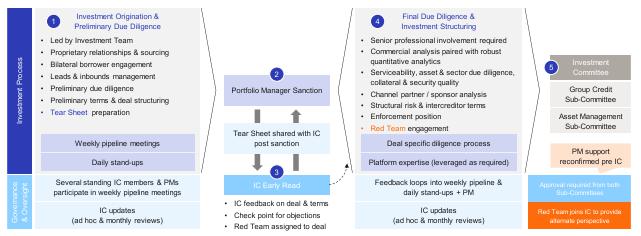
The Adviser has adopted a rigorous, five-phase investment process which applies across MA Financial Group’s Global Credit Solutions group (the “Investment Process”). The Investment Process is designed to ensure all investments are thoroughly vetted and evaluated to maximize returns while identifying and controlling for investment and portfolio risks in a disciplined manner. The Investment Process is governed by a dual-structured investment committee (“Investment Committee” or, in short form, “IC”).
Team structure
The Adviser has carefully structured its credit team structure to balance its professionals’ focus on what the Adviser believes are three equally important pillars of operating a successful private credit strategy in the specialty credit segment: (i) investments, (ii) portfolio management, and (iii) risk management.
The Adviser’s teams are split into two distinct groups, facilitating specialization of skill sets while mitigating ml hazard risks and encouraging rigorous debate, robust evaluation of Loans and prudent oversight of the overall portfolio for the Fund:
| ● | Investment Team: A team of investment professionals whose responsibility is to source, diligence and execute new investment opportunities for the Fund (the “Investment Team”). Our Investment Team members also own a Loan for the lifecycle of the deal, ensuring these professionals are accountable and incentivized to achieve the Investment Objective for each Loan from origination to maturity. |
| ● | Portfolio Management Team: The senior executives managing the portfolio for the Fund (“Portfolio Manager(s)” or, in short form, “PM(s)”), supported by a team of portfolio analysts. The Portfolio Management Team is responsible for the rigorous management of the overall Fund portfolio as fiduciaries of Shareholders’ capital. This team is focused on managing overall portfolio dynamics, realizing the investment objective for the Fund in its totality, balancing Portfolio Composition across the different segments within the principal investment strategies, and setting overall strategic investment focus in consultation with the Investment Team and with oversight of the Investment Committee. |
These two functions actively collaborate on a daily basis. They are also encouraged to debate, challenge and engage with each other on the substantive merits of prospective investments or Loans, the robustness of the Fund’s portfolio and the optimal approach to maximize the probability of achieving the Fund’s investment objective.
Both the Investment Team and Portfolio Management Team are responsible collectively to be proactive risk managers at the individual Loan and portfolio level for the Fund. The Adviser considers risk management to be an equal third pillar of success alongside (i) making investments, and (ii) rigorously managing the portfolio of Loans. The Adviser has established a number of formally enshrined and informal culturally-embedded processes to create a disciplined risk management philosophy within its firm and in supporting the Fund.
The Investment Team and Portfolio Management Team are overseen by a robust and empowered Investment Committee that includes highly experienced senior members of the Adviser and its parent MA Financial Group, with complementary and differentiated skill sets.
Phases of the Investment Process
The Investment Team and Portfolio Management Team each play pivotal roles in the Investment Process.
Phase 1 – Investment origination and preliminary due diligence
The Investment Team utilizes their proprietary relationships to source and evaluate potential investment opportunities based on the Adviser’s investment criteria and the Fund’s mandate. As potential opportunities are identified, the relevant Investment Team member(s) engage bilaterally with prospective borrowers and conducts preliminary due diligence to understand their objectives, understand borrower’s commercial and economic fundamentals, evaluate the borrower’s financial performance, creditworthiness and ascertain any potential investment risks.
Based on the results of this preliminary due diligence, the investment team prepares initial terms and structure for the Loan. Finally, the team prepares a tear sheet which summarizes the key information about the Loan and the lending opportunity (a “Tear Sheet”) for review by the Portfolio Manager(s).
Phase 2 – Portfolio Manager sanction
Once an investment opportunity has been identified and been through an adequate preliminary due diligence process by the investment team, the Tear Sheet will be put forward to one of more of the relevant Portfolio Manager to assess. The Portfolio Managers, in conjunction with the broader Portfolio Management Team, act as an additional check in the review process, evaluating the opportunity based on a range of further considerations including (but not limited to):
| ● | alignment with the Fund mandate and investment objective; |
| ● | consistency with the principal investment strategies for the Fund; |
| ● | impact on pro-forma portfolio construction and portfolio composition dynamics; |
| ● | any treasury and risk considerations; and |
| ● | any idiosyncratic issues related to the investment itself. |
Based on this evaluation, the Portfolio Managers will collaborate with the Investment Team to determine whether the opportunity will progress through the investment process.
Phase 3 – Investment Committee Early Read
Where a prospective investment opportunity is sanctioned by the Portfolio Managers, the opportunity progresses through to the Investment Committee for an initial review (known as an “Early Read”). This Early Read allows for a more holistic overview of the prospective Loan and proposed terms, as well as providing a check point for any objections to be raised.
Should there be no objections, the investment team continues evaluating the opportunity.
In addition, a ‘red team’ is assigned to provide an independent, contrarian perspective on any potential risks related to the investment (the “Red Team”). The Red Team is one or more investment professionals of the Adviser that was not directly involved in the origination of the prospective Loan and is not working as part of the main deal team for that potential investment. The Red Team is covered in further detail below.
This phase of the Investment Process is intended to ensure that any focus areas, concerns, structural enhancements to the Loan or other important considerations can be addressed in detail as part of final due diligence, to later be thoroughly considered as part of the Investment Committee process itself.
Phase 4 – Final due diligence and investment structuring
In the final phase of due diligence, overseen by at least one or several senior professionals of the Adviser, commercial and qualitative analysis is paired with robust quantitative analytics for a comprehensive review. The Adviser is generally evaluating the probability of default of the collateral and the loss given the default, and the Adviser then applies that to a specific security. This includes (but is not limited to):
| ● | Thorough asset level due diligence, including key performance drivers; |
| ● | Assessment of serviceability and asset / collateral / security quality; |
| ● | Counterparty / sponsor / originator / channel partner analysis; |
| ● | Critical analysis of management quality; |
| ● | Industry and competitive landscape dynamics; |
| ● | Assessment of structural risk, tail risks and intercreditor terms; |
| ● | Establishment of an enforcement position in the event of a default; and |
| ● | Extensive stress testing based on what the Adviser terms a ‘what you have to believe’ approach, which means understanding the practical dynamics (which could be asset level, business level, economic, market, competitive, commercial, stakeholder, regulatory, or facility structural drivers, among others) that are foundational to obtaining conviction in the prospective investment’s merits, contribution to achieving the investment objective and complementing the Fund’s overall portfolio (the “What You Have To Believe” approach). As part of the What You Have To Believe approach, extensive consideration of the scenarios that would result in the investment being unsuccessful are evaluated alongside what needs to be believed for the investment to be acceptable at a minimum and a success. |
The Fund’s Portfolio Managers must re-confirm support and sanction for the prospective investment before it can proceed to obtain Investment Committee approval.
Phase 5 – Investment Committee
The Investment Committee is the last stage of the Investment Process, where a final decision is made. This forum utilizes the benefit of the multiple lenses of consideration undertaken through the preceding five phases of the Investment Process, to ensure final investment evaluation can be made on a fully informed basis.
In addition to considering the diligence and analysis undertaken throughout the Investment Process, the Investment Committee obtains the perspective of the Red Team. The Red Team is tasked with reviewing the underlying diligence materials related to an investment, and conducting its own research and assessment, to provide a critical independent assessment and/or contrarian opinion on the deal. This is designed to ensure many perspectives are addressed and the Investment Committee is able to make an informed decision.
The Investment Committee is structured with two sub-committees: the Group Credit Sub-Committee which includes senior executives from across MA Financial Group, including its Joint CEO, and an Asset Management Sub-Committee which includes senior executives in MA Financial Group’s Asset Management function, including the Adviser’s Head of Asset Management US. Both Sub-Committees meet together, but vote in separate cohorts. Both Sub-Committees must approve a prospective investment, each on a defined minimum quorum and majority basis.
The Investment Committee considers the investment objective, the principal investment strategies, portfolio composition, credit fundamentals and portfolio dynamics, as well as leveraging its members’ experience, insights and expertise, in making its decision regarding any specific investment.
Investment Process Diagram
The diagram below illustrates the five phases of the Investment Process:
Ongoing investment and portfolio management governance
In addition to the Investment Process outlined above, the Adviser also employs a robust framework for governing and managing investments across the Fund with embedded checks and balances. A number of these frameworks are outlined below.
| Investment Governance | Frequency | Adviser’s Approach |
| Market Analysis | Daily to Weekly | Continuous market analysis, insight gathering, cross-pollination of expertise and feedback loops are utilized by the Adviser, including by leveraging knowledge from across its parent organization MA Financial Group. This includes daily stand-ups and weekly pipeline meetings, among other processes. |
| Investment Committee Portfolio Reviews | Monthly | The Fund’s investment portfolio is thoroughly reviewed on a monthly basis, with oversight of the Investment Committee. Any potential risks or concerns are identified and added to a watch list for further monitoring. |
| Asset Management Reviews | Either Quarterly or Semi-Annually | Adviser and MA Financial Group undertake a comprehensive review of funds on a quarterly or semi-annual basis. During this review, the Fund’s portfolio, achievement of investment objective, efficacy of its principal investment strategies are reviewed, in addition to a range of other investor, treasury, compliance and financing dynamics. |
| Semi-Annual Stress Testing | Semi-Annually | Extensive stress testing and simulation analysis twice per year for substantially all private credit assets within the Fund’s portfolio and managed by the Adviser and MA Financial Group in its Global Credit Solutions group. This exercise estimates the impact on portfolios of three economic downturn scenarios: (i) moderate recession, (ii) severe recession, and (iii) a crisis or depression. In addition, idiosyncratic discrete investment level risks are also assessed on a selective basis, determined by the Investment Committee, Portfolio Management Team and Investment Team’s professional judgement. The stress testing exercise focuses on capital protection strategies in adverse scenarios, as well as considering specific strategies to rectify risks that could emerge. |
It is important to note that the Investment Process is overseen, governed and refined by the Adviser’s Investment Committee and is subject to change at the Investment Committee’s discretion. Variations to the Investment Process for any individual investment or portfolio segment may also be adopted, implemented or ratified (prospectively or retrospectively) by the Investment Committee in its discretion.
In addition, it should be noted that for investments of a smaller size (relative to Fund assets under management) and certain less material decisions regarding the Fund’s investments and portfolio transactions, the Investment Committee may delegate decision making authority up to a threshold (and subject to certain notification and review provisions) to its Portfolio Managers or other such executives of the Adviser.
TYPES OF INVESTMENTS AND RELATED RISKS
Investors should carefully consider the risk factors described below, before deciding on whether to make an investment in the Fund. The risks set out below are not the only risks the Fund faces. Additional risks and uncertainties not currently known to the Fund or that the Fund currently deems to be immaterial also may materially adversely affect the Fund’s business, financial condition and/or operating results. If any of the following events occur, the Fund’s business, financial condition and results of operations could be materially adversely affected. In such case, the NAV of the Fund’s Shares could decline, and investors may lose all or part of their investment.
Investors should be aware that in light of the current uncertainty, volatility and distress in economies, financial markets, and labor and health conditions over the world, the risks below are heightened significantly compared to normal conditions. The fact that a particular risk below is not specifically identified as being heightened under current conditions does not mean that the risk is not greater than under normal conditions.
Risks Relating to the Fund’s Investment Program.
Nature of the Fund’s Investments Risks. The Fund has a very broad mandate with respect to the type and nature of investments in which it participates. While some of the loans in which the Fund will invest may be secured, the Fund may also invest in debt and equity securities that are either unsecured and subordinated to substantial amounts of senior indebtedness, or a significant portion of which may be unsecured. In such instances, the ability of the Fund to influence an issuer’s affairs, especially during periods of financial distress or following an insolvency is likely to be substantially less than that of senior creditors. For example, under terms of subordination agreements, senior creditors are typically able to block the acceleration of the debt or other exercises by the Fund of its rights as a creditor. Accordingly, the Fund may not be able to take the steps necessary to protect its investments in a timely manner or at all. In addition, the debt securities in which the Fund will invest may not be protected by financial covenants or limitations upon additional indebtedness, may have limited liquidity and may not be rated by a credit rating agency.
The borrowers of loans constituting the Fund’s assets may seek the protections afforded by bankruptcy, insolvency and other debtor relief laws. Bankruptcy proceedings are unpredictable as described further below in “Bankruptcy of Borrower Risk.” Additionally, the numerous risks inherent in the insolvency process create a potential risk of loss by the Fund of its entire investment in any particular investment. Insolvency laws may, in certain jurisdictions, result in a restructuring of the debt without the Fund’s consent under the “cramdown” provisions of applicable insolvency laws and may also result in a discharge of all or part of the debt without payment to the Fund.
Debt securities are also subject to other risks, including (i) the possible invalidation of an investment transaction as a “fraudulent conveyance,” (ii) the recovery of liens perfected or payments made on account of a debt in the period before an insolvency filing as a “preference,” (iii) equitable subordination claims by other creditors, (iv) so called “lender liability” claims by the issuer of the obligations (see “Risks Related to Investments in Loans”) and (v) environmental liabilities that may arise with respect to collateral securing the obligations. Additionally, adverse credit events with respect to any issuer, such as missed or delayed payment of interest and/or principal, bankruptcy, receivership, or distressed exchange, can significantly diminish the value of the Fund’s investment in any such company. The Fund’s investments may be subject to early redemption features, refinancing options, pre-payment options or similar provisions which, in each case, could result in the issuer repaying the principal on an obligation held by the Fund earlier than expected. Accordingly, there can be no assurance that the Fund’s investment objective will be realized.
Credit Risk. One of the fundamental risks associated with the Fund’s investments is credit risk, which is the risk that an issuer will be unable to make principal and interest payments on its outstanding debt obligations when due. The Fund’s return to investors would be adversely impacted if an issuer of debt in which the Fund invests becomes unable to make such payments when due.
Although the Fund may make investments that the Adviser believes are secured by specific collateral, the value of which may initially exceed the principal amount of such investments or the Fund’s fair value of such investments, there can be no assurance that the liquidation of any such collateral would satisfy the borrower’s obligation in the event of non-payment of scheduled interest or principal payments with respect to such investment, or that such collateral could be readily liquidated. The Fund may also invest in leveraged loans, high yield securities, marketable and non-marketable common and preferred equity securities and other unsecured investments, each of which involves a higher degree of risk than secured loans. Furthermore, the Fund’s right to payment and its security interest, if any, may be subordinated to the payment rights and security interests of a senior lender, to the extent applicable. Certain of these investments may have an interest-only payment schedule, with the principal amount remaining outstanding and at risk until the maturity of the investment. In addition, loans may provide for payments-in-kind, which have a similar effect of deferring current cash payments. In such cases, an issuer’s ability to repay the principal of an investment may depend on a liquidity event or the long-term success of the company, the occurrence of which is uncertain.
With respect to the Fund’s investments in any number of credit products, if the borrower or issuer breaches any of the covenants or restrictions under the credit agreement that governs loans of such issuer or borrower, it could result in a default under the applicable indebtedness as well as the indebtedness held by the Fund. Such default may allow the creditors to accelerate the related debt and may result in the acceleration of any other debt to which a cross-acceleration or cross-default provision applies. This could result in an impairment or loss of the Fund’s investment or a pre-payment (in whole or in part) of the Fund’s investment.
Issuers in which the Fund invests could deteriorate as a result of, among other factors, an adverse development in their business, a change in the competitive environment or the continuation or worsening of the current (or any future) economic and financial market downturns and dislocations. As a result, companies that the Fund expected to be stable or improve may operate, or expect to operate, at a loss or have significant variations in operating results, may require substantial additional capital to support their operations or maintain their competitive position, or may otherwise have a weak financial condition or experience financial distress. In addition, exogenous factors such as fluctuations of the equity markets also could result in warrants and other equity securities or instruments owned by the Fund becoming worthless.
Credit Spread Risk. Credit spread risk is the risk that credit spreads (i.e., the difference in yield between securities that is due to differences in their credit quality) may increase when the market expects debt securities to default more frequently. Widening credit spreads may quickly reduce the market values of debt securities. In recent years, the U.S. capital markets experienced extreme volatility and disruption following the spread of COVID-19, the impact of heightened geopolitical tensions (including those between the United States and China, Taiwan and mainland China, Israel and Iran and the Axis of Resistance, and between Ukraine and Russia) and other economic disruptions, which increased the spread between yields realized on risk-free and higher risk securities, resulting in illiquidity in parts of the capital markets. Central banks and governments played a key role in reintroducing liquidity to parts of the capital markets. Future exits of these financial institutions from the market may reintroduce temporary illiquidity. These and future market disruptions, including the imposition of tariffs and the prospect of escalating trade wars, and/or illiquidity would be expected to have an adverse effect on the Fund’s business, financial condition, results of operations and cash flows.
Interest Rate Risk. General interest rate fluctuations and changes in credit spreads on floating rate loans may have a substantial negative impact on the Fund’s investments and investment opportunities and, accordingly, may have a material adverse effect on the Fund’s rate of return on invested capital, the Fund’s net investment income and the Fund’s NAV. Certain of the Fund’s debt investments will have variable interest rates that reset periodically based on benchmarks such as SOFR and the prime rate, so an increase in interest rates may make it more difficult for issuers to service their obligations under the debt investments that the Fund will hold. In addition, to the extent the Fund borrows money to make investments, its returns will depend, in part, upon the difference between the rate at which it borrows funds and the rate at which it invests those funds. As a result, there can be no assurance that a significant change in market interest rates will not have a material adverse effect on the Fund’s net investment income to the extent it uses debt to finance its investments. In periods of rising interest rates, the Fund’s cost of funds would increase, which could reduce its net investment income. In general, rising interest rates will negatively impact the price of a fixed rate debt instrument and falling interest rates will have a positive effect on price. Adjustable rate instruments also react to interest rate changes in a similar manner, although generally to a lesser degree (depending, however, on the characteristics of the reset terms, including the index chosen, frequency of reset and reset caps or floors, among other factors). From time to time, the Fund may be exposed to medium- to long-term spread duration securities. Longer spread duration securities have a greater adverse price impact to increases in interest rates. Interest rate sensitivity is generally more pronounced and less predictable in instruments with uncertain payment or prepayment schedules.
If general interest rates rise, there is a risk that the issuers in which the Fund holds floating rate securities will be unable to pay escalating interest amounts, which could result in a default under their loan documents. The potential, however, for the value of a floating rate loan or security to increase in response to interest rate declines is limited. Rising interest rates could also cause issuers to shift cash from other productive uses to the payment of interest, which may have a material adverse effect on their business and operations and could, over time, lead to increased defaults. In addition, rising interest rates may increase pressure on the Fund to provide fixed rate loans, which could adversely affect the Fund’s net investment income, as increases in the cost of borrowed funds would not be accompanied by increased interest income from such fixed-rate investments.
Inflation Risk. Inflation risk is the risk that the value of certain assets or income from the Fund’s investments will be worth less in the future as inflation decreases the value of money. As inflation increases, the real value of investments and distributions can decline. Therefore, the income generated by debt investments may not keep pace with inflation. In addition, during any periods of rising inflation, the dividend rates or borrowing costs associated with the Fund’s use of leverage would likely increase, which would tend to further reduce returns to shareholders. Furthermore, actions by governments and central banking authorities can result in changes in interest rates. Periods of higher inflation could cause such authorities to raise interest rates, and vice versa, which may adversely impact the Fund and its investments.
Prepayment Risk. Prepayment risk relates to the early repayment of principal on a loan or debt security. Loans may be callable at any time, and certain loans may be callable at any time at no premium to par. The Adviser is generally unable to predict the rate and frequency of such repayments. Whether a loan is called will depend both on the continued positive performance of the issuer and the existence of favorable financing market conditions that allow such issuer the ability to replace existing financing with less expensive capital. As market conditions change frequently, the Adviser will often be unable to predict when, and if, this may be possible for each of the Fund’s issuers. Having the loan or other debt instrument called early may have the effect of reducing the Fund’s actual investment income below its expected investment income if the capital returned cannot be invested in transactions with equal or greater yields.
Change of Law Risk. Government counterparties or agencies may have the discretion to change or increase regulation of a issuer’s operations or implement laws or regulations affecting the issuer’s operations, separate from any contractual rights it may have. A portfolio investment also could be materially and adversely affected as a result of statutory or regulatory changes or judicial or administrative interpretations of existing laws and regulations that impose more comprehensive or stringent requirements on such investment. Governments have considerable discretion in implementing regulations and tax reform, including, for example, the possible imposition or increase of taxes on income earned by an issuer or gains recognized by the Fund on its investment in such issuer, that could impact an issuer’s business as well as the Fund’s return on investment with respect to such issuer.
Force Majeure Risk. Issuers may be affected by force majeure events (i.e., events beyond the control of the party claiming that the event has occurred, including, without limitation, acts of God, fire, flood, earthquakes, outbreaks of an infectious disease, pandemic or any other serious public health concern, war, terrorism, trade wars and labor strikes). Some force majeure events may adversely affect the ability of a party (including an issuer or a counterparty to the Fund or an issuer) to perform its obligations until it is able to remedy the force majeure event. In addition, the cost to an issuer or the Fund of repairing or replacing damaged assets resulting from such force majeure event could be considerable. Certain force majeure events (such as war or an outbreak of an infectious disease) could have a broader negative impact on the world economy and international business activity generally, or in any of the countries in which the Fund may invest specifically. Additionally, a major governmental intervention into industry, including the nationalization of an industry or the assertion of control over one or more issuers or its assets, could result in a loss to the Fund, including if its investment in such issuer is canceled, unwound or acquired (which could be without what the Fund considers to be adequate compensation). Any of the foregoing may therefore adversely affect the performance of the Fund and its investments.
Market Risk. The success of the Fund’s activities will be affected by general economic and market conditions, such as interest rates, availability of credit, credit defaults, inflation rates, economic uncertainty, changes in laws (including laws relating to taxation of the Fund’s investments), trade barriers, the imposition, or threatened imposition, of economic sanctions, including tariffs, currency exchange controls, disease outbreaks, pandemics, and national and international political, environmental and socioeconomic circumstances (including wars, terrorist acts or security operations). In addition, the current U.S. political environment and the resulting uncertainties regarding actual and potential shifts in U.S. foreign investment, trade, taxation, economic, environmental and other policies under the current Administration, as well as the impact of heightened geopolitical tensions (including those between the United States and China, Taiwan and mainland China, Israel and Iran and the Axis of Resistance, and between Ukraine and Russia) or other systemic issues or industry-specific economic disruptions, could lead to disruption, instability and volatility in the global markets. The U.S. government may renegotiate some of its global trade relationships with foreign governments and may impose or threaten to impose significant tariffs. The imposition or threatened imposition of tariffs, trade restrictions, currency restrictions and other federal government initiatives as well as foreign policy tensions with foreign nations, including embargoes, sanctions and trade wars, or similar actions (or retaliatory measures taken in response to such actions) could lead to price volatility and overall declines in the U.S. and global investment markets. Unfavorable economic conditions also would be expected to increase our funding costs, limit our access to the capital markets or result in a decision by lenders not to extend credit to us.
Economic sanctions may be, and have been, imposed against certain countries, organizations, companies, entities and/or individuals. Economic sanctions and other similar governmental actions or developments could, among other things, effectively restrict or eliminate the Fund’s ability to purchase or sell certain foreign securities or groups of foreign securities, and thus may make the Fund’s investments in such securities less liquid or more difficult to value. Such sanctions may also cause a decline in the value of securities issued by the sanctioned country or companies located in or economically tied to the sanctioned country and may result in economic disruptions in the sanctioned country and in countries with economic ties to the sanctioned country. When the United States is a significant trading partner of a foreign country in which the Fund may invest or to which the Fund may be exposed, such foreign country may be particularly sensitive to changes in U.S. foreign trading policies, including the threat or actual imposition of tariffs, sanctions or other similar measures. The imposition of tariffs (or threats thereof), trade restrictions, currency restrictions, deficit levels and any reduction plans and other federal government initiatives as well as foreign policy tensions with foreign nations, including embargoes, sanctions and trade wars, or similar actions (or retaliatory measures taken in response to such actions) could lead to price volatility and overall declines in the U.S. and global investment markets. In addition, as a result of economic sanctions and other similar governmental actions or developments, the Fund may be forced to sell or otherwise dispose of foreign investments at inopportune times or prices. Sanctions and other similar measures could significantly delay or prevent the settlement of securities transactions or their valuation, and significantly impact the Fund’s liquidity and performance. Sanctions and other similar measures may in be place for substantial periods of time and enacted with limited advance notice. The type and severity of sanctions and other measures, including counter sanctions and other retaliatory actions, that may be imposed could vary broadly in scope, and their impact is impossible to predict.
Current and historic market turmoil has illustrated that market environments may, at any time, be characterized by uncertainty, volatility and instability. Serious economic disruptions may result in governmental authorities and regulators enacting significant fiscal and monetary policy changes, including by providing direct capital infusions into companies, introducing new monetary programs and considerably increasing or lowering interest rates, which, in some cases resulted in negative interest rates.
As global systems, economies and financial markets are increasingly interconnected, events that once had only local impact are now more likely to have regional or even global effects. Events that occur in one country, region or financial market will, more frequently, adversely impact issuers in other countries, regions or markets. These impacts can be exacerbated by failures of governments and societies to adequately respond to an emerging event or threat. These types of events quickly and significantly impact markets in the U.S. and across the globe leading to extreme market volatility and disruption. The extent and nature of the impact on supply chains or economies and markets from these events is unknown, particularly if a health emergency or other similar event, such as the COVID-19 pandemic, persists for an extended period of time. Similarly, geopolitical and other events, such as actual or threatened war or military conflicts, acts of terrorism, social or political unrest, natural disasters, extreme weather, other geological events, man-made disasters, bank failures, trade wars, inflation, deflation, recessions or other events, and governments’ reactions (as well as responses to government reactions or interventions) to such events, may lead to increased market volatility and instability in world economies and markets generally. Furthermore, technological developments (including those related to artificial intelligence (“AI”)) or failures (such as widespread system outages, disruptions or faulty updates to software applications) and other similar events, each of which may be temporary or may last for extended periods, may impact the value of the Fund’s investments. Adverse changes in one sector or industry or with respect to a particular company could negatively impact companies in other sectors or industries or increase market volatility as a result of the interconnected nature of economies and markets and thus negatively affect the Fund’s performance, even if the Fund does not directly invest in issuers that participate in the sectors or industries experiencing these changes. These types of adverse developments could result from under-regulated markets, novel and maturing markets (for example, the markets for AI, cryptocurrencies and digital or blockchain assets and technologies), systemic risk, natural market forces, bad actors or other scenarios and could negatively affect the Fund’s performance or operations. The value of the Fund’s investment may decrease as a result of such events, particularly if these events adversely impact the operations and effectiveness of the Adviser or key service providers or if these events disrupt systems and processes necessary or beneficial to the investment advisory or other activities on behalf the Fund.
Many of the issuers in which the Fund will make investments may be susceptible to economic slowdowns or recessions and may be unable to repay the loans made to them during these periods. Therefore, non-performing assets may increase and the value of the Fund’s portfolio may decrease during these periods as the Fund is required to record the investments at their current fair value. Adverse economic conditions also may decrease the value of collateral securing some of the Fund’s loans and the value of its investments. Economic slowdowns or recessions could lead to financial losses in the Fund’s portfolio and a decrease in revenues, net income and assets. Unfavorable economic conditions also could increase the Fund’s and the issuers’ funding costs, limit the Fund’s and the issuers’ access to the capital markets or result in a decision by lenders not to extend credit to the Fund or the issuers. These events could prevent the Fund from increasing investments and harm its operating results.
An issuer’s failure to satisfy financial or operating covenants imposed by the Fund or other lenders could lead to defaults and, potentially, acceleration of the time when the loans are due and foreclosure on its secured assets, which could trigger cross-defaults under other agreements and jeopardize the issuer’s ability to meet its obligations under the debt that the Fund holds. The Fund may incur additional expenses to the extent necessary to seek recovery upon default or to negotiate new terms with a defaulting issuer. In addition, if one of the issuers were to go bankrupt, depending on the facts and circumstances, including the extent to which the Fund will actually provide significant managerial assistance to that issuer, a bankruptcy court might subordinate all or a portion of the Fund’s claim to that of other creditors.
The prices of financial instruments in which the Fund may invest can be highly volatile. General fluctuations in the market prices of securities may affect the value of the investments held by the Fund. Instability in the securities markets may also increase the risks inherent in the Fund’s investments.
Market Disruptions Risk. The U.S. capital markets have experienced extreme volatility and disruption in recent years following the spread of COVID-19 in the United States, the failure of certain regional banks, military conflicts (including the conflict between Russia and Ukraine and between Israel, Iran and the Axis of Resistance), changes in monetary policies in response to changes in interest rates and inflation and increasing tensions relating to trade relationships, such as between the United States and China. Disruptions in the capital markets have increased the spread between the yields realized on risk-free and higher risk securities, resulting in illiquidity in parts of the capital markets. These and future market disruptions and/or illiquidity would be expected to have an adverse effect on the Fund’s business, financial condition, results of operations and cash flows. Unfavorable economic conditions also would be expected to increase the Fund’s funding costs, limit the Fund’s access to the capital markets or result in a decision by lenders not to extend credit to the Fund. During periods of market disruption, portfolio companies may be more likely to seek to draw on unfunded commitments the Fund has made, and the risk of being unable to fund such commitments is heightened during such periods. These events have limited and could continue to limit the Fund’s investment originations, limit the Fund’s ability to grow and have a material negative impact on the Fund’s operating results and the fair values of the Fund’s debt and equity investments.
U.S. and global markets have also experienced increased volatility as a result of the failures of certain U.S. and non-U.S. banks, which could be harmful to the Fund and issuers in which it invests. For example, if a bank in which the Fund or issuer has an account fails, any cash or other assets in bank accounts may be temporarily inaccessible or permanently lost by the Fund or issuer. If a bank that provides a subscription line credit facility, asset-based facility, other credit facility and/or other services to the Fund or an issuer fails, the Fund or the issuer could be unable to draw funds under its credit facilities or obtain replacement credit facilities or other services from other lending institutions with similar terms. Even if banks used by the Fund and issuers in which the Fund invests remain solvent, volatility in the banking sector could cause or intensify an economic recession, increase the costs of banking services or result in the issuers being unable to obtain or refinance indebtedness at all or on as favorable terms as could otherwise have been obtained. Continued market volatility and uncertainty and/or a downturn in market and economic and financial conditions, as a result of developments in the banking industry or otherwise (including as a result of delayed access to cash or credit facilities), could have an adverse impact on the Fund and issuers in which it invests.
Bankruptcy of Borrower Risk. The issuers of loans constituting the Fund’s assets may seek the protections afforded by bankruptcy, insolvency and other debtor relief laws. When a borrower seeks relief under the U.S. Bankruptcy Code (or has a petition filed against it), an automatic stay prevents all entities, including creditors, from foreclosing or taking other actions to enforce claims, perfect liens or reach collateral securing such claims. Creditors who have claims against the borrower prior to the date of the bankruptcy filing must petition the court to permit them to take any action to protect or enforce their claims or their rights in any collateral. Such creditors may be prohibited from doing so if the court concludes that the value of the property in which the creditor has an interest will be “adequately protected” during the proceedings. If the Bankruptcy Court’s assessment of adequate protection is inaccurate, a creditor’s collateral may be wasted without the creditor being afforded the opportunity to preserve it. Bankruptcy proceedings are inherently litigious, time consuming, highly complex and driven extensively by facts and circumstances, which can result in challenges in predicting outcomes. The equitable power of bankruptcy judges also can result in uncertainty as to the ultimate resolution of claims.
Security interests held by creditors are closely scrutinized and frequently challenged in bankruptcy proceedings and may be invalidated for a variety of reasons. For example, security interests may be set aside because, as a technical matter, they have not been perfected properly under the Uniform Commercial Code or other applicable law. If a security interest is invalidated, the secured creditor loses the value of the collateral and because loss of the secured status causes the claim to be treated as an unsecured claim, the holder of such claim will almost certainly experience a significant loss of its investment.
Risks Relating to the Asset Classes in which the Fund Invests.
Risks Related to Investments in Loans. The Fund invests in loans, generally through a direct origination process. The value of the Fund’s loans may be detrimentally affected to the extent a borrower defaults on its obligations. There can be no assurance that the value assigned by the Adviser can be realized upon liquidation, nor can there be any assurance that any related collateral will retain its value. Furthermore, circumstances could arise (such as in the bankruptcy of a borrower) that could cause the Fund’s security interest in the loan’s collateral to be invalidated. Also, much of the collateral will be subject to restrictions on transfer intended to satisfy securities regulations, which will limit the number of potential purchases if the Fund intends to liquidate such collateral. The amount realizable with respect to a loan may be detrimentally affected if a guarantor, if any, fails to meet its obligations under a guarantee. Finally, there may be a monetary, as well as a time cost involved in collecting on defaulted loans and, if applicable, taking possession of various types of collateral.
The portfolio may include first lien senior secured, second and third lien loans and any other loans.
First Lien Senior Secured Loans. It is expected that when the Fund makes a senior secured term loan investment in an issuer, it will generally take a security interest in substantially all of the available assets of the issuer, including the equity interests of its domestic subsidiaries, which the Fund expects to help mitigate the risk that it will not be repaid. However, there is a risk that the collateral securing the Fund’s loans may decrease in value over time, may be difficult to sell in a timely manner, may be difficult to appraise and may fluctuate in value based upon the success of the business and market conditions, including as a result of the inability of the issuer to raise additional capital, and, in some circumstances, the Fund’s lien could be subordinated to claims of other creditors. In addition, deterioration in an issuer’s financial condition and prospects, including its inability to raise additional capital, may be accompanied by deterioration in the value of the collateral for the loan. Consequently, the fact that a loan is secured does not guarantee that the Fund will receive principal and interest payments according to the loan’s terms, or at all, or that it will be able to collect on the loan should it be forced to enforce its remedies.
Second Lien Senior Secured Loans and Junior Debt investments. Second and third lien loans are subject to the same investment risks generally applicable to senior loans described above. The Fund’s second lien senior secured loans will be subordinated to first lien loans and the Fund’s junior debt investments, such as mezzanine loans, generally will be subordinated to both first lien and second lien loans and have junior security interests or may be unsecured. As such, to the extent the Fund holds second lien senior secured loans and junior debt investments, holders of first lien loans may be repaid before the Fund in the event of a bankruptcy or other insolvency proceeding. Therefore, second and third lien loans are subject to additional risk that the cash flow of the related obligor and the property securing the second or third lien loan may be insufficient to repay the scheduled payments to the lender after giving effect to any senior secured obligations of the related obligor. This may result in an above average amount of risk and loss of principal. Second and third lien loans are also expected to be more illiquid than senior loans.
Unsecured Loans. Unsecured loans are subject to the same investment risks generally applicable to loans described above but are subject to additional risk that the assets and cash flow of the related obligor may be insufficient to repay the scheduled payments to the lender after giving effect to any secured obligations of the obligor. Unsecured loans will be subject to certain additional risks to the extent that such loans may not be protected and such loans are not secured by collateral, financial covenants or limitations upon additional indebtedness. Unsecured loans are also expected to be a more illiquid investment than senior loans for this reason.
Systemic Risks of Loan Portfolios. The Fund may acquire portfolios of loans. While the performance of individual loans within a portfolio generally would be tied to the specific characteristics of the borrower or the collateral securing those loans, such portfolios could be subject to systemic problems that affect a material portion of the loans in the portfolio, due to common characteristics among the underlying borrowers that make them susceptible to certain market or other developments, the underwriting practices of the originator of the loans or other factors.
Structured Finance Securities Risk. The Fund’s portfolios may include investments in structured finance securities, including asset-backed securities, collateralized loan obligations and other instruments. Structured finance securities are, generally, debt securities that entitle the holders thereof to receive payments of interest and principal that depend primarily on the cash flow from or sale proceeds of a specified pool of assets, either fixed or revolving, that by their terms convert into cash within a finite time period, together with rights or other assets designed to assure the servicing or timely distribution of proceeds to holders of such securities. If a particular asset or pool of assets held by the Fund becomes securitized with other assets, the value of such asset or pool of assets may be negatively impacted by the value of such other assets in such securitization transaction and may decrease as a result of the securitization.
Investing in structured finance securities entails various risks: credit risks, liquidity risks, interest rate risks, market risks, operations risks, structural risks, geographical concentration risks, basis risks and legal risks. Structured finance securities are subject to the significant credit risks inherent in the underlying collateral and to the risk that the servicer fails to perform. Accordingly, such securities generally include one or more credit enhancements, which are designed to raise the overall credit quality of the security above that of the underlying collateral. However, insurance providers and other sources of credit enhancement may fail to perform their obligations. Structured finance securities are subject to risks associated with their structure and execution, including the process by which principal and interest payments are allocated and distributed to investors, how credit losses affect the issuing vehicle and the return to investors in such structured finance securities, whether the collateral represents a fixed set of specific assets or accounts, whether the underlying collateral assets are revolving or closed-end, under what terms (including maturity of the structured finance instrument) any remaining balance in the accounts may revert to the issuing entity and the extent to which the entity that is the actual source of the collateral assets is obligated to provide support to the issuing vehicle or to the investors in such structured finance securities. In addition, concentrations of structured finance securities of a particular type, as well as concentrations of structured finance securities issued or guaranteed by affiliated obligors, serviced by the same servicer or backed by underlying collateral located in a specific geographic region, may subject the structured finance securities to additional risk.
Certain structured finance securities that may be held by the Fund may be subordinate in right of payment and rank junior to other securities that are secured by or represent an ownership interest in the same pool of assets. In addition, many of the related transactions have structural features that divert payments of interest and/or principal to more senior classes when the delinquency or loss experience of the pool exceeds certain levels. As a result, such securities have a higher risk of loss due to delinquencies or losses on the underlying assets. In certain circumstances, payments of interest may be reduced or eliminated for one or more payment dates. Additionally, as a result of cash flow being diverted to payments of principal of more senior classes, the average life of such securities may lengthen. Subordinate structured finance securities generally do not have the right to call a default or vote on remedies following a default unless more senior securities have been paid in full. As a result, a shortfall in payments to subordinate investors in structured finance securities will generally result neither in a default being declared on the transaction nor in an acceleration or restructuring of the obligations thereunder. Furthermore, because subordinate structured finance securities may represent a relatively small percentage of the size of an asset pool being securitized, the impact of a relatively small loss on the overall asset pool may be substantial on the holders of such subordinate security.
Structured finance securities are also subject to the risks of the securitized assets. In particular, structured finance securities are subject to risks related to the quality of the control systems and procedures used by the parties originating and servicing the securitized assets. Deficiencies in these systems may result in higher-than-expected borrower delinquencies or other factors affecting the value of the underlying assets, such as the inability to effectively pursue remedies against borrowers due to defective documentation. The Fund may rely upon representations of the securitization vehicles in respect of control systems and the securitized assets and conduct little or no diligence in respect of them. Accordingly, there can be no assurance that the control systems and the securitized assets will not be defective in a manner that could adversely affect the Fund.
High Yield Debt. The Fund may invest in debt securities that may be classified as “higher-yielding” (and, therefore, higher-risk) debt securities (also known as “junk bonds”). In most cases, such debt will be rated below “investment grade” or will be unrated and will face both ongoing uncertainties and exposure to adverse business, financial or economic conditions and the issuer’s failure to make timely interest and principal payments. The market for high yield securities (junk bonds) has experienced periods of volatility and reduced liquidity. High yield securities (junk bonds) may or may not be subordinated to certain other outstanding securities and obligations of the issuer, which may be secured by all or substantially all of the issuer’s assets. High yield securities (junk bonds) may also not be protected by financial covenants or limitations on additional indebtedness. The market values of certain of these debt securities may reflect individual corporate developments. General economic recession or a major decline in the demand for products and services in the industry in which the borrower operates would likely have a materially adverse impact on the value of such securities or could adversely affect the ability of the issuers of such securities to repay principal and pay interest thereon and increase the incidence of default of such securities. In addition, adverse publicity and investor perceptions, whether or not based on fundamental analysis, may also decrease the value and liquidity of these high yield debt securities (junk bonds).
Equity Investments. When the Fund invests in loans, it may acquire equity securities as well. In addition, the Fund may invest directly in the equity securities of issuers. The Fund’s goal is ultimately to dispose of such equity interests and realize gains upon its disposition of such interests. However, the equity interests received may not appreciate in value and, in fact, may decline in value. Accordingly, the Fund may not be able to realize gains from its equity interests, and any gains that it does realize on the disposition of any equity interests may not be sufficient to offset any other losses experienced.
The value of the Fund’s portfolio may be affected by changes in the equity markets generally. Equity markets may experience significant short-term volatility and may fall sharply at times. Different markets may behave differently from each other and U.S. equity markets may move in the opposite direction from one or more foreign stock markets. Adverse events in any part of the equity or fixed-income markets may have unexpected negative effects on other market segments. The prices of individual equity securities generally do not all move in the same direction at the same time and a variety of factors can affect the price of a particular company’s securities. These factors may include, but are not limited to, poor earnings reports, a loss of customers, litigation against the company, general unfavorable performance of the company’s sector or industry, or changes in government regulations affecting the company or its industry.
Additionally, there are special risks associated with investing in preferred securities, including risks related to deferral, subordination, liquidity, limited voting rights and special redemption rights.
Exchange-Traded Funds. ETFs are investment companies whose shares are listed on a securities exchange and trade like a stock throughout the day. Certain ETFs use a “passive” investment strategy and will not attempt to take defensive positions in volatile or declining markets. Other ETFs are actively managed (i.e., they do not seek to replicate the performance of a particular index). Investments in ETFs are subject to a variety of risks, including risks of a direct investment in the underlying securities that the ETF holds. For example, the general level of stock prices may decline, thereby adversely affecting the value of the underlying common stock investments of the ETF and, consequently, the value of the ETF. Moreover, the market value of the ETF may differ from the value of its portfolio holdings because the market for ETF shares and the market for underlying securities are not always identical. Also, ETFs that track particular indices typically will be unable to match the performance of the index exactly due to the ETF’s operating expenses and transaction costs, among other things.
The Fund may invest in the securities of other investment companies to the extent that such investments are consistent with the Fund’s investment objective and permissible under the 1940 Act. Under one provision of the 1940 Act, the Fund may not acquire the securities of other investment companies if, as a result, (i) more than 10% of the Fund’s total assets would be invested in securities of other investment companies, (ii) such purchase would result in more than 3% of the total outstanding voting securities of any one investment company being held by the Fund or (iii) more than 5% of the Fund’s total assets would be invested in any one investment company. In some instances, the Fund may invest in an investment company in excess of these limits. For example, the Fund may invest in ETFs in excess of the statutory limits imposed by the 1940 Act in reliance on Rule 12d1-4 under the 1940 Act. These investments would be subject to the applicable conditions of Rule 12d1-4, which in part would affect or otherwise impose certain limits on the investments and operations of the underlying fund. Accordingly, if the Fund serves as an “underlying fund” to another investment company, the Fund’s ability to invest in other investment companies, private funds and other investment vehicles may be limited and, under these circumstances, the Fund’s investments in other investment companies, private funds and other investment vehicles will be consistent with applicable law and/or exemptive relief obtained from the SEC. The Fund, as a holder of the securities of other investment companies, will bear its pro rata portion of the other investment companies’ expenses, including advisory fees. These expenses will be in addition to the direct expenses incurred by the Fund.
Regulatory Approvals. The Fund may invest in issuers believed to have obtained all material United States federal, state, local or non-U.S. approvals, if any, required as of the date thereof to acquire and operate their facilities. In addition, the Fund may be required to obtain the consent or approval of applicable regulatory authorities in order to acquire or hold certain ownership positions in issuers. An issuer could be materially and adversely affected as a result of statutory or regulatory changes or judicial or administrative interpretations of existing laws and regulations that impose more comprehensive or stringent requirements on such issuer. For example, in the case of oil and gas drilling, handling and transportation, such activities are extensively regulated, and statutory and regulatory requirements may include those imposed by energy, zoning, environmental, health, safety, labor and other regulatory or political authorities. Moreover, additional regulatory approvals, including without limitation, renewals, extensions, transfers, assignments, reissuances or similar actions, may become applicable in the future due to a change in laws and regulations, a change in the companies’ customers or for other reasons. There can be no assurance that an issuer will be able to (i) obtain all required regulatory approvals that it does not have at the time of the Fund’s investment or that it may be required to have in the future; (ii) obtain any necessary modifications to existing regulatory approvals; or (iii) maintain required regulatory approvals. Delay in obtaining or failure to obtain and maintain in full force and effect any regulatory approvals, or amendments thereto, or delay or failure to satisfy any regulatory conditions or other applicable requirements could prevent operation of a facility or sales to or from third parties or could result in fines or additional costs to an issuer. Regulatory changes in a jurisdiction where a portfolio investment is located may make the continued operation of the portfolio investment infeasible or economically disadvantageous and any expenditures made to date by such portfolio investment may be wholly or partially written off. The locations of the portfolio investments may also be subject to government exercise of eminent domain power or similar events. Any of these changes could significantly increase the regulatory-related compliance and other expenses incurred by the portfolio investments and could significantly reduce or entirely eliminate any potential revenues generated by one or more of the portfolio investments, which could materially and adversely affect returns to the Fund.
Risks Relating to Originating and Underwriting Loans.
Direct Origination Risk. A significant portion of the Fund’s investments will be loans that are originated either directly by the Fund or by a third party. The results of the Fund’s operations depend on several factors, including the availability of opportunities for the origination or acquisition of target investments, the level and volatility of interest rates, the availability of adequate short and long-term financing, conditions in the financial markets and economic conditions. Further, the Fund’s inability to raise capital and the risk of issuer defaults may materially and adversely affect the Fund’s investment originations, business, liquidity, financial condition, results of operations and its ability to make distributions to its shareholders. In addition, competition for originations of and investments in the Fund’s target investments may lead to the price of such assets increasing or the decrease of interest income from loans originated by the Fund or by a third party, which may further limit its ability to generate desired returns. Also, as a result of this competition, desirable investments in the Fund’s target investments may be limited in the future, and the Fund may not be able to take advantage of attractive investment opportunities from time to time, as the Fund can provide no assurance that the Adviser will be able to identify and make investments that are consistent with its investment objective.
Deficiencies of Assumptions and Underwriting Models. Successful lending involves making determinations as to the creditworthiness of a borrower and the anticipated performance and value of collateral securing the loan, if any. When making credit determinations, the Fund or a third-party originator in which the Fund invests is required to make assessments concerning the operations and future expectations of the borrower’s business, the viability of the borrower’s business plan, the proposed financing structure, expected business, economic and market conditions, and the quality, longevity, and expected future value of any collateral, among other factors. These assessments are often made in part based on information provided by prospective borrowers, which is often not subject to independent verification. If the assessments that the originator makes prove to be incorrect, whether as a result of an unforeseen development or an inaccuracy or misrepresentation in the information that provided, the extension of credit could entail more risk than predicted and the Fund could incur unexpected losses. Although it may be possible to proceed against the borrower or the person acting on its behalf, it may be difficult or impossible to recover any monetary losses that the Fund suffers as a result of any misrepresentations made by the borrower to procure the loan.
Limits of Underwriting Policy. Both the Fund, when it originates loans directly, and third-party originators in which the Fund invests or from which it acquires loans may use a proprietary methodology to underwrite a potential borrower. However, there is no assurance it will actually reflect the creditworthiness of a borrower. For example, an originator’s rating may be inaccurate because the originator correctly applied its formula, but the formula relied on incorrect or outdated credit bureau information or information supplied by the borrower that was inaccurate. A newly-formed originator may not have a sufficient history underwriting history to accurately evaluate the long-term collection rate of the loans it originates. An originator’s rating is not a recommendation by the originator to make, buy, sell or hold the loans it originates. In addition, no assurances can be provided that actual loss rates for the loans will fall within the expected loss rates indicated by the originator’s guidance. If an originator’s underwriting policy proves faulty or ineffective, the Fund may suffer higher than expected loan losses, higher costs and lower returns.
Investing in Loans Made to Companies in Distressed Situations Risk. As part of its investing activities, the Fund may invest in loans made to companies that are experiencing significant financial or business difficulties, including companies involved in bankruptcy or other reorganization and liquidation proceedings. Although the terms of such financing may result in significant financial returns to the Fund, they involve a substantial degree of risk. The level of analytical sophistication, both financial and legal, necessary for successful financing to companies experiencing significant business and financial difficulties is unusually high. There is no assurance that the Fund will correctly evaluate the value of the assets collateralizing the Fund’s loans or the prospects for a successful reorganization or similar action. In any reorganization or liquidation proceeding relating to a company, the Fund may lose all or part of the amounts invested in the loan made to the borrower or may be required to accept collateral with a value less than the amount of the loan held by the Fund or its affiliates.
Investments in Highly Leveraged Issuers. The Fund’s investments are expected to include investments in issuers whose capital structures have significant leverage (including substantial leverage senior to the Fund’s investments), a considerable portion of which may be at floating interest rates. The leveraged capital structure of such issuers will increase their exposure to adverse economic factors such as rising interest rates, downturns in the economy or further deteriorations in the financial condition of the issuer or its industry. This leverage may result in more serious adverse consequences to such companies (including their overall profitability or solvency) in the event these factors or events occur than would be the case for less leveraged issuers. In using leverage, these issuers may be subject to terms and conditions that include restrictive financial and operating covenants, which may impair their ability to finance or otherwise pursue their future operations or otherwise satisfy additional capital needs. Moreover, rising interest rates may significantly increase the issuers or project’s interest expense, or a significant industry downturn may affect a company’s ability to generate positive cash flow, in either case causing an inability to service outstanding debt. The Fund’s investments may be among the most junior financing in an issuer’s capital structure. In the event such issuer cannot generate adequate cash flow to meet debt obligations, the company may default on its loan agreements or be forced into bankruptcy resulting in a restructuring or liquidation of the company, and the Fund, particularly in light of the subordinated and/or unsecured position of the Fund’s investments, may suffer a partial or total loss of capital invested in the company, which could adversely affect the return of the Fund.
Risks Associated with the Fund’s Status as a Registered-Closed End Interval Fund.
Use of Leverage: Risk of Borrowing by the Fund. The Fund may employ leverage, including through a secured credit facility, to achieve its investment objective and may consider other potential uses of leverage in the future. The Fund’s willingness to use leverage, and the extent to which leverage is used at any time, will depend on many factors, including the Adviser’s assessment of the yield curve environment, interest rate trends, market conditions and other factors.
Under the 1940 Act, the Fund is permitted to incur greater effective leverage through the use of preferred stock than through the use of debt. The Fund may incur permanent, Fund-level leverage including through, but not limited to, bridge, subscription, asset-backed facilities, financing transactions from prime brokers or custodians, short-sales and/or related to the Fund’s hedging activities. Borrowings by the Fund will further diminish returns (or increase losses on capital) to the extent overall returns are less than the Fund’s cost of funds. Such debt exposes the Fund to refinancing, recourse and other risks. As a general matter, the presence of leverage can accelerate losses.
Subject to prevailing market conditions, the Fund may obtain financial leverage only if, immediately after such borrowing, it would have asset coverage (as defined in the 1940 Act) of 300% or more (for leverage obtained through debt) or 200% or more (for leverage obtained through preferred stock). For example, if the Fund has $100 in Net Assets, it may utilize leverage through obtaining debt of up to $50, resulting in $150 in total assets (or 300% asset coverage). In addition, if the Fund has $100 in Net Assets, it may issue $100 in preferred stock, resulting in $200 in total assets (or 200% asset coverage). Any leverage or investment capital obtained by or provided to the Fund may be secured by any or all assets of the Fund. The Fund may use leverage opportunistically and may choose to increase or decrease its leverage, or use different types or combinations of leveraging instruments, at any time based on the Fund’s assessment of market conditions and the investment environment, on any terms as deemed necessary, advisable, or appropriate, as determined in the business judgment and discretion of the Fund.
In addition, while any senior securities remain outstanding, the Fund will be required to make provisions to prohibit any dividend distribution to the Fund’s Shareholders or the repurchase of such securities or Shares unless the Fund meets the applicable asset coverage ratios at the time of the distribution or repurchase. The Fund is also permitted to borrow amounts up to 5% of the value of the Fund’s total assets for temporary purposes without regard to asset coverage, which borrowings would not be considered senior securities, provided that any such borrowings in excess of 5% of the value of the Fund’s total assets would be subject to the asset coverage ratio requirements of the 1940 Act, even if for temporary purposes.
The Adviser expects that the Fund’s borrowings may ultimately be secured with a security interest in the Fund’s assets including the Fund’s investments and/or cash flows from such investments. In times of adverse market conditions, the Fund may be required to post additional collateral which could affect the Fund’s liquidity.
Subject to certain exceptions, the Fund is required to trade derivatives and other transactions that create future payment or delivery obligations (except reverse repurchase agreements and similar financing transactions if the Fund has elected to treat them as borrowings) subject to a limit on notional derivatives exposure as a limited derivatives user or, if the derivative exposure exceeds this limit, subject to a value-at-risk (“VaR”) leverage limit, certain derivatives risk management program and testing requirements, and requirements related to board reporting as described in Rule 18f-4 under the 1940 Act. These requirements may limit the ability of the Fund to invest in derivatives, short sales and similar financing transactions, limit the Fund’s ability to employ certain strategies that use these instruments and/or adversely affect the Fund’s efficiency in implementing its strategy, liquidity and/or ability to pursue its investment objectives.
Leverage creates several major types of risks for Shareholders, including: (i) the likelihood of greater volatility of NAV of Shares, and of the investment return to Shareholders, than a comparable portfolio without leverage; (ii) the possibility either that Share distributions will fall if the interest and other costs of leverage rise, or that distributions paid on Shares will fluctuate because such costs vary over time; (iii) the effects of leverage in a declining market or a rising interest rate environment, as leverage is likely to cause a greater decline in the NAV of the Shares than if the Fund were not leveraged; and (iv) in certain circumstances, the Fund may be required to dispose of investments at a loss or otherwise on unattractive terms in order to service its debt obligations or meet its debt covenants. There can be no assurance that the Fund will have sufficient cash flow to meet its debt service obligations. As a result, the Fund’s exposure to foreclosure and other losses may be increased due to the illiquidity of its investments.
In addition, the Fund may need to refinance its outstanding debt as it matures. There is a risk that the Fund may not be able to refinance existing debt or that the terms of any refinancing may not be as favorable as the terms of the existing loan agreements. If prevailing interest rates or other factors at the time of refinancing result in higher interest rates upon refinancing, then the interest expense relating to that refinanced indebtedness would increase. These risks could adversely affect the Fund’s financial condition, cash flows and the return on its investments.
With respect to any asset-backed facility entered into by the Fund (or an affiliate thereof), a decrease in the market value of the Fund’s investments (due to market conditions, the fair valuation of the Fund’s investments or otherwise) would increase the effective amount of leverage and could result in the possibility of a violation of certain financial covenants or other terms pursuant to which the Fund must repay the borrowed funds to the lender. Liquidation of the Fund’s investments at an inopportune time in order to satisfy such requirements could adversely impact the performance of the Fund and could, if the value of its investments had declined significantly, cause the Fund to lose all or a substantial amount of its capital. In the event of a sudden, precipitous drop in the value of the Fund’s assets, the Fund might not be able to dispose of assets quickly enough to pay off its debt resulting in a foreclosure or other total loss of some or all of the pledged assets. Fund-level debt facilities typically include other covenants and provisions such as, but not limited to: (i) a covenant against the Fund incurring or being in default under other recourse debt (including certain Fund guarantees of asset level debt, which, if triggered could cause adverse consequences to the Fund if it is unable to cure or otherwise mitigate such breach), (ii) a covenant requiring compliance with financial covenants, and (iii) covenants restricting investment dispositions or the making of distributions at certain times or under certain conditions.
Lack of Diversification. The Fund is classified as a non-diversified investment company within the meaning of the 1940 Act, which means that the Fund is not limited by the 1940 Act with respect to the proportion of its assets that it may invest in securities of a single issuer. To the extent that the Fund assumes large positions in the securities of a small number of issuers, its net asset value may fluctuate to a greater extent than that of a diversified investment company as a result of changes in the financial condition or the market’s assessment of the issuer. The Fund may also be more susceptible to any single economic or regulatory occurrence than a diversified investment company. Beyond the Fund’s asset diversification requirements as a RIC under the Code, the Fund does not have fixed guidelines for diversification, and its investments could be concentrated in relatively few portfolio companies. Although the Fund is classified as a non-diversified investment company within the meaning of the 1940 Act, it maintains the flexibility to operate as a diversified investment company. To the extent that the Fund operates as a non-diversified investment company, it may be subject to greater risk.
During the period of time in which the Fund is deploying its initial capital, the Fund may make a limited number of investments. In addition, the Fund does not have fixed guidelines for diversification by industry or type of security, and investments may be concentrated in only a few industries or types of securities. Further, if the expected amount of leverage is not obtained or deployed, the Fund may be more concentrated in an investment than originally anticipated. As a result, the Fund’s investments may be concentrated and the poor performance of a single investment may have pronounced negative consequences to the Fund and the aggregate returns realized by the Fund investors.
Shares Not Listed; No Market for Shares. The Fund has been organized as a closed-end management investment company. Closed-end funds differ from open-end management investment companies (commonly known as mutual funds) because investors in a closed-end fund do not have the right to redeem their shares on a daily basis. Unlike most closed-end funds, which typically list their shares on a securities exchange, the Fund does not currently intend to list the Shares for trading on any securities exchange, and the Fund does not expect any secondary market to develop for the Shares in the foreseeable future. Therefore, an investment in the Fund, unlike an investment in a typical closed-end fund, is not a liquid investment.
Closed-end Interval Fund; Liquidity Risks. The Fund is a non-diversified, closed-end management investment company structured as an “interval fund” and designed primarily for long-term investors. The Fund is not intended to be a typical traded investment. There is no secondary market for the Fund’s Shares and the Fund expects that no secondary market will develop. An investor should not invest in the Fund if the investor needs a liquid investment. Closed-end funds differ from open-end management investment companies, commonly known as mutual funds, in that investors in a closed-end fund do not have the right to redeem their shares on a daily basis at a price based on NAV. Although the Fund, as a fundamental policy, will make quarterly offers to repurchase between 5% and 25% of its outstanding Shares at NAV, the number of Shares tendered in connection with a repurchase offer may exceed the number of Shares the Fund has offered to repurchase, in which case not all of an investor’s Shares tendered in that offer will be repurchased. In connection with any given repurchase offer, it is likely that the Fund may offer to repurchase only the minimum amount of 5% of its outstanding Shares. Hence, an investor may not be able to sell its Shares when and/or in the amount that it desires.
Repurchase Offers Risks. As described under “Share Repurchase Program,” the Fund is an “interval fund” and, to provide some liquidity to Shareholders, makes quarterly offers to repurchase between 5% and 25% of its outstanding Shares at NAV, pursuant to Rule 23c-3 under the 1940 Act. The Fund believes that these repurchase offers are generally beneficial to the Fund’s Shareholders, and generally are funded from available cash or sales of portfolio securities. However, the repurchase of Shares by the Fund decreases the assets of the Fund and, therefore, may have the effect of increasing the Fund’s expense ratios. Repurchase offers and the need to fund repurchase obligations may also affect the ability of the Fund to be fully invested or force the Fund to maintain a higher percentage of its assets in liquid investments, which may harm the Fund’s investment performance. Moreover, diminution in the size of the Fund through repurchases may result in untimely sales of portfolio securities, and may limit the ability of the Fund to participate in new investment opportunities. If the Fund uses leverage, repurchases of Shares may compound the adverse effects of leverage in a declining market. In addition, if the Fund borrows money to finance repurchases, interest on that borrowing will negatively affect Shareholders who do not tender their Shares by increasing Fund expenses and reducing any net investment income. Certain Shareholders may from time to time own or control a significant percentage of the Fund’s Shares. Repurchase requests by these Shareholders of these Shares of the Fund may cause repurchases to be oversubscribed, with the result that Shareholders may only be able to have a portion of their Shares repurchased in connection with any repurchase offer. If a repurchase offer is oversubscribed and the Fund determines not to repurchase additional Shares beyond the repurchase offer amount, or if Shareholders tender an amount of Shares greater than that which the Fund is entitled to purchase, the Fund will repurchase the Shares tendered on a pro rata basis, and Shareholders will have to wait until the next repurchase offer to make another repurchase request. Shareholders will be subject to the risk of NAV fluctuations during that period. Thus, there is also a risk that some Shareholders, in anticipation of proration, may tender more Shares than they wish to have repurchased in a particular quarterly period, thereby increasing the likelihood that proration will occur. The NAV of Shares tendered in a repurchase offer may fluctuate between the date a Shareholder submits a repurchase request and the Repurchase Request Deadline, and to the extent there is any delay between the Repurchase Request Deadline and the Repurchase Pricing Date. The NAV on the Repurchase Request Deadline or the Repurchase Pricing Date may be higher or lower than on the date a Shareholder submits a repurchase request. See “Share Repurchase Program.”
Distribution Payment Risk. The Fund cannot assure investors that the Fund will achieve investment results that will allow the Fund to make a specified level of cash distributions or year-to-year increases in cash distributions. All distributions will be paid at the discretion of the Board and may depend on the Fund’s earnings, the Fund’s net investment income, the Fund’s financial condition, maintenance of the Fund’s RIC status, compliance with applicable regulations and such other factors as the Board may deem relevant from time to time.
In the event that the Fund encounters delays in locating suitable investment opportunities, all or a substantial portion of the Fund’s distributions may constitute a return of capital to Shareholders. To the extent that the Fund pays distributions that constitute a return of capital for U.S. federal income tax purposes, it will lower an investor’s tax basis in his or her Shares. A return of capital generally is a return of an investor’s investment, rather than a return of earnings or gains derived from the Fund’s investment activities, and generally results in a reduction of the tax basis in the Shares. As a result from such reduction in tax basis, Shareholders may be subject to tax in connection with the sale of Fund Shares, even if such Shares are sold at a loss relative to the Shareholder’s original investment.
Risks Associated with the Fund Distribution Policy. The Fund intends to make regular distributions. In order to maintain a relatively stable level of distributions, the Fund may pay out less than all of its net investment income to the extent consistent with maintaining its ability to be subject to tax as a “regulated investment company” under the Code, pay out undistributed income from prior months, return capital in addition to current period net investment income or borrow money to fund distributions. The distributions for any full or partial calendar year might not be made in equal amounts, and one distribution may be larger than the other. The Fund will make a distribution only if authorized by the Board and declared by the Fund out of assets legally available for these distributions. This distribution policy may, under certain circumstances, have certain adverse consequences to the Fund and its Shareholders because it may result in a return of capital, which would reduce the NAV of the Shares and, over time, potentially increase the Fund’s expense ratios. If a distribution constitutes a return of capital, it means that the Fund is returning to Shareholders a portion of their investment rather than making a distribution that is funded from the Fund’s earned income or other profits. The Fund’s distribution policy may be changed at any time by the Board.
There is a possibility that the Fund may make total distributions during a calendar or taxable year in an amount that exceeds the Fund’s net investment company taxable income and net capital gains for the relevant taxable year. In such situations, if a distribution exceeds the Fund’s then-current and accumulated earnings and profits (as determined for U.S. federal income tax purposes), a portion of each distribution paid with respect to such taxable year would generally be treated as a return of capital for U.S. federal income tax purposes, thereby reducing the amount of a Shareholder’s tax basis in such Shareholder’s Fund Shares. When a Shareholder sells Fund Shares, the amount, if any, by which the sales price exceeds the Shareholder’s tax basis in Fund Shares may be treated as a gain subject to tax. Because a return of capital reduces a Shareholder’s tax basis in Fund Shares, it generally will increase the amount of such Shareholder’s gain or decrease the amount of such Shareholder’s loss when such Shareholder sells Fund Shares. To the extent that the amount of any return of capital distribution exceeds a Shareholder’s tax basis in Fund Shares, such excess generally will be treated as gain from a sale or exchange of the Shares.
If the Fund elects to issue preferred Shares and/or notes or other forms of indebtedness, its ability to make distributions to its Shareholders may be limited by the asset coverage requirements and other limitations imposed by the 1940 Act and the terms of the Fund’s preferred Shares, notes or other indebtedness.
Tax Risk Associated with Fund Distributions. Even if a stockholder chooses to “opt out” of the DRP, the Fund will have the ability to declare a large portion of a dividend in shares of its common stock instead of in cash in order to satisfy its RIC requirements. As long as a portion of this dividend is paid in cash and certain requirements are met, the entire distribution will be treated as a dividend for U.S. federal income tax purposes. As a result, a shareholder generally will be subject to tax on 100% of the fair market value of the dividend on the date the dividend is received by the stockholder in the same manner as a cash dividend, even though most of the dividend was paid in shares of common stock.
Investment Dilution Risk. The Fund’s investors do not have preemptive rights to any Shares the Fund may issue in the future. The Fund’s amended and restated declaration of trust (the “Declaration of Trust”) authorizes it to issue an unlimited number of Shares. The Board may make certain amendments to the Declaration of Trust. After an investor purchases Shares, the Fund may sell additional Shares in the future or issue equity interests in private offerings. To the extent the Fund issues additional equity interests after an investor purchases its Shares, such investor’s percentage ownership interest in the Fund will be diluted.
Anti-Takeover Risk. The Declaration of Trust and bylaws, as well as certain statutory and regulatory requirements, contain certain provisions that may have the effect of discouraging a third party from attempting to acquire it. Subject to the limitations of the 1940 Act, the Board may, without Shareholder action, authorize the issuance of Shares in one or more classes or series, including preferred Shares; and the Board may, without Shareholder action, make certain amendments to the Declaration of Trust. These anti-takeover provisions may inhibit a change of control in circumstances that could give Shareholders the opportunity to realize a premium over the value of the Shares.
Risks Relating to Fund’s RIC Status. Although the Fund has elected to be treated as a RIC under Subchapter M of the Code, no assurance can be given that the Fund will be able to qualify for and maintain RIC status. If the Fund qualifies as a RIC under the Code, the Fund generally will not be subject to corporate-level federal income taxes on its income and capital gains that are timely distributed (or deemed distributed) as dividends for U.S. federal income tax purposes to its Shareholders. To qualify as a RIC under the Code and to be relieved of federal taxes on income and gains distributed as dividends for U.S. federal income tax purposes to the Fund’s Shareholders, the Fund must, among other things, meet certain source-of-income, asset diversification and distribution requirements. The distribution requirement for a RIC is satisfied if the Fund distributes dividends each tax year for U.S. federal income tax purposes of an amount generally at least equal to 90% of the sum of its net ordinary income and net short-term capital gains in excess of net long-term capital losses, if any, to the Fund’s Shareholders.
Portfolio Fair Value Risk. Under the 1940 Act, the Fund is required to carry its portfolio investments at market value or, if there is no readily available market value, at fair value. There is not a public market for the securities of the privately held companies in which the Fund may invest. Many of the Fund’s investments are not exchange-traded, but are, instead, traded on a privately negotiated OTC secondary market for institutional investors. The Adviser, as valuation designee, is responsible for the valuation of the Fund’s portfolio investments and implementing the portfolio valuation process set forth in the Adviser’s and the Fund’s valuation policy. The Adviser has a conflict of interest as valuation designee as it receives an asset-based management fee. Valuations of Fund investments are disclosed quarterly in reports publicly filed with the SEC. See “Determination of Net Asset Value.”
A high proportion of the Fund’s investments relative to its total investments are valued at fair value. Certain factors that may be considered in determining the fair value of the Fund’s investments include dealer quotes for securities traded on the OTC secondary market for institutional investors, the nature and realizable value of any collateral, the issuer’s earnings and its ability to make payments on its indebtedness, the markets in which the issuer does business, comparison to selected publicly-traded companies, discounted cash flow and other relevant factors. The factors and methodologies used for the valuation of such securities are not necessarily an indication of the risks associated with investing in those securities nor can it be assured that the Fund can realize the fair value assigned to a security if it were to sell the security. Such valuations, and particularly valuations of private securities and private companies, are inherently uncertain, and they often reflect only periodic information received by the Adviser about such companies’ financial condition and/or business operations, which may be on a lagged basis and can be based on estimates. Determinations of fair value may differ materially from the values that would have been used if an exchange-traded market for these securities existed. Investments in private companies are typically governed by privately negotiated credit agreements and covenants, and reporting requirements contained in the agreements may result in a delay in reporting their financial position to lenders, which in turn may result in the Fund’s investments being valued on the basis of this reported information. Further, the Fund is offered on a daily basis and calculates a daily NAV per Share. The Adviser seeks to evaluate on a daily basis material information about the Fund’s investments; however, for the reasons noted herein, the Adviser may not be able to acquire and/or evaluate properly such information on a daily basis. Due to these various factors, the Adviser’s fair value determinations could cause the Fund’s NAV on a valuation day to materially differ from what it would have been had such information been fully incorporated. As a result, investors who purchase shares may receive more or less shares and investors who tender their shares may receive more or less cash proceeds than they otherwise would receive.
Conflicts of Interest Risks.
General Conflicts of Interest Risk. The Adviser is an entity in which the Fund’s Interested Trustee, officers and members of the investment committee of the Adviser may have indirect ownership and economic interests. Certain of the Fund’s Trustees and officers and members of the investment committee of the Adviser also serve as officers or principals of other investment managers affiliated with the Adviser that currently, and may in the future, manage investment funds with investment objectives similar to the Fund’s investment objective. In addition, certain of the Fund’s officers and Trustees and the members of the investment committee of the Adviser serve or may serve as officers, trustees or principals of entities that operate in the same or related line of business as the Fund does or of investment funds managed by the Fund’s affiliates. Accordingly, the Fund may not be made aware of and/or given the opportunity to participate in certain investments made by investment funds managed by advisers affiliated with the Adviser. However, the Adviser intends to allocate investment opportunities in a fair and equitable manner in accordance with the Adviser’s investment allocation policy, consistent with each fund’s or separate account’s investment objective and strategies and legal and regulatory requirements.
Potential Conflicts of Interest Risk—Allocation of Investment Opportunities. The Adviser has adopted allocation procedures that are intended to treat each fund they advise in a manner that, over a period of time, is fair and equitable. The Adviser and its affiliates provide investment advisory and administration services and may provide in the future similar services to other entities (collectively, “Advised Funds”). Certain existing Advised Funds have, and future Advised Funds may have, investment objectives similar to those of the Fund, and such Advised Funds will invest in asset classes similar to those targeted by the Fund. Certain other existing Advised Funds do not, and future Advised Funds may not, have similar investment objectives, but such funds may from time to time invest in asset classes similar to those targeted by the Fund. The Adviser will endeavor to allocate investment opportunities in a fair and equitable manner, and in any event consistent with any fiduciary duties owed to the Fund and other clients and in an effort to avoid favoring one client over another and taking into account all relevant facts and circumstances, including (without limitation): (i) differences with respect to available capital, size of client, and remaining life of a client; (ii) differences with respect to investment objectives or current investment strategies, including regarding: (a) current and total return requirements, (b) emphasizing or limiting exposure to the security or type of security in question, (c) diversification, including industry or company exposure, currency and jurisdiction, or (d) rating agency ratings; (iii) differences in risk profile at the time an opportunity becomes available; (iv) the potential transaction and other costs of allocating an opportunity among various clients; (v) potential conflicts of interest, including whether a client has an existing investment in the security in question or the issuer of such security; (vi) the nature of the security or the transaction, including minimum investment amounts and the source of the opportunity; (vii) current and anticipated market and general economic conditions; (viii) existing positions in a borrower/loan/security; and (ix) prior positions in a borrower/loan/security. Nevertheless, it is possible that the Fund may not be given the opportunity to participate in certain investments made by investment funds managed by investment managers affiliated with the Adviser.
In the event investment opportunities are allocated among the Fund and the other Advised Funds, the Fund may not be able to structure its investment portfolio in the manner desired. Furthermore, the Fund and the other Advised Funds may make investments in securities where the prevailing trading activity may make impossible the receipt of the same price or execution on the entire volume of securities purchased or sold by the Fund and the other Advised Funds. When this occurs, the various prices may be averaged, and the Fund will be charged or credited with the average price. Thus, the effect of the aggregation may operate on some occasions to the disadvantage of the Fund. In addition, under certain circumstances, the Fund may not be charged the same commission or commission equivalent rates in connection with a bunched or aggregated order.
It is likely that the other Advised Funds may make investments in the same or similar securities at different times and on different terms than the Fund. The Fund and the other Advised Funds may make investments at different levels of a borrower’s capital structure or otherwise in different classes of a borrower’s securities, to the extent permitted by applicable law. Such investments may inherently give rise to conflicts of interest or perceived conflicts of interest between or among the various classes of securities that may be held by such entities. Conflicts may also arise because portfolio decisions regarding the Fund may benefit the other Advised Funds. For example, the sale of a long position or establishment of a short position by the Fund may impair the price of the same security sold short by (and therefore benefit) one or more Advised Funds, and the purchase of a security or covering of a short position in a security by the Fund may increase the price of the same security held by (and therefore benefit) one or more Advised Funds.
Applicable law, including the 1940 Act, may at times prevent the Fund from being able to participate in investments that it otherwise would participate in, and may require the Fund to dispose of investments at a time when it otherwise would not dispose of such investment, in each case, in order to comply with applicable law.
The 1940 Act contains prohibitions and restrictions relating to certain transactions between registered investment companies and certain affiliates (including any investment advisers or sub-advisers), principal underwriters and certain affiliates of those affiliates or underwriters. Because the Fund is a registered investment company, the Fund is not generally permitted to make loans to companies controlled by the Adviser or other funds managed by the Adviser or its affiliates. The Fund is also not permitted to make any co-investments with the Adviser or its affiliates (including any fund managed by the Adviser or its affiliates) without exemptive relief from the SEC, subject to certain exceptions. The SEC has granted exemptive relief that permits the Fund and certain present and future funds advised by MA Financial Group-controlled investment advisers to co-invest in suitable negotiated investments. Co-investments made under the exemptive relief are subject to compliance with the conditions and other requirements contained in the exemptive relief, which could limit the Fund’s ability to participate in a co-investment transaction.
The Adviser, its affiliates and their clients may pursue or enforce rights with respect to a borrower in which the Fund has invested, and those activities may have an adverse effect on the Fund. As a result, prices, availability, liquidity and terms of the Fund’s investments may be negatively impacted by the activities of the Adviser and its affiliates or their clients, and transactions for the Fund may be impaired or effected at prices or terms that may be less favorable than would otherwise have been the case.
The Adviser may have a conflict of interest in deciding whether to cause the Fund to incur leverage or to invest in more speculative investments or financial instruments, thereby potentially increasing the management and incentive fee payable by the Fund and, accordingly, the fees received by the Adviser. Certain other Advised Funds pay the Adviser or its affiliates greater performance-based compensation, which could create an incentive for the Adviser or an affiliate to favor such investment fund or account over the Fund.
Potential Conflicts of Interest Risk—Allocation of Personnel. The Fund’s executive officers and Trustees, and the employees of the Adviser, serve or may serve as officers, directors or principals of entities that operate in the same or a related line of business as the Fund or of investment funds or accounts managed by the Adviser or its affiliates. As a result, they may have obligations to investors in those entities, the fulfillment of which might not be in the best interests of the Fund or its Shareholders. Additionally, certain personnel of the Adviser and their management may face conflicts in their time management and commitments.
Potential Conflicts of Interest Risk—The Adviser’s Incentive Fee. The Investment Advisory Agreement entitles the Adviser to receive incentive compensation on income regardless of any capital losses. In such case, the Fund may be required to pay the Adviser incentive compensation for a fiscal quarter even if there is a decline in the value of the Fund’s portfolio or if the Fund incurs a net loss for that quarter.
Any Incentive Fee payable by the Fund that relates to its net investment income may be computed and paid on income that may include interest that has been accrued but not yet received. If a portfolio company defaults on a loan that is structured to provide accrued interest, it is possible that accrued interest previously included in the calculation of the Incentive Fee will become uncollectible. The Adviser is not under any obligation to reimburse the Fund for any part of the Incentive Fee it received that was based on accrued income that the Fund never received as a result of a default by an entity on the obligation that resulted in the accrual of such income, and such circumstances would result in the Fund’s paying an Incentive Fee on income it never received.
The Incentive Fee payable by the Fund to the Adviser may create an incentive for it to make investments on the Fund’s behalf that are risky or more speculative than would be the case in the absence of such compensation arrangement. The way in which the Incentive Fee payable to the Adviser is determined may encourage it to use leverage to increase the return on the Fund’s investments. In addition, the fact that the Management Fee is payable based upon the Fund’s NAV, which would include any borrowings for investment purposes, may encourage the Adviser to use leverage to make additional investments. Under certain circumstances, the use of leverage may increase the likelihood of default, which would disfavor Shareholders. Such a practice could result in the Fund’s investing in more speculative securities than would otherwise be in its best interests, which could result in higher investment losses, particularly during cyclical economic downturns.
Potential Conflicts of Interest Risk—Services Performed. The Adviser and its affiliates are permitted to provide a broad range of financial services to issuers in which the Fund invests. Unless otherwise required by applicable law or the terms of any exemptive orders, any compensation received by the Adviser or its affiliates for providing these services will not be shared with the Fund and may be received before the Fund realizes a return on its investment. The Adviser and its affiliates from time to time have received, and expect in the future to receive, arrangement fees related to the provision of services as arranger. These types of arrangements provide the Adviser with an incentive to recommend investments based on compensation received or to be received rather than solely on the best interests of the Fund.
Accordingly, the Adviser and its affiliates face conflicts of interest with respect to services performed for these issuers, on the one hand, and investments recommended to the Fund, on the other hand.
Other Risks.
Portfolio Turnover Risk. The Fund’s annual portfolio turnover rate may vary greatly from year to year, as well as within a given year. However, portfolio turnover rate is not considered a limiting factor in the execution of investment decisions for the Fund. High portfolio turnover may result in the realization of net short-term capital gains by the Fund which, when distributed to the Fund and, ultimately, Shareholders, will be taxable as ordinary income. In addition, a higher portfolio turnover rate results in correspondingly greater brokerage commissions and other transactional expenses that are borne by the Fund.
AI Risks. As computing technology and data analytics advance, there has been a trend towards machine driven and artificially intelligent trading systems, particularly with respect to increasing levels of autonomy in trading decision capabilities. Regulators of financial markets have become increasingly focused on the potential impact of AI on investment activities and may issue regulations that affect the use of artificial technology in trading activities. Any such regulations may not have the effect on financial markets that regulators intend. Additionally, the use of and advancements in AI and other technologies may result in the introduction of inaccurate, biased, or otherwise faulty outputs and security vulnerabilities, which can go undetected. The increasingly widespread use of AI by issuers and market participants and investments in such technologies by issuers may significantly impact the economy, financial markets and issuers. Malicious actors may also use AI for fraud, hacking, or market manipulation. Issuers that engage in AI-related businesses or that increasingly use these technologies are particularly susceptible to the risks associated with AI and its rapid and unpredictable evolution, including (but not limited to) market and business risks, technology and product risks, cybersecurity and data security risks, and intellectual property risks.
Cybersecurity Risks. Cybersecurity incidents and cyber-attacks have been occurring globally at a more frequent and severe level and will likely continue to increase in frequency in the future. The Adviser faces various security threats on a regular basis, including ongoing cyber security threats to and attacks on its information technology infrastructure that are intended to gain access to its proprietary information, destroy data or disable, degrade or sabotage its systems. These security threats could originate from a wide variety of sources, including unknown third parties outside of the Adviser. Recent geopolitical tensions may have increased the scale and sophistication of deliberate cyber attacks and other disruptions, particularly from nation-states or entities with nation-state backing.
Although the Adviser is not currently aware that it has been subject to cyber-attacks or other cyber incidents which, individually or in the aggregate, have materially affected its operations or financial condition, there can be no assurance that the various procedures and controls utilized to mitigate these threats will be sufficient to prevent disruptions to its systems.
The Adviser’s and issuers’ information and technology systems may be vulnerable to damage or interruption from computer viruses, network failures, computer and telecommunication failures, infiltration by unauthorized persons and security breaches, usage errors by their respective professionals, power outages and catastrophic events such as fires, tornadoes, floods, hurricanes and earthquakes, man-made disasters and acts of terrorism.
In addition, the Fund will heavily rely on the Adviser’s and third parties’ financial, accounting, information and other data processing systems. Any failure or interruption of those systems, including as a result of the termination of an agreement with any third- party service providers, could cause delays or other problems in its activities. If any of these systems do not operate properly or are disabled for any reason or if there is any unauthorized disclosure of data, whether as a result of tampering, a breach of its network security systems, a cyber-incident or attack or otherwise, the Fund and/or the Adviser could suffer substantial financial loss, increased costs, a disruption of its businesses, liability to its investors, regulatory intervention or reputational damage. In addition, the Adviser operates in a business that is highly dependent on information systems and technology. The information systems and technology, which may include cloud-based technology and AI systems and operations, that the Adviser relies on may not continue to be able to accommodate their growth, and the cost of maintaining such systems may increase from its current level. Such a failure to accommodate growth, or an increase in costs related to such information systems, could have a material adverse effect on the Fund and/or the Adviser.
A cybersecurity incident could have numerous material adverse effects, including on the operations, liquidity and financial condition of the Fund. Cyber threats and/or incidents or sudden market, operational, technological (including widespread system outage or faulty updates to software applications) or other disruptions could cause financial costs from the theft of Fund assets (including proprietary information and intellectual property) as well as numerous unforeseen costs including, but not limited to: litigation costs, preventative and protective costs, remediation costs and costs associated with reputational damage, any one of which, could be materially adverse to the Fund. There can be no guarantee that the Fund will be able to prevent or mitigate such incidents. If systems and measures to manage risks relating to these types of events, are compromised, become inoperable for extended periods of time or cease to function properly, the Adviser, the Fund and/or an issuer may have to make a significant investment to fix or replace them. The failure of these systems and/or of disaster recovery plans for any reason could cause significant interruptions in the Adviser’s, the Fund’s and/or an issuer’s operations and result in a failure to maintain the security, confidentiality or privacy of sensitive data, including personal information relating to investors (and the beneficial owners of investors).
In addition, the Fund or the Adviser may not be in a position to verify the risks or reliability of third parties with which the Fund’s and the Adviser’s operations interface with and/or depend on third parties, including the Fund’s administrator and other service providers. The Fund may suffer adverse consequences from actions, errors or failure to act by such third parties, and will have obligations, including indemnity obligations, and limited recourse against them. Additionally, technological developments such as the use of cloud-based service providers and/or services and the integration of AI in systems and operations create new risks, which can be difficult to assess and anticipate. For example, the Fund’s service providers and market participants on which the Fund relies may use AI (such as machine learning or generative AI) and similar technologies in the provision of services to the Fund and its operations generally. Such use may subject these service providers and market participants and, in turn, their services and operations to increased risks associated with such technologies, including risk of errors, cyber security, data protection and information technology risk, operational risk, and legal, regulatory and compliance risk. In addition, any controls in place designed to mitigate such risks may be ineffective and the use of these technologies may change over time, which may present new risks and vulnerabilities. As a result, the Fund may experience adverse consequences, such as operational errors, from such use of AI and similar technologies.
DESCRIPTION OF CAPITAL STRUCTURE
The following description is based on relevant portions of the Delaware Statutory Trust Act, as amended, and on the Declaration of Trust and bylaws. This summary is not intended to be complete. Please refer to the Delaware Statutory Trust Act, as amended, and the Declaration of Trust and bylaws, copies of which have been filed as exhibits to the registration statement of which this prospectus forms a part, for a more detailed description of the provisions summarized below.
Shares of Beneficial Interest
The Declaration of Trust authorizes the Fund’s issuance of an unlimited number of common shares of beneficial interest, par value $0.001 per share. There is currently no market for Shares and the Fund does not expect that a market for Shares will develop in the foreseeable future. Pursuant to the Declaration of Trust and as permitted by Delaware law, Shareholders are entitled to the same limitation of personal liability extended to stockholders of private corporations organized for profit under the General Corporation Law of the State of Delaware, as amended (the “DGCL”) and therefore generally will not be personally liable for the Fund’s debts or obligations.
Shares
Under the terms of the Declaration of Trust, all Shares, when consideration for Shares is received by the Fund, will be fully paid and nonassessable. Distributions may be paid to Shareholders if, as and when authorized and declared by the Board. Shares will have no preference, preemptive, appraisal, conversion, exchange or redemption rights, and will be freely transferable, except where their transfer is restricted by law or contract. The Declaration of Trust provides that the Board shall have the power to repurchase or redeem Shares. In the event of the Fund’s dissolution, after the Fund pays or adequately provides for the payment of all claims and obligations of the Fund, and upon the receipt of such releases, indemnities and refunding agreements deemed necessary by the Board, each Share will be entitled to receive, according to its respective rights, a pro rata portion of the Fund’s assets available for distribution. Each whole Share will be entitled to one vote as to any matter on which it is entitled to vote and each fractional Share will be entitled to a proportionate fractional vote. Shareholders shall be entitled to vote on all matters on which a vote of Shareholders is required by the 1940 Act, the Declaration of Trust or a resolution of the Board. There will be no cumulative voting in the election or removal of Trustees. Under the Declaration of Trust, the Fund is not required to hold annual meetings of Shareholders. The Fund only expects to hold Shareholder meetings to the extent required by the 1940 Act or pursuant to special meetings called by the Board or a majority of Shareholders.
Preferred Shares and Other Securities
The Declaration of Trust provides that the Board may, subject to the Fund’s investment policies and restrictions and the requirements of the 1940 Act, authorize and cause the Fund to issue securities of the Fund other than Shares (including preferred stock, debt securities or other senior securities), by action of the Board without the approval of Shareholders. The Board may determine the terms, rights, preferences, privileges, limitations and restrictions of such securities as the Board sees fit.
Preferred stock could be issued with rights and preferences that would adversely affect Shareholders. Preferred stock could also be used as an anti-takeover device. Every issuance of preferred stock will be required to comply with the requirements of the 1940 Act. The 1940 Act requires, among other things, that (i) immediately after issuance of preferred stock and before any distribution is made with respect to the Shares and before any purchase of Shares is made, the aggregate involuntary liquidation preference of such preferred stock together with the aggregate involuntary liquidation preference or aggregate value of all other senior securities must not exceed an amount equal to 50% of the Fund’s total assets after deducting the amount of such distribution or purchase price, as the case may be; and (ii) the holders of preferred stock, if any are issued, must be entitled as a class to elect two Trustees at all times and to elect a majority of the Trustees if distributions on such preferred stock are in arrears by two years or more. Certain matters under the 1940 Act require the separate vote of the holders of any issued and outstanding preferred stock.
Outstanding Securities
The following table shows, for each class of authorized securities of the Fund, the amount of (i) Shares authorized and (ii) Shares outstanding, each as of March 31, 2026:
| Class | (1) Amount Authorized |
(2) Amount Held by the Fund for its Account |
(3) Amount Outstanding Exclusive of Amount Shown Under (2) |
|||||||
| Class F Shares | Unlimited | 0 | 0 | |||||||
| Class S Shares | Unlimited | 0 | 6,738,075.309 | |||||||
Limitation on Liability of Trustees and Officers; Indemnification and Advance of Expenses
Pursuant to the Declaration of Trust, Trustees and officers of the Fund will not be subject in such capacity to any personal liability to the Fund or Shareholders, unless the liability arises from bad faith, willful misfeasance, gross negligence or reckless disregard for the Trustee’s or officer’s duty.
Except as otherwise provided in the Declaration of Trust, the Fund will indemnify and hold harmless any current or former Trustee or officer of the Fund against any liabilities and expenses (including reasonable attorneys’ fees relating to the defense or disposition of any action, suit or proceeding with which such person is involved or threatened), while and with respect to acting in the capacity of a Trustee or officer of the Fund, except with respect to matters in which such person did not act in good faith in the reasonable belief that his or her action was in the best interest of the Fund, or in the case of a criminal proceeding, matters for which such person had reasonable cause to believe that his or her conduct was unlawful. In accordance with the 1940 Act, the Fund will not indemnify any Trustee or officer for any liability to which such person would be subject by reason of his or her willful misfeasance, bad faith, gross negligence or reckless disregard of the duties of his or her position. The Fund will provide indemnification to Trustees and officers prior to a final determination regarding entitlement to indemnification as described in the Declaration of Trust.
The Fund has entered into the Investment Advisory Agreement with the Adviser. The Investment Advisory Agreement provides that, in the absence of willful misfeasance, bad faith, gross negligence or reckless disregard for its obligations and duties thereunder, the Adviser is not liable for any error of judgment or mistake of law or for any loss the Fund suffers.
Pursuant to the Declaration of Trust, the Fund will advance the expenses of defending any action for which indemnification is sought if the Fund receives a written undertaking by the indemnitee which provides that the indemnitee will reimburse the Fund unless it is subsequently determined that the indemnitee is entitled to such indemnification.
Number of Trustees; Appointment of Trustees; Vacancies; Removal
The Declaration of Trust provides that the number of Trustees shall be no less than one and no more than fifteen, as determined in writing by a majority of the Trustees then in office. As set forth in the Declaration of Trust, a Trustee’s term of office shall continue until his or her death, resignation or removal. Subject to the provisions of the 1940 Act, individuals may be appointed by the Trustees at any time to fill vacancies on the Board by the appointment of such persons by a majority of the Trustees then in office. Each Trustee shall hold office until his or her successor shall have been appointed pursuant to the Declaration of Trust. To the extent that the 1940 Act requires that Trustees be elected by Shareholders, any such Trustees will be elected by a plurality of all Shares voted at a meeting of Shareholders at which a quorum is present.
The Declaration of Trust provides that any Trustee may be removed (provided that after the removal the aggregate number of Trustees is not less than the minimum required by the Declaration of Trust) from office with cause only by action taken by a majority of the remaining Trustees (or, in the case of an Independent Trustee, only by action taken by a majority of the remaining Independent Trustees).
Action by Shareholders
The Declaration of Trust provides that Shareholder action can be taken only at a meeting of Shareholders or by unanimous written consent in lieu of a meeting. Subject to the 1940 Act, the Declaration of Trust or a resolution of the Board specifying a greater or lesser vote requirement, the affirmative vote of a majority of Shares present in person or represented by proxy at a meeting and entitled to vote on the subject matter shall be the act of the Shareholders with respect to any matter submitted to a vote of the Shareholders.
Amendment of Declaration of Trust and Bylaws
Subject to the provisions of the 1940 Act, pursuant to the Declaration of Trust, the Board may make certain amendments to the Declaration of Trust without any vote of Shareholders. Pursuant to the Declaration of Trust and bylaws, the Board has the exclusive power to amend or repeal the bylaws or adopt new bylaws at any time.
No Appraisal Rights
In certain extraordinary transactions, some jurisdictions provide the right to dissenting Shareholders to demand and receive the fair value of their Shares, subject to certain procedures and requirements set forth in such statute. Those rights are commonly referred to as appraisal rights. The Declaration of Trust provides that Shares shall not entitle Shareholders to appraisal rights.
Conflict with Applicable Laws and Regulations
The Declaration of Trust provides that if and to the extent that any provision of the Declaration of Trust conflicts with any provision of the 1940 Act, the provisions under the Code applicable to the Fund as a RIC or other applicable laws and regulations, the conflicting provision shall be deemed never to have constituted a part of the Declaration of Trust; provided, however, that such determination shall not affect any of the remaining provisions of the Declaration of Trust or affect the validity of any action taken or omitted to be taken prior to such determination.
Limitation on Liability of Trustees and Officers; Indemnification and Advance of Expenses
Pursuant to the Declaration of Trust, Trustees and officers of the Fund will not be subject in such capacity to any personal liability to the Fund or Shareholders, unless the liability arises from bad faith, willful misfeasance, gross negligence or reckless disregard for the Trustee’s or officer’s duty.
Except as otherwise provided in the Declaration of Trust, the Fund will indemnify and hold harmless any current or former Trustee or officer of the Fund against any liabilities and expenses (including reasonable attorneys’ fees relating to the defense or disposition of any action, suit or proceeding with which such person is involved or threatened), while and with respect to acting in the capacity of a Trustee or officer of the Fund, except with respect to matters in which such person did not act in good faith in the reasonable belief that his or her action was in the best interest of the Fund, or in the case of a criminal proceeding, matters for which such person had reasonable cause to believe that his or her conduct was unlawful. In accordance with the 1940 Act, the Fund will not indemnify any Trustee or officer for any liability to which such person would be subject by reason of his or her willful misfeasance, bad faith, gross negligence or reckless disregard of the duties of his or her position. The Fund will provide indemnification to Trustees and officers prior to a final determination regarding entitlement to indemnification as described in the Declaration of Trust.
The Fund has entered into the Investment Advisory Agreement with the Adviser. The Investment Advisory Agreement provides that, in the absence of willful misfeasance, bad faith, gross negligence or reckless disregard for its obligations and duties thereunder, the Adviser is not liable for any error of judgment or mistake of law or for any loss the Fund suffers.
Pursuant to the Declaration of Trust, the Fund will advance the expenses of defending any action for which indemnification is sought if the Fund receives a written undertaking by the indemnitee which provides that the indemnitee will reimburse the Fund unless it is subsequently determined that the indemnitee is entitled to such indemnification.
The Declaration of Trust provides that the Board may, subject to the Fund’s investment policies and restrictions and the requirements of the 1940 Act, authorize and cause the Fund to issue securities of the Fund other than Shares (including preferred stock, debt securities or other senior securities), by action of the Board without the approval of Shareholders. The Board may determine the terms, rights, preferences, privileges, limitations and restrictions of such securities as the Board sees fit.
Action by Shareholders
The Declaration of Trust provides that Shareholder action can be taken only at a meeting of Shareholders or by unanimous written consent in lieu of a meeting. Subject to the 1940 Act, the Declaration of Trust or a resolution of the Board specifying a greater or lesser vote requirement, the affirmative vote of a majority of Shares present in person or represented by proxy at a meeting and entitled to vote on the subject matter shall be the act of the Shareholders with respect to any matter submitted to a vote of the Shareholders.
| Class | (1) Amount Authorized |
(2) Amount Held by the Fund for its Account |
(3) Amount Outstanding Exclusive of Amount Shown Under (2) |
|||||||
| Class F Shares | Unlimited | 0 | 0 | |||||||
| Class S Shares | Unlimited | 0 | 6,738,075.309 | |||||||
Nature of the Fund’s Investments Risks. The Fund has a very broad mandate with respect to the type and nature of investments in which it participates. While some of the loans in which the Fund will invest may be secured, the Fund may also invest in debt and equity securities that are either unsecured and subordinated to substantial amounts of senior indebtedness, or a significant portion of which may be unsecured. In such instances, the ability of the Fund to influence an issuer’s affairs, especially during periods of financial distress or following an insolvency is likely to be substantially less than that of senior creditors. For example, under terms of subordination agreements, senior creditors are typically able to block the acceleration of the debt or other exercises by the Fund of its rights as a creditor. Accordingly, the Fund may not be able to take the steps necessary to protect its investments in a timely manner or at all. In addition, the debt securities in which the Fund will invest may not be protected by financial covenants or limitations upon additional indebtedness, may have limited liquidity and may not be rated by a credit rating agency.
The borrowers of loans constituting the Fund’s assets may seek the protections afforded by bankruptcy, insolvency and other debtor relief laws. Bankruptcy proceedings are unpredictable as described further below in “Bankruptcy of Borrower Risk.” Additionally, the numerous risks inherent in the insolvency process create a potential risk of loss by the Fund of its entire investment in any particular investment. Insolvency laws may, in certain jurisdictions, result in a restructuring of the debt without the Fund’s consent under the “cramdown” provisions of applicable insolvency laws and may also result in a discharge of all or part of the debt without payment to the Fund.
Debt securities are also subject to other risks, including (i) the possible invalidation of an investment transaction as a “fraudulent conveyance,” (ii) the recovery of liens perfected or payments made on account of a debt in the period before an insolvency filing as a “preference,” (iii) equitable subordination claims by other creditors, (iv) so called “lender liability” claims by the issuer of the obligations (see “Risks Related to Investments in Loans”) and (v) environmental liabilities that may arise with respect to collateral securing the obligations. Additionally, adverse credit events with respect to any issuer, such as missed or delayed payment of interest and/or principal, bankruptcy, receivership, or distressed exchange, can significantly diminish the value of the Fund’s investment in any such company. The Fund’s investments may be subject to early redemption features, refinancing options, pre-payment options or similar provisions which, in each case, could result in the issuer repaying the principal on an obligation held by the Fund earlier than expected. Accordingly, there can be no assurance that the Fund’s investment objective will be realized.
Credit Risk. One of the fundamental risks associated with the Fund’s investments is credit risk, which is the risk that an issuer will be unable to make principal and interest payments on its outstanding debt obligations when due. The Fund’s return to investors would be adversely impacted if an issuer of debt in which the Fund invests becomes unable to make such payments when due.
Although the Fund may make investments that the Adviser believes are secured by specific collateral, the value of which may initially exceed the principal amount of such investments or the Fund’s fair value of such investments, there can be no assurance that the liquidation of any such collateral would satisfy the borrower’s obligation in the event of non-payment of scheduled interest or principal payments with respect to such investment, or that such collateral could be readily liquidated. The Fund may also invest in leveraged loans, high yield securities, marketable and non-marketable common and preferred equity securities and other unsecured investments, each of which involves a higher degree of risk than secured loans. Furthermore, the Fund’s right to payment and its security interest, if any, may be subordinated to the payment rights and security interests of a senior lender, to the extent applicable. Certain of these investments may have an interest-only payment schedule, with the principal amount remaining outstanding and at risk until the maturity of the investment. In addition, loans may provide for payments-in-kind, which have a similar effect of deferring current cash payments. In such cases, an issuer’s ability to repay the principal of an investment may depend on a liquidity event or the long-term success of the company, the occurrence of which is uncertain.
With respect to the Fund’s investments in any number of credit products, if the borrower or issuer breaches any of the covenants or restrictions under the credit agreement that governs loans of such issuer or borrower, it could result in a default under the applicable indebtedness as well as the indebtedness held by the Fund. Such default may allow the creditors to accelerate the related debt and may result in the acceleration of any other debt to which a cross-acceleration or cross-default provision applies. This could result in an impairment or loss of the Fund’s investment or a pre-payment (in whole or in part) of the Fund’s investment.
Issuers in which the Fund invests could deteriorate as a result of, among other factors, an adverse development in their business, a change in the competitive environment or the continuation or worsening of the current (or any future) economic and financial market downturns and dislocations. As a result, companies that the Fund expected to be stable or improve may operate, or expect to operate, at a loss or have significant variations in operating results, may require substantial additional capital to support their operations or maintain their competitive position, or may otherwise have a weak financial condition or experience financial distress. In addition, exogenous factors such as fluctuations of the equity markets also could result in warrants and other equity securities or instruments owned by the Fund becoming worthless.
Credit Spread Risk. Credit spread risk is the risk that credit spreads (i.e., the difference in yield between securities that is due to differences in their credit quality) may increase when the market expects debt securities to default more frequently. Widening credit spreads may quickly reduce the market values of debt securities. In recent years, the U.S. capital markets experienced extreme volatility and disruption following the spread of COVID-19, the impact of heightened geopolitical tensions (including those between the United States and China, Taiwan and mainland China, Israel and Iran and the Axis of Resistance, and between Ukraine and Russia) and other economic disruptions, which increased the spread between yields realized on risk-free and higher risk securities, resulting in illiquidity in parts of the capital markets. Central banks and governments played a key role in reintroducing liquidity to parts of the capital markets. Future exits of these financial institutions from the market may reintroduce temporary illiquidity. These and future market disruptions, including the imposition of tariffs and the prospect of escalating trade wars, and/or illiquidity would be expected to have an adverse effect on the Fund’s business, financial condition, results of operations and cash flows.
Interest Rate Risk. General interest rate fluctuations and changes in credit spreads on floating rate loans may have a substantial negative impact on the Fund’s investments and investment opportunities and, accordingly, may have a material adverse effect on the Fund’s rate of return on invested capital, the Fund’s net investment income and the Fund’s NAV. Certain of the Fund’s debt investments will have variable interest rates that reset periodically based on benchmarks such as SOFR and the prime rate, so an increase in interest rates may make it more difficult for issuers to service their obligations under the debt investments that the Fund will hold. In addition, to the extent the Fund borrows money to make investments, its returns will depend, in part, upon the difference between the rate at which it borrows funds and the rate at which it invests those funds. As a result, there can be no assurance that a significant change in market interest rates will not have a material adverse effect on the Fund’s net investment income to the extent it uses debt to finance its investments. In periods of rising interest rates, the Fund’s cost of funds would increase, which could reduce its net investment income. In general, rising interest rates will negatively impact the price of a fixed rate debt instrument and falling interest rates will have a positive effect on price. Adjustable rate instruments also react to interest rate changes in a similar manner, although generally to a lesser degree (depending, however, on the characteristics of the reset terms, including the index chosen, frequency of reset and reset caps or floors, among other factors). From time to time, the Fund may be exposed to medium- to long-term spread duration securities. Longer spread duration securities have a greater adverse price impact to increases in interest rates. Interest rate sensitivity is generally more pronounced and less predictable in instruments with uncertain payment or prepayment schedules.
If general interest rates rise, there is a risk that the issuers in which the Fund holds floating rate securities will be unable to pay escalating interest amounts, which could result in a default under their loan documents. The potential, however, for the value of a floating rate loan or security to increase in response to interest rate declines is limited. Rising interest rates could also cause issuers to shift cash from other productive uses to the payment of interest, which may have a material adverse effect on their business and operations and could, over time, lead to increased defaults. In addition, rising interest rates may increase pressure on the Fund to provide fixed rate loans, which could adversely affect the Fund’s net investment income, as increases in the cost of borrowed funds would not be accompanied by increased interest income from such fixed-rate investments.
Inflation Risk. Inflation risk is the risk that the value of certain assets or income from the Fund’s investments will be worth less in the future as inflation decreases the value of money. As inflation increases, the real value of investments and distributions can decline. Therefore, the income generated by debt investments may not keep pace with inflation. In addition, during any periods of rising inflation, the dividend rates or borrowing costs associated with the Fund’s use of leverage would likely increase, which would tend to further reduce returns to shareholders. Furthermore, actions by governments and central banking authorities can result in changes in interest rates. Periods of higher inflation could cause such authorities to raise interest rates, and vice versa, which may adversely impact the Fund and its investments.
Prepayment Risk. Prepayment risk relates to the early repayment of principal on a loan or debt security. Loans may be callable at any time, and certain loans may be callable at any time at no premium to par. The Adviser is generally unable to predict the rate and frequency of such repayments. Whether a loan is called will depend both on the continued positive performance of the issuer and the existence of favorable financing market conditions that allow such issuer the ability to replace existing financing with less expensive capital. As market conditions change frequently, the Adviser will often be unable to predict when, and if, this may be possible for each of the Fund’s issuers. Having the loan or other debt instrument called early may have the effect of reducing the Fund’s actual investment income below its expected investment income if the capital returned cannot be invested in transactions with equal or greater yields.
Change of Law Risk. Government counterparties or agencies may have the discretion to change or increase regulation of a issuer’s operations or implement laws or regulations affecting the issuer’s operations, separate from any contractual rights it may have. A portfolio investment also could be materially and adversely affected as a result of statutory or regulatory changes or judicial or administrative interpretations of existing laws and regulations that impose more comprehensive or stringent requirements on such investment. Governments have considerable discretion in implementing regulations and tax reform, including, for example, the possible imposition or increase of taxes on income earned by an issuer or gains recognized by the Fund on its investment in such issuer, that could impact an issuer’s business as well as the Fund’s return on investment with respect to such issuer.
Force Majeure Risk. Issuers may be affected by force majeure events (i.e., events beyond the control of the party claiming that the event has occurred, including, without limitation, acts of God, fire, flood, earthquakes, outbreaks of an infectious disease, pandemic or any other serious public health concern, war, terrorism, trade wars and labor strikes). Some force majeure events may adversely affect the ability of a party (including an issuer or a counterparty to the Fund or an issuer) to perform its obligations until it is able to remedy the force majeure event. In addition, the cost to an issuer or the Fund of repairing or replacing damaged assets resulting from such force majeure event could be considerable. Certain force majeure events (such as war or an outbreak of an infectious disease) could have a broader negative impact on the world economy and international business activity generally, or in any of the countries in which the Fund may invest specifically. Additionally, a major governmental intervention into industry, including the nationalization of an industry or the assertion of control over one or more issuers or its assets, could result in a loss to the Fund, including if its investment in such issuer is canceled, unwound or acquired (which could be without what the Fund considers to be adequate compensation). Any of the foregoing may therefore adversely affect the performance of the Fund and its investments.
Market Risk. The success of the Fund’s activities will be affected by general economic and market conditions, such as interest rates, availability of credit, credit defaults, inflation rates, economic uncertainty, changes in laws (including laws relating to taxation of the Fund’s investments), trade barriers, the imposition, or threatened imposition, of economic sanctions, including tariffs, currency exchange controls, disease outbreaks, pandemics, and national and international political, environmental and socioeconomic circumstances (including wars, terrorist acts or security operations). In addition, the current U.S. political environment and the resulting uncertainties regarding actual and potential shifts in U.S. foreign investment, trade, taxation, economic, environmental and other policies under the current Administration, as well as the impact of heightened geopolitical tensions (including those between the United States and China, Taiwan and mainland China, Israel and Iran and the Axis of Resistance, and between Ukraine and Russia) or other systemic issues or industry-specific economic disruptions, could lead to disruption, instability and volatility in the global markets. The U.S. government may renegotiate some of its global trade relationships with foreign governments and may impose or threaten to impose significant tariffs. The imposition or threatened imposition of tariffs, trade restrictions, currency restrictions and other federal government initiatives as well as foreign policy tensions with foreign nations, including embargoes, sanctions and trade wars, or similar actions (or retaliatory measures taken in response to such actions) could lead to price volatility and overall declines in the U.S. and global investment markets. Unfavorable economic conditions also would be expected to increase our funding costs, limit our access to the capital markets or result in a decision by lenders not to extend credit to us.
Economic sanctions may be, and have been, imposed against certain countries, organizations, companies, entities and/or individuals. Economic sanctions and other similar governmental actions or developments could, among other things, effectively restrict or eliminate the Fund’s ability to purchase or sell certain foreign securities or groups of foreign securities, and thus may make the Fund’s investments in such securities less liquid or more difficult to value. Such sanctions may also cause a decline in the value of securities issued by the sanctioned country or companies located in or economically tied to the sanctioned country and may result in economic disruptions in the sanctioned country and in countries with economic ties to the sanctioned country. When the United States is a significant trading partner of a foreign country in which the Fund may invest or to which the Fund may be exposed, such foreign country may be particularly sensitive to changes in U.S. foreign trading policies, including the threat or actual imposition of tariffs, sanctions or other similar measures. The imposition of tariffs (or threats thereof), trade restrictions, currency restrictions, deficit levels and any reduction plans and other federal government initiatives as well as foreign policy tensions with foreign nations, including embargoes, sanctions and trade wars, or similar actions (or retaliatory measures taken in response to such actions) could lead to price volatility and overall declines in the U.S. and global investment markets. In addition, as a result of economic sanctions and other similar governmental actions or developments, the Fund may be forced to sell or otherwise dispose of foreign investments at inopportune times or prices. Sanctions and other similar measures could significantly delay or prevent the settlement of securities transactions or their valuation, and significantly impact the Fund’s liquidity and performance. Sanctions and other similar measures may in be place for substantial periods of time and enacted with limited advance notice. The type and severity of sanctions and other measures, including counter sanctions and other retaliatory actions, that may be imposed could vary broadly in scope, and their impact is impossible to predict.
Current and historic market turmoil has illustrated that market environments may, at any time, be characterized by uncertainty, volatility and instability. Serious economic disruptions may result in governmental authorities and regulators enacting significant fiscal and monetary policy changes, including by providing direct capital infusions into companies, introducing new monetary programs and considerably increasing or lowering interest rates, which, in some cases resulted in negative interest rates.
As global systems, economies and financial markets are increasingly interconnected, events that once had only local impact are now more likely to have regional or even global effects. Events that occur in one country, region or financial market will, more frequently, adversely impact issuers in other countries, regions or markets. These impacts can be exacerbated by failures of governments and societies to adequately respond to an emerging event or threat. These types of events quickly and significantly impact markets in the U.S. and across the globe leading to extreme market volatility and disruption. The extent and nature of the impact on supply chains or economies and markets from these events is unknown, particularly if a health emergency or other similar event, such as the COVID-19 pandemic, persists for an extended period of time. Similarly, geopolitical and other events, such as actual or threatened war or military conflicts, acts of terrorism, social or political unrest, natural disasters, extreme weather, other geological events, man-made disasters, bank failures, trade wars, inflation, deflation, recessions or other events, and governments’ reactions (as well as responses to government reactions or interventions) to such events, may lead to increased market volatility and instability in world economies and markets generally. Furthermore, technological developments (including those related to artificial intelligence (“AI”)) or failures (such as widespread system outages, disruptions or faulty updates to software applications) and other similar events, each of which may be temporary or may last for extended periods, may impact the value of the Fund’s investments. Adverse changes in one sector or industry or with respect to a particular company could negatively impact companies in other sectors or industries or increase market volatility as a result of the interconnected nature of economies and markets and thus negatively affect the Fund’s performance, even if the Fund does not directly invest in issuers that participate in the sectors or industries experiencing these changes. These types of adverse developments could result from under-regulated markets, novel and maturing markets (for example, the markets for AI, cryptocurrencies and digital or blockchain assets and technologies), systemic risk, natural market forces, bad actors or other scenarios and could negatively affect the Fund’s performance or operations. The value of the Fund’s investment may decrease as a result of such events, particularly if these events adversely impact the operations and effectiveness of the Adviser or key service providers or if these events disrupt systems and processes necessary or beneficial to the investment advisory or other activities on behalf the Fund.
Many of the issuers in which the Fund will make investments may be susceptible to economic slowdowns or recessions and may be unable to repay the loans made to them during these periods. Therefore, non-performing assets may increase and the value of the Fund’s portfolio may decrease during these periods as the Fund is required to record the investments at their current fair value. Adverse economic conditions also may decrease the value of collateral securing some of the Fund’s loans and the value of its investments. Economic slowdowns or recessions could lead to financial losses in the Fund’s portfolio and a decrease in revenues, net income and assets. Unfavorable economic conditions also could increase the Fund’s and the issuers’ funding costs, limit the Fund’s and the issuers’ access to the capital markets or result in a decision by lenders not to extend credit to the Fund or the issuers. These events could prevent the Fund from increasing investments and harm its operating results.
An issuer’s failure to satisfy financial or operating covenants imposed by the Fund or other lenders could lead to defaults and, potentially, acceleration of the time when the loans are due and foreclosure on its secured assets, which could trigger cross-defaults under other agreements and jeopardize the issuer’s ability to meet its obligations under the debt that the Fund holds. The Fund may incur additional expenses to the extent necessary to seek recovery upon default or to negotiate new terms with a defaulting issuer. In addition, if one of the issuers were to go bankrupt, depending on the facts and circumstances, including the extent to which the Fund will actually provide significant managerial assistance to that issuer, a bankruptcy court might subordinate all or a portion of the Fund’s claim to that of other creditors.
The prices of financial instruments in which the Fund may invest can be highly volatile. General fluctuations in the market prices of securities may affect the value of the investments held by the Fund. Instability in the securities markets may also increase the risks inherent in the Fund’s investments.
Market Disruptions Risk. The U.S. capital markets have experienced extreme volatility and disruption in recent years following the spread of COVID-19 in the United States, the failure of certain regional banks, military conflicts (including the conflict between Russia and Ukraine and between Israel, Iran and the Axis of Resistance), changes in monetary policies in response to changes in interest rates and inflation and increasing tensions relating to trade relationships, such as between the United States and China. Disruptions in the capital markets have increased the spread between the yields realized on risk-free and higher risk securities, resulting in illiquidity in parts of the capital markets. These and future market disruptions and/or illiquidity would be expected to have an adverse effect on the Fund’s business, financial condition, results of operations and cash flows. Unfavorable economic conditions also would be expected to increase the Fund’s funding costs, limit the Fund’s access to the capital markets or result in a decision by lenders not to extend credit to the Fund. During periods of market disruption, portfolio companies may be more likely to seek to draw on unfunded commitments the Fund has made, and the risk of being unable to fund such commitments is heightened during such periods. These events have limited and could continue to limit the Fund’s investment originations, limit the Fund’s ability to grow and have a material negative impact on the Fund’s operating results and the fair values of the Fund’s debt and equity investments.
U.S. and global markets have also experienced increased volatility as a result of the failures of certain U.S. and non-U.S. banks, which could be harmful to the Fund and issuers in which it invests. For example, if a bank in which the Fund or issuer has an account fails, any cash or other assets in bank accounts may be temporarily inaccessible or permanently lost by the Fund or issuer. If a bank that provides a subscription line credit facility, asset-based facility, other credit facility and/or other services to the Fund or an issuer fails, the Fund or the issuer could be unable to draw funds under its credit facilities or obtain replacement credit facilities or other services from other lending institutions with similar terms. Even if banks used by the Fund and issuers in which the Fund invests remain solvent, volatility in the banking sector could cause or intensify an economic recession, increase the costs of banking services or result in the issuers being unable to obtain or refinance indebtedness at all or on as favorable terms as could otherwise have been obtained. Continued market volatility and uncertainty and/or a downturn in market and economic and financial conditions, as a result of developments in the banking industry or otherwise (including as a result of delayed access to cash or credit facilities), could have an adverse impact on the Fund and issuers in which it invests.
Bankruptcy of Borrower Risk. The issuers of loans constituting the Fund’s assets may seek the protections afforded by bankruptcy, insolvency and other debtor relief laws. When a borrower seeks relief under the U.S. Bankruptcy Code (or has a petition filed against it), an automatic stay prevents all entities, including creditors, from foreclosing or taking other actions to enforce claims, perfect liens or reach collateral securing such claims. Creditors who have claims against the borrower prior to the date of the bankruptcy filing must petition the court to permit them to take any action to protect or enforce their claims or their rights in any collateral. Such creditors may be prohibited from doing so if the court concludes that the value of the property in which the creditor has an interest will be “adequately protected” during the proceedings. If the Bankruptcy Court’s assessment of adequate protection is inaccurate, a creditor’s collateral may be wasted without the creditor being afforded the opportunity to preserve it. Bankruptcy proceedings are inherently litigious, time consuming, highly complex and driven extensively by facts and circumstances, which can result in challenges in predicting outcomes. The equitable power of bankruptcy judges also can result in uncertainty as to the ultimate resolution of claims.
Security interests held by creditors are closely scrutinized and frequently challenged in bankruptcy proceedings and may be invalidated for a variety of reasons. For example, security interests may be set aside because, as a technical matter, they have not been perfected properly under the Uniform Commercial Code or other applicable law. If a security interest is invalidated, the secured creditor loses the value of the collateral and because loss of the secured status causes the claim to be treated as an unsecured claim, the holder of such claim will almost certainly experience a significant loss of its investment.
Risks Related to Investments in Loans. The Fund invests in loans, generally through a direct origination process. The value of the Fund’s loans may be detrimentally affected to the extent a borrower defaults on its obligations. There can be no assurance that the value assigned by the Adviser can be realized upon liquidation, nor can there be any assurance that any related collateral will retain its value. Furthermore, circumstances could arise (such as in the bankruptcy of a borrower) that could cause the Fund’s security interest in the loan’s collateral to be invalidated. Also, much of the collateral will be subject to restrictions on transfer intended to satisfy securities regulations, which will limit the number of potential purchases if the Fund intends to liquidate such collateral. The amount realizable with respect to a loan may be detrimentally affected if a guarantor, if any, fails to meet its obligations under a guarantee. Finally, there may be a monetary, as well as a time cost involved in collecting on defaulted loans and, if applicable, taking possession of various types of collateral.
The portfolio may include first lien senior secured, second and third lien loans and any other loans.
First Lien Senior Secured Loans. It is expected that when the Fund makes a senior secured term loan investment in an issuer, it will generally take a security interest in substantially all of the available assets of the issuer, including the equity interests of its domestic subsidiaries, which the Fund expects to help mitigate the risk that it will not be repaid. However, there is a risk that the collateral securing the Fund’s loans may decrease in value over time, may be difficult to sell in a timely manner, may be difficult to appraise and may fluctuate in value based upon the success of the business and market conditions, including as a result of the inability of the issuer to raise additional capital, and, in some circumstances, the Fund’s lien could be subordinated to claims of other creditors. In addition, deterioration in an issuer’s financial condition and prospects, including its inability to raise additional capital, may be accompanied by deterioration in the value of the collateral for the loan. Consequently, the fact that a loan is secured does not guarantee that the Fund will receive principal and interest payments according to the loan’s terms, or at all, or that it will be able to collect on the loan should it be forced to enforce its remedies.
Second Lien Senior Secured Loans and Junior Debt investments. Second and third lien loans are subject to the same investment risks generally applicable to senior loans described above. The Fund’s second lien senior secured loans will be subordinated to first lien loans and the Fund’s junior debt investments, such as mezzanine loans, generally will be subordinated to both first lien and second lien loans and have junior security interests or may be unsecured. As such, to the extent the Fund holds second lien senior secured loans and junior debt investments, holders of first lien loans may be repaid before the Fund in the event of a bankruptcy or other insolvency proceeding. Therefore, second and third lien loans are subject to additional risk that the cash flow of the related obligor and the property securing the second or third lien loan may be insufficient to repay the scheduled payments to the lender after giving effect to any senior secured obligations of the related obligor. This may result in an above average amount of risk and loss of principal. Second and third lien loans are also expected to be more illiquid than senior loans.
Unsecured Loans. Unsecured loans are subject to the same investment risks generally applicable to loans described above but are subject to additional risk that the assets and cash flow of the related obligor may be insufficient to repay the scheduled payments to the lender after giving effect to any secured obligations of the obligor. Unsecured loans will be subject to certain additional risks to the extent that such loans may not be protected and such loans are not secured by collateral, financial covenants or limitations upon additional indebtedness. Unsecured loans are also expected to be a more illiquid investment than senior loans for this reason.
Systemic Risks of Loan Portfolios. The Fund may acquire portfolios of loans. While the performance of individual loans within a portfolio generally would be tied to the specific characteristics of the borrower or the collateral securing those loans, such portfolios could be subject to systemic problems that affect a material portion of the loans in the portfolio, due to common characteristics among the underlying borrowers that make them susceptible to certain market or other developments, the underwriting practices of the originator of the loans or other factors.
Structured Finance Securities Risk. The Fund’s portfolios may include investments in structured finance securities, including asset-backed securities, collateralized loan obligations and other instruments. Structured finance securities are, generally, debt securities that entitle the holders thereof to receive payments of interest and principal that depend primarily on the cash flow from or sale proceeds of a specified pool of assets, either fixed or revolving, that by their terms convert into cash within a finite time period, together with rights or other assets designed to assure the servicing or timely distribution of proceeds to holders of such securities. If a particular asset or pool of assets held by the Fund becomes securitized with other assets, the value of such asset or pool of assets may be negatively impacted by the value of such other assets in such securitization transaction and may decrease as a result of the securitization.
Investing in structured finance securities entails various risks: credit risks, liquidity risks, interest rate risks, market risks, operations risks, structural risks, geographical concentration risks, basis risks and legal risks. Structured finance securities are subject to the significant credit risks inherent in the underlying collateral and to the risk that the servicer fails to perform. Accordingly, such securities generally include one or more credit enhancements, which are designed to raise the overall credit quality of the security above that of the underlying collateral. However, insurance providers and other sources of credit enhancement may fail to perform their obligations. Structured finance securities are subject to risks associated with their structure and execution, including the process by which principal and interest payments are allocated and distributed to investors, how credit losses affect the issuing vehicle and the return to investors in such structured finance securities, whether the collateral represents a fixed set of specific assets or accounts, whether the underlying collateral assets are revolving or closed-end, under what terms (including maturity of the structured finance instrument) any remaining balance in the accounts may revert to the issuing entity and the extent to which the entity that is the actual source of the collateral assets is obligated to provide support to the issuing vehicle or to the investors in such structured finance securities. In addition, concentrations of structured finance securities of a particular type, as well as concentrations of structured finance securities issued or guaranteed by affiliated obligors, serviced by the same servicer or backed by underlying collateral located in a specific geographic region, may subject the structured finance securities to additional risk.
Certain structured finance securities that may be held by the Fund may be subordinate in right of payment and rank junior to other securities that are secured by or represent an ownership interest in the same pool of assets. In addition, many of the related transactions have structural features that divert payments of interest and/or principal to more senior classes when the delinquency or loss experience of the pool exceeds certain levels. As a result, such securities have a higher risk of loss due to delinquencies or losses on the underlying assets. In certain circumstances, payments of interest may be reduced or eliminated for one or more payment dates. Additionally, as a result of cash flow being diverted to payments of principal of more senior classes, the average life of such securities may lengthen. Subordinate structured finance securities generally do not have the right to call a default or vote on remedies following a default unless more senior securities have been paid in full. As a result, a shortfall in payments to subordinate investors in structured finance securities will generally result neither in a default being declared on the transaction nor in an acceleration or restructuring of the obligations thereunder. Furthermore, because subordinate structured finance securities may represent a relatively small percentage of the size of an asset pool being securitized, the impact of a relatively small loss on the overall asset pool may be substantial on the holders of such subordinate security.
Structured finance securities are also subject to the risks of the securitized assets. In particular, structured finance securities are subject to risks related to the quality of the control systems and procedures used by the parties originating and servicing the securitized assets. Deficiencies in these systems may result in higher-than-expected borrower delinquencies or other factors affecting the value of the underlying assets, such as the inability to effectively pursue remedies against borrowers due to defective documentation. The Fund may rely upon representations of the securitization vehicles in respect of control systems and the securitized assets and conduct little or no diligence in respect of them. Accordingly, there can be no assurance that the control systems and the securitized assets will not be defective in a manner that could adversely affect the Fund.
High Yield Debt. The Fund may invest in debt securities that may be classified as “higher-yielding” (and, therefore, higher-risk) debt securities (also known as “junk bonds”). In most cases, such debt will be rated below “investment grade” or will be unrated and will face both ongoing uncertainties and exposure to adverse business, financial or economic conditions and the issuer’s failure to make timely interest and principal payments. The market for high yield securities (junk bonds) has experienced periods of volatility and reduced liquidity. High yield securities (junk bonds) may or may not be subordinated to certain other outstanding securities and obligations of the issuer, which may be secured by all or substantially all of the issuer’s assets. High yield securities (junk bonds) may also not be protected by financial covenants or limitations on additional indebtedness. The market values of certain of these debt securities may reflect individual corporate developments. General economic recession or a major decline in the demand for products and services in the industry in which the borrower operates would likely have a materially adverse impact on the value of such securities or could adversely affect the ability of the issuers of such securities to repay principal and pay interest thereon and increase the incidence of default of such securities. In addition, adverse publicity and investor perceptions, whether or not based on fundamental analysis, may also decrease the value and liquidity of these high yield debt securities (junk bonds).
Equity Investments. When the Fund invests in loans, it may acquire equity securities as well. In addition, the Fund may invest directly in the equity securities of issuers. The Fund’s goal is ultimately to dispose of such equity interests and realize gains upon its disposition of such interests. However, the equity interests received may not appreciate in value and, in fact, may decline in value. Accordingly, the Fund may not be able to realize gains from its equity interests, and any gains that it does realize on the disposition of any equity interests may not be sufficient to offset any other losses experienced.
The value of the Fund’s portfolio may be affected by changes in the equity markets generally. Equity markets may experience significant short-term volatility and may fall sharply at times. Different markets may behave differently from each other and U.S. equity markets may move in the opposite direction from one or more foreign stock markets. Adverse events in any part of the equity or fixed-income markets may have unexpected negative effects on other market segments. The prices of individual equity securities generally do not all move in the same direction at the same time and a variety of factors can affect the price of a particular company’s securities. These factors may include, but are not limited to, poor earnings reports, a loss of customers, litigation against the company, general unfavorable performance of the company’s sector or industry, or changes in government regulations affecting the company or its industry.
Additionally, there are special risks associated with investing in preferred securities, including risks related to deferral, subordination, liquidity, limited voting rights and special redemption rights.
Exchange-Traded Funds. ETFs are investment companies whose shares are listed on a securities exchange and trade like a stock throughout the day. Certain ETFs use a “passive” investment strategy and will not attempt to take defensive positions in volatile or declining markets. Other ETFs are actively managed (i.e., they do not seek to replicate the performance of a particular index). Investments in ETFs are subject to a variety of risks, including risks of a direct investment in the underlying securities that the ETF holds. For example, the general level of stock prices may decline, thereby adversely affecting the value of the underlying common stock investments of the ETF and, consequently, the value of the ETF. Moreover, the market value of the ETF may differ from the value of its portfolio holdings because the market for ETF shares and the market for underlying securities are not always identical. Also, ETFs that track particular indices typically will be unable to match the performance of the index exactly due to the ETF’s operating expenses and transaction costs, among other things.
The Fund may invest in the securities of other investment companies to the extent that such investments are consistent with the Fund’s investment objective and permissible under the 1940 Act. Under one provision of the 1940 Act, the Fund may not acquire the securities of other investment companies if, as a result, (i) more than 10% of the Fund’s total assets would be invested in securities of other investment companies, (ii) such purchase would result in more than 3% of the total outstanding voting securities of any one investment company being held by the Fund or (iii) more than 5% of the Fund’s total assets would be invested in any one investment company. In some instances, the Fund may invest in an investment company in excess of these limits. For example, the Fund may invest in ETFs in excess of the statutory limits imposed by the 1940 Act in reliance on Rule 12d1-4 under the 1940 Act. These investments would be subject to the applicable conditions of Rule 12d1-4, which in part would affect or otherwise impose certain limits on the investments and operations of the underlying fund. Accordingly, if the Fund serves as an “underlying fund” to another investment company, the Fund’s ability to invest in other investment companies, private funds and other investment vehicles may be limited and, under these circumstances, the Fund’s investments in other investment companies, private funds and other investment vehicles will be consistent with applicable law and/or exemptive relief obtained from the SEC. The Fund, as a holder of the securities of other investment companies, will bear its pro rata portion of the other investment companies’ expenses, including advisory fees. These expenses will be in addition to the direct expenses incurred by the Fund.
Regulatory Approvals. The Fund may invest in issuers believed to have obtained all material United States federal, state, local or non-U.S. approvals, if any, required as of the date thereof to acquire and operate their facilities. In addition, the Fund may be required to obtain the consent or approval of applicable regulatory authorities in order to acquire or hold certain ownership positions in issuers. An issuer could be materially and adversely affected as a result of statutory or regulatory changes or judicial or administrative interpretations of existing laws and regulations that impose more comprehensive or stringent requirements on such issuer. For example, in the case of oil and gas drilling, handling and transportation, such activities are extensively regulated, and statutory and regulatory requirements may include those imposed by energy, zoning, environmental, health, safety, labor and other regulatory or political authorities. Moreover, additional regulatory approvals, including without limitation, renewals, extensions, transfers, assignments, reissuances or similar actions, may become applicable in the future due to a change in laws and regulations, a change in the companies’ customers or for other reasons. There can be no assurance that an issuer will be able to (i) obtain all required regulatory approvals that it does not have at the time of the Fund’s investment or that it may be required to have in the future; (ii) obtain any necessary modifications to existing regulatory approvals; or (iii) maintain required regulatory approvals. Delay in obtaining or failure to obtain and maintain in full force and effect any regulatory approvals, or amendments thereto, or delay or failure to satisfy any regulatory conditions or other applicable requirements could prevent operation of a facility or sales to or from third parties or could result in fines or additional costs to an issuer. Regulatory changes in a jurisdiction where a portfolio investment is located may make the continued operation of the portfolio investment infeasible or economically disadvantageous and any expenditures made to date by such portfolio investment may be wholly or partially written off. The locations of the portfolio investments may also be subject to government exercise of eminent domain power or similar events. Any of these changes could significantly increase the regulatory-related compliance and other expenses incurred by the portfolio investments and could significantly reduce or entirely eliminate any potential revenues generated by one or more of the portfolio investments, which could materially and adversely affect returns to the Fund.
Direct Origination Risk. A significant portion of the Fund’s investments will be loans that are originated either directly by the Fund or by a third party. The results of the Fund’s operations depend on several factors, including the availability of opportunities for the origination or acquisition of target investments, the level and volatility of interest rates, the availability of adequate short and long-term financing, conditions in the financial markets and economic conditions. Further, the Fund’s inability to raise capital and the risk of issuer defaults may materially and adversely affect the Fund’s investment originations, business, liquidity, financial condition, results of operations and its ability to make distributions to its shareholders. In addition, competition for originations of and investments in the Fund’s target investments may lead to the price of such assets increasing or the decrease of interest income from loans originated by the Fund or by a third party, which may further limit its ability to generate desired returns. Also, as a result of this competition, desirable investments in the Fund’s target investments may be limited in the future, and the Fund may not be able to take advantage of attractive investment opportunities from time to time, as the Fund can provide no assurance that the Adviser will be able to identify and make investments that are consistent with its investment objective.
Deficiencies of Assumptions and Underwriting Models. Successful lending involves making determinations as to the creditworthiness of a borrower and the anticipated performance and value of collateral securing the loan, if any. When making credit determinations, the Fund or a third-party originator in which the Fund invests is required to make assessments concerning the operations and future expectations of the borrower’s business, the viability of the borrower’s business plan, the proposed financing structure, expected business, economic and market conditions, and the quality, longevity, and expected future value of any collateral, among other factors. These assessments are often made in part based on information provided by prospective borrowers, which is often not subject to independent verification. If the assessments that the originator makes prove to be incorrect, whether as a result of an unforeseen development or an inaccuracy or misrepresentation in the information that provided, the extension of credit could entail more risk than predicted and the Fund could incur unexpected losses. Although it may be possible to proceed against the borrower or the person acting on its behalf, it may be difficult or impossible to recover any monetary losses that the Fund suffers as a result of any misrepresentations made by the borrower to procure the loan.
Limits of Underwriting Policy. Both the Fund, when it originates loans directly, and third-party originators in which the Fund invests or from which it acquires loans may use a proprietary methodology to underwrite a potential borrower. However, there is no assurance it will actually reflect the creditworthiness of a borrower. For example, an originator’s rating may be inaccurate because the originator correctly applied its formula, but the formula relied on incorrect or outdated credit bureau information or information supplied by the borrower that was inaccurate. A newly-formed originator may not have a sufficient history underwriting history to accurately evaluate the long-term collection rate of the loans it originates. An originator’s rating is not a recommendation by the originator to make, buy, sell or hold the loans it originates. In addition, no assurances can be provided that actual loss rates for the loans will fall within the expected loss rates indicated by the originator’s guidance. If an originator’s underwriting policy proves faulty or ineffective, the Fund may suffer higher than expected loan losses, higher costs and lower returns.
Investing in Loans Made to Companies in Distressed Situations Risk. As part of its investing activities, the Fund may invest in loans made to companies that are experiencing significant financial or business difficulties, including companies involved in bankruptcy or other reorganization and liquidation proceedings. Although the terms of such financing may result in significant financial returns to the Fund, they involve a substantial degree of risk. The level of analytical sophistication, both financial and legal, necessary for successful financing to companies experiencing significant business and financial difficulties is unusually high. There is no assurance that the Fund will correctly evaluate the value of the assets collateralizing the Fund’s loans or the prospects for a successful reorganization or similar action. In any reorganization or liquidation proceeding relating to a company, the Fund may lose all or part of the amounts invested in the loan made to the borrower or may be required to accept collateral with a value less than the amount of the loan held by the Fund or its affiliates.
Investments in Highly Leveraged Issuers. The Fund’s investments are expected to include investments in issuers whose capital structures have significant leverage (including substantial leverage senior to the Fund’s investments), a considerable portion of which may be at floating interest rates. The leveraged capital structure of such issuers will increase their exposure to adverse economic factors such as rising interest rates, downturns in the economy or further deteriorations in the financial condition of the issuer or its industry. This leverage may result in more serious adverse consequences to such companies (including their overall profitability or solvency) in the event these factors or events occur than would be the case for less leveraged issuers. In using leverage, these issuers may be subject to terms and conditions that include restrictive financial and operating covenants, which may impair their ability to finance or otherwise pursue their future operations or otherwise satisfy additional capital needs. Moreover, rising interest rates may significantly increase the issuers or project’s interest expense, or a significant industry downturn may affect a company’s ability to generate positive cash flow, in either case causing an inability to service outstanding debt. The Fund’s investments may be among the most junior financing in an issuer’s capital structure. In the event such issuer cannot generate adequate cash flow to meet debt obligations, the company may default on its loan agreements or be forced into bankruptcy resulting in a restructuring or liquidation of the company, and the Fund, particularly in light of the subordinated and/or unsecured position of the Fund’s investments, may suffer a partial or total loss of capital invested in the company, which could adversely affect the return of the Fund.
Use of Leverage: Risk of Borrowing by the Fund. The Fund may employ leverage, including through a secured credit facility, to achieve its investment objective and may consider other potential uses of leverage in the future. The Fund’s willingness to use leverage, and the extent to which leverage is used at any time, will depend on many factors, including the Adviser’s assessment of the yield curve environment, interest rate trends, market conditions and other factors.
Under the 1940 Act, the Fund is permitted to incur greater effective leverage through the use of preferred stock than through the use of debt. The Fund may incur permanent, Fund-level leverage including through, but not limited to, bridge, subscription, asset-backed facilities, financing transactions from prime brokers or custodians, short-sales and/or related to the Fund’s hedging activities. Borrowings by the Fund will further diminish returns (or increase losses on capital) to the extent overall returns are less than the Fund’s cost of funds. Such debt exposes the Fund to refinancing, recourse and other risks. As a general matter, the presence of leverage can accelerate losses.
Subject to prevailing market conditions, the Fund may obtain financial leverage only if, immediately after such borrowing, it would have asset coverage (as defined in the 1940 Act) of 300% or more (for leverage obtained through debt) or 200% or more (for leverage obtained through preferred stock). For example, if the Fund has $100 in Net Assets, it may utilize leverage through obtaining debt of up to $50, resulting in $150 in total assets (or 300% asset coverage). In addition, if the Fund has $100 in Net Assets, it may issue $100 in preferred stock, resulting in $200 in total assets (or 200% asset coverage). Any leverage or investment capital obtained by or provided to the Fund may be secured by any or all assets of the Fund. The Fund may use leverage opportunistically and may choose to increase or decrease its leverage, or use different types or combinations of leveraging instruments, at any time based on the Fund’s assessment of market conditions and the investment environment, on any terms as deemed necessary, advisable, or appropriate, as determined in the business judgment and discretion of the Fund.
In addition, while any senior securities remain outstanding, the Fund will be required to make provisions to prohibit any dividend distribution to the Fund’s Shareholders or the repurchase of such securities or Shares unless the Fund meets the applicable asset coverage ratios at the time of the distribution or repurchase. The Fund is also permitted to borrow amounts up to 5% of the value of the Fund’s total assets for temporary purposes without regard to asset coverage, which borrowings would not be considered senior securities, provided that any such borrowings in excess of 5% of the value of the Fund’s total assets would be subject to the asset coverage ratio requirements of the 1940 Act, even if for temporary purposes.
The Adviser expects that the Fund’s borrowings may ultimately be secured with a security interest in the Fund’s assets including the Fund’s investments and/or cash flows from such investments. In times of adverse market conditions, the Fund may be required to post additional collateral which could affect the Fund’s liquidity.
Subject to certain exceptions, the Fund is required to trade derivatives and other transactions that create future payment or delivery obligations (except reverse repurchase agreements and similar financing transactions if the Fund has elected to treat them as borrowings) subject to a limit on notional derivatives exposure as a limited derivatives user or, if the derivative exposure exceeds this limit, subject to a value-at-risk (“VaR”) leverage limit, certain derivatives risk management program and testing requirements, and requirements related to board reporting as described in Rule 18f-4 under the 1940 Act. These requirements may limit the ability of the Fund to invest in derivatives, short sales and similar financing transactions, limit the Fund’s ability to employ certain strategies that use these instruments and/or adversely affect the Fund’s efficiency in implementing its strategy, liquidity and/or ability to pursue its investment objectives.
Leverage creates several major types of risks for Shareholders, including: (i) the likelihood of greater volatility of NAV of Shares, and of the investment return to Shareholders, than a comparable portfolio without leverage; (ii) the possibility either that Share distributions will fall if the interest and other costs of leverage rise, or that distributions paid on Shares will fluctuate because such costs vary over time; (iii) the effects of leverage in a declining market or a rising interest rate environment, as leverage is likely to cause a greater decline in the NAV of the Shares than if the Fund were not leveraged; and (iv) in certain circumstances, the Fund may be required to dispose of investments at a loss or otherwise on unattractive terms in order to service its debt obligations or meet its debt covenants. There can be no assurance that the Fund will have sufficient cash flow to meet its debt service obligations. As a result, the Fund’s exposure to foreclosure and other losses may be increased due to the illiquidity of its investments.
In addition, the Fund may need to refinance its outstanding debt as it matures. There is a risk that the Fund may not be able to refinance existing debt or that the terms of any refinancing may not be as favorable as the terms of the existing loan agreements. If prevailing interest rates or other factors at the time of refinancing result in higher interest rates upon refinancing, then the interest expense relating to that refinanced indebtedness would increase. These risks could adversely affect the Fund’s financial condition, cash flows and the return on its investments.
With respect to any asset-backed facility entered into by the Fund (or an affiliate thereof), a decrease in the market value of the Fund’s investments (due to market conditions, the fair valuation of the Fund’s investments or otherwise) would increase the effective amount of leverage and could result in the possibility of a violation of certain financial covenants or other terms pursuant to which the Fund must repay the borrowed funds to the lender. Liquidation of the Fund’s investments at an inopportune time in order to satisfy such requirements could adversely impact the performance of the Fund and could, if the value of its investments had declined significantly, cause the Fund to lose all or a substantial amount of its capital. In the event of a sudden, precipitous drop in the value of the Fund’s assets, the Fund might not be able to dispose of assets quickly enough to pay off its debt resulting in a foreclosure or other total loss of some or all of the pledged assets. Fund-level debt facilities typically include other covenants and provisions such as, but not limited to: (i) a covenant against the Fund incurring or being in default under other recourse debt (including certain Fund guarantees of asset level debt, which, if triggered could cause adverse consequences to the Fund if it is unable to cure or otherwise mitigate such breach), (ii) a covenant requiring compliance with financial covenants, and (iii) covenants restricting investment dispositions or the making of distributions at certain times or under certain conditions.
Lack of Diversification. The Fund is classified as a non-diversified investment company within the meaning of the 1940 Act, which means that the Fund is not limited by the 1940 Act with respect to the proportion of its assets that it may invest in securities of a single issuer. To the extent that the Fund assumes large positions in the securities of a small number of issuers, its net asset value may fluctuate to a greater extent than that of a diversified investment company as a result of changes in the financial condition or the market’s assessment of the issuer. The Fund may also be more susceptible to any single economic or regulatory occurrence than a diversified investment company. Beyond the Fund’s asset diversification requirements as a RIC under the Code, the Fund does not have fixed guidelines for diversification, and its investments could be concentrated in relatively few portfolio companies. Although the Fund is classified as a non-diversified investment company within the meaning of the 1940 Act, it maintains the flexibility to operate as a diversified investment company. To the extent that the Fund operates as a non-diversified investment company, it may be subject to greater risk.
During the period of time in which the Fund is deploying its initial capital, the Fund may make a limited number of investments. In addition, the Fund does not have fixed guidelines for diversification by industry or type of security, and investments may be concentrated in only a few industries or types of securities. Further, if the expected amount of leverage is not obtained or deployed, the Fund may be more concentrated in an investment than originally anticipated. As a result, the Fund’s investments may be concentrated and the poor performance of a single investment may have pronounced negative consequences to the Fund and the aggregate returns realized by the Fund investors.
Shares Not Listed; No Market for Shares. The Fund has been organized as a closed-end management investment company. Closed-end funds differ from open-end management investment companies (commonly known as mutual funds) because investors in a closed-end fund do not have the right to redeem their shares on a daily basis. Unlike most closed-end funds, which typically list their shares on a securities exchange, the Fund does not currently intend to list the Shares for trading on any securities exchange, and the Fund does not expect any secondary market to develop for the Shares in the foreseeable future. Therefore, an investment in the Fund, unlike an investment in a typical closed-end fund, is not a liquid investment.
Closed-end Interval Fund; Liquidity Risks. The Fund is a non-diversified, closed-end management investment company structured as an “interval fund” and designed primarily for long-term investors. The Fund is not intended to be a typical traded investment. There is no secondary market for the Fund’s Shares and the Fund expects that no secondary market will develop. An investor should not invest in the Fund if the investor needs a liquid investment. Closed-end funds differ from open-end management investment companies, commonly known as mutual funds, in that investors in a closed-end fund do not have the right to redeem their shares on a daily basis at a price based on NAV. Although the Fund, as a fundamental policy, will make quarterly offers to repurchase between 5% and 25% of its outstanding Shares at NAV, the number of Shares tendered in connection with a repurchase offer may exceed the number of Shares the Fund has offered to repurchase, in which case not all of an investor’s Shares tendered in that offer will be repurchased. In connection with any given repurchase offer, it is likely that the Fund may offer to repurchase only the minimum amount of 5% of its outstanding Shares. Hence, an investor may not be able to sell its Shares when and/or in the amount that it desires.
Repurchase Offers Risks. As described under “Share Repurchase Program,” the Fund is an “interval fund” and, to provide some liquidity to Shareholders, makes quarterly offers to repurchase between 5% and 25% of its outstanding Shares at NAV, pursuant to Rule 23c-3 under the 1940 Act. The Fund believes that these repurchase offers are generally beneficial to the Fund’s Shareholders, and generally are funded from available cash or sales of portfolio securities. However, the repurchase of Shares by the Fund decreases the assets of the Fund and, therefore, may have the effect of increasing the Fund’s expense ratios. Repurchase offers and the need to fund repurchase obligations may also affect the ability of the Fund to be fully invested or force the Fund to maintain a higher percentage of its assets in liquid investments, which may harm the Fund’s investment performance. Moreover, diminution in the size of the Fund through repurchases may result in untimely sales of portfolio securities, and may limit the ability of the Fund to participate in new investment opportunities. If the Fund uses leverage, repurchases of Shares may compound the adverse effects of leverage in a declining market. In addition, if the Fund borrows money to finance repurchases, interest on that borrowing will negatively affect Shareholders who do not tender their Shares by increasing Fund expenses and reducing any net investment income. Certain Shareholders may from time to time own or control a significant percentage of the Fund’s Shares. Repurchase requests by these Shareholders of these Shares of the Fund may cause repurchases to be oversubscribed, with the result that Shareholders may only be able to have a portion of their Shares repurchased in connection with any repurchase offer. If a repurchase offer is oversubscribed and the Fund determines not to repurchase additional Shares beyond the repurchase offer amount, or if Shareholders tender an amount of Shares greater than that which the Fund is entitled to purchase, the Fund will repurchase the Shares tendered on a pro rata basis, and Shareholders will have to wait until the next repurchase offer to make another repurchase request. Shareholders will be subject to the risk of NAV fluctuations during that period. Thus, there is also a risk that some Shareholders, in anticipation of proration, may tender more Shares than they wish to have repurchased in a particular quarterly period, thereby increasing the likelihood that proration will occur. The NAV of Shares tendered in a repurchase offer may fluctuate between the date a Shareholder submits a repurchase request and the Repurchase Request Deadline, and to the extent there is any delay between the Repurchase Request Deadline and the Repurchase Pricing Date. The NAV on the Repurchase Request Deadline or the Repurchase Pricing Date may be higher or lower than on the date a Shareholder submits a repurchase request. See “Share Repurchase Program.”
Distribution Payment Risk. The Fund cannot assure investors that the Fund will achieve investment results that will allow the Fund to make a specified level of cash distributions or year-to-year increases in cash distributions. All distributions will be paid at the discretion of the Board and may depend on the Fund’s earnings, the Fund’s net investment income, the Fund’s financial condition, maintenance of the Fund’s RIC status, compliance with applicable regulations and such other factors as the Board may deem relevant from time to time.
In the event that the Fund encounters delays in locating suitable investment opportunities, all or a substantial portion of the Fund’s distributions may constitute a return of capital to Shareholders. To the extent that the Fund pays distributions that constitute a return of capital for U.S. federal income tax purposes, it will lower an investor’s tax basis in his or her Shares. A return of capital generally is a return of an investor’s investment, rather than a return of earnings or gains derived from the Fund’s investment activities, and generally results in a reduction of the tax basis in the Shares. As a result from such reduction in tax basis, Shareholders may be subject to tax in connection with the sale of Fund Shares, even if such Shares are sold at a loss relative to the Shareholder’s original investment.
Risks Associated with the Fund Distribution Policy. The Fund intends to make regular distributions. In order to maintain a relatively stable level of distributions, the Fund may pay out less than all of its net investment income to the extent consistent with maintaining its ability to be subject to tax as a “regulated investment company” under the Code, pay out undistributed income from prior months, return capital in addition to current period net investment income or borrow money to fund distributions. The distributions for any full or partial calendar year might not be made in equal amounts, and one distribution may be larger than the other. The Fund will make a distribution only if authorized by the Board and declared by the Fund out of assets legally available for these distributions. This distribution policy may, under certain circumstances, have certain adverse consequences to the Fund and its Shareholders because it may result in a return of capital, which would reduce the NAV of the Shares and, over time, potentially increase the Fund’s expense ratios. If a distribution constitutes a return of capital, it means that the Fund is returning to Shareholders a portion of their investment rather than making a distribution that is funded from the Fund’s earned income or other profits. The Fund’s distribution policy may be changed at any time by the Board.
There is a possibility that the Fund may make total distributions during a calendar or taxable year in an amount that exceeds the Fund’s net investment company taxable income and net capital gains for the relevant taxable year. In such situations, if a distribution exceeds the Fund’s then-current and accumulated earnings and profits (as determined for U.S. federal income tax purposes), a portion of each distribution paid with respect to such taxable year would generally be treated as a return of capital for U.S. federal income tax purposes, thereby reducing the amount of a Shareholder’s tax basis in such Shareholder’s Fund Shares. When a Shareholder sells Fund Shares, the amount, if any, by which the sales price exceeds the Shareholder’s tax basis in Fund Shares may be treated as a gain subject to tax. Because a return of capital reduces a Shareholder’s tax basis in Fund Shares, it generally will increase the amount of such Shareholder’s gain or decrease the amount of such Shareholder’s loss when such Shareholder sells Fund Shares. To the extent that the amount of any return of capital distribution exceeds a Shareholder’s tax basis in Fund Shares, such excess generally will be treated as gain from a sale or exchange of the Shares.
If the Fund elects to issue preferred Shares and/or notes or other forms of indebtedness, its ability to make distributions to its Shareholders may be limited by the asset coverage requirements and other limitations imposed by the 1940 Act and the terms of the Fund’s preferred Shares, notes or other indebtedness.
Tax Risk Associated with Fund Distributions. Even if a stockholder chooses to “opt out” of the DRP, the Fund will have the ability to declare a large portion of a dividend in shares of its common stock instead of in cash in order to satisfy its RIC requirements. As long as a portion of this dividend is paid in cash and certain requirements are met, the entire distribution will be treated as a dividend for U.S. federal income tax purposes. As a result, a shareholder generally will be subject to tax on 100% of the fair market value of the dividend on the date the dividend is received by the stockholder in the same manner as a cash dividend, even though most of the dividend was paid in shares of common stock.
Investment Dilution Risk. The Fund’s investors do not have preemptive rights to any Shares the Fund may issue in the future. The Fund’s amended and restated declaration of trust (the “Declaration of Trust”) authorizes it to issue an unlimited number of Shares. The Board may make certain amendments to the Declaration of Trust. After an investor purchases Shares, the Fund may sell additional Shares in the future or issue equity interests in private offerings. To the extent the Fund issues additional equity interests after an investor purchases its Shares, such investor’s percentage ownership interest in the Fund will be diluted.
Anti-Takeover Risk. The Declaration of Trust and bylaws, as well as certain statutory and regulatory requirements, contain certain provisions that may have the effect of discouraging a third party from attempting to acquire it. Subject to the limitations of the 1940 Act, the Board may, without Shareholder action, authorize the issuance of Shares in one or more classes or series, including preferred Shares; and the Board may, without Shareholder action, make certain amendments to the Declaration of Trust. These anti-takeover provisions may inhibit a change of control in circumstances that could give Shareholders the opportunity to realize a premium over the value of the Shares.
Risks Relating to Fund’s RIC Status. Although the Fund has elected to be treated as a RIC under Subchapter M of the Code, no assurance can be given that the Fund will be able to qualify for and maintain RIC status. If the Fund qualifies as a RIC under the Code, the Fund generally will not be subject to corporate-level federal income taxes on its income and capital gains that are timely distributed (or deemed distributed) as dividends for U.S. federal income tax purposes to its Shareholders. To qualify as a RIC under the Code and to be relieved of federal taxes on income and gains distributed as dividends for U.S. federal income tax purposes to the Fund’s Shareholders, the Fund must, among other things, meet certain source-of-income, asset diversification and distribution requirements. The distribution requirement for a RIC is satisfied if the Fund distributes dividends each tax year for U.S. federal income tax purposes of an amount generally at least equal to 90% of the sum of its net ordinary income and net short-term capital gains in excess of net long-term capital losses, if any, to the Fund’s Shareholders.
Portfolio Fair Value Risk. Under the 1940 Act, the Fund is required to carry its portfolio investments at market value or, if there is no readily available market value, at fair value. There is not a public market for the securities of the privately held companies in which the Fund may invest. Many of the Fund’s investments are not exchange-traded, but are, instead, traded on a privately negotiated OTC secondary market for institutional investors. The Adviser, as valuation designee, is responsible for the valuation of the Fund’s portfolio investments and implementing the portfolio valuation process set forth in the Adviser’s and the Fund’s valuation policy. The Adviser has a conflict of interest as valuation designee as it receives an asset-based management fee. Valuations of Fund investments are disclosed quarterly in reports publicly filed with the SEC. See “Determination of Net Asset Value.”
A high proportion of the Fund’s investments relative to its total investments are valued at fair value. Certain factors that may be considered in determining the fair value of the Fund’s investments include dealer quotes for securities traded on the OTC secondary market for institutional investors, the nature and realizable value of any collateral, the issuer’s earnings and its ability to make payments on its indebtedness, the markets in which the issuer does business, comparison to selected publicly-traded companies, discounted cash flow and other relevant factors. The factors and methodologies used for the valuation of such securities are not necessarily an indication of the risks associated with investing in those securities nor can it be assured that the Fund can realize the fair value assigned to a security if it were to sell the security. Such valuations, and particularly valuations of private securities and private companies, are inherently uncertain, and they often reflect only periodic information received by the Adviser about such companies’ financial condition and/or business operations, which may be on a lagged basis and can be based on estimates. Determinations of fair value may differ materially from the values that would have been used if an exchange-traded market for these securities existed. Investments in private companies are typically governed by privately negotiated credit agreements and covenants, and reporting requirements contained in the agreements may result in a delay in reporting their financial position to lenders, which in turn may result in the Fund’s investments being valued on the basis of this reported information. Further, the Fund is offered on a daily basis and calculates a daily NAV per Share. The Adviser seeks to evaluate on a daily basis material information about the Fund’s investments; however, for the reasons noted herein, the Adviser may not be able to acquire and/or evaluate properly such information on a daily basis. Due to these various factors, the Adviser’s fair value determinations could cause the Fund’s NAV on a valuation day to materially differ from what it would have been had such information been fully incorporated. As a result, investors who purchase shares may receive more or less shares and investors who tender their shares may receive more or less cash proceeds than they otherwise would receive.
General Conflicts of Interest Risk. The Adviser is an entity in which the Fund’s Interested Trustee, officers and members of the investment committee of the Adviser may have indirect ownership and economic interests. Certain of the Fund’s Trustees and officers and members of the investment committee of the Adviser also serve as officers or principals of other investment managers affiliated with the Adviser that currently, and may in the future, manage investment funds with investment objectives similar to the Fund’s investment objective. In addition, certain of the Fund’s officers and Trustees and the members of the investment committee of the Adviser serve or may serve as officers, trustees or principals of entities that operate in the same or related line of business as the Fund does or of investment funds managed by the Fund’s affiliates. Accordingly, the Fund may not be made aware of and/or given the opportunity to participate in certain investments made by investment funds managed by advisers affiliated with the Adviser. However, the Adviser intends to allocate investment opportunities in a fair and equitable manner in accordance with the Adviser’s investment allocation policy, consistent with each fund’s or separate account’s investment objective and strategies and legal and regulatory requirements.
Potential Conflicts of Interest Risk—Allocation of Investment Opportunities. The Adviser has adopted allocation procedures that are intended to treat each fund they advise in a manner that, over a period of time, is fair and equitable. The Adviser and its affiliates provide investment advisory and administration services and may provide in the future similar services to other entities (collectively, “Advised Funds”). Certain existing Advised Funds have, and future Advised Funds may have, investment objectives similar to those of the Fund, and such Advised Funds will invest in asset classes similar to those targeted by the Fund. Certain other existing Advised Funds do not, and future Advised Funds may not, have similar investment objectives, but such funds may from time to time invest in asset classes similar to those targeted by the Fund. The Adviser will endeavor to allocate investment opportunities in a fair and equitable manner, and in any event consistent with any fiduciary duties owed to the Fund and other clients and in an effort to avoid favoring one client over another and taking into account all relevant facts and circumstances, including (without limitation): (i) differences with respect to available capital, size of client, and remaining life of a client; (ii) differences with respect to investment objectives or current investment strategies, including regarding: (a) current and total return requirements, (b) emphasizing or limiting exposure to the security or type of security in question, (c) diversification, including industry or company exposure, currency and jurisdiction, or (d) rating agency ratings; (iii) differences in risk profile at the time an opportunity becomes available; (iv) the potential transaction and other costs of allocating an opportunity among various clients; (v) potential conflicts of interest, including whether a client has an existing investment in the security in question or the issuer of such security; (vi) the nature of the security or the transaction, including minimum investment amounts and the source of the opportunity; (vii) current and anticipated market and general economic conditions; (viii) existing positions in a borrower/loan/security; and (ix) prior positions in a borrower/loan/security. Nevertheless, it is possible that the Fund may not be given the opportunity to participate in certain investments made by investment funds managed by investment managers affiliated with the Adviser.
In the event investment opportunities are allocated among the Fund and the other Advised Funds, the Fund may not be able to structure its investment portfolio in the manner desired. Furthermore, the Fund and the other Advised Funds may make investments in securities where the prevailing trading activity may make impossible the receipt of the same price or execution on the entire volume of securities purchased or sold by the Fund and the other Advised Funds. When this occurs, the various prices may be averaged, and the Fund will be charged or credited with the average price. Thus, the effect of the aggregation may operate on some occasions to the disadvantage of the Fund. In addition, under certain circumstances, the Fund may not be charged the same commission or commission equivalent rates in connection with a bunched or aggregated order.
It is likely that the other Advised Funds may make investments in the same or similar securities at different times and on different terms than the Fund. The Fund and the other Advised Funds may make investments at different levels of a borrower’s capital structure or otherwise in different classes of a borrower’s securities, to the extent permitted by applicable law. Such investments may inherently give rise to conflicts of interest or perceived conflicts of interest between or among the various classes of securities that may be held by such entities. Conflicts may also arise because portfolio decisions regarding the Fund may benefit the other Advised Funds. For example, the sale of a long position or establishment of a short position by the Fund may impair the price of the same security sold short by (and therefore benefit) one or more Advised Funds, and the purchase of a security or covering of a short position in a security by the Fund may increase the price of the same security held by (and therefore benefit) one or more Advised Funds.
Applicable law, including the 1940 Act, may at times prevent the Fund from being able to participate in investments that it otherwise would participate in, and may require the Fund to dispose of investments at a time when it otherwise would not dispose of such investment, in each case, in order to comply with applicable law.
The 1940 Act contains prohibitions and restrictions relating to certain transactions between registered investment companies and certain affiliates (including any investment advisers or sub-advisers), principal underwriters and certain affiliates of those affiliates or underwriters. Because the Fund is a registered investment company, the Fund is not generally permitted to make loans to companies controlled by the Adviser or other funds managed by the Adviser or its affiliates. The Fund is also not permitted to make any co-investments with the Adviser or its affiliates (including any fund managed by the Adviser or its affiliates) without exemptive relief from the SEC, subject to certain exceptions. The SEC has granted exemptive relief that permits the Fund and certain present and future funds advised by MA Financial Group-controlled investment advisers to co-invest in suitable negotiated investments. Co-investments made under the exemptive relief are subject to compliance with the conditions and other requirements contained in the exemptive relief, which could limit the Fund’s ability to participate in a co-investment transaction.
The Adviser, its affiliates and their clients may pursue or enforce rights with respect to a borrower in which the Fund has invested, and those activities may have an adverse effect on the Fund. As a result, prices, availability, liquidity and terms of the Fund’s investments may be negatively impacted by the activities of the Adviser and its affiliates or their clients, and transactions for the Fund may be impaired or effected at prices or terms that may be less favorable than would otherwise have been the case.
The Adviser may have a conflict of interest in deciding whether to cause the Fund to incur leverage or to invest in more speculative investments or financial instruments, thereby potentially increasing the management and incentive fee payable by the Fund and, accordingly, the fees received by the Adviser. Certain other Advised Funds pay the Adviser or its affiliates greater performance-based compensation, which could create an incentive for the Adviser or an affiliate to favor such investment fund or account over the Fund.
Potential Conflicts of Interest Risk—Allocation of Personnel. The Fund’s executive officers and Trustees, and the employees of the Adviser, serve or may serve as officers, directors or principals of entities that operate in the same or a related line of business as the Fund or of investment funds or accounts managed by the Adviser or its affiliates. As a result, they may have obligations to investors in those entities, the fulfillment of which might not be in the best interests of the Fund or its Shareholders. Additionally, certain personnel of the Adviser and their management may face conflicts in their time management and commitments.
Potential Conflicts of Interest Risk—The Adviser’s Incentive Fee. The Investment Advisory Agreement entitles the Adviser to receive incentive compensation on income regardless of any capital losses. In such case, the Fund may be required to pay the Adviser incentive compensation for a fiscal quarter even if there is a decline in the value of the Fund’s portfolio or if the Fund incurs a net loss for that quarter.
Any Incentive Fee payable by the Fund that relates to its net investment income may be computed and paid on income that may include interest that has been accrued but not yet received. If a portfolio company defaults on a loan that is structured to provide accrued interest, it is possible that accrued interest previously included in the calculation of the Incentive Fee will become uncollectible. The Adviser is not under any obligation to reimburse the Fund for any part of the Incentive Fee it received that was based on accrued income that the Fund never received as a result of a default by an entity on the obligation that resulted in the accrual of such income, and such circumstances would result in the Fund’s paying an Incentive Fee on income it never received.
The Incentive Fee payable by the Fund to the Adviser may create an incentive for it to make investments on the Fund’s behalf that are risky or more speculative than would be the case in the absence of such compensation arrangement. The way in which the Incentive Fee payable to the Adviser is determined may encourage it to use leverage to increase the return on the Fund’s investments. In addition, the fact that the Management Fee is payable based upon the Fund’s NAV, which would include any borrowings for investment purposes, may encourage the Adviser to use leverage to make additional investments. Under certain circumstances, the use of leverage may increase the likelihood of default, which would disfavor Shareholders. Such a practice could result in the Fund’s investing in more speculative securities than would otherwise be in its best interests, which could result in higher investment losses, particularly during cyclical economic downturns.
Potential Conflicts of Interest Risk—Services Performed. The Adviser and its affiliates are permitted to provide a broad range of financial services to issuers in which the Fund invests. Unless otherwise required by applicable law or the terms of any exemptive orders, any compensation received by the Adviser or its affiliates for providing these services will not be shared with the Fund and may be received before the Fund realizes a return on its investment. The Adviser and its affiliates from time to time have received, and expect in the future to receive, arrangement fees related to the provision of services as arranger. These types of arrangements provide the Adviser with an incentive to recommend investments based on compensation received or to be received rather than solely on the best interests of the Fund.
Accordingly, the Adviser and its affiliates face conflicts of interest with respect to services performed for these issuers, on the one hand, and investments recommended to the Fund, on the other hand.
Portfolio Turnover Risk. The Fund’s annual portfolio turnover rate may vary greatly from year to year, as well as within a given year. However, portfolio turnover rate is not considered a limiting factor in the execution of investment decisions for the Fund. High portfolio turnover may result in the realization of net short-term capital gains by the Fund which, when distributed to the Fund and, ultimately, Shareholders, will be taxable as ordinary income. In addition, a higher portfolio turnover rate results in correspondingly greater brokerage commissions and other transactional expenses that are borne by the Fund.
AI Risks. As computing technology and data analytics advance, there has been a trend towards machine driven and artificially intelligent trading systems, particularly with respect to increasing levels of autonomy in trading decision capabilities. Regulators of financial markets have become increasingly focused on the potential impact of AI on investment activities and may issue regulations that affect the use of artificial technology in trading activities. Any such regulations may not have the effect on financial markets that regulators intend. Additionally, the use of and advancements in AI and other technologies may result in the introduction of inaccurate, biased, or otherwise faulty outputs and security vulnerabilities, which can go undetected. The increasingly widespread use of AI by issuers and market participants and investments in such technologies by issuers may significantly impact the economy, financial markets and issuers. Malicious actors may also use AI for fraud, hacking, or market manipulation. Issuers that engage in AI-related businesses or that increasingly use these technologies are particularly susceptible to the risks associated with AI and its rapid and unpredictable evolution, including (but not limited to) market and business risks, technology and product risks, cybersecurity and data security risks, and intellectual property risks.
Cybersecurity Risks. Cybersecurity incidents and cyber-attacks have been occurring globally at a more frequent and severe level and will likely continue to increase in frequency in the future. The Adviser faces various security threats on a regular basis, including ongoing cyber security threats to and attacks on its information technology infrastructure that are intended to gain access to its proprietary information, destroy data or disable, degrade or sabotage its systems. These security threats could originate from a wide variety of sources, including unknown third parties outside of the Adviser. Recent geopolitical tensions may have increased the scale and sophistication of deliberate cyber attacks and other disruptions, particularly from nation-states or entities with nation-state backing.
Although the Adviser is not currently aware that it has been subject to cyber-attacks or other cyber incidents which, individually or in the aggregate, have materially affected its operations or financial condition, there can be no assurance that the various procedures and controls utilized to mitigate these threats will be sufficient to prevent disruptions to its systems.
The Adviser’s and issuers’ information and technology systems may be vulnerable to damage or interruption from computer viruses, network failures, computer and telecommunication failures, infiltration by unauthorized persons and security breaches, usage errors by their respective professionals, power outages and catastrophic events such as fires, tornadoes, floods, hurricanes and earthquakes, man-made disasters and acts of terrorism.
In addition, the Fund will heavily rely on the Adviser’s and third parties’ financial, accounting, information and other data processing systems. Any failure or interruption of those systems, including as a result of the termination of an agreement with any third- party service providers, could cause delays or other problems in its activities. If any of these systems do not operate properly or are disabled for any reason or if there is any unauthorized disclosure of data, whether as a result of tampering, a breach of its network security systems, a cyber-incident or attack or otherwise, the Fund and/or the Adviser could suffer substantial financial loss, increased costs, a disruption of its businesses, liability to its investors, regulatory intervention or reputational damage. In addition, the Adviser operates in a business that is highly dependent on information systems and technology. The information systems and technology, which may include cloud-based technology and AI systems and operations, that the Adviser relies on may not continue to be able to accommodate their growth, and the cost of maintaining such systems may increase from its current level. Such a failure to accommodate growth, or an increase in costs related to such information systems, could have a material adverse effect on the Fund and/or the Adviser.
A cybersecurity incident could have numerous material adverse effects, including on the operations, liquidity and financial condition of the Fund. Cyber threats and/or incidents or sudden market, operational, technological (including widespread system outage or faulty updates to software applications) or other disruptions could cause financial costs from the theft of Fund assets (including proprietary information and intellectual property) as well as numerous unforeseen costs including, but not limited to: litigation costs, preventative and protective costs, remediation costs and costs associated with reputational damage, any one of which, could be materially adverse to the Fund. There can be no guarantee that the Fund will be able to prevent or mitigate such incidents. If systems and measures to manage risks relating to these types of events, are compromised, become inoperable for extended periods of time or cease to function properly, the Adviser, the Fund and/or an issuer may have to make a significant investment to fix or replace them. The failure of these systems and/or of disaster recovery plans for any reason could cause significant interruptions in the Adviser’s, the Fund’s and/or an issuer’s operations and result in a failure to maintain the security, confidentiality or privacy of sensitive data, including personal information relating to investors (and the beneficial owners of investors).
In addition, the Fund or the Adviser may not be in a position to verify the risks or reliability of third parties with which the Fund’s and the Adviser’s operations interface with and/or depend on third parties, including the Fund’s administrator and other service providers. The Fund may suffer adverse consequences from actions, errors or failure to act by such third parties, and will have obligations, including indemnity obligations, and limited recourse against them. Additionally, technological developments such as the use of cloud-based service providers and/or services and the integration of AI in systems and operations create new risks, which can be difficult to assess and anticipate. For example, the Fund’s service providers and market participants on which the Fund relies may use AI (such as machine learning or generative AI) and similar technologies in the provision of services to the Fund and its operations generally. Such use may subject these service providers and market participants and, in turn, their services and operations to increased risks associated with such technologies, including risk of errors, cyber security, data protection and information technology risk, operational risk, and legal, regulatory and compliance risk. In addition, any controls in place designed to mitigate such risks may be ineffective and the use of these technologies may change over time, which may present new risks and vulnerabilities. As a result, the Fund may experience adverse consequences, such as operational errors, from such use of AI and similar technologies.
| [1] | Total amount of each class of senior securities outstanding at principal value at the end of the period presented. |
| [2] | The asset coverage ratio for a class of senior securities representing indebtedness is calculated as the Fund’s consolidated total assets, less all liabilities and indebtedness not represented by senior securities, divided by total senior securities representing indebtedness in accordance with Section 18(h) of the 1940 Act. The asset coverage ratio is multiplied by $1,000 to determine the “Asset Coverage Per Unit”. |
| [3] | The amount to which such class of senior security would be entitled upon our involuntary liquidation in preference to any security junior to it. The “—” in this column indicates that the SEC expressly does not require this information to be disclosed for certain types of senior securities. |
| [4] | Not applicable to senior securities outstanding as of period end. |
| [5] | While Class S Shares and Class F Shares are not subject to a front-end sales charge, if an investor purchases Class S Shares or Class F Shares through certain financial firms, such firms may directly charge the investor transaction or other fees in such amount as they may determine. An investor should consult its financial firm for additional information. See “Plan of Distribution.” |
| [6] | Assumes the Fund raises $213 million in proceeds in the current fiscal year resulting in estimated average Net Assets of approximately $251 million. |
| [7] | These expenses represent estimated interest payments the Fund expects to incur in connection with its credit facility during the current fiscal year. See “Summary of Terms — Leverage.” The amount shown in the table above is based on the assumption that the Fund borrows money for investment purposes at an average rate of 1.50% of Net Assets. |
| [8] | The Fund anticipates that it may have interest income that could result in the payment of an Incentive Fee to the Adviser during certain periods. However, the Incentive Fee is based on the Fund’s performance and will not be paid unless the Fund achieves certain performance targets. The Fund expects the Incentive Fee the Fund pays to increase to the extent the Fund earns greater interest income through its investments. The Incentive Fee is calculated and payable quarterly in arrears based upon the Fund’s “pre-incentive fee net investment income” for the immediately preceding quarter, and is subject to a hurdle rate, expressed as a rate of return on the Fund’s Net Assets, equal to 1.50% per quarter, or an annualized hurdle rate of 6.00%, subject to a “catch-up” feature. See “Management and Incentive Fees” for a full explanation of how the Incentive Fee is calculated. |
| [9] | Other expenses include reasonably estimated costs the Fund can expect to incur related to accounting, custody, transfer agency, legal, valuation agent, pricing vendor and auditing fees of the Fund, organizational and offering costs applicable to each class, as well as the reimbursement of the compensation of administrative personnel and fees payable to the Independent Trustees. The amount presented in the table estimates the amounts the Fund expects to pay in the current fiscal year, assuming the Fund raises $213 million of proceeds during that time. |
| [10] | The Fund may charge a distribution and/or shareholder servicing fee totaling up to 0.50% per year on Class F Shares. With respect to Class F Shares, the entire fee is characterized as a “distribution fee.” The Fund may use these fees, in respect of the relevant class, to compensate Financial Intermediaries or financial institutions for distribution-related expenses, if applicable, and providing ongoing services in respect of clients with whom they have distributed Class S Shares or Class F Shares of the Fund. Such services may also include electronic processing of client orders, electronic fund transfers between clients and the Fund, account reconciliations with the Fund’s transfer agent, facilitation of electronic delivery to clients of Fund documentation, monitoring client accounts for back-up withholding and any other special tax reporting obligations, maintenance of books and records with respect to the foregoing, and such other information and liaison services as the Fund or the Adviser may reasonably request. |
| [11] | The Adviser and the Fund have entered into the Expense Limitation Agreement in respect of each of Class S Shares and Class F Shares under which the Adviser has agreed contractually until May 1, 2027 to waive its Management Fee and/or reimburse the Fund’s initial organizational and offering costs, as well as the Fund’s operating expenses on a monthly basis to the extent that the Fund’s monthly total annualized fund operating expenses in respect of each class (excluding (i) expenses directly related to the costs of making investments, including interest and structuring costs for borrowings and line(s) of credit, taxes, brokerage costs, the Fund’s proportionate share of expenses related to co-investments, litigation and extraordinary expenses, (ii) Incentive Fees and (iii) any distribution and/or shareholder servicing fees) exceed 1.50% of the average NAV of such class (the “Expense Cap”). In consideration of the Adviser’s agreement to waive its Management Fee and/or reimburse the Fund’s operating expenses, the Fund has agreed to repay the Adviser in the amount of any waived Management Fees and Fund expenses reimbursed in respect of each of Class S Shares and Class F Shares subject to the limitation that a reimbursement (an “Adviser Recoupment”) will be made only if and to the extent that: (i) it is payable not more than three years from the date on which the applicable waiver or expense payment was made by the Adviser; and (ii) the Adviser Recoupment does not cause the Fund’s total annual operating expenses (on an annualized basis and net of any reimbursements received by the Fund during such fiscal year) during the applicable quarter to exceed the Expense Cap of such class. The Adviser Recoupment for a class of Shares will not cause Fund expenses in respect of that class to exceed the Expense Cap either (i) at the time of the waiver or (ii) at the time of recoupment. See “Fund Expenses—Expense Limitation Agreement” for additional information. The Expense Limitation Agreement will remain in effect until May 1, 2027, unless and until the Board approves its modification or termination. |
| [12] | The Adviser has contractually agreed, through the first year after the date on which the Fund’s Net Assets equal $250 million, but in no instance sooner than May 1, 2027, to waive (i) the Management Fee it is entitled to receive from the Fund pursuant to the Investment Advisory Agreement to the extent necessary to limit its Management Fee to 0.70% of the average daily value of the Fund’s Net Assets and (ii) the catch-up feature related to the Incentive Fee, with the effect that the Incentive Fee will equal 15% of the portion of the Fund’s pre-incentive fee net investment income that exceeds the hurdle rate. The Adviser may not seek reimbursement from the Fund with respect to the Management Fee and Incentive Fee waived pursuant to the Management Fee Waiver Agreement. The Management Fee Waiver Agreement will continue through the date set forth above, at which time it will terminate unless otherwise agreed to in writing by the parties. In addition, the Management Fee Waiver Agreement will terminate upon termination of the Investment Advisory Agreement. |