Summary Prospectus
April 30, 2026
Invesco Convertible Securities Fund
Class: A (CNSAX), C (CNSCX), Y (CNSDX), R5 (CNSIX), R6 (CNSFX)

Before you invest, you may want to review the Fund’s prospectus, which contains more information about the Fund and its risks. You can find the Fund’s prospectus, reports to shareholders, and other information about the Fund online at www.invesco.com/prospectus. You can also get this information at no cost by calling (800) 959-4246 or by sending an e-mail request to ProspectusRequest@invesco.com. The Fund’s prospectus and statement of additional information, both dated April 30, 2026 (as each may be amended or supplemented), are incorporated by reference into this Summary Prospectus and may be obtained, free of charge, at the website, phone number or e-mail address noted above.
Investment Objective(s)
The Fund’s investment objective is total return through growth of capital and current income.
Fees and Expenses of the Fund
This table describes the fees and expenses that you may pay if you buy, hold and sell shares of the Fund.
The table and Examples below do not reflect any transaction fees that may be charged by financial intermediaries or commissions that a shareholder may be required to pay directly to its financial intermediary when buying or selling Class Y or Class R6 shares. You may qualify for sales charge discounts if you and your family invest, or agree to invest in the future, at least $50,000 in the Invesco Funds. More information about these and other discounts is available from your financial professional and in the section “Shareholder Account Information – Initial Sales Charges (Class A Shares Only)” on page A-3 of the prospectus and the section “Purchase, Redemption and Pricing of Shares – Purchase and Redemption of Shares” on page L-1 of the statement of additional information (SAI).
Shareholder Fees (fees paid directly from your investment)
Class:
A
C
Y
R5
R6
Maximum Sales Charge (Load) Imposed on Purchases
(as a percentage of offering price)
5.50
%
None
None
None
None
Maximum Deferred Sales Charge (Load) (as a percentage
of original purchase price or redemption proceeds,
whichever is less)
None1
1.00
%
None
None
None
Annual Fund Operating Expenses (expenses that you pay each year as a percentage of the
value of your investment)
Class:
A
C
Y
R5
R6
Management Fees
0.52
%
0.52
%
0.52
%
0.52
%
0.52
%
Distribution and/or Service (12b-1) Fees
0.25
0.99
None
None
None
Other Expenses
0.18
0.18
0.18
0.08
0.08
Acquired Fund Fees and Expenses
0.01
0.01
0.01
0.01
0.01
Total Annual Fund Operating Expenses
0.96
1.70
0.71
0.61
0.61
1
A contingent deferred sales charge may apply in some cases. See “Shareholder Account Information-Contingent Deferred Sales Charges (CDSCs).”
Example. This Example is intended to help you compare the cost of investing in the Fund with the cost of investing in other mutual funds.
The Example assumes that you invest $10,000 in the Fund for the time periods indicated and then redeem all of your shares at the end of those periods. This Example does not include commissions and/or other forms of compensation that investors may pay on transactions in Class Y and Class R6 shares. The Example also assumes that your investment has a 5% return each year and that the Fund’s operating expenses remain the same.
Although your actual costs may be higher or lower, based on these assumptions, your costs would be:
 
1 Year
3 Years
5 Years
10 Years
Class A
$643
$839
$1,052
$1,663
Class C
$273
$536
$923
$1,812
Class Y
$73
$227
$395
$883
Class R5
$62
$195
$340
$762
Class R6
$62
$195
$340
$762
You would pay the following expenses if you did not redeem your shares:
 
1 Year
3 Years
5 Years
10 Years
Class A
$643
$839
$1,052
$1,663
Class C
$173
$536
$923
$1,812
Class Y
$73
$227
$395
$883
Class R5
$62
$195
$340
$762
Class R6
$62
$195
$340
$762
Portfolio Turnover. The Fund pays transaction costs, such as commissions, when it buys and sells securities (or “turns over” its portfolio). A higher portfolio turnover rate may indicate higher transaction costs and may result in higher taxes when Fund shares are held in a taxable account. These costs, which are not reflected in annual fund operating expenses or in the Example, affect the Fund’s performance. During the most recent fiscal year, the Fund’s portfolio turnover rate was 114% of the average value of its portfolio.
Principal Investment Strategies of the Fund
The Fund invests, under normal circumstances, at least 80% of its net assets (plus any borrowings for investment purposes) in convertible securities, and in derivatives and other instruments that have economic characteristics similar to such securities. A convertible security is a bond, preferred stock or other security that may be converted into a prescribed amount of common stock at a prestated price.
1        Invesco Convertible Securities Fund
invesco.com/usMS-CSEC-SUMPRO-1
The Fund may invest in below-investment grade securities. Below-investment grade securities are commonly referred to as junk bonds. Investment grade securities are: (i) securities rated BBB- or higher by S&P Global Ratings (S&P) or Baa3 or higher by Moody’s Investors Service, Inc. (Moody’s) or an equivalent rating by another nationally recognized statistical rating organization (NRSRO), (ii) securities with comparable short-term NRSRO ratings, or (iii) unrated securities determined by Invesco Advisers, Inc. (Invesco or the Adviser) to be of comparable quality, each at the time of purchase. Many convertible securities have credit ratings that are below investment grade.
The Fund may invest up to 10% of its net assets in synthetic convertible securities and up to 25% of its net assets in exchangeable convertible securities. The Fund may invest up to 20% of its net assets in common stocks, non-convertible preferred stocks and non-convertible fixed-income securities.
The Fund may invest up to 20% of its net assets in foreign securities, including securities of issuers located in emerging markets countries (i.e., those that are generally in the early stages of their industrial cycles), non-U.S. dollar denominated securities and depositary receipts. This percentage limitation, however, does not apply to securities of foreign companies that are listed in the United States on a national securities exchange.
The Fund may invest in illiquid or thinly traded securities. The Fund may also invest in securities that are subject to resale restrictions such as those contained in Rule 144A promulgated under the Securities Act of 1933, as amended.
The Fund can invest in derivative instruments including forward foreign currency contracts.
The Fund can use forward foreign currency contracts to seek to hedge against adverse movements in the foreign currencies in which portfolio securities are denominated; though the Fund has not historically used these instruments.
The Fund focuses on investing in traditional convertible securities that offer a balanced risk reward profile over a full market cycle. The Fund invests in traditional convertible securities with reasonable valuations that the portfolio managers believe show potential for strong total return through interest or dividend, coupled with the upside participation found in the option value embedded in the securities. The portfolio managers focus on positions issued by well-managed companies with strong balance sheets, a clear business focus, and competitive advantages versus their peers as determined by the portfolio managers. Alpha (return on investments in excess of the ICE BofA U.S. Convertible Index) is also sought to be added to the portfolio through careful credit analysis and security selection.
The portfolio managers seek to construct a broadly diversified portfolio that is focused on balanced convertible exposures, which they believe offer the most attractive risk/reward profile. The portfolio managers may increase or decrease the Fund's delta, or equity sensitivity of the portfolio, based on underlying economic conditions. For instance, in a strong equity market, the team may hold a higher level of equity-like convertible securities to allow the Fund to participate in the additional upside. Equity-like convertible securities exhibit characteristics such as greater equity sensitivity and lower conversion premiums. Conversely, in a weak equity market, the team may seek to reduce exposure to equity-like convertible securities, investing more in fixed-income-oriented securities. The team may also use equity options and traditional fixed-income securities to help the fund maintain proper positioning in different economic environments.
Decisions to purchase or sell securities are determined by the relative value considerations of the portfolio managers, which factor in economic and credit-related fundamentals, market supply and demand, market dislocations and situation-specific opportunities.
In attempting to meet its investment objective or to manage subscription and redemption requests, the Fund may engage in active and frequent trading of portfolio securities.
Principal Risks of Investing in the Fund
As with any mutual fund investment, loss of money is a risk of investing. An investment in the Fund is not a deposit in a bank and is not insured or guaranteed by the Federal Deposit Insurance Corporation or any other governmental agency. The risks associated with an investment in the Fund can increase during times of significant market volatility. The principal risks of investing in the Fund are:
Market Risk. The market values of the Fund’s investments, and therefore the value of the Fund’s shares, will go up and down, sometimes rapidly or unpredictably. Market risk may affect a single issuer, industry or section of the economy, or it may affect the market as a whole. The value of the Fund’s investments may go up or down due to general market conditions that are not specifically related to the particular issuer. These market conditions may include real or perceived adverse economic conditions, changes in trade regulation or economic sanctions, changes in the general outlook for revenues or corporate earnings, changes in interest or currency rates, regional or global instability and uncertainty, natural or environmental disasters, widespread disease or other public health issues, war, military conflict, acts of terrorism, economic crisis or adverse investor sentiment generally, among others. Certain changes in the U.S. economy in particular, such as when the U.S. economy weakens or when its financial markets decline, may have a material adverse effect on global financial markets as a whole, and on the securities to which the Fund has exposure. Increasingly strained relations between the U.S. and foreign countries, including as a result of economic sanctions and tariffs, may also adversely affect U.S. issuers, as well as non-U.S. issuers.
During a general downturn in the financial markets, multiple asset classes may decline in value. When markets perform well, there can be no assurance that specific investments held by the Fund will rise in value.
Convertible Securities Risk. The market values of convertible securities are affected by market interest rates, the risk of actual issuer default on interest or principal payments and the value of the underlying common stock into which the convertible security may be converted. Additionally, a convertible security is subject to the same types of market and issuer risks that apply to the underlying common stock. In addition, certain convertible securities are subject to involuntary conversions and may undergo principal write-downs upon the occurrence of certain triggering events, and, as a result, are subject to an increased risk of loss. Convertible securities may be rated below investment grade and therefore considered to have more speculative characteristics and greater susceptibility to default or decline in market value than investment grade securities.
Debt Securities Risk. The prices of debt securities held by the Fund will be affected by changes in interest rates, the creditworthiness of the issuer and other factors. An increase in prevailing interest rates typically causes the value of existing debt securities to fall and often has a greater impact on longer-duration debt securities and higher quality debt securities. Falling interest rates will cause the Fund to reinvest the proceeds of debt securities that have been repaid by the issuer at lower interest rates. Falling interest rates may also reduce the Fund’s distributable income because interest payments on floating rate debt instruments held by the Fund will decline. The Fund could lose money on investments in debt securities if the issuer or borrower fails to meet its obligations to make interest payments and/or to repay principal in a timely manner. Changes in an issuer’s financial strength, the market’s perception of such strength or in the credit rating of the issuer or the security may affect the value of debt securities. The credit analysis applied to the Fund’s debt securities may fail to anticipate such changes, which could result in buying a debt security at an inopportune time or failing to sell a debt security in advance of a price decline or other credit event.
Changing Fixed Income Market Conditions Risk. Increases in the federal funds and equivalent foreign rates or other changes to monetary policy or regulatory actions may expose fixed income markets to heightened volatility, perhaps suddenly and to a significant degree, and to reduced liquidity for certain fixed income investments, particularly those with longer
2        Invesco Convertible Securities Fund
invesco.com/usMS-CSEC-SUMPRO-1

maturities. Such changes and resulting increased volatility may adversely impact the Fund, including its operations, universe of potential investment options, and return potential. It is difficult to predict the impact of interest rate changes on various markets. In addition, decreases in fixed income dealer market-making capacity may also potentially lead to heightened volatility and reduced liquidity in the fixed income markets. As a result, the value of the Fund’s investments and share price may decline. Changes in central bank policies and other governmental actions and political events within the U.S. and abroad may also, among other things, affect investor and consumer expectations and confidence in the financial markets, which could result in higher than normal redemptions by shareholders, which could potentially increase the Fund’s portfolio turnover rate and transaction costs.
Preferred Securities Risk. There are special risks associated with investing in preferred securities compared to those applicable generally to equity securities. Preferred securities may be less liquid than many other securities, such as common stocks, and generally offer no voting rights with respect to the issuer. Preferred securities also may be subordinated to bonds or other debt instruments in an issuer’s capital structure, subjecting them to a greater risk of non-payment than more senior securities. Preferred securities may include provisions that permit the issuer, in its discretion, to defer or omit distributions for a certain period of time. If the Fund owns a security that is deferring or omitting its distributions, the Fund may be required to report the distribution on its tax returns, even though it may not have received any income. Further, preferred securities may lose substantial value due to the omission or deferment of dividend payments.
High Yield Debt Securities (Junk  Bond) Risk. Compared to higher quality debt securities, high yield debt securities (also referred to as junk bonds or below-investment grade bonds) and other lower-rated securities involve a greater risk of default or price changes due to changes in the credit quality of the issuer because they are generally unsecured and may be subordinated to other creditors’ claims. High yield debt securities often are issued by smaller, less creditworthy companies or by highly leveraged (for example, indebted) firms. High yield debt securities are considered speculative with respect to the issuer’s capacity to pay interest and repay principal, are more susceptible to default or decline in market value and are less liquid than investment grade debt securities. Prices of high yield debt securities tend to be very volatile. The values of high yield debt securities often fluctuate more in response to company, political, regulatory or economic developments than higher quality bonds, and their values can decline significantly over short periods of time or during periods of economic difficulty when the bonds could be difficult to value or sell at a fair price, thus subjecting the Fund to a substantial risk of loss.
Sector Focus Risk. In pursuing its investment strategy, the Fund may invest to a significant degree in securities of issuers operating in a single sector. In so doing, the Fund may face more risks than if it were diversified broadly over numerous sectors. Such sector-based risks, any of which may adversely affect the companies in which, the Fund invests, may include, but are not limited to, legislative or regulatory changes, adverse market conditions and/or increased competition within the sector. In addition, at times, such sector may be out of favor and underperform other sectors or the market as a whole.
Foreign Investment Risk. Investments in the securities of non-U.S. issuers involve risks beyond those associated with investments in U.S. securities. Foreign securities may have relatively low market liquidity, greater market volatility, decreased publicly available information and less reliable financial information about issuers, and inconsistent and potentially less stringent accounting, auditing and financial reporting requirements and standards of practice, including recordkeeping standards, comparable to those applicable to domestic issuers. Foreign securities also are subject to the risks of possible seizure, expropriation, nationalization, political or social instability, changes in economic or taxation policies or other adverse political or economic developments (in which the Fund could lose its entire investments in a certain market) and the difficulty of enforcing obligations in
other countries, including the possible adoption of foreign governmental restrictions such as exchange controls. Investments in foreign securities also may be subject to dividend withholding or confiscatory taxes, currency blockage and/or transfer restrictions and higher transactional costs. To the extent the Fund invests in securities denominated in foreign currencies, fluctuations in the value of the U.S. dollar relative to the values of other currencies may adversely affect investments in foreign securities and may negatively impact the Fund’s returns, unless the Fund has hedged its foreign currency exposure. Currency exchange rates may fluctuate significantly over short periods of time. Currency hedging strategies, if used, may not always be successful. Foreign companies generally may be subject to less stringent regulations than U.S. companies, including financial reporting requirements and auditing and accounting controls, and may therefore be more susceptible to fraud or corruption. There may be less public information available about foreign companies than U.S. companies, making it difficult to evaluate those foreign companies. From time to time, certain companies in which the Fund invests may operate in, or have dealings with, countries subject to sanctions or embargoes imposed by the U.S. government and the United Nations and/or in countries the U.S. government identified as state sponsors of terrorism. One or more of these companies may be subject to constraints under U.S. law or regulations that could negatively affect the company’s performance. Additionally, one or more of these companies could suffer damage to its reputation if the market identifies it as a company that invests or deals with countries that the U.S. government identifies as state sponsors of terrorism or is subject to sanctions.
Depositary Receipts Risk. Investing in depositary receipts involves the same risks as direct investments in foreign securities. In addition, the underlying issuers of certain depositary receipts are under no obligation to distribute shareholder communications or pass through any voting rights with respect to the deposited securities to the holders of such receipts. The Fund may therefore receive less timely information or have less control than if it invested directly in the foreign issuer.
Emerging Markets Investment Risk. Investments in the securities of issuers in emerging market countries involve risks often not associated with investments in the securities of issuers in developed countries. Securities in emerging markets may be subject to greater price fluctuations than securities in more developed markets. Companies in emerging market countries generally may be subject to less stringent regulatory, disclosure, financial reporting, accounting, auditing and recordkeeping standards than companies in more developed countries. In addition, information about such companies may be less available and reliable. Emerging markets usually are subject to greater market volatility, political, social and economic instability, uncertainty regarding the existence of trading markets and more governmental limitations on foreign investment than are more developed markets. Securities law in many emerging market countries is relatively new and unsettled. Therefore, laws regarding foreign investment in emerging market securities, securities regulation, title to securities, and shareholder rights may change quickly and unpredictably, and the ability to bring and enforce actions, or to obtain information needed to pursue or enforce such actions, may be limited. In addition, the enforcement of systems of taxation at federal, regional and local levels in emerging market countries may be inconsistent and subject to sudden change. Investments in emerging market securities may be subject to additional transaction costs, delays in settlement procedures, unexpected market closures, and lack of timely information.
Liquidity Risk. The Fund may be unable to sell illiquid investments at the time or price it desires and, as a result, could lose its entire investment in such investments. Liquid securities can become illiquid during periods of market stress. If a significant amount of the Fund’s securities become illiquid, the Fund may not be able to timely pay redemption proceeds and may need to sell securities at significantly reduced prices.
Rule 144A Securities and Other Exempt Securities Risk. The market for Rule 144A and other securities exempt from certain registration requirements may be less active than the market for publicly-traded
3        Invesco Convertible Securities Fund
invesco.com/usMS-CSEC-SUMPRO-1

securities. Rule 144A and other exempt securities, while initially privately placed, carry the risk that their liquidity may become impaired and the Fund may be unable to dispose of the securities at a desirable time or price.
Restricted Securities Risk. Limitations on the resale of restricted securities may have an adverse effect on their marketability, and may prevent the Fund from disposing of them promptly at reasonable prices. There can be no assurance that a trading market will exist at any time for any particular restricted security. Transaction costs may be higher for restricted securities and such securities may be difficult to value and may have significant volatility.
Derivatives Risk. The value of a derivative instrument depends largely on (and is derived from) the value of an underlying security, currency, commodity, interest rate, index or other asset (each referred to as an underlying asset). In addition to risks relating to the underlying assets, the use of derivatives may include other, possibly greater, risks, including counterparty, leverage and liquidity risks. Counterparty risk is the risk that the counterparty to the derivative contract will default on its obligation to pay the Fund the amount owed or otherwise perform under the derivative contract. Derivatives create leverage risk because they do not require payment up front equal to the economic exposure created by holding a position in the derivative. As a result, an adverse change in the value of the underlying asset could result in the Fund sustaining a loss that is substantially greater than the amount invested in the derivative or the anticipated value of the underlying asset, which may make the Fund’s returns more volatile and increase the risk of loss. Derivative instruments may also be less liquid than more traditional investments and the Fund may be unable to sell or close out its derivative positions at a desirable time or price. This risk may be more acute under adverse market conditions, during which the Fund may be most in need of liquidating its derivative positions. Derivatives may also be harder to value, less tax efficient and subject to changing government regulation that could impact the Fund’s ability to use certain derivatives or their cost. Derivatives strategies may not always be successful. For example, derivatives used for hedging or to gain or limit exposure to a particular market segment may not provide the expected benefits, particularly during adverse market conditions. 
Active Trading Risk. Active trading of portfolio securities may result in added expenses, a lower returnand increased tax liability.
Valuation Risk. The price the Fund could receive upon the sale of a portfolio investment may differ from the Fund’s valuation of the investment, particularly for investments that trade in thin or volatile markets or that are valued using a fair valuation methodology. Financial information related to securities of non-U.S. issuers may be less reliable than information related to securities of U.S. issuers, which may make it difficult to obtain a current price for a non-U.S. security held by the Fund. When market quotations are not readily available for Fund investments, those investments are fair valued by the Adviser. There are multiple methods that can be used to fair value a portfolio investment and such methods may involve more subjectivity than the use of market quotations. The value established for an investment through fair valuation may be different from what would be produced if the investment had been valued using market quotations. In addition, there is no assurance that the Fund could sell a portfolio investment at any time for the value ascribed to it for purposes of calculating the Fund’s net asset value, and it is possible that the Fund could incur a loss because an investment is sold at a discount to its ascribed value. The ability to value investments may also be impacted by technological issues and/or errors by pricing services or other third-party service providers.
Management Risk. The Fund is actively managed and depends heavily on the Adviser's judgment about markets, interest rates or the attractiveness, relative values, liquidity, or potential appreciation of particular investments made for the Fund’s portfolio. The Fund could experience losses if these judgments prove to be incorrect. There can be no guarantee that the Adviser's investment techniques or investment decisions will produce the desired results. Additionally, legislative, regulatory, or tax
developments may adversely affect management of the Fund and, therefore, the ability of the Fund to achieve its investment objective.
Performance Information
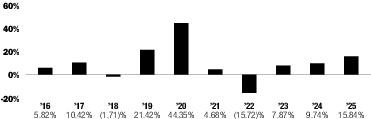
The bar chart and performance table provide an indication of the risks of investing in the Fund. The bar chart shows changes in the performance of the Fund from year to year as of December 31. The performance table compares the Fund's performance to that of a style-specific benchmark and broad-based securities market benchmarks (in that order). The Fund's past performance (before and after taxes) is not necessarily an indication of its future performance.
Fund performance reflects any applicable fee waivers and expense reimbursements. Performance returns would be lower without applicable fee waivers and expense reimbursements.
All Fund performance shown assumes the reinvestment of dividends and capital gains and the effect of the Fund’s expenses.
Updated performance information is available on the Fund's website at www.invesco.com/us.

Annual Total Returns
The bar chart does not reflect sales loads. If it did, the annual total returns shown would be lower.
Class A
Period Ended
Returns
Best Quarter
June 30, 2020
23.66%
Worst Quarter
June 30, 2022
-13.38%

Average Annual Total Returns (for the periods ended December 31, 2025)
 
Inception
Date
1
Year
5
Years
10
Years
Class A
Return Before Taxes
7/28/1997
9.46
%
2.71
%
8.69
%
Return After Taxes on Distributions
5.72
0.25
6.29
Return After Taxes on Distributions and Sale of Fund
Shares
6.53
1.48
6.25
Class C
7/28/1997
14.01
3.12
8.66
Class Y
7/28/1997
16.14
4.13
9.57
Class R5
5/23/2011
16.22
4.18
9.61
Class R6
9/24/2012
16.28
4.25
9.69
ICE BofA US Convertible Index1
17.98
5.05
11.22
S&P 500® Index (reflects no deduction for fees,
expenses or taxes)
17.88
14.42
14.82
Bloomberg U.S. Aggregate Bond Index (reflects no
deduction for fees, expenses or taxes)
7.30
-0.36
2.01
1
Prior to July 1, 2022, index returns reflect no deduction for fees, expenses or taxes. Effective July 1, 2022, index returns reflect no deduction for taxes, but include transaction costs, which may be higher or lower than the actual transaction costs incurred by the Fund.
After-tax returns are calculated using the historical highest individual federal marginal income tax rates and do not reflect the impact of state and local taxes. Actual after-tax returns depend on an investor's tax situation and may differ from those shown, and after-tax returns shown are not relevant to investors who hold their Fund shares through tax-advantaged arrangements, such as 401(k) plans, 529 college savings plans or individual retirement accounts. After-tax returns are shown for Class A shares only and after-tax returns for other classes will vary.
4        Invesco Convertible Securities Fund
invesco.com/usMS-CSEC-SUMPRO-1

Management of the Fund
Investment Adviser: Invesco Advisers, Inc. (Invesco or the Adviser)
Portfolio Managers
Title
Length of Service on the Fund
Robert Young, CFA
Portfolio Manager (Lead)
2023
James Ong, CFA
Portfolio Manager
2024
Purchase and Sale of Fund Shares
You may purchase, redeem or exchange shares of the Fund on any business day through your financial adviser or by telephone at 800-959-4246. Shares of the Fund, other than Class R5 and Class R6 shares, may also be purchased, redeemed or exchanged on any business day through our website at www.invesco.com/us or by mail to Invesco Investment Services, Inc., P.O. Box 219078, Kansas City, MO 64121-9078.
The minimum investments for Class A, C and Y shares for fund accounts are as follows:
Type of Account
Initial
Investment
Per Fund
Additional
Investments
Per Fund
Asset or fee-based accounts managed by your financial adviser
None
None
Employer Sponsored Retirement and Benefit Plans and
Employer Sponsored IRAs
None
None
IRAs and Coverdell ESAs if the new investor is purchasing
shares through a systematic purchase plan
$25
$25
All other types of accounts if the investor is purchasing shares
through a systematic purchase plan
50
50
IRAs and Coverdell ESAs
250
25
All other accounts
1,000
50
Class R5 shares of the Fund are offered only to grandfathered investors. With respect to Class R5 and Class R6 shares, there is no minimum initial investment for Employer Sponsored Retirement and Benefit Plans investing through a retirement platform that administers at least $2.5 billion in retirement plan assets. All other Employer Sponsored Retirement and Benefit Plans must meet a minimum initial investment of at least $1 million in each Fund in which it invests.
For all other institutional investors purchasing Class R5 or Class R6 shares, the minimum initial investment in each share class is $1 million, unless such investment is made by (i) an investment company, as defined under the Investment Company Act of 1940, as amended (1940 Act), that is part of a family of investment companies which own in the aggregate at least $100 million in securities, or (ii) an account established with a 529 college savings plan managed by Invesco, in which case there is no minimum initial investment.
There are no minimum investment amounts for Class R6 shares held through retail omnibus accounts maintained by an intermediary, such as a broker, that (i) generally charges an asset-based fee or commission in addition to those described in this prospectus, and (ii) maintains Class R6 shares and makes them available to retail investors.
Tax Information
The Fund’s distributions generally are taxable to you as ordinary income, capital gains, or some combination of both, unless you are investing through a tax-advantaged arrangement, such as a 401(k) plan, 529 college savings plan or individual retirement account. Any distributions from a 401(k) plan or individual retirement account may be taxed as ordinary income when withdrawn from such plan or account.
Payments to Broker-Dealers and Other Financial Intermediaries
If you purchase the Fund through a broker-dealer or other financial intermediary (such as a bank), the Fund, the Fund’s distributor or its related companies may pay the intermediary for the sale of Fund shares and related services. These payments may create a conflict of interest by influencing the broker-dealer or other intermediary and your salesperson or financial adviser to recommend the Fund over another investment. Ask your
salesperson or financial adviser or visit your financial intermediary’s website for more information.
5        Invesco Convertible Securities Fund
invesco.com/usMS-CSEC-SUMPRO-1