| Summary Prospectus |
April 30, 2026 |
Invesco Small Cap Growth Fund
Class: A (GTSAX), C (GTSDX), R (GTSRX), Y (GTSYX), Investor (GTSIX), R5 (GTSVX), R6 (GTSFX)

Before you invest, you may want to review the
Fund’s prospectus, which contains more information about the Fund and its risks. You can find the Fund’s prospectus, reports to shareholders, and other information
about the Fund online at www.invesco.com/prospectus. You can also get this information at no cost by calling (800) 959-4246 or by sending an e-mail request to
ProspectusRequest@invesco.com. The Fund’s prospectus and statement of additional information, both dated April 30, 2026 (as each may be amended or supplemented), are
incorporated by reference into this Summary Prospectus and may be obtained, free of charge, at the website, phone number or e-mail address noted above.
The Fund has
limited public sales of its shares to certain investors. Please see the “Other Information - Limited Fund Offering” section of the Statutory Prospectus for further
information.
Investment Objective(s)
The Fund’s
investment objective is long-term growth of capital.
Fees and
Expenses of the Fund
This table describes the fees and expenses that you may pay if you buy, hold and sell shares of the Fund.
The table and Examples below do not reflect any transaction
fees that may be charged by financial intermediaries or
commissions that a shareholder may be required to pay directly
to its financial intermediary when buying or selling Class Y or
Class R6 shares. You may qualify for sales charge discounts if you and your family invest, or agree to invest in the future, at least $50,000 in the Invesco Funds. More information
about these and other discounts is available from your financial professional and in the section “Shareholder Account Information – Initial Sales Charges (Class A Shares Only)” on page A-3 of the prospectus
and the section “Purchase, Redemption and Pricing of Shares – Purchase and Redemption of Shares” on page L-1 of the statement of additional information (SAI).
| Shareholder Fees (fees paid directly from your
investment) | |||||||
| Class: |
A |
C |
R |
Y |
Investor |
R5 |
R6 |
| Maximum Sales Charge (Load) Imposed on Purchases (as a percentage of offering price) |
5.50 % |
None |
None |
None |
None |
None |
None |
| | |||||||
| Maximum Deferred Sales Charge (Load) (as a percentage of original purchase price or redemption proceeds, whichever is less) |
None1 |
1.00 % |
None |
None |
None |
None |
None |
| | |||||||
| Annual Fund Operating Expenses (expenses that you pay each year as a percentage of the value of your investment) | |||||||
| Class: |
A |
C |
R |
Y |
Investor |
R5 |
R6 |
| Management Fees |
0.69 % |
0.69 % |
0.69 % |
0.69 % |
0.69 % |
0.69 % |
0.69 % |
| | |||||||
| Distribution and/or Service (12b-1) Fees |
0.25 |
0.96 |
0.50 |
None |
0.19 |
None |
None |
| | |||||||
| Other Expenses |
0.23 |
0.23 |
0.23 |
0.23 |
0.23 |
0.14 |
0.07 |
| | |||||||
| Total Annual Fund Operating Expenses |
1.17 |
1.88 |
1.42 |
0.92 |
1.11 |
0.83 |
0.76 |
| | |||||||
| 1 |
A contingent deferred sales charge may apply in some cases. See “Shareholder Account Information-Contingent Deferred Sales Charges (CDSCs).”
|
Example.
This Example is intended to help you compare the cost of investing in the Fund with the cost of
investing in other mutual funds.
The Example assumes that you invest $10,000 in the Fund for
the time periods indicated and then redeem all of your shares at the end of those periods. This
Example does not include commissions and/or other forms of compensation that investors may pay on transactions in Class Y and Class R6 shares. The Example also assumes that your investment has a 5% return each year and that the Fund’s
operating expenses remain the same.
Although your actual costs may be higher or lower, based on these
assumptions, your costs would be:
| |
1 Year |
3 Years |
5 Years |
10 Years |
| Class A |
$663
|
$901
|
$1,158
|
$1,892
|
| | ||||
| Class C |
$291
|
$591
|
$1,016
|
$2,016
|
| | ||||
| Class R |
$145
|
$449
|
$776
|
$1,702
|
| | ||||
| Class Y |
$94
|
$293
|
$509
|
$1,131
|
| | ||||
| Investor Class |
$113
|
$353
|
$612
|
$1,352
|
| | ||||
| Class R5 |
$85
|
$265
|
$460
|
$1,025
|
| | ||||
| Class R6 |
$78
|
$243
|
$422
|
$942
|
| | ||||
You would pay the following expenses if you did not redeem your shares:
| |
1 Year |
3 Years |
5 Years |
10 Years |
| Class A |
$663
|
$901
|
$1,158
|
$1,892
|
| | ||||
| Class C |
$191
|
$591
|
$1,016
|
$2,016
|
| | ||||
| Class R |
$145
|
$449
|
$776
|
$1,702
|
| | ||||
| Class Y |
$94
|
$293
|
$509
|
$1,131
|
| | ||||
| Investor Class |
$113
|
$353
|
$612
|
$1,352
|
| | ||||
| Class R5 |
$85
|
$265
|
$460
|
$1,025
|
| | ||||
| Class R6 |
$78
|
$243
|
$422
|
$942
|
| | ||||
Portfolio Turnover. The Fund pays transaction costs, such as commissions, when it buys and sells securities (or “turns
over” its portfolio). A higher portfolio turnover rate may indicate higher transaction costs and
1 Invesco Small Cap Growth Fund
invesco.com/usSCG-SUMPRO-1
may result in higher taxes when Fund shares
are held in a taxable account. These costs, which are not reflected in annual fund operating expenses or in the Example, affect the Fund’s performance. During the most recent fiscal year, the Fund’s
portfolio turnover rate was 85% of the average value of its portfolio.
Principal Investment Strategies of the Fund
The Fund invests, under normal circumstances, at least 80% of its net assets (plus any borrowings for
investment purposes) in securities of small-capitalization issuers and in derivatives and other instruments that have economic characteristics similar to such securities. The Fund invests primarily in equity securities. The
principal type of equity security in which the Fund invests is common stock.
The Fund considers a small-capitalization issuer to be one that has a
market capitalization no larger than the market capitalization of the largest capitalized issuer
included in the Russell 2000® Index during the most recent 11-month period (based on month-end data) plus the most recent data during the current month.
The Fund may invest up to 15% of its net assets in real estate investment trusts (REITs).
The Fund may also invest up to 25% of its net assets in foreign securities
of companies located in developing and emerging markets, i.e., those that are generally in the early stages of their industrial cycles, as well as in developed markets.
The Fund invests primarily in securities that are considered by the
Fund’s portfolio managers to have the potential for earnings or revenue growth. In
selecting investments, the portfolio managers utilize a disciplined portfolio construction process that calibrates the Fund’s sector-related exposure relative to the Russell 2000® Growth Index, which the portfolio managers believe generally represents the small-cap growth asset class.
The Fund uses this index as a guide in structuring and reviewing the portfolio, but the Fund is
not an index fund that seeks to replicate the performance of the index. The security selection process is based on a three-step process that includes fundamental, valuation and timeliness analysis.
■
Fundamental analysis typically involves building a series of financial models, as well as conducting in-depth interviews with management. The goal is to find high quality,
fundamentally sound issuers operating in an attractive industry.
■
Valuation analysis focuses on identifying attractively valued securities given their growth potential over a one- to two-year horizon.
■
Timeliness analysis is used to help identify the “timeliness” of a purchase. In this step, relative price strength, trading volume characteristics, and trend analysis are
reviewed for signs of deterioration. If a security shows signs of deterioration, it will not be
considered as a candidate for the portfolio.
The portfolio managers typically consider selling a security if the investment thesis for
owning the security is no longer valid, the stock reaches its price target or timeliness factors indicate that the risk/return characteristics of the stock as viewed in the market are no longer attractive.
Principal Risks of Investing in the Fund
As with any mutual fund investment, loss of money is a risk of investing. An investment in the Fund is not a deposit in a bank and is not insured or guaranteed by the Federal Deposit
Insurance Corporation or any other governmental agency. The risks associated with an investment in the Fund can increase during times of significant market volatility. The principal risks of investing in the Fund
are:
Market Risk. The market values of the Fund’s investments, and therefore the value of the Fund’s shares, will
go up and down, sometimes rapidly or unpredictably. Market risk may affect a single issuer, industry or section of the economy, or it may affect the market as a whole. The value of the Fund’s investments may
go up or down due to general market conditions that are not specifically related to the particular issuer. These market conditions may include real or perceived adverse economic
conditions, changes in trade regulation or economic sanctions, changes in the general outlook for revenues or corporate earnings, changes in interest or currency rates, regional or
global instability and uncertainty, natural or environmental disasters, widespread disease or other public health issues, war, military conflict, acts of terrorism, economic crisis or adverse investor sentiment generally, among
others. Certain changes in the U.S. economy in particular, such as when the U.S. economy weakens or when its financial markets decline, may have a material adverse effect on global financial markets as a whole, and on the
securities to which the Fund has exposure. Increasingly strained relations between the U.S. and foreign countries, including as a result of economic sanctions and tariffs, may also adversely affect U.S. issuers, as well as
non-U.S. issuers.
During a general downturn in the financial markets, multiple asset classes may decline in value. When markets perform well, there can be no assurance that specific investments
held by the Fund will rise in value.
Investing
in Stocks Risk. The value of the Fund’s portfolio may be affected by changes in the stock markets. Stock markets may experience significant short-term volatility and
may fall or rise sharply at times. Adverse events in any part of the equity or fixed-income markets may have unexpected negative effects on other market segments. Different stock markets may behave differently from each
other and U.S. stock markets may move in the opposite direction from one or more foreign stock markets.
The prices of individual stocks generally do not all move in the same
direction at the same time. However, individual stock prices tend to go up and down more
dramatically than those of certain other types of investments, such as bonds. A variety of factors can negatively affect the price of a particular company’s stock. These factors may include, but are not limited to: poor earnings
reports, a loss of customers, litigation against the company, general unfavorable performance of the company’s sector or industry, or changes in government regulations affecting the company or its industry. To the extent that
securities of a particular type are emphasized (for example foreign stocks, stocks of small- or mid-cap companies, growth or value stocks, or stocks of companies in a particular industry), Fund share values may fluctuate more in
response to events affecting the market for those types of securities.
Growth Investing Risk. The market values of growth securities may be more volatile than other types of investments. The returns on growth securities may or may not move in
tandem with the returns on other styles of investing or the overall stock market. If a growth company’s earnings or stock price fails to increase as anticipated, or if its business plans do not produce the expected results,
the value of its securities may decline sharply. Growth companies may be newer or smaller companies that may experience greater stock price fluctuations and risks of loss than larger, more established companies. Newer
growth companies tend to retain a large part of their earnings for research, development or investments in capital assets. Therefore, they may not pay any dividends for some time. Growth securities typically invest a
high portion of their earnings back into their business and may lack the dividend yield that could cushion their decline in a market downturn. During periods when growth investing is out of favor or when markets are
unstable, it may be more difficult to sell growth company securities at an acceptable price and the securities of growth companies may underperform the securities of value companies or the overall stock market. Growth stocks
may also be more volatile than other securities because of investor speculation and the value of the Fund’s investments will vary and at times may be lower than that of other types of investments.
Small-Capitalization Companies Risk. Investing in securities of small-capitalization companies involves greater risk than customarily is associated with investing in larger,
more established companies. Stocks of small-capitalization companies tend to be more vulnerable to changing market conditions, may have little or no operating history or track record of success, may have more limited
product lines and markets, less experienced management and fewer financial resources than larger
companies. These companies’ securities may be more volatile and less
2 Invesco Small Cap Growth Fund
invesco.com/usSCG-SUMPRO-1
liquid than those of more established
companies. They may be more sensitive to changes in a company’s earnings expectations and may
experience more abrupt and erratic price movements. Smaller companies’ securities often
trade in lower volumes and in many instances, are traded over-the-counter or on a regional securities exchange, where the frequency and volume of trading is substantially less than is typical for securities of larger companies traded on
national securities exchanges. Therefore, the securities of smaller companies may be subject to wider price fluctuations and it might be harder for the Fund to dispose of its holdings at an acceptable price when it wants to sell
them. Since small-cap companies typically reinvest a high proportion of their earnings in their business, they may not pay dividends for some time, particularly if they are newer companies. It may take a substantial
period of time to realize a gain on an investment in a small-cap company, if any gain is realized at all.
Sector Focus Risk. In pursuing its investment strategy,
the Fund may invest to a significant degree in securities of issuers operating in a single
sector. In so doing, the Fund may face more risks than if it were diversified broadly over
numerous sectors. Such sector-based risks, any of which may adversely affect the companies in which, the Fund invests, may include, but are not limited to, legislative or regulatory changes, adverse market conditions and/or increased competition
within the sector. In addition, at times, such sector may be out of favor and underperform other sectors or the market as a whole.
REIT Risk/Real Estate Risk. Investments in real estate related instruments may be adversely affected by economic, legal, cultural, environmental or technological factors
that affect property values, rents or occupancies. Shares of real estate related companies, which tend to be small- and mid-cap companies, may be more volatile and less liquid than larger companies. If a real estate
related company defaults on certain types of debt obligations held by the Fund, the Fund may acquire real estate directly, which involves additional risks such as environmental liabilities; difficulty in valuing and selling
the real estate; and economic or regulatory changes.
Foreign Investment
Risk. Investments in the securities of non-U.S. issuers involve risks beyond those associated with investments in U.S. securities. Foreign securities may have
relatively low market liquidity, greater market volatility, decreased publicly available information and less reliable financial information about issuers, and inconsistent and potentially less stringent accounting, auditing and
financial reporting requirements and standards of practice, including recordkeeping standards, comparable to those applicable to domestic issuers. Foreign securities also are subject to the risks of possible seizure,
expropriation, nationalization, political or social instability, changes in economic or taxation policies or other adverse political or economic developments (in which the Fund could lose its entire investments in a certain market) and the
difficulty of enforcing obligations in other countries, including the possible adoption of foreign governmental restrictions such as exchange controls. Investments in foreign securities also may be subject to dividend
withholding or confiscatory taxes, currency blockage and/or transfer restrictions and higher transactional costs. To the extent the Fund invests in securities denominated in foreign currencies, fluctuations in the value of the U.S.
dollar relative to the values of other currencies may adversely affect investments in foreign securities and may negatively impact the Fund’s returns, unless the Fund has hedged its foreign currency exposure. Currency
exchange rates may fluctuate significantly over short periods of time. Currency hedging strategies, if used, may not always be successful. Foreign companies generally may be subject to less stringent regulations than U.S. companies,
including financial reporting requirements and auditing and accounting controls, and may therefore be more susceptible to fraud or corruption. There may be less public information available about foreign companies
than U.S. companies, making it difficult to evaluate those foreign companies. From time to time, certain companies in which the Fund invests may operate in, or have dealings with, countries subject to sanctions or embargoes
imposed by the U.S. government and the United Nations and/or in countries the U.S. government identified as state
sponsors of terrorism. One or more of these
companies may be subject to constraints under U.S. law or regulations that could negatively affect the company’s performance. Additionally, one or more of these companies could suffer damage to its
reputation if the market identifies it as a company that invests or deals with countries that the U.S. government identifies as state sponsors of terrorism or is subject to sanctions.
Emerging Markets Investment Risk. Investments in the securities of issuers in emerging market countries involve risks often not associated
with investments in the securities of issuers in developed countries. Securities in emerging
markets may be subject to greater price fluctuations than securities in more developed markets. Companies in emerging market countries generally may be subject to less stringent regulatory, disclosure, financial reporting, accounting,
auditing and recordkeeping standards than companies in more developed countries. In addition, information about such companies may be less available and reliable. Emerging markets usually are subject to greater market
volatility, political, social and economic instability, uncertainty regarding the existence of trading markets and more governmental limitations on foreign investment than are more developed markets. Securities law in many
emerging market countries is relatively new and unsettled. Therefore, laws regarding foreign investment in emerging market securities, securities regulation, title to securities, and shareholder rights may change quickly and
unpredictably, and the ability to bring and enforce actions, or to obtain information needed to pursue or enforce such actions, may be limited. In addition, the enforcement of systems of taxation at federal, regional and local
levels in emerging market countries may be inconsistent and subject to sudden change. Investments in emerging market securities may be subject to additional transaction costs, delays in settlement procedures, unexpected market
closures, and lack of timely information.
Valuation Risk. The price the Fund could receive upon the sale of a portfolio investment may differ from the Fund’s
valuation of the investment, particularly for investments that trade in thin or volatile markets or that are valued using a fair valuation methodology. Financial information related to securities of non-U.S. issuers may
be less reliable than information related to securities of U.S. issuers, which may make it difficult to obtain a current price for a non-U.S. security held by the Fund. When market quotations are not readily available for Fund
investments, those investments are fair valued by the Adviser. There are multiple methods that can be used to fair value a portfolio investment and such methods may involve more subjectivity than the use of market quotations. The
value established for an investment through fair valuation may be different from what would be produced if the investment had been valued using market quotations. In addition, there is no assurance that the Fund could
sell a portfolio investment at any time for the value ascribed to it for purposes of calculating the Fund’s net asset value, and it is possible that the Fund could incur a loss because an investment is sold at a discount to its
ascribed value. The ability to value investments may also be impacted by technological issues and/or errors by pricing services or other third-party service providers.
Management
Risk. The Fund is actively managed and depends heavily on the Adviser's judgment about markets, interest rates or the attractiveness, relative values,
liquidity, or potential appreciation of particular investments made for the Fund’s portfolio. The Fund could experience losses if these judgments prove to be incorrect. There can be no guarantee that the Adviser's investment
techniques or investment decisions will produce the desired results. Additionally, legislative, regulatory, or tax developments may adversely affect management of the Fund and, therefore, the ability of the Fund to achieve
its investment objective.
Performance
Information
The bar chart and performance table provide an indication of the risks of investing in the Fund. The bar chart shows changes in the performance of the Fund from year to year as of
December 31. The performance table compares the Fund's performance to that of a style-specific benchmark and a broad-based securities market benchmark (in that order). The Fund's past
3 Invesco Small Cap Growth Fund
invesco.com/usSCG-SUMPRO-1
performance (before and after taxes) is not
necessarily an indication of its future performance.
Fund performance reflects any applicable fee waivers and expense reimbursements. Performance returns would be lower without applicable fee waivers and expense
reimbursements.
All Fund performance shown assumes the reinvestment of dividends
and capital gains and the effect of the Fund’s expenses.
Updated performance information is available on the Fund's website at
www.invesco.com/us.
Annual Total Returns
The bar chart does not reflect sales loads. If it did, the annual total returns shown would be lower.
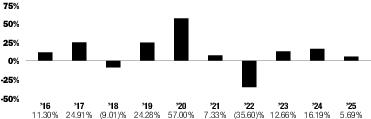
| Class A |
Period Ended |
Returns |
| Best Quarter |
June 30, 2020 |
34.24% |
| Worst Quarter |
June 30, 2022 |
-22.53% |
Average Annual Total Returns (for the periods ended December 31, 2025)
| |
Inception Date |
1 Year |
5 Years |
10
Years |
| Class A |
|
|
|
|
| Return Before Taxes |
10/18/1995 |
-0.12 % |
-2.00 % |
8.35 % |
| Return After Taxes on Distributions |
|
-2.39 |
-4.24 |
5.87 |
| Return After Taxes on Distributions and Sale of Fund Shares |
|
1.52 |
-1.70 |
6.37 |
| | ||||
| Class C |
5/3/1999 |
4.24 |
-1.58 |
8.33 |
| | ||||
| Class R |
6/3/2002 |
5.43 |
-1.14 |
8.69 |
| | ||||
| Class Y |
10/3/2008 |
5.95 |
-0.64 |
9.24 |
| | ||||
| Investor Class |
4/7/2006 |
5.74 |
-0.83 |
9.01 |
| | ||||
| Class R5 |
3/15/2002 |
6.02 |
-0.55 |
9.36 |
| | ||||
| Class R6 |
9/24/2012 |
6.11 |
-0.48 |
9.45 |
| | ||||
| Russell 2000® Growth Index (reflects no deduction for fees, expenses or taxes) |
|
13.01 |
3.18 |
9.57 |
| | ||||
| S&P 500® Index (reflects no deduction for fees, expenses or taxes) |
|
17.88 |
14.42 |
14.82 |
| | ||||
After-tax returns are calculated using the historical highest individual federal marginal income tax rates and do not reflect the impact of state and local taxes. Actual after-tax returns depend on an
investor's tax situation and may differ from those shown, and after-tax returns shown are not relevant to investors who hold their Fund shares through tax-advantaged
arrangements, such as 401(k) plans, 529 college savings plans or individual retirement accounts. After-tax returns are shown for Class A shares only and after-tax returns for other classes will vary.
Management of the Fund
Investment Adviser: Invesco Advisers, Inc. (Invesco or the Adviser)
| Portfolio Managers |
Title |
Length of Service on the Fund |
| Juan Hartsfield, CFA |
Portfolio Manager (Lead) |
2004 |
| | ||
| Clay Manley, CFA |
Portfolio Manager |
2008 |
| | ||
| Justin Sander, CFA |
Portfolio Manager |
2020 |
| | ||
Purchase and Sale of Fund Shares
You may purchase, redeem or exchange shares of the Fund on any business day through your financial adviser or by telephone at 800-959-4246. Shares of the Fund, other than Class R5
and Class R6 shares, may also be purchased, redeemed or exchanged on any business day through our
website at www.invesco.com/us or by mail to Invesco Investment Services, Inc., P.O. Box 219078,
Kansas City, MO 64121-9078.
The Fund has limited public sales of its shares to certain investors. Investor Class shares
and Class R5 shares of the Fund are offered only to grandfathered investors. The minimum investments for Class A, C, R, Y and Investor Class shares for fund accounts are as follows:
| Type of Account |
Initial
Investment Per Fund |
Additional Investments
Per Fund |
| Asset or fee-based accounts managed by your financial adviser |
None |
None |
| | ||
| Employer Sponsored Retirement and Benefit Plans and Employer Sponsored IRAs |
None |
None |
| | ||
| IRAs and Coverdell ESAs if the new investor is purchasing shares through a systematic purchase plan |
$25 |
$25 |
| | ||
| All other types of accounts if the investor is purchasing shares through a systematic purchase plan |
50 |
50 |
| | ||
| IRAs and Coverdell ESAs |
250 |
25 |
| | ||
| All other accounts |
1,000 |
50 |
| | ||
With respect to Class R5 and Class R6 shares, there is no minimum initial investment for Employer Sponsored Retirement and Benefit Plans investing through a retirement platform
that administers at least $2.5 billion in retirement plan assets. All other Employer Sponsored Retirement and Benefit Plans must meet a minimum initial investment of at least $1 million in each Fund in which it
invests.
For all other institutional investors purchasing Class R5 or Class R6
shares, the minimum initial investment in each share class is $1 million, unless such investment
is made by (i) an investment company, as defined under the Investment Company Act of 1940, as amended (1940 Act), that is part of a family of investment companies which own in the aggregate at least $100 million in securities, or
(ii) an account established with a 529 college savings plan managed by Invesco, in which case there is no minimum initial investment.
There are no minimum investment amounts for Class R6 shares held through retail omnibus accounts maintained by an intermediary, such as a broker, that (i) generally charges an
asset-based fee or commission in addition to those described in this prospectus, and (ii) maintains Class R6 shares and makes them available to retail investors.
Tax Information
The Fund’s distributions generally are taxable to you as ordinary income, capital gains, or some combination of both, unless you are investing through a tax-advantaged arrangement,
such as a 401(k) plan, 529 college savings plan or individual retirement account. Any distributions from a 401(k) plan or individual retirement account may be taxed as ordinary income when withdrawn from such plan or
account.
Payments to Broker-Dealers and Other Financial
Intermediaries
If you purchase the Fund through a broker-dealer or other financial intermediary (such as a bank), the Fund,
the Fund’s distributor or its related companies may pay the intermediary for the sale of Fund shares and related services. These payments may create a conflict of interest by influencing the broker-dealer or other
intermediary and your salesperson or financial adviser to recommend the Fund over another investment. Ask your salesperson or financial adviser or visit your financial intermediary’s website for more
information.
4 Invesco Small Cap Growth Fund
invesco.com/usSCG-SUMPRO-1