Summary Prospectus
April 30, 2026
Invesco Select Risk: High Growth Investor Fund
Class: A (OAAIX), C (OCAIX), R (ONAIX), Y (OYAIX), R5 (PXQIX), R6 (PXGGX)

Before you invest, you may want to review the Fund’s prospectus, which contains more information about the Fund and its risks. You can find the Fund’s prospectus, reports to shareholders, and other information about the Fund online at www.invesco.com/prospectus. You can also get this information at no cost by calling (800) 959-4246 or by sending an e-mail request to ProspectusRequest@invesco.com. The Fund’s prospectus and statement of additional information, both dated April 30, 2026 (as each may be amended or supplemented), are incorporated by reference into this Summary Prospectus and may be obtained, free of charge, at the website, phone number or e-mail address noted above.
Investment Objective(s)
The Fund’s investment objective is to seek total return.
Fees and Expenses of the Fund
This table describes the fees and expenses that you may pay if you buy, hold and sell shares of the Fund.
The table and Examples below do not reflect any transaction fees that may be charged by financial intermediaries or commissions that a shareholder may be required to pay directly to its financial intermediary when buying or selling Class Y or Class R6 shares. You may qualify for sales charge discounts if you and your family invest, or agree to invest in the future, at least $50,000 in the Invesco Funds. More information about these and other discounts is available from your financial professional and in the section “Shareholder Account Information – Initial Sales Charges (Class A Shares Only)” on page A-3 of the prospectus and the section “Purchase, Redemption and Pricing of Shares – Purchase and Redemption of Shares” on page L-1 of the statement of additional information (SAI).
Shareholder Fees (fees paid directly from your investment)
Class:
A
C
R
Y
R5
R6
Maximum Sales Charge (Load) Imposed on
Purchases (as a percentage of offering price)
5.50
%
None
None
None
None
None
Maximum Deferred Sales Charge (Load) (as a
percentage of original purchase price or
redemption proceeds, whichever is less)
None1
1.00
%
None
None
None
None
Annual Fund Operating Expenses (expenses that you pay each year as a percentage of the
value of your investment)
Class:
A
C
R
Y
R5
R6
Management Fees
None
None
None
None
None
None
Distribution and/or Service (12b-1) Fees
0.24
1.00
0.50
None
None
None
Other Expenses
0.10
0.10
0.10
0.10
0.05
0.05
Acquired Fund Fees and Expenses
0.50
0.50
0.50
0.50
0.50
0.50
Total Annual Fund Operating Expenses
0.84
1.60
1.10
0.60
0.55
0.55
1
A contingent deferred sales charge may apply in some cases. See “Shareholder Account Information-Contingent Deferred Sales Charges (CDSCs).”
Example. This Example is intended to help you compare the cost of investing in the Fund with the cost of investing in other mutual funds.
The Example assumes that you invest $10,000 in the Fund for the time periods indicated and then redeem all of your shares at the end of those periods. This Example does not include commissions and/or other forms of compensation that investors may pay on transactions in Class Y and Class R6 shares. The Example also assumes that your investment has a 5% return each year and that the Fund’s operating expenses remain the same.
Although your actual costs may be higher or lower, based on these assumptions, your costs would be:
 
1 Year
3 Years
5 Years
10 Years
Class A
$631
$803
$990
$1,530
Class C
$263
$505
$871
$1,697
Class R
$112
$350
$606
$1,340
Class Y
$61
$192
$335
$750
Class R5
$56
$176
$307
$689
Class R6
$56
$176
$307
$689
You would pay the following expenses if you did not redeem your shares:
 
1 Year
3 Years
5 Years
10 Years
Class A
$631
$803
$990
$1,530
Class C
$163
$505
$871
$1,697
Class R
$112
$350
$606
$1,340
Class Y
$61
$192
$335
$750
Class R5
$56
$176
$307
$689
Class R6
$56
$176
$307
$689
Portfolio Turnover. The Fund pays transaction costs, such as commissions, when it buys and sells securities (or “turns over” its portfolio). A higher portfolio turnover rate may indicate higher transaction costs and may result in higher taxes when Fund shares are held in a taxable account. These costs, which are not reflected in annual fund operating expenses or in the Example, affect the Fund’s performance. During the most recent fiscal year, the Fund’s portfolio turnover rate was 33% of the average value of its portfolio.
Principal Investment Strategies of the Fund
The Fund is a “fund of funds,” and may invest its assets in underlying open-end and closed-end funds (including unlisted interval funds) advised by Invesco Advisers, Inc. (Invesco or the Adviser), including exchange-traded funds (ETFs), and other pooled investment vehicles advised by Invesco
1        Invesco Select Risk: High Growth Investor Fund
invesco.com/usO-OPSGI-SUMPRO-1
Capital Management LLC (Invesco Capital), or underlying open-end and closed-end funds, including ETFs, and other pooled investment vehicles advised by unaffiliated advisers (the underlying funds). Invesco and Invesco Capital are affiliates of each other as they are both indirect wholly-owned subsidiaries of Invesco Ltd. The Fund primarily invests in affiliated funds advised by Invesco and Invesco Capital, but may invest in unaffiliated funds when the Adviser determines such investment is desirable.
The Adviser uses a three-step process to create the Fund's portfolio including: (1) determining strategic return drivers among broad asset classes; (2) the actual selection by the Adviser of underlying funds to represent the broad asset classes and the determination by the Adviser of target weightings in these underlying funds; in the case where there are multiple funds in a broad asset class, the Adviser attempts to balance the amount of active risk contributed by each underlying fund in order to determine the allocation; and (3) the ongoing monitoring of the Fund's asset class allocations, underlying funds and target weightings in the underlying funds.
The Fund generally invests between 85% and 100% of its assets in equity funds. Such funds invest in equity securities of domestic and foreign companies, including small, medium and large market capitalization companies, and growth and value stocks. Equity securities include common stock, preferred stock, rights and warrants, and securities convertible into common stock. Foreign equities are securities of issuers outside of the United States, including issuers in emerging or developing markets, i.e., those that are generally in the early stages of their industrial cycles. Underlying funds investing primarily in real estate securities, listed infrastructure securities, and master limited partnerships (MLPs) may be deemed to be “equity funds” for purposes of the Fund’s allocation strategy.
The Fund generally invests the remainder of its assets in a flexible combination of fixed-income and alternative funds. Fixed-income funds generally invest in fixed income instruments such as investment-grade debt securities, below-investment-grade high yield securities (or “junk” bonds), government and government-sponsored securities, corporate bonds, securitized products, and inflation-protected debt securities. Alternative funds generally offer unique combinations of traditional equity securities and fixed-income securities or use alternative investment strategies, including primarily through the use of derivatives, that aim to offer diversification beyond traditional equity and fixed-income securities and may seek to take long and short positions to manage exposure to certain asset classes. The Fund is not required to invest its assets in any specified percentages of fixed-income or alternative funds. The Fund does not limit its investment in underlying funds that invest primarily in foreign securities.
The Fund’s investment in underlying funds is subject to any limitations imposed by the Investment Company Act of 1940 and any rules thereunder.
The Fund may temporarily exceed its percentage range for its assets in equity funds for short periods and may alter the percentage range when it deems appropriate. The Adviser will monitor the markets and allocate assets among the underlying funds (including adding or removing underlying funds) based on changing market or economic conditions and investment opportunities. The Adviser monitors the underlying fund selections and periodically rebalances the Fund’s investments to bring them back within their asset allocation target ranges. The Adviser may change any or all of the underlying funds managed by Invesco and/or its affiliates, including using funds that may be created in the future, or change the Fund’s asset allocation target ranges at any time, in each case without prior approval from or notice to shareholders.
The Fund may invest directly in derivatives to hedge its cash position and manage the duration of the Fund’s portfolio, including but not limited to futures, total return swaps, and forward contracts. In addition, the Fund will gain exposure to derivatives through its investments in underlying funds. With respect to derivatives, references to the “underlying funds” also include the Fund and references to the “Fund” also include the underlying funds. Some underlying funds may use derivatives to seek income or capital gain or to hedge against the risks of other investments. Options, futures, forward
contracts and swaps are some of the types of derivatives the underlying funds can use.
The Fund may hold a portion of its assets in cash, money market securities or other similar, liquid investments, including in shares of money market mutual funds in the Invesco family of funds. This may also include shares of funds that provide exposure to inflation protected debt securities and short-term investment-grade debt securities. This will also generally occur at times when there is an inability to immediately invest funds received from purchases of Fund shares or from redemptions of other investments or to maintain liquidity.
Principal Risks of Investing in the Fund
As with any mutual fund investment, loss of money is a risk of investing. An investment in the Fund is not a deposit in a bank and is not insured or guaranteed by the Federal Deposit Insurance Corporation or any other governmental agency. The risks associated with an investment in the Fund can increase during times of significant market volatility. Because the Fund is a fund of funds, the Fund is subject to the risks associated with the underlying funds in which it invests. The principal risks of investing in the Fund and the underlying funds are:
Market Risk. The market values of an underlying fund’s investments, and therefore the value of an underlying fund’s shares, will go up and down, sometimes rapidly or unpredictably. Market risk may affect a single issuer, industry or section of the economy, or it may affect the market as a whole. The value of an underlying fund’s investments may go up or down due to general market conditions that are not specifically related to the particular issuer. These market conditions may include real or perceived adverse economic conditions, changes in trade regulation or economic sanctions, changes in the general outlook for revenues or corporate earnings, changes in interest or currency rates, regional or global instability and uncertainty, natural or environmental disasters, widespread disease or other public health issues, war, military conflict, acts of terrorism, economic crisis or adverse investor sentiment generally, among others. Certain changes in the U.S. economy in particular, such as when the U.S. economy weakens or when its financial markets decline, may have a material adverse effect on global financial markets as a whole, and on the securities to which an underlying fund has exposure. Increasingly strained relations between the U.S. and foreign countries, including as a result of economic sanctions and tariffs, may also adversely affect U.S. issuers, as well as non-U.S. issuers.
During a general downturn in the financial markets, multiple asset classes may decline in value. When markets perform well, there can be no assurance that specific investments held by an underlying fund will rise in value.
Fund of Funds Risk. Because it invests primarily in other funds the Fund's investment performance largely depends on the investment performance of the underlying funds. An investment in an underlying fund is subject to the risks associated with the underlying funds. The risks are that an underlying fund will vary from its target weightings (if any) in the underlying funds, that the underlying funds will not achieve their investment objectives, that the underlying funds' performance may be lower than their represented asset classes, and that an underlying fund may withdraw its investments in an underlying fund at a disadvantageous time.
In addition, at times, certain of the segments of the market represented by underlying funds in which the Fund invests may be out of favor and underperform other segments. The Fund will indirectly pay a proportional share of the fees and expenses of the underlying funds in which it invests (including operating expenses and management fees), in addition to the fees and expenses it already will pay to the Adviser.
Exchange-Traded Funds Risk. In addition to the risks associated with the underlying assets held by the exchange-traded fund, investments in exchange-traded funds are subject to the following additional risks: (1) an exchange-traded fund’s shares may trade above or below its net asset value; (2) an active trading market for the exchange-traded fund’s shares may not develop or be maintained; (3) trading an exchange-traded fund’s
2        Invesco Select Risk: High Growth Investor Fund
invesco.com/usO-OPSGI-SUMPRO-1

shares may be halted by the listing exchange; (4) a passively-managed exchange-traded fund may not track the performance of the reference asset; and (5) a passively-managed exchange-traded fund may hold troubled securities. Investment in exchange-traded funds may involve duplication of management fees and certain other expenses, as the Fund or an underlying fund indirectly bears its proportionate share of any expenses paid by the exchange-traded funds in which it invests. Further, certain exchange-traded funds in which the Fund or an underlying fund may invest are leveraged, which may result in economic leverage, permitting the Fund or an underlying fund to gain exposure that is greater than would be the case in an unlevered instrument, and potentially resulting in greater volatility.
Allocation Risk. The Fund’s investment performance depends, in part, on how its assets are allocated among the underlying funds or asset classes. The Adviser’s evaluations and assumptions regarding the asset classes or the underlying funds in which the Fund invests may be incorrect, causing the Fund to be invested (or not invested) in one or more asset classes or underlying funds at an inopportune time, which could negatively affect the Fund’s performance.
Investing in Stocks Risk. The value of an underlying fund’s portfolio may be affected by changes in the stock markets. Stock markets may experience significant short-term volatility and may fall or rise sharply at times. Adverse events in any part of the equity or fixed-income markets may have unexpected negative effects on other market segments. Different stock markets may behave differently from each other and U.S. stock markets may move in the opposite direction from one or more foreign stock markets.
The prices of individual stocks generally do not all move in the same direction at the same time. However, individual stock prices tend to go up and down more dramatically than those of certain other types of investments, such as bonds. A variety of factors can negatively affect the price of a particular company’s stock. These factors may include, but are not limited to: poor earnings reports, a loss of customers, litigation against the company, general unfavorable performance of the company’s sector or industry, or changes in government regulations affecting the company or its industry. To the extent that securities of a particular type are emphasized (for example foreign stocks, stocks of small- or mid-cap companies, growth or value stocks, or stocks of companies in a particular industry), fund share values may fluctuate more in response to events affecting the market for those types of securities.
Index Risk. Unlike many investment companies that are “actively managed,” certain underlying funds do not utilize investing strategies that seek returns in excess of their respective Underlying Index. Therefore, an underlying fund would not necessarily buy or sell a security unless that security is added or removed, respectively, from its respective Underlying Index, even if that security generally is underperforming. If a specific security is removed from an Underlying Index, certain underlying funds may be forced to sell shares of the security at an inopportune time or for a price lower than the security’s current market value. An Underlying Index may not contain the appropriate mix of securities for any particular economic cycle. Unlike with an actively managed fund, the Adviser does not use techniques or defensive strategies designed to lessen the impact of periods of market volatility or market decline. This means that, based on certain market and economic conditions, an underlying fund’s performance could be lower than other types of mutual funds with investment advisers that actively manage their portfolio assets to take advantage of market opportunities.
Preferred Securities Risk. There are special risks associated with investing in preferred securities compared to those applicable generally to equity securities. Preferred securities may be less liquid than many other securities, such as common stocks, and generally offer no voting rights with respect to the issuer. Preferred securities also may be subordinated to bonds or other debt instruments in an issuer’s capital structure, subjecting them to a greater risk of non-payment than more senior securities. Preferred securities may include provisions that permit the issuer, in its discretion, to defer or omit distributions for a certain period of time. If an
underlying fund owns a security that is deferring or omitting its distributions, an underlying fund may be required to report the distribution on its tax returns, even though it may not have received any income. Further, preferred securities may lose substantial value due to the omission or deferment of dividend payments.
Rights and Warrants Risk. Warrants may be significantly less valuable or worthless on their expiration date and may also be postponed or terminated early, resulting in a partial or total loss. Rights are similar to warrants, but normally have a short duration and are distributed directly by the issuer to its shareholders. Rights and warrants have no voting rights, receive no dividends and have no rights with respect to the assets of the issuer. Warrants and rights are highly volatile and, therefore, more susceptible to sharp declines in value than the underlying security might be. The market for rights or warrants may be very limited and it may be difficult to sell them promptly at an acceptable price.
Convertible Securities Risk. The market values of convertible securities are affected by market interest rates, the risk of actual issuer default on interest or principal payments and the value of the underlying common stock into which the convertible security may be converted. Additionally, a convertible security is subject to the same types of market and issuer risks that apply to the underlying common stock. In addition, certain convertible securities are subject to involuntary conversions and may undergo principal write-downs upon the occurrence of certain triggering events, and, as a result, are subject to an increased risk of loss. Convertible securities may be rated below investment grade and therefore considered to have more speculative characteristics and greater susceptibility to default or decline in market value than investment grade securities.
Small- and Mid-Capitalization Companies Risk. Investing in securities of small- and mid-capitalization companies involves greater risk than customarily is associated with investing in larger, more established companies. Stocks of small- and mid-capitalization companies tend to be more vulnerable to changing market conditions, may have little or no operating history or track record of success, and may have more limited product lines and markets, less experienced management and fewer financial resources than larger companies. These companies’ securities may be more volatile and less liquid than those of more established companies. They may be more sensitive to changes in a company’s earnings expectations and may experience more abrupt and erratic price movements. Smaller companies’ securities often trade in lower volumes and in many instances, are traded over-the-counter or on a regional securities exchange, where the frequency and volume of trading is substantially less than is typical for securities of larger companies traded on national securities exchanges. Therefore, the securities of smaller companies may be subject to wider price fluctuations and it might be harder for an underlying fund to dispose of its holdings at an acceptable price when it wants to sell them. Since small- and mid-cap companies typically reinvest a high proportion of their earnings in their business, they may not pay dividends for some time, particularly if they are newer companies. It may take a substantial period of time to realize a gain on an investment in a small- or mid-cap company, if any gain is realized at all.
Growth Investing Risk. The market values of growth securities may be more volatile than other types of investments. The returns on growth securities may or may not move in tandem with the returns on other styles of investing or the overall stock market. If a growth company’s earnings or stock price fails to increase as anticipated, or if its business plans do not produce the expected results, the value of its securities may decline sharply. Growth companies may be newer or smaller companies that may experience greater stock price fluctuations and risks of loss than larger, more established companies. Newer growth companies tend to retain a large part of their earnings for research, development or investments in capital assets. Therefore, they may not pay any dividends for some time. Growth securities typically invest a high portion of their earnings back into their business and may lack the dividend yield that could cushion their decline in a market downturn. During periods when growth investing is out
3        Invesco Select Risk: High Growth Investor Fund
invesco.com/usO-OPSGI-SUMPRO-1

of favor or when markets are unstable, it may be more difficult to sell growth company securities at an acceptable price and the securities of growth companies may underperform the securities of value companies or the overall stock market. Growth stocks may also be more volatile than other securities because of investor speculation and the value of an underlying fund’s investments will vary and at times may be lower than that of other types of investments.
Value Investing Risk. Value investing entails the risk that if the market does not recognize that a selected security is undervalued, the price of that security might not appreciate as anticipated. Value securities are subject to the risk that their valuations never improve or that the returns on value securities are lower than returns on other styles of investing or the overall stock market. Thus, the value of an underlying fund’s investments will vary and, at times, may be lower than that of other types of investments. Value investing has gone in and out of favor during past market cycles and when value investing is out of favor or when markets are unstable, value securities may underperform growth securities or the overall stock market.
Foreign Investment Risk. Investments in the securities of non-U.S. issuers involve risks beyond those associated with investments in U.S. securities. Foreign securities may have relatively low market liquidity, greater market volatility, decreased publicly available information and less reliable financial information about issuers, and inconsistent and potentially less stringent accounting, auditing and financial reporting requirements and standards of practice, including recordkeeping standards, comparable to those applicable to domestic issuers. Foreign securities also are subject to the risks of possible seizure, expropriation, nationalization, political or social instability, changes in economic or taxation policies or other adverse political or economic developments (in which an underlying fund could lose its entire investments in a certain market) and the difficulty of enforcing obligations in other countries, including the possible adoption of foreign governmental restrictions such as exchange controls. Investments in foreign securities also may be subject to dividend withholding or confiscatory taxes, currency blockage and/or transfer restrictions and higher transactional costs. To the extent an underlying fund invests in securities denominated in foreign currencies, fluctuations in the value of the U.S. dollar relative to the values of other currencies may adversely affect investments in foreign securities and may negatively impact an underlying fund’s returns, unless an underlying fund has hedged its foreign currency exposure. Currency exchange rates may fluctuate significantly over short periods of time. Currency hedging strategies, if used, may not always be successful. Foreign companies generally may be subject to less stringent regulations than U.S. companies, including financial reporting requirements and auditing and accounting controls, and may therefore be more susceptible to fraud or corruption. There may be less public information available about foreign companies than U.S. companies, making it difficult to evaluate those foreign companies. From time to time, certain companies in which an underlying fund invests may operate in, or have dealings with, countries subject to sanctions or embargoes imposed by the U.S. government and the United Nations and/or in countries the U.S. government identified as state sponsors of terrorism. One or more of these companies may be subject to constraints under U.S. law or regulations that could negatively affect the company’s performance. Additionally, one or more of these companies could suffer damage to its reputation if the market identifies it as a company that invests or deals with countries that the U.S. government identifies as state sponsors of terrorism or is subject to sanctions.
Emerging Markets Investment Risk. Investments in the securities of issuers in emerging market countries involve risks often not associated with investments in the securities of issuers in developed countries. Securities in emerging markets may be subject to greater price fluctuations than securities in more developed markets. Companies in emerging market countries generally may be subject to less stringent regulatory, disclosure, financial reporting, accounting, auditing and recordkeeping standards than companies in more developed countries. In addition, information about such companies may be less available and reliable. Emerging markets usually are
subject to greater market volatility, political, social and economic instability, uncertainty regarding the existence of trading markets and more governmental limitations on foreign investment than are more developed markets. Securities law in many emerging market countries is relatively new and unsettled. Therefore, laws regarding foreign investment in emerging market securities, securities regulation, title to securities, and shareholder rights may change quickly and unpredictably, and the ability to bring and enforce actions, or to obtain information needed to pursue or enforce such actions, may be limited. In addition, the enforcement of systems of taxation at federal, regional and local levels in emerging market countries may be inconsistent and subject to sudden change. Investments in emerging market securities may be subject to additional transaction costs, delays in settlement procedures, unexpected market closures, and lack of timely information.
Depositary Receipts Risk. Investing in depositary receipts involves the same risks as direct investments in foreign securities. In addition, the underlying issuers of certain depositary receipts are under no obligation to distribute shareholder communications or pass through any voting rights with respect to the deposited securities to the holders of such receipts. An underlying fund may therefore receive less timely information or have less control than if it invested directly in the foreign issuer.
Liquidity Risk. An underlying fund may be unable to sell illiquid investments at the time or price it desires and, as a result, could lose its entire investment in such investments. Liquid securities can become illiquid during periods of market stress. If a significant amount of an underlying fund’s securities become illiquid, an underlying fund may not be able to timely pay redemption proceeds and may need to sell securities at significantly reduced prices.
Unlisted Closed-end Interval Fund Risk. In addition to the risks associated with the underlying assets held by an underlying unlisted closed-end interval fund (an underlying interval fund), an underlying interval fund is considered an illiquid investment because shareholders (such as the Fund) cannot redeem or sell their shares outside of periodic repurchase offers. To provide some liquidity to its shareholders, an underlying interval fund makes periodic offers to repurchase a portion of its outstanding shares at net asset value (NAV), subject to certain conditions under the 1940 Act. In connection with any given repurchase offer, it is possible that an underlying interval fund may offer to repurchase only a small portion of its outstanding shares. Further, if a repurchase offer is oversubscribed, shareholders of an underlying interval fund may only have a portion of their shares repurchased. As a result, there is no guarantee that shareholders of an underlying interval fund will be able to exit their shares at any given time. Since an underlying interval fund does not list its shares for trading on any national securities exchange, an underlying interval fund's shares are, therefore, not readily marketable and no market is expected to develop.
Rule 144A Securities and Other Exempt Securities Risk. The market for Rule 144A and other securities exempt from certain registration requirements may be less active than the market for publicly-traded securities. Rule 144A and other exempt securities, while initially privately placed, carry the risk that their liquidity may become impaired and an underlying fund may be unable to dispose of the securities at a desirable time or price.
Geographic Focus Risk. An underlying fund may from time to time have a substantial amount of its assets invested in securities of issuers located in a single country or a limited number of countries. Adverse economic, political or social conditions in those countries may therefore have a significant negative impact on an underlying fund’s investment performance.
European Investment Risk. The Economic and Monetary Union (the EMU) of the European Union (the EU) requires compliance by member countries with restrictions on inflation rates, deficits, interest rates, debt levels and fiscal and monetary controls, each of which may significantly affect every country in Europe. Decreasing imports or exports, changes in governmental or EU regulations on trade, changes in the exchange rate of
4        Invesco Select Risk: High Growth Investor Fund
invesco.com/usO-OPSGI-SUMPRO-1

the euro, the default or threat of default by an EU member country on its sovereign debt, and/or an economic recession in an EU member country may have significant adverse effects on the economies of EU member countries and the EU and Europe as a whole. Responses to these and other financial problems by European governments, central banks, and others, including austerity measures and reforms, may not produce the desired results, may limit future growth and economic recovery, or may result in social unrest, or have other unintended consequences. Further defaults or restructurings by governments and other entities of their debt could have additional adverse effects on economies, financial markets, and asset valuations around the world. A number of countries in Eastern Europe remain relatively undeveloped and can be particularly sensitive to political and economic developments. Separately, the EU faces issues involving its membership, structure, procedures and policies. The exit of one or more member countries from the EU, such as the departure of the United Kingdom (the “UK”), referred to as Brexit, could place the departing member’s currency and banking system under severe stress or even in jeopardy. An exit by other member countries will likely result in increased volatility, illiquidity and potentially lower economic growth in the affected markets, which will adversely affect an underlying fund’s investments.
Asia Pacific Region Risk (including Japan). The level of development of the economies of countries in the Asia Pacific region varies greatly. Furthermore, since the economies of the countries in the region are largely intertwined, if an economic recession is experienced by any of these countries, it will likely adversely impact the economic performance of other countries in the region. Certain economies in the region may be adversely affected by increased competition, high inflation rates, undeveloped financial services sectors, currency fluctuations or restrictions, political and social instability and increased economic volatility.
An underlying fund’s Japanese investments may be adversely affected by protectionist trade policies, slow economic activity worldwide, dependence on exports and international trade, increasing competition from Asia’s other low-cost emerging economies, political and social instability, regional and global conflicts and natural disasters, as well as by commodity markets fluctuations related to Japan’s limited natural resource supply. The Japanese economy also faces several other concerns, including a financial system with large levels of nonperforming loans, over-leveraged corporate balance sheets, extensive cross-ownership by major corporations, a changing corporate governance structure, and large government deficits.
Investments in companies located or operating in Greater China (normally considered to be the geographical area that includes mainland China, Hong Kong, Macau and Taiwan) involve risks and considerations not typically associated with investments in the U.S. and other Western nations, such as greater government control over the economy; political, legal and regulatory uncertainty; nationalization, expropriation, or confiscation of property; lack of willingness or ability of the Chinese government to support the economies and markets of the Greater China region; lack of publicly available information and difficulty in obtaining information necessary for audits of, investigations into and/or litigation against Chinese companies, as well as in obtaining and/or enforcing judgments; limited legal remedies for shareholders; alteration or discontinuation of economic reforms; complex geopolitical tensions, military conflicts and the risk of war, either internal or with other countries; assertions of human rights violations by certain nations; public health emergencies resulting in market closures, travel restrictions, quarantines or other interventions; inflation, currency fluctuations and fluctuations in inflation and interest rates that may have negative effects on the economy and securities markets of Greater China; and Greater China’s dependency on the economies of other Asian countries, many of which are developing countries. Events in any one country or region within Greater China may impact the other countries or regions or Greater China as a whole. Export growth continues to be a major driver of China’s rapid economic growth. As a result, a reduction in spending on Chinese products and services, the institution of additional tariffs, sanctions, capital controls, embargoes, trade wars, or other trade barriers (or the threat
thereof), including as a result of trade tensions between China and the United States, or a downturn in any of the economies of China’s key trading partners may have an adverse impact on the Chinese economy. In addition, actions by the U.S. government, such as delisting of certain Chinese companies from U.S. securities exchanges or otherwise restricting their operations in the U.S., may negatively impact the value of such securities held by an underlying fund. Further, from time to time, certain companies in which an underlying fund invests may operate in, or have dealings with, countries subject to sanctions or embargoes imposed by the U.S. government and the United Nations and/or in countries the U.S. government identified as state sponsors of terrorism. One or more of these companies may be subject to constraints under U.S. law or regulations that could negatively affect the company’s performance. Additionally, the Public Company Accounting Oversight Board (PCAOB) has historically had difficulties in inspecting audit work papers and practices of PCAOB-registered accounting firms in China with respect to their audit work of U.S. reporting companies. These difficulties may impose significant additional risks concerning the reliability of the audits and of the information about the Chinese securities or the potential delisting of a U.S.-listed Chinese issuer due to an inability to inspect the issuer’s accounting firm.
Investments in Chinese companies may be made through a special structure known as a variable interest entity (VIE) that is designed to provide foreign investors, such as an underlying fund, with exposure to Chinese companies that operate in certain sectors in which China restricts or prohibits foreign investments. Investments in VIEs may pose additional risks because the investment is made through an intermediary shell company that has entered into service and other contracts with the underlying Chinese operating company in order to provide investors with exposure to the operating company, and therefore does not represent equity ownership in the operating company. The value of the shell company is derived from its ability to consolidate the VIE into its financials pursuant to contractual arrangements that allow the shell company to exert a degree of control over, and obtain economic benefits arising from, the VIE without formal legal ownership. The contractual arrangements between the shell company and the operating company may not be as effective in providing operational control as direct equity ownership, and a foreign investor’s (such as an underlying fund’s) rights may be limited, including by actions of the Chinese government which could determine that the underlying contractual arrangements are invalid. While VIEs are a longstanding industry practice and are well known by Chinese officials and regulators, historically the structure has not been formally recognized under Chinese law. However, effective March 31, 2023, the China Securities Regulatory Commission (CSRC) released new rules and implementing guidelines that permit the use of VIE structures, provided they abide by Chinese laws and register with the CSRC. The rules, however, may cause Chinese companies to undergo greater scrutiny and may make the process to create VIEs more difficult and costly. Further, while the rules and implementing guidelines do not prohibit the use of VIE structures, this does not serve as a formal endorsement by the Chinese government. There is a risk that the Chinese government may cease to tolerate VIEs at any time, and any guidance or further rulemaking prohibiting or restricting these structures by the Chinese government, generally or with respect to specific industries, would likely cause impacted VIE-structured holding(s) to suffer significant, detrimental, and possibly permanent losses, and in turn, adversely affect an underlying fund’s, returns and net asset value. The future of the VIE structure generally and with respect to certain industries remains uncertain.
Certain securities issued by companies located or operating in Greater China, such as China A-shares, are subject to trading restrictions and suspensions, quota limitations and sudden changes in those limitations, and operational, clearing and settlement risks. Additionally, developing countries, such as those in Greater China, may subject an underlying fund’s investments to a number of tax rules, and the application of many of those rules may be uncertain. Moreover, China has implemented a number of tax reforms in recent years, and may amend or revise its existing tax laws
5        Invesco Select Risk: High Growth Investor Fund
invesco.com/usO-OPSGI-SUMPRO-1

and/or procedures in the future, possibly with retroactive effect. Changes in applicable Chinese tax law could reduce the after-tax profits of an underlying fund, directly or indirectly, including by reducing the after-tax profits of companies in China in which an underlying fund invests. Uncertainties in Chinese tax rules could result in unexpected tax liabilities for an underlying fund.
Sector Focus Risk. In pursuing its investment strategy, an underlying fund may invest to a significant degree in securities of issuers operating in a single sector. In so doing, an underlying fund may face more risks than if it were diversified broadly over numerous sectors. Such sector-based risks, any of which may adversely affect the companies in which, an underlying fund invests, may include, but are not limited to, legislative or regulatory changes, adverse market conditions and/or increased competition within the sector. In addition, at times, such sector may be out of favor and underperform other sectors or the market as a whole.
Industry Concentration Risk. In following its methodology, the Underlying Index from time to time may be concentrated to a significant degree in securities of issuers operating in a single industry or group of industries. To the extent that the Underlying Index concentrates in the securities of issuers in a particular industry or group of industries, an underlying fund will also concentrate its investments to approximately the same extent. By concentrating its investments in an industry or group of industries, an underlying fund faces more risks than if it were diversified broadly over numerous industries or groups of industries. Such industry-based risks, any of which may adversely affect the companies in which an underlying fund invests, may include, but are not limited to, legislative or regulatory changes, adverse market conditions and/or increased competition within the industry or group of industries. In addition, at times, such industry or group of industries may be out of favor and underperform other industries, groups of industries or the market as a whole.
Non-Diversification Risk. An underlying fund is non-diversified and can invest a greater portion of its assets in the obligations or securities of a small number of issuers or any single issuer than a diversified fund can. A change in the value of one or a few issuers’ securities will therefore affect the value of an underlying fund more than would occur in a diversified fund.
REIT Risk/Real Estate Risk. Investments in real estate related instruments may be adversely affected by economic, legal, cultural, environmental or technological factors that affect property values, rents or occupancies. Shares of real estate related companies, which tend to be small- and mid-cap companies, may be more volatile and less liquid than larger companies. If a real estate related company defaults on certain types of debt obligations held by an underlying fund, an underlying fund may acquire real estate directly, which involves additional risks such as environmental liabilities; difficulty in valuing and selling the real estate; and economic or regulatory changes.
Momentum Investing Risk. In general, momentum is the tendency of an investment to exhibit persistence in its relative performance; a “momentum” style of investing emphasizes investing in securities that have had better recent performance compared to other securities, on the theory that these securities will continue to increase in value. Momentum investing is subject to the risk that the securities may be more volatile than the market as a whole. High momentum may also be a sign that the securities’ prices have peaked, and therefore the returns on securities that previously have exhibited price momentum may be less than returns on other styles of investing. Momentum can turn quickly, and stocks that previously have exhibited high momentum may not experience continued positive momentum. An underlying fund may experience significant losses if momentum stops, reverses or otherwise behaves differently than predicted. In addition, there may be periods when the momentum style of investing is out of favor and therefore, the investment performance of an underlying fund may suffer.
Issuer-Specific Changes Risk. The performance of an underlying fund depends on the performance of individual securities to which an
underlying fund has exposure. The value of an individual security or particular type of security may be more volatile than the market as a whole and may perform differently from the value of the market as a whole, causing the value of its securities to decline. Poor performance may be caused by poor management decisions, competitive pressures, changes in technology, expiration of patent protection, disruptions in supply, labor problems or shortages, corporate restructurings, fraudulent disclosures or other factors. Issuers may, in times of distress or at their own discretion, decide to reduce or eliminate dividends, which may also cause their stock prices to decline.
Debt Securities Risk. The prices of debt securities held by an underlying fund will be affected by changes in interest rates, the creditworthiness of the issuer and other factors. An increase in prevailing interest rates typically causes the value of existing debt securities to fall and often has a greater impact on longer-duration debt securities and higher quality debt securities. Falling interest rates will cause an underlying fund to reinvest the proceeds of debt securities that have been repaid by the issuer at lower interest rates. Falling interest rates may also reduce an underlying fund’s distributable income because interest payments on floating rate debt instruments held by an underlying fund will decline. An underlying fund could lose money on investments in debt securities if the issuer or borrower fails to meet its obligations to make interest payments and/or to repay principal in a timely manner. Changes in an issuer’s financial strength, the market’s perception of such strength or in the credit rating of the issuer or the security may affect the value of debt securities. An underlying fund’s credit analysis applied to an underlying fund’s debt securities may fail to anticipate such changes, which could result in buying a debt security at an inopportune time or failing to sell a debt security in advance of a price decline or other credit event.
Changing Fixed Income Market Conditions Risk. Increases in the federal funds and equivalent foreign rates or other changes to monetary policy or regulatory actions may expose fixed income markets to heightened volatility, perhaps suddenly and to a significant degree, and to reduced liquidity for certain fixed income investments, particularly those with longer maturities. It is difficult to predict the impact of interest rate changes on various markets. In addition, decreases in fixed income dealer market-making capacity may also potentially lead to heightened volatility and reduced liquidity in the fixed income markets. As a result, the value of an underlying fund’s investments may decline. Changes in central bank policies and other governmental actions and political events within the U.S. and abroad, the U.S. government’s inability at times to agree on a long-term budget and deficit reduction plan or other legislation aimed at addressing financial or economic conditions, the threat of a federal government shutdown, and threats not to increase or suspend the federal government’s debt limit may also, among other things, affect investor and consumer expectations and confidence in the financial markets, including in the U.S. government’s credit rating and ability to service its debt. Such changes and events may adversely impact an underlying fund, including its operations, universe of potential investment options, and return potential, and could also result in higher than normal redemptions by shareholders, which could potentially increase an underlying fund’s transaction costs and potentially lower an underlying fund’s performance returns.
High Yield Debt Securities (Junk Bond) Risk. Compared to higher quality debt securities, high yield debt securities (also referred to as junk bonds or below-investment grade bonds) and other lower-rated securities involve a greater risk of default or price changes due to changes in the credit quality of the issuer because they are generally unsecured and may be subordinated to other creditors’ claims. High yield debt securities often are issued by smaller, less creditworthy companies or by highly leveraged (for example, indebted) firms. High yield debt securities are considered speculative with respect to the issuer’s capacity to pay interest and repay principal, are more susceptible to default or decline in market value and are less liquid than investment grade debt securities. Prices of high yield debt securities tend to be very volatile. The values of high yield debt securities
6        Invesco Select Risk: High Growth Investor Fund
invesco.com/usO-OPSGI-SUMPRO-1

often fluctuate more in response to company, political, regulatory or economic developments than higher quality bonds, and their values can decline significantly over short periods of time or during periods of economic difficulty when the bonds could be difficult to value or sell at a fair price, thus subjecting an underlying fund to a substantial risk of loss.
U.S. Government Obligations Risk. U.S. government securities include securities that are issued or guaranteed by the U.S. Treasury, by various agencies of the U.S. government, or by various instrumentalities which have been established or sponsored by the U.S. government. U.S. Treasury securities are backed by the “full faith and credit” of the United States, which may be negatively affected by an actual or threatened failure of the U.S. government to pay its obligations. Securities issued or guaranteed by federal agencies and U.S. government-sponsored instrumentalities may or may not be backed by the full faith and credit of the United States. In the case of those U.S. government securities not backed by the full faith and credit of the United States, the investor must look principally to the agency or instrumentality issuing or guaranteeing the security for ultimate repayment, and may not be able to assert a claim against the United States itself in the event that the agency or instrumentality does not meet its commitment. The U.S. government, its agencies and instrumentalities do not guarantee the market value of their securities, and consequently, the value of such securities may fluctuate.
Derivatives Risk. The value of a derivative instrument depends largely on (and is derived from) the value of an underlying security, currency, commodity, interest rate, index or other asset (each referred to as an underlying asset). In addition to risks relating to the underlying assets, the use of derivatives may include other, possibly greater, risks, including counterparty, leverage and liquidity risks. Counterparty risk is the risk that the counterparty to the derivative contract will default on its obligation to pay an underlying fund or the Fund the amount owed or otherwise perform under the derivative contract. Derivatives create leverage risk because they do not require payment up front equal to the economic exposure created by holding a position in the derivative. As a result, an adverse change in the value of the underlying asset could result in an underlying fund or the Fund sustaining a loss that is substantially greater than the amount invested in the derivative or the anticipated value of the underlying asset, which may make the underlying fund’s or the Fund’s returns more volatile and increase the risk of loss. Derivative instruments may also be less liquid than more traditional investments and the underlying fund or the Fund may be unable to sell or close out its derivative positions at a desirable time or price. This risk may be more acute under adverse market conditions, during which the underlying fund or the Fund may be most in need of liquidating its derivative positions. Derivatives may also be harder to value, less tax efficient and subject to changing government regulation that could impact the underlying fund’s or the Fund’s ability to use certain derivatives or their cost. Derivatives strategies may not always be successful. For example, derivatives used for hedging or to gain or limit exposure to a particular market segment may not provide the expected benefits, particularly during adverse market conditions.
Alternative Investment Strategies Risk. An underlying fund utilizes alternative investment strategies, which are strategies that the portfolio manager expects to result in investment performance that does not correlate with the performance of traditional asset classes, such as equity and fixed-income investments. An underlying fund also seeks to utilize a diverse mix of alternative investment strategies, in the hope that individual strategies yield low performance correlation to other alternative investment strategies used by an underlying fund. However, alternative investments may be more volatile or illiquid, particularly during periods of market instability, and an underlying fund cannot guarantee that diverse alternative investment strategies will yield uncorrelated performance under all market conditions. In addition, the particular mix of alternative investments in an underlying fund’s portfolio may not be sufficiently diversified. An underlying fund is subject to the risk that its alternative investments may undergo a correlation shift,
resulting in returns that are correlated with the broader market and/or with an underlying fund’s other alternative investments.
Quantitative Models Risk. Quantitative models are based upon many factors that measure individual securities relative to each other. Quantitative models may be highly reliant on the gathering, cleaning, culling and analysis of large amounts of data from third parties and other external sources. Any errors or imperfections in the factors, or the data on which measurements of those factors are based, could adversely affect the use of the quantitative models. The factors used in models may not identify securities that perform well in the future, and the securities selected may perform differently from the market as a whole or from their expected performance.
Money Market Fund Risk. The share price of certain underlying money market funds may fluctuate and the Fund may lose money by investing in an underlying money market fund. The share price of money market funds can fall below the $1.00 share price. An underlying money market fund’s sponsor is not required to reimburse an underlying money market fund for losses, and you should not rely on or expect that the sponsor will enter into support agreements or take other actions to provide financial support to an underlying money market fund or maintain an underlying money market fund’s $1.00 share price at any time. The credit quality of an underlying money market fund’s holdings can change rapidly in certain markets, and the default of a single holding could have an adverse impact on an underlying money market fund’s share price. An underlying money market fund’s share price can also be negatively affected during periods of high redemption pressures, illiquid markets, and/or significant market volatility. An underlying money market fund’s Board may elect to impose a fee upon the sale of the Fund’s shares or temporarily suspend the Fund’s ability to sell shares in the future if an underlying money market fund’s liquidity falls below required minimums because of market conditions or other factors.
Short Position Risk. Because an underlying fund’s potential loss on a short position arises from increases in the value of the asset sold short, the underlying fund will incur a loss on a short position, which is theoretically unlimited, if the price of the asset sold short increases from the short sale price. The counterparty to a short position or other market factors may prevent an underlying fund from closing out a short position at a desirable time or price and may reduce or eliminate any gain or result in a loss. In a rising market, an underlying fund’s short positions will cause the underlying fund to underperform the overall market and its peers that do not engage in shorting. If an underlying fund holds both long and short positions, and both positions decline simultaneously, the short positions will not provide any buffer (hedge) from declines in value of the underlying fund’s long positions. Certain types of short positions involve leverage, which may exaggerate any losses, potentially more than the actual cost of the investment, and will increase the volatility of an underlying fund’s returns.
Active Trading Risk. Active trading of portfolio securities may result in added expenses, a lower return and increased tax liability.
Valuation Risk. The price an underlying fund could receive upon the sale of a portfolio investment may differ from an underlying fund’s valuation of the investment, particularly for investments that trade in thin or volatile markets or that are valued using a fair valuation methodology. Financial information related to securities of non-U.S. issuers may be less reliable than information related to securities of U.S. issuers, which may make it difficult to obtain a current price for a non-U.S. security held by an underlying fund. When market quotations are not readily available for Fund investments, those investments are fair valued by the Adviser. There are multiple methods that can be used to fair value a portfolio investment and such methods may involve more subjectivity than the use of market quotations. The value established for an investment through fair valuation may be different from what would be produced if the investment had been valued using market quotations. In addition, there is no assurance that an underlying fund could sell a portfolio investment at any time for the value ascribed to it for purposes of calculating an underlying fund’s net asset
7        Invesco Select Risk: High Growth Investor Fund
invesco.com/usO-OPSGI-SUMPRO-1

value, and it is possible that an underlying fund could incur a loss because an investment is sold at a discount to its ascribed value. The ability to value investments may also be impacted by technological issues and/or errors by pricing services or other third-party service providers.
Management Risk. The Fund is actively managed and depends heavily on its Adviser’s judgment about markets, interest rates or the attractiveness, relative values, liquidity, or potential appreciation of particular investments made for the Fund’s portfolio. Similarly, certain underlying funds are actively managed and depend heavily on their advisers’ judgments about markets, interest rates or the attractiveness, relative values, liquidity, or potential appreciation of particular investments made for their portfolios. The Fund and certain underlying funds could experience losses if these judgments prove to be incorrect. Because the investment process of the Fund relies heavily on its asset allocation process, market movements that are counter to the portfolio managers' expectations may have a significant adverse effect on the Fund’s net asset value. Similarly, because the investment processes of certain underlying funds rely heavily on their security selection processes, market movements that are counter to the portfolio managers' expectations may have a significant adverse effect on certain underlying funds’ net asset values. Additionally, legislative, regulatory, or tax developments may adversely affect management of the Fund and underlying funds and, therefore, their abilities to achieve their investment objectives.
Performance Information
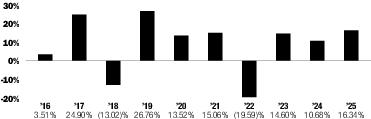
The bar chart and performance table provide an indication of the risks of investing in the Fund. The Fund has adopted the performance of the Oppenheimer Portfolio Series: Growth Investor Fund (the predecessor fund) as the result of a reorganization consummated after the close of business on May 24, 2019 (the “Reorganization”). Prior to the Reorganization, the Fund had not yet commenced operations. The bar chart shows changes in the performance of the predecessor fund and the Fund from year to year as of December 31. The performance table compares the predecessor fund’s and the Fund’s performance to that of a broad measure of market performance and additional index with characteristics relevant to the Fund.
The Fund’s (and the predecessor fund’s) past performance (before and after taxes) is not necessarily an indication of how the Fund will perform in the future. The returns shown for periods ending on or prior to May 24, 2019, are those of the Class A, Class C, Class R and Class Y shares of the predecessor fund. Class A, Class C, Class R and Class Y shares of the predecessor fund were reorganized into Class A, Class C, Class R and Class Y shares, respectively, of the Fund after the close of business on May 24, 2019. Class A, Class C, Class R and Class Y shares’ returns of the Fund will be different from the returns of the predecessor fund as they have different expenses. Performance for Class A shares has been restated to reflect the Fund’s applicable sales charge.
Fund performance reflects any applicable fee waivers and expense reimbursements. Performance returns would be lower without applicable fee waivers and expense reimbursements. 
All Fund performance shown assumes the reinvestment of dividends and capital gains and the effect of the Fund’s expenses.
Updated performance information is available on the Fund’s website at www.invesco.com/us.

Annual Total Returns
The bar chart does not reflect sales loads. If it did, the annual total returns shown would be lower.
Class A
Period Ended
Returns
Best Quarter
June 30, 2020
20.30%
Worst Quarter
March 31, 2020
-24.12%

Average Annual Total Returns (for the periods ended December 31, 2025)
 
Inception
Date
1
Year
5
Years
10
Years
Class A
Return Before Taxes
4/5/2005
9.91
%
5.23
%
7.64
%
Return After Taxes on Distributions
8.26
3.69
5.72
Return After Taxes on Distributions and Sale of Fund
Shares
6.48
3.66
5.67
Class C
4/5/2005
14.53
5.63
7.60
Class R
4/5/2005
16.16
6.16
7.98
Class Y
4/5/2005
16.66
6.69
8.52
Class R5
5/24/2019
16.75
6.79
8.48
1
Class R6
5/24/2019
16.76
6.78
8.49
1
Custom Invesco Select Risk: High Growth Investor
Index (90% MSCI ACWI (Net) (reflects reinvested
dividends net of withholding taxes, but reflects no
deduction for fees, expenses or other taxes) and
10% Bloomberg Global Aggregate USD Hedged
Index (reflects no deduction for fees, expenses or
taxes))
20.51
10.12
10.84
Bloomberg Global Aggregate USD Hedged Index
(reflects no deduction for fees, expenses or taxes)
4.86
0.34
2.39
MSCI ACWI Index (Net) (reflects reinvested dividends
net of withholding taxes, but reflects no deduction
for fees, expenses or other taxes)
22.34
11.19
11.72
Bloomberg U.S. Aggregate Bond Index (reflects no
deduction for fees, expenses or taxes)
7.30
-0.36
2.01
1
Performance shown on or prior to the inception date is that of the predecessor fund's Class A shares at net asset value and includes the 12b-1 fees applicable to that class. Although invested in the same portfolio of securities, Class R5 and Class R6 shares' returns of the Fund will be different from Class A shares' returns of the predecessor fund as they have different expenses.
After-tax returns are calculated using the historical highest individual federal marginal income tax rates and do not reflect the impact of state and local taxes. Actual after-tax returns depend on an investor's tax situation and may differ from those shown, and after-tax returns shown are not relevant to investors who hold their Fund shares through tax-advantaged arrangements, such as 401(k) plans, 529 college savings plans or individual retirement accounts. After-tax returns are shown for Class A shares only and after-tax returns for other classes will vary.
Management of the Fund
Investment Adviser: Invesco Advisers, Inc. (Invesco or the Adviser)
Portfolio Managers
Title
Length of Service on the Fund
Jeffrey Bennett, CFA
Portfolio Manager
2019 (predecessor fund 2018)
Scott Hixon, CFA
Portfolio Manager
2023
Purchase and Sale of Fund Shares
You may purchase, redeem or exchange shares of the Fund on any business day through your financial adviser or by telephone at 800-959-4246. Shares of the Fund, other than Class R5 and Class R6 shares, may also be purchased, redeemed or exchanged on any business day through our
8        Invesco Select Risk: High Growth Investor Fund
invesco.com/usO-OPSGI-SUMPRO-1

website at www.invesco.com/us or by mail to Invesco Investment Services, Inc., P.O. Box 219078, Kansas City, MO 64121-9078.
The minimum investments for Class A, C, R and Y shares for fund accounts are as follows:
Type of Account
Initial
Investment
Per Fund
Additional
Investments
Per Fund
Asset or fee-based accounts managed by your financial adviser
None
None
Employer Sponsored Retirement and Benefit Plans and
Employer Sponsored IRAs
None
None
IRAs and Coverdell ESAs if the new investor is purchasing
shares through a systematic purchase plan
$25
$25
All other types of accounts if the investor is purchasing shares
through a systematic purchase plan
50
50
IRAs and Coverdell ESAs
250
25
All other accounts
1,000
50
Class R5 shares of the Fund are offered only to grandfathered investors. With respect to Class R5 and Class R6 shares, there is no minimum initial investment for Employer Sponsored Retirement and Benefit Plans investing through a retirement platform that administers at least $2.5 billion in retirement plan assets. All other Employer Sponsored Retirement and Benefit Plans must meet a minimum initial investment of at least $1 million in each Fund in which it invests.
For all other institutional investors purchasing Class R5 or Class R6 shares, the minimum initial investment in each share class is $1 million, unless such investment is made by (i) an investment company, as defined under the Investment Company Act of 1940, as amended (1940 Act), that is part of a family of investment companies which own in the aggregate at least $100 million in securities, or (ii) an account established with a 529 college savings plan managed by Invesco, in which case there is no minimum initial investment.
There are no minimum investment amounts for Class R6 shares held through retail omnibus accounts maintained by an intermediary, such as a broker, that (i) generally charges an asset-based fee or commission in addition to those described in this prospectus, and (ii) maintains Class R6 shares and makes them available to retail investors.
Tax Information
The Fund’s distributions generally are taxable to you as ordinary income, capital gains, or some combination of both, unless you are investing through a tax-advantaged arrangement, such as a 401(k) plan, 529 college savings plan or individual retirement account. Any distributions from a 401(k) plan or individual retirement account may be taxed as ordinary income when withdrawn from such plan or account.
Payments to Broker-Dealers and Other Financial Intermediaries
If you purchase the Fund through a broker-dealer or other financial intermediary (such as a bank), the Fund, the Fund’s distributor or its related companies may pay the intermediary for the sale of Fund shares and related services. These payments may create a conflict of interest by influencing the broker-dealer or other intermediary and your salesperson or financial adviser to recommend the Fund over another investment. Ask your salesperson or financial adviser or visit your financial intermediary’s website for more information.
9        Invesco Select Risk: High Growth Investor Fund
invesco.com/usO-OPSGI-SUMPRO-1