May 1, 2026
Lazard
Active ETF Trust
Summary Prospectus

|
|
|
|
May 1, 2026 |
|
| |
| Lazard
Active ETF Trust |
|
|
|
|
|
|
Before you invest, you may want to review the Portfolio’s Prospectus, which contains more information about the Portfolio and its risks. The Portfolio’s Prospectus and Statement of Additional Information (“SAI”), both dated May 1, 2026 (as revised or supplemented), are incorporated by reference into this Summary Prospectus. You can find the Portfolio’s Prospectus, SAI and other information about the Portfolio online at https://lazardassetmanagement.com/us/en_us/investment-solutions/how-to-invest/etfs. You can also get this information at no cost by calling (800) 823-6300 or by sending an e-mail request to Contact.US@Lazard.com.
Lazard Emerging Markets Opportunities ETF | Ticker | Exchange | |
EMKT | NYSE Arca |
Investment Objective
The Portfolio seeks long-term capital appreciation.
Fees and Expenses
This table describes the fees and expenses that you may pay if you buy, hold and sell shares of the Portfolio, a series of Lazard Active ETF Trust (the “Trust”). You may pay other fees, such as brokerage commissions and other fees to financial intermediaries, which are not reflected in the table and the Example below.
|
|
|
| ||||
Annual Portfolio Operating Expenses (expenses that you pay each year as a percentage of the value of your investment) |
|
|
| ||||
Management Fees |
|
| .74% |
| |||
Other Expenses1 |
|
| None |
| |||
Total Annual Portfolio Operating Expenses |
|
| .74% |
| |||
1 Pursuant to the Portfolio’s unitary management fee structure, Lazard Asset Management LLC (the “Investment Manager”) will pay all expenses of the Portfolio, except for the fee payment under the investment management agreement, acquired fund fees and expenses, interest expense, offering costs, trading expenses, taxes and extraordinary expenses. Notwithstanding the foregoing, until May 1, 2027, the Investment Manager has agreed to pay a portion of the Portfolio’s offering costs, so that offering costs borne by the Portfolio do not amount to .01% of its average net assets.
Example
This Example is intended to help you compare the cost of investing in the Portfolio with the cost of investing in other mutual funds.
The Example assumes that you invest $10,000 in the Portfolio for the time periods indicated and then hold or sell all of your shares at the end of those periods. The Example also assumes that your investment has a 5% return each year and that the Portfolio’s operating expenses remain the same, giving effect to any waiver and/or the expense reimbursement in year one only. Although your actual costs may be higher or lower, based on these assumptions your costs would be:
1 Year | 3 Years | 5 Years | 10 Years | |||
$ 75 | $ 236 | $ 410 | $ 917 |
Portfolio Turnover
The Portfolio pays transaction costs, such as commissions, when it buys and sells securities (or “turns over” its portfolio). A higher portfolio turnover rate may indicate higher transaction costs and may result in higher taxes when Portfolio shares are held in a taxable account. These costs, which are not reflected in annual portfolio operating expenses or in the Example, affect the Portfolio’s performance. During the most recent fiscal year, the Portfolio’s portfolio turnover rate was 71% of the average value of its portfolio.
Principal Investment Strategies
Under normal circumstances, the Portfolio invests at least 80% of its net assets (plus any borrowings for investment purposes) in equity securities of companies whose principal business activities are located in emerging market countries. Emerging market countries include all countries represented by the MSCI Emerging Markets Index, which as of March 31, 2026 includes: Brazil, Chile, China, Colombia, Czech Republic, Egypt, Greece, Hungary, India, Indonesia, Korea, Kuwait, Malaysia, Mexico, Peru, Philippines, Poland, Qatar, Saudi Arabia, South Africa, Taiwan, Thailand, Turkey and United Arab Emirates. Companies that have 50% or more of their assets in or revenue or net income from one or more emerging market country are considered to have their principal activities in emerging markets countries.
The Portfolio invests primarily in equity securities, principally common stocks, of non-U.S. companies whose principal activities are located in emerging market countries and that the Investment Manager believes are undervalued based on their earnings, cash flow or asset values. Implementation of the Portfolio’s investment strategy may result in significant exposure to large cap companies, however, the market capitalizations of issuers in which the Portfolio invests may vary with market conditions and the Portfolio also may invest in mid cap and small cap companies.
In addition to common stocks, preferred stocks and convertible securities, such equity securities also may include American Depositary Receipts (“ADRs”), Global Depositary Receipts and European Depositary Receipts. While the Portfolio’s investment strategy is not designed to focus investment in any particular market sector or sectors, implementation of the Portfolio’s investment strategy may, from time to time, result in the investment of a significant portion of the Portfolio’s assets in different market sectors.
Principal Investment Risks
The value of your investment in the Portfolio will fluctuate, which means you could lose money.
Market Risk: The Portfolio may incur losses due to declines in one or more markets in which it invests. These declines may be the result of, among other things, political, regulatory, market, economic or social developments affecting the relevant market(s). To the extent that such developments impact specific industries, market sectors, countries or geographic regions, the Portfolio’s investments in such industries, market sectors, countries and/or geographic regions can be expected to be particularly affected, especially if such investments are a significant portion of its investment portfolio. In addition, turbulence in financial markets and reduced liquidity in equity, credit and/or fixed income markets may negatively affect many issuers, which could adversely affect the Portfolio. Global economies and financial markets are increasingly interconnected, and conditions and events in one country, region or financial market may adversely impact issuers worldwide. As a result, local, regional or global events such as war or military conflict, acts of terrorism, the spread of infectious illness or other public health issues, social unrest, natural disasters, extreme weather, other geological events, man-made disasters, supply chain disruptions, deflation, inflation, government defaults, government shutdowns, the imposition of sanctions or other similar measures, recessions or other events could have a significant negative impact on global economic and market conditions. For example, a public health or other emergency and aggressive responses taken by many governments or voluntarily imposed by private parties, including closing borders, restricting travel and imposing prolonged quarantines or similar restrictions, as well as the closure of, or operational changes to, many retail and other businesses, may have severe negative impacts on markets worldwide. Additionally, general market conditions may affect the value of a Portfolio’s securities, including changes in interest rates, currency rates or monetary policies. Furthermore, the imposition of tariffs, trade restrictions, currency restrictions or similar actions (or retaliatory measures taken in response to such actions), or the threat or potential of one or more such events and developments, could lead to price volatility and overall declines in the U.S. and global investment markets.
Issuer Risk: The value of a security may decline for a number of reasons which directly relate to the issuer, such as management performance, financial leverage and reduced demand for the issuer’s goods or services, as well as the
Summary Prospectus
2
historical and prospective earnings of the issuer and the value of its assets or factors unrelated to the issuer’s value, such as investor perception.
Non-U.S. Securities Risk: The Portfolio’s performance will be influenced by political, social and economic factors affecting the non-U.S. countries and companies in which the Portfolio invests. Non-U.S. securities carry special risks, such as less developed or less efficient trading markets, political instability, a lack of company information, differing auditing and legal standards, and, potentially, less liquidity. Non-U.S. securities may also subject the Portfolio’s investments to changes in currency rates, which can make the return on an investment increase or decrease, unrelated to the quality or performance of the investment itself. Non-U.S. securities may be subject to economic sanctions or other governmental actions or developments, exchange controls (including repatriation restrictions), confiscations, trade restrictions (including tariffs) or problems related to share registration, trade settlement or asset custody, which could, among other things, effectively restrict or eliminate the Portfolio’s ability to purchase or sell certain foreign securities. To the extent the Portfolio holds securities subject to such actions, the securities may become difficult to value and/or less liquid (or illiquid). In some cases, the securities may become worthless. In addition, as a result of trade restrictions (including tariffs) and other similar governmental actions or developments, the Portfolio may be forced to sell or otherwise dispose of foreign investments at inopportune times or prices.
Emerging Market Risk: Emerging market countries generally have economic structures that are less diverse and mature, and political systems that are less stable, than those of developed countries. The economies of countries with emerging markets may be based predominantly on only a few industries, may be highly vulnerable to changes in local or global trade conditions, and may suffer from extreme debt burdens or volatile inflation rates. Further, investments in securities of issuers located in certain emerging countries involve the risk of loss resulting from problems in share registration, settlement or custody, substantial economic, political and social disruptions and the threat or imposition of sanctions or exchange controls (including repatriation restrictions). The securities markets of emerging market countries have historically been extremely volatile and less liquid than more developed markets, thus, the Portfolio may be unable to liquidate its positions in such securities at a favorable time or price. These market conditions may continue or worsen. Investments in these countries may be subject to political, economic, legal, market and currency risks. Significant devaluation of emerging market currencies against the U.S. dollar may occur subsequent to acquisition of investments denominated in emerging market currencies. Emerging market countries may also be more susceptible to fraud, corruption, and money laundering, which may result in negative commercial consequences in relation to the value, liquidity and tradability of investments in or related to those regions.
Country Risk: Implementation of the Portfolio’s investment strategy may involve the investment of a significant portion of the Portfolio’s assets in a particular country, such as China, and the Portfolio would be expected to be affected by country-specific political, regulatory, market, economic and social developments.
China. There are special risks associated with investments in China, including currency fluctuations, less liquidity, expropriation, confiscatory taxation, nationalization, exchange control regulations (including currency blockage), trading halts, limitations on repatriation and differing legal standards. Strained relations between the United States and China have heightened concerns of increased tariffs and restrictions on trade between the two countries, such as the potential for an escalation in trade tensions. An increase in tariffs or trade restrictions (and threats thereof), sanctions or embargoes could lead to a significant reduction in international trade, which could have a negative impact on China’s export industry, Chinese issuers, the liquidity or price of the Portfolio’s direct or indirect investments in China and, therefore, the Portfolio.
The economy of China differs, often unfavorably, from the U.S. economy in such respects as structure, general development, government involvement, wealth distribution, rate of inflation, growth rate, interest rates, allocation of resources and capital reinvestment, among others. The Chinese central government has historically exercised substantial control over virtually every sector of the Chinese economy through administrative regulation and/or state ownership or other involvement and actions of the Chinese central and local government authorities continue to have a substantial effect on economic conditions in China. In addition, the Chinese government has from time to time actively intervened in Chinese companies’ operations and structures and taken actions that influence the prices at which certain goods may be sold, encourage companies to invest or concentrate in particular industries, induce mergers between companies in certain industries and induce private companies to publicly offer their securities to increase or continue the rate of economic growth, control the rate of inflation or otherwise regulate economic expansion. The Chinese government may do so in the future as well, potentially having a significant adverse effect on economic
Summary Prospectus
3
conditions in China. Moreover, strained relations, border disputes or other conflict between China and neighboring countries could adversely affect the Chinese economy.
The Portfolio may obtain exposure to companies based or operated in China by investing through legal structures known as variable interest entities (“VIEs”). Instead of directly owning the equity securities of a Chinese company, a VIE enters into service and other contracts with the Chinese company. Although the VIE has no equity ownership of the Chinese company, the contractual arrangements permit the VIE to consolidate the Chinese company into its financial statements. VIE investments are subject to the risk that any breach of these contractual arrangements will be subject to Chinese law and jurisdiction, that Chinese law may be interpreted or change in a way that affects the enforceability of the VIE’s arrangements, or that contracts between the Chinese company and the VIE may otherwise not be enforceable under Chinese law. VIE structures also could face delisting or other ramifications for failure to meet the requirements of the Securities and Exchange Commission, the Public Company Accounting Oversight Board or other United States regulators. If any of these or similar risks or developments materialize, the value of investments in VIEs could be adversely affected and the Portfolios could incur significant losses with no recourse available. A decline or worsening in diplomatic or other relations between the U.S. and China could increase the risks associated with the VIE structure.
The Portfolio may invest in eligible renminbi-denominated class A shares of equity securities that are listed and traded on certain Chinese stock exchanges (“China A-Shares”) through Hong Kong Stock Connect Program (“Stock Connect”). While Stock Connect is not subject to individual investment quotas, daily and aggregate investment quotas apply to all Stock Connect participants, which may restrict or preclude the Portfolio’s ability to invest in China A-Shares (although the Portfolio would be permitted to sell China A-Shares regardless of the quota balance). Stock Connect is also subject to trading, clearance, settlement and operational risks.
Foreign Currency Risk: Investments denominated in currencies other than U.S. dollars may experience a decline in value, in U.S. dollar terms, due solely to fluctuations in currency exchange rates. The Portfolio’s investments denominated in such currencies (particularly currencies of emerging markets countries), as well as any investments in currencies themselves, could be adversely affected by delays in, or a refusal to grant, repatriation of funds or conversion of currencies. Irrespective of any foreign currency exposure hedging, the Portfolio may experience a decline in the value of its portfolio securities, in U.S. dollar terms, due solely to fluctuations in currency exchange rates. The Investment Manager does not intend to utilize foreign currency contracts for the purpose of generating investment returns.
Depositary Receipts Risk: ADRs and similar depositary receipts typically will be subject to certain of the risks associated with direct investments in the securities of non-U.S. companies, because their values depend on the performance of the underlying non-U.S. securities. However, currency fluctuations will impact investments in depositary receipts differently than direct investments in non-U.S. dollar-denominated non-U.S. securities, because a depositary receipt will not appreciate in value solely as a result of appreciation in the currency in which the underlying non-U.S. dollar security is denominated.
Large Cap Companies Risk: Investments in large cap companies may underperform other segments of the market when such other segments are in favor or because such companies may be less responsive to competitive challenges and opportunities and may be unable to attain high growth rates during periods of economic expansion.
Small and Mid Cap Companies Risk: Small and mid cap companies carry additional risks because their earnings tend to be less predictable, their share prices more volatile and their securities less liquid than larger, more established companies. The shares of small and mid cap companies tend to trade less frequently than those of larger companies, which can have an adverse effect on the pricing of these securities and on the ability to sell these securities when the Investment Manager deems it appropriate.
Underlying ETF Risk: Because exchange-traded funds (“ETFs”) trade on a securities exchange, their shares may trade at a premium or discount to net asset value. An ETF is subject to the risks of the assets in which it invests as well as those of the investment strategy it follows. The Portfolio may incur brokerage costs when it buys and sells shares of an ETF and also bears its proportionate share of the ETF’s fees and expenses, which are passed through to ETF shareholders. Fees and expenses incurred by an ETF may include trading costs, operating expenses, licensing fees, trustee fees and marketing expenses. With a passive index ETF, these costs may contribute to the ETF not fully matching the performance of the index it is designed to track.
Summary Prospectus
4
Sector Risk: Implementation of the Portfolio’s investment strategy may, during certain periods, result in the investment of a significant portion of the Portfolio’s assets in a particular market sector, such as companies in the information technology sector, and the Portfolio would be expected to be affected by developments in that sector.
Information Technology. Information technology companies generally operate in intensely competitive markets on a worldwide basis. Because technological development in many areas increases at a rapid rate, these companies often produce products with very short life cycles and face the risk of product obsolescence. Information technology companies may be subject to intense market volatility, changing consumer preferences, and government regulation or scrutiny.
Value Investing Risk: Value investments are believed by the Investment Manager to be undervalued, but may not realize their perceived value for extended periods of time or may never realize their perceived value. These securities may respond differently to market and other developments than other types of securities.
Securities Selection Risk: Securities and other investments selected by the Investment Manager for the Portfolio may not perform to expectations. This could result in the Portfolio’s underperformance compared to other funds with similar investment objectives or strategies.
Authorized Participant Concentration Risk: Only an authorized participant may engage in creation or redemption transactions directly with the Portfolio. The Portfolio has a limited number of intermediaries that act as authorized participants and none of these authorized participants is or will be obligated to engage in creation or redemption transactions. The Portfolio has a limited number of institutions that may act as authorized participants on an agency basis (i.e., on behalf of other market participants). To the extent that these intermediaries exit the business or are unable to or choose not to proceed with creation and/or redemption orders with respect to the Portfolio and no other authorized participant creates or redeems, Shares may trade at a discount to net asset value and possibly face trading halts and/or delisting. Authorized participant concentration risk may be heightened for ETFs that invest in securities issued by non-U.S. issuers or other securities or instruments that have lower trading volumes.
Cash Transaction Risk: To the extent the Portfolio sells Portfolio securities to meet some or all of a redemption request with cash, the Portfolio may incur taxable gains or losses that it might not have incurred had it made redemptions entirely in kind. As a result, the Portfolio may pay out higher annual capital gain distributions than if the in-kind redemption process were used. Additionally, the Portfolio may incur additional brokerage costs related to buying and selling securities if it utilizes cash as part of a creation or redemption transaction than it would if the Portfolio had transacted entirely in-kind. The Portfolio imposes transaction fees to offset all or a part of the costs associated with utilizing cash as part of a creation or redemption transaction. To the extent that the transaction fees do not offset the costs associated with a cash transaction, the Portfolio performance may be negatively impacted.
Large Shareholder Risk: Certain shareholders, including other funds advised by the Investment Manager, may from time to time own a substantial amount of the Portfolio’s shares. In addition, a third party investor, the Investment Manager or an affiliate of the Investment Manager, an Authorized Participant, a market maker, or another entity may invest in the Portfolio and hold its investment for a limited period of time. There can be no assurance that any large shareholder would not redeem or sell its investment. Redemptions of a large number of Portfolio shares could require the Portfolio to dispose of assets to meet the redemption requests, which can accelerate the realization of taxable income and/or capital gains and cause the Portfolio to make taxable distributions to its shareholders earlier than the Portfolio otherwise would have. In addition, under certain circumstances, non-redeeming shareholders may be treated as receiving a disproportionately large taxable distribution during or with respect to such year. In some circumstances, the Portfolio may hold a relatively large proportion of its assets in cash in anticipation of large redemptions (to the extent redemptions are effected in cash), diluting its investment returns. These large redemptions may also force the Portfolio to sell portfolio securities when it might not otherwise do so, which may negatively impact the Portfolio’s net asset value, increase the Portfolio’s brokerage costs and/or have a material effect on the market price of the Portfolio shares.
Market Trading Risk: The net asset value of the Portfolio and the market price of your investment in Portfolio shares may fluctuate. Market prices of Portfolio shares may fluctuate, in some cases significantly, in response to the Portfolio’s net asset value, the intraday value of the Portfolio’s holdings and supply and demand for shares. The Portfolio faces numerous market trading risks, including disruptions to creations and redemptions, the existence of extreme market volatility or potential lack of an active trading market for shares. Any of these factors, among others, may result in shares trading at a significant premium or discount to net asset value, which will be reflected in the intraday bid/ask spreads
Summary Prospectus
5
and/or the closing price of shares as compared to net asset value. In addition, because liquidity in certain underlying securities may fluctuate, shares may trade at a larger premium or discount to net asset value than shares of other kinds of ETFs. If a shareholder purchases shares at a time when the market price is at a premium to the net asset value or sells shares at a time when the market price is at a discount to the net asset value, the shareholder may pay more for, or receive less than, the underlying value of the shares, respectively. Additionally, in stressed market conditions, the market for shares may become less liquid in response to deteriorating liquidity in the markets for the Portfolio’s underlying holdings.
Where all or a portion of the Portfolio’s underlying securities trade in a market that is closed when the market in which the Portfolio’s shares are listed and trading is open, there may be differences between the last quote from the security’s closed foreign market and the value of the security during the Portfolio’s domestic trading day, and liquidity in such securities may also be reduced after the applicable closing times. This in turn could lead to differences between the market price of the Portfolio’s shares and the underlying value of those shares and widened bid-ask spreads or fixing or settlement times.
No Guarantee of Active Trading Market Risk: There can be no assurance that an active trading market for Portfolio shares will develop or be maintained. Further, secondary markets may be subject to irregular trading activity, wide bid/ask spreads and extended trade settlement periods in stressed market conditions because market makers and Authorized Participants may step away from making a market in the shares and in executing creation and redemption orders, which could cause a material deviation in the Portfolio’s market price and its underlying net asset value.
Trading Issues Risk: Trading in Portfolio shares may be halted due to market conditions or for reasons that, in the view of the listing exchange, make trading in shares on the listing exchange inadvisable. In addition, trading in shares on the listing exchange is subject to trading halts caused by extraordinary market volatility pursuant to the listing exchange “circuit breaker” rules. In the event of a trading halt or unanticipated early closing of the listing exchange, a shareholder may be unable to purchase or sell shares of the Portfolio. There can be no assurance that the requirements of the listing exchange necessary to maintain the listing of the Portfolio will continue to be met or will remain unchanged.
Limited Operating History Risk: The Portfolio has not commenced operations. As a result, prospective investors would not have a track record or history on which to base their investment decisions. In addition, until the Portfolio achieves a certain size, the performance of certain of its investments may disproportionately impact the performance of the Portfolio, which may be subject to heightened volatility. In addition, there can be no assurance that the Portfolio will grow to or maintain an economically viable size.
Performance
Bar Chart and Table
Year-by-Year Total Returns
As
of December 31, 2025
The accompanying bar chart and table provide some indication of the risks of investing in the Portfolio. Performance results shown in the bar chart and the performance table below include the performance of the Institutional Class of Lazard Emerging Markets Core Equity Portfolio, another investment company advised by the Investment Manager (the “Predecessor Portfolio”). The assets of the Predecessor Portfolio were transferred to the Portfolio in a tax-free reorganization on October 24, 2025.
The performance of the Predecessor Portfolio has not been restated to reflect the annual operating expenses of the Portfolio, which are lower than those of the Predecessor Portfolio. Because the Portfolio has different fees and expenses than the Predecessor Portfolio, the Portfolio would also have had different performance results. Additionally, if the Predecessor Portfolio had operated as an ETF, its performance may have differed.
The bar chart shows the Portfolio’s year-by-year performance and average annual performance compared to that of a broad measure of market performance over the past 10 calendar years. Updated performance information for the Portfolio is available at www.lazardassetmanagement.com or by calling (800) 823-6300. The Portfolio’s past performance (before and after taxes) is not necessarily an indication of how the Portfolio will perform in the future.
Summary Prospectus
6
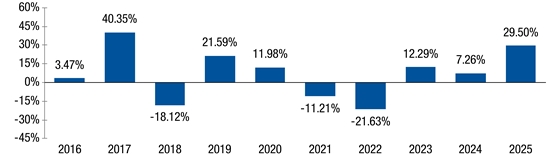
Calendar Years ended December 31
Best Quarter: |
|
2020, Q4 | 20.16% |
|
|
Worst Quarter: | |
2020, Q1 | -27.65% |
Average Annual Total Returns
(for the periods ended December 31, 2025)
After-tax returns of the Portfolio will vary. After-tax returns are calculated using the historical highest individual marginal income tax rates and do not reflect the impact of state and local taxes. Actual after-tax returns depend on the investor’s tax situation and may differ from those shown. The after-tax returns shown are not relevant to investors who hold their shares through tax-deferred arrangements such as 401(k) plans or individual retirement accounts.
| Inception
| 1 Year | 5 Years | 10 Years |
Fund: | 5/29/2015 |
|
|
|
Returns Before Taxes |
| 29.50% | 1.65% | 5.80% |
Returns After Taxes on Distributions |
| 29.53% | 1.66% | 5.80% |
Returns After Taxes on Distributions and Sale of Portfolio Shares |
| 28.86% | 1.55% | 5.75% |
MSCI
Emerging Markets Index |
| 33.57% | 4.20% | 8.42% |
Management
Investment Manager
Lazard Asset Management LLC
Portfolio Managers/Analysts
Rohit Chopra, portfolio manager/analyst on the Investment Manager’s Emerging Markets Equity and Emerging Markets Core Equity teams, has been with the Portfolio since inception in 2025. Mr. Chopra also had been with the Predecessor Portfolio since 2023.
James Donald, portfolio manager/analyst on the Investment Manager’s Emerging Markets Equity team and Head of the Emerging Markets Group, has been with the Portfolio since inception in 2025.
Thomas Boyle, portfolio manager/analyst on the Investment Manager’s Emerging Markets Core Equity team, has been with the Portfolio since inception in 2025. Mr. Boyle also had been with the Predecessor Portfolio since 2013.
Summary Prospectus
7
|
|
|
|
|
|
|
|
Purchase and Sale of Portfolio Shares
Individual shares of the Portfolio may only be purchased and sold in secondary market transactions through brokers or financial intermediaries. Shares are listed for trading on an exchange, and because shares trade at market prices rather than net asset value (“NAV”), shares of the Portfolio may trade at a price greater than NAV (premium) or less than NAV (discount). An investor may incur costs attributable to the difference between the highest price a buyer is willing to pay to purchase shares of the Portfolio (bid) and the lowest price a seller is willing to accept for shares (ask) when buying or selling shares in the secondary market (the bid-ask spread). Recent information, including information about the Portfolio’s NAV, market price, premiums and discounts, and bid-ask spreads, will be included on the Portfolio’s website at www.lazardassetmanagement.com.
Tax Information
All dividends and short-term capital gains distributions are generally taxable to you as ordinary income, and long-term capital gains are generally taxable as such, whether you receive the distribution in cash or reinvest it in additional shares.
Financial Intermediary Compensation
Payments
to Broker-Dealers and Other Financial Intermediaries
If you purchase shares of a Portfolio through a broker-dealer or other financial intermediary (such as a bank), the Portfolio and/or the Investment Manager and its affiliates may pay the intermediary for the sale of Portfolio shares and related services. These payments may create a conflict of interest by influencing the broker-dealer or other intermediary and your salesperson to recommend the Portfolio over another investment. Ask your salesperson or visit your financial intermediary’s website for more information.
00085003 | |
Lazard Asset Management LLC • 30 Rockefeller Plaza • New York, NY 10112 • www.lazardassetmanagement.com |
|
