Filed pursuant
to 424(b)(3)
Registration No. 333-295110
PROSPECTUS
UP
TO 6,044,160 CLASS A ORDINARY SHARES ISSUABLE UPON THE EXERCISE OF WARRANTS
UP
TO 2,884,660 WARRANTS OFFERED BY SELLING SECURITYHOLDERS
UP
TO 33,221,695 CLASS A ORDINARY SHARES OFFERED BY SELLING SECURITYHOLDERS
UP
TO 19,744,585 CLASS A ORDINARY SHARES ISSUABLE UPON THE CONVERSION OF CLASS B SHARES OFFERED BY SELLING
SECURITYHOLDERS
OF
HORIZON
QUANTUM HOLDINGS LTD.
This prospectus relates to
the issuance by us of 6,044,160 class A ordinary shares (“Company Class A Shares”) of Horizon Quantum Holdings Ltd.
(formerly known as Horizon Quantum Holdings Pte. Ltd. and Rose Holdco Pte. Ltd.) (Company Registration No.: 202537774K), a Singapore
public company limited by shares (“we,” “us,” “our,” “Holdco”
or the “Company”), issuable upon the exercise of 6,044,160 warrants at an exercise price of $11.50 per warrant (the
“Company Warrants”) that were issued to certain securityholders in exchange for warrants of dMY Squared Technology
Group, Inc. (“DMY”).
This
prospectus also relates to the resale from time to time by certain selling securityholders named in this prospectus, or their
permitted transferees (collectively, the “Selling Securityholders”), of (1) 2,884,660 Company Warrants that were issued to dMY Squared Sponsor LLC (the “Sponsor”) in exchange for warrants issued to the
Sponsor in a private placement that closed concurrently with the initial public offering of DMY (the “Company Private
Warrants”) and (2) 52,966,280 Company Class A Shares, including
| i. | 19,957,530
Company Class A Shares held by certain Selling Securityholders; |
| ii. | 1,163,484 issued and outstanding Company
Class A Shares held by the Sponsor (the “Sponsor Shares”); |
| iii. | 9,196,021
Company Class A Shares issued to certain Selling Securityholders pursuant to various subscription agreements entered into on December
4, 2025, and March 6, 2026; |
| iv. | 2,884,660
Company Class A Shares underlying the Private Warrants; |
| v. | 19,744,585
Company Class A Shares issuable upon the conversion of the issued and outstanding Class B ordinary
shares of the Company (the “Company Class B Shares,” together with the Company Class
A Shares, the “Company Shares”) currently held by Dr. Joseph Fitzsimons;
and |
| vi. | 20,000
Class A Shares held by Revere Securities LLC (“Revere”). |
See
“Selling Securityholders” for additional information regarding the Selling Securityholders.
The
securities registered herein are identified in this prospectus as the “Registered Securities.” We are registering
the offer and sale of the Registered Securities to satisfy certain registration rights we have granted. The Selling Securityholders may
offer all or part of the Registered Securities for resale from time to time through public or private transactions, at either prevailing
market prices or at privately negotiated prices. The Registered Securities are being registered to permit the Selling Securityholders
to sell securities from time to time, in amounts, at prices and on terms determined at the time of offering. The Selling Securityholders
may sell the Registered Securities through ordinary brokerage transactions, in underwritten offerings, directly to market makers of our
securities or through any other means described in the section entitled “Plan of Distribution” herein. In connection
with any sales of the Registered Securities offered hereunder, the Selling Securityholders, any underwriters, agents, brokers or dealers
participating in such sales may be deemed to be “underwriters” within the meaning of the Securities Act of 1933, as amended.
Our Company Class A Shares and Company Public Warrants, are listed
on the Nasdaq Stock Market LLC (“Nasdaq”), under the trading symbols “HQ” and “HQWWW,” respectively.
On April 20, 2026, the closing price for our Company Class A Shares on Nasdaq was US$13.05 and the closing price for our Company Public
Warrants on Nasdaq was US$3.70.
Subject to the lock-up restrictions described in this prospectus under
the section titled “Plan of Distribution,” the Selling Securityholders can sell, under this prospectus, up to 52,966,280
Company Class A Shares constituting (on a post-exercise basis) approximately 91.92% of our issued and outstanding Company Shares as of
April 21, 2026 (assuming the exercise of all of our outstanding Company Warrants). Despite a potential decline in the public trading price
of our Company Class A Shares, certain Selling Securityholders may still experience a positive rate of return on the securities that they
sell pursuant to this prospectus as they have acquired the securities registered hereunder at prices substantially below current market
prices, and may therefore have an incentive to sell their securities. The holders of Company Warrants may experience a potential profit
on their Company Warrants if the price of our Company Class A Shares exceeds US$11.50 per share. However, the public holders of our securities
may not experience a similar rate of return on the securities they purchase due to differences in the applicable purchase price and trading
price.
Given the substantial number
of securities being registered for potential resale by the Selling Securityholders pursuant to this prospectus, the sale of such securities
by the Selling Securityholders, or the perception in the market that the Selling Securityholders may or intend to sell all or a significant
portion of such securities, could increase the volatility of the market price of our Company Class A Shares or result in a significant
decline in the public trading price of our Company Class A Shares.
We will not receive any proceeds from the sale of the securities by
the Selling Securityholders. We will receive proceeds from the exercise of Company Warrants if the Company Warrants are exercised for
cash. The likelihood that warrant holders will exercise the Company Warrants and any cash proceeds that we would receive is dependent
upon the market price of our Company Class A Shares. Based on the closing price of our Company Class A Shares at US$13.05 on April 20,
2026, which is more than the exercise price of US$11.50 per share pursuant to the terms of the Company Warrants, we believe the warrant
holders may exercise their Company Warrants, and, if any Company Warrants are exercised on a cash basis, we will receive proceeds from
such exercise of Company Warrants. We will pay the expenses associated with registering the sales by the Selling Securityholders, as described
in more details in the section titled “Use of Proceeds” appearing elsewhere in this prospectus.
We
may amend or supplement this prospectus from time to time by filing amendments or supplements as required. You should read this entire
prospectus and any amendments or supplements carefully before you make your investment decision.
We
are an “emerging growth company” as that term is used in the Jumpstart Our Business Startups Act of 2012, as amended, and,
as such, may elect to comply with certain reduced public company reporting requirements in future reports.
We
are a foreign private issuer within the meaning of the rules under the Exchange Act, and as such we are exempt from certain provisions
of the securities rules and regulations in the United States that are applicable to U.S. domestic issuers, such as the rules regulating
solicitation of proxies and certain insider reporting and short-swing profit rules. Moreover, the information we are required to file
with or furnish to the SEC will be less extensive and less timely compared to that required to be filed with the SEC by U.S. domestic
issuers. In addition, as a company incorporated in Singapore, we are permitted to adopt certain home country practices in relation to
corporate governance matters that differ significantly from the corporate governance standards of the Nasdaq Stock Market.
Investing
in our securities involves a high degree of risk. See “Risk Factors” beginning on page 12 of this prospectus and other
risk factors contained in the documents incorporated by reference herein for a discussion of information that should be considered
in connection with an investment in our securities.
Neither
the U.S. Securities and Exchange Commission nor any other regulatory body has approved or disapproved of these securities or determined
if this prospectus is truthful or complete. Any representation to the contrary is a criminal offense.
PROSPECTUS
DATED APRIL 24, 2026
TABLE
OF CONTENTS
You
should rely only on the information contained or incorporated by reference in this prospectus or any supplement. Neither we nor the Selling
Securityholders have authorized anyone else to provide you with different information. The securities offered by this prospectus are
being offered only in jurisdictions where the offer is permitted. You should not assume that the information in this prospectus or any
supplement is accurate as of any date other than the date on the front of each document. Our business, financial condition, results of
operations and prospects may have changed since that date.
Except
as otherwise set forth in this prospectus, neither we nor the Selling Securityholders have taken any action to permit a public offering
of these securities outside the United States or to permit the possession or distribution of this prospectus outside the United States.
Persons outside the United States who come into possession of this prospectus must inform themselves about and observe any restrictions
relating to the offering of these securities and the distribution of this prospectus outside the United States.
ABOUT
THIS PROSPECTUS
This
prospectus is part of a registration statement on Form F-1 filed with the SEC by Horizon Quantum Holdings Ltd. The Selling Securityholders
named in this prospectus may, from time to time, sell the securities described in this prospectus in one or more offerings. This prospectus
includes important information about us, the securities being offered by the Selling Securityholders and other information you should
know before investing. Any prospectus supplement may also add, update, or change information in this prospectus. If there is any inconsistency
between the information contained in this prospectus and any prospectus supplement, you should rely on the information contained in that
particular prospectus supplement. This prospectus does not contain all of the information provided in the registration statement that
we filed with the SEC. You should read this prospectus together with the additional information about us described in the section below
entitled “Where You Can Find More Information.” You should rely only on information contained in this prospectus. We have
not, and the Selling Securityholders have not, authorized anyone to provide you with information different from that contained in this
prospectus. The information contained in this prospectus is accurate only as of the date on the front cover of the prospectus. You should
not assume that the information contained in this prospectus is accurate as of any other date.
The
Selling Securityholders may offer and sell the securities directly to purchasers, through agents selected by the Selling Securityholders,
or to or through underwriters or dealers. A prospectus supplement, if required, may describe the terms of the plan of distribution and
set forth the names of any agents, underwriters or dealers involved in the sale of securities. See “Plan of Distribution.”
Discrepancies
in any table between totals and sums of the amounts listed are due to rounding. Certain amounts and percentages have been rounded; consequently,
certain figures may add up to be more or less than the total amount and certain percentages may add up to be more or less than 100% due
to rounding. In particular and without limitation, amounts expressed in millions contained in this prospectus have been rounded to a
single decimal place for the convenience of readers.
FINANCIAL
STATEMENT PRESENTATION
The financial information
in this prospectus as of December 31, 2024 and 2025 have been derived from the consolidated financial statements of Horizon Quantum Computing
Ltd. which are included elsewhere in this prospectus. The consolidated financial statements of Horizon for the years ended December
31, 2024 and 2025 are prepared in accordance with generally accepted accounting principles in the U.S. (“U.S. GAAP”).
The financial statements of dMY Squared Technology
Group, Inc. (“DMY”) for the years ended December 31, 2025 and 2024 are prepared in accordance with U.S. GAAP.
The unaudited pro forma consolidated
financial information in this prospectus presents the combination of financial information of DMY and Horizon, adjusted to give effect
to the Business Combination and related transactions. The unaudited pro forma condensed combined financials information has been prepared
in accordance with Article 11 of Regulation S-X as amended by the final rule, Release No. 33-10786 “Amendments
to Financial Disclosures about Acquired and Disposed Businesses” to depict the accounting for the transaction (“Transaction
Accounting Adjustments”) and present the reasonably estimable synergies and other transaction effects that have occurred
or are reasonably expected to occur (“Management’s Adjustments”). DMY has elected not to present Management’s
Adjustments and will only be presenting Transaction Accounting Adjustments in the unaudited pro forma condensed combined financial information.
The unaudited pro forma condensed combined financial statements have been presented for illustrative purposes only and do not necessarily
reflect what the Company’s financial condition or results of operations would have been had the Business Combination occurred on
the dates indicated. Further, the pro forma condensed combined financial information also may not be useful in predicting the future financial
condition and results of operations of the Company. The actual financial position and results of operations of the Company may differ
significantly from the pro forma amounts reflected herein due to a variety of factors.
INDUSTRY
AND MARKET DATA
This
prospectus contains estimates, projections and other information concerning our industry, including market size and growth of the markets
in which we participate, that are based on industry publications, reports and forecasts prepared by our management. In some cases, we
do not expressly refer to the sources from which these estimates and information are derived. This information involves a number of assumptions
and limitations, and you are cautioned not to give undue weight to these estimates. The industry in which we operate is subject to a
high degree of uncertainty and risk due to a variety of factors, including those described in the section titled “Risk Factors.”
These and other factors could cause results to differ materially from those expressed in these publications and reports.
Certain
estimates of market opportunity, including internal estimates of our addressable market and forecasts of market growth, included in this
prospectus may prove inaccurate. Market opportunity estimates and growth forecasts, whether obtained from third-party sources or developed
internally, are subject to significant uncertainty and are based on assumptions and estimates that may prove to be inaccurate. The estimates
and forecasts in this prospectus relating to the size of our target market, market demand and adoption, capacity to address this demand,
and pricing may prove to be inaccurate. The addressable market we estimate may not materialize for many years, if ever, and even if the
markets in which we compete meet the size estimates in this prospectus, our business could fail to successfully address or compete in
such markets, if at all.
FREQUENTLY
USED TERMS
Unless otherwise stated in this Registration Statement
on Form F-1 (the “Registration Statement”) or the context otherwise requires, references to:
“A&R Constitution”
means the amended and restated constitution of the Company.
“Amalgamation” means
the combination of Merger Sub 1 and Horizon in accordance with Section 215A of the Singapore Companies Act, with Horizon surviving
as the amalgamated company and as a wholly-owned subsidiary of the Company, pursuant to the terms of the Business Combination Agreement.
“API” means Application
Programming Interface.
“Business Combination”
means the transactions contemplated by the Business Combination Agreement and documents related thereto, including the Amalgamation
and the Merger.
“Business Combination Agreement”
means the Business Combination Agreement, dated as of September 9, 2025, by and among dMY, Horizon, Merger Sub 1, Horizon Computing, and
Merger Sub 2, a copy of which is filed as Exhibit 2.1 to this Registration Statement, and as may be amended from time to time.
“Board” means the board
of directors of the Company.
“Closing” means the
closing of the Business Combination, which occurred on March 19, 2026.
“Class B Share Conversion”
means the automatic conversion of DMY Class A Shares on a one-for-one basis into Company Class A Shares.
“Company” means Horizon
Quantum Holdings Ltd. (formerly known as Horizon Quantum Holdings Pte. Ltd. and Rose Holdco Pte. Ltd.) (Company Registration No.: 202537774K),
a Singapore public company limited by shares.
“Company Class A Shares” means the Class A ordinary shares, with no par value, of the Company.
“Company Class
B Shares” means the Class B ordinary shares, with no par value, of the Company.
“Company Option” means
the options to subscribe for Company Class A Shares.
“Company Shares”
means the Company Class A Shares together with the Company Class B Shares.
“Company Warrants” means
the Company Private Warrants together with the Company Public Warrants.
“Company Private Warrants”
means the warrants assumed by the Company in exchange for the DMY Private Warrants.
“Company Public Warrants”
means the redeemable warrants exercisable for one Company Class A Ordinary Share each.
“Continental” means
Continental Stock Transfer & Trust Company.
“Currently Owned Shares”
means shares of DMY Class A Shares a PIPE Investor, or its affiliates, beneficially owned as of March 9, 2026.
“DMY” means dMY
Squared Technology Group, Inc., a Massachusetts corporation.
“DMY Articles” means
DMY’s amended and restated articles of association, as amended from time to time.
“DMY Class A Shares”
means the Class A common stock, par value $0.0001 of DMY.
“DMY Class B Shares”
means the Class B common stock, par value $0.0001 of DMY.
“DMY Common Stock” means
the DMY Class A Shares together with the DMY Class B Shares.
“DMY IPO” or “DMY’s
IPO” means the initial public offering of DMY Units, which closed in October 2022.
“DMY Private Warrants”
means the outstanding private placement warrants of DMY initially issued in a private placement simultaneous with DMY’s
IPO.
“DMY Public Warrants”
means the warrants to purchase DMY Class A Shares issued as a part of the DMY units.
“DMY Units” means the
unit sold in DMY’s IPO.
“ESPP” means the Horizon
Quantum Holdings Ltd. 2026 Employee Share Purchase Plan, to be adopted by the Company Board upon the Closing.
“Exchange Act” means
the Securities Exchange Act of 1934, as amended.
“Founder Shares” means
the DMY Class B Shares initially purchased by the Sponsor in a private placement prior to DMY’s IPO, and the DMY Class A
Shares issued or issuable upon the conversion of the DMY Class B Shares.
“Holders of Founder Shares”
means the Sponsor and the permitted transferees of the Sponsor.
“Horizon”
means Horizon Quantum Computing Pte. Ltd. (Company Registration No.: 201802755E), a Singapore private company limited by shares.
“Horizon Options” means
the outstanding and unexercised option to subscribe for Horizon Ordinary Shares.
“Horizon Ordinary Shares”
means the ordinary shares of Horizon.
“Horizon Preference Share Conversion”
means the exchange and conversion of each Horizon Preference Share into Horizon Ordinary Shares at the applicable conversion ratio set
forth in the Horizon Constitution, which occurred one business day prior to the effective time of the Amalgamation pursuant to the
terms of the Business Combination Agreement.
“Horizon Shareholders”
means the holders of Horizon’s capital stock.
“IPO” means an initial public offering.
“Lock-Up Agreement”
means the agreement entered into by the Holders of Founder Shares and Horizon Shareholders (the “Lock-Up
Securityholders”), pursuant to which certain of the Company Shares held by the Lock-Up Security Holders (the
“Lock-Up Shares”) are subject to lock-up during a period immediately following the Closing (the
“Shares Lock-Up Period”) and the Company Warrants and underlying Company Shares are subject to
lock-up during a period following the Closing (the “Warrants Lock-Up Period.”)
“Merger” means the merger
of Merger Sub 2 with and into DMY, with DMY surviving the Merger as a wholly-owned subsidiary of the Company.
“Merger
Consideration” means the aggregate merger consideration of $508,384,000 paid to the shareholders of Horizon,
consisting entirely of newly issued Company Class A Shares and Company Class B Shares.
“Merger Sub 1” means
Rose Acquisition Pte. Ltd. (Company Registration No.: 202537790M), a Singapore private company limited by shares and a wholly-owned subsidiary
of the Company.
“Merger Sub 2” means
Horizon Merger Sub 2, Inc., a Massachusetts corporation and wholly-owned subsidiary of the Company.
“Merger Subs” means
Merger Sub 1 and Merger Sub 2, together.
“PIPE Private Placement”
means the agreement by accredited investors, pursuant to mutually agreed subscription agreements, to subscribe for and purchase, at the
Closing, Company Class A Shares at a purchase price equal to the Redemption Price. On December 4, 2025, and March 6,
2026, DMY, the Company, and Horizon entered into Subscription Agreements (the “PIPE Subscription Agreements”)
with certain institutional and accredited investors, qualified institutional buyers and strategic investors (the “PIPE Investors”).
Pursuant to the PIPE Subscription Agreements, the Company agreed to issue and sell, and the PIPE Investors agreed to subscribe for and
purchase an aggregate of $110,412,500 of Company Class A Shares (the “PIPE Shares”), at a per share
price equal to the Redemption Price, which comprises the PIPE Private Placement.
“PIPE Investors” means
the investors who entered into the PIPE Subscription Agreement.
“PIPE Subscription Agreement”
means the subscription agreements entered into on December 4, 2025, and March 6, 2026, as amended, by and among DMY, Horizon, the Company
and the PIPE Investors.
“Public Shares” means
the DMY Class A Shares initially issued as part of the DMY Units.
“Public Shareholders”
means the holders of the Public Shares.
“SAFE” means a simple
agreement for future equity.
“SEC” means the United
States Securities and Exchange Commission.
“Securities Act” means
the Securities Act of 1933, as amended.
“Singapore Companies Act”
means the Companies Act of Singapore, as amended.
“Sponsor”
means dMY Squared Sponsor, LLC, a Delaware limited liability company established for the purpose of forming and managing DMY.
“Sponsor
Shares” means the 1,163,484 Company Class A Shares held by the Sponsor.
“Transfer Agent” means
Continental.
“Trust Account” means
the trust account established in connection with DMY’s IPO.
“Unit Separation” means
the automatic separation of the DMY Units into their component parts, with the holder deemed to hold one DMY Class A Share and one-half of
one warrant to purchase DMY Class A Shares per DMY Unit held prior to the automatic separation.
EXPLANATORY NOTE
On March 19, 2026, Horizon
Quantum Holdings Ltd. (formerly known as Horizon Quantum Holdings Pte. Ltd. and Rose Holdco Pte. Ltd.) (Company Registration No.: 202537774K),
a Singapore public company limited by shares (“we,” “us,” “our,” or the “Company”)
consummated the previously announced business combination with dMY Squared Technology Group, Inc. (“DMY”), pursuant
to the business combination agreement, dated as of September 9, 2025 (as amended, supplemented and/or restated from time to time, the
“Business Combination Agreement”) by and among DMY, the Company, Rose Acquisition Pte. Ltd. (Company Registration No.:
202537790M), a Singapore private company limited by shares and a wholly-owned subsidiary of the Company (“Merger Sub 1”),
Horizon Merger Sub 2, Inc., a Massachusetts corporation and wholly-owned subsidiary of the Company (“Merger Sub 2”),
and Horizon Quantum Computing Pte. Ltd. (Company Registration No.: 201802755E), a Singapore private company limited by shares (“Horizon”).
On March 19, 2026 (the “Amalgamation
Effective Time”), Merger Sub 1 amalgamated with and into Horizon (the “Amalgamation”), with Horizon surviving
the Amalgamation as a wholly-owned subsidiary of the Company and the outstanding shares of Horizon being converted into the right to receive
Company Class A Shares or the right to receive Company Class B Shares, as the case may be. Subsequent to the Amalgamation, Merger Sub
2 merged with and into DMY (the “Merger”), with DMY surviving the Merger as a wholly-owned subsidiary of the Company
and the outstanding securities of DMY being converted into the right to receive Company Class A Shares and/or Company Warrants (the Amalgamation
and the Merger together with the other transactions contemplated by the Business Combination Agreement and other ancillary documents,
the “Business Combination”).
Under the Business Combination
Agreement, the aggregate merger consideration amount paid to the shareholders of Horizon is $508,384,000 and was paid entirely in newly
issued Company Class A Shares and Company Class B Shares (the “Merger Consideration”), at the consummation of the Business
Combination, on March 19, 2026 (the “Closing”).
As a result of the Business
Combination, (a) each issued and outstanding ordinary share in the share capital of Horizon (the “Horizon Ordinary Shares”)
was automatically converted into the right to receive a number of Company Shares equal to the Exchange Ratio (as defined below),
on the terms and subject to the conditions of the Business Combination Agreement (b) the shares of Horizon that were held by Joseph Fitzsimons,
the Chief Executive Officer and Chairman of the Board of Horizon and the Company, that were issued and outstanding immediately prior to
the Amalgamation Effective Time were cancelled and converted into the right to receive such number of Company Class B Shares equal to
the Exchange Ratio and in accordance with the Business Combination Agreement, with each such Company Class B Share entitling each holder
thereof to three (3) votes for each Company Class B Ordinary Share held (c) each simple agreement for future equity (“SAFE”)
was canceled and automatically deemed to represent the right to receive a number of Company Class A Shares equal to the Exchange
Ratio multiplied by the number of Horizon Ordinary shares (on an as-converted basis) subject to such SAFE, and (d) each outstanding
and unexercised option to subscribe for Horizon Ordinary shares (each, a “Horizon Option”) became an option to subscribe
for Company Class A Shares (each, a “Company Option”) containing the same terms, conditions, vesting and other provisions
as are currently applicable to such Horizon Options, provided that each Company Option is exercisable for the number of Company Class A Shares equal to the Exchange Ratio multiplied by the number of Horizon Ordinary Shares subject to the Horizon Option as of
immediately prior to the Amalgamation Effective Time, rounded down to the nearest whole share, at an exercise price equal to the per share
exercise price of the Horizon Option divided by the Exchange Ratio, rounded up to the nearest whole cent. “Exchange Ratio”
means (a) Aggregate Amalgamation Consideration divided by (b) the Fully-Diluted Company Capitalization, each as defined in the Business
Combination Agreement, attached hereto as Exhibit 2.1.
After the completion of the
Amalgamation and prior to the Merger, (1) DMY effected the redemption of the shares of Class A common stock of DMY, par value
$0.0001 per share (the “DMY Class A Shares”), initially issued as part of the DMY Units (as defined below)
sold in DMY’s initial public offering (the “Public Shares” and the holders of Public Shares, the “Public
Shareholders”) that were submitted for redemption and not withdrawn, (2) each outstanding share of Class B common
stock of DMY, par value $0.0001 per share (the “DMY Class B Shares”, and together with the DMY Class A Shares,
the “DMY Common Stock”), were automatically converted into DMY Class A Shares on a one-for-one basis (the
“Class B Share Conversion”), and (3) each unit sold in DMY’s initial public offering (the “DMY
Units”) was automatically separated into its component parts (the “Unit Separation”) and the holder of each
DMY Unit was deemed to hold one DMY Class A Share and one-half of one warrant to purchase DMY Class A Shares (“DMY
Public Warrants”).
At the effective time of the
Merger, (a) each outstanding DMY Class A Share (excluding any Public Shares which were redeemed) were automatically converted
into the right to receive one Company Class A Share, (b) each outstanding whole DMY Public Warrant (including DMY Public Warrants
issued upon the Unit Separation) were assumed by the Company and are exercisable for Company Class A Shares in lieu of DMY Class A
Shares (the “Company Public Warrants”), and (c) each outstanding private placement warrant of DMY initially issued
in a private placement simultaneous with DMY’s initial public offering (the “DMY Private Warrants”) was assumed
by the Company and will be exercisable for Company Class A Shares in lieu of DMY Class A Shares (the “Company Private Warrants,”
and together with the Company Public Warrants, the “Company Warrants”).
On December 4, 2025 and March
6, 2026, the Company entered into certain Subscription Agreements (the “PIPE Subscription Agreements”) with DMY, Horizon
and certain investors (the “PIPE Investors”), pursuant to which, among other things, the PIPE Investors agreed to
subscribe for and purchase, and the Company agreed to issue and sell to the PIPE Investors, an aggregate of 9,196,020 Company Class A
Shares (the “PIPE Shares”), at a purchase price equal to $11.82 per share (the “PIPE Private Placement”)
in connection with a financing effort related to the transactions contemplated by the Business Combination Agreement. The PIPE Private
Placement was consummated simultaneously with the Closing. Further, on March 6, 2026, DMY, the Company and Horizon offered to each PIPE
Investor the option to elect to satisfy their purchase obligation by purchasing Open-Market Purchase Shares (as defined below) no later
than one (1) Business Day prior to the redemption deadline for the special meeting of DMY Shareholders held on March 17, 2026, called
to approve the proposals set forth in the proxy statement pursuant to the Model Business Corporation Act, the DMY Articles, and the Business
Combination Agreement (the “Special Meeting”), which purchases would result in a Reduction Right (as defined below).
See “Corporate History and Structure – PIPE Subscription Agreements with PIPE Investors” for more information
about the PIPE Private Placement.
As a result of the foregoing
transactions, there were 51,578,134 Company Shares (consisting of 31,833,549 Company Class A Shares and 19,744,585 Company Class
B Shares) and 6,044,160 Company Warrants (consisting of 3,159,500 Company Public Warrants and 2,884,660 Private Warrants) outstanding as of March
19, 2026.
On March 20, 2026, the Company
Class A Shares and Company Public Warrants commenced trading on The Nasdaq Stock Market LLC (“Nasdaq”) under the symbols
“HQ” and “HQWWW,” respectively.
Certain amounts that appear
in this Registration Statement may not sum due to rounding.
FORWARD-LOOKING
STATEMENTS
This
prospectus contains forward-looking statements, which statements involve substantial risks and uncertainties. These forward-looking statements
include, among other things, the financial conditions, results of operations, earnings outlook and prospects of the Company for the period
following the consummation of the Business Combination, statements regarding estimates and forecasts of performance and projections of
market opportunity, expectations and timing related to the success, cost and timing of product development activities, financing and
other business milestones. In addition, any statements that refer to projections, forecasts or other characterizations of future events
or circumstances, including any underlying assumptions, are forward-looking statements. Forward-looking statements are typically identified
by words such as “plan,” “believe,” “expect,” “anticipate,” “intend,” “outlook,”
“estimate,” “forecast,” “project,” “continue,” “could,” “may,”
“might,” “possible,” “potential,” “predict,” “should,” “would,”
“will,” “seek,” and other similar words and expressions, but the absence of these words does not mean that a
statement is not forward-looking.
These
forward-looking statements are based on information available as of the date of this Registration Statement and on the current expectations,
forecasts and assumptions of the management of the Company, involve a number of judgments, risks and uncertainties and are inherently
subject to changes in circumstances and their potential effects and speak only as of the date of such statements. There can be no assurance
that future developments will be those that have been anticipated. These forward-looking statements involve a number of risks, uncertainties
or other assumptions that may cause actual results or performance to be materially different from those expressed, contemplated or implied
by these forward-looking statements. The forward-looking statements contained in this Registration Statement include, but are not limited
to, statements about:
| ● | changes
in domestic and foreign business, market, financial, political, and legal conditions; |
| ● | economic
uncertainty and capital markets disruption, which has been significantly impacted by the
current U.S. presidential administration and accompanying regulatory activities and economic
policies and events related thereto, ongoing military conflicts and geopolitical instability
and inflation and interest rates; |
| ● | risks
related to our ability to maintain the listing of our Company Class A Shares and Company Public Warrants on Nasdaq
and operate as a public company; |
| ● | our
future financial performance; |
| ● | global
economic and political conditions; |
| ● | the
potential inability of the Company to manage growth effectively; |
| ● | the
Company’s ability to continue to enhance its technology; |
| ● | the
ability to recruit, train and retain qualified personnel; |
| ● | risks
related to the potential inability to keep pace with product or marketplace innovations; |
| ● | risks
related to the Company’s marketing and growth strategies; |
| ● | changes
in applicable laws or regulations affecting our business; |
| ● | international
trade disputes, including threatened or implemented tariffs by the U.S. and threatened or
implemented tariffs by foreign countries in retaliation; |
| ● | the
effects of competition on our business; and |
| ● | other
risks and uncertainties described in this Registration Statement, including those under the
section entitled “Risk Factors.” |
Forward-looking
statements are provided for illustrative purposes only and are not guarantees of performance. You should understand that the factors
discussed under the heading “Risk Factors” and elsewhere in this Registration Statement could affect our future results,
and could cause those results or other outcomes to differ materially from those expressed or implied in the forward-looking statements
in this Registration Statement.
In
addition, the risks described under the heading “Risk Factors” are not exhaustive. Other sections of this Registration Statement
describe additional factors that could adversely affect the businesses, financial conditions, or our results of operations. New risk
factors emerge from time to time and it is not possible to predict all such risk factors, nor can we assess the impact of all such risk
factors on our business, or the extent to which any factor or combination of factors may cause our actual results to differ materially
from those contained in any forward-looking statements. We undertake no obligations to update or revise publicly any forward-looking
statements, whether as a result of new information, future events or otherwise, except as required by law.
Market,
ranking and industry data used throughout this Registration Statement, including statements regarding market size, is based on independent
industry surveys and publications. These data involve a number of assumptions and limitations, and you are cautioned not to give undue
weight to such estimates. While we are not aware of any misstatements regarding the industry data presented herein, its estimates involve
risks and uncertainties and are subject to change based on various factors, including those discussed under the heading “Risk Factors”
in this Registration Statement.
In
addition, this Registration Statement contains statements of belief and similar statements that reflect our current beliefs and opinions
on the relevant subject. These statements are based upon information available to us as of the date of this Registration Statement, and
while we believe such information forms a reasonable basis for such statements, such information may be limited or incomplete, and statements
should not be read to indicate that we have conducted an exhaustive inquiry into, or review of, all potentially available relevant information.
These statements are inherently uncertain and you are cautioned not to unduly rely upon these statements.
All
subsequent written and oral forward-looking statements concerning the matters addressed in this Registration Statement and attributable
to us or any person acting on our behalf are expressly qualified in their entirety by the cautionary statements contained or referred
to in this Registration Statement.
SUMMARY
OF THE PROSPECTUS
This
summary highlights selected information that is presented in greater detail elsewhere in this prospectus. This summary does not contain
all of the information you should consider before investing in our securities. You should read this entire prospectus carefully, including
the sections titled “Risk Factors” and “Management’s Discussion and Analysis of Financial Condition and Results
of Operations” and our consolidated financial statements and the related notes included elsewhere in this prospectus, before making
an investment decision.
Business
Overview
We
are building software infrastructure to make quantum computers accessible to commercial enterprises and hardware providers. By bridging
the gap between today’s hardware and tomorrow’s applications, we seek to equip developers, researchers, and enterprises with
the quantum software infrastructure needed to solve real-world problems.
To
do this, we are following an ambitious plan to create development tools that can automatically accelerate code written for conventional
computers on quantum computers. With this differentiated approach, we are developing methods to generate quantum-accelerated solutions — exploiting
quantum effects such as superposition and entanglement — from legacy code and conventional software.
Today,
our Triple Alpha software is an integrated development environment that gives users access to our development, deployment, and execution
infrastructure. It enables developers to create sophisticated, portable, hardware-agnostic quantum programs. Users can code at multiple
abstraction levels, compile and optimize programs across many real quantum computers and simulators, and deploy applications as Application
Programming Interfaces (“APIs”). We have key collaborative relationships with leading hardware providers including
Alice & Bob, Oxford Quantum Circuits Ltd., QuEra Computing Inc., and Rigetti Computing, Inc. (“Rigetti”).
Triple
Alpha is currently in early access with select vendors. We have received inbound interest in early access requests from more than 40
major corporations, 90 universities, 13 quantum software companies, and 18 national labs, government agencies and research organizations.
We
are still in the early stages of scaling its business. Since its inception, we have incurred operating losses. Its ability to generate
revenue sufficient to achieve profitability will depend heavily on the further development and commercialization of quantum computers
and their software infrastructure.
The Quantum Software Opportunity
Since its emergence
in the 1950s, conventional computing has dramatically altered the way humans live, work, and do business. As powerful as conventional
computers have become, there are still many calculations they can’t perform.
Unlike conventional computers,
which process information as 0s or 1s, quantum computers store and process information as quantum states. Quantum computers use qubits — which
can exist simultaneously in a superposition of both 0 and 1. Qubits in superposition can explore different branches of a computation,
and quantum computers can use quantum interference to extract information from that superposition to accelerate certain calculations.
Because of these capabilities,
quantum computers have the potential to tackle problems that have long been intractable for conventional computers, such as simulating
complex physical systems (from molecular dynamics to fluid flow), accelerating training and inference in machine learning, and solving
hard optimization problems across many industries.
Triple Alpha, Horizon’s
integrated development environment, aims to set the gold standard for developing and deploying applications on quantum computers. Triple
Alpha contains proprietary languages and a compiler, which allow developers to create sophisticated applications that make use of advanced
features such as full control flow and dynamic memory allocation in quantum programs, while leveraging Horizon’s deployment and
execution infrastructure to run these programs on today’s quantum computers.
Horizon believes that the
recent pace of hardware advancement suggests that software development will become the limiting factor for real-world applications of
quantum advantage. As quantum computing reaches an inflection point, Horizon believes its product development and go-to-market roadmap
can deliver the software infrastructure needed to realize practical quantum advantage. While many current quantum software development
tools are locked to specific hardware or limited to expressing only static circuits, Horizon expects that its hardware-agnostic approach
will allow users to transfer skills and applications across machines, regardless of the vendor or underlying modality, while still taking
advantage of advanced capabilities such as dynamic circuits and pulse-level control.
Technology Approach
Horizon takes a different
approach to constructing quantum algorithms. The company views algorithm construction as a compilation problem, so rather than attempting
to construct algorithms manually for specific problems, it has developed techniques to enable the automatic construction of quantum algorithms
from code written for conventional computers. These techniques include decomposing loops and control-flow into simple primitives that
can be recognized and replaced with more efficient quantum subroutines and replacing basic algorithms and data structures with more efficient
quantum implementations.
With this approach, Horizon
aims to make quantum acceleration broadly applicable wherever a classical program exists or can be written, eliminating the need for a
hand-crafted quantum algorithm for each new problem. Because some classical programs simply cannot be improved using quantum techniques,
this approach is not guaranteed to speed up every program. However, the same is true for quantum algorithm design in general.
The current state of quantum
programming is similar to the early days of classical computing. Most tools still require developers to build quantum circuits gate
by gate, sometimes making use of libraries or Python generators. Complete, end-to-end workflows — from describing a problem
at a high level to running it on hardware — mostly exist only within specific vendor ecosystems and are often not portable.
As a result, developers spend much of their time dealing with the mechanics of circuit construction instead of focusing on the intent
of the program.
This situation is compounded
by inconsistent support for capabilities expected in future systems, such as general control flow, evaluation of classical functions over
measurement results, and dynamic memory management. Some platforms already offer a subset of these features, like dynamic circuits/conditionals
or selective pulse/timing access, but the level of support varies between providers.
By adding in abstraction layer
by layer, Horizon’s software infrastructure is designed to make quantum programming more accessible. At its base is Hydrogen, a
portable, assembly-like language that supports general control flow and concurrent classical computation. It captures core operations
expected of an idealized, future quantum computer. Above Hydrogen sits Helium, a BASIC-like language that retains these capabilities while
adding higher-level features, including dynamic memory allocation and automatic generation of quantum circuits from C/C++.
Beryllium, Horizon’s
object-oriented programming language, sits above Helium. Horizon previewed Beryllium in December 2025 and anticipates making the
language available to Triple Alpha’s early access users in the first half of 2026.
With the introduction of object-oriented
quantum programming — native quantum classes, functions, and libraries — Beryllium is expected to allow
developers to define reusable quantum data types analogous to those in modern classical languages by letting programmers define what quantum
algorithms should do without requiring that they worry about repeated low-level details, thereby empowering them to focus on high-level
operations. With Beryllium, Horizon expects that Triple Alpha users will be able to develop and implement quantum algorithms more efficiently,
making use of reusable components and data structures.
Beryllium prioritizes reusability
and modularity, making it easier for new programs to draw from a growing library of components. In mature software ecosystems, code modularity
produces a well-documented network effect: developers create libraries, which in turn lower the effort required to develop new applications,
thereby attracting more developers.
Horizon’s layered approach
to quantum programming seeks to enable developers to work at their preferred level of abstraction: those working on algorithm design can
start at a higher level compared to those focused on device characterization. Across these layers, each language supports user-defined
instruction sets with both gate- and pulse-level control. This design lets teams leverage higher-level abstractions while still expressing
low-level behavior — whether reasoning about abstract quantum information processing or engaging directly with the physics
of specific processors.
Horizon is developing these
layers incrementally to seek to provide a stable platform for future integration with its quantum algorithm synthesis techniques, with
the ultimate goal of enabling developers to write complete quantum programs using familiar classical languages.
Horizon seeks to enable developers
to write, compile, and deploy quantum programs to a variety of remote quantum processors and simulators without needing to own or manage
the underlying hardware. The company has taken a cloud-first approach, where the end point of software development is a deployed web API
that manages the execution of the quantum program. This approach is intended to allow developers to seamlessly integrate their quantum
programs with a wide range of classical software technologies, with those programs being hosted and served through Horizon’s infrastructure.
Horizon also operates its
own hardware testbed. Offering both tools and hardware as a service simplifies the user experience, enables seamless deployment, and ensures
that Horizon’s platform remains hardware-agnostic and scalable, empowering a broad base of developers to engage with quantum computing.
Horizon’s Technology
Horizon is designing tools
that aim to set a new standard for quantum software development. The company’s core approach has been to develop the software infrastructure
for the development, deployment, and execution of quantum programs, with significant technological breakthroughs achieved in the development
and execution layers.
Triple Alpha, Horizon’s
integrated development environment, simplifies the process of creating quantum programs by enabling developers to code at various levels
of abstraction, using Horizon’s proprietary languages. Most traditional quantum programming frameworks constrain programmers to
working with static circuits, which makes algorithm design difficult, limiting what developers can express. Triple Alpha removes this
constraint with its Turing-complete languages.
Beryllium is an object-oriented
language that is expected to allow developers to use simple classical and quantum building blocks to progressively create richer, higher-level
structures by reusing and extending what they have already defined. With Beryllium, developers can think in terms of information structure
rather than qubits and low-level processing details. By making use of reusable components and data structures, Horizon believes that developers
will able to focus on what quantum algorithms should do without needing to worry about repeated low-level details, which enables more
efficient development and implementation of quantum algorithms.
By shifting the focus from
how information is physically represented and processed in a quantum computer to how it can be structured and transformed, Beryllium is
designed to raise the level of abstraction, reducing the need to manage quantum processing directly and making quantum software development
more accessible to programmers without deep quantum expertise.
Triple Alpha compiles Beryllium
to Helium. Helium is a BASIC-like language that simplifies the development of complex quantum programs by allowing classical and quantum
operations to be expressed together in a single language. It introduces familiar control structures — loops, conditionals,
subroutines — and supports concurrent classical/quantum flows. Because Helium is a Turing-complete language, developers
can express algorithms of arbitrary complexity — including ones whose runtime can’t be determined in advance — unlocking
a far broader class of quantum applications than traditional quantum programming framework.
Deployment Infrastructure
Horizon’s deployment
infrastructure seeks to provide the bridge between quantum programs and front-end technologies. It follows design principles common in
modern cloud infrastructure, providing a familiar framework for users. Once a quantum program has been compiled with Triple Alpha, it
can be packaged and deployed as a web API. Through these deployed endpoints, users can send encoded inputs, interact with running
programs, and retrieve outputs as the program is executed.
With Horizon’s deployment
infrastructure, developers can integrate quantum functionality directly into other applications, whether through Python scripts, web interfaces,
or even Excel macros, allowing developers to call and interact with quantum programs from familiar environments. Each deployed API includes
authentication to ensure only authorized users can access or execute a program. The infrastructure also supports session management for
deployed programs, maintaining isolated execution environments for multiple users or concurrent runs. This guarantees that one user’s
interaction with a program does not interfere with another’s — a necessity for working in multi-user or collaborative
settings.
Horizon’s execution
infrastructure can run programs containing loops and recursive functions, runtime user inputs, mid-circuit measurements, and even calls
to classical code or networked processes, capabilities that remove many of the rigid constraints of traditional circuit-based programming
approaches. Many of these advanced features are unavailable through other tools on contemporary hardware systems.
Conventional programs rely
on constructs like “while” loops and recursive functions, running until a solution is found — or indefinitely,
if one isn’t. They aren’t a simple list of sequential instructions, and their runtime can’t always be predetermined.
However, most of today’s quantum hardware can only execute fixed-length quantum circuits — programs whose structures
must be known in advance, with zero or limited native support for dynamic runtime control, such as loops, recursion, or concurrent classical
computation.
Horizon’s execution
infrastructure seeks to overcome this limitation with full control flow support, making it possible to execute complex programs on quantum
devices that lack native support for general control flow. It extends the capabilities of quantum processors, enabling them to perform
beyond their built-in limitations that prohibit runtime decisions.
Hardware Testbed
Horizon is the first quantum
software company to own and operate its own quantum computer. The company announced plans to establish an on-site testbed with capacity
for multiple
Business Strategy
Horizon is building the software
infrastructure to power the development and deployment of applications using quantum computing. At the core of this effort are tools built
to help software developers make the most out of quantum computers. The company is creating the kind of software infrastructure familiar
to classical developers — from high-level programming languages and optimizing compilers to the system software and runtimes
needed to execute complex programs.
Horizon believes that this
foundation positions it to serve an expanding market. We expect the total addressable market for quantum computing to grow rapidly in
the coming decade, driven by both public and private investment and the emergence of quantum advantage. We believe that the quantum software
segment will drive commercial adoption of quantum hardware, Horizon believes it is strategically placed to capitalize on this opportunity.
Software infrastructure has proven to be important to creating value across every major computing wave, and, as history shows, the companies
that shaped this infrastructure have tended to capture outsized value. Windows defined the PC era. iOS and Android did the same for mobile.
AWS transformed web applications. VMware powered the modern data center, and Nvidia CUDA unlocked GPU computing. Horizon’s Triple
Alpha platform aims to play that same foundational role for quantum computing.
Because Triple Alpha is expected
to connect developers, end-users, and hardware providers, Horizon is positioned to sit at the heart of the quantum computing ecosystem,
enabling the company to establish its product as the software infrastructure of choice for the industry. To advance this vision, Horizon’s
multi-faceted business strategy focuses on product development, market penetration, and ecosystems collaboration. The company is pursuing
three core strategies, through which it intends to capture market share. These are:
| |
● |
Solving the Applications Bottleneck: Triple Alpha is designed to tackle the most significant barrier to adoption — the difficulty of creating useful, portable quantum applications. By making quantum programming accessible to millions of conventional software developers, Horizon expects to dramatically expand the potential developer base and accelerate the discovery of practical use cases for quantum computing. |
| |
● |
Building a Strategic Ecosystem: Rather than competing with hardware providers, Horizon seeks to engage with them. The company expects collaborations with leading hardware companies, control systems manufacturers, and software to act as a powerful distribution channel because these providers could embed Horizon software within their ecosystems, providing direct access to their customers. |
| |
● |
Demonstrating Value: Horizon plans to establish an applications team, which it expects to be a key driver of growth over time. The Applications team will focus on developing quantum algorithms to demonstrate practical quantum advantage for a small number of high-value problems. The team will work directly with quantum hardware vendors and enterprise customers to identify, develop, and showcase real-world applications with the goal of delivering a clear quantum advantage, driving the adoption of applications built on top of the company’s software infrastructure. |
Business Model
Horizon has two primary paths
to revenue: usage-based pricing on deployed applications and software licensing for on-premises deployment. When customers run applications
through the company’s infrastructure (e.g. an API call or quantum job), the company plans to charge them based on usage. This model
scales directly with customer activity, mirroring the familiar economics of traditional cloud and SaaS recurring business models.
For organizations that require
on-premises control over their systems — such as research institutions, government agencies, or enterprises operating
their own quantum hardware — Horizon plans to offer annual software licensing agreements that allow customers to deploy
the same core technologies on their own servers or hardware.
Together, these complementary
revenue streams are expected to form a hybrid business model that combines recurring cloud usage fees with longer-term enterprise subscription
licensing. The result is anticipated to be a structure that provides scalability, visibility and predictability while enabling Horizon
to serve cloud-native users as well as customers with specialized infrastructure needs.
By hosting the deployment
and execution of customer applications, Horizon can price its services in proportion to the value they create for developers, as reflected
in application usage. When developers build and deploy their quantum programs using the company’s infrastructure, those workloads
run on its systems rather than simply being compiled there. This setup positions Horizon to measure usage — such as the
number of API calls or quantum jobs executed — and charge accordingly, resulting in a value-based model where revenue
scales as customers make more use of the company’s technology to power their applications and as those applications gain adoption.
In addition to these core
streams, Horizon’s hardware testbed creates a third potential revenue source, enabling the company to offer access to its own quantum
systems for running user jobs under a Quantum Computing as a Service model.
Competition
Several alternate approaches
to quantum programming exist, including control-systems programming (e.g. QUA and LabOne Q), pulse-level frameworks (e.g. OpenPulse and
Quil-T), gate-level quantum programming languages (e.g. Qiskit, PyQuil, and Cirq), model-based synthesis (Classiq’s approach), and
domain libraries (e.g. OpenFermion, TensorFlow Quantum, and PennyLane).
Triple Alpha’s advanced
capabilities — such as dynamic memory management and circuit synthesis from classical code — further differentiate
it from competing quantum programming approaches. With these capabilities, it provides a higher level of abstraction than most approaches
while still supporting low-level control when needed. Horizon also holds patents on techniques that automatically construct accelerated
quantum algorithms from classical code — moving beyond simply translating the instructions to a quantum-compatible form
to actually generating quantum-accelerated implementations of the code’s functionality (see — “Intellectual
Property”).
Risk Factor Summary
Our
business and our industry are subject to significant risks. You should carefully consider all of the information set forth in this prospectus
and in our other filings with the SEC, including the following risk factors, in evaluating our business. If any of the following risks
actually occur, our business, financial condition, results of operations, and growth prospects would likely be materially and adversely
affected. This prospectus also contains forward-looking statements that involve risks and uncertainties. See the section entitled “Forward-Looking
Statements.”
Recent Developments
The Business Combination
On March 19, 2026, the Company
consummated the previously announced business combination with DMY, pursuant to the Business Combination Agreement by and among DMY, the
Company, Merger Sub 1, Merger Sub 2, and Horizon.
On the Amalgamation Effective
Time, the Amalgamation occurred, with Horizon surviving the Amalgamation as a wholly-owned subsidiary of the Company and the outstanding
shares of Horizon being converted into the right to receive shares of the Company’s Class A Shares or the right to receive shares
of the Company’s Class B Shares, as the case may be. Subsequent to the Amalgamation, the Merger occurred, with DMY surviving the
Merger as a wholly-owned subsidiary of the Company and the outstanding securities of DMY being converted into the right to receive Company
Class A Shares and/or Company Warrants of the Company.
Under the Business Combination
Agreement, the aggregate merger consideration amount paid to the shareholders of Horizon is $508,384,000 and was paid entirely in newly
issued Company Class A Shares and Company Class B Ordinary, at the Closing.
As
a result of the Business Combination, (a) each Horizon Ordinary Share was automatically converted into the right to receive a
number of Company Shares equal to the Exchange Ratio, on the terms and subject to the conditions of the Business Combination
Agreement (b) the shares of Horizon that were held by Joseph Fitzsimons, the Chief Executive Officer and Chairman of the Board of
Horizon and the Company, that were issued and outstanding immediately prior to the Amalgamation Effective Time were cancelled and
converted into the right to receive such number of Company Class B Shares equal to the Exchange Ratio and in accordance with the
Business Combination Agreement, with each such Company Class B Ordinary Share entitling each holder thereof to three (3) votes for
each Company Class B Ordinary Share held (c) each SAFE was canceled and automatically deemed represent the right to receive a number
of Company Class A Shares equal to the Exchange Ratio multiplied by the number of Horizon ordinary shares (on an
as-converted basis) subject to such SAFE, and (d) each Horizon Option became a Company Option containing the same terms,
conditions, vesting and other provisions as are currently applicable to such Horizon Options, provided that each Company Option are
exercisable for the number of Company Class A Shares equal to the Exchange Ratio multiplied by the number of Horizon Ordinary Shares
subject to the Horizon Option as of immediately prior to the Amalgamation Effective Time, rounded down to the nearest whole share,
at an exercise price equal to the per share exercise price of the Horizon Option divided by the Exchange Ratio, rounded up to the
nearest whole cent.
After
the completion of the Amalgamation and prior to the Merger, (1) DMY effected the redemption of Public Shares that were submitted
for redemption and not withdrawn, (2) each outstanding DMY Class B Shares underwent the Class B Share Conversion, and
(3) each DMY Unit underwent the Unit Separation and the holder of each DMY Unit was deemed to hold one DMY Class A Share and
one-half of one DMY Public Warrants.
At
the effective time of the Merger, (a) each outstanding DMY Class A Share (excluding any Public Shares which were redeemed)
were automatically converted into the right to receive one Company Class A Ordinary Share, (b) each outstanding whole DMY Public
Warrant (including DMY Public Warrants issued upon the Unit Separation) were assumed as Company Public Warrants, and (c) each outstanding
DMY Private Warrants was assumed for Sponsor Warrants.
On
December 4, 2025 and March 6, 2026, the Company entered into PIPE Subscription Agreements with DMY, Horizon and PIPE Investors, pursuant
to which, among other things, the PIPE Investors agreed to subscribe for and purchase, and the Company agreed to issue and sell to the
PIPE Investors, an aggregate of 9,196,021 Company Class A Shares, at a purchase price equal to $11.82 per share (the “PIPE
Private Placement”) in connection with a financing effort related to the transactions contemplated by the Business Combination
Agreement. The PIPE Private Placement was consummated simultaneously with the closing of the Business Combination. Further, on March
6, 2026, DMY, the Company and Horizon offered to each PIPE Investor the option to elect to satisfy their PIPE Investment by purchasing
Open-Market Purchase Shares no later than one (1) Business Day prior to the redemption deadline for the Special Meeting, which purchases
would result in a Reduction Right.
As
a result of the foregoing transactions, there were 51,578,134 Company Shares (consisting of 31,833,549 Company Class A Shares and 19,744,585 Company Class B Shares) and 6,044,160 Warrants (consisting of 3,159,500 Company Public Warrants and 2,884,660
Sponsor Warrants) outstanding as of the date of this prospectus.
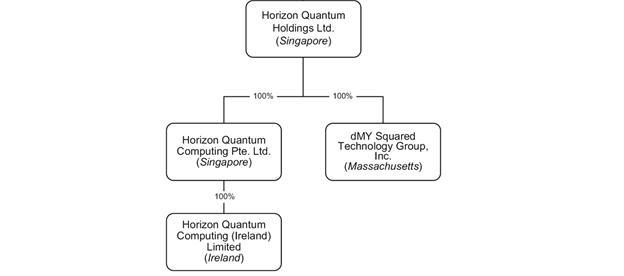
The following
diagram depicts the organizational structure of the Company following the Business Combination:
IonQ Quantum Systems Agreement
On March 31, 2026, Holdco entered into a Quantum Systems Agreement
(the “IonQ Agreement”) with IonQ. The IonQ Agreement governs a strategic, long-term relationship under which IonQ will
design, procure, install, and support a dedicated trapped-ion quantum computing system for Holdco and provide associated compute, consulting,
training, and technical support services, primarily on an on-site and exclusive basis. Pursuant to the IonQ Agreement, IonQ will procure,
construct, install, and verify a trapped-ion quantum computing system meeting specified performance benchmarks and install it in a data
center designated and operated by Holdco. Upon acceptance, title to the physical system transfers to Holdco, with IonQ providing maintenance,
technical support, quarterly technical reports, and consulting and training services. Both Holdco and IonQ shall retain ownership of their
respective intellectual property rights, including their own technology and related software. Holdco shall own all inputs and computation
results, while IonQ shall retain ownership of the IonQ technology and related software specifically licensed under the IonQ Agreement
only, granting Holdco limited licenses for use during the term. The total consideration to be paid by Holdco under the initial statement
of work is US$35 million. Holdco may choose to exercise a one-year extension for additional consideration.
Summary
of Risk Factors
Our
business faces significant risks and uncertainties. You should carefully consider all of the information set forth in this prospectus
and in other documents we file with or furnish to the SEC, including the following risk factors, before deciding to invest in or to maintain
an investment in our securities. Our business, as well as our reputation, financial condition, results of operations and share price,
could be materially adversely affected by any of these risks, as well as other risks and uncertainties not currently known to us or not
currently considered material. These risks include, among others, the following:
Risks
Related to Our Business and Industry
| ● | We
will require a significant amount of cash as we invest in ongoing research and development
and business operations. Additionally, we may need additional capital sooner than anticipated
to pursue our business objectives, respond to business opportunities, challenges or unforeseen
circumstances and we cannot be sure that additional financing will be available. If we are
unable to raise additional funding when needed, we may be required to delay, limit or substantially
reduce our development efforts. |
| |
● |
We are in our very early
stages and have a limited operating history, which makes it difficult to forecast the future results of our operations. It is also
possible quantum computing might never become commercially viable or embraced. Our technology roadmap, including the anticipated
milestones and timing thereof, may change. |
| |
● |
Our current business
model is built on the assumption that our quantum algorithm synthesis technology can effectively convert classical code into practical,
quantum-accelerated applications. However, there is no guarantee that our toolchain will consistently generate quantum applications
that outperform classical solutions. If our software cannot deliver a meaningful performance advantage, the market for our products
and services may not develop as we anticipate which would materially harm our business and financial prospects. |
| |
|
|
| |
● |
We rely on third-party
quantum hardware providers to deliver the compute necessary for our software to function. The pace of hardware development, including
factors like qubit counts, error rates and availability, is outside of our control. If the underlying hardware ecosystem does not
mature as quickly as we expect, or if a major hardware provider fails, it could create delays for our business and severely impact
our ability to deliver solutions to potential customers. |
| |
|
|
| |
● |
We invest significantly
in research and development, and to the extent our research and development investments do not translate into new capabilities or
material enhancements to Triple Alpha, or any new platform we may create, or if we do not use those investments efficiently, our
business and results of operations would be harmed. |
| |
|
|
| |
● |
We have a history of
operating losses and expect to incur significant expenses and continuing losses for the foreseeable future. In addition, we have
never generated any material revenue from product sales and may never be profitable. |
Risks
Related to Litigation and Government Regulation
| |
● |
We
are required to comply with stringent, complex and evolving laws, rules, regulations and standards in many jurisdictions, as well
as contractual obligations, relating to data privacy and security. Any actual or perceived failure to comply with these requirements
could have a material adverse effect on our business. |
| |
|
|
| |
● |
We
may become subject to product liability claims, which could harm our financial condition and liquidity if we are not able to successfully
defend or insure against such claims. |
| |
|
|
| |
● |
Government
actions and regulations, such as tariffs, trade protection measures and national security concerns may limit our ability to provide
products and services to our future customers and obtain products from our suppliers, which could have a material adverse impact
on our business operations, financial results and growth plans. |
Risks
Related to our Intellectual Property
| |
● |
We
may be unable to obtain, maintain and protect our intellectual property rights and proprietary information such as if the scope of
patent protection obtained is not sufficiently broad. Our competitors could develop and commercialize products and technology similar
or identical to ours, and our ability to successfully commercialize our products and technology may be adversely affected. |
| |
|
|
| |
● |
We
may face patent infringement and other intellectual property claims that could be costly to defend, result in injunctions and significant
damage awards or other costs. If third parties claim that we infringe upon or otherwise violate their intellectual property rights,
our business could be adversely affected. |
Risks
Related to Ownership of Our Securities
| |
● |
Following the Closing of the Business Combination, our only significant asset is our ownership of Horizon, and such ownership may not be sufficient to pay dividends or make distributions or obtain loans to enable us to pay any dividends on our Company Shares, pay our expenses or satisfy other financial obligations. |
| |
|
|
| |
● |
Our management team has limited experience managing and operating a U.S. public company. |
| |
|
|
| |
● |
We do not expect to pay cash dividends in the foreseeable future. |
| |
|
|
| |
● |
Our actual financial position and results of operations may differ materially from the unaudited pro forma financial information included in this prospectus. |
| |
|
|
| |
● |
Investors may face difficulties enforcing foreign court judgments against us. |
| |
● |
Because Joseph Fitzsimons, our chief executive officer and Chairman of our Board, beneficially own approximately 38.3% of our outstanding Company Shares and approximately 65.0% of the voting control of the Company as of the Closing of the Business Combination. |
| |
● |
Future
sales of our securities or warrants exercisable for our Company Class A Shares may depress our stock price. |
| |
|
|
| |
● |
An
active, liquid trading market for our Company Class A Shares and Company Public Warrants may not develop, which may limit
your ability to sell our Company Class A Shares or Company Public Warrants. |
| |
|
|
| |
● |
The
price of our securities may be volatile, and the value of our securities may decline. |
| |
|
|
| |
● |
We
may redeem unexpired Company Warrants prior to their exercise at a time that is disadvantageous to you, thereby making your Company
Warrants worthless. |
| |
|
|
| |
● |
The
Company Warrants will be recognized and accounted for as derivative liabilities in accordance with ASC 815 and will be recorded
at fair value upon issuance with changes in fair value each period reported in earnings, which may have an adverse effect on the
market price of the Company Class A Shares. |
Risks
Related to Investments in Singapore Companies
| |
● |
Singapore take-over laws contain provisions which
may vary from those in other jurisdictions. |
Corporate History
Horizon was founded in 2018
in Singapore to close the gap between quantum hardware and application. In November 2018, Horizon successfully secured seed funding.
In March 2019, Horizon hired its first three employees and began operations. In early 2020, Horizon was one of the first external
companies to be granted access to Rigetti’s pulse-level programming interface Quil-T, which Horizon used to demonstrate proprietary
techniques for rapidly characterizing quantum processors and reducing errors.
In 2021, Horizon demonstrated key parts of its compile chain including
automatic recognition of opportunities for quantum acceleration in a subset of the MATLAB programming language. In 2022, Horizon became
the first start-up to host a node on Singapore’s National Quantum-Safe Network. This node enabled a collaboration with the AWS Center
for Quantum Networking, Fortinet Inc., and the Centre for Quantum Technologies at the National University of Singapore to demonstrate
a point-to-point, quantum-secured communications link over approximately 16 kilometers. That year, the company also introduced new techniques
for enabling general control flow execution on quantum computers that lack native support for feed-forward.
In 2023, Horizon opened a
second office in Dublin, Ireland. Late that year, the company launched early access to Triple Alpha, its integrated development environment,
and implemented a first demonstration of interactive quantum computing enabled by the system.
In 2024, Horizon unveiled
new capabilities in Triple Alpha, including support for dynamic quantum memory allocation, measurement-based quantum computing, and pulse-level
control, along with a powerful new approach to program optimization that works for arbitrary instruction sets. It also initiated development
of a hardware testbed at the Singapore headquarters. Designed to host and tightly integrate quantum computers with the Triple Alpha platform,
the testbed takes a modular multi-vendor approach, allowing Horizon to deeply integrate its software infrastructure with different hardware
configurations and to upgrade the systems over time.
In 2025, Horizon completed
the assembly and integration of a fully operational quantum computer in its Singapore testbed. We also extended the capabilities of its
software stack, introducing pulse optimization, which enables programmers to deploy any gate with pulses, and real-time execution, which
is facilitated by compiling programs to control systems code. At the end of the year, Horizon previewed Beryllium, its object-oriented
programming language.
On March 19, 2026, the Company
consummated the previously announced Business Combination with DMY, pursuant to the Business Combination Agreement by and among DMY, the
Company, Merger Sub 1, the Merger Sub 2, and Horizon. See “—The Business Combination” above and “Corporate
History and Structure – Business Combination with DMY” below for a more detailed description of the Business Combination.
Horizon is a founding partner of both the Southeast Asia Quantum Industry
Association and the Quantum Business Network in APAC, and of the Trinity Quantum Alliance in Ireland. The company has also joined industry
bodies like the Quantum Industrial Standard Association of Korea and the European Quantum Industry Consortium.
Emerging
Growth Company
We
are an “emerging growth company,” as defined in Section 2(a) of the Securities Act, as modified by JOBS Act, and we may take
advantage of certain exemptions from various reporting requirements that are applicable to other public companies that are not emerging
growth companies including, but not limited to, not being required to comply with the independent registered public accounting firm attestation
requirements of Section 404 of the Sarbanes-Oxley Act, reduced disclosure obligations regarding executive compensation in its periodic
reports and proxy statements, and exemptions from the requirements of holding a nonbinding advisory vote on executive compensation and
shareholder approval of any golden parachute payments not previously approved.
Further,
Section 102(b)(1) of the JOBS Act exempts emerging growth companies from being required to comply with new or revised financial accounting
standards until private companies (that is, those that have not had a Securities Act registration statement declared effective or do
not have a class of securities registered under the Exchange Act) are required to comply with the new or revised financial accounting
standards. The JOBS Act provides that an emerging growth company can elect to opt out of the extended transition period and comply with
the requirements that apply to non-emerging growth companies but any such an election to opt out is irrevocable. We have elected not
to opt out of such extended transition period, which means that when a standard is issued or revised and it has different application
dates for public or private companies, we, as an emerging growth company, can adopt the new or revised standard at the time private companies
adopt the new or revised standard. This may make comparison of our financial statements with another public company that is neither an
emerging growth company nor an emerging growth company that has opted out of using the extended transition period difficult or impossible
because of the potential differences in accounting standards used.
We
will remain an emerging growth company until the earlier of: (1) the last day of the fiscal year (i) following the fifth anniversary
of the consummation of the Business Combination, (ii) in which we have total annual gross revenue of at least US$1.235 billion, or (iii)
in which we are deemed to be a large accelerated filer, which means the market value of Class A Shares that are held by non-affiliates
exceeds US$700 million as of the last business day of its most recently completed second fiscal quarter; and (2) the date on which we
have issued more than US$1.00 billion in non-convertible debt securities during the prior three-year period. References herein to “emerging
growth company” have the meaning associated with it in the JOBS Act.
Foreign
Private Issuer
We
are a foreign private issuer within the meaning of the rules under the Exchange Act and, as such, we are permitted to follow the corporate
governance practices of our home country, Singapore, in lieu of the corporate governance standards of Nasdaq applicable to U.S. domestic
companies. For example, we are not required to have a majority of the board consisting of independent directors nor have a compensation
committee or a nominating and corporate governance committee consisting entirely of independent directors. We intend to follow our home
country’s corporate governance practices as long as we remain a foreign private issuer. As a result, our shareholders may not have
the same protection afforded to shareholders of U.S. domestic companies that are subject to Nasdaq corporate governance requirements.
As a foreign private issuer, we are also subject to reduced disclosure requirements and are exempt from certain provisions of the U.S.
securities rules and regulations applicable to U.S. domestic issuers such as the rules regulating solicitation of proxies and certain
insider reporting and short-swing profit rules.
THE
OFFERING
The
summary below describes the principal terms of the offering. The “Description of Share Capital” section of this prospectus
contains a more detailed description of the Company Shares.
| Issuance
of Company Shares Pursuant to Exercise of Company Warrants |
|
|
| |
|
|
|
Company Shares issued and outstanding prior to exercise of all Company Warrants |
|
31,833,549
Company Class A Shares and 19,744,585 Company Class B Shares |
| |
|
|
| Company Shares issuable upon exercise of all Company Warrants registered herein |
|
6,044,160 Company
Class A Shares |
| |
|
|
| Use
of proceeds |
|
We will receive up to an aggregate of US$ 69,507,840 from the exercise
of all Company Warrants, assuming the exercise in full of all of the Company Warrants for cash. The exercise price of the Company Warrants
is US$11.50 per share, subject to adjustment as described herein. The closing price of our Company Class A Shares on Nasdaq on April 20,
2026 was US$13.05 per share. The likelihood that warrant holders will exercise the Company Warrants and any cash proceeds that we would
receive is dependent upon the market price of our Company Class A Shares. Based on the closing price for our Company Class A Shares at
US$13.05 on April 20, 2026, which is greater than the exercise price of US$11.50 per share pursuant to the terms of the Company Warrants,
we believe warrant holders may exercise their Company Warrants, and, if the Company Warrants are exercised on a cash basis, we will receive
proceeds from the exercise of Company Warrants. To the extent that we receive any net proceeds in connection with the exercise of Company
Warrants, we expect to use such net proceeds for general corporate purposes. See the section titled “Use of Proceeds” appearing
elsewhere in this prospectus for more information. |
| |
|
|
| Resale
of Company Class A Shares and Company Warrants |
|
|
| |
|
|
| Class
A Shares offered by the Selling Securityholders consisting of |
|
Up to 52,966,280 Company Class
A Shares, including |
| |
|
|
i. |
19,957,530 Company Class A Shares held by
certain Selling Securityholders; |
| |
|
|
ii. |
1,163,484 Sponsor Shares; |
| |
|
|
iii. |
9,196,021 Company Class A issued to PIPE
Investors pursuant to various subscription agreements entered into on December 4, 2025 and March 6, 2026; |
| |
|
|
iv. |
2,884,660 Company Class A Shares underlying
the Company Private Warrants; |
| |
|
|
v. |
19,744,585 Company Class A Shares issuable
upon the conversion of the Company Class B Shares currently held by Dr. Joseph Fitzsimons; and |
| |
|
|
vi. |
20,000 Company Class A Shares held by Revere. |
| |
|
|
| Company Warrants
offered by the Selling Securityholders |
|
Up to 2,884,660
Company Private Warrants |
| |
|
|
| Use
of proceeds |
|
All of the
securities offered by the Selling Securityholders pursuant to this prospectus will be sold by the Selling Securityholders for their
respective accounts. We will not receive any of the proceeds from such sales. |
| |
|
|
| Offering
price |
|
The securities
offered by this prospectus may be offered and sold at prevailing market prices, privately negotiated prices or such other prices
as the Selling Securityholders may determine. See “Plan of Distribution.” |
| |
|
|
| Company Warrants issued and outstanding |
|
6,044,160 Company Warrants, consisting of 3,159,500 Company Public
Warrants and 2,884,660 Company Private Warrants |
| |
|
|
| Dividend Policy |
|
We
have never declared or paid any cash dividend on our Company Class A Shares. We currently intend to retain any future earnings and
do not expect to pay any dividends in the foreseeable future. Any further determination to pay dividends on our Company Class A
Shares would be at the discretion of our board of directors, subject to applicable laws, and would depend on our financial
condition, results of operations, capital requirements, general business conditions, and other factors that our board of directors
may deem relevant. |
| |
|
|
| Lock-up arrangement |
|
The
securities being registered for resale by certain Selling Securityholders named in the prospectus are subject to a two year lock-up
period from March 19, 2026, subject to certain exceptions. The holders of Sponsor Shares are subject to lock-up requirement of up
to one year following the consummation of the Business Combination, subject to certain exceptions. |
| |
|
|
| Market for our Company Class A Shares and Warrants |
|
Our
Company Class A Shares and Company Public Warrants are listed on Nasdaq under the symbols “HQ” and
“HQWWW,” respectively. |
| |
|
|
| Risk factors |
|
Prospective
investors should carefully consider the “Risk Factors” for a discussion of certain factors that should be considered
before buying the securities offered hereby |
RISK
FACTORS
Investing
in our securities involves a high degree of risk. You should carefully consider the risks and uncertainties described below together
with all of the other information contained in this prospectus, including our financial statements and related notes appearing at the
end of this prospectus and in the section titled “Management’s Discussion and Analysis of Financial Condition and Results
of Operations,” before deciding to invest in our securities. Although we have organized risks generally according to these categories
in the discussion below, many of the risks may have ramifications in more than one category. These categories, therefore, should be viewed
as a starting point for understanding the significant risks we face and not as a limitation on the potential impact of the matters discussed.
If any of the events or developments described below were to occur, our business, prospects, operating results and financial condition
could suffer materially, the trading price of our securities could decline, and you could lose all or part of your investment. The risks
and uncertainties described below are not the only ones we face. Additional risks and uncertainties not presently known to us or that
we currently believe to be immaterial may also adversely affect our business.
Risks
Related to Our Business and Industry
We
will require a significant amount of cash as we invest in ongoing research and development and business operations. Additionally, we
may need additional capital sooner than anticipated to pursue our business objectives, respond to business opportunities, challenges
or unforeseen circumstances and we cannot be sure that additional financing will be available. If we are unable to raise additional funding
when needed, we may be required to delay, limit or substantially reduce our development efforts.
Our
business and future plans for expansion are research and development intensive and the specific timing of cash inflows and outflows may
fluctuate substantially from period to period for such endeavors. For example, in addition to our continuing investment in our technology
roadmap, we continue to invest in the expansion of and upgrades to our modular quantum hardware testbed and infrastructure, cloud computing
resources, ongoing commercialization efforts, global talent acquisition and the professional and legal costs associated with being a
public company. The actual amounts we may be required to spend on these and other matters could be significant, and may exceed our expectations.
We
believe that the proceeds of the Business Combination, including the proceeds from the PIPE Private Placement and funds disbursed from
the Trust Account, together with our other existing cash, cash equivalents and marketable securities will be sufficient to meet our anticipated
operating cash needs for at least the next 12 months based on our current business plan, and expectations and assumptions considering
current macroeconomic conditions. Our operating plan may change because of factors currently unknown, and we may need to seek additional
funds sooner than planned, through public or private equity or debt financings or other sources, such as strategic collaborations or
other transactions. In addition, we may seek additional capital even if we believe that we have sufficient funds for current or future
operating plans. Such financings may result in dilution to shareholders, the issuance of securities with priority as to liquidation and
dividend and other rights more favorable than the Company Shares, the imposition of debt covenants and repayment obligations
or other restrictions that may adversely affect our business. Any funds we raise may not be sufficient to fund our operations or enable
us to continue to implement our long-term business strategy. Further, our ability to raise additional capital may be adversely impacted
by worsening global economic conditions, disruptions to and volatility in the credit and financial markets in the United States
and current and future military conflicts and wars around the world including related sanctions, tariffs and trade protection measures.
There can be no assurance that deterioration in credit and financial markets and loss of confidence in economic conditions will not occur.
A severe or prolonged economic downturn could result in a variety of risks to our business, including weakened demand for our products
and services and our ability to raise additional capital when needed on acceptable terms, if at all. If the equity and credit markets
deteriorate, it may make any necessary financing more difficult, more costly and more dilutive. Failure to secure any necessary financing
in a timely manner and on favorable terms could impair our ability to achieve our growth strategy, could harm our financial performance
and stock price, could require us to delay or abandon our business plans and could require us to delay, limit or substantially reduce
our development efforts.
If
we are unable to obtain sufficient capital we would be unable to fund our operations and may be required to evaluate alternatives, which
could include dissolving and liquidating our assets in which case we may receive less than the value at which those assets are carried
on our audited financial statements, and/or seeking protection under bankruptcy laws. A determination to file for bankruptcy could occur
at a time that is earlier than when we would otherwise exhaust our cash resources, and it is unclear to what extent we would be able
to pay our obligations, and to what extent any assets would be available for distribution to shareholders. This could potentially cause
us to cease operations and result in a complete or partial loss of your investment in our securities. We cannot anticipate all of the
ways in which the economic climate and financial market and geopolitical conditions could adversely impact our business.
There
can be no assurance that future financing will be available to us on favorable terms, or at all. In addition, our ability to raise additional
capital through the sale of securities could be significantly impacted by the resale of our securities by holders of our securities which
could result in a significant decline in the trading price of our securities and potentially hinder our ability to raise capital at terms
that are acceptable to us or at all.
We
are in our very early stages and have a limited operating history, which makes it difficult to forecast the future results of our operations.
It is also possible quantum computing might never become commercially viable or embraced. Our technology roadmap, including the anticipated
milestones and timing thereof, may change.
Our
business was founded in 2018, and we began developing our current quantum software development tools that same year. As a result of our
limited operating history, our ability to accurately forecast our future results of operations is limited and subject to a number of
uncertainties, including our ability to plan for and model future growth. Our ability to generate revenues will largely be dependent
on our ability to develop our products and services within the quantum computing industry and on the further development and commercialization
of quantum computers and their software infrastructure. We are still in the technology development phase of our business plan. Our scalable
business model has not been formed as of yet and our technology roadmap may not be realized as quickly as hoped, or even at all. In the
future, we may fail to meet publicly announced milestones or fail to meet projected technological milestones. We may further update our
technology roadmap in the future, including anticipated milestones and anticipated timeline for milestones. The development of our scalable
business model will likely require the incurrence of a substantially higher level of costs than incurred to date, while our revenues
will not substantially increase unless and until more powerful, scalable, higher performing computers are produced and commercially available
to our potential customers, which requires a number of technological advancements which may not occur on the currently anticipated timetable
or at all. As a result, any financial results we achieve in future periods should not be considered indicative of our performance for
periods subsequent to those periods. Further, in future periods, our growth could slow or decline for a number of reasons, including
but not limited to slowing demand for sales of our quantum software development tools, increased competition, changes to technology,
inability to scale up or improve performance of our technology, a decrease in the growth of the market, or our failure, for any reason,
to continue to take advantage of growth opportunities.
We
are early in our development efforts and we have only recently begun to commercialize our products and services. Our business model is
predicated on quantum computing becoming both commercially viable and embraced by our potential customers and target industries. In the
event the quantum computing fails to generate meaningful results at a commercially viable cost, we may need to adapt our business model
and technology roadmap in response.
We
have also encountered, and will continue to encounter, risks and uncertainties frequently experienced by growing companies in rapidly
changing industries. If our assumptions regarding these risks and uncertainties and our future growth are incorrect or change, or if
we do not address these risks successfully, our operating and financial results could differ materially from our expectations, and our
business could suffer. Our success as a business ultimately relies upon fundamental research and development breakthroughs in the coming years
from our company and quantum computing hardware companies. There is no certainty these research and development milestones will be achieved
as quickly as hoped, or even at all.
The
quantum computing industry is in its early stages and volatile, and if it does not develop, if it develops slower than we expect, if
it develops in a manner that does not require use of our quantum computing solutions, or if it encounters negative publicity or if our
solution does not drive commercial engagement, the growth of our business will be harmed.
The
nascent market for quantum computer and quantum computing solutions is still rapidly evolving, characterized by rapidly changing technologies,
competitive pricing and competitive factors, evolving government regulation and industry standards and changing customer demands and
behaviors. If demand for quantum computers and quantum solutions in general does not develop as expected, or develops more slowly than
expected, our business, prospects, financial condition and operating results could be harmed.
In
addition, our growth and future demand for our products is highly dependent upon the adoption by developers and customers of quantum
computers, as well as on our ability to demonstrate the value of quantum computing to our potential customers. Delays in future generations
of our quantum development tools or technical failures at other quantum computing companies could limit acceptance of our solutions.
Negative publicity concerning our solutions or the quantum computing industry as a whole could limit acceptance of our solutions. We
believe quantum computing will solve many large-scale problems. However, such problems may never be solvable by quantum computing technology,
which will limit the overall market and interest in quantum computing based applications.
If
our future clients and partners do not perceive the benefits of our solutions, or if our solutions do not drive member engagement, then
demand for our products may not develop at all, or it may develop slower than we expect. If any of these events occur, it could have
a material adverse effect on our business, financial condition or results of operations.
Our
current business model is built on the assumption that our quantum algorithm synthesis technology can effectively convert classical code
into practical, quantum-accelerated applications. However, there is no guarantee that our toolchain will consistently generate quantum
applications that outperform classical solutions. If our software cannot deliver a meaningful performance advantage, the market for our
products and services may not develop as we anticipate which would materially harm our business and financial prospects.
Our
current business model is predicated on the successful development and market adoption of our quantum algorithm synthesis technology.
While we believe this technology will enable us to convert classical code into practical, quantum-accelerated applications, there can
be no guarantee that we will be successful in doing so. Our existing software toolchain, while functional, may not consistently produce
quantum applications that provide a meaningful performance advantage over existing classical solutions.
Specifically,
demonstrating a clear and consistent performance advantage is difficult due to several factors, including:
| |
● |
the benchmark
for what constitutes a “meaningful advantage” is evolving. Classical computing methods and algorithms are continuously
improving, and a problem that is difficult for classical computers today may become easier in the future, eroding our potential advantage.
Additionally, even if we are able to produce a meaningful advantage when compared with classical computing methods, there is no guarantee
we will be able to deliver these results at a commercially reasonable price point for our intended customers; |
| |
● |
currently
available quantum computers, including our own hardware testbed, have limitations in terms of qubit count, error rates and stability.
These limitations can hinder our ability to run complex algorithms and demonstrate a tangible performance gain over classical supercomputers; |
| |
● |
the number
of practical, real-world problems for which quantum computing offers a clear and demonstrable advantage remains limited. If we are
unable to identify and commercialize compelling use cases where our software consistently outperforms classical methods, our ability
to attract and retain customers will be harmed; and |
| |
● |
if the
applications generated by our software do not significantly outperform their classical counterparts in terms of accuracy or efficiency,
the market for our products and services may not develop as we anticipate. In this scenario, potential customers may not see a compelling
reason to invest in our technology, which would severely harm our business and financial prospects. |
We
have broad discretion in how we can use our capital resources from the Closing of the Business Combination. If we fail to manage our
capital resources effectively, our business, financial condition, operating results and cash flow could be adversely affected.
Upon
the closing of the PIPE Private Placement and the Business Combination we received aggregate gross proceeds of approximately $120 million.
We intend to use our capital resources for general working capital purposes. However, management has broad flexibility and discretion
in applying the net proceeds of the PIPE Private Placement and Business Combination for working capital. Our shareholders will be relying
on the judgment of management with regard to the use of these proceeds, and they will not have the opportunity, as part of their investment
decision, to assess whether the proceeds are being used in a way they approve. Our executive officers have limited experience with managing
capital in amounts similar to the gross proceeds received from the PIPE Investment, and as a result, it is possible that the net proceeds
will be invested in a way that does not yield a favorable, or any, return for us. The failure of our executive officers to use such funds
effectively could have a material adverse effect on our business, financial condition, operating results and cash flow.
We
rely on third-party quantum hardware providers to deliver the compute necessary for our software to function. The pace of hardware development,
including factors like qubit counts, error rates and availability, is outside of our control. If the underlying hardware ecosystem does
not mature as quickly as we expect, or if a major hardware provider fails, it could create delays for our business and severely impact
our ability to deliver solutions to potential customers.
We
rely on third-party providers for the quantum computing power essential to our software’s operation. This dependence exposes our
business to substantial risks, as the pace and quality of hardware development are entirely outside our control. The quantum computing
industry is still in its nascent stage, and the hardware landscape is characterized by rapidly changing technology and a limited number
of viable providers. The performance and functionality of our software are critically dependent on the technical specifications of the
underlying hardware. Two of the most important metrics are:
| |
● |
Qubit
Count — The number of qubits in a quantum computer directly determines the complexity of the problems it can handle. Our
applications are designed to address problems that are intractable for classical computers, and these require a sufficient number
of qubits to execute. If a provider’s hardware roadmap for scaling qubit counts is not delivered on schedule, our ability to
deliver on our own technology roadmap may be severely compromised. |
| |
● |
Error
Rates — Quantum systems are highly susceptible to errors due to the fragile nature of qubits. These errors can corrupt
computations and make results unreliable. Our software is designed with certain assumptions about hardware error rates. If the actual
error rates of a provider’s hardware are higher than anticipated, it could require significant modifications to our software
to mitigate these errors, leading to delays and increased development costs. For our software to be truly effective, the hardware
must have low enough error rates to allow for the use of quantum error correction techniques, which are necessary for complex and
long-running algorithms. The threshold for this is generally considered to be below a 1% error rate for two-qubit gates on a reliable
basis, a metric still being perfected by many providers. |
We
rely on a small number of third-party providers; a failure or significant setback at any one of them could have a material and adverse
effect on our business. If a major provider experiences a technical failure, ceases operations, or changes its business model in a way
that makes their hardware inaccessible or prohibitively expensive, it may affect our services or business model. Should we need to transition
to an alternative provider, we may face difficulties securing one on acceptable terms or with the capabilities required to support our
systems. Given the early-stage nature of the quantum computing industry, our options for alternative providers may be significantly limited.
Furthermore, if the development of quantum computing hardware does not progress as expected or if such hardware becomes unavailable to
us or our providers, our business could also be adversely impacted.
Customers
may not perceive the value proposition of a classical-to-quantum compilation toolchain or may prefer alternative methods for developing
quantum applications or programs.
Our
business depends on the adoption and continued use of our classical-to-quantum compilation toolchain by organizations and developers
seeking to build and deploy quantum applications. The market for quantum computing is still nascent and rapidly evolving, and potential
customers may not yet fully understand or appreciate the advantages of our toolchain. Our potential customers may also determine that
existing or alternative development methods such as manually optimized quantum code, hardware-specific programming environments, or competing
software platforms better meet their needs, budget, or technical requirements.
If
potential customers do not recognize the value of our solution, or if alternative approaches gain broader acceptance, our ability to
acquire new users, grow revenues and achieve or sustain profitability could be materially and adversely affected. Additionally, significant
investment in educating the market or adapting our offerings to align with customer preferences could increase operating expenses and
delay or reduce our expected growth.
We
invest significantly in research and development, and to the extent our research and development investments do not translate into new
capabilities or material enhancements to Triple Alpha, or any new platform we may create, or if we do not use those investments efficiently,
our business and results of operations would be harmed.
A
key element of our strategy is to invest significantly in our research and development efforts to develop new products and enhance our
existing products to address additional applications and markets. In the fiscal years 2025 and 2024, our research and development expenses
were 48.5% and 44.0% of our operating losses, respectively. If we do not spend our research and development budget efficiently or effectively
on compelling innovation and technologies, our business could be harmed and we may not realize the expected benefits of our strategy.
Moreover, research and development projects can be technically challenging and expensive. The nature of these research and development
cycles may cause us to experience delays between the time we incur expenses associated with research and development and the time we
are able to offer compelling products and generate revenue, if any, from such investment. Additionally, anticipated customer demand for
a product we are developing could decrease after the development cycle has commenced, and we would nonetheless be unable to avoid substantial
costs associated with the development of any such product. If we expend significant resources on research and development and our efforts
do not lead to the successful introduction or improvement of products that are competitive in our current or future markets, it could
harm our business and results of operations.
Furthermore,
our ability to increase any future revenue and attract potential customers will depend in significant part on our ability to anticipate
and respond effectively to rapid technological changes and market developments as well as the evolving quantum computing landscape. The
success of our Triple Alpha platform, and any other platform we may create, depends on our ability to take such changes into account
and invest effectively in our research and development organization to increase the reliability, availability and scalability of our
existing solutions and introduce new solutions. If we fail to effectively anticipate, identify or respond to such changes in a timely
manner, or at all, our business could be harmed. Even if we adequately fund our research and development efforts there is no guarantee
that we will realize a return on such efforts, either monetarily or in the form of increased performance of our existing and future platforms.
We
have a history of operating losses and expect to incur significant expenses and continuing losses for the foreseeable future. In addition,
we have never generated any material revenue from product sales and may never be profitable.
We
incurred net losses of S$23.1 million and S$7.5 million for the years ended December 31, 2025 and 2024, respectively. As of
December 31, 2025, we had an accumulated deficit of S$44.5 million. We believe that we will continue to incur operating and net
losses each quarter until at least the time we begin generating significant revenue from our quantum software development tools, which
may never occur.
We
may incur significantly higher losses in future periods as we, among other things, continue to make significant expenses in connection
with the design and development of our software development tools; as we expand our research and development activities; increase the
size and scope of our facilities; expand our number of developers; increase our sales and marketing activities; develop our infrastructure;
and increase our general and administrative functions to support our growing operations and our being a public company.
We
may find that these efforts are more expensive than we currently anticipate or that these efforts may not result in revenues, which would
further increase our losses. If we are unable to achieve and sustain profitability, or if we are unable to achieve the growth that we
expect from these investments, it could have a material adverse effect on our business, financial condition or results of operations.
Our business model is unproven and may never allow us to cover our costs.
We
currently generate no meaningful revenue and we may never be able to develop our technology or a marketable product. Our ability to generate
meaningful revenue, which we do not expect to occur for several years, if ever, remains uncertain. Many factors could affect any
future profitability, including but not limited to costs of development, consumer reception to our products, unpredictable market conditions,
as well as unforeseen events. There is a possibility that we may never generate revenue or generate adequate revenue to operate profitably
or continue as a going concern.
If
we cannot successfully execute on our strategy, including due to changing customer needs and new technologies and other market requirements,
or achieve our objectives in a timely manner, our business, financial condition and results of operations could be harmed.
The
quantum computing and software development markets are characterized by rapid technological change, changing user requirements, uncertain
product lifecycles and evolving industry standards. We believe that the pace of innovation will continue to accelerate as technology
changes and different approaches to quantum computing mature on a broad range of factors, including system architecture, error correction,
performance and scale, ease of programming, user experience, markets addressed, types of data processed and data governance and regulatory
compliance. Our future success depends on our ability to continue to innovate and increase future customer adoption of our products and
services. If we are unable to enhance our products and services to keep pace with these rapidly evolving potential customer requirements,
or if new technologies emerge that are able to deliver competitive products at lower prices, more efficiently, with better functionality,
more conveniently, or more securely than our platform, our business, financial condition and results of operations could be adversely
affected.
While
the potential market for our quantum computing software tools is very broad, our achievement of commercial successes will require continued
research and development in order for our products and services to fully address the software market, and if that research and development
is not successful this may limit adoption of our products and services to a narrow range of potential customers. If we cannot successfully
attract a broad range of future customers to our quantum computing software development tools, our business will be negatively impacted
and could fail.
Even
if we are successful in executing on our product roadmap and strategy and delivering increasingly more effective quantum computing software
development tools and services, competitors in the industry may achieve technological breakthroughs that render our products and services
obsolete or inferior to other products and services or that can be offered at lower costs than our products and services.
Our
continued growth and success depend on our ability to innovate and develop quantum software technology in a timely manner and effectively
market these products. Without the timely introduction of new products, services and enhancements that comply with changing laws and
standards, including through the use of new and emerging technologies (e.g., artificial intelligence and machine learning), we could
be at a competitive disadvantage and our offerings could become technologically or commercially obsolete over time, in which case our
revenue and operating results would suffer. Any technological breakthroughs which render our technology obsolete or inferior to other
products could have a material effect on our business, financial condition or results of operations.
Our
estimates of market opportunity and forecasts of market growth may prove to be inaccurate. Even if the market in which we compete achieves
its anticipated growth levels, our business could fail to grow at similar rates, if at all.
Our
success will depend upon our ability to expand, scale our operations, generate sales and enhance our corresponding support capability.
Even if the market in which we compete meets the size estimates and growth forecasted, our business could fail to grow at similar rates,
if at all.
Our
growth is dependent upon our ability to successfully sell quantum software development tools, expand our solutions and services, bring
in new customers, retain such new customers, and retain critical talent. Unforeseen issues associated with scaling up and constructing
quantum computing technology at commercially viable levels could have a negative impact on our business, financial condition and results
of operations. We do not have experience with supplying a large number of customers with our tools and services, or the sale and retention
to new customers. Our growth and long-term success will depend upon the development of our sales and retention capabilities.
Moreover,
because of our differentiated technology, our potential customers will require particular support and service functions, some of which
are not currently available, and may never be available. If we experience delays in adding such support capacity or servicing our potential
customers efficiently or experiencing unforeseen issues with the reliability of our technology, we could overburden our servicing and
support capabilities. Similarly, increasing the number of our products and services would require us to rapidly increase the availability
of these services. Failure to adequately support and service our potential customers may inhibit our growth and ability to expand.
There
is no assurance that we will be able to scale our business to meet our sales and distribution targets globally, that expected growth
levels will prove accurate or that the pace of growth or coverage of our customer infrastructure network will meet future customer expectations.
For example, our competitors may achieve certain narrow and/or broad quantum milestones faster than us, which may negatively impact our
business and prospects. Failure to grow at rates similar to that of the quantum computing industry may adversely affect our operating
results and ability to effectively compete within the industry.
Reductions
in research and development spending by academic institutions and other research entities could limit demand for our products and services
and adversely affect our business, operating results, financial condition and future prospects.
The
demand for our current and future quantum computing platforms and software tools may depend in part on the research and development budgets
of academic institutions and research entities, which are subject to various factors beyond our control, including:
| |
● |
decreases
in government funding for quantum computing and broader scientific research initiatives; |
| |
● |
changes
to grant programs that support research institutions, including shifts in funding priorities or administrative processes that extend
funding cycles; |
| |
● |
macroeconomic
conditions and shifts in the political landscape; |
| |
● |
academic
and industry perceptions of the utility, scalability and readiness of quantum computing solutions; |
| |
● |
researchers’
and institutional stakeholders’ evaluations of the performance and reliability of our quantum hardware and software offerings; |
| |
● |
citation
and recognition of our technology in peer-reviewed quantum research publications; |
| |
● |
emerging
changes in national or international regulatory frameworks impacting quantum technologies; |
| |
● |
variations
in procurement and funding cycles, especially for government-backed or grant-funded organizations, where purchasing decisions often
align with fiscal year-end timelines; |
| |
● |
competitive
developments in quantum hardware, software, or pricing strategies; |
| |
● |
the pace
of market adoption and maturity of quantum computing technologies; and |
| |
● |
institutional
and governmental efforts to consolidate infrastructure, reduce redundancy and contain costs. |
In
addition, funding agencies at various governmental levels may face fiscal pressures that could lead to reduced budgets, lower grant allocations,
or restructured funding programs. Such developments could limit the ability of academic institutions and other research entities to procure
our products or invest in emerging quantum initiatives. For instance, while agencies such as the U.S. Department of Energy (DOE)
and the National Science Foundation (NSF) have increased their investment in quantum research in recent years through programs like
the National Quantum Initiative, funding levels may fluctuate due to political or economic shifts. A reduction in appropriations or delays
in grant approvals from these or similar institutions, such as the European High-Performance Computing Joint Undertaking (EuroHPC) or
Japan’s Quantum Technology Innovation Strategy programs, could diminish funding available for quantum research. This, in turn,
could lead to fewer opportunities for us to sell our products and services to research institutions, negatively impacting our financial
performance.
Any
material decrease in the budgets or expenditures of our potential customers, or a reduction in the scale, frequency, or scope of their
quantum R&D investments, could materially and adversely affect our business, results of operations, financial condition and growth
prospects.
We
depend on advances in technology by other companies and academic institutions, if those advances do not materialize, some of our products
may not be successfully commercialized.
Our
quantum computing solutions depend on continued innovation in areas such as quantum hardware, error correction and cryogenics, much of
which is being developed by third parties, including academic institutions, national labs and specialized technology companies. We do
not control the pace or success of these external efforts. Delays or failures in these areas could hinder our ability to bring certain
products to market, impact performance expectations, or increase development costs. As a result, our commercial prospects could be materially
and adversely affected if the broader ecosystem does not progress as anticipated.
If
we fail to effectively manage our growth, our business and results of operations could be harmed.
Our
failure to manage growth effectively could harm our business, results of operations and financial condition. We anticipate that a period
of significant expansion will be required to facilitate potential growth. This expansion will place a significant strain on our management,
operational and financial resources. For example, expansion of and upgrades to our facilities and systems is continual and ongoing, and
we may not complete expansions and upgrades on terms originally anticipated, in a timely manner or at all, which could have a material
impact on our business, financial condition or results of operations. Expansions and upgrades require significant cash investments and
management resources and there is no guarantee that there will be future sales of our products or services, or that we will be able to
avoid cost overruns or be able to hire additional personnel to support us. In addition, we also need to ensure our compliance with regulatory
requirements in various jurisdictions applicable to the sale, installation and servicing of our products.
To
manage the growth of our operations and personnel, we must establish and maintain appropriate and scalable operational and financial
systems, procedures and controls and establish and maintain a qualified finance, administrative and operations staff. We may be unable
to acquire the necessary capabilities and personnel required to manage growth or to identify, manage and exploit potential strategic
relationships and market opportunities.
If
we fail to attract customers and retain and increase the spending of such customers over time, our revenue, business, results of operations,
financial condition and growth prospects would be harmed.
Even
if the quantum computing industry, in which we compete, achieves the forecasted growth, our business could fail to grow at similar rates,
if at all. Our success will depend upon our ability to expand our platform’s capabilities, scale our operations, build and increase
our sales capability, and successfully complete professional services projects, that may or may not progress to in-production applications.
Unforeseen issues associated with scaling up and access to quantum computing technology at commercially viable levels could negatively
impact our business, financial condition and results of operations.
Our
growth is dependent upon our ability to successfully market and sell quantum computing software and development tools. We plan to utilize
various unpaid content marketing strategies, including customer events, seminars, webinars, blogs, thought leadership and social media
engagement and third-party event sponsorship, to attract prospective users of our development platform and services. These unpaid or
paid efforts may not attract a sufficient volume and quality of traffic to our development platform and services, in the future, we may
be required to increase our marketing spend to achieve our volume and quality of traffic targets.
We
do not have the history with revenue-producing solutions or pricing models necessary to accurately predict optimal pricing necessary
to attract new customers and retain such customers.
We
may need to identify solutions that can act as sources of revenue or change our pricing model from time to time. As the market for our
platform matures, or as competitors introduce new solutions that compete with ours, we may be unable to attract potential customers at
the same prices or based on the same pricing models that we intend to implement. Our assessments of competitive pricing may not be accurate
and we could be underpricing or overpricing our platform and services. Our limited history of selling quantum software development tools
and services means we do not have long-term market data on the optimal method of pricing our services and maximizing the opportunities
they represent. In addition, if the offerings on our platform or our services change, we may need to revise our pricing strategies. Any
such changes to our pricing strategies or our ability to efficiently price our offerings could adversely affect our business, results
of operations and financial condition. In addition, as we continue to expand internationally, we also must determine the appropriate
pricing strategy to enable us to compete effectively internationally. Pricing pressures and decisions could result in reduced sales,
reduced margins, losses or the failure of our platform to achieve or maintain more widespread market acceptance, any of which could negatively
impact our overall business, results of operations and financial condition. Moreover, larger organizations, which are a primary focus
of our direct sales efforts, may demand substantial price concessions. As a result, we may be required to price below our targets in
the future, which could adversely affect our revenue, gross margin, profitability, cash flows and financial condition.
Our
business and growth are dependent on the success of our strategic relationships with third parties.
We
depend on, and anticipate that we will continue to depend on, various third-party suppliers in order to sustain and grow our business.
Failure of any of these suppliers to continue to provide products and services to maintain, support or secure their technology platforms
or our integrations, or errors or defects in their technologies, products or services, could adversely affect our relationships with
our potential customers, damage our brand and reputation and result in delays or difficulties in our ability to provide our platform.
Shortages or supply interruptions in any of these components will adversely impact our financial performance.
Our
platform and products depend on the ability to access and integrate with third-party quantum computing and quantum computer providers.
Currently, our software integrates with a number of quantum hardware providers; should we lose the ability to integrate with a number
of these providers our business would be adversely harmed. We also depend on the cloud-based quantum services of providers to provide
our partners and potential customers with access to remote quantum processors. Additionally, our modular hardware testbed currently relies
on the operations, supply chains and services of key quantum hardware and service providers. Any disruption or failure to maintain these
relationships, or any significant changes to the technologies they provide, would directly impact our ability to deliver our platform
and services.
If
we cannot maintain our company culture as we grow, we could lose our innovation, teamwork, passion and focus on execution that we believe
contribute to our success and our business may be harmed.
We
believe that our corporate culture has been a contributor to our success, which we believe fosters innovation, teamwork, passion and
focus on building and marketing our Triple Alpha platform. As we grow, we may find it difficult to maintain our corporate culture. Any
failure to preserve our culture could harm our future success, including our ability to retain and recruit personnel, innovate and operate
effectively and execute on our business strategy. Additionally, our productivity and the quality of our solutions may be adversely affected
if we do not integrate and train our new employees quickly and effectively. If we experience any of these effects in connection with
future growth, it could impair our ability to attract new customers, retain such customers and expand their use of our Triple Alpha platform,
and/or any other new platforms that we develop, all of which would adversely affect our business, financial condition and results of
operations.
If
we cannot maintain and enhance our brand or adequately commercialize our tools, our business, results of operations and financial condition
could be harmed.
We
believe that maintaining and enhancing our reputation as a differentiated and category-defining company is critical to our ability to
attract customers. The successful promotion of our brand attributes will depend on a number of factors, including our marketing efforts,
our ability to continue to develop high-quality products, our ability to minimize and respond to errors, failures, outages, vulnerabilities,
or bugs and our ability to successfully differentiate our products from competitive products. In addition, independent industry analysts
often provide analyses of products offered in our space, and perception of the relative value of our products in the marketplace may
be significantly influenced by these analyses. If these analyses are negative, or less positive as compared to those of our competitors’
products, our brand may be harmed.
The
promotion of our brand requires us to make substantial expenditures, and we anticipate that the expenditures will increase as our market
becomes more competitive, as we expand into new markets and as more sales are generated through our partners. To the extent that these
activities yield increased revenue, this revenue may not offset the increased expenses we incur. If we do not successfully maintain and
enhance our brand, our business may not grow, we may have reduced pricing power relative to competitors and we could lose potential customers
or fail to attract new customers, any of which could harm our business, our results of operations and financial condition.
Any
future indebtedness may limit our flexibility in obtaining additional financing and in pursuing other business opportunities or operating
activities.
We
do not currently have any indebtedness outstanding. We have the ability to incur debt in the future. Our level of debt could have important
consequences to us, including the following:
| |
● |
our ability
to obtain additional financing, if necessary, for working capital, capital expenditures, acquisitions or other purposes may be impaired
or such financing may not be available on favorable terms; |
| |
● |
if we
incur a significant amount of debt, we may need a substantial portion of our cash flow to make principal and interest payments on
our debt, reducing the funds that would otherwise be available for investment in operations and future business opportunities; |
| |
● |
if we
incur a significant amount of debt, our debt level will make us more vulnerable than our competitors with less debt to competitive
pressures or a downturn in our business or the economy generally; and |
| |
● |
if we
incur a significant amount of debt, our debt level may limit our flexibility in responding to changing business and economic conditions. |
Our
ability to service any future debts will depend upon, among other things, our future financial and operating performance, which will
be affected by prevailing economic conditions and financial, business, regulatory and other factors, some of which are beyond our control.
If our operating results are not sufficient to service any future indebtedness, we will be forced to take actions such as reducing or
delaying our business activities, acquisitions, investments or capital expenditures, selling assets, restructuring or refinancing our
debt, or seeking additional equity capital or bankruptcy protection. We may not be able to effect any of these remedies on satisfactory
terms to us or at all.
The
markets in which we participate are intensely competitive, and if we do not compete effectively, our business, results of operations
and financial condition could be harmed. Additionally, competitive pressures may put pressure on our pricing, which may require us to
reduce our pricing in order to provide competitively priced access to our products and services.
The
markets for our solutions are fragmented, rapidly evolving and highly competitive. We face competition from both traditional, larger
software vendors offering developer tools and smaller companies offering point products for features and use cases. Many of our competitors
have significantly greater financial resources and expertise in research and development, bringing products to market and possess recognizable
brands and strong institutional and commercial relationships in comparison to us. Our principal competitors vary depending on the product
category and include IBM (Qiskit), Classiq and Microsoft Quantum Development Kit. In addition, some of our competitors may make acquisitions
to offer a more comprehensive product or service offering, which may allow them to compete more effectively with our products. We expect
this trend to occur as companies attempt to strengthen or maintain their market positions in an evolving industry. Following such potential
consolidations, companies may create more compelling product offerings and be able to offer more attractive pricing options, making it
more difficult for us to compete effectively. Smaller or early-stage companies may also prove to be significant competitors, particularly
if they pursue competing solutions through collaborative arrangements with large and established companies, such as IBM, Microsoft and
Google.
Our
competitors, particularly our competitors with much greater financial and operating resources, may be able to respond more quickly and
effectively than we can to new or changing opportunities, technologies, standards, or future customer requirements. With the adoption
of new technologies, such as AI and machine learning, and new market entrants, we expect competition to intensify in the future. For
example, our competitors may more successfully incorporate AI into their products, gain or leverage superior access to certain AI technologies
and achieve higher market acceptance of their AI solutions. In addition, as we continue to expand our focus into new use cases or
other product offerings beyond software development teams, we expect competition to increase. Pricing pressures and increased competition
generally could result in reduced sales, reduced margins, losses, or the failure of our products to achieve or maintain more widespread
market acceptance, any of which could harm our business, results of operations and financial condition.
Many
of our current and potential competitors have greater resources than we do, with established marketing relationships, large enterprise
sales forces, access to larger customer bases, pre-existing customer relationships and major distribution agreements with consultants,
system integrators and resellers. Additionally, our potential customers, particularly large organizations, have elected and may in the
future elect to develop or acquire their own internal collaboration and productivity software tools that would reduce or eliminate the
demand for our solutions.
Our
competitors have extensive experience in developing and protecting intellectual property and may develop and patent processes or products
earlier than us, obtain regulatory approvals for competing products more rapidly than we are able to and develop more effective and less
expensive products or technologies that would render our products non-competitive or obsolete. We may also face intellectual property
litigation risks if competitors assert patents or other intellectual property rights that overlap with our technologies or product offerings.
Our
products seek to serve multiple industries, and we are subject to competition from a wide and varied field of competitors, including
classic compute-based solutions. Some competitors, particularly new and emerging companies with sizeable venture capital investment,
could focus all their energy and resources on one product line or use case and, as a result, any one competitor could develop a more
successful product or service in a particular market we serve which could decrease our market share and harm our brand recognition and
results of operations. For all of these reasons and others we cannot anticipate today, we may not be able to compete successfully against
our current and future competitors, which could harm our business, results of operations and financial condition.
The
markets for our products and services in general are competitive. Competition in these markets may increase further if economic conditions
or other circumstances cause customer bases and client spending to decrease and service providers to compete for fewer client resources.
Our competitors may be able to make more attractive offers to our potential customers, or may be able to respond more quickly to new
or emerging technologies or changes in user requirements. Increased competition could result in lower revenues and higher expenses, which
would reduce our profitability.
An
element of our business is currently dependent upon our relationship with our cloud providers. There are no assurances that we will be
able to commercialize our business from our relationships with cloud providers.
We
currently depend on the cloud-based quantum services of providers. The companies that own these public clouds have internal quantum
computing efforts that are competitive to our technology. There is risk that one or more of these public cloud providers could use their
respective control of their public clouds to embed innovations or privileged interoperating capabilities in competing products, bundle
competing products, provide us with unfavorable pricing, leverage their public cloud customer relationships to exclude us from opportunities,
and treat us and our end users differently with respect to terms and conditions or regulatory requirements than they would treat their
similarly situated customers. Further, they have the resources to acquire or partner with existing and emerging providers of competing
technology and thereby accelerate adoption of those competing technologies. All of the foregoing could make it difficult or impossible
for us to provide products and services that compete favorably with those of the public cloud providers. Any material change in our contractual
and other business relationships with our public cloud providers could result in harm to our brand and reputation and reduced use of
our systems, which could have a material adverse effect on our business, financial condition and results of operations.
Our
business relies on the ability of Triple Alpha, or any other platform we create, to be portable and effective across different quantum
computing hardware platforms (e.g., superconducting, trapped ion, etc.). We will also need to adapt and respond effectively to rapidly
changing technology, evolving industry standards, changing regulations, or changing customer needs, requirements or preferences, to prevent
our solutions from becoming less competitive. If we are unable to develop or maintain the necessary integrations, if quantum hardware
providers prefer to offer their own proprietary software infrastructure, and if our products and services become less competitive, our
ability to commercialize our products will be limited and our business, financial condition and results of operations will be harmed.
Our
business model assumes that our software, Triple Alpha, or any other platform we create, can be a compelling and universal tool, effective
across a variety of quantum computing hardware platforms. The introduction of new technologies will continue to have a significant effect
on competitive conditions to which we are subject. In order to continue to provide value for our future customers, we must offer innovative
solutions that allow our future customers to develop and operate quantum software code and applications. Certain technologies and industry
developments may negatively impact our ability to compete within certain industry segments. In the event our competitors develop software
ecosystems that are closed or limit the interoperability of our solutions, we will be less competitive and less attractive to prospective
customers.
Our
success is dependent on our ability to develop and maintain the necessary integrations for each of these diverse platforms. Quantum hardware
is in its early stages and is not standardized. The underlying architecture and control systems for a superconducting quantum computer
are fundamentally different from those of a trapped ion machine. Therefore, to be truly “platform-agnostic,” we must dedicate
resources to building and constantly updating distinct software interfaces for each major hardware type. If we fail to keep up with the
rapid pace of hardware development, our software could become obsolete on a particular platform, effectively locking our products and
services out of a portion of the market. While we are actively engaged in collaborations with multiple leading quantum hardware providers
and are developing a modular software architecture designed to adapt quickly to new hardware platforms as they emerge, there can be no
assurance that these relationships will result in our ability to adapt quickly to any potential hardware changes.
To
keep pace with technological and competitive developments, we have in the past invested and may continue to invest in complementary businesses,
technologies, products, services and other assets that expand the products and services that we can offer prospective customers. We may
make these investments without being certain that they will result in products or enhancements that will be accepted by prospective customers
or that will achieve market acceptance. If we are unable to successfully enhance our products and services to meet evolving customer
requirements, increase adoption and use cases of our solution and develop new services and solutions, then our business, financial condition
and results of operations would be adversely affected.
Additionally,
quantum hardware providers may choose to build and promote their own proprietary software infrastructure. Many hardware manufacturers
already offer their own tools and software development kits (SDKs) that are optimized for their specific machines. We do not control
the development of such technologies, and so it may be possible in the future that the components of the underlying technologies that
interface with or are built into our solution develop in ways that are not beneficial to our growth and technological capabilities. If
these providers create “walled gardens” around their hardware, and incentivize their customers to use their in-house software,
our business could be materially and adversely harmed. Our ability to commercialize Triple Alpha, or any other platform we create, would
be severely limited if we are unable to secure partnerships or if the market develops a preference for single-vendor solutions. This
could significantly harm our business, financial condition and results of operations. While we have taken steps to mitigate the risks
that proprietary software infrastructure may pose to our business, there is no guarantee our efforts will be successful. Furthermore,
if these technologies do not continue to be improved or are replaced with alternative technologies that we do not effectively adapt to,
our ability to innovate may be diminished and our market appeal and value to customers may be harmed.
We
rely on a limited number of suppliers for the design and manufacturing of the quantum computing equipment that we use to provide our
services. Supply chain disruptions or other restrictions on our access to our suppliers could delay our ability to deploy such equipment
and could have a material adverse effect on our business, financial position and results of operations.
We
rely on a limited number of suppliers for the design and manufacturing of the quantum computing equipment that we use to provide our
services. We generally purchase these components on a purchase order basis, and do not have long-term contracts guaranteeing supply.
Our reliance on these suppliers exposes us to risks, including reduced control over development costs and constraints based on the future
availability, terms and pricing of these components. If we experience disruption or delay from our suppliers, we may not be able to obtain
supplies or components from alternative suppliers on a timely basis or on terms that are favorable to us, if at all. The technology industry
has experienced widespread component shortages and delivery delays, including as a result of geopolitical tensions, changes in import
and export controls, public health crises and natural disasters. While we have taken steps to mitigate our supply chain risk, supply
chain disruptions and delays could nevertheless adversely impact our operations by resulting in increased operating costs.
We
operate our own quantum computer within our hardware testbed, and intend to acquire a second quantum computer. There are significant
technological, operational and financial risks associated with developing, building and maintaining a functional quantum computer. If
we fail to maintain an operational quantum computer, or if we fail to achieve competitive performance metrics, we may incur substantial
costs and damage our reputation, which would negatively impact our business.
We
currently own and operate a superconducting quantum computer. We plan to make this fully operational system available to Triple Alpha
users in the first half of 2026. With this system, we expect that we will be able to more efficiently integrate and test our software
infrastructure with quantum processing units and control systems. We also plan to acquire a second quantum computer — a
trapped ion system — by 2027, though there can be no assurance that we will do so. Through ownership and operation of
this quantum-advantage capable system, we aim to enable internal and external Triple Alpha users to test algorithms and develop applications
with the intention of achieving quantum advantage. We expect that these systems will help broaden and deepen Triple Alpha’s capabilities
over time and support our goal of creating hardware-agnostic software development tools that are deeply optimized for the physical realities
of quantum processors. In addition to maintenance costs on our current quantum computer, the acquisition of a second computer will require
material additional capital outlay. Furthermore, since quantum computing is in the early stages of development, we may be required to
update these systems to ensure that they remain state of the art. These updates could necessitate incremental further capital outlay.
If the anticipated advantages of owning our own hardware are not realized and do not outweigh these capital outlays, our business, financial
results, and growth prospects could be adversely affected.
The
development, installation and maintenance of our quantum computers have been and will continue to be resource intensive and could result
in a reduction in both human and financial capital that could have been directed to further our other research and development focuses.
While we believe that operating our own quantum computers gives us strategic and competitive advantages, there is no guarantee that any
advantage we do gain will be greater than our expenditures.
Specifically,
building and operating our quantum computers, even on a testbed scale, has been and will continue to be an extremely difficult and capital-intensive
endeavor. We have collaborated with a number of premier quantum components suppliers for our first system; however, the path to consistent
functionality of our quantum computers inevitably contains technical challenges, including scaling qubits while maintaining coherence,
managing complex wiring systems and operating specialized cryogenic refrigeration units. These challenges could cause substantial delays
beyond our committed timelines or result in a system that fails to achieve competitive performance metrics.
Additionally,
as we have historically focused on software, we do not have the same level of in-house expertise in quantum hardware design, manufacturing
and maintenance as our hardware-focused competitors. Consequently, this could lead to unforeseen operational challenges, increased costs
and a greater reliance on our third-party partners.
Finally,
any significant outages in the operation of our testbed, or a failure to demonstrate its functionality and performance, would not only
result in substantial and unrecoverable costs but could also seriously damage our reputation as a leader in the quantum software space.
Our ability to attract customers, partners and investors is dependent on a perception of our ability to bridge the gap between software
and hardware. Any failure in this regard could have a material adverse effect on our business, financial condition and results of operations.
Furthermore, there is no guarantee we will be successful installing, maintaining and operating additional quantum computers at a cost
comparable to our existing equipment. As quantum computer technology advances, and as we continue to seek ever more sophisticated quantum
computer hardware, the cost associated with acquiring components may greatly increase.
We
could suffer disruptions, outages, defects and other performance and quality problems with our quantum software development tools and
services, or with the public cloud, data centers and internet infrastructure on which we rely. This could harm our reputation or subject
us to significant liability and adversely affect our business, financial condition and operating results.
Our
business depends on our quantum software development tools and services being available. We have experienced and may in the future experience,
disruptions, outages, defects and other performance and quality problems with our systems. We have also experienced and may in the future
experience, disruptions, outages, defects and other performance and quality problems with the public cloud and internet infrastructure
on which our systems rely. These problems can be caused by a variety of factors, including failed introductions of new functionality,
vulnerabilities and defects in proprietary and open-source software, hardware components, human error or misconduct, capacity constraints,
design limitations, or denial of service attacks or other security-related incidents. We do not have a contractual right with our public
cloud providers that compensates us for any losses due to availability interruptions in the public cloud.
Any
disruptions, outages, defects and other performance and quality problems with our quantum software development tools and services or
with the public cloud and internet infrastructure on which we rely, could result in reduced use of our systems, increased expenses, including
service credit obligations, and harm to our brand and reputation, any of which could have a material adverse effect on our business,
financial condition and results of operations.
We
are highly dependent on Joseph Fitzsimons and Si-Hui Tan, and on our ability to attract and retain senior executive leadership and key
employees, such as quantum physicists, software engineers and other key technical employees, who are critical to our success. If we fail
to retain talented, highly qualified senior management, engineers and other key employees or attract them when needed, such a failure
could negatively impact our business.
Our
future success depends on the continuing efforts of Joseph Fitzsimons and Si-Hui Tan. We rely on the knowledge and experience that Dr.
Fitzsimons and Dr. Tan provide as it relates to quantum computing technology. They are the cornerstone of our research and development
efforts, which have been instrumental in our ability to develop our products and services. The market for such positions is intensely
competitive, which could increase our costs to attract and retain talented individuals. In the event Dr. Fitzsimons or Dr. Tan were to
become unavailable for any reason, including injury, illness or death, or if they were to leave Horizon or choose other ventures over
Horizon, there could be a material adverse impact on our operations. Effective succession planning is also important to our long-term
success and may cause disruption to our business due to, among other things, diverting management’s attention away from the operations
of the business or causing a deterioration in morale. Failure to ensure effective transfer of knowledge and smooth transitions involving
Dr. Fitzsimons or Dr. Tan, or any of our other key employees, could hinder our strategic planning and execution.
Our
future success also depends on our continuing ability to attract, develop, motivate and retain highly qualified and skilled employees,
such as quantum physicists and software engineers. The market for highly skilled workers and leaders in the quantum computing industry
is extremely competitive. In particular, hiring qualified personnel specializing in supply chain management, engineering and sales, as
well as other technical staff and research and development personnel is critical to our business and the development of our quantum computing
software systems. Some of these professionals are hard to find and we may encounter significant competition in our efforts to hire them.
Many of the other companies with which we compete for qualified personnel have greater financial and other resources than we do. And,
as we build our brand and become more well-known, there is an increased risk that competitors or other companies may seek to hire our
personnel. Our employees are generally “at will” employees and may leave our employment at any time. The loss of the services
provided by these individuals will have an adverse impact on the achievement of our business plans.
The
effective operation of our supply chain, including the acquisition of critical components and materials, the development and commercialization
of our quantum computing technologies and the effective operation of our managerial and operating systems all depend upon our ability
to attract, train and retain qualified personnel in the aforementioned specialties.
Additionally,
changes in immigration and work permit laws and regulations, the administration, or interpretation of such laws and regulations could
impair our ability to attract and retain highly qualified employees. If we cannot attract, train and retain qualified personnel in this
competitive environment, we may experience delays in the development of our quantum computing technologies and otherwise be unable to
develop and grow our business as expected, or even at all.
Our
future growth and success depends on our ability to sell effectively to government entities and large enterprises.
Our
potential customers are expected to include government agencies and large enterprises. Therefore, our future success will depend on our
ability to effectively sell our products to such customers. Sales to these end-customers involve risks that may not be present (or that
are present to a lesser extent) with sales to non-governmental agencies or smaller customers. These risks include, but are not limited
to, (i) increased purchasing power and leverage held by such customers in negotiating contractual arrangements with us and (ii) longer
sales cycles and the associated risk that substantial time and resources may be spent on a potential end-customer that elects not to
purchase our solutions. Sales to government agencies are often fixed fee development contracts, which involve additional risks.
In
addition, government contracts generally include the ability of government agencies to terminate early which, if exercised, would result
in a lower contract value and lower than anticipated revenues generated by such arrangements.
Government
agencies and large organizations often undertake a significant evaluation process that results in a lengthy sales cycle. Our potential
future contracts with government agencies are expected to be structured in phases, with each phase subject to satisfaction of certain
conditions. As a result, the actual scope of work performed pursuant to any such contracts, in addition to related contract revenue,
could be less than total contract value. In addition, product purchases by such organizations are frequently subject to budget constraints,
multiple approvals and unanticipated administrative, processing and other delays. Finally, these organizations typically have longer
implementation cycles, require greater product functionality and scalability, require a broader range of services, demand that vendors
take on a larger share of risks, require acceptance provisions that can lead to a delay in revenue recognition and expect greater payment
flexibility. All of these factors can add further risk to business conducted with these potential customers and could lead to lower revenue
results than originally anticipated.
Accordingly,
our business, financial condition, results of operations and growth prospects may be adversely affected by certain events or activities,
including, but not limited to:
| |
● |
changes
in government fiscal or procurement policies, or decreases in government funding available for procurement of goods and services; |
| |
● |
changes
in government programs or applicable requirements; |
| |
● |
changes
in the political environment, including before or after a change to the leadership within the government administration and any resulting
uncertainty or changes in policy or priorities and resultant funding; |
| |
● |
changes
in the government’s attitude towards us as a company or our technology; |
| |
● |
appeals,
disputes, or litigation relating to government procurement, including but not limited to bid protests by unsuccessful bidders on
potential or actual awards of contracts to us or our partners by the government; |
| |
● |
the adoption
of new laws or regulations or changes to existing laws or regulations; |
| |
● |
budgetary
constraints, including automatic reductions as a result of “sequestration,” operating under continuing resolutions, disruptions
from government shutdowns, or similar measures and constraints imposed by any lapses in appropriations for the federal government
or certain of its departments and agencies; |
| |
● |
influence
by, or competition from, third parties with respect to pending, new, or existing contracts with government customers; |
| |
● |
potential
delays or changes in the government appropriations or procurement processes, including as a result of events such as war, incidents
of terrorism, natural disasters and public health concerns; and |
| |
● |
increased
or unexpected costs or delays caused by other factors outside of our control. |
Any
such event or activity, among others, could cause governments and governmental agencies to delay or refrain from entering into contracts
with us and/or purchasing our computers in the future, reduce the size or timing of payment with respect to our services to or purchases
from new government customers, or otherwise have an adverse effect on our business, results of operations, financial condition and growth
prospects.
If
we are unable to maintain successful relationships with quantum hardware vendors, our ability to market, sell and distribute our quantum
software tools will be limited, and our business, financial position and results of operations will be harmed.
Horizon
expects collaborations with leading hardware companies, control systems manufacturers, and software to act as a powerful distribution
channel because these providers could embed Horizon software within their ecosystems, providing direct access to their customers. Our
ability to achieve revenue growth in the future will depend in part on our success in maintaining successful relationships with quantum
hardware vendors and in training quantum hardware vendors to independently sell and deploy our quantum software development tools. If
we fail to effectively manage such relationships, our ability to sell our products and services, and results of operations will be harmed.
If
our information technology systems or data, or those of third parties upon which we rely, are or were compromised, we could experience
adverse consequences resulting from such compromise, including but not limited to regulatory investigations or actions; litigation; fines
and penalties; disruptions of our business operations; reputational harm; loss of revenue or profits; loss of customers or sales; loss
of intellectual property or other confidential business information; and other adverse consequences, which may adversely affect our business.
In
the ordinary course of our business, we and the third parties upon which we rely, collect, receive, store, process, generate, use, transfer,
disclose, make accessible, protect, secure, dispose of, transmit and share (collectively, process), proprietary, confidential and sensitive
data, including personal data, intellectual property, controlled unclassified information and trade secrets (collectively, sensitive
information). Cybersecurity incidents such as malicious internet-based activity, online and offline fraud, denial-of-service attacks,
ransomware attacks, business email compromises, computer malware, viruses and social engineering (including through deep fakes or other
attacks using artificial intelligence which may be increasingly more difficult to identify as fake and phishing attacks) as well as natural
disasters and other similar activities threaten the confidentiality, integrity and availability of our sensitive information and information
technology systems and those of the third parties upon which we rely.
Such
threats are prevalent in the technology industry and our prospective customers’ industries and continue to rise, are increasingly
difficult to detect, and come from a variety of sources, including traditional computer “hackers,” threat actors, “hacktivists,”
organized criminal threat actors, personnel (such as through theft or misuse), sophisticated nation states and nation-state-supported
actors. The techniques may be used to sabotage or to obtain unauthorized access to our platform, systems, networks, or physical facilities
where our research and development facilities and instruments are stored, and we may be unable to implement adequate preventative measures
or stop cybersecurity incidents from occurring or expanding in scope. U.S. law enforcement agencies have indicated that quantum
computing technology is of particular interest to certain malicious cyber threat actors, including nation-state-supported actors. In
addition, our cybersecurity risk could be increased as a result of the military conflict in Iran as well as the ongoing military conflict
between Russia and Ukraine and the related sanctions imposed against Russia.
During
times of war and other major conflicts, we, and the third parties upon which we rely, may be vulnerable to a heightened risk of cybersecurity
incidents, including retaliatory cyber-attacks, that could materially disrupt our systems and operations, our third-party information
systems, supply chain and ability to produce, sell and distribute our products and services. We and the third parties upon which we rely
are subject to a variety of evolving threats, including but not limited to social-engineering attacks (including through deep fakes,
which may be increasingly more difficult to identify as fake and phishing attacks), malicious code (such as viruses and worms), malware
(including as a result of advanced persistent threat intrusions), denial-of-service attacks (such as credential stuffing), credential
harvesting, personnel misconduct or error, ransomware attacks, supply-chain attacks, software bugs, server malfunctions, software or
hardware failures, loss of data or other information technology assets, adware, telecommunications failures, earthquakes, fires, floods
and other similar threats.
In
particular, severe ransomware attacks are becoming increasingly prevalent and can lead to significant interruptions in our operations,
loss of sensitive data and income, reputational harm and diversion of funds. Extortion payments may alleviate the negative impact of
a ransomware attack, but we may be unwilling or unable to make such payments due to, for example, applicable laws or regulations prohibiting
such payments.
Remote
work has become more common and has increased risks to our information technology systems and data, as more of our employees utilize
network connections, computers and devices outside our premises or network, including working at home, while in transit and in public
locations. In addition, future or past business transactions (such as acquisitions or integrations) could expose us to additional cybersecurity
risks and vulnerabilities, as our systems could be negatively affected by vulnerabilities present in acquired or integrated entities’
systems and technologies. Furthermore, we may discover security issues that were not found during due diligence of such acquired or integrated
entities, and it may be difficult to integrate companies into our information technology environment and security program.
We
rely on third-party service providers and technologies to operate critical business systems to process sensitive information in a variety
of contexts. Our platform is built to be accessed through third-party public cloud providers such as AWS. These providers may also
experience cybersecurity incidents and attacks to their products which may impact our systems. Cybersecurity incidents may also result
from non-technical means, such as actions by an employee with access to our systems. Our ability to monitor these third parties’
information security practices is limited, and these third parties may not have adequate information security measures in place. If our
third-party service providers experience a cybersecurity incident or other interruption, we could experience adverse consequences. While
we may be entitled to damages if our third-party service providers fail to satisfy their privacy or security-related obligations to us,
any award may be insufficient to cover our damages, or we may be unable to recover such award.
We
may expend significant resources or modify our business activities to try to protect against security incidents. Certain data privacy
and security obligations may require us to implement and maintain specific security measures to protect our information technology systems
and sensitive information. While we and our third-party cloud providers have implemented security measures designed to protect against
cybersecurity incidents, there can be no assurance that these measures will be effective and these measures could fail or may be insufficient.
Although we take steps designed to detect, mitigate and remediate vulnerabilities in our information systems (such as our hardware and/or
software, including that of third parties upon which we rely), we may not be able to detect and remediate all vulnerabilities on a timely
basis because the threats and techniques used to exploit the vulnerability change frequently and are often sophisticated in nature. Therefore,
such vulnerabilities could be exploited but may not be detected until after a cybersecurity incident has occurred.
In
addition, applicable data privacy and security obligations may require us to notify relevant stakeholders, including affected individuals,
customers, regulators and investors of cybersecurity incidents. Such disclosures are costly, and the disclosure or the failure to comply
with such requirements could lead to adverse consequences. Actual or perceived cybersecurity incidents affecting sensitive information
about Horizon, our partners, our potential customers or third parties could expose us and the parties affected to a risk of loss or misuse
of this information, resulting in litigation and potential liability, paying damages, regulatory inquiries or actions, damage to our
brand and reputation or other harm to our business. Our efforts to prevent and overcome these challenges could increase our expenses
and may not be successful. If we fail to detect or remediate a cybersecurity incident in a timely manner, or it otherwise affects our
potential customers or impacts our ability to operate our platform, we may experience adverse consequences, such as government enforcement
actions (for example, investigations, fines, penalties, audits and inspections); additional reporting requirements and/or oversight;
restrictions on processing sensitive information (including personal data); litigation (including class claims); indemnification obligations;
negative publicity; material damage to our reputation; monetary fund diversions; diversions of management attention; interruptions in
our operations (including availability of data); financial loss; and other similar harms.
Cybersecurity
incidents and attendant consequences may cause future customers to stop using our services, deter new customers from using our services
and negatively impact our ability to grow and operate our business. Cybersecurity incidents also may result in current or future competitors
obtaining sensitive information, including proprietary information.
Our
contracts may not contain limitations of liability, and even where they do, there can be no assurance that limitations of liability in
our contracts are sufficient to protect us from liabilities, damages, or claims related to our data privacy and security obligations.
We cannot be sure that our insurance coverage will be adequate or sufficient to protect us from or to mitigate liabilities arising out
of our privacy and security practices, that such coverage will continue to be available on commercially reasonable terms or at all, or
that such coverage will pay future claims.
In
addition to experiencing a cybersecurity incident, third parties may gather, collect, or infer sensitive information about us from public
sources, data brokers, or other means that reveal competitively sensitive details about our organization and could be used to undermine
our competitive advantage or market position.
Unfavorable
conditions in our industry, the global economy, or other catastrophic events may disrupt our business, could limit our ability to grow
and negatively affect our results of operations.
Our
results of operations may vary based on the impact of changes in our industry or the global economy on us or our potential customers.
The global economy, including credit and financial markets, has experienced extreme volatility and disruptions, including severely diminished
liquidity and credit availability, declines in customer confidence, declines in economic growth, increases in unemployment rates, increases
in inflation rates, higher interest rates and uncertainty about economic stability. For example, the COVID-19 pandemic resulted in widespread
unemployment, economic slowdown and extreme volatility in the capital markets and any future public health crises could result in similar
impacts on the global economy. Similarly, geopolitical tensions in and around Ukraine, Israel, Iran and other areas of the world have
created extreme volatility in the global capital markets and are expected to have further global economic consequences, including disruptions
of the global supply chain and energy markets, and further acts of war, terror, or responses to each could result in similar or increased
impacts on the global economy. Increased inflation rates can adversely affect us by increasing our costs, including labor and employee
benefit costs. Employee salaries and benefits expenses have increased as a result of economic growth, increased demand for business services,
increased competition for trained and talented employees, among other wage-inflationary pressures and we cannot assure you that they
will not continue to rise. In addition, higher inflation also could increase our potential customers’ operating costs, which could
result in reduced budgets for our potential customers and potentially less demand for our platform and the development of quantum technologies.
Any significant increases in inflation and related increase in interest rates could have a material adverse effect on our business, results
of operations and financial condition.
Additionally,
adverse changes in market conditions, a sustained decline in our stock price, negative changes to Horizon’s competitive position
in the market, or lack of growth in demand for our products and services could result in our failure to meet our business plans. Depending
on the nature of such changes relative to our assumptions, such adverse changes could be considered to be an impairment triggering event,
impacting valuation assumptions relating to the recoverability of assets, and may result in impairment charges to our long-lived assets,
other assets or investments, which would have a negative impact on our operating results and harm our business.
In
addition, in challenging economic times, our potential future customers may experience cash flow problems and as a result may modify,
delay or cancel plans to purchase our products and services. Additionally, if our future customers are not successful in generating sufficient
revenue or are unable to secure financing, they may not be able to pay, or may delay payment of, accounts receivable due to us. Moreover,
our key suppliers may reduce their output or become insolvent, thereby adversely impacting our ability to develop our products. Furthermore,
uncertain economic conditions may make it more difficult for us to raise funds through borrowings or private or public sales of debt
or equity securities. We cannot predict the timing, location, strength or duration of any economic slowdown, instability or recovery,
generally or within any particular industry.
Furthermore,
a disruption or failure of our systems or operations because of an earthquake, weather event, cyberattack, terrorist attack, pandemic,
or other catastrophic event could cause delays in providing services or performing other critical functions, which could also delay commercial
deals and the associated revenue recognition for those deals. A catastrophic event that results in the destruction or disruption of any
of our critical business or IT systems, or the infrastructure or systems they rely on could harm our ability to conduct normal business
operations.
Unstable
market and economic conditions have had and may continue to have serious adverse consequences on our business, financial condition and
share price.
At
times in the past, the global economy, including credit and financial markets, has experienced extreme volatility and disruptions, including
severely diminished liquidity and credit availability, declines in consumer confidence, declines in economic growth, increases in unemployment
rates, increases in inflation rates, higher interest rates, bank failures and uncertainty about economic stability. Any volatility or
disruptions in market and economic conditions may have adverse consequences on us or the third parties on whom we rely. If general economic
conditions were to deteriorate or remain uncertain for an extended period, our liquidity may be harmed and the trading price of our Company Class A Shares and Company Public Warrants could decline.
If
the equity and credit markets deteriorate, including as a result of political unrest or war, it may make any necessary financing more
difficult to obtain in a timely manner or on favorable terms, more costly or more dilutive and we could be forced to delay, reduce or
eliminate our research and development programs and other efforts. Increased inflation rates have and are expected to adversely affect
us by increasing our costs, including labor, employee benefit costs and costs for equipment and system components associated with system
development. In addition, higher inflation could also increase our future customers’ operating costs, which could result in reduced
budgets for our future customers and potentially less demand for our systems. Any significant increases in inflation and related increase
in interest rates could have a material adverse effect on our business, results of operations and financial condition.
If
in the future a financial institution in which we hold funds fails or is subject to significant adverse conditions in the financial or
credit markets, we could be subject to a risk of loss of all or a portion of such uninsured funds or be subject to a delay in accessing
all or a portion of such uninsured funds. Any such loss or lack of access to these funds could adversely impact our short-term liquidity
and ability to meet our operating expense obligations. Further, these events may make financings more difficult to obtain, and additional
financing might not be available on reasonable terms, if at all; difficulties obtaining financing could have a material adverse effect
on our financial condition, as well as our ability to continue to grow our operations.
If
we are unable to maintain effective internal control over financial reporting in the future, investors may lose confidence in the
accuracy and completeness of our financial reports and the market price of our Company Class A Shares could be negatively
affected.
As
a public company, we are required to maintain internal controls over financial reporting and to report any material weaknesses in such
internal controls in our Annual Report on Form 20-F. We are required to furnish a report by management on the effectiveness
of our internal control over financial reporting pursuant to Section 404 of the Sarbanes-Oxley Act in our Annual Report on Form 20-F. If
we identify material weaknesses in our internal control over financial reporting, if we are unable to comply with the requirements of
Section 404 in a timely manner or assert that our internal control over financial reporting is effective, or if our independent
registered public accounting firm is unable to express an opinion as to the effectiveness of our internal control over financial reporting,
investors may lose confidence in the accuracy and completeness of our financial reports and the market price of our Class A
Shares could be negatively affected, and we could become subject to investigations by the stock exchange on which our securities are
listed, the Securities and Exchange Commission (“SEC”) or other regulatory authorities, which could require additional
financial and management resources.
If
our estimates or judgments relating to our critical accounting policies prove to be incorrect or financial reporting standards or interpretations
change, our results of operations could be adversely affected.
The
preparation of financial statements in conformity with U.S. GAAP requires management to make estimates and assumptions that affect
the amounts reported in our consolidated financial statements and accompanying notes. We will base our estimates on historical experience
and on various other assumptions that we believe to be reasonable under the circumstances. The results of these estimates will form the
basis for making judgments about the carrying values of assets, liabilities and equity, and the amount of revenue and expenses that are
not readily apparent from other sources. Significant assumptions and estimates used in preparing our consolidated financial statements
will include those related to revenue recognition; allowance for credit losses; valuation of ordinary shares; carrying value and useful
lives of long-lived assets; loss contingencies; and the provision for income taxes and related deferred taxes. Our results of operations
may be adversely affected if our assumptions change or if actual circumstances differ from those in our assumptions, which could cause
our results of operations to fall below the expectations of industry or financial analysts and investors, resulting in a decline in the
market price of our Company shares.
Additionally,
we will regularly monitor our compliance with applicable financial reporting standards and review new pronouncements and drafts thereof
that are relevant to us. As a result of new standards, changes to existing standards and changes in their interpretation, we might be
required to change our accounting policies, alter our operational policies and implement new or enhance existing systems so that they
reflect new or amended financial reporting standards, or we may be required to restate our published financial statements. Such changes
to existing standards or changes in their interpretation may have an adverse effect on our reputation, business, financial position and
profit, or cause an adverse deviation from our revenue and operating profit target, which may negatively impact our financial results.
Our
facilities or operations could be damaged or adversely affected as a result of prolonged power outages, natural disasters and other catastrophic
events.
Our
facilities or operations could be adversely affected by power outages as well as events outside of our control, such as natural disasters
and other calamities. We cannot assure you that any backup systems will be adequate to protect us from the effects of fire, floods, typhoons,
earthquakes, power loss resulting from such natural disasters, telecommunications failures, break-ins, war, riots, terrorist attacks
or similar events. Any of the foregoing events may give rise to interruptions, breakdowns, system failures, technology platform failures
or internet failures, which could cause delays in development and fabrication, the loss or corruption of data or malfunctions of software
or hardware as well as adversely affect our ability to provide services. A significant power outage may disrupt our operations and could
have a material adverse impact on our business, financial condition, results of operations and cash flows.
Real
or perceived errors, failures or bugs in our products and services could materially and adversely affect our operating results, financial
condition and growth prospects.
The
hardware and software underlying our platform and products is highly technical and complex. Our hardware and software have previously
contained, and may now or in the future contain, undetected errors, bugs, or vulnerabilities. In addition, errors, failures and bugs
may be contained in our software utilized in building and operating our products or may result from errors in the deployment or configuration
of our platform and development tools. Some errors in our products may only be discovered after a product has been deployed or may never
be generally known. In some instances, despite internal testing, we may not be able to identify the cause or causes of these problems
or risks within an acceptable period of time. Any errors, bugs or vulnerabilities discovered in our products after it has been deployed,
or never generally discovered, could result in interruptions in platform availability, product malfunctioning or data breaches. Since
our potential customers may use our services for processes that are critical to their businesses, errors and defects, security vulnerability,
service interruptions or software bugs in our platform could result in losses to our potential customers and thereby result in damage
to our reputation, adverse effects upon potential customers and users, loss of such customers and relationships with third parties, significant
expenditures of capital, a delay or loss in market acceptance, loss of revenue, or liability for damages. In addition, while we will
include provisions in our future agreements with our future customers that attempt to limit our exposure to claims, such provisions may
not be enforceable or adequate and may not otherwise protect us from liabilities or damages with respect to any particular claim. Even
if not successful, a claim brought against us by any of our future customers would likely be time-consuming and costly to defend and
could seriously damage our reputation and brand, making it harder for us to sell our solutions and retain our future customers.
If
we engage in acquisitions, divestitures, strategic investments, or strategic partnerships and fail to achieve favorable results, our
business, financial condition and operating results could be harmed.
We
may in the future make acquisitions, divestitures, or certain investments. Any transactions that we enter into could be material to our
financial condition and results of operations. The process of acquiring and integrating another company or technology could create unforeseen
operating difficulties and expenditures. Acquisitions and investments involve a number of risks, such as:
| |
● |
use of
resources that are needed in other areas of our business; |
| |
● |
in the
case of an acquisition, implementation or remediation of controls, procedures and policies of the acquired company; |
| |
● |
in the
case of an acquisition, difficulty integrating the accounting systems and operations of the acquired company, including potential
risks to our corporate culture; |
| |
● |
in the
case of an acquisition, coordination of product, engineering and selling and marketing functions, including difficulties and additional
expenses associated with supporting legacy services and products and hosting infrastructure of the acquired company, as applicable,
difficulties associated with supporting new products or services, difficulty converting the customers of the acquired company onto
our platform and difficulties associated with contract terms, including disparities in the revenues, licensing, support or professional
services model of the acquired company; |
| |
● |
in the
case of an acquisition, retention and integration of employees from the acquired company; |
| |
● |
in the
case of an acquisition, past intellectual property infringement or data security issues arising from the acquired company; |
| |
● |
unforeseen
costs or liabilities; |
| |
● |
adverse
effects on our then-existing business relationships with customers as a result of the acquisition or investment; |
| |
● |
the possibility
of adverse tax consequences; |
| |
● |
litigation
or other claims arising in connection with the acquired company or investment; and |
| |
● |
in the
case of foreign acquisitions, the need to integrate operations across different cultures and languages and to address the particular
economic, currency, political and regulatory risks associated with specific countries. |
In
addition, a significant portion of the purchase price of companies we acquire may be allocated to acquired goodwill and other intangible
assets, which must be assessed for impairment at least annually. In the future, if our acquisitions do not yield expected returns, we
may be required to take charges to our operating results based on this impairment assessment process, which could adversely affect our
results of operations. Acquisitions and investments may also result in dilutive issuances of equity securities, which could adversely
affect our share price, or result in issuances of securities with superior rights and preferences to our common shares or the incurrence
of debt with restrictive covenants that limit our future uses of capital in pursuit of business opportunities.
Any
failure to offer high-quality customer support could harm our relationships with our future customers and our business, results of operations
and financial condition.
In
deploying and using our products, our future customers will depend on our product support teams to resolve complex technical and operational
issues. We may be unable to respond quickly enough to accommodate short-term increases in future customer demand for product support.
We also may be unable to modify the nature, scope and delivery of our product support to compete with changes in product support services
provided by our competitors. Increased future customer demand for product support, without corresponding revenue, could increase costs
and harm our results of operations. In addition, as we continue to grow our operations, we need to be able to provide efficient product
support that meets our future customers’ needs globally at scale. In order to meet these needs, we will rely on third-party vendors
to fulfill requests about third-party apps and self-service product support to resolve common or frequently asked questions for Horizon
products and services, which supplement our customer support teams. If we are unable to provide efficient product support globally at
scale, including through the use of third-party vendors and self-service support, our ability to grow our operations could be harmed
and we may need to hire additional support personnel, which could harm our results of operations. Our sales will be highly dependent
on our business reputation and on positive recommendations from our future customers. Any failure to maintain high-quality product support,
or a market perception that we do not maintain high-quality product support, could harm our reputation, our ability to sell our products
to prospective customers, and our business, results of operations and financial condition.
We
may not be able to scale and adapt our existing technology in a timely and cost-effective manner to meet our future customers’
performance and other requirements.
Our
future growth is dependent upon our ability to continue to meet the needs of new customers and the expanding needs of such future customers
as their use of our solutions grow. As our future customers gain more experience with our solutions, the number of endpoints and events,
the amount of data transferred, processed and stored by us, the number of locations where our platform and services are being accessed
may, in the future, expand rapidly. In order to meet the performance and other requirements of our future customers, we intend to continue
to make significant investments to increase capacity and to develop and implement new technologies in our products and services. These
technologies include hardware and infrastructure, cloud provisioning, software architecture and the team’s capacity to triage and
provide direct support. We may not be successful in developing or implementing these technologies. In addition, as our business grows,
we must continue to improve and expand our information technology infrastructure. It takes a significant amount of time to plan, develop
and test improvements to our technologies and infrastructure, and we may not be able to accurately forecast demand or predict the results
we will realize from such improvements. We rely on external ecosystems, such as operating systems, to operate and make our products and
services available to future customers. If we are unable to adapt to product or policy changes in such ecosystems, or if we do not effectively
operate with such ecosystems, demand for and availability of our products or services could decline. To the extent that we do not effectively
scale our operations and infrastructure to meet the needs of our business, our future customer base and to maintain performance as our
future customers expand their use of our solutions, we may not be able to grow as quickly as we anticipate, our future customers may
reduce or cancel use of our solutions and we may be unable to compete as effectively and our business and results of operations may be
harmed.
Furthermore,
ongoing improvements to our infrastructure may be more expensive than we anticipate, and may not yield the expected savings in operating
costs or the expected performance benefits. In addition, we may be required to re-invest any cost savings achieved from prior cloud infrastructure
improvements in future infrastructure projects to maintain the levels of service required by our future customers. We may not be able
to maintain or achieve cost savings from our investments, which could harm our financial results.
We
utilize AI, which could expose us to liability or adversely affect our business.
We
incorporate novel uses of AI technologies, including generative AI, into our operations, such as our internal software applications and
our research and development activities, and may make further use of AI in our products in the future. AI is complex and rapidly evolving,
and we face significant competition from other companies who may incorporate AI into their products more quickly or more successfully
than us, as well as an evolving regulatory landscape. The introduction of AI, and particularly generative AI, a relatively new and emerging
technology in the early stages of commercial use, into new or existing products and our operations, may result in new or enhanced governmental
or regulatory scrutiny, litigation, confidentiality, ethical concerns, or other complications that could adversely affect our business,
reputation, or financial results. For example, generative AI has been known to produce a false or “hallucinatory” inferences
or output, and certain generative AI uses machine learning and predictive analytics, which may be flawed, insufficient, of poor quality,
reflect unwanted forms of bias, or contain other errors or inadequacies, any of which may not be easily detectable. Our future customers
or others may rely on or use this flawed content to their detriment, which may expose us to brand or reputational harm, competitive harm,
and/or legal liability. In addition, the use of AI by other companies has resulted in, and may in the future result in, data breaches
and cybersecurity incidents that implicate the personal information of AI users. Further, the use of AI presents emerging ethical and
social issues, and if we enable or offer solutions that draw scrutiny or controversy due to their perceived or actual impact on future
customers or on society as a whole, we may experience brand or reputational harm, competitive harm and/or legal liability.
The
technologies underlying AI and its uses are subject to a variety of laws and regulations, including intellectual property, privacy, data
protection, cybersecurity, consumer protection, competition, equal opportunity laws and regulations, and are expected to be subject to
new laws and regulations or new applications of existing laws and regulations. AI is the subject of ongoing review by various U.S. governmental
and regulatory agencies, and various U.S. states and other jurisdictions are applying, or are considering applying, their cybersecurity
and data protection laws to AI or are considering general legal frameworks for AI. For example, in Europe, the EU’s AI Act
was published in the Official Journal of the EU on July 12, 2024 and entered into force on August 1, 2024. The AI Act establishes,
among other things, a risk-based governance framework for regulating AI systems in the EU by categorizing AI systems, based on the risks
associated with such AI systems’ intended purposes, as creating unacceptable or high risks, with all other AI systems being considered
low risk. This regulatory framework is expected to have a material impact on the way AI is regulated in the EU and beyond. As further
indication of a trend in increased regulatory and legislative oversight of the use and development of AI, in 2024, California enacted
a range of laws regulating the use and development of AI, which generally relate to transparency, privacy and fairness, among other concerns.
On the other hand, Singapore has not enacted omnibus AI legislation but regulatory authorities have issued non-binding guidelines and
best practices for organizations using AI. This includes the Model AI Governance Framework for Generative AI published on May 30,
2024, which seeks to address generative AI concerns while continuing to facilitate innovation in Singapore.
As
a fast-evolving and complicated technology subject to significant government attention, AI-related legislation and regulation may be
developed and apply to AI in unexpected ways. We may not be able to anticipate how to respond to or comply with these rapidly evolving
frameworks, and we may need to expend resources to adjust our offerings in certain jurisdictions if the legal frameworks are inconsistent
across jurisdictions. The cost to comply with such frameworks could be significant and may increase our operating expenses. Additionally,
if we do not have sufficient rights to use the data or other material or content on which our AI technologies rely, we may incur liability
through the violation of applicable laws or regulations, third-party intellectual property, privacy or other rights, or contracts to
which we are a party. Further, any content or other output created by our use of AI-powered tools may not be subject to copyright protection,
which may adversely affect our ability to enforce our intellectual property rights. Because AI technology itself is highly complex and
rapidly developing, it is not possible to predict all of the legal, operational or technological risks that may arise relating to the
use of AI.
Catastrophic
events may disrupt our business.
Natural
disasters, pandemics and other public health emergencies, geopolitical conflicts, social or political unrest, or other catastrophic events
may cause damage or disruption to our operations, international commerce and the global economy, and thus could harm our business. We
have employees and operations in Singapore and in Dublin, Ireland. Dublin, as well as many other portions of Ireland, experiences coastal
and river flooding that could impact our employees. In the event of a major earthquake, hurricane, typhoon or catastrophic event such
as fire, power loss, telecommunications failure, cyber-attack, war or terrorist attack in any of the regions or localities in which we
operate, we may be unable to continue our operations and may endure system interruptions, reputational harm, delays in our application
development, lengthy interruptions in our product availability, breaches of data security and loss of critical data, all of which could
harm our business, results of operations and financial condition. In the event of a power outage, the quantum computer we operate could
be damaged. Superconducting quantum processors, like the one we are in the process of building in our testbed, must be maintained at
ultra-low temperatures close to absolute zero to function. A power outage would cause a failure of the cryogenic cooling system, leading
to a rise in temperature. This could cause significant physical damage to the delicate quantum processor and the surrounding components
within the cryostat. Bringing the system back online is a deliberate operation that takes time and must follow a careful sequence of
steps in order to re-cool and re-calibrate the system, which could cause a significant interruption to our research and development and
our ability to validate our software solutions.
Additionally,
we rely on our network and suppliers of third-party infrastructure and applications, internal technology systems and our websites for
our development, marketing, internal controls, operational support, hosted services and sales activities. If these systems were to fail
or be negatively impacted as a result of a malfunction, natural disaster, disease or pandemic, or catastrophic event, our ability to
conduct normal business operations and deliver products to our future customers could be impaired.
As
we grow our business, the need for business continuity planning and disaster recovery plans will grow in significance. If we are unable
to develop adequate plans to ensure that our business functions continue to operate during and after a disaster, disease or pandemic,
or catastrophic event, or if we are unable to successfully execute on those plans, our business and reputation could be harmed.
Our
operations, business, and future customers could be adversely affected by climate change.
There
are increasing and rapidly evolving concerns over the risks of climate change and related environmental sustainability matters. Our operations,
business, and future customers could be adversely affected by climate change. The physical risks of climate change include rising average
global temperatures, rising sea levels and an increase in the frequency and severity of extreme weather events and natural disasters.
Such events and disasters could disrupt our operations or the operations of future customers or third parties on which we rely and could
result in market volatility. Additionally, we may face risks related to the transition to a low-carbon economy. We could experience increased
expenses resulting from strategic planning, litigation and changes to our technology, operations, products and services, access to energy
and water, as well as reputational harm as a result of negative public sentiment, regulatory scrutiny and reduced stakeholder confidence,
due to our response to climate change or real or perceived vulnerability to climate change-related risks. Changes in consumer preferences,
our need to travel internationally and legal requirements could increase expenses or otherwise adversely impact our business, future
customers and partners.
Our
commercial and business operations are international in nature, subjecting us to additional risks and costs, including the ability to
engage with partners in new geographies, exposure to foreign currency exchange rate fluctuations, that can adversely affect our business,
financial condition, revenues, results of operations or cash flows.
As
we begin to generate sales and revenue, we may derive a significant portion of revenue from future international customers. There are
a variety of risks and costs associated with international sales and operations, which may include making additional investments prior
to the proven adoption of our solutions, the cost of conducting our business internationally and hiring and training international employees
and the costs associated with complying with local law. Furthermore, we cannot predict the rate at which our platform and solutions will
be accepted in international markets by potential customers.
We
believe our ability to attract future customers to purchase our software development tools or services is directly correlated to the
level of engagement we obtain with future customers. To the extent we are unable to effectively engage with future customers based outside
of Singapore and Ireland due to our limited international footprint, we may be unable to effectively grow in international markets.
As
we continue to develop and commercialize our technology, we may need to make additional investments in international markets, and the
cost of complying with the local laws and regulations of each country could be significant. Furthermore, the quantum computing industry
is still in its early stages of development. We cannot predict the rate at which our platform and solutions will be adopted in international
markets, and our business strategy depends on the continued growth and maturity of the global quantum ecosystem.
Given
our international presence, we are exposed to the effects of fluctuations in currency exchange rates. While we have primarily transacted
in Singapore dollars, we may in the future generate revenues denominated in other currencies. Additionally, fluctuations in the value
of the Singapore dollar and foreign currencies may make our products and services more expensive for future customers whose operations
are denominated in other currencies, which could harm our business. Additionally, we incur expenses for employee compensation and other
operating expenses at our facilities in their respective local currency for such locations. Fluctuations in the exchange rates between
the Singapore dollar and other currencies could result in an increase to the Singapore dollar equivalent of such expenses. These fluctuations
could cause our results of operations to differ from our expectations or the expectations of our investors. Additionally, such currency
exchange rate fluctuations could make it more difficult to detect underlying trends in our business and results of operations.
Our
international operations may subject us to greater than anticipated tax liabilities. Future changes in tax laws could have a material
adverse effect on our business, cash flow, results of operations or financial conditions.
The
amount of taxes we may pay in different jurisdictions depends on the application of the tax laws of various jurisdictions, to our international
business activities, changes in tax rates, new or revised tax laws or interpretations of existing tax laws and policies, and our ability
to operate our business in a manner consistent with our corporate structure and intercompany arrangements. The taxing authorities of
the jurisdictions in which we operate may challenge our methodologies for pricing intercompany transactions pursuant to any future intercompany
arrangement or disagree with our determinations as to the income and expenses attributable to specific jurisdictions. If such a challenge
or disagreement were to occur, and our position was not sustained, we could be required to pay additional taxes, interest and penalties,
which could result in one-time tax charges, higher effective tax rates, reduced cash flows, and lower overall profitability of our operations.
Our consolidated financial statements could fail to reflect adequate reserves to cover such a contingency. Similarly, a taxing authority
could assert that we are subject to tax in a jurisdiction where we believe we have not established a taxable connection, often referred
to as a “permanent establishment” under international tax treaties, and such an assertion, if successful, could increase
our expected tax liability in one or more jurisdictions.
Furthermore,
new income, sales, use or other tax laws, statutes, rules, regulation or ordinances could be enacted at any time, or interpreted, changed,
modified or applied adversely to us, any of which could adversely affect our business, prospects, financial performance and operating
results. In particular, there has been a recent change where the Multinational Enterprise (Minimum Tax) Act 2024 implements the
Global Anti-Base Erosion Model Rules (Pillar Two) rules. We are currently unable to predict whether such changes will occur and, if
so, the ultimate impact on our business. To the extent that such changes have a negative impact on us, including as a result of related
uncertainty, these changes may materially and adversely affect our business, prospects, financial condition and operating results.
Risks
Related to Litigation and Government Regulation
We
are required to comply with stringent, complex and evolving laws, rules, regulations and standards in many jurisdictions, as well as
contractual obligations, relating to data privacy and security. Any actual or perceived failure to comply with these requirements could
have a material adverse effect on our business.
We
are required to comply with stringent, complex and evolving laws, rules, regulations and standards in many jurisdictions, as well as
contractual obligations, relating to data privacy and security. Ensuring compliance with such requirements may increase operating costs,
impact our data processing practices and policies and the development of new products or services, and reduce operational efficiency,
any of which could adversely affect our business and operations.
For
example, in the United States, there are numerous federal, state and local data privacy and security laws, rules and regulations
governing the collection, sharing, use, retention, disclosure, security, transfer, storage and other processing of personal information,
including federal and state data privacy and security laws, data breach notification laws and data disposal laws. For example, at the
federal level, we are subject to, among other laws and regulations, the rules and regulations promulgated under the authority of the
Federal Trade Commission (which has the authority to regulate and enforce against unfair or deceptive acts or practices in or affecting
commerce, including acts and practices with respect to data privacy and security), as well as the Electronic Communication Privacy Act,
the Computer Fraud and Abuse Act, the Health Insurance Portability and Accountability Act and the Gramm Leach Bliley Act. The United States
Congress also has considered, is currently considering, and may in the future consider, various proposals for comprehensive federal data
privacy and security legislation, to which we may become subject if passed.
As
our operation expands, we may be subject to laws and regulations such as the California Consumer Privacy Act, as amended by the California
Privacy Rights Act (collectively, the “CCPA”). The CCPA broadly defines personal information and gives California
residents expanded privacy rights and protections, such as affording them the right to access and request deletion of their information
and to opt out of certain sharing and sales of personal information. The CCPA provides for severe civil penalties and statutory damages
for violations and a private right of action for certain data breaches that result in the loss of unencrypted personal information. This
private right of action is expected to increase the likelihood of, and risks associated with, data breach litigation. Numerous other
states have also enacted, or are in the process of enacting or considering, comprehensive state-level data privacy and security laws,
rules and regulations that share similarities with the CCPA. Moreover, laws in all 50 U.S. states require businesses to provide
notice under certain circumstances to consumers whose personal information has been disclosed as a result of a data breach.
Virtually
every jurisdiction in which we operate has established its own data privacy and security legal framework with which we must comply. For
example, we are required to comply with the European Union (“EU”) General Data Protection Regulation (“GDPR”)
and its equivalent in the U.K. (“U.K. GDPR”), which impose stringent obligations regarding the collection, control,
use, sharing, disclosure and other processing of personal data and create mandatory breach notification requirements under certain circumstances.
While the GDPR and U.K. GDPR remain substantially similar for the time being, the U.K. government has announced plans and introduced
legislative proposals to chart its own path on data protection and reform its relevant laws, including in ways that may differ from the
GDPR. While these developments increase uncertainty with regard to data protection regulation in the U.K., even in their current,
substantially similar form, the GDPR and U.K. GDPR can expose businesses to divergent parallel regimes that may be subject to potentially
different interpretations and enforcement actions for certain violations and related uncertainty. Failure to comply with the GDPR or
the U.K. GDPR can result in significant fines and other liability, including, under the GDPR, fines of up to EUR 20 million
(or GBP 17.5 million under the U.K. GDPR) or four percent (4%) of annual global revenue, whichever is greater. European data
protection authorities have already imposed fines for GDPR violations of up to, in some cases, hundreds of millions of Euros.
Legal
developments in the European Economic Area (“EEA”) have created complexity and uncertainty regarding processing and
transfers of personal data from the EEA to the United States and other so-called third countries outside the EEA, including in the
context of website cookies. Similar complexities and uncertainties also apply to transfers from the U.K. to third countries. While we
have taken steps to mitigate the impact on us, such as implementing the European Commission’s standard contractual clauses (“SCCs”)
and the U.K.’s international Data Transfer Agreement (or the U.K.’s international data transfer addendum that can be used
with the SCCs), the efficacy and longevity of these mechanisms remains uncertain. On July 10, 2023, the European Commission adopted
an adequacy decision concluding that the U.S. ensures an adequate level of protection for personal data transferred from the EU
to the U.S. under the recently adopted EU-U.S. Data Privacy Framework (followed on October 12, 2023 with the adoption
of an adequacy decision in the U.K. for the U.K.-U.S. Data Bridge); however, such new adequacy decision has been challenged in EU
courts, and is likely to face additional challenges. Moreover, although the U.K. currently has an adequacy decision from the European
Commission, such that SCCs are not required for the transfer of personal data from the EEA to the U.K., that decision will sunset in
June 2025 unless extended and it may be revoked in the future by the European Commission if the U.K. data protection regime is reformed
in ways that deviate substantially from the GDPR. The EU has also proposed legislation that would regulate non-personal data and
establish new cybersecurity standards, and other countries, including the U.K., may similarly do so in the future. If we are otherwise
unable to transfer data, including personal data, between and among countries and regions in which we operate, it could affect the manner
in which we provide our services, the geographical location or segregation of our relevant systems and operations, and could adversely
affect our financial results.
Further,
as a Singapore-based company, we are also required to comply with the Singapore Personal Data Protection Act 2012 (“PDPA”)
which governs the collection, use and disclosure of individuals’ personal data and seeks to ensure that organizations comply with
a baseline standard of protection for personal data of individuals. The PDPA is administered and enforced by the Personal Data Protection
Commission (“PDPC”). The PDPA requires organizations to comply with various obligations regarding the collection,
use, disclosure and other processing of personal data and similarly requires organizations to comply with a mandatory breach notification
obligation under certain circumstances. In addition, an organization must not transfer personal data to a country or territory outside
Singapore except in accordance with the requirements prescribed under the PDPA. In this regard, an organization must ensure that
the recipient of the personal data in that country outside Singapore is bound by legally enforceable obligations to provide to the transferred
personal data a standard of protection that is at least comparable to the protection under the PDPA. Any improper use or disclosure
of personal data and breaches of security leading to disclosure of personal data may also lead to criminal sanctions under the PDPA,
reputational damage, and a direct loss of business. It is also important to note that for contraventions of the PDPA, the PDPC is empowered
to impose financial penalties of up to S$1 million, or 10% of the organization’s annual turnover in Singapore (for organizations
with annual turnover exceeding S$10 million), whichever is higher. The PDPC may publish enforcement decisions, which can have reputational
consequences for organizations found to be in breach.
While
we have implemented controls and procedures designed to comply with the requirements of the data privacy and security laws of some of
the jurisdictions in which we operate, such procedures and controls may not be effective in ensuring compliance or preventing unauthorized
transfers of personal data.
We
are subject to U.S. and foreign anti-corruption, anti-bribery and similar laws, non-compliance with such laws can subject us to
criminal or civil liability and harm our business.
We
are subject to the U.S. Foreign Corrupt Practices Act of 1977, as amended, the U.S. domestic bribery statute contained
in 18 U.S.C. § 201, the U.S. Travel Act, other anti-bribery and anti-corruption laws in countries in which we conduct activities.
Anti-corruption and anti-bribery laws have been enforced aggressively in recent years and are interpreted broadly to generally prohibit
companies, their employees, and their third-party intermediaries from authorizing, promising, offering, providing, soliciting, or accepting,
directly or indirectly, improper payments or benefits to or from any person whether in the public or private sector. We may engage with
partners and third-party intermediaries to market our services and to obtain necessary permits, licenses and other regulatory approvals.
In addition, we or our third-party intermediaries may have direct or indirect interactions with officials and employees of government
agencies or state-owned or affiliated entities.
We
can be held liable for the corrupt or other illegal activities of these third-party intermediaries, and of our employees, representatives,
contractors, partners and agents, even if we do not explicitly authorize such activities. We cannot provide any assurance that all of
our employees and agents will not take actions in violation of our policies and applicable law, for which we may be ultimately held responsible.
Detecting,
investigating and resolving actual or alleged violations of anti-corruption laws can require a significant diversion of time, resources
and attention from senior management. In addition, noncompliance with anti-corruption or anti-bribery laws could subject us to whistleblower
complaints, investigations, sanctions, settlements, prosecution, enforcement actions, fines, damages, other civil or criminal penalties,
injunctions, suspension or debarment from contracting with certain persons, reputational harm, adverse media coverage and other collateral
consequences.
Our
business is exposed to risks associated with litigation, investigations and regulatory proceedings.
We
may in the future face legal, administrative and regulatory proceedings, claims, demands and/or investigations involving stockholder,
consumer, competition and/or other issues relating to our business on a global basis, including in connection with the Business Combination.
Litigation and regulatory proceedings are inherently uncertain, and adverse rulings could occur, including monetary damages, or an injunction
stopping us from engaging in certain business practices, or requiring other remedies, such as compulsory licensing of patents. An unfavorable
outcome or settlement may result in a material adverse impact on our business, results of operations, financial position and overall
trends. In addition, regardless of the outcome, litigation can be costly, time-consuming and disruptive to our operations. Any claims
or litigation, even if fully indemnified or insured, could damage our reputation and make it more difficult to compete effectively or
to obtain adequate insurance in the future. In addition, the laws and regulations our business is subject to are complex and change frequently.
We may be required to incur significant expense to comply with changes in, or remedy violations of, these laws and regulations.
Furthermore,
while we maintain insurance for certain potential liabilities, such insurance does not cover all types and amounts of potential liabilities
and is subject to various exclusions as well as caps on recoverable amounts. Even if we believe a claim is covered by insurance, insurers
may dispute our entitlement to recovery for a variety of potential reasons, which may affect the timing and, if the insurers prevail,
the amount of our recovery.
We
may become subject to product liability claims, which could harm our financial condition and liquidity if we are not able to successfully
defend or insure against such claims.
We
may become subject to product liability claims, even those without merit, which could harm our business prospects, operating results
and financial condition. We may face an inherent risk of exposure to claims in the event our development tools, or their outputs, do
not perform as expected or malfunction. A successful product liability claim against us could require us to pay a substantial monetary
award. Moreover, a product liability claim could generate substantial negative publicity about our quantum computing software development
tools and business and inhibit or prevent the commercialization of other future quantum computers and products, which would have material
adverse effects on our brand, business, prospects and operating results. Any insurance coverage might not be sufficient to cover all
potential product liability claims. Any lawsuit seeking significant monetary damages either in excess of our coverage, or outside of
our coverage, may have a material adverse effect on our reputation, business and financial condition. We may not be able to secure additional
product liability insurance coverage on commercially acceptable terms or at reasonable costs when needed, particularly if we do face
liability for our products and are forced to make a claim under our policy.
We
are subject to requirements relating to environmental and safety regulations and environmental remediation matters, which could adversely
affect our business, results of operations and reputation.
We
are subject to numerous governmental environmental laws and regulations governing, among other things, solid and hazardous waste storage,
treatment and disposal and remediation of releases of hazardous materials. There are significant capital, operating and other costs associated
with compliance with these environmental laws and regulations. Environmental laws and regulations may become more stringent in the future,
which could increase costs of compliance or require us to use alternative technologies and materials in our operations.
Governmental
authorities also regulate a variety of matters, including, but not limited to, health, safety and permitting in addition to the environmental
matters discussed above. New legislation and regulations may require us to make material changes to our operations, resulting in significant
increases to the cost of production.
Government
actions and regulations, such as tariffs, trade protection measures and national security concerns may limit our ability to provide products
and services to our future customers and obtain products from our suppliers, which could have a material adverse impact on our business
operations, financial results and growth plans.
Though
we are a Singapore based company, political challenges between the United States and countries in our supply chain, including China,
and changes to trade policies, including tariff rates and customs duties, trade relations between the United States and China and
other macroeconomic and national security issues could adversely impact our business. Specifically, United States-China trade relations
remain uncertain. The United States administration has continued to impose tariffs on certain products imported into the United States
with China as the country of origin, and China has imposed tariffs in response to the actions of the United States. The likelihood
of a further increase in tariffs on goods from China and the imposition of tariffs on goods sourced from other countries has materially
increased in light of comments by the new U.S. presidential administration, which has repeatedly communicated an intention to impose
additional duties on imports from China, as well as on imports from other countries. The U.S. government continues to add additional
entities, in China and elsewhere, to restricted party lists impacting the ability of U.S. companies to provide products and technology,
and, in certain cases, services, to these entities and, in some cases, to receive products, technology or services from these entities.
The U.S. government also continues to increase end-use restrictions on the provision of products, technology and services to China
and other countries including end-uses related to advanced computing. The new administration in the U.S. has indicated that it will
seek to continue to impose tariffs against U.S. trading partners and there may be retaliatory tariffs against the U.S. as a
result. These tariffs could adversely impact trade relations and result in higher costs. International trade conflict has contributed
to (i) increased pressure on the supply chain and could further result in increased energy costs; (ii) inflation, which could
result in increases in the cost of developing our products, reduced purchasing power, increased price pressure and reduce or cancelled
orders; (iii) increased risk of cybersecurity attacks; and (iv) general market instability, all of which could adversely impact
our business, operating results and financial condition. There is also a possibility of future tariffs, trade protection measures or
other restrictions imposed on our products or on our future customers by the United States, China or other countries that could
have a material adverse effect on our business. In addition, the Chinese government exercises significant control over China’s
economy through the allocation of resources, control of the incurrence and payment of foreign currency-denominated obligations, setting
of monetary policy and provision of preferential treatment to particular industries or companies. Changes in any of these policies, laws
and regulations could adversely affect the overall economy in China or any indirect Chinese suppliers our supply chain may be exposed
to, which could harm our business through higher supply costs, reduced availability or both.
Given
the relatively fluid regulatory environment and existing national security concerns in China and the United States and uncertainty
regarding how the U.S. government or Chinese and other foreign governments will act with respect to tariffs and international trade
agreements and policies, a trade war, further governmental action related to tariffs or international trade policies, or additional tax
or other regulatory changes in the future could directly and adversely impact our financial results and results of operations. We cannot
predict what actions may ultimately be taken with respect to trade relations between the United States and China or other countries,
what products may be subject to such actions or what actions may be taken by the other countries in retaliation. If we are unable to
obtain or use components for inclusion in our products, if component prices increase significantly or if we are unable to export or sell
our products to any of our future customers, our business, liquidity, financial condition and/or results of operations would be materially
and adversely affected.
Global
trade policy continues to evolve, and the ultimate impact of recent developments with respect to U.S. tariffs is unclear. On February 20,
2026, the United States Supreme Court issued a ruling striking down certain tariffs previously imposed under the International Emergency
Economic Powers Act (“IEEPA”). Following the Supreme Court’s decision, the U.S. presidential administration
announced its intention to invoke other laws to collect tariffs and announced new tariffs on imports from all countries, in addition
to any existing non-IEEPA tariffs. There remains substantial uncertainty regarding the duration of existing and newly announced
tariffs, potential changes or pauses to such tariffs, tariff levels, and whether further additional tariffs or other retaliatory actions
may be imposed, modified, or suspended, and the impacts of such actions on our business. These and future changes in tariffs, trade policies,
trade actions, or retaliatory trade measures in response, have resulted and may continue to result in additional costs and pricing pressures,
supply chain disruptions, volatile or unpredictable customer spending patterns, and increased economic or geopolitical risks, which could
adversely impact our future sales, business, financial condition, and results of operations, materially or in ways that we cannot predict.
Our
ability to use net operating loss carryforwards and other tax attributes may be limited.
We
have incurred losses during our history; we do not expect to become profitable in the near future, and we may never achieve profitability.
To the extent that we continue to generate taxable losses, unused losses will carry forward to offset future taxable income, if any,
until such unused losses expire, if at all. As of December 31, 2025 and 2024, we had net operating loss carryforwards of approximately
S$30.2 million and S$17.5 million, respectively.
For
example, U.S. federal net operating loss carryforwards generated in taxable periods beginning after December 31, 2017, may be carried
forward indefinitely, but the deductibility of such net operating loss carryforwards is limited to 80% of taxable income. It is uncertain
if and to what extent various states will conform to current federal law.
In
addition, Horizon’s unutilized tax losses in Singapore can be carried forward indefinitely and are available for set-off against
future taxable income, subject to compliance with the provisions of Section 37 of the Income Tax Act 1947 of Singapore (the “Singapore
Income Tax Act”) and with the agreement of the Comptroller of Income Tax. In the event that (i) we are not able to comply
with the relevant requirements of Section 37 of the Singapore Income Tax Act, including without limitation, there not having been any
substantial change in the shareholders of Horizon and their shareholdings and there not having been any change in Horizon’s principal
activities; and/or (ii) we are not able to obtain the Comptroller of Income Tax’s agreement for the carrying forward of unutilized
tax losses, at the relevant time in the future, we may not be able to set-off such losses against future taxable income.
If
we earn taxable income, such limitations will most likely result in increased future income tax liability and have an adverse effect
on our future cash flows. We have recorded a valuation allowance related to our net operating loss carryforwards and other deferred tax
assets due to the uncertainty of the ultimate realization of the future benefits of those assets.
Failure
to comply with existing and changing laws and regulations applicable to our business could subject us to fines and penalties and could
also cause us to lose customers or negatively impact our ability to contract with customers, including those in the public sector.
Our
business is subject to regulation by various local and foreign governmental agencies, including agencies responsible for monitoring and
enforcing data privacy and security laws and regulations, employment and labor laws, workplace safety, product safety, environmental
laws, consumer protection laws, anti-bribery laws, import and export controls, securities laws and tax laws and regulations. Increased
scrutiny may also lead to new laws and regulations, or new applications of existing laws and regulations, that target topics such as
AI, critical infrastructure software resiliency and concentration risk. Noncompliance by us, our employees, representatives, contractors,
agents, intermediaries, or other third parties with applicable regulations or requirements could subject us to:
| |
● |
investigations,
enforcement actions and sanctions; |
| |
● |
disgorgement
of profits, fines and damages; |
| |
● |
civil
and criminal penalties or injunctions; |
| |
● |
claims
for damages by our future customers; |
| |
● |
termination
of contracts; |
| |
● |
loss of
intellectual property rights; |
| |
● |
loss of
our license to do business in the jurisdictions in which we operate; or |
| |
● |
temporary
or permanent debarment from sales to government organizations. |
If
any governmental sanctions are imposed, or if we do not prevail in any possible civil or criminal litigation, our business, results of
operations and financial condition could be adversely affected. In addition, responding to any action will likely result in a significant
diversion of management’s attention and resources and an increase in professional fees. Enforcement actions and sanctions could
harm our business, results of operations and financial condition.
These
laws and regulations impose added costs on our business, and failure by us, our employees, representatives, contractors, agents, intermediaries,
or other third parties to comply with these or other applicable regulations and requirements could lead to claims for damages, penalties,
termination of contracts, loss of exclusive rights in our intellectual property and temporary suspension or permanent debarment from
government contracting. Any such damages, penalties, disruptions or limitations in our ability to do business with potential customers,
including those in the public sector, could result in reduced sales of our products or services, substantial product inventory write-offs,
reputational damage, penalties and other sanctions, any of which could harm our business, reputation and results of operations.
Additionally,
as laws and regulations change in the jurisdictions in which we operate, we may be required to change our procedures, policies and products
to ensure compliance with potential changes. Should this occur, the costs of compliance with and other burdens imposed by, industry-specific
laws, regulations and interpretive positions may limit our future customers’ use and adoption of our services and reduce overall
demand for our services. Compliance with these regulations may also require us to devote greater resources to support certain future
customers, which may increase costs and lengthen sales cycles.
Risks
Related to our Intellectual Property
We
may be unable to obtain, maintain and protect our intellectual property rights and proprietary information such as if the scope of patent
protection obtained is not sufficiently broad. Our competitors could develop and commercialize products and technology similar or identical
to ours, and our ability to successfully commercialize our products and technology may be adversely affected.
Our
intellectual property is important to our business. We rely on a combination of confidentiality clauses, assignment agreements and license
agreements with employees and third parties, patents, trade secrets, copyrights and trademarks to protect our intellectual property and
competitive advantage, all of which offer only limited protection. The steps we take to protect our intellectual property require significant
resources and may be inadequate. We will not be able to protect our intellectual property if we are unable to enforce our rights or if
we do not detect unauthorized use of our intellectual property. We may be required to use significant resources to obtain, monitor and
protect our intellectual property. Despite our precautions, it may be possible for unauthorized third parties to copy our platform and
our products and use information that we regard as proprietary to create products and services that compete with ours. Some license provisions
protecting against unauthorized use, copying, transfer and disclosure of our proprietary information may be unenforceable under the laws
of certain jurisdictions and foreign countries. In addition, we may not be able to acquire or maintain appropriate domain names in all
countries in which we do business or prevent third parties from acquiring domain names that are similar to, infringe upon, diminish the
value of our trademarks and other intellectual property. Furthermore, regulations governing domain names may not protect our trademarks
or similar proprietary rights.
We
enter into confidentiality and intellectual property agreements with our employees and consultants and enter into confidentiality agreements
with the parties with whom we have strategic relationships and business alliances. These agreements may not be effective in securing
ownership of our intellectual property or controlling access to our proprietary information and trade secrets. The confidentiality agreements
on which we rely to protect certain technologies may be breached, may not be adequate to protect our confidential information, trade
secrets and proprietary technologies and may not provide an adequate remedy in the event of unauthorized use or disclosure of our confidential
information, trade secrets or proprietary technology. Further, these agreements do not prevent our competitors or others from independently
developing technology that is substantially equivalent or superior to our technology. In addition, others may independently discover
our trade secrets and confidential information, and in such cases, we likely would not be able to assert any trade secret rights against
such parties. Additionally, we may from time to time be subject to opposition or similar proceedings with respect to applications for
registrations of our intellectual property, including our trademarks. While we aim to acquire adequate protection of our brand through
trademark registrations in key markets, occasionally third parties may have already registered or otherwise acquired rights to identical
or similar marks for services that also address our market. We rely on our brand and trademarks to identify our platform and to differentiate
our platform and services from those of our competitors, and if we are unable to adequately protect our trademarks third parties may
use our brand names or trademarks similar to ours in a manner that may cause confusion in the market, which could decrease the value
of our brand and adversely affect our business and competitive advantages.
Policing
unauthorized use of our intellectual property and misappropriation of our technology and trade secrets is difficult and we may not always
be aware of such unauthorized use or misappropriation. Despite our efforts to protect our intellectual property rights, unauthorized
third parties may attempt to use, copy or otherwise obtain and market or distribute our intellectual property rights or technology or
otherwise develop services with the same or similar functionality as our platform and products. If our competitors infringe, misappropriate,
or otherwise misuse our intellectual property rights and we are not adequately protected, or if our competitors are able to develop a
platform or product with the same or similar functionality as ours without infringing our intellectual property, our competitive advantage
and results of operations could be harmed. Litigation brought to protect and enforce our intellectual property rights could be costly,
time consuming and distracting to management and could result in the impairment or loss of portions of our intellectual property. As
a result, we may be aware of infringement by our competitors, but may choose not to bring litigation to enforce our intellectual property
rights due to the cost, time and distraction of bringing such litigation. Furthermore, if we do decide to bring litigation, our efforts
to enforce our intellectual property rights may be met with defenses, counterclaims and countersuits challenging or opposing our right
to use and otherwise exploit particular intellectual property, services and technology or the enforceability of our intellectual property
rights. Our inability to protect our proprietary technology against unauthorized copying or use, as well as any costly litigation or
diversion of our management’s attention and resources, could delay further sales or the implementation of our solutions, impair
the functionality of our platform, prevent or delay introductions of new or enhanced solutions, result in our substituting inferior or
more costly technologies into our platform or injure our reputation. Furthermore, many of our current and potential competitors have
the ability to dedicate substantially greater resources to developing and protecting their technology or intellectual property rights
than we do.
Certain
intellectual property rights, including patents and trademarks, are territorial in scope and enforceable only in the jurisdictions in
which they are registered. Therefore, we may be unable to prevent infringement or unauthorized use of our intellectual property in countries
where we do not hold valid registrations. Securing and maintaining protection in each and every jurisdiction in which we currently operate,
or may operate in the future, is costly and may not be practicable. This limitation could affect our ability to enforce our rights globally,
particularly in jurisdictions with weak intellectual property enforcement regimes or where third parties have already obtained similar
prior rights.
Our
patent applications may not result in issued patents or our patent rights may be contested, circumvented, invalidated or limited in scope,
any of which could have a material adverse effect on our ability to prevent others from interfering with the commercialization of our
products.
Our
patent applications may not result in issued patents, which may have a material adverse effect on our ability to prevent others from
commercially exploiting products similar to ours. The status of patents involves complex legal and factual questions and the breadth
of claims allowed is uncertain. As a result, we cannot be certain that any patent applications we have or will file will result in patents
being issued, or that our patents and any patents that may be issued to us will afford protection against competitors with similar technology.
Numerous patents and pending patent applications owned by others exist in the fields in which we have developed and are developing our
technology. In addition to those who may have patents or patent applications directed to relevant technology with an effective filing
date earlier than any of our existing patents or pending patent applications, any of our existing or pending patents may also be challenged
by others on the basis that they are otherwise invalid or unenforceable. Furthermore, patent applications filed in foreign countries
are subject to laws, rules and procedures that differ from those of the United States, and thus we cannot be certain that foreign
patent applications related to issued United States patents will be issued.
Even
if our patent applications succeed and we are issued patents in accordance with them, it is still uncertain whether these patents will
be contested, circumvented, invalidated or limited in scope in the future. The rights granted under any issued patents may not provide
us with meaningful protection or competitive advantages, and some foreign countries provide significantly less effective patent enforcement
than in the United States. In addition, the claims under any patents that issue from our patent applications may not be broad enough
to prevent others from developing technologies that are similar or that achieve results similar to ours. The intellectual property rights
of others could also bar us from licensing and exploiting any patents that are issued from our pending applications. In addition, patents
issued to us may be infringed upon or designed around by others and others may obtain patents that they need to license or design around,
either of which would increase costs and may adversely affect our business, prospects, financial condition and operating results.
We
may face patent infringement and other intellectual property claims that could be costly to defend, result in injunctions and significant
damage awards or other costs. If third parties claim that we infringe upon or otherwise violate their intellectual property rights, our
business could be adversely affected.
The
computing and software industries are characterized by the existence of a large number of patents and frequent claims and related litigation
regarding patents, copyright and other intellectual property rights. Third parties may assert that our platform, solutions, technology,
methods or practices infringe, misappropriate or otherwise violate their intellectual property. We face the risk of claims that we have
infringed upon or otherwise violated third parties’ intellectual property rights. Our future success depends in part on not infringing
upon or otherwise violating the intellectual property rights of others. From time to time, our competitors or other third parties may
claim that we are infringing upon or otherwise violating their intellectual property rights, and we may be found to be infringing upon
or otherwise violating such rights. We may be unaware of the intellectual property rights of others that may cover some or all of our
technology or conflict with our trademark rights. Any claims of intellectual property infringement or other intellectual property violations,
even those without merit, could:
| |
● |
be expensive
and time consuming to defend; |
| |
● |
cause
us to cease making, licensing or using our platform or products that incorporate the challenged intellectual property; |
| |
● |
require
us to modify, redesign, reengineer or rebrand our platform or products, if feasible; |
| |
● |
cause
significant delays in introducing new or enhanced services or technology; |
| |
● |
divert
management’s attention and resources; or |
| |
● |
require
us to enter into royalty or licensing agreements in order to obtain the right to use a third party’s intellectual property. |
Any
royalty or licensing agreements, if required, may not be available to us on acceptable terms or at all. A successful claim of infringement
against us could result in our being required to pay significant damages, enter into costly settlement agreements, or prevent us from
offering our platform or products, any of which could have a negative impact on our operating profits and harm our future prospects.
We may also be obligated to indemnify our future customers or business partners in connection with any such litigation and to obtain
licenses, modify our platform or products, or refund subscription fees, which could further exhaust our resources. Such disputes could
also disrupt our platform or products, adversely affecting our future customer satisfaction and ability to attract potential customers.
We
rely on certain open-source software in our systems. If licensing terms change, our business may be adversely affected.
Our
platform utilizes software licensed to us by third-party authors under “open-source” licenses and we expect to continue to
utilize open-source software in the future. The use of open-source software may entail greater risks than the use of third-party commercial
software, as open-source licensors generally do not provide warranties or other contractual protections regarding infringement claims
or the quality of the code. To the extent that our platform depends upon the successful operation of the open-source software we use,
any undetected errors or defects in this open-source software could prevent the deployment or impair the functionality of our platform,
delay new solution introductions, result in a failure of our platform and injure our reputation. For example, undetected errors or defects
in open-source software could render us vulnerable to breaches or security attacks, and, in conjunction, make our systems more vulnerable
to data breaches.
Furthermore,
some open-source licenses require the release of proprietary source code combined with, linked to or distributed with such open-source
software to be released to the public. If we combine, link or distribute our proprietary software with open-source software in a specific
manner, we could, under some open-source licenses, be required to release the source code of our proprietary software to the public.
This would allow our competitors to create similar solutions with lower development effort and time and ultimately put us at a competitive
disadvantage.
Although
we monitor our use of open-source software to avoid subjecting our platform to conditions we do not intend to attach to such a platform
or our proprietary code, we cannot assure you that our processes for controlling such use will be effective. If we are held to have breached
the terms of an open-source software license, we could be required to seek licenses from third parties to continue operating using our
solution on terms that are not economically feasible, to re-engineer our solution or the supporting computational infrastructure to discontinue
use of code, or to make generally available, in source code form, portions of our proprietary code. This could allow our competitors
to create similar solutions with lower development effort and time and ultimately put us at a competitive disadvantage.
Risks
Related to Ownership of Our Securities
Following
the Closing of the Business Combination, our only significant asset is our ownership of Horizon, and such ownership may not be sufficient
to pay dividends or make distributions or obtain loans to enable us to pay any dividends on our Company Shares, pay our expenses
or satisfy other financial obligations.
Following
the Closing of the Business Combination, we are a holding company and do not directly own any assets other than our ownership of interests
in Horizon and DMY. We depend on Horizon for distributions, loans and other payments to generate the funds necessary to meet our
financial obligations, including expenses we incur as a publicly traded company, and to pay any dividends. The earnings from, or other
available assets of, Horizon may not be sufficient for us to make distributions or pay dividends, pay expenses or satisfy our other financial
obligations.
We
incur higher costs post-Business Combination as a result of increased legal and regulatory scrutiny associated with being a public company.
Our management will be required to devote substantial time to comply with a public company’s responsibilities and corporate governance
practices.
We
incur significant additional legal, accounting, insurance and other expenses, including costs associated with public company reporting
requirements following the Closing of our Business Combination. We will incur higher costs associated with complying with the requirements
of the Exchange Act, the Sarbanes-Oxley Act, the Dodd-Frank Wall Street Reform and Consumer Protection Act of 2010 and
related rules implemented by the SEC and Nasdaq. The expenses incurred by public companies generally for reporting and corporate governance
purposes have been increasing. Additionally, we may need to further develop our reporting and compliance infrastructure and may face
challenges in complying with new requirements that may become applicable to us over time. If we fall out of compliance, we risk becoming
subject to litigation or being delisted, among other potential problems.
We
expect these laws and regulations to increase our legal and financial compliance costs and to render some activities more time-consuming
and costly, although we are currently unable to estimate these costs with any degree of certainty. Our management and other personnel
are not experienced in managing a public company and will be required to devote a substantial amount of time to compliance with these
requirements. We may need to hire more employees or engage outside consultants to comply with these requirements, which will increase
our costs and expenses. These laws and regulations could make it more difficult or costly for us to obtain certain types of insurance,
including directors’ and officers’ liability insurance, and we may be forced to accept reduced policy limits and coverage
or incur substantially higher costs to obtain the same or similar coverage. These laws and regulations could also make it more difficult
for us to attract and retain qualified persons to serve on our Board or Board committees or serve as our executive officers.
In
the past, shareholders of some public companies brought securities class action suits following periods of instability in the market
price of these companies’ securities. Our involvement in a class action suit could divert a significant amount of our management’s
attention and other resources from our business, which could harm our results of operations and require us to incur significant expenses
to defend the suit.
Any
such class action suit, whether or not successful, could harm our reputation and restrict our ability to raise capital in the future.
In addition, if a claim is successfully made against us, we may be required to pay significant damages, which could materially adversely
affect our financial condition and results of operations.
Our
management team has limited experience managing and operating a U.S. public company.
Our
management team has limited experience managing and operating a U.S. publicly traded company, interacting with U.S. public
company investors, and complying with the increasingly complex laws pertaining to U.S. public companies. We are subject to significant
regulatory oversight and reporting obligations under the U.S. federal securities laws and the continuous scrutiny of securities
analysts and investors. These obligations and constituents will require significant attention from our senior management and could divert
their attention away from the day-to-day management of our business. We may not have adequate personnel with the appropriate level
of knowledge, experience and training in the accounting policies, practices or internal controls over financial reporting required of
U.S. public companies. The development and implementation of the standards and controls necessary for us to achieve the level of
accounting standards required of a public company may require costs greater than expected. To support our operations as a U.S. public
company, we plan to recruit additional qualified employees or external consultants with relevant experience, which will increase our
operating costs in future periods. Notwithstanding these efforts, should the factors described previously materialize, our business,
financial condition and results of operations could be adversely affected.
Reports
published by analysts, including projections in those reports that differ from our actual results, could adversely affect the price and
trading volume of our Company Class A Shares and Company Public Warrants.
Our
management currently expects that securities research analysts will establish and publish their own periodic projections for our business.
These projections may vary widely and may not accurately predict our actual results. Trading prices of our Company Class A Shares and Company Public Warrants may decline if our actual results do not match the projections of these securities research analysts.
Similarly, if one or more of the analysts who write reports on us downgrades our stock or publishes inaccurate or unfavorable research
about our business, our share price could decline. While our management expects research analyst coverage, if no analysts commence coverage
of us or if one or more analysts cease coverage, the trading price and volume for our Company Class A Shares and Company
Public Warrants could be adversely affected.
We
do not expect to pay cash dividends in the foreseeable future.
Any
decision to declare and pay dividends in the future will be made at the discretion of our Board and will depend on, among other things,
applicable law, regulations, restrictions, our results of operations, financial condition, cash requirements, contractual restrictions,
our future projects and plans and other factors that the our Board may deem relevant. In addition, our ability to pay dividends depends
significantly on the extent to which we receive dividends from Horizon and there can be no assurance that Horizon will pay dividends.
As a result, capital appreciation, if any, of our Company Class A Shares and Company Warrants will be an investor’s
sole source of gain for the foreseeable future.
Our
actual financial position and results of operations may differ materially from the unaudited pro forma financial information included
in this prospectus.
The
unaudited pro forma condensed combined financial information included in this prospectus is presented for illustrative purposes
only and is not necessarily indicative of what our actual financial position or results of operations would have been had the Business
Combination been completed on the dates indicated, or our future consolidated results of operations or financial position.
Investors
may face difficulties enforcing foreign court judgments against us.
Currently,
substantially all of our assets are located in Singapore and Ireland. It may be difficult for investors to enforce against us judgments
obtained from courts outside these jurisdictions with regard to any actions pertaining to our assets located in those jurisdictions.
In
addition, certain of our directors and officers are residents of Singapore and Ireland, and the majority of the assets of such persons
are located in those countries. As a result, it may be difficult for investors to effect service of process upon our directors and officers
who reside in Singapore and Ireland, or to enforce against them judgments obtained in courts outside Singapore and Ireland predicated
upon the laws of jurisdictions other than Singapore and Ireland. Furthermore, not all jurisdictions in which we operate are parties to
the New York Convention on the Recognition and Enforcement of Foreign Arbitral Awards. While some have bilateral treaties concerning
the recognition and enforcement of foreign court judgments, they are not parties to any other multinational treaties in this regard.
A civil judgment or decision from a foreign court is enforceable in certain countries only if there is a treaty between the countries,
a reciprocal agreement, or if it is permitted by the domestic laws of the enforcing country. Certain countries, such as Singapore and
Ireland, may establish grounds for their domestic courts to refuse the recognition and enforcement of foreign judgments, decisions, or
even foreign arbitral awards.
Provisions
in our A&R Constitution may inhibit a takeover of us, which could limit the price investors might be willing to pay in the future
for our securities and could entrench management.
Our
A&R Constitution (“A&R Constitution”) contains provisions that may discourage unsolicited takeover proposals
that our shareholders may consider to be in their best interests. Among other provisions, subject to the right of our shareholders as
specified in our A&R Constitution and applicable laws, our Board has the authority, without further action by its shareholders, to
issue preferred shares in one or more series and to fix their designations, powers, preferences, privileges and relative participating,
optional or special rights and the qualifications, limitations or restrictions, including dividend rights, conversion rights, voting
rights, terms of redemption and liquidation preferences, any or all of which may be greater than the rights associated with our Company Class A Shares. Subject to applicable laws, preferred shares could be issued quickly with terms calculated to delay or
prevent a change in our control or make removal of management more difficult. However, under Singapore law, our Board may only exercise
these rights and powers granted to them under our A&R Constitution for a proper purpose and for what they believe in good faith to
be in our best interests.
Claims
for indemnification by the Sponsor and our directors and officers may reduce our available funds to satisfy successful third-party claims
against us and may reduce the amount of money available to us.
Provisions
in our A&R Constitution provide that we will indemnify our directors and officers. Additionally, we entered into the Sponsor Indemnification
Agreement with the Sponsor and Indemnification Agreements with our officers and directors at the Closing. While we have procured directors’
and officers’ liability insurance policies which cover our directors and officers, such insurance policies may not be available
to us in the future at a reasonable rate and may not cover all potential claims for indemnification.
We
are an “emerging growth company,” and we cannot be certain if the reduced SEC reporting requirements applicable to emerging
growth companies will make our Company Class A Shares less attractive to investors, which could have a material and adverse
effect on us, including our growth prospects.
We
are an “emerging growth company” as defined in the JOBS Act. We will remain an “emerging growth company” until
the earliest to occur of (i) the last day of the fiscal year (a) following the fifth anniversary of DMY’s initial
public offering, (b) in which we have total annual gross revenue of at least $1.235 billion or (c) in which we are deemed
to be a large accelerated filer, which means the market value of our Company Class A Shares held by non-affiliates exceeds
$700 million as of the last business day of our prior second fiscal quarter, and (ii) the date on which we have issued
more than $1.0 billion in non-convertible debt during the prior three-year period. We intend to take advantage of exemptions from
various reporting requirements that are applicable to most other public companies that are classified as “emerging growth companies,”
including, but not limited to, an exemption from the provisions of Section 404(b) of the Sarbanes-Oxley Act requiring that
our independent registered public accounting firm provide an attestation report on the effectiveness of its internal control over financial
reporting and reduced disclosure obligations regarding executive compensation.
Furthermore,
even after we no longer qualify as an “emerging growth company,” as long as we continue to qualify as a foreign private issuer
under the Exchange Act, we will be exempt from certain provisions of the Exchange Act that are applicable to U.S. domestic
public companies, including, but not limited to, the sections of the Exchange Act regulating the solicitation of proxies, consents
or authorizations in respect of a security registered under the Exchange Act; the sections of the Exchange Act creating liability
for insiders who profit from trades made in a short period of time; and the rules under the Exchange Act requiring the filing with
the SEC of quarterly reports on Form 6-K containing unaudited financial and other specified information, upon the occurrence of
specified significant events. In addition, we will not be required to file annual reports and financial statements with the SEC as promptly
as U.S. domestic companies whose securities are registered under the Exchange Act, and are not required to comply with Regulation FD,
which restricts the selective disclosure of material information.
As
a result, our shareholders may not have access to certain information they deem important. We cannot predict if investors will find our
Company Class A Shares less attractive because it relies on these exemptions. If some investors find our Company Class A Shares less attractive as a result, there may be a less active trading market and share price for our Company Class A Shares may be more volatile.
As
a “foreign private issuer” under the rules and regulations of the SEC, we are permitted to file less or different information
with the SEC than a company incorporated in the United States or otherwise subject to these rules and is permitted to follow certain
home-country corporate governance practices in lieu of certain Nasdaq requirements applicable to U.S. issuers.
We
are considered a “foreign private issuer” under the Exchange Act and are therefore exempt from certain rules under the
Exchange Act, including the proxy rules, which impose certain disclosure and procedural requirements for proxy solicitations for
U.S. and other issuers. Moreover, we are not required to file periodic reports and financial statements with the SEC as frequently
or within the same time frames as U.S. companies with securities registered under the Exchange Act, although we may elect to
file certain periodic reports and financial statements with the SEC on a voluntary basis on the forms used by U.S. domestic issuers.
We are not required to comply with Regulation FD, which imposes restrictions on the selective disclosure of material information
to shareholders. In addition, our officers, directors and principal shareholders are exempt from the short-swing profit recovery provisions
of Section 16 of the Exchange Act and the rules under the Exchange Act with respect to their purchases and sales of our
securities.
In
addition, as a “foreign private issuer”, we are permitted to follow certain home-country corporate governance practices in
lieu of certain Nasdaq requirements. A foreign private issuer must disclose in its Annual Reports filed with the SEC each Nasdaq requirement
with which it does not comply followed by a description of its applicable home country practice. We cannot give any assurances that we
will continue to follow such corporate governance requirements in the future, and may therefore in the future rely on available Nasdaq
exemptions that would allow us to follow our home country practice. Unlike the requirements of Nasdaq, we are not required, under the
corporate governance practice and requirements in Singapore for companies that are not listed on the Singapore Exchange, to have our
board consist of a majority of independent directors, nor are we required to have a compensation committee or a nominating and corporate
governance committee consisting entirely of independent directors, or have regularly scheduled executive sessions with only independent
directors each year. Such Singapore home country practices for companies that are not listed on the Singapore Exchange may afford less
protection to holders of our Company Class A Shares. Notwithstanding the foregoing, we do not intend to rely on any foreign private
issuer exemptions at this time.
We
will lose our status as a “foreign private issuer” under current SEC rules and regulations if more than 50% of our outstanding
voting securities become directly or indirectly held of record by U.S. holders and one of the following is true: (i) the majority
of our directors or executive officers are U.S. citizens or residents; (ii) more than 50% of our assets are located in the
United States; or (iii) our business is administered principally in the United States. If we lose our status as a foreign
private issuer in the future, we will no longer be exempt from the rules described above and, among other things, we will be required
to file periodic reports and annual and quarterly financial statements as if we were a company incorporated in the United States.
If this were to happen, we would likely incur substantial costs in fulfilling these additional regulatory requirements and members of
our management would likely have to divert time and resources from other responsibilities to ensuring these additional regulatory requirements
are fulfilled.
Because
Joseph Fitzsimons, our chief executive officer and Chairman of our Board, beneficially own approximately 38.3% of our outstanding Company Shares and approximately 65.0% of the voting control of the Company as of the Closing of the Business Combination.
Because
our chief executive officer, Joseph Fitzsimons owns 38.3%, of our Company Shares and approximately 65.0% of the voting control
of the Company as of the Closing of the Business Combination, he has the power to elect the majority of our directors and to approve
any matter which is subject to shareholder approval. In addition, as our chief executive officer, Dr. Fitzsimons has significant authority
in the implementation of our business plan. He has also historically been responsible for our product development and our present products
have been the result of his research and development efforts. Dr. Fitzsimons’ interests may be different from our interests. Because
of Dr. Fitzsimons’ conflict of interest, there is a risk that any actions he may take may have an adverse effect upon the success
and development of our business and the price of our Company Class A Shares.
As
a result of the voting power of Dr. Fitzsimons, investors will have little, if any, power to influence our business or to approve any
action submitted to shareholders for their approval. The fact that he has a controlling interest in us may, by itself, serve as a deterrent
to any person seeking to obtain control of us or to enter into any business relationship which might be beneficial to the minority stockholders.
Our
dual class share structure with different voting rights will limit your ability to influence corporate matters and could discourage others
from pursuing any change of control transactions that holders of our Company Class A Shares may view as beneficial.
We
have a dual class share structure such that our Company Shares consist of Company Class A Shares and Company Class B Shares. In
respect of matters requiring the votes of shareholders, each Company Class A Ordinary Share is entitled to one vote and each
Company Class B Ordinary Share is entitled to three (3) votes. The holder of Company Class B Shares would have the right
to convert each Company Class B Ordinary Share into one Company Class A Ordinary Share at any time, at the election of the
holder of Company Class B Shares. Upon any sale, assignment, transfer, pledge or other disposition of the Company Class B Shares,
whether or not for value and whether or not voluntary or involuntary (with certain customary exceptions), such Company Class B
Shares will automatically be converted into Company Class A Shares at an initial conversion rate of one to one, subject to
adjustment by our Board. Additionally, all outstanding Company Class B Shares will automatically be converted into Company Class A
Shares at an initial conversion rate of one to one, subject to adjustment by our Board, as follows: (x) at 5:00 p.m., Singapore
time, on the first day following the date on which Dr. Fitzsimons is no longer serving as one of our directors or officers, (y) the
death or incapacity of Dr. Fitzsimons, and (z) such time as the number of outstanding Company Class B Shares is less than 50%
of the total number of Company Class B Shares outstanding as of immediately following the Amalgamation (as equitably adjusted for
share splits, reverse share splits, share dividends, reorganizations, consolidations, exchanges of shares or other similar
transactions). The Company Class B Shares are also convertible into an equal number of Company Class A Shares at any time at the
option of the holder.
Company Class A Shares are not
convertible into Company Class B Shares under any circumstances. The holder of Company Class B Shares will, subject to applicable laws,
have the ability to control matters requiring shareholders’ approval, including any amendment of the organizational documents. Any
future issuances of Company Class B Shares may be dilutive to the voting power of holders of Company Class A Shares. Any conversions of
Company Class B Shares into Company Class A Shares may dilute the percentage ownership of the existing holders of Company Class A Shares
within their class of Company Shares. Such conversions may increase the aggregate voting power of the existing holders of Company Class
A Shares. Future issuances of Company Class B Shares may also be dilutive to holders of Company Class B Shares.
As
a result of the dual class share structure and the concentration of ownership, Dr. Fitzsimons, the sole beneficial owner of Company Class B Shares, has considerable influence over decision-making with respect to our business direction and policies. Subject to applicable
laws, matters over which the Dr. Fitzsimons will, directly or indirectly, exercise significant influence include: (i) increases
or decreases in the size of the Board and the election of the directors of the Board; (ii) amendments of the organizational documents;
and (iii) approval of other major corporate transactions, such as merger, consolidation, or sale of assets. This disparate voting
rights structure may have anti-takeover effects, and may discourage, delay or prevent a change in our control, which could have the effect
of depriving other shareholders of the opportunity to receive a premium for their Company Class A Shares or Company Class A Shares as part of a sale of us and may reduce the price of Company Shares.
We
are a “controlled company” within the meaning of the Nasdaq rules and, as a result, may rely on exemptions from certain corporate
governance requirements that provide protection to shareholders of other companies.
In
addition to being a foreign private issuer, we are a “controlled company” as defined under the Nasdaq rules, because Dr.
Fitzsimons beneficially owns approximately 65.0% of our voting power. Such controlling interest beneficially owned by Dr. Fitzsimons
allows him to indirectly control, subject to applicable laws, matters submitted to the shareholders for vote. For as long as we remains
a controlled company under that definition, we are permitted to elect to rely, and may rely, on certain exemptions from corporate governance
rules, including an exemption from the rule that a majority of the our Board must consist of independent directors, that we have to establish
a compensation committee composed entirely of independent directors or that we have independent director oversight of director nominations.
However, we do not intend to rely on any controlled company exemptions at this time.
Future
sales of our securities or warrants exercisable for our Company Class A Shares may depress our stock price.
Sales
of a substantial number of shares of our Company Class A Shares or securities convertible into our Company Class A Shares in the public market, or the perception that these sales could occur, could adversely affect the market price of our common stock
and could materially impair our ability to raise capital through equity offerings in the future.
Upon the Closing of the Business Combination, 6,044,160 Company Class
A Shares are issuable upon the exercise of 6,044,160 outstanding Company Warrants, and 5,983,204 Company Class A Shares are issuable upon
the exercise of 5,983,204 Company Options. We may file a registration statement to register shares reserved for future issuance under
our 2026 Plan (as defined below) and ESPP (as defined below). Subject to the satisfaction of applicable vesting requirements and expiration
of lock-up periods discussed below, the shares issued upon exercise of outstanding stock options would be available for immediate resale
in the open market.
Furthermore,
41,793,891 shares are subject to contractual lock-up obligation pursuant to the Lock-Up Agreement (as defined below). When the applicable
lock-up periods expire, our security holders subject to lock-up provisions will be able to sell Company Class A Shares in the
public market. Sales of a substantial number of such shares upon expiration of the lock-up provisions, the perception that such sales
may occur or early release of these lock-up provisions could cause our market price to fall or make it more difficult for our security
holders to sell the Company Class A Shares they hold at a time and price that they deem appropriate.
Our
failure to meet the continued listing requirements of Nasdaq could result in a delisting of our common stock.
If
we fail to satisfy the continued listing requirements of Nasdaq, such as the corporate governance requirements or the minimum closing
bid price requirement, Nasdaq may take steps to delist our Company Class A Shares. Such a delisting would likely have a negative
effect on the price of our Company Class A Shares and would impair your ability to sell or purchase our common stock when you
wish to do so. In the event of a delisting, we can provide no assurance that any action taken by us to restore compliance with listing
requirements would allow our common stock to become listed again, stabilize the market price or improve the liquidity of our Company Class A Shares, prevent our Company Class A Shares from dropping below the Nasdaq minimum bid price requirement or
prevent future non-compliance with Nasdaq’s listing requirements.
An
active, liquid trading market for our Company Class A Shares and Company Public Warrants may not develop, which may limit your
ability to sell our Company Class A Shares or Company Public Warrants.
Prior
to the completion of the Business Combination, there was no public market for our Company Class A Shares or Company Public Warrants.
Although we have listed our Company Class A Shares and Company Public Warrants on Nasdaq under the ticker symbols “HQ”
and “HQWWW,” respectively, an active trading market for our Company Class A Shares or Company Public Warrants may
never develop or be sustained.
A
public trading market having the desirable characteristics of depth, liquidity and orderliness depends upon the existence of willing
buyers and sellers at any given time, such existence being dependent upon the individual decisions of buyers and sellers over which neither
we nor any market maker has control. The failure of an active and liquid trading market to develop and continue would likely have a material
adverse effect on the value of our Company Class A Shares and Company Public Warrants. An inactive market may also impair our
ability to raise capital to continue to fund operations by issuing Company Class A Shares and Company Public Warrants.
The
price of our securities may be volatile, and the value of our securities may decline.
We
cannot predict the prices at which our securities will trade. The market price of our securities may fluctuate substantially. In addition,
the trading price of our securities could be subject to fluctuations in response to various factors, some of which are beyond our control.
These fluctuations could cause you to lose all or part of your investment. Factors that could cause fluctuations in the trading price
of our securities include the following:
| |
● |
actual
or anticipated fluctuations in our financial condition or results of operations; |
| |
● |
variance
in our financial performance from expectations of securities analysts; |
| |
● |
changes
in our projected operating and financial results; |
| |
● |
changes
in laws or regulations applicable to our business; |
| |
● |
announcements
by us or our competitors of significant business developments, acquisitions or new offerings; |
| |
● |
sales
of our securities by our shareholders or warrant holders, as well as the anticipation of lockup releases; |
| |
● |
significant
breaches of disruptions to or other incidents involving our information technology systems or those of its business partners; |
| |
● |
our involvement
in material litigation; |
| |
● |
changes
in senior management or key personnel; |
| |
● |
the trading
volume of our securities; |
| |
● |
general
economic and market conditions; and |
| |
● |
other
events or factors, including those resulting from war, incidents of terrorism, global pandemics or responses to these events. |
Short
sellers may engage in manipulative activity intended to drive down the market price of our Company Class A Shares, which
could also result in related regulatory and governmental scrutiny, among other effects.
Short
selling is the practice of selling securities that the seller does not own but rather has borrowed or intends to borrow from a third
party with the intention of later buying lower priced identical securities to return to the lender. Accordingly, it is in the interest
of a short seller of our Company Class A Shares for the price to decline. At any time, short sellers may publish, or arrange
for the publication of, opinions or characterizations that are intended to create negative market momentum. We may be vulnerable to such
short seller attacks as a result of our limited public float following the Closing. Short selling reports may cause increased volatility
in our stock price, and result in regulatory and governmental inquiries. Any inquiry or formal investigation from a governmental organization
or other regulatory body, including any inquiry from the SEC or the U.S. Department of Justice, could result in a material diversion
of our management’s time and could have a material adverse effect on our business and results of operations.
The
Warrant Assumption Agreement relating to the Company Warrants provides that we have agreed that any action, proceeding or claim against
it arising out of or relating in any way to such agreement will be brought and enforced in the courts of the State of New York or
the United States District Court for the Southern District of New York, and that we irrevocably submit to such jurisdiction,
which jurisdiction will be the exclusive forum for any such action, proceeding or claim. This exclusive forum provision could limit our
Company Warrant holders’ ability to obtain what they believe to be a favorable judicial forum for disputes related to the Warrant
Assumption Agreement.
In
connection with the Business Combination, we entered into a warrant assumption and amendment agreement through an assumption of and amendment
to the existing warrant agreement entered into by DMY and the warrant agent in connection with DMY’s IPO (the “Warrant
Assumption Agreement”).The Warrant Assumption Agreement provides that any action, proceeding or claim against us arising out
of or relating in any way to such agreement will be brought and enforced in the courts of the State of New York or the United States
District Court for the Southern District of New York, which will be the exclusive forum for any such action, proceeding or claim.
This provision will apply to claims under the Securities Act but, as discussed below, will not apply to claims under the Exchange Act.
Section 27
of the Exchange Act creates exclusive federal jurisdiction over all suits brought to enforce any duty or liability created by the
Exchange Act or the rules and regulations thereunder. As a result, the exclusive forum provision in the Warrant Assumption Agreement
does not apply to suits brought to enforce any duty or liability created by the Exchange Act or any other claim for which the federal
courts have exclusive jurisdiction. Accordingly, the exclusive forum provision does not designate the courts of the State of New York
as the exclusive forum for any derivative action arising under the Exchange Act, as there is exclusive federal jurisdiction in that
instance.
Section 22
of the Securities Act creates concurrent jurisdiction for federal and state courts over all suits brought to enforce any duty or liability
created by the Securities Act or the rules and regulations thereunder. As a result, the enforceability of the exclusive forum provision
in the Warrant Assumption Agreement is uncertain, and a court may determine that such provision will not apply to suits brought to enforce
any duty or liability created by the Securities Act or any other claim for which the federal and state courts have concurrent jurisdiction.
Further, compliance with the federal securities laws and the rules and regulations thereunder cannot be waived by investors in our securities.
The
exclusive forum provision in the Warrant Assumption Agreement may limit a shareholder’s ability to bring a claim in a judicial
forum that it finds favorable for disputes related to the Warrant Assumption Agreement, which may discourage such lawsuits against us
and our directors or officers. Alternatively, if a court were to find this exclusive forum provision inapplicable to, or unenforceable
in respect of, one or more of the specified types of actions or proceedings, we may incur additional costs associated with resolving
such matters in other jurisdictions, which could adversely affect our business, financial condition and results of operations and result
in a diversion of the time and resources of our management and board of directors.
We
may redeem unexpired Company Warrants prior to their exercise at a time that is disadvantageous to you, thereby making your Company Warrants
worthless.
We
have the ability to redeem the outstanding Company Public Warrants at any time after they become exercisable and prior to their expiration,
at a price of $0.01 per warrant, provided that the closing price of our Company Class A Shares equals or exceeds $18.00
per share (as adjusted for adjustments to the number of shares issuable upon exercise or the exercise price of a warrant as described
below in the section entitled “Description of our Securities – Company Public Warrants”) for any 20 trading
days within a 30 trading-day period ending on the third trading day prior to proper notice of such redemption and provided
that certain other conditions are met. If and when the Company Public Warrants become redeemable by us, we may exercise our redemption
right even if we are unable to register or qualify the underlying securities for sale under all applicable state securities laws. As
a result, we may redeem the Company Public Warrants as set forth above even if the holders are otherwise unable to exercise the Company
Public Warrants. Redemption of the outstanding warrants could force holders of the Company Public Warrants to (i) exercise the Company
Public Warrants and pay the exercise price therefor at a time when it may be disadvantageous for them to do so, (ii) sell the Company
Public Warrants at the then-current market price when they might otherwise wish to hold the Company Public Warrants or (iii) accept
the nominal redemption price which, at the time the outstanding Company Public Warrants are called for redemption, we expect would be
substantially less than the market value of the Company Public Warrants. As of the date of this prospectus, our Company Class A Shares have never traded above $18.00 per share, therefore neither current nor recent share prices meet or exceed the threshold that
would allow us to redeem the Company Public Warrants.
In
addition, we have the ability to redeem the outstanding Company Public Warrants at any time after they become exercisable and prior
to their expiration, at a price of $0.10 per warrant upon a minimum of 30 days’ prior written notice of
redemption provided that the closing price of our Company Class A Shares equals or exceeds $10.00 per share
(as adjusted for adjustments to the number of shares issuable upon exercise or the exercise price of a warrant as described below in the section entitled “Description of our Securities – Company Public Warrants”) for any
20 trading days within a 30 trading-day period ending on the third trading day prior to proper notice of
such redemption and provided that certain other conditions are met, including that holders will be able to exercise their
warrants prior to redemption for a number of Company Class A Shares determined based on the redemption date and the
fair market value of Company Class A Shares. The value received upon exercise of the warrants (i) may be less
than the value the holders would have received if they had exercised their warrants at a later time where the underlying share price
is higher and (ii) may not compensate the holders for the value of the warrants, including because the number of Company Class A Shares received is capped at 0.361 Company Class A Ordinary Share per warrant (subject to adjustment)
irrespective of the remaining life of the warrants. In addition, such redemptions may occur at a time when the Company Public
Warrants are “out-of-the-money,” in which case holders thereof would lose any potential embedded value from a subsequent
increase in the value of the Company Class A Shares had such Company Public Warrants remained outstanding.
None
of the Sponsor Warrants will be redeemable by us so long as they are held by the Sponsor or its permitted transferees.
The
Company Warrants will be recognized and accounted for as derivative liabilities in accordance with ASC 815 and will be recorded
at fair value upon issuance with changes in fair value each period reported in earnings, which may have an adverse effect on the market
price of the Company Class A Shares.
The
guidance contained in ASC 815-40 provides that because the Company Warrants do not meet the criteria for equity treatment thereunder,
each warrant must be recorded as a liability. Accordingly, we classify each of the Company Warrants as a liability at its fair value
as determined by us based upon a valuation report obtained from an independent third party valuation firm. At each reporting period (1) the
accounting treatment of the Company Warrants will be re-evaluated for proper accounting treatment as a liability or equity and (2) the
fair value of the liability of the Company Warrants is remeasured and the change in the fair value of the liability is recorded as other
income (expense) in our income statement. Changes in the inputs and assumptions for the valuation model we use to determine the fair
value of such liability may have a material impact on the estimated fair value of the embedded derivative liability. The share price
of our Company Class A Shares represents the primary underlying variable that will impact the value of the derivative instruments.
Additional factors that may impact the value of the derivative instruments include the volatility of our share price, discount rates
and stated interest rates. As a result, our financial statements and results of operations will fluctuate quarterly, based on various
factors, such as the share price of the Company Class A Shares, many of which are outside of our control. In addition,
we may change the underlying assumptions used in our valuation model, which could in result in significant fluctuations in our results
of operations. If our share price is volatile, we expect that we will recognize non-cash gains or losses on our warrants or any other
similar derivative instruments each reporting period and that the amount of such gains or losses could be material. The impact of changes
in fair value on earnings may have an adverse effect on the market price of our Company Class A Shares.
The
issuance of additional share capital in connection with financings, acquisitions, investments, or otherwise will dilute all other shareholders.
We
expect to issue additional share capital in the future that will result in dilution to all other shareholders. We may raise capital through
equity financings in the future. As part of our business strategy, we may acquire or make investments in companies, solutions or technologies
and issue equity securities to pay for any such acquisition or investment. Any such issuances of the additional share capital may cause
shareholders to experience significant dilution of their ownership interests and the per share value of the Company Shares to
decline.
Risks
Related to Investments in Singapore Companies
Singapore
take-over laws contain provisions which may vary from those in other jurisdictions.
On February 27, 2026, the Securities Industry Council of Singapore (“SIC”) waived the application of the provisions of the Singapore Code
on Take-overs and Mergers (the “Singapore Take-over Code”) for us subject to certain exceptions (the “Waiver”). Pursuant to
the Waiver, we are exempted from application of the provisions of the Singapore Take-over Code, except in the case of a “tender
offer” (within the meaning of U.S. securities laws) where the Tier 1 exemption set forth in Rule 14d-1(c) of the Exchange Act, is
available and the offeror relies on such exemption to avoid full compliance with applicable rules and regulations regarding tender offers
in the U.S. In connection with the application for the Waiver, our director at the time had submitted to the SIC a written confirmation
to the effect that we believe that the application of the U.S. regulatory regime (without concurrent regulation by the Singapore Take-Over
Code) would be appropriate and is therefore of the view that it is in our interests that the Waiver be obtained.
In the event that the
provisions of the Singapore Take-Over Code apply, there are certain provisions that may possibly delay, deter or prevent a future
take-over or change in control of us. Under the Singapore Take-Over Code, except with the consent of SIC, any person acquiring an
interest, whether by a series of transactions over a period of time or not, either on his own or together with parties acting in
concert with him, in 30% or more of our voting rights, is required to extend a take-over offer for all the relevant class(es) of
shares in our capital in accordance with the Singapore Take-Over Code. Except with the consent of the SIC, such a take-over offer is
also required to be made if a person holding between 30% and 50% (both inclusive) of our voting rights, either on his own or
together with parties acting in concert with him, acquires additional voting shares representing more than 1% of our voting rights
in any six-month period. In the case where we have more than one class of equity share capital, a comparable take-over
offer must be made for each class of shares in accordance with the Singapore Take-Over Code and the SIC should be consulted in
advance in such cases. While the Singapore Take-Over Code seeks to ensure an equality of treatment among shareholders in take-over
or merger situations, its provisions could substantially impede the ability of the shareholders to benefit from a change of control
and, as a result, may adversely affect the market price of the Company Shares and the ability to realize any benefit from a
potential change of control. In addition, an offeror must treat all shareholders of the same class in an offeree company equally.
This concentration of ownership could accelerate, delay, defer or prevent a change in our control or a successful offer under the
Singapore Take-Over Code by another person.
CAPITALIZATION
As we will not receive any proceeds from the sale of the Registered
Securities sold by the Selling Securityholders, no further change is disclosed on a pro forma basis to reflect sales of shares pursuant
to this prospectus. The likelihood that warrant holders will exercise the Warrants and any cash proceeds that we would receive is dependent
upon the market price of our Class A Shares. Based on the closing price of our Class A Shares at US$13.05 on April 20, 2026, which is
greater than the exercise price of US$11.50 per share pursuant to the terms of the Company Warrants, we believe holders of the Company
Warrants may exercise their Company Warrants, and, if the Company Warrants are exercised on a cash basis, we will receive proceeds from
the exercise of Company Warrants. Therefore, proceeds receivable from the exercise of the Company Warrants are also excluded from the
adjustments.
The
information in the following table should be read in conjunction with the financial statements and notes thereto and other financial
information included in this prospectus, any prospectus supplement or incorporated by reference in this prospectus. Our historical results
do not necessarily indicate our expected results for any future periods.
The
following table sets forth our total capitalization, on an actual basis, as of December 31, 2025.
The following table sets forth
our total capitalization, on an unaudited proforma condensed combined basis, as of December 31, 2025, after giving effect to the Business
Combination and the PIPE Private Placement.
| | |
Pro Forma
Combined | |
| | |
(SGD) | |
| Cash and cash equivalents | |
| 129,968,161 | |
| Company Class A Shares | |
| 166,623,608 | |
| Company Class B Shares | |
| 14,608,305 | |
| Additional paid-in capital | |
| 9,538,520 | |
| Accumulated deficit | |
| (77,586,664 | ) |
| Accumulated deficit | |
| 144,597 | |
| Total Equity | |
| 113,328,366 | |
| Total Capitalization | |
| 113,328,366 | |
SELECTED
HISTORICAL FINANCIAL DATA
The
following tables present the selected consolidated financial and other data of us.
The
financial data set forth below should be read in conjunction with, and is qualified by reference to, “Management’s Discussion
and Analysis of Financial Condition and Results of Operations” and the consolidated financial statements and notes thereto included
elsewhere in this prospectus. Our consolidated financial statements are prepared and presented in accordance with U.S. GAAP. The historical
results included below and elsewhere in this prospectus are not indicative of our future performance. You should read the following information
in conjunction with those financial statements and accompanying notes included elsewhere in this prospectus and “Management’s
Discussion and Analysis of Financial Condition and Results of Operations.”
The
selected Statements of Operations data for the fiscal years ended December 31, 2024 and 2025, selected Balance Sheet data as of December
31, 2024 and 2025 and selected Statements of Cash Flows data have been derived from the audited financial statements of Horizon and DMY
as of December 31, 2024 and 2025 included elsewhere in this prospectus.
Selected Consolidated Statements of Operations of Horizon:
| | |
For the Years Ended December 31, | |
| | |
2024 | | |
2024 | | |
2025 | | |
2025 | |
| | |
SGD | | |
USD | | |
SGD | | |
USD | |
| Revenue | |
| 360,000 | | |
| 263,505 | | |
| 50,000 | | |
| 38,883 | |
| Total operating expenses | |
| 8,211,403 | | |
| 6,010,397 | | |
| 22,107,337 | | |
| 17,192,112 | |
| Interest expense | |
| (49,457 | ) | |
| (36,200 | ) | |
| (11,954 | ) | |
| (9,296 | ) |
| Other income | |
| 124,085 | | |
| 90,825 | | |
| 107,142 | | |
| 83,321 | |
| Change in fair value of derivative liabilities | |
| - | | |
| - | | |
| (658,218 | ) | |
| (511,873 | ) |
| Foreign exchange (loss) gain | |
| 293,601 | | |
| 214,903 | | |
| (445,309 | ) | |
| (346,301 | ) |
| Income tax expense | |
| - | | |
| - | | |
| - | | |
| - | |
| Net loss | |
| (7,483,174 | ) | |
| (5,477,364 | ) | |
| (23,065,676 | ) | |
| (17,937,378 | ) |
| Basic and net (loss) income per Ordinary and Preferred shares combined, Basic and diluted | |
| (0.47 | ) | |
| (0.34 | ) | |
| (1.44 | ) | |
| (1.12 | ) |
Selected Consolidated Balance Sheet Data of Horizon:
| | |
As of December 31, | |
| | |
2024 | | |
2024 | | |
2025 | | |
2025 | |
| | |
SGD | | |
USD | | |
SGD | | |
USD | |
| Assets | |
| | |
| | |
| | |
| |
| Total current assets | |
| 8,016,640 | | |
| 5,867,838 | | |
| 1,246,437 | | |
| 969,311 | |
| Total non-current assets | |
| 3,883,864 | | |
| 2,842,823 | | |
| 4,966,779 | | |
| 3,862,492 | |
| Total assets | |
| 11,900,504 | | |
| 8,710,661 | | |
| 6,213,216 | | |
| 4,831,803 | |
| Liabilities | |
| | | |
| | | |
| | | |
| | |
| Total current liabilities | |
| 1,059,220 | | |
| 775,304 | | |
| 12,094,540 | | |
| 9,405,507 | |
| Total non-current liabilities | |
| 452,014 | | |
| 330,855 | | |
| 114,344 | | |
| 88,921 | |
| Total liabilities | |
| 1,511,234 | | |
| 1,106,159 | | |
| 12,208,884 | | |
| 9,494,428 | |
| Equity | |
| | | |
| | | |
| | | |
| | |
| Total stockholder’s equity | |
| 10,389,270 | | |
| 7,604,502 | | |
| (5,995,668 | ) | |
| (4,662,625 | ) |
| Total liabilities and stockholder’s equity | |
| 11,900,504 | | |
| 8,710,661 | | |
| 6,213,216 | | |
| 4,831,803 | |
Summary Consolidated Statements of Cash Flows of Horizon:
| | |
For the Years Ended December 31, | |
| | |
2024 | | |
2024 | | |
2025 | | |
2025 | |
| | |
SGD | | |
USD | | |
SGD | | |
USD | |
| Net cash used in operating activities | |
| (7,429,105 | ) | |
| (5,437,788 | ) | |
| (13,131,645 | ) | |
| (10,212,025 | ) |
| Net cash used in investing activities | |
| (2,733,902 | ) | |
| (2,001,099 | ) | |
| (514,711 | ) | |
| (400,273 | ) |
| Net cash provided by financing activities | |
| - | | |
| - | | |
| 7,580,385 | | |
| 5,895,003 | |
| Effect of exchange rate changes on cash | |
| 275,502 | | |
| 201,656 | | |
| (271,858 | ) | |
| (211,414 | ) |
| Net (decrease) increase in cash and cash equivalents | |
| (9,887,505 | ) | |
| (7,237,231 | ) | |
| (6,337,829 | ) | |
| (4,928,709 | ) |
| Cash and cash equivalents at end of period | |
| 6,624,506 | | |
| 4,848,855 | | |
| 286,677 | | |
| 222,939 | |
Selected Balance Sheet Data of DMY:
| | |
As of December 31, | |
| | |
2024 | | |
2025 | |
| Assets | |
| | |
| |
| Total current assets | |
$ | 442,422 | | |
$ | 111,525 | |
| Investments held in Trust Account | |
| 25,587,986 | | |
| 27,316,019 | |
| Total assets | |
| 26,030,408 | | |
| 27,427,544 | |
| Liabilities | |
| | | |
| | |
| Total current liabilities | |
| 2,779,200 | | |
| 8,304,524 | |
| Total non-current liabilities | |
| 4,610,100 | | |
| 18,874,320 | |
| Total liabilities | |
| 7,389,300 | | |
| 27,178,844 | |
Class A common stock, $0.0001 par value; 35,000,000
shares authorized;
2,325,987, 2,338,586 and 6,319,000 shares subject to possible redemption at approximately $11,90, $10.90 as
of December 31, 2025 and 2024, respectively | |
| 25,487,987 | | |
| 27,216,020 | |
| Total shareholders’ deficit | |
| (6,846,879 | ) | |
| (26,967,320 | ) |
Total liabilities, Class A Common Stock Subject to Possible Redemption
and Shareholders’ Deficit | |
| 26,030,408 | | |
| 27,427,544 | |
Selected Statements of Operations of DMY:
| | |
For the Years Ended
December 31, | |
| | |
2024 | | |
2025 | |
| Total operating expenses | |
$ | 1,135,564 | | |
$ | 4,462,123 | |
| Interest income on operating account | |
| 441 | | |
| 97 | |
| Investment income from cash and investments held in Trust Account | |
| 1,294,140 | | |
| 1,065,740 | |
| Change in fair value of derivative warrant liabilities | |
| (543,970 | ) | |
| (14,264,220 | ) |
| Provision for income taxes | |
| (434,457 | ) | |
| (162,200 | ) |
| Net income (loss) | |
| (819,410 | ) | |
| (17,822,706 | ) |
| | |
For the Years Ended
December 31, | |
| | |
2024 | | |
2025 | |
| Net cash used in operating activities | |
$ | (1,395,823 | ) | |
$ | (352,146 | ) |
| Net cash used in investing activities | |
| 43,251,420 | | |
| (662,293 | ) |
| Net cash provided by financing activities | |
| (41,546,207 | ) | |
| 705,118 | |
| Net (decrease) increase in cash and cash equivalents | |
| 309,390 | | |
| (309,321 | ) |
| Cash and cash equivalents at end of period | |
| 309,399 | | |
| 78 | |
UNAUDITED
PRO FORMA CONDENSED COMBINED FINANCIAL INFORMATION
Defined
terms included below shall have the same meaning as terms defined and included elsewhere in this Registration Statement.
Introduction
The
following unaudited pro forma condensed combined financial information presents the combination of financial information of DMY and Horizon,
adjusted to give effect to the Business Combination and related transactions. The following unaudited pro forma condensed combined financial
information has been prepared in accordance with Article 11 of Regulation S-X as amended by the final rule, Release No. 33-10786
“Amendments to Financial Disclosures about Acquired and Disposed Businesses” to depict the accounting for the transaction
(“Transaction Accounting Adjustments”) and present the reasonably estimable synergies and other transaction
effects that have occurred or are reasonably expected to occur (“Management’s Adjustments”). DMY has
elected not to present Management’s Adjustments and will only be presenting Transaction Accounting Adjustments in the unaudited
pro forma condensed combined financial information.
The
following unaudited pro forma condensed combined balance sheet as of December 31, 2025, assumes that the Business Combination occurred
on December 31, 2025. The unaudited pro forma condensed combined statement of operations for the year ended December 31, 2025, assume
that the Business Combination occurred on January 1, 2025.
The
unaudited pro forma condensed combined financial statements have been presented for illustrative purposes only and do not necessarily
reflect what the Company’s financial condition or results of operations would have been had the Business Combination occurred on
the dates indicated. Further, the pro forma condensed combined financial information also may not be useful in predicting the future
financial condition and results of operations of the Company. The actual financial position and results of operations of the Company
may differ significantly from the pro forma amounts reflected herein due to a variety of factors.
The historical financial information of DMY was derived from the audited
financial statements of DMY for the year ended December 31, 2025, which are incorporated by reference. The historical financial information
of Horizon was derived from the audited financial statements for the year ended December 31, 2025, which are incorporated by reference.
This information should be read together with DMY’s and Horizon’s financial statements, and related notes, the sections titled
“DMY Management’s Discussion and Analysis of Financial Condition and Results of Operations” and “Horizon Management’s
Discussion and Analysis of Financial Condition and Results of Operations”.
Description
of the Business Combination
The
Business Combination Agreement
Pursuant
to the Business Combination Agreement, the following occurred: (1) the Amalgamation of Merger Sub 1 and Horizon, whereby Horizon
became a wholly-owned subsidiary of the Company, in accordance with the Business Combination Agreement and the Singapore Companies Act;
(2) the Merger of Merger Sub 2 with and into DMY, with DMY surviving the Merger as a wholly-owned subsidiary of the Company, in
accordance with the Business Combination Agreement and the Massachusetts Business Corporations Act; and (3) the other transactions
contemplated by the Business Combination Agreement and documents related thereto.
Transfer
Restrictions
In
connection with the Closing, pursuant to the Business Combination Agreement, the Lock-Up Securityholders entered into the Lock-Up
Agreement with the Company, pursuant to which the Lock-Up Shares are subject to lock-up during the Shares Lock-Up Period and the
Company Warrants and underlying Company Shares are subject to lock-up during the Warrants Lock-Up Period.
SAFE
Financing
Horizon
obtained S$3.8 million (or $3.0 million) of SAFE financing prior to the execution of the Business Combination Agreement. Following the
execution of the Business Combination Agreement through the Closing, Horizon obtained an additional S$6.9 million (or $5.4 million) of
SAFE financing.
PIPE
Investment
On
December 4, 2025, DMY, the Company and Horizon entered into the PIPE Subscription Agreements with the PIPE Investors. Pursuant to the
PIPE Subscription Agreements, the Company issued and sold the PIPE Investors an aggregate of approximately S$139.7 million (or $108.7
million) of the Company’s PIPE Shares, at a per share price equal to the per share price at which each Public Share may be redeemed
in connection with the Business Combination (the “Redemption Price”). At the time of the Business Combination, the Redemption Price was $11.82.
Ownership
of the Company after the Closing
The
following table illustrates varying ownership levels of the Company immediately following the Business Combination.
The
following table excludes the dilutive effect of Company Warrants, Company Options, and Company Class A Shares that
will initially be available for issuance under the 2026 Plan and ESPP.
| Pro Forma
Ownership | |
Class A
Ordinary
Shares | | |
Class B
Ordinary
Shares | | |
Percent
of
Outstanding
Ordinary
Shares | | |
Percent
of
Voting
Power(1) | |
| Public Shareholders | |
| 932,604 | | |
| — | | |
| 1.8 | % | |
| 1.0 | % |
| Harry You and Sponsor(2) | |
| 1,212,698 | | |
| — | | |
| 2.4 | % | |
| 1.3 | % |
| Other Holders of Founder Shares | |
| 416,266 | | |
| — | | |
| 0.8 | % | |
| 0.5 | % |
| Horizon shareholders (excluding Dr. Joseph Fitzsimons
and Harry You) | |
| 20,055,960 | | |
| — | | |
| 38.9 | % | |
| 22.0 | % |
| Dr. Joseph Fitzsimons | |
| — | | |
| 19,744,585 | | |
| 38.3 | % | |
| 65.0 | % |
| Revere(3) | |
| 20,000 | | |
| — | | |
| 0.0 | % | |
| 0.0 | % |
| PIPE Investors | |
| 9,196,021 | | |
| — | | |
| 17.8 | % | |
| 10.2 | % |
| Total | |
| 31,833,549 | | |
| 19,744,585 | | |
| 100.0 | % | |
| 100.0 | % |
| (1) |
Each Company Class A Ordinary Share entitles the holder thereof to one (1)
vote per share on all matters on which the Company Class A Shares are entitled to vote, and each Company Class B Ordinary Share
entitles the holder thereof to three (3) votes per share on all matters on which the Company Class B Shares are entitled to vote. |
| (2) |
Amount includes 1,163,484
Founder Shares held by Sponsor and 49,214 Company Class A Shares issuable in respect of Mr. You’s $500,000 SAFE investment in
Horizon. |
| (3) |
On March 11, 2026, DMY
engaged Revere Securities LLC as its financial advisor and marketing agent in connection with the Business
Combination. In compensation for the service, DMY paid the Financial Advisor a cash fee of $200,000 and an equity fee of 20,000 shares. |
Accounting
Treatment
The Business Combination was
accounted for as a reverse recapitalization in accordance with GAAP. Under this method of accounting, although the Business Combination
was structured such that Company was the legal acquirer of both DMY and Horizon, for financial reporting purposes, the transaction was
accounted for as a reverse recapitalization, with Horizon treated as the accounting acquirer and DMY treated as the acquired company.
Accordingly, the Business Combination was treated as the equivalent of Horizon issuing stock for the net assets of DMY, accompanied by
a recapitalization. The net assets of DMY were stated at historical cost, with no goodwill or other intangible assets recorded. Operations
prior to the Business Combination were those of Horizon.
Horizon
was determined to be the accounting acquirer based on evaluation of the following facts and circumstances:
| |
● |
The shareholders of Horizon
have the greatest voting interest in the Company; |
| |
● |
The shareholders of Horizon
have the ability to control decisions regarding election and removal of directors and officers of the Company; |
| |
● |
Horizon comprises the ongoing
operations of the Company; and |
| |
● |
Horizon’s existing
senior management is the senior management of the Company. |
The
following unaudited pro forma condensed combined balance sheet as of December 31, 2025, and the unaudited pro forma condensed combined
statement of operations for the year ended December 31, 2025, are based on the audited historical financial statements of DMY and Horizon.
The unaudited pro forma adjustments are based on information currently available, and assumptions and estimates underlying the unaudited
pro forma adjustments are described in the accompanying notes. Actual results may differ materially from the assumptions used to present
the accompanying unaudited pro forma condensed combined financial information and include immaterial rounding differences.
UNAUDITED
PRO FORMA CONDENSED COMBINED BALANCE SHEET
DECEMBER 31, 2025
| | |
Horizon
(Historical) | | |
DMY
(Historical as
converted to
SGD) | | |
Transaction
Accounting
Adjustments | | |
| |
Pro
Forma
Combined | |
| ASSETS | |
| | |
| | |
| | |
| |
| |
| Current assets | |
| | |
| | |
| | |
| |
| |
| Cash
and cash equivalents | |
S$ | 286,677 | | |
S$ | 100 | | |
S$ | 14,168,136 | | |
C | |
S$ | 129,968,161 | |
| | |
| | | |
| | | |
| (18,737,346 | ) | |
D | |
| | |
| | |
| | | |
| | | |
| 139,708,213 | | |
K | |
| | |
| | |
| | | |
| | | |
| 293,377 | | |
L | |
| | |
| | |
| | | |
| | | |
| (8,964,246 | ) | |
M | |
| | |
| | |
| | | |
| | | |
| 3,213,250 | | |
N | |
| | |
| Prepaid
expenses | |
| 959,760 | | |
| 143,243 | | |
| 1,286,923 | | |
D | |
| 2,389,926 | |
| Total
current assets | |
| 1,246,437 | | |
| 143,343 | | |
| 130,968,307 | | |
| |
| 132,358,087 | |
| Non-current
assets | |
| | | |
| | | |
| | | |
| |
| | |
| Cash
and Investments held in Trust Account | |
| — | | |
| 35,109,279 | | |
| (21,168,298 | ) | |
A | |
| — | |
| | |
| | | |
| | | |
| 227,155 | | |
B | |
| | |
| | |
| | | |
| | | |
| (14,168,136 | ) | |
C | |
| | |
| | |
| | | |
| | | |
| | | |
| |
| | |
| Property
and equipment, net | |
| 4,121,089 | | |
| — | | |
| — | | |
| |
| 4,121,089 | |
| Intangible,
net | |
| 29,018 | | |
| — | | |
| — | | |
| |
| 29,018 | |
| Right
of use assets | |
| 591,491 | | |
| — | | |
| — | | |
| |
| 591,491 | |
| Security
Deposits | |
| 225,181 | | |
| — | | |
| — | | |
| |
| 225,181 | |
| Total
non-current assets | |
| 4,966,779 | | |
| 35,109,279 | | |
| (35,109,279 | ) | |
| |
| 4,966,779 | |
| Total
assets | |
S$ | 6,213,216 | | |
S$ | 35,252,622 | | |
S$ | 95,859,028 | | |
| |
S$ | 137,324,866 | |
| | |
| | | |
| | | |
| | | |
| |
| | |
| LIABILITIES | |
| | | |
| | | |
| | | |
| |
| | |
| Current
liabilities | |
| | | |
| | | |
| | | |
| |
| | |
| Accounts
Payable | |
S$ | — | | |
S$ | 696,252 | | |
S$ | (633,080 | ) | |
D | |
S$ | 63,172 | |
| Accrued
Expenses | |
| — | | |
| 5,367,588 | | |
| (4,969,144 | ) | |
D | |
| 398,444 | |
| Other
payables | |
| 3,346,689 | | |
| — | | |
| (633,655 | ) | |
D | |
| 2,713,034 | |
| Operating
lease liabilities | |
| 509,248 | | |
| — | | |
| — | | |
| |
| 509,248 | |
| Convertible
note – related parties | |
| — | | |
| 1,531,650 | | |
| (1,531,650 | ) | |
M | |
| — | |
| Advances
from related parties | |
| — | | |
| 3,078,313 | | |
| 293,377 | | |
L | |
| — | |
| | |
| | | |
| | | |
| (3,371,690 | ) | |
M | |
| | |
| | |
| | | |
| | | |
| | | |
| |
| | |
| Derivative
liabilities – SAFE Notes | |
| 8,238,603 | | |
| — | | |
| 3,213,250 | | |
N | |
| — | |
| | |
| | | |
| | | |
| 1,204,488 | | |
P | |
| | |
| | |
| | | |
| | | |
| (12,656,341 | ) | |
Q | |
| | |
| Total
current liabilities | |
| 12,094,540 | | |
| 10,673,803 | | |
| (19,084,445 | ) | |
| |
| 3,683,898 | |
| Non-current
liabilities | |
| | | |
| | | |
| | | |
| |
| | |
| Overfunding
loans | |
| — | | |
| 1,218,272 | | |
| (1,218,272 | ) | |
M | |
| — | |
| Derivative
warrant liabilities | |
| — | | |
| 20,198,258 | | |
| — | | |
| |
| 20,198,258 | |
| Deferred
underwriting commissions | |
| — | | |
| 2,842,634 | | |
| (2,842,634 | ) | |
M | |
| — | |
| Operating
lease liabilities, non-current | |
| 114,344 | | |
| — | | |
| — | | |
| |
| 114,344 | |
| Total
non-current liabilities | |
| 114,344 | | |
| 24,259,164 | | |
| (4,060,906 | ) | |
| |
| 20,312,602 | |
| Total
liabilities | |
| 12,208,884 | | |
| 34,932,967 | | |
| (23,145,351 | ) | |
| |
| 23,996,500 | |
UNAUDITED
PRO FORMA CONDENSED COMBINED BALANCE SHEET
DECEMBER 31, 2025 — (Continued)
| | |
Horizon
(Historical) | | |
DMY
(Historical as
converted to
SGD) | | |
Transaction
Accounting
Adjustments | | |
| |
Pro
Forma
Combined | |
| Company
Class A Shares subject to possible redemption | |
| — | | |
| 34,980,751 | | |
| (21,168,298 | ) | |
A | |
| — | |
| | |
| | | |
| | | |
| 355,683 | | |
B | |
| | |
| | |
| | | |
| | | |
| (14,168,136 | ) | |
G | |
| | |
| EQUITY | |
| | | |
| | | |
| | | |
| |
| | |
| Seed Preferred Shares | |
| 1,150,000 | | |
| — | | |
| (1,150,000 | ) | |
E | |
| — | |
| Seed Plus Preferred Shares | |
| 3,349,184 | | |
| — | | |
| (3,349,184 | ) | |
E | |
| — | |
| Series A Preferred Shares | |
| 24,362,849 | | |
| — | | |
| (24,362,849 | ) | |
E | |
| — | |
| Horizon Ordinary Shares | |
| 5,000 | | |
| — | | |
| (5,000 | ) | |
E | |
| — | |
| Company Class A Shares | |
| — | | |
| — | | |
| 14,258,728 | | |
E | |
| 166,623,608 | |
| | |
| | | |
| | | |
| 326 | | |
J | |
| | |
| | |
| | | |
| | | |
| 139,708,213 | | |
K | |
| | |
| | |
| | | |
| | | |
| 12,656,341 | | |
Q | |
| | |
| Company Class B Shares | |
| — | | |
| — | | |
| 14,608,305 | | |
E | |
| 14,608,305 | |
| DMY Preferred Stock | |
| — | | |
| — | | |
| — | | |
| |
| — | |
| | |
| | | |
| | | |
| | | |
| |
| | |
| DMY Class A Common Stock | |
| — | | |
| 54 | | |
| 120 | | |
G | |
| — | |
| | |
| | | |
| | | |
| 149 | | |
H | |
| | |
| | |
| | | |
| | | |
| 3 | | |
I | |
| | |
| | |
| | | |
| | | |
| (326 | ) | |
J | |
| | |
| DMY Class B Common Stock | |
| — | | |
| 149 | | |
| (149 | ) | |
H | |
| — | |
| | |
| | | |
| | | |
| | | |
| |
| | |
| Additional paid-in capital | |
| 9,538,520 | | |
| — | | |
| (3,803,555 | ) | |
D | |
| 9,538,520 | |
| | |
| | | |
| | | |
| (42,546,562 | ) | |
F | |
| | |
| | |
| | | |
| | | |
| 14,168,016 | | |
G | |
| | |
| | |
| | | |
| | | |
| 345,743 | | |
I | |
| | |
| | |
| | | |
| | | |
| 31,836,358 | | |
O | |
| | |
| Accumulated deficit | |
| (44,545,818 | ) | |
| (34,661,299 | ) | |
| (128,528 | ) | |
B | |
| (77,586,664 | ) |
| | |
| | | |
| | | |
| (7,410,989 | ) | |
D | |
| | |
| | |
| | | |
| | | |
| 42,546,562 | | |
F | |
| | |
| | |
| | | |
| | | |
| (345,746 | ) | |
I | |
| | |
| | |
| | | |
| | | |
| (31,836,358 | ) | |
O | |
| | |
| | |
| | | |
| | | |
| (1,204,488 | ) | |
P | |
| | |
| Accumulated other comprehensive
income | |
| 144,597 | | |
| — | | |
| — | | |
| |
| 144,597 | |
| Total
equity | |
| (5,995,668 | ) | |
| (34,661,096 | ) | |
| 153,985,130 | | |
| |
| 113,328,366 | |
| Total
equity and liabilities | |
S$ | 6,213,216 | | |
S$ | 35,252,622 | | |
S$ | 95,859,028 | | |
| |
S$ | 137,324,866 | |
Adjustments
to Unaudited Pro Forma Condensed Combined Balance Sheet
| (1) |
Derived from the audited
consolidated balance sheet of Horizon as of December 31, 2025. |
| (2) |
Derived from the audited
balance sheet of DMY as of December 31, 2025. |
| (A) |
Reflects the redemption
of 1,393,383 DMY Class A ordinary shares at approximately S$15.19 per share for an aggregate redemption payment of S$21.2 million
in March 2026. |
| (B) |
Reflects the recognition
of interest income in the Trust Account through Closing of S$0.2 million, and the adjustment to common shares subject to redemption
of S$0.4 million. |
| (C) |
Reflects the liquidation
and reclassification of S$14.2 million of funds in the Trust Account to cash that becomes available upon the closing of the Business
Combination. |
| (D) |
Represents transaction
costs incurred by DMY of approximately S$15.4 million (excluding deferred underwriting fee of approximately S$2.8 million), and Horizon
of approximately S$4.3 million. |
For
the DMY transaction costs, S$5.6 million of these fees have been accrued as of the pro forma balance sheet date. S$2.2 million of these
fees was PIPE fees and reflected as an adjustment to additional paid-in capital. The remaining amount of S$7.4 million is recorded as
an adjustment to accumulated losses. The DMY estimated transaction costs exclude the deferred underwriting fee included in (M) below.
For
the Horizon transaction costs, S$1.6 million of these fees have been accrued as of the pro forma balance sheet date. S$1.3 million of
these fees related to the D&O insurance premium have been recorded to prepaid expenses. S$0.9 million of these fees are expected
to be paid post-Closing. The amount of S$1.4 million is included as an adjustment to additional paid-in capital.
| (E) |
Represents the exchange of Horizon’s Preferred and Ordinary shares and the issuance
of 19,272,096 of Company Class A Shares (excluding the 833,079 Company Class A Shares as described in Q below) and 19,744,585
Company Class B Shares upon the Business Combination. |
| (F) |
Reflects the elimination
of DMY’s historical accumulated losses after recording the adjustment of ordinary shares subject to redemption and the interest
earned in the Trust Account subsequent to December 31, 2025 as described in (B) above, the transaction costs to be incurred by DMY
as described in (D) above, and the compensation for the service provided by the Financial Advisor as described in (I) below. |
| (G) |
Reflects the reclassification
of 932,604 DMY Class A Shares subject to redemption to permanent equity. |
| (H) |
Reflects the conversion
of DMY Class B Shares into DMY Class A Shares at the consummation of the Business Combination. |
| (I) |
Reflects the issuance of
20,000 DMY Class A Shares in compensation for the service provided by the Financial Advisor. |
| (J) |
Reflects the conversion
of DMY Class A Shares into Company Class A Shares at the closing of the Business Combination. |
| (K) |
Reflects the recognition
of PIPE proceeds of S$139.7 million. |
| (L) |
Reflects the receipt of
additional advances from related parties subsequent to December 31, 2025. |
| (M) |
Reflects the repayment
of the deferred underwriting fee of S$2.8 million, the payment of DMY advances from related parties of S$3.4 million, the payment
of DMY convertible notes — related parties of S$1.5 million, and the payment of DMY overfunding loans of S$1.2 million upon
the consummation of the Business Combination. |
| (N) |
Reflects the aggregate
proceeds received from SAFEs of S$3.2 million (or $2.5 million) subsequent to December 31, 2025. |
| (O) |
Reflects the reclassification
among equity to avoid negative additional paid-in capital. |
| (P) |
Reflects the mark-to-market
of the SAFE liability to fair value as of the closing date. |
| (Q) |
Reflects the conversion
of SAFEs into 833,079 Company Class A Shares. |
UNAUDITED
PRO FORMA CONDENSED COMBINED STATEMENT OF OPERATIONS
FOR
THE YEAR ENDED DECEMBER 31, 2025
| | |
Horizon
(Historical) | | |
DMY
(Historical as
converted to
SGD) | | |
Transaction
Accounting
Adjustments | | |
| |
Pro
Forma
Combined | |
| Revenue | |
S$ | 50,000 | | |
S$ | — | | |
S$ | — | | |
| |
S$ | 50,000 | |
| | |
| | | |
| | | |
| | | |
| |
| | |
| Research
and development | |
| 10,696,318 | | |
| — | | |
| — | | |
| |
| 10,696,318 | |
| Selling
and marketing | |
| 1,785,364 | | |
| — | | |
| — | | |
| |
| 1,785,364 | |
| General
and administrative costs | |
| 8,572,643 | | |
| 5,829,703 | | |
| 7,410,989 | | |
CC | |
| 22,002,287 | |
| | |
| | | |
| | | |
| (156,794 | ) | |
BB | |
| | |
| | |
| | | |
| | | |
| 345,746 | | |
EE | |
| | |
| Corporate
tax expenses | |
| — | | |
| 596 | | |
| — | | |
| |
| 596 | |
| Depreciation
and amortization | |
| 1,053,012 | | |
| — | | |
| — | | |
| |
| 1,053,012 | |
| Total
operating expenses | |
| 22,107,337 | | |
| 5,830,299 | | |
| 7,599,941 | | |
| |
| 35,537,577 | |
| | |
| | | |
| | | |
| | | |
| |
| | |
| Loss
from operations | |
| (22,057,337 | ) | |
| (5,830,299 | ) | |
| (7,599,941 | ) | |
| |
| (35,487,577 | ) |
| | |
| | | |
| | | |
| | | |
| |
| | |
| Other
income (expense): | |
| | | |
| | | |
| | | |
| |
| | |
| Interest
income on operating account | |
| — | | |
| 127 | | |
| — | | |
| |
| 127 | |
| Interest
income on investments held in Trust Account | |
| — | | |
| 1,392,517 | | |
| (1,392,517 | ) | |
AA | |
| — | |
| Change
in fair value of derivative warrant liabilities | |
| — | | |
| (18,637,915 | ) | |
| — | | |
| |
| (18,637,915 | ) |
| Change
in fair value of derivative liabilities – SAFE Notes | |
| (658,218 | ) | |
| — | | |
| (1,204,488 | ) | |
FF | |
| (1,862,706 | ) |
| Interest
expense | |
| (11,954 | ) | |
| — | | |
| — | | |
| |
| (11,954 | ) |
| Other
income | |
| 107,142 | | |
| — | | |
| — | | |
| |
| 107,142 | |
| Foreign
exchange (loss) gain | |
| (445,309 | ) | |
| — | | |
| — | | |
| |
| (445,309 | ) |
| Other
income (expense): | |
| (1,008,339 | ) | |
| (17,245,271 | ) | |
| (2,597,005 | ) | |
| |
| (20,850,615 | ) |
| | |
| | | |
| | | |
| | | |
| |
| | |
| Net
loss before provision for income taxes | |
| (23,065,676 | ) | |
| (23,075,570 | ) | |
| (10,196,946 | ) | |
| |
| (56,338,192 | ) |
| Provision
for income taxes | |
| — | | |
| 211,934 | | |
| (211,934 | ) | |
DD | |
| — | |
| Net
loss | |
S$ | (23,065,676 | ) | |
S$ | (23,287,504 | ) | |
S$ | (9,985,012 | ) | |
| |
S$ | (56,338,192 | ) |
| | |
| | | |
| | | |
| | | |
| |
| | |
| Net
loss per share, Class A common stock - basic | |
| | | |
S$ | (5.95 | ) | |
| | | |
| |
| | |
| | |
| | | |
| | | |
| | | |
| |
| | |
| Net
loss per share, Class A common stock - diluted | |
| | | |
S$ | (1.07 | ) | |
| | | |
| |
| | |
| | |
| | | |
| | | |
| | | |
| |
| | |
| Net
loss per share, Class B common stock - basic | |
| | | |
S$ | (5.95 | ) | |
| | | |
| |
| | |
| | |
| | | |
| | | |
| | | |
| |
| | |
| Net
loss per share, Class B common stock - diluted | |
| | | |
S$ | (1.07 | ) | |
| | | |
| |
| | |
| | |
| | | |
| | | |
| | | |
| |
| | |
| Pro
forma weighted average number of shares outstanding – basic and diluted | |
| | | |
| | | |
| | | |
| |
| 51,578,135 | |
| | |
| | | |
| | | |
| | | |
| |
| | |
| Pro
forma loss per share – basic and diluted | |
| | | |
| | | |
| | | |
| |
S$ | (1.09 | ) |
Adjustments
to Unaudited Pro Forma Condensed Combined Statements of Operations
| (1) |
Derived from the audited
consolidated statement of operations of Horizon for the year ended December 31, 2025. |
| (2) |
Derived from the audited
statement of operations of DMY for the year ended December 31, 2025. |
| (AA) |
Represents an adjustment
to eliminate interest earned on marketable securities held in the Trust Account after giving effect to the Business Combination as
if it had occurred on January 1, 2025. |
| (BB) |
Represents an adjustment
to eliminate administrative service fees that will cease at the Business Combination. |
| (CC) |
Represents the effect of
the pro forma balance sheet adjustment presented in (D) above for the direct, incremental costs of the Business Combination
expected to be incurred by DMY. As these costs are directly related to the Business Combination, they are not expected to recur in
the income of the Company beyond 12 months after the Business Combination. |
| (DD) |
Reflects the elimination
of the tax expense resulting from the interest income earned in the Trust account after giving effect to the Business Combination
as if it had occurred on January 1, 2025. |
| (EE) |
Reflects the issuance of
20,000 DMY Class A Shares in compensation for the service provided by the Financial Advisor. |
| (FF) |
Reflects the mark-to-market
adjustment on the SAFE liabilities. |
NOTES
TO UNAUDITED PRO FORMA CONDENSED COMBINED FINANCIAL INFORMATION
Basis
of Presentation
The
Business Combination was accounted for as a reverse recapitalization in accordance with GAAP. Under this method of accounting, although
the Business Combination was structured such that the Company was the legal acquirer of both DMY and Horizon, for financial reporting
purposes, the transaction was accounted for as a reverse recapitalization, with Horizon treated as the accounting acquirer and DMY treated
as the acquired company. Accordingly, the Business Combination was treated as the equivalent of Horizon issuing stock for the net assets
of DMY, accompanied by a recapitalization. The net assets of DMY were stated at historical cost, with no goodwill or other intangible
assets recorded. Operations prior to the Business Combination were those of Horizon.
The
unaudited pro forma condensed combined balance sheet as of December 31, 2025, assumes that the Business Combination and related transactions
occurred on December 31, 2025. The unaudited pro forma condensed combined statement of operations for the year ended December 31, 2025,
presents pro forma effect to the Business Combination as if it had been completed on January 1, 2025.
The
unaudited pro forma condensed combined balance sheet as of December 31, 2025, has been prepared using, and should be read in conjunction
with, the following:
| |
● |
DMY’s audited balance
sheet as of December 31, 2025 and the related notes for the year ended December 31, 2025, which are incorporated by reference; and |
| |
● |
Horizon’s audited
consolidated balance sheet as of December 31, 2025 and the related notes for the year ended December 31, 2025, which are incorporated
by reference. |
The
unaudited pro forma condensed combined statement of operations for the year ended December 31, 2025, has been prepared using, and
should be read in conjunction with, the following:
| |
● |
DMY’s audited statement
of operations for the year ended December 31, 2025, and the related notes, which are incorporated by reference; and |
| |
● |
Horizon’s audited
statement of operations for the year ended December 31, 2025, and the related notes, which are incorporated by reference. |
The
historical financial statements of DMY have been translated into and are presented in SGD using the following exchange rates:
| |
● |
at the period exchange
rate as of December 31, 2025, of US$1.00 to SGD$1.2853 for the balance sheet; |
| |
● |
the average exchange rate
for the year ended December 31, 2025, of US$1.00 to SGD$1.30662 for the statement of operations for the period ending on that
date. |
As
the unaudited pro forma condensed combined financial information has been prepared based on these preliminary estimates, the final amounts
recorded may differ materially from the information presented.
The
unaudited pro forma condensed combined financial information does not give effect to any anticipated synergies, operating efficiencies,
tax savings or cost savings that may be associated with the Business Combination.
The
pro forma adjustments reflecting the consummation of the Business Combination are based on certain currently available information and
certain assumptions and methodologies that DMY believes are reasonable under the circumstances. The unaudited condensed pro forma adjustments,
which are described in the accompanying notes, may be revised as additional information becomes available and is evaluated. Therefore,
it is likely that the actual adjustments will differ from the pro forma adjustments, and it is possible the difference may be material.
DMY believes that its assumptions and methodologies provide a reasonable basis for presenting all of the significant effects of the Business
Combination based on information available to management at this time and that the pro forma adjustments give appropriate effect to those
assumptions and are properly applied in the unaudited pro forma condensed combined financial information.
The
unaudited pro forma condensed combined financial information is not necessarily indicative of what the actual results of operations and
financial position of the Company would have been had the Business Combination taken place on the dates indicated, nor are they indicative
of the future consolidated results of operations or financial position of the Company. They should be read in conjunction with the historical
financial statements and notes thereto of DMY and Horizon.
Accounting
Policies
Upon
consummation of the Business Combination, management of the Company performed a comprehensive review of the two entities’ accounting
policies. As a result of the review, management of the Company did not identify any differences that would have a material impact on
the unaudited pro forma condensed combined financial information. As a result, the unaudited pro forma condensed combined financial information
does not assume any differences in accounting policies.
Adjustments
to Unaudited Pro Forma Condensed Combined Financial Information
The
unaudited pro forma condensed combined financial information has been prepared to illustrate the effect of the Business Combination and
has been prepared for informational purposes only.
The
unaudited pro forma condensed combined financial information has been prepared in accordance with Article 11 of Regulation S-X as
amended by the final rule, Release No. 33-10786 “Amendments to Financial Disclosures about Acquired and Disposed Businesses”
to depict the Transaction Accounting Adjustments and present the Management’s Adjustments. DMY has elected not to present Management’s
Adjustments and is only presenting Transaction Accounting Adjustments in the unaudited pro forma condensed combined financial information.
The historical financial statements have been adjusted in the unaudited pro forma condensed combined financial information to include
all necessary Transaction Accounting Adjustments pursuant to Article 11 of Regulation S-X, including those that are not expected
to have a continuing impact.
The
audited historical financial statements have been adjusted in the unaudited pro forma condensed combined financial information to give
pro forma effect to Transaction Accounting Adjustments that reflect the accounting for the transaction under GAAP. Horizon and DMY
have not had any historical relationship prior to the Business Combination. Accordingly, no pro forma adjustments were required to eliminate
activities between the companies.
The
pro forma combined statements of operations do not reflect a provision for income taxes or any amounts that would have resulted had the
Company filed consolidated income tax returns during the periods presented. The pro forma condensed combined balance sheet does not reflect
the deferred taxes of the Company as a result of the Business Combination. Since it is likely that the Company will record a valuation
allowance against the total U.S. and state deferred tax assets given the net operating losses as the recoverability of the tax assets
is uncertain, the tax provision is zero.
The
pro forma basic and diluted earnings per share amounts presented in the unaudited pro forma condensed combined statement of operations
are based upon the number of the Company Shares outstanding, assuming the Business Combination occurred on January 1, 2025.
| Summary
Unaudited Pro Forma Condensed Combined Statement of Operations Data for the Year Ended December 31, 2025 | |
| |
| Net loss | |
S$ | (56,338,192 | ) |
| Weighted average shares outstanding – basic and
diluted(1) | |
| 51,578,135 | |
| Basic and diluted net loss per share | |
S$ | (1.09 | ) |
| (1) |
For the purposes of calculating
diluted earnings per share, all the 3,159,500 shares underlying the DMY Public Warrants, the 2,884,660 shares underlying the DMY
Private Warrants, and the 2,618,161, shares underlying the Horizon Options (reflecting an increase of 766,451 from the date of the
Business Combination Agreement for issuances of Horizon Options to new employees) should have been assumed to have been exercised.
However, since this results in anti-dilution, the effect of such exercise was not included in calculation of diluted loss per share. |
USE
OF PROCEEDS
We
will receive proceeds of up to an aggregate of US$69,507,840 from the exercise of the Warrants if all of the Warrants are exercised for cash.
We expect to use the net proceeds from the exercise of Warrants for general corporate purposes. There is no assurance that the holders
of the Warrants will elect to exercise any or all of such Warrants or that they will exercise any or all of them for cash. The amount
of cash we would receive from the exercise of the Warrants will decrease to the extent that Warrants are exercised on a cashless basis.
We
will not receive any proceeds from any sale of the securities registered hereby by the Selling Securityholders. With respect to the registration
of the securities being offered by the Selling Securityholders, the Selling Securityholders will pay any underwriting discounts and commissions
incurred by them in disposing of such securities, and fees and expenses of legal counsel representing the Selling Securityholders. We
have borne all other costs, fees and expenses incurred in effecting the registration of the Registered Securities, such as registration
and filing fees and fees of our counsel and our independent registered public accountants.
DIVIDEND
POLICY
We
have never declared or paid any cash dividends. We currently have not adopted a dividend policy with respect to future dividends and
we do not have any present plan to pay any dividends on our Company Shares in the foreseeable future after this offering. We currently
intend to retain most, if not all, of our available funds and any future earnings to operate and expand our business.
Any
future determination relating to our dividend policy will be made at the discretion of our board of directors and will depend on then
existing conditions, including our financial condition, results of operations, contractual restrictions (including in the agreements
governing our credit facilities or other debt instruments), capital requirements, business prospects and other factors our board of directors
may deem relevant.
While
we do not have any present plan to pay any dividends on our ordinary shares in the foreseeable future after this offering, we may, in
the future, by ordinary resolution, declare dividends at a general meeting of our shareholders, but no dividend shall be payable except
out of our profits available for distribution, as derived from the standalone audited financial statements of our company and not from
our audited consolidated financial statements. The amount of any such dividend shall not exceed the amount recommended by our board of
directors. Subject to our constitution and in accordance with the Singapore Companies Act, our board of directors may, without the approval
of our shareholders, declare and pay interim dividends but any final dividends we declare must be approved by an ordinary resolution
at a general meeting of our shareholders. We are a holding company with no material operations of our own. We conduct our operations
primarily through our subsidiaries. As a result, our ability to pay dividends depends upon dividends paid by our subsidiaries. Regulations
in certain markets where we utilize dividend payments may restrict the ability of our subsidiaries to pay dividends to us.
CORPORATE
HISTORY AND STRUCTURE
The
legal name of the Company is Horizon Quantum Holdings Ltd. The Company was incorporated under the laws of the Republic of Singapore on
August 26, 2025, as an exempt private company limited by shares governed by the Companies Act of 1967 of Singapore. The Company converted
to a public company limited by shares on March 4, 2026. The Company’s registered office in Singapore is 9 Straits View, #06-07,
Marina One West Tower, Singapore 018937 and its business address is 29 Media Cir. #05-22, Singapore, 138565 and its telephone number
is +65 6591 8840.
We
have three wholly-owned subsidiaries. Our two directly owned subsidiaries are dMY Squared Technology group, Inc., incorporated under
the laws of the State of Massachusetts, and Horizon Quantum Computing Pte. Ltd., a private company limited by shares organized under
the laws of the Republic of Singapore. Horizon Quantum Computing (Ireland) Limited, a private company limited by shares and organized
under the laws of the Republic of Ireland, is our indirect wholly-owned subsidiary and the direct subsidiaries of Horizon Quantum Computing
Pte. Ltd.
On March 19, 2026, the Company
consummated the previously announced Business Combination with DMY, pursuant to the Business Combination Agreement by and among DMY, the
Company, Merger Sub 1, the Merger Sub 2, and Horizon. See Explanatory Note.
Business
Combination with DMY
On
March 19, 2026, Company consummated the previously announced business combination with DMY, pursuant to the Business Combination Agreement
by and among DMY, the Company, Merger Sub 1, Merger Sub 2, and Horizon.
Upon
the Amalgamation Effective Time, the Amalgamation occurred, with Horizon surviving the Amalgamation as a wholly-owned subsidiary of the
Company and the outstanding shares of Horizon being converted into the right to receive shares of the Company’s Company Class A Shares or the right to receive shares of the Company’s Company Class B Shares, as the case may be. Subsequent
to the Amalgamation, the Merger occurred, with DMY surviving the Merger as a wholly-owned subsidiary of the Company and the outstanding
securities of DMY being converted into the right to receive Company Class A Shares and/or Company Warrants of the Company.
Pursuant
to the Business Combination Agreement, the aggregate Merger Consideration was paid at the Closing.
As
a result of the Business Combination, (a) each issued and outstanding Horizon Ordinary Shares was automatically converted into the right
to receive a number of Company Shares (as defined below) equal to the Exchange Ratio, on the terms and subject to the conditions
of the Business Combination Agreement (b) the shares of Horizon that were held by Joseph Fitzsimons, the Chief Executive Officer and
Chairman of the Board of Horizon and the Company, that were issued and outstanding immediately prior to the Amalgamation Effective Time
were cancelled and converted into the right to receive such number of Company Class B Shares equal to the Exchange Ratio and
in accordance with the Business Combination Agreement, with each such Company Class B Ordinary Share entitling each holder thereof to
three (3) votes for each Company Class B Ordinary Share held (c) each SAFE was canceled and automatically deemed represent the right
to receive a number of Company Class A Shares equal to the Exchange Ratio multiplied by the number of Horizon ordinary
shares (on an as-converted basis) subject to such SAFE, and (d) each outstanding and unexercised Horizon Option became a Company
Option containing the same terms, conditions, vesting and other provisions as are currently applicable to such Horizon Options, provided
that each Company Option are exercisable for the number of Company Class A Shares equal to the Exchange Ratio multiplied by
the number of Horizon Ordinary Shares subject to the Horizon Option as of immediately prior to the Amalgamation Effective Time, rounded
down to the nearest whole share, at an exercise price equal to the per share exercise price of the Horizon Option divided by the Exchange
Ratio, rounded up to the nearest whole cent.
After
the completion of the Amalgamation and prior to the Merger, (1) DMY effected the redemption of the shares of the DMY Class A
Shares, initially issued as part of the Public Shares that were submitted for redemption and not withdrawn, (2) each outstanding
share of DMY Class B Shares underwent the Class B Share Conversion, and (3) each DMY Unit underwent the Unit Separation
and the holder of each DMY Unit was deemed to hold one DMY Class A Share and one-half of one DMY Public Warrants.
At
the effective time of the Merger, (a) each outstanding DMY Class A Share (excluding any Public Shares which were redeemed)
were automatically converted into the right to receive one Company Class A Ordinary Share, (b) each outstanding whole DMY Public
Warrant (including DMY Public Warrants issued upon the Unit Separation) were assumed by the Company and became Company Public Warrants,
and (c) each outstanding DMY Private Warrants was assumed by the Company and became Company Private Warrants.
On
December 4, 2025 and March 6, 2026, the Company entered into the “PIPE Subscription Agreements” with DMY, Horizon and the
PIPE Investors, pursuant to which, among other things, the PIPE Investors agreed to subscribe for and purchase, and the Company agreed
to the PIPE Private Placement in connection with a financing effort related to the transactions contemplated by the Business Combination
Agreement. The PIPE Private Placement was consummated simultaneously with the closing of the Business Combination. Further, on March
6, 2026, DMY, the Company and Horizon offered to each PIPE Investor the option to elect to satisfy their PIPE Investment by purchasing
Open-Market Purchase Shares no later than one (1) Business Day prior to the redemption deadline for the Special Meeting, which purchases
would result in a Reduction Right (as defined below).
On
March 20, 2026, the Company Class A Shares and Company Public Warrants commenced trading on Nasdaq under the symbols “HQ”
and “HQWWW,” respectively.
Additional
Agreements in connection with the Business Combination
Lock-up Agreements
Pursuant to the Business Combination Agreement, the Holders of Founder
Shares, and the holders of Horizon’s capital stock (the “Lock-Up Securityholders”) entered into lock-up
agreements with the Company (the “Lock-Up Agreement”), pursuant to which certain of the Company Shares held by the
Lock-Up Security Holders (the “Lock-Up Shares”) are subject to lock-up during the period immediately following
the Closing until the earlier of (i) the date that is 24 months after the Closing and (ii) the date on which the Company
completes a liquidation, merger, capital share exchange, reorganization or other similar transaction that results in all of the Company’s
shareholders having the right to exchange their Company Shares for cash, securities, or other property (the “Shares Lock-Up Period”)
and the Company Warrants and underlying Company Shares will be subject to lock-up during the period immediately following the Closing
Date until the date that is 30 days after the Closing (the “Warrants Lock-Up Period”). Prior to the Closing,
the Company, Horizon, and DMY agreed to waive the lock-up restrictions on approximately 9.0% of the Company Class A Shares held by each
non-affiliate shareholders. An aggregate of approximately 39,627,691 million Lock-up Shares are subject to the Share Lock-Up
Period, representing approximately 76.9% of the total issued and outstanding Company Shares. An aggregate of 2,884,660 Sponsor Warrants,
and the underlying 2,884,660 Company Class A Shares issuable upon the exercise of the Sponsor Warrants, are subject to the Warrants Lock-Up
Period, representing approximately 47.7% of the issued and outstanding Company Warrants. The form of Lock-Up Agreement is attached
as Exhibit 10.1 to the registration statement of which this prospectus forms a part.
PIPE Subscription Agreements with PIPE
Investors
On December 4, 2025,
DMY, the Company, and Horizon entered into PIPE Subscription Agreements with the PIPE Investors, pursuant to which the Company has agreed
to issue and sell, and the PIPE Investors agreed to subscribe for and purchase, an aggregate of $110,412,500 of Company Class A Shares
(the “PIPE Shares”), at a per share price equal to the Redemption Price. At the time of the Business Combination,
the Redemption Price was $11.82.
On March 6, 2026, DMY, the
Company, and Horizon entered into additional PIPE Subscription Agreements with additional PIPE Investors, pursuant to which the Company
agreed to issue and sell, and the additional PIPE Investors agreed to subscribe for and purchase an additional $1,450,000 of PIPE Shares,
at a per share price equal to the Redemption Price. The additional proceeds include a $1,000,000 investment by Penchant Family Holdings
LLC, an entity controlled by Penchant Holdings, Inc., its Managing Member, of which Danielle Lambert serves as its President. Ms. Lambert
is a director of the Company.
Further, on March 6, 2026,
DMY, the Company and Horizon offered to each PIPE Investor the option to elect to satisfy their purchase obligation by purchasing Open-Market
Purchase Shares no later than one (1) Business Day prior to the redemption deadline for the Special Meeting. The use of either Currently
Owned Shares and/or Open-Market Purchase Shares would reduce the number of PIPE Shares that such PIPE Investor is obligated to purchase
pursuant to the Subscription Agreement on a one-for-one basis (the “Reduction Right”). An aggregate of 267,807 Open
Market Purchase Shares were purchased by a total of three investors (the “Reduced Investors”). “Currently
Owned Shares” means shares of DMY Class A Shares the PIPE Investor or its affiliates beneficially own as of March 9, 2026. “Open-Market
Purchase Shares” means DMY Class A Shares purchased by the PIPE Investor for its own account pursuant to open-market transactions
with third parties at a per share price less than the Redemption Price.
The Reduction Right was subject
to the Reduced Investors having agreed (i) not to sell or otherwise transfer such Open-Market Purchase Shares prior to the consummation
of the Business Combination, (ii) not to vote any Open-Market Purchase Shares in favor of approving the Business Combination and instead
submit a proxy abstaining from voting thereon, and (iii) to the extent it has the right to have any of its Open-Market Purchase Shares
redeemed for cash in connection with the consummation of the Business Combination, not to exercise any such redemption rights (collectively,
the “Open-Market Purchase Reduction Conditions”). With respect to the Currently Owned Shares, the Reduction Right is
subject to the PIPE Investors having agreed to, and causing their affiliates to: (i) not sell or otherwise transfer such Currently Owned
Shares prior to the consummation of the Business Combination; (ii) vote all Currently Owned Shares in favor of approving the Business
Combination or any extension of DMY; and (iii) to the extent it has the right to have any of its Currently Owned Shares redeemed for cash
in connection with the consummation of the Business Combination or in connection with any extension of DMY, not exercise any such redemption
rights (the “Currently Owned Shares Reduction Conditions”). The Reduced Investors were required to deliver a certificate
to DMY, the Company and Horizon no later than one Business Days prior to the Redemption Deadline certifying that such PIPE Investor has
and will comply with the Open-Market Purchase Reduction Conditions, and Currently Owned Shares Reduction Conditions, among other things.
The terms of the Reduction Right are set forth in an amendment to the PIPE Subscription Agreement (the “PIPE Amendment”),
a form of which is included as Exhibit 4.4 to this prospectus.
The PIPE Private Placement
closed substantially concurrently with the closing of the Business Combination. Pursuant to the PIPE Subscription Agreements, the Company
has also agreed to file with the SEC (at the Company’s sole cost and expense), within 15 business days after the consummation of
the PIPE Private Placement (such deadline subject to extension in the event of SEC closures or the unavailability of required financial
statements), a registration statement registering the resale of the PIPE Shares, and to use its commercially reasonable efforts to have
the registration statement declared effective as soon as practicable after the filing thereof.
In connection with its PIPE Subscription Agreement, the Company, DMY,
Horizon and IonQ, Inc. (“IonQ”), one of the PIPE Investors, entered into the IonQ side letter (the “IonQ Side
Letter”), which includes, among other things that: (i) IonQ will have a right to select one initial director of the Company
to serve on the Company’s Board of directors (the “Board”) after the Closing who shall (i) qualify as an independent
director under Nasdaq rules, (ii) be unaffiliated with IonQ and (iii) be subject to Horizon’s, the Company’s, and DMY’s
approval; (ii) for so long as IonQ holds not less than 5% of the Company’s outstanding voting securities, IonQ will have the right
to nominate one director to serve on the Company’s Board who shall (x) qualify as an independent director under Nasdaq rules, (y)
be unaffiliated with IonQ and (z) be subject to the Company’s approval; (iii) IonQ will enter into a lock-up agreement with
the Company, in substantially the same form as the lock-up agreement included as Exhibit 10.1 to this prospectus, pursuant to
which IonQ will agree not to transfer (except for certain permitted transfers as set forth therein) the PIPE Shares until the earlier
of 18 months after the Closing and the Shares Lock-Up Period; (iv) the closing of the IonQ PIPE Subscription Agreement will
be conditioned on the entry into a commercial agreement by the parties relating to the purchase by the Company or Horizon of quantum computing
hardware from IonQ; and (v) subject to certain exceptions, for so long as IonQ holds not less than 5% of the Company’s outstanding
voting securities, IonQ shall have a right to be notified of (x) the Company’s receipt of an offer to acquire 5% or more of its
outstanding voting securities or assets and (y) terms of any proposed sale of securities of the Company in which the aggregate proceeds
are expected to equal or exceed $10 million. On March 9, 2026, the Company, DMY, Horizon and IonQ agreed to amend the IonQ Side Letter
(the “IonQ Amendment”) to waive the entrance into a commercial agreement, as described in (iv) above, as a condition
of the IonQ Side Letter. Furthermore, on March 11, 2026, the Company, DMY, Horizon and IonQ agreed to waive the right to select a director,
as described in (i) above, as a condition of closing. For the purposes of clarity IonQ have retained the right to propose director nominees
as described in (ii) above. The The IonQ Side Letter and the IonQ Amendment are attached as Exhibits 10.13 and 10.14, respectively, to
the registration statement of which this prospectus forms a part.
IonQ Quantum Systems Agreement
On March 31, 2026, the Company
entered into a Quantum Systems Agreement (the “IonQ Agreement”) with IonQ. The IonQ Agreement governs a strategic,
long-term relationship under which IonQ will design, procure, install, and support a dedicated trapped-ion quantum computing system for
the Company and provide associated compute, consulting, training, and technical support services, primarily on an on-site and exclusive
basis. Pursuant to the IonQ Agreement, IonQ will procure, construct, install, and verify a trapped-ion quantum computing system meeting
specified performance benchmarks and install it in a data center designated and operated by the Company. Upon acceptance, title to the
physical system transfers to the Company, with IonQ providing maintenance, technical support, quarterly technical reports, and consulting
and training services. Both the Company and IonQ shall retain ownership of their respective intellectual property rights, including their
own technology and related software. The Company shall own all inputs and computation results, while IonQ shall retain ownership of the
IonQ technology and related software specifically licensed under the IonQ Agreement only, granting the Company limited licenses for use
during the term. The total consideration to be paid by the Company under the initial statement of work is US$35 million. The Company may
choose to exercise a one-year extension for additional consideration.
The IonQ Agreement is effective
as of March 31, 2026, and continues for the duration of the applicable statement(s) of work. The initial statement of work has a three-year
term from system acceptance, with a one-year extension option exercisable by the Company. Either the Company or IonQ may terminate the
IonQ Agreement for material breach not cured within 30 days or upon insolvency of the other party. The IonQ Agreement additionally includes
mutual intellectual property indemnities and limitations of liability generally capped at fees paid or payable, subject to customary carve-outs.
The services and technology are provided pursuant to the IonQ Agreement are on an experimental, “as is” basis. The foregoing
summary of the IonQ Agreement is qualified in its entirety by reference to the full text of the IonQ Agreement, which is filed herewith
as Exhibit 10.15 to this prospectus.
ENFORCEABILITY
OF CIVIL LIABILITIES AND AGENT FOR SERVICE OF PROCESS IN THE UNITED STATES
The
Company is incorporated under the laws of the Republic of Singapore, and certain of its officers and directors are residents outside
the U.S. In addition, a significant portion of its operations and business is conducted, and a substantial portion of its assets
are located, outside the U.S.
Although
the Company is incorporated outside the U.S., it has agreed to accept service of process in the U.S. through Puglisi &
Associates, its agent designated for that purpose, located at 850 Library Avenue, Suite 204, Newark, DE 19711. Nevertheless, since
a substantial portion of the assets owned by the Company are located outside the U.S., any judgment obtained in the U.S. against
the Company may not be collectible within the U.S.
An
investor may or may not be able to commence an original action against the Company or its directors or officers, or any person, before
the courts outside the U.S. to enforce liabilities under U.S. federal securities laws, depending on the nature of the action.
There
is no treaty between the U.S. and Singapore providing for the reciprocal recognition and enforcement of judgments in civil and commercial
matters and a final judgment for the payment of money rendered by any federal or state court in the U.S. based on civil liability,
whether or not predicated solely upon the federal securities laws, would, therefore, not be automatically enforceable in Singapore. In
making a determination as to enforceability of a foreign judgment, the Singapore courts need to be satisfied that the foreign judgment
was final and conclusive and on the merits of the case, given by a court of law of competent jurisdiction, and was expressed to be for
a fixed sum of money. In general, a foreign judgment would be enforceable in Singapore unless procured by fraud, or if the proceedings
in which such judgments were obtained were not conducted in accordance with principles of natural justice, or if the enforcement thereof
would be contrary to the public policy of Singapore, or if the judgment would conflict with earlier judgments from Singapore or earlier
foreign judgments recognized in Singapore, or if the judgment would amount to the direct or indirect enforcement of foreign penal, revenue
or other public laws.
Civil
liability provisions of the federal and state securities law of the U.S. permit the award of punitive damages against the Company
and its directors and officers. The Singapore courts do not allow the enforcement of foreign judgments which amount to the direct or
indirect enforcement of foreign penal, revenue or other public laws. It is uncertain as to whether a judgment of the courts of the U.S. awarding
such punitive damages would be regarded by the Singapore courts as being pursuant to foreign, penal, revenue or other public laws. Such
determination has yet to be conclusively made by a Singapore court in a reported decision.
In
addition, holders of book entry interests in Company Shares will be required to be registered as shareholders in its register of
members in order to have standing to bring a shareholder suit and, if successful, to enforce a foreign judgment against the Company,
its directors or its executive officers in the Singapore courts, subject to applicable Singapore laws. A holder of book entry
interests in Company Shares may become the Company’s registered shareholder by exchanging its interest in Company Shares for
certificated ordinary shares and being registered in the Company’s register of members. The administrative process of becoming
a registered shareholder could result in delays prejudicial to any legal proceeding or enforcement action.
BUSINESS
Unless
the context requires otherwise, references in this section to “the Company,” “Horizon,” “we,” “our”
or “us” refer to Horizon Quantum Holdings Ltd., a Singapore public company limited by shares, and its consolidated subsidiaries.
Overview
Horizon is building software
infrastructure to make quantum computers accessible to commercial enterprises and hardware providers. By bridging the gap between today’s
hardware and tomorrow’s applications, Horizon seeks to equip developers, researchers, and enterprises with the quantum software
infrastructure needed to solve real-world problems.
To do this, Horizon is following
an ambitious plan to create development tools that can automatically accelerate code written for conventional computers on quantum computers.
With this differentiated approach, Horizon is developing methods to generate quantum-accelerated solutions — exploiting
quantum effects such as superposition and entanglement — from legacy code and conventional software.
Today, Horizon’s Triple
Alpha software is an integrated development environment that gives users access to Horizon’s development, deployment, and execution
infrastructure. It enables developers to create sophisticated, portable, hardware-agnostic quantum programs. Users can code at multiple
abstraction levels, compile and optimize programs across many real quantum computers and simulators, and deploy applications as Application
Programming Interfaces (“APIs”). Horizon has key collaborative relationships with leading hardware providers including
Alice & Bob, Oxford Quantum Circuits Ltd., QuEra Computing Inc., and Rigetti Computing, Inc. (“Rigetti”)
(see “Business — Business Model — Hardware Vendors”).
Triple Alpha is currently
in early access with select vendors. Horizon has received inbound interest in early access requests from more than 40 major corporations,
90 universities, 13 quantum software companies, and 18 national labs, government agencies and research organizations.
Horizon is still in the early
stages of scaling its business. Since its inception, Horizon has incurred operating losses. Its ability to generate revenue sufficient
to achieve profitability will depend heavily on the further development and commercialization of quantum computers and their software
infrastructure.
The Quantum Software Opportunity
Since its emergence in the
1950s, conventional computing has dramatically altered the way humans live, work, and do business. As powerful as conventional computers
have become, there are still many calculations they can’t perform.
Unlike conventional computers,
which process information as 0s or 1s, quantum computers store and process information as quantum states. Quantum computers use qubits — which
can exist simultaneously in a superposition of both 0 and 1. Qubits in superposition can explore different branches of a computation,
and quantum computers can use quantum interference to extract information from that superposition to accelerate certain calculations.
Because of these capabilities,
quantum computers have the potential to tackle problems that have long been intractable for conventional computers, such as simulating
complex physical systems (from molecular dynamics to fluid flow), accelerating training and inference in machine learning, and solving
hard optimization problems across many industries.
For decades, conventional
computers improved because integrated circuits followed Moore’s Law: the number of transistors on a chip doubled about every two years,
resulting in exponential growth. However, in recent years, this progress has begun to hit physical limits, with the rate of improvement
in important performance metrics, such as clock speed and single thread performance, slowing or stopping entirely.
Meanwhile, the power of quantum
computers is predicted to grow double exponentially with time — a phenomenon known as Neven’s Law. The number of
qubits in quantum computers is doubling regularly, more frequently than transistors doubled in classical computing, but for each incremental
qubit, quantum processors become up to twice as hard to simulate. As qubits scale and become more reliable, classical simulation moves
out of reach.
After years of anticipation,
recent advances at the quantum hardware level suggest that quantum advantage — the point at which quantum computing’s
capabilities begin to surpass those of conventional computing — is drawing near. In late 2024, multi-round quantum error
correction was convincingly demonstrated for the first time, paving the way for reliable quantum computers. The resources needed to produce
error-free logical qubits have fallen by orders of magnitude in recent years, and multiple demonstrations have shown that classical
computers can no longer easily simulate quantum ones. The Global Risk Institute’s 2024 report on the state of quantum found that
most experts surveyed expect useful commercial applications for quantum computers to emerge in the next three to five years.
But hardware is only half
the battle. Every computer needs software to be effective, and classical code doesn’t run on quantum machines.
While the ability to exploit
quantum effects gives quantum computers their power, it also makes constructing quantum algorithms especially difficult. To achieve an
advantage over classical computation, quantum algorithms must harness interference between different branches in a quantum superposition.
Less than a few hundred specialists worldwide have demonstrated the ability to create new quantum algorithms. Without a deep knowledge
of quantum mechanics, most developers and domain experts are forced to shoehorn their problems into a limited set of known algorithms
rather than create new ones specific to their use case.
Horizon believes that the
industry’s recent breakthroughs have fundamentally changed the commercial trajectory for quantum computers. However, a looming question
remains: if every company had access to fault-tolerant quantum computers tomorrow, who would program them?
Horizon believes that programming
quantum computers should be as accessible and straightforward as programming conventional ones. The company is pursuing the goal of making
quantum computing accessible to every software developer — regardless of quantum expertise — to enable
the widespread, commercial adoption of quantum computing. In pursuit of this goal, Horizon has developed techniques for automatically
constructing quantum accelerated applications based on code written for conventional computers and has developed software infrastructure
to close the gap between classical and quantum software development.
Triple Alpha, Horizon’s integrated development environment, aims
to set the gold standard for developing and deploying applications on quantum computers. Triple Alpha contains proprietary languages and
a compiler, which allow developers to create sophisticated applications that make use of advanced features such as full control flow and
dynamic memory allocation in quantum programs, while leveraging Horizon’s deployment and execution infrastructure to run these programs
on today’s quantum computers. See “—Horizon’s Technology.”
Horizon believes that the
recent pace of hardware advancement suggests that software development will become the limiting factor for real-world applications of
quantum advantage. As quantum computing reaches an inflection point, Horizon believes its product development and go-to-market roadmap
can deliver the software infrastructure needed to realize practical quantum advantage. While many current quantum software development
tools are locked to specific hardware or limited to expressing only static circuits, Horizon expects that its hardware-agnostic approach
will allow users to transfer skills and applications across machines, regardless of the vendor or underlying modality, while still taking
advantage of advanced capabilities such as dynamic circuits and pulse-level control.
Technology Approach
The Applications Bottleneck: Three Factors
Limiting Quantum Software Development
Three interrelated challenges
are limiting quantum software development.
| |
● |
Algorithm design — The difficulty of writing quantum algorithms is a major barrier. Less than a few hundred specialists worldwide have the quantum expertise to create them. Translating real-world problems into quantum code requires an even rarer combination of skills: deep understanding of the intricacies of both quantum algorithms and the relevant application domain, such as chemistry or finance, which is possessed by only a handful of professionals worldwide. |
| |
● |
Hardware abstraction — The hardware landscape is diverse and highly fragmented. Each competing platform has its own strengths, limitations, and instruction sets, making it extremely difficult to write programs that run efficiently on multiple devices without substantial rewriting. |
| |
● |
Programming abstraction — Most available quantum software development tools require a low-level, gate-by-gate programming approach. The absence of high-level abstractions limits developers’ ability to focus on the computational problem itself, forcing them instead to grapple with the mechanics of circuit construction and quantum gates. This complexity also prevents many classical programmers from engaging with the technology as it emerges. |
Together, these factors form
an applications bottleneck — one that’s poised to slow the commercial adoption of quantum computing by constraining
the development of practical, scalable software.
Horizon’s Approach to Algorithm Design
Today, practitioners generally
take two broad approaches to constructing quantum algorithms.
The first approach focuses
on identifying structures within a problem that a quantum computer can exploit using quantum interference, thereby producing a solution.
This method requires carefully analyzing the problem, uncovering these structures and looking for opportunities to exploit known techniques,
such as the quantum Fourier transform, to extract enough useful information to reveal a solution with limited classical computation. This
approach requires deep expertise but often produces algorithms that are relatively straightforward to analyze, usually making it clear
whether these algorithms offer an advantage over their classical counterparts. Well-known examples include Shor’s algorithm for
factoring and Grover’s algorithm for unstructured search.
The second approach treats
a quantum circuit as a flexible template with adjustable parameters. It uses repeated evaluations of the circuit and classical optimization
to find parameter values that achieve the desired outcome. In essence, this amounts to guessing a family of circuits that might contain
a circuit capable of solving the problem, then using classical optimization techniques, such as stochastic gradient descent, to tune its
parameters to find a solution. Prominent examples of algorithms of this kind include the variational quantum eigensolver (VQE), the quantum
approximate optimization algorithm (QAOA), and various variational quantum machine learning approaches. This approach is appealing because
it is relatively straightforward to implement on cloud-based quantum computers, and it produces usable results for small problems across
many tasks. However, variational algorithms are difficult to analyze, and they provide few guarantees about efficiency or scalability — factors
which are key to realizing quantum advantage. They also tend to consume far more compute time than more structured, single-shot algorithms,
though they are typically more robust to noise.
Horizon takes a different
approach to constructing quantum algorithms. The company views algorithm construction as a compilation problem, so rather than attempting
to construct algorithms manually for specific problems, it has developed techniques to enable the automatic construction of quantum algorithms
from code written for conventional computers. These techniques include decomposing loops and control-flow into simple primitives that
can be recognized and replaced with more efficient quantum subroutines and replacing basic algorithms and data structures with more efficient
quantum implementations.
With this approach, Horizon
aims to make quantum acceleration broadly applicable wherever a classical program exists or can be written, eliminating the need for a
hand-crafted quantum algorithm for each new problem. Because some classical programs simply cannot be improved using quantum techniques,
this approach is not guaranteed to speed up every program. However, the same is true for quantum algorithm design in general.
Horizon’s Approach to Hardware Abstraction
The evolution of programming
tools developed by hardware vendors have tended to follow a common pattern. Their languages and frameworks have exposed only basic features
initially, which are then expanded over time as a manufacturer adds new device capabilities. While this approach lets developers access
new features as they become available, the resulting software infrastructure often evolves unevenly. As a result, developers face a moving
target when writing software intended to run on future machines, which means that they can generally only begin development work for a
future system once its hardware becomes available. This pattern slows down the progress of quantum computing by forcing hardware and software
to develop sequentially rather than allowing for parallel development.
Most existing quantum programming
frameworks are not built with hardware portability — the ability to run the same quantum program on different types of
machines — in mind. Quantum programming approaches that do prioritize portability typically restrict programmers to static,
gate-level quantum circuits as a means of maximizing compatibility and reach across platforms. Because static circuit evaluation is a
minimum capability requirement supported by most hardware providers, this approach makes it possible to run programs on a relatively wide
range of systems. However, the trade-off is limited access to hardware-specific features that differ across systems. Different systems
introduce new capabilities — such as control flow and pulse-level control — at different times and in
no set order. Because of the diversity of quantum hardware becoming available, fully capturing all these features while maintaining code
portability has not yet been possible. As a result, portable programming approaches frequently omit features such as dynamic control,
concurrent classical processing, fine-grained timing, and low-level pulse interaction, even though some devices already support them.
Horizon takes a different
approach to portability and hardware abstraction. Its programming languages target an idealized abstract machine that pairs a quantum
processing unit (QPU) with a classical control computer capable of issuing instructions, receiving results, keeping time, and communicating
with external systems. Horizon’s languages (Beryllium, Helium, and Hydrogen) target this model. Its execution infrastructure then
maps these programs onto current hardware by orchestrating multiple runs and using post-selection, segmentation, and host-side control
to emulate more advanced behavior, including general control flow, classical processing, and networking. This software bridge adds some
overhead in terms of the number of shots and latency, but it allows developers to express programs and protocols beyond what today’s
hardware directly supports while obtaining results on today’s systems. This approach allows developers to program quantum computers
in a flexible, portable, and future-proof way. In effect, it lets them focus on programming an ideal quantum computer rather than requiring
that they spend their attention managing the details and limitations of individual devices.
Horizon’s Approach to Programming
Abstraction
The current state of quantum
programming is similar to the early days of classical computing. Most tools still require developers to build quantum circuits gate
by gate, sometimes making use of libraries or Python generators. Complete, end-to-end workflows — from describing a problem
at a high level to running it on hardware — mostly exist only within specific vendor ecosystems and are often not portable.
As a result, developers spend much of their time dealing with the mechanics of circuit construction instead of focusing on the intent
of the program.
This situation is compounded
by inconsistent support for capabilities expected in future systems, such as general control flow, evaluation of classical functions over
measurement results, and dynamic memory management. Some platforms already offer a subset of these features, like dynamic circuits/conditionals
or selective pulse/timing access, but the level of support varies between providers.
By adding in abstraction layer
by layer, Horizon’s software infrastructure is designed to make quantum programming more accessible. At its base is Hydrogen, a
portable, assembly-like language that supports general control flow and concurrent classical computation. It captures core operations
expected of an idealized, future quantum computer. Above Hydrogen sits Helium, a BASIC-like language that retains these capabilities while
adding higher-level features, including dynamic memory allocation and automatic generation of quantum circuits from C/C++.
Beryllium, Horizon’s
object-oriented programming language, sits above Helium. Horizon previewed Beryllium in December 2025 and anticipates making the
language available to Triple Alpha’s early access users in the first half of 2026.
With the introduction of object-oriented
quantum programming — native quantum classes, functions, and libraries — Beryllium is expected to allow
developers to define reusable quantum data types analogous to those in modern classical languages by letting programmers define what quantum
algorithms should do without requiring that they worry about repeated low-level details, thereby empowering them to focus on high-level
operations. With Beryllium, Horizon expects that Triple Alpha users will be able to develop and implement quantum algorithms more efficiently,
making use of reusable components and data structures.
Beryllium prioritizes reusability
and modularity, making it easier for new programs to draw from a growing library of components. In mature software ecosystems, code modularity
produces a well-documented network effect: developers create libraries, which in turn lower the effort required to develop new applications,
thereby attracting more developers.
Horizon’s layered approach
to quantum programming seeks to enable developers to work at their preferred level of abstraction: those working on algorithm design can
start at a higher level compared to those focused on device characterization. Across these layers, each language supports user-defined
instruction sets with both gate- and pulse-level control. This design lets teams leverage higher-level abstractions while still expressing
low-level behavior — whether reasoning about abstract quantum information processing or engaging directly with the physics
of specific processors.
Horizon is developing these
layers incrementally to seek to provide a stable platform for future integration with its quantum algorithm synthesis techniques, with
the ultimate goal of enabling developers to write complete quantum programs using familiar classical languages.
Cloud-first Approach
Because quantum computers
are incredibly sensitive, complex machines requiring highly specialized environments, they are expensive to build, difficult to maintain,
and demand a significant amount of expertise to operate. As a result, most quantum computers are not sold for on-premises use; instead,
they are housed in secure, controlled facilities and accessed remotely by developers and researchers through the cloud. This model effectively
allows anyone with an internet connection to run quantum algorithms, without the prohibitive cost and complexity of owning the hardware
themselves.
Horizon seeks to enable developers
to write, compile, and deploy quantum programs to a variety of remote quantum processors and simulators without needing to own or manage
the underlying hardware. The company has taken a cloud-first approach, where the end point of software development is a deployed web API
that manages the execution of the quantum program. This approach is intended to allow developers to seamlessly integrate their quantum
programs with a wide range of classical software technologies, with those programs being hosted and served through Horizon’s infrastructure.
Horizon also operates its
own hardware testbed. Offering both tools and hardware as a service simplifies the user experience, enables seamless deployment, and ensures
that Horizon’s platform remains hardware-agnostic and scalable, empowering a broad base of developers to engage with quantum computing.
Horizon’s Technology
Horizon is designing tools
that aim to set a new standard for quantum software development. The company’s core approach has been to develop the software infrastructure
for the development, deployment, and execution of quantum programs, with significant technological breakthroughs achieved in the development
and execution layers.
Development Infrastructure
Triple Alpha, Horizon’s
integrated development environment, simplifies the process of creating quantum programs by enabling developers to code at various levels
of abstraction, using Horizon’s proprietary languages. Most traditional quantum programming frameworks constrain programmers to
working with static circuits, which makes algorithm design difficult, limiting what developers can express. Triple Alpha removes this
constraint with its Turing-complete languages.
Beryllium is an object-oriented
language that is expected to allow developers to use simple classical and quantum building blocks to progressively create richer, higher-level
structures by reusing and extending what they have already defined. With Beryllium, developers can think in terms of information structure
rather than qubits and low-level processing details. By making use of reusable components and data structures, Horizon believes that developers
will able to focus on what quantum algorithms should do without needing to worry about repeated low-level details, which enables more
efficient development and implementation of quantum algorithms.
By shifting the focus from
how information is physically represented and processed in a quantum computer to how it can be structured and transformed, Beryllium is
designed to raise the level of abstraction, reducing the need to manage quantum processing directly and making quantum software development
more accessible to programmers without deep quantum expertise.
Triple Alpha compiles Beryllium
to Helium. Helium is a BASIC-like language that simplifies the development of complex quantum programs by allowing classical and quantum
operations to be expressed together in a single language. It introduces familiar control structures — loops, conditionals,
subroutines — and supports concurrent classical/quantum flows. Because Helium is a Turing-complete language, developers
can express algorithms of arbitrary complexity — including ones whose runtime can’t be determined in advance — unlocking
a far broader class of quantum applications than traditional quantum programming framework.
Triple Alpha’s optimizing
compiler then translates Helium down into Hydrogen, an assembly-level, architecture-agnostic language that can be further compiled to
target specific quantum hardware. A portable, lower-level language, Hydrogen uses a structure of code blocks and conditional jumps to
represent control flow constructs from Helium, such as “if” statements and “for” and “while” loops.
Triple Alpha users can also work directly in Hydrogen, providing quantum computing experts with finer-grain control over the program structure.
Triple Alpha allows users
to convert existing C and C++ functions directly into partial quantum circuits, making them available as callable subroutines within Helium.
This eliminates the need to hand-design intricate circuits for the classical portions of quantum algorithms. The conversion of these functions
into efficient quantum circuits means users can focus on error correction and quantum algorithm design without worrying about the minutiae
of implementing functionality as reversible circuits or other gate-level concerns.
Once the program is in a low-level
form, Triple Alpha’s program optimization engine applies peephole optimizations and other methods to simplify logic and remove redundant
operations, refining circuits and performing gate sequences. It balances performance trade-offs to generate the most efficient implementation
and optimizes the program for the target processor’s topology and instruction set. It outputs code in formats readable by different
systems, such as QUA, OpenPulse, or QASM.
Contemporary quantum processors
differ widely in instruction sets, so the program optimization engine converts code written in terms of a user-defined instruction set
into the native instruction set of the target processor, in a noise-aware manner that respects the processor’s coupling constraints.
Triple Alpha also quantifies the resources — such as gate count and qubit usage — required to run programs.
Horizon has developed methods
to emulate the control flow and other advanced features expressible in Hydrogen on today’s quantum processors using a hybrid classical/quantum
approach. As a result, developers can execute programs on almost any quantum hardware, even if the device itself lacks native support
for dynamic control. The result is optimized quantum applications that can run across hardware platforms without rewriting, ensuring longevity
of code as the hardware landscape evolves.
Triple Alpha gives users access
to pulse-level control, enabling developers to directly manipulate the pulses sent to the quantum processor from control systems. Users
who want to target specific processors with fine-grain control over their quantum program can also code at the hardware level. At this
level, users can write code in Hydrogen or in system-specific languages and frameworks, such as QASM or Quil. This non portable code is
customized for constraints (number of qubits, connectivity graph, etc.) specific to the target processor, and users can still take advantage
of Horizon’s deployment infrastructure.
Horizon is pursuing ambitious plans to make quantum programming much
more accessible to developers with experience programming in classical languages. The company expects to complement its programming languages
with deeper automation efforts in algorithm design. Horizon is pioneering a process called quantum algorithm synthesis, which aims to
automatically accelerate code written in classical languages. This process works by automatically refactoring classical programs into
a fixed set of algorithmic building blocks that can be recognized and replaced by more efficient implementations that exploit quantum
processing. The company has previously demonstrated this approach on programs written in a common subset of Matlab/Octave and holds patents
on the technology (see “— Intellectual Property”).
Building on the lessons learned
from constructing Triple Alpha, Horizon plans to incorporate methods for algorithm synthesis into its compiler. The company’s ultimate
objective in that regard is to develop a complete classical-to-quantum toolchain for major programming languages, with algorithm synthesis
expected to emerge through the development of a new compiler layer. This layer would automatically generate quantum algorithms from conventional
source code, preserving the exact function of the original program without requiring users to write any quantum-specific code.
This additional compiler layer
would be designed to allow developers to program quantum computers in familiar classical languages — removing one of the
greatest barriers to practical quantum computing.
Deployment Infrastructure
Horizon’s deployment
infrastructure seeks to provide the bridge between quantum programs and front-end technologies. It follows design principles common in
modern cloud infrastructure, providing a familiar framework for users. Once a quantum program has been compiled with Triple Alpha, it
can be packaged and deployed as a web API. Through these deployed endpoints, users can send encoded inputs, interact with running
programs, and retrieve outputs as the program is executed.
With Horizon’s deployment
infrastructure, developers can integrate quantum functionality directly into other applications, whether through Python scripts, web interfaces,
or even Excel macros, allowing developers to call and interact with quantum programs from familiar environments. Each deployed API includes
authentication to ensure only authorized users can access or execute a program. The infrastructure also supports session management for
deployed programs, maintaining isolated execution environments for multiple users or concurrent runs. This guarantees that one user’s
interaction with a program does not interfere with another’s — a necessity for working in multi-user or collaborative
settings.
Beyond deployment and access
control, developers can manage program deployments and monitor usage within Triple Alpha. The API for a deployed quantum program allows
users to control and oversee their runs, and it also allows classical applications to perform these same actions programmatically — starting,
stopping, or canceling runs and monitoring real-time job status to track whether a task is queued, active, or has failed. Together, these
features make Horizon’s deployment infrastructure a powerful and convenient tool for delivering quantum processing to end-user facing
applications.
Horizon plans to extend its
deployment infrastructure to provide developers with more granular control over program and resource management. These plans include refined
access and budget controls, usage monitoring at the level of individual users and programs, and improved scheduling mechanisms for allocating
access to constrained resources such as specific quantum computers. These enhancements will further strengthen Horizon’s ability
to deliver secure, efficient, and scalable quantum workloads for organizations deploying quantum applications.
Execution Infrastructure
Horizon’s execution
infrastructure can run programs containing loops and recursive functions, runtime user inputs, mid-circuit measurements, and even calls
to classical code or networked processes, capabilities that remove many of the rigid constraints of traditional circuit-based programming
approaches. Many of these advanced features are unavailable through other tools on contemporary hardware systems.
Conventional programs rely
on constructs like “while” loops and recursive functions, running until a solution is found — or indefinitely,
if one isn’t. They aren’t a simple list of sequential instructions, and their runtime can’t always be predetermined.
However, most of today’s quantum hardware can only execute fixed-length quantum circuits — programs whose structures
must be known in advance, with zero or limited native support for dynamic runtime control, such as loops, recursion, or concurrent classical
computation.
Horizon’s execution
infrastructure seeks to overcome this limitation with full control flow support, making it possible to execute complex programs on quantum
devices that lack native support for general control flow. It extends the capabilities of quantum processors, enabling them to perform
beyond their built-in limitations that prohibit runtime decisions.
Control flow in Hydrogen is
expressed through blocks — like the nodes of a flow chart — each containing a list of instructions
and ending in a halt, advance, or branch instruction. When the program reaches a branch point, it needs new information — a
measurement result, a classical computation, or a user input — before deciding what to do next. Horizon’s execution
infrastructure provides this missing information through full mid-circuit measurement support, mid-computational classical function support,
and full mid-computation I/O support, enabling interactive quantum computation.
With mid-circuit measurement,
the system can measure qubits while a computation is still running and immediately use those results to influence subsequent operations — a
critical feature for quantum error correction and feedback-based protocols. Building on this capability, Horizon’s execution infrastructure
provides full mid-computation classical function support, allowing measurement outcomes to be processed classically during runtime. Once
measurements are obtained, they can be injected into classical functions and computed on a classical processor. Then, the execution infrastructure
obtains the results, and the quantum program continues. The ability to trigger classical functions from quantum measurements within the
same execution is a key differentiating capability to Horizon’s execution infrastructure.
Mid-computation I/O extends
this interactivity to the network layer, allowing a program to communicate with external systems or users — sending intermediate
results, requesting input, and pausing until a response is received — all while the program remains running. This design
extends beyond traditional batch-style quantum execution, creating an interactive feedback loop that influences ongoing computation and
enables interactive and adaptive quantum applications.
As part of execution management,
Horizon’s infrastructure sources the information a program requires at each branch point — whether that data comes
from a qubit measurement, a classical computation, or an external input. Once the needed information is obtained, execution continues
following the appropriate branch. In the case of a measurement, the execution infrastructure performs the operation on hardware, records
the outcome, and resumes the program using that result. When subsequent branches depend on earlier measurements, the system reruns the
program with consistency checks to ensure earlier measurement outcomes match. When results diverge, the program restarts; when they agree,
execution proceeds. This proprietary system makes it possible to implement complex control flow even on hardware that lacks native support
for fast runtime decisions.
The execution infrastructure’s
ability to perform classical computation during quantum execution enables dynamic memory management, giving quantum programs written in
Helium the equivalent of the classical malloc() and free() functions. Unlike conventional circuits — where qubits can
be pre-labeled and allocated before execution — programs with control flow require allocation on the fly. Triple Alpha
users can signal when a qubit is no longer needed, allowing the system to release and repurpose it. At runtime, Horizon’s infrastructure
manages this process automatically, determining which physical qubits should store information and tracking which qubits are free and
which are in use. When a qubit is no longer needed, the system can release and repurpose it automatically. This on-the-fly allocation
enables efficient use of limited hardware resources. By recycling qubits dynamically, programs can execute larger or more complex workloads
without requiring additional physical qubits. While such memory management is standard in classical computing, it remains rare in quantum
systems.
Horizon’s execution
infrastructure also introduces control system abstraction, allowing developers to work in Hydrogen without needing to code for a specific
set of control systems. The same Hydrogen program can target different quantum machines, automatically generating the appropriate set
of control system instructions. Horizon’s infrastructure also connects to a range of hardware backends (processors and simulators)
and manages the execution on each of these systems.
Horizon has plans to integrate
its execution infrastructure more closely with control systems and quantum hardware to facilitate the real-time execution of increasingly
large amounts Hydrogen’s feature set. The company expects this deeper integration to play an essential role in enabling usage of
quantum error correction, fault tolerance, and other technologies that are likely critical to realizing practical quantum advantage. Horizon’s
testbed provides the ideal setting for developing and testing these integrations. The first testbed system is designed to support switching
between control systems, enabling collaboration with multiple control system manufacturers and providing Horizon with the flexibility
needed to develop the most capable tools for quantum software development.
Horizon believes its technical
progress with its development, deployment, and execution infrastructures marks the first steps toward a true quantum operating system
(“OS”). A quantum OS is a specialized runtime environment that manages the unique resources of quantum hardware, such
as qubits, much like a classical OS manages CPU cores and memory while also providing a bridge to software. Horizon’s execution
infrastructure — with its compelling capabilities in I/O, measurement, dynamic memory management, and optimization — is
designed to lay the foundation for the first true quantum OS.
Taken together, Horizon believes
these advances will establish Horizon’s software infrastructure as the most capable and versatile platform for quantum application
development, deployment, and execution, empowering developers with the tools needed to harness the power of quantum computing for solving
challenging, real-world problems.
Hardware Testbed
Horizon is the first quantum
software company to own and operate its own quantum computer. The company announced plans to establish an on-site testbed with capacity
for multiple quantum computers in 2024, and its first quantum system became fully operational in the fourth quarter of 2025.
Horizon views tight integration
between hardware and software as the shortest path to truly useful quantum computing. We believe having full control over both hardware
and software infrastructure will provide a critical advantage in terms of software development, allowing Horizon to integrate its software
directly with control systems and avoid latency issues that prevent fast feed-forward operations in remote settings. This would provide
a path for real-time implementation of the full Hydrogen feature set, avoiding the overhead of the current hybrid runtime. The testbed
will be connected to Triple Alpha, enabling users to deploy their quantum programs directly to its backends.
Horizon expects to integrate
the testbed with conventional computing infrastructure, an ideal setting for testing and executing hybrid workloads that include both
classical and quantum elements. This hands-on approach ensures Horizon’s software remains hardware-agnostic while being deeply optimized
for the physical realities of quantum processors, demonstrating the company’s commitment to advancing quantum technology not just
in theory but in practice.
The testbed has a modular,
multi-vendor design. Rather than relying on a single supplier, Horizon has assembled a testbed made up of best-in-class components. The
first testbed system combines a Rigetti Novera QPU, a Quantum Machine’s OPX1000 control system, and a Maybell Big Fridge large-volume
dilution refrigerator.
To date, Horizon has invested
a total of S$2.62 million (US$2.02 million) to acquire the components and build its on-site testbed and anticipates the need
for an additional S$0.79 million (US$0.61 million). The additional anticipated investment will bring our total investment into
our testbed to S$3.41 million (US$2.63 million).
Roadmap
Languages, compilation, and algorithm synthesis
Triple Alpha currently contains
three proprietary programming languages: Helium and Hydrogen, which are currently available to early access users of Triple Alpha, and
Beryllium, which the company previewed in December 2025. Horizon expects to make Beryllium available to early access users in the
first half of 2026. Throughout 2026 and 2027, Horizon intends to introduce Beryllium libraries to support greater levels of abstraction
in quantum algorithm construction.
During 2024 and 2025, Horizon
introduced support for pulse control and measurement-based computation to better target specific hardware architectures. Over the course
of 2026 and 2027, Horizon anticipates expanding the compiler capabilities to ensure that it can provide compilation to physical-level
operations that include fusion operations (to better support low-level integration with photonic systems) and qubit transport (to better
support low-level integration with neutral atom, trapped-ion, and other physical systems with moveable qubits) and to support fault-tolerant
compilation.
By the end of 2028, Horizon
intends to demonstrate an integrated compilation chain with automated algorithm construction all the way down to execution on control
systems.
Runtime environment, real-time execution, and
foundation of a quantum operating system
As a key component of Horizon’s
execution infrastructure, the runtime environment supports several quantum operating system-like capabilities, including dynamic memory
management and discoverability of system parameters. The company intends to add greater support for system services, including inter-process
communication and job management. At present, execution on many systems relies on a post-selection-based process to overcome hardware
limitations. Horizon expects direct execution of Hydrogen to be important to fully realizing such capabilities. Horizon aims to have runtime
support for the necessary Hydrogen capabilities (without relying on post-selection) on its first testbed system by the second half of
2026, with support demonstrated on third-party systems in 2027.
Hardware testbeds, applications development,
and push towards quantum advantage
Horizon’s first hardware
testbed system became operational in December 2025. The company expects this quantum system to function as an environment for testing
integration between Triple Alpha and control systems, and it anticipates granting Triple Alpha early access users access to this system
by the end of 2026.
Horizon also expects to install
a second testbed system by 2027. Unlike the first system, where the focus is purely on integration, Horizon anticipates that the second
system will have sufficient qubit count and gate fidelity to place it beyond practical classical simulation, enabling the company to push
towards practical quantum advantage.
To support this push, the
company also intends to establish an applications team in 2026. Horizon expects that the team will act as an internal user of Triple Alpha
and focus on developing algorithms to tackle a small number of high-value problems. The company already has a history of algorithm development,
with team members having developed novel quantum algorithms for chemistry simulation, SAT-solving, fast linear algebra, and training and
inference in machine learning.
With the establishment of
a quantum advantage-capable testbed system, Horizon anticipates its in-house applications team and external Triple Alpha users will be
able to test algorithms and initiate application development with the intention of achieving quantum advantage.
Horizon expects that this
system will be fully operational and available to Triple Alpha users by the end of 2028.
Business Strategy
Horizon is building the software
infrastructure to power the development and deployment of applications using quantum computing. At the core of this effort are tools built
to help software developers make the most out of quantum computers. The company is creating the kind of software infrastructure familiar
to classical developers — from high-level programming languages and optimizing compilers to the system software and runtimes
needed to execute complex programs.
Horizon believes that this
foundation positions it to serve an expanding market. We expect the total addressable market for quantum computing to grow rapidly in
the coming decade, driven by both public and private investment and the emergence of quantum advantage. We believe that the quantum software
segment will drive commercial adoption of quantum hardware, Horizon believes it is strategically placed to capitalize on this opportunity.
Software infrastructure has proven to be important to creating value across every major computing wave, and, as history shows, the companies
that shaped this infrastructure have tended to capture outsized value. Windows defined the PC era. iOS and Android did the same for mobile.
AWS transformed web applications. VMware powered the modern data center, and Nvidia CUDA unlocked GPU computing. Horizon’s Triple
Alpha platform aims to play that same foundational role for quantum computing.
Because Triple Alpha is expected
to connect developers, end-users, and hardware providers, Horizon is positioned to sit at the heart of the quantum computing ecosystem,
enabling the company to establish its product as the software infrastructure of choice for the industry. To advance this vision, Horizon’s
multi-faceted business strategy focuses on product development, market penetration, and ecosystems collaboration. The company is pursuing
three core strategies, through which it intends to capture market share. These are:
| |
● |
Solving the Applications Bottleneck: Triple Alpha is designed to tackle the most significant barrier to adoption — the difficulty of creating useful, portable quantum applications. By making quantum programming accessible to millions of conventional software developers, Horizon expects to dramatically expand the potential developer base and accelerate the discovery of practical use cases for quantum computing. |
| |
● |
Building a Strategic Ecosystem: Rather than competing with hardware providers, Horizon seeks to engage with them. The company expects collaborations with leading hardware companies, control systems manufacturers, and software to act as a powerful distribution channel because these providers could embed Horizon software within their ecosystems, providing direct access to their customers. |
| |
● |
Demonstrating Value: Horizon plans to establish an applications team, which it expects to be a key driver of growth over time. The Applications team will focus on developing quantum algorithms to demonstrate practical quantum advantage for a small number of high-value problems. The team will work directly with quantum hardware vendors and enterprise customers to identify, develop, and showcase real-world applications with the goal of delivering a clear quantum advantage, driving the adoption of applications built on top of the company’s software infrastructure. |
Together,
these initiatives reflect a fundamentally different philosophy toward quantum software development than other quantum programing frameworks.
Unlike many quantum software companies, Horizon focuses on pushing the boundaries of what today’s quantum systems can achieve, rather
than simply providing tools to interact with existing capabilities built by hardware manufacturers. The company aims to develop software
that expands what quantum hardware can do, advancing the technology itself instead of merely enabling access to it.
To realize this vision, accelerate
technology development, expand market reach, and fuel company growth, Horizon expects to make targeted investments into four key areas:
| |
● |
Technology: Horizon is continuously investing in its core software infrastructure, adding new capabilities such as dynamic quantum memory management, architecture-independent optimization engines, and AI agent framework. These innovations seek to ensure Horizon’s platform remains cutting-edge and provides unique value to users. |
| |
● |
Team: Horizon is strengthening its foundation by continuing to invest in talent that adds both scientific depth and business experience to the company. It is expanding its science and engineering teams while also bringing in seasoned tech industry leaders with public market and operational expertise. |
| |
● |
Infrastructure: The quantum hardware testbed is a critical investment because it allows Horizon to tightly integrate its software infrastructure with a variety of hardware systems, ensuring it is robust, performant, and seamlessly compatible with the latest technological advancements. |
| |
● |
Marketing & Distribution: Horizon will focus marketing and distribution efforts on high-performing industries, such as finance and the physical sciences, where the need for quantum advantage is most pressing. Through targeted marketing and collaborative efforts with potential customers, Horizon will build a reputation for delivering solutions that are both technologically superior and commercially viable. |
By investing in these areas,
Horizon expects to continue to take steps towards making quantum computing truly useful by removing barriers to practical quantum advantage.
The company aims to advance its existing technologies to develop tools that automate the process of quantum algorithm construction, enabling
a much broader community of developers to benefit from quantum acceleration — without requiring deep quantum expertise.
By empowering experts in the domains where quantum computing will have the greatest impact to use these capabilities directly, Horizon
aims to help unlock the technology’s full commercial potential.
The company is taking a hardware-agnostic
approach to quantum software development, with programming languages that remain portable while giving developers full flexibility. Currently,
the company is focused on collaborating with hardware manufacturers, with the intent of making Triple Alpha the preferred development
environment for their systems. This work includes integrating hardware backends into Horizon’s systems and developing solutions
to the software-infrastructure challenges unique to each hardware vendor.
Taken together, Horizon believes
that these elements contribute to developing a foundational technology for quantum developers and end users that would be difficult to
displace. As developers build codebases using the company’s languages and deploy their applications through its infrastructure,
their programs become deeply integrated with the platform, making it costly and impractical to switch to another. As primarily a software
business, Horizon expects to benefit from higher gross margins and lower capital expenditures requirements than hardware-based peers in
the quantum industry. In addition, its hardware-agnostic approach can position it for success regardless of which hardware manufacturers
or qubit modalities emerge as leaders in the long run.
Together, Horizon expects
these factors to give it a sustainable competitive position as quantum computing transitions from experimentation to commercialization.
Business Model
Horizon has two primary paths
to revenue: usage-based pricing on deployed applications and software licensing for on-premises deployment. When customers run applications
through the company’s infrastructure (e.g. an API call or quantum job), the company plans to charge them based on usage. This model
scales directly with customer activity, mirroring the familiar economics of traditional cloud and SaaS recurring business models.
For organizations that require
on-premises control over their systems — such as research institutions, government agencies, or enterprises operating
their own quantum hardware — Horizon plans to offer annual software licensing agreements that allow customers to deploy
the same core technologies on their own servers or hardware.
Together, these complementary
revenue streams are expected to form a hybrid business model that combines recurring cloud usage fees with longer-term enterprise subscription
licensing. The result is anticipated to be a structure that provides scalability, visibility and predictability while enabling Horizon
to serve cloud-native users as well as customers with specialized infrastructure needs.
By hosting the deployment
and execution of customer applications, Horizon can price its services in proportion to the value they create for developers, as reflected
in application usage. When developers build and deploy their quantum programs using the company’s infrastructure, those workloads
run on its systems rather than simply being compiled there. This setup positions Horizon to measure usage — such as the
number of API calls or quantum jobs executed — and charge accordingly, resulting in a value-based model where revenue
scales as customers make more use of the company’s technology to power their applications and as those applications gain adoption.
In addition to these core
streams, Horizon’s hardware testbed creates a third potential revenue source, enabling the company to offer access to its own quantum
systems for running user jobs under a Quantum Computing as a Service model.
Because academia is expected
to be a feeder for Horizon’s broader customer base, the company may offer discounted or free access to its software infrastructure
for academic research groups. Universities are where future quantum developers and hardware scientists are trained, making academia a
strategic channel for long-term engagement. By connecting early with this community, Horizon expects to help ensure that new professionals
enter industry already familiar with its tools, reinforcing adoption across all three customer segments.
Horizon expects to serve three
main customer groups: hardware vendors, software developers, and enterprise users. This multi-channel approach is intended to diversify
revenue and reinforce the platform’s stickiness, as each customer segment is expected to contribute to and depend on the broader
network of users built around the company’s technology.
Hardware Vendors
Horizon believes it will be
an ideal partner for the next stage of commercialization of quantum computers and beyond. To drive adoption, quantum hardware manufacturers
increasingly need development tools that enable practical applications. Through its collaboration model, Horizon seeks to provide vendors
with a progressive pathway for integrating Triple Alpha with their hardware. This tiered pathway is expected to give vendors an easy on-ramp
for working with Horizon, and it is expected to enable Horizon to offer a manufacturer’s hardware to Triple Alpha users at early
stages of the engagement. The pathway begins with an initial integration of a vendor’s system into Triple Alpha. At later stages,
the vendor has the option to collaborate more deeply, working with Horizon to achieve technical goals through Triple Alpha, and potentially
pursuing joint go-to-market efforts. This approach serves Horizon’s ambition to provide the most capable development tools for each
hardware platform, with an aim of Triple Alpha becoming the software infrastructure of choice for application development on that platform.
In doing so, it potentially positions Triple Alpha to become the default software infrastructure for a manufacturer’s customers,
while allowing the manufacturer to avoid high-risk or untested options.
Horizon has key relationships
with several quantum hardware providers. The company has a joint marketing agreement with Rigetti, covering Rigetti’s Novera QPU,
its newest quantum processor, and Horizon’s participation in the Novera QPU Partner Program. Each of Rigetti and Horizon granted
the other party a worldwide, non-exclusive, royalty-free fully paid-up license to use certain of its trademarks in connection with marketing
the Novera QPU and Novera QPU Partner Program. Horizon has also entered annual partnership agreements with Alice & Bob, Oxford
Quantum Circuits Ltd., and QuEra Computing Inc. through which each party is testing Triple Alpha on its respective hardware to enhance
interoperability and integration, in each case without cost to either party. While none of these relationships has generated revenue yet,
they aim to support deeper technical integration and may provide a foundation for future commercialization opportunities. However, no
assurance can be given that these relationships will ever generate revenue. See “Risk Factors — Our business
and growth are dependent on the success of our strategic relationships with third parties” and “— We are
in our very early stages and have a limited operating history, which makes it difficult to forecast the future results of our operations.
It is also possible quantum computing might never become commercially viable or embraced. Our technology roadmap, including the anticipated
milestones and timing thereof, may change.”
Quantum Software Vendors
Horizon expects quantum software
vendors to become important customers as quantum computing gains adoption. While the number of pure quantum software companies is currently
limited, the software sector will be critical to realizing the potential value of quantum computing hardware. For these companies, achieving
quantum advantage for industry relevant workloads is an important component of achieving commercial success. Horizon is building the development
tools and software infrastructure to enable these developers to get the most out of quantum computing hardware and shorten the path to
practical quantum advantage.
Early Enterprise Users
Horizon has received early
access requests for Triple Alpha from more than 40 major corporations. The company expects to gain traction in domains where conventional
computing is already hitting computational limits and where quantum computing appears to offer a solution. Examples include:
| |
● |
Molecular and materials simulation — In computational chemistry, quantum computing has the potential to accelerate advances in drug discovery, catalyst design, polymer science, and battery materials. Quantum algorithms are known to allow for efficient simulation of chemical dynamics, and the inherently noisy nature of the environments in which most reactions happen may allow for quantum advantage to be achieved for simulation even before fault-tolerant quantum computation becomes available. Achieving reliable and efficient simulation of all chemical reactions is expected to allow researchers to shorten design cycles and significantly reduce reliance on costly early-stage physical experiments. |
| |
● |
Financial modelling and risk management — In these domains, where classical computers strain under extreme complexity, quantum computing offers the potential to generate more accurate models and achieve results in a fraction of the time. Quantum computing has the potential to offer more efficient methods of performing the Monte-Carlo simulations used to price many financial instruments. When paired with more efficient search and optimization quantum algorithms, this could provide a powerful toolbox for the financial industry, with applications ranging from better risk management and portfolio optimization to better coverage of black swan events and more efficient markets through better detection of arbitrage opportunities. |
| |
● |
Artificial intelligence, machine learning, and data science — Quantum computing has the potential to transform core machine learning tasks both through the acceleration of training and inference for classical models and through the emergence of natively quantum machine learning models capable of recognizing features not easily accessible to classical models. Since much of the current progress in generative AI is enabled only by vast amounts of computational effort, quantum computing has the potential to open up an entirely new phase of the development of the technology. |
| |
● |
National Laboratories, Research Institutions, Government Agencies, and Universities — Horizon has received early access requests for Triple Alpha from more than 18 national labs, government agencies, and research institutions and more than 90 universities, including eight of the top 20 according to the 2025 Times Higher Education rankings. Through their efforts, these organizations can drive breakthroughs in quantum computing, powering translational research that can lead to practical applications and commercialization over time. |
Competition
Several alternate approaches
to quantum programming exist, including control-systems programming (e.g. QUA and LabOne Q), pulse-level frameworks (e.g. OpenPulse and
Quil-T), gate-level quantum programming languages (e.g. Qiskit, PyQuil, and Cirq), model-based synthesis (Classiq’s approach), and
domain libraries (e.g. OpenFermion, TensorFlow Quantum, and PennyLane).
Control-systems programming
gives developers access to real-time sequencing, classical feedback, and pulse shapes and timing directly on hardware controllers. This
approach maximizes expressivity for calibration, characterization, and bespoke experiments, and in principle, it allows for the construction
of any program that the device can physically perform. The trade-off is portability: code written at this level is closely tied to the
specific hardware system it was written for.
Pulse-level frameworks let
developers specify waveforms, schedules, and calibrations within higher-level SDKs. They offer fine-grained control while integrating
with broader ecosystem tooling, but portability depends on each device’s supported primitives and available calibration data. As
a result, programs often need backend-specific adjustments.
Gate-level languages represent
programs as abstract circuits that are later converted, or transpiled, into the native gates of a specific device. They are widely
used, supported by simulators and multiple hardware providers, and offer comparatively good portability. However, they generally sacrifice
direct access to analog timing and hardware-specific features, which can limit low-level optimization and experimental control.
Model-based synthesis starts
from a high-level description of how to solve a problem and then automatically builds circuits tailored to run efficiently on specific
hardware. This approach can boost developer productivity and broaden compatibility, but it reduces transparency and limits direct control
over scheduling and pulse operations.
Domain libraries provide packaged,
ready-made algorithms and integrations, with examples including chemistry tools such as OpenFermion and hybrid quantum-machine learning
workflows such as TensorFlow Quantum and PennyLane. They accelerate application development, but they rely on underlying frameworks and
backends, which restricts the amount of direct control developers have at the hardware level.
In practice, existing approaches
make trade-offs between flexibility and portability. Control-systems layers offer a lot of flexibility but are tightly bound to specific
hardware stacks. Model-based synthesis and domain libraries sacrifice low-level control to achieve broader compatibility. Horizon’s
programming languages are designed to overcome this trade-off, providing precise pulse-level control and advanced control flow while maintaining
broad portability across supported systems.
Triple Alpha’s advanced
capabilities — such as dynamic memory management and circuit synthesis from classical code — further differentiate
it from competing quantum programming approaches. With these capabilities, it provides a higher level of abstraction than most approaches
while still supporting low-level control when needed. Horizon also holds patents on techniques that automatically construct accelerated
quantum algorithms from classical code — moving beyond simply translating the instructions to a quantum-compatible form
to actually generating quantum-accelerated implementations of the code’s functionality (see — “Intellectual
Property”).
Intellectual Property
Development, know-how, and
engineering skills are an essential component of Horizon’s business, resulting in the creation of its broad intellectual property
portfolio. The company relies on a combination of patents, trademarks, copyrights, and trade secrets, as well as contractual provisions
and restrictions, to establish and protect intellectual property and other proprietary rights in the United States, Europe, and other
jurisdictions.
Horizon makes use of trade
secrets, patents and copyrights to protect its intellectual property. Horizon pursues patent protection when it is consistent with the
company’s overall strategy for safeguarding intellectual property. Horizon’s use of trade secrets, patents and copyrights
establishes a strong defensive position around its core compiler technology and its ability to bridge the gap between high-level programming
and low-level hardware execution.
Horizon primarily makes use
of patents to protect functionality where the mechanism is easily discoverable by users and makes use of trade secrets to protect functionality
that cannot easily be reverse engineered through use of its software. Horizon also relies on copyright to protect its proprietary software
code, which is owned by Horizon and forms the basis of its quantum software infrastructure.
Horizon has accumulated intellectual
property that covers all the main aspects of its technology, including systems and software, and the company intends to protect its innovative
inventions. Its patent portfolio includes key technologies, such as systems and methods for constructing quantum algorithms from classical
programs and unique methodologies for performing quantum computation with adaptive control flow.
As of December 31, 2025,
Horizon has 4 patents issued and 19 patents pending, including 1 issued US patent and 2 US pending patents. The following is a summary
of its patent portfolio:
| Title |
|
Region |
|
Application
Number |
|
Grant
Date |
|
Patent
Number |
|
Expiration |
| SYSTEMS AND METHODS FOR UNIFIED COMPUTING ON DIGITAL AND QUANTUM COMPUTERS |
|
US |
|
17/337,873 |
|
12-Dec-2023 |
|
11,842,177 |
|
03-May-2041 |
| SYSTEMS AND METHODS FOR UNIFIED COMPUTING ON DIGITAL AND QUANTUM COMPUTERS |
|
JP |
|
2021-536109 |
|
11-Jul-2025 |
|
7710984 |
|
09-Dec-2040 |
| SYSTEMS AND METHODS FOR UNIFIED COMPUTING ON DIGITAL AND QUANTUM COMPUTERS |
|
AU |
|
2021203658 |
|
26-Oct-2023 |
|
2021203658 |
|
09-Dec-2040 |
| SYSTEMS AND METHODS FOR UNIFIED COMPUTING ON DIGITAL AND QUANTUM COMPUTERS |
|
EP |
|
21178584.5 |
|
03-Dec-2025 |
|
4012552 |
|
09-Jun-2041 |
| SYSTEMS AND METHODS FOR UNIFIED COMPUTING ON DIGITAL AND QUANTUM COMPUTERS |
|
UP |
|
21178584.5 |
|
Pending |
|
|
|
|
| SYSTEMS AND METHODS FOR UNIFIED COMPUTING ON DIGITAL AND QUANTUM COMPUTERS |
|
ES |
|
21178584.5 |
|
Pending |
|
|
|
|
| SYSTEMS AND METHODS FOR UNIFIED COMPUTING ON DIGITAL AND QUANTUM COMPUTERS |
|
GB |
|
21178584.5 |
|
Pending |
|
|
|
|
| SYSTEMS AND METHODS FOR UNIFIED COMPUTING ON DIGITAL AND QUANTUM COMPUTERS |
|
US |
|
18/525,598 |
|
Pending |
|
|
|
|
| SYSTEMS AND METHODS FOR UNIFIED COMPUTING ON DIGITAL AND QUANTUM COMPUTERS |
|
CN |
|
202080053179.0 |
|
Pending |
|
|
|
|
| SYSTEMS AND METHODS FOR UNIFIED COMPUTING ON DIGITAL AND QUANTUM COMPUTERS |
|
HK |
|
62022059978.6 |
|
Pending |
|
|
|
|
| SYSTEMS AND METHODS FOR UNIFIED COMPUTING ON DIGITAL AND QUANTUM COMPUTERS |
|
AU |
|
2023248094 |
|
Pending |
|
|
|
|
| SYSTEMS AND METHODS FOR UNIFIED COMPUTING ON DIGITAL AND QUANTUM COMPUTERS |
|
CA |
|
3,121,105 |
|
Pending |
|
|
|
|
| SYSTEMS AND METHODS FOR UNIFIED COMPUTING ON DIGITAL AND QUANTUM COMPUTERS |
|
HK |
|
42022065667.2 |
|
Pending |
|
|
|
|
| SYSTEMS AND METHODS FOR UNIFIED COMPUTING ON DIGITAL AND QUANTUM COMPUTERS |
|
SG |
|
10202105905R |
|
Pending |
|
|
|
|
| SYSTEMS AND METHODS FOR UNIFIED COMPUTING ON DIGITAL AND QUANTUM COMPUTERS |
|
EP |
|
25219364.4 |
|
Pending |
|
|
|
|
| SYSTEMS AND METHODS FOR REPRESENTING AND IMPLEMENTING QUANTUM PROGRAMS |
|
US |
|
19/134,915 |
|
Pending |
|
|
|
|
| SYSTEMS AND METHODS FOR REPRESENTING AND IMPLEMENTING QUANTUM PROGRAMS |
|
AU |
|
2023390309 |
|
Pending |
|
|
|
|
| SYSTEMS AND METHODS FOR REPRESENTING AND IMPLEMENTING QUANTUM PROGRAMS |
|
CA |
|
3,274,608 |
|
Pending |
|
|
|
|
| SYSTEMS AND METHODS FOR REPRESENTING AND IMPLEMENTING QUANTUM PROGRAMS |
|
CN |
|
202380093144.3 |
|
Pending |
|
|
|
|
| SYSTEMS AND METHODS FOR REPRESENTING AND IMPLEMENTING QUANTUM PROGRAMS |
|
EP |
|
23901210.7 |
|
Pending |
|
|
|
|
| SYSTEMS AND METHODS FOR REPRESENTING AND IMPLEMENTING QUANTUM PROGRAMS |
|
JP |
|
2025-530278 |
|
Pending |
|
|
|
|
| SYSTEMS AND METHODS FOR PERFORMING QUANTUM COMPUTATIONS |
|
SG |
|
11202503329S |
|
Pending |
|
|
|
|
| SYSTEMS AND METHODS FOR REPRESENTING AND IMPLEMENTING QUANTUM PROGRAMS |
|
HK |
|
62025115389.1 |
|
Pending |
|
|
|
|
In addition to the above,
Horizon also protects its intellectual property and other proprietary rights by entering into confidentiality and invention assignment
agreements (or similar agreements) with employees, consultants, collaborators, contractors, and other third parties. Horizon’s
trademark registrations include “Horizon Quantum,” “Horizon Quantum Computing” and “Triple Alpha.”
Property, Plants and Equipment
The Company’s principal
executive offices are located at 29 Media Cir. Alice@Mediapolis, #05-19 to 26, Singapore, 138565 and are leased from BP-Alice LLP with
a total size of 8,383 square feet. The Company’s 1,313 square foot Ireland office is located at 24 Fitzwilliam Place, Dublin 2,
D02 T296, Dublin, where it has entered an office license agreement with Glandore Business Centres for four office suites.
Leadership
Horizon’s interdisciplinary
team blends deep scientific expertise with proven leadership in the technology industry. The company’s core scientific leaders — including
its CEO and Chief Science Officer — bring decades of research experience in quantum computing and related fields at leading
universities and research organizations. This foundation is complemented by seasoned professionals, ensuring that Horizon’s leadership
is well-versed in not only groundbreaking research and practical application but also in business operations. See “Management.”
Governmental Regulations
Privacy and data protection regulations
With respect to the personal
data collected by us, we are required to comply with Singapore’s PDPA which governs the collection, use and disclosure of individuals’
personal data (i.e. data, whether true or not, about an individual who can be identified from that data; or from that data and other information
to which the relevant organization has or is likely to have access). The PDPA seeks to ensure that organizations comply with a baseline
standard of protection for personal data of individuals. The PDPA is administered and enforced by the PDPC.
The PDPA requires, inter
alia, organizations to obtain the consent of individuals before collecting, using or disclosing their personal data for purposes that
a reasonable person would consider appropriate in the circumstances; have mechanisms in place for individuals to withdraw their consent
and reasonable security arrangements in place to prevent unauthorized access, collection, use, disclosure, copying, modification or disposal
of personal data.
Any improper use or disclosure
of personal data and breaches of security leading to disclosure of personal data may lead to criminal sanctions under the PDPA, reputational
damage, and a direct loss of business. It is also important to note that for contraventions of the PDPA, the PDPC is empowered to impose
financial penalties of up to S$1 million, or 10% of the organization’s annual turnover in Singapore (for organizations with
annual turnover exceeding S$10 million), whichever is higher. The PDPC may publish enforcement decisions, which can have reputational
consequences for organizations found to be in breach.
The PDPA is supplemented by
subsidiary legislation, such as the Personal Data Protection Regulations 2021, the Personal Data Protection (Do Not Call Registry) Regulations
2013, and the Personal Data Protection (Notification of Data Breaches) Regulations 2021. The PDPC also issues advisory guidelines to assist
organizations in interpreting and complying with the PDPA. On 23 September 2014, the PDPC issued one of the key guidelines to
the PDPA, the Advisory Guidelines on Key Concepts in the Personal Data Act, which serves to illustrate and further explain the PDPA. This
set of guidelines was revised on 16 May 2022 to clarify, amongst others, the definition of personal data, the consent obligation,
data accuracy and data breach reporting.
We are also subject to the
GDPR and applicable national supplementing laws. The GDPR imposes comprehensive data privacy compliance obligations in relation to our
collection, processing, sharing, disclosure, transfer and other use of data relating to an identifiable living individual, “personal
data,” including a principal of accountability and the obligation to demonstrate compliance through policies, procedures, training
and audit. The GDPR also grants certain privacy rights to individuals and imposes fines for specified breaches, up to the greater
of EUR 20 million or 4% of our global annual turnover, and the potential of other penalties for breaches such as regulatory investigations,
reputational damage, orders to cease or change our data processing activities, enforcement notices and/or civil claims for damages.
While we endeavor to comply
with all applicable laws and regulations relating to privacy, security and data protection, including the GDPR, it is possible that such
requirements may be interpreted and applied in a manner that is inconsistent from one jurisdiction to another, in particular as different
EU member state regulators may differ as to their interpretation of the GDPR and the approach they may take to breaches, enforcement,
complaints or the exercise of rights to access personal data by individuals. Any perceived or actual failure by us to protect confidential
data, personal data, any material non-compliance with privacy, security or data protection laws or regulations or any general IT system
failure may harm our reputation and credibility, adversely affect our revenues, reduce our ability to attract or retain customers, result
in litigation or other actions being brought against us and the imposition of fines and, as a result, could have an adverse effect on
our business, results of operations and financial condition.
MANAGEMENT’S
DISCUSSION AND FINANCIAL CONDITION AND RESULTS OF OPERATIONS OF HORIZON
Unless the context otherwise requires, references
in this section to “we”, “us”, and “our” generally refer to Horizon, unless context dictates otherwise
.
You should read the following discussion and
analysis of Horizon’s financial condition and results of operations together with Horizon’s consolidated financial statements
and related notes included elsewhere in this prospectus. This discussion contains forward-looking statements based upon current
expectations that involve risks and uncertainties. See “Cautionary Note Regarding Forward-Looking Statements.”
Our actual results may differ materially from those anticipated in these forward-looking statements as a result of various factors,
including those set forth under the section titled “Risk Factors” or in other parts of this prospectus. Our historical results
are not necessarily indicative of the results that may be expected for any period in the future. Except as otherwise noted, all references
to 2025 refer to the year ended December 31, 2025, and all references to 2024 refer to the year ended December 31, 2024.
Overview of Our Business
We are building software
infrastructure to make quantum computers accessible to commercial enterprises and hardware providers. By bridging the gap between today’s
hardware and tomorrow’s applications, we seek to equip developers, researchers, and enterprises with the quantum software infrastructure
needed to solve real-world problems.
To do this, we are following
an ambitious plan to create development tools that can automatically accelerate code written for conventional computers on quantum computers.
With this differentiated approach, we are developing methods to generate quantum-accelerated solutions — exploiting quantum
effects such as superposition and entanglement — from legacy code and conventional software.
Today, our Triple Alpha software
is an integrated development environment that gives users access to our development, deployment, and execution infrastructure. It empowers
developers to create sophisticated, portable, hardware-agnostic quantum programs. Users can code at multiple abstraction levels, compile
and optimize programs across many real quantum computers and simulators, and deploy applications as APIs. We have key collaborations with
leading hardware providers including Rigetti Computing, Inc., Oxford Quantum Circuits Ltd., Alice & Bob, and QuEra Computing Inc.
Triple Alpha is currently
in early access with quantum hardware vendors. We have received inbound interest in early access requests from more than 40 major corporations,
more than 90 universities, 13 quantum software companies, and 18 national labs, government agencies and research organizations.
We are still in the early
stages of scaling its business. Since our inception, we have incurred operating losses. Our ability to generate revenue sufficient to
achieve profitability will depend heavily on the further development and commercialization of quantum computers and their software infrastructure.
Principal Factors Affecting Our Performance
The growth and future success
of our business depend on many factors. While these factors present significant opportunities for our business, they also pose risks and
challenges, including those discussed below and in the section of this prospectus titled “Risk Factors,” that we must
successfully address to achieve growth, improve our results of operations, and generate profits.
Adoption of Quantum Computing.
Quantum computing is an emerging technology, and our business model depends heavily on the pace at which quantum computing achieves meaningful
adoption. The adoption of quantum computing is heavily influenced by the ability of participants in the quantum industry, including ourselves,
to solve technical challenges to reach “quantum advantage,” which is the point at which quantum computers can solve practical
problems beyond the capabilities of classical computers. If “quantum advantage” cannot be achieved, takes longer than expected
or is limited in scope, then demand for our software stack may be significantly less than expected.
Performance of Strategic
Partners. An important part of our anticipated growth depends on our ability to enter into and maintain partnerships with quantum
computer hardware vendors and our ability to access and integrate with such vendors’ systems. Our prospective performance may be
adversely impacted if we are unable to establish meaningful relationships with such vendors or are delayed in doing so, especially with
faster-growing hardware makers.
Competitive Marketplace.
The market for our solutions is fragmented, rapidly evolving and highly competitive. We face competition from both traditional, larger
software vendors offering developer tools and smaller companies offering point products for features and use cases. Many of our competitors
have significantly greater financial resources and expertise in research and development and in bringing products to market and also possess
recognizable brands and strong institutional and commercial relationships in comparison to us.
Target Customers.
We expect that our potential customers will generally be governmental agencies, large enterprises, universities and other research institutions.
Our future success will depend on our ability to effectively sell our products to these categories of customers. Moreover, sales and implementation
cycles for such customers tend to be longer and these customers can exert greater purchasing power compared to non-governmental agencies
or smaller customers.
R&D. Since quantum
computing is a rapidly evolving field, our success depends on our ability to develop and commercialize reliable and cost-effective software
tools that enable software applications to harness quantum hardware. This requires substantial technical expertise and an ability to adapt
to an evolving technology landscape and is, therefore, subject to significant uncertainty. If we are not able to make the necessary technical
progress, then our products may not achieve commercial viability, which would impair our growth prospects.
Senior Management.
Our future success depends on the continuing efforts of Dr. Joseph Fitzsimons and Dr. Si-Hui Tan. We rely on the knowledge and experience
that Dr. Fitzsimons and Dr. Tan provide in quantum science and computing technology. They are the cornerstone of our research and development
efforts, which have been, and will continue to be, instrumental in our ability to develop our current and future products and services.
The market for such positions is intensely competitive, which could increase our costs to attract and retain talented individuals. In
the event Dr. Fitzsimons or Dr. Tan were to become unavailable for any reason, including injury, illness or death, there could be a material
adverse impact on our operations.
Recent Developments
The Business Combination
On March 19, 2026, the Company
consummated the previously announced Business Combination with DMY, pursuant to the Business Combination Agreement.
Financings
As of the date of this prospectus,
we have raised an aggregate of US$8,384,000 in gross proceeds from SAFE financings as follows: (a) on July 19, 2025, we entered into
a SAFE for gross proceeds of US$3,000,000; (b) between October 7, 2025 and October 9, 2025, we entered into additional SAFEs
for aggregate gross proceeds of US$1,000,000; (c) on November 12, 2025, we entered into a SAFE for gross proceeds of US$1,384,000; (d)
on December 18, 2025, we entered into a SAFE with Harry You, DMY’s then Chairman, Chief Executive Officer, and Chief Financial
Officer, and an affiliate of the Sponsor, for aggregate gross proceeds of US$500,000; (e) on December 29, 2025, we entered into a
SAFE for gross proceeds of US$2,000,000; and (f) on January 16, 2026, we entered into a SAFE for gross proceeds of US$500,000. At close
of the Business Combination, all outstanding SAFEs converted into an aggregate of 819,816 Company Class A Shares.
On
March 19, 2026, the Company consummated the PIPE Private Placement simultaneously with the closing of the Business Combination, issuing an
aggregate of 9,126,021 Company Class A Shares, at a purchase price per share of US$11.82, for aggregate gross proceeds of approximately
US$108 million. The Company also received approximately US$11 million as a result of funds disbursed from DMY’s trust account at the
Closing.
Additional Agreements in connection with the Business Combination
This section describes the
material provisions of certain additional agreements entered into pursuant to or in connection with the Business Combination Agreement.
Lock-up Agreements
Pursuant to the Business
Combination Agreement, the Holders of Founder Shares, and Lock-Up Securityholders entered into the Lock-Up Agreements, pursuant to
the Lock-Up Shares are subject to lock-up during the period immediately following the Closing until the earlier of (i) the date
that is 24 months after the Closing Date and (ii) the date on which the Company completes a liquidation, merger, capital share exchange,
reorganization or other similar transaction that results in all of the Company’s shareholders having the right to exchange their Company Shares for cash, securities, or other property and the Warrants and underlying Company Shares will be subject
to lock-up during the period immediately following the Closing Date until the end of the Warrants Lock-Up Period. Prior to the
Closing, Company, Horizon, and DMY agreed to waive the lock-up restrictions on approximately 9.0% of the Company Class A Shares
held by each non-affiliate shareholders. An aggregate of approximately 39,627,691 million Lock-up Shares are subject to the
Share Lock-Up Period, representing approximately 76.9% of the total issued and outstanding Company Shares. An aggregate of 2,884,660
Sponsor Warrants, and the underlying 2,884,660 Company Class A Shares issuable upon the exercise of the Sponsor
Warrants, are subject to the Warrants Lock-Up Period, representing approximately 47.7% of the issued and outstanding Warrants.
PIPE Subscription Agreements with PIPE
Investors
On December 4, 2025,
DMY, Company, and Horizon entered into PIPE Subscription Agreements with the PIPE Investors, pursuant to which the Company agreed to issue and
sell, and the PIPE Investors agreed to subscribe for and purchase, an aggregate of $110,412,500 of PIPE Shares, at a per share price equal
to the price at which each Public Share may be redeemed in connection with the Business Combination. At the time of the Business Combination,
the Redemption Price was $11.82.
On March 6, 2026, DMY, the Company and Horizon entered into additional PIPE Subscription Agreements with additional PIPE Investors, pursuant to which the Company has agreed
to issue and sell, and the additional PIPE Investors agreed to subscribe for and purchase an additional $1,450,000 of PIPE Shares, at
a per share price equal to the Redemption Price. The additional PIPE Investment includes a $1,000,000 investment by Penchant Family Holdings
LLC, an entity controlled by Penchant Holdings, Inc., its Managing Member, of which Danielle Lambert serves as its President. Ms. Lambert
is a director of the Company.
Further, on March 6, 2026,
DMY, the Company and Horizon offered to each PIPE Investor the option to elect to satisfy their PIPE Investment by purchasing Open-Market Purchase
Shares (as defined below) no later than one (1) Business Day prior to the redemption deadline of the Special Meeting. The use of either
Currently Owned Shares and/or Open-Market Purchase Shares which purchases would reduce the number of PIPE Shares that such PIPE Investor
is obligated to purchase pursuant to the Subscription Agreement on a one-for-one basis. An aggregate of 267,807 Open Market Purchase Shares
were purchased by a total of three investors (the “Reduced Investors”). “Currently Owned Shares”
means shares of DMY Class A Shares the PIPE Investor or its affiliates beneficially own as of March 9, 2026.
The Reduction Right was subject
to the Reduced Investors having agreed (i) not to sell or otherwise transfer such Open-Market Purchase Shares prior to the consummation
of the Business Combination, (ii) not to vote any Open-Market Purchase Shares in favor of approving the Business Combination and instead
submit a proxy abstaining from voting thereon, and (iii) to the extent it has the right to have any of its Open-Market Purchase Shares
redeemed for cash in connection with the consummation of the Business Combination, not to exercise any such redemption rights . With respect
to the Currently Owned Shares, the Reduction Right is subject to the PIPE Investors having agreed to, and causing their affiliates to:
(i) not sell or otherwise transfer such Currently Owned Shares prior to the consummation of the Business Combination; (ii) vote all Currently
Owned Shares in favor of approving the Business Combination or any extension of DMY; and (iii) to the extent it has the right to have
any of its Currently Owned Shares redeemed for cash in connection with the consummation of the Business Combination or in connection with
any extension of DMY, not exercise any such redemption rights. The Reduced Investors were required to deliver a certificate to DMY, the
Company and Horizon no later than one Business Days prior to the Redemption Deadline certifying that such PIPE Investor has and will comply
with the Open-Market Purchase Reduction Conditions, and Currently Owned Shares Reduction Conditions, among other things.
The PIPE Investment closed
substantially concurrently with the closing of the Business Combination. Pursuant to the PIPE Subscription Agreements, the Company has also
agreed to file with the U.S. Securities and Exchange Commission (“SEC”) (at the Company’s sole cost and expense),
within 15 business days after the consummation of the PIPE Investment (such deadline subject to extension in the event of SEC closures
or the unavailability of required financial statements), a registration statement registering the resale of the PIPE Shares, and to use
its commercially reasonable efforts to have the registration statement declared effective as soon as practicable after the filing thereof.
In connection with its PIPE Subscription Agreement, Company, DMY, Horizon
and IonQ, one of the PIPE Investors, entered into the IonQ Side Letter, which includes, among other things that: (i) IonQ will have a
right to select one initial director of the Company to serve on the Board after the Closing who shall (i) qualify as an independent director
under Nasdaq rules, (ii) be unaffiliated with IonQ and (iii) be subject to Horizon’s and DMY’s approval; (ii) for so long
as IonQ holds not less than 5% of the Company’s outstanding voting securities, IonQ will have the right to nominate one director
to serve on Company’s Board who shall (x) qualify as an independent director under Nasdaq rules, (y) be unaffiliated with IonQ and
(z) be subject to Company’s approval; (iii) IonQ will enter into a lock-up agreement with the Company, pursuant to which IonQ
will agree not to transfer (except for certain permitted transfers as set forth therein) the PIPE Shares until the earlier of 18 months
after the closing date and the Shares Lock-Up Period; (iv) the closing of the IonQ PIPE Subscription Agreement will be conditioned
on the entry into a commercial agreement by the parties relating to the purchase by Horizon of quantum computing hardware from IonQ; and
(v) subject to certain exceptions, for so long as IonQ holds not less than 5% of the Company’s outstanding voting securities, IonQ
shall have a right to be notified of (x) the Company’s receipt of an offer to acquire 5% or more of its outstanding voting securities
or assets and (y) terms of any proposed sale of securities of the Company in which the aggregate proceeds are expected to equal or exceed
$10 million. On March 9, 2026, DMY, Horizon and IonQ agreed to amend the IonQ Side Letter (the “IonQ Amendment”)
to waive the entrance into a commercial agreement, as described in (iv) above, as a condition of the IonQ Side Letter. Furthermore, on
March 11, 2026, the Company, DMY, Horizon and IonQ agreed to waive the right to select a director, as described in (i) above, as a condition
of closing. For the purposes of clarity IonQ have retained the right to propose director nominees as described in (ii) above.
IonQ Quantum Systems Agreement
On March 31, 2026, the Company entered into a Quantum Systems Agreement
(the “IonQ Agreement”) with IonQ. The IonQ Agreement governs a strategic, long-term relationship under which IonQ will
design, procure, install, and support a dedicated trapped-ion quantum computing system for the Company and provide associated compute,
consulting, training, and technical support services, primarily on an on-site and exclusive basis. Pursuant to the IonQ Agreement, IonQ
will procure, construct, install, and verify a trapped-ion quantum computing system meeting specified performance benchmarks and install
it in a data center designated and operated by the Company. Upon acceptance, title to the physical system transfers to the Company,
with IonQ providing maintenance, technical support, quarterly technical reports, and consulting and training services. Both the Company
and IonQ shall retain ownership of their respective intellectual property rights, including their own technology and related software.
The Company shall own all inputs and computation results, while IonQ shall retain ownership of the IonQ technology and related software
specifically licensed under the IonQ Agreement only, granting the Company limited licenses for use during the term. The total consideration
to be paid by the Company under the initial statement of work is US$35 million. the Company may choose to exercise a one-year extension
for additional consideration.
The IonQ Agreement is effective as of March 31, 2026 and continues
for the duration of the applicable statement(s) of work. The initial statement of work has a three-year term from system acceptance, with
a one-year extension option exercisable by the Company. Either the Company or IonQ may terminate the IonQ Agreement for material breach
not cured within 30 days or upon insolvency of the other party. The IonQ Agreement additionally includes mutual intellectual property
indemnities and limitations of liability generally capped at fees paid or payable, subject to customary carve-outs. The services and technology
are provided pursuant to the IonQ Agreement are on an experimental, “as is” basis. The foregoing summary of the IonQ Agreement
is qualified in its entirety by reference to the full text of the IonQ Agreement, which is filed herewith as Exhibit 10.15 to this prospectus.
Results of Operations
The results of operations
presented below should be reviewed in conjunction with our audited consolidated financial statements for the years ended December 31,
2025 and 2024 included elsewhere this prospectus.
Comparison of the Years Ended December 31,
2025 and 2024
The following table sets
forth our results of operations for the periods presented:
| | |
December 31, | | |
| | |
| |
| | |
2024 | | |
2025 | | |
$ Change | | |
% Change | |
| | |
SGD | | |
SGD | | |
USD | | |
SGD | | |
| |
| Revenue | |
| 360,000 | | |
| 50,000 | | |
| 38,883 | | |
| (310,000 | ) | |
| (86 | )% |
| | |
| | | |
| | | |
| | | |
| | | |
| | |
| Operating Expenses: | |
| | | |
| | | |
| | | |
| | | |
| | |
| Research and development | |
| 3,458,218 | | |
| 10,696,318 | | |
| 8,318,157 | | |
| 7,238,100 | | |
| 209 | % |
| Selling and marketing | |
| 986,566 | | |
| 1,785,364 | | |
| 1,388,416 | | |
| 798,798 | | |
| 81 | % |
| General and administrative | |
| 2,911,370 | | |
| 8,572,643 | | |
| 6,666,648 | | |
| 5,661,273 | | |
| 194 | % |
| Depreciation and amortization | |
| 855,249 | | |
| 1,053,012 | | |
| 818,891 | | |
| 197,763 | | |
| 23 | % |
| Total operating expenses | |
| 8,211,403 | | |
| 22,107,337 | | |
| 17,192,112 | | |
| 13,895,934 | | |
| 169 | % |
| Loss from operations | |
| (7,851,403 | ) | |
| (22,057,337 | ) | |
| (17,153,229 | ) | |
| (14,205,934 | ) | |
| (181 | )% |
| | |
| | | |
| | | |
| | | |
| | | |
| | |
| Other income and (expense): | |
| | | |
| | | |
| | | |
| | | |
| | |
| Interest expense | |
| (49,457 | ) | |
| (11,954 | ) | |
| (9,296 | ) | |
| 37,503 | | |
| 76 | % |
| Other income | |
| 124,085 | | |
| 107,142 | | |
| 83,321 | | |
| (16,943 | ) | |
| (14 | )% |
| Change in fair value of derivative liabilities | |
| - | | |
| (658,218 | ) | |
| (511,873 | ) | |
| (658,218 | ) | |
| - | |
| Foreign exchange (loss) gain | |
| 293,601 | | |
| (445,309 | ) | |
| (346,301 | ) | |
| (738,910 | ) | |
| (252 | )% |
| Income tax expense | |
| - | | |
| - | | |
| - | | |
| - | | |
| - | |
| Net loss | |
| (7,483,174 | ) | |
| (23,065,676 | ) | |
| (17,937,378 | ) | |
| (15,582,502 | ) | |
| (208 | )% |
Revenues
We are a development stage
company and have not generated any material revenue to date. We intend for our revenues to be predominantly generated from our quantum
software development tools. Currently, we provide limited quantum research and development services and recognize our revenues when services
are delivered to the customer and all criteria for acceptance have been satisfied and generate nominal revenues in connection with these
services. The current sources of revenue are not core to our long-term business model, and we do not anticipate that our current sources
to be material drivers of revenue in the future.
Revenues decreased by S$0.31
million (US$0.24 million) to S$0.05 million (US$0.04 million) for the year ended December 31, 2025, from S$0.36 million for the year ended
December 31, 2024. This was primarily driven by the reduction in the number of revenue contract milestones in which Horizon provided research
and development services on quantum algorithms.
Research and development expenses
Research and development
expenses consist primarily of personnel-related costs, including salaries, share-based compensation, travel and benefits expenses for
scientists, software engineers and other technical staff engaged in the design, development and testing of our software and hardware systems.
It also includes software and other cloud services subscriptions and third-party costs associated with the operation of our hardware testbed.
Research and development expenses increased by S$7.24 million, or 209%, to S$10.70 million (US$8.32 million) for the year ended December
31, 2025, from S$3.46 million during the year ended December 31, 2024. The increase was primarily driven by: (a) a S$4.35 million increase
in share-based compensation expenses attributable to the vesting of employee share options; (b) a S$2.17 million increase in payroll-related
expenses as a result of increased hiring of scientists and engineers; and (c) a S$0.62 million increase in costs from the setup of our
hardware testbed and additional cloud service subscription costs and (d) a S$0.10 million increase in other staff related costs associated
with an increase in headcount.
Selling and marketing expenses
Sales and marketing expenses
consist primarily of personnel-related costs, including salaries, share-based compensation, travel and benefits expenses for our marketing
and commercial operations teams. It also consists of public relations, trade show and other advertising costs associated with developing
partnerships and industry engagement. Selling and marketing expenses increased by S$0.80 million, or 81%, to S$1.79 million (US$1.39 million)
for the year ended December 31, 2025 from S$0.99 million during the year ended December 31, 2024. The increase was primarily driven by:
(a) a S$0.33 million increase in share-based compensation expenses attributable to the vesting of employee share options; (b) a S$0.41
million increase in payroll-related expenses as a result of increased hiring; and (c) a S$0.06 million increase in staff and vendor expenses
associated with greater participation in industry conferences compared to the year ended December 31, 2024.
General and administrative expenses
General and administrative
expenses consist primarily of personnel related costs, including salaries, share-based compensation, travel and benefits expenses for
our finance, human resources, operations and administrative teams. It also consists of expenses for professional services and compliance,
such as legal, audit, accounting, consulting fees as well as insurance, facilities and other overhead expenses. General and administrative
expenses increased by S$5.66 million, or 194%, to S$8.57 million (US$6.67 million) for the year ended December 31, 2025 from S$2.91 million
during the year ended December 31, 2024. The increase was driven by: (a) a S$2.83 million increase in M&A related and other operational
legal expenses; (b) an increase of S$1.69 million in share-based compensation expenses attributable to the vesting of employee share options;
(c) a S$0.79 increase in payroll-related expenses due to increase in hiring; (d) a S$0.24 million increase in IT, insurance, travel expenses
and other miscellaneous resulting from higher staff and operational requirements; and (e) a S$0.11 million increase in shared office rental
expenses incurred by our Irish subsidiary.
Depreciation and amortization expenses
Depreciation and amortization
expenses represent the allocation of our property, equipment and intangible assets over their estimated lives. Depreciation and amortization
expenses increased by S$0.20 million, or 23%, to S$1.05 million (US$0.82 million) for the year ended December 31, 2025 from S$0.86 million
during the year ended December 31, 2024. The increase was primarily driven by an increase of: (a) S$0.11 million from depreciation of
components of operational quantum computer in Singapore; (b) an increase of S$0.07 million from depreciation of right-of-use assets recognized
under lease arrangements; (c) and an increase of S$0.02 million from depreciation of additional computer and related equipment purchased
to support higher staff headcount.
Interest expense
Interest expense for the
year ended December 31, 2025, decreased only nominally versus the comparative period of the prior year.
Share-based compensation expenses
We account for share-based
compensation arrangements granted to employees in accordance with ASC 718, “Compensation: Stock Compensation” (“ASC
718”), by measuring the grant date fair value of the award and recognizing the resulting expense over the period during which the
employee is required to perform services in exchange for the award. Equity-based compensation expense is recognized only for awards subject
to performance conditions if it is probable that the performance condition will be achieved. We account for forfeitures when they occur.
Share-based compensation
expenses recognized under research and development, selling and marketing as well as general and administrative expenses increased by
S$6.37 million, or a 3993% increase, to S$6.53 million (US$5.07 million) for the year ended December 31, 2025, from S$0.16 million during
the year ended December 31, 2024. The increase was attributable to new share option grants and related vesting activity during the year
ended December 31, 2025.
Other income
Other income was primarily
attributable to interest from fixed-rate deposits for the year ended December 31, 2025 decreased nominally versus the comparative period
of the prior year due to lower cash and cash equivalent balances across the year.
Foreign exchange (Loss) Gain
Foreign exchange losses increased
by S$0.74 million, or 252%, to S$0.45 million (US$0.35 million) for the year ended December 31, 2025 from a gain of S$0.29 million during
the year ended December 31, 2024. This was due to the strengthening of the Singapore dollar against the U.S. Dollar, which adversely impacted
the remeasurement of cash and bank balances denominated in U.S. Dollars.
Change in fair value of derivative liabilities
We recognized an increase
in non-cash losses of S$0.66 million (US$0.51 million) for the year ended December 31, 2025, related to the remeasurement of SAFE liabilities
compared to nil for the year ended December 31, 2024. This was due to classification of SAFE notes as liabilities that are subsequently
remeasured at fair value at each reporting date with changes in fair value recognized in the consolidated statement of operations.
Liquidity and Capital Resources; Going Concern
Our operations have been
financed primarily through net proceeds from the issuance by Horizon of Series A convertible preference shares prior to the consummation
of the Business Combination. As of December 31, 2025 and 2024, we had cash and cash equivalents of S$0.3 million (US$0.2 million) and
S$6.6 million (US$5.2 million), respectively.
Our cash is primarily used
in two areas, first to fund operating expenses related to the growth of our business, especially through research and development activities,
including personnel related costs and overhead associated with the development and testing of our software and hardware systems. Cash
is also used to support sales and marketing activities focused on building new partnerships, maintaining existing ones, funding industry
engagement efforts and to support our operations in the areas of compliance, legal, accounting, facilities and other overheads. The second
is capital expenditures related to the acquisition of equipment and related components to build our hardware testbed.
We incurred net losses of
S$23.1 million (US$17.9 million) and S$7.5 million (US$5.8 million) during the years ended December 31, 2025 and 2024, respectively,
and have an accumulated deficit of S$44.5 million (US$34.6 million) as of December 31, 2025. As previously disclosed, these conditions
raised substantial doubt about our ability to continue as a going concern within one year after the date that the financial statements
were issued.
The primary objective of
Horizon’s capital management is to ensure that it maintains sound capital position in order to support its business and maximize
shareholder value. On March 19, 2026, the Company consummated the previously announced Business Combination with DMY. Upon closing of the Business
Combination, Horizon became a wholly owned subsidiary and the primary operating entity of the Company, which is now publicly traded. The closing
of the Business Combination provided the Company with gross proceeds of approximately US$120 million, consisting of funds held in DMY’s
trust account (after redemptions) and proceeds from a concurrent PIPE Private Placement. Accordingly, management has concluded that the
conditions that previously raised substantial doubt about Horizon’s ability to continue as a going concern has been alleviated.
Our future capital requirements
will depend on many factors including our ability to begin to recognize revenue and our revenue growth rate, the timing and extent of
spending to support further research and development and sales and marketing efforts. In order to finance these opportunities, we will
need to raise additional capital. However, we may not be able to raise additional capital on terms acceptable to us or at all. To the
extent that we raise additional capital through the sale of equity or convertible debt securities, the ownership interest of our shareholders
could be diluted, and the terms of these securities may include liquidation or other preferences that adversely affect the rights of its
shareholders. Debt financing and equity financing, if available, may involve agreements that include covenants limiting or restricting
its ability to take specific actions, such as incurring additional debt, making capital expenditures or declaring dividends. If we raise
funds through collaborations, or other similar arrangements with third parties, we may have to relinquish valuable rights to our quantum
computing technology on terms that may not be favorable to us and/or may reduce the value of the Company Shares. If we are unable
to raise additional capital when desired, we may be required to delay, limit, reduce or terminate our quantum computing development efforts,
and our business, results of operations and financial condition would be materially and adversely affected.
Cash Flows
Comparison of the year ended December 31, 2025 and 2024
The following table summarized
our cash flows for the periods presented:
| | |
December 31, | | |
| | |
| |
| | |
2024 | | |
2025 | | |
$ Change | | |
% Change | |
| | |
SGD | | |
SGD | | |
USD | | |
SGD | | |
| |
| Net cash used in operating activities | |
| (7,429,105 | ) | |
| (13,131,645 | ) | |
| (10,212,025 | ) | |
| (5,702,540 | ) | |
| (77 | )% |
| Net cash used in investing activities | |
| (2,733,902 | ) | |
| (514,711 | ) | |
| (400,273 | ) | |
| 2,219,191 | | |
| 81 | % |
| Net cash provided by financing activities | |
| - | | |
| 7,580,385 | | |
| 5,895,003 | | |
| 7,580,385 | | |
| - | |
Operating Activities
Net cash used in operating
activities during the year ended December 31, 2025, was S$13.1 million (US$10.2 million), resulting primarily from a net loss of S$23.1
million, adjusted for (a) non-cash charges of S$6.5 million in share-based compensation expense; (b) S$1.1 million in depreciation and
amortization; (c) S$0.7 million in change in fair value of derivative liabilities; (d) S$0.4 million of unrealized foreign exchange loss;
and (e) S$1.3 million of changes in working capital. The increase in net cash used in operating activities from the prior year was primarily
related to the our increase in hiring of research and development personnel and associated operational support costs.
Net cash used in operating
activities during the year ended December 31, 2024, was S$7.4 million (US$5.8 million), resulting primarily from a net loss of S$7.5 million,
adjusted for: (a) non-cash charges of S$0.9 million in depreciation and amortization; (b) S$0.2 million in share-based compensation; and
offset by (c) S$0.7 million of changes in working capital; and (d) S$0.3 million of unrealized foreign exchange gain.
Investing Activities
Net cash used in investing
activities during the year ended December 31, 2025, was S$0.5 million (US$0.4 million) representing additions of S$0.3 million of purchases
relating to computer and office equipment to support increased staff headcount and operational requirements and additions of S$0.2 million
to equipment primarily related to the development of a quantum computing system.
Net cash used in investing
activities during the year ended December 31, 2024, was S$2.7 million (US$2.1 million) representing additions of S$1.7 million to equipment
primarily related to the development of a quantum computing system, additions of S$0.9 million attributable to capital expenditures for
office renovation works, and additions of S$0.1 million of purchases relating to computer and office equipment to support increased staff
headcount and operational requirements.
Financing activities
Net cash provided by financing
activities during the year ended December 31, 2025, was S$7.6 million (US$5.9 million) for the period reflecting net proceeds from the
issuances of SAFEs.
Net cash provided by financing
activities during the year ended December 31, 2024, was nil for the period as we did not undertake any financing transactions.
Contractual Obligations
We lease office space in
Singapore under three operating lease agreements with average remaining lease terms of approximately 15 months. The lease agreements provide
for monthly rental payments and other service charges. See “Note 7 — Right-Of-Use Assets and Lease Liabilities”
in our consolidated financial statements and notes thereto for the fiscal years ended December 31, 2025 and 2024 included in this prospectus
for more information. We also entered a material purchase commitment with Maybell Quantum Industries Inc., to purchase capital equipment
related to its hardware testbed. The unpaid contract value of the agreement is approximately US$581 thousand, payment is required upon
delivery and acceptance of the equipment, and the transaction is expected to close in the second or third fiscal quarter of 2026.
Off-Balance Sheet Arrangements
As of December 31, 2025 and
through the date of this prospectus, we do not have any off-balance sheet arrangements, as defined in the rules and regulations of the
SEC.
Critical Accounting Estimates
The preparation of financial
statements in conformity with GAAP requires estimates and assumptions that affect the reported amounts of assets, liabilities, revenues
and expenses. Critical accounting estimates are those estimates made in accordance with GAAP that involve a significant level of estimation
uncertainty and have had or are reasonably likely to have a material impact on the financial condition or results of operations of the
company. In accounting for share-based compensation and SAFE derivative liabilities, the use of valuation methods for awards granted prior
to our becoming a publicly traded company, the use of estimates in option valuation model inputs such as expected volatility, term of
options, risk-free interest rates, the usage of probability-weighted expected return method (“PWERM”), supported by use of
a Monte Carlo simulation method to derive fair value changes for SAFE liabilities are subjective and the change in these assumptions can
materially affect the amount of share-based compensation expense recognized in the consolidated financial statements.
Revenue Recognition
During the years ended December
31, 2024 and 2025, Horizon provided research and development services on quantum algorithms and revenue is recognized when services are
delivered to the customer and all criteria for acceptance have been satisfied.
See “Note 2—Revenue
Recognition” in our consolidated financial statements and notes for the fiscal years ended December 31, 2025 and 2024 included
in this prospectus.
Leases
Our office spaces in Singapore
are leased under three operating lease agreements. Leases are accounted for under ASC 842. We determine if an arrangement is or contains
a lease at inception. Right of use assets represent our right to use the underlying asset for the lease term and lease liabilities represent
our obligation to make lease payments arising from the lease. Right of use assets and lease liabilities are recognized at the commencement
date based on the present value of the lease payments over the lease term. As our leases do not provide an implicit rate and the implicit
rate is not readily determinable, we estimate our incremental borrowing rate based on the information available at the measurement date
in determining the present value of the lease payments. Right of use assets also exclude lease incentives.
See “Note 2—Leases”
in our consolidated financial statements and notes for the fiscal years ended December 31, 2025 and 2024 included in this prospectus.
Share-Based Compensation
We account for share-based
compensation expense in accordance with ASC 718. We measure and recognize compensation expense for all stock-based awards based on estimated
fair values on the date of the grant, recognized over the requisite service period. For awards that vest solely based on a service condition,
we recognize share-based compensation expense on a straight-line basis over the requisite service period. We account for forfeitures in
the period in which they occur.
See “Note 2—Share-Based
Compensation” in our consolidated financial statements and notes for the fiscal years ended December 31, 2025 and 2024 included
in this prospectus.
Foreign Operations and Foreign Currency Translation
The currency of the primary
economic environment in which we conduct our operations is the Singapore Dollar (“SGD”). We use SGD as our functional currency.
The results of our non-Singaporean subsidiary, whose functional currency is the local currency of the economic environment in which it
operates, is translated into SGD in accordance with U.S. GAAP.
See “Note 2—“Foreign
Operations Foreign Currency Translation” in our consolidated financial statements and notes for the fiscal years ended December
31, 2025 and 2024 included in this prospectus.
Loss Contingencies
In the future, we may be
involved in various legal proceedings, claims, and regulatory, tax or other government inquiries and investigations that arise in the
ordinary course of business. Certain of these matters could include claims for substantial or indeterminate amounts of damages. We will
record a liability when we believe that a loss is probable, and the amount can be reasonably estimated. If we determine that a loss is
reasonably possible and the loss or range of loss can be reasonably estimated, we will disclose the possible loss in the accompanying
notes to our consolidated financial statements. If we determine that a loss is reasonably possible, but the loss or range of loss cannot
be reasonably estimated, we will state in the accompanying notes to our consolidated financial statements that an estimate of the loss
cannot be made.
Quantitative and Qualitative Disclosures about
Market Risk
Foreign Exchange Risk
We conduct operations through
our Irish subsidiary and we incur expenses and record assets and liabilities in local currencies such as the Euro. We also maintain cash
balances in US dollars with major financial institutions in Singapore. Accordingly, fluctuations in foreign currency exchange rates relative
to the Singapore Dollar may impact our consolidated financial statements. For the year ended December 31, 2025 and 2024, we reported foreign
currency translation gain of approximately S$154 thousand and a loss of approximately S$17 thousand, respectively. We expect that our
exposure to loss in future earnings, fair values or cash flows resulting from foreign exchange risk will increase as our operations in
Ireland grow and as a result of future sales in other global markets, such as North America and Europe. We have not engaged in the hedging
of foreign currency transactions to date, although we may choose to do so in the future.
Recent Accounting Pronouncements
A description of recently
issued accounting pronouncements that may potentially impact our financial position, results of operations, and cash flows is included
in Note 2 to our consolidated financial statements included elsewhere in this prospectus.
We have adopted ASU 2023-07
“Segment Reporting (Topic 280): Improvements to Reportable Segment Disclosures on January 1, 2024 and the adoption did not have
a material impact on our consolidated financial statements. We are currently evaluating the impact of ASU 2023-09 “Income Taxes
(Topic 740): Improvements to Income Tax Disclosures” and ASU 2024-03, “Income Statement – Reporting Comprehensive Income
– Expenses Disaggregation Disclosures (Subtopic 220-40)” on our consolidated financial statements. Please additionally refer
to Note 2 for recently adopted accounting pronouncements and recently issued accounting pronouncements not yet adopted as of the dates
of the statement of financial position included in this prospectus.
Emerging Growth Company Status
As defined in Section 102(b)(1) of
the JOBS Act, we are an emerging growth company (“EGC”). As such, we will be eligible for and intends to rely on certain exemptions
and reduced reporting requirements provided by the JOBS Act, including (a) the exemption from the auditor attestation requirements
with respect to internal control over financial reporting under Section 404(b) of the Sarbanes-Oxley Act, (b) the exemptions from
say-on-pay, say-on-frequency and say-on-golden parachute voting requirements and (c) reduced disclosure obligations regarding executive
compensation in its periodic reports and proxy statements.
We will remain an EGC until
the earliest of (1) the last day of its fiscal year during which it has total annual gross revenues of at least US$1.235 billion;
(2) the last day of its fiscal year following the fifth anniversary of DMY’s initial public offering; (3) the date
on which we have, during the previous three-year period, issued more than US$1.0 billion in non-convertible debt; or (4) the
date on which the Company is deemed to be a “large accelerated filer” under the Securities Exchange Act of 1934, as amended,
or the Exchange Act, which would occur if we have been a public company for at least 12 months and the market value of the Company Class A Shares that are held by non-affiliates exceeds US$700 million as of the last business day of its most recently
completed second fiscal quarter.
MANAGEMENT’S DISCUSSION AND ANALYSIS
OF FINANCIAL CONDITION
AND RESULTS OF OPERATIONS OF DMY
The following discussion
and analysis of DMY’s financial condition and results of operations of dMY Squared Technology Group, Inc. (for purposes of this
section, “DMY”, “we,” “us” and “our”) should be read in conjunction with the audited financial
statements of DMY as of and for the years ended December 31, 2025 and 2024, and the notes thereto, included elsewhere in this prospectus. This discussion contains forward-looking statements reflecting our current expectations, estimates
and assumptions concerning events and financial trends that may affect our future operating results or financial position. Actual results
and the timing of events may differ materially from those contained in these forward-looking statements due to a number of factors,
including those discussed in the sections entitled “Risk Factors” and “Cautionary Note Regarding Forward-Looking Statements”
appearing elsewhere in this prospectus.
Overview
Our company, DMY, is a blank
check company incorporated in Massachusetts. We were formed for the purpose of effecting a merger, capital stock exchange, asset acquisition,
stock purchase, reorganization or similar business combination with one or more businesses. We are an emerging growth company and, as
such, we are subject to all of the risks associated with emerging growth companies.
As of December 31, 2025,
we had not commenced any operations. All activity for the period from February 15, 2022 (inception) through December 31, 2025 relates
to our formation and the Initial Public Offering (as defined below), and since the closing of the Initial Public Offering, the search
for a prospective initial business combination. We will not generate any operating revenues until after the completion of our initial
business combination, at the earliest. We generate non-operating income from the proceeds derived from the Initial Public Offering.
Our “Sponsor”
is dMY Squared Sponsor, LLC, a Delaware limited liability company. The registration statement for our Initial Public Offering was declared
effective on September 29, 2022. On October 4, 2022, we consummated our Initial Public Offering of 6,000,000 Units, at $10.00 per Unit,
generating gross proceeds of $60.0 million, and incurring offering costs of approximately $3.7 million, of which $2.1 million and approximately
$26,000 was for deferred underwriting commissions and offering costs allocated to derivate warrant liabilities, respectively (the “Initial
Public Offering”). On October 7, 2022, the underwriter exercised its over-allotment option in part, and on October 11, 2022, the
underwriter purchased 319,000 Over-Allotment Units (the “Over-Allotment Units”), generating gross proceeds of approximately
$3.2 million. The underwriter waived the remainder of its over-allotment option. We incurred additional offering costs of approximately
$156,000 in connection with the underwriter’s partial exercise of its over-allotment option (of which approximately $112,000 was
for deferred underwriting fees).
Simultaneously with the closing
of the Initial Public Offering, we consummated a private placement of 2,840,000 DMY Private Warrants, at a price of $1.00 per DMY Private
Warrant to our Sponsor, generating proceeds of approximately $2.8 million. On October 11, 2022, simultaneously with the issuance and sale
of the over-allotment units, we consummated the sale of 44,660 additional DMY Private Warrants generating additional gross proceeds of
approximately $45,000.
In addition, concurrently
with the closing of the Initial Public Offering, our Sponsor extended an overfunding loan to us in the amount of $900,000 at no interest
(the “Initial Overfunding Loan”), to be deposited into our U.S.-based trust account (the “Trust Account”).
On October 11, 2022, simultaneously with the sale of the Over-Allotment Units, our Sponsor extended an additional Overfunding Loan to
us in an aggregate amount of $47,850, to be deposited in the Trust Account (the “Additional Overfunding Loan,” together
with the Intial Overfunding Loan, the “Overfunding Loans”).
Upon the closing of the Initial
Public Offering, the private placement and the Overfunding Loans, approximately $64.1 million ($10.15 per Unit) of the net proceeds of
the sale of the Units, the Over-Allotment Units, and the DMY Private Warrants and the proceeds from the Overfunding Loans were initially
placed in the Trust Account and were invested in United States government securities, within the meaning set forth in Section 2(a)(16)
of the Investment Company Act of 1940, as amended (the “Investment Company Act”), with a maturity of 185 days or less
in any open-ended investment company that holds itself out as a money market fund meeting certain conditions of Rule 2a-7 of the Investment
Company Act, as determined by us, until the earlier of: (i) the completion of a business combination, (ii) the redemption of Class A
common stock of DMY, par value $0.0001 per share (the “Class A Shares” or “Public Shares”)
issued as a component of our units in our Initial Public Offering properly submitted in connection with a shareholder vote to amend our
Amended and Restated Articles of Organization (the “Charter”) to modify the substance or timing of our of our obligation
to redeem 100% of our Public Shares if we do not complete our initial business combination within the period between December 29,
2025 to January 29, 2026 and to allow DMY, without another shareholder vote, by resolution of the board of directors, to elect to
further extend such date up to five times for an additional one month each time, until up to June 29, 2026 (such time period, the
“Combination Period”) or with respect to any other material provisions relating to shareholders’ rights or pre-initial
business combination activity, and (iii) our return of the funds held in the Trust Account to our Public Shareholders as part of our
redemption of the Public Shares if we do not complete an initial business combination during the Combination Period. At the special meeting
on January 2, 2024, our shareholders approved an amendment to the Investment Management Trust Agreement, permitting the trustee to, in
a timely manner, upon the written instruction of our company, (i) hold funds uninvested, (ii) hold funds in an interest-bearing bank
demand deposit account, or (iii) invest and reinvest the funds in solely United States government securities within the meaning of Section
2(a)(16) of the Investment Company Act, having a maturity of 185 days or less, or in money market funds meeting the conditions of Rule
2a-7 promulgated under the Investment Company Act, which invest only in direct U.S. government treasury obligations. The trustee is not
permitted to invest in other securities or assets. Investing in our securities is not intended for persons who are seeking a return on
investments in government securities or investment securities. Instead, the Trust Account is intended as a holding place for funds pending
the use of such funds upon completion of a business combination or distribution upon redemption of our Public Shares. On September 25,
2024, we instructed Continental Stock Transfer & Trust Company, the trustee with respect to the Trust Account, to transfer our Trust
Account out of investment in securities into an interest-bearing bank deposit account in order to mitigate the risk of being deemed an
unregistered investment company, and the account was transferred in March 2025.
In January 2024, the shareholders
approved the proposal to amend the Charter and eliminate such Redemption Limitation (as defined below). If a shareholder vote is not required
by law and we do not decide to hold a shareholder vote for business or other legal reasons, we will, pursuant to its Charter, conduct
the redemptions pursuant to the tender offer rules of the U.S. Securities and Exchange Commission (“SEC”) and
file tender offer documents with the SEC prior to completing a business combination. If, however, shareholder approval of the transaction
is required by law, or we decide to obtain shareholder approval for business or legal reasons, we will offer to redeem shares in conjunction
with a proxy solicitation pursuant to the proxy rules and not pursuant to the tender offer rules. Additionally, each Public Shareholder
may elect to redeem their Public Shares irrespective of whether they vote for or against the proposed transaction. If we seek shareholder
approval in connection with a business combination, the initial shareholders agreed to vote their 2,875,000 shares of the DMY’s
Class B common stock, par value $0.0001 per share (the “Founder Shares” or the “Class B Shares”)
and any Public Shares purchased during or after the Initial Public Offering in favor of a business combination. In addition, the initial
shareholders agreed to waive their redemption rights with respect to their Founder Shares and Public Shares in connection with the completion
of a business combination.
On January 2, 2024, we held
a special meeting of its shareholders to extend the date by which we had to consummate our initial business combination (the “First
Extension”), from January 4, 2024 to January 29, 2024 and to allow us, without another shareholder vote, by resolution of the
board of directors, to elect to further extend such date up to twenty-three times for an additional one month each time, until up to December
29, 2025, only if our Sponsor or its designee would deposit into the Trust Account as a loan, (i) on or before January 4, 2024, with respect
to the initial extension, an amount of $41,667, and (ii) one business day following the public announcement by us disclosing that the
board of directors has determined to implement an additional monthly extension, with respect to each such additional extension, an amount
of $50,000. In connection with the shareholder approval of the First Extension, an aggregate of 3,980,414 Public Shares were redeemed
for an aggregate of approximately $42.0 million on January 4, 2024. Our board of directors elected to use all twenty-three monthly extensions
and, accordingly, Harry You made an aggregate of $1,191,667 of contributions to the Trust Account.
Additionally, on January
2, 2024, we issued a non-interest bearing “Convertible Note” to Harry You with a principal amount up to $1.75 million in connection
with Contributions that Mr. You may make to the Trust Account and for working capital purposes. The Convertible Note bears no interest
and is repayable on the earlier of: (i) the date on which we consummate an initial business combination and (ii) the liquidation date.
If we do not consummate a business combination before the end of the Combination Period, the Convertible Note will be repaid only from
funds held outside of the Trust Account or will be forfeited, eliminated or otherwise forgiven. Upon the consummation of our initial business
combination, up to $1,500,000 of the outstanding principal of the Convertible Note may be converted into warrants, at a price of $1.00
per warrant, at the option of Mr. You.
On December 15, 2025, our
shareholders approved a further amendment to the Charter to extend the date by which we have to consummate our initial business combination
(the “Second Extension”), from December 29, 2025 to January 29, 2026 and to allow DMY, without another shareholder
vote, by resolution of the board of directors, to elect to further extend such date up to five times for an additional one month each
time, until up to June 29, 2026. No further contributions are required in connection with the Second Extension. In connection with the
shareholder approval of the Second Extension, an aggregate of 12,599 Public Shares were redeemed for an aggregate of approximately $147,778.
As of the date of this Annual Report, the board of directors has extended the Combination Period, monthly, through March 29, 2026.
In connection with the shareholder
meeting to approve the First Extension, our shareholders also approved proposals to (1) amend the Charter to provide for the right of
a holder of Class B Shares to convert their Class B Shares into Class A Shares on a one-for-one basis at any time and from time to time
at the election of the holder; (2) amend the Charter to eliminate from the Charter (i) the limitation that we may not redeem Public Shares
in an amount that would cause our net tangible assets to be less than $5,000,001 and (ii) the limitation that we will not consummate a
business combination unless we have net tangible assets of at least $5,000,001 (collectively, the “Redemption Limitation”);
(3) amend the Charter to permit the board of directors, in its sole discretion, to elect to wind up our operations at any time, as determined
by the board and included in a public announcement (the “Liquidation Amendment”); and (4) amend the Trust Agreement
to reflect the amendments to the Charter. In connection with the shareholder meeting to approve the Second Extension, our shareholders
also approved a proposal to amend the Trust Agreement to reflect the Second Extension.
If we are unable to complete
a business combination within the Combination Period of March 29, 2026 or as extended to June 29, 2026, we will (i) cease all operations
except for the purpose of winding up, (ii) as promptly as reasonably possible but not more than ten business days thereafter subject to
lawfully available funds therefor, redeem one hundred percent (100%) of the Offering Shares in consideration of a per-share price, payable
in cash, equal to the quotient obtained by dividing (A) the aggregate amount then on deposit in the Trust Account, including interest
not previously released to us to pay our taxes (less up to $100,000 of interest to pay dissolution expenses), by (B) the total number
of then outstanding Offering Shares, which redemption will completely extinguish rights of the Public Shareholders (including the right
to receive further liquidating distributions, if any), subject to applicable law, and (iii) as promptly as reasonably possible following
such redemption, subject to the approval of the remaining shareholders and the board of directors in accordance with applicable law, dissolve
and liquidate, subject in each case to our obligations under the MBCA to provide for claims of creditors and other requirements of applicable
law.
Tax Withdrawals from Trust Account
In January 2024 and April
2024, we withdrew a total of approximately $1.9 million of funds from the Trust Account for purposes of payment of tax liabilities and
tax estimates, and such funds were deposited into our operating account. Funds representing interest earned on the amounts held in the
Trust Account are permitted to be withdrawn from the Trust Account for the payment of taxes under the Charter and the terms of the Trust
Agreement. On April 17, 2024, we paid approximately $0.89 million for 2023 taxes, leaving approximately $0.97 million remaining to be
used for upcoming tax estimates. We used approximately $0.69 million of the balance of the withdrawn funds for the payment of general
operating expenses. Management determined that the use of funds was not in accordance with the Trust Agreement, and, in March 2025, our
Sponsor contributed approximately $0.73 million to us representing the amount of such operating expenses plus approximately $0.04 million
in respect of interest that would have been earned on the remaining amount of approximately $0.97 million for the period from the original
withdrawals to the date of the contribution. We paid an aggregate of approximately $0.75 million for such tax obligations on March 21,
2025. On March 25, 2025, we re-contributed to the Trust Account approximately $0.22 million of the remaining amounts not used for payment
of taxes plus approximately $0.04 million in respect of interest that would have been earned had such funds remained in the Trust Account.
Excise Tax
On August 16, 2022, the Inflation
Reduction Act of 2022 (H.R. 5376) (the “IRA”) was signed into federal law. The IR Act provides for, among other
things, a new 1% U.S. federal excise tax on certain repurchases (including certain redemptions) of stock by publicly traded domestic (i.e.
U.S.) corporations and certain domestic subsidiaries of publicly traded foreign (i.e., non-U.S.) corporations (each, a “Covered
Corporation”) occurring on or after January 1, 2023 (the “Excise Tax”). The Excise Tax is imposed
on the repurchasing corporation itself, not its shareholders from which shares are repurchased. The amount of the Excise Tax is generally
1% of the fair market value of the shares repurchased at the time of the repurchase. For purposes of calculating the Excise Tax, repurchasing
corporations are permitted to net the fair market value of certain new stock issuances against the fair market value of stock repurchases
during the same taxable year, subject to certain exceptions.
The U.S. Department of Treasury
(the “Treasury”) has been given authority to provide regulations and other guidance to carry out and prevent
the abuse or avoidance of the Excise Tax. On June 28, 2024, the Treasury issued final regulations addressing the procedural aspects of
the Excise Tax reporting and payment, and on November 24, 2025, the Treasury issued final regulations that provide substantive operating
rules and computation for the Excise Tax.
Under the final regulations,
redemptions of our Public Shares in January 2024 and December 2025 in connection with the First Extension and Second Extension are subject
to the Excise Tax. Failure to timely pay the obligation in full would subject us to additional interest and penalties. In December 2025,
DMY filed its excise tax return related to the January 2024 Redemption and paid an aggregate of approximately $570,000, consisting
of approximately $420,000 of Excise Tax in connection with the First Extension and approximately $150,000 of related penalties and interest.
The Excise Tax attributable to the January 2024 Redemption was recorded as a charge to accumulated deficit in accordance with ASC 480-10-S99-3A,
while the related penalties and interest were recorded within general and administrative expenses in the accompanying statements of operations.
As disclosed in our Annual Report on Form 10-K for the year ended December 31, 2024, filed with the SEC on April 3, 2025, the applicability
of the Excise Tax to such redemptions was uncertain at 2024 year-end due to pending regulatory guidance and other factors. In 2025, based
on additional guidance and analysis, management concluded that recognition of the obligation was appropriate.
The redemptions in connection
with the Second Extension in December 2025 totaled $147,778, which did not exceed the $1 million de minimis threshold. Accordingly, no
excise tax expense was incurred for the year ended December 31, 2025.
Transfer of Listing
Pursuant to NYSE American
Rules Section 119(b), we were required to complete our initial business combination within 36 months of the effective date of our Initial
Public Offering registration statement, which date was September 29, 2025. Because we did not complete our initial business combination
by such date, the trading of our DMY Class A Shares, DMY Public Warrants, and DMY Units was suspended at the closing of business on September
29, 2025, and our securities were removed from listing and registration on NYSE American exchange.
We began trading our Class
A common stock and Company Public Warrants on the OTCQB Market and our DMY Units on the OTCID Market, each operated by The OTC Market Systems
(the “OTC Market”), under the symbols “DMYY”, “DMYYW”, and “DMYYU”, respectively,
effective at the open of trading on September 30, 2025.
We remain a reporting entity
under the Securities Exchange Act of 1934, as amended, with respect to continued disclosure of financial and operational information.
However, there may be a very limited market in which our securities are traded, and the trading price of our securities may be adversely
affected. We can provide no assurance that our securities will continue to trade on the OTC Market, whether broker-dealers will continue
to provide public quotes of our securities on the OTC Market, or whether the trading volume of our securities will be sufficient to provide
for an efficient trading market for existing and potential holders of our securities.
Proposed Business Combination with Horizon
On September 9, 2025, we
entered into the Business Combination Agreement with Holdco, Horizon, Merger Sub 1, and Merger Sub 2. Pursuant to the Business Combination
Agreement, (i) Holdco was converted from a Singapore private company to a Singapore public company and was renamed “Horizon Quantum
Holdings Ltd.”, (ii) the Amalgamation will occur, whereby Horizon and Merger Sub 1 will amalgamate, with Horizon surviving as a
wholly-owned subsidiary of Holdco, and (iii) the SPAC Merger will occur whereby Merger Sub 2 will merge with and into DMY, with DMY surviving
as a wholly-owned subsidiary of Holdco. The consummation of the Proposed Business Combination will result in DMY’s and Horizon’s
securityholders becoming securityholders of Holdco, which will become a public company.
Horizon is in the business
of developing operating systems software and software development tools for quantum computing and related services.
The Business Combination
Agreement and the Business Combination were unanimously approved by the boards of directors of each of DMY and Horizon. The closing of
the Business Combination is subject to the receipt of the required approvals by DMY’s and Horizon’s shareholders and the satisfaction
of other customary closing conditions, including the requirement to meet a minimum cash condition of $45 million plus transaction expenses.
In connection with the Business
Combination, concurrently with the execution of the Business Combination Agreement, DMY, the Sponsor, Holdco and Horizon entered into
a voting support agreement. Also concurrently with the execution of the Business Combination Agreement, DMY and Holdco entered into voting
support agreements with Horizon and all shareholders of Horizon.
On December 4, 2025, in connection
with the Business Combination, DMY, Holdco, and Horizon entered into PIPE Subscription Agreements, which were subsequently amended on
March 9, 2026, with the PIPE Investors. Pursuant to the PIPE Subscription Agreements, as of December 31, 2025, Holdco agreed to issue
and sell, and the PIPE Investors agreed to subscribe for and purchase, in a private placement, an aggregate investment of approximately
$110.4 million of PIPE Shares, at a per share price equal to the redemption price. Subsequent to December 31, 2025, additional investors
entered into subscription agreements increasing the aggregate PIPE commitment to approximately $111.9 million. The PIPE Investors may
elect to satisfy their commitments through Class A Shares purchased in the open market or held prior to March 9, 2026.
The PIPE Investment is expected
to close substantially concurrently with the closing of the Business Combination, subject to the satisfaction of certain closing conditions
set forth in the PIPE Subscription Agreements. We have engaged a financial advisor in connection with the Business Combination and related
financing transactions. The advisor is entitled to transaction-based compensation contingent only upon completion of the Business Combination.
In connection with the PIPE
Subscription Agreement, on December 4, 2025, Holdco, DMY, Horizon and IonQ, one of the PIPE Investors, entered into the IonQ Side Letter,
as subsequently amended on March 9, 2026, which provides certain commercial and governance rights commensurate with IonQ’s strategic
investment in Horizon, including the right to select one director to serve on the board of directors of Holdco, subject to certain independence
and approval requirements, an 18-month lock-up on IonQ’s PIPE Shares, and certain notice and information rights for so long as IonQ
maintains specified ownership thresholds.
On February 17, 2026, the
SEC declared effective the registration statement on Form F-4 (333-292737) filed by Holdco and Horizon in connection with the Proposed
Business Combination. On the same day, DMY filed its Definitive Proxy Statement and began mailing the Definitive Proxy Statement to its
shareholders of record as of February 6, 2026. A special meeting of DMY’s shareholders was held on March 17, 2026. At the special
meeting, DMY shareholders approved the Proposed Business Combination and related matters. If the closing conditions are satisfied or waived,
we currently expect the closing to occur in March 2026. However, there can be no assurance that the Business Combination will be consummated
on the currently anticipated timeline, or at all, as the closing remains subject to various conditions, including the level of stockholder
redemptions and necessary regulatory approvals.
The Business Combination
Agreement and related agreements are further described in our Current Report on Form 8-K filed with the SEC on September 9, 2025, and
our Definitive Proxy Statement filed with the SEC on February 17, 2026, as supplemented on March 6, 2026. The PIPE Subscription Agreements,
IonQ Side Letter, and related agreements are further described in our Current Reports on Form 8-K filed with the SEC on December 5, 2025,
and March 9, 2026. Other than as specifically discussed, this Annual Report does not assume the closing of the Proposed Business Combination
or the transactions contemplated by the Business Combination Agreement.
Conversion of Founder Shares
On September 15, 2025, the Sponsor distributed 416,266 Founder Shares
to one of its members, pro rata, for no consideration. Such shares were then converted on a one-for-one basis into DMY Class A Shares
and donated to charity. As a result, as of March 18, 2026, the Sponsor owned an aggregate of 1,163,484 Founder Shares in the form of DMY
Class B Shares and other holders of Founder Shares hold an aggregate of 416,266 Founder Shares in the form of DMY Class A Shares.
Liquidity and Capital Resources; Going Concern
Consideration
As of December 31, 2025,
we had minimal cash and working capital deficit of approximately $8.2 million. Further, we have incurred and expected to continue to incur
significant costs in pursuit of our acquisition plans.
Prior to the consummation
of the Initial Public Offering, our liquidity needs were satisfied through the payment of $25,000 from our Sponsor to purchase Founder
Shares and a loan under the note in the amount of approximately $145,000 (the “Note”). We fully repaid the Note balance
on October 4, 2022. The Note was no longer available to us after closing of our Initial Public Offering. Subsequent to the closing of
the Initial Public Offering and the partial exercise of the over-allotment option granted to our underwriters, our liquidity needs have
been satisfied through the net proceeds from the consummation of the Initial Public Offering and the private placement held outside of
the Trust Account and advances from related parties (approximately $2.4 million in advances outstanding as of December 31, 2025).
In addition, in order to
provide the Contribution and to finance transaction costs in connection with a business combination, we issued the Convertible Note to
an affiliate of the Sponsor with a principal amount up to $1.75 million on January 2, 2024 as discussed above. As of December 31, 2025,
we had an outstanding amount of $1,191,667 under the Convertible Note. All proceeds received under the Convertible Note were contributed
into the Trust Account.
In connection with our management’s
assessment of going concern considerations in accordance with FASB ASC 2014-15, “Disclosure of Uncertainties about an Entity’s
Ability to Continue as a Going Concern,” our management has determined that the liquidity condition, mandatory liquidation, should
a business combination not occur, and potential subsequent dissolution raises substantial doubt about our ability to continue as a going
concern through the earlier of the liquidation date of March 29, 2026 or the completion of the initial business combination. There is
no assurance that our plans to consummate the Business Combination with Horizon or any other business combination will be successful or
successful within the Combination Period. These financial statements do not include any adjustments that might result from the outcome
of this uncertainty.
Risks and Uncertainties
Global economic conditions
remain subject to significant uncertainty and volatility resulting from a combination of changes in laws or regulations, downturns in
the financial markets or in economic conditions, inflation, fluctuations in interest rates, increases in tariffs, supply chain disruptions,
declines in consumer confidence and spending, public health considerations. Ongoing and escalating military conflicts, including the conflict
between Russia and Ukraine and conflicts in the Middle East, as well as the risk of further escalation or expansion of such conflicts,
have contributed to heightened geopolitical instability and increased uncertainty in global markets.
These conditions have adversely
affected, and may continue to adversely affect, global economic activity through, among other things, disruptions to energy and commodity
markets, volatility in foreign exchange and capital markets, supply chain dislocations, increased cybersecurity risks, and reduced cross-border
trade and investment. In addition, elevated interest rates, inflationary pressures, tightening credit conditions, and concerns regarding
sovereign debt and fiscal stability in various jurisdictions have contributed to increased volatility and reduced liquidity in global
financial markets.
The extent and duration of
these conditions remain uncertain, and the ultimate impact on the global economy, financial markets, and business confidence cannot be
predicted. Continued or worsening geopolitical tensions, adverse macroeconomic developments, or additional policy or regulatory responses
could adversely affect our ability to complete the Proposed Business Combination with Horizon, or any other business combination.
We are a Covered Corporation,
as that term is used in the IR Act, and expect to be subject to the Excise Tax in connection with our initial business combination. We
expect that the closing of the Proposed Business Combination with Horizon and the redemption event in connection with such business combination
will both occur during 2026, and, accordingly, that we will be subject to the Excise Tax. The extent of the Excise Tax that may be incurred
would depend on a number of factors, including (i) the fair market value of the Class A Shares redeemed, (ii) the extent such redemptions
could be treated as dividends and not repurchases, (iii) the nature and amount of the equity issued, if any, by DMY within the same taxable
year of the redemption treated as a repurchase of stock, and (iv) the content of any other guidance from the U.S. Department of the Treasury.
As noted above, the Excise Tax is imposed on the repurchasing corporation itself, not the shareholders from which shares are repurchased.
The imposition of the Excise Tax could reduce the amount of cash available on hand to complete a business combination or to effect the
redemptions of Class A Shares and thus may affect our ability to complete a business combination.
Results of Operations
Our entire activity from
February 15, 2022 (inception) through December 31, 2025 is related to our formation and the preparation for our Initial Public Offering,
and since the closing of our Initial Public Offering, the search for a prospective initial business combination. We will not generate
any operating revenues until after the completion of our initial business combination. We generate non-operating income in the form of
investment income from the Trust Account. We will continue to incur increased expenses as a result of being a public company (for legal,
financial reporting, accounting and auditing compliance), as well as for due diligence expenses. Additionally, we recognize non-cash gains
and losses within other income (expense) related to changes in recurring fair value measurement of our derivative liabilities at each
reporting period.
For the year ended December
31, 2025, we had net loss of approximately $17.8 million, which consisted of approximately $4.4 million of general and administrative
expenses (of which $120,000 was for administrative expenses paid to our Sponsor and approximately $3.1 million was for merger expenses)
and approximately $163,000 of federal and state tax expenses, and approximately $14.3 million of loss from change in fair value of the
derivative warrant liabilities, partially offset by approximately $1.1 million of interest income from operating account and cash and
investments held in the Trust Account.
For the year ended December
31, 2024, we had net loss of approximately $819,000, which consisted of approximately $1.1 million of general and administrative expenses
(of which $120,000 was for administrative expenses paid to our Sponsor), approximately $482,000 of federal and state tax expenses, and
approximately $544,000 of gain from change in fair value of the derivative warrant liabilities. partially offset by approximately $1.3
million of interest income from operating account and investments held in the Trust Account.
Contractual Obligations
Administrative Services Agreement
On October 4, 2022, we entered
into an agreement pursuant to which we agreed to pay our Sponsor $10,000 per month for office space, administrative and support services.
Upon completion of a business combination or our liquidation, we will cease paying these monthly fees. We recorded $120,000 in connection
with such fees during each of the years ended December 31, 2025 and 2024 in the accompanying statements of operations. We recorded an
outstanding balance of $310,000 and $190,000 as of December 31, 2025 and December 31, 2024, respectively in connection with such fees
in accrued expenses in the accompanying balance sheets.
Our Sponsor, executive officers
and directors, or any of their respective affiliates will be reimbursed for any out-of-pocket expenses incurred in connection with activities
on our behalf such as identifying potential target businesses and performing due diligence on suitable business combinations. Our audit
committee will review on a quarterly basis all payments that were made to our Sponsor, executive officers or directors, or our or their
affiliates.
Registration Rights
The holders of Founder Shares,
DMY Private Warrants and warrants that may be issued upon conversion of working capital loans and the Contributions (and any shares of
common stock issuable upon the exercise of the DMY Private Warrants or warrants issued upon conversion of the Working Capital Loans and
the Contributions and upon conversion of the Founder Shares and the Overfunding Loans), will be entitled to registration rights pursuant
to a registration and shareholder rights agreement signed upon the consummation of the Initial Public Offering. These holders will be
entitled to certain demand and “piggyback” registration rights. We will bear the expenses incurred in connection with the
filing of any such registration statements.
Underwriting Agreement
The underwriter was entitled
to an underwriting discount of $0.14 per Unit, or approximately $0.8 million in the aggregate, paid upon the closing of the Initial Public
Offering. An additional fee of $0.35 per Unit, or $2.1 million in the aggregate will be payable to the underwriter for deferred underwriting
commissions. The deferred fee will become payable to the underwriter from the amounts held in the Trust Account solely in the event that
we complete a business combination, subject to the terms of the underwriting agreement.
The underwriter was entitled
to an additional fee of approximately $45,000, which was paid upon closing of the over-allotment option, and approximately $112,000 in
deferred underwriting commissions in connection with the consummation of the underwriter’s partial exercise of its over-allotment
option.
Overfunding Loans
Simultaneously with the closing
of the Initial Public Offering, the Sponsor extended the Overfunding Loan to DMY in an aggregate amount of $900,000. On October
11, 2022, simultaneously with the sale of the Over-Allotment Units, the Sponsor extended the Additional Overfunding Loan to DMY in an amount of $47,850, for an aggregate outstanding principal amount of $947,850 to be deposited in the Trust Account. Upon the closing
of the initial business combination, the Overfunding Loans will be repaid or converted into DMY Class A Shares at a conversion price of
$10.00 per share (or a combination of both), at the Sponsor’s discretion. If DMY does not complete an initial business combination,
it will not repay the Overfunding Loans from amounts held in the Trust Account, and its proceeds will be distributed to the Public Shareholders;
however, DMY may repay the Overfunding Loans if there are funds available outside the Trust Account to do so.
Convertible Promissory Note
In connection with the Contribution
and advances our Sponsor may make in the future to our company for working capital expenses, on January 2, 2024, we issued a Convertible
Note to an affiliate of our Sponsor with a principal amount up to $1.75 million. The Convertible Note bears no interest and is repayable
in full upon the earlier of (a) the date of the consummation of our initial business combination, or (b) the date of our liquidation.
If we do not consummate an initial business combination by the end of the Combination Period, the Convertible Note will be repaid only
from funds held outside of the Trust Account or will be forfeited, eliminated or otherwise forgiven. Upon the consummation of our initial
business combination, up to $1,500,000 of the outstanding principal of the Convertible Note may be converted into warrants, at a price
of $1.00 per warrant, at the option of the Sponsor. Such warrants will have terms identical to the Private Placement Warrants.
As of December 31, 2025 and
2024, we had an outstanding amount of $1,191,667 and $641,667 under the Convertible Note, respectively. All proceeds received under the
Convertible Note were contributed into the Trust Account.
The option to convert the
Convertible Note into warrants qualifies as an embedded derivative under ASC 815 and is required to be recognized at fair value with subsequent
changes in fair value recognized in our statements of operations each reporting period until the Convertible Note is repaid or converted.
As of December 31, 2025 and 2024, the fair value of the embedded conversion option was de minimis.
Critical Accounting Estimates
The preparation of the financial
statements and related disclosures in conformity with accounting principles generally accepted in the United States of America requires
management to make estimates and assumptions that affect the reported amounts of assets and liabilities, disclosure of contingent assets
and liabilities at the date of the financial statements, and the reported amounts of income and expenses during the periods reported.
Actual results could materially differ from those estimates. We have identified the following critical accounting policies:
Warrant Liabilities
The warrants issued in
connection with the Company Public Warrants and Private Placement Warrants were recognized as derivative liabilities in accordance with
ASC 815. Accordingly, we recognized the warrant instruments as liabilities at fair value and will adjust the instruments to fair
value at each reporting period. The liabilities are subject to re-measurement at each balance sheet date until exercised, and any
change in fair value will be recognized in the statements of operations. The fair value of the Company Public Warrants and Private Placement
Warrants were initially measured at fair value using the Black-Scholes model and the Monte Carlo simulation model, respectively.
Beginning in December 2022, the fair value of Company Public Warrants has been measured based on the listed market price of such Company Public Warrants. The estimated fair value of the Private Placement Warrants was subsequently determined using the Monte Carlo simulation
method with Level 3 inputs. The determination of the fair value of the derivative warrant liabilities may be subject to change as
more current information becomes available and accordingly the actual results could differ significantly.
Off-Balance Sheet Arrangements and Contractual
Obligations
As of December 31, 2025,
we did not have any off-balance sheet arrangements as defined in Item 303(b)(1) of Regulation S-K and did not have any commitments or
contractual obligations.
JOBS Act
On April 5, 2012, the JOBS
Act was signed into law. The JOBS Act contains provisions that, among other things, relax certain reporting requirements for qualifying
public companies. We qualify as an “emerging growth company” under the JOBS Act and are allowed to comply with new or revised
accounting pronouncements based on the effective date for private (not publicly traded) companies. We elected to delay the adoption of
new or revised accounting standards, and as a result, we may not comply with new or revised accounting standards on the relevant dates
on which adoption of such standards is required for non-emerging growth companies. As a result, our financial statements may not be comparable
to companies that comply with new or revised accounting pronouncements as of public company effective dates.
As an “emerging growth
company”, we are not required to, among other things, (i) provide an auditor’s attestation report on our system of internal
controls over financial reporting pursuant to Section 404, (ii) provide all of the compensation disclosure that may be required of non-emerging
growth public companies under the Dodd-Frank Wall Street Reform and Consumer Protection Act, (iii) comply with any requirement that may
be adopted by the PCAOB regarding mandatory audit firm rotation or a supplement to the auditor’s report providing additional information
about the audit and the financial statements (auditor discussion and analysis), and (iv) disclose certain executive compensation related
items such as the correlation between executive compensation and performance and comparisons of the CEO’s compensation to median
employee compensation. These exemptions will apply for a period of five years following the completion of our Initial Public Offering
or until we are no longer an “emerging growth company,” whichever is earlier.
MANAGEMENT
The
business and affairs of the Company is managed by or under the direction of the Board. Officers of the Company will be elected by the
Board from time to time and will hold office for the term as determined by the Board. The Board currently consists of four individuals.
The
following table sets forth certain information, as of the date of this prospectus, concerning the persons who serve as directors and
executive officers of the Company. Additionally, pursuant to the IonQ Side letter, IonQ has the right to select one initial director
of the Company to serve on the Company’s Board who shall (i) qualify as an independent director under the Nasdaq Rules, (ii) be
unaffiliated with IonQ and (iii) be subject to the Company’s and DMY’s approval. We will disclose IonQ’s designee by
filing a Form 6-K.
| Name |
|
Age |
|
Position |
| Executive Officers |
|
|
|
|
| Dr. Joseph F. Fitzsimons |
|
44 |
|
Chief Executive Officer and Chairman of the Board of
Directors |
| Gregory M. Gould |
|
57 |
|
Chief Financial Officer |
| Dr. Si-Hui Tan |
|
44 |
|
Chief Science Officer |
| Catherine Fitzsimons |
|
42 |
|
Chief Legal and Compliance
Officer, EVP of Strategic Initiatives and Company Secretary (effective May 11, 2026) |
| Non-Employee Directors |
|
|
|
|
| Harry L. You |
|
65 |
|
Director |
| Danielle Lambert |
|
49 |
|
Director |
| Jill Turner |
|
49 |
|
Director |
Executive
Officers and Directors of the Company
Dr. Joseph
Fitzsimons is our Chairman and Chief Executive Officer since March 2026, and has been the Chief Executive Officer of Horizon
since March 2019, after founding Horizon in January 2018. Dr. Fitzsimons is an academic authority on quantum computing
with extensive research and development expertise. Prior to Horizon, from May 2013 to February 2019, Dr. Fitzsimons was
a professor at the Singapore University of Technology and Design, achieving the position of a tenured associate professor in 2018. In
addition, from November 2010 until February 2019, Dr. Fitzsimons held various position at the Center for Quantum Technologies
in Singapore, ultimately becoming a Principal Investigator in 2017, a position Dr. Fitzsimons held for the remainder of his time
there. Prior to that, between October 2007 and September 2010, Dr. Fitzsimons simultaneously held positions as a Senior
Research Fellow and a Junior Research Fellow within Oxford University’s Department of Materials and Merton College, respectively.
Additionally, from 2006 until 2007, Dr. Fitzsimons was a Graduate Teaching Assistant at Oriel College. Dr. Fitzsimons has held
multiple visiting positions at academic institutions between 2006 and 2018, included at the University of California, Berkley, University
College in Dublin, Ireland and the Institute for Quantum Computing at the University of Waterloo. Dr. Fitzsimons has received several
awards and distinctions, most notably from the MIT Technology Review, the Singapore National Research Foundation and the University of
Oxford. Since 2008, Dr. Fitzsimons has been awarded ten research grants from a variety of governmental and academic institutions.
Dr. Fitzsimons received his doctorate in 2007 from the University of Oxford’s Department of Materials, having completed a
doctoral thesis titled Architectures for Quantum Computation under Restricted Controls. Prior to this, he was awarded his Bachelor of
Science in theoretical physics from University College Dublin, Ireland, achieving first class honors. Dr. Fitzsimons’ work
has been cited over 6,900 times, he is listed as an inventor on three patents related to quantum computing, has authored in excess of
60 publications and is a member of multiple professional societies, including as president of the Southeast Asia Quantum Industry Association
and as board member of the Irish Chamber of Commerce in Singapore.
Gregory
Gould is our Chief Financial Officer since March 2026 and has been the Chief Financial Officer of Horizon since
August 2025. Mr. Gould is a seasoned professional with deep investment and operational expertise in the tech sector, from
AI, to FinTech, InsurTech, blockchain, retail tech and PropTech. In addition to his role at Horizon, Mr. Gould acts as a
strategic advisor to Penchant Holdings, Inc., and as a venture partner with 14 Peaks Capital Advisors LLC, positions he has held
since December 2024 and May 2022, respectively. Mr. Gould’s participation in 14 Peaks Capital is voluntary and
advisory, and he receives no remuneration for any services he may choose to provide. 14 Peaks Capital does not participate in the
quantum computing market, and Horizon does not consider Mr. Gould’s involvement with them to be a conflict of interest
with Horizon’s interests or Mr. Gould’s time. From December 2023 to May 2024, Mr. Gould was the
Chief Financial Officer of FitMatch Inc., a leading AI-driven ‘FitTech company that lets consumers find
correct-fitting clothing. Prior to Fit, from May 2022 to September 2023, Mr. Gould was the Chief Financial
Officer of Groundspeed Analytics, Inc., an InsurTech solution provider, where he rebuilt the finance team and successfully raised
funding and helped drive a merger with Two Sigma Insurance Quantified, LP (a/ka/ Insurance Quantified). Earlier in his career, from
January 2019 to January 2021, Mr. Gould was a Senior Vice President at Quarters Holdings GmbH, a PropTech company.
From July 2017 to August 2019, was a Senior Advisor at CORESTATE Capital Holdings S.A. (XTERA: CCAP.DE), an
investment manager and co-investor. Finally, Mr. Gould began his career at Goldman Sachs Group, Inc.
(“Goldman”), where he became a Managing Director and Co-Deputy Director of Goldman’s Global Technology
Investment Research Group, leading equity and fixed income transactions. In 2023, Mr. Gould was identified as a “Top 25
CFO” of Miami by TheTopCFOs.com (f/k/a Finance & Investing), a publication focusing on business news and corporate
actions related to banking, finance, and other topics relevant to public and private markets. Mr. Gould obtained his Bachelor
of Science in Finance, Sloan School of Management from Massachusetts Institute of Technology, in 1990.
Dr. Si-Hui Tan is
our Chief Science Officer since March 2026and has been the Chief Science Officer of Horizon since March 2019. Dr. Tan is an
accomplished academic and researcher in the field of quantum computing, with extensive experience in research and development. Prior
to Horizon, from October 2013 to February 2019, Dr. Tan was a research Scientist at the Singapore University of Technology
and Design, where she specialized in research and development as it pertains to quantum computation. Before her time at the Singapore
University of Technology and Design, from December 2010 to October 2013, Dr. Tan was a research scientist at A*Star Data
Storage Institute, where her research focused primarily on quantum optics and quantum communications. Dr. Tan has received ten academic
honors and awards, most recently, as a 2025 SG Digital Leader and in 2021 she was named as a Singapore 100 Women in Tech. Dr. Tan’s
publications have also been cited over 1800 times. Dr. Tan obtained her Doctor of Philosophy in Physics from Massachusetts Institute
of Technology, and her Bachelor of Science in Physics from the California Institute of Technology (Caltech).
Catherine
Fitzsimons will serve as the Chief Legal and Compliance Officer, EVP of Strategic Initiatives and Company Secretary of the
Company beginning on May 11, 2026, and will be responsible for overseeing all the legal, regulatory, compliance and corporate governance
matters relating to the Company. Since February 2015, Ms. Fitzsimons has served in various roles at Fidelity International Ltd. (“Fidelity”),
ultimately achieving the title Director of Strategic Initiatives. Over the course of her time with Fidelity, Ms. Fitzsimons served as
Head of Global Product Legal and provided legal support and advice in relation to Fidelity’s European and Cross-Border fund ranges.
Additionally, Ms. Fitzsimons has served as a non-executive director on Fidelity’s Irish fund ranges. Prior to joining Fidelity,
between May 2009 and January 2015, Ms. Fitzsimons practiced financial services law with a specific focus on asset management and investment
funds, advising a wide range of domestic and international clients on all aspects of their business, including their asset management
activities, and the structuring, establishment, marketing and sale of investment vehicles in Ireland and other jurisdictions. Ms. Fitzsimons
is a member of the Law Society of Ireland, and has also acted as a lecturer and internal examiner. Ms. Fitzsimons is a certified investment
fund director and holds a Bachelor of Civil Law and a Post-Graduate Diploma in International Financial Services Law from University College
Dublin, as well as a Diploma in Applied Finance Law.
Harry
L. You has served as our director since March 2026 and previously served as the Chairman and a Director of DMY from
March 2022 to March 2026, as well as the Chief Financial Officer of DMY from February 2022 to March 2026, and the Chief Executive Officer
of DMY from February 2025 to March 2026. Mr. You is also currently the Executive Chairman of Berto Acquisition Corp. From March 3,
2022 until his resignation on March 15, 2023, Mr. You also served as the Co-Chief Executive Officer of DMY. Previously,
Mr. You was the Chairman of the board of Coliseum Acquisition Corp. (“Coliseum”) from June 2023 to December 2024
and interim Chief Executive Officer and interim Chief Financial Officer of Coliseum from June 2023 to July 2023. He has served
as the Executive Chairman and a director of Rain Enhancement Technologies Holdco Inc. since the company combined with Coliseum on December 31,
2024. He has also been a member of the audit committee of Broadcom Inc. since January 2019 as well as Chairman of the Compensation
Committee and a member of the Executive Committee of the board of directors of Broadcom. Previously, he was Chief Financial Officer from
September 2016 to August 2019 and President in May 2019 and from September 2016 to February 2019 of GTY, a software
as a service company that offers cloud-based solutions for the public sector. He was Executive Vice President in the Office of the
Chairman of EMC Corporation (“EMC”) from 2008 to 2016. When Mr. You joined EMC in 2008, he oversaw corporate
strategy and new business development, including mergers and acquisitions, joint ventures and venture capital activity. He was Chief
Executive Officer from 2005 to 2007 and Interim Chief Financial Officer from 2005 to 2006 of BearingPoint Inc. He was Executive Vice
President and Chief Financial Officer of Oracle Corporation (“Oracle”) from 2004 to 2005. Prior to joining Oracle,
he held several key positions in finance, including as Chief Financial Officer of Accenture Ltd. and managing director in the Investment
Banking Division of Morgan Stanley. He also served as a trustee of the U.S. Olympic Committee Foundation from 2016 to 2022. Mr. You
served as a director and Chairman of the audit committee of IonQ, Inc. from October 2021 to February 2025. Mr. You served
as Vice Chairman of the board of GTY from February 2019 to July 2022 and as director of Coupang, Inc. from January 2021
to June 2023, Genius Sports from April 2021 to December 2022, Rush Street from September 2019 to June 2022,
dMY II (a special purpose acquisition company) from June 2020 to April 2021, dMY IV (a special purpose acquisition
company) from December 2020 to April 2023, and Korn/Ferry International from 2005 to 2016. Mr. You holds an M.A. in Economics
from Yale University and a B.A. in Economics from Harvard College. The Board has determined that Mr. You is well-qualified to
serve on our Board due to his extensive and varied deal experience throughout his career, including his experience structuring Dell Technologies
Inc.’s $67 billion acquisition of EMC as EMC’s Executive Vice President, his experience as a member of IonQ’s
board of directors, his network of contacts in the technology sector, and his prior special purpose acquisition company experience with
DMY and eight other special purpose acquisition companies (GTY, dMY I, dMY II, dMY III, dMY IV, dMY VI, Coliseum,
and Berto).
Danielle
Lambert has served as our director since since March 2026. Currently, Ms. Lambert serves as Chief Executive Officer and
Founder of Penchant Holdings, Inc. (“Penchant”), a position she has held since December 2022. Prior to Penchant, between
May 2010 and February 2014, Ms. Lambert was an initial investor and served as an advisor to Nest Labs, Inc. through their acquisition
by Alphabet, Inc. Additionally, between October 2000 and November 2008, Ms. Lambert served in various capacities at Apple Inc. (“Apple”),
ultimately achieving the title of Vice President of Human Resources. While at Apple, Ms. Lambert played a pivotal role in building the
teams behind some of Apple’s most iconic products. Ms. Lambert was selected to serve on our Board because of her extensive experience
in early-stage business development and human resource expertise.
Jill
Turner has served as our director since since March 2026. Currently, Ms. Turner serves as Chief Human Resources Officer
for Broadcom Inc. (“Broadcom”), a position she has held since April 2021. At Broadcom, Ms. Turner is the lead global
Human Resources function and is responsible for all strategic human resources activity. Prior to Broadcom, between October 2013 and March
2021, Ms. Turner served as a human recourses senior vice president for Lumen Technologies, Inc., f/k/a Century Link, Inc., (“Lumen”).
Prior to Lumen, between October 2013 and January 2000, Ms. Turner held various leadership positions within the human resources department
at Honeywell International Inc. Ms. Turner received both her Master of Human Resources and Industrial Relations and her Bachelor of Science
in Kinesiology from the University of Illinois at Urbana-Champaign. Ms. Turner was selected to serve on our Board due to her extensive
experience in corporate leadership and human resources.
Family
Relationships
Ms.
Catherine Fitzsimons is the sister of Horizon’s and the Company’s Chief Executive Officer and Chairman, Joseph Fitzsimons.
Limitation
on Liability and Indemnification of Directors and Officers
Our
amended and restated constitution (“A&R Constitution”) contains provisions requiring that we indemnify our directors,
officers, and executives against all costs, charges, losses, expenses, and liabilities incurred by them the execution of their duties
or in relation thereto, and to advance expenses (including attorneys’ fees) incurred in defending any action, suit or proceeding
for which indemnification would be allowed, all to the extent permissible under Singapore law and the A&R Constitution. In addition,
the Company has entered into an indemnification agreement with each of its directors and executive officers that provides for indemnification
of that director and/or executive officer against certain claims that arise by reason of their status or service as a director or executive
officer. The Company has purchased directors and officers liability insurance to cover its indemnification obligations to its directors
and executive officers as well as to cover directly certain claims made against its directors and executive officers.
Horizon
Executive Officer and Director Compensation
The
aggregate cash compensation paid by Horizon to its executive officers and directors who, following the consummation of the Business Combination,
also serve as executive officers and directors of the Company, for the year ended December 31, 2025, was S$0.95 million. This
amount includes S$0.07 million set aside or accrued to provide pension, severance, retirement or similar benefits or expenses. 285,300
employee share options, covering 285,300 Company Class A Shares, were awarded by Horizon to the same individuals during the year ended
December 31, 2025. Such options have an exercise price of S$16.07 per share and an expiration date of August 15, 2035.
As
a foreign private issuer, we will comply with home country compensation disclosure requirements and certain exemptions thereunder rather
than the SEC disclosure requirements applicable to U.S. domestic issuers. Under Singapore law, Horizon is not required to disclose
compensation paid to its executive officers and directors on an individual basis and this information has not otherwise been publicly
disclosed.
Executive
Officer and Director Compensation Following the Business Combination
Overview
The
policies of the Company with respect to the compensation of its executive officers and directors following the Business Combination are
administered by our Board in consultation with the compensation committee of the Board. The compensation decisions regarding our executives
will be based on our need to retain those individuals who continue to perform at or above our expectations and to attract individuals
with the skills necessary for us to achieve our business plan. We intend to establish an executive compensation program that is competitive
with other similarly situated companies in our industry.
We
believe that performance-based and equity-based compensation are an important foundation in executive compensation packages.
We believe that performance-based and equity-based compensation can be an important component of the total executive compensation
package for maximizing shareholder value while, at the same time, attracting, motivating and retaining high-quality executives.
Our
executive officers receive a combination of cash and equity-based compensation. Our compensation committee is charged with performing
an annual review of our cash and equity-based compensation programs to determine whether such programs provide appropriate incentives
to our executive officers, including whether such incentives are aligned with those provided to similarly situated executive officers
in its industry. In addition to the guidance provided by its compensation committee, we may utilize the services of third parties from
time to time in connection with the hiring and compensation awarded to executive employees. This could include subscriptions to executive
compensation surveys and other databases.
Employment
Agreements
In
connection with the Business Combination, we entered into employment agreements with our Chief Executive Officer, Chief Financial Officer,
and our Chief Legal and Compliance Officer, EVP of Strategic Initiatives and Company Secretary, which agreements include confidentiality
and non-disclosure restrictions and non-competition and non-solicitation restrictions that apply during employment and
for certain periods following a termination of employment. This summary is qualified in its entirety by the Form of Singapore Executive
Officer Employment Agreement and Form of Irish Executive Officer Employment Agreement, which are included as Exhibits 4.10 and 4.14 to
this prospectus, respectively.
Company
Incentive Plan
We
have adopted the Horizon Quantum Holdings Ltd. 2026 Equity Incentive Plan, which is referred to in this prospectus as the “2026
Plan.” The purpose of the 2026 Plan is to enhance our ability to attract, retain and motivate persons who make important contributions
to us by providing these individuals with equity ownership opportunities and/or equity-linked compensatory opportunities. Equity
awards and equity-linked compensatory opportunities are intended to assist in further aligning the interests of directors, employees,
and consultants with those of our shareholders. The Plan Administrator may grant awards to any of our or our subsidiaries’ directors,
employees or consultants. Only employees are eligible to receive incentive share options.
Material
Terms of the 2026 Plan
The
material terms of the 2026 Plan are summarized below; however, the summary is qualified in its entirety by reference to the full text
of the 2026 Plan, which is included as Exhibit 4.9 to this prospectus.
Administration
The
2026 Plan will be administered by the Board or one more committees or subcommittees of the Board, which will be comprised, unless otherwise
determined by the Board, solely of not less than two members who will be non-employee directors (a “Committee”),
or any officer that has been delegated administrative authority pursuant to the 2026 Plan for the duration such delegation is in effect
(collectively, the “Plan Administrator”). The Plan Administrator will have full power to (i) designate participants;
(ii) determine the type or types of awards to be granted to a participant; (iii) determine the number of shares to be covered
by, or with respect to which payments, rights, or other matters are to be calculated in connection with, awards; (iv) determine
the terms and conditions of any award; (v) determine whether, to what extent, and under what circumstances awards may be settled
or exercised in cash, shares, other securities, other awards or other property, or canceled, forfeited, or suspended, and the method
or methods by which awards may be settled, exercised, canceled, forfeited, or suspended; (vi) determine whether, to what extent,
and under what circumstances the delivery of cash, shares, other securities, other awards or other property and other amounts payable
with respect to an award shall be made; (vii) interpret, administer, reconcile any inconsistency in, settle any controversy regarding,
correct any defect in and/or complete any omission in the 2026 Plan and any instrument or agreement relating to, or award granted under,
the 2026 Plan; (viii) establish, amend, suspend, or waive any rules and regulations and appoint such agents as the Plan Administrator
shall deem appropriate for the proper administration of the 2026 Plan; (ix) accelerate the vesting or exercisability of, payment
for or lapse of restrictions on, awards; (x) to reprice existing awards or to grant awards in connection with or in consideration
of the cancellation of an outstanding award with a higher price; and (xi) make any other determination and take any other action
that the Plan Administrator deems necessary or desirable for the administration of the 2026 Plan.
Share
Reserve
The
maximum aggregate number of Company Class A Shares that may be issued under the 2026 Plan is the sum of (A) ten percent
(10%) of the sum of (x) the total number of Company Shares issued and outstanding immediately after the Closing, plus (y) the
total number of Company Shares issuable upon conversion, exercise, or exchange of convertible, exercisable, or exchangeable
securities outstanding immediately after the Closing, plus (B) an increase commencing on January 1, 2026 and continuing annually
on each anniversary thereof through and including January 1, 2035, equal to the lesser of (i) five percent (5%) of the shares
available for issuance under the 2026 Plan as of the last day of the immediately preceding calendar year and (ii) such smaller
number of shares as determined by the Board or the Committee.
Ten
percent (10%) of the sum of (x) the total number of Company Shares issued and outstanding immediately after the Closing,
plus (y) the total number of Company Shares issuable upon conversion, exercise, or exchange of convertible, exercisable,
or exchangeable securities outstanding immediately after the Closing may be issued upon the exercise of incentive share options.
Shares
issuable under the 2026 Plan may be newly issued or repurchased shares. Upon payment in shares pursuant to the exercise or settlement
of an award, the number of shares available for issuance under the 2026 Plan shall be reduced only by the number of shares actually issued
in such payment. If a participant pays the exercise price (or purchase price, if applicable) of an award through the tender of shares,
or if the shares are tendered or withheld to satisfy any tax withholding obligations, the number of shares so tendered or withheld shall
again be available for issuance pursuant to future Awards under the 2026 Plan, although such shares shall not again become available
for issuance as incentive share options. Shares shall not be deemed to have been issued pursuant to the 2026 Plan with respect to any
portion of an award that is settled in cash. Shares underlying any awards under the 2026 Plan that are settled in cash, forfeited, canceled,
repurchased, held back upon exercise of an option or settlement of an award to cover the exercise price or tax withholding satisfied
without the issuance of shares or otherwise terminated (other than by exercise) will be added back to the shares available for issuance
under the 2026 Plan, although shares shall not again become available for issuance as incentive share options. Additionally, shares issued
as “substitute awards” (as defined in the 2026 Plan) will not count against the 2026 Plan’s share limit.
The share reserve described
herein may be subject to certain adjustments in the event of certain changes in the capitalization of the Company (see “Equitable
Adjustments” below).
Annual
Limitation on Awards to Non-Employee Directors
The
2026 Plan contains a limitation whereby the value of all awards under the 2026 Plan and all other cash compensation paid by the Company
to any non-employee director may not exceed $1,000,000 for the first calendar year a non-employee director is initially appointed
to the Board, and $750,000 in any other calendar year.
Types
of Awards
The
2026 Plan provides for the grant of share options, share appreciation rights, restricted shares, restricted share units, performance
awards, dividend equivalent awards, and other share- or cash-based awards (collectively, “awards”).
Share
Options. The 2026 Plan permits the granting of both options intended to qualify as incentive share options under Section 422
of the Internal Revenue Code of 1986, as amended (the “Code”) and options that do not so qualify. Options granted
under the 2026 Plan will be nonqualified options if they fail to qualify as incentive share options or exceed the annual limit on incentive
share options. Incentive share options may only be granted to employees of the Company and its subsidiaries. Nonqualified options may
be granted to any persons eligible to receive awards under the 2026 Plan.
The
exercise price of each option will be determined by the Plan Administrator, but such exercise price may not be less than 100% of the
fair market value of one Company Class A Ordinary Share on the date of grant if the grant could result in adverse tax consequences
or, in the case of an incentive share option granted to a 10% or greater shareholder, 110% of such share’s fair market value. The
term of each option will be set by the Plan Administrator and may not exceed ten (10) years after the date it is granted to any
employee of the Company or its related corporations (as defined in the Singapore Companies Act) (or five (5) years for an incentive
share option granted to a 10% or greater shareholder, or five (5) years after the date any option is granted to any other participant).
The Plan Administrator will determine at what time or times each option may be exercised, including the ability to accelerate the vesting
of such options.
Upon
exercise of an option, the exercise price must be paid in full either in cash, check or, with approval of the Plan Administrator, by
surrender of other shares that meet the conditions established by the Plan Administrator to avoid adverse accounting consequences to
the Company, by broker-assisted cashless exercise, by delivery of a notice of “net exercise” to the Company, such other
consideration and method of payment to the extent permitted by applicable law, or any combination of the foregoing methods of payment.
Share
Appreciation Rights. The Plan Administrator may award share appreciation rights subject to such conditions and restrictions as it
may determine. Share appreciation rights entitle the recipient to shares or cash, equal to the value of the appreciation in the Company’s
share price over the exercise price, as set by the Plan Administrator and which will be at least equal to the fair market value of one
Company Class A Ordinary Share on the grant date. The term of each share appreciation right will be set by the Plan Administrator
and may not exceed ten years from the date of grant. The Plan Administrator will determine at what time or times each share appreciation
right may be exercised, including the ability to accelerate the vesting of such share appreciation rights.
Restricted
Shares. A restricted share award is an award of shares that vest in accordance with the terms and conditions established by the Plan
Administrator. The Plan Administrator will determine the persons to whom grants of restricted share awards are made, the number of restricted
shares to be awarded, the price (if any) to be paid for the restricted shares, the time or times within which awards of restricted shares
may be subject to forfeiture, the vesting schedule and rights to acceleration thereof, and all other terms and conditions of restricted
share awards. Unless otherwise provided in the applicable award agreement, a participant generally will have the rights and privileges
of a shareholder as to such restricted shares, including without limitation the right to vote such restricted shares and the right to
receive cash dividends, if applicable.
Restricted
Share Units. Restricted share units are the right to receive shares at a future date in accordance with the terms of such grant upon
the attainment of certain conditions specified by the Plan Administrator. Restrictions or conditions could include, but are not limited
to, the attainment of performance goals, continuous service with the Company or its subsidiaries, the passage of time or other restrictions
or conditions. The Plan Administrator determines the persons to whom grants of restricted share units are made, the number of restricted
share units to be awarded, the time or times within which awards of restricted share units may be subject to forfeiture, the vesting
schedule, and rights to acceleration thereof, and all other terms and conditions of the restricted share unit awards. The value of the
restricted share units may be paid in shares, cash, other securities, other property, or a combination of the foregoing, as determined
by the Plan Administrator.
The
holders of restricted share units will have no voting rights. Prior to settlement or forfeiture, restricted share units awarded under
the 2026 Plan may, at the Plan Administrator’s discretion, provide for a right to dividend equivalents.
Performance
Awards. The Plan Administrator has the authority to grant share options, share appreciation rights, restricted shares, or restricted
share units as a performance award, which means that such awards vest at least in part upon the attainment of one or more specified performance
criteria. For each performance period, the Plan Administrator will have the sole authority to select the length of such performance period,
the types of performance award to be granted, the performance criteria that will be used to establish the performance goals, and the
level(s) of performance which shall result in a performance award being earned. At any time, the Plan Administrator may adjust or
modify the calculation of a performance goal for a performance period, to appropriately reflect any circumstance or event that occurs
during a performance period and that in the Plan Administrator’s sole discretion, warrants adjustment or modification. Depending
on the type of performance award granted, the previously discussed terms and conditions will also apply to a performance award.
Performance
criteria for a performance award may be based on the attainment of specific levels of performance of the Company (and/or one or more
subsidiaries, divisions, business segments or operational units, or any combination of the foregoing) and may include, without limitation,
any of the following: (i) net earnings or net income (before or after taxes); (ii) basic or diluted earnings per share (before
or after taxes); (iii) revenue or revenue growth (measured on a net or gross basis); (iv) gross profit or gross profit growth;
(v) operating profit (before or after taxes); (vi) return measures (including, but not limited to, return on assets, capital,
invested capital, equity, or sales); (vii) cash flow (including, but not limited to, operating cash flow, free cash flow, net cash
provided by operations and cash flow return on capital); (viii) financing and other capital raising transactions (including, but
not limited to, sales of the Company’s equity or debt securities); (ix) earnings before or after taxes, interest, depreciation
and/or amortization; (x) gross or operating margins; (xi) productivity ratios; (xii) share price (including, but not limited
to, growth measures and total shareholder return); (xiii) expense targets; (xiv) margins; (xv) productivity and operating
efficiencies; (xvi) customer satisfaction; (xvii) customer growth; (xviii) working capital targets; (xix) measures
of economic value added; (xx) inventory control; (xxi) enterprise value; (xxii) sales; (xxiii) debt levels and net
debt; (xxiv) combined ratio; (xxv) timely launch of new facilities; (xxvi) client retention; (xxvii) employee retention;
(xxviii) timely completion of new product rollouts; (xxix) cost targets; (xxx) reductions and savings; (xxxi) productivity
and efficiencies; (xxxii) strategic partnerships or transactions; and (xxxiii) personal targets, goals or completion of projects.
Any one or more of the performance criteria may be used on an absolute or relative basis to measure the performance of the Company and/or
one or more subsidiaries as a whole or any business unit(s) of the Company and/or one or more subsidiaries or any combination thereof,
or any of the above performance criteria may be compared to the performance of a selected group of comparison or peer companies, or a
published or special index that the Plan Administrator deems appropriate, or as compared to various stock market indices.
Dividend
Equivalents. An award of dividend equivalents entitles the holder to be credited with an amount equal to all dividends paid on one
share while the holder’s tandem award is outstanding. Dividend equivalents may be paid currently or credited to an account for
the participant, settled in cash or shares, and subject to the same restriction on transferability and forfeitability as the award with
respect to which the dividend equivalents are granted.
Other
Share- or Cash-Based Awards. Other share-based awards may be granted either alone, in addition to, or in tandem with,
other awards granted under the 2026 Plan and/or cash awards made outside of the 2026 Plan. The Plan Administrator shall have authority
to determine the service providers to whom and the time or times at which other share-based awards shall be made, the amount of
such other share-based awards, and all other conditions of the other share-based awards including any dividend and/or voting
rights. The Plan Administrator may grant cash awards in such amounts and subject to such performance or other vesting criteria and terms
and conditions as the Plan Administrator may determine.
Repricing
Notwithstanding
anything to the contrary in the 2026 Plan, unless a repricing is approved by shareholders, in no case may the Plan Administrator (i) amend
an outstanding option or share appreciation right to reduce the exercise price of the award, (ii) cancel, exchange, or surrender
an outstanding option or share appreciation right in exchange for cash or other awards for the purpose of repricing the award, or (iii) cancel,
exchange, or surrender an outstanding option or share appreciation right in exchange for an option or share appreciation right with an
exercise price that is less than the exercise price of the original award.
Tax
Withholding
Participants
in the 2026 Plan are responsible for the payment of any federal, state, or local taxes that the Company or its subsidiaries are required
by law to withhold upon the exercise of options or share appreciation rights or vesting of other awards. Without limitation, the Plan
Administrator may, in its sole discretion, permit a participant to satisfy, in whole or in part, the foregoing withholding liability
by (A) the delivery of shares (which are not subject to any pledge or other security interest) owned by the participant having a
fair market value equal to such withholding liability, (B) having the Company withhold from the number of shares otherwise issuable
or deliverable pursuant to the exercise or settlement of the award a number of shares with a fair market value equal to such withholding
liability, (C) deducting an amount sufficient to satisfy such withholding obligation from any payment of any kind otherwise due
to a participant, (D) accepting a payment from the participant in cash, by wire transfer of immediately available funds, or by check
made payable to the order of the Company, or (E) if there is a public market for shares at the time the withholding obligation for
a tax obligation is to be satisfied, selling shares issued pursuant to the award creating the withholding obligation. The amount withheld
pursuant to any of the foregoing payment forms will be determined by the Company and may be up to (but not in excess of) the aggregate
amount of such obligations based on the maximum statutory withholding rates in the participant’s jurisdiction for all tax obligations
that are applicable to such taxable income.
Equitable
Adjustments
In
the event of a merger, consolidation, recapitalization, share split, reverse share split, reorganization, split-up, spin-off, combination,
repurchase or other change in corporate structure affecting the shares, the Plan Administrator will adjust (i) the number and class
of shares which may be delivered under the 2026 Plan (or number and kind of other securities or other property); (ii) the number,
class and price (including the exercise or strike price of options and share appreciation rights) of shares subject to outstanding awards,
(iii) any applicable performance criteria, performance period, and other terms and conditions of outstanding performance awards,
and (iv) the 2026 Plan’s numerical limits.
Change
in Control
In
the event of any change in control (as defined in the 2026 Plan), each outstanding Award shall be assumed or an equivalent award substituted
by the acquiring or successor corporation or a parent of the acquiring or successor corporation. Unless determined otherwise by the Administrator,
in the event that the successor corporation refuses to assume or substitute an Award, (A) the participant shall fully vest in and
have the right to exercise the Award as to all of the shares, including those as to which it would not otherwise be vested or exercisable;
(B) all applicable restrictions will lapse; and (C) all performance objectives and other vesting criteria will be deemed achieved
at targeted levels. If an Option or SAR is not assumed or substituted in the event of a change in control, the Administrator shall notify
the participant in writing or electronically that the Option or SAR shall be exercisable, to the extent vested, for a period of up to
fifteen (15) days from the date of such notice, and the Option or SAR shall terminate upon the expiration of such period.
Transferability
of Awards
Unless
determined otherwise by the Plan Administrator, an award may not be sold, pledged, assigned, hypothecated, transferred, or disposed of
in any manner, except to a participant’s estate or legal representative, and may be exercised, during the lifetime of the participant,
only by the participant.
Term
The
2026 Plan became effective upon the Closing, and, unless terminated earlier, the 2026 Plan will continue in effect for a term of ten
(10) years.
Amendment
and Termination
The
Board may amend, alter, suspend or terminate the 2026 Plan at any time. No amendment or termination of the 2026 Plan will materially
impair the rights of any participant, unless mutually agreed otherwise between the participant and the Company. Approval of the shareholders
shall be required for any amendment, where required by applicable law, as well as (i) to increase the number of shares available
for issuance under the 2026 Plan and (ii) to change the persons or class of persons eligible to receive awards under the 2026 Plan.
Recoupment
Policy
All
awards granted under the 2026 Plan, all amounts paid under the 2026 Plan, and all shares issued under the 2026 Plan shall be subject
to reduction, recoupment, clawback, or recovery by the Company in accordance with applicable laws and with company policy.
Form S-8
We
intend to file a registration statement on Form S-8 with the SEC covering the shares issuable under the 2026 Plan.
Material
United States Federal Income Tax Considerations
The
following is a general summary under current law of the material U.S. federal income tax considerations related to awards and certain
transactions under the 2026 Plan, based upon the current provisions of the Code and regulations promulgated thereunder. This summary
deals with the general federal income tax principles that apply and is provided only for general information. It does not describe all
federal tax consequences under the 2026 Plan, nor does it describe state, local, or foreign income tax consequences or federal employment
tax consequences. The rules governing the tax treatment of such awards are quite technical, so the following discussion of tax consequences
is necessarily general in nature and is not complete. In addition, statutory provisions are subject to change, as are their interpretations,
and their application may vary in individual circumstances. This summary is not intended as tax advice to participants, who should consult
their own tax advisors.
The
2026 Plan is not qualified under the provisions of Section 401(a) of the Code and is not subject to any of the provisions of
the Employee Retirement Income Security Act of 1974, as amended. The Company’s ability to realize the benefit of any
tax deductions described below depends on the Company’s generation of taxable income as well as the requirement of reasonableness
and the satisfaction of the Company’s tax reporting obligations.
Incentive
Share Options. No taxable income is generally realized by the optionee upon the grant or exercise of an incentive share option. If
shares issued to an optionee pursuant to the exercise of an incentive share option are sold or transferred after two years from
the date of grant and after one year from the date of exercise, then generally (i) upon sale of such shares, any amount realized
in excess of the option exercise price (the amount paid for the Shares) will be taxed to the optionee as a long-term capital gain,
and any loss sustained will be a long-term capital loss, and (ii) neither the Company nor its subsidiaries will be entitled
to any deduction for federal income tax purposes; provided that such incentive share option otherwise meets all of the technical requirements
of an incentive share option. The exercise of an incentive share option will give rise to an item of tax preference that may result in
alternative minimum tax liability for the optionee.
If
the shares acquired upon the exercise of an incentive share option are disposed of prior to the expiration of the two-year and one-year holding
periods described above (a “disqualifying disposition”), generally (i) the optionee will realize ordinary income
in the year of disposition in an amount equal to the excess (if any) of the fair market value of the Company Class A Shares
at exercise (or, if less, the amount realized on a sale of such Shares) over the option exercise price thereof, and (ii) the Company
or its subsidiaries will be entitled to deduct such amount. Special rules will apply where all or a portion of the exercise price of
the incentive share option is paid by tendering shares.
If
an incentive share option is exercised at a time when it no longer qualifies for the tax treatment described above, the option is treated
as a nonqualified option. Generally, an incentive share option will not be eligible for the tax treatment described above if it is exercised
more than three months following termination of employment (or one year in the case of termination of employment by reason of disability).
In the case of termination of employment by reason of death, the three-month rule does not apply.
Nonqualified
Options. No income is generally realized by the optionee at the time a nonqualified option is granted. Generally, (i) at exercise,
ordinary income is realized by the optionee in an amount equal to the difference between the option exercise price and the fair market
value of the Company Class A Shares issued on the date of exercise, and the Company or its subsidiaries receive a tax deduction
for the same amount, and (ii) at disposition, appreciation or depreciation after the date of exercise is treated as either short-term or
long-term capital gain or loss depending on how long the shares have been held. Special rules will apply where all or a portion
of the exercise price of the nonqualified option is paid by tendering shares. Upon exercise, the optionee will also be subject to Social
Security taxes on the excess of the fair market value of the Company Class A Shares over the exercise price of the option.
Share
Appreciation Rights, Restricted Shares, Restricted Share Units, Dividend Equivalent Awards and Other Share- and Cash-Based Awards.
The current federal income tax consequences of other awards authorized under the 2026 Plan generally follow certain basic patterns:
(i) share appreciation rights are taxed and deductible in substantially the same manner as nonqualified options; (ii) nontransferable
restricted shares subject to a substantial risk of forfeiture results in income recognition equal to the excess of the fair market value
of the Company Class A Shares over the price paid, if any, only at the time the restrictions lapse (unless the recipient
elects to accelerate recognition as of the date of grant through a Section 83(b) election); and (iii) restricted share
units, dividend equivalents, and other share- or cash-based awards are generally subject to tax at the time of payment. The Company
or its subsidiaries generally should be entitled to a federal income tax deduction in an amount equal to the ordinary income recognized
by the participant at the time the participant recognizes such income.
The
participant’s basis for the determination of gain or loss upon the subsequent disposition of shares acquired from a share appreciation
right, restricted shares, restricted share unit, dividend equivalent award, or other share-based award will be the amount paid for
such shares plus any ordinary income recognized when the shares were originally delivered, and the participant’s capital gain holding
period for those shares will begin on the day after they are transferred to the participant.
Performance
Awards. The tax consequences of performance awards will generally mirror those of the underlying award type, each of which is discussed
above.
Parachute
Payments. The vesting of any portion of an award that is accelerated due to the occurrence of a change in control (such as a sale
event) may cause all or a portion of the payments with respect to such accelerated awards to be treated as “parachute payments”
as defined in the Code. Any such parachute payments may be non-deductible to either the Company or its subsidiaries, in whole or
in part, and may subject the recipient to a non-deductible 20% federal excise tax on all or a portion of such payment (in addition
to other taxes ordinarily payable).
Section 409A.
The foregoing description assumes that Section 409A of the Code does not apply to an award under the 2026 Plan. In general,
share options and share appreciation rights are exempt from Section 409A if the exercise price per share is at least equal to the
fair market value per share of the underlying shares at the time the option or share appreciation right was granted. Restricted share
awards are not generally subject to Section 409A. Restricted share units are subject to Section 409A unless they are settled
within two and one-half months after the end of the later of (1) the end of the Company’s fiscal year in which vesting
occurs or (2) the end of the calendar year in which vesting occurs. If an award is subject to Section 409A and the provisions
for the exercise or settlement of that award do not comply with Section 409A, then the participant would be required to recognize
ordinary income whenever a portion of the award vested (regardless of whether it had been exercised or settled). This amount would also
be subject to a 20% federal tax and premium interest in addition to the federal income tax at the participant’s usual marginal
rate for ordinary income.
2026
Employee Share Purchase Plan
The
board of directors and our stockholders have approved and adopted the Horizon Quantum Holdings Ltd. 2026 Employee Share Purchase Plan
(the “ESPP”). The following summary describes the material terms of the ESPP; however, the summary is qualified in
its entirety by reference to the full text of the ESPP, which is included as Exhibit 4.10 to this prospectus.
The
ESPP will provide our employees and employees of participating subsidiaries with an opportunity to acquire a proprietary interest in
the Company through the purchase of Company Class A Shares. The ESPP has two components — one which
is intended to qualify as an “employee stock purchase plan” under Section 423 of the Code and one which is not intended
to so qualify.
Share
reserve. The initial maximum aggregate number of shares that may be purchased under the ESPP will be equal to one and one-half percent
(1.5%) of the sum of (x) the total number of Company Shares issued and outstanding immediately after the Closing, plus
(y) the total number of Company Shares issuable upon conversion, exercise, or exchange of convertible, exercisable, or
exchangeable securities outstanding immediately after the Closing, which shall increase on January 1 of each of 2026 through 2035,
by the lesser of (i) one percent (1%) of the shares available for issuance under the ESPP as of the last day of the immediately
preceding calendar year, and (ii) such lesser number of shares as determined by the Board (collectively, the “ESPP Share
Reserve”). Provided, subject to adjustment as discussed below, the share reserve can be no more than 50,000,000 Company Shares.
Administration.
The Board or a committee appointed by the Board will administer the ESPP subject to the terms and conditions of the ESPP (the “ESPP
Administrator”). Among other things, the ESPP Administrator will have the authority to (i) make rules and regulations
for the administration of the ESPP; (ii) interpret the terms and provisions of the ESPP; (iii) make all determinations it deems
advisable for the administration of the ESPP; (iv) decide all disputes arising in connection with the ESPP; and (v) otherwise
supervise the administration of the ESPP.
Eligibility.
Employees eligible to participate in any offering pursuant to the ESPP generally include any employee who is employed by the Company
or its subsidiaries at the beginning of the applicable offering period. However, any employee who owns (or is deemed to own as a result
of attribution) 5% or more of the total combined voting power or value of all classes of the Company’s capital shares, or the capital
shares of one of the Company’s qualifying subsidiaries in the future, or who will own such amount as a result of participation
in the ESPP, will not be eligible to participate in the ESPP. The ESPP Administrator may impose additional restrictions on eligibility
from time to time as set forth in the ESPP.
Offering
Periods; Enrollment. Under the ESPP, eligible employees will be offered the option to purchase Company Class A Shares
at a discount over a series of offering periods. the Company shall make one or more offerings to employees to subscribe for or purchase
shares under the ESPP. Offerings shall begin at such time and on such dates as the ESPP Administrator shall determine, or the first
business day thereafter. Each offering commencement date shall begin a six (6)-month plan period (the “Plan Period”)
during which payroll deductions shall be made and held for the purchase of shares at the end of the Plan Period. However, the ESPP Administrator
may, at its discretion, choose a different Plan Period of not more than twelve (12) months for offerings. New participants may enroll
by submitting an enrollment form prior to the start of an offering period. Once an employee is enrolled, participation will be automatic
in subsequent offering periods. An employee’s participation automatically ends upon a termination of employment for any reason,
and an employee may withdraw from an offering period at any time without affecting his or her eligibility to participate in future offering
periods.
Offerings;
payroll deductions. Under the ESPP, eligible employees will be offered the option to purchase Company Class A Shares
at a discount over a series of offering periods by accumulating funds through payroll deductions of between one percent (1%) and fifteen
percent (15%) of the employee’s compensation. Unless otherwise determined by the ESPP Administrator, the purchase price for shares
purchased under the ESPP will be eighty-five percent (85%) of the lesser of the fair market value of the Company Class A Shares on (i) the first business day of the applicable offering period and (ii) the date of purchase. However, no participant
may purchase more than that number of shares equal to that whole number determined by multiplying $2,083 by the number of full months
in the Plan Period divided by the closing price as published in the Wall Street Journal (or another source selected by the ESPP Administrator)
on the offering commencement date. The ESPP Administrator, in its discretion, may set a lower maximum amount of shares which may be purchased.
In addition, no participant will have the right to purchase shares in an amount, when aggregated with purchase rights under all of the
Company’s employee share purchase plans that are also in effect in the same calendar years, that has a fair market value of
more than $25,000, determined as of the first day of the applicable offering period, for each calendar year in which that right
is outstanding.
Subject
to certain limitations, the number of shares that a participant purchases in each offering period is determined by dividing the total
amount of payroll deductions withheld from the participant’s compensation during the offering period by the purchase price. In
general, if an employee ceases to be a participant in the ESPP, the employee’s option to purchase shares under the ESPP will be
automatically terminated, and the amount of the employee’s accumulated payroll deductions or other contributions will be refunded.
Adjustments
upon recapitalization. If the number of outstanding Company Shares is changed by a share dividend, recapitalization, share
split, reverse share split, subdivision, combination, reclassification, or similar change in our capital structure without consideration,
then the ESPP Administrator will proportionately adjust the number and class of our ordinary shares that are available under the ESPP,
the purchase price and number of shares any participant has elected to purchase under the ESPP, as well as the maximum number of shares
which may be issued to participants under the ESPP.
Reorganization
Events. If we experience a “reorganization event” (as defined in the ESPP), the ESPP Administrator may take any one or
more of the following actions regarding options outstanding during an offering on such terms as the ESPP Administrator determines: (i) provide
that options shall be assumed, or substantially equivalent options shall be substituted, by the acquiring or succeeding corporation (or
an affiliate thereof), (ii) provide that all outstanding options shall be terminated immediately prior to the consummation of such
reorganization event and that all such outstanding options shall become exercisable to the extent of accumulated payroll deductions as
of a date specified by the ESPP Administrator, (iii) provide that all outstanding options will be cancelled as of a date prior to
the effective date of the Reorganization Event and that all accumulated payroll deductions will be returned to participating employees
on such date, (iv) change the last day of the offering period to be the date of the consummation of such Reorganization Event
and make or provide for a cash payment to each employee, (v) provide that, in connection with a liquidation or dissolution of the
Company, options will convert into the right to receive liquidation proceeds (net of the option price thereof), and (vi) any combination
of the foregoing.
Transferability.
Rights under the ESPP are not transferable other than by will or the laws of descent and distribution.
Amendment;
termination. The Board may, at any time and from time to time, amend or suspend the ESPP or any portion thereof, except that (a) if
the approval of any such amendment by the shareholders of the Company is required by Section 423 of the Code, such amendment will
not be effected without such approval, and (b) in no event may any amendment be made that would cause the ESPP to fail to comply
with Section 423 of the Code. The ESPP may be terminated at any time by the Board, and upon such termination, all amounts in the
accounts of participating employees will be promptly refunded.
Federal
Income Tax Information
The
following is a summary of some of the material federal income tax consequences to participants in the ESPP under current federal tax
laws. This summary deals with the general tax principles that apply and is provided only for general information. Certain types of taxes,
such as state and local income taxes, are not discussed. Tax laws are complex and subject to change and may vary depending on individual
circumstances and from locality to locality. The summary does not discuss all aspects of income taxation that may be relevant to a participant
in light of his or her personal investment circumstances. This summarized tax information is not tax advice.
The
423 Component of the ESPP, and the right of participants to make purchases thereunder, is intended to qualify under the provisions of
Section 423 of the Code. The ESPP is not subject to any provisions of the Employee Retirement Income Security Act of 1974.
Assuming
the 423 Component qualifies under the Code, no taxable income will be recognized by a participant, and no deductions will be allowable
to the Company, upon either the grant or the exercise of the purchase rights. Taxable income will not be recognized until there is a
sale or other disposition of the shares acquired under the ESPP or in the event the participant should die while still owning the purchased
shares.
If
the participant sells or otherwise disposes of the purchased shares within two years after the start date of the offering period
in which such shares were acquired or within one year after the purchase date of those shares, then the participant will recognize ordinary
income in the year of sale or disposition equal to the amount by which the fair market value of the shares on the purchase date exceeded
the purchase price paid for those shares, and the Company will be entitled to an income tax deduction, for the taxable year in which
such sale or disposition occurs, equal in amount to such excess.
If
the participant sells or disposes of the purchased shares more than two years after the start date of the offering period in which
the shares were acquired and more than one year after the purchase date of those shares, then the participant will recognize ordinary
income in the year of sale or disposition equal to the lesser of (i) the amount by which the fair market value of the shares on
the sale or disposition date exceeded the purchase price paid for those shares or (ii) 15 percent (or such other discount determined
by the ESPP Administrator, but not more than 15 percent) of the fair market value of the shares on the start date of that offering
period, and any additional gain upon the disposition will be taxed as a long-term capital gain. The Company will not be entitled
to an income tax deduction with respect to such sale or disposition.
If
the participant still owns the purchased shares at the time of death, then the participant will recognize ordinary income at such time
equal to the lesser of (i) the amount by which the fair market value of the shares on the date of death exceeds the purchase price
or (ii) 15 percent (or such other discount determined by the ESPP Administrator, but not more than 15 percent) of the fair market
value of the shares on the start date of the offering period in which those shares were acquired.
Employees
As of December 31, 2025,
Horizon had a 44 person-strong team. Approximately 55% of full-time employees are based in Singapore and approximately 30% of
full-time employees are based in Dublin, Ireland. Horizon also engages a small number of independent contractors and staff hired
through employer of record service providers (approximately 15%) to supplement its workforce. A majority of Horizon’s employees
are engaged in research and development and related functions, and a significant portion of its research and development employees hold
advanced engineering and scientific degrees, including many from the world’s top universities.
To date, Horizon has not experienced
any work stoppages, and none of its employees are subject to a collective bargaining agreement or represented by a labor union.
Director
Independence
Because
our securities are listed on Nasdaq, we will adhere to the rules of Nasdaq in determining whether a director is independent. The Board
has undertaken a review of the independence of the members of the Board and determined that Harry You, Danielle Lambert, and Jill Turner
qualify as “independent” as defined under the applicable Nasdaq rules.
The
Nasdaq definition of “independence” includes a series of objective tests, such as the director or director nominee is not,
and was not during the last three years, an employee of the Company and has not received certain payments from, or engaged in various
types of business dealings with, the Company. In addition, as further required by the Nasdaq Listing Rules, the Board will make a subjective
determination as to each director nominee’s independence and expects to determine that no relationships exist which, in the opinion
of the Board, would interfere with such individual’s exercise of independent judgment in carrying out his or her responsibilities
as a director. In making these determinations, the Board reviews and discusses information provided by the directors with regard to each
director’s business and personal activities as they may relate to the Company and its management.
Our
Board is currently comprised of a majority of “independent directors” as defined in the rules of Nasdaq and applicable SEC
rules.
Controlled
Company
Dr. Fitzsimons
holds approximately 65.0% of the voting power of our voting securities for the election of directors. As a result, we are a controlled
company within the meaning of the Nasdaq rules and we may qualify for exemptions from certain corporate governance requirements.
Under
Nasdaq rules, a controlled company is exempt from certain corporate governance requirements, including:
| ● | the
requirement that a majority of the board of directors consist of independent directors; |
| |
● |
the requirement
that if a listed company has a nominating and governance committee, it be composed of independent directors with a written charter
addressing the committee’s purpose and responsibilities; |
| |
● |
the requirement
that a listed company have a compensation committee that is composed entirely of independent directors with a written charter addressing
the committee’s purpose and responsibilities; and |
| |
● |
the requirement
for an annual performance evaluation of the nominating and governance committee, if applicable, and compensation committee. |
Controlled
companies must comply with Nasdaq’s other corporate governance standards. These include having and audit committee and the special
meetings of independent or non-management directors.
Although we qualify as a “controlled company,”
we do not currently to rely on these exemptions and intend to fully comply with all corporate governance requirements under the listing
standards of Nasdaq. However, if we were to utilize some or all of these exemptions, we would not comply with certain of the corporate
governance standards of Nasdaq, which could adversely affect the protections for other shareholders.
Committees
of the Board
The
Board has established an audit committee, a compensation committee and a nominating and corporate governance committee. The composition
and responsibilities of each of the committees of the Board are described below. Members serve on these committees until their resignation
or until otherwise determined by the Board. We may establish other committees as we deem necessary or appropriate from time to time.
Audit
Committee
The
audit committee of the Board currently consists of Harry You (Chair), Danielle Lambert, and Jill Turner. The Board has determined that
all of the members of the audit committee qualify as “independent” under Nasdaq listing standards and Rule 10A-3(b)(1) of
the Exchange Act, and that Harry You qualifies as an “audit committee financial expert” within the meaning of SEC regulations.
Each member of the audit committee is able to read and understand fundamental financial statements in accordance with applicable requirements.
In arriving at these determinations, the Board examined each audit committee member’s scope of experience and the nature of their
employment.
The
primary purpose of the audit committee is to discharge the responsibilities of the Board with respect to corporate accounting and financial
reporting processes, systems of internal control and financial statement audits, and to oversee our independent registered public accounting
firm. Specific responsibilities of the audit committee include:
| ● | helping
the Board oversee corporate accounting and financial reporting processes; |
| |
● |
managing
the selection, engagement, qualifications, independence and performance of a qualified firm to serve as the independent registered
public accounting firm to audit our consolidated financial statements; |
| |
● |
discussing
the scope and results of the audit with the independent registered public accounting firm, and reviewing, with management and the
independent accountants, our interim and year-end operating results; |
| |
● |
developing
procedures for employees to submit concerns anonymously about questionable accounting or audit matters; |
| |
● |
reviewing
related person transactions; obtaining and reviewing a report by the independent registered public accounting firm at least annually
that describes our internal quality control procedures, any material issues with such procedures, and any steps taken to deal with
such issues when required by applicable law; and |
| |
● |
approving
or, as permitted, pre-approving, audit and permissible non-audit services to be performed by the independent registered public
accounting firm. |
Compensation
Committee
The
compensation committee of the Board currently consists of Jill Turner (Chair) and Danielle Lambert. The Board has determined that all
members of the compensation committee qualify as “independent” under the Nasdaq listing standards and as “non-employee directors”
as defined in Rule 16b-3 promulgated under the Exchange Act.
The
primary purpose of the compensation committee is to discharge the responsibilities of the Board in overseeing the compensation policies,
plans and programs and to review and determine the compensation to be paid to executive officers, directors and other senior management,
as appropriate. Specific responsibilities of the compensation committee include:
| ● | reviewing
and approving the compensation of the chief executive officer, other executive officers and
senior management; |
| |
● |
reviewing
and recommending to the Board the compensation of directors; |
| |
● |
administering
the equity incentive plans and other benefit programs; |
| |
● |
reviewing,
adopting, amending and terminating incentive compensation and equity plans, severance agreements, profit sharing plans, bonus plans,
change-of-control protections and any other compensatory arrangements for the executive officers and other senior management;
and |
| |
● |
reviewing
and establishing general policies relating to compensation and benefits of the employees, including the overall compensation philosophy. |
Nominating
and Corporate Governance Committee
The
nominating and corporate governance committee currently consists of Danielle Lambert (Chair) and Harry You. The Board has determined
that all members of the nominating and corporate governance committee qualify as independent under the Nasdaq listing standards.
Specific
responsibilities of the nominating and corporate governance committee include:
| ● | identifying
and evaluating candidates, including the nomination of incumbent directors for re-election and
nominees recommended by shareholders, to serve on the Board; |
| |
● |
considering
and making recommendations to the Board regarding the composition and chairmanship of the committees of the Board; |
| |
● |
developing
and making recommendations to the Board regarding corporate governance guidelines and matters, including in relation to corporate
social responsibility; and |
| |
● |
overseeing
periodic evaluations of the performance of the Board, including its individual directors and committees. |
Compensation
Committee Interlocks and Insider Participation
None
of the members of our compensation committee has ever been an executive officer or employee of the Company. None of our executive officers
currently serves, or has served during the last completed fiscal year, on the compensation committee or board of directors of any other
entity that has one or more executive officers who serve as a member of the Board or compensation committee.
Code
of Ethics
We
have adopted a code of ethics that applies to all of our executive officers, directors and employees, including our principal executive
officer, principal financial officer, principal accounting officer or controller or persons performing similar functions. The code of
ethics is available on our website. In addition, we post all disclosures that are required by law or the listing standards of Nasdaq
concerning any amendments to, or waivers from, any provision of the code on our website. The reference to our website address does not
constitute incorporation by reference of the information contained at or available through our website, and you should not consider it
to be a part of this prospectus.
Limitation
on Liability and Indemnification of Directors and Officers
Our
A&R Constitution contains provisions requiring us to indemnify our directors, officers, and executives against all costs, charges,
losses, expenses, and liabilities incurred by them the execution of their duties or in relation thereto, and to advance expenses (including
attorneys’ fees) incurred in defending any action, suit or proceeding for which indemnification would be allowed, all to the extent
permissible under Singapore law and the A&R Constitution. In addition, we entered into an indemnification agreement with each of
our directors and executive officers that provides for indemnification of that director and/or executive officer against certain claims
that arise by reason of their status or service as a director or executive officer. We carry directors and officers liability insurance
to cover our indemnification obligations to our directors and executive officers as well as to cover directly certain claims made against
our directors and executive officers.
Duties
of Directors
Under
Singapore law, members of the board of directors of a Singapore company owe certain fiduciary duties towards the company, including a
duty to act in good faith in the interests of the company, a duty to act honestly and to use reasonable diligence in the discharge of
the duties of their office. Directors generally owe fiduciary duties to the company, and not to the company’s individual shareholders.
The company’s shareholders may not have a direct cause of action against its directors. The company has a right to seek damages
if a duty owed by directors is breached.
Subject
to applicable law and our constitution, the directors may at their discretion exercise all powers of the company to borrow or otherwise
raise money, to mortgage, charge or hypothecate all or any of its property or business including any uncalled or called but unpaid capital
and to issue debentures and other securities, whether outright or as collateral security for any debt, liability or obligation of the
company or of any third party.
Subject
to the Singapore Companies Act, every director who is, in any way, whether directly or indirectly, interested in a transaction or proposed
transaction with the company must as soon as is practicable after the relevant facts have
come to his or her knowledge declare the nature of his or her interest at a meeting of the directors of the company, or send a written
notice to the company containing details on the nature, character and extent of his or her interest in the transaction or proposed transaction
with the company. Under the company’s constitution, (i) every director shall observe such provisions of the Singapore Companies
Act relating to the disclosure of the interests in transactions or proposed transactions with the company or of any office or property
held by him which might create duties or interests in conflict with his duties or interests as a director; (ii) subject to such
disclosure, a director shall be entitled to vote in respect of any transaction or arrangement in which he is interested; and (iii) such
director shall be taken into account in ascertaining whether a quorum of a meeting is present.
Terms
of Directors and Officers
Pursuant
to the A&R Constitution, our directors may be appointed and removed by an ordinary resolution of shareholders. The directors shall
have power at any time to appoint any person who is willing to act as a director, to fill any vacancies on the Board arising other than
upon the removal of a director by ordinary resolution. Any such appointment shall be as an interim director to fill such vacancy until
the next general meeting of the Company (and such appointment shall terminate at the commencement of such general meeting of the Company).
Our directors are not automatically subject to a term of office and shall hold office until such time as they are removed from office
by an ordinary resolution. In addition, a director will cease to be a director if he (i) becomes prohibited by law from being a director;
(ii) ceases to be a director by virtue of any provisions of The Companies Act of 1967; (iii) he shall resign (not being a director holding
any executive office for a fixed term) by writing under his hand left at the Company’s office or if he shall in writing offer to
resign and the directors shall resolve to accept such offer; (iv) becomes bankrupt or makes any arrangement or composition with his creditors
generally; (v) becomes mentally disordered and incapable of managing himself or his affairs or if in Singapore or elsewhere an order
shall be made by any court claiming jurisdiction in that behalf on the ground (however formulated) of mental disorder for his detention
or for the appointment of a guardian or for the appointment of a receiver or other person (by whatever name called) to exercise powers
with respect to his property or affairs; (vi) becomes disqualified from acting as a director by virtue of his disqualification or removal
or the revocation of his appointment as a director, as the case may be, under any applicable laws; (vii) absents himself from the meetings
of the directors during a continuous period of three (3) months without special leave of absence from the Board and they pass a
resolution that he has by reason of such absence vacated office; (viii) is removed from office by the Company in general meeting pursuant
to the Company’s A&R Constitution; and (ix) is disqualified from acting as a director in any jurisdiction for reasons other
than on technical grounds (in which case he must immediately resign from the Board). Our officers are appointed by and serve at the discretion
of the Board and may be removed by the Board.
BENEFICIAL
OWNERSHIP OF SECURITIES
The
following table and accompanying footnotes set forth information with respect to the beneficial ownership of the Company as of the date
of this prospectus by:
| ● | each
beneficial owner of more than 5% of the outstanding Company Ordinary Shares; |
| |
● |
each executive
officer or a director of the Company and |
| |
● |
all of
the Company’s executive officers and directors as a group. |
Beneficial
ownership is determined according to the rules of the SEC, which generally provide that a person has beneficial ownership of a security
if they possess sole or shared voting or investment power over that security, including options and warrants that are currently exercisable
or exercisable within 60 days. Except as described in the footnotes below and subject to applicable community property laws and similar
laws, we believe that each person listed below has sole voting and investment power with respect to such shares.
The calculations in the table
below are based on 31,833,549 Company Class A Shares and 19,744,585 Company Class B Shares issued and outstanding as of the date of this
prospectus, and a total outstanding voting power of Company Shares of 91,067,304. Holders of record of Company Class A Shares are entitled
to one (1) vote per share on all matters on which the Company Class A Shares are entitled to vote and holders of Company Class B
Shares are entitled to three (3) votes per share on all matters on which the Company Class B Shares are entitled to vote.
| | |
Company Class A Shares
Beneficially Owned | | |
Company Class B Shares
Beneficially Owned | | |
% of Outstanding
Company | | |
Total | |
| Name and Address of Beneficial Owner(1) | |
Number | | |
% of Class | | |
Number | | |
% of Class | | |
Ordinary
Shares | | |
Voting
Power | |
| Directors and executive officers | |
| | |
| | |
| | |
| | |
| | |
| |
| Dr. Joseph Francis Fitzsimons(2), Chief Executive Officer and Chairman | |
| - | | |
| 0 | % | |
| 19,744,585 | | |
| 100.00 | % | |
| 38.28 | % | |
| 65.0 | % |
| Gregory Gould(3), Chief Financial Officer | |
| 130,254 | | |
| * | | |
| - | | |
| 0 | % | |
| * | | |
| * | |
| Dr. Si-Hui Tan(4), Chief Science Officer | |
| 1,217,494 | | |
| 3.68 | % | |
| - | | |
| 0 | % | |
| 2.31 | % | |
| 1.32 | % |
| Catherine Fitzsimons(5), Chief Legal and Compliance Officer, EVP of Strategic Initiatives and Company Secretary | |
| - | | |
| 0 | % | |
| - | | |
| 0 | % | |
| 0 | % | |
| 0 | % |
| Harry L. You(6), Director | |
| 4,097,358 | | |
| 11.80 | % | |
| - | | |
| 0 | % | |
| 7.52 | % | |
| 4.36 | % |
| Danielle Lambert(7), Director | |
| 84,602 | | |
| * | | |
| - | | |
| 0 | % | |
| * | | |
| * | |
| Jill Turner, Director | |
| - | | |
| 0 | % | |
| - | | |
| 0 | % | |
| 0 | % | |
| 0 | % |
| All Directors and Executive Officers as a group (7 individuals) | |
| 5,529,708 | | |
| 15.33 | % | |
| 19,744,585 | | |
| 100.00 | % | |
| 45.29 | % | |
| 67.96 | % |
| Greater than 5% Shareholders | |
| | | |
| | | |
| | | |
| | | |
| | | |
| | |
| dMY Squared Sponsor, LLC(8) | |
| 4,048,144 | | |
| 11.66 | % | |
| - | | |
| 0 | % | |
| 7.43 | % | |
| 4.31 | % |
| Singapore Innovate Pte. Ltd.(9) | |
| 3,486,531 | | |
| 10.95 | % | |
| - | | |
| 0 | % | |
| 6.76 | % | |
| 3.83 | % |
| Abies Ventures Fund I, L.P.(10) | |
| 1,961,140 | | |
| 6.16 | % | |
| - | | |
| 0 | % | |
| 3.80 | % | |
| 2.15 | % |
| Peak XV Partners Seed Investment(11) | |
| 6,468,999 | | |
| 20.32 | % | |
| - | | |
| 0 | % | |
| 12.54 | % | |
| 7.10 | % |
| THL A12 Limited(12) | |
| 4,175,570 | | |
| 13.12 | % | |
| - | | |
| 0 | % | |
| 8.10 | % | |
| 4.59 | % |
| IonQ, Inc.(13) | |
| 4,230,118 | | |
| 13.29 | % | |
| - | | |
| 0 | % | |
| 8.20 | % | |
| 4.65 | % |
| Dell International L.L.C.(14) | |
| 2,115,059 | | |
| 6.64 | % | |
| - | | |
| 0 | % | |
| 4.10 | % | |
| 2.32 | % |
| (1) |
Unless otherwise noted,
the principal business address of each of the directors and executive officers of the Company is 29 Media Cir. #05-22, Singapore,
138565. |
| |
|
| (2) |
Dr. Fitzsimons directly
holds 19,744,585 Company Class B Shares. |
| |
|
| (3) |
Represents 86,836 Company
Class A Shares issuable upon the exercise of 35,662 currently vested stock options exercisable at a price per Class A
Ordinary Share of $5.13 directly held by Mr. Gould. Does not include 564,488 Company Class A Shares issuable upon the
exercise of 231,807 unvested options that will not vest within 60 days of the date of this prospectus. |
| |
|
| (4) |
Represents 1,217,494
Company Class A Shares issuable upon the exercise of 500,000 vested stock options exercisable at a price per Company Class
A Ordinary Share of $0.15. |
| |
|
| (5) |
Ms. Fitzsimons will serve
as the Chief Legal and Compliance Officer, EVP of Strategic Initiatives and Company Secretary of the Company beginning on May 11,
2026. |
| |
|
| (6) |
Represents 49,214 Company Class A Shares directly held by Mr. You, 1,163,484 Company Class A Shares held by dMY Squared Sponsor, LLC and
2,884,660 Company Class A Shares issuable upon the cash exercise of 2,884,660 Company Private Warrants which will be
exercisable within 60 days of the date of this prospectus. Mr. You has voting and investment discretion with respect to the Company Class A Shares held by dMY Squared Sponsor, LLC. The principal business address of Mr. You and the Sponsor is 1180 North
Town Center Drive, Suite 100, Las Vegas, NV 89144. |
| |
|
| (7) |
Represents 84,602 Company Class A Shares held by Penchant Family Holdings LLC. Penchant Family Holdings LLC is controlled by Penchant Holdings, Inc.,
its Managing Member, of which Danielle Lambert serves as President. Ms. Lambert may be deemed to be a beneficial owner of such
shares. The business address of Penchant Family Holdings LLC is 66 West Flagler Street, Suite 900, Miami, FL 33130. |
| |
|
| (8) |
Represents 1,163,484
Company Class A Shares held directly and 2,884,660 Company Class A Shares issuable upon the cash exercise of 2,884,660
Warrants which will be exercisable within 60 days of the date of this prospectus. Harry L. You is the manager of the Sponsor. Mr.
You has voting and investment discretion with respect to the Company Class A Shares held by the Sponsor. The principal
business address of Mr. You and the Sponsor is 1180 North Town Center Drive, Suite 100, Las Vegas, NV 89144. |
| |
|
| (9) |
Yong Ying-I, Lim Hua Ern
John, Jeremy Asher Kranz, Tan Sok Pin, Lee Kheng Nam, Shi Zu, Phuan Ling Fong and Cindy Khoo Seow Chyng, as directors of Singapore
Innovate Pte. Ltd., may be deemed to have voting and dispositive power over the shares held by Singapore Innovate Pte Ltd. The foregoing
individuals disclaim beneficial ownership of the shares, except to the extent of any pecuniary interest therein. The address of Singapore
Innovate Pte Ltd. is 32 Carpenter Street Singapore 059911. |
| |
|
| (10) |
Abies Ventures Fund I,
L.P.’s business address is at Cricket Square, Hutchings Drive, PO Box 2681, Grand Cayman KY1-1111, Cayman Islands. Fuyuki Yamaguchi
and Sota Nagano are the managing members of Abies Ventures GP I, LLP, the general partner of Abies Ventures Funds I, L.P. and consequently
have joint voting control and investment discretion over securities held by Abies Ventures Fund I, L.P. |
| |
|
| (11) |
Voting and dispositive
authority over the shares held by Peak XV Partners Seed Investment is shared by the directors of Peak XV Partners Seed Investment,
Satyadeo Bissessur and Krishnacoomari Bundhoo. The mailing address for Peak XV Partners Seed Investment is 5th Floor,
Ebene Esplanade, 24 Bank Street, Cybercity Ebene, Mauritius. |
| |
|
| (12) |
THL A12 Limited is a wholly
owned subsidiary of Tencent Holdings Limited (“Tencent”). The registered address for THL A12 Limited is Vistra
Corporate Services Centre, Wickhams Cay II, Road Town, Tortola, VG1110, British Virgin Islands. THL A12 Limited is beneficially owned
and controlled by Tencent, a Cayman Islands company listed on the Main Board of the Stock Exchange of Hong Kong. |
| |
|
| (13) |
The mailing address of
IonQ, Inc. is 3755 Monte Villa Parkway, Bothell, WA 98021. |
| |
|
| (14) |
Dell International L.L.C.
(“Dell International”) holds such shares directly. Dell International is a wholly-owned subsidiary of Dell Technologies
Inc. (“Dell”). Dell may be deemed to be the indirect beneficial owner of such shares. The mailing address of each
of Dell International and Dell is One Dell Way, Round Rock, Texas 78682. |
Holders
As of the date of this prospectus, we had 37 shareholders of record of the Company Ordinary Shares, and two holders of record of the Company
Warrants. As of the date of this prospectus, approximately 24.23% of our total issued ordinary shares were held by U.S. record holders.
SELLING
SECURITYHOLDERS
This prospectus relates to,
among other things, the registration and resale by the Selling Securityholders of (1) 2,884,660 Company Private Warrants and (2) 52,966,280
Company Class A Shares, including:
| i. | 19,957,530 Company Class A Shares held by certain Selling Securityholders; |
| ii. | 1,163,484 Sponsor Shares; |
| iii. | 9,196,021 Company Class A issued to PIPE Investors pursuant to various subscription agreements
entered into on December 4, 2025 and March 6, 2026; |
| iv. | 2,884,660 Company Class A Shares underlying the Company Private Warrants; |
| v. | 19,744,585 Company Class A Shares issuable upon the conversion of the Company Class B of the Company
currently held by Dr. Joseph Fitzsimons; and |
| vi. | 20,000 Company Class A Shares held by Revere. |
When we refer to the “Selling Securityholders” in this prospectus, we mean the
persons listed in the table below, and the pledgees, donees, transferees, assignees or other successors in interest (that receive any
of the securities as a gift, distribution, or other non-sale related transfer) of the persons named in the table below.
The
table below sets forth, as of the date of this prospectus, the name of the Selling Securityholders for which we are registering securities
for resale to the public and the aggregate principal amount that the Selling Securityholders may offer pursuant to this prospectus. The
individuals and entities listed below have beneficial ownership over their respective securities. The SEC has defined “beneficial
ownership” of a security to mean the possession, directly or indirectly, of voting power and/or investment power over such security.
A shareholder is also deemed to be, as of any date, the beneficial owner of all securities that such shareholder has the right to acquire
within 60 days after that date through (1) the exercise of any option, warrant or right, (2) the conversion of a security, (3) the power
to revoke a trust, discretionary account or similar arrangement, or (4) the automatic termination of a trust, discretionary account or
similar arrangement. In computing the number of shares beneficially owned by a person and the percentage ownership of that person, ordinary
shares subject to options or other rights (as set forth above) held by that person that are currently exercisable, or will become exercisable
within 60 days thereafter, are deemed outstanding, while such shares are not deemed outstanding for purposes of computing percentage
ownership of any other person.
The securities held by certain of the Selling Securityholders are subject
to transfer restrictions, as described in the section entitled “Corporate History and Structure — Additional Agreements
in connection with the Business Combination.”
We
cannot advise you as to whether the Selling Securityholders will in fact sell any or all of such securities. In addition, the Selling
Securityholders may sell, transfer or otherwise dispose of, at any time and from time to time, the ordinary shares in transactions exempt
from the registration requirements of the Securities Act after the date of this prospectus, subject to applicable law.
Selling
Securityholder information for each additional Selling Securityholder, if any, will be set forth by prospectus supplement to the
extent required prior to the time of any offer or sale of such Selling Securityholder’s securities pursuant to this
prospectus. Any prospectus supplement may add, update, substitute, or change the information contained in this prospectus, including
the identity of each Selling Securityholder and the number of Company Shares registered on its behalf. A Selling Securityholder may
sell all, some or none of such securities in this offering. See the section titled “Plan of
Distribution.”
| | |
Securities beneficially owned
prior to this offering | | |
Securities to be sold
in this offering | | |
Securities beneficially owned
after this offering | |
| Name of Selling Securityholder | |
Company Class A
ordinary
shares | | |
%(1) | | |
Company Private
Warrant | | |
Company
Class A
ordinary
shares | | |
Company Private
Warrant | | |
Company
Class A
ordinary
shares(1)(2) | | |
%(1)(2) | | |
Company Private
Warrant | |
| PIPE Investors | |
| | |
| | |
| | |
| | |
| | |
| | |
| |
| IonQ, Inc.(3) | |
| 4,230,118 | | |
| 7.34 | | |
| - | | |
| 4,230,118 | | |
| - | | |
| 0 | | |
| 0 | | |
| 0 | |
| Dell International LLC(4) | |
| 2,115,059 | | |
| 3.66 | | |
| - | | |
| 2,115,059 | | |
| - | | |
| 0 | | |
| 0 | | |
| 0 | |
| Al Shams Investments Limited(5) | |
| 1,692,047 | | |
| 2.93 | | |
| - | | |
| 1,692,047 | | |
| - | | |
| 0 | | |
| 0 | | |
| 0 | |
| Davidson Kempner Arbitrage, Equities and Relative Value LP.(6) | |
| 620,178 | | |
| 1.07 | | |
| - | | |
| 620,178 | | |
| - | | |
| 0 | | |
| 0 | | |
| 0 | |
| Citadel CEMF Investments Ltd(7) | |
| 246,404 | | |
| * | | |
| - | | |
| 246,404 | | |
| - | | |
| 0 | | |
| 0 | | |
| 0 | |
| 3i, LP(8) | |
| 84,602 | | |
| * | | |
| - | | |
| 84,602 | | |
| - | | |
| 0 | | |
| 0 | | |
| 0 | |
| Penchant Family Holdings LLC(9) | |
| 84,602 | | |
| * | | |
| - | | |
| 84,602 | | |
| - | | |
| 0 | | |
| 0 | | |
| 0 | |
| Gu Tao | |
| 28,301 | | |
| * | | |
| - | | |
| 28,301 | | |
| - | | |
| 0 | | |
| 0 | | |
| 0 | |
| Bassel Khatoun | |
| 16,920 | | |
| * | | |
| - | | |
| 16,920 | | |
| - | | |
| 0 | | |
| 0 | | |
| 0 | |
| Nael Khatoun | |
| 16,920 | | |
| * | | |
| - | | |
| 16,920 | | |
| - | | |
| 0 | | |
| 0 | | |
| 0 | |
| CS Miami Holdings LLC(10) | |
| 16,920 | | |
| * | | |
| - | | |
| 16,920 | | |
| - | | |
| 0 | | |
| 0 | | |
| 0 | |
| M.H. Davidson & Co.(6) | |
| 14,340 | | |
| * | | |
| - | | |
| 14,340 | | |
| - | | |
| 0 | | |
| 0 | | |
| 0 | |
| Iceberg Management LLC(11) | |
| 12,690 | | |
| * | | |
| - | | |
| 16,690 | | |
| - | | |
| 0 | | |
| 0 | | |
| 0 | |
| Alan Scott Atkinson | |
| 8,460 | | |
| * | | |
| - | | |
| 8,460 | | |
| - | | |
| 0 | | |
| 0 | | |
| 0 | |
| Amer Khatoun | |
| 8,460 | | |
| * | | |
| - | | |
| 8,460 | | |
| - | | |
| 0 | | |
| 0 | | |
| 0 | |
| | |
| | | |
| | | |
| | | |
| | | |
| | | |
| | | |
| | | |
| | |
| Company Class B Shares | |
| | | |
| | | |
| | | |
| | | |
| | | |
| | | |
| | | |
| | |
| Joseph Francis Fitzsimmons(12) | |
| 19,744,585 | | |
| 34.27 | | |
| - | | |
| 19,744,585 | | |
| - | | |
| 0 | | |
| 0 | | |
| 0 | |
| | |
| | | |
| | | |
| | | |
| | | |
| | | |
| | | |
| | | |
| | |
| Sponsor | |
| | | |
| | | |
| | | |
| | | |
| | | |
| | | |
| | | |
| | |
| DMY Squared Sponsor LLC(13) | |
| 4,048,144 | | |
| 7.02 | | |
| 2,884,660 | | |
| 4,048,144 | | |
| 2,884,660 | | |
| 0 | | |
| 0 | | |
| 0 | |
| | |
| | | |
| | | |
| | | |
| | | |
| | | |
| - | | |
| - | | |
| - | |
| Holders of Company Class A Shares | |
| | | |
| | | |
| | | |
| | | |
| | | |
| | | |
| | | |
| | |
| Singapore Innovate Pte Ltd(14) | |
| 3,486,531 | | |
| 6.05 | | |
| | | |
| 3,486,531 | | |
| - | | |
| 0 | | |
| 0 | | |
| 0 | |
| Abies Ventures Fund I, L.P(15) | |
| 1,961,140 | | |
| 3.40 | | |
| | | |
| 1,961,140 | | |
| - | | |
| 0 | | |
| 0 | | |
| 0 | |
| Data Collective IV, L.P.(16) | |
| 915,198 | | |
| 1.59 | | |
| | | |
| 915,198 | | |
| - | | |
| 0 | | |
| 0 | | |
| 0 | |
| Thunderbolt Ventures Pte. Ltd(17) | |
| 522,970 | | |
| * | | |
| | | |
| 522,970 | | |
| - | | |
| 0 | | |
| 0 | | |
| 0 | |
| Posa C.V(18) | |
| 424,913 | | |
| * | | |
| | | |
| 424,913 | | |
| - | | |
| 0 | | |
| 0 | | |
| 0 | |
| Jan-Maarten Mulder | |
| 424,913 | | |
| * | | |
| | | |
| 424,913 | | |
| - | | |
| 0 | | |
| 0 | | |
| 0 | |
| Peak XV Partners Seed Investment(19) | |
| 6,468,999 | | |
| 11.23 | | |
| | | |
| 6,468,999 | | |
| - | | |
| 0 | | |
| 0 | | |
| 0 | |
| THL A12 Limited(20) | |
| 4,175,570 | | |
| 7.25 | | |
| | | |
| 4,175,570 | | |
| - | | |
| 0 | | |
| 0 | | |
| 0 | |
| Expeditions Spolka Z Ograniczona Odpowiedzialnoscia Asi Spolka Komandytowa(21) | |
| 484,190 | | |
| * | | |
| | | |
| 484,190 | | |
| - | | |
| 0 | | |
| 0 | | |
| 0 | |
| Asia Innovation Ventures, LP(22) | |
| 1,043,892 | | |
| 1.81 | | |
| | | |
| 1,043,892 | | |
| - | | |
| 0 | | |
| 0 | | |
| 0 | |
| Harry You(23) | |
| 49,214 | | |
| * | | |
| | | |
| 49,214 | | |
| - | | |
| 0 | | |
| 0 | | |
| 0 | |
| Revere Securities LLC (24) | |
| 20,000 | | |
| * | | |
| | | |
| 20,000 | | |
| - | | |
| 0 | | |
| 0 | | |
| 0 | |
| Total | |
| 52,966,280 | | |
| 91.92 | | |
| 2,884,660 | | |
| 52,966,280 | | |
| 2,884,660 | | |
| - | | |
| - | | |
| - | |
| * |
representing shareholding less than 1.0% |
| (1) |
The percentage of beneficial ownership is calculated based on 57,622,294 Company Shares
issued and outstanding the date of this prospectus, consisting of (1) 31,833,549 Company Class A Shares and 19,744,585 Company Class B
Shares issued and outstanding as of the date of this prospectus and includes 6,044,160 Company Class A Shares issuable upon the exercise
of outstanding Company Warrants. |
| (2) |
Assumes the sale of all Registered Securities offered in this prospectus. |
| (3) |
IonQ, Inc is a PIPE Investor and a party to the PIPE Subscription Agreement, as well as the Quantum Systems Agreement. |
| (4) |
Dell International L.L.C. is a wholly-owned subsidiary of Dell Technologies Inc. (“Dell”). Dell may be deemed to be the indirect beneficial owner of such shares. |
| (5) |
Wafic Rida Said, the control person of Al Shams Investments Limited, may be deemed to have voting and dispositive power over the shares held by Al Shams Investments Limited. The foregoing individual disclaims beneficial ownership of the shares, except to the extent of any pecuniary interest therein. |
| (6) |
Anthony A. Yoseloff, the control person of Davidson Kempner Arbitrage, Equities and Relative Value LP and M.H Davidson & Co, may be deemed to have voting and dispositive power over the shares held by Davidson Kempner Arbitrage, Equities and Relative Value LP and M.H Davidson & Co. The foregoing individual disclaims beneficial ownership of the shares, except to the extent of any pecuniary interest therein. |
| (7) |
Citadel Advisors LLC is the portfolio manager of Citadel CEMF Investments Ltd. Citadel Advisors Holdings LP, or CAH, is the sole member of Citadel Advisors LLC. Citadel GP LLC, or CGP, is the general partner of CAH. Kenneth Griffin owns a controlling interest in CGP. Mr. Griffin, as the owner of a controlling interest in CGP, may be deemed to have shared power to vote or direct the vote of, and/or shared power to dispose or to direct the disposition over, may be deemed to have voting and dispositive power over the shares held by Citadel CEMF Investments Ltd. The foregoing individual disclaims beneficial ownership of the shares, except to the extent of any pecuniary interest therein. |
| (8) |
3i Management LLC is the general partner of 3i, LP,
and Maier Joshua Tarlow is the manager of 3i Management LLC. As such, Mr. Tarlow exercises sole voting and investment discretion over
securities beneficially owned directly or indirectly by 3i, LP and 3i Management LLC. Mr. Tarlow disclaims beneficial ownership of the
securities beneficially owned directly by 3i, LP and indirectly by 3i Management LLC. The business address of each of the aforementioned
parties is 2 Wooster Street, 2nd Floor, New York, NY 10013. We have been advised that none of Mr. Tarlow, 3i Management LLC, or
3i, LP is a member of the Financial Industry Regulatory Authority, or FINRA, or an independent broker-dealer, or an affiliate or associated
person of a FINRA member or independent broker-dealer. |
| (9) |
Penchant Family Holdings LLC is controlled by Penchant Holdings, Inc., its Managing Member, of which Danielle Lambert, one of our Directors, serves as President. Ms. Lambert may be deemed to be a beneficial owner of such shares. The foregoing individual disclaims beneficial ownership of the shares, except to the extent of any pecuniary interest therein. |
| (10) |
Ralph Millee and Marco Tine the control person of CS Miami Holdings LLC, may be deemed to have voting and dispositive power over the shares held by CS Miami Holdings LLC. The foregoing individuals disclaim beneficial ownership of the shares, except to the extent of any pecuniary interest therein. |
| (11) |
Ralph Winter, the control person of Iceberg Management, may be deemed to have voting and dispositive power over the shares held by Iceberg Management. The foregoing individual disclaims beneficial ownership of the shares, except to the extent of any pecuniary interest therein. |
| (12) |
Joseph Francis Fitzsimmons holds 19,744,585 Class B Shares, which are convertible into an equal number of Company Class A Shares at any time at his option. Dr. Fitzsimmons is our Chief Executive Officer and Chairman. |
| (13) |
Represents 1,163,484 Company Class A Shares held directly and 2,884,660
Company Class A Shares issuable upon the cash exercise of 2,884,660 Company Private Warrants which will be exercisable within 60 days
of the date of this prospectus. Harry L. You, one of our Directors, is the managing member of the Sponsor. Mr. You has voting and investment
discretion with respect to the Company Class A Shares held by the Sponsor. The foregoing individual disclaims beneficial ownership of
the shares, except to the extent of any pecuniary interest therein. |
| (14) |
Yong Ying-I, Lim Hua Ern John, Jeremy Asher Kranz, Tan Sok Pin, Lee Kheng Nam, Shi Zu, Phuan Ling Fong and Cindy Khoo Seow Chyng, as directors of Singapore Innovate Pte. Ltd., may be deemed to have voting and dispositive power over the shares held by Singapore Innovate Pte Ltd. The foregoing individuals disclaim beneficial ownership of the shares, except to the extent of any pecuniary interest therein. |
| (15) |
Fuyuki Yamaguchi and Sota Nagano are the managing members of Abies Ventures GP I, LLP, the general partner of Abies Ventures Funds I, L.P. and consequently have joint voting control and investment discretion over securities held by Abies Ventures Fund I, L.P. |
| (16) |
Zachary Bogue and Matthew Ocko, the managing members of the general partner of Data Collective IV, L.P., may be deemed to have voting and dispositive power over the shares held by Data Collective IV, L.P. The foregoing individuals disclaim beneficial ownership of the shares, except to the extent of any pecuniary interest therein. |
| (17) |
Dorjee Weiming Leonard Sun , the control person of Thunderbolt Ventures
Pte. Ltd. may be deemed to have voting and dispositive power over the shares held by Thunderbolt Ventures Pte. Ltd. The foregoing individual
disclaims beneficial ownership of the shares, except to the extent of any pecuniary interest therein. |
| (18) |
Stiching Acer in its capacity as General Partner of Posa C.V. may
be deemed to have voting and dispositive power over the shares held by Posa C.V and disclaims beneficial ownership of the shares, except
to the extent of any pecuniary interest therein. |
| (19) |
Voting and dispositive authority over the shares held by Peak XV Partners Seed Investment is shared by the directors of Peak XV Partners Seed Investment, Satyadeo Bissessur and Krishnacoomari Bundhoo. |
| (20) |
THL A12 Limited is a wholly owned subsidiary of Tencent Holdings Limited (“Tencent”). THL A12 Limited is beneficially owned and controlled by Tencent, a Cayman Islands company listed on the Main Board of the Stock Exchange of Hong Kong. |
| (21) |
Mikolaj Firlej, the control person of Expeditions Spolka Z Ograniczona
Odpowiedzialnoscia Asi Spolka Komandytowa may be deemed to have voting and dispositive power over the shares held by Expeditions Spolka
Z Ograniczona Odpowiedzialnoscia Asi Spolka Komandytowa. The foregoing individual disclaims beneficial ownership of the shares, except
to the extent of any pecuniary interest therein. |
| (22) |
Arthur M. Pappas, managing
partner of the general partner of Asia Innovation Ventures, LP may be deemed to have voting and dispositive power over the shares
held by Asia Innovation Ventures, LP. The foregoing individual disclaims beneficial ownership of the shares, except to the extent of
any pecuniary interest therein. |
| (23) |
Represents 49,214 Company Class A Shares directly held by Mr. You, our Director and the Managing Member of the Sponsor. |
| (24) |
On March 11, 2026, DMY engaged Revere Securities LLC as its financial advisor and marketing agent in connection with the Business Combination. In compensation for the service, Revere received 20,000 Class A Shares. William Francis Moreno, the chief executive officer and chairman of Revere Investment Holdings LLC, may be deemed to have voting and dispositive power over the shares held by Revere. The foregoing individual disclaims beneficial ownership of the shares, except to the extent of any pecuniary interest therein. |
CERTAIN
RELATIONSHIPS AND RELATED PERSON TRANSACTIONS
Business Combination
Ancillary Arrangements
In
connection with the Business Combination Agreement, certain agreements were entered into on September 9, 2025 or were entered into
at the Closing of the Business Combination. The agreements described in this section are filed as exhibits to this prospectus, and the
following descriptions are qualified by reference thereto. These agreements include:
DMY
Support Agreement
In connection with the execution of the Business Combination Agreement,
on September 9, 2025, the Sponsor, entered into the DMY Support Agreement with DMY, the Company, and Horizon pursuant to which the
Sponsor has agreed (and each other Holders of Founder Shares has agreed) (i) to vote, at any meeting of the shareholders of DMY,
and in any action by written consent of the shareholders of DMY, all DMY Class A Shares and DMY Class B Shares in favor of the
Business Combination Agreement and each other proposal presented by DMY in the Form F-4, and against certain competing proposals or competing
transactions, and in favor of any proposal sought by DMY to extend the deadline by which DMY must consummate its initial business combination,
(ii) to certain non-solicitation limitations with respect to certain competing transactions, (iii) to irrevocably waive,
to the fullest extent permitted by law and the DMY Articles, the anti-dilution provisions of the DMY Articles that would have DMY
Class B Shares convert to DMY Class A Shares at a ratio of greater than one-for-one, and (iv) to refrain from selling,
assigning or transferring any DMY Common Stock except to certain permitted transferees, until the earliest of (A) the effective time
of the SPAC Merger, (B) such date and time as the Business Combination Agreement is terminated in accordance with its terms, (C) the
liquidation of DMY, (D) the written agreement of each of the terminating Holders of Founder Shares, DMY and Horizon with respect
to terminating the rights and obligations under the DMY Support Agreement of a specific Holder of Founder Shares or a subset of Holders
of Founder Shares and (E) the written agreement of all Holders of Founder Shares, DMY and Horizon to terminate the DMY Support Agreement
in its entirety. Pursuant to the DMY Support Agreement, the Holders of Founder Shares agreed to comply with their non-redemption obligations
as specified in the Insider Letter they entered into with DMY in connection with DMY’s IPO. No consideration has been or will
be paid by DMY, the Company, or Horizon to the Sponsor or other Holders of Founder Shares in connection with such agreements. The DMY
Support Agreement is attached as Exhibit 10.16 to the registration statement of which this prospectus forms a part.
Horizon
Support Agreement
In connection with the execution of the Business Combination Agreement,
on September 9, 2025, DMY, the Company, Horizon, and each of the Horizon Shareholders entered into the Horizon Support Agreement.
Pursuant to the Horizon Support Agreement, each Horizon Shareholder (a) agreed to vote (whether pursuant to a duly convened meeting
of the Horizon Shareholders or to approve by way of a written resolution of the Horizon Shareholders) all Horizon Shares owned by them
in favor of approving the Business Combination Agreement, the Ancillary Agreements to which Horizon is or will be a party and the Business
Combination and Horizon Preference Share Conversion, (b) agreed to vote in opposition to any Alternative Transaction (as defined
below) and any and all other proposals, actions or agreements for the acquisition of Horizon, that would materially impede the Business
Combination, or would result in any material change to the present capitalization of Horizon, any amendment to the Horizon Constitution,
or Horizon’s corporate structure or business, among other things, (c) agreed that the Amalgamation, Business Combination, and
the entry into the Business Combination Agreement and Ancillary Agreements constitute Affirmative Vote Items, and agreed to consent and
approve them for all purposes under the existing Shareholders’ Agreement and the Horizon Constitution, and waive all rights they
may have under the Shareholders’ Agreement and the Horizon Constitution in relation to the Business Combination (including to the
extent any rights of first refusal, tag-along rights, pre-emptive rights or other transfer restrictions may apply), (d) agreed
that the Shareholders’ Agreement shall be automatically terminated and of no further force and effect effective as of, and subject
to and conditioned upon, the Closing, (e) agreed not to transfer any of its Horizon Shares except to certain permitted transferees
prior to the Closing, in each case, on the terms and subject to the conditions set forth in the Horizon Support Agreements, (f) agreed
not to raise any right to dissent, right to demand payment or right of appraisal under applicable law, and (g) in the case of holders
of Horizon Preference Shares, they have notified Horizon of their election to convert all of the Horizon Preference Shares held by them
into Horizon Ordinary Shares on the date that is one business day before the effective time of the Amalgamation. The form of Horizon
Support Agreement is attached as Exhibit 10.17 to the registration statement of which this prospectus forms a part.
No
consideration has been or will be paid by DMY, Horizon, or the Company to the Horizon Shareholders in connection with such agreements.
Lock-Up Agreement
In connection with the
Closing, pursuant to the Business Combination Agreement, the Lock-Up Securityholders will enter into the Lock-Up Agreement
with the Company, pursuant to which the Lock-Up Shares will be subject to lock-up during the Shares Lock-Up Period
and the Company Warrants and underlying Company Shares will be subject to lock-up during the Warrants Lock-Up Period. An
aggregate of approximately 41.8 million Lock-up Shares are anticipated to be subject to such transfer restrictions,
representing approximately 78.1% of the total issued and outstanding Company Shares following the Business Combination,
assuming the No Additional Redemptions Scenario. An aggregate of 2,884,660 Company Private Warrants, and 2,884,660 Company
Class A Shares issuable upon the exercise of such warrants, are anticipated to be subject to such transfer restrictions,
representing approximately 47.7% of the issued and outstanding Warrants following the Business Combination. For further details of
the Lock-Up Agreement, please refer to Exhibit 10.1.
Registration
Rights Agreement
In
connection with the Closing, the Company, the Sponsor and certain former Horizon Shareholders entered into a Registration Rights Agreement.
Pursuant to the Registration Rights Agreement, among other things, the Company agreed that, within 30 calendar days following the
Closing, the Company will file with the SEC (at the Company’s sole cost and expense) a registration statement registering the Registrable
Securities (as defined in the Registration Rights Agreement) held by the holder parties thereto for resale (the “Resale Registration
Statement”), and the Company will use its commercially reasonable efforts to have the Resale Registration Statement declared
effective as soon as reasonably practicable after the filing thereof. Such holders will be entitled to customary piggyback registration
rights and demand registration rights, including underwritten demands. The Registration Rights Agreement will terminate on the earlier
of (a) the five year anniversary of the date of the Registration Rights Agreement or (b) with respect to any holder party thereto,
on the date that such holder no longer holds any Registrable Securities (as defined therein). Additionally, the PIPE Investors have registration
rights pursuant to the terms of the PIPE Subscription Agreement.
Approximately 51.6 million Company Class A Shares are subject
to registration rights pursuant to the Registration Rights Agreement (including Company Class A Shares underlying issued and outstanding
equity securities of the Company that are exercisable for or convertible into Company Class A Shares) and PIPE Subscription Agreements
immediately following Closing. The form of Registration Rights Agreement is attached as Exhibit 10.2 to the registration statement
of which this prospectus forms a part.
Warrant
Assumption Agreement
In connection with the Closing, pursuant to the Business Combination
Agreement, the Company, DMY and Continental Stock Transfer & Trust Company entered into the Warrant Assumption Agreement. Pursuant
to the Warrant Assumption Agreement, each DMY Warrant outstanding immediately prior to the effective time of the Merger ceased to be a
warrant exercisable for DMY Class A common stock and was assumed by the Company and became a Company Warrant exercisable for Company
Class A Shares pursuant to the Warrant Assumption Agreement. The form of Warrant Assumption Agreement is attached as Exhibit
4.4 to the registration statement of which this prospectus forms a part.
PIPE
Subscription Agreement with Penchant Family Holdings LLC
On March 6, 2026, DMY, the
Company, and Horizon entered into additional PIPE Subscription Agreements with Penchant Family Holdings LLC, pursuant to which the Company
has agreed to issue and sell, and Penchant Family Holdings LLC agreed to subscribe for and purchase $1,000,000 of PIPE Shares, at a per
share price equal to the Redemption Price. Penchant Family Holdings LLC, is an entity controlled by Penchant Holdings, Inc., its Managing
Member, of which Danielle Lambert serves as its President. Ms. Lambert is a director of the Company. See “Corporate History and
Structure” for further details on the PIPE Private Placement.
IonQ
Quantum Systems Agreement
On
March 31, 2026, the Company and IonQ entered into a Quantum Systems Agreement, pursuant to which, the Company purchased, among other
things, a dedicated trapped-ion quantum computing system from IonQ for an aggregate consideration of US$35 million. See “Business – Recent Developments” for a
summary of the material terms of the IonQ Agreement.
Employment
Agreements
In
connection with the Business Combination, we entered into employment agreements with our Chief Executive Officer, Chief Financial Officer,
and our Chief Legal and Compliance Officer, EVP of Strategic Initiatives and Company Secretary, which agreements include confidentiality
and non-disclosure restrictions and non-competition and non-solicitation restrictions that apply during employment and
for certain periods following a termination of employment. This summary is qualified in its entirety by the Form of Singapore
Executive Officer Employment Agreement and Form of Irish Executive Officer Employment Agreement, which are included as Exhibits 10.7 and
10.8 to this prospectus, respectively.
DESCRIPTION
OF OUR SECURITIES
A
summary of the material provisions governing our securities is described below. This summary is not complete and should be read together
with the A&R Constitution.
Ordinary
Shares
The Company Shares have no par value as there is no concept of authorized share capital under Singapore law. All shares presently issued
are fully paid. Although Singapore law does not recognize the concept of “non-assessability” with respect to newly issued
shares, the Company notes that any subscriber of Company Shares who has fully paid up all amounts due with respect to such Company Shares
will not be subject under Singapore law to any personal liability to contribute to Company’s assets or liabilities in such subscriber’s
capacity solely as a holder of such Company Shares, except in very limited and exceptional circumstances where Singapore courts may consider
it fit to “lift the corporate veil.” The Company believes this interpretation is substantively consistent with the concept
of “non-assessability” under most, if not all, U.S. state corporations laws. The Company cannot, except in the circumstances
permitted by the Singapore Companies Act, grant any financial assistance for the acquisition or proposed acquisition of the Company’s
own Company Shares.
Voting
Rights
Each Company Class A Share is entitled to one vote per share and each Company Class B Share is entitled to three votes per share. Voting
at any meeting of shareholders is by poll. On a poll, each holder of Company Class A Shares who is present in person or by proxy or by
attorney or in the case of a corporation, by a representative, has one vote for each Company Class A Share which he holds or represents,
while each holder of Company Class B Shares who is present in person or by proxy or by attorney or in the case of a corporation, by a
representative, has three votes for each Company Class B Share which he holds or represents. Proxies need not be shareholders. There are
no limitations imposed by the A&R Constitution on the rights of non-resident or foreign shareholders to hold or exercise voting rights
on Company’s shares. In addition, there are no provisions in the A&R Constitution governing the ownership threshold above which
shareholder ownership must be disclosed.
Only
those shareholders who are registered in Company’s register of members will be entitled to vote at any meeting of shareholders
in person or by proxy or by attorney or, in the case of a corporation, by a representative. Therefore, since the Company Shares
are held through the Depositary Trust Company (“DTC”) or its nominee, DTC or its nominee will grant an omnibus
proxy to DTC participants holding Company Shares in book-entry form through a broker, bank, nominee, or other institution that
is a direct or indirect participant of DTC. Such shareholders will have the right to instruct their broker, bank, nominee or other
institution holding these ordinary shares on how to vote such ordinary shares by completing the voting instruction form provided by the
applicable broker, bank, nominee, or other institution. Company’s vote will be voted by the chairman of the meeting according to
the results of the votes of the DTC participants (which results will reflect the instructions received from shareholders that own Company Shares electronically in book-entry form through DTC).
Dividends
Company
may, by ordinary resolution, declare dividends at a general meeting of Company’s shareholders, but no dividend shall be payable
except out of Company’s profits, and the amount of any such dividend shall not exceed the amount recommended by the board of directors
of the Company (the “Board”). Subject to the Company A&R Constitution and in accordance with the Singapore Companies
Act, the Board may, without the approval of Company’s shareholders, declare and pay interim dividends, but any final dividends
the Board declares must be approved by an ordinary resolution at a general meeting of Company’s shareholders. Company currently
has not adopted a dividend policy with respect to future dividends and Company does not have any present plan to pay any cash dividends
on Company Shares in the foreseeable future after consummation of the Business Combination.
Capitalization
and Other Rights
The
Board may, with the approval of Company’s shareholders at a general meeting, capitalize any reserves or profits and distribute
them as shares, credited as paid-up, to Company’s shareholders in proportion to their shareholdings in accordance with the Company’s
A&R Constitution.
Variation
of Rights
Subject
to the Singapore Companies Act and every other Singapore statute for the time being in force affecting the Company, under the Company
A&R Constitution, whenever the Company’s share capital is divided into different classes of shares, the rights attached to
any class may be varied or abrogated either with the consent in writing of the holders of three-quarters of the voting rights of the
issued shares of the class or with the sanction of a special resolution passed at a separate general meeting of the holders of the shares
of the class (but not otherwise) and may be so varied or abrogated either whilst the Company is a going concern or during or in contemplation
of a winding-up. To every such separate general meeting, (i) the necessary quorum shall be two persons (unless all the shares of
the class are held by one person whereupon no quorum is applicable) at least holding or representing by proxy or attorney at least one-third of
the voting rights of the issued shares of the class and that any holder of shares of the class present in person or by proxy or by attorney
may demand a poll, and on a poll shall, in the case of any holder of ordinary shares, have one vote for every share of the class held
by him, provided always that where the necessary majority for such a special resolution is not obtained at such general meeting, consent
in writing if obtained from the holders of three-fourths of the issued shares of the class concerned within two months of such general
meeting shall be as valid and effectual as a special resolution carried at such general meeting; and (ii) where all the issued shares
of the class are held by one person, the necessary quorum shall be one person and such holder of shares of the class present in person
or by proxy or by attorney may demand a poll.
Issuances
of New Shares
Under
the Singapore Companies Act, new shares may be issued only with the prior approval of the Company’s shareholders in a general meeting.
General approval may be sought from the Company’s shareholders in a general meeting for the issuance of shares. Such approval,
if granted, will lapse at the earlier of the conclusion of the next annual general meeting or the expiration of the period within which
the next annual general meeting is required by law to be held (i.e., within six months after the end of each fiscal year). However,
any approval may be revoked or varied by the Company in a general meeting.
For
the issuance of new shares for the proposed sale to the public, the Company’s shareholders will provide such general authority
to issue new ordinary shares as required by the Singapore Companies Act.
Subject
to this and the provisions of the Singapore Companies Act and the Company A&R Constitution, the Company’s board of directors
may allot, issue or grant options over or otherwise dispose of new ordinary shares to such persons on such terms and conditions and with
the rights and restrictions as they may think fit to impose. Such rights are subject to any condition attached to such issue and the
regulations of any stock exchange on which Company Shares are listed, as well as U.S. federal and blue sky securities laws
applicable to such issue.
Conversion
of Company Class B Shares
Under the Company A&R Constitution, each Company Class B Share shall be convertible into one Company Class A Share (“Conversion
Ratio”) at any time at the option of the holder of that Company Class B Share.
Under the Company A&R Constitution,
subject to the Singapore Companies Act, on the date of any sale, assignment, transfer, conveyance, pledge, hypothecation or other transfer
or disposition of Company Class B Shares or any legal or beneficial interest in such shares (“Transfer”), whether or
not for value, by the initial registered holder thereof, unless provided otherwise in the Company A&R Constitution, the Company Class
B Shares held by the holder as registered on the register of members of the Company shall be automatically converted to Company Class
A Shares at the Conversion Ratio, effective immediately upon such Transfer (“Automatic Conversion Date”), and the person
entitled to receive the Company Class A Shares upon such conversion shall be treated for all purposes as the record holder of such Company
Class A Shares on such date. Notwithstanding anything in the Company A&R Constitution, any holder of Company Class B Shares may charge
his, her or its Company Class B Shares to a chargee pursuant to a bona fide charge of Company Class B Shares as collateral security for
indebtedness due to the chargee so long as the Company Class B Shares are not transferred to or registered in the name of the chargee.
In the event of any charge of the Company Class B Shares meeting these requirements, the charged shares will not be converted automatically
into Company Class A Shares. If the charged Company Class B Shares become subject to any foreclosure, realisation or other similar action
by the chargee, they will be converted automatically into Company Class A Shares upon the occurrence of that action.
Subject
to compliance with the Singapore Companies Act, each Company Class B Share shall be automatically converted to Company
Class A Shares at the Conversion Ratio without further action by the Company or the holder thereof upon the earliest to
occur of the following:
| (a) | 5:00 p.m.,
Singapore time, on the first day following the date on which Dr. Joseph Fitzsimons (the “Horizon
Founder”) is no longer serving as a director or officer of Company; |
| (b) | the
death or incapacity of the Horizon Founder; and |
| (c) | such
time as the number of outstanding Company Class B Shares is less than 50% the
total number of outstanding Company Class B Shares as of immediately following
the completion of the amalgamation between the Horizon and Merger Sub 1, as equitably
adjusted for share splits, reverse share splits, share dividends, reorganizations, consolidations,
exchanges of shares or other like changes or transactions with respect to the Company Shares. |
The
Conversion Ratio may be adjusted by the directors of Company as necessary from time to time in order to account for any subdivision (by
share split, subdivision, exchange, capitalization, rights issue, reclassification, recapitalization or otherwise) or combination (by
reverse share split, share consolidation, exchange, reclassification, recapitalization or otherwise) or similar reclassification or recapitalization
of the Company Class A Shares in issue into a greater or lesser number of shares without there being a proportionate and
corresponding subdivision, combination or similar reclassification or recapitalization of the Company Class B Shares in
issue.
Preference
Shares
Under
the Singapore Companies Act, different classes of shares in a public company may be issued only if (a) the issue of the class or
classes of shares is provided for in the constitution of the public company and (b) the constitution of the public company sets
out in respect of each class of shares the rights attached to that class of shares. The Company A&R Constitution provides that it
may issue shares of a different class with preferred, deferred or other special, limited or conditional rights, or subject to such restrictions,
whether as regards dividend, return of capital, voting or otherwise, or which do not confer voting rights as the Board may determine
from time to time provided that it is approved by ordinary resolution, or if required by the statutes, special resolution at a general
meeting of its shareholder.
The
Company may, subject to the Singapore Companies Act and the prior approval in a general meeting of its shareholders, issue preference
shares that are, at its option, subject to redemption provided that such preference shares may not be redeemed out of the capital of
the Company unless:
| ● | all
the directors have made a solvency statement in relation to such redemption; and |
| ● | Company
has lodged a copy of the solvency statement with the Accounting and Corporate Regulatory
Authority of Singapore. |
Further,
the shares must be fully paid-up before they are redeemed.
The
issuance of preference shares could have the effect of decreasing the trading price of Company Shares, restricting dividends
on Company Shares, diluting the voting power of Company Shares, impairing the liquidation rights of Company Shares, or delaying or preventing a change in control of the Company.
Company
Warrants
Company
Public Warrants
Each
whole warrant entitles the registered holder to purchase Company Class A Share at a price of $11.50 per share, subject
to adjustment as discussed below, at any time commencing 30 days after the completion the Business Combination, provided in each
case that the Company has an effective registration statement under the Securities Act covering the Company Class A Shares
issuable upon exercise of the warrants and a current prospectus relating to them is available (or the Company permit holders to exercise
their warrants on a cashless basis under the circumstances specified in the warrant agreement) and such shares are registered, qualified
or exempt from registration under the securities, or blue sky, laws of the state of residence of the holder. Pursuant to the warrant
agreement, a warrant holder may exercise its warrants only for a whole number of Company Class A Shares. This means that,
once the warrants become exercisable, only a whole warrant may be exercised at any given time by a warrant holder. The warrants will
expire five years after the completion of the Business Combination, at 5:00 p.m., New York City time, or earlier upon
redemption or liquidation.
The
Company will not be obligated to deliver any Company Class A Shares pursuant to the exercise of a warrant and will have
no obligation to settle such warrant exercise unless a registration statement under the Securities Act with respect to the Company Class A Shares underlying the warrants is then effective and a prospectus relating thereto is current, subject to the Company satisfying
its obligations with respect to registration. No warrant will be exercisable and the Company will not be obligated to issue Company Class A Shares upon exercise of a warrant unless the Company Class A Shares issuable upon such warrant exercise have been
registered, qualified or deemed to be exempt under the securities laws of the state of residence of the registered holder of the warrants.
In the event that the conditions in the two immediately preceding sentences are not satisfied with respect to a warrant, the holder of
such warrant will not be entitled to exercise such warrant and such warrant may have no value and expire worthless. In no event will
the Company be required to net cash settle any warrant.
If
a registration statement covering the Company Class A Shares issuable upon exercise of the warrants is not effective by
the sixtieth business day after the closing of the Business Combination, warrant holders may, until such time as there is an effective
registration statement and during any period when the Company has failed to maintain an effective registration statement, exercise warrants
on a “cashless basis” in accordance with Section 3(a)(9) of the Securities Act or another exemption. Notwithstanding
the above, if Company Class A Shares are at the time of any exercise of a warrant not listed on a national securities exchange
such that they satisfy the definition of a “covered security” under Section 18(b)(1) of the Securities Act, the
Company may, at the Company’s option, require holders of Company Public Warrants who exercise their warrants to do so on a “cashless
basis” in accordance with Section 3(a)(9) of the Securities Act and, in the event the Company so elect, the Company will
not be required to file or maintain in effect a registration statement, and in the event the Company does not so elect, the Company will
use its best efforts to register or qualify the shares under applicable blue sky laws to the extent an exemption is not available. In
such event, each holder would pay the exercise price by surrendering the warrants for that number of Company Class A Shares
equal to the lesser of (A) the quotient obtained by dividing (x) the product of the number of Company Class A Shares underlying the warrants, multiplied by the excess of the “fair market value” (defined below) less the exercise price
of the warrants by (y) the fair market value and (B) 0.361. The “fair market value” as used in this paragraph shall
mean the volume weighted average price of the Company Class A Shares for the 10 trading days ending on the trading
day prior to the date on which the notice of exercise is received by the warrant agent.
Redemption
of warrants when the price per Company Class A Share equals or exceeds $18.00. Once the warrants
become exercisable, the Company may redeem the outstanding warrants:
| ● | in
whole and not in part; |
| ● | at
a price of $0.01 per warrant; |
| ● | upon
a minimum of 30 days; prior written notice of redemption to each warrant holder; and |
| ● | if,
and only if, the last reported sales price of the Company Class A Shares or
exceeds $18.00 per share (as adjusted for adjustments to the number of shares issuable upon
exercise or the exercise price of a warrant) for any 20 trading days within a 30-trading day
period ending three trading days before the Company sends the notice of redemption to
the warrant holders. |
The
Company will not redeem the warrants as described above unless a registration statement under the Securities Act covering the issuance
of the Company Class A Shares issuable upon exercise of the warrants is then effective and a current prospectus relating
to those Company Class A Shares is available throughout the 30-day redemption period. If and when the warrants
become redeemable by the Company, the Company may exercise the Company’s redemption right even if they are unable to register or
qualify the underlying securities for sale under all applicable state securities laws.
The
Company has established the last of the redemption criterion discussed above to prevent a redemption call unless there is at the time
of the call a significant premium to the warrant exercise price. If the foregoing conditions are satisfied and the Company issues a notice
of redemption of the warrants, each warrant holder will be entitled to exercise his, her or its warrant prior to the scheduled redemption
date. However, the price of the Company Class A Shares may fall below the $18.00 redemption trigger price (as adjusted
for adjustments to the number of shares issuable upon exercise or the exercise price of a warrant) as well as the $11.50 warrant exercise
price after the redemption notice is issued.
Redemption
of warrants when the price per Company Class A Share equals or exceeds $10.00. Once the warrants become exercisable,
the Company may redeem the outstanding warrants:
| ● | in
whole and not in part; |
| ● | at
a price of $0.10 per warrant, provided that holders will be able to exercise their warrants
on a cashless basis prior to redemption and receive that number of shares determined by reference
to the table below, based on the redemption date and the “fair market value”
(as defined below) of Company Class A Shares except as otherwise described
below; |
| ● | upon
a minimum of 30 days; prior written notice of redemption to each warrant holder; and |
| ● | if,
and only if, the last reported sales price of the Company Class A Shares or
exceeds $10.00 per share (as adjusted for adjustments to the number of shares issuable upon
exercise or the exercise price of a warrant”) for any 20 trading days within a 30-trading day
period ending three trading days before the Company sends the notice of redemption to
the warrant holders. |
Beginning
on the date the notice of redemption is given until the warrants are redeemed or exercised, holders may elect to exercise their warrants
on a cashless basis. The numbers in the table below represent the number of Company Class A Shares that a warrant holder
will receive upon such cashless exercise in connection with a redemption by the Company pursuant to this redemption feature, based on
the “fair market value” of Company Class A Shares on the corresponding redemption date (assuming holders elect
to exercise their warrants and such warrants are not redeemed for $0.10 per warrant), determined for these purposes based on volume weighted
average price of Company Class A Shares during the 10 trading days immediately following the date on which the notice
of redemption is sent to the holders of warrants, and the number of months that the corresponding redemption date precedes the expiration
date of the warrants, each as set forth in the table below. The Company will provide the warrant holders with the final fair market value
no later than one business day after the 10-trading day period described above ends.
The
share prices set forth in the column headings of the table below will be adjusted as of any date on which the number of shares issuable
upon exercise of a warrant or the exercise price of a warrant is adjusted as set forth under the heading “— Anti-dilution
Adjustments” below. If the number of shares issuable upon exercise of a warrant is adjusted, the adjusted share prices in the
column headings will equal the share prices immediately prior to such adjustment, multiplied by a fraction, the numerator of which is
the number of shares deliverable upon exercise of a warrant immediately prior to such adjustment and the denominator of which is the
number of shares deliverable upon exercise of a warrant as so adjusted. The number of shares in the table below shall be adjusted in
the same manner and at the same time as the number of shares issuable upon exercise of a warrant. If the exercise price of a warrant
is adjusted, (a) in the case of an adjustment pursuant to the fifth paragraph under the heading “— Anti-dilution
Adjustments” below, the adjusted share prices in the column headings will equal the unadjusted share price multiplied by a
fraction, the numerator of which is the higher of the Market Value and the Newly Issued Price as set forth under the heading “— Anti-dilution
Adjustments” and the denominator of which is $10.00 and (b) in the case of an adjustment pursuant to the second paragraph
under the heading “— Anti-dilution Adjustments” below, the adjusted share prices in the column headings
will equal the unadjusted share price less the decrease in the exercise price of a warrant pursuant to such exercise price adjustment.
| Redemption
Date (period to expiration of warrants) | |
| ≤10.00 | | |
| 11.00 | | |
| 12.00 | | |
| 13.00 | | |
| 14.00 | | |
| 15.00 | | |
| 16.00 | | |
| 17.00 | | |
| ≥18.00 | |
| 60 months | |
| 0.261 | | |
| 0.281 | | |
| 0.297 | | |
| 0.311 | | |
| 0.324 | | |
| 0.337 | | |
| 0.348 | | |
| 0.358 | | |
| 0.361 | |
| 57 months | |
| 0.257 | | |
| 0.277 | | |
| 0.294 | | |
| 0.310 | | |
| 0.324 | | |
| 0.337 | | |
| 0.348 | | |
| 0.358 | | |
| 0.361 | |
| 54 months | |
| 0.252 | | |
| 0.272 | | |
| 0.291 | | |
| 0.307 | | |
| 0.322 | | |
| 0.335 | | |
| 0.347 | | |
| 0.357 | | |
| 0.361 | |
| 51 months | |
| 0.246 | | |
| 0.268 | | |
| 0.287 | | |
| 0.304 | | |
| 0.320 | | |
| 0.333 | | |
| 0.346 | | |
| 0.357 | | |
| 0.361 | |
| 48 months | |
| 0.241 | | |
| 0.263 | | |
| 0.283 | | |
| 0.301 | | |
| 0.317 | | |
| 0.332 | | |
| 0.344 | | |
| 0.356 | | |
| 0.361 | |
| 45 months | |
| 0.235 | | |
| 0.258 | | |
| 0.279 | | |
| 0.298 | | |
| 0.315 | | |
| 0.330 | | |
| 0.343 | | |
| 0.356 | | |
| 0.361 | |
| 42 months | |
| 0.228 | | |
| 0.252 | | |
| 0.274 | | |
| 0.294 | | |
| 0.312 | | |
| 0.328 | | |
| 0.342 | | |
| 0.355 | | |
| 0.361 | |
| 39 months | |
| 0.221 | | |
| 0.246 | | |
| 0.269 | | |
| 0.290 | | |
| 0.309 | | |
| 0.325 | | |
| 0.340 | | |
| 0.354 | | |
| 0.361 | |
| 36 months | |
| 0.213 | | |
| 0.239 | | |
| 0.263 | | |
| 0.285 | | |
| 0.305 | | |
| 0.323 | | |
| 0.339 | | |
| 0.353 | | |
| 0.361 | |
| 33 months | |
| 0.205 | | |
| 0.232 | | |
| 0.257 | | |
| 0.280 | | |
| 0.301 | | |
| 0.320 | | |
| 0.337 | | |
| 0.352 | | |
| 0.361 | |
| 30 months | |
| 0.196 | | |
| 0.224 | | |
| 0.250 | | |
| 0.274 | | |
| 0.297 | | |
| 0.316 | | |
| 0.335 | | |
| 0.351 | | |
| 0.361 | |
| 27 months | |
| 0.185 | | |
| 0.214 | | |
| 0.242 | | |
| 0.268 | | |
| 0.291 | | |
| 0.313 | | |
| 0.332 | | |
| 0.350 | | |
| 0.361 | |
| 24 months | |
| 0.173 | | |
| 0.204 | | |
| 0.233 | | |
| 0.260 | | |
| 0.285 | | |
| 0.308 | | |
| 0.329 | | |
| 0.348 | | |
| 0.361 | |
| 21 months | |
| 0.161 | | |
| 0.193 | | |
| 0.223 | | |
| 0.252 | | |
| 0.279 | | |
| 0.304 | | |
| 0.326 | | |
| 0.347 | | |
| 0.361 | |
| 18 months | |
| 0.146 | | |
| 0.179 | | |
| 0.211 | | |
| 0.242 | | |
| 0.271 | | |
| 0.298 | | |
| 0.322 | | |
| 0.345 | | |
| 0.361 | |
| 15 months | |
| 0.130 | | |
| 0.164 | | |
| 0.197 | | |
| 0.230 | | |
| 0.262 | | |
| 0.291 | | |
| 0.317 | | |
| 0.342 | | |
| 0.361 | |
| 12 months | |
| 0.111 | | |
| 0.146 | | |
| 0.181 | | |
| 0.216 | | |
| 0.250 | | |
| 0.282 | | |
| 0.312 | | |
| 0.339 | | |
| 0.361 | |
| 9 months | |
| 0.090 | | |
| 0.125 | | |
| 0.162 | | |
| 0.199 | | |
| 0.237 | | |
| 0.272 | | |
| 0.305 | | |
| 0.336 | | |
| 0.361 | |
| 6 months | |
| 0.065 | | |
| 0.099 | | |
| 0.137 | | |
| 0.178 | | |
| 0.219 | | |
| 0.259 | | |
| 0.296 | | |
| 0.331 | | |
| 0.361 | |
| 3 months | |
| 0.034 | | |
| 0.065 | | |
| 0.104 | | |
| 0.150 | | |
| 0.197 | | |
| 0.243 | | |
| 0.286 | | |
| 0.326 | | |
| 0.361 | |
| 0 months | |
| — | | |
| — | | |
| 0.042 | | |
| 0.115 | | |
| 0.179 | | |
| 0.233 | | |
| 0.281 | | |
| 0.323 | | |
| 0.361 | |
The
exact fair market value and redemption date may not be set forth in the table above, in which case, if the fair market value is between
two values in the table or the redemption date is between two redemption dates in the table, the number of Company Class A Shares to be issued for each warrant exercised will be determined by a straight-line interpolation between the number of shares set forth
for the higher and lower fair market values and the earlier and later redemption dates, as applicable, based on a 365 or 366-day year,
as applicable. For example, if the volume weighted average price of Company Class A Shares during the 10 trading days
immediately following the date on which the notice of redemption is sent to the holders of the warrants is $11.00 per share, and at such
time there are 57 months until the expiration of the warrants, holders may choose to, in connection with this redemption feature,
exercise their warrants for 0.277 Company Class A Shares for each whole warrant. For an example where the exact fair market
value and redemption date are not as set forth in the table above, if the volume weighted average price of Company Class A Shares during the 10 trading days immediately following the date on which the notice of redemption is sent to the holders of the
warrants is $13.50 per share, and at such time there are 38 months until the expiration of the warrants, holders may choose to,
in connection with this redemption feature, exercise their warrants for 0.298 Company Class A Shares for each whole warrant.
In no event will the warrants be exercisable on a cashless basis in connection with this redemption feature for more than 0.361 Company Class A Shares per warrant (subject to adjustment). Finally, as reflected in the table above, if the warrants are out of
the money and about to expire, they cannot be exercised on a cashless basis in connection with a redemption by us pursuant to this redemption
feature, since they will not be exercisable for any Company Class A Shares.
This
redemption feature is structured to allow for warrants to be redeemed when the Company Class A Shares are trading at
or above $10.00 per share, which may be at a time when the trading price of Company Class A Shares is below the
exercise price of the warrants. The Company have established this redemption feature to provide itself with the flexibility to
redeem the warrants without the warrants having to reach the $18.00 per share threshold set forth above under
“— Redemption of warrants when the price per Company Class A Share equals or exceeds
$18.00.” Holders choosing to exercise their warrants in connection with a redemption pursuant to this feature will, in
effect, receive a number of shares for their warrants based on an option pricing model with a fixed volatility input as of
September 29, 2022. This redemption right provides us with an additional mechanism by which to redeem all of the outstanding
warrants, and therefore have certainty as to the Company’s capital structure as the warrants would no longer be outstanding
and would have been exercised or redeemed and the Company will be required to pay the redemption price to warrant holders if the
Company chooses to exercise this redemption right and it will allow us to quickly proceed with a redemption of the warrants if the
Company determines it is in the Company’s best interest to do so. As such, the Company would redeem the warrants in this
manner when the Company believes it is in the Company’s best interest to update the Company’s capital structure to
remove the warrants and pay the redemption price to the warrant holders.
As stated above, the Company can
redeem the warrants when the Company Class A Shares are trading at a price starting at $10.00, which is below the exercise price of $11.50,
because it will provide certainty with respect to the Company’s capital structure and cash position while providing warrant holders
with the opportunity to exercise their warrants on a cashless basis for the applicable number of shares. If the Company chooses to redeem
the warrants when the Company Class A Shares are trading at a price below the exercise price of the warrants, this could result in the
warrant holders receiving fewer Company Class A Shares than they would have received if they had chosen to wait to exercise their warrants
for Company Class A Shares if and when such Company Class A Shares were trading at a price higher than the exercise price of $11.50.
No fractional Company Class A
Shares will be issued upon exercise. If, upon exercise, a holder would be entitled to receive a fractional interest in a share, the Company
will round down to the nearest whole number of the number of Company Class A Shares to be issued to the holder. If, at the time of redemption,
the warrants are exercisable for a security other than the Company Class A Shares pursuant to the warrant agreement, the warrants may
be exercised for such security. At such time as the warrants become exercisable for a security other than the Company Class A Shares,
Company (or surviving company) will use its commercially reasonable efforts to register under the Securities Act the security issuable
upon exercise of the warrants.
The
redemption rights set forth above under “— Redemption of warrants when the price per Company Class A Share equals or exceeds $18.00” and “— Redemption of warrants when the price per Company Class A Share equals or exceeds $10.00” do not apply to the Company Private Warrants if, at the time of the redemption, such warrants
are held by the Sponsor or certain permitted transferees. If the Company Private Warrants are transferred (other than to a permitted
transferee), then the Company may redeem the Company Private Warrants on the same terms as the Company Public Warrants.
Maximum
Percentage
A
holder of a warrant may notify us in writing in the event it elects to be subject to a requirement that such holder will not have the
right to exercise such warrant, to the extent that after giving effect to such exercise, such person (together with such person’s
affiliates), to the warrant agent’s actual knowledge, would beneficially own in excess of 4.9% or 9.8% (as specified by the holder)
of the Company Class A Shares outstanding immediately after giving effect to such exercise.
Anti-Dilution
Adjustments
If the number of outstanding Company Class A Shares is increased by a capitalization
or share dividend payable in Company Class A Shares, or by a split-up of ordinary shares or other similar event, then, on the
effective date of such capitalization or share dividend, split-up or similar event, the number of Company Class A Shares issuable
on exercise of each warrant will be increased in proportion to such increase in the outstanding ordinary shares. A rights offering made
to all or substantially all holders of ordinary shares entitling holders to purchase Company Class A Shares at a price less than the “historical
fair market value” (as defined below) will be deemed a share dividend of a number of Company Class A Shares equal to the product
of (i) the number of Company Class A Shares actually sold in such rights offering (or issuable under any other equity securities
sold in such rights offering that are convertible into or exercisable for Company Class A Shares) and (ii) one minus the quotient
of (x) the price per Company Class A Share paid in such rights offering and (y) the historical fair market value.
For these purposes, (i) if the rights offering is for securities convertible into or exercisable for Company Class A Shares, in determining
the price payable for Company Class A Shares, there will be taken into account any consideration received for such rights, as well as
any additional amount payable upon exercise or conversion and (ii) “historical fair market value” means the volume weighted
average price of Company Class A Shares as reported during the 10 trading day period ending on the trading day prior to the
first date on which the Company Class A Shares trade on the applicable exchange or in the applicable market, regular way, without the
right to receive such rights.
In
addition, if the Company, at any time while the warrants are outstanding and unexpired, pay a dividend or make a distribution in cash,
securities or other assets to all or substantially all of the holders of the Company Class A Shares on account of such
Company Class A Shares (or other securities into which the warrants are convertible), other than (a) as described
above, or (b) any cash dividends or cash distributions which, when combined on a per share basis with all other cash dividends and
cash distributions paid on the Company Class A Shares during the 365-day period ending on the date of declaration
of such dividend or distribution does not exceed $0.50 (as adjusted to appropriately reflect any other adjustments and excluding cash
dividends or cash distributions that resulted in an adjustment to the exercise price or to the number of Company Class A Shares issuable on exercise of each warrant) but only with respect to the amount of the aggregate cash dividends or cash distributions
equal to or less than $0.50 per share, then the warrant exercise price will be decreased, effective immediately after the effective date
of such event, by the amount of cash and/or the fair market value of any securities or other assets paid on each Company Class A Share in respect of such event.
If
the number of outstanding Company Class A Shares is decreased by a consolidation, combination, reverse share split or reclassification
of Company Class A Shares or other similar event, then, on the effective date of such consolidation, combination, reverse
share split, reclassification or similar event, the number of Company Class A Shares issuable on exercise of each warrant
will be decreased in proportion to such decrease in outstanding Company Class A Shares.
Whenever
the number of Company Class A Shares purchasable upon the exercise of the warrants is adjusted, as described above, the
warrant exercise price will be adjusted by multiplying the warrant exercise price immediately prior to such adjustment by a fraction
(x) the numerator of which will be the number of Company Class A Shares purchasable upon the exercise of the warrants
immediately prior to such adjustment and (y) the denominator of which will be the number of Company Class A Shares
so purchasable immediately thereafter.
In
case of any reclassification or reorganization of the outstanding Company Class A Shares (other than those described above
or that solely affects the par value of such Company Class A Shares), or in the case of any merger or consolidation of
us with or into another corporation (other than a consolidation or merger in which the Company are the continuing corporation and that
does not result in any reclassification or reorganization of the Company’s outstanding Company Class A Shares), or
in the case of any sale or conveyance to another corporation or entity of the assets or other property of us as an entirety or substantially
as an entirety in connection with which the Company are dissolved, the holders of the warrants will thereafter have the right to purchase
and receive, upon the basis and upon the terms and conditions specified in the warrants and in lieu of the Company Class A Shares immediately theretofore purchasable and receivable upon the exercise of the rights represented thereby, the kind and amount of
Company Class A Shares or other securities or property (including cash) receivable upon such reclassification, reorganization,
merger or consolidation, or upon a dissolution following any such sale or transfer, that the holder of the warrants would have received
if such holder had exercised their warrants immediately prior to such event. If less than 70% of the consideration receivable by the
holders of Company Class A Shares in such a transaction is payable in the form of Company Class A Shares
in the successor entity that is listed for trading on a national securities exchange or is quoted in an established over-the-counter market,
or is to be so listed for trading or quoted immediately following such event, and if the registered holder of the warrant properly exercises
the warrant within thirty days following public disclosure of such transaction, the warrant exercise price will be reduced as specified
in the warrant agreement based on the Black-Scholes Warrant Value (as defined in the warrant agreement) of the warrant. The purpose of
such exercise price reduction is to provide additional value to holders of the warrants when an extraordinary transaction occurs during
the exercise period of the warrants pursuant to which the holders of the warrants otherwise do not receive the full potential value of
the warrants.
The
warrants were issued in registered form under a warrant agreement between Continental Stock Transfer & Trust Company, as warrant
agent, and us. The warrant agreement provides that the terms of the warrants may be amended without the consent of any holder to cure
any ambiguity or correct any defective provision, and that all other modifications or amendments will require the vote or written consent
of the holders of at least 50% of the then outstanding Company Public Warrants, and, solely with respect to any amendment to the terms
of the Company Private Warrants, a majority of the then outstanding Company Private Warrants. You should review a copy of the warrant
agreement, which has been filed as an exhibit to the Report of which this Exhibit is filed, for a complete description of the terms and
conditions applicable to the warrants.
The
warrants may be exercised upon surrender of the warrant certificate on or prior to the expiration date at the offices of the warrant
agent, with the exercise form on the reverse side of the warrant certificate completed and executed as indicated, accompanied by full
payment of the exercise price (or on a cashless basis, if applicable), by certified or official bank check payable to us, for the number
of warrants being exercised. The warrant holders do not have the rights or privileges of holders of ordinary shares and any voting rights
until they exercise their warrants and receive Company Class A Shares. After the issuance of Company Class A Shares upon exercise of the warrants, each holder will be entitled to one vote for each share held of record on all matters to be voted
on by shareholders.
No
fractional shares will be issued upon exercise of the warrants. If, upon exercise of the warrants, a holder would be entitled to
receive a fractional interest in a share, the Company will, upon exercise, round down to the nearest whole number the number of
Company Class A Shares to be issued to the warrant holder.
Company
Private Warrants
Except
as described below, the Company Private Warrants have terms and provisions that are identical to those of the Company Public Warrants.
The Company Private Warrants (including the Company Class A Shares issuable upon exercise of the Company Private Warrants)
are not transferable, assignable or salable until 30 days after the completion of the Business Combination (except pursuant to limited
exceptions to the Company’s officers and directors and other persons or entities affiliated with the initial purchasers of the
Company Private Warrants) and they will not be redeemable by us so long as they are held by the Sponsor or its permitted transferees
(except as otherwise set forth herein). The Sponsor, or its permitted transferees, has the option to exercise the Company Private Warrants
on a cashless basis. If the Company Private Warrants are held by holders other than the Company’s Sponsor or its permitted transferees,
the Company Private Warrants will be redeemable by the Company in all redemption scenarios and exercisable by the holders on the same
basis as the Company Public Warrants.
If
holders of the Company Private Warrants elect to exercise them on a cashless basis, they would pay the exercise price by
surrendering his, her or its warrants for that number of Company Class A Shares equal to the quotient obtained by dividing
(x) the product of the number of Company Class A Shares underlying the warrants, multiplied by the excess of the “Sponsor
fair market value” (defined below) over the exercise price of the warrants by (y) the Sponsor fair market value. For
these purposes, the “Sponsor fair market value” shall mean the average reported closing price of the Company Class A
Shares for the 10 trading days ending on the third trading day prior to the date on which the notice of warrant exercise
is sent to the warrant agent. The Company has policies in place that restrict insiders from selling the Company’s securities
except during specific periods of time. Even during such periods of time when insiders will be permitted to sell the Company’s
securities, an insider cannot trade in the Company’s securities if he or she is in possession of
material non-public information. Accordingly, unlike public shareholders who could exercise their warrants and sell the
Company Class A Shares received upon such exercise freely in the open market in order to recoup the cost of such exercise, the
insiders could be significantly restricted from selling such securities.
Listing
of Securities
The Company Class A Shares
and Company Public Warrants are listed on Nasdaq under the symbol “HQ” and “HQWWW,” respectively.
Material Provisions of Company’s A&R Constitution
Corporate Name
The A&R Constitution provides that
the name of the corporation is “Horizon Quantum Holdings Ltd.”
Authorized Shares
The Company’s share capital includes two
classes of ordinary shares (Company Class A Shares and Company Class B Shares) of no par value as there is
no concept of authorized share capital under Singapore Law.
Voting
Each Company Class A Share is entitled to one vote per share and each Company Class B is entitled to three votes per share. As provided
in the Company A&R Constitution and the Singapore Companies Act, voting at any meeting of shareholders is by poll. Proxies need not
be shareholders. There are no limitations imposed by the Company A&R Constitution on the rights of non-resident or foreign shareholders
to hold or exercise voting rights on Company’s shares.
The Singapore Companies Act provides that a shareholder
is entitled to attend any general meeting and speak on any resolution put before the general meeting, and that the shareholder may vote
on any resolution before a general meeting if in accordance with the Singapore Companies Act, the share confers on the shareholder a right
to vote on that resolution. Unless otherwise required by law or by the Company A&R Constitution, voting on resolutions put forth at
general meetings is by ordinary resolution, requiring an affirmative vote by shareholders of Company who on that date represent a simple
majority of votes of all the shareholders of Company present in person or represented by proxy at the meeting and entitled to vote on
the resolution.
An ordinary resolution suffices, for example,
for the appointment of directors. A special resolution, which is passed by a an affirmative vote by shareholders of Company who on that
date represent not less than three-fourths of votes of all the shareholders of Company present in person or represented by proxy
at the meeting and entitled to vote on the resolution, is necessary for certain matters under Singapore law, including voluntary winding
up, amendments to Company’s constitution, a change of Company’s corporate name and a reduction in the share capital.
A shareholder entitled to attend and vote at a
meeting of the company, or at a meeting of any class of shareholders of the company, shall be entitled to appoint another person or persons,
whether a shareholder of the company or not, as his proxy to attend and vote instead of the shareholder at the meeting. A proxy appointed
to attend and vote instead of the shareholder shall also have the same right as the shareholder to speak at the meeting, but unless the
constitution of the company otherwise provides, (i) a proxy shall not be entitled to vote except on a poll, (ii) a shareholder
shall not be entitled to appoint more than two proxies to attend and vote at the same meeting and (iii) where a shareholder appoints
two proxies the appointment shall be invalid unless the shareholder specifies the proportions of his or her holdings to be represented
by each proxy.
Notwithstanding the foregoing, a registered shareholder
having a share capital who is a relevant intermediary (as defined under the Singapore Companies Act) may appoint more than two proxies
in relation to a meeting to exercise all or any of his rights to attend and to speak and vote at the meeting, but each proxy must be appointed
to exercise the rights attached to a different share or shares held by him (which number and class of shares shall be specified).
Under the Singapore Companies Act, public companies may issue non-voting shares and shares that confer special, limited or conditional
voting rights, such that the holder of a share may vote on a resolution before a general meeting of the company if, in accordance with
the provisions of Section 64 of the Singapore Companies Act, the share confers on the holder a right to vote on that resolution.
Issuances of Preferred Stock without Stockholder Consent
The Company A&R Constitution provides that,
subject to the Singapore Companies Act, every other legislation for the time being in force concerning companies and affecting the company
and its constitution, the directors may, subject to prior approval of the company in general meeting, allot and issue shares or grant
options over or otherwise deal with or dispose of the same to such persons on such terms and conditions and for such consideration (if
any) and at such time and subject or not to the payment of any part of the amount (if any) thereof in cash as the directors may think
fit. Such approval, if granted, will lapse at the earlier of the conclusion of the next annual general meeting or the expiration of the
period within which the next annual general meeting is required by law to be held (i.e., within six months after the end of each fiscal
year). However, any approval may be revoked or varied by Company in a general meeting.
Any such shares may be issued with such preferred,
deferred or other special, limited or conditional rights, or subject to such restrictions, whether as regards dividend, return of capital,
voting or otherwise, or which do not confer voting rights as the directors may think fit. Preference shares may be issued which are or
at the option of Company are liable to be redeemed, the terms and manner of redemption being determined by the directors.
Moreover under the Singapore Companies Act, the
Company may issue preference shares or convert any issued shares into preference shares only if there are set out in the Company A&R
Constitution the rights of the holders of those shares with respect to repayment of capital, participation in surplus assets and profits,
cumulative or non-cumulative dividends, voting and priority of payment of capital and dividends in relation to other shares or other classes
of preference shares.
Shareholder/Stockholder Written Consent in Lieu of a Meeting
Subject to the Singapore Companies Act and every
other Singapore statute for the time being in force affecting the Company, under the Company A&R Constitution, whenever the Company’s
share capital is divided into different classes of shares, the special rights attached to any class may be varied or abrogated either
with the consent in writing of the holders of three quarters of the voting rights of the issued shares of the class or with the sanction
of a special resolution passed at a separate general meeting of the holders of the shares of the class (but not otherwise) and may be
so varied or abrogated either whilst the Company is a going concern or during or in contemplation of a winding up. To every such separate
general meeting, (i) the necessary quorum shall be two persons (unless all the shares of the class are held by one person whereupon
the necessary quorum shall be one person) at least holding or representing by proxy or attorney at least one-third of the voting
rights of the issued shares of the class and that any holder of shares of the class present in person or by proxy or by attorney may demand
a poll, but where the necessary majority for such a special resolution is not obtained at such general meeting, consent in writing if
obtained from the holders of three-fourths of the issued shares of the class concerned within two months of such general meeting
shall be as valid and effectual as a special resolution carried at such general meeting; and (ii) where all the issued shares of
the class are held by one person, the necessary quorum shall be one person and such holder of shares of the class present in person or
by proxy or by attorney may demand a poll. Save for the foregoing, the Company A&R Constitution does not provide for shareholders
to approve resolutions by written means.
Classified Board
The Company A&R Constitution does not provide
for a classified board.
Perpetual Existence
The Company has perpetual existence.
Takeovers by Interest Stockholders
Under the Singapore Take-over Code, if, in
the course of an offer, or even before the date of the announcement of the offer, the board of the offeree company has reason to believe
that a bona fide offer is imminent, the board must not, except pursuant to a contract entered into earlier, take any action, without the
approval of shareholders at a general meeting, on the affairs of the offeree company that could effectively result in any bona fide offer
being frustrated or the shareholders being denied an opportunity to decide on its merits.
Election and Re-Election of Directors
The Company may, by ordinary resolution, remove
any director before the expiration of his or her period of office, notwithstanding anything in the Company A&R Constitution or in
any agreement between the Company and such director. the Company may also, by an ordinary resolution, appoint another person in place
of a director removed from office pursuant to the foregoing.
The Company A&R Constitution provides that
its shareholders by ordinary resolution, or its board of directors shall have the power, at any time and from time to time, to appoint
any person to be a director either to fill a casual vacancy or as an additional director, provided that the total number of directors
shall not at any time be lower than the minimum number or exceed the maximum number (if any) fixed by the Company A&R Constitution.
SHARES
ELIGIBLE FOR FUTURE SALE
We have 31,833,549 Company
Class A Shares and 19,744,585 Company Class B Shares issued and outstanding as of the date of this prospectus. All of the Company Class
A Shares issued to the shareholders of DMY in connection with the Business Combination are freely transferable by persons other than by
the Sponsor and our affiliates without restriction or further registration under the Securities Act. Company Class A Shares held by certain
shareholders are subject to lock-up restrictions described below. Sales of substantial amounts of the Company Class A Shares
in the public market could adversely affect prevailing market price of our listed securities.
Lock-up
Agreements
Pursuant to the Business Combination Agreement, Lock-Up Securityholders
entered into the Lock-Up Agreement, pursuant to which the Lock-Up Shares are subject to lock-up during the period immediately following
the Closing until the earlier of (i) the date that is 24 months after the Closing Date and (ii) the date on which the Company
completes a liquidation, merger, capital share exchange, reorganization or other similar transaction that results in all of the Company’s
shareholders having the right to exchange their Company Shares for cash, securities, or other property and the Company Warrants and underlying
Company Shares will be subject to the Company Warrants Lock-Up Period. Prior to the Closing, the Company, Horizon, and DMY agreed
to waive the lock-up restrictions on approximately 9.0% of the Company Class A Shares held by each non-affiliate shareholders. An aggregate
of approximately 39,627,691 million Lock-up Shares are subject to the Share Lock-Up Period, representing approximately 76.9%
of the total issued and outstanding Company Shares. An aggregate of 2,884,660 Company Private Warrants, and the underlying 2,884,660 Company Class
A Shares issuable upon the exercise of the Company Private Warrants, are subject to the Warrants Lock-Up Period, representing approximately
47.7% of the issued and outstanding Company Warrants. The form of Lock-Up Agreement is attached as Exhibit 10.1 to the registration
statement of which this prospectus forms a part.
TAXATION
Certain
Material U.S. Federal Income Tax Consequences
The following discussion describes
material U.S. federal income tax consequences to U.S. Holders (as defined below), of an investment in the ordinary shares. This summary
applies only to U.S. Holders that hold ordinary shares as capital assets within the meaning of Section 1221 of the Code (as defined below)
and have the U.S. dollar as their functional currency.
This discussion is based on
the tax laws of the U.S. as in effect on the date of this prospectus, including the Internal Revenue Code of 1986, as amended, the “Code,”
and U.S. Treasury regulations in effect or, in some cases, proposed, as of the date of this prospectus, as well as judicial and administrative
interpretations thereof available on or before such date. All of the foregoing authorities are subject to change, and any such change
could apply retroactively and could affect the U.S. federal income tax consequences described below. We have not sought and do not intend
to seek any rulings from the IRS regarding the matters in this discussion. The statements in this prospectus are not binding on the IRS
or any court, and thus we can provide no assurance that the U.S. federal income tax consequences discussed below will not be challenged
by the IRS or will be sustained by a court if challenged by the IRS. Furthermore, this summary does not address any estate, gift, Medicare
or alternative minimum tax consequences, any state, local or non-U.S. tax consequences or any other tax consequences other than U.S. federal
income tax consequences.
The following discussion does
not describe all the tax consequences that may be relevant to any particular investor or to persons in special tax situations such as:
| |
● |
banks and certain other financial institutions; |
| |
● |
regulated investment companies; |
| |
● |
real estate investment trusts; |
| |
● |
traders that elect to mark to market; |
| |
● |
tax-exempt organizations; |
| |
● |
individual retirement accounts or other tax deferred accounts; |
| |
● |
persons liable for alternative minimum tax or the Medicare contribution tax on net investment income; |
| |
● |
persons holding ordinary shares as part of a straddle, hedging, constructive sale, conversion or integrated transaction; |
| |
● |
persons that actually or constructively own 10% or more of our stock by vote or value; |
| |
● |
persons that are resident or ordinarily resident in or have a permanent establishment in a jurisdiction outside the U.S.; |
| |
● |
persons who acquired ordinary shares pursuant to the exercise of any employee share option or otherwise as compensation; or |
| |
● |
partnerships or other pass-through entities or arrangements and persons holding ordinary shares through such partnerships. |
PROSPECTIVE PURCHASERS ARE
URGED TO CONSULT THEIR TAX ADVISORS ABOUT THE APPLICATION OF THE U.S. FEDERAL TAX RULES TO THEIR PARTICULAR CIRCUMSTANCES AS WELL AS THE
STATE, LOCAL AND NON- U.S. TAX CONSEQUENCES TO THEM OF THE OWNERSHIP AND DISPOSITION OF ORDINARY SHARES.
As used herein, the term “U.S.
Holder” means a beneficial owner of ordinary shares that, for U.S. federal income tax purposes, is or is treated as:
| |
● |
an individual who is a citizen or resident of the U.S.; |
| |
● |
a corporation created or organized in or under the laws of the U.S., any state thereof or the District of Columbia; |
| |
● |
an estate whose income is subject to U.S. federal income taxation regardless of its source; or |
| |
● |
a trust that (1) is subject to the supervision of a court within the U.S. and the control of one or more U.S. persons or (2) has a valid election in effect under applicable U.S. Treasury regulations to be treated as a U.S. person. |
The tax treatment of a partner
in an entity or arrangement treated as a partnership for U.S. federal income tax purposes that holds ordinary shares generally will depend
on such partner’s status and the activities of the partnership. A U.S. Holder that is a partner in such partnership should consult
its tax advisor.
Dividends and Other Distributions on Ordinary
Shares
As described in the section
entitled “Dividend Policy,” we do not anticipate declaring or paying dividends to holders of our ordinary shares
in the foreseeable future. However, if we do make distributions of cash or property on our ordinary shares, and subject to the passive
foreign investment company considerations discussed below, the gross amount of distributions made by us with respect to ordinary shares
(including the amount of any non-U.S. taxes withheld therefrom, if any) generally will be includible as dividend income in a U.S. Holder’s
gross income in the year received, to the extent such distributions are paid out of our current or accumulated earnings and profits, as
determined under U.S. federal income tax principles. Because we do not maintain calculations of our earnings and profits under U.S. federal
income tax principles, a U.S. Holder should expect all such distributions will be reported as dividends for U.S. federal income tax purposes.
Such dividends will not be eligible for the dividends-received deduction allowed to U.S. corporations with respect to dividends received
from other U.S. corporations. Dividends received by non-corporate U.S. Holders may be “qualified dividend income,” which is
taxed at the lower applicable capital gains rate, provided that (1) (i) our ordinary shares are listed on and considered readily tradable
on an established securities market in the U.S., or (ii) we are eligible for benefits under a comprehensive U.S. income tax treaty that
includes an exchange of information program and which the U.S. Treasury Department has determined is satisfactory for these purposes,
(2) we are not a passive foreign investment company (as discussed below) with respect to the U.S. Holder for either the taxable year in
which the dividend was paid or the preceding taxable year, and (3) certain other requirements are met. In this regard, our ordinary shares
will generally be considered to be readily tradable on an established securities market in the U.S. if they continue to be listed on Nasdaq.
U.S. Holders should consult their tax advisors regarding the availability of the lower rate for dividends paid with respect to ordinary
shares. As of the date hereof, there is no income tax treaty in effect between the U.S. and Singapore.
Dividends on ordinary shares
generally will constitute foreign source income for foreign tax credit limitation purposes. Subject to certain complex conditions and
limitations, foreign taxes withheld on any distributions on the ordinary shares may be eligible for credit against a U.S. Holder’s
federal income tax liability. If a refund of the tax withheld is available under the laws of the foreign jurisdiction or under a tax treaty,
the amount of tax withheld that is refundable will not be eligible for such credit against a U.S. Holder’s U.S. federal income tax
liability (and will not be eligible for the deduction against U.S. federal taxable income). If the dividends constitute qualified dividend
income as discussed above, the amount of the dividend taken into account for purposes of calculating the foreign tax credit limitation
will generally be limited to the gross amount of the dividend, multiplied by the reduced rate applicable to the qualified dividend income,
divided by the highest rate of tax normally applicable to dividends. The limitation on foreign taxes eligible for credit is calculated
separately with respect to specific classes of income. For this purpose, dividends distributed by us with respect to ordinary shares will
generally constitute “passive category income.” A U.S. Holder who does not elect to claim a foreign tax credit for foreign
taxes withheld may instead claim a deduction, for U.S. federal income tax purposes, in respect of such withholding, but only for a year
in which such holder elects to do so for all creditable foreign income taxes. U.S. Treasury regulations may restrict the availability
of any such credit (or deduction in lieu thereof) based on the nature of the withholding tax imposed by the foreign jurisdiction, though
under current IRS guidance taxpayers generally may elect to determine the creditability of foreign taxes without regard to such restrictions
for taxable years ending prior to the year further relevant guidance is issued. The rules relating to the determination of the U.S. foreign
tax credit are complex, and U.S. Holders should consult their tax advisors regarding the availability of a foreign tax credit in their
particular circumstances and the possibility of claiming a deduction (in lieu of the foreign tax credit) for any foreign taxes paid or
withheld.
Sale or Other Taxable Disposition of Ordinary
Shares
Subject to the passive foreign
investment company considerations discussed below, upon a sale or other taxable disposition of ordinary shares, a U.S. Holder will recognize
capital gain or loss in an amount equal to the difference between the amount realized and the U.S. Holder’s adjusted tax basis in
such ordinary shares. Any such gain or loss generally will be treated as long-term capital gain or loss if the U.S. Holder’s holding
period in the ordinary shares exceeds one year. Non-corporate U.S. Holders (including individuals) generally will be subject to U.S. federal
income tax on long-term capital gain at preferential rates. The deductibility of capital losses is subject to significant limitations.
Gain or loss, if any, realized by a U.S. Holder on the sale or other disposition of ordinary shares generally will be treated as U.S.
source gain or loss for U.S. foreign tax credit limitation purposes, which will generally limit the availability of foreign tax credits.
Passive Foreign Investment Company Considerations
In general, a non-U.S. corporation
will be classified as a PFIC for any taxable year if either: (a) at least 75% of its gross income is “passive income” for
purposes of the PFIC rules or (b) at least 50% of the value of its assets (generally determined on the basis of a quarterly average) is
attributable to assets that produce or are held for the production of passive income. For this purpose, passive income generally includes
interest, dividends, royalties and other investment income, with certain exceptions. For purposes of determining whether we are a PFIC,
we will be treated as owning our proportionate share of the assets and earning our proportionate share of the income of any other corporation
in which we own, directly or indirectly, 25% or more (by value) of the stock.
Under the PFIC rules, if we
were considered a PFIC at any time that a U.S. Holder holds the ordinary shares, we would continue to be treated as a PFIC with respect
to such U.S. Holder’s investment in those ordinary shares unless (i) we ceased to be a PFIC and (ii) the U.S. Holder made a “deemed
sale” election under the PFIC rules.
The determination of whether we are or will become
a PFIC is a fact-intensive inquiry made on an annual basis after the close of each taxable year and that depends, in part, upon the composition
of our income and assets. In addition, the application of the PFIC rules to companies with our composition of income and assets is subject
to significant uncertainty. Fluctuations in the market price of our ordinary shares may cause us to become a PFIC for the current or subsequent
taxable years because the value of our assets for the purpose of the second part of the test described above may be determined by reference
to the market price of our ordinary shares. The composition of our income and assets may also be affected by how, and how quickly, we
use our liquid assets. The IRS or a court may disagree with our determinations, including the manner in which we determine the value of
our assets and the percentage of our income and assets that are passive under the PFIC rules. Therefore, there can be no assurance that
we will not be a PFIC for the current taxable year or for any prior or future taxable year.
If we are a PFIC at any time
that a U.S. Holder holds ordinary shares, any gain recognized by the U.S. Holder on a sale or other disposition of the ordinary shares,
as well as the amount of any “excess distribution” (defined below) received by the U.S. Holder, would be allocated ratably
over the U.S. Holder’s holding period for the ordinary shares. The amounts allocated to the taxable year of the sale or other disposition
(or the taxable year of receipt, in the case of an excess distribution) and to any year before we became a PFIC would be taxed as ordinary
income. The amount allocated to each other taxable year would be subject to tax at the highest rate in effect for individuals or corporations,
as appropriate, for that taxable year, and an interest charge would be imposed. For the purposes of these rules, an excess distribution
is the amount by which any distribution received by a U.S. Holder on ordinary shares exceeds 125% of the average of the annual distributions
on the ordinary shares received during the preceding three years or the U.S. Holder’s holding period, whichever is shorter. Certain
elections may be available that would result in alternative treatments (such as mark-to-market treatment) of the ordinary shares if we
are considered a PFIC. We do not intend to provide information necessary for U.S. Holders to make qualified electing fund elections which,
if available, would result in tax treatment different from (and generally less adverse than) the general tax treatment for PFICs described
above.
If we are a PFIC for any taxable
year during which a U.S. Holder holds our ordinary shares and any of our non-U.S. subsidiaries or other corporate entities in which we
own equity interests are also classified as PFICs (each a “lower-tier PFIC”), such U.S. Holder would be treated as owning
a proportionate amount (by value) of the shares of each such lower-tier PFIC for purposes of the application of these rules. U.S. Holders
are advised to consult their tax advisors regarding the application of the PFIC rules to any lower-tier PFICs we may own.
If we are considered a PFIC,
a U.S. Holder will also be subject to annual information reporting requirements. U.S. Holders should consult their tax advisors about
the potential application of the PFIC rules to an investment in ordinary shares.
Information Reporting and Backup Withholding
Dividend payments with respect
to ordinary shares and proceeds from the sale, exchange or redemption of ordinary shares may be subject to information reporting to the
IRS and U.S. backup withholding. A U.S. Holder may be eligible for an exemption from backup withholding if the U.S. Holder furnishes a
correct taxpayer identification number and makes any other required certification or is otherwise exempt from backup withholding. U.S.
Holders who are required to establish their exempt status may be required to provide such certification on IRS Form W-9. U.S. Holders
should consult their tax advisors regarding the application of the U.S. information reporting and backup withholding rules.
Backup withholding is not
an additional tax. Amounts withheld as backup withholding may be credited against a U.S. Holder’s U.S. federal income tax liability,
and such U.S. Holder may obtain a refund of any excess amounts withheld under the backup withholding rules by timely filing an appropriate
claim for refund with the IRS and furnishing any required information.
Additional Information Reporting Requirements
Certain U.S. Holders who are
individuals (and certain specified entities) that hold an interest in “specified foreign financial assets” (which may include
the ordinary shares) are required to report information (on IRS From 8938) relating to such assets, subject to certain exceptions (including
an exception for ordinary shares held in accounts maintained by certain financial institutions). Penalties can apply if U.S. Holders fail
to satisfy such reporting requirements, and, in such circumstances, the statute of limitations for assessment of tax could be suspended,
in whole or part. U.S. Holders should consult their tax advisors regarding the applicability of these requirements to their acquisition
and ownership of ordinary shares.
THE DISCUSSION ABOVE IS A
GENERAL SUMMARY. IT DOES NOT COVER ALL TAX MATTERS THAT MAY BE IMPORTANT TO YOU. EACH PROSPECTIVE PURCHASER SHOULD CONSULT ITS OWN TAX
ADVISOR ABOUT THE TAX CONSEQUENCES OF AN INVESTMENT IN ORDINARY SHARES UNDER THE INVESTOR’S OWN CIRCUMSTANCES.
Certain
Singapore Taxation Considerations
Dividend
Distributions
All
Singapore-tax resident companies are currently under the one-tier corporate tax system, or one-tier system.
Under
the one-tier system, the income tax paid by a tax resident company is a final tax and its distributable profits can be distributed to
shareholders as tax exempt (one-tier) dividends. Such dividends are tax exempt in the hands of a shareholder, regardless of the tax residence
status, shareholding level or legal form of the shareholder.
Accordingly,
dividends received in respect of the ordinary shares by either a resident or non-resident of Singapore are not subject to Singapore income
tax (whether by withholding or otherwise), on the basis that we are a tax resident of Singapore and under the one-tier system.
Foreign
shareholders are advised to consult their own tax advisers to take into account the tax laws of their respective countries of residence
and the existence of any agreement for the avoidance of double taxation which their country of residence may have with Singapore.
Gains
on Disposal of Shares
Any
gains considered to be in the nature of capital made from the sale of our shares will not be taxable in Singapore to the extent that
they do not fall within the ambit of the new Section 10L of the Income Tax Act 1947 of Singapore (the “SITA”), which came
into effect on January 1, 2024.
Gains
arising from the disposal of the shares may be construed to be of an income nature and subject to Singapore income tax, especially if
they arise from activities which may be regarded as the carrying on of a trade or business in Singapore. Such gains may also be considered
income in nature, even if they do not arise from an activity in the ordinary course of trade or business or an ordinary incident of some
other business activity, if the shares were purchased with the intention or purpose of making a profit by sale rather than holding for
long-term investment purposes in Singapore.
There
are no specific laws or regulations which deal with the characterization of whether a gain is income or capital in nature. The characterization
of gains arising from the sale of our shares will depend primarily on the facts and circumstances (commonly referred to as the “badges
of trade”) of each shareholder.
Subject
to specified exceptions and Section 10L of the SITA, Section 13W of the SITA provides for certainty on the non-taxability of gains derived
by a corporate taxpayer from the disposal of ordinary shares or preference shares that are accounted for as equity by an investee company
under the applicable accounting principles (or both) on or after 1 January 2026 where:
| |
(i) |
the divesting company had
legally and beneficially held a minimum shareholding of 20% of the ordinary shares or preference shares (or both) of the company
whose shares are being disposed; and |
| |
(ii) |
the divesting company had
maintained the minimum 20% shareholding for a continuous period of at least 24 months immediately prior to the disposal. |
The
above-mentioned “safe harbor rules” prescribed under Section 13W of the SITA will not apply to a divesting company under
the following scenarios:
| |
(a) |
a divesting company whose
gains or profits from the disposal of shares are included as part of its income based on the provisions of section 26 of the SITA; |
| |
(b) |
the disposal of shares
by a partnership, limited partnership and limited liability partnership one or more of the partners of which is a company or are
companies; or |
| |
(c) |
the disposal of shares
on or after June 1, 2022 not listed on a stock exchange in Singapore or elsewhere, being shares in a company that the Singapore Comptroller
of Income Tax is satisfied - |
| |
(i) |
is in the business of trading
immovable properties situated in Singapore or elsewhere; |
| |
(ii) |
principally carries on
the activity of holding immovable properties situated (whether in Singapore or elsewhere), whereby passive or no income is derived;
or |
| |
(iii) |
has undertaken property
development (whether in Singapore or elsewhere), except where - |
| |
(A) |
the immovable property
developed is used by the company to carry on its trade or business (including the business of letting immovable properties), not
being a business mentioned in sub-paragraph (i); and |
| |
(B) |
the company did not undertake
any property development in Singapore or elsewhere for a period of at least 60 consecutive months before the disposal of shares. |
Under
Section 10L of the SITA, gains received in Singapore by an entity of a relevant group from the sale or disposal of any movable or immovable
property outside Singapore will be treated as income chargeable to tax under Section 10(1)(g) of the SITA under certain circumstances.
Any registered shares, equity securities or securities will be deemed to be located outside Singapore if the register or principal register
(if there is more than one register) is located outside Singapore regardless of where the company is incorporated. If our shares are
deemed to be foreign assets, gains from their disposal will be subject to tax if an entity of a relevant group (other than an excluded
entity) disposed of our shares on or after January 1, 2024. An entity is a member of a group of entities if its assets, liabilities,
income, expenses and cash flows are (a) included in the consolidated financial statements of the parent entity of the group; or (b) excluded
from the consolidated financial statements of the parent entity of the group solely on size or materiality grounds or on the grounds
that the entity is held for sale. A group is a relevant group if (i) the entities of the group are not all incorporated, registered or
established in Singapore; or (ii) any entity of the group has a place of business outside Singapore. An excluded entity is defined in
Section 10L of the SITA to include a pure equity-holding company or any other entity with adequate economic substance in Singapore taking
into account factors enumerated in Section 10L of the SITA.
Investors
are advised to consult their own tax advisors on the applicable tax treatment if they receive gains in Singapore from the disposal of
our shares.
Shareholders
who apply, or who are required to apply, the Singapore Financial Reporting Standard 39 - Financial Instruments: Recognition and Measurement,
or FRS 39; the Singapore Financial Reporting Standard 109 - Financial Instruments, or FRS 109; or the Singapore Financial Reporting Standard
(International) 9 - Financial Instruments, or SFRS(I) 9 may for the purposes of Singapore income tax be required to recognize gains or
losses in respect of financial instruments (not being gains or losses in the nature of capital) in accordance with FRS 39, FRS 109 or
SFRS(I) 9 (as the case may be) (as modified by the applicable provisions of Singapore income tax law) even where no sale or disposal
of the shares is made.
Section
34A of the SITA provides the tax treatment for financial instruments in accordance with FRS 39 (subject to certain exceptions and “opt-out”
provisions) for taxpayers who are required to comply with FRS 39 for financial reporting purposes. The IRAS has also issued a circular
titled “Income Tax Implications Arising from the Adoption of FRS 39 - Financial Instruments: Recognition and Measurement.”
FRS
109 or SFRS(I) 9 (as the case may be) is mandatorily effective for annual periods beginning on or after January 1, 2018, replacing FRS
39. Section 34AA of the SITA requires taxpayers who comply or who are required to comply with FRS 109 or SFRS(I) 9 (as the case may be)
for financial reporting purposes to calculate their profit, loss or expense for Singapore income tax purposes in respect of financial
instruments in accordance with FRS 109 or SFRS(I) 9 (as the case may be), subject to certain exceptions. The IRAS has also issued a circular
titled “Income Tax: Income Tax Treatment Arising from Adoption of FRS 109 - Financial Instruments.”
Shareholders
who may be subject to the above-mentioned tax treatments, including under Sections 34A or 34AA of the SITA, should consult their accounting
and tax advisers regarding the Singapore income tax consequences of their acquisition, holding and disposal of the shares.
Stamp
Duty
There
is no stamp duty payable on the subscription and issuance of the shares.
In
relation to a transfer of the ordinary shares, no stamp duty is payable if no instrument of transfer is executed or if the instrument
of transfer is executed outside Singapore and not received in Singapore. Accordingly, stamp duty is not applicable to electronic transfers
of our shares effected solely on a book entry basis outside Singapore. We therefore expect that no Singapore stamp duty will be payable
where shares are acquired by U.S. holders solely in book entry form through the facility outside Singapore established by our transfer
agent and registrar outside Singapore to the extent that the instruments of transfer (including electronic instruments) are not received
in Singapore and all electronic records and any information relating to such transfers are not electronically received by persons in
Singapore, stored on any server or device in Singapore or made accessible to any person in Singapore.
Stamp
duty will be payable if there is an instrument (including an electronic instrument) for the transfer of our shares which is either executed
in Singapore or executed outside Singapore and received in Singapore.
Where
the instrument of transfer is executed in Singapore, stamp duty must be paid within 14 days of the execution of the instrument of transfer.
Where the instrument of transfer is executed outside Singapore and received in Singapore, stamp duty must be paid within 30 days of receipt
of the instrument of transfer in Singapore. An electronic instrument that is executed outside Singapore is treated as received in Singapore
in any of the following scenarios: (a) it is retrieved or accessed by a person in Singapore; (b) an electronic copy of it is stored on
a device (including a computer) and brought into Singapore; or (c) an electronic copy of it is stored on a computer in Singapore.
As
the relevant deeming provisions under Section 60F of the Stamp Duties Act 1929 of Singapore are quite broad, registered holders of our
shares may wish to note that an electronic document executed outside Singapore may still be deemed to be received in Singapore if the
branch records are retrieved or accessed in Singapore. As it may not be practical to anticipate the circumstances where an instrument
may be considered received in Singapore, investors should consult their tax advisors regarding the particular Singapore stamp duty implications
for them.
Stamp
duty on an instrument of transfer of shares is payable at the rate of 0.2% of the consideration for, or open market value of, the shares,
whichever is higher.
Stamp
duty is borne by the purchaser unless there is an agreement to the contrary.
Estate
Duty
Singapore
estate duty was abolished with respect to all deaths occurring on or after February 15, 2008.
Tax
Treaties Regarding Withholding Taxes
There
is no comprehensive agreement for the avoidance of double taxation between the U.S. and Singapore which applies to withholding taxes
(if any) on dividends or capital gains.
Goods
and Services Tax
The
sale of the shares by a GST-registered investor belonging in Singapore for GST purposes to another person belonging in Singapore is an
exempt supply not subject to GST. Any input GST (for example, GST on brokerage) incurred by the GST-registered investor in connection
with the making of an exempt supply is generally not recoverable from the Singapore Comptroller of GST and will become an additional
cost to the investor unless the investor satisfies certain conditions prescribed under the Goods and Services Tax Act 1993 of Singapore
or satisfies certain GST concessions.
Where
the shares are sold by a GST-registered investor in the course of or furtherance of a business carried on by such investor contractually
to and for the direct benefit of a person belonging outside Singapore, the sale should generally, subject to satisfaction of certain
conditions, be considered a taxable supply subject to GST at 0%. Any input GST (for example, GST on brokerage) incurred by the GST-registered
investor in making such a supply in the course of or furtherance of a business may be fully recoverable from the Singapore Comptroller
of GST. Investors should seek their own tax advice on the recoverability of GST incurred on expenses in connection with the purchase
and sale of the shares.
Services
consisting of arranging, brokering, underwriting or advising on the issue, allotment or transfer of ownership of the shares rendered
by a GST-registered person to an investor belonging in Singapore for GST purposes in connection with the investor’s purchase, sale
or holding of the shares will be subject to GST at the standard rate, which is currently 9.0%. Similar services rendered by a GST-registered
person contractually to an investor belonging outside Singapore and for the direct benefit of such an investor or a GST-registered person
belonging in Singapore should generally, subject to the satisfaction of certain conditions, be subject to GST at 0%.
Global
Anti-Base Erosion Model Rules (Pillar Two)
The
Global Anti-Base Erosion Model Rules (Pillar Two) (“BEPS Pillar 2”) rules are implemented in Singapore via the Multinational
Enterprise (Minimum Tax) Act 2024 (“MMTA”). It introduces (1) the multinational enterprise top-up tax (“MTT”),
and (2) the domestic top-up tax (“DTT”).
The
MMTA applies to a multinational enterprise (“MNE”) group for a financial year beginning on or after 1 January 2025 if its
annual consolidated group revenue (determined by reference to the consolidated financial statements of its ultimate parent entity) for
at least 2 financial years out of the 4 financial years immediately before that financial year is equal to or exceeds EUR 750 million.
MTT
applies to a Singapore parent entity’s ownership interest in its relevant entities outside Singapore and its stateless entities
but does not apply to its ownership interest in its domestic entities. The minimum rate for MTT is 15% and the top-up amount is computed
using the effective tax rate (“ETR”) that is calculated on a jurisdictional basis for an MNE group. The charging provision
for MTT is found in section 12 of the MMTA, which imposes MTT on an entity if (1) the entity is a responsible member of an MNE group
at any time in the financial year, (2) the MNE group is an in-scope MNE group for the financial year, (3) the entity holds an ownership
interest in another constituent entity (“CE”) of the MNE group at any time in the financial year, (4) that other CE is located
in a jurisdiction outside Singapore or is a stateless entity, and has a top up amount for the financial year, and (5) the entity is located
in Singapore.
The
DTT imposes a top-up tax on certain CEs located in Singapore to raise their ETR to at least 15%. The charging provision for the DTT is
section 28 of the MMTA, which imposes DTT equivalent to the on an MNE group for a financial year if (1) the MNE group is an in-scope
MNE group, (2) at least one of its CEs is located in Singapore or is: (a) a flow through entity established, formed, incorporated or
registered under the laws of Singapore, (b) not a responsible member, and (c) a reverse hybrid entity with respect to any of its income,
expenditure, profit or loss, and (3) the MNE group has a top up amount for that financial year.
In-scope
MNE groups are subject to various administrative requirements. This includes registering under the MMTA, designating a Singapore CE to
be a Designated Local DTT Filing Entity (“DFE”) / Designated Local GIR Filing Entity (“GFE”), submitting MTT
and DTT returns, and making a GloBE information return (“GIR”) filing.
However,
excluded entities are excluded from the MTT and DTT. While their revenue is still taken into account to determine if the MNE group is
in-scope, their attributes such as their profits, losses, taxes accrued, tangible assets, and payroll expenses are excluded from the
various computations under MTT and DTT including the de minimis exclusion. Further, such entities are not subject to any administrative
obligations under MTT and DTT, such as the filing of a GloBE Information Return. Excluded entities include a governmental entity, an
international organisation and a non-profit organisation.
Further,
the MTT and DTT regimes also provide for safe harbours that help reduce the MNE groups’ compliance burden. Where a safe harbour
is elected by an MNE group for a jurisdiction, the top-up amounts for qualifying entities of the MNE group in the jurisdiction are treated
as nil. Singapore currently has three safe harbours: (1) transitional CbCR Safe Harbour, (2) simplified Calculations Safe Harbour, and
(3) QDMTT Safe Harbour.
Penalties
may be imposed under the MMT Act where an in-scope MNE group fails to meet its obligations for MTT and DTT. As MTT and DTT rules are
new, MNEs will require time to familiarize themselves with the rules. In view that some MNEs have given feedback that such rules are
complex, IRAS will adopt a light touch approach for the first 3 FYs from FY 2025, if an MNE group can demonstrate that it has taken reasonable
measures to ensure the correct application of the rules.
PLAN
OF DISTRIBUTION
We are registering the issuance by us of up to 6,044,160 Company Class
A Shares issuable upon the exercise of the Company Warrants. Pursuant to the terms of the Company Warrants, Company Shares will be distributed
to those holders who surrender the Company Warrants and provide payment of the exercise price to us. Upon receipt of proper notice by
any of the holders of the Warrants issued that such holder desires to exercise the warrant, we will, within the time allotted by the agreement
governing the warrants, issue instructions to our transfer agent to issue Company Shares to the holder. If, at the time the Company Public
Warrants are exercised, this registration statement is effective and the prospectus included herein is current, the Company Shares issued
upon the exercise of the Company Public Warrants will be issued free of a restrictive legend. We could potentially receive up to an aggregate
of US$69,507,840 from the exercise of the Company Warrants, assuming the exercise in full of all of these warrants for cash. Based on
the closing price for our Class A Shares at US$13.05 on April 20, 2026, which is greater than the exercise price of US$11.50 per share
pursuant to the terms of the Warrants, we believe warrant holders may exercise their Company Warrants, and, if the Company Warrants are
exercised on a cash basis, we will receive proceeds from the exercise of Warrants. To the extent that we receive any net proceeds in connection
with the exercise of Company Warrants, we expect to use such net proceeds for general corporate purposes.
We are also registering the
resale, from time to time, by the Selling Securityholders, or their permitted transferees, of up to (1) 2,884,660 Company Private Warrants
and (2) 52,966,280 Company Class A Shares. The aggregate proceeds to the Selling Securityholders from the sale of such securities will
be the purchase price of the securities less any discounts and commissions. The Selling Securityholders will pay any underwriting discounts
and commissions and expenses incurred by the Selling Securityholders for brokerage, accounting, tax or legal services or any other expenses
incurred by the Selling Securityholders in disposing of the securities. We will bear all other costs, fees and expenses incurred in effecting
the registration of the securities covered by this prospectus, including, without limitation, all registration and filing fees, Nasdaq
listing fees and fees and expenses of our counsel and our independent registered public accountants.
The
Selling Securityholders reserve the right to accept and, together with their respective agents, to reject, any proposed purchases of
Registered Securities to be made directly or through agents. We will not receive any of the proceeds from the sale of the securities
registered hereby by the Selling Securityholders.
Upon
effectiveness of the registration statement of which this prospectus forms a part, the securities covered by this prospectus that are
beneficially owned by the Selling Securityholders may be offered and sold from time to time by the Selling Securityholders. Notwithstanding
the foregoing, Selling Securityholders subject to our insider trading policy, and any members of their immediate families, are subject
to our regular pre-clearance procedures for trading of our securities. For lock-up arrangement applicable to certain securities covered
by this prospectus that are beneficially owned by the Selling Securityholders, see “Shares Eligible for Future Sale —
Lock-up Agreements.”
Selling
Securityholders may also be subject to the restrictions on transfer of shares of Rule 144 of the Securities Act if such Selling Securityholder
is deemed an “affiliate” of us. Persons who may be deemed to be affiliates include individuals or entities that control,
are controlled by, or are under common control with, us and may include the executive officers, directors and significant shareholders
of us.
The
term “Selling Securityholders” includes pledgees, donees, transferees, assignees or other successors in interest (that receive
any of the securities as a gift, distribution, or other non-sale related transfer) of the Selling Securityholders named in this prospectus.
The Selling Securityholders will act independently of us in making decisions with respect to the timing, manner and size of each sale.
Such sales may be made on one or more exchanges or in the over-the-counter market or otherwise, at prices and under terms then prevailing
or at prices related to the then current market price or in negotiated transactions. The Selling Securityholders and any of their permitted
transferees may sell their securities offered by this prospectus on any stock exchange, market or trading facility on which the securities
are traded or in private transactions.
The
Registered Securities offered by the Selling Securityholders under this prospectus may be sold from time to time to purchasers:
| |
● |
directly by the Selling Securityholders; |
| |
● |
to or through underwriters,
broker-dealers or agents, who may receive compensation in the form of discounts, commissions or agent’s commissions from the
Selling Securityholders or the purchasers of the Registered Securities; |
| |
|
|
| |
● |
through trading plans entered
into by a Selling Securityholder pursuant to Rule 10b5-1 under the Exchange Act that are in place at the time of an offering pursuant
to this prospectus and any applicable prospectus supplement hereto that provide for periodic sales of their securities on the basis
of parameters described in such trading plans; |
| |
● |
ordinary brokerage transactions
and transactions in which the broker solicits purchasers; |
| |
● |
block trades in which the
broker-dealer so engaged will attempt to sell the securities as agent but may position and resell a portion of the block as principal
to facilitate the transaction; |
| |
● |
directly to purchasers,
including through a specific bidding, auction or other process or in privately negotiated transactions; |
| |
● |
through the writing of
options (including the issuance by the Selling Securityholders of derivative securities), whether the options or such other derivative
securities are listed on an options exchange or otherwise; |
| |
● |
through an exchange distribution
in accordance with the rules of the applicable exchange; |
| |
● |
in “at the market”
offerings, as defined in Rule 415 under the Securities Act, at negotiated prices, at prices prevailing at the time of sale or at
prices related to such prevailing market prices, including sales made directly on a national securities exchange or sales made through
a market maker other than on an exchange or other similar offerings through sales agents; |
| |
● |
through one or more underwritten
offerings on a firm commitment or best efforts basis; |
| |
● |
through the settlement
of short sales, |
| |
● |
any other method permitted
pursuant to applicable law; and |
| |
● |
a combination of any such
methods of sale. |
Any
underwriters, broker-dealers or agents who participate in the sale or distribution of the Registered Securities may be deemed to be “underwriters”
within the meaning of the Securities Act. As a result, any discounts, commissions or concessions received by any such broker-dealer or
agents who are deemed to be underwriters will be deemed to be underwriting discounts and commissions under the Securities Act. Underwriters
are subject to the prospectus delivery requirements of the Securities Act and may be subject to certain statutory liabilities under the
Securities Act and the Exchange Act. We will make copies of this prospectus available to the Selling Securityholders for the purpose
of satisfying the prospectus delivery requirements of the Securities Act. To our knowledge, there are currently no plans, arrangements
or understandings between the Selling Securityholders and any underwriter, broker-dealer or agent regarding the sale of the Registered
Securities by the Selling Securityholders.
The
Registered Securities may be sold in one or more transactions at:
| ● | prevailing
market prices at the time of sale; |
| ● | prices
related to such prevailing market prices; |
| ● | varying
prices determined at the time of sale; or |
These
sales may be effected in one or more transactions:
| |
● |
on any securities exchange
or quotation service on which the Registered Securities may be listed or quoted at the time of sale, including Nasdaq; |
| |
● |
in the over-the-counter
market; |
| |
● |
in transactions otherwise than on such exchanges or
services or in the over-the-counter market; |
| |
● |
any other method permitted by applicable law; or |
| |
● |
through any combination of the foregoing. |
In
connection with the sales of our securities, the Selling Securityholders may enter into hedging transactions with broker-dealers or other
financial institutions that, in turn, may:
| |
● |
engage in short sales of the securities in the course
of hedging their positions; |
| |
● |
sell the securities short and deliver the securities
to close out short positions; |
| |
● |
loan or pledge the securities
to broker-dealers or other financial institutions that in turn may sell the securities; |
| |
● |
enter into option or other
transactions with broker-dealers or other financial institutions that require the delivery to the broker-dealer or other financial
institution of the securities, which the broker-dealer or other financial institution may resell; or |
| |
● |
enter into transactions
in which a broker-dealer makes purchases as a principal for resale for its own account or through other types of transactions. |
In
addition, a Selling Securityholder that is an entity may elect to make a pro rata in-kind distribution of securities to its members,
partners or stockholders pursuant to the registration statement of which this prospectus is a part by delivering a prospectus with a
plan of distribution. Such members, partners or stockholders would thereby receive freely tradeable securities pursuant to the distribution
through a registration statement. To the extent a distributee is an affiliate of ours (or to the extent otherwise required by law), we
may file a prospectus supplement in order to permit the distributees to use the prospectus to resell the securities acquired in the distribution.
The Selling Securityholder also may transfer the securities in other circumstances, in which case the transferees, pledgees or other
successors-in-interest will be the selling beneficial owners for purposes of this prospectus.
At
the time a particular offering of the Registered Securities is made, a prospectus supplement, if required, will be distributed, which
will set forth the name of the Selling Securityholders, the aggregate amount of Registered Securities being offered and the terms of
the offering, including, to the extent required, (1) the name or names of any underwriters, broker-dealers or agents, (2) any discounts,
commissions and other terms constituting compensation from the Selling Securityholders and (3) any discounts, commissions or concessions
allowed or reallowed to be paid to broker-dealers. We may suspend the sale of the Registered Securities by the Selling Securityholders
pursuant to this prospectus for certain periods of time for certain reasons, including if the prospectus is required to be supplemented
or amended to include additional material information.
There
can be no assurance that the Selling Securityholders will sell any or all of the Registered Securities under this prospectus. Further,
we cannot assure you that the Selling Securityholders will not transfer, distribute, devise or gift the Registered Securities by other
means not described in this prospectus. In addition, any Registered Securities covered by this prospectus that qualify for sale under
Rule 144 of the Securities Act may be sold under Rule 144 rather than under this prospectus. The Registered Securities may be sold in
some states only through registered or licensed brokers or dealers. In addition, in some states the Registered Securities may not be
sold unless they have been registered or qualified for sale or an exemption from registration or qualification is available and complied
with.
The
Selling Securityholders and any other persons participating in the sale of the Registered Securities will be subject to the Exchange
Act. The Exchange Act rules include, without limitation, Regulation M, which may limit the timing of purchases and sales of any of the
Registered Securities by the Selling Securityholders and any other person. In addition, Regulation M may restrict the ability of any
person engaged in the distribution of the Registered Securities to engage in market-making activities with respect to the particular
Registered Securities being distributed. This may affect the marketability of the Registered Securities and the ability of any person
or entity to engage in market-making activities with respect to the Registered Securities.
With
respect to those Registered Securities being registered pursuant to the Registration Rights Agreement and PIPE Subscription Agreements,
we and the Selling Securityholders have agreed to indemnify or hold harmless each other and certain related persons against certain liabilities,
including certain liabilities under the Securities Act. The Selling Securityholders may also indemnify any broker or underwriter that
participates in transactions involving the sale of the Registered Securities against certain liabilities, including liabilities arising
under the Securities Act.
For
additional information regarding expenses of registration, see the section titled “Use of Proceeds.”
EXPENSES
RELATED TO THE OFFERING
We estimate the following
expenses in connection with the offer and sale of our Company Shares by the Selling Securityholders. With the exception of the
SEC Registration Fee, all amounts are estimates.
| SEC registration fee | |
$ | 60,794.03 | |
| Legal fees and expenses | |
| * | |
| Accountants’ fees and expenses | |
| * | |
| Miscellaneous costs | |
| * | |
| Total | |
$ | * | |
| * |
These fees are calculated
based on the securities offered and the number of issuances and accordingly cannot be defined at this time. |
Under
agreements to which we are party with the Selling Securityholders, we have agreed to bear all expenses relating to the registration of
the resale of the securities pursuant to this prospectus.
LEGAL
MATTERS
We
are being represented by Ellenoff Grossman & Schole LLP with respect to certain legal matters as to United States federal securities
and New York State law. Certain legal matters relating to laws of the Republic of Singapore will be passed upon for us by Rajah &
Tann Singapore LLP.
EXPERTS
The financial statements of
dMY Squared Technology Group, Inc. as of December 31, 2025 and 2024 and the related statements of operations, changes in shareholders’
deficit and cash flows for the years then ended, have been audited by WithumSmith+Brown, PC, independent registered public accounting
firm, as set forth in their report thereon (which contains an emphasis of a matter relating to corporate and income tax withdrawals from
the Trust Account as described in Note 1 to the financial statements, an emphasis of a matter relating to restatement of unaudited
interim condensed financial statements as discussed in Note 2 to the financial statements, and an explanatory paragraph relating
to substantial doubt about the ability of DMY to continue as a going concern as described in Note 1 to the financial statements),
appearing elsewhere in this prospectus, and are included in reliance upon such report given on the authority of such firm
as experts in accounting and auditing.
The financial statements
of Horizon Quantum Computing Pte. Ltd. as of December 31, 2025 and 2024, and for each of the two years in the period ended
December 31, 2025 and 2024, included in this prospectus, have been audited by PKF Littlejohn LLP, an independent registered
public accounting firm, as stated in their report. Such financial statements are included in reliance upon the report of such firm
given their authority as experts in accounting and auditing.
The financial statements
of Horizon Quantum Holdings Ltd. (formerly known as Horizon Quantum Holdings Pte. Ltd. and Rose Holdco Pte. Ltd.) as of December 31,
2025, included in this prospectus, have been audited by PKF Littlejohn LLP, an independent registered public accounting firm, as stated
in their report. Such financial statements are included in reliance upon the report of such firm given their authority as experts in
accounting and auditing.
WHERE
YOU CAN FIND MORE INFORMATION
We
are subject to the periodic reporting and other information requirements of the Exchange Act as applicable to a “Foreign Private
Issuer,” and we will file reports and other information from time to time with the SEC in accordance with such requirements.
Our SEC filings will be available to the public on the internet at a website maintained by the SEC located at www.sec.gov.
We
also maintain an Internet website at https://investors.horizonquantum.com. Through the “Investor Relations” portal available
through our website, we will make available, free of charge, the following documents as soon as reasonably practicable after they are
electronically filed with, or furnished to, the SEC: our Annual Reports on Form 20-F; our reports on Form 6-K; amendments to these documents;
and other information as may be required by the SEC. The information contained on, or that may be accessed through, our website is not
part of, and is not incorporated into, this prospectus.
As
a foreign private issuer, we are exempt under the Exchange Act from, among other things, the rules prescribing the furnishing and content
of proxy statements, and our officers, directors and principal shareholders are exempt from the reporting and short-swing profit recovery
provisions contained in Section 16 of the Exchange Act. In addition, we will not be required under the Exchange Act to file periodic
reports and financial statements with the SEC as frequently or as promptly as U.S. companies whose securities are registered under the
Exchange Act.
INDEX TO FINANCIAL STATEMENTS
| |
|
Pages |
| |
|
|
| HORIZON QUANTUM HOLDINGS LTD. AND ITS
SUBSIDIARIES |
|
|
| Report of Independent Registered Public Accounting Firm |
|
F-4 |
| Balance Sheet as of December 31, 2025 |
|
F-5 |
| Consolidated Statement of Operations for the period August 26, 2025 (inception) to December 31, 2025 |
|
F-6 |
| Consolidated Statement of Changes in Stockholder’s Deficit for the period August 26, 2025 (inception) to December 31, 2025 |
|
F-7 |
| Consolidated statement of Cash Flows for the period August 26, 2025 (inception) to December 31, 2025 |
|
F-8 |
| Notes to Financial Statements |
|
F-9 to F-12 |
| |
|
|
| HORIZON QUANTUM COMPUTING PTE. LTD. AND SUBSIDIARY |
|
|
| Report of Independent Registered Public
Accounting Firm |
|
F-15 |
| Consolidated Balance Sheets as of
December 31, 2025 and 2024 |
|
F-16 |
| Consolidated Statements of Operations
for the years ended December 31, 2025 and 2024 |
|
F-17 |
| Consolidated
Statements of Comprehensive Loss for the years ended December 31, 2025 and 2024 |
|
F-18 |
| Consolidated Statements of Changes
in Stockholder’s Equity for the years ended December 31, 2025 and 2024 |
|
F-19 |
| Consolidated Statements of Cash Flows
for the years ended December 31, 2025 and 2024 |
|
F-20 |
| Notes to Financial Statements |
|
F-21 to F-33 |
| |
|
|
| DMY SQUARED TECHNOLOGY GROUP, INC. |
|
|
| Report of Independent Registered Public Accounting Firm |
|
F-35 |
| Balance Sheets as of December 31, 2025 and 2024 |
|
F-36 |
| Statements of Operations for the years ended December 31, 2025 and 2024 |
|
F-37 |
| Statements of Changes in Shareholders’ Deficit for the years ended December 31, 2025 and 2024 |
|
F-38 |
| Statements of Cash Flows for the years ended December 31, 2025 and 2024 |
|
F-39 |
| Notes to Financial Statements |
|
F-40 to F-62 |
HORIZON QUANTUM HOLDINGS LTD. AND ITS SUBSIDIARIES
CONSOLIDATED FINANCIAL STATEMENTS
AND FOOTNOTES
For the period from August 26, 2025 (inception)
to December 31, 2025
HORIZON QUANTUM HOLDINGS LTD. AND
ITS SUBSIDIARIES
TABLE OF CONTENTS
Report of Independent Registered Public Accounting Firm
To the Shareholders and Board of Directors
of Horizon Quantum Holdings Ltd. and Subsidiaries
Opinion on the Financial Statements
We have audited the accompanying Consolidated
Balance Sheets of Horizon Quantum Holdings Ltd and its subsidiaries (the “Group”) as of December 31, 2025, and the related
Consolidated Statements of Operations, Consolidated Statements of Stockholders’ Deficit and Consolidated Statements of Cash Flows
for the period ended December 31 2025 and the related notes (collectively referred to as the “consolidated financial statements”).
In our opinion, the consolidated financial statements referred to above present fairly, in all material respects, the financial position
of the Group as of December 31, 2025 and the results of its operations and its cash flows for the period ended December 2025 in conformity
with the accounting principles generally accepted in the United States of America (“U.S. GAAP”).
Basis for opinion
These consolidated financial statements are the
responsibility of the Group’s management. Our responsibility is to express an opinion on these consolidated financial statements
based on our audits. We are a public accounting firm registered with the Public Company Accounting Oversight Board (United States) (“PCAOB”)
and are required to be independent with respect to the Group in accordance with the U.S. federal securities laws and the applicable rules
and regulations of the Securities and Exchange Commission and the PCAOB.
We conducted our audits in accordance with the
standards of the PCAOB. Those standards require that we plan and perform the audit to obtain reasonable assurance about whether the consolidated
financial statements are free of material misstatement, whether due to error or fraud. The Group is not required to have, nor were we
engaged to perform, an audit of its internal control over financial reporting.
As part of our audits, we are required to obtain
an understanding of internal control over financial reporting, but not for the purpose of expressing an opinion on the effectiveness of
the Group’s internal control over financial reporting. Accordingly, we express no such opinion.
Our audits included performing procedures to assess
the risks of material misstatement of the consolidated financial statements, whether due to error or fraud, and performing procedures
that respond to those risks. Such procedures included examining, on a test basis, evidence regarding the amounts and disclosures in the
consolidated financial statements. Our audits also included evaluating the accounting principles used and significant estimates made by
management, as well as evaluating the overall presentation of the consolidated financial statements. We believe that our audits provide
a reasonable basis for our opinion.
We have served as the Group’s auditor since 2025.
/s/ PKF Littlejohn LLP
PCAOB Registration Number 2814
London, England
Date: April 14, 2026
HORIZON QUANTUM HOLDINGS LTD. AND ITS SUBSIDIARIES
CONSOLIDATED BALANCE SHEET
| | |
December 31,
2025 | |
| ASSETS | |
| |
| Current assets | |
| |
| Deposits | |
S$ | 20,000 | |
| Amounts due from a shareholder | |
| 1 | |
| Total current assets | |
| 20,001 | |
| TOTAL ASSETS | |
S$ | 20,001 | |
| | |
| | |
| LIABILITIES AND STOCKHOLDERS’ DEFICIT | |
| | |
| Current liabilities | |
| | |
| Amount due to related parties | |
S$ | 127,851 | |
| Total current liabilities | |
| 127,851 | |
| TOTAL LIABILITIES | |
S$ | 127,851 | |
| | |
| | |
| STOCKHOLDERS’ DEFICIT | |
| | |
| Ordinary share, 1 authorized; 1 issued and outstanding as of December 31, 2025 | |
S$ | 1 | |
| Accumulated deficit | |
| (107,851 | ) |
| TOTAL STOCKHOLDERS’ DEFICIT | |
S$ | (107,850 | ) |
| TOTAL LIABILITIES AND STOCKHOLDERS’ DEFICIT | |
S$ | 20,001 | |
The accompanying notes are an integral part of
these audited financial statements.
HORIZON QUANTUM HOLDINGS LTD. AND ITS SUBSIDIARIES
CONSOLIDATED STATEMENT OF OPERATIONS
FOR THE PERIOD AUGUST 26, 2025 (INCEPTION)
THROUGH DECEMBER 31, 2025
| | |
August 26 to December 31, 2025 | |
| | |
| |
| Revenue | |
S$ | - | |
| Operating expenses: | |
| | |
| General and administrative | |
| (107,851 | ) |
| Total operating expenses | |
| (107,851 | ) |
| Loss from operations | |
S$ | (107,851 | ) |
| Income tax expenses | |
| - | |
| Net loss | |
S$ | (107,851 | ) |
| | |
| | |
| Weighted average number of ordinary shares outstanding | |
| 1 | |
| Basic and diluted net loss per ordinary share | |
S$ | (107,851 | ) |
Comprehensive income for the period is S$(107,851).
The accompanying notes are an integral part of these audited financial
statements.
HORIZON QUANTUM HOLDINGS LTD. AND ITS SUBSIDIARIES
CONSOLIDATED STATEMENT OF STOCKHOLDERS’
DEFICIT
FOR THE PERIOD AUGUST 26, 2025 (INCEPTION) THROUGH
DECEMBER 31, 2025
| | |
| | |
| | |
Accumulated | | |
Total Stockholders’ | |
| | |
Ordinary
Shares | | |
Amount | | |
Deficit | | |
Deficit | |
| Balance as of August 26, 2025 (inception) | |
| - | | |
S$ | - | | |
S$ | - | | |
S$ | - | |
| Issuance of ordinary shares | |
| 1 | | |
| 1 | | |
| - | | |
| 1 | |
| Net loss | |
| - | | |
| - | | |
| (107,851 | ) | |
| (107,851 | ) |
| Balance as of December 31, 2025 | |
| 1 | | |
S$ | 1 | | |
S$ | (107,851 | ) | |
S$ | (107,850 | ) |
The accompanying notes are an integral part of
these audited financial statements.
HORIZON QUANTUM HOLDINGS LTD. AND ITS SUBSIDIARIES
CONSOLIDATED STATEMENT OF CASH FLOWS
FOR THE PERIOD AUGUST 26, 2025 (INCEPTION) THROUGH
DECEMBER 31, 2025
| | |
August 26 to
December 31,
2025 | |
| Cash flows from operating activities | |
| |
| Net loss | |
S$ | (107,851 | ) |
| Changes in operating assets and liabilities: | |
| | |
| Deposits | |
| (20,000 | ) |
| Amounts due from a shareholder | |
| (1 | ) |
| Amount due to related parties | |
| 127,851 | |
| Net cash used in operating activities | |
| (1 | ) |
| Cash flows from financing activities | |
| | |
| Proceeds from issuance of ordinary share | |
| 1 | |
| Net cash provided by financing activities | |
| 1 | |
| | |
| | |
| Net change in cash | |
| - | |
| Cash, beginning of period | |
| - | |
| Cash, end of period | |
S$ | - | |
The accompanying notes are an integral part of these audited
financial statements.
HORIZON QUANTUM HOLDINGS LTD. AND ITS SUBSIDIARIES
Notes to the Financial Statements
| 1. | DESCRIPTION OF BUSINESS |
Horizon Quantum Holdings Ltd. (formerly
known as Rose Holdco Pte. Ltd.) (the “Company”) was incorporated in the Republic of Singapore on August 26, 2025. The company
was formed for the purpose of effecting a merger between Horizon Quantum Computing Pte. Ltd. (“Horizon”), dMY Squared Technology
Group, Inc. (“dMY”) and certain other affiliated entities through a series of transactions (the “Business Combination”)
and it has not conducted any activities other those incidental to its formation and the transactions contemplated by the business combination
agreement. As a result of the Business Combination, Horizon will become a wholly-owned, direct subsidiary of the Company.
| 2. | SUMMARY OF SIGNIFICANT ACCOUNTING POLICIES |
Principles of Consolidation
The Company’s consolidated financial statements include the accounts of the Company and its wholly owned subsidiaries, Rose Acquisition
Pte. Ltd. and Horizon Merger Sub 2, Inc. All significant intercompany accounts and transactions have been eliminated in consolidation.
Basis of Presentation
The accompanying financial statements
are presented in Singapore dollars, denoted as S$, which is also the Company’s functional currency and have been prepared in accordance
with accounting principles generally accepted in the United States of America (“GAAP”) and pursuant to the accounting rules
and regulations of the SEC. References to GAAP issued by the FASB in these accompanying notes to the financial statements are to the FASB
Accounting Standards Codification (“ASC”).
Deposits
Deposits paid represent refundable amounts
advanced to vendors in connection with certain contractual arrangements. These deposits are intended to secure the Company’s obligations
under the related arrangements and are refundable upon the termination of the agreements and do not represent prepaid consideration for
services received.
Receivables
Receivables due from a shareholder are
recognized when the Company has a contractual or legal right to receive cash or other consideration from a shareholder. They are classified
as current assets on the statement of financial position based on the terms. Receivables are recognized at transaction value less allowance
for credit losses. The Company adopted the Current Expected Credit Losses (“CECL”) guidance effective January 1, 2023. The
Company maintains the allowance for estimated losses resulting from the inability of the Company’s customers to make required payments.
The allowance represents the carrying value less estimated losses current estimate of lifetime expected credit losses over the remaining
duration of existing accounts receivable considering current market conditions and supportable forecasts when appropriate. The estimate
is a result of the Company’s ongoing evaluation of collectability, customer creditworthiness, historical levels of credit losses,
and future expectations. The allowance for credit losses were not significant as of December 31, 2025.
HORIZON QUANTUM HOLDINGS LTD. AND ITS SUBSIDIARIES
Notes to the Financial Statements
General and Administrative Expenses
General and administrative expenses
consist primarily of professional and advisory fees in connection with the Business Combination and company formation related activities.
These are expensed as incurred and included within operating expenses in the consolidated statements of operations.
Use of Estimates
The preparation of the accompanying
financial statements in conformity with GAAP requires management to make certain estimates and assumptions that affect the reported amounts
and disclosure of assets and liabilities at the date of the financial statements and the reported amounts of revenues and expenses during
the reporting period. Making estimates requires management to exercise significant judgment. It is at least reasonably possible that the
estimate is the effect of a condition, situation or set of circumstances that existed at the date of the financial statements, which could
change in the near term due to one or more future confirming events. Accordingly, the actual results could differ significantly from those
estimates.
Segment Information
ASC 280, “Segment Reporting”
(“ASC 280”), defines operating segments as components of an enterprise where discrete financial information is available that
is evaluated regularly by the chief operating decision-maker (“CODM”) in deciding how to allocate resources and in assessing
performance. The Company operates as a single operating segment. The Company’s CODM is the President, who has ultimate responsibility
for the operating performance of the Company and the allocation of resources. The CODM uses cash flows as the primary measure to manage
the business and does not segment the business for internal reporting or decision making.
Concentration of Credit Risk
Financial instruments that potentially
subject the Company to concentrations of credit risk consist of cash accounts in a financial institution and notes receivables. Cash accounts
in a financial institution may at times exceed the Federal Depository Insurance Corporation limit. There was no cash and cash equivalent
balance as at December 31, 2025.
Recent Accounting Pronouncements
Not Yet Adopted
The Company has evaluated recently issued
accounting pronouncements and has determined that none are expected to have a material impact on its financial statements. The Company
will adopt new standards on their respective effective dates.
Fair Value Measurement
The Company’s assets consist of
receivables due from a shareholder while liabilities consist of payables that qualify as financial instruments under ASC 820, “Fair
Value Measurements and Disclosure”. The receivables and payables approximate fair value because of the short-term nature of the
instrument.
Liquidity and Going Concern
For the period from August 26, 2025
(inception) through December 31, 2025, the Company has not generated revenue and reported a net loss of S$107,851. As of December 31,
2025, the Company had an aggregate cash of $-0- and a net working capital deficit of S$107,851.
HORIZON QUANTUM HOLDINGS LTD. AND ITS SUBSIDIARIES
Notes to the Financial Statements
The Company assesses its liquidity in
terms of its ability to generate adequate amounts of cash to meet current and future needs. Its expected primary uses of cash on a short
and long-term basis are for working capital requirements, business acquisitions and other liquidity needs. The Company’s management
expects that future operating losses and negative operating cash flows may increase from historical levels because of additional costs
and expenses related to the business operations. As previously disclosed, these conditions raised substantial doubt about the Company’s
ability to continue as a going concern within one year after the date that the financial statements were issued.
The primary objective of the Company’s
capital management is to ensure that it maintains sound capital position in order to support its business and maximize shareholder’s
value. On March 19, 2026, the Company consummated the previously announced business combination (the “Business Combination”)
with dMY Squared Technology Group, Inc. (“dMY”). Upon closing of the Business Combination, the Company will continue as the
holding company of the group and will be a publicly traded entity. The closing of the Business Combination provides the group with gross
proceeds of approximately US$120 million, consisting of funds held in dMY’s trust account (after redemptions) and proceeds from
a concurrent PIPE financing. Accordingly, management has concluded that the conditions that previously raised substantial doubt about
the Company’s ability to continue as a going concern has been alleviated.
The Company’s future capital
requirements will depend on many factors, including the Company’s timing of the consummation of the Business Combination. In
order to finance these opportunities, the Company will need to raise additional financing. While there can be no assurances, the
Company intends to raise such capital through issuances of additional common units. If additional financing is required from outside
sources, the Company may not be able to raise such capital on terms acceptable to the Company or at all. If the Company is unable to
raise additional capital when desired, the Company’s business, results of operations and financial condition would be
materially and adversely affected.
| 3. | RELATED PARTY TRANSACTIONS |
Due from Shareholder
As of December 31, 2025, the Company
had an amount receivable from a shareholder of S$1, which is presented as current assets on the accompanying balance sheet. The receivable
is non-interest-bearing and due on demand.
Related Party Liabilities
As of December 31, 2025, the Company
had S$127,851 payable to Horizon Quantum Computing Pte. Ltd., an operating entity that is under common control with the Company. The entity
is not consolidated in the Company’s consolidated financial statements as the Company did not have a controlling financial interest
during the periods presented. The amounts payable represent working capital support in connection with the Business Combination and company
formation related activities. Upon consummation of the Business Combination, the related party is expected to become a consolidated subsidiary
of the Company and the related party balances are expected to be eliminated in consolidation.
HORIZON QUANTUM HOLDINGS LTD. AND ITS SUBSIDIARIES
Notes to the Financial Statements
Ordinary Shares
As of December 31, 2025, the authorized
share capital of the Company consists of 1 ordinary share with a total share value of S$1. The holder of ordinary share is entitled to
receive dividends as declared from time to time and is entitled to one vote per share at meetings of the Company. All ordinary shares
rank equally with regard to the Company’s residual assets.
| 5. | COMMITMENTS AND CONTINGENCIES |
In the normal course of business, the
Company may become involved in various lawsuits and legal proceedings. While the ultimate results of these matters cannot be predicted
with certainty, management does not expect them to have a material adverse effect on the financial position or results of operations of
the Company.
The Company evaluated subsequent events
from December 31, 2025, the date of these financial statements, through the date on which the financial statements were issued (the “Issuance
Date”), for events requiring recording or disclosure in the financial statements as of and for the year ended December 31, 2025.
The Company concluded that no events have occurred that would require recognition or disclosure in the financial statements, except as
described below.
On March 19, 2026, the Company consummated
the previously announced business combination (the “Business Combination”) with dMY Squared Technology Group, Inc. (“dMY”).
Upon closing of the Business Combination, the Company will continue as the holding company of the group and will be a publicly traded
entity. On March 20, 2026, the Company’s Class A ordinary shares and warrants commenced trading on Nasdaq under the ticker symbols
“HQ” and “HQWWW” respectively. The Closing of the Business Combination provides the group with gross proceeds
of approximately US$120 million, consisting of funds held in dMY’s trust account (after redemptions) and proceeds from a concurrent
PIPE financing.
On
March 31, 2026, the Company and IonQ Quantum, Inc (“IonQ”) entered into a Quantum Systems Agreement, pursuant to which,
the Company purchased, among other things, a dedicated trapped-ion quantum computing system from IonQ for an aggregate consideration
of US$35 million. IonQ will procure, construct, install, and
verify a trapped-ion quantum computing system meeting specified performance benchmarks and install it in a data center designated
and operated by the Company.
HORIZON QUANTUM COMPUTING PTE. LTD.
AND SUBSIDIARY
CONSOLIDATED FINANCIAL STATEMENTS
AND FOOTNOTES
DECEMBER 31, 2025 AND 2024
HORIZON QUANTUM COMPUTING PTE. LTD. AND SUBSIDIARY
TABLE OF CONTENTS
FOR THE YEARS ENDED DECEMBER 31, 2025 AND 2024
Report of Independent Registered Public Accounting
Firm
To the Shareholders and Board of Directors
of Horizon Quantum Computing Pte. Limited and subsidiary
Opinion on the Consolidated Financial Statements
We have audited the accompanying Consolidated
Balance Sheets of Horizon Quantum Computing Pte. Ltd and its subsidiary (the “Group”) as of December 31, 2025, and the related
Consolidated Statements of Operations and Comprehensive Loss, Consolidated Statements of Stockholders’ Equity and Consolidated Statements
of Cash Flows for each of the two years in the period ended December 31 2025 and the related notes (collectively referred to as the “consolidated
financial statements”). In our opinion, the consolidated financial statements referred to above present fairly, in all material
respects, the financial position of the Group as of December 31, 2025 and the results of its operations and its cash flows for the period
ended December 2025 in conformity with the accounting principles generally accepted in the United States of America (“U.S. GAAP”).
Basis for opinion
These consolidated financial statements are the
responsibility of the Group’s management. Our responsibility is to express an opinion on these consolidated financial statements
based on our audits. We are a public accounting firm registered with the Public Company Accounting Oversight Board (United States) (“PCAOB”)
and are required to be independent with respect to the Group in accordance with the U.S. federal securities laws and the applicable rules
and regulations of the Securities and Exchange Commission and the PCAOB.
We conducted our audits in accordance with the
standards of the PCAOB. Those standards require that we plan and perform the audit to obtain reasonable assurance about whether the consolidated
financial statements are free of material misstatement, whether due to error or fraud. The Group is not required to have, nor were we
engaged to perform, an audit of its internal control over financial reporting.
As part of our audits, we are required to obtain
an understanding of internal control over financial reporting, but not for the purpose of expressing an opinion on the effectiveness of
the Group’s internal control over financial reporting. Accordingly, we express no such opinion.
Our audits included performing procedures to assess
the risks of material misstatement of the consolidated financial statements, whether due to error or fraud, and performing procedures
that respond to those risks. Such procedures included examining, on a test basis, evidence regarding the amounts and disclosures in the
consolidated financial statements. Our audits also included evaluating the accounting principles used and significant estimates made by
management, as well as evaluating the overall presentation of the consolidated financial statements. We believe that our audits provide
a reasonable basis for our opinion.
We have served as the Group’s auditor since 2025.
/s/ PKF Littlejohn LLP
PCAOB Registration Number 2814
London, England
Date: April 14, 2026
HORIZON QUANTUM COMPUTING PTE. LTD. AND SUBSIDIARY
CONSOLIDATED BALANCE SHEETS
| | |
December 31,
| | |
December 31,
| | |
December 31,
| |
| | |
2024 | | |
2025 | | |
2025 | |
| | |
SGD | | |
SGD | | |
USD | |
| ASSETS | |
| | | |
| | | |
| | |
| Current assets | |
| | | |
| | | |
| | |
| Cash and cash equivalents | |
| 6,624,506 | | |
| 286,677 | | |
| 222,939 | |
| Receivables, net | |
| 150,000 | | |
| - | | |
| - | |
| Prepaid and other current assets | |
| 1,242,134 | | |
| 959,760 | | |
| 746,372 | |
| Total current assets | |
| 8,016,640 | | |
| 1,246,437 | | |
| 969,311 | |
| | |
| | | |
| | | |
| | |
| Property and equipment, net | |
| 3,019,348 | | |
| 4,121,089 | | |
| 3,204,829 | |
| Intangible assets, net | |
| 34,353 | | |
| 29,018 | | |
| 22,566 | |
| Right-of-use assets | |
| 735,067 | | |
| 591,491 | | |
| 459,982 | |
| Security deposits | |
| 95,096 | | |
| 225,181 | | |
| 175,115 | |
| TOTAL ASSETS | |
| 11,900,504 | | |
| 6,213,216 | | |
| 4,831,803 | |
| | |
| | | |
| | | |
| | |
| LIABILITIES AND STOCKHOLDERS’ EQUITY | |
| | | |
| | | |
| | |
| Current liabilities | |
| | | |
| | | |
| | |
| Derivative liabilities - SAFE | |
| - | | |
| 8,238,603 | | |
| 6,406,878 | |
| Other payables | |
| 702,609 | | |
| 3,346,689 | | |
| 2,602,604 | |
| Operating lease liabilities | |
| 356,611 | | |
| 509,248 | | |
| 396,025 | |
| Total current liabilities | |
| 1,059,220 | | |
| 12,094,540 | | |
| 9,405,507 | |
| | |
| | | |
| | | |
| | |
| Operating lease liabilities, non current | |
| 452,014 | | |
| 114,344 | | |
| 88,921 | |
| TOTAL LIABILITIES | |
| 1,511,234 | | |
| 12,208,884 | | |
| 9,494,428 | |
| | |
| | | |
| | | |
| | |
| STOCKHOLDERS’ EQUITY | |
| | | |
| | | |
| | |
| Seed Preferred Shares, 2,500,000 authorized; 2,500,000 issued and outstanding as of December 31, 2024 and December 31, 2025 | |
| 1,150,000 | | |
| 1,150,000 | | |
| 894,315 | |
| Seed Plus Preferred Shares, 2,936,828 authorized; 2,936,828 issued and outstanding as of December 31, 2024 and December 31, 2025 | |
| 3,349,184 | | |
| 3,349,184 | | |
| 2,604,545 | |
| Series A Preferred Shares, 2,586,522 authorized; 2,586,522 issued and outstanding as of December 31, 2024 and December 31, 2025 | |
| 24,362,849 | | |
| 24,362,849 | | |
| 18,946,146 | |
| Ordinary Shares, 8,000,000 authorized; 8,000,000 issued and outstanding as of December 31, 2024 and December 31, 2025 | |
| 5,000 | | |
| 5,000 | | |
| 3,888 | |
| Additional paid-in capital | |
| 3,011,966 | | |
| 9,538,520 | | |
| 7,417,777 | |
| Accumulated deficit | |
| (21,480,142 | ) | |
| (44,545,818 | ) | |
| (34,641,744 | ) |
| Accumulated other comprehensive (loss) income | |
| (9,587 | ) | |
| 144,597 | | |
| 112,448 | |
| TOTAL STOCKHOLDERS’ EQUITY | |
| 10,389,270 | | |
| (5,995,668 | ) | |
| (4,662,625 | ) |
| TOTAL LIABILITIES AND STOCKHOLDERS’ EQUITY | |
| 11,900,504 | | |
| 6,213,216 | | |
| 4,831,803 | |
The accompanying notes are an integral
part of these consolidated financial statements.
HORIZON QUANTUM COMPUTING PTE. LTD. AND SUBSIDIARY
CONSOLIDATED STATEMENTS OF OPERATIONS
| | |
December 31, | |
| | |
2024 | | |
2025 | | |
2025 | |
| | |
SGD | | |
SGD | | |
USD | |
| Revenue | |
| 360,000 | | |
| 50,000 | | |
| 38,883 | |
| | |
| | | |
| | | |
| | |
| Operating Expenses: | |
| | | |
| | | |
| | |
| Research and development | |
| 3,458,218 | | |
| 10,696,318 | | |
| 8,318,157 | |
| Selling and marketing | |
| 986,566 | | |
| 1,785,364 | | |
| 1,388,416 | |
| General and administrative | |
| 2,911,370 | | |
| 8,572,643 | | |
| 6,666,648 | |
| Depreciation and amortization | |
| 855,249 | | |
| 1,053,012 | | |
| 818,891 | |
| Total operating expenses | |
| 8,211,403 | | |
| 22,107,337 | | |
| 17,192,112 | |
| Loss from operations | |
| (7,851,403 | ) | |
| (22,057,337 | ) | |
| (17,153,229 | ) |
| | |
| | | |
| | | |
| | |
| Other income and (expense): | |
| | | |
| | | |
| | |
| Interest expense | |
| (49,457 | ) | |
| (11,954 | ) | |
| (9,296 | ) |
| Other income | |
| 124,085 | | |
| 107,142 | | |
| 83,321 | |
| Change in fair value of derivative liabilities | |
| - | | |
| (658,218 | ) | |
| (511,873 | ) |
| Foreign exchange (loss) gain | |
| 293,601 | | |
| (445,309 | ) | |
| (346,301 | ) |
| Income tax expense | |
| - | | |
| - | | |
| - | |
| Net loss | |
| (7,483,174 | ) | |
| (23,065,676 | ) | |
| (17,937,378 | ) |
| | |
| | | |
| | | |
| | |
| Basic and diluted weighted average shares outstanding, Ordinary and Preferred shares combined, Basic and diluted | |
| 16,023,350 | | |
| 16,023,350 | | |
| 16,023,350 | |
| Basic and net (loss) income per Ordinary and Preferred shares combined, Basic and diluted | |
| (0.47 | ) | |
| (1.44 | ) | |
| (1.12 | ) |
The accompanying notes are an integral part of
these consolidated financial statements.
HORIZON QUANTUM COMPUTING PTE. LTD. AND SUBSIDIARY
CONSOLIDATED STATEMENTS OF COMPREHENSIVE LOSS
| | |
December 31, | |
| | |
2024 | | |
2025 | | |
2025 | |
| | |
SGD | | |
SGD | | |
USD | |
| Net loss | |
| (7,483,174 | ) | |
| (23,065,676 | ) | |
| (17,937,378 | ) |
| Other comprehensive loss: | |
| | | |
| | | |
| | |
| Foreign currency translation adjustment | |
| (17,185 | ) | |
| 154,184 | | |
| 119,904 | |
| Comprehensive loss | |
| (7,500,359 | ) | |
| (22,911,492 | ) | |
| (17,817,474 | ) |
The accompanying notes are an integral part of
these consolidated financial statements.
HORIZON QUANTUM COMPUTING PTE. LTD. AND SUBSIDIARY
CONSOLIDATED STATEMENTS OF STOCKHOLDERS’
EQUITY
FOR THE YEARS ENDED DECEMBER 31, 2025 and 2024
| | |
Seed
Preference Shares | | |
Seed
Plus Preference Shares | | |
Series
A Preference Shares | | |
Ordinary
Shares | | |
Additional
paid-in | | |
Other
Comprehensive | | |
Accumulated | | |
Total
Shareholders’ | |
| | |
Shares | | |
Amount | | |
Shares | | |
Amount | | |
Shares | | |
Amount | | |
Shares | | |
Amount | | |
capital | | |
income | | |
deficit | | |
Equity | |
| Balance as at
January 1, 2024 | |
| 2,500,000 | | |
| 1,150,000 | | |
| 2,936,828 | | |
| 3,349,184 | | |
| 2,586,522 | | |
| 24,362,849 | | |
| 8,000,000 | | |
| 5,000 | | |
| 2,852,525 | | |
| 7,598 | | |
| (13,996,968 | ) | |
| 17,730,188 | |
| Translation adjustment | |
| - | | |
| - | | |
| - | | |
| - | | |
| - | | |
| - | | |
| - | | |
| - | | |
| - | | |
| (17,185 | ) | |
| - | | |
| (17,185 | ) |
| Shared-based payment reserve | |
| - | | |
| - | | |
| - | | |
| - | | |
| - | | |
| - | | |
| - | | |
| - | | |
| 159,441 | | |
| - | | |
| - | | |
| 159,441 | |
| Loss
for the year | |
| - | | |
| - | | |
| - | | |
| - | | |
| - | | |
| - | | |
| - | | |
| - | | |
| - | | |
| - | | |
| (7,483,174 | ) | |
| (7,483,174 | ) |
| Balance
at December 31, 2024 | |
| 2,500,000 | | |
| 1,150,000 | | |
| 2,936,828 | | |
| 3,349,184 | | |
| 2,586,522 | | |
| 24,362,849 | | |
| 8,000,000 | | |
| 5,000 | | |
| 3,011,966 | | |
| (9,587 | ) | |
| (21,480,142 | ) | |
| 10,389,270 | |
| Translation adjustment | |
| - | | |
| - | | |
| - | | |
| - | | |
| - | | |
| - | | |
| - | | |
| - | | |
| - | | |
| 154,184 | | |
| - | | |
| 154,184 | |
| Shared-based payment reserve | |
| - | | |
| - | | |
| - | | |
| - | | |
| - | | |
| - | | |
| - | | |
| - | | |
| 6,526,554 | | |
| - | | |
| - | | |
| 6,526,554 | |
| Loss
for the year | |
| - | | |
| - | | |
| - | | |
| - | | |
| - | | |
| - | | |
| - | | |
| - | | |
| - | | |
| - | | |
| (23,065,676 | ) | |
| (23,065,676 | ) |
| Balance
at December 31, 2025 | |
| 2,500,000 | | |
| 1,150,000 | | |
| 2,936,828 | | |
| 3,349,184 | | |
| 2,586,522 | | |
| 24,362,849 | | |
| 8,000,000 | | |
| 5,000 | | |
| 9,538,520 | | |
| 144,597 | | |
| (44,545,818 | ) | |
| (5,995,668 | ) |
| Balance
at December 31, 2025 (USD) | |
| 2,500,000 | | |
| 894,315 | | |
| 2,936,828 | | |
| 2,604,545 | | |
| 2,586,522 | | |
| 18,946,146 | | |
| 8,000,000 | | |
| 3,888 | | |
| 7,417,777 | | |
| 112,448 | | |
| (34,641,744 | ) | |
| (4,662,625 | ) |
The accompanying notes are an integral part of
these consolidated financial statements.
HORIZON QUANTUM COMPUTING PTE. LTD. AND SUBSIDIARY
CONSOLIDATED STATEMENTS OF CASH FLOWS
FOR THE YEARS ENDED DECEMBER 31, 2025 and 2024
| | |
For the year ended December 31, | |
| | |
2024 | | |
2025 | | |
2025 | |
| | |
SGD | | |
SGD | | |
USD | |
| Cash flows from operating activities | |
| | | |
| | | |
| | |
| Loss for the period | |
| (7,483,174 | ) | |
| (23,065,676 | ) | |
| (17,937,378 | ) |
| Adjustments to reconcile net loss to net cash used for operating activities: | |
| | | |
| | | |
| | |
| Depreciation | |
| 849,482 | | |
| 1,047,676 | | |
| 814,742 | |
| Share based payment | |
| 159,441 | | |
| 6,526,554 | | |
| 5,075,476 | |
| Change in fair value of derivative liabilities | |
| - | | |
| 658,218 | | |
| 511,873 | |
| Unrealized foreign currency transaction (gain) loss | |
| (257,154 | ) | |
| 426,042 | | |
| 331,317 | |
| Amortization | |
| 5,687 | | |
| 5,335 | | |
| 4,149 | |
| Changes in operating assets and liabilities: | |
| | | |
| | | |
| | |
| Accounts receivable | |
| (150,000 | ) | |
| 150,000 | | |
| 116,650 | |
| Other payables | |
| 504,431 | | |
| 1,884,968 | | |
| 1,465,875 | |
| Lease liability | |
| (286,175 | ) | |
| (388,918 | ) | |
| (302,448 | ) |
| Prepaid expenses and other assets | |
| (771,643 | ) | |
| (375,844 | ) | |
| (292,281 | ) |
| Net cash used in operating activities | |
| (7,429,105 | ) | |
| (13,131,645 | ) | |
| (10,212,025 | ) |
| | |
| | | |
| | | |
| | |
| Cash flows from investing activities | |
| | | |
| | | |
| | |
| Purchase of property and equipment | |
| (2,733,466 | ) | |
| (514,711 | ) | |
| (400,273 | ) |
| Purchase of intangible assets and trademarks | |
| (436 | ) | |
| - | | |
| - | |
| Net cash used in investing activities | |
| (2,733,902 | ) | |
| (514,711 | ) | |
| (400,273 | ) |
| | |
| | | |
| | | |
| | |
| Cash flows from financing activities | |
| | | |
| | | |
| | |
| Proceeds from issuance of SAFE notes | |
| - | | |
| 7,580,385 | | |
| 5,895,003 | |
| Net cash provided by financing activities | |
| - | | |
| 7,580,385 | | |
| 5,895,003 | |
| Effect of exchange rate changes on cash | |
| 275,502 | | |
| (271,858 | ) | |
| (211,414 | ) |
| Net (decrease) increase in cash and cash equivalents | |
| (9,887,505 | ) | |
| (6,337,829 | ) | |
| (4,928,709 | ) |
| Cash and cash equivalents at beginning of period | |
| 16,512,011 | | |
| 6,624,506 | | |
| 5,151,648 | |
| Cash and cash equivalents at end of period | |
| 6,624,506 | | |
| 286,677 | | |
| 222,939 | |
The accompanying notes are an integral part of
these consolidated financial statements.
Horizon Quantum Computing Pte. Ltd. and Subsidiary
Notes to the Consolidated Financial Statements
For the Years ended December 31, 2025 and 2024
| 1. | DESCRIPTION OF BUSINESS |
Horizon Quantum Computing
Pte. Ltd. (the “Company”) is incorporated in the Republic of Singapore. The Company focuses on developing software tools that
simplify and accelerate the creation of applications for quantum computers and also provide quantum computing services on an individual
basis. The Company’s flagship product, Triple Alpha, is a web-based integrated development environment (IDE) that allows developers
to write quantum software using familiar classical programming languages. The Software enables software developers without prior quantum
experience to harness the power of quantum computing.
| 2. | SUMMARY OF SIGNIFICANT ACCOUNTING POLICIES |
Principles of Consolidation
The Company’s consolidated financial
statements include the accounts of the Company and its wholly owned subsidiary, Horizon Quantum Computing (Ireland) Limited. All significant
intercompany accounts and transactions have been eliminated in consolidation.
Basis of Presentation and Significant Accounting
Policies
The accompanying consolidated financial
statements have been prepared in accordance with U.S. generally accepted accounting principles (“U.S. GAAP”) and applicable
rules and regulations of the Securities and Exchange Commission (“SEC”) regarding annual financial reporting. Any reference
in these notes to applicable accounting guidance is meant to refer to the authoritative U.S. GAAP included in the Accounting Standards
Codification (“ASC”), and Accounting Standards Update (“ASU”) issued by the Financial Accounting Standards Board
(“FASB”).
Use of Estimates
Management of the Company is required
to make certain estimates, judgments, and assumptions during the preparation of its consolidated financial statements in accordance with
U.S. GAAP. The Company believes that these estimates, judgments and assumptions are reasonable under the circumstances. These estimates,
judgments, and assumptions impact the reported amounts of assets, liabilities, revenue, and expenses. Actual results could differ from
these estimates. Changes in such estimates could affect amounts reported in future periods. On an ongoing basis, the Company evaluates
its estimates and judgments including those related to the useful lives and recoverability of property and equipment and definite-lived
intangible assets; the carrying value of accounts receivable, including the determination of the allowance for credit losses; the incremental
borrowing rate for the Company’s leases; and the valuation of stock-based compensation, SAFE derivative liabilities among others.
Convenience translation
Translations
of balances in the consolidated balance sheets, consolidated statements of operations, consolidated statements of comprehensive loss,
consolidated statements of changes in stockholders’ equity, consolidated statements of cash flows and notes to the consolidated
financial statements from SGD into USD as of December 31, 2025 are solely for the convenience of the readers and are calculated at the
rate of SGD 1.00 = USD 0.7777, representing the exchange rate set forth in the H.10 statistical release of the Federal Reserve Board on
December 31, 2025. No representation is made that the SGD amounts could have been, or could be, converted, realized or settled into USD
at such rate, or at any other rate.
Emerging Growth Company Status
The Company is an emerging growth company, as defined in
the JOBS Act. Under the JOBS Act, emerging growth companies can delay adopting new or revised accounting standards issued subsequent to
the enactment of the JOBS Act, until such time as those standards apply to private companies. The Company has elected to use this extended
transition period for complying with new or revised accounting standards that have different effective dates for public and private companies
until the earlier of the date that it (i) is no longer an emerging growth company or (ii) affirmatively and irrevocably opts out of the
extended transition period provided in the JOBS Act. As a result, these financial statements may not be comparable to companies that comply
with the new or revised accounting pronouncements as of public company effective dates.
Horizon Quantum Computing Pte. Ltd. and Subsidiary
Notes to the Consolidated Financial Statements
For the Years ended December 31, 2025 and 2024
Cash and Cash Equivalents
Cash balances are held in Singaporean
and European banks. The Company maintains its cash balances in highly rated financial institutions. At times, cash balances may exceed
federally insurable limits.
Cash equivalents are short-term, highly liquid investments
that are readily convertible to known amounts of cash, and which are subject to an insignificant risk of changes in value. These typically
include treasury bills, money market funds, and other short-term instruments with original maturities of three months or less.
Restricted Cash
The Company is not subject to any contractual
agreement that contains restrictions on the Company’s use or withdrawal of its cash or cash equivalents.
Revenue Recognition
Revenue from sale of services in the
ordinary course of business is recognized when the Company satisfies a performance obligation (PO) by transferring control of a promised
service to the customer.
The amount of revenue recognized is
the amount of the transaction price allocated to the satisfied PO.
The transaction price is allocated
to each PO in the contract on the basis of the relative stand- alone selling prices of the promised services. The individual standalone
selling price of a service that has not previously been sold on a stand-alone basis, or has a highly variable selling price, is determined
based on the residual portion of the transaction price after allocating the transaction price to services with observable stand-alone
selling prices. A discount or variable consideration is allocated to one or more, but not all, of the performance obligations if it relates
specifically to those POs.
The transaction price is the amount
of consideration in the contract to which the Company expects to be entitled in exchange for transferring the promised services. The transaction
price may be fixed or variable and is adjusted for time value of money if the contract includes a significant financing component. Consideration
payable to a customer is deducted from the transaction price if the Company does not receive a separate identifiable benefit from the
customer. When consideration is variable, the estimated amount is included in the transaction price to the extent that it is highly probable
that a significant reversal of the cumulative revenue will not occur when the uncertainty associated with the variable consideration is
resolved.
Revenue may be recognized at a point
in time or over time following the timing of satisfaction of the PO. If a PO is satisfied over time, revenue is recognized based on the
percentage of completion reflecting the progress towards complete satisfaction of that PO.
The following table provides information
about the nature and timing of the satisfaction of performance obligations in contract with customers, including significant payment terms,
and the related revenue recognition policies:
Rendering of services
| |
Nature of services |
The Company provides research and development services on quantum algorithms. |
| |
|
|
| |
When revenue is recognized |
Revenue is recognized when services are delivered to the customer and all criteria for acceptance have been satisfied. |
| |
|
|
| |
Significant payment terms |
30 days credit terms |
Horizon Quantum Computing Pte. Ltd. and Subsidiary
Notes to the Consolidated Financial Statements
For the Years ended December 31, 2025 and 2024
Accounts Receivable
Trade accounts receivable are recognized
and carried at billed amounts less an allowance for credit losses. The Company adopted the Current Expected Credit Losses (“CECL”)
guidance effective January 1, 2023. The Company maintains the allowance for estimated losses resulting from the inability of the Company’s
customers to make required payments. The allowance represents the current estimate of lifetime expected credit losses over the remaining
duration of existing accounts receivable considering current market conditions and supportable forecasts when appropriate. The estimate
is a result of the Company’s ongoing evaluation of collectability, customer creditworthiness, historical levels of credit losses,
and future expectations. The allowance for credit losses were not significant as of December 31, 2025 and 2024.
Property and Equipment, net
Property and equipment, net is stated
at cost and depreciated on a straight-line basis of three to seven years for furniture and fixtures and computer equipment. Leasehold
improvements are capitalized and amortized over the shorter of their useful lives or remaining lease term. Repair and maintenance costs
are charged to operations in the periods incurred. Upon retirement or sale, costs and related accumulated depreciation or amortization
are removed from the balance sheets and the resulting gain or loss is included in operating expense in the Company’s consolidated
statements of operations and comprehensive loss.
Impairment of Long-Lived Assets
Long-lived assets with finite lives
consist primarily of property and equipment, operating lease right-of-use assets, and intangible assets which are reviewed for impairment
whenever events or changes in circumstances indicate that the carrying amount of an asset may not be recoverable. Recoverability of assets
to be held and used is measured by a comparison of the carrying amount of an asset to the undiscounted future net cash flows expected
to be generated by the asset. If the carrying amount of an asset exceeds its estimated future undiscounted cash flows, an impairment charge
is recognized by the amount by which the carrying amount of the asset exceeds the fair value of the asset.
Leases
Leases are accounted for under
ASC 842. The Company determines if an arrangement is or contains a lease at inception. The Company’s operating lease
arrangements are comprised of real estate and facility leases. Right of use assets represent the Company’s right to use the
underlying asset for the lease term and lease liabilities represent the Company’s obligation to make lease payments arising
from the lease. Right of use assets and lease liabilities are recognized at the commencement date based on the present value of the
lease payments over the lease term. As the Company’s leases do not provide an implicit rate and the implicit rate is not
readily determinable, the Company estimates its incremental borrowing rate based on the information available at the measurement
date in determining the present value of the lease payments. Right of use assets also exclude lease incentives.
Stock-Based Compensation
The Company accounts for stock-based
compensation expense in accordance with ASC 718, Compensation-Stock Compensation (“ASC 718”). The Company measures
and recognizes compensation expense for all stock-based awards based on estimated fair values on the date of the grant, recognized over
the requisite service period. For awards that vest solely based on a service condition, the Company recognizes stock-based compensation
expense on a straight-line basis over the requisite service period. The Company accounts for forfeitures in the period in which they occur.
Horizon Quantum Computing Pte. Ltd. and Subsidiary
Notes to the Consolidated Financial Statements
For the Years ended December 31, 2025 and 2024
Income and Other Expenses, Operating Income / Losses
Income and other expenses are recognized on an accrual basis when it is probable that economic benefits will flow to or from the Company
and the amounts can be reliably measured. Other income may include interest income, foreign exchange gains, and miscellaneous non-operating
income.
Operating income or losses represent the profit or loss
from the Company’s core business operations, excluding finance costs, taxation, and other non-operating items. It is a key performance
measure used by management to assess the results of operations.
Foreign Operations and Foreign Currency
Translation
The currency of the primary economic
environment in which the operations of the Company are conducted is the Singapore Dollar (“SGD”). The Company uses SGD as
their functional currency. The results of the Company’s
non-Singaporean subsidiary, whose functional
currency are the local currencies of the economic environment in which they operate, are translated into SGD in accordance with U.S. GAAP.
Assets and liabilities are translated
at year-end exchange rates, while revenues and expenses are translated at average exchange rates during the year. Differences resulting
from translation are presented in equity as accumulated other comprehensive loss. Transaction gains and losses that arise from exchange
rate fluctuations on transactions denominated in a currency other than the functional currency are included in the results of operations
as incurred. Foreign currency transaction (gain) loss, mainly related to intercompany transactions, is included in the consolidated statements
of operations. For the years ended December 31, 2025 and 2024, there was a gain of S$154,184 (US$119,904) and loss of S$17,185 (US$13,364),
respectively.
Simple Agreement for Future Equity
(“SAFE”)
The Company accounts for SAFE arrangements
in accordance with ASC 480, Distinguishing Liabilities from Equity, ASC 815, Derivatives and Hedging, and ASC 470, Debt.
The Company evaluates each SAFE at
issuance to determine whether the instrument should be classified as a liability or as equity. SAFEs that provide the holder with the
right to receive cash upon the occurrence of a liquidity event or dissolution, or that otherwise do not meet the criteria for equity classification,
are accounted for as financial liabilities.
Liability classified SAFEs that do
not require bifurcation as derivative instruments are initially recognized at their issuance-date proceeds, net of issuance costs, and
subsequently measured at fair value, with changes in fair value recognized in earnings as Other income and expense in the consolidated
statement of operations, which reflect the estimated timing and probability of conversion or settlement events.
Critical Accounting Estimates
The preparation of financial
statements in conformity with GAAP requires estimates and assumptions that affect the reported amounts of assets, liabilities,
revenues and expenses. Critical accounting estimates are those estimates made in accordance with GAAP that involve a significant
level of estimation uncertainty and have had or are reasonably likely to have a material impact on the financial condition or
results of operations of the company. In accounting for stock-based compensation, the use of valuation methods for awards granted
when the Company’s ordinary shares are not publicly traded, the use of estimates in option valuation model inputs such as
expected volatility, term of options, risk-free interest rate are subjective and the change in these assumptions can materially
affect the amount of stock-based compensation expense recognized in the consolidated financial statements.
Fair Value Measurements
The Company measures certain financial
assets and liabilities at fair value on a recurring basis in accordance with ASC 820, Fair Value Measurement. Fair value is defined
as the price that would be received to sell an asset or paid to transfer a liability in an orderly transaction between market participants
at the measurement date.
Horizon Quantum Computing Pte. Ltd. and Subsidiary
Notes to the Consolidated Financial Statements
For the Years ended December 31, 2025 and 2024
The Company applies a fair value hierarchy
that prioritizes the inputs to valuation techniques used to measure fair value. The hierarchy gives the highest priority to quoted prices
in active markets for identical assets or liabilities (Level 1) and the lowest priority to unobservable inputs (Level 3). The three levels
of the fair value hierarchy are described as follows:
Level 1 – Quoted prices
in active markets for identical assets or liabilities.
Level 2 – Observable inputs
other than quoted prices included in Level 1, such as quoted prices for similar assets and liabilities in active markets, quoted prices
for identical or similar assets in markets that are not active, and inputs other than quoted prices that are observable or corroborated
by observable market data.
Level 3 – Unobservable
inputs that are supported by little or no market activity and that are significant to the fair value of the assets or liabilities.
When available, the Company uses quoted
market prices to determine fair value and classifies such items within Level 1. If quoted market prices are not available, the Company
uses valuation techniques consistent with the market approach, income approach, or cost approach. Valuation techniques used maximize the
use of observable inputs and minimize the use of unobservable inputs.
Financial Instruments
The Company’s financial instruments
consist of cash and cash equivalents, accounts receivable and other receivables, accounts payable and accrued liabilities. The Company
does not utilize derivative instruments or investments and does not have any outstanding debt as of the date of the consolidated financial
statements. The carrying amounts of cash and cash equivalents are at cost which approximates fair value due to the high liquidity of these
instruments. Accounts receivable and other receivables are recorded at amortized cost, net of any allowance for doubtful accounts. The
Company evaluates the collectability of receivables and records an allowance for expected credit losses when necessary. Accounts payable
and accrued liabilities are recorded at cost and approximate fair value due to their short-term nature.
Basic and Diluted Net Loss Per Share
Basic net loss per share is calculated
by dividing net loss attributable to Seed Preference, Seed Plus Preference, Series A Preference, and Ordinary Shareholders by the weighted-average
number of shares of Seed Preference, Seed Plus Preference, Series A Preference, and Ordinary shares outstanding during the year. Diluted
net loss per share is based upon the diluted weighted-average number of shares outstanding during the year. Diluted net loss per share
gives effect to all potentially dilutive common share equivalents, including preferred stock and stock options, to the extent they are
dilutive. See to Note 10 – Net Loss Per Share.
Comprehensive Loss
Comprehensive loss consists of two
components, net loss and other comprehensive income (loss), net. Other comprehensive income (loss), net is defined as revenue, expenses,
gains, and losses that under U.S. GAAP are recorded as an element of stockholders’ deficit but are excluded from net loss. The Company’s
other comprehensive loss consists of foreign currency translation adjustments that result from the consolidation of its foreign subsidiaries
and is reported net of tax effects.
Concentration of Risks
Financial instruments that potentially
subject the Company to a significant concentration of credit risk consist primarily of cash and cash equivalents, and accounts receivable.
The Company maintains its cash with major financial institutions in Singapore, which are regulated by the Monetary Authority of Singapore
(“MAS”). While these balances may exceed the amounts insured under the Singapore Deposit Insurance Scheme (“SDIC”),
the Company has not experienced any losses.
Horizon Quantum Computing Pte. Ltd. and Subsidiary
Notes to the Consolidated Financial Statements
For the Years ended December 31, 2025 and 2024
Segments
ASC Topic 280, “Segment Reporting,”
establishes standards for companies to report in their financial statement information about operating segments, products, services, geographic
areas, and major customers. Operating segments are defined as components of an enterprise that engage in business activities from which
it may recognize revenues and incur expenses, and for which separate financial information is available that is regularly evaluated by
the Company’s chief operating decision maker, or group, in deciding how to allocate resources and assess performance.
The Company’s chief operating
decision maker (“CODM”) has been identified as the Chief Executive Officer, who reviews the assets, operating results, and
financial metrics for the Company as a whole to make decisions about allocating resources and assessing financial performance therefore
there is only on reportable segment.
Accounting Pronouncements Recently
Adopted
In November 2023, the FASB issued ASU
2023-07, “Segment Reporting (Topic 280): Improvements to Reportable Segment Disclosures”. This ASU includes amendments that
expand the existing reportable segment disclosure requirements and requires disclosure of (i) significant expense categories and amounts
by reportable segment as well as the segment’s profit or loss measure(s) that are regularly provided to the chief operating decision
maker (the “CODM”) to allocate resources and assess performance; (ii) how the CODM uses each reported segment profit or loss
measure to allocate resources and assess performance; (iii) the nature of other segment balances contributing to reported segment profit
or loss that are not captured within segment revenues or expenses; and (iv) the title and position of the individual or name of the group
or committee identified as the CODM. We adopted the ASU on January 1, 2024, and the adoption did not have a material impact on the Company’s
consolidated financial statements.
Recent Accounting Pronouncements
Not Yet Adopted
In December 2023, the FASB issued ASU
2023-09, “Income Taxes (Topic 740): Improvements to Income Tax Disclosures”. The ASU requires that an entity disclose specific
categories in the effective tax rate reconciliation as well as reconciling items that meet a quantitative threshold. Further, the ASU
requires additional disclosures on income tax expense and taxes paid, net of refunds received, by jurisdiction. The new standard is effective
for annual periods beginning after December 15, 2024 on a prospective basis with the option to apply it retrospectively. Early adoption
is permitted. The adoption of this guidance will result in the Company being required to include enhanced income tax related disclosures.
The Company is currently evaluating the impact this standard will have on its consolidated financial statements.
In November 2024, the FASB issued ASU
2024-03, “Income Statement - Reporting Comprehensive Income - Expense Disaggregation Disclosures (Subtopic 220-40):Disaggregation
of Income Statement Expenses” (“ASU 2024-03”). The standard requires additional disclosure of certain costs and expenses
within the notes to the financial statements. The provisions of the standard are effective for annual reporting periods beginning after
December 15, 2026, and interim reporting periods beginning after December 15, 2027, with early adoption permitted. This accounting standards
update may be applied either prospectively or retrospectively. The Company is currently evaluating the impact this standard will have
on its consolidated financial statements.
Liquidity and Going Concern
The accompanying financial statements
have been prepared using the going concern basis of accounting, which contemplates the realization of assets and the satisfaction of liabilities
in the normal course of business.
The Company has incurred net losses
of S$23.1 million (US$17.9 million) and S$7.5 million (US$5.8 million) during the year ended December 31, 2025 and 2024, respectively,
and has an accumulated deficit of S$44.5 million (US$34.6 million) as of December 31, 2025. As previously disclosed, these conditions
raised substantial doubt about the Company’s ability to continue as a going concern within one year after the date that the financial
statements were issued.
Horizon Quantum Computing Pte. Ltd. and Subsidiary
Notes to the Consolidated Financial Statements
For the Years ended December 31, 2025 and 2024
The primary objective of the Company’s
capital management is to ensure that it maintains sound capital position in order to support its business and maximize shareholder’s
value. On March 19, 2026, the Company consummated the previously announced business combination (the “Business Combination”)
with dMY Squared Technology Group, Inc. (“dMY”). Upon closing of the Business Combination, the Company will continue as the
surviving company and become the primary operating entity under the umbrella of Horizon Quantum Holdings Ltd., which will be a publicly
traded entity. The closing of the Business Combination provides the group with gross proceeds of approximately US$120 million, consisting
of funds held in dMY’s trust account (after redemptions) and proceeds from a concurrent PIPE financing. Accordingly, management
has concluded that the conditions that previously raised substantial doubt about the Company’s ability to continue as a going concern
has been alleviated.
The Company’s future capital
requirements will depend on many factors including the Company’s revenue growth rate, the timing and extent of spending to support
further sales and marketing and research and development efforts. In order to finance these opportunities, the Company may need to raise
additional financing. While there can be no assurances, the Company may need to pursue issuances of additional equity raises and debt
rounds of financing. If additional financing is required from outside sources, the Company may not be able to raise it on terms acceptable
to the Company or at all. If the Company is unable to raise additional capital when desired, the Company’s business, results of
operations and financial condition would be materially and adversely affected.
| 3. | Property and Equipment, net |
Property and equipment, net consists
of the following:
| | |
December 31, | | |
December 31, | | |
December 31, | |
| | |
2024 | | |
2025 | | |
2025 | |
| | |
SGD | | |
SGD | | |
USD | |
| Computer equipment | |
| 895,674 | | |
| 1,118,656 | | |
| 869,940 | |
| Furniture and fittings | |
| 5,598 | | |
| 14,413 | | |
| 11,209 | |
| Leasehold Improvements | |
| 1,133,740 | | |
| 1,166,810 | | |
| 907,388 | |
| Quantum Computing Equipment | |
| 1,735,720 | | |
| 3,273,534 | | |
| 2,545,714 | |
| Total property and equipment gross | |
| 3,770,732 | | |
| 5,573,413 | | |
| 4,334,251 | |
| Less - Accumulated depreciation | |
| (751,384 | ) | |
| (1,452,324 | ) | |
| (1,129,422 | ) |
| Total property and equipment net | |
| 3,019,348 | | |
| 4,121,089 | | |
| 3,204,829 | |
Total depreciation expense for the years ended
December 31, 2025 and 2024, totalled S$1,047,676 (US$814,742) and S$849,482 (US$660,613), respectively.
| 4. | Prepaid and other assets |
Prepaid and other assets consist of
the following:
| | |
December 31, | | |
December 31, | | |
December 31, | |
| | |
2024 | | |
2025 | | |
2025 | |
| | |
SGD | | |
SGD | | |
USD | |
| Prepaid equipment purchase | |
| 545,261 | | |
| - | | |
| - | |
| Prepaid employee related expenses | |
| 105,507 | | |
| 264,106 | | |
| 205,386 | |
| Prepaid insurance | |
| 133,822 | | |
| 239,510 | | |
| 186,259 | |
| Prepaid legal expenses | |
| - | | |
| 181,830 | | |
| 141,403 | |
| Prepaid software licenses | |
| 63,074 | | |
| 93,089 | | |
| 72,392 | |
| Prepaid subscriptions | |
| 46,434 | | |
| 75,368 | | |
| 58,611 | |
| Prepaid leases | |
| 52,429 | | |
| 78,435 | | |
| 60,996 | |
| Prepaid maintenance expenses | |
| - | | |
| 3,200 | | |
| 2,489 | |
| Contract assets | |
| 220,000 | | |
| - | | |
| - | |
| Other prepaid expenses | |
| 75,607 | | |
| 24,222 | | |
| 18,836 | |
| Total prepaid and other current assets | |
| 1,242,134 | | |
| 959,760 | | |
| 746,372 | |
Horizon Quantum Computing Pte. Ltd. and Subsidiary
Notes to the Consolidated Financial Statements
For the Years ended December 31, 2025 and 2024
Intangible assets consist of the following:
| | |
Patents and
trademarks | | |
Accumulated
Amortization | | |
Net
Intangible
Assets | |
| | |
SGD | | |
SGD | | |
SGD | |
| Balance, January 1, 2024 | |
| 56,730 | | |
| (17,125 | ) | |
| 39,605 | |
| Additions | |
| 436 | | |
| (5,688 | ) | |
| (5,252 | ) |
| Balance, December 31, 2024 | |
| 57,166 | | |
| (22,813 | ) | |
| 34,353 | |
| Additions | |
| - | | |
| (5,335 | ) | |
| (5,335 | ) |
| Balance, December 31, 2025 | |
| 57,166 | | |
| (28,148 | ) | |
| 29,018 | |
| Balance, December 31, 2025 (USD) | |
| 44,456 | | |
| (21,890 | ) | |
| 22,566 | |
Intangible asset amortization expense,
for the years ended December 31, 2025 and 2024 totalled approximately S$5,676 (US$4,414) and S$5,687 (US$4,423), respectively.
Future estimated amortization expense
for the Company’s intangible assets is approximately as follows:
| Future estimated amortization as of December 31, 2025 | |
SGD | | |
USD | |
| 2026 | |
| 5,258 | | |
| 4,089 | |
| 2027 | |
| 5,258 | | |
| 4,089 | |
| 2028 | |
| 5,258 | | |
| 4,089 | |
| 2029 | |
| 5,258 | | |
| 4,089 | |
| 2030 | |
| 3,215 | | |
| 2,500 | |
| Thereafter | |
| 4,772 | | |
| 3,710 | |
| | |
| 29,018 | | |
| 22,566 | |
| 6. | Accounts payable and other payables |
Accounts payable and other payables
consist of the following:
| | |
December 31, | | |
December 31, | | |
December 31, | |
| | |
2024 | | |
2025 | | |
2025 | |
| | |
SGD | | |
SGD | | |
USD | |
| Equipment purchase | |
| 465,645 | | |
| 759,112 | | |
| 590,335 | |
| Outsourced services and consulting expenses | |
| 75,660 | | |
| 249,823 | | |
| 194,279 | |
| Audit fees | |
| 92,652 | | |
| 356,556 | | |
| 277,281 | |
| Accrued facilities restoration costs | |
| 31,934 | | |
| 50,734 | | |
| 39,454 | |
| Payroll and payroll related expenses | |
| 18,206 | | |
| 99,128 | | |
| 77,088 | |
| Legal and M&A expenses | |
| 2,309 | | |
| 1,758,819 | | |
| 1,367,773 | |
| Other accrued expenses and current liabilities | |
| 16,203 | | |
| 72,517 | | |
| 56,394 | |
| Total accounts payable and other payables | |
| 702,609 | | |
| 3,346,689 | | |
| 2,602,604 | |
Horizon Quantum Computing Pte. Ltd. and Subsidiary
Notes to the Consolidated Financial Statements
For the Years ended December 31, 2025 and 2024
| 7. | Right-of-Use Assets and Lease Liabilities |
Operating lease right-of-use assets
and lease liabilities are recognized based on the net present value of remaining lease payments over the lease term. In calculating the
present value, the Company uses its estimated incremental borrowing rate, determined based on available information as of the later of
the lease commencement date, the lease modification date, or the date of adoption of ASC 842. The right-of-use asset also includes any
initial direct costs and is adjusted for lease incentives received.
The right-of-use asset as of December
31, 2025 and 2024 are S$591,491 (US$459,982) and S$735,067 (US$571,636), respectively.
As of December 31, 2025, the maturities
of the Company’s operating lease liabilities were as follows:
| Year | |
TOTAL | |
| | |
SGD | | |
USD | |
| 2026 | |
| 519,605 | | |
| 404,079 | |
| 2027 | |
| 114,843 | | |
| 89,309 | |
| Total lease payments | |
| 634,448 | | |
| 493,388 | |
| Less: imputed interest | |
| (10,856 | ) | |
| (8,442 | ) |
| Present values of lease liabilities | |
| 623,592 | | |
| 484,946 | |
| | |
| | | |
| | |
| Operating lease liabilities current | |
| 509,248 | | |
| 396,025 | |
| Operating lease liabilities noncurrent | |
| 114,344 | | |
| 88,921 | |
| | |
| 623,592 | | |
| 484,946 | |
| 8. | Simple Agreement for Future Equity (“SAFE”) |
During the year ended December 31,
2025, the Company entered into SAFE arrangements with certain investors and received cash proceeds of US$5,884,000 (“Purchase Amount”).
In accordance with terms set out in the SAFE agreements, SAFE Holders may automatically receive preference shares upon the close of a
qualifying equity financing, SPAC transaction or by a maturity date that is 24 months from the date of issuance if not previously converted.
In addition, SAFE Holders may receive proceeds in a liquidity or dissolution event. The Purchase Amount is comprised of (i) a secondary
component, equal to 16% of the Purchase Amount (the “Secondary Component”), and a primary component, equal to 84% of the Purchase
Amount (the “Primary Component”). The Company may use the Secondary Component to (i) meet the Company’s working capital
requirements, and/or (ii) buy back and cancel Shares and/or cancel allocated and vested Options. The Company will use the Primary Component
to meet the Company’s working capital requirements, or for any other purpose approved in accordance with the agreement.
Horizon Quantum Computing Pte. Ltd. and Subsidiary
Notes to the Consolidated Financial Statements
For the Years ended December 31, 2025 and 2024
The Company determined that the SAFEs
meet the definition of a liability under ASC 480 and will be recorded at fair value. The fair value of the SAFEs was determined using
a probability-weighted expected return method (“PWERM”), supported by use of a Monte Carlo simulation method. The value of
the SAFE liability as of December 31, 2025 is based on significant inputs not observable in the market, which represents a Level 3 measurement
within the fair value hierarchy. The following table provides a reconciliation of liabilities measured at fair value:
| Year | |
TOTAL | |
| | |
SGD | | |
USD | |
| Balance as at 31 December 2024 | |
- | | |
- | |
| Issuance of SAFEs | |
| 7,580,385 | | |
| 5,895,005 | |
| Change in fair value of SAFEs | |
| 658,218 | | |
| 511,873 | |
| Balance as at 31 December 2025 | |
| 8,238,603 | | |
| 6,406,878 | |
Ordinary shares
The holder of ordinary shares is entitled
to receive dividends as declared from time to time and is entitled to one vote per share at meetings of the Company. All ordinary shares
rank equally with regard to the Company’s residual assets.
All issued shares are fully paid, with
no par value.
Convertible preference shares
The holders of convertible preferences
shares (“CPS”) shall be entitled to receive notices of, and attend, speak and vote at, any general meetings of the Company.
The holder of the CPS shall have one vote for every ordinary share into which the number of CPS it holds is convertible to.
Upon any declaration of dividends,
the CPS shall receive, out of funds legally available, dividends at the rate of 8% of the issue price paid for the subscription of the
CPS prior to and in preference to any declaration or payment of any dividend to holders of ordinary shares.
Prior to any initial public offering
(“IPO”), the holders of the CPS may, but shall not be obliged to convert all or some only of the CPS into ordinary shares
by delivering to the Company a notice in writing of its intention. The holder of the CPS shall not be required to make any payment to
the Company for the conversion of the CPS to ordinary shares. The CPS shall automatically convert into ordinary shares upon IPO.
The CPS will only be redeemable, upon
the Company choosing to provide redemption in the event of a default by or liquidation of the Company.
In the event of liquidation (as defined
in the investment agreement), the net proceeds from the liquidation event shall be distributed in the following manner:
| ● | Firstly, the holders of CPS shall receive an amount equal to the amount paid by the holders of CPS for
the subscription of the relevant CPS plus all declared or accrued but unpaid dividends. |
| ● | Thereafter, the remaining balance shall be distributed to the holders of CPS and ordinary shares on a
pro rata basis. |
In the event of default, each of the
holders of the CPS may give notice to the Company to require the Company to buy-back or redeem all or part of the CPS held by it.
Horizon Quantum Computing Pte. Ltd. and Subsidiary
Notes to the Consolidated Financial Statements
For the Years ended December 31, 2025 and 2024
| 10. | STOCK INCENTIVE PLANS |
Employee share option plan (Equity-settled)
(“ESOP Plan”)
The Company has granted share options
to employees under its Employee Share Option Scheme known as the “The Employee Share Option Plan of Horizon Quantum Computing Pte
Ltd (“ESOP”)”. A total of 793,750, 1,047,900 and 641,041 options were issued on March 1, 2022, February 1, 2025 and
August 15, 2025 respectively, comprising 687,500 options exercisable at S$0.46 (US$0.36) per share, 231,250 options exercisable at US$0.80
per share, 1,278,614 options exercisable at US$7.00 per share and 285,300 options exercisable at US$12.50 per share.
The vesting conditions for these options
are generally structured to occur up to 4 years from the date of grant. Once vested, the options may be exercised at any time up to the
maturity date, which is 10 years from the date of grant.
In the event an employee ceases employment
with the Company, the treatment of the options depends on the circumstances of departure. If employment is terminated for Cause, all vested
and unvested options will be cancelled, and the Company retains the right to repurchase any shares acquired through the exercise of options
at the original exercise price. If employment ends for any other reason, unvested options will be cancelled immediately, and vested options
must be exercised within the period specified in the Rules; otherwise, they will lapse.
The Company has classified the share
options as equity-settled share-based payments at fair value. The following table summarizes stock option activities for the for the years
ended December 31, 2025 and 2024:
| | |
| | |
Weighted | |
| | |
Outstanding | | |
Average Exercise | |
| | |
Options | | |
Price per Share | |
| | |
| | |
SGD | | |
USD | |
| Outstanding December 31, 2023 | |
| 793,750 | | |
| 0.64 | | |
| 0.50 | |
| Granted | |
| - | | |
| - | | |
| | |
| Forfeited | |
| (23,440 | ) | |
| 1.09 | | |
| | |
| Outstanding December 31, 2024 | |
| 770,310 | | |
| 0.63 | | |
| 0.49 | |
| Granted | |
| 1,688,914 | | |
| 9.64 | | |
| | |
| Forfeited | |
| (27,750 | ) | |
| 9.51 | | |
| | |
| Outstanding December 31, 2025 | |
| 2,431,474 | | |
| 6.79 | | |
| 5.28 | |
| | |
| | | |
| | | |
| | |
| Weighted average remaining life (Years) | |
| 8.3 | | |
| | | |
| | |
| Options vested and exercisable at December 31, 2025 | |
| 2,431,474 | | |
| 6.79 | | |
| 5.28 | |
The fair value of options granted,
determined using the Binomial Valuation Model taking into account the terms and conditions upon which the options were granted. The following
table lists the inputs to the model used:
| | |
2025 | |
| Dividend yield (%) | |
| 0 | % |
| Expected volatility (%) | |
| 100.00 | % |
| Risk-free interest rate (%) | |
| 2.37 | % |
| Expected life of options (years) | |
| 10 | |
Horizon Quantum Computing
Pte. Ltd. and Subsidiary
Notes to the Consolidated Financial Statements
For the Years ended December 31, 2025 and 2024
Basic and diluted earnings (loss) per
share are computed using the two-class method, which is an earnings allocation method that determines earnings (loss) per share for common
shares and participating securities. The participating securities consist of the Company’s Preference Shareholders by the weighted-average
number of shares of Seed Preference, Seed Plus Preference and Series A Preference. The undistributed earnings are allocated between common
shares and participating securities as if all earnings had been distributed during the period. In periods of loss, no allocation is made
to the Preference shares and diluted net loss per share is the same as basic net loss per share because common stock equivalents are excluded
as their inclusion would be antidilutive.
The Company calculated net income/(loss) per share using
the treasury stock method. The table below sets for the computation of basic and diluted net income/(loss) per share for the period presented
below.
| | |
For the Year Ended December 31, | |
| | |
2024 | | |
2025 | | |
2025 | |
| | |
SGD | | |
SGD | | |
USD | |
| Net income (loss) | |
| (7,483,174 | ) | |
| (23,065,676 | ) | |
| (17,937,378 | ) |
| Basic and diluted weighted average common shares outstanding | |
| 16,023,350 | | |
| 16,023,350 | | |
| 16,023,350 | |
| Basic and diluted net income (loss) per share | |
| (0.47 | ) | |
| (1.44 | ) | |
| (1.12 | ) |
The following outstanding balances
of common share equivalent securities have been excluded from the calculation of diluted weighted average common shares outstanding and
diluted net loss per share for the years ended December 31, 2025 and 2024 because the effect of including them would have been antidilutive.
| | |
Years ended December 31, | |
| | |
2025 | | |
2024 | |
| | |
| | |
| |
| ESOP Pool | |
| 2,996,875 | | |
| 2,996,875 | |
| | |
| 19,020,225 | | |
| 19,020,225 | |
| 12. | COMMITMENTS AND CONTINGENCIES |
In the normal course of business, the Company may become
involved in various lawsuits and legal proceedings. While the ultimate results of these matters cannot be predicted with certainty, management
does not expect them to have a material adverse effect on the financial position or results of operations of the Company.
| 13. | RELATED PARTY TRANSACTIONS |
Issuance of SAFE Notes
During the year ended December 31,
2025, the Company entered into a financing arrangement with the sponsor of the SPAC (“SPAC Sponsor”), who is considered a
related party. The SPAC Sponsor invested an aggregate of US$500,000 in the Company through the purchase of SAFE Notes. The terms of the
SAFE notes purchased by the SPAC Sponsor are similar to those offered to unrelated third-party investors. The accounting policy and valuation
methodology applied to the SAFE notes are described in Note 2 & 9 – Simple Agreement for Future Equity (“SAFE”).
Due From Related Parties
As at December 31, 2025, the Company
had S$127,851 of receivables from Horizon Quantum Holdings Pte. Ltd., an entity that is under common control with the Company. The entity
is not consolidated in the Company’s consolidated financial statements. The amounts receivable represent working capital support
in connection with the Business Combination and company formation related activities. Upon consummation of the Business Combination, the
related party is expected to become a consolidated subsidiary of the Company and the related party balances are expected to be eliminated
in consolidation.
Horizon Quantum Computing Pte. Ltd. and Subsidiary
Notes to the Consolidated Financial Statements
For the Years ended December 31, 2025 and 2024
ASC Topic 280, “Segment Reporting,”
establishes standards for companies to report in their financial statement information about operating segments, products, services, geographic
areas, and major customers. Operating segments are defined as components of an enterprise that engage in business activities from which
it may recognize revenues and incur expenses, and for which separate financial information is available that is regularly evaluated by
the Company’s chief operating decision maker, or group, in deciding how to allocate resources and assess performance.
The Company’s chief operating
decision maker (“CODM”) has been identified as the CEO, who reviews the assets, operating results, and financial metrics for
the Company as a whole to make decisions about allocating resources and assessing financial performance. Accordingly, management has determined
that there is only one reportable segment.
The CODM assesses the performance of
and decides how to allocate resources for the one segment based on consolidated net loss. Further, EBITDA (earnings before interest taxes,
depreciation and amortization), which is not presented on the face of the Company’s Consolidated Statements of Operations, is used
to assist with the measurement of segment performance and allocate resources. The CODM also uses net loss and adjusted EBITDA, to decide
the level of investment in various operating activities and other capital allocation activities.
The measure of segment assets is reported
on the Company’s Consolidated Balance Sheets as Total Assets.
The following table presents the Company’s
segment results for the years ended December 31, 2025 and 2024:
| | |
For the Year Ended December 31, | |
| | |
2024 | | |
2025 | | |
2025 | |
| | |
SGD | | |
SGD | | |
USD | |
| Operating Expenses: | |
| | |
| | |
| |
| Research and development | |
| 3,458,218 | | |
| 10,696,318 | | |
| 8,318,157 | |
| Selling and marketing | |
| 986,566 | | |
| 1,785,364 | | |
| 1,388,416 | |
| General and administrative | |
| 2,911,370 | | |
| 8,572,643 | | |
| 6,666,648 | |
| Depreciation and amortization | |
| 855,249 | | |
| 1,053,012 | | |
| 818,891 | |
| Total operating expenses | |
| 8,211,403 | | |
| 22,107,337 | | |
| 17,192,112 | |
The Company evaluated subsequent events
from December 31, 2025, the date of these financial statements, through the date on which the financial statements were issued (the “Issuance
Date”), for events requiring recording or disclosure in the financial statements as of and for the year ended December 31, 2025.
The Company concluded that no events have occurred that would require recognition or disclosure in the financial statements, except as
described below.
In January 2026, the Company entered
into Simple Agreement for Future Equity (“SAFE”) notes for US$500,000 (“Purchase Amount”). The Purchase Amount
is comprised of (i) a secondary component, equal to 16% of the Purchase Amount (the “Secondary Component”), and a primary
component, equal to 84% of the Purchase Amount (the “Primary Component”). The Company may use the Secondary Component to (i)
meet the Company’s working capital requirements, and/or (ii) buy back and cancel Shares and/or cancel allocated and vested Options.
The Company will use the Primary Component to meet the Company’s working capital requirements, or for any other purpose approved
in accordance with the agreement.
On March 19, 2026, the Company consummated
the previously announced business combination (the “Business Combination”) with dMY Squared Technology Group, Inc. (“dMY”).
Upon closing of the Business Combination, the Company will continue as the surviving company and become the primary operating entity under
the umbrella of Horizon Quantum Holdings Ltd. (“Holdco”), which will be a publicly traded entity. On March 20, 2026, Holdco’s
Class A ordinary shares and warrants commenced trading on Nasdaq under the ticker symbols “HQ” and “HQWWW” respectively.
The Closing of the Business Combination provides the group with gross proceeds of approximately US$120 million, consisting of funds held
in dMY’s trust account (after redemptions) and proceeds from a concurrent PIPE financing.
DMY SQUARED TECHNOLOGY GROUP, INC.
INDEX TO FINANCIAL STATEMENTS
REPORT OF INDEPENDENT REGISTERED PUBLIC ACCOUNTING
FIRM
To the Shareholders
and the Board of Directors of
dMY
Squared Technology Group, Inc.:
Opinion
on the Financial Statements
We
have audited the accompanying balance sheets of dMY Squared Technology Group, Inc. (the “Company”) as of December 31, 2025
and 2024, the related statements of operations, changes in shareholders’ deficit and cash flows for the years ended December 31,
2025 and 2024, and the related notes (collectively referred to as the “financial statements”). In our opinion, the financial
statements present fairly, in all material respects, the financial position of the Company as of December 31, 2025 and 2024, and the
results of its operations and its cash flows for the years ended December 31, 2025 and 2024 in conformity with accounting principles
generally accepted in the United States of America.
Going
Concern
The
accompanying financial statements have been prepared assuming that the Company will continue as a going concern. As discussed in Note
1 to the financial statements, if the Company is unable to complete a business combination by March 29, 2026, then the Company will
cease all operations except for the purpose of liquidating. The date for mandatory liquidation and liquidity condition and subsequent
dissolution raises substantial doubt about the Company’s ability to continue as a going concern. Management’s plans in regard to
this matter are also described in Note 1. The financial statements do not include any adjustments that might result from the outcome
of this uncertainty.
Emphasis
of a Matter - Restatement of Unaudited Interim Condensed Financial Statements
As
discussed in Note 2 to the financial statements, the unaudited condensed financial statements for the quarter ended March 31, 2025 were
restated to properly reflect excise tax payable and the related adjustment to accumulated deficit.
Basis
for Opinion
These
financial statements are the responsibility of the Company’s management. Our responsibility is to express an opinion on the Company’s
financial statements based on our audits. We are a public accounting firm registered with the Public Company Accounting Oversight Board
(United States) (“PCAOB”) and are required to be independent with respect to the Company in accordance with the U.S. federal
securities laws and the applicable rules and regulations of the Securities and Exchange Commission and the PCAOB.
We
conducted our audits in accordance with the standards of the PCAOB. Those standards require that we plan and perform the audits to obtain
reasonable assurance about whether the financial statements are free of material misstatement, whether due to error or fraud. The Company
is not required to have, nor were we engaged to perform, an audit of its internal control over financial reporting. As part of our audits,
we are required to obtain an understanding of internal control over financial reporting but not for the purpose of expressing an opinion
on the effectiveness of the Company’s internal control over financial reporting. Accordingly, we express no such opinion.
Our
audits included performing procedures to assess the risks of material misstatement of the financial statements, whether due to error
or fraud, and performing procedures that respond to those risks. Such procedures included examining, on a test basis, evidence regarding
the amounts and disclosures in the financial statements. Our audits also included evaluating the accounting principles used and significant
estimates made by management, as well as evaluating the overall presentation of the financial statements. We believe that our audits
provide a reasonable basis for our opinion.
/s/ WithumSmith+Brown, P.C.
We
have served as the Company’s auditor since 2022.
New
York, New York
March
17, 2026
PCAOB
ID Number 100
DMY SQUARED TECHNOLOGY GROUP, INC.
BALANCE SHEETS
| | |
December 31, | |
| | |
2025 | | |
2024 | |
| Assets: | |
| | |
| |
| Current assets: | |
| | |
| |
| Cash | |
$ | 78 | | |
$ | 309,399 | |
| Prepaid expenses | |
| 111,447 | | |
| 133,023 | |
| Total current assets | |
| 111,525 | | |
| 442,422 | |
| Cash and Investments held in Trust Account | |
| 27,316,019 | | |
| 25,587,986 | |
| Total Assets | |
$ | 27,427,544 | | |
$ | 26,030,408 | |
| | |
| | | |
| | |
| Liabilities and Shareholders’ Deficit: | |
| | | |
| | |
| Current liabilities: | |
| | | |
| | |
| Accounts payable | |
$ | 541,706 | | |
$ | 486,018 | |
| Accrued expenses | |
| 4,176,136 | | |
| 777,616 | |
| Convertible note - related parties | |
| 1,191,667 | | |
| 641,667 | |
| Advances from related parties | |
| 2,395,015 | | |
| 389,871 | |
| Corporate tax payable | |
| - | | |
| 180,115 | |
| Income tax payable | |
| - | | |
| 303,913 | |
| Total current liabilities | |
| 8,304,524 | | |
| 2,779,200 | |
| Overfunding loans | |
| 947,850 | | |
| 947,850 | |
| Derivative warrant liabilities | |
| 15,714,820 | | |
| 1,450,600 | |
| Deferred underwriting commissions | |
| 2,211,650 | | |
| 2,211,650 | |
| Total Liabilities | |
| 27,178,844 | | |
| 7,389,300 | |
| | |
| | | |
| | |
| Commitments and Contingencies | |
| | | |
| | |
| Class A common stock, $0.0001 par value; 35,000,000 shares authorized; 2,325,987 and 2,338,586 shares subject to possible redemption at approximately $11.70 and $10.90 per share as of December 31, 2025 and 2024, respectively | |
| 27,216,020 | | |
| 25,487,987 | |
| | |
| | | |
| | |
| Shareholders’ Deficit: | |
| | | |
| | |
| Preferred stock, $0.0001 par value; 1,000,000 shares authorized; none issued or outstanding as of December 31, 2025 and 2024 | |
| - | | |
| - | |
| Non-redeemable class A common stock, $0.0001 par value; 35,000,000 shares authorized; 416,266 and 0 shares issued or outstanding as of December 31, 2025 and 2024, respectively | |
| 42 | | |
| - | |
| Class B common stock, $0.0001 par value; 5,000,000 shares authorized; 1,163,484 and 1,579,750 shares issued and outstanding as of December 31, 2025 and 2024, respectively | |
| 116 | | |
| 158 | |
| Additional paid-in capital | |
| - | | |
| - | |
| Accumulated deficit | |
| (26,967,478 | ) | |
| (6,847,037 | ) |
| Total shareholders’ deficit | |
| (26,967,320 | ) | |
| (6,846,879 | ) |
| Total Liabilities, Class A Common Stock Subject to Possible Redemption and Shareholders’ Deficit | |
$ | 27,427,544 | | |
$ | 26,030,408 | |
The accompanying notes are an integral part of these financial statements.
DMY SQUARED TECHNOLOGY GROUP, INC.
STATEMENTS OF OPERATIONS
| | |
For the years ended
December 31, | |
| | |
2025 | | |
2024 | |
| General and administrative expenses | |
$ | 4,461,667 | | |
$ | 1,088,400 | |
| Corporate tax expenses | |
| 456 | | |
| 47,164 | |
| Loss from operations | |
| (4,462,123 | ) | |
| (1,135,564 | ) |
| | |
| | | |
| | |
| Other income (expenses): | |
| | | |
| | |
| Interest income on operating account | |
| 97 | | |
| 441 | |
| Investment income from cash and investments held in Trust Account | |
| 1,065,740 | | |
| 1,294,140 | |
| Change in fair value of derivative warrant liabilities | |
| (14,264,220 | ) | |
| (543,970 | ) |
| Total other (expenses) income | |
| (13,198,383 | ) | |
| 750,611 | |
| Net loss before provision for income taxes | |
| (17,660,506 | ) | |
| (384,953 | ) |
| Provision for income taxes | |
| 162,200 | | |
| 434,457 | |
| Net loss | |
$ | (17,822,706 | ) | |
$ | (819,410 | ) |
| | |
| | | |
| | |
| Weighted average shares outstanding of Class A common stock - basic | |
| 2,337,999 | | |
| 2,371,212 | |
| Weighted average shares outstanding of Class A common stock - diluted | |
| 2,762,853 | | |
| 2,371,212 | |
| Net loss per share, Class A common stock - basic | |
$ | (4.55 | ) | |
$ | (0.21 | ) |
| Net loss per share, Class A common stock - diluted | |
$ | (0.82 | ) | |
$ | (0.21 | ) |
| | |
| | | |
| | |
| Weighted average shares outstanding of Class B common stock - basic | |
| 1,579,750 | | |
| 1,579,750 | |
| Weighted average shares outstanding of Class B common stock - diluted | |
| 1,579,750 | | |
| 1,579,750 | |
| Net loss per share, Class B common stock - basic | |
$ | (4.55 | ) | |
$ | (0.21 | ) |
| Net loss per share, Class B common stock - diluted | |
$ | (0.82 | ) | |
$ | (0.21 | ) |
The accompanying notes are an integral part of these financial statements.
DMY SQUARED TECHNOLOGY GROUP, INC.
STATEMENTS OF CHANGES IN SHAREHOLDERS’ DEFICIT
| | |
For the year ended December 31, 2025 | |
| | |
Non-redeemable
Class A
Common Stock | | |
Class B
Common Stock | | |
Additional
Paid-In | | |
Accumulated | | |
Total
Shareholders’ | |
| | |
Shares | | |
Amount | | |
Shares | | |
Amount | | |
Capital | | |
Deficit | | |
Deficit | |
| Balance - December 31, 2024 | |
| - | | |
$ | - | | |
| 1,579,750 | | |
$ | 158 | | |
$ | - | | |
$ | (6,847,037 | ) | |
$ | (6,846,879 | ) |
| Increase in redemption value of Class A common stock subject to redemption due to extension | |
| - | | |
| - | | |
| - | | |
| - | | |
| - | | |
| (550,000 | ) | |
| (550,000 | ) |
| Excise tax payable attributable to redemption of Class A common stock | |
| - | | |
| - | | |
| - | | |
| - | | |
| - | | |
| (421,924 | ) | |
| (421,924 | ) |
| Conversion of Class B common stock to non-redeemable Class A common stock | |
| 416,266 | | |
| 42 | | |
| (416,266 | ) | |
| (42 | ) | |
| - | | |
| - | | |
| - | |
| Remeasurement for Class A common stock subject to redemption | |
| - | | |
| - | | |
| - | | |
| - | | |
| - | | |
| (1,325,811 | ) | |
| (1,325,811 | ) |
| Net loss | |
| - | | |
| - | | |
| - | | |
| - | | |
| - | | |
| (17,822,706 | ) | |
| (17,822,706 | ) |
| Balance - December 31, 2025 | |
| 416,266 | | |
$ | 42 | | |
| 1,163,484 | | |
$ | 116 | | |
$ | - | | |
$ | (26,967,478 | ) | |
$ | (26,967,320 | ) |
| | |
For the years ended December 31, 2024 | |
| | |
Class B
Common Stock | | |
Additional
Paid-In | | |
Accumulated
Deficit | | |
Total
Shareholders’ | |
| | |
Shares | | |
Amount | | |
Capital | | |
(as restated) | | |
Deficit | |
| Balance - December 31, 2023 | |
| 1,579,750 | | |
$ | 158 | | |
$ | - | | |
$ | (5,079,176 | ) | |
$ | (5,079,018 | ) |
| Increase in redemption value of Class A common stock subject to redemption due to extension | |
| - | | |
| - | | |
| - | | |
| (641,667 | ) | |
| (641,667 | ) |
| Remeasurement for Class A common stock subject to redemption | |
| - | | |
| - | | |
| - | | |
| (306,784 | ) | |
| (306,784 | ) |
| Net loss | |
| - | | |
| - | | |
| - | | |
| (819,410 | ) | |
| (819,410 | ) |
| Balance - December 31, 2024 | |
| 1,579,750 | | |
$ | 158 | | |
$ | - | | |
$ | (6,847,037 | ) | |
$ | (6,846,879 | ) |
The accompanying notes are an integral part of these financial statements.
DMY SQUARED TECHNOLOGY GROUP, INC.
STATEMENTS OF CASH FLOWS
| | |
For the years ended
December 31, | |
| | |
2025 | | |
2024 | |
| Cash Flows from Operating Activities: | |
| | |
| |
| Net loss | |
$ | (17,822,706 | ) | |
$ | (819,410 | ) |
| Adjustments to reconcile net loss to net cash used in operating activities: | |
| | | |
| | |
| Investment income from cash and investments held in Trust Account | |
| (1,065,740 | ) | |
| (1,294,140 | ) |
| Change in fair value of derivative warrant liabilities | |
| 14,264,220 | | |
| 543,970 | |
| General and administrative expenses advanced by related party | |
| 1,238,647 | | |
| 366,192 | |
| Changes in operating assets and liabilities: | |
| | | |
| | |
| Prepaid expenses | |
| 21,576 | | |
| 22,602 | |
| Accounts payable | |
| 97,365 | | |
| (13,937 | ) |
| Accrued expenses | |
| 3,398,520 | | |
| 200,170 | |
| Corporate tax payable | |
| (180,115 | ) | |
| (194,152 | ) |
| Income tax payable | |
| (303,913 | ) | |
| (207,118 | ) |
| Net cash used in operating activities | |
| (352,146 | ) | |
| (1,395,823 | ) |
| | |
| | | |
| | |
| Cash Flows from Investing Activities: | |
| | | |
| | |
| Cash deposited in Trust Account for extension | |
| (550,000 | ) | |
| (641,667 | ) |
| Cash re-contributed to the Trust Account for excess tax withdrawals | |
| (260,070 | ) | |
| - | |
| Withdrawal from Trust Account to pay for taxes | |
| - | | |
| 1,872,655 | |
| Withdrawal from Trust Account to pay for redemption | |
| 147,777 | | |
| 42,020,432 | |
| Net cash (used in) provided by investing activities | |
| (662,293 | ) | |
| 43,251,420 | |
| | |
| | | |
| | |
| Cash Flows from Financing Activities: | |
| | | |
| | |
| Advances from related parties | |
| 724,820 | | |
| - | |
| Repayment of advances to related party | |
| - | | |
| (167,442 | ) |
| Proceeds received from related parties under convertible note | |
| 550,000 | | |
| 641,667 | |
| Payment of excise tax on 2024 redemption of common stock | |
| (421,924 | ) | |
| - | |
| Redemption of Class A common stock | |
| (147,778 | ) | |
| (42,020,432 | ) |
| Net cash provided by (used in) financing activities | |
| 705,118 | | |
| (41,546,207 | ) |
| | |
| | | |
| | |
| Net change in cash | |
| (309,321 | ) | |
| 309,390 | |
| | |
| | | |
| | |
| Cash - Beginning of the year | |
| 309,399 | | |
| 9 | |
| Cash - End of the year | |
$ | 78 | | |
$ | 309,399 | |
| | |
| | | |
| | |
| Supplemental disclosure of noncash activities: | |
| | | |
| | |
| Accounts payable paid by related party | |
$ | 41,677 | | |
$ | 6,000 | |
| 2024 excise tax payable attributable to redemption of Class A common stock | |
$ | 421,924 | | |
$ | - | |
| Increase in redemption value of Class A common stock subject to redemption due to extension | |
$ | 550,000 | | |
$ | 641,667 | |
| | |
| | | |
| | |
| Supplemental cash flow information: | |
| | | |
| | |
| Cash paid for federal income taxes | |
$ | 537,526 | | |
$ | 508,883 | |
| Cash paid for state taxes | |
$ | 213,105 | | |
$ | 391,181 | |
The accompanying notes are an integral part of these financial statements
DMY SQUARED TECHNOLOGY GROUP, INC.
NOTES TO FINANCIAL STATEMENTS
DECEMBER 31, 2025
Note 1—Description of Organization and Business Operations
dMY Squared Technology Group, Inc. (the “Company” or “dMY”) is a blank check company incorporated in Massachusetts. The Company was formed for the purpose of effecting a merger, capital stock exchange, asset acquisition, stock purchase, reorganization or similar business combination with one or more businesses (the “Business Combination”). The Company is an emerging growth company and, as such, the Company is subject to all of the risks associated with emerging growth companies.
As of December 31, 2025, the Company had not commenced any operations. All activity for the period from February 15, 2022 (inception) through December 31, 2025 relates to the Company’s formation and the initial public offering (the “Initial Public Offering”) as described below, and since the closing of the Initial Public Offering, the search for a prospective initial Business Combination. The Company will not generate any operating revenues until after the completion of its initial Business Combination, at the earliest. The Company generates non-operating income in the form of interest income from the proceeds derived from the Initial Public Offering.
The Company’s sponsor is dMY Squared Sponsor, LLC, a Delaware limited liability company (the “Sponsor”). The registration statement for the Company’s Initial Public Offering was declared effective on September 29, 2022. On October 4, 2022, the Company consummated its Initial Public Offering of 6,000,000 units (the “Units” and, with respect to the Class A common stock included in the Units offered, the “Class A Shares” or the “Public Shares”), at $10.00 per unit, generating gross proceeds of $60.0 million, and incurring offering costs of approximately $3.7 million, of which $2.1 million and approximately $26,000 were for deferred underwriting commissions (see Note 5) and offering costs allocated to derivative warrant liabilities, respectively. On October 7, 2022, the underwriter exercised its over-allotment option in part, and on October 11, 2022, the underwriter purchased 319,000 additional Units (the “Over-Allotment Units”), generating gross proceeds of approximately $3.2 million (the “Partial Over-Allotment”). The underwriter waived the remainder of its over-allotment option. The Company incurred additional offering costs of approximately $156,000 in connection with the Partial Over-Allotment (of which approximately $112,000 was for deferred underwriting fees).
Simultaneously with the closing of the Initial Public Offering, the Company consummated the private placement (“Private Placement”) of 2,840,000 warrants (the “Initial Private Placement Warrants”), at a price of $1.00 per Initial Private Placement Warrant to the Sponsor, generating proceeds of approximately $2.8 million (see Note 4). On October 11, 2022, simultaneously with the issuance and sale of the Over-Allotment Units, the Company consummated the sale of an additional 44,660 private placement warrants at $1.00 per private placement warrant (the “Additional Private Placement Warrants”, and together with the Initial Private Placement Warrants, the “Private Placement Warrants”), generating additional gross proceeds of approximately $45,000.
In addition, concurrently with the closing of the Initial Public Offering, the Sponsor extended an overfunding loan to the Company in an amount of $900,000 at no interest (the “Initial Overfunding Loan”) to deposit in the Trust Account (as defined below). On October 11, 2022, simultaneously with the sale of the Over-Allotment Units, the Sponsor extended a further overfunding loan to the Company in an aggregate amount of $47,850 (the “Additional Overfunding Loan”, and together with the Initial Overfunding Loan, the “Overfunding Loans”) to deposit in the Trust Account.
DMY SQUARED TECHNOLOGY GROUP, INC.
NOTES TO FINANCIAL STATEMENTS
DECEMBER 31, 2025
Upon the closing of the Initial Public Offering, the Partial Over-Allotment, the Private Placement and the Overfunding Loans, approximately $64.1 million ($10.15 per Unit) of the net proceeds of the sale of the Units, the Over-Allotment Units, and the Private Placement Warrants and the proceeds from the Overfunding Loans were initially placed in a trust account (the “Trust Account”) with Continental Stock Transfer & Trust Company acting as trustee. According to the terms of the Investment Management Trust Agreement, dated October 4, 2022, between the Company and Continental Stock Transfer & Trust Company (the “Trust Agreement”), the funds held in the Trust Account were initially invested in United States government securities, within the meaning set forth in Section 2(a)(16) of the Investment Company Act of 1940, as amended (the “Investment Company Act”), with a maturity of 185 days or less or in any open-ended investment company that holds itself out as a money market fund meeting certain conditions of Rule 2a-7 of the Investment Company Act, as determined by the Company, until the earlier of (i) the completion of a Business Combination, (ii) the redemption of Public Shares properly submitted in connection with a shareholder vote to amend the Amended and Restated Articles of Organization (the “Charter”) to modify the substance or timing of the Company’s obligation to redeem 100% of its Public Shares if the Company does not complete the initial Business Combination within the Combination Period (as defined below) or with respect to any other material provisions relating to shareholders’ rights or pre-initial Business Combination activity, and (iii) return of the funds held in the Trust Account to holders of Public Shares (the “Public Shareholders”) as part of the redemption of the Public Shares if the Company does not complete an initial Business Combination during the Combination Period. On September 25, 2024, the Company instructed Continental Stock Transfer & Trust Company, the trustee with respect to the Trust Account, to transfer its Trust Account out of investment in securities into an interest-bearing bank deposit account in order to mitigate the risk of being deemed an unregistered investment company, and the account was transferred in March 2025.
The Company’s management has broad discretion with respect to the specific application of the net proceeds of the Initial Public Offering and the sale of Private Placement Warrants, although substantially all of the net proceeds are intended to be applied generally toward consummating a Business Combination. There is no assurance that the Company will be able to complete a Business Combination successfully. The Company must complete one or more initial Business Combinations having an aggregate fair market value of at least 80% of the net assets held in the Trust Account (net of amounts disbursed to management for working capital purposes and excluding the deferred underwriting commissions and taxes payable on the interest earned on the funds held in the Trust Account) at the time of the agreement to enter into the initial Business Combination. However, the Company will only complete a Business Combination if the post-transaction company owns or acquires 50% or more of the voting securities of the target or otherwise acquires a controlling interest in the target sufficient for it not to be required to register as an investment company under the Investment Company Act.
The Company provides Public Shareholders with the opportunity to redeem all or a portion of their Public Shares upon the completion of a Business Combination either (i) in connection with a shareholders’ meeting called to approve the Business Combination or (ii) by means of a tender offer. The decision as to whether the Company will seek shareholder approval of a Business Combination or conduct a tender offer will be made by the Company, solely in its discretion. The Public Shareholders will be entitled to redeem their Public Shares for a pro rata portion of the amount then held in the Trust Account (initially at $10.15 per Public Share).
The per-share amount to be distributed to Public Shareholders who redeem their Public Shares will not be reduced by the deferred underwriting commissions the Company will pay to the underwriter (as discussed in Note 5).
These Public Shares are recorded at redemption value and classified as temporary equity upon the completion of the Initial Public Offering in accordance with the Financial Accounting Standards Board (“FASB”) Accounting Standards Codification (“ASC”) Topic 480, “Distinguishing Liabilities from Equity” (“ASC 480”). The Company will proceed with a Business Combination if a majority of the shares voted are voted in favor of the Business Combination. The Company’s Charter initially required the Company to not redeem the Public Shares in an amount that would cause its net tangible assets to be less than $5,000,001.
DMY SQUARED TECHNOLOGY GROUP, INC.
NOTES TO FINANCIAL STATEMENTS
DECEMBER 31, 2025
In January 2024, the shareholders approved the proposal to amend the Charter and eliminate such Redemption Limitation (as defined below). If a shareholder vote is not required by law and the Company does not decide to hold a shareholder vote for business or other legal reasons, the Company will, pursuant to its Charter, conduct the redemptions pursuant to the tender offer rules of the U.S. Securities and Exchange Commission (“SEC”) and file tender offer documents with the SEC prior to completing a Business Combination. If, however, shareholder approval of the transaction is required by law, or the Company decides to obtain shareholder approval for business or legal reasons, the Company will offer to redeem shares in conjunction with a proxy solicitation pursuant to the proxy rules and not pursuant to the tender offer rules. Additionally, each Public Shareholder may elect to redeem their Public Shares irrespective of whether they vote for or against the proposed transaction. If the Company seeks shareholder approval in connection with a Business Combination, the initial shareholders agreed to vote their Founder Shares (as defined in Note 4) and any Public Shares purchased during or after the Initial Public Offering in favor of a Business Combination. In addition, the initial shareholders agreed to waive their redemption rights with respect to their Founder Shares and Public Shares in connection with the completion of a Business Combination.
The Company’s Charter provides that a Public Shareholder, together with any affiliate of such shareholder or any other person with whom such shareholder is acting in concert or as a “group” (as defined under Section 13 of the Securities Exchange Act of 1934, as amended (the “Exchange Act”)), will be restricted from redeeming its shares with respect to more than an aggregate of 15% or more of the Public Shares, without the prior consent of the Company.
The Sponsor and the Company’s officers agreed not to propose an amendment to the Charter to modify the substance or timing of the Company’s obligation to redeem 100% of the Public Shares if the Company does not complete a Business Combination within the Combination Period (as defined below), or with respect to any other material provisions relating to shareholders’ rights or pre-initial Business Combination activity, unless the Company provides the Public Shareholders with the opportunity to redeem their Public Shares in conjunction with any such amendment.
The Company’s Charter initially provided 15 months from the closing of the Initial Public Offering, or January 4, 2024 (the “Prior Outside Date”), to consummate an initial Business Combination. The Charter also permitted the Company, by resolution of the board of directors, to extend the period of time to consummate a Business Combination twice by an additional 3-month period (for a total of 21 months to complete a Business Combination), subject to the Sponsor depositing into the Trust Account $631,900 in the aggregate for each extension (the “Prior Contributions”). The Sponsor did not intend to deposit such Prior Contributions into the Trust Account. Accordingly, following January 4, 2024, the Company would have been forced to liquidate.
On January 2, 2024, the Company held a special meeting of its shareholders to extend the date by which the Company had to consummate its initial business combination (the “First Extension”), from January 4, 2024 to January 29, 2024 and to allow the Company, without another shareholder vote, by resolution of the board of directors, to elect to further extend such date up to twenty-three times for an additional one month each time, until up to December 29, 2025, only if the Sponsor or its designee would deposit (the “Contributions”) into the Trust Account as a loan, (i) on or before January 4, 2024, with respect to the initial extension, an amount of $41,667, and (ii) one business day following the public announcement by us disclosing that the board of directors has determined to implement an additional monthly extension, with respect to each such additional extension, an amount of $50,000. In connection with the shareholder approval of the First Extension, an aggregate of 3,980,414 Public Shares were redeemed for an aggregate of approximately $42.0 million on January 4, 2024 (the “January 2024 Redemption”). The Company’s board of directors elected to use all twenty-three monthly extensions and, accordingly, Mr. You made an aggregate of $1,191,667 of Contributions to the Trust Account.
DMY SQUARED TECHNOLOGY GROUP, INC.
NOTES TO FINANCIAL STATEMENTS
DECEMBER 31, 2025
At the Special Meeting, the Company’s shareholders also approved proposals to (1) amend the Charter to provide for the right of a holder of Class B Shares (as defined below) to convert their Class B Shares into Class A Shares on a one-for-one basis at any time and from time to time at the election of the holder; (2) amend the Charter to eliminate from the Charter (i) the limitation that the Company may not redeem Public Shares in an amount that would cause its net tangible assets to be less than $5,000,001 and (ii) the limitation that the Company shall not consummate a Business Combination unless it has net tangible assets of at least $5,000,001 (collectively, the “Redemption Limitation”); (3) amend the Charter to permit the board of directors, in its sole discretion, to elect to wind up operations on an earlier date than the Extended Date or Additional Extended Date, as applicable, as determined by the board of directors and included in a public announcement (the “Liquidation Amendment”); and (4) amend the Investment Management Trust Agreement between the Company and Continental Stock Transfer and Trust Company to reflect the Extension and the Liquidation Amendment.
In connection with the Contribution and advances the Sponsor or its affiliates may make in the future to the Company for working capital expenses, on January 2, 2024, the Company issued a convertible promissory note to Harry L. You, Chairman, Chief Executive Officer and Chief Financial Officer and an affiliate of the Sponsor (the “Payee”), with a principal amount up to $1.75 million (the “Convertible Note”). The Convertible Note bears no interest and is repayable on the earlier of (i) the date on which the Company consummates an initial Business Combination and (ii) the liquidation date. If the Company does not consummate a Business Combination before the end of the Combination Period, the Convertible Note will be repaid only from funds held outside of the Trust Account or will be forfeited, eliminated or otherwise forgiven. Upon the consummation of the initial Business Combination, up to $1,500,000 of the outstanding principal of the Convertible Note may be converted into warrants, at a price of $1.00 per warrant, at the option of the Payee. Since January 2, 2024, the board of directors has elected to extend the liquidation date to December 29, 2025. Accordingly, the Company has drawn down from the Convertible Note and deposited $1,191,667 into the Trust Account in connection with such extensions.
On December 15, 2025, dMY’s shareholders approved a further amendment to the Charter to extend the date by which dMY has to consummate its initial business combination (the “Second Extension”), from December 29, 2025 to January 29, 2026 and to allow dMY, without another shareholder vote, by resolution of the board of directors, to elect to further extend such date up to five times for an additional one month each time, until up to June 29, 2026 (such time period, the “Combination Period”). No further Contributions are required in connection with the Second Extension. In connection with the shareholder approval of the Second Extension, an aggregate of 12,599 Public Shares were redeemed for an aggregate of approximately $147,778 (the “December 2025 Redemption”). As of the date of this Annual Report, the board of directors has extended the Combination Period, monthly, through March 29, 2026.
If the Company is unable to complete the Business Combination before the end of the Combination Period of March 29, 2026 or as extended to June 29, 2026, the Company will (i) cease all operations except for the purpose of winding up, (ii) as promptly as reasonably possible but not more than ten business days thereafter subject to lawfully available funds therefor, redeem one hundred percent (100%) of the Offering Shares in consideration of a per-share price, payable in cash, equal to the quotient obtained by dividing (A) the aggregate amount then on deposit in the Trust Account, including interest not previously released to the Company to pay its taxes (less up to $100,000 of interest to pay dissolution expenses), by (B) the total number of then outstanding Offering Shares, which redemption will completely extinguish rights of the Public Shareholders (including the right to receive further liquidating distributions, if any), subject to applicable law, and (iii) as promptly as reasonably possible following such redemption, subject to the approval of the remaining shareholders and the board of directors in accordance with applicable law, dissolve and liquidate, subject in each case to the Company’s obligations under the MBCA to provide for claims of creditors and other requirements of applicable law.
DMY SQUARED TECHNOLOGY GROUP, INC.
NOTES TO FINANCIAL STATEMENTS
DECEMBER 31, 2025
If the initial shareholders acquire Public Shares, they will be entitled to liquidating distributions from the Trust Account with respect to such Public Shares if the Company fails to complete a Business Combination within the Combination Period. The underwriter agreed to waive its rights to the deferred underwriting commission (see Note 5) held in the Trust Account in the event the Company does not complete a Business Combination within the Combination Period and, in such event, such amounts will be included with the other funds held in the Trust Account that will be available to fund the redemption of the Public Shares. In the event of such distribution, it is possible that the per share value of the residual assets remaining available for distribution (including Trust Account assets) will be only $10.15. In order to protect the amounts held in the Trust Account, the Sponsor has agreed to be liable to the Company if and to the extent any claims by a third party (except for the Company’s independent registered public accounting firm) for services rendered or products sold to the Company, or a prospective target business with which the Company has entered into a letter of intent, confidentiality or other similar agreement or Business Combination agreement, reduce the amount of funds in the Trust Account to below the lesser of (i) $10.15 per Public Share and (ii) the actual amount per Public Share held in the Trust Account as of the date of the liquidation of the Trust Account, if less than $10.15 per Public Share due to reductions in the value of the trust assets, less taxes payable, provided that such liability will not apply to any claims by a third party or prospective target business that executed a waiver of any and all rights to the monies held in the Trust Account (whether or not such waiver is enforceable) nor will it apply to any claims under the Company’s indemnity of the underwriter of the Initial Public Offering against certain liabilities, including liabilities under the Securities Act of 1933, as amended (the “Securities Act”). The Company will seek to reduce the possibility that the Sponsor will have to indemnify the Trust Account due to claims of creditors by endeavoring to have all vendors, service providers (except the Company’s independent registered public accounting firm), prospective target businesses or other entities with which the Company does business, execute agreements with the Company waiving any right, title, interest or claim of any kind in or to monies held in the Trust Account.
Tax Withdrawals from Trust Account
In January 2024 and April 2024, the Company withdrew a total of approximately $1.9 million of funds from the Trust Account for purposes of payment of tax liabilities and tax estimates, and such funds were deposited into the Company’s operating account. Funds representing interest earned on the amounts held in the Trust Account are permitted to be withdrawn from the Trust Account for the payment of taxes under the Company’s Charter and the terms of the Trust Agreement. On April 17, 2024, the Company paid approximately $0.89 million for 2023 taxes, leaving approximately $0.97 million remaining to be used for upcoming tax estimates. The Company used approximately $0.69 million of the balance of the withdrawn funds for the payment of general operating expenses. Management determined that the use of funds was not in accordance with the Trust Agreement, and, in March 2025, the Sponsor advanced approximately $0.73 million to the Company representing the amount of such operating expenses plus approximately $0.04 million in respect of interest that would have been earned on the remaining amount of approximately $0.97 million for the period from the original withdrawals to the date of the advance. The Company paid an aggregate of approximately $0.75 million for such tax obligations on March 21, 2025. On March 25, 2025, the Company re-contributed to the Trust Account approximately $0.22 million of the remaining amounts not used for payment of taxes plus approximately $0.04 million in respect of interest that would have been earned had such funds remained in the Trust Account.
Excise Tax
On August 16, 2022, the Inflation Reduction Act of 2022 (H.R. 5376) (the “IRA”) was signed into federal law. The IR Act provides for, among other things, a new 1% U.S. federal excise tax on certain repurchases (including certain redemptions) of stock by publicly traded domestic (i.e. U.S.) corporations and certain domestic subsidiaries of publicly traded foreign (i.e., non-U.S.) corporations (each, a “Covered Corporation”) occurring on or after January 1, 2023 (the “Excise Tax”). The Excise Tax is imposed on the repurchasing corporation itself, not its shareholders from which shares are repurchased. The amount of the Excise Tax is generally 1% of the fair market value of the shares repurchased at the time of the repurchase. For purposes of calculating the Excise Tax, repurchasing corporations are permitted to net the fair market value of certain new stock issuances against the fair market value of stock repurchases during the same taxable year, subject to certain exceptions.
DMY SQUARED TECHNOLOGY GROUP, INC.
NOTES TO FINANCIAL STATEMENTS
DECEMBER 31, 2025
The U.S. Department of Treasury (the “Treasury”) has been given authority to provide regulations and other guidance to carry out and prevent the abuse or avoidance of the Excise Tax. On June 28, 2024, the Treasury issued final regulations addressing the procedural aspects of the Excise Tax reporting and payment, and on November 24, 2025, the Treasury issued final regulations that provide substantive operating rules and computation for the Excise Tax.
Under the final regulations, redemptions of the Public Shares in January 2024 and December 2025 in connection with the First Extension and Second Extension are subject to the Excise Tax. Failure to timely pay the obligation in full would subject the Company to additional interest and penalties. In December 2025, the Company filed its excise tax return related to the January 2024 Redemption and paid an aggregate of approximately $570,000, consisting of approximately $420,000 of Excise Tax in connection with the First Extension and approximately $150,000 of related penalties and interest. The Excise Tax attributable to the January 2024 Redemption was recorded as a charge to accumulated deficit in accordance with ASC 480-10-S99-3A, while the related penalties and interest were recorded within general and administrative expenses in the accompanying statements of operations. As disclosed in the Company’s Annual Report on Form 10-K for the year ended December 31, 2024, filed with the SEC on April 3, 2025, the applicability of the Excise Tax to such redemptions was uncertain at 2024 year-end due to pending regulatory guidance and other factors. In 2025, based on additional guidance and analysis, management concluded that recognition of the obligation was appropriate.
The redemptions in connection with the Second Extension in December 2025 totaled $147,778, which did not exceed the $1 million de minimis threshold. Accordingly, no excise tax expense was incurred for the year ended December 31, 2025.
Transfer of Listing
Pursuant to NYSE American LLC (the “NYSE American”) Rules Section 119(b), the Company was required to complete its initial Business Combination within 36 months of the effective date of its Initial Public Offering registration statement, which date was September 29, 2025. Because the Company did not complete its initial Business Combination by such date, the trading of the Company’s Class A common stock, Public Warrants, and Units was suspended at the closing of business on September 29, 2025, and the Company’s securities were removed from listing and registration on NYSE American exchange.
The Company began trading its Class A common stock and Public Warrants on the OTCQB Market and its Units on the OTCID Market, each operated by The OTC Market Systems (the “OTC Market”), under the symbols “DMYY”, “DMYYW”, and “DMYYU”, respectively, effective at the open of trading on September 30, 2025.
Proposed Business Combination with Horizon
On September 9, 2025, the Company, Horizon
Quantum Holdings Ltd. (formerly known as Rose Holdco Pte. Ltd., Company Registration No. 202537774K), a Singapore public company limited
by shares (“Holdco”), Rose Acquisition Pte. Ltd. (Company Registration No. 202537790M), a Singapore private company limited
by shares and wholly-owned subsidiary of Holdco (“Merger Sub 1”), Horizon Merger Sub 2, Inc., a Massachusetts corporation
and wholly-owned subsidiary of Holdco (“Merger Sub 2”), and Horizon Quantum Computing Pte. Ltd. (Company Registration No.
201802755E), a Singapore private company limited by shares (“Horizon”), entered into a Business Combination Agreement (the
“Business Combination Agreement”). Pursuant to the Business Combination Agreement, (i) Holdco was converted from a Singapore
private company to a Singapore public company and was renamed “Horizon Quantum Holdings Ltd.”, (ii) Horizon and Merger Sub
1 will amalgamate, with Horizon surviving as a wholly-owned subsidiary of Holdco (the “Amalgamation”) and (iii) Merger Sub
2 will merge with and into dMY (the “SPAC Merger”, and together with the Amalgamation and the other transactions contemplated
by the Business Combination Agreement, the “Proposed Business Combination”) with dMY surviving as a wholly-owned subsidiary
of Holdco. The consummation of the Proposed Business Combination will result in dMY’s and Horizon’s securityholders becoming
securityholders of Holdco, which will become a public company.
DMY SQUARED TECHNOLOGY GROUP, INC.
NOTES TO FINANCIAL STATEMENTS
DECEMBER 31, 2025
The Business Combination Agreement and the Proposed Business Combination were unanimously approved by the boards of directors of each of dMY and Horizon. The closing of the Proposed Business Combination is subject to the receipt of the required approvals by dMY’s and Horizon’s shareholders and the satisfaction of other customary closing conditions, including the requirement to meet a minimum cash condition of $45 million plus transaction expenses.
In connection with the Proposed Business Combination, concurrently with the execution of the Business Combination Agreement, dMY, the Sponsor, Holdco and Horizon entered into a voting support agreement. Concurrently with the execution of the Business Combination Agreement, dMY and Holdco entered into voting support agreements with Horizon and all shareholders of Horizon.
On December 4, 2025, in connection with the
Proposed Business Combination, dMY, Holdco, and Horizon entered into Subscription Agreements (the “PIPE Subscription
Agreements”), which were subsequently amended on March 9, 2026, with certain institutional and accredited investors,
qualified institutional buyers and strategic investors (the “PIPE Investors”). Pursuant to the PIPE Subscription
Agreements, as of December 31, 2025, Holdco agreed to issue and sell, and the PIPE Investors agreed to subscribe for and
purchase, in a private placement, an aggregate investment of approximately $110.4 million of Holdco Class A Ordinary Shares (the
“PIPE Shares”), at a per share price equal to the redemption price (the “PIPE Investment”). Subsequent to
December 31, 2025, additional investors entered into subscription agreements increasing the aggregate PIPE commitment to
approximately $111.9
million. The PIPE Investors may elect to satisfy their commitments through Class A Shares purchased in the open market or held prior
to March 9, 2026. The PIPE Investment is expected to close substantially concurrently with the closing of the Proposed Business
Combination, subject to the satisfaction of certain closing conditions set forth in the PIPE Subscription Agreements. The Company
has engaged a financial advisor in connection with the proposed Business Combination and related financing transactions. The advisor
is entitled to transaction-based compensation contingent upon completion of the Proposed Business Combination.
In connection with the PIPE Subscription Agreement, on December 4, 2025, Holdco, dMY, Horizon and IonQ, Inc. (“IonQ”), one of the PIPE Investors, entered into an agreement (the “IonQ Side Letter”), as subsequently amended on March 9, 2026, which provides certain commercial and governance rights commensurate with IonQ’s strategic investment in Horizon, including the right to select one director to serve on the board of directors of Holdco, subject to certain independence and approval requirements, an 18-month lock-up on IonQ’s PIPE Shares, and certain notice and information rights for so long as IonQ maintains specified ownership thresholds.
On February 17, 2026, the SEC declared
effective the registration statement on Form F-4 (333-292737) filed by Holdco and Horizon in connection with the Proposed Business
Combination. On the same day, DMY filed its definitive proxy statement and began mailing the proxy statement to its shareholders of
record as of February 6, 2026. A special meeting of dMY’s shareholders was held on March 17, 2026. At the special
meeting, dMY shareholders approved the Proposed Business Combination and related matters. If the other closing conditions are
satisfied or waived, the Company currently expects the closing to occur in March 2026. However, there can be no assurance that
the Proposed Business Combination will be consummated on the currently anticipated timeline, or at all, as the closing remains
subject to various conditions, including the level of stockholder redemptions and necessary regulatory approvals.
Other than as specifically discussed, this Annual Report does not assume the closing of the Proposed Business Combination or the transactions contemplated by the Business Combination Agreement.
DMY SQUARED TECHNOLOGY GROUP, INC.
NOTES TO FINANCIAL STATEMENTS
DECEMBER 31, 2025
Going Concern Consideration
As of December 31, 2025, the Company had minimal cash and working capital deficit of approximately $8.2 million. Further, the Company has incurred and expected to continue to incur significant costs in pursuit of its acquisition plans.
Prior to the consummation of the Initial Public Offering, the Company’s liquidity needs were satisfied through the payment of $25,000 from the Sponsor to purchase Founder Shares (as defined in Note 4) and a loan under the Note (as defined in Note 4) in the amount of approximately $145,000. The Company fully repaid the Note balance on October 4, 2022. The Note was no longer available to the Company after the closing of its Initial Public Offering. Subsequent to the closing of the Initial Public Offering and the Partial Over-Allotment, the Company’s liquidity needs have been satisfied through the net proceeds from the consummation of the Initial Public Offering and the Private Placement held outside of the Trust Account and advances from related parties (approximately $2.3 million in advances outstanding as of December 31, 2025).
In addition, in order to provide the Contribution and to finance transaction costs in connection with a Business Combination, the Company issued the Convertible Note to the Payee with a principal amount up to $1.75 million on January 2, 2024 as discussed above. As of December 31, 2025, the Company had an outstanding amount of $1,191,667 under the Convertible Note. All proceeds received under the Convertible Note were contributed into the Trust Account.
In connection with the management’s assessment of going concern considerations in accordance with FASB Accounting Standards Codification (“ASC”) 205-40, “Presentation of Financial Statements—Going Concern,” the Company’s management has determined that the Company’s liquidity condition, mandatory liquidation should a Business Combination not occur, and potential subsequent dissolution raises substantial doubt about its ability to continue as a going concern through the earlier of the liquidation date of March 29, 2026 or the completion of the initial Business Combination. There is no assurance that the Company’s plans to consummate the Proposed Business Combination with Horizon or any other Business Combination will be successful or successful within the Combination Period. The financial statements included in this Annual Report on Form 10-K do not include any adjustments that might result from the outcome of this uncertainty.
Risks and Uncertainties
Global economic conditions remain subject to significant uncertainty and volatility resulting from a combination of changes in laws or regulations, downturns in the financial markets or in economic conditions, inflation, fluctuations in interest rates, increases in tariffs, supply chain disruptions, declines in consumer confidence and spending, public health considerations. Ongoing and escalating military conflicts, including the conflict between Russia and Ukraine and conflicts in the Middle East, as well as the risk of further escalation or expansion of such conflicts, have contributed to heightened geopolitical instability and increased uncertainty in global markets.
These conditions have adversely affected, and may continue to adversely affect, global economic activity through, among other things, disruptions to energy and commodity markets, volatility in foreign exchange and capital markets, supply chain dislocations, increased cybersecurity risks, and reduced cross-border trade and investment. In addition, elevated interest rates, inflationary pressures, tightening credit conditions, and concerns regarding sovereign debt and fiscal stability in various jurisdictions have contributed to increased volatility and reduced liquidity in global financial markets.
The extent and duration of these conditions remain uncertain, and the ultimate impact on the global economy, financial markets, and business confidence cannot be predicted. Continued or worsening geopolitical tensions, adverse macroeconomic developments, or additional policy or regulatory responses could adversely affect the Company’s search for an initial Business Combination and any target business with which the Company may ultimately consummate an initial Business Combination.
DMY SQUARED TECHNOLOGY GROUP, INC.
NOTES TO FINANCIAL STATEMENTS
DECEMBER 31, 2025
Note 2—Summary of Significant Accounting Policies
Basis of Presentation
The accompanying financial statements are presented in U.S. dollars in conformity with accounting principles generally accepted in the United States of America (“GAAP”) and pursuant to the rules and regulations of the SEC.
Emerging Growth Company
The Company is an “emerging growth company,” as defined in Section 2(a) of the Securities Act, as modified by the Jumpstart Our Business Startups Act of 2012 (the “JOBS Act”), and it may take advantage of certain exemptions from various reporting requirements that are applicable to other public companies that are not emerging growth companies including, but not limited to, not being required to comply with the independent registered public accounting firm attestation requirements of Section 404 of the Sarbanes-Oxley Act, reduced disclosure obligations regarding executive compensation in its periodic reports and proxy statements, and exemptions from the requirements of holding a nonbinding advisory vote on executive compensation and shareholder approval of any golden parachute payments not previously approved.
Further, Section 102(b)(1) of the JOBS Act exempts emerging growth companies from being required to comply with new or revised financial accounting standards until private companies (that is, those that have not had a Securities Act registration statement declared effective or do not have a class of securities registered under the Exchange Act) are required to comply with the new or revised financial accounting standards. The JOBS Act provides that an emerging growth company can elect to opt out of the extended transition period and comply with the requirements that apply to non-emerging growth companies but any such election to opt out is irrevocable. The Company has elected not to opt out of such extended transition period, which means that when a standard is issued or revised and it has different application dates for public or private companies, the Company, as an emerging growth company, can adopt the new or revised standard at the time private companies adopt the new or revised standard. This may make comparison of the Company’s financial statements with another public company that is neither an emerging growth company nor an emerging growth company that has opted out of using the extended transition period difficult or impossible because of the potential differences in accounting standards used.
Cash and Cash Equivalents
The Company considers all short-term investments with an original maturity of three months or less when purchased to be cash equivalents. The Company had no cash equivalents as of December 31, 2025 and 2024.
Concentration of Credit Risk
Financial instruments that potentially subject the Company to concentrations of credit risk consist of cash accounts in a financial institution, which regularly exceed the Federal Deposit Insurance Corporation coverage limit of $250,000. Any loss incurred or a lack of access to such funds could have a significant adverse impact on the Company’s financial condition, results of operations, and cash flows.
DMY SQUARED TECHNOLOGY GROUP, INC.
NOTES TO FINANCIAL STATEMENTS
DECEMBER 31, 2025
Cash and Investments Held in Trust Account
The Company’s portfolio of investments was comprised of U.S. government securities, within the meaning set forth in Section 2(a)(16) of the Investment Company Act, with a maturity of 185 days or less, or investments in money market funds that invest in U.S. government securities and generally have a readily determinable fair value, or a combination thereof. When the Company’s investments held in the Trust Account are comprised of U.S. government securities, the investments are classified as trading securities. When the Company’s investments held in the Trust Account are comprised of money market funds, the investments are recognized at fair value. Trading securities and investments in money market funds are presented on the balance sheets at fair value at the end of each reporting period. Gains and losses resulting from the change in fair value of these securities are included in interest income from investments held in Trust Account in the accompanying statements of operations. The estimated fair values of investments held in the Trust Account are determined using available market information. On September 25, 2024, the Company instructed Continental Stock Transfer & Trust Company, the trustee with respect to the Trust Account, to transfer its Trust Account out of investment in securities into an interest-bearing bank deposit account in order to mitigate the risk of being deemed an unregistered investment company, and the account was transferred in March 2025. As of December 31, 2025, the trust balance was held in cash. As of December 31, 2024 the trust balance was held in US Treasury Bills.
Fair Value of Financial Instruments
The fair value of the Company’s assets and liabilities other than for the Overfunding Loan to the Sponsor, which qualify as financial instruments under FASB ASC Topic 820, “Fair Value Measurement,” approximates the carrying amounts represented in the balance sheets, either because of the short-term nature of the instruments or because the instrument is recognized at fair value.
Fair Value Measurements
Fair value is defined as the price that would be received for sale of an asset or paid for transfer of a liability in an orderly transaction between market participants at the measurement date. GAAP establishes a three-tier fair value hierarchy, which prioritizes the inputs used in measuring fair value. The hierarchy gives the highest priority to unadjusted quoted prices in active markets for identical assets or liabilities (Level 1 measurements) and the lowest priority to unobservable inputs (Level 3 measurements). These tiers include:
| ● | Level 1, defined as observable inputs such as quoted prices
(unadjusted) for identical instruments in active markets; |
| ● | Level 2, defined as inputs other than quoted prices in active
markets that are either directly or indirectly observable such as quoted prices for similar instruments in active markets or quoted prices
for identical or similar instruments in markets that are not active; and |
| ● | Level 3, defined as unobservable inputs in which little or
no market data exists, therefore requiring an entity to develop its own assumptions, such as valuations derived from valuation techniques
in which one or more significant inputs or significant value drivers are unobservable. |
In some circumstances, the inputs used to measure fair value might be categorized within different levels of the fair value hierarchy. In those instances, the fair value measurement is categorized in its entirety in the fair value hierarchy based on the lowest level input that is significant to the fair value measurement.
DMY SQUARED TECHNOLOGY GROUP, INC.
NOTES TO FINANCIAL STATEMENTS
DECEMBER 31, 2025
Warrant Liabilities
The warrants issued in connection with the Initial Public Offering (the “Public Warrants”) and the Private Placement Warrants were recognized as derivative liabilities in accordance with ASC 815. Accordingly, the Company recognized the warrant instruments as liabilities at fair value and will adjust the instruments to fair value at each reporting period. The liabilities are subject to re-measurement at each balance sheet date until exercised, and any change in fair value will be recognized in the statements of operations. The fair value of the Public Warrants and Private Placement Warrants were initially measured at fair value using the Black-Scholes model and the Monte Carlo simulation model, respectively. Beginning in December 2022, the fair value of Public Warrants has been measured based on the listed market price of such Public Warrants. The estimated fair value of the Private Placement Warrants was subsequently determined using the Monte Carlo simulation method with Level 3 inputs. The determination of the fair value of the derivative warrant liabilities may be subject to change as more current information becomes available and accordingly the actual results could differ significantly (see Note 8).
Convertible Note Payable – Related Parties
The option to convert the Convertible Note issued to the Payee on January 2, 2024 (see Note 4) into warrants qualifies as an embedded derivative under ASC 815 and is required to be recognized at fair value, with subsequent changes in fair value recognized in the Company’s statements of operations each reporting period until the Convertible Note is repaid or converted. As of December 31, 2025 and December 31, 2024, the fair value of the embedded conversion option had a de minimis value.
Use of Estimates
The preparation of the financial statements in conformity with GAAP requires the Company’s management to make estimates and assumptions that affect the reported amounts of assets and liabilities and disclosure of contingent assets and liabilities at the date of the financial statements and the reported amounts of revenues and expenses during the reporting periods.
Making estimates requires management to exercise significant judgment. It is at least reasonably possible that the estimate of the effect of a condition, situation or set of circumstances that existed at the date of the financial statements, which management considered in formulating its estimate, could change in the near term due to one or more future confirming events. One of the more significant accounting estimates included in these financial statements is the determination of the fair value of the derivative warrant liabilities. Such estimates may be subject to change as more current information becomes available and accordingly the actual results could differ significantly from those estimates.
Offering Costs Associated with the Initial Public Offering
Offering costs consisted of legal, accounting, underwriting fees and other costs incurred that were directly related to the Initial Public Offering. Upon completion of the Initial Public Offering, offering costs were allocated to the separable financial instruments issued in the Initial Public Offering based on a relative fair value basis, compared to total proceeds received. Offering costs allocated to the derivative warrant liabilities were charged to operations. Offering costs associated with the Class A Shares were charged against the carrying value of Class A Shares upon the completion of the Initial Public Offering.
Public Shares Subject to Possible Redemption
As discussed in Note 1, all of the Public Shares sold as part of the Units in the Initial Public Offering contain a redemption feature. In accordance with ASC 480, redemption provisions not solely within the control of the Company require the securities to be classified outside of permanent equity. Ordinary liquidation events, which involve the redemption and liquidation of all of the entity’s equity instruments, are excluded from the provisions of ASC 480. Therefore, the carrying value of all Public Shares has been classified outside of permanent equity. Immediately upon the closing of the Initial Public Offering, the Company recognized the accretion from initial book value to redemption amount value. The change in the carrying value of redeemable Public Shares resulted in charges against additional paid-in capital (to the extent available) and accumulated deficit.
DMY SQUARED TECHNOLOGY GROUP, INC.
NOTES TO FINANCIAL STATEMENTS
DECEMBER 31, 2025
For the years ended December 31, 2025 and 2024, the amounts of Public Shares reflected in the financial statements are reconciled in the following table:
| Class A common stock subject to possible redemption - December 31, 2023 | |
$ | 66,559,968 | |
| Plus: | |
| | |
| Increase in redemption value of Class A common stock subject to possible redemption subject to redemption due to extension | |
| 641,667 | |
| Remeasurement for Class A common stock subject to redemption | |
| 306,784 | |
| Less: | |
| | |
| Redemption of Class A common stock subject to possible redemption | |
| (42,020,432 | ) |
| Class A common stock subject to possible redemption - December 31, 2024 | |
| 25,487,987 | |
| Plus: | |
| | |
| Increase in redemption value of Class A common stock subject to possible redemption subject to redemption due to extension | |
| 550,000 | |
| Remeasurement for Class A common stock subject to redemption | |
| 1,325,811 | |
| Less: | |
| | |
| Redemption of Class A common stock subject to possible redemption | |
| (147,778 | ) |
| Class A common stock subject to possible redemption - December 31, 2025 | |
$ | 27,216,020 | |
Net Loss per Common Share
The Company complies with accounting and disclosure requirements of
FASB ASC Topic 260, “Earnings Per Share.” The Company has two classes of shares, which are referred to as Class A Shares and
Class B Shares (or Public Shares and Founder Shares (as defined in Note 4)). Income and losses are shared pro rata between the two classes
of shares. Net loss per share of common stock is calculated by dividing the net loss by the weighted average number of common stock outstanding
for the respective period. The Company has not considered the effect of the Public Warrants and the Private Placement Warrants to purchase
an aggregate of 6,044,160 shares in the calculation of diluted loss per share, since the exercise of the warrants is contingent upon the
occurrence of future events and the inclusion of such warrants would be anti-dilutive. Accretion associated with the redeemable Public
Shares is excluded from earnings per share as the redemption value approximates fair value.
The following table presents a reconciliation of the numerator and denominator used to compute basic and diluted net loss per share of common stock for each class of common stock for the years ended December 31, 2025 and 2024:
| | |
For the years ended December 31, | |
| | |
2025 | | |
2024 | |
| | |
Class A | | |
Class B | | |
Class A | | |
Class B | |
| Basic and diluted net loss per common share: | |
| | |
| | |
| | |
| |
| Numerator: | |
| | |
| | |
| | |
| |
| Allocation of net loss - basic | |
$ | (10,636,074 | ) | |
$ | (7,186,632 | ) | |
$ | (491,778 | ) | |
$ | (327,632 | ) |
| Allocation of net loss - diluted | |
| (2,263,982 | ) | |
| (1,294,504 | ) | |
| (491,778 | ) | |
| (327,632 | ) |
| | |
| | | |
| | | |
| | | |
| | |
| Denominator: | |
| | | |
| | | |
| | | |
| | |
| Weighted average common shares outstanding - basic | |
| 2,337,999 | | |
| 1,579,750 | | |
| 2,371,212 | | |
| 1,579,750 | |
| Weighted average common shares outstanding - diluted | |
| 2,762,853 | | |
| 1,579,750 | | |
| 2,371,212 | | |
| 1,579,750 | |
| | |
| | | |
| | | |
| | | |
| | |
| Net loss per common share - basic | |
$ | (4.55 | ) | |
$ | (4.55 | ) | |
$ | (0.21 | ) | |
$ | (0.21 | ) |
| Net loss per common share - diluted | |
$ | (0.82 | ) | |
$ | (0.82 | ) | |
$ | (0.21 | ) | |
$ | (0.21 | ) |
DMY SQUARED TECHNOLOGY GROUP, INC.
NOTES TO FINANCIAL STATEMENTS
DECEMBER 31, 2025
Income Taxes
The Company follows the asset and liability method of accounting for income taxes under FASB ASC Topic 740, “Income Taxes” (“ASC 740”). Deferred tax assets and liabilities are recognized for the estimated future tax consequences attributable to differences between the financial statement carrying amounts of existing assets and liabilities and their respective tax bases. Deferred tax assets and liabilities are measured using enacted tax rates expected to apply to taxable income in the years in which those temporary differences are expected to be recovered or settled. The effect on deferred tax assets and liabilities of a change in tax rates is recognized in income in the period that included the enactment date. Valuation allowances are established, when necessary, to reduce deferred tax assets to the amount expected to be realized. As of December 31, 2025 and 2024, the Company had gross deferred tax assets of approximately $2.1 million and approximately $949,000, respectively, which were presented net of a full valuation allowance.
ASC 740 prescribes a recognition threshold and a measurement attribute for the financial statement recognition and measurement of tax positions taken or expected to be taken in a tax return. For those benefits to be recognized, a tax position must be more likely than not to be sustained upon examination by taxing authorities. There were no unrecognized tax benefits as of December 31, 2025 and 2024. The Company recognizes accrued interest and penalties related to unrecognized tax benefits as income tax expense. No amounts were accrued for the payment of interest and penalties as of December 31, 2025 and 2024. The Company is currently not aware of any issues under review that could result in significant payments, accruals or material deviation from its position. The Company has been subject to income tax examinations by major taxing authorities since inception.
The Company’s management does not believe that any recently issued, but not yet effective, accounting standards updates, if currently adopted, would have a material effect on the accompanying financial statements.
Recent Accounting Pronouncements
In December 2023, the FASB issued ASU No. 2023-09 (Topic 740), “Improvements to Income Tax Disclosures”. The ASU requires disaggregated information about a reporting entity’s effective tax rate reconciliation as well as an expansion of other income tax disclosures. The ASU is effective on a prospective basis for annual reporting periods beginning after December 15, 2024. The Company adopted ASU 2023-09 in its Annual Report on Form 10-K for the year ending December 31, 2025.
Issued in November 2024, ASU 2024-03, “Disaggregation of Income Statement Expenses” (Subtopic 220-40), requires the disaggregated disclosure of specific expense categories, including purchases of inventory, employee compensation, depreciation, and amortization, within relevant income statement captions. This ASU also requires disclosure of the total amount of selling expenses along with the definition of selling expenses. The ASU is effective for annual periods beginning after December 15, 2026, and interim periods within fiscal years beginning after December 15, 2027. Adoption of this ASU can either be applied prospectively to consolidated financial statements issued for reporting periods after the effective date of this ASU or retrospectively to any or all prior periods presented in the consolidated financial statements. While early adoption is permitted, the Company does not plan to adopt this standard early. This ASU will likely result in additional disclosures being included in the Company’s financial statements once adopted. The Company is currently evaluating the provisions of this ASU.
DMY SQUARED TECHNOLOGY GROUP, INC.
NOTES TO FINANCIAL STATEMENTS
DECEMBER 31, 2025
Note 3—Initial Public Offering
On October 4, 2022, the Company consummated its Initial Public Offering of 6,000,000 Units at a price of $10.00 per Unit, generating gross proceeds of $60.0 million, and incurring offering costs of approximately $3.7 million, of which $2.1 million and approximately $26,000 was for deferred underwriting commissions and offering costs allocated to derivative warrant liabilities, respectively. The Company granted the underwriter in the Initial Public Offering a 45-day option to purchase up to 900,000 additional Units, at $10.00 per Unit, to cover over-allotments. On October 7, 2022, the underwriter exercised its over-allotment option in part, and on October 11, 2022, the underwriter purchased 319,000 additional Units, generating gross proceeds of approximately $3.2 million. The underwriter waived the remainder of its over-allotment option. The Company incurred additional offering costs of approximately $156,000 in connection with the Partial Over-Allotment (of which approximately $112,000 was for deferred underwriting fees). Each Unit consists of one Public Share and one-half of one Public Warrant. Each whole Public Warrant entitles the holder to purchase one Public Share at a price of $11.50 per share, subject to adjustment (see Note 6).
Note 4—Related Party Transactions
Founder Shares
On March 16, 2022, the Sponsor purchased 2,875,000 shares of the Company’s Class B common stock, par value $0.0001 per share (the “Founder Shares” or the “Class B Shares”), for an aggregate purchase price of $25,000, pursuant to a securities subscription agreement dated March 3, 2022 by and between the Company and the Sponsor (as amended by a subscriber forfeiture and amendment No. 1 to the securities subscription agreement dated September 8, 2022 and a subscriber forfeiture and amendment No. 2 to the securities subscription agreement dated September 29, 2022). On September 8, 2022 and September 29, 2022, the Sponsor surrendered to the Company 718,750 and 431,250 Founder Shares, respectively, in each case for no consideration, resulting in the Sponsor owning 1,725,000 Founder Shares. The initial shareholders agreed to forfeit up to 225,000 Founder Shares to the extent that the over-allotment option was not exercised in full by the underwriter, so that the Founder Shares would represent 20% of the Company’s issued and outstanding shares after the Initial Public Offering. The underwriter partially exercised its over-allotment option on October 11, 2022 and waived the remainder of its over-allotment option. Accordingly, the Sponsor forfeited 145,250 Founder Shares on October 11, 2022.
The initial shareholders agreed, subject to limited exceptions, not to transfer, assign or sell any of the Founder Shares until the earlier to occur of (A) one year after the completion of the initial Business Combination or earlier if, subsequent to the initial Business Combination, the closing price of the Class A Shares equals or exceeds $12.00 per share (as adjusted for stock splits, stock capitalizations, reorganizations, recapitalizations and the like) for any 20 trading days within any 30-trading day period commencing at least 150 days after the initial Business Combination, and (B) the date following the completion of the initial Business Combination on which the Company completes a liquidation, merger, capital stock exchange or other similar transaction that results in all of the shareholders having the right to exchange their Class A Shares for cash, securities or other property. Notwithstanding the foregoing, the Founder Shares will be released from the lockup if the closing price of the Company’s Class A Shares equals or exceeds $12.00 per share (as adjusted for stock splits, stock capitalizations, reorganizations, recapitalizations and the like) for any 20 trading days within any 30-trading day period commencing at least 150 days after the initial Business Combination.
Private Placement Warrants
Simultaneously with the closing of the Initial Public Offering, the Company consummated the Private Placement of 2,840,000 Initial Private Placement Warrants, at a price of $1.00 per Initial Private Placement Warrant, generating proceeds of approximately $2.8 million. On October 11, 2022, simultaneously with the issuance and sale of the Over-Allotment Units, the Company consummated the sale of 44,660 Additional Private Placement Warrants at $1.00 per Additional Private Placement Warrant, generating additional gross proceeds of approximately $45,000.
DMY SQUARED TECHNOLOGY GROUP, INC.
NOTES TO FINANCIAL STATEMENTS
DECEMBER 31, 2025
Each Private Placement Warrant is exercisable for one Class A Share at a price of $11.50 per share. A portion of the proceeds from the sale of the Private Placement Warrants to the Sponsor was added to the proceeds from the Initial Public Offering held in the Trust Account. If the Company does not complete a Business Combination within the Combination Period, there will be no redemption rights or liquidating distributions with respect to the Private Placement Warrants. Except as set forth below, the Private Placement Warrants will be non-redeemable for cash and exercisable on a cashless basis so long as they are held by the Sponsor or their permitted transferees.
The Sponsor and the Company’s officers and directors agreed, subject to limited exceptions, not to transfer, assign or sell any of their Private Placement Warrants until 30 days after the completion of the initial Business Combination.
Related Party Loans
Promissory Note and Advances from Related Parties
On March 3, 2022, the Sponsor agreed to loan the Company an aggregate amount of up to $200,000 to cover expenses related to the Initial Public Offering pursuant to a promissory note (the “Note”). This loan was non-interest bearing and payable on the date on which the Company consummated the Initial Public Offering. The Company borrowed approximately $145,000 under the Note and subsequently fully repaid the Note balance on October 4, 2022. The Note was no longer available to the Company after the closing of its Initial Public Offering.
The Company’s Sponsor and its affiliates have paid for certain expenses on behalf of the Company. As of December 31, 2025 and 2024, the Company had an outstanding advances balance from such parties of approximately $2.3 million and $390,000, respectively. Subsequent to December 31, 2025, the Sponsor paid an aggregate of $165,000 for additional expenses on behalf of the Company, increasing the outstanding balance owed to Sponsor to approximately $2.6 million.
Overfunding Loans
Simultaneously with the closing of the Initial Public Offering, the Sponsor extended the Overfunding Loan to the Company in an aggregate amount of $900,000. On October 11, 2022, simultaneously with the sale of the Over-Allotment Units, the Sponsor extended the Additional Overfunding Loan to the Company in an amount of $47,850, for an aggregate outstanding principal amount of $947,850 to be deposited in the Trust Account. Upon the closing of the initial Business Combination, the Overfunding Loans will be repaid or converted into Class A Shares at a conversion price of $10.00 per share (or a combination of both), at the Sponsor’s discretion. If the Company does not complete an initial Business Combination, it will not repay the Overfunding Loans from amounts held in the Trust Account, and its proceeds will be distributed to the Public Shareholders; however, the Company may repay the Overfunding Loans if there are funds available outside the Trust Account to do so.
Convertible Promissory Note
In connection with the Contribution and advances the Sponsor may make in the future to the Company for working capital expenses, on January 2, 2024, the Company issued a Convertible Note to Harry L. You, Chairman, Chief Executive Officer and Chief Financial Officer and an affiliate of the Sponsor with a principal amount up to $1.75 million. The Convertible Note bears no interest and is repayable in full upon the earlier of (a) the date of the consummation of the Company’s initial Business Combination, or (b) the date of the Company’s liquidation. If the Company does not consummate an initial Business Combination by the end of the Combination Period, the Convertible Note will be repaid only from funds held outside of the Trust Account or will be forfeited, eliminated or otherwise forgiven. Upon the consummation of the Company’s initial Business Combination, up to $1,500,000 of the outstanding principal of the Convertible Note may be converted into warrants, at a price of $1.00 per warrant, at the option of the Payee. Such warrants will have terms identical to the Private Placement Warrants.
DMY SQUARED TECHNOLOGY GROUP, INC.
NOTES TO FINANCIAL STATEMENTS
DECEMBER 31, 2025
As of December 31, 2025 and 2024, the Company had an outstanding amount of $1,191,667 and $641,667 under the Convertible Note, respectively. All proceeds received under the Convertible Note were contributed into the Trust Account.
The option to convert the Convertible Note into warrants qualifies as an embedded derivative under FASB ASC 815 and is required to be recognized at fair value with subsequent changes in fair value recognized in the Company’s statements of operations each reporting period until the Convertible Note is repaid or converted. As of December 31, 2025 and 2024, the fair value of the embedded conversion option had a de minimis value.
Administrative Services Agreement
On October 4, 2022, the Company entered into an agreement pursuant to which it agreed to pay the Sponsor $10,000 per month for office space, administrative and support services. Upon completion of a Business Combination or its liquidation, the Company will cease paying these monthly fees. The Company recorded $120,000 in connection with such fees during each of the years ended December 31, 2025 and 2024 in the accompanying statements of operations. The Company recorded an outstanding balance of $310,000 and $190,000 as of December 31, 2025 and 2024, respectively, in connection with such fees in accrued expenses in the accompanying balance sheets.
The Sponsor, executive officers and directors, or any of their respective affiliates will be reimbursed for any out-of-pocket expenses incurred in connection with activities on the Company’s behalf such as identifying potential target businesses and performing due diligence on suitable Business Combinations. The Company’s audit committee will review on a quarterly basis all payments that were made to the Sponsor, executive officers or directors, or the Company’s or their affiliates.
Note 5—Commitments and Contingencies
Registration Rights
The holders of Founder Shares, Private Placement Warrants and warrants that may be issued upon conversion of working capital loans and the Contributions (and any shares of common stock issuable upon the exercise of the Private Placement Warrants or warrants issued upon conversion of the working capital loans and the Contributions and upon conversion of the Founder Shares and the Overfunding Loans), will be entitled to registration rights pursuant to a registration and shareholder rights agreement signed upon the consummation of the Initial Public Offering. These holders will be entitled to certain demand and “piggyback” registration rights. The Company will bear the expenses incurred in connection with the filing of any such registration statements.
Underwriting Agreement
The underwriter was entitled to an underwriting discount of $0.14 per Unit, or approximately $0.8 million in the aggregate, paid upon the closing of the Initial Public Offering. An additional fee of $0.35 per Unit, or $2.1 million in the aggregate will be payable to the underwriter for deferred underwriting commissions. The deferred fee will become payable to the underwriter from the amounts held in the Trust Account solely in the event that the Company completes a Business Combination, subject to the terms of the underwriting agreement.
The underwriter was entitled to an additional fee of approximately $45,000, which was paid upon closing of the Partial Over-Allotment, and approximately $112,000 in deferred underwriting commissions in connection with the consummation of the Partial Over-Allotment.
DMY SQUARED TECHNOLOGY GROUP, INC.
NOTES TO FINANCIAL STATEMENTS
DECEMBER 31, 2025
Advisory Arrangement
On August 14, 2025, in connection with the proposed Business Combination with Horizon, the Company entered into an engagement arrangement with an advisory firm to assist with investor outreach and capital markets activities related to the proposed transaction, including the PIPE financing as described in Note 1. The agreement provides that the advisor will be entitled to (i) a transaction fee of $4.0 million payable upon the closing of the Business Combination if the minimum cash condition is met, or, if such conditions are not satisfied, an incentive bonus of up to $4.0 million at the Company’s discretion, and (ii) placement agent fees in connection with any private placement equal to (a) 5.0% of the gross proceeds from investors introduced by the advisor and (b) 3.0% of the gross proceeds from other investors participating in the private placement, in each case payable upon the closing of such private placement.
Note 6—Derivative Warrant Liabilities
As of December 31, 2025 and 2024, the Company had an aggregate of 6,044,154 warrants outstanding, comprised of 3,159,500 Public Warrants and 2,884,660 Private Placement Warrants. Public Warrants may only be exercised for a whole number of shares. No fractional Public Warrants will be issued upon separation of the Units and only whole Public Warrants will trade. The Public Warrants will become exercisable on the later of (a) 30 days after the completion of a Business Combination or (b) 12 months from the closing of the Initial Public Offering; provided in each case that the Company has an effective registration statement under the Securities Act covering the Class A Shares issuable upon exercise of the Public Warrants and a current prospectus relating to them is available (or the Company permits holders to exercise their Public Warrants on a cashless basis and such cashless exercise is exempt from registration under the Securities Act). The Company agreed that as soon as practicable, but in no event later than 15 business days after the closing of the initial Business Combination, the Company will use its best efforts to file with the SEC and have an effective registration statement covering the Class A Shares issuable upon exercise of the warrants and to maintain a current prospectus relating to those Class A Shares until the warrants expire or are redeemed. If a registration statement covering the Class A Shares issuable upon exercise of the warrants is not effective by the 60th business day after the closing of the initial Business Combination, warrant holders may, until such time as there is an effective registration statement and during any period when the Company will have failed to maintain an effective registration statement, exercise warrants on a “cashless basis” in accordance with Section 3(a)(9) of the Securities Act or another exemption. Notwithstanding the above, if the Company’s Class A Shares are at the time of any exercise of a warrant not listed on a national securities exchange such that they satisfy the definition of a “covered security” under Section 18(b)(1) of the Securities Act, the Company may, at its option, require holders of Public Warrants who exercise their warrants to do so on a “cashless basis” in accordance with Section 3(a)(9) of the Securities Act and, in the event the Company so elect, it will not be required to file or maintain in effect a registration statement, and in the event the Company does not so elect, it will use its best efforts to register or qualify the shares under applicable blue sky laws to the extent an exemption is not available.
The warrants have an exercise price of $11.50 per share, subject to adjustment, and will expire five years after the completion of a Business Combination or earlier upon redemption or liquidation. In addition, if (x) the Company issues additional Class A Shares or equity-linked securities for capital raising purposes in connection with the closing of the initial Business Combination at an issue price or effective issue price of less than $9.20 per share of Class A Shares (with such issue price or effective issue price to be determined in good faith by the board of directors and, in the case of any such issuance to the Sponsor or its affiliates, without taking into account any Founder Shares held by the Sponsor or such affiliates, as applicable, prior to such issuance) (the “Newly Issued Price”), (y) the aggregate gross proceeds from such issuances represent more than 60% of the total equity proceeds, and interest thereon, available for the funding of the initial Business Combination on the date of the consummation of the initial Business Combination (net of redemptions), and (z) the volume weighted average trading price of Class A Shares during the 20 trading day period starting on the trading day prior to the day on which the Company consummates its initial Business Combination (such price, the “Market Value”) is below $9.20 per share, the exercise price of the warrants will be adjusted (to the nearest cent) to be equal to 115% of the higher of the Market Value and the Newly Issued Price, the $18.00 per share redemption trigger price will be adjusted (to the nearest cent) to be equal to 180% of the higher of the Market Value and the Newly Issued Price, and the $10.00 per share redemption trigger price will be adjusted (to the nearest cent) to be equal to the higher of the Market Value and the Newly Issued Price.
DMY SQUARED TECHNOLOGY GROUP, INC.
NOTES TO FINANCIAL STATEMENTS
DECEMBER 31, 2025
The Private Placement Warrants are identical to the Public Warrants, except that the Private Placement Warrants and the Class A Shares issuable upon exercise of the Private Placement Warrants will not be transferable, assignable or salable until the completion of a Business Combination, subject to certain limited exceptions. Additionally, except as set forth below, the Private Placement Warrants will be non-redeemable so long as they are held by the Sponsor or their permitted transferees. If the Private Placement Warrants are held by someone other than the Sponsor or their permitted transferees, the Private Placement Warrants will be redeemable by the Company and exercisable by such holders on the same basis as the Public Warrants.
Redemption of Public Warrants when the price per Public Share equals or exceeds $18.00. Once the Public Warrants become exercisable, the Company may redeem the outstanding Public Warrants for cash:
| |
● |
in whole and not in part; |
| |
● |
at a price of $0.01 per Public Warrant; |
| |
● |
upon a minimum of 30 days’ prior written notice of redemption, referred to as the 30-day redemption period; and |
| |
● |
if, and only if, the closing price of the Public Shares equals or exceeds $18.00 per share (as adjusted) for any 20 trading days within a 30-trading day period ending on the third trading day prior to the date on which the Company sends the notice of redemption to the warrant holders. |
Redemption of Public Warrants when the price per share of Public Shares equals or exceeds $10.00. Once the Public Warrants become exercisable, the Company may redeem the outstanding Public Warrants:
| |
● |
in whole and not in part; |
| |
● |
at $0.10 per Public Warrant upon a minimum of 30 days’ prior written notice of redemption provided that holders will be able to exercise their Public Warrants on a cashless basis prior to redemption and receive that number of shares determined by reference to an agreed table based on the redemption date and the “fair market value” of Public Shares; and |
| |
● |
if, and only if, the closing price of Public Shares equals or exceeds $10.00 per Public Share (as adjusted) for any 20 trading days within the 30-trading day period ending three trading days before the Company sends notice of redemption to the warrant holders. |
The “fair market value” of Public Shares shall mean the volume weighted average price of Public Shares during the 10 trading days immediately following the date on which the notice of redemption is sent to the holders of warrants. In no event will the Public Warrants be exercisable in connection with this redemption feature for more than 0.361 Public Shares per Public Warrant (subject to adjustment).
If the Company is unable to complete a Business Combination within the Combination and the Company liquidates the funds held in the Trust Account, holders of warrants will not receive any of such funds with respect to their warrants, nor will they receive any distribution from the Company’s assets held outside of the Trust Account with the respect to such warrants.
Note 7—Shareholders’ Deficit
Preferred Stock—The Company is authorized to issue 1,000,000 shares of preferred stock, par value $0.0001 per share, with such designations, voting and other rights and preferences as may be determined from time to time by the Company’s board of directors. As of December 31, 2025 and 2024, there were no shares of preferred stock issued or outstanding.
DMY SQUARED TECHNOLOGY GROUP, INC.
NOTES TO FINANCIAL STATEMENTS
DECEMBER 31, 2025
Class A Common Stock—The Company is authorized to issue 35,000,000 Class A Shares with a par value of $0.0001 per share. As of December 31, 2025 and 2024, there were 2,742,253 (including 2,325,987 redeemable and 416,266 non-redeemable) and 2,338,586 Class A Shares issued and outstanding, respectively. Redeemable Class A shares are subject to possible redemption in connection with the Company’s initial Business Combination or liquidation and are classified outside of permanent equity on the accompanying balance sheets, while non-redeemable Class A shares are classified within permanent equity.
Class B Common Stock—The Company is authorized to issue 5,000,000 Class B Shares with a par value of $0.0001 per share. As of December 31, 2025 and 2024, there were 1,163,484 and 1,579,750 Class B Shares issued and outstanding, respectively.
Common shareholders of record are entitled to one vote for each share held on all matters to be voted on by shareholders. Holders of Class B Shares will have the right to elect all of the Company’s directors prior to the consummation of the initial Business Combination. On any other matter submitted to a vote of the Company’s shareholders, holders of Class B Shares and holders of Class A Shares will vote together as a single class, except as required by applicable law or stock exchange rule.
The Company’s Charter, as amended in connection with the Special Meeting held on January 2, 2024, provides for the right of a holder of Class B Shares to convert their Class B Shares into Class A Shares, at any time and from time to time at the election of the holder, on a one-for-one basis, subject to adjustment for stock splits, stock dividends, reorganizations, recapitalizations and the like, and subject to further adjustment as provided herein. In the case that additional Class A Shares or equity-linked securities are issued or deemed issued in connection with the initial Business Combination, the number of Class A Shares issuable upon conversion of all Class B Shares will equal, in the aggregate, on an as-converted basis, 20% of the total number of Class A Shares outstanding after such conversion (after giving effect to any redemptions of shares of Public Shares by Public Shareholders), including the total number of Class A Shares issued, or deemed issued or issuable upon conversion or exercise of any equity-linked securities or rights issued or deemed issued, by the Company in connection with or in relation to the consummation of the initial Business Combination, excluding any Class A Shares or equity-linked securities or rights exercisable for or convertible into Class A Shares issued, or to be issued, to any seller in the initial Business Combination and any Private Placement Warrants issued to the Sponsor, officers or directors upon conversion of working capital loans and Contributions and any Class A Shares issued to the Sponsor upon conversion of the Overfunding Loans. In no event will the conversion of Class B Shares occur on a less than one-for-one basis.
On September 15, 2025, the Sponsor distributed 416,266 Founder Shares to one of its members, pro rata, for no consideration. Such shares were then converted on a one-for-one basis into Class A Shares and donated to charity. As a result, as of the date of this Annual Report, the Sponsor owns an aggregate of 1,163,484 Founder Shares in the form of Class B Shares and other holders of Founder Shares hold an aggregate of 416,266 Founder Shares in the form of Class A Shares.
Note 8—Fair Value Measurements
The following tables present information about the Company’s financial liabilities that are measured at fair value on a recurring basis as of December 31, 2025 and 2024, by level within the fair value hierarchy:
December 31, 2025
| Description | |
Quoted Prices in Active Markets
(Level 1) | | |
Significant Other Observable Inputs
(Level 2) | | |
Significant Other Unobservable Inputs
(Level 3) | |
| Liabilities: | |
| | |
| | |
| |
| Derivative warrant liabilities - Public Warrants | |
$ | - | | |
$ | 8,214,700 | | |
$ | - | |
| Derivative warrant liabilities - Private Warrants | |
$ | - | | |
$ | - | | |
$ | 7,500,120 | |
DMY SQUARED TECHNOLOGY GROUP, INC.
NOTES TO FINANCIAL STATEMENTS
DECEMBER 31, 2025
December 31, 2024
| Description | |
Quoted Prices in Active Markets
(Level 1) | | |
Significant Other Observable Inputs
(Level 2) | | |
Significant Other Unobservable Inputs
(Level 3) | |
| Assets: | |
| | |
| | |
| |
| Investments held in Trust Account - U.S. Treasury Bill(1) | |
$ | 25,587,986 | | |
$ | - | | |
$ | - | |
| Liabilities: | |
| | | |
| | | |
| | |
| Derivative warrant liabilities - Public Warrants | |
$ | - | | |
$ | 758,280 | | |
$ | - | |
| Derivative warrant liabilities - Private Warrants | |
$ | - | | |
$ | - | | |
$ | 692,320 | |
| (1) | The cash balance within the Trust Account was $617 as
of December 31, 2024. |
Transfers to/from Levels 1, 2, and 3 are recognized at the beginning of the reporting period. The estimated fair value of the Public Warrants transferred from a Level 3 measurement to a Level 1 fair value measurement in December 2022 when the Public Warrants were separately listed and traded. As of December 31, 2025 and 2024, the fair value measurement for Public Warrants was transferred to Level 2 measurement due to low trading volume. Level 1 assets include investments in money market funds or U.S. Treasury securities. The Company uses inputs such as actual trade data, benchmark yields, quoted market prices from dealers or brokers, and other similar sources to determine the fair value of its investments.
The fair value of the Public Warrants and the Private Placement Warrants was initially measured using Black-Scholes option pricing model and Monte Carlo simulation method, respectively. Beginning in December 2022, the fair value of Public Warrants has been measured based on the listed market price of such Public Warrants. The estimated fair value of the Private Placement Warrants was determined using a Monte Carlo simulation method with Level 3 inputs as of December 31, 2025 and 2024. Inherent in a Black-Scholes option pricing model and a Monte Carlo simulation method are assumptions related to expected stock-price volatility, expected life, risk-free interest rate and dividend yield. The Company estimates the volatility of its warrants based on implied volatility from the historical volatility of select peer company’s common stock that matches the expected remaining life of the warrants. The risk-free interest rate is based on the U.S. Treasury zero-coupon yield curve on the grant date for a maturity similar to the expected remaining life of the warrants. The expected life of the warrants is assumed to be equivalent to their remaining contractual term. The dividend rate is based on the historical rate, which the Company anticipates remaining at zero.
The following table provides quantitative information regarding Level 3 fair value measurements inputs at their measurement dates of December 31, 2025 and 2024:
| | |
As of
December 31,
2025 | | |
As of
December 31,
2024 | |
| Exercise price | |
$ | 11.50 | | |
$ | 11.50 | |
| Stock price | |
$ | 12.99 | | |
$ | 10.66 | |
| Volatility | |
| 3.7 | % | |
| 3.3 | % |
| Risk-free rate | |
| 3.7 | % | |
| 4.3 | % |
| Expected terms (years) | |
| 5.17 | | |
| 5.25 | |
| Dividend yield | |
| 0.0 | % | |
| 0.0 | % |
DMY SQUARED TECHNOLOGY GROUP, INC.
NOTES TO FINANCIAL STATEMENTS
DECEMBER 31, 2025
The changes in the Level 3 fair value of the derivative warrant liabilities for the years ended December 31, 2025 and 2024 are summarized as follows:
| Balance as of December 31, 2023 - Level 3 | |
$ | 432,700 | |
| Change in fair value of derivative warrant liabilities - Private Warrants | |
| 259,620 | |
| Balance as of December 31, 2024 - Level 3 | |
| 692,320 | |
| Change in fair value of derivative warrant liabilities - Private Warrants | |
| 6,807,800 | |
| Balance as of December 31, 2025 - Level 3 | |
$ | 7,500,120 | |
Note 9—Segment Information
ASC Topic 280, “Segment Reporting,” establishes standards for companies to report in their financial statement information about operating segments, products, services, geographic areas, and major customers. Operating segments are defined as components of an enterprise for which separate financial information is available that is regularly evaluated by the Company’s chief operating decision maker, or group, in deciding how to allocate resources and assess performance. The Company’s Chief Financial Officer has been identified as the chief operating decision maker (“CODM”), who reviews the operating results for the Company as a whole to make decisions about allocating resources and assessing financial performance. Accordingly, management has determined that the Company only has one reportable segment.
The CODM assesses performance for the single segment and decides how to allocate resources based on net income or loss that also is reported on the statements of operations as net income or loss. The measure of segment assets is reported on the balance sheets as total assets. When evaluating the Company’s performance and making key decisions regarding resource allocation the CODM reviews several key metrics, which include the following:
| | |
For the years ended
December 31, | |
| | |
2025 | | |
2024 | |
| Investment income from cash and investments held in Trust Account | |
$ | 1,065,740 | | |
$ | 1,294,140 | |
| General and administrative expenses | |
| (4,461,667 | ) | |
| (1,088,400 | ) |
| Tax expenses | |
| (162,656 | ) | |
| (481,621 | ) |
| Other (expenses) income | |
| (14,264,123 | ) | |
| 441 | |
| Net loss | |
$ | (17,822,706 | ) | |
$ | (819,410 | ) |
The CODM reviews investment income from cash and investments in Trust Account to measure and monitor shareholders value and determine the most effective strategy of investment with the Trust Account funds while maintaining compliance with the trust agreement. General and administrative expenses are reviewed and monitored by the CODM to manage and forecast cash to ensure enough capital is available to complete a business combination within the business combination period. The CODM also reviews general and administrative costs to manage, maintain and enforce all contractual agreements to ensure costs are aligned with all agreements and budget. General and administrative costs, as reported on the statement of operations, are the significant segment expenses provided to the CODM on a regular basis. All other segment items included in net income or loss are reported on the statement of operations and described within their respective disclosures.
DMY SQUARED TECHNOLOGY GROUP, INC.
NOTES TO FINANCIAL STATEMENTS
DECEMBER 31, 2025
Note 10—Income Taxes
The income tax provision consists of the following:
| | |
December 31,
2025 | | |
December 31,
2024 | |
| Current | |
| | |
| |
| Federal | |
$ | 223,826 | | |
$ | 261,958 | |
| State | |
| 86,697 | | |
| 132,692 | |
| Deferred | |
| | | |
| | |
| Federal | |
| (900,144 | ) | |
| (420,563 | ) |
| State | |
| (270,901 | ) | |
| (67,622 | ) |
| Valuation allowance | |
| 1,171,045 | | |
| 488,185 | |
| Income tax provision | |
| 310,523 | | |
| 394,650 | |
| Adjustment for prior year tax estimate | |
| (49,376 | ) | |
| 39,807 | |
| Income tax provision, net | |
$ | 261,147 | | |
$ | 434,457 | |
The Company’s net deferred tax assets are as follows:
| | |
December 31,
2025 | | |
December 31,
2024 | |
| Deferred tax assets: | |
| | |
| |
| Start-up/organization costs | |
$ | 12,928,719 | | |
$ | 949,417 | |
| Merger costs | |
| 827,591 | | |
| - | |
| Net operating loss carryforwards | |
| - | | |
| - | |
| Total deferred tax assets | |
| 2,120,462 | | |
| 949,417 | |
| Valuation allowance | |
| (2,120,462 | ) | |
| (949,417 | ) |
| Deferred tax asset, net of allowance | |
$ | - | | |
$ | - | |
In assessing the realization of deferred tax assets, management considers whether it is more likely than not that some portion or all of the deferred tax assets will not be realized. The ultimate realization of deferred tax assets is dependent upon the generation of future taxable income during the periods in which temporary differences representing net future deductible amounts become deductible. Management considers the scheduled reversal of deferred tax assets, projected future taxable income and tax planning strategies in making this assessment. After consideration of all of the information available, management believes that significant uncertainty exists with respect to future realization of the deferred tax assets and has therefore established a full valuation allowance. For the years ended December 31, 2025 and 2024, the valuation allowances were approximately $2.1 million and $949,000, respectively. As of December 31, 2025 and 2024, the Company has no U.S. federal net operating loss carryforwards and no state net operating loss carryovers available to offset future taxable income.
DMY SQUARED TECHNOLOGY GROUP, INC.
NOTES TO FINANCIAL STATEMENTS
DECEMBER 31, 2025
A reconciliation of the statutory federal income tax rate (benefit) to the Company’s effective tax rate (benefit) is as follows:
| | |
December 31,
2025 | | |
December 31,
2024 | |
| Statutory federal income tax rate | |
| 21.0 | % | |
| 21.0 | % |
| State tax | |
| 6.5 | % | |
| 6.5 | % |
| Non-deductible change in fair value of warrant liabilities | |
| (22.1 | )% | |
| (41.0 | )% |
| Non-deductible meals and tax penalties | |
| (0.2 | )% | |
| (12.3 | )% |
| Change in valuation allowance | |
| (6.6 | )% | |
| (87.1 | )% |
| Income tax expense | |
| (1.49 | )% | |
| (112.9 | )% |
There were no foreign tax effects, changes in tax laws or rates enacted in the current periods, effect of cross-border tax laws, tax credits, or unrecognized tax benefits as of December 31, 2025 and 2024. The Company is currently not aware of any issues under review that could result in significant payments, accruals or material deviation from its position. The Company has been subject to income tax examinations by major taxing authorities since inception. The Company’s management does not expect that the total amount of unrecognized tax benefits will materially change over the next twelve months.
Note 11—Subsequent Events
The Company evaluated subsequent events and transactions that occurred up to the date the financial statements were issued. Based upon this review, the Company did not identify any subsequent events that would have required adjustment to or disclosure in the financial statements, except as noted below.
Subsequent to December 31, 2025, the Sponsor advanced an additional amount of approximately $165,000 to the Company, increasing the outstanding balance owed to Sponsor to approximately $2.6 million.
Subsequent to December 31, 2025, additional investors entered into subscription agreements in connection with the previously disclosed PIPE financing related to the proposed Business Combination with Horizon. In addition, on March 9, 2026, the parties amended the IonQ Side Letter relating to the PIPE financing. See Note 1 — Description of Business Combination for additional information.
On February 20, 2026, the Company entered
into a consulting agreement with a consulting firm for strategic communications services in connection with the Proposed Business
Combination. The agreement provides for a fee of $400,000
payable only upon completion of the Proposed Business Combination.
On March 17, 2026, the Company held a special meeting
of shareholders for the purpose of seeking shareholder approval of the Proposed Business Combination and related matters. At such meeting,
the Company’s shareholders approved the Proposed Business Combination with Horizon.
TO 6,044,160 CLASS A ORDINARY SHARES ISSUABLE
UPON THE EXERCISE OF WARRANTS
UP TO 2,884,660 WARRANTS OFFERED BY SELLING
SECURITYHOLDERS
UP TO 33,221,695 CLASS A ORDINARY SHARES OFFERED
BY SELLING SECURITYHOLDERS
UP TO 19,744,585 CLASS A ORDINARY SHARES ISSUABLE
UPON THE CONVERSION OF CLASS B SHARES OFFERED BY SELLING SECURITYHOLDERS
OF
HORIZON QUANTUM HOLDINGS LTD.
PROSPECTUS
We have not authorized any dealer, salesperson
or other person to give any information or to make any representations not contained in this prospectus. You must not rely on any unauthorized
information. This prospectus is not an offer to sell these securities in any jurisdiction where an offer or sale is not permitted.