As filed with the Securities and Exchange Commission on April 24, 2026
1933 Act File No. 333-293496
1940 Act File No. 811-03763
Securities and Exchange Commission
Washington, D.C. 20549
Amendment No. 1
to
Form S-6
For Registration under the Securities Act of 1933 of Securities of Unit Investment Trusts Registered on Form N-8B-2
| A. | Exact name of Trust: Guggenheim Defined Portfolios, Series 2583 |
| B. | Name of Depositor: Guggenheim Funds Distributors, LLC |
| C. | Complete address of Depositor’s principal executive offices: |
227 West Monroe Street
Chicago, Illinois 60606
| D. | Name and complete address of agents for service: |
Guggenheim Funds Distributors, LLC
Attention: Amy Lee, Esq.
Vice President and Secretary
227 West Monroe Street
Chicago, Illinois 60606
Chapman and Cutler LLP
Attention: Eric F. Fess, Esq.
320 South Canal Street, 27th Floor
Chicago, Illinois 60606
It is proposed that this filing will become effective (check appropriate box)
| ( ) | immediately upon filing pursuant to paragraph (b) |
| ( ) | on (date) pursuant to paragraph (b) |
| ( ) | 60 days after filing pursuant to paragraph (a)(1) |
| ( ) | on (date) pursuant to paragraph (a)(1) of rule 485 |
| E. | Title of securities being registered: Units of fractional undivided beneficial interest. |
| F. | Approximate date of proposed sale to the public: As soon as practicable after the effective date of the Registration Statement. |
| (X) | Check box if it is proposed that this filing will become effective on April 24, 2026 upon filing pursuant to Rule 487. |
Guggenheim Defined Portfolios, Series 2583
Large Cap
Buffer 20 Portfolio, Series 31
PROSPECTUS PART A DATED APRIL 24, 2026
The ability of the trust to provide the capped return or limited downside protected loss set forth in this prospectus is dependent on unitholders purchasing units at the trust’s inception and holding the units until the trust is terminated. Units are expected to be sold only on the trust’s inception date. If you redeem units prior to the trust’s mandatory termination date, you will not get the same exposure to the trust’s investment objective. Additionally, investors that purchase units at a price that is above the unit price at inception will have a potential maximum return that is less than the targeted maximum return per unit and may be subject to a potential loss that is greater than the targeted maximum loss per unit.
The Securities and Exchange
Commission has not
approved or disapproved of these securities or passed upon the adequacy or
accuracy of this prospectus. Any representation to the contrary is a criminal offense.
INVESTMENT SUMMARY
Use this Investment Summary to help you decide whether an investment in this trust is right for you. More detailed information can be found later in this prospectus.
Overview
Guggenheim Defined Portfolios, Series 2583 is a unit investment trust that consists of the Large Cap Buffer 20 Portfolio, Series 31 (the “trust”). Guggenheim Funds Distributors, LLC (“Guggenheim Funds” or the “sponsor”) serves as the sponsor of the trust.
The trust is scheduled to terminate in approximately two years.
Investment Objective
The trust seeks to provide target returns based on the price performance of shares of the SPDR® S&P 500® ETF Trust (the “Reference Asset”) with a buffer, subject to capped upside return. There is no assurance that the trust will achieve its investment objective.
Principal Investment Strategy
The trust’s strategy has been specifically designed to produce outcomes based upon the Reference Asset’s performance over the duration of the outcome period. The outcomes may only be realized if you hold units on the first day of the offering period and continue to hold them on the last day of the trust’s existence (the “Mandatory Termination Date”), which will be April 21, 2028. Excluding any estimated trust fees and expenses (including sales fees), the range of intended possible returns is capped at a maximum return of 24.64% of the Reference Asset’s Initial RA Value (defined below), and the potential losses are buffered so that the first 20% of losses are not realized. As a result, excluding fees and expenses, the trust is designed so that losses are limited to a maximum loss of 80% of the Initial RA Value. The maximum return and loss of the Reference Asset are based on the performance at the Option Expiration Date and are not an annualized rate of return. The annualized maximum return is 10.63% and 9.37% for a Fee Account and Standard Account (as defined under “Understanding Your Investment–How to Buy Units–Advisory and Fee Accounts”), respectively, after estimated trust fees and expenses. There is no assurance the trust will achieve its objective and investment in units of the trust has the potential for the loss of some or all of your original investment. Unitholders who redeem units prior to the trust’s Mandatory Termination Date may realize a loss on their investment even when the price of the Reference Asset is higher than the Initial RA Value.
The trust seeks to achieve its objective by utilizing an investment strategy that involves (i) purchasing and writing “put” and “call” Flexible Exchange® Options entitling the trust to purchase or sell shares of the Reference Asset (“FLEX Options”) scheduled to expire on April 21, 2028 (the “Option Expiration Date”); and (ii) holding cash to pay for fees and expenses of the trust. Under normal circumstances, the trust will invest at least 80% of the value of its assets in the economic equivalent of large-capitalization securities, as represented by FLEX Options that entitle the trust to purchase or sell shares of the Reference Asset. On the trust’s inception date, the trust will deposit the exchange-traded FLEX Options and cash in the amounts set forth in the “Trust Portfolio.” The FLEX Options are European-style options, which means that they will be exercisable at the strike price only on the Option Expiration Date.
2 Investment Summary
The trust seeks to provide unitholders that hold their units over the entire outcome period with a return that is based upon the return of the Reference Asset minus estimated trust fees and expenses, which include all sales fees. The return is based on the price performance of the Reference Asset as of an intraday price on the trust’s inception date (the “Initial RA Value”) through the Option Expiration Date. The trust is designed to provide a percentage return per unit based upon the percentage increase or decrease in the price of the Reference Asset relative to the Initial RA Value subject to applicable caps and buffers.
The potential returns received by unitholders that purchase their units on the inception date and hold them until the Mandatory Termination Date will be reduced by the estimated fees and expenses of the trust, which include the applicable sales fees. For Fee Account and Standard Account Unitholders, those fees and expenses (including sales fees and excluding transaction costs and extraordinary expenses) are estimated to be at a maximum of 2.31% and 5.09%, respectively, for the life of the trust. As a result, a unitholder’s returns and applicable caps and buffers will be impacted, whether the unitholder purchases units through a Fee Account or Standard Account. Accordingly, for units purchased on the inception date, estimated returns of the trust (after estimated fees and expenses and excluding transaction costs and extraordinary expense) are capped at 22.33% and 19.55%, respectively, for Fee Account and Standard Account unitholders. These potential returns are equal to 10.63% and 9.37% annualized returns for Fee Accounts and Standard Accounts.
In addition, for both Fee Accounts and Standard Accounts, if the Reference Asset’s return over the outcome period is negative, the trust is designed so that the potential losses are buffered whereby the first 20% of losses are not realized by the trust. As a result, the trust is designed so that: (i) if the return of the Reference Asset is between 0 and -20% over the outcome period, unitholders will receive a percentage return of 0% minus the fees and expenses of the trust (including sales fees); or (ii) if the return of the Reference Asset is between -20% and -100% over the outcome period, unitholders will receive a percentage loss equal to the loss of the Reference Asset over the outcome period, adjusted by the 20% buffer, and minus the fees and expenses of the trust (including sales fees).
Please note that if a unitholder redeems their units before the Mandatory Termination Date, that unitholder may not receive these targeted returns and may lose money even if the performance of the Reference Asset has increased. Additionally, please note that unitholders that purchase units at prices above the unit price at inception will have a maximum return that is less than the capped return over the life of the trust and less than the maximum annualized return.
Market Scenario Illustrations
The trust seeks to provide payouts net of all estimated trust fees and expenses (including sales fees and excluding transaction costs and extraordinary expenses) based on the price performance of the Reference Asset for units purchased at the trust’s inception date and held until the Mandatory Termination Date as follows:
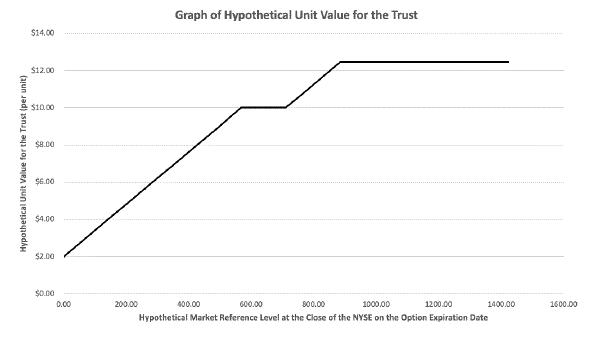
| • | If at the close of the New York Stock Exchange on the Option Expiration Date the price of the Reference Asset (the “RA Price”) is greater than or equal to $885.92 (124.64% of the Initial RA Value) (the “Cap”), the proceeds from the FLEX Options are |
Investment Summary 3
intended to be approximately $12.46 per unit. This equates to a Fee Account return of approximately 22.33% or a Standard Account return of approximately 19.55%, which represents a maximum capped return.
| • | If at the close of the New York Stock Exchange on the Option Expiration Date the RA Price is between $710.78 and $885.92 (100% to 124.64% of the Initial RA Value), the proceeds from the FLEX Options are intended to be between approximately $10 and $12.46 per unit. This equates to a Fee Account return of approximately -1.85% to 22.33% or a Standard Account return of approximately -4.08% to 19.55%. |
| • | If at the close of the New York Stock Exchange on the Option Expiration Date the RA Price is between $568.62 and $710.78 (80% to 100% of the Initial RA Value), the proceeds from the FLEX Options are intended to be approximately $10 per unit. This equates to a Fee Account loss of approximately -1.85% or a Standard Account loss of approximately -4.08%. |
| • | If at the close of the New York Stock Exchange on the Option Expiration Date the RA Price is less than $568.62 (80% of the Initial RA Value) the proceeds from the FLEX Options are intended to be between approximately $2 and $10 per unit. This equates to a Fee Account loss of approximately -80.83% to -1.85% or a Standard Account loss of approximately -81.26% to -4.08%. |
The trust may outperform the Reference Asset (minus the fees and expenses of the trust) if the Reference Asset’s price has decreased by between 0% and -100% as of the Option Expiration Date. Alternatively, because of the Cap and applicable fees and expenses of the trust, the trust will underperform the Reference Asset if the Reference Asset’s price has increased as of the Option Expiration Date.
The potential returns provided above are based on a range of assumptions, including estimated expenses. Any returns will be negatively affected by any portfolio transaction fees and extraordinary expenses incurred by the trust.
4 Investment Summary
The graph below is a hypothetical illustration of the mathematical principles underlying the FLEX Options and the operation of the trust’s investment strategy. This illustration does NOT take into account the fees and expenses of the trust and accordingly trust returns will be lower than the estimated returns provided. There is no assurance that the trust will achieve its investment objective through the use of this strategy. You may realize a payout (including a potential loss) that is higher or lower than the intended returns as a result of: (1) redeeming units prior to the trust’s mandatory termination date, (2) various circumstances (as described below) where FLEX Options are otherwise liquidated by the trust prior to their expiration or maturity, (3) if the trust is unable to maintain the proportional relationship (as described below) of the FLEX Options based on the number of FLEX Option contracts in the trust’s portfolio, (4) if the cost of satisfying redemption requests exceeds the proceeds received by the trust for selling FLEX Options to satisfy redemptions, (5) fees and expenses of the trust and those associated with owning the trust, and (6) taxes required to be paid by the trust or unitholders. The FLEX Options are intended to be liquidated on the Option Expiration Date, rather than be exercised, in order to avoid having the trust receive shares of the Reference Asset or be obligated to deliver shares of the Reference Asset. As a result, the return actually realized on the FLEX Options upon liquidation could vary from the returns that would be realized if the FLEX Options were exercised based on the price of shares of the Reference Asset as of the close of the market on the Option Expiration Date.
Investment Summary 5
The “proportional relationship” of the FLEX Options referred to throughout the prospectus that the trust seeks to maintain refers to the proportion of the particular types of FLEX Options as of the trust’s inception. For example, if the trust’s portfolio included 10 purchased call options (with a particular strike and expiration) for every 2 written put options (with a particular strike and expiration) at inception, the trust would seek to maintain that 10 contracts to 2 contracts proportional relationship. See “Investment Summary – Trust Portfolio” for the actual number of FLEX Option contracts at inception. Under certain limited circumstances provided in the trust agreement, FLEX Options may be liquidated by the trust prior to the Option Expiration Date. These circumstances may include paying expenses, satisfying unit redemptions by unitholders, protecting the trust in limited circumstances, making required distributions or avoiding the imposition of taxes on the trust as described under “Understanding Your Investment — How the Trust Works —Changing Your Portfolio.”
In addition, the trust may not be able to achieve the anticipated returns set forth in this prospectus. The trust’s performance may be impacted by a variety of factors, including but not limited to redemption activity, unusual economic events, market movements and changes in the liquidity of the FLEX Options. The trust’s portfolio is not managed. In the unlikely event that the FLEX Options cannot maintain their proper ratios, there may be significant impact to the trust’s ability to meet its investment objective or follow its principal investment strategy.
The sponsor has partnered with Milliman Financial Risk Management LLC (“Milliman”) as portfolio consultant. Milliman will suggest securities for the portfolio that it believes possess the potential to achieve the trust’s investment objective.
Assets Held by the Trust
The FLEX Options. The trust’s portfolio holds FLEX Options referred to as the “Purchased Call Options,” “Purchased Put Options,” “Written Call Options” and “Written Put Options”. The Purchased Put Options and Purchased Call Options together constitute the “Purchased Options.” The Written Call Options and Written Put Options constitute the “Written Options.”
FLEX Options provide investors with the ability to customize assets and indices referenced by the options, exercise prices, exercise styles and expiration dates, while achieving price discovery in competitive, transparent auctions markets and avoiding the counterparty exposure of over-the-counter option positions. The FLEX Options are European-style options, which means that they will be exercisable at the strike price only on the Option Expiration Date. FLEX Options are standard listed option contracts available through national securities exchanges that are guaranteed for settlement by the Options Clearing Corporation (the “OCC”), a market clearinghouse. The FLEX Options are listed on the Chicago Board Options Exchange (the “CBOE”). The trust is designed so that any amount owed by the trust on the Written Options will be covered by payouts at expiration from the Purchased Options. The trust receives premiums in exchange for the Written Options and pays premiums in exchange for the Purchased Options. The OCC and CBOE do not charge ongoing fees to writers or purchasers of the FLEX Options during their life for continuing to hold the option contracts. As a result, the Written Options will be fully covered and no additional collateral will be necessary during the life of the trust.
The OCC guarantees performance by each of the counterparties to the FLEX Options, becoming the “buyer for every seller and the seller for every buyer,” thereby protecting clearing members and
6 Investment Summary
options traders from counterparty risk. Subject to determination by the Securities Committee of the OCC, adjustments may be made to the FLEX Options for certain events (collectively, “Corporate Actions”) specified in the OCC’s bylaws and rules such as: certain stock dividends or distributions, stock splits, reverse stock splits, rights offerings, distributions, reorganizations, recapitalizations, or reclassifications with respect to an underlying security, or a merger, consolidation, dissolution or liquidation of the issuer of the underlying security. According to the OCC’s by-laws, the nature and extent of any such adjustment is to be determined by the OCC’s Securities Committee, in light of the circumstances known to it at the time such determination is made, based on its judgment as to what is appropriate for the protection of investors and the public interest, taking into account such factors as fairness to holders and writers (or purchasers and sellers) of the affected options, the maintenance of a fair and orderly market in the affected options, consistency of interpretation and practice, efficiency of exercise settlement procedures, and the coordination with other clearing agencies of the clearance and settlement of transactions in the underlying interest.
The description and terms of the FLEX Options to be entered into with the OCC are set forth in the by-laws and rules of the OCC. Please see www.optionsclearing.com for more information. The OCC’s website is not considered part of this prospectus, nor is it incorporated by reference herein.
Call Options. A European-style call option is a contract that gives the owner the right but not the obligation to buy the underlying security at a specified price (its strike price) on the option expiration date. For the writer of a call option, the contract represents an obligation to sell the underlying security from the option owner if the option is exercised. A call option is likely to be exercised if it is in-the-money, i.e., the current market value of the underlying security is above the strike price. Conversely, it is likely to expire worthless if the call option is out-of-the-money, i.e., the current market value of the underlying security is below the strike price.
Put Options. A European-style put option is a contract that gives the owner the right but not the obligation to sell the underlying security at a specified price (its strike price) on the option expiration date. For the writer of a put option, the contract represents an obligation to buy the underlying security from the option owner if the option is exercised. A put option is likely to be exercised if it is in-the-money, i.e., the current market value of the underlying security is below the strike price. Conversely, it is likely to expire worthless if the put option is out-of-the-money, i.e., the current market value of the underlying security is above the strike price.
See “Hypothetical Option Expiration Examples” in the appendix of the prospectus for additional information.
The Reference Asset and The Index
The Reference Asset is an exchange-traded fund that trades on the NYSE Arca, Inc. stock exchange under the ticker symbol “SPY.” The Reference Asset seeks to track the investment results of the S&P 500® Index (the “Index”), which measures the performance of large-capitalization U.S. equity securities. The components of the Index, and the degree to which these components represent certain industries, may change over time. The Index is reconstituted on an as-needed basis. The Reference Asset seeks to achieve its investment objective by holding a portfolio of the common stocks that are included in the Index, with the weight of each stock in its portfolio substantially corresponding to the weight of
Investment Summary 7
such stock in the Index. Although the Reference Asset may fail to own certain securities of the Index at any particular time, the Reference Asset generally will be substantially invested in securities of the Index, which should result in a close correspondence between the performance of the Index and the performance of the Reference Asset.
The Reference Asset seeks to track the investment results of the Index before fees and expenses of the Reference Asset. The sponsor has derived all information regarding the Reference Asset contained in this prospectus from the registration statement for the Reference Asset. Such information reflects the policies of, and is subject to change by, the Reference Asset’s sponsor, PDR Services, LLC. Information concerning the Reference Asset filed with the SEC can be located by reference to SEC file number 811-06125 and 33-46080. The sponsor has not undertaken any independent review or due diligence of the SEC filings by the issuer of the Reference Asset or any other publicly available information regarding such issuer. Information from outside sources is not incorporated by reference in, and should not be considered part of, this prospectus.
The summary information is not designed to be, and should not be interpreted as, an effort to present information regarding the financial prospects of any issuer or any trends, events or other factors that may have a positive or negative influence on those prospects or as an endorsement of any particular issuer or exchange-traded fund. The trust is not sponsored, endorsed, sold or promoted by SPDR® S&P 500® ETF Trust, PDR Services, LLC or S&P Dow Jones Indices LLC. SPDR® S&P 500® ETF Trust, PDR Services, LLC and S&P Dow Jones Indices LLC have not passed on the legality or suitability of, or the accuracy or adequacy of, descriptions and disclosures relating to the trust or the FLEX Options. SPDR® S&P 500® ETF Trust, PDR Services, LLC and S&P Dow Jones Indices LLC make no representations or warranties, express or implied, regarding the advisability of investing in the trust or the FLEX Options or results to be obtained by the trust or the FLEX Options, unitholders or any other person or entity from use of the Reference Asset. SPDR® S&P 500® ETF Trust, PDR Services, LLC and S&P Dow Jones Indices LLC have no liability in connection with the management, administration, marketing or trading of the trust or the FLEX Options.
Milliman Financial Risk Management LLC
Milliman Financial Risk Management LLC is a provider of financial risk management to the retirement savings industry. Milliman provides investment advisory, hedging and consulting services for over $224.5 billion in global assets (as of December 31, 2025).
8 Investment Summary
| Essential Information | |||
| Unit price at inception for | |||
| Standard Accounts: | $10.3653 | ||
| Unit price at inception for | |||
| Fee Accounts | $10.1300 | ||
| Inception date: | April 24, 2026 | ||
| Mandatory Termination Date: | April 21, 2028 | ||
| Evaluation time: | As of the close of trading of the | ||
| New York Stock Exchange | |||
| (normally 4 p.m. Eastern time); | |||
| however, on the first day units | |||
| are sold, the evaluation time will | |||
| be as of the time the registration | |||
| statement filed with the Securities | |||
| and Exchange Commission | |||
| becomes effective | |||
| Redemption Cutoff: | Close of the | ||
| New York Stock Exchange | |||
| (normally 4 p.m. Eastern time). | |||
| Distribution date: | 25th day of each month | ||
| (commencing on | |||
| May 25, 2026, if any) | |||
| Record date: | 15th day of each month | ||
| (commencing on | |||
| May 15, 2026, if any) | |||
| CUSIP Numbers: | |||
| Cash Distributions | |||
| Standard Accounts: | 40178R581 | ||
| Fee Accounts: | 40178R599 | ||
| Ticker: | CDOBFX | ||
| Minimum investment: | 1 unit | ||
| Summary of Defined Terms | |||
| Option Expiration Date: | April 21, 2028 | ||
| Reference Asset: | SPDR® S&P 500® | ||
| ETF Trust | |||
| Index: | S&P 500® Index | ||
| Initial RA Value: | $710.78 (an amount equal | ||
| to a price of a share | |||
| of the Reference Asset | |||
| on the inception date) | |||
Principal Risks
As with all investments, you may lose some or all of your investment in the trust. No assurance can be given that the trust’s investment objective will be achieved. The trust also might not perform as well as you expect. This can happen for reasons such as these:
| • | Passive investment risk. The value of your investment may fall over time. The trust will generally hold, and may continue to buy, the same securities even though a security’s outlook, rating, market value or yield may have changed. |
| • | Market risk. Market risk is the risk that a particular security in the trust, the trust itself or securities in general may fall in value. Market value may be affected by a variety of factors, including general securities markets movements, changes in the financial condition of an issuer or a sector, changes in perceptions about an issuer or a sector, interest rates and inflation and governmental policies and litigation. Changes in legal, political, regulatory, tax and economic conditions may cause fluctuations in markets and securities prices, which could negatively impact the value of the trust. Additionally, events such as war, armed conflict, terrorism, natural and environmental disasters, the spread of infectious illnesses or other public health emergencies, recessions, economic sanctions, bank failures and political turbulence may adversely affect the economy, various markets and issuers. For example, the ongoing adversarial political climate in the United States, as well as political and diplomatic events both domestic and |
Investment Summary 9
abroad, have had and may continue to have an adverse impact on the U.S. regulatory landscape, international trade relations, policies, markets and investor behavior, which could have a negative impact on the trust’s investments and operations. The economies of the United States and its trading partners, as well as the financial markets generally, may be adversely impacted by trade disputes, including the imposition of tariffs, and other matters. Advancements in technology may also adversely impact markets and the overall performance of the trust. The complete economic impact of any such future event may be difficult or impossible to predict. Although the sponsor, who serves as the evaluator of the trust (the “evaluator”), carefully supervises your trust, you should remember that it does not manage your trust. Your trust will not sell a security solely because the market value falls, as is possible in a managed fund.
| • | Investment risk. You may lose a significant portion of your investment. The trust does not provide principal protection and you may not receive a return of the capital you invest. In addition, the units will not realize more than the capped return from the FLEX Options, even if the return on the Reference Asset far exceeds that level. |
| • | Capped upside and limited downside protection risk. The trust’s return is subject to an upside cap, and loss is subject to a buffer. The trust’s ability to provide capped upside and a buffered downside is dependent on unitholders purchasing units at the trust’s inception and holding them until the trust is terminated. You may realize a return or loss that is higher or lower than the intended returns or losses as a result of redeeming units prior to the Mandatory Termination Date, where FLEX Options are otherwise liquidated by the trust prior to expiration, if a Corporate Action occurs with respect to the Reference Asset, or if there are increases in potential tax-related expenses and other expenses of the trust above estimated levels. |
| • | Underlying Reference Asset performance and equity risk. The trust is subject to performance and equity risk related to the Reference Asset, the Index and securities comprising the Index. The formulas used to calculate the FLEX Options’ payments at expiration are based on the price performance of the Reference Asset. The FLEX Options represent indirect positions in the Reference Asset and are subject to changes in value as the price of the Reference Asset rises or falls. The value of the FLEX Options may be adversely affected by various factors affecting the Reference Asset, the Index and the value of the securities comprising the Index. The settlement value of the FLEX Options is based on the Closing Value on the Option Expiration Date only and will be substantially determined by market conditions as of such time. The FLEX Options are intended to be liquidated as of the close of market on the Option Expiration Date rather than be exercised according to the FLEX Options’ terms in order to avoid having the trust receive shares of the Reference Asset or be obligated to |
10 Investment Summary
deliver shares of the Reference Asset. The value of the Reference Asset will fluctuate over time based on fluctuations in the value of the stocks held by the Reference Asset, which may be impacted by changes in general economic conditions, expectations for future economic growth, and corporate profits and interest rates. Although common stocks have historically generated higher average returns than fixed-income securities over the long term, common stocks also have experienced significantly more volatile returns. Common stocks are structurally subordinated to preferred stocks, bonds and other debt instruments in a company’s capital structure and represent a residual claim on the issuer’s assets that have no value unless such assets are sufficient to cover all other claims.
The value of the trust does not appreciate due to dividend payments paid by the Reference Asset, because the trust does not own the Reference Asset. The trust seeks to provide target returns on the price performance of the Reference Asset, which does not include returns from dividends paid by the Reference Asset.
Unitholders will not have control, voting rights or rights to receive cash dividends or other distributions or other rights that holders of a direct investment in the Reference Asset would have.
| • | Options risk. The value of the FLEX Options may change with the implied volatility of the Reference Asset, the Index and the securities comprising the Index. No one can predict whether implied volatility will rise or fall in the future. It is not anticipated that there will be an existing market for options with the same customized terms as the FLEX Options, and an active market may not be established. Prior to the trust’s inception date, there has been no existing trading market for the FLEX Options. |
The values of the FLEX Options do not increase or decrease at the same rate as the Reference Asset or the Index. Prior to the Option Expiration Date, the value of the FLEX Options is determined based upon market quotations, the last asked or bid price in the over-the-counter market or using other recognized pricing methods. The value of the FLEX Options prior to the Option Expiration Date may vary because of related factors other than the price of shares of the Reference Asset. Factors that may influence the value of the FLEX Options are interest rate changes, implied volatility levels of the Reference Asset, Index and securities comprising the Index and implied dividend levels of the Reference Asset, Index and securities comprising the Index, among others.
Written Options risk. The Written Options may reduce the value of your units. The Written Options create an obligation to make a payment in contrast to the Purchased Options, which creates the potential for receipt of a payment. As the value of the Written Options increases, it has a negative impact on the value of your units.
Investment Summary 11
Credit risk. Credit risk is the risk an issuer, guarantor or counterparty of a security in the trust is unable or unwilling to meet its obligation on the security. The OCC acts as guarantor and central counterparty with respect to the FLEX Options. As a result, the ability of the trust to meet its objective depends on the OCC being able to meet its obligations.
Liquidity risk. Liquidity risk is the risk that the value of a FLEX Option will fall in value if trading in the FLEX Option is limited or absent. No one can guarantee that a liquid secondary trading market will exist for the FLEX Options. Trading in the FLEX Options may be less deep and liquid than certain other securities. FLEX Options may be less liquid than certain non-customized options. The sponsor expects that the trust will hold 10% or less of its net asset value in illiquid securities. In a less liquid market for the FLEX Options, liquidating the FLEX Options upon a redemption of units may require the payment of a premium or acceptance of a discounted price and may take longer to complete. In a less liquid market for the FLEX Options, the liquidation of a large number of FLEX Options may more significantly impact the price. A less liquid trading market may adversely impact the value of the FLEX Options and your units.
Valuation risk. Under certain circumstances, current market prices may not be available with respect to the FLEX Options. Under those circumstances, the value of the FLEX Options will require more reliance on the judgment of the evaluator than that required for securities for which there is an active trading market. This creates a risk of mispricing or improper valuation of the FLEX Options, which could impact the value received or paid for units.
Proportional relationship risk. In the unlikely event the trust is unable to maintain the proportional relationship of the FLEX Options, it will be unable to achieve its objective.
| • | Exchange-traded fund risk. Certain features of the Reference Asset, which is an exchange-traded fund, will impact the value of the units. The value of the Reference Asset is subject to the following factors: |
Passive investment risk. The Reference Asset is not actively managed and attempts to track the performance of an unmanaged index of securities. This differs from an actively managed fund, which typically seeks to outperform a benchmark index. As a result, the Reference Asset will hold constituent securities of the Index regardless of the current or projected performance on a specific security or particular industry or market sector. Maintaining investments in the securities regardless of market conditions of the performance of individual securities could impact the
12 Investment Summary
unit price of the Reference Asset, the FLEX Options and the trust units.
Tracking error. Exchange-traded funds face index correlation risk, which is the risk that the performance of an exchange-traded fund will vary from the actual performance of the target index, known as “tracking error.” The performance of the Reference Asset may not replicate the performance of, and may underperform, the Index. It is possible that the Reference Asset may not fully replicate or may, in certain circumstances, diverge significantly from the performance of the Index due to the Reference Asset not investing in all stocks comprising the Index, temporary unavailability of certain securities in the secondary market, differences in trading hours between the Reference Asset and securities comprising the Index, the occurrence of corporate actions (mergers and spinoffs), or other circumstances. Because the return or loss on the FLEX Options references the price performance of the Reference Asset and not the Index, the return or loss on the FLEX Options and your units may be less than that of an alternative investment linked directly to the Index.
Fees and expenses. Unlike the Index, the Reference Asset will reflect transaction costs and fees that will reduce its price performance relative to the Index.
Discount. Shares of exchange-traded funds tend to trade at a discount from their net asset value.
| • | Dilution risk. You could experience a dilution of your investment as a result of redemption activity or expenses of the trust. There is no assurance that your investment will maintain its proportionate share in the trust’s profits and losses, or that your investment will be in the same portfolio for the duration of the trust. |
| • | Cybersecurity risk. The trust may be susceptible to potential risks through breaches in cybersecurity. A breach in cybersecurity refers to both intentional and unintentional events that may cause the trust to lose proprietary information, suffer data corruption or lose operational capacity. Such events could cause the sponsor of the trust to incur regulatory penalties, reputational damage, additional compliance costs associated with corrective measures and/or financial loss. In addition, cybersecurity breaches of the trust’s third-party service providers, or issuers in which the trust invests, can also subject the trust to many of the same risks associated with direct cybersecurity breaches. |
| • | Operational and service provider risk. The trust is subject to risks arising from various operational factors and their service providers. Operational factors include, but not limited to, human error, processing and communication errors, errors of the trust’s service providers, counterparties or other third-parties, failed or inadequate processes and technology or systems failures. Additionally, the trust may be subject to the risk that a service provider may not be willing or able to perform their duties as required or contemplated by their agreements with the trust. Although the trust seeks to reduce these operational risks |
Investment Summary 13
through controls and procedures, there is no way to completely protect against such risks.
| • | Early termination risk. The trustee has the power to terminate your trust early in limited cases as described under “Understanding Your Investment— How Your Trust Works—Termination of Your Trust,” including if the value of the trust is less than $1 million or less than 40% of the value of the securities in the trust at the end of the initial offering period. If the trust terminates early, the trust may suffer losses and be unable to achieve its investment objective. This could result in a reduction in the value of units and result in a significant loss to investors. |
| • | Legislation and litigation risk. From time to time, various legislative initiatives or regulatory standards are proposed in the United States and abroad which may have a negative impact on the Reference Asset, the Index or the securities comprising the Index. In addition, litigation regarding any of the issuers of the securities, or of the industries represented by such issuers, may negatively impact the value of these securities. We cannot predict what impact any pending or proposed legislation or pending or threatened litigation will have on the value of the securities. |
| • | Inflation risk. Inflation risk is the risk that the value of assets or income from investments will be less in the future as inflation decreases the value of money. |
See “Investment Risks” in Part A of the prospectus and “Risk Factors” in Part B of the prospectus for additional information.
Who Should Invest
You should consider this investment if:
| • | You want to own securities representing interests in written and purchased option contracts. |
| • | You seek the potential for capital appreciation on the Reference Asset subject to a capped return. |
| • | You seek a limited downside protection through a buffer. |
| • | You fully understand that investments made when the Trust is at or near the capped return may have limited or no upside and will have the potential to lose more than the stated maximum loss. |
| • | You are willing to hold units for the duration of the Trust in order to achieve the outcomes that the Trust seeks to provide. |
| • | You are willing to forego any gains in excess of the maximum gain. |
You should not consider this investment if:
| • | You do not fully understand that investments made when the Trust is at or near the capped return may have limited or no upside and will have the potential to lose more than the stated 80% maximum loss. |
14 Investment Summary
| • | You are unwilling to hold units for the duration of the Trust in order to achieve the outcomes that the Trust seeks to provide. |
| • | You are unwilling to forego any gains in excess of the maximum gain, minus the fees and expenses of the trust (including sales fees). |
| • | You are uncomfortable with the risks of an unmanaged investment in written and purchased option contracts. |
| • | You are uncomfortable with exposure to the risks associated with the FLEX Options. |
| • | You are uncomfortable with exposure to the price performance of the Reference Asset. |
| • | You are seeking an investment that participates in the full appreciation of the Reference Asset. |
| • | You are seeking unlimited capital appreciation potential and do not want potential returns capped. |
| • | You are uncomfortable with the risk that you may lose a portion of your principal. |
| • | You are buying at a time when the RA Price is at or near the Cap. |
Fees and Expenses
The amounts below are estimates of the direct and indirect fees and expenses that you may incur based on a $10 unit price. Actual expenses may vary.
| Percentage | ||
| of Public | ||
| Offering | Amount Per | |
| Investor Fees | Price (4) | 100 Units |
| Initial sales fee paid | ||
| on purchase (1) | 2.25% | $22.50 |
| Creation and development | ||
| fee (2) | 0.50 | 5.00 |
| Maximum sales fee | ||
| (including creation and | ||
| development fee) | 2.75% | $27.50 |
| Estimated organization costs (3) | ||
| (amount per 100 units as | ||
| a percentage of the public | ||
| offering price) | 0.80% | $8.00 |
| Approximate | ||
| Annual Fund | % of Public | |
| Operating | Offering | Amount Per |
| Expenses | Price (4) | 100 Units |
| Trustee’s fee | 0.1000% | $1.000 |
| Sponsor’s supervisory fee | 0.0300 | 0.300 |
| Evaluator’s fee | 0.0350 | 0.350 |
| Bookkeeping and | ||
| administrative fee | 0.0350 | 0.350 |
| Estimated other trust | ||
| operating expenses (5) | 0.0850 | 0.850 |
| Total | 0.285% | $2.850 |
| (1) | The initial sales fee provided above is based on the unit price on the Inception Date. The initial sales charge, also referred to as the “transactional sales fee,” is equal to the difference between the maximum sales charge and the creation and development fee (“C&D Fee”). The percentage and dollar amount of the initial sales fee will vary as the unit price varies. Despite the variability of the initial sales fee, each unitholder is obligated to pay the entire applicable maximum sales fee. |
| (2) | The C&D Fee compensates the sponsor for creating and developing your trust. The actual C&D Fee is $0.05 per unit and is paid to the sponsor at the close of the initial offering period, which is expected to be one day after the Inception Date. Units purchased after the close of the initial offering period do not pay the C&D Fee. The percentages provided are based on a $10 unit as of the Inception Date and the percentage amount will vary over time. If the unit price exceeds $10 per unit, the C&D Fee will be less than 0.50% of the Public Offering Price; if the unit price is less than $10 per unit, the C&D Fee will exceed 0.50% of the Public Offering Price. However, in no event will the maximum sales fee exceed 2.75% of a unitholder’s initial investment. |
| (3) | Organization costs include the portfolio consulting fee paid to Milliman for its assistance in selecting the trust’s portfolio. |
Investment Summary 15
| (4) | Based on 100 units with a $10 per unit Public Offering Price as of the Inception Date. |
| (5) | The estimated trust operating expenses are based upon an estimated trust size. Because certain of the operating expenses are fixed amounts, if the trust does not reach such estimated size or falls below the estimated size over its life, the actual amount of the operating expenses may exceed the amounts reflected. In some cases, the actual amount of the operating expenses may greatly exceed the amounts reflected. Other operating expenses include a licensing fee of 0.07% of the aggregate daily liquidation value of transactional sales made during the primary offering period paid by the trust to Milliman for the use of intellectual property owned by Milliman, but do not include brokerage costs and other transactional fees. |
Example
This example helps you compare the costs of this trust with other unit trusts and mutual funds. In the example we assume that the trust’s operating expenses do not change and the trust’s annual return is 5%. Your actual returns and expenses will vary. Based on these assumptions, you would pay these expenses for every $10,000 you invest:
| 1 year | $380 |
| 2 years (life of trust) | 408 |
These amounts are the same regardless of whether you sell your investment at the end of a period or continue to hold your investment. The example does not consider any brokerage fees the trust pays or any transaction fees that broker-dealers may charge for processing redemption requests.
See “Expenses of the Trust” in Part B of the prospectus for additional information.
16 Investment Summary
| Trust Portfolio | ||||||
| Guggenheim Defined Portfolios, Series 2583 | ||||||
| Large Cap Buffer 20 Portfolio, Series 31 | ||||||
| The Trust Portfolio as of the Inception Date, April 24, 2026 | ||||||
| Percentage | Cost | |||||
| Percentage | of | of | ||||
| of | Number of | Market | Market | Securities | ||
| Strike | Strike | Options | Value Per | Value | To | |
| Description(1) | Price | Price | Contracts | Option(2) | To Trust(2) | Trust |
| FLEX OPTIONS - 100.00% (3)(4) | ||||||
| Purchased Options - 106.28% | ||||||
| Purchased Call Options on SPDR® | ||||||
| S&P 500® ETF Trust, Expiring | ||||||
| April 21, 2028 (4) | $0.14 | 0.02% | 123 | $ 69,871 | 98.30% | $ 8,594,133 |
| Purchased Put Options on SPDR® | ||||||
| S&P 500® ETF Trust, Expiring | ||||||
| April 21, 2028 (4) | 710.78 | 100.94 | 123 | 5,675 | 7.98 | 698,025 |
| Written Options - (6.28%) | ||||||
| Written Call Options on SPDR® | ||||||
| S&P 500® ETF Trust, Expiring | ||||||
| April 21, 2028 (4) | 885.92 | 125.81 | 123 | 1,984 | (2.79) | (244,032) |
| Written Put Options on SPDR® | ||||||
| S&P 500® ETF Trust, Expiring | ||||||
| April 21, 2028 (4) | 568.62 | 80.75 | 123 | 2,484 | (3.49) | (305,532) |
| TOTAL OPTIONS | 100.00% | $ 8,742,594 | ||||
| (1) | Securities are represented by contracts to purchase securities. |
| (2) | The value of FLEX Options is based on intraday prices reflecting an Initial RA Value of $710.78 for the Reference Asset. In cases where the FLEX Options are not traded on the valuation date or where the evaluator determines that market quotations are unavailable or inappropriate (e.g., due to infrequent transactions or thin trading), the value of the FLEX Options is based on the last asked or bid price in the over-the-counter market if available and appropriate. During the initial offering period such determination for the Purchased Options will generally be on the basis of ask prices and for the Written Options will generally be on the basis of bid prices. After the initial offering period ends, such determination for the Purchased Options will generally be on the basis of bid prices and for the Written Options will generally be on the basis of ask prices. |
If market quotes, ask prices and bid prices are unavailable or inappropriate (e.g., due to infrequent transactions or thin trading), each FLEX Option’s value is based on the evaluator’s good faith determination of the fair value of the FLEX Options at its reasonable discretion. To determine the fair value of the FLEX Options, where available, the evaluator starts with values generated using the CBOE’s Customized Option Pricing Service (“COPS”), which generates valuations based on the average valuations of multiple market making contributors. Where such values are not available through COPS, the evaluator will use the OCC’s Flex Reports, which are model-based valuations made available by OCC. Where such values are not available and to assess the reasonableness of the above valuations, the evaluator will generate its own model-based valuations of the FLEX Options, including using the Black-Scholes model for option valuation, and use current market quotations and ask/bid prices for comparable listed options that are more actively traded.
Investment Summary 17
Account Standards Codification 820, “Fair Value Measurements” establishes a framework for measuring fair value and expands disclosure about fair value measurements in financial statements for the trust. The framework under the standard is comprised of a fair value hierarchy, which requires an entity to maximize the use of observable inputs and minimize the use of unobservable inputs when measuring fair value. The standard describes three levels of inputs that may be used to measure fair value:
Level 1: Quote prices (unadjusted) for identical assets or liabilities in active markets that the trust has the ability to access as of the measurement date.
Level 2: Significant observable inputs other than Level 1 prices, such as quoted prices for similar assets or liabilities, quoted prices in markets that are not active, and other inputs that are observable or can be corroborated by observable market data.
Level 3: Significant unobservable inputs that reflect on the trust’s own assumptions about the assumptions that market participants would use in pricing an asset or liability.
The inputs or methodologies used for valuing securities are not necessarily an indication of the risk associated with investing in those securities.
Changes in valuation techniques may result in transfers in or out of an investment’s assigned level as described above.
The following table summarizes the trust’s investment in the FLEX Options as of the trust’s inception, based on inputs used to value them:
| LEVEL 1 | LEVEL 2 | LEVEL 3 | |
| Purchased Options | $ – | $9,292,158 | $ – |
| Written Options | $ – | $(549,564) | $ – |
| TOTAL | $ – | $8,742,594 | $ – |
The cost of the securities to the sponsor and the sponsor’s profit or (loss) are $8,742,988 and ($394), respectively.
| (3) | Each FLEX Option entitles the holder thereof (i.e., the purchaser of the FLEX Option) to purchase (for the call options) or sell (for the put options) 100 shares of the Reference Asset at the applicable strike price. |
| (4) | This is a non-income-producing security. |
18 Investment Summary
UNDERSTANDING YOUR INVESTMENT
How to Buy Units
You can buy units of your trust on any business day by contacting your financial professional. Public offering prices of units are available daily on the Internet at www.guggenheiminvestments.com. The unit price includes:
| • | the value of the securities, |
| • | organization costs, |
| • | the maximum sales fee (which includes an initial sales fee and the creation and development fee), and |
| • | cash and other net assets in the portfolio. |
We often refer to the purchase price of units as the “offer price” or the “Public Offering Price.” We must receive your order to buy units prior to the close of the New York Stock Exchange (normally 4:00 p.m. Eastern time) to give you the price for that day. If we receive your order after this time, you will receive the price computed on the next business day.
Value of the Securities. The sponsor determines the value of the securities as of the close of the New York Stock Exchange on each day that the exchange is open; however, on the first day units are sold, the evaluation time will be as of the time the registration statement filed with the Securities and Exchange Commission becomes effective. We generally seek to determine the value of the FLEX Options using the last quoted sale price for the FLEX Options where readily available and appropriate. In cases where the FLEX Options are not traded on the valuation date or where we determine that market quotations are unavailable or inappropriate (e.g., due to infrequent transactions or thin trading), we will generally value the FLEX Options based on the last asked or bid price in the over-the-counter market if available and appropriate. During the initial offering period such determination for the Written Call Options will generally be on the basis of bid prices. After the initial offering period ends, such determination for the Written Call Options will generally be on the basis of ask prices. During the initial offering period such determination for the Purchased Options will generally be on the basis of ask prices. After the initial offering period ends, such determination for the Purchased Options will generally be on the basis of bid prices.
If market quotes, ask prices and bid prices are unavailable or inappropriate (e.g., due to infrequent transactions or thin trading), we will determine each FLEX Option’s value based on our good faith determination of the fair value of the FLEX Options at our reasonable discretion. To determine the fair value of the FLEX Options, where available, we will start with values generated using the CBOE’s COPS, which generates valuations based on the average valuations of multiple market making contributors. Where such values are not available through COPS, we will use the OCC’s Flex Reports, which are model-based valuations made available by OCC. Where such values are not available and to assess the reasonableness of the above valuations, we will generate our own model-based valuations of the FLEX Options, including using the Black-Scholes model for option valuation, and use current market quotations and ask/bid prices for comparable listed options that are more actively traded.
The ask side price generally represents the price at which dealers, market-makers or investors in the market are willing to sell a security and the bid side evaluation generally
Understanding Your Investment 19
represents the price that dealers, market-makers or investors in the market are willing to pay to buy a security. The bid side evaluation is lower than the ask side evaluation. As a result of this pricing method, unitholders should expect a decrease in the net asset value per unit on the day following the end of the initial offering period equal to the difference between the current ask side evaluation and bid side evaluation of the FLEX Options.
We determined the initial prices of the securities shown under “Trust Portfolio” in this prospectus on the date of this prospectus using intraday prices. On the first day we sell units we will compute the unit price as of the time the registration statement filed with the Securities and Exchange Commission becomes effective.
Organization Costs. During the initial offering period, part of your purchase price includes a per unit amount sufficient to reimburse us for some or all of the costs of creating your trust. These costs include the costs of preparing the registration statement and legal documents, legal fees, federal and state registration fees, the portfolio consulting fee, and the initial fees and expenses of the trustee. Cash has been deposited in the trust for purposes of the payment of organization costs. The estimated organization costs shown under the “Investment Summary – Fees and Expenses” section are based upon an estimated trust size. Because certain of the organization costs are fixed amounts, if the trust does not reach such estimated size, the actual amount of organization costs may exceed the estimated amounts. However, the sponsor has agreed to cap the organization costs so that you will not pay more than 0.80% of the public offering price ($8.00 per 100 units) in organization costs.
Transactional Sales Fee. The transactional sales fee for the trust is comprised of an initial sales fee of 2.25% of the Public Offering Price, based on a $10 unit, which you pay at the time of purchase. This percentage amount of the transactional sales fee is based on the unit price on the Inception Date. Because the transactional sales fee equals the difference between the maximum sales fee (2.75% of the Public Offering Price) and the C&D Fee ($0.05 per unit), the percentage and dollar amount of the transactional sales fee will vary as the unit price varies.
Advisory and Fee Accounts. We eliminate your transactional sales fee for purchases made through registered investment advisers, certified financial planners or registered broker-dealers who charge periodic fees in lieu of commissions or who charge for financial planning or for investment advisory or asset management services or provide these services as part of an investment account where a comprehensive “wrap fee” is imposed (a “Fee Account”). All accounts that are not Fee Accounts shall be referred to as “Standard Accounts.”
This discount applies during the initial offering period and in the secondary market. Your financial professional may purchase units with the Fee Account CUSIP numbers to facilitate purchases under this discount; however, we do not require that you buy units with these CUSIP numbers to qualify for the discount. We reserve the right to limit or deny purchases of units not subject to the transactional sales fee by investors whose frequent trading activity we determine to be detrimental to your trust. We, as sponsor, will receive and you will pay the C&D Fee. See “Expenses of the Trust” in Part B of the prospectus for additional information.
Employees. We do not charge the portion of the transactional sales fee that we would normally pay to your financial professional for purchases made by officers, directors and
20 Understanding Your Investment
employees and their family members (spouses, children under the age of 21 living in the same household and parents) of Guggenheim Funds and its affiliates, or by employees of selling firms, their affiliates and their family members (spouses, children under the age of 21 living in the same household, siblings and parents). You pay only the portion of the fee that the sponsor retains. Such purchases are also subject to the C&D Fee. This discount applies during the initial offering period and in the secondary market. Only those broker-dealers that allow their employees to participate in employee discount programs will be eligible for this discount. All employee discounts are subject to the policies of the related selling firm, including any eligibility limitations enforced by the selling firm.
Certain Self-Directed Brokerage Platforms. Eligible purchases of units through E*TRADE and/or any other Morgan Stanley self-directed brokerage platform will be executed at the public offering price less the portion of the transactional sales fee that would be paid to distribution firms. You pay only the portion of the fee that the sponsor retains. Such purchases are also subject to the C&D fee. This discount applies during the initial offering period and in the secondary market.
See “Purchase, Redemption and Pricing of Units” in Part B of the prospectus for more information regarding buying units.
How We Distribute Units. We sell units to the public through broker-dealers and other firms. We pay part of the sales fee you pay to these distribution firms when they sell units. The distribution fee paid is 2.00% of the Public Offering Price per unit.
Eligible dealer firms and other selling agents that sell units of Guggenheim Funds unit trusts in the primary market to financial intermediaries other than the sponsor are eligible to receive additional compensation for volume sales. Such payments will be in addition to the regular concessions paid to dealer firms as set forth in the applicable trust’s prospectus. For this volume concession, Investment Grade Corporate Trust 3-7 Year, Short Duration High Yield Trust and Select Quality Municipal Portfolio are designated as “Fixed Income Trusts” and all other Guggenheim Funds unit trusts are designated as “Equity Trusts.” Sales of units from the following Guggenheim Funds unit trust strategies will not count toward this volume concession: Advisory Series: Guggenheim Investment Grade Corporate Trust 3-7 Year; Advisory Series: Investment Grade Corporate 3-7 Year Trust; Blue Chip Growth Portfolio, CDA; ARK Early Stage Disruptors Portfolio, CDA; Dow 50 Value Dividend Portfolio, CDA; Kensho Space Exploration & Innovation Portfolio, CDA and S&P Dividend Aristocrats Select 25 Strategy Portfolio, CDA. Eligible dealer firms and other selling agents who, during the previous consecutive 12-month period through the end of the most recent month, sold primary market units of eligible Guggenheim Funds unit investment trusts to financial intermediaries other than the sponsor in the dollar amounts shown below will be entitled to up to the following additional sales concession on primary market sales of units during the current month of unit investment trusts sponsored by us:
Understanding Your Investment 21
| Additional | Additional | |
| Concession | Concession for | |
| Total Sales | for Equity | Fixed Income |
| (in millions) | Trust Units | Trust Units |
| $25 but less | ||
| than $100 | 0.035% | 0.035% |
| $100 but less | ||
| than $150 | 0.050% | 0.050% |
| $150 but less | ||
| than $250 | 0.075% | 0.075% |
| $250 but less | ||
| than $1,000 | 0.100% | 0.100% |
| $1,000 but less | ||
| than $5,000 | 0.125% | 0.100% |
| $5,000 but less | ||
| than $7,500 | 0.150% | 0.100% |
| $7,500 or more | 0.175% | 0.100% |
Dealer firms or other selling agents deemed to be an underwriter for a Fixed Income Trust will not be eligible to receive the above sales concession on the underwritten units for that trust. However, Fixed Income Trust units sold in an underwriting to financial intermediaries other than the sponsor will be included in the total sales calculation when determining the appropriate sales concession level for the dealer firm or other selling agent. Please see the respective Fixed Income Trust’s prospectus for more information.
To the extent a dealer firm or other selling agent collects from the sponsor onboarding or due diligence fees associated with the onboarding of a Guggenheim Funds unit investment trust, the sponsor may determine that such fees will reduce the amount of the additional sales concession paid to that firm or agent.
Eligible unit trusts include Fixed Income Trusts and Equity Trusts sold in the primary market to financial intermediaries other than the sponsor. Redemptions of units during the primary offering period will reduce the amount of units used to calculate the volume concessions. In addition, dealer firms will not receive volume concessions on the sale of units which are not subject to a transactional sales fee. However, such sales will be included in determining whether a firm has met the sales level breakpoints for volume concessions.
Guggenheim Funds reserves the right to modify or terminate the volume concession program at any time. The sponsor may also pay to certain dealers an administrative fee for information or service used in connection with the distribution of trust units. Such amounts will be in addition to any concessions received for the sale of units.
In addition to the concessions described above, the sponsor may pay additional compensation out of its own assets to broker-dealers that meet certain sales targets and that have agreed to provide services relating to your trust to their customers.
Other Compensation and Benefits to Broker-Dealers. The sponsor, at its own expense and out of its own profits, may provide additional compensation and benefits to broker-dealers who sell shares of units of this trust and other Guggenheim products. This compensation is intended to result in additional sales of Guggenheim products and/or compensate broker-dealers and financial advisors for past sales. A number of factors are considered in determining whether to pay these additional amounts. Such factors may include, but are not limited to, the level or type of services provided by the intermediary, the level or expected level of sales of Guggenheim products by the intermediary or its agents, the placing of Guggenheim products on a preferred or recommended product list, access to an intermediary’s personnel, and other factors.
22 Understanding Your Investment
The sponsor makes these payments for marketing, promotional or related expenses, including, but not limited to, expenses of entertaining retail customers and financial advisers, advertising, sponsorship of events or seminars, obtaining information about the breakdown of unit sales among an intermediary’s representatives or offices, obtaining shelf space in broker-dealer firms and similar activities designed to promote the sale of the sponsor’s products. The sponsor may make such payments to many intermediaries that sell Guggenheim products. The sponsor may also make certain payments to, or on behalf of, intermediaries to defray a portion of their costs incurred for the purpose of facilitating unit sales, such as the costs of developing trading or purchasing trading systems to process unit trades.
Payments of such additional compensation, some of which may be characterized as “revenue sharing,” may create an incentive for financial intermediaries and their agents to sell or recommend a Guggenheim product, including the trust, over products offered by other sponsors or fund companies. These arrangements will not change the price you pay for your units.
We generally register units for sale in various states in the United States. We do not register units for sale in any foreign country. It is your financial professional’s responsibility to make sure that units are registered or exempt from registration if you are a foreign investor or if you want to buy units in another country. This prospectus does not constitute an offer of units in any state or country where units cannot be offered or sold lawfully. We may reject any order for units in whole or in part.
We may gain or lose money when we hold units in the primary or secondary market due to fluctuations in unit prices. The gain or loss is equal to the difference between the price we pay for units and the price at which we sell or redeem them. We may also gain or lose money when we deposit securities to create units. For example, we lost the amount set forth in the “Trust Portfolio” on the initial deposit of securities into the trust.
See “Purchase, Redemption and Pricing of Units” in Part B of the prospectus for additional information.
How to Sell Your Units
You can sell your units on any business day by contacting your financial professional or, in some cases, the trustee. Unit prices are available daily on the Internet at www.guggenheiminvestments.com or through your financial professional. We often refer to the sale price of units as the “liquidation price.” Certain broker-dealers may charge a transaction fee for processing unit redemptions or sale requests.
Until the end of the initial offering period or six months after the Inception Date, at the discretion of the sponsor, the price at which the trustee will redeem units and the price at which the sponsor may repurchase units include organization costs. After such period, the amount paid will not include such organization costs.
Selling Units. We do not intend to but may maintain a secondary market for units. This means that if you want to sell your units, we may buy them at the current price which is based on their net asset value. We may then resell the units to other investors at the Public Offering Price or redeem them for the redemption price. Our secondary market repurchase price is generally the same as the redemption price. Certain broker-dealers might also maintain a secondary market in units. You should contact your financial professional for current unit prices
Understanding Your Investment 23
to determine the best price available. We may discontinue our secondary market at any time without notice. Even if we do not make a market, you will be able to redeem your units with the trustee on any business day for the current price.
Redeeming Units. You may also be able to redeem your units directly with the trustee, The Bank of New York Mellon, on any day the New York Stock Exchange is open. The trustee must receive your completed redemption request prior to the close of the New York Stock Exchange for you to receive the unit price for a particular day. (For what constitutes a completed redemption request, see “Purchase, Redemption and Pricing of Units--Redemption” in Part B of the prospectus.) If your request is received after that time or is incomplete in any way, you will receive the next price computed after the trustee receives your completed request. Rather than contacting the trustee directly, your financial professional may also be able to redeem your units by contacting the sponsor. If you redeem your units, the trustee will generally send you a payment for your units no later than two business days after it receives all necessary documentation.
For more complete information regarding selling or redeeming your units, see “Purchase, Redemption and Pricing of Units” in Part B of the prospectus.
Distributions
Distributions. Your trust generally pays distributions from its net investment income, if any, along with any excess capital on each distribution date to unitholders of record on the preceding record date. Any distributions will be paid in cash.
In some cases, your trust might pay a special distribution if it holds an excessive amount of principal pending distribution. For example, this could happen as a result of a merger or similar transaction involving a company whose security is in your portfolio. In addition, your trust may pay a special distribution in order to maintain the qualification of the trust as a regulated investment company or to provide funds to make any distribution for a taxable year in order to avoid imposition of any income or excise tax on undistributed income in the trust. The amount of your distributions will vary from time to time as companies change their dividends, trust expenses change or as a result of changes in the trust’s portfolio.
Reports. The trustee will send your financial professional a statement showing income and other receipts of your trust for each distribution. Each year the trustee will also provide an annual report on your trust’s activity and certain tax information. Annual reports for 2022 and future years will not be distributed by the trustee in paper form. The annual reports are posted to the sponsor’s website (www.guggenheiminvestments.com) in the UIT Literature link and retrievable by CUSIP. You may also request one be sent to you by calling the sponsor at 800-621-9944. You can request copies of security evaluations to enable you to complete your tax forms and audited financial statements for your trust, if available.
See “Administration of the Trust” in Part B of the prospectus for additional information.
Investment Risks
All investments involve risk. This section describes the main risks that can impact the value of the securities in your trust. You should understand these risks before you invest. You could lose some or all of your investment in the trust. If the value of the securities falls, the value of your units will also fall. We cannot guarantee that your trust will achieve its
24 Understanding Your Investment
objective or that your investment return will be positive over any period.
Passive investment risk. The value of your investment may fall over time. The trust will generally hold, and may continue to buy, the same securities even though a security’s outlook, rating, market value or yield may have changed.
Market risk. Market risk is the risk that a particular security in the trust, the trust itself or securities in general may fall in value. Market value may be affected by a variety of factors, including general securities markets movements, changes in the financial condition of an issuer or a sector, changes in perceptions about an issuer or a sector, interest rates and inflation and governmental policies and litigation. Changes in legal, political, regulatory, tax and economic conditions may cause fluctuations in markets and securities prices, which could negatively impact the value of the trust. Additionally, events such as war, armed conflict, terrorism, natural and environmental disasters, the spread of infectious illnesses or other public health emergencies, recessions, economic sanctions, bank failures and political turbulence may adversely affect the economy, various markets and issuers. For example, the ongoing adversarial political climate in the United States, as well as political and diplomatic events both domestic and abroad, have had and may continue to have an adverse impact on the U.S. regulatory landscape, international trade relations, policies, markets and investor behavior, which could have a negative impact on the trust’s investments and operations. The economies of the United States and its trading partners, as well as the financial markets generally, may be adversely impacted by trade disputes, including the imposition of tariffs, and other matters. Advancements in technology may also adversely impact markets and the overall performance of the trust. The complete economic impact of any such future event may be difficult or impossible to predict.
Although we carefully supervise your portfolio, you should remember that we do not manage the portfolio. Your trust will not sell a security solely because the market value falls, as is possible in a managed fund.
Investment strategy risk. The trust is exposed to additional risk due to its policy of investing in accordance with an investment strategy. Although the trust’s investment strategy is designed to achieve the trust’s investment objective, the strategy may not prove to be successful. The investment decisions may not produce the intended results and there is no guarantee that the investment objective will be achieved.
Capped upside and limited downside protection. The target return for units purchased on the trust’s inception date and held for the life of the trust is based on the price performance of the Reference Asset, is subject to a capped upside and has a limited downside protection. Even if there are significant increases in the price performance of the Reference Asset, the amounts you may receive are capped. Unitholders may experience significant losses on their investment, even though there is limited downside protection.
You may realize a return that is higher or lower than the intended returns or losses as a result of redeeming units prior to the Mandatory Termination Date, where the FLEX Options are otherwise liquidated by the trust prior to expiration, if a Corporate Action occurs with respect to the Reference Asset, or if there are increases in potential tax-related expenses and other expenses of the trust above estimated levels.
Options risk. The value of the FLEX Options will be affected by changes in the price
Understanding Your Investment 25
of the Reference Asset, the value of the Index and its underlying securities, changes in interest rates, changes in the actual and perceived volatility of the stock market and the Reference Asset, Index and the underlying securities and the remaining time to the Option Expiration Date. The value of the FLEX Options does not increase and decrease at the same rate as the price of shares of the Reference Asset (although they generally move in the same direction). However, as a FLEX Option approaches its expiration date, its value increasingly moves with the value of the Index. The value of the Written Call Options reduces the value of your units. The Written Call Options create an obligation to potentially make a payment in contrast to the Purchased Options, which creates an obligation to potentially receive a payment. As the value of the Written Call Options contracts increase, it has a negative impact on the value of your units.
When the trust buys option contracts, the value of your units increases, but if the value of these options contracts decreases, it has a negative impact on the value of your units. The trust may experience substantial downside from specific option contracts positions, and certain option contract positions may expire worthless.
Underlying Reference Asset performance and equity risk. The FLEX Options contracts represent indirect positions in the Reference Asset and are subject to changes in value as the price of shares of the Reference Asset rises or falls. The settlement value of the FLEX Options is based on the Reference Asset Closing Value on the Option Expiration Date, and will be substantially determined by market conditions and the price of shares of the Reference Asset, the value of the Index and the value of securities comprising the Index as of such time. The value of the Reference Asset will fluctuate over time based on changes in the value of the stocks held by the Reference Asset, which may be impacted by changes in general economic conditions, expectations for future economic growth and corporate profits, interest rates and the supply and demand for stocks in the United States. The value of the trust does not appreciate due to dividend payments by the Reference Asset. The trust seeks to provide target returns or losses on the price performance of the Reference Asset.
Although common stocks have historically generated higher average returns than fixed-income securities over the long term, common stocks also have experienced significantly more volatile returns. Common stocks are structurally subordinated to preferred stocks, bonds and other debt instruments in a company’s capital structure and represent a residual claim on the issuer’s assets that have no value unless such assets are sufficient to cover all other claims.
Unitholders will not have control, voting rights or rights to receive cash dividends or other distributions or other rights that holders of a direct investment in the Reference Asset would have.
Credit risk. An issuer, guarantor or counterparty of a security in the trust may be unable or unwilling to meet its obligation on the security. The OCC acts as guarantor and central counterparty with respect to the FLEX Options. As a result, the ability of the trust to meet its objective depends on the OCC being able to meet its obligations.
Exchange-traded funds. The FLEX Options reference the price performance of the Reference Asset, which is an exchange-traded fund. Shares of ETFs may trade at a premium or discount from their net asset value in the secondary market. If the trust has to sell an ETF share when the share is trading at a premium or a discount, the trust will receive a price that is more than or less than, respectively, the ETF’s
26 Understanding Your Investment
net asset value. If the trust has to buy an ETF share when the share is trading at a premium or a discount, the trust will buy at a price that is more than or less than, respectively, the ETF’s net asset value. ETF shares purchased at a premium may experience losses should the premium be reduced over time. This risk is separate and distinct from the risk that the net asset value of fund shares may decrease. The amount of such discount from net asset value is subject to change from time to time in response to various factors. Exchange-traded funds are subject to the risk of an inability to meet the exchange-traded fund’s investment objective. The FLEX Options reference the price performance of the Reference Asset, which is adversely impacted by its operating expenses.
Exchange-traded funds also face index correlation risk which is the risk that the performance of an exchange-traded fund will vary from the actual performance of the exchange-traded fund’s target index, known as “tracking error.” This can happen due to transaction costs, market impact, corporate actions (mergers and spinoffs) and timing variances.
Selection risk. Securities selected according to this strategy may not perform as intended. The trust is exposed to additional risk due to its policy of investing in accordance with an investment strategy. Although the trust’s investment strategy is designed to achieve the trust’s investment objective, the strategy may not prove to be successful. The investment decisions may not produce the intended results and there is no guarantee that the investment objective will be achieved.
Legislation risk. Tax legislation proposed by the President or Congress, tax regulations proposed by the U.S. Treasury or positions taken by the Internal Revenue Service (“IRS”) could affect the value of the trust by changing the taxation or tax characterizations of the portfolio securities or of dividends and other income paid by or related to such securities. Congress has considered such proposals in the past and may do so in the future. Various legislative initiatives will be proposed from time to time in the United States and abroad that may have a negative impact on certain of the companies represented in the Index. In addition, litigation regarding any of the issuers of the securities or of the industries represented by these issuers may negatively impact the share prices of these securities. No one can predict whether any legislation will be proposed, adopted or amended by Congress and no one can predict the impact that any other legislation might have on the trust or the securities included in the Index.
Tax risk. The trust intends to treat any income it may derive from the FLEX Options as “qualifying income” under the provisions of the Internal Revenue Code of 1986, as amended (the “Code”), applicable to “regulated investment companies” (“RICs”), based on language in the Code. In addition, based upon language in the legislative history of the relevant Code sections, the trust intends to treat the issuer of the FLEX Options as the Reference Asset, which, assuming the Reference Asset qualifies as a RIC, would allow the trust to qualify for special rules in the RIC diversification requirements. If the income is not qualifying income or the issuer of the FLEX Options is not appropriately the Reference Asset, the trust could lose its own status as a RIC. The Reference Asset may be classified as a RIC for federal income tax purposes but may have significant exposure to commodities and other derivative products. RICs are required to meet certain income and diversification tests in order to avoid federal income tax at the RIC level. Most commodity income will not be qualifying income for a RIC for such purposes. Derivative income may or may not be qualifying income depending upon whether the income relates to the RIC’s business of investing in securities. The
Understanding Your Investment 27
trust has not reviewed the assets or income of the underlying RICs. If a RIC in the trust’s portfolio does not meet the RIC qualification tests, the RIC would be taxed as a C corporation and returns from that entity would be on an after-tax basis. If the Reference Asset is not classified as a RIC, the manner in which the FLEX Options are treated for the purposes of the trust’s diversification tests may change and, in certain circumstances, the trust could lose its own RIC status. The trust is investing in offsetting positions in regard to the Reference Asset. The result of the offsetting positions is that the trust may recognize little or no long-term capital gain income even if the trust holds its positions for more than the long-term capital gain holding period. Because of the loss of long-term capital gains from portfolio investments, in some factual circumstances investors could have a lower after-tax return from investing in the trust than from investing directly in the Reference Asset. The trust may have significant exposure to the FLEX Options on the Reference Asset.
Although the FLEX Options are documented as options, there are other derivative contracts that may be economically identical or substantially similar that have significantly different tax treatment. For example, if the FLEX Options were collapsed into a single contract the FLEX Options may be treated as a notional principal contract under the proposed regulations. The proposed regulations would require the trust to recognize income periodically over the term of the contracts if the contracts were notional principal contracts. Also, option premiums are not taken into income under current law until the option lapses or is exercised. If the FLEX Options were recharacterized, there may be a requirement to recognize the option premiums immediately upon receipt. Since the trust is not planning on including income from the contract periodically over the life of the contract or including the option premiums in income, a recharacterization could affect the ability of the trust to meet certain RIC qualification tests.
If the trust did not qualify as a RIC for any taxable year and certain relief provisions were not available, the trust’s taxable income would be subject to tax at the trust level and to a further tax at the shareholder level when such income is distributed. In such event, in order to re-qualify for taxation as a RIC, the trust might be required to recognize unrealized gains, pay substantial taxes and interest and make certain distributions. This would cause investors to incur higher tax liabilities than they otherwise would have incurred, which would have a negative impact on trust returns. In such event, it may be determined to reorganize or close the trust or materially change the trust’s investment objective and strategies.
The options included in the trust are exchange-traded options. Under Section 1256 of the Code, certain types of exchange-traded options are treated as if they were sold (“marked to market”) at the end of each year. The trust does not believe that the positions held by the trust will be subject to Section 1256, which means that the positions will not be marked to market, but the positions will be subject to the straddle rules. Such treatment would cause the trust to have taxable income without receiving cash. In order to maintain its RIC qualification, the trust must distribute at least 90% of its income annually. Although the trust does not believe the options are subject to the 1256 rules, if it were later determined that the options were subject to the 1256 rules the trust may retroactively lose its RIC qualification and be taxed as a C corporation. In the event that the trust fails to qualify as a RIC, the trust will promptly notify unit holders of the implications of that failure.
28 Understanding Your Investment
In the “Taxes” section of this prospectus the potential for capital gains treatment is described. The Code limits the availability of capital gains treatment in certain circumstances. If a unit holder holds units as inventory, the unit holder will not be eligible for capital gains on disposition of the units. If the transaction is marketed or sold as producing capital gains from a straddle position or the transaction is identified as a conversion transaction by the IRS, the unit holder will not be eligible for capital gains. The sponsor has represented that the transaction will not be marketed or sold as producing capital gains from a straddle position. The structure of the trust’s investments has not been identified by the IRS as a conversion transaction. However, the behavior of brokers and dealers distributing the product could affect the character of the gain on disposition. The IRS could at some future point identify the structure of the trust’s investments as a conversion transaction. In such a situation, unit holders would not be eligible for capital gains.
Dilution risk. You could experience a dilution of your investment by redemption activity or higher than expected expenses. There is no assurance that your investment will maintain its proportionate share in the trust’s profits and losses, or that your investment will be in the same portfolio for the duration of the trust.
Implied volatility risk. The value of the FLEX Options may change with the implied volatility of the Reference Asset, the Index and the securities comprising the Index. No one can predict whether implied volatility will rise or fall in the future.
Liquidity risk. The value of a FLEX Option will fall in value if trading in the FLEX Option is limited or absent. No one can guarantee that a liquid secondary trading market will exist for the FLEX Options. Trading in the FLEX Options may be less deep and liquid than in certain other securities. The FLEX Options may be less liquid than certain non-customized options. The sponsor expects that the trust will hold 10% or less of its net asset value in illiquid securities. In a less liquid market for the FLEX Options, liquidating the FLEX Options may require the payment of a premium or acceptance of a discounted price and may take longer to complete. In a less liquid market for the FLEX Options, the liquidation of a large number of options may more significantly impact the price. A less liquid trading market may adversely impact the value of the FLEX Options and your units. It is not anticipated that there will be an existing market for options with the exact customized terms as the FLEX Options, and an active market may not be established. Prior to the trust’s inception date, there has been no existing trading market for the FLEX Options.
Valuation risk. Under certain circumstances, current market prices may not be available with respect to the FLEX Options. Under those circumstances, the value of the FLEX Options will require more reliance on the judgment of the evaluator than that required for securities for which there is an active trading market. This creates a risk of mispricing or improper valuation of the FLEX Options, which could impact the valuation of units.
Cybersecurity risk. The trust may be susceptible to potential risks through breaches in cybersecurity. A breach in cybersecurity refers to both intentional and unintentional events that may cause the trust to lose proprietary information, suffer data corruption or lose operational capacity. Such events could cause the sponsor of the trust to incur regulatory penalties, reputational damage, additional compliance costs associated with corrective measures and/or financial loss. Cybersecurity breaches may involve unauthorized access to digital information systems utilized by the trust
Understanding Your Investment 29
through “hacking” or malicious software coding, but may also result from outside attacks such as denial-of-service attacks through efforts to make network services unavailable to intended users. In addition, cybersecurity breaches of the trust’s third-party service providers, or issuers in which the trust invests, can also subject the trust to many of the same risks associated with direct cybersecurity breaches. The sponsor of the trust and third-party service providers have established risk management systems designed to reduce the risks associated with cybersecurity. However, there is no guarantee that such efforts will succeed, especially because the trust does not directly control the cybersecurity systems of issuers or third-party service providers.
Operational and service provider risk. The trust is subject to risks arising from various operational factors and its service providers. Operational factors include, but not limited to, human error, processing and communication errors, errors of the trust’s service providers, counterparties or other third-parties, failed or inadequate processes and technology or systems failures. Additionally, the trust may be subject to the risk that a service provider may not be willing or able to perform their duties as required or contemplated by their agreements with the trust. Although the trust seeks to reduce these operational risks through controls and procedures, there is no way to completely protect against such risks.
Early termination risk. The trustee has the power to terminate your trust early in limited cases as described under “Understanding Your Investment— How Your Trust Works—Termination of Your Trust,” including if the value of the trust is less than $1 million or less than 40% of the value of the securities in the trust at the end of the initial offering period. If the trust terminates early, the trust may suffer losses and be unable to achieve its investment objective. This could result in a reduction in the value of units and result in a significant loss to investors.
Inflation risk. Inflation risk is the risk that the value of assets or income from investments will be less in the future as inflation decreases the value of money.
Significant unitholders risk. There may be unitholders of the trust who hold a significant portion of the trust and, as result, a redemption by such significant holder may have a material impact on the size, expenses and viability of the trust.
See “Risk Factors” in Part B of the prospectus for additional information.
How the Trust Works
Your Trust. Your trust is a unit investment trust registered under the Investment Company Act of 1940 and the Securities Act of 1933. We created your trust under a trust agreement between Guggenheim Funds Distributors, LLC (as sponsor, evaluator and supervisor) and The Bank of New York Mellon (as trustee). To create your trust, we deposited contracts to purchase securities with the trustee along with an irrevocable letter of credit or other consideration to pay for the securities. In exchange, the trustee delivered units of your trust to us. Each unit represents an undivided interest in the assets of your trust. These units remain outstanding until redeemed or until your trust terminates.
Changing Your Portfolio. Your trust is not a managed fund. Unlike a managed fund, we designed your portfolio to remain relatively fixed after its inception. Your trust will generally buy and sell securities:
| • | to pay expenses, |
| • | to issue additional units or redeem units, |
30 Understanding Your Investment
| • | in limited circumstances to protect the trust, |
| • | to avoid direct or indirect ownership of a passive foreign investment company, |
| • | to make required distributions or avoid imposition of taxes on the trust, |
| • | to maintain the qualification of the trust as a regulated investment company, or |
| • | as permitted by the trust agreement. |
You will not be able to dispose of or vote any of the securities in your trust.
We will increase the size of your trust as we sell units. When we create additional units, we will seek to replicate the existing portfolio. In certain cases, the trustee may need additional time to acquire the securities necessary to create units and consequently, the trust may not be fully invested at all times, which may impact the trust’s performance. When your trust buys securities, it will pay brokerage or other acquisition fees. You could experience a dilution of your investment because of these fees and fluctuations in security prices between the time we create units and the time your trust buys the securities. When your trust buys or sells securities, we, acting in an agency capacity, may direct that the trust places orders with and pays brokerage commissions to brokers that sell units or are affiliated with your trust. We will not select firms to handle these transactions on the basis of their sale of units of your trust or any other products sponsored by us. We cannot guarantee that your trust will keep its present size and composition for any length of time.
Termination of Your Trust. Your trust will terminate no later than the termination date listed in the “Investment Summary” section of this prospectus. The trustee may terminate your trust early if the value of the trust is less than $1 million or less than 40% of the value of the securities in the trust at the end of the initial offering period. At this size, the expenses of your trust may create an undue burden on your investment. Investors owning two-thirds of the units in your trust may also vote to terminate the trust early. We may also terminate your trust in other limited circumstances.
The trustee will notify you of any termination and sell any remaining securities. The trustee will send your final distribution to you within a reasonable time following liquidation of all the securities after deducting final expenses. Your termination distribution may be less than the price you originally paid for your units.
See “Administration of the Trust” in Part B of the prospectus for additional information.
General Information
Guggenheim Funds. Guggenheim Funds Distributors, LLC specializes in the creation, development and distribution of investment solutions for advisors and their valued clients. We operate as a subsidiary of Guggenheim Partners, LLC.
During our history we have been active in public and corporate finance, have underwritten closed-end funds and have distributed bonds, mutual funds, closed-end funds, exchange-traded funds, structured products and unit trusts in the primary and secondary markets. We are a registered broker-dealer and member of the Financial Industry Regulatory Authority (FINRA). If we fail to or cannot perform our duties as sponsor or become bankrupt, the trustee may replace us, continue to operate your trust without a sponsor, or terminate your trust. You
Understanding Your Investment 31
can contact us at 227 W. Monroe Street, Chicago, Illinois 60606 or by using the contacts listed on the back cover of this prospectus. Guggenheim Funds personnel may from time to time maintain a position in certain securities held by your trust.
Guggenheim Funds and your trust have adopted a code of ethics requiring Guggenheim Funds’ employees who have access to information on trust transactions to report personal securities transactions. The purpose of the code is to avoid potential conflicts of interest and to prevent fraud, deception or misconduct with respect to your trust.
See “Administration of the Trust” in Part B of the prospectus for additional information.
Portfolio Consultant. Milliman Financial Risk Management LLC has been selected by the sponsor to serve as the portfolio consultant for the trust. As portfolio consultant, Milliman will assist the sponsor with the selection of the trust’s portfolio. For its service as portfolio consultant, Milliman will be paid by the trust a fee of 0.20% of the aggregate daily liquidation value of transactional sales made during the primary offering period at the close of the initial offering period. To calculate this fee, the liquidation price for each day of the primary offering period is multiplied by number of units subject to a transactional sales charge created on that day. Once this amount is calculated for each day of the primary offering period, the amounts are added together and then multiplied by the fee percentage. While the sponsor is responsible for supervising the trust’s portfolio, neither the sponsor nor the portfolio consultant manage the trust.
The portfolio consultant is not an affiliate of the sponsor. The portfolio consultant may use the list of securities included in your trust portfolio in its independent capacity as an investment adviser and distribute this information to various individuals and entities. The portfolio consultant may recommend or effect transactions in the securities included in your trust. This may have an adverse effect on the prices of the securities included in your trust. This also may have an impact on the price your trust pays for the securities and the price received upon unit redemptions or trust termination. The portfolio consultant may act as agent or principal in connection with the purchase and sale of securities, including the securities included in your trust. The portfolio consultant’s research department may receive compensation based on commissions generated by research and/or sales of units.
You should note that the selection criteria was applied to the securities for inclusion in your trust prior to the Inception Date. After this time, the securities included in your trust may no longer meet the selection criteria. Should a security no longer meet the selection criteria, we will generally not remove the security from your trust. In offering the units to the public, neither the sponsor nor any broker-dealers are recommending any of the individual securities but rather the entire pool of securities in your trust, taken as a whole, which are represented by the units.
The Trustee. The Bank of New York Mellon is the trustee of your trust and has custody of the trust assets other than FLEX Options. It is a trust company organized under New York law. You can contact the trustee by calling the telephone number on the back cover of this prospectus or write to Unit Investment Trust Division, 240 Greenwich Street, 22W Floor, New York, NY 10286. We may remove and replace the trustee in some cases without your consent. The trustee may also resign by notifying the sponsor and investors.
See “Administration of the Trust” in Part B of the prospectus for additional information.
32 Understanding Your Investment
FLEX Option Custodian. ED&F Man Capital Markets Inc., a member of the OCC, serves as custodian for FLEX Options held by the trust.
See “Administration of the Trust” in Part B of the prospectus for additional information.
Expenses
Your trust will pay various expenses to conduct its operations. The “Investment Summary” section of this prospectus shows the estimated amount of these expenses.
Your trust will pay a fee to the trustee for its services. The trustee also benefits when it holds cash for the trust in non-interest bearing accounts. Your trust will reimburse the sponsor as supervisor and evaluator for providing portfolio supervisory services, evaluating your portfolio and performing bookkeeping and administrative services. Our reimbursements may exceed the costs of the services we provide to your trust but will not exceed the costs of services provided to all Guggenheim Funds unit investment trusts in any calendar year. In addition, the trustee may reimburse the sponsor out of its own assets for services performed by employees of the sponsor in connection with the operation of your trust. All of these fees may adjust for inflation without your approval.
Your trust will pay a fee to the sponsor for creating and developing the trust, including determining the trust’s objective, policies, composition and size, selecting service providers and information services, and for providing other similar administrative and ministerial functions. Your trust pays this “creation and development fee” of $0.05 per unit from the assets of the trust as of the close of the initial public offering period. The sponsor does not use the fee to pay distribution expenses or as compensation for sales efforts.
Your trust will also pay its general operating expenses, including any licensing fees. The trust will pay a licensing fee to Milliman for the use of trademarks, trade names or other intellectual property owned by Milliman. The licensing fee received by Milliman is equal to 0.07% of the aggregate daily liquidation value of transactional sales made during the primary offering period. To calculate this fee, the liquidation price for each day of the primary offering period is multiplied by number of units subject to a transactional sales charge created on that day. Once this amount is calculated for each day of the primary offering period, the amounts are added together and then multiplied by the fee percentage.
Your trust may also pay expenses such as trustee expenses (including legal and auditing expenses), custodial fees, organization expenses, various governmental charges, fees for extraordinary trustee services, costs of taking action to protect your trust, costs of indemnifying the trustee and Guggenheim Funds, legal fees and expenses, expenses incurred in contacting you and costs incurred to reimburse the trustee for advancing funds to meet distributions. Your trust may pay the costs of updating its registration statement each year. The trustee may sell securities to pay trust expenses.
See “Expenses of the Trust” in Part B of the prospectus for additional information.
Understanding Your Investment 33
Report of Independent Registered Public Accounting Firm
Sponsor and Unitholders
Guggenheim Defined Portfolios, Series 2583
Opinion on the financial statements
We have audited the accompanying statement of financial condition, including the trust portfolio on pages 17 and 18 of Guggenheim Defined Portfolios, Series 2583 (the “Trust”) as of April 24, 2026, the initial date of deposit, and the related notes (collectively referred to as the “financial statements”). In our opinion, the financial statements present fairly, in all material respects, the financial position of the Trust as of April 24, 2026, in conformity with accounting principles generally accepted in the United States of America.
Basis for opinion
These financial statements are the responsibility of Guggenheim Funds Distributors, LLC, the Sponsor. Our responsibility is to express an opinion on the Trust’s financial statements based on our audit. We are a public accounting firm registered with the Public Company Accounting Oversight Board (United States) (“PCAOB”) and are required to be independent with respect to the Trust in accordance with the U.S. federal securities laws and the applicable rules and regulations of the Securities and Exchange Commission and the PCAOB.
We conducted our audit in accordance with the standards of the PCAOB. Those standards require that we plan and perform the audit to obtain reasonable assurance about whether the financial statements are free of material misstatement, whether due to error or fraud. The Trust is not required to have, nor were we engaged to perform, an audit of its internal control over financial reporting. As part of our audit we are required to obtain an understanding of internal control over financial reporting but not for the purpose of expressing an opinion on the effectiveness of the Trust’s internal control over financial reporting. Accordingly, we express no such opinion.
Our audit included performing procedures to assess the risks of material misstatement of the financial statements, whether due to error or fraud, and performing procedures that respond to those risks. Such procedures included examining, on a test basis, evidence supporting the amounts and disclosures in the financial statements. Our audit also included evaluating the accounting principles used and significant estimates made by management, as well as evaluating the overall presentation of the financial statements. Our procedures included confirmation of cash or irrevocable letter of credit deposited for the purchase of securities as shown in the statement of financial condition as of April 24, 2026 by correspondence with The Bank of New York Mellon, Trustee. We believe that our audit provides a reasonable basis for our opinion.
/s/ Grant Thornton LLP
We have served as the auditor of one or more of the unit investment trusts, sponsored by Guggenheim Funds Distributors, LLC and its predecessor since 2002.
Chicago, Illinois
April 24, 2026
34 Understanding Your Investment
| Guggenheim Defined Portfolios, Series 2583 | |
| Statement of Financial Condition | |
| as of the Inception Date, April 24, 2026 | |
| Investment in securities | |
| Value of purchased options (1)(2) | $ 9,292,158 |
| Cash (3) | 113,654 |
| $ 9,405,812 | |
| Liabilities and interest of unitholders | |
| Liabilities: | |
| Value of written options (1)(2) | $ 549,564 |
| Organization costs (3) | 69,941 |
| Creation and development fee (6) | 43,713 |
| 663,218 | |
| Interest of unitholders: | |
| Cost to unitholders (5) | 9,061,957 |
| Less: transactional sales fee (4) | 205,709 |
| Less: organization costs and C&D fee (3) | 113,654 |
| Net interest of unitholders | 8,742,594 |
| Total | $ 9,405,812 |
| Number of units | 874,259 |
| Net Asset Value per Unit | $ 10.0000 |
| (1) | Aggregate cost of the securities is based on the closing sale price, generally the last business day prior to the trust inception date. |
| (2) | A letter of credit has been deposited with The Bank of New York Mellon, trustee, covering the funds necessary for the purchase of the securities in the trust, represented by purchase contracts. |
| (3) | A portion of the Public Offering Price represents an amount of cash deposited to pay for all or a portion of the costs incurred in establishing the trust. These costs have been estimated at $8.00 per 100 units of the trust. A distribution will be made as of the close of the initial offering period or six months after the initial date of deposit (at the discretion of the sponsor) to an account maintained by the trustee from which this obligation of the investors will be satisfied. Organization costs will not be assessed to units that are redeemed prior to the close of the initial offering period or six months after the initial date of deposit (at the discretion of the sponsor). To the extent that actual organization costs are greater than the estimated amount, the sponsor has agreed to cap the organization costs so that not more than $8.00 per 100 units of the trust will be deducted from the assets of the trust. |
| (4) | The aggregate cost to unitholders includes a maximum sales fee, which consists of an initial sales fee and a creation and development fee. The initial sales fee is equal to the difference between the maximum sales fee and the creation and development fee. On the Inception Date, the maximum sales fee is 2.75% of the Public Offering Price (equivalent to 2.83% of the net amount invested). |
| (5) | The aggregate cost to investors includes the applicable sales fee, assuming no reduction of sales fees. |
| (6) | The trust is committed to pay a creation and development fee of $5.00 per 100 units at the close of the initial public offering period. The creation and development fee will not be assessed to units that are redeemed prior to the close of the initial offering period. |
Understanding Your Investment 35
APPENDIX
Hypothetical Option Expiration Examples
The following table and examples illustrate the payments on the FLEX Options and how the trust’s investment strategy is intended to work. The hypothetical payments are based upon an Initial RA Value and estimated fees and expenses on the business day before the trust’s inception date. Consequently, an investor will not receive these hypothetical outcomes.
The table and examples are hypothetical illustration of the mathematical principles underlying the FLEX Options and the trust’s investment strategy. The table and examples are not intended to predict or project the performance of the FLEX Options or the trust. The actual distributions that you receive will vary from these illustrations with changes in expenses and early liquidation of FLEX Options. For an explanation of the FLEX Option computations and the trust’s intended returns on a per unit basis, please refer to the discussion under “Investment Summary – Principal Investment Strategy” and “Investment Summary – Assets Held by the Trust – The FLEX Options.”
The examples assume that units are not sold back to us or redeemed early. All figures in the table and examples below assume that the FLEX Options are purchased on the business day prior to the trust inception date and held until the applicable FLEX Option expiration date, and units of the trust are held until the trust’s Mandatory Termination Date. Unitholders will not purchase units with FLEX Options at the prices provided below but at the unit price computed as of the close of the New York Stock Exchange on a unitholder’s date of purchase; however, on the first day units are sold, the unit price will be computed as of the time the registration statement filed with the Securities and Exchange Commission becomes effective. No unitholders will purchase at the initial Net Asset Value per Unit as shown under “Statement of Financial Condition”. Those returns are for illustrative purposes only and the examples are intended to reflect the intended return on the portfolio without application of sales fees, expenses or organization costs. Amounts assume all proceeds on the FLEX Options are received when due and that there are no defaults. Unitholders will pay a sales fee in connection with the purchase of units which is shown under “Investment Summary – Fees and Expenses” but such amounts are not deducted from the amounts shown in the examples so are not reflected in the examples as separate amounts. Unitholders will pay organization costs of the trust which are shown under “Investment Summary – Fees and Expenses” but those amounts are paid by cash deposited at inception so are not reflected in the examples as separate amounts. Unitholders will bear the trust’s annual operating expenses shown under “Investment Summary – Fees and Expenses” but those amounts are paid upon the trust's termination or as units are redeemed so are not reflected in the examples as separate amounts. The examples below also do not reflect the impact of taxes. The amounts shown in the table below reflect estimated fees, organization costs and annual operating expenses as of the day before the trust’s inception, which may vary from the amounts shown under “Investment Summary - Fees and Expenses”. Unitholders should review the “Investment Summary – Fees and Expenses” section to understand all fees and expenses borne by unitholders in an investment in units of the trust.
The following table illustrates the payments on the FLEX Options and examples of hypothetical trust returns (including a loss) for units held from the trust inception date to the scheduled mandatory
36 Understanding Your Investment
termination date of the trust. The amounts shown for the “Hypothetical Total Amount for Trust” reflect proceeds from the FLEX Options. The “Hypothetical Returns” based on the “Initial NAV” represents the intended percentage return on the portfolio of FLEX Options over the life of the trust gross of any sales fees or organization costs. It is calculated by taking the amount shown under “Hypothetical Total Amount for Trust” divided by the Initial NAV of $10. It is for illustrative purposes only and does not represent the price any unitholder will pay for units or the returns any unitholders will receive. The “Hypothetical Returns” based on the “Initial Unit Price” represents the percentage return a unitholder would receive if they bought units at the Initial Unit Price and received the amount shown under “Hypothetical Total Amount for Trust” on such units. The “Hypothetical Returns” based on the “Fee Account Initial Unit Price” represents the percentage return a unitholder would receive if they bought units at the Fee Account Initial Unit Price and received the amount shown under “Hypothetical Total Amount for Trust” on such units.
The amounts and examples are based on various hypothetical levels of the “RA Price” on the Option Expiration Date. The “Percentage Change” is the RA Price at the close of the market on the Option Expiration Date divided by the Initial RA Value at trust inception and is shown for illustrative purposes only based on these different RA Prices. These percentage changes represent the percentage increase or decrease of the Reference Asset’s prices from the trust’s inception to the close of the New York Stock Exchange on the Option Expiration Date.
The amounts under “Hypothetical Option Proceeds (per Unit)” for each of the four FLEX Options represent the net amounts due or owed, per trust unit, at the Option Expiration Date on each Option based on the corresponding “RA Price”. The amounts under “Hypothetical Total Amount for Trust” are the sums of those four amounts. Positive amounts represent an amount to be received by the trust on the FLEX Options. Negative amounts represent an amount to be paid by the trust on the FLEX Options. The FLEX Options are intended to be liquidated on the Option Expiration Date, rather than be exercised, in order to avoid having the trust receive shares of the Reference Asset or be obligated to deliver shares of the Reference Asset. As a result, the return actually realized on the FLEX Options upon liquidation could vary from the returns that would be realized if the FLEX Options were exercised based on the price of shares of the Reference Asset as of the close of the market on the Option Expiration Date.
All figures in the table assume that the FLEX Options are held to Option Expiration Date and units are held until the trust’s mandatory termination date. The actual amounts that you receive or actual losses that you experience may vary from these estimates with changes in expenses or a change in the proportional relationship of the FLEX Options based on the number of FLEX Option contracts. The table and examples below are provided for illustrative purposes only and are hypothetical. The table and examples do not purport to be representative of every possible scenario concerning the Reference Asset. No one can predict the performance of the Reference Asset. The assumptions made in connection with the table and examples may not reflect actual events. You should not take this information as an indication or assurance of the expected performance of the Reference Asset, the FLEX Options or the return on the trust units. The actual overall performance of the trust will vary with fluctuations in the value of the FLEX Options during the trust’s life, changes in trust expenses and liquidations of FLEX Options during the trust’s life, among other things.
Understanding Your Investment 37
| Hypothetical Examples | |||||||||||
| Hypothetical | Hypothetical | ||||||||||
| RA Price | Hypothetical Option Proceeds (per Unit) | Returns | |||||||||
| Standard | |||||||||||
| Account | Fee | ||||||||||
| ITM | ATM | OTM | OTM | Hypothetical | Initial | Account | |||||
| Reference | Purchased | Purchased | Written | Written | Total | Initial | Unit | Initial Unit | |||
| Percentage | Asset | Call | Put | Call | Put | Amount | NAV | Price | Price | ||
| Change | Price | Options | Options | Options | Options | for Trust | ($10.0000) | ($10.3653) | ($10.1300) | ||
| 100.00% | 1416.90 | $20.00 | $0.00 | -$7.50 | $0.00 | $12.50 | 25.00% | 19.90% | 22.68% | ||
| 90.00% | 1346.06 | $19.00 | $0.00 | -$6.50 | $0.00 | $12.50 | 25.00% | 19.90% | 22.68% | ||
| 80.00% | 1275.21 | $18.00 | $0.00 | -$5.50 | $0.00 | $12.50 | 25.00% | 19.90% | 22.68% | ||
| 70.00% | 1204.37 | $17.00 | $0.00 | -$4.50 | $0.00 | $12.50 | 25.00% | 19.90% | 22.68% | ||
| 60.00% | 1133.52 | $16.00 | $0.00 | -$3.50 | $0.00 | $12.50 | 25.00% | 19.90% | 22.68% | ||
| 50.00% | 1062.68 | $15.00 | $0.00 | -$2.50 | $0.00 | $12.50 | 25.00% | 19.90% | 22.68% | ||
| 40.00% | 991.83 | $14.00 | $0.00 | -$1.50 | $0.00 | $12.50 | 25.00% | 19.90% | 22.68% | ||
| 30.00% | 920.99 | $13.00 | $0.00 | -$0.50 | $0.00 | $12.50 | 25.00% | 19.90% | 22.68% | ||
| 25.00% | 885.56 | $12.50 | $0.00 | $0.00 | $0.00 | $12.50 | 25.00% | 19.90% | 22.68% | ||
| 25.00% | 885.56 | $12.50 | $0.00 | $0.00 | $0.00 | $12.50 | 25.00% | 19.90% | 22.68% | ||
| 20.00% | 850.14 | $12.00 | $0.00 | $0.00 | $0.00 | $12.00 | 20.00% | 15.10% | 17.78% | ||
| 15.00% | 814.72 | $11.50 | $0.00 | $0.00 | $0.00 | $11.50 | 15.00% | 10.31% | 12.87% | ||
| 10.00% | 779.30 | $11.00 | $0.00 | $0.00 | $0.00 | $11.00 | 10.00% | 5.51% | 7.96% | ||
| 5.00% | 743.87 | $10.50 | $0.00 | $0.00 | $0.00 | $10.50 | 5.00% | 0.72% | 3.05% | ||
| 0.00% | 708.45 | $10.00 | $0.00 | $0.00 | $0.00 | $10.00 | 0.00% | -4.08% | -1.85% | ||
| -5.00% | 673.03 | $9.50 | $0.50 | $0.00 | $0.00 | $10.00 | 0.00% | -4.08% | -1.85% | ||
| -10.00% | 637.61 | $9.00 | $1.00 | $0.00 | $0.00 | $10.00 | 0.00% | -4.08% | -1.85% | ||
| -15.00% | 602.18 | $8.50 | $1.50 | $0.00 | $0.00 | $10.00 | 0.00% | -4.08% | -1.85% | ||
| -20.00% | 566.76 | $8.00 | $2.00 | $0.00 | $0.00 | $10.00 | 0.00% | -4.08% | -1.85% | ||
| -25.00% | 531.34 | $7.50 | $2.50 | $0.00 | -$0.50 | $9.50 | -5.00% | -8.91% | -6.79% | ||
| -30.00% | 495.92 | $7.00 | $3.00 | $0.00 | -$1.00 | $9.00 | -10.00% | -13.73% | -11.73% | ||
| -40.00% | 425.07 | $6.00 | $4.00 | $0.00 | -$2.00 | $8.00 | -20.00% | -23.38% | -21.60% | ||
| -50.00% | 354.23 | $5.00 | $5.00 | $0.00 | -$3.00 | $7.00 | -30.00% | -33.03% | -31.47% | ||
| -60.00% | 283.38 | $4.00 | $6.00 | $0.00 | -$4.00 | $6.00 | -40.00% | -42.67% | -41.34% | ||
| -70.00% | 212.54 | $3.00 | $7.00 | $0.00 | -$5.00 | $5.00 | -50.00% | -52.32% | -51.21% | ||
| -80.00% | 141.69 | $2.00 | $8.00 | $0.00 | -$6.00 | $4.00 | -60.00% | -61.97% | -61.09% | ||
| -90.00% | 70.85 | $1.00 | $9.00 | $0.00 | -$7.00 | $3.00 | -70.00% | -71.62% | -70.96% | ||
| -100.00% | 0.00 | $0.00 | $10.00 | $0.00 | -$8.00 | $2.00 | -80.00% | -81.26% | -80.83% | ||
38 Understanding Your Investment
The following examples illustrate how payments are designed to operate in different hypothetical scenarios.
Example—The RA Price at the close of the New York Stock Exchange on the Option Expiration Date is $920.99 (130% of the Initial RA Value—an increase of 30%).
Using this set of facts, the total hypothetical amount per unit over the trust’s life is approximately $12.50, consisting of the following intended amounts:
| • | the trust receiving $13.00 per unit on the ITM Purchased Call Options; |
| • | the trust paying $0.50 per unit on the OTM Written Call Options; and |
| • | no amounts being paid on the OTM Written Put Options or ATM Purchased Put Options (i.e. expiring worthless). |
Example—The RA Price at the close of the New York Stock Exchange on the Option Expiration Date is $743.87 (105% of the Initial RA Value—an increase of 5%).
Using this set of facts, the total hypothetical amount per unit over the trust’s life is approximately $10.50, consisting of the following intended amounts:
| • | the trust receiving $10.50 per unit on the ITM Purchased Call Options; and |
| • | no amounts being paid on the OTM Written Call Options, OTM Written Put Options or ATM Purchased Put Options (i.e. expiring worthless). |
Example—The RA Price at the close of the New York Stock Exchange on the Option Expiration Date is $708.45 (100% of the Initial RA Value—no change).
Using this set of facts, the total hypothetical amount per unit over the trust’s life is approximately $10.00, consisting of the following intended amounts:
| • | the trust receiving a payment of $10.00 per unit on the ITM Purchased Call Options; and |
| • | no payments being made on the OTM Written Call Options, the OTM Written Put Options or the ATM Purchased Put Options (i.e. expiring worthless) |
Example—The RA Price at the close of the New York Stock Exchange on the Option Expiration Date is $673.03 (95% of the Initial RA Value—a decrease of 5%).
Using this set of facts, the total hypothetical amount per unit over the trust’s life is approximately $10.00, consisting of the following intended amounts:
| • | the trust receiving $9.50 per unit on the ITM Purchased Call Options; |
| • | the trust receiving $0.50 per unit on the ATM Purchased Put Options; and |
| • | no amounts being paid on the OTM Written Call Options or the OTM Written Put Options (i.e. expiring worthless). |
Understanding Your Investment 39
Example—The RA Price at the close of the New York Stock Exchange on the Option Expiration Date is $495.92 (70% of the Initial RA Value—a decrease of 30%).
Using this set of facts, the total hypothetical amount per unit over the trust’s life is approximately $9.00, consisting of the following intended amounts:
| • | the trust receiving $7.00 per unit on the ITM Purchased Call Options; |
| • | the trust paying $1.00 per unit on the OTM Written Put Options; |
| • | the trust receiving $3.00 per unit on the ATM Purchased Put Options; |
| • | no amounts being paid on the OTM Written Call Options (i.e. expiring worthless). |
40 Understanding Your Investment
GUGGENHEIM DEFINED PORTFOLIOS
GUGGENHEIM PORTFOLIO PROSPECTUS
PART B DATED APRIL 24, 2026
The prospectus for a Guggenheim Defined Portfolio (a “trust”) is divided into two parts. Part A of the prospectus relates exclusively to a particular trust or trusts and provides specific information regarding each trust’s portfolio, strategies, investment objectives, expenses, financial highlights, income and capital distributions, hypothetical performance information, risk factors and optional features. Part B of the prospectus provides more general information regarding the Guggenheim Defined Portfolios. You should read both parts of the prospectus and retain them for future reference. Except as provided in Part A of the prospectus, the information contained in this Part B will apply to each trust.
| Contents | |
| General Information | 2 |
| Investment Policies | 2 |
| Risk Factors | 3 |
| Administration of the Trust | 7 |
| Expenses of the Trust | 12 |
| Portfolio Transactions and Brokerage Allocation | 14 |
| Purchase, Redemption and Pricing of Units | 14 |
| Taxes | 18 |
| Experts | 21 |
General Information
Each trust is one of a series of separate unit investment trusts created under the name Guggenheim Defined Portfolios and registered under the Investment Company Act of 1940 and the Securities Act of 1933. Each trust was created as a common law trust on the inception date described in the prospectus under the laws of the state of New York. Each trust was created under a trust agreement among Guggenheim Funds Distributors, LLC (as sponsor, evaluator and supervisor) and The Bank of New York Mellon (as trustee).
When your trust was created, the sponsor delivered to the trustee securities or contracts for the purchase thereof for deposit in the trust and the trustee delivered to the sponsor documentation evidencing the ownership of units of the trust. After your trust is created, the sponsor may deposit additional securities in the trust, contracts to purchase additional securities along with cash (or a bank letter of credit in lieu of cash) to pay for such contracted securities or cash (including a letter of credit) with instructions to purchase additional securities. Such additional deposits will be in amounts which will seek to replicate, as closely as practicable, the portfolio immediately prior to such deposits. If the sponsor deposits cash, existing and new investors may experience a dilution of their investments and a reduction in their anticipated income because of fluctuations in the prices of the securities between the time of the cash deposit and the purchase of the securities and because the trust will pay the associated brokerage fees.
A trust consists of (i) the securities listed under “Trust Portfolio” in the prospectus as may continue to be held from time to time in the trust; (ii) any additional securities acquired and held by the trust pursuant to the provisions of the trust agreement; and (iii) any cash held in the accounts of the trust. Neither the sponsor nor the trustee shall be liable in any way for any failure in any of the securities. However, should any contract for the purchase of any of the securities initially deposited in a trust fail, the sponsor will, unless substantially all of the moneys held in the trust to cover such purchase are reinvested in substitute securities in accordance with the trust agreement, refund the cash and sales charge attributable to such failed contract to all unitholders on the next distribution date.
Investment Policies
The trust is a unit investment trust and is not an “actively managed” fund. Traditional methods of investment management for a managed fund typically involve frequent changes in a portfolio of securities on the basis of economic, financial and market analysis. The portfolio of a trust, however, will not be actively managed and therefore the adverse financial condition of an issuer will not necessarily require the sale of its securities from a portfolio.
Unitholders will not be able to dispose of or vote any of the securities in a trust. As the holder of the securities, the trustee will vote the securities and will endeavor to vote the securities such that the securities are voted as closely as possible in the same manner and the same general proportion as are the securities held by owners other than such trust. However, the trustee may not be able to vote the securities in a trust that are traded on foreign exchanges.
2
The trust agreement provides that the sponsor may (but need not) direct the trustee to dispose of a security in certain events such as the issuer having defaulted on the payment on any of its outstanding obligations, the issuer having qualified as a passive foreign investment company under the Internal Revenue Code or the price of a security has declined to such an extent or other such credit factors exist so that in the opinion of the sponsor the retention of such securities would be detrimental to the trust. If a public tender offer has been made for a security or a merger or acquisition has been announced affecting a security, the trustee may either sell the security or accept a tender offer for cash if the supervisor determines that the sale or tender is in the best interest of unitholders. The trustee will distribute any cash proceeds to unitholders. Pursuant to the trust agreement and with limited exceptions, the trustee may sell any securities or other properties acquired in exchange for securities such as those acquired in connection with a merger or other transaction. If offered such new or exchanged securities or property other than cash, the trustee shall reject the offer. However, in the event such securities or property are nonetheless acquired by the trust, they may be accepted for deposit in a trust and either sold by the trustee or held in a trust pursuant to the direction of the sponsor. Proceeds from the sale of securities (or any securities or other property received by the trust in exchange for securities) are credited to the Capital Account for distribution to unitholders or to meet redemptions.
Except as stated in the trust agreement, or in the prospectus, the acquisition by the trust of any securities other than the portfolio securities is prohibited. The trustee may sell securities, designated by the sponsor, from the trust for the purpose of redeeming units of a trust tendered for redemption and the payment of expenses and for such other purposes as permitted under the trust agreement.
Notwithstanding the foregoing, the trustee is authorized to reinvest any funds held in the Capital or Income Accounts, pending distribution, in U.S. Treasury obligations which mature on or before the next applicable distribution date. Any obligations so acquired must be held until they mature and proceeds therefrom may not be reinvested.
Proceeds from the sale of securities (or any securities or other property received by a trust in exchange for securities) are credited to the Capital Account of a trust for distribution to unitholders or to meet redemptions. Except for failed securities and as provided in the prospectus or in the trust agreement, the acquisition by a trust of any securities other than the portfolio securities is prohibited. The trustee may sell securities from a trust for limited purposes, including redeeming units tendered for redemption and the payment of expenses.
Risk Factors
Stocks. An investment in units of a trust should be made with an understanding of the risks inherent in an investment in equity securities, including the risk that the financial condition of issuers of the securities may become impaired or that the general condition of the stock market may worsen (both of which may contribute directly to a decrease in the value of the securities and thus, in the value of the units) or the risk that holders of common stock have a right to receive payments from the issuers of those stocks that is generally inferior to that of creditors of, or holders of debt obligations issued by, the issuers and that the rights of holders of common stock generally rank inferior to the rights of holders of preferred stock. You could lose some or all of your investment in the trust. Common stocks are especially susceptible to general stock market movements and to volatile increases and decreases in value as market confidence in and perceptions of the issuers change. These perceptions are based on unpredictable factors including expectations regarding government, economic,
3
monetary and fiscal policies, inflation and interest rates, economic expansion or contraction, and global or regional political, economic or banking crises.
Holders of common stock incur more risk than the holders of preferred stocks and debt obligations because common stockholders, as owners of the entity, have generally inferior rights to receive payments from the issuer in comparison with the rights of creditors of, or holders of debt obligations or preferred stock issued by the issuer. Holders of common stock of the type held by a trust have a right to receive dividends only when and if, and in the amounts, declared by the issuer’s board of directors and to participate in amounts available for distribution by the issuer only after all other claims on the issuer have been paid or provided for. By contrast, holders of preferred stock have the right to receive dividends at a fixed rate when and as declared by the issuer’s board of directors, normally on a cumulative basis, but do not participate in other amounts available for distribution by the issuing corporation. Cumulative preferred stock dividends must be paid before common stock dividends and any cumulative preferred stock dividend omitted is added to future dividends payable to the holders of cumulative preferred stock. Preferred stocks are also entitled to rights on liquidation which are senior to those of common stocks. Moreover, common stocks do not represent an obligation of the issuer and therefore do not offer any assurance of income or provide the degree of protection of capital debt securities. Indeed, the issuance of debt securities or even preferred stock will create prior claims for payment of principal, interest, liquidation preferences and dividends which could adversely affect the ability and inclination of the issuer to declare or pay dividends on its common stock or the rights of holders of common stock with respect to assets of the issuer upon liquidation or bankruptcy. Further, unlike debt securities which typically have a stated principal amount payable at maturity (whose value, however, will be subject to market fluctuations prior thereto), common stocks have neither a fixed principal amount nor a maturity and have values which are subject to market fluctuations for as long as the stocks remain outstanding. The value of the securities in a portfolio thus may be expected to fluctuate over the entire life of a trust to values higher or lower than those prevailing at the time of purchase.
The sponsor’s buying and selling of the securities, especially during the initial offering of units of the trust or to satisfy redemptions of units may impact upon the value of the underlying securities and the units. The publication of the list of the securities selected for the trust may also cause increased buying activity in certain of the stocks comprising the portfolio. After such announcement, investment advisory and brokerage clients of the sponsor and its affiliates may purchase individual securities appearing on the list during the course of the initial offering period or may purchase warrants issued by the sponsor or its affiliates which are based on the performance of the securities on the list. The sponsor or its affiliates may also purchase securities as a hedge against its risk on the warrants (although generally the sponsor and its affiliates will not purchase securities for their own account until after the trust portfolio has been acquired). Such buying activity in the stock of these companies or issuance of the warrants prior to the purchase of the securities by the trust may cause the trust to purchase stocks at a higher price than those buyers who effect purchases by the trust.
Fixed Portfolio. Investors should be aware that the trust is not “managed” and as a result, the adverse financial condition of a company will not result in the elimination of its securities from the portfolio of the trust except under extraordinary circumstances. Investors should note in particular that the securities were selected on the basis of the criteria set forth in the prospectus and that the trust may continue to purchase or hold securities originally selected through this process even though the evaluation of the attractiveness of the securities may have changed. A number of the securities in the trust may also be owned by other clients of the sponsor.
4
However, because these clients may have differing investment objectives, the sponsor may sell certain securities from those accounts in instances where a sale by the trust would be impermissible, such as to maximize return by taking advantage of market fluctuations. In the event a public tender offer is made for a security or a merger or acquisition is announced affecting a security, the sponsor may instruct the trustee to tender or sell the security on the open market when, in its opinion, it is in the best interest of the unitholders of the unit to do so. Although the portfolio is regularly reviewed and evaluated and the sponsor may instruct the trustee to sell securities under certain limited circumstances, securities will not be sold by the trust to take advantage of market fluctuations or changes in anticipated rates of appreciation. As a result, the amount realized upon the sale of the securities may not be the highest price attained by an individual security during the life of the trust. The prices of single shares of each of the securities in the trust vary widely, and the effect of a dollar of fluctuation, either higher or lower, in stock prices will be much greater as a percentage of the lower-price stocks’ purchase price than as a percentage of the higher-price stocks’ purchase price.
Options Risks. The value of the FLEX Options will be affected by changes in the price of the Reference Asset, the value of the Index and its underlying securities, changes in interest rates, changes in the actual and perceived volatility of the stock market and the Reference Asset, Index and the underlying securities and the remaining time to the Option Expiration Date. The value of the FLEX Options does not increase and decrease at the same rate as the price of shares of the Reference Asset (although they generally move in the same direction). However, as a FLEX Option approaches its expiration date, its value increasingly moves with the value of the Index. The value of the Written Call Options reduces the value of your units. The Written Call Options create an obligation to potentially make a payment in contrast to the Purchased Options, which creates an obligation to potentially receive a payment. As the value of the Written Call Options contracts increase, it has a negative impact on the value of your units.
When the trust buys option contracts, the value of your units increases, but if the value of these options contracts decreases, it has a negative impact on the value of your units. The trust may experience substantial downside from specific option contracts positions, and certain option contract positions may expire worthless.
Exchange-Traded Fund Risks. If set forth in Part A of the prospectus, a trust may invest in options that entitle the trust to purchase or sell shares of an exchange-traded fund (“ETF”). ETFs are investment pools that hold other securities. ETFs are either open-end management investment companies or unit investment trusts registered under the Investment Company Act of 1940. Unlike typical open-end funds or unit investment trusts, ETFs generally do not sell or redeem their individual shares at net asset value. In addition, securities exchanges list ETF shares for trading, which allows investors to purchase and sell individual ETF shares at current market prices throughout the day. ETFs therefore possess characteristics of traditional open-end funds and unit investment trusts, which issue redeemable shares, and of corporate common stocks or closed-end funds, which generally issue shares that trade at negotiated prices on securities exchanges and are not redeemable. ETFs are subject to various risks, including management’s ability to meet the fund’s investment objective. The underlying ETF has management and operating expenses.
Shares of ETFs may trade at a discount from their net asset value in the secondary market. This risk is separate and distinct from the risk that the net asset value of the ETF shares may decrease. The amount of such discount from net asset value is subject to change from time to time in response to various factors.
5
Market Discounts or Premiums. Certain of the securities may have been deposited at a market discount or premium principally because their dividend rates are lower or higher than prevailing rates on comparable securities. The current returns of market discount securities are lower than comparably rated securities selling at par because discount securities tend to increase in market value as they approach maturity. The current returns of market premium securities are higher than comparably rated securities selling at par because premium securities tend to decrease in market value as they approach maturity. Because part of the purchase price is returned through current income payments and not at maturity, an early redemption at par of a premium security will result in a reduction in yield to the trust. Market premium or discount attributable to dividend rate changes does not indicate market confidence or lack of confidence in the issue.
Liquidity. Whether or not the securities are listed on a national securities exchange, the principal trading market for the securities may be in the over-the-counter market. As a result, the existence of a liquid trading market for the securities may depend on whether dealers will make a market in the securities. There can be no assurance that a market will be made for any of the securities, that any market for the securities will be maintained or of the liquidity of the securities in any markets made. In addition, a trust is restricted under the Investment Company Act of 1940 from selling securities to the sponsor. The price at which the securities may be sold to meet redemptions and the value of a trust will be adversely affected if trading markets for the securities are limited or absent.
Additional Deposits. The trust agreement authorizes the sponsor to increase the size of a trust and the number of units thereof by the deposit of additional securities, or cash (including a letter of credit) with instructions to purchase additional securities, in such trust and the issuance of a corresponding number of additional units. If the sponsor deposits cash, existing and new investors may experience a dilution of their investments and a reduction in their anticipated income because of fluctuations in the prices of the securities between the time of the cash deposit and the purchase of the securities and because a trust will pay the associated brokerage fees. To minimize this effect, the trusts will attempt to purchase the securities as close to the evaluation time or as close to the evaluation prices as possible.
Some of the securities may have limited trading volume. The trustee, with directions from the sponsor, will endeavor to purchase securities with deposited cash as soon as practicable reserving the right to purchase those securities over the 20 business days following each deposit in an effort to reduce the effect of these purchases on the market price of those stocks. This could, however, result in the trusts’ failure to participate in any appreciation of those stocks before the cash is invested. If any cash remains at the end of this period (and such date is within the 90-day period following the inception date) and cannot be invested in one or more stocks, at what the sponsor considers reasonable prices, it intends to use that cash to purchase each of the other securities in the original proportionate relationship among those securities. Similarly, at termination of the trust, the sponsor reserves the right to sell securities over a period of up to nine business days to lessen the impact of its sales on the market price of the securities. The proceeds received by unitholders following termination of the trust will reflect the actual sales proceeds received on the securities, which will likely differ from the closing sale price on the termination date.
Litigation and Legislation. At any time litigation may be initiated on a variety of grounds, or legislation may be enacted with respect to the securities in a trust or the issuers of the securities. There can be no assurance
6
that future litigation or legislation will not have a material adverse effect on the trust or will not impair the ability of issuers to achieve their business goals.
Administration of the Trust
Distributions to Unitholders. Income received by a trust is credited by the trustee to the Income Account of the trust. Other receipts are credited to the Capital Account of a trust. Income received by a trust will be distributed on or shortly after the distribution dates each year shown in the prospectus on a pro rata basis to unitholders of record as of the preceding record date shown in the prospectus. However, if set forth in Part A of the prospectus that the trust will prorate distributions on an annual basis (“Income Averaging”), then income received by the trust will be distributed on a prorated basis of one-twelfth of the estimated annual income to the trust for the ensuing 12 months. All distributions will be net of applicable expenses. There is no assurance that any actual distributions will be made since all dividends received may be used to pay expenses. In addition, excess amounts from the Capital Account of a trust, if any, will be distributed at least annually to the unitholders then of record. Proceeds received from the disposition of any of the securities after a record date and prior to the following distribution date will be held in the Capital Account and not distributed until the next distribution date applicable to the Capital Account. The trustee shall be required to make a distribution from the Capital Account if the cash balance on deposit therein available for distribution shall be sufficient to distribute at least $1.00 per 100 units. The trustee is not required to pay interest on funds held in the Capital or Income Accounts (but may itself earn interest thereon and therefore benefits from the use of such funds). The trustee is authorized to reinvest any funds held in the Capital or Income Accounts, pending distribution, in U.S. Treasury obligations which mature on or before the next applicable distribution date. Any obligations so acquired must be held until they mature and proceeds therefrom may not be reinvested.
The distribution to the unitholders as of each record date will be made on the following distribution date or shortly thereafter and shall consist of an amount substantially equal to such portion of the unitholders’ pro rata share of the dividend distributions then held in the Income Account after deducting estimated expenses. Because dividends are not received by a trust at a constant rate throughout the year, such distributions to unitholders are expected to fluctuate. However, if the trust uses Income Averaging, the trust prorates the income distribution on an annual basis and annual income distributions are expected to vary from year to year. If the amount on deposit in the Income Account is insufficient for payment of the amount of income to be distributed on a monthly basis, the trustee shall advance out of its own funds and cause to be deposited in and credited to such Income Account such amount as may be required to permit payment of the monthly income distribution. The trustee shall be entitled to be reimbursed by the trust, without interest, out of income received by the trust subsequent to the date of such advance and subject to the condition that any such reimbursement shall be made only if it will not reduce the funds in or available for the Income Account to an amount less than required for the next ensuing distribution. Persons who purchase units will commence receiving distributions only after such person becomes a record owner. A person will become the owner of units, and thereby a unitholder of record, on the date of settlement provided payment has been received. Notification to the trustee of the transfer of units is the responsibility of the purchaser, but in the normal course of business such notice is provided by the selling broker-dealer.
7
The trustee will periodically deduct from the Income Account of a trust and, to the extent funds are not sufficient therein, from the Capital Account of a trust amounts necessary to pay the expenses of a trust. The trustee also may withdraw from said accounts such amounts, if any, as it deems necessary to establish a reserve for any governmental charges payable out of a trust. Amounts so withdrawn shall not be considered a part of a trust’s assets until such time as the trustee shall return all or any part of such amounts to the appropriate accounts. In addition, the trustee may withdraw from the Income and Capital Accounts of a trust such amounts as may be necessary to cover redemptions of units.
Statements to Unitholders. With each distribution, the trustee will furnish to each registered holder a statement of the amount of income and the amount of other receipts, if any, which are being distributed, expressed in each case as a dollar amount per unit.
The accounts of a trust will not be audited annually unless the sponsor determines that such an audit would be in the best interest of the unitholders of the trust. If an audit is conducted, it will be done at the related trust’s expense, by independent public accountants designated by the sponsor. The accountants’ report will be furnished by the trustee to any unitholder upon written request. Within a reasonable period of time after the end of each calendar year, the trustee shall furnish to each person who at any time during the calendar year was a unitholder of a trust a statement, covering the calendar year, generally setting forth for the trust:
| (A) | As to the Income Account: |
| (1) | Income received; |
| (2) | Deductions for applicable taxes and for fees and expenses of the trust and for redemptions of units, if any; and |
| (3) | The balance remaining after such distributions and deductions, expressed in each case both as a total dollar amount and as a dollar amount representing the pro rata share of each unit outstanding on the last business day of such calendar year; and |
| (B) | As to the Capital Account: |
| (1) | The dates of disposition of any securities and the net proceeds received therefrom; |
| (2) | Deductions for payment of applicable taxes and fees and expenses of the trust; and |
| (3) | The balance remaining after such distributions and deductions expressed both as a total dollar amount and as a dollar amount representing the pro rata share of each unit outstanding on the last business day of such calendar year; and |
8
| (C) | The following information: |
| (1) | A list of the securities as of the last business day of such calendar year; |
| (2) | The number of units outstanding on the last business day of such calendar year; |
| (3) | The redemption price based on the last evaluation made during such calendar year; and |
| (4) | The amount actually distributed during such calendar year from the Income and Capital Accounts separately stated, expressed both as total dollar amounts and as dollar amounts per unit outstanding on the record dates for each such distribution. |
Rights of Unitholders. A unitholder may at any time tender units to the trustee for redemption. The death or incapacity of any unitholder will not operate to terminate a trust nor entitle legal representatives or heirs to claim an accounting or to bring any action or proceeding in any court for partition or winding up of a trust. No unitholder shall have the right to control the operation and management of a trust in any manner, except to vote with respect to the amendment of the trust agreement or termination of a trust.
Amendment and Termination. The trust agreement may be amended by the trustee and the sponsor without the consent of any of the unitholders: (i) to cure any ambiguity or to correct or supplement any provision which may be defective or inconsistent; (ii) to change any provision thereof as may be required by the Securities and Exchange Commission or any successor governmental agency; (iii) to make such provisions as shall not materially adversely affect the interests of the unitholders; or (iv) to make such other amendments as may be necessary for a trust to qualify as a regulated investment company, in the case of a trust which has elected to qualify as such. The trust agreement with respect to any trust may also be amended in any respect by the sponsor and the trustee, or any of the provisions thereof may be waived, with the consent of the holders of units representing 66 2/3% of the units then outstanding of the trust, provided that no such amendment or waiver will reduce the interest of any unitholder thereof without the consent of such unitholder or reduce the percentage of units required to consent to any such amendment or waiver without the consent of all unitholders of the trust. In no event shall the trust agreement be amended to increase the number of units of a trust issuable thereunder, to permit the acquisition of any securities in addition to or in substitution for those initially deposited in the trust or to adversely affect the characterization of a trust as a regulated investment company for federal income tax purposes, except in accordance with the provisions of the trust agreement. The trustee shall promptly notify unitholders of the substance of any such amendment.
The trust agreement provides that a trust shall terminate upon the liquidation, redemption or other disposition of the last of the securities held in the trust but in no event is it to continue beyond the mandatory termination date set forth in Part A of the prospectus. If the value of a trust shall be less than the applicable minimum value stated in the prospectus, the trustee may, in its discretion, and shall, when so directed by the sponsor, terminate the trust. A trust may be terminated at any time by the holders of units representing 66 2/3% of the units thereof then outstanding. In addition, the sponsor may terminate a trust if it is based on a security index and the index is no longer maintained.
9
Beginning nine business days prior to, but no later than, the mandatory termination date described in the prospectus, the trustee may begin to sell all of the remaining underlying securities on behalf of unitholders in connection with the termination of the trust. The sponsor may assist the trustee in these sales and receive compensation to the extent permitted by applicable law. The sale proceeds will be net of any incidental expenses involved in the sales.
The trustee will attempt to sell the securities as quickly as it can during the termination proceedings without, in its judgment, materially adversely affecting the market price of the securities, but it is expected that all of the securities will in any event be disposed of within a reasonable time after a trust’s termination. The sponsor does not anticipate that the period will be longer than one month, and it could be as short as one day, depending on the liquidity of the securities being sold. The liquidity of any security depends on the daily trading volume of the security and the amount that the sponsor has available for sale on any particular day. Of course, no assurances can be given that the market value of the securities will not be adversely affected during the termination proceedings.
Within a reasonable period after termination, the trustee will sell any securities remaining in a trust and, after paying all expenses and charges incurred by the trust, will distribute to unitholders thereof their pro rata share of the balances remaining in the Income and Capital Accounts of the trust.
The sponsor currently intends, but is not obligated, to offer for sale units of a subsequent series of certain trusts at approximately one year after the inception date of such trusts. If the sponsor does offer such units for sale, unitholders may be given the opportunity to purchase such units at a public offering price. There is, however, no assurance that units of any new series of a trust will be offered for sale at that time, or if offered, that there will be sufficient units available for sale to meet the requests of any or all unitholders.
The Trustee. The trustee is The Bank of New York Mellon, a trust company organized under the laws of New York. The Bank of New York Mellon has its Unit Investment Trust Division offices at 240 Greenwich Street, 22W Floor, New York, NY 10286, telephone 1-800-701-8178. The Bank of New York Mellon is subject to supervision and examination by the Superintendent of Banks of the State of New York and the Board of Governors of the Federal Reserve System, and its deposits are insured by the Federal Deposit Insurance Corporation to the extent permitted by law.
The trustee, whose duties are ministerial in nature, has not participated in selecting the portfolio of any trust. In accordance with the trust agreement, the trustee shall keep records of all transactions at its office. Such records shall include the name and address of, and the number of units held by, every unitholder of a trust. Such books and records shall be open to inspection by any unitholder at all reasonable times during usual business hours. The trustee shall make such annual or other reports as may from time to time be required under any applicable state or federal statute, rule or regulation. The trustee shall keep a certified copy or duplicate original of the trust agreement on file in its office available for inspection at all reasonable times during usual business hours by any unitholder, together with a current list of the securities held in each trust. Pursuant to the trust agreement, the trustee may employ one or more agents for the purpose of custody and safeguarding of securities comprising a trust.
10
Under the trust agreement, the trustee or any successor trustee may resign and be discharged of a trust created by the trust agreement by executing an instrument in writing and filing the same with the sponsor. The trustee or successor trustee must mail a copy of the notice of resignation to all unitholders then of record, not less than sixty days before the date specified in such notice when such resignation is to take effect. The sponsor upon receiving notice of such resignation is obligated to appoint a successor trustee promptly. If, upon such resignation, no successor trustee has been appointed and has accepted the appointment within thirty days after notification, the retiring trustee may apply to a court of competent jurisdiction for the appointment of a successor. The sponsor may at any time remove the trustee, with or without cause, and appoint a successor trustee as provided in the trust agreement. Notice of such removal and appointment shall be mailed to each unitholder by the sponsor. Upon execution of a written acceptance of such appointment by such successor trustee, all the rights, powers, duties and obligations of the original trustee shall vest in the successor. The trustee must be a corporation organized under the laws of the United States, or any state thereof, be authorized under such laws to exercise trust powers and have at all times an aggregate capital, surplus and undivided profits of not less than $5,000,000.
The Sponsor. Guggenheim Funds Distributors, LLC specializes in the creation, development and distribution of investment solutions for advisors and their valued clients. Guggenheim Funds Distributors, LLC was created as Ranson & Associates, Inc. in 1995 and is the successor sponsor to unit investment trusts formerly sponsored by EVEREN Unit Investment Trusts, a service of EVEREN Securities, Inc. Guggenheim Funds Distributors, LLC is also the sponsor and successor sponsor of Series of Ranson Unit Investment Trusts and The Kansas Tax-Exempt Trust and Multi-State Series of The Ranson Municipal Trust. On October 29, 2001, Ranson & Associates, Inc. was acquired by Claymore Group LLC. The sale to Claymore Group LLC was financed by a loan from The Bank of New York Mellon, the trustee. In November 2001, the sponsor changed its name from Ranson & Associates, Inc. to Claymore Securities, Inc. On October 14, 2009, Guggenheim Partners, LLC acquired Claymore Securities, Inc. Since the finalization of the acquisition, Claymore Securities, Inc. has been operating as a subsidiary of Guggenheim Partners, LLC. On September 27, 2010, Claymore Securities, Inc. officially changed its name to Guggenheim Funds Distributors, LLC.
Guggenheim Funds Distributors, LLC has been active in public and corporate finance, has underwritten closed-end funds and has sold bonds, mutual funds, closed-end funds, exchange-traded funds, structured products and unit investment trusts and maintained secondary market activities relating thereto. At present, Guggenheim Funds Distributors, LLC which is a member of the Financial Industry Regulatory Authority (FINRA), is the sponsor to each of the above-named unit investment trusts. The sponsor’s office is located at 227 W. Monroe Street, Chicago, Illinois 60606.
If at any time the sponsor shall fail to perform any of its duties under the trust agreement or shall become incapable of acting or shall be adjudged a bankrupt or insolvent or shall have its affairs taken over by public authorities, then the trustee may (i) appoint a successor sponsor at rates of compensation deemed by the trustee to be reasonable and not exceeding such reasonable amounts as may be prescribed by the Securities and Exchange Commission; (ii) terminate the trust agreement and liquidate any trust as provided therein; or (iii) continue to act as trustee without terminating the trust agreement.
11
The Supervisor and the Evaluator. Guggenheim Funds Distributors, LLC, the sponsor, also serves as evaluator and supervisor. The evaluator and supervisor may resign or be removed by the trustee in which event the trustee is to use its best efforts to appoint a satisfactory successor. Such resignation or removal shall become effective upon acceptance of appointment by the successor evaluator. If upon resignation of the evaluator no successor has accepted appointment within thirty days after notice of resignation, the evaluator may apply to a court of competent jurisdiction for the appointment of a successor. Notice of such registration or removal and appointment shall be mailed by the trustee to each unitholder. As evaluator, Guggenheim Funds Distributors, LLC utilizes the trustee to perform certain evaluation services.
Limitations on Liability. The sponsor is liable for the performance of its obligations arising from its responsibilities under the trust agreement, but will be under no liability to the unitholders for taking any action or refraining from any action in good faith pursuant to the trust agreement or for errors in judgment, except in cases of its own gross negligence, bad faith or willful misconduct or its reckless disregard for its duties thereunder. The sponsor shall not be liable or responsible in any way for depreciation or loss incurred by reason of the sale of any securities.
The trust agreement provides that the trustee shall be under no liability for any action taken in good faith in reliance upon prima facie properly executed documents or for the disposition of moneys, securities or certificates except by reason of its own gross negligence, bad faith or willful misconduct, or its reckless disregard for its duties under the trust agreement, nor shall the trustee be liable or responsible in any way for depreciation or loss incurred by reason of the sale by the trustee of any securities. In the event that the sponsor shall fail to act, the trustee may act and shall not be liable for any such action taken by it in good faith. The trustee shall not be personally liable for any taxes or other governmental charges imposed upon or in respect of the securities or upon the interest thereof. In addition, the trust agreement contains other customary provisions limiting the liability of the trustee.
The unitholders may rely on any evaluation furnished by the evaluator and shall have no responsibility for the accuracy thereof. The trust agreement provides that the determinations made by the evaluator shall be made in good faith upon the basis of the best information available to it, provided, however, that the evaluator shall be under no liability to the trustee or unitholders for errors in judgment, but shall be liable for its gross negligence, bad faith or willful misconduct or its reckless disregard for its obligations under the trust agreement.
Expenses of the Trust
The sponsor does not charge a trust an annual advisory fee. The sponsor will receive a portion of the sale commissions paid in connection with the purchase of units and will share in profits, if any, related to the deposit of securities in the trust. The sponsor and/or its affiliates do, also, receive an annual fee as set forth in Part A of the prospectus for maintaining surveillance over the portfolio and for performing certain administrative services for the trust (the “Sponsor’s Supervisory Fee”). In providing such supervisory services, the sponsor may purchase research from a variety of sources, which may include dealers of the trusts. If so provided in Part A of the prospectus, the sponsor may also receive an annual fee for providing bookkeeping and administrative services for a trust (the “Bookkeeping and Administrative Fee”). Such services may include, but are not limited to, the preparation of various materials for unitholders and
12
providing account information to the unitholders. If so provided in Part A of the prospectus, the evaluator may also receive an annual fee for performing evaluation services for the trusts (the “Evaluator’s Fee”). In addition, if so provided in Part A of the prospectus, a trust may be charged an annual licensing fee to cover licenses for the use of service marks, trademarks, trade names and intellectual property rights and/or for the use of databases and research. The trust will bear all operating expenses. Estimated annual trust operating expenses are as set forth in Part A of the prospectus; if actual expenses are higher than the estimate, the excess will be borne by the trust. The estimated expenses include listing fees but do not include the brokerage commissions and other transactional fees payable by the trust in purchasing and selling securities.
The trustee receives for its services that fee set forth in Part A of the prospectus. The trustee’s fee, which is paid monthly, is based on the largest number of units of a trust outstanding at any time during the primary offering period. After the primary offering period, the fee shall accrue daily and be based on the number of units outstanding on the first business day of each calendar year in which the fee is calculated or the number of units outstanding at the end of the primary offering period, as appropriate. The Sponsor’s Supervisory Fee, the Bookkeeping and Administrative Fee and the Evaluator’s Fee are paid monthly and are based on the largest number of units of a trust outstanding at any time during the primary offering period. After the primary offering period, these fees shall accrue daily and be based on the number of units outstanding on the first business day of each calendar year in which a fee is calculated or the number of units outstanding at the end of the primary offering period, as appropriate. The trustee benefits to the extent there are funds for future distributions, payment of expenses and redemptions in the Capital and Income Accounts since these Accounts are non-interest bearing and the amounts earned by the trustee are retained by the trustee. Part of the trustee’s compensation for its services to a trust is expected to result from the use of these funds. In addition, the Sponsor’s Supervisory Fee, Bookkeeping and Administrative Fee, Evaluator’s Fee and the Trustee’s Fee may be adjusted in accordance with the cumulative percentage increase of the United States Department of Labor’s Consumer Price Index entitled “All Services Less Rent” since the establishment of the trust. In addition, with respect to any fees payable to the sponsor or an affiliate of the sponsor for providing bookkeeping and other administrative services, supervisory services and evaluation services, such individual fees may exceed the actual costs of providing such services for a trust, but at no time will the total amount received for such services, in the aggregate, rendered to all unit investment trusts of which Guggenheim Funds Distributors, LLC is the sponsor in any calendar year exceed the actual cost to the sponsor or its affiliates of supplying such services, in the aggregate, in such year. In addition, the trustee may reimburse the sponsor out of its own assets for services performed by employees of the sponsor in connection with the operation of your trust.
The trust will also pay a fee to the sponsor for creating and developing the trust, including determining the trust’s objective, policies, composition and size, selecting service providers and information services, and for providing other similar administrative and ministerial functions. Your trust pays this “creation and development fee” as a fixed dollar amount at the close of the initial offering period. The sponsor does not use the fee to pay distribution expenses or as compensation for sales efforts.
The following additional charges are or may be incurred by the trust: (i) fees for the trustee’s extraordinary services; (ii) expenses of the trustee (including legal and auditing expenses, but not including any fees and expenses charged by an agent for custody and safeguarding of securities) and of counsel, if any;
13
(iii) various governmental charges; (iv) expenses and costs of any action taken by the trustee to protect the trust or the rights and interests of the unitholders; (v) indemnification of the trustee for any loss, liability or expense incurred by it in the administration of the trust not resulting from gross negligence, bad faith or willful misconduct on its part; (vi) indemnification of the sponsor for any loss, liability or expense incurred in acting in that capacity without gross negligence, bad faith or willful malfeasance or its reckless disregard for its obligations under the trust agreement; (vii) any offering costs incurred after the end of the initial offering period; (viii) expenditures incurred in contacting unitholders upon termination of the trust and (ix) custodial fees.. The fees and expenses set forth herein are payable out of a trust and, when owing to the trustee, are secured by a lien on the trust. Since the securities are all stocks, and the income stream produced by dividend payments, if any, is unpredictable, the sponsor cannot provide any assurance that dividends will be sufficient to meet any or all expenses of a trust. If the balances in the Income and Capital Accounts are insufficient to provide for amounts payable by the trust, the trustee has the power to sell securities to pay such amounts. These sales may result in capital gains or losses to unitholders. It is expected that the income stream produced by dividend payments may be insufficient to meet the expenses of a trust and, accordingly, it is expected that securities will be sold to pay all of the fees and expenses of the trust.
The trust shall also bear the expenses associated with updating the trust’s registration statement and maintaining registration or qualification of the units and/or a trust under federal or state securities laws subsequent to initial registration. Such expenses shall include legal fees, accounting fees, typesetting fees, electronic filing expenses and regulatory filing fees. The expenses associated with updating registration statements have been historically paid by a unit investment trust’s sponsor.
Portfolio Transactions and Brokerage Allocation
When a trust sells securities, the composition and diversity of the securities in the trust may be altered. In order to obtain the best price for a trust, it may be necessary for the supervisor to specify minimum amounts (such as 100 shares) in which blocks of securities are to be sold. In effecting purchases and sales of a trust’s portfolio securities, the sponsor may direct that orders be placed with and brokerage commissions be paid to brokers, including brokers which may be affiliated with the trust, the sponsor or dealers participating in the offering of units.
Purchase, Redemption and Pricing of Units
Public Offering Price. Units of a trust are offered at the public offering price (which is based on the aggregate underlying value of the securities in the trust and includes the initial sales fee, plus a pro rata share of any accumulated amounts in the accounts of the trust). The initial sales fee is equal to the difference between the maximum sales fee and the creation and development fee (“C&D Fee”). The maximum sales fee is set forth in Part A of the prospectus. The C&D Fee will be collected as described in this prospectus. During the initial offering period, a portion of the public offering price includes an amount of securities to pay for all or a portion of the costs incurred in establishing a trust (“organization costs”). These organization costs include the cost of preparing the registration statement, the trust indenture and other closing documents, registering units with the Securities and Exchange Commission and states, the initial audit of the trust portfolio, legal fees, fees paid to a portfolio consultant for assisting the sponsor in selecting the trust’s portfolio, and the initial fees and expenses of the trustee. These costs will be deducted from a trust as of the end of the initial offering
14
period or after six months, at the discretion of the sponsor. As indicated above, the initial public offering price of the units was established by dividing the aggregate underlying value of the securities by the number of units outstanding. Such price determination on the first day units are sold will be made on the basis of an evaluation of the securities in the trust prepared by the evaluator as of when the registration statement filed with the Securities and Exchange Commission becomes effective. After this date, the evaluator will appraise or cause to be appraised daily the value of the underlying securities as of the close of the New York Stock Exchange on days the New York Stock Exchange is open and will adjust the public offering price of the units commensurate with such valuation. Such public offering price will be effective for all orders properly received at or prior to the close of trading on the New York Stock Exchange on each such day. Orders received by the trustee, sponsor or any dealer for purchases, sales or redemptions after that time, or on a day when the New York Stock Exchange is closed, will be held until the next determination of price.
The value of the securities is determined on each business day by the evaluator based on the closing sale prices on a national securities exchange or the NASDAQ National Market System or by taking into account the same factors referred to under “Computation of Redemption Price.”
Public Distribution of Units. During the initial offering period, units of a trust will be distributed to the public at the public offering price thereof. Upon the completion of the initial offering, units which remain unsold or which may be acquired in the secondary market may be offered at the public offering price determined in the manner provided above.
The sponsor intends to qualify units of a trust for sale in a number of states. Units will be sold through dealers who are members of FINRA and through others. Broker-dealers and others will be allowed a concession or agency commission in connection with the distribution of units during the initial offering period as set forth in the prospectus.
The sponsor reserves the right to reject, in whole or in part, any order for the purchase of units.
Sponsor Profits. The sponsor will receive gross sales fees equal to the percentage of the public offering price of the units of a trust described in the prospectus. In addition, the sponsor may realize a profit (or sustain a loss) as of the date a trust is created resulting from the difference between the purchase prices of the securities to the sponsor and the cost of such securities to the trust. Thereafter, on subsequent deposits the sponsor may realize profits or sustain losses from such deposits. The sponsor may realize additional profits or losses during the initial offering period on unsold units as a result of changes in the daily market value of the securities in the trust.
Market for Units. After the initial offering period, the sponsor may maintain a market for units of a trust offered hereby and continuously offer to purchase said units at prices, determined by the evaluator, based on the value of the underlying securities. Unitholders who wish to dispose of their units should inquire of their broker as to current market prices in order to determine whether there is in existence any price in excess of the redemption price and, if so, the amount thereof. The offering price of any units resold by the sponsor will be in accord with that described in the currently effective prospectus describing such units. Any profit or loss resulting from the resale of such units will belong to the sponsor. If the sponsor decides to maintain
15
a secondary market, it may suspend or discontinue purchases of units of the trust if the supply of units exceeds demand, or for other business reasons.
Redemption. A unitholder who does not dispose of units in the secondary market described above may cause units to be redeemed by the trustee by making a written request to the trustee at its Unit Investment Trust Division office in the city of New York. Unitholders must sign the request, and such transfer instrument, exactly as their names appear on the records of the trustee. If the amount of the redemption is $500 or less and the proceeds are payable to the unitholder(s) of record at the address of record, no signature guarantee is necessary for redemptions by individual account owners (including joint owners). Additional documentation may be requested, and a signature guarantee is always required, from corporations, executors, administrators, trustees, guardians or associations. The signatures must be guaranteed by a participant in the Securities Transfer Agents Medallion Program (“STAMP”) or such other signature guaranty program in addition to, or in substitution for, STAMP, as may be accepted by the trustee.
Redemption shall be made by the trustee no later than the second business day following the day on which a tender for redemption is received (the “Redemption Date”) by payment of cash equivalent to the redemption price, determined as set forth below under “Computation of Redemption Price,” as of the close of the New York Stock Exchange next following such tender, multiplied by the number of units being redeemed. Any units redeemed shall be canceled and any undivided fractional interest in the related trust extinguished. The price received upon redemption might be more or less than the amount paid by the unitholder depending on the value of the securities in the trust at the time of redemption. Certain broker-dealers may charge a transaction fee for processing redemption requests.
Under regulations issued by the Internal Revenue Service, the trustee is required to withhold a specified percentage of the principal amount of a unit redemption if the trustee has not been furnished the redeeming unitholder’s tax identification number in the manner required by such regulations. Any amount so withheld is transmitted to the Internal Revenue Service and may be recovered by the unitholder only when filing a tax return. Under normal circumstances the trustee obtains the unitholder’s tax identification number from the selling broker. However, any time a unitholder elects to tender units for redemption, such unitholder should make sure that the trustee has been provided a certified tax identification number in order to avoid this possible “back-up withholding.” In the event the trustee has not been previously provided such number, one must be provided at the time redemption is requested. Any amounts paid on redemption representing unpaid dividends shall be withdrawn from the Income Account of a trust to the extent that funds are available for such purpose. All other amounts paid on redemption shall be withdrawn from the Capital Account for a trust.
The right of redemption may be suspended and payment postponed for more than two business days following the day on which tender for redemption is made (i) for any period during which the New York Stock Exchange is closed, other than customary weekend and holiday closings, or during which (as determined by the Securities and Exchange Commission) trading on the New York Stock Exchange is restricted; (ii) for any period during which an emergency exists as a result of which disposal by the trustee of securities is not reasonably practicable or it is not reasonably practicable to fairly determine the value of the underlying securities in accordance with the trust agreement; or (iii) for such other period as the Securities and Exchange Commission may by order permit. The trustee is not liable to any person in any way for any loss or damage which may result from any such suspension or postponement.
16
Computation of Redemption Price. The redemption price per unit (as well as the secondary market public offering price) will generally be determined on the basis of the last sale price of the securities in a trust. The redemption price per unit is the pro rata share of each unit in a trust determined generally on the basis of (i) the cash on hand in the trust or moneys in the process of being collected; and (ii) the value of the securities in the trust less (a) amounts representing taxes or other governmental charges payable out of the trust, (b) any amount owing to the trustee for its advances and (c) the accrued expenses of the trust. During the initial offering period, the redemption price and the secondary market repurchase price will also include organizational costs. The evaluator may determine the value of the securities in the trust in the following manner: if the securities are listed on a national or foreign securities exchange or the NASDAQ National Market System, such evaluation shall generally be based on the last available sale price on or immediately prior to the Evaluation Time on the exchange or NASDAQ National Market System which is the principal market therefor, which shall be deemed to be the New York Stock Exchange if the securities are listed thereon (unless the evaluator deems such price inappropriate as a basis for evaluation) or, if there is no such available sale price on such exchange, at the last available bid prices (offer prices for primary market purchases) of the securities. Securities not listed on the New York Stock Exchange but principally traded on the NASDAQ National Market System will be valued at the NASDAQ National Market System’s official closing price. If the securities are not so listed or, if so listed, the principal market therefor is other than on such exchange or there is no such available sale price on such exchange, such evaluation shall generally be based on the following methods or any combination thereof whichever the evaluator deems appropriate: (i) on the basis of the current bid price (offer prices for primary market purchases) for comparable securities (unless the evaluator deems such price inappropriate as a basis for evaluation); (ii) by determining the valuation of the securities on the bid side (offer side for primary market purchases) of the market by appraisal; or (iii) by any combination of the above. Notwithstanding the foregoing, the evaluator or its designee, will generally value foreign securities primarily traded on foreign exchanges at their fair value which may be other than their market price. If the trust holds securities denominated in a currency other than U.S. dollars, the evaluation of such security is based upon U.S. dollars based on current bid side (offer side for primary market purchases) exchange rates (unless the evaluator deems such prices inappropriate as a basis for valuation).
Retirement Plans. A trust may be well suited for purchase by Individual Retirement Accounts, Keogh Plans, pension funds and other qualified retirement plans. Generally, capital gains and income received under each of the foregoing plans are deferred from federal taxation. All distributions from such plans are generally treated as ordinary income but may, in some cases, be eligible for special income averaging or tax deferred rollover treatment. Investors considering participation in any such plan should review specific tax laws related thereto and should consult their attorneys or tax advisers with respect to the establishment and maintenance of any such plan. Such plans are offered by brokerage firms and other financial institutions. The trust will lower the minimum investment requirement for IRA accounts to 1 unit. Fees and charges with respect to such plans may vary.
Ownership of Units. Ownership of units will not be evidenced by certificates. All evidence of ownership of units will be recorded in book entry form at Depository Trust Company (“DTC”) through an investor’s brokers’ account. Units held through DTC will be registered in the nominee name of Cede & Co. Individual purchases of beneficial ownership interest in the trust will be made in book entry form through DTC. Ownership and transfer of units will be evidenced and accomplished by book entries made by DTC and its participants. DTC will record ownership and transfer of the units among DTC participants and forward all
17
notices and credit all payments received in respect of the units held by the DTC participants. Beneficial owners of units will receive written confirmation of their purchases and sale from the broker dealer or bank from whom their purchase was made. Units are transferable by making a written request properly accompanied by a written instrument or instruments of transfer which should be sent registered or certified mail for the protection of the unitholder. Record holders must sign such written request exactly as their names appear on the records of the trust. The signatures must be guaranteed by a participant in the STAMP or such other signature guaranty program in addition to, or in substitution for, STAMP, as may be acceptable by the trustee.
Units may be purchased in denominations of one unit or any multiple thereof, subject to the minimum investment requirement. Fractions of units, if any, will be computed to three decimal places.
Taxes
This section summarizes some of the main U.S. federal income tax consequences of owning units of the trust. This section is current as of the date of this prospectus. Tax laws and interpretations change frequently, and these summaries do not describe all of the tax consequences to all taxpayers. For example, these summaries generally do not describe your situation if you are a corporation, a non-U.S. person, a broker/dealer, or other investor with special circumstances. In addition, this section does not describe your state, local or foreign tax consequences.
This federal income tax summary is based in part on the advice of counsel to the sponsor. The Internal Revenue Service could disagree with any conclusions set forth in this section. In addition, our counsel may not have been asked to review, and may not have reached a conclusion with respect to the federal income tax treatment of the assets to be deposited in your trust. This may not be sufficient for you to use for the purpose of avoiding penalties under federal tax law.
As with any investment, you should seek advice based on your individual circumstances from your own tax advisor.
Trust Status. Your trust intends to qualify as a “regulated investment company” under the federal tax laws. If your trust qualifies as a regulated investment company and distributes its income as required by the tax law, the trust generally will not pay federal income taxes.
Distributions. Trust distributions are generally taxable. After the end of each year, you will receive a tax statement that separates your trust’s distributions into two categories, ordinary income distributions and capital gain dividends. Ordinary income distributions are generally taxed at your ordinary tax rate. Generally, you will treat all capital gain dividends as long-term capital gains regardless of how long you have owned your units. To determine your actual tax liability for your capital gain dividends, you must calculate your total net capital gain or loss for the tax year after considering all of your other taxable transactions, as described below. In addition, your trust may make distributions that represent a return of capital for tax purposes and thus will generally not be currently taxable to you. The tax status of your distributions from your trust is not affected by whether you reinvest your distributions in additional shares
18
or receive them in cash. The income from your trust that you must take into account for federal income tax purposes is not reduced by amounts used to pay the deferred sales fee, if any. The tax laws may require you to treat distributions made to you in January as if you had received them on December 31 of the previous year. Income from a trust may also be subject to a 3.8% “Medicare tax.” This tax will generally apply to your net investment income if your adjusted gross income exceeds certain threshold amounts, which are $250,000 in the case of married couples filing joint returns and $200,000 in the case of single individuals.
Dividends Received Deduction. A corporation that owns units generally will not be entitled to the dividends received deduction with respect to many dividends received from the trust because the dividends received deduction is generally not available for distributions from regulated investment companies.
Sale or Redemption of Units. If you sell or redeem your units, you will generally recognize a taxable gain or loss. To determine the amount of this gain or loss, you must subtract your tax basis in your units from the amount you receive in the transaction. Your tax basis in your units is generally equal to the cost of your units, generally including sales charges. In some cases, however, you may have to adjust your tax basis after you purchase your units. An election may be available to you to defer recognition of capital gain if you make certain qualifying investments within a limited time. You should talk to your tax advisor about the availability of this deferral election and its requirements.
Capital Gains and Losses. If you are an individual, the maximum marginal stated federal tax rate for net capital gain is generally 20% (15% or 0% for taxpayers with taxable incomes below certain thresholds). Capital gains may also be subject to the Medicare Tax described above.
Net capital gain equals net long-term capital gain minus net short-term capital loss for the taxable year. Capital gain or loss is long-term if the holding period for the asset is more than one year and is short-term if the holding period for the asset is one year or less. You must exclude the date you purchase your units to determine your holding period. However, if you receive a capital gain dividend from your trust and sell your unit at a loss after holding it for six months or less, the loss will be recharacterized as long-term capital loss to the extent of the capital gain dividend received. The tax rates for capital gains realized from assets held for one year or less are generally the same as for ordinary income. The Internal Revenue Code treats certain capital gains as ordinary income in special situations. An election may be available to you to defer recognition of the gain attributable to a capital gain dividend if you make certain qualifying investments within a limited time. You should talk to your tax advisor about the availability of this deferral election and its requirements. The trust's positions in FLEX Options may reduce the amount of long-term capital gains, and, thus, reduce the amount of distributions eligible to be capital gain dividends.
Treatment of Trust Expenses. Expenses incurred and deducted by your trust will generally not be treated as income taxable to you. In some cases, however, you may be required to treat your portion of these trust expenses as income.You may not be able to deduct some or all of these expenses.
Treatment of the FLEX Options. The trust's investments in offsetting positions with respect to the Reference Asset may be "straddles" for U.S. federal income tax purposes. The straddle rules may affect the
19
character of gains (or losses) realized by the trust, and losses realized by the trust on positions that are part of a straddle may be deferred under the straddle rules, rather than being taken into account in calculating taxable income for the taxable year in which the losses are realized. In addition, certain carrying charges (including interest expense) associated with positions in a straddle may be required to be capitalized rather than deducted currently. Certain elections that the trust may make with respect to its straddle positions may also affect the amount, character and timing of the recognition of gains or losses from the affected positions.
The tax consequences of straddle transactions to the trust are not entirely clear in all situations under currently available authority. The straddle rules may increase the amount of short-term capital gain realized by the trust, which is taxed as ordinary income when distributed to U.S. shareholders in a non-liquidating distribution. Because application of the straddle rules may affect the character of gains or losses, defer losses and/or accelerate the recognition of gains or losses from the affected straddle positions, if the trust makes a non-liquidating distribution of its short-term capital gain, the amount which must be distributed to U.S. shareholders as ordinary income may be increased or decreased substantially as compared to the trust that did not engage in such transactions.
The FLEX Options included in the portfolio are exchange-traded options. Under Section 1256 of the Code, certain types of exchange-traded options are treated as if they were sold (i.e., "marked to market") at the end of each year. The trust does not believe that the positions held by the trust will be subject to Section 1256, which means that the positions will not be marked to market, but the positions will be subject to the straddle rules.
Foreign Investors. If you are a foreign investor (i.e., an investor other than a U.S. citizen or resident or a U.S. corporation, partnership, estate or trust), you should be aware that, generally, subject to applicable tax treaties, distributions from your trust will be characterized as dividends for federal income tax purposes (other than dividends which the trust properly reports as capital gain dividends) and will be subject to U.S. income taxes, including withholding taxes, subject to certain exceptions described below. However, distributions received by a foreign investor from your trust that are properly reported by the trust as capital gain dividends may not be subject to U.S. federal income taxes, including withholding taxes, provided that the trust makes certain elections and certain other conditions are met. Distributions from the trust that are properly reported by the trust as an interest-related dividend attributable to certain interest income received by the trust or as a short-term capital gain dividend attributable to certain net short-term capital gain income received by the trust may not be subject to U.S. federal income taxes, including withholding taxes when received by certain foreign investors, provided that the trust makes certain elections and certain other conditions are met. For tax years after December 31, 2022, amounts paid to or recognized by a non-U.S. affiliate that are excluded from tax under the portfolio interest, capital gain dividends, short-term capital gains or tax-exempt interest dividend exceptions or applicable treaties, may be taken into consideration in determining whether a corporation is an “applicable corporation” subject to a 15% minimum tax on adjusted financial statement income. In addition, distributions to, and gross proceeds from dispositions of units by, (i) certain non-U.S. financial institutions that have not entered into an agreement with the U.S. Treasury to collect and disclose certain information and are not resident in a jurisdiction that has entered into such an agreement with the U.S. Treasury; and (ii) certain other non-U.S. entities that do not provide certain certifications and information about the entity’s U.S. owners may be subject to a U.S. withholding tax of
20
30%. However proposed regulations may eliminate the requirement to withhold on payments of gross proceeds from dispositions.
Experts
Legal Matters. Chapman and Cutler LLP, 320 South Canal Street, Chicago, Illinois 60606, acts as counsel for the trust and has passed upon the legality of the units.
Independent Registered Public Accounting Firm. The statement of financial condition, including the Trust Portfolio, appearing herein, has been audited by Grant Thornton LLP, an independent registered public accounting firm, as set forth in their report thereon appearing elsewhere herein, and is included in reliance on such report given on the authority of such firm as experts in accounting and auditing.
21
GUGGENHEIM DEFINED PORTFOLIOS
GUGGENHEIM PORTFOLIO PROSPECTUS-PART B
APRIL 24, 2026
Where to Learn More
You can contact us for free information about this and other investments.
Visit us on the Internet
http://www.guggenheiminvestments.com
Call Guggenheim Funds
(800) 345-7999
Call The Bank of New York Mellon
(800) 701-8178 (investors)
(800) 647-3383 (brokers)
Additional Information
This prospectus does not contain all information filed with the Securities and Exchange Commission. To obtain a copy of this information (a duplication fee may be required):
| E mail: | publicinfo@sec.gov |
| Write: | Public Reference Room |
| Washington, D.C. 20549-0102 | |
| Visit: | http://www.sec.gov (EDGAR Database) |
| Call: | 1-202-942-8090 (only for information on the operation of the Public Reference Room) |
When units of the trust are no longer available, we may use this prospectus as a preliminary prospectus for a future trust. In this case you should note that:
The information in this prospectus is not complete with respect to future trusts and may be changed. No one may sell units of a future trust until a registration statement is filed with the Securities and Exchange Commission and is effective. This prospectus is not an offer to sell units and is not soliciting an offer to buy units in any state where the offer or sale is not permitted.
22
(This page has been left blank intentionally.)
| Contents | ||
| Investment Summary | ||
| A concise | 2 | Overview |
| description | 2 | Investment Objective |
| of essential | 2 | Principal Investment Strategy |
| information | 3 | Market Scenario Illustrations |
| about the | 6 | Assets Held by the Trust |
| portfolio | 7 | The Reference Asset and The Index |
| 8 | Milliman Financial Risk Management LLC | |
| 9 | Essential Information | |
| 9 | Summary of Defined Terms | |
| 9 | Principal Risks | |
| 14 | Who Should Invest | |
| 15 | Fees and Expenses | |
| 16 | Example | |
| 17 | Trust Portfolio | |
| Understanding Your Investment | ||
| Detailed | 19 | How to Buy Units |
| information | 23 | How to Sell Your Units |
| to help you | 24 | Distributions |
| understand | 24 | Investment Risks |
| your | 30 | How the Trust Works |
| investment | 31 | General Information |
| 33 | Expenses | |
| 34 | Report of Independent Registered Public | |
| Accounting Firm | ||
| 35 | Statement of Financial Condition | |
| 36 | Appendix | |
| For the Table of Contents of Part B, see Part B of the prospectus. | ||
| Where to Learn More | ||
| You can contact us for | Visit us on the Internet | |
| free information about | Guggenheiminvestments.com | |
| these investments. | Call Guggenheim Investments | |
| 800 345 7999 | ||
| Call The Bank of New York Mellon | ||
| 800 701 8178 Investors / 800 647 3383 Brokers | ||
| Additional Information | ||
| This prospectus does not contain all information filed with the Securities and Exchange | ||
| Commission. To obtain or copy this information (a duplication fee may be required): | ||
| E-mail: | publicinfo@sec.gov | |
| Write: | Public Reference Room, Washington, D.C. 20549-0102 | |
| Visit: | sec.gov (EDGAR Database) | |
| Call: | 202 942 8090 (only for information on the operation | |
| of the Public Reference Room) | ||
| Refer to: | Guggenheim Defined Portfolios, Series 2583 | |
| Securities Act file number: 333-293496 | ||
| Investment Company Act file number: 811-03763 | ||
When units of the trust are no longer available, we may use this prospectus as a preliminary prospectus for a future trust.
The information in this prospectus is not complete with respect to future trusts and may be changed. No one may sell units of a future trust until a registration statement is filed with the Securities and Exchange Commission and is effective. This prospectus is not an offer to sell units and is not soliciting an offer to buy units in any state where the offer or sale is not permitted.
Unit Investment Trusts 04.24.2026
Guggenheim Defined Portfolios, Series 2583 Prospectus
Large Cap Buffer 20 Portfolio, Series 31
GuggenheimInvestments.com
Undertaking to File Reports
Subject to the terms and conditions of Section 15(d) of the Securities Exchange Act of 1934, the undersigned registrant hereby undertakes to file with the Securities and Exchange Commission such supplementary and periodic information, documents, and reports as may be prescribed by any rule or regulation of the Commission heretofore or hereafter duly adopted pursuant to authority conferred in that section.
Contents of Registration Statement
A. Bonding Arrangements of Depositor:
The Depositor has obtained the following Securities Dealer Blanket Bond for its officers, directors and employees:
| Insurer/Policy No. |
Amount |
| National Union Fire Insurance Company of Pittsburgh, Pennsylvania 5692790 |
$4,000,000 |
| B. | This amendment to the Registration Statement comprises the following papers and documents: |
The facing sheet
The Prospectus
The signatures
Consents of Independent Registered Public Accounting Firm
and Counsel as indicated
Exhibits as listed on the List of Exhibits
Signatures
The Registrant, Guggenheim Defined Portfolios, Series 2583 hereby identifies Guggenheim Defined Portfolios, Series 2581, Guggenheim Defined Portfolios, Series 2576, Guggenheim Defined Portfolios, Series 2570, Guggenheim Defined Portfolios, Series 2568, Guggenheim Defined Portfolios, Series 2566, Guggenheim Defined Portfolios, Series 2563, Guggenheim Defined Portfolios, Series 2562, Guggenheim Defined Portfolios, Series 2559, Guggenheim Defined Portfolios, Series 2554, Guggenheim Defined Portfolios, Series 2548, Guggenheim Defined Portfolios, Series 2546, Guggenheim Defined Portfolios, Series 2542, Guggenheim Defined Portfolios, Series 2540, Guggenheim Defined Portfolios, Series 2536, Guggenheim Defined Portfolios, Series 2533, Guggenheim Defined Portfolios, Series 2529, Guggenheim Defined Portfolios, Series 2522, Guggenheim Defined Portfolios, Series 2520, Guggenheim Defined Portfolios, Series 2518, Guggenheim Defined Portfolios, Series 2516, Guggenheim Defined Portfolios, Series 2514, Guggenheim Defined Portfolios, Series 2513, Guggenheim Defined Portfolios, Series 2508, Guggenheim Defined Portfolios, Series 2502, Guggenheim Defined Portfolios, Series 2500, Guggenheim Defined Portfolios, Series 2495, Guggenheim Defined Portfolios, Series 2494, Guggenheim Defined Portfolios, Series 2491, Guggenheim Defined Portfolios, Series 2488, Guggenheim Defined Portfolios, Series 2486, Guggenheim Defined Portfolios, Series 2480, Guggenheim Defined Portfolios, Series 2478, Guggenheim Defined Portfolios, Series 2476, Guggenheim Defined Portfolios, Series 2474, Guggenheim Defined Portfolios, Series 2472, Guggenheim Defined Portfolios, Series 2471, Guggenheim Defined Portfolios, Series 2466, Guggenheim Defined Portfolios, Series 2458, Guggenheim Defined Portfolios, Series 2456, Guggenheim Defined Portfolios, Series 2453, Guggenheim Defined Portfolios, Series 2449, Guggenheim Defined Portfolios, Series 2440, Guggenheim Defined Portfolios, Series 2436, Guggenheim Defined Portfolios, Series 2431, Guggenheim Defined Portfolios, Series 2430, Guggenheim Defined Portfolios, Series 2428, Guggenheim Defined Portfolios, Series 2426, Guggenheim Defined Portfolios, Series 2423, Guggenheim Defined Portfolios, Series 2422, Guggenheim Defined Portfolios, Series 2412, Guggenheim Defined Portfolios, Series 2408, Guggenheim Defined Portfolios, Series 2405, Guggenheim Defined Portfolios, Series 2402, Guggenheim Defined Portfolios, Series 2401, Guggenheim Defined Portfolios, Series 2400, Guggenheim Defined Portfolios, Series 2395, Guggenheim Defined Portfolios, Series 2393, Guggenheim Defined Portfolios, Series 2390, Guggenheim Defined Portfolios, Series 2387, Guggenheim Defined Portfolios, Series 2386, Guggenheim Defined Portfolios, Series 2383, Guggenheim Defined Portfolios, Series 2373, Guggenheim Defined Portfolios, Series 2370, Guggenheim Defined Portfolios, Series 2366, Guggenheim Defined Portfolios, Series 2357, Guggenheim Defined Portfolios, Series 2354, Guggenheim Defined Portfolios, Series 2349, Guggenheim Defined Portfolios, Series 2347, Guggenheim Defined Portfolios, Series 2344, Guggenheim Defined Portfolios, Series 2341, Guggenheim Defined Portfolios, Series 2339, Guggenheim Defined Portfolios, Series 2333, Guggenheim Defined Portfolios, Series 2329, Guggenheim Defined Portfolios, Series 2322, Guggenheim Defined Portfolios, Series 2317, Guggenheim Defined Portfolios, Series 2312, Guggenheim Defined Portfolios, Series 2308, Guggenheim Defined Portfolios, Series 2304, Guggenheim Defined Portfolios, Series 2299, Guggenheim Defined Portfolios, Series 2295, Guggenheim Defined Portfolios, Series 2292, Guggenheim Defined Portfolios, Series 2290, Guggenheim Defined Portfolios, Series 2287, Guggenheim Defined Portfolios, Series 2282, Guggenheim Defined Portfolios, Series 2275, Guggenheim Defined Portfolios, Series 2269, Guggenheim Defined Portfolios, Series 2265, Guggenheim Defined Portfolios, Series 2262, Guggenheim Defined Portfolios, Series 2256, Guggenheim Defined Portfolios, Series 2255, Guggenheim Defined Portfolios, Series 2253, Guggenheim Defined Portfolios, Series 2248, Guggenheim Defined Portfolios, Series 2247, Guggenheim Defined Portfolios, Series 2238, Guggenheim Defined Portfolios, Series 2232, Guggenheim Defined Portfolios, Series 2226, Guggenheim Defined Portfolios, Series 2222, Guggenheim Defined Portfolios, Series 2215, Guggenheim Defined Portfolios, Series 2212, Guggenheim Defined Portfolios, Series 2208, Guggenheim Defined Portfolios, Series 2204, Guggenheim Defined Portfolios, Series 2200, Guggenheim Defined Portfolios, Series 2195, Guggenheim Defined Portfolios, Series 2194, Guggenheim Defined Portfolios, Series 2192, Guggenheim Defined Portfolios, Series 2182, Guggenheim Defined Portfolios, Series 2178, Guggenheim Defined Portfolios, Series 2174, Guggenheim Defined Portfolios, Series 2168, Guggenheim Defined Portfolios, Series 2165, Guggenheim Defined Portfolios, Series 2161, Guggenheim Defined Portfolios, Series 2159, Guggenheim Defined Portfolios, Series 2154, Guggenheim Defined Portfolios, Series 2152, Guggenheim Defined Portfolios, Series 2151, Guggenheim Defined Portfolios, Series 2150, Guggenheim Defined Portfolios, Series 2147, Guggenheim Defined Portfolios, Series 2145, Guggenheim Defined Portfolios, Series 2142, Guggenheim Defined Portfolios, Series 2138, Guggenheim Defined Portfolios, Series 2134, Guggenheim Defined Portfolios, Series 2132, Guggenheim Defined Portfolios, Series 2130, Guggenheim Defined Portfolios, Series 2129, Guggenheim Defined Portfolios, Series 2127, Guggenheim Defined Portfolios, Series 2126, Guggenheim Defined Portfolios, Series 2121, Guggenheim Defined Portfolios, Series 2117, Guggenheim Defined Portfolios, Series 2115, Guggenheim Defined Portfolios, Series 2113, Guggenheim Defined Portfolios, Series 2111, Guggenheim Defined Portfolios, Series 2107, Guggenheim Defined Portfolios, Series 2104, Guggenheim Defined Portfolios, Series 2100, Guggenheim Defined Portfolios, Series 2097, Guggenheim Defined Portfolios, Series 2094, Guggenheim Defined Portfolios, Series 2087, Guggenheim Defined Portfolios, Series 2079, Guggenheim Defined Portfolios, Series 2077, Guggenheim Defined Portfolios, Series 2074, Guggenheim Defined Portfolios, Series 2070, Guggenheim Defined Portfolios, Series 2068, Guggenheim Defined Portfolios, Series 2066, Guggenheim Defined Portfolios, Series 2061, Guggenheim Defined Portfolios, Series 2059, Guggenheim Defined Portfolios, Series 2054, Guggenheim Defined Portfolios, Series 2050, Guggenheim Defined Portfolios, Series 2046, Guggenheim Defined Portfolios, Series 2045, Guggenheim Defined Portfolios, Series 2039, Guggenheim Defined Portfolios, Series 2033, Guggenheim Defined Portfolios, Series 2027, Guggenheim Defined Portfolios, Series 2025, Guggenheim Defined Portfolios, Series 2022, Guggenheim Defined Portfolios, Series 2015, Guggenheim Defined Portfolios, Series 2013, Guggenheim Defined Portfolios, Series 2009, Guggenheim Defined Portfolios, Series 2001, Guggenheim Defined Portfolios, Series 1994, Guggenheim Defined Portfolios, Series 1989, Guggenheim Defined Portfolios, Series 1986, Guggenheim Defined Portfolios, Series 1984, Guggenheim Defined Portfolios, Series 1979, Guggenheim Defined Portfolios, Series 1971, Guggenheim Defined Portfolios, Series 1965, Guggenheim Defined Portfolios, Series 1961, Guggenheim Defined Portfolios, Series 1956, Guggenheim Defined Portfolios, Series 1950, Guggenheim Defined Portfolios, Series 1947, Guggenheim Defined Portfolios, Series 1943, Guggenheim Defined Portfolios, Series 1941, Guggenheim Defined Portfolios, Series 1939, Guggenheim Defined Portfolios, Series 1933, Guggenheim Defined Portfolios, Series 1929, Guggenheim Defined Portfolios, Series 1927, Guggenheim Defined Portfolios, Series 1923, Guggenheim Defined Portfolios, Series 1921, Guggenheim Defined Portfolios, Series 1915, Guggenheim Defined Portfolios, Series 1903, Guggenheim Defined Portfolios, Series 1900, Guggenheim Defined Portfolios, Series 1897, Guggenheim Defined Portfolios, Series 1894, Guggenheim Defined Portfolios, Series 1886, Guggenheim Defined Portfolios, Series 1884, Guggenheim Defined Portfolios, Series 1879, Guggenheim Defined Portfolios, Series 1878, Guggenheim Defined Portfolios, Series 1867, Guggenheim Defined Portfolios, Series 1862, Guggenheim Defined Portfolios, Series 1859, Guggenheim Defined Portfolios, Series 1858, Guggenheim Defined Portfolios, Series 1852, Guggenheim Defined Portfolios, Series 1848, Guggenheim Defined Portfolios, Series 1842, Guggenheim Defined Portfolios, Series 1841, Guggenheim Defined Portfolios, Series 1836, Guggenheim Defined Portfolios, Series 1833, Guggenheim Defined Portfolios, Series 1831, Guggenheim Defined Portfolios, Series 1829, Guggenheim Defined Portfolios, Series 1818, Guggenheim Defined Portfolios, Series 1815, Guggenheim Defined Portfolios, Series 1809, Guggenheim Defined Portfolios, Series 1806, Guggenheim Defined Portfolios, Series 1799, Guggenheim Defined Portfolios, Series 1796, Guggenheim Defined Portfolios, Series 1791, Guggenheim Defined Portfolios, Series 1789, Guggenheim Defined Portfolios, Series 1782, Guggenheim Defined Portfolios, Series 1780, Guggenheim Defined Portfolios, Series 1773, Guggenheim Defined Portfolios, Series 1768, Guggenheim Defined Portfolios, Series 1764, Guggenheim Defined Portfolios, Series 1758, Guggenheim Defined Portfolios, Series 1754, Guggenheim Defined Portfolios, Series 1751, Guggenheim Defined Portfolios, Series 1745, Guggenheim Defined Portfolios, Series 1739, Guggenheim Defined Portfolios, Series 1738, Guggenheim Defined Portfolios, Series 1731, Guggenheim Defined Portfolios, Series 1727, Guggenheim Defined Portfolios, Series 1725, Guggenheim Defined Portfolios, Series 1720, Guggenheim Defined Portfolios, Series 1714, Guggenheim Defined Portfolios, Series 1704, Guggenheim Defined Portfolios, Series 1702, Guggenheim Defined Portfolios, Series 1698, Guggenheim Defined Portfolios, Series 1695, Guggenheim Defined Portfolios, Series 1694, Guggenheim Defined Portfolios, Series 1684, Guggenheim Defined Portfolios, Series 1681, Guggenheim Defined Portfolios, Series 1678, Guggenheim Defined Portfolios, Series 1676, Guggenheim Defined Portfolios, Series 1671, Guggenheim Defined Portfolios, Series 1664, Guggenheim Defined Portfolios, Series 1663, Guggenheim Defined Portfolios, Series 1657, Guggenheim Defined Portfolios, Series 1653, Guggenheim Defined Portfolios, Series 1647, Guggenheim Defined Portfolios, Series 1628, Guggenheim Defined Portfolios, Series 1627, Guggenheim Defined Portfolios, Series 1626, Guggenheim Defined Portfolios, Series 1625, Guggenheim Defined Portfolios, Series 1619, Guggenheim Defined Portfolios, Series 1617, Guggenheim Defined Portfolios, Series 1611, Guggenheim Defined Portfolios, Series 1596, Guggenheim Defined Portfolios, Series 1592, Guggenheim Defined Portfolios, Series 1587, Guggenheim Defined Portfolios, Series 1582, Guggenheim Defined Portfolios, Series 1576, Guggenheim Defined Portfolios, Series 1573, Guggenheim Defined Portfolios, Series 1569, Guggenheim Defined Portfolios, Series 1562, Guggenheim Defined Portfolios, Series 1557, Guggenheim Defined Portfolios, Series 1555, Guggenheim Defined Portfolios, Series 1550, Guggenheim Defined Portfolios, Series 1548, Guggenheim Defined Portfolios, Series 1541, Guggenheim Defined Portfolios, Series 1540, Guggenheim Defined Portfolios, Series 1529, Guggenheim Defined Portfolios, Series 1524, Guggenheim Defined Portfolios, Series 1519, Guggenheim Defined Portfolios, Series 1510, Guggenheim Defined Portfolios, Series 1509, Guggenheim Defined Portfolios, Series 1506, Guggenheim Defined Portfolios, Series 1502, Guggenheim Defined Portfolios, Series 1500, Guggenheim Defined Portfolios, Series 1499, Guggenheim Defined Portfolios, Series 1496, Guggenheim Defined Portfolios, Series 1490, Guggenheim Defined Portfolios, Series 1488, Guggenheim Defined Portfolios, Series 1486, Guggenheim Defined Portfolios, Series 1479, Guggenheim Defined Portfolios, Series 1476, Guggenheim Defined Portfolios, Series 1475, Guggenheim Defined Portfolios, Series 1468, Guggenheim Defined Portfolios, Series 1461, Guggenheim Defined Portfolios, Series 1450, Guggenheim Defined Portfolios, Series 1447, Guggenheim Defined Portfolios, Series 1444, Guggenheim Defined Portfolios, Series 1440, Guggenheim Defined Portfolios, Series 1435, Guggenheim Defined Portfolios, Series 1428, Guggenheim Defined Portfolios, Series 1424, Guggenheim Defined Portfolios, Series 1422, Guggenheim Defined Portfolios, Series 1419, Guggenheim Defined Portfolios, Series 1418, Guggenheim Defined Portfolios, Series 1413, Guggenheim Defined Portfolios, Series 1408, Guggenheim Defined Portfolios, Series 1394, Guggenheim Defined Portfolios, Series 1390, Guggenheim Defined Portfolios, Series 1388, Guggenheim Defined Portfolios, Series 1387, Guggenheim Defined Portfolios, Series 1385, Guggenheim Defined Portfolios, Series 1377, Guggenheim Defined Portfolios, Series 1376, Guggenheim Defined Portfolios, Series 1372, Guggenheim Defined Portfolios, Series 1370, Guggenheim Defined Portfolios, Series 1367, Guggenheim Defined Portfolios, Series 1364, Guggenheim Defined Portfolios, Series 1362, Guggenheim Defined Portfolios, Series 1357, Guggenheim Defined Portfolios, Series 1355, Guggenheim Defined Portfolios, Series 1353, Guggenheim Defined Portfolios, Series 1351, Guggenheim Defined Portfolios, Series 1349, Guggenheim Defined Portfolios, Series 1346, Guggenheim Defined Portfolios, Series 1344, Guggenheim Defined Portfolios, Series 1335, Guggenheim Defined Portfolios, Series 1334, Guggenheim Defined Portfolios, Series 1331, Guggenheim Defined Portfolios, Series 1328, Guggenheim Defined Portfolios, Series 1325, Guggenheim Defined Portfolios, Series 1321, Guggenheim Defined Portfolios, Series 1319, Guggenheim Defined Portfolios, Series 1317, Guggenheim Defined Portfolios, Series 1314, Guggenheim Defined Portfolios, Series 1309, Guggenheim Defined Portfolios, Series 1308, Guggenheim Defined Portfolios, Series 1302, Guggenheim Defined Portfolios, Series 1300, Guggenheim Defined Portfolios, Series 1297, Guggenheim Defined Portfolios, Series 1294, Guggenheim Defined Portfolios, Series 1287, Guggenheim Defined Portfolios, Series 1285, Guggenheim Defined Portfolios, Series 1284, Guggenheim Defined Portfolios, Series 1274, Guggenheim Defined Portfolios, Series 1273, Guggenheim Defined Portfolios, Series 1272, Guggenheim Defined Portfolios, Series 1269, Guggenheim Defined Portfolios, Series 1263, Guggenheim Defined Portfolios, Series 1262, Guggenheim Defined Portfolios, Series 1259, Guggenheim Defined Portfolios, Series 1257, Guggenheim Defined Portfolios, Series 1253, Guggenheim Defined Portfolios, Series 1251, Guggenheim Defined Portfolios, Series 1250, Guggenheim Defined Portfolios, Series 1246, Guggenheim Defined Portfolios, Series 1237, Guggenheim Defined Portfolios, Series 1235, Guggenheim Defined Portfolios, Series 1234, Guggenheim Defined Portfolios, Series 1232, Guggenheim Defined Portfolios, Series 1231, Guggenheim Defined Portfolios, Series 1226, Guggenheim Defined Portfolios, Series 1218, Guggenheim Defined Portfolios, Series 1214, Guggenheim Defined Portfolios, Series 1211, Guggenheim Defined Portfolios, Series 1209, Guggenheim Defined Portfolios, Series 1207, Guggenheim Defined Portfolios, Series 1204, Guggenheim Defined Portfolios, Series 1199, Guggenheim Defined Portfolios, Series 1198, Guggenheim Defined Portfolios, Series 1197, Guggenheim Defined Portfolios, Series 1192, Guggenheim Defined Portfolios, Series 1191, Guggenheim Defined Portfolios, Series 1188, Guggenheim Defined Portfolios, Series 1186, Guggenheim Defined Portfolios, Series 1184, Guggenheim Defined Portfolios, Series 1181, Guggenheim Defined Portfolios, Series 1174, Guggenheim Defined Portfolios, Series 1173, Guggenheim Defined Portfolios, Series 1172, Guggenheim Defined Portfolios, Series 1170, Guggenheim Defined Portfolios, Series 1168, Guggenheim Defined Portfolios, Series 1164, Guggenheim Defined Portfolios, Series 1159, Guggenheim Defined Portfolios, Series 1156, Guggenheim Defined Portfolios, Series 1155, Guggenheim Defined Portfolios, Series 1153, Guggenheim Defined Portfolios, Series 1147, Guggenheim Defined Portfolios, Series 1145, Guggenheim Defined Portfolios, Series 1140, Guggenheim Defined Portfolios, Series 1138, Guggenheim Defined Portfolios, Series 1137, Guggenheim Defined Portfolios, Series 1126, Guggenheim Defined Portfolios, Series 1123, Guggenheim Defined Portfolios, Series 1120, Guggenheim Defined Portfolios, Series 1119, Guggenheim Defined Portfolios, Series 1117, Guggenheim Defined Portfolios, Series 1114, Guggenheim Defined Portfolios, Series 1112, Guggenheim Defined Portfolios, Series 1110, Guggenheim Defined Portfolios, Series 1108, Guggenheim Defined Portfolios, Series 1106, Guggenheim Defined Portfolios, Series 1099, Guggenheim Defined Portfolios, Series 1098, Guggenheim Defined Portfolios, Series 1093, Guggenheim Defined Portfolios, Series 1086, Guggenheim Defined Portfolios, Series 1085, Guggenheim Defined Portfolios, Series 1083, Guggenheim Defined Portfolios, Series 1079, Guggenheim Defined Portfolios, Series 1077, Guggenheim Defined Portfolios, Series 1075, Guggenheim Defined Portfolios, Series 1073, Guggenheim Defined Portfolios, Series 1069, Guggenheim Defined Portfolios, Series 1063, Guggenheim Defined Portfolios, Series 1061, Guggenheim Defined Portfolios, Series 1060, Guggenheim Defined Portfolios, Series 1051, Guggenheim Defined Portfolios, Series 1050, Guggenheim Defined Portfolios, Series 1049, Guggenheim Defined Portfolios, Series 1047, Guggenheim Defined Portfolios, Series 1046, Guggenheim Defined Portfolios, Series 1044, Guggenheim Defined Portfolios, Series 1042, Guggenheim Defined Portfolios, Series 1040, Guggenheim Defined Portfolios, Series 1039, Guggenheim Defined Portfolios, Series 1033, Guggenheim Defined Portfolios, Series 1020, Guggenheim Defined Portfolios, Series 1016, Guggenheim Defined Portfolios, Series 1015, Guggenheim Defined Portfolios, Series 1011, Guggenheim Defined Portfolios, Series 1010, Guggenheim Defined Portfolios, Series 1008, Guggenheim Defined Portfolios, Series 1005, Guggenheim Defined Portfolios, Series 1004, Guggenheim Defined Portfolios, Series 1000, Guggenheim Defined Portfolios, Series 999, Guggenheim Defined Portfolios, Series 996, Guggenheim Defined Portfolios, Series 994, Guggenheim Defined Portfolios, Series 991, Guggenheim Defined Portfolios, Series 990, Guggenheim Defined Portfolios, Series 987, Guggenheim Defined Portfolios, Series 983, Guggenheim Defined Portfolios, Series 982, Guggenheim Defined Portfolios, Series 979, Guggenheim Defined Portfolios, Series 971, Guggenheim Defined Portfolios, Series 968, Guggenheim Defined Portfolios, Series 967, Guggenheim Defined Portfolios, Series 963, Guggenheim Defined Portfolios, Series 962, Guggenheim Defined Portfolios, Series 961, Guggenheim Defined Portfolios, Series 959, Guggenheim Defined Portfolios, Series 955, Guggenheim Defined Portfolios, Series 954, Guggenheim Defined Portfolios, Series 951, Guggenheim Defined Portfolios, Series 948, Guggenheim Defined Portfolios, Series 947, Guggenheim Defined Portfolios, Series 945, Guggenheim Defined Portfolios, Series 944, Guggenheim Defined Portfolios, Series 942, Guggenheim Defined Portfolios, Series 940, Guggenheim Defined Portfolios, Series 938, Guggenheim Defined Portfolios, Series 937, Guggenheim Defined Portfolios, Series 936, Guggenheim Defined Portfolios, Series 935, Guggenheim Defined Portfolios, Series 932, Guggenheim Defined Portfolios, Series 930, Guggenheim Defined Portfolios, Series 925, Guggenheim Defined Portfolios, Series 922, Guggenheim Defined Portfolios, Series 919, Guggenheim Defined Portfolios, Series 916, Guggenheim Defined Portfolios, Series 915, Guggenheim Defined Portfolios, Series 913, Guggenheim Defined Portfolios, Series 912, Guggenheim Defined Portfolios, Series 910, Guggenheim Defined Portfolios, Series 908, Guggenheim Defined Portfolios, Series 901, Guggenheim Defined Portfolios, Series 900, Guggenheim Defined Portfolios, Series 897, Guggenheim Defined Portfolios, Series 889, Guggenheim Defined Portfolios, Series 888, Guggenheim Defined Portfolios, Series 880, Guggenheim Defined Portfolios, Series 879, Guggenheim Defined Portfolios, Series 877, Guggenheim Defined Portfolios, Series 876, Guggenheim Defined Portfolios, Series 874, Guggenheim Defined Portfolios, Series 863, Guggenheim Defined Portfolios, Series 847, Guggenheim Defined Portfolios, Series 846, Guggenheim Defined Portfolios, Series 842, Guggenheim Defined Portfolios, Series 840, Guggenheim Defined Portfolios, Series 832, Guggenheim Defined Portfolios, Series 817, Guggenheim Defined Portfolios, Series 814, Guggenheim Defined Portfolios, Series 813, Guggenheim Defined Portfolios, Series 811, Guggenheim Defined Portfolios, Series 805, Guggenheim Defined Portfolios, Series 792, Guggenheim Defined Portfolios, Series 791, Guggenheim Defined Portfolios, Series 788, Guggenheim Defined Portfolios, Series 779, Guggenheim Defined Portfolios, Series 767, Guggenheim Defined Portfolios, Series 766, Guggenheim Defined Portfolios, Series 751, Guggenheim Defined Portfolios, Series 750, Guggenheim Defined Portfolios, Series 747, Guggenheim Defined Portfolios, Series 746, Guggenheim Defined Portfolios, Series 287, Claymore Securities Defined Portfolios, Series 714, Claymore Securities Defined Portfolios, Series 712, Claymore Securities Defined Portfolios, Series 688, Claymore Securities Defined Portfolios, Series 687, Claymore Securities Defined Portfolios, Series 680, Claymore Securities Defined Portfolios, Series 648, Claymore Securities Defined Portfolios, Series 645, Claymore Securities Defined Portfolios, Series 617, Claymore Securities Defined Portfolios, Series 610, Claymore Securities Defined Portfolios, Series 609, Claymore Securities Defined Portfolios, Series 567, Claymore Securities Defined Portfolios, Series 526, Claymore Securities Defined Portfolios, Series 314, Claymore Securities Defined Portfolios, Series 295, Claymore Securities Defined Portfolios, Series 154, Claymore Securities Defined Portfolios, Series 153, Claymore Securities Defined Portfolios, Series 136, Claymore Securities Defined Portfolios, Series 129, Claymore Securities Defined Portfolios, Series 128, Claymore Securities Defined Portfolios, Series 121, Claymore Securities Defined Portfolios, Series 118, Claymore Securities Defined Portfolios, Series 117, Claymore Securities Defined Portfolios, Series 116, Ranson Unit Investment Trusts, Series 53 and Series 90, Kemper Defined Funds, Series 9, Kemper Defined Funds, Series 45, Kemper Defined Funds Insured National Series 1, Kemper Insured Corporate Trust, Series 1, Kemper Tax-Exempt Insured Income Trust, Multi-State Series 19, and Kemper Government Securities Trust, Series 39 (GNMA Portfolio), Series 40 (GNMA Portfolio) and Series 41 (U.S. Treasury Portfolio) for purposes of the representations required by Rule 487 and represents the following:
(1) that the portfolio securities deposited in the series as to the securities of which this Registration Statement is being filed do not differ materially in type or quality from those deposited in such previous series;
(2) that, except to the extent necessary to identify the specific portfolio securities deposited in, and to provide essential financial information for, the series with respect to the securities of which this Registration Statement is being filed, this Registration Statement does not contain disclosures that differ in any material respect from those contained in the registration statements for such previous series as to which the effective date was determined by the Commission or the staff; and
(3) that it has complied with Rule 460 under the Securities Act of 1933.
[The Remainder of this Page was Intentionally Left Blank]
| Signatures |
Pursuant to the requirements of the Securities Act of 1933, the Registrant, Guggenheim Defined Portfolios, Series 2583 has duly caused this Amendment to the Registration Statement to be signed on its behalf by the undersigned thereunto duly authorized in the City of Chicago and State of Illinois on the 24th day of April, 2026.
GUGGENHEIM DEFINED PORTFOLIOS, SERIES 2583
(Registrant)
By GUGGENHEIM FUNDS DISTRIBUTORS, LLC
(Depositor)
By /s/ Amy Lee
Amy Lee,
Vice President and Secretary
Pursuant to the requirements of the Securities Act of 1933, this Amendment to the Registration Statement has been signed below by the following persons in the capacities and on the date indicated:
| Signature* | Title | Date | ||
| ) ) ) ) |
By: |
/s/ Amy Lee Amy Lee Attorney-in-Fact* | ||
| Dina DiLorenzo* | President of Guggenheim Funds Distributors, LLC | ) ) |
April 24, 2026 | |
| Dominick Cogliandro* | Chief Operating Officer of Guggenheim Funds Distributors, LLC | ) ) ) |
April 24, 2026 | |
| Rebecca Chan* | Treasurer of Guggenheim Funds Distributors, LLC | ) ) ) |
April 24, 2026 | |
| Rebecca Chan* | Principal Financial Officer of Guggenheim Funds Distributors, LLC (fulfills the role of principal accounting officer) | ) ) ) ) ) ) |
April 24, 2026 | |
| /s/ Amy Lee Amy lee |
Vice President and Secretary of Guggenheim Funds Distributors, LLC | April 24, 2026 | ||
| * | Executed copies of the related powers of attorney were filed as Exhibit 6.0 to the Registration Statement of Guggenheim Defined Portfolios, Series 2595 on March 20, 2026. |
Consent of Independent Registered Public Accounting Firm
The consent of Grant Thornton LLP to the use of its report and to the reference to such firm in the Prospectus included in the Registration Statement is filed by this amendment as Exhibit 4.1 to the Registration Statement.
Consent of Chapman and Cutler LLP
The consent of Chapman and Cutler LLP to the use of its name in the Prospectus included in the Registration Statement is contained in its opinion filed by this amendment as Exhibit 3.1 to the Registration Statement.
Consent of Dorsey & Whitney LLP
The consent of Dorsey & Whitney LLP to the use of its name in the Prospectus included in the Registration Statement is contained in its opinion filed by this amendment as Exhibit 3.2 to the Registration Statement.
List of Exhibits
| 1.1 | Reference Trust Agreement. |
| 3.1 | Opinion of counsel as to legality of securities being registered including a consent to the use of its name in the Registration Statement. |
| 3.2 | Opinion of counsel as to the Trustee and the Trust(s), including a consent to the use of its name in the Registration Statement. |
| 4.1 | Consent of Independent Registered Public Accounting Firm. |
| 6.0 |
| 9.1 | Portfolio Support and License Agreement. |