Registration No. 333-
UNITED STATES
SECURITIES AND EXCHANGE COMMISSION
WASHINGTON, D.C. 20549
FORM F-1
REGISTRATION STATEMENT UNDER
THE SECURITIES ACT OF 1933
Verdera Energy Corp.
(Exact name of Registrant as specified in its
charter)
Not Applicable
(Translation of Registrant’s Name into English)
| British
Columbia, Canada |
|
1094 |
|
Not
Applicable |
(State or other jurisdiction
of
incorporation or organization) |
|
(Primary Standard Industrial
Classification Code Number) |
|
(I.R.S. Employer
Identification No.) |
#250 – 750 West Pender St.
Vancouver, British Columbia, V6C 2T7, Canada
(505) 273-7724
(Address, including zip code, and telephone number,
including area code, of Registrant’s principal executive offices)
Cogency Global Inc.
122 E. 42nd Street, 18th Floor
New York, New York 10168
(800) 221-0102
(Names, address, including zip code, and telephone
number, including area code, of agent for service)
Copies to:
Jason K. Brenkert, Esq.
Dorsey & Whitney LLP
1400 Wewatta Street, Suite 400
Denver, Colorado 80202
303-352-1133 |
Approximate date of commencement of proposed sale to public: As
soon as practicable upon effectiveness of this Registration Statement.
If any of the securities being registered on
this Form are to be offered on a delayed or continuous basis pursuant to Rule 415 under the Securities Act of 1933, check the
following box. ¨
If this Form is filed to register additional
securities for an offering pursuant to Rule 462(b) under the Securities Act, check the following box and list the Securities
Act registration statement number of the earlier effective registration statement for the same offering. ¨
If this Form is a post-effective amendment
filed pursuant to Rule 462(c) under the Securities Act, check the following box and list the Securities Act registration statement
number of the earlier effective registration statement for the same offering. ¨
If this Form is a post-effective amendment
filed pursuant to Rule 462(d) under the Securities Act, check the following box and list the Securities Act registration statement
number of the earlier effective registration statement the same offering. ¨
Indicate by check mark whether the registrant
is an emerging growth company as defined in Rule 405 of the Securities Act of 1933.
Emerging growth company x
If an emerging growth company that prepares its
financial statements in accordance with U.S. GAAP, indicate by check mark if the registrant has elected not to use the extended transition
period for complying with any new or revised financial accounting standards provided pursuant to Section 7(a)(2)(B) of the
Securities Act. ¨
The Registrant hereby amends this Registration
Statement on such date or dates as may be necessary to delay its effective date until the Registrant shall file a further amendment which
specifically states that this Registration Statement shall thereafter become effective in accordance with Section 8(a) of the
Securities Act or until the Registration Statement shall become effective on such date as the Commission, acting pursuant to said Section 8(a),
may determine.
The
information in this prospectus is not complete and may be changed. These securities may not be sold until the registration statement
filed with the U.S. Securities and Exchange Commission is effective. This preliminary prospectus is not an offer to sell these securities
and it is not soliciting offers to buy these securities in any state where the offer or sale is not permitted.
| PRELIMINARY
PROSPECTUS |
|
SUBJECT
TO COMPLETION |
|
DATED
APRIL 30, 2026 |
35,000,000 Common
Shares
Verdera Energy
Corp.
This prospectus
relates to the offer and sale of 35,000,000 common shares (the “Distribution Shares”) of Verdera Energy Corp. (the
“Company”, “we”, “us”, and “ours”) by way of a planned special
distribution (the “Special Distribution”) by the selling shareholder named herein, enCore Energy Corp., a corporation
incorporated pursuant to the laws of the Province of British Columbia (“enCore”), to the holders of common shares
of enCore (the “enCore Shareholders”) and is being delivered to enCore Shareholders in connection with the Special
Distribution. This prospectus relates to the Special Distribution of the Distribution Shares.
Pursuant to the
Special Distribution, each enCore Shareholder as of , 2026, the record date
for the Special Distribution as set by the board of directors of enCore (the “Distribution Record Date”), will be
entitled to receive their pro rata portion of the Distribution Shares per enCore common share held, [calculated by dividing the number
of Distribution Shares by the number of outstanding enCore common shares on the Distribution Record Date. EnCore shareholders who would
otherwise be entitled to a fractional Distribution Preferred Share will have the number of Distribution Shares rounded down to the nearest
whole Distribution Share.]
enCore holds 15,000,000 common shares and 35,000,000
Class A Preferred Shares of the Company, representing approximately 20.05% of the Company’s issued and outstanding voting securities.
Pursuant to their terms, the Class A Preferred Shares will convert in the Distribution Shares immediately prior to the Distribution
Record Date and be distributed to the enCore Shareholders pursuant to the Special Distribution. As a result, enCore is deemed an “affiliate”
of the Company and is deemed to be an underwriter within the meaning of Rule 145(c) under the Securities Act of 1933, as amended
(the “Securities Act”) in relation to the Special Distribution of the Distribution Shares.
We will not receive any proceeds from the Special
Distribution of the Distribution Shares or from the conversion of the Class A Preferred Shares into common shares prior to completion
of the Special Distribution.
Our common shares are currently listed for trading
on the TSX Venture Exchange (the “TSXV”) under the ticker symbol “V”. The closing price per share on the
TSXV on April 9, 2026 was C$0.55.
We are an “emerging
growth company,” as that term is used in the Jumpstart Our Business Startups Act of 2012, and as such, have elected to comply with
certain reduced public company reporting requirements for this prospectus and future filings. See “Prospectus Summary—Implications
of Being an Emerging Growth Company.”
Investing in
our common shares involves a high degree of risk. See “Risk Factors” beginning on page 16 of this prospectus for a
discussion of information that should be considered in connection with an investment in our common shares.
Neither the
U.S. Securities and Exchange Commission nor any state securities commission has approved or disapproved of these securities or determined
if this prospectus is truthful or complete. Any representation to the contrary is a criminal offense.
The date of this
prospectus is , 2026
TABLE OF CONTENTS
ABOUT THIS PROSPECUS
This prospectus is part of a registration statement
we filed with the U.S. Securities and Exchange Commission (the “SEC” or the “Commission”). If the
SEC declares the registration statement effective, the selling shareholder named herein, enCore, may sell up to 35,000,000 Distribution
Shares by way of the Special Distribution. We will update this prospectus from time to time to include new information about us, and we
will file supplements to the prospectus with the Securities and Exchange Commission. You should carefully read this prospectus, any prospectus
supplement, and the information we from time-to-time file with SEC as described under the caption “Where You Can Find Additional
Information.”
This prospectus
does not constitute an offer to sell, or a solicitation of an offer to buy, any securities in any jurisdiction in which, or from any
person with respect to whom, it is unlawful to make any such offer in such jurisdiction.
You should rely
only on the information contained in this prospectus. We have not authorized any other person to provide you with additional, different
or inconsistent information. If anyone provides you with additional, different or inconsistent information, you should not rely on it.
We may not sell these securities until the registration statement filed with, is effective. We are not making an offer to sell these
securities in any jurisdiction where the offer or sale is not permitted. You should not assume that the information appearing in this
prospectus is accurate as of any date other than the date on the front cover of this prospectus unless otherwise specified herein. Our
business, financial condition, results of operations and prospects may have changed since that date. Information contained on our website
does not constitute part of this prospectus.
The market data
and other statistical information used throughout this prospectus has been compiled from publicly available information and industry
publications. These sources generally state that the information they provide is believed to be reliable however, it is subject to subjective
assessments and changes and cannot always be verified with complete certainty due to limits on the availability and reliability of raw
data, the voluntary nature of the data gathering process and other limitations and uncertainties inherent in any market research and
statistical survey. Therefore, the accuracy and completeness of the information are not guaranteed and estimates and beliefs based on
such data may not be reliable. In addition, such market data and statistical information may be different from other sources and may
not reflect all or even a comprehensive set of the actual events and transactions occurring in the market. Although we are responsible
for all of the disclosures contained in this prospectus and we believe that such market data and statistical information is reliable,
we have not independently verified its accuracy or completeness. In addition, some data is also based on our good faith estimates and
our management’s understanding of industry conditions. Such data involve risks and uncertainties and are subject to change based
on various factors, including those discussed under the headings “Forward-Looking Statements” and “Risk Factors”
in this prospectus.
GLOSSARY
For ease of reference,
the following factors for converting metric measurements into imperial equivalents are as follows:
| Metric Units | |
Multiply
By | | |
Imperial Units |
| Hectares | |
| 2.471 | | |
= acres |
| Meters | |
| 3.281 | | |
= feet |
| Kilometers | |
| 0.621 | | |
= miles (5,280 feet) |
| Grams | |
| 0.032 | | |
= ounces (troy) |
| Tonnes | |
| 1.102 | | |
= tons (short) (2,000 lbs) |
| grams/tonne | |
| 0.029 | | |
= ounces (troy)/ton |
Abbreviations
In this prospectus,
the abbreviations set forth below have the following meanings:
| $ |
U.S. Dollar |
|
km2 |
square kilometer |
| ° |
degrees |
|
kv |
kilovolt |
| % |
percent |
|
m |
meter |
| C$ |
Canadian Dollar |
|
m2 |
square meter |
| ft |
feet |
|
lb |
pound |
| g/t |
metric gram per metric
tonne |
|
U3O8 |
tri-Uranium octo-oxide |
| kg |
kilogram |
|
ppm |
parts per million |
| kg/t |
kilograms per tonne |
|
U |
Uranium |
| kl/t |
kiloliters per tonne
|
|
ac |
acres |
In this prospectus,
the following terms have the meanings set forth herein:
“BLM” means the U.S.
Bureau of Land Management.
“Central
Processing Plant” or “CPP” means the central operational facilities Uranium processing occurs following
Uranium extraction from the ore body using ISR.
“Crownpoint”
or “Crownpoint Project” means the Crownpoint and Hosta Butte Uranium Project located in McKinely
County, New Mexico, USA.
“Crownpoint
Technical Report” means the S-K 1300 technical report summary entitled “Crownpoint and Hosta Butte Uranium Project,
McKinely County, New Mexico, USA, Initial Assessment, S-K 1300” dated December 5, 2025 and effective as of February 25,
2025 prepared by BRS Inc.
“EPA”
means the U.S. Environmental Protection Agency.
“Exploration
Stage Issuer” is an issuer that has no material property with Mineral Reserves disclosed.
“Exploration
Stage Property” is a property that has no Mineral Reserves disclosed.
“GT” means grade-thickness,
a measure referring to the concentration of a mineral in Ore and the width of the Ore body.
“Inferred
Mineral Resource” is a component of Mineral Resource for which quantity and grade or quality are estimated on the basis
of limited geological evidence and sampling; where the term limited geological evidence means evidence that is only sufficient to establish
that geological and grade or quality continuity is more likely than not. The level of geological uncertainty associated with an Inferred
Mineral Resource is too high to apply relevant technical and economic factors likely to influence the prospects of economic extraction
in a manner useful for evaluation of economic viability. Because an Inferred Mineral Resource has the lowest level of geological confidence
of all Mineral Resources, which prevents the application of the modifying factors in a manner useful for evaluation of economic viability,
an Inferred Mineral Resource may not be considered when assessing the economic viability of a mining project and may not be converted
to a Mineral Reserve.
“Indicated
Mineral Resource” is that part of a Mineral Resource for which quantity and grade or quality are estimated on the basis
of adequate geological evidence and sampling. The level of geological certainty associated with an Indicated Mineral Resource is sufficient
to allow a qualified person to apply modifying factors in sufficient detail to support mine planning and evaluation of the economic viability
of the deposit. Because an Indicated Mineral Resource has a lower level of confidence than the level of confidence of a Measured Mineral
Resource, an Indicated Mineral Resource may only be converted to a Probable Mineral Reserve.
“Initial
Assessment” is a preliminary technical and economic study of the economic potential of all or parts of mineralization to support
the disclosure of Mineral Resources. The Initial Assessment must be prepared by a qualified person and must include appropriate assessments
of reasonably assumed technical and economic factors, together with any other relevant operational factors, that are necessary to demonstrate
at the time of reporting that there are reasonable prospects for economic extraction. An Initial Assessment is required for disclosure
of Mineral Resources but cannot be used as the basis for disclosure of Mineral Reserves.
“Ion-exchange” or
“IX” means a reversible chemical reaction that swaps ions between a solid and a solution. In the case of the Company’s
operation, the ion exchange occurs in a bed of strong base anionic polystyrene resin beads contained in a vessel or column.
“ISR”
means In Situ Recovery (literally, ‘in place’ recovery) describes rocks or formations that have not been moved from their
original position (also known as in situ leach or ISL).
“Measured
Mineral Resource” is that part of a Mineral Resource for which quantity and grade or quality are estimated on the basis
of conclusive geological evidence and sampling. The level of geological certainty associated with a Measured Mineral Resource is
sufficient to allow a qualified person to apply modifying factors, as defined in this section, in sufficient detail to support detailed
mine planning and final evaluation of the economic viability of the deposit. Because a Measured Mineral Resource has a higher level of
confidence than the level of confidence of either an Indicated Mineral Resource or an Inferred Mineral Resource, a Measured Mineral Resource
may be converted to a Proven Mineral Reserve or to a Probable Mineral Reserve.
“Mineral
Reserve” is an estimate of tonnage and grade or quality of Indicated and Measured Mineral Resources that, in the opinion of
the qualified person, can be the basis of an economically viable project. More specifically, it is the economically mineable part of
a Measured or Indicated Mineral Resource, which includes diluting materials and allowances for losses that may occur when the material
is mined or extracted.
“Mineral
Resource” is a concentration or occurrence of solid material of economic interest in or on the Earth’s crust in such
form, grade or quality and quantity that there are reasonable prospects for economic extraction. A Mineral Resource is a reasonable estimate
of mineralization, taking into account relevant factors such as cut-off grade, likely mining dimensions, location or continuity, that,
with the assumed and justifiable technical and economic conditions, is likely to, in whole or in part, become economically extractable.
It is not merely an inventory of all mineralization drilled or sampled.
“Mineralization”
means, in exploration, a reference to a notable concentration of metals and their associated mineral compounds, or a specific mineral,
within a body of rock.
“Modifying
Factors” are the factors that a qualified person must apply to Indicated and Measured Mineral Resources and then evaluate in
order to establish the economic viability of Mineral Reserves. A qualified person must apply and evaluate modifying factors to convert
Measured and Indicated Mineral Resources to Proven and Probable Mineral Reserves. These factors include but are not restricted to: mining;
processing; metallurgical; infrastructure; economic; marketing; legal; environmental compliance; plans, negotiations, or agreements with
local individuals or groups; and governmental factors. The number, type and specific characteristics of the modifying factors applied
will necessarily be a function of and depend upon the mineral, mine, property, or project.
“NRC”
means US Nuclear Regulatory Commission.
“Ore”
means a natural aggregate of one or more minerals which may be mined and sold at a profit, or from which some part may be profitably
separated. A company may only refer to Mineral Reserves (as that term is defined in S-K 1300) as “ore.”
“Probable
Mineral Reserve” is the economically mineable part of an Indicated Mineral Resource, and in some circumstances, a Measured
Mineral Resource. The confidence in the Modifying Factors applying to a Probable Mineral Reserve is lower than that applying to a Proven
Mineral Reserve.
“Proven
Mineral Reserve” is the economically mineable part of a Measured Mineral Resource. A Proven Mineral Reserve implies a high
degree of confidence in the Modifying Factors.
“Qualified
Person” or “QP” means an individual who:
| a. | is
an engineer or geoscientist with a university degree, or equivalent accreditation, in an
area of geoscience, or engineering, relating to mineral exploration or mining; |
| b. | has
at least five years of experience in mineral exploration, mine development or operation or
mineral project assessment, or any combination of these, that is relevant to his or her professional
degree or area of practice; |
| c. | has
experience relevant to the subject matter of the mineral project and the technical report; |
| d. | is
in good standing with a professional association; |
| e. | in
the case of a professional association in a foreign jurisdiction, has a membership designation
that requires attainment of a position of responsibility in their profession that requires
the exercise of independent judgment; and requires: |
| i. | favorable
confidential peer evaluation of the individual’s character, professional judgement,
experience, and ethical fitness; or |
| ii. | a
recommendation for membership by at least two peers and demonstrated prominence or expertise
in the field of mineral exploration or mining. |
“Uranium”
means naturally radioactive, heavy, metallic element of atomic number 92. Uranium in its pure form is a heavy metal.
Its two principal isotopes are U-238 and U-235, of which U-235 is the necessary component for the nuclear fuel cycle. However, “uranium”
used in this annual report refers to triuranium octoxide, also called “U3O8,” and is produced from uranium deposits. It is
the most actively traded uranium-related commodity. Our operations extract and ship “yellowcake” which typically contains
70% to 90% U3O8 by weight.
“USGS”
means United States Geological Survey.
“U3O8” a
standard chemical formula commonly used to express the natural form of uranium mineralization. U represents uranium and O represents
oxygen. U3O8 is contained in “yellowcake” or “uranium concentrate” accounting for 70% to 90% by weight.
CURRENCY AND
EXCHANGE RATES
Unless otherwise
noted, the Company’s financial and related information included in this prospectus is presented in Canadian dollars (“C$”).
As of February 26, 2026 the average exchange rate, as reported by the Bank of Canada for the conversion of United States dollars
into Canadian dollars was US$0.7306 (US$1.00 = C$1.3688). Unless otherwise indicated in this prospectus, all other references herein
are to United States dollars.
Exchange Rate Information
The following tables
set forth certain exchange rates based on the average exchange rate are reported by the Bank of Canada. Each of the tables set forth
the number of Canadian dollars required under that formula to buy one United States dollar.
The following table sets forth the exchange
rate for the past five fiscal years ended September 30:
| | |
Fiscal
Year Ended
September 30, 2025 | | |
Fiscal
Year Ended
September 30, 2024 | | |
Fiscal
Year Ended
September 30, 2023 | | |
Fiscal
Year Ended
September 30, 2022 | | |
Fiscal
Year Ended
September 30, 2021 | |
| Average | |
| 1.3978 | | |
| 1.3698 | | |
| 1.3497 | | |
| 1.3011 | | |
| 1.2535 | |
The following table sets forth the high
and low exchanges rates for each month under the most recently completed six months:
| |
|
Month |
|
| |
|
October 2025 |
|
|
November 2025 |
|
|
December 2025 |
|
|
January 2026 |
|
|
February 2026 |
|
|
March 2026 |
|
| High |
|
|
1.4048 |
|
|
|
1.4120 |
|
|
|
1.3986 |
|
|
|
1.3913 |
|
|
|
1.3708 |
|
|
|
1.3939 |
|
| Low |
|
|
1.3916 |
|
|
|
1.3979 |
|
|
|
1.3674 |
|
|
|
1.3515 |
|
|
|
1.3544 |
|
|
|
1.3567 |
|
PROSPECTUS SUMMARY
This section
summarizes material information that appears later in this prospectus and is qualified in its entirety by the more detailed information
and financial statements included elsewhere herein. This summary may not contain all of the information that may be important to you.
As an investor or prospective investor, you should carefully review the entire prospectus, including the risk factors and the more detailed
information that appears later in this prospectus before you consider making an investment in our securities.
Unless
otherwise indicated, references in this prospectus to “Verdera,” the “Company,” “we,”
“our,” and “us,” refer to Verdera Energy Corp. or any one or more of its subsidiaries, or to such entities
collectively.
Our Company
Overview
We were incorporated
under the Business Corporations Act (Ontario) on December 31, 2021, under the corporate name “POCML 7 Inc.”. On November 16,
2022, we completed our initial public offering of 1,641,413 of our common shares at a price of C$0.15 per share, for aggregate gross
proceeds of C$250,000.
On November 25,
2025, we and our wholly-owned subsidiary, 1564752 B.C. Ltd., a corporation incorporated pursuant to the laws of the Province of British
Columbia (“SubCo”), entered into an amalgamation agreement (the “Amalgamation Agreement”) with
former Verdera Energy Corp. (“Former Verdera”), a corporation incorporated pursuant to the laws of the Province of
British Columbia, Canada. Pursuant to the Amalgamation Agreement, we completed a transaction (the “Transaction”),
which included a number of steps including, but not limited to: the acquisition of Former Verdera (including the Amalgamation as described
below), a transaction financing, changing our name to “Verdera Energy Corp.”, our continuation into British Columbia under
the Business Corporations Act (British Columbia), the creation of the Class A Preferred Shares, the reconstitution of our board
of directors, the reconstitution of our management team, a consolidation of the Common Shares, and any other related actions contemplated
by the Amalgamation Agreement. As part of the Transaction, SubCo and Former Verdera amalgamated (the “Amalgamation”).
The Amalgamation was structured as a three-cornered amalgamation whereby Former Verdera and SubCo amalgamated to form an amalgamated
company, Verdera Energy Holdings Inc. (“Verdera Holdings”), which is now our wholly owned subsidiary.
The Transaction closed on February 20, 2026,
and in connection therewith we changed our name to “Verdera Energy Corp.”, and completed the Consolidation (as described below).
Subsequent to closing of the Transaction we continued into British Columbia, which continuation was effective March 16, 2026.
On closing of the
Transaction, we issued 15,000,000 common shares to enCore in exchange for 15,000,000 of the preferred shares of Former Verdera (the “Former
Verdera Preferred Shares”) and we also issued 35,000,000 Class A Preferred Shares to enCore in exchange for the remainder
of the Former Verdera Preferred Shares and immediately prior to the completion of the Special Distribution, we will issue the Distribution
Shares upon conversion of the Class A Preferred Shares.
We currently have three subsidiaries, Verdera
Energy Holdings Inc., NM Energy Holding Canada Corp. and NM Energy Holding Corp. The chart below sets out our intercorporate relationships:
Verdera
Energy Corp.
(formerly POCML
7 Inc.)
(British Columbia) |
| |
100% |
Verdera
Energy Holdings Inc.
(formerly Verdera
Energy Corp.)
(British Columbia) |
| |
100% |
NM
Energy Holding Canada Corp.
(British Columbia) |
| |
100% |
NM
Energy Holding Corp.
(Texas) |
Our head office
is located at #250 – 750 West Pender St., Vancouver, British Columbia, V6C 2T7, Canada and our registered office is located at
1200-750 West Pender Street, Vancouver, British Columbia, V6C 2T8. Our website is https://verderauranium.com. The information
on our website is not incorporated by reference into this prospectus.
Business
We are focused on the exploration and, if warranted,
development of uranium assets in New Mexico, considered to be the seventh largest uranium producing district in the world. We are working
to advance our significant known In-Situ Recovery (“ISR”) amendable uranium projects to meet the growing demand for
clean, reliable domestic uranium in the United States, backed by our strategic shareholder, enCore. Strategically positioned with mineral
rights spanning approximately 400 square miles in the Grants Uranium District, our principal asset is our Crownpoint Project.
We are an Exploration
Stage Mining Company. The Crownpoint Project has no known Mineral Reserves under subpart 1300 of Regulation S-K of the SEC (“SK
1300”) and is an Exploration Stage Property.
Recent Developments
Acquisition
of NM Energy Holding Canada Corp
In April 2025,
we, through Former Verdera, completed the acquisition of NM Energy Holding Canada Corp. from enCore. NM Energy Holding Canada Corp was
a newly incorporated holding company with no transactions other than holding NM Energy Texas, which was incorporated in late 2024 for
the purpose of acquiring the New Mexico mining assets of enCore in an internal reorganization of those assets. The New Mexico mining
assets were previously held by Tigris Uranium Corp. and Uranco, Inc., both being subsidiaries of enCore. Both those subsidiaries
were acquired by NM Energy Holding Corp. (Texas) in a divisive merger transaction, whereby the only assets acquired by NM Energy Holding
Corp. (Texas) were the New Mexico mining assets. The divisive merger was effective on December 19, 2024.
Pursuant to a share
purchase agreement with enCore, Former Verdera acquired 100% of NM Energy Holding Canada Corp., which owned 100% of NM Energy Holding
Corp. (Texas), on April 9, 2025. NM Energy Holding Corp. (Texas) owns 100% of the Crownpoint Project except for a portion of one
section owned 40% by NuFuel Inc. (a subsidiary of Laramide Resources Ltd.), as well as several other uranium properties in New Mexico.
In consideration for the acquisition of NM Energy
Holding Canada Corp, Fromer Verdera issued enCore 50,000,000 Former Verdera Preferred Shares, made a cash payment of US$350,000 and granted
enCore a 2% net proceeds royalty on uranium, and a 2% net smelter royalty on net smelter returns received for other minerals, mined from
properties held by NM Energy Holding Canada Corp.
Transaction
Financing
On February 12,
2026, we and Former Verdera completed a brokered financing of 17,330,000 Former Verdera subscription receipts (“Former Verdera
Subscription Receipts”) and 2,670,000 Subscription Receipts of the Company (“Company Subscription Receipts”,
together with the Former Verdera Subscription Receipts, the “Subscription Receipts”) at C$1.00 per Subscription Receipt,
for gross proceeds of C$20,000,000 (the “Brokered Financing”). On closing of the Transaction, each Verdera Subscription
Receipt converted, without payment of additional consideration, into one common share of Former Verdera, which were automatically exchanged
for one of our common shares pursuant to the Transaction. On closing of the Transaction, each Company Subscription Receipt converted,
without payment of additional consideration, into one of our common shares.
Concurrently
with closing of the Transaction, we also issued, on a non-brokered basis, an additional 400,000 of our common shares at $1.00 per
common share for gross proceeds of up to C$400,000 (the “Non-Brokered Financing”).
Advisory
Fee
PowerOne Capital Markets Limited acted as advisor
to Former Verdera in connection with the Transaction. Former Verdera paid PowerOne a cash fee equal to 1.5% of the gross proceeds of the
Brokered Financing and Non-Brokered Financing, and PowerOne received options of the Company equal to 1.5% of the number of Subscription
Receipts issued in the Brokered Financing and common shares issued in the Non-Brokered Financing. Each Advisory Option is exercisable
into one of our common shares at $1.00 for 18 months. David D’Onofrio, a former director and officer of the Company, also acted
as advisor to Former Verdera in connection with the Transaction. Former Verdera issued 250,000 common shares as an advisory fee to Mr.
D’Onofrio immediately prior to closing of the Transaction.
Share Consolidation
On February 20, 2026, we completed a consolidation
(the "Consolidation") of our common shares on the basis of 0.656565 of a "new" common share for every one (1) "old"
common share outstanding. The Consolidation was completed prior to our issuance of securities to the securityholders of Former Verdera
and under the Brokered Financing and Non-Brokered Financing.
Except otherwise indicated, all references to
our historical common shares, share data, per share data and related information contained in this prospectus prior to the date of the
Consolidation depict the effect of the Consolidation as if it had occurred at the beginning of the earliest period presented. Historical
common shares, share data and per share data of Former Verdera was not affected by the Consolidation nor were issuances of securities
in the Transaction which occurred after the Consolidation. The Consolidation correspondingly adjusted, among other things, the number
of common shares issuable upon exercise of outstanding options, restricted stock units and warrants and the exercise price of such options,
restricted stock units and warrants and shares issuable upon conversion of preferred stock and other convertible securities. No fractional
shares will be issued in connection with the Consolidation, and any fractional shares resulting from the Consolidation were rounded down
to the nearest whole share.
The Crownpoint Project
The Crownpoint Project is located in the Grants
Uranium Region and offers a long-term opportunity for the Company. Surface rights on the Crownpoint Project are held separately from the
mineral rights and have not been removed from development and are not under other restrictions. The Crownpoint Project consists of approximately
3,020 acres of mineral estate.
We, through our subsidiaries, hold a 100% interest
in the Crownpoint Project, except for a portion of one section which is 60% owned by us and 40% owned by NuFuel Inc. (subsidiary of Laramide
Resources Ltd.), subject to a 3% gross proceeds royalty on uranium held by NZ Uranium LLC, and a 2% net proceeds royalty on uranium and
2% net smelter royalty on other minerals, held by enCore.
The property is outside of the Navajo Reservation
and is situated on the western edge and to the southwest of the small town of Crownpoint, New Mexico. A portion of the Crownpoint Project
is included within the existing NRC source material license area that is held by a subsidiary of Laramide Resources, Ltd. The
Crownpoint area of the Crownpoint Project is wholly within NuFuels, Inc.’s (a wholly owned subsidiary of Laramide Resources
LTD) Source Materials License SUA-1580 for the in-situ recovery (“ISR”) of uranium which was issued by the US Nuclear
Regulatory Commission (NRC). Water rights have been approved by the New Mexico State Engineer for a portion of the Crownpoint Project
area. Other permits will be required to operate the Crownpoint Project at the Crownpoint area.
The technical and scientific description of the
Crownpoint Project contained in this prospectus is based in part on the S-K 1300 technical report summary entitled “Crownpoint
and Hosta Butte Uranium Project, McKinely County, New Mexico, USA, Initial Assessment, S-K 1300”, dated December 5,
2025 and effective as of February 25, 2025, and prepared by BRS Inc. The Crownpoint Technical Report was prepared in accordance with
SK 1300.
The Crownpoint
Project does not have any known Mineral Reserves under SK 1300. The Crownpoint Project is an Exploration Stage Property.
Map of Location
of the Crownpoint Project
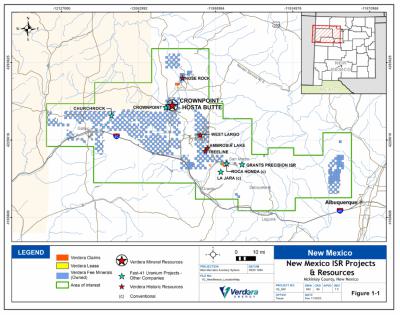
See “Property
– Verdera – Crownpoint Project” for further information on the Crownpoint Project.
Additional Information
You should rely
only on the information contained in this prospectus. We have not authorized anyone to provide you with additional information or information
different from that contained in this prospectus filed with the SEC. We take no responsibility for, and can provide no assurance
as to the reliability of, any other information that others may give you. We are offering to sell, and seeking offers to buy, the common
shares and pre-funded warrants only in jurisdictions where offers and sales are permitted. The information contained in this prospectus
is accurate only as of the date of this document, regardless of the time of delivery of this prospectus or any sale of the common shares
and pre-funded warrants. Our business, financial condition, results of operations, and prospects may have changed since the date
hereof.
Risk Factors Summary
An investment in
our securities is subject to a number of risks, including risks relating to our industry, business and corporate structure. The following
summarizes some, but not all, of these risks, the occurrence of which could have a material adverse effect on our business, financial
condition and results of operations, which could cause the trading price of our common shares to decline and could result in a loss of
all or part of your investment. Please carefully consider all of the information discussed in the section entitled “Risk Factors”
in this prospectus for a more thorough description of these and other risks.
Risks Related to Our Business
| · | We
have a limited operating history and no history of revenue, which makes it difficult for
investors to evaluate our prospects. |
| · | We
have incurred losses and expects to continue to incur losses and negative cash flow, which
raises substantial doubt about our ability to continue operations without additional financing. |
| · | We
may be unable to obtain financing on acceptable terms or at all which may impact our exploration opportunities. |
| · | We
may seek funding through debt financing which could result in restrictive operating covenants
and the potential to lose assets if an event of default occurs, each of which could adversely
affect our business, financial condition and results of operations. |
| · | We
are highly dependent on the success of our single material property, the Crownpoint Project,
and any failure to advance this project could materially adversely affect our business. |
| · | We
are an early state mining company subject to significant risks regarding is ability to continue
our plan of operations, explore and, if warranted, develop the Crownpoint Project. |
| · | Our
properties do not contain Mineral Reserves under S-K 1300, and our properties, projects and
facilities may not be economic at any point in time or at all. |
| · | Mining
on properties having no known Mineral Resources or Mineral Reserves is inherently speculative
and may not prove to be economic at any point in time or at all. |
| · | We
may not realize any or all of the anticipated benefits from the Crownpoint Project. |
| · | We
may experience difficulty in exploiting successful discoveries, including at the Crownpoint
Project, which may adversely affect our business, financial condition and results of operations. |
| · | There
may be defects or disputes relating the property interests at the Crownpoint Project or our
other future property interests. |
| · | There
could be defects in the title to our properties, including at the Crownpoint Project, which
could result in us losing our interests in the property or impair our ability to conduct
activities at the project. |
Risks related
to the Mining Industry
| · | Mineral
exploration and development are speculative and inherently risky, and we may never discover
economically recoverable mineral resources. |
| · | We
have not commenced commercial production on any of our mineral properties and may never generate
revenues or achieve profitability. |
| · | We
will be subject to the risks and hazards normally encountered by companies in the mineral
exploration and extraction industry. |
| · | Economic
extraction of minerals from uranium deposits may not be commercially viable. |
| · | Estimates
of mineral resources are inherently uncertain and may not accurately reflect the economic
viability of our properties. |
| · | Shortages
of drilling contractors, drilling supplies or other key materials could adversely affect
our operations. |
| · | Projects
may not advance or achieve production if key permits are not obtained or retained. |
| · | Native
American tribes may be involved in the permitting process, which could cause delays or increased
expenses. |
Risks Related to Taxation
| · | If
we are characterized as a passive foreign investment company, U.S. Holders may be subject
to adverse U.S. federal income tax consequences. |
| · | We
will be subject to Canadian tax on its worldwide income. |
| · | Dividends,
if ever paid, on our common shares are subject to Canadian withholding tax. |
| · | Changes
in tax laws may affect us and our shareholders. |
Risk Factors
Relating to Our Common Shares
| · | There
may be no active trading market for our common shares, which could limit shareholders’
ability to sell their shares. |
| · | The
market price of our common shares may be volatile, which could result in substantial losses
for investors. |
| · | We
may issue additional equity securities, which could dilute existing shareholders and reduce
per-share value. |
| · | We
do not anticipate paying dividends on our common shares in the foreseeable future, which
may limit returns for certain investors. |
General Risk
Factors
| · | Global
financial conditions and risks could materially impact our ability to raise equity or obtain
debt and impact global supply chains, which could adversely impact our operations and financial
condition. |
| · | General
inflationary pressures may impact our costs and affect our results of operations. |
Implications of Being an Emerging
Growth Company
We qualify as an
“emerging growth company” under the Jumpstart Our Business Act of 2012, as amended, or the JOBS Act. As a result, we will
be permitted to, and intend to, rely on exemptions from certain disclosure requirements, including:
| · | an
exemption from the auditor attestation requirement in the assessment of our internal controls
over financial reporting required by Section 404 of the Sarbanes-Oxley Act of 2002,
or the Sarbanes-Oxley Act; and |
| · | an
exemption from compliance with any new requirements adopted by the Public Company Accounting
Oversight Board, or the PCAOB, requiring mandatory audit firm rotation or a supplement to
the auditor’s report in which the auditor would be required to provide additional information
about our audit and our financial statements. |
In other words,
an emerging growth company can delay the adoption of certain accounting standards until those standards would otherwise apply to private
companies. We have elected to take advantage of the benefits of this extended transition period. Our consolidated financial statements
may therefore not be comparable to those of companies that comply with such new or revised accounting standards.
We will remain
an emerging growth company until the earliest of (i) the last day of the fiscal year during which we have total annual gross revenues
of at least US$1.235 billion; (ii) the last day of our fiscal year following the fifth anniversary of the completion of this offering;
(iii) the date on which we have, during the preceding three year period, issued more than US$1.0 billion in non- convertible debt;
or (iv) the date on which we are deemed to be a “large accelerated filer” under the Exchange Act, which could occur
if the market value of our common shares that are held by non-affiliates exceeds US$700 million as of the last business day of our most
recently completed second fiscal quarter. Once we cease to be an emerging growth company, we will not be entitled to the exemptions provided
in the JOBS Act discussed above.
Implications of Being a Foreign Private
Issuer
Once the registration
statement of which this prospectus is a part is declared effective by the SEC, we will become subject to the reporting requirements of
the Securities Exchange Act of 1934, as amended (the “Exchange Act”) that are applicable to “foreign private
issuers,” and under those requirements we will file certain reports with the SEC. As a foreign private issuer, we will not be subject
to the same requirements that are imposed upon U.S. domestic issuers by the SEC. Under the Exchange Act, we will be subject to reporting
obligations that, in certain respects, are less detailed and less frequent than those of U.S. domestic reporting companies. For example,
although we report our financial results on a quarterly basis, we will not be required to issue quarterly reports, proxy statements that
comply with the requirements applicable to U.S. domestic reporting companies, or individual executive compensation information that is
as detailed as that required of U.S. domestic reporting companies. We also will have four months after the end of each fiscal year to
file our annual reports with the SEC and we will not be required to file current reports as frequently or promptly as U.S. domestic reporting
companies. We also present our consolidated financial statements pursuant to International Financial Reporting Standards, or IFRS, as
issued by the International Accounting Standards Board, instead of pursuant to U.S. generally accepted accounting principles. Furthermore,
our officers, directors and principal shareholders will be exempt from the short-swing profit liability provisions contained in Section 16
of the Exchange Act. As a foreign private issuer, we will also not be subject to the requirements of Regulation FD (Fair Disclosure)
promulgated under the Exchange Act. These exemptions and leniencies reduce the frequency and scope of information and protections available
to you in comparison to those applicable to shareholders of U.S. domestic reporting companies.
THE SPECIAL DISTRIBUTION
| Issuer |
|
Verdera
Energy Corp. |
| |
|
|
| Selling
Shareholder |
|
enCore
Energy Corp. |
| |
|
|
| Special
Distribution |
|
A
planned special distribution by enCore to its holders of common shares.
Pursuant to
the Special Distribution, each enCore Shareholder as of the Distribution Record Date, will be entitled to receive their pro rata
portion of the Distribution Shares per enCore common share held, [calculated by dividing the number of Distribution Shares by the
number of outstanding enCore common shares on the Distribution Record Date. EnCore shareholders who would otherwise be entitled to
a fractional Distribution Share will have the number of Distribution Shares rounded down to the nearest whole Distribution Share]. |
| |
|
|
| Distribution
Shares |
|
35,000,000
common shares of the Company, which we refer to herein as the Distribution Shares. |
| |
|
|
| Conversion of Class A Preferred Shares |
|
Immediately
prior to the completion of the Special Distribution, the Class A Preferred Shares will convert into the Distribution Shares
to be distributed in the Special Distribution. |
| |
|
|
| Shares
Outstanding after the Special Distribution |
|
110,757,993 common shares of the Company (1) |
| Use
of proceeds |
|
We
will not receive any proceeds from the Special Distribution or from the conversion of the Class A Preferred Shares into the
Distribution Shares. |
| |
|
|
| Plan
of Distribution |
|
The
offering is made by the selling shareholder, enCore, to the enCore Shareholders by way of the Special Distribution. enCore’s
board of directors has set , 2026 as the Distribution Record Date for the enCore Shareholders
entitled to receive the Distribution Shares pursuant to the Special Distribution. enCore will publicly announce the Distribution
Record Date when the Distribution Record Date has been determined. See “Plan of Distribution”. |
| Listing |
|
Our common
shares are currently listed for trading on the TSXV under the ticker symbol “V”. |
| |
|
|
| Risk factors |
|
An
investment in our securities involves substantial risks. You should read this prospectus carefully, including the section entitled “Risk
Factors” and the financial statements and the related notes to those statements included elsewhere in this prospectus before investing
in our securities. |
| (1) |
Based
on 75,757,993 common shares issued and outstanding as of April 9, 2026. Assumes the conversion of the Class A Preferred Shares
into 35,000,000 Distribution Shares upon completion of the Special Distribution. Does not include as of April 9, 2026: 6,576,000
common shares underlying stock options to be issued by the Company to holders of options of Verdera and 800,000 compensation options
issued to brokers as part of the Financing. |
SUMMARY
CONSOLIDATED FINANCIAL DATA
The following
tables set forth a summary of the historical audited consolidated financial data of the Company as at and for the fiscal years ended
September 30, 2025 and 2024. The historical summary consolidated financial data set forth in the following tables has been derived
from the Company’s consolidated financial statements included elsewhere in this prospectus. You should read this data together with the
consolidated financial statements and the related notes appearing elsewhere in this prospectus and the information included under the
caption “Management’s Discussion and Analysis of Financial Condition and Results of Operations.” Our historical results
are not necessarily indicative of our future results.
Selected Statements of Loss and Comprehensive
Loss:
(expressed in Canadian
Dollars)
| | |
Three Months
ended
December 31,
2025 | | |
Three Months
ended
December 31,
2024 | | |
Year ended
September 30,
2025 | | |
Year ended
September 30,
2024 | |
| Total expenses | |
$ | 34,171 | | |
$ | 241 | | |
$ | 23,954 | | |
$ | 25,053 | |
| Interest Income | |
$ | (3,893 | ) | |
$ | (6,319 | ) | |
$ | (19,197 | ) | |
$ | (23,902 | ) |
| Net (income)/loss and comprehensive (income)/loss | |
$ | 30,278 | | |
$ | (6,078 | ) | |
$ | 4,757 | | |
$ | 1,151 | |
| Net loss per share | |
$ | 0 | | |
$ | 0 | | |
$ | 0 | | |
$ | 0 | |
| Weighted average number of common shares outstanding, basic and diluted | |
| 7,277,777 | | |
| 7,268,791 | | |
| 7,275,531 | | |
| 7,243,122 | |
Selected Statements of Financial Position
(expressed in Canadian
Dollars)
| | |
December 31,
2025 | | |
September 30,
2025 | | |
September 30,
2024 | |
| Cash and cash equivalents | |
$ | 605,403 | | |
$ | 606,725 | | |
$ | 598,838 | |
| Total assets | |
$ | 618,115 | | |
$ | 615,568 | | |
$ | 613,417 | |
| Current liabilities | |
$ | 73,707 | | |
| 40,882 | | |
| 36,804 | |
| Total liabilities | |
$ | 73,707 | | |
$ | 40,882 | | |
$ | 36,804 | |
| Total shareholder’s equity | |
$ | 544,408 | | |
$ | 574,686 | | |
$ | 576,613 | |
| Total liabilities and shareholder’s equity | |
$ | 618,115 | | |
$ | 615,568 | | |
$ | 613,417 | |
SUMMARY CONSOLIDATED
FINANCIAL DATA OF FORMER VERDERA
The following tables set forth a summary of
the historical audited consolidated financial data of Former Verdera as at and for the period from incorporation on September 27,
2024 to March 31, 2025 and for the month ended April 30, 2025 and the unaudited consolidated condensed financial data as at
and for the periods ended December 31, 2025 and 2024. The historical summary consolidated financial data set forth in the following
tables has been derived from Former Verdera’s consolidated financial statements included elsewhere in this prospectus. In our opinion,
the unaudited interim consolidated financial statements have been prepared on a basis consistent with our audited consolidated financial
statements and, in our opinion, contain all adjustments, consisting only of normal and recurring adjustments, necessary for a fair presentation
of such interim financial statements. You should read this data together with the consolidated financial statements and the related
notes appearing elsewhere in this prospectus and the information included under the caption “Management’s Discussion and Analysis
of Financial Condition and Results of Operations.” Our historical results are not necessarily indicative of our future results.
Selected Consolidated Statements of Loss and
Comprehensive Loss:
(expressed in Canadian Dollars)
| | |
Nine Months
ended
December 31,
2025 | | |
From
incorporation
on September
27, 2024 to
December
31, 2024 | | |
Month ended
April 30, 2025 | | |
From
Incorporation
of September
27, 2024 to
March 31,
2025 | |
| Total expenses | |
$ | (1,326,660 | ) | |
$ | (129,327 | ) | |
$ | (81,891 | ) | |
$ | (387,502 | ) |
| Foreign Exchange | |
$ | (2,439 | ) | |
$ | (540 | ) | |
$ | 175 | | |
$ | (1,603 | ) |
| Loss and comprehensive loss | |
$ | (1,329,009 | ) | |
$ | (129,867 | ) | |
$ | (81,716 | ) | |
$ | (389,105 | ) |
| Basis and diluted loss per share | |
$ | (0.06 | ) | |
$ | (0.3 | ) | |
$ | (0.00 | ) | |
$ | (0.04 | ) |
| Weighted average number of common shares outstanding, basic and diluted | |
| 24,014,321 | | |
| 4,497,927 | | |
| 17,704,334 | | |
| 10,702,125 | |
Selected Consolidated
Statements of Financial Position
(expressed in Canadian
Dollars)
| | |
December 31,
2025 | | |
April 30,
2025 | | |
March 31,
2025 | |
| Cash | |
$ | 7,040,098 | | |
$ | 2,403,259 | | |
$ | 2,421,377 | |
| Current assets | |
$ | 7,785,989 | | |
$ | 2,434,201 | | |
$ | 2,445,056 | |
| Deferred transaction cost | |
| -- | | |
| -- | | |
| 637,940 | |
| Exploration and evaluation assets | |
$ | 10,897,312 | | |
$ | 10,835,059 | | |
$ | -- | |
| Total assets | |
$ | 18,683,301 | | |
$ | 13,269,260 | | |
$ | 3,082,996 | |
| Current liabilities | |
$ | 250,000 | | |
$ | 420,741 | | |
$ | 339,511 | |
| Total liabilities | |
$ | 250,000 | | |
$ | 420,741 | | |
$ | 339,511 | |
| Share Capital | |
$ | 19,387,086 | | |
$ | 13,179,837 | | |
$ | 3,010,166 | |
| Deficit | |
$ | (1,718,204 | ) | |
$ | (470,821 | ) | |
$ | (389,105 | ) |
| Total shareholders’ equity | |
$ | 18,433,301 | | |
$ | 12,848,519 | | |
$ | 2,743,485 | |
| Total liabilities and shareholder’s equity | |
$ | 18,683,301 | | |
$ | 13,269,260 | | |
$ | 3,082,996 | |
SUMMARY PRO FORMA FINANCIAL
INFORMATION
The following
table sets out certain selected financial information for the Company and Verdera, as well as certain unaudited pro forma financial information
for the Company following the completion of the Transaction on a consolidated basis, after giving effect to the Transaction and the related
transaction financing. The following information is presented in Canadian dollars and should be read in conjunction with the financial
statements and pro forma financial statements set out in the Schedules hereto and incorporated by reference herein.
Selected Pro
Forma Financial Data
(expressed in Canadian
Dollars)
| | |
POCML7 as at
September 30,
2025 | | |
Verdera as at
September 30,
2025 | | |
Pro Forma
Adjustments | | |
Pro Forma
Consolidation | |
| Cash | |
$ | 606,725 | | |
$ | 7,250,531 | | |
$ | 19,000,000 | | |
$ | 26,857,256 | |
| Total Assets | |
$ | 615,568 | | |
$ | 18,269,425 | | |
$ | 19,000,000 | | |
$ | 37,884,993 | |
| Total Current Liabilities | |
$ | 40,882 | | |
$ | 107,234 | | |
| - | | |
$ | 148,116 | |
| Total Long Term Liabilities | |
| Nil | | |
| Nil | | |
| - | | |
| Nil | |
| Total Shareholders’ Equity | |
$ | 574,686 | | |
$ | 18,162,191 | | |
$ | 19,000,000 | | |
$ | 37,736,877 | |
RISK
FACTORS
You should carefully
consider the following risk factors that may affect our business, future operating results and financial condition, as well as the other
information set forth in this prospectus, before making a decision to invest in our securities. If any of the following risks actually
occurs, our business, operating results, cash flows, financial condition, and ability to pay dividends could be materially and adversely
affected. In such case, the trading price of our securities would likely decline, and you may lose all or part of your investment. The
risks below are not the only ones we face. Additional risks not currently known to us, or that we currently deem immaterial, may also
adversely affect us.
Risk Factors
Relating to Company
We have a limited operating history and
no history of revenue, which makes it difficult for investors to evaluate our prospects.
We are an Exploration Stage Mining Company with
a limited operating history and no history of revenues or profitability. As a result, investors may have difficulty evaluating our business,
prospects and likelihood of future success. Our ability to achieve profitability will depend on numerous factors, including the success
of our exploration activities, the development of economically viable mineral resources, if any, prevailing commodity prices and our ability
to raise additional capital, many of which are outside of our control. The likelihood of our success must be considered in light of the
problems, expenses, difficulties, complication and delays frequently encountered in connection with the establishment of any business,
particularly those in the junior mineral exploration sector. We will have limited financial resources and there can be no assurance that
additional funding will be available to fund further operations or to fulfill our obligations under applicable agreements. Further, there
can be no assurance that we will be able to generate revenues, operate profitably, or provide a return on investment, or that we will
successfully implement our plans.
We will have incurred losses and expects
to continue to incur losses and negative cash flow, which raises substantial doubt about our ability to continue operations without additional
financing.
We have incurred losses and negative cash flows
since inception and expects to continue to do so for the foreseeable future as we invest in exploration and, if warranted, development
and general corporate activities. We will require additional capital to fund our operations and advance our mineral properties. There
can be no assurance that we will be able to obtain additional financing on acceptable terms or at all. If we are unable to raise additional
capital when needed, we may be required to delay, reduce or eliminate certain exploration or development activities, which could adversely
affect our business, financial condition and results of operations.
We may be unable to obtain financing on
acceptable terms or at all which may impact our exploration opportunities.
Further exploration of the Crownpoint Project,
and any future exploration of other properties in which we hold an interest, will require additional capital, and the amount of capital
required may be significant. There can be no assurance that we will be successful in obtaining the required financing for such purposes
or for any other purposes, including for general working capital. Our ability to secure any required financing to sustain operations will
depend in part upon prevailing capital market conditions and business success. There can be no assurance that we will be successful in
our efforts to secure any additional financing on terms satisfactory to our management. If additional financing is raised through the
issuance of additional common shares or other securities of the Company, control of the Company may change and shareholders of the Company
may suffer dilution. If adequate funds are not available, or are not available on acceptable terms, we may be required to scale back our
current business plan or cease operating. Additionally, failure to obtain additional financing could impede our funding obligations, or
result in delay or postponement of further business activities, which could adversely affect our business, financial condition and results
of operations.
We
may seek funding through debt financing which could result in restrictive operating covenants and the potential to lose assets if an event
of default occurs, each of which could adversely affect our business, financial condition and results of operations.
From time to time, we may rely on debt financing
for a portion of our business activities, including capital and operating expenditures. There can be no assurance that we will be able
to comply at all times with any covenants imposed under our debt arrangements, if applicable. Similarly, there can be no assurance that
we will be able to secure new financing that may be necessary to finance our operations and capital growth program. Any failure by us
to secure financing or refinancing, obtain new financing, or comply with applicable covenants under our debt arrangements could adversely
affect our business, financial condition and results of operations. Further, any inability by us to obtain new financing may limit our
ability to support or sustain our future growth.
We are highly
dependent on the success of our single material property, the Crownpoint Project, and any failure to advance this project could materially
adversely affect our business.
Our future prospects are highly dependent on the
successful exploration and potential development of our only material mineral property, the Crownpoint Project. The continued exploration
operations and, if warranted, development of mining operations at the Crownpoint Project, will require the commitment of substantial additional
resources for capital expenditures and operating expenditures, which may increase in subsequent years as needed, and for consultants,
personnel and equipment associated with additional development and mining of the Crownpoint Project. The project is subject to numerous
risks, including geological uncertainty, permitting challenges, environmental considerations and changes in market conditions. Any failure
to advance the Crownpoint Project could adversely affect our business, financial condition and results of operations.
We are an
early state mining company subject to significant risks regarding our ability to continue our plan of operations, explore and, if warranted,
develop the Crownpoint Project.
We are in the business of exploration, with the
ultimate goal of achieving commercial production or extraction of Uranium. The Crownpoint Project will not have commenced commercial production
and we will have no history of earnings or cash flow from our operations. Due to the foregoing, there can be no assurance that we will
be able to develop the Crownpoint Project profitably, or that our activities will generate positive cash flow. We are unlikely to enjoy
earnings and are not expected to pay dividends in the immediate or foreseeable future. We will have limited cash and other assets. A prospective
investor in the Company must be prepared to rely solely upon the ability, expertise, judgment, discretion, integrity and good faith of
our management in all aspects of the development and implementation of our business activities.
Our properties
do not contain Mineral Reserves under S-K 1300, and our properties, projects and facilities may not be economic at any point in time
or at all.
None of our
properties contain any known Mineral Reserves. Some or all of our properties, projects and facilities may not be economic for
uranium, extraction, recovery or processing at any point in time. Generally, we intend to continue to hold, and in certain cases
advance, properties, projects and facilities which may not be economic at any point in time in anticipation of possible future
increases in the prices of Uranium, as the case may be. However, in those circumstances, there can be no assurance at any time that
such prices will ever, or within a reasonable time period, increase to the levels required to advance those properties or, in the
case of projects or facilities on standby, to resume exploration, extraction, recovery or processing activities at those projects or
facilities. In the event of depressed commodity prices, we would continue to hold our standby properties, projects and facilities
because we believe that prices are likely to rise to such levels within a reasonable time period to justify future production.
However, as there is a cost associated with holding and, in some cases, maintaining such properties, projects and facilities on
standby during periods of depressed commodity prices, in those circumstances we continuously evaluate, on a case-by-case basis, such
costs against the prospects for price increases, and may from time to time sell, drop or reclaim any such properties, projects or
facilities.
Mining on
properties having no known Mineral Resources or Mineral Reserves is inherently speculative and may not prove to be economic at any point
in time or at all.
Mining is an
inherently speculative business. There is a possibility that we will not discover Uranium on any or all of our future acquired
properties which can be mined or extracted at a profit at any point in time or at all. Even if we do discover and mine such
minerals, the deposits may not be of the quality or size necessary for it or a potential purchaser of the property to make a profit
from mining it. Few properties that are explored are ultimately developed into producing mines, and mines that are developed may not
be profitable. Unusual or unexpected geological formations, geological formation pressures, fires, power outages, labor disruptions,
flooding, explosions, cave-ins, landslides and the inability to obtain suitable or adequate machinery, equipment or labor, as well
as all necessary licenses and permits, are just some of the many risks involved in mineral exploration programs and their subsequent
development. However, we may elect, now or in the future, to proceed with the extraction of minerals on one or more of those
projects without having completed the technical work required to declare a Mineral Reserve. If we are then unable to extract uranium
in commercially viable quantities, the capital investment of mining such properties may be lost and could materially impact our
business.
We may not
realize any or all of the anticipated benefits from the Crownpoint Project.
The estimates of
the potential benefits and growth of the Crownpoint Project are based in part on a valuation of the project that may differ from the
actual performance of the Crownpoint Project on a going-forward basis. Achieving the benefits of the Crownpoint Project will depend,
in part, on our ability to effectively explore and, if warranted, develop the project. The challenges involved, which may be complex
and time-consuming, include the following:
| · | the
cost of exploration activities and the results of such exploration activities; |
| · | the
ability to locate, hire and retain experienced contractors to allow efficient exploration
activities at the project; |
| · | the
ability to locate, hire and retain experienced staff for development activities, if warranted,
including well drilling and installation; and |
| · | our
ongoing relations with the community and property owners in the project area. |
In addition, any benefits that we realize may
be offset, in whole or in part, by reductions in revenues, or through increases in other expenses, including costs to achieve the Crownpoint
Project’s estimated synergies and growth. Our plans for the Crownpoint Project are subject to numerous risks and uncertainties that
may change at any time. There is no assurance that our initiatives will be completed as anticipated or that the benefits we expect will
be achieved on a timely basis or at all. It may take longer than expected to achieve the anticipated benefits and growth and there is
no guarantee that the Crownpoint Project will reach near-term production. If the Crownpoint Project does not achieve the anticipated benefits
and growth or reach near-term production, this may adversely affect our future financial results.
We may experience difficulty in exploiting
successful discoveries, including at the Crownpoint Project, which may adversely affect our business, financial condition and results
of operations.
It may not always be possible for us to participate
in the exploitation of successful discoveries on our properties, including the Crownpoint Project. Such exploitation may involve the need
to obtain licenses or clearance from the relevant authorities, which may not be available on a timely basis, or may require conditions
to be satisfied and/or the exercise of discretion by such authorities. It may or may not be possible for such conditions to be satisfied,
and such conditions may prove uneconomic or impractical. Furthermore, the decision to proceed with further exploration may require the
participation of other persons and companies whose interest and objectives may not be consistent with those of the Company. Such further
exploitation may also require us to meet or commit to financial obligations that it may not have anticipated or may not be able to commit
to due to a lack of funds or an inability to raise funds. Failure to exploit successful discoveries could adversely affect our business,
financial condition and results of operations.
There may be defects or disputes relating
to the property interests at the Crownpoint Project or our other future property interests.
Defects in or disputes relating to the property
interests we hold, including those at the Crownpoint Project, or acquires may prevent us from realizing the anticipated benefits from
these interests. Material changes could also occur that may adversely affect the estimate of our management with respect to the carrying
value of our property interests, and could result in impairment charges. While we will seek to confirm the existence, validity, enforceability,
terms and geographic extent of the interests we acquire, there can be no assurance that disputes or other problems concerning these and
other matters or other problems will not arise. Confirming these matters is complex and is subject to the application of the laws of each
jurisdiction to the particular circumstances of each parcel of mineral property and to the documents reflecting the interest. The discovery
of any defects in, or any disputes in respect of, our property interests, including in respect of the Crownpoint Project, could adversely
affect our business, financial condition and results of operations.
There could
be defects in the title to our properties, including at the Crownpoint Project, which could result in us losing our interests in the
property or impair the ability of us to conduct activities at the project.
A defect in the chain of title to one of our property
interests or necessary for the anticipated development or operation of a particular project to which an interest relates may defeat or
impair our claim to a property, which could in turn result in a loss of our interest in respect of that property. In addition, claims
by third parties or Indigenous groups may impact our ability to conduct activities on a property in which we hold an interest, to the
detriment of our interest. To the extent that we, directly or indirectly, do not have title to a property, we may be required to cease
operations or transfer operational control to another party. Certain interests can be contractual in nature, rather than an interest in
land, with the risk that an assignment or bankruptcy or insolvency proceedings by an owner of a particular property may result in the
loss of any effective interest in such property. Further, even in those jurisdictions where there is a right to record or register interests
held by us in land registries or mining recorders offices, such registrations may not necessarily provide any protection to us. As a result,
known title defects, as well as unforeseen and unknown title defects, may impact operations at a project in respect of which we have an
interest and could adversely affect our business, financial condition and results of operations.
We could be subject to litigation in relation
to ownership of our property interests which could be costly and result in the loss of our interests in the property or payment of damages.
There is a potential that litigation may arise
with respect to a property in which we hold an interest (for example, litigation between joint venture partners or between us (or an operator)
and original property owners or neighboring property owners), including the Crownpoint Project. Any such litigation that results in the
cessation or reduction of production from a property in which we hold an interest (whether temporary or permanent) or the expropriation
or loss of rights to such property could adversely affect our business, financial condition and results of operations. As a holder of
such interests, we may, in certain circumstances, not have any influence on the litigation and may not have access to data.
We rely upon the reports of third parties
in relation to making decisions on the expenditure of funds to explore and, if warranted, develop our properties and on assessing the
potential economic viability of our projects. If such third-party reports are inaccurate or incomplete, we could be adversely affected.
We will rely upon third parties to provide analysis,
reviews, reports, advice and opinions regarding our properties, including the Crownpoint Project. There is a risk that such analyses,
reviews, reports, advice, and opinions in respect of such properties may be inaccurate, in particular with respect to resource estimation,
process development and recommendations for products to be produced, as well as with respect to economic assessments, including estimating
the capital and operation costs of our project and forecasting potential future revenue streams. Uncertainties are also inherent in such
estimations. Such inaccuracies and uncertainties could adversely affect our business, financial condition and results of operations.
We may fail to acquire additional property
interests for our future benefit which could adversely impact our operations.
We will seek to acquire additional property interests
in the future, subject to our future business and operational goals. In the event that we pursue such opportunities, we may fail to select
appropriate acquisition candidates or negotiate acceptable agreements, including arrangements to finance the acquisitions, or to integrate
the acquired businesses or their personnel into the business and operations of the Company. There can be no assurance that we will complete
any acquisition or business arrangement that we pursue, or that any acquisitions or business arrangements completed will ultimately benefit
us.
The mining industry is intensely competitive
and we may fail to compete with larger, better financed competitors, which could adversely affect our business, financial condition and
results of operations.
Many companies are engaged in the search for and
the acquisition of mineral interests, including property interests, and there is a limited supply of desirable mineral interests. The
mineral exploration and mining businesses are competitive in all phases. Many companies are engaged in the acquisition of mineral interests,
including large, established companies with substantial financial resources, operational capabilities and long earnings records. We may
be at a competitive disadvantage in acquiring those interests, whether by way of property or other form of investment, as competitors
may have greater financial resources and technical staff. There can be no assurance that we will be able to compete successfully against
other companies in acquiring new properties or other interests. In addition, we may be unable to acquire properties or other interests
at acceptable valuations, which could adversely affect our business, financial condition and results of operations.
The uranium industry is highly
competitive, and we may not be successful in acquiring additional contracts and projects.
The national and
international uranium industry is highly competitive. We intend to market uranium to utilities in direct competition with supplies available
from a relatively small number of mining companies, from excess inventories, including inventories made available from the decommissioning
of nuclear weapons, from reprocessed uranium and plutonium derived from used reactor fuel and from the use of excess enrichment capacity
to re-enrich depleted uranium tails. Our competition includes larger, more established companies with longer operating histories that
not only explore for and produce uranium but also market uranium and other products on a regional, national or worldwide basis. Any
failure in the expected level of demand for our uranium to materialize as a result of competition could have a material adverse effect
on our business, results of operations, financial condition, cash flow and liquidity.
Nuclear energy competes with other sources
of energy and other sources of energy may results in a lower demand for uranium concentrate, which could adversely impact our business
Nuclear energy competes with other sources of
energy, including oil, natural gas, coal and hydroelectricity. These other energy sources are to some extent interchangeable with nuclear
energy, particularly over the longer term. Sustained lower prices of oil, natural gas, coal and hydro-electricity may result in lower
demand for uranium concentrates, which could have a material adverse effect on our business, results of operations, financial condition,
cash flows and liquidity. Technical advances in, and government support and subsidies for, renewable energy sources could make these forms
of energy more viable and have a greater impact on nuclear fuel demands.
Furthermore, growth of the uranium and nuclear
power industry will depend upon continued and increased acceptance of nuclear technology as a means of generating electricity. Because
of unique political, technological and environmental factors that affect the nuclear industry, the industry is subject to public opinion
risks which could have an adverse impact on the demand for nuclear power and increase the regulation of the nuclear power industry. The
nuclear incident that occurred in Japan in March 2011 had significant and adverse effects on both the nuclear and uranium industries.
If another nuclear incident were to occur, it could impact the continuing acceptance of nuclear energy and the future prospects for nuclear
power generation, including causing governments of certain countries to further increase regulation for the nuclear industry, reduce or
abandon current reliance on nuclear power or reduce or abandon existing plans for nuclear power expansion. Any of the foregoing has the
potential to reduce current and/or future demand for nuclear power, resulting in lower demand for uranium and lower market prices for
uranium, which could have a material adverse effect on our business, results of operations, financial condition, cash flows and liquidity.
Our operations are sensitive to the market
price of uranium, which may be volatile.
Our future revenues will be directly related to
the prices of uranium as our revenues will be derived from uranium mining. Our financial condition, results of operations, earnings and
operating cash flows will be significantly affected by the market price of uranium, which is cyclical and subject to substantial short
and long-term price fluctuations. Among other factors, uranium prices also affect the value of our Mineral Resources, as well as the market
price of our common shares.
Uranium prices are and will continue to be affected
by numerous factors beyond our control. Such factors include, among others, the demand for nuclear power; political and economic conditions
in uranium producing and consuming countries such as Canada, the United States, Russia and other former Soviet Republics; reprocessing
of used reactor fuel and the re-enrichment of depleted uranium tails; sales of excess civilian and military inventories (including from
the dismantling of nuclear weapons) by governments and industry participants; and production levels and costs of production in countries
such as Russia and former Soviet republics, Africa and Australia; international wars or conflicts (including Russia’s military invasion
of Ukraine); geopolitical developments (including trading and tariff arrangements, sanctions and cybersecurity attacks), terrorism, natural
disasters and public health epidemics or pandemics. The extent and duration of such events and resulting market disruptions cannot be
predicted but could be substantial and could magnify the impact of other risks to the Company. These and other similar events could adversely
affect the United States and foreign financial markets and lead to increased market volatility.
If, after the commencement of commercial production,
the uranium price falls below the costs of production at our mines for a sustained period, it may not be economically feasible to continue
production at such sites. This would materially and adversely affect production, profitability and our results of operation and financial
position. A decline in the uranium price may also require us to write down our Mineral Resources, which would have a material adverse
effect on our earnings and profitability.
Future acquisitions
by us may adversely impact our resources and management’s focus on our material properties, which could adversely affect our business,
financial condition and results of operations.
We may seek to grow by acquiring companies and/or
assets or establishing new joint ventures that we believe will complement our future business. There are risks inherent in such activities.
Specifically, there could be unknown or undisclosed risks or liabilities of such companies for which we are not sufficiently indemnified.
Any such unknown or undisclosed risks or liabilities could adversely affect our business, financial condition and results of operations.
We may not effectively select acquisition candidates, negotiate or finance acquisitions or integrate the acquired businesses and their
personnel or acquire assets for our business. We could encounter additional transaction and integration related costs or experience an
impact to our operations or results of operation as a result of the failure to realize all of the anticipated benefits from such acquisitions
or partnerships, or an inability to successfully integrate such acquisitions or partnerships as anticipated. As a result of integration
efforts, we may experience interruptions in our business activities, costs of integration and harm to our reputation, all of which could
adversely affect our business, financial condition and results of operations. We may also experience difficulties in combining corporate
cultures, maintaining employee morale and retaining key employees. The integration of any acquired company may also impose substantial
demands on our management. There is no assurance that such acquisitions will be successfully integrated in a timely manner or without
additional expenses incurred. In general, there can be no assurance that we will be able to complete any acquisition or partnership we
pursue on favorable terms, or that any acquisitions or partnerships completed will ultimately benefit our business and operations.
Mineral exploration is highly speculative
and involves substantial risk that our properties will contain commercial quantities of minerals.
Exploration for minerals is a speculative venture
involving substantial risk. There is no certainty that the expenditures made by us, directly or indirectly, in any given property in which
we hold an interest, including the Crownpoint Project, will result in discoveries of commercial quantities of minerals. If mineable deposits
are discovered, substantial expenditures will be required to establish mineral reserves through drilling, to develop processes to extract
the resources and, in the case of new properties, to develop the extraction and processing facilities and infrastructure at any site chosen
for extraction. Although substantial benefit may be derived from the discovery of a major deposit, no assurance can be given that resources
will be discovered on any given property in which we hold an interest in sufficient quantities to justify commercial operations, or that
we will obtain funding required for the development of such properties on terms acceptable to us, or at all.
We may be unable to attract and retain qualified
management.
We will be dependent upon the continued availability
and commitment of our key management personnel, whose contributions to our operations will be of significant importance. The loss of any
such key management personnel could negatively affect our business operations. From time to time, we may also need to identify and retain
additional skilled management and specialized technical personnel to efficiently operate our business. In addition, we are expected to
from time to time retain third-party specialized technical personnel to assess and execute on potential business and operational opportunities.
These individuals may have conflicts of interest or scheduling conflicts, which may delay or inhibit our ability to employ such individuals'
expertise in a timely manner. Our ability to recruit and retain qualified personnel will be critical to our success and there can be no
assurance that we will be able to recruit and retain such personnel. In the event that we are not successful in recruiting and/or retaining
qualified personnel, our ability to execute our business model and growth strategy could be affected, which could adversely affect our
business, financial condition and results of operations.
We depend on key personnel, and our success will depend on our
continued ability to retain and attract such qualified personnel.
We are dependent on the services of key management
personnel, including Janet Lee-Sheriff and Scott Davis. The loss of any of these key personnel, if not replaced, could have a material
adverse effect on our business and operations. We do not currently have or expect to obtain in the near future key-person insurance on
these individuals.
Timely availability and training, strong retention
rates of staffing and timely retention of contractors cannot be assured in our industry, many aspects of which are highly specialized.
This is particularly true in the current labor markets in which we recruit employees and contractors, including where we compete with
higher paying energy jobs, and because of the remote locations for which employees and contractors are needed. The skilled professionals
with expertise in geologic, engineering and process aspects of uranium ISR, radiation safety and other facets of our business are currently
in high demand, as there are relatively few professionals with both expertise and experience.
Certain of
our officers and directors serve as directors or officers of other mineral resource exploration companies, which could result in a conflict
of interest.
Some of our directors
and officers serve, and may in the future serve, as directors or officers of, or have significant shareholdings in, other companies involved
in mineral resource exploration, development and production. To the extent that such other companies may engage in transactions or participate
in the same ventures in which we participate, or in transactions or ventures in which we may seek to participate, our directors and officers
may have a conflict of interest in negotiating and concluding terms respecting the extent of such participation. Such conflicts of the
directors and officers could adversely affect our business, financial condition and results of operations.
Our directors and
officers are aware of the existence of laws governing accountability of directors and officers for corporate opportunity and the laws
requiring disclosure by directors and officers of conflicts of interest. We rely upon such laws in respect of any such conflict of interest
or in respect of any breach of duty by any of our directors or officers. All such conflicts are required to be disclosed by such directors
or officers in accordance with the BCBCA and our directors are expected to govern themselves in respect thereof in accordance with the
obligations imposed upon them by law.
We have discretion
in the use of available funds which could differ significantly from the expectations of management as stated in this prospectus. The
determination to allocate available funds in a manner that is ineffective could have a material adverse effect on our operating and financial
results.
We currently intend
to use our available funds as described in this prospectus. However, our management and board of directors will have discretion in the
actual application of the available funds and may elect to allocate them differently from that described in this prospectus, if they
believe it would be in our best interests to do so. Shareholders may not agree with the manner in which our management and/or board of
directors chooses to allocate and spend the available funds. Any failure by our management and/or board of directors to apply these funds
effectively could have a material adverse effect on our operating and financial results.
We may be
subject to litigation and other legal proceedings arising in the normal course of business and may be involved in disputes with other
parties in the future which may result in litigation.
We may be subject
to litigation and other legal proceedings arising in the normal course of business and may be involved in disputes with other parties
in the future, which may result in litigation. The causes of potential future litigation and legal proceedings cannot be known and may
arise from, among other things, business activities, environmental laws, permitting and licensing activities, volatility in share prices
or failure to comply with disclosure obligations. The results of litigation and proceedings cannot be predicted with certainty and may
include potential injunctions pending the outcome of such litigation and proceedings. If we are unable to resolve these disputes favorably,
it may have a material adverse impact on our financial performance, cash flow and results of operations. Securities class-action litigation
often has been brought against companies in periods of volatility in the market price of their securities and following major corporate
transactions or mergers and acquisitions. We may in the future be the target of similar litigation. Securities litigation could result
in substantial costs and damages and divert management’s attention and resources.
Changes in
general business and economic conditions could materially adversely affect our growth and profitability.
Our future performance
will be affected by a range of economic, competitive, governmental, operating and other business factors, many of which cannot be controlled,
such as general economic and financial conditions in the industry or the economy at large. Many industries, including the uranium mining
industry, are impacted by global market conditions. Some of the key impacts of previous financial market turmoil include contraction
in credit markets resulting in a widening of credit risk, devaluations and high volatility in global equity, commodity, foreign exchange
and mineral markets and a lack of market liquidity. A slowdown in the financial markets or other economic conditions, including, but
not limited to, consumer spending, increased unemployment rates, deteriorating business conditions, inflation, deflation, volatile fuel
and energy costs, increased consumer debt levels, lack of available credit, changes in interest rates and changes in tax rates may adversely
affect our growth and profitability potential.
Risks related
to the Mining Industry
Mineral exploration
and development are speculative and inherently risky, and we may never discover economically recoverable mineral resources.
Mineral exploration
and development involve a high degree of risk and uncertainty and require significant expenditures over extended periods of time. The
likelihood of discovering economically recoverable mineral resources is uncertain, and there can be no assurance that our exploration
programs will be successful. Even if mineral resources are discovered, they may not be economically viable due to factors such as commodity
prices, extraction costs, permitting requirements and environmental considerations.
We have not
commenced commercial production on any of our mineral properties and may never generate revenues or achieve profitability.
The business of
exploration for minerals involves a high degree of risk. Few properties that are explored are ultimately developed into producing mines.
There is no assurance that the exploration programs on our current or future mineral properties will result in the discovery of new resources
or lead to the development of a commercially viable orebody.
Development of
our properties will be subject to numerous risks, including, but not limited to, delays in obtaining equipment, material and services
essential to developing the projects in a timely manner; changes in environmental or other government regulations; currency exchange
rates; labor shortages; and fluctuation in metal prices. Furthermore, the economic feasibility of developing a mineral project is based
on many factors such as estimation of mineral reserves, tonnage and grade, anticipated metallurgical recoveries, environmental considerations
and permitting, future metal prices and anticipated capital and operating costs of these projects, and it is possible that actual capital
and operating costs and economic returns will differ significantly from those estimated for a project prior to production.
Our mineral properties have no operating history
upon which estimates of future projection and cash operating costs can be based. Estimates of mineral resources, proven and probable mineral
reserves and cash operating costs are, to a large extent, based upon the interpretation of geologic data obtained from drill holes and
other sampling techniques. The results of feasibility studies that derive estimates of capital and operating costs based upon the quantity,
grade and configuration of mineral reserves as well as the expected recovery rates of metals from the mineralized material, are subject
to change. As a result, it is possible that actual capital and operating costs and economic returns will differ significantly from those
currently estimated for a project prior to development or operation. The remoteness and restrictions on access of certain of the properties
in which we have an interest could have an adverse effect on profitability in that infrastructure costs would be higher. There are also
physical risks to the exploration personnel working in the rugged terrain, often in poor climate conditions, which can be abated through
safety training, adherence to high safety standards and the use of modern communication technologies.
With all mineral
operations there is uncertainty and, therefore, risk associated with operating parameters and costs resulting from the scaling up of
extraction methods tested in laboratory conditions. Development of a mineral property does not assure a profit on the investment or recovery
of costs. In addition, extraction hazards or environmental damage could greatly increase the cost of operations, and various operating
conditions may adversely affect the production from mineral properties. These conditions include delays in obtaining governmental approvals
or consents, insufficient transportation capacity or other geological, geotechnical and mechanical conditions. While diligent supervision
and effective maintenance operations can contribute to maximizing production rates over time, production delays from normal operating
conditions cannot be eliminated and can be expected to adversely affect revenue and cash flow levels to varying degrees.
We are subject
to the risks and hazards normally encountered by companies in the mineral exploration and extraction industry.
Our business is
subject to a number of risks and hazards, including environmental hazards; industrial accidents; labor disputes; catastrophic accidents;
fires; blockades or other acts of social activism; changes in the regulatory environment; impact of non-compliance with laws and regulations
or the implementation of new laws and regulations; natural phenomena, such as inclement weather conditions, underground floods, earthquakes,
pit wall failures, ground movements, tailings pipeline and dam failures and cave-ins; and encountering unusual or unexpected geological
conditions and technological failure of mining methods.
In addition, success
in exploration is dependent on a number of factors including the quality of management, quality and availability of geological expertise
and the availability of exploration capital. Major expenses may be required to establish reserves by drilling, constructing mining or
processing facilities at a site, developing metallurgical processes and extracting uranium from ore.
There is no assurance
that the foregoing risks and hazards will not occur or will not result in damage to, or destruction of, our properties and assets, personal
injury or death, environmental damage, delays in or interruption of or cessation of production from the properties or impairment of our
exploration or development activities or in unsuccessful exploration, which could result in unforeseen costs, monetary losses and potential
legal liability and adverse governmental action, all of which could have an adverse impact on our future cash flows, earnings, results
of operations and financial condition.
Economic
extraction of minerals from uranium deposits may not be commercially viable.
Whether a uranium
deposit will be commercially viable depends on a number of factors, including the particular attributes of a deposit, such as its size
and grade; costs and efficiency of the recovery methods than can be employed; proximity to infrastructure; financing costs; and governmental
regulations, including regulations relating to prices, taxes, royalties, infrastructure, land use, worker health and safety, importing
and exporting of commodities and environmental protection. The effect of these factors, either alone or in combination, cannot be accurately
predicted and their impact may result in us not being able to economically extract minerals from any identified mineral resource.
Estimates
of mineral resources are inherently uncertain and may not accurately reflect the economic viability of our properties.
There can be no
assurance that if any mineralization is identified, whether on the Crownpoint Project or any other mineral property in which we may acquire
an interest, it will be developed into a coherent mineral deposit, or that such deposit will qualify as a commercially viable and mineable
ore body that can be legally and economically exploited. Estimates regarding mineralized deposits may also be affected by factors such
as permit regulations and requirements, weather and environmental factors, unforeseen technical difficulties, unusual or unexpected geological
formations and work interruptions. In addition, the grades and tonnages of ore ultimately mined may differ from that indicated by drilling
results and other exploration and development work. There can be no assurance that test work and results conducted and recovered in small-scale
laboratory tests will be duplicated in large- scale tests under on-site conditions. Material changes in mineralized tonnages, grades,
dilution and stripping ratios or recovery rates may affect the economic viability of projects. The existence of mineralization or mineralized
deposits should not be interpreted as assurances of the future delineation of ore reserves or the profitability of any future operations
of the Company.
Shortages
of drilling contractors, drilling supplies or other key materials could adversely affect our operations.
The drilling services and solutions business is
highly cyclical. During periods of increased demand for drilling services and solutions and periods of supply chain disruption, delays
in availability and shortages of drilling contractors and drilling supplies can occur, and it can impact our ability to execute our exploration
activities according to our business plans. Additionally, suppliers may seek to increase prices for equipment, supplies, and services,
which we are unable to pass through to our customers. Further, certain key rig components, parts and equipment are also either purchased
from, fabricated or serviced by a limited number of vendors, which, in some cases, may be thinly capitalized and disproportionately affected
by any loss of business, downturn in the energy industry, supply chain disruptions, or reduction or availability of credit. The failure
of one or more third-party suppliers, manufacturers or service providers to provide equipment, components, parts or services, whether
due to capacity constraints, labor shortages or other labor-related difficulties, production or delivery disruptions, price increases,
quality control issues, recalls or other decreased availability of parts and equipment, is beyond our control and could materially disrupt
our operations or result in the delay, renegotiation or cancellation of drilling contracts, thereby causing a loss of contract drilling
backlog and/or revenues to it, as well as an increase in operating costs. If we are not able to effectively manage these disruptions and
delays in the future, they could have a material adverse effect on our business, financial condition and results of operations.
Projects
may not advance or achieve production if key permits are not obtained or retained.
The advancement of mineral properties through
exploration to commercial operation normally requires securing and maintaining key permits and/or licenses (collectively, the “permits”)
from regulatory or governmental authorities. While we have used reasonable best efforts into securing the permits necessary to advance
our properties according to the policies and guidelines applicable to each permit, approval of permits rests solely with the governing
agency and is outside of our control. In addition to the statutory and regulatory processes, there are other intangible factors, such
as limited agency staffing due to budgetary and staff turnover that can impact permit and license reviews and approvals.
The requirements
for obtaining a RML for our mineral properties in the United States allows for public participation. Third parties may object to the
issuance of RMLs and/or permits required by us, which may significantly delay our ability to obtain an RML and/or permit. Also, insufficient
or insufficiently trained staffing at regulatory agencies may delay the issuance of required permits and licenses. Generally, public
objections can be overcome through the procedures set forth in the applicable permitting legislation; however, significant financial
resources and managerial resources are required through this process. In addition, the various regulatory agencies must allow and fully
consider the public objections/comments according to such procedures set out in the applicable legislation and there can be no assurance
that we will be successful in obtaining an RML and/or permit, which could have a material adverse effect on the viability of a project.
Native American
tribes may be involved in the permitting process, which could cause delays or increased expenses.
Certain of our
mineral properties are located within the boundaries of Native American lands or other property interests that are controlled or owned
by Native Americans under the jurisdiction of the United States federal government. Under Federal legislation, historic cultural properties
of religious significance that can be identified are to be avoided or activities are to be mitigated such that the essential nature of
the properties is not lost to a culture. Throughout the western United States, Native American tribes have had historical relationships
with properties that are now owned by private parties, the federal government or state governments. In any federal permitting action
on these properties, the agency involved is required to make an effort to communicate with Native American tribes to determine any areas
of traditional cultural significance, which involves “government to government” discussions with the potentially affected
Native American tribes; therefore, delays in permitting may occur through this process. In the event that traditional cultural properties
are identified within a project area, we and the agency must determine the best method of development to ensure that disturbances are
minimized or mitigated, which could be costly and have an adverse impact on our future cash flows earnings, results of operations and
financial condition.
Opposition
to mining may disrupt our business activities.
In recent years, governmental agencies, non-governmental
organizations, individuals, communities and courts have become more vocal and active with respect to their opposition to certain mining
and business activities, including with respect to production and uranium recovery at our facilities. This opposition may take on forms
such as road blockades, vandalism, threats and/or slander, applications for injunctions seeking to cease certain construction, development,
extraction, mining and/or milling or recovery activities, refusals to grant access to lands or to sell lands on commercially viable terms,
lawsuits for damages or to revoke or modify licenses and permits, issuances of unfavorable laws and regulations, changes in regulatory
attitudes and interpretations and other rulings contrary to or otherwise harming our interests. These actions can occur in response to
current activities or in respect of mines or facilities that are decades old. In addition, these actions can occur in response to our
activities or the activities of other unrelated entities. Opposition to our activities may also result from general opposition to nuclear
energy and mining. Opposition to our business activities are beyond our control. Any opposition to our business activities may cause a
disruption to our business activities and may result in increased costs and delays, which could have a material adverse effect on our
business and financial condition.
Permits received
are subject to expiration and may not be able to obtain, maintain or amend rights, authorizations, licenses, permits or consents required
for our operations.
Our exploration
and mining activities will be dependent upon the grant of appropriate rights, authorizations, licenses, permits and consents, as well
as continuation and amendment of these rights, authorizations, licenses, permits and consents already granted to us, which may be granted
for a defined period of time, or may not be granted or may be withdrawn or made subject to limitations. There can be no assurance that
all necessary rights, authorizations, licenses, permits and consents will be granted to us, or that authorizations, licenses, permits
and consents already granted will not be withdrawn or made subject to limitations.
Permits granted by the jurisdictions in which
we will operate are typically issued with an expiry date requiring us to undertake certain activities within a given time frame in order
for the permit to remain valid. While we anticipate making every reasonable attempt to satisfy the terms and conditions of the permits
we are granted, there can be no assurance that unforeseen circumstances may prevent us from doing so, and permits received may expire,
which could have an adverse impact on our future cash flows, earnings, results of operations and financial condition.
We may not
obtain or maintain valid title to our mineral properties, which could result in the loss of property interests or delays in exploration
and development.
Our mineral properties
may be subject to risks relating to title defects, competing claims and regulatory requirements. Although we believe that we hold or
have the right to acquire valid title to our mineral properties, there can be no assurance that title disputes or challenges will not
arise. Any such disputes could result in the loss of property rights, significant delays in exploration or development activities or
substantial costs to resolve such disputes.
We may be
unable to obtain additional financing on acceptable terms, which could limit our ability to execute our business strategy.
The development of mineral properties requires
substantial capital investment. Our future funding requirements will depend on numerous factors, including the scope and results of our
exploration activities, prevailing market conditions and commodity prices. There can be no assurance that we will be able to obtain additional
financing when needed or on acceptable terms. Any inability to secure financing could materially adversely affect our ability to carry
out our business plan.
The uranium industry is subject to numerous
stringent laws, regulations and standards, including environmental protection laws and regulations. If any changes occur that would make
these laws, regulations and standards more stringent, we may require capital outlays in excess of those anticipated or cause substantial
delays, which would have a material adverse effect on our operations.
Our current and future mining operations and exploration
and development activities, particularly uranium mining, are subject to laws and regulations at the federal, state and local level governing
worker health and safety, employment standards, mine development, mine safety, exports, imports, taxes and royalties, waste disposal,
toxic substances, land claims of indigenous peoples, protection and remediation of the environment, mine decommissioning and reclamation,
transportation safety and emergency response and other matters. Each jurisdiction in which we have properties regulates mining activities.
It is possible that future changes in applicable laws and regulations or changes in their enforcement or regulatory interpretation could
result in changes in legal requirements or in the terms of existing permits, licenses and approvals applicable to us or our projects,
which could have a material and adverse impact on our planned projects.
We are also subject to various reclamation and
other bonding requirements under federal, state, provincial or local air, water quality and mine reclamation rules and permits. Although
we have made provision for reclamation costs, there is no assurance that these provisions will be adequate to discharge our obligations
for these costs. Environmental and employee health and safety laws and regulations have tended to become more stringent over time. Any
changes in such laws or in the environmental conditions at our properties could have a material adverse effect on our financial condition,
cash flow or results of operations.
Failure to comply
with applicable environmental and health and safety laws can result in injunctions, damages, suspension or revocation of permits and
the imposition of penalties. There can be no assurance that we have been or will be at all times in complete compliance with such laws,
regulations and permits, or that the costs of complying with current and future environmental and health and safety laws and permits
will not adversely affect our business, results of operations, financial condition or prospects.
Worldwide demand
for uranium is directly tied to the demand for electricity produced by the nuclear power industry, which is also subject to extensive
government regulation and policies, and any change in these regulations or policies may have a negative impact on our business or financial
condition.
Mineral exploration
and the development of mines and related facilities is contingent upon governmental approvals, licenses and permits which are complex
and time consuming to obtain and which, depending on the location of the project, involve multiple governmental agencies. The receipt,
duration, amendment or renewal of such approvals, licenses and permits are subject to many variables outside our control, including inadequate
agency staff experience, inability of governmental agencies to process licenses and permits in a timely manner, reduced agency staff
capacity, potential legal challenges from various stakeholders such as environmental groups, non-governmental organizations, aboriginal
groups or other claimants. The costs and delays associated with obtaining necessary approvals, licenses and permits and complying with
these approvals, licenses and permits and applicable laws and regulations could stop or materially delay or restrict us from proceeding
with the development of an exploration project or the operation or further development of a mine. Any failure to comply with applicable
laws and regulations or approvals, licenses or permits, even if inadvertent, could result in interruption or closure of exploration,
development or mining operations, or material fines, penalties or other liabilities.
Where required, obtaining necessary permits to
conduct exploration or mining operations can be a complex and time consuming process, and we cannot assure whether any necessary permits
will be obtainable on acceptable terms, in a timely manner or at all.
Insurance may not be available to cover
the gamut of risks associated with mineral exploration, development and mining.
The mining industry is subject to significant
risks that could result in damage to or destruction of property and facilities, personal injury or death, environmental damage and pollution,
delays in production, expropriation of assets and loss of title to mining claims. No assurance can be given that insurance to cover the
risks to which our activities are subject will be available at all or at commercially reasonable premiums. We currently maintain insurance
within ranges of coverage that we believe to be consistent with industry practice for companies of a similar stage of development and
we anticipate continuing such coverage.
We will utilize novel mining methods for
production at our properties, which may not yield anticipated results.
We will focus on the ISR mining method for production
at our properties. While studies completed to date indicate that ground conditions and the mineral resources estimated to be contained
on the Crownpoint Project, and the project is amenable to extraction by way of ISR, actual conditions could be materially different from
those estimated based on the technical studies completed to-date. While industry best practices have been utilized in the development
of our estimates, actual results from the application of the ISR mining method may differ significantly. We will need to complete substantial
additional work to further advance and/or confirm our current estimates for the use of the ISR mining method on our properties. As a result,
it is possible that current estimates may not be achieved on any of our mining properties, which could adversely affect our operations
and financial condition.
We are subject to technical innovation and obsolescence.
Requirements for our products and services may be affected by: technological
changes in nuclear reactors, enrichment and used uranium fuel reprocessing. These technological changes could reduce the demand for our
anticipated products and services and/or increase the supply of competitive products and services. The cost competitiveness of our operations
may be impacted through the development and commercialization of other mining, milling, processing and other technologies. As a result,
our competitors may adopt technological advancements that give them an advantage over us or that reduce the demand for our products and
services or make them obsolete.
Since there
is no liquid public market for uranium, selling uranium may take extended periods of time and suitable purchasers may be difficult to
find, which could have a material adverse effect on our financial condition.
There is no liquid
public market for the sale of uranium. The uranium futures market on the Chicago Mercantile Exchange does not provide for physical delivery
of uranium, only cash on settlement.
We may not be able to, once produced, sell uranium
at a desired price level for a number of weeks or months. The pool of potential purchasers or sellers is limited, and each transaction
may require the negotiation of specific provisions. Accordingly, a sale cycle may take several weeks or months to complete. If we are
determined to sell any physical uranium that we have produced, we may likewise experience difficulties in finding purchasers that are
able to accept a material quantity of physical uranium.
We also intend to hold physical uranium for long-term
investment. During this term, the value of our uranium holdings will fluctuate and accordingly we will be subject to losses should we
ultimately determine to sell the uranium at prices lower than the acquisition cost. In addition, we may incur income statement losses,
should uranium prices decrease or foreign exchange rates fluctuate unfavorably in future financial periods. We may be required to sell
a portion or all of the physical uranium accumulated to fund our operations should other forms of financing not be available to fund our
capital requirements, which could result in losses and adversely affect our operations and financial condition.
The ability to
sell and profit from the sale of any eventual acquired uranium or mineral production from a property will be subject to the prevailing
conditions in the applicable marketplace at the time of sale. The demand for uranium and other minerals is subject to global economic
activity and changing attitudes of consumers and other end-users’ demand. The inability to sell on a timely basis in sufficient
quantities at favorable prices could have a material adverse effect on us.
Global demand
for uranium is subject to government regulation and policies, including international trade restrictions.
The international
nuclear fuel industry, including the supply of uranium concentrates, is relatively small compared to other minerals, and is generally
highly competitive and heavily regulated.
Worldwide demand
for uranium is directly tied to the demand for electricity produced by the nuclear power industry, which is also subject to extensive
government regulation and policies. In addition, the international marketing of uranium is subject to governmental policies and certain
trade restrictions. For example, the war in Ukraine has resulted in impacts to the nuclear fuel industries and uranium producers, through
the imposition of sanctions and counter sanctions, which has an adverse effect on energy and economic markets, including the nuclear
fuel industries because of the vast reliance by the United States and other nations on uranium products exported from Russia and Russian-controlled
or influenced sources. In addition, the conflicts in the Middle East, and other geopolitical tensions, including between the United States
and China, also make it difficult to assess and predict the impact to the economy, supply disruption, increased prices of materials,
and cyber-security threats.
In general, trade
agreements, governmental policies and/or trade restrictions are beyond the control of the Company and may affect the supply of uranium
available for use in markets like the United States and Europe, which are currently the largest markets for uranium in the world. Similarly,
trade restrictions or foreign policy have the potential to impact the ability to supply uranium to developing markets, such as China
and India. If substantial changes are made to regulations affecting the global marketing and supply of uranium, our business,
financial condition and results of operations may be materially adversely affected.
Imports from
state-owned enterprises may continue to challenge the U.S. uranium industry.
Notwithstanding
other recent favorable market events and pricing, the global uranium market continues to be characterized by production levels and sales
priced in and for countries such as Russia, Kazakhstan and Uzbekistan which adversely affect the U.S. uranium production industry. China
continues to expand its role in the global uranium mining markets and in the rest of the nuclear fuel cycle, including with effects felt
in the U.S. Additionally, the extent of foreign inventories in some instances remains uncertain. If U.S. imports from government-subsidized
production sites resume beyond demand capacity, there could be a significant negative impact to the uranium market which could adversely
impact our future profitability.
Possible
amendments to the general mining law could make it more difficult or impossible for us to execute our business plan.
Members of the
U.S. Congress have repeatedly introduced bills which would supplant or alter the provisions of the United States Mining Law of 1872,
as amended (the “General Mining Law”). Such bills have proposed, among other things, to (i) either eliminate or greatly
limit the right to a mineral patent; (ii) significantly alter the laws and regulations relating to uranium mineral development and
recovery from unpatented and patented mining claims; (iii) impose a federal royalty on production from unpatented mining claims;
(iv) impose time limits on the effectiveness of plans of operation that may not coincide with mine or facility life; (v) impose
more stringent environmental compliance and reclamation requirements on activities on unpatented mining claims; (vi) establish a
mechanism that would allow states, localities and Native American tribes to petition for the withdrawal of identified tracts of federal
land from the operation of the US. General Mining Law; and (vii) allow for administrative determinations that mining or similar
activities would not be allowed in situations where undue degradation of the federal lands in question could not be prevented. If enacted,
such legislation could change the cost of holding unpatented mining claims and could significantly impact our ability to develop locatable
Mineral Resources on our patented and unpatented mining claims. Although it is impossible to predict at this point what any legislated
royalties might be, enactment could adversely affect the potential for construction and development and the economics of existing operating
mines and facilities. Passage of such legislation could adversely affect our financial performance.
The EPA has in
recent years announced an intention to propose new rules that, if promulgated, could result in increases in mine surety arrangements
to cover currently non-existing and unidentified potential future environmental costs, which could severely impact or render infeasible
many existing or prospective mining operations. The EPA dropped this proposal after considering comments received during the public participation
process. Nevertheless, there is a risk that similar regulations could be proposed in the future, which could have significant impacts
on us and the mining industry as a whole.
Our operations
on U.S. federal lands may be impacted by mineral withdrawals or the designation of national monuments by the U.S. President or government,
either of which could have significant impacts on us and our operations, as well as by other factors.
Mining claims on
U.S. federal lands are subject to mineral withdrawals by the federal government or the designation of national monuments by the President
of the U.S. under the Antiquities Act of 1906. In both cases, the withdrawal or the designation of a national monument withdraws the
area from location and entry under the General Mining Law (defined below), subject to valid existing rights. What this means is that
no new mining claims may be filed on the withdrawn or designated lands and no new plans of operations may be approved, other than plans
of operations on mining claims that were valid at the time of withdrawal or designation and that remain valid at the time of plan approval.
Whether or not a mining claim is valid must be determined by a mineral examination conducted by BLM. The mineral examination, which involves
an economic evaluation of a project, must demonstrate the existence of a locatable mineral resource and that the mineral resource constitutes
discovery of a valuable mineral deposit. Any future withdrawal of mineral lands from location and entry or future designation of additional
national monuments has the potential to prevent further development on exploration stage claims held by us in the affected area as well
as the potential for us to lose the ability to continue to develop mining operations on other claims in the affected area if a mineral
examination indicates the deposit is uneconomical and that the claim is not valid, either of which could have significant impacts on
us.
The risks of exchanges of state-owned lands in
mineral withdrawal areas or national monuments for federal lands outside the withdrawal area or national monument but that are within
the boundaries of and affect any of our properties, or similar actions, could adversely impact our affected properties or our ability
to operate our affected properties.
Risks Related to Taxation
Dividends,
if ever paid, on our common shares are subject to Canadian withholding tax.
It is currently
not anticipated that we will pay any dividends on our common shares in the foreseeable future. Dividends received by shareholders who
are residents of the United States will be subject to Canadian withholding tax. Any dividends may not qualify for a reduced rate of withholding
tax under the Canada-U.S. Tax Treaty. For U.S. federal income tax purposes, a U.S. Holder may elect for any taxable year to receive either
a credit or a deduction for all non-U.S. income taxes paid by the holder during the year. Dividends paid on the common shares will be
treated as non-U.S. -source income, and generally will be treated as “passive category income” or “general category
income” for U.S. foreign tax credit purposes. Subject to certain limitations, a U.S. Holder should be able to take a deduction
for the U.S. Holder’s Canadian tax paid, provided that the U.S. Holder has not elected to credit other non-U.S. taxes during the
same taxable year.
Dividends received
by Non-U.S. Holders who are not residents of Canada for purposes of the Tax Act will be subject to Canadian withholding tax. These dividends
may qualify for a reduced rate of Canadian withholding tax under any income tax treaty otherwise applicable to our shareholders, subject
to examination of the relevant treaty.
Each shareholder
should seek tax advice, based on such shareholder’s particular facts and circumstances, from an independent tax advisor.
Changes in
tax laws may affect us and our shareholders.
There can be no
assurance that our Canadian and U.S. federal income tax treatment or an investment in the common shares will not be modified, prospectively
or retroactively, by legislative, judicial or administrative action, in a manner adverse to us or our shareholders. In recent years,
many changes to U.S. federal income tax laws have been proposed and made, and additional changes to U.S. federal income tax laws are
likely to continue to occur in the future.
The U.S. Congress
is currently considering numerous items of legislation which may be enacted prospectively or with retroactive effect, which legislation
could adversely impact our investors, our financial performance and the value of our common shares. For example, on July 4, 2025,
the President of the United States signed into law a new tax bill commonly referred to as “One Big Beautiful Bill Act” which
may affect the U.S. federal income tax considerations applicable to certain investors in our common shares. The likelihood of other similar
legislation being enacted is uncertain, and the provisions of such bill or other similar legislation may change prior to enactment. Investors
are urged to consult their own tax advisors regarding the potential application of the proposed legislation with respect to their ownership
of our common shares.
We may be
as a “passive foreign investment company”, which may have adverse U.S. federal income tax consequences for U.S. Holders.
U.S. Holders should
be aware that they may be subject to certain adverse U.S. federal income tax consequences in the event that we are classified as a “PFIC”
(as defined below in “Material United States Income Tax Considerations – Receipt of the Special Distribution – Passive
Foreign Investment Company Rules”) within the meaning of Section 1297(a) of the Code for U.S. federal income tax purposes.
We believe that we were classified as a PFIC for our most recently completed tax years, and based on current business plans and financial
expectations, we expect that we may be classified as a PFIC for our current tax year and may be classified as a PFIC for subsequent tax
years. If we are a PFIC for any year during a U.S. Holder’s holding period of the common shares, then such U.S. Holder generally
will be required to treat any gain realized upon a disposition of our common shares or any so-called “excess distribution”
received on our common shares as ordinary income, and to pay an interest charge on a portion of such gain or distribution. In certain
circumstances, the sum of the tax and the interest charge may exceed the total amount of proceeds realized on the disposition, or the
amount of excess distribution received, by the U.S. Holder. Subject to certain limitations, these tax consequences may be altered if
a U.S. Holder makes a timely and effective “QEF Election” (as defined below in “Material United States Income Tax Considerations
– Receipt of the Special Distribution – Passive Foreign Investment Company Rules”) or a “Mark-to-Market
Election” (as defined below in “Material United States Income Tax Considerations – Receipt of the Special Distribution
– Passive Foreign Investment Company Rules”). A U.S. Holder that makes a timely and effective QEF Election generally
must report on a current basis its share of our net capital gain and ordinary earnings for any year in which we are a PFIC, whether or
not we distribute any amounts with respect to our common shares. However, U.S. Holders should be aware that there can be no assurances
that we will satisfy the record keeping requirements that apply to a qualified electing fund, or that we will supply U.S. Holders with
information that such U.S. Holders require to report under the QEF Election rules, in the event that we are a PFIC and a U.S. Holder
wishes to make a QEF Election. Thus, U.S. Holders may not be able to make a QEF Election with respect to us or any of our non-U.S. subsidiaries.
A U.S. Holder who makes the Mark-to-Market Election generally must include as ordinary income each year the excess of the fair market
value of our common shares over the taxpayer’s adjusted tax basis therein. This paragraph is qualified in its entirety by the discussion
below under the heading “Material United States Federal Income Tax Considerations – Receipt of the Special Distribution –
Passive Foreign Investment Company Rules”. Each U.S. Holder should consult its own tax advisor regarding the tax consequences of
the PFIC rules and the ownership and disposition of our common shares.
Risk Factors
Relating to Our Common Shares
There may
be no active trading market for our common shares, which could limit shareholders’ ability to sell their shares.
Our common shares
are currently trading on the TSXV. However, there can be no assurance that an active and liquid market for our common shares will develop
or be maintained. If an active public market does not develop or is not maintained, our shareholders may have difficulty selling the
common shares that such shareholders acquire.
The market
price of our common shares may be volatile, which could result in substantial losses for investors.
The market price
of our common shares may fluctuate significantly due to a variety of factors, including developments relating to our business, changes
in commodity prices, general market conditions and the release of financial results. As a result, investors could lose all or part of
their investment.
We may issue
additional equity securities, which could dilute existing shareholders and reduce per-share value.
We may issue equity
securities and or securities convertible into equity securities to finance our proposed activities, including to finance acquisitions.
In the event that we issue additional equity securities, the ownership interest of the shareholders of the Company may be diluted and
some or all of our financial measures on a per share basis could be reduced.
We do not
anticipate paying dividends on our common shares in the foreseeable future, which may limit returns for certain investors.
We currently intend
to retain any future earnings to fund the development of our business and does not anticipate paying cash dividends on our common shares
in the foreseeable future. Investors seeking income through dividends may not realize a return on their investment in our common shares.
General Risk
Factors
Global financial
conditions and risks could materially impact our ability to raise equity or obtain debt and impact global supply chains, which could
adversely impact our operations and financial condition.
The development and ongoing operation of mines
requires a substantial amount of capital prior to the commencement of, and in connection with, the production of uranium. Such capital
requirements relate to the costs of, among other things, acquiring mining rights and properties, obtaining government permits, exploration
and delineation drilling to determine the underground configuration of a deposit, designing and constructing the mine and processing facilities,
purchasing and maintaining mining equipment and complying with financial assurance requirements established by various regulatory agencies
for the future restoration and reclamation activities for each project. There is a risk that cash flow from operations will be insufficient
to meet current and future obligations, fund development and construction projects, and that additional outside sources of capital will
be required. The volatility of global capital markets, including the general economic slowdown in the mining sector, has generally made
the raising of capital by equity or debt financing more difficult. We may be dependent upon capital markets to raise additional financing
in the future. As such, we are subject to liquidity risks in meeting our operating expenditure requirements and future development cost
requirements in instances where adequate cash positions are unable to be maintained or appropriate financing is unavailable. If we are
unable to raise equity or obtain loans and other credit facilities in the future and on terms favorable to us, these levels of volatility
persist or there is a further economic slowdown, our operations, our ability to raise capital and the trading price of our securities
could be adversely impacted.
As our operations expand and reliance on global
supply chains increases, the impact of pandemics, significant geopolitical risk and conflict globally may have a sizeable and unpredictable
impact on our business, financial condition and operations. Russia’s invasion of Ukraine, including the global response to Russia
as it relates to sanctions, trade embargos and military support, have resulted in significant uncertainty as well as economic and supply
chain disruptions. Should such global conflicts and responses go on for an extended period of time or should other geopolitical disputes
and conflicts and responses thereto emerge in other regions that produce uranium or other energy, this could result in material adverse
effects to the Company.
General inflationary pressures may impact
our costs and affect our results of operations.
Inflationary pressure may also affect our labor,
commodity, and other input costs, which could affect our financial condition. Operational costs may be affected by continuing inflation
and cost-of-goods due to supply chain issues as well as the possible need to utilize a greater level of contractor services if required
staffing is unavailable or cannot timely be hired and trained. The resulting impact of this is that we face higher costs for key inputs
required for our operations, which may be directly through higher transportation costs, as well as indirectly through higher costs of
products that rely on energy, which could result in material adverse effects to the Company.
We are dependent on information technology
systems, which are subject to certain risks, including cybersecurity risks and data leakage risks associated with implementation and integration.
Our operations depend and will depend upon the
availability, capacity, reliability and security of our information technology (“IT”) infrastructure, and our ability
to expand and update this infrastructure as required, to conduct daily operations. We rely on various IT systems in all areas of our operations,
including financial reporting, contract management, exploration and development data analysis, human resource management, regulatory compliance
and communications with employees and third parties.
These IT systems could be subject to network disruptions
caused by a variety of sources, including computer viruses, security breaches and cyber-attacks, as well as network and/or hardware disruptions
resulting from incidents such as unexpected interruptions or failures, natural disasters, fire, power loss, vandalism and theft. Our operations
also depend on the timely maintenance, upgrade and replacement of networks, equipment, IT systems and software, as well as pre-emptive
expenses to mitigate the risks of failures.
The ability of the IT function to support our
business in the event of any such occurrence and the ability to recover key systems from unexpected interruptions cannot be fully tested.
There is a risk that, if such an event actually occurs, our continuity plans may not be adequate to immediately address all repercussions
of the disaster. In the event of a disaster affecting a data center or key office location, key systems may be unavailable for a number
of days, leading to inability to perform some business processes in a timely manner. As a result, the failure of our IT systems or a component
thereof could, depending on the nature of any such failure, adversely impact our reputation and results of operations.
Although to date we have not experienced any material
losses relating to cyber-attacks or other information security breaches, there can be no assurance that we will not incur such losses
in the future. Unauthorized access to our IT systems by employees or third parties could lead to corruption or exposure of confidential,
fiduciary or proprietary information, interruption to communications or operations or disruption to our business activities or our competitive
position. Further, disruption of critical IT services, or breaches of information security, could have a negative effect on our operational
performance and our reputation. Our risk and exposure to these matters cannot be fully mitigated because of, among other things, the evolving
nature of these threats. As a result, cyber security and the continued development and enhancement of controls, processes and practices
designed to protect systems, computers, software, data and networks from attack, damage or unauthorized access remain a priority.
We apply technical and process controls in line
with industry-accepted standards to protect information, assets and systems; however, these controls may not adequately prevent cyber-security
breaches. There is no assurance that we will not suffer losses associated with cyber-security breaches in the future and may be required
to expend significant additional resources to investigate, mitigate and remediate any potential vulnerabilities. As cyber threats continue
to evolve, we may be required to expend additional resources to continue to modify or enhance protective measures or to investigate and
remediate any security vulnerabilities.
Our business is subject to the U.S. Foreign
Corrupt Practices Act and other extraterritorial and national anti-bribery laws and regulations, a breach or violation of which could
lead to substantial sanctions and civil and criminal prosecution, as well as fines and penalties, litigation, loss of licenses or permits
and other collateral consequences and reputational harm.
We are subject to anti-bribery and anti-corruption
laws, including the United States Foreign Corrupt Practices Act of 1977, as amended and the Corruption of Foreign Public Officials Act
(Canada). Failure to comply with these laws could subject us to, among other things, reputational damage, civil or criminal penalties,
other remedial measures and legal expenses which could adversely affect our business, results from operations, and financial condition.
It may not be possible for us to ensure compliance with anti-bribery and anti-corruption laws in every jurisdiction in which our employees,
agents, sub-contractors or joint venture partners are located or may be located in the future.
We will be a public issuer in both the United
States and Canada. The board of directors (the “Board”) and management must devote time and resources to compliance initiatives,
corporate governance practices and securities rules and regulations that impose various requirements on both Canadian and U.S. public
companies. These additional costs and management attention could negatively impact our business, financial condition and results of operations.
As a public issuer in Canada, the Company is subject
to the reporting requirements and rules and regulations under Canadian securities laws and the rules of TSX-V. As a public issuer
in the United States, we are also subject to the rules and regulations of the SEC and the reporting requirements of the Exchange
Act. Application of both existing or new U.S. or Canadian regulatory requirements may have adverse consequences on our ability to issue
securities to raise capital or as consideration for acquisitions.
As a public company, there are costs associated
with legal, accounting and other expenses related to regulatory compliance in Canada as well as compliance with the U.S. securities legislation
and the rules and policies of Canadian Securities Administrators, TSX-V and the SEC require reporting and listed companies to, among
other things, adopt corporate governance and related practices, and to continuously prepare and disclose material information, all of
which add to a company’s legal and financial compliance costs. Complying with these U.S. and Canadian statutes, regulations and
requirements may occupy a significant amount of time of the Board and management.
The SEC’s disclosure requirements
for Mineral Reserves and Mineral Resources, as codified in Subpart 1300 of Regulation S-K 1300, create ambiguity for issuers required
to comply with both the requirements of S-K 1300 and NI 43-101, and may result in increased compliance costs for the Company.
S-K 1300, as promulgated by the SEC and effective
starting in 2021, required that we disclose specific information related to our material mining operations, including our Mineral Resources
and Mineral Reserves. While S-K 1300 is substantively the same as NI 43-101, it is relatively new compared to NI 43-101 and, thus, remains
subject to unknown interpretations that could require us to incur substantial costs associated with compliance. Where substantive disclosure
in one regulatory scheme is more restrictive/stringent than in the other, we opted to take the more restrictive/stringent approach in
our technical reports. NI 43-101 has a prescribed format, whereas S-K 1300 does not; as such, our technical reports follow the formatting
requirements of NI 43-101. Any further revisions to, or interpretations of, S-K 1300 or NI 43-101 could result in us incurring unforeseen
costs associated with compliance, both in the U.S. and in Canada.
United States investors may not be able
to obtain enforcement of civil liabilities against the Company.
The enforcement by investors of civil liabilities
under the United States Federal or State securities laws may be affected adversely by the fact that we are governed by the BCBCA. It may
not be possible for investors to effect service of process within the United States on certain of our directors and officers or enforce
judgments obtained in the United States courts against the Company or certain of our directors and officers based upon the civil liability
provisions of United States federal securities laws or the securities laws of any state of the United States. There is some doubt as to
whether a judgment of a United States court based solely upon the civil liability provisions of United States federal or state securities
laws would be enforceable in Canada against the Company or our directors and officers. There is also doubt as to whether an original action
could be brought in Canada against the Company or our directors and officers to enforce liabilities based solely upon United States federal
or state securities laws.
Changes in climate conditions and regulatory
regime could adversely affect our business and operations.
Changes in climate conditions may have both favorable
and adverse effects on our business in a range of possible ways. Mining and uranium processing operations are energy intensive and result
in a carbon footprint either directly or through the purchase of fossil-fuel based electricity. As such, we could be impacted by current
and emerging policy and regulation relating to greenhouse gas emission levels, energy efficiency, and reporting of climate-change related
risks. While some of the costs associated with reducing emissions may be offset by increased energy efficiency, technological innovation,
or the increased demand for our uranium and conversion services, such regulations may result in additional transition costs at some of
our operations. A number of government or governmental bodies have introduced or are contemplating regulatory changes in response to the
potential impacts of climate change. Where legislation already exists, regulations relating to emissions levels and energy efficiency
are becoming more stringent. Changes in legislation and regulation will likely increase our compliance costs.
In addition, the physical risks of climate change
may also have an adverse effect at our operations. These may include extreme weather events such as floods, droughts, forest and bush
fires, and extreme storms. These physical impacts could require us to suspend or reduce production or close operations and could prevent
us from pursuing expansion opportunities. These effects may adversely impact the cost, production, and financial performance of our operations.
We can provide no assurance that efforts to mitigate
the risks of climate change will be effective and that physical risks of climate change will not have a material and adverse effect on
our earnings, cash flows, financial condition, results of operations, or prospects.
We may be subject to risks related to foreign
exchange rates.
A material portion of our activities are expected
to be located in the United States and the costs associated with such activities will be largely denominated in US dollars. However, our
interests will be denominated in Canadian dollars and, as a result, will be subject to foreign currency fluctuations and inflationary
pressures, which may have a material adverse effect on us. There can be no assurance that the steps taken by our management to address
variations in foreign exchange rates will eliminate all adverse effects, and accordingly, we may suffer losses due to adverse foreign
currency rate fluctuations.
FORWARD-LOOKING
STATEMENTS
This prospectus
contains forward-looking statements concerning our business, operations and financial performance, as well as our plans, objectives
and expectations for our business operations and financial performance and condition. All statements other than statements of historical
facts included in this prospectus are forward-looking statements. Forward-looking statements include, but are not limited to, statements
regarding our or our management's expectations, hopes, beliefs, intentions or strategies regarding the future and other statements that
are other than statements of historical fact. In addition, any statements that refer to projections, forecasts or other characterizations
of future events or circumstances, including any underlying assumptions, are forward-looking statements. The words “anticipate,”
“believe,” “continue,” “could,” “estimate,” “expect,” “intend,”
“may,” “might,” “plan,” “possible,” “potential,” “predict,” “project,”
“should,” “would” and similar expressions may identify forward-looking statements, but the absence of these words
does not mean that a statement is not forward-looking.
The forward-looking
statements in this prospectus are based upon various assumptions, many of which are based, in turn, upon further assumptions, including
without limitation, management's examination of historical operating trends, data contained in our records and other data available from
third parties. Although we believe that these assumptions were reasonable when made, because these assumptions are inherently subject
to significant uncertainties and contingencies which are difficult or impossible to predict and are beyond our control, we cannot assure
you that we will achieve or accomplish these expectations, beliefs or projections. As a result, you are cautioned not to rely on any
forward-looking statements.
Many of these statements
are based on our assumptions about factors that are beyond our ability to control or predict and are subject to risks and uncertainties
that are described more fully in the section entitled “Risk Factors.” Any of these factors or a combination of these factors
could materially affect our future results of operations and the ultimate accuracy of the forward-looking statements. In addition to
these important factors, important factors that, in our view, could cause actual results to differ materially from those discussed in
the forward-looking statements include among other things:
Statements regarding
| · | the
timing and mechanics of the Special Distribution; |
| · | the
future price of uranium; |
| · | exploration
results and the success of exploration activities; |
| · | expected
capital expenditures; |
| · | the
costs, timing and development of new deposits; |
| · | the
costs and timing of future exploration activities; |
| · | permitting
requirements and approvals; |
| · | the
need for additional capital; |
| | · | government
regulation of mining operations; |
| · | environmental
risks and hazards; |
| · | title
disputes or claims; and |
| · | limitations
on insurance coverage. |
Forward-looking
statements speak only as of the date they are made, and we do not undertake any obligation to update them in light of new information
or future developments or to release publicly any revisions to these statements in order to reflect later events or circumstances or
to reflect the occurrence of unanticipated events.
In addition, statements
that “we believe” and similar statements reflect our beliefs and opinions on the relevant subject. These statements are based
upon information available to us as of the date of this prospectus, and while we believe such information forms a reasonable basis for
such statements, such information may be limited or incomplete, and our statements should not be read to indicate that we have conducted
an exhaustive inquiry into, or review of, all relevant information. These statements are inherently uncertain, and investors are cautioned
not to unduly rely upon these statements.
You should read
this prospectus and the documents that we reference in this prospectus and have filed as exhibits to the registration statement, of which
this prospectus is a part, completely and with the understanding that our actual future results may be materially different from what
we expect. We qualify all of our forward-looking statements by these cautionary statements.
Should one or more
of the foregoing risks or uncertainties materialize, or should any of our assumptions prove incorrect, actual results may vary in material
respects from those projected in these forward-looking statements. Consequently, there can be no assurance that actual results or developments
anticipated by us will be realized or, even if substantially realized, that they will have the expected consequences to, or effects,
on us. Given these uncertainties, prospective investors are cautioned not to place undue reliance on such forward-looking statements.
We undertake no
obligation to update or revise any forward-looking statements, whether as a result of new information, future events or otherwise, except
as may be required under applicable laws. If one or more forward-looking statements are updated, no inference should be drawn that additional
updates will be made with respect to those or other forward-looking statements.
USE OF PROCEEDS
We will not receive
any proceeds from the Special Distribution or from the conversion of the Series A Preferred Shares into Distribution Shares.
DIVIDEND POLICY
We have not paid
dividends in the past and we do not expect to have the ability to pay dividends in the near future. We currently intend to retain any
future earnings to fund the development and growth of our business. Therefore, we do not currently anticipate paying any cash dividends
in the foreseeable future.
CAPITALIZATION
The table below describes our capitalization
as of September 30, 2025:
| | |
As
at September 30, 2025 | |
| | |
| (audited) | |
| Cash, cash equivalents and marketable securities | |
C$ | 606,725 | |
| Total Liabilities | |
| 40,882 | |
| Share Capital | |
| 638,725 | |
| Contributed Surplus | |
| 88,113 | |
| Accumulated Deficit | |
| (152,152 | ) |
| Shareholders Equity | |
| 574,686 | |
| Total Liabilities and Shareholders
Equity | |
C$ | 615,568 | |
BUSINESS
Overview
We are focused on the exploration and development
of uranium assets in New Mexico, considered to be the seventh largest uranium producing district in the world. We are working to advance
our significant known In-Situ Recovery (“ISR”) amendable uranium projects to meet the growing demand for clean, reliable
domestic uranium in the United States, backed by strategic shareholder enCore. Strategically positioned with mineral rights spanning approximately
400 square miles in the Grants Uranium District, our principal asset is the Crownpoint Project.
We are committed
to fostering strong community relations and promoting environmental stewardship and strives to collaborate closely with local communities
and exclusively advance projects that can utilize the environmentally sound ISR uranium extraction technology.
General Development of the Business
We were incorporated under the Business Corporations
Act (Ontario) on December 31, 2021, under the corporate name “POCML 7 Inc.”
The following is a summary description of the
general development and history of the Company’s business since incorporation:
| · | On November 16, 2022, we completed our initial public offering of 1,641,413 common shares at a price
of C$0.15 per share, for aggregate gross proceeds of C$250,000. |
| · | In April 2025 Former Verdera completed the acquisition of NM Energy BC from enCore. NM Energy BC
was a newly incorporated holding company with no transactions other than holding NM Energy Texas, which was incorporated in late 2024
for the purpose of acquiring the New Mexico mining assets of enCore in an internal reorganization of those assets. The New Mexico mining
assets were previously held by Tigris Uranium Corp. and Uranco, Inc., both being subsidiaries of enCore. Both those subsidiaries
were acquired by NM Energy Texas in a divisive merger transaction, whereby the only assets acquired by NM Energy Texas were the New Mexico
mining assets. Pursuant to a share purchase agreement with enCore, Former Verdera acquired 100% of NM Energy BC, which owned 100% of NM
Energy Texas, on April 9, 2025. NM Energy Texas owns 100% of the Crownpoint Project except for a portion of one section owned 40%
by NuFuel Inc. (a subsidiary of Laramide Resources Ltd.), as well as several other uranium properties in New Mexico. In consideration
for the acquisition of NM Energy BC, Former Verdera issued enCore 50,000,000 preferred shares, made a cash payment of US$350,000 and granted
enCore a 2% net proceeds royalty on uranium, and a 2% net smelter royalty on net smelter returns received for other minerals, mined from
properties held by NM Energy BC. |
| · | On November 2, 2025, we and Former Verdera entered into a letter agreement pursuant to which they
agreed to explore the viability of completing a business combination or other similarly structured transaction with Former Verdera, which,
if completed, will result in a reverse take-over of us by the shareholders of Former Verdera and constitute an arm’s length Qualifying
Transaction. |
| · | On November 25, 2025, we, Former Verdera and SubCo entered into the Amalgamation Agreement in order
to complete the Transaction, which superseded the November 2, 2025 letter agreement noted above. |
| |
· |
In December 2025, Former Verdera entered into an agreement to acquire technical data and information relating to uranium mining in New Mexico, as well as select other locations. In consideration for the acquisition, Former Verdera paid the vendor US$500,000, issued 650,000 common shares at C$0.50 per common share, and agreed to enter into a consulting agreement with the vendor that includes the issuance of 100,000 options following closing of the Transaction. |
The Transaction
Amalgamation Agreement
On November 25, 2025, we and SubCo entered
into the Amalgamation Agreement with Former Verdera whereby the parties agreed to complete the Transaction on the terms set out therein.
Pursuant to the Amalgamation Agreement, we acquired all of the issued and outstanding Former Verdera Shares and Former Verdera Preferred
Shares and, in consideration of which, the shareholders of Former Verdera received our common shares or our Distribution Preferred Shares,
as applicable, at the exchange ratio of one for one at a deemed price of $1.00 per common share, for every one Former Verdera Share or
Former Verdera Preferred Share, as applicable, held by the shareholders. The aggregate consideration issued to effect the Transaction
is $82,328,001 and we issued 47,328,001 common shares and 35,000,000 Class A Preferred Shares. The Transaction was structured as
a three-cornered amalgamation whereby Former Verdera and SubCo amalgamated to form Verdera Energy Holdings Inc., a wholly owned subsidiary
of the Company.
The Transaction closed on February 20, 2026.
Pursuant to the Transaction:
| |
· |
We changed our name to “Verdera Energy Corp.” (the “Name Change”), completed our continuation as a corporation under the laws of British Columbia (the “Continuation”) and completed the Consolidation of our common shares. |
| · | We created the Class A Preferred Shares. |
| · | Former Verdera amalgamated with SubCo. and changed
its name to Verdera Energy Holdings Inc. and is a wholly-owned subsidiary of the Company. |
| · | We issued 32,328,001 of our common shares
in exchange for all of the Former Verdera Shares. |
| · | We issued 15,000,000 common shares to enCore
in exchange for 15,000,000 of the Former Verdera Preferred Shares. We issued 35,000,000 Class A Preferred Shares to enCore in exchange
for the remainder of the Former Verdera Preferred Shares. Immediately prior to the Special Distribution the Class A Preferred Shares
will convert into the Distribution Shares which are anticipated to be distributed to the shareholders of enCore pursuant to this prospectus. |
Transaction Financing
On February 12, 2026, we and Former Verdera
completed the Brokered Financing of 17,330,000 Former Verdera Subscription Receipts and 2,670,000 Subscription Receipts at C$1.00 per
Subscription Receipt, for gross proceeds of C$20,000,000. In accordance with the Letter Agreement, the Brokered Financing was led by Haywood
Securities Inc. and SCP Resource Finance LP, as co-lead agents on their own behalf and on behalf of a syndicate of agents including Stifel
Nicolaus Canada Inc. and Jett Capital Advisors, LLC (collectively, the “Agents”) on a commercially reasonable efforts
basis pursuant to the Subscription Receipt Agreements. The Brokered Financing was for up to C$20,000,000 of Subscription Receipts and
included an over-allotment option (the “Over-Allotment Option”) to sell an additional C$3,000,000 worth of Subscription
Receipts, which was not exercised. On closing of the Transaction, each Former Verdera Subscription Receipt converted, without payment
of additional consideration, into one Former Verdera Share, which was automatically exchanged for one of our common shares pursuant to
the Transaction. On closing of the Transaction, each Company Subscription Receipt converted, without payment of additional consideration,
into one common share.
Former Verdera agreed to pay the Agents a cash
fee of 5% of the gross proceeds of the Transaction Financing, and issue compensation subscription receipts (“SR Compensation
Options”) to the Agents equal to 4% of the aggregate number of Subscription Receipts issued in the Brokered Financing. Upon
closing of the Transaction, the SR Compensation Options converted to compensation options of the Company (the “Compensation Options”).
Each Compensation Option entitles the Agents to purchase one common share at a price of C$1.00 per common share for a period of 18 months
following the final TSXV bulletin approving the Transaction.
On the Closing Date, the gross proceeds from the
Brokered Financing less a total of C$626,729.61, being 50% of the cash fee payable to the Agents and the reasonable expenses of the Agents,
were deposited in escrow with the Escrow Agent. Upon satisfaction of the Escrow Release Conditions at or before the Escrow Release Deadline,
the escrowed proceeds, together with all interest and other income earned thereon, were released from escrow by the Escrow Agent to the
Company and Agents, as applicable.
Concurrently with closing of the
Transaction, the Company issued, on a non-brokered basis, an additional 400,000 common shares at C$1.00 per share for gross proceeds
of C$400,000 (the “Non-Brokered Financing”).
Advisory Fee
PowerOne Capital Markets Limited was acting as
advisor to Former Verdera in connection with the Transaction. Former Verdera paid PowerOne a cash fee equal to 1.5% of the gross proceeds
of the Brokered Financing and Non-Brokered Financing and received options of the Company equal to 1.5% of the number of Subscription Receipts
issued in the Brokered Financing and common shares issued in the Non-Brokered Financing. Each Advisory Option will be exercisable into
one common share at C$1.00 for 18 months. David D’Onofrio, a former director and officer of the Company also acted as advisor to
Former Verdera in connection with the Transaction. Former Verdera issued 250,000 common shares as an advisory fee to Mr. D’Onofrio
immediately prior to closing of the Transaction.
General Corporate Information
Our head office is located at #250 – 750
West Pender St., Vancouver, British Columbia, V6C 2T7, Canada and our registered office is located at 1200-750 West Pender Street, Vancouver,
British Columbia, V6C 2T8. Our telephone number is (505) 273-7724. Our website is https://verderauranium.com. The information
on our website is not incorporated by reference into this prospectus.
Organizational Structure
|
Verdera Energy Corp.
(formerly POCML 7 Inc.)
(British Columbia) |
| |
100% |
|
Verdera Energy Holdings Inc.
(formerly Verdera Energy Corp.)
(British Columbia) |
| |
100% |
|
NM Energy Holding Canada Corp.
(British Columbia) |
| |
100% |
|
NM Energy Holding Corp.
(Texas) |
Material Contracts
The Company has not entered into any material
contracts, other than contracts entered in the ordinary course of business, except:
| 1. | the CPC Escrow Agreement – The TSXV Form 2F - CPC Escrow Agreement dated November 7, 2022,
among the Company, TSX Trust Company, as escrow agent, and certain shareholders of the Company, which sets forth the terms and conditions
for the release of escrowed of securities of the Company; see “Description of Securities – Escrowed Securities” below
for a description of the escrowed securities and release dates; |
| 2. | the Amalgamation Agreement – See “Business – The Transaction – Amalgamation Agreement”
above for a description of the Amalgamation Agreement; |
| 3. | the Letter Agreement - the letter agreement between the Company, Former Verdera and the Agents dated November 2,
2025, pursuant to which the parties agreed to complete the Brokered Financing; |
| 4. | the Agency Agreement - the agency agreement between the Company, Fromer Verdera and the Agents dated February 12,
2026, pursuant to which the parties completed the Brokered Financing, and which replaced the Letter Agreement; |
| 5. | the Subscription Receipt Agreement – the subscription receipt agreement dated February 12,
2026, between the Company, Former Verdera, the Agents and the Escrow Agent relating to the Company Subscription Receipts; |
| |
6. |
the Subscription Receipt Agreement – the subscription receipt agreement dated February 12, 2026 between Former Verdera, the Agents and the Escrow Agent relating to the Verdera Subscription Receipts; |
| |
7. |
Advisory Services Agreement dated January 1, 2026, between Former Verdera and David D’Onofrio, pursuant to which Former Verdera issued common shares. |
| |
8. |
Amended and Restated Advisory Services Agreement dated February 5, 2026 between Former Verdera and PowerOne, pursuant to which Former Verdera paid an Advisory Fee and Verdera issued Advisory Options; |
| |
9. |
QT Escrow Agreement – The TSXV Form 5D - Escrow Agreement dated February 20, 2026, among the Company, TSX Trust Company, as escrow agent, and certain shareholders of the Company, which sets forth the terms and conditions for the release of escrowed of securities of the Company; see “Description of Securities – Escrowed Securities” below for a description of the escrowed securities and release dates; |
| |
10. |
Share Purchase Agreement dated March 17, 2025 between Former Verdera, enCore and NM Energy BC, pursuant to which Former Verdera acquired all the issued and outstanding shares of NM Energy BC from enCore; |
| |
11. |
Registration Rights Agreement dated March 17, 2025 and executed April 8, 2025 between Former Verdera and enCore, pursuant to which Former Verdera agreed to file a registration statement for the common shares to be issued to enCore and the shareholders of enCore; |
| |
12. |
Side Letter dated April 4, 2025 to share purchase agreement dated March 17, 2025 between Former Verdera and enCore, pursuant to which Former Verdera agreed the Verdera Preferred Shares will remain as non-voting preferred shares until converted into our common shares prior to distribution to enCore’s shareholders; and |
| |
13. |
Royalty Deed dated May 15, 2025 between Former Verdera and enCore, pursuant to which Former Verdera granted enCore a royalty on uranium and other minerals mined from the Crownpoint Project. |
Intellectual Property
We do not have any material intellectual property.
Property, Plant and Equipment
See “Property” below.
Competition
The uranium industry is highly competitive, and
our competition includes larger, more established companies with longer operating histories that not only explore for and produce uranium
but also market uranium and other products on a regional, national or worldwide basis. Due to their greater financial and technical resources,
we may not be able to acquire additional uranium projects in a competitive bidding process involving such companies. Additionally, these
larger companies have greater resources to continue with their operations during periods of depressed market conditions.
Geopolitical uncertainty
Geopolitical uncertainty driven by the Russian
invasion of Ukraine has led many governments and utility providers to re-examine supply chains and procurement strategies reliant on nuclear
fuel supplies coming out of, or through, Russia.
Sanctions, restrictions,
and an inability to obtain insurance on cargo have contributed to transportation and other supply chain disruptions between producers
and suppliers. As a result of this and coupled with multiple years of declining uranium production globally, uranium market fundamentals
are shifting from an inventory driven market to one more driven by production. The Prohibiting Russian Uranium Imports Act (H.R. 1042)
which was signed into law in May 2024, prohibits the importation of unirradiated, low-enriched uranium projected in the Russian Federation
or by a Russian entity, with temporary waivers until January 1, 2028 in certain circumstances,
after which the ban will be in effect until December 31, 2040.
Seasonality
Our current operations are not materially affected
by seasons in New Mexico.
Employees
As of April 30, 2026, we have no employees and
two individuals who provide services on a contractual basis, our CEO and CFO.
In-Situ Recovery (ISR), Technology
ISR is a minimally invasive, environmentally friendly,
and economically competitive way of extracting minerals from the ground. It has proven to be a successful method of extracting uranium,
and due to its cost efficiency, is economically viable to extract lower grade uranium deposits that might not justify the cost of conventional
open pit or underground mining. In addition to significantly lower capital and operating costs, ISR operates without the open pits,
waste dumps, or tailings associated with conventional mining and milling. These factors result in uranium extraction that is more environmentally
responsible in a faster, more cost-efficient permitting, development and remediation process. ISR extracts uranium from the ground with
minimal surface impact. When reclamation is completed, the surface is returned to its original state and use.
ISR is highly regulated in the United States.
While some ISR operations in other jurisdictions use harsh chemicals such as sulfuric acid to remove uranium from the ore body, Verdera
only uses a lixiviant comprised of just oxygen and sodium bicarbonate (common baking soda) in the native groundwater to extract uranium
at a near neutral pH with significantly less environmental impacts.
ISR usually takes place in sandstone deposits
within a portion of the aquifer that the government has already exempted from protection as an underground source of drinking water due
to its mineral content such as uranium, radium, and other minerals. An ISR wellfield is developed using a series of production patterns
comprised of a series of injection and recovery wells. Injection wells introduce the lixiviant described above to the uranium bearing
sandstone. As the lixiviant is injected through the uranium-bearing sandstone, the uranium is solubilized by the oxygen in the lixiviant,
and the uranium-bearing lixiviant is carried through the sandstone to the recovery well. Recovery wells, equipped with submersible pumps,
recover the uranium-bearing lixiviant out of the sandstone and lift it to the surface. The uranium-bearing lixiviant is then pumped into
a surface collection system to be transferred to the ion exchange (IX) system. Surrounding the production patterns is a network of
monitor wells used to observe groundwater chemistry and hydrology to assure there are no impacts to adjacent underground sources of drinking
water. The combination of the production patterns and the monitor well network constitute what is called a wellfield.
After the uranium-bearing lixiviant reaches the
IX system, it flows through a bed of IX resin where the uranium is removed from the lixiviant and loaded onto IX resin beads. This process
is very similar to how a water softener works. The barren lixiviant is returned to the wellfield, where it is refortified with oxygen
and sodium bicarbonate and reinjected into the uranium-bearing sandstone. A small portion, approximately 1% of the total volume, of the
barren lixiviant is held back from reinjection. This is called a “process bleed,” and it is intended to create a hydraulic
sink in the wellfield to contain lixiviant within production patterns.
When the IX resin
loads to capacity with uranium it is regenerated, using a salt solution rich in sodium bicarbonate, in the exact same manner as done for
a water softener. This process is called “elution.” Elution
produces a uranium-rich eluant that is transferred from the ion exchange system to the precipitation system. Using a series of additions
of hydrogen peroxide, acid, and sodium hydroxide, the uranium is precipitated from the eluant and a uranium, “yellowcake,”
slurry is created. It is then filtered and washed in a filter press and transferred to the drying system. Drying systems at processing
facilities use a low-temperature, zero emission, rotary vacuum drying system, the same equipment used for producing pharmaceuticals. Once
dried the yellowcake is packaged into 55-gallon drums that are grouped into shipping lots. Each shipping lot is then transported to a
North American conversion facility where it is weighed, sampled, and inventoried. This is the point at which a company sells its product
to its customers.
When the uranium
orebody within an ISR wellfield is depleted, companies are required to clean up the groundwater. The process of extracting uranium from
the orebodies using our lixiviant does change the groundwater chemistry within the production patterns. After production is complete,
the groundwater quality is restored to a quality consistent with the chemistry prior to the start of injection using reverse osmosis technology
to clean it. This process does increase the amount of water that is consumed during wellfield operations, but in an average ISR wellfield,
approximately 95% of the groundwater is preserved and retained at the end of the full production and restoration cycle. Once the government
approves the groundwater restoration work, the injection, recovery and monitor wells are plugged and abandoned and the surface infrastructure
is removed. The site is then surveyed for residual contamination that may need to be removed and the wellfield is returned to its prior
use. At this point, the land and groundwater are once again suitable for all the same uses as
prior to mining efforts.
The use of ISR technology in the US has a documented
strong environmental record. Several wellfields have been restored and released, with the former wellfields now indistinguishable from
the adjacent unimpacted land. The US government, in several public documents, has concluded that there have been no impacts to underground
sources of drinking water by ISR uranium extraction or restoration.
Uranium Market
The primary use of uranium is to fuel nuclear
power plants for the generation of carbon and emission free electricity. According to the World Nuclear Association (“WNA”),
as of January 2025, there were 440 operable nuclear reactors world-wide, which required approximately 175.2 million pounds of U3O8
annually at full operation. Worldwide, there are currently 65 new reactors under construction with an additional 86 reactors on order
or in the planning stage and 344 having been proposed. According to data from TradeTech LLC (“TradeTech”), the world continues
to require more uranium than it produces from primary extraction. The gap between demand and primary supply is being filled by stockpiled
inventories and secondary supplies, which the Company believes have dwindled significantly in recent years.
According to the WNA in January 2025, the
U.S. currently has 94 operating reactors, and other reactors on order, planned or proposed. According to the U.S. Energy Information Administration
(“EIA”), in 2023, the U.S. produced approximately 18.52% of its electricity from nuclear technology, while, according to the
Nuclear Energy Institute (“NEI”), the U.S. achieved an average capacity factor of 92.7%, leading all other carbon-free sources
by a wide margin. According to the EIA, U.S. utilities purchased approximately 51.63 million pounds of U3O8 in 2023 (the last year reported).
However, in 2023, U.S. uranium production was only 0.05 million pounds, as reported by EIA.
Uranium is not traded on an open market or organized
commodity exchange, although the CME Group provides financially settled uranium futures contracts. Typically, buyers and sellers negotiate
transactions privately, either directly or through brokers and intermediaries. Spot uranium transactions typically involve deliveries
that occur immediately and up to 12 months in the future. Term uranium transactions typically involve deliveries that occur more than
12 months in the future, with long-term transactions involving delivery terms of at least three years. Uranium prices, both spot and term,
are primarily published by two independent market consulting firms, TradeTech and UxC, LLC, on a weekly and monthly basis, along with
daily price indicators. Other brokers, including Uranium Markets LLC, Evolution Markets Inc. and Numerco Ltd., also publish daily average
uranium prices.
During the period ending December 31, 2024,
the uranium market saw uranium prices exceed $100 per pound U2O8 in the first quarter of the year.[1] By the end of the year, spot prices
had moderated to $73.50 per pound U3O8.[2] The Company, as previously disclosed, continued to see continued nuclear utility and trading
company interest in term contracting. Generally, spot and contracting volumes remain below levels observed in 2022 and 2023, and that
is driven by continued geopolitical uncertainty, transportation challenges, trade restrictions, and uncertainty regarding new primary
production supply. However, many of the same fundamentals that have led to the recent resurgence in support for nuclear power remain unchallenged.
In 2025, the nuclear fuel market is poised to be influenced by three major macroeconomic forces: net-zero carbon emissions initiatives,
emerging demand in the technology sector, and trade restrictions.
Net-zero policies require reliable, efficient,
and cost-effective electricity generation that contributes to meaningful reductions in carbon emissions. These policies have led to a
widespread recognition that nuclear power must play a role in meeting commitments to mitigate climate change through clean energy development.
These developments build on a long-run trend in energy policy reform that has evolved to acknowledge and support nuclear power’s
critical role in achieving carbon reduction goals, and now the financial markets are following with material support for real demand that
is emerging faster than current generating capacity can satisfy.
While nuclear power has enjoyed renewed public
support in recent years, as reported in several public sources, technology firms including Amazon, Microsoft, Meta, and Google recently
announced plans to secure dedicated energy production output from nuclear power plants for their data centers. This includes agreements
to build small modular reactors (SMRs) and advanced reactors in several regions.
Expanding the current reactor fleet to meet that
level of electrical generating capacity remains a significant challenge to the nuclear industry. To meet those goals, the global industry
must protect existing capacity, and there have been multiple public pronouncements from several countries, including the U.S. to protect
existing nuclear generating capacity intact. In the U.S., as a result of clean energy credits granted be several states and the production
tax credit for nuclear power provided in the Inflation Reduction Act, several nuclear utilities have announced operating life extensions
and capacity expansions within their existing operating fleet. Also, the industry has seen a truly unprecedented trend in reactor recommissioning, In
the U.S., where just a few years ago reactors were being shut down prematurely, nuclear plants such as Diablo Canyon, Palisades, Three
Mile Island, and Duane Arnold are positioned to re-enter service.
Uprates and refurbishments have proven to be exceptionally
economical for many reasons, including building on existing licenses and long-established operations. Moreover, several countries have
announced plans to abandon plans to exit nuclear power, including Belgium, Japan, and South Korea. And other countries, such as Switzerland,
appear to be reconsidering their exits.
There remains continued and growing support
for the development of small modular reactors (“SMR”). The case for smaller reactors is largely built on cost savings as
well as installation flexibility and scalability. Proponents of SMRs point to standardized design and serial production as the main
drivers for reduced costs, with each manufactured unit becoming less expensive than the one before it. SMRs are expected to be
smaller and more modular than traditional reactors, so they can be installed in locations would not accommodate larger reactors due
to space and location. They can also be used on decommissioned coal power plant sites, which is being looked at as a way to
transition to clean electricity.
With increasing demand expectations, there is
an expectation that a likewise increase in uranium production must occur in an environment beset by risks, including import bans, sanctions,
and secondary sanctions imposed by various countries, transportation issues, trade restrictions in other goods and services beyond nuclear
fuel, and fewer available ports, which have all combined to create widespread uncertainty in the market regarding the availability of
both current and future supply. The most notable recent trade restriction is the USA’s Prohibiting Russian Uranium Imports Act (H.R.
1042), which was signed into law in May 2024 and prohibits the importation of unirradiated, low-enriched uranium produced in the
Russian Federation or by a Russian entity. The Act allows temporary waivers, during the period up to January 1, 2028, under certain
circumstances.
In response, on November 15, the Russian
government imposed “temporary limits” on the export of enriched uranium to the USA, as a retaliatory move following the enactment
of the US ban on Russian uranium imports.[3] In September 2024, the U.S. Government announced that it was investigating a significant
increase in enriched uranium imported from China when Russian imports were being considered for an outright ban in the context of possible
circumvention of the Russian Suspension Agreement.[4] Additionally, in November 2024, the President-elect, Donald Trump declared
on social media that he intends to impose a 25 percent tariff on all goods entering the USA from Mexico and Canada on his first day in
office (January 20, 2025). Subsequent to that date, President Trump announced the tariffs will go into effect February 3, 2025.
It is unknown the direct impacts these tariffs will have on the uranium market, at this time.
Below is a list of some of the recent government
policy news that can influence the uranium market.
| · | On January 20, 2025, President
Trump issued two Executive Orders that specifically refenced nuclear power and uranium as key parts to expanding energy in the U.S. The
Executive Order titled, “Unleashing American Energy”, in addition to directing federal agencies to advance permitting for
energy projects also called for uranium to be designated as a “critical mineral” by the U.S. Geological Survey. The Executive
Order titled, “Declaring a National Energy Emergency”, that directs federal agencies, under emergency authority, to advance
permit and license approvals for the production of energy and energy resources. In that Executive Order, uranium is defined as an “energy
resource” and subject to the emergency declaration. |
| · | During the 29th United Nations
Climate Change Conference in Baku, Azerbaijan (COP 29), the USA announced new domestic nuclear energy deployment targets and a framework
for action, which includes a target of 200 GW of new US nuclear energy capacity by 2050, and outlines pathways and actions to meet this
goal. Meeting this target would triple US domestic nuclear energy capacity from current levels. |
| · | Following the enactment of the
Nuclear Fuel Security Act in 2024, the US Department of Energy (DOE) selected six companies from which it can sign contracts to procure
low-enriched uranium (LEU) in order to incentivize the build-out of new uranium production capacity in the U.S.A. The companies include:
American Centrifuge Operating, LLC; General Matter, Inc.; Global Laser Enrichment, LLC; Louisiana Energy Services, LLC; Laser Isotope
Separation Technologies, Inc.; and Orano Federal Services; LLC. All
contracts will last for up to 10 years and each awardee will receive a minimum contract of US$2 million. The maximum value for all awardees
totals US$3.4 billion. The final award value will depend on competitive task orders to be subsequently issued by DOE. |
| · | The U.S. Department of Energy
(DOE) announced that up to US$80 million is available through a new funding opportunity to spur advancements in the process to produce
high-assay low-enriched uranium (HALEU). The funding will support industry partners developing innovative technologies and approaches
to strengthening the HALEU supply chain in the USA. |
[1] Nuclear Market Review week ending February 2, 2024, TradeTech
LLC, 2024
[2] Nuclear Market Review, December 31, 2024, TradeTech LLC,
2024
[3] “Russia Temporarily Limits Enriched Uranium Supplies to
US”, Bloomberg, November 15, 2024
[4] “Exclusive-US Probes Uranium
Imports From China Amid Concerns Over Russian Ban”, Reuters, September 17,2024
Government and Environmental Regulation
Government Regulations
Our properties and prospective operations, including
potential ISR facilities, are subject to extensive laws and regulations which are overseen and enforced by multiple federal, state and
local authorities. These laws govern exploration, construction, extraction, recovery, processing, exports, various taxes, labor standards,
occupational health and safety, waste disposal, protection and remediation of the environment, protection of endangered and protected
species, toxic and hazardous substances, and other matters. Uranium minerals exploration, extraction, recovery, and processing are also
subject to risks and liabilities associated with the perceived potential for impacts to the environment and disposal of waste products
occurring as a result of such activities.
Compliance with these laws and regulations may
impose substantial costs on us and may subject us to significant potential liabilities. Changes in these regulations or changes in regulatory
attitudes or interpretations could require us to expend significant resources to comply with new laws or regulations, attitudes or interpretations
relating thereto, or changes to current requirements and could have a material adverse effect on our business operations. The costs of
compliance with these laws and regulations are therefore well understood and assumed by us in all its capital budgeting decisions, project
analyses and cost projections. As all our competitors in the uranium mining industry in the U.S. face the same or similar regulatory requirements,
we do not believe its need to comply with this extensive array of laws and regulations materially affects our competitive position within
the U.S. uranium mining industry.
Nuclear Regulatory Commission – New
Mexico
The federal Nuclear Regulatory Commission (“NCR”)
is the primary regulatory authority over uranium recovery operations throughout the State of New Mexico, including ISR operations. In
1954, Congress, through the Atomic Energy Act of 1954 (“AEA”), empowered the Atomic Energy Commission (“AEC”),
now NRC, to regulate AEA materials (i.e., source, byproduct, and special nuclear materials). Under its AEA authority, the AEC/NRC promulgated
10 C.F.R. Part 40 and, later, Appendix A to Part 40 to implement a regulatory program for uranium recovery operations. At the
time of Appendix A’s issuance, conventional mining techniques (underground and open pit) were assumed to be the primary source of
uranium production in the United States, and Appendix A was written to reflect that assumption. As ISR techniques have become the prevalent
form of uranium recovery in the United States, the NRC has applied relevant portions of Appendix A to ISR licensing as “relevant
and appropriate”. ISR uranium recovery licensees also are required to comply with relevant radiation protection standards. Key requirements
include obtaining a materials license, implementing groundwater monitoring, and ensuring aquifer restoration, often guided by the Generic
Environmental Impact Statement (“GEIS”). ISR facilities must obtain an NRC license to possess and use source material. Regulations
require operators to protect groundwater and restore it to baseline conditions after mining. In coordination with the EPA or state agencies, ISR
operations require an aquifer exemption permit to operate within an underground source of drinking water. Standard Review Plans provide
guidance for reviewing license applications, ensuring safety in facility design, operations, and decommissioning. The NRC conducts routine
inspections to ensure safety and compliance, in New Mexico.
Portions of our Crownpoint Project are included
within NuFuels’ Source Materials License SUA-1580 for the in-situ recovery (ISR) of uranium which was issued by the US Nuclear Regulatory
Commission (NRC) in January 1988. The portion of the Crownpoint Project that is within the SUA-1580 license area includes Crownpoint:
all the Section 24, T17N, R13W; all of the Section 29, T17N, R13W; and the SW1/4 of the Section 19, T17N, R13W mineral
holdings. Both ISR operations and a central processing facility are licensed at the Crownpoint location. None of the Hosta Butte mineral
holdings are within the SUA-1580 license area. If we were to operate any form of uranium recovery facility, they would be required to
obtain a Source Materials License from the NRC and an aquifer exemption.
As part of the NRC licensing process, an Environmental
Impact Statement (EIS), (NUREG -1580, 1997) was completed that included the Crownpoint area. The NuFuels’ license area is located
on private lands, federal mining claims, Allotted and surface Trust land, so both the Bureau of Land Management (BLM) and Bureau of Indian
Affairs (BIA) were cooperating agencies with respect to the Crownpoint EIS.
Environmental Regulations
Our operations where exploration is taking place,
are subject to extensive laws and regulations which are overseen and enforced by multiple federal, state and local authorities. These
laws and regulations govern exploration, development, various taxes, labor standards, occupational health and safety including radiation
safety, waste disposal, underground source of drinking water, protection and remediation of the environment, protection of endangered
and protected species, toxic and hazardous substances and other matters. Uranium minerals exploration is also subject to risks and liabilities
associated with pollution of the environment and disposal of waste products occurring as a result of mineral exploration.
Compliance with these laws and regulations imposes
substantial costs on us and may subject us to significant potential liabilities or impacts to operations or project development. Changes
in these regulations could require us to expend significant resources to comply with new laws or regulations or changes to current requirements
and could have a material adverse effect on our business operations. Compliance with all current regulations, including but not limited
to the environmental and safety regulatory schemes, is an integral part of our day-to-day business, management and staff commitment and
expenditures. The costs attendant to compliance are understood and routinely budgeted and are generally comparable to those of other U.S.
uranium companies and other natural resources companies in the U.S.
Mineral exploration activities, as well as potential
uranium recovery operations, are subject to comprehensive regulation which may cause substantial delays, restrictions or require capital
outlays in excess of those anticipated, causing an adverse effect on our business operations. Mineral exploration operations are also
subject to federal and state laws and regulations that seek to maintain health and safety standards. Various permits from government bodies
are required for drilling operations to be conducted; no assurance can be given that such permits will be received. Environmental standards
imposed by federal and state authorities may be changed and any such changes may have material adverse effects on our activities. Mineral
recovery operations are subject to federal and state laws relating to the protection of the environment, including laws regulating removal
of natural resources from the ground and the discharge of materials into the environment. The posting of a performance bond and the costs
associated with Verdera’s permitting and licensing activities require a substantial budget and ongoing cash commitments. In addition
to pursuing ongoing permitting and licensure for new projects and additions to our existing projects, these expenditures include ongoing
monitoring (e.g., wildlife, groundwater and effluent monitoring) and other activities to ensure regulatory and legal compliance, as well
as compliance with our permits and licenses.
Waste Disposal
The Resource Conservation and Recovery Act (“RCRA”)
and comparable state statutes affect mineral exploration and uranium recovery activities by imposing regulations on the generation, transportation,
treatment, storage, disposal and cleanup of “hazardous wastes” and on the disposal of non-hazardous wastes. Under the auspices
of the Environmental Protection Agency (the “EPA”), the individual states administer some or all the provisions of
RCRA, sometimes in conjunction with their own, more stringent requirements.
Comprehensive Environmental Response, Compensation
and Liability Act
The federal Comprehensive Environmental Response,
Compensation and Liability Act (“CERCLA”) imposes joint and several liability for costs of investigation and remediation
and for natural resource damages, without regard to fault or the legality of the original conduct, on certain classes of persons with
respect to the release into the environment of substances designated under CERCLA as hazardous substances (collectively, “Hazardous
Substances”). These classes of persons or potentially responsible parties include the current and certain past owners and operators
of a facility or property where there is or has been a release or threat of release of a Hazardous Substance and persons who disposed
of or arranged for the disposal of the Hazardous Substances found at such a facility. CERCLA also authorizes the EPA and, in some cases,
third parties, to take actions in response to threats to the public health or the environment and to seek to recover the costs of such
action. We may also in the future become an owner of facilities on which Hazardous Substances have been released by previous owners or
operators. We may in the future be responsible under CERCLA for all or part of the costs to clean up facilities or properties at which
such substances have been released and for natural resource damages.
Air Emissions
Our operations are subject to local, state and
federal regulations for the control of emissions of air pollution. Major sources of air pollutants are subject to more stringent, federally
imposed permitting requirements. Administrative enforcement actions for failure to comply strictly with air pollution regulations or permits
are generally resolved by payment of monetary fines and correction of any identified deficiencies. Alternatively, regulatory agencies
could require us to forego construction, modification or operation of certain air emission sources.
Compliance with the Clean Water Act
The Clean Water Act (“CWA”)
imposes restrictions and strict controls regarding the discharge of wastes, including mineral processing wastes, into waters of the U.S.;
a term broadly defined. Permits must be obtained to discharge pollutants into federal waters. The CWA provides for civil, criminal and
administrative penalties for unauthorized discharges of hazardous substances and other pollutants. It imposes substantial potential liability
for the costs of removal or remediation associated with discharges of oil or hazardous substances. State laws governing discharges to
water also provide varying civil, criminal and administrative penalties and impose liabilities in the case of a discharge of petroleum
or its derivatives, or other hazardous substances, into state waters. In addition, the EPA has promulgated regulations that may require
us to obtain permits to discharge storm water runoff.
PROPERTY
Summary
Our primary property is the Crownpoint and Hosta
Butte uranium project (the “Crownpoint Project” or the “Project”) located in the Grants Uranium
Region in northwestern New Mexico.
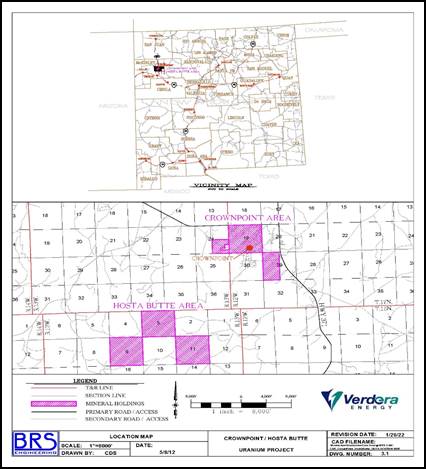
Figure 1: Crownpoint Project – Location Map
Technical Report Summary and Qualified Person
The following technical and scientific description
of the Crownpoint Project is based in part on the report titled “Crownpoint and Hosta Butte Uranium Project, McKinely County,
New Mexico, USA” dated effective December 5, 2025, and prepared by BRS Inc. (the “Crownpoint Technical Report”).
The Crownpoint Technical Report was prepared in accordance with SK 1300.
Douglas L. Beahm, P.E., P.G. was the principal
author of the Crownpoint Technical Report and Car Warren, P.E., P.G., was a co-author. Both Mr. Beahm and Mr. Warren are Qualified
Persons and are independent from the Company.
Project Stage
The Crownpoint Project does not have known “Mineral
Reserves” and is therefore considered under SEC SK 1300 definitions to be an Exploration Stage Property.
Property Description, Location and Ownership
The Project is located in portions of Sections
24, Township 17 North, Range 13 West; Sections 19 and 29, Township 17 North, Range 12 West; and Sections, 3, 9, and 11, Township 16 North,
Range 13 West, comprising approximately 3,020 acres (Refer to Figure 2 – Location Map).
The Company owns the mineral estate outright with
the exception of SE ¼ of Section 24 in the Crownpoint project where they hold 60% of the mineral estate covering 120 acres
known as the Walker Lease. There are no annual payments, maintenance, or other requirements to be met to maintain the mineral estate subject,
only a 3% gross proceeds royalty to NZ Uranium, LLC (NZU), a 2% net proceeds royalty to enCore on uranium mined from the Project, and
2% net smelter returns royalty to enCore on other minerals mined from the Project.
Surface rights are held separately from the mineral
rights on the Project. The surface rights have not been removed from development and are not under other restrictions. The project is
outside of the Navajo Reservation and is situated on the western edge and to the 3-4 miles southwest of the small town of Crownpoint,
New Mexico.
Table 1 – Land Description
|
Section, Township, Range
New Mexico Prime Meridian |
Approximate Acreage |
Approximate Latitude |
Approximate Longitude |
| Crownpoint Area: |
|
|
|
| All Section 19, T17N, R12W |
640 |
35o 41' 20" |
108o 12' 50" |
| SE 1/4* Section 24, T17N, R13W |
140 |
35o 41' 10" |
108o 13' 40" |
| W 1/2 Section 29, T17N, R12W |
320 |
35o 40' 30" |
108o 12' 15" |
| Sub Total Crownpoint |
1,100 |
|
|
| Hosta Butte Area: |
|
|
|
| All Section 3, T16N, R13W |
640 |
35o 38' 45" |
108o 15' 50" |
| All Section 9, T16N, R13W |
640 |
35o 38' 00" |
108o 16' 55" |
| All Section 11, T16N, R13W |
640 |
35o 38' 00" |
108o 14' 50" |
| Subtotal Hosta Butte |
1,920 |
|
|
| GRAND TOTAL |
3,020 |
|
|
*The legal description of Section 24
land holdings includes most of the SE ¼ of Section 24, T17N R13W of the New Mexico Prime Meridian and includes the N1/2 NE1/4
SE1/4, N1/2 SE1/4 NE1/4 SE1/4, SW1/4 NE1/4 SE1/4, N1/2 NW1/4 SE1/4 SE1/4, S1/2 SE1/4 SE1/4, and W1/2 SE1/4. The Company owns 60% of this
portion of the Project.
The Crownpoint area is in the immediate vicinity
of Crownpoint, New Mexico. The Hosta Butte area is located approximately 4 miles southwest of Crownpoint, New Mexico.
Figure 1 shows the approximate location of the
Project. The Project is 100% owned by the Company except for SE ¼ of Section 24, T17N, R13W which is 60% owned by the Company
and 40% owned by NuFuels and is comprised of the mineral estate (excluding hydrocarbons) over approximately 3,020 acres, subject only
to a 3% gross proceeds royalty to NZU, a 2% net proceeds royalty to enCore on uranium mined from the Project and 2% net smelter returns
royalty to enCore on other minerals mined from the Project.
On April 9, 2025, Former Verdera acquired
NME BC, a wholly-owned subsidiary of enCore and owner of NME, which holds multiple uranium projects in New Mexico including Crownpoint
and Hosta Butte projects.
Surface Rights
Surface rights are separate from the mineral rights
on the Project. The surface rights of the property area are partially controlled by the royalty-holder, NZ Uranium (NZU), NuFuels (the
40% owner of the SE ¼ of Section 24 Crownpoint Property), and certain private property holders. The surface rights have not
been removed from development and are not under other restrictions. The property is outside of the Navajo Reservation and is situated
on the western edge of the small town of Crownpoint. Applicable legislation provides the owners of the mineral estate surface access,
as well as a dispute resolution mechanism.
Chain of Title
The NZ Land Company (NZ) was formed in 1908 and
took deed and management of the land grants. NZ Uranium LLC (NZU) was spun off to manage the lands within the known uranium trend of New
Mexico and Arizona in 2002. Tigris optioned the Project in May 2010 and exercised the option in May, 2011. Tigris acquired a 60%
Interest in the SE ¼ of Section 24 Crownpoint Property and 100% of the Hosta Butte Property, the Crownpoint Properties located
in Section 19 and 29. The remaining 40% interest in the Crownpoint SE ¼ of Section 24 property is held by NuFuels. The
property is not subject to any liens or other encumbrances except for royalties as subsequently discussed.
On March 18, 2025, Former Verdera entered
into a share purchase agreement with enCore Energy Corp. (enCore) for the acquisition of NME BC, a wholly-owned subsidiary of enCore and
owner of NME, which holds multiple uranium projects in New Mexico including Crownpoint and Hosta Butte projects.
Former Verdera issued 50,000,000 Former Verdera
Preferred Shares to enCore, representing approximately 73% of current issued and outstanding shares of Former Verdera. enCore received
a 2% net proceeds royalty on uranium and a 2% net smelter returns royalty on other minerals extracted and sold from the properties and
a non-refundable cash payment of US$350,000. The acquisition closed on April 9, 2025.
Royalties
The Company owns the mineral estate outright with
the exception of SE ¼ of Section 24 in the Crownpoint project where they hold 60% of the mineral estate covering 120 acres
known as the Walker There are no annual payments, maintenance, or other requirements to be met to maintain the mineral estate subject
only to a 3% gross proceeds royalty to NZ Uranium, LLC (NZU), a 2% net proceeds royalty to enCore on uranium mined from the Project and
a 2% net smelter returns royalty on other minerals extracted and sold from the Project.
Taxes
Uranium production in New Mexico is subject to
a mineral severance tax which is currently taxed at a rate of 3.5% based on 50% of the gross value or an effective rate of 1.75 % of the
gross value (Peach et al, 2008) and (http://www.tax.newmexico.gov/SiteCollectionDocuments/rpd-41215.pdf).
Uranium production in New Mexico is also subject
to a Conservation Tax. The conservation tax was not imposed on the uranium industry until 1975. The conservation tax rate was 0.18% in
1975 and was increased to 0.20% in 1977. There have been no significant changes to the conservation tax as it relates to the uranium industry
since 1977 (Peach et al, 2008).
Uranium Production in New Mexico Resources is
also subject to an excise tax was imposed in 1966 at a rate of .75% of the amount of money or the reasonable value of severed or processed
resources (Peach et al, 2008).
The State of New Mexico imposes a gross receipts
tax, 5% on average, on total amount of money or other consideration received from the above activities. Although the Gross Receipts Tax
is imposed on businesses, it is common for a business to pass the Gross Receipts Tax on to the purchaser either by separately stating
it on the invoice or by combining the tax with the selling price. The gross receipts tax will be realized with the Project through its
application for services performed by contactors, vendors, and consultants. (https://www.tax.newmexico.gov/governments/gross-receipts-tax/).
Accessibility and Local Resources
The Crownpoint Project is located on the northern
flank of an unnamed mountain range which consists of plateaus and steep, incised canyons, just northwest of the Continental Divide. The
Crownpoint Project lies north of the Puerco River and Hosta Butte, the two most prominent geographic features in the area. The mountain
peaks are as high as 7900 feet within two miles south of the Crownpoint Project with elevations in the immediate project area of about
6700 feet above mean sea level. Vegetation consists of low desert sage, pinion pines, and thin grasses in an arid, high desert climate.
The Crownpoint Project is generally accessible year-round, although access to the Hosta Butte portion of the Crownpoint Project would
be more difficult in the winter and/or following precipitation events which saturate the soils.
The Crownpoint Project is accessed from the south
by Highway 371 and from the north by Highway 57 at Crownpoint, New Mexico. Highway 9 goes west from Crownpoint, just to the north of the
Crownpoint Project area. Paved secondary roads provide access to the NuFuels facility on Section 24. From the NuFuels facility the
Hosta Butte portion of the Crownpoint Project is accessible via a county gravel road which turns to the south approximately 2 miles west
of Crownpoint. The road continues east becoming a private dirt road then turns to the north in Section 11 and continues to the Crownpoint
Project area.
The largest nearby population center is Albuquerque,
New Mexico, with an approximate population of 565,000 residents. Albuquerque is located approximately 100 miles to the east on Highway
40 and provides a transportation and supply hub for the area. Grants, New Mexico is approximately 50 miles east of the Crownpoint Project
and Gallup, New Mexico lies approximately 50 miles to the west. The Crownpoint Project is approximately 10 miles from the Navajo Reservation
and is situated on the west and southwest of the small town of Crownpoint.
In the 1970s a mine site was developed by Conoco
and several warehouse and office buildings were constructed in Section 24, T17N, R13W on the lands now controlled by NuFuels and
within the mineral holdings of enCore. As part of the original mine three shafts were sunk and the original mine plan called for underground
extraction with surface processing. These shafts were subsequently reclaimed.
History
The property is part of the checkerboard of deeded
railroad sections, which include surface and mineral rights. Congress chartered the Atlantic and Pacific Railroad Company (the "A&P")
in 1866. The A&P was purchased in bankruptcy proceedings by the St. Louis-San Francisco Railway Company, commonly called the "Frisco."
Frisco and the Atchison Topeka and Santa Fe Railway Company formed a joint venture in 1880 and used the old A&P charter to build a
railroad line, acquiring millions of acres of federal grant fee lands in New Mexico and Arizona with surface and mineral rights. Frisco
incorporated New Mexico and Arizona Land Company (NZ) in 1908 in what the Territory of Arizona was then to hold its grant lands until
they could be sold.
Uranium was discovered on the grant lands in New
Mexico in 1968. Conoco and Westinghouse initially explored and developed this property for underground mining in the late 1970s. Three
shafts were developed on the Section 24 location. The properties were explored extensively and had also been subjected to extensive
successful ISR pilot testing by Mobil Oil Company in the 1970’s on the nearby Section 9, T16N, R13W. With falling demand and
prices in the uranium sector in the 1980’s, Conoco elected to close the operations and cap the shafts. All the facilities and data
were maintained and have been acquired by NuFuels.
While these former owners of the project did development
for the project, no production has ever occurred on the property.
In the 1980's, NZ turned its principal focus from
rural to urban real estate investment and development. After a period of aggressive real estate investing, NZ expanded into bridge financing
of real estate. New emphasis was placed on the liquidation of NZ's historic assets.
After a series of mergers and changes in controlling
parties, Robert M. Worsley purchased the remaining rural assets in March 2002. The original incorporated name of NZ was retained
and formed into a limited liability corporation. NZU was spun off to control the lands in the uranium trend of New Mexico and Arizona
in 2002 (Pelizza, 2004).
An Option Agreement was executed between NZU and
Tigris in May 2010. The Option Agreement with NZU was for the acquisition by Tigris of a 60% Interest in the Crownpoint Property,
SE ¼ of Section 24, and 100% of the Hosta Butte Property, the Crownpoint Properties located in Section 19 and 29. The
remaining 40% interest in the Crownpoint Section 24 property is held by NuFuels. (https://laramide.com/projects/crownpoint-churchrock-uranium-project).
In May 2011, Tigris, a subsidiary of enCore, exercised its option for the mineral rights and therefore owned the mineral rights outright
before their transfer to NME (Texas), a wholly owned subsidiary of enCore, pursuant to an internal reorganization.
On March 18, 2025, Former Verdera entered
into a share purchase agreement with enCore for the acquisition of NME BC, a wholly-owned subsidiary of enCore and owner of NME (Texas),
which holds multiple uranium projects in New Mexico including Crownpoint and Hosta Butte projects.
Former Verdera issued 50,000,000 Former Verdera
Preferred Shares to enCore, representing approximately 73% of current issued and outstanding shares of Former Verdera. enCore received
a 2% net proceeds royalty on uranium and a 2% net smelter returns royalty on other minerals extracted and sold from the properties and
a non-refundable cash payment of US$350,000. The resulting aggregate royalty on the projects is thus 5%. The acquisition closed on April 9,
2025.
Historical mineral resources estimates for the
property are known in the vicinity, but the authors of the Crownpoint Technical Report were unaware of any historical estimates specific
to the current holdings.
Infrastructure
Within the Crownpoint portion of the Crownpoint
Project there is line power and telephone service. Access to the site is available on paved public roads and there is a local airport
in Crownpoint. The Hosta Butte site is more remote and would require the development of access and utilities.
In the 1980s Conoco developed the infrastructure
to support underground mining within the Crownpoint area of the Crownpoint Project. This included the sinking of 3 mine shafts, mine water
treatment facilities, offices, shops, warehousing, and related facilities and appurtenances. At that time the infrastructure was adequate
to support Conoco’s operation. The facility has been well maintained and, although the mine shafts have been capped at the surface,
the remaining infrastructure to support mine development are in place. The remaining infrastructure is on lands held by NuFuels within
enCore’s mineral holdings in Section 24, T17N, R12W.
Climate
The Project is located on the Northwestern Plateau
climatological subdivision of New Mexico. The region is semiarid continental, with the mean annual precipitation averaging 10.2 inches
(NUREG - 1580, 1997). Precipitation typically is concentrated during summer and early fall, occurring as thundershowers of short duration.
Approximately 50 percent of the precipitation falls in July through October. The mean monthly rainfall during the remainder of the
year totals only 0.5 inches. Temperatures in the region are represented by data from the nearby Crownpoint station. Because of the relatively
high elevation of the project area, temperatures greater than 90°F occur infrequently, only 12 times per year on average. The extreme
maximum temperature recorded at Crownpoint is 97°F. Because of the high elevation and relatively infrequent cloud cover in the project
area, radiant cooling is substantial and results in an average of 143 days of the year with temperatures below freezing. Extremely low
temperatures are rare, with the lowest on record being - 17°F. The mean annual temperature is 51°F. The coldest month is January,
and the warmest month is July. The frost-free growing season lasts 140 days, extending from early May to early October. The mean
freeze-free period lasts about 22 days longer than the growing season. However, large variations in the freeze dates occur from year to
year.
Maximum precipitation occurs during the summer
thunderstorm season. The data indicates that approximately one-half of the annual precipitation total falls during July, August, and September.
Most of the winter precipitation occurs as snow. Based on mean snowfall estimates for nearby locations, including Crownpoint, and on actual
1975 snowfall amounts for Gallup and Chaco Canyon National Monument, the estimated yearly average snowfall for the project area is 26
inches.
Geology, Mineralization and Deposit
Regional Geologic Setting
Uranium mineralization within the Crownpoint Project
areas are in the Grants Uranium Region. The Grants Uranium Region is located in northwestern New Mexico and is part of the Colorado Plateau
physiographic province. The Grants Uranium Region has been a prolific producer of uranium in the United States (McLemore and Chenoweth,
1991). With production as early as 1948, over 347 million lbs U3O8 has been produced from the region mainly during
the years 1953 through 1990.
Regional subsidence has preserved about 3,000
feet of Triassic, Jurassic, and Cretaceous Sediments in the San Juan Basin. Stratigraphically, this series of sediments accumulated as
a major transgressive sequence. The Triassic dominantly contains aeolian massive cross-bedded dune sands that continued into the early
Jurassic period. In the late Jurassic, major uplifts occurred to the west in the vicinity of the present Mogollon rim of Arizona causing
deposition of massive arkosic, alluvial-fan deposits across northeastern Arizona and into northwestern New Mexico.
The Westwater Canyon member of the Morrison formation
contains the majority of uranium deposits in the region and was emplaced during this type of depositional regime. During deposition of
this regional alluvial-fan, abundant volcanic activity also occurred which were deposited as interbedded tufts over the entire area of
the San Juan Basin. At the beginning of the Cretaceous, a major subsidence occurred throughout the Rocky Mountain Geosyncline and Cretaceous
seas that transgressed the Jurassic continental deposits. During the Jurassic period abundant vegetation was present. Decay of vegetation
produced humic and fulvic acids, which then migrated and were concentrated in channel sands upon burial. In addition to the vegetal material,
volcanic tufts that were deposited within the sands yielded uranium into the groundwater. Where reductants and humate concentrated, uranium
was reduced, adsorbed, and precipitated from the groundwater resulting in the concentration of mineralization.
Through subsequent uplift and remobilization of
groundwater, oxidized solutions re-mobilized the uranium in and concentrated it into rolls or stacked mineralized zones during both the
Cretaceous and Tertiary. The Westwater Canyon Member shows a regional pattern of alteration from hematite at a distance from the redox
front to limonite in proximity to the front, and finally pyrite at and behind the front.
Structure
The sedimentary rocks of the San Juan Basin form
a gently dipping monocline in the Grants-Gallup area known as the Chaco Slope (Brister and Hoffman, 2002). The beds generally dip to the
north with localized variations due to undulations and minor deformation. The beds in the project area are gently dipping to the north.
Stratigraphic correlations of drill logs, by the authors of the Crownpoint Technical Report, show the dip at both the Crownpoint and Hosta
Butte areas to be about 3 degrees to the north northeast. There is a mapped fault in the extreme southeast portion of Section 3,
T16N, R13W which displaces mineralization in the Hosta Butte area. No significant faulting was observed based on stratigraphic correlations
in the Crownpoint area of the Crownpoint Project
Local Geology
Figure 2 – Geologic Map, shows the regional
surficial geology in the vicinity of the Crownpoint Project. At both the Crownpoint and Hosta Butte area within the Crownpoint Project
surficial exposures are Cretaceous in age. The Jurassic Morrison Formation, which is the primary uranium host, is found at depth within
the immediate project area but is exposed approximately 25 miles to the south of Crownpoint.
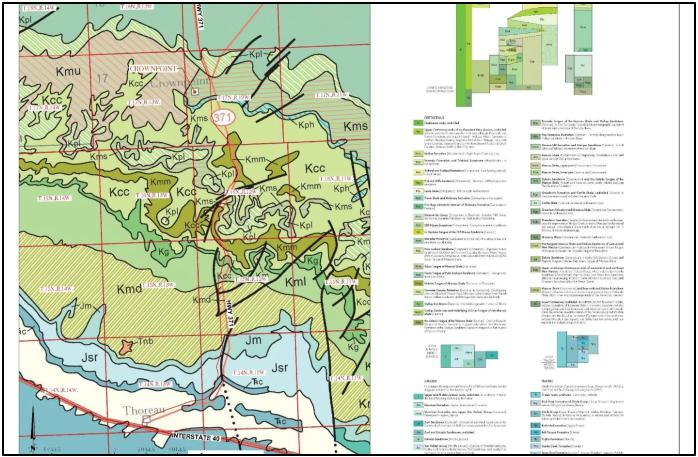
Figure 2 Geological Map
Figure 3 – Type Log, shows the subsurface
stratigraphy. This Type Log is from Section 24, T17N, R13W. The Cretaceous Mancos Shale Formation is exposed at the surface and persists
to a depth of approximately 1,600 feet to the contact with the Cretaceous Dakota Formation. The Mancos Shale is dominantly a shale unit,
but also contains sandstone and coal members.
The Cretaceous Dakota Formation overlies the Morrison
Formation and consists of fine to medium grained, well sorted sandstone with siltstone and shale interbeds. The Formation is about 160
feet thick and occasionally hosts uranium mineralization (McCarn, 1997). Within the Crownpoint Project area the Dakota Formation unconformably
overlies the Brushy Basin Shale Member of the Morrison Formation which in turn overlies the Westwater Canyon Member. The Type Log, Figure
2 shows the Brushy Basin is about 70 feet thick and consists mostly of mudstone with thin sandstone lenses.
The Westwater Canyon member of the Morrison Formation
is the principal host of uranium mineralization in the vicinity of the Crownpoint Project. The Type Log, Figure 2, shows the Westwater
Canyon to be approximately 360 feet thick. The Westwater Canyon member is conformably underlain by the Recapture Shale member of the Morrison
Formation. Generally drilling within the Crownpoint Project extended into but did not fully penetrate the Recapture Shale.
The authors of the Crownpoint Technical Report
reviewed the geologic and lithologic drill hole logs, as well as internal geologic reports and cross sections, for the Crownpoint and
Hosta Butte areas of the Crownpoint Project. Based on this review the authors of the Crownpoint Technical Report concluded:
| · | That the individual stratigraphic units at the
site are persistent and strongly correlates both at the scale of the various formations and members thereof and within the Westwater Canyon
member. |
| · | The contact between the Dakota and Brushy Basin
and the central shale unit referred to as the CP shale were used as primary stratigraphic markers. |
| · | The sand unit immediately above the CP shale
was designated the B sand and the sand unit immediately below the CP shale was designated C sand with the upper most sand in the Westwater
being designated the A sand and the lowest sand designated the D sand. |
| · | That while the major sand units could be further
subdivided, for the purposes of estimating mineral resources use of the major sand breaks provided adequate geologic definition and separation
of the zones on mineralization. |
Mineralization
The mineral deposits at Crownpoint and Hosta Butte
are roll-front deposits in which uranium mineralization is concentrated at the boundary of oxidized and reduced sandstone units (i.e.,
redox front) within the host formation. The Crownpoint and Hosta Butte areas occur along sub-parallel redox fronts within the Westwater
Canyon and are separated by 2 to 3 miles in which the Westwater Canyon is characteristically oxidized and absent mineralization. Mineralization
is locally controlled by stratigraphic variations in the individual zones affecting permeability and consequent ground water flow and
geochemical conditions relating to the presence or absence of reluctant.
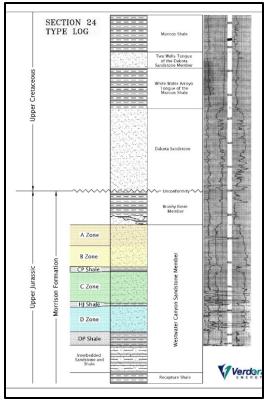
Figure 3 Type Log
Crownpoint Area
The Crownpoint database represents down hole data
from a total of 482 drill holes of which 93 are barren and the remaining 389 drill holes contain mineralization above the minimum cutoff
of 0.02 % eU3O8. Within the 389 mineralized drill holes, 873 individual intercepts were present. Figure 4 –
Crownpoint Drill Hole and Cross Section Location Map, shows the surface or plan location of drill holes within the Crownpoint area
of the Project along with the location of selected cross sections which display the subsurface geology and mineralization in profile.
The historic database, used as the primary data
source, consists of eU3O8 radiometric data by half foot increments which was originally developed by Conoco and
has been verified by the authors of the Crownpoint Technical Report. For the mineral resource model and estimation, the data was screened.
Mineralized intercepts were diluted to a minimum thickness of 2 feet. After dilution only those intercepts having minimum grade of 0.02
% eU3O8 and a minimum GT of 0.10 were used in the estimation. A summary of mineralization reflected in the drill
holes follows.
Mineralization Thickness and Grade
Crownpoint mineralized thickness ranges from the
minimum of 2 feet to over 40 feet. Average thickness of all intercepts was 7.6 feet. Average GT of all intercepts was 0.77 ft%. Grade
varies from the minimum grade cutoff of 0.02 % eU3O8 to a maximum grade by intercept of 0.38 % eU3O8.
However, individual half foot grades did exceed 2% eU3O8. Individual mineralized trends may persist for several
thousand feet with trend width typically in the range from 100 up to 400 feet.
Mineralization in Section 24, T17N, R13W,
occurs in all four of the major zones within the Westwater Canyon.
| · | A zone mineralization is weaker compared to other
zones and trends generally east-west. |
| · | B zone mineralization is strong trending generally
from northwest to southeast. |
| · | C zone mineralization is strong and exhibits
a distinct northwest to southeast trend. |
| · | D zone is the strongest of the mineralized trends
and exhibits two trends one sub parallel to the B and C trends and the other roughly perpendicular trending from southwest to northeast. |
Mineralization in Section 19, T17N, R12W,
occurs within the B, C, and D zones.
| · | The A zone contains some mineralized intercepts,
but they are insufficient in magnitude and extent for mineral resource estimation. |
| · | B and C zone mineralization is prevalent in the
southwest portion of section 19 and is continuous with mineralization in Section 24. |
| · | D zone mineralization is stronger and more continuous
than the other mineralized trends, exhibits a distinct northwest to southeast trend, and in continuous with mineralization in Section 24. |
| · | In the authors of the Crownpoint Technical Report’s
opinion, the B, C, and D mineralized trends likely do extend into the adjacent Section 30, T17N, R12W. However, Section 30 is
withdrawn from mineral exploration and there is no direct drill hole data available to confirm this opinion. |
Mineralization in Section 29, T17N, R12W,
occurs in all four of the major zones within the Westwater Canyon.
| · | A zone mineralization is strong and has a pronounced
east-west trend. |
| · | B zone mineralization is strong trending from
northwest to southeast. |
| · | C zone mineralization exhibits two sub-parallel
trends trending from northwest to southeast. |
| · | D zone mineralization in Section 29 is weaker
than that of either Section 24 or 19 but does reflect the same northwest to southeast trend sub-parallel to both the B and C trends
in the section. |
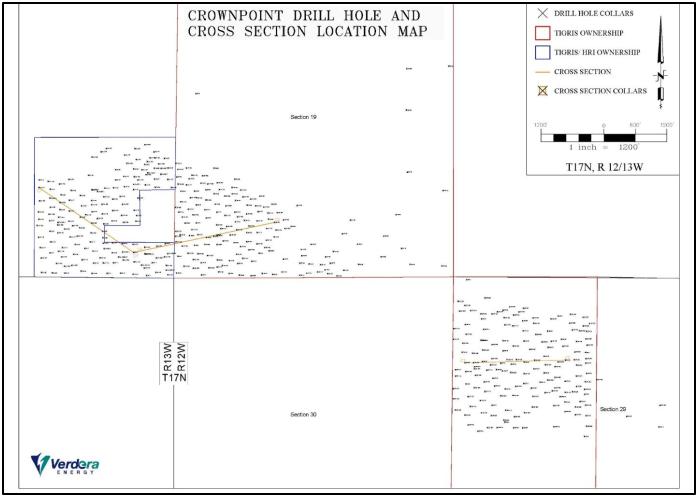
Figure 4 – CP Drill Hole Location Map
Hosta Butte Area
The Hosta Butte database set represents down hole
data from a total of 135 drill holes. Of those 135 drill holes 42 were barren and 93 of the drill holes contained mineralization meeting
cutoff criteria as described for the Crownpoint area. Within the 93 mineralized drill holes, 155 individual intercepts were present.
Mineralization Thickness and Grade
Hosta Butte mineralized thickness ranges from
the minimum of 2 feet to over 33 feet. Average thickness of all intercepts was 7.4 feet. Average GT of all intercepts was 0.83 ft%. Grade
varies from the minimum grade cutoff of 0.02 % eU3O8 to a maximum grade by intercept of 0.52 % eU3O8.
However, individual half foot grades did exceed 2% eU3O8. Individual mineralized trends may persist for 2,000 thousand
feet or more along trend with a width typically in the range of 100 to 300 feet.
Mineralization in Section 3, T16N, R13W,
occurs in the B, C, and D zones within the Westwater Canyon.
| · | The A zone contains some mineralized intercepts,
but they are insufficient in magnitude and extent for mineral resource estimation. |
| · | B zone mineralization is much weaker than the
C and D zones and appears to be concentrated in pods rather than elongated trends. |
| · | C zone mineralization is strong and exhibits
a distinct northeast to southwest trend. |
| · | D zone is the stronger of the mineralized trends
within the section. The D zone exhibits a generally north south trend and is stacked with the C zone in the central portion of the section. |
Additional Areas of Mineralization - Hosta
Butte Sections 9 and 11, T16N, R13W
Drilling on Sections 9 and 11 demonstrate the
presence of uranium mineralization, but these areas are not yet adequately defined to support a CIM compliant mineral resource estimate.
However, drill data from these sections do demonstrate that the host formation, the Westwater Canyon member of the Morrison Formation,
is present and gamma anomalies are present in both sections. Of the 14 holes for which data is available for Section 9, T16N, R13W,
6 have anomalous mineralization in some cases up to 10 feet thick, however, the highest grade encountered was 0.029 % eU3O8.
On Section 11, T16N, R13W, data is available
from 31 drill holes that shows:
| · | Mineralization on Section 11 is most prevalent
in the B and D zones. |
| · | 7 are mineralized but have less than 0.10 ft%
GT |
| · | 13 with grade > 0.02 % eU3O8
and GT > 0.10 ft% |
| · | Of these 13 mineralized holes 4 exceed a GT of
1.0 ft% |
| · | The best drill hole contains 10.5 feet of mineralization
at a grade of 0.234 % eU3O8 |
Deposit Types
Mineral deposits within the project area have
been described in the literature as re-distributed uranium mineralization, secondary, and roll-type uranium mineralization. (McLemore,
2010). Mineralization is discordant, asymmetrical, and irregularly shaped and is typically elongated parallel to depositional features.
Varying rates of ground water flow controlled by sedimentary facies changes in each stratigraphic zone in the Westwater Canyon produced
staked mineralized zones near one another, but not necessarily vertically above or below one another (Peterson, 1980). Mineralization
may be found as irregular pods or as the classic c-shaped roll-fronts as depicted in the following figure.
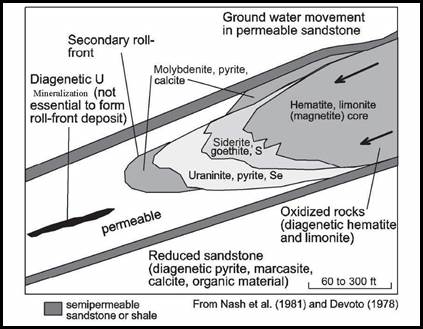
Figure 4 – Typical Roll Front (From McLemore, 2010)
Referring to Figure 4 (McLemore and Chenoweth,
1991), oxidation and reduction zones are shown for the project area in general and the Crownpoint and Hosta Butte areas specifically.
In the intervening area between the Crownpoint and Hosta Butte mineralization the host formation is oxidized. The Crownpoint and Hosta
Butte mineralization occurs along separate redox fronts which are sub-parallel to one another and trending generally from southeast to
northwest.
Permitting and Licensing
The Atomic Energy Act and Licensing
The NRC is the primary regulatory authority over
uranium recovery operations throughout the State of New Mexico, including ISR operations. In 1954, Congress, through the Atomic Energy
Act of 1954 (“AEA”), empowered the Atomic Energy Commission (“AEC”), now NRC, to regulate AEA materials
(i.e., source, byproduct, and special nuclear materials). Under its AEA authority, the AEC/NRC promulgated 10 C.F.R. Part 40 and,
later, Appendix A to Part 40 to implement a regulatory program for uranium recovery operations. At the time of Appendix A’s
issuance, conventional mining techniques (underground and open pit) were assumed to be the primary source of uranium production in the
United States, and Appendix A was written to reflect that assumption. As ISR techniques have become the prevalent form of uranium recovery
in the United States, the NRC has applied relevant portions of Appendix A to ISR licensing as “relevant and appropriate”.
ISR uranium recovery licensees also are required to comply with relevant 10 C.F.R. Part 20 radiation protection standards.
Portions of the Project are included within NuFuels’
Source Materials License SUA-1580 for the in-situ recovery (ISR) of uranium which was issued by the US Nuclear Regulatory Commission (NRC)
in January 1988. The portion of the Crownpoint Project that is within the SUA-1580 license area includes Crownpoint: all the Section 24,
T17N, R13W; all of the Section 29, T17N, R13W; and the SW1/4 of the Section 19, T17N, R13W mineral holdings. Both ISR operations
and a central processing facility are licensed at the Crownpoint location. None of the Hosta Butte mineral holdings are within the SUA-1580
license area. If enCore were to operate any form of uranium recovery facility, they would be required to obtain a Source Materials License
from the NRC and an aquifer exemption.
As part of the NRC licensing process, an Environmental
Impact Statement (EIS), (NUREG -1580, 1997) was completed that included the Crownpoint area. The NuFuels’ license area is located
on private lands, federal mining claims, Allotted and surface Trust land, so both the Bureau of Land Management (BLM) and Bureau of Indian
Affairs (BIA) were cooperating agencies with respect to the Crownpoint EIS.
The license and EIS were litigated through courts
ending in the 10th Circuit Court of Appeals which upheld the license. Ultimately the opponents petitioned the US Supreme Court.
The Supreme Court denied the opponents' petition to review the March 2010, 10th Circuit Court of Appeals' ruling. This
upheld HRI’s (i.e., NuFuels’) NRC license to conduct ISR uranium mining at the Churchrock/Crownpoint project on November 15,
2010.
Safe Drinking Water Act UIC Permits and
Aquifer Exemptions
Underground injection is defined in 40 C.F.R.
§ 146.3 as “the subsurface emplacement of fluids through a bored, drilled or driven well ....”. Thus, all ISR uranium
recovery injection well activities are included. To assure ground water protection, a federal Underground Injection Control (UIC) Program
was established under the authority and standards of the federal Safe Drinking Water Act (SDWA) of 1974. This federal program establishes
minimum requirements for effective state UIC Programs.
To avoid the burden of dual federal and state
(or Indian tribal) regulation, the SDWA allows for the permits issued by the UIC regulatory programs of states and Indian tribes determined
eligible for treatment as states to suffice in place of a UIC permit required under the SDWA. States that USEPA has determined to have
regulations, laws, and resources in place that meet the federal requirements are referred to as Primacy States. These Primacy States are
authorized to run the UIC Program and a UIC permit from a state with primacy suffices in lieu of an EPA-issued permit on the condition
the EPA grants, upon request by the permitting state, an aquifer exemption modifying the permitting state’s UIC program. New Mexico
has been granted primacy for their UIC program and NMED has jurisdiction under the New Mexico Water Quality Act to regulate UIC activities.
The New Mexico Environmental Department (NMED)
administers the EPA approved state UIC program and there the UIC permit is also referred to as a Discharge Plan (DP). The DP assures site-specific
compliance with the Ground and Surface Water Quality Regulations. Section 24, T17N, R13W is private land and would require a DP from
the NMED.
The Navajo Nation claims regulatory jurisdiction
over a significant portion of the Company’s property. The Navajo Nation has been determined eligible for treatment as a state but
has not submitted a UIC Class III program for EPA approval. As such, an operator would need to submit a UIC permit application directly
to EPA. Despite procedural differences, the substantive requirements of the EPA UIC permit review is very similar to the NM ED. All properties
in the Project excluding Crownpoint Section 24, T17N, R13W would require EPA UIC permits.
A USDW is defined as an aquifer, or portion thereof,
which serves as a source of drinking water for human consumption or contains enough water to supply a public water system. A USDW also
is defined to contain fewer than 10,000 mg/liter of total dissolved solids. Within this definition, however, some aquifers or portions
of aquifers, which can meet the broad regulatory definition of a USDW, may not reasonably be expected to serve as a current or future
source of drinking water. As a result, the UIC program regulations allow EPA to exempt mineralized portions of an aquifer from delineation
as a USDW and allow for injection into such aquifers or portions thereof.
The USEPA must approve an Agreement States application
for aquifer exemption designation for each mine site before any ISR recovery can occur. If a permittee wishes to inject into a USDW for
the purpose of recovering minerals (e.g., uranium), a demonstration must be made that the proposed aquifer meets the exemption criteria
of 40 C.F.R. 146.4. All properties within the Project would require an Aquifer Exemption from the USEPA.
Before their NRC-licensed ISR uranium recovery
operations can commence at any site, a licensee must have obtained a UIC permit and an aquifer exemption for the aquifer or portion of
the aquifer wherein ISR mining operations will occur. No UIC permits or Aquifer Exemptions have currently been issued for the Project.
Underground injection is defined in 40 C.F.R.
§ 146.3 as “the subsurface emplacement of fluids through a bored, drilled or driven well ....”. Thus, all ISR uranium
recovery injection well activities are included. To assure ground water protection, a federal Underground Injection Control (UIC) Program
was established under the authority and standards of the federal Safe Drinking Water Act (SDWA) of 1974. This federal program establishes
minimum requirements for effective state UIC Programs.
To avoid the burden of dual federal and state
(or Indian tribal) regulation, the SDWA allows for the permits issued by the UIC regulatory programs of states and Indian tribes determined
eligible for treatment as states to suffice in place of a UIC permit required under the SDWA. States that USEPA has determined to have
regulations, laws, and resources in place that meet the federal requirements are referred to as Primacy States. These Primacy States are
authorized to run the UIC Program and a UIC permit from a state with primacy suffices in lieu of an EPA-issued permit on the condition
the EPA grants, upon request by the permitting state, an aquifer exemption modifying the permitting state’s UIC program. New Mexico
has been granted primacy for their UIC program and NMED has jurisdiction under the New Mexico Water Quality Act to regulate UIC activities.
The New Mexico Environmental Department (NMED)
administers the EPA approved state UIC program and there the UIC permit is also referred to as a Discharge Plan (DP). The DP assures site-specific
compliance with the Ground and Surface Water Quality Regulations. Section 24, T17N, R13W is private land and would require a DP from
the NMED.
The Navajo Nation claims regulatory jurisdiction
over a significant portion of enCore’s property. The Navajo Nation has been determined eligible for treatment as a state but has
not submitted a UIC Class III program for EPA approval. As such, an operator would need to submit a UIC permit application directly
to EPA. Despite procedural differences, the substantive requirements of the EPA UIC permit review is very similar the NM ED. All properties
in the Crownpoint Project excluding Crownpoint Section 24, T17N, R13W would require EPA UIC permits.
A USDW is defined as an aquifer, or portion thereof,
which serves as a source of drinking water for human consumption or contains enough water to supply a public water system. A USDW also
is defined to contain fewer than 10,000 mg/liter of total dissolved solids. Within this definition, however, some aquifers or portions
of aquifers, which can meet the broad regulatory definition of a USDW, may not reasonably be expected to serve as a current or future
source of drinking water. As a result, the UIC program regulations allow EPA to exempt mineralized portions of an aquifer from delineation
as a USDW and allow for injection into such aquifers or portions thereof.
The USEPA must approve an Agreement States application
for aquifer exemption designation for each mine site before any ISR recovery can occur. If a permittee wishes to inject into a USDW for
the purpose of recovering minerals (e.g., uranium), a demonstration must be made that the proposed aquifer meets the exemption criteria
of 40 C.F.R. 146.4. All properties within in the Crownpoint Project would require an Aquifer Exemption from the USEPA.
Before their NRC-licensed ISR uranium recovery
operations can commence at any site, a licensee must have obtained a UIC permit and an aquifer exemption for the aquifer or portion of
the aquifer wherein ISR mining operations will occur. No UIC permits or Aquifer Exemptions have currently been issued for the Crownpoint
Project.
Clean Air Act
The New Mexico Environment Department, under the
federal Clean Air Act and delegation from EPA, has a permit required from the Air Quality Bureau (AQB). The AQB has authority over air
quality in all New Mexico except facilities on Tribal Lands. ISR facilities do not have the potential to create large amounts of fugitive
dust or the emission of hazardous air pollutants. However, prior to construction a notice of intent would need to be filed with the Air
Quality Bureau for review to assure that a permit is not required. Similar air quality permit requirements would be required by the Navajo
Nation for all areas within the Crownpoint Project excluding Section 24, T17N, R13W.
Surface Rights
Much of the surface and mineral estates are separate
at both the Hosta Butte and Crownpoint properties of the Project. Excluding Crownpoint Section 24, T17N, R13W, the surface at the
Project is owned by the U.S. government in trust for the Navajo Nation. Access and surface use for trust land will require a permit from
the BIA as provided for in 25 CFR Part 169 of their regulations. Being a federal government action, like the NRC licensing process,
the BIA permitting process would be subject to NEPA.
Water Rights
Under New Mexico law, new water rights are initiated,
or existing water rights are changed in point of diversion, or in purpose or place of use, under the administrative authority of the Office
of the State Engineer (“OSE”). Water rights for the purpose of conducting ISR operations have been granted to NuFuels
for the Section 24, T17N, R13W portion of the Crownpoint area. OSE water rights are not required for all other properties within
the Crownpoint Project.
Exploration
To the authors of the Crownpoint Technical Report’s
knowledge, no relevant exploration work has been conducted on the property in recent years. In the Crownpoint Project area uranium mineralization
is at depths more than 1,500 feet from the surface. The deposition of mineralization is stratigraphically and geochemically controlled.
These depositional characteristics are not easily discoverable at depth by other exploration techniques other than drilling.
The Company has not completed any added drilling
or other form of exploration on the Crownpoint Project.
Drilling
No Drilling has been conducted on the Crownpoint
Project by the Company or on its behalf.
Data available for the preparation of this report
included historic data developed by previous owners of the property, predominantly Conoco Minerals Corp. in the 1970’s. This data
was verified by the authors of the Crownpoint Technical Report and is considered reliable for the purposes of estimating mineral resources.
Drilling within the Crownpoint area focused on
portions of three sections 19 and 29, T17N, R12W and Section 24 T17N, R13W. Within the Crownpoint area 482 rotary drill holes and
37 core holes were completed. Refer to Figure 3.
Drilling within the Hosta Butte area also included
three sections, 3, 9, and 11, T16N, R13W. However, the drilling at Hosta Butte focused primarily on Section 3 with 133 rotary holes
and 2 cores holes completed. In Sections 9 and 11, T16N, R13W, 14 rotary drill holes and 32 rotary drill holes were completed, respectively.
All drill holes, rotary and core, were logged
with downhole geophysical logging equipment for natural gamma, resistivity, and spontaneous self-potential (SP). It is standard practice
to derive equivalent uranium values from natural gamma geophysical logs. The Department of Energy maintains standard calibration facilities
for this purpose in Grand Junction, Colorado, Casper, Wyoming, and Grants, New Mexico.
Select intervals in the core holes were selected
for chemical assay. Sample handling and analytical procedures employed for core samples are described in Section 11 of this report.
Portions of the cores have been preserved and have been donated to the Core Research Center (CRC) of the United States Geological Survey
(USGS) located at the Denver Federal Center, Denver, Colorado. Select cores were examined by the author of the Crownpoint Technical Report
in preparation of this report, as discussed in the Technical Report.
All drilling was vertical. The formation is relatively
flat lying (refer to Section 7) dipping at about 3 degrees to the north northeast. Downhole drift surveys were completed on most
of the drill holes and were reviewed by the authors of the Crownpoint Technical Report. Generally, the drill holes tended to drift slightly
to the south southwest and perpendicular to the regional dip. The maximum downhole drift observed in review of the drill data was approximately
30 feet in holes completed to approximately 2,500 feet. True depth corrections were made in the drill hole data bases for the project
areas. The depth correction was on the order of 10 feet for a 2,000-foot drill hole. Given that the drilling was vertical or near vertical
and with a formational dip of 3 degrees or less the thickness of mineralization as measured from the geophysical logs is below 1 percent
less the true thickness and was not corrected for while estimating mineral resources.
Crownpoint Area
The Crownpoint data set is composed of a total
of 482 drill holes of which 93 are barren and the remaining 389 drill holes contain mineralization above the minimum cutoff. Within the
389 mineralized drill holes, 873 individual intercepts were present. Drill hole spacing within the areas of mineral resource were a nominal
average of 150 feet. The historic database, used as the primary data source, consists of eU3O8 radiometric data
by half foot increments which was originally developed by Conoco and has been verified by the authors of the Crownpoint Technical Report.
The dataset was screened for the mineral resource estimation. Mineralized intercepts were diluted to a minimum thickness of 2 feet. Following
dilution only those intercepts having minimum grade of 0.02 % eU3O8 and a minimum GT of 0.10 ft% were used in the
estimation. A summary of mineralization reflected in the drill holes follows.
Mineralization Thickness and Grade
Crownpoint mineralized thickness ranges from the
minimum of 2 feet to over 40 feet. Average thickness of all intercepts was 7.6 feet. Average GT of all intercepts was 0.77 ft%. Grade
varies from the minimum grade cutoff of 0.02 % eU3O8 to a maximum grade by intercept of 0.38 % eU3O8.
However, individual half foot grades did exceed 2% eU3O8. Individual mineralized trends may persist for several
thousand feet along trend with a width typically in the range from 100 up to 400 feet.
Hosta Butte Area
The Hosta Butte data set is composed of a total
of 135 drill holes. Of those 135 drill holes 42 were barren and 93 of the drill holes contained mineralization meeting cutoff criteria
as described for the Crownpoint area. Within the 93 mineralized drill holes, 155 individual intercepts were present. Drill hole spacing
within the areas of mineral resource were a nominal average of 250 feet.
Mineralization Thickness and Grade
Hosta Butte mineralized thickness ranges from
the minimum of 2 feet to over 33 feet. Average thickness of all intercepts was 7.4 feet. Average GT of all intercepts was 0.83 ft%. Grade
varies from the minimum grade cutoff of 0.02 % eU3O8 to a maximum grade by intercept of 0.52 % eU3O8.
However, individual half foot grades did exceed 2 % eU3O8. Individual mineralized trends may persist for 2,000 thousand
feet or more along the trend having a width typically in the range of 100 to 300 feet.
Additional Areas of Mineralization - Hosta
Butte Sections 9 and 11, T16N, R13W
Drilling on Sections 9 and 11 demonstrate the
presence of uranium mineralization, but these areas are not yet adequately defined to support a CIM compliant mineral resource estimate.
However, drill data from these sections do demonstrate that the host formation, the Westwater Canyon member of the Morrison Formation,
is present and gamma anomalies are present in both sections.
Sample Preparation, Analyses, and Security
The majority of the sample data available for
the evaluation of resources for the Crownpoint Project is the historic geophysical log data. The original geophysical logs have been preserved
and were reviewed by the authors of the Crownpoint Technical Report.
All drill holes, rotary and core, were logged
with downhole geophysical logging equipment for natural gamma, resistivity, and spontaneous self-potential (SP). It is standard practice
to derive equivalent uranium values from natural gamma geophysical logs. The Department of Energy maintains standard calibration facilities
for this purpose in Grand Junction, Colorado, Casper, Wyoming, and Grants, New Mexico.
With respect to historic core handling procedures,
written procedures for core handling and sample analysis were available along with the original core data records and assay sheets. The
zones of interest within the recovered cores were determined by the geophysical logs and scanning of the cores with a scintillometer and
then split core samples were taken for analysis. All the samples were assayed using either a Beta Gamma Scaler or an X-ray fluorescence
spectrometer in-house at the mine site. Quality control of the on-site assay equipment was provided through an independent laboratory,
Hazen Research, which completed fluorometric analysis of select samples including many of the higher-grade samples. Original assay sheets
were available for 32 of the 39 cores holes.
Hazen Research (aka Hazen Analytical Laboratory)
was then and is now a recognized laboratory of chemical analyses and metallurgical testing. They are an independent facility. The Hazen
Analytical Laboratory holds certifications from various state regulatory agencies and from the US Environmental Protection Agency (EPA).
According to their website, Hazen maintains a large stock of standard reference materials from the National Institute of Standards and
Testing (NIST), the Canada Centre for Mineral and Energy Technology (CANMET), the EPA, and other sources. These materials are used to
monitor the accuracy and precision of analytical results.
The great majority of the geophysical logs for
Crownpoint were completed by Conoco Minerals using company owned and operated logging units. Less than 5% of the total logs were completed
by Geoscience Logging, a commercial vendor. Conoco operated Mount Sopris logging units which were very common in the industry at the time
exploration and development was active at these projects. Mount Sopris is still active in the industry as of February 2022. The author
of the Crownpoint Technical Report, Beahm, worked for two separate major uranium producers in the 1970’s and 80’s who operated
Mount Sopris equipment and is very familiar with their operation and calibration procedures. While at the site the author of the Crownpoint
Technical Report, Beahm, met with a former operator of the logging units and discussed Conoco’s general procedures. The procedures
included field calibration check of the equipment prior to the logging of each hole is documented on the logs. Routine calibration of
the units was performed at the Grants, New Mexico facility operated by the Department of Energy (DOE). Full calibration of the units was
done at the more extensive DOE facility in Grand Junction, Colorado. This was done whenever major changes were made to the units (new
probes, cabling etc.). K factors, deadtimes and water correction factors were recorded on all the internal calculation sheets and many
of the log sheets.
In the authors of the Crownpoint Technical Report’s
opinion, the sample preparation, security, and analytical procedures are reliable and adequate.
Data Verification/ Quality Assurance and Quality
Control
Crownpoint
Drill cores were donated to the USGS Core Research
Center (CRC) located at the Denver Federal Center in Lakewood, Colorado. The author of the Crownpoint Technical Report, Beahm, visited
the CRC on May 7, 2012 and reviewed the cores and selected 20 samples from core holes geographically distributed within the Project.
The selected samples were sealed in plastic sample bags and labeled by hole, depth, and original sample number. A record of this information
was also created. On the same day the samples taken the author of the Crownpoint Technical Report were shipped by Federal Express to Intermountain
Labs (IML) in Sheridan, Wyoming for assay. PACE (aka IML) confirmed delivery with a chain of custody by noon the following day. IML is
a certified laboratory according to the American Association for Laboratories Accreditation ISO/IEC 17025-2005, certification number 1971.01.
In addition to being able to examine the cores
at the CRC, the author of the Crownpoint Technical Report was able to observe how the cores were preserved. Each half foot of core was
sealed in plastic. The bags were labeled for each sample with hole number and depth and stored in core boxes each containing approximately
10 feet of core. The core boxes were also labeled as to hole number and depth. Lost core intervals were marked with wooden blocks which
recorded the lost interval. In many of the mineralized zones the bulk of the core was consumed by metallurgical testing. For these portions
of the core, approximately 100 grams of prepared sample was preserved in a re-sealable envelope. The envelopes were labeled with hole
number and sample number. All sample numbers were unique.
Note that the availability of cores at the CRC
can be searched on their website (https://www.usgs.gov/core-research-center). When doing this the core intervals which contained
the mineralized zones are not listed. Special permission is needed to examine the cores in their “Hot Room” and access to
this portion of the cores required knowledge of the specific zones of interest and the respective hole and core box number.
To independently verify the historic electronic
database, a sampling of the geophysical logs, including all the core holes, was interpolated using the half amplitude method (Dodd, 1967).
The tabulation and correlation shows the comparisons for 37 drill holes containing 104 mineralized intercepts. The correlation includes
application of the appropriate K Factor, deadtime, and water factor. The results are predictable in that the half amplitude method more
precisely defines the bed boundaries resulting in a lessor interpolated mineralized thickness than the computer routines. Both methods
typically yield similar grade thickness (GT) and thus the half amplitude method has a slightly higher grade than the computer routine.
The results for Crownpoint are that the independent analog interpretation yielded a total GT within 3% of the computer database. It is
the author of the Crownpoint Technical Report’s conclusion that use of the database will result in an estimation of mineral resources
with essentially the same mineral content but with higher tonnage and lower average grade than would be obtained if all data was interpolated
form the original logs.
The authors of the Crownpoint Technical Report
conclude that the electronic drill hole database available for the Crownpoint portion of the Project is reliable for the purpose of estimating
mineral resources.
Hosta Butte
The majority of the geophysical logs for Hosta
Butte were completed by Conoco Minerals using company owned and operated logging units. A limited number of logs were completed by Geoscience
Logging, a commercial vendor, but they represent less than 5% of the total logs. Conoco operated Mount Sopris logging units which were
very common in the industry at the time exploration and development was active at these projects. Mount Sopris is still active in the
industry as of January 2022. The author of the Crownpoint Technical Report, Beahm, worked for two separate major uranium producers
in the 1970’s and 80’s who operated Mount Sopris equipment and is very familiar with their operation and calibration procedures.
While at the site the author of the Crownpoint Technical Report met with a former operator of the logging units and discussed Conoco’s
general procedures. The procedures included: 1) field calibration check of the equipment prior to the logging of each hole as documented
on the logs, 2) routine calibration of the units at the Grants, New Mexico facility operated by the Department of Energy (DOE), and 3)
full calibration of the units at the more extensive DOE facility in Grand Junction, Colorado whenever major changes were made to the units
(new probes, cabling etc.). K factors, deadtimes, and water factors were recorded on all the internal calculation sheets and on many of
the log sheets.
To independently verify the historic electronic
database, a sampling of the geophysical logs, including all the core holes, were interpolated using the half amplitude method (Dodd, 1967).
The tabulation and correlation shows the comparisons for 20 drill holes containing 27 mineralized intercepts. The results are predictable
in that the half amplitude method more precisely defines the bed boundaries resulting in a lessor interpolated mineralized thickness than
the computer routines. Both methods typically yield similar grade thickness (GT) and thus the half amplitude method has a slightly higher
grade than the computer routine. Initially the comparison was made using the appropriate corrections for K Factor, deadtime, and water
factor. The initial results showed that the water factor had not been applied to the database. When the water factor was applied, the
results for Hosta Butte show that the independent analog interpretation yielded a total GT within 1% of the computer database. It is the
author of the Crownpoint Technical Report’s conclusion that use of the database should be adjusted for the appropriate water factor
(1.12). With this correction, the estimation of mineral resources—with essentially the same mineral content—yields an increase
to the total eU3O8 pounds and average grade.
The author of the Crownpoint Technical Report
concludes that the electronic drill hole database available for the Hosta Butte portion of the Project is reliable for the purposes of
estimating mineral resources.
Core Assays
Historic written procedures for core handling
and sample analysis were available with the core data records. The cores were split through the zones of interest determined by the geophysical
logs and scanning of the cores with a scintillometer. All the samples were assayed using either a Beta Gamma Scaler or an X-ray fluorescence
spectrometer at the mine site. Quality control of the on-site assay equipment was provided through an independent laboratory, Hazen Research,
which completed fluorometric analysis of select samples including many of the higher-grade samples. Original assay sheets were available
for 32 of the 35 cores holes. Samples from rotary drilling were collected for the sole purpose of visual lithological logging. Such samples
are not suitable for assaying.
The author of the Crownpoint Technical Report,
Beahm, visited the CRC on May 7, 2012, and reviewed the cores and selected 20 samples from core holes geographically distributed
within the Crownpoint Project. The selected samples were sealed in plastic sample bags and labeled by hole, depth, and original sample
number and sent to a certified lab, IML Sheridan, Wyoming, for analysis. Confirmatory results show higher assay values than the historic
results. The author of the Crownpoint Technical Report concluded that while the confirmatory data would support a positive adjustment
in estimated grade of uranium. However, the use of the historic core assay data is recommended as a conservative, reasonable, and reliable
for the purposes of estimating mineral resources for the Crownpoint Project.
Density
In the experience of the author of the Crownpoint
Technical Report, bulk unit weights in sandstone hosted uranium deposits in the Colorado Plateau typically range from 14 cubic feet per
ton to 17 cubic feet per ton. In 2012, a bulk unit weight of 16 cubic feet per ton or 2.439 tons per cubic meter was assumed for mineral
resource calculations of the Crownpoint and Hosta Butte Uranium Project. This assumption was thought to be conservative and was based
on data from feasibility studies prepared by previous operators of the Crownpoint Project but was not independently confirmed other than
to review the density data available from the core drilling.
A unit weight of 15 cubic feet per ton, or 2.286
tons per cubic meter, was used in 2018 by Laramide Resources Ltd. to evaluate the adjacent Crownpoint Uranium Project (Mathisen 2018).
The author of the Crownpoint Technical Report has reviewed the November 2018 technical report by Laramide and concurs that a unit
density of 15 cubic feet per ton is a reasonable value for resource calculations of this Project. The unit is well supported in the adjacent
property and is reasonable based past mining experience with similar sandstone hosted uranium deposits. As such, 15 cubic feet per ton
or 2.287 tons per cubic meter was used in the calculation of the resources for the Technical Report.
Summary
The author of the Crownpoint Technical Report
has reviewed the historic procedures followed by the previous operator of the project, Conoco Minerals, including procedures for rotary
and core drilling, geophysical logging and log interpretation, sampling, and assays. In addition, the author of the Crownpoint Technical
Report has reviewed and verified the work product that was developed for the project including the original geophysical and lithologic
logs, sampling records, and original core assay records. It is the author of the Crownpoint Technical Report’s opinion that the
procedures, practices, and analytical equipment utilized and/or employed on the Crownpoint Project were consistent with the general industry
standards and practices at that time. The author of the Crownpoint Technical Report further concluded that the data utilized in the Technical
Report is accurate and reliable for the purposes of the Technical Report.
Mineral Processing and Metallurgical Testing
The author of the Crownpoint Technical Report
has reviewed the historical metallurgical testing and the location of the core holes in the Crownpoint portion of the project and can
conclude that the core holes were located such as to reflect the geographical distribution of the mineralization and adequately represent
the deposit.
Acid Leach
Metallurgical test results are only available
for the Crownpoint portion of the project. The author of the Crownpoint Technical Report is not aware of metallurgical test results for
the Hosta Butte portion of the project.
The metallurgical testing of Crownpoint was performed
by Hazen Research of Golden, Colorado. In the author of the Crownpoint Technical Report’s opinion, Hazen Research is a reputable
firm who was then and is still recognized as one of the premier metallurgical research and testing facilities in the US. Leaching was
tested under a variety of conditions primarily with sulfuric acid as the leaching agent. Residual or non-soluble uranium in the test sample
assays for 16 separate tests ranged from 0.0007 to 0.024 % U3O8 resulting in recoveries ranging from as high as
99.6 % to a low of 87.6%. The testing concluded that the mineralized material is very amenable to acid leaching and estimated that recoveries
would exceed 96%. The reports did not identify any deleterious elements or constituents that could have a material effect on the economic
extraction of uranium by acid leaching. Sulfuric acid consumption was relatively low at approximately 65 pounds per ton.
All data with respect to metallurgical testing
is of a historic nature and/or may be implied by results from adjacent properties and cannot be directly verified by the author of the
Crownpoint Technical Report. However, the author of the Crownpoint Technical Report is familiar with the testing procedures followed and
with the independent facilities that completed the testing. As such, the author of the Crownpoint Technical Report concludes that the
data is reliable for the purposes of this report.
Alkaline Leach
The viability of alkaline ISR recovery was evaluated
by Mobil Exploration and Production Corp. through several tests and a pilot plant located about 3.8 miles northwest of the Company’s
Sec 24 T17N R13W portion of its Crownpoint uranium deposit (Vogt, 1984). Following the detailed laboratory testing the pilot plant was
successful in producing uranium at a rate that compares favorably with similar current ISL projects. The results of the pilot project
demonstrated that the Westwater sandstone hosted uranium mineralization are amenable to alkaline leach chemistry for uranium recovery.
As part of its 1990-1991 ISR-mine permitting work,
URI, the parent company of URI, Inc., conducted core drilling across the SE ¼ of Section 24 property. Drill core was
studied to determine physical characteristics of the rock, as well as demonstrate the amenability of the mineralized sandstone to ISR
of uranium and to determine leach chemistry and expected recovery rates. Testing was also completed to demonstrate that the groundwater
could be restored to pre- mining conditions.
Tests were conducted on one cored hole, DH-24-CP8
(4.71/99.45) recovered from the mineralized Jmw-B sand from the Westwater Member of the Jurassic Morrison Formation. Core tests were performed
by Hazen Research Inc. of Golden, Colorado, to predict which ions and trace elements would be elevated during recovery operations. Two
column leach tests were performed on core from CP-8 by URI’s laboratory in Kingsville, Texas: one at a rate simulating actual leachate
flow rates and the other at an accelerated leachate flow rate; and the analytical work was performed by Jordan Laboratories of Corpus
Christi, Texas. Water utilized in the leach tests was recovered from aquifers containing uranium mineralization.
Results of the core and leach studies indicate
that the Crownpoint deposits are amenable to ISR techniques utilizing the local groundwater fortified with oxygen, sodium bicarbonate
(NaHCO3), and hydrogen peroxide (H2O2) leach solutions. (Mathisen, 2018)
At the conclusion of the leaching phase, a restoration
test was undertaken. A simulated reverse osmosis test was completed and showed that common ions, including HCO3, Cl and Ca,
as well as conductivity, were readily restored to baseline drinking water standards.
Moreover, results of the core and leach studies
indicate that the Crownpoint deposits are amenable to ISR techniques utilizing the local groundwater fortified with oxygen, sodium bicarbonate
(NaHCO3), and hydrogen peroxide (H2O2) leach solutions.
The data and test results of URI’s alkaline
leach testing are of a historic nature and have not been inspected or verified by the Company or the author of the Crownpoint Technical
Report of this technical report. The reader should be cautious as there are no assurances the results of the testing will provide for
economic recovery of uranium from the Company’s Crownpoint property. However, these results do affirm the conclusions of the pilot
ISR project operated by Mobil Exploration and Production in Section 9 (Vogt, 1984).
Mineral Resource Estimates
The mineral resource estimation by geological
interpretation methodology described herein have been employed by the author of the Crownpoint Technical Report for similar projects within
sandstone hosted uranium mineralization, while working at operating mines with similarly hosted uranium mineralization. The primary method
utilized in estimating uranium mineral resources is the GT contour method which is the CIM method recommended for sandstone hosted deposits
such as those within the Project.
The Crownpoint Project is within a well-known
mining district. The previous owner had sunk underground shafts and was prepared to start operations in the 1980’s when the commodity
price fell sharply. Currently, portions of the Crownpoint Project are within NuFuels’ licensed area for ISR. Although some local
opposition is expected, the author of the Crownpoint Technical Report is not aware of any factors including environmental, permitting,
taxation, socio-economic, marketing, political, or other factors which would materially affect the mineral resource estimate, herein.
The estimate of mineral resources includes the
Crownpoint area located in portions of Sections 24, Township 17 North, Range 13 West; Sections 19 and 29, Township 17 North, Range 12
West; and the Hosta Butte area Sections, 3, 9, and 11, Township 16 North, Range 13 West. For the Hosta Butte area mineral resources are
calculated only for Section 3. Drilling on Sections 9 and 11 demonstrate the presence of uranium mineralization but these areas are
not yet adequately defined to support a CIM compliant mineral resource estimate.
Mineral Resource Summary
The mineral resource calculations presented herein
have been completed in accordance with CIM Standards and SK 1300 regulations. Based on the drilling density, the apparent continuity of
the mineralization along trends, geologic correlation and modeling of the deposit, the mineral resource estimate herein meets CIM criteria
as an Indicated Mineral Resource. This tabulation shows the total Indicated Mineral Resource and the portion thereof controlled by the
Company, i.e., 100% of Hosta Butte and Crownpoint Sections 19 and 29, and 60% of Crownpoint SE ¼ of Section 24. The quantity
of Indicated Mineral Resource at a 0.02% eU3O8 grade cutoff and 0.1, 0.25, and 0.5 ft% GT cutoffs is provided in Table 14.3 to illustrate
the effect of varying cutoffs. The Indicated Mineral Resource estimate at a 0.02% eU3O8 grade cutoff and variable GT cutoffs, 0.1, 0.25,
and 0.5 ft% GT, is provided in Table 14.3, to illustrate the sensitivity of GT cutoff on the estimate. Although each GT cutoff scenario
has reasonable prospects of economic extraction the 0.50 ft% GT cutoff for the Indicated Mineral Resource is recommended by the authors
of the Crownpoint Technical Report, based upon typical US ISR industry practices. Estimated Indicated Mineral Resources at a 0.02% eU3O8
grade cutoff and 0.50 ft% GT are summarized in Table 2. A discussion of individual resource areas follows. For the summary, only the preferred
cutoff criteria is shown.
| 0.02%
eU3O8 Grade Cutoff and GT Cutoff* >0.50 ft% |
Total
Indicated
Resource |
Company
Controlled |
Crownpoint |
Pounds
eU3O8 |
17,860,000 |
14,818,000 |
| Tons |
7,511,000 |
6,091,000 |
| Avg.
Grade % eU3O8 |
0.119 |
0.121 |
Hosta
Butte |
Pounds
eU3O8 |
8,598,000 |
8,598,000 |
| Tons |
2,952,000 |
2,952,000 |
| Avg.
Grade % eU3O8 |
0.146 |
0.146 |
Total
Indicated Mineral Resource |
Pounds
eU3O8 |
26,458,000 |
23,416,000 |
| Tons |
10,463,000 |
9,043,000 |
| Avg.
Grade % eU3O8 |
0.126 |
0.129 |
Table 2 – Total Indicated Mineral Resources
*GT cutoff: Minimum Grade (% eU3O8)
x Thickness (Feet) for Grade > 0.02 % eU3O8.
Notes:
1. S-K 1300, NI 43-101, and CIM definitions were
followed for definition of Mineral Resources.
2. In Situ Mineral
Resource are estimated at minimum GT cut-off of 0.50.
3. Mineral Resources
are estimated using a long-term Uranium price of US$83 per pound.
4. Bulk density is 15 ft3/ton.
5. Metallurgical Recovery 80%.
6. Estimated grades are based on ISR recovery.
7. Mineral Resources are not Mineral Reserves
and do not have demonstrated economic viability.
8. Numbers may not add due to rounding.
9. Pounds and tons as reported are rounded to
the nearest 1,000.
10. Mineral Resource estimate prepared by Carl
Warren with an effective date of February 25, 2025.
11. To the author of the Crownpoint Technical
Report’s knowledge, there are no known legal, political, environmental, or other risks that could materially affect the potential
development of the mineral resources, other than the noted potential for local opposition.
In addition to the above Indicated Mineral Resource, Inferred
Mineral Resources may be projected, primarily as extensions of the Indicated Mineral Resource, along the geologic trends of the mineralization.
By CIM definition, Inferred Mineral Resources are the part of a Mineral Resource for which quantity and grade, or quality can be
calculated on the basis of geological evidence and limited sampling and reasonably assumed, but not verified, geological and grade continuity.
Based on the drill density, the apparent continuity of the mineralization along trends, geologic correlation and modeling of the deposit,
the following Mineral Resource calculation meets CIM criteria as an Inferred Mineral Resource. The quantity of Inferred Mineral Resource
is projected at a 0.02% eU3O8 grade cutoff and estimated at 0.1, 0.25, and 0.5 ft% GT cutoffs using the sensitivity
analyses of the indicated portions of the resource. A summary of total Inferred Mineral Resource for the preferred scenario is provided
in Table 3. This tabulation shows the total Inferred Mineral Resource and the portion thereof controlled by the Company, i.e., 100% of
Hosta Butte and Crownpoint Sections 19 and 29, and 60% of Crownpoint SE ¼ of Section 24. A discussion of individual resource
areas follows. The Inferred Mineral Resource tabulation was completed at a grade cutoff of .02 % eU3O8 and a GT
cutoff of 0.50 ft%. The authors of the Crownpoint Technical Report expect that the majority of the Inferred Mineral Resources could be
upgraded to Indicated Mineral Resources with additional drilling, however, it is not certain that additional exploration will result in
discovery of an economic mineral resource on the property and/or demonstrate the continuity of mineralization within the areas of inferred
mineral resources necessary for these areas to be classified as indicated mineral resources.
| 0.02% eU3O8 Grade Cutoff and GT Cutoff* >0.50 ft% |
Total Inferred
Resource |
Company
Controlled |
|
Crownpoint
|
Pounds eU3O8 |
1,320,000 |
1,268,000 |
| Tons |
593,000 |
566,000 |
| Avg. Grade % eU3O8 |
0.111 |
0.112 |
|
Hosta Butte
|
Pounds eU3O8 |
4,094,000 |
4,094,000 |
| Tons |
1,427,000 |
1,427,000 |
| Avg. Grade % eU3O8 |
0.143 |
0.143 |
|
Total Inferred Mineral
Resource
|
Pounds eU3O8 |
5,414,000 |
5,362,000 |
| Tons |
2,020,000 |
1,993,000 |
| Avg. Grade % eU3O8 |
0.134 |
0.134 |
Table 3 – Total Inferred Mineral Resources
*GT cutoff: Minimum Grade (% eU3O8)
x Thickness (Feet) for Grade > 0.02 % eU3O8.
Notes:
1. S-K 1300, NI 43-101, and CIM definitions were
followed for definition of Mineral Resources.
2. In Situ Mineral
Resource are estimated at minimum GT cut-off of 0.50.
3. Mineral Resources
are estimated using a long-term Uranium price of US$83 per pound.
4. Bulk density is 15 ft3/ton.
5. Metallurgical Recovery 80%.
6. Estimated grades are based on ISR recovery.
7. Mineral Resources are not Mineral Reserves
and do not have demonstrated economic viability.
8. Numbers may not add due to rounding.
9. Pounds and tons as reported are rounded to
the nearest 1,000.
10. Mineral Resource estimate prepared by Carl
Warren with an effective date of February 25, 2025.
11. To the author of the Crownpoint Technical
Report’s knowledge, there are no known legal, political, environmental, or other risks that could materially affect the potential
development of the mineral resources, other than the noted potential for local opposition.
Crownpoint Area
Mineral resources were calculated by stratigraphic
horizon referred in this report as zones, based on geologic interpretation and correlation. These resources are reported at various cutoff
grades for Indicated Mineral Resources, to illustrate the effect of varying cutoffs on the mineral resource. The preferred cutoff of 0.50
ft% GT is shaded in each table. The Indicated and Inferred Mineral Resource quantities for the Crownpoint Area of the Crownpoint Project
are presented in Tables 4 and 5 for Total Indicated and Inferred Mineral Resources, respectively. Which is inclusive of the 40% undivided
interest in Crownpoint SE ¼ of Section 24 that is not controlled by the Company.
| Zone |
GT
Cutoff |
Pounds |
Avg. Grade
%eU3O8 |
AVG.
Thickness |
Tons |
| A |
0.10 |
2,399,000 |
0.1086 |
7.4 |
1,105,000 |
| 0.25 |
2,227,000 |
0.1223 |
9.4 |
910,000 |
| 0.50 |
2,007,000 |
0.1359 |
11.0 |
738,000 |
| B |
0.10 |
3,903,000 |
0.1051 |
7.6 |
1,857,000 |
| 0.25 |
3,647,000 |
0.1150 |
9.7 |
1,585,000 |
| 0.50 |
3,259,000 |
0.1289 |
11.7 |
1,264,000 |
| C |
0.10 |
4,856,000 |
0.0895 |
9.3 |
2,712,000 |
| 0.25 |
4,597,000 |
0.0965 |
11.2 |
2,383,000 |
| 0.50 |
4,052,000 |
0.1085 |
13.7 |
1,867,000 |
| D |
0.10 |
9,314,000 |
0.1053 |
12.2 |
4,421,000 |
| 0.25 |
9,093,000 |
0.1096 |
14.0 |
4,149,000 |
| 0.50 |
8,543,000 |
0.1173 |
16.6 |
3,642,000 |
| Total |
0.10 |
20,471,000 |
0.101 |
10.0 |
10,094,000 |
| Total |
0.25 |
19,565,000 |
0.108 |
12.1 |
9,027,000 |
| Total |
0.50 |
17,860,000 |
0.119 |
14.5 |
7,511,000 |
Table 4 – Indicated Mineral Resources Crownpoint
Area
Notes:
1. S-K 1300, NI 43-101, and CIM definitions were
followed for definition of Mineral Resources.
2. In Situ Mineral
Resource are estimated at minimum GT cut-off of 0.50.
3. Mineral Resources
are estimated using a long-term Uranium price of US$83 per pound.
4. Bulk density is 15 ft3/ton.
5. Metallurgical Recovery 80%.
6. Estimated grades are based on ISR recovery.
7. Mineral Resources are not Mineral Reserves
and do not have demonstrated economic viability.
8. Numbers may not add due to rounding.
9. Pounds and tons as reported are rounded to
the nearest 1,000.
10. Mineral Resource estimate prepared by Carl
Warren with an effective date of February 25, 2025.
11. To the author of the Crownpoint Technical
Report’s knowledge, there are no known legal, political, environmental, or other risks that could materially affect the potential
development of the mineral resources, other than the noted potential for local opposition.
| Geologic Zone |
GT
Cutoff |
Tons |
Pounds |
Avg Grade
%eU3O8 |
| Crownpoint A Zone |
0.10 |
118,000 |
316,000 |
0.133 |
| 0.25 |
98,000 |
293,000 |
0.150 |
| 0.50 |
79,000 |
264,000 |
0.167 |
| Crownpoint B Zone |
0.10 |
141,000 |
303,000 |
0.108 |
| 0.25 |
120,000 |
283,000 |
0.118 |
| 0.50 |
96,000 |
253,000 |
0.132 |
| Crownpoint C Zone |
0.10 |
154,000 |
242,000 |
0.079 |
| 0.25 |
135,000 |
229,000 |
0.085 |
| 0.50 |
106,000 |
202,000 |
0.095 |
| Crownpoint D Zone |
0.10 |
378,000 |
656,000 |
0.087 |
| 0.25 |
355,000 |
640,000 |
0.090 |
| 0.50 |
312,000 |
601,000 |
0.096 |
| TOTALS INFERRED CROWNPOINT |
0.10 |
791,000 |
1,516,000 |
0.096 |
| 0.25 |
708,000 |
1,445,000 |
0.102 |
| 0.50 |
593,000 |
1,320,000 |
0.111 |
Table 5 – Inferred Mineral Resources Crownpoint
Area
Notes:
1. S-K 1300, NI 43-101, and CIM definitions were
followed for definition of Mineral Resources.
2. In Situ Mineral
Resource are estimated at minimum GT cut-off of 0.50.
3. Mineral Resources
are estimated using a long-term Uranium price of US$83 per pound.
4. Bulk density is 15 ft3/ton.
5. Metallurgical Recovery 80%.
6. Estimated grades are based on ISR recovery.
7. Mineral Resources are not Mineral Reserves
and do not have demonstrated economic viability.
8. Numbers may not add due to rounding.
9. Pounds and tons as reported are rounded to
the nearest 1,000.
10. Mineral Resource estimate prepared by Carl
Warren with an effective date of February 25, 2025.
11. To the author of the Crownpoint Technical
Report’s knowledge, there are no known legal, political, environmental, or other risks that could materially affect the potential
development of the mineral resources, other than the noted potential for local opposition.
Hosta Butte Area
Mineral resources were calculated by zone or horizon,
based on geologic interpretation and correlation. Mineral resources are reported at various cutoff grades for Indicated Mineral Resources,
to illustrate the effect of varying cutoff on the mineral resource. The preferred cutoff of 0.50 ft% GT is shaded in the respective tables.
The Inferred and Indicated Mineral Resources tabulated for the Hosta Butte Area of the Project are presented in Tables 6 and 7 for Indicated
and Inferred Mineral Resources, respectively. These Indicated and Inferred Mineral Resource quantities are the subject of the independent
“Mineral Resource Audit – Crownpoint and Hosta Butte Uranium Project, McKinley County, New Mexico, USA” dated January 17,
2022. Inferred Mineral Resources are reported only at the 0.10 ft% GT cutoff.
| Zone |
GT
Cutoff |
Pounds |
Avg.
Grade
%eU3O8 |
AVG.
Thickness |
Tons |
| B |
0.10 |
414,000 |
0.069 |
5.6 |
299,000 |
| |
0.25 |
307,000 |
0.079 |
9.0 |
195,000 |
| |
0.50 |
213,000 |
0.107 |
13.9 |
100,000 |
| C |
0.10 |
2,464,000 |
0.091 |
7.7 |
1,356,000 |
| |
0.25 |
2,207,000 |
0.100 |
11.2 |
1,103,000 |
| |
0.50 |
2,001,000 |
0.104 |
13.6 |
964,000 |
| D |
0.10 |
7,590,000 |
0.121 |
8.4 |
3,135,000 |
| |
0.25 |
6,965,000 |
0.149 |
11.5 |
2,339,000 |
| |
0.50 |
6,385,000 |
0.169 |
14.4 |
1,888,000 |
| Total |
0.10 |
10,468,000 |
0.109 |
8.1 |
4,790,000 |
| |
0.25 |
9,479,000 |
0.130 |
11.3 |
3,637,000 |
| |
0.50 |
8,598,000 |
0.146 |
14.1 |
2,952,000 |
Table 6 – Indicated Mineral Resources Hosta
Butte Area
Notes:
1. S-K 1300, NI 43-101, and CIM definitions were
followed for definition of Mineral Resources.
2. In Situ Mineral
Resource are estimated at minimum GT cut-off of 0.50.
3. Mineral Resources
are estimated using a long-term Uranium price of US$83 per pound.
4. Bulk density is 15 ft3/ton.
5. Metallurgical Recovery 80%.
6. Estimated grades are based on ISR recovery.
7. Mineral Resources are not Mineral Reserves
and do not have demonstrated economic viability.
8. Numbers may not add due to rounding.
9. Pounds and tons as reported are rounded to
the nearest 1,000.
10. Mineral Resource estimate prepared by Carl
Warren with an effective date of February 25, 2025.
11. To the author of the Crownpoint Technical
Report’s knowledge, there are no known legal, political, environmental, or other risks that could materially affect the potential
development of the mineral resources, other than the noted potential for local opposition.
| Geologic Zone |
GT
Cutoff |
Tons |
Pounds |
Avg Grade
%eU3O8 |
| Hosta Butte C Zone |
0.10 |
824,000 |
1,568,000 |
0.095 |
| 0.25 |
670,000 |
1,404,000 |
0.105 |
| 0.50 |
586,000 |
1,273,000 |
0.109 |
| Hosta Butte D Zone |
0.10 |
1,396,000 |
3,354,000 |
0.120 |
| 0.25 |
1,042,000 |
3,078,000 |
0.148 |
| 0.50 |
841,000 |
2,821,000 |
0.168 |
|
Hosta Butte Area
Total Inferred Mineral Resource |
0.10 |
2,220,000 |
4,922,000 |
0.111 |
| 0.25 |
1,712,000 |
4,482,000 |
0.131 |
| 0.50 |
1,427,000 |
4,094,000 |
0.143 |
Table 7 – Inferred Mineral Resources Hosta
Butte Area
Notes:
1. S-K 1300, NI 43-101, and CIM definitions were
followed for definition of Mineral Resources.
2. In Situ Mineral
Resource are estimated at minimum GT cut-off of 0.50.
3. Mineral Resources
are estimated using a long-term Uranium price of US$83 per pound.
4. Bulk density is 15 ft3/ton.
5. Metallurgical Recovery 80%.
6. Estimated grades are based on ISR recovery.
7. Mineral Resources are not Mineral Reserves
and do not have demonstrated economic viability.
8. Numbers may not add due to rounding.
9. Pounds and tons as reported are rounded to
the nearest 1,000.
10. Mineral Resource estimate prepared by Carl
Warren with an effective date of February 25, 2025.
11. To the author of the Crownpoint Technical
Report’s knowledge, there are no known legal, political, environmental, or other risks that could materially affect the potential
development of the mineral resources, other than the noted potential for local opposition.
Resource Estimation Methods
Geologic Model
Geologic interpretation of the mineralized host
sands was used, along with the intercepts that met the minimum cutoff grade and thickness, to develop a geologic framework or model within
which to quantify the mineral resources at the Project. Each intercept was evaluated based on its geophysical log expression and location
relative to adjacent intercepts. Whenever possible, geophysical logs were used to correlate and project intercepts between drill holes.
The mineralized envelope was created by using the top and bottom of each intercept that was within the geologic host sands. The intercepts
that were used to make this envelope were then used in the resource model via inverse distance squared GT contour method.
Drill spacing within the Crownpoint Project is
not uniform. Drill spacing in the Crownpoint Area was completed roughly on 200-foot centers with the nominal average spacing between drill
holes in the resource areas at approximately 150 feet. Drill spacing at Hosta Butte area varies from roughly 200-foot centers to over
400-foot centers, with the nominal average drill spacing within the mineral resource areas at approximately 250 feet. Drilling depths
at Crownpoint are typically in the range of 2,000 feet. Drilling depths at Hosta Butte is deeper at approximately 2,400 feet on average.
The current geologic and resource model reflects
4 major sand zones over the stratigraphic thickness of approximately 360 feet of the Westwater Canyon. The Westwater Canyon is roughly
divided by the CP shale with the B zone immediately above the shale and the C zone immediately below the shale. The A and D zones are
the upper and lower most sands of the Westwater Canyon, respectively. Within the Crownpoint Area all four zones are mineralized with the
B and D zones being the most prolific and the A zone being the weakest. At Hosta Butte there was not sufficient mineralization in the
A zone to support a mineral resource calculation. The D zone was the most strongly mineralized followed by the C and B zones.
Once the data was separated by zone an initial
radius influence of 100 feet was applied to each drill hole to establish an initial geologic limit to the projection of mineralization.
Refinement of the geologic limit and projection of mineralization along trend was then based on specific correlation and interpretation
of geophysical logs on a hole-by-hole basis. The 100-foot radius was determined by correlating geophysical logs across or perpendicular
to the observed mineralized trend. Mineralization is clearly anisotropic and can be projected greater distances along trend. For the classification
of Indicated Mineral Resource the projection of mineralization along trend was limited to 300 feet. For Inferred Mineral Resources the
maximum projection along trend was double to 600 feet.
GT Contour Method
The Indicated Mineral Resource model was completed
using the inverse distance squared GT (Grade x Thickness) Contour Modeling Method for each of individual mineralized zones of the deposit.
The Contour Modeling Method, also known as the Grade x Thickness (GT) method, is a well-established approach for estimating uranium resources
and has been in use since the 1950’s in the US. The technique is most useful in estimating tonnage and average grade of relatively
planar bodies where lateral extent of the mineralized body is much greater than its thickness, as was observed with the data at Crownpoint
and Hosta Butte.
For tabular and roll front style deposits the
GT method provides a clear illustration of the distribution of the thickness and average grade of uranium mineralization. The GT method
is particularly applicable to the Crownpoint and Hosta Butte deposits as it can be effective in reducing the undue influence of high-grade
or thick intersections as well as the effects of widely spaced, irregularly spaced, or clustered drill holes. This method also makes it
possible for the geologist to fit the contour pattern to the geologic interpretation of the deposit.
For each zone within the Crownpoint and Hosta
Butte areas of the project, limits of mineralization were determined by interpretation of the drill data. Within these limits the GT and
T (Grade x Thickness and Thickness) were contoured. Although an automated contouring program was used to produce the model surface itself,
3-dimensional (3D) limits were established where appropriate to constrain the model. For example, drill holes with GT values several times
the average were limited in their influence by manually constructing a set of break lines in the model. The volume of the 3D model is
then calculated using CAD program software. To that volume, a bulk unit weight of 15 cubic feet per ton is applied to calculate the pounds
of eU3O8. Similarly, the tons are of mineralization are calculated using the same methodology for constructing a
3D model of mineral Thickness (T) within the same area. Grade is then calculated by dividing GT model eU3O8
pounds by T model calculated mineralized tons.
The GT contour method is used as common practice
for Mineral Reserve and Mineral Resource modelling for similar sandstone-hosted uranium projects (“Estimation of Mineral Resources
and Mineral Reserves”, adopted by CIM November 23, 2003, p 51.). It is the opinion of the author of the Crownpoint Technical
Report that the GT contour method, when properly constrained by geologic interpretation, provides an accurate estimation of contained
pounds of uranium.
The current drill hole database consists of:
| o | 482 drill holes in total of which 93 did not meet minimum cutoff criteria. |
| o | 135 drill holes in total of which 42 did not meet minimum cutoff criteria. |
The uranium quantities and grades are reported
as equivalent U3O8 (eU3O8), as measured by downhole gamma logging. The industry standard protocol
for reporting uranium in sandstone hosted deposits in the US has been validated for the Crownpoint Project.
Cutoff Criteria
It is the author of the Crownpoint Technical Report’s
opinion that the recommended minimum cutoff grade of 0.02 % U3O8 and a GT of 0.50 as the cutoff criteria for the
estimation of the total in situ mineral resource within the Crownpoint Project is consistent with average cutoff grades used for US based
ISR properties that use alkaline leach recovery chemistry. This is the mining method that is licensed by the U.S. Nuclear Regulatory Commission
for NuFuels’ adjacent Crownpoint ISR Project. Additionally, Mobil Exploration and Production Corp. conducted an ISR pilot test on
Section 9, nearby to the Company’s properties covered in the Report (Vogt, 1984). The outcomes of the pilot project demonstrated
the amenability of the Westwater Morrison formation hosted uranium mineralization bodies to ISR uranium recovery using alkaline based
leach chemistry.
Commodity Price and Operating Costs
Uranium does not trade on an open market like
other commodities. Buyers and sellers negotiate contracts privately. The following is from the Cameco’s web site. Cameco is among
the world leaders in uranium production. (https://www.cameco.com/invest/markets/uranium-price)
Cameco calculates industry average prices from
the month-end prices published price by UxC and Trade Tech and publishes these prices on their web site. Cameco states a current (September 2025)
long term price of $83.00. The authors of the Crownpoint Technical Report have also reviewed uranium prices from recently published PEA
and PFS studies for uranium projects and found that commodity prices in excess of US$83.00 were common. Examples include:
| · | Dewey
Burdock Project, enCore Energy, PEA, January 6, 2025, average commodity price based
on Trade Tech reported prices 2023, US$86.34 per pound. Operating costs including capital
write-off and forward operating costs were stated as US$18.72 and US$23.81 per pound, respectively,
for a total cost of US$42.53 per pound. https://encoreuranium.com/projects/dewey-burdock-uranium-project/ |
| · | Shirley
Basin Project, Ur Energy, SK-1300, March 11, 2024, average commodity price based on
Cantor Fitzgerald Canada Corporation, 9/26/2023, PI financial Corp. 10/3/2023 and UxC, LLC
Q4 2023, in a range of US$82.46 to US$86.21 per pound. Operating costs including capital
write-off and forward operating costs were stated as US$24.44 and US$24.40 per pound, respectively,
for a total cost of US$48.84 per pound. https://www.ur-energy.com/projects/shirley-basin |
| · | Church Rock Uranium Project, Laramide Resources
Ltd., average commodity price based on Tetra Tech Q3, 2023. The authors of the Crownpoint Technical Report elected to use $US75.00 per
pound despite use of the same reference for Dewey burdock which used a price of $US86.43 per pound as stated above. Operating costs were
estimated at US$27.70 per pound. Initial capital was estimated at US$47,539 million and life of mine initial and sustaining capital and
reclamation and closure costs estimated at Approximately US$270 million. The project is projected to recover some 31.2 million pounds
of uranium oxide (80% recovery). Thus the life of mine CAPEX is approximately US$9.00 per pound. |
Thus, the authors of the Crownpoint Technical
Report conclude that the use of a long-term commodity price $83.00 per pound price is reasonable for the purposes for this IA is reasonable
and that recent studies cited reference a price range of US$75 to US$86 per pound. The authors of the Crownpoint Technical Report further
conclude that production costs for comparable projects are in the range of US$36.70 to US$49.00 per pound, with a median cost of approximately
US$42.50 per pound. While the commodity price and the production costs are expected to vary, it is the author of the Crownpoint Technical
Report’s opinion that use of these factors is reasonable for establishing cutoff criteria based on reasonable prospects for eventual
economic extraction. https://laramide.com/projects/crownpoint-churchrock-uranium-project/
Reasonable Prospects for Economic Extraction
To assess reasonable prospects for eventual economic
extraction all areas of mineralization in excess of 0.02% eU3O8 was first considered and then economic cutoff criteria
was applied considering ISR extraction including minimum GT and minimum pounds per pattern as follows.
| · | Application of a minimum Grade thickness or GT. |
| o | A minimum GT of 0.50 (feet x %) was used. |
| o | Average thickness 7.5 feet. |
| o | Average grade at minimum GT 0.033 eU3O8. |
| · | In addition, areas of isolated mineralization were screened based on “pounds
per pattern criteria” |
| o | Areas not containing a minimum of 4,500 pounds of modeled in situ uranium content were not included in the Indicated Mineral Resource
tabulation. |
| o | This criterion is based on anticipated wellfield characteristics including the depth of mineralization and typical costs for installing
a minimum wellfield unit or pattern. |
| o | Average grade of estimate indicated mineral resources applying all criteria 0.131 eU3O8. |
This screening criterion was applied to the reported
Indicated Mineral resources which is supported by drilling data. The screening criterion was indirectly applied to the Inferred Mineral
Resources due to extrapolation of resource areas from the areas of higher drilling density in the Indicated Mineral Resource areas into
areas of limited drilling data. This extrapolation was inherently limited to areas directly adjacent to Indicated Resource.
The calculated cut-off GT for the Crownpoint Project
was based on modifying factors including metal prices, metallurgical recoveries, operating costs, and other operational constraints (Table
8). Note this calculation shows the minimum grade at the minimum GT and indicates that a lower GT cutoff could be applied. At the resultant
average grade of the mineral resource, 0.13 eU3O8, after applying the minimum GT and pounds per pattern criteria
the value @ 80% recovery and a price range of US$80 to US$85 per pound is estimated at US$167.68 to US$178.16 per pound well in excess
of anticipated costs.
Table 8: Minimum GT cutoff Criteria
Economic Justification
| Item |
Quantity |
| Price in US$/lb U3O8 |
US$80 - 85 |
| Process plant recovery |
70-80% |
| Total OPEX (includes G&A) |
C$25-35/lb |
| Total CAPEX |
C$10-15/lb |
| Grade at minimum GT |
0.066% |
| Value @ 80% recovery, $83/lb |
C$87.65 |
| Cost at median OPEX & CAPEX |
C$42.50 |
Radiometric Equilibrium
General
Radioactive isotopes decay until they reach a
stable non-radioactive state. The radioactive decay products are of two general categories the first being the sub-atomic energy generating
product (i.e., the radiation) and the second being the atomic isotope. Decay product isotopes are referred to as daughters and occur down
what is known as a decay chain. When all the decay products are maintained in close association with the primary uranium isotope U238
for the order of a million years or more the decay chain will reach equilibrium with the parent isotope; meaning that the daughter isotopes
will be decaying in the same quantity as they are being created (McKay, 2007).
An otherwise equilibrated decay system may be
put into a state of disequilibrium when one or more decay products are mobilized and removed from the system because of differences in
solubility between uranium and its daughter isotopes. In addition, both the primary isotope of uranium U238 and its daughters
emit different forms of radiation as they decay. The primary field instruments for the indirect measurement of uranium, either surface
or down-hole probes, measure gamma radiation. Within the uranium decay the gamma emitting elements are primarily Radium226,
Bismuth214, and Uranium with Radium226 being the dominant source of gamma radiation.
Disequilibrium is considered positive when there
is higher proportion of uranium present compared to daughters and negative where daughters are accumulated, and uranium is depleted. The
disequilibrium factor (DEF) is determined by comparing radiometric equivalent uranium grade eU3O8 to chemical uranium
grade. Radiometric equilibrium is represented by a DEF of 1, positive radiometric equilibrium by a factor greater than 1, and negative
radiometric equilibrium by a factor of less than 1.
Except in cases where uranium mineralization is
exposed to strongly oxidized conditions, most of the sandstone roll-front deposits reasonably approximate radiometric equilibrium. Disequilibrium
is normally spatially variable in sandstone-hosted deposits. The nose of a roll front deposit tends to have the most positive DEF and
the tails of a roll-front would tend to have the lowest DEF (Davis, 1969).
DEF Determination
Disequilibrium conditions at the Crownpoint Project
were evaluated based on available data from twenty-five of the core holes which had sufficient mineralized thicknesses and grades and
had sufficient core recovery to be used to determine a disequilibrium factor (DEF). The data available for the evaluation consisted of
radiometric equivalent data from down hole geophysical logging and core assays which included both original geophysical logs and original
chemical assay sheets. This data is of a historic nature but was verified as discussed in Section 12.
The author of the Crownpoint Technical Report
developed a comparison of radiometric and core data. The results show some variation in the DEF with an overall factor of 1.05 based on
linear regression analysis or 1.07 based on total GT. Note the correlation of radiometric and chemical assay values was very high with
a R2 coefficient of 0.99 (a coefficient of 1 is perfect correlation).
While the data would support a positive adjustment
of observed uranium grades, the author of the Crownpoint Technical Report recommends that a 1:1 factor is conservative and reasonable.
Risks
The authors of the Crownpoint Technical Report
are not aware of environmental, permitting, legal, title, taxation, socio-economic, marketing, political, or other relevant factors which
would materially affect the mineral resource estimates, provided the conditions of all mineral leases and options, and relevant operating
permits and licenses are met.
Previous permitting and licensing efforts in the
Crownpoint area met with significant public resistance and lack of acceptance. This resistance could lead to permitting delays, increased
legal costs, or otherwise affect the Crownpoint Project’s development timeline. Additional costs and timelines would be expected
for community engagement, education, awareness and public input.
Readers are cautioned that any estimate of forward
cost or commodity price is by its nature forward-looking. It would be unreasonable to rely on any such forward-looking statements and
information as creating any legal rights. The statements and information are not guarantees and may involve known and unknown risks and
uncertainties, and actual results are likely to differ (and may differ materially) and objectives and strategies may differ or change
from those expressed or implied in the forward-looking statements or information as a result of various factors. Such risks and uncertainties
include risks generally encountered in the exploration, development, operation, and closure of mineral properties and processing facilities.
Forward-looking statements are subject to a variety of known and unknown risks and uncertainties.
Interpretation and Conclusions
Available data used in this report has been verified
and in the opinion of the author of the Crownpoint Technical Report it is reliable for the purposes of estimating mineral resources for
the Crownpoint Project. This data supports the mineral resource estimation and categorization for the Crownpoint Project including an
Indicated and Inferred Mineral Resources. A portion of the project is jointly held by NuFuels and mineral resources in this area have
accounted for the relative percentage of ownership.
The portion of the Crownpoint Project with defined
Indicated Mineral Resources would support a preliminary economic assessment or preliminary feasibility study (PFS).
The technical risks related to the project are
low as the mining and recovery methods are proven. In the opinion of the author of the Crownpoint Technical Report, the Crownpoint Project
could be developed as either ISR or conventional underground-mine operation as the economic cutoff criteria for ISR at shallow depths,
under 500 feet, similar to those for conventional underground mines and the Crownpoint property contains existing underground infrastructure.
It is the opinion of the authors of the Crownpoint Technical Report that the ISR method will be more straightforward to permit and offers
a lower cost of production than a conventional underground. Thus, ISR is the preferred scenario.
There is a risk that the Crownpoint Project will
face local resistance as was the case with previous permitting and licensing efforts. This resistance could lead to permitting delays,
increased legal costs, or otherwise affect the Project’s development timeline. Additional costs and timelines would be expected
for community engagement, education, awareness and public input.
The author of the Crownpoint Technical Report
is not aware of any other specific risks or uncertainties that might significantly affect the mineral resource estimates. Any estimation
or reference to costs and uranium prices within the context of this report over the potential life of mine are by its nature forward-looking
and subject to various risks and uncertainties. No forward-looking statement can be guaranteed, and actual future results may vary materially.
Recommendations
The following recommendations relate to potential
improvement and/or advancement of the Crownpoint Project and fall within two categories; recommendations to potentially enhance the resource
base and recommendation to advance the Crownpoint Project towards development, which may be conducted contemporaneously. It is recommended
that the Company conduct a LIDAR or similar survey of both sites to identify and locate any visible hole makers, compare the locations
and elevations to historical survey records, and rectify all drill hole locations to current coordinate systems.
Recommended Program to Increase Resource
Base
Crownpoint
Mineralization within the Crownpoint portion of
the Project is well defined by drilling. For this and other considerations discussed in this report over 90% of the mineral resources
are classified as Indicated Mineral Resources. In some areas additional drilling could be recommended to possibly enhance the resource
base.
Hosta Butte
For the Hosta Butte portion of the Project, drilling
is sparser and as a result the mineral resources are classified as approximately 70% Indicated and 30% Inferred Mineral Resources. Referring
to the GT Contour Figures included in the Technical Report for Hosta Butte, targeted drilling in the areas where Inferred Mineral Resources
have been projected along the mineralized trend could enhance the resources base by elevating the resource category. In addition, specifically
regarding the B Zone, in the southwest portion of Section 3, T16N, R13W, drilling is sparse 400 foot spacing or greater which is
greater than the width of the B Zone trend. Drilling in this area has the potential of expanding the resource along some 1,500 to 2,000
feet in this area. In addition, a minimum of two core holes are recommended to be completed in Section 3. With one targeting the
B Zone and the other the D Zone. In addition to evaluating radiometric equilibrium conditions, the cores should be tested for general
engineering properties including dry density and compressive strength, porosity, and permeability, and for amenability to acid and alkaline
leaching.
It is anticipated that drilling will be on the
order of US$15,000 per rotary drill hole at Hosta Butte including drilling and geophysical logging costs and site supervision. Depending
on the core interval lengths, core drilling would add up to US$5,000 per hole. General sample testing, assays, engineering, and metallurgical
studies would cost a minimum of US$100,000. Based on a drilling program consisting of 20 rotary and 2 core holes and allowing a contingency
for items such as site clearances and access the costs including testing would be on the order of US$440,000. A scoping study to assess
the date recovered under this work would assess the project economics, mine plan, and regulatory approach to advance the project, and
that is estimated to cost US$250,000.
Also, within the Hosta Butte area historic drilling
indicates the presence of significant uranium mineralization in both the B and D Zones within Section 11, T16N, R13W. Completion
of a detailed geologic investigation of for this area is recommended to determine potential targets for exploration. Specific drilling
cannot be recommended until this investigation is complete. The cost of this investigation would be on the order of US$75,000. Dependent
on positive recommendations from the review of the Phase 1 of work a second drilling program of the nature described for Section 11
would follow in a phased approach with an approximate cost of US$400,000.
Finally, presuming that the drilling program(s) are
successful in enhancing the mineral resources the Technical Report would need to be updated.
The reader is cautioned that additional drilling
may or may not enhance and/or expand the mineral resources depending upon the results of the drilling.
Recommended Programs to Advance the Project
No current preliminary economic assessment of
the Project and/or feasibility study has been completed for the Project. The portions of the mineral resource base classified as Indicated
Mineral Resource would support a preliminary economic assessment or preliminary feasibility study (PFS). A PFS of the project would not
be dependent upon the foregoing recommendations related to the resource base as, in the author of the Crownpoint Technical Report’s
opinion the resource base as defined by the Indicated Mineral Resource is adequate to support a PFS. For the PFS it is recommended that
the Crownpoint area be evaluated in greater detail as the first area to be developed followed by Hosta Butte. It is further recommended
that work towards a preliminary feasibility study be phased beginning with a scoping study to develop a conceptual mine plan and evaluate
alternatives. These alternatives should include both ISR and conventional means of recovery. The scoping study should also define the
data necessary to support the completion of a preliminary feasibility study and the determination of probable mineral reserves. Based
on the results of the scoping study a preliminary feasibility study could then be completed. Finally, a Technical Report would be prepared
which addresses the probable mineral reserves and all other required items.
A summary of recommended work and estimated costs
follows:
| Recommendation
Costs Phase 1 | |
| |
| | |
| |
| Recommended Work Item | |
Estimated Budget | |
| LIDAR survey of drill hole locations | |
US$ | 50,000 | |
| Hosta Butte Section 3 Drilling | |
US$ | 440,000 | |
| Hosta Butte Section 11 Geologic Investigation | |
US$ | 75,000 | |
| Scoping Study | |
US$ | 250,000 | |
| Total: | |
US$ | 815,000 | |
| Recommendation
Costs Phase 2 | |
| |
| | |
| |
| Recommended Work Item | |
Estimated Budget | |
| Hosta Butte Site Access Improvement | |
US$ | 250,000 | |
| Hosta Butte Section 11 Drilling | |
US$ | 400,000 | |
| Hosta Butte Section 9 Drilling | |
US$ | 400,000 | |
| Crownpoint and Hosta Butte Data Collection and Technical Studies | |
US$ | 250,000 | |
| Crownpoint and Hosta Butte Preliminary Feasibility Study | |
US$ | 950,000 | |
| Crownpoint and Hosta Butte Update Technical Report | |
US$ | 100,000 | |
| Total: | |
US$ | 2,350,000 | |
Other Projects
The Company, through its subsidiaries, holds
a number of other uranium properties in McKinley County, specifically the Nose Rock, West Largo, Ambrosia Lake, Treeline and Mount Taylor
projects. These projects were acquired from enCore with the Crownpoint Project, and are not currently material properties of the Company.
MANAGEMENT’S DISCUSSION AND ANALYSIS
OF FINANCIAL CONDITION
AND RESULTS OF OPERATIONS
The following discussion and analysis of our
financial condition and results of operations should be read in conjunction with our consolidated financial statements and the notes
thereto, included herein. Those financial statements have been prepared in accordance with International Financial Reporting Standards
as issued by the International Financials Standards Board and, among other things, include more detailed information regarding the basis
of presentation for the following information. All dollar amounts are in Canadian dollars.
Operational Highlights
At December 31, 2025 we had a net working capital
of $544,408 (September 30, 2025 – $574,686). We had cash and cash equivalents of $605,403 (September 30, 2025 - $606,725). Working
capital decreased during the three months ended December 31, 2025 because ongoing operating expenses and professional fees exceeded interest
earned.
At September 30, 2025, we had a net working
capital of C$574,686 (September 30, 2024 – C$576,613). We had cash and cash equivalents of C$606,725 (September 30, 2024
- C$598,838). Working capital decreased during year ended September 30, 2025 because ongoing operating expenses and professional
fees exceeded interest earned.
We have sufficient capital to meet its ongoing
operating expenses and continue to meet its obligations on our current projects for the twelve-month period ending September 30,
2026. Management may increase or decrease budgeted expenditures depending on results and ongoing volatility in the economic environment.
See “Liquidity and Capital Resources” below.
Results of Operations – three months ended – December
31, 2025
We recorded a net loss and comprehensive loss
of $30,278 (December 21, 2024 – gain $6,078) during the three months ended December 31, 2025.
The net loss for the three months ended December
31, 2025 is represented by the following income and expenses incurred in the period:
| Interest income | |
$ |
(3,893 | ) |
| Operating, general and administrative | |
|
4,324 | |
| Professional fees | |
|
29,847 | |
| | |
$ |
30,278 | |
During the three month period ended December 31, 2025, we incurred
expenses related to ongoing administration.
Results of Operations – Three Months Ended September 30,
2025
We recorded a net loss and comprehensive loss
of C$10,496 (September 30, 2024 - C$8,654) during the three months ended September 30, 2025.
The net loss for the three months ended September 30,
2025 is represented by the following income and expenses incurred in the period:
| Interest income | |
C$ |
(3,897 | ) |
| Operating, general and administrative | |
|
- | |
| Professional fees | |
|
14,393 | |
| | |
C$ |
10,496 | |
During the three month period ended September 30,
2025, we incurred expenses related to ongoing administration.
Quarterly Financial Results
(Canadian dollars) Quarter Ended | |
Revenue | | |
Income
/ (Loss) | | |
Income/ (Loss)
per share | |
| December 31, 2025 | |
| - | | |
| (30,278 | ) | |
| (0.00 | ) |
| September 30, 2025 | |
| - | | |
| (10,496 | ) | |
| (0.00 | ) |
| June 30, 2025 | |
| - | | |
| 3,381 | | |
| (0.00 | ) |
| March 31, 2025 | |
| - | | |
| (3,720 | ) | |
| (0.00 | ) |
| December 31, 2024 | |
| - | | |
| 6,078 | | |
| 0.00 | |
| September 30, 2024 | |
| - | | |
| (8,654 | ) | |
| (0.00 | ) |
| June 30, 2024 | |
| - | | |
| 5,536 | | |
| 0.00 | |
| March 31, 2024 | |
| - | | |
| (3,403 | ) | |
| (0.00 | ) |
| December 31, 2023 | |
| - | | |
| 5,370 | | |
| 0.00 | |
Results of Operations – Year Ended September 30,
2025
We recorded net loss and comprehensive loss of
C$4,757 (September 30, 2024 - C$1,151) during the year ended September 30, 2025.
The net loss for the year ended September 30,
2025 is represented by the following income and expenses incurred in the period:
| Interest income | |
C$ | (19,197) | |
| Operating, general and administrative | |
| 9,561 | |
| Professional fees | |
| 14,393 | |
| | |
C$ | 4,757 | |
During the year ended September 30, 2025,
we incurred expenses related to ongoing administration.
Liquidity and capital resources
As at December 31, 2025, we had cash and cash equivalents of $605,403
(September 30, 2025 - $ 606,725).
As of December 31, 2025 we had total liabilities of $73,707 (September
30, 2025 - $40,882).
Shareholder equity decreased to $544,408 as at
December 31, 2025 (September 30, 2025 - $574,686).
As at September 30, 2025, we had cash and
cash equivalents of C$606,725 (September 30, 2024 - C$ 598,838).
As of September 30, 2025 we had total liabilities
of C$40,882 (September 30, 2024 - C$36,804).
Shareholder equity decreased to C$574,686 as at September 30, 2025 (September 30,
2024 - C$576,613).
Segmented Information
We had a single reportable geographic segment
– Canada – and all of our assets are located in Canada.
Off-Balance Sheet Arrangements
We had no off-balance sheet arrangements.
Investor Relations
During the three months ended December 31, 2025,
our management handled the Company’s investor relations activities.
During the year ended September 30, 2025,
our management handled the Company’s investor relations activities.
Outstanding Share Capital as at December 31, 2025
(a)
Authorized
Unlimited number of common shares
Unlimited number of special shares
(b)
Issued
7,277,777 common shares
(b.1)
IPO shares
On November 16, 2022, the Corporation
completed an Initial Public Offering (the “Offering”) of 1,641,413 common shares at $0.15 per common share for gross
proceeds of $250,000 pursuant to a prospectus dated November 07, 2022. The Corporation paid share issuance costs of $39,857 and prior
to listing, granted the agent 114,899 compensation options to purchase common shares at a price of $0.15 per common share for a period
ending twenty-four months from the date the Corporation’s common shares are listed on the Exchange. The cash raised from the Offering
will be primarily used to pursue a Qualifying Transaction.
On November 16, 2022, at the closing
of the Offering and prior to listing, the Corporation granted stock options to directors and officers of the Corporation to acquire up
to an aggregate of 722,222 common shares at an exercise price of $0.15 valued at $83,233 expiring after five years on November 16, 2027,
vesting immediately.
Subsequent to December 31, 2025, 722,222
stock options and compensation warrants were exercised for proceeds of $110,000.
(b.2)
Escrowed shares:
On September 19, 2022 the Corporation
issued 5,580,803 common shares at $0.08 per share for total proceeds of $425,000.
The issued and outstanding common shares
will be held in escrow pursuant to the requirements of the Exchange. 25% of the escrowed Common Shares will be released from escrow on
the issuance of the Final Exchange Bulletin (the “Initial Release”) and an additional 25% will be released on each of the
dates which are 6 months, 12 months and 18 months following the Initial Release.
All common shares acquired on exercise
of stock options granted to directors and officers prior to the completion of a Qualifying Transaction, must also be deposited in escrow
until the final exchange bulletin is issued.
All common shares of the Corporation
acquired in the secondary market prior to the completion of a Qualifying Transaction by a Control Person, as defined in the policies of
the Exchange, are required to be deposited in escrow. Subject to certain permitted exemptions, all securities of the Corporation held
by principals of the resulting issuer will also be escrowed.
(b.3)
Common shares:
On August 2, 2023 the Corporation issued
an aggregate of 2,978 common shares pursuant to a compensation warrant exercise, resulting in proceeds to the Corporation of $454.
On March 22, 2024 the Corporation issued
an aggregate of 34,000 common shares pursuant to a compensation warrant exercise, resulting in proceeds to the Corporation of $5,178.
On November 14, 2024 the Corporation
issued an aggregate of 18,584 common shares pursuant to a compensation warrant exercise, resulting in proceeds to the Corporation of
$2,830.
Outstanding Share Capital as at September 30, 2025
(a) Authorized
Unlimited
number of common shares
Unlimited
number of special shares
(b) Issued
7,277,777
common shares
C$638,725
(b.1) IPO shares
On November 16, 2022, we completed
an Initial Public Offering (the “Offering”) of 1,641,413 common shares at C$0.15 per common share for gross proceeds
of C$250,000 pursuant to a prospectus dated November 07, 2022. We paid share issuance costs of C$39,857 and prior to listing, granted
the agent 114,899 compensation options to purchase common shares at a price of C$0.15 per common share for a period ending twenty-four
months from the date our common shares are listed on the TSXV. The cash raised from the Offering will be primarily used to pursue a Qualifying
Transaction.
On November 16, 2022, at the closing
of the Offering and prior to listing, we granted stock options to our directors and officers to acquire up to an aggregate of 722,222
common shares at an exercise price of C$0.15 valued at C$83,233 expiring after five years on November 16, 2027, vesting immediately.
(b.2) Escrowed
shares:
On September 19, 2022 we issued
5,580,803 common shares at C$0.08 per share for total proceeds of C$425,000.
The issued and outstanding common shares
will be held in escrow pursuant to the requirements of the TSXV. 25% of the escrowed common shares will be released from escrow on the
issuance of the Final Exchange Bulletin (the “Initial Release”) and an additional 25% will be released on each of the dates
which are 6 months, 12 months and 18 months following the Initial Release.
All common shares acquired on exercise
of stock options granted to directors and officers prior to the completion of a Qualifying Transaction, must also be deposited in escrow
until the final exchange bulletin is issued.
All our common shares acquired in the
secondary market prior to the completion of a Qualifying Transaction by a control person, as defined in the policies of the TSXV, are
required to be deposited in escrow. Subject to certain permitted exemptions, all of our securities held by principals of the resulting
issuer will also be escrowed.
(b.3) Common
shares:
On August 2, 2023 we issued an aggregate
of 2,978 common shares pursuant to a compensation warrant exercise, resulting in proceeds to us of C$454.
On March 22, 2024 we issued an aggregate
of 34,000 common shares pursuant to a compensation warrant exercise, resulting in proceeds to us of C$5,178.
On November 14, 2024 we issued an
aggregate of 18,584 common shares pursuant to a compensation warrant exercise, resulting in proceeds to us of C$2,830.
Transactions with Related Parties
There were no transactions with related parties during three months ended December 31, 2025 and 2024.
There were no transactions with related parties during the years ended
September 30, 2025 and 2024.
Financial Instruments
The carrying values of cash, amounts receivable,
and accounts payable and accrued liabilities approximate fair value due to the relatively short term maturities of these instruments.
Management of Capital
Our objective when managing capital is to maintain
its ability to continue as a going concern in order to provide returns for shareholders and benefits for other stakeholders.
We include equity, comprised of issued common
shares, in the definition of capital.
Our primary objective with respect to its capital
management is to ensure that it has sufficient cash resources to fund the identification and evaluation of potential acquisitions. To
secure the additional capital necessary to pursue these plans, we may attempt to raise additional funds through the issuance of equity
or by securing strategic partners.
The proceeds raised from the issuance of share
capital may only be used to identify and evaluate assets or businesses for future investment, with the exception that up to C$3,000 per
month may be used for reasonable general and administrative expenses of the Corporation. These restrictions apply until completion of
a Qualifying Transaction by us as defined under the policies of the TSXV.
Contingency
There is no assurance that we will identify a
business or asset that warrants acquisition or participation within the time limitations permissible under the policies of the TSXV,
at which time the TSXV may suspend or de-list the Corporation’s shares from trading.
Risk Disclosures and Fair Value
Our financial instruments, consisting of cash,
amounts receivable and accounts payable and accrued liabilities approximates fair value due to the relatively short-term maturities of
the instrument. It is management’s opinion that we are not exposed to significant interest, currency or credit risks arising from
these financial instruments.
Outlook
Wen believe that we have sufficient cash and capital resources.
Significant Event
On November 25, 2025, we entered into the
Amalgamation Agreement with respect to the Transaction with Former Verdera. Former Verdera is a mining company incorporated under the
laws of British Columbia, Canada focused on the exploration of uranium assets in New Mexico, led by a team with extensive experience
in the Uranium and natural resources sector.
The purpose of the Transaction was the creation
of a public, TSXV-listed, company to expand and explore Former Verdera’s uranium assets in New Mexico. We intended that the Transaction
would constitute our Qualifying Transaction, as such term is defined in policy 2.4 of the TSXV. Upon completion of the Transaction, we
changed our name to Verdera Energy Corp. and are listed as a Tier 1 Issuer on the TSXV. On November 26, 2025, trading in our common
shares was voluntarily halted pending completion or termination of the Transaction. Upon closing of the Transaction on February 20,
2026, trading in the common shares commenced on February 24, 2026 under the symbol “V”.
In connection with the Transaction, we and Former
Verdera announced we had entered into an agreement with Haywood Securities Inc. and SCP Resource Finance LP (together the "Co-Lead
Agents"), on their own behalf and on behalf of a syndicate of agents including Stifel Nicolaus Canada Inc. and Jett Capital
Advisors, LLC (together, the "Agents") pursuant to which Former Verdera has launched a "commercially reasonable
efforts offering" of subscription receipts of Former Verdera ("Subscription Receipts") for C$1 per subscription
receipt for aggregate gross proceeds of C$20 million (the "Offering"). Former Verdera paid the Agents a commission of
5% of the gross proceeds raised in the Offering (the "Agent's Fee") and issued the Agents broker warrants ("Broker
Warrants") equivalent to 4% of the total number of Subscription Receipts sold, with each Broker Warrant being exercisable at
a price of C$1.00 for a period of 18 months from the date of closing of the Transaction.
A portion of the Offering was completed on a
private placement basis through the issuance of subscription receipts or our common shares with appropriate adjustments for the share
consolidation (the “Private Placement”). The Private Placement is subject to a hold period expiring four months plus
one day from the closing of the Private Placement.
PowerOne Capital Markets Limited (“PowerOne”)
acted as an advisor to Former Verdera in connection with the Transaction and PowerOne received cash and securities-based compensation
as compensation for so acting from Former Verdera. PowerOne is considered a related and connected issuer to us because: (i) officers
and directors of PowerOne own, control or direct more than 20% of our issued and outstanding common shares, assuming the exercise of
our options that they own and no other convertible securities; and (ii) officers and directors of PowerOne are our officers and
directors. The terms of the Transaction were determined by Former Verdera and us, and no compensation from the Transaction will be applied
for the benefit of PowerOne other than the previously mentioned fees. The interests of PowerOne and/or its officers and directors in
us following the closing of the Transaction may be subject to such escrow periods as may be imposed by the TSXV and/or securities regulators
and such additional contractual hold period as they may agree to.
Former Verdera Discussion
The following discussion and analysis of Former
Verdera’s financial condition and results of operations should be read in conjunction with its consolidated financial statements
and the notes thereto, included herein. Those financial statements have been prepared in accordance with International Financial Reporting
Standards as issued by the International Financials Standards Board and, among other things, include more detailed information regarding
the basis of presentation for the following information. All dollar amounts are in Canadian dollars unless otherwise indicated.
Exploration and Evaluation Assets
Uranium Projects
On April 9, 2025, Former Verdera completed
the acquisition of 100% of the shares of NM Energy Holding Canada Corp (“NM Canada”), a private British Columbia company
that owns NM Energy Holding Corp. (Texas) (“NM Texas”), a corporation existing under the laws of Texas (the “NM
Transaction”). NM Texas owns the Crownpoint, Hosta Butte, Nose Rock, West Largo and Ambrosia Lake/Treeline uranium projects
located in New Mexico, USA.
In accordance with the terms of the NM Transaction,
Former Verdera issued 50,000,000 preferred shares to enCore at a fair value of C$10,000,000 and paid US$350,000 (C$503,867) cash. enCore
was also granted a 2% NSR royalty on uranium and other minerals from the properties.
Corporate Events
Significant events from inception on September 27, 2024 through
to end of September 30, 2025 and subsequent period through date of this prospectus
On November 1, 2024, Former Verdera completed
a non-brokered private placement, issuing 4,320,000 common shares at a price of $0.10 per share, for proceeds of C$432,000.
On December 18, 2024, Former Verdera completed
a non-brokered private placement, issuing 12,931,000 common shares at a price of C$0.20 per share, for proceeds of C$2,586,200.
In July 2025, Former Verdera completed a
non-brokered private placement consisting of the issuance of 1,100,000 common shares at a price of C$0.20 per share for proceeds of C$220,000.
In September 2025, Former Verdera completed
a non-brokered private placement consisting of the issuance of 11,977,000 common shares at a price of C$0.50 per share for proceeds of
C$5,988,500.
On November 2, 2025, Former Verdera entered
into a Letter of Intent (the “LOI”) with the Company pursuant to which the Company will acquire all of the issued and outstanding
securities of Verdera by way of an amalgamation (the “Transaction”). Under the terms of the Transaction, holders of the common
and Class A Preferred shares of Former Verdera received one common share of the Company for each share of Former Verdera issued
and outstanding. In connection with the Transaction, Verdera and the Company completed a financing of subscription receipts convertible
into common shares of the Company at an offering price of C$1.00 per subscription receipt for proceeds of up to C$20,000,000. For accounting
purposes, the Transaction constituted a reverse takeover, as the shareholders of Former Verdera acquired control of the consolidated entity
upon the completion of the Transaction. The reverse takeover did not constitute a business combination under IFRS 3 and will be accounted
for as a capital transaction in accordance with IFRS 2, Share-based payments. Former Verdera will be treated as the accounting parent
(legal subsidiary), and the Company will be treated as the accounting subsidiary (legal parent).
On
November 25, 2025, Former Verdera entered into an amalgamation agreement with the Company and SubCo, pursuant to which the Company
would acquire all of the issued and outstanding securities of Former Verdera by way of a three-cornered amalgamation. Under the terms
of the Transaction, Former Verdera amalgamated with SubCo, forming Verdera Energy Holdings Inc., a wholly-owned subsidiary of the Company
and the holders of the common and Class A Preferred shares of Former Verdera received one common share of the Company for each share
of Former Verdera issued and outstanding. Former Verdera’s shareholders approved the Transaction on January 8, 2026.
In
connection with the Transaction, on February 12, 2026, Former Verdera (17,330,000 subscription receipts) and the Company (2,670,000
subscription receipts) completed a financing of 20,000,000 subscription receipts convertible into common shares of the Company at an
offering price of $1.00 per subscription receipt for proceeds of up to $20,000,000 (the “Offering”). Former Verdera
entered into an agreement with Haywood Securities Inc. and SCP Resource Finance LP, acting as co-lead agents, on their own behalf
and on behalf of a syndicate of agents including Stifel Nicolaus Canada Inc. and Jett Capital Advisors, LLC (collectively, the
“Agents”), granting the Agents an option, exercisable up to 48 hours prior to the closing of the Offering, to purchase
up to an additional 15% subscription receipts (up to 3,000,000 additional subscription receipts) for additional gross proceeds of up
to $3,000,000 – this option was not exercised. In connection with the Offering, Former Verdera would pay the Agents a
$1,000,000 cash commission, with half, $500,000, paid upon closing along with $126,730 in Agents’ expenses, and issued the
Agents 800,000 broker subscription receipts, which will convert upon completion of the Transaction to broker warrants exercisable at
$1.00 per share for a period of 18 months from the closing of the Transaction.
Pursuant to the Transaction, the Company paid
an advisor 1.5% of the gross proceeds of the Offering and grant compensation options equal to 1.5% of the total number of subscription
receipts sold, with each compensation option exercisable at $1.00 per share for a period of 18 months from the closing of the Transaction.
The Company also granted to another advisor 250,000 common shares.
For
accounting purposes, the Transaction constitutes a reverse takeover, as the shareholders of Former Verdera will acquire control of the
consolidated entity upon the completion of the Transaction. The reverse takeover will not constitute a business combination under IFRS
3 and will be accounted for as a capital transaction in accordance with IFRS 2, Share-based payments. Former Verdera is treated as the
accounting parent (legal subsidiary), and the Company is treated as the accounting subsidiary (legal parent) on closing of the Transaction.
On
January 6, 2026, NM Texas entered into a premises lease agreement with a term of three years, commencing January 1, 2026 and ending December
31, 2028. Pursuant to this agreement, NM Texas has a commitment to lease commercial premises at base rent rates of US$6,600, US$26,598,
US$27,396 and US$21,006 during the years ended March 31, 2026, 2027, 2028 and 2029, respectively, and pay NM Texas’s pro-rata share
of operating expenses and taxes under the lease.
On January 12, 2026, Former Verdera closed a data
purchase agreement to acquire the New Mexico Kerr McGee Data for the price of $696,550 (US$500,000) and issuance of 650,000 common shares
at a fair value of $325,000. The agreement includes a price protection for the shares issued. If Former Verdera’s public offering
price is less than $1.00 per share, additional shares will be issued to ensure the total value of the 650,000 common shares is equivalent
to a minimum of $1.00 per share upon the completion of the offering. Additionally, Former Verdera agreed to enter into a consulting agreement
involving the grant of 100,000 stock options, to be issued within 15 days following Former Verdera’s go-public transaction.
On February 17, 2026, 250,000 stock options were
exercised for aggregate gross proceeds of $40,000, resulting in the issuance of 250,000 common shares.
On March 27, 2026, the Company granted 1,840,000
stock options to certain directors, officers and consultants of the Company, exercisable at a price of $1.00 per share and expiring five
years from the date of grant. The options will vest as to 25% on the date of grant, with the remaining options vesting in equal instalment
of 25% every six months thereafter.
Results from Operations
Summary of Quarterly Results December 31, 2024 through December
31, 2025
The following table summarizes the results of operations for the most
recent quarters since December 31, 2024:
| | |
December 31,
2025
(C$) | | |
September 30,
2025
(C$) | | |
June 30,
2025
(C$) | | |
March 31,
2025
(C$) | | |
December 31,
2024
(C$) | |
| Revenue | |
C$ | Nil | | |
C$ | Nil | | |
C$ | Nil | | |
C$ | Nil | | |
C$ | Nil | |
| Loss and comprehensive loss for the period | |
| (418,679 | ) | |
| (663,229 | ) | |
| (247,191 | ) | |
| (259,238 | ) | |
| (129,867 | ) |
| Loss per share | |
| (0.01 | ) | |
| (0.03 | ) | |
| (0.01 | ) | |
| (0.02 | ) | |
| (0.03 | ) |
Results for the nine months ended December 31, 2025
Former Verdera incurred a net loss of $1,329,099
for the nine months ended December 31, 2025 compared to a net loss of $129,867 from incorporation on September 27, 2024 to December 31,
2024. As Former Verdera was newly formed in the comparative period, there are limited comparative period amounts.
Notable expenses in the current period include:
| |
· |
Share-based payments of $651,995 for the nine months ended December
31, 2025, compared to $94,776 for the prior period. The difference is due to the various options granted in the current period valued
using the Black-Scholes Pricing Model. |
| |
· |
Accounting and audit of $79,200 (2024 - $Nil), consulting of $87,189
(2024 - $Nil), management fees of $160,768 (2024 - $Nil), legal fees of $51,528 (2024 - $11,134), and office and administration of $150,905
(2024 - $10,747) for the nine months ended December 31, 2025. |
Results for the three months ended December
31, 2025
Former Verdera incurred a net loss of $418,679
for the three months ended December 31, 2025 compared to a net loss of $129,867 for the three months ended December 31, 2024. As Former
Verdera was newly formed in the comparative period, there are limited comparative period amounts.
Notable expenses in the current period include:
| · | Share-based payments of $239,789 for the three months ended December
31, 2025, compared to $94,776 for the prior period. The difference is due to the grant of various stock options in the current period
valued using the Black-Scholes Pricing Model. |
| · | Accounting and audit of $19,500 (2024 - $Nil), consulting of $34,188
(2024 - $Nil), legal fees of $6,562 (2024 - $11,134), and office and administration of $63,201 (2024 - $10,747) for the three months ended
December 31, 2025. |
Selected Annual Information
The following table summarizes the results of
operations since incorporation:
| | |
April 30, 2025
(C$) | | |
March 31, 2025
(C$) | |
| Revenues | |
| nil | | |
| nil | |
| Loss | |
| (81,716 | ) | |
| (389,105 | ) |
| Loss per share | |
| (0.00 | ) | |
| (0.04 | ) |
| Total assets | |
| 13,269,260 | | |
| 3,082,996 | |
| Total long-term debt | |
| nil | | |
| Nil | |
Summary of Quarterly Results December 31,
2024 through April 30, 2025
The following table summarizes the results of
operations for the most recent quarters since incorporation:
| | |
April 30, 2025
(C$) | | |
March 31, 2025
(C$) | | |
December 31,
2024
(C$) | |
| Revenue | |
C$ | Nil | | |
C$ | Nil | | |
C$ | Nil | |
| Loss and comprehensive loss for the period | |
| (81,716 | ) | |
| (259,238 | ) | |
| (129,867 | ) |
| Loss per share | |
| (0.00 | ) | |
| (0.02 | ) | |
| (0.03 | ) |
Results for the period from inception on September 27,
2024 to March 31, 2025 and April 30, 2025
Former Verdera had a net loss of C$389,105 from
the period from inception on September 27, 2024 to March 31, 2025, mainly consisting of accounting and audit of C$42,500,
management fees of C$150,000, share-based payments of C$112,424 and travel and conferences expenses of C$24,229.
Former Verdera had a net loss of C$81,716 for
the one month ended April 30, 2025 consisting mainly of exploration costs of C$15,442, management fees of C$21,000, office and administration
expenses of C$11,287 and share-based payments of C$17,079.
Liquidity and Capital Resources
As at December 31, 2025, Former Verdera had current
assets of $7,785,989 and current liabilities of $250,000; compared to current assets of $2,445,056 and current liabilities of $339,511
as at March 31, 2025. At December 31, 2025, Former Verdera had working capital of $7,535,989 including cash and cash equivalents of $7,040,098.
During the nine months ended December 31, 2025,
Former Verdera’s cash outflows from operations were $971,113 compared to cash outflows of $38,833 for the period from incorporation
on September 27, 2024 to December 31, 2024.
As at September 30, 2025, Former Verdera
had current assets of C$7,372,745 and current liabilities of C$107,234; compared to current assets of C$2,445,056 and current liabilities
of C$339,511 as at March 31, 2025. At September 30, 2025, Former Verdera had working capital of C$7,265,511 including cash
and cash equivalents of C$7,250,531.
During the period ended September 30, 2025,
Former Verdera’s cash outflows from operations were C$694,953 compared to cash inflows of $nil in 2024.
Former Verdera will require funds to meet its
ongoing day-to-day operating expenses and will rely mostly on equity financing during such period. There can be no assurance that financing
will be available on terms that are satisfactory to Verdera.
In July 2025, Former Verdera completed a
non-brokered private placement consisting of the issuance of 1,100,000 common shares at a price of C$0.20 per share for proceeds of C$220,000.
In August and September 2025, Former
Verdera completed a non-brokered private placement consisting of the issuance of 11,977,000 common shares at a price of C$0.50 per share
for proceeds of C$5,988,500.
As at April 30, 2025, Former Verdera had
current assets of C$2,434,201 and current liabilities of C$420,741; compared to current assets of C$2,445,056 and current liabilities
of C$339,511 as at March 31, 2025. At April 30, 2025, Former Verdera had working capital of C$2,013,460 (March 31, 2025
- C$2,105,545) including cash and cash equivalents of C$2,403,259 (March 31, 2025 - C$2,421,377).
During the one month ended April 30, 2025,
Former Verdera’s cash outflows from operations were C$17,789 compared to cash outflows of C$94,921 for the period ended March 31,
2025.
Former Verdera will require funds to meet its
ongoing day-to-day operating expenses and will rely mostly on equity financing during such period. There can be no assurance that financing
will be available on terms that are satisfactory to Former Verdera.
In November 2024, Former Verdera completed
a non-brokered private placement, issuing 4,320,000 common shares at a price of C$0.10 per share, for proceeds of C$432,000.
In December 2024, Former Verdera completed
a non-brokered private placement, issuing 12,931,000 common shares at a price of C$0.20 per share, for proceeds of C$2,586,200.
In July 2025, Former Verdera completed a
non-brokered private placement consisting of the issuance of 1,100,000 common shares at a price of C$0.20 per share for proceeds of C$220,000.
Share Capital
As of the date hereof, Former Verdera had the following:
| · | 75,757,993 common shares outstanding. |
| · | 35,000,000 preferred shares outstanding. |
| · | Stock options outstanding: |
Number
of Options
Outstanding | | |
Exercise
Price ($) | | |
Expiry Date |
| | 250,000 | | |
| 0.10 | | |
November 8, 2029* |
| | 790,000 | | |
| 0.20 | | |
December 31, 2029** |
| | 830,000 | | |
| 0.20 | | |
May 23, 2030 |
| | 250,000 | | |
| 0.20 | | |
May 27, 2030 |
| | 150,000 | | |
| 0.20 | | |
June 18, 2030 |
| | 250,000 | | |
| 0.50 | | |
June 20, 2030 |
| | 150,000 | | |
| 0.20 | | |
July 7, 2030 |
| | 1,760,000 | | |
| 0.50 | | |
September 16, 2030 |
| | 306,000 | | |
| 1.00 | | |
August 20,2027 |
| | 800,000 | | |
| 1.00 | | |
August 20, 2027 |
| | 1,840,000 | | |
| 1.00 | | |
March 27, 2031 |
| | 7,376,000 | | |
| | | |
|
*Pursuant to the resignation of a Former Verdera officer during the
nine months ended December 31, 2025, the expiry date of 100,000 options vested to that officer was amended from November 8, 2029 to 15
days prior to a Going Public Transaction. 100,000 unvested options were also cancelled.
**Pursuant to the resignation of a Former Verdera officer during the
nine months ended December 31, 2025, the expiry date of 150,000 options vested to that officer was amended from December 31, 2029 to 15
days prior to a Going Public Transaction. 250,000 unvested options were also cancelled.
| |
· |
No warrants outstanding |
Transactions with Related Parties
Key management personnel are the persons responsible for the planning,
directing and controlling the activities of Verdera and include both executive and non-executive directors, and entities controlled by
such persons. Former Verdera considers all Directors and Officers of Former Verdera to be key management personnel.
During the nine months ended December 31, 2025, Former Verdera incurred
the following transactions with related parties and had the following balances:
| a) | Management fees to Tim Gabruch, a former officer and former director
of Former Verdera, totaling $30,000 (period from incorporation on September 27, 2024 to December 31, 2024 - $nil). |
| b) | Accounting fees to an accounting firm in which Scott Davis, an officer
of Former Verdera, is a partner totaling $67,500 (period from incorporation on September 27, 2024 to December 31, 2024 - $nil). |
| c) | Management fees to a company with a common officer and director, Janet
Lee-Sheriff, totaling $130,768 (period from incorporation on September 27, 2024 to December 31, 2024 - $nil). |
| d) | Share-based payments to management and directors totaling $511,765
(period from incorporation on September 27, 2024 to December 31, 2024 - $Nil). |
As of December 31, 2025, $16,981 (March 31, 2025
- $143,851) was included in accounts payable and accrued liabilities and is due to related parties and former related parties of Former
Verdera in relation to the above transactions. These amounts are unsecured, non-interest bearing and have no specific terms of repayment.
Key management includes directors involved with the daily operations
of Former. The compensation paid to key management for services is shown below:
| | |
Nine months ended
December 31, 2025 | | |
Period ended
December 31, 2024 | |
| Management fees | |
$ | 160,768 | | |
$ | - | |
| Accounting fees | |
| 67,500 | | |
| - | |
| Share-based payments | |
| 511,765 | | |
| 83,507 | |
| | |
$ | 740,033 | | |
$ | 83,507 | |
During the month ended April 30, 2025, Former
Verdera incurred the following transactions with related parties and had the following balances:
| |
a) |
Management fees to Tim Gabruch, a former officer and former director of Former Verdera totaling C$21,000 (from incorporation on September 27, 2024 to March 31, 2025 - C$150,000). |
| |
b) |
Accounting fees to an accounting firm in which Scott Davis, an officer of Former Verdera is a partner totaling C$7,500 (from incorporation on September 27, 2024 to March 31, 2025 - C$31,500). |
| |
c) |
Consulting fees to a company with a common officer and director, Janet Lee-Sheriff, totaling C$2,843 (from incorporation on September 27, 2024 to March 31, 2025 - C$9,000). |
| |
d) |
Share-based payments to management and directors totaling C$15,390 (from incorporation on September 27, 2024 to March 31, 2025 - C$101,776). |
As at April 30, 2025, C$170,668 was included
in accounts payable and accrued liabilities and is due to related parties and former related parties of Former Verdera in relation to
the above transactions (March 31, 2025 - C$143,851).
Key management includes directors involved with
the daily operations of Former Verdera. The compensation paid to key management for services is shown below:
| | |
One month
period
ended April 30, 2025 | | |
For the period
from
incorporation on
September 27, 2024 to
March 31, 2025 | |
| Management fees | |
C$ | 21,000 | | |
C$ | 150,000 | |
| Accounting fees | |
| 7,500 | | |
| 31,500 | |
| Consulting fees | |
| 2,843 | | |
| 9,000 | |
| Share-based payments | |
| 15,390 | | |
| 101,776 | |
| | |
C$ | 46,733 | | |
C$ | 292,276 | |
Adoption of new and amended accounting standards
Please refer to Former Verdera’s March 31 and
April 30, 2025 audited consolidated financial statements.
Financial Instruments and Risk Management
Please refer to Former Verdera’s March 31 and April 30,
2025 audited consolidated financial statements and December 31, 2025 condensed consolidated financial statements.
Critical Accounting Estimates
The preparation of financial statements in accordance
with IFRS requires management to make estimates and assumptions that affect the reported amounts of assets and liabilities and disclosure
of contingent assets and liabilities at the date of the financial statements and the reported amounts of revenue and expenses during
the reporting period. Actual reports could differ from management’s estimates.
Proposed Transactions
Former Verdera is not contemplating any other transactions which
has not already been disclosed.
Contingencies
There are no contingent liabilities.
Off Balance Sheet Arrangements
There are no off-balance sheet arrangements to which Former Verdera is committed.
MANAGEMENT
Directors and Executive Officers
Set forth below are the names, ages and positions
of the persons that will be directors and executive officers of the Company. The business address of each of our directors and executive
officers listed below is #250 – 750 West Pender St., Vancouver, British Columbia, V6C 2T7.
| Name |
Age |
Position |
| William Sheriff |
67 |
Executive Chair and Director |
| Janet Lee-Sheriff |
63 |
Chief Executive Officer and Director |
| Scott Davis |
48 |
Chief Financial Officer and Corporate Secretary |
| Kevin Bambrough |
55 |
Director |
| Mark Pelizza |
73 |
Director |
| Jon Indall |
76 |
Director |
| Greg Hayes |
54 |
Director |
Biographical information with respect to each
of our directors and executives is set forth below.
William Sheriff – Executive Chair and Director (Age 67)
Mr. Sheriff is an entrepreneur with over 40 years
of experience in the minerals industry and the securities industry. Mr. Sheriff was the founder and Executive Chairman of enCore Energy
Corp. where he advanced the company from inception to a uranium producer with a multijurisdictional United States asset base. Mr. Sheriff
has raised over $600 million in the public markets and has extensive experience in mergers and acquisitions. A pioneer in the uranium
renaissance, he cofounded and served as Chairman of Energy Metals Corp., compiling the largest domestic uranium resource base in U.S.
history before the company was sold for $1.8 billion in 2007. Mr. Sheriff also has a significant interest in the gold exploration sector
with personal and corporate gold exploration assets across the United States and Canada. Mr. Sheriff holds a B.Sc. degree (Geology) from
Fort Lewis College, Colorado and an MSc in Mining Geology from the University of Texas-El Paso. He has compiled one of the largest privately
held mining databases in the world, providing affiliated companies with access to proprietary technical information.
Janet Lee Sheriff – Chief Executive Officer and
Director (Age 63)
Ms. Sheriff brings 25 years of experience
in the mineral extraction industry, community engagement and communications to Verdera. She presently serves as the President and Director
of Group 11 Technologies and the Clean Energy Association of New Mexico. She most recently served as the Chief Communications Officer
of enCore Energy Corp., having managed their brand and communications from a micro-cap company to a leading uranium producer in the United
States. Ms. Sheriff previously served as Chief Executive Officer of Golden Predator Mining; President of Tigris Uranium (now enCore
Energy Corp.) and as Executive Chair of C2C Metals Corp (now Urano Energy Corp.). She is a graduate of Queen’s University in Kingston,
Canada, and a recipient of the Queen’s Jubilee Commemorative Medal awarded for outstanding achievements by Canadians.
Scott Davis - Chief Financial Officer and Corporate Secretary
(Age 48)
Mr. Davis is a partner of Cross Davis &
Company LLP Chartered Professional Accountants, a firm focused on providing accounting and management services for publicly-listed companies.
Mr. Davis has over 23 years of experience working with junior exploration public companies and has held several CFO positions with
companies listed on Canadian exchanges including serving as the Chief Financial Officer of enCore Energy Corp from 2015 to 2019. Scott’s
past experience consists of senior management positions, including Assistant Financial Controller with Appleby, Auditor with Davidson &
Company LLP Chartered Professional Accountants auditing junior exploration companies, and Accounting Manager with Pacific Opportunity
Capital Ltd.
Kevin Bambrough – Director (Age 55)
Mr. Bambrough is a seasoned executive and
investor with three decades of experience in natural resources, energy markets, and alternative asset management. As the former President
of Sprott Inc. and CEO of Sprott Resource Corp., Kevin played a pivotal role as the founder of Sprott Consulting growing it to over $1
billion in assets under management, and delivered a 28% IRR over five years before retiring. He is widely recognized for his early and
successful identification of major market trends, resource cycles and deep understanding of the uranium market.
Mark Pelizza – Director (Age 73)
Mr. Pelizza has spent 45 years in the uranium
industry with direct project experience including the Alta Mesa, Benavides, Kingsville Dome, Longoria, Palangana, Rosita, West Cole and
the Vasquez projects, all in Texas. He was also responsible for the permitting and licensing of the Church Rock, Crownpoint and Unit
1 projects in New Mexico and the North Platte project in Wyoming. Mr. Pelizza serves as Lead Director on the Board of Directors
for enCore Energy Corp., an In-Situ Recovery uranium producer, from 2014 to present. His roles include Lead Director, Chair of the Compensation
Committee and a previous member of the Audit Committee. He is also the Principal of M.S. Pelizza & Associates where he serves
clients in the extractive industries. He previously served as Sr. Vice President of Health, Safety and Environmental Affairs with Uranium
Resource, Inc and previously worked with Union Carbide Corp. Mr. Pelizza received his B.S. in Geology, Fort Lewis College and
his M.S. in Geological Engineering from the Colorado School of Mines. He is a licensed Professional Geoscientist in Texas, a Certified
Professional Geologist by the American Institute of Professional Geologists, and a Qualified Person under NI 43-101. He is the Past Chairman
of the Texas Mining and Reclamation Association and the Past President of the Uranium Producers of America
Jon Indall – Director (Chair) (Age 76)
Mr. Indall has close to 40 years of experience
in natural resources, environmental law, and administrative law, which has made a profound impact on these domains. A distinguished retired
partner from the prestigious law firm of Maldegen, Templeman & Indall in Santa Fe, his practice encompassed intricate transactions,
title work, permitting, and mining property acquisitions. Mr. Indall represented clients engaged in site remediation activities,
including superfund sites. He currently serves as a director on the board of Premier American Uranium Inc. and is senior advisor to the
Uranium Producers of America. He holds a B.A. and a J.D. from the University of Kansas.
Greg Hayes - Director (Age 54)
Mr. Hayes is a Chartered Professional Accountant
with over 25 years of financial and executive leadership experience, primarily within the publicly traded resource sector. He has held
senior positions across a range of TSXV- and Canadian Stock Exchange-listed companies, with a particular focus on mineral exploration
and development. Mr. Hayes is the Chief Financial Officer of Soma Gold Corp. and has previously served as Chief Financial Officer
for multiple publicly listed companies, including Golden Predator Mining Corp., Taku Gold Corp., Firestone Ventures Inc., and Shear Minerals
Ltd. He also previously served as Chief Executive Officer and Director of Golden Predator Mining Corp. and Northern Tiger Resources Inc.
Prior to his corporate leadership roles, Mr. Hayes gained audit experience with PricewaterhouseCoopers and served as a Principal
for the Auditor General of Alberta, managing audits of public sector entities. He holds a Bachelor of Commerce degree from the University
of Alberta.
Involvement in Certain Legal Proceedings
Corporate Cease Trade Orders
To our knowledge, no director or executive officer
of the Company is, as of the date hereof, or was within ten years before the date hereof, a director, chief executive officer or chief
financial officer of any company (including us), that:
| |
(a) |
was subject to a cease
trade order, an order similar to a cease trade order, or an order that denied the relevant company access to any exemption under
securities legislation, that was in effect for a period of more than 30 consecutive days that was issued while the director or executive
officer was acting in the capacity as director, chief executive officer or chief financial officer; or |
| |
(b) |
was subject to a cease
trade order, an order similar to a cease trade order, or an order that denied the relevant company access to any exemption under
securities legislation, that was in effect for a period of more than 30 consecutive days, that was issued after the director or executive
officer ceased to be a director, chief executive officer or chief financial officer and which resulted from an event that occurred
while that person was acting in the capacity as director, chief executive officer or chief financial officer. |
Bankruptcies and Other Proceedings
To our knowledge, except as set forth below,
no director or executive officer of the Company or a shareholder holding a sufficient number of our securities to affect materially
the control of us:
| |
(a) |
is, as of the date hereof,
or has been within the ten years before the date hereof, a director or executive officer of any company (including us) that, while
that person was acting in that capacity, or within a year of that person ceasing to act in that capacity, became bankrupt, made a
proposal under any legislation relating to bankruptcy or insolvency or was subject to or instituted any proceedings, arrangement
or compromise with creditors or had a receiver, receiver manager or trustee appointed to hold our assets; or |
| |
(b) |
has, within the ten years
before the date hereof, become bankrupt, made a proposal under any legislation relating to bankruptcy or insolvency, or become subject
to or instituted any proceedings, arrangement or compromise with creditors, or had a receiver, receiver manager or trustee appointed
to hold the assets of the director, executive officer or shareholder. |
Penalties or Sanctions
To our knowledge, no director or executive officer
of the Company nor any shareholder holding sufficient of our securities to materially affect control of us has been subject to (a) any
legal proceeding or other event described in Item 401(f) of Regulation S-K during the past ten years; (b) any penalties or
sanctions imposed by a court relating to Canadian securities legislation or by a securities regulatory authority or has entered into
a settlement agreement with a securities regulatory authority; or (c) any other penalties or sanctions imposed by a court or regulatory
body that would likely be considered important to a reasonable investor making an investment decision.
Arrangements between Officers and Directors
To our knowledge, there is no arrangement or
understanding between any of our officers and any other person, including directors of the Company pursuant to which the officer was
selected to serve as an officer.
Family Relationships Disclosure
Mr. William Sheriff, our Executive Chair and a
director, and Ms. Janet Lee Sheriff, our Chief Executive Officer and a director, are spouses. Other than the foregoing, none of our directors
or executive officers are related by blood, marriage, or adoption to any other director, executive officer or other key employees.
GOVERNANCE
The Board believes that good corporate governance
improves corporate performances and benefits all shareholders.
Board of Directors
The mandate of the Board is to act in the best
interests of the Company and to supervise management. The Board will be responsible for approving long-term strategic plans and annual
operating budgets recommended by management. The Boards’ consideration and approval is also required for material contracts and
business transactions, and all debt and equity financing transactions. Any responsibility which is not delegated to management or to
the committees of the Board remains with the Board. The Board meets on a regular basis consistent with the state of the Company’s
affairs and also from time to time as deemed necessary to enable it to fulfill its responsibilities.
The Board is composed of six (6) directors:
William Sheriff, Janet Lee Sheriff, Kevin Bambrough, Mark Pelizza, Jon Indall, Greg Hayes.
Of the directors of the Board, William Sheriff
and Janet Lee Sheriff will be executive officers of the Company. Ms. Sheriff was also, in the last three years, an executive officer of
Former Verdera, which will be a subsidiary entity of the Company. Mr. Sheriff and Ms. Sheriff are therefore not considered to be “independent”.
However, the remaining directors will all be considered to be independent directors since they are expected to be independent of management
and free from any material relationship with the Company. Accordingly, the Board will have a majority of independent directors. The Board
is expected to take the following additional steps to facilitate its independence:
| |
(a) |
on matters involving discussion of management compensation, the independent directors of the Company are expected to meet as a separate committee to enhance open discussion; and |
| |
(b) |
on operational matters of the Company involving the performance of its Executive Chair or Chief Executive Officer, the remaining directors are expected to meet independently. |
In the event of a conflict of interest at a meeting
of the Board, the conflicted director will in accordance with corporate law and in accordance with his or her fiduciary obligations as
a director of the Company, disclose the nature and extent of his or her interest to the meeting and abstain from voting on or against
the approval of such participation.
Audit Committee and Audit Committee Charter
The Audit Committee is composed of Janet Lee-Sheriff
(Chair), Mark Pelizza, and Greg Hayes. Each of the proposed members of the Audit Committee is “financially literate”, in
that they possess the education or experience relevant for the performance of their responsibilities as a member of the Audit Committee,
and have the ability to read and understand a set of financial statements that present a breadth and level of complexity of accounting
issues that are generally comparable to the breadth and complexity of the issues that can reasonably be expected to be raised by the
financial statements of the Company. Each of Mr. Pelizza and Mr. Hayes are also expected to be “independent”, in
that Mr. Pelizza and Mr. Hayes do not have any direct or indirect relationship with the Company that could, in the view of
the Board, be reasonably expected to interfere with the exercise of such member's independent judgment.
The mandate of the Audit Committee is expected
to be to assist the Board to fulfill its oversight responsibilities relating to financial accounting, reporting and internal controls
for the Company. The Audit Committee is expected to be responsible for, among other things, reviewing and discussing with management
and the external auditors all matters relating to audit and financial reporting; assessing the integrity of the internal controls and
financial reporting procedures of the Company and ensuring the proper implementation of such controls and procedures; reviewing the annual
and interim financial statements and the management discussion and analysis of the Company and in the case of the annual financial statements
and related management discussion and analysis, reporting thereon to the Company Board for approval; selecting and monitoring the independence
and performance of the Company's external auditors; overseeing the work of all disclosure relating to and information deriving from financial
statements, management's discussion and analysis; overseeing the work of the external auditor engaged for the purpose of preparing or
issuing an auditor's report or performing any other audit, review or attest services for the Company and pre-approving any non-audit
services to the Company; meeting with the Company's the Chief Financial Officer and the Chief Executive Officer to review accounting
practices, internal controls and procedure, and other matters the Audit Committee deems appropriate; reviewing the procedures which are
in place for the review of the public disclosure by the Company of financial information extracted or derived from the financial statements
of the Company and periodically assessing the adequacy of such procedures; and establishing and maintaining complaint procedures regarding
accounting, internal accounting controls, or auditing matters.
The Audit Committee is not expected to adopt
specific policies and procedures for the engagement of non-audit services. However, the Audit Committee is expected to be responsible
for the pre-approval of all non-audit services to be provided to the Company by its independent auditors, and for reviewing and ensuring
compliance with the procedures established in the codes, policies and guidelines of the Company, as may be established from time to time.
Orientation and Continuing Education
The Company does not have a formal orientation
and education program for new board members, particularly given its stage of development and growth. However, all new members of the
Board are expected to be provided with sufficient information (such as recent financial statements, technical reports and various other
operating, property and budget reports) to ensure that new directors are familiarized with the business and operations of the Company
and the procedures of the Board. In addition, new directors will be encouraged to visit and meet with management of the Company on a
regular basis. The Company will also encourage continuing education of its directors and officers where appropriate in order to ensure
that they have the necessary skills and knowledge to meet their respective obligations to the Company.
Ethical Business Conduct
The Company intends to adopt, in the near term,
a Code of Business Conduct and Ethics (the “Code”). The Code is expected to set the Company's expectations of its
directors, officers and employees in a number of areas, including respectful behavior and relationships with others and the communities
in which the Company's properties are located. The Code is also expected to state, among other things, the Company's commitment to health,
safety, and the environment, and that Verdera has no tolerance for discrimination, harassment or violence. In addition, in accordance
with best practices, the Company intends to also adopt several policies including a whistleblower policy, a foreign corrupt practices
policy, a disclosure policy, a diversity and inclusion policy and an insider trading and blackout policy.
Nomination of Directors
The Board is expected to consider its size each
year when it considers the number of directors to recommend to the shareholders of the Company for election at the annual meeting of
shareholders, taking into account the number required to carry out the duties of the Company Board effectively and to maintain a diversity
of views and experience.
The Board is expected to rely on the guidance
provided by its independent directors to ensure its decisions are taken to the best interest of the Company. While the Company is not
expected to, in the near term, establish specific criteria for membership to the Board, the Company is expected to seek to attract and
retain directors with business knowledge and a particular expertise in mineral exploration and development or other areas of specialized
knowledge (such as finance) which will assist in guiding the officers of the Company.
Assessments
The Board is expected to monitor the adequacy
of information given to directors, communication between the management and Board and the strategic direction and processes of the Board
and its committees. The Company’s proposed corporate governance practices are appropriate and effective for the Company given its
stage of development and growth, and will allow the Company to operate efficiently, with simple checks and balances that control and
monitor management of the Company and corporate functions without excessive administrative burden or cost.
Compensation
The Board will determine the compensation for
the directors and Named Executive Officers of the Company. A summary of the compensation received by the Named Executive Officers and
directors of the Company for the fiscal year ended September 30, 2025 is provided in this prospectus under the heading: " Executive
Compensation".
Assessments
The Board regularly assesses its own effectiveness
and the effectiveness and contribution of each Board committee and director.
EXECUTIVE COMPENSATION
Compensation of Executive Officers and Directors
of the Company
For the year ended September 30, 2025, are
only executive officer, David D’Onofrio, and our two directors, Adam Parsons and Pasquale DiCapo, did not receive any compensation,
including any salary, consulting fee, retainer, commission, bonus, committee or meeting fees, perquisites, equity compensation or any
other compensation.
Stock Options and Other Compensation Securities
The following table provides a summary of all
compensation securities granted or issued to each Named Executive Officer and to each director of the Company during the most recently
completed financial year of the Company for services provided or to be provided, directly or indirectly, to the Company or any of its
subsidiaries:
| COMPENSATION SECURITIES |
| Name and position |
Type of
compensation security |
Number of
compensation
securities,
number of
underlying
securities, and %
of class |
Date of issue
or grant |
Issue,
conversion
or exercise price
($) |
Expiry date |
Adam Parson
Director |
Stock Options |
32,828 |
November 16, 2022 |
0.15 |
November 16, 2027 |
Pasquale DiCapo
Chief Executive
Office, Chief
Financial Officer,
Secretary & Director |
Stock Options |
361,111 |
November 16, 2022 |
0.15 |
November 16, 2027 |
David D’Onofrio
Director |
Stock Options |
328,283 |
November 16, 2022 |
0.15 |
November 16, 2027 |
None of the Named Executive Officers or directors of the Company exercised
any compensation securities during the most recently completed financial year of the Company.
Employment, Consulting and Management Agreements
There are no employment, consulting or management
agreements in place with any of the Named Executive Officers or the directors of the Company.
Pension Disclosure
There are no pension or retirement plans in place for the Named Executive
Officers or the directors of the Company.
Termination and Change of Control Benefits
The Company has not provided compensation, monetary
or otherwise, during the preceding fiscal year, to any person who now acts or has previously acted as a Named Executive Officer or director
of the Company in connection with or related to the retirement, termination or resignation of such person. The Company has not provided
any compensation to such persons as a result of a change of control of the Company, its subsidiaries or affiliates. The Company is not
party to any compensation plan or arrangement with Named Executive Officers or directors of the Company resulting from the resignation,
retirement or the termination of employment of such person.
Compensation of Executive Officers and Directors
of Former Verdera
The following section describes the executive
compensation practices of Former Verdera for the most recently completed partial financial year of Former Verdera ended March 31,
2025.
In this section, “NEO” means each
of the following individuals:
| (a) | Former Verdera's chief executive officer,
including an individual performing functions similar to a chief executive officer, during
any part of the most recently completed financial year (the “CEO”); |
| (b) | Former Verdera's chief financial officer,
including an individual performing functions similar to a chief financial officer, during
any part of the most recently completed financial year (the “CFO”); |
| (c) | in respect of Former Verdera, the most
highly compensated executive officer, other than the CEO and CFO, at the end of the most
recently completed financial year whose total compensation was more than $150,000, as determined
in accordance with subsection 1.3(5) of Form 51-102F6V, for that financial year;
and |
| (d) | each individual who would be an NEO
under paragraph (c) but for the fact that the individual was neither an executive officer
of Former Verdera, nor acting in a similar capacity, at the end of that financial year. |
As at March 31, 2025, the NEO’s of
Former Verdera were Timothy Gabruch, former Chief Executive Officer and Director, and Scott Davis, Chief Financial Officer.
Summary of Compensation Table Excluding
Compensation Securities
The compensation paid to each NEO and director
of Former Verdera during Former Verdera's most recently completed financial year ended March 31, 2025, is set out below:
Name
and
Principal
Position |
Year(1) |
Salary,
Consulting Fee,
Retainer or
Commission
(C$) |
Bonus
(C$) |
Committee
or
Meeting Fees
(C$) |
Value
of
Perquisites
(C$) |
Value
of all other
compensation
(C$) |
Total
compensation
(C$) |
| Timothy
Gabruch, Former CEO and Director(2) |
2025 |
150,000 |
Nil |
Nil |
Nil |
Nil |
150,000 |
| Janet
Lee-Sheriff, CEO and Director(3) |
2025 |
Nil |
Nil |
Nil |
Nil |
Nil |
Nil |
| Scott
Davis, CFO(4) |
2025 |
31,500 |
Nil |
Nil |
Nil |
Nil |
31,500 |
| Nathan
Tewalt, Former Director(5) |
2025 |
Nil |
Nil |
Nil |
Nil |
Nil |
Nil |
Notes:
| (1) | Verdera was incorporated on September 27,
2024. This information covers the period from incorporation to March 31, 2025. |
| (2) | Mr. Gabruch was appointed as CEO
and a director on September 27, 2024, and resigned from Former Verdera on May 13,
2025. |
| (3) | Ms. Lee-Sheriff was appointed as
a director of Verdera on November 1, 2024, as Senior Vice President on May 13,
2025, and as CEO effective September 16, 2025. |
| (4) | Serves as CFO pursuant to an agreement
with Cross Davis & Co. LLP. |
| (5) | Mr. Tewalt was appointed as a director
of Former Verdera on November 1, 2024 and resigned from Former Verdera on April 11,
2025. |
Stock Options and Other Compensation Securities
The following table sets forth details of all
incentive stock options granted and/or issued to Verdera's Named Executive Officers and directors during the most recently completed
financial year of Former Verdera ended March 31, 2025 for services provided or to be provided, directly or indirectly, to Former
Verdera.
| Name
and Position |
Number
of
Options |
Date
of Grant |
Exercise
Price |
Expiry
Date |
| Timothy
Gabruch, Former CEO and Director(1) |
200,000(2) |
November 8,
2024 |
C$0.10 |
November 8,
2029 |
| 400,000(3) |
December 31,
2024 |
C$0.20 |
December 31,
2029 |
| Janet
Lee-Sheriff, CEO and Director |
200,000 |
November 8,
2024 |
C$0.10 |
November 8,
2029 |
| 300,000 |
December 31,
2024 |
C$0.20 |
December 31,
2029 |
| Scott
Davis, CFO |
50,000 |
November 8,
2024 |
C$0.10 |
November 8,
2029 |
| 150,000 |
December 31,
2024 |
C$0.20 |
December 31,
2029 |
| Nathan
Tewalt, Former Director(4) |
200,000 |
December 31,
2024 |
C$0.20 |
December 31,
2029 |
Notes:
| (1) | Mr. Gabruch ceased to be an officer
and director on May 13, 2025. |
| (2) | 100,000 of these Verdera Options were
cancelled. |
| (3) | 250,000 of these Verdera Options were
cancelled. |
| (4) | Mr. Tewalt ceased to be a director
on April 11, 2025. |
Mr. Gabruch, former CEO and director, exercised
his Verdera Options on February 17, 2026. No other Verdera Options have been exercised by any director or executive officer of Verdera
to date.
Employment, Consulting and Management Agreements
Former Verdera entered into an engagement letter
dated January 1, 2025 with Cross Davis & Co. LLP pursuant to which Cross Davis & Co. LLP provides accounting and
financial reporting services to Former Verdera, as well as the services of Scott Davis as CFO of Former Verdera and subsequently the
Company. In consideration for such services, Former Verdera paid and the Company pays a monthly fee of C$7,500 plus GST.
Subsequent to the year end, Former Verdera entered
into an employment agreement with Janet Lee-Sheriff as CEO of Former Verdera and now the Company.
Oversight and Description of director and NEO Compensation
Future compensation to be awarded or paid to
the Company's directors and/or executive officers is expected to consist primarily of base salary and/or consulting fees, share-based
compensation and bonuses. Payments may be made from time to time to executive officers, including NEOs, or companies they control for
the provision of consulting or management services. Such services are paid for by the Company at competitive industry rates for work
of a similar nature by reputable arm's length services providers.
The Company has not yet established a compensation
committee.
Base Salary
The base salary for each NEO is established by
the Board based upon the position held by such executive, competitive market conditions, such executive's related responsibilities, experience
and the NEO's skill base, the functions performed by such executive and the salary ranges for similar positions in comparable companies.
Individual and corporate performance will also be taken into account in determining base salary levels for executives.
Cash Bonuses
Cash bonuses form a part of the Company’s
executive compensation. The amount of cash bonus compensation will be earned by the executive team member on the basis of timely achievement
of corporate and personal targets as set in advance by the Board. These targets are selected based upon consideration of their impact
on shareholder value creation and the ability of the Company to achieve the certain milestones during specific intervals. The amount
of bonus compensation awarded is determined based upon achievement of these targets and any other factors the Board may consider appropriate
at the time such performance-based bonuses are awarded. The quantity of bonus will normally be a percentage of base salary.
Option-Based Compensation
Equity incentives in the form of Options are
a key compensation element for the Company. Equity incentives are an important component of aligning the objectives of the Company’s
executive officers and consultants with those of its shareholders, while encouraging them to remain associated with the Company. The
Company expects to provide significant equity incentives to its executive officers and consultants. The precise amount of any equity
incentive to be offered will be governed by the importance of the role within the Company, by the competitive environment within which
the Company operates, and by the regulatory limits on grants of equity incentives applicable to the Company. When considering any award
of equity incentives to an executive officer, consideration of the number of equity incentives previously granted to the executive officer
may be taken into account, however, the extent to which such prior grants remain subject to resale restrictions will generally not be
a factor.
CERTAIN RELATIONSHIPS AND
RELATED PARTY TRANSACTIONS
We have entered, or may enter in the future,
into significant contractual agreements and transactions with related parties. Related party transactions are subject to review and approval
of the independent members of our Board. The information in this section includes, were applicable, a summary of the terms of the agreements
entered into with related parties. This summary does not purport to be complete and is subject to, and qualified in its entirety by reference
to, the relevant agreements filed as exhibits hereto.
In addition to the information contained in
this section, you should carefully review the notes to our financial statements included in this prospectus for additional information
about our related party transactions.
PowerOne Capital Markets Limited and/or its affiliates
(“PowerOne”) was acting as an advisor to Former Verdera in connection with the Transaction and PowerOne received a
C$306,000 cash fee and 306,000 options of the Company following completion of the Transaction as compensation for so acting. Prior to
completion of the Transaction, PowerOne was considered a related and connected issuer to the Company because: (i) officers and directors
of PowerOne owned, controlled or directed more than 20% of the issued and outstanding common shares of the Company; and (ii) officers
and directors of PowerOne were officers and directors of the Company.
David D’Onofrio, a former director of the
Company, acted as an advisor to Former Verdera. Immediately prior to completion of the Transaction, Former Verdera issued 250,000 common
shares as compensation for so acting.
The terms of the Transaction were determined by
Former Verdera and the Company, and no compensation from the Transaction was applied for the benefit of PowerOne or Mr. D’Onofrio
other than the previously mentioned fees.
SECURITY OWNERSHIP OF CERTAIN BENEFICIAL OWNERS
AND MANAGEMENT
The following table sets forth information relating
to the beneficial ownership of our common shares as of April 9, 2026 by:
| |
● |
each person, or group of
affiliated persons, known by us to own beneficially 5% or more of our outstanding ordinary shares; and |
| |
|
|
| |
● |
each member of our board
of directors and each of our executive officers. |
The number of common shares beneficially owned
by each entity, person, board member, or executive officer is determined in accordance with the rules of the SEC, and the information
is not necessarily indicative of beneficial ownership for any other purpose. Under such rules, beneficial ownership includes any common
shares over which the individual has sole or shared voting power or investment power as well as any common shares that the individual
has the right to acquire within 60 days of February 26, 2026 through the exercise of any option, warrant or other right. Except
as otherwise indicated, and subject to applicable community property laws, the persons named in the table have sole voting and investment
power with respect to all common shares held by that person.
The percentage of common shares beneficially
owned before this offering is computed on the basis of 75,757,993 common shares outstanding as of April 9, 2026. Common shares
that a person has the right to acquire within 60 days of April 9, 2026 are deemed outstanding for purposes of computing the
percentage ownership of the person holding such rights, but are not deemed outstanding for purposes of computing the percentage ownership
of any other person, except with respect to the percentage ownership of all board members and executive officers as a group. Unless otherwise
indicated below, the address for each beneficial owner listed is #250 – 750 West Pender St., Vancouver, British Columbia, V6C 2T7.
| Name and address of beneficial owner | |
Number of
Common
Shares
Beneficially
Owned | | |
Percentage of
Common Shares
Beneficially
Owned | |
| 5% or Greater Shareholders: | |
| | | |
| | |
| enCore Energy Corp.(1) | |
| 15,000,000 | | |
| 19.8 | % |
| | |
| | | |
| | |
| Executive Officers and Directors: | |
| | | |
| | |
| William Sheriff, Executive Chair and Director | |
| 700,000 | | |
| 0.93 | % |
| Janet Lee-Sheriff, Chairman, CEO and Director | |
| 800,000 | | |
| 1.07 | % |
| Scott Davis, CFO(2) | |
| 20,000 | | |
| * | |
| Kevin Bambrough, Director | |
| 1,100,000 | | |
| 1.47 | % |
| Mark Pelizza, Director | |
| 350,000 | | |
| * | |
| Jon Indall, Director | |
| 3,000 | | |
| * | |
| Greg Hayes, Director | |
| 40,000 | | |
| * | |
| David D’Onofrio, Former Director | |
| 787,878 | | |
| 1.1 | % |
| Adam Parsons, Former Director | |
| 131,313 | | |
| * | |
| Pasquale DiCapo, Former Chief Executive Officer, Former Chief Financial Officer, Former Secretary and Former Director(3) | |
| 8,707,066 | | |
| 11.6 | % |
| | |
| | | |
| | |
| Total Officer and Directors | |
| 12,639,257 | | |
| 15.8 | % |
Notes:
| (1) | enCore
also owns 35,000,000 Class A Preferred Shares. These Class A Preferred Shares are
being held by enCore pending conversion prior to distribution to the shareholders of enCore.
Immediately prior to distribution, the Class A Preferred Shares will convert to common
shares. Percentage of the common shares held does not include the Class A Preferred
Shares. |
| (2) | Christie
Davis, an Associate of Scott Davis, owns 2,000 common shares or less than 0.1% of the Company. |
| |
(3) |
Common shares registered to 1000929921 Ontario Inc. and PowerOne Capital Corp., entities beneficially owned and controlled by Pasquale DiCapo. Pasquale DiCapo, through PowerOne, also holds 306,000 Advisory Options, representing 0.26% of the Company on a fully-diluted basis. |
DESCRIPTION OF SECURITIES BEING DISTRIBUTED
Common Shares
The authorized capital of the Company consists
of an unlimited number of common shares, and an unlimited number of preferred shares. As of the date of this prospectus, 75,757,993 common
shares are issued and outstanding and 35,000,000 preferred shares are issued and outstanding.
Subject to the provisions of the BCBCA, holders
of common shares are entitled to receive notice of and to attend all meetings of the shareholders of the Company and cast one vote for
each common share held at all such meetings. In the event of liquidation, dissolution or winding-up of the Company, the holders of common
shares are entitled to share ratably the remaining property or assets of the Company.
The preferred shares of the Company may be issued
from time to time in one or more series, each series consisting of the number of shares and having the designation, rights, privileges,
restrictions and conditions which the Board determines in accordance with the articles of the Company prior to the issue thereof.
Consolidation
On February 20, 2026, we completed a consolidation
(the "Consolidation") of our common shares on the basis of 0.656565 of a "new" common share for every one
(1) "old" common share outstanding. The Consolidation was completed prior to our issuance of securities to the securityholders
of Former Verdera and under the Brokered Financing and Non-Brokered Financing.
Except otherwise indicated, all references to
our historical common shares, share data, per share data and related information contained in this prospectus prior to the date of the
Consolidation depict the effect of the Consolidation as if it had occurred at the beginning of the earliest period presented. Historical
common shares, share data and per share data of Form Verdera was not effected by the Consolidation nor were issuances of securities
in the Transaction which occurred after the Consolidation. The Consolidation correspondingly adjusted, among other things, the number
of common shares issuable upon exercise of outstanding options, restricted stock units and warrants and the exercise price of such options,
restricted stock units and warrants and shares issuable upon conversion of preferred stock and other convertible securities. No fractional
shares will be issued in connection with the Consolidation, and any fractional shares resulting from the Consolidation were rounded down
to the nearest whole share.
CPC Escrowed Securities
As of the date of this prospectus, an aggregate
of 6,303,024 common shares issued prior to the Transaction are subject to escrow pursuant to the terms of the CPC Escrow Agreement.
The following table sets out, the particulars
with respect to the holders of the common shares which are held in escrow with TSX Trust Company.
| Name |
Designation
of
class |
|
Number
of
securities to be
held in escrow |
Percentage
of
class |
| Pasquale
DiCapo |
Common
Shares |
4,957,066 |
6.6% |
| David
D’Onofrio |
Common
Shares |
787,878 |
1.1% |
| Adam
Parsons |
Common
Shares |
131,313 |
0.2% |
| Alfonso
DiCapo |
Common
Shares |
98,485 |
0.1% |
| Jerry
Wang |
Common
Shares |
98,485 |
0.1% |
| Harrison
Braden |
Common
Shares |
65,657 |
0.1% |
| Tony
Pampena |
Common
Shares |
65,657 |
0.1% |
| Kris
Volk |
Common
Shares |
49,242 |
0.1% |
| Tony
Pang |
Common
Shares |
49,242 |
0.1% |
| Total
|
Common
Shares |
6,303,024 |
8.4% |
Pursuant to the terms of the CPC Escrow Agreement,
the common shares will be released in accordance with TSXV Tier 1 escrow schedule as follows:
| Percentage |
Release
Date |
| 25% |
At
the time of Final Exchange Bulletin |
| 25% |
6
months from Final Exchange Bulletin |
| 25% |
12
months from Final Exchange Bulletin |
| 25% |
18
months from Final Exchange Bulletin |
Qualifying Transaction Escrowed Securities
Pursuant to TSX Policy 5.4 – Capital
Structure, Escrow and Resale Restrictions, subject to certain exceptions, securities of the Company held by Principals are subject
to escrow as at the completion of the Transaction pursuant to the terms of the QT Escrow Agreement (with TSX Trust Company appointed as
escrow agent thereunder). An aggregate of (i) 4,815,000 Company Shares, and (ii) 3,606,000 Company Options (including 306,000
Advisory Options) are escrowed under the QT Escrow Agreement (collectively, the “QT Escrowed Securities”).
The Company and Verdera received an exemption
from escrow from the TSXV for 15,000,000 Company Shares held by enCore, and 1,000,000 Company Shares owned by an entity related to Pasquale
DiCapo, on the basis that the Company will have a market capitalization of at least $100 million immediately after completion of the Transaction.
These Company Shares are instead subject to contractual restrictions on transfer. See “Other Resale Restrictions” below.
The following table sets out, the number of Company
Shares and Company Options held by Principals which will be held in escrow with TSX Trust Company.
| Name |
Designation of class |
After Giving Effect to the Transaction |
Number of securities
to be held in escrow |
Percentage of
class |
| Janet Lee-Sheriff |
Common Shares |
650,000 |
0.9% |
| Company Options |
1,050,000 |
22.4% |
| Kevin Bambrough |
Common Shares |
950,000 |
1.3% |
| Company Options |
400,000 |
8.6% |
| Mark Pelizza |
Common Shares |
350,000 |
0.5% |
| Company Options |
450,000 |
9.6% |
| Jon Indall |
Common Shares |
3,000 |
<0.1% |
| Company Options |
400,000 |
8.6% |
| Greg Hayes |
Common Shares |
40,000 |
0.1% |
| Company Options |
500,000 |
10.7% |
| Scott Davis |
Common Shares |
20,000 |
<0.1% |
| Company Options |
300,000 |
6.4% |
| Pasquale DiCapo |
Common Shares |
2,250,000 |
3.0% |
| Advisory Options |
306,000 |
100% |
| William M. Sheriff |
Common Shares |
550,000 |
0.7% |
| Company Options |
200,000 |
4.3% |
| Christie Davis |
Common Shares |
2,000 |
<0.1% |
| Total |
Common Shares |
4,815,000 |
6.4% |
| Total |
Company Options (including Advisory Options) |
3,606,000 |
76.1% |
Pursuant to the terms of the QT Escrow Agreement,
the common shares and Company Options will be released in accordance with Tier 1 escrow schedule as follows:
| Percentage |
Release
Date |
| 25% |
At
the time of Final Exchange Bulletin |
| 25% |
6
months from Final Exchange Bulletin |
| 25% |
12
months from Final Exchange Bulletin |
| 25% |
18
months from Final Exchange Bulletin |
Other Resale Restrictions
The 35,000,000 Class A Preferred Shares, which will convert into
Distribution Shares immediately prior to the Special Distribution to the shareholders of enCore, will be subject to a contractual one-year
hold in line with the Seed Share Resale Restrictions set out in TSX Policy 5.4 – Capital Structure, Escrow and Resale Restrictions.
The TSXV granted enCore an exemption from the escrow requirements for 15,000,000 Company Shares to be held by enCore. These common shares
will be subject to a contractual one-year hold in line with the Seed Share Resale Rules, and as required by the TSXV, are subject to a
hold until such time as the Special Distribution is completed.
The Company and Former Verdera have agreed with
the Agents that non-Principal shareholders of Former Verdera who acquired their shares for $0.10 or $0.20 will be subject to a contractual
one-year hold in line with the Seed Share Resale Restrictions.
The following table sets out, to the knowledge of the Company, the
number of common shares and Class A Preferred Shares which will be subject to contractual restrictions on transfer.
| Holders |
Designation
of class |
Aggregate
number of
securities subject to
resale restrictions |
Percentage
of
Class |
| Shareholders
of enCore |
Class A
Preferred Shares |
35,000,000 |
100% |
| enCore
Energy Corp. |
Common
Shares |
15,000,000 |
20.0% |
| Participants
in $0.10 and $0.20 Verdera financings |
Common
Shares |
14,751,001 |
19.6% |
Pursuant to the contractual restrictions, the
Company Shares will be released in accordance with the following schedule:
| Percentage |
Release
Date |
| 20% |
At
the time of Final Exchange Bulletin |
| 20% |
3
months from Final Exchange Bulletin |
| 20% |
6
months from Final Exchange Bulletin |
| 20% |
9
months from Final Exchange Bulletin |
| 20% |
12
months from Final Exchange Bulletin |
The TSXV also granted an exemption from the escrow
requirements for 1,000,000 Company Shares owned by an entity related to Pasquale DiCapo. As required by the TSXV, these common shares
are subject to hold until such time as the Special Distribution is completed.
Class A Preferred Shares
The authorized number of Class A Preferred
Shares is unlimited. The Company shall have the authority to issue fractional shares of the Class A Preferred Shares. Each Class A
Preferred Share shall be identical in all respects to every other Class A Preferred Share.
There are attached to the Class A Preferred Shares as special
rights and restrictions, the following:
(a) Voting
Rights.
| (1) | The special rights and restrictions of the
Class A Preferred Shares may not be amended, modified, altered, replaced or cancelled
without the approval of the holders of at least two-thirds of the outstanding Class A
Preferred Shares, either by a vote of such shareholders or by written consent in lieu thereof. |
| (2) | In the case of a Change of Control, as defined
herein, where a resolution of shareholders of the Company is required to approve such transaction,
the holder of the Class A Preferred Shares shall have the same voting rights as the
holders of Common Shares and shall be entitled to notice of any shareholders' meeting in
accordance with the Articles of the Company, and, the holders of the Common Shares and the
Class A Preferred Shares shall vote together as a single class on all such matters.
The holder of Class A Preferred Shares shall be entitled to the number of votes equal
to the number of shares of Common Shares into which such Class A Preferred Shares could
then be converted. Fractional votes shall not be permitted. Any fractional voting rights
resulting from the above formula (after aggregating all shares into which Class A Preferred
Shares held by the holder could be converted) shall be rounded down to the nearest whole
number. |
| (3) | The foregoing notwithstanding, unless the
directors otherwise determine, the holder of the Class A Preferred Shares will not,
except as otherwise specifically provided in the Business Corporations Act or herein, be
entitled to receive notice of or vote at any meeting of the shareholders of the Company. |
| (b) | Liquidation. In the event of any
liquidation, dissolution or winding up of the Company, either voluntary or involuntary, the
holder of Class A Preferred Shares shall be entitled to receive out of the assets and
funds of the Company, any distribution of any of the assets or funds of the Company pari
passu with the holders of the Common Shares determined based on the number of Common
Shares into which such Class A Preferred Shares could be converted assuming the conversion
thereof at the Exchange Rate. |
| (c) | Conversion. Each Class A Preferred
Share shall be convertible on the terms and conditions set forth in this Article (c). |
| (1) | The number of validly issued, fully paid
and non-assessable Common Shares issuable upon conversion of each Class A Preferred
Share pursuant to Article (c)(2) shall be set at the rate of one Common Share for
each Class A Preferred Share (1:1) subject to adjustment as provided herein (the “Exchange
Rate”). |
| (2) | At the option of the holder of the Class A
Preferred Shares if the Company has an effective registration statement filed with the United
States Securities and Exchange Commission registering the resale and/or distribution by the
holder of the Common Shares issued on conversion of the Class A Preferred Shares, when
the holder sets a record date for distribution of shares to the holder's shareholders in
accordance with section 2.05 of the share purchase agreement entered into between the holder
of the Class A Preferred Shares, Verdera Energy Corp., and NM Energy Holding Canada
Corp. dated March 17, 2025, the Class A Preferred Shares will convert into Common
Shares of the Company at the Exchange Rate. |
| (3) | At the option of the holder of the Class A
Preferred Shares, by delivering written notice to the Company specifying the number of Class A
Preferred Shares to be converted and the proposed date of conversion (the “Conversion
Date”), being a date that is not less than sixty-one (61) days after the Company
receives such notice. On the Conversion Date, the Class A Preferred Shares will convert
into Common Shares of the Company at the Exchange Rate. |
| (4) | Fractional Shares on Adjustment.
In the event of an adjustment pursuant to Article (e), then no fractional Common Shares
will be issued upon the conversion of a Class A Preferred Share, and in lieu of any
fractional shares to which a holder would otherwise be entitled, the number of Common Shares
to be issued upon conversion of a Class A Preferred Share will be rounded down to the
nearest whole share. |
| (d) | Redemption. The Class A
Preferred Shares do not carry any redemption rights. |
| (e) | Adjustments. Subdivision
or Consolidation. Without limiting any provision of Article (f), if the Company at any
time: (i) subdivides (by any share split, share dividends, recapitalization or otherwise)
its outstanding Common Shares into a greater number of shares, the Exchange Rate in effect
immediately prior to such subdivision will be proportionately increased; or (ii) combines
(by combination, reverse share split or otherwise) its outstanding Common Shares into a smaller
number of shares, the Exchange Rate in effect immediately prior to such combination will
be proportionately decreased. Any adjustment pursuant to this Article (e) shall
become effective immediately after the effective date of such subdivision or combination.
If any event requiring an adjustment pursuant to this Article (e) occurs during
the period that an Exchange Rate is calculated hereunder, then the calculation of such Exchange
Rate shall be adjusted appropriately to reflect such event. |
| (f) | Rights Upon Fundamental Transactions. |
| (1) | Change of Control. The Company
shall not enter into or be party to a Change of Control unless the successor entity assumes
in writing all of the obligations of the Company under these Articles, including agreements
to deliver to the holder of Class A Preferred Shares in exchange for such Class A
Preferred Shares a security of the successor entity evidenced by a written instrument substantially
similar in form and substance to these terms and having similar ranking to the Class A
Preferred Shares. Upon the occurrence of any Change of Control, the successor entity shall
succeed to, and be substituted for (so that from and after the date of such fundamental transaction,
the provisions of these terms and the other transaction documents referring to the “Company”
shall refer instead to the successor entity), and may exercise every right and power of the
Company and shall assume all of the obligations of the Company under these terms and the
other transaction documents with the same effect as if such successor entity had been named
as the Company herein and therein. In addition to the foregoing, upon consummation of a Change
of Control, the successor entity shall deliver to the holder confirmation that there shall
be issued upon any exchange of the Class A Preferred Shares at any time after the consummation
of such Change of Control, in lieu of the Common Shares issuable upon the exchange or conversion
of the Class A Preferred Shares prior to or concurrent with such Change of Control,
securities of the successor entity (including its parent entity, if applicable) carrying
economic entitlements which are substantially similar to the Common Shares, provided, however
that such securities may carry restrictions on transfer if required by law. The provisions
of this Article (f)(1) shall apply similarly and equally to successive Changes
of Control and shall be applied without regard to any limitations herein on the exchange
of the Class A Preferred Shares. |
| (2) | Notice of Change of Control.
The Company shall give the holder of the Class A Preferred Shares not less than ten
(10) days’ advance notice of the consummation of a Change of Control. |
| (3) | Definition. “Change
of Control”, as used in these Articles, means the first day that any one or more of
the following conditions is satisfied, including, but not limited to, the signing of documents
by all parties and approval by all regulatory agencies, if required: |
| (A) | the shareholders of the Company approve a plan of complete liquidation
or dissolution of the Company; or |
| (B) | one of the following is consummated: |
| (I) | the sale or disposition of all or substantially all of the Company’s
assets; |
| (II) | a merger, consolidation or other similar
transaction involving the Company, other than (X) a merger, consolidation or other similar
transaction that would result in the voting securities of the Company outstanding immediately
prior thereto continuing to represent (either by remaining outstanding or by being converted
into voting securities of the surviving entity), at least fifty percent (50%) of the combined
voting power of the voting securities of the Company (or such other surviving entity) outstanding
immediately after such merger, consolidation or other similar transaction, or (Y) a
merger, consolidation or other similar transaction that would result in at least fifty percent
(50%) of the combined voting power of the voting securities of the Company (or such other
surviving entity) outstanding immediately after such merger, consolidation or other similar
transaction being held by one or more holders of securities that were holders of securities
representing at least fifty percent (50%) of the combined voting power of the voting securities
of the Company prior to such merger, consolidation or other similar transaction; or |
| (III) | the acquisition (other than an acquisition
of securities from the Company in a private placement) by any one person, entity or more
than one person or entity acting as a group, of ownership of the shares of the Company that,
together with the shares of the Company then held by such person or group, constitutes more
than fifty percent (50%) of the combined voting power of the Company’s then outstanding
voting securities; provided that if any such person or group is considered to own more than
fifty percent (50%) of the combined voting power of the Company’s then outstanding
voting securities, then the acquisition of additional equity by the same person, entity or
group shall not be deemed to cause a Change of Control. |
| (g) | Dividends. The holder of the then outstanding
Class A Preferred Shares shall be entitled to receive, out of any assets of the Company
legally available therefore, dividends declared on the Common Shares determined based on
the number of Common Shares into which such Class A Preferred Shares could be converted
assuming the conversion thereof at the Exchange Rate. |
Securities Authorized for Issuance under Equity
Compensation Plans
The following table sets forth information in
respect of the Company’s equity compensation plans under which equity securities of the Company are authorized for issuance, aggregated
in accordance with all equity plans previously approved by the Company’s shareholders and all equity plans not approved by the
Company’s shareholders as at the end of the period ended September 30, 2025:
| Plan
Category | |
Number
of Securities to be
Issued upon Exercise of
Outstanding Options
(#) | | |
Weighted
Average
Exercise Price of
Outstanding Options
($) | | |
Number
of Securities
Remaining Available for
Future Issuance under
Equity Compensation Plans
(#) | |
| Equity compensation plans approved by securityholders | |
| 722,222 | | |
| 0.15 | | |
| 5,556 | |
| Equity compensation plans not approved by securityholders | |
| N/A | | |
| N/A | | |
| N/A | |
| Total | |
| 722,222 | | |
| 0.15 | | |
| 5,556 | |
Note:
| (1) | The Stock Option Plan is a
“rolling” stock option plan whereby the maximum number of Common Shares that may
be reserved for issuance pursuant to the Stock Option Plan will not exceed 10% of the issued
shares of the Company on the date of grant. As of September 30, 2025, nil Common Shares
may be reserved for issuance pursuant to the Stock Option Plan. |
Stock Option Plan
On December 31, 2021, the Company adopted
the Stock Option Plan, which permits the Company Board to grant options to purchase up to 10% of the issued number of common shares outstanding
at the date of the grant. The Stock Option Plan is the Company’s only equity compensation plan.
The purpose of the Stock Option Plan established
by the Company, pursuant to which it may grant incentive stock options, is to promote the profitability and growth of the Company by
facilitating the efforts of the Company to obtain and retain key individuals. The Stock Option Plan provides an incentive for and encourages
ownership of the Company by its key individuals so that they may increase their stake in the Company and benefit from increases in the
value of the common shares. Pursuant to the Stock Option Plan, the maximum number of common shares reserved for issuance in any twelve-
(12-) month period to any one optionee other than a consultant may not exceed 5% of the issued and outstanding common shares at the date
of the grant. The maximum number of common shares reserved for issuance in any twelve- (12-) month period to any consultant may not exceed
2% of the issued and outstanding common shares at the date of the grant and the maximum number of common shares reserved for issuance
in any twelve- (12-) month period to all persons engaged in investor relations activities may not exceed 2% of the issued and outstanding
number of Common Shares at the date of the grant. Incentive stock options may be exercised until the greater of twelve (12) months after
the completion of the Transaction and ninety (90) calendar days following the date the optionee ceases to be a director, officer or employee
of the Company or its affiliates or a consultant or a management company employee, provided that if the cessation of such position or
arrangement was by reason of death, the option may be exercised within a maximum period of one year after such death, subject to the
expiry date of such option. The Stock Option Plan is administered by the Board.
The Stock Option Plan provides for the grant
of options to purchase Common Shares to eligible directors, officers, employees and consultants of the Company or any of its affiliates
(“Participants”). The number of Common Shares reserved for issuance pursuant to options granted to any one Participant,
other than a consultant, shall not, within any twelve- (12-) month period, exceed 5% of the total number of Common Shares then issued
and outstanding unless disinterested shareholder approval is obtained. The number of Common Shares issuable to any insider and such insiders’
associates pursuant to options granted under the Stock Option Plan and all other security-based compensation arrangements of the Company
shall not, at any time, exceed 10% of the total number of Common Shares then issued and outstanding, unless disinterested shareholder
approval is obtained. The number of Common Shares issued to insiders and such insiders’ associates pursuant to the Stock Option
Plan and all other security-based compensation arrangements shall not, within any twelve- (12-) month period, exceed 10% of the total
number of Common Shares then issued and outstanding, unless disinterested shareholder approval is obtained. The number of Common Shares
issued to any one consultant shall not, within any twelve- (12-) month period, exceed 2% of the total number of Common Shares then issued
and outstanding. The number of Common Shares issued to all persons engaged to conduct investor relations activities shall not, within
any twelve- (12-) month period, exceed 2% of the total number of Common Shares then issued and outstanding.
The exercise price of an option is set by the
Board at the time of grant but may not be less than the Discounted Market Price (as defined in the policies of the TSXV). If a press
release fixing the price is not issued, the Discounted Market Price is the closing price per Common Share on the TSXV on the last trading
day preceding the date of grant on which there was a closing price (less the applicable discount) provided that, if the Board, in its
sole discretion, determines that the closing price on the last trading day preceding the date of grant would not be representative of
the market price of the Common Shares, then the Board may base the price on the greater of the closing price and the weighted average
price per share for the Common Shares for five (5) consecutive trading days ending on the last trading day preceding the date of
grant on which there was a closing price on the TSXV. The weighted average price shall be determined by dividing the aggregate sale price
of all Common Shares sold on the TSXV during the said five (5) consecutive trading days, by the total number of Common Shares so
sold.
The expiration of any option will be accelerated
if the Participant’s employment or other relationship with the Company terminates. An optionee that ceases to be a Participant
(for reasons other than termination for cause) has ninety (90) days from the date of termination to exercise all existing vested options;
provided that in no event shall such right extend beyond the option period. In the event of the death of a Participant, the options granted
to the Participant shall be exercisable for a period of twelve (12) months from the date of death of the Participant by the person or
persons to whom the Participant’s rights under the option shall pass by the Participant’s will or the laws of descent and
distribution; provided that in no event shall such right extend beyond the option period. If the date on which an option expires occurs
within or immediately following the last day of a trading black-out period imposed pursuant to the Company’s insider trading policy
(as may be amended from time to time), then the expiry date of such option shall be the date that is ten (10) business days following
the date of expiry of the trading black-out period. Any exercise, cancellation or expiry of options will make new grants available under
the Stock Option Plan effectively resulting in re-loading of the number of options available to grant under the Stock Option Plan.
The Stock Option Plan further provides for the
termination of options in connection with certain fundamental changes such as the dissolution, liquidation or merger of the Company,
or in the event of a change of control of the Company and provides for accelerated vesting in such circumstances, at the discretion of
the Board. Subject to the approval of any stock exchange on which the Company’s securities are listed, the Board may suspend, amend
or terminate the Stock Option Plan.
The following types of amendments to the Stock
Option Plan or an option granted under the Stock Option Plan require shareholder approval: (a) amendments to the number of Common
Shares (or other securities) issuable under the Stock Option Plan; (b) any amendment which reduces the exercise price of an option
that is held by an insider; (c) any amendment to the number of Common Shares (or other securities) issuable to an insider; (d) any
amendment which extends the term of an Option held by or benefiting an insider; (e) amendments to the definition of “Participants”;
(f) any amendment which adds any form of financial assistance; (g) any amendment to a financial assistance provision which
is more favorable to Participants; (h) any amendment which adds a cashless exercise feature which does not provide for a full deduction
of the number of underlying securities from the Stock Option Plan reserve; and (i) amendments adding a deferred or restricted share
unit which results in Participants receiving securities while no cash consideration is received by the Company. The Board may approve
all other amendments to the Stock Option Plan or options granted under the Stock Option Plan.
Registrar and Transfer Agent
Odyssey Trust Company is the transfer agent and
is located at #350, 409 Granville Street, Vancouver, British Columbia, Canada, V6C 1T2.
SELLING SHAREHOLDER
enCore Energy Corp. was incorporated on October 30,
2009, under the Laws of British Columbia and is a reporting issuer in all of the provinces and territories of Canada. enCore’s
principal executive offices are located at One Galleria Tower, 13355 Noel Rd, Suite 1700 Dallas, Texas 75240.
In April 2025 Verdera completed the acquisition
of NM Energy Holding Canada Corp. from enCore. NM Energy Holding Canada Corp. was a newly incorporated holding company with no transactions
other than holding NM Energy Texas, which was incorporated in late 2024 for the purpose of acquiring the New Mexico mining assets of
enCore in an internal reorganization of those assets. The New Mexico mining assets were previously held by Tigris Uranium Corp. and Uranco, Inc.,
both being subsidiaries of enCore. Both those subsidiaries were acquired by NM Energy Holding Corp. (Texas) in a divisive merger transaction,
whereby the only assets acquired by NM Energy Holding Corp. (Texas) were the New Mexico mining assets. The divisive merger was effective
on December 19, 2024.
Pursuant to a share purchase agreement with enCore,
Verdera acquired 100% of NM Energy Holding Canada Corp., which owned 100% of NM Energy Holding Corp. (Texas), on April 9, 2025.
NM Energy Holding Corp. (Texas) owns 100% of the Crownpoint Project except for a portion of one section owned 40% by NuFuel Inc. (a subsidiary
of Laramide Resources Ltd.), as well as several other uranium properties in New Mexico.
In consideration for the acquisition of NM Energy
Holding Canada Corp., Verdera issued enCore 50,000,000 Verdera Preferred Shares, made a cash payment of US$350,000 and granted enCore
a 2% net proceeds royalty on uranium, and a 2% net smelter royalty on net smelter returns received for other minerals, mined from properties
held by NM Energy Holding Canada Corp.
The following table sets forth, as of the date
of this prospectus, the number of such Resulting Issuer Shares that enCore owns, and as the selling shareholder, may offer pursuant to
this prospectus.
| Selling Unitholder | |
Resulting
Issuer
Shares
beneficially
owned(1) | | |
Percentage
of
Resulting Issuer
Shares
Outstanding(2) | | |
Maximum
number of
Resulting Issuer
Shares
that may
be delivered
by enCore to its
stockholders in
relation to the
Special
Distribution | | |
Percentage
after
maximum
number of
Resulting Issuer
Shares
that may
be delivered
by enCore to its
stockholders in
relation to the
Special
Distribution | |
| enCore
Energy Corp. | |
| 50,000,000 | | |
| 66.7 | % | |
| 35,000,000 | | |
| 20.05 | % |
| (1) |
Beneficial ownership is determined in accordance with
the rules of the SEC and generally includes voting or investment power with respect to securities. |
| (2) |
The percentage of beneficial ownership is based on
35,000,000 Beneficial Shares outstanding |
PLAN OF DISTRIBUTION
We have prepared this prospectus to allow the
selling shareholder, enCore, to offer and sell from time to time up to 35,000,000 of the Distribution Shares by way of the Special Distribution
by the selling shareholder, enCore, to the enCore Shareholders.
Pursuant to the Special Distribution, each enCore
Shareholder as of the Distribution Record Date, will be entitled to receive their pro rata portion of the Distribution Shares per enCore
common share held, as determined by the enCore board of directors.
On closing of the Transaction, enCore will hold
15,000,000 Resulting Issuer Shares and 35,000,000 Distribution Shares, representing approximately 20.05% of the Resulting Issuer’s
issued and outstanding voting securities. As a result, enCore will be deemed an “affiliate” of the Resulting Issuer and is
deemed to be an underwriter within the meaning of Rule 145(c) under the Securities Act in relation to the Special Distribution
of the Distribution Shares.
MATERIAL CANADIAN INCOME TAX CONSIDERATIONS
Canadian Income Tax Considerations
The following summary describes, as of the date
hereof, the material Canadian federal income tax considerations generally applicable to a purchaser who acquires, as a beneficial owner,
common shares pursuant to this prospectus and who, at all relevant times, for the purposes of the application of the Income Tax Act
(Canada) and the Income Tax Regulations (which we collectively refer to as the Canadian Tax Act), (i) is not, and is not deemed
to be, resident in Canada for purposes of the Canadian Tax Act and any applicable income tax treaty or convention; (ii) deals at
arm’s length with us; (iii) is not affiliated with us; (iv) does not use or hold, and is not deemed to use or hold, common
shares in a business or part of a business carried on in Canada; (v) has not entered into, with respect to the common shares, a
“derivative forward agreement”, as that term is defined in the Canadian Tax Act and (vi) holds the common shares as
capital property (which we refer to as a Non-Canadian Holder). This summary does not apply to a Non-Canadian Holder that is an insurer
carrying on an insurance business in Canada and elsewhere or an “authorized foreign bank”, as that term is defined in the
Canadian Tax Act. Such Non-Canadian Holders should consult their tax advisors for advice having regards to their particular circumstances.
This summary is based on the current provisions
of the Canadian Tax Act and the Canada-United States Tax Convention, as amended or the Canada-U.S. Tax Treaty, and an understanding of
the current administrative policies of the Canada Revenue Agency published in writing prior to the date hereof. It takes into account
all specific proposals to amend the Canadian Tax Act publicly announced by or on behalf of the Minister of Finance (Canada) prior to
the date hereof (which we refer to as the Proposed Amendments) and assumes that all Proposed Amendments will be enacted in the form proposed.
However, no assurances can be given that the Proposed Amendments will be enacted as proposed, or at all. This summary does not otherwise
take into account or anticipate any changes in law or administrative policy or assessing practice whether by legislative, regulatory,
administrative or judicial action nor does it take into account tax legislation or considerations of any province, territory or foreign
jurisdiction, which may differ from those discussed herein.
This summary is of a general nature only and
is not, and is not intended to be, legal or tax advice to any particular shareholder, and no representations with respect to the income
tax consequences to any particular shareholder are made. This summary is not exhaustive of all Canadian federal income tax considerations.
Accordingly, you should consult your own tax advisor with respect to your particular circumstances.
Generally, for purposes of the Canadian Tax Act,
all amounts relating to the acquisition, holding or disposition of the common shares must be converted into Canadian dollars based on
the exchange rates as determined in accordance with the Canadian Tax Act. The amount of any dividends, capital gains or capital losses
realized by a Non-Canadian Holder may be affected by fluctuations in the Canadian-U.S. dollar exchange rate.
Dividends
Dividends paid or credited on the common shares
or deemed to be paid or credited on the common shares to a Non-Canadian Holder will be subject to Canadian withholding tax at the rate
of 25%, subject to any reduction in the rate of withholding to which the Non-Canadian Holder is entitled under any applicable income
tax treaty or convention between Canada and the country in which the Non-Canadian Holder is resident. For example, under the Canada-U.S.
Tax Treaty, where dividends on the common shares are considered to be paid to or derived by a Non-Canadian Holder that is the beneficial
owner of the dividends and a U.S. resident for the purposes of, and is entitled to benefits of, the Canada-U.S. Tax Treaty, the applicable
rate of Canadian withholding tax is generally reduced to 15% (or 5% in the case of a U.S. Holder that is a corporation beneficially owning
at least 10% of all of the issued voting shares). We will be required to withhold the applicable withholding tax from any dividend and
remit it to the Canadian government for the Non-Canadian Holder’s account. Non-Canadian Holders are urged to consult their own
tax advisors to determine their entitlement to relief under an applicable income tax treaty.
Dispositions
A Non-Canadian Holder will not be subject to
tax under the Canadian Tax Act on any capital gain realized on a disposition or deemed disposition of a common share, nor will capital
losses arising therefrom be recognized under the Canadian Tax Act, unless (i) the common shares are “taxable Canadian property”
to the Non-Canadian Holder for purposes of the Canadian Tax Act at the time of disposition; and (ii) the Non-Canadian Holder is
not entitled to relief under an applicable income tax treaty or convention between Canada and the country in which the Non-Canadian Holder
is resident.
Generally, the common shares will not constitute
“taxable Canadian property” to a Non-Canadian Holder at a particular time provided that the common shares are listed at that
time on a “designated stock exchange” (as defined in the Canadian Tax Act), unless at any particular time during the 60-month
period that ends at that time:
| · |
at least 25% of the issued
shares of any class or series of our capital stock was owned by or belonged to any combination of (a) the Non-Canadian Holder,
(b) persons with whom the Non-Canadian Holder does not deal at arm’s length, and (c) partnerships in which the Non-Canadian
Holder or a person described in (b) holds a membership interest directly or indirectly through one or more partnerships, and |
| · |
more than 50% of the fair
market value of the common shares was derived, directly or indirectly, from one or any combination of : (i) real or immoveable
property situated in Canada, (ii) “Canadian resource properties” (as that term is defined in the Canadian Tax Act),
(iii) “timber resource properties” (as that term is defined in the Canadian Tax Act) and (iv) options in respect
of, or interests in, or for civil law rights in, property in any of the foregoing whether or not the property exists. |
Notwithstanding the foregoing, in certain circumstances,
common shares could be deemed to be “taxable Canadian property.”
A Non-Canadian Holder’s capital gain (or
capital loss) of a disposition or deemed disposition of common shares that constitute or are deemed to constitute taxable Canadian property
(and are not “treaty-protected property” as defined in the Canadian Tax Act) generally will be computed and taxed as though
the Non-Canadian Holder were a resident of Canada for purposes of the Canadian Tax Act. Such Non-Canadian Holder may be required to report
the disposition or deemed disposition of common shares by filing a tax return in accordance with the Canadian Tax Act. Non-Canadian
Holders whose common shares may be taxable Canadian property should consult their own tax advisors regarding the tax and compliance considerations
that may be relevant to them.
MATERIAL UNITED STATES INCOME TAX CONSIDERATIONS
The following is a general summary of certain
material U.S. federal income tax considerations applicable to a U.S. Holder (as defined below) arising from and relating to the receipt
of the Special Distribution and the ownership and disposition of our common shares received upon the Special Distribution.
This summary is for general information purposes
only and does not purport to be a complete analysis or listing of all potential U.S. federal income tax considerations that may apply
to a U.S. Holder arising from and relating to the receipt of the Special Distribution and the ownership or disposition of common shares
received upon completion of the Special Distribution. In addition, this summary does not take into account the individual facts and circumstances
of any particular U.S. Holder that may affect the U.S. federal income tax considerations applicable to such U.S. Holder, including, without
limitation, specific tax considerations applicable to a U.S. Holder under an applicable income tax treaty. Accordingly, this summary
is not intended to be, and should not be construed as, legal or U.S. federal income tax advice with respect to any particular U.S. Holder.
This summary does not address the U.S. federal net investment income tax, U.S. federal alternative minimum tax, U.S. federal estate and
gift tax, U.S. state and local tax, or non-U.S. tax considerations applicable to U.S. Holders arising from and relating to the receipt
of the Special Distribution or the ownership or disposition of common shares received upon the Special Distribution. In addition, except
as specifically set forth below, this summary does not discuss applicable tax reporting requirements. Each U.S. Holder should consult
its own tax advisors regarding the U.S. federal, U.S. state and local and non-U.S. tax considerations arising from and relating to the
receipt of the Special Distribution and the ownership and disposition of common shares received upon the Special Distribution.
No ruling from the Internal Revenue Service (the
“IRS”) has been requested, or will be obtained, regarding the U.S. federal income tax considerations applicable to
a U.S. Holder arising from and relating to the receipt of the Special Distribution or the ownership or disposition of common shares.
This summary is not binding on the IRS, and the IRS is not precluded from taking a position that is different from, or contrary to, the
positions taken in this summary. In addition, because the authorities on which this summary is based are subject to various interpretations,
the IRS and the U.S. courts could disagree with one or more of the conclusions described in this summary.
This summary is based on the United States Internal
Revenue Code of 1986, as amended (the “Code”), Treasury Regulations (whether final, temporary, or proposed) promulgated
thereunder, published rulings of the IRS, published administrative positions of the IRS, the Convention between the United States of
America and Canada with Respect to Taxes on Income and on Capital of 1980, as amended (the “Canada-U.S. Tax Treaty”),
and U.S. court decisions that are applicable and, in each case, as in effect and available, as of the date of this document. Any of the
authorities on which this summary is based could be changed in a material and adverse manner at any time, and any such change could be
applied on a retroactive or prospective basis which could affect the U.S. federal income tax considerations described in this summary.
This summary does not discuss the potential effects, whether adverse or beneficial, of any proposed legislation that, if enacted, could
be applied on a retroactive or prospective basis.
U.S. Holders
For purposes of this summary, the term “U.S.
Holder” means a recipient of the Special Distribution which will hold our common shares acquired upon the Special Distribution
that is for U.S. federal income tax purposes:
| |
· |
an individual citizen or
resident of the United States.; |
| |
· |
a corporation organized
under the laws of the United States, any state thereof, or the District of Columbia; |
| |
· |
an estate the income of
which is subject to U.S. federal income taxation regardless of its source; or |
| |
· |
a trust that (1) is
subject to the primary supervision of a court within the United States and the control of one or more U.S. persons for all substantial
decisions or (2) has a valid election in effect under applicable Treasury Regulations to be treated as a U.S. person. |
U.S. Holders Subject to Special U.S. Federal
Income Tax Rules Not Addressed
This summary does not address the U.S. federal
income tax considerations applicable to U.S. Holders that are subject to special provisions under the Code, including, but not limited
to, U.S. Holders that: (a) are tax-exempt organizations, qualified retirement plans, individual retirement accounts, or other tax-deferred
accounts; (b) are banks, financial institutions, underwriters, insurance companies, real estate investment trusts, or regulated
investment companies; (c) are broker-dealers, dealers, or traders in securities or currencies that elect to apply a mark-to-market
accounting method; (d) have a “functional currency” other than the U.S. dollar; (e) own common shares as part of
a straddle, hedging transaction, conversion transaction, constructive sale, or other integrated transaction; (f) acquire the common
shares in connection with the exercise or cancellation of employee stock options or otherwise as compensation for services; (g) hold
the common shares other than as a capital asset within the meaning of Section 1221 of the Code (generally, property held for investment
purposes); (h) are subject to special tax accounting rules; (i) are partnerships or other “pass-through” entities
(and investors in such partnerships and entities); (j) are S corporations (and shareholders or investors in such S corporations);
(k) own, have owned or will own (directly, indirectly, or by attribution) 10% or more of the total combined voting power or value
of our outstanding shares; (l) are U.S. expatriates or former long-term residents of the United States; or (m) hold the common
shares in connection with a trade or business, permanent establishment, or fixed base outside the U.S. U.S. Holders that are subject
to special provisions under the Code, including, but not limited to, U.S. Holders described immediately above, should consult their own
tax advisors regarding the U.S. federal, U.S. state and local, and non-U.S. tax considerations arising from and relating to the receipt
of the Special Distribution and the ownership and disposition of common shares received in the Special Distribution.
If an entity or arrangement that is classified
as a partnership (or other pass-through entity) for U.S. federal income tax purposes holds the common shares, the U.S. federal income
tax considerations applicable to such entity or arrangement and the partners (or other owners or participants) of such entity or arrangement
generally will depend on the activities of the entity or arrangement and the status of such partners (or owners or participants). This
summary does not address the tax considerations applicable to any such entity, arrangement or partner (or other owner or participant).
Partners (or other owners or participants) of entities or arrangements that are classified as partnerships or as other pass-through entities
for U.S. federal income tax purposes should consult their own tax advisors regarding the U.S. federal income tax considerations arising
from and relating to the receipt of the Special Distribution and the ownership and disposition of common shares received upon completion
of the Special Distribution.
Receipt of the Special Distribution
The Special Distribution
The following discussion of the Special Distribution
is subject, in its entirety, to the discussion below under the heading “–Passive Foreign Investment Company Rules”.
A U.S. Holder that receives Distribution
Shares pursuant to the Special Distribution will be treated as receiving a distribution of property in an amount equal to the fair
market value of the Distribution Shares as of the date of actual or constructive receipt (without reduction for any Canadian income
tax withheld from such distribution). Such distribution would be taxable to the U.S. Holder as a dividend to the extent of
enCore’s current and accumulated “earnings and profits” as determined in accordance with U.S. federal income tax
principles. To the extent the fair market value of the Distribution Shares exceeds enCore’s current and accumulated earnings
and profits, such distribution will be treated first as a tax-free return of capital to the extent of a U.S. Holder’s adjusted
tax basis in its enCore common shares and thereafter, as gain from the sale or exchange of such enCore common shares. However,
enCore does not intend to maintain calculations of its earnings and profits in accordance with U.S. federal income tax principles,
and each U.S. Holder should therefore assume that the full fair market value of the Distribution Shares will constitute ordinary
dividend income. In the case of a U.S. Holder that is a corporation, dividends paid on the enCore common shares generally will not
be eligible for the “dividends received deduction”. Subject to applicable limitations and provided enCore is eligible
for the benefits of the Canada-U.S. Tax Treaty or the enCore common shares are readily tradable on a United States securities
market, dividends paid by enCore to non-corporate U.S. Holders, including individuals, generally will be eligible for the
preferential tax rates applicable to long-term capital gains for dividends, provided certain holding period and other conditions are
satisfied, including that enCore not be classified as a PFIC in the tax year of distribution or in the preceding tax year. A
dividend generally will be taxed to a U.S. Holder at ordinary income tax rates (rather than preferential rates for qualified
dividend income to the extent otherwise applicable) if enCore is a PFIC for the tax year of such distribution or the preceding tax
year. The dividend rules are complex, and each U.S. Holder should consult its own tax advisor regarding the application of such
rules.
Passive Foreign Investment Company Rules
If enCore were to constitute a “passive
foreign investment company” within the meaning of Section 1297(a) of the Code (a “PFIC”) at any time
during a U.S. Holder’s holding period of its enCore common shares, then certain potentially adverse rules may affect the U.S.
federal income tax considerations applicable to such U.S. Holder resulting from the Special Distribution.
enCore generally will be a PFIC if, for a tax
year, (a) 75% or more of the gross income of enCore for such tax year is passive income (the “PFIC income test”)
or (b) 50% or more of the value of the assets of enCore either produce passive income or are held for the production of passive
income, based on the quarterly average of the fair market value of such assets (the “PFIC asset test”). “Gross
income” generally includes all sales revenues less the cost of goods sold, plus income from investments and from incidental or
outside operations or sources, and “passive income” generally includes, for example, dividends, interest, certain rents and
royalties, certain gains from the sale of stock and securities, and certain gains from commodities transactions. Active business gains
arising from the sale of commodities generally are excluded from passive income if substantially all of the non-U.S. corporation’s
commodities are stock in trade or other inventory, depreciable property used in its trade or business, or supplies regularly used or
consumed in the ordinary course of its trade or business, and certain other requirements are satisfied.
For purposes of the PFIC income test and PFIC
asset test, if enCore owns, directly or indirectly, 25% or more of the total value of the outstanding shares of another corporation,
enCore will be treated as if it (a) held a proportionate share of the assets of such other corporation and (b) received
directly a proportionate share of the income of such other corporation. In addition, for purposes of the PFIC income test and PFIC asset
test described above, and assuming certain other requirements are met, “passive income” does not include certain interest,
dividends, rents, or royalties that are received or accrued by enCore from certain “related persons” (as defined in Section 954(d)(3) of
the Code), to the extent such items are properly allocable to the income of such related person that is not passive income.
Based on an analysis of enCore’s activities
and income and assets, enCore believes that it was a PFIC in its previous tax years ended December 31, 2022, and December 31,
2023, respectively, but does not believe it was classified as a PFIC for the tax year ended December 31, 2024 or December 31,
2025 and, based on current business plans and financial expectations, enCore does not expect to be a PFIC for its current tax year or
the foreseeable future. However, enCore may be classified as a PFIC in future years.] OR [enCore believes that it was
classified as a PFIC in certain previous tax years, but has not made a formal determination as to whether it was classified as a PFIC
for the current tax year. No opinion of legal counsel or ruling from the IRS concerning enCore’s PFIC status has been obtained
or is currently planned to be requested. PFIC classification is fundamentally factual in nature, generally cannot be determined until
the close of the tax year in question and is determined annually. The determination of whether any corporation was, or will be, a PFIC
for a tax year depends, in part, on the application of complex U.S. federal income tax rules, which are subject to differing interpretations.
In addition, whether any corporation will be a PFIC for any tax year depends on the assets and income of such corporation over the course
of each such tax year and, as a result, enCore’s PFIC status for the current year cannot be predicted with certainty as of the
date of this document. Accordingly, there can be no assurance that the IRS will not challenge any PFIC determination made by enCore.
Each U.S. Holder should consult its own tax advisor regarding enCore’s status as a PFIC.
If enCore were to be treated as a PFIC for any
tax year during a U.S. Holder’s holding period, and if such U.S. Holder is treated as receiving, as a result of the Special Distribution,
an “excess distribution” on its enCore common shares, regardless of whether enCore was a PFIC in the year in which the Special
Distribution occurs, such U.S. Holder could be subject to certain adverse U.S. federal income tax consequences as a result of the Special
Distribution. A distribution generally will be an “excess distribution” to the extent that such distribution (together with
all other distributions received in the current tax year) exceeds 125% of the average distributions received during the three preceding
tax years (or during a U.S. Holder’s holding period for the enCore common shares, if shorter).
In general, if a U.S. Holder who receives Distribution
Shares pursuant to the Special Distribution has not made and maintained a timely and effective election to treat enCore as a “qualified
electing fund” (a “QEF”) under Section 1295 of the Code (a “QEF Election”) or mark-to-market
election with respect to its enCore common shares under Section 1296 of the Code (a “Mark-to-Market Election”),
or that does not otherwise make a purging election and, if enCore is classified as a PFIC for its current tax year, a QEF Election for
the tax year which includes the Special Distribution, the amount of any excess distribution such U.S. Holder receives with respect to
its enCore common shares or any gained realized upon disposition thereof will be treated as received pro rata over such U.S. Holder’s
holding period. With respect to the amount of any excess distribution allocated to any period preceding the first year in such U.S. Holder’s
holding period when enCore was a PFIC (if any) and the amount of any excess distribution allocated to the year of the Special Distribution,
such amounts will be treated as arising in the year of the Special Distribution and taxed at currently effective ordinary U.S. federal
income tax rates. With respect to the amount of any excess distribution allocated to each of the other years in such U.S. Holder’s
holding period, such amount will be taxed at the highest ordinary U.S. federal income tax rate in effect for each of those years and
will be subject to interest charges relating to the deemed underpayment of taxes. Such a U.S. Holder that is not a corporation must treat
any such interest as non-deductible personal interest. For a description of the QEF Election, Mark-to-Market Election and purging election,
U.S. Holders should consult the discussion below under “General Considerations Applicable to U.S. Holders Regarding the Ownership
and Disposition of Common Shares – Passive Foreign Investment Company Rules”.
A U.S. Holder that has made and maintained a
timely and effective QEF Election or Mark-to-Market Election, or that otherwise makes a purging election and, if enCore is classified
as a PFIC for its current tax year, a QEF Election for the tax year which includes the Special Distribution, generally will not be subject
to the adverse rules discussed above with respect to the Special Distribution. Instead, such U.S. Holder generally would be subject,
with respect to the Special Distribution, to the rules described below under “General Considerations Applicable to U.S. Holders
Regarding the Ownership and Disposition of Common Shares – Passive Foreign Investment Company Rules – QEF Election”
or “General Considerations Applicable to U.S. Holders Regarding the Ownership and Disposition of Common Shares – Passive
Foreign Investment Company Rules – Mark-to-Market Election”, as applicable.
For each tax year that enCore qualifies as a
PFIC as determined by enCore based upon its reasonable analysis, including, without limitation, its most recently completed tax year
and its current tax year, enCore intends to make available to U.S. Holders, upon their written request, all information and
documentation that a U.S. Holder making a QEF Election with respect to enCore is required to obtain for U.S. federal income tax
purposes. Such information may be included on enCore’s website. U.S. Holders should consult their own tax advisor regarding
the availability of, and procedure for making, a QEF Election with respect to enCore and any entity in which it owns (directly or
indirectly) equity interests in that is also a PFIC.
The PFIC rules are complex, and each U.S.
Holder should consult its own tax advisor regarding the PFIC rules and how the PFIC rules may affect the U.S. federal income
tax considerations arising from and relating to the Special Distribution.
Foreign Tax Credits
The Special Distribution will be treated as non-U.S.
-source income, and generally will be treated as “passive category income” or “general category income” for U.S.
foreign tax credit purposes. The Code applies various complex limitations on the amount of non-U.S. taxes that may be claimed as a credit
by U.S. taxpayers. In addition, the Treasury Regulations that apply to non-U.S. taxes paid or accrued (the “Foreign Tax Credit
Regulations”) impose additional requirements for non-U.S. withholding taxes to be eligible for a foreign tax credit, and there
can be no assurance that those requirements will be satisfied. The U.S. Department of the Treasury has released guidance temporarily
pausing the application of certain of the Foreign Tax Credit Regulations.
Subject to the PFIC rules and the Foreign
Tax Credit Regulations, each as discussed above, a U.S. Holder that pays (whether directly or through withholding) Canadian income tax
with respect to the Special Distribution generally will be entitled, at the election of such U.S. Holder, to receive either a deduction
or a credit for such Canadian income tax paid. Generally, a credit will reduce a U.S. Holder’s U.S. federal income tax liability
on a dollar-for-dollar basis, whereas a deduction will reduce a U.S. Holder’s income that is subject to U.S. federal income tax.
This election is made on a year-by-year basis and applies to all non-U.S. taxes paid or accrued (whether directly or through withholding)
by a U.S. Holder during a year. The foreign tax credit rules are complex and involve the application of rules that depend on
a U.S. Holder’s particular circumstances. Accordingly, each U.S. Holder should consult its own U.S. tax advisor regarding the foreign
tax credit rules.
Information Reporting and Backup Withholding
Information reporting requirements and the backup withholding rules generally
will apply to the Special Distribution unless the U.S. Holder is an exempt recipient (such as a corporation). See the more detailed discussion
of the rules applicable to information reporting and backup withholding in the section below entitled “General Considerations
Applicable to U.S. Holders Regarding the Ownership and Disposition of Common Shares – Information Reporting and Backup Withholding”.
General Considerations Applicable to U.S.
Holders Regarding the Ownership and Disposition of Common Shares
Passive Foreign Investment Company Rules
If we were to constitute a PFIC at any time during
a U.S. Holder’s holding period, then certain potentially adverse rules would affect the U.S. federal income tax considerations
applicable to a U.S. Holder of the ownership and disposition of our common shares.
We believe that we were classified as a PFIC
for our most recently completed tax year, and based on current business plans and financial expectations, we expect that we may be classified
as a PFIC for our current tax year and may be a PFIC for subsequent tax years. No opinion of legal counsel or ruling from the IRS concerning
our status as a PFIC has been obtained or is currently planned to be requested. The determination of whether any corporation was,
or will be, a PFIC for a tax year depends, in part, on the application of complex U.S. federal income tax rules, which are subject to
differing interpretations. In addition, whether any corporation will be a PFIC for any tax year depends on the income, assets and nature
of the activities of such corporation over the course of each such tax year and, as a result, our PFIC status and the PFIC status of
each of our non-U.S. subsidiaries for the current tax year or any future tax year cannot be predicted with certainty as of the date of
this document. Accordingly, there can be no assurance that the IRS will not challenge any determination made by us (or each of our non-U.S.
subsidiaries) in respect of our PFIC status (or the PFIC status of each of our non-U.S. subsidiaries). If we are a PFIC for any tax year
during which a U.S. Holder holds our common shares, we will continue to be treated as a PFIC with respect to such U.S. Holder, regardless
of whether we cease to be a PFIC in one or more subsequent tax years. Each U.S. Holder should consult its own tax advisor regarding our
status as a PFIC and the PFIC status of each of our non-U.S. subsidiaries.
In any year in which we are classified as a PFIC,
a U.S. Holder will be required to file an annual report with the IRS containing such information as Treasury Regulations and/or other
IRS guidance may require. In addition to penalties, a failure to satisfy such reporting requirements may result in an extension
of the time period during which the IRS can assess a tax. U.S. Holders should consult their own tax advisors regarding the requirements
of filing such information returns under these rules, including the requirement to file an IRS Form 8621 annually.
Under certain attribution rules, if we are a
PFIC, U.S. Holders will generally be deemed to own their proportionate share of our direct or indirect equity interest in any company
that is also a PFIC (a “Subsidiary PFIC”), and will generally be subject to U.S. federal income tax under the default rules of
Section 1291 of the Code discussed below on their proportionate share of (i) any “excess distributions,” as described
below, on the shares of a Subsidiary PFIC and (ii) a disposition or deemed disposition of the stock of a Subsidiary PFIC
by us or another Subsidiary PFIC, both as if such U.S. Holders directly held the shares of such Subsidiary PFIC. In addition, U.S. Holders
may be subject to U.S. federal income tax on any indirect gain realized on the stock of a Subsidiary PFIC on the sale or disposition
of our common shares. Accordingly, U.S. Holders should be aware that they could be subject to tax under the PFIC rules even if no
distributions are received and no redemptions or other dispositions of our common shares are made.
Default PFIC Rules Under Section 1291
of the Code
If we are a PFIC for any tax year during which
a U.S. Holder owns our common shares, the U.S. federal income tax considerations applicable to such U.S. Holder arising from and relating
to the ownership and disposition of our common shares will depend on whether and when such U.S. Holder makes elections to treat us and
each Subsidiary PFIC, if any, as a QEF or makes a Mark-to-Market Election with respect to our common shares. A U.S. Holder that
does not make either a QEF Election or a Mark-to-Market Election will be referred to in this summary as a “Non-Electing U.S.
Holder”.
A Non-Electing U.S. Holder will be subject to
the default rules of Section 1291 of the Code described below with respect to (a) any gain recognized on the sale
or other taxable disposition of our common shares and (b) any “excess distribution” received on our common shares.
A distribution generally will be an “excess distribution” to the extent that such distribution (together with all other distributions
with respect to our common shares received in the current tax year) exceeds 125% of the average annual distributions such U.S. Holder
has received from us during the three preceding tax years (or during a U.S. Holder’s holding period for our common shares, if shorter).
Under Section 1291 of the Code, if
we were to constitute a PFIC during a Non-Electing U.S. Holder’s holding period of the common shares, any gain recognized
on the sale or other taxable disposition of our common shares (including an indirect disposition of the stock of any Subsidiary PFIC),
and any “excess distribution” received on such common shares (or a distribution by a Subsidiary PFIC to its shareholder that
is deemed to be received by a U.S. Holder) must be ratably allocated to each day in the Non-Electing U.S. Holder’s holding period
for the respective common shares. The amount of any such gain or excess distribution allocated to the tax year of disposition or distribution
of the excess distribution and to years before the entity became a PFIC, if any, would be taxed as ordinary income (and not eligible
for certain preferential tax rates). The amounts allocated to any other tax year would be subject to U.S. federal income tax at the highest
tax rate applicable to ordinary income in each such year, and an interest charge would be imposed on the tax liability for each such
year, calculated as if such tax liability had been due in each such year. A Non-Electing U.S. Holder that is not a corporation must treat
any such interest paid as “personal interest,” which is not deductible.
If we are a PFIC for any tax year during which
a Non-Electing U.S. Holder owns common shares and we cease to be a PFIC, a Non-Electing U.S. Holder may terminate ongoing deemed
PFIC status with respect to our common shares by electing to recognize gain (which will be taxed under the default rules of Section 1291
of the Code as discussed above), but not loss, as if such common shares were sold on the last day of the last tax year for which we were
a PFIC.
QEF Election
A U.S. Holder that makes a timely and effective
QEF Election with respect to us for the first tax year in which the holding period of our common shares begins generally will not be
subject to the default rules of Section 1291 of the Code discussed above with respect to its common shares. A U.S. Holder that
makes a timely and effective QEF Election with respect to us will be subject to U.S. federal income tax on such U.S. Holder’s pro
rata share of (a) our net capital gain, which will be taxed as long-term capital gain to such U.S. Holder, and (b) our
ordinary earnings, which will be taxed as ordinary income to such U.S. Holder. Generally, “net capital gain” is the excess
of (a) net long-term capital gain over (b) net short-term capital loss, and “ordinary earnings” are the excess
of (a) “earnings and profits” over (b) net capital gain. A U.S. Holder that makes a QEF Election with respect to
us will be subject to U.S. federal income tax on such amounts for each tax year in which we are a PFIC, regardless of whether such amounts
are actually distributed to such U.S. Holder by us. However, for any tax year in which we are a PFIC and have no net income or gain,
U.S. Holders that have made a QEF Election with respect to us would not have any income inclusions as a result of the QEF Election. If
a U.S. Holder that made a QEF Election has an income inclusion, such a U.S. Holder may, subject to certain limitations, elect to defer
payment of current U.S. federal income tax on such amounts, subject to an interest charge. If such U.S. Holder is not a corporation,
any such interest paid will be treated as “personal interest,” which is not deductible.
A U.S. Holder that makes a timely and effective
QEF Election with respect to us generally (a) may receive a tax-free distribution from us to the extent that such distribution
represents our “earnings and profits”, as computed under U.S. federal income tax principles, that were previously included
in income by the U.S. Holder because of such QEF Election and (b) will adjust such U.S. Holder’s tax basis in our common
shares to reflect the amount included in income or allowed as a tax-free distribution because of such QEF Election. In
addition, a U.S. Holder that makes a QEF Election generally will recognize capital gain or loss on the sale or other taxable disposition
of our common shares.
The procedure for making a QEF Election, and
the U.S. federal income tax consequences of making a QEF Election, will depend on whether such QEF Election is timely. A QEF
Election will be treated as “timely” for purposes of avoiding the default PFIC rules discussed above if such QEF Election
is made for the first year in the U.S. Holder’s holding period for our common shares in which we are a PFIC. A U.S. Holder may
make a timely QEF Election by filing the appropriate QEF Election documents at the time such U.S. Holder files a U.S. federal income
tax return for such year. If a U.S. Holder does not make a timely and effective QEF Election with respect to us for the first year in
the U.S. Holder’s holding period for the common shares, the U.S. Holder may still be able to make a timely and effective QEF Election
with respect to us in a subsequent year if such U.S. Holder meets certain requirements and makes a “purging” election to
recognize gain (which will be taxed under the default rules of Section 1291 of the Code discussed above) as if such common
shares were sold for their fair market value on the day the QEF Election is effective. If a U.S. Holder makes a QEF Election but does
not make a “purging” election to recognize gain as discussed in the preceding sentence, then such U.S. Holder will be subject
to the QEF Election rules and will continue to be subject to tax under the default rules of Section 1291 of the Code discussed
above with respect to our common shares.
A QEF Election will apply to the tax year for
which such QEF Election is timely made and to all subsequent tax years, unless such QEF Election is invalidated or terminated or the
IRS consents to revocation of such QEF Election. If a U.S. Holder makes a QEF Election and, in a subsequent tax year, we cease to be
a PFIC, the QEF Election will remain in effect (although it will not be applicable) during those tax years in which we are not a PFIC.
Accordingly, if we become a PFIC again in a later tax year, the QEF Election will still be effective, and the U.S. Holder will
be subject to the QEF rules described above during any subsequent tax year in which we qualify as a PFIC.
If a U.S. Holder owns PFIC stock indirectly through
another PFIC, separate QEF Elections must be made for the PFIC in which the U.S. Holder is a direct shareholder and the Subsidiary PFIC
for the QEF rules to apply to both PFICs.
A U.S. Holder makes a QEF Election by attaching
a completed IRS Form 8621, including a PFIC Annual Information Statement, to a timely filed U.S. federal income tax return. However,
if we do not provide the required information with regard to us or any Subsidiary PFICs, U.S. Holders will not be able to make a QEF
Election for such entity and will continue to be subject to the default rules of Section 1291 of the Code discussed above that
apply to Non-Electing U.S. Holders with respect to the taxation of gains and excess distributions.
U.S. Holders should be aware that there can be
no assurances that we will satisfy the record keeping requirements that apply to a QEF, or that we will supply U.S. Holders with a PFIC
Annual Information Statement or other information that such U.S. Holders are required to report under the QEF rules, in the event we
or any of our non-U.S. subsidiaries are a PFIC. Thus, U.S. Holders may not be able to make a QEF Election with respect to us or any of
our non-U.S. subsidiaries. Each U.S. Holder should consult its own tax advisor regarding the availability of, and procedure for making,
a QEF Election.
Mark-to-Market Election
A U.S. Holder may make a Mark-to-Market Election
with respect to our common shares only if our common shares are marketable stock. Our common shares generally will be “marketable
stock” if our common shares are regularly traded on (a) a national securities exchange that is registered with the SEC, (b) the
national market system established pursuant to Section 11A of the U.S. Exchange Act or (c) a non-U.S. securities
exchange that is regulated or supervised by a governmental authority of the country in which the market is located, provided that (i) such
non-U.S. exchange has trading volume, listing, financial disclosure, and surveillance requirements, and meets other requirements and
the laws of the country in which such non-U.S. exchange is located, together with the rules of such non-U.S. exchange, ensure that
such requirements are actually enforced and (ii) the rules of such non-U.S. exchange effectively promote active trading
of listed stocks. If such stock is traded on such a qualified exchange or other market, such stock generally will be “regularly
traded” for any calendar year during which such stock is traded, other than in de minimis quantities, on at least
15 days during each calendar quarter. U.S. Holders should consult their own tax advisors regarding the marketable stock rules.
A U.S. Holder that makes a timely and effective
Mark-to-Market Election with respect to our common shares generally will not be subject to the default rules of Section 1291
of the Code discussed above with respect to such common shares. However, if a U.S. Holder does not make a Mark-to-Market Election beginning
in the first tax year of such U.S. Holder’s holding period for our common shares for which we are a PFIC and such U.S. Holder has
not made a timely QEF Election, the default rules of Section 1291 of the Code discussed above will apply to certain dispositions
of, and distributions on, our common shares.
A U.S. Holder that makes a timely and effective
Mark-to-Market Election will include in ordinary income, for each tax year in which we are a PFIC, an amount equal to the excess, if
any, of (a) the fair market value of our common shares held by such U.S. Holder, as of the close of such tax year over (b) such
U.S. Holder’s adjusted tax basis in our common shares. A U.S. Holder that makes a Mark-to-Market Election will be allowed a deduction
in an amount equal to the excess, if any, of (i) such U.S. Holder’s adjusted tax basis in our common shares, over (ii) the
fair market value of such common shares (but only to the extent of the net amount of previously included income as a result
of the Mark-to-Market Election for prior tax years).
A U.S. Holder that makes a timely and effective
Mark-to-Market Election generally also will adjust such U.S. Holder’s tax basis in our common shares to reflect the amount included
in gross income or allowed as a deduction because of such Mark-to-Market Election. In addition, upon a sale or other taxable disposition
of our common shares, a U.S. Holder that makes a Mark-to-Market Election will recognize ordinary income or ordinary loss (not to exceed
the excess, if any, of (a) the amount included in ordinary income because of such Mark-to-Market Election for prior tax years
over (b) the amount allowed as a deduction because of such Mark-to-Market Election for prior tax years). Losses that exceed
this limitation are subject to the rules generally applicable to losses provided in the Code and Treasury Regulations.
A U.S. Holder makes a Mark-to-Market Election
by attaching a completed IRS Form 8621 to a timely filed U.S. federal income tax return. A timely Mark-to-Market Election applies
to the tax year for which such Mark-to-Market Election is made and to each subsequent tax year, unless our common shares cease to be
“marketable stock” or the IRS consents to the revocation of such election. Each U.S. Holder should consult its own tax advisor
regarding the availability of, and procedure for making, a Mark-to-Market Election.
Although a U.S. Holder may be eligible to make
a Mark-to-Market Election with respect to our common shares, no such election may be made with respect to the stock of any
Subsidiary PFIC that a U.S. Holder is treated as owning if such stock is not itself marketable stock. Hence, the Mark-to-Market Election
would not be effective to avoid the application of the default rules of Section 1291 of the Code described above with respect
to deemed dispositions of Subsidiary PFIC stock or distributions from a Subsidiary PFIC to its shareholder.
Other PFIC Rules
Under Section 1291(f) of the Code,
the IRS has issued proposed Treasury Regulations that, subject to certain exceptions, would cause a U.S. Holder that had not made a
timely QEF Election to recognize gain (but not loss) upon certain transfers of our common shares that would otherwise be tax-deferred
(e.g., gifts and exchanges pursuant to corporate reorganizations) in the event that we are a PFIC during a U.S. Holder’s holding
period for the relevant common shares. However, the specific U.S. federal income tax considerations applicable to a U.S. Holder may vary
based on the manner in which our common shares are transferred.
If finalized in their current form, the proposed
Treasury Regulations applicable to PFICs would be effective for transactions occurring on or after April 1, 1992. Because the proposed
Treasury Regulations have not yet been adopted in final form, they are not currently effective, and there is no assurance that they will
be adopted in the form and with the effective date proposed. Nevertheless, the IRS has announced that, in the absence of final Treasury
Regulations, taxpayers may apply reasonable interpretations of the Code provisions applicable to PFICs and that it considers the rules set
forth in the proposed Treasury Regulations to be reasonable interpretations of those Code provisions. The PFIC rules are complex,
and the implementation of certain aspects of the PFIC rules requires the issuance of Treasury Regulations which in many instances
have not been promulgated and which, when promulgated, may have retroactive effects. U.S. Holders should consult their own tax advisors
about the potential applicability of the proposed Treasury Regulations.
Certain additional adverse rules may apply
with respect to a U.S. Holder if we are a PFIC, regardless of whether such U.S. Holder makes a QEF Election. For example, under
Section 1298(b)(6) of the Code, a U.S. Holder that uses our common shares as security for a loan will, except as may be provided
in Treasury Regulations, be treated as having made a taxable disposition of such common shares.
In addition, a U.S. Holder who acquires our common
shares from a decedent will not receive a “step up” in tax basis of such common shares to fair market value unless such decedent
had a timely and effective QEF Election in place.
Special rules also apply to the amount of
foreign tax credit that a U.S. Holder may claim on a distribution from a PFIC. Subject to such special rules, non-U.S. taxes paid with
respect to any distribution in respect of stock in a PFIC are generally eligible for the foreign tax credit. The rules relating
to distributions by a PFIC and their eligibility for the foreign tax credit are complicated, and a U.S. Holder should consult with its
own tax advisors regarding the availability of the foreign tax credit with respect to distributions by a PFIC.
The PFIC rules are complex, and each U.S.
Holder should consult its own tax advisor regarding the PFIC rules (including the availability and advisability of making a QEF
Election or Mark-to-Market Election) and how the PFIC rules may affect the U.S. federal income tax considerations arising from and
relating to the ownership, and disposition of common shares.
Ownership and Disposition of Common Shares
The following discussion is subject in its entirety
to the rules described above under the heading “General Considerations Applicable to U.S. Holders Regarding the Ownership
and Disposition of Common Shares – Passive Foreign Investment Company Rules”.
Distributions on Common Shares
Subject to the PFIC rules discussed above,
a U.S. Holder that receives a distribution, including a constructive distribution, with respect to our common shares will be required
to include the amount of such distribution in gross income as a dividend (without reduction for any Canadian income tax withheld from
such distribution) to the extent of our current or accumulated “earnings and profits”, as computed in accordance with U.S.
federal income tax principles. To the extent that a distribution exceeds our current and accumulated “earnings and profits”,
such distribution will be treated first as a tax-free return of capital to the extent of a U.S. Holder’s adjusted tax basis in
our common shares and thereafter as gain from the sale or exchange of such common shares (see “Sale or Other Taxable Disposition
of Common Shares” below). However, we do not intend to maintain calculations of earnings and profits in accordance with U.S. federal
income tax principles, and each U.S. Holder should therefore assume that any distribution by us with respect to our common shares will
constitute ordinary dividend income. Dividends received on common shares generally will not be eligible for the “dividends received
deduction” generally applicable to corporations. Subject to applicable limitations and provided we are eligible for the benefits
of the Canada-U.S. Tax Treaty or the common shares are readily tradable on a United States securities market, dividends paid by us to
non-corporate U.S. Holders, including individuals, generally will be eligible for the preferential tax rates applicable to long-term
capital gains for dividends, provided certain holding period and other conditions are satisfied, including that we are not classified
as a PFIC in the tax year of distribution or in the preceding tax year. A dividend generally will be taxed to a U.S. Holder at ordinary
income tax rates (rather than preferential rates for qualified dividend income to the extent otherwise applicable) if we are a PFIC for
the tax year of such distribution or the preceding tax year. The dividend rules are complex, and each U.S. Holder should consult
its own tax advisor regarding the application of such rules.
Sale or Other Taxable Disposition of Common
Shares
Upon the sale or other taxable disposition of
common shares, a U.S. Holder generally will recognize capital gain or loss in an amount equal to the difference, if any, between (a) the
U.S. dollar value of any cash received plus the fair market value of any property received and (b) such U.S. Holder’s adjusted
tax basis in such common shares sold or otherwise disposed of. A U.S. Holder’s initial tax basis in our common shares generally
will be such holder’s U.S. dollar cost for such common shares. Gain or loss recognized on such sale or other taxable disposition
generally will be long-term capital gain or loss if, at the time of the sale or other taxable disposition, the common shares have been
held for longer than one year.
Preferential tax rates currently apply to long-term
capital gain of a U.S. Holder that is an individual, estate or trust. There are currently no preferential tax rates for long-term capital
gain of a U.S. Holder that is a corporation. Deductions for capital losses are subject to significant limitations under the Code.
Additional Tax Considerations
Receipt of Foreign Currency
The amount of any distribution paid to a U.S.
Holder in non-U.S. currency, or payment received in non-U.S. currency on the sale, exchange or other taxable disposition of common shares,
generally will be equal to the U.S. dollar value of such non-U.S. currency based on the exchange rate applicable on the date of receipt
or, if applicable, the date of settlement if the common shares are traded on an established securities market (regardless of whether
such non-U.S. currency is converted into U.S. dollars at that time). If the non-U.S. currency received is not converted into U.S. dollars
on the date of receipt, a U.S. Holder will have a tax basis in the non-U.S. currency equal to its U.S. dollar value on the date of receipt.
Any U.S. Holder who converts or otherwise disposes of the non-U.S. currency after the date of receipt may have a non-U.S. currency exchange
gain or loss that would be treated as ordinary income or loss, and generally will be U.S. source income or loss for non-U.S. tax credit
purposes. Different rules apply to U.S. Holders who use the accrual method of tax accounting. Each U.S. Holder should consult its
own U.S. tax advisor regarding the U.S. federal income tax considerations arising from or relating to the acquisition, ownership and
disposition of non-U.S. currency.
Foreign Tax Credit
Dividends paid on the common shares will be treated
as non-U.S. -source income, and generally will be treated as “passive category income” or “general category income”
for U.S. foreign tax credit purposes. Any gain or loss recognized on a sale or other disposition of common shares generally will be U.S.
source gain or loss. Certain U.S. Holders that are eligible for the benefits of the Canada-U.S. Tax Treaty may elect to treat such gain
or loss as Canadian-source gain or loss for U.S. foreign tax credit purposes. The Code applies various complex limitations on the amount
of non-U.S. taxes that may be claimed as a credit by U.S. taxpayers. In addition, the Foreign Tax Credit Regulations impose additional
requirements for non-U.S. withholding taxes to be eligible for a foreign tax credit, and there can be no assurance that those requirements
will be satisfied. The U.S. Department of the Treasury has released guidance temporarily pausing the application of certain of the Foreign
Tax Credit Regulations.
Subject to the PFIC rules and the Foreign
Tax Credit Regulations, each as discussed above, a U.S. Holder that pays (whether directly or through withholding) Canadian income tax
with respect to dividends paid on the common shares generally will be entitled, at the election of such U.S. Holder, to receive either
a deduction or a credit for such Canadian income tax paid. Generally, a credit will reduce a U.S. Holder’s U.S. federal income
tax liability on a dollar-for-dollar basis, whereas a deduction will reduce a U.S. Holder’s income that is subject to U.S. federal
income tax. This election is made on a year-by-year basis and applies to all non-U.S. taxes paid or accrued (whether directly or through
withholding) by a U.S. Holder during a year. The foreign tax credit rules are complex and involve the application of rules that
depend on a U.S. Holder’s particular circumstances. Accordingly, each U.S. Holder should consult its own U.S. tax advisor regarding
the foreign tax credit rules.
Information Reporting and Backup Withholding
Under U.S. federal income tax laws and Treasury
Regulations, certain categories of U.S. Holders must file information returns with respect to their investment in, or involvement in,
a non-U.S. corporation. For example, U.S. return disclosure obligations (and related penalties) are imposed on individuals who are U.S.
Holders that hold certain specified foreign financial assets in excess of certain threshold amounts. The definition of specified foreign
financial assets includes not only financial accounts maintained in foreign financial institutions, but also, unless held in accounts
maintained by a financial institution, any stock or security issued by a non-U.S. person, any financial instrument or contract held for
investment that has an issuer or counterparty other than a U.S. person and any interest in a non-U.S. entity. U.S. Holders may be subject
to these reporting requirements unless their common shares are held in an account at certain financial institutions. Penalties for failure
to file certain of these information returns are substantial. U.S. Holders should consult their own tax advisors regarding the requirements
of filing information returns, including the requirement to file an IRS Form 8938.
Payments made within the United States, or by
a U.S. payor or U.S. middleman, of dividends on, and proceeds arising from the sale or other taxable disposition of, common shares generally
may be subject to information reporting and backup withholding tax, currently at the rate of 24%, if a U.S. Holder (a) fails to
furnish such U.S. Holder’s correct U.S. taxpayer identification number (generally on IRS Form W-9), (b) furnishes an
incorrect U.S. taxpayer identification number, (c) is notified by the IRS that such U.S. Holder has previously failed to properly
report items subject to backup withholding tax, or (d) fails to certify, under penalty of perjury, that such U.S. Holder has furnished
its correct U.S. taxpayer identification number and that the IRS has not notified such U.S. Holder that it is subject to backup withholding
tax. However, certain exempt persons, such as U.S. Holders that are corporations, generally are excluded from these information reporting
and backup withholding tax rules. Backup withholding is not an additional tax. Any amounts withheld under the U.S. backup withholding
tax rules generally will be allowed as a credit against a U.S. Holder’s U.S. federal income tax liability, if any, or will
be refunded, if such U.S. Holder furnishes required information to the IRS in a timely manner.
The discussion of reporting requirements set
forth above is not intended to constitute a complete description of all reporting requirements that may apply to a U.S. Holder. A failure
to satisfy certain reporting requirements may result in an extension of the time period during which the IRS can assess a tax, and under
certain circumstances, such an extension may apply to assessments of amounts unrelated to any unsatisfied reporting requirement. Each
U.S. Holder should consult its own tax advisor regarding the information reporting and backup withholding rules.
THE ABOVE SUMMARY IS NOT INTENDED TO CONSTITUTE
A COMPLETE ANALYSIS OF ALL TAX CONSIDERATIONS APPLICABLE TO U.S. HOLDERS WITH RESPECT TO THE RECEIPT OF THE SPECIAL DISTRIBUTION OR THE
OWNERSHIP AND DISPOSITION OF THE COMMON SHARES RECEIVED PURSUANT TO THE SPECIAL DISTRIBUTION. U.S. HOLDERS SHOULD CONSULT THEIR OWN TAX
ADVISORS AS TO THE TAX CONSIDERATIONS APPLICABLE TO THEM IN THEIR OWN PARTICULAR CIRCUMSTANCES.
ENFORCEMENT OF CIVIL LIABILITIES
We are a corporation existing under the laws
of the Province of British Columbia, Canada. All of our directors and officers, as well as the certain experts named in the
“Experts” section of this prospectus, reside outside of the United States. Service of process upon such persons may be
difficult or impossible to effect within the United States. Furthermore, because a substantial portion of our assets, and
substantially all the assets of our directors and officers and the Canadian experts named herein, are located outside of the United
States, any judgment obtained in the United States, including a judgment based upon the civil liability provisions of United States
federal securities laws, against us or any of such persons may not be collectible within the United States. In addition, it may be
difficult for an investor, or any other person or entity, to assert United States securities laws claims in original actions
instituted in Canada. The Supreme Court of Canada has repeatedly affirmed that the requirements to enforce a foreign judgment are as
follows:
| · |
the judgment of the foreign
court must be final and conclusive; |
| · |
the court granting the
foreign judgment must have had jurisdiction over the parties and the cause of action; |
| · |
the action to enforce a
foreign judgment must have been commenced within applicable limitation periods; |
| · |
the judgment is not contrary
to the law, public policy, security or sovereignty of Canada and its enforcement is not incompatible with Canadian concepts of justice
or contrary to the laws governing enforcement of judgments; and |
| · |
the judgment was not obtained
by fraud and does not conflict with any other valid judgment in the same matter between the same parties; |
Foreign judgments enforced by Canadian courts
generally will be payable in Canadian dollars. A Canadian court hearing an action to recover an amount in a non-Canadian currency will
render judgment for the equivalent amount in Canadian currency.
Our agent for service of process in the United
States is Cogency Global Inc., 122 E. 42nd Street, 18th Floor, New York, New York 10168, (800) 221-0102 .
EXPENSES RELATING TO
THIS OFFERING
Set forth below is an itemization
of the total expenses, excluding Placement Agent fees, expected to be incurred in connection with the offer and sale of our common shares.
Except for the SEC registration fee, all amounts are estimates.
| SEC registration fee | |
$ |
· | |
| FINRA filing fee | |
| 0 | |
| Accounting fees and expenses | |
| 50,000 | |
| Legal fees and expenses | |
| 150,000 | |
| Printing expenses | |
| 20,000 | |
| Miscellaneous | |
| 5,000 | |
| TOTAL | |
$ | · | |
LEGAL MATTERS
Certain legal matters as to the United States
federal and New York law in connection with this offering will be passed upon for us by Dorsey & Whitney LLP. The validity of
the Distribution Shares offered in this offering and certain other legal matters as to Canadian law will be passed upon for us by Morton
Law LLP.
EXPERTS
Our consolidated financial statements as of September 30,
2025 and 2024 and for the periods then ended included in this prospectus have been audited by MNP LLP, an independent registered public
accounting firm, as stated in their report appearing herein. Such consolidated financial statements are included in reliance upon the
report of such firm given upon their authority as experts in accounting and auditing.
The offices of MNP LLP are located at 1 Adelaide
Street East, Suite 1900, Toronto, ON M5C 2V9.
The consolidated financial statements of Verdera
for the period from incorporation on September 27, 2024 to March 31, 2025 and for the month ended April 30, 2025 included
in this prospectus have been audited by De Visser Gray LLP, an independent registered public accounting firm, as stated in their report
appearing herein. Such consolidated financial statements are included in reliance upon the report of such firm given upon their authority
as experts in accounting and auditing.
The offices of De Visser Gray LLP are located
at 905 Pender St W #401, Vancouver, BC V6C 1L6.
The carve out financial statements of NM Energy
Holding Canada Corp. for the period ended March 31, 2025 and the years ended December 31, 2024 and 2023 included in this prospectus
have been audited by De Visser Gray LLP, an independent registered public accounting firm, as stated in their report appearing herein.
Such financial statements are included in reliance upon the report of such firm given upon their authority as experts in accounting and
auditing.
The disclosure in this prospectus of scientific
and technical information taken from or summarized from the Crownpoint Technical Report was prepared by BRS Inc., a QP firm. BRS Inc.
is independent of the Company and does not have any financial interests in the Company or this offering.
WHERE YOU CAN FIND ADDITIONAL INFORMATION
We have filed with the SEC a registration statement
on Form F-1, including relevant exhibits and schedules, under the Securities Act with respect to the common shares to be sold in
this offering. This prospectus, which constitutes a part of the registration statement, does not contain all the information contained
in the registration statement. You should read the registration statement on Form F-1 and its exhibits and schedules for further
information with respect to us and the common shares.
Immediately upon completion of this offering,
we will become subject to periodic reporting and other informational requirements of the Exchange Act as applicable to foreign private
issuers. Accordingly, we will be required to file reports, including annual reports on Form 20-F, and other information with the
SEC. The SEC maintains a website that contains reports, proxy and information statements and other information regarding registrants
that file electronically with the SEC. The address of the website is www.sec.gov. Additionally, we will make these filings available,
free of charge, on our website at https://foremostlithium.com as soon as reasonably practicable after we electronically file such materials
with, or furnish them to, the SEC. The information on our website, other than these filings, is not, and should not be, considered part
of this prospectus and is not incorporated by reference into this document.
As a foreign private issuer, we are exempt from
the rules of the Exchange Act prescribing the furnishing and content of proxy statements to shareholders, and our executive officers,
directors and principal shareholders are exempt from the reporting and short-swing profit recovery provisions contained in Section 16
of the Exchange Act. In addition, we will not be required under the Exchange Act to file periodic reports and financial statements with
the SEC as frequently or as promptly as U.S. companies whose securities are registered under the Exchange Act.
INDEX TO FINANCIAL STATEMENTS
VERDERA ENERGY CORP.
(FORMERLY POCML 7 INC.)
Verdera
Energy Holdings Inc.
(formerly
Verdera Energy Corp.)
PRO FORMA FINANCIAL STATEMENTS OF VERDERA ENERGY
CORP.
CARVE-OUT FINANCIAL STATEMENTS OF NM ENERGY
HOLDING CANADA CORP.
Verdera
Energy Corp. (formerly POCML 7 Inc.)
(a
Capital Pool Corporation)
Unaudited
Condensed Interim Financial Statements
FOR
THE THREE MONTHS ENDED DECEMBER 31, 2025 AND 2024
(Stated
in Canadian Dollars)
Verdera
Energy Corp. (formerly POCML 7 Inc.)
(a
Capital Pool Corporation)
Unaudited
Condensed Interim Statements of Financial Position
As
at December 31, 2025, and September 30, 2025
(Stated
in Canadian Dollars)
| | |
2025
December 31 | | |
2025
September 30
(Audited) | |
| Assets | |
| | |
| |
| Current assets | |
| | | |
| | |
| Cash and cash equivalents | |
$ | 605,403 | | |
$ | 606,725 | |
| Interest receivable | |
| 12,712 | | |
| 8,843 | |
| Total assets | |
| 618,115 | | |
| 615,568 | |
| | |
| | | |
| | |
| Liabilities | |
| | | |
| | |
| Current liabilities | |
| | | |
| | |
| Accounts payable
& accrued liabilities | |
| 73,707 | | |
| 40,882 | |
| Total liabilities | |
| 73,707 | | |
| 40,882 | |
| | |
| | | |
| | |
| Shareholders' equity | |
| | | |
| | |
| Share capital (Note 4) | |
| 638,725 | | |
| 638,725 | |
| Contributed surplus (Note 4) | |
| 88,113 | | |
| 88,113 | |
| Accumulated deficit | |
| (182,430 | ) | |
| (152,152 | ) |
| Total shareholders' equity | |
| 544,408 | | |
| 574,686 | |
| Total liabilities and shareholders'
equity | |
$ | 618,115 | | |
$ | 615,568 | |
Incorporation and Nature of
Business (Note 1)
Subsequent events (Note
7)
Approved
on Behalf of the Board:
| “Greg
Hayes” (signed) |
|
| Director |
|
| |
|
| “Mark
Pelizza” (signed) |
|
| Director |
|
The accompanying notes are
an integral part of these unaudited condensed interim financial statements.
Verdera
Energy Corp. (formerly POCML 7 Inc.)
(a
Capital Pool Corporation)
Unaudited
Condensed Interim Statements of Comprehensive (Income)/Loss
For
the three months ended December 31, 2025 and 2024
(Stated
in Canadian Dollars)
| | |
Three
months ended December 31, | | |
Three months
ended
December 31, | |
| | |
2025 | | |
2024 | |
| Expenses | |
| | | |
| | |
| Operating, general and administrative | |
$ | 4,324 | | |
$ | 241 | |
| Professional fees | |
| 29,847 | | |
| - | |
| Total expenses | |
| 34,171 | | |
| 241 | |
| Interest Income | |
| (3,893 | ) | |
| (6,319 | ) |
| Net (income)/loss
and comprehensive (income)/loss for the period | |
| 30,278 | | |
| (6,078 | ) |
| Net income per common share | |
| | | |
| | |
| Basic earnings per share | |
$ | 0.00 | | |
$ | 0.00 | |
| Fully diluted earnings per share | |
$ | 0.00 | | |
$ | 0.00 | |
| | |
| | | |
| | |
| Weighted average number of common shares outstanding | |
| | | |
| | |
| Basic | |
| 7,277,777 | | |
| 7,268,791 | |
The
accompanying notes are an integral part of these unaudited condensed interim financial statements.
Verdera
Energy Corp. (formerly POCML 7 Inc.)
(a
Capital Pool Corporation)
Unaudited
Condensed Interim Statements of Changes in Shareholder’s Equity
For the three months ended December 31, 2025 and 2024
(Stated
in Canadian Dollars)
| | |
Note | | |
Number
of
Shares | | |
Share
Capital $ | | |
Contributed
Surplus $ | | |
Accumulated Deficit $ | | |
Shareholders’ Equity $ | |
| Balance at September 30, 2024 | |
| | |
| 7,259,193 | | |
| 634,366 | | |
| 89,642 | | |
| (147,395 | ) | |
| 576,613 | |
| Shares
issued – warrants exercised | |
4 | | |
| 18,584 | | |
| 4,359 | | |
| (1,529 | ) | |
| - | | |
| 2,830 | |
| Net gain for the
period | |
| | |
| - | | |
| - | | |
| - | | |
| 6,078 | | |
| 6,078 | |
| Balance at December 31, 2024 | |
| | |
| 7,277,777 | | |
| 638,725 | | |
| 88,113 | | |
| (141,317 | ) | |
| 585,521 | |
| | |
| | |
| | | |
| | | |
| | | |
| | | |
| | |
| Balance at September 30, 2025 | |
| | |
| 7,277,777 | | |
| 638,725 | | |
| 88,113 | | |
| (152,152 | ) | |
| 574,686 | |
| Net loss for the period | |
| | |
| - | | |
| - | | |
| - | | |
| (30,278 | ) | |
| (30,278 | ) |
| Balance at December 31, 2025 | |
| | |
| 7,277,777 | | |
| 638,725 | | |
| 88,113 | | |
| (182,430 | ) | |
| 544,408 | |
The
accompanying notes are an integral part of these unaudited condensed interim financial statements.
Verdera
Energy Corp. (formerly POCML 7 Inc.)
(a
Capital Pool Corporation)
Unaudited
Condensed Interim Statements of Cash Flows
For the three months ended December 31, 2025 and 2024
(Stated in Canadian Dollars)
| | |
Three months
ended
December 31, 2025 | | |
Three months
ended
December 31, 2024 | |
| Cash flows used in operating activities: | |
| | | |
| | |
| Gain/(loss) for the period | |
$ | (30,278 | ) | |
$ | 6,078 | |
| Changes in non-cash working capital: | |
| | | |
| | |
| Interest receivable | |
| (3,869 | ) | |
| (6,238 | ) |
| Accounts payable &
accrued liabilities | |
| 32,825 | | |
| 2,752 | |
| Cash provided
by/(used in) operating activities | |
| (1,322 | ) | |
| 2,592 | |
| Financing | |
| | | |
| | |
| Net proceeds from exercise of warrants
(Note 4) | |
| - | | |
| 2,830 | |
| Cash provided
by financing activities | |
| - | | |
| 2,830 | |
| Net change in cash and cash equivalents | |
| (1,322 | ) | |
| 5,422 | |
| Cash and cash equivalents,
beginning of the period | |
| 606,725 | | |
| 598,838 | |
| Cash and cash equivalents,
end of period | |
$ | 605,403 | | |
$ | 604,260 | |
The
accompanying notes are an integral part of these unaudited condensed interim financial statements.
Verdera
Energy Corp. (formerly POCML 7 Inc.)
(a
Capital Pool Corporation)
Notes
to Unaudited Condensed Interim Financial Statements
For
the three months ended December 31, 2025 and 2024
(Stated
in Canadian Dollars)
1. INCOPORATION
AND NATURE OF BUSINESS
Verdera
Energy Corp. (formerly POCML 7 Inc.) (the “Corporation”) was incorporated under the Business Corporations Act (Ontario) on
December 31, 2021 and was a Capital Pool Corporation as defined in the Policy 2.4 of the TSX Venture Exchange (the “Exchange”).
The principal business of the Corporation was the identification and evaluation of assets or businesses with a view to completing a Qualifying
Transaction ("QT"), as defined under the policies of the Exchange. The Corporation has not commenced commercial operations
and as at December 31, 2025 had no assets other than cash and cash equivalents and interest receivable. Given the nature of the
activities, no separate segmented information is reported.
The
Corporation’s continuing operations, as intended, were dependent on its ability to secure equity financing to identify and evaluate
potential acquisitions of businesses, and once identified and evaluated, to negotiate an acquisition thereof or participation therein
subject to receipt of regulatory and, if required, shareholders’ approval.
Subsequent
to December 31, 2025, the Corporation completed its Qualifying Transaction with Verdera Energy Corp. (“Verdera”) (Note
7). Immediately prior to the closing, the Corporation consolidated its issued and outstanding shares on a 0.656565 Corporation common
shares for each previously existing share basis and changed its name from POCML 7 Inc. to Verdera Energy Corp. All references to shares,
options, warrants and per share amounts have been retroactively restated to reflect the share consolidation.
The
head office of the Corporation is #250 – 750 West Pender Street, Vancouver, BC, V6C 2T7 and the registered office of the Corporation
is #1200 – 750 West Pender Street, Vancouver, BC, V6C 2T8.
The
unaudited condensed interim financial statements for the three ended December 31, 2025 and 2024 were approved by the Board of Directors
on April 7, 2026.
Verdera
Energy Corp. (formerly POCML 7 Inc.)
(a
Capital Pool Corporation)
Notes
to Unaudited Condensed Interim Financial Statements
For
the three months ended December 31, 2025 and 2024
(Stated
in Canadian Dollars)
2. BASIS
OF PRESENTATION
Statement
of Compliance
The
unaudited condensed interim financial statements were prepared in accordance with International Accounting Standards (“IAS”)
34 “Interim Financial Reporting” (“IAS 34”) using accounting policies consistent with the International Financial
Reporting Standards® (“IFRS”) issued by the International Accounting Standards Board (“IASB”) and interpretations
of the International Financial Reporting Interpretations Committee (“IFRIC”).
Basis
of Presentation
The
condensed unaudited interim financial statements are prepared on a historical cost basis except for certain financial instruments classified
as fair value through profit or loss (“FVPTL”), which are stated at their fair value. The accounting policies have been applied
consistently throughout the entire period presented in these unaudited condensed interim financial statements.
Functional
and presentation currency
The
condensed unaudited interim financial statements are presented in Canadian dollars (“CAD”), which is the Corporation’s
functional and presentation currency.
Use
of Estimates
The
preparation of condensed unaudited interim financial statements in conformity with IFRS requires management to make estimates and assumptions
which affect the reported amounts of the Corporation’s assets and liabilities, and the reported amounts of revenues and expenses
during the period. Actual results may differ from those estimates used financial statements. A key source of measurement uncertainty
is stock-based compensation. Determining the fair value of equity-settled stock-based compensation awards at the grant date requires
estimating the expected term of stock options, the expected volatility of the Corporation’s stock, the expected dividends and the
number of stock-based awards that are expected to be forfeited.
3.
MATERIAL ACCOUNTING POLICIES
The
financial framework and accounting policies applied in the preparation of these condensed unaudited interim financial statements are
consistent with those as disclosed in its most recently completed audited financial statements for the year ended September 30,
2025.
Verdera
Energy Corp. (formerly POCML 7 Inc.)
(a
Capital Pool Corporation)
Notes
to Unaudited Condensed Interim Financial Statements
For
the three months ended December 31, 2025 and 2024
(Stated
in Canadian Dollars)
4.
SHARE CAPITAL
Authorized
Unlimited
number of common shares
Unlimited number of special shares
Subsequent
to December 31, 2025, the Corporation completed its Qualifying Transaction with Verdera Energy Corp. (Note 7). Immediately prior
to the closing, the Corporation consolidated its issued and outstanding shares on a 0.656565 Corporation common shares for each previously
existing share basis. All references to shares, options, warrants and per share amounts have been retroactively restated to reflect the
share consolidation.
Issued
Share Capital
Escrowed
Shares
On
December 31, 2021, the Corporation issued 0.656565 common share at $0.08 per common share for total proceeds of
$0.08.
On
September 19, 2022, 0.656565 common share was donated back to the Corporation for cancellation and 5,580,803 common
shares were issued at a price of $0.08 per share for gross proceeds of $425,000.
The
issued and outstanding common shares will be held in escrow pursuant to the requirements of the Exchange. 25% of the escrowed Common
Shares will be released from escrow on the issuance of the Final Exchange Bulletin (the “Initial Release”) and an additional
25% will be released on each of the dates which are 6 months, 12 months and 18 months following the Initial Release.
All
common shares acquired on exercise of stock options granted to directors and officers prior to the completion of a Qualifying Transaction,
must also be deposited in escrow until the final exchange bulletin is issued.
All
common shares of the Corporation acquired in the secondary market prior to the completion of a Qualifying Transaction by a Control Person,
as defined in the policies of the Exchange, are required to be deposited in escrow. Subject to certain permitted exemptions, all securities
of the Corporation held by principals of the resulting issuer will also be escrowed.
Initial
Public Offering
On
November 16, 2022, the Corporation completed an Initial Public Offering (the “Offering”) of 1,641,413 common shares
at $0.15 per common share for aggregate gross proceeds of $250,000 pursuant to a prospectus dated November 07, 2022. The Corporation
paid issuance costs of $39,857 and prior to listing, granted the agent 114,899 compensation common share purchase warrants with an exercise
price of $0.15 valued at $9,450 expiring after two years on November 16, 2024 (twenty-four months from the date the Corporation’s
common shares were listed on the TSX Venture Exchange).
Verdera
Energy Corp. (formerly POCML 7 Inc.)
(a
Capital Pool Corporation)
Notes
to Unaudited Condensed Interim Financial Statements
For
the three months ended December 31, 2025 and 2024
(Stated
in Canadian Dollars)
4. SHARE
CAPITAL (continued)
On
November 16, 2022, at the closing of the Offering and prior to listing, the Corporation also granted stock options to directors
and officers of the Corporation to acquire up to an aggregate of 722,222 common shares at an exercise price of $0.15 per share, valued
at $83,233 expiring after five years on November 16, 2027, vesting immediately.
Common
Shares
On
August 2, 2023 the Corporation issued an aggregate of 2,978 common shares pursuant to a compensation warrant exercise, resulting
in proceeds to the Corporation of $454.
On
March 22, 2024 the Corporation issued an aggregate of 33,999 common shares pursuant to a compensation warrant exercise,
resulting in proceeds to the Corporation of $5,178.
On
November 14, 2024 the Corporation issued an aggregate of 18,584 common shares pursuant to a compensation warrant exercise, resulting
in proceeds to the Corporation of $2,830.
Contributed
Surplus
The
Corporation has established a stock option plan for its directors, officers and consultants under which the Corporation may grant options
from time to time to acquire a maximum of 10% of the issued and outstanding common shares. The exercise price of each option granted
under the plan shall be determined by the Board of Directors.
Options
may be granted for a maximum term of ten years from the date of the grant. They are nontransferable and expire within 90 days of termination
of employment or holding office as director or officer of the Corporation and, in the case of death, expire one year thereafter.
The
following table reflects the continuity of stock options and compensation warrants:
| | |
Number of stock
options and
compensation
warrants | | |
Weighted
average
exercise
price ($) | | |
Fair Value ($) | |
| Balance at September 30, 2024 | |
| 800,143 | | |
| 0.15 | | |
| 89,642 | |
| Compensation warrants exercised November 14, 2024 | |
| (18,584 | ) | |
| 0.15 | | |
| (2,796 | ) |
| Compensation warrants expired November 16, 2024 | |
| (59,337 | ) | |
| 0.15 | | |
| - | |
| Balance September 30, 2025 & December 31,
2025 | |
| 722,222 | | |
| 0.15 | | |
| 88,113 | |
Verdera
Energy Corp. (formerly POCML 7 Inc.)
(a
Capital Pool Corporation)
Notes
to Unaudited Condensed Interim Financial Statements
For
the three months ended December 31, 2025 and 2024
(Stated
in Canadian Dollars)
4. SHARE
CAPITAL (continued)
On
November 14, 2024 the Corporation issued an aggregate of 18,584 common shares pursuant to a compensation warrant exercise, resulting
in the fair value of $1,528 reallocation from contributed surplus to share capital.
On
November 16, 2024 the 59,337 compensation warrant expired, unexercised.
The
following table reflects stock options and compensation warrants issued and outstanding as of December 31, 2025:
| | |
| | |
Weighted Average
Remaining | | |
Number of
Options and | | |
Number of
Options and | |
| | |
Exercise | | |
Contractual | | |
Warrants | | |
Warrants Vested | |
| Expiry Date | |
Price | | |
Life (years) | | |
Outstanding | | |
(Exercisable) | |
| November 16, 2027 | |
$ | 0.15 | | |
| 1.88 | | |
| 722,222 | | |
| 722,222 | |
| | |
$ | 0.15 | | |
| 1.88 | | |
| 722,222 | * | |
| 722,222 | |
*Subsequent
to December 31, 2025, 722,222 stock options and compensation warrants were exercised for proceeds of $110,000.
5. FINANCIAL
RISK MANAGEMENT OBJECTIVE AND POLICIES
Capital
management
The
Corporation's objective when managing capital is to maintain its ability to continue as a going concern in order to provide returns for
shareholders and benefits for other stakeholders.
The
Corporation includes equity, comprised of issued common shares, in the definition of capital.
The
Corporation's primary objective with respect to its capital management is to ensure that it has sufficient cash resources to fund the
identification and evaluation of potential acquisitions. To secure the additional capital necessary to pursue these plans, the Corporation
may attempt to raise additional funds through the issuance of equity or by securing strategic partners.
The
proceeds raised from the issuance of share capital may only be used to identify and evaluate assets or businesses for future investment,
with the exception that up to $3,000 per month may be used for reasonable general and administrative expenses of the Corporation. These
restrictions apply until completion of a QT by the Corporation as defined under the policies of the Exchange.
Risk
disclosures and fair values
The
Corporation's financial instruments carried at amortized cost, consist of accounts payable and accrued liabilities which approximate
fair value due to the relatively short term maturities of the instrument. It is management’s opinion that the Corporation is not
exposed to significant interest, currency or credit risks arising from these financial instruments.
Verdera
Energy Corp. (formerly POCML 7 Inc.)
(a
Capital Pool Corporation)
Notes
to Unaudited Condensed Interim Financial Statements
For
the three months ended December 31, 2025 and 2024
(Stated
in Canadian Dollars)
6. RELATED
PARTY TRANSACTIONS
There
were no transactions with related parties during the three months ended December 31, 2025 and 2025.
7. SUBSEQUENT
EVENTS
On
November 25, 2025, the Corporation entered into an amalgamation agreement (the “Amalgamation Agreement”) with respect
to an arm’s length business combination transaction (the “Transaction”) with Verdera Energy Corp. (“Verdera”).
Verdera is a mining company incorporated under the laws of British Columbia, Canada focused on the development of uranium assets in New
Mexico. The Transaction constitutes its Qualifying Transaction, as such term is defined in policy 2.4 of the TSX Venture Exchange (the
“Exchange”). Upon completion of the Transaction, the Resulting Issuer (as defined in Exchange Policy 2.4) was named Verdera
Energy Corp. and is listed as a Tier 1 Issuer on the Exchange under the symbol “V”.
In
connection with the Transaction, on February 12, 2026, Verdera (17,330,000 subscription receipts) and the Corporation (2,670,000
subscription receipts) completed a financing of 20,000,000 subscription receipts converted into common shares of the Resulting Issuer
at an offering price of $1.00 per subscription receipt for proceeds of $20,000,000 (the “Offering”). Verdera entered into
an agreement with Haywood Securities Inc. and SCP Resource Finance LP, acting as co-lead agents, on their own behalf and on behalf of
a syndicate of agents including Stifel Nicolaus Canada Inc. and Jett Capital Advisors, LLC (collectively, the “Agents”),
granting the Agents an option, exercisable up to 48 hours prior to the closing of the Offering, to purchase up to an additional 15% subscription
receipts (up to 3,000,000 additional subscription receipts) for additional gross proceeds of up to $3,000,000 – this option was
not exercised. In connection with the Offering, Verdera paid the Agents a $1,000,000 cash commission, with half, $500,000, paid upon
closing along with $126,730 in Agents’ expenses, and issued the Agents 800,000 broker subscription receipts, which converted upon
completion of the Transaction to broker warrants exercisable at $1.00 per share for a period of 18 months from the closing of the Transaction.
Concurrent to the closing of the transaction, Verdera also completed a non-brokered private placement for aggregate gross proceeds of
$400,000 for 400,000 common shares at $1.00 per common share. Additionally, 250,000 common shares were issued for advisory services and
15,000,000 preferred shares were converted to common shares in relation to the transaction.
Pursuant
to the Transaction, Verdera paid an advisor 1.5% of the gross proceeds of the Offering and granted compensation options equal to 1.5%
of the total number of subscription receipts sold, with each compensation option exercisable at $1.00 per share for a period of 18 months
from the closing of the Transaction. Verdera also granted to another advisor 250,000 compensation options exercisable at $1.00 per share
for a period of 18 months from the closing of the Transaction.
For
accounting purposes, the Transaction constituted a reverse takeover, as the shareholders of Verdera acquired control of the consolidated
entity upon the completion of the Transaction. The reverse takeover did not constitute a business combination under IFRS 3 and will be
accounted for as a capital transaction in accordance with IFRS 2, Share-based payments. Verdera was treated as the accounting parent
(legal subsidiary), and POCML7 was treated as the accounting subsidiary (legal parent) on closing of the Transaction.
Verdera Energy Corp. (formerly, POCML
7 INC.)
(A Capital Pool Corporation)
Financial Statements
For the years ended September 30,
2025 and 2024
(Expressed in Canadian Dollars)

REPORT OF INDEPENDENT REGISTERED
PUBLIC ACCOUNTING FIRM
To
the Board of Directors and Shareholders of Verdera Energy Corp. (formerly, POCML 7 Inc.).
Opinion on
the Financial Statements
We have
audited the accompanying statements of financial position of Verdera Energy Corp. (formerly, POCML 7 Inc.) (the “Company”)
as at September 30, 2025 and September 30, 2024, and the related statements of loss and comprehensive loss, changes in shareholders’
equity, and cash flows for each of the years in the two-year period ended September 30, 2025, and the related notes (collectively
referred to as the “financial statements”).
In our
opinion, the financial statements present fairly, in all material respects, the financial position of the Company as at September 30,
2025 and September 30, 2024, and the results of its operations and its cash flows for each of the years in the two-year period ended
September 30, 2025, in conformity with IFRS® Accounting Standards as issued by the International Accounting Standards
Board.
Basis for Opinion
These
financial statements are the responsibility of the Company’s management. Our responsibility is to express an opinion on the Company’s
financial statements based on our audits. We are a public accounting firm registered with the Public Company Accounting Oversight Board
(United States) (“PCAOB”) and are required to be independent with respect to the Company in accordance with the U.S. federal
securities laws and the applicable rules and regulations of the Securities and Exchange Commission and the PCAOB.
We conducted
our audits in accordance with the standards of the PCAOB. Those standards require that we plan and perform the audit to obtain reasonable
assurance about whether the financial statements are free of material misstatement, whether due to error or fraud. The Company is not
required to have, nor were we engaged to perform, an audit of its internal control over financial reporting. As part of our audit, we
are required to obtain an understanding of internal control over financial reporting, but not for the purpose of expressing an opinion
on the effectiveness of the Company’s internal control over financial reporting. Accordingly, we express no such opinion.
Our audits
included performing procedures to assess the risks of material misstatement of the financial statements, whether due to error or fraud,
and performing procedures that respond to those risks. Such procedures included examining, on a test basis, evidence regarding the amounts
and disclosures in the financial statements. Our audits also included evaluating the accounting principles used and significant estimates
made by management, as well as evaluating the overall presentation of the financial statements. We believe that our audits provide a
reasonable basis for our opinion.
Chartered Professional Accountants
Licensed Public Accountants
We have served as the Company’s
auditor since 2022.
Toronto, Canada
April 7, 2026
| MNP LLP | |
|
| 1 Adelaide Street East, Suite 1900, Toronto ON, M5C 2V9 | |
1.877.251.2922 T: 416.596.1711 F: 416.596.7894 |
Verdera Energy Corp. (formerly, POCML
7 INC.)
(a Capital Pool Corporation)
Statements of Financial Position
As at September 30, 2025 and
September 30, 2024
(Expressed in Canadian Dollars)
| | |
September 30, | | |
September 30, | |
| | |
2025 | | |
2024 | |
| Assets | |
| | |
| |
| Current assets | |
| | | |
| | |
| Cash and cash equivalents | |
$ | 606,725 | | |
$ | 598,838 | |
| Interest receivable | |
| 8,843 | | |
| 14,579 | |
| Total assets | |
| 615,568 | | |
| 613,417 | |
| | |
| | | |
| | |
| Liabilities | |
| | | |
| | |
| Current liabilities | |
| | | |
| | |
| Accounts payable & accrued liabilities | |
| 40,882 | | |
| 36,804 | |
| Total liabilities | |
| 40,882 | | |
| 36,804 | |
| | |
| | | |
| | |
| Shareholders' equity | |
| | | |
| | |
| Share capital (Note 4) | |
| 638,725 | | |
| 634,366 | |
| Contributed surplus (Note 4) | |
| 88,113 | | |
| 89,642 | |
| Accumulated deficit | |
| (152,152 | ) | |
| (147,395 | ) |
| Total shareholders' equity | |
| 574,686 | | |
| 576,613 | |
| Total liabilities and shareholders' equity | |
$ | 615,568 | | |
$ | 613,417 | |
Incorporation and Nature of Business (Note 1)
Subsequent events
(Note 8)
Approved on Behalf of the Board:
| “Greg Hayes” (signed) |
|
| Greg Hayes |
|
| Director |
|
| |
|
| “Mark Pelizza” (signed) |
|
| Mark Pelizza |
|
| Director |
|
The accompanying
notes are an integral part of these financial statements.
Verdera
Energy Corp. (formerly, POCML 7 INC.)
(a Capital Pool Corporation)
Statements
of Loss and Comprehensive Loss
For
the years ended September 30, 2025 and 2024
(Expressed in Canadian Dollars
except share amounts)
| | |
For the year ended | | |
For the year ended | |
| | |
September 30, 2025 | | |
September 30, 2024 | |
| Expenses | |
| | |
| |
| Operating, general and administrative | |
$ | 9,561 | | |
$ | 9,370 | |
| Professional Fees | |
| 14,393 | | |
| 15,683 | |
| Total expenses | |
| 23,954 | | |
| 25,053 | |
| Interest Income | |
| (19,197 | ) | |
| (23,902 | ) |
| Net loss and comprehensive loss for the year | |
| 4,757 | | |
| 1,151 | |
| Net loss per share | |
| | | |
| | |
| | |
| | | |
| | |
| Basic and diluted | |
$ | 0.00 | | |
$ | 0.00 | |
| | |
| | | |
| | |
| Weighted average number of shares outstanding | |
| | | |
| | |
| Basic and diluted | |
| 7,275,531 | | |
| 7,243,122 | |
The accompanying
notes are an integral part of these financial statements.
Verdera Energy Corp. (formerly, POCML
7 INC.)
(a Capital Pool Corporation)
Statements of Changes in Shareholders’
Equity
For the years ended September 30, 2025 and 2024
(Expressed in Canadian Dollars
except share amounts)
| | |
| |
Number of | |
Share
Capital | |
Contributed
Surplus | |
Accumulated Deficit | |
Shareholders’ Equity | |
| | |
Note | |
Shares | |
$ | |
$ | |
$ | |
$ | |
| Balance at September 30, 2023 | |
4 | |
| 7,225,193 | |
| 626,392 | |
| 92,438 | |
| (146,244 | ) |
| 572,586 | |
| Shares issued – warrants exercised | |
4 | |
| 34,000 | |
| 7,974 | |
| (2,796 | ) |
| - | |
| 5,178 | |
| Net loss for the year | |
| |
| - | |
| - | |
| - | |
| (1,151 | ) |
| (1,151 | ) |
| Balance at September 30, 2024 | |
| |
| 7,259,193 | |
| 634,366 | |
| 89,642 | |
| (147,395 | ) |
| 576,613 | |
| Shares issued – warrants exercised | |
4 | |
| 18,584 | |
| 4,359 | |
| (1,529 | ) |
| - | |
| 2,830 | |
| Net loss for the year | |
| |
| - | |
| - | |
| - | |
| (4,757 | ) |
| (4,757 | ) |
| Balance at September 30, 2025 | |
| |
| 7,277,777 | |
| 638,725 | |
| 88,113 | |
| (152,152 | ) |
| 574,686 | |
The accompanying
notes are an integral part of these financial statements.
Verdera Energy Corp. (formerly, POCML
7 INC.)
(a Capital Pool Corporation)
Statements of Cash Flows
For the years ended September 30,
2025 and 2024
(Expressed in Canadian Dollars)
| | |
For the year ended
September 30, 2025 | | |
For the year ended
September 30, 2024 | |
| Cash flows from operating activities: | |
| | | |
| | |
| Loss for the year | |
$ | (4,757 | ) | |
$ | (1,151 | ) |
| Changes in non-cash working capital: | |
| | | |
| | |
| Interest receivable* | |
| 5,736 | | |
| (1,620 | ) |
| Accounts payable & accrued liabilities | |
| 4,078 | | |
| 3,148 | |
| Cash provided by/ in operating activities | |
| 5,057 | | |
| 377 | |
| Cash flows from financing activities: | |
| | | |
| | |
| Net proceeds from exercise of warrants (Note 4) | |
| 2,830 | | |
| 5,178 | |
| Cash provided by financing activities | |
| 2,830 | | |
| 5,178 | |
| Net change in cash and cash equivalents | |
| 7,887 | | |
| 5,555 | |
| Cash and cash equivalents, beginning of the year | |
| 598,838 | | |
| 593,283 | |
| Cash and cash equivalents, end of the year | |
$ | 606,725 | | |
$ | 598,838 | |
* The company received $24,895 (2024 - $22,282) interest payment.
The accompanying
notes are an integral part of these financial statements.
Verdera Energy Corp. (formerly, POCML
7 INC.)
(a Capital Pool Corporation)
Notes to Financial Statements
For the years ended September 30,
2025 and 2024
(Expressed in Canadian Dollars)
1. INCORPORATION
AND NATURE OF BUSINESS
Verdera Energy
Corp. (formerly POCML 7 Inc.) (the “Corporation”) was incorporated under the Business Corporations Act (Ontario) on
December 31, 2021 and is a Capital Pool Corporation as defined in the Policy 2.4 of the TSX Venture Exchange (the “Exchange”).
The principal business of the Corporation will be the identification and evaluation of assets or businesses with a view to completing
a Qualifying Transaction ("QT"), as defined under the policies of the Exchange. The Corporation has not commenced commercial
operations and has no assets other than cash and cash equivalents and interest receivable. Given the nature of the activities, no separate
segmented information is reported.
The Corporation’s
continuing operations, as intended, are dependent on its ability to secure equity financing with which it intends to identify and evaluate
potential acquisitions of businesses, and once identified and evaluated, to negotiate an acquisition thereof or participation therein
subject to receipt of regulatory and, if required, shareholders’ approval.
The proceeds raised
from the issuance of share capital may only be used to identify and evaluate assets or businesses for future investment, with the exception
that up to $3,000 per month may be used for reasonable general and administrative expenses of the Corporation. These restrictions apply
until completion of a QT by the Corporation as defined under the policies of the Exchange.
Subsequent to September 30,
2025, the Corporation completed its Qualifying Transaction with Verdera Energy Corp. (“Verdera”) (Note 7). Immediately prior
to closing, the Corporation consolidated its issued and outstanding shares on a 0.656565 Corporation common shares for each previously
existing share basis and changed its name from POCML 7 Inc. to Verdera Energy Corp. All references to shares, options, warrants and per
share amounts have been retroactively restated to reflect the share consolidation.
The head office
of the Corporation is #250 – 750 West Pender Street, Vancouver, BC, V6C 2T7 and the registered office of the Corporation is #1200
– 750 West Pender Street, Vancouver, BC, V6C 2T8.
The financial statements were approved
by the Board of Directors on April 07, 2026.
Verdera Energy Corp. (formerly, POCML
7 INC.)
(a Capital Pool Corporation)
Notes to Financial Statements
For the years ended September 30,
2025 and 2024
(Expressed in Canadian Dollars)
2. BASIS
OF PRESENTATION
Statement of Compliance
The financial statements,
including comparatives, have been prepared in accordance with IFRS® Accounting Standards (“IFRS”) as issued by the International
Accounting Standards Board (“IASB”) and interpretations of the International Financial Reporting Interpretations Committee
(“IFRIC”).
Basis of Presentation
The financial statements
are prepared on a historical cost basis except for certain financial instruments classified as fair value through profit or loss (“FVPTL”),
which are stated at their fair value. The accounting policies have been applied consistently throughout the entire period presented in
these financial statements.
Functional and presentation currency
The financial statements
are presented in Canadian dollars (“CAD”), which is the Corporation’s functional and presentation currency.
Use of Estimates
The preparation
of financial statements in conformity with IFRS requires management to make estimates and assumptions which affect the reported amounts
of the Corporation’s assets and liabilities, and the reported amounts of revenues and expenses during the period. Actual results
may differ from those estimates used in financial statements. A key source of measurement uncertainty is stock-based compensation. Determining
the fair value of equity-settled stock-based compensation awards at the grant date requires estimating the expected term of stock options,
the expected volatility of the Corporation’s stock, the expected dividends and the number of stock-based awards that are expected
to be forfeited.
3. MATERIAL
ACCOUNTING POLICIES
Cash and Cash Equivalents
The Corporation
considers all highly liquid instruments which are either cashable or mature within three months or less at the time of issuance to be
cash equivalents.
Share Capital
Common shares are
classified as equity. Incremental costs directly attributable to the issuance of shares are recognized as a deduction from equity.
Financial Instruments
Recognition
The Corporation
recognizes financial assets and financial liabilities on the date the Corporation becomes a party to the contractual provisions of the
instruments.
Verdera Energy Corp. (formerly, POCML
7 INC.)
(a Capital Pool Corporation)
Notes to Financial Statements
For the years ended September 30,
2025 and 2024
(Expressed in Canadian Dollars)
3. MATERIAL ACCOUNTING POLICIES (continued)
Classification
The Corporation
classifies its financial assets and financial liabilities in the following measurement categories: i) those to be measured subsequently
at fair value (either through other comprehensive income or through profit or loss, and ii) those to be measured at amortized cost. The
classification of financial assets depends on the business model for managing the financial assets and the contractual terms of the cash
flows. Financial liabilities are classified as those to be measured at amortized cost unless they are designated as those to be measured
subsequently at fair value through profit or loss (irrevocable election at the time of recognition). For assets and liabilities measured
at fair value, gains and losses are either recorded in profit or loss or other comprehensive income.
The Corporation
reclassifies financial assets when and only when its business model for managing those assets changes. Financial liabilities are not
reclassified.
The Corporation
has implemented the following classifications: cash and cash equivalents are classified as assets at fair value and any period change
in fair value is recorded in profit or loss and interest receivable and accounts payable and accrued liabilities are classified as amortized
cost.
Measurement
All financial instruments
are required to be measured at fair value on initial recognition, plus, in case of a financial asset or financial liability not at fair
value through profit or loss, transaction costs that are directly attributable to the acquisition or issue of the financial asset or
financial liability. Transaction costs of financial assets and financial liabilities carried at FVTPL are expensed in profit or loss.
Financial assets
that are held within a business model whose objective is to collect the contractual cash flows, and that have contractual cash flows
that are solely payments or principal and interest on the principal outstanding are generally measured at amortized cost at the end of
the subsequent accounting periods. All other financial assets including equity investments are measured at their fair values at the end
of subsequent accounting periods, with any changes taken through profit or loss and other comprehensive income (irrevocable election
at the time of recognition).
Additional fair
value measurement disclosure includes classification of financial instrument fair values in a fair value hierarchy comprising three levels
reflecting the significance of the inputs used in making the measurements which are as follows:
Level 1: Valuations based on quoted
prices (unadjusted) in active markets for identical assets or liabilities;
Level 2: Valuations based on directly
or indirectly observable inputs in active markets for similar assets or liabilities, other than Level 1 prices, such as quoted interest
or currency exchange rates; and
Level 3: Valuations based on significant
inputs that are not derived from observable market data, such as discounted cash flow methodologies based on internal cash flow forecasts.
Cash and cash equivalents
are a level 1 financial instrument measured at fair value on the statements of financial position.
Verdera
Energy Corp. (formerly, POCML 7 INC.)
(a Capital Pool Corporation)
Notes
to Financial Statements
For
the years ended September 30, 2025 and 2024
(Expressed in Canadian Dollars)
3.
MATERIAL ACCOUNTING POLICIES (continued)
Income Taxes
Income tax expense
consists of current and deferred tax expense. Current and deferred tax are recognized in profit or loss except to the extent that it
relates to items recognized directly in equity or other comprehensive income.
Current tax is
recognized and measured at the amount expected to be recovered from or payable to the taxation authorities based on the income tax rates
enacted or substantively enacted at the end of the reporting period and includes any adjustment to taxes payable in respect of previous
years.
Deferred tax is
recognized on any temporary differences between the carrying amounts of assets and liabilities in the consolidated financial statements
and the corresponding tax bases used in the computation of taxable earnings. Deferred tax assets and liabilities are measured at the
tax rates that are expected to apply in the period when the asset is realized and the liability is settled.
The effect of a
change in the enacted or substantively enacted tax rates is recognized in net earnings and comprehensive income or in equity depending
on the item to which the adjustment relates.
Deferred tax assets
are recognized to the extent future recovery is probable. At each reporting period end, deferred tax assets are reduced to the extent
that it is no longer probable that sufficient taxable earnings will be available to allow all or part of the asset to be recovered.
Share-based Payments
The Corporation
uses a fair value-based method of accounting for stock options and warrants granted to directors, officers, employees and consultants.
The fair value is determined using the Black-Scholes Option Pricing Model on the date of grant, with assumptions for risk-free interest
rate, volatility, expected forfeiture and life of the options or warrants. The cost is measured at the date of grant and each tranche
is recognized on a graded-vesting basis over the applicable vesting period as an increase in share-based payments expense and the contributed
surplus reserves account. On the exercise of the stock options and warrants, the proceeds received by the Company, together with the
respective amount from the contributed surplus reserves, are credited to share capital.
Loss per share
Basic loss per
share is computed by dividing net loss available to common shareholders by the weighted average number of shares outstanding during the
reporting period. Diluted loss per share is computed similarly to basic loss per share except that the weighted average shares outstanding
are increased to include additional shares for the assumed exercise of stock options and warrants, if dilutive. The number of additional
shares is calculated by assuming that outstanding stock options and warrants were exercised and that the proceeds from such exercises
were used to acquire common stock at the average market price during the reporting periods. For the periods presented, this calculation
proved to be anti-dilutive.
Verdera
Energy Corp. (formerly, POCML 7 INC.)
(a Capital Pool Corporation)
Notes
to Financial Statements
For
the years ended September 30, 2025 and 2024
(Expressed in Canadian Dollars)
4.
SHARE CAPITAL
Authorized Share Capital
Unlimited number of common
shares
Unlimited number of special shares
Issued Share Capital
Escrowed Shares
On December 31,
2021, the Corporation issued 0.656565 common share at $0.08 per common share for total proceeds of $0.05.
On September 19,
2022, 0.656565 common share was donated back to the Corporation for cancellation, and 5,580,803 common shares were issued at a price
of $0.08 per share for gross proceeds of $425,000.
The issued and
outstanding common shares will be held in escrow pursuant to the requirements of the Exchange. 25% of the escrowed Common Shares will
be released from escrow on the issuance of the Final Exchange Bulletin (the “Initial Release”) and an additional 25% will
be released on each of the dates which are 6 months, 12 months and 18 months following the Initial Release.
All common shares
acquired on exercise of stock options granted to directors and officers prior to the completion of a Qualifying Transaction, must also
be deposited in escrow until the final exchange bulletin is issued.
All common shares
of the Corporation acquired in the secondary market prior to the completion of a Qualifying Transaction by a Control Person, as defined
in the policies of the Exchange, are required to be deposited in escrow. Subject to certain permitted exemptions, all securities of the
Corporation held by principals of the resulting issuer will also be escrowed.
Initial Public Offering
On November 16,
2022, the Corporation completed an Initial Public Offering (the “Offering”) of 1,641,413 common shares at $0.15 per common
share for aggregate gross proceeds of $250,000 pursuant to a prospectus dated November 07, 2022. The Corporation paid issuance costs
of $39,857 and prior to listing, granted the agent 114,899 compensation common share purchase warrants with an exercise price of $0.15
valued at $9,450 expiring after two years on November 16, 2024 (twenty-four months from the date the Corporation’s common
shares were listed on the TSX Venture Exchange).
On November 16,
2022, at the closing of the Offering and prior to listing, the Corporation also granted stock options to directors and officers of the
Corporation to acquire up to an aggregate of 722,222 common shares at an exercise price of $0.15 per share, valued at $83,233 expiring
after five years on November 16, 2027, vesting immediately.
Common Shares
On August 2,
2023 the Corporation issued an aggregate of 2,978 common shares pursuant to a compensation warrant exercise, resulting in proceeds to
the Corporation of $454.
Verdera
Energy Corp. (formerly, POCML 7 INC.)
(a Capital Pool Corporation)
Notes
to Financial Statements
For
the years ended September 30, 2025 and 2024
(Expressed in Canadian Dollars)
4.
SHARE CAPITAL (continued)
On March 22,
2024, the Corporation issued an aggregate of 33,999 common shares pursuant to a compensation warrant exercise, resulting in proceeds
to the Corporation of $5,178.
On November 14, 2024, the Corporation
issued an aggregate of 18,584 common shares pursuant to a compensation warrant exercise, resulting in proceeds to the Corporation of
$2,830.
Contributed Surplus
The Corporation
has established a stock option plan for its directors, officers and consultants under which the Corporation may grant options from time
to time to acquire a maximum of 10% of the issued and outstanding common shares. The exercise price of each option granted under the
plan shall be determined by the Board of Directors.
Options may be
granted for a maximum term of ten years from the date of the grant. They are nontransferable and expire within 90 days of termination
of employment or holding office as director or officer of the Corporation and, in the case of death, expire one year thereafter.
The following table reflects the continuity
of stock options and compensation warrants:
| | |
Number of stock
options and
compensation
warrants | |
Weighted
average
exercise price
($) | |
Fair Value($) | |
| Balance at September 30, 2023 | |
834,142 | |
0.15 | |
| 92,438 | |
| Compensation warrants exercised March 22, 2024 | |
(33,999 | ) |
0.15 | |
| (2,796 | ) |
| Balance at September 30, 2024 | |
800,143 | |
0.15 | |
$ | 89,642 | |
| Compensation warrants exercised November 14, 2024 | |
(18,584 | ) |
0.15 | |
| (1,529 | ) |
| Compensation warrants expired November 16, 2024 | |
(59,337 | ) |
0.15 | |
| - | |
| Balance at September 30, 2025 | |
722,222 | |
$ |
0.15 | |
$ | 88,113 | |
On November 16,
2022, prior to listing, the Corporation granted 114,899 compensation common share purchase warrants to the agent, which are exercisable
at an exercise price of $0.15 for a period of two years from the date of grant. These warrants were valued on the date of issue using
the Black-Scholes option pricing model with the following assumptions: share price $0.15, dividend yield 0%, risk-free interest rate
of 4.06%, expected volatility of 100% and an expected life of two years. The value attributed to these warrants is $9,450.
On November 16,
2022, prior to listing, the Corporation granted 722,222 options to directors and officers, which are exercisable within five years from
the date of grant at an exercise price of $0.15 per share, vesting immediately. These options were valued on the date of issue using
the Black-Scholes option pricing model with the following assumptions: share price $0.10, dividend yield 0%, risk-free interest rate
of 3.14%, expected volatility of 100% and an expected life of five years. The value attributed to these options was $83,233.
Verdera
Energy Corp. (formerly, POCML 7 INC.)
(a Capital Pool Corporation)
Notes
to Financial Statements
For
the years ended September 30, 2025 and 2024
(Expressed in Canadian Dollars)
4. SHARE
CAPITAL (continued)
On August 2, 2023, the Corporation
issued an aggregate of 2,978 common shares pursuant to a compensation warrant exercise, resulting in the fair value of $245 reallocation
from contributed surplus to share capital.
On March 22, 2024, the Corporation
issued an aggregate of 34,000 common shares pursuant to a compensation warrant exercise, resulting in the fair value of $2,796 reallocation
from contributed surplus to share capital.
On November 14, 2024, the Corporation
issued an aggregate of 18,584 common shares pursuant to a compensation warrant exercise, resulting in the fair value of $1,528.47 reallocation
from contributed surplus to share capital.
On November 16, 2024, the 59,337
compensation warrant expired, unexercised.
The
following table reflects the stock options and compensation warrants issued and outstanding as of September 30, 2025:
| | |
Weighted Average | |
| | |
| | |
Remaining | | |
Number of | | |
Number of | |
| | |
Exercise | | |
Contractual | | |
Options | | |
Options Vested | |
| Expiry Date | |
Price | | |
Life (years) | | |
Outstanding | | |
(Exercisable) | |
| November 16, 2027 | |
$ | 0.15 | | |
| 2.13 | | |
| 722,222 | | |
| 722,222 | |
5. FINANCIAL
RISK MANAGEMENT OBJECTIVE AND POLICIES
Capital Management
The Corporation's
objective when managing capital is to maintain its ability to continue as a going concern in order to provide returns for shareholders
and benefits for other stakeholders.
The Corporation includes equity, comprised
of issued common shares, in the definition of capital.
The Corporation's
primary objective with respect to its capital management is to ensure that it has sufficient cash resources to fund the identification
and evaluation of potential acquisitions. To secure the additional capital necessary to pursue these plans, the Corporation may attempt
to raise additional funds through the issuance of equity or by securing strategic partners.
The proceeds raised
from the issuance of share capital may only be used to identify and evaluate assets or businesses for future investment, with the exception
that up to $3,000 per month may be used for reasonable general and administrative expenses of the Corporation. These restrictions apply
until completion of a QT by the Corporation as defined under the policies of the Exchange.
Risk disclosures and fair values
The Corporation's
financial instruments carried at amortized cost, consist of interest receivable and accounts payable and accrued liabilities which approximate
fair value due to the relatively short-term maturities of the instruments. It is management’s opinion that the Corporation is not
exposed to significant interest, currency or credit risks arising from these financial instruments.
Verdera
Energy Corp. (formerly, POCML 7 INC.)
(a Capital Pool Corporation)
Notes
to Financial Statements
For
the years ended September 30, 2025 and 2024
(Expressed in Canadian Dollars)
6. RELATED
PARTY TRANSACTIONS
There were no transactions with related
parties, and no remuneration was paid to key management personnel during the years ended September 30, 2025 and September 30,
2024.
7. INCOME
TAXES
A reconciliation of combined federal
and provincial corporate income taxes of statutory rates of 26.5% and the Corporation’s effective income tax expense is as follows:
| | |
2025 | | |
2024 | |
| Net loss for the year | |
$ | 4,757 | | |
$ | 1,151 | |
| Expected income tax recovery | |
| (1,260 | ) | |
| (305 | ) |
| Deferred tax assets not recognized | |
| 1,260 | | |
| 305 | |
| Income taxes recovery | |
$ | - | | |
$ | - | |
At September 30,
2025, the Corporation has non–capital losses for income tax purposes of approximately $92,832 which can be carried forward to be
applied against future taxable income. These losses expire to the extent unutilized against future taxable income in 2045. The Corporation
has not recorded deferred tax assets related to these unused carry forward losses as it is not probable that future taxable profits will
be available against which these can be deducted.
8. SUBSEQENT
EVENTS
On November 25,
2025, the Corporation entered into an amalgamation agreement (the “Amalgamation Agreement”) with respect to an arm’s
length business combination transaction (the “Proposed Transaction”) with Verdera Energy Corp. (“Verdera”). Verdera
is a mining company incorporated under the laws of British Columbia, Canada focused on the development of uranium assets in New Mexico,
led by a team with extensive experience in the Uranium and natural resources sector. The purpose of the Proposed Transaction was the
creation of a public, TSX Venture Exchange-listed, company to expand and explore Verdera’s uranium assets in New Mexico. The Proposed
Transaction constitute its Qualifying Transaction, as such term is defined in policy 2.4 of the TSX Venture Exchange (the “Exchange”).
Upon completion of the Proposed Transaction, the Resulting Issuer (as defined in Exchange Policy 2.4) was named Verdera Energy Corp.
and was listed as a Tier 1 Issuer on the Exchange.
In connection with
the Proposed Transaction, the Corporation and Verdera entered into an agreement with Haywood Securities Inc. and SCP Resource Finance
LP (together the "Co-Lead Agents"), on their own behalf and on behalf of a syndicate of agents including Stifel Nicolaus Canada
Inc. and Jett Capital Advisors, LLC (together, the "Agents") pursuant to which Verdera had launched a "commercially reasonable
efforts offering" of subscription receipts of Verdera ("Subscription Receipts") for $1 per subscription receipt for aggregate
gross proceeds of $20 million (the "Offering"). Verdera paid the Agents a commission of 5% of the gross proceeds raised in
the Offering (the "Agent's Fee") and issued the Agents broker warrants ("Broker Warrants") equivalent to 4% of the
total number of Subscription Receipts sold, with each Broker Warrant being exercisable at a price of $1.00 for a period of 18 months
from the date of closing of the Proposed Transaction.
Verdera
Energy Corp. (formerly, POCML 7 INC.)
(a Capital Pool Corporation)
Notes
to Financial Statements
For
the years ended September 30, 2025 and 2024
(Expressed in Canadian Dollars)
8.
SUBSEQUENT EVENTS (continued)
A portion of the
Offering was completed on a private placement basis through the issuance of subscription receipts or common shares of the Corporation
with appropriate adjustments for the share consolidation (the “Private Placement”). The Private Placement is subject to a
hold period expiring four months plus one day from the closing of the Private Placement.
PowerOne Capital
Markets Limited (“PowerOne”) acted as an advisor to Verdera in connection with the Proposed Transaction and PowerOne received
cash and securities-based compensation as compensation for so acting from Verdera. PowerOne is considered a related and connected issuer
to the Corporation because: (i) officers and directors of PowerOne own, control or direct more than 20% of the issued and outstanding
common shares of the Corporation, assuming the exercise of the options of the Corporation that they own and no other convertible securities;
and (ii) officers and directors of PowerOne are officers and directors of the Corporation. The terms of the Proposed Transaction
were determined by Verdera and the Corporation, and no compensation from the Proposed Transaction will be applied for the benefit of
PowerOne other than the previously mentioned fees. The interests of PowerOne and/or its officers and directors in the Resulting Issuer
is subject to such escrow periods as may be imposed by the TSXV and/or securities regulators and such additional contractual hold period
as they may be agreed to.
Pursuant to the
Transaction, Verdera paid an advisor 1.5% of the gross proceeds of the Offering and granted compensation options equal to 1.5% of the
total number of subscription receipts sold, with each compensation option exercisable at $1.00 per share for a period of 18 months from
the closing of the Transaction. Verdera also granted to another advisor 250,000 compensation options exercisable at $1.00 per share for
a period of 18 months from the closing of the Transaction.
For accounting
purposes, the Transaction constituted a reverse takeover, as the shareholders of Verdera acquired control of the consolidated entity
upon the completion of the Transaction. The reverse takeover did not constitute a business combination under IFRS 3 and will be accounted
for as a capital transaction in accordance with IFRS 2, Share-based payments. Verdera was treated as the accounting parent (legal subsidiary),
and POCML7 was treated as the accounting subsidiary (legal parent) on closing of the Transaction .
VERDERA
ENERGY CORP.
Condensed Consolidated
Interim Financial Statements
(Unaudited – Prepared by Management)
Nine months ended
December 31, 2025
(Presented in Canadian Dollars)
VERDERA ENERGY CORP.
Condensed Consolidated Interim Statements
of Financial Position
As of December, 31, 2025
(Unaudited – Prepared by management)
(Expressed
in Canadian Dollars)
| | |
Notes | | |
December 31,
2025
($) | | |
March 31,
2025
($) | |
| Assets | |
| | | |
| | | |
| | |
| Current Assets | |
| | | |
| | | |
| | |
| Cash | |
| | | |
| 7,040,098 | | |
| 2,421,377 | |
| Receivables | |
| | | |
| 56,391 | | |
| 16,401 | |
| Prepaid expenses | |
| 6 | | |
| 449,133 | | |
| 7,278 | |
| Deferred transaction costs | |
| 1 | | |
| 240,367 | | |
| - | |
| | |
| | | |
| 7,785,989 | | |
| 2,445,056 | |
| Non-Current Assets | |
| | | |
| | | |
| | |
| Deferred transaction costs | |
| 4 | | |
| - | | |
| 637,940 | |
| Exploration and evaluation assets | |
| 4 | | |
| 10,897,312 | | |
| - | |
| Total assets | |
| | | |
| 18,683,301 | | |
| 3,082,996 | |
| | |
| | | |
| | | |
| | |
| Liabilities and shareholders’
equity | |
| | | |
| | | |
| | |
| Current liabilities | |
| | | |
| | | |
| | |
| Accounts
payable and accrued liabilities | |
| 5 | | |
| 250,000 | | |
| 339,511 | |
| Total liabilities | |
| | | |
| 250,000 | | |
| 339,511 | |
| | |
| | | |
| | | |
| | |
| Shareholders’ equity | |
| | | |
| | | |
| | |
| Share capital | |
| 6 | | |
| 19,387,086 | | |
| 3,010,166 | |
| Reserves | |
| 6 | | |
| 764,419 | | |
| 112,424 | |
| Shares subscribed | |
| 6 | | |
| - | | |
| 10,000 | |
| Deficit | |
| | | |
| (1,718,204 | ) | |
| (389,105 | ) |
| Total shareholders’ equity | |
| | | |
| 18,433,301 | | |
| 2,743,485 | |
| Total liabilities
and shareholders’ equity | |
| | | |
| 18,683,301 | | |
| 3,082,996 | |
Nature of operations and going concern
(Note 1)
Subsequent events (Note 6 and 11)
Commitment (Note 10)
| Approved and
authorized for issuance by the Board of Directors: |
| |
|
| “Greg Hayes” |
|
| Director |
|
| |
|
| “Mark
Pelizza” |
|
| Director |
|
The accompanying
notes are an integral part of these condensed consolidated interim financial statements
VERDERA ENERGY CORP.
Condensed Consolidated Interim Statements
of Loss and Comprehensive Loss
For the nine months ended December 31,
2025 and from incorporation on September 27, 2024 to December 31, 2024
(Unaudited – Prepared by management)
(Expressed
in Canadian Dollars)
| | |
Notes | |
Three
months
ended,
December 31,
2025 ($) | | |
Three
months
ended,
December 31,
2024 ($) | | |
Nine
months
ended,
December 31,
2025 ($) | | |
From
incorporation
on September
27, 2024 to
December 31,
2024 ($) | |
| Expenses | |
| |
| | | |
| | | |
| | | |
| | |
| Accounting
and audit | |
5 | |
| 19,500 | | |
| - | | |
| 79,200 | | |
| - | |
| Consulting
fees | |
| |
| 34,188 | | |
| - | | |
| 87,189 | | |
| - | |
| Exploration
costs | |
4 | |
| 4,304 | | |
| - | | |
| 56,594 | | |
| - | |
| Legal | |
| |
| 6,562 | | |
| 11,134 | | |
| 51,528 | | |
| 11,134 | |
| Management
fees | |
5 | |
| - | | |
| - | | |
| 160,768 | | |
| - | |
| Marketing | |
| |
| 4,445 | | |
| 1,575 | | |
| 24,658 | | |
| 1,575 | |
| Office
and administration | |
| |
| 63,201 | | |
| 10,747 | | |
| 150,905 | | |
| 10,747 | |
| Share-based
payments | |
5,
6 | |
| 239,789 | | |
| 94,776 | | |
| 651,995 | | |
| 94,776 | |
| Transfer
agent and listing fees | |
| |
| 5,695 | | |
| 490 | | |
| 11,573 | | |
| 490 | |
| Travel
and conferences | |
| |
| 39,978 | | |
| 10,605 | | |
| 52,250 | | |
| 10,605 | |
| | |
| |
| (417,662 | ) | |
| (129,327 | ) | |
| (1,326,660 | ) | |
| (129,327 | ) |
| | |
| |
| | | |
| | | |
| | | |
| | |
| Other item | |
| |
| | | |
| | | |
| | | |
| | |
| Foreign
exchange | |
| |
| (1,017 | ) | |
| (540 | ) | |
| (2,439 | ) | |
| (540 | ) |
| Loss
and comprehensive loss for the period | |
| |
| (418,679 | ) | |
| (129,867 | ) | |
| (1,329,099 | ) | |
| (129,867 | ) |
| | |
| |
| | | |
| | | |
| | | |
| | |
| Basic
and diluted loss per share | |
| |
| (0.01 | ) | |
| (0.02 | ) | |
| (0.06 | ) | |
| (0.03 | ) |
| | |
| |
| | | |
| | | |
| | | |
| | |
| Weighted
average number of common shares outstanding – basic and diluted | |
| |
| 31,291,044 | | |
| 7,004,963 | | |
| 24,014,321 | | |
| 4,497,927 | |
The accompanying
notes are an integral part of these condensed consolidated interim financial statements
VERDERA ENERGY CORP.
Condensed Consolidated Interim Statement
of Changes in Shareholders’ Equity
(Unaudited – Prepared by Management)
(Expressed
in Canadian Dollars)
| | |
Number of
Common | | |
Number of
Preferred | | |
Share
Capital -
Common | | |
Share
Capital -
Preferred | | |
Reserves | | |
Shares
Subscribed | | |
Deficit | | |
Total | |
| | |
Shares | | |
Shares | | |
($) | | |
($) | | |
($) | | |
($) | | |
($) | | |
($) | |
| Balance, September 27, 2024 (Incorporation) | |
- | | |
- | | |
- | | |
- | | |
- | | |
- | | |
- | | |
- | |
| Incorporation | |
1 | | |
- | | |
1 | | |
- | | |
- | | |
- | | |
- | | |
1 | |
| Private placements | |
17,251,000 | | |
- | | |
3,018,200 | | |
- | | |
- | | |
- | | |
- | | |
3,018,200 | |
| Shares subscribed | |
- | | |
- | | |
- | | |
- | | |
- | | |
10,000 | | |
- | | |
10,000 | |
| Share-based payments | |
- | | |
- | | |
- | | |
- | | |
112,424 | | |
- | | |
- | | |
112,424 | |
| Share issue costs | |
- | | |
- | | |
(8,035 | ) | |
- | | |
- | | |
- | | |
- | | |
(8,035 | ) |
| Net loss for the period | |
- | | |
- | | |
- | | |
- | | |
- | | |
- | | |
(389,105 | ) | |
(389,105 | ) |
| Balance, March 31, 2025 | |
17,251,001 | | |
- | | |
3,010,166 | | |
- | | |
112,424 | | |
10,000 | | |
(389,105 | ) | |
2,743,485 | |
| Private placements | |
13,077,000 | | |
- | | |
6,208,500 | | |
- | | |
- | | |
(10,000 | ) | |
- | | |
6,198,500 | |
| Shares issued for exploration and evaluation assets | |
- | | |
50,000,000 | | |
- | | |
10,000,000 | | |
- | | |
- | | |
- | | |
10,000,000 | |
| Shares issued for data purchase | |
650,000 | | |
- | | |
325,000 | | |
- | | |
- | | |
- | | |
- | | |
325,000 | |
| Shares issued for success fee | |
850,000 | | |
- | | |
170,000 | | |
- | | |
- | | |
- | | |
- | | |
170,000 | |
| Share-based payments | |
- | | |
- | | |
- | | |
- | | |
651,995 | | |
- | | |
- | | |
651,995 | |
| Share issue costs | |
- | | |
- | | |
(326,580 | ) | |
- | | |
- | | |
- | | |
- | | |
(326,580 | ) |
| Net loss for the period | |
- | | |
- | | |
- | | |
- | | |
- | | |
- | | |
(1,329,099 | ) | |
(1,329,099 | ) |
| Balance, December 31, 2025 | |
31,828,001 | | |
50,000,000 | | |
9,387,086 | | |
10,000,000 | | |
764,419 | | |
- | | |
(1,718,204 | ) | |
18,433,301 | |
The accompanying
notes are an integral part of these condensed consolidated interim financial statements
VERDERA ENERGY CORP.
Condensed Consolidated Interim Statement
of Cash Flows
For the nine months ended December 31,
2025 and from incorporation on September 27, 2024 to December 31, 2024
(Unaudited – prepared by management)
(Expressed
in Canadian Dollars)
| | |
Nine months
ended December
31, 2025 ($) | | |
From
incorporation
on September
27, 2024 to
December
31, 2024 ($) | |
| Cash flows used in operating activities | |
| | | |
| | |
| Net loss for the period | |
| (1,329,099 | ) | |
| (129,867 | ) |
| Items not involving cash | |
| | | |
| | |
| Share-based payments | |
| 651,995 | | |
| 94,776 | |
| Changes in non-cash working capital items | |
| | | |
| | |
| Receivables | |
| (39,990 | ) | |
| (2,219 | ) |
| Prepaid expenses | |
| (116,855 | ) | |
| (20,000 | ) |
| Accounts payable and accrued liabilities | |
| (137,164 | ) | |
| 18,477 | |
| Net cash used in operating activities | |
| (971,113 | ) | |
| (38,833 | ) |
| | |
| | | |
| | |
| Cash flows used in investing activities | |
| | | |
| | |
| Deferred transaction costs | |
| (58,641 | ) | |
| (2,298 | ) |
| Exploration and evaluation assets | |
| (223,445 | ) | |
| - | |
| Net cash used in investing activities | |
| (282,086 | ) | |
| (2,298 | ) |
| | |
| | | |
| | |
| Cash flows provided by financing activities | |
| | | |
| | |
| Shares issued for cash | |
| 6,198,500 | | |
| 2,738,200 | |
| Shares subscribed | |
| - | | |
| 10,000 | |
| Share issue costs | |
| (326,580 | ) | |
| (6,434 | ) |
| Net cash provided by financing activities | |
| 5,871,920 | | |
| 2,741,766 | |
| | |
| | | |
| | |
| Change in cash | |
| 4,618,721 | | |
| 2,700,635 | |
| Cash – beginning of the period | |
| 2,421,377 | | |
| - | |
| Cash – end of the period | |
| 7,040,098 | | |
| 2,700,635 | |
| | |
| | | |
| | |
| Supplemental cash flow disclosures: | |
| | | |
| | |
| | |
| | | |
| | |
| Deferred
transaction costs reclassified to exploration and evaluation assets | |
$ | 637,940 | | |
$ | - | |
| Reduction in deferred transaction costs included in accounts
payable (included in exploration and evaluation assets above) | |
$ | (134,073 | ) | |
$ | - | |
| Increase in current deferred transactions
costs included in accounts payable during the period | |
$ | 181,726 | | |
$ | - | |
The accompanying
notes are an integral part of these condensed consolidated interim financial statements
VERDERA ENERGY CORP.
Notes to the Condensed Consolidated
Interim Financial Statements
For the nine months ended December 31,
2025 and from incorporation on September 27, 2024 to December 31, 2024
(Unaudited – prepared by management)
(Expressed
in Canadian Dollars)
1. NATURE
OF OPERATIONS AND GOING CONCERN
Verdera
Energy Corp. (the "Company") is a Canadian company incorporated in British Columbia on September 27, 2024.
The Company’s registered
office is #1200 – 750 West Pender Street, Vancouver, BC, V6C 2T8.
The condensed
consolidated interim financial statements have been prepared assuming the Company will continue on a going-concern basis. The Company
has incurred losses since its inception and the ability of the Company to continue as a going-concern depends upon its ability to raise
adequate financing and to develop profitable operations. As of December 31, 2025, the Company had working capital of $7,535,989
and an accumulated deficit of $1,718,204. These items raise substantial doubt about the Company’s ability to continue as a going
concern. The condensed consolidated interim financial statements do not include adjustments to amounts and classifications of assets
and liabilities that might be necessary should the Company be unable to continue operations.
The Company’s
business may be affected by changes in political and market conditions, such as interest rates, availability of credit, inflation rates,
changes in laws, and national and international circumstances. Recent geopolitical events and potential economic global challenges such
as the risk of higher inflation and energy crises, may create further uncertainty and risk with respect to the prospects of the Company’s
business.
On November 25,
2025, the Company entered into an amalgamation agreement with POCML 7 Inc. (“POCML7”), a company listed on the TSX Venture
Exchange, and 1564752 B.C. Ltd. (“SubCo”), a wholly-owned subsidiary of POCML7, pursuant to which POCML7 acquired all of
the issued and outstanding securities of the Company by way of a three-cornered amalgamation (the “Transaction”). Under the
terms of the Transaction, the Company amalgamated with SubCo, forming AmalCo, a wholly-owned subsidiary of the Resulting Issuer, as defined
below, and the holders of the common and Class A Preferred shares of the Company received one common share of POCML7 (as renamed,
pursuant to the Company changing the name of POCML7 to such a name as determined by the Company [the “Resulting Issuer”])
for each share of the Company issued and outstanding. The Company’s shareholders approved the Transaction on January 8, 2026.
In connection
with the Transaction, on February 12, 2026, the Company (17,330,000 subscription receipts) and POCML7 (2,670,000 subscription receipts)
completed a financing of 20,000,000 subscription receipts convertible into common shares of the Resulting Issuer at an offering price
of $1.00 per subscription receipt for proceeds of up to $20,000,000 (the “Offering”). The Company entered into an agreement
with Haywood Securities Inc. and SCP Resource Finance LP, acting as co-lead agents, on their own behalf and on behalf of a syndicate
of agents including Stifel Nicolaus Canada Inc. and Jett Capital Advisors, LLC (collectively, the “Agents”), granting the
Agents an option, exercisable up to 48 hours prior to the closing of the Offering, to purchase up to an additional 15% subscription receipts
(up to 3,000,000 additional subscription receipts) for additional gross proceeds of up to $3,000,000 – this option was not exercised.
In connection with the Offering, the Company paid the Agents a $1,000,000 cash commission, with half, $500,000, paid upon closing along
with $126,730 in Agents’ expenses, and issued the Agents 800,000 broker subscription receipts, which converted upon completion
of the Transaction to broker warrants exercisable at $1.00 per share for a period of 18 months from the closing of the Transaction. Concurrent
to the closing of the transaction, the Company also completed a non-brokered private placement for aggregate gross proceeds of $400,000
for 400,000 common shares at $1.00 per common share. Additionally, 250,000 common shares were issued for advisory services and 15,000,000
preferred shares were converted to common shares in relation to the transaction.
VERDERA ENERGY CORP.
Notes to the Condensed Consolidated
Interim Financial Statements
For the nine months ended December 31,
2025 and from incorporation on September 27, 2024 to December 31, 2024
(Unaudited – prepared by management)
(Expressed
in Canadian Dollars)
1. NATURE
OF OPERATIONS AND GOING CONCERN (continued)
Pursuant
to the Transaction, the Company paid an advisor 1.5% of the gross proceeds of the Offering and granted compensation options equal to
1.5% of the total number of subscription receipts sold, with each compensation option exercisable at $1.00 per share for a period of
18 months from the closing of the Transaction. The Company also granted to another advisor 250,000 compensation options exercisable at
$1.00 per share for a period of 18 months from the closing of the Transaction.
For accounting
purposes, the Transaction constituted a reverse takeover, as the shareholders of the Company acquired control of the consolidated entity
upon the completion of the Transaction. The reverse takeover did not constitute a business combination under IFRS 3 and will be accounted
for as a capital transaction in accordance with IFRS 2, Share-based payments. The Company was treated as the accounting parent (legal
subsidiary), and POCML7 was treated as the accounting subsidiary (legal parent) on closing of the Transaction.
2. BASIS
OF PREPARATION
These
condensed consolidated interim financial statements have been prepared using accounting policies consistent with International Accounting
Standard (“IAS”) 34, Interim Financial Reporting as issued by the International Accounting Standards Board (“IASB”).
These
condensed consolidated interim financial statements have been prepared on a historical cost basis, modified where applicable. In addition,
these condensed consolidated interim financial statements have been prepared using the accrual basis of accounting, except for cash flow
information.
The preparation
of these condensed consolidated interim financial statements requires management to make certain estimates, judgements and assumptions
that affect the reported amounts of assets and liabilities at the date of the condensed consolidated interim financial statements and
the reported expenses during the period. Actual results could differ from these estimates.
These
condensed consolidated interim financial statements are presented in Canadian Dollars, which is also the Company’s functional currency,
unless otherwise indicated.
The Board
of Directors approved these condensed consolidated interim financial statements on April 2, 2026.
Basis of consolidation
These
condensed consolidated interim financial statements include the financial statements of the Company and the entities controlled by the
Company: NM Energy Holding Canada Corp. and NM Energy Holding Corp. (Texas). Control exists when the Company has the power, directly
or indirectly, to govern the financial and operating policies of an entity so as to obtain benefits from its activities. The financial
statements of subsidiaries are included in the condensed consolidated interim financial statements from the date that control commences
until the date that control ceases. All intercompany transactions and balances have been eliminated.
Functional and presentation
currency
The functional and presentation
currency of the Company and its subsidiaries is the Canadian dollar.
VERDERA ENERGY CORP.
Notes to the Condensed Consolidated
Interim Financial Statements
For the nine months ended December 31,
2025 and from incorporation on September 27, 2024 to December 31, 2024
(Unaudited – prepared by management)
(Expressed
in Canadian Dollars)
2. BASIS
OF PREPARATION (continued)
Foreign currency translation
Transactions
in currencies other than the Canadian dollar are recorded at exchange rates prevailing on the dates of the transactions. At the end of
each reporting period, the monetary assets and liabilities of the Company that are denominated in foreign currencies are translated at
the rate of exchange at the statement of financial position date while non-monetary assets and liabilities that are measured at historical
costs are translated at historical rates. Revenues and expenses are translated at the exchange rates approximating those in effect on
the date of the transactions. Exchange gains and losses arising on translation are included in the statement of loss and comprehensive
loss.
Critical judgements and
estimates
These
condensed consolidated interim financial statements include estimates which, by their nature, are uncertain. The impacts of such estimates
are pervasive throughout the financial statements, and may require accounting adjustments based on future occurrences. Revisions to accounting
estimates are recognized in the period in which the estimate is revised and future periods if the revision affects both current and future
periods. These estimates are based on historical experience, current and future economic conditions and other factors, including expectations
of future events that are believed to be reasonable under the circumstances. Significant estimates and judgments made by management in
the preparation of these condensed consolidated interim financial statements are as follows:
Judgments:
Going Concern
The Company uses critical
judgment in assessing that the Company will remain a going concern during the next operating period.
Asset
Acquisitions
The
determination of whether a set of assets acquired and liabilities assumed constitute a business may require the Company to make certain
judgments, taking into account all facts and circumstances. A business is presumed to be an integrated set of activities and assets capable
of being conducted and managed for the purpose of providing a return in the form of dividends, lower costs or economic benefits. The
acquisition of NM Energy Holding Canada Corp. was treated as an asset acquisition (Note 4).
Exploration and Evaluation
Assets
The
application of the Company’s accounting policy for exploration and evaluation expenditures requires judgment in determining whether
indicators of impairment exist. Judgments and assumptions made may change if new information becomes available.
Title to Exploration and
Evaluation Assets
Although
the Company takes steps to verify title to exploration and evaluation assets in which it has an interest, these procedures do not fully
guarantee the Company’s title. Such properties may be subject to prior agreements or transfers and title could be affected by undetected
defects.
Estimates:
Valuation of Stock Options
and Share Purchase Warrants
Management
uses the Black-Scholes option pricing model to determine the fair value of employee stock options and share purchase warrants issued
for goods or services. This model requires assumptions of the expected future price volatility of the Company’s common shares,
expected life of options and warrants, future risk-free interest rates and the dividend yield of the Company’s common shares.
VERDERA ENERGY CORP.
Notes to the Condensed Consolidated
Interim Financial Statements
For the nine months ended December 31,
2025 and from incorporation on September 27, 2024 to December 31, 2024
(Unaudited – prepared by management)
(Expressed in Canadian Dollars)
2. BASIS
OF PREPARATION (continued)
Income Taxes
Tax interpretations,
regulations and legislation in the various jurisdictions in which the Company operates are subject to change. As such, income taxes are
subject to measurement uncertainty. Deferred income tax assets are assessed by management at the end of the reporting period to determine
the likelihood that they will be realized from future taxable earnings.
3. MATERIAL
ACCOUNTING POLICY INFORMATION
The accounting
policies applied by the Company in these condensed consolidated interim financial statements are the same as those applied by the Company
as at and for the period ended March 31, 2025.
4. EXPLORATION
AND EVALUATION ASSETS
| | |
Uranium
Projects, New
Mexico, USA | |
| ACQUISITION | |
| |
| Balance, Incorporation on September 27, 2024 and March 31,
2025 | |
$ | - | |
| Acquisition costs: | |
| | |
| Fair value of 50,000,000
preferred shares issued for acquisition | |
| 10,000,000 | |
| Cash payment (US$350,000) | |
| 503,867 | |
| Transaction costs | |
| 161,192 | |
| Fair value of 850,000 common shares
issued for success fee | |
| 170,000 | |
| Mining claims | |
| 62,253 | |
| Balance, December 31, 2025 | |
$ | 10,897,312 | |
Uranium Projects
On April 9,
2025, the Company completed the acquisition of 100% of the shares of NM Energy Holding Canada Corp (“NM Canada”), a private
British Columbia company that owns NM Energy Holding Corp. (Texas) (“NM Texas”), a corporation existing under the laws of
Texas (the “NM Transaction”). NM Texas owns the Crownpoint, Hosta Butte, Nose Rock, West Largo and Ambrosia Lake/Treeline
uranium projects located in New Mexico, USA.
In accordance
with the terms of the NM Transaction, the Company issued 50,000,000 preferred shares to the vendor at a fair value of $10,000,000 (see
Note 6) and paid US$350,000 ($503,867) cash. The vendor was also granted a 2% NSR royalty on uranium and other minerals from the properties
and the properties are also subject to a prior 3% gross proceeds royalty held by NZ Uranium, LLC on uranium from the properties. The
cash acquisition costs of $503,867 were recorded as deferred transaction costs as at March 31, 2025 and were subsequently reclassified
to exploration and evaluation assets upon completion of the NM Transaction.
VERDERA ENERGY CORP.
Notes to the Condensed Consolidated
Interim Financial Statements
For the nine months ended December 31,
2025 and from incorporation on September 27, 2024 to December 31, 2024
(Unaudited – prepared by management)
(Expressed
in Canadian Dollars)
4. EXPLORATION
AND EVALUATION ASSETS (continued)
The acquisition
of NM Canada was treated as an asset acquisition. The fair value of the assets acquired and liabilities assumed as at date of acquisition
were $nil, so the full amount of the transaction costs have been allocated to exploration and evaluation assets.
During
the nine months ended December 31, 2025, the Company incurred $62,253 (2024 - $nil) on exploration costs which have been included
on the condensed consolidated interim statements of financial position.
5. RELATED
PARTY TRANSACTIONS
Key management
personnel are the persons responsible for the planning, directing and controlling the activities of the Company and include both executive
and non-executive directors, and entities controlled by such persons. The Company considers all Directors and Officers of the Company
to be key management personnel.
During
the nine months ended December 31, 2025, the Company incurred the following transactions with related parties and had the following
balances:
| a) | Management
fees to a former officer and director of the Company totaling $30,000 (period from incorporation
on September 27, 2024 to December 31, 2024 - $nil). |
| b) | Accounting
fees to an accounting firm in which an officer of the Company is a partner totaling $67,500
(period from incorporation on September 27, 2042 to December 31, 2024 - $nil). |
| c) | Management
fees to a company with a common officer and director totaling $130,768 (period from incorporation
on September 27, 2024 to December 31, 2024 - $nil). |
| d) | Share-based
payments to management and directors totaling $511,765 (period from incorporation on September 27,
2024 to December 31, 2024 - $nil). |
As of
December 31, 2025, $16,981 (March 31, 2025 - $143,851) was included in accounts payable and accrued liabilities and is due
to related parties and former related parties of the Company in relation to the above transactions. These amounts are unsecured, non-interest
bearing and have no specific terms of repayment.
Key management
includes directors involved with the daily operations of the Company. The compensation paid to key management for services is shown below:
| | |
| | |
For the period from
incorporation on
September 27, 2024 | |
| | |
Nine months ended | | |
to December 31, | |
| | |
December 31,
2025 | | |
2024 | |
| Management fees | |
$ | 160,768 | | |
$ | - | |
| Accounting fees | |
| 67,500 | | |
| - | |
| Share-based payments | |
| 511,765 | | |
| 83,507 | |
| | |
$ | 740,033 | | |
$ | 83,507 | |
All transactions with related
parties occurred in the normal course of operations and are measured at their exchange amounts, which is the amount of consideration
established and agreed to by the parties.
VERDERA ENERGY CORP.
Notes to the Condensed Consolidated
Interim Financial Statements
For the nine months ended December 31,
2025 and from incorporation on September 27, 2024 to December 31, 2024
(Unaudited – prepared by management)
(Expressed
in Canadian Dollars)
6. SHARE
CAPITAL
Authorized:
| · | Unlimited
common shares without par value. |
| · | Unlimited
Class A preferred shares without par value. |
During the nine months ended
December 31, 2025, the Company:
| a) | Completed
a non-brokered private placement consisting of the issuance of 11,977,000 common shares at
a price of $0.50 per share for proceeds of $5,988,500. |
| b) | Completed
a non-brokered private placement consisting of the issuance of 1,100,000 common shares at
a price of $0.20 per share for proceeds of $220,000. |
| c) | Issued
50,000,000 Class A preferred shares at a fair value of $0.20 per share, for a total
value of $10,000,000, as consideration for the acquisition of NM Canada. 15,000,000 of these
shares shall automatically convert to common shares upon the Company completing a listing
of its common shares on a Canadian stock exchange (a “Going Public Transaction”),
with these shares able to vote on the Going Public Transaction on the same terms as the Company’s
common shares. The holder shall have the option to convert the remaining 35,000,000 shares
to common shares at any time after the Going Public Transaction with 61 days’ notice |
| d) | Issued
850,000 common shares at a fair value of $0.20 per share, for a total value of $170,000,
as a success fee for financial advisory services provided by an advisor to the Company. |
| e) | Paid
cash share issuance costs of $326,580. |
| f) | Issued
650,000 common shares valued at $325,000 pursuant to entry on December 13, 2025 into
a data purchase agreement to acquire certain geological, geochemical and related data concerning
its New Mexico uranium projects. Pursuant to this agreement, the Company will also pay the
seller US$500,000 cash and, within 15 days of the Transaction, pursuant to entry into a consulting
agreement with the seller, grant the seller 100,000 stock options. If the Company’s
public offering price is less than $1.00 per share, additional shares will be issued to ensure
the total value of consideration common shares is equivalent to a minimum of $1.00 per share
after the Transaction. As at December 31, 2025, the value of the shares was recorded
to prepaid expenses and the acquisition of the data closed on January 12, 2026. |
During the period from incorporation
on September 27, 2024 to March 31, 2025, the Company:
| a) | Issued
1 common share on incorporation of the Company. |
| b) | Completed
a non-brokered private placement consisting of the issuance of 4,320,000 common shares at
a price of $0.10 per share for proceeds of $432,000. |
| c) | Completed
a non-brokered private placement consisting of the issuance of 12,931,000 common shares at
a price of $0.20 per share for proceeds of $2,586,200. |
| d) | Paid
cash share issuance costs of $8,035. |
| e) | Received
$10,000 of share subscriptions towards a future financing. |
VERDERA ENERGY CORP.
Notes to the Condensed Consolidated
Interim Financial Statements
For the nine months ended December 31,
2025 and from incorporation on September 27, 2024 to December 31, 2024
(Unaudited – prepared by management)
(Expressed
in Canadian Dollars)
6. SHARE
CAPITAL (continued)
Stock options
Under
the Company’s stock option plan, the Company may grant options for up to 10% of the Company’s issued and outstanding common
shares, to directors, employees and consultants at exercise prices to be determined by the market value on the date of grant. Vesting
of options is made at the discretion of the Board of Directors at the time the options are granted with the exception of options granted
in relation to investor relations. Options granted to consultants engaged in investor relations activities must vest no earlier than
as to one-quarter upon the grant date and as to a further one-quarter after each of the following three four-month periods.
On May 23,
2025, the Company granted 830,000 stock options to directors, officers and consultants of the Company, exercisable at a price of $0.20
per share, vesting 25% on the grant date and 25% every six months thereafter, and expiring on May 23, 2030.
On May 27,
2025, the Company granted 250,000 stock options to a director of the Company, exercisable at a price of $0.20 per share, vesting 25%
on the grant date and 25% every six months thereafter, and expiring on May 27, 2030.
On June 18,
2025, the Company granted 150,000 stock options to an advisor of the Company, exercisable at a price of $0.20 per share, vesting 25%
on the grant date and 25% every six months thereafter, and expiring on June 18, 2030.
On June 20,
2025, the Company granted 250,000 stock options to a director of the Company, exercisable at a price of $0.50 per share, vesting 25%
on the grant date and 25% every six months thereafter, and expiring on June 20, 2030.
On July 7,
2025, the Company granted 150,000 stock options to an advisor of the Company, exercisable at a price of $0.20 per share, vesting 25%
on the grant date and 25% every six months thereafter, and expiring on July 7, 2030.
On September 16,
2025, the Company granted 1,760,000 stock options to directors, officers, advisors and consultants of the Company, exercisable at a price
of $0.50 per share, vesting 25% on the grant date and 25% every six months thereafter, and expiring on September 16, 2030.
Stock option transactions
and the number of stock options outstanding are summarized as follows:
| | |
Number of
Options | | |
Weighted Average
Exercise Price | |
| Balance, September 27, 2024 (incorporation) | |
| - | | |
$ | - | |
| Granted | |
| 1,640,000 | | |
| 0.17 | |
| Balance, March 31, 2025 | |
| 1,640,000 | | |
$ | 0.17 | |
| Granted | |
| 3,390,000 | | |
| 0.38 | |
| Expired/Cancelled | |
| (350,000 | ) | |
| 0.17 | |
| Balance, December 31, 2025 | |
| 4,680,000 | | |
$ | 0.32 | |
VERDERA ENERGY CORP.
Notes to the Condensed Consolidated
Interim Financial Statements
For the nine months ended December 31,
2025 and from incorporation on September 27, 2024 to December 31, 2024
(Unaudited – prepared by management)
(Expressed
in Canadian Dollars)
6. SHARE
CAPITAL (continued)
Stock options (continued)
At December 31, 2025,
the following incentive stock options were outstanding to directors, officers and employees:
Number of Options
Outstanding | | |
Exercise
Price ($) | | |
Expiry Date | |
Number of Options
Exercisable | |
| | 350,000 | | |
| 0.10 | | |
November 8, 2029* | |
| 287,500 | |
| | 940,000 | | |
| 0.20 | | |
December 31, 2029** | |
| 742,500 | |
| | 830,000 | | |
| 0.20 | | |
May 23, 2030 | |
| 415,000 | |
| | 250,000 | | |
| 0.20 | | |
May 27, 2030 | |
| 125,000 | |
| | 150,000 | | |
| 0.20 | | |
June 18, 2030 | |
| 75,000 | |
| | 250,000 | | |
| 0.50 | | |
June 20, 2030 | |
| 125,000 | |
| | 150,000 | | |
| 0.20 | | |
July 7, 2030 | |
| 37,500 | |
| | 1,760,000 | | |
| 0.50 | | |
September 16, 2030 | |
| 440,000 | |
| | 4,680,000 | | |
| | | |
| |
| 2,247,500 | |
*Pursuant
to the resignation of a Company officer during the nine months ended December 31, 2025, the expiry date of 100,000 options vested
to that officer was amended from November 8, 2029 to 15 days prior to a Going Public Transaction. 100,000 unvested options were
also cancelled. Subsequent to December 31, 2025, 100,000 options were exercised for proceeds of $10,000.
**Pursuant
to the resignation of a Company officer during the nine months ended December 31, 2025, the expiry date of 150,000 options vested
to that officer was amended from December 31, 2029 to 15 days prior to a Going Public Transaction. 250,000 unvested options were
also cancelled. Subsequent to December 31, 2025, 150,000 options were exercised for proceeds of $30,000.
As at
December 31, 2025, the weighted-average remaining life of the stock options was 4.41 years (March 31, 2025 – 4.71 years).
VERDERA ENERGY CORP.
Notes to the Condensed Consolidated
Interim Financial Statements
For the nine months ended December 31,
2025 and from incorporation on September 27, 2024 to December 31, 2024
(Unaudited – prepared by management)
(Expressed in Canadian Dollars)
6. SHARE
CAPITAL (continued)
Share-based payments
The Company
recognizes compensation expense for all stock options granted using the fair value-based method of accounting. During the nine months
ended December 31, 2025, the Company recognized $651,995 (period from incorporation on September 27, 2024 to December 31,
2024 - $94,776) of share-based payments expense with respect to options granted and vested during the period.
The following assumptions
were used for the Black-Scholes valuation of stock options granted:
| | |
Nine months
period ended
December 31, | | |
For the period
ended March 31, | |
| | |
2025 | | |
2025 | |
| Expected forfeiture rate | |
| 0 | % | |
| 0 | % |
| Risk-free interest rate | |
| 2.71
- 2.94 | % | |
| 2.96
- 3.02 | % |
| Expected life of options | |
| 5
Years | | |
| 5
Years | |
| Annualized volatility | |
| 110 | % | |
| 110 | % |
| Dividend | |
| 0 | % | |
| 0 | % |
| Weighted average fair value per option | |
$ | 0.30 | | |
$ | 0.14 | |
7. FINANCIAL
INSTRUMENTS AND RISK MANAGEMENT
Financial
instruments measured at fair value are classified into one of three levels in the fair value hierarchy according to the relative reliability
of the inputs used to estimate the fair values. The three levels of the fair value hierarchy are:
| · | Level
1 – Unadjusted quoted prices in active markets for identical assets or liabilities; |
| · | Level
2 – Inputs other than quoted prices that are observable for the asset or liability
either directly or indirectly; and |
| · | Level
3 – Inputs that are not based on observable market data. |
The Company does not have
any financial instruments that are classified and held at fair value.
Due to
the short-term nature of cash, receivables (excluding GST) and accounts payable and accrued liabilities, the carrying values of these
financial instruments approximate their fair values.
The Company
is exposed in varying degrees to a variety of financial instrument related risks. The Board of Directors approves and monitors the risk
management processes, inclusive of counterparty limits, and controlling and reporting structures. The type of risk exposure and the way
in which such exposure is managed is as follows:
VERDERA ENERGY CORP.
Notes to the Condensed Consolidated
Interim Financial Statements
For the nine months ended December 31,
2025 and from incorporation on September 27, 2024 to December 31, 2024
(Unaudited – prepared by management)
(Expressed in Canadian Dollars)
7. FINANCIAL
INSTRUMENTS AND RISK MANAGEMENT (continued)
a) Credit
risk
Credit
risk is the risk that one party to a financial instrument will fail to discharge an obligation and cause the other party to incur a financial
loss. Financial instruments that potentially subject the Company to concentrations of credit risks consist principally of cash. All of
the Company’s cash includes cash held at a Canadian Chartered financial institution which management believes that the risk of
loss is minimal. Based on these factors, credit risk is assessed as low.
b) Liquidity
risk
Liquidity
risk is the risk that the Company will not be able to meet its financial obligations as they become due. Accounts payable are due within
the current operating period. The Company manages its liquidity risk by reviewing its capital requirements on an ongoing basis. There
have been no changes in the
Company's
strategy with respect to liquidity risk in the period. All financial liabilities are due within a year. Liquidity risk is assessed as
high.
c) Market
risk
Market
risk is the risk that changes in market prices, such as foreign exchange rates, interest rates and equity prices will affect the Company’s
income or the value of its holdings of financial instruments. The objective of market risk management is to manage and control market
risk exposures within acceptable parameters, while optimizing the return. Market risk is assessed as low.
d) Interest
rate risk
Interest
rate risk is the risk that the fair value of future cash flows of a financial instrument will fluctuate because of changes in market
interest rates. The Company is exposed to interest rate risk, from time to time, on its cash balances. Surplus cash, if any, is placed
on call with financial institutions. Interest rate risk is assessed as low.
8. CAPITAL
RISK MANAGEMENT
The Company
defines its capital as all components of shareholders’ equity. The Company’s objectives when managing capital are to safeguard
its ability to continue as a going concern.
In order
to maintain its capital structure, the Company is dependent on equity funding and when necessary, raises capital through the issuance
of equity instruments, primarily comprised of common shares. The Company manages its capital structure and makes adjustments in light
of economic conditions. The Company, upon approval from its Board of Directors, will make changes to its capital structure as deemed
appropriate under the specific circumstances.
The Company
is not subject to any externally imposed capital requirements or debt covenants, and does not presently utilize any quantitative measures
to monitor its capital. There were no changes to the Company’s approach to managing capital during the period.
9. SEGMENTED
INFORMATION
The Company
operates in one reportable segment, being mineral exploration in the United States of America. All of the Company’s non-current
assets as at December 31, 2025 and March 31, 2025 are located in the United States.
VERDERA ENERGY CORP.
Notes to the Condensed Consolidated
Interim Financial Statements
For the nine months ended December 31,
2025 and from incorporation on September 27, 2024 to December 31, 2024
(Unaudited – prepared by management)
(Expressed in Canadian Dollars)
10. COMMITMENT
On January 6,
2026, NM Texas entered into a premises lease agreement with a term of three years, commencing January 1, 2026 and ending December 31,
2028. Pursuant to this agreement, NM Texas has a commitment to lease commercial premises at base rent rates of US$6,600, US$26,598, US$27,396
and US$21,006 during the fiscal years ended March 31, 2026, 2027, 2028 and 2029, respectively, and pay NM Texas’s pro-rata
share of operating expenses and taxes under the lease.
11. SUBSEQUENT
EVENTS
On February 17,
2026, 250,000 stock options were exercised for aggregate gross proceeds of $40,000, resulting in the issuance of 250,000 common shares.
On March 27,
2026, the Company granted 1,840,000 stock options to certain directors, officers and consultants of the Company, exercisable at a price
of $1.00 per share and expiring five years from the date of grant. The options will vest as to 25% on the date of grant, with the remaining
options vesting in equal instalment of 25% every six months thereafter.
VERDERA ENERGY CORP.
Consolidated Financial Statements
For the period from incorporation on September 27, 2024 to March 31,
2025 and for the month ended April 30, 2025
(Presented in Canadian Dollars)

REPORT
OF INDEPENDENT REGISTERED PUBLIC ACCOUNTING FIRM
To the Shareholders and
the Board of Directors of Verdera Energy Corp.
Opinion
on the Consolidated Financial Statements
We have
audited the accompanying consolidated financial statements of Verdera Energy Corp. (“the Company”), which comprise the consolidated
statements of financial position as at April 30, 2025 and March 31, 2025 and the consolidated statements of loss and comprehensive
loss, changes in shareholders’ equity and cash flows for the period from incorporation on September 27, 2024 to March 31,
2025 and for the month ended April 30, 2025, and a summary of material accounting policies and other explanatory information (collectively
referred to as the “financial statements”).
In our
opinion, the financial statements present fairly, in all material respects, the financial position of the Company as at April 30,
2025 and March 31, 2025 and its financial performance and its cash flows for the period from incorporation on September 27,
2024 to March 31, 2025 and for the month ended April 30, 2025, in accordance with IFRS Accounting Standards as issued by the
International Accounting Standards Board.
Going
Concern
The accompanying
consolidated financial statements have been prepared assuming that the Company will continue as a going concern. As discussed in Note
1 to the consolidated financial statements, the Company has incurred losses since its inception and the ability of the Company to continue
as a going-concern depends upon its ability to raise adequate financing and to develop profitable operations. These conditions, along
with other matters as set forth in Note 1, raise substantial doubt about its ability to continue as a going concern. Management’s
plans in regard to these matters are also described in Note 1. The consolidated financial statements do not include any adjustments that
might result from the outcome of this uncertainty.
Basis
for Opinion
These
financial statements are the responsibility of the Company’s management. Our responsibility is to express an opinion on the Company’s
financial statements based on our audits. We are a public accounting firm registered with the Public Company Accounting Oversight Board
(United States) (“PCAOB”) and are required to be independent with respect to the Company in accordance with U.S. federal
securities laws and the applicable rules and regulations of the Securities and Exchange Commission and the PCAOB.
We conducted
our audits in accordance with the standards of the PCAOB. Those standards require that we plan and perform the audit to obtain reasonable
assurance whether the financial statements are free of material misstatement, whether due to fraud or error. The Company is not required
to have, nor were we engaged to perform, an audit of internal control over financial reporting. As part of our audits, we are required
to obtain an understanding of internal control over financial reporting but not for the purpose of expressing an opinion on the effectiveness
of the Company’s internal control over financial reporting. Accordingly, we express no such opinion.
Our audits
included performing procedures to assess the risks of material misstatement of the financial statements, whether due to error or fraud,
and performing procedures that respond to those risks. Such procedures included examining, on a test basis, evidence regarding the amounts
and disclosures in the financial statements. Our audits also included evaluating the accounting principles used and significant estimates
made by management, as well as evaluating the overall presentation of the financial statements. We believe that our audits provide a
reasonable basis for our opinion.
CHARTERED PROFESSIONAL ACCOUNTANTS
We have served as the Company’s auditor since 2025.
Vancouver, Canada
April 2, 2026
VERDERA ENERGY CORP.
Consolidated Statements of Financial Position
As of April 30, 2025 and March 31, 2025
(Expressed in Canadian Dollars)
| | |
Notes | |
April 30,
2025
($) | | |
March 31,
2025
($) | |
| Assets | |
| |
| | |
| |
| Current Assets | |
| |
| | | |
| | |
| Cash | |
| |
| 2,403,259 | | |
| 2,421,377 | |
| Receivables | |
| |
| 26,951 | | |
| 16,401 | |
| Prepaid expenses | |
| |
| 3,991 | | |
| 7,278 | |
| | |
| |
| 2,434,201 | | |
| 2,445,056 | |
| Non-Current Assets | |
| |
| | | |
| | |
| Deferred transaction costs | |
4 | |
| - | | |
| 637,940 | |
| Exploration and
evaluation assets | |
4 | |
| 10,835,059 | | |
| - | |
| Total assets | |
| |
| 13,269,260 | | |
| 3,082,996 | |
| | |
| |
| | | |
| | |
| Liabilities and shareholders’ equity | |
| |
| | | |
| | |
| Current liabilities | |
| |
| | | |
| | |
| Accounts payable and accrued liabilities | |
5 | |
| 420,741 | | |
| 339,511 | |
| Total liabilities | |
| |
| 420,741 | | |
| 339,511 | |
| | |
| |
| | | |
| | |
| Shareholders’ equity | |
| |
| | | |
| | |
| Share capital | |
6 | |
| 13,179,837 | | |
| 3,010,166 | |
| Reserves | |
6 | |
| 129,503 | | |
| 112,424 | |
| Shares subscribed | |
6 | |
| 10,000 | | |
| 10,000 | |
| Deficit | |
| |
| (470,821 | ) | |
| (389,105 | ) |
| Total shareholders’ equity | |
| |
| 12,848,519 | | |
| 2,743,485 | |
| Total liabilities and shareholders’
equity | |
| |
| 13,269,260 | | |
| 3,082,996 | |
Nature of operations and going concern (Note 1)
Subsequent events (Note 11)
Approved and authorized for issuance by the Board of Directors:
| “Janet
Lee-Sheriff” |
|
| Director |
|
| |
|
| “Mark
Pelizza” |
|
| Director |
|
The accompanying notes are an integral part of
these consolidated financial statements
VERDERA ENERGY CORP.
Consolidated Statements of Loss and Comprehensive Loss
For the Period from Incorporation on September 27, 2024 to March 31,
2025 and for the Month Ended April 30, 2025
(Expressed in Canadian Dollars)
| | |
Notes | |
Month
ended April 30,
2025 ($) | | |
From
incorporation on
September 27,
2024 to
March 31,
2025 ($) | |
| Expenses | |
| |
| | | |
| | |
| Accounting and audit | |
5 | |
| 7,500 | | |
| 42,500 | |
| Consulting fees | |
5 | |
| 2,500 | | |
| 9,000 | |
| Exploration costs | |
4 | |
| 15,442 | | |
| 14,865 | |
| Legal | |
| |
| 1,586 | | |
| 12,174 | |
| Management fees | |
5 | |
| 21,000 | | |
| 150,000 | |
| Marketing | |
| |
| 1,125 | | |
| 2,138 | |
| Office and administration | |
| |
| 11,287 | | |
| 18,284 | |
| Share-based payments | |
5, 6 | |
| 17,079 | | |
| 112,424 | |
| Transfer agent and listing fees | |
| |
| - | | |
| 1,888 | |
| Travel and conferences | |
| |
| 4,372 | | |
| 24,229 | |
| | |
| |
| (81,891 | ) | |
| (387,502 | ) |
| Other item | |
| |
| | | |
| | |
| Foreign exchange | |
| |
| 175 | | |
| (1,603 | ) |
| Loss and comprehensive
loss for the period | |
| |
| (81,716 | ) | |
| (389,105 | ) |
| Basic and diluted
loss per share | |
| |
| (0.00 | ) | |
| (0.04 | ) |
| Weighted average
number of common shares outstanding – basic and diluted | |
| |
| 17,704,334 | | |
| 10,702,125 | |
The accompanying notes are an integral part of
these consolidated financial statements
VERDERA ENERGY CORP.
Consolidated Statement of Changes
in Shareholders’ Equity
(Expressed in Canadian Dollars)
| | |
Number of
Common | | |
Number of
Preferred | | |
Share
Capital -
Common | | |
Share
Capital -
Preferred | | |
Reserves | | |
Shares
Subscribed | | |
Deficit | | |
Total | |
| | |
Shares | | |
Shares | | |
($) | | |
($) | | |
($) | | |
($) | | |
($) | | |
($) | |
| Balance, September 27, 2024 (Incorporation) | |
| | | |
| | | |
| | | |
| | | |
| | | |
| | | |
| | | |
| | |
| Incorporation | |
| 1 | | |
| - | | |
| 1 | | |
| - | | |
| - | | |
| - | | |
| - | | |
| 1 | |
| Private placement | |
| 17,251,000 | | |
| - | | |
| 3,018,200 | | |
| - | | |
| - | | |
| - | | |
| - | | |
| 3,018,200 | |
| Shares subscribed | |
| - | | |
| - | | |
| - | | |
| - | | |
| - | | |
| 10,000 | | |
| - | | |
| 10,000 | |
| Share-based payments | |
| - | | |
| - | | |
| - | | |
| - | | |
| 112,424 | | |
| - | | |
| - | | |
| 112,424 | |
| Share issue costs | |
| - | | |
| - | | |
| (8,035 | ) | |
| - | | |
| - | | |
| - | | |
| - | | |
| (8,035 | ) |
| Net loss
for the period | |
| - | | |
| - | | |
| - | | |
| - | | |
| - | | |
| - | | |
| (389,105 | ) | |
| (389,105 | ) |
| Balance, March 31, 2025 | |
| 17,251,001 | | |
| - | | |
| 3,010,166 | | |
| - | | |
| 112,424 | | |
| 10,000 | | |
| (389,105 | ) | |
| 2,743,485 | |
| Shares issued for exploration
and evaluation assets | |
| - | | |
| 50,000,000 | | |
| - | | |
| 10,000,000 | | |
| - | | |
| - | | |
| - | | |
| 10,000,000 | |
| Shares issued for success fee | |
| 850,000 | | |
| - | | |
| 170,000 | | |
| - | | |
| - | | |
| - | | |
| - | | |
| 170,000 | |
| Share-based payments | |
| - | | |
| - | | |
| - | | |
| - | | |
| 17,079 | | |
| - | | |
| - | | |
| 17,079 | |
| Share issue costs | |
| - | | |
| - | | |
| (329 | ) | |
| - | | |
| - | | |
| - | | |
| - | | |
| (329 | ) |
| Net loss
for the period | |
| - | | |
| - | | |
| - | | |
| - | | |
| - | | |
| - | | |
| (81,716 | ) | |
| (81,716 | ) |
| Balance, April 30,
2025 | |
| 18,101,001 | | |
| 50,000,000 | | |
| 3,179,837 | | |
| 10,000,000 | | |
| 129,503 | | |
| 10,000 | | |
| (470,821 | ) | |
| 12,848,519 | |
The accompanying notes are an integral part of
these consolidated financial statements
VERDERA ENERGY CORP.
Consolidated Statement of Cash Flows
For the Period from Incorporation on September 27, 2024 to March 31,
2025 and for the Month Ended April 30, 2025
(Expressed in Canadian Dollars)
| | |
One
month
ended April
30, 2025 ($) | | |
From
incorporation on
September 27,
2024 to March
31, 2025 ($) | |
| Cash flows from operating
activities | |
| | | |
| | |
| Net loss for the
period | |
| (81,716 | ) | |
| (389,105 | ) |
| Items not involving cash | |
| | | |
| | |
| Share-based
payments | |
| 17,079 | | |
| 112,424 | |
| Changes in non-cash working
capital items | |
| | | |
| | |
| Receivables | |
| (10,550 | ) | |
| (16,401 | ) |
| Prepaid
expenses | |
| 3,287 | | |
| (7,278 | ) |
| Accounts
payable and accrued liabilities | |
| 54,111 | | |
| 205,439 | |
| Net cash used in operating activities | |
| (17,789 | ) | |
| (94,921 | ) |
| Cash flows from investing
activities | |
| | | |
| | |
| Deferred transaction costs | |
| - | | |
| (503,867 | ) |
| Net cash used in investing activities | |
| - | | |
| (503,867 | ) |
| | |
| | | |
| | |
| Cash flows from financing
activities | |
| | | |
| | |
| Shares issued for cash | |
| - | | |
| 3,018,200 | |
| Shares subscribed | |
| - | | |
| 10,000 | |
| Share issue costs | |
| (329 | ) | |
| (8,035 | ) |
| Net cash provided by (used in)
financing activities | |
| (329 | ) | |
| 3,020,165 | |
| | |
| | | |
| | |
| Change in cash | |
| (18,118 | ) | |
| 2,421,377 | |
| Cash – beginning of the period | |
| 2,421,377 | | |
| - | |
| Cash – end of the period | |
| 2,403,259 | | |
| 2,421,377 | |
| | |
| | | |
| | |
| Supplemental cash flow
disclosures: | |
| | | |
| | |
| Deferred transaction costs
reclassified to exploration and evaluation assets | |
$ | 637,940 | | |
$ | - | |
| Exploration and evaluation
assets included in accounts payable and accrued liabilities | |
$ | 161,192 | | |
$ | - | |
| Deferred
transaction costs included in accounts payable and accrued liabilities | |
$ | - | | |
$ | 134,073 | |
The accompanying notes are an integral part of
these consolidated financial statements
VERDERA ENERGY CORP.
Notes to the Consolidated Financial Statements
For the Period from Incorporation on September 27, 2024 to March 31,
2024 and for the Month ended April 30, 2025
(Expressed in Canadian Dollars)
| 1. | NATURE OF OPERATIONS
AND GOING CONCERN |
Verdera Energy Corp. (the "Company")
is a Canadian company incorporated in British Columbia on September 27, 2024.
The Company’s registered office is #1200 – 750
West Pender Street, Vancouver, BC, V6C 2T8.
The consolidated financial statements
have been prepared assuming the Company will continue on a going-concern basis. The Company has incurred losses since its inception and
the ability of the Company to continue as a going-concern depends upon its ability to raise adequate financing and to develop profitable
operations. As of April 30, 2025, the Company had working capital of $2,013,460 and an accumulated deficit of $470,821. These items
raise substantial doubt about the Company’s ability to continue as a going concern. The consolidated financial statements do not
include adjustments to amounts and classifications of assets and liabilities that might be necessary should the Company be unable to
continue operations.
The Company’s business may be
affected by changes in political and market conditions, such as interest rates, availability of credit, inflation rates, changes in laws,
and national and international circumstances. Recent geopolitical events and potential economic global challenges such as the risk of
higher inflation and energy crises, may create further uncertainty and risk with respect to the prospects of the Company’s business.
On November 25, 2025, the Company
entered into an amalgamation agreement with POCML 7 Inc. (“POCML7”), a company listed on the TSX Venture Exchange, and 1564752
B.C. Ltd. (“SubCo”), a wholly-owned subsidiary of POCML7, pursuant to which POCML7 acquired all of the issued and outstanding
securities of the Company by way of a three-cornered amalgamation (the “Transaction”). Under the terms of the Transaction,
the Company amalgamated with SubCo, forming AmalCo, a wholly-owned subsidiary of the Resulting Issuer, as defined below, and the holders
of the common and Class A Preferred shares of the Company received one common share of POCML7 (as renamed, pursuant to the Company
changing the name of POCML7 to such a name as determined by the Company [the “Resulting Issuer”]) for each share of the Company
issued and outstanding. The Company’s shareholders approved the Transaction on January 8, 2026.
In connection with the Transaction,
on February 12, 2026, the Company (17,330,000 subscription receipts) and POCML7 (2,670,000 subscription receipts) completed a financing
of 20,000,000 subscription receipts convertible into common shares of the Resulting Issuer at an offering price of $1.00 per subscription
receipt for proceeds of up to $20,000,000 (the “Offering”). The Company entered into an agreement with Haywood Securities
Inc. and SCP Resource Finance LP, acting as co-lead agents, on their own behalf and on behalf of a syndicate of agents including Stifel
Nicolaus Canada Inc. and Jett Capital Advisors, LLC (collectively, the “Agents”), granting the Agents an option, exercisable
up to 48 hours prior to the closing of the Offering, to purchase up to an additional 15% subscription receipts (up to 3,000,000 additional
subscription receipts) for additional gross proceeds of up to $3,000,000 – this option was not exercised. In connection with the
Offering, the Company paid the Agents a $1,000,000 cash commission, with half, $500,000, paid upon closing along with $126,730 in Agents’
expenses, and issued the Agents 800,000 broker subscription receipts, which converted upon completion of the Transaction to broker warrants
exercisable at $1.00 per share for a period of 18 months from the closing of the Transaction. Concurrent to the closing of the transaction,
the Company also completed a non-brokered private placement for aggregate gross proceeds of $400,000 for 400,000 common shares at $1.00
per common share. Additionally, 250,000 common shares were issued for advisory services and 15,000,000 preferred shares were converted
to common shares in relation to the transaction.
VERDERA ENERGY CORP.
Notes to the Consolidated Financial Statements
For the Period from Inception on September 27, 2024 to March 31,
2025 and for the one-month period ended April 30, 2025
(Expressed in Canadian Dollars)
| 1. | NATURE OF OPERATIONS
AND GOING CONCERN (continued) |
Pursuant to the Transaction, the Company
paid an advisor 1.5% of the gross proceeds of the Offering and granted compensation options equal to 1.5% of the total number of subscription
receipts sold, with each compensation option exercisable at $1.00 per share for a period of 18 months from the closing of the Transaction.
The Company also granted to another advisor 250,000 compensation options exercisable at $1.00 per share for a period of 18 months from
the closing of the Transaction.
For accounting purposes, the Transaction
constituted a reverse takeover, as the shareholders of the Company acquired control of the consolidated entity upon the completion of
the Transaction. The reverse takeover did not constitute a business combination under IFRS 3 and will be accounted for as a capital transaction
in accordance with IFRS 2, Share-based payments. The Company was treated as the accounting parent (legal subsidiary), and POCML7 was
treated as the accounting subsidiary (legal parent) on closing of the Transaction.
These consolidated financial statements
have been prepared using accounting policies consistent with IFRS Accounting Standards (“IFRS”) as issued by the International
Accounting Standards Board (“IASB”).
These consolidated financial statements
have been prepared on a historical cost basis, modified where applicable. In addition, these consolidated financial statements have been
prepared using the accrual basis of accounting, except for cash flow information.
The preparation of these consolidated
financial statements requires management to make certain estimates, judgements and assumptions that affect the reported amounts of assets
and liabilities at the date of the consolidated financial statements and the reported expenses during the period. Actual results could
differ from these estimates.
These consolidated financial statements
are presented in Canadian Dollars, which is also the Company’s functional currency, unless otherwise indicated.
The Board of Directors approved these consolidated financial
statements on April 2, 2026.
Basis of consolidation
These consolidated financial statements
include the financial statements of the Company and the entities controlled by the Company: NM Energy Holding Canada Corp. and NM Energy
Holding Corp. (Texas). Control exists when the Company has the power, directly or indirectly, to govern the financial and operating policies
of an entity so as to obtain benefits from its activities. The financial statements of subsidiaries are included in the consolidated
financial statements from the date that control commences until the date that control ceases. All intercompany transactions and balances
have been eliminated.
Functional and presentation currency
The functional and presentation currency of the Company
and its subsidiaries is the Canadian dollar.
Foreign currency translation
Transactions in currencies other than
the Canadian dollar are recorded at exchange rates prevailing on the dates of the transactions. At the end of each reporting period,
the monetary assets and liabilities of the Company that are denominated in foreign currencies are translated at the rate of exchange
at the statement of financial position date while non-monetary assets and liabilities that are measured at historical costs are translated
at historical rates. Revenues and expenses are translated at the exchange
VERDERA ENERGY CORP.
Notes to the Consolidated Financial Statements
For the Period from Inception on September 27, 2024 to March 31,
2025 and for the one-month period ended April 30, 2025
(Expressed in Canadian Dollars)
| 2. | BASIS OF PREPARATION
(continued) |
rates approximating those in effect
on the date of the transactions. Exchange gains and losses arising on translation are included in the statement of loss and comprehensive
loss.
Critical judgements and estimates
These consolidated financial statements
include estimates which, by their nature, are uncertain. The impacts of such estimates are pervasive throughout the financial statements,
and may require accounting adjustments based on future occurrences. Revisions to accounting estimates are recognized in the period in
which the estimate is revised and future periods if the revision affects both current and future periods. These estimates are based on
historical experience, current and future economic conditions and other factors, including expectations of future events that are believed
to be reasonable under the circumstances. Significant estimates and judgments made by management in the preparation of these consolidated
financial statements are as follows:
Judgments:
Going Concern
The Company uses critical judgment in assessing that the
Company will remain a going concern during the next operating period.
Asset Acquisitions
The determination of whether a set
of assets acquired and liabilities assumed constitute a business may require the Company to make certain judgments, taking into account
all facts and circumstances. A business is presumed to be an integrated set of activities and assets capable of being conducted and managed
for the purpose of providing a return in the form of dividends, lower costs or economic benefits. The acquisition of NM Energy Holding
Canada Corp. was treated as an asset acquisition (Note 4).
Exploration and Evaluation Assets
The application of the Company’s
accounting policy for exploration and evaluation expenditures requires judgment in determining whether indicators of impairment exist.
Judgments and assumptions made may change if new information becomes available.
Title to Exploration and Evaluation Assets
Although the Company takes steps to
verify title to exploration and evaluation assets in which it has an interest, these procedures do not fully guarantee the Company’s
title. Such properties may be subject to prior agreements or transfers and title could be affected by undetected defects.
Estimates:
Valuation of stock options and share purchase warrants
Management uses the Black-Scholes
option pricing model to determine the fair value of employee stock options and share purchase warrants issued for goods or services.
This model requires assumptions of the expected future price volatility of the Company’s common shares, expected life of options
and warrants, future risk-free interest rates and the dividend yield of the Company’s common shares.
Income taxes
Tax interpretations, regulations and
legislation in the various jurisdictions in which the Company operates are subject to change. As such, income taxes are subject to measurement
uncertainty. Deferred income tax assets are assessed by management at the end of the reporting period to determine the likelihood that
they will be realized from future taxable earnings.
VERDERA ENERGY CORP.
Notes to the Consolidated Financial Statements
For the Period from Inception on September 27, 2024 to March 31,
2025 and for the one-month period ended April 30, 2025
(Expressed in Canadian Dollars)
| 3. | MATERIAL ACCOUNTING
POLICY INFORMATION |
a) Financial Instruments
The Company recognizes financial assets
and liabilities on the statement of financial position when it becomes a party to the contractual provisions of the instrument.
At initial recognition, financial assets
are measured at fair value and classified as subsequently measured at amortized cost, fair value through other comprehensive income (“FVTOCI”)
or fair value through profit or loss (“FVTPL”). At initial recognition, financial liabilities are measured at fair value
and subsequently measured at amortized cost, subject to certain exceptions. For financial assets and financial liabilities not at FVTPL,
fair value is adjusted for transaction costs that are directly attributable to the acquisition or issue of the financial asset or financial
liability.
A financial asset is measured at amortized
cost if it meets both of the following conditions and is not designated as FVTPL:
| · | it
is held within a business model whose objective is to hold assets to collect contractual
cash flows; and |
| · | its
contractual terms give rise on specified dates to cash flows that are solely payments of
principal and interest on the principal amount outstanding. |
A debt investment is measured at FVTOCI
if it meets both of the following conditions and is not designated as FVTPL:
| · | it
is held within a business model whose objective is achieved by both collecting contractual
cash flows and selling financial assets; and |
| · | its
contractual terms give rise on specified dates to cash flows that are solely payments of
principal and interest on the principal amount outstanding. |
An equity investment that is held for
trading is measured at FVTPL. For other equity investments that are not held for trading, the Company may irrevocably elect to designate
them as FVTOCI. This election is made on an investment-by-investment basis.
All financial assets not classified
as measured at amortized cost or FVTOCI as described above are measured at FVTPL. This includes all derivative financial assets. On initial
recognition, the Company may irrevocably designate a financial asset that otherwise meets the requirements to be measured at amortized
cost or at FVTOCI as at FVTPL if doing so eliminates or significantly reduces an accounting mismatch that would otherwise arise.
Financial liabilities are measured
at amortized cost, unless they are required to be measured at FVTPL (such as instruments held for trading or derivatives) or the Company
has elected to measure them at FVTPL.
The Company classifies its financial instruments as follows:
| Financial
Instrument | |
IFRS
9
Classification |
| Cash | |
Amortized cost |
| Receivables (excluding GST receivable) | |
Amortized cost |
| Accounts payable and accrued
liabilities | |
Amortized cost |
VERDERA ENERGY CORP.
Notes to the Consolidated Financial Statements
For the Period from Inception on September 27, 2024 to March 31,
2025 and for the one-month period ended April 30, 2025
(Expressed in Canadian Dollars)
| 3. | MATERIAL ACCOUNTING
POLICY INFORMATION (continued) |
Subsequent measurement
The following accounting policies apply to the subsequent
measurement of financial instruments:
Financial assets and liabilities at FVTPL
These assets and liabilities are subsequently measured at
fair value. Net gains and losses, including any interest or dividend income, are recognized in profit or loss.
Financial assets and liabilities at amortized cost
These assets and liabilities are subsequently
measured at amortized cost using the effective interest method. The amortized cost for assets is reduced by impairment losses. Interest,
foreign exchange gains and losses and impairment are recognized in profit or loss. Any gain or loss on derecognition is recognized in
profit or loss.
Equity investments at FVTOCI
These assets are subsequently measured
at fair value. Dividends are recognized as income in profit or loss unless the dividend clearly represents a recovery of part of the
cost of the investment. Other net gains and losses are recognized in OCI and are never reclassified to profit or loss.
Debt investments at FVTOCI
These assets are subsequently measured
at fair value. Interest income is calculated using the effective interest rate method, foreign exchange gains and losses and impairment
are recognized in profit or loss. Other net gains and losses are recognized in OCI. On derecognition, gains and losses accumulated in
OCI are reclassified to profit or loss.
Impairment of financial instruments
The Company assesses at each reporting
date whether there is objective evidence that a financial asset or a group of financial assets is impaired. For financial assets measured
at amortized cost the Company applies the expected credit loss impairment model. At each reporting date, the Company measures the loss
allowance for the financial asset at an amount equal to the lifetime expected credit losses if the credit risk on the financial asset
has increased significantly since initial recognition. If at the reporting date, the financial asset has not increased significantly
since initial recognition, the Company measures the loss allowance for the financial asset at an amount equal to the twelve month expected
credit losses. The Company shall recognize in the statements of comprehensive loss, as an impairment gain or loss, the amount of expected
credit losses (or reversal) that is required to adjust the loss allowance at the reporting date to the amount that is required to be
recognized.
b) Exploration and evaluation assets
Exploration and evaluation expenditures
relate to the costs incurred on the exploration for and evaluation of potential mineral reserves.
Recognition and measurement
Exploration and evaluation expenditures
include costs of conducting geological surveys, and exploratory drilling and sampling. Expenditures on mineral exploration or evaluation
incurred in respect of a property before the acquisition of a license/permit to explore are expensed as incurred. Costs related to the
acquisition of an exploration asset are capitalized as mineral property assets. Exploration and evaluation expenditures related to the
determination of a property or project’s feasibility of a mineral property are expensed in the consolidated statements of comprehensive
loss as incurred. Exploration and evaluation expenditures after a mineral property has been deemed commercially feasible are capitalized
as development assets. To date the Company’s mineral properties have not advanced past the exploration stage, accordingly, no amounts
have been capitalized in respect of exploration and evaluation expenditures. Exploration costs that do not relate to any specific property
are expensed as incurred.
VERDERA ENERGY CORP.
Notes to the Consolidated Financial Statements
For the Period from Inception on September 27, 2024 to March 31,
2025 and for the one-month period ended April 30, 2025
(Expressed in Canadian Dollars)
| 3. | MATERIAL ACCOUNTING
POLICY INFORMATION (continued) |
Impairment
Management tests for impairment when
facts and circumstances indicate that the carrying value of mineral property assets might exceed recoverable amounts or when the technical
feasibility and commercial viability of mineral resources is demonstrable.
Provisions are recorded when a present
legal or constructive obligation exists as a result of past events where it is probable that an outflow of resources embodying economic
benefits will be required to settle the obligation, and a reliable estimate of the amount of the obligation can be made.
The amount recognized as a provision
is the best estimate of the consideration required to settle the present obligation estimated at the end of each reporting period, taking
into account the risks and uncertainties surrounding the obligation. Where a provision is measured using the cash flows estimated to
settle the present obligation, its carrying amount is the present value of those cash flows. When some or all of the economic benefits
required to settle a provision are expected to be recovered from a third party, the receivable is recognized as an asset if it is virtually
certain that reimbursement will be received and the amount receivable can be measured reliably.
Income tax on the profit or loss for
the periods presented comprises current and deferred tax. Income tax is recognized in profit or loss except to the extent that it relates
to items recognized directly in equity, in which case it is recognized in equity.
Current tax expense is the expected
tax payable on the taxable income for the year, using tax rates enacted or substantively enacted at year end, adjusted for amendments
to tax payable with regards to previous years.
Deferred tax is provided using the
asset and liability method, providing for temporary differences between the carrying amounts of assets and liabilities for financial
reporting purposes and the amounts used for taxation purposes.
The amount of deferred tax provided
is based on the expected manner of realization or settlement of the carrying amount of assets and liabilities, using tax rates enacted
or substantively enacted at the financial position reporting date applicable to the period of expected realization or settlement. A deferred
tax asset is recognized only to the extent that it is probable that future taxable profits will be available against which the asset
can be utilized.
Deferred tax assets and liabilities
are offset when there is a legally enforceable right to set off current tax assets against current tax liabilities and when they relate
to income taxes levied by the same taxation authority and the Company intends to settle its current tax assets and liabilities on a net
basis.
Common shares issued for non-monetary
consideration are recorded at their fair market value based upon the date of share issuance. Costs incurred to issue common shares are
deducted from share capital.
VERDERA ENERGY CORP.
Notes to the Consolidated Financial Statements
For the Period from Inception on September 27, 2024 to March 31,
2025 and for the one-month period ended April 30, 2025
(Expressed in Canadian Dollars)
| 3. | MATERIAL ACCOUNTING
POLICY INFORMATION (continued) |
The Company grants stock options to
certain of its employees, directors and consultants. Each tranche in an award is considered a separate award with its own vesting period
and grant date fair value. The fair value of each tranche is measured at the date of grant using the Black-Scholes option pricing model.
Share-based payments expense is recognised over the tranche’s vesting period based on the number of awards expected to vest. This
number is reviewed annually, with any change in estimate recognised immediately with a corresponding adjustment to reserves. Upon the
exercise of a stock option, consideration paid together with the share-based payment amount previously recognised in reserves is recorded
as an increase to share capital.
The Company presents basic and diluted
loss per share data for its common shares, calculated by dividing the loss attributable to common shareholders of the Company by the
weighted average number of common shares outstanding during the period. Diluted loss per share does not adjust the loss attributable
to common shareholders or the weighted average number of common shares outstanding when the effect is anti-dilutive.
| h) | Related Party Transactions |
Parties are considered to be related
if one party has the ability, directly or indirectly, to control the other party or exercise significant influence over the other party
in making financial and operating decisions.
Related parties may be individuals
or corporate entities. A transaction is considered to be a related party transaction when there is a transfer of resources or obligations
between related parties.
| i) | Accounting Pronouncements
Not Yet Adopted |
IFRS 18 Presentation and Disclosure in Financial Statements
The International Accounting Standards
Board (IASB) issued IFRS 18 in April 2024, which sets out new requirements for the presentation and disclosure of financial statements.
IFRS 18 is effective for annual reporting periods beginning on or after January 1, 2027, with earlier application permitted.
The Company is currently assessing
the potential impact of IFRS 18 on its financial statements. The standard introduces significant changes, including mandatory sub-totals
in the statement of profit or loss, and new requirements for the aggregation and disaggregation of information. The Company expects that
the adoption of IFRS 18 will result in more detailed and transparent financial reporting.
VERDERA ENERGY CORP.
Notes to the Consolidated Financial Statements
For the Period from Inception on September 27, 2024 to March 31,
2025 and for the one-month period ended April 30, 2025
(Expressed in Canadian Dollars)
| 4. | EXPLORATION AND
EVALUATION ASSETS |
| | |
Uranium
Projects,
New
Mexico, USA | |
| ACQUISITION | |
| |
| Balance, Incorporation on September 27, 2024 and March 31,
2025 | |
$ | - | |
| Acquisition costs: | |
| | |
| Fair value of 50,000,000
preferred shares issued for acquisition | |
| 10,000,000 | |
| Cash payment (US$350,000) | |
| 503,867 | |
| Transaction costs | |
| 161,192 | |
| Fair value of
850,000 common shares issued for success fee | |
| 170,000 | |
| Balance, April 30, 2025 | |
$ | 10,835,059 | |
Uranium Projects
On April 9, 2025, the Company
completed the acquisition of 100% of the shares of NM Energy Holding Canada Corp (“NM Canada”), a private British Columbia
company that owns NM Energy Holding Corp. (Texas) (“NM Texas”), a corporation existing under the laws of Texas (the “NM
Transaction”). NM Texas owns the Crownpoint, Hosta Butte, Nose Rock, West Largo and Ambrosia Lake/Treeline uranium projects located
in New Mexico, USA.
In accordance with the terms of the
NM Transaction, the Company issued 50,000,000 preferred shares to the vendor at a fair value of $10,000,000 (see Note 6) and paid US$350,000
($530,867) cash. The vendor was also granted a 2% NSR royalty on uranium and other minerals from the properties and the properties are
also subject to a prior 3% gross proceeds royalty held by NZ Uranium, LLC on uranium from the properties.
The cash acquisition costs of $530,867
were recorded as deferred transaction costs as at March 31, 2025 and were subsequently reclassified to exploration and evaluation
assets upon completion of the NM Transaction.
The acquisition of NM Canada was treated
as an asset acquisition. The fair value of the assets acquired and liabilities assumed as at date of acquisition were $nil, so the full
amount of the transaction costs have been allocated to exploration and evaluation assets.
During the one-month period ended April 30,
2025, the Company incurred $15,442 (from incorporation on September 27, 2024 to March 31, 2025 - $14,865) on exploration costs
which have been included on the consolidated statements of loss and comprehensive loss.
| 5. | RELATED PARTY
TRANSACTIONS |
Key management personnel are the persons
responsible for the planning, directing and controlling the activities of the Company and include both executive and non-executive directors,
and entities controlled by such persons. The Company considers all Directors and Officers of the Company to be key management personnel.
During the month ended April 30,
2025, the Company incurred the following transactions with related parties and had the following balances:
| a) | Management fees to a former officer and
director of the Company totaling $21,000 (from incorporation on September 27, 2024 to
March 31, 2025 - $150,000). |
VERDERA ENERGY CORP.
Notes to the Consolidated Financial Statements
For the Period from Inception on September 27, 2024 to March 31,
2025 and for the one-month period ended April 30, 2025
(Expressed in Canadian Dollars)
| 5. | RELATED PARTY
TRANSACTIONS (continued) |
| b) | Accounting fees to an accounting firm
in which an officer of the Company is a partner totaling $7,500 (from incorporation on September 27,
2024 to March 31, 2025 - $31,500). |
| c) | Consulting fees to a company with a common
officer and director totaling $2,843 (from incorporation on September 27, 2024 to March 31,
2025 - $9,000). |
| d) | Share-based payments to management and
directors totaling $15,390 (from incorporation on September 27, 2024 to March 31,
2025 - $101,776). |
As at April 30, 2025, $170,668
(March 31, 2025 - $143,851) was included in accounts payable and accrued liabilities and is due to related parties and former related
parties of the Company in relation to the above transactions. These amounts are unsecured, non-interest bearing and have no specific
terms of repayment.
Key management includes directors involved
with the daily operations of the Company. The compensation paid to key management for services is shown below:
| | |
One month period
ended April 30, | | |
For the period from
incorporation on
September 27, 2024 | |
| | |
2025 | | |
to March 31,
2025 | |
| Management fees | |
$ | 21,000 | | |
$ | 150,000 | |
| Accounting fees | |
| 7,500 | | |
| 31,500 | |
| Consulting fees | |
| 2,843 | | |
| 9,000 | |
| Share-based payments | |
| 15,390 | | |
| 101,776 | |
| | |
$ | 46,733 | | |
$ | 292,276 | |
All transactions with related parties
occurred in the normal course of operations and are measured at their exchange amounts, which is the amount of consideration established
and agreed to by the parties.
Authorized:
| · | Unlimited
common shares without par value. |
| · | Unlimited
Class A preferred shares without par value. |
During the one-month period ended April 30, 2025, the
Company:
| a) | Issued 50,000,000 Class A preferred
shares at a fair value of $0.20 per share, for a total value of $10,000,000, as consideration
for the acquisition of NM Canada. 15,000,000 of these shares shall automatically convert
to common shares upon the Company completing a listing of its common shares on a Canadian
stock exchange (a “Going Public Transaction”), with these shares able to vote
on the Going Public Transaction on the same terms as the Company’s common shares. The
holder shall have the option to convert the remaining 35,000,000 shares to common shares
at any time after the Going Public Transaction with 61 days’ notice. |
| b) | Issued 850,000 common shares at a fair
value of $0.20 per share, for a total value of $170,000, as a success fee for financial advisory
services provided by an advisor to the Company. |
| c) | Paid cash share issuance costs of $329. |
VERDERA ENERGY CORP.
Notes to the Consolidated Financial Statements
For the Period from Inception on September 27, 2024 to March 31,
2025 and for the one-month period ended April 30, 2025
(Expressed in Canadian Dollars)
| 6. | SHARE CAPITAL
(continued) |
During the period from incorporation on September 27,
2024 to March 31, 2025, the Company:
| a) | Issued 1 common share on incorporation of the Company. |
| b) | Completed a non-brokered private placement
consisting of the issuance of 4,320,000 common shares at a price of $0.10 per share for proceeds
of $432,000. |
| c) | Completed a non-brokered private placement
consisting of the issuance of 12,931,000 common shares at a price of $0.20 per share for
proceeds of $2,586,200. |
| d) | Paid cash share issuance costs of $8,035. |
| e) | Received $10,000 of share subscriptions
towards a future financing. |
Stock options
Under the Company’s stock option
plan, the Company may grant options for up to 10% of the Company’s issued and outstanding common shares, to directors, employees
and consultants at exercise prices to be determined by the market value on the date of grant. Vesting of options is made at the discretion
of the Board of Directors at the time the options are granted with the exception of options granted in relation to investor relations.
Options granted to consultants engaged in investor relations activities must vest no earlier than as to one-quarter upon the grant date
and as to a further one-quarter after each of the following three four-month periods.
Stock option transactions and the number of stock options
outstanding are summarized as follows:
| | |
Number of
Options | | |
Weighted Average
Exercise Price | |
| Balance, September 27, 2024 (incorporation) | |
| - | | |
$ | - | |
| Granted | |
| 1,640,000 | | |
| 0.17 | |
| Balance, March 31, 2025 and April 30, 2025 | |
| 1,640,000 | | |
$ | 0.17 | |
At April 30, 2025, the following incentive stock options
were outstanding to directors, officers and employees:
Number of
Options
Outstanding | | |
Exercise
Price ($) | | |
Expiry Date | |
Number of
Options
Exercisable | |
| | 350,000 | | |
| 0.10 | | |
November 8, 2029* | |
| 62,500 | |
| | 100,000 | | |
| 0.10 | | |
15 days prior to a Going Public | |
| 50,000 | |
| | | | |
| | | |
Transaction* | |
| | |
| | 1,040,000 | | |
| 0.20 | | |
December 31, 2029** | |
| 197,500 | |
| | 150,000 | | |
| 0.20 | | |
15 days prior to a Going Public
Transaction** | |
| 100,000 | |
| | 1,640,000 | | |
| | | |
| |
| 410,000 | |
*Pursuant to the resignation of a Company
officer subsequent to April 30, 2025, the expiry date of options vested to that officer was amended from November 8, 2029 to
15 days prior to a Going Public Transaction. 100,000 unvested options were also cancelled.
VERDERA ENERGY CORP.
Notes to the Consolidated Financial Statements
For the Period from Inception on September 27, 2024 to March 31,
2025 and for the one-month period ended April 30, 2025
(Expressed in Canadian Dollars)
| 6. | SHARE CAPITAL
(continued) |
**Pursuant to the resignation of a
Company officer subsequent to April 30, 2025, the expiry date of options vested to that officer was amended from December 31,
2029 to 15 days prior to a Going Public Transaction. 250,000 unvested options were also cancelled.
As at April 30, 2025, the weighted-average
remaining life of the stock options was 4.63 years (March 31, 2025 – 4.71 years).
Share-based payments
The Company recognizes compensation
expense for all stock options granted using the fair value-based method of accounting. During the period from incorporation on September 27,
2024 to March 31, 2025 and for the one-month period ended April 30, 2025, the Company recognized $112,424 and $17,079, respectively,
in share-based payments expense with respect to options granted and vested during the periods. The following weighted average assumptions
were used for the Black-Scholes valuation of stock options granted:
| | |
One-month period
ended
April 30, 2025 | | |
For the period
from incorporation
on September 27,
2024 to March 31,
2025 | |
| Expected forfeiture rate | |
| - | | |
| 0% | |
| Risk-free interest rate | |
| - | | |
| 2.96
- 3.02% | |
| Expected life of options | |
| - | | |
| 5
Years | |
| Annualized volatility | |
| - | | |
| 110% | |
| Dividend | |
| - | | |
| 0% | |
| Weighted average fair value per option | |
| - | | |
| $0.14 | |
| 7. | FINANCIAL INSTRUMENTS
AND RISK MANAGEMENT |
Financial instruments measured at fair
value are classified into one of three levels in the fair value hierarchy according to the relative reliability of the inputs used to
estimate the fair values. The three levels of the fair value hierarchy are:
| · | Level
1 – Unadjusted quoted prices in active markets for identical assets or liabilities; |
| · | Level
2 – Inputs other than quoted prices that are observable for the asset or liability
either directly or indirectly; and |
| · | Level
3 – Inputs that are not based on observable market data. |
The Company does not have any financial instruments that
are classified and held at fair value.
Due to the short-term nature of cash,
receivables (excluding GST) and accounts payable and accrued liabilities, the carrying values of these financial instruments approximate
their fair values.
VERDERA ENERGY CORP.
Notes to the Consolidated Financial Statements
For the Period from Inception on September 27, 2024 to March 31,
2025 and for the one-month period ended April 30, 2025
(Expressed in Canadian Dollars)
| 7. | FINANCIAL INSTRUMENTS
AND RISK MANAGEMENT (continued) |
The Company is exposed in varying degrees
to a variety of financial instrument related risks. The Board of Directors approves and monitors the risk management processes, inclusive
of counterparty limits, and controlling and reporting structures. The type of risk exposure and the way in which such exposure is managed
is as follows:
Credit risk is the risk that one party
to a financial instrument will fail to discharge an obligation and cause the other party to incur a financial loss. Financial instruments
that potentially subject the Company to concentrations of credit risks consist principally of cash. All of the Company’s cash includes
cash held at a Canadian Chartered financial institution which management believes that the risk of loss is minimal. Based on these factors,
credit risk is assessed as low.
Liquidity risk is the risk that the
Company will not be able to meet its financial obligations as they become due. Accounts payable are due within the current operating
period. The Company manages its liquidity risk by reviewing its capital requirements on an ongoing basis. There have been no changes
in the Company's strategy with respect to liquidity risk in the period. All financial liabilities are due within a year. Liquidity risk
is assessed as high.
Market risk is the risk that changes
in market prices, such as foreign exchange rates, interest rates and equity prices will affect the Company’s income or the value
of its holdings of financial instruments. The objective of market risk management is to manage and control market risk exposures within
acceptable parameters, while optimizing the return. Market risk is assessed as low.
Interest rate risk is the risk that
the fair value of future cash flows of a financial instrument will fluctuate because of changes in market interest rates. The Company
is exposed to interest rate risk, from time to time, on its cash balances. Surplus cash, if any, is placed on call with financial institutions.
Interest rate risk is assessed as low.
| 8. | CAPITAL RISK
MANAGEMENT |
The Company defines its capital as
all components of shareholders’ equity. The Company’s objectives when managing capital are to safeguard its ability to continue
as a going concern.
In order to maintain its capital structure,
the Company is dependent on equity funding and when necessary, raises capital through the issuance of equity instruments, primarily comprised
of common shares. The Company manages its capital structure and makes adjustments in light of economic conditions. The Company, upon
approval from its Board of Directors, will make changes to its capital structure as deemed appropriate under the specific circumstances.
The Company is not subject to any externally
imposed capital requirements or debt covenants, and does not presently utilize any quantitative measures to monitor its capital. There
were no changes to the Company’s approach to managing capital during the period.
VERDERA ENERGY CORP.
Notes to the Consolidated Financial Statements
For the Period from Inception on September 27, 2024 to March 31,
2025 and for the one-month period ended April 30, 2025
(Expressed in Canadian Dollars)
The Company operates in one reportable segment, being mineral
exploration in the United States of America. All of the Company’s non-current assets as at April 30, 2025 and March 31,
2025 are located in the United States.
A reconciliation of the expected income tax recovery to
the actual income tax recovery is as follows:
| | |
April 30,
2025
$ | | |
March 31,
2025
$ | |
| Net loss | |
| (81,716 | ) | |
| (389,105 | ) |
| Statutory tax rate | |
| 27 | % | |
| 27 | % |
| Expected recovery of income taxes computed at statutory tax
rates | |
| (22,000 | ) | |
| (105,000 | ) |
| Impact of deductible and non-deductible amounts | |
| 5,000 | | |
| 28,000 | |
| Change in unrecognized deferred tax assets | |
| 17,000 | | |
| 77,000 | |
| Income tax recovery | |
| - | | |
| - | |
The significant components of the Company’s deferred
tax assets that have not been included in the statement of financial position are as follows:
| | |
April 30,
2025
$ | | |
March 31,
2025
$ | |
| Components of future tax assets and liabilities: | |
| | | |
| | |
| Non-capital loss carry forwards | |
| 92,000 | | |
| 75,000 | |
| Share issuance costs | |
| 2,000 | | |
| 2,000 | |
| Total deferred tax assets | |
| 94,000 | | |
| 77,000 | |
| Less: Unrecognized deferred tax assets | |
| (94,000 | ) | |
| (77,000 | ) |
| Net deferred tax asset | |
| - | | |
| - | |
The Company has available Canadian
non-capital losses of approximately $342,000 that expire in 2025 and may be carried forward and applied against income for tax purposes.
On May 23, 2025, the Company granted
830,000 stock options to directors and consultants of the Company, exercisable at a price of $0.20 per share, vesting 25% on the grant
date and 25% every six months thereafter, and expiring on May 23, 2030.
On May 27, 2025, the Company granted
250,000 stock options to a director of the Company, exercisable at a price of $0.20 per share, vesting 25% on the grant date and 25%
every six months thereafter, and expiring on May 27, 2030.
On June 18, 2025, the Company
granted 150,000 stock options to an advisor of the Company, exercisable at a price of $0.20 per share, vesting 25% on the grant date
and 25% every six months thereafter, and expiring on June 18, 2030.
VERDERA ENERGY CORP.
Notes to the Consolidated Financial Statements
For the Period from Inception on September 27, 2024 to March 31,
2025 and for the one-month period ended April 30, 2025
(Expressed in Canadian Dollars)
| 11. | SUBSEQUENT EVENTS
(continued) |
On June 20, 2025, the Company
granted 250,000 stock options to a director of the Company, exercisable at a price of $0.50 per share, vesting 25% on the grant date
and 25% every six months thereafter, and expiring on June 20, 2030.
On July 7, 2025, the Company completed
a non-brokered private placement consisting of the issuance of 1,100,000 common shares at a price of $0.20 per share for proceeds of
$220,000.
On July 7, 2025, the Company granted
150,000 stock options to an advisor of the Company, exercisable at a price of $0.20 per share, vesting 25% on the grant date and 25%
every six months thereafter, and expiring on July 7, 2030.
On August 29, 2025, the Company
completed a non-brokered private placement consisting of the issuance of 4,522,000 common shares at a price of $0.50 per share for proceeds
of $2,261,000. The Company paid $52,500 of cash finder’s fees relating to this private placement.
On September 5, 2025, the Company
completed a non-brokered private placement consisting of the issuance of 7,455,000 common shares at a price of $0.50 per share for proceeds
of $3,727,500. The Company paid $260,925 of cash finder’s fees relating to this private placement.
On September 16, 2025, the Company
granted 1,760,000 stock options to directors, officers and consultants of the Company, exercisable at $0.50 per share, vesting 25% on
the grant date and 25% every six months thereafter, and expiring on September 16, 2030.
On December 13, 2025, the Company
entered into a data purchase agreement to acquire certain geological, geochemical and related data concerning its New Mexico uranium
projects for US$500,000 cash, the issuance of 650,000 common shares at a price of $0.50 per share and, within 15 days following the Proposed
Transaction, pursuant to entry into a consulting agreement with the seller, the grant of 100,000 stock options. If the Company’s
public offering price is less than $1.00 per share, additional shares will be issued to ensure the total value of consideration common
shares is equivalent to a minimum of $1.00 per share after the Proposed Transaction. The data purchase closed on January 12, 2026.
On January 6, 2026, NM Texas entered
into a premises lease agreement with a term of three years, commencing January 1, 2026 and ending December 31, 2028. Pursuant
to this agreement, NM Texas has a commitment to lease commercial premises at base rent rates of US$6,600, US$26,598, US$27,396 and US$21,006
during the years ended March 31, 2026, 2027, 2028 and 2029, respectively, and pay NM Texas’s pro-rata share of operating expenses
and taxes under the lease.
On February 17, 2026, 250,000
stock options were exercised for aggregate gross proceeds of $40,000, resulting in the issuance of 250,000 common shares.
On March 27, 2026, the Company
granted 1,840,000 stock options to certain directors, officers and consultants of the Company, exercisable at a price of $1.00 per share
and expiring five years from the date of grant. The options will vest as to 25% on the date of grant, with the remaining options vesting
in equal instalment of 25% every six months thereafter.
Verdera Energy Corp.
Pro Forma Consolidated Financial Statements
(Unaudited – Prepared by Management)
September 30, 2025
(Expressed
in Canadian Dollars)
Verdera Energy Corp.
Pro Forma consolidated statement of financial position
As at September 30, 2025
(Unaudited – prepared by management)
(Expressed in Canadian Dollars)
| |
|
Verdera
Energy Corp. |
|
|
POCML 7
Inc. |
|
|
Pro Forma
Adjustments |
|
|
Pro
Forma
Notes |
|
|
Pro Forma
Balance
Combined |
|
| ASSETS |
|
|
|
|
|
|
|
|
|
|
|
|
|
|
|
|
|
|
|
|
| Current assets |
|
|
|
|
|
|
|
|
|
|
|
|
|
|
|
|
|
|
|
|
| Cash |
|
$ |
7,250,531 |
|
|
$ |
606,725 |
|
|
$ |
19,000,000 |
|
|
|
B |
|
|
|
26,857,256 |
|
| Receivables |
|
|
42,243 |
|
|
|
8,843 |
|
|
|
- |
|
|
|
|
|
|
|
51,086 |
|
| Prepaid expenses |
|
|
79,971 |
|
|
|
- |
|
|
|
- |
|
|
|
|
|
|
|
79,971 |
|
| Total current assets |
|
|
7,372,745 |
|
|
|
615,568 |
|
|
|
19,000,000 |
|
|
|
|
|
|
|
26,988,313 |
|
| |
|
|
|
|
|
|
|
|
|
|
|
|
|
|
|
|
|
|
|
|
| Non-current assets |
|
|
|
|
|
|
|
|
|
|
|
|
|
|
|
|
|
|
|
|
| Exploration and evaluation assets |
|
|
10,896,680 |
|
|
|
- |
|
|
|
- |
|
|
|
|
|
|
|
10,896,680 |
|
| TOTAL ASSETS |
|
$ |
18,269,425 |
|
|
$ |
615,568 |
|
|
$ |
19,000,000 |
|
|
|
|
|
|
$ |
37,884,993 |
|
| |
|
|
|
|
|
|
|
|
|
|
|
|
|
|
|
|
|
|
|
|
| LIABILITIES
AND SHAREHOLDERS’ EQUITY |
|
|
|
|
|
|
|
|
|
|
|
|
|
|
|
|
|
|
|
|
| LIABILITIES |
|
|
|
|
|
|
|
|
|
|
|
|
|
|
|
|
|
|
|
|
| Current liabilities |
|
|
|
|
|
|
|
|
|
|
|
|
|
|
|
|
|
|
|
|
| Accounts payable
and accrued liabilities |
|
$ |
107,234 |
|
|
$ |
40,882 |
|
|
$ |
- |
|
|
|
|
|
|
$ |
148,116 |
|
| TOTAL LIABILITIES |
|
|
107,234 |
|
|
|
40,882 |
|
|
|
- |
|
|
|
|
|
|
|
148,116 |
|
| |
|
|
|
|
|
|
|
|
|
|
|
|
|
|
|
|
|
|
|
|
| SHAREHOLDERS’ EQUITY |
|
|
|
|
|
|
|
|
|
|
|
|
|
|
|
|
|
|
|
|
| Share capital |
|
|
19,062,086 |
|
|
|
638,725 |
|
|
|
(638,725 |
) |
|
|
A |
|
|
|
45,905,110 |
|
|
|
|
|
|
|
|
|
|
|
|
8,000,000 |
|
|
|
A |
|
|
|
|
|
| |
|
|
|
|
|
|
|
|
|
|
250,000 |
|
|
|
A |
|
|
|
|
|
| |
|
|
|
|
|
|
|
|
|
|
18,593,024 |
|
|
|
B |
|
|
|
|
|
| Reserves |
|
|
524,630 |
|
|
|
88,113 |
|
|
|
(88,113 |
) |
|
|
A |
|
|
|
1,084,222 |
|
| |
|
|
|
|
|
|
|
|
|
|
152,616 |
|
|
|
A |
|
|
|
|
|
| |
|
|
|
|
|
|
|
|
|
|
406,976 |
|
|
|
B |
|
|
|
|
|
| Share subscriptions receivable |
|
|
(125,000 |
) |
|
|
- |
|
|
|
- |
|
|
|
|
|
|
|
(125,000 |
) |
| Deficit |
|
|
(1,299,525 |
) |
|
|
(152,152 |
) |
|
|
152,152 |
|
|
|
A |
|
|
|
(9,127,455 |
) |
| |
|
|
|
|
|
|
|
|
|
|
(7,827,930 |
) |
|
|
A |
|
|
|
|
|
| Total shareholders’ equity |
|
|
18,162,191 |
|
|
|
574,686 |
|
|
|
19,000,000 |
|
|
|
|
|
|
|
37,736,877 |
|
| TOTAL
LIABILITIES AND SHAREHOLDERS’ EQUITY |
|
$ |
18,269,425 |
|
|
$ |
615,568 |
|
|
$ |
19,000,000 |
|
|
|
|
|
|
$ |
37,884,993 |
|
The accompanying notes are an integral part of
these pro forma consolidated financial statements.
Resulting Issuer
Pro Forma consolidated statement of comprehensive loss
For the period ended September 30, 2025
(Unaudited – prepared by management)
(Expressed in Canadian Dollars)
| | |
Verdera
Energy Corp. | | |
POCML
7 Inc. | | |
Pro
Forma
Adjustments | | |
Pro
Forma
Notes | | |
Pro
Forma
Balance
Combined | |
| Expenses | |
| | | |
| | | |
| | | |
| | | |
| | |
| Professional fees | |
$ | 104,666 | | |
$ | 14,393 | | |
$ | (14,393 | ) | |
| A | | |
$ | 104,666 | |
| Consulting fees | |
| 53,000 | | |
| - | | |
| - | | |
| | | |
| 53,000 | |
| Exploration costs | |
| 52,290 | | |
| - | | |
| - | | |
| | | |
| 52,290 | |
| Management fees | |
| 160,768 | | |
| - | | |
| - | | |
| | | |
| 160,768 | |
| Marketing | |
| 20,213 | | |
| - | | |
| - | | |
| | | |
| 20,213 | |
| Office and administration | |
| 87,705 | | |
| 9,561 | | |
| (9,561 | ) | |
| A | | |
| 87,705 | |
| Share-based payments | |
| 412,206 | | |
| - | | |
| - | | |
| | | |
| 412,206 | |
| Transfer agent and listing fees | |
| 5,878 | | |
| - | | |
| - | | |
| | | |
| 5,878 | |
| Travel and conferences | |
| 12,272 | | |
| - | | |
| - | | |
| | | |
| 12,272 | |
| Listing expense | |
| - | | |
| - | | |
| 7,827,930 | | |
| A | | |
| 7,827,930 | |
| | |
| (908,998 | ) | |
| (23,954 | ) | |
| (7,803,976 | ) | |
| | | |
| (8,736,928 | ) |
| Foreign exchange | |
| (1,422 | ) | |
| - | | |
| - | | |
| | | |
| (1,422 | ) |
| Interest income | |
| - | | |
| 19,197 | | |
| (19,197 | ) | |
| A | | |
| - | |
| Comprehensive
loss for the period | |
$ | (910,420 | ) | |
$ | (4,757 | ) | |
$ | (7,823,173 | ) | |
| | | |
$ | (8,738,350 | ) |
The accompanying notes are an integral part of
these pro forma consolidated financial statements.
Verdera Energy Corp.
Notes to the Pro Forma consolidated financial statements
For the period ended September 30, 2025
(Unaudited – prepared by management)
(Expressed in Canadian Dollars)
The unaudited pro forma consolidated
financial statements have been compiled for purposes of inclusion in a filing statement for POCML 7 Inc.
About Verdera Energy Corp. (“Verdera”)
Verdera was incorporated under the
BCBCA on September 27, 2024, under the corporate name “Verdera Energy Corp.” The registered office of Verdera is 1200
– 750 West Pender Street, Vancouver, British Columbia, V6C 2T8.
As of the date of this Filing Statement,
Verdera has two wholly owned subsidiaries: NM Energy Holding Canada Corp. and NM Energy Holding Corp.
Verdera is focused on the development
of uranium assets in New Mexico, considered to be the seventh largest uranium producing district in the world. Verdera is working to advance
its significant known In-Situ Recovery (“ISR”) amendable uranium projects to meet the growing demand for clean, reliable
domestic uranium in the United States backed by strategic shareholder enCore Energy Corp. Strategically positioned with mineral rights
spanning approximately 400 square miles in the Grants Uranium District, Verdera’s principal asset is the Crownpoint Project.
Verdera is committed to fostering strong
community relations and promoting environmental stewardship and strives to collaborate closely with local communities and exclusively
advance projects that can utilize the environmentally sound ISR uranium extraction technology.
About POCML 7 Inc. (“POCML7”)
POCML7 was incorporated under the OBCA
on December 31, 2021, under the corporate name “POCML 7 Inc.” POCML7 is a CPC pursuant to the CPC Policy, and since
its incorporation it has not carried on any business or operations other than identifying and evaluating business opportunities for the
purposes of completing a Qualifying Transaction.
On November 16, 2022, POCML7 completed
its initial public offering of 2,500,000 POCML7 Shares at a price of $0.10 per share, for aggregate gross proceeds of $250,000. The POCML7
Shares are currently listed for trading on the TSXV under the ticker symbol “POC.P”, but have been halted since November 26,
2025, and are intended to remain halted until the completion of the Transaction.
The registered and head office of POCML7
is located at 130 King St. West, Suite 2210, Toronto, Ontario, M5X 1E4, Canada.
About SubCo (“SubCo”)
SubCo was incorporated under the BCBCA
on November 25, 2025, under the corporate name “1564752 B.C. Ltd.” SubCo is a wholly-owned subsidiary of POCML7 that
was incorporated for the purpose of carrying out the Transaction. The authorized capital of SubCo consists of an unlimited number of
common shares, of which one common share of SubCo is issued and outstanding as of the date hereof. In connection with the Transaction,
SubCo will amalgamate with Verdera to form AmalCo and will become a wholly-owned subsidiary of the Resulting Issuer.
Verdera Energy Corp.
Notes to the Pro Forma consolidated financial statements
For the period ended September 30, 2025
(Unaudited – prepared by management)
(Expressed in Canadian Dollars)
| 1. | Plan of Arrangement
(continued) |
The Transaction
On November 25, 2025, POCML7 and
SubCo entered into the Amalgamation Agreement with Verdera Energy Corp. whereby the parties agreed to complete the Transaction on the
terms set out therein. Pursuant to the Amalgamation Agreement, POCML7 will acquire all of the issued and outstanding Verdera Shares and,
in consideration of which, the Verdera Shareholders will receive Resulting Issuer Shares or Resulting Issuer Preferred Shares, as applicable,
at the Exchange Ratio at a deemed price of $1.00 per Resulting Issuer Share, for every one Verdera Share or Verdera Preferred Share,
as applicable, held by the Verdera Shareholders. The aggregate consideration to be issued to affect the Transaction is $81,178,001 and
the Resulting Issuer will issue 46,178,001 Resulting Issuer Shares and 35,000,000 Resulting Issuer Preferred Shares. The Transaction
is structured as a three-cornered amalgamation whereby Verdera and SubCo will amalgamate to form AmalCo and AmalCo will be a wholly owned
subsidiary of the POCML7 on Closing.
Pursuant to the Transaction:
| · | On
or immediately prior to Closing, POCML7 will affect the Name Change, complete the continuation
of POCML7 as a corporation under the laws of British Columbia, complete the Consolidation
and use its reasonable efforts to cause the exercise of all POCML7 Options. Upon completion
of the foregoing, there will be a maximum of 8,000,000 POCML7 Shares issued and no options
or warrants outstanding on Closing. |
| · | On
or immediately prior to closing, POCML7 will create a class of non-voting preferred shares
(the “Resulting Issuer Preferred Shares”). |
| · | On
Closing, Verdera will amalgamate with SubCo. AmalCo will be a wholly-owned subsidiary of
the Resulting Issuer. |
| · | On
Closing, POCML7 will issue 31,178,001 Resulting Issuer Shares in exchange for all of the
Verdera Shares. |
| · | On
Closing, POCML7 will issue 15,000,000 Resulting Issuer Shares to enCore in exchange for 15,000,000
of the Verdera Preferred Shares. POCML7 will issue 35,000,000 Resulting Issuer Preferred
Shares to enCore in exchange for the remainder of the Verdera Preferred Shares, which are
anticipated to be distributed to the shareholders of enCore after closing of the Amalgamation.
In connection with the distribution to the shareholders of enCore, the Resulting Issuer Preferred
Shares will convert to Resulting Issuer Shares. |
Verdera Energy Corp.
Notes to the Pro Forma consolidated financial statements
For the period ended September 30, 2025
(Unaudited – prepared by management)
(Expressed in Canadian Dollars)
| 1. | Plan of Arrangement
(continued) |
The Transaction (continued)
The Transaction will result in the
shareholders of Verdera acquiring control of POCML7. Therefore, the Transaction has been accounted for as an acquisition of POCML7 by
Verdera.
The Transaction constituted a reverse
take-over (“RTO”) of POCML7 by Verdera. For purposes of these pro forma consolidated financial statements, the “Company”
is defined as the consolidated entity, being the Resulting Issuer. As POCML7 does not meet the definition of a business as defined by
International Financial Reporting Standards (“IFRS”) 3, it has been accounted for as a share-based payment transaction in
accordance with IFRS 2.
For accounting purposes, Verdera is
treated as the accounting parent (legal subsidiary) and POCML7 as the accounting subsidiary (legal parent). The fair value of the consideration
paid by Verdera, net of transaction costs, less the fair value of net assets of POCML7 constitutes share-based compensation and has been
recorded in the statement of loss and comprehensive loss. These consolidated financial statements reflect the assets, liabilities and
operations of Verdera for the period ended September 30, 2025; and POMCL7 since the RTO Transaction.
The Transaction was measured at the
fair value of the shares that Verdera would have had to issue to the shareholder of POCML7, being 11,084,625 common shares, before the
exercise of 1,100,000 options and consolidation on the basis of one pre-consolidation POCML7 shares for every 0.656565 of post-consolidation
POCML7 shares.
After the option exercise and 1:0.6565
consolidation, Verdera would have had to issue 8,000,000 shares to give the shareholders of POCML7 the same percentage of equity interest
in the combined entity that results from the reverse takeover had it taken the legal form of Verdera acquiring POCML7.
| Consideration | |
| |
| Fair value of 8,000,000 post-consolidated common shares | |
$ | 8,000,000 | |
| Fair value of 250,000 common shares issued for advisory services | |
| 250,000 | |
| Fair value of 300,000 options for advisory
services | |
| 152,616 | |
| Total consideration value: | |
| | |
| 8,250,000 common shares | |
$ | 8,402,616 | |
| | |
| | |
| Identifiable assets acquired and
liabilities assumed | |
| | |
| Cash and cash equivalents | |
$ | 606,725 | |
| Receivables | |
| 8,843 | |
| Accounts payable & accrued liabilities | |
| (40,882 | ) |
| | |
| 574,686 | |
| Listing expense | |
$ | 7,827,930 | |
Verdera Energy Corp.
Notes to the Pro Forma consolidated financial statements
For the period ended September 30, 2025
(Unaudited – prepared by management)
(Expressed in Canadian Dollars)
| 1. | Plan of Arrangement
(continued) |
The Transaction (continued)
Name Change
On Closing, it is anticipated that
the POCML7 will change its name to “Verdera Energy Corp.” or such other similar name as may be determined by Verdera, subject
to approval by TSXV and applicable regulatory authorities.
The unaudited pro forma consolidated financial statements
have been compiled from and include:
| · | An
unaudited pro forma consolidated statement of financial position, which combines the reviewed
statement of financial position of Verdera as at September 30, 2025 and the audited
statement of financial position of POCML7 as at September 30, 2025, giving effect to
the Arrangement as if it occurred on September 30, 2025; and |
| · | An
unaudited pro forma consolidated statement of comprehensive loss, which combines the reviewed
statement of comprehensive loss of Verdera for the period ended September 30, 2025 and
the audited statement of comprehensive loss of POCML7 for the year ended September 30,
2025 giving effect to the Arrangement as if it had occurred on October 1, 2024. |
It is management’s opinion that
these unaudited pro forma consolidated financial statements present, in all material respects, the Transaction, assumptions and adjustments
described in accordance with IFRS. These unaudited pro forma consolidated financial statements are provided for illustrative purposes
only, and do not purport to represent the financial position that would have resulted had the Arrangement actually occurred on September 30,
2025. Further, these pro forma consolidated financial statements are not necessarily indicative of the future financial position or results
of operations on POCML7 as a result of the Arrangement. These unaudited pro forma consolidated financial statements should be read in
conjunction with the reviewed financial statements of Verdera as at September 30, 2025, and the audited financial statements of
POCML7 as at September 30, 2025.
| 3. | Pro Forma Assumptions
and Adjustments |
A. In
accordance with the Proposed Transaction (Note 1), POCML7 will issue 46,178,001 Resulting Issuer common shares and 35,000,000 Resulting
Issuer preferred shares in exchange for all the issued and outstanding common shares and preferred shares of Verdera. The 35,000,000
Resulting Issuer preferred shares will be converted to Resulting Issuer Shares upon distribution to the shareholders of enCore after
closing of the Amalgamation.
The transaction is recognized in substance
as if Verdera had proceeded to the issuance of POCML7’s 8,000,000 post-consolidated common shares, in exchange for the POCML7’s
net assets acquired.
In connection with the Proposed Transaction
(Note 1), the Company has entered into an advisory services agreement whereby it will issue 250,000 common shares in the capital of the
resulting issuer and issue 300,000 stock options immediately prior to the completion of the transaction. These common shares will be
issued as consideration for certain advisory services, including strategic, structuring and financial advice with respect to the Proposed
Transaction.
Verdera Energy Corp.
Notes to the Pro Forma consolidated financial statements
For the period ended September 30, 2025
(Unaudited – prepared by management)
(Expressed in Canadian Dollars)
| 3. | Pro Forma Assumptions
and Adjustments (continued) |
The fair value of POCML7’s 8,000,000 post-consolidated
common shares as at September 30, 2025 was determined to be $8,000,000. The following table provides details of the fair value of
the consideration given:
| Consideration | |
| |
| Fair value of 8,000,000 post-consolidated common shares | |
$ | 8,000,000 | |
| Fair value of 250,000 common shares issued for advisory services | |
| 250,000 | |
| Fair value of 300,000 options for advisory
services | |
| 152,616 | |
| Total consideration value: | |
| | |
| 8,250,000 post-consolidated common
shares and options | |
$ | 8,402,616 | |
The fair value of the common shares
to be acquired by the shareholders of Verdera exceed the fair value of the net assets of POCML7. Because the Company cannot specifically
identify any goods or services that relate to this excess, IFRS 2 requires that the difference is recognized in the determination
of net loss as a listing expense.
The following table provides details of the fair value
of the assets and liabilities acquired:
| Identifiable assets acquired and liabilities
assumed |
|
|
|
| Cash and cash equivalents |
|
$ |
606,725 |
|
| Receivables |
|
|
8,843 |
|
| Accounts payable & accrued liabilities |
|
|
(40,882 |
) |
| |
|
|
574,686 |
|
| Listing expense |
|
$ |
7,827,930 |
|
B. On February 10,
2026, Verdera and POCML7 completed a brokered financing for up to $20,000,000 of subscription receipts. On closing of the Transaction,
each Verdera subscription receipt will convert, without payment of additional consideration, into one Verdera Share, which will be automatically
exchanged for one Resulting Issuer Share pursuant to the Transaction. On closing of the Transaction, each POCML7 Subscription Receipt
will convert, without payment of additional consideration, into one Resulting Issuer Share. Pursuant to the Letter Agreement, Verdera
agreed to pay the Agents a cash fee of 5% of the gross proceeds of the Brokered Financing, and issue compensation subscription receipts
(“SR Compensation Options”) to the Agents equal to 4% of the aggregate number of Subscription Receipts issued in the Brokered
Financing. Upon closing of the Transaction, the SR Compensation Options will be exchanged for compensation options of the Resulting Issuer
(the “Compensation Options”). Each Compensation Option will entitle the Agents to purchase one Resulting Issuer Share at
a price of $1.00 per Resulting Issuer Share for a period of 18 months following the final TSXV bulletin approving the Transaction.
Verdera Energy Corp.
Notes to
the Pro Forma consolidated financial statements
For the period
ended September 30, 2025
(Unaudited
– prepared by management)
(Expressed
in Canadian Dollars)
As a result of the Transactions and the pro forma assumptions
and adjustments, the shareholders’ equity of the resulting issuer as at September 30, 2025 is comprised of the following:
| | |
Number
of
Common
Shares | | |
Number
of
Preferred
Shares | | |
Share
Capital
Common
Shares | | |
Share
Capital
Preferred
Shares | | |
Reserves | | |
Shares
Subscribed | | |
Share Subscriptions
Receivable | | |
Deficit | | |
Total | |
| Balance,
March 31, 2025 | |
| 17,251,001 | | |
| - | | |
$ | 3,010,166 | | |
$ | - | | |
$ | 112,424 | | |
$ | 10,000 | | |
$ | - | | |
$ | (389,105 | ) | |
$ | 2,743,485 | |
| Private
Placement | |
| 13,077,000 | | |
| - | | |
| 6,208,500 | | |
| - | | |
| - | | |
| (10,000 | ) | |
| (125,000 | ) | |
| - | | |
| 6,073,500 | |
| Shares
issued for exploration and evaluation assets | |
| - | | |
| 50,000,000 | | |
| - | | |
| 10,000,000 | | |
| - | | |
| - | | |
| - | | |
| - | | |
| 10,000,000 | |
| Shares
issued for success fee | |
| 850,000 | | |
| - | | |
| 170,000 | | |
| - | | |
| - | | |
| - | | |
| - | | |
| - | | |
| 170,000 | |
| Shares
issued for reverse takeover | |
| 8,000,000 | | |
| - | | |
| 8,000,000 | | |
| - | | |
| - | | |
| - | | |
| - | | |
| - | | |
| 8,000,000 | |
| Shares
reclassed on reverse takeover | |
| 15,000,000 | | |
| (15,000,000 | ) | |
| 3,000,000 | | |
| (3,000,000 | ) | |
| - | | |
| - | | |
| - | | |
| - | | |
| - | |
| Share
issued per advisory service agreement | |
| 250,000 | | |
| - | | |
| 250,000 | | |
| - | | |
| - | | |
| - | | |
| - | | |
| - | | |
| 250,000 | |
| Fair
value of options granted for advisory services | |
| - | | |
| - | | |
| - | | |
| - | | |
| 152,616 | | |
| - | | |
| - | | |
| - | | |
| 152,616 | |
| Shares
issued for concurrent financing, less 5% agent’s fee | |
| 20,000,000 | | |
| - | | |
| 19,000,000 | | |
| - | | |
| - | | |
| - | | |
| - | | |
| - | | |
| 19,000,000 | |
| Fair
value of agent’s options | |
| - | | |
| - | | |
| (406,976 | ) | |
| - | | |
| 406,976 | | |
| - | | |
| - | | |
| - | | |
| - | |
| Share-based
payments | |
| - | | |
| - | | |
| - | | |
| - | | |
| 412,206 | | |
| - | | |
| - | | |
| - | | |
| 412,206 | |
| Share
issuance costs | |
| - | | |
| - | | |
| (326,580 | ) | |
| - | | |
| - | | |
| - | | |
| - | | |
| - | | |
| (326,580 | ) |
| Loss
for the period | |
| - | | |
| - | | |
| - | | |
| - | | |
| - | | |
| - | | |
| - | | |
| (8,738,350 | ) | |
| (8,738,350 | ) |
| Balance,
September 30, 2025 | |
| 74,428,001 | | |
| 35,000,000 | | |
$ | 38,905,110 | | |
$ | 7,000,000 | | |
$ | 1,084,222 | | |
$ | - | | |
$ | (125,000 | ) | |
$ | (9,127,455 | ) | |
$ | 37,736,877 | |
Verdera Energy Corp.
Notes to the Pro Forma consolidated financial statements
For the period ended September 30, 2025
(Unaudited – prepared by management)
(Expressed in Canadian Dollars)
| 4. | Share Capital
(continued) |
Stock Options
As a result of the Transaction and the pro forma assumptions
and adjustments, the Resulting Issuer’s incentive stock options outstanding as at September 30, 2025 was as follows:
| | |
Number
of
Options | | |
Weighted
Average
Exercise Price
($) | |
| Balance, March 31, 2025 | |
| - | | |
| - | |
| Options
issued to current holders of stock options of Verdera in connection with the Transaction | |
| 4,680,000 | | |
| 0.32 | |
| Advisory options
issued in connection with the Transaction | |
| 300,000 | | |
| 1.00 | |
| Agent’s
compensation options issued in connection with the Transaction | |
| 800,000 | | |
| 1.00 | |
| Balance,
September 30, 2025 | |
| 5,780,000 | | |
| 0.45 | |
All Verdera stock options issued and
exercisable as at the date of the Transaction will be exchanged for stock options of the Resulting Issuer.
Warrants
The Resulting Issuer does not have any warrants outstanding
as at September 30, 2025.
| 5. | Pro Forma Effective
Income Tax Rate |
Upon completion of the Transaction, the effective tax rate
of the Resulting Issuer is expected to be 27%.
Subsequent to September 30, 2025, the Company:
| - | Entered into an agreement to acquire technical
data and information relating to uranium mining in New Mexico, as well as select other locations.
In consideration for the acquisition, Verdera paid the vendor US$500,000, issued 650,000
Verdera Shares at $0.50 per Verdera Share, and has agreed to enter into a consulting agreement
with the vendor that includes the issuance of 100,000 options of Verdera following closing
of the Transaction. |
Carve-out Financial Statements and Independent Auditor’s
Report
NM Energy Holding
Canada Corp.
Period Ended March 31, 2025
Years Ended December 31, 2024 and
2023

REPORT OF INDEPENDENT REGISTERED PUBLIC ACCOUNTING
FIRM
To the Board of Directors and Shareholders of Verdera
Energy Corp. (the “Company”)
Opinion on the Carve-out Financial
Statements
We have audited the accompanying carve-out
financial statements of NM Energy Holding Canada Corp. (the “Entity”), which comprise the carve-out statements of financial
position as at March 31, 2025, December 31, 2024 and December 31, 2023, and the carve-out statements of loss and comprehensive
loss, changes in net parent investment and cash flows for the periods then ended, and a summary of material accounting policies and other
explanatory information (collectively referred to as the carve-out financial statements).
In our opinion, the carve-out financial
statements present fairly, in all material respects, the financial position of the Entity as of March 31, 2025, December 31,
2024 and December 31, 2023, and its financial performance and its cash flows for the periods then ended, in accordance with IFRS
Accounting Standards as issued by the International Accounting Standards Board.
Going Concern
The accompanying carve-out financial
statements have been prepared assuming that the Entity will continue as a going concern. As discussed in Note 2 to the carve-out financial
statements, whether and when the Entity can obtain profitability and positive cash flows from operations is uncertain. These conditions,
along with other matters as set forth in Note 2, raise substantial doubt about its ability to continue as a going concern. The carve-out
financial statements do not include any adjustments that might result from the outcome of this uncertainty.
Basis for Opinion
These carve-out financial statements
are the responsibility of the Entity’s management. Our responsibility is to express an opinion on the Entity’s carve-out financial
statements based on our audits. We are a public accounting firm registered with the Public Company Accounting Oversight Board (United
States) (“PCAOB”) and are required to be independent with respect to the Entity in accordance with U.S. federal securities
laws and the applicable rules and regulations of the Securities and Exchange Commission and the PCAOB.
We conducted our audits in accordance
with the standards of the PCAOB. Those standards require that we plan and perform the audit to obtain reasonable assurance whether the
carve-out financial statements are free of material misstatement, whether due to fraud or error. The Entity is not required to have, nor
were we engaged to perform, an audit of internal control over financial reporting. As part of our audits, we are required to obtain an
understanding of internal control over financial reporting, but not for the purpose of expressing an opinion on the effectiveness of the
Entity’s internal control over financial reporting. Accordingly, we express no such opinion.
Our audits included performing procedures
to assess the risks of material misstatement of the carve-out financial statements, whether due to error or fraud, and performing procedures
that respond to those risks. Such procedures included examining, on a test basis, evidence regarding the amounts and disclosures in the
carve-out financial statements. Our audits also included evaluating the accounting principles used and significant estimates made by management,
as well as evaluating the overall presentation of the carve-out financial statements. We believe that our audits provide a reasonable
basis for our opinion.
CHARTERED PROFESSIONAL ACCOUNTANTS
We have served as the Company’s auditor since 2025.
Vancouver, Canada
April 2, 2026
NM Energy Holding Canada Corp.
STATEMENTS OF FINANCIAL POSITION
| | |
March 31,
2025 | | |
December 31,
2024 | | |
December 31,
2023 | |
| ASSETS | |
| | | |
| | | |
| | |
| Intangible Assets | |
$ | 217,500 | | |
$ | 217,500 | | |
$ | 217,500 | |
| Mineral Rights and properties, net | |
| 2,447,767 | | |
| 2,447,767 | | |
| 2,396,717 | |
| Total assets | |
$ | 2,665,267 | | |
$ | 2,665,267 | | |
$ | 2,614,217 | |
| LIABILITIES AND STOCKHOLDERS' EQUITY | |
| | | |
| | | |
| | |
| Due to other enCore entities | |
$ | 2,665,267 | | |
$ | 2,665,267 | | |
$ | 2,614,217 | |
| Total liabilities and stockholders' equity | |
$ | 2,665,267 | | |
$ | 2,665,267 | | |
$ | 2,614,217 | |
Approved and authorized for issuance by the Board of Directors:
| “Janet Lee-Sheriff” |
|
| Director |
|
| |
|
| “Mark Pelizza” |
|
| Director |
|
NM Energy Holding Canada Corp.
STATEMENTS OF LOSS AND COMPREHENSIVE LOSS
| | |
Three months
ended
March 31, 2025 | | |
Year ended
December 31, 2024 | | |
Year ended
December 31, 2023 | |
| Expenses | |
$ | - | | |
$ | - | | |
$ | - | |
| Loss
and comprehensive loss | |
$ | - | | |
$ | - | | |
$ | - | |
NM Energy Holding Canada Corp.
STATEMENTS OF CASH FLOW
| | |
Three months | | |
| | |
| |
| Cash Flow | |
ended | | |
Year ended | | |
Year ended | |
| | |
March 31, 2025 | | |
December 31, 2024 | | |
December 31, 2023 | |
| Investing Activities | |
| | | |
| | | |
| | |
| Mineral property expenditures | |
$ | - | | |
$ | (51,050 | ) | |
$ | (44,957 | ) |
| Financing activities | |
| | | |
| | | |
| | |
| Funds provided by other enCore entities | |
$ | - | | |
$ | 51,050 | | |
$ | 44,957 | |
| Beginning Cash | |
$ | - | | |
$ | - | | |
$ | - | |
| Ending Cash | |
$ | - | | |
$ | - | | |
$ | - | |
NM Energy Holding Canada Corp.
STATEMENTS OF CHANGES IN NET PARENT INVESTMENT
| Net Parent Investment | |
enCore | | |
Tigris | | |
Uranco | | |
Total | |
| Balance, December 31, 2022 | |
$ | 17,500 | | |
$ | 2,326,610 | | |
$ | 225,150 | | |
$ | 2,569,260 | |
| Advance from other enCore entities | |
$ | - | | |
$ | 32,333 | | |
$ | 12,624 | | |
$ | 44,957 | |
| Balance, December 31, 2023 | |
$ | 17,500 | | |
$ | 2,358,943 | | |
$ | 237,774 | | |
$ | 2,614,217 | |
| Advance from other enCore entities | |
$ | - | | |
$ | 35,850 | | |
$ | 15,200 | | |
$ | 51,050 | |
| Balance, December 31, 2024 | |
$ | 17,500 | | |
$ | 2,394,793 | | |
$ | 252,974 | | |
$ | 2,665,267 | |
| Advance from other enCore entities | |
$ | - | | |
$ | - | | |
$ | - | | |
$ | - | |
| Balance, March 31, 2025 | |
$ | 17,500 | | |
$ | 2,394,793 | | |
$ | 252,974 | | |
$ | 2,665,267 | |
NM Energy Holding Canada Corp.
NOTES TO CARVE-OUT FINANCIAL
STATEMENTS
March 31, 2025
NOTE 1 – BACKGROUND
On April 9, 2025, Verdera Energy Corp (“Verdera”
or the “Company”) entered into a Share Purchase Agreement (“SPA”) dated March 17, 2025, with enCore Energy
Corp (“enCore”), in which enCore sold and Verdera purchased all of the issued and outstanding equity interests (100 common
shares) of NM Energy Holding Canada Corp. (“NME”). enCore created NME in Q4 2024 to hold certain uranium mining claims, leases,
and related assets in New Mexico, USA. NME Mineral Properties include Crownpoint, Hosta Butte, Nose Rock, West Largo, and Ambrosia Lake
– Treeline.
In exchange for the NME equity, the Company transferred
to enCore 50,000,000 preferred shares of Verdera, and a non-refundable cash payment of $350,000 USD to cover enCore’s estimated
legal expenses. Additionally, under the SPA, the Company promised to pay to enCore a 2% Net Proceeds Royalty on uranium and a 2% Net Smelter
Royalty on other minerals.
These carve-out financial statements represent
the historical operations of NME since acquisition by the Company. The assets and liabilities have been derived from the enCore's historical
financial information. The operations of NME were not a separate legal entity during the periods presented. NME was part of enCore.
NOTE 2 – BASIS OF PRESENTATION AND GOING CONCERN
These carve-out financial statements have been
prepared in accordance with IFRS Accounting Standards ("IFRS") as issued by the International Accounting Standards Board ("IASB").
These carve-out financial statements have been
prepared on the historical cost basis. In addition, the financial statements have been prepared using the accrual basis of accounting.
These carve-out financial statements are presented
in U.S. dollars, which is also the NME's functional currency.
The purpose of these carve-out financial statements
is to provide general purpose historical financial information of NME in connection with the SPA detailed in Note 1.
The basis of preparation for the carve-out statements
of financial position have been applied. The carve-out financial statements have been extracted from historical accounting records of
enCore with estimates used, when necessary, for certain allocations. The carve-out statements of financial position reflect the assets
and liabilities recorded by enCore, which have been assigned to NME on the basis that they are specifically identifiable and attributable
to NME.
Management cautions readers of these carve-out
financial statements that NME's results do not necessarily reflect what the financial position would have been had NME been a separate
entity.
These carve-out financial statements have been
prepared on a going concern basis, which assumes that NME will continue in operation for the foreseeable future and will be able to realize
its assets and settle its liabilities in the normal course of business. Whether and when NME can obtain profitability and positive cash
flows from operations is uncertain. These material uncertainties raise substantial doubt on the ability of NME to continue as a going
concern. These carve-out financial statements do not give effect to the required adjustments to the carrying amounts and classification
of assets and liabilities should NME be unable to continue as a going concern. Such adjustments could be material.
NM Energy Holding Canada Corp.
NOTES TO CARVE-OUT FINANCIAL STATEMENTS
March 31, 2025
NOTE 3 – MATERIAL ACCOUNTING POLICY INFORMATION
Mineral Rights and Properties
NME has certain mineral property assets, including
Crownpoint, Hosta Butte, Nose Rock, West Largo, and Ambrosia Lake – Treeline, that are in the exploration stage. NME records exploration
and evaluation assets, which consist of the costs of acquiring licenses for the right to explore and costs associated with exploration
and evaluation activity, at cost. All direct and indirect costs related to the acquisition, exploration and development of exploration
and evaluation assets are capitalized by property.
NME’s net mineral rights and properties
include approximately $2.4 million of exploration and evaluation assets. The exploration and evaluation assets are capitalized until the
technical feasibility and commercial viability of the extraction of mineral resources in an area of interest are demonstrable. Exploration
and evaluation assets are then assessed for impairment and reclassified to mining property on the carve-out statement of financial position.
If an exploration and evaluation property interest is abandoned, both the acquisition costs and the exploration and evaluation cost will
be written off to net income or loss in the period of abandonment.
On an ongoing basis, exploration and evaluation
assets are reviewed on a property-by-property basis to consider if there are any indicators of impairment, including the following:
| · | Whether the period during which NME has the right
to explore in the specific area has expired during the year or will expire in the near future; |
| · | Whether substantive expenditure on further exploration
for and evaluation of mineral resources in the specific area is neither budgeted nor planned; |
| · | Whether NME has decided to discontinue activities
in an area as the exploration and evaluation activities in the area have not led to the discovery of commercially viable quantities of
mineral resources; and |
| · | Whether sufficient data exists to indicate, although
a development in a specific area is likely to proceed, the carrying amount of the exploration and evaluation asset is unlikely to be recovered
in full from successful development or by sale. |
If any indication of impairment exists, an estimate
of the exploration and evaluation asset’s recoverable amount is determined. The recoverable amount is determined as the higher of
the fair value less costs of disposal for the exploration and evaluation property interest and its value in use. The fair value less costs
of disposal and the value in use is determined for an individual exploration and evaluation property interest, unless the exploration
and evaluation property interest does not generate cash inflows that are largely independent of other exploration and evaluation property
interests. If this is the case, the exploration and evaluation property interests are grouped together into cash generating units (“CGUs”)
for impairment purposes. If the recoverable amount of an asset is estimated to be less than its carrying amount, the carrying amount of
the asset is reduced to its recoverable amount and the impairment loss is recognized in net income or loss for the period. Where an impairment
subsequently reverses, the carrying amount of the asset (or CGU) is increased to the revised estimate of its recoverable amount, but to
an amount that does not exceed the carrying amount that would have been determined had no impairment loss been recognized for the asset
(or CGU) in prior periods. A reversal of an impairment loss is recognized in the period in which that determination was made in net income
or loss.
NM Energy Holding Canada Corp.
NOTES TO CARVE-OUT FINANCIAL STATEMENTS
March 31, 2025
Intangible Assets
Intangible assets consist of the Grants Mineral
Belt Database, which is an indefinite-lived asset. Intangible assets with indefinite useful lives are assessed for impairment annually
and whenever there is an indication that the intangible asset may be impaired.
There were no indicators of impairment as of March 31,
2025, December 31, 2024, or December 31, 2023.
New Accounting Standards Issued and Not Yet Effective
Accounting pronouncements with future effective
dates are either not applicable or are not expected to have a material impact on the NME's financial statements.
Significant Judgments, Estimates and Assumptions
The preparation of these carve-out financial statements
requires management to make certain estimates, judgments and assumptions that affect the reported amounts of assets and liabilities at
the date of the carve-out financial statements. Actual results could differ from these estimates.
Significant assumptions about the future and other
sources of estimation uncertainty that management has made at the end of the reporting period, that could result in a material adjustment
to the carrying amounts of assets and liabilities in the event that actual results differ from assumptions made, relate to, but are not
limited to, the following:
Recoverable Amount of Mineral Properties as a Result of Impairment
Indicators
When indicators of impairment are identified,
recoverable amount calculations are based either on discounted estimated future cash flows or on comparable recent transactions. The assumptions
used are based on management’s best estimates of what an independent market participant would consider appropriate. Changes in these
assumptions may alter the results of impairment testing, the amount of the impairment charges recorded in the statement of loss and comprehensive
loss, and the resulting carrying values of assets.
Indicators of Impairment for Mineral Properties
NME follows the guidance under IFRS 6 to determine
when a mineral property asset is impaired. This determination requires significant judgment. In making this judgment, NME evaluates, among
other factors, the results of exploration and evaluation activities to date and the NME’s future plans to explore and evaluate a
mineral property.
Valuation of Exploration and Evaluation Assets
The valuation of mineral properties acquired by
NME requires significant judgement. Acquired mineral properties are valued at their fair market value which can require significant estimates
in future cash flows, production, and timing.
Going Concern
In the preparation of these carve-out financial
statements, management is required to identify when events or conditions indicate that significant doubt may exist about NME's ability
to continue as a going concern. Significant doubt about NME's ability to continue as a going concern would exist when relevant conditions
and events, considered in the aggregate, indicate that NME will not be able to meet its obligations as they become due for a period of
at least, but not limited to, twelve months from the balance sheet date. When NME identifies conditions or events that raise potential
for significant doubt about its ability to continue as a going concern, NME considers whether its plans
that are intended to mitigate those relevant conditions or events will alleviate the potential significant doubt. Management uses judgement
to assess NME's ability to continue as a going concern and the conditions that cast doubt upon the use of the going concern assumption.
Different bases of measurement may be appropriate if NME is not expected to continue operations for the foreseeable future.
NM Energy Holding Canada Corp.
NOTES TO CARVE-OUT FINANCIAL STATEMENTS
March 31, 2025
NOTE 4 – INTANGIBLE ASSETS
In 2020, the Company acquired the Grants Mineral
Belt Database resulting in $200,000 in indefinite-lived intangible assets. In 2021, the Company acquired additional data within the Mineral
Belt Database resulting in additional $17,500 in indefinite-lived intangible assets. The Company does not amortize the indefinite-lived
assets. The balance of intangible assets was $217,500 as of March 31, 2025, December 31, 2024, and December 31, 2023.
NOTE 5 – MINERAL RIGHTS AND PROPERTIES
Title to mining properties involves certain inherent
risks due to the difficulties of determining the validity of certain claims as well as the potential for problems arising from the frequently
ambiguous conveyancing history characteristic of many mining properties. NME has investigated title to all of its mineral properties and,
to the best of its knowledge, title to its properties is in good standing.
NME’s mining properties include Crownpoint,
Hosta Butte, Nose Rock, West Largo, and Treeline. The continuity of the carrying value of these assets is as follows:
| | |
NME | |
| Balance, December 31, 2022 | |
$ | 2,351,760 | |
| Expenditures | |
| 44,957 | |
| Balance, December 31, 2023 | |
| 2,396,717 | |
| Expenditures | |
| 51,050 | |
| Balance, December 31, 2024 | |
| 2,447,767 | |
| Expenditures | |
| - | |
| Balance, March 31, 2025 | |
$ | 2,447,767 | |
NM Energy Holding Canada Corp.
NOTES TO CARVE-OUT FINANCIAL STATEMENTS
March 31, 2025
NOTE 6 – RELATED PARTY TRANSACTIONS
Related party transactions include amounts due from or due to enCore
and its related entities, including URI, Inc. (“URI”) and Metamin Enterprises US Inc (“Metamin”). As of March 31,
2025, related party balances were as follows:
| | |
March 31,
2025 | |
| enCore | |
$ | 2,185,483 | |
| Uranco | |
| 200,000 | |
| URI | |
| 78,272 | |
| Metamin | |
| 88,005 | |
| Other | |
| 113,507 | |
| Total due to other enCore entities | |
$ | 2,665,267 | |
All related party transactions are in the normal
course of operations and are measured at the exchange amount, which is the amount of consideration established and agreed to by the related
parties.
NOTE 7 – RISK MANAGEMENT
As of March 31, 2025, NME had no material
off-balance sheet arrangements such as guarantee contracts, contingent interest in assets transferred to an entity, derivative instruments
obligations or any obligations that trigger financing, liquidity, market or credit risk to NME.
NME’s exposure to market risks includes,
but is not limited to, uranium price risk and foreign currency risk.
Uranium Price Risk
NME is subject to market risk related to the market
price of uranium. Since future sales of uranium concentrates are contracted based on both spot and fixed pricing, fluctuations in the
market price of uranium would have a direct impact on NME’s revenues, results of operations, and cash flows. NME does not use derivative
financial instruments for speculative trading purposes, nor does NME hedge their uranium price exposure to manage uranium price risk.
Foreign Currency Risk
NME is subject to market risk related to foreign
currency exchange rate fluctuations. NME’s functional currency is the U.S. Dollar; however, a portion of NME’s business is
transacted in other currencies including the Canadian Dollar. To date, these fluctuations have not had a material impact on the results
of operations. NME does not use derivative financial instruments for speculative trading purposes, nor does NME hedge their foreign currency
exposure to manage foreign currency fluctuation risk.
NOTE 8 – INCOME TAXES
During the period ended March 31, 2025, and
the years ended December 31, 2024 and 2023, NME did not have legal form as it was part of enCore. Deferred taxes result from the
temporary differences between financial reporting carrying amounts and the tax basis of existing assets and liabilities.
NOTE 9 – SEGMENTED INFORMATION
As of March 31, 2025, December 31, 2024 and December 31,
2023, all of NME's long-term assets are located in the U.S.
35,000,000 Common Shares
Verdera Energy Corp.
PROSPECTUS
,
2026
PART II
| Item 6. |
Indemnification of Directors and Officers. |
The corporate laws of British Columbia allow
us, and our corporate articles require us (subject to the provisions of the BCBCA noted below), to indemnify our Directors, former Directors,
alternate Directors and their heirs and legal personal representatives against all eligible penalties to which such person is or may
be liable, and we must, after the final disposition of an eligible proceeding, pay the expenses actually and reasonably incurred by such
person in respect of that proceeding. Each Director and alternate Director is deemed to have contracted with the Company on the terms
of the indemnity contained in our articles.
For the purposes of such an indemnification:
“eligible party”, in relation to
the Company, means an individual who
| 1) | is or was a Director or officer of the Company, |
| 2) | is or was a director or officer of another
corporation |
| a) | at a time when the corporation is or
was an affiliate of the Company, or |
| b) | at the request of the Company, or |
| 3) | at the request of the Company, is or was,
or holds or held a position equivalent to that of, a director or officer of a partnership,
trust, joint venture or other unincorporated entity, and includes, except in the definition
of “eligible proceeding” and certain other cases, the heirs and personal or other
legal representatives of that individual; |
and includes, except in the definition of “eligible
proceeding” and certain other cases, the heirs and personal or other legal representatives of that individual;
“eligible penalty” means a judgment,
penalty or fine awarded or imposed in, or an amount paid in settlement of, an eligible proceeding;
“eligible proceeding” means a proceeding
in which an eligible party or any of the heirs and personal or other legal representatives of the eligible party, by reason of the eligible
party being or having been a director or officer of, or holding or having held a position equivalent to that of a director or officer
of, the Company or an associated corporation:
| (1) | is or may be joined as a party, or |
| (2) | is or may be liable for or in respect of a judgment, penalty or fine in, or expenses
related to, the proceeding; |
“expenses” includes costs, charges
and expenses, including legal and other fees, but does not include judgments, penalties, fines or amounts paid in settlement of a proceeding;
and
“proceeding” includes any legal proceeding
or investigative action, whether current, threatened, pending or completed.
In addition, under the BCBCA, the Company may
pay, as they are incurred in advance of the final disposition of an eligible proceeding, the expenses actually and reasonably incurred
by an eligible party in respect of that proceeding, provided that the Company first receives from the eligible party a written undertaking
that, if it is ultimately determined that the payment of expenses is prohibited by the restrictions noted below, the eligible party will
repay the amounts advanced.
Notwithstanding the provisions of the Company’s
articles noted above, the Company must not indemnify an eligible party or pay the expenses of an eligible party, if any of the following
circumstances apply:
| (1) | if the indemnity or payment is made
under an earlier agreement to indemnify or pay expenses and, at the time that the agreement
to indemnify or pay expenses was made, the company was prohibited from giving the indemnity
or paying the expenses by its memorandum or articles; |
| (2) | if the indemnity or payment is made otherwise than under an earlier agreement to
indemnify or pay expenses and, at the time that the indemnity or payment is made, the company is prohibited from
giving the indemnity or paying the expenses by its memorandum or articles; |
| (3) | if, in relation to the subject matter of the eligible proceeding, the eligible party
did not act honestly and in good faith with a view to the best interests of the company or the associated corporation,
as the case may be; |
| (4) | in the case of an eligible proceeding other than a civil proceeding, if the eligible
party did not have reasonable grounds for believing that the eligible party’s conduct in respect of which
the proceeding was brought was lawful. |
In addition, if an eligible proceeding is brought
against an eligible party by or on behalf of the Company or by or on behalf of an associated corporation, the Company must not do either
of the following:
| (1) | indemnify the eligible party under section
160 (a) in respect of the proceeding; or |
| (2) | pay the expenses of the eligible party in respect of the proceeding. |
Notwithstanding any of the foregoing, and whether
or not payment of expenses or indemnification has been sought, authorized or declined under the BCBCA or the articles of the Company,
on the application of the Company or an eligible party, the Supreme Court of British Columbia may do one or more of the following:
| (1) | order a company to indemnify an eligible
party against any liability incurred by the eligible party in respect of an eligible proceeding; |
| (2) | order a company to pay some or all of the expenses incurred by an eligible party
in respect of an eligible proceeding; |
| (3) | order the enforcement of, or any payment under, an agreement of indemnification
entered into by a company; |
| (4) | order a company to pay some or all of the expenses actually and reasonably incurred
by any person in obtaining an order under this section; |
| (5) | make any other order the court considers appropriate. |
| Item 7. |
Recent Sales of Unregistered Securities. |
Set
forth below is information regarding all securities issued by us without registration under the Securities Act during the past three
years.
On
November 16, 2022, we completed our initial public offering of 1,641,413 of our common shares at a price of C$0.15 per share, for
aggregate gross proceeds of C$250,000 pursuant to a prospectus dated November 07, 2022. The common shares were issued pursuant to
the exclusion from registration under the Securities Act under Regulation S.
On
November 16, 2022, at the closing of the Offering and prior to listing, we granted stock options to our directors and officers to
acquire up to an aggregate of 722,222 common shares at an exercise price of $0.15 expiring after five years on November 16, 2027,
vesting immediately. The common shares were issued pursuant to the exclusion from registration under the Securities Act under Regulation
S.
On
September 19, 2022 we issued 5,580,803 common shares at $0.08 per share for total proceeds of $425,000. The common shares were issued
pursuant to the exclusion from registration under the Securities Act under Regulation S.
On
August 2, 2023 we issued an aggregate of 2,978 common shares pursuant to a compensation warrant exercise, resulting in proceeds
to us of $454. The common shares were issued pursuant to the exclusion from registration under the Securities Act under Regulation S.
On
March 22, 2024 we issued an aggregate of 34,000 common shares pursuant to a compensation warrant exercise, resulting in proceeds
to us of $5,178. The common shares were issued pursuant to the exclusion from registration under the Securities Act under Regulation
S.
On
November 14, 2024 we issued an aggregate of 18,584 common shares pursuant to a compensation warrant exercise, resulting in proceeds
to us of $2,830. The common shares were issued pursuant to the exclusion from registration under the Securities Act under Regulation
S.
On
February 12, 2025, we issued 2,670,000 subscription receipts at $1.00 per subscription receipt, for gross proceeds of $20,000,000.
The subscription receipts were issued pursuant to the exclusion from registration under the Securities Act under Regulation S.
Exhibit Index
| Item 8. |
Exhibits and Financial Statement Schedules. |
| (a) |
The following exhibits are included in this registration
statement on Form F-1: |
| Exhibit No. |
Description |
| 1.1 |
Amalgamation Agreement |
| 3.1 |
Notice of Articles |
| 3.2 |
Articles |
| 4.1 |
Subscription Receipt Agreement dated February 12, 2026 for the Company |
| 4.2 |
Subscription Receipt Agreement dated February 12, 2026 for Former Verdera |
| 4.3 |
Stock Option Plan |
| 5.1 |
Opinion of Morton Law LLP |
| 10.1+ |
CPC Escrow Agreement dated November 7, 2022 |
| 10.2 |
Letter Agreement dated November 2, 2025 |
| 10.3 |
Agency agreement dated February 12, 2026 |
| 10.4 |
Advisory Services Agreement dated January 1, 2026 with David D’Onofrio |
| 10.5 |
Amended and Restated Advisory Services Agreement dated February 5, 2026 |
| 10.6 |
Share Purchase Agreement dated March 17, 2025 |
| 10.7 |
Registration Rights Agreement dated March 17, 2025 |
| 10.8 |
Side Letter dated April 4, 2025 |
| 10.9 |
Royalty Deed dated May 1, 2025 |
| 10.10 |
QT Escrow Agreement dated February 20, 2026 |
| 21.1 |
List of Subsidiaries |
| 23.1 |
Consent of MNP LLP |
| 23.2 |
Consent of De Visser Gray LLP |
| 23.3 |
Consent of Morton Law LLP (included in Exhibit 5.1) |
| 23.4 |
Consent of BRS Inc. |
| 24.1 |
Powers of Attorney (included on the signature page hereto) |
| 96.1 |
Technical Report Summary |
| 107 |
Filing Fee Table |
+ Certain schedules and exhibits have been omitted pursuant to Item
601(b)(2) of Regulation S-K. A copy of any omitted schedule and/or exhibit will be furnished to the SEC upon request.
The undersigned registrant hereby undertakes:
| (1) |
To file, during any period
in which offers or sales are being made, a post-effective amendment to this registration statement: |
| (i) |
To include any prospectus
required by section 10(a)(3) of the Securities Act of 1933; |
| (ii) |
To reflect in the prospectus
any facts or events arising after the effective date of the registration statement (or the most recent post-effective amendment thereof)
which, individually or in the aggregate, represent a fundamental change in the information set forth in the registration statement.
Notwithstanding the foregoing, any increase or decrease in volume of securities offered (if the total dollar value of securities
offered would not exceed that which was registered) and any deviation from the low or high end of the estimated maximum offering
range may be reflected in the form of prospectus filed with the Commission pursuant to Rule 424(b) if, in the aggregate,
the changes in volume and price represent no more than a 20% change in the maximum aggregate offering price set forth in the “Calculation
of Registration Fee” table in the effective registration statement; and |
| (iii) |
To include any material
information with respect to the plan of distribution not previously disclosed in the registration statement or any material change
to such information in the registration statement. |
| (2) |
That, for the purposes
of determining any liability under the Securities Act of 1933, each such post-effective amendment shall be deemed to be a new registration
statement relating to the securities offered therein, and the offering of the securities at that time shall be deemed to be the initial
bona fide offering thereof. |
| (3) |
To remove from registration
by means of a post-effective amendment any of the securities being registered which remain unsold at the termination of the offering. |
| (4) |
To file a post-effective
amendment to the registration statement to include any financial statements required by Item 8.A. of Form 20-F at the start
of any delayed offering or throughout a continuous offering. Financial statements and information otherwise required by Section 10(a)(3) of
the Act need not be furnished, provided that the registrant includes in the prospectus, by means of a post-effective amendment, financial
statements required pursuant to this paragraph (4) and other information necessary to ensure that all other information in the
prospectus is at least as current as the date of those financial statements. |
| (5) |
That, for the purpose of
determining liability of the registrant under the Securities Act of 1933 to any purchaser in the initial distribution of the securities,
the undersigned registrant undertakes that in a primary offering of securities of the undersigned registrant pursuant to this registration
statement, regardless of the underwriting method used to sell the securities to the purchaser, if the securities are offered or sold
to such purchaser by means of any of the following communications, the undersigned registrant will be a seller to the purchaser and
will be considered to offer or sell such securities to such purchaser: |
| (i) |
Any preliminary prospectus
or prospectus of the undersigned registrant relating to the offering required to be filed pursuant to Rule 424; |
| (ii) |
Any free writing prospectus
relating to the offering prepared by or on behalf of the undersigned registrant or used or referred to by the undersigned registrant; |
| (iii) |
The portion of any other
free writing prospectus relating to the offering containing material information about the undersigned registrant or its securities
provided by or on behalf of the undersigned registrant; and |
| (iv) |
Any other communication
that is an offer in the offering made by the undersigned registrant to the purchaser. |
| (6) |
That, for purposes of determining
any liability under the Securities Act of 1933, the information omitted from the form of prospectus filed as part of this registration
statement in reliance upon Rule 430A and contained in a form of prospectus filed by the registrant pursuant to Rule 424(b) (1) or
(4) or 497(h) under the Securities Act shall be deemed to be part of this registration statement as of the time it was
declared effective. For the purpose of determining any liability under the Securities Act of 1933, each post-effective amendment
that contains a form of prospectus shall be deemed to be a new registration statement relating to the securities offered therein,
and the offering of such securities at that time shall be deemed to be the initial bona fide offering thereof. |
| (7) |
Insofar as indemnification
for liabilities arising under the Securities Act of 1933 may be permitted to directors, officers and controlling persons of the registrant
pursuant to the foregoing provisions, or otherwise, the registrant has been advised that in the opinion of the Securities
and Exchange Commission such indemnification is against public policy as expressed in the Act and is, therefore, unenforceable. In
the event that a claim for indemnification against such liabilities (other than the payment by the registrant of expenses incurred
or paid by a director, officer or controlling person of the registrant in the successful defense of any action, suit or proceeding)
is asserted by such director, officer or controlling person in connection with the securities being registered, the registrant will,
unless in the opinion of its counsel the matter has been settled by controlling precedent, submit to a court of appropriate jurisdiction
the question whether such indemnification by it is against public policy as expressed in the Act and will be governed by the final
adjudication of such issue. |
SIGNATURES
Pursuant to the requirements of the Securities
Act of 1933, we have duly caused this registration statement to be signed on our behalf by the undersigned, thereunto duly authorized,
in McKinney, Texas on April 30, 2026.
| |
VERDERA ENERGY
CORP. |
| |
|
|
| |
By: |
/s/ Janet Lee-Sheriff |
| |
|
Name:
Janet Lee-Sheriff |
| |
|
Title:
Chief Executive Officer |
POWER OF ATTORNEY
KNOW ALL PERSONS BY THESE PRESENTS, that each
person whose signature appears below hereby constitutes and appoints Janet Lee-Sheriff as his or her true and lawful agent, proxy and
attorney-in-fact, with full power of substitution and resubstitution, for him or her and in his or her name, place and stead, in any
and all capacities, to (i) act on, sign and file with the Securities and Exchange Commission any and all amendments (including post-effective
amendments) to this registration statement together with all schedules and exhibits thereto and any subsequent registration statement
filed pursuant to Rule 462(b) under the Securities Act of 1933, as amended, together with all schedules and exhibits thereto,
(ii) act on, sign and file such certificates, instruments, agreements and other documents as may be necessary or appropriate in
connection therewith, (iii) act on and file any supplement to any prospectus included in this registration statement or any such
amendment or any subsequent registration statement filed pursuant to Rule 462(b) under the Securities Act of 1933, as amended,
and (iv) take any and all actions which may be necessary or appropriate to be done, as fully for all intents and purposes as he
might or could do in person, hereby approving, ratifying and confirming all that such agent, proxy and attorney-in-fact or any of his
substitutes may lawfully do or cause to be done by virtue thereof.
Pursuant to the requirements of the
Securities Act of 1933, this registration statement has been signed by the following persons in the capacities indicated and April
30, 2026.
| Signature |
|
Title |
| |
|
|
| /s/ Janet Lee-Sheriff |
|
Chief
Executive Officer and Director |
| Janet Lee-Sheriff |
|
| |
|
|
| /s/ Scott Davis |
|
Chief
Financial Officer |
| Scott Davis |
|
| |
|
|
| /s/ Kevin Bambrough |
|
Director |
| Kevin Bambrough |
|
| |
|
|
| /s/ Mark Pelizza |
|
Director |
| Mark Pelizza |
|
| |
|
|
| /s/ Jon Indall |
|
Director |
| Jon Indall |
|
| |
|
|
| /s/ Greg Hayes |
|
Director |
| Greg Hayes |
|
AUTHORIZED REPRESENTATIVE
Pursuant to the requirements of Section 6(a) of
the Securities Act of 1933, the undersigned has signed this registration statement, solely in our capacity as the duly authorized representative
in the United States, on April 30, 2026.
| |
NM ENERGY HOLDING CORP. |
| |
|
| |
/s/ Janet Lee-Sheriff |
| |
Janet Lee-Sheriff |
| |
Title: Director |