Exhibit C-4
CANADA
STRONG
FOR ALL
SPRIN G E C O N O M I C U P D A T E 2 0 2 6
April 28, 2026 | canada.ca/economic-update
Exhibit C-4
CANADA
STRONG
FOR ALL
SPRIN G E C O N O M I C U P D A T E 2 0 2 6
April 28, 2026 | canada.ca/economic-update
CANADA
STRONG
FOR ALL
S P R I N G E C O N O M I C U P D A T E 2 0 2 6
© His Majesty the King in Right of Canada (2026)
All rights reserved
All requests for permission to reproduce this document or any part thereof shall be addressed to the Department of Finance Canada.
This document is available at budget.canada.ca/update-miseajour/2026/home-accueil-en.html
Cette publication est aussi disponible en français.
Cat No.: F1-52E-PDF
ISSN 2370-5418
In the event that errors or inconsistencies are identified in this publication, the Department of Finance Canada
will make the necessary corrections in the online version.
Photo Credit
Canadian Pacific Kansas City (CPKC)
Cover photo
Title page of the introduction
| Table of Contents | ||||
| Canada Strong For All |
1 | |||
| Economic and Fiscal Overview |
25 | |||
| A Resilient Economy Supporting Improved Fiscal Outcomes |
25 | |||
| Global Context |
26 | |||
| The Middle East Conflict Will Slow Global Growth |
26 | |||
| Global Growth Resilient Amid Geopolitical and Trade Pressures |
27 | |||
| Canada’s Economy Amid Higher Oil Prices |
28 | |||
| Canadian Economic Context |
29 | |||
| Canada’s Economy Outperforming in the Face of Tariffs |
29 | |||
| Canadian Exports Are Recovering |
30 | |||
| Business Confidence Has Recovered and Investment Is Rising |
34 | |||
| The Labour Market Has Proven Resilient |
34 | |||
| Slower Population Growth Is Easing Labour Market Pressures |
36 | |||
| Labour Market Holds Firm Despite Moderate Challenges |
36 | |||
| Housing Affordability Is Improving |
36 | |||
| Housing Activity Has Moderated in Several Markets |
37 | |||
| A Surge in Purpose-Built Rentals Is Expanding Supply |
37 | |||
| Government Is Acting to Unlock New Housing Supply |
38 | |||
| Inflation Remains Within the Target Range Despite Near-Term Volatility |
39 | |||
| Policy Measures Will Provide Relief from Fuel Price Pressures |
40 | |||
| Food and Rental Inflation |
40 | |||
| Canadian Economic Outlook |
43 | |||
| Growth Expected to Strengthen |
43 | |||
| Economic Scenario Analysis |
45 | |||
| Higher Investment Scenario |
46 | |||
| Global Supply Disruptions Scenario |
46 | |||
| Fiscal Overview |
47 | |||
| Fiscal Outlook |
47 | |||
| Capital Investment Outlook |
48 | |||
| Economic Scenario Analysis |
49 | |||
| Preserving Fiscal Sustainability for Future Generations |
50 | |||
| Canada’s Fiscal Advantage |
51 | |||
| Chapter 1: Building Canada: All for Canada |
53 | |||
| 1.1 Delivering for Canadians |
54 | |||
| The Canada Strong Fund |
54 | |||
| Strengthening the Future of Canada’s Airports |
56 | |||
| Timely Resolution of Air Passenger Complaints |
57 | |||
| 1.2 Building to Grow |
57 | |||
| Advancing Nation-Building Projects Through the Major Projects Office |
58 | |||
| Establishing One Project, One Review |
61 | |||
| Prioritising Nation-Building Projects in Tax Processes |
62 | |||
| Advancing Critical Minerals Projects |
62 | |||
i
| Expanding the Carbon Capture, Utilization, and Storage Investment Tax Credit to Enhanced Oil Recovery |
64 | |||
| Implementing Accelerated Capital Cost Allowance Rates for Low-Carbon Liquefied Natural Gas Facilities |
64 | |||
| Launch of the Build Communities Strong Fund |
64 | |||
| Making the Employee Ownership Trust Tax Exemption Permanent |
67 | |||
| Improving Administration for the Scientific Research and Experimental Development Tax Incentive Program |
67 | |||
| 1.3 Supporting Strategic Sector Initiatives |
69 | |||
| Measures Taken to Support Workers and Businesses |
69 | |||
| Moving Forward With the Automotive Strategy |
71 | |||
| Extending Alcohol Excise Duty Relief to Support Canadian Breweries, Distilleries, and Wineries |
72 | |||
| Update on the Buy Canadian Policy |
72 | |||
| Update on the Temporary to Permanent Resident Pathways |
72 | |||
| 1.4 Expanding Trade at Home and Abroad |
73 | |||
| Advancing Internal Trade in Canada |
73 | |||
| Opening and Expanding New Trade Markets |
74 | |||
| Maintaining and Improving Market Access to the United States |
74 | |||
| Building Trade-Enabling Infrastructure |
75 | |||
| Building More Efficient and Reliable Supply Chains |
75 | |||
| Hosting an Investment Summit |
75 | |||
| 1.5 Advancing Clean Growth and Conservation |
76 | |||
| Continuing to Support International Climate Finance |
77 | |||
| Hosting a Sustainable Finance Conference |
77 | |||
| A Force of Nature–Canada’s Strategy to Protect Nature |
77 | |||
| Protecting Canada’s Whales |
79 | |||
| 1.6 Defending Our Sovereignty |
80 | |||
| Fulfilling Our NATO Defence Spending Commitments |
80 | |||
| Defence Industrial Strategy |
81 | |||
| Defence Investment Agency |
82 | |||
| Canada’s Support for Ukraine |
83 | |||
| 1.7 Driving Productivity and Affordability Through Competition |
83 | |||
| Whole-of-Government Competition Plan |
83 | |||
| A Strong Financial Sector |
84 | |||
| Chapter 2: Benefitting Canadians: A Canada for All |
89 | |||
| 2.1 Supporting Workers and Young People |
90 | |||
| Team Canada Strong |
90 | |||
| Extending Employment Insurance Support for Seasonal Workers |
93 | |||
| Reducing Student Loan Debt for Young Canadians |
93 | |||
| Increasing Student Grants and Loans |
94 | |||
| Enhancing the Labour Mobility Deduction for Tradespeople |
94 | |||
| Supporting Workers and Businesses by Reducing Canada Pension Plan Contributions |
94 | |||
| 2.2 Bringing Down the Costs of Groceries and Essentials |
95 | |||
| Making Essentials More Affordable Through the Canada Groceries and Essentials Benefit |
95 | |||
| Food Security in the North |
96 | |||
ii
| Increasing Food Security |
96 | |||
| Temporarily Suspending the Federal Fuel Excise Tax |
97 | |||
| 2.3 Making it Easier to Afford a Home |
97 | |||
| Enabling Homebuilding |
97 | |||
| Extending the Home Buyers’ Plan |
99 | |||
| Making New Homes More Affordable for First-Time Buyers |
99 | |||
| Partnering With Provinces and Territories to Improve Housing Supply |
99 | |||
| Progress on the Launch of Build Canada Homes |
100 | |||
| Continued Support for the Urban, Rural, and Northern Indigenous Housing Strategy |
100 | |||
| 2.4 Protecting Communities |
101 | |||
| Standing Up the Financial Crimes Agency |
101 | |||
| Protecting Money Services Businesses From Illicit Activity |
102 | |||
| Following the Money to Fight Extortion |
102 | |||
| Update on the National Anti-Fraud Strategy |
103 | |||
| Update on the Code of Conduct for the Prevention of Economic Abuse |
103 | |||
| Investing in Community Safety |
103 | |||
| 2.5 Empowering Canadians |
104 | |||
| Repairing and Maintaining Small Craft Harbours |
105 | |||
| Empowering Indigenous Communities |
105 | |||
| Healthy Indigenous Communities |
106 | |||
| Making it Easier to Access the Disability Tax Credit |
106 | |||
| Modern Tax Rules for Charities |
107 | |||
| Extending the Canadian Journalism Labour Tax Credit |
107 | |||
| Ensuring Canadians Can File Their Taxes in Their Communities |
107 | |||
| Annex 1: Details of Economic and Fiscal Projections |
111 | |||
| Annex 2: Legislative Measures |
145 | |||
| Annex 3: Debt Management Strategy |
147 | |||
| Tax Measures: Supplementary Information |
153 | |||
iii
CANADA
STRONG
FOR ALL
Spring
Economic
Update
2026
Building Canada Strong, For All
Over the past year, Canadians have navigated a rapidly changing and increasingly fragmented world. One that is more complex, more volatile and, for many, more costly and unpredictable.
In response, Canada’s new government continues to focus on what we can control—building a strong Canadian economy, diversifying our trade partners abroad, delivering responsible fiscal management, and supporting Canadians who are under pressure from everyday expenses—with a boost today and a bridge to a better tomorrow.
In Budget 2025, we outlined our plan to build Canada Strong. Since then, we have moved fast to:
| ● | Build the major infrastructure, homes, and industries that grow our economy and create lasting prosperity. |
| ● | Empower Canadians with better careers, strong public services in both official languages, and a more affordable life. |
| ● | Protect our communities, our borders, and our way of life. |
In our first budget, we made responsible choices to reduce spending to save Canadian taxpayers $60 billion over five years. We are spending less on government operations so Canadians can invest more to build a brighter future for all. We have the right plan. We’re building big, we’re moving fast, and we’re just getting started. In the past year:
| ● | 15 nation-building projects have been announced that will support over 60,000 jobs and drive over $125 billion in new investment. |
| ● | The government launched the $1.5 billion First and Last Mile Fund as part of the Critical Minerals Strategy, which will drive billions in further investments and position Canada as a secure supplier of choice. |
| ● | Catalysing half a trillion dollars of investment to build Canadian industry and creating over 125,000 new jobs through our new Defence Industrial Strategy. |
| ● | Building demand for Canadian products, driving changes in how we build homes, and committing support for thousands of new housing units to date through Build Canada Homes’ partnerships across the country. |
| ● | More than 12 million Canadians will have more money in their bank accounts starting in June—up to $1,890 this year for a family of four—through our new Canada Groceries and Essentials Benefit. |
| ● | 400,000 children have access to healthy meals, while their parents are saving $800 a year on groceries because we have made the National School Food Program permanent. |
The Spring Economic Update 2026 is the next step in our plan to build a stronger, more independent, and resilient Canada for all. It advances our progress of building more affordable homes and the major infrastructure that transforms and connects our economy, while bringing down costs to help you get ahead.
We are providing a clear and transparent account of how Canada’s economy is performing in an increasingly uncertain world. This transparency is critical to lift the fog of uncertainty, help businesses seize new opportunities, and give families the confidence to plan for their future.
We are building a Canada that is not just strong, but good; not just prosperous, but fair. A Canada that is not just for some, most of the time, but for all, at all times.
We’re building Canada strong, for all.

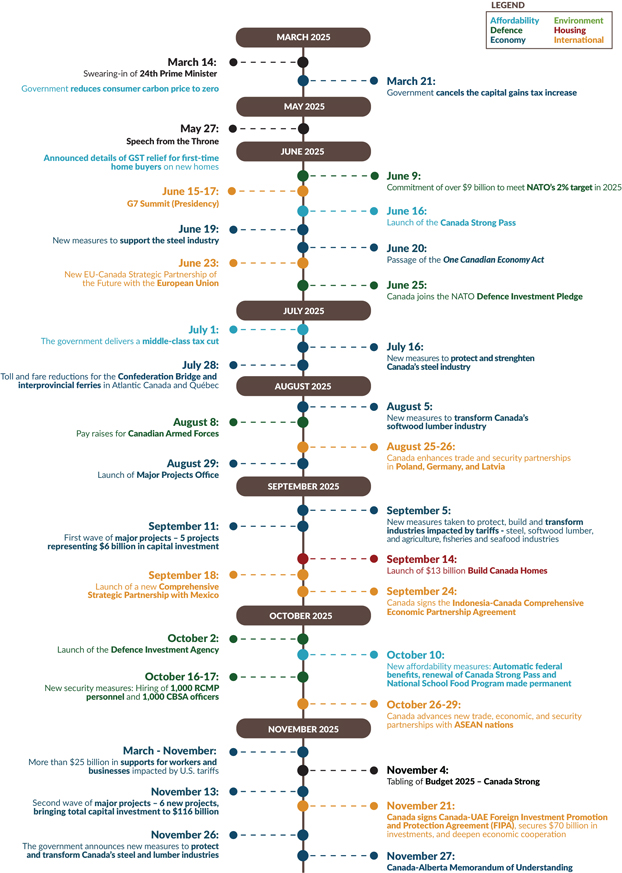
Delivering for Canadians: Progress Since the Spring of 2025
Since the spring of 2025, Canada’s new government has taken decisive action and made targeted investments to deliver results for Canadians.
| INTRODUCTION | 3 |
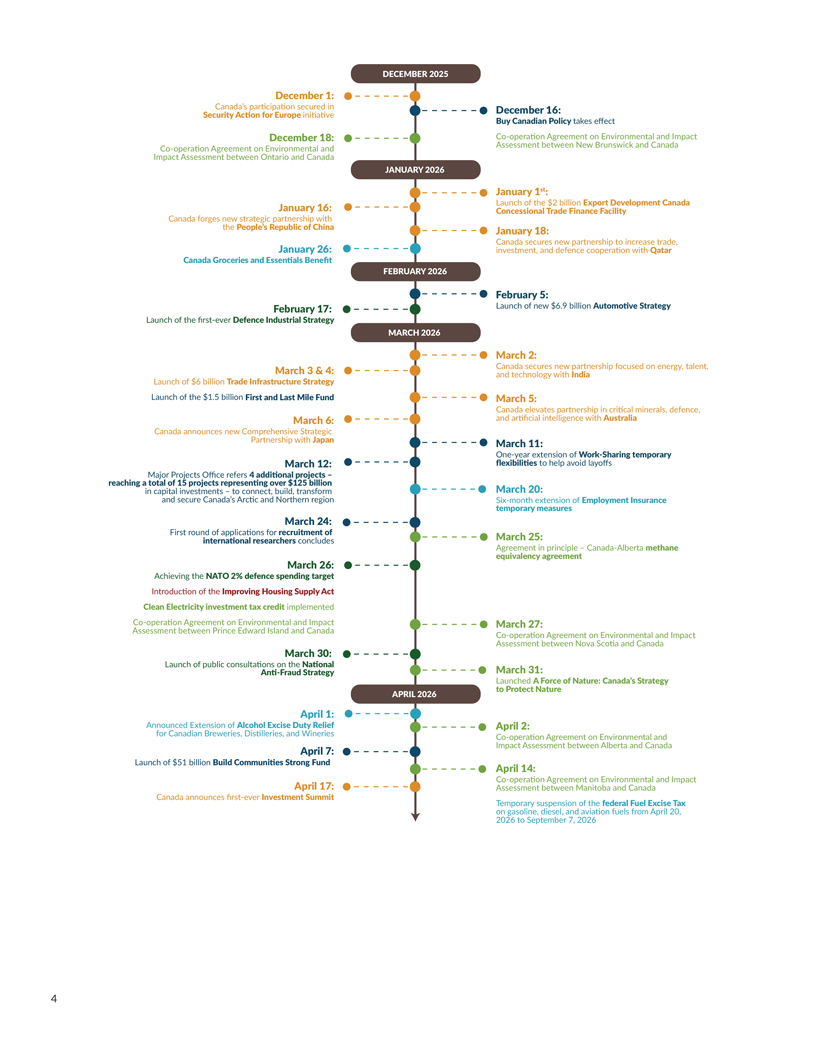
The Spring Economic Update 2026
The Spring Economic Update 2026 maintains Canada’s fiscal strength—while investing for Canadians where it counts to build Canada’s prosperity today and for the next generation. This includes core new investments to invest in Canada’s future, with the good-paying careers that will build a Canada that is affordable, prosperous, and safe.
| INTRODUCTION | 5 |
| In an Uncertain World, Canada Focuses on What it Can Control |
The world is undergoing a series of fundamental shifts at a speed, scope and scale not seen in generations. Over the past two decades, a series of crises in health, energy, finances, and geopolitics have exposed the risks of extreme global integration. Today, the rules-based international order and the trading system that powered Canada’s prosperity for decades are being reshaped.
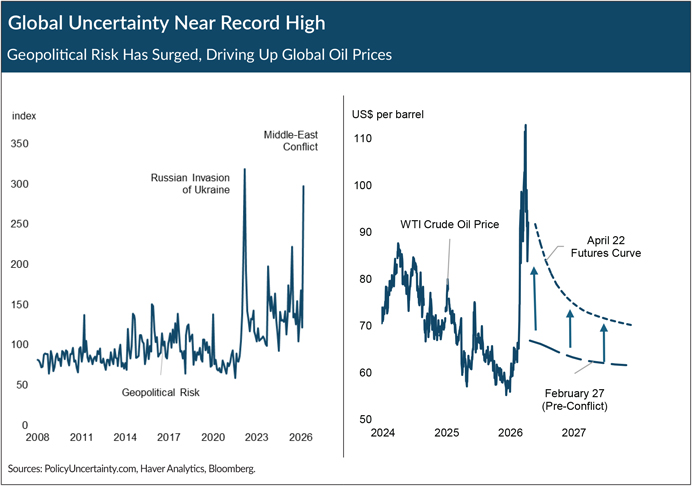
Long-standing supply chains and trade relationships that once supported stable growth, good jobs, and affordable products are being disrupted. Rising geopolitical tensions, including the conflict in the Middle East and escalating trade pressure such as U.S. tariffs, are adding to cost pressures and driving volatility in energy prices and financial markets.
| 6 |
The Canadian Economy Is Resilient
In this more fragmented and unpredictable world, Canada’s approach is clear: we will be principled and pragmatic. We are acting decisively to protect our economic sovereignty, strengthen our strategic industries, and position Canada for long-term growth.
Canada starts from a position of strength. Our economic fundamentals remain among the strongest in the world, supported by:
| ● | Talent: A highly skilled, adaptable, and the most educated workforce in the world. |
| ● | Resources: A vast reserve of critical minerals, a clean and conventional energy superpower, and a strong agri-food industry. |
| ● | Resilience: A strong social safety net and stable institutions. |
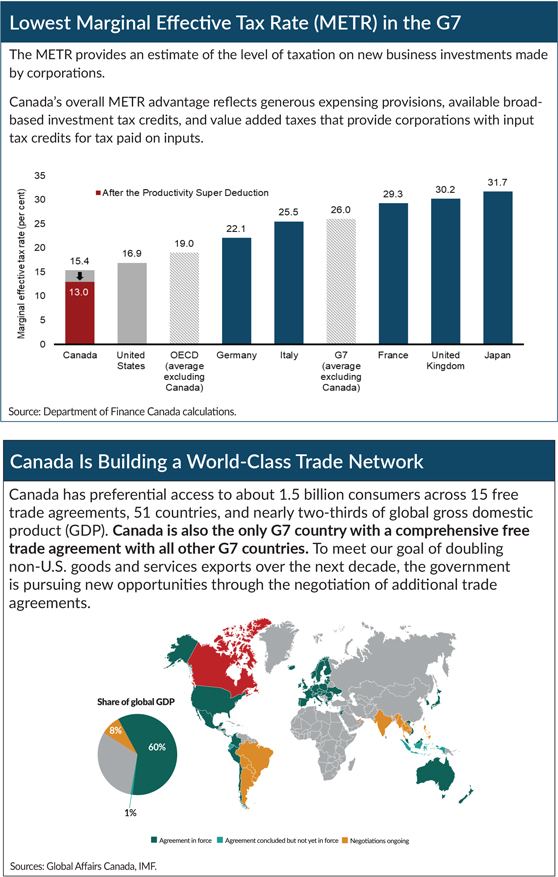
| ● | Market access: The only G7 country with comprehensive free trade agreements with all other G7 countries. |
| ● | Rule of law: A stable and reliable financial system, an independent judiciary, and transparent governments. |
| ● | Investment attractiveness: A favourable environment for investment that attracts global capital, drives growth, and creates high-paying careers. |
| ● | Tax competitiveness: The lowest overall tax burden in the G7 on new business investment. |
| INTRODUCTION | 7 |
Direct Investment Into Canada at a 20-Year High
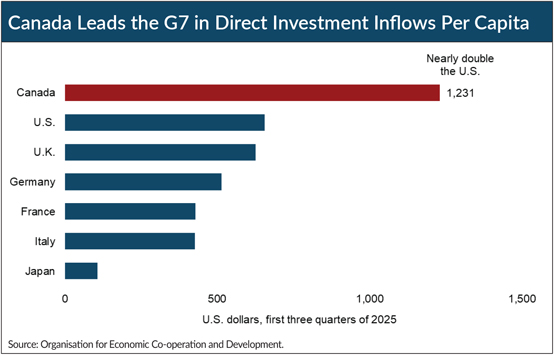
Canada is emerging as a premier destination for global investment:
| ● | Direct investment into Canada is at its highest level in nearly two decades. |
| ● | Canada has secured $97 billion in foreign investment and more than 20 new economic and defence partnerships across four continents in the last year. |
| ● | A network of trade agreements spanning 51 countries and nearly two-thirds of global GDP positions Canada at the centre of a reconfigured global economy. |
Momentum is building at home:
| ● | Canadian institutional investors, including pension funds, are stepping up and working with governments to unlock new opportunities. |
|
Attracting New Investment
The Spring Economic Update proposes to further position Canada as a leading investment destination and a trusted convener of global capital through:
○ Canada’s first Investment Summit in September 2026.
○ A Sustainable Finance conference in the coming year.
|
|
| 8 |
Canada Is the Most Competitive Jurisdiction in the G7 for New Business Investment and Trade
| INTRODUCTION | 9 |
In this environment, Canada is redefining its international, commercial, and security relationships. We must build strength at home, and we must do it while choosing to work with our allies and forging new relationships with trusted partners. We recognise the world as it is, and we choose to adapt to thrive.
| 10 |
Canada Maintains Fiscal Discipline
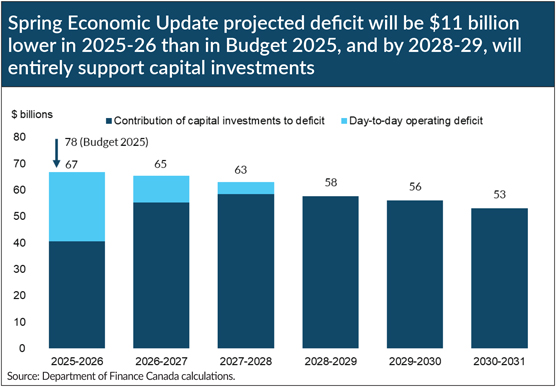
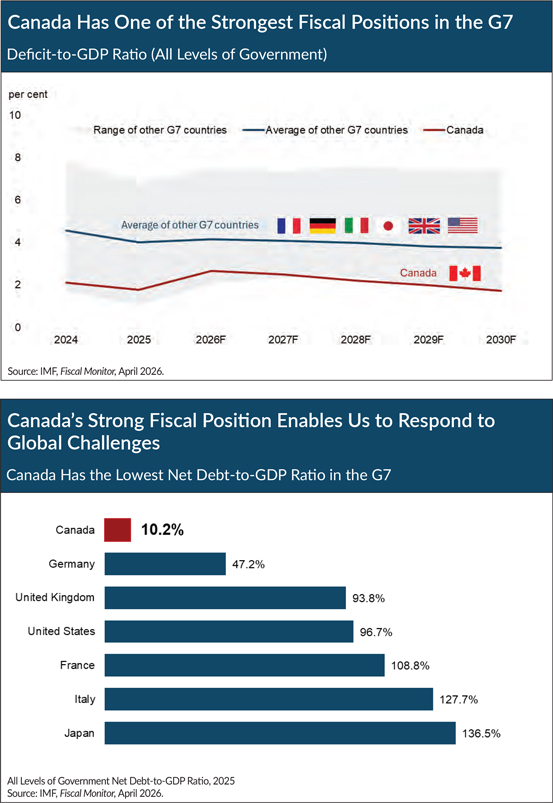
Our focus is clear and disciplined. We are concentrating on what we can control: maintaining fiscal sustainability while making targeted, high-impact investments for Canadians. This means lowering the operating deficit over time, maintaining our fiscal anchors, and ensuring that every dollar spent on behalf of Canadians supports growth, resilience, and improving the well-being of Canadians.
Our government spends less, builds more,
and delivers better–we are investing in Canada’s future.
| 12 |
| Making Life More Affordable for Canadians |
The global landscape is rapidly changing, leaving businesses, workers, and families under a cloud of uncertainty. In response, Canada’s new government is focused on what we control: building a stronger economy to bring down costs for Canadians.
Our plan is moving Canada’s economy from reliance to resilience. We are advancing major projects that connect and transform our nation, turbocharging housing construction, catalysing an entirely new housing industry, and forging new economic and security partnerships. Some of the biggest long-term payoffs of this transformation will take time to be felt. To ensure Canadians have the support they need right now, the government is providing a boost today and a bridge to a better tomorrow.
For over a year, Canada’s new government has been relentlessly focused on making life more affordable for Canadians:
| ● | Nearly 22 million Canadians are keeping more of what they earn, with the middle-class tax cut saving a two-income family up to $840 this year. |
| ● | First-time home buyers are saving up to $50,000, with the removal or reduction of the Goods and Services Tax on new homes. |
| ● | The removal of the consumer carbon price driving gas prices down by about 18 cents per litre across most provinces and territories. |
| ● | Reducing Canadians’ bills at the gas station by up to 10 cents per litre on regular gasoline and 4 cents on diesel by temporarily suspending the federal fuel excise tax. |
| ● | More than 12 million Canadians will receive hundreds of dollars more in their bank accounts through the new Canada Groceries and Essentials Benefit. |
| ● | Canadians are paying less in banking fees, with new rules capping non-sufficient funds fees at $10 and strengthening consumer protections. |
| ● | Enhanced low-cost and no-cost bank accounts to offer all Canadians access to up to 50 per cent more debit transactions at a cost of no more than $4 per month. |
| ● | Young Canadians are gaining opportunities to work and build careers, with 175,000 placements supported in 2026-27 through Canada Summer Jobs, the horizontal Youth Employment and Skills Strategy, and the Student Work Placement Program. |
| ● | Starting automatic federal benefits for the 2026 tax year, with pre-filled returns for up to 5.5 million low-income Canadians by the 2028 tax year, ensures that support reaches those who need it most. |
| ● | Families and young people are travelling and exploring Canada for less, supported by the renewed Canada Strong Pass. |
| ● | Supporting Canadian brewers, distillers and wineries and helping ease cost pressures with extended tax relief. |
| INTRODUCTION | 13 |
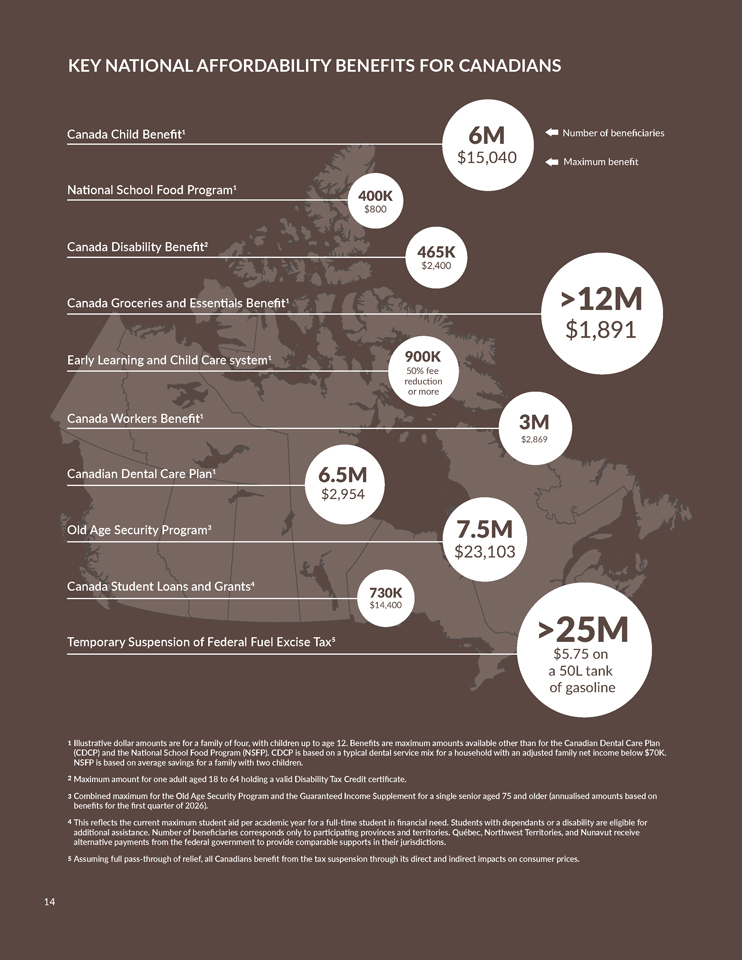
KEY NATIONAL AFFORDABILITY BENEFITS FOR CANADIANS Canada Child Benefit1 6M Number of beneficiaries $15,040 Maximum benefit National School Food Program1 400K $800 Canada Disability Benefit2 465K $2,400 Canada Groceries and Essentials Benefit1 >12M $1,891 Early Learning and Child Care system1 900K reduction 50% fee or more Canada Workers Benefit1 3M $2,869 Canadian Dental Care Plan1 6.5M $2,954 Old Age Security Program3 7.5M $23,103 Canada Student Loans and Grants4 730K $14,400 >25M Temporary Suspension of Federal Fuel Excise Tax5 $5.75 on a 50L tank of gasoline 1Illustrative dollar amounts are for a family of four, with children up to age 12. Benefits are maximum amounts available other than for the Canadian Dental Care Plan (CDCP) and the National School Food Program (NSFP). CDCP is based on a typical dental service mix for a household with an adjusted family net income below $70K. NSFP is based on average savings for a family with two children. 2Maximum amount for one adult aged 18 to 64 holding a valid Disability Tax Credit certificate. 3Combined maximum for the Old Age Security Program and the Guaranteed Income Supplement for a single senior aged 75 and older (annualised amounts based on benefits for the first quarter of 2026). 4This reflects the current maximum student aid per academic year for a full-time student in financial need. Students with dependants or a disability are eligible for additional assistance. Number of beneficiaries corresponds only to participating provinces and territories. Québec, Northwest Territories, and Nunavut receive alternative payments from the federal government to provide comparable supports in their jurisdictions. 5Assuming full pass-through of relief, all Canadians benefit from the tax suspension through its direct and indirect impacts on consumer prices.
Making Groceries and Essentials More Affordable
Our government has introduced new measures to make groceries and other essentials more affordable for Canadians:
| ● | The new Canada Groceries and Essentials Benefit will provide additional, significant support for more than 12 million Canadians. |
| ○ | Formerly the Goods and Services Tax (GST) Credit, we are increasing its amount by 25 per cent for five years as of July 2026. |
| ○ | Combined, this means that a family of four will receive up to $1,890 this year, and about $1,400 a year for the next four years; and a single person will receive up to $950 this year, and about $700 a year for the next four years. |
| ● | An additional $20 million has been provided to the Local Food Infrastructure Fund to ease pressures on food banks, and immediate expensing was announced for greenhouse buildings to support increased domestic supply and investment in food production. |
| ● | We are providing $36 million to address food security and affordability in the North through the Nutrition North Canada Retail Subsidy Program and the Northern Isolated Community Initiatives Fund. |
| ● | We have made the National School Food Program permanent, which will provide up to 400,000 children with meals at school each year, helping families save an average of $800 annually. |
|
June 5 | ||
| As part of the new Canada Groceries and Essentials Benefit, those eligible will receive – as soon as June 5th – a one-time top-up payment equivalent to a 50 per cent increase in the 2025-26 annual value of the GST Credit.
|

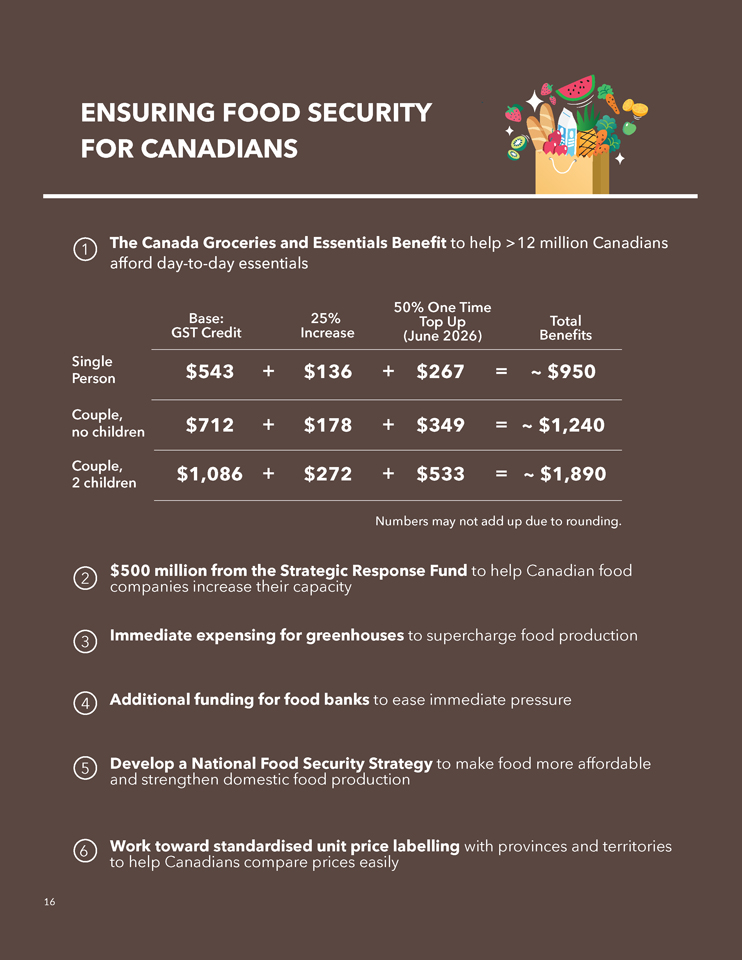
ENSURING FOOD SECURITY FOR CANADIANS 1 The Canada Groceries and Essentials Benefit to help >12 million Canadians afford day-to-day essentials 50% One Time Base: 25% Top Up Total GST Credit Increase (June 2026) Benefits Single + + = Person $543 $136 $267 ~ $950 Couple, + + = no children $712 $178 $349 ~ $1,240 Couple, $1,086 + $272 + $533 = ~ $1,890 2 children Numbers may not add up due to rounding. $500 million from the Strategic Response Fund to help Canadian food 2 companies increase their capacity 3 Immediate expensing for greenhouses to supercharge food production 4 Additional funding for food banks to ease immediate pressure 5 Develop a National Food Security Strategy to make food more affordable and strengthen domestic food production 6 Work toward standardised unit price labelling with provinces and territories to help Canadians compare prices easily
More Competition, Lower Costs
Stronger competition pushes businesses to become more innovative and operate more efficiently. Over time, these productivity gains translate into lower costs, greater choice, and better wages for Canadians. Yet over the past two decades, competitive intensity across the Canadian economy has weakened. Strengthening competition will be essential to delivering sustained affordability gains for Canadians.
At a time when Canadians are facing heightened affordability pressures from sources beyond our control, it is more important than ever that we press harder to find opportunities for improvement within our control. To strengthen productivity and improve affordability, the Spring Economic Update 2026 launches a new Whole-of-Government Competition Plan that will take a focused and coordinated approach to ensure that competition is prioritised throughout the federal government’s policies.
The government is focusing on lower mobile and Internet plan prices by building on the 2023 direction to the Canadian Radio-television and Telecommunications Commission (CRTC) that places stronger emphasis on competition, affordability, and consumer interests with a decision to uphold a CRTC ruling on third-party access to fibre infrastructure in August 2025. The government is also implementing a Telecommunications Competition Roadmap outlining actions to improve consumer choice, pricing, and availability of services.
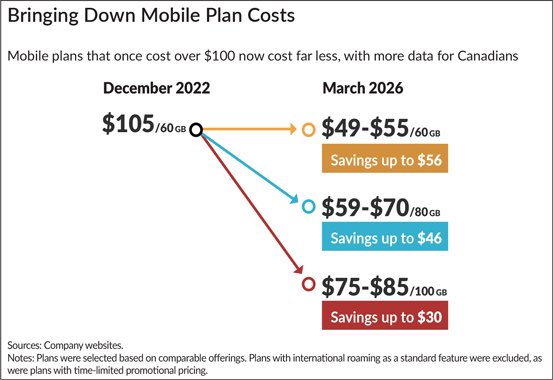
Competition only works when government ensures markets work. Continued decisive action is needed to strengthen competition and ensure the economy operates at its best, including:
| ü | Advancing the Whole-of-Government Competition Plan to ensure government policies prioritise competition |
| ü | Providing more choices and more affordable financial services through consumer-driven banking and low-cost accounts |
| ü | Making it easier to renew or switch between home Internet, home phone, and cell phone plans |
| INTRODUCTION | 17 |
| An Economy Built for all Canadians |
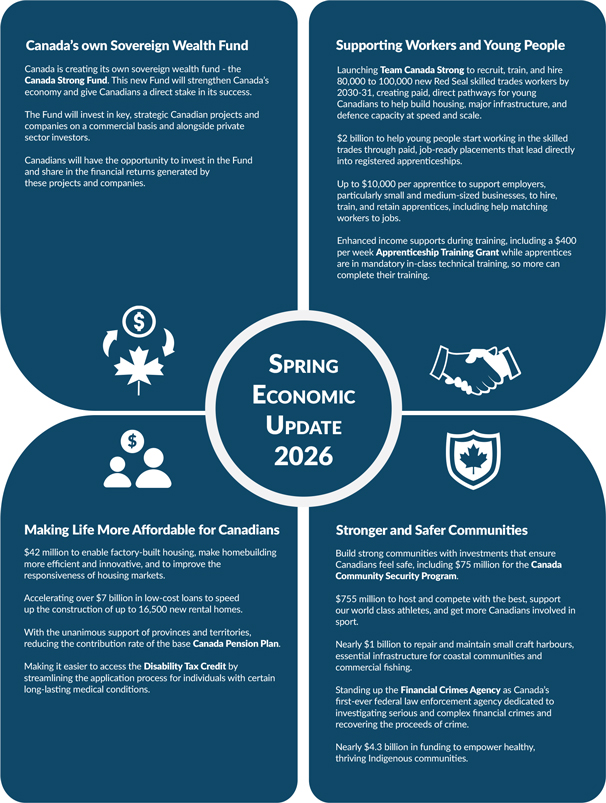
As Canadians build the strongest economy in the G7, we know that some of the biggest payoffs in our plan will take time. That’s why Canada’s new government is standing with Canadians through uncertain and rapidly changing times, acting responsibly to provide support today, and making smart, long-term investments that strengthen Canada’s economy. This means creating the mechanisms to ensure Canadians thrive today and tomorrow, supporting workers and young people, supercharging the housing sector, combatting financial crimes, and investing in strong communities.
Spring Economic Update 2026 introduces a number of flagship measures:
| ● | Introducing Canada’s Own Sovereign Wealth Fund–the new Canada Strong Fund |
| ● | Launching Team Canada Strong to recruit, train, and hire 80,000 to 100,000 new Red Seal skilled trades workers by 2030-31, aligned to Canada’s housing, infrastructure, and defence needs |
| ● | Making life more affordable for Canadians |
| ● | Building stronger and safer communities |
|
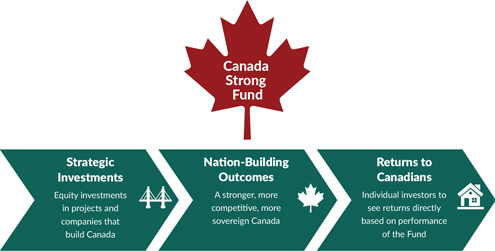
Canada will establish its own sovereign wealth fund: Canada Strong Fund
The Canada Strong Fund is a new national investment initiative designed to strengthen Canada’s economy and give Canadians a direct stake in its success.
The Fund will invest in key, strategic Canadian projects and companies, creating jobs, supporting innovation, and helping Canada stay competitive in a rapidly changing world.
Canadians will have the opportunity to invest in the Fund and share in the financial returns generated by these projects.
This is about building a stronger, more independent Canada where everyone can take part and benefit.
|
In a more uncertain world, Canada offers stability. In a more divided world,
Canada forges partnerships. And in a more competitive world,
Canada invests decisively in its future.
| 18 |
|
Supporting Workers and Young People
Canada’s future depends on the people building it. That’s why the Spring Economic Update 2026 is focused on helping workers and young people gain the skills, experience, and support they need to succeed.
We’re making it easier to learn, train, and find meaningful opportunities:
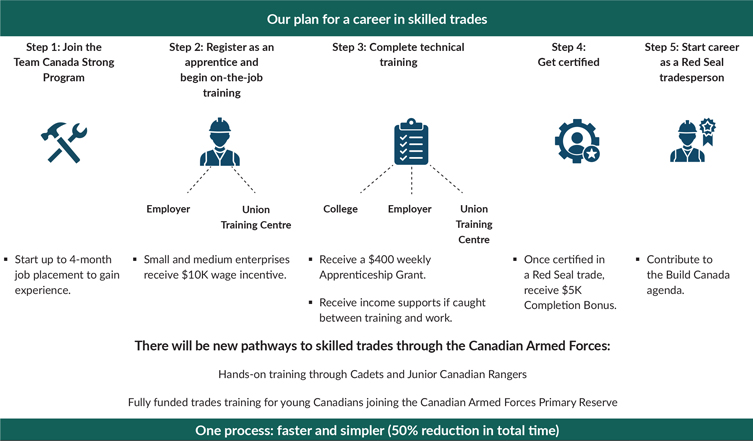
● Creating new opportunities for young Canadians Launching Team Canada Strong to recruit, train, and hire 80,000 to 100,000 new Red Seal skilled trades workers by 2030-31, aligned to Canada’s housing, infrastructure, and defence needs.
● Expanding training capacity to deliver results at scale Modernizing and increasing apprenticeship and Red Seal training capacity, working with unions, employers, provinces and territories, and national institutions to shorten timelines and improve outcomes.
● Removing financial barriers during apprenticeship training Introduce a new and redesigned Apprenticeship Grant that will provide apprentices with a weekly income top-up of $400 per week while they are attending mandatory in-class technical training for a total payment of up to $16,000 per apprentice, paid in addition to Employment Insurance.
● Making education more affordable Extend for the 2026-27 academic year the increases to Canada Student Grants and interest-free Canada Student Loans—571,000 students are expected to benefit from the increase to non-repayable grants, and 422,000 students could benefit from the weekly loan limit increase.
● Helping tradespeople go where the work is Enhancing the Labour Mobility Deduction will make it more affordable for skilled workers to travel to where jobs are available.
● Encouraging shared ownership Making the Employee Ownership Trust tax exemption permanent will help more workers share in the success of the businesses they help build.
|
| INTRODUCTION | 19 |
|
Making Life More Affordable for Canadians
Finding a place to live shouldn’t feel out of reach. The Spring Economic Update 2026 builds on Build Canada Homes with a plan to increase supply, lower costs, and help more Canadians find a safe, affordable home.
We’re taking action to build more homes, faster and smarter:
● Cutting red tape to build homes faster Streamlining rules and modernising building codes will make it easier to construct new homes, including factory-built and modular housing.
● Supporting innovation in construction Investing in new building technologies will help reduce costs and speed up construction.
● Accelerating over $7 billion in low-cost financing to the Canada Mortgage and Housing Corporation More affordable financing will help builders move projects forward sooner—getting rental homes on the market faster.
● Helping those most in need Extending support for people experiencing homelessness and ensuring survivors of gender-based violence have access to safe housing.
● Boosting housing supply across Canada Through the Improving Housing Supply Act, $1.7 billion will go to provinces and territories to remove barriers and accelerate homebuilding, including reducing development fees and levies on new home construction.
● Improving cash flows for home buyers Extending the grace period during which homeowners are not required to start repaying their Home Buyers’ Plan withdrawals from their Registered Retirement Savings Plan.
● Reducing the contribution rate of the base Canada Pension Plan With the unanimous support of provinces and territories.
● Making it easier to access the Disability Tax Credit Streamlining the application process for individuals with certain long-lasting medical conditions.
|
An Economy Built by Canadians
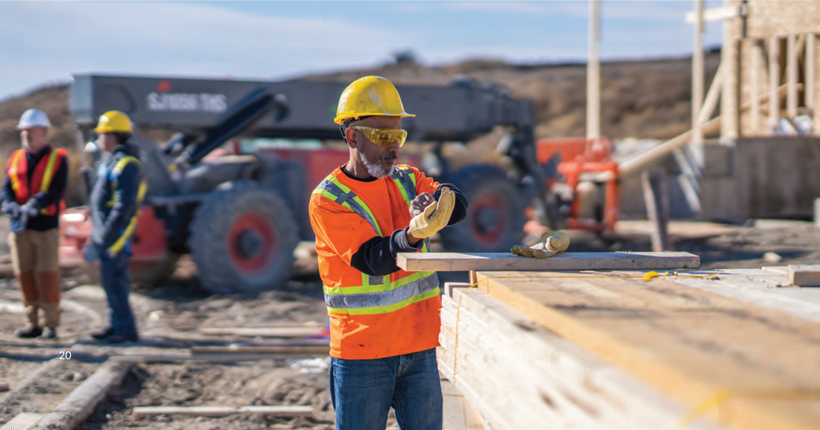
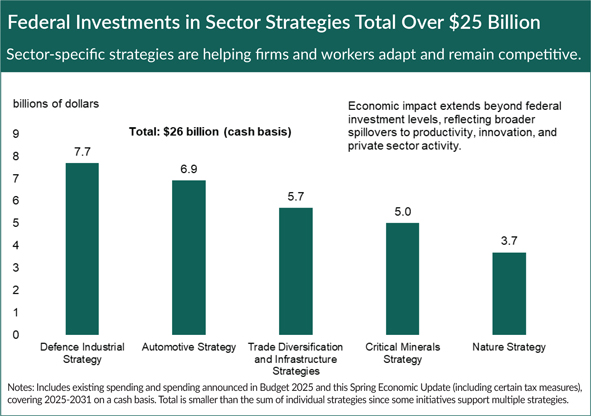
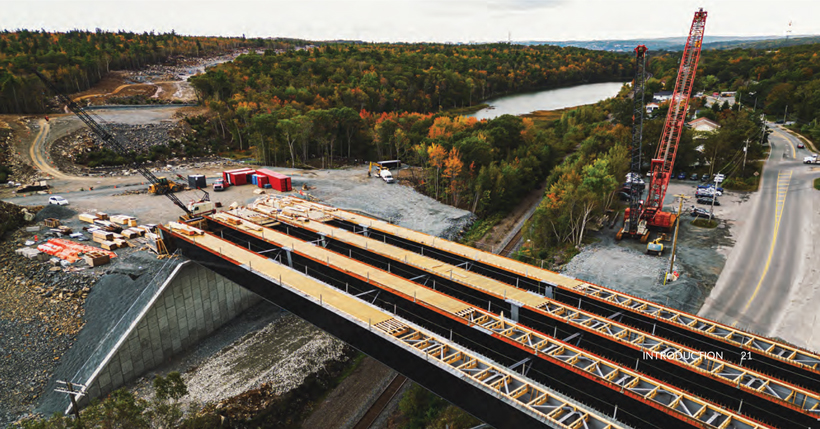
Budget 2025 is translating our vision into real action through major projects, less red tape, and generational infrastructure investments that move goods to market. The Spring Economic Update 2026 builds on this momentum with strategic investments that support productivity, growth, and competitiveness.
|
First Announced in Budget 2025
| ||
| Trade Diversification and Infrastructure Strategies | ||

|
To ensure Canadian businesses can expand and double our exports to non-U.S. markets over the next decade, we are providing direct support to exporters, opening access to new markets, and modernising trade-enabling transportation systems and infrastructure.
In order to support trade diversification, the government is examining options to strengthen Canada’s supply chains—backed by signing 20 new deals on four continents. | |
| Critical Minerals Strategy | ||

|
To grow Canada’s critical minerals industry, we are promoting domestic production and processing of critical minerals, safeguarding critical minerals value chains for our economic sovereignty, and partnering with Indigenous groups, domestic stakeholders and international allies. Canada has a broad suite of financing tools in place to support this strategically important sector, and initiatives under the Critical Minerals Strategy, including dozens of new partnerships and investments mobilising $18.5 billion in projects across the country – with the Canada-led G7 Critical Minerals Production Alliance. The government has referred five critical minerals projects to the Major Projects Office as part of the two waves of nation building project announcements, such as Nouveau Monde Graphite’s Matawinie Mine in Québec and the McIlvenna Bay Foran Copper Mine Project in Saskatchewan. | |
| Defence Industrial Strategy | ||

|
To build Canada’s defence manufacturing and technology base, we are prioritising Canadian suppliers and materials in defence procurement, investing in Canadian defence innovation and commercialisation, and streamlining procurement.
We are positioning Canadian industry to take advantage of the government’s generational investments in defence, creating significant economic benefits for years to come—including 125,000 high-paying careers and support an estimated $180 billion total direct investment in in defence procurement by 2035. This will strengthen military supply chains, create good careers at home, and equip the Canadian Armed Forces with the capabilities they need to protect Canada and our Allies. | |
|
Since Budget 2025
| ||
| Automotive Strategy | ||

|
To strengthen Canada’s auto manufacturing sector and protect over 500,000 workers, we are boosting investment, strengthening our climate goals, making electric vehicles more affordable and reliable, and protecting Canadian auto workers.
In response to persisting and unjustified U.S. tariffs on Canadian-made vehicles, we will maintain our reciprocal counter-tariffs and explore ways to leverage Canada’s automotive duty remission framework to reinforce domestic production, attract new investment and enhance the sector’s long-term competitiveness. We will also seek ways to attract new investment, including by leveraging the recent arrangement on electric vehicles with China. | |
| Nature Strategy | ||

|
To build the clean and competitive economy of tomorrow, we are making significant investments through the Nature Strategy to help conserve 30 per cent of Canada’s lands and waters by 2030, ensure our industrial strategies complement our conservation efforts, and advance actions to value and mobilise capital for nature. | |
| 22 |
| Building Stronger and Safer Communities |
|
Empowering Canadians
Strong communities are the foundation of a strong Canada. The Spring Economic Update 2026 invests in the services and supports that keep communities safe, welcoming, and resilient—so Canadians can stay informed, access essential services delivered in both official languages, and thrive where they live.
Key actions include:
● Supporting trusted, independent journalism Extending the Canadian Journalism Labour Tax Credit to help sustain high-quality local news and keep Canadians informed.
● Investing in Indigenous communities Providing significant funding for essential services, including health benefits and culturally relevant education, to support stronger, healthier communities.
● Investing in sport—from playground to podium Investing $755 million to expand access to sport, creating opportunities for Canadians to build meaningful relationships within their communities, making full use of existing and new infrastructure, and to support Canada’s world class athletes who inspire pride and unity, as we celebrate their accomplishments as a nation.
● Protecting coastal livelihoods Investing nearly $1 billion to repair and maintain small craft harbours—supporting jobs, local economies, and the future of coastal communities.
● Making it easier to access the Disability Tax Credit Streamlining the application process for individuals with certain long-lasting medical conditions and expanding the list of medical practitioners who can certify eligibility for the Disability Tax Credit will help ensure that Canadians with severe disabilities have access to the supports they need, including under the Canada Disability Benefit. |

|
Protecting Communities
Too many Canadians—especially seniors and vulnerable people—are being targeted by scams and financial crime. The Spring Economic Update 2026 takes stronger action to protect people, crack down on criminals, and keep Canadians’ money safe:
● Establish the Financial Crimes Agency as a best-in-class law enforcement agency with the personnel, resources, mandate, and legislative tools needed to tackle sophisticated financial crimes and recover illicit proceeds.
● Protect Canadians by cracking down on the criminal abuse of money services businesses for money laundering, terrorist financing, sanctions evasion, and fraud through stronger regulations, new enforcement powers, and a ban on crypto ATMs.
● Advance the National Anti-Fraud Strategy, with a public consultation launched in March 2026, by seeking feedback on the introduction of a multi-sector anti-fraud framework across the financial and telecommunications sectors, and digital platforms, alongside measures to strengthen public awareness of fraud and support law enforcement efforts to combat fraud.
● Help keep communities safe and inclusive Investing in the programs and services that ensure Canadians feel safe, supported, and able to fully participate in community life.
|
Build in Canada. Invest in Canada. Choose Canada. Buy Canadian.
Because what we build belongs to you,
your children, and your country.
| 24 |
Economic and Fiscal Overview
A Resilient Economy Supporting Improved Fiscal Outcomes
The global economy is more than a year into a profound rupture. Economic security, industrial policy, and geopolitical competition are increasingly shaping investment, trade, and financial decisions. The recent conflict in the Middle East—which has disrupted key shipping routes and damaged energy infrastructure—has pushed energy prices higher, underscoring the fragility of global supply chains, and adding to already elevated uncertainty.
Despite this environment, Canada’s economy continued to expand, growing by 1.7 per cent in 2025. The economy avoided a recession and domestic activity remained solid, even as tariff increases and trade tensions weighed on activity. North American supply chains withstood disruptions more effectively than expected, with the Canada-U.S.-Mexico Agreement (CUSMA) protecting approximately 85 per cent of Canadian goods exports from recent U.S. measures.
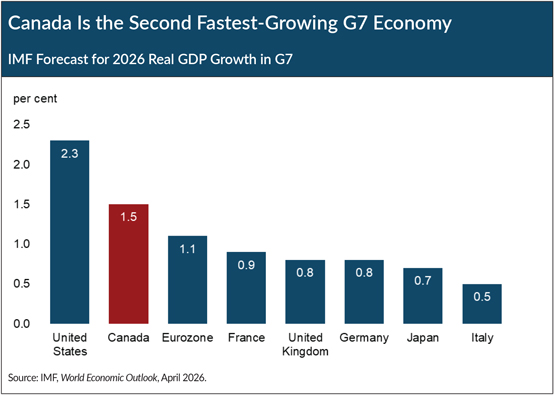
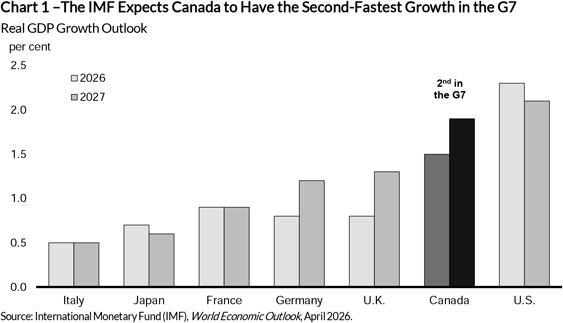
Businesses and workers have shown remarkable resilience in the face of significant uncertainty. Business sentiment has recovered and firms are diversifying suppliers and markets. Canada also continues to attract significant global capital—leading the G7 in per capita direct investment inflows—and the Statistics Canada survey of planned capital expenditures for 2026 indicates that businesses plan to step up capital spending this year. Reflecting this adaptability, the International Monetary Fund (IMF) expects Canada to post the second-fastest growth in the G7 over 2026 and 2027 (Chart 1).
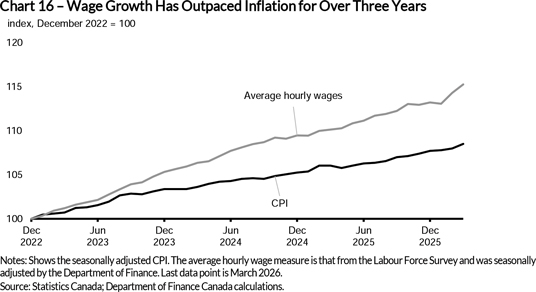
Labour market conditions have remained resilient. Since the start of 2025, Canada has added nearly three times as many jobs per capita (3.4 per 1,000 of population) as the U.S. (1.2 per 1,000). The majority of those jobs have been in the private sector. The unemployment rate peaked in September 2025 at 7.1 per cent, before falling to 6.7 per cent as of March—below private sector expectations at the time of Budget 2025. Wage growth has now outpaced inflation for more than three consecutive years, supporting continued gains in real incomes.
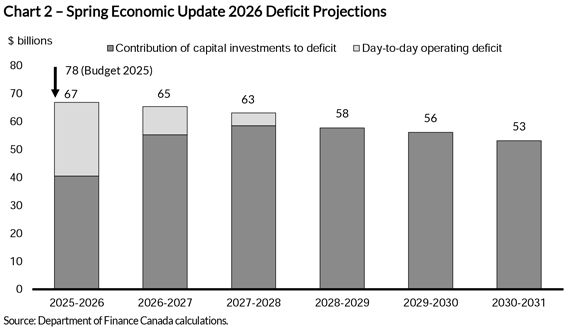
From a fiscal perspective, economic resilience, bolstered by government policies to respond to immediate challenges through temporary supports, is delivering an $11.5 billion improvement in the projected 2025–26 budgetary balance (Chart 2). This strength carries into future years, improving the budgetary balance, relative to Budget 2025, by an average of $10.7 billion per year from 2026-27 to 2029-30 before new measures. The government is deploying this fiscal uplift to improve affordability and raise Canadians’ standard of living through targeted and responsible policy measures, particularly in the areas of fuel, food, and housing affordability.
| INTRODUCTION | 25 |
At the same time, U.S. trade actions have imposed economic costs and continue to reshape the Canadian economy. While goods exports have begun to recover and trade diversification efforts continue to advance, the impact of sustained U.S. trade measures could be long-lasting. In addition, the conflict in the Middle East and an adverse oil supply shock translating into higher oil prices have mixed effects for Canada’s economy: supporting energy incomes and government revenues, while raising costs for households, businesses, and governments, and adding to near-term uncertainty. Overall, private sector forecasters expect real GDP growth of 1.1 per cent in 2026 and 1.9 per cent in 2027, marginally lower compared to projections in Budget 2025.
Against this backdrop, continued momentum in implementing Budget 2025 initiatives to build economic strength and resilience remains essential—not only to shore up strength today, but to address deeper structural challenges and build resilience for tomorrow.
Global Context
The Middle East Conflict Will Slow Global Growth
The conflict in the Middle East is adding to an already fragile global economic environment. While the magnitude of the impact will depend on how long these disruptions persist, the conflict has raised uncertainty and heightened risks to global growth and inflation. These developments are occurring at a time when global trade and investment are already adjusting to a more fragmented and uncertain environment.
The region plays a critical role in global energy supply and maritime trade. Tanker traffic through the Strait of Hormuz—a critical route carrying about 20 per cent of global oil and liquefied natural gas shipments—has been severely disrupted. Along with damage to some energy infrastructure and concerns about further damage or production shut-ins, this has pushed crude oil and natural gas prices higher and increased volatility across energy markets. Beyond crude oil and natural gas, other products most exposed to disrupted shipping include refined fuels, petrochemical feedstocks, and fertilizer inputs.
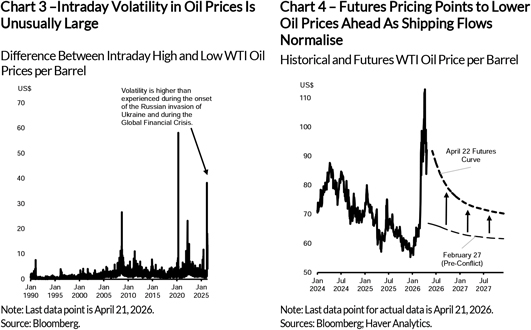
Commodity prices have risen, driven in large part by higher oil prices. West Texas Intermediate (WTI) crude oil prices have become extremely volatile, with large intraday swings as markets have repeatedly repriced oil risk in response to rapidly changing signals on military escalation, ceasefire prospects, and the status of shipping through the Strait of Hormuz (Chart 3). Since the conflict began, WTI has traded in an unusually wide range, swinging between US$80 per barrel and near US$120 within weeks. As of April 22nd, it was trading close to US$90—still up over 30 per cent from roughly US$67 prior to the conflict (Chart 4).
| 26 |
Limited capacity to re-route exports has led some Gulf producers to curtail production, while attacks on regional infrastructure have amplified market uncertainty. Current oil futures curves point to prices easing over the second half of 2026 and reaching about US$75 by year-end (Chart 4) as crude oil exports through the Strait of Hormuz gradually resume. As a result, oil prices are still expected to average about US$80 for the year as a whole, roughly US$15 higher than expected in Budget 2025. While longer-term price expectations remain more anchored, near-term oil pricing continues to reflect a substantial geopolitical risk premium that is likely to persist until shipping flows normalise and uncertainty is resolved.
Spillovers from transportation bottlenecks are also evident in other commodity markets: aluminum and fertilizer prices have increased. Reassuringly, despite some upside pressure from higher fertilizer costs linked to supply disruptions in the Middle East, global food commodity prices have increased only modestly so far. This largely reflects strong global inventories, continued export flows from major producers, and limited near-term pass-through from higher fertilizer and fuel costs. However, if energy and input prices remain elevated for a prolonged period or shipping disruptions intensify, cost increases for businesses could be passed along supplychains.
Financial conditions have tightened modestly from previously supportive levels due to the conflict in the Middle East. Bond yields have risen as investors reassess inflation and interest-rate risks, and equity markets have come under some pressure, particularly in countries and sectors more exposed to higher energy prices. These developments build on higher long-term interest rates across advanced economies, reflecting rising term premia amid elevated borrowing needs, higher defence spending, and ongoing monetary policy adjustments.
After weakening for much of 2025, the U.S. dollar strengthened against most currencies globally as the conflict in the Middle East unfolded and investors sought to de-risk portfolios. The Canadian dollar weakened slightly against the U.S. dollar during this period, though it has appreciated against other currencies, benefitting from higher commodity prices. The U.S. dollar has since pared most of those gains, as the conflict de-escalated.
Global Growth Resilient Amid Geopolitical and Trade Pressures
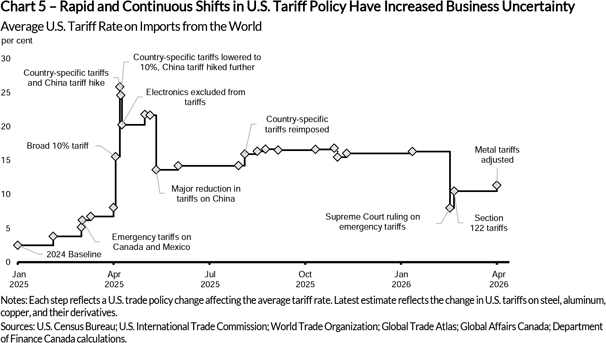
The conflict in the Middle East is a new source of uncertainty, compounding existing risks from U.S. tariffs and trade tensions. The global trading system has undergone lasting change, with U.S. tariffs expected to remain elevated (Chart 5). Tariffs and ongoing trade policy uncertainty continue to weigh on global economic activity and put upward pressure on prices. Evidence indicates that U.S. businesses and consumers are absorbing most of the tariff costs, although the pass-through to inflation appears to have peaked.
| INTRODUCTION | 27 |
Despite these pressures, global GDP growth has remained relatively firm, supported by strong artificial intelligence (AI)-related investment, continued fiscal support, and resilient labour markets. Most major central banks eased monetary policy in 2025, though the pace of cuts slowed as economic activity remained firmer than expected and inflation moderated only gradually.
IMF analysis in its latest World Economic Outlook (April 2026) suggests that the global energy shock associated with the Middle East conflict is already pushing inflation higher across major economies and will weigh on global growth. Under a relatively short-lived conflict, global GDP growth is expected to ease to 3.1 per cent in 2026, whereas it would have been projected at 3.4 per cent absent the conflict. Growth is projected to edge up to 3.2 per cent in 2027, as the dampening effects of higher energy costs offset tailwinds from technology investment, lower U.S. tariff rates, and continued fiscal support.
Risks remain significant and skewed to the downside. U.S. growth has become increasingly concentrated in a narrow set of technology-driven sectors. If expected productivity gains from recent investment fail to materialise, a repricing of related equities could amplify downside risks through tighter financial conditions and weaker confidence. More broadly, persistent disruptions in the Middle East could further elevate energy and commodity prices, add to inflation, weigh on growth, and increase financial market volatility. The IMF estimates that global GDP growth in 2026 could be reduced to 2.5 per cent if higher oil prices were to persist into 2027, or even to 2 per cent—approaching a global recession—under a severe scenario where price pressures spill over beyond energy markets and broaden overall cost pressures.
Canada’s Economy Amid Higher Oil Prices
As a net energy exporter with limited exposure to trade through the Strait of Hormuz, the Canadian economy is more insulated from the impacts of the conflict than other countries. Higher crude oil prices improve Canada’s terms of trade—the ratio of export prices to import prices—raising energy-sector profits and potentially supporting investment and employment, while also increasing government revenues (see the Economic Scenario Analysis section and the box entitled “Economic and Fiscal Impact Sensitivity to Higher Oil Prices” in Annex 1). While higher oil prices have historically been associated with increased investment in the energy sector, temporary supply-driven price increases are less likely to generate a sustained investment response, particularly when uncertainty is elevated.
At the same time, the net impact on real GDP is expected to be uneven across sectors and regions. Higher energy prices create hardship for many households, reducing purchasing power, and raising costs for businesses. Retail gasoline and diesel prices, for example, had risen by about 35 per cent and 43 per cent, respectively, at their peaks in early April. To help Canadians and businesses manage these pressures, the government introduced a temporary
| 28 |
suspension of the federal fuel excise tax on gasoline, diesel, and aviation fuels. Following this implementation on April 20th, retail gasoline prices declined by roughly 12 cents per litre and diesel prices by about 16 cents per litre, even as global oil prices continue to fluctuate. By contrast, gasoline prices in the U.S. were unchanged over the same period. These declines indicate that the savings have been passed through to consumers.
Combined with tighter global financial conditions and fragile confidence, fuel price pressures could weigh on domestic demand if the conflict persists. While the impact from higher oil prices on economic activity in Canada is expected to be modest, elevated uncertainty stemming from the conflict, alongside an economy already operating below its productivity capacity, points to risks that are tilted to the downside.
Consumer Price Index (CPI) inflation picked up in March, reflecting higher gasoline prices. If the oil price increase proves temporary, as expected by markets, inflation could return to the 2 per cent target by the end of this year. If oil prices increase further and persist at high levels, higher energy costs could spill into other goods, prolonging affordability challenges for everyday essentials like food, where inflation continues to be elevated. With the economy operating below its capacity and core inflation easing, spillovers to other prices could be more contained. Nonetheless, continued price pressures across everyday essentials underscore the importance of the government’s multi-pronged approach to help Canadians manage cost pressures, including through targeted relief to low- and modest-income households.
To help support prudent planning amid uncertainty, the Spring Economic Update 2026 illustrates the economic implications of two scenarios relative to the March 2026 private sector survey results. A more optimistic scenario assumes a stronger investment outlook, as higher oil prices drive up national income and ongoing geopolitical instability reinforces global demand for Canadian energy, reflecting Canada’s role as a stable and reliable supplier to global markets. A more pessimistic scenario assumes that damage to critical energy infrastructure and broader supply disruptions lead to higher global inflation, tighter global financial conditions and lower global demand, leading to more cost pressures and a weaker growth outlook in Canada. Further details of these scenarios can be found in the Economic Scenario Analysis section of this Overview.
What This Means for You
The global economy is becoming more uncertain, but Canada is starting from a position of strength. Events like new tariffs, trade tensions and conflicts abroad continue to affect costs for households and businesses, as well as economic activity at home. But Canada is well positioned to manage these pressures, thanks to our robust economy and a clear growth strategy—focused on driving investment, boosting productivity, strengthening domestic industries, and expanding access to global markets. The government is focused on helping Canadians navigate this uncertainty and the effects on affordability while building a stronger, more resilient economy for the future.
Canadian Economic Context
Canada’s Economy Outperforming in the Face of Tariffs
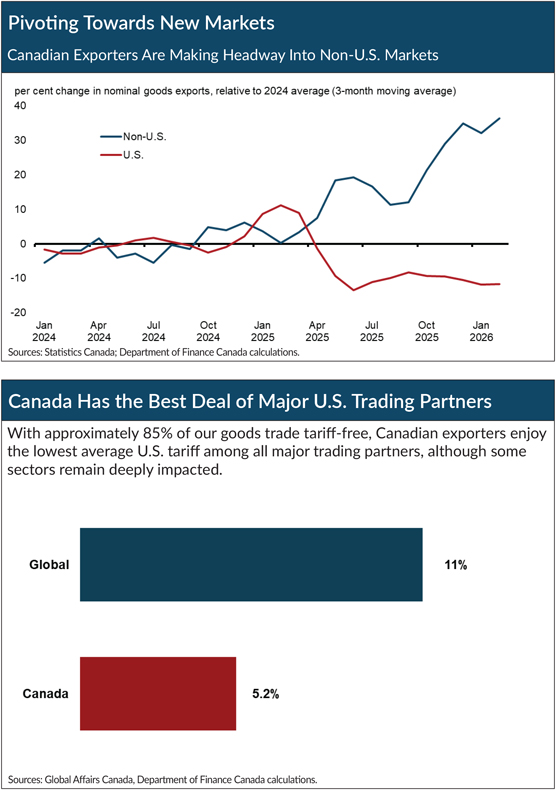
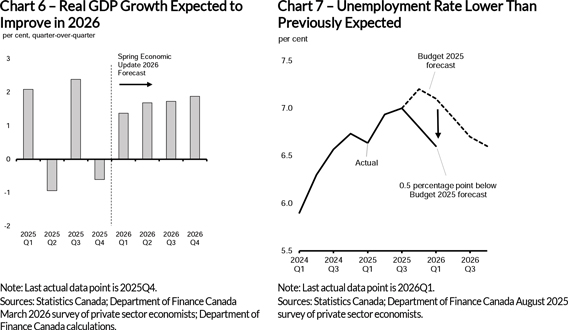
The Canadian economy has shown resilience in the face of significant trade tensions and geopolitical uncertainty. Domestic demand remained resilient and the economy avoided the recession many had predicted in early 2025. Spillovers were limited as consumer spending held up, job losses were contained, while global activity and new transportation infrastructure supported Canada’s natural resource sectors. At the same time, Canada continues to enjoy the lowest average tariff rate among all major U.S. partners, at 5.2 per cent. While activity softened over the course of 2025, a recession was avoided and growth is expected to pick up in 2026 (Chart 6). Notably, Canada’s growth in 2025 was still the second highest of the G7.
U.S. tariffs contributed to declines in Canadian goods exports, a pullback in business investment, and job losses in tariff-exposed sectors. These pressures contributed to volatility in quarterly real GDP. Growth swung from a 2.4 per cent (annualised) gain in the third quarter to a 0.6 per cent contraction in the fourth. The fourth-quarter decline masks firmer domestic momentum, supported by solid consumer spending and renewed business investment.
| INTRODUCTION | 29 |
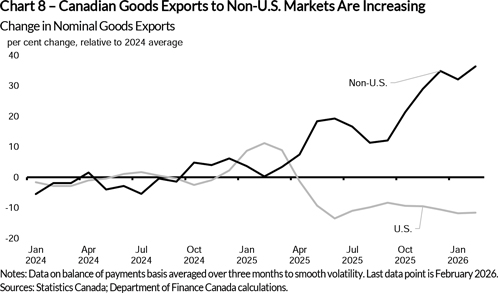
Goods exports remain below pre-tariff levels but are gradually recovering as firms adjust and energy export capacity expands (see Canadian Exports Are Recovering section and boxes). Household spending held up in 2025, with consumption rising 2.3 per cent—up slightly from the pace of the last two years. Trade diversification efforts are bearing fruit, with non-U.S. goods exports up by roughly 36 per cent since 2024.
Overall, real GDP grew 1.7 per cent in 2025, just below the pace of the previous two years, and the unemployment rate fell to 6.7 per cent in March, below private sector expectations in Budget 2025 (Chart 7). On a per capita basis, real GDP grew by 0.6 per cent in 2025 after declining in both 2023 and 2024. Trade policy uncertainty continues to weigh on exports and business investment. Past interest rate cuts and ongoing infrastructure investment are supporting domestic demand, with private sector economists expecting growth to improve and reach about 2 per cent by year-end.
Canadian Exports Are Recovering
The shift in the global trade landscape and higher tariffs have left Canadian real exports about 2 per cent below their 2024 level. However, the impact has been less severe than initially expected, supported in part by firms’ use of CUSMA exemptions and early diversification efforts (see box).
As firms adapt, exports have begun to stabilise. Real goods exports rose about 6.5 per cent (annualised) in the second half of 2025, driven mainly by gains in non-tariff-exposed sectors such as energy and consumer goods. Early signs of export diversification to non-U.S. destinations are also rising and Canada is making progress towards doubling its total non-U.S. exports (Chart 8).
Trade adjustment remains uneven. Exports in tariff-exposed sectors declined in the fourth quarter after briefly stabilising, reflecting continued pressures. Shipments have been more resilient where higher pricing, domestic sales, or sales to non-U.S. markets have helped offset tariff impacts. The government has introduced a suite of targeted measures, which are helping to mitigate costs for many affected firms.
Infrastructure investments are also strengthening export capacity (see box).
| 30 |
| Canadian Businesses Are Adapting to a Changing Trade Environment
Canadian goods exporters experienced a significant drop in demand following the imposition of U.S. tariffs, and adjustments will take time. Early evidence, however, indicates that firms are actively repositioning.
● Sales to non-U.S. markets are rising (Chart 8). In Export Development Canada’s March 2026 survey, 65 per cent of exporters reported plans to enter new markets in the next two years.
● Supply chains are being reconfigured. Many firms are sourcing inputs from non-U.S. markets to avoid the effect of tariffs, leading to higher imports from non-U.S. suppliers (Chart 9).
● Technology adoption is accelerating. Statistics Canada’s Canadian Survey on Business Conditions shows a growing share of manufacturers adopting AI and other advanced technologies to improve efficiency.
Firms are also adjusting pricing, sourcing, and production to mitigate tariff-related cost pressures. Early signs of adaptation are visible in tariff-exposed sectors: steel producers have increased domestic sales, while aluminum producers have benefited from stronger pricing and initial success diversifying beyond the United States.
More broadly, signs of diversification are emerging. While part of the recent strength in exports reflects strong gold exports, where surging global demand has lifted both prices and volumes, gains are also visible across several sectors, including aircraft and consumer goods and electronics (Chart 10).
Some of the expansion into new markets reflects areas where Canada is already globally competitive—such as some manufactured food and beverages, and non-automobile transportation equipment. Diversification remains more limited in the most tariff-exposed industries, including steel, softwood lumber, and motor vehicles and parts, which are deeply embedded in integrated North American production networks. In these sectors, Buy Canadian policies continue to be vital in sustaining good jobs.
Budget 2025 signaled the government’s intention to double combined goods and services exports to non-U.S. markets over the next decade. Progress towards this objective is underway, with overseas exports increasing along the implied path required to reach the 2035 target: non-U.S. goods and services exports increased by $33 billion in 2025 compared to 2024, on the way to meet the target of generating $300 billion more in overseas trade in a decade. The new Trade Diversification Strategy—backed by signing 20 new deals on four continents—is reinforcing this momentum by providing targeted, practical support for exporters, as well as generational investments in infrastructure that improve the reliability and competitiveness of moving goods to global markets. These efforts build on an existing suite of programming designed to help exporters diversify, led by Export Development Canada, which provides financing, insurance, and advisory services—particularly for small and medium-sized exporters. |
| INTRODUCTION | 31 |
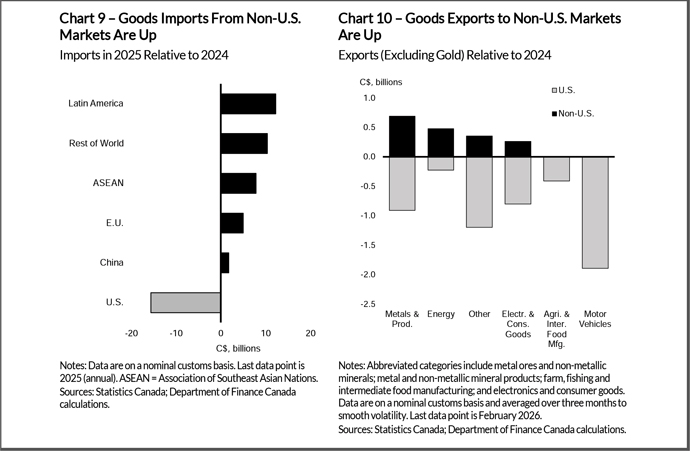
Chart 9 – Goods Imports From Non-U.S. Chart 10 – Goods Exports to Non-U.S. Markets Markets Are Up Are Up Imports in 2025 Relative to 2024 Exports (Excluding Gold) Relative to 2024 C$, billions U.S. 1.0 Latin America Non-U.S. 0.5 Rest of World 0.0 ASEAN -0.5 E.U. -1.0 -1.5 China -2.0 U.S. -2.5 Metals & Energy Other Electr. & Agri. & Motor Prod. Cons. Inter. Vehicles -20 -10 0 10 20 Goods Food Mfg. C$, billions Notes: Data are on a nominal customs basis. Last data point is Notes: Abbreviated categories include metal ores and non-metallic 2025 (annual). ASEAN = Association of Southeast Asian Nations. minerals; metal and non-metallic mineral products; farm, fishing and Sources: Statistics Canada; Department of Finance Canada intermediate food manufacturing; and electronics and consumer goods. calculations. Data are on a nominal customs basis and averaged over three months to smooth volatility. Last data point is February 2026. Sources: Statistics Canada; Department of Finance Canada calculations.
| 32 |
|
New Transportation Capacity Paves Way to New Markets
Expanded oil transportation infrastructure—particularly the Trans Mountain Expansion Project—has significantly improved Canada’s access to global markets. Fully operational since 2024, the project has materially increased export capacity to tidewater in western Canada.
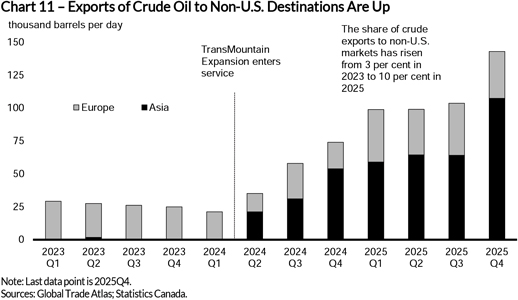
By connecting landlocked production to seaborne markets, the expansion has helped ease bottlenecks, diversify export destinations, reduce price discounts on Canadian crude, and strengthen Canada’s position in global energy trade. As a result, crude exports to non-U.S. markets—especially in Asia—have accelerated in recent years (Chart 11).
Prior to the expansion, less than 3 per cent of Canada’s crude exports went to markets outside the United States; that share has now risen to roughly 10 per cent. Looking ahead, additional projects could expand total takeaway capacity by up to 12 per cent.
Liquefied natural gas (LNG) projects aim to capitalise on Western Canada’s abundant, low-cost natural gas resources by exporting LNG to global markets where demand is high and prices are more attractive. Canada’s first large-scale export terminal, LNG Canada Phase 1, began exporting in June 2025 in Kitimat, B.C. Since that time, data published by the Canada Energy Regulator show that LNG exports have grown rapidly, rising from negligible levels in 2024 to 7.5 per cent of total natural gas exports. This growth has supported economic activity and helped offset weaker export performance in other areas.
In addition, eleven other LNG projects are at various stages of development across the country, including seven projects in British Columbia. Of these, two are under construction, three have secured regulatory approvals and are advancing toward project milestones, and two are in the regulatory review process. Combined with LNG Canada Phase 1, British Columbia LNG projects represent potential capital investments of over $150 billion and a potential production capacity of approximately 50 million tonnes per annum of LNG by the early 2030s. Projects in other regions account for more than $50 billion in potential investments. |
| INTRODUCTION | 33 |
Business Confidence Has Recovered and Investment Is Rising
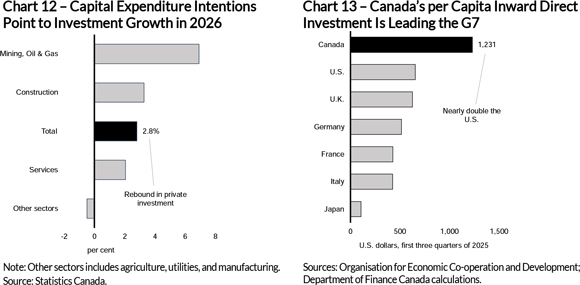
Real business investment remained subdued in 2025 amid weak export demand and elevated uncertainty. This is weighing on productive capacity and potential growth. Recent data, however, suggest conditions may be stabilising. Investment rose 2.6 per cent in the fourth quarter after three consecutive declines. The gain was driven by a rebound in machinery and equipment, particularly computers and software. Confidence has improved to around 2024 levels, and firms plan to increase non-residential investment by 2.8 per cent in 2026 (nominal), following a 0.5 per cent decline in 2025 (Chart 12). These developments indicate an uptick in investment and that the economy entered 2026 with firmer momentum.
Improved sentiment is supported by Canada’s relative U.S. tariff advantage, targeted federal incentives, and rising public investment in trade- and transportation-enabling infrastructure. Together, these factors are helping set the stage for increased private investment and stronger supply-chain resilience.
Confidence in Canada as an investment destination continues to be strong. The 2025 Kearney FDI (foreign direct investment) Confidence Index ranked Canada second among 25 global markets, and Canada led the G7 in per capita direct investment inflows in 2025 (Chart 13).
The Labour Market Has Proven Resilient
Canada’s labour market softened following rising trade tensions and the introduction of higher tariffs last year, with hiring remaining subdued through much of 2025. Even so, the labour market withstood the shock better than expected. Employment growth resumed in the second half of the year, signalling that conditions are stabilising.
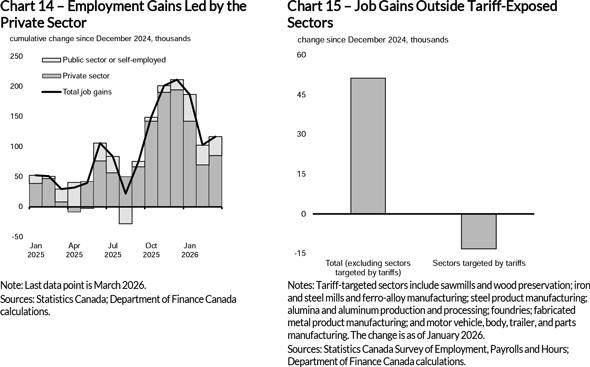
Despite some recent moderation, Canada is well ahead of the U.S. in job creation per capita and the core-aged employment rate remains nearly three percentage points higher than in the U.S. Since the start of 2025, more jobs have been added in Canada on a per-capita basis (3.4 per 1,000 versus 1.2 per 1,000 in the U.S.). Most of those jobs were in the private sector (Chart 14). Challenges in tariff-exposed sectors have led to employment losses (Chart 15), and business surveys still point to subdued hiring intentions. Demand remains particularly soft for entry-level jobs, a headwind for both youth and newcomers.
| 34 |
Even so, the unemployment rate has fallen to 6.7 per cent, down from a peak of 7.1 per cent last summer and below private sector expectations in Budget 2025. Wage growth has now outpaced inflation for over three years, resulting in an annual increase of 1.6 per cent in real wages on average since 2023 (Chart 16), nearly double the pace recorded in the decade prior to the pandemic. Cumulatively, real wage growth since 2019 has been almost twice as strong in Canada as in the United States. Sustained productivity growth will be important to support stronger and more durable gains in real incomes over time.
| INTRODUCTION | 35 |
Slower Population Growth Is Easing Labour Market Pressures
Following a period of strong gains averaging over 45,000 jobs per month late in 2025, employment has levelled off over the past three months. This comes alongside a deceleration in population growth, which has reduced the number of new jobs needed to keep unemployment stable.
This marks a clear shift from 2022–2024, when rapid population inflows pushed labour supply growth beyond what the economy could readily absorb. Under the 2026–2028 Immigration Levels Plan, population growth is expected to remain at more sustainable levels, supporting a more balanced labour market—responding to local needs and the ability for communities to absorb new immigrants.
Job growth should resume in 2026, but gains will likely be modest, with demand for workers expected to improve gradually. Combined with slower growth in the working-age population, this is expected to support a gradual easing in the unemployment rate in the second half of the year.
Labour Market Holds Firm Despite Moderate Challenges
| ● | Youth unemployment remains elevated and has only slightly declined from its recent peak of 14.6 per cent in September 2025 to 13.8 per cent in March. Policy measures by the government have supported improved outcomes for young people entering the labour market. |
| ● | Job losses remain contained. Initial Employment Insurance claims are within historical norms, and many displaced workers are finding new employment. |
| ● | Labour force participation declined over the last year but remains an area of strength. Canada continues to lead the G7 with a 64.9 per cent participation rate, well above the U.S. rate of 61.9 per cent, and it is expected to rise further as conditions improve. |
| ● | Women’s labour force participation is historically strong. The participation of women aged 25 to 54 reached 85 per cent in 2025—nearly seven points higher than in the U.S.—with youth and newcomer participation also comparatively strong. |
Housing Affordability Is Improving
Housing markets are undergoing a gradual rebalancing. Affordability pressures, softer sentiment, additional supply coming to the market, and slower population growth are driving a broad-based adjustment.
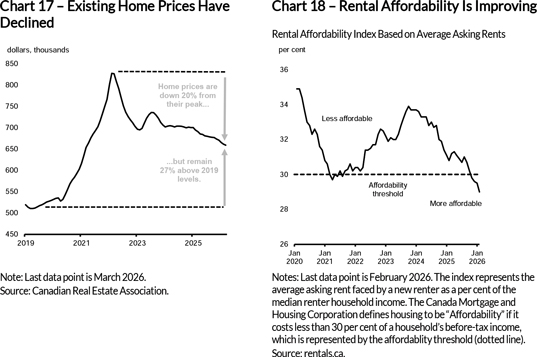
Together, these developments are putting downward pressure on home prices—now about 20 per cent below recent peaks—and on rents, which are down roughly 9 per cent nationally. These adjustments are contributing to improvements in housing affordability across many markets, and have helped lift the national rental vacancy rate to 3.1 per cent in 2025 from a historical low of 1.5 per cent in 2023.
At the same time, this rebalancing has been accompanied by weaker homebuilding activity in some markets, as developers respond to higher costs and softer near-term demand. If sustained, this could pose risks to future housing supply. Against this backdrop, the government remains focused on unlocking new housing supply and securing durable affordability gains.
Recent initiatives—including the launch of Build Canada Homes, the introduction of the Improving Housing Supply Act, and measures in the Spring Economic Update 2026—underscore the government’s continued efforts to unlock new housing supply, improve market responsiveness, and ensure that recent affordability improvements are sustained over time.
| 36 |
Housing Activity Has Moderated in Several Markets
While home sales remain subdued nationally, this adjustment is helping to relieve affordability pressures, particularly for prospective buyers who had been priced out in recent years. Moderation has been most evident in markets where post-pandemic price increases were most pronounced and affordability challenges most acute, notably Toronto and Vancouver.
| ● | The sales-to-new-listings ratio remains below its historical average, with higher inventories improving choices and negotiating conditions for buyers. |
| ● | Conditions remain softest in Ontario and British Columbia, where existing home sales are around 30 per cent below their 10-year averages. In these markets, price corrections—particularly in condominium segments—are helping realign prices with underlying demand, following a period of rapid investor-driven expansion. Condo markets show particular weakness, weighing on new home sales and project launches. |
| ● | Markets in Québec, the Prairies, and Atlantic Canada have been more resilient, supported by better affordability, though cooling momentum is increasingly evident as national conditions normalise. |
| ● | National home prices have declined by about 5 per cent over the past year (Chart 17). Combined with continued growth in real household incomes, these price adjustments are improving purchasing power and easing entry barriers for first-time buyers. |
A Surge in Purpose-Built Rentals Is Expanding Supply
Overall construction activity has remained elevated by historical standards. Housing starts totaled 260,000 units in 2025—well above the 2000–2019 average of about 200,000—driven by record levels of purpose-built rental construction supported by federal measures.
Growing supply—combined with efforts to bring population growth back to more sustainable levels—is helping to narrow Canada’s housing supply gap and deliver meaningful improvements in affordability (see box). Since recent peaks, average home prices have declined by 20 per cent, national rents are nearly 9 per cent lower than their 2024 peak, and average monthly mortgage payments for homeowners have fallen by more than $1,200 in Toronto and Vancouver, almost $400 in Calgary, and over $200 in Halifax from peak levels. Together with continued gains in real household incomes, these developments are restoring purchasing power and easing access to housing for renters and first-time buyers.
The Department of Finance’s affordability metric, which measures monthly mortgage payments relative to median monthly wages, has improved to 60 per cent in early 2026, down from the September 2023 peak of 87 per cent, reflecting the combined effects of lower mortgage rates, declining home prices, and continued income growth. The ratio has now returned to around 2017 levels. Rental affordability has also strengthened: the share of disposable income required for rent by new tenants improved to 29 per cent, down from a peak of 34 per cent in October 2023 (Chart 18), with advertised rents now just under 30 per cent of renter gross income nationally—the first readings at or below that threshold in over six years.
At the same time, homeownership-oriented construction, including condos and ground-level homes, has moderated amid softer demand, high costs, and higher inventories. Leading indicators suggest that activity in these segments will continue to ease, with new home sales in several markets remaining below historical levels and contributing to builders delaying and cancelling projects. This adjustment has weighed on construction employment, resulting in job losses in the skilled trades and construction, with residential construction employment down by 6.2 per cent and 2.6 per cent in Ontario and British Columbia, respectively, in 2025. These workers are essential for supercharging homebuilding across the country. Maintaining capacity in the construction sector remains essential to scaling up housing supply and securing durable affordability gains nationwide—a core policy priority.
| INTRODUCTION | 37 |
Government Is Acting to Unlock New Housing Supply
Progress is being made, home prices have declined and asking rents have eased over the past two years, down almost 9 per cent since their most recent peak (see box), but far too many Canadians continue to struggle to find homes they can afford, and the ongoing market adjustment poses a risk to future housing supply.
Solving Canada’s housing challenges requires immediate action to bring down costs, cut red tape, and build homes more quickly. That is why the government has introduced legislation to immediately provide $1.7 billion to provinces and territories to implement additional measures to unlock new housing supply, such as reducing development fees or levies on new home construction. The government has also announced a new partnership with Ontario to reduce taxes and fees for a home in Ontario by up to $200,000.
Housing activity is expected to stabilise as uncertainty recedes, the economy strengthens, affordability improves, and the government’s actions to accelerate the pace of homebuilding take effect. This should allow for a gradual recovery in existing and new home sales and create a more favourable environment for homeownership-focused construction.
|
Federal Actions Are Building Momentum on Housing Affordability
Housing affordability remains a major challenge, but momentum is building. Housing supply is expanding and population growth is returning to more sustainable levels, easing supply-demand pressures that have driven up housing costs in recent years.
Housing supply has expanded at a solid pace, driven by strong purpose-built rental construction. Rental starts reached about 120,000 units in 2025—roughly five times the 2000–2019 average. Federal incentives and financing support have contributed to this strength, with CMHC’s multi-unit mortgage loan insurance programs supporting nearly 90 per cent of rental apartment starts in 2024.
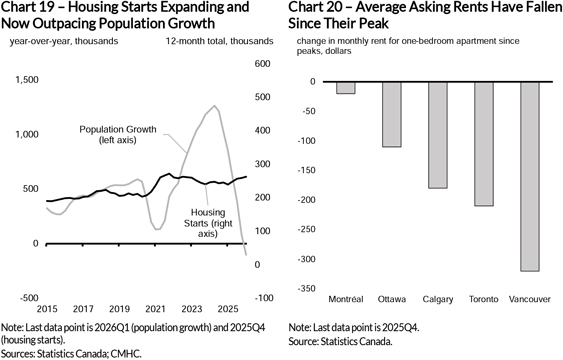
At the same time, the 2026–2028 Immigration Levels Plan is helping return population to more sustainable levels, with growth slowing from a peak of 3.2 per cent in the second quarter of 2024 to -0.2 per cent at the end of 2025 and expected to remain subdued over the next two years. This is allowing new supply to catch up with underlying demographic demand (Chart 19). |
| 38 |
|
As a result, the housing supply gap is beginning to narrow, particularly in rental markets. Vacancy rates have risen above historical averages in several cities, and asking rents have declined by almost 9 per cent since peaking in late 2024, including declines of $210 in Toronto and $320 in Vancouver (Chart 20).
Home buyers have also seen some relief. Lower mortgage rates, combined with price declines in several markets, have resulted in improvements in the Bank of Canada’s Housing Affordability Index from a peak of 54.5 per cent to 42.7 per cent. Monthly mortgage payments on an average-priced home for prospective home buyers have fallen by more than $1,200 in Toronto and Vancouver since late 2023.
The government’s approach focuses on expanding Canada’s housing stock by reducing building and financing costs, improving productivity in the homebuilding sector, and boosting the supply of affordable housing. Federal measures, estimated at over $140 billion in spending and foregone revenues over the next five years, cover the entire housing continuum, from homelessness to market-rate housing.
Structural reforms—paired with more sustainable population growth and targeted support for first-time home buyers—have reduced and will continue to reduce the housing supply gap and improve affordability.
|
Inflation Remains Within the Target Range Despite Near-Term Volatility
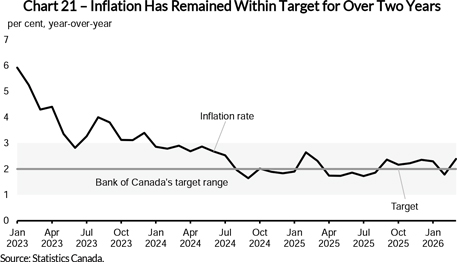
Prior to the conflict in the Middle East, inflation had moved close to target. It averaged 2.1 per cent in 2025, lowered in part by the removal of the federal consumer carbon price last April, and slowed to 1.8 per cent in February. Inflation then rose to 2.4 per cent in March, reflecting higher energy prices. Even with this increase, inflation has remained within the Bank of Canada’s 1–3 per cent target range for 27 consecutive months (Chart 21). Measures of core inflation have eased since late last year and are now closer to 2 per cent.
Before March, energy prices were a drag on overall inflation, with prices down 9.3 per cent as of February, largely reflecting declining oil prices over 2025 and the ongoing effect from the removal of the consumer carbon price. In March, with the onset of the conflict, energy prices were up nearly 4 per cent year over year as gasoline prices soared. Indeed, retail gasoline prices had risen quickly—from a national average of $1.42 per litre at the end of February to $1.81 as of April 17th, an increase of nearly 30 per cent seen across the country. Following the implementation of the temporary suspension of the federal fuel excise tax on April 20th, gasoline prices decreased by 12 cents per litre on April 21st, indicating pass-through of the tax measure.
| INTRODUCTION | 39 |
Policy Measures Will Provide Relief from Fuel Price Pressures
To help ease the pressure from higher fuel prices, the government has announced a temporary suspension of the federal fuel excise tax on gasoline, diesel, and aviation fuels across Canada. Starting on April 20, 2026, this measure would be in place until and including September 7, 2026, and is expected to reduce Canadians’ bills at the gas station by up to 10 cents per litre on regular gasoline and up to 4 cents on diesel. This relief will also reduce operating costs for many businesses.
If the increase in oil prices is temporary, inflation is expected to return to the 2 per cent target by the end of the year. Other tariff-related cost pressures appear contained, and soft economic conditions could help limit the pass-through from higher energy prices. Underlying inflation dynamics had continued to improve heading into 2026, with the Bank of Canada’s preferred core measures at 2.3 per cent in March, while momentum of those measures pointed to subdued price pressures.
By contrast, a prolonged disruption of shipping through the Strait of Hormuz would extend cost pressures. Elevated crude oil prices would persist for longer, increasing the likelihood of spillovers to other prices, especially for energy-intensive goods and services. Pressures on global food prices would also intensify, reflecting higher fertilizer costs and given that natural gas from the Middle East is a key source of nitrogen-based fertilizers globally.
As inflation had stabilised faster in Canada than in most peer economies prior to the Middle East conflict, the Bank of Canada had lowered its policy rate by a cumulative 275 basis points since early 2024—more than the U.S. Federal Reserve (Chart 22). At 2.25 per cent, the policy rate was calibrated to support the soft landing underway. Bond yields have risen as investors re-assess inflation and interest rate risks stemming from the conflict, but Canada maintains its advantage over the U.S. on long-term rates (Chart 23). The Bank of Canada has noted in recent communications that there are downside and upside risks to the inflation outlook. The Canadian economy was evolving broadly as expected in its most recent forecast in January, but the conflict in the Middle East will also push inflation higher in the near term.
Food and Rental Inflation
Even as broad inflation measures improved, many Canadians continue to feel other cost pressures beyond fuel—especially for groceries and housing (see box).
Grocery inflation was 4.4 per cent year-over-year in March, reflecting temporary and structural global factors. A significant share of recent price pressures has been concentrated in a few items—beef, coffee, confectionery, and lettuce—which make up about 10 per cent of the grocery basket. Prices for these items were up 21 per cent year-over-year in January 2026 and have since begun to ease. Excluding these items, grocery inflation was 3.3 per cent in March.
Shelter inflation has slowed, reaching 1.7 per cent in March—remaining near its lowest level since 2021 and around its 2010–2019 average. Rent inflation, currently just above 4 per cent, largely reflects existing rents catching up to
| 40 |
earlier increases in market rents as tenancies turn over, and is expected to ease as population growth slows and new rental supply comes online.
Canadians are seeing material improvements in affordability across other parts of household expenditures. The cost of child care nationally has fallen by nearly 30 per cent between 2019 and 2025, while the cost of cellular services has halved over the same period.
To help address food affordability challenges, the government is developing a National Food Security Strategy to make it easier for Canadians to access affordable and nutritious food and to build Canada’s resilience and capacity to meet domestic needs. The government is also making groceries and other essentials more affordable for more than 12 million Canadians through the new Canada Groceries and Essentials Benefit.
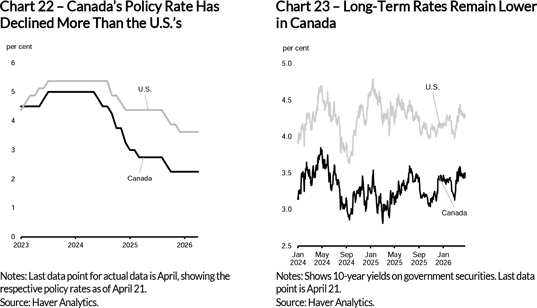
|
Why Canadians Still Feel Their Budgets Are Strained—And What the Government Is Doing About It
Inflation has remained within the Bank of Canada’s target control range for more than two years, and wages have outpaced prices for over three years, improving purchasing power for many Canadians. Policy changes have also helped ease pressures on some everyday costs—such as gas through the removal of the consumer carbon price, child care, and cell phone bills (Chart 24). However, essential expenses—particularly groceries and housing—have risen sharply since 2019, and these higher price levels are straining household budgets even as inflation remains within the target control range.
High Price Levels Still Affect Household Budgets
Beyond the recent increase in gasoline prices, food inflation (groceries and food services) remains elevated at about 4 per cent—well below its pandemic-era peak but still high enough to strain budgets. Pressures are most acute for lower-income households, who devote a larger share of income to groceries (about 24 per cent versus roughly 8 per cent for other households) and have less ability to substitute toward lower-cost options.
While food prices are highly volatile, these pressures are not unique to Canada. G7 economies have experienced elevated food inflation due to global supply constraints and rising production costs (Chart 25). Higher agricultural commodity prices, elevated energy and fertilizer costs, weather-related crop disruptions, and the weaker Canadian dollar in late 2024 have all contributed to higher food prices. These pressures are amplified by Canada’s highly integrated food supply chain. About 30 per cent of Canada’s food supply is imported, rising to about 75 per cent for fresh produce, where prices tend to be more volatile and highly weather-dependent. |
| INTRODUCTION | 41 |
|
Housing costs also rose substantially during the post-pandemic rebound, especially rents. While shelter inflation has now fallen back to 1.7 per cent, close to historical norms for the first time in five years, many Canadians are still adjusting to earlier increases. Encouragingly, new asking rents have declined in major cities such as Toronto and Vancouver over the last two years, reflecting improving supply conditions and easing demand pressures.
Government Actions to Support Canadians
To help Canadians manage persistent cost pressures, the government is pursuing a three-pillar approach that combines immediate relief with longer-term structural reforms (for full details, see Chapter 2):
1. Direct support for household budgets: The new Canada Groceries and Essentials Benefit will provide hundreds of dollars more in near-term relief to more than 12 million low- and modest-income Canadians, helping to offset the rise in essential living costs. Families with two children are also saving $800 per year on groceries with the permanent National School Food Program, and 22 million Canadians are getting a middle-class tax cut, with two-income families keeping up to $840 per year in their pockets.
2. Reducing key cost pressures where government can influence prices: Federal actions are lowering or slowing price growth in areas where policy levers are strong—such as child care, cellular bills, gasoline costs, and parts of the food supply chain—by improving resilience, lowering production costs, and strengthening distribution systems.
3. Addressing the structural drivers of affordability: Long-term measures focus on boosting productivity, expanding housing supply, and strengthening competition. These reforms aim to raise incomes over time and reduce the systemic cost pressures that have kept prices high. In the Canadian agricultural and food sector alone, up to $7 billion in new capital by 2030 is planned by Farm Credit Canada and more than 20 investment organisations. These investments will help to support innovation, which could help to lower food costs for Canadians. As announced in January, among other measures the government is also developing a National Food Security Strategy to strengthen domestic food production and improve access to affordable, nutritious food.
Together, these actions form a coherent affordability strategy: immediate help for those who need it most, targeted measures to lower everyday costs, and structural reforms to improve affordability over time.
|
| 42 |
What This Means for You
The economy has remained steady despite U.S. tariffs. Businesses are adapting, new markets are opening, and exports are recovering—supporting jobs and growth. At the same time, many households still feel cost-of-living pressures and some sectors remain vulnerable. Wages remain firm, but gasoline prices have increased sharply amid higher oil prices and essentials like housing and groceries are still expensive. Rents have started to ease in many areas as supply increases, while home prices have come down in some markets. The government is responding by supporting affected sectors, investing in housing to boost supply and affordability, and lowering costs for essentials like groceries and child care.
Canadian Economic Outlook
Growth Expected to Strengthen
The Department of Finance Canada regularly surveys private sector economists on their outlook for the Canadian economy (see Annex 1 for details).
In the early March 2026 survey, private sector economists expected current tariffs on Canada to remain in place over the near term. Forecasters did not anticipate a return to broadly open, low-tariff global trade. In addition, private sector economists expected trade uncertainty to remain elevated over this year and next, reflecting sectoral tariff threats and a likely complex review of CUSMA.
The conflict in the Middle East has created an additional shock to the Canadian economy, which was already adjusting to the impact of U.S. tariffs. In the early March survey, private sector economists incorporated the expected initial impacts of the conflict in the Middle East. They had increased their near-term assumptions for crude oil prices, resulting in higher CPI and GDP inflation for this year. Economists did not expect material impacts on real GDP or the unemployment rate, as they generally expected a short-lived conflict, with oil prices and inflation starting to normalise in the second half of the year. That said, the situation has continued to evolve and impacts remain highly uncertain.
Private sector forecasts point to a wide dispersion in the outlook for real and nominal GDP, underscoring elevated uncertainty around the outlook. This reflects differing assumptions, particularly regarding the path of oil prices and how trade tensions and higher energy costs are expected to transmit through the global and Canadian economy.
The range between the high and low real GDP forecasts is close to 2 per cent by the end of 2027, and suggests risks are tilted to the downside (Chart 26), reflecting concerns about weaker global demand, tighter financial conditions, and persistent uncertainty weighing on investment, exports, and household spending.
To further support prudent planning, the Department of Finance Canada has assessed a range of potential outcomes in the Economic Scenario Analysis section below.
Since Budget 2025, economic activity has shown volatility but, on average, performed in line with private sector expectations, while the labour market has stabilised. Following initial weakness from the onset of tariffs, real GDP growth surprised on the upside in the third quarter of 2025 before slightly declining in the fourth quarter.
The economy is expected to remain soft early in the year as the adjustment to the new trade environment continues. Improved confidence, supportive financial conditions, and public infrastructure investment should encourage firms to explore new markets and step up capital spending, supporting gains in exports and investment. As activity strengthens, the labour market is expected to improve, with solid wage growth supporting household consumption. Private sector forecasters expected real GDP growth to reach about 2 per cent by year-end (Chart 27).
| INTRODUCTION | 43 |
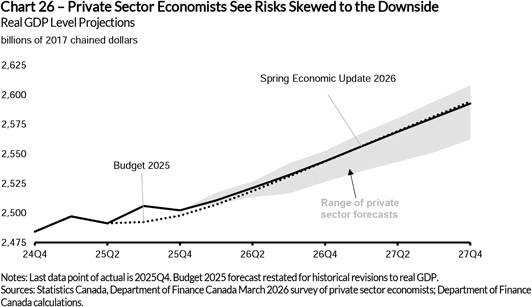
Overall, private sector forecasters expected real GDP growth of 1.1 per cent in 2026 and 1.9 per cent in 2027—compared to the Budget 2025 outlook of 1.2 per cent and 2.0 per cent, respectively. According to the IMF, Canada’s performance is expected to remain strong internationally, with the second-fastest pace of growth in the G7 for the next two years.
GDP inflation was expected to average 2.8 per cent in 2026 and 1.8 per cent in 2027, compared with 1.8 per cent and 2.0 per cent in Budget 2025. As a result, the level of nominal GDP was projected to exceed the Budget 2025 outlook by $31 billion per year on average over 2025-2029, reflecting stronger-than-expected results in the second half of 2025 and a stronger near-term GDP inflation outlook resulting from higher oil prices (Chart 28). Despite this improvement, forecasters continue to expect a persistent drag on Canada’s productive capacity from weaker business investment and sectoral reallocation following the tariff measures. As a result, the level of real GDP is projected to remain 1.6 per cent below the pre-tariff 2024 Fall Economic Statement projection by 2029.
In the March survey, private sector economists expected:
| ● | WTI crude oil prices to ease from peaks of nearly US$100 per barrel at the onset of the Middle East conflict and to average US$80 per barrel in the second quarter of this year (US$15 per barrel above Budget 2025). The price of oil was expected to average US$73 per barrel in 2026 compared to the Budget 2025 forecast of US$65 per barrel. It was then expected to decline to US$66 per barrel in 2027, in line with Budget 2025. |
| ● | CPI inflation to average 2.5 per cent in 2026 and 1.9 per cent in 2027 (compared to 2.0 per cent for both years in Budget 2025). Inflation was then expected to be at 2.0 per cent from 2028 onwards, the same as in Budget 2025. |
| ● | The unemployment rate to average 6.5 per cent in 2026, down from the 6.8 per cent expected in Budget 2025, and to continue its downward trend reaching 6.0 per cent by 2029, the same as in Budget 2025. |
| ● | The Bank of Canada to keep its policy rate at 2.25 per cent through 2026. With the economy picking up, short-term interest rates were then expected to start rising in early 2027 reaching 2.7 per cent by 2028, a slightly higher peak compared to Budget 2025. Short-term rates were expected to settle at 2.6 per cent by 2029, the same as in Budget 2025. |
| ● | The 10-year bond rate to increase from an average of 3.4 per cent in 2026 to 3.6 per cent in 2027 and 3.7 per cent from 2028 onwards, about 10 basis points higher than the expectations in Budget 2025. |
| ● | In the U.S., AI investment and solid consumption, supported partly by strong equity markets, are driving growth. While real GDP growth in the U.S. was revised up to 2.4 per cent in 2026, this has not translated into stronger near-term Canadian growth expectations. |
Scenario analysis below and Annex 1 box titled Economic and Fiscal Impact Sensitivity to Higher Oil Prices show how the results of the March survey change with different macroeconomic assumptions.
| 44 |
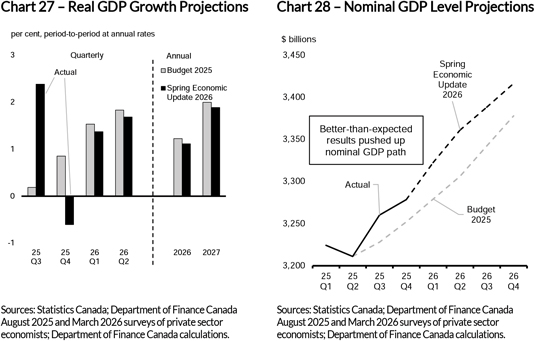
What This Means for You
The economy is expected to continue growing, but the outlook is subject to heightened global uncertainty, including ongoing trade tensions and geopolitical risks. Private sector economists generally expect continued, robust growth over the next two years, though forecasts vary widely and Canada is not immune to this global energy shock. Higher oil prices will put upward pressure on inflation in the near term, but overall economic conditions remain broadly stable, with the labour market continuing to hold up. To support long-term affordability and job opportunities, the government is focused on creating the conditions that allow businesses to invest, grow, and sustain employment—by fostering a stable, competitive, and resilient economic environment as Canada adapts to a more uncertain global landscape.
Economic Scenario Analysis
With the ongoing conflict in the Middle East, alongside tariffs and trade-related uncertainty, risks to the outlook remain elevated. To assess risks to the March survey forecast, the Department of Finance Canada consulted with private sector economists, with particular focus on the future path of oil prices. While risks stem from multiple sources, the scenarios presented below—while not exhaustive—are primarily anchored on alternative paths for the Middle East conflict and its transmission through energy markets, supply chains, global demand, and financial conditions. These scenarios help assess risks around the baseline forecast and support prudent fiscal planning.
Since the survey was completed, developments in energy markets point to a somewhat stronger near-term outlook for oil prices. These developments suggest WTI prices could average around US$80 for 2026, roughly US$10 above the level assumed in the March private sector survey. Based on estimated economic and fiscal sensitivity to higher oil prices (see the box entitled “Economic and Fiscal Impact Sensitivity to Higher Oil Prices” in Annex 1), such an increase in oil prices would improve the federal budgetary balance by about $1.9 billion. That said, the impact of oil prices on the economic and fiscal outlooks will depend on the evolution of other macroeconomic variables such as interest rates and global demand.
Details of the economic outlook, scenario analysis, and the sensitivity of key economic variables to oil price movements can be found in Annex 1.
| INTRODUCTION | 45 |
Higher Investment Scenario
In the Higher Investment scenario, a prolonged disruption to global oil supply pushes WTI prices to peak at around US$115 per barrel in the second quarter of 2026. Prices remain elevated for an extended period, reflecting persistent disruptions, heightened geopolitical risk, and slow supply adjustment.
Higher oil prices contribute to higher inflation and weigh on global activity. However, Canada, as a net exporter of oil, benefits from improved terms of trade, driving up national income. The country is also seen as a reliable source of energy products as geopolitical risks and uncertainty in the Middle East persist, supporting demand for Canadian crude oil. Higher oil prices over the outlook, sustained global demand for secure energy supply, and policy efforts to accelerate major projects and catalyse new private investment lead to increased investment in the oil and gas sector and other industries, with positive spillovers to the broader economy through higher employment and income, helping to offset the drag from weaker global activity.
As a result, Canadian real GDP growth is modestly higher on average relative to the March survey forecast (Chart 29), leaving the level of real GDP 0.4 per cent higher than baseline by 2030. Alongside higher oil prices, nominal GDP is $37 billion higher on average per year compared with the survey (Chart 30).
Global Supply Disruptions Scenario
In the Global Supply Disruptions scenario, persistent export constraints in the Middle East and damage to critical energy infrastructure exacerbate global commodity shortages and trigger broader supply chain spillovers. Supply chains worldwide come under strain, as higher energy costs and prolonged shipping disruptions weigh on production and trade. Persistently elevated shipping and freight insurance rates also increase prices for commodities reliant on affected shipping routes in the Middle East, amplifying second-round cost pressures.
These developments further intensify inflationary pressures worldwide. Global monetary policy is more restrictive, while markets are pricing in higher inflation risks, contributing to a greater drag on global activity. Heightened geopolitical tensions also contribute to tighter financial conditions, lower asset prices, and weaker business and consumer confidence. The Canadian economy is not spared, compounded by ongoing adjustments to tariffs, as real GDP is affected through reduced consumption, investment, exports, and productivity. Structural uncertainty about future energy demand also results in a muted investment response by Canadian energy producers, despite higher oil prices.
Canada shifts to a slower real growth path compared with the March survey forecast, with the level of real GDP 1.3 per cent lower at peak impact in 2028. Nominal GDP remains higher than baseline in the first two years of the survey (by $37 billion and $16 billion, respectively) due to the impact of higher oil prices on the terms of trade. However, as prices normalise, weaker economic activity weighs on the level of nominal GDP, which falls below baseline by an average of $9 billion per year from 2028 to 2030.
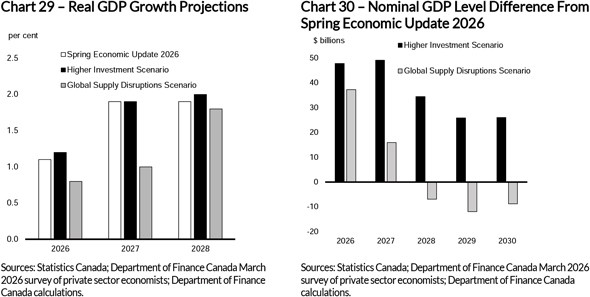
| 46 |
Fiscal Overview
Budget 2025 marked a strategic shift in the government’s management of public finances, focused on expanding federal capital spending to mobilise investment, while maintaining fiscal responsibility. With significant investments to support infrastructure, innovation, and the development of domestic industrial capabilities, Budget 2025 set out a clear plan to build the strongest economy in the G7.
This fiscal plan remains rooted in fiscal responsibility—not for its own sake, but to create the capacity to invest in long-term economic strength and greater self-reliance. Consistent with this approach, decisions in the Spring Economic Update are guided by the government’s two fiscal anchors: balancing operating spending with revenues by 2028-29 and maintaining a declining deficit-to-GDP ratio.
The government also remains committed to the disciplined implementation of Budget 2025 efficiency measures. This includes the Comprehensive Expenditure Review which, together with other measures in Budget 2025, totals $60 billion in savings and revenues over five years. With implementation well underway, the focus is now turning towards targeted, ongoing horizontal reviews, beginning with efforts to rein in spending on external management and other consulting services. These challenging but necessary actions will continue to support the government’s objective of spending less, to invest more in Canadians.
Fiscal Outlook
While uncertainty remains elevated, the Canadian economy has proved resilient and higher oil prices have improved the terms of trade. The March private sector survey average—which forms the basis for the projections in this update—shows an increase of more than $30 billion per year in the level of nominal GDP over 2025-2029, relative to Budget 2025. This, along with year-to-date results, has translated into an improved fiscal outlook, with budgetary revenues increasing by an average of $7.2 billion annually compared to previous projections. Combined with lower projected expenses, this results in an improvement in the budgetary balance averaging about $12.1 billion annually before new measures, relative to Budget 2025.
Measures included in the Spring Economic Update represent a net cost of $37.5 billion over six years, starting in 2025-26, with 45 per cent focused on bringing down costs for Canadians with the Canada Groceries and Essentials Benefit, measures to drive housing supply, and a temporary suspension of the federal fuel excise tax.
Factoring in economic and fiscal developments, measures in the Spring Economic Update, and policy actions since Budget 2025, the 2025-26 deficit now is projected to be $66.9 billion—$11.5 billion lower than in Budget 2025—or 2.1 per cent of GDP. The deficit is expected to decline to $53.2 billion, or 1.4 per cent of GDP by 2030-31, consistent with the fiscal anchor. In addition, the federal debt-to-GDP ratio is expected to remain relatively stable from 2027-28 to 2030-31, and more than a full percentage point lower than projected in Budget 2025.
| INTRODUCTION | 47 |
Table 1 - Economic and Fiscal Developments, Policy Actions, and Measures
billions of dollars
| Projection | ||||||||||||||||||||||||||||
| 2024– | 2025– | 2026– | 2027– | 2028– | 2029– | 2030– | ||||||||||||||||||||||
| 2025 | 2026 | 2027 | 2028 | 2029 | 2030 | 2031 | ||||||||||||||||||||||
| Budgetary balance — Budget 2025 |
-36.3 | -78.3 | -65.4 | -63.5 | -57.9 | -56.6 | ||||||||||||||||||||||
| Economic and fiscal developments since Budget 2025 |
17.7 | 15.7 | 10.7 | 8.6 | 7.6 | |||||||||||||||||||||||
| Budgetary balance before policy actions and measures |
-36.3 | -60.6 | -49.7 | -52.8 | -49.3 | -49.0 | -46.4 | |||||||||||||||||||||
| Policy actions since Budget 2025 |
-1.3 | -4.4 | -4.0 | -2.8 | -2.4 | -2.1 | ||||||||||||||||||||||
| Spring Economic Update 2026 (by chapter) |
||||||||||||||||||||||||||||
| 1. Building Canada: All for Canada |
0.0 | -2.8 | -2.3 | -2.0 | -1.4 | -1.4 | ||||||||||||||||||||||
| 2. Benefits for Canadians: A Canada for All |
-4.9 | -8.5 | -4.1 | -3.6 | -3.4 | -3.2 | ||||||||||||||||||||||
| Subtotal — Spring Economic Update 2026 measures |
-4.9 | -11.3 | -6.3 | -5.6 | -4.8 | -4.6 | ||||||||||||||||||||||
| Total – Policy actions since Budget 2025, and Spring Economic Update 2026 measures | -6.2 | -15.7 | -10.3 | -8.4 | -7.1 | -6.8 | ||||||||||||||||||||||
| Budgetary balance |
-36.3 | -66.9 | -65.3 | -63.1 | -57.7 | -56.2 | -53.2 | |||||||||||||||||||||
| Budgetary balance (per cent of GDP) |
-1.2 | -2.1 | -1.9 | -1.8 | -1.6 | -1.5 | -1.4 | |||||||||||||||||||||
| Federal debt (per cent of GDP) |
40.7 | 41.1 | 41.5 | 41.8 | 41.9 | 41.8 | 41.6 | |||||||||||||||||||||
| Budgetary balance — Budget 2025 |
-36.3 | -78.3 | -65.4 | -63.5 | -57.9 | -56.6 | ||||||||||||||||||||||
| Budgetary balance (per cent of GDP) |
-1.2 | -2.5 | -2.0 | -1.9 | -1.6 | -1.5 | ||||||||||||||||||||||
| Federal debt (per cent of GDP) |
41.2 | 42.4 | 43.1 | 43.3 | 43.3 | 43.1 | ||||||||||||||||||||||
| Note: A negative number implies a deterioration in the budgetary balance (lower revenue or higher expenses). A positive number implies an improvement in the budgetary balance (higher revenue or lower expenses). |
| |||||||||||||||||||||||||||
Capital Investment Outlook
The Spring Economic Update 2026 continues to expand federal capital investment, including $225 million over five years for the Union Training and Innovation Program to enable upgrades to union-run training centres as well as investments to better support Indigenous housing providers. Consistent with the government’s fiscal anchors, capital investments will account for 100 per cent of the deficit by 2028-29 (Chart 31). The government will continue to stand with Canadians dealing with economic challenges.
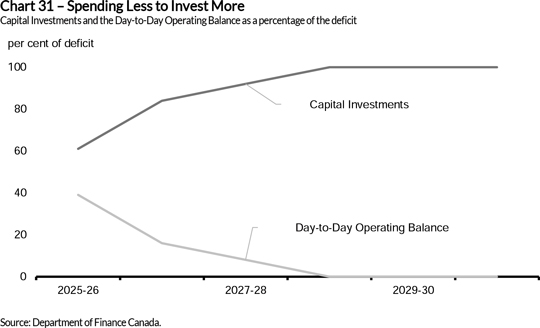
| 48 |
Ongoing Horizontal Reviews
The government has made a clear commitment to fiscal discipline and, through Budget 2025, delivered on the Comprehensive Expenditure Review to reduce operational inefficiencies and redirect resources toward priorities. The government is now focusing on horizontal opportunities that go beyond individual departments, including federal procurement contracts, external management consulting, and thematic reviews of horizontal programming—including a review of skills and youth programming, with an emphasis on improving services.
The government recently launched the Federal Contracts Review, where the largest value contracts are being examined to identify opportunities for cost reductions and alternative pricing strategies. The government will no longer settle for a good price; Canadians deserve the best price. Pricing in contracts will be supported by best practices and global benchmarking. Opportunities for a Team Canada approach to procurement, combining the buying power of federal, provincial, and territorial governments, will be leveraged where possible.
As a first step, the Spring Economic Update 2026 focuses on reducing the use of external management and other consulting services by relying more on existing talent within the public service. Total spending on management and other consulting was about $5 billion in 2024-25, while total spending on professional and special services represented $23.1 billion. Specifically:

|
As committed in Budget 2025, the Spring Economic Update 2026 proposes to reduce spending on external management and other consulting services by 20 per cent over the next three years, achieving savings of $450 million in 2027-28, and $900 million annually from 2028-29 onward. Implementation of this measure will protect the government’s defence priorities while strengthening internal capacity and accelerating in-house skills development. Additional details on professional and special services are outlined in Annex 1. |
Savings achieved will count toward the Budget 2025 commitment to save at least $7.75 billion over three years, starting in 2027-28, and $3.25 billion ongoing by optimising productivity in government.
Results of other reviews will be reported in Budget 2026, as targeted horizontal reviews become a permanent and predictable approach to strengthening expenditure management.
Economic Scenario Analysis
The Canadian economy has remained resilient amid continued uncertainty in the global landscape. However, recent developments in the Middle East and higher oil prices have introduced considerable near-term risks for economies around the world.
To support prudent fiscal planning around the March private sector survey forecasts, particularly on the future path of oil prices, and to stress-test the baseline forecast, the Department of Finance Canada has developed two economic scenarios. In both scenarios, a prolonged disruption to global oil supply pushes WTI prices to peak at around US$115 per barrel in the second quarter of 2026, with oil prices remaining higher than the March survey for an extended period, reflecting persistent disruptions, heightened geopolitical risk, and slow supply adjustment.
In the Higher Investment scenario, stronger global demand for secure and reliable energy supports increased investment in Canada. In this scenario the budgetary balance would improve by $5.7 billion in 2026-27 and $3.2 billion per year on average over the remainder of the forecast horizon (Chart 32). The federal debt-to-GDP ratio would be expected to decrease to 40.7 per cent in 2026-27 and increase to 40.9 per cent in 2030-31 (Chart 33).
In the Global Supply Disruptions scenario, the conflict in the Middle East disrupts global supply chains and leads to tighter global financial conditions, weighing on economic activity and deteriorating the budgetary balance. In this scenario, the deficit would initially improve by about $3.1 billion in 2026-27, driven by stronger revenues from higher oil prices but deteriorate by an average of $3.5 billion annually over the remainder of the forecast horizon (Chart 32). The federal debt-to-GDP ratio would initially decline to 41.0 in 2026-27, but increase to 42.0 per cent in 2030-31 (Chart 33).
| INTRODUCTION | 49 |
Details of the government’s fiscal outlook, the fiscal impact of the scenarios, and the sensitivity of fiscal projections to higher oil prices can be found in Annex 1.
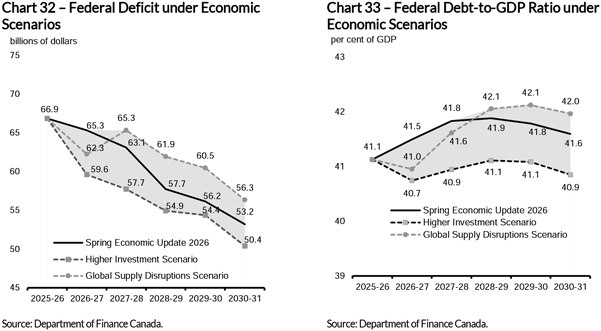
Preserving Fiscal Sustainability for Future Generations
As the old multilateral order weakens and the world becomes more fragmented and uncertain, the government is focusing on what it can control: making targeted, high-impact investments in Canadians and the economy while maintaining fiscal sustainability.
This approach is disciplined and deliberate. Ensuring that public dollars back high-impact actions with lasting economic returns, while spending less on government operations, will position Canada for sustained economic and fiscal capacity well into the future.
The government’s economic plan is fiscally sustainable. Modelling scenarios developed by the Department of Finance Canada show the federal debt-to-GDP ratio on a declining trajectory over the longer term (Chart 34). Sensitivity analysis around these long-term fiscal projections also indicates the federal debt-to-GDP ratio would still be declining by the end of the projection horizon under the Global Supply Disruptions scenario.
Preserving fiscal firepower is crucial to manage future pressures, including, among others, from recessions, additional defence spending, population aging, climate change, and the transition to net-zero emissions.
| 50 |
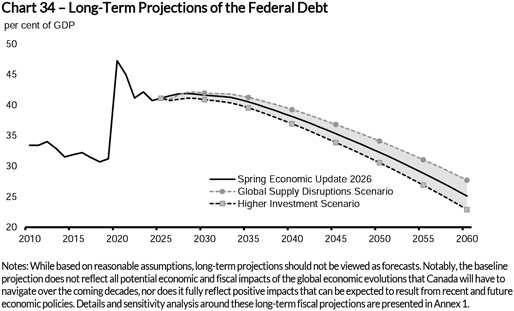
Canada’s Fiscal Advantage
Globally, geopolitical instability, structural economic transformation, and intensifying competition are forcing governments to rethink how they respond to headwinds and build resilience for the future. Standing still is not an option as inaction and underinvestment carry significant costs, including slower growth, diminished competitiveness, and weaker security.
Canada starts from a position of strength to turn this moment of global uncertainty into one of national opportunity.
| ● | Canada’s net debt-to-GDP ratio stands at just 10.2 per cent, compared to the G7 average (excluding Canada) of 101.8 per cent (Chart 35). |
| ● | Canada’s net debt burden today is lower than that of any other G7 country, and is even below the levels of those countries prior to the pandemic. |
| ● | Canada also has one of the smallest deficits in the G7 as a share of the economy (Chart 36). |
This fiscal advantage gives the government the capacity—and the responsibility—to act to build a stronger economy to make life more affordable, to create high-paying jobs, to take care of each other and to determine our future.
| INTRODUCTION | 51 |
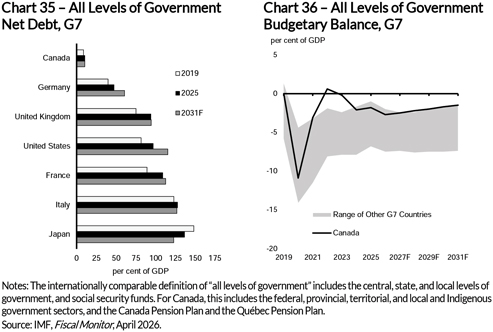
Canada’s fiscal position also stands out among 30 other advanced economies, with a below-average deficit-to-GDP ratio and one of the lowest net debt-to-GDP ratios in the group (Charts 37 and 38).
Canada is also one of only two G7 economies, alongside Germany, to maintain AAA ratings from major global credit rating agencies. These AAA ratings support investor confidence and help keep borrowing costs as low as possible.
In a more uncertain world, the government’s focus on what it can control—delivering lasting economic benefits for Canadians while reinforcing fiscal discipline—will help ensure Canada maintains its fiscal advantage going forward.
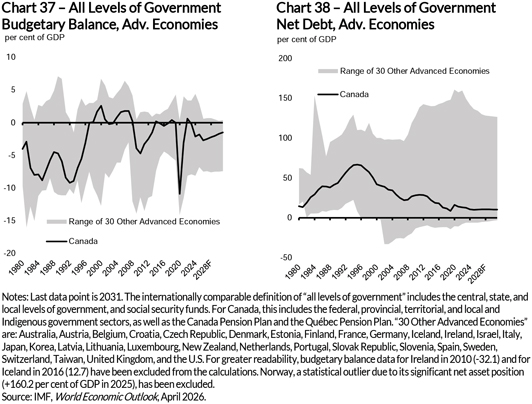
| 52 |
Chapter 1
Building Canada: All for Canada
The world is rapidly changing. Shifting trade patterns, geopolitical tensions, and rapid technological change are impacting the lives of Canadians at an unprecedented rate. Budget 2025 set out the government’s bold and ambitious plan to transform our economy from one that is reliant on a single trade partner to one that is stronger, more self-sufficient, and resilient to global shocks.
We are taking our future into our own hands by building one Canadian economy, powered by new infrastructure—connecting our regions, diversifying our markets, and protecting our communities.
The Spring Economic Update 2026 announces further steps to support investment, productivity, and growth, including:
| ● | Launching Canada’s own sovereign wealth fund, the Canada Strong Fund, to invest in the projects and companies that are driving Canada’s economic transformation, capitalised in the near term with $25 billion. |
| ● | Making the Employee Ownership Trust (EOT) tax exemption permanent to enable workers to participate directly in building Canada strong. |
| ● | Launching Canada’s first Investment Summit in September 2026 to convene the world’s largest investors, including top CEOs, entrepreneurs, and prominent global business leaders. The Summit is focused on attracting new investment into Canada. |
| ● | Providing $103.8 million to establish the Defence Investment Agency as a stand-alone entity. |
| ● | Launching a Whole-of-Government Competition Plan to strengthen productivity and affordability by ensuring that competition is prioritised throughout the federal government’s policies. |
These measures build on the ambitious economic plan we are already implementing, including:
| ✓ | Accelerating nation-building projects through the Major Projects Office to fast-track key projects through federal review and approval. The 15 projects announced to date represent over $125 billion in capital investments and are expected to support over 60,000 jobs during construction. |
| ✓ | A Productivity Super-Deduction and enhancements to the Scientific Research and Experimental Development Tax Incentives to encourage further investment. The Productivity Super-Deduction is expected to generate an economic output of up to $9 billion annually over the next ten years, while the enhancements to Scientific Research and Experimental Development Tax Incentives are expected to generate an economic output of $1.2 billion a year. |
| ✓ | New infrastructure programs targeted at building more housing and stronger communities including the Build Communities Strong Fund—delivering $51 billion to boost investment in infrastructure—from community infrastructure, to health infrastructure, to public transit—in partnership with provinces and territories. Together with the provincial contributions, the projects through the Fund will support an average of 42,000 jobs per year. |
| ✓ | A Trade Diversification Strategy to help Canadian businesses expand to non-U.S. markets, supported by a $6 billion Trade Infrastructure Strategy to help their products get there. Investments in trade-enabling transportation infrastructrure through the Trade Diversification Corridors Fund and the Arctic Infrastructure Fund are expected to raise productivity and increase gross domestic product (GDP) by up to $21 billion. |
| ✓ | An Automotive Strategy to strengthen Canada’s auto manufacturing sector and protect the over 500,000 workers the sector supports. |
| ✓ | An International Talent Attraction Strategy and Action Plan to recruit exceptional foreign researchers to Canadian universities. |
| ✓ | A Nature Strategy to protect Canada’s nature by conserving 30 per cent of Canada’s lands and waters by 2030. |
| ✓ | A Climate Competitiveness Strategy to create the conditions to become a global leader in clean technology and clean energy. |
| BUILDING CANADA: ALL FOR CANADA |
53 |
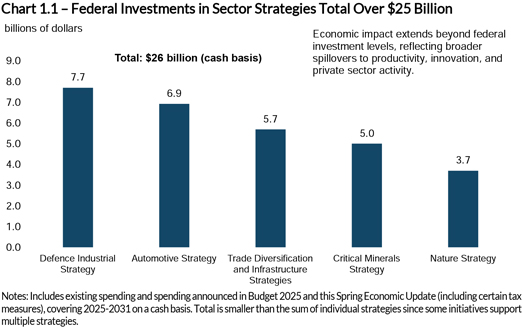
Canada has always been a nation of builders. To secure a more prosperous, competitive, and sovereign future, we are building Canada as a clean and conventional energy, mining, industrial, and agricultural superpower. We are improving regulatory efficiency, increasing competition, boosting tax and other incentives for new investments, and investing in trade and supply chain infrastructure.
1.1 Delivering for Canadians
The Canada Strong Fund
The government has set out a bold plan to build a stronger Canada.
We are investing in the foundations of long-term prosperity: modern infrastructure that better connects our country; responsible resource development that strengthens our economy and enhances energy security; and sustained support for the innovative companies and skilled workers who will shape Canada’s future.
This is more than an economic agenda—it is a nation-building action plan. Build Canada Strong is about constructing a bridge to a better future—project by project, company by company. While the results will build over time, these are investments that will pay dividends for Canadians in the years—and generations—ahead.
Build Canada Strong is about connecting Canadians to one another and ensuring that an Albertan has a stake in a project built in Newfoundland, and vice versa. It is about uniting Canadians around a shared purpose and shared success.
While Canadians will benefit from these nation-building projects through better jobs, higher economic growth and greater security, the government is determined to ensure that all Canadians also have a stake—a fair stake—in the projects themselves.
To do that, we are changing the equation. The government is launching Canada’s first sovereign wealth fund—the Canada Strong Fund. This fund is about making sure that the returns from Build Canada Strong are shared with Canadians.
A Clear Mission
Designed to give all Canadians a direct stake in the Build Canada agenda, it is a Government of Canada fund—and therefore, a fund that belongs to all Canadians. The Fund will invest in strategic Canadian projects and companies alongside other investors—with a clear objective to achieve commercial returns to build the wealth of Canada.
| 54 | CHAPTER 1 |
|
|
This is how the Canada Strong Fund will work: |
An Initial Endowment that is Designed to Grow
Initially, the government will provide $25 billion over 3 years, on a cash basis, to seed the Canada Strong Fund.
The Fund will increase over time, both from the returns that it generates, and through other assets that the government may allocate to it.
Asset optimisation will help address two complementary priorities: unlocking the full value of existing federal assets and directing that capital toward investments with the highest potential return for Canada and Canadians.
An Investment Strategy that Emphasizes Returns
The Canada Strong Fund will focus on building Canada. From infrastructure to advanced manufacturing to energy and mining, the Fund will have a mandate to deliver market-rate returns for Canadians across the economy.
Leading Canadian companies will help build our energy, transportation and telecommunications infrastructure and future economy.
Global investors are increasingly looking to Canada as a destination for major new investments, and the federal government is working to ensure these projects move forward.
As Canadian companies and international partners invest and succeed here, Canadians should also have a stake – so that everyone benefits. That is why the Canada Strong Fund will participate alongside other investors on a fully commercial basis.
This represents a new ownership opportunity for Canada and Canadians, with the Fund focused primarily on equity investments.
The Major Projects Office is working closely with project proponents as they move through regulatory approvals, and the government is assessing projects for potential designation under the Building Canada Act.
At the same time, institutions such as the Canada Infrastructure Bank, Export Development Canada, the Business Development Bank of Canada, the Canada Indigenous Loan Guarantee Corporation, and a range of departmental programs are already playing a critical role in advancing large-scale projects and supporting the growth of Canadian companies.
Where the federal government is active, the Canada Strong Fund will focus on complementing these efforts—investing only in minority positions alongside private capital in this growing pipeline of projects and companies, and generating strong, commercial returns for Canadians.
An Independent, Professional Crown Corporation Focused on Performance
Independence and professional management ensures a sovereign wealth fund can make long-term, economically sound investment decisions. This structure is widely regarded as global best practice because it strengthens transparency, credibility, and long-term performance through consistent, expert management.
The Canada Strong Fund will operate at arms-length from government. We will create a new Crown corporation, and its work will be guided by a CEO and a qualified independent board of directors.
This model will ensure that both in the near-term and the long-term the Fund remains focused on its mission – supporting the transformation of the economy and creating wealth for Canadians.
A Simple Way for Canadians to also Directly Participate
We are building Canada together—and the Canada Strong Fund is designed to take that effort even further. The government intends to offer Canadians the opportunity to participate directly in the Fund through a new, broadly accessible retail investment product.
This means that any Canadian who wishes to can invest some of their savings into the Canada Strong Fund.
| BUILDING CANADA: ALL FOR CANADA |
55 |
The government intends to consult on the specific design of this product, but Canadians can expect the following features:
| ● | Broadly accessible to Canadians from coast to coast to coast; |
| ● | Easy and simple to purchase, hold, and transact; |
| ● | As the Canada Strong Fund succeeds, investors will be able to share in the upside, while their initial invested capital will be protected. |
When Canadians invest directly in the Canada Strong Fund, they will help fuel its growth and increase its ability to deliver meaningful benefits across the country.
What Comes Next
The government will establish a dedicated Canada Strong Fund Transition Office to lead a targeted engagement with market participants and regulators, and rapidly finalise the Fund. Further details will be provided in the coming months.
The Canada Strong Fund joins a federal ecosystem of Crown corporations dedicated to helping promising companies and projects succeed either here at home or through exports to the world.
| ● | The government believes that for each of these financing vehicles to have a maximum impact, they must have clear, focused mandates. To ensure clarity of purpose and avoid any risk of duplication, the government will undertake comprehensive mandate reviews for each organization in the federal financing ecosystem. |
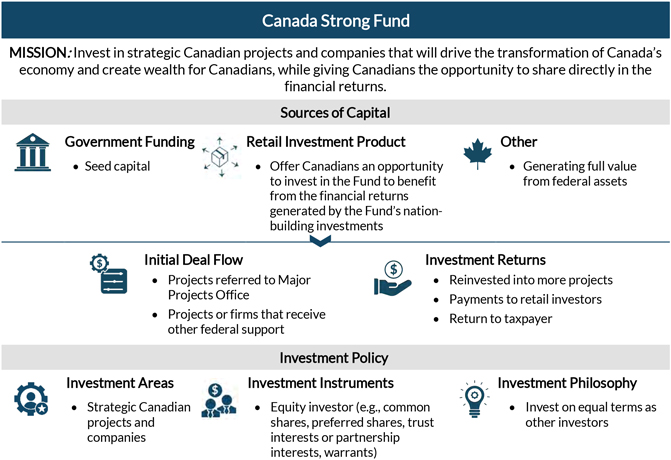
Strengthening the Future of Canada’s Airports
Airports are vital national assets that support Canada’s economic competitiveness, trade, tourism, and regional connectivity. Modern and efficient airport operations are essential to ensuring the long-term stability of Canada’s air sector.
| 56 | CHAPTER 1 |
As set out in Budget 2025, the government is committed to reforming Canada’s airports system to lower air passenger costs and better position airports to attract private investment. In this context, since the budget, the government has begun to consider reforms to modernise the governance of airport authorities, explore options to update the framework for airport rents, and to increase the capacity of airports for economic development and reinvestment in infrastructure.
The government is also assessing opportunities to unlock the full value of airports in support of investments in Canada’s long-term growth, including through alternative models of ownership. This work will be advanced with the input of the airport authorities and other stakeholders including airlines and local governments.
|
|
Additionally, the Spring Economic Update 2026 announces the government’s intention to introduce legislation to ensure it can obtain the information necessary for a comprehensive evaluation of airport reforms. |
Timely Resolution of Air Passenger Complaints
The Government of Canada created the Air Passenger Protection Regulations in 2019 to establish minimum requirements for airlines to protect the rights of passengers in Canada, including compensation obligations. They create a set of minimum obligations from airlines towards passengers—however, there is a significant backlog of passenger complaints.
|
|
The Spring Economic Update 2026 announces the government’s intention to clear the backlog of air travel complaints by engaging a neutral, third-party dispute resolution organisation based on a proven model in the U.K. and E.U. Beyond the backlog, the government also intends to develop a simpler and more effective regulatory regime, so that rules are clearer and passengers are fairly and more quickly compensated when air travel does not go as planned. |
1.2 Building to Grow
The bold and ambitious plan set out in Budget 2025 is already translating into action—advancing major projects, cutting red tape, and launching generational infrastructure investments that will build stronger communities.
The government has relied on targeted investment vehicles in the past to advance strategic economic objectives. Federal investment vehicles are actively backing projects to crowd in private capital and support growth in priority sectors. Collectively, investments through key federal vehicles have totalled more than $20 billion over 2020-2025 (Chart 1.2), helping to strengthen Canada’s productive capacity and economic resilience across key sectors.
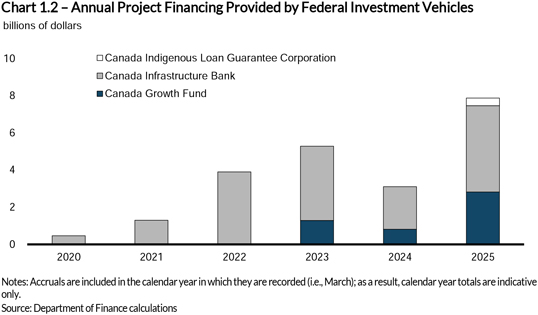
| BUILDING CANADA: ALL FOR CANADA |
57 |
These investments help ensure Canada can seize strategic opportunities, boost our global competitiveness, and build a stronger, more resilient economy.
The Spring Economic Update 2026 builds on this momentum, with strategic investments in projects and infrastructure that further support investment, productivity, and growth, enabling Canadians and Canadian businesses to seize new opportunities and drive Canada’s economic growth.
Advancing Nation-Building Projects Through the Major Projects Office
The Major Projects Office is advancing nation-building projects faster and more responsibly to help connect our economy, diversify our industries and trade, and create high-paying jobs and careers for generations to come. Working alongside partners, we are unlocking Canada’s economic potential, while respecting our environmental responsibilities and the rights of Indigenous people.
The Major Projects Office has announced 15 projects, representing over $125 billion in capital investments, and is developing 6 transformative strategies. On March 12, the government announced four new projects developed out of the former Arctic Economic and Security Corridor strategy and referred them to the Major Projects Office. At a time when Canada’s North is undergoing profound change, driven by rising geopolitical pressures and a rapidly warming Arctic, these projects are critical to strengthening sovereignty, resilience, and long-term economic opportunity in the region. On April 9, less than seven months after the referral of the Port of Montreal’s Contrecoeur Container Terminal Project, the Prime Minister announced that we are breaking ground after a $1.16 billion financing commitment from the Canada Infrastructure Bank. The government also announced an investment from the Canada Growth Fund in Nouveau Monde Graphite on April 9. The government will continue to refer projects and finance projects on a rolling basis.
The Major Projects Office will derisk nation-building projects in order to attract the financing required to move them forward. To fill financing gaps, the government is deploying available capital from the Canada Infrastructure Bank, Canada Growth Fund, Canada Indigenous Loan Guarantee Corporation, and Export Development Canada. These Crown corporations will advance financing solutions that deliver value for money for taxpayers.
| 58 | CHAPTER 1 |
Major Nation-Building Projects
Referred projects to date represent over $125 billion in capital expenditure by the private sector, federal, and provincial governments
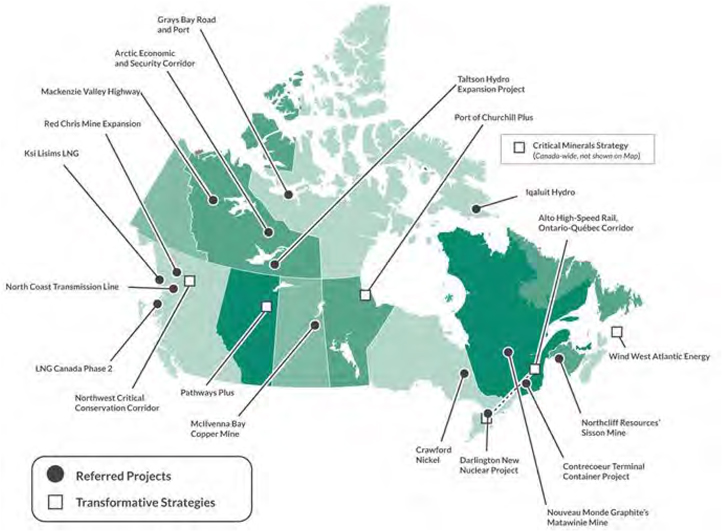
| BUILDING CANADA: ALL FOR CANADA |
59 |
| Projects Referred to the Major Projects Office | ||
| 15 projects | 6 transformative strategies | |
| Will support over 60,000 jobs |
Represents over $125 billion in new investment | |
| Projects | Proponent | Sector | Location | |||
| Canada Nickel’s Crawford Project | Canada Nickel Company | Mining | Timmins, Ontario | |||
| Contrecoeur Terminal Container Project | Montreal Port Authority | Industrial | Contrecoeur, QC | |||
| Darlington New Nuclear Project | Ontario Power Generation | Electricity | Bowmanville, ON | |||
| Iqaluit Nukkiksautiit Hydro Project | Nunavut Nukkiksautiit Corporation | Electricity | Iqaluit, Nunavut | |||
| Ksi Lisims LNG | Western LNG, Nisga’a Nation, Rockies LNG Partners | Energy | Pearse Island, British Columbia | |||
| LNG Canada Phase 2 | LNG Canada | Energy | Kitimat, BC | |||
| McIlvenna Bay Foran Copper Mine Project | Foran Mining | Mining | East-Central, SK | |||
| North Coast Transmission Line (NCTL) | B.C. Hydro | Electricity | Northwestern British Columbia | |||
| Northcliff Resources’ Sisson Mine | Northcliff Resources Ltd. | Mining | Sisson Brook, New Brunswick | |||
| Nouveau Monde Graphite’s Matawinie Mine | Nouveau Monde Graphite | Mining | Saint-Michel-des-Saints, Québec | |||
| Red Chris Mine Expansion | Newmont Mining & Imperial Metals | Mining | Northwestern British Columbia | |||
| Taltson Hydro Expansion | Government of the Northwest Territories (GNWT) |
Electricity | Great Slave Lake region, Northwest Territories | |||
| Mackenzie Valley Highway | Government of the Northwest Territories | Transport | Wrigley to Inuvik, NWT | |||
| Grays Bay Road and Port (GBRP) | West Kitikmeot Resources Corporation | Transport | Kitikmeot Region, Nunavut | |||
| Arctic Economic and Security Corridor (AESC) | Tłıchǫ Gov’t, Dene First Nation, and the GNWT | Transport | Slave Geological Province, Northwest Territories | |||
| Strategy | Sector | Location | ||
| Alto High-Speed Rail | Transportation | Ontario-Quebec Corridor | ||
| Critical Minerals Strategy | Mining | All provinces except for PEI | ||
| Northwest Critical Conservation Corridor | Electricity, Mining | Northwestern British Columbia, Southern Yukon | ||
| Pathways Plus | Energy | Alberta | ||
| Port of Churchill Plus | Transportation | Manitoba | ||
| Wind West Atlantic Energy | Energy | Nova Scotia, New Brunswick, PEI, Newfoundland and Labrador |
| 60 | CHAPTER 1 |
Establishing One Project, One Review
The Government of Canada is advancing efforts to realise “one project, one review” by working with provinces and territories to establish cooperation agreements. On June 2, 2025, Canada’s First Ministers agreed to “work together toward efficiently and effectively implementing ‘one project, one review’ with the goal of a single assessment for all projects.” This will implement a more efficient assessment process that minimises duplication and delivers major projects faster while reinforcing strong environmental protections.
Co-operation agreements with provinces enable the use of new flexibilities in the Impact Assessment Act. These flexibilities include the ability to provide for substitution to a single harmonised process that draws on the best available provincial and federal expertise. Cooperation agreements can also allow for early assessment decisions and full substitution to a provincial process that meets both federal and provincial requirements. They do not affect the duty of proponents, provinces, territories, and the federal government to fully consult with Indigenous people whose rights may be affected. This will help ensure accelerated assessments for major projects, including projects of national interest, and signal to investors that Canada’s federal and provincial governments are committed to working together to enable development, while protecting Indigenous rights and the environment.
The government has been negotiating agreements with provinces and is delivering results on this commitment. Agreements have already been finalised with Ontario, New Brunswick, Prince Edward Island, Alberta, Manitoba and Nova Scotia and a draft agreement with Newfoundland and Labrador has been published for public comment and others are under discussion. In 2019, British Columbia was the first province to sign a cooperation agreement with Canada.
The government is currently developing policy, operational, regulatory and legislative measures to achieve all federal decisions on major projects within a maximum of two years, down from the previous five-year target. These measures will support timely decisions, reduce risks for proponents, boost investor confidence, and support Canada’s competitiveness in a fast-changing global economy.
Growing the Indigenous Loan Guarantee Program
The Indigenous Loan Guarantee Program provides Indigenous groups access to the capital they need to overcome historic barriers and be meaningful equity partners in major projects. The government announced updates to the program in Budget 2025, to support Indigenous investors in greenfield (new build) projects that will generate economic prosperity for future generations as well as provide loan guarantees to support debt financing for Indigenous-led projects. This builds upon previous enhancements, including doubling the size of the program from $5 billion to $10 billion, and expanding eligibility of projects to sectors beyond energy and natural resources.
Since Budget 2025, the program announced its second loan guarantee, which supports an investment by two First Nations in Ontario for a nearly 20 per cent stake in Hydro One’s Chatham to Lakeshore transmission line. This builds on its first loan guarantee, announced in May 2025, of $400 million to support an investment by 38 First Nations in British Columbia for a 12.5 per cent stake in Enbridge’s Westcoast pipeline system.
| BUILDING CANADA: ALL FOR CANADA |
61 |
Prioritising Nation-Building Projects in Tax Processes
Corporate taxpayers contemplating significant transactions often require certainty on tax treatment before going ahead with a major project. The Canada Revenue Agency (CRA) supports this need by issuing timely and binding advance income tax rulings, which enable businesses to move forward with confidence. Tax rulings help ensure that tax legislation is applied consistently and predictably across transactions to support transparency, fairness, and informed decision-making.
|
|
To support the government’s objective of building a strong Canadian economy, the Spring Economic Update 2026 announces that the CRA will prioritise requests for advance income tax rulings related to large-scale, nation-building projects—such as housing and infrastructure—as well as projects of national importance. Priority will also be given to advance income tax ruling requests relating to investments that enhance productivity and strengthen critical sectors of Canada’s economy, including clean economy initiatives and projects that may benefit from Canada’s suite of clean economy investment tax credits. |
In Budget 2025, the government reaffirmed its commitment to the clean economy investment tax credits by increasing CRA resources by $146 million over five years, starting in 2025-26, for the administration of these measures. With this additional funding, the CRA is expected to increase processing of claims by more than 4.5-fold by July 2026. This targeted investment will help the CRA reduce the backlog of claims over the course of 2026 and ensure a more timely delivery of these credits going forward.
Advancing Critical Minerals Projects
Critical minerals are essential to the technologies and industries that power the modern economy and contribute to a more secure future. They are used in a wide range of essential products ranging from mobile phones and solar panels to electric vehicle batteries, medical devices and defence applications. Global demand for critical minerals is set to grow rapidly over the next two decades, and Canada is well-positioned to continue building on its position as a global leader in the responsible development of critical minerals. As geopolitical competition intensifies, securing supply chains for these critical minerals has become a strategic imperative. To help combat rising risks across global critical minerals supply chains and to strengthen our economic security, the government is taking action to grow Canada’s critical minerals industry and to develop resilient value chains through trusted international partnerships.
Canada is advancing critical minerals production and processing projects across the country, supported by targeted federal actions and partnerships. This includes working through the Critical Minerals Production Alliance, a Canada-led G7 initiative to diversify and secure global critical minerals production and supply. The following highlights selected projects along the critical minerals value chain.
| 62 | CHAPTER 1 |
Critical Minerals Production and Processing Projects
| Project | Type | Location | Federal investment | |||||

|
Nouveau Monde Graphite – Matawinie Mine | Graphite mine | Saint-Michel-des- Saints, Québec | ● ~$462 million debt financing
● ~$149 million equity financing
● Announced October 2025 | ||||

|
Rio Tinto Fer et Titane – Scandium Oxide | Commercial-scale scandium oxide production | Sorel-Tracy, Québec | ● $25 million equity-like financial royalty structure
● Announced in October 2025 | ||||

|
Focus Graphite | Graphite for defence and advanced manufacturing | Baie-Comeau, Québec | ● $14.1 million
● Highlighted October 2025 under Critical Minerals Production Alliance | ||||

|
Frontier Lithium Processing Facility | Lithium processing facility | Thunder Bay, Ontario | ● $2.3 million
● Highlighted in March 2026 at Prospectors & Developers Association of Canada (PDAC) Convention | ||||

|
British Columbia Hydro Transmission System Upgrades | Electricity transmission capacity for critical minerals projects | Kamloops, British Columbia, and Northwest British Columbia | ● $84.0 million
● Highlighted in March 2026 at PDAC | ||||

|
E3 Lithium – Clearwater Project | Lithium refining demonstration program | Olds, Alberta | ● $36.5 million
● Highlighted in March 2026 at PDAC | ||||

|
Cyclic Materials | Rare earth elements recycling | Kingston, Ontario | ● ~$34.4 million equity financing
● $9.1 million
● Highlighted in March 2026 at PDAC | ||||

|
Saskatchewan Power Corporation | Electricity grid connection to support critical minerals mining | Athabasca Basin region and Regina, Saskatchewan | ● $18.1 million
● Highlighted in March 2026 at PDAC | ||||
| BUILDING CANADA: ALL FOR CANADA |
63 |
Expanding the Carbon Capture, Utilization, and Storage Investment Tax Credit to Enhanced Oil Recovery
The refundable Carbon Capture, Utilization, and Storage (CCUS) investment tax credit provides support for investments in CCUS technologies.
The extent to which the CCUS tax credit is available to an eligible CCUS project and associated eligible equipment depends on the end use of the carbon dioxide (CO2) that is captured. Currently, eligible uses include dedicated geological storage and storage in concrete, but not enhanced oil recovery (EOR).

|
Following through on the commitment made by the government in the November 27, 2025, Canada-Alberta Memorandum of Understanding, the Spring Economic Update 2026 proposes that EOR be made an eligible use for the purposes of the CCUS tax credit. |
Credit rates would be set at 30 per cent for direct air capture equipment, 25 per cent on other capture equipment, and 18.75 per cent on transportation and storage/use equipment. These rates reflect the additional revenue stream available to CCUS projects that perform EOR. Like other forms of eligible CO2 uses, CCUS projects that perform EOR would be required to permanently store the captured CO2.
EOR would be made an eligible use starting the Day of the Spring Economic Update 2026, subject to the designation of a jurisdiction by the Minister of the Environment.
It is estimated that the proposal will increase federal revenues by $395 million over four years, starting in 2027-28.
Implementing Accelerated Capital Cost Allowance Rates for Low-Carbon Liquefied Natural Gas Facilities
As a leading global energy producer, Canada is supporting investment in lower-emissions liquefied natural gas (LNG) through targeted tax measures. Budget 2025 proposed to reinstate the accelerated capital cost allowances (CCAs) for eligible LNG equipment and related buildings, but only for low-carbon LNG facilities.
|
|
The Spring Economic Update 2026 proposes the implementation details for this measure. |
| o | To be eligible for an accelerated CCA, the expected emissions intensity of an LNG facility’s on-site liquefaction activities, measured in tonnes of carbon dioxide equivalent per tonne of LNG produced annually (tCO2e/tLNG), would have to be less than or equal to 0.20 tCO2e/tLNG. The accelerated CCA rate would be 50 per cent for liquefaction equipment and 10 per cent for facility non-residential buildings. |
Facilities with an expected emissions intensity higher than 0.20 tCO2e/tLNG would not be eligible for the measure.
The measure would apply to property acquired on or after November 4, 2025 and before 2035.
Launch of the Build Communities Strong Fund
Building the future we want starts with building the communities we want. In Budget 2025, the government announced the Build Communities Strong Fund (BCSF) to revitalise local infrastructure—the hospitals, universities, and colleges that serve our people, the roads and bridges that move our goods, and the water and transit systems that sustain our towns.
The BCSF will build new infrastructure to speed up work and bring down costs. When colleges and universities have aging buildings, when hospitals are over capacity, and when water systems fail, people and communities are adversely impacted. The Fund will spur economic activity, create new careers in the skilled trades, and give investors the confidence to build around reliable public infrastructure.
The Build Communities Strong Fund launched on April 7, 2026, with a $51 billion investment over 10 years, starting in 2026-27, and $3 billion ongoing.
| 64 | CHAPTER 1 |
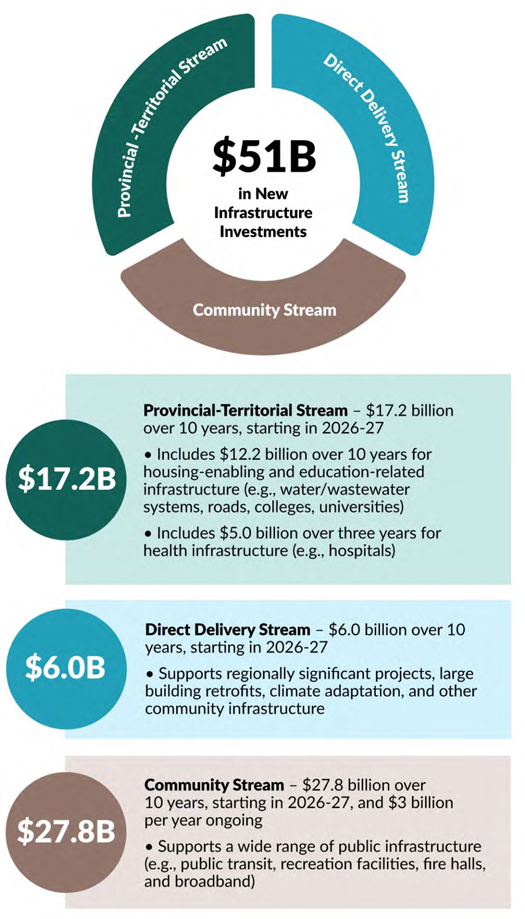
| BUILDING CANADA: ALL FOR CANADA |
65 |
Under this program, the federal government is working with provinces and territories to develop successful partnerships through negotiated bilateral agreements to lower the costs to build new homes.
Jurisdictions with the highest development charges will be required to reduce them for three years, with flexibility for municipalities where these charges are not a barrier. Other jurisdictions must maintain existing development charge restrictions (such as freezes or deferrals) and avoid introducing new taxes that limit housing supply. As part of the government’s partnership with Ontario, described in Chapter 2, the province has agreed to reduce development charges by up to 50 per cent for three years in its largest and fastest-growing cities, covering approximately 80 per cent of the province’s population.
The Government’s Vision: Artificial Intelligence for All
The new National AI Strategy will respond to our consultation with over 11,000+ submissions from Canadians and 28 expert Task Force members. Canadians want AI that is safe and sovereign, and to drive AI adoption, create new economic opportunities, strengthen public services, and improve our quality of life. The government will advance these objectives through the six pillars of a forthcoming AI Strategy:
Pillar 1: Protecting Canadians and Safeguarding our Democracy
AI will only deliver on its promise if Canadians trust it. That requires modern privacy and online safety laws, strong national AI safety capabilities, and secure government systems.
Pillar 2: Empowering Canadians
Canada must become an AI skills nation, where AI creates good jobs for Canadians, by giving access to AI training and education for all Canadians, and by representing and including Canadian voices, languages, and culture.
Pillar 3: Powering AI Adoption for Shared Prosperity
The gains of AI will come from putting it to work across the Canadian economy and developing pro-worker, industrial AI technologies. AI for All will support accelerated adoption among small- and medium-sized enterprises and transform public service delivery to deliver better services to Canadians.
Pillar 4: Building the Canadian Sovereign AI Foundation
AI for All will support the building of sovereign compute infrastructure at scale — resilient, sustainable, and under Canadian governance, and grow Canada’s exceptional AI researchers and talent pool.
Pillar 5: Scaling Canadian Champions
To scale great AI companies in Canada, AI for All will unlock growth capital and leverage government as a strategic anchor customer.
Pillar 6: Building Trusted Partnerships and Global Alliances
Canada will work with a variety of trusted partners to align standards, co invest in innovation, and help Canadian companies access global markets—while shaping an AI ecosystem anchored in democratic values.
| 66 | CHAPTER 1 |
Making the Employee Ownership Trust Tax Exemption Permanent
An Employee Ownership Trust (EOT) is a form of employee ownership where a trust holds shares of a corporation for the benefit of its employees. EOTs may be used to facilitate the purchase of a business by its employees and provide an additional option for succession planning. A temporary $10 million capital gains tax exemption, in effect for the 2024, 2025, and 2026 tax years, was introduced in the 2023 Fall Economic Statement to incentivise EOT creation. This exemption was expanded to include sales to worker cooperatives, as was announced in Budget 2024.
Building and buying Canadian is a core mission of our government—and EOTs empower Canadian workers to buy into their businesses. With a generational wealth transfer set to occur over the coming decades—EOTs will enable workers to participate directly in building Canada strong.
|
|
To ensure that eligible businesses and workers can benefit from employee ownership, the Spring Economic Update 2026 proposes to make this tax exemption permanent. |
Improving Administration for the Scientific Research and Experimental Development Tax Incentive Program
As announced in Budget 2025, on April 1, 2026, the Canada Revenue Agency (CRA) introduced an elective pre-claim approval process to provide businesses with an up-front technical approval of their eligible Scientific Research and Experimental Development (SR&ED) projects, before businesses undertake any work or incur costs.
The CRA incorporated feedback from businesses and industry associations into the design of the pre-claim approval process, which can be completed in four easy steps and provides businesses with an eligibility determination within eight weeks. For claims submitted through this elective process that require an expenditure review, processing time will be cut in half to 90 days from 180 days.
These improvements underscore the government’s commitment to co-developing solutions with industry partners and to continuing to modernise the SR&ED program’s administration to meet businesses’ needs.
| BUILDING CANADA: ALL FOR CANADA |
67 |

| 68 | CHAPTER 1 |
1.3 Supporting Strategic Sector Initiatives
The global trade landscape is rapidly changing, as the United States fundamentally transforms all of its trading relationships. The effect is profound—displacing workers, disrupting supply chains, forcing companies to rethink where they source their materials and products, and causing uncertainty that is curbing investment.
To help businesses and workers adapt and remain competitive, the government introduced strategic support initiatives, including the newly launched automotive strategy, alongside targeted actions to strengthen domestic market conditions and meet labour needs. Together, these actions stand to reinforce Canada’s industrial strengths, expand market opportunities, and secure high-quality jobs across the country.
Measures Taken to Support Workers and Businesses
Behind every tariff announcement is a worker wondering about their job, a family worried about their income, or a business or community concerned about its future. Our approach is clear: support Canadian workers, defend Canadian industries, and invest in long-term resilience.
Budget 2025 set out more than $25 billion to support workers and
businesses impacted by U.S. tariffs and trade disruptions
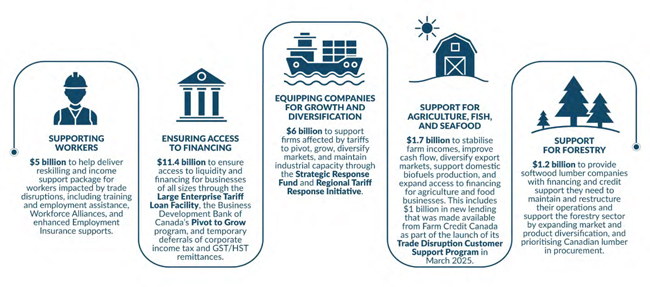
These initiatives will help workers acquire new skills and businesses retool their production and diversify their products, while spurring more domestic demand for Canadian businesses. Building on the $25 billion in supports set out in Budget 2025, the government subsequently announced an additional $1.6 billion over six years, starting in 2025-26, for workers and businesses affected by tariffs and trade disruptions.
| BUILDING CANADA: ALL FOR CANADA |
69 |
The Spring Economic Update 2026 outlines these previously announced measures, including:
| Worker Supports | ||

|
Extension of temporary flexibilities to the Employment Insurance Work-Sharing Program for one additional year, until March 2027. These flexibilities will continue to help employers and employees avoid layoffs while supplementing reduced income with Employment Insurance benefits. | |

|
Extension of temporary Employment Insurance measures—for six additional months until October 2026—to ensure that income supports remain generous for workers whose jobs are impacted by tariffs. These include: | |
|
● Waiving the one-week EI waiting period. | ||
|
● Suspending the treatment of monies paid on separation. | ||
| ● Providing 20 additional weeks of regular benefits for long-tenured workers. | ||

|
The Worker Retention Grant for employers to help them support their Work-Sharing employees to upskill and adapt to changing labour market needs. Newly launched on February 17, 2026, this top-up supplements employees’ incomes while they train during lost work time. | |
| Business Supports | ||

|
Temporary freight rate relief for steel and lumber, to decrease domestic transportation costs and encourage consumption of Canadian-made products. | |

|
The Business Development Bank of Canada’s Softwood Lumber Guarantee Program ensures softwood lumber companies have the financing and credit support they need to maintain and restructure their operations during this period of transformation. | |

|
The government also created a Canadian Forest Sector Transformation Task Force to examine and report on how the forest industry can maintain its competitiveness over the long term and launched a single window service to support forest sector employers and workers navigate and apply to federal programs. | |

|
Temporarily increase the Advance Payments Program’s interest-free limit to $250,000 for the 2026 program year for all producers, except for canola producers. This is in addition to the announcement in September 2025 to temporarily increase the limit to $500,000 for canola producers for the 2026 program. This will result in interest savings for producers while increasing access to cash flow to help cover costs until they sell their products. | |
To help mitigate the impacts of Canada’s tariff regime on downstream producers, the government established a tariff remission framework to provide tariff relief in situations where inputs cannot be sourced domestically and to address other exceptional circumstances. The government continues to prioritise timely relief to eligible companies, including pertaining to imports under its China tariffs, U.S. tariffs, steel tariff rate quotas, and steel derivative tariffs. Additionally, horizontal relief from counter tariffs against the U.S. is available for aluminum inputs to Canadian manufacturing, processing, agricultural production, and food and beverage packaging, as well as for steel inputs to autos, aerospace, and related parts production. This horizontal relief is immediately accessible for all eligible importers without the need for an application.
| 70 | CHAPTER 1 |
Moving Forward With the Automotive Strategy
For over 100 years, Canada’s automotive industry has been a cornerstone of Canada’s economy, supporting hundreds of thousands of well-paying jobs across the country. Canada’s automotive industry is on the frontline of global trade shifts, with more than 90 per cent of Canadian-made vehicles and 60 per cent of Canadian-made auto parts currently exported to the U.S.
As an energy superpower, the rise of electrified and connected vehicles presents a unique opportunity to transform Canada’s automotive industry. To that end, the government launched a new automotive strategy in February 2026. As set out below, over $6.9 billion has been announced to support the automotive sector.
| 1. Boosting Automotive Investment | ||
|
|
● Up to $3 billion through the Strategic Response Fund
| |
|
● Up to $100 million through the Regional Tariff Response Initiative
| ||
|
● Enhanced productivity support through the Productivity Super-Deduction
| ||
|
● Reduced tax rates for zero-emission technology manufacturers
| ||
| 2. Strengthening Climate Goals | ||
|
|
● Introducing stronger greenhouse gas emissions standards to replace the Electric Vehicle Availability Standard
| |
|
● Flexible pathways for automakers to meet Canada’s climate objectives
| ||
| 3. Making Electric Vehicles Affordable and Reliable | ||
|
|
● $2.3 billion Electric Vehicle Affordability Program
| |
|
● On March 31, 2026, the program portal opened for eligible purchases and leases made on or after February 16, 2026
| ||
| ● National Charging Infrastructure Strategy
| ||
|
● lncludes $1.5 billion through the Canada lnfrastructure Bank’s Charging and Hydrogen Refuelling Infrastructure lnitiative
| ||
| 4. Protecting Canadian Auto Workers | ||
|
|
● New Worker Retention Grant to help employers retain staff
| |
|
● Skills development investments through a new Workforce Alliance (industry, labour, training providers)
| ||
|
● Employment assistance and reskilling for displaced workers via Labour Market Development Agreements | ||
In response to persisting and unjustified U.S. tariffs on our vehicle exports, we will maintain our reciprocal counter tariffs to ensure a level playing field for Canadian automotive manufacturers in the domestic market.
Canada’s automotive duty remission framework further leverages these counter tariffs, creating a strong incentive for manufacturers to sustain their vehicle assembly levels in Canada if they wish to benefit from duty relief for their American-made imports. In February 2026, Canada launched public consultations, which have now concluded, to explore how this framework could be improved as a targeted, performance-based tool that further consolidates domestic production, attracts new investment, and enhances the long-term competitiveness of Canada’s automotive sector. As a starting point, the government is considering a potential system where companies earn tradeable credits based on their production in Canada.
| BUILDING CANADA: ALL FOR CANADA |
71 |
Canada will also leverage new and existing trade agreements, including the recent agreement with China, to support new investment in the sector, diversify Canada’s auto export markets, and position Canada as a global leader in electric vehicles.
Extending Alcohol Excise Duty Relief to Support Canadian Breweries, Distilleries, and Wineries
The government recognises the important contributions of Canada’s breweries, distilleries and wineries to the economy, including job creation and the production of high-quality Canadian products. In recent years, producers have faced rising cost pressures from global economic uncertainty, supply chain disruptions, and higher input costs.
To help the sector manage challenges from high price increases, Budget 2023 introduced a temporary 2 per cent cap on the annual inflation adjustment for excise duties on beer, wine, and spirits, effective April 1, 2023. On March 9, 2024, the government announced a two-year extension of this cap and introduced a temporary 50 per cent reduction in the excise duty rate on the first 15,000 hectolitres of beer brewed in Canada.
On April 1, 2026, the government announced its intention to further extend both measures for an additional two years. Together, these measures are expected to provide about $30 million in total relief through to 2028, including up to about $90,000 in tax savings in 2026-27 for a craft brewery on the first 15,000 hectolitres.
Update on the Buy Canadian Policy
Central to the government’s strategy to build a more resilient economy is Buying Canadian and being our own best customer.
Since the Buy Canadian policy came into force on December 16, 2025, it is already reshaping how the federal government spends—prioritising Canadian content, materials, suppliers, and workers. From steel and aluminum to wood products, the government’s purchasing of goods and services is being used as a powerful tool to back key industries and strengthen domestic supply chains.
This policy is already making a difference. The federal government purchases about $37 billion in goods and services each year. As of mid-April 2026, just a couple of months after its implementation, the Buy Canadian policy has already applied to a portfolio of solicitations valued at around $3.6 billion with $527.9 million worth of contracts awarded to date. This includes the procurement of vaccines for provincial and territorial partners, as well as facility management services, breathing apparatus maintenance, and communication bridge systems for the Department of National Defence.
The government is also bringing provinces, territories and municipalities on board with the Buy Canadian policy. It extends across the federal government and across all federal funding streams, including grants and contributions. As a result, in Toronto, new subway trains for Line 2 will be built with at least 55 per cent Canadian content—supporting good jobs and reinforcing Canada’s industrial base. The government hopes to expand this collaboration and welcomes all partners to support buying Canadian, including industry and other levels of government.
Building on this momentum, the government will launch a new Small and Medium Business Procurement Program later this spring to make it easier for Canadian firms to compete and win in federal procurements, by modernising digital tools and reducing barriers.
Update on the Temporary to Permanent Resident Pathways
To build the strong economy that Canada needs, the government is taking back control to return immigration to sustainable levels, while ensuring immigration contributes to the economic and social fabric of the country. Recent actions to control immigration are working: asylum claims were down by 64 per cent between January and February 2026 compared to the same period in 2024, while new temporary foreign worker and international student arrivals between January and February 2026 were 71 per cent and 75 per cent lower compared to the same period in 2024.
| 72 | CHAPTER 1 |
In parallel, we are attracting and retaining highly skilled immigrants, including those who are already living in, working in, and contributing to our country. As announced in Budget 2025, the government is delivering two one-time, two-year initiatives to:
| ● | fast-track permanent residence for a total of 33,000 skilled temporary workers who are already working in Canada and contributing to their communities—with a focus on immigrants in rural areas; and |
| ● | provide stability for Protected Persons in Canada by processing applications from up to 115,000 individuals who have been recognised as needing protection by the Immigration and Refugee Board of Canada or by Immigration, Refugees and Citizenship Canada. |
1.4 Expanding Trade at Home and Abroad
Building a more competitive and diversified Canadian economy means growing our trade opportunities at home and abroad. Canada already has a suite of measures to promote investment in Canada.
To make it easier for businesses and workers to succeed, the government is now advancing measures that remove trade barriers within and outside of Canada, so firms can scale and compete more effectively. The government is also taking steps to make generational investments in infrastructure to help firms move goods to markets more reliably and competitively, while also driving growth in communities across Canada.
Advancing Internal Trade in Canada
More internal trade will boost productivity and make Canada’s economy more resilient to disruptions to international trade. According to a recent study by the International Monetary Fund, eliminating all internal trade barriers could raise the level of Canada’s real gross domestic product (GDP) by nearly 7 per cent over the long run. This would amount to an increase of about $210 billion in annual GDP or $5,000 per person in today’s terms. While the government has made progress to reduce internal trade barriers, more work needs to be done by all partners to keep momentum.
This is why the federal government continues to take action and work with provincial and territorial partners to create an economy where businesses can grow without borders, workers can move without friction, and Canadians can benefit from lower costs, stronger competition, and greater opportunity. Recent progress on advancing internal trade includes the following:
| ✓ | As of June 2025, all 53 federal exceptions to the Canadian Free Trade Agreement (CFTA) have been removed. |
| ✓ | The federal Free Trade and Labour Mobility in Canada Act is now in place, reducing federal barriers by requiring regulators to recognise comparable provincial and territorial requirements—making it easier for businesses to trade and for skilled workers to work across Canada. |
| ✓ | To enhance transparency and certainty for financial service suppliers, federal, provincial, and territorial governments welcome the entry into force of the new Financial Services Chapter under the CFTA. |
| ✓ | Federal, provincial, and territorial governments are working to strengthen Chapter 7 of the CFTA, which will implement a 30-day service standard and reduce administrative requirements for labour mobility applicants in all regulated professions and trades in Canada. |
| ✓ | Federal, provincial, and territorial governments have agreed to sign the Canadian Mutual Recognition Agreement on the Sale of Goods, introducing a simple principle—if a good can be legally sold in one jurisdiction, it can be sold in another without additional rules or approvals. |
| ✓ | Participating provinces and territories reaffirmed progress on the direct-to-consumer alcohol sales agreement at the Committee on Internal Trade meeting on March 30, 2026, prioritising implementation by the May 2026 deadline, depending on legislative requirements for each jurisdiction. |
| ✓ | Launched the Domestic Trade Commissioners Network to help businesses build connections, solidify partnerships, expand their markets and strengthen Canadian supply chains through domestic trade missions. |
| BUILDING CANADA: ALL FOR CANADA |
73 |
Opening and Expanding New Trade Markets
Canada’s economic prosperity and resilience rely on increasing and diversifying our exports. With preferential access to 1.5 billion consumers across 15 free trade agreements, spanning 51 countries and nearly two thirds of global GDP, Canada is well positioned to expand its global reach. To advance the objective of doubling overseas exports over a decade, the government is pursuing a multi-faceted approach to create new opportunities through the removal of trade barriers.
The government has recently signed important new agreements, including:
| ● | The Canada-China strategic partnership in which China agreed to reduce or suspend tariffs for key agricultural and seafood exports. |
| ● | A new free trade agreement with Indonesia. |
The Comprehensive and Progressive Agreement for Trans-Pacific Partnership (CPTPP) has also been expanded to include the United Kingdom.
The government is also committed to seeking new free trade agreements (FTAs):
| ● | In March 2026, Canada and India committed to conclude an FTA by the end of this year. |
| ● | In November 2025, Canada and the United Arab Emirates announced their intention to negotiate an FTA. |
| ● | Canada is working to finalise FTA negotiations with the Association of Southeast Asian Nations, and has launched bilateral FTA negotiations with the Philippines and exploratory discussions with Thailand. |
| ● | Canada has resumed FTA negotiations with Mercosur countries (Argentina, Bolivia, Brazil, Paraguay, and Uruguay) with a view to concluding an agreement as soon as possible. |
Canada will look to leverage existing agreements, such as the CPTPP and the Canada-European Union
Comprehensive Economic and Trade Agreement. The government is deploying intensive efforts, including trade missions and attracting new investment to Canada, with these reliable partners.
Along with an extensive agenda for trade negotiations, the government is pursuing partnerships in key sectors, such as energy, critical minerals, clean energy technologies, defence, artificial intelligence, and agriculture.
Maintaining and Improving Market Access to the United States
As Canada diversifies and deepens its trade relationships, the U.S. market remains a top destination for Canadian exports. Canada has the best free trade deal of all countries with the United States.
The Canada-United States-Mexico Agreement (CUSMA) underpins broad exemptions from certain U.S. tariffs and ensures that approximately 85 per cent of Canada’s exports to the U.S. remain tariff-free. With CUSMA, the effective U.S. average tariff rate on Canadian goods is 5.2 per cent—the lowest among all of the U.S.’s major trading partners. The government is working to ensure that the review of CUSMA continues to provide predictable and favourable conditions for Canadian trade and investment with the United States and Mexico.
The government will also continue to engage with the U.S. Administration to advocate for the removal of remaining U.S. sectoral tariffs that affect exports for key sectors of the Canadian economy, including U.S. tariffs on steel, aluminum, automotive, and forestry.
| 74 | CHAPTER 1 |
Building Trade-Enabling Infrastructure
To help achieve Canada’s ambitious target of doubling non-U.S. exports over the next decade and to ensure that Canadian businesses can compete and succeed in today’s economy, the government has committed $6 billion to Canada’s Trade Infrastructure Strategy. This investment represents a generational investment in strengthening the infrastructure that connects Canada to global markets—creating good jobs, expanding opportunities for workers and businesses, and building a more resilient, secure, and sovereign Canada.
Recent progress includes:
| ● | Launching the $5 billion Trade Diversification Corridors Fund to help build and modernise Canada’s ports, railways, airports, bridges, and highways. This will help made-in-Canada goods reach overseas markets by increasing the capacity and efficiency of trade-enabling transportation infrastructure and reinforce Canada’s position as a reliable trading partner. |
| ● | Launching the $1 billion Arctic Infrastructure Fund to support critical Arctic transportation infrastructure— including airports, ports, all season roads, and highways—with dual civilian and military applications. These investments will strengthen Northern communities, enhance economic development, and help secure Canada’s Arctic sovereignty. |
| ● | On March 12, the government announced that the Arctic Infrastructure Fund will support the modernisation of the Rankin Inlet and Inuvik airports to accommodate larger aircraft and enable faster, more affordable year-round military and civilian access. |
| ● | The Northern projects recently referred to the Major Projects Office will strengthen an all-season northern transportation network, improve connectivity, lower costs, enable resource development, support Indigenous economic participation, and strengthen Canada’s Arctic and Northern sovereignty. |
Building More Efficient and Reliable Supply Chains
Canada’s supply chains face longstanding challenges that increase costs, reduce reliability, and weaken competitiveness. Trade-enabling transportation infrastructure continues to lag global peers, with inefficiencies particularly visible at key gateways. To address these challenges, the government is examining options to strengthen Canada’s supply chains including improving how trade corridors are planned and governed, accelerating the delivery of trade-enabling infrastructure, reducing regulatory burden on businesses, and modernising trade processes.
Hosting an Investment Summit
Inward direct investment provides high-value, long-term capital that creates high-quality jobs, boosts productivity, and brings new technologies and skills to Canada. It also enables major projects, strengthens global supply-chain integration, and enhances Canada’s competitiveness and economic resilience.
Canada is already emerging as a top destination for global investment, with inward direct investment at its highest level in nearly two decades. Building on this momentum, the government has set a target to attract $500 billion in private investment over five years.
|
|
As announced on April 17, the Spring Economic Update 2026 proposes to facilitate the delivery of a premier Investment Summit in September 2026. This event will showcase Canada as a compelling investment destination and a trusted convener of global capital, with a focus on priority sectors such as energy and critical minerals, artificial intelligence, defence, and infrastructure. |
| BUILDING CANADA: ALL FOR CANADA |
75 |
1.5 Advancing Clean Growth and Conservation
As the global economy moves toward lower-carbon pathways, addressing climate change and protecting Canada’s natural ecosystems have become essential to sustaining both economic opportunity and environmental well-being. Budget 2025 outlined the government’s Climate Competitiveness Strategy, which created conditions for Canada to compete effectively through this transition.
The government is continuing to build on this framework by facilitating sustainable investments and by helping developing countries phase out high emitting energy sources, adopt clean technologies, and build the infrastructure needed to strengthen resilience through continued contributions to international climate finance.
At the same time, safeguarding Canada’s nature protects the ecological foundations of our economy, restores habitats, and enhances species protection. Through these complementary actions, the government aims to advance economic prosperity while contributing meaningfully to global climate and biodiversity objectives.
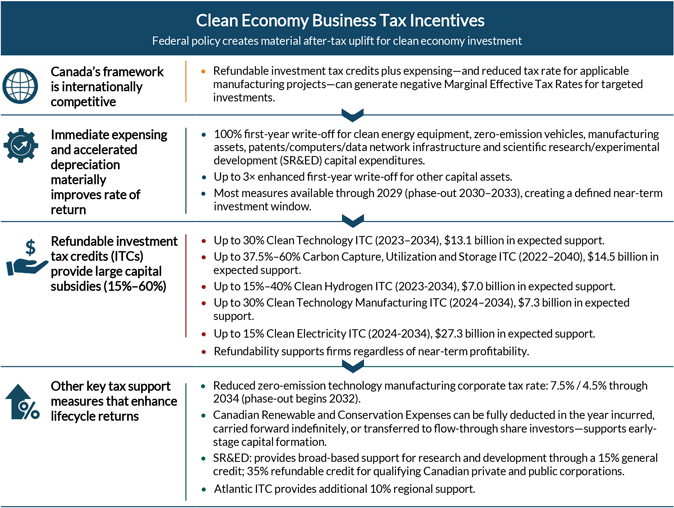
| 76 | CHAPTER 1 |
Continuing to Support International Climate Finance
Climate change is a global challenge that requires global solutions, and all countries are being called to act. International climate finance plays a key role in enabling developing countries to reduce emissions and adapt to the growing impacts of climate change. This strengthens communities’ economic resilience and supports sustainable development.
|
|
The Spring Economic Update 2026 proposes to provide $3.0 billion over five years on a cash basis, starting in 2026-27, to Global Affairs Canada, and $167.9 million over five years on a cash basis, starting in 2026-27, to Environment and Climate Change Canada to continue delivering climate-related supports to vulnerable countries. |
|
|
In addition, the Spring Economic Update 2026 proposes to provide $2.0 billion in paid-in capital for FinDev Canada, as well as $732 million over three years on a cash basis, starting in 2028-29, to expand FinDev Canada’s concessional finance facility. These measures will help to mobilise private capital at scale into climate-related businesses and projects in emerging markets and developing economies, including mobilising over $3 in private capital for every $1 of public investment through FinDev’s concessional finance facility. |
Together with other existing sources of climate finance, such as support provided through multilateral development banks and Export Development Canada, as well as private finance catalysed by public resources, the government’s goal is for Canada to deliver over $13 billion in climate-related support to developing countries over the next five years.
Hosting a Sustainable Finance Conference
The government is committed to mobilise public and private capital to promote investment in sustainability as part of the transition to net-zero. To help credibly identify “green” and “transition” activities in priority economic sectors, the government is supporting the arm’s-length development of made-in-Canada sustainable investment guidelines, also known as a taxonomy.
The Canadian Climate Institute, working collaboratively with Business Future Pathways, an investor-led initiative, are leading this work and have established an independent Taxonomy Council that will oversee the process. Advisory groups will include independent experts and representatives from academia, the financial sector and civil society, climate scientists, and Indigenous communities.
|
|
The Spring Economic Update 2026 proposes to support Canadian Climate Institute hosting a Sustainable Finance conference in the coming year. This event will bring together domestic and international stakeholders to promote progress on the Canadian taxonomy and discuss sustainable investment opportunities in Canada. |
A Force of Nature—Canada’s Strategy to Protect Nature
As we build Canada strong, we are protecting what matters most, including the magnificent land and waters we have inherited. The beauty of Canada’s natural environment is a treasure to be protected. Canada is one of the most nature-rich countries on earth, with 20 per cent of the world’s fresh water, 25 per cent of global wetlands, nearly a quarter of the boreal forest, the world’s longest coastline, and habitat for approximately 80,000 species.
The government is committed to protecting and conserving Canada’s natural heritage for future generations while growing our economy.
| BUILDING CANADA: ALL FOR CANADA |
77 |
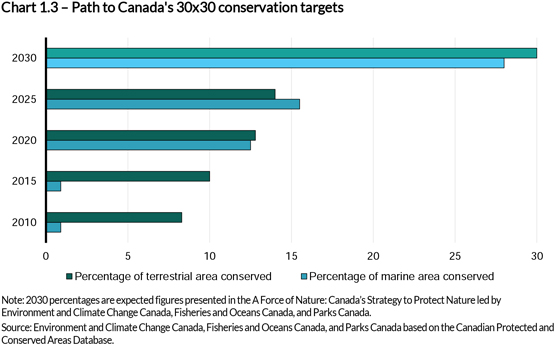
With $3.5 billion over five years, starting in 2026-27, $819.9 million in future years until 2036-37, with $74.6 million in remaining amortisation, and $129.3 million ongoing thereafter ($3.7 billion over five years, starting in 2026-27, $792 million in future years until 2036-37, and $129.3 million ongoing thereafter, on a cash basis), A Force of Nature: Canada’s Strategy to Protect Nature, is the government’s plan to work with partners from coast-to-coast-to-coast to deliver on Canada’s commitment to conserve 30 per cent of lands and waters by 2030.
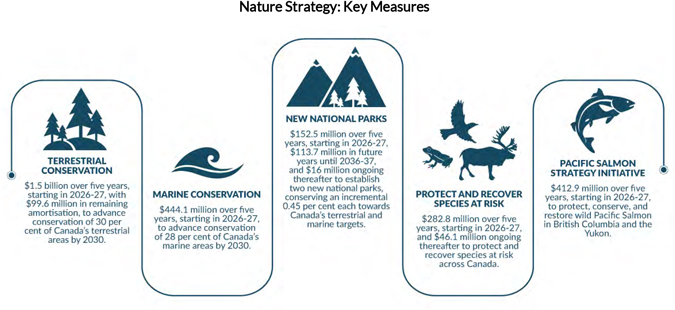
| 78 | CHAPTER 1 |
Protecting Canada’s Whales
Canada’s oceans are home to more than 30 species of whales, which play a critical role in the health of our oceans and carry important cultural significance for many Indigenous and coastal communities. Since 2018, the Government of Canada has made significant investments—through programs such as the Whales Initiative and the Oceans Protection Plan—to support recovery efforts and mitigate the impacts of key threats to the North Atlantic Right Whale, the St. Lawrence Estuary Beluga, the Southern Resident Killer Whale, and other endangered whales. In addition to the recently announced Nature Strategy:
|
|
The Spring Economic Update 2026 proposes to provide $160.8 million over five years, starting in 2026-27, with $3 million in remaining amortisation to Fisheries and Oceans Canada and Transport Canada to continue protecting Canada’s whales and their habitat across all coasts. |
|
|
Recognising the potential for increased marine traffic on the West Coast as Canada embarks on its Trade Diversification Strategy, the Spring Economic Update 2026 also proposes to provide an additional $91.3 million over five years, starting in 2026-27, with $3.7 million in remaining amortisation and $16.5 million ongoing to Transport Canada, Fisheries and Oceans Canada, and the Canadian Coast Guard to implement a regional noise monitoring and management program and to address other threats to the endangered Southern Resident Killer Whale population. Of this amount, $20.9 million over five years, starting in 2026-27, and $4.2 million ongoing will be sourced from existing resources. |
In March 2026, the government also pre-published amendments to the Marine Mammal Regulations under the Fisheries Act to increase the vessel approach distance from 200 metres to 1,000 metres for the Southern Resident Killer Whale to mitigate the threats posed by physical and acoustic disturbance from vessel traffic.
A Stronger Grid for a Stronger Canada
Clean, affordable, and dependable electricity is central to Canada’s long-term economic strength. Currently accounting for about 20 per cent of total final energy use, electricity’s share is projected to double in the decades ahead as industries electrify and new technologies scale. The electricity stack—spanning generation, transmission and distribution, storage, and end-use applications—is an increasingly important driver of innovation and productivity.
Meeting this growth will require significant investment. While provinces and territories are already making substantial investments, the scale and pace of rising demand require sustained and coordinated action to ensure Canada’s electricity system expands in time to maintain reliability and international competitiveness.
To inform its approach, the Government of Canada will soon release a discussion paper seeking input on how it can work with provinces and territories, Indigenous partners, and other stakeholders to strengthen efforts to connect, modernise and expand the grid.
The nuclear sector is a strategic asset for Canada’s clean electricity future and long-term economic competitiveness. Nuclear energy has the capacity to scale and help meet electrification imperatives by providing reliable, non-emitting, baseload power that strengthens grid resilience as demand grows. Beyond its role in electricity supply, Canada’s nuclear sector is a high-value-added industry that supports national priorities such as the development of cutting-edge Canadian R&D, the diversification of Canada’s trade relationships, and bolstering Canada’s role as a middle power. Given the importance of nuclear energy to Canada’s electricity system and economy, the Government of Canada will soon release a Nuclear Energy Strategy to provide a clear and coordinated federal perspective on the sector’s future development.
| BUILDING CANADA: ALL FOR CANADA |
79 |
1.6 Defending Our Sovereignty
The world is becoming more challenging and divided. The assumptions that shaped decades of Canadian defence and security are being upended. The threats we face are numerous and growing—ranging from incursions into our Arctic to attacks targeting our cyberspace. The very nature of warfare is changing rapidly, driven by the proliferation of drones, autonomous systems, and weapons in orbit. We know that the world has changed, and that Canada must change with it.
In this context, Canada is strengthening its sovereign capabilities in critical sectors, and deepening cooperation with trusted partners, to safeguard our security and resilience. This includes generational investments to rebuild, rearm, and reinvest in the Canadian Armed Forces. These investments will be guided by Canada’s first-ever Defence Industrial Strategy, helping deliver greater strategic autonomy and economic benefits for Canada, supported by more timely and transparent procurement through the new Defence Investment Agency.
Defending Canada’s sovereignty also means honouring the service and sacrifice of those who have helped defend our people, our values, and our country. Our government is committed to working with the Last Post Fund to ensure the National Field of Honour in Pointe-Claire, Québec, remains a dignified and respectful resting place for Veterans and their families and to preserve Canada’s proud military legacy for generations to come. This commitment reflects our enduring responsibility to honour those who have served.
The government also continues to deliver on its commitment to enhance border security and the safety of Canadians through the continued implementation of the $1.3 billion Border Plan.
The Spring Economic Update 2026 provides an update on the implementation of the government’s ambitious plan and introduces new and targeted measures to further protect Canada’s sovereignty and security.
Fulfilling Our NATO Defence Spending Commitments
In March 2026, NATO confirmed that Canada achieved its 2 per cent of GDP defence expenditure target—half a decade ahead of the previous government’s schedule, and the first time since the fall of the Berlin Wall. In 2025-26, we spent more than $63 billion on our defence, the single largest year-on-year increase in defence investment in generations as part of an ambitious plan to rebuild, rearm, and reinvest in the Canadian Armed Forces.
Canada is making critical contributions to defending the Alliance’s territory. Canada is leading the Multinational Brigade in Latvia on NATO’s Eastern flank, and making unprecedented investments in Arctic and northern surveillance, communications, command and control, and presence.
Building on this progress, and the generational defence investments made in Budget 2025, Canada is on a path to meet the NATO Defence Investment Pledge of investing 5 per cent of GDP in defence by 2035.
| 80 | CHAPTER 1 |
What 2% Means for Canada
| Enhancing Canadian Armed Forces (CAF) Presence | ||||

|
● | Increased military support to Ukraine
| ||
| ● | Enhancing international defence engagements | |||
| Securing Our Arctic | ||||
|
|
● | Advancing Northern Operational Support Hubs for CAF presence and responsiveness | ||
| ● | Improving northern basing infrastructure | |||
| Delivering New Military Capabilities and Investing in Foundations of Defence | ||||

|
● | Enhancing fleet and equipment readiness and building housing for CAF members
| ||
| ● | Procuring long-range planes for the Royal Canadian Air Force to detect and track submarines and ships
| |||
| ● | Building River-class destroyers to provide modern warships
| |||
| ● | Equipping the Canadian Army with modern rifles | |||
| Supporting the Women and Men Who Serve | ||||

|
● | Implementing the largest pay raise for the CAF in a generation, with all members receiving a pay raise
| ||
| ● | Launching the Military Service Pay Benefit specifically tied to time in service so pay cheques honour years in uniform | |||
| Strengthening Canada’s Economy and Defence Industry | ||||

|
● | Catalysing investment in Canada and building Canadian industry, from aerospace to AI.
| ||
| ● | Integrating small- and medium-sized enterprises into defence supply chains. | |||
Defence Industrial Strategy
To protect Canada’s sovereignty, build our prosperity, and strengthen our strategic autonomy, the Canadian government must change how we invest in defence. Canada’s defence procurement has long been too complicated, too slow, and too reliant on international suppliers, limiting the growth of our defence industries. This has left our workers and businesses with fewer opportunities, our domestic industries without the demand necessary to scale, and critically, the women and men of our military without the equipment they need to defend our sovereignty and that of our Allies.
In February 2026, the government launched the new Defence Industrial Strategy (DIS), a whole-of-government approach to transform Canada’s defence industry. The strategy will prioritise Canadian suppliers and materials, invest in Canadian innovation and commercialisation, and streamline procurement to give businesses a consistent and predictable demand outlook. This will enable Canada’s aerospace, cyber, and other industries to scale up operations to sell more at home and to trusted partners around the world, creating high-paying careers for Canadians across the country.
The DIS positions Canadian industry to take advantage of the government’s generational investments in defence, creating significant economic benefits for years to come. Over the next ten years, the DIS will increase our defence exports by 50 per cent, raise the share of defence acquisitions awarded to Canadian firms to 70 per cent, and result in a step change in the size of Canada’s defence industry.
| BUILDING CANADA: ALL FOR CANADA |
81 |
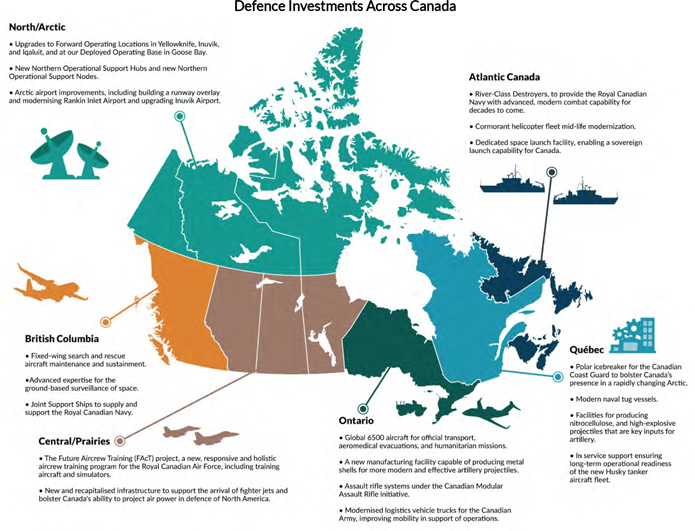
The strategy will help give the Canadian Armed Forces the tools and equipment they need to keep Canada safe. It will raise maritime fleet serviceability to 75 per cent, land fleets to 80 per cent, and aerospace fleets to 85 per cent to bolster Canadian defence.
Defence Investment Agency
The Defence Investment Agency (DIA) is at the centre of the Defence Industrial Strategy. The DIA will be responsible for re-equipping our military and driving economic benefits for Canada through the government’s generational investment in defence. The DIA is designed to accelerate the timeline of defence procurements, leverage defence procurements to strengthen Canada’s defence industrial base, and attract investment into Canada’s defence industry, contributing to growing Canada’s economy.
The DIA was launched in October, 2025, as a Special Operating Agency housed within Public Services and Procurement Canada, and is rapidly advancing major defence procurements, such as Arctic Over-the-Horizon Radar and the Canadian Patrol Submarine Project, to support the Canadian Armed Forces and the Canadian Coast Guard across air, land, sea and digital domains.
The government’s intention is to establish the DIA as a stand-alone entity to further deliver on its important mandate.
|
|
The Spring Economic Update 2026 proposes to provide $103.8 million over five years, starting in 2026-27, and $22.3 million ongoing to establish and operate the DIA as a stand-alone entity. |
|
|
The Spring Economic Update 2026 also announces the government’s intention to introduce enabling legislation to establish the DIA as a stand-alone entity and legislative amendments to the Defence Production Act to provide the DIA with expanded authorities. |
| 82 | CHAPTER 1 |
Canada’s Support for Ukraine
More than four years after Russia’s full-scale, illegal invasion of Ukraine—violating sovereignty, territorial integrity, and independence—Canada remains a steadfast partner. A secure, peaceful, and stable Ukraine that is resilient to Russian aggression enhances our collective security and prosperity.
Canada is strengthening Ukraine’s military capacity through sustained operational support. Operation UNIFIER, launched in 2014 following Russia’s first invasion, has enabled the Canadian Armed Forces (CAF) to train over 47,000 members of the Armed Forces of Ukraine, covering a range of basic and advanced military skills, including tactical medical training, combat engineering, and leadership skills and education.
In February 2026, the government announced the renewal of Operation UNIFIER for an additional three years, starting in 2026-27. Under the renewed mandate, the number of CAF personnel dedicated to the operation will increase, providing greater flexibility and enabling Canada to further adapt and respond to Ukraine’s evolving operational needs.
|
|
The Spring Economic Update 2026 proposes to provide $2.0 billion over three years on a cash basis, starting in 2026-27, to the Department of National Defence, the Communications Security Establishment, Global Affairs Canada, and the Canadian Security Intelligence Service to support Operation UNIFIER. |
1.7 Driving Productivity and Affordability
Through Competition
To unlock economic growth and bring down costs for Canadians, the government must ensure the domestic economy operates at its full potential. Stronger competition pushes businesses to become more productive, encouraging them to innovate, adopt new technologies, and operate more efficiently. Over time, these productivity gains translate into lower costs, greater choice, better wages, and better-quality goods and services for Canadians.
Whole-of-Government Competition Plan
A lack of competition weighs on productivity growth and directly impacts affordability. To drive lasting improvements in affordability, competition across Canada’s economy must be strengthened. Building on recent and ongoing actions to enhance competition:
|
|
The Spring Economic Update 2026 announces the government’s intention to launch a Whole-of-Government Competition Plan to ensure that competition is prioritised throughout the federal government’s policies. |
The plan would seek to ensure that existing and future policies across the federal government prioritise the promotion of competition and limit to the extent possible the potential negative impacts on competition that can, often inadvertently, stem from government policies. The plan will focus on removing inefficient government policies that impede competition arising from regulation, procurement, and industrial support. The Minister of Finance and National Revenue will provide further information on this initiative in the coming months.
| BUILDING CANADA: ALL FOR CANADA |
83 |
Telecommunications Competition Roadmap
In today’s world, Internet and mobile services are essential for daily life, but competition and affordability for Canadians remains a challenge.
The government will take a comprehensive, national approach to telecom competition and drive meaningful outcomes for Canadian consumers by implementing a Telecommunications Competition Roadmap. The Roadmap puts Canadians first, through actions that will improve choice, transparency, prices, and networks.
Parts of the Roadmap are already underway. Shortly after taking office in 2025, our government upheld the Canadian Radio-television and Telecommunications Commission’s (CRTC) decision on mandatory wholesale Internet access, which requires large players to give access to their fibre-to-the-home networks to competitors. Final rates for competitor access are expected in 2026 to help competitors enter new markets quickly and offer more affordable Internet options.
Recent amendments to the Telecommunications Act also require transparency on contracts and make it easier for Canadians to more easily renew or switch between home Internet, home phone, and cell phone plans, and take advantage of better pricing. New rules on these matters were announced by the CRTC in March and April of 2026.
The Roadmap includes multiple ongoing and planned government actions, including publishing roaming benchmarks, pursuing a “dig once” policy approach to nation-building projects as outlined in Budget 2025, and building on efforts to enable emerging satellite technologies. Its publication will allow Canadians to easily see results and keep track of ongoing efforts in the short term. Further information on the Roadmap will be provided in the coming months.
A Strong Financial Sector
Greater competition, innovation, and efficiency in financial services means more options, better quality products, and more affordable financial services. Over the coming months, the government will continue to advance initiatives to promote competition and lower financial costs, helping Canadians keep more money in their pockets.
| Lowering Financial Costs for Canadians | ||
| Recent Government Initiatives
| ||

|
March 12, 2026 – cap on NSF fees | |
| New regulations to cap NSF fees at $10, down from $45 to $50, are expected to save consumers upwards of $600 million annually. | ||

|
Regulating investment account transfers | |
| The government intends to publish draft regulations for consultation in the coming weeks to prohibit investment account transfer fees by federally regulated financial institutions, currently costing Canadians on average $150 per transfer, and to reduce the time to transfer accounts. | ||

|
Report on bank fees | |
| The Financial Consumer Agency of Canada has been asked to prepare a report on the structure, level, and transparency of fees charged by banks. | ||

|
Consumer-driven banking | |
| Amendments to complete the Consumer-Driven Banking Act have been passed, which will give consumers greater control over their finances. | ||

|
Low-cost and no-cost accounts | |
| Updated industry commitment to offer modernised low-cost and no-cost accounts is now in effect. | ||
| 84 | CHAPTER 1 |
Following the passage of the Stablecoin Act:
|
|
The Spring Economic Update 2026 announces the government’s intention to engage with federally regulated financial institutions to better understand considerations related to their development and potential use of stablecoins, and other tokenised assets and whether additional regulatory clarity is needed. This engagement would be complemented by targeted discussions with industry, regulators and the provinces and territories. The focus would be on supporting innovation while maintaining financial stability, protecting consumers—including in the context of insolvency of stablecoin issuers—and preserving regulatory integrity. |
|
|
As this work progresses, the government expects to outline next steps, including in the context of Budget 2026, to inform its ongoing policy approach to stablecoins. |
The government remains committed to the future of Canada’s Real-Time Rail (RTR). Launching in 2026, the RTR is a cornerstone of our modernisation agenda that will serve as a powerful engine for national productivity and economic growth. This critical national payments infrastructure will be a catalyst for competition, empowering a more dynamic and inclusive financial sector. The government will continue to engage with all relevant stakeholders to ensure the accelerated development of the RTR’s future capabilities. The government is also advancing payments modernisation by strengthening the supervision of payment service providers and expanding their access to national payment systems.
Finally, the government intends to implement changes to provide more flexibility for federally regulated financial institutions to make investments that support innovative financial services and benefit the economy as a whole.
|
|
The Spring Economic Update 2026 announces that the government will bring forward regulations this spring allowing federally regulated financial institutions to make a broader range of investments to improve financial services. |
|
|
To support these regulations, the government proposes to amend the Bank Act to ensure the review for national security risks of investments in Canadian businesses by foreign banks and their affiliates is consistent with how other foreign investments in Canada are assessed. |
Gender and Diversity Impacts Spotlight
Building Canada includes investments to protect nature and contributions to global climate finance efforts to support vulnerable countries tackling climate change.
| ● | Continuing to Support International Climate Finance will benefit people in developing countries by helping reduce greenhouse gas emissions and strengthen preparedness for climate impacts such as floods, droughts, and extreme heat. Marginalised and vulnerable groups—including women and girls, and rural communities—are disproportionately affected by climate change. For example, during extreme weather disasters, women and children are 14 times more likely to die than men, due in part to more limited access to information and resources. Climate finance support is expected to particularly benefit these populations. |
| ● | Significant investments for Canada’s Strategy to Protect Nature will benefit all Canadians by conserving more lands and waters by 2030, protecting species at risk, preserving biodiversity, and supporting climate resilience. The measures are expected to benefit Indigenous people, including through the expansion of the Indigenous Guardians program, and people working in the conservation field, and have long-term benefits for young people and future generations. |
| BUILDING CANADA: ALL FOR CANADA |
85 |
Chapter 1
Building Canada: All for Canada
millions of dollars
| 2025- | 2026- | 2027- | 2028- | 2029- | 2030- | Total | ||||||||||||||||||||||||||||||||||||||||||||||
| 2026 | 2027 | 2028 | 2029 | 2030 | 2031 | |||||||||||||||||||||||||||||||||||||||||||||||
| 1.1 Delivering for Canadians |
0 | 2 | 2 | 2 | 1 | 1 | 6 | |||||||||||||||||||||||||||||||||||||||||||||
| The Canada Strong Fund - Transition Office |
0 | 2 | 2 | 2 | 1 | 1 | 6 | |||||||||||||||||||||||||||||||||||||||||||||
| 1.2 Building to Grow |
0 | 10 | 20 | -45 | -55 | -60 | -130 | |||||||||||||||||||||||||||||||||||||||||||||
| Expanding the Carbon Capture, Utilization, and Storage Investment Tax Credit to Enhance Oil Recovery* |
0 | 0 | -10 | -75 | -115 | -195 | -395 | |||||||||||||||||||||||||||||||||||||||||||||
| Implementing Accelerated Capital Cost Allowance Rates for Low-Carbon Liquefied Natural Gas Facilities* |
0 | 0 | 50 | 120 | 160 | 310 | 640 | |||||||||||||||||||||||||||||||||||||||||||||
| Less: Funds Previously Provisioned in the Fiscal Framework |
0 | 0 | -50 | -120 | -155 | -255 | -580 | |||||||||||||||||||||||||||||||||||||||||||||
| Making the Employee Ownership Trust Tax Exemption Permanent |
0 | 10 | 30 | 30 | 55 | 80 | 205 | |||||||||||||||||||||||||||||||||||||||||||||
| 1.3 Supporting Strategic Sector Initiatives |
26 | 1,545 | 812 | 424 | 538 | 586 | 3,932 | |||||||||||||||||||||||||||||||||||||||||||||
| Measures Taken to Support Workers and Businesses - Worker Supports1 |
26 | 893 | 396 | 14 | 0 | 0 | 1,327 | |||||||||||||||||||||||||||||||||||||||||||||
| Measures Taken to Support Workers and Businesses - Business Supports2 |
0 | 192 | 8 | 8 | 8 | 8 | 224 | |||||||||||||||||||||||||||||||||||||||||||||
| Moving Forward With the Automotive Strategy - EV Affordability Program3* |
0 | 450 | 387 | 391 | 519 | 567 | 2,314 | |||||||||||||||||||||||||||||||||||||||||||||
| Extending Alcohol Excise Duty Relief to Support Canadian Breweries, Distilleries, and Wineries4 |
0 | 11 | 22 | 11 | 11 | 11 | 66 | |||||||||||||||||||||||||||||||||||||||||||||
| 1.4 Expanding Trade at Home and Abroad |
0 | 11 | 0 | 0 | 0 | 0 | 11 | |||||||||||||||||||||||||||||||||||||||||||||
| Hosting an Investment Summit5 |
0 | 11 | 0 | 0 | 0 | 0 | 11 | |||||||||||||||||||||||||||||||||||||||||||||
| 1.5 Advancing Clean Growth and Conservation |
0 | 708 | 671 | 759 | 852 | 818 | 3,808 | |||||||||||||||||||||||||||||||||||||||||||||
| Continuing to Support International Climate Finance |
0 | 537 | 475 | 546 | 543 | 527 | 2,628 | |||||||||||||||||||||||||||||||||||||||||||||
| Less: Funds Previously Provisioned in the Fiscal Framework |
0 | -200 | -200 | -200 | -260 | -260 | -1,120 | |||||||||||||||||||||||||||||||||||||||||||||
| Less: Funds Sourced From Existing Departmental Resources |
0 | -353 | -253 | -203 | -129 | -77 | -1,015 | |||||||||||||||||||||||||||||||||||||||||||||
| A Force of Nature - Enhanced Nature Legacy6* |
0 | 280 | 302 | 306 | 300 | 298 | 1,485 | |||||||||||||||||||||||||||||||||||||||||||||
| Less: Funds Sourced From Existing Departmental Resources |
0 | -17 | -121 | -135 | -80 | -108 | -462 | |||||||||||||||||||||||||||||||||||||||||||||
| A Force of Nature - Marine Conservation Target6* |
0 | 89 | 89 | 89 | 89 | 89 | 444 | |||||||||||||||||||||||||||||||||||||||||||||
| A Force of Nature - New National Parks6* |
0 | 32 | 35 | 16 | 53 | 16 | 152 | |||||||||||||||||||||||||||||||||||||||||||||
| A Force of Nature - Protect and Recover Species at Risk6* |
0 | 57 | 57 | 56 | 56 | 56 | 283 | |||||||||||||||||||||||||||||||||||||||||||||
| A Force of Nature - Pacific Salmon Strategy Initiative6 |
0 | 83 | 83 | 83 | 83 | 83 | 413 | |||||||||||||||||||||||||||||||||||||||||||||
| A Force of Nature - Other Measures6* |
0 | 159 | 156 | 154 | 149 | 149 | 768 | |||||||||||||||||||||||||||||||||||||||||||||
| Protecting Canada’s Whales* |
0 | 45 | 53 | 51 | 53 | 50 | 252 | |||||||||||||||||||||||||||||||||||||||||||||
| Less: Funds Sourced From Existing Departmental Resources |
0 | -4 | -4 | -4 | -4 | -4 | -21 | |||||||||||||||||||||||||||||||||||||||||||||
| 1.6 Defending Our Sovereignty |
0 | 519 | 723 | 768 | 35 | 29 | 2,074 | |||||||||||||||||||||||||||||||||||||||||||||
| Defence Investment Agency |
0 | 30 | 30 | 30 | 30 | 30 | 150 | |||||||||||||||||||||||||||||||||||||||||||||
| Less: Funds Previously Provisioned in the Fiscal Framework |
0 | -8 | -8 | -8 | -8 | -8 | -39 | |||||||||||||||||||||||||||||||||||||||||||||
| Less: Funds Sourced From Existing Departmental Resources |
0 | -3 | -2 | -2 | 0 | 0 | -8 | |||||||||||||||||||||||||||||||||||||||||||||
| Canada’s Support for Ukraine - Operation UNIFIER* |
0 | 499 | 703 | 748 | 13 | 7 | 1,970 | |||||||||||||||||||||||||||||||||||||||||||||
| 86 | CHAPTER 1 |
| 2025- | 2026- | 2027- | 2028- | 2029- | 2030- | Total | ||||||||||||||||||||||||||||||||||||||||||||||
| 2026 | 2027 | 2028 | 2029 | 2030 | 2031 | |||||||||||||||||||||||||||||||||||||||||||||||
| Additional Investments – Building Canada: All for Canada |
0 | 13 | 45 | 69 | 28 | 28 | 183 | |||||||||||||||||||||||||||||||||||||||||||||
| EV Affordability Program and Immediate Expensing* |
0 | -3 | -4 | 0 | 0 | 0 | -7 | |||||||||||||||||||||||||||||||||||||||||||||
| The Spring Economic Update proposes to amend the Income Tax Regulations, effective February 16, 2026, to designate the Electric Vehicle Affordability Program (EVAP) as a prescribed program under 1102(26) of the Income Tax Regulations. As a result, businesses will not be permitted to claim both an EVAP rebate and immediate expensing for the same electric vehicle, consistent with the tax treatment under the former iZEV program. |
| |||||||||||||||||||||||||||||||||||||||||||||||||||
| Supporting the Harbourfront Centre7 |
0 | 12 | 12 | 7 | 7 | 7 | 43 | |||||||||||||||||||||||||||||||||||||||||||||
| Funding proposed for PCH to support the Harbourfront Centre to help maintain operating support for the Centre’s arts, cultural, educational and recreational programming and for time-limited funding for capital repairs. |
| |||||||||||||||||||||||||||||||||||||||||||||||||||
| CITT Safeguard Inquiries |
0 | 4 | 0 | 0 | 0 | 0 | 5 | |||||||||||||||||||||||||||||||||||||||||||||
| Funding proposed for the CITT to conduct safeguard inquiries into imports of certain canned and frozen vegetables and wood products. |
| |||||||||||||||||||||||||||||||||||||||||||||||||||
| Implementing the Strong and Free Elections Act8 |
0 | 2 | 2 | 2 | 2 | 2 | 11 | |||||||||||||||||||||||||||||||||||||||||||||
| Less: Funds Previously Provisioned in the Fiscal Framework |
0 | -4 | -4 | -4 | -4 | -4 | -18 | |||||||||||||||||||||||||||||||||||||||||||||
| Funding proposed for Elections Canada to administer targeted, priority updates to the Canada Elections Act aimed at strengthening and protecting Canada’s federal elections and electoral actors from evolving threats. |
| |||||||||||||||||||||||||||||||||||||||||||||||||||
| Expanding the Rapid Response Mechanism9 |
0 | 3 | 7 | 7 | 7 | 7 | 32 | |||||||||||||||||||||||||||||||||||||||||||||
| Less: Funds Sourced From Existing Departmental Resources |
0 | -3 | -7 | -7 | -7 | -7 | -32 | |||||||||||||||||||||||||||||||||||||||||||||
| Funding proposed for GAC to expand the Rapid Response Mechanism, which works to identify and counter foreign information manipulation and interference against Canada. Funding would be sourced from DND reference levels. |
| |||||||||||||||||||||||||||||||||||||||||||||||||||
| Providing CBSA Service at the Port of Quebec10* |
0 | 1 | 2 | 7 | 7 | 7 | 23 | |||||||||||||||||||||||||||||||||||||||||||||
| Less: Funds Sourced From Existing Departmental Resources |
0 | -1 | 0 | -3 | -3 | -3 | -11 | |||||||||||||||||||||||||||||||||||||||||||||
| Funding proposed for the CBSA to service the Port of Quebec to ensure the safety and security of our borders while supporting trade. |
| |||||||||||||||||||||||||||||||||||||||||||||||||||
| Enhancing the Integrity of Immigration Holding Centres |
0 | 0 | 119 | 119 | 0 | 0 | 238 | |||||||||||||||||||||||||||||||||||||||||||||
| Less: Funds Sourced From Existing Departmental Resources |
0 | 0 | -88 | -66 | 0 | 0 | -153 | |||||||||||||||||||||||||||||||||||||||||||||
| Funding proposed for the CBSA to contract guards with higher security training at Immigration Holding Centres, thereby increasing the integrity of our immigration system. |
| |||||||||||||||||||||||||||||||||||||||||||||||||||
| Enhancing Safety in Federal Secure Facilities* |
0 | 1 | 6 | 7 | 19 | 19 | 52 | |||||||||||||||||||||||||||||||||||||||||||||
| Funding proposed for the CSC and CBSA to pilot and deploy technologies to prevent unauthorised communications and contraband delivery in correctional facilities and immigration holding centres to support safety and enhance institutional security. |
| |||||||||||||||||||||||||||||||||||||||||||||||||||
| Chapter 1 - Net Fiscal Impact |
26 | 2,807 | 2,273 | 1,977 | 1,399 | 1,401 | 9,883 | |||||||||||||||||||||||||||||||||||||||||||||
| Of which, capital investment: |
0 | 3 | -1 | -48 | -75 | -110 | -230 | |||||||||||||||||||||||||||||||||||||||||||||
| 1 | Measures Taken to Support Workers and Businesses - Worker Supports were announced on November 26, 2025; March 11, 2026; and March 20, 2026. |
| 2 | Measures Taken to Support Workers and Businesses – Business Supports were announced on November 26, 2025; and April 1, 2026. |
| 3 | Moving Forward With the Automotive Strategy - EV Affordability Program was announced on February 5, 2026. |
| 4 | Extending Alcohol Excise Duty Relief to Support Canadian Breweries, Distilleries, and Wineries was announced on April 1, 2026. |
| 5 | Hosting an Investment Summit was announced on April 17, 2026. |
| 6 | A Force of Nature—Canada’s Strategy to Protect Nature was announced on March 31, 2026. |
| 7 | Supporting the Harbourfront Centre was announced on March 31, 2026. |
| 8 | Implementing the Strong and Free Elections Act was announced on March 26, 2026. |
| 9 | Expanding the Rapid Response Mechanism was announced on March 26, 2026. |
| 10 | Providing CBSA Service at the Port of Quebec was announced on April 24, 2026. |
| *Measure | includes funding classified as a capital investment. |
| Note: | Numbers may not add due to rounding. A glossary of abbreviations used in this table can be found at the end of Annex 1. |
| BUILDING CANADA: ALL FOR CANADA |
87 |
Chapter 2
Benefitting Canadians:
A Canada for All
A rapidly changing world is leaving Canadian families and businesses under a cloud of uncertainty. In response, Canada’s new government is focused on what we can control: building a stronger economy to make life more affordable for Canadians.
Skilled workers will be at the centre of this agenda. They have been the cornerstone of the Canadian economy, leading the way in building homes, roads, and bridges throughout our history, and we will once again need their support to build Canada’s economic strength. That is why the government is taking action to strengthen and accelerate Canada’s skilled trades training and apprenticeship system, mobilise talent earlier, support apprentices through training and in completing their programs, and ensure Canada has the workers it needs to build a secure and sovereign future.
Canadians are also feeling the pressures of everyday expenses right now. That’s why the government is protecting the essential social programs that give Canadians a fair chance to get ahead—child care, dental care, and pharmacare.
The Spring Economic Update 2026 outlines our government’s plan to bring down costs for Canadians and help them get ahead. We are supercharging the housing sector and strengthening competition—empowering Canadians with greater certainty, security, and prosperity, now and into the future.
New initiatives include:
| ● | Launching Team Canada Strong to recruit, train, and hire 80,000 to 100,000 new Red Seal skilled trades workers by 2030-31, providing paid pathways for young Canadians into building housing, major infrastructure, and defence projects at speed and scale. |
| ● | Standing up the Financial Crimes Agency as a best-in-class Agency that will employ a “follow-the-money” approach to investigate serious and complex financial crimes, recover illicit proceeds, and hold criminals to account. |
| ● | Investments in the programs and services that ensure Canadians feel safe, supported, and able to fully participate in community life. |
| ● | Providing $755 million to expand access to sport, creating opportunities for Canadians to build meaningful relationships within their communities and make full use of existing and new infrastructure, and support Canada’s world-class athletes. |
| ● | Providing nearly $1 billion to repair and maintain small craft harbours, essential infrastructure for coastal communities and commercial fishing. |
| ● | Making it easier to access the Disability Tax Credit by streamlining the application process for individuals with certain long-lasting medical conditions. |
| ● | Nearly $4.3 billion to empower healthy, thriving Indigenous communities. |
We are providing a boost to Canadians who most need one, while creating a bridge to longer-term prosperity. As a result of recent actions the government has taken:
| ü | More than 12 million Canadians will receive hundreds of dollars more in their bank accounts through the new Canada Groceries and Essentials Benefit. |
| ü | Canadians’ bills at the gas station are expected to be reduced across Canada thanks to the temporary suspension of the federal fuel excise tax on gasoline and diesel, allowing them to save 10 cents per litre on regular gasoline and 4 cents on diesel. |
| BENEFITTING CANADIANS: A CANADA FOR ALL |
89 |
| ü | Families with two children are saving $800 per year on groceries with the permanent National School Food Program. |
| ü | 22 million Canadians are getting a middle-class tax cut, and two-income families are keeping up to $840 per year in their pockets. |
| ü | Canadians travelling on the Confederation Bridge now pay only $20 in tolls, down from $50, and those travelling by ferries in Atlantic Canada are paying 50 per cent less in fares. |
2.1 Supporting Workers and Young People
Canadian workers, men and women alike, are building Canada strong, from major infrastructure projects to new housing across the country. The government is committed to supporting a flourishing labour market for all.
Young people, in particular, are facing real challenges as they try to build their career and get ahead. Many are balancing everyday costs with big life goals, like post-secondary education or saving for a first home. At the same time, finding that first good job is not always easy: youth unemployment sat at 13.8 per cent in March 2026, and many recent graduates are still struggling to get a foothold in the job market.
This is why the government is strengthening the Canada Student Financial Assistance Program, to make post-secondary education more accessible and help ease financial pressure on students and recent graduates.
The government is also expanding access to hands-on experience and on-the-job training so young people can build the skills they need to confidently enter the labour market. Budget 2025 announced that the government would support 175,000 young people in 2026-27 through employment and work-integrated learning opportunities delivered by Canada Summer Jobs, the horizontal Youth Employment and Skills Strategy, and the Student Work Placement Program.
Looking ahead, meeting Canada’s housing, infrastructure, and defence needs will require a new generation of skilled trades workers. Team Canada Strong sets out an end-to-end approach to recruit, train, and hire 80,000 to 100,000 new Red Seal skilled trades workers by 2030-31, creating clear, paid pathways for young Canadians into good jobs while strengthening Canada’s future workforce.
Team Canada Strong
Skilled workers have always been the cornerstone of the Canadian economy. Throughout our history, they have led the way in building homes, roads and bridges.
Build Canada Strong will deliver housing, major projects and defence readiness, built at speed and scale, right across the country. But lumber, steel and capital do not build projects on their own. Skilled workers do. Canada needs them now more than ever.
The Challenge
We need to move quickly to recruit and train the workers we need: retirements and economic growth mean that Canada will need more than 1.4 million additional trades workers by 2033, and the scale of investments in housing and infrastructure projects will add to this demand. The need is urgent, but long training processes and financial pressures on apprentices contribute to low rates of completion. In 2024, more than 100,000 new apprentices registered, but only about 34,000 completed their apprenticeship. If nothing changes, Canada will face a persistent gap of more than 20,000 skilled trades workers per year.
Too few young Canadians are entering the trades—missing out on well-paid jobs and long-term financial security. If we want them to benefit from the good jobs that the Build Canada agenda will deliver, we need a new approach.
Our goal is clear: create Team Canada Strong, which will give young Canadians a direct, paid pathway into the work of building Canada. We will take a multi-channel approach to recruit, train, and hire 80,000 to 100,000 new Red Seal trades workers aligned to Canada’s housing, infrastructure, resource development, and defence needs by 2030-31.
| 90 | CHAPTER 2 |
Skilled workers are indispensable to the historic, nation-building investments we are making to secure Canada’s future. We are making big investments in projects. We need to match that with big investments in the young workers who will get those projects done on time and set Canada up for success.
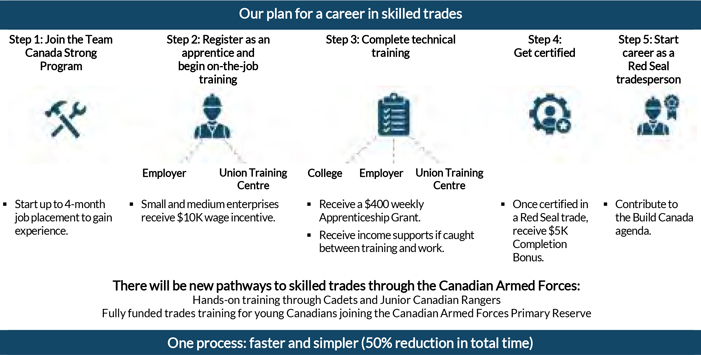
We are taking a new approach
Many Canadians know first-hand the value of a career in the skilled trades. But getting their certification can be slow and challenging. Seats in popular programs can be in short supply. Employers do not always want to take a chance on a first-year apprentice. Navigating all the government programs and financial supports takes time and can be discouraging, and many apprentices find it hard to make ends meet while on training—especially when the cost of living has gone up.
Our plan for Team Canada Strong delivers:
| ✓ | End-to-end support: We will support young people every step of the way in recruitment, training and hiring. From their first interest in the skilled trades through apprenticeship and Red Seal certification, we will be alongside with the supports they need. Their success is Canada’s success. |
| ✓ | Faster results: The path to Red Seal certification will be faster and easier to navigate. We want young people to be ready for jobs as soon as possible—our goal is to see the path to certification cut by 50 per cent. |
| ✓ | Scale: We will not get results from a patchwork of small-scale efforts. Canada needs a new level of ambition for apprentices. That is why we are ready to invest up to $6 billion over five years in Team Canada Strong. |
| ✓ | A multi-channel approach: The training workers need can’t be found all in one place. We will work closely with provinces and territories, Indigenous partners, employers, unions, and the Canadian Armed Forces to achieve rapid-scale, high-quality training and strong completion rates for apprenticeships. |
| BENEFITTING CANADIANS: A CANADA FOR ALL |
91 |
Our plan will eliminate bottlenecks throughout a worker’s journey:
Recruit
We need more Canadians who are ready to sign up for the work of building Canada, and we want them to take that first step as early as possible.
|
|
The Spring Economic Update 2026 proposes to provide $2 billion over five years, starting in 2026-27, and $262 million ongoing, to increase the number of young people who are ready to take up the challenge of a good career in the skilled trades. Team Canada Strong will provide a simple and seamless way to learn about and enter into the trades and link up with employers. |
Young people will start with paid, job ready placements that lead directly into registered apprenticeships—earning income, gaining experience, and contributing immediately to major housing, infrastructure, and defence projects. Small- and medium-sized businesses will also be supported when they hire new apprentices, saving them time and effort in the apprenticeship matching process.
|
|
Team Canada Strong Program, providing youth aged 15-30 with paid, entry-level, trades-related work experience that leads into apprenticeship. |
|
|
Build Canada Apprenticeship Service, helping employers to hire, train, and retain apprentices by providing wage subsidies of up to $10,000 for their first-year salary, matching apprentices to job opportunities, and offering hands on navigation and support. |
Train
We need training systems that are ready for a growing workforce, and that are set up to get that workforce job-ready as soon as possible.
|
|
The Spring Economic Update 2026 proposes to provide up to $331 million over five years, starting in 2026-27, and $18 million ongoing to boost and modernise apprenticeship training for a faster journey to the Red Seal. We would expand and accelerate union-led and employer led training pathways. |
|
|
We also intend to work with provinces and territories to strengthen workforce and training systems. |
This approach recognizes that no single pathway can deliver the required scale fast enough on its own.
To achieve this, we will invest in the following:
|
|
Red Seal Program modernisation, reducing certification delays and improving national consistency, including by introducing online exams, digital logbooks, and secure credentials, and by creating a single national registered apprenticeship number. |
|
|
Union Training and Innovation Program (UTIP) expansion, enabling union-run training centres to upgrade facilities, expand capacity, and invest in modern equipment. |
Hire
We want young Canadians to share the benefits of building Canada by qualifying for their first Red Seal job.
|
|
The Spring Economic Update 2026 proposes to provide $3.4 billion over five years, starting in 2026-27, and $468 million ongoing to address the challenges that can stop apprentices from completing their training and moving into permanent jobs. We will also call on employers (particularly those who get major federal investments) to do their part in recruiting and retaining trades workers. |
| ○ | Remove financial barriers during training—Apprenticeship Training Grant: Providing apprentices with a weekly income top up of $400 per week while they are attending mandatory in class technical training for a total payment of up to $16,000 per apprentice, paid in addition to Employment Insurance. |
| ○ | Reward completion and accelerate certification—Apprenticeship completion bonuses and continuation support: To increase apprenticeship completion rates by providing a one-time $5,000 bonus to apprentices obtaining certification in a Red Seal trade, and providing income supports for those between training and work. |
| 92 | CHAPTER 2 |
Creating New Pathways to Skilled Trades through the Canadian Armed Forces
Just as we Build Canada, we have to be ready to defend it. The Canadian Armed Forces (CAF) also needs a skilled workforce to stand by its side in this important mission.
|
|
The Spring Economic Update 2026 proposes to provide $250 million over five years, starting in 2026-27, and $45 million ongoing, to expand Canada’s skilled trades training capacity through the CAF. |
We will deliver end-to-end support for young Cadets and Junior Canadian Rangers interested in learning about trades through training to certification. We will accelerate the pace of training by piloting a new CAF pathway, a dedicated channel for Canadians to complete their apprenticeship while contributing directly to CAF operations and readiness.
|
|
Earlier exposure to trades through enhanced Cadets and Junior Canadian Rangers programs: We will expand hands-on training through the Cadets and Junior Canadian Rangers programs, including enhanced summer experiences and clearer connections to Reserve-based trades pathways. Partnerships with Helmets to Hardhats, colleges, and universities will help participants transition directly into apprenticeships, strengthening early talent pipelines into the skilled trades. |
|
|
Reserve Trades Experience Pilot Program: We will pilot a new CAF pathway to attract Canadians into the Primary Reserve, offering fully funded trades training alongside paid, part-time experience on critical infrastructure and resilience projects. Participants will commit to a period of Reserve service in exchange for subsidized education, strengthening both Canada’s skilled workforce and defence capacity. |
Extending Employment Insurance Support for Seasonal Workers
Many sectors in Canada—agriculture, fishing industry, forestry, and tourism—rely heavily on seasonal workers due to weather, natural cycles, and fluctuating demand. Employment Insurance provides temporary income support to these workers during off-season periods when their seasonal work is unavailable, helping them maintain financial stability and remain in their communities. This support also benefits employers and regional economies by ensuring that experienced workers return each season, which helps industries operate efficiently and supports economic activity in many rural and coastal regions across Canada.
To address gaps in Employment Insurance support between seasons in specific regions, temporary rules were introduced in 2018 to provide up to five additional weeks of Employment Insurance regular benefits—for a maximum of 45 weeks—to eligible seasonal workers in 13 economic regions. This support is set to expire in October 2026.
|
|
The Spring Economic Update 2026 announces the government’s intention to extend this support for seasonal workers in the 13 targeted regions until October 2028. The cost of this measure is estimated at $356.2 million over five years, starting in 2026-27. |
Reducing Student Loan Debt for Young Canadians
The financial stress that young Canadians face can delay major milestones such as buying a home, starting a business, or building long-term savings. By reducing excessive financial barriers, we empower young Canadians to fully participate in the labour market, pursue innovation and entrepreneurship, and contribute to Canada’s long-term economic growth.
As of December 31, 2025, the government has expanded the Canada Student Loan Forgiveness Program beyond doctors and nurses to a range of health and social services professionals who work in rural and remote communities. This allows eligible professionals to have their federal student loan forgiven, reducing debt levels for young Canadians.
Federal student loans have also been interest-free since April 1, 2023, saving an average student loan borrower $350 in 2026. Students are also not required to make any payments towards their principal debt until six months after graduation. In addition, borrowers who experience financial difficulties can benefit from the Repayment Assistance Plan to pause repayment until they earn at least $40,000 per year.
| BENEFITTING CANADIANS: A CANADA FOR ALL |
93 |
Increasing Student Grants and Loans
The federal government supports approximately 730,000 post-secondary students per year, on average, with about $7 billion in up-front grants and interest-free loans—enabling young Canadians to pursue post-secondary education, regardless of their background.
Even with the government’s significant support through student aid, many students are still in need of additional financial assistance.
As announced on March 23, 2026, the government will maintain for one additional year the increase in full-time Canada Student Grants from $3,000 to $4,200 per year, and interest-free Canada Student Loans from $210 to $300 per week. Increased students grants and loans will be available for the 2026-2027 school year, at an estimated total cost of $1.1 billion over five years, starting in 2026-27.
Grants for part-time students, students with disabilities, and students with dependants will also be increased proportionately. Québec, the Northwest Territories, and Nunavut, which do not participate in the federal program, can receive funding to provide their own comparable support.
| Table 2.1 – Increase in Canada Student Loans and Grants, 2014-2026 |
||||||
| Maximum Amount in 2014 |
Maximum Amount in 2019 |
Maximum Amount in 2026 | ||||
| Canada Student Loans (per week) |
$210 | $210 | $300 | |||
| Canada Student Grants |
||||||
| Full-Time Students |
$2,000 | $3,000 | $4,200 | |||
| Part-Time Students |
$1,200 | $1,800 | $2,520 | |||
| Students With Dependants (Full-Time) |
$1,600 | $1,600 | $2,240 | |||
| (per dependant) | (per dependant) | (per dependant) | ||||
| Students With Dependants (Part-Time) |
$1,920 | $1,920 | $2,688 | |||
| Students With Disabilities |
$2,000 | $2,000 | $2,800 | |||
Enhancing the Labour Mobility Deduction for Tradespeople
The government recognises that skilled trades workers are essential to build the future of Canada and that some workers in the construction trades incur high expenses to travel for temporary jobs.
|
|
The Spring Economic Update 2026 proposes to increase the annual limit on expenses that can be deducted under the Labour Mobility Deduction for Tradespeople from $4,000 to $10,000, indexed annually to inflation, and to modify the minimum distance threshold for relocations from 150 kilometres to 120 kilometres, effective for the 2026 and subsequent taxation years. |
Supporting Workers and Businesses by Reducing Canada Pension Plan Contributions
The Canada Pension Plan (CPP) is a cornerstone of Canada’s retirement income system, providing stable and predictable pension income to millions of Canadians. The federal government and provincial partners are joint stewards of the CPP, with decisions guided by regular actuarial reviews to ensure the long-term sustainability of the plan.
The 32nd Actuarial Report on the CPP, tabled in Parliament on December 8, 2025, showed that the minimum contribution rate in the base CPP—the lowest rate required to financially sustain the plan over the next 75 years—is at least 69 basis points below the legislated rate.
Many hard-working Canadians continue to face affordability pressures as the cost of essential goods, housing, and everyday expenses remains high. In light of these challenges, Canada’s Ministers of Finance unanimously agreed earlier this month to reduce the contribution rate for the CPP as part of the 2025-2027 Triennial Review, so that more money remains in the pockets of Canadians while preserving the long-term sustainability of the plan.
| 94 | CHAPTER 2 |
|
|
The Spring Economic Update 2026 announces the government’s intention to introduce legislative amendments to the Canada Pension Plan that would implement a reduction in the contribution rate in the base CPP from 9.9 per cent to 9.5 per cent, effective January 1, 2027. |
This change would maintain a prudent financial buffer to protect the CPP against future economic and demographic risks, while providing meaningful contribution relief. A 40-basis point reduction in the CPP contribution would translate into annual savings of about $133 for an employee earning $70,000 a year, with equivalent savings for their employer.
Across roughly 16 million contributors, this measure would reduce total contributions by more than $3 billion per year, allowing them to keep more of their pay while preserving the long-term sustainability of the CPP and supporting intergenerational fairness. Importantly, this can be achieved without deteriorating governments’ fiscal positions as the CPP is financed entirely through its own source of revenues and assets and liabilities do not enter federal or provincial balance sheets.
2.2 Bringing Down the Costs of Groceries and Essentials
For too many Canadians, the cost of groceries and everyday essentials has been too high for too long. The pandemic caused inflation to spike worldwide, pushing up the costs of groceries and essentials. Global supply chain shocks caused by tariffs, weather events from a changing climate, and geopolitical disruptions have caused food prices to rise faster than overall inflation.
One of the best things about Canada is that we look after each other. We believe that our economy is strongest when it serves everyone.
That is why we took action to make groceries and other essentials more affordable in the near term, and in parallel, promote food security and support innovation in the agricultural and food sector.
Making Essentials More Affordable Through the Canada Groceries and Essentials Benefit
To support those most affected by the rising price of food, in January 2026, the federal government announced the new Canada Groceries and Essentials Benefit (CGEB) to help more than 12 million Canadians afford day-to-day essentials.
The CGEB builds on the existing Goods and Services Tax (GST) Credit and will provide $11.7 billion in additional support over six years through:
| ✓ | A one-time top-up payment to be issued June 5th—equal to a 50 per cent increase in the annual 2025-26 value of the GST Credit. This delivers $3.1 billion in assistance to individuals and families who currently get the GST Credit. |
| ✓ | An increase in the value of the GST Credit by 25 per cent for five years starting in July 2026. This increase delivers $8.6 billion in additional support over five years, starting in 2026-27, including to 500,000 new individuals and families. |
Combined, this means that a family of four will receive up to $1,890 this year, and about $1,400 a year for the next four years; and a single person will receive up to $950 this year, and about $700 a year for the next four years.
The benefit will be paid quarterly and is in addition to existing benefits, such as the Canada Child Benefit, the Canada Disability Benefit, and the Guaranteed Income Supplement.
Alongside the benefit, the government also announced a series of other measures to help bring down costs for Canadians, including:
| ✓ | Setting aside $500 million from the Strategic Response Fund to help businesses address the costs of supply chain disruptions; |
| ✓ | Creating a $150 million Food Security Fund under the existing Regional Tariff Response Initiative for small- and medium-sized enterprises; |
| BENEFITTING CANADIANS: A CANADA FOR ALL |
95 |
| ✓ | Introducing immediate expensing for greenhouse buildings ($41 million over six years) to support increased domestic supply and investment in food production; |
| ✓ | Providing $20 million to the Local Food Infrastructure Fund to support food banks and other national, regional, and local organisations to deliver more nutritious food to families in need; and |
| ✓ | Developing a National Food Security Strategy that strengthens domestic food production and improves access to affordable, nutritious food, including measures to encourage unit price labelling and support the work of the Competition Bureau. |
Food Security in the North
Many Northerners and Indigenous people living in isolated communities feel food insecurity and affordability challenges. In February 2026, the government made investments in the Northern Isolated Community Initiatives (NICI) Fund and the Nutrition North Canada Retail Subsidy to support food security and affordability in the North:
| ● | An additional $6.3 million in 2026-27 ensures the NICI Fund keeps supporting local and Indigenous food production systems, including innovative northern food businesses, contributing to food security in the North. |
| ● | A $30 million top-up in 2026-27 to the Nutrition North Canada Retail Subsidy helps make nutritious food and essential items more affordable in 124 isolated northern communities by subsidising the cost of shipping. |
The government remains committed to working with Inuit and Northern Indigenous partners on reforms to Nutrition North Canada that will allow the program to better meet the high cost of living and affordability challenges faced by many Inuit and northern communities.
Increasing Food Security
The rising cost of food is a major concern for Canadians, and it places significant strain on households. This is why the government committed to developing a National Food Security Strategy. The Strategy will make it easier for Canadians to access affordable and nutritious food and build Canada’s resilience and capacity to meet domestic needs. More information on the Strategy will be provided in the coming months.
|
|
The Spring Economic Update 2026: |
| ○ | Announces the government’s intention to amend the Canadian Food Inspection Agency Act and the Pest Control Products Act to include consideration of food security and cost of food; |
| ○ | Proposes to provide $24 million over four years, starting in 2027-28, and $9 million per year ongoing, to enable Health Canada to expand economic analysis capacity and to optimise the review processes for pest control products. Costs will be fully recovered through annual fees. |
Scaling Innovation in the Canadian Agriculture and Food Sector
Bringing down food costs also means seizing the many opportunities for growth and investment that Canada’s agriculture and food sector offer. To strengthen the sector’s capacity for innovation, in May 2025, Farm Credit Canada (FCC) committed to investing $2 billion by 2030 to advance agri-tech innovation in Canada’s agriculture and food industry.
In addition, in February 2026, FCC announced it secured investment pledges from more than 20 investment organisations, including RBC and Northleaf Capital Partners, to deploy up to $5 billion in capital to support Canadian agriculture and food innovation by 2030.
With these two combined planned investments, this represents up to $7 billion in new capital by 2030 to grow and support the Canadian agriculture and food sector.
| 96 | CHAPTER 2 |
Temporarily Suspending the Federal Fuel Excise Tax
Global conflict and ongoing supply disruptions in the Middle East are causing fuel prices to rise around the world, including Canada. To help Canadians cope with rising fuel prices, the Government of Canada announced a temporary suspension of the federal fuel excise tax on gasoline, diesel, and aviation fuels.
The federal tax rates would be set to zero cents per litre, effective April 20, 2026 until and including Labour Day, September 7, 2026. This measure is expected to reduce Canadians’ bills at the gas station by 10 cents per litre on regular gasoline and 4 cents on diesel. It is expected to reduce costs for truckers and other businesses, while helping families save on their transportation costs and as they explore Canada this summer.
The measure is estimated to provide relief of over $2.4 billion in 2026-27. On September 8, 2026, the federal fuel excise tax rates would return to 10 cents per litre on gasoline and unleaded aviation gasoline, and 4 cents per litre for diesel fuel and aviation fuel.
2.3 Making it Easier to Afford a Home
Central to Canada’s new government’s mission is making it easier for Canadians to afford a home. Supported by federal measures, the housing supply gap is beginning to narrow, particularly in rental markets, including in our largest cities. In Toronto, average monthly asking rents for a one-bedroom apartment have declined by $210 over the past two years. In Vancouver, monthly rents have declined by $320 over that same period.
While home buyers have also seen some relief, challenges remain. We must build more homes, faster, together. To do this, we are tackling the underlying issues that drive up building costs and slow down construction.
Last September, the government launched Build Canada Homes, a federal agency that builds affordable housing at scale. It helps fight homelessness by building transitional and supportive housing—working with provinces, territories, municipalities, Indigenous and marginalized communities. It builds deeply affordable and community housing for low-income households, and partners with private market developers to build affordable homes for the Canadian middle class.
Build Canada Homes transforms public-private collaboration and deploys modern methods of construction, as it catalyses the creation of an entirely new Canadian housing industry. It leverages public lands, offers flexible financial incentives, attracts private capital, facilitates large portfolio projects, and partners with modern manufacturers to build the homes Canadians need.
Working alongside a comprehensive suite of federal housing measures, estimated at over $140 billion in spending and foregone revenues over the next five years, Build Canada Homes is providing tailored support to quickly address varying housing needs across the country. These initiatives include supports through the tax system to reduce building costs and spur sector productivity, and through measures to lower financing costs and build missing middle housing, as well as broader efforts to tackle regulatory barriers and catalyse a more modern and efficient homebuilding sector. They are complemented by further federal investments in housing-enabling infrastructure.
To lower costs and unlock new housing supply, the government has eliminated the Goods and Services Tax (GST) on new homes for first-time home buyers and is working with provinces and territories to implement additional measures across the country, including reducing development charges or levies on new homes.
Enabling Homebuilding
With construction costs continuing to increase and the homebuilding sector facing productivity and workforce challenges, it is costly to build at prices Canadians can afford. Canada’s new government is changing that.
Building on recent action, including $1.7 billion proposed through the Improving Housing Supply Act, the government proposes additional measures to accelerate homebuilding projects and get more of the types of homes Canadians want built, while tackling regulatory barriers and improving productivity to reduce homebuilding costs.
| BENEFITTING CANADIANS: A CANADA FOR ALL |
97 |
Innovate Homebuilding
|
|
The Spring Economic Update 2026 proposes to provide $41.9 million over five years, starting in 2026-27, to the National Research Council, the Standards Council of Canada, and Innovation, Science and Economic Development Canada to: |
| ○ | Enable a more modern and efficient regulatory environment, in collaboration with the provinces and territories, through updates to the National Model Codes and regulatory streamlining in order to reduce regulatory friction, improve affordability, provide clearer and more predictable pathways for factory-built housing, and shorten project timelines. This includes eliminating redundant factory and site inspections, creating a performance-based approval pathway for modular and panelised systems, and improving the consistency of how National Building Code requirements are interpreted; |
| ○ | Strengthen innovation capacity in the homebuilding sector by mobilising private and public research and development, supporting firms to adopt modern construction technologies and practices in homebuilding that improve productivity and reduce cost. This includes accelerating the review and approval processes of innovative and prefabricated construction products, expanding the Codes to support more flexible building options (such as engineered wood), and strengthening analysis of proposed building code and standards changes to better assess cumulative cost impacts on housing affordability; and |
| ○ | Improve the responsiveness of Canada’s housing markets by working with stakeholders to modernise how housing data is collected, tracked, monitored, and shared across the country. |
The government is also exploring ways to modernise mortgage products in line with best practices adopted by other G7 countries to improve access to homeownership and affordable housing for all Canadians.
Facilitate Homebuilding
Building more row homes, stacked townhouses, or smaller low-rise apartments makes better use of serviced land and existing infrastructure while creating attainable housing options in established neighbourhoods. Even with recent municipal zoning reforms in Canada’s major cities to add gentle density to our neighbourhoods, builders still have trouble accessing financing at rates that make these smaller projects viable.
The government is taking action to help lower financing costs to build residential properties with up to eight units.
|
|
The Spring Economic Update 2026 announces the government’s intention to: |
| ○ | Amend mortgage insurance rules to permit private mortgage insurers to offer multi-unit mortgage loan insurance on five- to eight-unit residential properties to promote competition and offer lenders more choice; and |
| ○ | Amend mortgage insurance rules to increase flexibilities for mortgage insurers to offer products to borrowers building new three- and four-unit housing, helping unlock financing for “missing middle” homes such as triplexes and fourplexes—an important step toward increasing housing supply and addressing Canada’s housing shortage. |
The government will initiate a 30-day consultation on these measures and announce further details after this consultation.
The government is also taking action to support ongoing homebuilding activity, a slowdown of which can negatively impact the delivery of new supply needed to counterbalance affordability pressures down the road.
The Spring Economic Update 2026 proposes to accelerate over $7 billion in low-cost loans under the Apartment Construction Loan Program to speed up the construction of
up to 16,500 new rental homes.
Further, the government intends to consult on possible additional financing measures to support the continued supply of more owner-occupied homes in advance of Budget 2026.
| 98 | CHAPTER 2 |
These changes will collectively unlock financing for more homes, including “missing middle” homes—materially increasing housing supply for renters and owners across the country. This is a significant step in advancing the solutions for the housing crisis. The government looks forward to partnering with provinces and territories to advance collective solutions through cooperative federalism.
Support With Housing
Finally, while the government works to make housing more attainable for all Canadians through measures to support supply across the continuum, it will continue to ensure the most vulnerable are supported. As announced on April 1, 2026, the government has extended the Unsheltered Homelessness and Encampments Initiative by one year by providing $125 million in 2026-27 to Housing, Infrastructure and Communities Canada. The government also intends to extend flexibilities through bilateral housing agreements with the territories to ensure survivors of gender-based violence can access a safe place to live.
Extending the Home Buyers’ Plan
The government recognises that many Canadians who have recently purchased their first home or who are planning to do so continue to face significant affordability challenges and could benefit from cash flow support.
|
|
The Spring Economic Update 2026 proposes to extend the grace period during which homeowners are not required to start repaying their Home Buyers’ Plan withdrawals from their Registered Retirement Savings Plan (RRSP) from two years to five years, for participants making a first withdrawal between January 1, 2026 and December 31, 2028. This extended grace period already applies to withdrawals made between 2022 and 2025. |
This will provide cash flow relief of up to $4,000 (1/15 of $60,000) per individual per year for the three years over which they are not required to repay the amount into their RRSP.
Making New Homes More Affordable for First-Time Buyers
To help bring down costs for many Canadians and promote the construction of new homes, Canada’s new government has eliminated the Goods and Services Tax (GST) for first-time home buyers on new homes costing up to $1 million, and reduced the GST for first-time home buyers on new homes between $1 million and $1.5 million. This measure can provide savings up to $50,000 and generally applies to first-time home buyers who meet eligibility requirements and entered into an agreement to purchase a new home on or after March 20, 2025 and before 2031.
Partnering With Provinces and Territories to Improve Housing Supply
On March 26, 2026, the government introduced Bill C-26, the Improving Housing Supply Act. It proposes to immediately provide $1.7 billion to provinces and territories to implement measures across the country to increase housing supply, such as reducing development charges or levies on new home construction and making incremental investments in provincial and territorial programming already in place to spur housing developments.
On March 30, 2026, Canada and the Province of Ontario announced a partnership that will help lower costs, reduce barriers to construction, and accelerate delivery of infrastructure as well as thousands of new homes. Housing supply to be unlocked through this agreement is made possible, in part, by the introduction of the Improving Housing Supply Act.
As part of the government’s partnership with Ontario, the province will reduce development charges by up to 50 per cent for three years in its largest and fastest-growing cities, covering approximately 80 per cent of the province’s population. With federal financial support, Ontario also announced on March 25, 2026 that it intends to provide full relief in respect of the 13 per cent Harmonized Sales Tax (HST) in Ontario on all eligible purchases of new homes valued up to $1 million, and partial relief on homes between $1 million and $1.85 million, for eligible agreements of purchase and sale entered between April 1, 2026, and March 31, 2027. This new partnership will reduce taxes and fees for a new home in Ontario by up to approximately $200,000.
| BENEFITTING CANADIANS: A CANADA FOR ALL |
99 |
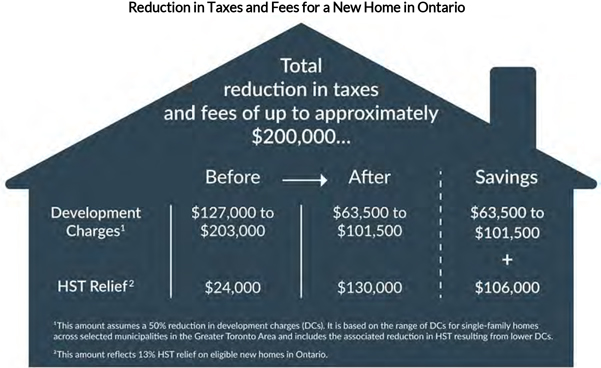
Progress on the Launch of Build Canada Homes
Since its creation in September 2025, Build Canada Homes has seen strong interest. Proposals have been received from across the country, with thousands of homes proposed. Since its launch, the agency has committed to supporting thousands of new housing units through partnerships with the governments of Ottawa, Nova Scotia, New Brunswick, British Columbia, Nunavut, and Québec, and on six federal properties expected to break ground in 2026.
Through these and future projects, Build Canada Homes is prioritising the use of modern methods of construction and Canadian building materials, driving changes in how we build, and demand for Canadian products.
Build Canada Homes is also supporting the preservation of existing affordable housing stock through the Canada Rental Protection Fund, which will launch this spring. The Fund brings together public and private investment to protect Canada’s affordable housing stock and is expected to support the acquisitions of thousands of homes within the next five years.
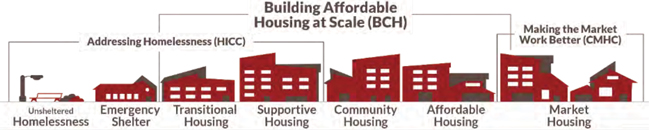
Continued Support for the Urban, Rural, and Northern Indigenous Housing Strategy
Access to safe and affordable housing is necessary for improving health and social outcomes in Indigenous and northern communities. To address the distinct challenges faced by Indigenous people living in urban, rural, and northern areas in finding affordable, adequate and suitable housing, Budget 2022 announced $300 million for an Urban, Rural, and Northern Indigenous Housing Strategy, supplemented by an additional $4 billion in Budget 2023.
| 100 | CHAPTER 2 |
|
|
To continue to advance this work, the Spring Economic Update 2026 proposes to realign previous investments to better support Indigenous housing providers by reallocating $2.8 billion over five years, starting in 2026-27, to Build Canada Homes, Crown-Indigenous Relations and Northern Affairs Canada, Indigenous Services Canada and Housing, Infrastructure and Communities Canada. This approach will better align support for Indigenous housing within Canada’s current housing landscape. |
2.4 Protecting Communities
Canadians deserve to feel safe where they live, learn, work, and worship. The Spring Economic Update 2026 builds on the historic investments to law enforcement made in Budget 2025 by introducing new measures to fight fraud and adopt a ‘follow the money’ approach to disrupt and dismantle the international and organised criminal networks that threaten the safety and security of communities and rob Canadians of their hard-earned money.
Consumer-targeted fraud continues to grow in both scale and sophistication, with fraudsters leveraging technological advances to target Canadians. According to the Canadian Anti-Fraud Centre, Canadians reported losing more than $704 million to fraud in 2025, bringing total reported losses since 2022 to over $2.4 billion.
With only an estimated 5-to-10 per cent of consumer-targeted fraud incidents being reported, the true impact is likely far higher. These trends highlight the urgent need to strengthen protections and safeguards to better prevent fraud and reduce its impact on Canadians, especially vulnerable groups such as seniors who are disproportionately targeted.
The exploitation of the financial system to launder illicit proceeds supports and perpetuates crimes such as fraud, theft, and extortion that take money straight out of Canadians pockets, while fuelling the drugs, gangs, and violence that threaten the safety of our communities.
Canada’s new government is taking bold action to counter these threats, protect Canadians, and ensure that crime doesn’t pay. This includes standing up Canada’s first-ever organisation dedicated to investigating sophisticated financial crimes and recovering illicit proceeds from criminals, as well as protecting Canadians from criminal abuse of money services businesses and supporting timely financial intelligence to tackle extortion.
The new government is also developing Canada’s first-ever whole-of-government National Anti-Fraud Strategy which aims to establish a robust, multi-sector approach to combatting fraud across its full lifecycle, from prevention and detection to disruption and response.
To protect Canadians against economic abuse, which robs people of independence and safety, the government is acting now by working with community and industry partners to develop a code of conduct that strengthens protections for Canadians.
Standing Up the Financial Crimes Agency
Complex financial crimes require dedicated expertise to identify, trace, and seize illicit money to disrupt and dismantle drug trafficking, extortion, fraud, and other organised criminal networks that threaten the safety of our communities and the integrity of our financial system. On April 27, 2026, the government introduced legislation to establish the Financial Crimes Agency—thereby delivering on the government’s Budget 2025 commitment to stand up this new lead enforcement agency.
The Financial Crimes Agency will be an independent agency, reporting to the Minister of Finance, with police powers and civilian leadership.
Key features of the Agency include:
| ● | A mandate to investigate serious and complex financial crimes, such as money laundering, serious fraud, and major capital market crimes, and to recover the proceeds of crime; |
| ● | The capacity to lead investigations on its own and in close cooperation with provincial, territorial, municipal, and international law enforcement partners; |
| BENEFITTING CANADIANS: A CANADA FOR ALL |
101 |
| ● | The ability to attract, develop, and retain highly specialised personnel to support intelligence-led, follow-the-money investigations, including civilian and police investigators, criminal and financial intelligence personnel, and asset recovery experts, who will be supported by dedicated and specialised prosecutors; and |
| ● | Headquarters in the National Capital Region, with authority to establish regional offices. |
The government is committed to providing the Financial Crimes Agency with the resources needed to successfully deliver on its ambitious mandate.
|
|
| o $352.7 million over five years starting in 2026-27, with $57.8 million in remaining amortisation, and $82.1 million ongoing to the Financial Crimes Agency; |
| o $46.2 million over five years and $11.5 million ongoing to the Public Prosecution Service of Canada; and |
| o $19.6 million over five years and $1.5 million ongoing to the Department of Finance Canada. |
|
|
We are delivering on our commitment to create a best-in-class Agency with the personnel, resources, mandate, and supportive legislative tools needed to tackle sophisticated financial crimes. This will protect Canadians by detecting and dismantling the complex illicit financing that fuels crime across Canada.
Protecting Money Services Businesses From Illicit Activity
Money services businesses (MSBs) are an important source of competition in the financial sector, providing services such as remittances, currency exchange, and digital payments, enhancing financial inclusion. However, criminals are increasingly abusing MSBs to launder money, finance terrorism, evade sanctions, and defraud Canadians of their hard-earned savings. In March 2026 alone, the Financial Transactions and Reports Analysis Centre of Canada (FINTRAC) revoked the registration of 84 MSBs.
|
|
| o Introducing new Ministerial Directive powers to safeguard national security and the integrity of the financial system; |
| o Expanding FINTRAC’s ability to refuse or revoke registration of MSBs; Preventing the re-registration of non-compliant MSBs; |
| o Increasing the number of criminal record checks for MSBs; and |
| o Enhancing FINTRAC’s understanding of MSB risks by ensuring it has accurate and up-to-date information regarding the commencement of business and services provided by MSBs.
|
|
|
These measures will ensure Canadians can still benefit from the services offered by MSBs, including buying virtual currencies from brick-and-mortar MSBs, while better protecting MSBs from illicit activity.
Following the Money to Fight Extortion
Accurate and timely financial intelligence is a front-line tool for law enforcement to fight rising extortion that threatens the safety of our communities and the livelihood of small business owners across Canada.
In February, the Minister of Finance and National Revenue directed FINTRAC to prioritise resources to tackle extortion. FINTRAC has:
| ● | Launched a Countering Extortion Partnership with financial institutions, government, and law enforcement to enhance information sharing and share best practices to fight extortion; |
| ● | Assigned dedicated liaison officers to support the effective use of financial intelligence by local law enforcement in the most affected areas; and |
| 102 | CHAPTER 2 |
| ● | Provided timely, targeted, and effective strategic intelligence to help financial institutions identify the laundering of proceeds of extortion. |
|
|
The Spring Economic Update 2026 proposes to provide $17.9 million over four years, starting in 2026-27, in new funding to ensure FINTRAC has the resources it needs to prioritise the detection, deterrence, and disruption of the illicit financing that supports and perpetuates extortion and fentanyl trafficking in Canada and to advance a technology and artificial intelligence roadmap. |
Update on the National Anti-Fraud Strategy
Budget 2025 announced the government’s commitment to protect Canadians from fraud by developing a whole-of-government National Anti-Fraud Strategy to advance anti-fraud efforts across the financial and telecommunications sectors and digital platforms.
As a first step, the government introduced new fraud-related consumer protections in the Bank Act, with the intent of making regulations by the end of 2026 to bring these changes into force.
To develop the National Anti-Fraud Strategy, the Department of Finance Canada convened an interdepartmental working group with representatives from 11 other federal departments and agencies.
On March 30, the government launched a public consultation on the National Anti-Fraud Strategy. The consultation seeks feedback on three initial measures which could be taken to advance the strategy: to establish a comprehensive Multi-Sector Anti-Fraud Framework that strengthens market-conduct requirements for banks, telecommunication providers, and digital platforms, including social media, to prevent, detect, and respond to fraud losses when they occur; to strengthen public awareness about fraud; and to support law enforcement’s ability to combat fraud.
The approach proposed in this consultation builds upon successful anti-fraud initiatives in other jurisdictions and incorporates feedback received to date from key stakeholders, including the industry-led Canadian Anti-Scam Coalition.
In the next year, the government will outline additional measures to further Canada’s work to combat fraud and protect Canadians.
Update on the Code of Conduct for the Prevention of Economic Abuse
Canada’s financial sector plays an essential role in identifying early warning signs of economic abuse and helping victims and survivors, especially women, access safe, practical support. Since announcing the government’s intention to develop a Code of Conduct for the Prevention of Economic Abuse for banks, there has been extensive engagement with stakeholders. Discussions have involved victims and survivors, including women with lived experience, frontline service providers, banks, consumer advocates, and experts in gender-based violence and seniors’ financial protection.
Feedback has highlighted the need for clear bank protocols, improved staff training, stronger internal escalation pathways, and safeguards that protect client privacy and autonomy. Stakeholders also stressed the importance of consistent approaches across banks, while allowing flexibility to meet individual needs.
Guided by this input, the government is moving into formal discussions with industry partners on the Code’s core elements. This next phase advances a collaborative approach that promotes financial security, independence, and safer futures for Canadians.
Investing in Community Safety
The Canada Community Security Program has been helping Canadians feel safer in their communities, including in places of worship, schools, community centres, and other institutions. Given a significant increase in police-reported hate crime in recent years, including incidents driven by Islamophobia and antisemitism and hate targeting LGBTQ+ communities, continued and enhanced support is needed to ensure communities at risk can respond to evolving security challenges.
|
|
To help address rising hate-related crimes, the Spring Economic Update 2026 proposes to provide $75 million over five years, starting in 2026-27, to Public Safety Canada for the Canada Community Security Program. This additional funding will allow the program to continue to help eligible organisations implement physical security enhancements and foster safer, more inclusive communities. |
| BENEFITTING CANADIANS: A CANADA FOR ALL |
103 |
2.5 Empowering Canadians
The world is more challenging and divided. Canadians feel this every day. But Canadians have never waited around for the world we wish to see. Canada has always been built by the people who did hard things, who showed up when it mattered most, and who took care of each other. That is still what this moment asks of us.
Strong Canadian communities are essential in our goal of building Canada and ensuring we fulfill our promise. Together, we are taking clear, decisive action to ensure communities remain safe and welcoming spaces to live, work, learn, worship, and play. This includes strengthening local journalism so Canadians can remain informed about and engaged in the communities where they live; investing in small craft harbours that sustain coastal livelihoods; advancing accessibility so persons with disabilities can fully participate in community life; renewing Canada’s sport system; and providing supports to ensure that Indigenous communities are healthy and vibrant.
| Investing in Sport—From Playground to Podium
Canada is a sporting nation. Whether it’s Northern games, lacrosse, ice hockey, soccer, curling, basketball or para sports, communities love to come together to cheer on their friends and neighbours. Our athletes draw us together. They inspire and exhibit the qualities that set Canadians apart: Determination. Team spirit. Grit.
Sport challenges us, pushes us to do better. It forges lifelong friendships and connections. It teaches us respect and shows our kids that the sky is the limit. Our background, ability or age doesn’t matter – there is a place for us in sport. Our shared experiences on the field, court or rink encourage inclusion, mutual respect, and social connections – truly building Canada strong.
Sport contributes to our health and well-being, as well as the economy. The sport system supports more than 100,000 jobs all across our country and our communities.
We are making a generational investment in sport and our athletes. To increase participation. To put more Canadians on podiums. And to bring more world-class sporting events to Canada.
o Host and compete with the best: $50 million over five years to bring more world-class sporting events to Canada. Funding will be tied to legacy-building projects that deliver lasting benefits well beyond the events themselves. Facilities built or upgraded for major events will continue to serve communities, support grassroots participation, and strengthen local sport systems for years to come.
o Support our athletes in performing at the highest levels: $45 million over five years and $8 million ongoing to help our athletes train, compete, and perform, including support for better mental health and funding that will be linked to robust safe sport measures and frameworks. These actions will strengthen the sport system and respond to some of the findings of the Final Report of the Future of Sport in Canada Commission while the government continues to consider all of its Calls to Action.
o Get more Canadians involved in sport: $660 million over five years and $110 million ongoing for National Sport Organisations, increasing funding that has remained largely unchanged since 2005, so that they can invest in a strong and safe sport system and grow participation among children and youth nationwide. We want to see new and existing community infrastructure—like the Embleton Community Centre and Park in Brampton, Ontario that will be supported with a $64 million investment from the Building Communities Strong Fund—fully used and enjoyed by a new generation of athletes. We want National Sport Organisations to work with private sector partners who share the goal of getting more Canadians involved in sport. And we expect National Sport Organisations to make changes to their programming to invest in sport at all levels.
Building Canada Strong includes a strong sporting system. We will champion our athletes so that they can do their best and play to win—whether that’s on the playground or the podium. |
| 104 | CHAPTER 2 |
Repairing and Maintaining Small Craft Harbours
Small craft harbours are a crucial connection point and lifeline to small communities—providing much needed maritime links, including transportation and fishing as well as opportunities for recreation and aquaculture. These harbours are essential infrastructure and at the heart of many coastal communities, where over five million Canadians live. They also provide crucial infrastructure to multiple Indigenous communities, supporting them in exercising their Indigenous and treaty rights.
Small craft harbours are also critical to the commercial fishing industry, with billions of dollars in landings at small craft harbours every year. Small craft harbours support more than 45,000 jobs in the fish and seafood industry, as well as many thousands of additional jobs in supporting industries.
With close to 950 harbours valued at approximately $7.1 billion across the country, Canada’s new government is committed to repairing and maintaining small craft harbours to protect and create flourishing coastal communities.
|
|
The Spring Economic Update 2026 proposes to provide $957.8 million over five years, starting in 2026-27, on a cash basis, to Fisheries and Oceans Canada for the Small Craft Harbours Program. This represents an increase of more than 35 per cent per year over the 10-year average and provides needed stability in funding for repairs. This is in addition to the Department’s annual program budget of approximately $90 million a year. Next steps will be announced by the Minister of Fisheries. |
Empowering Indigenous Communities
Supporting Indigenous-led services and supports rooted in their unique cultures is essential to this government’s commitment to advance reconciliation. It ensures critical services like education, family services, social services and community governance meet the needs of Indigenous families, communities and individuals. These services are central to fostering a strong sense of identity and belonging, and support the long-term growth and success of Indigenous people.
| ● | As part of this commitment, the government previously annnounced: |
| o | $359 million over three years, starting in 2026-27, to support data collection and Indigenous governance and capacity programs, enabling First Nations to effectively deliver community-based services. This funding will ensure First Nations can sustain core functions necessary to deliver essential services and actively participate in Canada’s economy, while balancing community responsibilities and keeping pace with population growth; |
| o | $168 million over five years, starting in 2026-27, to support Urban Programming for Indigenous Peoples so that Friendship Centres across Canada can continue to provide critical supports and services to their community members; and |
| o | $592 million over nine years, starting in 2025-26, for social support services for people living on reserve with chronic illness or disability under the Assisted Living Program so that they can maintain their independence and participate in their communities. |
|
|
To ensure First Nations, Inuit, and Métis individuals and communities have access to opportunities to grow and reach their full potential, the Spring Economic Update 2026 proposes to provide the following funding to Indigenous Services Canada: |
| o | $601 million in 2026-27 to support high-quality, culturally relevant elementary and secondary education on reserve that meets the needs of students so that First Nations youth can participate fully in Canada’s skilled workforce; and |
| o | $700 million over six years, starting in 2025-26, to continue to support Indigenous communities to implement their own solutions to protect children and families by exercising their jurisdiction under An Act respecting First Nations, Inuit and Métis children, youth and families. |
| BENEFITTING CANADIANS: A CANADA FOR ALL |
105 |
Healthy Indigenous Communities
Health is a key indicator of a prosperous economy and is a critical enabler of a person’s ability to live life to the fullest. Indigenous people across Canada should have safe and equitable access to health care that responds to their unique needs. The government is committed to advancing reconciliation by supporting Indigenous communities to improve health outcomes by modernising delivery of services and ensuring people have access to the health products and services they need to thrive and actively participate in their communities.
| ● | The government has already announced: |
| o | $27 million over five years, starting in 2026-27, to continue working with Inuit Tapiriit Kanatami to take concrete action to eliminate tuberculosis in Inuit Nunangat by 2030. |
| o | $630 million over two years, starting in 2026-27, to maintain trauma-informed and culturally appropriate mental wellness services for Indigenous people including continued support for crisis lines and Indigenous-led mental wellness programming that supports community-based services grounded in culture and ceremony. |
| o | $400 million over five years, starting in 2026-27, to maintain access to high-quality primary care services including nurses, nurse practitioners, and paramedics for First Nations in rural and remote on-reserve communities. |
|
|
To ensure high-quality and culturally relevant health care that responds to the distinct needs of Indigenous individuals, families, and communities, the Spring Economic Update 2026 proposes to provide the following funding to Indigenous Services Canada: |
| o | $794 million in 2026-27 to support the Non-Insured Health Benefits Program, which provides First Nations and Inuit with coverage for a range of health products and services such as medical travel, pharmaceuticals, and mental health counselling. |
Making it Easier to Access the Disability Tax Credit
The Disability Tax Credit provides significant tax relief for persons with disabilities and their supporting family members. Eligibility for the credit serves as a key requirement for other supports including the Canada Disability Benefit, the Child Disability Benefit, and the Registered Disability Savings Plan along with the Canada Disability Savings Grant and Bond.
Each year, more Canadians are accessing the Disability Tax Credit, yet barriers in navigating the application process remain for many. The government is committed to supporting persons with disabilities and their families to access all the supports they need. Medical practitioners are required to certify an individual’s impairment and its impacts on basic activities of daily living to ensure that the eligibility criteria for the credit are applied consistently and fairly, but this does add to their administrative burden.
|
|
To improve the Disability Tax Credit application for persons with disabilities and their families, and to reduce paperwork for medical practitioners, the Spring Economic Update 2026 proposes to: |
| o | Streamline the application process for individuals with a formal diagnosis of certain long-lasting medical conditions. These conditions, listed in the Tax Measures: Supplementary Information annex, have been identified through the Canada Revenue Agency’s experience in processing applications as satisfying the disability impact criteria for the credit. This proposal would not change the disability criteria to qualify for the credit and the Canada Revenue Agency would continue to have authority to ask for additional information to verify that these criteria are met. This measure would apply for the 2026 and subsequent taxation years. |
| o | Expand the list of medical practitioners who can certify eligibility for the Disability Tax Credit to include podiatrists (for a specific type of impairment) and broaden the types of impairment that can be certified by physiotherapists, speech-language pathologists and occupational therapists, within the scope of their training and practice. This measure would apply to Disability Tax Credit certificates issued after 2026 for the 2027 and subsequent taxation years. |
| o | Recognise provincial or territorial public guardians and trustees as being qualified to certify for the Disability Tax Credit for adults in their care for property matters who have a valid certificate of incapacity based on a medical practitioner’s assessment of their mental impairment. This measure would apply to the 2026 and subsequent taxation years. |
| 106 | CHAPTER 2 |
These changes are expected to provide $345 million over six years, and $86 million per year ongoing, in tax relief under the Disability Tax Credit and via increased payments of federal benefits (such as the Canada Disability Benefit and the Child Disability Benefit), starting in 2025-26.
|
|
Further, to ensure applications are processed in an accurate and timely manner, the Spring Economic Update 2026 proposes to provide $42.5 million over five years, starting in 2026-27, to the Canada Revenue Agency to administer these changes. |
Modern Tax Rules for Charities
The Government of Canada’s tax incentives for charitable giving aim to mobilise private capital for public needs, creating an attractive environment for donors while supporting affordability, social security and our communities across the country. The government recognises that the charitable sector, and non-governmental organisations, are an important driver for the Canadian economy, create well-paying jobs and supplement the social safety net.
|
|
With advances in technology and digitisation, the government will undertake an exercise to modernise the framework for the charitable sector in 2026-27. As a first step, the government will undertake a consultation with key stakeholders and relevant agencies for them to provide feedback and align with best practices adopted by other G7 countries. |
Extending the Canadian Journalism Labour Tax Credit
The government recognises the importance of journalism in our communities. Broadcast journalism in particular is a key part of our community fabric. Supporting the important work of journalists is crucial in our democratic system, ensuring accountability and a well-informed public, especially during a period of global uncertainty. Canada’s new government is committed to supporting fact-based, local journalism that benefits Canadian communities.
|
|
The Spring Economic Update 2026 announces the government’s intention to seek the views of Canadians and stakeholders on extending the Canadian Journalism Labour Tax Credit to audio and audiovisual news production. Further details on the consultation process will be released on the Department of Finance Canada website. |
Ensuring Canadians Can File Their Taxes in Their Communities
The Community Volunteer Income Tax Program (CVITP) Grant supports community organisations in hosting tax preparation clinics, and arranging for volunteers to prepare income tax and benefit returns for individuals with modest incomes and simple tax situations, free of charge. These community tax clinics represent a trusted community resource, ensuring Canadians can receive the benefits, credits, and refunds to which they are entitled. This work complements the government’s commitment to introducing automatic federal benefits for lower-income individuals.
In 2025, the program supported over 3,500 organisations with almost 20,000 volunteers who helped file close to 1.1 million returns—delivering almost $2.6 billion in federal refunds, credits, and benefit entitlements. Approximately 17 per cent of returns filed through the CVITP in 2025 were from individuals who had not filed a tax return in previous years—helping Canadians enter the tax system and access the benefits and credits to which they may be entitled.
On February 3, 2026, the Secretary of State (Canada Revenue Agency and Financial Institutions) announced the CVITP Grant would be renewed for the next three years.
|
|
The Spring Economic Update 2026 proposes to provide $18.7 million over three years, starting in 2026-27, to the Canada Revenue Agency to renew and expand the CVITP Grant. |
| BENEFITTING CANADIANS: A CANADA FOR ALL |
107 |
| Gender and Diversity Impacts Spotlight
The government is supporting Canadians by addressing cost-of-living pressures, strengthening community safety, and investing in inclusive, resilient communities. This includes supporting critical programs and services for Indigenous people, promoting sport participation, strengthening safeguards against financial fraud, supporting communities at risk of hate-motivated crimes, and making tax administration easier.
● The Canada Groceries and Essentials Benefit is targeted at low- and modest-income individuals and families, and will provide support to more than 12 million Canadians. Single individuals, single mothers, Indigenous people, and persons with disabilities will particularly benefit from extra support to help with day-to-day essentials, as they are more likely to have lower incomes. It is estimated that over three-quarters of the additional support will go to singles (with and without children), of which about one-third will go to single women without children and one-fifth to single mothers. More than half of seniors will receive additional assistance, including three-quarters of single seniors.
● Supporting the Nutrition North Canada Retail Subsidy is targeted at 124 isolated communities, the majority of which are Indigenous. The share of the population living in food insecure households in Canada’s North is much higher than the national average of 22.9 per cent—reaching 62.6 per cent in Nunavut and 27.6 per cent in the Northwest Territories, while Indigenous families are around twice as likely as non-Indigenous families to face food insecurity. Groups at higher risk of facing food insecurity, such as women, children, lone-parent households, persons with disabilities, and elders, would predominantly benefit from this measure.
● The National Anti-Fraud Strategy will help protect all Canadians, especially seniors, who are more often targeted by phone scams, as well as younger people who face rising risks on digital platforms. In 2025, reported losses totaled $704 million, which is likely an underestimate as only an estimated 5 to 10 per cent of fraud is reported.
● Continuing to support the Canada Community Security Program will help ensure that communities at heightened risk of hate-motivated crime feel safe and supported, regardless of their identity, faith, or background. In 2024, there were 4,882 police-reported hate crime incidents, with 49 per cent targeting race or ethnicity and 27 per cent targeting religion. By strengthening the security of gathering spaces, including places of worship, schools, shelters, and community centres, this measure will benefit all Canadians.
● Investing in Sport—from Playground to Podium will help increase participation of underrepresented groups, directly benefitting women and girls, persons from low-income households, Indigenous people, Black and racialised people, and persons with a disability. Funding will also support high-performance athletes, who tend to be younger (below 35 years) and low-income.
● Repairing and Maintaining Small Craft Harbours will support diverse rural and coastal communities where over five million Canadians live. Funding will directly benefit commercial fishers, who are the primary harbour users and are predominantly men. Funding will also support Indigenous people, as Indigenous employees account for 16 per cent of the workforce in the fishing industry. Further, funding will support essential infrastructure in regions with a high proportion of Indigenous users, including many Indigenous communities.
● Empowering Indigenous Communities will benefit Indigenous people by advancing Indigenous perspectives and data capacity to improve access to supports and services. Funding will help sustain existing programs and initiatives and enhance communities’ capacity to plan and deliver services, helping to improve health and social outcomes for Indigenous people.
● Making it Easier to Access the Disability Tax Credit would benefit persons with severe and prolonged disabilities, who are disproportionately low-income and age 65 or older, and their supporting family members. Barriers like accessing a medical professional to certify eligibility for the credit or navigating the application process can limit uptake of eligible supports. Low and modest-income working-age individuals with a severe and prolonged disability, who generally face higher poverty rates than those without disabilities, and families with children with severe disabilities may also benefit from accessing support linked to the credit, such as the Canada Disability Benefit, Child Disability Benefit, and Registered Disability Savings Plan (including federal grants and bonds).
● Renewing the Community Volunteer Income Tax Program Grant would support organisations hosting free tax filing clinics which help low- and modest-income individuals and families to file their tax return, free of charge. Newcomers, Indigenous people, rural populations, persons with disabilities, first-time filers, and seniors will particularly benefit, as these groups are more likely to face barriers to tax filing due to lack of knowledge of English or French, distrust in government, geography (e.g., far from tax clinics or accountants or limited time to travel), poor digital literacy, and/or a limited awareness of clinics and programs. |
| 108 | CHAPTER 2 |
Chapter 2
Benefiting Canadians: A Canada for All
millions of dollars
| 2025- | 2026- | 2027- | 2028- | 2029- | 2030- | Total | ||||||||||||||||||||||||||||||||||||||||||||||
| 2026 | 2027 | 2028 | 2029 | 2030 | 2031 | |||||||||||||||||||||||||||||||||||||||||||||||
| 2.1 Supporting Workers and Young People |
0 | 1,887 | 1,221 | 1,376 | 1,287 | 1,174 | 6,945 | |||||||||||||||||||||||||||||||||||||||||||||
| Team Canada Strong* |
0 | 802 | 1,223 | 1,338 | 1,339 | 1,280 | 5,982 | |||||||||||||||||||||||||||||||||||||||||||||
| Less: Funds Previously Provisioned in the Fiscal Framework |
0 | -41 | -53 | -53 | -59 | -45 | -250 | |||||||||||||||||||||||||||||||||||||||||||||
| Less: Projected Revenues |
0 | -75 | -45 | -45 | -45 | -45 | -255 | |||||||||||||||||||||||||||||||||||||||||||||
| Extending Employment Insurance Support for Seasonal Workers |
0 | 3 | 121 | 159 | 72 | 2 | 356 | |||||||||||||||||||||||||||||||||||||||||||||
| Increasing Student Grants and Loans1 |
0 | 1,197 | -25 | -24 | -21 | -19 | 1,107 | |||||||||||||||||||||||||||||||||||||||||||||
| Enhancing the Labour Mobility Deduction for Tradespeople |
0 | 1 | 1 | 1 | 1 | 1 | 5 | |||||||||||||||||||||||||||||||||||||||||||||
| 2.2 Bringing Down the Costs of Groceries and Essentials |
3,136 | 3,801 | 1,785 | 1,800 | 1,840 | 1,890 | 14,252 | |||||||||||||||||||||||||||||||||||||||||||||
| Making Essentials More Affordable Through the Canada Groceries and Essentials Benefit2* |
3,136 | 1,355 | 1,785 | 1,800 | 1,840 | 1,890 | 11,806 | |||||||||||||||||||||||||||||||||||||||||||||
| Food Security in the North3 |
0 | 36 | 0 | 0 | 0 | 0 | 36 | |||||||||||||||||||||||||||||||||||||||||||||
| Increasing Food Security |
0 | 0 | 1 | 5 | 9 | 9 | 24 | |||||||||||||||||||||||||||||||||||||||||||||
| Less: Costs to be Recovered |
0 | 0 | -1 | -5 | -9 | -9 | -24 | |||||||||||||||||||||||||||||||||||||||||||||
| Temporarily Suspending the Federal Fuel Excise Tax4 |
0 | 2,410 | 0 | 0 | 0 | 0 | 2,410 | |||||||||||||||||||||||||||||||||||||||||||||
| 2.3 Making it Easier to Afford a Home |
1,695 | 93 | 238 | 290 | 198 | 145 | 2,659 | |||||||||||||||||||||||||||||||||||||||||||||
| Enabling Homebuilding5* |
-19 | 154 | 62 | 108 | 120 | 91 | 516 | |||||||||||||||||||||||||||||||||||||||||||||
| Less: Funds Previously Provisioned in the Fiscal Framework |
0 | -125 | 0 | 0 | 0 | -30 | -155 | |||||||||||||||||||||||||||||||||||||||||||||
| Extending the Home Buyers’ Plan |
0 | 0 | 0 | 7 | 15 | 20 | 42 | |||||||||||||||||||||||||||||||||||||||||||||
| Partnering with Provinces and Territories to Improve Housing Supply6 |
1,713 | 0 | 0 | 0 | 0 | 0 | 1,713 | |||||||||||||||||||||||||||||||||||||||||||||
| Continued Support for the Urban, Rural, and Northern Indigenous Housing Strategy* |
0 | 413 | 594 | 594 | 587 | 587 | 2,776 | |||||||||||||||||||||||||||||||||||||||||||||
| Less: Funds Sourced From Existing Departmental Resources |
0 | -349 | -419 | -419 | -523 | -524 | -2,233 | |||||||||||||||||||||||||||||||||||||||||||||
| 2.4 Protecting Communities |
0 | 65 | 100 | 117 | 117 | 112 | 511 | |||||||||||||||||||||||||||||||||||||||||||||
| Standing Up the Financial Crimes Agency* |
0 | 41 | 76 | 100 | 102 | 100 | 418 | |||||||||||||||||||||||||||||||||||||||||||||
| Following the Money to Fight Extortion |
0 | 5 | 6 | 5 | 3 | 0 | 18 | |||||||||||||||||||||||||||||||||||||||||||||
| Investing in Community Safety |
0 | 19 | 19 | 12 | 12 | 12 | 75 | |||||||||||||||||||||||||||||||||||||||||||||
| 2.5 Empowering Canadians |
57 | 2,475 | 1,147 | 610 | 592 | 577 | 5,459 | |||||||||||||||||||||||||||||||||||||||||||||
| Investing in Sport—From Playground to Podium |
0 | 129 | 149 | 159 | 159 | 159 | 755 | |||||||||||||||||||||||||||||||||||||||||||||
| Repairing and Maintaining Small Craft Harbours* |
0 | 9 | 42 | 47 | 52 | 57 | 208 | |||||||||||||||||||||||||||||||||||||||||||||
| Empowering Indigenous Communities7* |
75 | 1,315 | 666 | 392 | 375 | 291 | 3,114 | |||||||||||||||||||||||||||||||||||||||||||||
| Less: Funds Sourced From Existing Departmental Resources |
-25 | -214 | -193 | -167 | -172 | -105 | -875 | |||||||||||||||||||||||||||||||||||||||||||||
| Healthy Indigenous Communities8 |
0 | 1,194 | 400 | 85 | 85 | 85 | 1,851 | |||||||||||||||||||||||||||||||||||||||||||||
| Making it Easier to Access the Disability Tax Credit |
6 | 30 | 61 | 76 | 86 | 86 | 345 | |||||||||||||||||||||||||||||||||||||||||||||
| BENEFITTING CANADIANS: A CANADA FOR ALL |
109 |
| 2025- | 2026- | 2027- | 2028- | 2029- | 2030- | Total | ||||||||||||||||||||||||||||||||||||||||||||||
| 2026 | 2027 | 2028 | 2029 | 2030 | 2031 | |||||||||||||||||||||||||||||||||||||||||||||||
| Making it Easier to Access the Disability Tax Credit - CRA Administration |
0 | 8 | 14 | 11 | 7 | 3 | 43 | |||||||||||||||||||||||||||||||||||||||||||||
| Ensuring Canadians Can File Their Taxes in Their Communities |
0 | 5 | 7 | 7 | 0 | 0 | 19 | |||||||||||||||||||||||||||||||||||||||||||||
| Additional Investments – Benefitting Canadians: A Canada for All |
0 | 171 | -432 | -617 | -670 | -695 | -2,241 | |||||||||||||||||||||||||||||||||||||||||||||
| Supporting the FIFA Men’s World Cup 2026 |
0 | 146 | 0 | 0 | 0 | 0 | 146 | |||||||||||||||||||||||||||||||||||||||||||||
| Funding proposed for PS and IIC to support security activities at the FIFA Men’s World Cup 2026 and to leverage the event for investment promotion. |
| |||||||||||||||||||||||||||||||||||||||||||||||||||
| Improving Services to Canadians |
0 | 205 | 184 | 27 | 27 | 30 | 473 | |||||||||||||||||||||||||||||||||||||||||||||
| Less: Funds Sourced From Existing Departmental Resources |
0 | 0 | -5 | -5 | -5 | -5 | -22 | |||||||||||||||||||||||||||||||||||||||||||||
| Funding proposed for ESDC to support the day-to-day operation of the new Old Age Security (OAS) platform and to increase OAS processing capacity, helping ensure seniors receive their benefits accurately and on time, and for CRA to maintain a complement of agents at its call centres, and to implement a new telephony platform, which will allow Canadians to more easily connect with the CRA on enquiries related to their benefits and taxes. |
| |||||||||||||||||||||||||||||||||||||||||||||||||||
| Making Essentials More Affordable Through the Canada Groceries and Essentials Benefit - CRA Administration |
0 | 3 | 2 | 2 | 0 | 0 | 8 | |||||||||||||||||||||||||||||||||||||||||||||
| Personal Support Workers Tax Credit - CRA Administration* |
0 | 4 | 4 | 4 | 0 | 0 | 13 | |||||||||||||||||||||||||||||||||||||||||||||
| First-Time Home Buyers’ GST/HST Rebate - CRA Administration |
0 | 30 | 20 | 18 | 0 | 0 | 68 | |||||||||||||||||||||||||||||||||||||||||||||
| Funding proposed for the Canada Revenue Agency to administer previously announced tax measures. |
| |||||||||||||||||||||||||||||||||||||||||||||||||||
| Ex gratia payment to the Northwest Territories |
0 | 2 | 0 | 0 | 0 | 0 | 2 | |||||||||||||||||||||||||||||||||||||||||||||
| Proposed one-time ex gratia payment to the Government of the Northwest Territories to make up for reductions in its Territorial Formula Financing (TFF) due to natural resource revenues that were previously reported but not realized, resulting in the territory reporting net negative resource revenue that could not be recognized by the TFF program. |
| |||||||||||||||||||||||||||||||||||||||||||||||||||
| Projected Employment Insurance Premium Revenues for Measures Included in Spring Economic Update 2026 |
0 | -220 | -637 | -663 | -692 | -719 | -2,930 | |||||||||||||||||||||||||||||||||||||||||||||
| Includes projected Employment Insurance premium revenues for Measures Taken to Support Workers and Businesses - Worker Supports in section 1.3, Extending Employment Insurance Support for Seasonal Workers in in section 2.1, a portion of Team Canada Strong in section 2.1, and a portion of the Price and Volume Protection for Federal Real Property in Table A1.15. |
| |||||||||||||||||||||||||||||||||||||||||||||||||||
| Chapter 2 - Net Fiscal Impact |
4,887 | 8,494 | 4,060 | 3,577 | 3,364 | 3,203 | 27,585 | |||||||||||||||||||||||||||||||||||||||||||||
| Of which, capital investment: |
1 | 104 | 334 | 345 | 254 | 212 | 1,250 | |||||||||||||||||||||||||||||||||||||||||||||
1 Increasing Student Grants and Loans was announced on March 23, 2026.
2 Making Essentials More Affordable Through the Canada Groceries and Essentials Benefit was announced on January 26, 2026. Amounts include immediate expensing for greenhouse buildings and funding for the Local Food Infrastructure Fund.
3 Food Security in the North was announced on February 19, 2026.
4 Temporarily Suspending the Federal Fuel Excise Tax was announced on April 14, 2026.
5 Support with Housing measures under Enabling Homebuilding was announced on April 1, 2026.
6 Partnering with Provinces and Territories to Improve Housing Supply was announced on March 26, 2026.
7 Empowering Indigenous Communities was partially announced on March 27, 2026.
8 Healthy Indigenous Communities was partially announced on March 27, 2026. *Measure includes funding classified as a capital investment.
Note: Numbers may not add due to rounding. A glossary of abbreviations used in this table can be found at the end of Annex 1.
| 110 | CHAPTER 2 |
Annex 1
Details of Economic and Fiscal Projections
Economic Projections
The average of private sector forecasts has been used as the basis for economic and fiscal planning since 1994, helping to ensure objectivity, transparency, and independence in the government’s forecast.
The Department of Finance Canada regularly surveys private sector forecasters on their economic outlook. In an environment shaped by recent U.S. trade policy and geopolitical developments, the outlook continues to evolve. The economic forecast reported here is based on a survey conducted in March 2026.
The March survey includes the views of 11 private sector economists:
| ● | BMO Capital Markets; |
| ● | CIBC World Markets; |
| ● | Desjardins; |
| ● | Industrial Alliance Insurance and Financial Services Inc.; |
| ● | Laurentian Bank Securities; |
| ● | National Bank Financial Markets; |
| ● | Royal Bank of Canada; |
| ● | Scotiabank; |
| ● | Signal49 Research (formerly The Conference Board of Canada); |
| ● | TD Bank Financial Group; and, |
| ● | The University of Toronto (Policy and Economic Analysis Program). |
The global and Canadian economies have continued to grow over the last year. But risks to the outlook have increased. The historic rise in U.S. tariffs is reshaping global trade and weighing on confidence, investment, and growth. More recently, the conflict in the Middle East has added to these risks by pushing oil prices higher, which is expected to raise inflation and costs for households and businesses. Supply chain pressures, heightened uncertainty, and tighter financial conditions could further weigh on global growth. At the same time, Canada will benefit from improved terms of trade and could gain from stronger global demand for secure and reliable energy supply.
In the March survey, private sector forecasters incorporated the most recent tariff measures, trade policy developments, and their expectations regarding potential tariff de-escalation. Economists generally expected current U.S. tariffs on trading partners, including Canada, to remain in place over the forecast horizon, with no return to broadly open, low-tariff global trade. Trade uncertainty was expected to remain elevated, weighing on business investment and household confidence, with some easing beginning in 2027.
Private sector economists also incorporated the initial impacts of the conflict in the Middle East, raising near-term oil price assumptions and, in turn, CPI and GDP inflation (Table A1.1). Overall, they did not expect material impacts on real GDP or unemployment, assuming a relatively short conflict, with oil prices beginning to normalise in the second half of the year.
Risks around the outlook are unusually high. To support prudent economic and fiscal planning, the Department of Finance Canada has developed scenarios to assess the implications of these risks for the economic and fiscal outlook (see the Economic Scenario Analysis section).
Comparisons of the March survey real GDP growth forecast to those of other institutions can be found in Table A1.2.
| DETAILS OF ECONOMIC AND FISCAL PROJECTIONS |
111 |
Following volatile real GDP growth in recent quarters, the Canadian economy is expected to see moderate growth of 1.4 per cent in the first quarter. Exports are expected to remain subdued as U.S. tariffs continue to weigh on demand for Canadian steel, aluminum, copper, lumber, and autos. Domestic demand remains moderate in the near term as businesses continue to adjust investment in the face of uncertainty, while households remain prudent. Nonetheless, consumption is expected to be the main driver of growth over the near term, supported by improved household balance sheets and previous declines in interest rates. Real GDP growth is projected to gradually pick up through 2026, supported by export stabilisation and a recovery in domestic demand.
Overall, private sector forecasters expected real GDP growth of 1.1 per cent in 2026, rising to 1.9 per cent in 2027 and beyond as the economy adjusts to the new trading environment. This is slightly below the Budget 2025 outlook of 1.2 per cent for 2026 and 2.0 per cent in the outer years. Real GDP is not expected to return to its pre-tariff path, remaining about 1.6 per cent lower by 2029 relative to the pre-tariff 2024 Fall Economic Statement outlook.
The unemployment rate is expected to average 6.5 per cent in 2026, down from the 6.8 per cent expected in Budget 2025, and to continue its downward trend reaching 6.0 per cent by 2029, same as in Budget 2025.
As a result of the conflict in the Middle East, private sector economists have significantly raised their outlook for crude oil prices, with WTI expected to average US$80 per barrel in the second quarter of this year (US$15 per barrel above Budget 2025). The price of oil is expected to average US$73 per barrel in 2026 compared to the Budget 2025 forecast of US$65 per barrel. It is then expected to decline to US$66 per barrel in 2027, in line with Budget 2025.
Higher oil prices are expected to push CPI inflation to 2.5 per cent in 2026 (up from 2.0 per cent in Budget 2025). Inflation is then expected to slow to 1.9 per cent in 2027 and stabilise at 2.0 per cent from 2028 onwards, the same as in Budget 2025.
The survey sees the Bank of Canada keeping its policy rate at 2.25 per cent through 2026, with gradual increases beginning in early 2027 as the economy firms up. Short-term rates are expected to reach 2.7 per cent by 2028, a slightly higher peak compared to Budget 2025. Short-term rates then settle at 2.6 per cent by 2029, same as in Budget 2025.
The 10-year bond rate is expected to increase from an average of 3.4 per cent in 2026 to 3.6 per cent in 2027 and 3.7 from 2028 onwards, higher than the expectations in Budget 2025. The increase in long-term yields over the forecast reflects the expectation of larger global sovereign borrowing needs, particularly in the U.S. and Europe.
In the U.S., AI investment and solid consumption, supported partly by strong equity markets, are driving growth. While real GDP growth in the U.S. has been revised up to 2.4 per cent in 2026 (previously 1.6 per cent), this has not translated into stronger near-term Canadian growth expectations. Economists expected U.S. growth to settle at 2.0 per cent in 2027 and beyond, same as in Budget 2025.
Private sector economists expected the Canadian dollar to average 73.7 U.S. cents this year and gradually rise to 75.8 cents by 2029, about a cent and a half below the Budget 2025 outlook. The limited near-term appreciation despite higher WTI prices likely reflects expectations of continued strength in the U.S. dollar amid heightened geopolitical uncertainty.
Economists had revised up their outlook for GDP inflation in 2026 to 2.8 per cent (compared to 1.8 per cent in Budget 2025) as a result of higher oil prices and domestic inflation in the near term. With the expected normalisation in oil prices and inflation, GDP inflation was expected to average 1.8 per cent in 2027 and 1.9 per cent in 2028, down from 2.0 per cent in both years in Budget 2025.
Reflecting stronger-than-expected results in the second half of 2025 and stronger near-term GDP inflation outlook resulting from the impacts of the Middle East conflict, the level of nominal GDP was projected to exceed the Budget 2025 outlook by $46 billion in 2026 and $34 billion in 2027. On average, over 2026-2029, the March survey forecast is about $35 billion higher per year.
According to forecasters in the survey, risks to the outlook remain elevated. On the downside, persistent trade tensions could weigh more heavily on business investment and household spending. A prolonged conflict in the Middle East could also further raise oil prices, disrupt supply chains, and weigh on growth and employment while increasing inflationary pressures.
| 112 | ANNEX 1 |
On the upside, stronger impacts from recent government initiatives could support growth more than anticipated. Canada could also benefit more substantially from the positive terms-of-trade effects associated with higher oil prices—factors that may not be fully reflected in current private sector forecasts. As a net exporter of energy—and a reliable supplier at a time of heightened geopolitical uncertainty—Canada could see increased demand for secure energy supply, providing an offsetting boost through higher incomes, investment, and activity in energy-related regions.
The overall fiscal impact of the conflict in the Middle East will depend importantly on its duration and intensity, including how long oil prices remain elevated, how global growth is affected, and how interest rates evolve. The box below illustrates the sensitivity of economic and fiscal outcomes to oil price movements.
Table A1.1
Average Private Sector Forecasts
per cent, unless otherwise indicated
| 2025 | 2026 | 2027 | 2028 | 2029 | 2030 |
2025- 2029 |
||||||||||||||||||||||
| Real GDP growth1 |
||||||||||||||||||||||||||||
| Budget 2025 |
1.6 | 1.2 | 2.0 | 1.9 | 2.0 | – | 1.7 | |||||||||||||||||||||
| Spring Economic Update 2026 |
1.7 | 1.1 | 1.9 | 1.9 | 1.9 | 1.8 | 1.7 | |||||||||||||||||||||
| GDP inflation1 |
||||||||||||||||||||||||||||
| Budget 2025 |
2.3 | 1.8 | 2.0 | 2.0 | 2.0 | – | 2.0 | |||||||||||||||||||||
| Spring Economic Update 2026 |
2.6 | 2.8 | 1.8 | 1.9 | 2.0 | 2.0 | 2.2 | |||||||||||||||||||||
| Nominal GDP growth1 |
||||||||||||||||||||||||||||
| Budget 2025 |
3.9 | 3.0 | 4.1 | 4.0 | 4.0 | – | 3.8 | |||||||||||||||||||||
| Spring Economic Update 2026 |
4.3 | 4.0 | 3.7 | 3.8 | 3.9 | 3.8 | 3.9 | |||||||||||||||||||||
| Nominal GDP level (billions of dollars)1 |
||||||||||||||||||||||||||||
| Budget 2025 |
3,229 | 3,326 | 3,461 | 3,599 | 3,743 | – | ||||||||||||||||||||||
| Spring Economic Update 2026 |
3,243 | 3,372 | 3,496 | 3,630 | 3,772 | 3,917 | ||||||||||||||||||||||
| Difference between Spring Economic Update 2026 and Budget 2025 |
15 | 46 | 34 | 30 | 29 | – | 31 | |||||||||||||||||||||
| 3-month treasury bill rate |
||||||||||||||||||||||||||||
| Budget 2025 |
2.6 | 2.3 | 2.5 | 2.6 | 2.6 | – | 2.5 | |||||||||||||||||||||
| Spring Economic Update 2026 |
2.6 | 2.2 | 2.5 | 2.7 | 2.6 | 2.6 | 2.5 | |||||||||||||||||||||
| 10-year government bond rate |
||||||||||||||||||||||||||||
| Budget 2025 |
3.3 | 3.4 | 3.5 | 3.6 | 3.6 | – | 3.4 | |||||||||||||||||||||
| Spring Economic Update 2026 |
3.2 | 3.4 | 3.6 | 3.7 | 3.7 | 3.7 | 3.5 | |||||||||||||||||||||
| Exchange rate (US cents/C$) |
||||||||||||||||||||||||||||
| Budget 2025 |
72.2 | 75.1 | 76.4 | 77.0 | 77.4 | – | 75.6 | |||||||||||||||||||||
| Spring Economic Update 2026 |
71.5 | 73.7 | 75.4 | 75.5 | 75.8 | 76.0 | 74.4 | |||||||||||||||||||||
| Unemployment rate |
||||||||||||||||||||||||||||
| Budget 2025 |
7.0 | 6.8 | 6.4 | 6.1 | 6.0 | – | 6.4 | |||||||||||||||||||||
| Spring Economic Update 2026 |
6.9 | 6.5 | 6.2 | 6.1 | 6.0 | 5.9 | 6.3 | |||||||||||||||||||||
| Consumer Price Index inflation |
||||||||||||||||||||||||||||
| Budget 2025 |
2.1 | 2.0 | 2.0 | 2.0 | 2.0 | – | 2.0 | |||||||||||||||||||||
| Spring Economic Update 2026 |
2.1 | 2.5 | 1.9 | 2.0 | 2.0 | 2.0 | 2.1 | |||||||||||||||||||||
| U.S. real GDP growth |
||||||||||||||||||||||||||||
| Budget 2025 |
1.6 | 1.6 | 2.0 | 2.0 | 2.0 | – | 1.8 | |||||||||||||||||||||
| Spring Economic Update 2026 |
2.2 | 2.4 | 2.0 | 2.0 | 2.0 | 2.0 | 2.1 | |||||||||||||||||||||
| West Texas Intermediate crude oil price ($US per barrel) |
||||||||||||||||||||||||||||
| Budget 2025 |
66 | 65 | 67 | 69 | 71 | – | 68 | |||||||||||||||||||||
| Spring Economic Update 2026 |
65 | 73 | 66 | 66 | 69 | 70 | 68 | |||||||||||||||||||||
Notes: Forecast averages may not equal average of years due to rounding. Numbers may not add due to rounding.
| 1 | Budget 2025 forecasts have been restated to reflect the historical revisions in the Canadian System of National Accounts published along with the National Accounts for the fourth quarter of 2025 on February 27, 2026. |
Sources: Statistics Canada; for Budget 2025, Department of Finance Canada August 2025 survey of private sector economists, which has been adjusted to incorporate the actual results of the National Accounts for the second quarter of 2025 released on August 29, 2025; for Spring Economic Update 2026, Department of Finance Canada March 2026 survey of private sector economists; Department of Finance Canada calculations.
| DETAILS OF ECONOMIC AND FISCAL PROJECTIONS |
113 |
Table A1.2
Comparison of Real GDP Growth Forecasts
per cent
| 2026 | 2027 | 2028 | 2029 | 2030 | ||||||||||||||||
| Spring Economic Update 2026 |
1.1 | 1.9 | 1.9 | 1.9 | 1.8 | |||||||||||||||
| Bank of Canada |
1.1 | 1.5 | – | – | – | |||||||||||||||
| International Monetary Fund (IMF) |
1.5 | 1.9 | 1.7 | 1.7 | 1.7 | |||||||||||||||
| Organisation for Economic Co-operation and Development (OECD) |
1.2 | 1.7 | – | – | – | |||||||||||||||
| Parliamentary Budget Officer (PBO) |
1.3 | 1.8 | 1.8 | 1.7 | 1.7 | |||||||||||||||
Sources: For Spring Economic Update 2026, see Table A1.1; OECD Interim Economic Outlook – March 2026; PBO, Economic and Fiscal Outlook – September 2025; IMF, World Economic Outlook – April 2026; Bank of Canada, Monetary Policy Report – January 2026.
Economic and Fiscal Impact Sensitivity to Higher Oil Prices
Changes in global oil prices can have important implications for Canada’s economy and public finances. The oil and gas sector is an integral part of the Canadian economy, accounting for about 5 per cent of GDP, 10 per cent of business investment, and 13 per cent of exports.
As a net energy exporter, Canada primarily benefits from higher oil prices through an improvement in its terms of trade, which raises national income. Although the oil and gas sector’s share in the economy has declined since 2014, it remains sufficiently large so that higher prices continue to generate material income gains. These gains are mostly reflected in higher profits and investment in the energy sector, increased government revenues, and spillovers to wages and employment, especially in energy-producing regions.
At the same time, higher oil prices also create economic headwinds. They raise costs for households and businesses through higher gasoline and energy prices. They also tend to appreciate the Canadian dollar, which can reduce demand for non-energy exports. As a result, while nominal GDP and income are higher, the net impact on real GDP is more modest and can be mixed in the near term.
To illustrate the sensitivity of the Canadian economy to changes in oil prices, the Department of Finance Canada often relies on model-based rules of thumb:
| • | Economic impact: The economic impact of higher oil prices is more pronounced when they are expected to be persistent rather than temporary, as they more materially influence investment, hiring, and consumption decisions. For example, a persistent 10 per cent increase in WTI prices (about US$6.50 per barrel from early-2026 levels) raises the level of nominal GDP by about 0.5 per cent in the first year and 0.6 per cent in the second year, or roughly $18 billion and $22 billion, respectively. In contrast, if the WTI price increase is temporary and lasts two quarters, the nominal GDP impact is about $9 billion in the first year and only $1 billion in the second year. |
| • | Federal fiscal impact: In the persistent oil price increase, federal revenues increase by about $3.5 billion by the second year, primarily through higher corporate and personal income taxes. This is partly offset by roughly $1.5 billion higher expenses, including increased public debt charges and indexation of programs, such as Old Age Security. The federal budgetary balance improves on net by about $2.0 billion. If the oil price increase lasts two quarters, the budgetary balance impact is about half of that under the persistent increase in the first year ($1.1 billion) and is negligible in the second year. |
Estimated Impact of a 10 per cent Increase in WTI
| Persistent | Temporary | |||||||||||||||
| First Year |
Second Year |
First Year |
Second Year |
|||||||||||||
|
Nominal GDP Level (per cent) |
0.5 | 0.6 | 0.3 | 0.0 | ||||||||||||
|
Nominal GDP Level ($billions) |
18 | 22 | 9 | 1 | ||||||||||||
|
Real GDP Level (per cent) |
0.1 | 0.1 | 0.0 | 0.0 | ||||||||||||
|
Federal Revenues ($billions) |
2.6 | 3.5 | 1.4 | 0.0 | ||||||||||||
|
Federal Budgetary Balance ($billions) |
2.0 | 2.0 | 1.1 | 0.1 | ||||||||||||
Note: Estimates are rounded.
| 114 | ANNEX 1 |
While informative, these rules of thumb simplify complex relationships. They represent point estimates and impacts can be non-linear, depending on the size, duration, and nature of price fluctuations. Actual effects on economic activity and the fiscal bottom line depend on several key factors:
| • | Size of the price increase: For moderate changes in oil prices, the economic impacts tend to scale proportionally. However, large increases can have stronger and less predictable effects, as behavioural responses, price expectations, and confidence channels may amplify the overall impact. |
| • | Sources of the price increase: The economic impact depends on whether the oil price increase is supply- or demand-driven. Supply-driven price increases tend to slow global growth and coincide with a tightening of financial conditions, limiting Canadian real GDP gains despite higher nominal income. In contrast, demand-driven price increases that reflect stronger global activity can have a larger positive effect, supporting both energy and non-energy exports and more sustained investment. For example, a persistent 10 per cent increase in WTI triggered by tighter supply conditions raises Canadian real GDP by a little under 0.1 per cent in the first year, compared to roughly 0.4 per cent if the shock is caused by stronger demand. |
| • | Uncertainties: The transmission of higher oil prices through domestic investment and broader activity may be weaker than prior to the 2015 oil price shock, reflecting ample global supply capacity prior to the conflict and uncertainty about future demand. Moreover, because investment in the Canadian oil and gas sector is expected to remain modest and the current oil price shock is more risk-driven, the Canadian dollar response to higher oil prices may be smaller or delayed relative to what models would predict. Over the medium term, stronger demand for secure supply and improved market access could support additional investments in the Canadian oil and gas sector. |
Aggregate effects mask important distributional differences, with gains concentrated in energy-producing regions, while higher energy costs weigh more broadly on households and energy-intensive industries. These estimates are based on historical relationships and model-based analysis and may vary with the broader economic context (see the Economic Scenario Analysis section).
Fiscal Projections
The fiscal outlook presented in the Spring Economic Update is based on the economic projections from the March 2026 survey of private sector forecasters, detailed in the previous section.
The projections across this annex are consistent with the Government of Canada accounting policies, aligning with the Public Accounts of Canada and Canadian public sector accounting standards. In addition, the Update includes an outlook for capital investments, where presentations are specifically indicated to be in accordance with the government’s Capital Budgeting Framework, detailed in Budget 2025, Annex 2.
Changes to Fiscal Projections Since Budget 2025
This section outlines changes to the fiscal outlook since Budget 2025. Table A1.3 provides an overview of all sources of change in the projected budgetary balance. Subsequent tables provide details on the outlook for capital investments and the day-to-day operating balance (Tables A1.4 and A1.5), as well on economic and fiscal developments including year-to-date financial results (Table A1.6).
Overall, projections in this Spring Economic Update suggest that the government is on track to meet its two fiscal anchors announced in Budget 2025. While risks remain elevated, greater-than-expected economic resilience has improved the near-term outlook, with a 2025-26 deficit now projected to be $66.9 billion—$11.5 billion lower than in Budget 2025— or 2.1 per cent of GDP. The deficit is expected to decline to $53.2 billion, or 1.4 per cent of GDP by 2030-31, consistent with the commitment to maintain a declining deficit-to-GDP ratio. In addition, the federal debt-to-GDP ratio is expected to remain relatively stable between 2027-28 and 2030-31, and be more than a full percentage point lower than projected in Budget 2025.
| DETAILS OF ECONOMIC AND FISCAL PROJECTIONS |
115 |
Table A1.3
Economic and Fiscal Developments, Policy Actions, and Measures Since Budget 2025
billions of dollars
| Projection | ||||||||||||||||||||||||||||
| 2024– | 2025– | 2026– | 2027– | 2028– | 2029– | 2030– | ||||||||||||||||||||||
| 2025 | 2026 | 2027 | 2028 | 2029 | 2030 | 2031 | ||||||||||||||||||||||
| Budgetary balance – Budget 2025 |
-36.3 | -78.3 | -65.4 | -63.5 | -57.9 | -56.6 | ||||||||||||||||||||||
| Economic and fiscal developments since Budget 2025 |
17.7 | 15.7 | 10.7 | 8.6 | 7.6 | |||||||||||||||||||||||
| Budgetary balance before policy actions and measures |
-36.3 | -60.6 | -49.7 | -52.8 | -49.3 | -49.0 | -46.4 | |||||||||||||||||||||
| Policy actions taken since Budget 2025 |
-1.3 | -4.4 | -4.0 | -2.8 | -2.4 | -2.1 | ||||||||||||||||||||||
| Spring Economic Update 2026 (by chapter)
1. Building Canada: All for Canada |
0.0 | -2.8 | -2.3 | -2.0 | -1.4 | -1.4 | ||||||||||||||||||||||
| 2. Benefits for Canadians: A Canada for All |
-4.9 | -8.5 | -4.1 | -3.6 | -3.4 | -3.2 | ||||||||||||||||||||||
| Subtotal – Spring Economic Update 2026 measures |
-4.9 | -11.3 | -6.3 | -5.6 | -4.8 | -4.6 | ||||||||||||||||||||||
| Total – Policy actions and Spring Economic Update 2026 measures |
-6.2 | -15.7 | -10.3 | -8.4 | -7.1 | -6.8 | ||||||||||||||||||||||
| Budgetary balance |
-36.3 | -66.9 | -65.3 | -63.1 | -57.7 | -56.2 | -53.2 | |||||||||||||||||||||
| Budgetary balance (per cent of GDP) |
-1.2 | -2.1 | -1.9 | -1.8 | -1.6 | -1.5 | -1.4 | |||||||||||||||||||||
| Federal debt (per cent of GDP) |
40.7 | 41.1 | 41.5 | 41.8 | 41.9 | 41.8 | 41.6 | |||||||||||||||||||||
| Budgetary balance – Budget 2025 |
-36.3 | -78.3 | -65.4 | -63.5 | -57.9 | -56.6 | ||||||||||||||||||||||
| Budgetary balance (per cent of GDP) |
-1.6 | -2.5 | -2.0 | -1.9 | -1.6 | -1.5 | ||||||||||||||||||||||
| Federal debt (per cent of GDP) |
41.2 | 42.4 | 43.1 | 43.3 | 43.3 | 43.1 | ||||||||||||||||||||||
Note: A negative number implies a deterioration in the budgetary balance (lower revenue or higher expenses). A positive number implies an improvement in the budgetary balance (higher revenue or lower expenses).
Capital Investment Outlook
Through the Capital Budgeting Framework, detailed in Budget 2025, the government is prioritising spending that supports capital formation and crowds in private sector investment for long-term growth. This framework provides a consistent way to classify spending, including tax expenditures, as either capital investment, which contributes to capital formation, or day-to-day operating spending.
As shown in Table A1.4 below, capital investments are expected to increase by close to $20 billion across the forecast horizon, from $40.5 billion in 2025-26 to $59.3 billion in 2030-31. Compared to Budget 2025, capital investments are expected to be somewhat lower in the near term, mainly due to revised projections for the Clean Economy investment tax credits, but higher from 2029-30 onwards. With new measures in this Spring Economic Update, capital investments over the 2025-26 to 2030-31 period would total $331.9 billion on an accrual basis, and $511.9 billion on a cash basis. A more detailed outlook for capital investments is available in Table A1.16.
| 116 | ANNEX 1 |
Table A1.4
Capital Investments: Developments Since Budget 2025
billions of dollars
| Projection | ||||||||||||||||||||||||
| 2025- | 2026- | 2027- | 2028- | 2029- | 2030- | |||||||||||||||||||
| 2026 | 2027 | 2028 | 2029 | 2030 | 2031 | |||||||||||||||||||
| Capital investments in Budget 2025 |
45.4 | 56.7 | 58.0 | 59.6 | 59.6 | |||||||||||||||||||
| Impact of updated projections |
-5.2 | -2.1 | -0.5 | -1.4 | 0.8 | |||||||||||||||||||
| Impact of new measures since Budget 2025 |
0.4 | 0.3 | 0.4 | 0.3 | 0.2 | 0.1 | ||||||||||||||||||
| Capital Investments in the Spring Economic Update 2026 |
40.5 | 54.9 | 57.9 | 58.6 | 60.6 | 59.3 | ||||||||||||||||||
| Capital Investments in the Spring Economic Update 2026 (cash basis) |
66.2 | 86.4 | 89.8 | 90.1 | 89.1 | 90.3 | ||||||||||||||||||
As shown in Table A1.5, from 2028-29 through to 2030-31, projected revenues are expected to more than offset day-to-day operating spending, meeting the government’s fiscal anchor of balancing day-to-day operating spending with revenues.
Table A1.5
Day-to-Day Operating Balance
billions of dollars
| Projection | ||||||||||||||||||||||||
| 2025- | 2026- | 2027- | 2028- | 2029- | 2030- | |||||||||||||||||||
| 2026 | 2027 | 2028 | 2029 | 2030 | 2031 | |||||||||||||||||||
| A. Total expenses, including net actuarial losses |
578.3 | 595.0 | 609.9 | 623.7 | 645.9 | 666.9 | ||||||||||||||||||
| B. Capital investments (expenses) |
34.0 | 47.4 | 51.2 | 51.6 | 53.8 | 54.2 | ||||||||||||||||||
| C. Day-to-day operating expenses (A minus B) |
544.3 | 547.6 | 558.7 | 572.0 | 592.2 | 612.7 | ||||||||||||||||||
| D. Budgetary revenues |
511.5 | 529.6 | 546.8 | 565.9 | 589.8 | 613.7 | ||||||||||||||||||
| E. Capital investments (revenues) |
6.5 | 7.5 | 6.7 | 7.0 | 6.8 | 5.2 | ||||||||||||||||||
| F. Day-to-day operating balance (D plus E minus C) |
-26.4 | -10.5 | -5.2 | 0.9 | 4.5 | 6.1 | ||||||||||||||||||
| DETAILS OF ECONOMIC AND FISCAL PROJECTIONS |
117 |
Economic and Fiscal Developments Since Budget 2025
Table A1.6 shows how much of the change in the budgetary balance since Budget 2025 is driven by economic and fiscal developments. This table does not include policy actions and measures introduced since Budget 2025.
Table A1.6
Economic and Fiscal Developments Since Budget 2025
billions of dollars
| Projection | ||||||||||||||||||||
| 2025–2026 | 2026–2027 | 2027–2028 | 2028–2029 | 2029–2030 | ||||||||||||||||
| Economic and fiscal developments by component1 |
||||||||||||||||||||
| Change in budgetary revenues |
||||||||||||||||||||
| (1.1) Income taxes |
6.8 | 10.0 | 8.2 | 8.2 | 9.7 | |||||||||||||||
| (1.2) Excise taxes and duties |
-1.2 | -0.4 | -1.8 | -2.2 | -2.4 | |||||||||||||||
| (1.3) Employment insurance premiums |
0.4 | 0.3 | 0.1 | 0.3 | 0.4 | |||||||||||||||
| (1.4) Other revenues2 |
1.0 | -0.8 | -0.4 | 0.1 | -0.4 | |||||||||||||||
| (1) Total budgetary revenues |
7.0 | 9.1 | 6.1 | 6.4 | 7.3 | |||||||||||||||
| Change in program expenses |
||||||||||||||||||||
| (2.1) Major transfers to persons |
1.4 | -0.3 | -0.6 | -0.5 | -0.1 | |||||||||||||||
| (2.2) Major transfers to provinces, territories and municipalities |
0.0 | -0.6 | 0.0 | -0.1 | 0.1 | |||||||||||||||
| (2.3a) Direct program expenses: reclassification3 |
6.7 | 0.0 | 0.0 | 0.0 | 0.0 | |||||||||||||||
| (2.3b) Direct program expenses: other changes4 |
7.5 | 6.1 | 4.4 | 2.1 | -0.8 | |||||||||||||||
| (2) Total program expenses, excluding net actuarial losses |
15.6 | 5.3 | 3.8 | 1.5 | -0.7 | |||||||||||||||
| (3.1) Public debt charges |
1.6 | 1.3 | 0.4 | -0.2 | 0.4 | |||||||||||||||
| (3.2a) Net actuarial losses (gains): reclassification3 |
-6.7 | 0.0 | 0.0 | 0.0 | 0.0 | |||||||||||||||
| (3.2b) Net actuarial losses (gains): other changes |
0.1 | 0.1 | 0.4 | 0.8 | 0.6 | |||||||||||||||
| (3) Total expenses |
10.7 | 6.6 | 4.7 | 2.2 | 0.3 | |||||||||||||||
| (4) Total economic and fiscal developments |
17.7 | 15.7 | 10.7 | 8.6 | 7.6 | |||||||||||||||
| 1 | A negative number implies a deterioration in the budgetary balance (lower revenues or higher spending). A positive number implies an improvement in the budgetary balance (higher revenues or lower spending). |
| 2 | Pillar II and Output-Based Pricing System in this table only for presentation purposes. |
| 3 | Budget 2025 incorporated accelerated amortisation expenses associated with employee future benefit plan amendments as direct program expenses. These expenses have been reclassified as net actuarial losses without impacting the budgetary balance. |
| 4 | Includes pollution pricing proceeds returned in this table only for presentation purposes. |
Budgetary revenue projections have increased relative to Budget 2025 by an average of $7.2 billion annually from 2025-26 to 2029-30, due to stronger personal and corporate income tax revenues. This strength has been somewhat offset by lower projected Goods and Services Tax (GST) revenues.
| • | Income tax revenues have been revised up over the forecast horizon by $8.6 billion annually, on average. This strength is primarily driven by upwards revisions to both personal and corporate income tax. Both strength in year-to-date results and a stronger outlook for nominal GDP support this upward revision. In particular, this is driven by higher revenues from the financial sector and resilience in the labour market. |
| • | Excise taxes and duties have been revised down in 2025-26 and over the remainder of the horizon due to lower GST and excise taxes growth, owing to lower outlook for taxable consumption. This is somewhat offset by impact of countermeasures in response to the U.S. tariffs early in the forecast horizon. |
| • | Revenues generated from Employment Insurance (EI) premiums are projected to be higher across the horizon mainly driven by growth in insurable earnings. |
| • | Other revenues have been revised up in 2025-26 due to higher expected net profits from enterprise Crown corporations, net foreign exchange revenue and return on investments, partially offset by lower expected other program revenue. Over the remainder of the forecast horizon, other revenues are projected to be lower than in Budget 2025. This is largely driven by lower other program revenues, including lower projected offshore oil revenues, and are partially offset by higher expected revenues from enterprise Crown corporations. |
| 118 | ANNEX 1 |
Total expense projections are reduced in 2025-26 relative to Budget 2025, from lower projected public debt charges and program expenses including major transfers to persons and direct program expenses. In 2025-26, some expenses were reclassified to match how they will appear in the 2026 Public Accounts of Canada. This change shifts certain costs from direct program expenses to net actuarial losses (gains). It does not affect the total amount of projected spending or the overall budgetary balance. From 2026-27 to 2029-30, the outlook for program expenses has decreased relative to Budget 2025 by an average of $2.5 billion per year.
| ● | Major transfers to persons are projected to decrease in 2025-26 relative to Budget 2025, due to a reduction in projected EI benefits from lower unemployment rate projections. Major transfers to persons are projected to increase over most of the remainder of the forecast horizon, in part from an increase in EI benefits, driven by higher earnings that results in increase in average weekly benefit. Higher projected CPI inflation is also supporting an increase in indexed benefits including the Canada Child Benefit and elderly benefits, offset in some years for elderly benefits by slower growth in the number of beneficiaries consistent with available 2025-26 results. |
| ● | Major transfers to provinces, territories, and municipalities have increased due to higher projected nominal GDP, which results in upward revisions to Equalization and Canada Health Transfer payments in the outer years, partially offset by higher projected recoveries with respect to the Quebec Abatement. There is also an increase in 2026-27, as $695 million in future funding for Canada-wide early learning and child care was moved into that year. This was to support the extension of Ontario’s bilateral agreement, as announced in December 2025. |
| ● | Direct program expenses are $14.2 billion lower in 2025-26, of which $6.7 billion is from the reclassification to net actuarial losses discussed above and shown in Table A1.6. Other changes reflect year to date results in 2025-26, revised allowances for liabilities for natural disasters, and revised timing and production schedules for programming such as Clean Economy investment tax credits and electric vehicle battery manufacturing supports. Direct program expenses are lower on average from 2026-27 to 2029-30, reflecting revised timing and spending against previously announced measures, partially offset by revised estimates for current service costs for pensions and other employee future benefits, the allowance for doubtful accounts on taxes receivable, and environmental liabilities. |
Public debt charges are lower in 2025-26 and 2026-27 due to lower average effective interest rates, and improvements in the budgetary balance. This begins to shift in 2027-28, due to higher average interest rates which largely offset lower cumulative borrowing requirements over the remainder of the horizon.
Net actuarial losses, which represent the amortisation of changes in the value of the government’s accrued obligations for pensions and other employee future benefits and pension fund assets, are higher in 2025-26 primarily driven by the reclassification of certain expenses from direct program expenses. For 2026-27 to 2029-30, net actuarial losses are expected to be lower on average, reflecting updated actuarial assumptions.
| DETAILS OF ECONOMIC AND FISCAL PROJECTIONS |
119 |
Summary Statement of Transactions
Table A1.7
Summary Statement of Transactions
billions of dollars
| Projection | ||||||||||||||||||||||||||||
| 2024– | 2025– | 2026– | 2027– | 2028– | 2029– | 2030– | ||||||||||||||||||||||
| 2025 | 2026 | 2027 | 2028 | 2029 | 2030 | 2031 | ||||||||||||||||||||||
| Budgetary revenues |
511.0 | 511.5 | 529.6 | 546.8 | 565.9 | 589.8 | 613.7 | |||||||||||||||||||||
| Program expenses, excluding net |
489.9 | 512.8 | 536.1 | 543.9 | 555.9 | 575.4 | 591.6 | |||||||||||||||||||||
| Public debt charges |
53.4 | 54.0 | 58.7 | 65.7 | 71.6 | 75.7 | 80.9 | |||||||||||||||||||||
| Total expenses, excluding net actuarial losses |
543.3 | 566.8 | 594.8 | 609.6 | 627.5 | 651.1 | 672.5 | |||||||||||||||||||||
| Budgetary balance before net actuarial losses |
-32.3 | -55.3 | -65.2 | -62.8 | -61.6 | -61.3 | -58.8 | |||||||||||||||||||||
| Net actuarial losses |
-4.0 | -11.6 | -0.1 | -0.4 | 3.9 | 5.2 | 5.6 | |||||||||||||||||||||
| Spring Update 2026 budgetary balance |
-36.3 | -66.9 | -65.3 | -63.1 | -57.7 | -56.2 | -53.2 | |||||||||||||||||||||
| Financial Position |
||||||||||||||||||||||||||||
| Total liabilities |
2,182.3 | 2,329.0 | 2,480.8 | 2,646.9 | 2,804.9 | 2,930.8 | 3,046.7 | |||||||||||||||||||||
| Financial assets |
788.8 | 856.0 | 924.8 | 1,007.6 | 1,088.6 | 1,141.5 | 1,184.0 | |||||||||||||||||||||
| Net debt |
1,393.6 | 1,473.0 | 1,556.0 | 1,639.3 | 1,716.3 | 1,789.3 | 1,862.7 | |||||||||||||||||||||
| Non-financial assets |
127.1 | 139.1 | 156.8 | 177.0 | 196.2 | 213.1 | 233.3 | |||||||||||||||||||||
| Federal debt1 |
1,266.5 | 1,333.9 | 1,399.3 | 1,462.4 | 1,520.1 | 1,576.3 | 1,629.4 | |||||||||||||||||||||
| Per cent of GDP |
||||||||||||||||||||||||||||
| Budgetary revenues |
16.4 | 15.8 | 15.7 | 15.6 | 15.6 | 15.6 | 15.7 | |||||||||||||||||||||
| Program expenses, excluding net actuarial losses |
15.8 | 15.8 | 15.9 | 15.6 | 15.3 | 15.3 | 15.1 | |||||||||||||||||||||
| Public debt charges |
1.7 | 1.7 | 1.7 | 1.9 | 2.0 | 2.0 | 2.1 | |||||||||||||||||||||
| Budgetary balance |
-1.2 | -2.1 | -1.9 | -1.8 | -1.6 | -1.5 | -1.4 | |||||||||||||||||||||
| Federal debt |
40.7 | 41.1 | 41.5 | 41.8 | 41.9 | 41.8 | 41.6 | |||||||||||||||||||||
| 1 | The projected level of federal debt for 2025-26 includes an estimate of other comprehensive income of $1.8 billion for enterprise Crown corporations and other government business enterprises, and an estimate of $2.4 billion for net remeasurement losses on swap agreements, foreign exchange forward agreements, and other financial instruments. |
| 120 | ANNEX 1 |
Outlook for Budgetary Revenues
Table A1.8 provides projected budgetary revenues by major component in the fiscal framework.
Table A1.8
The Revenue Outlook
billions of dollars
| Projection | ||||||||||||||||||||||||||||
| 2024– | 2025– | 2026– | 2027– | 2028– | 2029– | 2030– | ||||||||||||||||||||||
| 2025 | 2026 | 2027 | 2028 | 2029 | 2030 | 2031 | ||||||||||||||||||||||
| Income tax revenues |
||||||||||||||||||||||||||||
| Personal income tax |
234.3 | 240.0 | 251.6 | 262.1 | 273.7 | 285.1 | 297.0 | |||||||||||||||||||||
| Corporate income tax |
97.0 | 101.5 | 99.7 | 99.1 | 99.1 | 103.1 | 106.6 | |||||||||||||||||||||
| Non-resident income tax |
13.5 | 14.1 | 14.3 | 14.6 | 14.9 | 15.1 | 15.3 | |||||||||||||||||||||
| Total |
344.8 | 355.6 | 365.7 | 375.8 | 387.6 | 403.3 | 418.9 | |||||||||||||||||||||
| Excise tax and duty revenues |
||||||||||||||||||||||||||||
| Goods and Services Tax |
52.5 | 50.0 | 53.4 | 54.6 | 56.2 | 58.6 | 61.2 | |||||||||||||||||||||
| Customs import duties |
6.3 | 10.1 | 8.3 | 7.3 | 7.5 | 7.7 | 8.0 | |||||||||||||||||||||
| Other excise taxes/duties |
13.1 | 13.2 | 10.9 | 13.4 | 13.5 | 13.6 | 13.7 | |||||||||||||||||||||
| Total |
71.9 | 73.3 | 72.6 | 75.3 | 77.2 | 79.9 | 82.9 | |||||||||||||||||||||
| Other taxes |
0.0 | 0.0 | 2.7 | 1.9 | 2.1 | 2.1 | 2.1 | |||||||||||||||||||||
| Total tax revenues |
416.7 | 428.8 | 441.0 | 453.0 | 466.9 | 485.3 | 503.9 | |||||||||||||||||||||
| Employment Insurance premium revenues |
31.5 | 32.6 | 33.9 | 35.4 | 36.8 | 38.3 | 39.8 | |||||||||||||||||||||
| Other revenues |
||||||||||||||||||||||||||||
| Enterprise Crown corporations |
8.0 | 12.0 | 14.5 | 16.7 | 19.3 | 21.5 | 23.8 | |||||||||||||||||||||
| Other programs1 |
47.9 | 31.5 | 33.7 | 34.9 | 36.0 | 37.5 | 38.7 | |||||||||||||||||||||
| Net foreign exchange revenues and return on investments |
6.8 | 6.5 | 6.7 | 6.8 | 7.0 | 7.3 | 7.5 | |||||||||||||||||||||
| Total |
62.7 | 50.0 | 54.8 | 58.5 | 62.3 | 66.3 | 70.0 | |||||||||||||||||||||
| Total budgetary revenues Per cent of GDP |
511.0 | 511.5 | 529.6 | 546.8 | 565.9 | 589.8 | 613.7 | |||||||||||||||||||||
| Total tax revenues |
13.4 | 13.2 | 13.1 | 13.0 | 12.9 | 12.9 | 12.9 | |||||||||||||||||||||
| Employment Insurance premium revenues |
1.0 | 1.0 | 1.0 | 1.0 | 1.0 | 1.0 | 1.0 | |||||||||||||||||||||
| Other revenues |
2.0 | 1.5 | 1.6 | 1.7 | 1.7 | 1.8 | 1.8 | |||||||||||||||||||||
| Total budgetary revenues |
16.4 | 15.8 | 15.7 | 15.6 | 15.6 | 15.6 | 15.7 | |||||||||||||||||||||
Note: Totals may not add due to rounding.
| 1 | Other programs includes Pollution pricing proceeds to be returned to Canadians. |
Income Tax Revenues
Personal income tax revenues are projected to increase by 2.4 per cent to $240.0 billion in 2025-26. Softness in the growth of personal income tax revenues primarily reflects measures such as the cancellation of the proposed increase in the capital gains inclusion rate and the reduction of the lowest personal income tax rate. Over the remainder of the forecast horizon, growth in personal income tax revenue is projected to average 4.4 per cent per year, in-line with the outlook for growth in wages and salaries.
Corporate income tax revenues are forecast to grow to $101.5 billion in 2025-26, reflecting steady profits, particularly in the financial sector. They are then expected to moderate from 2026-27 to 2028-29, partly due to fiscal measures such as the implementation of accelerated investment incentives, before growing by 4.0 percent in 2029-30, reflecting a return to the long-term historical trend.
Income taxes paid by non-residents on Canadian-sourced income, notably dividends and interest payments, are expected to grow by 3.9 per cent to $14.1 billion in 2025-26, reflecting resilience in the stock market. Over the remainder of the forecast horizon, growth in non-resident income tax revenues is expected to average 1.7 per cent per year, reflecting a slowdown in dividends and interest payments to non-residents.
| DETAILS OF ECONOMIC AND FISCAL PROJECTIONS |
121 |
Excise Tax and Duty Revenues
GST revenues are forecast to fall 4.8 per cent to $50.0 billion in 2025-26 reflecting lower revenues and the impact of the new Canada Groceries and Essentials Benefit. Over the remainder of the forecast period, GST revenues are expected to grow in line with the taxable consumption outlook, increasing on average by 4.1 per cent per year.
Customs import duties are forecast to substantially increase by 61.4 per cent to $10.1 billion in 2025-26. This growth primarily reflects higher early-year revenues, driven by the application of countermeasures in response to the U.S. tariffs. The forecasted revenues from the countermeasures are net of estimated remissions and other relief (e.g., Duty Deferral Program). The current projections account for the application of the countermeasures until the end of 2026-27. Customs import duties are sensitive to potential trade policy changes, which could introduce additional volatility in the revenue forecast.
Other excise taxes and duties are projected to reach $13.2 billion in 2025-26, an increase of 0.4 per cent. This reflects moderate growth in motive fuel consumption and declining tobacco sales, partially offset by other excise tax components, such as the Air Travellers Security Charge. In 2026-27, these revenues are projected to decline to $10.9 billion or 17.4 per cent, reflecting the temporary relief of the federal excise tax on gasoline and diesel fuel in response to elevated oil prices associated with the conflict in the Middle East. Over the remainder of the forecast period, revenues from other excise taxes and duties are projected to recover, reaching $13.7 billion by 2030-31.
Other taxes represent revenues from the Pillar Two global minimum tax, agreed to on October 2021 by the members of the OECD/G20 Inclusive Framework. Revenues from these taxes are projected to be $2.7 billion in 2026-27, reflecting revenue from the January 2024 implementation date to 2026-27, then return to $2.0 billion on average annually from 2027-28 to 2030-31.
Employment Insurance Premium Revenues
Employment Insurance (EI) premium revenues are projected to increase by 3.4 per cent in 2025-26, supported by continued labour force strength. Over the remainder of the forecast horizon, premium revenues are expected to grow at an average annual rate of 4.0 per cent, reflecting steady gains in insurable earnings and labour force participation trends embedded in the economic outlook.
In addition to economic drivers, the EI Operating Account1 is impacted by policy measures introduced to support workers, such as Team Canada Strong measures, Extending temporary and Work-sharing measures, Support for seasonal workers and Worker retention grant (details in Chapter 1 and 2). These measures are expected to result in $3.7 billion in incremental costs over five years, placing upward pressure on EI premium rate and influencing the pace at which the account is balanced.
The EI Operating Account is expected to start recording annual surpluses in 2028-29 and to achieve a cumulative balance, meaning premium revenues will equal expenditures, in 2033.
Based on the current underlying economic conditions and year-to-date EI revenue and expenditures results, the outlook assumes a forecasted premium rate of $1.64 per $100 of insurable earnings for 2027 (compared to $1.63 in 2026). The actual EI premium rate for 2027 will be set by the EI Commission, based on the recommendations and projections of the Office of the Chief Actuary in accordance with the legislated 7-year break-even mechanism.
| 1 | The EI Operating Account operates within the Consolidated Revenue Fund. As such, EI-related revenues and expenses that are credited and charged to the Account, respectively, in accordance with the Employment Insurance Act, are consolidated with those of the government, and affect the budgetary balance. For consistency with the EI premium rate, which is set on a calendar-year basis with the objective of having the Account break even over time, the annual and cumulative balances of the Account are also presented on a calendar-year basis. |
| 122 | ANNEX 1 |
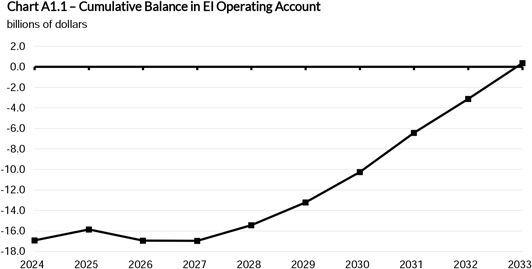
Other Revenues
Other revenues consist of three broad components:
| • | Enterprise Crown corporation revenues are projected to increase by 49.7 per cent to $12.0 billion in 2025-26, largely reflecting higher expected net profits from the Bank of Canada and increased revenues from growth in the Government of Canada’s holdings of Canada Mortgage Bonds (CMBs). Over the remainder of the forecast horizon, growth is projected to average 14.6 per cent annually, driven by net profits of enterprise Crown corporations and interest revenues from CMBs, partially offset by increases in expected losses from Canada Post. |
| • | Other program revenues include proceeds from the federal pollution pricing framework for presentation purposes as the fuel charge ceased to apply effective April 1, 2025, and to capture the residual value related to the Output-Based Pricing System. Driven primarily by this change, other program revenues are projected to decrease by 34.3 per cent to $31.5 billion in 2025-26, reflecting the cessation of the fuel charge. Other program revenues are also projected to be lower due to a decrease in interest and penalty revenue driven by lower interest rates, and the waiving of interest and penalties as part of the tax relief and support provided to businesses in response to tariffs. Over the remainder of the forecast horizon, growth is projected to average 4.2 per cent annually. |
| • | Net foreign exchange revenues and return on investments, which consist mainly of returns on Canada’s official international reserves held in the Exchange Fund Account (EFA), are volatile and sensitive to fluctuations in foreign exchange rates and foreign interest rates. Assets in the EFA are mainly invested in debt securities of sovereigns and their agencies. They are held to aid in the control and protection of the external value of the Canadian dollar and to provide a source of liquidity for the government, if required. Net foreign exchange revenues and return on investments are projected to decline in 2025-26, largely due to lower short-term interest rates and lower returns on assets held in the EFA, partly offset by smaller net losses on sales of EFA securities. Subsequently, these revenues are projected to grow on average by 2.9 per cent annually over the remainder of the forecast horizon. |
| DETAILS OF ECONOMIC AND FISCAL PROJECTIONS |
123 |
| Canada’s Surtaxes in Response to U.S. Tariffs on Canadian Goods
$9.7 billion in gross revenue has been assessed from Canada’s countermeasures in response to U.S. tariffs. A total of $5.5 billion in revenue has been remitted to mitigate the impact of the countermeasures on the Canadian economy. The net revenue assessed is $4.3 billion and remains subject to revision.
The revenue projections assume these countermeasures will remain in place through 2026-27. The continued application of the countermeasures is subject to outcomes of discussions with the United States to resolve U.S. tariffs applied on Canadian exports of steel, aluminum and motor vehicles.
Canada’s Surtaxes on Certain Imported Goods From China
$374 million in gross revenue has been assessed from the China Surtax Order. A total of $203 million in revenue has been remitted to mitigate the impact on the Canadian economy. The net revenue assessed is $171 million and remains subject to revision.
Under a new strategic partnership with China, Canada will allow up to 49,000 Chinese electric vehicles (EVs) into the Canadian market, with the most-favoured-nation tariff rate of 6.1 per cent. Accordingly, the 100 per cent surtax on imported Chinese EVs was repealed, effective March 1, 2026.
In addition, the China Surtax Remission Order has also been amended to extend additional remission of surtaxes on goods originating from China due to both temporary and ongoing short supply for specific companies, and to provide new remission on certain products. These amendments extend the availability of relief for covered goods to December 31, 2026.
The figures in Chart A1.2 and A1.3 below detail the net revenue assessed as of April 17, 2026. As additional claims for remission are processed for these surtaxes, the total amount of relief provided will increase, which will result in downward revisions to net revenues assessed.
|
| 124 | ANNEX 1 |
Outlook for Expenses
Table A1.9 provides an overview of the projection for total expenses by major component.
Table A1.9
The Expense Outlook
billions of dollars
| Projection | ||||||||||||||||||||||||||||
| 2024– | 2025– | 2026– | 2027– | 2028– | 2029– | 2030– | ||||||||||||||||||||||
| 2025 | 2026 | 2027 | 2028 | 2029 | 2030 | 2031 | ||||||||||||||||||||||
| Major transfers to persons | ||||||||||||||||||||||||||||
| Elderly benefits | 80.3 | 83.0 | 89.3 | 94.3 | 99.0 | 103.8 | 108.5 | |||||||||||||||||||||
| Employment Insurance benefits | 24.9 | 29.0 | 32.7 | 32.1 | 32.9 | 34.2 | 35.1 | |||||||||||||||||||||
| Canada Child Benefit | 28.6 | 30.2 | 31.2 | 32.1 | 32.8 | 33.5 | 34.2 | |||||||||||||||||||||
| COVID-19 income support for workers1 | -2.2 | 0.0 | 0.0 | 0.0 | 0.0 | 0.0 | 0.0 | |||||||||||||||||||||
| Total | 131.6 | 142.2 | 153.3 | 158.6 | 164.7 | 171.5 | 177.8 | |||||||||||||||||||||
| Major transfers to provinces, territories, and municipalities | ||||||||||||||||||||||||||||
| Canada Health Transfer | 52.1 | 54.7 | 57.4 | 60.3 | 62.6 | 65.0 | 67.5 | |||||||||||||||||||||
| Canada Social Transfer | 16.9 | 17.4 | 17.9 | 18.5 | 19.0 | 19.6 | 20.2 | |||||||||||||||||||||
| Equalization | 25.3 | 26.2 | 27.2 | 28.2 | 29.3 | 30.4 | 31.6 | |||||||||||||||||||||
| Territorial Formula Financing | 5.2 | 5.5 | 5.8 | 6.3 | 6.6 | 6.8 | 7.0 | |||||||||||||||||||||
| Health agreements with provinces and territories | 4.3 | 4.3 | 4.3 | 3.1 | 2.5 | 2.5 | 2.5 | |||||||||||||||||||||
| Canada-wide early learning and child care | 6.6 | 7.9 | 8.6 | 8.0 | 8.2 | 8.5 | 8.1 | |||||||||||||||||||||
| Build Communities Strong Fund – Community Stream | 2.4 | 2.5 | 2.5 | 2.6 | 2.6 | 2.7 | 2.8 | |||||||||||||||||||||
| Other fiscal arrangements2 | -7.6 | -7.6 | -8.2 | -8.5 | -8.9 | -9.3 | -9.7 | |||||||||||||||||||||
| Total | 105.1 | 110.8 | 115.6 | 118.4 | 122.0 | 126.2 | 130.0 | |||||||||||||||||||||
| Pollution pricing proceeds returned to Canadians | 15.6 | 4.9 | 0.2 | 0.1 | 0.0 | 0.0 | 0.0 | |||||||||||||||||||||
| Direct program expenses | ||||||||||||||||||||||||||||
| Other transfer payments | 107.1 | 113.7 | 121.5 | 122.6 | 120.2 | 124.9 | 126.6 | |||||||||||||||||||||
| Other direct program expenses | 130.5 | 141.1 | 145.6 | 144.1 | 149.0 | 152.8 | 157.2 | |||||||||||||||||||||
| Total | 237.6 | 254.7 | 267.1 | 266.7 | 269.2 | 277.7 | 283.8 | |||||||||||||||||||||
| Total program expenses, excluding net actuarial losses | 489.9 | 512.8 | 536.1 | 543.9 | 555.9 | 575.4 | 591.6 | |||||||||||||||||||||
| Public debt charges | 53.4 | 54.0 | 58.7 | 65.7 | 71.6 | 75.7 | 80.9 | |||||||||||||||||||||
| Total expenses, excluding net actuarial losses | 543.3 | 566.8 | 594.8 | 609.6 | 627.5 | 651.1 | 672.5 | |||||||||||||||||||||
| Net actuarial losses (gains) | 4.0 | 11.6 | 0.1 | 0.4 | -3.9 | -5.2 | -5.6 | |||||||||||||||||||||
| Total expenses | 547.3 | 578.3 | 595.0 | 609.9 | 623.7 | 645.9 | 666.9 | |||||||||||||||||||||
| Per cent of GDP | ||||||||||||||||||||||||||||
| Major transfers to persons | 4.2 | 4.4 | 4.5 | 4.5 | 4.5 | 4.5 | 4.5 | |||||||||||||||||||||
| Major transfers to provinces, territories, and | 3.4 | 3.4 | 3.4 | 3.4 | 3.4 | 3.3 | 3.3 | |||||||||||||||||||||
| municipalities | ||||||||||||||||||||||||||||
| Direct program expenses | 7.6 | 7.9 | 7.9 | 7.6 | 7.4 | 7.4 | 7.2 | |||||||||||||||||||||
| Total program expenses, excluding net actuarial losses | 15.8 | 15.8 | 15.9 | 15.6 | 15.3 | 15.3 | 15.1 | |||||||||||||||||||||
| Total expenses | 17.6 | 17.8 | 17.6 | 17.4 | 17.2 | 17.1 | 17.0 | |||||||||||||||||||||
Note: Totals may not add due to rounding.
| 1 | COVID -19 income support for workers were provided during the pandemic through the Canada Emergency Response Benefit, Canada Recovery Benefits, and the Canada Worker Lockdown Benefit. These temporary programs are now closed, with nominal projected amounts in 2025-26 of $0.2 billion mainly reflecting redeterminations of benefit overpayments. These are included in other transfer payments, consistent with their expected presentation in Public Accounts 2026. |
| 2 | Other fiscal arrangements include the Quebec Abatement (offsetting amounts to reflect the historical transfer of tax points and resulting reduction in federal tax collected for the Youth Allowances Recovery and Alternative Payments for Standing Programs); statutory subsidies; and payments for the transfer of Hibernia Net Profits Interest and Incidental Net Profits Interest net revenues to Newfoundland and Labrador. |
Major Transfers to Persons
Major transfers to persons are expected to increase from $142.2 billion in 2025-26 to $177.8 billion in 2030-31:
| • | Elderly benefits are projected to reach $83.0 billion in 2025-26, up 3.4 per cent. Over the remainder of the forecast horizon, elderly benefits are forecast to grow by 5.5 per cent on average annually. Growth in elderly benefits is due to the increasing population of seniors and projected consumer price inflation, to which benefits are fully indexed. |
| DETAILS OF ECONOMIC AND FISCAL PROJECTIONS |
125 |
| ● | EI benefits are projected to increase by 16.6 per cent to reach $29.0 billion in 2025-26, largely reflecting the higher unemployment rate in 2025. EI benefits are expected to grow at an average of 3.9 per cent annually over the remainder of the forecast horizon, mainly driven by strength in earnings that lead to higher average weekly benefits, and steady growth in employment that results in an increase in potential claimants. |
| ● | Canada Child Benefit payments are projected to increase 5.8 per cent to $30.2 billion in 2025-26, largely reflecting the indexation of benefits to consumer price inflation. Payments are expected to grow at an average of 2.5 per cent annually over the remainder of the forecast horizon. |
Major Transfers to Provinces, Territories, and Municipalities
Major transfers to provinces, territories, and municipalities are expected to increase from $110.8 billion in 2025-26 to $130.0 billion in 2030-31:
| ● | The Canada Health Transfer (CHT) is projected to increase from $54.7 billion in 2025-26 to $67.5 billion in 2030-31, supported by the CHT growth guarantee of at least 5 per cent for five years (in effect from 2023-24 to 2027-28), after which it will grow in line with a three-year moving average of nominal GDP growth, with funding guaranteed to grow by at least 3 per cent per year. |
| ● | The Canada Social Transfer will increase from $17.4 billion in 2025-26 to $20.2 billion in 2030-31, reflecting legislated growth of 3 per cent per year. |
| ● | Equalization payments are indexed to the three-year average of nominal GDP growth and are projected to grow 3.9 per cent annually, on average, from $26.2 billion in 2025-26 to $31.6 billion in 2030-31. |
| ● | Territorial Formula Financing is projected to grow 5.0 per cent annually, on average, from 2025-26 to 2030-31 due to growth in provincial/local expenditures, which are major components of the formula. |
| ● | Health agreements with provinces and territories are projected to remain at $4.3 billion in 2025-26 and 2026-27, reflecting $2.5 billion per year for tailored bilateral agreements, and $1.2 billion per year in transfers supporting home and community care and mental health and addictions services that expire after 2026-27. Another $600 million per year in transfers for long-term care expires after 2027-28. |
| ● | Canada-wide early learning and child care (CWELCC) transfer payments are expected to increase from $7.9 billion in 2025-26 to $8.1 billion in 2030-31. This includes the final two years of funding for the Early Learning and Child Care Infrastructure Fund which provided $625 million over four years (in effect from 2023-24 to 2026-27) and renewal of the CWELCC agreements starting in 2026-27. |
| ● | Build Communities Strong Fund – Community Stream, previously the Canada Community-Building Fund, is projected to grow from $2.5 billion in 2025-26 to $2.8 billion in 2030-31. The fund is indexed at 2 per cent per year with increases applied in $100 million increments. |
| ● | Other fiscal arrangements are projected to reduce transfers by $7.6 billion in 2025-26, increasing to $9.7 billion by 2030-31 due to the Quebec Abatement. This reflects the value of the historical transfer of tax points to Quebec in the 1960s and 1970s, which results in a commensurate reduction in cash transfers to the province. |
Pollution Pricing Proceeds Returned to Canadians
The government repealed the federal fuel charge effective April 1, 2025; the federal Output-Based Pricing System remains in place. All direct proceeds from the federal pollution pricing system are returned over time in the province or territory where they were collected. As a result, the fuel-charge proceeds return mechanisms for households (the Canada Carbon Rebate for individuals), small and medium-sized enterprises, farmers, and Indigenous governments in provinces where the fuel charge applied are being wound down. Proceeds returned are projected to decline from $15.6 billion in 2024-25 to $4.9 billion in 2025-26, reflecting residual payments under these streams and the Output-Based Pricing System proceeds returned. From 2026-27 onward, amounts reflect maintenance of the federal Output-Based Pricing System only.
Direct Program Expenses
Direct program expenses consist of other transfer payments administered by departments, and other direct program expenses. Growth in direct program expenses from 2025-26 to 2030-31 is driven disproportionately by investments identified in the Capital Budgeting Framework, which are growing faster than day-to-day expenses.
| 126 | ANNEX 1 |
Growth in capital investment expenses, most of which are in direct program expenses, averages 9.7 per cent, while growth in direct program expenses excluding capital investments averages under 1 per cent. Growth in direct program expenses in total from 2025-26 to 2030-31 is expected to average 2.2 per cent.
Other transfer payments administered by departments are projected to increase from $113.7 billion in 2025-26 to $126.6 billion in 2030-31. Projected growth reflects much of the programming identified under the Capital Budgeting Framework, such as support for electric vehicle battery manufacturing, Clean Economy investment tax credits, and public infrastructure investments.
Other direct program expenses reflect the cost of doing business for more than 100 government departments, agencies, and Crown corporations, as well as an allowance for doubtful accounts on taxes receivable. These expenses are forecasted to increase from $141.1 billion in 2025-26 to $157.2 billion in 2030-31, with growth muted by the phase-in of savings under the Comprehensive Expenditure Review beginning in 2026-27. Growth in later years reflects rebuilding, rearming, and reinvesting in the Canadian Armed Forces, as well as investments identified in the Capital Budgeting Framework, including capital amortisation expense and expenses of the Canadian Infrastructure Bank.
Public Debt Charges
Public debt charges are expected to increase from $54.0 billion in 2025-26 to $80.9 billion in 2030-31 due to projected increases in the stock of debt and higher interest rates. As a share of GDP, public debt charges are projected to rise from 1.7 per cent in 2025-26 to 2.1 per cent in 2030-31.
Net Actuarial Losses
Net actuarial losses, which represent changes in the value of the government’s obligations for pensions and other employee future benefits, are expected to decline over most years of the forecast horizon, from a projected loss of $11.6 billion in 2025-26 to a projected net gain of $5.6 billion in 2030-31. This reflects the impact of benefit plan amendments in 2025-26 announced in Budget 2025, which result in the pulling forward of the amortisation of actuarial losses into that year, the end of the amortisation period of certain prior years’ net actuarial losses, as well projected gains over the forecast horizon due to higher expected interest rates used to measure the present value of the obligations. The forecast of these net actuarial losses, including gains in the outer years of the forecast horizon, is volatile and sensitive to projections of future interest rates. To isolate these measurement impacts from underlying trends in government spending, expenses in Table A1.9 and the budgetary balance in Table A1.7 are shown before and after net actuarial losses.
|
Contingent Liabilities
Contingent liabilities are possible obligations that stem from past events or transactions that may result in a future payment. The key elements are:
• There is uncertainty as to whether an obligation exists
• A future event will resolve the uncertainty as to whether the government owes money
• The future event is outside the government’s control
The government’s contingent liabilities include claims, comprising pending and threatened litigation, specific claims, and comprehensive land claims, guarantees provided by the government, assessed taxes under appeal, callable share capital in international organisations, and insurance programs of agent enterprise Crown corporations.
The federal government records contingent liabilities in line with public sector accounting standards to provide a complete, transparent, and accurate picture of the government’s financial position based on the available information.
As of March 31, 2025, the government had recorded a provision, or liability, of $54.7 billion for contingent liabilities.
|
| DETAILS OF ECONOMIC AND FISCAL PROJECTIONS |
127 |
| Professional and Special Services in the Government of Canada
As announced in this Spring Economic Update, the government will reduce spending on external management and other consulting by 20 per cent over the next three years.
Management consulting represents a smaller component of professional services spending. Combined with other consulting related sub-components of professional services spending (e.g., training and IT consulting), the government spent about $5 billion on management and other consulting in 2024-25. Spending on professional and special services totaled $23.1 billion in 2024-25.
Other professional and special services include defence-related expenditures (e.g., structural design to deliver on major projects), essential service delivery (including the health care of veterans and the Canadian Armed Forces, and the delivery of health information and claims processing services for Indigenous Services Canada’s Non-Insured Health Benefits program), and internal services within the government (e.g., Department of Justice legal advice for other departments).
|
Financial Source/Requirement
The financial source/requirement measures the difference between cash coming into the government and cash going out. In contrast, the budgetary balance is presented on a full accrual basis of accounting, meaning that government revenues and expenses are recorded when they are earned or incurred, regardless of when the cash is received or paid.
Table A1.10 provides a reconciliation of the two measures, starting with the budgetary balance. Non-budgetary transactions shown in the table reflect the reversal of certain revenues and expenses included in the budgetary balance that have no impact on cash flows in the year, such as the amortisation of non-financial assets. They also include the addition of changes in asset and liability balances that have no accrual impact in a year but do result in the inflow or outflow of cash, such as the payment of accounts payable. An increase in a liability or decrease in an asset represents a financial source, whereas a decrease in a liability or increase in an asset represents a financial requirement. The sum of the budgetary balance and changes in asset and liability balances reflected under non-budgetary transactions is equal to the government’s net source of (+), or requirement for (-), cash.
| 128 | ANNEX 1 |
Table A1.10
The Budgetary Balance, Non-Budgetary Transactions, and Financial Source/Requirement
| billions of dollars |
||||||||||||||||||||||||||||
| Projection | ||||||||||||||||||||||||||||
| 2024– | 2025– | 2026– | 2027– | 2028– | 2029- | 2030- | ||||||||||||||||||||||
| 2025 | 2026 | 2027 | 2028 | 2029 | 2030 | 2031 | ||||||||||||||||||||||
| Budgetary balance |
-36.3 | -66.9 | -65.3 | -63.1 | -57.7 | -56.2 | -53.2 | |||||||||||||||||||||
|
Non-budgetary transactions |
||||||||||||||||||||||||||||
| Pensions and other accounts |
9.1 | 13.5 | 10.1 | 10.5 | 4.7 | -0.4 | -3.2 | |||||||||||||||||||||
| Non-financial assets |
-10.5 | -12.0 | -17.7 | -20.2 | -19.3 | -16.9 | -20.2 | |||||||||||||||||||||
| Loans, investments, and advances |
||||||||||||||||||||||||||||
| Enterprise Crown corporations |
-61.1 | -54.9 | -59.5 | -64.6 | -64.7 | -31.4 | -20.9 | |||||||||||||||||||||
| Other |
-6.6 | -9.4 | -8.3 | -7.3 | -4.2 | -7.9 | -7.8 | |||||||||||||||||||||
| Total |
-67.7 | -64.3 | -67.8 | -71.8 | -69.0 | -39.3 | -28.7 | |||||||||||||||||||||
| Other transactions |
||||||||||||||||||||||||||||
| Accounts payable, receivable, accruals, |
-14.6 | 24.0 | 7.3 | 0.8 | -2.5 | -6.4 | -5.8 | |||||||||||||||||||||
| and allowances |
||||||||||||||||||||||||||||
| Foreign exchange activities and derivatives |
-10.0 | 0.3 | 0.0 | -5.1 | -5.3 | -5.4 | -5.4 | |||||||||||||||||||||
| Total |
-24.6 | 24.3 | 7.3 | -4.3 | -7.8 | -11.9 | -11.2 | |||||||||||||||||||||
| Total non-budgetary transactions |
-93.7 | -38.5 | -68.1 | -85.9 | -91.3 | -68.4 | -63.2 | |||||||||||||||||||||
| Financial source (requirement) |
-130.0 | -105.3 | -133.4 | -149.0 | -149.0 | -124.6 | -116.4 | |||||||||||||||||||||
As shown in Table A1.10, a financial requirement is projected in each year over the forecast horizon, reflecting financial requirements associated with the projected budgetary deficits, as well as forecast requirements from non-budgetary activities.
An annual financial source is projected for pensions and other accounts up to 2028-29, followed by projected requirements thereafter. Pensions and other accounts include the activities of the Government of Canada’s employee pension plans and those of federally appointed judges and Members of Parliament, as well as a variety of other employee future benefit plans, such as health care and dental plans, and disability and other benefits for veterans and others. A financial source for pensions and other accounts reflects the difference between non-cash pension and benefit expenses recorded as part of the budgetary balance, such as the amortisation of net actuarial losses and the accrual of future benefits earned by employees during the year, and actual cash outflows for benefit payments.
Financial requirements for non-financial assets mainly reflect the difference between cash outlays for the acquisition of new tangible capital assets and the amortisation of capital assets included in the budgetary balance. They also include disposals of tangible capital assets and changes in inventories and prepaid expenses. Financial requirements are projected in each year over the forecast horizon, reflecting forecast net growth in non-financial assets.
Loans, investments, and advances include the government’s equity in enterprise Crown corporations, including Canada Mortgage and Housing Corporation, Export Development Canada, the Business Development Bank of Canada, and Farm Credit Canada, loans to enterprise Crown corporations to finance their activities, and the up-to $30 billion in annual purchases of Canada Mortgage Bonds issued by Canada Mortgage and Housing Corporation. They also include loans, investments, and advances to national and provincial governments and international organisations, and under government programs.
In general, loans, investments, and advances are expected to generate additional revenues for the government in the form of interest or additional net profits of enterprise Crown corporations, which partly offset debt charges associated with these borrowing requirements. These revenues are reflected in the budgetary balance projections.
Other transactions include the payment of tax refunds and other accounts payable, the collection of taxes and other accounts receivable, the conversion of other accrual adjustments included in the budgetary balance into cash, as well as foreign exchange activities and derivatives. The projected financial source in 2025-26 reflects several factors, including a projected net increase in contingent liabilities and growth in amounts payable to taxpayers (i.e., expenses or adjustments to revenues not paid in the year). Projected net cash requirements for other transactions over the later years of the forecast horizon mainly reflect changes in accounts payable and accounts receivable and forecast increases in the government’s official international reserves held in the Exchange Fund Account.
| DETAILS OF ECONOMIC AND FISCAL PROJECTIONS |
129 |
Economic Scenario Analysis
The Canadian economy has thus far remained resilient in the face of a global economic landscape transformation and new tariffs. Firms are adapting by diversifying suppliers and markets, enhancing supply chains’ resilience. The March 2026 survey of private sector economists expects trade policy uncertainty to remain elevated, with some easing beginning in 2027. However, forecasters do not project a return to broadly open, low-tariff global trade.
As a trading nation, Canada is particularly exposed to global uncertainty. Geopolitical risk is currently elevated, introducing significant uncertainty into the global outlook. The conflict in the Middle East has led to sharply higher energy prices and disrupted crude oil production, exports, and refining capacity. While the consensus forecast expects a relatively short-lived conflict with a mostly temporary surge in oil prices, the path forward remains highly uncertain. Current WTI prices and futures-implied prices are both higher than the March survey WTI projections.
As a net oil exporter, Canada stands to benefit from improved terms of trade and potentially stronger investment. For example, if WTI followed current futures prices and averaged around US$80 in 2026 compared to the US$73 expected in the March survey, nominal GDP would be about $17 billion higher, and the federal budgetary balance would improve by $1.9 billion. However, the net impact on real growth will depend on the scale and duration of the oil price increase. Uncertainty also extends beyond energy markets. Spillovers through global supply chains and transportation networks could dampen global activity, particularly if disruptions affect non-energy trade flows and raise costs through less efficient routing. An ongoing conflict could also trigger a more abrupt repricing of inflation risks and result in tighter financial conditions through higher interest rates.
The Department of Finance Canada has prepared two economic scenarios to support prudent fiscal planning and assess risks to the March survey forecast around higher oil prices (Table A1.11).
Higher Investment Scenario
In the Higher Investment scenario, the Middle East conflict leads to a prolonged reduction in global oil supply due to damage to oil infrastructure and production shut-ins. WTI oil prices rise to an average of US$115 per barrel in the second quarter of 2026. Prices are assumed to gradually decrease thereafter but remain elevated throughout the forecast horizon, as the conflict has a lasting impact on oil supply conditions and geopolitical risk in the region.
The sharper and more persistent rise in oil prices contributes to stronger inflation and higher interest rates worldwide. Demand for Canadian exports is reduced as tighter financial conditions and further erosion of household purchasing power weigh on global economic activity. This exacerbates challenges in key domestic export sectors that are already under strain with tariffs.
Despite these challenges, Canada benefits from improved terms of trade, boosting national income. These income gains initially accrue to the energy sector but gradually spread across the broader economy through higher profits and wages. Canada is also viewed as a stable and reliable energy supplier amid continued elevated geopolitical risks, supporting stronger demand for its exports. Elevated oil prices and stronger demand for Canadian crude oil, combined with policy efforts to accelerate major projects and catalyse new private investment, contribute to increased investment in the oil and gas sector and other industries, with positive spillovers to the broader economy, helping to offset the negative economic impact of weaker global demand.
With higher oil prices, the level of nominal GDP is on average $37 billion higher per year relative to the March survey forecast over 2026-2030.
| ● | Canadian real GDP growth is modestly higher over the forecast horizon, averaging 1.8 per cent from 2026 to 2030 compared to 1.7 per cent in the March survey. Reflecting the effects of improved business investment on the economy’s productive capacity, the level of real GDP is about 0.4 per cent higher than the survey forecast by 2030. |
| ● | The unemployment rate falls somewhat more quickly as a result, averaging 6.1 per cent over the same period (versus 6.2 per cent in the survey). |
| ● | Higher oil prices have a direct effect on gasoline and other petroleum fuels. Headline CPI inflation rises to 2.9 per cent in 2026 before slowing to 2.0 per cent in 2027. In comparison, CPI inflation in the survey reaches 2.5 per cent in 2026 and 1.9 per cent in 2027. |
| 130 | ANNEX 1 |
| ● | With upward pressures on core inflation broadly contained, monetary policy is slightly more restrictive over the forecast relative to the March survey. The 3-month treasury bill rate averages 2.3 per cent and 2.6 per cent in 2026 and 2027, respectively, compared to 2.2 per cent and 2.5 per cent in the survey. |
| ● | GDP inflation is significantly higher due to higher oil prices, reaching 4.2 per cent in 2026, relative to 2.8 per cent in the survey. |
Global Supply Disruptions Scenario
The Global Supply Disruptions scenario assumes that oil price increases in the Higher Investment scenario are compounded by broader adverse global disruptions due to persistent export constraints from the Middle East and damage to critical energy infrastructures.
Higher energy costs cascade through supply chains and raise input costs beyond energy-intensive sectors. Increased fuel costs and rerouted trade flows drive persistently higher shipping and freight insurance rates, pushing up prices for affected commodities, such as chemicals, metals, and fertilizers, and weighing on global production and trade. While supply chain disruptions intensify, they remain less severe than during the pandemic.
Relative to the Higher Investment scenario, inflationary pressures become broader, affecting both energy and non-energy products and eventually passing through to consumer prices. Monetary policy worldwide is more restrictive, while inflation concerns in markets drive up term premia, exerting a stronger drag on global activity. These developments, together with ongoing geopolitical uncertainty, weigh on business and consumer confidence, lower asset values, and dampen consumption and investment decisions.
These pressures make it more difficult and costly for Canadian businesses to adjust to tariffs and strengthen supply chains, which, in turn, significantly affects exports, consumption, investment, and productivity. The investment response of Canadian energy producers is also notably more subdued than in the Higher Investment scenario despite higher oil prices due to heightened uncertainty, including about future energy demand.
This scenario results in a prolonged period of slower economic growth and higher unemployment. Despite this, nominal GDP remains higher than the March survey in the first two years of the survey ($37 billion and $16 billion, respectively) due to the impact of higher oil prices on the terms of trade. However, as prices normalise, weaker real economic activity weighs on the level of nominal GDP, which falls below the March survey forecast from 2028 to 2030 by an average of $9 billion annually. Overall, over the forecast horizon, nominal GDP is $5 billion higher on average per year compared to the survey forecast, significantly lower than in the Higher Investment scenario.
| ● | Canadian real GDP growth is weaker in 2026 and 2027, as cost pressures build and weigh on economic activity. Real growth reaches 0.8 per cent in 2026 and 1.0 per cent in 2027, compared to 1.1 per cent and 1.9 per cent in the March survey. By 2030, the level of real GDP is about 0.8 per cent lower than the forecast level in the survey. |
| ● | The unemployment rate remains elevated relative to the survey outlook, averaging 6.8 per cent in both 2026 and 2027 (versus 6.5 per cent and 6.2 per cent in the survey). |
| ● | Inflation is broader and more persistent, extending beyond energy-related components and affecting core inflation. Headline CPI inflation rises to 3.1 per cent in 2026 and 2.3 per cent in 2027, relative to 2.5 per cent and 1.9 per cent in the survey. |
| ● | Persistent inflation exerts upward pressure on short-term interest rates, but this effect is partially offset by weaker demand conditions. Short-term interest rates increase faster than in the March survey over the near term, averaging 2.5 per cent in 2026 and 2.8 per cent in 2027, compared to 2.2 per cent and 2.5 per cent in the survey. |
| ● | GDP inflation exceeds the March survey forecast on average over 2026-2030, as stronger gains in the terms of trade are further compounded by higher and more persistent domestic inflation. GDP inflation reaches 4.3 per cent in 2026 and 2.0 per cent in 2027, as opposed to 2.8 per cent and 1.8 per cent in the survey. |
| DETAILS OF ECONOMIC AND FISCAL PROJECTIONS |
131 |
Table A1.11
Department of Finance Canada Economic Scenarios
| per cent, unless otherwise indicated |
||||||||||||||||||||||||
| 2026- | ||||||||||||||||||||||||
| 2026 | 2027 | 2028 | 2029 | 2030 | 2030 | |||||||||||||||||||
| Real GDP growth |
||||||||||||||||||||||||
| Spring Economic Update 2026 |
1.1 | 1.9 | 1.9 | 1.9 | 1.8 | 1.7 | ||||||||||||||||||
| Higher Investment Scenario |
1.2 | 1.9 | 2.0 | 2.0 | 1.9 | 1.8 | ||||||||||||||||||
| Global Supply Disruptions Scenario |
0.8 | 1.0 | 1.8 | 2.2 | 2.1 | 1.6 | ||||||||||||||||||
| GDP inflation |
||||||||||||||||||||||||
| Spring Economic Update 2026 |
2.8 | 1.8 | 1.9 | 2.0 | 2.0 | 2.1 | ||||||||||||||||||
| Higher Investment Scenario |
4.2 | 1.7 | 1.3 | 1.6 | 1.9 | 2.1 | ||||||||||||||||||
| Global Supply Disruptions Scenario |
4.3 | 2.0 | 1.4 | 1.5 | 1.9 | 2.2 | ||||||||||||||||||
| Nominal GDP growth |
||||||||||||||||||||||||
| Spring Economic Update 2026 |
4.0 | 3.7 | 3.8 | 3.9 | 3.8 | 3.8 | ||||||||||||||||||
| Higher Investment Scenario |
5.5 | 3.6 | 3.4 | 3.7 | 3.8 | 4.0 | ||||||||||||||||||
| Global Supply Disruptions Scenario |
5.1 | 3.0 | 3.2 | 3.8 | 3.9 | 3.8 | ||||||||||||||||||
| Nominal GDP level (billions of dollars) |
||||||||||||||||||||||||
| Spring Economic Update 2026 |
3,372 | 3,496 | 3,630 | 3,772 | 3,917 | |||||||||||||||||||
| Higher Investment Scenario |
3,420 | 3,545 | 3,664 | 3,798 | 3,944 | |||||||||||||||||||
| Global Supply Disruptions Scenario |
3,409 | 3,512 | 3,623 | 3,760 | 3,908 | |||||||||||||||||||
| Difference between Higher Investment Scenario and Spring Economic Update 2026 |
48 | 49 | 34 | 26 | 26 | 37 | ||||||||||||||||||
| Difference between Global Supply Disruptions Scenario and Spring Economic Update 2026 |
37 | 16 | -7 | -12 | -9 | 5 | ||||||||||||||||||
| 3-month treasury bill rate |
||||||||||||||||||||||||
| Spring Economic Update 2026 |
2.2 | 2.5 | 2.7 | 2.6 | 2.6 | 2.5 | ||||||||||||||||||
| Higher Investment Scenario |
2.3 | 2.6 | 2.8 | 2.8 | 2.7 | 2.6 | ||||||||||||||||||
| Global Supply Disruptions Scenario |
2.5 | 2.8 | 2.6 | 2.5 | 2.6 | 2.6 | ||||||||||||||||||
| 10-year government bond rate |
||||||||||||||||||||||||
| Spring Economic Update 2026 |
3.4 | 3.6 | 3.7 | 3.7 | 3.7 | 3.6 | ||||||||||||||||||
| Higher Investment Scenario |
3.5 | 3.9 | 4.0 | 3.9 | 3.8 | 3.8 | ||||||||||||||||||
| Global Supply Disruptions Scenario |
3.8 | 4.1 | 4.1 | 4.0 | 3.9 | 4.0 | ||||||||||||||||||
| Unemployment rate |
||||||||||||||||||||||||
| Spring Economic Update 2026 |
6.5 | 6.2 | 6.1 | 6.0 | 5.9 | 6.2 | ||||||||||||||||||
| Higher Investment Scenario |
6.5 | 6.1 | 6.0 | 5.9 | 5.9 | 6.1 | ||||||||||||||||||
| Global Supply Disruptions Scenario |
6.8 | 6.8 | 6.6 | 6.2 | 6.1 | 6.5 | ||||||||||||||||||
| Consumer Price Index inflation |
||||||||||||||||||||||||
| Spring Economic Update 2026 |
2.5 | 1.9 | 2.0 | 2.0 | 2.0 | 2.1 | ||||||||||||||||||
| Higher Investment Scenario |
2.9 | 2.0 | 1.8 | 1.9 | 2.0 | 2.1 | ||||||||||||||||||
| Global Supply Disruptions Scenario |
3.1 | 2.3 | 1.9 | 1.8 | 2.0 | 2.2 | ||||||||||||||||||
| U.S. real GDP growth |
||||||||||||||||||||||||
| Spring Economic Update 2026 |
2.4 | 2.0 | 2.0 | 2.0 | 2.0 | 2.1 | ||||||||||||||||||
| Higher Investment Scenario |
2.1 | 1.6 | 2.3 | 2.3 | 2.1 | 2.1 | ||||||||||||||||||
| Global Supply Disruptions Scenario |
2.1 | 1.3 | 2.0 | 2.3 | 2.1 | 2.0 | ||||||||||||||||||
| West Texas Intermediate crude oil price ($US per barrel) |
||||||||||||||||||||||||
| Spring Economic Update 2026 |
73 | 66 | 66 | 69 | 70 | 69 | ||||||||||||||||||
| Higher Investment Scenario |
95 | 82 | 75 | 72 | 72 | 79 | ||||||||||||||||||
| Global Supply Disruptions Scenario |
95 | 82 | 75 | 72 | 72 | 79 | ||||||||||||||||||
Notes: Forecast averages may not equal average of years due to rounding. Numbers may not add due to rounding.
Sources: Statistics Canada; Department of Finance Canada March 2026 survey of private sector economists; Department of Finance Canada calculations.
| 132 | ANNEX 1 |
Fiscal Impacts of Economic Scenarios
The potential impact of the economic scenarios on the projected federal deficit and federal debt to-GDP ratio is shown in Chart A1.5 and A1.6 below.
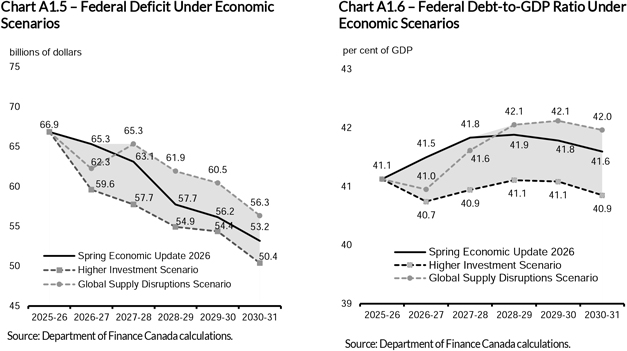
Higher Investment Scenario Fiscal Impact
In the Higher Investment scenario, the budgetary balance would improve by $5.7 billion in 2026-27 and $3.2 billion, per year on average over the remainder of the forecast horizon. With the stronger outlook for nominal GDP, revenues would be revised up by $7.0 billion in 2026-27, and $5.5 billion, per year on average over the remainder of the forecast horizon. As a result of modestly higher interest rates, and slightly higher CPI inflation in the near term, public debt charges and program expenses are revised up by $1.2 billion in 2026-27, and an average of $2.3 billion, per year, over the remainder of the forecast horizon.
As a result of the stronger nominal GDP, the federal debt-to-GDP ratio would be expected to decrease to 40.7 per cent in 2026-27 and increase to 40.9 per cent in 2030-31.
Global Supply Disruptions Scenario Fiscal Impact
In the Global Supply Disruptions scenario, the deficit would improve by about $3.1 billion in 2026-27 but deteriorate by an average of $3.5 billion annually over the remainder of the forecast horizon. Revenues are projected to increase by $5.9 billion in 2026-27, and $1.5 billion, per year on average, over the remainder of the forecast horizon. As a result of broader, more persistent inflation and higher interest rates, expenses are forecast to increase by $2.8 billion in 2026-27, and $5.0 billion, per year on average, over the remainder of the forecast horizon.
In this scenario, the federal debt-to-GDP ratio would drop to 41.0 in 2026-27, and increase to 42.0 per cent in 2030-31.
Long-Term Debt Projections
Keeping the federal debt-to-GDP ratio on a stable or declining trajectory over the long term will help ensure that future generations are not unduly burdened by debt and that adequate fiscal room is preserved to respond to emerging fiscal pressures, challenges, and risks.
| DETAILS OF ECONOMIC AND FISCAL PROJECTIONS |
133 |
Long-term fiscal and economic projections can help assess whether the current fiscal policy trajectory is sustainable or whether policy adjustment may be needed. These simulations are not forecasts or predictions; rather they are useful indicators of how economic and fiscal variables may interact under a defined set of conditions and assumptions.
Building on the Spring Economic Update 2026 forecasts and extended using a set of reasonable assumptions described below, the baseline long-term fiscal projections continue to show the federal debt-to-GDP ratio declining over the long-term projection horizon (Chart A1.7).
Long-term projections can also be used to illustrate that fiscal sustainability depends not only on sound fiscal management, but also on strong economic policies and growth-enhancing investments that support economic growth over the longer term, such as those introduced by the government over the past year. As an illustration, sensitivity analysis suggests that higher average annual economic growth by 0.25 percentage points over the long term would put the federal debt-to-GDP ratio on a notably steeper downward path.
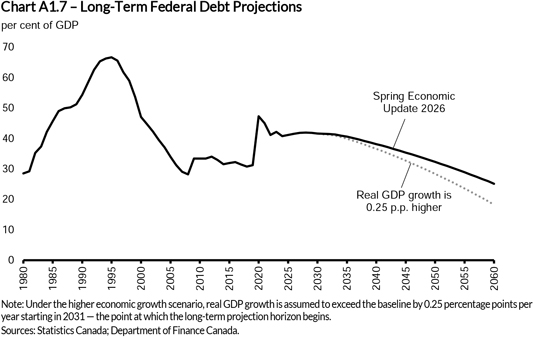
Keeping the federal debt-to-GDP ratio from rising over the long term will help ensure enough fiscal capacity remains to adequately manage future fiscal pressures not accounted for in the baseline long-term projection, including, among others, from recessions, additional defence spending, climate change, and the transition to net-zero emissions.
To form the long-term economic projections, the medium-term (2026 to 2030) economic forecasts presented in the Spring Economic Update 2026 are extended to 2060 using the Department of Finance Canada’s long-term economic projection model. In this model, annual real GDP growth depends on labour productivity growth (0.9 per cent per year), which is calibrated over its 2000-2025 historical average, and labour supply growth (average of 0.6 per cent per year), which is based on demographic projections produced by Statistics Canada and projections for the labour force participation rate and average hours worked using econometric models developed by the Department. Assuming a constant 2 per cent annual rate for GDP inflation, nominal GDP is projected to grow by an average of 3.5 per cent per year from 2031 to 2060 (Table A1.12).
| 134 | ANNEX 1 |
Table A1.12
GDP Growth Projection, Baseline Scenario, Average Annual Growth Rates
| per cent, unless otherwise indicated |
||||||||||||
| 2000–2025 | 2026–2030 | 2031–2060 | ||||||||||
| Real GDP growth |
2.1 | 1.7 | 1.5 | |||||||||
| Contributions of (percentage points): |
||||||||||||
| Labour supply growth |
1.3 | 0.4 | 0.6 | |||||||||
| Working-age population |
1.5 | 0.7 | 0.7 | |||||||||
| Labour force participation |
0.0 | -0.3 | -0.1 | |||||||||
| Unemployment rate |
0.0 | 0.2 | 0.0 | |||||||||
| Average hours worked |
-0.2 | -0.2 | -0.1 | |||||||||
| Labour productivity growth |
0.9 | 1.3 | 0.9 | |||||||||
| Nominal GDP growth |
4.7 | 3.8 | 3.5 | |||||||||
Note: Contributions may not add up due to rounding.
Sources: Statistics Canada; Department of Finance Canada March 2026 survey of private sector economists; Department of Finance Canada calculations.
The long-term federal debt projections are developed through an accounting model in which each revenue and expense category is modelled as a function of its underlying demographic and economic variables, with the relationships defined by a mix of current government policies and assumptions. The key assumptions underlying fiscal projections from 2031-32 through 2060-61 are as follows:
| ● | All tax revenues as well as a direct program expenses grow broadly with nominal GDP, with the exception of a number of measures that will no longer be available after a certain date, such as the Clean Economy investment tax credits, which are incorporated based on their projected costs. |
| ● | The Canada Health Transfer, Canada Social Transfer, and Equalization grow with their respective legislated escalators. The remaining major transfers to provinces, territories, and municipalities grow according to their respective factors, such as nominal GDP, the respective populations, inflation, and current legislation or agreements. |
| ● | Elderly benefits and Canada Child Benefit payments grow in line with the respective populations and are indexed to inflation. Employment Insurance (EI) benefits grow in line with the number of beneficiaries and the growth in average weekly earnings. The EI premium rate grows according to current program parameters. |
| ● | The effective interest rate on federal market debt is assumed to gradually increase from about 3.2 per cent in 2030-31 to 3.5 per cent by 2060-61. |
As with any projection that extends over several decades, long-term federal debt projections are subject to considerable uncertainty and are sensitive to the underlying assumptions. Sensitivity analysis helps illustrate how changes in key assumptions can affect the deficit-to-GDP ratio and the federal debt-to-GDP ratio at the end of the long-term projection horizon (Tables A1.13 and A1.14).
Table A1.13
Description of Alternative Assumptions1
| alternative assumption less baseline | ||||||||||||
| Baseline2 | High | Low | ||||||||||
| Demographic: |
||||||||||||
| Fertility rate (average births per woman) |
1.3 births | +0.5 births | -0.5 births | |||||||||
| Immigration (per cent of population) |
0.9 | +0.25 p.p. | -0.25 p.p. | |||||||||
| Life expectancy at 65 |
23 years | +3 years | -3 years | |||||||||
| Economic: |
||||||||||||
| Total labour force participation rate (per cent) |
63.6 | +2.0 p.p. | -2.0 p.p. | |||||||||
| Average weekly hours worked (hours) |
32.4 | +1.0 hour | -1.0 hour | |||||||||
| Unemployment rate (per cent) |
5.9 | +1.0 p.p. | -1.0 p.p. | |||||||||
| Labour productivity (per cent) |
0.9 | +0.25 p.p. | -0.25 p.p. | |||||||||
| Interest rates (per cent) |
3.3 | +1.0 p.p. | -1.0 p.p. | |||||||||
Note: p.p. = percentage point.
| 1These | alternative assumptions are applied starting in 2031 except for changes in life expectancy, which are gradually applied over the projection horizon. |
| 2 | Baseline shown as the average over the period 2031 to 2060. |
| DETAILS OF ECONOMIC AND FISCAL PROJECTIONS |
135 |
Table A1.14
Budgetary Balance and Debt in 2060-61 Under Alternative Assumptions
per cent of GDP
| Baseline | High | Low | ||||||||||||||||||||||
| Budgetary Balance |
Debt | Budgetary Balance |
Debt | Budgetary Balance |
Debt | |||||||||||||||||||
| Demographic: |
||||||||||||||||||||||||
| Fertility rate |
-0.1 | 25.1 | -0.2 | 28.3 | 0.0 | 21.7 | ||||||||||||||||||
| Immigration |
-0.1 | 25.1 | 0.4 | 18.1 | -0.7 | 33.9 | ||||||||||||||||||
| Life expectancy at 65 |
-0.1 | 25.1 | -0.6 | 29.5 | 0.2 | 21.5 | ||||||||||||||||||
| Economic: |
||||||||||||||||||||||||
| Total labour force participation rate |
-0.1 | 25.1 | 0.2 | 20.1 | -0.4 | 31.0 | ||||||||||||||||||
| Average weekly hours worked |
-0.1 | 25.1 | 0.2 | 20.2 | -0.4 | 30.9 | ||||||||||||||||||
| Unemployment rate |
-0.1 | 25.1 | -0.2 | 26.9 | 0.0 | 23.4 | ||||||||||||||||||
| Labour productivity |
-0.1 | 25.1 | 0.4 | 18.1 | -0.7 | 32.9 | ||||||||||||||||||
| Interest rates |
-0.1 | 25.1 | -0.9 | 36.8 | 0.5 | 16.0 | ||||||||||||||||||
Policy Actions Taken Since Budget 2025
To ensure transparency, Table A1.15 lists all policy actions taken since Budget 2025, helping to ensure that Canadians continue to be well served by the programs they rely on and that government operations carry on efficiently. These actions also include time-limited funding renewals to support programs with sunsetting authorities. For these programs, time-limited renewals reflect decisions taken at this time and do not determine long-term funding, permanent base funding, or whether a program may be funded again in the future.
Table A1.15
Policy Actions Taken Since Budget 2025
millions of dollars
Notes:
1. An ellipsis (….) indicates no adjustments to existing funding levels (that is, no additional funding, or reduction in funding, is being proposed), or no funding implications (for example, a one-time event or a new program that begins in future years).
2. A dash (-) indicates that consideration of a further extension will occur at a later time.
3. A starred 0 (0*) indicates an amount of less than $0.5 million, which rounds to zero in this table.
4. Measures that include funding classified as a capital investment are marked with an asterisk (*).
5. Numbers may not add due to rounding.
6. A glossary of abbreviations used in this table can be found at the end of this table.
| Dept. |
2025- 2026 |
2026- 2027 |
2027- 2028 |
2028- 2029 |
2029- 2030 |
2030- 2031 |
||||||||||||||||||||
| Transport, Infrastructure and Environment |
16 | 1,277 | 353 | 323 | 262 | 256 | ||||||||||||||||||||
| Extending Support for Eastern Ferries and Marine Atlantic Inc. |
TC, MAI | 16 | 139 | 167 | 173 | 173 | 173 | |||||||||||||||||||
| Extending Support for the Trade and Transportation Information System |
TC | .... | 4 | 4 | 4 | 4 | 4 | |||||||||||||||||||
| Extending Support for the Operations and Oversight of Federally Owned Bridges |
FBCL, WDBA, HICC |
.... | 31 | 70 | 61 | 4 | 4 | |||||||||||||||||||
| Extending Support for the Safer Skies Initiative’s Conflict Zone Information Office |
TC | .... | 2 | 2 | 2 | 2 | 2 | |||||||||||||||||||
| Extending Support for Regulating Advanced Aviation Technologies |
TC | .... | 13 | 13 | 13 | 14 | 14 | |||||||||||||||||||
| Extending Support for the Operations of the Canadian Air Transport Security Authority* |
CATSA | .... | 734 | 0 | * | 0 | * | 0 | * | 0 | * | |||||||||||||||
| Extending Support for the Operations of the Canadian Transportation Agency |
CTA | .... | 26 | 26 | - | - | - | |||||||||||||||||||
| Extending Support for Safety and Cybersecurity in Connected and Automated Vehicles |
TC | .... | 23 | 23 | 24 | 25 | 22 | |||||||||||||||||||
| Extending Support for the Implementation of Vehicle GHG Regulations* |
ECCC | .... | 5 | 5 | 5 | 5 | 5 | |||||||||||||||||||
| Extending Support for the Standards to Support Resilience in Infrastructure Program |
SCC | .... | 4 | 4 | 7 | 7 | 7 | |||||||||||||||||||
| Extending Support for the Operations of VIA Rail |
VIA Rail | .... | 262 | - | - | - | - | |||||||||||||||||||
| 136 | ANNEX 1 |
| Dept. |
2025- 2026 |
2026- 2027 |
2027- 2028 |
2028- 2029 |
2029- 2030 |
2030- 2031 |
||||||||||||||||||||||
| Extending Support for Transport Canada’s Port Assets |
TC | .... | 7 | 7 | 6 | - | - | |||||||||||||||||||||
| Extending Support for Wildfire Risk Mapping* |
NRCan | .... | 6 | 6 | 6 | 6 | 6 | |||||||||||||||||||||
| Extending Support for the National Wildfire Program* |
PC | .... | 9 | 9 | 9 | 9 | 9 | |||||||||||||||||||||
| Extending Support for Enhancing Flood Resilience |
PS | .... | 5 | - | - | - | - | |||||||||||||||||||||
| Extending Support for Core Activities at the Canada Energy Regulator |
CER | .... | 8 | 8 | 8 | 8 | 8 | |||||||||||||||||||||
| Less: Costs to be Recovered |
.... | -8 | -8 | -8 | -8 | -8 | ||||||||||||||||||||||
| Extending Support for Engaging Across the Federation on Energy and Natural Resource Projects and Policies |
NRCan | .... | 3 | 3 | 3 | 3 | - | |||||||||||||||||||||
| Extending Support for the Cyber Security and Resilience of Canada’s Energy Sector |
NRCan | .... | 2 | 2 | 2 | 2 | 2 | |||||||||||||||||||||
| Extending Support for the Critical Minerals Strategy |
NRC | .... | .... | 9 | 6 | 6 | 6 | |||||||||||||||||||||
| Supports for Businesses and Innovation |
103 | 166 | 75 | 68 | 68 | |||||||||||||||||||||||
| Extending Support for the College and Community Innovation Program |
NSERC | .... | 33 | 33 | 33 | 33 | 33 | |||||||||||||||||||||
| Extending Support for Laboratories Canada |
PSPC | .... | 8 | 27 | 26 | 26 | 26 | |||||||||||||||||||||
| Extending Support for CanCode |
ISED | .... | 15 | 15 | - | - | - | |||||||||||||||||||||
| Extending Support for the Northern Ontario Development Program |
FedNor | .... | 5 | 5 | 5 | 5 | 5 | |||||||||||||||||||||
| Extending Support for the Regional Homebuilding Innovation Initiative |
FedNor | .... | 1 | 1 | 1 | 1 | 1 | |||||||||||||||||||||
| for Northern Ontario* |
.... | |||||||||||||||||||||||||||
| Extending Support for the Northern Projects Management Office |
CanNor | .... | 1 | 1 | 1 | 1 | 1 | |||||||||||||||||||||
| Support for Kap Paper1 (new) |
FedNor | 14 | - | - | - | - | - | |||||||||||||||||||||
| Less: Funds Previously Provisioned in the Fiscal Framework |
NRCan | -14 | - | - | - | - | - | |||||||||||||||||||||
| Reprofiling Funds for the Forest Innovation Program2 |
NRCan | 37 | - | - | - | - | - | |||||||||||||||||||||
| Less: Funds Sourced From Existing Departmental Resources |
-37 | - | - | - | - | - | ||||||||||||||||||||||
| Extending Support for the Business Data Lab |
ISED | .... | 1 | 1 | 1 | 1 | ||||||||||||||||||||||
| Extending Support for the Can Health Network |
ISED | .... | 8 | 9 | 7 | - | - | |||||||||||||||||||||
| Extending Support for Business Women in International Trade |
GAC | .... | 2 | - | - | - | - | |||||||||||||||||||||
| Extending Support for Improving Procurement Opportunities for Canadian Businesses |
PSPC | .... | 26 | 18 | - | - | - | |||||||||||||||||||||
| Extending Support for the Connecting Families (Affordable Access) Initiative |
ISED | .... | .... | 0 | * | 0 | * | 0 | * | 0 | * | |||||||||||||||||
| Extending Support for the Agricultural Clean Technology Program* |
AAFC | .... | .... | 54 | - | - | - | |||||||||||||||||||||
| Extending Support for Polar Knowledge Canada |
POLAR | .... | 4 | - | - | - | - | |||||||||||||||||||||
| Public Safety, Defence, and Canada in the World |
71 | 623 | 309 | 294 | 125 | 105 | ||||||||||||||||||||||
| Extending Support for the Nation’s Capital Extraordinary Policing Costs Program |
PS | .... | 3 | 3 | 3 | 3 | 3 | |||||||||||||||||||||
| Extending Support for Indigenous Policing Capacity |
PS | .... | 3 | 3 | 3 | - | - | |||||||||||||||||||||
| Supporting Federal Policing1 |
RCMP | 27 | .... | .... | .... | .... | .... | |||||||||||||||||||||
| Less: Funds Sourced From Existing Departmental Resources |
-7 | .... | .... | .... | .... | .... | ||||||||||||||||||||||
| Extending Support for Combatting Drug Impaired Driving |
|
CBSA, RCMP |
|
.... | 7 | .... | .... | .... | .... | |||||||||||||||||||
| Extending Support for the Building Safer Communities Fund1 |
PS | .... | 55 | 55 | 55 | - | - | |||||||||||||||||||||
| Extending Support for Addressing Gender-based Violence through the Criminal and Family Justice Systems |
JUS | .... | 21 | 21 | 21 | 21 | 21 | |||||||||||||||||||||
| Extending Support for Responding to Gender-based Violence* |
RCMP | .... | 5 | 5 | 5 | 5 | 5 | |||||||||||||||||||||
| Extending Support for Records Suspension Program Reforms |
PS | .... | 6 | 6 | - | - | - | |||||||||||||||||||||
| Extending Support for Racialized Communities Legal Support |
JUS | .... | 4 | 4 | - | - | - | |||||||||||||||||||||
| Extending Support for Community Justice Centres |
JUS | .... | 6 | 6 | 6 | - | - | |||||||||||||||||||||
| Extending Support for the Memorial Grant Program for First Responders |
PS | .... | 29 | 29 | 29 | - | - | |||||||||||||||||||||
| Extending Support for the Canadian Program for Cyber Security Certification |
|
PSPC, SCC |
|
.... | 5 | 6 | 6 | 6 | 6 | |||||||||||||||||||
| Extending Support for Responding to National Security Reviews |
|
CBSA, CSIS, JUS, PS, RCMP |
|
.... | 12 | 10 | 10 | 10 | 10 | |||||||||||||||||||
| DETAILS OF ECONOMIC AND FISCAL PROJECTIONS |
137 |
| Dept. |
2025- 2026 |
2026- 2027 |
2027- 2028 |
2028- 2029 |
2029- 2030 |
2030- 2031 |
||||||||||||||||||||||
| Extending Support for Combatting Foreign Interference* |
RCMP | .... | 17 | 17 | 17 | 17 | 17 | |||||||||||||||||||||
| Extending Support for the Counter Drone Program* |
RCMP | .... | 9 | 9 | 9 | 9 | 9 | |||||||||||||||||||||
| Enhancing the Defence Platform to Boost Canada’s Defence and Security Ecosystem (new) 1 |
BDC | 51 | 46 | 40 | 36 | 31 | 10 | |||||||||||||||||||||
| Canada’s Support for Ukraine - Military Assistance |
DND | .... | 300 | - | - | - | - | |||||||||||||||||||||
| Extending Support for the Implementation of the Supply Chains Act |
PS | .... | 3 | - | - | - | - | |||||||||||||||||||||
| Extending Support for the Humanitarian Workforce Program |
PS | .... | 36 | 36 | 36 | - | - | |||||||||||||||||||||
| Extending Support for Defending the Canadian Softwood Lumber Industry |
GAC | .... | 31 | 31 | 31 | - | - | |||||||||||||||||||||
| Extending Support for CanExport: Intellectual Property Support Program |
GAC | .... | .... | 2 | 2 | 2 | 2 | |||||||||||||||||||||
| Extending Support for the Creative Export Strategy |
PCH | .... | 19 | 19 | 19 | 19 | 19 | |||||||||||||||||||||
| Extending Support for the International Convention Attraction Fund1 |
DC | .... | 5 | 5 | 5 | - | - | |||||||||||||||||||||
| Strengthening Canada’s Trade Policy Response (new) |
FIN | .... | 2 | 2 | 2 | 2 | 2 | |||||||||||||||||||||
| Immigration, Culture and Communities |
189 | 423 | 279 | 276 | 88 | |||||||||||||||||||||||
| Extending Support for the Opportunities Fund for Persons with Disabilities |
ESDC | .... | .... | 65 | 65 | 65 | 65 | |||||||||||||||||||||
| Extending Support for the Enabling Accessibility Fund* |
ESDC | .... | 5 | 5 | - | - | - | |||||||||||||||||||||
| Extending Support for the National Monitoring Mechanism for Disability Rights |
CHRC | .... | 1 | .... | .... | .... | .... | |||||||||||||||||||||
| Extending Support for the Autism And/or Intellectual Disability Knowledge Exchange Network (AIDE Canada) |
PHAC | .... | 2 | - | - | - | - | |||||||||||||||||||||
| Extending Support for Canada’s Anti-racism Strategy |
PCH | .... | 33 | 33 | - | - | - | |||||||||||||||||||||
| Extending Support for the Federal Anti-racism Secretariat |
ESDC | .... | 3 | 3 | - | - | - | |||||||||||||||||||||
| Extending Support for Canada’s National Museums and the National Battlefields Commission* |
|
CMHR, CMH, CMIP, CMN, NGC, NBC |
|
.... | 17 | 0 | * | 0 | * | 0 | * | 0 | * | |||||||||||||||
| Extending Support for Sheltering Asylum Claimants |
IRCC | .... | .... | 188 | 188 | 188 | - | |||||||||||||||||||||
| Extending Support for the Migrant Worker Support Program |
ESDC | .... | 20 | - | - | - | - | |||||||||||||||||||||
| Extending Support for Settlement Services for Newcomers Affected By Gender-based Violence |
IRCC | .... | 0 | * | 0 | * | - | - | - | |||||||||||||||||||
| Extending Support for the Temporary Foreign Worker Program |
ESDC | .... | 88 | 88 | - | - | - | |||||||||||||||||||||
| Extending Support for Implementing the Agriculture and Fish Processing Work Permit |
IRCC | .... | .... | 1 | - | - | - | |||||||||||||||||||||
| Extending Support for Access to Information and Privacy |
LAC | .... | .... | 15 | 22 | 22 | 22 | |||||||||||||||||||||
| Extending Support for the Digital Citizen Initiative |
PCH | .... | .... | 4 | 4 | - | - | |||||||||||||||||||||
| Emergency Shelter Funding for City of Toronto1 (new) |
IRCC | 63 | - | - | - | - | - | |||||||||||||||||||||
| Less: Funds Previously Provisioned in the Fiscal Framework |
NRCan | -63 | - | - | - | - | - | |||||||||||||||||||||
| Canadian Digital Core Library (new) |
NRCan | .... | 20 | 20 | - | - | - | |||||||||||||||||||||
| Reconciliation with Indigenous People |
749 | 1,060 | 179 | 114 | 106 | 106 | ||||||||||||||||||||||
| Extending Support for the Family Violence Prevention Program |
ISC | .... | 13 | 13 | 13 | 13 | 13 | |||||||||||||||||||||
| First Nations Child and Family Services Program1 |
ISC | 0 | * | 11 | 66 | 59 | 58 | 58 | ||||||||||||||||||||
| Extending Support for Jordan’s Principle1* |
ISC | .... | 778 | - | - | - | - | |||||||||||||||||||||
| Extending Support for the Inuit Child First Initiative1 |
ISC | .... | 115 | - | - | - | - | |||||||||||||||||||||
| Extending Support for Indigenous Youth |
|
CIRNA C |
|
.... | 1 | - | - | - | - | |||||||||||||||||||
| Extending Support for the Missing and Murdered Indigenous Women and Girls Initiative |
PPSC | .... | 8 | 8 | 8 | 8 | 8 | |||||||||||||||||||||
| Extending Support for the MMIWG - National Family and Survivors Circle |
|
CIRNA C |
|
.... | 1 | 1 | 1 | - | - | |||||||||||||||||||
| Extending Support for Addressing the Legacy of Residential Schools |
|
CIRNA C |
|
.... | 59 | 59 | - | - | - | |||||||||||||||||||
| 138 | ANNEX 1 |
| Dept. |
2025- 2026 |
2026- 2027 |
2027- 2028 |
2028- 2029 |
2029- 2030 |
2030- 2031 |
||||||||||||||||||||||
| Extending Support for Emergency Management Response and Recovery Activities on Reserve* |
ISC | 749 | - | - | - | - | - | |||||||||||||||||||||
| Extending Support for the Dechinta Centre for Research and Learning |
|
CIRNA C |
|
.... | 3 | - | - | - | - | |||||||||||||||||||
| Extending Support for First Nations Fiscal Relationships |
ISC | .... | 6 | 6 | 6 | 6 | 6 | |||||||||||||||||||||
| Extending Support for Additions to Reserve |
ISC | .... | 11 | - | - | - | - | |||||||||||||||||||||
| Extending Support for Flood Mapping on Reserve |
|
CIRNA C |
|
.... | 6 | 6 | 6 | - | - | |||||||||||||||||||
| Extending Support for the First Nation Land Governance Registry |
|
CIRNA C |
|
.... | 0 | * | - | - | - | - | ||||||||||||||||||
| Extending Support for First Nations Specific Claims Research |
|
CIRNA C |
|
.... | 4 | - | - | - | - | |||||||||||||||||||
| Extending Support for the Indigenous Partnerships Office and Indigenous Natural Resource Partnerships Program |
NRCan | .... | .... | 21 | 21 | 21 | 21 | |||||||||||||||||||||
| Extending Support for Section 35 Negotiations |
|
CIRNA C |
|
.... | 40 | - | - | - | - | |||||||||||||||||||
| Extending Support for First Nations Negotiations Funding Support |
|
CIRNA C |
|
.... | 5 | - | - | - | - | |||||||||||||||||||
| Health and Safety |
364 | 539 | 302 | 215 | 216 | |||||||||||||||||||||||
| Extending Support for Protecting Canadians Against Threats to Public Health* |
PHAC | .... | 197 | 198 | 199 | 199 | ||||||||||||||||||||||
| Extending Support for Keeping Food Safe |
|
CFIA, HC |
|
.... | 16 | 16 | 16 | 16 | 16 | |||||||||||||||||||
| Extending Support for African Swine Fever Preparedness and Disease Prevention |
|
CFIA, CBSA |
|
.... | 7 | 7 | 7 | - | - | |||||||||||||||||||
| Extending Support for Bovine Spongiform Encephalopathy Prevention |
|
CFIA, HC, PHAC |
|
.... | 24 | 24 | 24 | - | - | |||||||||||||||||||
| Extending Support for Potato Wart Prevention |
CFIA | .... | 6 | 6 | 6 | - | - | |||||||||||||||||||||
| Extending Support for the Canadian Shellfish Sanitation Program* |
|
CFIA, DFO, ECCC |
|
.... | 12 | 12 | 12 | 1 | 1 | |||||||||||||||||||
| Extending Support for the Emergency Response Fund* |
CFIA | .... | 27 | 27 | 27 | 0 | * | 0 | * | |||||||||||||||||||
| Extending Support for Protecting Canadians From Harmful Chemicals* |
|
ECCC, HC |
|
.... | 95 | 104 | 0 | * | 0 | * | 0 | * | ||||||||||||||||
| Extending Support for the Mental Health Commission of Canada |
HC | .... | 13 | 12 | - | - | ||||||||||||||||||||||
| Extending Support for the Canadian Safe Sport Program1 |
PCH | .... | 4 | - | - | - | - | |||||||||||||||||||||
| Extending Support for Promoting a Safer Sport Environment1 |
PCH | .... | 8 | 8 | - | - | - | |||||||||||||||||||||
| Extending Support for the Vaccine Impact Assistance Program1 |
PHAC | .... | 27 | - | - | - | - | |||||||||||||||||||||
| Less: Funds Sourced From Existing Departmental Resources |
.... | -9 | - | - | - | - | ||||||||||||||||||||||
| Extending Support for the Administration of the Canadian Dental Care Plan |
HC | .... | 149 | 126 | - | - | - | |||||||||||||||||||||
| Effective Government and Tax Fairness |
226 | 1,322 | 995 | 929 | 867 | 876 | ||||||||||||||||||||||
| Extending Support for the Operations of the Office of the Privacy Commissioner |
OPC | .... | 3 | 3 | 3 | 3 | 3 | |||||||||||||||||||||
| Extending Support for the Operations of the Office of the Federal Housing Advocate |
CHRC | .... | 2 | 2 | - | - | - | |||||||||||||||||||||
| Extending Support for the Operations of the Administrative Tribunals Support Service of Canada |
ATSSC | .... | 5 | 5 | 5 | 5 | 5 | |||||||||||||||||||||
| Extending Support for the Administration of the First Home Savings Account |
CRA | .... | 25 | - | - | - | - | |||||||||||||||||||||
| Extending Support for Administration of Justice Agreements |
JUS | .... | 2 | 2 | 2 | 2 | 2 | |||||||||||||||||||||
| Extending Support for the Administration of Proactive Pay Equity Across the Federal Government |
TBS | .... | 5 | 5 | - | - | - | |||||||||||||||||||||
| Less: Funds Sourced From Existing Departmental Resources |
.... | -1 | -1 | - | - | - | ||||||||||||||||||||||
| Surge Capacity at the Pay Centre to Implement the Comprehensive Expenditure Review |
PSPC | .... | 36 | .... | .... | .... | .... | |||||||||||||||||||||
| Obligations for Federal Public Sector Employee Benefit Plans3 |
TBS | .... | 848 | 646 | 646 | 646 | 646 | |||||||||||||||||||||
| Extending Support for the Administration of Disability Pensions |
RCMP | .... | 18 | 18 | 18 | - | - | |||||||||||||||||||||
| DETAILS OF ECONOMIC AND FISCAL PROJECTIONS |
139 |
| Dept. |
2025- 2026 |
2026- 2027 |
2027- 2028 |
2028- 2029 |
2029- 2030 |
2030- 2031 |
||||||||||||||||||||||
| Extending Support for Statistics Canada’s Cloud Operations |
StatCan | .... | 39 | 39 | 39 | - | - | |||||||||||||||||||||
| Extending Support for Federal Correctional Institutions1 |
CSC | 159 | 206 | 79 | 16 | 16 | 16 | |||||||||||||||||||||
| Extending Support for Information Technology Capacity* |
CSIS | .... | 17 | 19 | 21 | 23 | 25 | |||||||||||||||||||||
| Support for Cape Breton Operations in Managing Legacy Liabilities |
PSPC | .... | 0 | * | 0 | * | 0 | * | 0 | * | 4 | |||||||||||||||||
| Price and Volume Protection for Federal Real Property1 |
|
PSPC, ESDC |
|
1 | 32 | 102 | 100 | 99 | 97 | |||||||||||||||||||
| Less: Funds from CPP Account (ESDC) |
.... | -1 | - | - | - | - | ||||||||||||||||||||||
| Veterans Affairs Canada Adjustments for Non-discretionary Cost Fluctuations1 |
VAC | 0 | * | 4 | - | - | - | - | ||||||||||||||||||||
| Global Affairs Canada Adjustments for Non-discretionary Cost Fluctuations1 |
GAC | 65 | 62 | 62 | 62 | 62 | 62 | |||||||||||||||||||||
| Government Postage and Banking Costs |
PSPC | .... | 10 | - | 7 | - | - | |||||||||||||||||||||
| Extending Support for Emergency Benefits System Capacity and Maintenance |
CRA | .... | 5 | 5 | - | - | - | |||||||||||||||||||||
| Extending Support for the Canada Financial Crimes Agency |
FIN | .... | 1 | 1 | - | - | - | |||||||||||||||||||||
| Extending Support for Consumer-driven Banking |
FIN | .... | .... | 1 | 1 | 1 | 1 | |||||||||||||||||||||
| Extending Support for Financial Sector Legislative Review |
FIN | .... | .... | 0 | * | 2 | 2 | 2 | ||||||||||||||||||||
| Prescribed Automobile Limits and Rates for 20261 |
— | .... | 5 | 8 | 8 | 9 | 14 | |||||||||||||||||||||
| Surtax Measures and Remission |
-142 | -658 | -638 | -638 | -638 | -638 | ||||||||||||||||||||||
| Order Imposing a Surtax on the Importation of Certain Steel Goods - Steel Tariff-Rate Quotas4 |
— | -79 | -73 | - | - | - | - | |||||||||||||||||||||
| Expected remission and other duties relief |
57 | 52 | - | - | - | - | ||||||||||||||||||||||
| Steel Derivative Goods Surtax Order5 |
— | -352 | -1,410 | -1,410 | -1,410 | -1,410 | -1,410 | |||||||||||||||||||||
| Expected remission and other duties relief |
233 | 932 | 932 | 932 | 932 | 932 | ||||||||||||||||||||||
| Imports of EVs from China6 |
— | .... | -160 | -160 | -160 | -160 | -160 | |||||||||||||||||||||
| Fiscal Impact of Non-Announceable Measures7 |
398 | 103 | 1,655 | 1,164 | 1,082 | 1,071 | ||||||||||||||||||||||
| Net Fiscal Impact – Total Policy Actions Since Budget 2025 |
1,317 | 4,382 | 3,980 | 2,843 | 2,363 | 2,147 | ||||||||||||||||||||||
| Of which, capital investment: |
359 | 191 | 67 | 15 | 17 | 17 | ||||||||||||||||||||||
| 1 | Measure previously included in 2025-26 Supplementary Estimates C, and/or previously announced. |
| 2 | Funding profile has been revised to $37 million in 2026-27. |
| 3 | Funding to cover employer-related costs of employee insurance programs, including health, dental and disability. |
| 4 | Implemented on June 27, 2025, and amended on August 1, 2025 and on December 26, 2025. |
| 5 | Announced on November 26, 2025, and implemented on December 26, 2025. |
| 6 | Surtaxes on imports of EVs from China were repealed on March 1, 2026. |
| 7 | The net fiscal impact of measures that are not announced is presented at the aggregate level and would include provisions for anticipated Cabinet decisions not yet made (including the use of such provisions from previous budgets and updates) and funding decisions related to national security, commercial sensitivity, contract negotiations and litigation issues. |
| Glossary of Abbreviated Titles | ||
| AAFC | Agriculture and Agri-Food Canada | |
| ATSSC | Administrative Tribunals Support Service of Canada | |
| BDC | Business Development Bank of Canada | |
| CanNor | Canadian Northern Economic Development Agency | |
| CATSA | Canadian Air Transport Security Authority | |
| CBSA | Canada Border Services Agency | |
| CER | Canada Energy Regulator | |
| CFIA | Canadian Food Inspection Agency | |
| CHRC | Canadian Human Rights Commission | |
| CIRNAC | Crown-Indigenous Relations and Northern Affairs Canada | |
| CITT | Canadian International Trade Tribunal | |
| CRA | Canada Revenue Agency | |
| CSC | Correctional Service Canada | |
| CMH | Canadian Museum of History | |
| 140 | ANNEX 1 |
| CMHR | Canadian Museum for Human Rights | |
| CMIP | Canadian Museum of Immigration at Pier 21 | |
| CMN | Canadian Museum of Nature | |
| CSIS | Canadian Security Intelligence Service | |
| CTA | Canada Transportation Agency | |
| DC | Destination Canada | |
| DFO | Fisheries and Oceans Canada | |
| DND | National Defence | |
| ECCC | Environment and Climate Change Canada | |
| Elections | Office of the Chief Electoral Officer | |
| ESDC | Employment and Social Development Canada | |
| FBCL | Federal Bridge Corporation Limited | |
| FedNor | Federal Economic Development Agency for Northern Ontario | |
| FIN | Department of Finance Canada | |
| GAC | Global Affairs Canada | |
| HC | Health Canada | |
| HICC | Housing, Infrastructure and Communities Canada | |
| IIC | Invest in Canada | |
| IRCC | Immigration, Refugees and Citizenship Canada | |
| ISC | Indigenous Services Canada | |
| ISED | Innovation, Science and Economic Development Canada | |
| JUS | Department of Justice | |
| LAC | Library and Archives Canada | |
| MAI | Marine Atlantic Inc. | |
| NBC | National Battlefields Commission | |
| NGC | National Gallery of Canada | |
| NRC | National Research Council Canada | |
| NRCan | Natural Resources Canada | |
| NSERC | Natural Sciences and Engineering Research Council | |
| OPC | Privacy Commissioner of Canada | |
| PC | Parks Canada | |
| PCH | Canadian Heritage | |
| PHAC | Public Health Agency of Canada | |
| Polar | Polar Knowledge Canada | |
| PPSC | Public Prosecution Service of Canada | |
| PS | Public Safety | |
| PSPC | Public Services and Procurement Canada | |
| RCMP | Royal Canadian Mounted Police | |
| SCC | Standards Council of Canada | |
| StatCan | Statistics Canada | |
| TBS | Treasury Board of Canada Secretariat | |
| TC | Transport Canada | |
| VAC | Veterans Affairs of Canada | |
| VIA Rail | VIA Rail Canada Inc. | |
| WDBA | Windsor-Detroit Bridge Authority | |
| DETAILS OF ECONOMIC AND FISCAL PROJECTIONS |
141 |
Capital Investment Outlook (Detailed)
Table A1.16 provides further detail on projections for major capital investments, under the Capital Budgeting Framework. A summary of definitions and categories of the framework is included below, for ease of reference. Projections are based on reporting from other government departments and Department of Finance Canada estimates.
Capital Budgeting Framework – Summary of Definitions & Categories
Objective: Classify federal investments that support capital formation in a consistent and transparent manner, to improve decision-making, comparability across programs, and alignment with long-term economic objectives.
Focus is on capital investments that meet the following two criteria:
| ● | Conditionality - funding recipient is required to invest in capital formation to receive the benefit. |
| ● | Clear linkage - spending encourages or enables capital investment in identifiable sectors or projects. |
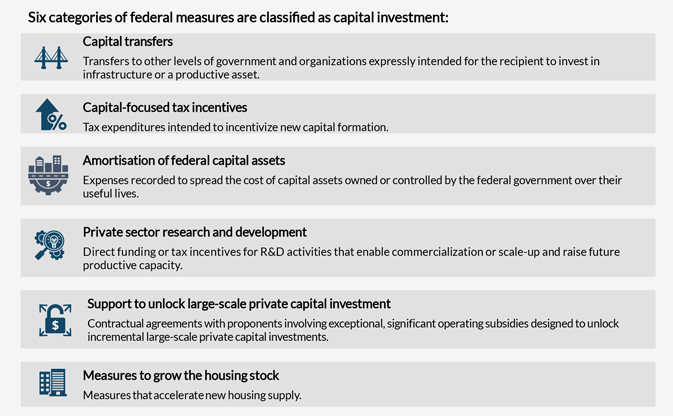
| 142 | ANNEX 1 |
| Table A1.16 Detailed Capital Investments billions of dollars |
||||||||||||||||||||||||
| Projection | ||||||||||||||||||||||||
| 2025- | 2026- | 2027- | 2028- | 2029- | 2030- | |||||||||||||||||||
| 2026 | 2027 | 2028 | 2029 | 2030 | 2031 | |||||||||||||||||||
| Capital transfers |
17.4 | 24.5 | 26.5 | 24.3 | 22.5 | 19.6 | ||||||||||||||||||
| Build Communities Strong Fund1 |
||||||||||||||||||||||||
| Baseline |
- | 2.5 | 2.6 | 2.6 | 2.7 | 2.8 | ||||||||||||||||||
| Budget 2025 |
- | 2.3 | 2.7 | 3.2 | 2.3 | 2.2 | ||||||||||||||||||
| Investing in Canada Infrastructure Program |
||||||||||||||||||||||||
| Baseline |
2.8 | 3.7 | 3.9 | 3.5 | 3.2 | 2.1 | ||||||||||||||||||
| Budget 2025 |
- | - | -0.3 | -1.2 | 1.5 | - | ||||||||||||||||||
| Trade Infrastructure Strategy (Budget 2025) |
- | 0.7 | 1.1 | 1.3 | 1.0 | 1.0 | ||||||||||||||||||
| Other provincial, territorial, and municipal infrastructure investments2 |
||||||||||||||||||||||||
| Baseline |
6.1 | 5.0 | 6.4 | 6.5 | 5.9 | 6.7 | ||||||||||||||||||
| Budget 2025 |
0.1 | -0.1 | -0.2 | -0.5 | -0.3 | -0.8 | ||||||||||||||||||
| Spring Economic Update 2026 |
- | -0.1 | - | - | - | - | ||||||||||||||||||
| Indigenous community infrastructure |
||||||||||||||||||||||||
| Baseline |
3.8 | 2.8 | 2.3 | 1.4 | 1.3 | 1.3 | ||||||||||||||||||
| Budget 2025 |
- | 0.7 | 0.7 | 0.7 | - | - | ||||||||||||||||||
| Spring Economic Update 2026 |
0.4 | 0.3 | 0.1 | - | - | - | ||||||||||||||||||
| Canada Foundation for Innovation |
||||||||||||||||||||||||
| Baseline |
0.5 | 0.5 | 0.7 | 0.6 | 0.5 | 0.5 | ||||||||||||||||||
| Budget 2025 |
0.1 | 0.1 | 0.1 | 0.1 | 0.1 | 0.1 | ||||||||||||||||||
| Strategic Response Fund3 |
||||||||||||||||||||||||
| Baseline |
1.8 | 2.2 | 2.1 | 1.9 | 1.4 | 1.5 | ||||||||||||||||||
| Budget 2025 |
-0.7 | 0.7 | 1.5 | 1.5 | 1.2 | 0.5 | ||||||||||||||||||
| Other capital transfers available to the private sector |
||||||||||||||||||||||||
| Baseline |
2.1 | 1.9 | 1.5 | 1.3 | 0.5 | 0.5 | ||||||||||||||||||
| Budget 2025 |
0.1 | 0.1 | 0.2 | 0.3 | 0.2 | 0.2 | ||||||||||||||||||
| Spring Economic Update 2026 |
- | 0.0 | 0.1 | 0.1 | 0.1 | 0.0 | ||||||||||||||||||
| Defence (Budget 2025) |
0.1 | 0.6 | 0.7 | 0.8 | 0.6 | 0.9 | ||||||||||||||||||
| Co-Development Funding for High-Speed Rail |
||||||||||||||||||||||||
| Baseline |
0.1 | 0.1 | 0.1 | 0.1 | 0.1 | - | ||||||||||||||||||
| Budget 2025 |
0.3 | 0.5 | 0.3 | 0.2 | 0.1 | 0.1 | ||||||||||||||||||
| Capital-focused tax incentives |
4.8 | 7.9 | 8.6 | 9.6 | 10.4 | 10.1 | ||||||||||||||||||
| Clean Economy investment tax credits |
||||||||||||||||||||||||
| Baseline |
0.4 | 2.9 | 4.5 | 5.3 | 6.2 | 7.4 | ||||||||||||||||||
| Budget 2025 |
- | - | - | - | - | 0.5 | ||||||||||||||||||
| Spring Economic Update 2026 |
- | - | 0.0 | -0.1 | -0.1 | -0.2 | ||||||||||||||||||
| Accelerated investment incentive and other accelerated capital cost allowance measures4,5 |
|
|||||||||||||||||||||||
| Baseline |
2.7 | 3.1 | 2.4 | 2.4 | 2.3 | 0.3 | ||||||||||||||||||
| Budget 2025 |
0.0 | 0.3 | 0.4 | 0.4 | 0.4 | 0.5 | ||||||||||||||||||
| Spring Economic Update 2026 |
0.0 | 0.0 | 0.0 | 0.0 | 0.0 | 0.1 | ||||||||||||||||||
| Film and video tax credits |
0.9 | 1.0 | 1.0 | 1.0 | 1.1 | 1.1 | ||||||||||||||||||
| Other capital-focused tax incentives4,6 |
||||||||||||||||||||||||
| Baseline |
0.6 | 0.6 | 0.5 | 0.5 | 0.5 | 0.5 | ||||||||||||||||||
| Budget 2025 |
0.1 | 0.1 | 0.0 | - | - | - | ||||||||||||||||||
| Amortisation of federal capital |
6.6 | 7.4 | 8.3 | 10.2 | 12.6 | 13.6 | ||||||||||||||||||
| Capital amortisation expenses |
||||||||||||||||||||||||
| Baseline |
6.6 | 7.3 | 8.1 | 9.7 | 11.4 | 11.9 | ||||||||||||||||||
| Budget 2025 |
0.0 | 0.0 | 0.2 | 0.5 | 1.0 | 1.6 | ||||||||||||||||||
| Spring Economic Update 2026 |
- | 0.0 | 0.0 | 0.1 | 0.1 | 0.1 | ||||||||||||||||||
| DETAILS OF ECONOMIC AND FISCAL PROJECTIONS |
143 |
| Projection | ||||||||||||||||||||||||
| 2025- | 2026- | 2027- | 2028- | 2029- | 2030- | |||||||||||||||||||
| 2026 | 2027 | 2028 | 2029 | 2030 | 2031 | |||||||||||||||||||
| Private sector research and development |
5.9 | 6.0 | 6.2 | 6.2 | 6.4 | 6.4 | ||||||||||||||||||
| Industrial Research Assistance Program |
||||||||||||||||||||||||
| Baseline |
0.6 | 0.5 | 0.5 | 0.4 | 0.3 | 0.3 | ||||||||||||||||||
| Budget 2025 |
0.0 | 0.1 | 0.1 | - | - | - | ||||||||||||||||||
| Scientific Research and Experimental Development tax incentives4 |
||||||||||||||||||||||||
| Baseline |
5.3 | 5.3 | 5.5 | 5.8 | 6.0 | 6.0 | ||||||||||||||||||
| Budget 2025 |
0.0 | 0.1 | 0.1 | 0.1 | 0.1 | 0.1 | ||||||||||||||||||
| Support to unlock large-scale private sector capital investment |
0.1 | 1.3 | 2.2 | 2.6 | 3.0 | 3.7 | ||||||||||||||||||
| Support for battery manufacturing4 |
0.1 | 1.3 | 2.2 | 2.6 | 3.0 | 3.7 | ||||||||||||||||||
| Measures to grow the housing stock |
5.8 | 7.7 | 6.1 | 5.6 | 5.8 | 5.9 | ||||||||||||||||||
| Build Canada Homes (Budget 2025) |
- | 1.1 | 1.3 | 1.4 | 1.6 | 1.7 | ||||||||||||||||||
| Affordable Housing Fund |
||||||||||||||||||||||||
| Baseline |
1.2 | 1.2 | 0.6 | 0.0 | 0.0 | 0.0 | ||||||||||||||||||
| Budget 2025 |
- | - | - | 0.0 | 0.0 | 0.0 | ||||||||||||||||||
| Housing Accelerator Fund |
1.1 | 1.1 | 0.1 | - | - | - | ||||||||||||||||||
| Apartment Construction Loan Program |
||||||||||||||||||||||||
| Baseline |
0.3 | 0.3 | 0.4 | 0.3 | 0.4 | 0.3 | ||||||||||||||||||
| Spring Economic Update 2026 |
- | 0.0 | 0.0 | 0.1 | 0.1 | 0.1 | ||||||||||||||||||
| Tax measures – rental property and multi-generational units4,7 |
1.1 | 1.6 | 1.9 | 2.1 | 2.3 | 2.7 | ||||||||||||||||||
| Indigenous housing |
||||||||||||||||||||||||
| Baseline |
1.9 | 2.1 | 1.4 | 1.3 | 1.1 | 1.1 | ||||||||||||||||||
| Spring Economic Update 20268 |
- | 0.1 | 0.2 | 0.2 | 0.1 | 0.1 | ||||||||||||||||||
| Other programs |
||||||||||||||||||||||||
| Baseline |
0.4 | 0.6 | 0.5 | 0.3 | 0.4 | 0.1 | ||||||||||||||||||
| Budget 2025 |
-0.1 | -0.2 | -0.2 | -0.2 | -0.2 | -0.1 | ||||||||||||||||||
| Spring Economic Update 2026 |
- | 0.0 | 0.0 | 0.0 | 0.0 | 0.0 | ||||||||||||||||||
| Total capital investments |
40.5 | 54.9 | 57.9 | 58.6 | 60.6 | 59.3 | ||||||||||||||||||
|
Baseline |
40.2 | 47.6 | 48.8 | 49.7 | 50.8 | 50.8 | ||||||||||||||||||
| Budget 2025 |
0.0 | 7.0 | 8.7 | 8.6 | 9.7 | 8.4 | ||||||||||||||||||
| Spring Economic Update 2026 |
0.4 | 0.3 | 0.4 | 0.3 | 0.2 | 0.1 | ||||||||||||||||||
| Total capital investments (cash basis)9 |
66.2 | 86.4 | 89.8 | 90.1 | 89.1 | 90.3 | ||||||||||||||||||
Notes. Numbers may not add due to rounding.
Amounts between -$50 million and $50 million are rounded to 0.0 in this table.
Measures with capital amortisation expenses are now consolidated under the amortisation of federal capital category.
| 1 | The Build Communities Strong Fund was included in the Generational Infrastructure Investments lines in Table A2.2 of Budget 2025. |
| 2 | Includes programs that have been reclassified as capital investment since Budget 2025, including the National Trade Corridors Fund and Lac-Mégantic Rail Bypass. Includes Canada Community-Building Fund spending in 2025-26. |
| 3 | Includes investments previously reported under Strategic Innovation Fund in the Budget 2025 baseline and the Budget 2025 measure, Protecting Workers and Transforming Canada’s Strategic Industries – Equipping Companies for Growth and Diversification. |
| 4 | Fiscal cost includes an estimate of forgone tax revenue. |
| 5 | Includes the Budget 2025 measure, Productivity Super-Deduction. |
| 6 | Includes the Budget 2025 measure, Extending the Mineral Exploration Tax Credit. |
| 7 | Includes two tax expenditures reclassified as capital investment since Budget 2025, the 36% GST rebate for new residential rental property and the enhanced GST rebate for new residential property (i.e., 100% GST rebate for purpose-built rentals). |
| 8 | Includes funding reallocated to Build Canada Homes, Crown-Indigenous Relations and Northern Affairs Canada, Indigenous Services Canada, and Housing, Infrastructure and Communities Canada for Continued Support for the Urban, Rural and Northern Indigenous Housing Strategy. |
| 9 | Includes an adjustment for 2025-26 year to date results for capital acquisitions, and alignment with projected financial source requirements. |
| 144 | ANNEX 1 |
Annex 2
Legislative Measures
This annex includes a number of measures (other than tax-related measures) that would be implemented through legislation.
| Subject of the Measure | Proposed Legislative Action | |
| Extending Employment Insurance Support for Seasonal Workers | In the Spring Economic Update 2026, the government proposes to amend the Employment Insurance Act to extend the temporary measure that provides up to five additional weeks of Employment Insurance regular benefits to seasonal claimants in 13 regions, until October 2028. Targeted amendments are also proposed to support clarity and consistency of the Employment Insurance Act. | |
| Protecting Money Services Businesses (MSBs) from Illicit Activity | In the Spring Economic Update 2026, the government proposes to amend the Proceeds of Crime (Money Laundering) and Terrorist Financing Act and its regulations to: introduce new Ministerial Directive powers; expand the Financial Transaction and Reports Analysis Centre of Canada’s (FINTRAC’s) ability to refuse or revoke registration of MSBs; prevent re-registration of non-compliant MSBs; increase the number of criminal record checks for MSBs; address ‘shelf’ MSBs; ensure FINTRAC has an accurate understanding of the services provided by MSBs; and make it a criminal offence to operate a cryptocurrency automated teller machine. | |
| Timely Resolution of Air Passenger Complaints | In the Spring Economic Update 2026, the government proposes to amend the Canada Transportation Act to transfer responsibilities related to air passenger rights and complaints resolution from the Canadian Transportation Agency to the Minister of Transport, and to enhance transparency of the complaints process and enforcement of passenger rights regulations. | |
| Access to Airport Data | In the Spring Economic Update 2026, the government proposes to amend the Canada Transportation Act to provide the Minister of Transport with the ability to require aerodrome operators, and associated third parties, to provide any information necessary for the development and administration of transportation policy. | |
| Payments Canada Liability | In the Spring Economic Update 2026, the government proposes to amend the Canadian Payments Act to include a good faith immunity provision for Payments Canada. | |
| Bank of Canada’s Cost Recovery | In the Spring Economic Update 2026, the government proposes to amend the Bank of Canada Act, with related amendments to the Retail Payment Activities Act, Payment Clearing and Settlement Act, Consumer-Driven Banking Act, and Stablecoin Act to consolidate the Bank of Canada’s cost recovery responsibilities under one act. | |
| Defence Investment Agency | In the Spring Economic Update 2026, the government proposes to introduce legislation to establish the Defence Investment Agency as a departmental agency presided over by a new minister and to make related amendments to the Defence Production Act that would, among other things, enhance financial and transactional authorities available to the new minister. | |
| Increasing Food Security | In the Spring Economic Update 2026, the government proposes to amend the Canadian Food Inspection Agency Act and the Pest Control Products Act to amend the mandates of the Canadian Food Inspection Agency and the Pest Management Regulatory Agency to include consideration of food security and cost of food. | |
| Regulatory Sandboxes – additional amendment | In the Spring Economic Update 2026, the government proposes to amend the Red Tape Reduction Act to add the Official Languages Act to the list of exempted statutes for regulatory sandboxes. | |
| Canada Pension Plan | In the Spring Economic Update 2026, the government proposes to make amendments to the Canada Pension Plan legislation to implement a reduction in the base Canada Pension Plan contribution rate from 9.9 per cent to 9.5 per cent, effective January 1, 2027. | |
| Lawful Search and Seizure of Mail | In the Spring Economic Update 2026, the government proposes to amend to the Canada Post Corporation Act to enable law enforcement to lawfully search and seize mail as authorised under an Act of Parliament. |
| LEGISLATIVE MEASURES |
145 |
Annex 3
Debt Management Strategy
Introduction
As part of Budget 2025, the Government of Canada released the 2026-27 Debt Management Strategy, which sets out the government’s objectives, strategy, and borrowing plans for its domestic debt program and the management of its official international reserves. The Spring Economic Update 2026 provides an update on the strategy.
The Financial Administration Act requires that the Minister of Finance table, in each House of Parliament, a report on the anticipated borrowing to be undertaken in the fiscal year ahead, including the purposes for which the money will be borrowed and the management of the public debt, no later than 30 sitting days after the beginning of the fiscal year. The updated 2026-27 Debt Management Strategy fulfills the legislative requirement set out in the Financial Administration Act.
Objectives
The fundamental objectives of debt management are to raise stable and low-cost funding to meet the financial requirements of the Government of Canada and to maintain a well-functioning market for Government of Canada securities.
The government is committed to managing the debt program in a prudent manner to ensure a balanced debt structure that contributes to maintaining the stability of debt costs and to reducing the risk of the debt portfolio.
Having access to a well-functioning government securities market contributes to lower costs and less volatile pricing for the government, ensuring that funds can be raised efficiently over time to meet the government’s financial requirements.
The Debt Management Strategy provides transparency on the government’s borrowing plans to support a liquid and well-functioning market for Government of Canada securities and ensures the long-term sustainability of the government’s borrowing program.
The government closely monitors financial markets and will adjust issuance if necessary to appropriately respond to shifts in market demand or changes to financial requirements.
Outlook for Government of Canada Debt and Public Debt Charges
As a result of the government’s responsible fiscal management, Canada continues to have a desirable fiscal and debt position relative to international peers. Canada continues to have the lowest net debt-to-GDP ratio of G7 countries. And Canada is one of only two AAA-rated G7 countries—with a credit rating of AAA (equivalent) by Moody’s, S&P, and DBRS, and AA+ by Fitch. Rating agencies cite Canada’s effective and predictable policymaking, stable political institutions, economic resilience and diversity, well-regulated financial markets, and monetary and fiscal policy flexibility as drivers of the strong credit profile.
The government continues to monitor public debt charges and is committed to maintaining stable and low debt servicing costs. The government now projects that public debt charges will amount to $58.7 billion in 2026-27, or 1.7 per cent of gross domestic product (GDP), and increase to 2.1 per cent by 2030-31.
Despite the rise of interest rates since 2022, the government’s debt charges as a share of GDP remain sustainable, near historical lows, and below the historical average over the past 40 years of 3.2 per cent. Maintaining low debt charges as a percentage of GDP reflects the government’s prudent debt management in minimising debt servicing costs over recent years.
| DEBT MANAGEMENT STRATEGY |
147 |
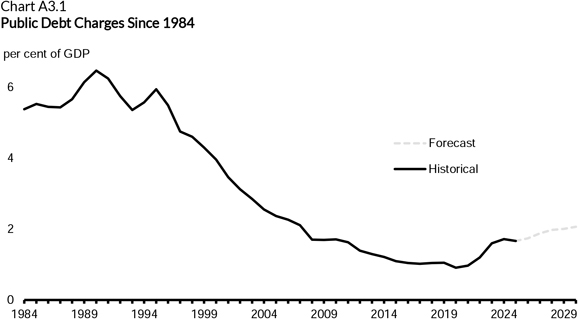
Update to the 2026-27 Borrowing Program
The projected sources and uses of borrowings for 2026-27 are presented in Table A3.1. Funds borrowed are for the purposes of the government’s general revenue, though certain proceeds may be tracked or allocated to specific government expenditures, such as green bonds. The comparison of actual sources and uses of borrowings against projections will be reported in the Debt Management Report for the corresponding fiscal year, which is released soon after the Public Accounts of Canada.
Sources of Borrowings
The preliminary borrowing plan, published in Budget 2025, projected an aggregate principal amount of $594 billion to be borrowed by the government in 2026-27, lower than a forecasted $614 billion in 2025-26.
The updated borrowing plan projects aggregate borrowing of $571 billion in 2026-27, slightly lower than preliminary estimates, reflecting a decrease in projected financial requirements for 2026-27 and somewhat lower refinancing needs (due to lower-than-expected borrowing in 2025-26). The entirety of the change in 2026-27 borrowing needs will be absorbed through lower treasury bill issuance—the bond program will not change from what was projected in Budget 2025. This level of borrowing is consistent with the current legislated limit of $2,541 billion set out in the Borrowing Authority Act.
Table A3.2 outlines the proposed domestic treasury bill and bond issuances by tenor. Actual borrowings for the year may be higher or lower than expected due to economic and fiscal outcomes differing from projections, the timing of cash transactions, and other factors such as changes in foreign reserve needs and Crown corporation borrowings. To adjust for these unexpected changes in financial requirements, debt issuance can be altered during the year, typically first through changes in the issuance of treasury bills. The government may also adjust issuance for bonds in response to larger changes or shifts in market demand.
Uses of Borrowings
Domestic Borrowing
The projected $566 billion of gross domestic issuance in 2026-27 is to meet requirements to refinance $433 billion of maturing debt (seventy-seven per cent of the total borrowings) and projected financial requirements of $133 billion (which includes $30 billion to fund purchases of Canada Mortgage Bonds).
| 148 | ANNEX 3 |
Foreign Borrowing
The government may also borrow an equivalent of $5 billion CAD in foreign currencies, for the purpose of managing its official international reserves as part of its global bond program (more details below).
| Table A3.1 |
||||
| Planned / Actual Sources and Uses for 2026-27 |
||||
| Billions of dollars |
||||
| Sources of borrowings |
2026-27 | |||
| Payable in Canadian currency |
||||
| Treasury bills1 |
268 | |||
| Bonds |
298 | |||
| Total payable in Canadian currency |
566 | |||
| Payable in foreign currencies |
5 | |||
| Total sources of borrowings |
571 | |||
| Uses of borrowings |
||||
| Refinancing needs |
||||
| Payable in Canadian currency |
||||
| Treasury bills |
286 | |||
| Bonds |
147 | |||
| Retail debt |
0 | |||
| Total payable in Canadian currency |
433 | |||
| Payable in foreign currencies |
5 | |||
| Total refinancing needs |
438 | |||
| Financial requirement |
||||
| Budgetary balance |
65 | |||
|
Non-budgetary transactions |
||||
| Pension and other accounts |
-10 | |||
|
Non-financial assets |
18 | |||
| Loans, investments, and advances |
||||
| Of which: |
||||
| Loans to enterprise Crown corporations |
60 | |||
| Other |
8 | |||
| Other transactions2 |
-7 | |||
| Total financial requirement |
133 | |||
| Total uses of borrowings |
571 | |||
| Net increase or decrease (-) in cash |
0 | |||
| Change in other unmatured debt transactions3 |
0 | |||
Source: Department of Finance Canada calculations.
Notes: Numbers may not add due to rounding. In the uses of borrowings section, a negative sign denotes a financial source.
| 1 | Treasury bills are rolled over, or refinanced, a number of times during the year. This results in a larger number of new issues per year than the stock outstanding at the end of the fiscal year, which is presented in the table. |
| 2 | Other transactions primarily comprise the conversion of accrual transactions to cash inflows and outflows for taxes and other accounts receivable, provincial, and territorial tax collection agreements, amounts payable to taxpayers and other liabilities, and foreign exchange accounts. |
| 3 | Includes unamortised discounts on debt issues, accrued interest, obligations related to capital leases and other unmatured debt. |
| DEBT MANAGEMENT STRATEGY |
149 |
| Table A3.2 |
||||||||||||||||
| Projected Domestic Gross Issuance of Bonds and Bills for 2026-271 |
| |||||||||||||||
| Billions of dollars, end of fiscal year |
||||||||||||||||
| 2025-26 | 2026-27 | 2026-27 | Change from | |||||||||||||
| Estimated | Budget 2025 | Update | Budget 2025 | |||||||||||||
| Treasury bills |
286 | 291 | 268 | -23 | ||||||||||||
|
2-year |
120 | 110 | 110 | - | ||||||||||||
|
5-year |
84 | 80 | 80 | - | ||||||||||||
|
10-year |
84 | 80 | 80 | - | ||||||||||||
|
30-year |
24 | 24 | 24 | - | ||||||||||||
| Green bond2 |
5 | 4 | 4 | - | ||||||||||||
| Total bonds |
317 | 298 | 298 | - | ||||||||||||
| Total domestic issuance |
603 | 589 | 566 | -23 | ||||||||||||
| Share of long bonds (10-year+) to total bonds |
34% | 35% | 35% | - | ||||||||||||
| Share of treasury bills to total issuance |
47% | 49% | 47% | -2% | ||||||||||||
Sources: Bank of Canada; Department of Finance Canada calculations. Note: Numbers may not add due to rounding.
1 Issuance subject to expenditure availability and market conditions.
2 Green bond issuances may be higher or lower, according to market conditions.
Composition of Market Debt
The total stock of market debt is projected to reach $1,741 billion by the end of 2026-27 (Table A3.3).
| Table A3.3 |
||||||||||||||||
| Change in Composition of Market Debt |
| |||||||||||||||
| Billions of dollars, end of fiscal year |
||||||||||||||||
| 2023-24 | 2024-25 | 2025-26 | 2026-27 | |||||||||||||
| Actual | Actual | Estimated | Projected | |||||||||||||
| Domestic bonds |
1,081 | 1,163 | 1,294 | 1,445 | ||||||||||||
| Treasury bills |
267 | 285 | 286 | 268 | ||||||||||||
| Foreign debt |
22 | 29 | 31 | 28 | ||||||||||||
| Total market debt |
1,370 | 1,477 | 1,611 | 1,741 | ||||||||||||
Treasury Bill Program
Budget 2025 anticipated a target stock of $291 billion in treasury bills by March 31, 2027. With lower-than-projected bill issuance in 2025-26 and updated 2026-27 financial requirements, the target stock is being revised down moderately to $268 billion. The government considers that the 3-, 6- and 12-month tenors appropriately reflect the market demand for short-term government issuance and will maintain its current bi-weekly auction schedule.
Bond Program
Annual gross bond issuance is projected to be $298 billion in 2026-27, unchanged from the preliminary projection in Budget 2025. Bond issuance is projected to comprise 53 per cent of total borrowing. Of the bond program, 35 per cent will be in tenors with maturities of 10 or more years, up slightly from 34 per cent in 2025-26.
Maturity Date Cycles and Benchmark Bond Target Size Ranges
The government will maintain the benchmark target size ranges and number of planned auctions as in the preliminary 2026-27 borrowing plan published in Budget 2025 (see Tables A3.4 and A3.5).
The dates of each auction will continue to be announced through the Quarterly Bond Schedule, which is published on the Bank of Canada’s website prior to the start of each quarter.
| 150 ANNEX 3 |
| Table A3.4 | ||||||||||||||||||||||||||||||||
| Maturity Date Patterns and Benchmark Size Ranges billions of dollars |
|
|||||||||||||||||||||||||||||||
| Feb. | Mar. | May | June | Aug. | Sept. | Nov. | Dec. | |||||||||||||||||||||||||
| 2-year |
26-34 | 26-34 | 26-34 | 26-34 | ||||||||||||||||||||||||||||
| 5-year |
38-46 | 38-46 | ||||||||||||||||||||||||||||||
| 10-year |
38-46 | 38-46 | ||||||||||||||||||||||||||||||
|
30-year |
28-38 | |||||||||||||||||||||||||||||||
Source: Department of Finance Canada.
Note: These amounts do not include coupon payments.
| Table A3.5 | ||||
| Number of Planned Auctions for 2026-27 | ||||
| Sector | Planned Bond Auctions | |||
| 2-year |
20 | |||
| 5-year |
16 | |||
| 10-year |
16 | |||
|
30-year |
8 | |||
Source: Department of Finance Canada.
Green and Transition Bonds
Following the government’s first transaction of 2025-26 in October 2025, a second transaction for the fiscal year was completed in February 2026 via a new 10-year $2 billion issuance. This second issuance saw robust demand from environmentally and socially responsible investors, who represented a majority of buyers, and attracted a mix of both domestic and foreign investors.
Canada’s green bond program continues to support the growth of the sustainable finance market in Canada and highlights Canada’s investments in climate action and the environment. The government remains committed to regular green bond issuances. As previously announced, the government is exploring the development of a Sustainable Bond Framework—aligned with Made-in-Canada Sustainable Investment Guidelines (“taxonomy”) that are being developed—that would allow for the issuance of both green and new transition bonds. The Framework would be expanded to incorporate economic sectors as the taxonomy is being developed.
Borrowing Authority Act
Under the Parliamentary borrowing authority framework enacted on November 23, 2017, Parliamentary authority is granted through the Borrowing Authority Act and Part IV of the Financial Administration Act, which together allow the Minister to borrow money up to a maximum overall amount as approved by Parliament.
On March 27, 2026, Parliament increased the maximum borrowing amount in the Borrowing Authority Act to $2,541 billion, from $2,126 billion. This includes amounts borrowed by agent Crown corporations other than from the Government of Canada, and Canada Mortgage Bonds guaranteed by Canada Mortgage and Housing Corporation (excluding amounts purchased by the Government of Canada). The outstanding borrowings subject to the maximum amount was an estimated $1,921 billion at March 31, 2026, compared to $1,788 billion as at March 31, 2025, and is projected to be $2,073 billion as at March 31, 2027. Final amounts subject to the BAA maximum are published in the annual Public Accounts of Canada.
Canada Mortgage Bonds
As announced in Budget 2025, the Canada Mortgage Bonds (CMB) annual issuance limit for 2026 is $80 billion, up from $60 billion in 2025. This increase in cost-effective mortgage funding for lenders will support the construction of new multi-unit housing across Canada.
| DEBT MANAGEMENT STRATEGY |
151 |
As announced in Budget 2025, the government will maintain the pace of its purchases of CMBs at up to $30 billion annually, to allow the private market full access to the additional issuance.
Management of Canada’s Official International Reserves
The Exchange Fund Account (EFA), managed by the Minister of Finance on behalf of the Government of Canada, represents the largest component of Canada’s official international reserves. It is a portfolio of Canada’s liquid foreign exchange reserves and special drawing rights available to aid in the control and protection of the external value of the Canadian dollar and as a source of liquidity to the government, if needed. In addition to the EFA, Canada’s official international reserves include Canada’s reserve position held at the International Monetary Fund.
The government borrows to invest in liquid reserves, which are maintained at a level at or above 3 per cent of GDP. Foreign currency bond issuance for 2026-27 may be up to an equivalent of $5 billion CAD but may vary depending on market conditions.
Canada’s issuance of foreign currency denominated debt is used exclusively to fund official international reserves. Global bonds denominated in US dollars have been issued 12 times since the program re-started in 2009, with the most recent one being in March 2025.
Further information on foreign currency funding and the foreign reserve assets is available in the Report on the Management of Canada’s Official International Reserves and in The Fiscal Monitor.
Cash Management and Prudential Liquidity
The core objective of cash management is to ensure that the government always has sufficient cash available to meet its operating and liquidity requirements.
The government holds liquid financial assets in the form of domestic cash deposits and foreign exchange reserves to safeguard its ability to meet payment obligations, including coupon and principal payments, in situations where normal access to funding markets may be disrupted or delayed. The government’s overall liquidity levels are managed to normally cover at least one month of projected net cash flows, including coupon payments and debt refinancing needs.
As part of the prudent management of cash balances, the government conducts Receiver General morning auctions to efficiently manage its Canadian-dollar cash balances, ensuring sufficient liquidity for daily operating needs while earning a competitive, market-driven rate of return on excess cash balances.
Aside from cash deployed in the morning Receiver General auctions, the government’s cash is on deposit with the Bank of Canada, including operational balances and balances held for prudential liquidity. Periodic updates on the liquidity position are available in The Fiscal Monitor.
The government will continue conducting cash management bond buybacks in 2026-27 to effectively manage the government’s cash flows ahead of large bond maturities. Information on these operations is available at Cash Management Bond Buybacks.
| 152 | ANNEX 3 |
Tax Measures:
Supplementary Information
Table of Contents
| Overview |
155 | |||
| Personal Income Tax Measures |
156 | |||
| Disability Tax Credit |
156 | |||
| Employee Ownership Trust Tax Exemption |
159 | |||
| Home Buyers’ Plan |
159 | |||
| Labour Mobility Deduction for Tradespeople |
159 | |||
| Business Income Tax Measures |
160 | |||
| Accelerated Capital Cost Allowance Rates for Low-Carbon Liquefied Natural Gas Facilities |
160 | |||
| Investment Tax Credit for Carbon Capture, Utilization, and Storage |
161 | |||
| Strategic Environmental and Economic Assessment Statement |
163 | |||
| Previously Announced Measures |
164 | |||
| Legislative Proposals Relating to the Excise Tax Act, the Excise Act and the Excise Act, 2001 |
166 | |||
| TAX MEASURES: SUPPLEMENTARY INFORMATION |
153 |
Overview
This annex provides detailed information on tax measures proposed in the Spring Economic Update 2026.
Table 1 lists these measures and provides estimates of their fiscal impact.
The annex also provides legislative proposals to amend the Excise Tax Act, the Excise Act and the Excise Act, 2001.
| TAX MEASURES: SUPPLEMENTARY INFORMATION |
155 |
| Table 1 |
||||||||||||||||||||||||||||
| Revenue Impacts of Proposed Tax Measures1, 2 |
||||||||||||||||||||||||||||
| (millions of dollars) |
||||||||||||||||||||||||||||
| 2025– | 2026– | 2027– | 2028– | 2029- | 2030- | |||||||||||||||||||||||
| 2026 | 2027 | 2028 | 2029 | 2030 | 2031 | Total | ||||||||||||||||||||||
| Personal Income Tax |
||||||||||||||||||||||||||||
| Disability Tax Credit |
6 | 30 | 61 | 76 | 86 | 86 | 345 | |||||||||||||||||||||
| Employee Ownership Trust Tax Exemption |
- | 10 | 30 | 30 | 55 | 80 | 205 | |||||||||||||||||||||
| Home Buyers’ Plan |
- | - | - | 7 | 15 | 20 | 42 | |||||||||||||||||||||
| Labour Mobility Deduction for Tradespeople |
- | 1 | 1 | 1 | 1 | 1 | 5 | |||||||||||||||||||||
| Business Income Tax |
||||||||||||||||||||||||||||
| Accelerated Capital Cost Allowance Rates for Low-Carbon Liquefied Natural Gas Facilities | - | - | 50 | 120 | 160 | 310 | 640 | |||||||||||||||||||||
| Less: Funds Previously Provisioned in the Fiscal Framework |
- | - | -50 | -120 | -155 | -255 | -580 | |||||||||||||||||||||
| Investment Tax Credit for Carbon Capture, Utilization, and Storage | - | - | -10 | -75 | -115 | -195 | -395 | |||||||||||||||||||||
| 1 | A positive amount represents a decrease in revenue; a negative amount represents an increase in revenue. |
| 2 | A “–” indicates a nil amount, a small amount (less than $500,000) or an amount that cannot be determined in respect of a measure that is intended to protect the tax base. |
Personal Income Tax Measures
Disability Tax Credit
The Disability Tax Credit (DTC) is a non-refundable tax credit intended to recognise the impact of non-itemizable disability-related costs on the ability to pay tax. For 2026, the amount of the credit is $10,341, which provides a federal tax reduction of up to $1,448.
To be eligible for the DTC, an individual must have a severe and prolonged impairment in physical or mental functions. The effects of the impairment must be such that, even with appropriate devices, medication and therapy, the individual is:
| ● | blind, diagnosed with type 1 diabetes mellitus or markedly restricted in their ability to perform a basic activity of daily living, or would be so restricted were it not for extensive therapy to sustain a vital function; or |
| ● | significantly restricted in their ability to perform more than one basic activity of daily living where the cumulative effect of those restrictions is comparable to being markedly restricted in a basic activity of daily living. |
For these purposes, the Income Tax Act recognises the following basic activities of daily living: walking; feeding or dressing oneself; mental functions necessary for everyday life; speaking; hearing; eliminating bodily waste; and, for the purposes of the “significantly restricted” test noted above, seeing.
A qualified medical practitioner must certify, on the DTC application form, that the impairment is severe and prolonged and that its effects meet at least one of the impact criteria listed above. Medical practitioners recognised as qualified to certify impairments for the DTC are specified in the Income Tax Act, as summarised in Table 2.
| Table 2 |
||
| Medical Practitioners Qualified to Certify Impairments for the DTC | ||
| Medical Practitioner | Impairment type | |
| Nurse practitioner or doctor | All | |
| Occupational therapist | Walking, feeding, dressing, cumulative effects | |
| Physiotherapist | Walking | |
| Speech-language pathologist | Speaking | |
| Audiologist | Hearing | |
| Psychologist | Mental functions | |
| Optometrist | Vision | |
| 156 |
The Canada Revenue Agency (CRA) reviews the information provided on a DTC application form, including by the qualified medical practitioner, and approves the DTC certificate where the individual meets all legislative requirements to be approved for the DTC.
A valid DTC certificate is a requirement for accessing other federal measures, including the Canada Disability Benefit, Registered Disability Savings Plan (including the Canada Disability Savings Grants and Bonds), the Child Disability Benefit and the disability supplement to the Canada Workers Benefit.
Certain Long-lasting Medical Conditions
The CRA’s experience in processing DTC applications has allowed for the identification of several long-lasting medical conditions that satisfy the disability impact criteria of the DTC. These medical conditions are laid out in Table 3.
The Spring Economic Update 2026 proposes to streamline the DTC certification requirements related to these long-lasting medical conditions.
Under this proposal, for individuals who have at least one of the listed medical conditions, a qualified medical practitioner would need to certify that the individual has the medical condition. The practitioner would no longer be required to certify that the individual’s impairment is severe and prolonged and that its effects meet the legislated thresholds regarding daily living impacts.
| ● | For example, if a medical practitioner certifies on the DTC application form that their patient has Alzheimer’s disease, they would no longer need to complete the part of the DTC form that asks for detailed information on the impacts of this medical condition for that patient (i.e., on their ability to perform mental functions necessary for everyday life). |
The proposal would not change the disability criteria to qualify for the DTC and the CRA would continue to have authority to ask for additional information to verify that these criteria are met. This would include the requirement for the individual to have a severe and prolonged impairment in physical or mental functions and for the impacts of the impairment to meet at least one of the applicable legislated thresholds regarding daily living impacts. As is the case for all individuals granted a DTC certificate, individuals with a long-lasting medical condition would need to inform the CRA in writing if there is an improvement in their medical condition that could impact their eligibility for the credit.
For any medical conditions not mentioned in the list but that meet the legislated requirements to qualify for the DTC, a medical practitioner would continue to be able to certify DTC eligibility as before.
This measure would apply to DTC certifications issued for the 2026 and subsequent taxation years.
| TAX MEASURES: SUPPLEMENTARY INFORMATION |
157 |
| Table 3 | ||
| Long-lasting medical conditions eligible for streamlined application, as proposed | ||
| Alzheimer’s disease | Microcephaly | |
| Amyotrophic lateral sclerosis / Lou Gehrig disease | Paraplegia | |
| Angelman syndrome | Parkinson’s disease (advanced or severe) | |
| Autism spectrum disorder, level 3 | Patau syndrome / Trisomy 13 | |
| Bilateral blindness (legally blind) | Phenylketonuria | |
| Bilateral hearing loss (severe or profound) | Prader Willi syndrome | |
| Cardiac functional class of 4/IV or an ejection fraction of 20% or less | Profound hearing loss in one ear and severe hearing loss in the other ear | |
| Cerebral palsy (severe) | Progeria | |
| Chronic Obstructive Pulmonary Disease, stage III or higher | Quadriplegia or tetraplegia | |
| Colostomy (permanent) | Relies only on lip-reading and / or use sign language to understand conversations or communicate | |
| Cystic fibrosis | Renal (kidney) failure requiring lifelong hemodialysis or peritoneal dialysis | |
| Dementia | Requires lifelong continuous supplemental oxygen (O2) | |
| Down syndrome / Trisomy 21 | Schizophrenia | |
| Duchenne muscular dystrophy (advanced or severe) | Sickle cell disease (severe) requiring transfusions | |
| Edwards syndrome / Trisomy 18 | Sign language is primary means of communicating due to profound hearing loss or expressive aphasia | |
| Hemipelvectomy | Spinal muscular atrophy, type 1 and 2 | |
| Hemophilia A (severe) | Stroke (severe) no functional recovery | |
| Hip disarticulation | Tay-Sachs disease (infantile/juvenile) | |
| Huntington disease | Total mutism | |
| Ileostomy (permanent) | Traumatic brain injury (severe) | |
| Intellectual disability (severe, profound or IQ of 70 or below) | Upper limb amputations (trans carpal or higher) | |
Lower limb amputation (leg or foot)
Medical Practitioners Qualified to Certify Impairments
The Spring Economic Update 2026 proposes to expand the types of impairments that may be certified by certain qualified medical practitioners, for the purposes of the DTC, as follows:
| ● | An occupational therapist would be permitted to certify impairments affecting eliminating (bowel or bladder functions), including under cumulative effects of multiple restrictions. |
| ● | A physiotherapist would be permitted to certify impairments affecting feeding or dressing, as well as cumulative effects of multiple restrictions pertaining to walking, feeding and/or dressing. |
| ● | A speech-language pathologist would be permitted to certify impairments affecting feeding or hearing, as well as cumulative effects of multiple restrictions pertaining to speaking, feeding and/or hearing. |
The Spring Economic Update 2026 also proposes to add podiatrists to the list of medical practitioners who may certify impairments for the DTC. An individual who holds a license to practice as a podiatrist in a province (or under the laws of a jurisdiction in which an individual resides) would be permitted to certify impairments affecting walking that are within their scope of practice to assess.
These measures would apply to DTC certifications issued after 2026 for the 2027 and subsequent taxation years.
Public Guardians and Trustees
Public guardians and trustees (or public curators, in the case of Quebec) can be authorised to act as substitute decision-makers of last resort with respect to property matters (including filing income tax returns) for individuals who lack the mental capacity to make certain decisions, where no suitable family member or private guardian is available.
| 158 |
The Spring Economic Update 2026 proposes to allow provincial or territorial public guardians, trustees, and curators to certify, on the DTC application form, for an adult under their care for property matters, that the individual has a valid certificate of incapacity (or equivalent document) issued by a healthcare professional in accordance with applicable provincial or territorial laws for determining decision-making capacity. Where such a certification is provided, a qualified medical practitioner would no longer be required to certify the individual’s impairment for their DTC application. The CRA would continue to have authority to require additional information to verify that all other eligibility requirements are met (e.g., the individual has a severe and prolonged impairment in physical or mental functions that meets applicable legislated thresholds regarding daily living impacts).
The Spring Economic Update 2026 also proposes to allow Indigenous Services Canada and Crown-Indigenous Relations and Northern Affairs Canada to provide similar certification for adult dependants in their care for property matters under the Indian Act.
This measure would apply to DTC certifications issued for the 2026 and subsequent taxation years.
Employee Ownership Trust Tax Exemption
Individuals (other than trusts) are provided an exemption from taxation on up to $10 million in capital gains realised on the sale of a business to an employee ownership trust or worker cooperative corporation, subject to certain conditions.
The exemption was introduced as a temporary measure. It currently applies to qualifying dispositions of shares that occur after 2023 and up to the end of 2026.
The Spring Economic Update 2026 proposes to make this exemption permanent.
Home Buyers’ Plan
The home buyers’ plan (HBP) helps eligible home buyers save for a down payment by allowing them to withdraw up to $60,000 from a registered retirement savings plan (RRSP) to purchase or build their first home, or a home for a specified disabled person, without having to pay tax on the withdrawal. Eligible home buyers purchasing a home jointly may each withdraw up to $60,000 from their own RRSP under the HBP.
Amounts withdrawn under the HBP must be repaid to an RRSP over a period not exceeding 15 years, starting the second year following the year in which a first withdrawal was made. Otherwise, amounts due for repayment within a specific year are taxable as income for that year.
Budget 2024 temporarily increased the grace period during which homeowners are not required to start repaying their HBP withdrawals from two years to five years for participants making a first withdrawal between January 1, 2022 and December 31, 2025.
The Spring Economic Update 2026 proposes to extend that five-year grace period to be available for participants making a first withdrawal up to the end of 2028. In such a case, the 15-year repayment period would start the fifth year following the year in which a first withdrawal was made.
Labour Mobility Deduction for Tradespeople
The Labour Mobility Deduction for Tradespeople allows eligible tradespeople and apprentices working in the construction industry who undertake an eligible temporary relocation to deduct up to $4,000 in eligible temporary relocation expenses per year. The maximum amount of eligible expenses that can be claimed for a particular eligible temporary relocation is limited to 50% of the individual’s employment income in respect of the relocation.
To qualify, the relocation must be temporary in nature and undertaken by the eligible tradesperson to enable them to perform their duties of employment as an eligible tradesperson at one or more temporary work locations. The eligible tradesperson must also take up temporary lodging in Canada that is at least 150 kilometres closer to each temporary work location than the taxpayer’s ordinary residence.
| TAX MEASURES: SUPPLEMENTARY INFORMATION |
159 |
The Spring Economic Update 2026 proposes to increase the limit on eligible temporary relocation expenses that can be deducted in a year from $4,000 to $10,000 in 2026, with annual indexation thereafter, and to modify the distance rule such that the temporary lodging must be at least 120 kilometres closer to each temporary work location than the taxpayer’s ordinary residence.
This measure would apply to the 2026 and subsequent taxation years.
Business Income Tax Measures
Accelerated Capital Cost Allowance Rates for Low-Carbon Liquefied Natural Gas Facilities
Budget 2025 proposed to reinstate accelerated capital cost allowances (CCAs) for eligible liquefied natural gas (LNG) equipment and related buildings for low-carbon LNG facilities. The Spring Economic Update 2026 proposes the implementation details for this measure.
To be eligible for an accelerated CCA, the expected emissions intensity of an LNG facility’s on-site liquefaction activities, measured in tonnes of carbon dioxide equivalent per tonne of LNG produced annually (tCO2e/tLNG), would have to be less than or equal to 0.20 tCO2e/tLNG. The accelerated CCA rate would be 50 per cent for Class 47 liquefaction equipment and 10 per cent for Class 1 non-residential buildings used in LNG facilities.
In addition, LNG facilities would be able to take advantage of the enhanced first-year Accelerated Investment Incentive deduction for certain capital property.
Certification of Eligible LNG Facilities
In order to claim the accelerated CCA rates under the measure for eligible assets for a particular LNG facility, that facility would first need to be certified by the Minister of Energy and Natural Resources.
LNG facility owners would be required to submit to the Minister of Energy and Natural Resources a one-time report prepared by a qualified third-party Canadian engineering firm. The report would be required to include a front-end engineering design study and set out the expected emissions intensity of the LNG facility, as well as any other information required by the Minister of Energy and Natural Resources.
| ● | Expected emissions intensity would apply to the LNG facility’s on-site liquefaction activities and would be based on the facility’s initial operating configuration for commercial production. |
| ● | For projects that are pre-construction or under construction, the expected emissions intensity would be determined from the facility’s proposed design. |
| ● | For operating LNG facilities acquiring new eligible assets, the expected emissions intensity would be determined from the facility’s as-operated design, taking into consideration any impacts of the new assets to be acquired. |
Based on the expected emissions intensity of an LNG facility, as determined from the report, the Minister of Energy and Natural Resources would certify whether the LNG facility qualifies for the measure. This information would then be communicated to the facility owner and to the Canada Revenue Agency.
Eligible Property and Other Applicable Rules
For a certified LNG facility, the measure would have the same eligible property and other applicable rules as the previous accelerated CCAs for LNG equipment and related buildings that were introduced in 2015 and expired at the end of 2024.
| ● | Class 47 property eligible for the additional allowance would comprise equipment that was part of a facility that liquefies natural gas, including controls, cooling equipment, compressors, pumps, storage tanks, and ancillary equipment, pipelines used exclusively to transport liquefied natural gas from the facility, and related structures. |
| ● | Class 1 property eligible for the additional allowance would include non-residential buildings that are part of a facility that liquefies natural gas. |
| 160 |
| ● | Equipment used exclusively for regasification would not be eligible for the additional allowance. The additional allowance also would not apply to property acquired for the production of oxygen or nitrogen, electrical generating equipment, or property consisting of a breakwater, dock, jetty, wharf or similar structure. |
| ● | Property that was previously used, or acquired for use, before it was acquired by the taxpayer will not be eligible for the additional allowances. |
These additional allowances could only be claimed against income of the taxpayer that was attributable to the liquefaction of natural gas at that facility. This would include income of a taxpayer from:
| ● | selling natural gas that was liquefied by the taxpayer if the taxpayer owns the natural gas when it entered the facility; |
| ● | selling by-products from the liquefaction process; and |
| ● | providing liquefaction services in respect of natural gas owned by a third party. |
Where a taxpayer is not engaged exclusively in the operation of a liquefaction facility — because, for example, it was engaged in natural gas extraction, transportation or distribution — the taxpayer’s income attributable to the liquefaction of natural gas would be determined as though:
| ● | the liquefaction facility were a separate business of the taxpayer; and |
| ● | the cost to the taxpayer of natural gas that is owned by the taxpayer before it enters into the facility was equal to its fair market value at that time. |
Coming into Force
For certified LNG facilities, the accelerated CCA rates would be available for eligible assets acquired on or after November 4, 2025 and up to the end of 2034.
Investment Tax Credit for Carbon Capture, Utilization, and Storage
The Carbon Capture, Utilization, and Storage (CCUS) investment tax credit is a refundable tax credit that provides support for eligible expenditures relating to CCUS.
The CCUS tax credit provides three different credit rates depending on the purpose of the equipment, with the following credit rates applying to eligible CCUS expenditures incurred from the start of 2022 to the end of 2035:
| ● | 60 per cent for eligible capture equipment used in a direct air capture project; |
| ● | 50 per cent for all other eligible capture equipment; and |
| ● | 37.5 per cent for eligible transportation, storage and use equipment. |
Eligible expenditures that are incurred from the start of 2036 to the end of 2040 are subject to the credit rates set out below:
| ● | 30 per cent for eligible capture equipment used in a direct air capture project; |
| ● | 25 per cent for all other eligible capture equipment; and |
| ● | 18.75 per cent for eligible transportation, storage and use equipment. |
The extent to which the CCUS tax credit is available to an eligible CCUS project and eligible equipment depends on the end use of the carbon dioxide (CO2) being captured. Eligible uses include dedicated geological storage and storage in concrete, but not enhanced oil recovery (EOR).
Expansion to Enhanced Oil Recovery
The Spring Economic Update 2026 proposes that EOR be made an eligible use for the purposes of the CCUS tax credit. Existing CCUS tax credit design features would apply, along with the following specific design details.
Credit Rates
The effective credit rates available in respect of eligible expenditures incurred by a taxpayer with a qualified CCUS project that stores CO2 through EOR would be one half the rates set out above for dedicated geological storage or storage in concrete.
| TAX MEASURES: SUPPLEMENTARY INFORMATION |
161 |
To implement the reduced credit rate for EOR, half of the CO2 intended for storage through EOR would be considered to be an eligible use in determining the credit amount.
From the date on which this Update is presented to the end of 2035, the effective credit rates would be set at:
| ● | 30 per cent for eligible capture equipment used in a direct air capture project; |
| ● | 25 per cent for all other eligible capture equipment; and |
| ● | 18.75 per cent for eligible transportation, storage, and use equipment. |
From 2036 to the end of 2040, the effective credit rates would be set at:
| ● | 15 per cent for eligible capture equipment used in a direct air capture project; |
| ● | 12.5 per cent for all other eligible capture equipment; and |
| ● | 9.375 per cent for eligible transportation, storage, and use equipment. |
Eligible Equipment
Capture and transportation equipment of a qualified CCUS project that stores CO2 through EOR would be eligible under the CCUS tax credit.
Equipment required to inject and store CO2 through EOR would also be eligible, unless all or substantially all of the use of the equipment is to produce oil. Additional details on equipment eligibility will be made available through technical guidance published by Natural Resources Canada.
Mixed-Use Projects
Equipment that is expected to be used to capture or transport CO2 as part of a qualified project that stores the CO2 through both EOR and other eligible uses would be eligible for the CCUS tax credit on a weighted-average basis. The quantity of captured carbon that is intended for each eligible use would be based on the project’s most recent project plan.
EOR storage equipment would be considered to support EOR as an eligible use and not be subject to any proration.
Storage Requirements
The storage of captured CO2 through EOR would contribute to a project’s eligible use only in jurisdictions where there are sufficient regulations to ensure that the CO2 is permanently stored.
The designation of EOR-eligible jurisdictions would follow the same process as for dedicated geological storage under the existing CCUS tax credit rules:
| ● | Environment and Climate Change Canada would review the carbon storage regulatory laws pertaining to EOR in the relevant jurisdiction; and |
| ● | should the relevant provincial or territorial regulatory regime be determined to be sufficient as they apply to CCUS projects, the jurisdiction may be designated by the Minister of the Environment as eligible for EOR purposes, as of: |
| ○ | the date on which this Update is presented, if the regulatory laws are in effect on that day, and |
| ○ | the date the regulatory laws come into effect, in any other case. |
EOR storage operations would be required to have a process to capture and reinject the CO2 that is mixed with the oil when EOR is performed. This process would need to be designed to provide for the permanent storage of a minimum of 95 per cent of the CO2 intended for EOR storage. The projected CO2 storage rate for CO2 stored through EOR by a CCUS project would be part of the project plan and subject to evaluation by the Minister of Natural Resources.
Recovery of Tax Credit
Under the current CCUS tax credit rules, projects are assessed over a 20-year period at five-year intervals once they begin to capture CO2. These assessments determine if a recovery of the CCUS tax credit is warranted.
| 162 |
Amounts of CO2 from EOR operations that are released into the air in excess of a five-per-cent allowance would be considered an ineligible use.
The recovery mechanism that applies to EOR would be based on the actual amount of CO2 sent to EOR over each five-year period. A recovery of tax credits on carbon capture and transportation expenditures would apply if the portion (expressed as a percentage) of CO2 sent to EOR results in a decrease in the project’s eligible use percentage that exceeded, by more than five percentage points for that period (determined in combination with changes to other eligible uses), the portion set out in the initial project plan (i.e., the basis on which the tax credit was paid).
Related Adjustments to Other Clean Economy Investment Tax Credits
EOR would be recognised as a form of CO2 storage under the Clean Hydrogen investment tax credit for the purposes of a project’s carbon intensity calculation, in a manner similar to dedicated geological storage.
The storage methods allowable for qualified natural gas energy systems under the Clean Electricity investment tax credit would also be expanded so that CO2 that has been used for EOR can be categorised as permanently stored underground, provided appropriate safeguards are in place.
Coming into Force
This measure would apply as of the date on which this Update is presented, and would be subject to the designation of the jurisdiction, as described above.
Strategic Environmental and Economic Assessment Statement
In accordance with the Cabinet Directive on Strategic Environmental and Economic Assessment, a strategic environmental assessment was conducted for the following measures:
| ● | Accelerated Capital Cost Allowance Rates for Low-Carbon Liquefied Natural Gas Facilities; and |
| ● | Investment Tax Credit for Carbon Capture, Utilization, and Storage. |
With respect to the Accelerated Capital Cost Allowance Rates for Low-Carbon Liquefied Natural Gas Facilities measure, the assessment concluded that the measure could support incremental investment in LNG facilities in Canada, which could impact the targets and actions of the Federal Sustainable Development Strategy through increased emissions, resource use, and ecosystem impacts. However, the measure would require such facilities to meet a new emissions performance standard. In addition, federal and provincial regulations are designed to mitigate the potential adverse impacts of LNG projects in Canada.
With respect to the Investment Tax Credit for Carbon Capture, Utilization, and Storage measure, the assessment concluded the overall impact of the measure on greenhouse gas emission reduction is subject to a high degree of uncertainty and will depend on a number of factors, including the extent to which the CCUS tax credit expansion to EOR incites incremental CCUS investment, the degree of substitution by CCUS projects between EOR and dedicated geological storage, the extent to which incremental EOR-supported oil production displaces existing supply, and the emission intensity of the EOR-supported oil production.
In accordance with the Cabinet Directive on Strategic Environmental and Economic Assessment, a strategic economic assessment was conducted for the following measures:
| ● | Accelerated Capital Cost Allowance Rates for Low-Carbon Liquefied Natural Gas Facilities; and |
| ● | Investment Tax Credit for Carbon Capture, Utilization, and Storage. |
With respect to the Accelerated Capital Cost Allowance Rates for Low-Carbon Liquefied Natural Gas Facilities measure, the assessment concluded that the measure could lower LNG project costs. At the margin, this could have an impact on the decision to invest in such projects.
With respect to the Investment Tax Credit for Carbon Capture, Utilization, and Storage measure, the assessment concluded that this measure would have a medium positive economic impact at the national level, partly due to the incremental capital investments supported by the measure.
| TAX MEASURES: SUPPLEMENTARY INFORMATION |
163 |
Previously Announced Measures
The Spring Economic Update 2026 confirms the government’s intention to proceed with the following previously announced tax and related measures, as modified to take into account consultations and deliberations since their release.
| ● | Legislative proposals released on April 14, 2026 to temporarily set the excise tax rates on gasoline, unleaded aviation gasoline, diesel fuel and aviation fuel to $0.00 for the period beginning on April 20 and ending on September 7 (inclusive). |
| ● | Legislative proposals released on April 1, 2026, to extend by two years the two per cent cap on the inflation adjustment on beer, spirits, and wine excise duties, and to cut by half for an additional two years the excise duty rates on the first 15,000 hectolitres of beer brewed in Canada. |
| ● | Legislative and regulatory proposals released on January 29, 2026, including with respect to the following measures: |
| ○ | Reporting by Non-profit Organizations; |
| ○ | Qualified Investments for Registered Plans; |
| ○ | 21-Year Rule; |
| ○ | Canada Carbon Rebate; |
| ○ | Immediate Expensing for Manufacturing and Processing Buildings; |
| ○ | Expanding Eligibility under the Clean Hydrogen Investment Tax Credit to Methane Pyrolysis; |
| ○ | Tax Deferral Through Tiered Corporate Structures; |
| ○ | Eligible activities under the Canadian Exploration Expense; |
| ○ | Hybrid Mismatch Arrangements; |
| ○ | Investment Income Derived from Assets Supporting Canadian Insurance Risks; |
| ○ | Technical amendments to the Income Tax Act and the Income Tax Regulations; and |
| ○ | Technical amendments to the Global Minimum Tax Act. |
| ● | Immediate expensing for greenhouse buildings announced on January 26, 2026. |
| ● | Automatic Federal Benefits for Lower-Income Individuals announced in Budget 2025. |
| ● | New Goods and Services Tax/Harmonized Sales Tax (GST/HST) rules announced in Budget 2025 to introduce a reverse charge mechanism beginning with certain supplies in the telecommunications sector, and for which legislative proposals have not yet been released. |
| ● | Legislative and regulatory proposals released on August 15, 2025, including with respect to the following measures: |
| ○ | Crypto-Asset Reporting Framework and the Common Reporting Standard (subject to a deferred application date of January 1, 2027); |
| ○ | Non-Compliance with Information Requests; |
| ○ | Excessive Interest and Financing Expenses Limitation Rules; |
| ○ | Technical tax amendments to the Income Tax Act and the Income Tax Regulations; |
| ○ | Technical amendments to the Global Minimum Tax Act; and |
| ○ | Technical amendments relating to the GST/HST and excise levies. |
| ● | Legislative amendments to give effect to the suspension of the Agreement Between the Government of Canada and the Government of the Russian Federation for the Avoidance of Double Taxation and the Prevention of Fiscal Evasion with Respect to Taxes on Income and on Capital under domestic law as of November 18, 2024. |
| ● | Legislative and regulatory proposals released on August 12, 2024, including with respect to the following measures: |
| ○ | Charities and Qualified Donees; |
| ○ | Registered Education Savings Plans; |
| ○ | Avoidance of Tax Debts; |
| 164 |
| ○ | Manipulation of Bankrupt Status; |
| ○ | Amendments to the Global Minimum Tax Act and the Income Tax Conventions Interpretation Act; |
| ○ | Technical tax amendments to the Income Tax Act and the Income Tax Regulations; and |
| ○ | Technical amendments relating to the GST/HST, excise levies and other taxes and charges. |
| ● | Legislative and regulatory proposals announced in Budget 2024 with respect to a new importation limit for packaged raw leaf tobacco for personal use. |
| ● | Tax measures to amend the Excise Tax Act, the Air Travellers Security Charge Act, the Excise Act, 2001 and the Select Luxury Items Tax Act to give effect to the proposals relating to non-compliance with information requests and to avoidance of tax debts announced in Budget 2024. |
| ● | Legislative and regulatory proposals released on August 4, 2023, including with respect to the following measures: |
| ○ | Technical amendments to GST/HST rules for financial institutions; and |
| ○ | Tax-exempt sales of motive fuels for export. |
| ● | Legislative and regulatory proposals released on August 9, 2022, including with respect to the following measures: |
| ○ | Technical amendments to the Income Tax Act and Income Tax Regulations; and |
| ○ | Remaining legislative and regulatory proposals relating to the GST/HST, excise levies and other taxes and charges. |
| ● | Legislative amendments to implement the Hybrid Mismatch Arrangements rules announced in Budget 2021. |
| ● | The income tax measure announced on December 20, 2019, to extend the maturation period of amateur athlete trusts maturing in 2019 by one year, from eight years to nine years. |
The Spring Economic Update 2026 also reaffirms the government’s commitment to move forward as required with other technical amendments to improve the certainty and integrity of the tax system.
| TAX MEASURES: SUPPLEMENTARY INFORMATION |
165 |
Legislative Proposals Relating to the Excise Tax Act, the Excise Act and the Excise Act, 2001
Excise Tax Act
1 (1) Schedule I to the Excise Tax Act is amended by adding the following after section 9.1:
9.2 If excise tax imposed under section 23 of the Act in respect of a quantity of unleaded gasoline, unleaded aviation gasoline, diesel fuel or aviation fuel becomes payable at a time that is after April 19, 2026 and before September 8, 2026, the following rules apply in determining the amount of that tax:
(a) the reference to “$0.10” in paragraph 9(a) is to be read as a reference to “$0.00”; and
(b) the reference to “$0.04” in section 9.1 is to be read as a reference to “$0.00”.
(2) Subsection (1) is deemed to have come into force on April 20, 2026.
Excise Act
2 (1) Section 170.2 of the Excise Act is amended by adding the following after subsection (2.3):
Adjustment — 2026
(2.4) In respect of the inflationary adjusted year that is 2026, the description of B in paragraph (2)(a) is deemed to be equal to 1.02.
Adjustment — 2027
(2.5) In respect of the inflationary adjusted year that is 2027, if the amount determined for B in paragraph (2)(a) without reference to this subsection is greater than 1.02, the description of B in that paragraph is deemed to be equal to 1.02.
(2) Subsection (1) is deemed to have come into force on April 1, 2026.
3 (1) Paragraphs 1(a) to (c) of Part II.1 of the schedule to the Act are amended by replacing “10%” with “5%”.
(2) Paragraphs 1(a) to (c) of Part II.1 of the schedule to the Act, as amended by subsection (1), are amended by replacing “5%” with “10%”.
(3) Subsection (1) is deemed to have come into force on April 1, 2026.
(4) Subsection (2) comes into force on April 1, 2028.
4 (1) Paragraphs 2(a) to (c) of Part II.1 of the schedule to the Act are amended by replacing “20%” with “10%”.
(2) Paragraphs 2(a) to (c) of Part II.1 of the schedule to the Act, as amended by subsection (1), are amended by replacing “10%” with “20%”.
(3) Subsection (1) is deemed to have come into force on April 1, 2026.
(4) Subsection (2) comes into force on April 1, 2028.
5 (1) Paragraphs 3(a) to (c) of Part II.1 of the schedule to the Act are amended by replacing “40%” with “20%”.
| 166 |
(2) Paragraphs 3(a) to (c) of Part II.1 of the schedule to the Act, as amended by subsection (1), are amended by replacing “20%” with “40%”.
(3) Subsection (1) is deemed to have come into force on April 1, 2026.
(4) Subsection (2) comes into force on April 1, 2028.
Excise Act, 2001
6 (1) Section 123.1 of the Excise Act, 2001 is amended by adding the following after subsection (2.3):
Adjustment — 2026
(2.4) In respect of the inflationary adjusted year that is 2026, the description of B in paragraph (2)(a) is deemed to be equal to 1.02.
Adjustment — 2027
(2.5) In respect of the inflationary adjusted year that is 2027, if the amount determined for B in paragraph (2)(a) without reference to this subsection is greater than 1.02, the description of B in that paragraph is deemed to be equal to 1.02.
(2) Subsection (1) is deemed to have come into force on April 1, 2026.
7 (1) Section 135.1 of the Act is amended by adding the following after subsection (2.3):
Adjustment — 2026
(2.4) In respect of the inflationary adjusted year that is 2026, the description of B in paragraph (2)(a) is deemed to be equal to 1.02.
Adjustment — 2027
(2.5) In respect of the inflationary adjusted year that is 2027, if the amount determined for B in paragraph (2)(a) without reference to this subsection is greater than 1.02, the description of B in that paragraph is deemed to be equal to 1.02.
(2) Subsection (1) is deemed to have come into force on April 1, 2026.
| 167 |

The True North, Strong and Free. Ontario · Québec · Nova Scotia · New Brunswick · Manitoba · British Columbia · Prince Edward Island · Saskatchewan · Alberta · Newfoundland and Labrador · Northwest Territories · Yukon · Nunavut