UNITED STATES
SECURITIES AND EXCHANGE COMMISSION
Washington, D.C. 20549
FORM
(Amendment No. 1)
For the fiscal year ended
For the transition period from to
Commission File No.
(Exact Name of Registrant as Specified in Its Charter)
| Not Applicable | |
| (Jurisdiction of Incorporation) | (I.R.S. Employer Identification No.) |
(Address of Principal Executive Offices)
(
(Registrant's telephone number, including area code)
Securities registered pursuant to Section 12(b) of the Act:
|
Title of each class |
Trading Symbol(s) |
Name of each exchange on which registered |
|
|
|
|
|
|
|
Toronto Stock Exchange |
Securities registered pursuant Section to 12(g) of the Act: None
Indicate by check mark if the registrant is a well-known seasoned issuer, as defined in Rule 405 of the Securities Act. Yes ☐
Indicate by check mark if the registrant is not required to file reports pursuant to Section 13 or Section 15(d) of the Act. Yes ☐
Indicate by check mark whether the registrant (1) has filed all reports required to be filed by Section 13 or 15(d) of the Securities Exchange Act of 1934 during the preceding 12 months (or for such shorter period that the registrant was required to file such reports) and (2) has been subject to such filing requirements for the past 90 days.
Indicate by check mark whether the registrant has submitted electronically every Interactive Data File required to be submitted pursuant to Rule 405 of Regulation S-T (§ 232.405 of this chapter) during the preceding 12 months (or for such shorter period that the registrant was required to submit and post such files).
Indicate by check mark whether the registrant is a large accelerated filer, an accelerated filer, a non-accelerated filer, a smaller reporting company, or an emerging growth company. See definitions of "large accelerated filer," "accelerated filer," "smaller reporting company," and "emerging growth company" in Rule 12b-2 of the Exchange Act.
Large accelerated filer ☐
If an emerging growth company, indicate by check mark if the registrant has elected not to use the extended transition period for complying with any new or revised financial accounting standards provided pursuant to Section 13(a) of the Exchange Act. ☐
Indicate by check mark whether the registrant has filed a report on and attestation to its management' s assessment of the effectiveness of its internal control over financial reporting under Section 404(b) of the Sarbanes-Oxley Act (15 U.S.C. 7262(b)) by the registered public accounting firm that prepared or issued its audit report.
If securities are registered pursuant to Section 12(b) of the Act, indicate by check mark whether the financial statements of the registrant included in the filing reflect the correction of an error to previously issued financial statements.
Indicate by check mark whether any of those error corrections are restatements that required a recovery analysis of incentive-based compensation received by any of the registrant's executive officer during the relevant recovery period pursuant to §240.10D-1(b). ☐
Indicate by check mark whether the registrant is a shell company (as defined in Rule 12b-2 of the Exchange Act). Yes ☐ No
Aggregate market value of the common equity held by non-affiliates of the registrant, computed using the closing price of $5.87 as reported on the Nasdaq Global Select Market for the registrant's common shares on June 27, 2025, the last business day of the registrant's most recently completed second fiscal quarter, was $
The number of shares of the registrant's common stock outstanding as of February 27, 2026 was
Documents Incorporated by Reference: None
EXPLANATORY NOTE
This Amendment No. 1 on Form 10-K/A (the "Amendment") amends the Annual Report on Form 10-K of SunOpta Inc. ("we", "us", "our", or the "Company") for the fiscal year ended January 3, 2026, filed with the Securities and Exchange Commission (the "SEC") on March 4, 2026 (the "Original Form 10-K"). We are filing this Amendment to include the information required by Part III, which was omitted from the Original Form 10-K in reliance on General Instruction G(3) to Form 10-K, since we will not file an annual general meeting definitive proxy statement within 120 days after our fiscal year ended January 3, 2026.
This Amendment amends and restates in their entirety Items 10, 11, 12, 13 and 14 of Part III of the Original Form 10-K and Item 15 of Part IV of the Original Form 10-K and includes certain exhibits as noted therein. The cover page of the Original Form 10-K is also amended to delete the reference to the incorporation by reference.
Except as described above, no other changes have been made to the Original Form 10-K, and this Amendment does not modify, amend or update in any way any of the financial or other information contained in the Original Form 10-K. This Amendment does not reflect events occurring after the date of the filing of the Original Form 10-K. Accordingly, this Amendment should be read in conjunction with the Original Form 10-K and with our filings with the SEC subsequent to the filing of our Original Form 10-K.
Pursuant to Rule 12b-15 under the Securities Exchange Act of 1934, as amended (the "Exchange Act"), this Amendment also contains certifications pursuant to Section 302 of the Sarbanes-Oxley Act of 2002, which are attached hereto. Because no financial statements have been included in this Amendment and this Amendment does not contain or amend any disclosure with respect to Items 307 and 308 of Regulation S-K, paragraphs 3, 4 and 5 of the certifications have been omitted. Terms used but not defined herein are as defined in our Original Form 10-K.
On February 6, 2026, we entered into an Arrangement Agreement (the "Arrangement Agreement") with Pegasus BidCo B.V. ("Parent"), a private company with limited liability incorporated under the laws of the Netherlands, and 2786694 Alberta Ltd., a corporation formed under the laws of the Province of Alberta and a wholly-owned subsidiary of Parent ("Purchaser" and together with Parent, "Refresco"), pursuant to which, on the terms and subject to the conditions set forth therein, Purchaser has agreed to acquire all of our issued and outstanding common shares, including the common shares issuable on the exchange of our issued and outstanding shares of Series B-1 Preferred Stock, by way of a court-approved statutory plan of arrangement under the Canada Business Corporations Act (the "Arrangement"). Pursuant to the Arrangement, at the closing, each of our issued and outstanding common shares will be transferred to Purchaser for consideration of $6.50 per share in cash, less applicable withholdings. The Arrangement is expected to close in the second quarter of 2026, subject to satisfaction or waiver of the closing conditions. Upon completion of the transaction, we will become a wholly-owned subsidiary of Refresco, and our common shares will be delisted from The Nasdaq Stock Market and the Toronto Stock Exchange.
TABLE OF CONTENTS
4
PART III
Item 10 - Directors, Executive Officers and Corporate Governance
DIRECTORS
The names of the members of our Board of Directors, their respective ages, term as a director and other biographical and qualification information as of April 15, 2026 are set forth below. There are no family relationships among any of our directors or executive officers.
| Name | Age | Position | Director Since |
| Dr. Albert Bolles | 68 | Director | 2016 |
| Rebecca Fisher | 62 | Director | 2019 |
| Dean Hollis | 65 | Director | 2016 |
| Brian Kocher | 56 | Chief Executive Officer and Director | 2024 |
| David J. Lemmon | 58 | Director | 2024 |
| Diego Reynoso | 50 | Director | 2023 |
| Leslie Starr | 65 | Director and Chair of the Board | 2019 |
| Mahes S. Wickramasinghe | 70 | Director | 2021 |
Albert Bolles (Age 68) has served as an Independent Director of SunOpta since 2016 and currently serves as Chair of the Corporate Governance Committee and as a member of the Compensation Committee. Dr. Bolles brings deep executive leadership experience across the food, beverage, and life sciences industries. He served as Chief Executive Officer of Landec Corporation from 2014 to 2022, where he led profitability, operational improvements, and innovation initiatives, including the divestiture of Curation Foods and the separation of Lifecore Biomedical into a stand-alone company. Prior to Landec, Dr. Bolles held senior leadership roles at ConAgra Foods from 2006 to 2014, including Executive Vice President and Chief Technology & Operations Officer and Executive Vice President of Research, Quality, and Innovation. Earlier in his career, he served as Vice President of Worldwide Research & Development for PepsiCo Beverages and Foods, leading global R&D across major food and beverage brands. Dr. Bolles holds a B.S. in Microbiology and an M.S. and Ph.D. in Food Science from Michigan State University and has served on the boards of Arcadia Biosciences, Inc. and Landec Corporation within the past five years.
Rebecca Fisher (Age 62) has served as an Independent Director of SunOpta since 2019 and currently serves as Chair of the Compensation Committee and as a member of the Corporate Governance Committee. Ms. Fisher brings deep global human resources leadership experience, with expertise in talent strategy, organizational culture, diversity and inclusion, and executive succession. Since 2021, Ms. Fisher has served as Chief Human Resources Officer of Leeward Renewable Energy, where she leads enterprise-wide HR strategy. Previously, she was Principal and Owner of Fisher Consulting Partners LLC from 2019 - 2021 and spent more than a decade at PepsiCo, Inc., including as Senior Vice President of Human Resources and Talent Management, supporting organizations across North America and globally (2005 - 2018). She has also served in non-profit Board of Director roles, including as Compensation Chair and Governance Committee member, focused on media and animal rights organizations. Ms. Fisher holds a B.S. in Broadcast Journalism with a minor in Business Administration from Texas Christian University and is a Certified Executive Coach and Certified Six Sigma professional.
Dean Hollis (Age 65) has served as an Independent Director of SunOpta since 2016 and is a member of the Audit Committee and the Compensation Committee. Mr. Hollis brings extensive executive leadership experience across the food, consumer goods, and investment sectors. Mr. Hollis has served as a Senior Advisor at Oaktree Capital since 2008. Previously, he spent more than 20 years at ConAgra Foods, where he held multiple senior leadership roles, including President and Chief Operating Officer of Consumer Foods and Executive Vice President of Retail Products, leading large-scale global business transformations across consumer and customer-branded portfolios exceeding $12 billion in revenue and spanning approximately 40 brands in 110 countries. Mr. Hollis has served on the boards of several public and private companies, including Hain Celestial Group, HumanCo Acquisition Corp., AdvancePierre Foods, Boulder Brands, and Diamond Foods, as well as select non-profit organizations. He holds a B.A. in Psychology from Stetson University.
5
Brian Kocher (Age 56) serves as Chief Executive Officer of the Company. Prior to his appointment on January 2, 2024 as the Company's Chief Executive Officer, Mr. Kocher served as President, Chief Executive Officer of Calavo Growers Inc., a global avocado-industry leader and provider of convenient, ready-to-eat fresh food, from January 2022 to February 2023. Before joining Calavo, Mr. Kocher was President and Chief Executive Officer of Castellini Group of Companies, a nationwide produce distribution and supply chain services organization, from May 2015 to January 2022. Prior to Castellini, Mr. Kocher spent ten years at Chiquita Brands International, Inc., in various senior management roles, including as Interim Chief Executive Officer, Executive Vice President and Chief Operating Officer, Senior Vice President and Chief Financial Officer, President of Europe, President of North America, and Vice President, Controller and Chief Accounting Officer. In the past five years, Mr. Kocher has served on the following reporting issuer's Board of Directors: Calavo Growers Inc.
David J. Lemmon (Age 58) has served as an Independent Director of SunOpta since 2024 and is a member of the Corporate Governance Committee and the Compensation Committee. Mr. Lemmon brings more than 25 years of executive leadership experience in business expansion, revenue growth, and operational transformation across consumer products and services organizations. Mr. Lemmon currently serves as Chief Executive Officer of Hunter Amenities International Ltd., a manufacturer and distributor of hotel amenities and accessories, a role he has held since 2023. Previously, he served as President and Chief Executive Officer of Enterra Feed Corporation from 2021 to 2022. Earlier in his career, Mr. Lemmon spent 24 years at The J.M. Smucker Company, where he held a series of senior leadership roles, including President of Pet Food and Pet Snacks, President of U.S. Away-From-Home, International and Canada, and General Manager of Canada. During his tenure, he led transformational growth initiatives and accelerated innovation across domestic and international markets. Mr. Lemmon holds a Bachelor of Arts in Business from Brock University in Ontario.
Diego Reynoso (Age 50) has served as an Independent Director of SunOpta since 2023 and is a member of the Audit Committee and the Corporate Governance Committee. Mr. Reynoso brings extensive global financial leadership experience across the food and beverage industry, with deep expertise in finance, strategy, treasury, and operational leadership. Mr. Reynoso currently serves as Chief Financial Officer and Treasurer of The Boston Beer Company, a role he has held since 2023. Previously, he served as Chief Financial Officer of Tyson Foods, Inc. (Prepared Foods). Earlier in his career Mr. Reynoso held Senior Vice President and Chief Financial Officer roles at Constellation Brands in the Beer Division. In these roles, he led finance, tax, treasury, and commercial operations and played a critical role in guiding organizations through complex operational and market challenges, including the COVID-19 pandemic. Earlier in his career, Mr. Reynoso held senior finance and operating roles at Beam Suntory, including Chief Financial Officer for the Americas and General Manager of International Markets. Mr. Reynoso holds a Bachelor of Science in Chemical Engineering from Universidad Nacional Autónoma de México and an MBA from Instituto Panamericano de Alta Dirección.
Leslie Starr (Age 65) has served as an Independent Director of SunOpta since 2019 and currently serves as Chair of the Board and as a member of the Audit Committee and the Corporate Governance Committee. Ms. Starr brings deep executive leadership experience across supply chain, manufacturing, logistics, and operations, with a strong background in driving large-scale transformation and productivity improvements. Ms. Starr currently serves as an Operating Advisor at Clayton, Dubilier & Rice, a role she has held since 2024. From 2017 to 2018, Mr. Starr served as Executive Vice President of Supply Chain Strategy and Transformation at Advance Auto Parts, where she led the re-architecture of the company's operating model to deliver significant financial and operational value. Earlier in her career, Ms. Starr spent more than 30 years from 1985 to 2017 at PepsiCo, Frito-Lay North America, holding a series of senior leadership roles including Senior Vice President of Supply Chain, Vice President of Commercialization and Supply Chain, Vice President of Logistics and Warehousing, and Vice President of Operations for the North Division. Ms. Starr holds a Bachelor of Science in Mechanical Engineering from Virginia Tech and an MBA from Georgia State University. She currently serves on the board of Westrock Coffee Company, and previously served on the boards of Riverview Acquisition Corp. and Chesapeake Energy Corporation.
6
Mahes S. Wickramasinghe (Age 70) has served as an Independent Director of SunOpta since 2021 and currently serves as Chair of the Audit Committee and as a member of the Compensation Committee. Mr. Wickramasinghe brings extensive international executive leadership experience across operations, finance, governance, and risk management, with a strong background in complex, regulated industries. Mr. Wickramasinghe has served as President, Group Operations at Rogers Communications Inc. since 2022, where he is responsible for customer operations, customer experience, strategic growth initiatives, corporate development, supply chain and procurement, enterprise risk management, corporate security, and sustainability. Previously, he served as Chief Executive Officer of Canadian Tire Bank from 2014 to 2021 and held senior leadership roles at Canadian Tire Corporation, including Executive Vice President and Chief Corporate Officer and Chief Strategy Officer. Earlier in his career, Mr. Wickramasinghe held senior executive roles at CIBC, including Chief Financial and Administrative Officer of CIBC Electronic Bank and Chief Administrative Officer of CIBC Retail Bank. Mr. Wickramasinghe has deep expertise in enterprise risk management, governance, finance, and operations, having led risk and audit functions at both Canadian Tire Corporation and Bell Canada Enterprises, and previously served as Vice President, Internal Audit and Chief Security Officer at CIBC. He holds professional designations from the American Institute of Certified Public Accountants, the Chartered Institute of Management Accountants (UK), and the Institute of Chartered Accountants of Sri Lanka.
CORPORATE GOVERNANCE
Introduction
The Board believes that effective corporate governance contributes to improved corporate performance and enhanced shareholder value. Consequently, the Board is committed to ensuring that the Company follows best practices and continually seeks to enhance and improve its corporate governance practices.
Board Mandate
The Board is responsible for the stewardship of the Company and supervising the management of the business and affairs of the Company in accordance with the best interests of the Company and its shareholders. The Board establishes overall policies and standards for the Company. Where appropriate, the directors rely upon management and the advice of the Company's outside advisors and auditors. The Board also delegates certain responsibilities to its standing committees, based upon the approved charters of each such committee.
In accordance with its mandate, the Board oversees and reviews the development and implementation of the following significant corporate plans and initiatives, among others:
- the Company's strategic planning process;
7
- the identification of the principal risks to the Company's business and the implementation of systems to manage these risks, whether financial, operational, environmental, cyber- or safety-related or otherwise;
- succession planning and evaluation of relative strengths of existing management including the needs to ensure sufficient depth of management;
- oversight of communications and public disclosure including the Company's disclosure policy and receiving feedback from stakeholders;
- analysis and approval of significant transactions including material acquisitions and dispositions of businesses or other Company assets; and
- the Company's internal controls and management information systems.
Board Composition, Size and Leadership
The articles of incorporation of the Company provide that its Board shall consist of a minimum of five and a maximum of fifteen directors. The Board of Directors has fixed the number of directors at eight.
Brian Kocher, our Chief Executive Officer ("CEO"), currently serves on the Board, and Leslie Starr is the Chair of the Board. The Board does not have a formal policy concerning the separation of the roles of CEO and Chair, as the Board believes that it is in the best interests of the Company to make that determination based on the position and direction of the Company and the composition of the Board from time to time. As indicated above, these roles are currently separate.
The Chair of the Board sets the agenda for meetings of the Board with input and feedback from the directors. Additionally, the Chair's duties entail: conducting and presiding at executive sessions of the Board, serving as a liaison to and acting as a regular communication channel between the members of the Board and the CEO of the Company, and consulting with the CEO about the concerns of the Board.
All committees of the Board are chaired by independent directors. The Board and the Corporate Governance Committee believe that the current Board leadership structure is an appropriate structure for the Company and will continue to periodically evaluate whether the structure is in the best interests of the Company and its shareholders.
Board Skills and Experience
In accordance with its mandate, the Corporate Governance Committee regularly considers the appropriate skills and characteristics required of Board members, taking into consideration the Board's short-term needs and long-term succession plans. The Corporate Governance Committee believes that the Board should be comprised of directors with a broad range of experience and expertise. Additionally, the Corporate Governance Committee develops and periodically updates a long-term plan for the Board's composition taking into consideration the independence, age, skills, experience and availability of service to the Company of its members, as well as the opportunities, risks, and strategic direction of the Company. Having regard for the results of the foregoing, the Corporate Governance Committee makes recommendations to the full Board regarding the size and composition of the Board and seeks to identify qualified individuals to become Board members as deemed appropriate.
While the specific mix may vary from time to time and alternative categories may be considered in addition to or instead of those below, the following skills and types of experience are generally sought by the Corporate Governance Committee, and have been utilized in seeking additions to the Board:
8
- Accounting, Finance or Financial Reporting: Accounting and audit expertise are valued in order to enable the Board to oversee management's handling of financial and financial reporting matters, including by: critically assessing the Company's financial performance and projections; understanding the Company's critical accounting policies, as well as technical issues relevant to internal and external audit; and evaluating the robustness of the Company's internal controls. The Corporate Governance Committee values candidates who have experience in senior financial roles and/or in financial advisory roles. Such experience enhances the Board's oversight of financial performance, assists it in its assessment of strategic opportunities and risks and allows it to more effectively address issues relevant to capital and capital structure.
- Corporate Governance/Other Public Boards: In light of the competing demands of stakeholders and the increasingly complex governance environment in which public companies operate, the Corporate Governance Committee values candidates who possess a sophisticated understanding of corporate governance practices and norms, and/or board expertise.
- Cybersecurity: The Corporate Governance Committee seeks candidates with practical expertise in strategy, implementation, and controls related to information security, cybersecurity, and data privacy programs and systems to assist the Board in understanding and assessing the threats faced by the Company and preventing and protecting the Company from these threats.
- Sustainability: As the Company is committed to incorporating sustainability principles into its business strategies and organizational culture and working to meet its sustainability-related commitments and goals, the Corporate Governance Committee seeks candidates who possess a working understanding of various topics and issues relevant to our commitments, progress, and reporting. The Corporate Governance Committee values candidates who have knowledge and experience related to the physical impacts of climate change; waste and hazardous materials management; sustainable product design and lifecycle management; sustainable sourcing practices; water and wastewater management; energy efficiency management; human rights; inclusion and belonging; government affairs; workplace health and safety; product quality and safety; public company board governance; compliance and business ethics; and sustainability reporting principles and frameworks.
- Food and Beverage: As the Company's business is derived from sales within the food and beverage industry, the Corporate Governance Committee seeks candidates who possess a solid understanding, preferably gained through management or board service, of industry dynamics on a global and regional basis; contract manufacturing; private label, retail, Consumer Packaged Goods (CPGs) and food service businesses; R&D and product innovation; food safety and quality.
- Food Safety and Quality: The Company is subject to a range of governmental regulations and policies regarding food safety and quality. For example, we are affected by laws and regulations related to the processing, packaging, and sale of food and beverages, including wholesale operations; product labeling and marketing; food safety and food defense. Candidates who possess an understanding of these requirements as well as food safety and food product certifications are valued by the Corporate Governance Committee since such experience assists the Board in more effectively carrying out its compliance oversight responsibilities and understanding how any new laws or regulatory trends within the food industry may impact strategic decisions.
9
- Investor/Public Relations: Recognizing that investors play a major role in the success and growth of the Company, the Corporate Governance Committee values candidates who understand how to effectively communicate company information to investors, and other stakeholders, and the importance of maintaining strong, transparent relationships with our shareholders and building long-term credibility with the investment community.
- Risk Management: The Corporate Governance Committee seeks candidates with practical expertise in enterprise risk management frameworks, systems, processes, tools, and techniques, to assist the Board in understanding and assessing the risks and opportunities faced by the Company generally, including those inherent in its strategic initiatives.
- Senior/Executive Leadership: The Corporate Governance Committee seeks business and other leaders who have demonstrated leadership, mature judgment, operating success, and an understanding of complex organizations in progressively challenging roles. Such individuals are believed to provide the most effective counsel to management, as well as critical oversight on behalf of stakeholders. Chief Executive Officer, Chief Financial Officer or Board/Committee Chair level experience is valued.
- Strategy Planning/Business Operations: Recognizing the importance of the Board's oversight role with respect to corporate strategy, the Corporate Governance Committee seeks candidates who possess board, senior management and/or other experience in strategy development or analysis, as well as general business operations, including sales, marketing, manufacturing operations, supply chain and R&D.
- Talent Management/Compensation: The Corporate Governance Committee values candidates with hands-on roles in developing, managing, compensating, and motivating people. Such skills and experience assist the Board in fulfilling its responsibility to ensure that the Company maintains effective incentive programs which attract, motivate, and retain top talent, while at the same time reinforcing the Company's strategic priorities. Talent management and compensation expertise also serve to align the Board with leadership development and succession planning.
Director Independence
Under Nasdaq listing rules, a majority of the members of the Board must be "independent directors". An independent director under Nasdaq listing rules is a person other than an executive officer or employee or any other individual having a relationship which, in the opinion of the Board, would interfere with the exercise of independent judgment in carrying out the responsibilities of a director.
National Policy 58-201 - Corporate Governance Guidelines of the Canadian Securities Administrators (the "CSA") recommends that boards of directors of reporting issuers be composed of a majority of independent directors. A director is considered independent only where the board determines that the director has no "material relationship" with the Company. Director independence of each of the current directors is determined by the Board with reference to the requirements set forth by the CSA in National Instrument 52-110 - Audit Committees, as well as the rules and regulations of the TSX, Nasdaq and SEC.
The Board has determined that each of the following seven directors are independent: Dr. Albert Bolles, Rebecca Fisher, Dean Hollis, David J. Lemmon, Diego Reynoso, Leslie Starr and Mahes S. Wickramasinghe. Brian Kocher, CEO, is currently an officer of the Company, and is therefore not considered independent. As a result, seven of the eight directors are independent. These independent directors currently comprise in full the membership of each standing Board committee.
10
Annual Evaluation
The Board, each committee and each of the individual directors are assessed annually at the end of the year as part of the Company's evaluation process to determine whether the Board and its committees are functioning effectively. Directors provide feedback evaluating Board and committee effectiveness on multiple criteria. The evaluation asks questions about what was done well and what could be done better and covers a broad range of matters, including Board and committee structure and composition, Board and committee leadership, strategic planning, risk management, operational performance, Board education and Board processes and effectiveness. During this annual assessment process, each director is required to complete an individual assessment of fellow directors, which is prepared and reviewed by someone other than the directors. The results of the Board and committee assessments are reported to, and discussed in detail at, a meeting of the full Board. Each individual director meets with the Board Chair or Corporate Governance Committee Chair to discuss any concerns or issues regarding board effectiveness. The most recent evaluation was conducted in the fall of 2025.
Executive Sessions
The independent directors meet without management and non-independent directors at regularly scheduled in-person Board meetings, generally following meetings of the full Board. As previously noted, the Chair of the Board presides over these meetings.
Meeting Attendance
The Board held eight duly called meetings during fiscal year 2025 and standing committees of the Board held a total of 15 meetings. Each incumbent board member attended 78% or more of the Board meetings during their service period in 2025. Each member of the Audit Committee attended 71% or more of the committee meetings. Each member of the Compensation Committee and the Corporate Governance Committee attended 100% of the committee meetings during their service period. No board member attended fewer than 75%, in the aggregate, of the total number of meetings of the Board and the total number of committee meetings of which he or she was a member during fiscal year 2025. It is our policy to invite and encourage our directors to attend our annual meetings of shareholders. All directors were in attendance virtually at the 2025 Annual Meeting of the Shareholders held on May 22, 2025.
Term and Age Limits
A director's term of office is from the date on which they are elected or appointed until the close of the next annual meeting of shareholders. The Board believes that individual directors should be rigorously evaluated on the basis of their skills, knowledge, experience, character, attendance and contributions to the Board and the business of the Company and the specific needs and requirements of the Board without regard to their term of service or age. At this time, the Board has, therefore, not adopted term or age limits for directors as it believes it is important to find a balance between ensuring a mechanism for fresh ideas and viewpoints while not losing the insight, experience and other benefits of continuity contributed by longer serving directors. However, as the Board recognizes that diversity of views from longer-term and newly-appointed directors can contribute to effective decision making, the Board considers the term of service of individual directors, the average term of the Board as a whole and turnover of directors in recent years when proposing a slate of nominees.
11
Code of Conduct
Each of the directors and executive officers of the Company is required to certify on an annual basis that they have reviewed and is knowledgeable as to the contents of the Company's Business Ethics and Code of Conduct (the "Code of Conduct") and is not aware of any violations of the Code of Conduct. All new employees of the Company are required to certify at the time of hiring that they have reviewed and are knowledgeable as to the contents of the Code of Conduct. The Company monitors compliance with the Code of Conduct through management oversight and regular communications with employees. In addition, the Company has established and maintains, through an independent third-party service provider, a confidential toll-free ethics reporting hotline which all directors, officers and employees are advised of and encouraged to use to report matters which may constitute violations of the Code of Conduct.
A copy of the current Code of Conduct is available, without charge, at www.sunopta.com or upon written request to the Company at SunOpta Inc., 7078 Shady Oak Road, Eden Prairie, Minnesota 55344. Any amendments to, or waivers of, the Code of Conduct which specifically relate to any financial professional will be disclosed promptly following the date of such amendment or waiver at www.sunopta.com.
Risk Oversight
The Board and its Committees
The Board has risk oversight responsibility and sets the tone for the appropriate management of risk tolerance while achieving strategic objectives of the Company. The Board strives to effectively oversee the Company's enterprise-wide risk management in a way that balances risk while enhancing the long-term value of the Company for the benefit of the shareholders. The Board understands that its focus on effective risk oversight is critical to setting the tone for effective risk management within the Company culture. The Board maintains an active dialogue with management to oversee existing risk management processes, and the identification, assessment, and management of the Company's most significant risk exposures. The Board receives regular updates from management about the Company's most significant risks to help it evaluate whether management is responding appropriately. During each regularly scheduled Board meeting, the Board reviews components of the Company's long-term strategic plans and associated principal issues, which includes foreseeable risks that the Company expects to face in the future.
12
The Board oversees risk management directly, as well as through its committees as follows:
| Board Committee | Risk Mitigation Role |
| Audit | Reviews the Company's policies and practices with respect to risk assessment and risk management, including discussing with senior management major financial risks and the steps taken to monitor and control exposure to such risk. Reviews quarterly updates regarding the Company's Enterprise Risk Management ("ERM") program and status of top risks through quarterly scorecards including key risk metrics versus targets and progress against action plans. As an example, the Audit Committee receives updates on initiatives and progress related to cybersecurity matters from the Chief Information Officer ("CIO"). |
| Corporate Governance | Considers risks related to succession planning and internal governance policies and practices. |
| Compensation | Considers risks related to the attraction and retention of talent and risks relating to the design of executive compensation programs and arrangements. |
The Company's ERM Steering Committee, comprised of the CEO, CFO, Chief Administrative Officer and other members of senior leadership, provides regular reports and recommendations to the Board to assist the Board with its overall risk oversight function.
Management
Management executes the day-to-day risk management operations of the Company. Management is responsible for the identification, assessment, and management of risk, the implementation of approved strategic business plans and initiatives, and the operation and execution of risk management activities within authorized budgets and in accordance with corporate policies and procedures. As part of the Company's ERM program, the ERM Steering Committee meets quarterly to ensure alignment on risk management priorities, proactively identify, prioritize, and assess key risks, review the effectiveness of the Company's risk management strategies, assess progress against the risk management action plans presented by risk owners, and increase the likelihood of achieving overall Company strategy and objectives.
Succession Planning
The Board, the Corporate Governance Committee and the Compensation Committee have been successful in developing and retaining a team of directors and executives that has completed the turnaround of the Company and is now focused on driving growth. The Corporate Governance Committee works jointly with the Compensation Committee and is responsible for the normal succession planning that occurs over time, such as recruiting and evaluating new executive and director talent, as well as developing internal candidates. This process includes an ongoing evaluation, with the involvement of management, of the Company's leadership development strategies and a consideration of potential candidates, including existing Company employees. The Board and management discuss the strengths and gaps of key succession candidates, development progress over the prior year and future development plans, that include long range planning for executive development, to ensure leadership sustainability and continuity. Formal succession planning has been implemented at key positions in the Company in furtherance of this goal.
13
Board Committees
The Board presently has three committees, with the principal functions and membership described below. Each committee has a charter, which is available at our website at www.sunopta.com, under the "Investor Relations" link. The following table summarizes the current membership of each of our three Board committees. Each of the three committees is composed entirely of independent directors.
|
Director |
Audit Committee |
Corporate Governance |
Compensation Committee |
|
Dr. Albert Bolles |
|
Chair |
✓ |
|
Rebecca Fisher |
|
✓ |
Chair |
|
Dean Hollis |
✓ |
|
✓ |
|
David J. Lemmon |
|
✓ |
✓ |
|
Diego Reynoso |
✓ |
✓ |
|
|
Leslie Starr |
✓ |
✓ |
|
|
Mahes S. Wickramasinghe |
Chair |
|
✓ |
Audit Committee
The Audit Committee's duties and responsibilities are documented in a formal Audit Committee Charter, which is reviewed annually. These duties and responsibilities include (a) providing oversight of the financial reporting process and management's responsibility for the integrity, accuracy and objectivity of financial reports and related financial reporting practices; (b) recommending to the Board the appointment and authorizing remuneration of the Company's auditors; (c) providing oversight of the adequacy of the Company's system of internal and related disclosure controls; and (d) providing oversight of management practices relating to ethical considerations and business conduct, including compliance with laws and regulations. The Audit Committee meets a minimum of four times a year to review the Company's Quarterly Reports on Form 10-Q and Annual Report on Form 10-K, which are filed with the SEC in the U.S. and with applicable securities regulators in Canada. Other meetings may be held at the discretion of the Chair of the Audit Committee. The Audit Committee has free and unfettered access to Ernst & Young LLP, the Company's independent registered accounting firm and auditors, the Company's risk management and internal audit team and the Company's internal and external legal advisors.
The Audit Committee maintains a company-wide whistle-blower policy related to the reporting of concerns in accounting or internal controls. This policy gives all employees of the Company the option of using a hotline administered by a third party for communication of concerns dealing with a wide range of matters including accounting practices, internal controls or other matters affecting the Company's or the employees' well-being.
Our Audit Committee is currently comprised of Mahes S. Wickramasinghe (Chair), Dean Hollis, Diego Reynoso and Leslie Starr. The Board has determined that each member of the Audit Committee (1) is "independent" as defined by applicable SEC and CSA rules and Nasdaq and TSX listing rules; (2) has not participated in the preparation of the financial statements of the Company or any current subsidiary of the Company at any time during the past three years; and (3) is able to read and understand fundamental financial statements, including a balance sheet, income statement, and cash flow statement. In addition, the Board has determined that Dean Hollis, Diego Reynoso and Mahes S. Wickramasinghe each meet the definition of "audit committee financial expert," as defined in SEC and CSA rules, and has appointed Mr. Wickramasinghe as Chair of the Audit Committee.
14
The Audit Committee met formally seven times during fiscal 2025.
Corporate Governance Committee (Nominating Committee)
The Corporate Governance Committee's duties and responsibilities are documented in a formal Corporate Governance Committee Charter, which is reviewed annually. These duties and responsibilities include: (a) identifying individuals qualified to become members of the Board, and selecting or recommending director nominees; (b) developing and recommending to the Board corporate governance principles applicable to the Company; (c) leading the Board in its annual review of the performance of the Board; (d) recommending to the Board director nominees for each committee; (e) discharging the responsibilities of the Board relating to compensation of the Company's directors; (f) leading the Board in its annual review of the performance of the CEO; and (g) regularly assessing the effectiveness of the Company's governance policies and practices.
The Corporate Governance Committee, in its capacity as the Nominating Committee, concerns itself with the composition of the Board with respect to depth of experience, balance of professional interests, required expertise and other factors. The Nominating Committee evaluates prospective nominees identified on its own initiative or referred to it by other Board members, management, shareholders or external sources and all self-nominated candidates. The Nominating Committee uses the same criteria for evaluating candidates nominated by shareholders and self-nominated candidates as it does for those proposed by other Board members, management and search companies. To be considered for membership on the Board, the Nominating Committee will consider certain necessary criteria that a candidate should meet, which would include the following: (a) be of proven integrity with a record of substantial achievement; (b) have demonstrated ability and sound judgment that usually will be based on broad experience but, particularly, industry experience; (c) be able and willing to devote the required amount of time to the Company's affairs, including attendance at Board and committee meetings; (d) possess a judicious and critical temperament that will enable objective appraisal of management's plans and programs; and (e) be committed to building sound, long-term Company growth. The Nominating Committee also takes into consideration the range of skills and expertise that should be represented on the Board, geographic experience with businesses and organizations, and potential conflicts of interest that could arise with director candidates. Evaluation of candidates occurs on the basis of materials submitted by or on behalf of the candidate. If a candidate continues to be of interest, additional information about them is obtained through inquiries to various sources and, if warranted, interviews. The Company adheres to its diversity policy and seeks to include members with diverse backgrounds, skills and experience, including appropriate financial and other expertise relevant to the business of the Company.
A shareholder may recommend a person as a nominee for election as a director at the Company's next annual meeting of shareholders by writing to the Secretary of the Company. In order for a shareholder to formally nominate a person for election as a director, including by submitting a shareholder proposal in accordance with the CBCA, the shareholder must comply with the Company's Advance Notice By-Law. See "Proposal One - Election of Directors - Advance Notice By-Law" and "Shareholder Proposals for 2026 Annual Meeting of Shareholders; Shareholder Communications."
Our Corporate Governance Committee is currently comprised of Dr. Albert Bolles (Chair), Rebecca Fisher, David J. Lemmon, Diego Reynoso and Leslie Starr, each of whom has been determined by the Board to be independent.
The Corporate Governance Committee met formally four times during fiscal 2025.
15
Compensation Committee
The Compensation Committee's duties and responsibilities are documented in a formal Compensation Committee Charter, which is reviewed annually. These duties and responsibilities include to (a) reward executives for long-term strategic management and enhancement of shareholder value; (b) support a performance-oriented environment that rewards achievement of internal Company goals and recognizes the Company's performance compared to the performance of similarly situated companies; (c) attract and retain executives whose abilities are considered essential to the long-term success and competitiveness of the Company through the Company's salary administration program; (d) align the financial interests of the Company's executives with those of the shareholders; and (e) ensure fair and equitable treatment for all employees.
The function of the Compensation Committee is to determine the compensation of the CEO as well as to review and approve the compensation recommended by the CEO for certain officers of the Company and to review overall general compensation policies and practices for all employees of the Company. In addition, this committee oversees the administration of the Company's Amended 2013 Stock Incentive Plan and the Company's Amended and Restated 2002 Stock Option Plan (collectively, the "Stock Incentive Plans"), the Company's Employee Stock Purchase Plan and any other incentive plans that may be established for the benefit of employees of the Company.
The Board's Compensation Committee is currently comprised of Rebecca Fisher (Chair), Dr. Albert Bolles, Dean Hollis, David J. Lemmon and Mahes S. Wickramasinghe. The Board has determined that the Compensation Committee consists entirely of "non-employee directors," within the meaning of Rule 16b-3 under the Exchange Act, "outside directors" within the meaning of Section 162(m) of the Internal Revenue Code and "independent directors" within the meaning of Nasdaq listing rules and National Policy 58-201 - Corporate Governance Guidelines of the CSA.
Our Compensation Committee has deep experience with compensation matters. Specifically:
- Ms. Fisher, with her tenure as Chair of the Compensation Committee for over five years, a Chief Human Resource Officer, an HR and Business Consultant, and a Senior Human Resource Executive, brings over 30 years of significant experience in executive compensation, aligning performance goals and incentives through performance management, developing succession plans through talent management, and building strong purpose-driven and values-based cultures. Her previous roles as Chair and member of the compensation committee on other boards and as a board advisor further underscore her depth of knowledge.
- Mr. Hollis, as the former President and Chief Operating Officer of the Consumer Foods Division of ConAgra Foods, was responsible for employee annual performance and salary reviews and has extensive compensation related experience as a Chair and member of compensation committees of other publicly traded organizations.
- Mr. Lemmon, as the current Chief Executive Officer of Hunter Amenities and former President and Chief Executive Officer of Enterra Feed Corporation, has extensive experience building high performance teams, identifying and applying the strengths of each individual for the team, and creating a culture of collaboration where everyone can thrive.
The report of the Compensation Committee appears under the heading "Executive Compensation―Report of Compensation Committee" below.
The Compensation Committee met formally four times during fiscal 2025.
16
Compensation Committee Interlocks and Insider Participation
No member of our current Compensation Committee has served as one of our officers or employees at any time over the past year. None of our executive officers serves as a member of the compensation committee of any other entity that has an executive officer serving as a member of our Board or Compensation Committee. None of our executive officers serve as a member of the board of directors of any other company that has an executive officer serving as a member of our Compensation Committee.
Insider Ownership Guidelines for Directors, Officers and Executives
In March, 2021, the Board reviewed the current insider ownership guidelines and approved certain revisions to the policy regarding how compliance with the policy is determined. These guidelines are reviewed on an annual basis and are intended to align the interests of directors and management with those of our shareholders.
The insider ownership guidelines encompass the following parameters:
1. Insider ownership guidelines are mandatory for all non-employee members of the Board and members of the Senior Leadership Team. All persons covered by these guidelines will have the option to request an exemption from these requirements based on consideration of their personal circumstances by the Compensation Committee.
2. Stock ownership targets established as follows:
a. Chief Executive Officer - five times base salary
b. Directors - five times annual cash retainers
c. Other Named Executive Officers ("NEOs") (includes Chief Financial Officer and three most highly compensated officers) - two times base salary
d. All other Senior Leadership Team members - one times base salary
3. Participants may satisfy their ownership guidelines with Common Shares in these categories: shares owned directly, shares owned indirectly (e.g., by a spouse or a trust), shares represented by amounts invested in a 401(k) plan or deferred compensation plan maintained by SunOpta or an affiliate, unvested, time-based restricted stock units ("RSUs"), and value of "in the money", unexercised options.
4. Participants will be deemed to have satisfied the applicable insider ownership guidelines if the value of such Common Shares equals or exceeds such amount, as calculated using the average trading price of the stock over the previous 90 calendar day period.
5. All participants are provided a five-year transition period to be in compliance with the ownership target. At the end of that period, the CEO, other NEOs and the Senior Leadership Team not in compliance will receive 50% of all subsequent short-term incentive payments in the form of equity until such time as the minimum holding is established.
All of our directors and executive officers are either in compliance with the guidelines or are still within their respective transition period.
17
EXECUTIVE OFFICERS
The following information describes the background and business experience of our executive officers as of April 15, 2026:
Brian Kocher (Age 56) serves as Chief Executive Officer of the Company. Prior to his appointment on January 2, 2024 as the Company's Chief Executive Officer, Mr. Kocher served as President, Chief Executive Officer of Calavo Growers Inc., a global avocado-industry leader and provider of convenient, ready-to-eat fresh food, from January 2022 to February 2023. Before joining Calavo, Mr. Kocher was President and Chief Executive Officer of Castellini Group of Companies, a nationwide produce distribution and supply chain services organization, from May 2015 to January 2022. Prior to Castellini, Mr. Kocher spent ten years at Chiquita Brands International, Inc., in various senior management roles, including as Interim Chief Executive Officer, Executive Vice President and Chief Operating Officer, Senior Vice President and Chief Financial Officer, President of Europe, President of North America, and Vice President, Controller and Chief Accounting Officer. In the past five years, Mr. Kocher has served on the following reporting issuer's Board of Directors: Calavo Growers Inc.
Greg Gaba (Age 44) serves as Chief Financial Officer overseeing all aspects of the Company's finance function including financial planning and analysis, accounting, financial reporting, tax and treasury. Prior to his appointment as Chief Financial Officer of the Company in October 2023, Mr. Gaba held the positions of Deputy Chief Financial Officer and Vice President of Corporate Finance since joining the Company in April 2017. Prior to working at the Company, Mr. Gaba worked for seven years in various finance roles at SMTC Corporation, a mid-size provider of end-to-end electronic manufacturing services, and for six years as an external auditor at Ernst & Young LLP. In the past five years, Mr. Gaba has not served on any reporting issuer's Board of Directors.
Jennifer Caro (Age 42) serves as Senior Vice President of Sales overseeing the Company's sales, customer development, customer and portfolio strategy, and commercial negotiations. Prior to joining the Company in May 2025, Ms. Caro served in several leadership roles including at PepsiCo and Dessert Holdings. In the past five years, Ms. Caro has not served on any reporting issuer's Board of Directors.
Bryan Clark (Age 53) has served as Senior Vice President, Research & Development and FSQ overseeing innovation, product development, food safety and quality since June 2022. Previously, he served as Vice President, R&D for Plant-Based Foods and Beverages. Before joining the Company in 2017, Mr. Clark spent more than 17 years working with General Mills, holding various positions within the Innovation, Technology and Quality organizations. In the past five years, Mr. Clark has not served on any reporting issuer's Board of Directors.
Rob Duchscher (Age 65) serves as Chief Information Officer and also oversees the Company's customer service and payroll functions. Prior to starting with the Company in March 2017, Mr. Duchscher served as Chief Information Officer at Starkey Hearing Technologies from January 2010 through February 2017, where he led the transformation of both the information technology and software engineering departments. Mr. Duchscher initially started at Starkey Hearing Technologies in April 2002 as Vice-President of Software Engineering and R&D PMO. In the past five years, Mr. Duchscher has not served on any reporting issuer's Board of Directors.
Danielle Duzan (Age 42) serves as Chief Human Resources Officer overseeing the Company's Human Resources and Administrative functions. Prior to joining the Company in June 2025, Ms. Duzan served as Vice President of Human Resources at Polaris and previously held a leadership role at Honeywell. In the past five years, Ms. Duzan has not served on any reporting issuer's Board of Directors.
18
Justin Kobler (Age 45) serves as Senior Vice President of Supply Chain overseeing the Company's supply chain, operations, procurement and project management functions. Prior to joining the Company in February 2024, Mr. Kobler was Senior Vice President of Operations for Cacique Foods, LLC from February 2019 through February 2024 and Vice President of Operations at Land O' Frost from June 2016 to February 2019. Prior to June 2016, Mr. Kobler held various plant management roles with Hillshire Brands and Kraft Foods Group. In the past five years, Mr. Kobler has not served on any reporting issuer's Board of Directors.
Chris McCullough (Age 56) serves as General Counsel and Corporate Secretary and is responsible for the legal affairs of the Company as well as sustainability, regulatory and label compliance, and communications. Prior to his appointment as General Counsel and Corporate Secretary in March 2025, Mr. McCullough's position was Assistant General Counsel since joining the Company in June 2023. Before joining the Company, Mr. McCullough served in several senior in-house counsel roles at Carlson Companies, Honeywell, Nilfisk, and Par Systems. In the past five years, Mr. McCullough has not served on any reporting issuer's Board of Directors.
Lauren McNamara (Age 43) has served as Senior Vice President of Business Management since her appointment in December 2023. Previously, Ms. McNamara was Vice President and Assistant General Manager for Plant-Based Foods and Beverages since March 2020. Ms. McNamara initially started with the Company as a director of Brand Marketing in March 2017. Prior to joining the Company, she worked at Flagstone Foods and General Mills as a brand marketer. In the past five years, Ms. McNamara has not served on any reporting issuer's Board of Directors.
19
ITEM 11 - EXECUTIVE COMPENSATION.
COMPENSATION DISCUSSION AND ANALYSIS
We are pleased to provide you with SunOpta's Compensation Discussion and Analysis ("CD&A") which is designed to help you understand SunOpta's approach to executive compensation.
Previous Say on Pay and Shareholder Engagement
The Board and Compensation Committee are committed to the concept of pay-for-performance. Consequently, our executive compensation programs are designed to reward achievement and over-achievement of goals, and to penalize performance shortfalls. We have historically received positive support from our shareholders on our executive compensation programs and at the 2025 Annual Meeting of the Shareholders, approximately 95% of the shares voted were in favor of the advisory resolution to support executive compensation.
Compensation Practices
The Compensation Committee utilizes best practices in governing our executive compensation programs. Therefore, there are certain things that we do and do not do, as a matter of practice:
|
What we DO |
What we DO NOT do |
|
☑ Tie executive pay to results achieved by weighting variable pay heavily in our pay mix ☑ Use equity to drive a long-term perspective aligned with shareholders ☑ Promote stock ownership with competitive stock ownership guidelines ☑ Consider shareholder perspectives in our program designs ☑ Maintain a clawback policy which meets or exceeds regulatory requirements ☑ Use double-trigger change in control provisions for all non-pro rata payouts under cash and equity incentive plans ☑ Maintain a cap on our short-term and long-term incentive payouts ☑ Assess our pay-for-performance relationship and conduct a compensation risk assessment annually ☑ Use a size- and industry-appropriate peer group to benchmark and assess pay competitiveness annually |
☒ Provide change-in-control severance payments exceeding market norms ☒ Allow stock option repricing or discounted stock option granting ☒ Offer change-in-control tax gross-ups under any circumstances ☒ Pay dividends or dividend equivalents on unearned or unvested performance shares ☒ Allow our executives or directors to hedge or pledge Company stock ☒ Provide excessive perquisites |
Compensation Philosophy
Our executive compensation philosophy and the policies that support it are intended to reward our executives for the achievement of long-term strategic goals and their efforts to enhance shareholder value. The philosophy fosters a performance-oriented environment that rewards achievement of internal Company goals and shareholder value creation. Our pay-for-performance philosophy is based on these objectives.
20
Compensation opportunities provided to executives are intended to approximate market median pay levels, assuming the targeted level of performance is delivered. Performance targets are generally set in relation to the Company's internal budget goals. Then, using the target as the starting point, upside and downside payout ranges around the target are developed. These ranges provide additional compensation opportunity to executives if results exceed targets, while penalizing under-performance. Through this design, our executive compensation program motivates our team, while delivering true 'pay-for-performance' from a shareholder perspective.
21
Peer Group
In order to help ensure the competitiveness of our executive compensation, the Compensation Committee considers competitive compensation practices from relevant sources. To do this, we review general market survey data as well as comparisons from our executive compensation peer group. Our peer group is reviewed by the Compensation Committee on an annual basis.
For 2025, the peer group consisted of the following 17 companies(1):
| 2025 Peer Group - 17 Companies | ||
| ▪ BellRing Brands, Inc. | ▪ John B. Sanfilippo & Son | ▪ The Vita Coco Company, Inc. |
| ▪ Westrock Coffee Company | ▪ Farmer Bros. Co. | ▪ Treehouse Foods, Inc. |
| ▪ Beyond Meat, Inc. | ▪ Seneca Foods Corporation | ▪ Utz Brands, Inc. |
| ▪ BRC Inc. | ▪ Freshpet, Inc. | ▪ Vital Farms, Inc. |
| ▪ Calavo Growers, Inc. | ▪ The Simply Good Foods Co | ▪ The Marzetti Company (fka Lancaster Colony) |
| ▪ Hain Celestial Group, Inc. | ▪ J&J Snack Foods Corp. | |
(1) We made the following changes to the peer group in 2025:
a. added Westrock Coffee Company, Farmer Bros. Co. and Freshpet, Inc.
b. removed The Real Good Food Company and Whole Earth Brands, Inc.
In addition to market comparisons, compensation decisions are informed by other external and internal factors:
- Overall Company Performance: Financial and operational performance informs compensation affordability.
- Individual Contributions: Efforts by individuals that position the Company for long-term success.
- Responsibilities: Any changes in an executive's job responsibilities.
- Internal Equity: Each role's relative importance in delivering shareholder value.
To support the Compensation Committee in making its determinations, the Compensation Committee has retained the services of Pearl Meyer as its independent executive compensation consultant. The Compensation Committee has reviewed and confirmed the independence of Pearl Meyer. Pearl Meyer provides services at the direction of the Compensation Committee, and the Compensation Committee has specific authority in managing all work by Pearl Meyer.
22
Elements of SunOpta's Compensation Program
To meet our compensation philosophy, we provided the following compensation components in 2025:
| Type of Compensation | Element | Purpose | Key Features |
| FIXED | Base Salary |
|
|
23
| VARIABLE |
STIP |
|
|
| LTIP |
|
|
|
| OTHER | Benefits and Perquisites |
|
|
| Post-Employment Compensation (Severance and Change-in-Control) |
|
|
24
In 2025, target compensation was delivered primarily through variable pay (STIP and LTIP) for the CEO and the other NEOs. As these charts illustrate, our compensation design is intended to deliver a significant portion of our senior executives' total target compensation in the form of pay-at-risk. The percentages represent the average annual compensation program.
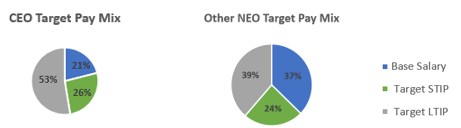
For 2025, the following individuals were the Company's NEOs:
• Brian Kocher, our Chief Executive Officer;
• Greg Gaba, our Chief Financial Officer;
• Chris McCullough, our General Counsel;
• Justin Kobler, our Senior Vice President, Supply Chain; and
• Bryan Clark, our Senior Vice President, R&D and FSQ
Executive Compensation Components and Fiscal 2025 Determinations
Base Salary
For fiscal year 2025, consistent with the compensation philosophy noted above, base salary levels for executive officers were set based on assessments of the Company's performance, each individual's performance, external market comparisons and other external and internal factors.
The amounts below are the base salary rates of the NEOs as of January 3, 2026 in the Base Salary column and as of December 28, 2024 in the Prior Base Salary column.
| Name | Base Salary | Prior Base Salary | |||||
| Brian Kocher | $ | 825,000 | $ | 800,000 | |||
| Greg Gaba | $ | 465,000 | $ | 450,000 | |||
| Christopher McCullough | $ | 375,000 | $ | 267,150 | |||
| Justin Kobler | $ | 395,000 | $ | 385,000 | |||
| Bryan Clark | $ | 380,000 | $ | 360,000 |
25
Short Term Incentive Plan
The purpose of the STIP is to establish alignment across the organization and recognize individuals' impact on organizational performance, focusing employees on desired behaviors which link to demonstrated results.
For fiscal 2025, the STIP aligned with the goal of accelerating EBITDA performance relative to fiscal 2024, while maintaining rigorous expectations for quality and safety. To focus on the achievement of these improvements, as well as measure individual performance, adjusted EBITDA and an individual component were the factors that determined an individual's bonus payout. The Compensation Committee believes that the use of adjusted EBITDA in the STIP heightens management's focus on implementing and delivering the operational improvements.

In 2025, there was one STIP covering all STIP eligible employees, which contained two components worth 50% each. The company component was dependent on the achievement of 2025 adjusted EBITDA and could range between 0-200%. The individual component was based on an employee achieving their individual goals for 2025 and could range between 0-200% as determined by the employee's annual review rating. No payout occurs on the individual component unless the company component is met.
Employees eligible for the STIP were divided into two groups: a cash payout group and an equity hybrid payout group. The cash payout group included employees below the manager level, while the equity hybrid group included managers and above. Participants in the equity hybrid group received a PSU grant valued at 50% of their STIP target, with the remaining 50% paid in cash. Payouts for both the shares and cash portions are determined equally by adjusted EBITDA results and individual performance. The cash payout group received their STIP entirely in cash, also based on these criteria. If an employee's bonus payout exceeded 100% of the target, an additional cash bonus would be paid to the employee in either group, but no extra performance shares would be granted. This structure is consistent with the desire to maintain pay and performance alignment.
The parameters established for the company component of the STIP were as follows:
| Measure | Threshold (50% payout) |
Target (100% Payout) |
Maximum (200% Payout) |
||||||
| SunOpta Adjusted EBITDA(1) | $90.0 million | $100.0 million | $110.0 million |
(1) SunOpta Adjusted EBITDA is measured as operating income plus depreciation, amortization, stock-based compensation and certain other adjustments that are considered one-time or unusual in nature, as calculated by the Company based on the Company's audited financials and consistent with the Company's calculation of adjusted EBITDA as a non-GAAP financial measure reported to its shareholders.
Each NEO had the following range of short-term incentive opportunities in 2025.
26
|
Executive |
Threshold Payout |
Target Payout |
Maximum Payout |
|
Brian Kocher |
62.5% |
125% |
250% |
|
Greg Gaba |
37.5% |
75% |
150% |
|
Chris McCullough |
30% |
60% |
120% |
|
Justin Kobler |
30% |
60% |
120% |
|
Bryan Clark |
30% |
60% |
120% |
If adjusted EBITDA performance was below threshold, there would be no payout. If performance was above maximum, the payout would be capped at the levels noted above. In 2025, adjusted EBITDA performance resulted in a company component payout of 74.54%.
The below table represents the 2025 STIP payout determination for each NEO as the result of the company and individual components:
| Executive | Company Component Percentage |
Individual Component Percentage |
Total Payout of Target STIP Percentage |
Final Result (No. of STIP PSUs vesting and cash payment portion)(1) |
| Brian Kocher | 74.54% | 74.54% | 74.54% | 74.54% STIP PSUs vest + $384,348 |
| Greg Gaba | 74.54% | 74.54% | 74.54% | 74.54% STIP PSUs vest + $129,982 |
| Chris McCullough | 74.54% | 74.54% | 74.54% | 74.54% STIP PSUs vest + $70,842 |
| Justin Kobler | 74.54% | 50.0% | 62.27% | 62.27% STIP PSUs vest + $73,793 |
| Bryan Clark | 74.54% | 74.54% | 74.54% | 74.54% STIP PSUs vest + $84,979 |
(1) 2025 STIP PSUs were granted to each NEO on March 24, 2025 and vested on March 24, 2026.
Long Term Incentives
In fiscal year 2025, the LTIP is a one-year plan with a three-year performance period. Specific details and design attributes of the 2025 plan are summarized below:
PSUs:
- For all NEOs, the number of PSUs earned is based on the Company's Revenue Compound Annual Growth Rate ("CAGR") (50% of granted PSUs) and Return on Invested Capital ("ROIC") (50% of granted PSUs) performance as calculated below and the participant's continued employment through the scheduled vesting date, which is April 11, 2028.
|
Revenue CAGR Hurdle |
Percentage of Revenue |
ROIC Hurdle |
Percentage of ROIC |
|
8% |
25% |
12.5% |
25% |
|
9% |
50% |
14% |
50% |
|
13% or above |
100% |
18% or above |
100% |
27
Stock Options:
- Vesting provisions are ratable over three years (in equal annual installments) with a term of ten years.
RSUs:
- Vesting provisions are ratable over three years (in equal annual installments).
The Compensation Committee believes the performance-based awards described above provide significant alignment between the interests of the Company's shareholders and the executives because the PSUs will not vest without the achievement of the performance hurdles, and stock options only provide value in the event of a stock price increase. Additionally, the vesting provisions in all awards provide additional retention incentive to each of the executives.
The 2025 LTIP grants to NEOs were divided between PSUs (50%), RSUs (25%) and stock options (25%), based on the 30-day average stock price as of April 11, 2025. Executives were given the choice to exchange their RSUs for stock options at a 3:1 ratio of options to RSUs. None of the executives elected to exchange their RSUs for options.
|
Executive |
Annual Target LTIP |
LTIP Options |
LTIP PSUs |
LTIP RSUs |
|
Brian Kocher |
250% |
216,660 |
204,614 |
102,307 |
|
Greg Gaba |
125% |
61,059 |
57,664 |
28,832 |
|
Chris McCullough |
85% |
33,484 |
31,623 |
15,812 |
|
Justin Kobler |
100% |
41,494 |
39,187 |
19,594 |
|
Bryan Clark |
100% |
39,918 |
37,699 |
18,850 |
In addition, the Compensation Committee granted Mr. McCullough a one-time special award of 51,440 RSUs on April 14, 2025 in connection with his appointment to General Counsel in March 2025.
Based on the Company's TSR for the performance cycle between January 1, 2023 through December 31, 2025, the 2023 LTIP PSU metric was at the 10th percentile of the peer group, which did not achieve the hurdle to trigger a payout of the 2023 LTIP PSUs. As such, the 2023 LTIP PSUs were forfeited in early 2026.
Other Compensation
Our executive officers are eligible to receive the same types of benefits that we make available to other employees, including:
- Group health benefits, which includes medical, dental, vision and prescription drug coverage, group life insurance and short-term and long-term disability plans; and
- Retirement benefits in the form of a 401(k) plan for U.S. employees and a Registered Retirement Savings Plan match for Canadian employees.
In recent years, we have substantially reduced the scope of perquisites for executives, such as the completed phasing out of automobile allowances at the executive levels. In 2021, the Company enrolled in the Executive Health Program at Mayo Clinic for use by its executive officers. The Company agreed to pay up to $5,000 for out-of-pockets costs incurred for any executive participating in this program. For additional information regarding other compensation during 2025, see the "All Other Compensation" column in the Summary Compensation Table which follows.
28
We have entered into employment or other agreements with our NEOs, most of which provide for certain benefits upon a change of control of the Company or upon a termination of employment by the Company without cause. These arrangements are intended to meet both business and human resources needs, encouraging the executives to weigh potential transitions based on shareholder interests, rather than personal ones, and to provide a measure of security to executives in the event of actual or potential change in corporate ownership/control. The potential benefits received by the NEOs in connection with a change-in-control or termination of employment under certain circumstances below under "Estimated Potential Payments upon Termination of Employment".
29
Other Aspects of the Compensation Program
Stock Ownership Guidelines
We expect our senior executives to maintain substantial ownership of SunOpta stock:
|
Category |
Ownership Guideline |
|
CEO |
5x base salary |
|
Other NEOs |
2x base salary |
|
Other Senior Leadership Team Members |
1x base salary |
|
Independent Directors |
5x annual cash retainer |
Senior executives may satisfy these ownership guidelines with Common Shares in these categories: shares owned directly, shares owned indirectly (e.g., by a spouse or a trust), shares represented by amounts invested in a 401(k) plan or deferred compensation plan maintained by the Company or an affiliate, unvested, time-based RSUs, and value of "in the money", unexercised options.
We believe this creates important alignment with shareholders. Executive participants have five years to comply with these guidelines. If, at the end of five years, the CEO or other NEOs and members of the Senior Leadership Team are not in compliance, 50% of all short-term incentive payouts are provided in equity rather than cash until the guideline is achieved.
Assessment of Risk
The Compensation Committee conducts an annual review of risk associated with the compensation programs. The 2025 review found the programs to be within acceptable parameters.
Clawback Policy
If material non-compliance with any financial reporting requirement leads to an accounting restatement, the Company has authority, in accordance with the Company's standalone Clawback Policy, to recover from current and former executives any incentive-based pay, including cash or equity awards, which would not have been awarded based on the restated financials. This authority extends to the three years preceding the restatement.
Insider Trading Policy
The Company has
30
Equity Award Timing Practices
Revision of Prior Period Financial Statements
As previously disclosed, in connection with the preparation of the Company's consolidated financial statements for fiscal 2024, management identified errors arising from the underpayment of duties on certain of the Company's products imported to the U.S. from Canada in fiscal years 2023 and 2022. Management determined that the impacts of these errors were not material to the Company's previously issued consolidated financial statements for any of the prior quarters or annual periods in which they occurred. As a result, the Company corrected these errors, together with other unrelated immaterial errors, by revising its financial statements for the prior fiscal periods, which had the effect of reducing the previous determination of adjusted EBITDA from continuing operations by $2.6 million and $1.6 million for 2023 and 2022, respectively.
As a result of this reduction in adjusted EBITDA, short-term incentive payouts were recalculated to reflect the revised achievements for the corporate component of the 2022 STIP and 2023 STIP. The corporate component for the 2022 STIP was previously 102% and was revised to 96.5% due to the decreased adjusted EBITDA. Consequently, the total clawback amount for the 2022 executive officers was $88,797. Similarly, the corporate component for the 2023 STIP was revised from 81.6% to 72%, resulting in a total clawback amount of $95,977 for the 2023 executive officers.
On March 27, 2025, written notifications were provided to the executive officers for the respective years, stating the specific amounts to be reimbursed to the Company. For current executive officers, the Company offset their reimbursement amount from their 2022 LTIP PSU vesting on May 5, 2025. The amounts by which the affected NEOs' 2022 LTIP PSU vesting was offset is set forth in the Stock Vested During Fiscal 2025 table below. For former executive officers that still had outstanding equity awards, the Company offset the reimbursement amount from those outstanding equity awards. For five former executive officers who did not have outstanding equity awards, the Company requested cash payments. Despite reasonable attempts, the Company was unable to obtain $55,000 in reimbursement from these five former executive officers.
REPORT OF COMPENSATION COMMITTEE
The Compensation Committee has reviewed and discussed the CD&A with the Company's management. Based on that review and discussion, the Compensation Committee has recommended to the Board of Directors that the CD&A be included in this Amendment.
The Compensation Committee of SunOpta Inc.:
Rebecca Fisher - Chair
Dr. Albert Bolles
Dean Hollis
David J. Lemmon
Mahes S. Wickramasinghe
31
COMPENSATION OF NAMED EXECUTIVE OFFICERS
Summary Compensation Table
| Name and Principal Position |
Year | Salary ($) |
Bonus |
Stock Awards ($)(1) |
Option Awards ($)(2) |
Non-Equity Incentive Plan Compensation ($)(3) |
All Other Compensation ($)(4) |
Total ($) |
| Brian Kocher, Chief Executive Officer | 2025 2024 |
819,231 802,524 |
0 10,000 |
1,629,313 4,023,480 |
515,651 801,307 |
384,348 477,500 |
17,424 22,666 |
3,365,967 6,137,477 |
| Greg Gaba, Chief Financial Officer | 2025 | 461,539 | 0 | 487,692 | 145,320 | 129,982 | 19,441 | 1,243,974 |
| 2024 | 432,849 | 100,000 | 499,545 | 112,335 | 161,156 | 116,275 | 1,422,160 | |
| 2023 | 293,310 | 100,022 | 608,600 | 92,700 | 0 | 13,731 | 1,108,363 | |
| Christopher McCullough, General Counsel | 2025 | 339,818 | 0 | 477,855 | 79,692 | 70,842 | 18,793 | 987,000 |
| Justin Kobler, SVP Supply Chain | 2025 2024 |
392,692 325,769 |
0 250,000 |
331,422 543,683 |
98,756 81,937 |
73,793 89,581 |
16,411 12,599 |
913,074 1,303,569 |
| Bryan Clark, SVP of R&D and FSQ | 2025 2024 |
375,385 352,225 |
0 0 |
318,839 333,353 |
95,005 76,616 |
84,979 98,820 |
12,959 9,051 |
887,167 870,065 |
(1) Consists of the grant-date fair value of RSUs and PSUs granted to NEOs. Please see Note 14, "Stock-Based Compensation," to the Company's consolidated financial statements included in the Original Form 10-K for a detailed description of the assumptions used to calculate the fair value of PSUs. For additional information on our long-term equity incentive awards, see "―Compensation Discussion and Analysis―Long Term Incentives." From 2023 through 2025, all NEOs were granted PSUs for all or a portion of their STIP award.
(2) Consists of the aggregate grant-date fair value of stock options granted to NEOs, calculated in accordance with FASB ASC Topic 718. Please see Note 14, "Stock-Based Compensation," to the Company's consolidated financial statements included in the Original Form 10-K for a detailed description of the assumptions used to calculate the fair value of options. For additional information on our long-term equity incentive awards, see "―Compensation Discussion and Analysis―Long Term Incentives."
(3) Represents the cash portion of bonuses paid for 2023 STIP, 2024 STIP and 2025 STIP.
(4) Represents retirement savings contributions, life and long-term disability insurance benefits, and other benefits. See "All Other Compensation" table below.
32
The following table details the various components included in the "All Other Compensation" column for 2025.
| All Other Compensation | ||||||||||||
| Name | Retirement Plan/401k Contributions ($) |
Life and Long-Term Disability Insurance ($) |
Other ($)(1) |
Total ($) | ||||||||
| Brian Kocher | 15,750 | 1,674 | - | 17,424 | ||||||||
| Greg Gaba | 15,750 | 180 | 3,511 | 19,441 | ||||||||
| Chris McCullough | 15,669 | 1,554 | 1,570 | 18,793 | ||||||||
| Justin Kobler | 15,241 | 1,170 | - | 16,411 | ||||||||
| Bryan Clark | 8,843 | 1,314 | 2,802 | 12,959 | ||||||||
(1) The amounts in this Other column refer to the benefits received under the Executive Health Plan benefit.
The following table summarizes grants of long-term equity incentive awards to our NEOs in fiscal 2025, and the estimated possible payouts under our STIP for fiscal 2025. 2025 STIP PSUs vested on March 24, 2026.
33
Grants of Plan-Based Awards
| Estimated Possible Payouts Under Non-Equity Incentive Plan Awards (1) |
Estimated Possible Payouts Under Equity Incentive Plan Awards (2) |
||||||||||
| Name | Grant Date |
Threshold ($) |
Target ($) |
Maximum ($) |
Threshold (#) |
Target (#) |
Maximum (#) |
All Other Stock Awards: Number of Shares of Stock or Units (#) (3) |
All Other Option Awards Number of Securities Under- lying Options (#)(4) |
Exercise or Base Price of Option Awards ($/Share) |
Grant Date Fair Value of Stock and Option Awards ($)(5) |
| Brian Kocher | 3/24/2025 04/11/2025 04/11/2025 4/11/2025 |
257,813 - - - |
515,626 - - - |
1,031,253 - - - |
41,458 51,154 - - |
82,915 204,614 - - |
82,915 409,228 - - |
- - - 102,307 |
- - 216,660 - |
- - 3.92 - |
426,183 802,087 515,651 401,043 |
| Greg Gaba | 3/24/2025 04/11/2025 04/11/2025 04/11/2025 |
87,188 - - - |
174,375 - - - |
348,750 - - - |
14,458 - 14,416 - |
28,916 - 57,664 - |
28,916 - 115,328 - |
- - - 28,832 |
- 61,059 - - |
- 3.92 - - |
148,628 145,320 226,043 113,021 |
| Chris McCullough | 03/24/2025 04/11/2025 04/11/2025 04/11/2025 04/14/2025 |
47,520 - - - |
95,039 - - - |
190,078 - - - |
7,880 - 7,906 - |
15,760 - 31,623 - |
15,760 - 63,246 - |
- - - 15,812 51,440 |
- 33,484 - - |
- 3.92 - - |
81,006 79,692 123,962 61,983 210,904 |
| Justin Kobler | 03/24/2025 04/11/2025 04/11/2025 04/11/2025 |
59,250 - - - - |
118,500 - - - - |
237,000 - - - - |
9,825 - 9,797 - - |
19,650 - 39,187 - - |
19,650 - 78,374 - - |
- - - 19,594 |
- 41,494 - - - |
- 3.92 - - - |
101,001 98,756 153,613 76,808 |
| Bryan Clark | 03/24/2025 04/11/2025 04/11/2025 04/11/2025 |
57,000 - - - |
114,000 - - - |
228,000 - - - |
9,452 - 9,425 - |
18,904 - 37,699 - |
18,904 - 75,398 - |
- - - 18,850 |
- 39,918 - - |
- 3.92 - - |
97,167 95,005 147,780 73,892 |
(1) Amounts shown indicate each NEO's potential bonus assuming successful achievement of the NEO's performance objectives. For additional information on our STIP, see "―Compensation Discussion and Analysis―Short-Term Incentive Plan."
(2) For grants dated March 24, 2025, this represents PSU awards from the 2025 STIP. For more information on these grants, see "-Compensation Discussion and Analysis - 2025 STIP." For each NEO under our STIP for fiscal 2025 the target and maximum vesting amounts are the same as the target is the maximum amount that will vest upon achievement of the entire performance measure. For grants dated April 11, 2025, this represents 2025 LTIP grants. For additional information on our long-term equity incentive awards, see "―Compensation Discussion and Analysis―Long Term Incentives".
34
(3) Represents RSU grants from the 2025 LTIP and a one-time special RSU grant on April 14, 2025, for Mr. McCullough as part of his appointment to General Counsel in March 2025. For additional information on the 2025 LTIP, see "―Compensation Discussion and Analysis―Long Term Incentives".
(4) Represents option grants from the 2025 LTIP. For additional information on the 2025 LTIP, see "―Compensation Discussion and Analysis―Long Term Incentives".
(5) Consists of the aggregate grant-date fair value of equity incentive awards granted to our NEOs, calculated in accordance with FASB ASC Topic 718. Please see Note 14, "Stock-Based Compensation," to the Company's consolidated financial statements included in the Original Form 10-K for a detailed description of the assumptions used to calculate the fair value of stock-based awards.
35
The following table summarizes the outstanding equity award holdings of our NEOs as of January 3, 2026. This table includes unexercised and unvested option awards and unvested PSUs and RSUs.
Outstanding Equity Awards at Fiscal Year End
| Name |
Option Awards | Stock Awards | |||||||
| Date of Grant |
Number of Securities Underlying Unexercised Options (#) Exercisable |
Number of Securities Underlying Unexercised Options (#) Unexercisable (1) |
Option Exercise Price ($) |
Option Expiration Date |
Number of Shares or Units That Have Not Vested (#)(2) |
Market Value of Shares or Units That Have Not Vested ($)(2) |
Equity |
Equity Incentive Plan Awards: Market or Payout Value of Unearned Shares, Units or Other Rights That Have Not Vested ($) (3) |
|
| Brian Kocher |
04/11/2025 03/24/2025 03/13/2024 01/02/2024 01/02/2024 01/02/2024 |
- - - - 153,869 - |
216,660 - - - 76,935 - |
3.92 - - - 5.54 - |
04/11/2035- - - 01/02/2034 - |
102,307 - 24,667 48,135 - - |
379,559 - 91,515 178,581 - - |
204,614 82,915 - - - 288,808 |
759,118 307,615 - - - 1,071,478 |
| Greg Gaba |
04/11/2025 03/24/2025 04/30/2024 10/23/2023 07/10/2023 05/05/2022 04/15/2021 07/10/2020 |
- - 8,978 - 16,628 7,204 2,934 2,891 |
61,059 - 17,955 - 9,466 - - - |
3.92 - 6.55 - 6.35 5.91 14.77 4.73 |
4/11/2035 - 04/30/2034 - 7/10/2033 05/05/2032 4/15/2031 7/10/2030 |
28,832 - 11,575 28,169 5,421 - - - |
106,967 - 42,943 104,507 20,112 - - - |
57,664 28,916 69,446 - - - - - |
213,933 107,278 257,645 - - - - - |
| Chris McCullough | 04/14/2025 04/11/2025 03/24/2025 04/30/2024 07/10/2023 |
- - - 2,843 5,171 |
- 33,484 - 5,685 2,585 |
- 3.92 - 6.55 6.35 |
- 04/11/2035 - 04/30/2034 07/10/2033 |
51,440 15,812 - 3,665 1,485 |
190,842 58,663 - 13,597 5,509 |
- 31,623 15,760 10,994 - |
- 117,321 58,470 40,788 - |
| Justin Kobler | 04/11/2025 03/24/2025 04/30/2024 |
- - 6,529 |
41,494 - 13,058 |
3.92 - 6.55 |
04/11/2035 - 04/30/2034 |
19,594 - 8,417 |
72,694 - 31,227 |
39,187 19,650 50,502 |
145,384 72,902 187,362 |
| 03/12/2024 | - | - | - | - | 20,000 | 74,200 | - | - | |
| Bryan Clark | 04/11/2025 03/24/2025 04/30/2024 07/10/2023 05/05/2022 04/15/2021 07/10/2020 05/17/2018 05/22/2017 |
- - 6,105 9,002 14,189 3,884 9,241 5,000 5,000 |
39,918 - 12,210 4,501 - - - - - |
3.92 - 6.55 6.35 5.91 14.77 4.73 7.10 9.45 |
04/11/2035 - 04/30/2034 07/10/2033 05/05/2032 04/15/2031 07/10/2030 05/17/2028 05/22/2027 |
18,850 - 7,871 2,585 - - - - - |
69,934 - 29,201 9,590 - - - - - |
37,699 18,904 47,224 - - - - - - |
139,863 70,134 175,201 - - - - - - |
36
(1) Stock options granted in 2023 through 2025 are part of the annual LTIP and vest one-third per year over three years.
(2) Represents grants of RSU awards. RSUs vest one-third per year over three years. The market value of the RSUs is based on the $3.71 closing market price of the Common Shares on the last trading day of fiscal 2025.
(3) Awards made in 2024 were for the 2024 LTIP and awards made in 2025 were for both the 2025 STIP and 2025 LTIP. For the CEO Special PSUs, vesting is determined by the Company's TSR performance and continued employment through the applicable vesting date (April 15, 2027). For all NEOs except for Mr. Kocher, the 2024 LTIP PSUs vesting is based on revenue and return on invested capital performance metrics and continued employment through the applicable scheduled vesting date (April 30, 2027). For all NEOs, the 2025 LTIP PSUs vesting is based on revenue and return on invested capital performance metrics and continued employment through the applicable scheduled vesting date (April 11, 2028). The number of shares shown in the above table related to these PSUs is based on the number of Common Shares that would be issued at the end of the performance period at the target level of performance, subject to the NEO's continued employment. For additional information on the performance hurdles for LTIP, see "―Compensation Discussion and Analysis―Long Term Incentives." The 2025 STIP PSUs were granted to all NEOs on March 24, 2025. The market value of all PSUs is based on the $3.71 closing market price of the Common Shares on the last trading day of fiscal 2025.
Option Exercises and Stock Vested During Fiscal 2025
The following table details certain information concerning stock awards held by the NEOs that vested during the fiscal year 2025. None of the NEOs exercised any stock options during fiscal year 2025.
Stock Vested
Name |
Stock Awards(1) | |
| Number of Shares Acquired on Vesting (#) |
Value Realized on Vesting ($) |
|
| Brian Kocher | 215,411 | 1,121,189 |
| Greg Gaba | 68,611 | 346,390 |
| Chris McCullough | 9,175 | 41,672 |
| Justin Kobler | 27,305 | 128,838 |
| Bryan Clark | 42,035 | 182,033 |
(1) The number of shares acquired upon vesting reflects the gross number of shares acquired before any netting of shares surrendered to satisfy tax withholding requirements, except for Mr. Gaba and Mr. Clark, whose number of shares shown reflects the offset of 1,061 and 2,201 PSUs, respectively, which represent their reimbursement amount pursuant to the clawback described above under "Compensation Discussion and Analysis - Revision of Prior Period Financial Statements." The value realized is based on the market value of the underlying Common Shares on the vesting date and reflects the gross value realized prior to taxes and withholding.
37
Potential Payments on Termination or Change of Control
The following discussion sets forth the payments and other benefits payable to our NEOs in connection with certain terminations of employment and/or a change in control. The proposed Arrangement also provides for, or will result in, certain payments and benefits to the NEOs, as described further in the proxy statement for the Special Meeting of Stockholders filed with the Securities and Exchange Commission on March 18, 2026.
The Company's Amended 2013 Stock Incentive Plan (the "Plan") provides that, in the event of a merger, consolidation or plan of exchange involving the Company pursuant to which outstanding shares are converted into cash or other stock, securities or property, or a sale, lease or exchange or other transfer of all or substantially all of the assets of the Company, the Company's Board of Directors may, in its sole discretion, provide that outstanding awards under the Plan shall be treated in accordance with any of the following alternatives: (i) the outstanding award may be converted into a similar award based on the stock of the surviving or acquiring company, taking into account the relative values of the companies involved in the transaction; (ii) the outstanding award may be cancelled by the Company and the holder would receive cash in an amount equal to the value of the award, as determined by the Company's Board of Directors; or (iii) the outstanding award may become fully exercisable and the Company's Board of Directors would provide an arrangement pursuant to which the holder would have a reasonable opportunity to exercise any award or otherwise realize the value of the award.
We have entered into employment or other agreements with our current NEOs and we have a SunOpta Foods Inc. Amended and Restated Severance Pay Plan (as amended and restated effective February 5, 2026, the "Severance Plan"), which provide for certain benefits upon a change of control of the Company or upon a termination of employment by the Company without cause or, with respect to employment agreements only, by the NEO with good reason, all as provided in the applicable agreement. Employment agreements entered into with NEOs and other executive officers of the Company generally provide for accelerated vesting of awards only if the executive's employment is terminated under specified circumstances within a specified period before or following a change of control (so-called "double-trigger" provisions). The definition of "change of control" varies among the agreements and generally includes (i) the acquisition of stock representing a majority of the voting power of the Company's stock; (ii) at any time during a period of two consecutive years, individuals who at the beginning of such period constituted the Board ("Incumbent Directors") shall cease for any reason to constitute at least a majority thereof; provided, however, that the term "Incumbent Director" shall also include each new director elected during such two-year period whose nomination or election was approved by two-thirds of the Incumbent Directors then in office; (iii) any consolidation, merger or plan of exchange involving the Company as a result of which the holders of outstanding stock of the Company immediately prior to the transaction do not continue to hold at least 50% of the combined voting power of the outstanding voting securities of the surviving corporation or a parent corporation of the surviving corporation immediately after the transaction; and (iv) the sale of all or substantially all of the assets of the Company. The definition of "cause" varies among the agreements.
The benefits to be received by the NEOs employed at the end of the fiscal year under the terms of their applicable employment or other agreements in connection with a change of control or upon termination of employment under certain circumstances are summarized as follows:
38
Brian Kocher
Termination for Cause or without Good Reason: Mr. Kocher's employment agreement (the "Employment Agreement") provides that if Mr. Kocher is terminated for Cause or without Good Reason (each as defined in the Employment Agreement), he is entitled to receive (i) any accrued but unpaid base salary and accrued but unused paid time-off; (ii) reimbursement for unreimbursed business expenses properly incurred by Mr. Kocher; and (iii) any Special RSUs, Matching RSUs and Special PSUs (each as defined in the Employment Agreement) that are vested as of the date of Mr. Kocher's termination (such amounts, the "Kocher Accrued Amounts").
Termination without Cause or by executive for Good Reason: In addition, the Employment Agreement provides that if Mr. Kocher is terminated without Cause or by Mr. Kocher for Good Reason, he is entitled to receive severance equal to the Kocher Accrued Amounts plus (i) a lump sum payment equal to two times the sum of his base salary and his target bonus (each, at the highest rate in effect during the 12-month period immediately preceding his termination date); (ii) any annual bonus earned, but not yet paid, for the fiscal year prior to the fiscal year in which the termination date occurs; and (iii) continued coverage under the Company's group health plans at the same levels and the same cost for up to 18 months following the termination date. In addition, all unvested Special RSUs and Matching RSUs (and, only in the event Mr. Kocher terminates for Good Reason, all Special Options) shall vest.
Termination of employment following a Change of Control: In the event Mr. Kocher's employment is terminated by the Company without Cause or by Mr. Kocher for Good Reason within 12 months following a change of control of the Company or, under certain circumstances, within a two-month period prior to such transaction, Mr. Kocher shall be entitled to the same benefits as in the event of termination without Cause or by executive for Good Reason. In addition, (i) all unvested Special Options, and any other outstanding equity-based incentive award subject to time-based vesting, shall vest; (ii) any unvested Special PSUs shall vest based on the Company's actual performance through the date of such change of control on a prorated basis reflecting the number of days Mr. Kocher is employed during the performance period; and (iii) any other unvested equity-based incentive award subject to performance-based vesting criteria vesting to which the applicable performance hurdle has been satisfied as of the date of change in control shall vest on a prorated basis reflecting the number of days Mr. Kocher is employed during the performance period.
If any of the payments or benefits received by Mr. Kocher in connection with a change of control result in a 280G excise tax, within the meaning of Section 280G of the Internal Revenue Code, then the Company's payments to Mr. Kocher will potentially be reduced if such reduction will result in a greater net benefit to Mr. Kocher.
Greg Gaba
Termination for Cause or by Mr. Gaba: Mr. Gaba's employment agreement provides that if Mr. Gaba is terminated for Cause (as defined in his employment agreement) or by Mr. Gaba for any reason, he is entitled to receive (i) any accrued but unpaid base salary and accrued but unused paid time-off; (ii) reimbursement for unreimbursed business expenses properly incurred by Mr. Gaba; and (iii) any vested CFO Special RSUs (as defined in the employment agreement) (such amounts, the "Gaba Accrued Amounts").
Termination without Cause: In the event Mr. Gaba's employment is terminated by the Company without Cause, he will be entitled to receive severance equal to the Gaba Accrued Amounts plus (i) a lump sum payment equal to one times the sum of his base salary and his target bonus; (ii) any annual bonus earned, but not yet paid, for the fiscal year prior to the fiscal year in which the termination date occurs; and (iii) the immediate vesting of any granted and unvested CFO Special RSUs.
39
Termination of employment following a Change of Control: In the event Mr. Gaba's employment is terminated by the Company without Cause within 12 months following a change of control of the Company or, under certain circumstances, within a two month period prior to such transaction, Mr. Gaba shall be entitled to the same benefits as in the event of termination without Cause except that the lump sum payment will be one and a half times (instead of one times). If any of the payments or benefits received by Mr. Gaba in connection with a change of control result in a 280G excise tax, within the meaning of Section 280G of the Internal Revenue Code, then the Company's payments to Mr. Gaba will potentially be reduced if such reduction will result in a greater net benefit to Mr. Gaba.
Termination of employment in the event of death or disability: Upon a termination of Mr. Gaba's employment due to death or disability, all of Mr. Gaba's unvested CFO Special RSUs will immediately vest.
Mr. Gaba's employment agreement also provides that upon termination of employment, Mr. Gaba will receive continuation of employee benefits as required by applicable law.
Other NEOs
Change of Control and Termination Following a Change of Control: The Severance Plan provides that if the officer's employment is involuntarily terminated by the Company within 12 months following a change of control, the officer will be entitled to: (a) a lump sum payment equal to one and a half (1.5) times the sum of (i) his base salary, and (ii) his target annual bonus; and (b) COBRA continuation coverage under the Company's group health plans at the same levels and the same cost for up to 12 months following the termination date. The Severance Plan also provides that if any of the payments or benefits received by a participant in connection with a change of control result in a 280G excise tax, within the meaning of Internal Revenue Code section 280G, then the Company's payments to the participant will potentially be reduced if such reduction will result in a greater net benefit to the participant. The award agreements and applicable equity plan provides if a change in control occurs and at any time within 12 months after the change in control, the NEO's employment is terminated by the Company (or its successor) without Cause (as defined in the plan), or their employment is terminated by them for Good Reason (as defined in the plan), provided that they execute and deliver a release of claims, that all of the NEO's unvested options and RSUs shall immediately vest, and any unvested PSUs as to which the applicable performance hurdle has been satisfied as of the date of change in control shall immediately vest as of the date of employment termination.
Termination by the Company without Cause: Upon a termination of the NEO's employment without Cause, the NEO is entitled to benefits under the Severance Plan and will receive a severance payment equal to a multiple of the NEO's weekly base pay, where such multiple is determined as two weeks per year with a minimum and maximum of 39 and 52 weeks, respectively. In addition, the Company will pay, for a period of up to 12 months, the cost of medical insurance coverage for the NEO and their dependents.
Estimated Potential Payments upon Termination of Employment
Based on the applicable agreements with the NEOs described above, the following table sets forth the estimated benefits that would have been payable to the NEOs if a change of control had occurred and each NEO's employment was terminated on the last day of the Company's 2025 fiscal year under circumstances specified in the applicable agreements:
40
| Potential Payments Upon Termination - Change of Control | |||||||
| Name | Lump Sum Severance Payment ($) |
Continuation of Benefits ($) |
Accelerated Vesting of RSUs ($)(1) |
Accelerated Vesting of Stock Options ($)(2) |
Accelerated Vesting of PSUs ($)(3) |
Cash Bonus Payment(4) |
Total ($) |
| Brian Kocher | 3,712,500 | 32,891 | 523,136 | 0 | 2,739,464 | 384,348 | 7,392,339 |
| Greg Gaba | 1,220,625 | 21,330 | 238,872 | 0 | 594,097 | 129,982 | 2,204,906 |
| Chris McCullough | 900,000 | 6,273 | 185,441 | 0 | 250,132 | 70,842 | 1,412,688 |
| Justin Kobler | 948,000 | 21,927 | 116,791 | 0 | 412,938 | 73,793 | 1,573,449 |
| Bryan Clark | 912,000 | 6,463 | 85,415 | 0 | 393,475 | 84,979 | 1,482,333 |
(1) These amounts represent the value of unvested RSUs that would vest in the event of a termination of employment following a change of control, assuming a stock price of $3.71 per share, which was the closing price on January 2, 2026, the last trading day of the fiscal year.
(2) These amounts represent the value of unvested stock options that would vest in the event of a termination of employment following a change of control. The closing stock price on January 2, 2026, the last trading date of the fiscal year, was $3.71. Value is calculated by taking the difference between the share price at the end of the year, less the exercise price, multiplied by the number of shares being exercised.
(3) These amounts represent the value of unvested PSUs that would vest in the event of a termination of employment following a change of control, due to the applicable performance hurdle having been satisfied as of the date of the change of control, assuming a stock price of $3.71 per share, which was the closing price on the last trading day of the fiscal year. This value includes 74.54% of target vesting of the 2025 STIP PSUs for all NEOs due to the level of 2025 fiscal year performance results for the company component of the LTIP. Additionally, this amount includes a payout of: (a) 150% of the 2024 LTIP PSUs at target for all NEOs (excluding Mr. Kocher) based upon a measurement of the revenue and ROIC performance hurdles achievement, and (b) 128% of the CEO Special PSUs at target for Mr. Kocher based upon a measurement of the relative TSR performance hurdle achievement prorated for the performance period.
(4) These amounts represent the cash portion of the 2025 STIP at 74.54% of target payout.
Based on the applicable agreements with the NEOs described above, the following table sets forth the estimated benefits that would have been payable to the NEOs if each officer's employment was terminated by the Company without cause in the absence of a change of control on the last day of the Company's 2025 fiscal year:
41
| Potential Payments Upon Termination - Involuntary Termination Without Cause | |||||||
| Name | Lump Sum Severance Payment ($) |
Continuation of Benefits ($) |
Accelerated Vesting of RSUs ($)(2) |
Accelerated Vesting of Stock Options ($) |
Accelerated Vesting of PSUs ($)(3) |
Cash Bonus Payment ($)(4) |
Total ($) |
| Brian Kocher (1) | 3,712,500 | 32,891 | 270,095 | 0 | 229,293 | 384,348 | 4,629,127 |
| Greg Gaba | 813,750 | 21,330 | 104,507 | 0 | 79,962 | 129,982 | 1,149,530 |
| Chris McCullough | 281,250 | 6,273 | 0 | 0 | 43,581 | 70,842 | 401,947 |
| Justin Kobler | 296,250 | 21,927 | 0 | 0 | 45,396 | 73,793 | 437,366 |
| Bryan Clark | 285,000 | 6,463 | 0 | 0 | 52,278 | 84,979 | 428,720 |
(1) These potential payments to Mr. Kocher are also applicable in the event of a termination initiated by him for good reason, as defined in his employment agreement.
(2) This amount represents the value of Mr. Gaba's unvested CFO Special RSUs, that would vest in the event of a termination of employment, assuming a stock price of $3.71 per share, which was the closing price on the last trading day of fiscal year 2025. Also, the CFO Special RSUs will vest for Mr. Gaba in the event of termination as a result of death or disability.
(3) This amount represents the value of unvested PSUs that would vest in the event of a termination of employment. This includes 74.54% of the 2025 STIP payout (comprised of 50% PSUs) for all NEOs, assuming a stock price of $3.71 per share, which was the closing price on the last trading day of the fiscal year.
(4) This amount represents the cash payment portion of the 2025 STIP payout at 74.54% achievement.
CEO Pay Ratio
Set below is information about the relationship of the annual total compensation of Brian Kocher, our CEO, and the annual total compensation of the median of our employees other than Mr. Kocher.
For 2025:
- The annual total compensation of Mr. Kocher, as reported in the Summary Compensation Table presented elsewhere in this Amendment, was $3,365,967. Mr. Kocher's compensation includes annualized base salary, bonuses, stock awards and other ancillary benefits.
- The annual total compensation of our median employee (other than Mr. Kocher) was $92,959. This calculation is based on 2025 data utilizing the methodology below.
- The ratio of the annual total compensation of Mr. Kocher to the annual total compensation of the median of our employees was 36 to 1.
As of January 3, 2026, we had 1,331 full-time employees in U.S. and Canada. As permitted by the pay ratio rule, we used the same median employee for the 2025 pay ratio calculation as was identified for the 2024 pay ratio calculation, since there were no changes in our employee population or employee compensation arrangements that would result in a significant change to our pay ratio disclosure. For 2024, we identified the median employee by taking the 1,248 full-time employees in U.S. and Canada as of December 28, 2024, and calculating each U.S. employee's W-2 (and equivalent income for each Canadian employee) to identify the median employee. For the 2025 pay ratio disclosure, we calculated that median employee's 2025 compensation on the same basis as that of our CEO.
42
Securities Authorized for Issuance under Equity Compensation Plans
The following table provides information as at January 3, 2026, with respect to our common shares that may be issued under the Company's equity compensation plans:
| Plan Category | Number of Securities to be Issued Upon Exercise of Outstanding Options, Warrants, and Rights |
Weighted-Average Exercise Price of Outstanding Options, Warrants and Rights |
Number of Securities Remaining Available for Future Issuance Under Equity Compensation Plans (Excluding Securities Reflected in Column (a)) |
|||
| (a) | (b) | (c) | ||||
| Equity compensation plans approved by securities holders: | ||||||
| 2013 Stock Incentive Plan | 3,275,859 (1) | $5.36 (3) | 1,895,341 | |||
| Employee Stock Purchase Plan | - | - | 255,941 | |||
| Equity compensation plans not approved by securities holders | 592,414 (2) | $5.54 (3) | - | |||
| Total | 3,868,273 | $5.39 (3) | 2,151,282 |
(1) Represents common shares of the Company issuable in respect of 1,079,612 stock options, 854,188 restricted stock units ("RSUs") and 1,342,059 PSUs granted under the Company's 2013 Stock Incentive Plan.
(2) Represents common shares of the Company issuable in respect of a special grants of 230,804 stock options, 72,802 RSUs and 288,808 PSUs in connection with the appointment of Brian Kocher as Chief Executive Officer of the Company on January 2, 2024.
(3) Vested RSUs and PSUs entitle the holder to receive one common share per unit without payment of additional consideration. Accordingly, these units are disregarded for purposes of computing the weighted-average exercise price.
Annual Burn Rate
In accordance with the policies of the TSX, the following table sets out the burn rate of the awards granted under the Company's security-based compensation arrangements, namely the Amended 2013 Plan and Employee Stock Purchase Plan, as of the end of the fiscal year ended January 3, 2026, and for the two preceding fiscal years. The burn rate is calculated by dividing the number of securities granted under each security-based compensation agreement during the relevant fiscal year by the weighted-average number of Common Shares outstanding for the applicable fiscal year.
| Compensation Plan | Fiscal 2025 | Fiscal 2024 | Fiscal 2023 |
| Amended 2013 Plan | 2.49% | 2.51% | 2.56% |
| Employee Stock Purchase Plan | * | * | * |
*indicates less than 1% of the weighted-average number of Common Shares outstanding
43
COMPENSATION OF DIRECTORS
Annual compensation for non-employee directors is comprised of cash and equity-based compensation. Cash compensation consists of an annual retainer and supplemental retainers for the chairs and members of Board committees. Equity compensation is comprised of an annual grant of RSUs.
Non-employee directors may elect to receive stock in lieu of cash compensation, including from 50% to 100% of the cash amount. Also, non-employee directors have the option to defer receipt of annual equity compensation that would otherwise be payable to them, subject to compliance with the Company's Non-Employee Director Stock Deferral Plan and Section 409A of the Internal Revenue Code.
The Board established the following schedule for non-employee director compensation for fiscal 2025:
i. Annual cash retainer of:
- $70,000 for serving as a director;
- $90,000 for serving as the Chair of the Board;
- $20,000 for serving as the Chair of the Audit Committee;
- $15,000 for serving as the Chair of the Compensation Committee;
- $10,000 for serving as the Chair of the Corporate Governance Committee;
- $15,000 for serving as Chair of the Strategic Advisory Committee (beginning July 22, 2025);
- $8,000 for serving on the Audit Committee; and
- $5,000 for serving on other committees.
ii. Annual equity compensation:
- RSUs valued at $125,000 with a 12-month vesting period
The following table summarizes total compensation paid to our non-employee directors for fiscal year 2025.
Non-Employee Director Compensation Table
| Name | Fees Earned or Paid in Cash ($) |
Stock Awards ($)(1) |
Total ($)(2) |
| Dr. Albert Bolles | 85,000 | 125,000 | 210,000 |
| Rebecca Fisher | 90,000 | 125,000 | 215,000 |
| Dean Hollis | 83,000 | 125,000 | 208,000 |
| David J. Lemmon | 80,934 | 125,000 | 205,934 |
| Diego Reynoso | 85,802 | 125,000 | 210,802 |
| Leslie Starr | 173,000 | 125,000 | 298,000 |
| Mahes S. Wickramasinghe | 95,934 | 125,000 | 220,934 |
44
(1) The fair value, as shown in this table, is determined in accordance with FASB ASC Topic 718 based on the number of RSUs granted and SunOpta's closing stock price on the date of grant. The number of RSUs granted in May 2025 was determined by dividing the scheduled Annual Equity Compensation by SunOpta's closing stock price on the grant date. RSUs vest on the first anniversary of the grant date.
(2) Includes the fair market value of Common Shares issued in lieu of cash retainers, including elections of $42,490 for Dr. Bolles, $67,495 for Ms. Fisher, $82,996 for Mr. Hollis, $30,133 for Mr. Lemmon, $85,804 for Mr. Reynoso, $129,746 for Ms. Starr, and $36,061 for Mr. Wickramasinghe.
The Board believes that compensation for non-employee directors should be competitive and should fairly compensate directors for the time and skills devoted to serving our Company but, for independent directors, should not be so significant as to compromise independence.
All our directors are reimbursed for reasonable out-of-pocket expenses incurred for attending meetings of our Board or its committees and for other reasonable expenses related to the performance of their duties as directors. The Board believes that our non-employee director compensation package is competitive with the compensation offered by other companies and is fair and appropriate considering the responsibilities and obligations of our directors.
45
Penalties and Sanctions and Personal Bankruptcies
Except as disclosed below, none of the members of the Board:
1) is, as at the date of this Amendment, or was within ten years before the date hereof, a director or chief executive officer or chief financial officer of any company (including the Company) that:
(i) was the subject of an order (as defined in Form 51-102F5 made under National Instrument 51-102 of the CSA) that was issued while the director or executive officer was acting in the capacity as director, chief executive officer or chief financial officer; or
(ii) was subject to an order that was issued after the director or executive officer ceased to be a director, chief executive officer, or chief financial officer, and which resulted from an event that occurred while that person was acting in the capacity as a director, chief executive officer, or chief financial officer; or
2) is at the date hereof, or has been within ten years before the date of this Amendment, a director or executive officer of any company (including the Company) that while that person was acting in that capacity, or within a year of that person ceasing to act in that capacity, became bankrupt, made a proposal under any legislation relating to bankruptcy or insolvency or was subject to or instituted any proceedings, arrangement or compromise with creditors or had a receiver, receiver manager or trustee appointed to hold its assets; or
3) has, within the ten years before the date of this Amendment, become bankrupt, made a proposal under any legislation relating to bankruptcy or insolvency, or become subject to or instituted any proceedings, arrangement or compromise with creditors, or had a receiver, receiver manager or trustee appointed to hold the assets of the director, executive officer or shareholder.
Ms. Starr was appointed as a director of Chesapeake Energy Corporation ("Chesapeake") on September 11, 2017. Similar to many other oil and gas companies, Chesapeake found itself in the midst of a "double black swan event" in the spring of 2020: an emerging global pandemic that sapped demand, and an oil price war that flooded the market with supply. After exploring all available alternatives and on the advice of its legal and financial advisors, the board of directors authorized Chesapeake to file for restructuring proceedings under Chapter 11 of the United States Bankruptcy Code, which proceedings commenced in June 2020. On February 9, 2021, following the approval and effectiveness of a confirmed plan of reorganization, Chesapeake emerged from bankruptcy protection with its creditors assuming ownership of the company and the board of directors was discharged of its duties.
Mr. Lemmon was formerly the President and Chief Executive Officer of Enterra Feed Corporation ("Enterra Feed") (an insect protein company whose customers were primarily in the livestock, fish, pet food, and organic fruits and vegetables industries). Mr. Lemmon ceased to be an executive officer of Enterra Feed in October 2022. The senior lender of Enterra Feed applied for and was granted a receivership order in respect of Enterra Feed on November 8, 2022, under the Bankruptcy and Insolvency Act (Canada).
The foregoing information, not being within the knowledge of the Company, has been furnished by the directors.
46
ITEM 12 - SECURITY OWNERSHIP OF CERTAIN BENEFICIAL OWNERS AND MANAGEMENT AND RELATED STOCKHOLDER MATTERS.
Security Ownership of Certain Beneficial Owners and Management
The following presents information regarding beneficial ownership of our shares as of March 10, 2026 by:
- each person who we know that beneficially owns more than 5% of our Common Shares;
- each of our Directors;
- each of our NEOs; and
- all of our Directors and executive officers as a group.
Under the regulations of the SEC, shares are generally deemed to be "beneficially owned" by a person if the person directly or indirectly has or shares voting power or investment power (including the power to dispose) over the shares, whether or not the person has any pecuniary interest in the shares, or if the person has the right to acquire voting power or investment power of the shares within 60 days, including through the exercise of any option, warrant or right. In accordance with the regulations of the SEC, in computing the number of Common Shares beneficially owned by a person and the percentage ownership of such person, we deemed to be outstanding all Common Shares subject to options or other rights held by the person that are currently exercisable or exercisable within 60 days of March 10, 2026. We did not deem such shares outstanding, however, for the purpose of computing the percentage ownership of any other person.
Five Percent or More Beneficial Owners
Based solely on our review of statements filed with the SEC pursuant to Sections 13(d) and 13(g) under the Exchange Act, the Company is not aware of any other person or group that beneficially owns more than 5% of any class of voting shares of the Company, except as noted below.
| Name and Address of Beneficial Owner | Title of Class | Amount and Nature of Beneficial Ownership |
Percentage of Class(1) |
Percentage of all Shares(1) |
||||
| Oaktree Capital Group Holdings GP, LLC 333 South Grand Avenue, 28th Floor, Los Angeles, CA 90071 |
Common Special |
24,376,032 2,932,453 |
(2)(3)(4) (5) |
19.96% 100.00% |
19.96% 2.42% |
(6) |
||
| Leon G. Cooperman St. Andrews Country Club 7118 Melrose Castle Lane Boca Raton, FL 33496 |
Common | 9,053,300(7) | 7.65% | 7.46% | ||||
| BlackRock, Inc. 50 Hudson Yards New York, NY 10001 |
Common | 7,782,925(8) | 6.57% | 6.42% | ||||
| CastleKnight Master Fund LP Maples Corporate Services Limited P.O. Box 309 Ugland House Grand Cayman KY1-1104 Cayman Islands |
Common | 7,350,000(9) | 6.21% | 6.06% |
47
| (1) | Percentage of Class and Percentage of all shares are calculated based on a total of 118,372,041 Common Shares and 2,932,453 Special Shares issued and outstanding as of March 10, 2026 except for the beneficial ownership of Common Shares by Oaktree Capital Group Holdings GP, LLC, with respect to which the Percentage of Class and Percentage of all Shares are calculated based on a total of 118,372,041 Common Shares issued and outstanding as of March 10, 2026 plus 3,724,220 Common Shares currently issuable on the exchange of Series B-1 Preferred Stock beneficially owned by the Oaktree Investors (as defined below) as disclosed in the Schedule 13D/A filed on February 10, 2026 by Oaktree Fund GP, LLC ("Fund GP"), and excludes the 2,932,453 Special Shares issued and outstanding as of March 10, 2026 as such Special Shares would be automatically redeemed and cancelled upon the exchange of Series B-1 Preferred Stock. |
| (2) | Includes 20,651,812 Common Shares and 3,724,220 Common Shares currently issuable on the exchange of Series B-1 Preferred Stock beneficially owned by the Oaktree Investors (as defined below), giving effect to the 19.99% beneficial ownership cap, as disclosed in the Schedule 13D/A filed on February 10, 2026 by Fund GP, in the instruments governing the Series B-1 Preferred Stock (the "Beneficial Ownership Cap"). |
| (3) | According to a Schedule 13D/A filed on February 10, 2026 by Fund GP, the Oaktree Investors beneficially own 20,354,660 and 4,021,372 Common Shares, respectively, including 3,113,081 and 611,139 Common Shares, respectively, currently issuable on the exchange of Series B-1 Preferred Stock, giving effect to the Beneficial Ownership Cap, and have the sole power to vote and dispose of their respective shares. In addition, Oaktree Huntington Investment Fund II GP, L.P. ("OHIF II GP"), the general partner of OHIF II LP, may be deemed to beneficially own the 4,021,372 Common Shares owned by OHIF II LP. Additionally, Fund GP, the general partner of OHIF II GP and Organics, Oaktree Fund GP I, L.P. ("GP I"), managing member of Fund GP, Oaktree Capital I, L.P. ("Capital I"), the general partner of GP I, OCM Holdings I, LLC ("Holdings I"), the general partner of Capital I, Oaktree Holdings, LLC ("Holdings"), the managing member of Holdings I, Oaktree Capital Group, LLC ("OCG"), the managing member of Holdings, and Oaktree Capital Group Holdings GP, LLC, the indirect owner of the common shares of OCG, may be deemed to beneficially own the 24,376,032 shares owned in the aggregate by the Oaktree Investors. Notwithstanding the foregoing, pursuant to the Plan of Arrangement, each share of Series B-1 Preferred Stock outstanding immediately prior to the Effective Time will be exchanged in accordance with their terms for 405.9555467 Common Shares (being the exchange rate of the Series B-1 Preferred Stock contemplated by their terms), for a total of 6,089,333 Common Shares issued on such exchange. It is therefore expected that the Oaktree Investors will collectively sell and transfer, on the Effective Date and conditioned on the consummation of the Arrangement, an aggregate of 26,741,145 Common Shares to Purchaser for the Consideration pursuant to the Plan of Arrangement. |
| (4) | The Common Shares beneficially owned by the Oaktree Investors set out in the table above do not include Common Shares referenced in the outstanding cash-settled total return swaps entered into by OHIF II LP and Oaktree Special Situations Fund, L.P. with respect to an aggregate of 871,170 Common Shares and 4,404,034 Common Shares, respectively. Such total return swaps are exclusively cash-settled and do not provide either OHIF II LP or OSSF LP with the direct or indirect right to vote, or exercise control or direction over, the Common Shares subject to such total return swaps. The counterparty to such total return swaps is an unaffiliated third-party financial institution and the total return swaps have terms consistent with the total return swaps previously entered into by the Oaktree Investors as disclosed in the Schedule 13D/A filed on July 2, 2021 by Fund GP. |
| (5) | On May 19, 2023, the Company issued 2,932,453 Special Shares to the Oaktree Trustee, in trust on behalf of the Oaktree Investors. The Special Shares serve as a mechanism for attaching as-exchanged voting rights to the Series B-1 Preferred Stock owned by the Oaktree Investors and entitle the Oaktree Investors to one vote per Special Share on all matters submitted to a vote of the holders of the Common Shares, voting together as a single class, subject to certain exceptions. As a result of a permanent voting cap, the number of Special Shares issued to the Oaktree Investors at any time, when taken together with any other voting securities the Oaktree Investors then control, cannot exceed 19.99% of the votes eligible to be cast by all security holders of the Company. |
48
|
(6) |
As of the Record Date, the Oaktree Investors would be entitled to vote an aggregate of 20,651,812 Common Shares and the Oaktree Trustee, on behalf of the Oaktree Investors, would be entitled to vote an aggregate of 2,932,453 Special Shares, representing an aggregate of 19.44% of the issued and outstanding Voting Shares (on a non-diluted basis) as of the Record Date. |
|
(7) |
According to a Schedule 13G/A filed by Leon G. Cooperman on February 17, 2026, Mr. Cooperman beneficially owns 9,053,300 Common Shares and has sole voting power over 9,053,300 Common Shares and sole dispositive power over 9,053,300 Common Shares. In the Schedule 13G/A, Mr. Cooperman reports that he may be deemed the beneficial owner of 9,053,300 Common Shares held directly by Omega Capital Partners, L.P. ("Capital LP"), a private investment firm comprised of Cooperman family funds engaged in the purchase and sale of securities for investment for its own account. According to the Schedule 13G/A, Mr. Cooperman is the Managing Member of Omega Associates, L.L.C., which is the general partner Capital LP. |
|
(8) |
According to a Schedule 13G/A filed by BlackRock, Inc. on April 23, 2025, it beneficially owns 7,782,925 Common Shares and has sole voting power over 7,662,182 Common Shares and sole dispositive power over 7,782,925 Common Shares. |
|
(9) |
According to a Schedule 13G filed on November 13, 2025 by CastleKnight Master Fund LP, CastleKnight Fund GP LLC, CastleKnight Management LP, CastleKnight Management GP LLC, Weitman Capital LLP and Aaron Weitman (collectively, "CastleKnight"), CastleKnight beneficially owns 7,350,000 Common Shares and has shared voting power over 7,350,000 Common Shares and shared dispositive power over 7,350,000 Common Shares. The address for each entity other than CastleKnight Master Fund LP is 888 Seventh Avenue, 24th Floor, New York, NY 10019. |
49
Directors and Executive Officers
| Directors and Executive Officers(1) | Amount and Nature of Beneficial Ownership(2) | Total Number of Common Shares, Vested Options and Vested RSUs |
Percentage of Shares(5) |
||||||||||||
| Common Shares |
Vested Options(3) |
Vested RSUs / PSUs(4) |
|||||||||||||
| Dr. Albert Bolles Director |
231,646 | 0 | 0 | 231,646 | * | ||||||||||
| Rebecca Fisher Director |
141,672 | 5,830 | 0 | 147,502 | * | ||||||||||
| Dean Hollis(6) Director |
586,665 | 0 | 0 | 586,665 | * | ||||||||||
| David J. Lemmon Director |
20,517 | 0 | 0 | 20,517 | * | ||||||||||
| Diego Reynoso Director |
59,372 | 0 | 0 | 59,372 | * | ||||||||||
| Leslie Starr Director (Chair) |
144,979 | 5,830 | 19,547 | 170,356 | * | ||||||||||
| Mahes S. Wickramasinghe Director |
49,778 | 0 | 15,283 | 65,061 | * | ||||||||||
| Brian Kocher(7) Chief Executive Officer and Director |
229,716 | 226,089 | 95,906 | 551,711 | * | ||||||||||
| Greg Gaba(8) Chief Financial Officer |
110,970 | 47,076 | 36,952 | 194,998 | * | ||||||||||
| Chris McCullough General Counsel |
11,071 | 16,332 | 35,998 | 63,401 | * | ||||||||||
| Justin Kobler Senior Vice President, Supply Chain |
25,921 | 13,831 | 35,386 | 75,138 | * | ||||||||||
| Bryan Clark Senior Vice President, R&D and FSQ |
51,022 | 45,738 | 24,310 | 121,070 | * | ||||||||||
| All current directors and executive officers as a group (16 total) | 1,789,079 | 501,734 | 361,964 | 2,652,777 | 2.19% | ||||||||||
50
| (1) | The address of each director and executive officer is 7078 Shady Oak Road, Eden Prairie, MN 55344. |
| (2) | Unless otherwise indicated, the persons in this table have sole voting and dispositive power with respect to the Common Shares shown as beneficially owned by them. The information as to shares beneficially owned or over which control or direction is exercised, directly or indirectly, not being within the knowledge of the Company, has been furnished by the respective directors and executive officers individually. |
| (3) | The number of vested options includes options that will become exercisable within 60 days of March 10, 2026. The exercise price of vested options ranges from $3.25 to $6.35 per share. |
| (4) | The number of vested RSUs includes RSUs or PSUs that will vest within 60 days of March 10, 2026 as well as any RSUs that a director has deferred until their departure from the Company Board. These amounts represent gross vesting amounts, without estimated shares withheld for tax. |
| (5) | Percentage of shares is calculated based on a total of 118,372,041 Common Shares and 2,932,453 Special Shares issued and outstanding as of March 10, 2026 (* indicates less than 1% of the outstanding Common Shares) |
| (6) | Mr. Hollis also owns 500 limited partnership units of Organics, which owns 17,241,579 Common Shares and has a beneficial interest in 2,451,242 Special Shares. See Notes (3) and (5) under "-Security Ownership of Certain Beneficial Owners and Management-Five Percent or More Beneficial Owners." However, Mr. Hollis does not directly or indirectly exercise control or direction over the securities of the Company held by Organics. |
| (7) | Includes 84,000 Common Shares in a trust, which Mr. Kocher is the co-trustee of, along with his spouse. |
| (8) | Mr. Gaba's spouse owns 9,826 of the 110,970 Common Shares reflected for Mr. Gaba. |
Effective February 2018, the Company adopted a formal policy to prohibit officers and directors from hedging against declines in the market value of their equity-based compensation or equity securities through the use of financial instruments. The Company is not aware of any officers or directors engaging in any hedging transactions prior to or after this policy becoming effective.
Section 16(a) Beneficial Ownership Reporting Compliance
Section 16(a) of the Exchange Act requires our directors and executive officers, among others, to file with the SEC an initial report of ownership of our Common Shares on Form 3 and reports of changes in ownership on Form 4 or Form 5. Persons subject to Section 16 are required by SEC regulations to furnish us with copies of all Section 16 forms that they file related to SunOpta stock transactions. Under SEC rules, certain forms of indirect ownership and ownership of our Common Shares by certain family members are covered by these reporting requirements. As a matter of practice, our administrative staff assists our directors and executive officers in preparing initial ownership reports and reporting ownership changes and typically files these reports on their behalf.
Based solely on a review of the copies of Forms 4 and 5 furnished to us, or written representations from reporting persons that all reportable transactions were reported, we believe that during the fiscal year ended January 3, 2026, all of our executive officers, directors and greater than 10% holders filed the reports required to be filed under Section 16(a) on a timely basis.
ITEM 13 - CERTAIN RELATIONSHIPS AND RELATED TRANSACTIONS, AND DIRECTOR INDEPENDENCE.
Certain Relationships and Transactions
The Audit Committee reviews any material transactions in which we are or will be a participant and in which any of our 5% shareholders, directors or executive officers, or any of their immediate family members, has a direct or an indirect material interest. After its review, the Audit Committee will only approve or ratify those transactions that the Audit Committee determines are in, or are not inconsistent with, our best interests and the Audit Committee, in its sole discretion, may impose such conditions as it deems appropriate on us or the related person in connection with approval of the transaction.
51
Except as set forth in the next paragraph, no informed person (as such term is defined in National Instrument 51-102 of the CSA), any proposed director of the Company or any associate or affiliate of the foregoing or any related person (as such term is defined in Item 404(a) of Regulation S-K) has or will have any material interest, direct or indirect, in any transaction since the commencement of the Company's most recently completed fiscal year or in any currently proposed transaction in which the Company was or is to be a participant and the amount involved exceeds $120,000 or which otherwise has materially affected or would materially affect the Company or any of its subsidiaries.
On February 6, 2026, concurrently with the execution of the Arrangement Agreement, (a) certain of the Oaktree Investors entered into a voting and support agreement (the "Oaktree Voting and Support Agreement") with Parent and Purchaser, and (b) each of the directors and officers of the Company entered into a voting and support agreement (collectively, the "D&O Voting and Support Agreements", and together with the Oaktree Voting and Support Agreement, the "Voting and Support Agreements") with Parent and Purchaser. Under the terms of the Voting and Support Agreements, the applicable Oaktree Investors and directors and officers of the Company agreed, among other things, (a) to vote their shares in favour of the Arrangement and against any other acquisition proposal and any other matter which could reasonably be expected to materially delay, materially impede or prevent the completion of the Arrangement and the other transactions contemplated by the Arrangement Agreement and (b) subject to certain exceptions, not to dispose, transfer or assign its rights in any Company shares, subject to certain exceptions.
Director Independence
See "Item 10. Directors, Executive Officers and Corporate Governance-Board Independence."
ITEM 14 - PRINCIPAL ACCOUNTING FEES AND SERVICES.
Auditor Fees
The following table sets forth fees for professional services provided by Ernst & Young LLP ("EY") for each of the last two fiscal years (including out-of-pocket expenses):
| Fiscal 2025 | Fiscal 2024 | |
| Fee Category | ($) | ($) |
| Audit Fees(1) | 1,782,000 | 1,660,414 |
| Audit-Related Fees | -- | -- |
| Tax Fees(2) | 11,312 | 59,882 |
| All Other Fees(3) | 20,000 | -- |
| Total | 1,813,312 | 1,720,296 |
(1) Audit fees include fees related to the integrated audit of the Company's annual consolidated financial statements and internal control over financial reporting and reviews of financial statements included in the Company's Quarterly Reports on Form 10-Q.
(2) Tax fees are related to tax advice and tax planning services.
(3) All other fees are related to services provided in conjunction with the Arrangement.
52
Pre-Approval of Audit and Non-Audit Services
The Audit Committee has a policy for the pre-approval of audit and non-audit services that may be provided by the Company's independent registered public accounting firm. The Audit Committee's policy is to require pre-approval for all audit and permissible non-audit services provided by the Company's external auditor prior to their engagement with the exception that management is authorized to engage the external auditor in respect of services to the extent that (a) such required services could not reasonably be completed by another firm (e.g. assistance with responses to continuous disclosure review comment letters from regulatory authorities, comfort letters, consent letters, statutory audits), (b) each individual engagement is not more than $50,000, and (c) the aggregate for all engagements does not exceed $100,000. Any pre-approval is detailed as to the particular service or category of services and is generally subject to a specific budget. The Audit Committee has delegated to its Chair authority to pre-approve proposed audit and non-audit services that arise between Audit Committee meetings, provided that the decision to approve the service is presented to the full Audit Committee for consideration at the next scheduled Audit Committee meeting. All audit and non-audit services performed by EY during the fiscal years ended January 3, 2026 and December 28, 2024 were approved in accordance with this policy.
Financial Information Systems Design and Implementation Fee
No fees were billed to the Company by EY during any of the last two fiscal years for professional services described in Paragraph (c)(4)(ii) of Rule 2-01 of Regulation S-X (financial information systems design and implementation services).
PART IV
ITEM 15. EXHIBITS AND FINANCIAL STATEMENT SCHEDULES.
1. Financial Statements: See Index to Consolidated Financial Statements under Item 8 of the Original Form 10-K.
2. Financial Statement Schedules: Schedules are not required, are not applicable or the information is shown in the Notes to the Consolidated Financial Statements in the Original Form 10-K.
3. Exhibits: See Exhibit Index, which is incorporated herein by reference.
EXHIBIT INDEX
53
54
|
|
|
55
56
57
|
101.INS* |
XBRL Instance Document - the instance document does not appear in the Interactive Data File as its XBRL tags are embedded within the Inline XBRL document |
|
101.CAL* |
Inline XBRL Taxonomy Extension Calculation Linkbase Document |
|
Inline XBRL Taxonomy Extension Presentation Linkbase Document |
|
|
104 |
Cover Page Interactive Data File (formatted as Inline XBRL and contained in Exhibit 101) |
† Indicates management contract or compensatory plan or arrangement.
* Filed herewith.
58
SIGNATURES
Pursuant to the requirements of Section 13 or 15(d) of the Securities Exchange Act of 1934, the registrant has duly caused this report to be signed on its behalf by the undersigned, thereunto duly authorized.
| SUNOPTA INC. |
| /s/ Greg Gaba |
| Greg Gaba |
| Chief Financial Officer |
| Date: April 27, 2026 |
59