
NVIT Bond Index Fund
Summary
Prospectus April 30, 2026
Class I / Class II / Class Y
Before you invest, you may want to review the Fund’s Prospectus, which contains information about the Fund and its risks. This Summary Prospectus is intended for use in connection with variable insurance contracts, and is not intended for use by other investors. The Fund’s Prospectus and Statement of Additional Information, each dated April 30, 2026 (as may be supplemented or revised), are incorporated by reference into this Summary Prospectus. For free paper or electronic copies of the Fund’s Prospectus and other information about the Fund, go to nationwide.com/mutualfundsnvit, email a request to web_help@nationwide.com or call 800-848-0920, or ask any variable insurance contract provider who offers shares of the Fund as an underlying investment option in its products.
Objective
The NVIT Bond Index Fund seeks to match the performance of the Bloomberg U.S. Aggregate Bond Index (“Aggregate Bond
Index”) as closely as possible before the deduction of Fund expenses.
Fees and Expenses
This table describes the fees and expenses that you may pay if you buy, hold, and sell shares of the Fund.
Sales charges and other expenses that may be imposed by variable insurance
contracts are not included. If these charges were reflected, the expenses listed below would be higher. See the variable insurance contract prospectus, which may impose sales charges and other additional contract-level
expenses.
Annual Fund Operating Expenses (expenses that you pay each year as a percentage of the value of your investment)
| |
Class I
Shares |
Class II
Shares |
Class Y
Shares |
| Management Fees |
0.18% |
0.18% |
0.18% |
| Distribution and/or Service (12b-1) Fees |
None |
0.25% |
None |
| Other Expenses |
0.21% |
0.21% |
0.06% |
| Total Annual Fund Operating Expenses |
0.39% |
0.64% |
0.24% |
Example
This Example is intended to help you to compare the cost of investing in the Fund with the cost of investing in other mutual
funds. The Example, however, does not include charges that are imposed by variable insurance contracts. If these charges were reflected, the expenses listed below would be higher.
This Example assumes that you invest $10,000 in the Fund for the time periods indicated and then sell all of your shares at the end of those time periods. It assumes a 5% return each year and no change in expenses, and any expense limitation or fee waivers that may apply for the periods indicated above under “Fees and Expenses.” Although your actual costs may be higher or lower, based on these assumptions your costs would be:
| |
1 Year |
3 Years |
5 Years |
10 Years |
| Class I Shares |
$40 |
$125 |
$219 |
$493 |
| Class II Shares |
65 |
205 |
357 |
798 |
| Class Y Shares |
25 |
77 |
135 |
306 |
NSP-BDX (4/26)
Summary Prospectus
April 30, 2026
1
NVIT Bond Index Fund
Portfolio Turnover
The Fund pays transaction costs, such as commissions, when it buys and sells securities (or
“turns over” its portfolio). A higher portfolio turnover rate may indicate higher transaction costs. These costs, which are not reflected in Annual Fund Operating
Expenses or in the Example, affect the Fund’s performance. During the most recent fiscal year, the Fund’s portfolio turnover rate was 73.41% of the average value of its
portfolio.
Principal Investment Strategies
The Fund employs a “passive” management, or indexing, approach, which seeks to match approximately the performance of the Aggregate Bond Index before the deduction of Fund expenses. The Aggregate Bond Index represents a wide spectrum of public,
investment grade, debt securities in the United States, including government, corporate, and international dollar-denominated bonds, as well as mortgage-backed securities (collectively “bonds”). Some of these securities may be purchased with delayed delivery. Under normal circumstances, the Fund invests at least 80% of its net assets in a statistically selected sampling of bonds that are included in or correlated with the Aggregate Bond Index. The Fund does not necessarily Invest in all of the bonds in the index, or in the same weightings. The Fund may invest in bonds not included in the Aggregate Bond Index which are selected to
reflect characteristics such as maturity, duration, or credit quality similar to the Aggregate Bond Index. The Fund also may trade securities in segments of the portfolio to the extent necessary to closely mirror the duration of corresponding segments of the Index. As a result, the Fund may have different levels of interest rate, credit or prepayment risks from the levels of risks in the index. In addition, the Fund may have a higher portfolio turnover rate than that of other “index” funds.
The Fund intends to be diversified in approximately the same proportion as the Aggregate Bond Index is diversified. The Fund may become “nondiversified,” as defined in the Investment Company Act of 1940 Act, as amended (the “1940 Act”), solely as a result of a change in relative market capitalization or index weighting of one or more constituents of the Aggregate Bond Index. A “nondiversified” fund generally invests a greater proportion of its assets in the securities of one or more issuers and invests overall in a smaller number of issuers than a diversified fund. Shareholder approval will not be sought if the Fund becomes
nondiversified due solely to a change in the relative market capitalization or index weighting of one or more constituents of the Aggregate Bond Index.
Principal Risks
The Fund cannot guarantee that it will achieve its investment objective.
As with any fund, the value of the Fund’s investments—and therefore, the value of Fund shares—may fluctuate. These changes may occur because of:
Interest rate risk – generally, when interest rates go up, the value of debt
securities goes down. Prices of longer-term securities generally change more in response to interest rate changes than prices of shorter-term securities. To the extent the Fund
invests a substantial portion of its assets in debt securities with longer-term maturities, rising interest rates are more likely to cause periods of increased volatility and redemptions, and will cause the value of the Fund's investments to decline significantly. The Federal Reserve Board continued to lower interest rates following a period of consistent rate increases, though it is unclear if such lowering will continue. The interest earned on the Fund's investments in debt securities may decline when prevailing
interest rates fall. Declines in interest rates increase the likelihood that debt obligations will be pre-paid, which, in turn, increases these risks. Very low or negative interest rates will impact the yield of the Fund's investments in debt securities and increase the risk that, if followed by rising interest rates, the Fund's performance will be negatively impacted. The Fund is subject to the risk that the income generated by its investments in debt securities may not keep pace with inflation. Recent and potential future
changes in government policy may affect interest rates.
Credit risk – a bond issuer will default if it is unable to pay the interest or
principal when due. If an issuer defaults, the Fund will lose money. Changes in a bond issuer’s credit rating or the market’s perception of an issuer’s
creditworthiness also affect the market price of a bond.
Market risk – the risk that one or more markets in which the Fund invests will go down in value, including the possibility that the
markets will go down sharply and unpredictably. This occurs due to numerous factors, including interest rates, the outlook for corporate profits, the health of the national and world economies, and the fluctuation of other securities markets around the
world. These risks may be magnified if certain social, political, economic and other conditions and events (such as natural disasters, epidemics and pandemics, terrorism, conflicts, trade disputes and social unrest or rapid technological developments
such as artificial intelligence) adversely interrupt the global economy.
Summary Prospectus April 30, 2026
2
NVIT Bond Index
Fund
Selection
risk – the risk that the securities selected by the Fund’s subadviser will underperform the
markets, the relevant indexes or the securities selected by other funds with similar investment objectives and
investment strategies.
Liquidity risk – when there is little or no active trading market for specific types of securities or instruments, it can become
more difficult to sell the securities or instruments at or near their perceived value. An inability to sell a
portfolio position can adversely affect the Fund's value or prevent the Fund from being able to take advantage
of other investment opportunities. Liquidity risk also includes the risk that the Fund will experience
significant net redemptions of its shares at a time when it cannot find willing buyers for its portfolio
securities or instruments or can sell its portfolio securities or instruments only at a material loss. To meet
redemption requests, the Fund may be forced to sell other securities or instruments that are more liquid, but
at unfavorable times and conditions.
Prepayment and call risk – certain bonds will be paid off by the issuer more quickly than anticipated. If this happens, the Fund may be required to invest the proceeds in securities with lower yields.
Mortgage-backed securities risk– mortgage-backed securities generally are subject to the same types of risk that apply to other debt securities, such as interest rate risk, credit risk, and prepayment and call risk. Mortgage-backed securities
also are subject to extension risk, which is the risk that when interest rates rise, certain mortgage-backed
securities will be paid in full by the issuer more slowly than anticipated. This can cause the market value of
the security to fall because the market may view its interest rate as low for a longer-term investment. Through
its investments in mortgage-backed securities, the Fund may have some exposure to subprime loans, as well as to
the mortgage and credit markets generally. Subprime loans, which are loans made to borrowers with weakened
credit histories, generally have higher default rates than loans that meet government underwriting
requirements.
U.S. government
securities risk – not all obligations of the U.S. government, its agencies and instrumentalities are
backed by the full faith and credit of the United States. Some obligations are backed only by the credit of the
issuing agency or instrumentality, and in some cases there is some risk of default by the issuer. Even if a
security is backed by the U.S. Treasury or the full faith and credit of the United States, such guarantee
applies only to the timely payment of interest and principal. Neither the U.S. government nor its agencies
guarantee the market value of their securities, and interest rate changes, prepayments and other factors will
affect the value of U.S. government securities. It is possible that issuers of U.S. government securities will
not have the funds to meet their payment obligations in the future.
Index fund
risk – the Fund does not use defensive strategies or attempt to reduce its exposure to poor performing
securities. Further, correlation between the Fund’s performance and that of the index is likely to be
negatively affected by the Fund’s expenses, changes in the composition of the index, and the timing of
purchase and redemption of Fund shares.
Nondiversified fund risk – in seeking to track
the Aggregate Bond Index Index, the Fund may become nondiversified as a result of a change in relative market
capitalization or index weighting of one or more constituents in the Aggregate Bond Index Index. Because the
Fund may hold larger positions in fewer securities than diversified funds, a single security’s increase
or decrease in value may have a greater impact on the Fund’s value and total return.
Foreign securities risk – foreign securities
often are more volatile, harder to price and less liquid than U.S. securities.
Delayed-delivery risk – the risk that the security the Fund buys will lose value prior to its delivery or that the seller will not meet its obligation. If this happens, the Fund will lose the investment opportunity for the assets it set aside to pay for
the security and any gain in the security’s price.
Redemptions risk – the Fund is an investment option for other mutual funds that are managed as “funds-of-funds.” As a result, from time to time, the Fund may experience
relatively large redemptions or investments. Large or continuous redemptions may increase the Fund’s
transaction costs and could cause the Fund’s operating expenses to be allocated over a smaller asset
base, leading to an increase in the Fund’s expense ratio. If funds-of-funds or other large shareholders
redeem large amounts of shares rapidly or unexpectedly, the Fund may have to sell portfolio securities at times
when it would not otherwise do so, which could negatively impact the Fund’s net asset value and
liquidity.
Loss of money is a risk of investing in the
Fund. An investment in the Fund is not a deposit of a bank and is not
insured or guaranteed by the Federal Deposit Insurance Corporation or any
other government agency.
Performance
The following bar chart and table provide some indication of the risks of investing in the Fund. The bar chart shows the volatility or variability of the Fund’s annual total returns over time and shows that Fund performance can change from
year to year. The table shows the Fund’s average annual total returns for certain time periods compared
to the returns of a broad-based securities market index. Remember, however, that past performance is not necessarily an indication of how the Fund will perform in the future. The returns shown in the bar chart and table do not include charges that will be imposed by variable insurance contracts. If these amounts were reflected, returns would be less than those shown.
Summary Prospectus April 30, 2026
3
NVIT Bond Index Fund
Annual Total Returns– Class Y Shares
(Years Ended December 31,)
(Years Ended December 31,)
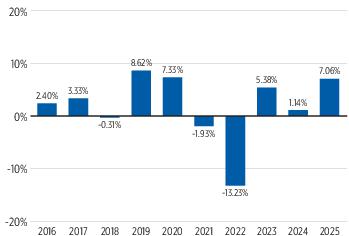
| Highest Quarter: |
6.60% |
– |
4Q 2023 |
| Lowest Quarter: |
-5.88% |
– |
1Q 2022 |
The Fund has not commenced offering Class II shares as of the date of this Prospectus. Pre-inception historical performance for Class II shares is based on the previous performance of Class Y shares. Performance for Class II shares has been adjusted to reflect this share class’s higher expenses than
those of Class Y shares.
Average Annual Total Returns
(For the Periods Ended December 31, 2025)
(For the Periods Ended December 31, 2025)
| |
1 Year |
5 Years |
10 Years |
| Class I Shares |
6.80% |
-0.75% |
1.63% |
| Class II Shares |
6.64% |
-0.98% |
1.39% |
| Class Y Shares |
7.06% |
-0.59% |
1.79% |
| Bloomberg U.S. Aggregate Bond Index
(reflects no deduction for fees or expenses) |
7.30% |
-0.36% |
2.01% |
Portfolio Management
Investment Adviser
Nationwide Fund Advisors
Subadviser
BlackRock Investment Management, LLC
Portfolio Managers
| Portfolio Manager |
Title |
Length of Service with Fund |
| James Mauro |
Managing Director and
Portfolio Manager |
Since 2021 |
| Jonathan Graves |
Managing Director and
Portfolio Manager |
Since 2025 |
| Marcus Tom |
Director and Portfolio
Manager |
Since 2025 |
Tax Information
The dividends and distributions paid by the Fund to the insurance company separate
accounts will consist of ordinary income, capital gains, or some combination of both. Because shares of the
Fund must be purchased through separate accounts used to fund variable insurance contracts, such dividends and
distributions will be exempt from current taxation by contract holders if left to accumulate within a separate
account. Consult the variable insurance contract prospectus for additional tax information.
Payments to Broker-Dealers and Other Financial
Intermediaries
This Fund is only offered as an underlying investment option for variable insurance contracts. The Fund and its related
companies may make payments to the sponsoring insurance companies (or their affiliates) for distribution and/or
other services, and to broker-dealers and other financial intermediaries that distribute the variable insurance
contracts. These payments may create a conflict of interest by influencing the insurance companies to include
the Fund as an underlying investment option in the variable insurance contracts, and by influencing the
broker-dealers and other financial intermediaries to distribute variable insurance contracts that include the
Fund as an underlying investment option over other variable insurance contracts or to otherwise recommend the
selection of the Fund as an underlying investment option by contract owners instead of other funds that also
may be available investment options. The prospectus (or other offering document) for your variable insurance
contract may contain additional information about these payments.
Summary Prospectus April 30, 2026
4
NVIT Bond Index Fund