
NVIT GQG US Quality Equity
Fund (formerly, NVIT Calvert Equity Fund)
Summary Prospectus April 30, 2026
Class I / Class II / Class Y
Before you invest, you may want to review the Fund’s Prospectus, which contains information about the Fund and its risks. This Summary Prospectus is intended for use in connection with variable insurance contracts, and is not intended for use by other investors. The Fund’s Prospectus and Statement of Additional Information, each dated April 30, 2026 (as may be supplemented or revised), are incorporated by reference into this Summary Prospectus. For free paper or electronic copies of the Fund’s Prospectus and other information about the Fund, go to nationwide.com/mutualfundsnvit, email a request to web_help@nationwide.com or call 800-848-0920, or ask any variable insurance contract provider who offers shares of the Fund as an underlying investment option in its products.
Objective
The NVIT GQG US Quality Equity Fund seeks long-term capital appreciation.
Fees and Expenses
This table describes the fees and expenses that you may pay if you buy, hold, and sell shares of the Fund.
Sales charges and other expenses that may be imposed by variable insurance
contracts are not included. If these charges were reflected, the expenses listed below would be higher. See the variable insurance contract prospectus, which may impose sales charges and other additional contract-level
expenses.
Annual Fund Operating Expenses (expenses that you pay each year as a percentage of the value of your investment)
| |
Class I
Shares |
Class II
Shares |
Class Y
Shares |
| Management Fees |
0.65% |
0.65% |
0.65% |
| Distribution and/or Service (12b-1) Fees |
None |
0.25% |
None |
| Other Expenses |
0.18% |
0.18% |
0.13% |
| Total Annual Fund Operating Expenses |
0.83% |
1.08% |
0.78% |
| Fee Waiver/Expense Reimbursement(1),(2)
|
(0.05)% |
(0.21)% |
(0.05)% |
| Total Annual Fund Operating Expenses After Fee Waiver/Expense
Reimbursement |
0.78% |
0.87% |
0.73% |
(1)
The Trust and Nationwide Fund Distributors LLC have entered into a written contract waiving 0.16% of the Distribution and/or Service (12b-1) Fees for Class II shares until April 30, 2027. The
written contract may be changed or eliminated only with the consent of the Board of Trustees of the
Trust.
(2) Nationwide
Variable Insurance Trust (the “Trust”) and Nationwide Fund Advisors (the “Adviser”) have entered into a written contract in which the Adviser has agreed to waive 0.05% of the
management fee to which the Adviser would
otherwise be entitled until April 30, 2027. The written contract may be changed or eliminated only with the
consent of the Board of Trustees of the
Trust.
Example
This Example is intended to help you to compare the cost of investing in the Fund with the cost of investing in other mutual
funds. The Example, however, does not include charges that are imposed by variable insurance contracts. If these charges were reflected, the expenses listed below would be higher.
This Example assumes that you invest $10,000 in the Fund for the time periods indicated and then sell all of your shares at the end of those time periods. It assumes a 5% return each year and no change in expenses, and any expense limitation or fee waivers that may apply for the periods indicated above under “Fees and Expenses.” Although your actual costs may be higher or lower, based on these assumptions your costs would be:
| |
1 Year |
3 Years |
5 Years |
10 Years |
| Class I Shares |
$80 |
$260 |
$456 |
$1,021 |
| Class II Shares |
89 |
323 |
575 |
1,298 |
| Class Y Shares |
75 |
244 |
428 |
961 |
NSP-QE (4/26)
Summary Prospectus
April 30, 2026
1
NVIT GQG US Quality Equity Fund
Portfolio Turnover
The Fund pays transaction costs, such as commissions, when it buys and sells securities (or
“turns over” its portfolio). A higher portfolio turnover rate may indicate higher transaction costs. These costs, which are not reflected in Annual Fund Operating
Expenses or in the Example, affect the Fund’s performance. During the most recent fiscal year, the Fund’s portfolio turnover rate was 140.61% of the average value of its
portfolio.
Principal Investment Strategies
Under normal circumstances, the Fund invests at least 80% of its net assets in equity securities of U.S. issuers. For these purposes, equity securities represent an ownership interest in the issuer, and a company is a U.S. issuer if (i) at least 50% of its assets are located in the U.S.; (ii) at least 50% of its revenue is generated in the U.S.; (iii) it is organized, conducts its principal operations, or maintains its principal place of business or principal manufacturing facilities in the U.S.; or (iv) its stock is listed on the New York Stock Exchange or NASDAQ. Equity securities that the Fund buys primarily are common stocks of large-cap companies, i.e.,
those with market capitalizations similar to those of companies included in the S&P 500® Index. The Fund makes market capitalization determinations with respect to a security at the time of its purchase. The Fund may invest in equity securities of foreign companies in both developed and emerging markets. Although the Fund typically invests in seasoned issuers, it may,
depending on the appropriateness to the Fund’s strategy and availability in the marketplace, purchase securities of companies in initial public offerings (IPOs) or shortly thereafter, which can be subject to greater volatility than seasoned issuers.
The Fund’s subadviser seeks to capture market inefficiencies which it believes are
driven by investors’ propensity to be short-sighted and overly focused on quarter-to-quarter price movements, rather than a company’s fundamentals over a longer time
horizon (5 years or more). The subadviser believes that this market inefficiency may lead investors to underappreciate the compounding potential of quality, growing companies. To identify this subset of companies, the subadviser generates
investment ideas from a variety of sources, ranging from institutional knowledge and industry contacts, to the subadviser’s proprietary screening process that seeks to identify suitable companies based on several quality factors, such as rates of return on equity and total capital, margin stability and profitability. Ideas are then subject to rigorous fundamental analysis as the subadviser seeks to identify and invest in companies that it believes reflect higher quality opportunities on a forward-looking basis. Specifically, the subadviser seeks to buy companies that it believes are reasonably priced and have strong fundamental
business characteristics and sustainable and durable earnings growth. The subadviser seeks to outperform peers over a full market cycle by seeking to capture market upside while limiting downside risk. For these purposes, a full market cycle can be
measured from a point in the market cycle (e.g., a peak or trough) to the corresponding point in the next market cycle.
Subject to the subadviser's criteria for quality, many of the stocks in which the Fund
invests may be considered to be “growth” stocks, in that they may have above-average rates of earnings growth and thus may experience above-average increases in stock prices. The Fund also may purchase stocks that would not fall into the traditional “growth” style box. In constructing a portfolio of securities, the subadviser is not constrained by sector or industry weights of the Fund’s benchmark. The Fund may invest in any economic sector and, at times, emphasize one or more particular industries or sectors. The subadviser relies on
individual stock selection driven by a bottom-up research process rather than seeking to add value based on “top-down,” macro-based criteria.
The
subadviser may sell a stock if the subadviser believes that the company’s long-term competitive advantage or relative earnings growth prospects have deteriorated, or the
subadviser has otherwise lost conviction that the company reflects a higher quality opportunity relative to other available investments on a forward-looking basis. The subadviser
also may sell a stock if the company has met its price target or is involved in a business combination, if the subadviser identifies a more attractive investment opportunity, or the subadviser wishes to reduce the Fund’s exposure to the company or a particular country or
geographic region. The Fund may engage in frequent and active trading of portfolio securities.
The Fund is classified as a “non-diversified fund” under the Investment Company Act of 1940, which means that a relatively high percentage of the Fund’s assets may be invested in a limited number of issuers.
Principal Risks
The Fund cannot guarantee that it will achieve its investment objective.
As with any fund, the value of the Fund’s investments—and therefore, the value of Fund shares—may fluctuate. These changes may occur because of:
Equity securities risk – stock markets are volatile. The price of an equity
security fluctuates based on changes in a company’s financial condition and overall market and economic conditions.
Summary Prospectus April 30, 2026
2
NVIT GQG US Quality
Equity Fund
Market
risk – the risk that one or more markets in which the Fund invests will go down in value, including the
possibility that the markets will go down sharply and unpredictably. This occurs due to numerous factors,
including interest rates, the outlook for corporate profits, the health of the national and world economies,
and the fluctuation of other securities markets around the world. These risks may be magnified if certain
social, political, economic and other conditions and events (such as natural disasters, epidemics and pandemics,
terrorism, conflicts, trade disputes and social unrest or rapid technological developments such as artificial
intelligence) adversely interrupt the global economy.
Selection risk – the risk that the securities selected by the Fund’s subadviser will underperform the markets, the relevant indexes or the securities selected by other funds with
similar investment objectives and investment strategies.
Emerging markets risk – emerging markets are riskier than more developed markets because they tend to develop unevenly and may never fully develop. Investments in emerging markets are considered speculative. Emerging markets are more likely to experience hyperinflation and currency devaluations, which adversely affect returns to U.S. investors. In addition, many emerging securities markets
have far lower trading volumes and less liquidity than developed markets. Since these markets are smaller than
developed markets, they may be more likely to suffer sharp and frequent price changes or long-term price
depression because of adverse publicity, investor perceptions or the actions of a few large investors.
Practices in relation to settlement of securities transactions in emerging markets involve higher risks than
those in developed markets, in part because the Fund will need to use brokers and counterparties that are less
well capitalized, and custody and registration of assets in some countries are unreliable compared to developed
markets. Companies in emerging market countries generally are subject to less stringent financial reporting,
accounting and auditing standards than companies in more developed countries. In addition, information about
such companies may be less available and reliable. Many emerging markets also have histories of political
instability and abrupt changes in policies, and the ability to bring and enforce actions may be limited.
Certain emerging markets also face other significant internal or external risks, including the risk of war,
nationalization of assets, unexpected market closures and ethnic, religious and racial conflicts.
Growth stocks risk– growth stocks are generally more sensitive to market movements than other types of stocks primarily because their stock prices are based heavily on future expectations. If the subadviser’s assessment of the
prospects for a company’s growth is wrong, or if the subadviser’s judgment of how other investors
will value the company’s growth is wrong, then the Fund may suffer a loss as the price of the
company’s stock may fall or not approach the value that the subadviser has placed on it. In addition, growth stocks as a
group may be out of favor at times and
underperform the overall equity market for long periods while the market concentrates on other types of stocks,
such as “value” stocks.
Foreign
securities risk – foreign securities often are more volatile, harder to price and less liquid than U.S.
securities. The prices of foreign securities may be further affected by other factors, such as changes in the
exchange rates between the U.S. dollar and the currencies in which the securities are traded.
Sector risk – investments in particular
industries or sectors may be more volatile than the overall stock market. Therefore, if the Fund emphasizes one
or more industries or economic sectors, it will be more susceptible to financial, market or economic events
affecting the particular issuers and industries participating in such sectors than funds that do not emphasize
particular industries or sectors.
Initial public offering risk – availability of IPOs may be limited and the Fund may not be able to buy any shares at the offering price, or may not be able to buy as many shares at the
offering price as it would like, which may adversely impact Fund performance. Further, IPO prices often are
subject to greater and more unpredictable price changes than more established stocks.
Nondiversified fund risk – because the Fund may hold larger positions in fewer securities and financial instruments than diversified funds, a single security’s or instrument's increase or decrease in value may have a greater impact on the
Fund’s value and total return.
Portfolio turnover risk – a higher portfolio turnover rate increases transaction costs, may adversely impact the Fund’s performance, and may result in higher taxes when Fund
shares are held in a taxable account.
Loss of money is a risk of investing in the Fund. An investment in the Fund is not a deposit of a bank and is not insured or guaranteed by the Federal
Deposit Insurance Corporation or any other government agency.
Performance
The following bar chart and table provide some indication of the risks of investing in the Fund. The bar chart shows the volatility or variability of the Fund’s annual total returns over time and shows that Fund performance can change from year to year. The table shows the Fund’s average annual total
returns for certain time periods compared to the returns of a broad-based securities market index and an
additional index. The additional index has characteristics relevant to the Fund’s investment
strategy. Remember, however, that past performance is not necessarily an indication of how the Fund will perform in the future. The returns shown in the bar chart and table do not include charges that will be imposed by variable insurance contracts. If these amounts were reflected,
returns would be less than those shown.
Summary Prospectus April 30, 2026
3
NVIT GQG US Quality
Equity Fund
The Fund compares its performance to the Russell
1000 Index to satisfy a Securities and Exchange Commission (SEC) disclosure requirement. The Fund's performance prior to June 18, 2025, reflects returns pursuant to different subadvisers. If the Fund's current
subadviser had been in place for the prior periods, the performance information shown would have been
different.
Annual Total Returns– Class II Shares
(Years Ended December 31,)
(Years Ended December 31,)
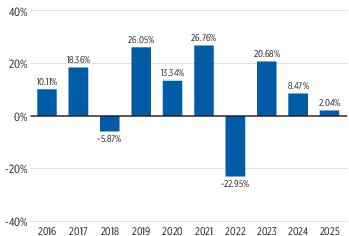
| Highest Quarter: |
18.93% |
– |
2Q 2020 |
| Lowest Quarter: |
-21.65% |
– |
1Q 2020 |
The Fund has not commenced offering Class Y shares as of the date of this Prospectus. Therefore, historical performance for Class Y shares is based on the performance of Class II shares. Performance for Class Y shares has not been adjusted to reflect that share class’s lower expenses than those of Class
II shares.
Average Annual Total Returns
(For the Periods Ended December 31, 2025)
(For the Periods Ended December 31, 2025)
| |
1 Year |
5 Years |
10 Years |
| Class I Shares |
2.14% |
5.52% |
8.68% |
| Class II Shares |
2.04% |
5.46% |
8.62% |
| Class Y Shares |
2.04% |
5.46% |
8.62% |
| Russell 1000® Index (reflects no deduction for
fees or expenses) |
17.37% |
13.59% |
14.59% |
| S&P 500® Index (reflects no deduction for
fees or expenses) |
17.88% |
14.42% |
14.82% |
Portfolio Management
Investment Adviser
Nationwide Fund Advisors
Subadviser
GQG Partners LLC
Portfolio Managers
| Portfolio Manager |
Title |
Length of Service with Fund |
| Rajiv Jain |
Portfolio Manager |
Since 2025 |
| Brian Kersmanc |
Portfolio Manager |
Since 2025 |
| Sudarshan Murthy, CFA |
Portfolio Manager |
Since 2025 |
| Siddharth Jain |
Deputy Portfolio
Manager |
Since 2025 |
Tax Information
The dividends and distributions paid by the Fund to the insurance company separate accounts will consist of ordinary income, capital gains, or some combination of both. Because shares of the Fund must be purchased through separate accounts used to fund variable insurance contracts, such dividends and distributions will be exempt from current taxation by contract holders if left to accumulate within a separate account. Consult the variable insurance contract
prospectus for additional tax information.
Payments to Broker-Dealers and Other Financial Intermediaries
This Fund is only offered as an underlying investment option for variable insurance contracts. The Fund and its related companies may make payments to the sponsoring insurance companies (or their affiliates) for distribution and/or other services, and to broker-dealers and other financial intermediaries that distribute the variable insurance contracts. These payments may create a conflict of interest by influencing the insurance companies to include the Fund as an underlying investment option in the variable insurance contracts, and by influencing the broker-dealers and other financial intermediaries to distribute variable insurance contracts that include the Fund as an underlying investment option over other variable insurance contracts or to otherwise
recommend the selection of the Fund as an underlying investment option by contract owners instead of other
funds that also may be available investment options. The prospectus (or other offering document) for your
variable insurance contract may contain additional information about these payments.
Summary Prospectus April 30, 2026
4
NVIT GQG US Quality Equity Fund