
NVIT Multi-Manager Small Company
Fund
Summary Prospectus April 30, 2026
Class I / Class II / Class IV
Before you invest, you may want to review the Fund’s Prospectus, which contains information about the Fund and its risks. This Summary Prospectus is intended for use in connection with variable insurance contracts, and is not intended for use by other investors. The Fund’s Prospectus and Statement of Additional Information, each dated April 30, 2026 (as may be supplemented or revised), are incorporated by reference into this Summary Prospectus. For free paper or electronic copies of the Fund’s Prospectus and other information about the Fund, go to nationwide.com/mutualfundsnvit, email a request to web_help@nationwide.com or call 800-848-0920, or ask any variable insurance contract provider who offers shares of the Fund as an underlying investment option in its products.
Objective
The NVIT Multi-Manager Small Company Fund seeks long-term growth of capital.
Fees and Expenses
This table describes the fees and expenses that you may pay if you buy, hold, and sell shares of the Fund.
Sales charges and other expenses that may be imposed by variable insurance
contracts are not included. If these charges were reflected, the expenses listed below would be higher. See the variable insurance contract prospectus, which may impose sales charges and other additional contract-level
expenses.
Annual Fund Operating Expenses (expenses that you pay each year as a percentage of the value of your investment)
| |
Class I
Shares |
Class II
Shares |
Class IV
Shares |
| Management Fees |
0.85% |
0.85% |
0.85% |
| Distribution and/or Service (12b-1) Fees |
None |
0.25% |
None |
| Other Expenses |
0.22% |
0.22% |
0.22% |
| Total Annual Fund Operating Expenses |
1.07% |
1.32% |
1.07% |
| Fee Waiver/Expense Reimbursement(1) |
(0.02)% |
(0.02)% |
(0.02)% |
| Total Annual Fund Operating Expenses After Fee Waiver/Expense
Reimbursement |
1.05% |
1.30% |
1.05% |
(1)
Nationwide Variable Insurance Trust (the “Trust”) and Nationwide Fund Advisors (the “Adviser”) have entered into a written contract waiving 0.027% of the
management fee to which the
Adviser would otherwise be entitled until April 30, 2027. The written contract may be changed or eliminated only with the consent of the Board of Trustees of the
Trust.
Example
This Example is intended to help you to compare the cost of investing in the Fund with the cost of investing in other mutual
funds. The Example, however, does not include charges that are imposed by variable insurance contracts. If these charges were reflected, the expenses listed below would be higher.
This Example assumes that you invest $10,000 in the Fund for the time periods indicated and then sell all of your shares at the end of those time periods. It assumes a 5% return each year and no change in expenses, and any expense limitation or fee waivers that may apply for the periods indicated above under “Fees and Expenses.” Although your actual costs may be higher or lower, based on these assumptions your costs would be:
| |
1 Year |
3 Years |
5 Years |
10 Years |
| Class I Shares |
$107 |
$338 |
$588 |
$1,304 |
| Class II Shares |
132 |
416 |
722 |
1,588 |
| Class IV Shares |
107 |
338 |
588 |
1,304 |
NSP-MM-SCO (4/26)
Summary Prospectus
April 30, 2026
1
NVIT Multi-Manager Small Company Fund
Portfolio Turnover
The Fund pays transaction costs, such as commissions, when it buys and sells securities (or
“turns over” its portfolio). A higher portfolio turnover rate may indicate higher transaction costs. These costs, which are not reflected in Annual Fund Operating
Expenses or in the Example, affect the Fund’s performance. During the most recent fiscal year, the Fund’s portfolio turnover rate was 75.06% of the average value of its
portfolio.
Principal Investment Strategies
Under normal circumstances, the Fund invests at least 80% of its net assets in equity securities of small-cap companies. For these purposes, small-cap companies are those with market capitalizations similar to those of companies included in the Russell 2000®
Index. Some of these companies may be considered to be “unseasoned,” which are companies that have been in operation for less than three years, including the operations of any predecessors. The Fund may invest up to 25% of its total assets in securities of foreign companies, including those that are located in emerging market countries. Foreign small-cap companies are those
whose market capitalizations are similar to those companies listed in the MSCI Developed Countries, Europe, Australasia and Far East (“EAFE”) Small Cap Index. It also may invest without limit in initial public offerings (“IPOs”) of small-cap companies to capitalize on the opportunity for growth. It may invest in any economic sector and, at times, emphasize one or more particular
industries or sectors. The Fund generally considers selling a security when it no longer satisfies investment criteria, no longer offers significant growth potential, reaches a target price, changes valuation, deteriorates in business quality, fails to perform as expected, or when other opportunities appear more attractive.
The Fund consists of two portions managed by different subadvisers acting independently with
respect to the assets of the Fund they manage. Nationwide Fund Advisors (“NFA”) is the Fund’s investment adviser and, subject to the approval of the Board of
Trustees of Nationwide Variable Insurance Trust (the “Trust”), selects the Fund’s subadvisers and monitors their performance on an ongoing basis. NFA also determines the amount of Fund assets to allocate to each subadviser. NFA has chosen the Fund’s current subadvisers because they approach investing in small-cap stocks in a different manner from each other. For example,
one subadviser looks for companies it believes have high growth potential based on fundamental analysis, while the other subadviser invests in small-cap value stocks using a multidimensional investment process that combines finance and behavioral
theory and quantitative and statistical methods. In allocating assets between the subadvisers, NFA seeks to increase diversification among securities and investment styles in order to potentially increase the possibility for investment return and reduce risk and volatility.
Principal Risks
The Fund cannot guarantee that it will achieve its investment objective.
As with any fund, the value of the Fund’s investments—and therefore, the value of
Fund shares—may fluctuate. These changes may occur because of:
Equity securities risk – stock markets are
volatile. The price of an equity security fluctuates based on changes in a company’s financial condition and overall market and economic conditions.
Market risk – the risk that one or more markets in which the Fund invests will go down in value, including the possibility that the
markets will go down sharply and unpredictably. This occurs due to numerous factors, including interest rates, the outlook for corporate profits, the health of the national and world economies, and the fluctuation of other securities markets around the
world. These risks may be magnified if certain social, political, economic and other conditions and events (such as natural disasters, epidemics and pandemics, terrorism, conflicts, trade disputes and social unrest or rapid technological developments
such as artificial intelligence) adversely interrupt the global economy.
Selection risk – the risk that the securities
selected by the Fund’s subadvisers will underperform the markets, the relevant indexes or the securities selected by other funds with similar investment objectives and
investment strategies.
Smaller company
risk – smaller companies are usually less stable in price and less liquid than larger, more established companies. Smaller companies are more vulnerable than larger companies to adverse business and economic developments and may have more
limited resources. Therefore, they generally involve greater risk.
Investing in unseasoned companies – in addition to the other risks of smaller companies, these securities may have a very limited trading market,
making it harder for the Fund to sell them at an acceptable price. The price of these securities may be very volatile, especially in the near term.
Summary Prospectus April 30, 2026
2
NVIT Multi-Manager Small Company Fund
Foreign
securities risk – foreign securities often are more volatile, harder to price and less liquid than U.S.
securities. The prices of foreign securities may be further affected by other factors, such as changes in the
exchange rates between the U.S. dollar and the currencies in which the securities are traded.
Emerging markets risk – emerging markets are
riskier than more developed markets because they tend to develop unevenly and may never fully develop.
Investments in emerging markets are considered speculative. Emerging markets are more likely to experience
hyperinflation and currency devaluations, which adversely affect returns to U.S. investors. In addition, many
emerging securities markets have far lower trading volumes and less liquidity than developed markets. Since
these markets are smaller than developed markets, they may be more likely to suffer sharp and frequent price
changes or long-term price depression because of adverse publicity, investor perceptions or the actions of a
few large investors. Practices in relation to settlement of securities transactions in emerging markets involve
higher risks than those in developed markets, in part because the Fund will need to use brokers and counterparties that are less well capitalized, and custody and registration of assets in some countries are unreliable compared to developed markets. Companies in emerging market countries generally are subject to less stringent financial reporting,
accounting and auditing standards than companies in more developed countries. In addition, information about
such companies may be less available and reliable. Many emerging markets also have histories of political
instability and abrupt changes in policies, and the ability to bring and enforce actions may be limited.
Certain emerging markets also face other significant internal or external risks, including the risk of war,
nationalization of assets, unexpected market closures and ethnic, religious and racial conflicts.
Initial public offering risk – availability of IPOs may be limited and the Fund may not be able to buy any shares at the offering price, or may not be able to buy as many shares at the offering price as it would like, which may adversely impact Fund
performance. Further, IPO prices often are subject to greater and more unpredictable price changes than more
established stocks.
Liquidity risk – when there is little or no active trading market for specific types of securities or instruments, it can become more difficult to sell the securities or instruments at or
near their perceived value. An inability to sell a portfolio position can adversely affect the Fund's value or
prevent the Fund from being able to take advantage of other investment opportunities. Liquidity risk also
includes the risk that the Fund will experience significant net redemptions of its shares at a time when it
cannot find willing buyers for its portfolio securities or instruments or can sell its portfolio securities or
instruments only at a material loss. To meet redemption requests, the Fund may be forced to sell other
securities or
instruments that are more liquid, but at unfavorable times and
conditions. Investments in foreign securities tend to have more exposure to liquidity risk than domestic
securities.
Growth style risk – growth stocks are generally more sensitive to market movements than other types of stocks primarily because their stock prices are based heavily on future expectations. If the subadviser’s assessment of the prospects
for a company’s growth is wrong, or if the subadviser’s judgment of how other investors will value
the company’s growth is wrong, then the Fund will suffer a loss as the price of the company’s stock
may fall or not approach the value that the subadviser has placed on it. In addition, growth stocks as a group
sometimes are out of favor and underperform the overall equity market for long periods while the market
concentrates on other types of stocks, such as “value” stocks.
Value style risk – value investing carries the risk that the market will not recognize a security’s intrinsic value for a long
time or that a stock judged to be undervalued actually is appropriately priced. In addition, value stocks as a
group sometimes are out of favor and underperform the overall equity market for long periods while the market
concentrates on other types of stocks, such as “growth” stocks.
Sector risk – investments in particular
industries or sectors may be more volatile than the overall stock market. Therefore, if the Fund emphasizes one
or more industries or economic sectors, it will be more susceptible to financial, market or economic events
affecting the particular issuers and industries participating in such sectors than funds that do not emphasize
particular industries or sectors.
Multi-manager risk – while NFA monitors each subadviser and the overall management of the Fund, each subadviser makes investment decisions independently from NFA and the other subadviser(s). It is possible that the security selection process of one subadviser will not complement that of the other
subadviser(s). As a result, the Fund’s exposure to a given security, industry sector or market
capitalization could be smaller or larger than if the Fund were managed by a single subadviser, which could
affect the Fund’s performance.
Quantitative analysis strategy risk – the
success of the Fund's investment strategy depends in part on the effectiveness of the subadviser's quantitative
tools for screening securities. These strategies may incorporate factors that are not predictive of a
security's value. Additionally, a previously successful strategy may become outdated or inaccurate, possibly
resulting in losses.
Model and data
risk – one of the Fund’s subadvisers relies heavily on quantitative models and information and data
supplied or made available by third parties (“Models and Data”). Models and Data are used to
construct sets of transactions and investments and, to provide risk management insights.
Summary Prospectus April 30, 2026
3
NVIT Multi-Manager Small Company Fund
When Models and Data prove to be incorrect or
incomplete, including because data is stale, missing or unavailable, any decisions made in reliance thereon
expose the Fund to potential risks. Some of the models used by a subadviser for the Fund are predictive in
nature. The use of predictive models has inherent risks. Because predictive models are usually constructed
based on historical data supplied by third parties, the success of relying on such models depends heavily on the
accuracy and reliability of the supplied historical data. The Fund bears the risk that the quantitative models
used by a subadviser will not be successful in selecting companies for investment or in determining the
weighting of investment positions that will enable the Fund to achieve its investment objective.
All models rely on correct data inputs. If incorrect data is entered into even a well-founded model, the resulting information will be incorrect. However, even if data is inputted
correctly, “model prices” will often differ substantially from market prices.
The Fund is unlikely to be successful unless the assumptions underlying the models are realistic and either remain realistic and relevant in the future or are adjusted to account for
changes in the overall market environment. If such assumptions are inaccurate or become inaccurate and are not
promptly adjusted, it is likely that profitable trading signals will not be generated, and major losses may
result.
The subadviser, in its sole discretion, will continue to test,
evaluate and add new models, which may result in the modification of existing models from time to time. There
can be no assurance that model modifications will enable the Fund to achieve its investment
objective.
Valuation risk – the risk that the price the Fund could receive upon the sale of a portfolio investment may differ from the Fund’s valuation of the investment, particularly for investments that trade in thin or volatile markets or that are
valued using a fair valuation methodology. Financial information related to securities of non-U.S. issuers may
be less reliable than information related to securities of U.S. issuers, which may make it difficult to obtain
a current price for a non-U.S. security held by the Fund. When market quotations are not readily available for
Fund investments, those investments are fair valued by the Fund’s investment adviser. There are multiple
methods that can be used to fair value a portfolio investment and such methods may involve more subjectivity
than the use of market quotations. The value established for an investment through fair valuation may be
different from what would be produced if the investment had been valued using market quotations. In addition,
there is no assurance that the Fund could sell a portfolio investment at any time for the value ascribed to it
for purposes of calculating the Fund’s net asset value, and it is possible that the Fund could incur a
loss because an investment is sold at a discount
to its ascribed value. The ability to value investments may also be impacted by technological issues and/or errors by
pricing services or other third-party service providers.
Loss of money is a risk of investing in the Fund. An investment in the Fund is not a deposit of a bank and is not insured or guaranteed by the Federal
Deposit Insurance Corporation or any other government agency.
Performance
The following bar chart and table provide some indication of the risks of investing in the Fund. The bar chart shows the volatility or variability of the Fund’s annual total returns over time and shows that Fund performance can change from year to year. The table shows the Fund’s average annual total
returns for certain time periods compared to the returns of a broad-based securities market index and an
additional index. The additional index has characteristics relevant to the Fund’s investment
strategy. Remember, however, that past performance is not necessarily an indication of how the Fund will perform in the future. The returns shown in the bar chart and table do not include charges that will be imposed by variable insurance contracts. If these amounts were reflected,
returns would be less than those shown.
The Fund compares its performance to the Russell 3000 Index to satisfy a Securities and Exchange Commission (SEC) disclosure requirement.
Annual Total Returns– Class I Shares
(Years Ended December 31,)
(Years Ended December 31,)
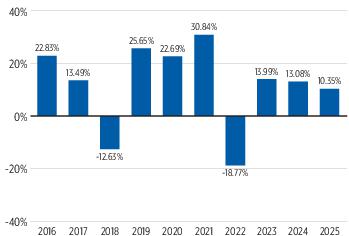
| Highest Quarter: |
31.43% |
– |
4Q 2020 |
| Lowest Quarter: |
-29.79% |
– |
1Q 2020 |
Summary Prospectus April 30, 2026
4
NVIT Multi-Manager
Small Company Fund
Average Annual Total
Returns
(For the Periods Ended December 31, 2025)
(For the Periods Ended December 31, 2025)
| |
1 Year |
5 Years |
10 Years |
| Class I Shares |
10.35% |
8.62% |
11.00% |
| Class II Shares |
10.05% |
8.34% |
10.72% |
| Class IV Shares |
10.37% |
8.61% |
11.00% |
| Russell 3000® Index (reflects no deduction for
fees or expenses) |
17.15% |
13.15% |
14.29% |
| Russell 2000® Index (reflects no deduction for
fees or expenses) |
12.81% |
6.09% |
9.62% |
Portfolio Management
Investment Adviser
Nationwide Fund Advisors
Subadvisers
Jacobs Levy Equity Management, Inc. (“Jacobs Levy”)
Invesco Advisers, Inc. (“Invesco”)
Invesco Advisers, Inc. (“Invesco”)
Portfolio Managers
| Portfolio Manager |
Title |
Length of Service with Fund |
| Jacobs Levy | ||
| Bruce I. Jacobs, Ph.D. |
Principal, Co-Chief
Investment Officer and
Portfolio Manager of
Jacobs Levy |
Since 2015 |
| Kenneth N. Levy, CFA |
Principal, Co-Chief
Investment Officer and
Portfolio Manager of
Jacobs Levy |
Since 2015 |
| Invesco | ||
| Ronald J. Zibelli, Jr.,
CFA |
Senior Portfolio
Manager (lead) |
Since 2011 |
| Ash Shah, CFA, CPA |
Senior Portfolio
Manager |
Since 2014 |
| Justin Livengood, CFA |
Senior Portfolio
Manager |
Since 2026 |
Tax Information
The dividends and distributions paid by the Fund to the insurance company separate accounts will consist of ordinary income, capital gains, or some combination of both. Because shares of the Fund must be purchased through separate accounts used to fund variable insurance contracts, such dividends and distributions will be exempt from current taxation by contract holders if left to accumulate within a separate account. Consult the variable insurance contract
prospectus for additional tax information.
Payments to Broker-Dealers and Other Financial Intermediaries
This Fund is only offered as an underlying investment option for variable insurance contracts. The Fund and its related
companies may make payments to the sponsoring insurance companies (or their affiliates) for distribution and/or
other services, and to broker-dealers and other financial intermediaries that distribute the variable insurance
contracts. These payments may create a conflict of interest by influencing the insurance companies to include
the Fund as an underlying investment option in the variable insurance contracts, and by influencing the
broker-dealers and other financial intermediaries to distribute variable insurance contracts that include the
Fund as an underlying investment option over other variable insurance contracts or to otherwise recommend the
selection of the Fund as an underlying investment option by contract owners instead of other funds that also
may be available investment options. The prospectus (or other offering document) for your variable insurance
contract may contain additional information about these payments.
Summary Prospectus April 30, 2026
5
NVIT Multi-Manager Small Company Fund