EMPOWER FUNDS, INC.
(“Empower Funds”)
Empower S&P Small Cap 600® Index Fund
Institutional Class Ticker: MXERX
Investor Class Ticker: MXISX
Class L Ticker: MXNSX
(the “Fund”)
Summary Prospectus
April 30, 2026
Before you invest, you may want to review the Fund’s Prospectus, which contains more information about the Fund and its
risks. You can find the Fund’s Prospectus and other information about the Fund, including the Statement of Additional
Information and most recent reports to shareholders, online at www.empower.com/investments/empower-funds/fund-
documents. You can also get this information at no cost by calling (866) 831-7129 or by sending an email request to
empowerfunds@empower.com. The current Prospectus and Statement of Additional Information, both dated April 30, 2026,
are incorporated by reference as a matter of law into this Summary Prospectus, which means they are legally part of this
Summary Prospectus.
Fund shares are sold to insurance company separate accounts for certain variable annuity contracts and variable life insurance
policies (“variable contracts”), to individual retirement account (“IRA”) custodians or trustees, to plan sponsors of qualified
retirement plans (“retirement plans”), and to college savings programs (collectively, “Permitted Accounts”), and to asset
allocation funds that are series of Empower Funds. This Summary Prospectus is not intended for use by other investors. This
Summary Prospectus should be read together with the prospectus or disclosure document for the Permitted Account.
Investment Objective
The Fund seeks investment results that track the total return of the common stocks that comprise the Standard & Poor’s (“S&P”) SmallCap 600® Index (the “Benchmark Index”).
Fees and Expenses of the Fund
This table describes the fees and expenses that you may pay if you buy, hold and sell shares of the Fund. This table does not reflect the fees and expenses of any Permitted Account. If the fees and expenses of a Permitted Account were reflected, the fees and expenses shown below would be higher.
Annual Fund Operating Expenses (expenses that you pay each year as a percentage of the value of your investment)
 
Institutional
Class
Investor Class
Class L
Management Fees
0.19%
0.19%
0.19%
Distribution and Service (12b-1) Fees
0.00%
0.00%
0.25%
Total Other Expenses
0.03%
0.38%
0.47%
Shareholder Services Fees
0.00%
0.35%
0.35%
Other Expenses
0.03%
0.03%
0.12%
Total Annual Fund Operating Expenses
0.22%
0.57%
0.91%
Fee Waiver and Expense Reimbursement1
0.01%
0.01%
0.10%
Total Annual Fund Operating Expenses After Fee Waiver and Expense
Reimbursement
0.21%
0.56%
0.81%
1
The investment adviser has contractually agreed to waive management fees or reimburse expenses if Total Annual Fund Operating Expenses of any Class exceed 0.21% of the Class's average daily net assets, excluding Distribution and Service (12b-1) Fees, Shareholder Services Fees, brokerage expenses, taxes, dividend interest on short sales, interest expenses, and any extraordinary expenses, including litigation costs (the “Expense Limit”). The agreement’s current term ends on April 30, 2027, and automatically renews for one-year terms unless it is terminated upon termination of the investment advisory agreement or by Empower Funds or the investment adviser upon written notice within 90 days of the end of the current term. Under the agreement, the investment adviser may recoup, subject to the approval of the Board of Directors of Empower Funds, these waivers and reimbursements in future periods, not exceeding three years following the particular waiver/reimbursement, provided Total Annual Fund Operating Expenses of the Class plus such recoupment do not exceed the lesser of the Expense Limit that was in place at the time of the waiver/reimbursement or the Expense Limit in place at the time of recoupment.

1 

Example
This Example is intended to help you compare the cost of investing in the Fund with the cost of investing in other mutual funds. The Example does not reflect the fees and expenses of any Permitted Account. If the fees and expenses of any Permitted Account were reflected, the fees and expenses in the Example would be higher.
The Example assumes that you invest $10,000 in the Fund for the time periods indicated and then redeem all of your shares at the end of each period. The Example also assumes that the Expense Limit is in place for the first year, that your investment has a 5% return each year, that all dividends and capital gains are reinvested, and that the Fund’s operating expenses are the amount shown in the fee table and remain the same for the years shown. Although your actual costs may be higher or lower, based on these assumptions, your costs would be:
 
1 Year
3 Years
5 Years
10 Years
Institutional Class
$22
$70
$123
$279
Investor Class
$57
$182
$317
$713
Class L
$83
$280
$494
$1,110
Portfolio Turnover
The Fund pays transaction costs, such as commissions, when it buys and sells securities (or “turns over” its portfolio). A higher portfolio turnover rate generally indicates higher transaction costs. These costs, which are not reflected in annual fund operating expenses or in the example, affect the Fund’s performance. During the most recent fiscal year, the Fund’s turnover rate was 34% of the average value of its portfolio.
Principal Investment Strategies
Below is a summary of the principal investment strategies of the Fund.
The Fund is not actively managed but is designed to track the performance of its Benchmark Index. The Fund will, under normal circumstances, invest at least 80% of its net assets (plus the amount of any borrowings for investment purposes) in common stocks of the companies included in the Benchmark Index. The Benchmark Index is designed to measure the performance of 600 small-size companies and represents the small cap segment of the U.S. equities market.
The Fund uses the replication method of indexing, meaning the Fund seeks to own the securities contained in the Benchmark Index in as close as possible a proportion of the Fund as each stock’s weight in the Benchmark Index.
The Fund may focus its investments in certain sectors, such as the financial sector, to the extent that the Benchmark Index is concentrated in that sector. The Fund may also invest in derivatives, including but not limited to futures contracts on the Benchmark Index and options on futures contracts.
Empower Capital Management, LLC (“ECM”) is the Fund’s investment adviser and, subject to the approval of the Board of Directors of Empower Funds (the “Board”), selects the Fund’s sub-adviser and monitors its performance on an ongoing basis. The Fund’s investment portfolio is managed by Keyridge Asset Management Limited (the “Sub-Adviser” or “Keyridge”), formerly known as Irish Life Investment Managers Limited.
Principal Investment Risks
Below is a summary of the principal investment risks of investing in the Fund. These risks are presented in an order that reflects ECM’s current assessment of relative importance, but this assessment could change over time as the Fund’s portfolio changes or in light of changes in the market or the economic environment. The Fund is not required to and will not update this Prospectus solely because its assessment of the relative importance of the principal risks of investing in the Fund changes. There can be no assurance that the Fund will achieve its investment objective.
Equity Securities Risk - The value of equity securities held by the Fund may decline as a result of factors directly related to a company, a particular industry or industries, or general market conditions that are not specifically related to a company or an industry.
Market Risk - The value of the Fund’s investments may decrease, sometimes rapidly or unexpectedly, due to factors affecting (or perceived to affect) specific issuers held by the Fund, particular industries represented in the Fund’s portfolio, or the overall securities markets. A variety of factors can increase the volatility of the Fund’s holdings and markets generally, including political or regulatory developments, recessions, inflation, deflation, rapid interest rate changes, bank failures, war or acts of terrorism, sanctions, tariffs, natural disasters, outbreaks of infectious illnesses or other widespread public health issues, general outlook for corporate earnings, or adverse investor sentiment generally. Certain events may cause instability across global markets, including
2 

reduced liquidity and disruptions in trading markets, while some events may affect certain geographic regions, countries, sectors and industries more significantly than others. These adverse developments may cause broad declines in an issuer’s value due to short-term market movements or for significantly longer periods during more prolonged market downturns.
Small-Size Company Risk - The stocks of small-size companies often trade in lower volumes, may be less liquid, and are subject to greater or more unpredictable price changes than stocks of larger companies. Such companies may also have limited markets, financial resources or product lines, may lack management depth, and may be more vulnerable to adverse business or market developments. Accordingly, stocks of small-size companies tend to be more sensitive to changing economic, market, and industry conditions, tend to be more volatile and less liquid than stocks of larger companies, especially over the short term, and are less likely to survive or accomplish their goals, with the result that the value of their stock could decline significantly. In addition, there may be less publicly available information concerning small-size companies upon which to base an investment decision.
Sector Risk - The Fund may invest a significant portion of its assets in companies within a particular sector, and its performance may suffer if that sector underperforms the overall market.
Index Risk - Because the Fund is not actively managed but is designed to track the performance of the Benchmark Index, investors should generally expect the value of the Fund to decline when the performance of the Benchmark Index declines. There is no guarantee that the Fund will achieve a high degree of correlation to the Benchmark Index. Additionally, the Benchmark Index may perform unfavorably or underperform the market as a whole. As a result, the Fund may have poor investment results even if it closely tracks the performance of the Benchmark Index because the adverse performance of a particular security normally will not result in eliminating the security from the Fund.
Real Estate Investment Trust/Real Estate Risk - The Benchmark Index includes real estate investment trusts (“REITs”). Investments in real estate-related instruments may be affected by similar risks as direct investment in real estate and the real estate market generally, including economic, legal, cultural, governmental, environmental or technological factors that affect property values, rents or occupancies of real estate. Historically, the real estate industry has been cyclical and particularly sensitive to economic downturns and other events that limit demand for real estate, which would adversely impact the value of real estate investments. Real estate companies, including REITs or similar structures, tend to be small and mid cap companies, which means their shares may be more volatile and less liquid. REITs and real estate-related companies may not be diversified due to ownership of a limited number of properties or concentration in a particular geographic region or property type. REITs are also subject to risks associated with changes in interest rates.
Tracking Error Risk - The Fund may not be able to precisely track the performance of the Benchmark Index. Unlike the Fund, the performance of the Benchmark Index is not impacted by fees and expenses, including trading costs associated with implementing portfolio changes. In addition, the Fund may own less than all the securities of the Benchmark Index, which also may cause a variance between the performance of the Fund and the performance of the Benchmark Index. Tracking error risk may cause the Fund’s performance to be less than expected.
Derivatives Risk - The use of derivatives, including but not limited to futures contracts on the Benchmark Index and options on futures contracts, may expose the Fund to additional risks that it would not be subject to if it invested directly in the securities underlying those derivatives. These risks include imperfect correlations with underlying investments or the Fund’s other portfolio holdings, magnified losses resulting from leverage, counterparty risk, high price volatility, liquidity risk, segregation risk, valuation risk and legal restrictions.
Management Risk - A strategy, investment decision, technique, analysis, or model used by the portfolio managers may fail to produce the intended results, or imperfections, errors or limitations in the tools and data used by the portfolio managers may cause unintended results. Therefore, the Fund could underperform in comparison to other funds with similar objectives and investment strategies and may generate losses even in a favorable market.
An investment in the Fund is not a deposit with a bank, is not insured, endorsed or guaranteed by the Federal Deposit Insurance Corporation or any government agency, and is subject to the possible loss of your original investment.
Performance
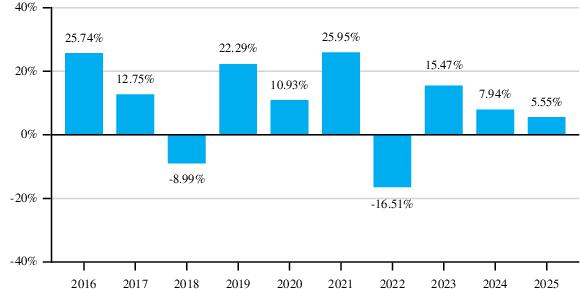
The bar chart and table below provide an indication of the risk of investment in the Fund by showing changes in the performance of the Fund’s Investor Class shares for the last ten calendar years and by comparing the Fund’s average annual total returns to the performance of a broad-based securities market index and the Benchmark Index, which has investment characteristics similar to those of the Fund. The returns shown below are historical and are not an indication of future performance. Total return figures

3 

assume reinvestment of dividends and capital gains distributions and include the effect of the Fund’s recurring expenses, but do not include the fees and expenses of any Permitted Account. If the fees and expenses of any Permitted Account were reflected, the performance shown would be lower.
Updated performance information may be obtained at www.empower.com/investments/empower-funds/fund-documents (the website does not form a part of this Prospectus).
Calendar Year Total Returns
 
Quarter Ended
Total Return
Best Quarter
December 31, 2020
31.26%
Worst Quarter
March 31, 2020
-32.71%
Average Annual Total Returns for the Periods Ended December 31, 2025
 
One
Year
Five
Years
Ten
Years
Institutional Class
5.83%
7.08%
9.63%
Investor Class
5.55%
6.70%
9.24%
Class L
5.17%
6.41%
8.97%
Russell 3000® Index (reflects no deduction for fees, expenses or taxes)
17.15%
13.15%
14.29%
S&P SmallCap 600® Index (reflects no deduction for fees, expenses or taxes)
6.02%
7.31%
9.81%
Investment Adviser
ECM
Sub-Adviser
Keyridge
Portfolio Managers
Name
Title
Portfolio Manager of the
Fund Since
Nicola Dowdall
Head of ETFs & Affiliates
2016
Michael Lynch, CFA
Head of Index Solutions
2016
Peter Leonard, CFA
Head of Indexation Equity
2016

4 

Purchase and Sale of Fund Shares
The Fund is not sold directly to the general public, but instead may be offered as an underlying investment for Permitted Accounts. Permitted Accounts may place orders on any business day to purchase and redeem shares of the Fund based on instructions received from owners of variable contracts or IRAs, or from participants of retirement plans or college savings programs. Please contact your registered representative, IRA custodian or trustee, retirement plan sponsor or administrator, or college savings program for information concerning the procedures for purchasing and redeeming shares of the Fund.
The Fund does not have any initial or subsequent investment minimums. However, Permitted Accounts may impose investment minimums.
Tax Information
Currently, Permitted Accounts generally are not subject to federal income tax on any Fund distributions. Owners of variable contracts, retirement plan participants and IRA owners are also generally not subject to federal income tax on Fund distributions until such amounts are withdrawn from the variable contract, retirement plan or IRA. Distributions from a college savings program generally are not taxed provided that they are used to pay for qualified higher education expenses. More information regarding federal taxation of Permitted Account owners may be found in the prospectus or disclosure documents for that Permitted Account.
Payments to Insurers, Broker-Dealers and Other Financial Intermediaries
Companies related to the Fund may make payments to insurance companies, broker-dealers and other financial intermediaries for the sale of Fund shares and other services. These payments may be a factor that an insurance company, broker-dealer or other financial intermediary considers when including the Fund as an investment option in a Permitted Account. These payments also may create a conflict of interest by influencing the broker-dealer or other intermediary and your salesperson to recommend the Fund over another investment. Ask your salesperson, visit your financial intermediary’s website, or consult the variable contract prospectus for more information.

5