
April 28, 2026
Summary Prospectus

Vanguard Mid-Cap Index Fund
Institutional Shares & Institutional Plus Shares
Vanguard Mid-Cap Index Fund Institutional Shares (VMCIX)
Vanguard Mid-Cap Index Fund Institutional Plus Shares (VMCPX)
The Fund’s statutory Prospectus and Statement of Additional Information dated April 28, 2026, as may be amended or supplemented, are incorporated into and made part of this Summary Prospectus by reference.
Before you invest, you may want to review the Fund’s Prospectus, which contains more information about the Fund and its risks. You can find the Fund’s Prospectus and other information about the Fund online at www.vanguard.com/prospectus and https://personal.vanguard.com/us/literature/reports/MFs. You can also obtain this information at no cost by calling 800-662-7447 (if you are an individual investor) or 800-523-1036 (if you are a client of Vanguard’s Institutional Division) or by sending an email request to online@vanguard.com.
The Securities and Exchange Commission (SEC) has not approved or disapproved these securities or passed upon the adequacy of this Prospectus. Any representation to the contrary is a criminal offense.
Investment Objective
Vanguard Mid-Cap Index Fund (the “Fund”) seeks to track the performance of a benchmark index that measures the investment return of mid-capitalization stocks.
Fees and Expenses
The following tables describe the fees and expenses you may pay if you buy, hold, and sell Institutional Shares or Institutional Plus Shares of the Fund. You may pay other fees, such as brokerage commissions and other fees to financial intermediaries, which are not reflected in the tables and examples below.
Shareholder Fees
(Fees paid directly from your investment)
 
Institutional Shares
Institutional Plus Shares
Sales Charge (Load) Imposed on Purchases
None
None
Purchase Fee
None
None
Sales Charge (Load) Imposed on
Reinvested Dividends
None
None
Redemption Fee
None
None
Annual Fund Operating Expenses
(Expenses that you pay each year as a percentage of the value of your investment)
 
Institutional Shares
Institutional Plus Shares
Management Fees
0.03
%
0.02%
12b-1 Distribution Fee
None
None
Other Expenses
0.00
%
0.00%
Total Annual Fund Operating Expenses1
0.03
%
0.02%
1
The expense information shown in the table has been restated to reflect current fees.
Examples
These examples are intended to help you compare the cost of investing in the Fund with the cost of investing in other funds. The examples assume that you invest $10,000 in the Fund for the time periods indicated and then redeem all of your shares at the end of those periods. The examples also assume that your investment has a 5% return each year and that the Fund’s operating expenses remain the same.
 
1 Year
3 Years
5 Years
10 Years
Institutional Shares
$3
$10
$17
$39
Institutional Plus Shares
$2
$6
$11
$26
1

Portfolio Turnover
The Fund pays transaction costs, such as commissions, when it buys and sells securities (or “turns over” its portfolio). A higher portfolio turnover rate may indicate higher transaction costs and may result in higher taxes when Fund shares are held in a taxable account. These costs, which are not reflected in annual fund operating expenses or in the examples, affect the Fund’s performance. During the most recent fiscal year, the Fund’s portfolio turnover rate was 16% of the average value of its portfolio.
Principal Investment Strategies
The Fund employs an indexing investment approach designed to track the performance of the CRSP US Mid Cap Index (the “Target Index”), a broadly diversified index of stocks of mid-size U.S. companies, as determined by the index provider. Under normal circumstances, the Fund invests at least 80% of its net assets, plus the amount of any borrowings for investment purposes, in the stocks that make up the Target Index. The Fund attempts to replicate the Target Index by investing all, or substantially all, of its assets in the stocks that make up the Target Index, holding each stock in approximately the same proportion as its weighting in the Target Index.
Principal Risks
As with any investment, an investment in the Fund could lose money over any time period. The Fund’s share price and total return may fluctuate, potentially within a wide range. The principal risks of investing in the Fund are summarized below. Each of the following risks could affect the Fund’s performance:
• General Market Risk. The markets in which the Fund invests can be affected by a variety of factors. These factors, which can be real or perceived, may include economic, market, political, and regulatory conditions and developments as well as local, regional, or global events such as wars, military conflicts, natural disasters, and public health issues. In addition, investor sentiment and expectations regarding these factors can also impact the markets. Different parts of the market, including different industries and sectors as well as different types of securities, may react differently to factors that affect the market. These factors can contribute to market uncertainty, market volatility, and fluctuations in the value of the Fund’s investments, thereby resulting in potential losses to the Fund over short or long periods.
• Investing in Equity Markets. The Fund invests in the equity markets. Equity markets have historically been cyclical, having periods of time when stock values rise and fall. Market volatility can lead to significant fluctuations in stock values, resulting in potential losses to the Fund.
• Market Capitalization (Market Cap). Companies are generally classified into three types of market cap depending on their size: small-, mid-, and large-cap. Companies can be further classified into micro- or mega-cap.
2

Different factors can affect each market cap uniquely, and historically small- and mid-cap stocks have typically been more volatile due to the effects of changing economic conditions. Large companies may not reach the same levels of growth or performance as smaller companies, and they may be slower to react to competitive challenges. The performance of funds that invest in a subset of market caps could diverge from the performance of a fund that is focused on a broader representation of the stock market.
• Index Investing. The Fund is subject to risks associated with index investing. Because the Fund generally seeks to track the performance of the Target Index regardless of how the Target Index is performing, the Fund’s performance may be lower than it would be if it were actively managed. Although the Fund seeks to hold substantially all of the securities included in the Target Index, it may be unable to do so. In addition, the Fund could be prevented from holding one or more securities in the same proportion as in the Target Index. The performance of the Fund’s investments, in the aggregate, may not match the investment performance of the Target Index. This risk, known as tracking error risk, may be heightened during times of increased market volatility or under other unusual market conditions. The Fund also could be negatively impacted by changes to the Target Index made by the index provider or by errors made by the index provider. Any gains, losses, or costs associated with or resulting from an error made by the index provider will generally be borne by the Fund and, as a result, the Fund’s shareholders.
• Concentration Risk. Except as may be necessary to approximate the composition of its Target Index, the Fund will not concentrate its investments in the securities of issuers whose principal business activities are in the same industry or group of industries. If the Target Index becomes concentrated and the Fund needs to concentrate in the same industry or group of industries, its performance could be negatively impacted by the industry or industries in which it is concentrated.
An investment in the Fund is not a deposit of a bank and is not insured or guaranteed by the Federal Deposit Insurance Corporation or any other government agency.
Annual Total Returns
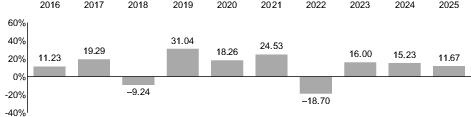
The following bar chart and table show the Fund’s historical performance and are intended to help you understand the risks of investing in the Fund. The bar chart shows how the performance of the Fund’s Institutional Shares has varied from one calendar year to another over the periods shown. The table shows how the average annual total returns of the share classes presented compare with those of a broad-based securities market index and one or more additional indexes with similar investment characteristics as the Fund. Keep in mind that
3

the Fund’s past performance (before and after taxes) does not indicate how the Fund will perform in the future. Updated performance information is available on our website at vanguard.com/performance.
Annual Total Returns — Vanguard Mid-Cap Index Fund Institutional Shares
During the periods shown in the bar chart, the highest and lowest returns for a calendar quarter were:
 
Total Return
Quarter
Highest
24.96
%
June 30, 2020
Lowest
-25.71
%
March 31, 2020
Average Annual Total Returns for Periods Ended December 31, 2025
 
1 Year
5 Years
10 Years
Vanguard Mid-Cap Index Fund Institutional Shares
Return Before Taxes
11.67
%
8.61
%
10.92
%
Return After Taxes on Distributions
11.23
8.19
10.48
Return After Taxes on Distributions and Sale of
Fund Shares
7.17
6.71
8.92
Vanguard Mid-Cap Index Fund Institutional Plus Shares
Return Before Taxes
11.69
%
8.62
%
10.94
%
CRSP US Mid Cap Index
(reflects no deduction for fees, expenses, or taxes)
11.70
%
8.62
%
10.94
%
Dow Jones U.S. Total Stock Market Float Adjusted
Index
(reflects no deduction for fees, expenses, or taxes)
17.05
13.07
14.21
Actual after-tax returns depend on your tax situation and may differ from those shown in the preceding table. When after-tax returns are calculated, it is assumed that the shareholder was in the highest individual federal marginal income tax bracket at the time of each distribution of income or capital gains or upon redemption. State and local income taxes are not reflected in the calculations. Please note that after-tax returns are shown only for the Institutional Shares and may differ for each share class. After-tax returns are not relevant for a shareholder who holds fund shares in a tax-deferred account, such as an individual retirement account or a 401(k) plan. Also, figures
4

captioned Return After Taxes on Distributions and Sale of Fund Shares may be higher than other figures for the same period if a capital loss occurs upon redemption and results in an assumed tax deduction for the shareholder.
Investment Advisor
The Vanguard Group, Inc. (Vanguard) through its wholly owned subsidiary, Vanguard Portfolio Management (VPM). VPM exercises portfolio management responsibilities for the Fund.
Portfolio Managers
Aaron Choi, CFA, Portfolio Manager at VPM. He has co-managed the Fund since 2023.
Kenny Narzikul, CFA, Portfolio Manager at VPM. He has co-managed the Fund since 2025.
Purchase and Sale of Fund Shares
If you invest directly with Vanguard, you may purchase or redeem shares online through our website (vanguard.com), by mail (The Vanguard Group, P.O. Box 982901, El Paso, TX 79998-2901), or by telephone (800-662-2739) . The minimum investment amount required to open a Fund account for Institutional Shares or Institutional Plus Shares is generally $5 million or $100 million, respectively. The minimum investment amount required to add to an existing Fund account is generally $1.

If you invest in Vanguard fund shares through an employer-sponsored retirement or savings plan, your plan administrator or your benefits office can provide you with detailed information on how you can invest through your plan.
Tax Information
The Fund’s distributions may be taxable as ordinary income or capital gains. If you are investing through a tax-advantaged account, such as an IRA or an employer-sponsored retirement or savings plan, special tax rules apply. You should consult your own tax advisor with respect to any particular U.S. or non-U.S. tax consequences of your investment in the Fund.
Payments to Financial Intermediaries
The Fund and its advisor do not pay financial intermediaries for sales of Fund shares.
5

This page intentionally left blank.

CFA® is a registered trademark owned by CFA Institute.
Center for Research in Security Prices, LLC (CRSP®) and its third-party suppliers have exclusive proprietary rights in the CRSP® Index Data, which has been licensed for use by Vanguard but is and shall remain valuable intellectual property owned by, and/or licensed to, CRSP®. The Vanguard Funds are not sponsored, endorsed, sold or promoted by CRSP®, The University of Chicago, or The University of Chicago Booth School of Business and neither CRSP®, The University of Chicago, or The University of Chicago Booth School of Business, make any representation regarding the advisability of investing in the Vanguard Funds.
Vanguard Mid-Cap Index Fund Institutional Shares—Fund Number 864
Vanguard Mid-Cap Index Fund Institutional Plus Shares—Fund Number 1859
To request additional information about the Fund, please visit vanguard.com or contact us at 800-662-7447 (if you are an individual investor) or 800-523-1036 (if you are a client of Vanguard’s Institutional Division).
© 2026 The Vanguard Group, Inc. All rights reserved.
Vanguard Marketing Corporation, Distributor.
SPI 864 042026