0000005981falseDEF 14A0000005981avd:EricGWintemuteMemberecd:DvddsOrOthrErngsPdOnEqtyAwrdsNtOthrwsRflctdInTtlCompForCvrdYrMemberecd:PeoMember2023-01-012023-12-310000005981avd:DouglasAKayeMemberecd:PnsnAdjsSvcCstMemberecd:PeoMember2025-01-012025-12-310000005981ecd:NonPeoNeoMemberecd:YrEndFrValOfEqtyAwrdsGrntdInCvrdYrOutsdngAndUnvstdMember2022-01-012022-12-310000005981ecd:NonPeoNeoMemberecd:FrValAsOfPrrYrEndOfEqtyAwrdsGrntdInPrrYrsFldVstngCondsDrngCvrdYrMember2025-01-012025-12-310000005981ecd:YrEndFrValOfEqtyAwrdsGrntdInCvrdYrOutsdngAndUnvstdMemberavd:DouglasAKayeMemberecd:PeoMember2024-01-012024-12-31000000598132025-01-012025-12-310000005981ecd:FrValAsOfPrrYrEndOfEqtyAwrdsGrntdInPrrYrsFldVstngCondsDrngCvrdYrMemberavd:DouglasAKayeMemberecd:PeoMember2024-01-012024-12-310000005981avd:EricGWintemuteMemberecd:EqtyAwrdsAdjsMemberecd:PeoMember2022-01-012022-12-310000005981ecd:NonPeoNeoMemberecd:ChngInFrValAsOfVstngDtOfPrrYrEqtyAwrdsVstdInCvrdYrMember2024-01-012024-12-3100000059812023-01-012023-12-310000005981ecd:ChngInFrValAsOfVstngDtOfPrrYrEqtyAwrdsVstdInCvrdYrMemberavd:DouglasAKayeMemberecd:PeoMember2024-01-012024-12-31000000598112025-01-012025-12-310000005981avd:DouglasAKayeMemberecd:EqtyAwrdsAdjsMemberecd:PeoMember2024-01-012024-12-310000005981avd:EricGWintemuteMemberecd:EqtyAwrdsAdjsMemberecd:PeoMember2023-01-012023-12-310000005981ecd:AggtChngPnsnValInSummryCompstnTblForAplblYrMemberavd:EricGWintemuteMemberecd:PeoMember2022-01-012022-12-3100000059812024-01-012024-12-310000005981ecd:NonPeoNeoMemberecd:AggtPnsnAdjsSvcCstMember2022-01-012022-12-310000005981avd:EricGWintemuteMember2022-01-012022-12-310000005981ecd:NonPeoNeoMemberecd:EqtyAwrdsAdjsMember2021-01-012021-12-310000005981ecd:NonPeoNeoMemberecd:YrEndFrValOfEqtyAwrdsGrntdInCvrdYrOutsdngAndUnvstdMember2024-01-012024-12-310000005981ecd:VstngDtFrValOfEqtyAwrdsGrntdAndVstdInCvrdYrMemberavd:EricGWintemuteMemberecd:PeoMember2023-01-012023-12-310000005981ecd:NonPeoNeoMemberecd:DvddsOrOthrErngsPdOnEqtyAwrdsNtOthrwsRflctdInTtlCompForCvrdYrMember2025-01-012025-12-310000005981avd:DouglasAKayeMemberecd:DvddsOrOthrErngsPdOnEqtyAwrdsNtOthrwsRflctdInTtlCompForCvrdYrMemberecd:PeoMember2024-01-012024-12-310000005981ecd:NonPeoNeoMemberecd:EqtyAwrdsAdjsMember2024-01-012024-12-310000005981ecd:NonPeoNeoMemberecd:DvddsOrOthrErngsPdOnEqtyAwrdsNtOthrwsRflctdInTtlCompForCvrdYrMember2021-01-012021-12-310000005981ecd:AggtPnsnAdjsSvcCstMemberavd:DouglasAKayeMemberecd:PeoMember2024-01-012024-12-310000005981ecd:ChngInFrValAsOfVstngDtOfPrrYrEqtyAwrdsVstdInCvrdYrMemberavd:EricGWintemuteMemberecd:PeoMember2021-01-012021-12-310000005981ecd:NonPeoNeoMemberecd:PnsnAdjsSvcCstMember2025-01-012025-12-310000005981ecd:NonPeoNeoMemberecd:PnsnAdjsSvcCstMember2021-01-012021-12-310000005981ecd:AggtPnsnAdjsSvcCstMemberavd:DouglasAKayeMemberecd:PeoMember2025-01-012025-12-310000005981avd:DouglasAKayeMemberecd:DvddsOrOthrErngsPdOnEqtyAwrdsNtOthrwsRflctdInTtlCompForCvrdYrMemberecd:PeoMember2025-01-012025-12-310000005981ecd:ChngInFrValAsOfVstngDtOfPrrYrEqtyAwrdsVstdInCvrdYrMemberavd:DouglasAKayeMemberecd:PeoMember2025-01-012025-12-310000005981ecd:AggtChngPnsnValInSummryCompstnTblForAplblYrMemberecd:NonPeoNeoMember2021-01-012021-12-310000005981ecd:NonPeoNeoMemberecd:EqtyAwrdsAdjsMember2025-01-012025-12-310000005981ecd:NonPeoNeoMemberecd:EqtyAwrdsAdjsMember2023-01-012023-12-310000005981ecd:NonPeoNeoMemberecd:FrValAsOfPrrYrEndOfEqtyAwrdsGrntdInPrrYrsFldVstngCondsDrngCvrdYrMember2021-01-012021-12-310000005981ecd:NonPeoNeoMemberecd:YrEndFrValOfEqtyAwrdsGrntdInCvrdYrOutsdngAndUnvstdMember2025-01-012025-12-310000005981ecd:AggtChngPnsnValInSummryCompstnTblForAplblYrMemberecd:NonPeoNeoMember2024-01-012024-12-310000005981ecd:VstngDtFrValOfEqtyAwrdsGrntdAndVstdInCvrdYrMemberavd:EricGWintemuteMemberecd:PeoMember2022-01-012022-12-310000005981ecd:VstngDtFrValOfEqtyAwrdsGrntdAndVstdInCvrdYrMemberavd:DouglasAKayeMemberecd:PeoMember2024-01-012024-12-310000005981ecd:NonPeoNeoMemberecd:FrValAsOfPrrYrEndOfEqtyAwrdsGrntdInPrrYrsFldVstngCondsDrngCvrdYrMember2024-01-012024-12-31000000598122025-01-012025-12-310000005981ecd:AggtChngPnsnValInSummryCompstnTblForAplblYrMemberavd:DouglasAKayeMemberecd:PeoMember2024-01-012024-12-310000005981ecd:NonPeoNeoMemberecd:AggtPnsnAdjsSvcCstMember2024-01-012024-12-310000005981avd:EricGWintemuteMember2021-01-012021-12-310000005981avd:DouglasAKayeMember2025-01-012025-12-310000005981ecd:NonPeoNeoMemberecd:ChngInFrValOfOutsdngAndUnvstdEqtyAwrdsGrntdInPrrYrsMember2024-01-012024-12-310000005981ecd:FrValAsOfPrrYrEndOfEqtyAwrdsGrntdInPrrYrsFldVstngCondsDrngCvrdYrMemberavd:EricGWintemuteMemberecd:PeoMember2021-01-012021-12-310000005981ecd:FrValAsOfPrrYrEndOfEqtyAwrdsGrntdInPrrYrsFldVstngCondsDrngCvrdYrMemberavd:EricGWintemuteMemberecd:PeoMember2022-01-012022-12-310000005981ecd:NonPeoNeoMemberecd:AggtPnsnAdjsSvcCstMember2020-01-012020-12-310000005981ecd:NonPeoNeoMemberecd:FrValAsOfPrrYrEndOfEqtyAwrdsGrntdInPrrYrsFldVstngCondsDrngCvrdYrMember2023-01-012023-12-310000005981ecd:NonPeoNeoMemberecd:ChngInFrValAsOfVstngDtOfPrrYrEqtyAwrdsVstdInCvrdYrMember2023-01-012023-12-3100000059812024-01-012024-07-120000005981avd:DouglasAKayeMemberecd:EqtyAwrdsAdjsMemberecd:PeoMember2025-01-012025-12-310000005981ecd:NonPeoNeoMemberecd:ChngInFrValOfOutsdngAndUnvstdEqtyAwrdsGrntdInPrrYrsMember2021-01-012021-12-310000005981ecd:NonPeoNeoMemberecd:ChngInFrValAsOfVstngDtOfPrrYrEqtyAwrdsVstdInCvrdYrMember2022-01-012022-12-310000005981ecd:YrEndFrValOfEqtyAwrdsGrntdInCvrdYrOutsdngAndUnvstdMemberavd:DouglasAKayeMemberecd:PeoMember2025-01-012025-12-310000005981ecd:NonPeoNeoMemberecd:PnsnAdjsSvcCstMember2022-01-012022-12-310000005981ecd:NonPeoNeoMemberecd:ChngInFrValOfOutsdngAndUnvstdEqtyAwrdsGrntdInPrrYrsMember2025-01-012025-12-310000005981ecd:NonPeoNeoMemberecd:DvddsOrOthrErngsPdOnEqtyAwrdsNtOthrwsRflctdInTtlCompForCvrdYrMember2023-01-012023-12-3100000059812021-01-012021-12-310000005981ecd:NonPeoNeoMemberecd:AggtChngPnsnValInSummryCompstnTblForAplblYrMember2023-01-012023-12-310000005981ecd:VstngDtFrValOfEqtyAwrdsGrntdAndVstdInCvrdYrMemberavd:EricGWintemuteMemberecd:PeoMember2021-01-012021-12-310000005981ecd:AggtPnsnAdjsSvcCstMemberavd:EricGWintemuteMemberecd:PeoMember2023-01-012023-12-310000005981ecd:AggtChngPnsnValInSummryCompstnTblForAplblYrMemberavd:EricGWintemuteMemberecd:PeoMember2023-01-012023-12-310000005981avd:EricGWintemuteMemberecd:PnsnAdjsSvcCstMemberecd:PeoMember2023-01-012023-12-310000005981ecd:ChngInFrValAsOfVstngDtOfPrrYrEqtyAwrdsVstdInCvrdYrMemberavd:EricGWintemuteMemberecd:PeoMember2022-01-012022-12-310000005981ecd:EqtyAwrdsAdjsExclgValRprtdInSummryCompstnTblMemberavd:EricGWintemuteMemberecd:PeoMember2022-01-012022-12-310000005981ecd:NonPeoNeoMemberecd:VstngDtFrValOfEqtyAwrdsGrntdAndVstdInCvrdYrMember2023-01-012023-12-310000005981ecd:AggtChngPnsnValInSummryCompstnTblForAplblYrMemberavd:DouglasAKayeMemberecd:PeoMember2025-01-012025-12-310000005981ecd:EqtyAwrdsAdjsExclgValRprtdInSummryCompstnTblMemberavd:DouglasAKayeMemberecd:PeoMember2024-01-012024-12-310000005981ecd:NonPeoNeoMemberecd:ChngInFrValOfOutsdngAndUnvstdEqtyAwrdsGrntdInPrrYrsMember2022-01-012022-12-310000005981ecd:NonPeoNeoMemberecd:VstngDtFrValOfEqtyAwrdsGrntdAndVstdInCvrdYrMember2024-01-012024-12-310000005981ecd:EqtyAwrdsAdjsExclgValRprtdInSummryCompstnTblMemberavd:DouglasAKayeMemberecd:PeoMember2025-01-012025-12-310000005981avd:EricGWintemuteMemberecd:ChngInFrValOfOutsdngAndUnvstdEqtyAwrdsGrntdInPrrYrsMemberecd:PeoMember2023-01-012023-12-310000005981ecd:NonPeoNeoMemberecd:PnsnAdjsSvcCstMember2024-01-012024-12-310000005981ecd:AggtChngPnsnValInSummryCompstnTblForAplblYrMemberecd:NonPeoNeoMember2020-01-012020-12-310000005981ecd:NonPeoNeoMemberecd:YrEndFrValOfEqtyAwrdsGrntdInCvrdYrOutsdngAndUnvstdMember2021-01-012021-12-310000005981ecd:AggtChngPnsnValInSummryCompstnTblForAplblYrMemberavd:EricGWintemuteMemberecd:PeoMember2021-01-012021-12-310000005981avd:EricGWintemuteMemberecd:ChngInFrValOfOutsdngAndUnvstdEqtyAwrdsGrntdInPrrYrsMemberecd:PeoMember2021-01-012021-12-3100000059812024-12-092024-12-310000005981ecd:VstngDtFrValOfEqtyAwrdsGrntdAndVstdInCvrdYrMemberavd:DouglasAKayeMemberecd:PeoMember2025-01-012025-12-310000005981avd:EricGWintemuteMemberecd:PnsnAdjsSvcCstMemberecd:PeoMember2021-01-012021-12-3100000059812020-01-012020-12-310000005981ecd:NonPeoNeoMemberecd:AggtPnsnAdjsSvcCstMember2023-01-012023-12-310000005981ecd:NonPeoNeoMemberecd:PnsnAdjsSvcCstMember2020-01-012020-12-3100000059812022-01-012022-12-310000005981ecd:NonPeoNeoMemberecd:EqtyAwrdsAdjsMember2020-01-012020-12-310000005981avd:EricGWintemuteMember2023-01-012023-12-310000005981ecd:EqtyAwrdsAdjsExclgValRprtdInSummryCompstnTblMemberavd:EricGWintemuteMemberecd:PeoMember2023-01-012023-12-310000005981avd:EricGWintemuteMemberecd:EqtyAwrdsAdjsMemberecd:PeoMember2021-01-012021-12-310000005981ecd:EqtyAwrdsAdjsExclgValRprtdInSummryCompstnTblMemberavd:EricGWintemuteMemberecd:PeoMember2021-01-012021-12-310000005981ecd:NonPeoNeoMemberecd:ChngInFrValOfOutsdngAndUnvstdEqtyAwrdsGrntdInPrrYrsMember2023-01-012023-12-310000005981avd:DouglasAKayeMemberecd:ChngInFrValOfOutsdngAndUnvstdEqtyAwrdsGrntdInPrrYrsMemberecd:PeoMember2025-01-012025-12-310000005981ecd:NonPeoNeoMemberecd:VstngDtFrValOfEqtyAwrdsGrntdAndVstdInCvrdYrMember2025-01-012025-12-310000005981ecd:YrEndFrValOfEqtyAwrdsGrntdInCvrdYrOutsdngAndUnvstdMemberavd:EricGWintemuteMemberecd:PeoMember2021-01-012021-12-310000005981ecd:NonPeoNeoMemberecd:VstngDtFrValOfEqtyAwrdsGrntdAndVstdInCvrdYrMember2022-01-012022-12-310000005981ecd:NonPeoNeoMemberecd:EqtyAwrdsAdjsMember2022-01-012022-12-310000005981avd:EricGWintemuteMemberecd:PnsnAdjsSvcCstMemberecd:PeoMember2022-01-012022-12-310000005981ecd:NonPeoNeoMemberecd:AggtPnsnAdjsSvcCstMember2025-01-012025-12-310000005981ecd:NonPeoNeoMemberecd:ChngInFrValAsOfVstngDtOfPrrYrEqtyAwrdsVstdInCvrdYrMember2021-01-012021-12-310000005981ecd:AggtPnsnAdjsSvcCstMemberavd:EricGWintemuteMemberecd:PeoMember2022-01-012022-12-310000005981ecd:NonPeoNeoMemberecd:AggtPnsnAdjsSvcCstMember2021-01-012021-12-310000005981ecd:NonPeoNeoMemberecd:AggtChngPnsnValInSummryCompstnTblForAplblYrMember2025-01-012025-12-310000005981ecd:NonPeoNeoMemberecd:FrValAsOfPrrYrEndOfEqtyAwrdsGrntdInPrrYrsFldVstngCondsDrngCvrdYrMember2022-01-012022-12-310000005981ecd:NonPeoNeoMemberecd:PnsnAdjsSvcCstMember2023-01-012023-12-310000005981avd:DouglasAKayeMember2024-01-012024-12-3100000059812025-01-012025-12-310000005981ecd:NonPeoNeoMemberecd:VstngDtFrValOfEqtyAwrdsGrntdAndVstdInCvrdYrMember2021-01-012021-12-310000005981avd:EricGWintemuteMemberecd:DvddsOrOthrErngsPdOnEqtyAwrdsNtOthrwsRflctdInTtlCompForCvrdYrMemberecd:PeoMember2021-01-012021-12-310000005981ecd:FrValAsOfPrrYrEndOfEqtyAwrdsGrntdInPrrYrsFldVstngCondsDrngCvrdYrMemberavd:EricGWintemuteMemberecd:PeoMember2023-01-012023-12-310000005981ecd:NonPeoNeoMemberecd:YrEndFrValOfEqtyAwrdsGrntdInCvrdYrOutsdngAndUnvstdMember2023-01-012023-12-310000005981ecd:NonPeoNeoMemberecd:AggtChngPnsnValInSummryCompstnTblForAplblYrMember2022-01-012022-12-310000005981ecd:YrEndFrValOfEqtyAwrdsGrntdInCvrdYrOutsdngAndUnvstdMemberavd:EricGWintemuteMemberecd:PeoMember2023-01-012023-12-310000005981ecd:NonPeoNeoMemberecd:ChngInFrValAsOfVstngDtOfPrrYrEqtyAwrdsVstdInCvrdYrMember2025-01-012025-12-310000005981avd:DouglasAKayeMemberecd:ChngInFrValOfOutsdngAndUnvstdEqtyAwrdsGrntdInPrrYrsMemberecd:PeoMember2024-01-012024-12-310000005981ecd:AggtPnsnAdjsSvcCstMemberavd:EricGWintemuteMemberecd:PeoMember2021-01-012021-12-310000005981avd:DouglasAKayeMemberecd:PnsnAdjsSvcCstMemberecd:PeoMember2024-01-012024-12-310000005981ecd:ChngInFrValAsOfVstngDtOfPrrYrEqtyAwrdsVstdInCvrdYrMemberavd:EricGWintemuteMemberecd:PeoMember2023-01-012023-12-310000005981avd:EricGWintemuteMemberecd:ChngInFrValOfOutsdngAndUnvstdEqtyAwrdsGrntdInPrrYrsMemberecd:PeoMember2022-01-012022-12-310000005981ecd:NonPeoNeoMemberecd:DvddsOrOthrErngsPdOnEqtyAwrdsNtOthrwsRflctdInTtlCompForCvrdYrMember2022-01-012022-12-310000005981ecd:FrValAsOfPrrYrEndOfEqtyAwrdsGrntdInPrrYrsFldVstngCondsDrngCvrdYrMemberavd:DouglasAKayeMemberecd:PeoMember2025-01-012025-12-310000005981avd:EricGWintemuteMemberecd:DvddsOrOthrErngsPdOnEqtyAwrdsNtOthrwsRflctdInTtlCompForCvrdYrMemberecd:PeoMember2022-01-012022-12-310000005981ecd:NonPeoNeoMemberecd:DvddsOrOthrErngsPdOnEqtyAwrdsNtOthrwsRflctdInTtlCompForCvrdYrMember2024-01-012024-12-310000005981ecd:YrEndFrValOfEqtyAwrdsGrntdInCvrdYrOutsdngAndUnvstdMemberavd:EricGWintemuteMemberecd:PeoMember2022-01-012022-12-31iso4217:USD
UNITED STATES
SECURITIES AND EXCHANGE COMMISSION
Washington, D.C. 20549
SCHEDULE 14A
Proxy Statement Pursuant to Section 14(a) of the Securities
Exchange Act of 1934 (Amendment No.)
Filed by the Registrant ☒
Filed by a Party other than the Registrant ☐
Check the appropriate box:
☐ Preliminary Proxy Statement
☐ Confidential, for Use of the Commission Only (as permitted by Rule 14a-6(e)(2))
☒ Definitive Proxy Statement
☐ Definitive Additional Materials
☐ Soliciting Material Pursuant to §240.14a-12
AMERICAN VANGUARD CORPORATION
(Name of Registrant as Specified In Its Charter)
(Name of Person(s) Filing Proxy Statement, if other than the Registrant)
Payment of Filing Fee (Check all boxes that apply):
☒ No fee required
☐ Fee paid previously with preliminary materials
☐ Fee computed on table in exhibit required by Item 25(b) per Exchange Act Rules 14a-6(i)(1) and 0-11
AMERICAN VANGUARD CORPORATION
4695 MacArthur Court, Suite 1200
Newport Beach, California 92660
April 23, 2026
NOTICE OF 2026 ANNUAL MEETING OF STOCKHOLDERS
To the Stockholders of American Vanguard Corporation:
Notice is hereby given that the 2026 Annual Meeting of Stockholders (the “Annual Meeting”) of American Vanguard Corporation (the “Company” or “AVD”) will be held on Wednesday, June 3, 2026, at 11:00 am Pacific Time. The Annual Meeting will be a virtual meeting of stockholders. To participate, vote, or submit questions during the Annual Meeting via live webcast, please visit www.virtualshareholdermeeting.com/AVD2026. You will not be able to attend the Annual Meeting in person.
Matters to be voted on at the meeting are:
1. Elect seven (7) directors named in the Proxy Statement as director candidates of the Company, each to serve until their successors are elected and qualified, or until his or her earlier death, resignation or removal;
2. Ratify the appointment of Deloitte & Touche LLP (“Deloitte”) as independent registered public accounting firm for the year ending December 31, 2026;
3. Hold an advisory vote on the frequency of the advisory vote on executive compensation; and
4. Hold an advisory vote on executive compensation.
Our board of directors has fixed Friday, April 10, 2026, as the record date for the determination of stockholders entitled to notice of, and to vote at, the Annual Meeting and any adjournment or postponement thereof. Beginning on or about April 23, 2026, we will send to our stockholders our proxy materials, including an explanation of how to vote your shares and how to attend the Annual Meeting virtually. If you did not receive such Notice electronically, you may elect to receive future notices, proxy materials and annual reports electronically through the Internet by following the instructions in this Proxy Statement. Only stockholders of record at the close of business on the record date are entitled to notice of, and to vote at, the meeting or any adjournment or postponement thereof.
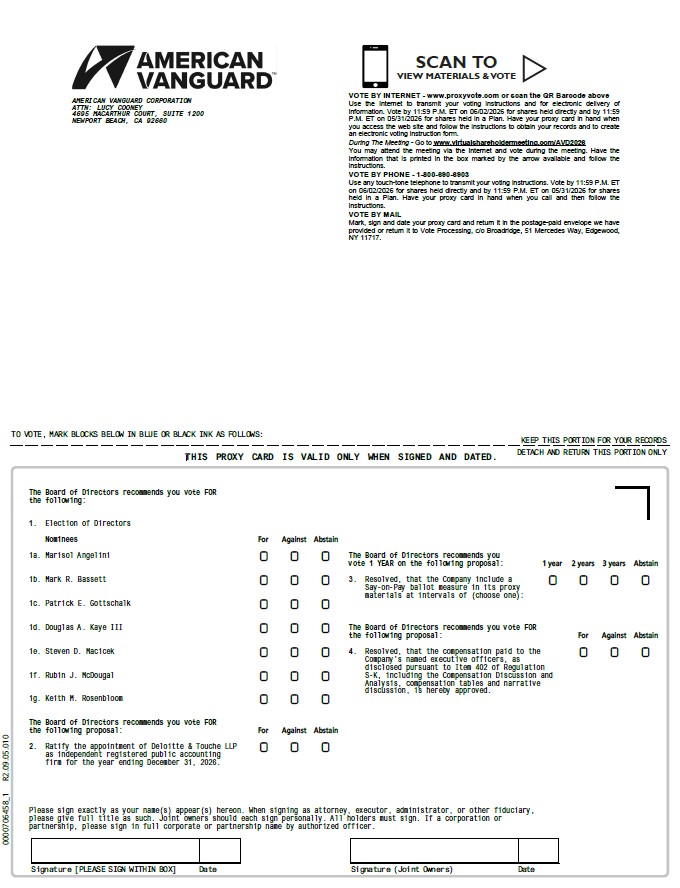
Whether or not you plan to attend the Annual Meeting via live webcast, please vote your shares in one of the following ways, either: (i) by Internet or telephone before the meeting, (ii) by Internet during the meeting, or (iii) by following the instructions on the proxy card, including by marking, dating and signing the proxy card and returning it. Please review the instructions on each voting option as described in this proxy statement.
Important Notice Regarding the Availability of Proxy Materials for the Annual Meeting: The accompanying Proxy Statement and our Annual Report on Form 10-K for the year ended December 31, 2025, are available to view and download at www.proxyvote.com.
We appreciate your continuing interest in American Vanguard Corporation.
By Order of the Board of Directors
Timothy J. Donnelly
Chief Legal Officer
General Counsel & Secretary
Newport Beach, California
April 23, 2026
AMERICAN VANGUARD CORPORATION
4695 MacArthur Court, Suite 1200
Newport Beach, CA 92660
PROXY STATEMENT
Annual Meeting of Stockholders to be held Wednesday, June 3, 2026
Proxy Solicitation by the Board of Directors
The Board of Directors of American Vanguard Corporation (the “Company”) is soliciting proxies to be voted at the Annual Meeting to be held at 11:00 am Pacific on Wednesday, June 3, 2026, via live webcast at www.virtualshareholdermeeting.com/AVD2026. This proxy statement describes proposals on which the Company would like you, as a stockholder, to vote. It also gives you information on these proposals, so that you can make an informed decision. The approximate date on which this Proxy Statement and the enclosed form of proxy are first being sent to stockholders is April 23, 2026.
The Board of Directors of the Company (the “Board of Directors” or the “Board”) has fixed the close of business on Friday April 10, 2026, as the record date for the determination of stockholders entitled to receive notice of, and to vote at, the Annual Meeting (the “Record Date”). At the Record Date, 34,244,580 shares of common stock were issued and outstanding of which 28,541,878 were entitled to vote. Each share of Common Stock entitles its record holder on the Record Date to one vote on all matters.
Important Notice Regarding the Availability of Proxy Materials for the Annual Meeting: The accompanying Proxy Statement and our Annual Report on Form 10-K for the year ended December 31, 2025, are available to view and download at www.proxyvote.com. You are encouraged to access and review all of the important information contained in the proxy materials before voting.
QUESTIONS AND ANSWERS
Can I attend the Annual Meeting?
We will be hosting the Annual Meeting via live webcast on the Internet. You will not be able to attend the meeting in person. Stockholders can attend the Annual Meeting by logging onto www.virtualshareholdermeeting.com/AVD2026 at 11:00 am Pacific Time on Wednesday, June 3, 2026. Stockholders will attend in listen-only mode and will be able to vote and submit written questions while connected to the Annual Meeting on the Internet.
How do I participate in the Annual Meeting online?
You will need to use the 16-digit control number included on your proxy card in order to vote your shares or submit written questions during the meeting. Instructions on how to connect and participate via the Internet (including how to demonstrate your ownership of stock through obtaining a “legal proxy” from your broker, bank or trustee) are posted at www.virtualshareholdermeeting.com/AVD2026.
If you do not have your 16-digit control number, you will be able to listen to the meeting only; without the control number you will not be able to vote or submit questions during the meeting.
Written questions will be addressed as time permits and may be grouped, summarized and answered together if related. If a question posed is not addressed during the Annual Meeting, or if a stockholder has a question or remark not related to an agenda item, such matters may be raised after the Annual Meeting by contacting our Legal Department at timd@amvac.com. Additional rules and procedures related to the submission of questions and how questions will be addressed can be found in the Rules of Conduct, which will be made available during the Annual Meeting on the meeting website.
If you encounter any difficulties while accessing the virtual Annual Meeting or during the check-in or meeting time, a technical assistance phone number will be made available 15 minutes prior to the meeting on the virtual meeting registration page.
Why am I receiving this annual meeting information and proxy?
You are receiving this proxy statement from us because you owned shares of Common Stock of the Company as of the Record Date. This Proxy Statement describes issues on which you are invited to vote and provides you with other important information so that you can make informed decisions.
You may own shares of Common Stock in several different ways. If your stock is represented by one or more stock certificates registered in your name, you have a stockholder account with our transfer agent, Equiniti, which makes you a stockholder of record. If you hold your shares in a brokerage, trust or similar account, you are a beneficial owner, not a stockholder of record.
What am I voting on?
You are being asked to vote on:
1. The election of seven (7) directors named in the Proxy as director candidates of the Company, each to serve until their successors are elected and qualified, or until his or her earlier death, resignation or removal;
2. The ratification of the appointment of Deloitte & Touche LLP ("Deloitte") as the Company’s independent registered public accounting firm for the fiscal year ending December 31, 2026;
3. Establishing, on an advisory basis, the frequency of the advisory vote on executive compensation; and
4. Approval, on an advisory basis, of the compensation of our named executive officers, as disclosed in the Proxy.
When you submit your proxy (by telephone, Internet or mail), you appoint Douglas A. Kaye III and Timothy J. Donnelly as your representatives at the Annual Meeting. When we refer to the “named proxies,” we are referring to Messrs. Kaye and Donnelly. This way, your shares will be voted even if you cannot attend the meeting.
How do I vote my shares?
Record holders may vote in advance of the Annual Meeting by using either the Internet, telephone or as per instructions in the proxy card. Also, record holders may vote during the meeting via the Internet, as described below. Persons who beneficially own stock can vote at the Annual Meeting, provided that they obtain a “legal proxy” from the person or entity holding the stock, typically a broker, bank or trustee. A beneficial owner can obtain a legal proxy by making a request to the broker, bank or trustee. Under a legal proxy, the bank, broker or trustee confers all its legal rights as a record holder (which have been passed on to it by the ultimate record holder) to grant proxies or to vote at the Annual Meeting.
Set forth below are the various means—Internet, telephone and mail—for voting your shares.
You may submit your proxy on the Internet or by phone. Stockholders of record and most beneficial owners of Common Stock may vote via the Internet at www.proxyvote.com or by phone (as per instructions on the proxy card), 24 hours per day and seven days per week. You will need the 16-digit control number included on your proxy card. Votes submitted via the Internet or phone must be received by 11:59 p.m., Eastern Daylight Time, on Tuesday, June 2, 2026. Your Internet or telephonic vote will authorize the named proxies to vote your shares in the same manner as if you marked, signed and returned a proxy card.
You may submit your proxy by mail. If you request and receive printed proxy materials, then you may vote by any means indicated in the proxy card, including Internet, or by signing and dating the proxy card or voting instruction form received with this Proxy Statement and mailing it in the enclosed prepaid and addressed envelope. If you mark your choices on the card or voting instruction form, your shares will be voted as you instruct.
You may vote during the Annual Meeting. Instructions on how to vote while participating in the Annual Meeting via live webcast are posted at www.virtualshareholdermeeting.com/AVD2026.
Beneficial Owners. If you are the beneficial owner of your shares, you should have received an Internet Notice or voting instructions from the broker or other nominee holding your shares. Please follow those instructions. The availability of telephone and Internet voting will depend on the voting process of the broker or nominee. Shares held beneficially may not be voted during the Annual Meeting without a legal proxy from your broker or nominee.
All proxy voting procedures, including those by the Internet and by telephone, will include instructions on how to vote either “FOR” or “AGAINST” any or all director nominees.
What if I change my mind after I submit my proxy?
You may revoke your proxy and change your vote, irrespective of the method (i.e., Internet, telephone or mail) in which you originally voted, by:
•Submitting a proxy by Internet not later than 11:59 pm, Eastern Time, on Tuesday, June 2, 2026; your latest Internet proxy will be counted;
•Signing and delivering a proxy card bearing a date that post-dates the original; or
•Participating in the Annual Meeting live via the Internet and casting a different vote.
If you are the beneficial owner of your shares, then you must contact the broker or other nominee holding your shares and follow their instructions for revoking or changing your vote.
How many shares must be present to hold the meeting?
A quorum must be present at the Annual Meeting in order to hold the Annual Meeting and conduct business. Shares representing a majority of the voting power of the shares of Common Stock entitled to vote as of the Record Date, present in person or by proxy, will be necessary to establish a quorum. Shares of Common Stock will be counted as present at the Annual Meeting, if the stockholder casts a vote electronically during the Annual Meeting or has properly submitted and not revoked a proxy prior to such meeting. As noted above, treasury shares, unvested restricted shares and unvested deferred share units are not entitled to vote and, therefore, are not counted in determining a quorum.
How many votes must the director nominees receive to be elected?
A nominee for director shall be elected if the votes cast for such nominee’s election exceed the votes cast against such nominee’s election. In other words, those nominees for whom the number of shares voted “FOR” exceeds the number of shares voted “AGAINST” will be elected. There is no cumulative voting for the Company’s directors. Further, abstentions and broker non-votes will not be taken into account in determining the outcome of the election of directors. The Nominating and Corporate Governance Committee (“N&CG Committee”) has established procedures under which any director who is not so elected shall offer to tender his or her resignation to the Board. The N&CG Committee will make a recommendation to the Board on whether to accept or reject any such resignation, or whether other action should be taken. The Board will act on the Committee’s recommendation and publicly disclose its decision and the rationale behind it within 90 days from the date of the certification of the results, as applicable.
How many votes must be received in order for the other proposals to be approved?
Approval for the other three proposals (ratification of the appointment of Deloitte as the Company's independent registered public accounting firm, the advisory vote on the frequency of the advisory vote on executive compensation and the advisory vote on executive compensation) will require the affirmative vote of a majority of the votes cast at the meeting. Abstentions will not be counted as “votes cast” and will have no effect on the outcome.
How will my shares be voted, and what are broker non-votes?
All proxies received and not revoked will be voted as directed. If you are a stockholder of record who submits a proxy but does not indicate how the proxies should vote on one or more matters, the named proxies will vote as recommended by the Company. However, if you are not a stockholder of record (in other words, your shares are held by a broker, bank or other nominee) and you do not provide instructions to the broker on how to vote your shares, then, assuming your nominee submits a proxy on your behalf, your proxy may be counted (i) as a vote “FOR” the ratification of Deloitte as independent registered public accounting firm, and (ii) as a “broker non-vote” toward all other measures, because brokers and other nominees do not have discretionary authority to vote on those matters without instructions from you as the beneficial owners of the shares. A broker non-vote does not count as a vote either for or against a measure and will not affect the outcome of the vote on any proposal.
Who pays the costs of proxy solicitation?
The expenses of soliciting proxies for the Annual Meeting are to be paid by the Company. Solicitation of proxies may be made by means of personal calls upon, or telephonic communications with, stockholders or their personal representatives by either officers or employees; although such persons will not be additionally compensated. In addition, we have retained Advantage Proxy to act as proxy solicitation agent for a flat fee of approximately $3,875. Although there is no formal agreement to do so, the Company may reimburse banks, brokerage houses and other custodians, nominees and fiduciaries for their reasonable expenses in forwarding this Proxy to stockholders whose Common Stock is held of record by such entities.
What business may be properly brought before the meeting and what discretionary authority is granted?
Nominations for Directors and Other Stockholder Proposals for the Annual Meeting. As per the Company’s Bylaws (amended as of December 5, 2019) nominations of persons for election to the Board and the proposal of business to be transacted at an annual meeting may be made by any stockholder of record of the Company, provided that proper notice is received by the Secretary at the principal executive offices of the Company (4695 MacArthur Court, Suite 1200, Newport Beach, California 92660) not less than 45 or more than 75 days prior to the one‑year anniversary of the date on which the Company first mailed its proxy materials for the preceding year’s annual meeting of stockholders (unless such meeting is convened more than 30 days prior to, or delayed by more than 30 days after, the anniversary of the preceding year’s annual meeting). In the case of nomination of persons for election to the Board, such notice shall include: (a) all information relating to such person as would be required to be disclosed in solicitations of proxies for the election of such nominees as directors pursuant to Regulation 14A under the Securities Exchange Act of 1934, as amended (the “Exchange Act”); (b) such person’s consent to serve as a director if elected; and (c) a statement whether such person, if elected, intends to tender, promptly following such person’s election or re-election, an irrevocable resignation effective upon such person’s failure to receive the required vote for re-election at the next meeting at which such person would face re-election and upon acceptance of such resignation by the Board, in accordance with the procedures established by the N&CG Committee. In the case of business other than director nominations, such notice must include a brief description of such business, the reasons for conducting such business at the meeting and any material interest in such business of such record stockholder and the beneficial owner, if any, on whose behalf the proposal is made.
In order to have been timely, stockholder notices for director nominations or other business before the Annual Meeting must have been delivered by April 14, 2026. The Company received no such notice as per the deadline and consequently knows of no other business to be brought before the Meeting.
By what date may a stockholder bring director nominations or other business for the 2027 meeting?
With respect to the 2027 Annual Meeting, the provisions outlined above and set forth in the Company’s Bylaws shall also govern nominations for directors and proposals for other business by stockholders. Thus, in order to be timely, stockholder notices for director nominations or other business before the 2027 Annual Meeting of Stockholders must be delivered to the Company after February 7, 2027, and not later than March 9, 2027. Any stockholder who intends to solicit proxies in support of any director nominees must comply with the content requirements of the U.S. Securities Exchange Commission Rule 14a-19 (the SEC's universal proxy rule) at the time it complies with the earlier deadlines in the Company’s advance notice provisions of its Bylaws, described above.
Will a list of stockholders entitled to vote at the meeting be available?
A list of stockholders of record entitled to vote at the Annual Meeting will be available at the Annual Meeting. The list will also be available Monday through Friday from about April 20, 2026, through June 2, 2026, between the hours of 9:00 am and 4:00 pm, Pacific Time, at the offices of the Corporate Secretary, American Vanguard Corporation, 4695 MacArthur Court, Newport Beach, California 92660. Please note that the Company will move its headquarters effective on or about May 13, 2026, to 15440 Laguna Canyon Road, Irvine, California 92618. Such list will also be available during the Annual Meeting on the meeting website. A stockholder of record may examine the list for any legally valid purpose related to the Annual Meeting.
Where can I find the voting results of the meeting?
We will publish the voting results of the Annual Meeting on a Current Report on Form 8-K filed with the SEC within four business days after the Annual Meeting. You can read or print a copy of that report by going to the Company’s website, www.american-vanguard.com, Investor Relations, SEC Filings. References to our website in this Proxy are not intended to function as hyperlinks, and the information contained on our website is not to be incorporated by reference into this Proxy. You can find the same Form 8-K by going directly to the SEC’s website at www.sec.gov.
Forward-looking statements/risk factors
The Company, from time-to-time, may discuss forward-looking statements including assumptions concerning the Company’s operations, future results and prospects. These forward-looking statements are based on current expectations and are subject to a number of risks, uncertainties and other factors. In connection with the Private Securities Litigation Reform Act of 1995, the Company provides the following cautionary statements identifying important factors which, among other things, could cause the actual results and events to differ materially from those set forth in or implied by the forward-looking statements and related assumptions contained in the Proxy Statement. Such factors include, but are not limited to: changes in environmental, governmental, or other regulations; U.S. Environmental Protection Agency preliminary findings and related public statements and registration review and petitions; product and environmental liability; pesticide and per- and polyfluoroalkyl substances legislation, lawsuits, and challenges; the Company’s dependence on suppliers; global supply chain; tariffs; tax laws, treaties, or similar regulations; artificial intelligence; global economy fluctuations and volatility; weather conditions; the Company’s new debt structure; the Company’s ability to borrow under our credit facility; customer prepayments; inflation trends; investment in foreign businesses; the Company’s acquisitions; generic competitors; customer base; product demand and market acceptance risks; the effect of economic conditions; weather conditions; changes in regulatory policy; the impact of competitive products and pricing; changes in foreign exchange rates; product development and commercialization difficulties; capacity and supply constraints or difficulties; availability of capital resources given that interest rate and inflation affect the debt market; the impact of, and our ability to, remediate the identified material weaknesses in our internal control over financial reporting; the ability to implement business improvement initiatives successfully and general business regulations, including taxes and other risks as detailed from time-to-time in the Company’s reports and filings filed with the SEC. It is not possible to foresee or identify all such factors. We urge you to consider these factors carefully in evaluating the forward-looking statements contained in this report. We undertake no obligations to publicly update or revise any forward-looking statement as a result of new information, future events or otherwise, except as otherwise required by law. If we do update one or more forward-looking statements, no inference should be made that we will make additional updates with respect to those or other forward-looking statements.
PROPOSAL 1
Election of Directors
The Board is elected annually. The Certificate of Incorporation and Bylaws, as each has been previously amended and restated, of the Company, currently provide that the number of directors of the Board shall not be more than nine nor less than three. As per the Bylaws, as of the Annual Meeting, the Board will have fixed the number of directors at seven (7). At this election, seven directors have been nominated to be elected at the Annual Meeting and, if elected, will hold office from the time of the election until the next Annual Meeting and until their respective successors are duly elected and qualified, or until their earlier resignation or removal. The Board has nominated the following individuals to be elected to serve as directors until the next annual meeting or until their successors are duly elected and qualified.
NOMINEES FOR ELECTION AS DIRECTORS—QUALIFICATIONS, EXPERIENCE AND COMPETENCIES
The following sets forth the names and certain information with respect to the persons nominated for election as directors. All such nominees have consented to serve and are currently directors. Six of the seven nominees were elected by the stockholders at the 2025 Annual Meeting of Stockholders. In furtherance of the requirements of the 1L Term Loan (as defined in "Board Size" below), on March 27, 2026, the Lenders (as defined below) proposed that the Board consider the nomination of Rubin McDougal for service on the Board. For additional information, see "Board Skills and Leadership - Board Size" and "Board Skills and Leadership - Board Refreshment/Succession" in this Proxy Statement. Following summary information on the experience of each nominee we have included a matrix that outlines the key skills and competencies of all nominees.
Marisol Angelini, age 64, was elected to the Board in December 2021.
•Experience: Ms. Angelini is a senior leader with over 30 years of experience in global consumer product companies, focusing on growing and transforming businesses. During her career at The Coca-Cola Company, she served as CMO (Central and Eastern Europe, Mexico and Brazil), VP of Global Tea/Water categories, and General Manager of Glaceau Smartwater. Prior to that, Ms. Angelini led personal care, household cleaners, oral care, and paper businesses, which she ran while working for Procter & Gamble in Latin America. She has been involved in multiple acquisitions within P&G and Coca-Cola and has been instrumental in sourcing, integrating and making these businesses profitable. She has board experience in public, private and non-profit companies and is a certified board director. She is currently on the board of Castillo Hermanos a $5B holding company with businesses in food, beverages, packaging, banking, retail, agriculture and real estate. She also serves as Chair of the Atlanta Board of the NACD, which is dedicated to director education and best practices for public company boards. Ms. Angelini holds an MBA from Mercer University in Atlanta and a BA from Georgia State University. Ms. Angelini’s experience in the food sector (which is our ultimate customer), LATAM, marketing, new product launching, and governance are all valuable traits for our board of directors.
Dr. Mark R. Bassett, age 65, was elected to the Board in June 2022.
•Experience: Dr. Bassett brings strong operational expertise and a continuous improvement mindset. He has a long and accomplished history over the last 30 years of building and growing chemical businesses. Until December 31, 2021, Dr. Bassett was the Chairman and CEO of Hemlock Semiconductor (HSC). The leadership of The Dow Chemical Company (NYSE: DOW) selected him to manage the transition of HSC to becoming a standalone company of approximately $1 billion in revenue and roughly 1,200 of employees. HSC is a leading provider of ultra-pure polycrystalline silicon and other silicon-based products
used in the manufacture of semiconductor devices, solar cells and modules. Prior to leading HSC, from 2012-2016 he was a global VP, Polyurethanes at The Dow Chemical Company responsible for a multi-billion dollar global P&L with over 2000 associates at over 35 sites globally. From 2009-2012, he led the formation of Dow Oxygenated Solvents which consolidated three separate businesses into a multi-billion dollar portfolio with 10 sites and approximately 500 employees. He graduated magna cum laude from Notre Dame with a B.S. in Chemical Engineering and holds an M.S. and Ph.D. in Chemical Engineering from the University of Virginia. He was selected as a National Science Foundation post-doctoral fellow.
Patrick E. Gottschalk, age 63, was elected to the Board in June 2022.
•Experience: Mr. Gottschalk is a leader with significant operational experience who helps executives develop and implement strategic goals. He served as Chairman and CEO of Union Carbide from 2007 until 2012. Most recently Mr. Gottschalk served as President of Coatings, Monomers and Additives, a multi-billion dollar business within The Dow Chemical Company (NYSE: DOW), which is a chemicals manufacturer, and served in this capacity from 2012 until 2016. Mr. Gottschalk currently serves as a director of the Superior Plus Corporation, which is a publicly listed corporation on the Toronto stock exchange (TSX: SPB). He received a BS in Chemical Engineering from the University of Texas and an MBA from Pepperdine University.
Douglas A. Kaye III, age 57, is a nominee for election to the Board for the first time via this proxy statement.
•Experience: Mr. Kaye joined the Company as Chief Executive Officer in December, 2024. Prior to that, over a period of 13 years, he served in a variety of senior leadership roles at Albaugh, LLC (a top ten global crop protection company), including President, North America (the largest region at Albaugh), Group Chief Commercial Officer (overseeing commercial activities in North America, Europe, Brazil, Argentina, and Latin America) and President of the European region. Prior to his work at Albaugh, Dak was the CFO and a Director at a non-crop subsidiary of the crop protection company, Adama, and previously held the role of Co-CEO at an international automotive logistics organization. Mr. Kaye began his career at Arthur Andersen, LLP. He has a Masters of Accountancy and a Bachelor of Science in Business Administration, both from Auburn University. Mr. Kaye was recently elected to the Executive Board of the industry group CropLife America (CLA).
Steven D. Macicek, age 68, was elected to the Board in March 2024.
•Experience: Mr. Macicek joined the Board in March 2024 and was appointed to the position of Chair of the Audit Committee. Mr. Macicek formerly served in positions of increasing responsibility at Ernst & Young from 2002-2019, serving as Global Service Partner, Leader of the Center for Board Matters (Southwest Region) and Energy Services Market Leader. Prior to that time, he held positions of increasing responsibility at Arthur Andersen, LLP from 1980-2002. Throughout his career, Mr. Macicek has provided audit, tax and advisory services to numerous corporate clients, including high-growth mid-caps and large multinationals across multiple industries, including distribution, manufacturing, construction, engineering, oil and gas, energy services and software. He is an audit committee financial expert, a Certified Public Accountant and has advised numerous boards and C-suite executives on complex accounting and business issues.
Rubin J. McDougal, age 68, is being nominated for the first time at this Annual Meeting.
•Experience: Mr. McDougal has more than 40 years of international logistics, industrial and finance industry experience. He currently serves on boards across diverse industries, including Element Fleet Management Corp. and CNH Capital Canada Receivables Trust. He has served as CFO of both NYSE listed and private equity-controlled enterprises, reporting in both US GAAP and IFRS. Mr. McDougal is a recognized problem solver with a pragmatic approach to business and has the reputation of being a straightforward communicator. As an independent advisor, he has resolved manufacturing challenges, remedied failed ERP implementations, restored capability in distressed shared services transitions and filled interim CFO needs. As an operationally minded CFO, he has solved business issues in turnaround situations and materially improved cash and working capital performance, while upgrading finance and operations organizations. Mr. McDougal has worked in diverse locations, including Japan, the Netherlands, Singapore and the US and filled roles ranging across finance and into manufacturing and product
development. He received a Master of Business Administration from Western Michigan University and a BA from the University of Utah.
Keith M. Rosenbloom, age 57, was elected to the Board in June 2022.
•Experience: Mr. Rosenbloom has over 35 years of public and private investing experience. He is committed to helping AVD create long-term shareholder value by improving its asset allocation paradigm, corporate finance analysis, capital markets credibility and focus on improving long-term stakeholder returns. Mr. Rosenbloom is the co-founder of Cruiser Capital Advisors, LLC, which acts as the investment advisor to pooled investment vehicles on a discretionary basis. Over the past ten years, Mr. Rosenbloom has helped the boards of public companies such as A. Schulman (formerly NASDAQ: SHLM), Ashland Global (NYSE: ASH) and Dow Chemical (NYSE: DOW), add highly qualified members to their boardrooms, seeking to improve stockholder value at those companies. Mr. Rosenbloom also serves on a number of charitable boards including, Hillel International (Board of Governors), and Hatzalah (Israel's private EMT service). Mr. Rosenbloom graduated cum laude from Yale University.
As indicated in the table below, our director nominees collectively possess a wide-range of key skills and competencies that provide a strong foundation for strategic oversight, risk management, corporate governance and practical business decision making. We believe that such individuals are qualified to serve on our Board in light of these skills and competencies, among others.
|
|
|
|
|
|
|
|
|
|
|
|
|
|
|
Key Skills/Competencies |
|
Angelini |
|
Bassett |
|
Gottschalk |
|
Kaye III |
|
Macicek |
|
McDougal |
|
Rosenbloom |
Agribusiness |
|
● |
|
|
|
|
|
● |
|
|
|
|
|
|
C-Suite / Senior Mgt. |
|
● |
|
● |
|
● |
|
● |
|
|
|
● |
|
|
Cybersecurity/IT |
|
|
|
|
|
● |
|
● |
|
● |
|
|
|
|
ESG/Sustainability |
|
● |
|
|
|
|
|
● |
|
|
|
|
|
|
Financial Expert/Literate |
|
● |
|
● |
|
● |
|
● |
|
● |
|
● |
|
● |
Global Experience |
|
● |
|
● |
|
● |
|
● |
|
● |
|
● |
|
|
Government/Regulatory |
|
|
|
|
|
|
|
● |
|
● |
|
|
|
● |
Human Capital |
|
● |
|
● |
|
● |
|
● |
|
● |
|
|
|
|
Merger and Acquisition |
|
● |
|
● |
|
● |
|
● |
|
● |
|
● |
|
● |
Operational Excellence |
|
|
|
● |
|
● |
|
● |
|
|
|
● |
|
|
Supply Chain |
|
|
|
● |
|
● |
|
● |
|
|
|
● |
|
|
Strategy |
|
● |
|
● |
|
● |
|
● |
|
● |
|
● |
|
● |
Transformation |
|
● |
|
● |
|
● |
|
● |
|
● |
|
● |
|
|
Key to Skills Matrix:
Agribusiness – 10+ years in Agriculture, Food or Agrochemical business;
C-Suite/Senior Management – 10+ years;
Cybersecurity/IT – oversaw digital tools for business efficiency, security, privacy;
ESG/Sustainability – experience in overseeing sustainability initiatives including sustainability reports;
Finance Expert/Literacy – qualifies as audit committee expert or as financially literate under SEC rules;
Global Experience – managed multinational company or lived and/or worked abroad;
Government/regulatory – served or interacted extensively with a regulatory agency;
Human Capital – oversaw human capital, talent management, rewards and/or HR systems;
Mergers & Acquisitions – experience with mergers, acquisitions, divestitures or similar transactions;
Operational Excellence – led initiatives to improve operational and/or financial efficiency;
Supply Chain – managed procurement, vendor relations and/or pricing policies related thereto;
Strategy – oversaw corporate strategy for near- and mid-term growth and profitability;
Transformation – oversaw initiatives to achieve operating greater operating leverage through business, operational and product changes.
REQUIRED VOTE AND RECOMMENDATION
A nominee for director shall be elected if the votes cast “FOR” such nominee’s election exceed the votes cast “AGAINST” such nominee’s election.
THE BOARD OF DIRECTORS RECOMMENDS A VOTE “FOR” ALL THE NOMINEES IDENTIFIED ABOVE.
BOARD SKILLS AND LEADERSHIP
General Qualifications. In evaluating persons for potential service on the Board, we seek, above all, the most qualified candidates. Nominees should have experience in, or an aptitude for, certain competencies that are essential to our business. Viable candidates must also have ample professional experience and business acumen befitting a director of a public company.
Board Size. As per the provisions of the Company’s Certificate of Incorporation, the size of the Board may be fixed within the range of three to nine members. For the past several years, the Board had fixed the size at nine. However, under Section 6.22(d) of that certain Credit and Guaranty Agreement dated as of March 13, 2026 (the "1L Term Loan"), by and among the AMVAC Chemical Corporation, a subsidiary of the Company, the Company and certain of the Company's affiliates) and a group of commercial lenders led by Centerbridge Partners, LP (the “Lenders”), the Company was required both a) to reduce the size of its board to seven and b) to appoint to the Board an independent director to be designated by Centerbridge, in both cases within 90 days of closing. Accordingly, on April 10, 2026, the Board voted to fix the number of directors at seven effective as of the Annual Meeting. The smaller size is more typical of similarly sized public companies as evidenced by a 2025 benchmarking study conducted by the Compensation Committee’s independent compensation consultant, Exequity LP, which reported that a board of seven persons, including six non-management directors, is at the median size among the Company’s Proxy Peers. On April 10, 2026, the following three directors submitted a notice of intention not to seek reelection to the Board at the 2026 Meeting: Scott Baskin, Emer Gunter and Carmen Tiu de Mino.
Board Refreshment/Succession. In furtherance of the requirements of the 1L Term Loan, on March 27, 2026, Centerbridge proposed that the Board consider the nomination of Rubin McDougal for service on the Board. Accordingly, the Board conducted due diligence, interviewed Mr. McDougal and on April 10, 2026, determined that he was a) qualified to serve on the Board, b) independent for general service on a public company board within the meaning of the NYSE Listed Company Rules and SEC rules, and c) to be included in the second ballot measure of this Proxy Statement. With the slate of directors appearing on this ballot, the average tenure of the Company’s directors will be 1.6 years.
Chair. As currently constituted, the Board has appointed an independent director (Scott Baskin) as Chair. In connection with Mr. Baskin’s retirement, the Board has appointed Patrick Gottschalk to serve as Chair effective as of the 2026 Meeting. There is no lead director in addition to the Chair position given that the Chair is currently an independent director.
RISK OVERSIGHT
The Company’s Board of Directors has formal responsibility for risk oversight which it exercises primarily through its Risk Committee, which currently consists of Scott Baskin (as chairman), Mark Bassett, Patrick Gottschalk, Emer Gunter and Carmen Tiu. The Risk Committee meets regularly (three times in 2025) and coordinates primarily with the Risk Manager (Timothy J. Donnelly) of the Company. All members of the Board are invited to, and typically attend, Risk Committee meetings.
The Company has identified several material risks facing the Company and has identified risk owners responsible for marshalling the resources and leading a team to address those risks. These identified risks are updated from time to time and presently include:
•Adverse regulatory climate and poor industrywide public image;
•Global economic and geopolitical risk;
•Vulnerability to environmental or safety events;
•Underperformance v. peers;
•Successful implementation of business improvement initiatives and digital transformation;
ENVIRONMENTAL, SOCIAL RESPONSIBILITY AND GOVERNANCE
Human Capital Resources
We believe that, beyond being essential to our operations, our people have inestimable worth independent of our business. As outlined in our Human Rights Policy (see, the "ESG" tab on our website, www.american-vanguard.com), we believe that it is fundamental to our corporate responsibility that we recognize, respect and nurture the freedom and dignity of all persons. Accordingly, we have insinuated that belief throughout the fabric of our operations in our approach toward our employees. Indeed, the first two core values underlying our commitment to sustainability are “Safety First” – which is a culture that begins with highly-regulated manufacturing plants, continues into the design of science-backed products and extends into market-leading delivery systems – and “Making a Difference” – under which, by rewarding achievement and giving our employees a voice, we attract employees who want to make a difference in their careers, in the company and in the communities that we serve. Our website is not part of this Proxy Statement, and references to our website address in this Proxy Statement are intended to be inactive textural references only.
Our Chief Human Resources Officer, Shirin Khosravi, leads our human capital program, which consists of the following elements:
•Board Oversight – through our N&CG Committee, our board of directors oversees human capital-related risks and opportunities. Annually, the N&CG Committee requires that management provides an update on succession planning for key executives, emphasizing a forward-looking approach within a culture of performance and engagement.
•Strategy – the Company’s human capital strategy has two primary elements: employee engagement and provision of competitive benefits. As we have covered in our Corporate Sustainability Report, our Company is a destination for highly qualified employees who are drawn to a workplace where they can make a difference. Our management philosophy prioritizes collaborative and consistent execution to fulfill our commitments, fostering a performance-driven culture. This strategic approach has empowered the Company to optimize retention, even amidst the challenges of a competitive employment market.
•Compensation – as highlighted in our strategy, compensation is a pivotal component of our human capital approach. We consistently motivate our workforce through competitive compensation and comprehensive welfare benefits. Additionally, we proactively educate our employees on the totality of their compensation, encompassing wages, cash incentives, equity, health benefits, and paid time off.
•Employee Engagement - our management style emphasizes growth, accountability and shared ownership by encouraging employees to contribute ideas that advance the business and involving them in the execution of these ideas. Through clear career paths, development opportunities and recognition of successful contributions, we reinforce the connection between individual impact and long-term value creation.
SUSTAINABILITY
Soil health is the foundation of a sustainable Agricultural industry. With a portfolio of products that enhance soil health, AVD provides growers with sustainable solutions, for both near-term yield and long-term investment. For example, our Agrinos product lines consist of bacterial consortia that enhance a plant’s uptake of phosphorus, nitrogen and potassium, and, in the process, protect the plants from abiotic stressors. Similarly, among the over 120 GreenSolutions™ products currently offered by the Company, we develop and market AMVAC Greenplants™ micronutrients, which are tailored to accommodate plant development cycles in order to enable greater uptake of important nutrients while saving water and reducing the use of application equipment. In addition to offering soil-friendly products, we are committed to environmental stewardship, and, in our periodically published sustainability reports, we provide updated metrics on greenhouse gas emissions, energy, water withdrawal and waste. These metrics received a certification of limited assurance from a third-party audit firm under ISAE 3000. Please see the Company’s current Corporate Sustainability Report at http://www.american-vanguard.com/esg for further details on our commitment to sustainability.
CORPORATE GOVERNANCE OF THE COMPANY
The Company is committed to sound corporate governance principles and practices. Please visit the Company’s website at www.american-vanguard.com for the Company’s current Audit Committee Charter, Compensation Committee Charter, Nominating and Corporate Governance Committee Charter, Finance Committee Charter, the Code of Ethics and Conduct, and Corporate Governance Guidelines, all of which are also available to any stockholder upon request in printed form.
PROHIBITIONS ON INSIDER TRADING AND HEDGING
We have adopted an Insider Trading Policy that prohibits the purchase or sale of our securities by any director, officer, or employee who is in possession of material, non-public information regarding the Company. The policy provides guidance on what constitutes material information and when such information becomes public. It covers transactions by family members and entities controlled by insiders, and outlines procedures for pre-clearance of trades, blackout periods, and the use of Rule 10b5-1 trading plans. The policy also discusses the serious consequences of violating insider trading laws, including disciplinary action and potential criminal penalties. A copy of our Insider Trading Policy is filed as an exhibit to our Annual Report on Form 10-K filed with the SEC. It is also the policy of the Company that the Company will not engage in transactions in Company securities, or adopt any securities repurchase plans, while in possession of material non-public information relating to the Company or its securities other than in compliance with applicable law, subject to the policies and procedures adopted by the Company.
The Company also has an Anti-Hedging Policy that prohibits both directors and Section 16 officers from both hedging and other non-monetized transactions, such as zero-cost collars, forward sales contracts or other similar instruments, which would allow a person to lock in much of the value of his or her stock holdings, generally in exchange for all or part of potential appreciation in the stock. The Company believes that such instruments place the subject shares at risk of unexpected disposition (as, in the case of a call or foreclosure) and change the essential nature of the investment in common stock, thus serving to misalign the holder’s interests from those of the Company’s stockholders.
THE INDEPENDENCE OF DIRECTORS
It is the expectation and practice of the Board that, in their roles as members of the Board, all members will exercise their independent judgment diligently, in good faith, and in the best interests of the Company and its stockholders as a whole, notwithstanding any member’s other activities or affiliations. With respect to board nominees, the Board has determined that five of the seven nominees, including Marisol Angelini, Patrick Gottschalk, Steven Macicek, Rubin McDougal and Keith Rosenbloom are "independent" in accordance with the applicable rules and listing standards currently prescribed by the New York Stock Exchange for general service on the Board. Mr. Kaye (our CEO) and Mr. Bassett (who, following the departure of the previous CEO, received compensation for performing consulting services in 2024) were not determined to be independent. The Board’s determination concerning independence was based on information provided by, and discussions among, the Company’s directors. The Board examines the independence of each of its members at least once per year, and more frequently if there is any change in a member’s material relationship with the Company that could potentially interfere with the member’s exercise of independent judgment.
MEETINGS OF THE BOARD
The Board met 15 times during the year ended December 31, 2025. All directors attended 100% of the aggregate of the number of regular meetings of the Board, at least 75% of the total number of special meetings of the Board and at least 75% of meetings held by all committees of the Board for which they served. The non-management directors of the Company meet at regularly scheduled executive sessions without any member of the Company’s management present. The individual who presided at these executive sessions is the independent Chair, Scott Baskin. Interested parties who wish to communicate with the Chair or with other non-management directors may do so by email to directors@amvac.com.
The Board does not mandate that its members attend the Annual Meeting of Stockholders. All directors attended the 2025 Annual Meeting of Stockholders, which was held virtually.
COMMITTEES OF THE BOARD
Below is a table indicating the current committee assignment of incumbent directors:
|
|
|
|
|
|
|
|
|
|
|
|
|
|
|
Audit Committee |
|
Compensation Committee |
|
Finance Committee |
|
Nominating and Corporate Committee |
|
Risk Committee |
|
Transaction |
|
BoD Chair |
Angelini |
● |
|
C |
|
● |
|
|
|
|
|
● |
|
|
Baskin |
● |
|
|
|
|
|
● |
|
C |
|
● |
|
● |
Bassett |
|
|
|
|
C |
|
|
|
● |
|
● |
|
|
Gottschalk |
● |
|
● |
|
|
|
|
|
● |
|
● |
|
|
Gunter |
|
|
|
|
● |
|
C |
|
● |
|
|
|
|
Macicek |
C |
|
● |
|
|
|
● |
|
|
|
● |
|
|
Rosenbloom |
|
|
● |
|
● |
|
● |
|
|
|
● |
|
|
Tiu de Mino |
● |
|
|
|
● |
|
|
|
● |
|
|
|
|
(C) Committee Chair
(●) Committee Member
Audit Committee
The Audit Committee is currently composed of Steven Macicek (Chairperson), Marisol Angelini, Scott Baskin, Patrick Gottschalk and Carmen Tiu de Mino, all of whom are non-employee directors and financially literate. The Board has determined that all members of the Audit Committee are independent directors under the applicable rules and regulations currently prescribed by the SEC and the applicable rules and listing standards currently prescribed by the New York Stock Exchange. In addition, the board has found that Mr. Macicek is an “audit committee financial expert” within the meaning of applicable SEC rules and regulations. The Audit Committee held 13 meetings during the year ended December 31, 2025.
The responsibilities of the Audit Committee are set forth in the current Audit Committee Charter, which is available on the Company’s website (www.american-vanguard.com), and include:
•Providing oversight on the accounting policies, financial reporting process and the adequacy of the Company’s internal controls.
•Engaging the services of an independent registered public accounting firm to audit the Company’s consolidated financial statements and internal control for financial reporting.
•Pre-approving all services performed by the independent registered public accounting firm.
•Reviewing the scope of the audit activities of the independent registered public accounting firm and appraising audit efforts.
•Reviewing services provided by the independent registered public accounting firm and other disclosed relationships, as they bear on the independence of that firm.
•Overseeing the performance of the Company’s internal audit function.
•Establishing procedures for the receipt, retention and treatment of complaints, if any, regarding accounting, internal controls or auditing matters.
Please also see the Audit Committee Report on page 19 of this Proxy Statement.
Compensation Committee
The Compensation Committee is currently composed of Marisol Angelini (Chairperson), Patrick Gottschalk, Steven Macicek and Keith Rosenbloom, all of whom are independent directors under the applicable rules and listing standards currently prescribed by the SEC and New York Stock Exchange. Further, the Board has found that each of the members of the Compensation Committee, who administers the Company’s compensation plans, is a “non-employee director” under Rule 16b-3 of the Exchange Act. The Compensation Committee held five regular meetings during the year ended December 31, 2024.
The responsibilities of the Compensation Committee are set forth in the current Compensation Committee Charter, which is available on the Company’s website (www.american-vanguard.com), and include:
•Establishing an executive compensation policy consistent with corporate objectives and stockholders’ interests.
•Overseeing the process for evaluating CEO performance in comparison with Board-approved goals and objectives.
•Setting CEO compensation with the other independent members of the Board.
•Administering grants and options in Company stock under the Company’s compensation plans.
•Evaluating the independence of compensation professionals.
Please also see the Compensation Committee Report on page 30 of this Proxy.
Role of Outside Advisors
Pursuant to the charter of the Compensation Committee, the Compensation Committee has the authority to engage independent counsel, accountants, consultants and other advisers as it deems necessary or appropriate to carry out its duties and responsibilities. As discussed in these proxy materials under the heading “Compensation Discussion and Analysis,” in 2025, the Compensation Committee engaged Exequity, LLP to provide analysis related to the competitiveness of our executive and director compensation programs, compensation structure for our new chief executive officer, periodic reviews of our compensation peer group, and other mandates as directed by the Compensation Committee.
Nominating and Corporate Governance Committee
The N&CG Committee is currently composed of Emer Gunter (Chairperson), Scott Baskin, Steven Macicek and Keith Rosenbloom. The Board has determined that all members of the N&CG Committee are independent directors under the applicable rules and listing standards currently prescribed by the New York Stock Exchange. The N&CG Committee held three regular meetings during the year ended December 31, 2025. In addition, Emer Gunter serves as ESG Liaison between the N&CG Committee and senior management.
The responsibilities of the N&CG Committee are set forth in the current N&CG Committee Charter, which is available on the Company’s website (www.american-vanguard.com), and include:
•Recommending nominees, including from stockholders, for election and re-election to the Board of Directors.
•Reviewing certain of the Company’s governing documents, corporate policies and charters, and considering certain corporate governance matters.
•Overseeing evaluation of the Board and its effectiveness.
•Recommending committee assignments and lead director/chair nominees to the Board.
•Reviewing succession planning for executive officers.
•Considering nominees submitted by stockholders based on the criteria set forth in the Company’s Corporate Governance Guidelines and policies.
Stockholder Recommendations
The Nominating and Corporate Governance Committee will consider director candidates recommended by stockholders in the same manner it considers other candidates, but it has no obligation to recommend such candidates. A stockholder that wants to recommend a candidate for election to the Board of Directors should send a recommendation in writing to American Vanguard Corporation, c/o Corporate Secretary, 4695 MacArthur Court, Suite 1200, Newport Beach, California 92660. Such recommendation should describe the candidate’s qualifications and other relevant biographical information and provide confirmation of the candidate’s consent to serve as director.
Stockholders may also nominate directors at the Annual Meeting by adhering to the advance notice procedure described elsewhere in this Proxy Statement.
Finance Committee
The Finance Committee is currently composed of Mark Bassett (Chairperson), Marisol Angelini, Emer Gunter, Keith Rosenbloom and Carmen Tiu de Mino. The Finance Committee held one meeting during the year ended December 31, 2025.
The responsibilities of the Finance Committee are set forth in the current Finance Committee Charter, which is available on the Company’s website (www.american-vanguard.com) and involves, among other things:
•Working with senior management to evaluate, investigate and recommend changes in the area of corporate finance.
•Reviewing making recommendations to the board regarding acquisitions, divestitures and restructuring activity.
•Reviewing short-term and long-term financing plans.
Risk Committee
The Risk Committee is currently composed of Scott Baskin (Chairperson), Mark Bassett, Patrick Gottschalk, Emer Gunter and Carmen Tiu de Mino. The Risk Committee held three meetings during the year ended December 31, 2025. All members of the Board are invited to, and typically attend, Risk Committee meetings. The primary responsibility of the Risk Committee is to oversee risk management at the Company and to ensure that the Company continuously monitors material risks, identifies mitigation measures for those risks, and takes commercially practicable measures to minimize those risks to the fullest extent possible. The committee works with the Company’s Risk Manager and senior management to conduct (or cause to be conducted) periodic assessments of the Company’s risk profile and to ensure the following:
•That adequate resources are made available to address and mitigate risks, where possible,
•That risk owners are identified and made accountable for addressing these risks, and
•That the practice of monitoring and addressing these risks remains a part of the Company’s culture.
•See, also, “Risk Oversight” for additional information.
Transaction Committee
In June 2025, the Board formed a Transaction Committee on a pro-tem basis for the purpose of overseeing debt recapitalization and other strategic alternatives. The Transaction Committee was composed of Ms. Angelini, Mr. Baskin, Mr. Bassett, Mr. Gotthschalk, Mr. Macicek and MR. Rosenbloom. The committee held six meetings during the year ended December 31, 2025. The committee worked closely with senior management and the Company’s banking and investment advisors to explore debt and equity markets and to design and implement a debt structure consistent with market conditions, the Company’s business model and future working capital needs. With the completion of the refinancing in March 2026, the Transaction Committee is currently inactive.
Family Relationships
There is no family relationship among any of our directors or executive officers.
Compensation Committee Interlocks and Insider Participation
The Compensation Committee of the Board for the year ended December 31, 2025, consisted of Marisol Angelini (the Chair), Patrick Gottschalk, Steven Macicek and Keith Rosenbloom. During 2025 (and through the date of filing hereof), no member of the Compensation Committee served on the board of directors of any other public company, where any officer or director of such entity also served on the Company’s Board, had any relationship specified under Item 407(a)(iii) of Regulation S-K or had any relationship requiring disclosure by the Company under Item 404 of Regulation S-K.
PROPOSAL 2
Ratification of Appointment of Independent Registered Public Accounting Firm
The Audit Committee and Board have appointed Deloitte & Touche LLP to serve as the Company’s independent public registered accounting firm for the year ending December 31, 2026. Deloitte began serving as our independent registered public accounting firm in fiscal year 2023. Further, Deloittte does not have any financial interest of any kind in us except the professional relationship between auditor and client. A representative of Deloitte is expected to attend the Company’s 2026 Annual Meeting and is expected to be able to respond to appropriate questions.
Aggregate fees for professional services rendered to the Company by Deloitte for the year ended December 31, 2025 and December 31, 2024, were (in thousands):
|
|
|
|
|
|
|
|
|
|
|
2025 |
|
|
2024 |
|
Audit Fees |
|
$ |
2,035 |
|
|
$ |
2,370 |
|
Tax Services |
|
|
381 |
|
|
|
228 |
|
|
|
$ |
2,416 |
|
|
$ |
2,598 |
|
Audit fees for 2025 and 2024 were for professional services rendered for the audits of the consolidated financial statements of the Company and the audit of internal controls under Section 404 of the Sarbanes-Oxley Act, reviews of quarterly condensed consolidated financial statements, consents, and assistance with review of documents filed with the SEC.
Tax fees for 2025 and 2024 were for services related to tax compliance, including tax advice.
The Audit Committee pre-approves the scope of the audit, audit-related and tax services provided by Deloitte, as well as all associated fees and terms, pursuant to pre-approval policies and procedures established by the Audit Committee. The Audit Committee evaluates the independent registered public accounting firm's qualifications, performance and independence, and presents its conclusions to the full Board on at least an annual basis.
REQUIRED VOTE AND RECOMMENDATION
The affirmative vote of a majority of the votes cast at the meeting is required to ratify the appointment of Deloitte. THE BOARD OF DIRECTORS RECOMMENDS A VOTE “FOR” THE FOLLOWING RESOLUTION:
“Resolved, that the appointment of Deloitte & Touche LLP as the Company’s independent registered public accounting firm to audit the 2026 consolidated financial statements and related internal controls over financial reporting of American Vanguard Corporation and its subsidiaries, by the Audit Committee, is hereby ratified.”
PROPOSAL 3
Advisory Vote on the Frequency of Advisory Vote on Executive Compensation
This Proposal 3 gives stockholders the chance to cast an advisory vote on the frequency with which the Company should include a Say-on-Pay proposal in its proxy materials in future annual stockholders’ meetings. Under this Proposal 3, stockholders may vote to have the Say-on-Pay vote either every year, every two years or every three years. The last time that stockholders voted on this matter (2020), they elected one-year intervals for the Say-on-Pay ballot measure. The Company believes that Say-on-Pay votes should be conducted every year, as it gives the Company’s Board and management the most continuous feedback on compensation policies and procedures.
REQUIRED VOTE AND RECOMMENDATION
Passage of a recommendation on this Proposal requires the affirmative vote of holders of a majority of the
Common Stock cast at the meeting. THE BOARD OF DIRECTORS RECOMMENDS A VOTE “FOR” THE FOLLOWING RESOLUTION:
“Resolved, that the Company include a Say-on-Pay ballot measure in its proxy materials relating to future annual stockholders’ meetings every year.”
PROPOSAL 4
Advisory Vote on Executive Compensation
Over the past three years, stockholders have indicated on average approximately 90% approval for the Company’s executive compensation. As mentioned in the Compensation Discussion and Analysis, our executive compensation is designed to provide compensation on the basis of performance that supports key financial and strategic business outcomes; to attract, motivate and retain top talent to lead our business; and to align management’s interests with those of our stockholders.
Our executive compensation:
•Has been evaluated against a comparator group of companies that are similar in size, GICS codes and business activity;
•Is designed in collaboration with an independent compensation consultant;
•Features incentive elements that rise and fall with financial performance. For example, with lower sales and profitability year-over-year, most NEOs received incentive compensation at about one-third of target;
•Typically includes time-based and performance-based equity awards and holding requirements that give executives a longer term view of the Company’s financial performance. However, we did not grant equity awards for the NEOs in 2025 in light of unfavorable market conditions and the dilutive impact of granting equity awards, when the stock price is low;
•Is based primarily upon KPIs, weighted by importance (including adjusted EBITDA, net sales, net working capital, transformation implementation and manufacturing/operating expense goals), calculated on a formula-driven basis in 2025;
•Includes factors that limit discretion and discourage misconduct, such as effective caps on bonuses, a clawback provision for incentive compensation received by persons complicit in a material restatement, and a policy against hedging shares; and
•Is designed to ensure that NEOs are paid for performance. At the same time, the Company’s compensaton program also includes incentives for retaining key employees for the purpose of building long term stockholder value.
This advisory stockholder vote, commonly known as “Say-on-Pay,” gives you as a stockholder, the opportunity to endorse or not endorse our executive compensation program and policies through the following resolution. Because your vote is advisory, it will not be binding upon the Company, the Board of Directors or the Compensation Committee. However, the Company’s Compensation Committee will take into account the outcome of the vote when considering future executive compensation arrangements.
REQUIRED VOTE AND RECOMMENDATION
The passage of this proposal requires the affirmative vote of a majority of the votes cast at the meeting. THE BOARD OF DIRECTORS RECOMMENDS A VOTE “FOR” THE FOLLOWING RESOLUTION:
“Resolved, that the compensation paid to the Company’s named executive officers, as disclosed pursuant to Item 402 of Regulation S-K, including the Compensation Discussion and Analysis, compensation tables and narrative discussion is hereby APPROVED.”
REPORT OF THE AUDIT COMMITTEE
The Audit Committee is directly responsible for the appointment, compensation and retention of the independent registered public accounting firm that audits the Company’s consolidated financial statements and its internal control over financial reporting. Deloitte & Touche LLP (“Deloitte”) was appointed as the Company’s independent registered public accounting firm for the year ended December 31, 2023 and then again for the years ended December 31, 2024 and December 31, 2025. Both the Audit Committee and the Board believe that the engagement of Deloitte in this role is in the best long-term interest of the Company and its stockholders. As noted in Proposal No. 2 herein, the Board recommends that its stockholders ratify the appointment of Deloitte as the Company’s independent registered public accounting firm for 2026. A representative of Deloitte will attend the Company’s 2026 Annual Meeting of Stockholders to answer questions, if any, posed by the stockholders.
Further, the responsibilities of the Audit Committee, which are set forth in the Audit Committee Charter, include providing oversight to the Company’s financial reporting process through periodic meetings with the Company’s independent registered public accounting firm and, with management, to review accounting, auditing, internal controls and financial reporting matters. The management of the Company is responsible for the preparation and integrity of the financial reporting information and related systems of internal controls. The Audit Committee, in carrying out this role, relies on the Company’s senior management, including senior financial management, and its independent registered public accounting firm.
We have reviewed and discussed, with management, the Company’s audited consolidated financial statements included in the Company’s 2025 Annual Report on Form 10-K for filing with the Securities and Exchange Commission. Management has confirmed to us that such financial statements (i) have been prepared with integrity and objectivity and are the responsibility of management, and (ii) have been prepared in conformity with generally accepted accounting principles in the United States of America.
We have discussed with Deloitte the matters required to be discussed by Auditing Standard No. 1301, Communications with Audit Committees (“AS 1301”), issued by the Public Company Accounting Oversight Board (“PCAOB”). AS 1301 requires our independent registered public accounting firm to provide us with additional information regarding the scope and results of their audit of the Company’s consolidated financial statements, including with respect to (i) their responsibility under generally accepted auditing standards, (ii) significant accounting policies, (iii) management judgments and estimates, (iv) any significant misstatements, (v) any disagreements with management, and (vi) any difficulties encountered in performing the audit.
We have received from Deloitte a letter of independence providing the disclosures required by Rule 3526, “Communication with Audit Committee Concerning Independence” with respect to any relationships between Deloitte and the Company that, in its professional judgment, may reasonably be thought to bear on independence. Deloitte has discussed its independence with us, and has provided written confirmation that, in its professional judgment, it is independent of the Company within the meaning of the federal securities laws.
Based on the review and discussions described above with respect to the Company’s audited consolidated financial statements for the year ended December 31, 2025, we recommended to the Board of Directors, and the Board of Directors agreed, that such financial statements be included in the Company’s Annual Report on Form 10-K for filing with the Securities and Exchange Commission.
As specified in the Audit Committee Charter, it is not the duty of the Audit Committee to plan or conduct audits or to determine that the Company’s financial statements are complete and accurate and in accordance with generally accepted accounting principles in the United States of America. That is the responsibility of management and the Company’s independent registered public accounting firm. Nor is it the responsibility of the Audit Committee to conduct investigations, to resolve disagreements, if any, between management and the independent registered public accounting firm, or to assure compliance with laws and regulations and the Company’s Code of Conduct and Ethics. In giving our recommendation to the Board of Directors, we have relied on (i) management’s representation that such financial statements have been prepared with integrity and objectivity and in conformity with generally accepted accounting principles in the United States of America, and (ii) the report of the Company’s independent registered public accounting firm with respect to such financial statements.
AUDIT COMMITTEE
Steven Macicek, Chair
Marisol Angelini
Scott Baskin
Patrick Gottschalk
Carmen Tiu de Mino
April 23, 2026
BENEFICIAL OWNERSHIP OF CERTAIN BENEFICIAL OWNERS
To the knowledge of the Company, the ownership of the Company’s outstanding Common Stock as of April 4, 2026, by persons who are beneficial owners of 5% or more of the outstanding Common Stock is set forth below.
|
|
|
|
|
|
|
|
|
Name and Address of Beneficial Owner |
|
Amount and Nature of
Beneficial Ownership (*) |
|
|
Percent of
Class |
|
Blackrock, Inc. |
|
|
1,806,081 |
|
(1) |
|
6.40 |
% |
50 Hudson Yard New York, NY 10001 |
|
|
|
|
|
|
|
|
|
|
|
|
|
Wellington Management Company, LLP |
|
|
1,628,529 |
|
(2) |
|
5.70 |
% |
280 Congress Street
Boston, MA 02110 |
|
|
|
|
|
|
|
|
|
|
|
|
|
The Vanguard Group |
|
|
1,538,471 |
|
(3) |
|
5.41 |
% |
100 Vanguard Blvd.
Malvern, PA 19355 |
|
|
|
|
|
|
|
|
|
|
|
|
|
Dimensional Fund Advisors LP |
|
|
1,401,427 |
|
(4) |
|
4.00 |
% |
6300 Bee Cave Road, Building One
Austin, TX 78746 |
|
|
|
|
|
|
(*) Based on information reported to the SEC by, or on behalf of, such beneficial owner.
(1) Based on information contained in a Schedule 13G/A filed by BlackRock, Inc. (“BlackRock”) with the SEC on July 16, 2025. According to Schedule 13G/A, as of June 30, 2025, BlackRock had sole voting power with respect to 1,758,424 shares, shared voting power with respect to 0 shares, sole dispositive power with respect to 1,806,081 shares and shared dispositive power with respect to 0 shares.
(2) Based on information contained in a Schedule 13G filed by Wellington Management Group LLP (“Wellington”) with the SEC on November 12, 2025. According to Schedule 13G, as of September 30, 2025, Wellington had sole voting power with respect to 0 shares, shared voting power with respect to 1,222,690 shares, sole dispositive power with respect to 0 shares and shared dispositive power with respect to 1,628,529 shares.
(3) Based on information contained in a Schedule 13G/A filed by The Vanguard Group, Inc. (“Vanguard”) with the SEC on October 30, 2025. According to Schedule 13G/A, as of September 30, 2025, Vanguard had sole voting power with respect to 0 shares, shared voting power with respect to 168,205 shares, sole dispositive power with respect to 1,360,046 shares and shared dispositive power with respect to 178,425 shares. On March 26, 2026, The Vanguard Group filed a Schedule 13G/A with the SEC reporting that, following an internal realignment in January 2026, Vanguard no longer has, or is deemed to have, beneficial ownership over these shares of common stock and that certain of its subsidiaries and/or business divisions of such subsidiaries that formerly had, or were deemed to have had, beneficial ownership with The Vanguard Group will report beneficial ownership separately on a disaggregated basis from The Vanguard Group. No Schedule 13G reporting such beneficial ownership has been filed as of April 10, 2026.
(4) Based on information contained in a Schedule 13G/A filed by Dimensional Fund Advisors LP (“Dimensional Fund”) with the SEC on July 15, 2025. According to Schedule 13G/A, as of June 30, 2025, Dimensional Fund had sole voting power with respect to 1,366,872 shares, shared voting power with respect to 0 shares, sole dispositive power with respect to 1,401,427 shares and shared dispositive power with respect to 0 shares.
To the knowledge of the Company, the ownership of the Company’s outstanding Common Stock, as of April 5, 2026, by persons who are directors and nominees for directors, the named executive officers of the Company named in the Summary Compensation Table, and by all directors and executive officers as a group is set forth below. Unless otherwise indicated the Company believes that each of the persons set forth below has the sole power to vote and to dispose of the shares listed opposite his or her name. The address for all persons in the below table is 4695 MacArthur Court, Suite 1200, Newport Beach, CA 92660.
|
|
|
|
|
|
|
|
|
|
|
Office (if any) |
|
Name and Address Beneficial Owner |
|
Amount and Nature of
Beneficial Ownership |
|
|
Percent
of Class |
|
Director |
|
Douglas A. Kaye III |
|
|
290,461 |
|
|
|
1.0 |
% |
Director |
|
Steven Macicek |
|
|
48,839 |
|
|
|
(1 |
) |
Director |
|
Scott D. Baskin |
|
|
41,997 |
|
|
|
(1 |
) |
Director |
|
Émer Gunter |
|
|
33,723 |
|
|
|
(1 |
) |
Director |
|
Marisol Angelini |
|
|
36,890 |
|
|
|
(1 |
) |
Director |
|
Patrick E. Gottschalk |
|
|
79,424 |
|
|
|
(1 |
) |
Director |
|
Keith M. Rosenbloom |
|
|
789,284 |
|
|
|
2.7 |
% |
Director |
|
Mark R. Bassett |
|
|
34,411 |
|
|
|
(1 |
) |
Director |
|
Carmen Tiu De Mino |
|
|
24,407 |
|
|
|
(1 |
) |
Chief Financial Officer |
|
David T. Johnson |
|
|
74,335 |
|
|
|
(1 |
) |
Chief Administrative Officer |
|
Timothy J. Donnelly |
|
|
88,676 |
|
|
|
(1 |
) |
Chief Human Resources Officer |
|
Shirin Khosravi |
|
|
14,377 |
|
|
|
(1 |
) |
Chief Executive Officer of Specialty Business |
|
Shayne Wetherall |
|
|
65,724 |
|
|
|
(1 |
) |
Directors and Officers as a Group |
|
|
|
|
1,622,548 |
|
|
|
5.6 |
% |
EMPLOYEE COMPENSATION AND ENTERPRISE RISK
The Company has concluded that its compensation policies and practices do not give rise to any risk that is reasonably likely to have a material adverse effect upon it. In reaching its conclusion, the Company has found, among other things, that all business units have a similar compensation structure and that no business unit bears a disproportionate share of the overall risk profile, profits or revenues. Compensation for senior executives and, derivatively, the entire workforce is subject to achievement of Company-wide financial objectives. During 2025, those objectives were reflected by key performance indicators established by the Board and management annually. These included metrics for adjusted EBITDA, net sales, net trade working capital and operating expenses. Further, all functions forecast annual profit (where applicable) and expense targets, which are consolidated into an overall budget. In addition, senior management allocates annual bonus and equity awards among individual employees and within the operating functions in an equitable manner. Finally, the NEOs share responsibility for the Company’s business improvement initiatives, which relate largely to company-wide business and operational changes.
For fiscal year 2026, the Company will continue the approach followed in 2025 by providing cash incentives to executives pursuant to a formula-driven plan that gives weight to five key performance indicators (KPIs) and two business improvement goals (please see page 27). These metrics will be weighted based upon a multi-factor scale (from lower to higher success) for each factor. Through this approach, we continue to emphasize to accountability for achieving better financial performance. For more information, please see the section entitled "Compensation Discussion & Analysis - What We Reward" beginning on page 23 of this Proxy Statement.
COMPENSATION DISCUSSION AND ANALYSIS
In this Compensation Discussion and Analysis, we address our philosophy, programs and processes related to the compensation paid or awarded in 2025 to our named executive officers (“NEOs”) listed below and in the Summary Compensation Table for 2025 that follows this discussion.
The following individuals were our NEOs for 2025:
•Douglas A. Kaye III, who serves as our Chief Executive Officer
•David T. Johnson, who serves as our Chief Financial Officer, Vice President and Treasurer
•Timothy J. Donnelly, who serves as our Chief Legal Officer, General Counsel, & Secretary
•Shirin Khosravi, who serves as our Chief Human Resources Officer
•Shayne Wetherall, who serves as President of the Company’s Specialty Businesses
Executive Summary
2025 was the first complete year under a new CEO, Dak Kaye, at the Company. In the face of a weak farm economy, the Company recorded financial performance that was essentially flat with the prior year. However, management made significant progress in implementing its business improvement plans, executing on commercial, operational, digital and organizational initiatives. These included, among other things, hiring quality, experienced senior managers, improving safety metrics across the board, focusing our team on developing new products and reducing manufacturing and operating costs. These improvements positively impacted 2025 results, partially offsetting the effects of lower demand, and have helped to position the Company for long-term success.
In light of 2025 performance, Mr. Kaye and those NEOs whose incentive compensation was based solely on company-wide financial performance received a cash bonus at about one-third of target. While base salaries of all NEOs was, on average, at or near the median of the Company’s Proxy Peers (as defined below), the target cash bonus and total cash for the NEOs was below the 25th percentile of comparable executives among the Proxy Peers. The CEO received equity awards in December 2024, when he joined the Company; however, neither he nor the other NEOs received an equity award in 2025. Thus, target equity compensation and total direct compensation for all NEOs was at or near the zero percentile in 2025 relative to Proxy Peers. Further, the Company’s one-year, three-year and five-year total shareholder return (“TSR”) was below the 25th percentile of its Proxy Peers. With flat performance year-over-year
in slumping market conditions and comparatively lower TSR performance, the Company’s NEOs were paid less than those of its Proxy Peers in 2025, consistent with the Company's pay-for-performance philosophy.
Compensation Objectives
Our executive compensation program has three primary objectives to:
•Align management’s interests with the long-term interests of stockholders;
•Provide compensation on the basis of performance that supports key financial and strategic business outcomes; and
•Attract, motivate and retain top talent to lead our business.
Our first objective is accomplished by ensuring that our executives are stockholders. Historically, we have done this through regular awards of equity, whether in the form of restricted stock, options or performance-based shares/options, and the adoption of executive stock ownership guidelines. We make these equity awards through our 2022 stock incentive plan (the "2022 Plan"), which was most recently approved in its current form by our stockholders at the 2022 Annual Meeting. Our second objective means that we want our executives to seek optimal results in both the short and long term. One of the primary means of rewarding performance is through cash incentive compensation based upon the achievement of key performance indicators. Our third objective is accomplished through ensuring that our compensation is competitive (for example, through benchmarking the compensation practices of similarly-situated companies).
What We Reward
In 2025, the Company established a KPI-driven approach toward Short-Term Incentive compensation ("STI") for its NEOs. We identified three financial KPIs – net sales, adjusted EBITDA and net trade working capital, to which we give a weighting of 20%, 50% and 20%, respectively. We covered the balance with two corporate KPIs, namely, transformation results and manufacturing/operating expenses, to which we give a weighting of 5% each. We are using essentially the same approach for 2026 STI compensation; accordingly, please see “Short Term Incentive Compensation” on page 27 for further details.
Compensation Program Best Practices
The Compensation Committee continues to implement and maintain sound practices in our executive compensation program and related areas. Our current compensation program includes features that we believe drive performance and excludes features we do not believe serve our stockholders’ long-term interests. The table below
highlights the “Sound Practices” features that our compensation program includes and “Poor Pay Practices,” which are excluded. Certain of these features are described in greater detail after the table.
|
|
|
|
Included Features (“Sound Practices”) |
Excluded Features (“Poor Practices”) |
➣ Performance-based Equity – Company periodically grants performance-based equity grants that vest either by performance against internal financial metrics and/or external stock price performance (absolute/relative TSR). ➣ Caps on Individual Bonuses – Our executives’ incentive compensation is effectively capped at 1.8 times salary for the CEO and 108% of salary for other officers. ➣ Clawback Policy – Our executives are subject to having incentive compensation recouped by the Company in the event of an accounting restatement of the Company's financial statements due to its material noncompliance with any financial reporting requirement under the securities laws. ➣ Stock Ownership Guidelines— We have adopted share ownership requirements for both our executive officers (4X base wage for CEO and 2X base wage for CEO reports) and our directors (four years’ worth of stock awards). ➣ Consultant Independence – The Compensation Committee retains an independent compensation consultant. Our consultant is evaluated annually for independence to ensure objectivity. ➣ Market Benchmarking – Compensation decisions are made in the context of relevant market comparators. ➣ Risk Management – Our executive officers’ compensation program has been designed and is reviewed to ensure that it does not encourage inappropriate risk-taking. ➣ “Double Trigger” severance – Our change in control agreements require both a change in control and termination during a two year period for any severance or other benefits to be provided. |
➣ No income or excise tax gross-ups. ➣ No “single trigger” severance payments in case of change of control. ➣ No guaranteed base salary increases, minimum bonuses or equity awards. ➣ No resetting of strike price on underwater options. ➣ No replacement or “make whole” awards of equity. ➣ No Hedging–Our executive officers and directors are prohibited from all hedging activities (as, for example, with zero-cost collars and forward sales contracts) and holding Company securities in margin accounts. |
Over the several years prior to 2025, the Company has awarded performance shares that were based upon financial metrics achieved by the Company as compared to peers that had been identified in the proxy (at time of award). Since the Company began the process of granting awards of performance shares, we have experienced mixed vesting performance. Because there had been multiple factors used to determine vesting (EBIT, sales and TSR versus two different comparator groups), it was typical for one or more metrics to vest at or above target, while another vests below target (resulting in a partial forfeiture). Based upon this experience, then, believe that the performance metrics are neither too lax, nor overly restrictive.
2.Effective Cap on Individual Bonuses
By employing a formula-driven incentive compensation policy (starting in 2025), the Company continues to follow a policy of effectively capping an individual’s annual incentive cash compensation. As more fully explained below (please see Short Term Incentive Compensation at p. 27), if all KPIs are exceeded to the maximum extent, the CEO would receive 1.8 times his annual salary (target of 100% of salary x 1.8 for highest achievement), while the other NEOs would receive at most 108% of their salary (target of 60% of salary x 1.8 for highest achievement). The Compensation Committee has put these effective caps in place both to eliminate the possibility that any one individual will receive an excessive share of the bonus pool and to prevent windfall payments in the event that unforeseen circumstances result in goals being drastically exceeded.
The Company has adopted a clawback policy that provides for the recovery of certain incentive awards or payments made to current or former executive officers in the event that we are required to prepare an accounting restatement due to material noncompliance with any financial reporting requirement under the securities laws. In general, the policy provides that, unless an exception applies, we will seek to recover compensation that is awarded to an executive officer based on the Company's attainment of a financial metric during the three-year period prior to the fiscal year in which the restatement occurs, to the extent such compensation exceeds the amount that would have been awarded based on the restated financial results.
4.Stock Ownership Guidelines
Under the Company’s stock ownership and stock retention policy, the CEO is required to obtain and maintain four times his base wage in stock, and Section 16 officers other than the CEO are required to obtain and maintain two times their base wage in Company common stock. This is to be accomplished, in part, through periodic grants of equity by the Board. Similarly, as more fully described in page 45 under “Board Compensation,” non-management directors are required to accumulate and maintain shares equal in amount to the number of shares granted to them during the first four full years of service on the Board. Through these policies, the interests of both executive officers and directors are better aligned with those of our stockholders.
The Company’s Anti-Hedging Policy prohibits both directors and Section 16 officers from both hedging and other non-monetized transactions, such as zero-cost collars, forward sales contracts or other similar instruments, which allow a person to lock in much of the value of his or her stock holdings, generally in exchange for all or part of the potential for upside appreciation in the stock. The Company believes that such instruments place the subject shares at risk of unexpected disposition (as, in the case of a call or foreclosure) and change the essential nature of the investment in common stock, thus serving to misalign the holder’s interests from those of the Company’s stockholders.
6.Equity Award Granting Policy
Equity compensation awards made to our executive officers must be approved by the Compensation Committee. The Compensation Committee approves and grants periodic equity awards, which may include restricted stock units and performance share units and in the past have included stock options, at approximately the same time every year. Outside of the annual grant cycle, the Compensation Committee may, from time to time, grant off-cycle equity awards, such as in connection with a new hire, promotion or retention award. All off-cycle equity awards are issued on a pre-determined date following approval by the Compensation Committee. The Compensation Committee does not take material non-public information into account when determining the timing of the grant of equity awards, including stock options, and the timing of the release of material non-public information is not based on affecting the value of executive compensation. However, as was the case in 2025, the Compensation Committee does take into account the potentially dilutive effect of issuing equity when the share price is historically low. As that circumstance was present in 2025, that committee did not award equity as per the usual annual cycle.
7.Accounting And Tax Considerations
The Compensation Committee may consider various accounting and tax implications of equity-based and other forms of compensation. When determining the amounts of equity-based awards to be granted, the Compensation Committee considers the accounting cost associated with the grants. Under Financial Accounting Standard Board Accounting Standards Codification (“ASC”) Topic 718, or ASC 718, grants of stock options, restricted stock units, and performance stock units result in an accounting charge for the Company equal to the fair value of the award issued.
Section 162(m) of the Internal Revenue Code (“Section 162(m)”) generally disallows a federal income tax deduction for compensation paid by publicly held companies to certain of their executive officers that is in excess of $1,000,000 per year. Although the Compensation Committee will continue to consider tax implications as one factor in determining executive compensation, the Compensation Committee also looks at other factors in making its decisions and retains the flexibility to provide compensation for the Company’s named executive officers in a manner consistent with the goals of the Company’s executive compensation program and the best interests of the Company and its stockholders, which may include providing for compensation that is not deductible by the Company due to the deduction limit under Section 162(m). The Compensation Committee also retains the flexibility to modify compensation that was initially intended to be exempt from the deduction limit under Section 162(m) if it determines that such modifications are consistent with the Company’s business needs.
Compensation Consultant Independence
As per New York Stock Exchange ("NYSE") Listing Standard 303A.05(c)(iv), the charter of the Compensation Committee requires that committee to evaluate the independence of its compensation consultants. Accordingly, that committee evaluated its compensation consultant, Exequity LLP, in 2025 and determined that there is no conflict of interest with that firm and that with respect to the six factors set forth in the listing rules, Exequity was independent.
We believe that, by ensuring the independence and objectivity of our compensation consultant, we provide an additional assurance that the consultant will not be influenced by improper motives, such as personal gain, that could compromise its ability to recommend a fair and transparent plan of compensation for Company executives.
Consideration of “Say on Pay” Advisory Vote and Stockholder Input for Past Three Years
At each of the last three Annual Meetings of Stockholders, we have held an advisory stockholder vote on executive compensation. At the meetings held in 2025, 2024 and 2023, approximately 87%, 93% and 91%, respectively, of the shares that voted approved our executive compensation described in the subject proxy statement. During that period, the only change of significance has been with respect to the adoption in 2025 of a formula-driven approach toward short-term incentive compensation – an approach that is prevalent among public companies. Thus, both the Compensation Committee and the Company viewed these voting results as a strong indication that the Company’s stockholders support our compensation policies and practices. Further, the Company maintains a plan of regular outreach to, and interaction with, investors, potential investors and analysts through personal meetings, telephone conversations and attendance at investment conferences. In 2025, the Company had direct contact with over half of the active institutional investors in its common stock. Through these efforts, the Company continually elicited issues of concern from these stakeholders. Stockholders did not express concern with compensation but, rather, with strategic direction, nonrecurring charges, the benefit of transformation initiatives, capital allocation, working capital supply chain, market conditions, liquidity and operating expenses.
Elements of 2024 and 2025 Compensation
Salaries — With a decline in financial performance during 2023, salaries for the Company’s NEOs were not increased at the start of 2024. When the financial performance for the immediately preceding year is strong, the salaries for NEOs are typically adjusted upward within a range that is identified by the Compensation Committee’s independent compensation consultant. In 2025, the Company made an across-the-board adjustment to domestic wages of four percent, including with respect to the NEOs.
Base salaries for our NEOs in 2025 were:
|
|
|
|
|
Name |
|
Base Salary |
|
Douglas A. Kaye III |
|
|
650,000 |
|
David T. Johnson |
|
|
445,940 |
|
Timothy J. Donnelly |
|
|
400,000 |
|
Shirin Khosravi |
|
|
300,000 |
|
Shayne Wetherall |
|
|
332,753 |
|
Short Term Incentive Compensation
2025 STI Approach
In 2025, he Company followed a KPI-driven approach toward Short-Term Incentive compensation ("STI") for its executives. The Compensation Committee determined that four of the five NEOs (namely, the CEO, CFO, CLO and CHRO) would be solely based upon company-wide financial and corporate metrics. We have depicted the elements of the formula in the table below. Proceeding from the general to the specific, we have identified three financial KPIs – net sales, adjusted EBITDA and net trade working capital, to which we give a weighting of 20%, 50% and 20%, respectively. We cover the balance with two corporate KPIs, namely, transformation results and manufacturing/operating expenses, to which we give a weighting of 5% each.
The target short term incentive compensation for the CEO is set at 100% of base salary, while the non-CEO NEOs have a target of 60% of base salary. In addition, as per the matrix below, the Compensation Committee established grades of success (Levels 1 through 6) for each KPI. At year end, actual performance for each KPI is checked against Levels 1 through 6, and a factor (the “Level Factor” from the table below) is identified. To arrive at the NEO’s incentive compensation, we take the product of x) his or her target bonus, y) the weighting of such KPI as per the above chart and z) the Level Factor from the table below. We make this calculation for each KPI and add together the subtotals to arrive at total short term incentive compensation payout. The result could vary from zero (if all KPIs were at or below Level 1) to 180% of target bonus (if all KPIs were at or above Level 6).
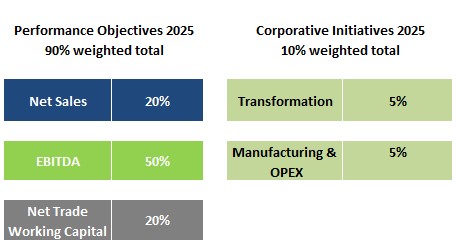
|
|
Reasons for KPI Selection – In designing the short term incentive compensation plan, the Board and Compensation Committee selected the KPIs and assigned them their relative weightings for the following reasons. First, the factor of highest emphasis (at 50%), adjusted EBITDA, has become the factor of greatest importance in our overall financial performance among investors. In addition, over the course of the past several years, while maintaining resiliency at the net sales level, the Company has experienced erosion of its operating leverage. Adjusted EBITDA is a useful measure for |
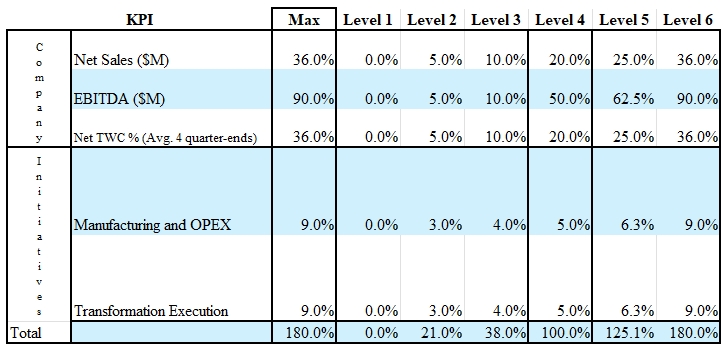
|
|
|
assessing operating leverage as well as for holding management accountable toward the goal of improving that leverage. |
|
Second, at 20%, net sales receives a medium emphasis among the KPIs. While it is important to maximize operating leverage, management must also be committed to growing the business. It is important to continue launching new products, gaining market share of existing products and expanding our portfolio – these are the hallmarks of successful businesses within our industry. Similarly, net trade working capital receives the same medium emphasis (20%) in light of the fact that, over the past several quarters, the Company’s working capital had grown beyond optimal size. It is essential to reduce inventory, to build to demand and to manage our factories in an optimal way.
Third, the last two KPIs, manufacturing/opex and transformation execution, each weighted at 5% each. These are included in the NEOs’ initiatives in order to encourage continued discipline in holding down expenses, maximizing manufacturing cost absorption and following through on the many business improvement initiatives that were launched in 2024.
STI Amounts Earned in 2025
For each of the CEO, CFO, CLO and CHRO, incentive compensation was calculated to be 35% of target bonus. Specifically, the breakdown of each company-wide element, by actual result yielded the following:
•Net sales ($515M actual v. $588M target) - 0% out of possible 20%
•Adjusted EBITDA($39.8M actual v. $51.2M target) - 5% out of possible 50%
•Net Trade Working Capital (33.6% actual v. 35.8% target) - 20% out of possible 20%
•Operating Expenses - ($133.4M actual v. $146.9M target) 5% out of possible 5%
•Transformation (98% actual v. 98% target) - 5% out of possible 5%
For the CEO of Specialty, incentive compensation was calculated to be 54% of target bonus and was arrived at through a combination of the same company-wide financial performance (24% out of a possible 60%) and KPIs related solely to Specialty (30% out of a possible 40%).
For 2026, the Company will be using substantially the same KPI-driven approach. In addition to short term incentive compensation to be calculated based upon the attainment of KPIs, the Compensation Committee has discretion to make awards to executives, from time to time, for achievements not being measured by KPIs that otherwise materially benefit the Company. In addition, in light of a declining stock price and the absence of incentive compensation payments during 2023 and 2024, the Compensation Committee awarded retention payments in June 2025 to the CFO, CLO, CHRO and President of Specialty ($125K, $100K, $100K and $40K, respectively) to encourage continued service during a rebuilding period at the Company. These executives will be entitled to receive such payments in June 2026 and June 2027, assuming continued service through payment date.
Equity— In 2025, in light of unfavorable market conditions and a low share price, the Board made no equity awards to the NEOs. Further, as reported in the Proxy Statement for 2024, the CEO had received an equity award in December 2024 in conjunction with his being hired.
As more fully described below in “Peer Group Data and the Compensation Consultant”, the Compensation Committee periodically conducts a benchmarking study to take into account, among other things, the prevalence (by amount and type) of equity awarded to executive officers of similarly situated companies. These studies typically include information on prevalent rates at which available shares are consumed under equity plans of peers. In awarding equity, the Compensation Committee considers not only these studies, but also the compensation history of the Company, retention issues, and the expensing of equity awards in connection with its recommendation to the Board.
Other Benefits— In 2025, the Company continued its practice of offering a comprehensive suite of other benefits to its executives, including group health (medical, dental and vision) and life insurance to all of our employees. Our medical plan took the form of PPO programs which are largely self-funded. However, the Company limited its claims exposure by maintaining stop loss coverage on an individual basis and appointed Collective Health as its third-party administrator. Health benefits premiums were highly subsidized by the Company and offered extremely competitive
terms (e.g., low co-payments and office visit charges). Our executives also received life insurance and long-term disability insurance coverage. In addition, certain executives received an automobile allowance.
Finally, in 2025, our executives (and all full-time employees) continued to have the option to participate in the Company’s 401K retirement savings plan, under which the Company matches up to 5% of the participant’s salary (subject to an annual cap) and the Employee Stock Purchase Plan, which permits the purchase of Company shares at a discount through payroll deduction.
Peer Group Data and the Compensation Consultant
In determining our executives' compensation, the Compensation Committee reviews compensation data for a group of comparator companies selected with the advice of the Compensation Committee's independent compensation consultant, Exequity. The Compensation Committee uses these data for reference, and, in general, decisions by the Compensation Committee are qualitative, reflecting the business judgment and analysis of its members. During 2025 the Compensation Committee, with input from Exequity, revisited the group of comparator companies for purposes of benchmarking executive compensation, which analysis it completed in December 2025. Identifying a suitable group of peer companies is particularly challenging for the Company given its highly specialized industry in which many of its direct competitors are foreign, private, or are subsidiaries of much larger companies. In connection with those efforts, Exequity defined a group of comparators, focusing on publicly-traded companies based in the U.S. that are similar to us in terms of industry, general size and business characteristics.
The comparator group (“Proxy Peers”) identified by Exequity and approved the Compensation Committee consisted of 11 publicly traded companies operating primarily in the chemicals sector, namely: Aspen Aerogels, Inc. (ASPN), Balchem Corporation (BCPC), Core Molding Technologies, Inc. (CMT), CVR Partners LP (UAN), Ecovyst Inc. (ECVT), Hawkins, Inc. (HWKN), Innospec Inc. (IOSP), Intrepid Potash, Inc. (IPI), LSB Industries, Inc. (LXU), Quaker Chemical Corporation (KWR) and Tredegar Corporation (TG). Proxy Peers had median revenues of $619 million per annum, median market capitalization $875 million and median enterprise value of $1,338 million. To our knowledge American Vanguard is the only publicly traded crop protection Company of its size, and no Proxy Peers operate at all in the crop protection sector. In addition to the Proxy Peers, broader general industry market data for companies of comparable size and scope was also reviewed as a secondary reference point to help inform compensation decisions.
According to Exequity’s analysis, 2025 compensation for the Company’s new CEO yielded the following comparative results, which are also depicted in the table below:
•The CEO base salary ($650K) was below the 25th percentile for salaries among Proxy Peers.
•The target bonus amount for the CEO was below the 25th percentile, while the actual bonus amount ($236K) was at the zero percentile for target bonus of the Proxy Peers.
•Target total cash for the CEO was below the 25th percentile, while actual total cash ($877.5) was at the zero percentile for target total cash of the Proxy Peers.
•Equity granted in 2025 to the CEO ($0) was at the zero percentile of the Proxy Peers.
•Annualized total direct compensation for the Company’s CEO both at target and on actual basis was at or near the zero percentile of the Proxy Peers.
On average, compensation for other NEOs, as compared with that of its Proxy Peers, was positioned similarly to that of the CEO.
Closing Comments
The Company believes that its executive compensation reflects a commitment toward requiring accountability for results among its executive team and is consistent with pay-for-performance.
COMPENSATION COMMITTEE REPORT
The Compensation Committee has reviewed and discussed the Compensation Discussion and Analysis required by Item 402 (b) of Regulation S-K with management and, based on the review and discussions referred to in that Item, the Compensation Committee recommended to the Board that the Compensation Discussion and Analysis be incorporated by reference in the Annual Report on Form 10-K for the year ended December 31, 2025, filed with the SEC.
Marisol Angelini, Chair
Patrick Gottschalk
Steven Macicek
Keith Rosenbloom
EXECUTIVE OFFICERS OF THE COMPANY
The following persons are the current executive officers, all of whom are also named executive officers (the “NEOs”) of the Company:
|
|
|
|
|
|
|
Name of Director/Officer |
|
Age |
|
|
Capacity |
Douglas A. Kaye III |
|
|
57 |
|
|
Chief Executive Officer |
David T. Johnson |
|
|
69 |
|
|
Vice President, Chief Financial Officer and Treasurer |
Timothy J. Donnelly |
|
|
66 |
|
|
Chief Legal Officer, General Counsel & Secretary |
Shirin Khosravi |
|
|
57 |
|
|
Chief Human Resources Officer |
Shayne Wetherall |
|
|
60 |
|
|
Chief Executive Officer of Specialty Business |
Douglas A. Kaye III The biography of Mr. Kaye is provided above under "Proposal 1 - Election of Directors - Nominees for Election of Directors - Qualifications, Experience and Competencies.
David T. Johnson has served as Vice President, Chief Financial Officer, and Treasurer of the Company since March, 2008. Mr. Johnson served as Finance Director for Amcor Flexibles UK Ltd., a $500 million manufacturer of decorative packaging and a subsidiary of Amcor, a multi-billion dollar corporation based in Australia, from June 2003 through March 2008. Prior to that he served as Vice President of Finance for Sterer Engineering, a subsidiary of Eaton Aerospace, an $8 billion Cleveland based multinational Company from April 2001 through June 2003.
Timothy J. Donnelly has served as Chief Legal Officer, General Counsel and Secretary of the Company since June 2024 and had been Chief Administration Officer from June 2010 prior to that time. He began his service with the Company in October 2005 as Vice President, General Counsel and Assistant Secretary, was appointed Secretary in June 2007 and assumed responsibility for Human Resources and Risk Management in 2009. Prior to his service with the Company, from September 2000 through October 2005, Mr. Donnelly served as Vice President, General Counsel and Secretary for DDi Corp. (Nasdaq—DDIC), a manufacturer of quick-turn, high-technology printed circuit boards.
Shirin Khosravi has served as Chief Human Resources Officer since December 2024 and was Senior Vice President of Human Resources from October 2023 until that time. Prior to her service with the Company, Ms. Khosravi worked as an HR senior executive for over 25 years in positions of increasing responsibility, including at CR Laurence (an architectural hardware and glazing supplies company), Dover Corporation (a diversified global manufacturer of
innovative equipment and components) and Holcim (a global construction materials provider). She has an MBA from
the University of Western Ontario, and a BA in Business from Edith Cowan University in Perth, West Australia.
Shayne Wetherall has served as President of the Company’s Specialty businesses (OHP, Inc., Tyratech Technologies and Envance Technologies) since 2013. From 2007 through 2013, he was VP of Commercial Operations for Tyratech, Inc., then a small-cap technology company traded on the London Stock Exchange specializing in developing innovative solutions for human and animal health. Prior to that time, he led several emerging growth technology ventures while serving as Executive Chairman of Enright Partners, a holding company leading
technology turnaround and transformation engagements. Mr. Wetherall holds BA and BOR degrees from Marshall University.
EXECUTIVE COMPENSATION
The following table sets forth the aggregate cash and other compensation for services rendered for the three calendar years 2025, 2024 and 2023, paid or awarded by the Company and its subsidiaries to the CEO, CFO, and the three most highly compensated executive officers other than the CEO and CFO (the “NEOs”).
SUMMARY COMPENSATION TABLE
|
|
|
|
|
|
|
|
|
|
|
|
|
|
|
|
|
|
|
|
|
|
|
|
|
|
|
|
|
|
|
|
|
|
|
Name and Principal Position
(a) |
|
Year
(b) |
|
Salary
($)
(c) |
|
|
Bonus
($)
(d) |
|
|
Stock
Awards
($)
(e)
(3) |
|
|
Option
Awards
($)
(f)(4) |
|
|
Non-Equity
Incentive Plan
Compensation
($)
(g) |
|
|
Change in
Pension Value
and Non-
Qualified
Deferred
Compensation
Earnings
($)
(h) |
|
|
All
Other
Compen-
sation
($)
(i) (5) |
|
|
Total
($)
(j) |
|
Douglas A. Kaye III, Chief Executive Officer |
|
2025 |
|
|
650,000 |
|
|
|
— |
|
|
|
— |
|
|
|
|
|
|
235,950 |
|
|
|
|
|
|
183,530 |
|
|
|
1,069,480 |
|
|
|
2024 |
|
|
39,583 |
|
(1) |
|
300,000 |
|
(2) |
|
1,335,577 |
|
|
|
— |
|
|
|
— |
|
|
|
— |
|
|
|
— |
|
|
|
1,675,160 |
|
|
|
|
|
|
|
|
|
|
|
|
|
|
|
|
|
|
|
|
|
|
|
|
|
|
|
|
David T. Johnson, Chief Financial Officer |
|
2025 |
|
|
445,940 |
|
|
|
— |
|
|
|
— |
|
|
|
— |
|
|
|
97,139 |
|
|
|
— |
|
|
|
169,090 |
|
|
|
712,169 |
|
|
|
2024 |
|
|
429,048 |
|
|
|
— |
|
|
|
43,073 |
|
|
|
204,354 |
|
|
|
— |
|
|
|
— |
|
|
|
286,795 |
|
|
|
963,270 |
|
|
|
2023 |
|
|
428,278 |
|
|
|
— |
|
|
|
180,680 |
|
|
|
— |
|
|
|
— |
|
|
|
— |
|
|
|
79,793 |
|
|
|
688,751 |
|
|
|
|
|
|
|
|
|
|
|
|
|
|
|
|
|
|
|
|
|
|
|
|
|
|
|
|
Timothy J. Donnelly, Chief Legal Officer, General Counsel & Secretary |
|
2025 |
|
|
400,000 |
|
|
|
— |
|
|
|
— |
|
|
|
— |
|
|
|
87,120 |
|
|
|
— |
|
|
|
145,075 |
|
|
|
632,195 |
|
|
|
2024 |
|
|
362,866 |
|
|
|
— |
|
|
|
36,432 |
|
|
|
172,844 |
|
|
|
— |
|
|
|
— |
|
|
|
286,795 |
|
|
|
858,937 |
|
|
|
2023 |
|
|
362,214 |
|
|
|
— |
|
|
|
152,820 |
|
|
|
— |
|
|
|
— |
|
|
|
— |
|
|
|
36,030 |
|
|
|
551,064 |
|
|
|
|
|
|
|
|
|
|
|
|
|
|
|
|
|
|
|
|
|
|
|
|
|
|
|
|
Shirin Khosravi, Chief Human Resources Officer |
|
2025 |
|
|
300,000 |
|
|
|
— |
|
|
|
— |
|
|
|
— |
|
|
|
67,680 |
|
|
|
— |
|
|
|
133,555 |
|
|
|
501,235 |
|
|
|
2024 |
|
|
276,318 |
|
|
|
— |
|
|
|
— |
|
|
|
16,103 |
|
|
|
— |
|
|
|
— |
|
|
|
277,369 |
|
|
|
569,790 |
|
|
|
|
|
|
|
|
|
|
|
|
|
|
|
|
|
|
|
|
|
|
|
|
|
|
|
|
Shayne Wetherall, Chief Executive Officer of Specialty Business |
|
2025 |
|
|
332,753 |
|
|
|
— |
|
|
|
— |
|
|
|
— |
|
|
|
85,326 |
|
|
|
— |
|
|
|
77,281 |
|
|
|
495,360 |
|
(1)Salary for 2024 reflects salary payments to Mr. Kaye from start date of December 9, 2024, through December 31, 2024.
(2)Reflects a 2024 sign-on bonus.
(3)The amounts in this column reflect the aggregate grant date fair value of restricted stock and restricted stock unit awards computed in accordance with ASC 718. All assumptions made in the valuations are contained and described in the Company’s consolidated financial statements included in the Annual Report on Form 10-K for the year ended December 31, 2024.
(4)The amounts in this column reflect the aggregate grant date fair value of stock options computed in accordance with the ASC 718. All assumptions made in the valuations are contained and described in the Company’s consolidated financial statements included in the Annual Report on Form 10-K for the year ended December 31, 2024.
(5)See "All Other Compensation" on page 33 for detail.
ALL OTHER COMPENSATION
|
|
|
|
|
|
|
|
|
|
|
|
|
|
|
|
|
|
|
|
|
|
|
|
|
|
|
Perquisites
($)(2) |
|
|
Insurance
Premiums
($) |
|
|
Company
Contributions
to Defined
Contribution
Plans
($)(3) |
|
|
Retention Payments
($)(5) |
|
|
Change in
Control
Payments /
Accruals
($) |
|
Douglas A. Kaye III |
|
2025 |
|
|
165,000 |
|
(1) |
|
930 |
|
|
|
17,500 |
|
|
|
— |
|
|
|
— |
|
|
|
|
|
|
|
|
|
|
|
|
|
|
|
|
|
|
|
David T. Johnson |
|
2025 |
|
|
25,200 |
|
|
|
1,290 |
|
|
|
17,500 |
|
|
|
125,000 |
|
|
|
— |
|
|
|
2024 |
|
|
18,000 |
|
|
|
1,545 |
|
|
|
47,750 |
|
(4) |
|
— |
|
|
|
— |
|
|
|
2023 |
|
|
18,000 |
|
|
|
1,530 |
|
|
|
60,263 |
|
(4) |
|
— |
|
|
|
— |
|
|
|
|
|
|
|
|
|
|
|
|
|
|
|
|
|
|
|
Timothy J. Donnelly |
|
2025 |
|
|
25,200 |
|
|
|
1,275 |
|
|
|
17,500 |
|
|
|
100,000 |
|
|
|
— |
|
|
|
2024 |
|
|
18,000 |
|
|
|
1,545 |
|
|
|
17,250 |
|
|
|
— |
|
|
|
— |
|
|
|
2023 |
|
|
18,000 |
|
|
|
1,530 |
|
|
|
16,500 |
|
|
|
— |
|
|
|
— |
|
|
|
|
|
|
|
|
|
|
|
|
|
|
|
|
|
|
|
Shirin Khosravi |
|
2025 |
|
|
16,800 |
|
|
|
1,290 |
|
|
|
15,365 |
|
|
|
100,000 |
|
|
|
— |
|
|
|
2024 |
|
|
12,000 |
|
|
|
1,545 |
|
|
|
13,824 |
|
|
|
— |
|
|
|
— |
|
|
|
|
|
|
|
|
|
|
|
|
|
|
|
|
|
|
|
Shayne Wetherall |
|
2025 |
|
|
19,200 |
|
|
|
1,290 |
|
|
|
16,691 |
|
|
|
40,000 |
|
|
|
— |
|
(1)For the CEO, the automobile allowance of $27,500 for the year ended December 31, 2025 and expense reimbursements of $137,500 relating to travel expense for the year ended December 31, 2025. For each of the other NEOs, this column represents automobile allowance.
(2)This column represents the Company's matching employee contributions to the NEOs' 401(k) savings plan accounts.
(3)This reflects the Company’s total contribution to employee’s 401(k) account in 2024 and 2023 and is the sum of a $10,396 and $7,637 to match employee’s salary deferral, in additional contribution in conjunction with a proportionate contribution being concurrently made to a group of non-highly compensated employees.
(4)This reflects a retention payment made to employee as of July 1, 2025.
NARRATIVE DISCUSSION TO SUMMARY COMPENSATION TABLE AND GRANTS OF PLAN-BASED AWARDS TABLE
In connection with his appointment to the position of CEO, Mr. Kaye and the Company entered into an Executive Employment Agreement dated as of December 9, 2024 having the following material terms: annual base salary of $650,000; target cash incentive compensation of 100% of base salary with maximum payout potential of 180% of target; initial bonus of $300,000 (to be paid in part in Q1 2025 and in part in Q4 2025); payment by the Company of premiums for a term life insurance policy having limits of $1.5 million; time-based and performance-based equity awards granted in December 2024 as described in the proxy statement for the Company's 2025 annual meeting; a car allowance of $2,500 per month; and a payment of $12,500 per month for his discretionary use for expenses to travel between the Company's offices in California and his home in Iowa as well as lodging expenses. The agreement also provides severance benefits on certain terminations of his employment as described under "Potential Payments Upon Termination or Change in Control."
OUTSTANDING EQUITY AWARDS AT FISCAL YEAR-END
The following table shows, with respect to the NEOs, the number of shares covered by both exercisable and non-exercisable stock options and, in addition, grants of restricted stock units that had not yet vested as of December 31, 2025, with respect to options to purchase common stock of the Company. The closing price of the common stock on December 31, 2025, the last trading day of the Company’s fiscal year, was $3.82 per share.
|
|
|
|
|
|
|
|
|
|
|
|
|
|
|
|
|
|
|
|
|
|
|
Option Awards |
Name
(a) |
|
Number of Securities
Underlying Unexercised
Options
(#)
Exercisable
(b) |
|
|
Number of Securities
Underlying Unexercised
Options
(#)
Unexercisable
(c) |
|
|
Equity
Incentive
Plan
Awards:
Number of
Securities
Underlying
Unexercised
Unearned
Options
(#)
(d) |
|
|
Option
Exercise
Price
($)
(e) |
|
|
Option
Vested
Date
(f) |
|
Option
Expiration
Date
(f) |
Douglas A. Kaye III |
|
|
— |
|
|
|
— |
|
|
|
— |
|
|
$ |
— |
|
|
|
|
|
David T. Johnson |
|
|
— |
|
|
|
48,888 |
|
|
|
— |
|
|
$ |
10.28 |
|
|
1/22/2027 |
|
1/22/2034 |
Timothy J. Donnelly |
|
|
— |
|
|
|
41,350 |
|
|
|
— |
|
|
$ |
10.28 |
|
|
1/22/2027 |
|
1/22/2034 |
Shirin Khosravi |
|
|
— |
|
|
|
4,087 |
|
|
|
— |
|
|
$ |
10.28 |
|
|
1/22/2027 |
|
1/22/2034 |
Shayne Wetherall |
|
|
— |
|
|
|
12,114 |
|
|
|
— |
|
|
$ |
10.28 |
|
|
1/22/2027 |
|
1/22/2034 |
|
|
|
|
|
|
|
|
|
|
|
|
|
|
|
|
|
|
|
Stock Awards |
|
Name
(a) |
|
Number of Shares
or Units of Stock That
Have Not Vested
(#)
(g) |
|
|
Market Value of Shares
or Units of Stock That
Have Not Vested
($)
(h) |
|
|
Equity Incentive Plan
Awards: Number of
Unearned Shares,
Units or Other Rights
That Have Not Vested
(#)
(i) |
|
|
Equity Incentive Plan
Awards: Market or
Payout Value of
Unearned Shares,
Units or Other Rights
That Have Not Vested
($)
(j) |
|
Douglas A. Kaye III |
|
|
288,461 |
|
|
|
941,638 |
|
|
|
— |
|
|
|
— |
|
David T. Johnson |
|
|
11,185 |
|
|
|
42,727 |
|
|
|
— |
|
|
|
— |
|
Timothy J. Donnelly |
|
|
9,460 |
|
|
|
36,137 |
|
|
|
— |
|
|
|
— |
|
Shirin Khosravi |
|
|
3,333 |
|
|
|
12,732 |
|
|
|
— |
|
|
|
— |
|
Shayne Wetherall |
|
|
4,038 |
|
|
|
15,425 |
|
|
|
— |
|
|
|
— |
|
OPTION EXERCISES AND STOCK VESTED
The following table shows, with respect to the NEOs, the number of shares acquired on the exercise of stock options and on vesting of stock awards and their respective value realized (market price less exercise price) for the year ended December 31, 2025.
|
|
|
|
|
|
|
|
|
|
|
|
|
|
|
|
|
|
|
Option Awards |
|
|
Stock Awards |
|
Name
(a) |
|
Number of Shares
Acquired on
Exercise
(#)
(b) |
|
|
Value Realized on
Exercise
($)
(c) |
|
|
Number of Shares
Acquired on
Vesting
(#)
(d) |
|
|
Value Realized on
Vesting
($)
(e) (1) |
|
Douglas A. Kaye III |
|
|
— |
|
|
|
— |
|
|
|
22,291 |
|
|
|
95,183 |
|
David T. Johnson |
|
|
— |
|
|
|
— |
|
|
|
5,611 |
|
|
|
23,278 |
|
Timothy J. Donnelly |
|
|
— |
|
|
|
— |
|
|
|
4,746 |
|
|
|
19,690 |
|
Shirin Khosravi |
|
|
— |
|
|
|
— |
|
|
|
3,333 |
|
|
|
17,832 |
|
Shayne Wetherall |
|
|
— |
|
|
|
— |
|
|
|
2,027 |
|
|
|
7,703 |
|
(1)Value realized on vesting is value of shares, excluding shares forfeited for U.S. payroll tax purposes, if applicable, at time of vesting.
Pension Benefits and Non-qualified Deferred Compensation
The Company provided no pension benefits and no non-qualified deferred compensation to the NEOs during the year ended December 31, 2025.
Potential Payments upon Termination or Change of Control
The CEO is party to an employment agreement, dated as of December 9, 2024, that provides if his employment had been terminated by the Company without cause or if he had resigned for good reason (in either case other than due to death or disability) on or before December 9, 2025, he would have received severance of (i) a pro-rated bonus for the year of termination, (ii) a payment of one year’s base salary and annual bonus (as determined by the Board), (iii) vesting of a time-based equity award granted pursuant to the agreement, and (iv) one year of the car allowance and travel allowance provided in the agreement. If such a termination of his employment occurs after December 9, 2025, he will receive severance of (i) a pro-rated bonus for the year of termination, (ii) an amount equal to two times the sum of his base salary plus average bonus (measured over three years), (iii) payment by the Company of his COBRA premiums for up to 12 months following his termination, and (iv) reimbursement of executive-level outplacement benefits for up to 12 months following his termination (not to exceed $10,000). In addition, his outstanding and unvested equity awards will vest as of his termination date: (x) with respect to any equity awards received in lieu of cash incentive compensation, in their entirety, and (y) with respect to any other equity awards, on a pro-rated basis to reflect the period through his termination date (with any performance-based conditions applicable to the awards to be deemed met at target). However, if the CEO’s employment is terminated by the Company without cause or by him for good reason during the period beginning three months before, and ending 24 months after, a change in control, his outstanding and unvested equity awards will vest in full (with any performance-based conditions applicable to the awards to be deemed met at target).
If the CEO’s employment terminates due to his death or disability, he (or his estate) will receive a payment equal to 12 months of his base salary, and his outstanding and unvested equity awards will vest on a pro-rated basis to reflect the period through his termination date (with any performance-based conditions applicable to the awards to be deemed met at target).
In each case, the CEO’s right to receive the severance benefits described above is subject to his execution and delivery of a release of claims in favor of the Company.
Each of the other NEOs is party to a change of control severance agreement, under the terms of which the employee is entitled to receive certain payments in the event that there is both a change of control during the term of agreement and such employee is either terminated (for reasons other than cause) or resigns for good reason within 24 months of such change of control. As with the CEO, there is a double trigger before benefits are earned under this arrangement. Provided both conditions for payment are met and the Company receives a release of all claims from the employee, the employee is entitled
to receive a lump sum amount equal to two years’ base salary, two-times the employee’s average cash incentive compensation (measured over the past three full-years), 24 months’ worth of COBRA coverage for medical insurance, executive level outplacement costs, and immediate acceleration and vesting of unvested equity awards (or other securities to which employee may have a right).
For purposes of the CEO, “change in control” is defined to be identical with that set forth in the 2022 Plan. For NEOs other than the CEO, “change in control” is defined to mean, in effect, either (i) a merger or consolidation of the Company in which those who were stockholders immediately before the effective time of the merger or consolidation have less than 50% of the voting power of the new corporation or entity; (ii) a sale or disposition of all or substantially all of the Company’s assets; (iii) when any person (as defined in Sections 13(d) and 14(d) of the Exchange Act) directly or indirectly owns more than 50% of the Common Stock of the Company or (iv) in the event over a 24 month period a majority of the board of directors is replaced by new members. Further, as a condition to payment (whether to the CEO or any of the other NEOs), the employee must execute and deliver a written release of claims against the Company.
The following table summarizes the estimated amounts that NEOs who were employed by the Company as of December 31, 2025, would be entitled to receive whether in the form of cash or securities in the event of a termination without cause or voluntary resignation for good reason after a change in control assuming, for illustration purposes, that such change in control had occurred on December 31, 2025.
|
|
|
|
|
|
|
|
|
|
|
|
|
|
|
|
|
|
|
|
|
|
|
|
|
|
|
Salary
($) |
|
|
Average Bonus
($) |
|
|
COBRA
Insurance
Premiums
($) |
|
|
Outplacement
Services
($) |
|
|
Accelerated
Options
and Grants
Vesting
($)(1) |
|
|
Total Change in
Control
Payments
($)(2) |
|
Douglas A. Kaye III |
|
|
1,300,000 |
|
|
|
223,050 |
|
|
|
95,884 |
|
|
|
10,000 |
|
|
|
941,638 |
|
|
|
2,570,572 |
|
David T. Johnson |
|
|
891,880 |
|
|
|
70,847 |
|
|
|
65,999 |
|
|
|
10,000 |
|
|
|
42,727 |
|
|
|
1,081,453 |
|
Timothy J. Donnelly |
|
|
800,000 |
|
|
|
63,655 |
|
|
|
58,895 |
|
|
|
10,000 |
|
|
|
36,137 |
|
|
|
968,687 |
|
Shirin Khosravi |
|
|
600,000 |
|
|
|
54,420 |
|
|
|
95,884 |
|
|
|
10,000 |
|
|
|
12,732 |
|
|
|
773,036 |
|
Shayne Wetherall |
|
|
665,505 |
|
|
|
43,832 |
|
|
|
65,999 |
|
|
|
10,000 |
|
|
|
15,425 |
|
|
|
800,761 |
|
(1)Upon change in control, the agreement allows for the accelerated vesting of options and grants. Assuming the change in control had happened as of December 31, 2025, there would be unvested awards of 313,326 shares of restricted stocks and no shares of incentive stock options. If the change in control occurred on December 31, 2025, these awards would have vested and the Company would have recognized additional compensation expense based on grant date fair value in the amount of $2,933,665 for restricted stocks, and the officers would have recognized the value of vested grants as income based on fair market value in the amount of $3,437,187 (which is the sum of this column).
(2)There are no tax excise gross-ups relating to change-in-control payments for NEOs.
With respect to severance compensation received or earned by NEOs not resulting from a change of control,
CEO Pay Ratio Disclosure
For fiscal year 2025, we report as follows:
•The annual total compensation of the CEO on an annualized basis, as per the Summary Compensation table on page 32 hereof was $1,069,480; and
•The median of the annual total compensation of all employees of the Company (excluding the CEO) was $63,100.
Based upon this information, we reasonably estimate that the ratio for the CEO’s annual total compensation to the annual total compensation of our median employee was approximately 16.8 to 1.
Our pay ratio was calculated as per Item 402(u) as follows. In order to identify the median employee, using the criteria set forth in Item 402(c) of Regulation S-K for populating data within the Summary Compensation Table, we gathered information from payroll, stock award and incentive compensation on all employees as of December 31, 2025, which was within three months of the closing of the Company’s last fiscal year.
In measuring the wages of non-exempt employees, we took the actual wages, including regular time and overtime, paid to such employees. Where employees were paid in foreign currencies, we converted that currency into U.S. dollars as of the date of measurement. In establishing total compensation, we considered not only wages and bonuses, but also the fair value of equity awards, if any. After arriving at total compensation for the employee population (not including the CEO), we listed them in descending order of compensation and identified the median employee.
Pay Versus Performance
As per item 402(v) of Regulation S-K, we are providing the following information about the relationship between Compensation Actually Paid (CAP) as defined in Item 402(v) and performance. For further information concerning the Company’s variable pay-for-performance philosophy and how the Company aligns executive compensation with its performance, refer to the “Compensation Discussion and Analysis”.
|
|
|
|
|
|
|
|
|
|
|
|
|
|
|
|
|
|
|
|
|
|
|
|
|
|
|
|
|
|
|
|
|
Year |
|
Summary compensation table total for PEO |
|
|
Compensation actually paid to PEO |
|
|
Average summary compensation table total for non-PEO named executive officers |
|
|
Average compensation actually paid to non-PEO named executive officers |
|
|
Value of initial fixed $100 investment based on Total shareholder return |
|
|
Value of initial fixed $100 investment based on Global Agribusiness TSR |
|
|
Net income $000s |
|
|
Net sales $000s |
|
(a) |
|
(b) |
|
|
(c) |
|
|
(d) |
|
|
(e) |
|
|
(f) |
|
|
(g) |
|
|
(h) |
|
|
(i) |
|
2025 |
|
$ |
1,069,480 |
|
|
$ |
770,725 |
|
|
$ |
585,240 |
|
|
$ |
548,854 |
|
|
$ |
25 |
|
|
$ |
119 |
|
|
$ |
(49,882 |
) |
|
$ |
515,114 |
|
2024 |
|
$ |
1,675,160 |
|
|
$ |
339,583 |
|
|
$ |
680,441 |
|
|
$ |
616,596 |
|
|
$ |
24 |
|
|
$ |
113 |
|
|
$ |
(124,855 |
) |
|
$ |
549,520 |
|
2023 |
|
$ |
2,509,773 |
|
|
$ |
(471,651 |
) |
|
$ |
567,665 |
|
|
$ |
201,287 |
|
|
$ |
72 |
|
|
$ |
105 |
|
|
$ |
7,519 |
|
|
$ |
579,371 |
|
2022 |
|
$ |
2,852,874 |
|
|
$ |
3,432,747 |
|
|
$ |
729,905 |
|
|
$ |
817,252 |
|
|
$ |
141 |
|
|
$ |
115 |
|
|
$ |
27,404 |
|
|
$ |
609,615 |
|
2021 |
|
$ |
2,463,689 |
|
|
$ |
3,089,570 |
|
|
$ |
708,595 |
|
|
$ |
802,105 |
|
|
$ |
106 |
|
|
$ |
125 |
|
|
$ |
18,587 |
|
|
$ |
557,676 |
|
Footnotes to Table 1:
1. Our principal executive officer (“PEO”) for fiscal years 2025 and 2024 was Douglas A. Kaye, who joined the Company on December 9, 2024. Our PEO for the fiscal years 2023, 2022 and 2021 was Eric G. Wintemute, who left that position on July 12, 2024. The dollar amounts reported in column (b) are the amounts of total compensation reported for the PEO for each corresponding year in the “Total” column of the Summary Compensation Table. Refer to “Executive Compensation – Executive Compensation Tables – Summary Compensation Table.”
2. The dollar amounts reported in column (e) represent the amount of “compensation actually paid” or “CAP” to the PEO, as computed in accordance with SEC rules. The dollar amounts do not reflect the actual amount of compensation
earned by or paid to the PEO during the applicable year. The following adjustments were made to the PEO’s total compensation for each applicable year to determine the compensation actually paid in accordance with SEC rules:
|
|
|
|
|
|
|
|
|
|
|
|
|
|
|
|
|
|
|
|
|
|
|
|
|
Year |
|
Reported Summary Compensation Table Total for PEO |
|
|
Reported Value of Equity Awards |
|
|
Equity Award Adjustments |
|
|
Reported Change in the Actuarial Value of Pension Benefits |
|
|
Pension Benefit Adjustments |
|
|
Compensation Actually Paid to PEO |
|
|
|
|
|
|
(a) |
|
|
(b) |
|
|
(c) |
|
|
(d) |
|
|
|
|
2025 |
|
$ |
1,069,480 |
|
|
$ |
— |
|
|
$ |
(298,755 |
) |
|
$ |
— |
|
|
$ |
— |
|
|
$ |
770,725 |
|
2024 |
|
$ |
1,675,160 |
|
|
$ |
1,335,577 |
|
|
$ |
(842,658 |
) |
|
$ |
— |
|
|
$ |
— |
|
|
$ |
339,583 |
|
2023 |
|
$ |
2,509,773 |
|
|
$ |
(1,688,426 |
) |
|
$ |
(1,292,998 |
) |
|
$ |
— |
|
|
$ |
— |
|
|
$ |
(471,651 |
) |
2022 |
|
$ |
2,852,874 |
|
|
$ |
(1,407,292 |
) |
|
$ |
1,987,165 |
|
|
$ |
— |
|
|
$ |
— |
|
|
$ |
3,432,747 |
|
2021 |
|
$ |
2,463,689 |
|
|
$ |
(1,392,708 |
) |
|
$ |
1,931,968 |
|
|
$ |
— |
|
|
$ |
— |
|
|
$ |
3,089,570 |
|
a)The grant date fair value of equity awards represents the total of the amounts reported in the “Stock Awards”, column (e) and “Option Awards” in column (f) of the Summary Compensation Table for the applicable year.
The equity award adjustments for each applicable year include the addition (or subtraction, as applicable) of the following:
3. (i) the year-end fair value of any equity awards granted in the applicable year that are outstanding and unvested as of the end of the year; (ii) the amount of change as of the end of the applicable year (from the end of the prior fiscal year) in fair value of any awards granted in prior years that are outstanding and unvested as of the end of the applicable year; (iii) for awards that are granted and vest in same applicable year, the fair value as of the vesting date; (iv) for awards granted in prior years that vest in the applicable year, the amount equal to the change as of the vesting date (from the end of the prior fiscal year) in fair value; (v) for awards granted in prior years that are determined to fail to meet the applicable vesting conditions during the applicable year, a deduction for the amount equal to the fair value at the end of the prior fiscal year; and (vi) the dollar value of any dividends or other earnings paid on stock or option awards in the applicable year prior to the vesting date that are not otherwise reflected in the fair value of such award or included in any other component of total compensation for the applicable year. The valuation assumptions used to calculate fair values did not materially differ from those disclosed at the time of grant.
The amounts deducted or added in calculating the equity award adjustments for the PEO are as follows:
|
|
|
|
|
|
|
|
|
|
|
|
|
|
|
|
|
|
|
|
|
|
|
|
|
|
|
|
|
Year |
|
Year End Fair Value of Equity Awards |
|
|
Year over Year Change in Fair Value of Outstanding and Unvested Equity Awards |
|
|
Fair Value as of Vesting Date of Equity Awards Granted and Vested in the Year |
|
|
Year over Year Change in Fair Value of Equity Awards Granted in Prior Years that Vested in the Year |
|
|
Fair Value at the End of the Prior Year of Equity Awards that Failed to Meet Vesting Conditions in the Year |
|
|
Value of Dividends etc not Otherwise Reflected in Fair Value or Total Compensation |
|
|
Total Equity Award Adjustments |
|
2025 |
|
$ |
— |
|
|
$ |
(199,668 |
) |
|
$ |
— |
|
|
$ |
(8,024 |
) |
|
$ |
(91,063 |
) |
|
$ |
— |
|
|
$ |
(298,755 |
) |
2024 |
|
$ |
1,335,577 |
|
|
$ |
— |
|
|
$ |
— |
|
|
$ |
— |
|
|
$ |
— |
|
|
$ |
— |
|
|
$ |
1,335,577 |
|
2023 |
|
$ |
860,289 |
|
|
$ |
(1,333,715 |
) |
|
$ |
(361,161 |
) |
|
$ |
104,508 |
|
|
$ |
(562,919 |
) |
|
$ |
— |
|
|
$ |
(1,292,998 |
) |
2022 |
|
$ |
1,289,835 |
|
|
$ |
859,999 |
|
|
$ |
161,607 |
|
|
$ |
— |
|
|
$ |
(324,276 |
) |
|
$ |
— |
|
|
$ |
1,987,165 |
|
2021 |
|
$ |
1,061,580 |
|
|
$ |
144,499 |
|
|
$ |
290,744 |
|
|
$ |
487,478 |
|
|
$ |
(52,333 |
) |
|
$ |
— |
|
|
$ |
1,931,968 |
|
3. The dollar amounts reported in column (d) represent the average of the amounts reported for the Company’s named executive officers (NEOs) as a group (excluding the PEO) in the “Total” column of the Summary Compensation Table in
each applicable year. The NEOs for the years 2024, 2023, 2022 and 2021, were Ulrich G. Trogele, David T. Johnson, Timothy J. Donnelly, Anthony S. Hendrix, Peter E. Eilers, and Shirin Khosravi.
4. The dollar amounts reported in column (e) represent the average amount of “compensation actually paid” (also, "CAP") to the NEOs as a group (excluding the PEO) as computed in accordance with Item 402(v) of Regulation S-K. The dollar amounts do not reflect the actual average amount of compensation earned by or paid to the NEOs as a group during the applicable year. In accordance with the requirements of Item 402(v) of Regulation S-K, the following adjustments were made to average total compensation for the NEOs as a group for each year to determine the compensation actually paid, using the same methodology described above in Note 2:
|
|
|
|
|
|
|
|
|
|
|
|
|
|
|
|
|
|
|
|
|
|
|
|
|
Year |
|
Average Reported Summary Compensation Table Total for Non-PEO NEOs |
|
|
Average Reported Value of Equity Awards |
|
|
Average Equity Award Adjustments |
|
|
Reported Change in the Actuarial Value of Pension Benefits |
|
|
Pension Benefit Adjustments |
|
|
Average Compensation Actually Paid to Non-PEO NEOs |
|
|
|
|
|
|
|
|
|
(a) |
|
|
|
|
|
(b) |
|
|
|
|
2025 |
|
$ |
585,240 |
|
|
$ |
— |
|
|
$ |
(36,386 |
) |
|
$ |
— |
|
|
$ |
— |
|
|
$ |
548,854 |
|
2024 |
|
$ |
680,441 |
|
|
$ |
30,051 |
|
|
$ |
(93,896 |
) |
|
$ |
— |
|
|
$ |
— |
|
|
$ |
616,596 |
|
2023 |
|
$ |
567,665 |
|
|
$ |
(142,029 |
) |
|
$ |
(224,349 |
) |
|
$ |
— |
|
|
$ |
— |
|
|
$ |
201,287 |
|
2022 |
|
$ |
729,905 |
|
|
$ |
(157,642 |
) |
|
$ |
244,989 |
|
|
$ |
— |
|
|
$ |
— |
|
|
$ |
817,252 |
|
2021 |
|
$ |
708,595 |
|
|
$ |
(179,315 |
) |
|
$ |
272,825 |
|
|
$ |
— |
|
|
$ |
— |
|
|
$ |
802,105 |
|
2020 |
|
$ |
645,118 |
|
|
$ |
(211,566 |
) |
|
$ |
176,511 |
|
|
$ |
— |
|
|
$ |
— |
|
|
$ |
610,063 |
|
The amounts deducted or added in calculating the total average equity award adjustments for NEOs other than the PEO are as follows:
|
|
|
|
|
|
|
|
|
|
|
|
|
|
|
|
|
|
|
|
|
|
|
|
|
|
|
|
|
Year |
|
Year End Fair Value of Equity Awards |
|
|
Year over Year Change in Fair Value of Outstanding and Unvested Equity Awards |
|
|
Fair Value as of Vesting Date of Equity Awards Granted and Vested in the Year |
|
|
Year over Year Change in Fair Value of Equity Awards Granted in Prior Years that Vested in the Year |
|
|
Fair Value at the End of the Prior Year of Equity Awards that Failed to Meet Vesting Conditions in the Year |
|
|
Value of Dividends etc. not Otherwise Reflected in Fair Value or Total Compensation |
|
|
Total Equity Award Adjustments |
|
2025 |
|
$ |
— |
|
|
$ |
(21,390 |
) |
|
$ |
— |
|
|
$ |
(3,647 |
) |
|
$ |
(11,349 |
) |
|
$ |
— |
|
|
$ |
(36,386 |
) |
2024 |
|
$ |
30,051 |
|
|
$ |
(48,674 |
) |
|
$ |
(3,836 |
) |
|
$ |
— |
|
|
$ |
(71,437 |
) |
|
$ |
— |
|
|
$ |
(93,896 |
) |
2023 |
|
$ |
72,367 |
|
|
$ |
(166,981 |
) |
|
$ |
(54,861 |
) |
|
$ |
10,650 |
|
|
$ |
(85,524 |
) |
|
$ |
— |
|
|
$ |
(224,349 |
) |
2022 |
|
$ |
144,484 |
|
|
$ |
125,605 |
|
|
$ |
24,945 |
|
|
$ |
— |
|
|
$ |
(50,045 |
) |
|
$ |
— |
|
|
$ |
244,989 |
|
2021 |
|
$ |
145,746 |
|
|
$ |
22,097 |
|
|
$ |
42,051 |
|
|
$ |
70,498 |
|
|
$ |
(7,567 |
) |
|
$ |
— |
|
|
$ |
272,825 |
|
There are no amounts deducted or added in calculating total pension benefit adjustments, as the Company does not sponsor any privately-sponsored pension plan or defined benefit plan.
5. Cumulative TSR in column (f) is calculated by dividing the sum of the cumulative amount of dividends for the measurement period, assuming dividend reinvestment, and the difference between the Company’s share price at the end and the beginning of the measurement period by the Company’s share price at the beginning of the measurement period.
6. Column (g) 1 represents the TSR of the Global Agribusiness Index.
7. The dollar amounts reported in column (h) of Table 1 represent the amount of net income reflected in the Company’s audited financial statements for the applicable year.
8. The dollar amounts reported in column (i) of Table 1 represent the amount of net sales reflected in the Company’s audited consolidated financial statements for the applicable year.
As described in greater detail in “Executive Compensation – Compensation Discussion and Analysis,” the Company’s executive compensation program reflects a variable pay-for-performance philosophy. The metrics that the Company uses for both our incentive awards are selected based on an objective of incentivizing our named executive officers to increase the value of our enterprise for our shareholders. The most important metrics used by the Company to link executive compensation actually paid to the Company’s named executive officers, for the most recently completed fiscal year, to the Company’s performance are as follows:
* Adjusted EBITDA is calculated by taking the sum of net income plus transformation expense, stock compensation expense, depreciation and amortization, proxy costs, interest expenses (net) and the provision for income taxes. Additional information on the calculation of adjusted EBITDA is provided in our quarterly earnings releases filed with the SEC.
Below are graphical depictions of various metrics disclosed above, specifically: four graphs showing the compensation actually paid for the PEO and Non-PEO NEOs versus cumulative TSR of the Company, net income, net sales and adjusted EBITDA, respectively, for the years 2021- 2025. Alphabetical references in the data legends on these charts refer to columns in Table 1 above.
Compensation Actually Paid and Company TSR
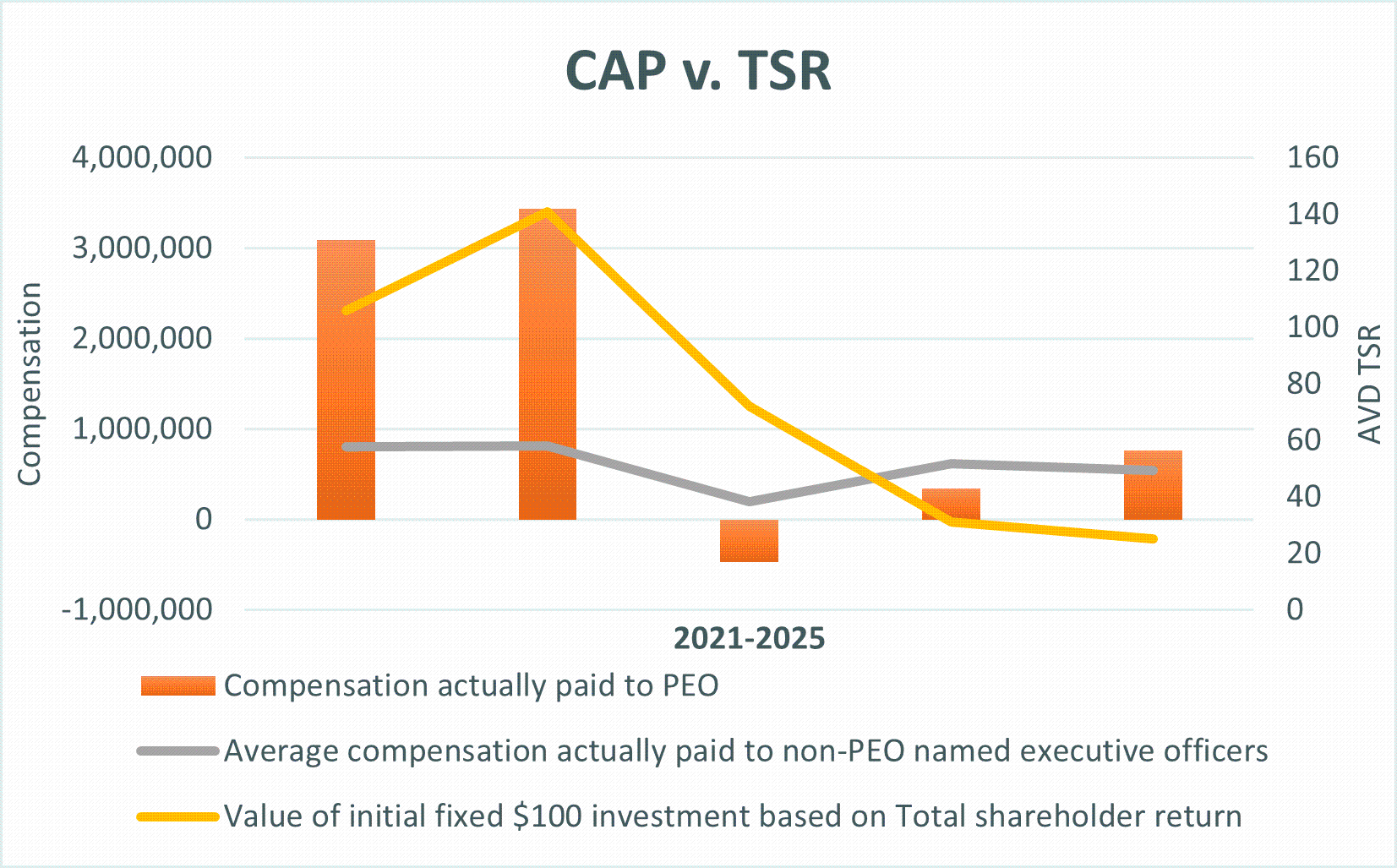
Compensation Actually Paid and Net Income
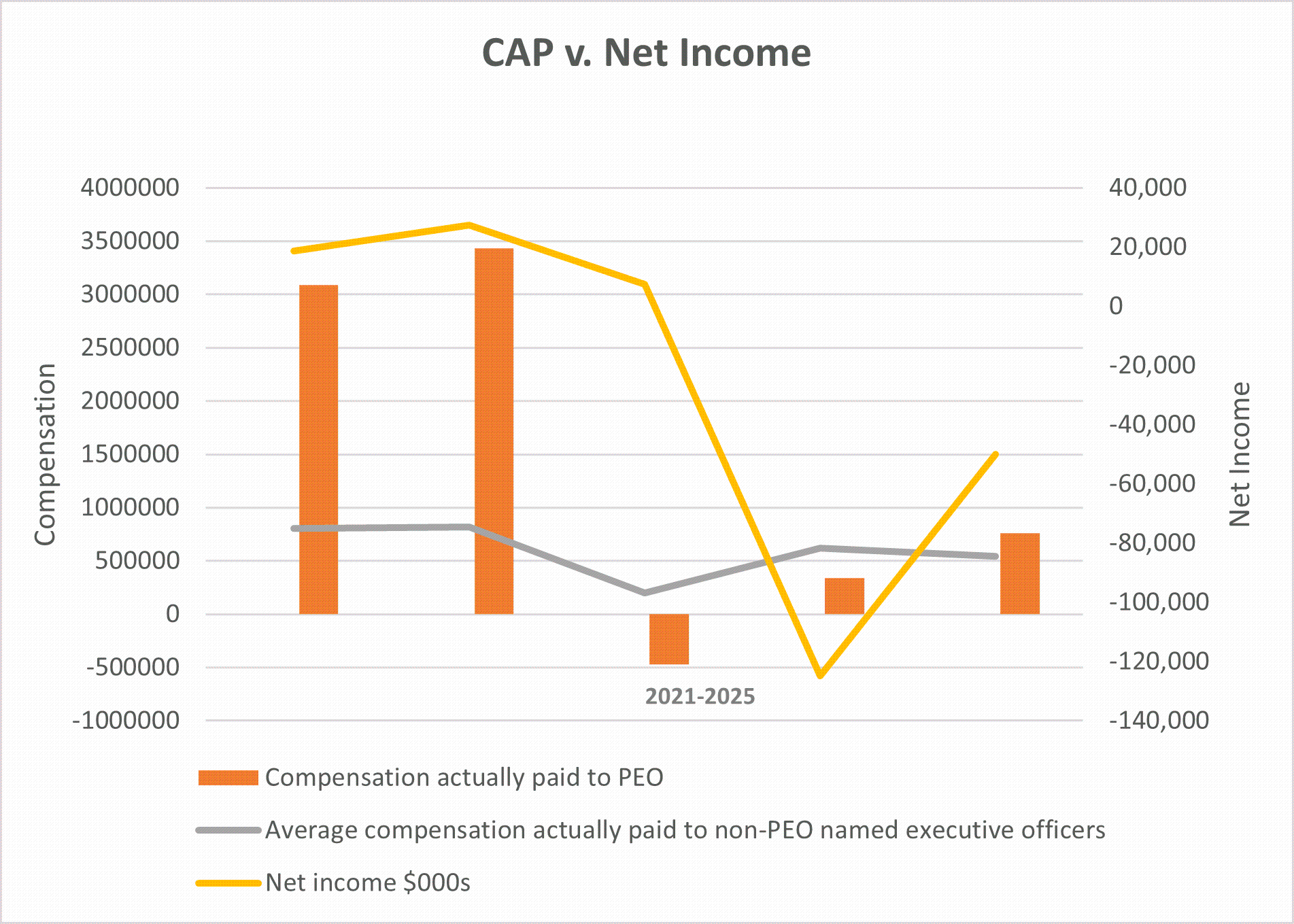
Compensation Actually Paid and Net Sales
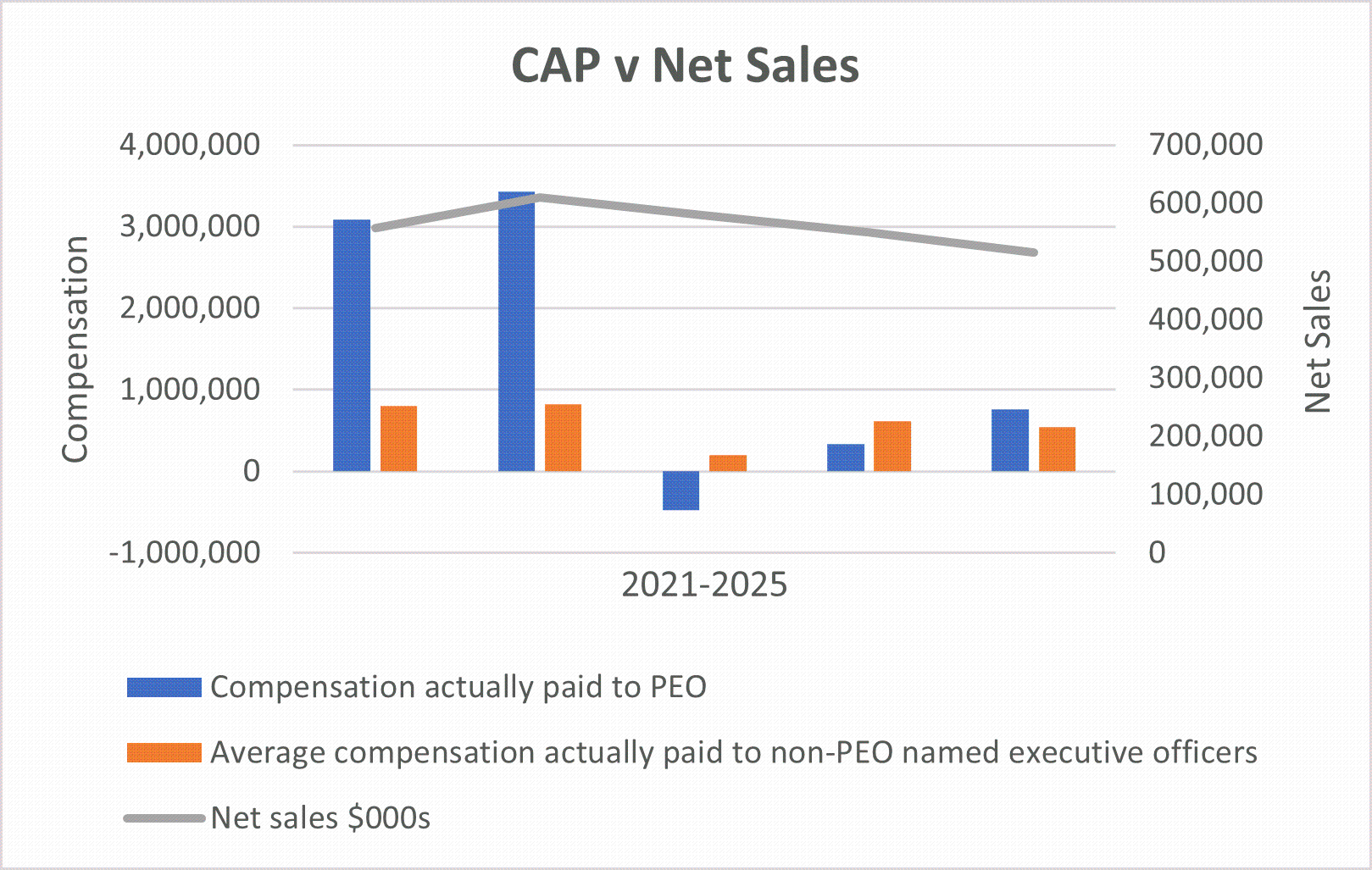
Compensation Actually Paid and Adjusted EBITDA
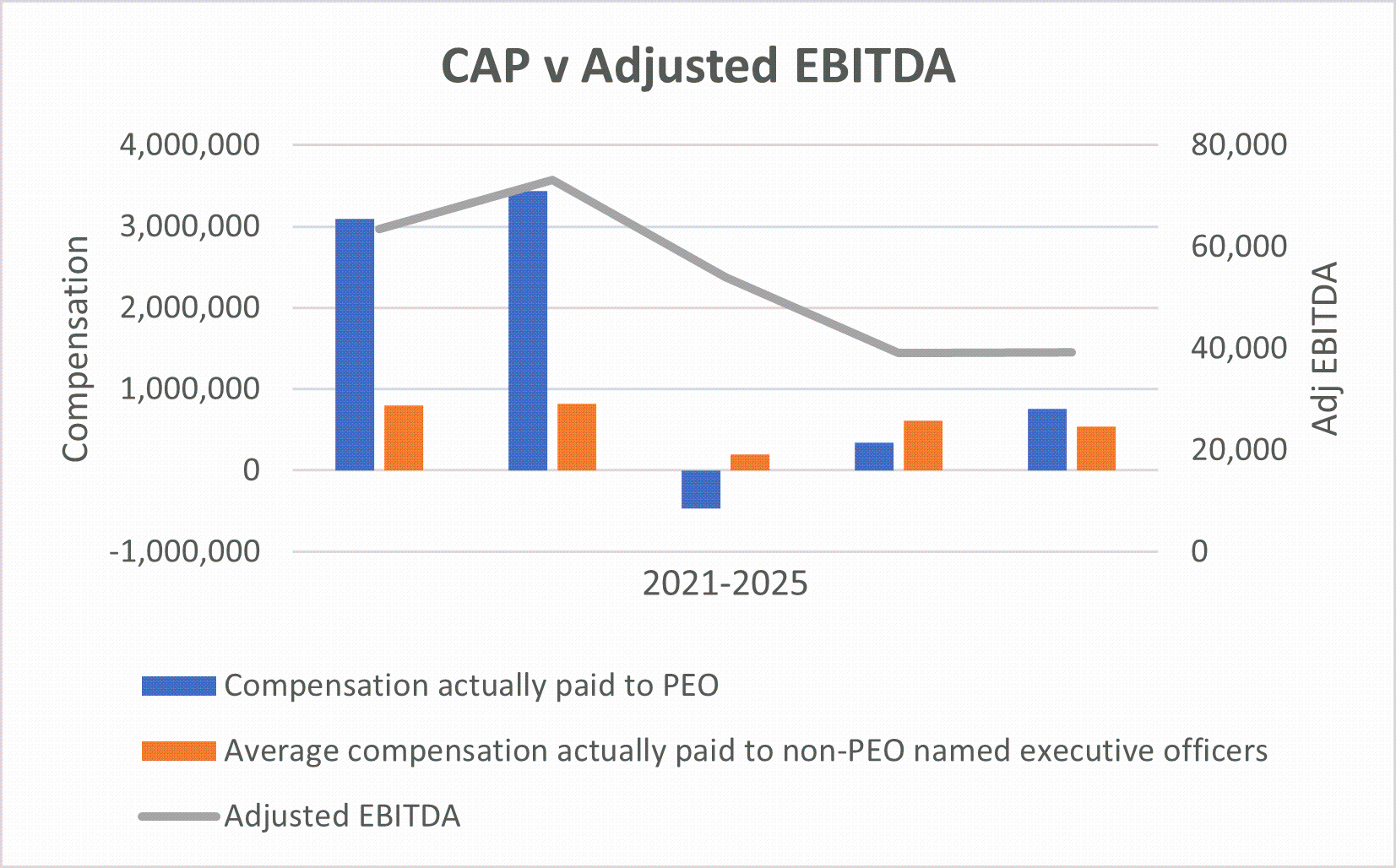
Director Compensation
The following table summarizes compensation paid to the non-management members of the Board for the year ended December 31, 2025.
|
|
|
|
|
|
|
|
|
|
|
|
|
|
|
|
|
|
|
|
|
|
|
|
|
|
|
|
|
Name
(a) |
|
Fees Earned
or Paid in
Cash
($)
(b) |
|
|
Stock
Awards
($)
(c)
(1) |
|
|
Option
Awards
($)
(d) |
|
|
Non-Equity
Incentive Plan
Compensation
($)
(e) |
|
|
Change in Pension
Value and
Non-Qualified
Deferred
Compensation
Earnings
($)
(f) |
|
|
All Other
Compen-
sation
($)
(g) |
|
|
Total
($)
(h) |
|
Marisol Angelini |
|
|
119,500 |
|
|
|
80,000 |
|
|
|
— |
|
|
|
— |
|
|
|
— |
|
|
|
— |
|
|
|
199,500 |
|
Scott D. Baskin |
|
|
177,500 |
|
|
|
40,000 |
|
|
|
— |
|
|
|
— |
|
|
|
— |
|
|
|
— |
|
|
|
217,500 |
|
Mark R. Bassett |
|
|
100,250 |
|
|
|
80,000 |
|
|
|
— |
|
|
|
— |
|
|
|
— |
|
|
|
— |
|
|
|
180,250 |
|
Steve Macicek |
|
|
107,500 |
|
|
|
80,000 |
|
|
|
— |
|
|
|
— |
|
|
|
— |
|
|
|
— |
|
|
|
187,500 |
|
Patrick E. Gottschalk |
|
|
107,500 |
|
|
|
80,000 |
|
|
|
— |
|
|
|
— |
|
|
|
— |
|
|
|
— |
|
|
|
187,500 |
|
Émer Gunter |
|
|
138,500 |
|
|
|
40,000 |
|
|
|
— |
|
|
|
— |
|
|
|
— |
|
|
|
— |
|
|
|
178,500 |
|
Keith M. Rosenbloom |
|
|
99,750 |
|
|
|
80,000 |
|
|
|
— |
|
|
|
— |
|
|
|
— |
|
|
|
— |
|
|
|
179,750 |
|
Tiu De Mino |
|
|
84,000 |
|
|
|
80,000 |
|
|
|
— |
|
|
|
— |
|
|
|
— |
|
|
|
— |
|
|
|
164,000 |
|
(1)Represents a grant of 17,621 shares of either common stock or deferred share units to each of the directors who received the full $80,000 of the annual grant, and a grant of 8,810 shares of common stock to those directors who received $40,000 of the annual grant. Under the non-management director compensation plan, directors who have accumulated four years' worth of stock grants may elect to receive one-half cash and one-half equity (i.e., $40,000 plus stock worth $40,000) in lieu of an equity award of $80,000. Further, Grant date values were all calculated in accordance with FASB ASC Topic 718, and all amounts shown in this column exclude the effect of estimated forfeitures related to service-based vesting conditions. The grant date fair value was calculated based on the closing price of the Common Stock on the date of issuance.
During 2025, compensation for non-management board members has been made as per the table set forth below:
Board Compensation
|
|
American Vanguard Board Pay |
|
|
|
Board Pay |
|
Cash retainer |
$60,000 |
Annual equity |
$80,000 |
Per-meeting fee |
$0 |
Executive sessions |
$0 |
Committee Pay |
|
Incremental Committee chair premium retainer: |
|
➣ Audit |
$10,000 |
➣ Finance Committee |
$8,000 |
➣ Compensation |
$7,000 |
➣ Nominating/Governance and Risk Committee |
$5,000 |
Committee member retainer: |
|
➣ Audit |
$10,000 |
➣ Finance Committee |
$10,000 |
➣ Compensation |
$7,500 |
➣ Nominating/Governance and Risk Committee |
$5,000 |
Per-meeting fee: |
|
➣ Audit/Compensation/Finance |
$0 |
➣ Nominating/Governance/Risk |
$0 |
Lead Director |
|
Lead Director |
$25,000 |
Special Assignments |
|
Per diem fee for special assignments |
$2,000 |
Conditional meeting fee (>2 scheduled meetings) |
$1,500 |
In addition, during 2025, the chair of the Transaction Committee received $20,000, and each member of the Transaction Committee received $10,000 as a flat fee.
Annual Stock Awards for Non-Management Directors:
In accordance with the terms and conditions of the 2022 Plan, each non-employee director of the Board is entitled to receive awards of the Company’s Common Stock (“Common Stock”), as follows. In connection with each non-employee director’s election or re-election to the Board, such director was entitled to receive an award that equals $80,000 (the “Stock Award”). Further, it is the policy of the Company that each director must accumulate and hold Company stock equal to the number of shares received by him or her over the course of his or her first four full years of service on the Board, after which such director may elect to receive up to half of the value of any subsequent Stock Award in the form of a cash payment. If a person is appointed to the Board for any partial year (for example, due to a vacancy on the Board), such director will receive a pro-rata portion of the Stock Award as determined by the Compensation Committee or the Board.
•Each Stock Award will be calculated based on the closing price of the Common Stock on the date of issuance, as reported on the New York Stock Exchange or other national exchange on which the Common Stock is traded. No fractional share of any Stock Award will be issued, and the value of such fractional share will be paid in cash.
•Each Stock Award will vest immediately in full upon grant.
Further, during 2025, members of the Board were given the opportunity to elect to receive deferred share units (“DSUs”) in lieu of common stock. DSUs give the recipient the right to receive common stock upon the satisfaction of certain conditions and serve to defer the tax impact beyond the date of award. Under current tax laws, the grant of a DSU is not considered to be a taxable event; rather, the shares are deemed to vest (and be taxable) upon settlement, which is defined as either change of control of the Company, death of the recipient or termination/expiration of the recipient’s service. Five of the eight non-management directors elected to receive DSUs in connection with the annual award of equity in 2025.
Indemnification Agreement
The Company has entered into written indemnification agreements with each of its directors, effective as of the first day of such person’s service as a director. The agreement provides for contractual indemnification obligations by the Company to the extent permitted by applicable law and the advancement of expenses in connection therewith. The agreement also provides that any legal action brought by the Company against a director must be brought within two years from the date of the facts giving rise to the action or such shorter period as provided by law.
Review and Approval of Related Person Transactions
The N&CG Committee has the responsibility for the review and approval or ratification of all related persons and conflict of interest transactions involving any director, executive officer, nominee for director, any holder of 5% or more of any class of the Company’s voting securities or any non-executive officer (or any member of the immediate family of any of the foregoing persons), if any such transaction involves more than $120,000, in each case using appropriate counsel and other advisers, as the Committee may deem necessary.
In the course of its review of proposed related person transactions, the N&CG Committee considers all relevant facts and circumstances, including: (i) the benefits of the transaction to the Company; (ii) the impact of the transaction on a director’s independence; (iii) the availability of other sources for comparable products or services; (iv) the terms of the transaction; (v) the terms available to unrelated third parties or to employees generally; and (vi) other facts and circumstances that may bear on the materiality of the transaction under applicable law and listing standards. The N&CG Committee may seek bids, quotes or independent valuations from third parties in connection with assessing any proposed related person transaction.
The Committee approves only those related person transactions that are in, or are not inconsistent with, the best interests of the Company and its stockholders, as the N&CG Committee determines in good faith. To the extent that a proposed related person transaction involves any member of the N&CG Committee (or an immediate family member of any member of the N&CG Committee), such member would not participate in the deliberations or vote respecting the approval or ratification of the proposed transaction.
Related Person Transactions
During 2025, there were no related person transactions.
COMMUNICATIONS
Communications to the Board
All communications to the Board or any individual director must be in writing and addressed to them c/o American Vanguard Corporation, Attn: Corporate Secretary, 4695 MacArthur Court, Suite 1200, Newport Beach, CA 92660.
Proposals for Submission at Next Annual Meeting
Any stockholder who intends to present a director nomination or other proposal at the Company’s 2027 Annual Meeting of Stockholders must send the proposal to: American Vanguard Corporation, Attn: Corporate Secretary, 15440 Laguna Canyon Road, Irvine, California 92618 (corporate address as of May 13, 2026). The timing and procedure for any such submission are described on page 4 hereof.
DELINQUENT SECTION 16(A) REPORTS
Section 16(a) of the Exchange Act and SEC rules require our directors, executive officers and persons who own more than 10% of any class of our common stock to file reports of their ownership and changes in ownership of our common stock with the SEC. Based solely on our review of the reports filed with the SEC and written representations from such reporting persons, we determined that all Section 16 reports were timely filed in fiscal 2025 by our directors, executive officers and beneficial owners of more than 10% of any class of our common stock, except for one Form 3 filing by Carmen Tiu de Mino and Douglas A. Kaye III and one Form 4 filing by Mr. Kaye, Ms. Tiu de Mino, Jared Straley and Keith Rosenbloom.
WHERE YOU CAN FIND MORE INFORMATION
The Company files annual, quarterly and current reports, proxy statements and other information with the SEC under the Exchange Act. We make available free of charge on or through our Internet website, www.american-vanguard.com, our reports and other information filed with or furnished to the SEC and amendments to those reports filed or furnished pursuant to Section 13(a) or 15(d) of the Exchange Act as soon as reasonably practicable after we electronically file such material with, or furnish it to, the SEC. The SEC’s Internet website, www.sec.gov, also contains reports, proxy statements and other information about issuers, like us, who file electronically with the SEC.
WE WILL PROVIDE, WITHOUT CHARGE, ON THE WRITTEN REQUEST OF ANY STOCKHOLDER, A COPY OF OUR 2025 ANNUAL REPORT ON FORM 10-K, INCLUDING THE FINANCIAL STATEMENTS AND THE FINANCIAL STATEMENT SCHEDULES REQUIRED TO BE FILED WITH THE SEC PURSUANT TO RULE 13a-1. STOCKHOLDERS SHOULD DIRECT SUCH REQUESTS TO THE COMPANY’S CHIEF FINANCIAL OFFICER AT 4695 MACARTHUR COURT, SUITE 1200, NEWPORT BEACH, CALIFORNIA 92660.
References to any website herein do not incorporate by reference the information contained on that website, and such information should not be considered to be part of this Proxy Statement.
HOUSEHOLDING
In some cases only one copy of the Company’s proxy materials is being delivered to multiple stockholders sharing an address unless the Company has received contrary instructions from one or more of the stockholders. Upon written or oral request at the address or phone number indicated on the first page of the Proxy Statement, the Company will promptly deliver a separate copy of these documents to a stockholder at a shared address to which a single copy has been delivered. A stockholder can notify the Company at the address or phone number listed on the first page of this Proxy Statement if the stockholder wishes to receive separate copies in the future. In addition, stockholders sharing an address who are currently receiving multiple copies may also notify the Company in the same way if they wish to receive only a single copy.
OTHER MATTERS
The Company’s Annual Report for the year ended December 31, 2025, is available with this Proxy Statement but shall not be deemed incorporated herein. The Board does not know of any matter to be acted upon at the Annual Meeting other than the matters described herein.
By Order of the Board of Directors
Timothy J. Donnelly
Chief Legal Officer,
General Counsel & Secretary
Dated: April 23, 2026