0001193125-26-192301.txt : 20260429 0001193125-26-192301.hdr.sgml : 20260429 20260429172032 ACCESSION NUMBER: 0001193125-26-192301 CONFORMED SUBMISSION TYPE: 485BPOS PUBLIC DOCUMENT COUNT: 25 FILED AS OF DATE: 20260429 DATE AS OF CHANGE: 20260429 EFFECTIVENESS DATE: 20260430 FILER: COMPANY DATA: COMPANY CONFORMED NAME: VALIC Co I CENTRAL INDEX KEY: 0000719423 ORGANIZATION NAME: EIN: 720029692 STATE OF INCORPORATION: MD FISCAL YEAR END: 0531 FILING VALUES: FORM TYPE: 485BPOS SEC ACT: 1940 Act SEC FILE NUMBER: 811-03738 FILM NUMBER: 26918126 BUSINESS ADDRESS: STREET 1: 30 HUDSON STREET STREET 2: 16TH FLOOR CITY: JERSEY CITY STATE: NJ ZIP: 07302 BUSINESS PHONE: 551-235-3560 MAIL ADDRESS: STREET 1: 30 HUDSON STREET STREET 2: 16TH FLOOR CITY: JERSEY CITY STATE: NJ ZIP: 07302 FORMER COMPANY: FORMER CONFORMED NAME: AIG Retirement CO I DATE OF NAME CHANGE: 20080501 FORMER COMPANY: FORMER CONFORMED NAME: VALIC CO I DATE OF NAME CHANGE: 20020110 FORMER COMPANY: FORMER CONFORMED NAME: NORTH AMERICAN FUNDS VARIABLE PRODUCT SERIES CO I DATE OF NAME CHANGE: 20000929 FILER: COMPANY DATA: COMPANY CONFORMED NAME: VALIC Co I CENTRAL INDEX KEY: 0000719423 ORGANIZATION NAME: EIN: 720029692 STATE OF INCORPORATION: MD FISCAL YEAR END: 0531 FILING VALUES: FORM TYPE: 485BPOS SEC ACT: 1933 Act SEC FILE NUMBER: 002-83631 FILM NUMBER: 26918125 BUSINESS ADDRESS: STREET 1: 30 HUDSON STREET STREET 2: 16TH FLOOR CITY: JERSEY CITY STATE: NJ ZIP: 07302 BUSINESS PHONE: 551-235-3560 MAIL ADDRESS: STREET 1: 30 HUDSON STREET STREET 2: 16TH FLOOR CITY: JERSEY CITY STATE: NJ ZIP: 07302 FORMER COMPANY: FORMER CONFORMED NAME: AIG Retirement CO I DATE OF NAME CHANGE: 20080501 FORMER COMPANY: FORMER CONFORMED NAME: VALIC CO I DATE OF NAME CHANGE: 20020110 FORMER COMPANY: FORMER CONFORMED NAME: NORTH AMERICAN FUNDS VARIABLE PRODUCT SERIES CO I DATE OF NAME CHANGE: 20000929 0000719423 S000008352 Small Cap Special Values Fund C000022849 Small Cap Special Values Fund VSSVX 485BPOS 1 d114233d485bpos.htm 485BPOS 485BPOS

SECURITIES ACT FILE NO. 002-83631
INVESTMENT COMPANY ACT FILE NO. 811-03738
FORM N-1A
SECURITIES AND EXCHANGE COMMISSION
Washington, D.C. 20549
REGISTRATION STATEMENT UNDER THE SECURITIES ACT OF 1933
Pre-Effective Amendment No.
Post-Effective Amendment No. 126
and/or
 
REGISTRATION STATEMENT UNDER THE INVESTMENT COMPANY ACT OF 1940
Amendment No. 125
VALIC COMPANY I
(Exact Name of Registrant as Specified in Charter)
2919 ALLEN PARKWAY
HOUSTON, TEXAS 77019
(Address of Principal Executive Offices) (Zip Code)
(800) 858-8850
(Registrant’s Telephone Number, including area code)
CHRISTOPHER J. TAFONE, ESQ.
COREBRIDGE FINANCIAL, INC.
30 HUDSON STREET
JERSEY CITY, NJ 07302

THE CORPORATION TRUST COMPANY
300 EAST LOMBARD ST.
BALTIMORE, MARYLAND 21202
(Name and Address for Agent for Service)
Copy to:
DAVID M. LEAHY, ESQ.
SULLIVAN & WORCESTER LLP
1666 K STREET, N.W.
WASHINGTON, D.C. 20006
It is proposed that this filing will become effective (check appropriate box):
Immediately upon filing pursuant to paragraph (b) of Rule 485
on April 30, 2026, pursuant to paragraph (b) of Rule 485
60 days after filing pursuant to paragraph (a)(1)
on (date), pursuant to paragraph (a)(1)
75 days after filing pursuant to paragraph (a)(2)
on (date), pursuant to paragraph (a)(2) of Rule 485
If appropriate, check the following box:
This post-effective amendment designates a new effective date for a previously filed post-effective amendment.
This filing relates solely to Small Cap Core Fund.


VALIC Company I
 
Prospectus, April 30, 2026


VALIC Company I (“VC I”) is a mutual fund complex made up of 36 separate funds, one of which is described in this Prospectus (the “Fund”).
 
     Ticker Symbol:
Small Cap Core Fund (formerly, Small Cap Special Values Fund)    VSSVX
This Prospectus contains information you should know before investing, including information about risks. Please read it before you invest and keep it for future reference.
The Securities and Exchange Commission has not approved or disapproved these securities, nor has it determined that this Prospectus is accurate or complete. It is a criminal offense to state otherwise.

TABLE OF CONTENTS
 
Topic    Page  
     1  
     1  
     1  
     1  
     2  
     3  
     3  
     4  
     4  
     4  
     5  
     7  
     7  
     15  
     16  
     17  
     19  
     19  
     19  
     21  
     21  
     22  
     23  

FUND SUMMARY: SMALL CAP CORE FUND (FORMERLY, SMALL CAP SPECIAL VALUES FUND)
 
Investment Objective
 
The Fund seeks to achieve capital appreciation.
Fees and Expenses of the Fund
 
This table describes the fees and expenses that you may pay if you buy, hold and sell shares of the Fund. The table and the example below do not reflect the separate account fees charged in the variable annuity or variable life insurance policy (“Variable Contracts”) in which the Fund is offered. If separate account fees were shown, the Fund’s annual operating expenses would be higher. Please see your Variable Contract prospectus for more details on the separate account fees.
Annual Fund Operating Expenses (expenses that you pay each year as a percentage of the value of your investment)
 
Management Fees
     0.75%  
Other Expenses
     0.15%  
Acquired Fund Fees and Expenses1
     0.00%  
Total Annual Fund Operating Expenses
     0.90%  
Fee Waivers and/or Expense Reimbursements2,3
     0.11%  
Total Annual Fund Operating Expenses After Fee Waivers and/or Expense Reimbursements2, 3
     0.79%  
 
1 
Restated to reflect current fees and expenses.
2 
The Fund’s investment adviser, The Variable Annuity Life Insurance Company (“VALIC”), has contractually agreed to waive its advisory fee until September 30, 2027, so that the advisory fee payable by the Fund to VALIC equals 0.64% on the first $500 million of the Fund’s average daily net assets and 0.59% on average daily net assets over $500 million. This agreement may be modified or discontinued prior to such time only with the approval of the Board of Directors of VALIC Company I (“VC I”), including a majority of the directors who are not “interested persons” of VC I as defined in the Investment Company Act of 1940, as amended.
3 
The fee table above has been restated to reflect the contractual advisory fee waiver agreement.
Expense Example
This Example is intended to help you compare the cost of investing in the Fund with the cost of investing in other mutual funds. The Example assumes that you invest $10,000 in the Fund for the time periods indicated and then redeem or hold all of your shares at the end of those periods. The Example also assumes that your investment has a 5% return each year and that the Fund’s operating
expenses remain the same (except that the Example incorporates any applicable fee waiver and/or expense limitation arrangements for only the first year). The Example does not reflect charges imposed by the Variable Contract. If the separate account fees were reflected, the expenses would be higher. See the Variable Contract prospectus for information on such charges. Although your actual costs may be higher or lower, based on these assumptions and the net expenses shown in the fee table, your costs would be:
 
 1 Year 
 
 3 Years 
 
 5 Years 
 
 10 Years 
$81   $276   $488   $1,098
Portfolio Turnover
The Fund pays transaction costs, such as commissions, when it buys and sells securities (or “turns over” its portfolio). These costs, which are not reflected in annual fund operating expenses or in the Example, affect the Fund’s performance.
During the most recent fiscal year, the Fund’s portfolio turnover rate was 21% of the average value of its portfolio.
Principal Investment Strategies of the Fund
 
Under normal market conditions, the Fund will invest at least 80% of its net assets in securities of “small‑cap” companies, and in derivatives and other instruments that have economic characteristics similar to such securities. The Fund considers a small‑cap company to be one whose market capitalization, at the time of purchase, is equal to or less than the market capitalization of the largest company in the Russell 2000® Index during the most recent 12‑month period. As of March 31, 2026, the median stock by market capitalization in the Index was approximately $0.967 billion, and the largest stock was approximately $34.169 billion. The size of the companies in the Index changes with market conditions and the composition of the Index.
The Fund primarily invests in common stock but may also invest in other types of securities such as real estate investment trusts (“REITs”).
The Subadviser uses fundamental research to select securities for the Fund’s portfolio. While the process may change over time or vary in particular cases, in general the selection process currently uses a fundamental approach in analyzing issuers on factors such as a company’s financial performance, competitive strength and prospects, industry position, and business model and management strength. Industry outlook, market trends and general economic conditions may also be considered.
 
 
1

FUND SUMMARY: SMALL CAP CORE FUND (FORMERLY, SMALL CAP SPECIAL VALUES FUND)
 
The Fund aims to maintain a broad diversification across all major economic sectors. In constructing the portfolio, the Fund seeks to limit exposure to so‑called “top‑down” or “macro” risks, such as overall stock market movements, economic cycles, and interest rate or currency fluctuations. Instead, the Subadviser seeks to add value by selecting individual securities that it believes have superior company-specific fundamental attributes or relative valuations that it expects to outperform their industry and sector peers. This is commonly referred to as a “bottom‑up” approach to portfolio construction.
The Subadviser considers stock rankings, benchmark weightings and capitalization outlooks in determining security weightings for individual issuers.
The Subadviser might sell a security if the price is approaching its price target, if the company’s competitive position has deteriorated or the company’s management has performed poorly, or if the Subadviser has identified more attractive investment prospects.
In order to generate additional income, the Fund may lend portfolio securities to broker-dealers and other financial institutions provided that the value of the loaned securities does not exceed 30% of the Fund’s total assets. These loans earn income for the Fund and are collateralized by cash and securities issued or guaranteed by the U.S. Government or its agencies or instrumentalities. Investors will be given at least 60 days’ written notice in advance of any change to the Fund’s 80% investment policy set forth above.
Principal Risks of Investing in the Fund
 
As with any mutual fund, there can be no assurance that the Fund’s investment objective will be met or that the net return on an investment in the Fund will exceed what could have been obtained through other investment or savings vehicles. Shares of the Fund are not bank deposits and are not guaranteed or insured by any bank, government entity or the Federal Deposit Insurance Corporation. If the value of the assets of the Fund goes down, you could lose money.
The following is a summary of the principal risks of investing in the Fund.
Management Risk. The investment style or strategy used by a subadviser may fail to produce the intended result. A subadviser’s assessment of a particular security or company may prove incorrect, resulting in losses or underperformance.
Equity Securities Risk. The Fund invests primarily in equity securities and is therefore subject to the risk that
stock prices will fall and may underperform other asset classes. Individual stock prices fluctuate from day‑to‑day and may decline significantly. The prices of individual stocks may be negatively affected by poor company results or other factors affecting individual prices, as well as industry and/or economic trends and developments affecting industries or the securities market as a whole.
Small‑Cap Company Risk. Investing in small‑cap companies carries the risk that due to current market conditions these companies may be out of favor with investors. Small companies often are in the early stages of development with limited product lines, markets, or financial resources and managements lacking depth and experience, which may cause their stock prices to be more volatile than those of larger companies. Small company stocks may be less liquid yet subject to abrupt or erratic price movements. It may take a substantial period of time before the Fund realizes a gain on an investment in a small‑cap company, if it realizes any gain at all.
Real Estate Investment Trusts Risk. REITs are trusts that invest primarily in commercial real estate, residential real estate or real estate related loans. The value of an interest in a REIT may be affected by the value and the cash flows of the properties owned or the quality of the mortgages held by the REIT. The performance of a REIT depends on current economic conditions and the types of real property in which it invests and how well the property is managed. If a REIT concentrates its investments in a geographic region or property type, changes in underlying real estate values may have an exaggerated effect on the value of the REIT.
Market Risk. The Fund’s share price can fall because of weakness in the broad market, a particular industry, or specific holdings or due to adverse social, political or economic developments here or abroad, changes in investor psychology, technological disruptions, or heavy institutional selling and other conditions or events (including, for example, military confrontations, war, terrorism, trade wars, disease/virus, outbreaks and epidemics). The prices of individual securities may fluctuate, sometimes dramatically, from day to day. The prices of stocks and other equity securities tend to be more volatile than those of fixed-income securities.
Securities Lending Risk. Engaging in securities lending could increase the market and credit risk for Fund investments. The Fund may lose money if it does not recover borrowed securities, the value of the collateral falls, or the value of investments made with cash collateral declines. The Fund’s loans will be collateralized by securities issued or guaranteed by the U.S. Government or its agencies and instrumentalities,
 
 
2

FUND SUMMARY: SMALL CAP CORE FUND (FORMERLY, SMALL CAP SPECIAL VALUES FUND)
 
which subjects the Fund to the credit risk of the U.S. Government or the issuing federal agency or instrumentality. If the value of either the cash collateral or the Fund’s investments of the cash collateral falls below the amount owed to a borrower, the Fund also may incur losses that exceed the amount it earned on lending the security. Securities lending also involves the risks of delay in receiving additional collateral or possible loss of rights in the collateral if the borrower fails. Another risk of securities lending is the risk that the loaned portfolio securities may not be available to the Fund on a timely basis and the Fund may therefore lose the opportunity to sell the securities at a desirable price.
Performance Information
 
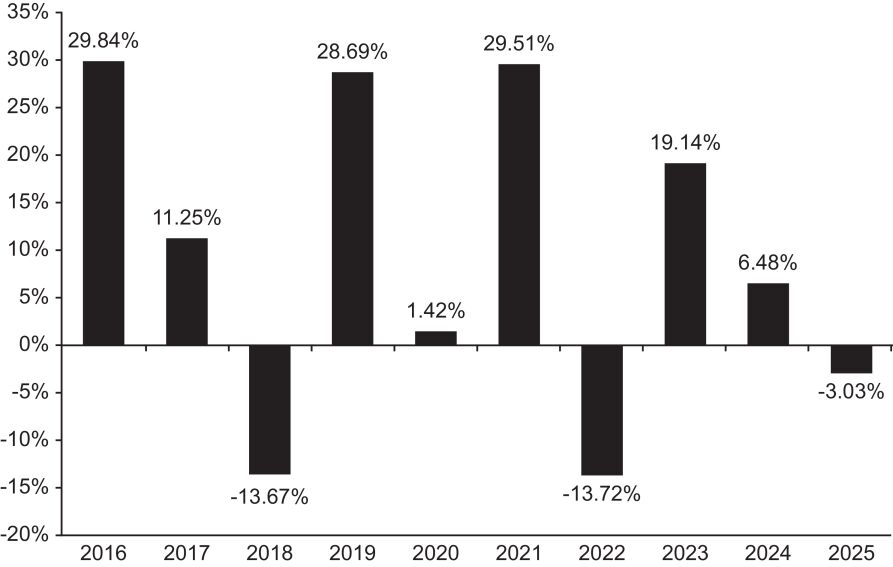
The following Risk/Return Bar Chart and Table illustrate the risks of investing in the Fund by showing changes in the Fund’s performance from calendar year to calendar year and comparing the Fund’s average annual returns to those of the Russell 3000® Index (a broad-based securities market index), the Russell 2000® Index, and the Russell 2000® Value Index. Effective April 30, 2026, the Fund changed its benchmark index from the Russell 2000® Value Index to the Russell 2000® Index, which is relevant to the Fund because it has characteristics similar to the Fund’s investment strategies. Fund management believes that the Russell 2000® Index is more representative of the securities in which the Fund invests. The Fund’s returns prior to April 30, 2026, as reflected in the bar chart and table, are the returns of the Fund when it followed a different investment objective and different investment strategies under the name, “Small Cap Special Values Fund.” Fees and expenses incurred at the contract level are not reflected in the bar chart or table. If these amounts were reflected, returns would be less than those shown. Of course, past performance of the Fund is not necessarily an indication of how the Fund will perform in the future.
Since the Fund’s inception, Wells Capital Management Incorporated (“WellsCap”) served as the Fund’s subadviser. In the fourth quarter of 2021, WellsCap changed its name to Allspring Global Investments, LLC (“Allspring”). From inception through September 11, 2009, Putnam Investment Management, LLC (“Putnam”) acted as co‑subadviser. Dreman Value Management, LLC succeeded Putnam as co‑subadviser from September 11, 2009, until December 7, 2015. Beginning December 7, 2015, Allspring (formerly WellsCap) served as the Fund’s sole subadviser. Effective April 30, 2026, Invesco Advisers, Inc. (“Invesco”) replaced Allspring as the Fund’s subadviser.
LOGO
During the period shown in the bar chart:
Highest Quarterly Return:December 31, 202028.56%
Lowest Quarterly Return:    March 31, 2020  -33.63%
Year to Date Most Recent Quarter:March 31, 2026   -0.07%
Average Annual Total Returns (For the periods ended December 31, 2025)
 
   
1
 Year 
 
5
 Years 
 
10
 Years 
Fund
    ‑3.03%     6.57%     8.39%
Russell 3000® Index (reflects no deduction for fees, expenses or taxes)
  17.15%   13.15%   14.29%
Russell 2000® Index (reflects no deduction for fees, expenses or taxes)
  12.81%   6.09%   9.62%
Russell 2000® Value Index (reflects no deduction for fees, expenses or taxes)
  12.59%   8.88%   9.27%
Investment Adviser
 
The Fund’s investment adviser is VALIC.
The Fund is subadvised by Invesco.
Portfolio Managers
 
Name and Title     Portfolio Manager 
of the Fund Since
 
Matthew P. Ziehl, CFA
Portfolio Manager (Co‑Lead)
     2026  
Adam Weiner
Portfolio Manager (Co‑Lead)
     2026  
Joy Budzinski
Portfolio Manager
     2026  
Magnus Krantz
Portfolio Manager
     2026  
Raman Vardharaj, CFA
Portfolio Manager
     2026  
 
 
3

FUND SUMMARY: SMALL CAP CORE FUND (FORMERLY, SMALL CAP SPECIAL VALUES FUND)
 
Purchases and Sales of Fund Shares
 
Shares of the Fund may only be purchased or redeemed through Variable Contracts offered by the separate accounts of VALIC or other participating life insurance companies and through qualifying retirement plans (“Plans”) and IRAs. Shares of the Fund may be purchased and redeemed each day the New York Stock Exchange is open, at the Fund’s net asset value determined after receipt of a request in good order.
The Fund does not have any initial or subsequent investment minimums. However, your insurance company may impose investment or account value minimums. The prospectus (or other offering document) for your Variable Contract contains additional information about purchases and redemptions of the Fund’s shares.
Tax Information
 
The Fund will not be subject to U.S. federal income tax so long as it qualifies as a regulated investment company and distributes its income and gains each year
to its shareholders. However, contract holders may be subject to federal income tax (and a federal Medicare tax of 3.8% that applies to net income, including taxable annuity payments, if applicable) upon withdrawal from a Variable Contract. Contract holders should consult the prospectus (or other offering document) for the Variable Contract for additional information regarding taxation.
Payments to Broker-Dealers and Other Financial Intermediaries
 
The Fund is not sold directly to the general public but instead is offered to registered and unregistered separate accounts of VALIC and its affiliates and to Plans and IRAs. The Fund and its related companies may make payments to the sponsoring insurance company or its affiliates for recordkeeping and distribution. These payments may create a conflict of interest as they may be a factor that the insurance company considers in including the Fund as an underlying investment options in a variable contract. Visit your sponsoring insurance company’s website for more information.
 
 
4

ADDITIONAL INFORMATION ABOUT THE FUNDS INVESTMENT OBJECTIVE, STRATEGIES AND RISKS
 
The Fund’s investment objective, principal investment strategies and principal risks are summarized in the Fund Summary. A comprehensive description of the Fund’s principal investment strategies and principal risks is provided below and in the “Investment Risks” section, respectively. In addition to the principal investment strategies summarized herein, the Fund may from time to time invest in other securities and employ other investment techniques on a non‑principal basis, as discussed below. The risks associated with these non‑principal securities and investment techniques are also discussed in the “Investment Risks” section. Aside from the securities and investment techniques described in this Prospectus, the Fund may invest in other securities and use other investment techniques in limited circumstances. These additional securities and techniques are listed in the Statement of Additional Information (“SAI”), which you may obtain free of charge (see back cover).
From time to time, the Fund may take temporary defensive positions that are inconsistent with its principal investment strategies, in attempting to respond to adverse market, economic, political, or other conditions. There is no limit on the Fund’s investments in money market securities for temporary defensive purposes. If the Fund takes such a temporary defensive position, it may not achieve its investment objective.
The investment objective and principal strategies for the Fund in this Prospectus are non‑fundamental and may be changed by the Board of Directors of VALIC Company I (“VC I”) without investor approval. Investors will be given at least 60 days’ written notice in advance of any change to the Fund’s 80% policy. References to “net assets” in the Fund Summary take into account any borrowings for investment purposes by the Fund. Unless stated otherwise, all percentages are calculated as of the time of purchase.
The Fund enters into contractual arrangements with various parties, including, among others, the Fund’s investment adviser, The Variable Annuity Life Insurance Company (“VALIC” or the “Adviser”), which provide services to the Fund. Shareholders are not parties to, or intended (or “third-party”) beneficiaries, of those contractual arrangements and those contractual arrangements cannot be enforced by shareholders.
This Prospectus and the SAI provide information concerning the Fund that you should consider in determining whether to purchase shares of the Fund. The Fund may make changes to this information from time to time. Neither this Prospectus nor the SAI is intended to give rise to any contract rights or other rights in any shareholder, other than any rights conferred by federal or state securities laws.
 
 
Small Cap Core Fund (formerly, Small Cap Special Values Fund)
The Fund seeks to achieve capital appreciation.
Under normal market conditions, the Fund will invest at least 80% of its net assets in securities of “small‑cap” companies, and in derivatives and other instruments that have economic characteristics similar to such securities. The Fund considers a small‑cap company to be one whose market capitalization, at the time of purchase, is equal to or less than the market capitalization of the largest company in the Russell 2000® Index during the most recent 12‑month period. As of March 31, 2026 the median stock by market capitalization in the Index was approximately $0.967 billion, and the largest stock was approximately $34.169 billion. The size of the companies in the Index changes with market conditions and the composition of the Index. The range of the Russell 2000® Index generally widens over time and it is reconstituted semi-annually to preserve its market cap characteristics.
The Fund primarily invests in common stock but may also invest in other types of securities such as real estate investment trusts (“REITs”).
The Subadviser uses fundamental research to select securities for the Fund’s portfolio. While the process may change over time or vary in particular cases, in general the selection process currently uses a fundamental approach in analyzing issuers on factors such as a company’s financial performance, competitive strength and prospects, industry position, and business model and management strength. Industry outlook, market trends and general economic conditions may also be considered.
The Fund aims to maintain a broad diversification across all major economic sectors. In constructing the portfolio, the Fund seeks to limit exposure to so‑called “top‑down” or “macro” risks, such as overall stock market movements, economic cycles, and interest rate or currency fluctuations. Instead, the Subadviser seeks to add value by selecting individual securities that it believes have superior company-specific fundamental attributes or relative valuations that it
 
5

ADDITIONAL INFORMATION ABOUT THE FUNDS INVESTMENT OBJECTIVE, STRATEGIES AND RISKS
 
expects to outperform their industry and sector peers. This is commonly referred to as a “bottom‑up” approach to portfolio construction.
The Subadviser considers stock rankings, benchmark weightings and capitalization outlooks in determining security weightings for individual issuers.
The Subadviser might sell a security if the price is approaching its price target, if the company’s competitive position has deteriorated or the company’s management has performed poorly, or if the Subadviser has identified more attractive investment prospects.
Although the Fund mainly invests in U.S. companies, it can invest in securities issued by companies or governments in any country; however, investments in foreign securities are a non‑principal investment strategy of the Fund. The Fund may also invest in derivatives, such as options, swaps and futures, to manage the Fund’s cash position in non‑principal amounts.
In order to generate additional income, the Fund may lend portfolio securities to broker-dealers and other financial institutions provided that the value of the loaned securities does not exceed 30% of the Fund’s total assets. These loans earn income for the Fund and are collateralized by cash and securities issued or guaranteed by the U.S. Government or its agencies or instrumentalities. Investors will be given at least 60 days’ written notice in advance of any change to the Fund’s 80% investment policy set forth above.
The Fund is subject to the following non‑principal risks: Cybersecurity and Artificial Intelligence Risk, Foreign Investment Risk, and Derivatives Risk (options, futures and swaps).
 
6

INVESTMENT GLOSSARY
 
Investment Risks
 
Cybersecurity and Artificial Intelligence Risk. Intentional cybersecurity breaches include: unauthorized access to systems, networks, or devices (such as through “hacking” activity); infection from computer viruses or other malicious software code; and attacks that shut down, disable, slow, or otherwise disrupt operations, business processes, or website access or functionality. In addition, unintentional incidents can occur, such as the inadvertent release of confidential information (possibly resulting in the violation of applicable privacy laws).
A cybersecurity breach could result in the loss or theft of customer data or funds, the inability to access electronic systems (“denial of services”), loss or theft of proprietary information or corporate data, physical damage to a computer or network system, or costs associated with system repairs. Such incidents could cause the Fund, the Adviser, a subadviser, or other service providers to incur regulatory penalties, reputational damage, additional compliance costs, or financial loss. In addition, such incidents could affect issuers in which the Fund invests, and thereby cause the Fund’s investments to lose value.
The rapid development and widespread adoption of artificial intelligence (“AI”) technologies present significant risks. To the extent AI is integrated into the operations of the Fund, its service providers, or the issuers in which the Fund invests, it introduces a range of risks that could significantly impact financial performance and operational stability. For example, AI’s reliance on large data sets and complex algorithms can lead to inaccuracies, biases, and incomplete outputs, potentially causing operational errors, investment losses, reputational harm, legal liability, and competitive harm to these entities. The evolving regulatory landscape surrounding AI adds another layer of uncertainty, as new regulations could limit the development and use of these technologies. Additionally, AI technologies may be exploited by malicious actors for cyberattacks, market manipulation, and fraud, further exacerbating risks. The potential for AI to disrupt markets and business operations is substantial, and the full extent of these risks is difficult to predict.
Derivatives Risk. Unlike stocks and bonds that represent actual ownership of a stock or bond, derivatives are instruments that “derive” their value from securities issued by a company, government, or government agency, such as futures and options. In certain cases, derivatives may be purchased for non‑speculative investment purposes or to protect (“hedge”) against a change in the price of the underlying security. There are some investors who take higher risk
(“speculate”) and buy derivatives to profit from a change in price of the underlying security. The Fund may purchase derivatives to hedge its investment portfolios and to earn additional income in order to help achieve its objective. Generally, the Fund does not buy derivatives to speculate. Futures contracts and options may not always be successful hedges; their prices can be highly volatile; using them could lower Fund total return; and the potential loss from the use of futures can exceed the Fund’s initial investment in such contracts.
The use of derivatives involves risks different from, or possibly greater than, the risks associated with investing directly in the underlying assets. Derivatives can significantly increase the Fund’s exposure to market and credit risk. Derivatives can be highly volatile, illiquid and difficult to value, and there is the risk that changes in the value of a derivative held by the Fund will not correlate with the underlying instruments or the Fund’s other investments. A small investment in derivatives can have a potentially large impact on the Fund’s performance. Derivative instruments also involve the risk that a loss may be sustained as a result of the failure of the counterparty to the derivative instruments to make required payments or otherwise comply with the derivative instruments’ terms. Certain types of derivatives involve greater risks than the underlying obligations because, in addition to general market risks, they are subject to illiquidity risk, counterparty risk and credit risk.
Credit Risk. The use of many derivative instruments involves the risk that a loss may be sustained as a result of the failure of another party to the contract (usually referred to as a “counterparty”) to make required payments or otherwise comply with the contract’s terms. Additionally, credit default swaps could result in losses if a subadviser does not correctly evaluate the creditworthiness of the company on which the credit default swap is based.
Hedging Risk. A hedge is an investment made in order to reduce the risk of adverse price movements in a currency or other investment, by taking an offsetting position (often through a derivative instrument, such as an option or forward contract). While hedging strategies can be very useful and inexpensive ways of reducing risk, they are sometimes ineffective due to unexpected changes in the market. Hedging also involves the risk that changes in the value of the related security will not match those of the instruments being hedged as expected, in which case any losses on the instruments being hedged may not be reduced.
Illiquidity Risk. Illiquidity risk exists when a particular derivative instrument is difficult to purchase or sell. If a
 
 
7

INVESTMENT GLOSSARY
 
derivative transaction is particularly large or if the relevant market is illiquid (as is the case with many privately negotiated derivatives), it may not be possible to initiate a transaction or liquidate a position at an advantageous time or price.
Lack of Availability Risk. Because the markets for certain derivative instruments (including markets located in foreign countries) are relatively new and still developing, suitable derivatives transactions may not be available in all circumstances for risk management or other purposes. Upon the expiration of a particular contract, a subadviser may wish to retain the Fund’s position in the derivative instrument by entering into a similar contract, but may be unable to do so if the counterparty to the original contract is unwilling to enter into the new contract and no other suitable counterparty can be found. There is no assurance that the Fund will engage in derivatives transactions at any time or from time to time. The Fund’s ability to use derivatives may also be limited by certain regulatory and tax considerations.
Leverage Risk. Because many derivatives have a leverage component, adverse changes in the value or level of the underlying asset, reference rate or index can result in a loss substantially greater than the amount invested in the derivative itself. Certain derivatives have the potential for unlimited loss, regardless of the size of the initial investment. When the Fund uses derivatives for leverage, investments in the Fund will tend to be more volatile, resulting in larger gains or losses in response to market changes. The Fund may not be able to terminate or liquidate a derivative under some market conditions, which could result in substantial losses. Pursuant to Rule 18f‑4 under the 1940 Act, the Fund must either use derivatives in a limited manner or comply with an outer limit on the amount of leverage-related risk that the Fund may obtain based on value‑at‑risk, among other things.
Management Risk. Derivative products are highly specialized instruments that require investment techniques and risk analysis that in many cases are different from those associated with stocks and bonds. The use of a derivative requires an understanding not only of the underlying instrument but also of the derivative itself, without the benefit of observing the performance of the derivative under all possible market conditions.
Market and Other Risks. Like most other investments, derivative instruments are subject to the risk that the market value of the instrument will change in a way detrimental to the Fund’s interest. If a subadviser incorrectly forecasts the values of securities, currencies or interest rates or other economic factors in using
derivatives for the Fund, the Fund might have been in a better position if it had not entered into the transaction at all. While some strategies involving derivative instruments can reduce the risk of loss, they can also reduce the opportunity for gain or even result in losses by offsetting favorable price movements in other Fund investments.
Other risks in using derivatives include the risk of mispricing or improper valuation of derivatives and the inability of derivatives to correlate perfectly with underlying assets, rates and indexes. Many derivatives, in particular privately negotiated derivatives, are complex and often valued subjectively. Improper valuations can result in increased cash payment requirements to counterparties or a loss of value to the Fund. Also, the value of derivatives may not correlate perfectly, or at all, with the value of the assets, reference rates or indexes they are designed to track. For example, a swap agreement on an ETF may not correlate perfectly with the index upon which the ETF is based because the Fund’s return is net of fees and expenses.
Options and Futures are contracts involving the right to receive or the obligation to deliver assets or money depending on the performance of one or more underlying assets, instruments or a market or economic index. An option gives its owner the right, but not the obligation, to buy (“call”) or sell (“put”) a specified amount of a security (or other instrument) at a specified price within a specified time period. The Fund may purchase listed options on various indices in which the Fund may invest. A futures contract is an exchange-traded legal contract to buy or sell a standard quantity and quality of a commodity, financial instrument, index, etc. at a specified future date and price. The Fund may also purchase and write (sell) option contracts on swaps, commonly referred to as swaptions. A swaption is an option to enter into a swap agreement. Like other types of options, the buyer of a swaption pays a non‑refundable premium for the option and obtains the right, but not the obligation, to enter into an underlying swap on agreed-upon terms. The seller of a swaption, in exchange for the premium, becomes obligated (if the option is exercised) to enter into an underlying swap on agreed-upon terms. When the Fund purchases an over‑the‑counter (“OTC”) swaption, it increases its credit risk exposure to the counterparty.
Futures Risk. Futures are contracts involving the right to receive or the obligation to deliver assets or money depending on the performance of one or more underlying assets, instruments or a market or economic index. A futures contract is an exchange-traded legal contract to buy or sell a standard quantity and quality of a commodity, financial instrument, index, etc. at a specified future date and price. A futures contract is
 
 
8

INVESTMENT GLOSSARY
 
considered a derivative because it derives its value from the price of the underlying commodity, security or financial index. The prices of futures contracts can be volatile and futures contracts may lack liquidity. In addition, there may be imperfect or even negative correlation between the price of a futures contract and the price of the underlying commodity, security or financial index.
Options Risk. Options are subject to sudden price movements and are highly leveraged, in that payment of a relatively small purchase price, called a premium, gives the buyer the right to acquire an underlying security or reference asset that has a face value substantially greater than the premium paid. The buyer of an option risks losing the entire purchase price of the option. The writer, or seller, of an option risks losing the difference between the purchase price received for the option and the price of the security or reference asset underlying the option that the writer must purchase or deliver upon exercise of the option. There is no limit on the potential loss.
The Fund may buy or sell put and call options that trade on U.S. or foreign exchanges. The Fund may also buy or sell OTC options, which subject the Fund to the risk that a counterparty may default on its obligations. In selling (referred to as “writing”) a put or call option, there is a risk that, upon exercise of the option, the Fund may be required to buy (for written puts) or sell (for written calls) the underlying investment at a disadvantageous price. The Fund may write call options on a security or other investment that the Fund owns (referred to as “covered calls”). If a covered call sold by the Fund is exercised on an investment that has increased in value above the call price, the Fund will be required to sell the investment at the call price and will not be able to realize any profit on the investment above the call price. Options purchased on futures contracts on foreign exchanges may be exposed to the risk of foreign currency fluctuations against the U.S. dollar.
Regulatory Risk. New rules and regulations could, among other things, restrict the Fund’s ability to engage in, or increase the cost to the Fund of, derivatives transactions, for example, by making some types of derivatives no longer available to the Fund, increasing margin or capital requirements, or otherwise limiting liquidity. The costs of derivatives transactions also may increase due to regulatory requirements imposed on clearing members, which may cause clearing members to raise their fees to cover the costs of additional capital requirements and other regulatory changes applicable to the clearing members. While the regulations and central clearing of some derivatives transactions are designed to reduce systemic risk (i.e., the risk that the interdependence of
large derivatives dealers could cause them to suffer liquidity, solvency or other challenges simultaneously), there is no assurance that the mechanisms imposed under the regulations will achieve that result. The implementation of new regulations with respect to derivatives generally has increased the costs of trading in these instruments and, as a result, may affect returns to investors in the Fund.
Swaps Risk. Swap agreements are two party contracts entered into primarily by institutional investors for periods ranging from a few weeks to more than one year. In a standard “swap” transaction, two parties agree to exchange the returns (or differentials in rates of return) earned or realized on particular predetermined investments or instruments, which may be adjusted for an interest factor. The gross returns to be exchanged or “swapped” between the parties are generally calculated with respect to a “notional amount” (i.e., the return on or increase in value of a particular dollar amount invested at a particular interest rate or in a particular foreign currency), or in a “basket” of securities representing a particular index. The absence of a central exchange or market for swap transactions may lead, in some instances, to difficulties in trading and valuation, especially in the event of market disruptions. Commodity Futures Trading Commission (“CFTC”) rules require certain interest rate and credit default swaps to be executed through a centralized exchange or regulated facility and be cleared through a regulated clearinghouse. Although this clearing mechanism is designed to reduce counterparty credit risk, in some cases it may disrupt or limit the swap market and may not result in swaps being easier to trade or value. As certain swaps become more standardized, the CFTC may require other swaps to be centrally cleared and traded, which may make it more difficult for the Fund to use swaps to meet its investment needs. The Fund also may not be able to find a clearinghouse willing to accept a swap for clearing. In a cleared swap, a central clearing organization will be the counterparty to the transaction. The Fund will assume the risk that the clearinghouse may be unable to perform its obligations. There are several different types of swaps:
 
   
Credit Swaps involve the receipt of floating or fixed rate payments in exchange for assuming potential credit losses of an underlying security. Credit swaps give one party to a transaction the right to dispose of or acquire an asset (or group of assets), or the right to receive or make a payment from the other party upon the occurrence of specified credit events.
 
   
Currency Swaps involve the exchange of the parties’ respective rights to make or receive payments in specified currencies.
 
 
9

INVESTMENT GLOSSARY
 
   
Equity Swaps allow the parties to a swap agreement to exchange the dividend income or other components of return on an equity investment (for example, a group of equity securities or an index) for a component of return on another non‑equity or equity investment.
 
   
Interest Rate or Inflation Swaps are contracts between two counterparties who agree to swap cash flows based on the inflation rate against fixed cash flows.
 
   
Mortgage Swaps are similar to interest-rate swaps in that they represent commitments to pay and receive interest. The notional principal amount, upon which the value of the interest payments is based, is tied to a reference pool or pools of mortgages.
 
   
Total Return Swaps (sometimes referred to as contracts for difference) are contracts that obligate a party to pay or receive interest in exchange for the payment by the other party of the total return generated by a security, a basket of securities, an index or an index component.
Credit Default Swaps Risk. A credit default swap is an agreement between two parties: a buyer of credit protection and a seller of credit protection. The buyer in a credit default swap agreement is obligated to pay the seller a periodic stream of payments over the term of the swap agreement. If no default or other designated credit event occurs, the seller of credit protection will have received a fixed rate of income throughout the term of the swap agreement. If a default or designated credit event does occur, the seller of credit protection must pay the buyer of credit protection the full value of the reference obligation. Credit default swaps increase counterparty risk when the Fund is the buyer. CFTC rules require that certain credit default swaps be executed through a centralized exchange or regulated facility and be cleared through a regulated clearinghouse. As a general matter, these requirements have increased costs in connection with trading these instruments.
Interest Rate Swaps and Related Derivatives Risk. Interest rate swaps involve the exchange by the Fund with another party of their respective commitments to pay or receive interest, such as an exchange of fixed-rate payments for floating rate payments. The purchase of an interest rate cap entitles the purchaser, to the extent that a specified index exceeds a predetermined interest rate, to receive payment of interest on a notional principal amount from the party selling such interest rate
cap. The purchase of an interest rate floor entitles the purchaser, to the extent that a specified index falls below a predetermined interest rate, to receive payments of interest on a notional principal amount from the party selling the interest rate floor. An interest rate collar is the combination of a cap and a floor that preserves a certain return within a predetermined range of interest rates.
Tax Risk. The use of certain derivatives may cause the Fund to realize higher amounts of ordinary income or short-term capital gain, to suspend or eliminate holding periods of positions, and/or to defer realized losses, potentially increasing the amount of taxable distributions, and of ordinary income distributions in particular. The Fund’s use of derivatives may be limited by the requirements for taxation of the Fund as a regulated investment company. The tax treatment of derivatives may be affected by changes in legislation, regulations or other legal authority that could affect the character, timing and amount of the Fund’s taxable income or gains and distributions to shareholders.
Equity Securities Risk. Equity securities represent an ownership position in a company. The prices of equity securities fluctuate based on changes in the financial condition of the issuing company and on market and economic conditions. If you own an equity security, you own a part of the company that issued it. Companies sell equity securities to get the money they need to grow.
Stocks are one type of equity security. Generally, there are three types of stocks:
 
   
Common stock — Each share of common stock represents a part of the ownership of the company. The holder of common stock participates in the growth of the company through increasing stock price and receipt of dividends. If the company runs into difficulty, the stock price can decline and dividends may not be paid.
 
   
Preferred stock — Each share of preferred stock usually allows the holder to get a set dividend before the common stock shareholders receive any dividends on their shares.
 
   
Convertible preferred stock — A stock with a set dividend which the holder may exchange for a certain amount of common stock.
Stocks are not the only type of equity security. Other equity securities include but are not limited to convertible securities, depositary receipts, warrants, rights and partially paid shares, investment company securities, real estate securities, convertible bonds and ADRs,
 
 
10

INVESTMENT GLOSSARY
 
EDRs and GDRs. More information about these equity securities is included elsewhere in this Prospectus or contained in the SAI.
Equity securities are subject to the risk that stock prices will fall over short or extended periods of time. Although the stock market has historically outperformed other asset classes over the long term, the stock market tends to move in cycles. Individual stock prices fluctuate from day‑to‑day and may underperform other asset classes over an extended period of time. Individual companies may report poor results or be negatively affected by industry and/or economic trends and developments. The prices of securities issued by such companies may suffer a decline in response. These price movements may result from factors affecting individual companies, industries or the securities market as a whole. In addition, the performance of different types of equity securities may rise or decline under varying market conditions — for example, “value” stocks may perform well under circumstances in which the prices of “growth” stocks in general have fallen, or vice versa.
Convertible Securities Risk. Convertible securities are securities (such as bonds or preferred stocks) that may be converted into common stock of the same or a different company. A convertible security is only considered an equity security if the exercise price of the convertible security is less than the fair market value of the security issuable upon conversion of such convertible security.
The values of the convertible securities in which the Fund may invest also will be affected by market interest rates, the risk that the issuer may default on interest or principal payments and the value of the underlying common stock into which these securities may be converted. Specifically, since these types of convertible securities pay fixed interest and dividends, their values may fall if market interest rates rise and rise if market interest rates fall. At times a convertible security may be more susceptible to fixed-income security related risks, while at other times such a security may be more susceptible to equity security related risks. Additionally, an issuer may have the right to buy back certain of the convertible securities at a time and a price that is unfavorable to the Fund.
Preferred Stock Risk. Unlike common stock, preferred stock generally pays a fixed dividend from a company’s earnings and may have a preference over common stock on the distribution of a company’s assets in the event of bankruptcy or liquidation. Preferred stockholders’ liquidation rights are subordinate to the company’s debt holders and creditors. If interest rates rise, the fixed dividend on preferred stocks may be less
attractive and the price of preferred stocks may decline. Preferred stock usually does not require the issuer to pay dividends and may permit the issuer to defer dividend payments. Deferred dividend payments could have adverse tax consequences for the Fund and may cause the preferred stock to lose substantial value. Preferred stock usually does not require the issuer to pay dividends and may permit the issuer to defer dividend payments.
Foreign Investment Risk. Foreign investments are investments of issuers that are economically tied to a non‑U.S. country. Except as otherwise described in the Fund’s principal investment strategies or Additional Information about the Fund’s Investment Objective, Strategies and Risks section, or as determined by the Fund’s subadviser(s), the Fund will deem an issuer to be economically tied to a non‑U.S. country by looking at a number of factors, including the domicile of the issuer’s senior management, the primary stock exchange on which the issuer’s security trades, the country from which the issuer produced the largest portion of its revenue, and its reporting currency. Foreign investments include, but are not limited to, securities issued by foreign governments or their agencies and instrumentalities, foreign corporate and government bonds, foreign equity securities, securities issued by foreign investment companies and passive foreign investment companies, and ADRs or other similar securities that represent interests in foreign equity securities, such as EDRs and GDRs. The Fund’s investments in foreign securities may also include securities from emerging market issuers.
Investments in foreign countries are subject to a number of risks. Investments in foreign securities involve risks in addition to those associated with investments in domestic securities due to changes in currency exchange rates, unfavorable political, social and legal developments or economic and financial instability, for example. A principal risk is that fluctuations in the exchange rates between the U.S. dollar and foreign currencies may negatively affect the value of an investment. In addition, there may be less publicly available information about a foreign company and it may not be subject to the same uniform accounting, auditing and financial reporting standards, practices and requirements comparable to those applicable to U.S. companies. Foreign governments may not regulate securities markets and companies to the same degree as the U.S government. Foreign investments will also be affected by local political or economic developments and governmental actions by the United States or other governments. Consequently, foreign securities may be less liquid, more volatile and more difficult to price or sell than U.S. securities, which means a subadviser may at
 
 
11

INVESTMENT GLOSSARY
 
times be unable to sell foreign investments at desirable prices. Foreign settlement procedures may also involve additional risks. Certain of these risks may also apply to U.S. investments that are denominated in foreign currencies or that are traded in foreign markets, or to securities of U.S. companies that have significant foreign operations. These risks are heightened for emerging markets issuers. Historically, the markets of emerging market countries have been more volatile than more developed markets; however, such markets can provide higher rates of return to investors. The Fund investing in foreign securities may also be subject to the following risks:
Brexit Risk. On January 31, 2020, the United Kingdom (the “UK”) withdrew from the European Union (“EU”) (commonly referred to as “Brexit”). The UK’s withdrawal was subject to a transition period that ended on December 31, 2020, and the UK and EU entered into a new trading relationship effective January 1, 2021. Although Brexit has occurred, the UK - EU relationship continues to evolve, including with respect to areas not comprehensively addressed by the current framework (including certain services and financial services). Brexit has caused, and may continue to cause, volatility in UK, EU, and global markets and may negatively affect issuers and markets through, among other things, business and trade disruptions, increased volatility and illiquidity, currency fluctuations, potentially lower economic growth, and legal and regulatory uncertainty (including the potential for divergent UK and EU laws and regulations). These developments could adversely affect the value, liquidity, and/or valuation of the Fund’s investments (including investments in issuers with significant UK or EU exposure) and could make it more difficult for the Fund to enter into, value, or dispose of certain investments on favorable terms.
Emerging Markets Risk. An emerging market country is generally one with a low or middle income economy that is in the early stages of its industrialization cycle. For fixed income investments, an emerging market includes those where the sovereign credit rating is below investment grade. Emerging market countries may change over time depending on market and economic conditions and the list of emerging market countries may vary by VALIC or subadviser. An “emerging market” country is generally any country that is included in the MSCI Emerging Markets Index. The risks associated with investments in foreign securities are heightened in connection with investments in the securities of issuers in developing or “emerging market” countries. Generally, the economic, social, legal, and political structures in emerging market countries are less diverse, mature and stable than those in developed countries. Unlike most
developed countries, emerging market countries may impose restrictions on foreign investment. These countries may also impose confiscatory taxes on investment proceeds or otherwise restrict the ability of foreign investors to withdraw their money at will. In addition, there may be less publicly available information about emerging market issuers due to differences in regulatory, accounting, auditing, and financial recordkeeping standards and available information may be unreliable or outdated.
Emerging market countries may be more likely to experience political turmoil or rapid changes in economic conditions than developed countries. The securities markets in emerging market countries tend to be smaller and less mature than those in developed countries, and they may experience lower trading volumes. As a result, investments in emerging market securities may be less liquid and their prices more volatile than investments in developed countries. The fiscal and monetary policies of emerging market countries may result in high levels of inflation or deflation or currency devaluation. As a result, investments in emerging market securities may be subject to abrupt and severe price changes. Investments in emerging market securities may be more susceptible to investor sentiment than investments in developed countries. Emerging market securities may be adversely affected by negative perceptions about an emerging market country’s stability and prospects for continued growth.
Risks associated with investments in emerging markets may include delays in settling portfolio securities transactions; currency and capital controls; greater sensitivity to interest rate changes; pervasive corruption and crime; exchange rate volatility; inflation, deflation or currency devaluation; violent military or political conflicts; confiscations and other government restrictions by the United States or other governments, and government instability. As a result, investments in emerging market securities tend to be more volatile than investments in developed countries. The Fund may be exposed to emerging market risks directly (through certain futures contracts and other derivatives whose values are based on emerging market indices or securities).
European Exposure Risk. The Economic and Monetary Union of the EU requires compliance with restrictions on inflation rates, deficits, interest rates, debt levels, and fiscal and monetary controls, each of which may significantly affect every country in Europe. Decreasing imports or exports, changes in governmental or EU regulations on trade, changes in the exchange rate of the euro, the default or threat of default by an EU member country on its sovereign debt, and recessions in an EU
 
 
12

INVESTMENT GLOSSARY
 
member country may have significant adverse effects on the economies of EU member countries. Responses to financial problems by EU countries may not produce the desired results, may limit future growth and economic recovery, may result in social unrest, or have other unintended consequences. Further defaults or restructurings by governments and other entities of their debt could have additional adverse effects on economies, financial markets, and asset valuations around the world. A number of countries in Eastern Europe remain relatively undeveloped and can be particularly sensitive to political and economic developments. Additionally, companies operating within the EU face increasingly burdensome regulations and operating requirements. In some cases, U.S. companies may also be subject to adverse protectionist measures or heightened regulation. Separately, the EU faces issues involving its membership, structure, procedures and policies. The exit of one or more member states from the EU, such as the departure of the UK, referred to as “Brexit”, could place the departing member’s currency and banking system under severe stress or even in jeopardy. An exit by other member states will likely result in increased volatility, illiquidity, and potentially lower economic growth in the affected markets, which will adversely affect the Fund’s investments.
Foreign Currency Risk. Currency transactions include the purchase and sale of currencies to facilitate the settlement of securities transactions and forward currency contracts, which are used to hedge against changes in currency exchange rates or to enhance returns. The Fund buys foreign currencies when it believes the value of the currency will increase. If it does increase, it sells the currency for a profit. If it decreases, it will experience a loss. The Fund may also buy foreign currencies to pay for foreign securities bought for the Fund or for hedging purposes. Because the Fund’s foreign investments are generally held in foreign currencies, the Fund could experience gains or losses based solely on changes in the exchange rate between foreign currencies and the U.S. dollar. Such gains or losses may be substantial.
The Fund may not fully benefit from or may lose money on forward currency transactions if changes in currency exchange rates do not occur as anticipated or do not correspond accurately to changes in the value of the Fund’s holdings. The Fund’s ability to use forward foreign currency transactions successfully depends on a number of factors, including the forward foreign currency transactions being available at prices that are not too costly, the availability of liquid markets and the ability of the Fund managers to accurately predict the direction of
changes in currency exchange rates. Currency exchange rates may be volatile and may be affected by, among other factors, the general economics of a country, the actions of U.S. and foreign governments or central banks, the imposition of currency controls and speculation. A security may be denominated in a currency that is different from the currency where the issuer is domiciled. Currency transactions are subject to counterparty risk, which is the risk that the other party in the transaction will not fulfill its contractual obligation.
The value of the Fund’s foreign investments may fluctuate due to changes in currency exchange rates. A decline in the value of foreign currencies relative to the U.S. dollar generally can be expected to depress the value of the Fund’s non‑U.S. dollar-denominated securities.
In addition, currency management strategies, to the extent that they reduce the Fund’s exposure to currency risks, may also reduce the Fund’s ability to benefit from favorable changes in currency exchange rates. Using currency management strategies for purposes other than hedging further increases the Fund’s exposure to foreign investment losses. Currency markets generally are not as regulated as securities markets. In addition, currency rates may fluctuate significantly over short periods of time, and can reduce returns.
Management Risk. Different investment styles and strategies tend to shift in and out of favor depending upon market and economic conditions, as well as investor sentiment. The investment style or strategy used by the Fund may fail to produce the intended result. Moreover, the Fund may outperform or underperform funds that employ a different investment style or strategy. A subadviser’s assessment of a particular security or company may prove incorrect, resulting in losses or underperformance.
Market Capitalization Risk. Companies are determined to be large‑cap companies, mid‑cap companies, or small‑cap companies based upon the total market value of the outstanding common stock (or similar securities) of the company at the time of purchase. The market capitalization of the companies in which the Fund invests change over time. The Fund determines relative market capitalizations using U.S. standards. Accordingly, the Fund’s non‑U.S. investments may have large capitalizations relative to market capitalizations of companies based outside the United States. The Fund will not automatically sell or cease to purchase stock of a company that it already owns just because the company’s market capitalization grows or falls outside this range.
 
 
13

INVESTMENT GLOSSARY
 
Small Cap Companies Risk. Investing in small companies involves greater risk than is customarily associated with larger companies. Stocks of small companies are subject to more abrupt or erratic price movements than larger company stocks. Small companies often are in the early stages of development and have limited product lines, operating histories, market access for products, financial resources, access to new capital, or depth and experience in management. Such companies seldom pay significant dividends that could cushion returns in a falling market. In addition, these companies may be more affected by intense competition from larger companies, and the trading markets for their securities may be less liquid and more volatile than securities of larger companies. This means that the Fund could have greater difficulty selling a security of a small‑cap issuer at an acceptable price, especially in periods of market volatility. Also, it may take a substantial period of time before the Fund realizes a gain on an investment in a small‑cap company, if it realizes any gain at all.
Market Risk. The Fund’s share price can fall because of weakness in the broad market, a particular industry, or specific holdings. The market as a whole can decline for many reasons, including adverse social, political or economic developments here or abroad, changes in investor psychology, technological disruptions, or heavy institutional selling and other conditions or events (including, for example, military confrontations, war, terrorism, trade wars, disease/virus, outbreaks and epidemics). The prospects for a sector, an industry or a company may deteriorate because of a variety of factors, including disappointing earnings or changes in the competitive environment. In addition, a subadviser’s assessment of companies held in the Fund may prove incorrect, resulting in losses or poor performance even in a rising market. Markets tend to move in cycles with periods of rising prices and periods of falling prices. Like markets generally, the investment performance of the Fund will fluctuate, so an investor may lose money over short or even long periods.
Preventative or protective actions that governments may take in respect of pandemic or epidemic diseases may result in periods of business disruption, business closures, inability to obtain raw materials, supplies and component parts, and reduced or disrupted operations for the issuers in which the Fund invests. Government intervention in markets may impact interest rates, market volatility and security pricing. The occurrence, reoccurrence and pendency of such diseases could adversely affect the economies (including through changes in business activity and increased unemployment) and financial markets either in specific countries or worldwide.
REITs Risk. Real Estate Investment Trusts (“REITs”) pool investors’ funds for investments primarily in commercial real estate properties. Like mutual funds, REITs have expenses, including advisory and administration fees that are paid by their shareholders. As a result, shareholders will absorb an additional layer of fees when the Fund invests in REITs. The performance of any Fund’s REITs holdings ultimately depends on the types of real property in which the REITs invest and how well the property is managed. A general downturn in real estate values also can hurt REITs performance. When a REIT focuses its investments in particular sub‑sectors of the real estate industry or particular geographic regions, the REIT’s performance would be especially sensitive to developments that significantly affected those particular sub‑sectors or geographic regions. Due to their dependence on the management skills of their managers, REITs may underperform if their managers are incorrect in their assessment of particular real estate investments. In addition, REITs are subject to certain provisions under federal tax law. The failure of a company to qualify as a REIT could have adverse consequences for the Fund, including significantly reducing the return to the Fund on its investment in such company.
Securities Lending Risk. The Fund may make secured loans of its portfolio securities for purposes of realizing additional income. No lending may be made with any companies affiliated with VALIC. The Fund will only make loans to broker-dealers and other financial institutions deemed by State Street Bank and Trust Company (the “securities lending agent”) to be creditworthy. The securities lending agent also holds the cash and the portfolio securities of VC I. Each loan of portfolio securities will be continuously secured by collateral in an amount at least equal to the market value of the securities loaned. Such collateral will be cash and securities issued or guaranteed by the U.S. Government or its agencies or instrumentalities, which subjects the Fund to the credit risk of the U.S. Government or the issuing federal agency or instrumentality. As with other extensions of credit, securities lending involves the risk that the borrower may fail to return the securities in a timely manner or at all. The Fund may lose money if the Fund does not recover the securities and/or the value of the collateral or the value of investments made with cash collateral falls. Such events may also trigger adverse tax consequences for the Fund. To the extent that either the value of the cash collateral or the Fund’s investments of the cash collateral declines below the amount owed to a borrower, the Fund also may incur losses that exceed the amount it earned on lending the security. Securities lending also involves the risks of delay in receiving additional collateral or possible loss of rights in the collateral should the borrower fail financially. Engaging in
 
 
14

INVESTMENT GLOSSARY
 
securities lending could also have a leveraging effect, which may intensify the market risk, credit risk and other risks associated with investments in the Fund. Another risk of securities lending is the risk that the loaned portfolio securities may not be available to the Fund on a timely basis and the Fund may therefore lose the opportunity to sell the securities at a desirable price.
About the Indices
 
Unlike mutual funds, the indices do not incur expenses. If expenses were deducted, the actual returns of the indices would be lower.
The Russell 2000® Index measures the performance of the 2,000 smallest companies in the Russell 3000® Index, which represents approximately 10% of the total market capitalization of the Russell 3000® Index.
The Russell 2000® Value Index measures the performance of those Russell 2000 companies with lower price‑to‑book ratios and lower forecasted growth values.
The Russell 3000® Index follows the 3,000 largest U.S. companies, based on total market capitalization.
 
 
15

ACCOUNT INFORMATION
 
VC I Shares
VC I is an open‑end management investment company and may offer shares of the Fund for sale at any time. However, VC I offers shares of the Fund only to registered and unregistered separate accounts of VALIC and its affiliates and to qualifying retirement plans (previously defined as the “Plans”) and IRAs.
Buying and Selling Shares
As a participant in a Variable Contract, Plan, or IRA, you do not directly buy shares of the Fund that make up VC I. Instead, you buy units in either a registered or unregistered separate account of VALIC or of its affiliates or through a trust or custodial account under a Plan or an IRA. When you buy these units, you specify the Fund in which you want the separate account, trustee or custodian to invest your money. The separate account, trustee or custodian in turn, buys the shares of the Fund according to your instructions. After you invest in the Fund, you participate in Fund earnings or losses in proportion to the amount of money you invest. When you provide instructions to buy, sell, or transfer shares of the Fund, the separate account, trustee or custodian does not pay any sales or redemption charges related to these transactions. The value of such transactions is based on the next calculation of net asset value after the orders are placed with the Fund.
For certain investors, there may be rules or procedures regarding the following:
 
   
any minimum initial investment amount and/or limitations on periodic investments;
 
   
how to purchase, redeem or exchange your interest in the Fund;
 
   
how to obtain information about your account, including account statements; and
 
   
any fees applicable to your account.
For more information on such rules or procedures, you should review your Variable Contract prospectus, Plan document or custodial agreement. The Fund does not currently foresee any disadvantages to participants arising out of the fact that it may offer its shares to separate accounts of various insurance companies to serve as the investment medium for their variable annuity and variable life insurance contracts. Nevertheless, the Board of Directors intends to monitor events in order to identify any material irreconcilable conflicts which may possibly arise and to determine what action, if any, should be taken in response to such conflicts. If such a conflict were to occur, one or more insurance companies’ separate accounts might be required to withdraw their investments in the Fund and
shares of another fund may be substituted. This might force the Fund to sell portfolio securities at disadvantageous prices. In addition, VC I reserves the right to refuse to sell shares of the Fund to any separate account, plan sponsor, trustee or custodian, or financial intermediary, or may suspend or terminate the offering of shares of the Fund if such action is required by law or regulatory authority or is in the best interests of the shareholders of the Fund.
Execution of requests. VC I is open on those days when the New York Stock Exchange is open for regular trading. Buy and sell requests are executed at the next net asset value (“NAV”) to be calculated after the request is accepted by VC I. If the order is received by VC I, or the insurance company as its authorized agent, before VC I’s close of business (generally 4:00 p.m., Eastern time), the order will receive that day’s closing price. If the order is received after that time, it will receive the next business day’s closing price.
Normally, VC I redeems Fund shares within seven days when the request is received in good order, but may postpone redemptions beyond seven days when: (i) the New York Stock Exchange is closed for other than weekends and customary holidays, or trading on the New York Stock Exchange becomes restricted; (ii) an emergency exists making disposal or valuation of the Fund’s assets not reasonably practicable; or (iii) the Securities and Exchange Commission (“SEC”) has so permitted by order for the protection of VC I’s shareholders. For these purposes, the SEC determines the conditions under which trading shall be deemed to be restricted and an emergency shall be deemed to exist. The New York Stock Exchange is closed on the following holidays: New Year’s Day, Martin Luther King, Jr. Day, Washington’s Birthday (observed), Good Friday, Memorial Day, Juneteenth, Independence Day, Labor Day, Thanksgiving Day and Christmas.
Your redemption proceeds typically will be sent within three business days after your request is submitted, but in any event, within seven days. Under normal circumstances, VC I expects to meet redemption requests by using cash or cash equivalents in the Fund’s portfolio or by selling portfolio assets to generate cash. During periods of stressed market conditions, the Fund may be more likely to limit cash redemptions and may determine to pay redemption proceeds by borrowing under a line of credit.
Frequent or Short-term Trading
The Fund, which is offered only through Variable Contracts, Plans or IRAs, is intended for long-term investment and not as frequent short-term trading
 
 
16

ACCOUNT INFORMATION
 
(“market timing”) vehicles. Accordingly, organizations or individuals that use market timing investment strategies and make frequent transfers or redemptions should not purchase shares of the Fund. The Board of Directors has adopted policies and procedures with respect to market timing activity as discussed below. VC I believes that market timing activity is not in the best interest of the participants of the Fund. Due to the disruptive nature of this activity, it can adversely impact the ability of the subadvisers to invest assets in an orderly, long-term manner. In addition, market timing can disrupt the management of the Fund and raise its expenses through: increased trading and transaction costs; forced and unplanned portfolio turnover; and large asset swings that decrease the Fund’s ability to provide maximum investment return to all participants. This in turn can have an adverse effect on Fund performance.
The Fund may invest in foreign securities and therefore may be particularly vulnerable to market timing. Market timing may occur because of time zone differences between the foreign markets on which the Fund’s international portfolio securities trade and the time as of which the Fund’s net asset value is calculated. Market timers might try to purchase shares of the Fund based on events occurring after foreign market closing prices are established but before calculation of the Fund’s net asset value. One of the objectives of VC I’s fair value pricing procedures is to minimize the possibilities of this type of market timing (see “How Shares are Valued”).
Shares of the Fund are generally held through insurance company separate accounts, Plans or through a trust or custodial account (“Financial Intermediaries”). The ability of VC I to monitor transfers made by the participants in separate accounts or Plans maintained by Financial Intermediaries is limited by the institutional nature of Financial Intermediaries’ omnibus accounts. VC I’s policy is that the Fund will rely on the Financial Intermediaries to monitor market timing within the Fund to the extent that VC I believes that each Financial Intermediary’s practices are reasonably designed to detect and deter transactions that are not in the best interest of the Fund.
There is no guarantee that VC I will be able to detect market timing activity or the participants engaged in such activity, or, if it is detected, to prevent its recurrence. Whether or not VC I detects it, if market timing occurs, then you should anticipate that you will be subject to the disruptions and increased expenses discussed above. In situations in which VC I becomes aware of possible market timing activity, it will notify the Financial Intermediary in order to help facilitate the enforcement of such entity’s market timing policies and procedures. VC I
has entered into agreements with various Financial Intermediaries that require such intermediaries to provide certain information to help identify frequent trading activity and to prohibit further purchases or exchanges by a participant identified as having engaged in frequent trades. VC I reserves the right, in its sole discretion and without prior notice, to reject, restrict or refuse purchase orders received from a Financial Intermediary, whether directly or by transfer, including orders that have been accepted by a Financial Intermediary, that VC I determines not to be in the best interest of the Fund. Such rejections, restrictions or refusals will be applied uniformly without exception.
You should review your Variable Contract prospectus, Plan document or custodial agreement for more information regarding market timing, including any restrictions, limitations or fees that may be charged on trades made through a Variable Contract, Plan or IRA. Any restrictions or limitations imposed by the Variable Contract, Plan or IRA may differ from those imposed by VC I.
Payments in Connection with Distribution
 
VALIC and its affiliates may receive revenue sharing payments from the subadvisers to the Fund in connection with certain administrative, marketing and other servicing activities, which payments help offset costs for education, marketing activities and training to support sales of the Fund, as well as occasional gifts, entertainment or other compensation as incentives. Payments may be derived from investment management fees received by the subadvisers.
Selective Disclosure of Portfolio Holdings
VC I’s policies and procedures with respect to the disclosure of the Fund’s portfolio securities are described in the SAI.
How Shares are Valued
The NAV for the Fund is determined each business day at the close of regular trading on the New York Stock Exchange (generally 4:00 p.m., Eastern Time) by dividing the net assets of the Fund by the number of outstanding shares. The NAV for the Fund also may be calculated on any other day in which there is sufficient liquidity in the securities held by the Fund. As a result, the value of the Fund’s shares may change on days when you will not be able to purchase or redeem your shares. The value of the investments held by the Fund are determined by VALIC, as the “valuation designee”, pursuant to its valuation procedures. The Board of Directors oversees the valuation designee and at least annually reviews its
 
 
17

ACCOUNT INFORMATION
 
valuation policies and procedures. Investments for which market quotations are readily available are valued at their market price as of the close of regular trading on the New York Stock Exchange for the day, unless the market quotations are determined to be unreliable. Securities and other assets for which market quotations are unavailable or unreliable are valued by the valuation designee at fair value in accordance with valuation procedures. There is no single standard for making fair value determinations, which may result in prices that vary from those of other funds. In addition, there can be no assurance that fair value pricing will reflect actual market value and it is possible that the fair value determined for a security may differ materially from the value that could be realized upon the sale of the security.
Investments in registered investment companies that do not trade on an exchange are valued at the end of the day net asset value per share. Investments in registered investment companies that trade on an exchange are valued at the last sales price or official closing price as of the close of the customary trading session on the exchange where the security principally traded. The prospectus for any such open‑end funds should explain the circumstances under which these funds use fair value pricing and the effect of using fair value pricing.
As of the close of regular trading on the New York Stock Exchange, securities traded primarily on security exchanges outside the United States are valued at the last sale price on such exchanges on the day of valuation or if there is no sale on the day of valuation, at the last reported bid price. If a security’s price is available from more than one exchange, the Fund uses the exchange that is the primary market for the security. However, depending on the foreign market, closing prices may be up to 15 hours old when they are used to price the Fund’s shares, and the Fund may determine that certain closing prices do not reflect the fair value of a security. This determination will be based on review of a number of factors, including developments in foreign markets, the performance of U.S. securities markets, and the performance of instruments trading in U.S. markets that represent foreign securities and baskets of foreign securities. If the valuation designee determines that closing prices do not reflect the fair value of the securities, the valuation designee will adjust the previous closing prices in accordance with pricing procedures to reflect what it believes to be the fair value of the securities as of the close of regular trading on the New York Stock Exchange. The Fund may also fair value securities in other situations, for example, when a particular foreign market is closed but the Fund is open.
For foreign equity securities and foreign equity futures contracts, the Fund uses an outside pricing service to provide it with closing market prices and information used for adjusting those prices.
The Fund may invest in securities that are primarily listed on foreign exchanges that trade on weekends or other days when the Fund does not price its shares. As a result, the value of such foreign securities may change on days when the Fund is not open to purchases or redemptions.
During periods of extreme volatility or market crisis, the Fund may temporarily suspend the processing of sell requests or may postpone payment of proceeds for up to seven business days or longer, or as allowed by federal securities laws.
Dividends and Capital Gains
Dividends from Net Investment Income
Dividends from net investment income are declared and paid annually. Dividends from net investment income are automatically reinvested for you into additional shares of the Fund.
Distributions from Capital Gains
When the Fund sells a security for more than it paid for that security, a capital gain results. Distributions from capital gains, if any, are normally declared and paid annually. Distributions from capital gains are automatically reinvested for you into additional shares of the Fund.
Tax Consequences
As the owner of a Variable Contract, a participant under your employer’s Variable Contract or Plan or as an IRA account owner, you will not be directly affected by the federal income tax consequences of distributions, sales or redemptions of Fund shares. You should consult your Variable Contract prospectus, Plan document, custodial agreement or your tax professional for further information concerning the federal income tax consequences to you of investing in the Fund.
The Fund will annually designate certain amounts of its dividends paid as eligible for the dividend received deduction. If the Fund incurs foreign taxes, it will elect to pass-through allowable foreign tax credits. These designations and elections will benefit VALIC, in potentially material amounts, and will not beneficially or adversely affect you or the Fund. The benefits to VALIC will not be passed to you or the Fund.
 
 
18

MANAGEMENT
 
Investment Adviser
 
VALIC is a stock life insurance company which has been in the investment advisory business since 1960 and is the investment adviser for the Fund. VALIC is an indirect wholly-owned subsidiary of Corebridge Financial, Inc. VALIC is located at 2919 Allen Parkway, 8th Floor, Houston, Texas 77019.
VALIC serves as investment adviser through an Investment Advisory Agreement with VC I. As investment adviser, VALIC oversees the day‑to‑day operations of the Fund and supervises the purchase and sale of Fund investments. VALIC employs investment subadvisers that make investment decisions for the Fund.
The investment advisory agreement between VALIC and VC I provides for VC I to pay all expenses not specifically assumed by VALIC. Examples of the expenses paid by VC I include transfer agency fees, custodial fees, the fees of outside legal and auditing firms, the costs of reports to shareholders and expenses of servicing shareholder accounts. These expenses are allocated to the Fund in a manner approved by the Board of Directors. For more information on these agreements, see the “Investment Adviser” section in the SAI.
Investment Subadvisers
 
VALIC works with investment subadvisers for the Fund. Subadvisers are financial services companies that specialize in certain types of investing. The subadviser’s role is to make investment decisions for the Fund according to the Fund’s investment objective and restrictions. VALIC compensates the subadvisers out of the fees it receives from the Fund.
According to the agreements VALIC has with the subadvisers, VALIC will receive investment advice for the Fund. Under these agreements VALIC gives the subadvisers the authority to buy and sell securities for the Fund. However, VALIC retains the responsibility for the overall management of the Fund. The subadvisers may buy and sell securities for the Fund with broker-dealers and other financial intermediaries that they select. The subadvisers may place orders to buy and sell securities of the Fund with a broker-dealer affiliated with the subadvisers, as allowed by law. This could include any affiliated futures commission merchants.
The 1940 Act permits the subadvisers, under certain conditions, to place an order to buy or sell securities with an affiliated broker. One of these conditions is that the commission received by the affiliated broker cannot be
greater than the usual and customary brokers commission if the sale was completed on a securities exchange. VC I has adopted procedures, as required by the 1940 Act, which provide that any commissions received by a subadviser’s affiliated broker may be considered reasonable and fair if compared to the commission received by other brokers for the same type of securities transaction.
The Securities Exchange Act of 1934, as amended, prohibits members of national securities exchanges from effecting exchange transactions for accounts that they or their affiliates manage, except as allowed under rules adopted by the SEC. VC I and the subadvisers have entered into written contracts, as required by the 1940 Act, to allow a subadviser’s affiliate to effect these types of transactions for commissions. The 1940 Act generally prohibits a subadviser or a subadviser’s affiliate, acting as principal, from engaging in securities transactions with the Fund, without an exemptive order from the SEC.
VALIC and the subadvisers may enter into simultaneous purchase and sale transactions for the Fund or affiliates of the Fund.
In selecting the subadvisers, the Board of Directors carefully evaluated: (i) the nature and quality of the services expected to be rendered to the Fund by the subadviser; (ii) the distinct investment objective and policies of the Fund; (iii) the history, reputation, qualification and background of the subadvisers’ personnel and its financial condition; (iv) its performance track record; and (v) other factors deemed relevant. The Board of Directors also reviewed the fees to be paid by VALIC to each subadviser. VALIC compensates each subadviser from the investment advisory fees paid to VALIC by VC I, on behalf of the Fund. A discussion of the basis for the Board of Directors’ approval of the investment subadvisory agreement for the Fund will be available in the Fund’s annual report for the year ended May 31, 2026. For information on obtaining an annual or semi-annual report to shareholders, see the section “Interested in Learning More.”
VC I relies upon an exemptive order from the SEC that permits VALIC, subject to certain conditions, to enter into subadvisory agreements relating to the Fund with unaffiliated subadvisers approved by the Board of Directors without obtaining shareholder approval. The exemptive order permits VALIC, subject to the approval of the Board of Directors but without shareholder approval, to employ unaffiliated subadvisers for new or existing funds, change the terms of subadvisory agreements with unaffiliated subadvisers or continue the employment of existing unaffiliated subadvisers after
 
 
19

MANAGEMENT
 
events that would otherwise cause an automatic termination of a subadvisory agreement.
Shareholders will be notified of any changes that are made pursuant to the exemptive order within 90 days of hiring a new subadviser or making a material change to an existing subadvisory agreement. In addition, pursuant to no‑action relief, the SEC Staff has extended multi-manager relief to any affiliated subadviser, provided certain conditions are met. The Fund’s shareholders have approved the Fund’s reliance on the no‑action relief. VALIC will determine if and when the Fund should rely on the no‑action relief. The Prospectus will be updated in advance of the no‑action relief being relied upon by the Fund.
The SAI provides information regarding the portfolio managers listed below, including other accounts they manage, their ownership interest in the Fund, and the structure and method used by the subadviser to determine their compensation.
Invesco Advisers, Inc. (“Invesco”)
1331 Spring Street NW, Suite 2500, Atlanta, Georgia 30309
Invesco, as successor in interest to multiple investment advisers, has been an investment adviser since 1976. Today, Invesco advises or manages other investment portfolios that encompass a broad range of investment objectives. Invesco is an indirect wholly-owned subsidiary of Invesco Ltd., a publicly traded company that, through its subsidiaries, engages in the business of investment management on an international basis. As of March 31, 2026, Invesco Ltd. managed approximately $2,159.5 billion in assets.
The following individuals are responsible for the day‑today management of the Fund: Matthew P. Ziehl, CFA, Adam Weiner, Joy Budzinski, Magnus Krantz, and Raman Vardharaj, CFA.
Matthew P. Ziehl, CFA. Mr. Ziehl has been associated with Invesco and/or its affiliates since 2019. Prior to 2019, he was a Vice President and senior portfolio manager of OppenheimerFunds, Inc. (“OFI”) since May 2009. Prior to joining OFI, Mr. Ziehl was a portfolio manager with RS Investment Management Co. LLC from October 2006 to May 2009 and served as a managing director at The Guardian Life Insurance Company of America from December 2001 to October 2006 when Guardian Life Insurance acquired an interest in RS Investment Management Co. LLC.
Adam Weiner. Mr. Weiner has been associated with Invesco and/or its affiliates since 2019. Prior to 2019, he was a Vice President of OFI since May 2009 and a portfolio manager of OFI Global Institutional, Inc. since November 2012. He has served as sector manager for industrials and materials for OFI’s Main Street Investment Team since May 2009. Prior to joining OFI, Mr. Weiner was a sector manager at RS Investments for industrials and materials. Prior to joining RS Investments in January 2007, Mr. Weiner was a Director and senior equity analyst at Credit Suisse Asset Management.
Joy Budzinski. Ms. Budzinski has been associated with Invesco and/or its affiliates since 2019. Prior to 2019, she was a Vice President of OFI since May 2009 and a portfolio manager of OFI Global Institutional, Inc. since November 2012. She has served as sector manager for healthcare for OFI’s Main Street Investment Team since May 2009. Prior to joining OFI, Ms. Budzinski was a healthcare sector manager at RS Investments and Guardian Life Insurance Company. Ms. Budzinski joined Guardian Life Insurance Company in August 2006 and transitioned to RS Investments in October 2006 in connection with Guardian Life Insurance Company’s acquisition of an interest in RS Investments.
Magnus Krantz. Mr. Krantz has been associated with Invesco and/or its affiliates since 2019. Prior to 2019, he was a Vice President of OFI since May 2009 and a portfolio manager of OFI Global Institutional, Inc. since November 2012. He has served as sector manager for technology for OFI’s Main Street Investment Team since May 2009. Prior to joining OFI, Mr. Krantz was a sector manager at RS Investments and Guardian Life Insurance Company. Mr. Krantz joined Guardian Life Insurance Company in December 2005 and transitioned to RS Investments in October 2006 in connection with Guardian Life Insurance Company’s acquisition of an interest in RS Investments.
Raman Vardharaj, CFA. Mr. Vardharaj has been associated with Invesco and/or its affiliates since 2019. Prior to 2019, he was a Vice President of OFI and a portfolio manager of OFI Global Institutional, Inc. since May 2009. Prior to joining OFI, Mr. Vardharaj was sector manager and a senior quantitative analyst creating stock selection models, monitoring portfolio risks, and analyzing portfolio performance across the RS Core Equity Team of RS Investment Management Co. LLC from October 2006 to May 2009. He served as quantitative analyst at The Guardian Life Insurance Company of America from 1998 to October 2006 when Guardian Life Insurance acquired an interest in RS Investment Management Co. LLC.
 
 
20

MANAGEMENT
 
How VALIC is Paid for its Services
 
The Fund pays VALIC a monthly fee based on a percentage of average daily net assets.
A discussion of the basis for the Board of Directors’ approval of the investment advisory agreement is available in VC I’s most recent semi-annual report for the period ended November 30, 2025. For information on obtaining an annual or semi-annual report to shareholders, see the section “Interested in Learning More.”
For the fiscal year ended May 31, 2025, the Fund paid VALIC 0.75% of the Fund’s average daily net assets. The Investment Advisory Agreement entered into with the Fund does not limit how much the Fund pays in expenses each year. However, VALIC has contractually agreed to cap certain Fund expenses by waiving a portion of its advisory fee or reimbursing certain expenses, as shown in the Annual Fund Operating Expenses in the Fund’s Summary.
The Fund’s Master Advisory Fee Waiver Agreement may be modified or discontinued prior to the date set forth in the Fund’s Summary, only with the approval of the Board of Directors of VC I, including a majority of the directors who are not “interested persons” of VC I as defined in the 1940 Act.
Additional Information About Fund Expenses
 
Commission Recapture Program. A commission recapture arrangement includes those arrangements under which products or services (other than execution of securities transactions) or commissions are recaptured for a client from or through a broker-dealer, in exchange for directing the client’s brokerage transactions to that broker-dealer who commits to returning a portion of its commission to the Fund. The Board has determined that a commission recapture arrangement with Capital Institutional Services, Inc. is in the best interest of the Fund and its shareholders. Through the commission recapture program, a portion of the Fund’s expenses have been reduced. “Other Expenses,” as reflected in the Annual Fund Operating Expenses in the Fund Summary, do not take into account this expense reduction and, therefore, may be higher than the actual expenses of the Fund. For more information about the commission recapture program, see the SAI.
Acquired Fund Fees and Expenses. “Acquired Fund Fees and Expenses” include fees and expenses incurred indirectly by the Fund as a result of investments in shares of one or more mutual funds, hedge funds, private equity funds or other pooled investment vehicles. Such fees and expenses will vary based on the Fund’s allocation of assets to, and the annualized expenses of, the particular acquired fund.
 
 
21

FINANCIAL HIGHLIGHTS
 
The following Financial Highlights table is intended to help you understand the Fund’s financial performance for the past 5 years, or, if shorter, the period of the Fund’s operations. Certain information reflects financial results for a single Fund share. The total returns in the table represent the rate that an investor would have earned on an investment in the Fund (assuming reinvestment of all dividends and distributions). Separate Account charges are not reflected in the total returns. If these amounts were reflected, returns would be less than those shown. This information has been audited (except for the period ended November 30, 2025, which is unaudited) by PricewaterhouseCoopers LLP, whose report, along with the Fund’s financial statements, is included in VC I’s Annual Financial Statements and Other Information for the fiscal year ended May 31, 2025, as filed with the SEC on Form N‑CSR, which is available upon request. The Fund’s unaudited financial statements are included in VC I’s Semi-Annual Financial Statements and Other Information for the semi-annual period ended November 30, 2025, as filed with the SEC on Form N‑CSR, which is also available upon request. Per share data assumes that you held each share from the beginning to the end of the fiscal year. Total return assumes that you bought additional shares with dividends paid by the Fund.
 
Selected Data for a Share Outstanding Throughout each Period                 Ratios and Supplemental Data  
          Investment Operations     Distributions to Shareholders From                       Ratios to Average Net Assets        
Period
ended
  Net
Asset
Value
beginning
of

period
    Net
investment
income
(loss)(1)
    Net
realized
&
unrealized
gain

(loss)
on
investments
    Total
from
investment
operations
    Net
investment
income
    Net
realized
gain on
investments
    Total
distributions
    Net
Asset
Value
end of
period
    Total
Return(2)
    Net Assets
end of
period
(000’s)
    Total
expenses
    Total
expenses
after
waivers
and/or
reimburse-
ments
    Net
investment
income
(loss)
    Portfolio
turnover
 
Small Cap Core Fund
 
05/31/21   $ 8.80     $ 0.07     $ 5.81     $ 5.88     $ (0.15   $ (0.27   $ (0.42   $ 14.26       66.92   $ 279,760       0.89     0.89     0.58     37
05/31/22     14.26       0.09       (0.80     (0.71     (0.08     (0.76     (0.84     12.71       (5.18     236,013       0.87       0.87       0.64       20  
05/31/23     12.71       0.17       (1.01     (0.84     (0.10     (1.57     (1.67     10.20       (7.65     188,747       0.89       0.89       1.48       14  
05/31/24     10.20       0.14       2.55       2.69       (0.20     (0.35     (0.55     12.34       26.46       215,387       0.89       0.89       1.20       19  
05/31/25     12.34       0.14       (1.03     (0.89     (0.15     (1.02     (1.17     10.28       (7.66     173,460       0.90       0.90       1.20       21  
11/30/25@     10.28       0.06       0.54       0.60       —        —        —        10.88       5.84       168,694       0.90 (3)      0.89 (3)      1.12 (3)      16  
 
@
Unaudited
(1)
Calculated based upon average shares outstanding.
(2)
Total return does not include the effect of fees and charges incurred at the separate account level. If such expenses had been included, total return would have been lower for each period presented.
(3)
Annualized
 
22

INTERESTED IN LEARNING MORE?
 
The Statement of Additional Information (“SAI”) incorporated by reference into this prospectus contains additional information about the operations of VALIC Company I (“VC I”).
Further information about the Fund’s investments is available in VC I’s annual and semi-annual reports to shareholders and in Form N‑CSR. VC I’s annual report discusses market conditions and investment strategies that significantly affected the Fund’s performance results during its last fiscal year. In the Form N‑CSR, you will find the Fund’s annual and semi-annual financial statements.
The Variable Annuity Life Insurance Company (“VALIC”) can provide you with a free copy of these materials or other information about VC I with respect to the Fund. You may reach VALIC by calling 1‑800‑448‑2542 or by writing to P.O. Box 15648, Amarillo, Texas 79105-5648. VC I’s prospectus, SAI, annual and semi-annual shareholder reports, and annual and semi-annual financial statements (Form N‑CSR) are available online at https://www.corebridgefinancial.com/rs/prospectus‑and‑reports/annuities#underlyingfunds.
The Securities and Exchange Commission (“SEC”) maintains copies of these documents, which are available on the EDGAR Database on the SEC’s website at http://www.sec.gov. You may also request a paper copy from the SEC electronically at publicinfo@sec.gov. A duplicating fee will be assessed for all copies provided by the SEC.
VALIC Company I
P.O. Box 3206
Houston, TX 77252-3206
VC I’s Investment Company Act
File No.: 811‑03738
 
23


STATEMENT OF ADDITIONAL INFORMATION

VALIC Company I


SMALL CAP CORE FUND (FORMERLY, SMALL CAP SPECIAL VALUES FUND)   

Ticker Symbol:

VSSVX


STATEMENT OF ADDITIONAL INFORMATION


PART B

April 30, 2026

This Statement of Additional Information (“SAI”) is not a prospectus and contains information in addition to that in the Prospectus for VALIC Company I (“VC I”). It should be read in conjunction with the Prospectus. The SAI relates to the Prospectus dated April 30, 2026, with respect to the Small Cap Core Fund (formerly, Small Cap Special Values Fund) (the “Fund”). VC I’s audited financial statements and unaudited financial statements with respect to the Fund are incorporated into this SAI by reference to its Annual Financial Statements and Other Information for the fiscal year ended May 31, 2025 (the “2025 Annual Financial Statements”) and its Semi-Annual Financial Statements and Other Information for the period ended November 30, 2025 (the “2025 Semi-Annual Financial Statements”), respectively. You may request a copy of the 2025 Annual Financial Statements and 2025 Semi-Annual Financial Statements at no charge by calling 1-800-448-2542 or by writing to P.O. Box 15648, Amarillo, Texas 79105-5648.


GENERAL INFORMATION AND HISTORY


VC I was incorporated in Maryland on December 7, 1984, and is registered under the Investment Company Act of 1940, as amended (the “1940 Act”), as an open-end, management investment company. Pursuant to an Investment Advisory Agreement with VC I and subject to the authority of VC I’s Board of Directors (the “Board”), The Variable Annuity Life Insurance Company (“VALIC” or the “Adviser”) serves as the investment adviser to each portfolio of VC I, including the Fund, and conducts the business and affairs of VC I. Additionally, VALIC has engaged Invesco Advisers, Inc. (“Invesco” or the “Subadviser”) to provide investment subadvisory services for the Fund subject to VALIC’s oversight. VC I consists of separate investment portfolios, each of which is, in effect, a separate mutual fund, such as the Fund, issuing its own separate class of shares of common stock. The Fund is “diversified” as the term is used in the 1940 Act.

VC I issues shares of common stock of the Fund to certain employer-sponsored retirement plans (primarily, but not exclusively, governmental plans; collectively, the “Plans” and each, a “Plan”), individual retirement accounts (“IRAs”) and registered and unregistered separate accounts of VALIC and its affiliates to fund variable annuity contracts or variable life policies (the “Contracts”).

VC I was originally named VALIC Series Portfolio Company. The name changed to American General Series Portfolio Company (“AGSPC”) on January 14, 1985, to North American Funds Variable Product Series I on October 1, 2000, and to VALIC Company I on December 31, 2001. On May 1, 2008, the name changed to AIG Retirement Company I; and it was renamed VALIC Company I on May 1, 2009.

The Fund commenced operations on December 5, 2005.


1


INVESTMENT RESTRICTIONS


The Fund has adopted certain fundamental investment restrictions which, unlike the other investment objective, policies, and investment program of the Fund, may only be changed with the consent of a majority of the outstanding voting securities of the Fund. The 1940 Act defines such a majority as the lesser of (i) 67% or more of the voting securities present in person or by proxy at a shareholders’ meeting, if the holders of more than 50% of the outstanding voting securities of the Fund are present or represented by proxy, or (ii) more than 50% of the Fund’s outstanding voting securities.

The fundamental investment restrictions and operating policies of the Fund are listed below. The percentage limitations referenced in some of the restrictions are to be determined at the time of purchase. However, percentage limitations for illiquid investments and borrowings apply at all times. Calculation of the Fund’s total assets for compliance with any of the investment restrictions or any other restrictions will not include cash collateral held in connection with securities lending activities.

In applying the limitations on investments in any one industry (concentration), the Fund may use industry classifications based, where applicable, on industry classification guides such as Baseline, Bridge Information Systems, Reuters, or S&P Stock Guide, Global Industry Classification Standard (“GICS”) information obtained from Bloomberg L.P. and Moody’s International, or Barra, and/or the industry classifications set forth in the prospectus of the issuing company of the investment. Further, regarding the securities of one or more issuers conducting their principal business activities in the same industry: (i) there is no limitation with respect to obligations issued or guaranteed by the U.S. Government, any state, territory or possession of the United States, the District of Columbia or any of their authorities, agencies, instrumentalities or political subdivisions and repurchase agreements secured by such instruments, (ii) wholly-owned finance companies will be considered to be in the industries of their parents if their activities are primarily related to financing the activities of the parents, (iii) utilities will be divided according to their services, for example, gas, gas transmission, electric and gas, electric and telephone will each be considered a separate industry, and (iv) personal credit and business credit businesses will be considered separate industries.

Fundamental Investment Restrictions

The Fund may not:


1.

Borrow money except as permitted by (i) the 1940 Act or interpretations or modifications by the SEC, SEC staff or other authority with appropriate jurisdiction, or (ii) exemptive or other relief or permission from the SEC, SEC staff or other authority.


2.

Engage in the business of underwriting the securities of other issuers except as permitted by (i) the 1940 Act or interpretations or modifications by the SEC, SEC staff or other authority with appropriate jurisdiction, or (ii) exemptive or other relief or permission from the SEC, SEC staff or other authority.


3.

Lend money or other assets except to the extent permitted by (i) the 1940 Act or interpretations or modifications by the SEC, SEC staff or other authority with appropriate jurisdiction, or (ii) exemptive or other relief or permission from the SEC, SEC staff or other authority.


4.

Issue senior securities except as permitted by (i) the 1940 Act or interpretations or modifications by the SEC, SEC staff or other authority with appropriate jurisdiction, or (ii) exemptive or other relief or permission from the SEC, SEC staff or other authority.


5.

Purchase or sell real estate except as permitted by (i) the 1940 Act or interpretations or modifications by the SEC, SEC staff or other authority with appropriate jurisdiction, or (ii) exemptive or other relief or permission from the SEC, SEC staff or other authority.


6.

Purchase or sell commodities or contracts related to commodities except to the extent permitted by (i) the 1940 Act or interpretations or modifications by the SEC, SEC staff or other authority with appropriate jurisdiction, or (ii) exemptive or other relief or permission from the SEC, SEC staff or other authority.


2


7.

Except as permitted by exemptive or other relief or permission from the SEC, SEC staff or other authority with appropriate jurisdiction, make any investment if, as a result, the Fund’s investments will be concentrated in any one industry.

The Fund’s fundamental investment restrictions will be interpreted broadly. For example, the restrictions will be interpreted to refer to the 1940 Act and the related rules as they are in effect from time to time, and to interpretations and modifications of or relating to the 1940 Act by the SEC and others as they are given from time to time. When a policy provides that an investment practice may be conducted as permitted by the 1940 Act, the policy will be interpreted to mean either that the 1940 Act expressly permits the practice or that the 1940 Act does not prohibit the practice.

The following descriptions of the 1940 Act may assist investors in understanding the above restrictions.

With respect to fundamental investment restriction number 1 above, the 1940 Act permits the Fund to borrow money in amounts of up to one-third of the Fund’s total assets from banks for any purpose, and to borrow up to an additional 5% of the Fund’s total assets from banks or other lenders for temporary purposes. (The Fund’s total assets include the amounts being borrowed.) To limit the risks attendant to borrowing, the 1940 Act requires the Fund to maintain an “asset coverage” of at least 300% of the amount of its borrowings (other than the 5% temporary borrowings); provided that in the event that the Fund’s asset coverage falls below 300%, the Fund is required to reduce the amount of its borrowings so that it meets the 300% asset coverage threshold within three days (not including Sundays and holidays). Asset coverage means the ratio that the value of the Fund’s total assets (including amounts borrowed), minus liabilities other than borrowings, bears to the aggregate amount of all borrowings. Certain trading practices and investments may be considered to be borrowings and thus subject to the 1940 Act restrictions. The investment restriction will be interpreted to permit the Fund to engage in trading practices and investments that may be considered to be borrowings to the extent consistent with the 1940 Act and applicable SEC and SEC staff interpretive positions and guidance. Short-term credits necessary for the settlement of securities transactions and arrangements with respect to securities lending are not considered to be borrowings under the restriction. Practices and investments that may involve leverage but are not considered to be borrowings are not subject to the restriction to the extent consistent with applicable SEC and SEC staff interpretive positions and guidance.

With respect to fundamental investment restriction number 2 above, the 1940 Act permits the Fund to engage in the underwriting business or underwrite the securities of other issuers within certain limits. The Fund engaging in transactions involving the acquisition or disposition of portfolio securities may be considered to be an underwriter under the 1933 Act. Under the 1933 Act, an underwriter may be liable for material omissions or misstatements in an issuer’s registration statement or prospectus. Securities purchased from an issuer and not registered for sale under the 1933 Act are considered restricted securities. There may be a limited market for these securities. If these securities are registered under the 1933 Act, they may then be eligible for sale but participating in the sale may subject the seller to underwriter liability. These risks could apply to the Fund if it invests in restricted securities. Although it is not believed that the application of the 1933 Act provisions described above would cause the Fund to be engaged in the business of underwriting, investment restriction number 2 above will be interpreted not to prevent the Fund from engaging in transactions involving the acquisition or disposition of portfolio securities, regardless of whether the Fund may be considered to be an underwriter under the 1933 Act.

With respect to fundamental investment restriction number 3 above, the 1940 Act permits the Fund to make loans within certain limits. The fundamental investment restriction permits the Fund to engage in securities lending, enter into repurchase agreements, acquire debt and other securities (to the extent deemed lending) and allows the Fund to lend money and other assets, in each case to the fullest extent permitted by the 1940 Act. SEC staff interpretations currently prohibit funds from lending portfolio securities of more than one-third of their total assets. The fundamental investment restriction will be interpreted not to prevent the Fund from purchasing or investing in debt obligations and loans. In addition, collateral arrangements with respect to options, forward


3


currency and futures transactions and other derivative instruments, as well as delays in the settlement of securities transactions, will not be considered loans under the restriction.

With respect to fundamental investment restriction number 4, the 1940 Act prohibits the Fund from issuing “senior securities,” which are defined as Fund obligations that have a priority over the Fund’s shares with respect to the payment of dividends or the distribution of Fund assets, except that the Fund may borrow money in amounts of up to one-third of the Fund’s total assets from banks for any purpose. The Fund also may borrow up to an additional 5% of its total assets from banks or other lenders for temporary purposes, and these borrowings are not considered senior securities. The issuance of senior securities by the Fund can increase the speculative character of the Fund’s outstanding shares through leveraging. Leveraging of the Fund through the issuance of senior securities magnifies the potential for gain or loss on monies, because even though the Fund’s net assets remain the same, the total risk to investors is increased to the extent of the Fund’s gross assets. The fundamental investment restriction will be interpreted not to prevent collateral arrangements with respect to swaps, options, forward or futures contracts or other derivatives, or the posting of initial or variation margin.

With respect to fundamental investment restriction number 5, the 1940 Act does not prohibit the Fund from owning real estate; however, the Fund is limited in the amount of illiquid investments it may purchase (real estate is generally considered illiquid). Investing in real estate may involve risks, including that real estate is generally considered illiquid and may be difficult to value and sell. Owners of real estate may be subject to various liabilities, including environmental liabilities. To the extent that investments in real estate are considered illiquid, Rule 22e-4 under the 1940 Act (the “Liquidity Rule”) limits the Fund’s acquisition of any illiquid investment, if at any time, the Fund would have invested more than 15% of its net assets in illiquid investments that are assets. The restriction will be interpreted to permit the Fund to invest in real estate-related companies, companies whose businesses consist in whole or in part of investing in real estate, instruments (like mortgages) that are secured by real estate or interests therein, or real estate investment trust securities.

With respect to fundamental investment restriction number 6, the 1940 Act does not prohibit the Fund from owning commodities, whether physical commodities or contracts related to physical commodities (such as oil or grains and related futures contracts), or financial commodities and contracts related to financial commodities (such as currencies). However, the Fund is limited in the amount of illiquid investments it may purchase. To the extent that investments in commodities are considered illiquid, the Liquidity Rule limits the Fund’s acquisition of any illiquid investment, if at any time, the Fund would have invested more than 15% of its net assets in illiquid investments that are assets. If the Fund were to invest in a physical commodity or a physical commodity-related instrument, the Fund would be subject to the additional risks of the particular physical commodity and its related market. The value of commodities and commodity-related instruments may be extremely volatile and may be affected either directly or indirectly by a variety of factors. There also may be storage charges and risks of loss associated with physical commodities. The restriction will be interpreted to permit investments in exchange-traded funds that invest in physical and/or financial commodities.

With respect to fundamental investment restriction number 7, the 1940 Act does not define what constitutes “concentration” in an industry. The SEC staff has taken the position that investment of 25% or more of a fund’s total assets in one or more issuers conducting their principal activities in the same industry or group of industries constitutes concentration. It is possible that interpretations of concentration could change in the future. A fund invests a significant percentage of its total assets in a single industry may be particularly susceptible to adverse events affecting that industry and may be more risky than a fund that does not concentrate in an industry. The fundamental investment restriction will be interpreted to refer to concentration as it may be determined from time to time.

The fundamental investment restriction also will be interpreted to permit investment without limit in the following: securities of the U.S. government and its agencies or instrumentalities; securities of state, territory, possession or municipal governments and their authorities, agencies, instrumentalities or political subdivisions (other than private activity municipal debt securities whose principal and interest payments are derived


4


principally from the revenues and the assets of a non-governmental user); and repurchase agreements collateralized by any of such obligations. Accordingly, issuers of the foregoing securities will not be considered to be members of any industry. Finally, the restriction will be interpreted to give broad authority to the Fund as to how to classify issuers within or among industries.

Operating Policies

Asset-Backed Securities

The Fund will only invest in fixed-income asset-backed securities rated, at the time of purchase, in the same quality range as its other permissible investments.

Single Investment Companies

Unless otherwise permitted by the 1940 Act, the Fund may not invest more than 5% of its total assets in a single investment company.

Total Investment Company Investment

Unless otherwise permitted by the 1940 Act, the Fund may not invest more than 10% of its total assets in investment company securities.

Single Investment Company Voting Securities

Unless otherwise permitted by the 1940 Act, the Fund may not invest more than 3% of its total assets in the voting securities of a single investment company.

Certificates of Deposit and Bankers Acceptances

The Fund limits investments in U.S. certificates of deposit and bankers acceptances to obligations of U.S. banks (including foreign branches) that have more than $1 billion in total assets at the time of investment and are members of the Federal Reserve System or are examined by the Comptroller of the Currency or where deposits are insured by the Federal Deposit Insurance Corporation (“FDIC”). The Fund may also invest in certificates of deposit of savings and loan associations (federally or state chartered and federally insured) having total assets in excess of $1 billion.


5


INVESTMENT PRACTICES


The Fund may assume temporary defensive positions in response to adverse market, economic, political or other conditions. The Fund may invest up to 100% of its total assets in high-quality, short-term debt securities and money market instruments for this purpose. These short-term debt securities and money market instruments include: shares of money market mutual funds, commercial paper, certificates of deposit, bankers’ acceptances, U.S. Government securities and repurchase agreements. When the Fund is in a defensive position, the opportunity to achieve its investment objective is limited. To the extent the Fund invests in money market mutual funds when in a defensive position, you will indirectly bear the cost of the money market funds’ advisory fees and operational fees.

For ease of reference, a table reflecting the investment practices in which the Fund may engage is located in Appendix B.

In the event of any discrepancy between Appendix B and the disclosure contained in the Prospectus and SAI, the latter shall control.

Adjustable Rate Instruments

The Fund may invest in adjustable rate money market instruments. Adjustable rate instruments (i.e., variable rate and floating rate instruments) are instruments that have interest rates that are adjusted periodically, according to a set formula. The maturity of some adjustable rate instruments may be shortened under certain special conditions described more fully below.

Variable rate instruments are obligations (usually certificates of deposit) that provide for the adjustment of their interest rates on predetermined dates or whenever a specific interest rate changes. A variable rate instrument whose principal amount is scheduled to be paid in 13 months or less is considered to have a maturity equal to the period remaining until the next readjustment of the interest rate. Many variable rate instruments are subject to demand features which entitle the purchaser to resell such securities to the issuer or another designated party, either (i) at any time upon notice of usually 30 days or less, or (ii) at specified intervals, not exceeding 13 months, and upon 30 days’ notice. A variable rate instrument subject to a demand feature is considered to have a maturity equal to the longer of the period remaining until the next readjustment of the interest rate or the period remaining until the principal amount can be recovered through demand.

Floating rate instruments (generally corporate notes, bank notes, or Eurodollar certificates of deposit) have interest rate reset provisions similar to those for variable rate instruments and may be subject to demand features like those for variable rate instruments. The maturity of a floating rate instrument is considered to be the period remaining until the principal amount can be recovered through demand.

In the case of adjustable rate instruments that are not subject to a demand feature, the Fund is reliant on the secondary market for liquidity. The lack of a liquid secondary market may have an adverse impact on the market price of an instrument and the Fund’s ability to dispose of particular issues when necessary to meet the Fund’s liquidity needs or in response to a specific economic event such as deterioration in the creditworthiness of the issuer. As a result of possible extended settlement periods, the Fund may be required to sell other investments or temporarily borrow to meet its cash needs, including satisfying redemption requests.

In certain circumstances, some adjustable rate instruments may not be deemed to be securities, and in the event of fraud or misrepresentation by an issuer, purchasers of these types of instruments, such as the Fund, will not have the protection of the anti-fraud provisions of the federal securities laws, as would be the case for bonds or stocks. Instead, in such cases, purchasers generally must rely on the contractual provisions in the instrument itself and common-law fraud protections under applicable state law.


6


Asset-Backed Securities

The Fund may invest in asset-backed securities (unrelated to first mortgage loans) that represent fractional interests in pools of retail installment loans, both secured (such as certificates for automobile receivables) and unsecured, and leases, or revolving credit receivables both secured and unsecured (such as credit card receivable securities). These assets are generally held by a trust and payments of principal and interest, or interest only are passed through monthly or quarterly to certificate holders and may be guaranteed up to certain amounts by letters of credit issued by a financial institution affiliated or unaffiliated with the trustee or originator of the trust.

Underlying automobile sales contracts, leases or credit card receivables are subject to prepayment, which may reduce the overall return to certificate holders. Nevertheless, principal repayment rates tend not to vary much with interest rates and the short-term nature of the underlying loans, leases, or receivables tends to dampen the impact of any change in the prepayment level. Certificate holders may also experience delays in payment on the certificates if the full amounts due on underlying loans, leases or receivables are not realized by the trust because of unanticipated legal or administrative costs of enforcing the contracts or because of depreciation or damage to the collateral (usually automobiles) securing certain contracts, or other factors. If consistent with its investment objective and policies, the Fund may invest in other asset-backed securities that may be developed in the future.

The Fund may invest in certain asset-backed securities known as structured investment vehicles (“SIVs”). SIVs are legal entities that are sponsored by banks, broker-dealers or other financial firms specifically created for the purpose of issuing particular securities or instruments. A SIV purchases mostly highly rated medium- and long-term, fixed income assets and issues shorter-term, highly rated commercial paper and medium-term notes at lower rates to investors. SIVs typically purchase finance company debt which is focused in large banks and may also include exposure to investment banks, insurance, and other finance companies. SIVs also invest in credit card, residential mortgage-backed securities, commercial mortgage-backed securities, collateralized loan obligations, and asset-backed securities. SIVs are often leveraged and securities issued by SIVs may have differing credit ratings. Investments in SIVs present issuer risks, although they may be subject to a guarantee or other financial support by the sponsoring entity. Investments in SIVs may be more volatile, less liquid and more difficult to price accurately than other types of investments. Because SIVs depend on short-term funding through the issuance of new debt, if there is a slowdown in issuing new debt or if a demand for the new debt declines significantly, the SIVs may have to liquidate assets at a loss. Also, to the extent that SIVs’ assets represent investments in finance companies, the Fund may have significant exposure to the financial services market and disruptions in that market could result in lower valuations of the Fund’s holdings of SIV securities.

Bank Obligations

The Fund may invest in bank obligations. Bank obligations in which the Fund may invest include certificates of deposit, bankers’ acceptances, and fixed time deposits. Certificates of deposit are negotiable certificates issued against funds deposited in a commercial bank for a definite period of time and earning a specified return. Bankers’ acceptances are negotiable drafts or bills of exchange, normally drawn by an importer or exporter to pay for specific merchandise, which are “accepted” by a bank, meaning, in effect, that the bank unconditionally agrees to pay the face value of the instrument on maturity. Fixed time deposits are bank obligations payable at a stated maturity date and bearing interest at a fixed rate. Fixed time deposits may be withdrawn on demand by the investor, but may be subject to early withdrawal penalties which vary depending upon market conditions and the remaining maturity of the obligation. There are no contractual restrictions on the right to transfer a beneficial interest in a fixed time deposit to a third party, although there is no market for such deposits. The Fund will not invest in fixed time deposits which (1) are not subject to prepayment or (2) provide for withdrawal penalties upon prepayment (other than overnight deposits) if, in the aggregate, more than 15% of its net assets would be invested in such deposits, repurchase agreements maturing in more than seven days and other illiquid investments.


7


The Fund limits investments in United States bank obligations to obligations of United States banks (including foreign branches) which have more than $1 billion in total assets at the time of investment and are members of the Federal Reserve System or are examined by the Comptroller of the Currency or whose deposits are insured by the FDIC. The Fund also may invest in certificates of deposit of savings and loan associations (federally or state chartered and federally insured) having total assets in excess of $1 billion.

The Fund limits investments in foreign bank obligations to United States dollar- or foreign currency-denominated obligations of foreign banks (including United States branches of foreign banks) which at the time of investment (i) have more than $10 billion, or the equivalent in other currencies, in total assets; (ii) in terms of assets are among the 75 largest foreign banks in the world; (iii) have branches or agencies (limited purpose offices which do not offer all banking services) in the United States; and (iv) in the opinion of the Subadviser, are of an investment quality comparable to obligations of United States banks in which the Fund may invest. Subject to the Fund’s limitation on concentration in the securities of issuers in a particular industry, there is no limitation on the amount of the Fund’s assets which may be invested in obligations of foreign banks which meet the conditions set forth herein.

Obligations of foreign banks involve somewhat different investment risks than those affecting obligations of United States banks, including the possibility that their liquidity could be impaired because of future political and economic developments, that their obligations may be less marketable than comparable obligations of United States banks, that a foreign jurisdiction might impose withholding taxes on interest income payable on those obligations, that foreign deposits may be seized or nationalized, that foreign governmental restrictions such as exchange controls may be adopted which might adversely affect the payment of principal and interest on those obligations and that the selection of those obligations may be more difficult because there may be less publicly available information concerning foreign banks or the accounting, auditing and financial reporting standards, practices and requirements applicable to foreign banks may differ from those applicable to United States banks. Foreign banks are not generally subject to examination by any U.S. Government agency or instrumentality.

Borrowing

The Fund is authorized to borrow money to the extent permitted by applicable law. The 1940 Act permits the Fund to borrow up to 33 1/3% of its total assets from banks for any purpose. In addition, the Fund may borrow up to 5% of its total assets for temporary purposes. In seeking to enhance performance, the Fund may borrow for investment purposes and may pledge assets to secure such borrowings. From time to time, the Fund may agree to restrict the extent to which it may borrow money, as a condition to having a line of credit or other type of lending facility.

To the extent the Fund borrows for investment purposes, borrowing creates leverage which is a speculative characteristic. This practice may help increase the net asset value of the assets allocated to the Fund in an amount greater than would otherwise be the case when the market values of the securities purchased through borrowing increase. In the event the return on an investment of borrowed monies does not fully recover the costs of such borrowing, the value of the Fund’s assets would be reduced by a greater amount than would otherwise be the case. The effect of leverage will therefore tend to magnify the gains or losses to the Fund as a result of investing the borrowed monies. During periods of substantial borrowings, the value of the Fund’s assets would be reduced due to the added expense of interest on borrowed monies. The Fund is authorized to borrow, and to pledge assets to secure such borrowings, up to the maximum extent permissible under the 1940 Act (i.e., presently 50% of net assets). The time and extent to which the Fund may employ leverage will be determined by the respective Subadviser in light of changing facts and circumstances, including general economic and market conditions, and will be subject to applicable lending regulations of the Board of Governors of the Federal Reserve Board.

Any such borrowing will be made pursuant to the requirements of the 1940 Act and, unless the loan is for temporary purposes in an amount not exceeding 5% of the value of total assets, will be made only to the


8


extent that the value of the Fund’s assets less its liabilities, other than borrowings, is equal to at least 300% of all borrowings including the proposed borrowing. If the value of the Fund’s assets, so computed, should fail to meet the 300% asset coverage requirement, the Fund is required, within three business days, to reduce its bank debt to the extent necessary to meet such requirement and may have to sell a portion of its investments at a time when independent investment judgment would not dictate such sale. Interest on money borrowed is an expense the Fund would not otherwise incur, so that it may have little or no net investment income during periods of substantial borrowings. Since substantially all of the Fund’s assets fluctuate in value, but borrowing obligations are fixed when the Fund has outstanding borrowings, the net asset value of the Fund correspondingly will tend to increase and decrease more when the Fund’s assets increase or decrease in value than would otherwise be the case. The Fund’s policy regarding borrowing is a fundamental policy, described in the section “Fundamental Investment Restrictions” above, which may not be changed without approval of the shareholders of the Fund.

Brady Bonds

The Fund, in accordance with its investment objective, policies and investment program, may invest in “Brady Bonds.” Brady Bonds are debt securities, generally denominated in U.S. dollars, issued under the framework of the “Brady Plan.” This was an initiative announced by former U.S. Treasury Secretary Nicholas F. Brady in 1989 as a mechanism for debtor nations to restructure their outstanding external commercial bank indebtedness. The Brady Plan framework, as it has developed, contemplates the exchange of external commercial bank debt for newly issued bonds (Brady Bonds). Brady Bonds may also be issued in respect of new money being advanced by existing lenders in connection with the debt restructuring. Brady Bonds generally have maturities of between 15 and 30 years from the date of issuance and have traded at a deep discount from their face value. In addition to Brady Bonds, the Fund may invest in emerging market governmental obligations issued as a result of debt restructuring agreements outside of the scope of the Brady Plan.

Agreements implemented under the Brady Plan have been designed to achieve debt and debt service reduction through specific options negotiated by a debtor nation with its creditors. As a result, the financial packages offered by each country differ. The types of options have included the exchange of outstanding commercial bank debt for bonds issued at 100% of face value of such debt which carry a below-market stated rate of interest (generally known as par bonds), bonds issued at a discount from the face value of such debt (generally known as discount bonds), bonds bearing an interest rate which increases over time and bonds issued in exchange for the advancement of new money by existing lenders. Brady Bonds have typically traded at a deep discount from their face value. Certain sovereign bonds are entitled to “value recovery payments” in certain circumstances, which in effect constitute supplemental interest payments but generally are not collateralized. Certain Brady Bonds have been collateralized as to principal due at maturity (typically 15 to 30 years from the date of issuance) by U.S. Treasury zero coupon bonds with a maturity equal to the final maturity of such Brady Bonds, although the collateral is not available to investors until the final maturity of the Brady Bonds. Collateral purchases are financed by the International Monetary Fund, the World Bank and the debtor nations’ reserves. In addition, interest payments on certain types of Brady Bonds may be collateralized by cash or high-grade securities in amounts that typically represent between 12 and 18 months of interest accruals on these instruments with the balance of the interest accruals being uncollateralized. The Fund may purchase Brady Bonds with no or limited collateralization, and would be relying for payment of interest and (except in the case of principal collateralized Brady Bonds) principal primarily on the willingness and ability of the foreign government to make payment in accordance with the terms of the Brady Bonds. Brady Bonds issued to date are purchased and sold in secondary markets through U.S. securities dealers and other financial institutions and are generally maintained through European transnational securities depositories.

Catastrophe Bonds

The Fund, in accordance with its investment objective, policies and investment program, may invest in “catastrophe bonds.” Catastrophe bonds are fixed-income securities, for which the return of principal and payment of interest is contingent on the non-occurrence of a specific “trigger” catastrophic event, such as a


9


hurricane or an earthquake, or other occurrence that leads to physical or economic loss. They may be issued by government agencies, insurance companies, reinsurers, special purpose corporations or other on-shore or off-shore entities. If a trigger event causes losses exceeding a specific amount in the geographic region and time period specified in a bond, the Fund investing in the bond may lose a portion or its entire principal invested in the bond. If no trigger event occurs, the Fund will recover its principal plus interest. For some catastrophe bonds, the trigger event or losses may be based on company-wide losses, index-portfolio losses, industry indices, or readings of scientific instruments rather than specified actual losses. Often the catastrophe bonds provide for extensions of maturity that are mandatory or optional at the discretion of the issuer, in order to process and audit loss claims in those cases where a trigger event has, or possibly has, occurred. In addition to the specified trigger events, catastrophe bonds may also expose the Fund to certain unanticipated risks, including, but not limited to, issuer (credit) default, adverse regulatory or jurisdictional interpretations, and adverse tax consequences.

Catastrophe bonds may expose the Fund to liquidity risk. See “Illiquid Investments” below for more information with respect to the risks associated with illiquid investments. Lack of a liquid market may impose the risk of higher transaction costs and the possibility that the Fund may be forced to liquidate positions when it would not be advantageous to do so. Catastrophe bonds are typically rated, and the Fund will only invest in catastrophe bonds that meet the credit quality requirements for the Fund.

Collateralized Bond Obligations, Collateralized Loan Obligations and Other Collateralized Debt Obligations

The Fund may invest in each of collateralized bond obligations (“CBOs”), collateralized loan obligations (“CLOs”), other collateralized debt obligations (“CDOs”) and other similarly structured securities. CBOs, CLOs and other CDOs are types of asset-backed securities. A CBO is a trust that is often backed by a diversified pool of high risk, below investment grade fixed income securities. The collateral can be from many different types of fixed income securities such as high-yield debt, residential privately issued mortgage-related securities, commercial privately issued mortgage-related securities, trust preferred securities and emerging market debt. A CLO is a trust typically collateralized by a pool of loans, which may include, among others, domestic and foreign senior secured loans, senior unsecured loans, and subordinate corporate loans, including loans that may be rated below investment grade or equivalent unrated loans. Other CDOs are trusts backed by other types of assets representing obligations of various parties. CBOs, CLOs and other CDOs may charge management fees and administrative expenses.

For CBOs, CLOs and other CDOs, the cash flows from the trust are split into two or more portions, called tranches, varying in risk and yield. The riskiest portion is the “equity” tranche, which bears the bulk of defaults from the bonds or loans in the trust and serves to protect the other, more senior tranches from default in all but the most severe circumstances. Since they are partially protected from defaults, senior tranches from a CBO trust, CLO trust or trust of another CDO typically have higher ratings and lower yields than their underlying securities, and can be rated investment grade. Despite the protection from the equity tranche, CBO, CLO or other CDO tranches can experience substantial losses due to actual defaults, increased sensitivity to defaults due to collateral default and disappearance of protecting tranches, and market anticipation of defaults, as well as aversion to CBO, CLO or other CDO securities as a class.

The risks of an investment in a CBO, CLO or other CDO depend largely on the type of the collateral securities and the class of the instrument in which the Fund invests. Normally, CBOs, CLOs and other CDOs are privately offered and sold, and thus are not registered under the securities laws. As a result, investments in CBOs, CLOs and other CDOs may lack liquidity. However, an active dealer market may exist for CBOs, CLOs and other CDOs, allowing them to qualify for Rule 144A transactions. In addition to the normal risks associated with fixed income securities discussed elsewhere in this SAI and the Fund’s Prospectus (e.g., interest rate risk and default risk), CBOs, CLOs and other CDOs carry additional risks including, but not limited to: (i) the possibility that distributions from collateral securities will not be adequate to make interest or other payments; (ii) the quality of the collateral may decline in value or default; (iii) the risk that the Fund may invest in CBOs, CLOs or


10


other CDOs that are subordinate to other classes; and (iv) the complex structure of the security may not be fully understood at the time of investment and may produce disputes with the issuer or unexpected investment results.

Contracts for Difference

A contract for difference (“CFD”) is a privately negotiated over-the-counter (“OTC”) derivative contract between two parties, buyer and seller, stipulating that the seller will pay to or receive from the buyer the difference between the nominal value of the underlying instrument at the opening of the contract and that instrument’s value at the end of the contract. As OTC derivative contracts, CFDs are not traded on an exchange. A CFD offers exposure to price changes in an underlying security (or other instrument) without ownership of such security, typically by providing investors the ability to trade on margin. When entering into a CFD, the Fund attempts to predict either that the price of the underlying security will fall (taking a short position) or that the price of the security will rise (taking a long position). CFDs are subject to illiquidity risk because the liquidity of CFDs is based on the liquidity of the underlying instrument. CFD’s are also subject to the risk that the counterparty to the CFD transaction may be unable or unwilling to make payments or to otherwise honor its financial obligations under the terms of the contract. CFDs, like many other derivative instruments, involve the risk that, if the derivative declines in value, additional margin would be required to maintain the position. The seller may require the Fund to deposit additional sums to maintain proper margin coverage, and this may be at short notice. If additional margin is not provided in time, the seller may liquidate the positions at a loss to the Fund. As is the case with owning any financial instrument, there is the risk of loss associated with buying a CFD. For example, if the Fund buys a long CFD and the underlying security (or other instrument) is worth less at the end of the contract, the Fund would be required to make a payment to the seller and would suffer a loss.

Convertible Securities

The Fund may invest in convertible securities of foreign or domestic issuers. A convertible security is a security (a bond or preferred stock) which may be converted at a stated price within a specified period of time into a certain quantity of the common stock of the same or a different issuer. Convertible securities are senior to common stocks in a corporation’s capital structure but are usually subordinated to similar nonconvertible securities. Convertible securities provide, through their conversion feature, an opportunity to participate in capital appreciation resulting from a market price advance in a convertible security’s underlying common stock. The price of a convertible security is influenced by the market value of the underlying common stock and tends to increase as the market value of the underlying stock rises, whereas it tends to decrease as the market value of the underlying stock declines.

The Fund may be required to permit the issuer of a convertible security to redeem the security, convert it into the underlying common stock, or sell it to a third party. Thus, the Fund may not be able to control whether the issuer of a convertible security chooses to convert that security. If the issuer chooses to do so, this action could have an adverse effect on the Fund’s ability to achieve its investment objective.

Corporate Actions

From time to time, the issuer of a security held in the Fund’s portfolio may initiate a corporate action relating to that security. Corporate actions may be mandatory (e.g., calls, cash dividends, exchanges, mergers, spin-offs, stock dividends and stock splits) or voluntary (e.g., rights offerings, exchange offerings, and tender offers). Corporate actions may cause a decline in market value or credit quality of the issuer’s stocks or bonds due to factors including an unfavorable market response or a resulting increase in the issuer’s debt. Added debt may significantly reduce the credit quality and market value of an issuer’s bonds.

In the event of a mandatory corporate action, the Fund will not actively add to its position and generally will dispose of the securities as soon as reasonably practicable. These securities may be brand new and as a result might fail certain screens or even investment strategy restrictions (such as not being in the right index, etc.). In


11


circumstances in which the Fund elects to participate in a voluntarily corporate action, such actions may enhance the value of the Fund’s investment portfolio. In cases where the Adviser or Subadviser receives sufficient advance notice of a voluntary corporate action, it will exercise its discretion, in good faith, to determine whether the Fund will participate in that corporate action. If it does not receive sufficient advance notice of a voluntary corporate action, the Fund may not be able to timely elect to participate in that corporate action. Participation or lack of participation in a voluntary corporate action may result in a negative impact on the value of the Fund’s investment portfolio.

Credit Risk Transfer Securities

Credit risk transfer securities are investments with returns based on the performance of a specified pool of mortgage loans and can be in the form of fixed- or floating-rate notes issued by or structured products (e.g., credit linked notes) sponsored by the Federal Home Loan Mortgage Corporation (“Freddie Mac” or “FHLMC”), the Federal National Mortgage Association (“Fannie Mae” or “FNMA”) or other mortgage market participants. Typically, such securities are issued at par and have stated final maturities. The securities are structured so that their interest and principal payments depend on the principal payments and default performance of a specific reference pool of residential mortgage loans acquired by the sponsoring entity (“Reference Obligations”). The sponsor selects the pool of Reference Obligations based on certain eligibility criteria, which will directly affect the performance of the securities. Such securities are issued in tranches to which are allocated certain principal repayments and credit losses corresponding to the seniority of the particular tranche. Each tranche of securities will have credit exposure to the Reference Obligations and the yield to maturity will be directly related to the amount and timing of certain defined credit events on the Reference Obligations, any prepayments by borrowers and any removals of a Reference Obligation from the pool.

The risks associated with an investment in credit risk transfer securities will be different than the risks associated with an investment in mortgage-backed securities issued by Fannie Mae and Freddie Mac, or other government-sponsored enterprises. Credit risk transfer securities are not secured by the Reference Obligation or the mortgaged properties. The securities may be considered high risk and complex securities.

Cybersecurity and Artificial Intelligence Risk

Operational and financial risk resulting from the internet and computer technology is referred to as cybersecurity risk. Cybersecurity incidents can result from deliberate attacks such as gaining unauthorized access to digital systems (e.g., through “hacking” or malicious software coding) for purposes of misappropriating assets or sensitive information, corrupting data, or causing operational disruption, or from unintentional events, such as the inadvertent release of confidential information. Information systems failure (e.g., hardware and software malfunctions), cyber-attacks, user error or other disruptions to the confidentiality, integrity, or availability of the electronic systems of the Fund, the Fund’s Adviser, Subadviser, distributor and other service providers (e.g., index and benchmark providers, accountants, custodians, transfer agents and administrators) or the issuers of securities in which the Fund invests have the ability to cause disruptions and negatively impact the Fund’s business operations, potentially resulting in financial losses to the Fund.

The occurrence of such events could also result in, among other things, the theft, misuse, corruption, disclosure and destruction of sensitive business data, including personal information, maintained on our or our business partners’ or service providers’ systems, interference with or denial of service attacks on websites and other operational disruptions and unauthorized release of confidential customer information, inability to process shareholder transactions, including the processing of orders for or with the Fund, impact the ability to calculate net asset values, cause the release and possible destruction of confidential information, and/or subject the Fund or the Fund’s service providers to regulatory fines and enforcement action, litigation risks and financial losses and/or cause reputational damage, as well as possible reimbursement or other compensation costs, and/or additional compliance costs. There may be an increased risk of cyber-attacks during periods of geo-political or military conflict. While the Fund has established business continuity plans and risk management systems seeking to


12


address system breaches or failures, there are inherent limitations in such plans and systems, and there can be no assurance that the Fund or its service providers will be able to avoid cyber-attacks or information security breaches in the future.

The rapid development and widespread adoption of artificial intelligence (“AI”) technologies present significant risks. To the extent AI is integrated into the operations of the Fund, its service providers, or the issuers in which the Fund invests, it introduces a range of risks that could significantly impact financial performance and operational stability. For example, AI’s reliance on large data sets and complex algorithms can lead to inaccuracies, biases, and incomplete outputs, potentially causing operational errors, investment losses, reputational harm, legal liability, and competitive harm to these entities. The evolving regulatory landscape surrounding AI adds another layer of uncertainty, as new regulations could limit the development and use of these technologies. Additionally, AI technologies may be exploited by malicious actors for cyberattacks, market manipulation, and fraud, further exacerbating risks.

The Adviser may seek to use AI in its business, operating, and investment activities, and expects the Fund’s service providers, including any sub-advisers, and the issuers in which the Fund invests to do the same. The extent of AI usage will vary across these entities, and while the Adviser will periodically update its policies and procedures for AI use, risks that the Adviser cannot control, such as misuse, remain. The competitive landscape may also be affected as AI technologies evolve, potentially rendering certain investment products or services obsolete. The potential for AI to disrupt markets and business operations is substantial, and the full extent of these risks is difficult to predict.

Depositary Receipts

The Fund may invest in Depositary Receipts. depositary receipts include American Depositary Receipts (“ADRs”), European Depositary Receipts (“EDRs”), Global Depositary Receipts (“GDRs”) or other similar securities convertible into securities of foreign issuers. ADRs are certificates issued by a United States bank or trust company and represent the right to receive securities of a foreign issuer deposited in a domestic bank or foreign branch of a United States bank and traded on a United States exchange or in an OTC market. GDRs, EDRs and other types of depositary receipts are typically issued by foreign depositaries, although they may also be issued by U.S. depositaries, and evidence ownership interests in a security or pool of securities issued by either a foreign or a U.S. corporation. Depositary receipts may not necessarily be denominated in the same currency as the securities into which they may be converted.

Investment in ADRs has certain advantages over direct investment in the underlying foreign securities since: (i) ADRs are U.S. dollar-denominated investments that are easily transferable and for which market quotations are readily available, and (ii) issuers whose securities are represented by ADRs are generally subject to auditing, accounting and financial reporting standards similar to those applied to domestic issuers. This limits the Fund’s exposure to foreign exchange risk.

Depositary receipts may be sponsored or unsponsored. A sponsored depositary receipt is issued by a depositary that has an exclusive relationship with the issuer of the underlying security. Generally, depositary receipts in registered form are designed for use in the U.S. securities market and depositary receipts in bearer form are designed for use in securities markets outside the United States. Holders of unsponsored depositary receipts generally bear all the costs associated with establishing the unsponsored depositary receipt. The depositary of unsponsored depositary receipts is under no obligation to distribute shareholder communications received from the underlying issuer or to pass through to the holders of the unsponsored depositary receipt voting rights with respect to the deposited securities or pool of securities. For purposes of the Fund’s investment policies, its investments in depositary receipts will be deemed to be investments in the underlying securities.

Derivatives

A derivative is any financial instrument whose value is derived from the value of other assets (such as stocks), reference rates or indices. Rule 18f-4 under the 1940 Act (“Rule 18f-4” or the “Derivatives Rule”)


13


regulates the ability of the Fund to enter into derivative transactions and other leveraged transactions. Derivative transactions are defined by Rule 18f-4 to include (i) any swap, security-based swap, futures contract, forward contract, option, any combination of the foregoing, or any similar instrument, under which the Fund is or may be required to make any payment or delivery of cash or other assets during the life of the instrument or at maturity or early termination, whether as margin or settlement payment or otherwise; (ii) any short sale borrowing; (iii) any reverse repurchase agreement or similar financing transaction, if the Fund elects to treat them as derivatives transactions; and (iv) when-issued or forward-settling securities and non-standard settlement cycle securities, unless such transactions meet certain requirements.

Unless the Fund qualifies as a Limited Derivatives User (defined below), Rule 18f-4 requires the Fund to establish a derivatives risk management program, appoint a derivatives risk manager, and carry out enhanced reporting to the Board, the Securities and Exchange Commission (“SEC”) and the public regarding the Fund’s derivatives activities. In addition, the Derivatives Rule establishes limits on the derivatives transactions that the Fund may enter into based on the value-at-risk (“VaR”) of the Fund inclusive of derivatives. The Fund will generally satisfy the limits under the Derivatives Rule if the VaR of its portfolio (inclusive of derivatives transactions) does not exceed 200% of the VaR of its “designated reference portfolio.” The “designated reference portfolio” is a representative unleveraged index or the Fund’s own portfolio absent derivatives holdings, as determined by the Fund’s derivatives risk manager. This limits test is referred to as the “Relative VaR Test.” If the Fund determines that the Relative VaR Test is not appropriate for it in light of its strategy, subject to specified conditions, the Fund may instead comply with the “Absolute VaR Test.” The Fund will satisfy the Absolute VaR Test if the VaR of its portfolio does not exceed 20% of the value of the Fund’s net assets.

The Fund is not required to comply with the above requirements if it adopts and implements written policies and procedures reasonably designed to manage the Fund’s derivatives risk and its derivatives exposure does not exceed 10 percent of its net assets (as calculated in accordance with Rule 18f-4) (a “Limited Derivatives User”). The Fund is classified as a Limited Derivatives User under Rule 18f-4.

Equity Securities

The Fund may invest in equity securities. Equity securities include common stock, preferred stock, securities convertible into common or preferred stock, warrants or rights to acquire common stock, including options, and depositary receipts. Equity securities are subject to financial and market risks and can be expected to fluctuate in value.

Preferred Securities. There are two basic types of preferred securities, traditional and hybrid-preferred securities. Traditional preferred securities consist of preferred stock issued by an entity taxable as a corporation. Preferred stocks, which may offer fixed or floating rate dividends, are perpetual instruments and considered equity securities. Preferred securities are subordinated to senior debt instruments in a company’s capital structure, in terms of priority to corporate income and claim to corporate assets, and therefore will be subject to greater credit risk than debt instruments. Alternatively, hybrid-preferred securities may be issued by corporations, generally in the form of interest-bearing notes with preferred securities characteristics, or by an affiliated trust or partnership of the corporation, generally in the form of preferred interests in subordinated debentures or similarly structured securities. The hybrid-preferred securities market consists of both fixed and adjustable coupon rate securities that are either perpetual in nature or have stated maturity dates. Hybrid-preferred securities are considered debt securities. Due to their similar attributes, the Adviser also considers senior debt perpetual issues, certain securities with convertible features as well as exchange-listed senior debt issues that trade with attributes of exchange-listed perpetual and hybrid-preferred securities to be part of the broader preferred securities market.

Eurodollar Obligations

The Fund, in accordance with its investment objective, policies, and investment program, may invest in Eurodollar obligations, including Eurodollar bonds and Eurodollar certificates of deposit. A Eurodollar


14


obligation is a security denominated in U.S. dollars and originated principally in Europe, giving rise to the term Eurodollar.

Such securities are not registered with the SEC and generally may only be sold to U.S. investors after the initial offering and cooling-off periods. The market for Eurodollar securities is dominated by foreign-based investors and the primary trading market for these securities is London.

Eurodollar obligations, including Eurodollar bonds and Eurodollar certificates of deposit, are principally obligations of foreign branches of U.S. banks. These instruments represent the loan of funds actually on deposit in the U.S. VC I believes that the U.S. bank would be liable in the event that its foreign branch failed to pay on its U.S. dollar denominated obligations. Nevertheless, the assets supporting the liability could be expropriated or otherwise restricted if located outside the U.S. Exchange controls, taxes, or political and economic developments also could affect liquidity or repayment. Due to possibly conflicting laws or regulations, the foreign branch of the U.S. bank could maintain and prevail in the view that the liability is solely its own, thus exposing the Fund to a possible loss. Such U.S. dollar denominated obligations of foreign branches of FDIC member U.S. banks are not covered by the FDIC’s standard insurance limit if they are payable only at an office of such a bank located outside the U.S., Puerto Rico, Guam, American Samoa, and the Virgin Islands.

Moreover, there may be less publicly available information about foreign issuers whose securities are not registered with the SEC and such foreign issuers may not be subject to the accounting, auditing, and financial reporting standards applicable to issuers registered domestically. In addition, foreign issuers, stock exchanges, and brokers generally are subject to less government regulation. There are, however, no risks of currency fluctuation since the obligations are U.S. dollar denominated.

The Fund, in accordance with its investment objective, policies and investment program, may purchase and sell Eurodollar futures contracts, which enable purchasers to obtain a fixed rate for the lending of funds and sellers to obtain a fixed rate for borrowings. The Fund might use Eurodollar futures contracts and options thereon to hedge against changes in a foreign prime lending interest rate to which many interest swaps and fixed-income securities are linked.

Fixed-Income Securities

The Fund may invest in fixed-income securities, also referred to as debt securities. Fixed-income securities may be considered high-quality if they are rated at least Aa by Moody’s Investors Service, Inc. (“Moody’s”) or its equivalent by any other Nationally Recognized Statistical Ratings Organization (“NRSRO”) or, if unrated, are determined to be of equivalent investment quality. High-quality fixed-income securities are considered to have a very strong capacity to pay principal and interest. Fixed-income securities are considered investment grade if they are rated, for example, at least Baa3 by Moody’s or BBB- by S&P Global Ratings (“S&P”) or Fitch Ratings, or, if not rated, are determined to be of equivalent investment quality. Investment grade fixed-income securities are regarded as having an adequate capacity to pay principal and interest. Lower-medium and lower-quality securities that do not meet the credit quality standards of an investment grade security (commonly known as “junk bonds”) are regarded on balance as high risk and predominantly speculative with respect to the issuer’s continuing ability to meet principal and interest payments. The Subadviser will not necessarily dispose of an investment grade security that has been downgraded to below investment grade. See Appendix A regarding “Description of Credit Rating Symbols and Definitions” for a description of each rating category and a more complete description of lower-medium and lower-quality fixed-income securities and their risks.

The maturity of fixed-income securities may be considered long- (ten plus years), intermediate- (one to ten years), or short-term (thirteen months or less). In general, the principal values of longer-term securities fluctuate more widely in response to changes in interest rates than those of shorter-term securities, providing greater opportunity for capital gain or risk of capital loss. A decline in interest rates usually produces an increase in the value of fixed-income securities, while an increase in interest rates generally reduces their value.


15


Inflation-Indexed Bonds

The Fund, in accordance with its investment objective, policies and investment programs, may invest in inflation-indexed bonds. Inflation-indexed bonds are fixed income securities whose principal values are periodically adjusted according to the rate of inflation. Interest payments are made to bondholders semi-annually and are made up of two components: a fixed “real coupon” or spread, and a variable coupon linked to an inflation index. Accordingly, payments will increase or decrease each period as a result of changes in the inflation index. In a period of deflation payments may decrease to zero, but in any event will not be less than zero. Inflation-indexed bonds generally are issued at an interest rate lower than typical bonds, but are expected to retain their principal value over time. The interest rate on these bonds is fixed at issuance, but over the life of the bond this interest may be paid on an increasing principal value, which has been adjusted for inflation.

Inflation-indexed securities issued by the U.S. Treasury have maturities of five, ten or thirty years, although it is anticipated that securities with other maturities will be issued in the future. The securities pay interest on a semi-annual basis, equal to a fixed percentage of the inflation-adjusted principal amount. For example, if the Fund purchased an inflation-indexed bond with a par value of $1,000 and a 3% real rate of return coupon (payable 1.5% semi-annually), and inflation over the first six months was 1%, the mid-year par value of the bond would be $1,010 and the first semi-annual interest payment would be $15.15 ($1,010 times 1.5%). If inflation during the second half of the year reached 3%, the end-of-year par value of the bond would be $1,030 and the second semi-annual interest payment would be $15.45 ($1,030 times 1.5%).

If the periodic adjustment rate measuring inflation falls, the principal value of inflation-indexed bonds will be adjusted downward, and consequently the interest payable on these securities (calculated with respect to a smaller principal amount) will be reduced. Repayment of the original bond principal upon maturity (as adjusted for inflation) is guaranteed in the case of U.S. Treasury inflation-indexed bonds, even during a period of deflation. However, the current market value of the bonds is not guaranteed, and will fluctuate. The Fund may also invest in other inflation-related bonds which may or may not provide a similar guarantee. If a guarantee of principal is not provided, the adjusted principal value of the bond repaid at maturity may be less than the original principal.

The value of inflation-indexed bonds is expected to change in response to changes in real interest rates. Real interest rates in turn are tied to the relationship between nominal interest rates and the rate of inflation. Therefore, if inflation were to rise at a faster rate than nominal interest rates, real interest rates might decline, leading to an increase in value of inflation-indexed bonds. In contrast, if nominal interest rates increased at a faster rate than inflation, then real interest rates might rise, leading to a decrease in value of inflation-indexed bonds.

While these securities are expected to be protected from long-term inflationary trends, short-term increases in inflation may lead to a decline in value. If interest rates rise due to reasons other than inflation (for example, due to changes in currency exchange rates), then investors in these securities may not be protected to the extent that the increase is not reflected in the bond’s inflation measure.

The periodic adjustment of U.S. inflation-indexed bonds is tied to the Consumer Price Index for Urban Consumers (“CPI-U”), which is calculated monthly by the U.S. Bureau of Labor Statistics. The CPI-U is a measurement of changes in the cost of living, made up of components such as housing, food, transportation and energy. Inflation-indexed bonds issued by a foreign government are generally adjusted to reflect a comparable inflation index, calculated by that government. There can be no assurance that the CPI-U or any foreign inflation index will accurately measure the real rate of inflation in the prices of goods and services. Moreover, there can be no assurance that the rate of inflation in a foreign country will be correlated to the rate of inflation in the United States.

Any increase in the principal amount of an inflation-indexed bond will be considered taxable ordinary income, even though investors do not receive their principal until maturity.


16


Lower Rated Fixed-Income Securities (“Junk Bonds”)

The Fund may invest in below investment grade fixed-income securities. Issuers of lower rated securities (or, if unrated, securities that are determined to be of equivalent investment quality) (“high yield” securities, commonly known as “junk bonds”) may be highly leveraged and may not have available to them more traditional methods of financing. Therefore, the risks associated with acquiring the securities of such issuers generally are greater than is the case with higher rated securities. For example, during an economic downturn or a sustained period of rising interest rates, issuers of high yield securities may be more likely to experience financial stress, especially if such issuers are highly leveraged. During such periods, such issuers may not have sufficient revenues to meet their interest payment obligations. The issuer’s ability to service its debt obligations also may be adversely affected by specific issuer developments, or the issuer’s inability to meet specific projected business forecasts, or the unavailability of additional financing. The risk of loss due to default by the issuer is significantly greater for the holders of lower-rated securities because such securities may be unsecured and may be subordinated to other creditors of the issuer.

Lower-rated, fixed income securities frequently have call or redemption features which would permit an issuer to repurchase the security from the Fund. If a call were exercised by the issuer during a period of declining interest rates, the Fund likely would have to replace such called security with a lower yielding security, thus decreasing the net investment income to the Fund and dividends to shareholders.

The Fund may have difficulty disposing of certain lower-rated, fixed income securities because there may be a thin trading market for such securities. The secondary trading market for high-yield securities is generally not as liquid as the secondary market for higher-rated securities. Reduced secondary market liquidity may have an adverse impact on market price and the Fund’s ability to dispose of particular issues when necessary to meet the Fund’s liquidity needs or in response to a specific economic event such as deterioration in the creditworthiness of the issuer.

Adverse publicity and investor perceptions, which may not be based on fundamental analysis, also may decrease the value and liquidity of lower-rated, fixed income securities, particularly in a thinly traded market. Factors adversely affecting the market value of lower-rated, fixed income securities are likely to adversely affect the Fund’s net asset value. In addition, the Fund may incur additional expenses to the extent it is required to seek recovery upon the default of a portfolio holding or to participate in the restructuring of the obligation.

There are risks involved in applying credit ratings as a method for evaluating lower-rated, fixed income securities. For example, credit ratings evaluate the safety of principal and interest payments, not the market risks involved in lower-rated, fixed income securities. Since credit rating agencies may fail to change the credit ratings in a timely manner to reflect subsequent events, the Adviser or the Subadviser will monitor the issuers of lower-rated, fixed income securities in the Fund to determine if the issuers will have sufficient cash flow and profits to meet required principal and interest payments, and to assure the debt securities’ liquidity stays within the parameters of the Fund’s investment policies. The Subadviser will not necessarily dispose of a portfolio security when its ratings have been changed.

Investments in already defaulted securities pose an additional risk of loss, should nonpayment of principal and interest continue, in respect of such securities. Even if such securities are held to maturity, recovery of the Fund’s initial investment and any anticipated income or appreciation is uncertain. In addition, the Fund may incur additional expenses to the extent that it is required to seek recovery relating to the default in the payment of principal or interest on such securities or otherwise protect its interests. The Fund may be required to liquidate other portfolio securities to satisfy annual distribution obligations of the Fund in respect of accrued interest income on securities which are subsequently written off, even though the Fund has not received any cash payments of such interest.


17


Foreign Currency Exchange Transactions and Forward Contracts

The Fund may enter into forward contracts. Forward contracts involve bilateral obligations of one party to purchase, and another party to sell, a specific currency at a future date (which may be any fixed number of days from the date of the contract agreed upon by the parties), at a price set at the time the contract is entered into.

Forward contracts are traded in the interbank market conducted directly between currency traders (usually large commercial banks) and their customers. Institutions that deal in forward currency contracts, however, are not required to continue to make markets in the currencies they trade and these markets can experience periods of illiquidity. The Fund may use forward contracts to reduce certain risks of its respective investments and/or to attempt to enhance return. The Fund may invest in forward contracts consistent with its respective investment goal and investment strategies. To the extent that a substantial portion of the Fund’s total assets, adjusted to reflect the Fund’s net position after giving effect to currency transactions, is denominated or quoted in the currencies of foreign countries, the Fund will be more susceptible to the risk of adverse economic and political developments within those countries.

The Dodd-Frank Wall Street Reform and Consumer Protection Act (“Dodd-Frank”), which is described below, includes forward foreign exchange transactions (but not bona fide spot foreign exchange transactions) in the definition of “swap” and therefore contemplates that certain of these contracts may be exchange-traded, cleared by a clearinghouse and regulated by the Commodity Futures Trading Commission (the “CFTC”). A limited category of forward foreign exchange transactions was excluded from certain of the Dodd-Frank regulations, as permitted thereunder, by the Secretary of the United States Department of the U.S. Treasury (“Treasury”) and therefore that class of forward foreign currency contracts as well as bona fide spot foreign exchange transactions, which are settled through delivery of the foreign currency, will not be subject to full regulation by the CFTC, public reporting or to mandatory margining by counterparties and the Trust under regulations of the CFTC and the regulators of U.S. banks, bank holding companies and other regulated depository institutions (the “Prudential Regulators”). As a result, the Fund may not receive certain of the benefits of CFTC regulation or of mandatory bilateral margining for certain of its trading activities, including certain forward contracts although such forward contracts will be subject to the limits set forth in the Derivatives Rule.

Forward contracts are generally used to protect against uncertainty in the level of future exchange rates, although they may be used to with the goal of enhancing returns. The use of forward contracts does not eliminate fluctuations in the prices of the underlying securities the Fund owns or intends to acquire, but it does fix a rate of exchange in advance. In addition, although forward contracts limit the risk of loss due to a decline in the value of the hedged currencies, at the same time they limit any potential gain that might result should the value of the currencies increase. Moreover, costs involved in entering into forward contracts will reduce the benefit of such contracts.

Forward contracts may also be entered into with respect to specific transactions. For example, when the Fund enters into a contract for the purchase or sale of a security denominated in (or affected by fluctuations in, in the case of ADRs) a foreign currency, or when the Fund anticipates receipt of dividend payments in a foreign currency, the Fund may desire to “lock-in” the U.S. dollar price of the security or the U.S. dollar equivalent of such payment by entering into a forward contract, for a fixed amount of U.S. dollars per unit of foreign currency. Entry into a forward contract or a spot contract may also be used to facilitate the purchase or sale of the underlying foreign security or to close-out an existing forward contract. The Fund will thereby be able to protect itself against a possible loss resulting from an adverse change in the relationship between the currency exchange rates during the period between: the date on which the security is purchased and the date it is sold; the date on which a purchase is planned and the date it is effected; the date on which a dividend payment is declared and the date on which such payment is made or received; and the date on which a hedging transaction is entered into and the date it is terminated.


18


Forward contracts are also used to lock in the U.S. dollar value of portfolio positions (“position hedge”). In a position hedge, for example, when the Fund believes that a particular foreign currency may suffer a substantial decline against the U.S. dollar, it may enter into a forward contract to sell an amount of that foreign currency approximating the value of some or all of the portfolio securities denominated in (or affected by fluctuations in, in the case of ADRs) such foreign currency, or when the Fund believes that the U.S. dollar may suffer a substantial decline against a foreign currency, it may enter into a forward contract to buy that foreign currency for a fixed dollar amount in exchange for U.S. dollars. In this situation, the Fund may, in the alternative, enter into a forward contract to sell a different foreign currency for a fixed U.S. dollar amount where the Fund believes that the U.S. dollar value of the currency to be sold pursuant to the forward contract will fall whenever there is a decline in the U.S. dollar value of the currency in which portfolio securities of the Fund are denominated (“cross-hedging”). Another example of a cross-hedge may involve the Fund entering into a forward contract to sell a fixed Euro amount and to enter into a forward contract to buy a fixed amount of a different currency. The Fund may also hedge investments denominated in a foreign currency by entering into forward currency contracts with respect to a foreign currency that is expected to correlate to the currency in which the investments are denominated (“proxy hedging”).

The precise matching of the forward contract amounts and the value of the securities involved will not generally be possible because the future value of such securities in foreign currencies will change as a consequence of market movements in the value of these securities between the date the forward contract is entered into and the date it is sold. Accordingly, it may be necessary for the Fund to purchase additional foreign currency on the spot (i.e., cash) market (and bear the expense of such purchase), if the market value of the security is less than the amount of foreign currency the Fund is obligated to deliver and if a decision is made to sell the security and make delivery of the foreign currency. Conversely, it may be necessary to sell on the spot market some of the foreign currency received upon the sale of the portfolio security if its market value exceeds the amount of foreign currency the Fund is obligated to deliver. The projection of short-term currency market movements is extremely difficult, and the successful execution of a short-term hedging strategy is highly uncertain. Forward contracts involve the risk that anticipated currency movements will not be accurately predicted, causing the Fund to sustain losses on these contracts and transaction costs.

At or before the maturity of a forward contract requiring the Fund to sell a currency, the Fund may either sell a portfolio security and use the sale proceeds to make delivery of the currency or retain the security and offset its contractual obligation to deliver the currency by purchasing a second contract pursuant to which the Fund will obtain, on the same maturity date, the same amount of the currency that it is obligated to deliver. Similarly, the Fund may close out a forward contract requiring it to purchase a specified currency by entering into a second contract entitling it to sell the same amount of the same currency on the maturity date of the first contract. The Fund would realize a gain or loss as a result of entering into such an offsetting forward contract under either circumstance to the extent the exchange rate or rates between the currencies involved moved between the execution dates of the first contract and offsetting contract, net of related transaction costs.

The cost to the Fund of engaging in forward contracts varies with factors such as the currencies involved, the length of the contract period and the market conditions then prevailing. Because forward contracts are usually entered into on a principal basis, no fees or commissions are involved, but transaction costs are charged through a spread. Because such contracts are not traded on an exchange, the Fund must evaluate the credit and performance risk of each particular counterparty under a forward contract as well as the pricing or spread offered.

Although the Fund values its assets daily in terms of U.S. dollars, it does not intend to convert its holdings of foreign currencies into U.S. dollars on a daily basis. The Fund may convert foreign currency from time to time, and investors should be aware of the costs of currency conversion. Foreign exchange dealers generally do not charge a fee for conversion, but they do seek to realize a profit based on the difference between the prices at which they buy and sell various currencies. Thus, a dealer may offer to sell a foreign currency to the Fund at one rate, while offering a lesser rate of exchange should the Fund desire to resell that currency to the dealer.


19


Foreign Securities

The Fund may invest in foreign securities. Foreign securities are securities of issuers that are economically tied to a non-U.S. country. Except as otherwise described in the Fund’s principal investment strategies or as determined by the Fund’s subadviser, the Fund will consider an issuer to be economically tied to a non-U.S. country by looking at a number of factors, including the domicile of the issuer’s senior management, the primary stock exchange on which the issuer’s security trades, the country from which the issuer produced the largest portion of its revenue, and its reporting currency. A foreign security includes corporate debt securities of foreign issuers (including preferred or preference stock), certain foreign bank obligations and U.S. dollar or foreign currency-denominated obligations of foreign governments or their subdivisions, agencies and instrumentalities, international agencies and supranational entities. Supranational entities include international organizations designated or supported by governmental entities to promote economic reconstruction or development and of international banking institutions and related government agencies. Examples include the International Bank for Reconstruction and Development, the Asian Development Bank and the Inter-American Development Bank. In addition, the Fund may invest in non-U.S. dollar-denominated foreign securities, in accordance with its specific investment objective, investment programs, policies, and restrictions. Investing in foreign securities may involve advantages and disadvantages not present in domestic investments. There may be less publicly available information about securities not registered domestically, or their issuers, than is available about domestic issuers or their domestically registered securities. Stock markets outside the U.S. may not be as developed as domestic markets, and there may also be less government supervision of foreign exchanges and brokers. Foreign securities may be less liquid or more volatile than U.S. securities. Trade settlements may be slower and could possibly be subject to failure. In addition, brokerage commissions and custodial costs with respect to foreign securities may be higher than those for domestic investments. Accounting, auditing, financial reporting and disclosure standards for foreign issuers may be different than those applicable to domestic issuers. Non-U.S. dollar-denominated foreign securities may be affected favorably or unfavorably by changes in currency exchange rates and exchange control regulations (including currency blockage) and the Fund may incur costs in connection with conversions between various currencies. Foreign securities may also involve risks due to changes in the political or economic conditions of such foreign countries, the possibility of expropriation of assets or nationalization, and possible difficulty in obtaining and enforcing judgments against foreign entities.

See “Recent Market Events” below for more information with respect to the risks associated with foreign securities.

Emerging Markets

The Fund, in accordance with its investment objective policies and investment programs, may make investments in companies located in emerging market countries. Investments in companies domiciled in emerging market countries may be subject to additional risks. Specifically, volatile social, political and economic conditions may expose investments in emerging or developing markets to economic structures that are generally less diverse and mature. Emerging market countries may have less stable political systems than those of more developed countries. As a result, it is possible that recent favorable economic developments in certain emerging market countries may be suddenly slowed or reversed by unanticipated political or social events in such countries. Moreover, the economies of individual emerging market countries may differ favorably or unfavorably from the U.S. economy in such respects as the rate of growth in gross domestic product, the rate of inflation, capital reinvestment, resource self-sufficiency and balance of payments position.

Another risk is that the small current size of the markets for such securities and the currently low or nonexistent volume of trading can result in a lack of liquidity and in greater price volatility. In addition, there may be an absence of a capital market structure or market-oriented economy in certain emerging market countries. If the Fund’s securities will generally be denominated in foreign currencies, the value of such securities to the Fund will be affected by changes in currency exchange rates and in exchange control regulations. A change in the value of a foreign currency against the U.S. dollar will result in a corresponding change in the


20


U.S. dollar value of the Fund’s securities. In addition, some emerging market countries may have fixed or managed currencies that are not free-floating against the U.S. dollar. Further, certain emerging market currencies may not be internationally traded. Certain of these currencies have experienced a steady devaluation relative to the U.S. dollar. Many emerging market countries have experienced substantial, and in some periods extremely high, rates of inflation for many years. Inflation and rapid fluctuations in inflation rates have had, and may continue to have, negative effects on the economies and securities markets of certain emerging market countries.

A further risk is that the existence of national policies may restrict the Fund’s investment opportunities and may include restrictions on investment in issuers or industries deemed sensitive to national interests. Also, some emerging market countries may not have developed structures governing private or foreign investment and may not allow for judicial redress for injury to private property.

Chinese Securities

The Fund may invest in securities of companies domiciled in the People’s Republic of China (“China” or the “PRC”). Investing in these securities involves special risks, including, but not limited to, an authoritarian government, less developed or less efficient trading markets, nationalization of assets, currency fluctuations or blockage, and restrictions on the repatriation of invested capital. In addition, there is no guarantee that the current rapid growth rate of the Chinese economy will continue, and the trend toward economic liberalization and disparities in wealth may result in social disorder. China is considered to be an emerging market and therefore carries high levels of risk associated with emerging markets. China has experienced security concerns, such as terrorism and strained international relations, as well as major health crises. These health crises include, but are not limited to, the rapid and pandemic spread of novel viruses commonly known as SARS, MERS, and Coronavirus. Such health crises could exacerbate political, social and economic risks previously mentioned.

In addition, trade tensions between the United States and China have raised concerns about economic stability, with both countries implementing increased tariffs on each other’s imports. This situation has created uncertainty regarding the success of trade negotiations and the potential for a prolonged trade war, which could negatively impact global economic conditions. China’s growing trade surplus with the United States has heightened the risk of trade disputes, potentially leading to significant reductions in international trade and adverse effects on China’s export industry. The imposition of tariffs and trade restrictions could also negatively impact the economies and financial markets of Hong Kong and Taiwan. These and other factors could have a negative impact on the Fund’s performance and increase the volatility of an investment in the Fund.

Stock Connect. The Fund may invest in eligible exchange-traded funds and local equity Chinese securities (“Stock Connect Securities ”) of certain Chinese-domiciled companies (together, “Stock Connect Securities”) listed and traded on the Shanghai Stock Exchange (“SSE”) through the Shanghai-Hong Kong Stock Connect program and on the Shenzhen Stock Exchange (“SZSE”) through the Shenzhen-Hong Kong Stock Connect program (each, a “Stock Connect” and collectively, “Stock Connects”) or on such other stock exchanges in China which participate in Stock Connect from time to time. Each Stock Connect is a securities trading and clearing links program developed by Hong Kong Exchanges and Clearing Limited (“HKEX”), the SSE or SZSE, as applicable, and the China Securities Depository and Clearing Corporation Limited (“CDCC”) that, among other things, permits foreign investment in the PRC via brokers in Hong Kong.

The Shanghai-Hong Kong Stock Connect program launched in November 2014 and the Shenzhen-Hong Kong Stock Connect program launched in December 2016, and there is no certainty as to how the regulations governing them will be applied or interpreted. Significant risks exist with respect to investing in Stock Connect Securities through a Stock Connect. Stock Connect Securities may only be bought from, or sold to, the Fund when both the PRC and Hong Kong markets are open for trading and when banks in both markets are open on the corresponding settlement days. Accordingly, if one or both markets are closed on a U.S. trading day, the Fund may not be able to dispose of its shares in a timely manner and this could adversely affect the Fund’s performance. The Stock Connect Securities market has a higher propensity for trading suspensions than many


21


other global equity markets. Trading suspensions in certain stocks could lead to greater market execution risk and costs for the Fund. In addition, same day trading is not permitted on the Stock Connect Securities market, which may inhibit the Fund’s ability to enter into or exit trades on a timely basis. PRC regulations require the pre-delivery of cash or securities to a broker before the market opens on the day of selling. If the cash or securities are not in the broker’s possession before the market opens on that day, the sell order will be rejected, which may limit the Fund’s ability to dispose of its Stock Connect Securities purchased through a Stock Connect in a timely manner.

Although no individual investment quotas or licensing requirements apply to investors in Stock Connects, trading through Stock Connects is subject to daily investment quota limitations, which may change. Once these quota limitations are reached, buy orders for Stock Connect Securities through a Stock Connect will be rejected, which could adversely affect the Fund’s ability to pursue its investment strategy. Stock Connect Securities purchased through a Stock Connect may only be sold through a Stock Connect and are not otherwise transferrable. Although Stock Connect Securities must be designated as eligible to be traded on a Stock Connect, such shares may lose their eligibility at any time, in which case they may be sold but cannot be purchased through a Stock Connect. Moreover, since all trades of eligible Stock Connect Securities through a Stock Connect must be settled in Renminbi (“RMB”), the Fund must have timely access to a reliable supply of offshore RMB, which cannot be guaranteed. Notably, different fees, costs and taxes are imposed on foreign investors acquiring Stock Connect Securities obtained through a Stock Connect, and these fees, costs and taxes may be higher than comparable fees, costs and taxes imposed on owners of other securities providing similar investment exposure. There is also no assurance that RMB will not be subject to devaluation. Any devaluation of RMB could adversely affect the Fund’s investments. If the Fund holds a class of shares denominated in a local currency other than RMB, the Fund will be exposed to currency exchange risk if the Fund converts the local currency into RMB for investments in Stock Connect Securities. The Fund may also incur conversion costs.

The Fund’s Stock Connect Securities are held in an omnibus account and registered in nominee name, with Hong Kong Securities Clearing Company Limited (“HKSCC”) (a clearing house operated by HKEX) serving as nominee for the Fund. The exact nature and rights of the Fund as the beneficial owner of shares through HKSCC as nominee is not well defined under PRC law, and the exact nature and enforcement methods of those rights under PRC law are also unclear. As a result, the title to these shares, or the rights associated with them (i.e., participation in corporate actions, shareholder meetings, etc.) cannot be assured.

Variable Interest Entities. Chinese operating companies sometimes rely on variable interest entity (“VIE”) structures to raise capital from non-Chinese investors, even though such arrangements are not formally recognized under Chinese law, because of Chinese government limitations or prohibitions on direct foreign ownership in certain industries, such as restrictions on foreign ownership of telecommunications companies and prohibitions on ownership of educational institutions. In a VIE structure, a series of contractual arrangements are entered into between a holding company domiciled outside of China and a Chinese operating company or companies, which are intended to mimic direct ownership in the operating company, but in many cases these arrangements have not been tested in court and it is not clear that the contracts are enforceable or that the structures will otherwise work as intended. The offshore holding company, which is not a Chinese operating company but is a holding company formed outside of China and the U.S., then issues exchange-traded shares sold to the public, including non-Chinese investors (such as the Fund). Shares of the offshore entity purchased by the Fund would not be equity ownership interests in the Chinese operating company.

Through these structures, the China-based issuer can consolidate the Chinese operating company in its financial statements, although whether the China-based issuer maintains legal control of the Chinese operating company is a matter of Chinese law. Under this structure, the Chinese operating company, in which the China-based issuer cannot hold an equity interest, typically holds licenses and other assets that the China-based issuer cannot hold directly.

The China Securities Regulatory Commission (“CSRC”) released the “Trial Administrative Measures of Overseas Securities Offering and Listing by Domestic Companies” (the “Trial Measures”). The Trial Measures


22


require Chinese companies that pursue listings outside of mainland China, including those that do so using the VIE structure, to make a filing with the CSRC. The Trial Measures suggest that companies already listed using an existing VIE structure will be grandfathered. While the Trial Measures do not prohibit the use of VIE structures, this does not serve as a formal endorsement either.

The offshore entity’s control over the Chinese operating company is predicated entirely on contracts with the Chinese operating company, not equity ownership. As a result, the VIE structure may not be as effective as direct ownership in controlling entities organized in China, which often hold the licenses necessary to conduct the company’s business in China. Additionally, evolving laws and regulations and inconsistent enforcement, application or interpretation thereof could lead to the VIE’s failure to obtain or maintain licenses and permits to do business in China. There is a risk that the offshore company or the VIE (i) may be unable to receive or maintain any required governmental permissions or approvals or (ii) inadvertently conclude that such permissions or approvals are not required and that applicable laws, regulations, or interpretations change and these entities are required to obtain such permissions or approvals in the future. The VIE structures used by Chinese operating companies pose risks to investors that are not present in other organizational structures. For example, exerting control through contractual arrangements may be less effective than direct equity ownership, and a company may incur substantial costs to enforce the terms of the arrangements, including those relating to the distribution of funds among the entities, because of, among other things, legal uncertainties and jurisdictional limits. Control over, and funds due from, the VIE may be jeopardized if the natural person or persons that hold the equity interest in the VIE breach the terms of the agreement. As a result, the U.S. listed offshore entity could have limited control and lose any control over the VIE.

The Fund’s interest would be subject to legal, operational and other risks associated with a Chinese operating company’s use of the VIE structure. Although the CSRC currently does not object to the use of VIE structures, at any time, the Chinese government could determine that the contractual arrangements constituting part of the VIE structure do not comply with applicable law or regulations, these laws or regulations could change or be interpreted differently in the future, and the Chinese government may otherwise intervene in or exert influence over VIE structures or the related Chinese operating companies. Further, the Chinese government could determine that the agreements establishing the VIE structure do not comply with Chinese law and regulations, including those related to restrictions on foreign ownership, which could subject a China-based issuer to penalties, revocation of business and operating licenses, or forfeiture of ownership interests. A China-based issuer’s control over a VIE may also be jeopardized if a natural person who holds the equity interest in the VIE breaches the terms of the agreements, is subject to legal proceedings, or if any physical instruments, such as chops and seals, are used without the China-based issuer’s authorization to enter into contractual arrangements in China. Additionally, Chinese tax authorities may disregard the VIE structure, resulting in increased tax liabilities.

If any of these or similar risks or developments materialize, the Fund’s investment in the offshore entity may suddenly and significantly decline in value or become worthless because of, among other things, difficulty enforcing (or mobility to enforce) the contractual arrangements or materially adverse effects on the Chinese operating company’s performance. The Fund could experience significant losses with no recourse available in these circumstances.

Russian Securities

In response to political and military actions undertaken by Russia, the United States, the European Union and the regulatory bodies of certain other countries have instituted numerous economic sanctions against certain Russian individuals and Russian entities, such as banning Russia from global payment systems that facilitate cross-border payments. As a result of these sanctions, the value and liquidity of Russian securities and Russian currency have experienced significant declines and Russia’s credit rating has been downgraded. These sanctions have resulted in freezing Russian securities, including securities held in the forms of ADRs and GDRs, and/or funds invested in prohibited assets, impairing the ability of the Fund to price, buy, sell, receive or deliver those securities and/or assets. Additional sanctions may be imposed in the future and may adversely impact,


23


among other things, the Russian economy and various sectors of its economy. Further military action, retaliatory actions and other countermeasures that Russia may take, including the seizure of foreign residents’ or corporate entities’ assets, cyberattacks and espionage against other countries and foreign companies, may negatively impact such assets, countries and the companies in which the Fund invests. Any or all of these actions could potentially push Russia’s economy into a recession. The sanctions, the continued disruption of the Russian economy, and any related events could have a negative effect on the performance of funds, including the Fund, that have exposure to Russian investments.

Money Market Securities of Foreign Issuers

The Fund may also, in accordance with its specific investment objective and investment program, policies and restrictions, purchase U.S. dollar-denominated money market securities of foreign issuers. Such money market securities may be registered domestically and traded on domestic exchanges or in the OTC market (e.g., Yankee securities) or may be (i) registered abroad and traded exclusively in foreign markets or (ii) registered domestically and issued in foreign markets (e.g., Eurodollar securities).

Foreign money market instruments utilized by the Fund will be limited to: (i) obligations of, or guaranteed by, a foreign government, its agencies or instrumentalities; (ii) certificates of deposit, bankers’ acceptances, short-term notes, negotiable time deposits and other obligations of the ten largest banks in each foreign country, measured in terms of net assets; and (iii) other short-term unsecured corporate obligations (usually 1 to 270 day commercial paper) of foreign companies. For temporary purposes or in light of adverse foreign political or economic conditions, the Fund may invest in short-term high quality foreign money market securities without limitation.

Hybrid Instruments

Hybrid instruments, including indexed and structured securities, combine the elements of derivatives, including futures contracts or options, with those of debt, preferred equity or a depository instrument (each, a “Hybrid Instrument” and collectively, “Hybrid Instruments”). The Fund may invest in Hybrid Instruments (such as notes, bonds and debentures), up to 10% of its total assets. Generally, a Hybrid Instrument will be a debt security, preferred stock, depository share, trust certificate, certificate of deposit or other evidence of indebtedness on which a portion of or all interest payments, and/or the principal or stated amount payable at maturity, redemption or retirement, is determined by reference to prices, changes in prices, or differences between prices of securities, currencies, intangibles, goods, articles or commodities (collectively, “Underlying Assets”) or by another objective index, economic factor or other measure, such as interest rates, currency exchange rates, commodity indices, and securities indices (collectively, “Benchmarks”). Thus, Hybrid Instruments may take a variety of forms, including, but not limited to, debt instruments with interest or principal payments or redemption terms determined by reference to the value of a currency or commodity or securities index at a future point in time, preferred stock with dividend rates determined by reference to the value of a currency, or convertible securities with the conversion terms related to a particular commodity.

Hybrid Instruments may be an efficient means of creating exposure to a particular market, or segment of a market, with the objective of enhancing total return. For example, the Fund may wish to take advantage of expected declines in interest rates in several European countries, but avoid the transaction costs associated with buying and currency-hedging the foreign bond positions. One solution would be to purchase a U.S. dollar-denominated Hybrid Instrument whose redemption price is linked to the average three-year interest rate in a designated group of countries. The redemption price formula would provide for payoffs of greater than par if the average interest rate was lower than a specified level, and payoffs of less than par if rates were above the specified level. Furthermore, the Fund could limit the downside risk of the security by establishing a minimum redemption price so that the principal paid at maturity could not be below a predetermined minimum level if interest rates were to rise significantly. The purpose of this arrangement, known as a structured security with an embedded put option, would be to give the Fund the desired European bond exposure while avoiding currency


24


risk, limiting downside market risk, and lowering transaction costs. Of course, there is no guarantee that the strategy will be successful and the Fund could lose money if, for example, interest rates do not move as anticipated or credit problems develop with the issuer of the Hybrid Instrument.

The risks of investing in Hybrid Instruments reflect a combination of the risks of investing in securities, options, futures and currencies. Thus, an investment in a Hybrid Instrument may entail significant risks that are not associated with a similar investment in a traditional debt instrument that has a fixed principal amount, is denominated in U.S. dollars or bears interest either at a fixed rate or a floating rate determined by reference to a common, nationally published Benchmark. The risks of a particular Hybrid Instrument will depend upon the terms of the instrument, but may include, without limitation, the possibility of significant changes in the Benchmarks or the prices of Underlying Assets to which the instrument is linked. Such risks generally depend upon factors unrelated to the operations or credit quality of the issuer of the Hybrid Instrument, which may not be readily foreseen by the purchaser, such as economic and political events, the supply and demand for the Underlying Assets and interest rate movements. In recent years, various Benchmarks and prices for Underlying Assets have been highly volatile, and such volatility may be expected in the future. Reference is also made to the discussion of futures, options, and forward contracts herein for a discussion of the risks associated with such investments.

Hybrid Instruments are potentially more volatile and carry greater market risks than traditional debt instruments. Depending on the structure of the particular Hybrid Instrument, changes in a Benchmark may be magnified by the terms of the Hybrid Instrument and have an even more dramatic and substantial effect upon the value of the Hybrid Instrument. Also, the prices of the Hybrid Instrument and the Benchmark or Underlying Asset may not move in the same direction or at the same time.

Hybrid Instruments may bear interest or pay preferred dividends at below market (or even relatively nominal) rates. Alternatively, Hybrid Instruments may bear interest at above market rates but bear an increased risk of principal loss (or gain). The latter scenario may result if “leverage” is used to structure the Hybrid Instrument. Leverage risk occurs when the Hybrid Instrument is structured so that a given change in a Benchmark or Underlying Asset is multiplied to produce a greater value change in the Hybrid Instrument, thereby magnifying the risk of loss as well as the potential for gain.

Hybrid Instruments may also carry illiquidity risk since the instruments are often “customized” to meet the portfolio needs of a particular investor, and therefore, the number of investors that are willing and able to buy such instruments in the secondary market may be smaller than that for more traditional debt securities. Under certain conditions, the redemption (or sale) value of such an investment could be zero. In addition, because the purchase and sale of Hybrid Instruments could take place in an OTC market without the guarantee of a central clearing organization or in a transaction between the Fund and the issuer of the Hybrid Instrument, the creditworthiness of the counterparty or issuer of the Hybrid Instrument would be an additional risk factor the Fund would have to consider and monitor. Hybrid Instruments also may not be subject to regulation by the CFTC (which generally regulates the trading of commodity interests by U.S. persons), the SEC (which regulates the offer and sale of securities by and to U.S. persons), or any other governmental regulatory authority.

The various risks discussed above, particularly the market risk of such instruments, may in turn cause significant fluctuations in the net asset value of the Fund. Accordingly, the Fund limits its investments in Hybrid Instruments to 10% of its total assets.

Hybrid instruments include “market access products,” which are often referred to as equity-linked notes. A market access product is a derivative security with synthetic exposure to an underlying local foreign stock. They include, for example, warrants, zero strike options, and total return swaps. Market access products are subject to the same risks as direct investments in securities of foreign issuers. If the underlying stock decreases in value, the market access product will decrease commensurately. In addition, market access products are subject to counterparty risk due to the fact that the security is issued by a broker. If the broker suffers a significant credit


25


event and cannot perform under the terms of the agreement, an access product may lose value regardless of the strength of the underlying stock. Hybrid Instruments also include Participation Notes and Participatory Notes (“P-notes”). P-notes are participation interest notes that are issued by banks or broker-dealers and are designed to offer a return linked to a particular underlying equity, debt, currency or market. If the P-note were held to maturity, the issuer would pay to, or receive from, the purchaser the difference between the nominal value of the underlying instrument at the time of purchase and that instrument’s value at maturity. The holder of a P-note that is linked to a particular underlying security or instrument may be entitled to receive any dividends paid in connection with that underlying security or instrument, but typically does not receive voting rights as it would if it directly owned the underlying security or instrument. P-notes involve transaction costs. Investments in P-notes involve the same risks associated with a direct investment in the underlying securities, instruments or markets that they seek to replicate. In addition, there can be no assurance that there will be a trading market for a P-note or that the trading price of a P-note will equal the underlying value of the security, instrument or market that it seeks to replicate. Due to liquidity and transfer restrictions, the secondary markets on which a P-note is traded may be less liquid than the market for other securities, or may be completely illiquid, which may also affect the ability of the Fund to accurately value a P-note. P-notes typically constitute general unsecured contractual obligations of the banks or broker-dealers that issue them, which subjects the Fund that holds them to counterparty risk (and this risk may be amplified if the Fund purchases P-notes from only a small number of issuers).

Hybrid Instruments also include structured investments, which are securities having a return tied to an underlying index or other security or asset. Structured investments are organized and operated to restructure the investment characteristics of the underlying security. This type of restructuring involves the deposit with or purchase by an entity, such as a corporation or trust, of specified instruments (such as commercial bank loans) and the issuance by that entity of one or more classes of securities (“Structured Securities”) backed by, or representing interests in, the underlying instruments. The cash flow on the underlying instruments may be apportioned among the newly issued Structured Securities to create securities with different investment characteristics, such as varying maturities, payment priorities and interest rate provisions, and the extent of the payments made with respect to Structured Securities is dependent on the extent of the cash flow on the underlying instruments. Because Structured Securities typically involve no credit enhancement, their credit risk generally will be equivalent to that of the underlying instruments. The Fund may invest in classes of Structured Securities that are either subordinated or unsubordinated to the right of payment of another class. Subordinated Structured Securities typically have higher yields and present greater risks than unsubordinated Structured Securities. Structured Securities are typically sold in private placement transactions, and there currently is no active trading market for Structured Securities. Investments in government and government-related and restructured debt instruments are subject to special risks, including the inability or unwillingness to repay principal and interest, requests to reschedule or restructure outstanding debt and requests to extend additional loan amounts. Certain issuers of structured securities may be deemed to be investment companies as defined in the 1940 Act. As a result, the Fund’s investments in these structured securities may be subject to limits applicable to investments in investment companies and may be subject to restrictions contained in the 1940 Act. Contingent convertible securities (sometimes referred to as “CoCos”) are a type of hybrid security that under certain circumstances either (i) converts into common shares of the issuer or (ii) undergoes a principal write-down. The mandatory conversion/write-down provision might relate, for instance, to maintenance of a capital minimum, whereby falling below the minimum would trigger the automatic conversion. Since the common stock of the issuer may not pay a dividend, investors in these instruments could experience a reduced income rate, potentially to zero; and conversion would deepen the subordination of the investor, hence worsening standing in a bankruptcy. Should an instrument undergo a write-down, investors may lose some or all of their original investment.

Illiquid Investments

Under the Liquidity Rule, no more than 15% of the Fund’s net assets may be invested in illiquid investments. An illiquid investment is any investment that the Fund reasonably expects cannot be sold or


26


disposed of in current market conditions in seven calendar days or less without the sale or disposition significantly changing the market value of the investment. If illiquid investments exceed 15% of the Fund’s net assets, the Liquidity Rule and the Liquidity Program (as defined below) require that certain remedial actions be taken. Investment of the Fund’s assets in illiquid investments may restrict the ability of the Fund to dispose of its investments in a timely fashion and for a fair price as well as its ability to take advantage of market opportunities. The risks associated with illiquidity will be particularly acute where the Fund’s operations require cash, such as when the Fund redeems shares or pays dividends, and could result in the Fund borrowing to meet short-term cash requirements or incurring capital losses on the sale of illiquid investments.

Initial Public Offerings (“IPOs”)

The Fund may invest in IPOs. As such, a portion of the Fund’s returns may be attributable to the Fund’s investments in IPOs. There is no guarantee that as the Fund’s assets grow it will be able to experience significant improvement in performance by investing in IPOs.

The Fund’s purchase of shares issued as part of, or a short period after, companies’ IPOs, exposes it to the risks associated with companies that have little operating history as public companies, as well as to the risks inherent in those sectors of the market where these new issuers operate. The market for IPO issuers has been volatile, and share prices of newly-public companies have fluctuated in significant amounts over short periods of time.

Interfund Borrowing and Lending Program

VC I has received exemptive relief from the SEC which permits the Fund to participate in an interfund lending program among investment companies advised by VALIC or an affiliate. The interfund lending program allows the participating funds to borrow money from and loan money to each other for temporary or emergency purposes. The program is subject to a number of conditions designed to ensure fair and equitable treatment of the participating funds, including the requirement that no Fund may borrow from the program unless it receives a more favorable interest rate than would be available to any of the participating funds from a typical bank for a comparable transaction. In addition, the Fund may participate in the program only if and to the extent that such participation is consistent with the Fund’s investment objective and policies (for instance, money market funds would normally participate only as lenders and tax exempt funds only as borrowers). Interfund loans and borrowings may extend overnight but could have a maximum duration of seven days. Loans may be called on one business day’s notice. The Fund may have to borrow from a bank at a higher interest rate if an interfund loan is called or not renewed. Any delay in repayment to a lending fund could result in a lost investment opportunity or additional costs. The program is subject to the oversight and periodic review of the Board of the participating funds. To the extent the Fund is actually engaged in borrowing through the interfund lending program, the Fund will comply with its investment policy or restriction on borrowing.

International Bonds

The Fund, in accordance with its investment practices and policies, may invest in international bonds, which include U.S. dollar-denominated bonds issued by foreign corporations for which the primary trading market is in the United States (“Yankee Bonds”), or for which the primary trading market is abroad (“Euro Bonds”). International bonds may involve special risks and considerations not typically associated with investing in U.S. companies, including differences in accounting, auditing and financial reporting standards; generally higher commission rates on foreign portfolio transactions; the possibility of nationalization, expropriation or confiscatory taxation; adverse changes in investment or exchange control regulations (which may include suspension of the ability to transfer currency from a country); and political instability which could affect U.S. investments in foreign countries. Additionally, dispositions of foreign securities and dividends and interest payable on those securities may be subject to foreign taxes, including withholding taxes. Foreign securities often trade with less frequency and volume than domestic securities and, therefore, may exhibit greater price volatility.


27


The Fund’s investment in international bonds also may be affected either unfavorably or favorably by fluctuations in the relative rates of exchange between currencies of different nations, by exchange control regulations and by indigenous economic and political developments.

Lending Portfolio Securities

The Fund may make secured loans of its portfolio securities in amounts up to 30% of its total assets in accordance with its investment practices and policies. The lending of portfolio securities may increase the average annual return to shareholders. Lending of portfolio securities also involves certain risks to the Fund.

Collateral Requirements. Securities loans are made to broker-dealers and other financial institutions approved by the Custodian and pursuant to agreements requiring that the loans be continuously secured by collateral at least equal at all times to the loaned securities marked to market value on a daily basis. These loans of portfolio securities will be made only when the Custodian considers the borrowing broker-dealers or financial institutions to be creditworthy and of good standing and the interest and/or fees earned from such loans to justify the attendant risks. These loans of portfolio securities will be made only when the Custodian considers the borrowing broker-dealers or financial institutions to be creditworthy and of good standing and the interest earned from such loans to justify the attendant risks. The collateral received will consist of cash, U.S. Government securities, letters of credit or such other collateral as permitted by interpretations or rules of the SEC and agreed upon by the Fund and the Custodian. The initial collateral received shall have a value of 102% or 105% of the market value of the loaned securities for domestic securities and non-domestic securities, respectively. There will be a daily procedure to ensure that the pledged collateral is equal in value to at least 100% of the value of the securities loaned. Under such procedure, the value of the collateral pledged by the borrower as of any particular business day will be determined on the next succeeding business day. If such value is less than 100% of the value of the securities loaned, the borrower will be required to pledge additional collateral. The Fund may suffer losses if the value of the securities in which cash collateral is invested declines.

Rights with Respect to Loaned Securities. While the securities are on loan, the Fund will continue to receive the equivalent of the interest or dividends paid by the issuer on the securities, as well as interest on the investment of the cash collateral or a fee from the borrower.

Any loan of portfolio securities by the Fund will be callable at any time by the Fund upon notice of five business days and returned to the Fund within a period of time specified in the respective securities loan agreement and in no event later than the end of the customary settlement period for such loaned securities. When voting or consent rights which accompany loaned securities pass to the borrower, the Fund may call the loan, in whole or in part as appropriate, to permit the exercise of such rights if the matters involved would have a material effect on the Fund’s investment in the securities being loaned. Although the Fund’s programs allow for the recall of securities for any reason, VALIC may determine not to vote securities on loan and it may not always be possible for securities on loan to be recalled in time to be voted.

Termination of Loans. If the borrower fails to maintain the requisite amount of collateral, the loan will automatically terminate and the Fund will be permitted to use the collateral to replace the securities while holding the borrower liable for any excess of replacement cost over collateral. As with any extensions of credit, there are risks of delay in receiving additional collateral or in the recovery of the securities or, in some cases, even loss of rights in the collateral should the borrower of the securities fail financially.

On termination of the loan, the borrower will be required to return the securities to the Fund. Any gain or loss in the market price during the loan would inure to the Fund. The Fund may pay reasonable finders, administrative and custodial fees in connection with a loan of its securities. There can be no assurance that the risks described above will not adversely affect the Fund.

Securities Lending Agreement. VC I, on behalf of the Fund, has entered into a Securities Lending Authorization Agreement (the “Securities Lending Agreement”) with State Street Bank and Trust Company (“State Street”) (the “securities lending agent”) pursuant to which the securities lending agent implements and


28


administers the Fund’s securities lending program. Under the Securities Lending Agreement, the securities lending agent provides the following services, among others: (i) selects borrowers from its list of approved borrowers and executes a securities loan agreement as agent on behalf of the Fund with each such borrower; (ii) negotiates the terms of securities loan agreements and certain individual securities loans, including fees; (iii) directs the delivery of loaned securities; (iv) monitors and credits to the Fund distributions on loaned securities (e.g., interest and dividends); (v) receives and holds, on behalf of the Fund, collateral from borrowers, monitors the daily value of loaned securities and directs the payment of additional collateral or the return of excess collateral, as required; (vi) invests cash collateral in connection with any loaned securities; (vii) establishes and maintains records with respect to securities lending activities; and (viii) terminates securities loans and arranges for the return of loaned securities to the Fund at loan termination.

The following table shows the dollar amounts of income and fees/compensation related to the securities lending activities of the Fund for the year ended May 31, 2025:

Fees and/or compensation for securities lending activities and related services


Gross
income
from
securities
lending
activities

   Fees
paid to
securities
lending
agent
from
a revenue
split
     Fees paid for
any
cash
collateral
management
service
(including
fees
deducted
from a
pooled
cash
collateral
reinvestment
vehicle) that
are not
included
in the
revenue split
     Administrative
fees not
included in
revenue
split
     Indemnification
fees not
included in
revenue
split
     Rebate
(paid to
borrower)
     Other
fees not
included
in
revenue
split
     Aggregate
fees/
compensation
for securities
lending
activities
     Net
income
from
securities
lending
activities
 

$64,673

     $2,883        $339        $—        $—        $45,099        $—        $48,321        $16,352  

Risks of Lending Portfolio Securities. Securities lending involves exposure to other risks, including operational risk (i.e., the risk of losses resulting from problems in the settlement and accounting process), “gap” risk (i.e., the risk of a mismatch between the return on cash collateral reinvestments and the fees the Fund has agreed to pay a borrower), and credit, legal, counterparty and market risk. In the event a borrower does not return the Fund’s securities as agreed, the Fund may experience losses if the proceeds received from liquidating the collateral do not at least equal the value of the loaned security at the time the collateral is liquidated plus the transaction costs incurred in purchasing replacement securities.

The Fund could also lose money if it does not recover the securities and/or the value of the collateral or the value of investments made with cash collateral falls. To the extent that the value of the Fund’s investments of the cash collateral declines below the amount owed to a borrower, the Fund may incur losses that exceed the amount it earned on lending the security.

There is also a risk that when lending portfolio securities, the securities may not be available to the Fund on a timely basis and the Fund may, therefore, lose the opportunity to sell the securities at a desirable price. In addition, engaging in securities lending could have a leveraging effect, which may intensify the market risk, credit risk and other risks associated with investments in the Fund.

Liquidity Risk Management

The Liquidity Rule requires open-end funds, such as the Fund, to establish a liquidity risk management program and enhance disclosures regarding fund liquidity. As required by the Liquidity Rule, the Fund has


29


implemented its liquidity risk management program (the “Liquidity Program”), and the Board has appointed VALIC as the liquidity risk program administrator of the Liquidity Program. Under the Liquidity Program, VALIC assesses, manages, and periodically reviews the Fund’s liquidity risk and classifies each investment held by the Fund as a “highly liquid investment,” “moderately liquid investment,” “less liquid investment” or “illiquid investment.” The Liquidity Rule defines “liquidity risk” as the risk that the Fund could not meet requests to redeem shares issued by the Fund without significant dilution of the remaining investors’ interests in the Fund. The liquidity of the Fund’s portfolio investments is determined based on relevant market, trading and investment-specific considerations under the Liquidity Program. To the extent that an investment is deemed to be an illiquid investment or a less liquid investment, the Fund can expect to be exposed to greater liquidity risk.

Loan Participations and Assignments

The Fund may invest in loan participations and assignments. Loan participations include investments in fixed and floating rate loans (“Loans”) arranged through private negotiations between an issuer of sovereign or corporate debt obligations and one or more financial institutions (“Lenders”). Investments in Loans are expected in most instances to be in the form of participations in Loans (“Participations”) and assignments of all or a portion of Loans (“Assignments”) from third parties. In the case of Participations, the Fund will have the right to receive payments of principal, interest and any fees to which it is entitled only from the Lender selling the Participation and only upon receipt by the Lender of the payments from the borrower. In the event of the insolvency of the Lender selling the Participation, the Fund may be treated as a general creditor of the Lender and may not benefit from any set-off between the Lender and the borrower. The Fund will acquire Participations only if the Lender interposed between the Fund and the borrower is determined by the Subadviser to be creditworthy. When the Fund purchases Assignments from Lenders it will acquire direct rights against the borrower on the Loan. Because Assignments are arranged through private negotiations between potential assignees and potential assignors, however, the rights and obligations acquired by the Fund as the purchaser of an Assignment may differ from, and be more limited than, those held by the assigning Lender. Because there is no liquid market for such securities, the Fund anticipates that such securities could be sold only to a limited number of institutional investors. The lack of a liquid secondary market may have an adverse impact on the value of such securities and the Fund’s ability to dispose of particular Assignments or Participations when necessary to meet the Fund’s liquidity needs or in response to a specific economic event such as deterioration in the creditworthiness of the borrower. The lack of a liquid secondary market for Assignments and Participations also may make it more difficult for the Fund to assign a value to these securities for purposes of valuing the Fund and calculating its net asset value.

The highly leveraged nature of many such Loans may make such Loans especially vulnerable to adverse changes in economic or market conditions. Assignments, Participations and other direct investments may not be in the form of securities or may be subject to restrictions on transfer, and there may be no liquid market for such securities as described above. Participations and Assignments may be considered liquid, as determined by the Fund’s Subadviser.

In certain circumstances, Loans may not be deemed to be securities, and in the event of fraud or misrepresentation by a borrower or an arranger, Lenders and purchasers of interests in Loans, such as the Fund, will not have the protection of the anti-fraud provisions of the federal securities laws, as would be the case for bonds or stocks, and there may be less publicly available information about Loans than about securities. Instead, in such cases, Lenders generally rely on the contractual provisions in the Loan agreement itself and common-law fraud protections under applicable state law.

Master Limited Partnerships

The Fund may invest in master limited partnerships (“MLPs”) or limited partnerships. Certain companies are organized as master limited partnerships in which ownership interests are publicly traded. MLPs often own several properties or businesses (or directly own interests) that are related to real estate development


30


and oil and gas industries, but they also may finance motion pictures, research and development and other projects. Generally, an MLP is operated under the supervision of one or more managing general partners. Limited partners (including the Fund if it invests in an MLP) are not involved in the day-to-day management of the partnership. They are allocated income and capital gains associated with the partnership project in accordance with the terms established in the partnership agreement.

Individuals and certain other non-corporate entities, such as partnerships, may claim a deduction for 20% of “qualified publicly traded partnership income,” such as income from MLPs. However, the law does not include any provision for a regulated investment company to pass the character of its qualified publicly traded partnership income through to its shareholders. As a result, an investor who invests directly in MLPs will be able to receive the benefit of that deduction, while a shareholder in the Fund will not.

The risks of investing in an MLP are generally those inherent in investing in a partnership as opposed to a corporation. For example, state law governing partnerships is often less restrictive than state law governing corporations. Accordingly, there may be less protections afforded investors in an MLP than investors in a corporation. Additional risks involved with investing in an MLP are risks associated with the specific industry or industries in which the partnership invests, such as the risks of investing in real estate, or the oil and gas industries.

Mortgage-Related Securities

The Fund may invest in mortgage-related securities to the extent such investments are consistent with the Fund’s investment objective and strategies. Mortgage-related securities are interests in pools of residential or commercial mortgage loans, including mortgage loans made by savings and loan institutions, mortgage bankers, commercial banks and others. Pools of mortgage loans are assembled as securities for sale to investors by various governmental, government-related and private organizations.

Mortgage-Backed Securities

Mortgage-backed securities include, but are not limited to, securities issued by the Government National Mortgage Association (“Ginnie Mae” or “GNMA”), Fannie Mae, and Freddie Mac. These securities represent ownership in a pool of mortgage loans. They differ from conventional bonds in that principal is paid back to the investor as payments are made on the underlying mortgages in the pool. Accordingly, the Fund receives monthly scheduled payments of principal and interest along with any unscheduled principal prepayments on the underlying mortgages. Because these scheduled and unscheduled principal payments must be reinvested at prevailing interest rates, mortgage-backed securities do not provide an effective means of locking in long-term interest rates for the investor.

Like other fixed income securities, when interest rates rise, the value of mortgage-backed securities with prepayment features will generally decline. In addition, when interest rates are declining, the value of mortgage-backed securities with prepayment features may not increase as much as other fixed income securities. The weighted average life of such securities is likely to be substantially shorter than the stated final maturity as a result of scheduled principal payments and unscheduled principal prepayments.

Ginnie Mae is a government-owned corporation that is an agency of the U.S. Department of Housing and Urban Development. It guarantees, with the full faith and credit of the United States, full and timely payment of all monthly principal and interest on its mortgage-backed securities. Fannie Mae and Freddie Mac are each a government-sponsored enterprise. Both issue mortgage-related securities that contain guarantees as to timely payment of interest and principal but that are not backed by the full faith and credit of the U.S. government.

Mortgage Pass-Through Securities

Interests in pools of mortgage-related securities differ from other forms of fixed income securities, which normally provide for periodic payment of interest in fixed amounts with principal payments at maturity or


31


specified call dates. Instead, these securities provide a monthly payment which consists of both interest and principal payments. In effect, these payments are a “pass-through” of the monthly payments made by the individual borrowers on their residential or commercial mortgage loans, net of any fees paid to the issuer or guarantor of such securities. Additional payments are caused by repayments of principal resulting from the sale of the underlying property, refinancing or foreclosure, net of fees or costs which may be incurred. Some mortgage-related securities (such as securities issued by GNMA) are described as “modified pass-through.” These securities entitle the holder to receive all interest and principal payments owed on the mortgage pool, net of certain fees, at the scheduled payment dates regardless of whether or not the mortgagor actually makes the payment.

The rate of prepayments on underlying mortgages will affect the price and volatility of a mortgage-related security, and may have the effect of shortening or extending the effective maturity of the security beyond what was anticipated at the time of purchase. To the extent that unanticipated rates of prepayment on underlying mortgages increase the effective maturity of a mortgage-related security, the volatility of such security can be expected to increase.

The principal governmental guarantors of mortgage-related securities are GNMA, FNMA and FHLMC. GNMA is a wholly owned United States Government corporation within the Department of Housing and Urban Development. GNMA is authorized to guarantee, with the full faith and credit of the United States Government, the timely payment of principal and interest on securities issued by institutions approved by GNMA (such as savings and loan institutions, commercial banks and mortgage bankers) and backed by pools of mortgages insured by the Federal Housing Administration (the “FHA”), or guaranteed by the Department of Veterans Affairs (the “VA”).

Government-related guarantors (i.e., not backed by the full faith and credit of the United States Government) include FNMA and FHLMC. FNMA is subject to general regulation by the Secretary of Housing and Urban Development. FNMA purchases conventional (i.e., not insured or guaranteed by any government agency) residential mortgages from a list of approved seller/servicers which include state and federally chartered savings and loan associations, mutual savings banks, commercial banks and credit unions and mortgage bankers. Pass-through securities issued by FNMA are guaranteed as to timely payment of principal and interest by FNMA but are not backed by the full faith and credit of the United States Government. FHLMC was created by Congress in 1970 for the purpose of increasing the availability of mortgage credit for residential housing. It is a government-sponsored corporation formerly owned by the twelve Federal Home Loan Banks. FHLMC issues Participation Certificates (“PCs”) which represent interests in conventional mortgages from FHLMC’s national portfolio. FHLMC guarantees the timely payment of interest and ultimate collection of principal, but PCs are not backed by the full faith and credit of the United States Government.

Commercial banks, savings and loan institutions, private mortgage insurance companies, mortgage bankers and other secondary market issuers also create pass-through pools of conventional residential mortgage loans. Such issuers may, in addition, be the originators and/or servicers of the underlying mortgage loans as well as the guarantors of the mortgage-related securities. Pools created by such non-governmental issuers generally offer a higher rate of interest than government and government-related pools because there are no direct or indirect government or agency guarantees of payments in the former pools. However, timely payment of interest and principal of these pools may be supported by various forms of insurance or guarantees, including individual loan, title, pool and hazard insurance and letters of credit. The insurance and guarantees are issued by governmental entities, private insurers and the mortgage poolers. Such insurance and guarantees and the creditworthiness of the issuers thereof will be considered in determining whether a mortgage-related security meets VC I’s investment quality standards. There can be no assurance that the private insurers or guarantors can meet their obligations under the insurance policies or guarantee arrangements. The Fund may buy mortgage-related securities without insurance or guarantees if, through an examination of the loan experience and practices of the originator/servicers and poolers, the Subadviser determines that the securities meet VC I’s quality standards. Although the market for such securities is becoming increasingly liquid, securities issued by certain private organizations may not be readily marketable.


32


Mortgage-backed securities that are issued or guaranteed by the U.S. Government, its agencies or instrumentalities are not subject to the Fund’s industry concentration restrictions, set forth above under “Investment Restrictions,” by virtue of the exclusion from that test available to all U.S. Government securities. In the case of privately issued mortgage-related securities, the Fund takes the position that mortgage-related securities do not represent interests in any particular “industry” or group of industries. The assets underlying such securities may be represented by a portfolio of first lien residential mortgages (including both whole mortgage loans and mortgage participation interests) or portfolios of mortgage pass-through securities issued or guaranteed by GNMA, FNMA or FHLMC. Mortgage loans underlying a mortgage-related security may in turn be insured or guaranteed by the FHA or the VA. In the case of private issue mortgage-related securities whose underlying assets are neither U.S. Government securities nor U.S. Government-insured mortgages, to the extent that real properties securing such assets may be located in the same geographical region, the security may be subject to a greater risk of default than other comparable securities in the event of adverse economic, political or business developments that may affect such region and, ultimately, the ability of residential homeowners to make payments of principal and interest on the underlying mortgages.

Collateralized Mortgage Obligations (“CMOs”)

The Fund may invest in CMOs. A CMO is a hybrid between a mortgage-backed bond and a mortgage pass-through security. Similar to a bond, interest and prepaid principal is paid, in most cases, monthly. CMOs may be collateralized by whole mortgage loans, but are more typically collateralized by portfolios of mortgage pass-through securities guaranteed by GNMA, FHLMC, or FNMA, and their income streams.

CMOs are structured in multiple classes, each bearing a different stated maturity. Actual maturity and average life will depend upon the prepayment experience of the collateral. CMOs provide for a modified form of call protection through a de facto breakdown of the underlying pool of mortgages according to how quickly the loans are repaid. Monthly payment of principal received from the pool of underlying mortgages, including prepayments, is first returned to investors holding the shortest maturity class. Investors holding the longer maturity classes receive principal only after the first class has been retired. An investor is partially guarded against a sooner than desired return of principal because of the sequential payments.

Commercial Mortgage-Backed Securities

Commercial mortgage-backed securities include securities that reflect an interest in, and are secured by, mortgage loans on commercial real property. Many of the risks of investing in commercial mortgage-backed securities reflect the risks of investing in the real estate securing the underlying mortgage loans. These risks reflect the effects of local and other economic conditions on real estate markets, the ability of tenants to make loan payments, and the ability of a property to attract and retain tenants. Commercial mortgage-backed securities may be less liquid and exhibit greater price volatility than other types of mortgage- or asset-backed securities.

Additional Information about Freddie Mac and Fannie Mae

The volatility and disruption that impacted the capital and credit markets during late 2008 and into 2009 have led to increased market concerns about Freddie Mac’s and Fannie Mae’s ability to withstand future credit losses associated with securities held in their investment portfolios, and on which they provide guarantees, without the direct support of the federal government. On September 7, 2008, both Freddie Mac and Fannie Mae were placed under the conservatorship of the Federal Housing Finance Agency (“FHFA”). Under the plan of conservatorship, the FHFA has assumed control of, and generally has the power to direct, the operations of Freddie Mac and Fannie Mae, and is empowered to exercise all powers collectively held by their respective shareholders, directors and officers.

In connection with the conservatorship, the U.S. Treasury entered into a Senior Preferred Stock Purchase Agreement (“SPA”) with each of Fannie Mae and Freddie Mac pursuant to which the U.S. Treasury


33


agreed to purchase 1,000 shares of senior preferred stock with an initial liquidation preference of $1 billion and obtained warrants and options for the purchase of common stock of each of Fannie Mae and Freddie Mac. Under the SPAs as currently amended, the U.S. Treasury has pledged to provide financial support to a GSE in any quarter in which the GSE has a net worth deficit as defined in the respective SPA. The SPAs contain various covenants that severely limit each enterprise’s operations.

The conditions attached to entering into the SPAs place significant restrictions on the activities of Freddie Mac and Fannie Mae. Freddie Mac and Fannie Mae must obtain the consent of the U.S. Treasury to, among other things, (i) make any payment to purchase or redeem its capital stock or pay any dividend other than in respect of the senior preferred stock, (ii) issue capital stock of any kind, (iii) terminate the conservatorship of the FHFA except in connection with a receivership, or (iv) increase its debt beyond certain specified levels. In addition, significant restrictions are placed on the maximum size of each of Freddie Mac’s and Fannie Mae’s respective portfolios of mortgages and mortgage-backed securities, and the purchase agreements entered into by Freddie Mac and Fannie Mae provide that the maximum size of their portfolios of these assets must decrease by a specified percentage each year.

Recent developments indicate that the FHFA and the U.S. Treasury are actively working on plans to end the conservatorship. In 2025, the FHFA released a scorecard emphasizing the need for Fannie Mae and Freddie Mac to operate in a safe and sound manner while promoting equitable access to affordable housing. The U.S. Treasury and FHFA have outlined guidelines for a potential release from conservatorship, which include public consultations and maintaining certain operational restrictions during the transition period. Discussions about the privatization of Fannie Mae and Freddie Mac have gained momentum, with proposals for IPOs being considered. These developments could significantly impact their capital structures, creditworthiness, and the broader mortgage market. The timeline for their full privatization remains uncertain.

The future status and role of Freddie Mac and Fannie Mae could be impacted by (among other things) the actions taken and restrictions placed on Freddie Mac and Fannie Mae by the FHFA in its role as conservator, the restrictions placed on Freddie Mac’s and Fannie Mae’s operations and activities as a result of the senior preferred stock investment made by the U.S. Treasury, market responses to developments at Freddie Mac and Fannie Mae, and future legislative and regulatory action that alters the operations, ownership, structure and/or mission of these institutions, each of which may, in turn, impact the value of, and cash flows on, any mortgage-backed security guaranteed by Freddie Mac and Fannie Mae, including any such mortgage-backed security held by the Fund.

Fannie Mae and Freddie Mac are continuing to operate as going concerns while in conservatorship and each remains liable for all of its obligations, including its guaranty obligations, associated with its mortgage-backed securities. The SPAs are intended to enhance each of Fannie Mae’s and Freddie Mac’s ability to meet its obligations. The FHFA has indicated that the conservatorship of each enterprise will end when the director of FHFA determines that FHFA’s plan to restore the enterprise to a safe and solvent condition has been completed. The FHFA recently announced plans to consider taking Fannie Mae and Freddie Mac out of conservatorship. Should Fannie Mae and Freddie Mac be taken out of conservatorship, it is unclear whether the U.S. Treasury would continue to enforce its rights or perform its obligations under the SPAs. It is also unclear how the capital structure of Fannie Mae and Freddie Mac would be constructed post-conservatorship, and what effects, if any, the privatization of Fannie Mae and Freddie Mac will have on their creditworthiness and guarantees of certain mortgage-backed securities. Accordingly, should the FHFA take Fannie Mae and Freddie Mac out of conservatorship, there could be an adverse impact on the value of their securities, which could cause the Fund’s investments to lose value.

Other Mortgage-Related Securities

Other mortgage-related securities include securities other than those described above that directly or indirectly represent a participation in, or are secured by and payable from, mortgage loans on real property,


34


including CMO residuals, mortgage dollar rolls or stripped mortgage-backed securities. Other mortgage-related securities may be equity or fixed income securities issued by agencies or instrumentalities of the U.S. Government or by private originators of, or investors in, mortgage loans, including savings and loan associations, homebuilders, mortgage banks, commercial banks, investment banks, partnerships, trusts and special purpose entities of the foregoing.

CMO residuals

CMO residuals are mortgage securities issued by agencies or instrumentalities of the U.S. Government or by private originators of, or investors in, mortgage loans, including savings and loan associations, homebuilders, mortgage banks, commercial banks, investment banks and special purpose entities of the foregoing.

The cash flow generated by the mortgage assets underlying a series of CMOs is applied first to make required payments of principal and interest on the CMOs and second to pay the related administrative expenses of the issuer. The residual in a CMO structure generally represents the interest in any excess cash flow remaining after making the foregoing payments. Each payment of such excess cash flow to a holder of the related CMO residual represents income and/or a return of capital. The amount of residual cash flow resulting from a CMO will depend on, among other things, the characteristics of the mortgage assets, the coupon rate of each class of CMO, prevailing interest rates, the amount of administrative expenses and the prepayment experience on the mortgage assets. In particular, the yield to maturity on CMO residuals is extremely sensitive to prepayments on the related underlying mortgage assets, in the same manner as an interest-only (“IO”) class of stripped mortgage-backed securities. See “Mortgage-Related Securities - Other Mortgage-Related Securities - Stripped Mortgage-Backed Securities.” In addition, if a series of a CMO includes a class that bears interest at an adjustable rate, the yield to maturity on the related CMO residual will also be extremely sensitive to changes in the level of the index upon which interest rate adjustments are based. As described below with respect to stripped mortgage-backed securities, in certain circumstances the Fund may fail to recoup fully its initial investment in a CMO residual.

CMO residuals are generally purchased and sold by institutional investors through several investment banking firms acting as brokers or dealers. Transactions in CMO residuals are generally completed only after careful review of the characteristics of the securities in question. In addition, CMO residuals may or, pursuant to an exemption there from, may not have been registered under the Securities Act of 1933, as amended (the “Securities Act”). CMO residuals, whether or not registered under the 1933 Act, may be subject to certain restrictions on transferability, and may be deemed “illiquid” and subject to the Fund’s limitations on investments in illiquid investments.

Mortgage Dollar Rolls

The Fund may invest in mortgage dollar rolls. In a “dollar roll” transaction, the Fund sells a mortgage-related security, such as a security issued by GNMA, to a dealer and simultaneously agrees to repurchase a similar security (but not the same security) in the future at a pre-determined price. A “dollar roll” can be viewed as a collateralized borrowing in which the Fund pledges a mortgage-related security to a dealer to obtain cash. The dealer with which the Fund enters into a dollar roll transaction is not obligated to return the same securities as those originally sold by the Fund, but only securities which are “substantially identical.” To be considered “substantially identical,” the securities returned to the Fund generally must: (i) be collateralized by the same types of underlying mortgages; (ii) be issued by the same agency and be part of the same program; (iii) have a similar original stated maturity; (iv) have identical net coupon rates; (v) have similar market yields (and therefore price); and (vi) satisfy “good delivery” requirements, meaning that the aggregate principal amounts of the securities delivered and received must be within 1.0% of the initial amount delivered.

Stripped Mortgage-Backed Securities (“SMBSs”)

The Fund may invest in SMBSs to the extent such investments are consistent with the Fund’s investment objective and strategies.


35


SMBSs are derivative multi-class mortgage securities. SMBSs may be issued by agencies or instrumentalities of the U.S. Government, or by private originators of, or investors in, mortgage loans, including savings and loan associations, mortgage banks, commercial banks, investment banks and special purpose entities of the foregoing.

SMBSs are usually structured with two classes that receive different proportions of the interest and principal distributions on a pool of mortgage assets. A common type of SMBSs will have one class receiving some of the interest and most of the principal from the mortgage assets, while the other class will receive most of the interest and the remainder of the principal. In the most extreme case, one class will receive all of the interest (the “IO” class), while the other class will receive the entire principal (the principal-only or “PO” class). The yield to maturity on an IO class is extremely sensitive to the rate of principal payments (including prepayments) on the related underlying mortgage assets, and a rapid rate of principal payments may have a material adverse effect on the Fund’s yield to maturity from these securities. If the underlying mortgage assets experience greater than anticipated prepayments of principal, the Fund may fail to recoup some or all of its initial investment in these securities even if the security is in one of the highest rating categories.

While IOs and POs are generally regarded as being illiquid, such securities may be deemed to be liquid if they can be disposed of promptly in the ordinary course of business at a value reasonably close to that used in the calculation of the Fund’s net asset value per share. Only government IOs and POs backed by fixed-rate mortgages and determined to be liquid under established guidelines and standards may be considered liquid securities not subject to the Fund’s limitation on investments in illiquid investments.

Options and Futures Contracts

The Fund may invest in options and futures contracts as described in more detail herein. Options and futures are contracts involving the right to receive or the obligation to deliver assets or money depending on the performance of one or more underlying assets or a market or economic index. An option gives its owner the right, but not the obligation, to buy (“call”) or sell (“put”) a specified amount of a security or other assets at a specified price within a specified time period. A futures contract is an exchange-traded legal contract to buy or sell a standard quantity and quality of a commodity, financial instrument, index, or security or basket of securities at a specified future date and price. Options and Futures (defined below) are generally used for either hedging or income enhancement purposes. The Fund may also use options and Futures for other purposes, including, without limitation, to facilitate trading, to increase or decrease the Fund’s market exposure, to seek higher investment returns, to seek protection against a decline in the value of the Fund’s securities or an increase in prices of securities that may be purchased, or to generate income.

Options on securities may be traded on a national securities exchange or in the OTC market, options on futures contracts may be traded only on a CFTC-regulated designated contract market and options on commodities and currencies are generally traded in the OTC market. The Fund may use OTC options.

Risks to the Fund of entering into option contracts include market risk, assignment risk (i.e., the risk that a clearinghouse will assign an exercise notice to an option writer which will require the holder to settle the option rather than allowing the option to expire while retaining the premium) and, with respect to OTC options, illiquidity risk and counterparty risk. Counterparty risk arises from the potential inability of counterparties to meet the terms of their contracts. If the counterparty defaults, the Fund’s loss will consist of the net amount of contractual payments that the Fund has not yet received. Market risk is the risk that there will be an unfavorable change in the value of the underlying securities. There is also the risk the Fund may not be able to enter into a closing transaction because of an illiquid market. In addition, unlisted options are not traded on an exchange and may not be as actively traded as listed options, making the valuation of such securities more difficult. An unlisted option also entails a greater risk that the party on the other side of the option transaction may default, which would make it impossible to close out an unlisted option position in some cases, and profits related to the transaction lost thereby.


36


Options can be either purchased or written (i.e., sold). A call option written by the Fund obligates the Fund to sell specified securities, commodities, or other assets to the holder of the option at a specified price or to deliver a net cash settlement amount equal to the difference between specified prices if the option is exercised at any time before expiration. One purpose of writing covered call options is to realize greater income than would be realized on portfolio securities transactions alone. However, in writing covered call options for additional income, the Fund may forgo the opportunity to profit from an increase in the market price of the underlying security.

A put option written by the Fund obligates the Fund to purchase specified securities from the option holder at a specified price or to deliver a net cash settlement amount equal to the difference between specified prices if the option is exercised at any time before expiration. One purpose of writing such options is to generate additional income for the Fund through the premiums received. However, in return for the option premium, the Fund accepts the risk that it may be required to purchase the underlying securities at a price in excess of the securities’ market value at the time of purchase.

The following is more detailed information concerning options on securities, commodity options, futures and options on futures:

Options on Securities. When the Fund writes (i.e., sells) a call option (“call”) on a security it receives a premium and, if the option is physically settled, agrees to sell the underlying security or basket of securities to a purchaser of a corresponding call on the same security during the call period (usually not more than nine months) at a fixed price (which may differ from the market price of the underlying security), regardless of market price changes during the call period. The Fund may also write call options that are cash settled. Under cash settlement, instead of purchasing the underlying security or basket of securities upon exercise, the Fund is required to pay the holder cash equal to the intrinsic profit embedded in the option based on the difference between specified prices. In both cases, the Fund has retained the risk of loss should the price of the underlying security or of the basket of securities decline during the call period, which may be offset to some extent by the premium.

To terminate its obligation on a call it has written, the Fund may sell its position or may purchase a corresponding call in a “closing purchase transaction.” A profit or loss will be realized, depending upon whether the net of the amount of the option transaction costs and the premium received on the call written was more or less than the price of the call subsequently purchased. A profit may also be realized if the call expires unexercised, because the Fund retains the premium received (and, if the option was “covered,” the Fund would also retain the underlying security). If the Fund could not effect a closing purchase transaction due to lack of a market, it may be required to hold the callable securities until the call expired or was exercised. In the case of OTC options, the options writer may be able to negotiate a termination of the option contract.

When the Fund purchases a call (other than in a closing purchase transaction), it pays a premium and has the right to buy the underlying investment from a seller of a corresponding call on the same investment during the call period at a fixed exercise price or, if the call is cash settled, to receive the intrinsic profit (which is often measured based on the difference between the strike price and the market price of the underlying security or basket on the exercise date). The Fund generally benefits only if the call is sold at a profit or if, during the call period, the market price of the underlying investment is above the sum of the call price plus the transaction costs and the premium paid and the call is exercised. If the call is not exercised or sold (whether or not at a profit), it will become worthless at its expiration date and the Fund will lose its premium payment and the right to purchase the underlying investment. In some cases, however, a call option can serve as a hedge for other securities or trading strategies held by the Fund. For example, if the Fund enters into a short sale on securities, a long call option that references those securities can protect the Fund against losses in closing out the short position by establishing a fixed purchase price.

A put option on securities gives the purchaser the right to sell, and the writer the obligation to buy, the underlying investment at the exercise price during the option period or, if the option is cash settled, an obligation


37


to settle by paying the intrinsic profit. The premium the Fund receives from writing a put option represents a profit as long as the price of the underlying investment remains above the exercise price (or, if the option is cash settled, the difference between the specified prices does not exceed the specified difference). However, the Fund has also assumed the obligation during the option period to buy the underlying investment from the buyer of the put at the exercise price (or, if cash settled, to pay the intrinsic profit), even though the value of the investment may fall below the exercise price. If the put expires unexercised, the Fund (as the writer of the put) realizes a gain in the amount of the premium. If the put is exercised, the Fund must fulfill its obligation to purchase the underlying investment at the exercise price, which will usually exceed the market value of the investment at that time. In that case, the Fund may incur a loss equal to the sum of the sale price of the underlying investment and the premium received minus the sum of the exercise price and any transaction costs incurred. A put option may be used to hedge other securities or trading strategies. For example, like a long call option, a cash-settled put option can protect the Fund against losses in closing out a short position in the referenced securities.

The Fund may sell or effect a closing purchase transaction to realize a profit on an outstanding put option it has written or to prevent an underlying security from being put. In the case of an OTC put option, the Fund may be able to negotiate a termination. The Fund will realize a profit or loss from sale, a termination or a closing purchase transaction if the cost of the transaction is less or more than the premium received from writing the option.

When the Fund purchases a put, it pays a premium and has the right to sell the underlying investment to a seller of a corresponding put on the same investment during the put period at a fixed exercise price (or, if cash settled, to receive a cash payment equal to the intrinsic profit). Buying a put on an investment the Fund owns enables the Fund to protect itself during the put period against a decline in the value of the underlying investment below the exercise price by selling such underlying investment at the exercise price to a seller of a corresponding put. If the market price of the underlying investment is equal to or above the exercise price and as a result the put is not exercised or resold, the put will become worthless at its expiration date, and the Fund will lose its premium payment and the right to sell the underlying investment pursuant to the put. The put may, however, be sold prior to expiration (whether or not at a profit). A long put option is often used as a hedge against depreciation in the value of securities held by the Fund.

Buying a put on an investment the Fund does not own permits the Fund either to resell the put or buy the underlying investment and sell it at the exercise price. The resale price of the put generally will vary inversely with the price of the underlying investment. If the market price of the underlying investment is above the exercise price and as a result the put is not exercised, the put will become worthless on its expiration date. In the event of a decline in the stock market, the Fund may be able to exercise or sell the put at a profit to attempt to offset some or all of its loss on its portfolio securities. Under Rule 18f-4, the Fund is limited in the positions in options that it is authorized to enter into and, assuming the Fund is not a Limited Derivatives User, the Fund is required to implement a derivatives risk management program and appoint a derivatives risk manager to oversee its entry into derivatives, including options.

In the case of a listed put option, as long as the obligation of the Fund as the put writer continues, it may be assigned an exercise notice by the broker-dealer through whom such option was sold, requiring the Fund to take delivery of the underlying security against payment of the exercise price. If the Fund writes an OTC put option, it will be responsible for purchasing the underlying security from the option counterparty (or paying the counterparty the intrinsic profit, for a cash-settled put option) upon exercise. The Fund has no control over when it may be required to purchase the underlying security, since the owner of the put option determines if and when to exercise the option. This obligation terminates upon expiration of the put, or such earlier time at which the Fund liquidates the option, negotiates a termination of an OTC option or effects a closing purchase transaction by purchasing a put of the same series as that previously sold. Once the Fund has been assigned an exercise notice for a listed option, it is thereafter not allowed to effect a closing purchase transaction.

The purchase of a spread option on a security gives the Fund the right to put, or sell, a security at a fixed dollar spread or fixed yield spread in relationship to another security. Covered options spread is a strategy


38


sometimes used by the Fund. Under a covered options spread, the Fund owns the securities referenced by two call options sold by the Fund or two put options purchased by the Fund at different strike price levels. The risk to the Fund in purchasing covered spread options is the cost of the premium paid for the spread option and any transaction costs. Similarly, the risk to the Fund in selling covered spread options is that the Fund may be required to sell the securities under both options, and the cost of doing so may be greater than the premium received. In addition, there is no assurance that closing transactions will be available. The purchase of spread options will be used to protect the Fund against adverse changes in prevailing credit quality spreads (i.e., the yield spread between high quality and lower quality securities). Such protection is provided only during the life of the spread option.

Options on Foreign Currencies. Puts and calls are also written and purchased on foreign currencies in an attempt to protect against declines in the U.S. dollar value of foreign portfolio securities and against increases in the U.S. dollar cost of foreign securities to be acquired. Most currency options are entered into on an OTC basis.

As with other kinds of option transactions, the writing of an option on currency will constitute only a partial hedge, up to the amount of the premium received. The Fund could be required to purchase or sell currencies at disadvantageous exchange rates, thereby incurring losses. The purchase of an option on currency may constitute an effective hedge against exchange rate fluctuations; however, in the event of exchange rate movements adverse to the Fund’s position, the Fund may forfeit the entire amount of the premium plus related transaction costs.

The Fund may purchase put options on foreign currencies that correlate with the Fund’s portfolio securities in order to minimize or hedge against anticipated declines in the exchange rate of the currencies in which the Fund’s securities are denominated and may purchase call options on foreign currencies that correlate with its portfolio securities to take advantage of anticipated increases in exchange rates.

The Fund may write covered call and put options on foreign currencies that correlate with its portfolio securities in order to earn additional income or in the case of call options written to minimize or hedge against anticipated declines in the exchange rate of the currencies in which the Fund’s securities are denominated.

Options on Securities Indices. Puts and calls on broad-based securities indices are similar to puts and calls on securities except that all settlements are in cash and gain or loss depends on changes in the index in question (and thus on price movements in the securities market generally) rather than on price movements in individual securities or Futures (as defined below). When the Fund buys a call on a securities index, it pays a premium. During the call period, upon exercise of a call by the Fund, a seller of a corresponding call on the same investment will pay the Fund an amount of cash to settle the call if the closing level of the securities index upon which the call is based is greater than the exercise price of the call. That cash payment is equal to the difference between the closing price of the index and the exercise price of the call times a specified multiple (the “multiplier”) which determines the total dollar value for each point of difference. When the Fund buys a put on a securities index, it pays a premium and has the right during the put period to require a seller of a corresponding put, upon the Fund’s exercise of its put, to deliver to the Fund an amount of cash to settle the put if the closing level of the securities index upon which the put is based is less than the exercise price of the put. That cash payment is determined by the multiplier, in the same manner as described above as to calls.

The use of options subjects the Fund to a number of risks, including market risk and, in the case of OTC options, counterparty risk. In addition, options may not succeed depending upon market conditions. For example, if the Subadviser’s predictions of future movements in the securities markets do not materialize, the use of options may exacerbate the adverse consequences to the Fund (e.g., by reducing available cash available for distribution or reinvestment) and may leave the Fund in a worse position than if options had not been used. Other risks of using options include contractions and unexpected movements in the prices of the assets underlying the options and bankruptcy of the counterparty.


39


Yield Curve Options. The trading of yield curve options is subject to all of the risks associated with the trading of other types of options. In addition, however, such options present risk of loss even if the yield of one of the underlying securities remains constant, if the spread moves in a direction or to an extent not anticipated. Yield curve options are traded OTC and because they have been only recently introduced, established trading markets for these securities have not yet developed.

Reset Options. Reset options are options on U.S. Treasury securities that provide for periodic adjustment of the strike price and may also provide for the periodic adjustment of the premium during the term of each such option. Like other types of options, these transactions, which may be referred to as “reset” options or “adjustable strike” options grant the purchaser the right to purchase (in the case of a call) or sell (in the case of a put), a specified type of U.S. Treasury security at any time up to a stated expiration date (or, in certain instances, on such date). In contrast to other types of options, however, the price at which the underlying security may be purchased or sold under a “reset” option is determined at various intervals during the term of the option, and such price fluctuates from interval to interval based on changes in the market value of the underlying security. As a result, the strike price of a “reset” option, at the time of exercise, may be less advantageous than if the strike price had been fixed at the initiation of the option. In addition, the premium paid for the purchase of the option may be determined at the termination, rather than the initiation, of the option. If the premium for a reset option written by the Fund is paid at termination, the Fund assumes the risk that (i) the premium may be less than the premium that would otherwise have been received at the initiation of the option because of such factors as the volatility in yield of the underlying Treasury security over the term of the option and adjustments made to the strike price of the option, and (ii) the option purchaser may default on its obligation to pay the premium at the termination of the option. Conversely, where the Fund purchases a reset option, it could be required to pay a higher premium than would have been the case at the initiation of the option.

Options on securities are subject to position limits and exercise limits established by the exchanges, the Options Clearing Corporation and the Financial Industry Regulatory Authority (“FINRA”), which restrict the size of the positions that the Fund may enter into or exercise.

Futures. The Fund in accordance with its investment objective, investment program, policies, and restrictions may enter into futures contracts for various purposes including to increase or decrease exposure to equity or bond markets, to hedge against changes in interest rates, prices of stocks, bonds or other instruments, or rates to manage duration and yield curve positioning, or to enhance income or total return. The Fund may utilize currency futures contracts and both listed and unlisted futures contracts and options thereon.

Interest rate futures contracts, foreign currency futures contracts and stock and bond index futures contracts, including futures on U.S. Government securities (together, “Futures”) are used primarily for hedging purposes, and from time to time with the goal of enhancing return. Futures are also often used to adjust exposure to various equity or fixed income markets or as a substitute for investments in underlying securities (or other) markets, referred to as the “cash” markets. Upon entering into a Futures transaction, the Fund is required to deposit initial margin equal to a percentage (generally less than 10%) of the contract value with a futures commission merchant (the “futures broker”) for posting with the applicable clearinghouse. As the Future is marked to market to reflect changes in its market value, exchanges of margin, known as “variation margin,” are made or received by the Fund as a result of changes in the value of the contract and/or changes in the value of the initial margin requirement. Prior to expiration of the Future, if the Fund elects to close out its position by taking an opposite position, a final determination of variation margin is made, additional cash is required to be paid by or released to the Fund, and any loss or gain is realized for tax purposes. All Futures transactions are effected through a clearinghouse associated with the exchange on which the Futures are traded. Some Futures are physically-settled, which means that, unless the Future is closed out prior to the maturity date, the Fund would be required to deliver or take delivery of the referenced asset. Other Futures are cash-settled, which means that the Fund would be required to pay or receive cash equal to the intrinsic profit in the contract.

The primary risk to the Fund of entering into Futures is market risk. Market risk is the risk that there will be an unfavorable change in the interest rate, value or currency rate of the underlying instrument. Futures


40


involve, to varying degrees, risk of loss in excess of the variation margin as disclosed on the Statement of Assets and Liabilities. There may also be trading restrictions or limitations imposed by an exchange, and government regulations may restrict trading in futures contracts. There may not always be a liquid market for Futures and, as a result, the Fund may be unable to close out its contracts at a time that is advantageous or as necessary to avoid physical settlement. In addition, if the Fund has insufficient cash to meet margin requirements, the Fund may need to liquidate other investments, including at disadvantageous times. The Fund may enter into arrangements with futures brokers to take on for the Fund physical settlement obligations in the event that the Fund fails to close out a position prior to the maturity date.

Interest rate futures contracts are purchased or sold generally to manage duration and yield curve positioning and for hedging purposes to attempt to protect against the effects of interest rate changes on the Fund’s current or intended investments in fixed income securities, as well as for other purposes. For example, if the Fund owned long-term bonds and interest rates were expected to increase, the Fund might sell interest rate futures contracts. Such a sale would have much the same effect as selling some of the long-term bonds in that Fund’s portfolio. However, since the Futures market is generally more liquid than the underlying bond or “cash” market, the use of interest rate futures contracts as a hedging technique allows the Fund to hedge its interest rate risk without having to sell its portfolio securities. If interest rates did increase, the value of the debt securities in the portfolio would decline, but the value of that Fund’s interest rate futures contracts would be expected to increase at approximately the same rate, thereby keeping the net asset value of that Fund from declining as much as it otherwise would have. On the other hand, if interest rates were expected to decline, interest rate futures contracts may be purchased to hedge in anticipation of subsequent purchases of long-term bonds at higher prices. Since the fluctuations in the value of the interest rate futures contracts should be similar to that of long-term bonds, the Fund could protect itself against the effects of the anticipated rise in the value of long-term bonds without actually buying them until the necessary cash became available or the market had stabilized. At that time, the interest rate futures contracts could be liquidated and that Fund’s cash reserves could then be used to buy long-term bonds in the cash market.

The structure of swap futures blends certain characteristics of existing OTC swaps and futures products. Unlike most swaps traded in the OTC market that are so-called “par” swaps with a fixed market value trading on a rate basis, swap futures have fixed notional coupons and trade on a price basis. In addition, swap futures are constant maturity products that will not mature like OTC swaps, but rather represent a series of 10-year instruments expiring quarterly. Because swap futures are traded on an exchange, there is no bilateral counterparty or default risk, although, like all futures contracts, the Fund could experience delays and/or losses associated with the bankruptcy of a broker through which the Fund engages in futures transactions. Investing in swap futures is subject to the same risks of investing in futures, which is described above.

Purchases or sales of stock or bond index futures contracts are used for hedging purposes to attempt to protect the Fund’s current or intended investments from broad fluctuations in stock or bond prices. For example, the Fund may sell stock or bond index futures contracts in anticipation of or during a market decline to attempt to offset the decrease in market value of the Fund’s securities portfolio that might otherwise result. If such decline occurs, the loss in value of portfolio securities may be offset, in whole or in part, by gains on the Futures position. When the Fund is not fully invested in the securities market and anticipates a significant market advance, it may purchase stock or bond index futures contracts in order to gain rapid market exposure that may, in part or entirely, offset increases in the cost of securities that the Fund intends to purchase. As such purchases are made, the corresponding positions in stock or bond index futures contracts will be closed out.

Foreign currency futures contracts are generally entered into for hedging or income enhancement purposes to attempt to protect the Fund’s current or intended investments from fluctuations in currency exchange rates. Such fluctuations could reduce the dollar value of portfolio securities denominated in foreign currencies, or increase the cost of foreign-denominated securities to be acquired, even if the value of such securities in the currencies in which they are denominated remains constant. For example, the Fund may sell futures contracts on a foreign currency when it holds securities denominated in such currency and it anticipates a decline in the value


41


of such currency relative to the dollar. In the event such decline occurs, the resulting adverse effect on the value of foreign-denominated securities may be offset, in whole or in part, by gains on the Futures contracts. However, if the value of the foreign currency increases relative to the dollar, the Fund’s loss on the foreign currency futures contract may or may not be offset by an increase in the value of the securities since a decline in the price of the security stated in terms of the foreign currency may be greater than the increase in value as a result of the change in exchange rates.

Conversely, the Fund could protect against a rise in the dollar cost of foreign-denominated securities to be acquired by purchasing Futures contracts on the relevant currency, which could offset, in whole or in part, the increased cost of such securities resulting from a rise in the dollar value of the underlying currencies. When the Fund purchases futures contracts under such circumstances, however, and the price of securities to be acquired instead declines as a result of appreciation of the dollar, the Fund will sustain losses on its futures position, which could reduce or eliminate the benefits of the reduced cost of portfolio securities to be acquired.

Foreign currency futures contracts provide similar economics to forward contracts except they are generally not physically-settled, require mandatory margining and trade on an exchange.

Unlisted Futures contracts, like unlisted options, are not traded on an exchange and, generally, are not as actively traded as listed Futures contracts or listed securities. Such Futures contracts generally do not have the following elements: standardized contract terms, margin requirements relating to price movements, clearing organizations that guarantee counterparty performance, open and competitive trading in centralized markets, and public price dissemination. These elements in listed instruments serve to facilitate their trading and accurate valuation. As a result, the accurate valuation of unlisted Futures contracts may be difficult. In addition, it may be difficult or even impossible, in some cases, to close out an unlisted Futures contract, which may, in turn, result in significant losses to the Fund. Such unlisted Futures contracts will be considered by the Fund to be illiquid investments and together with other illiquid investments will be limited to no more than 15% of the value of the Fund’s total assets. In making such determination, the value of unlisted Futures contracts will be based upon the “face amount” of such contracts.

Options on Futures. Options on Futures include options on interest rate futures contracts, stock and bond index futures contracts and foreign currency futures contracts. The Fund may also purchase call and put options on Futures contracts and write call options on Futures contracts of the type which the Fund is authorized to enter into. The Fund may also write covered put options on stock index futures contracts.

The writing of a call option on a long Futures contract on a securities index may be used as a partial hedge against declining prices of the securities in the portfolio that are correlated to the referenced index. Similar to a covered call on a security, if the Futures price at expiration of the option is below the exercise price, the Fund will retain the full amount of the option premium, which provides a partial hedge against any decline that may have occurred in the portfolio holdings. Similarly, the writing of a put option on a Futures contract on a securities index may be used as a partial hedge against increasing prices of securities held by the Fund that are correlated with the index referenced under the terms of the Futures contract. If the Futures price at expiration of the put option is higher than the exercise price, the Fund will retain the full amount of the option premium that provides a partial hedge against any increase in the price of securities the Fund intends to purchase. If a put or call option the Fund has written is exercised, the Fund will incur a loss, which will be reduced by the amount of the premium it receives.

The Fund may purchase options on Futures for hedging purposes, instead of purchasing or selling the underlying Futures contract. For example, where a decrease in the value of portfolio securities is anticipated as a result of a projected market-wide decline or changes in interest or exchange rates, the Fund could, in lieu of selling a Futures contract, purchase put options thereon. In the event that such decrease occurs, it may be offset, in whole or part, by a profit on the option. If the market decline does not occur, the Fund will suffer a loss equal to the price of the put. Where it is projected that the value of securities to be acquired by the Fund will increase


42


prior to acquisition, due to a market advance or changes in interest or exchange rates, the Fund could purchase call options on Futures, rather than purchasing the underlying Futures contract. If the market advances, the increased cost of securities to be purchased may be offset by a profit on the call. However, if the market declines, the Fund will suffer a loss equal to the price of the call but the securities the Fund intends to purchase may be less expensive.

Limitations on entering into Futures Contracts and Options on Futures. Transactions in options on Futures by the Fund are subject to limitations established by the CFTC and each of the exchanges governing the maximum number of options that may be written or held by a single investor or group of investors acting in concert, regardless of whether the options were written or purchased on the same or different exchanges or are held in one or more accounts or through one or more exchanges or brokers. Thus, the number of options the Fund may write or hold may be affected by options written or held by other entities, including other investment companies having the same or an affiliated investment adviser. Position limits also apply to Futures contracts. An exchange may order the liquidation of positions found to be in violation of those limits and may impose certain other sanctions.

The Fund will not enter into any Futures contract or purchase any option thereon if immediately thereafter the total amount of its assets required to be on deposit as initial margin to secure its obligations under such futures contracts, plus the amount of premiums paid by it for outstanding options to purchase futures contracts, exceeds 5% of the market value of its net assets; provided, however, that in the case of an option that is in-the-money at the time of purchase, the in-the-money amount may be excluded in calculating the 5% limitation. This is a policy of the Fund that is permitted to use options and futures contracts. Further, the Fund has an operating policy which provides that it will not enter into custodial arrangements with respect to initial or variation margin deposits or marked-to-market amounts unless the custody of such initial and variation margin deposits and marked-to-market amounts are in compliance with current SEC or CFTC staff interpretive positions or no-action letters or rules adopted by the SEC.

Commodity Exchange Act Regulation. The Fund is operated by persons who have claimed an exclusion, granted to operators of registered investment companies like the Fund, from registration as a “commodity pool operator” with respect to the Fund under the Commodity Exchange Act (the “CEA”), and, therefore, are not subject to registration or regulation with respect to the Fund under the CEA. As a result, the Fund is limited in its ability to use Futures (which include futures on broad-based securities indexes and interest rate futures) or options on Futures, engage in certain swaps transactions or make certain other investments (whether directly or indirectly through investments in other investment vehicles) for purposes other than “bona fide hedging,” as defined in the rules of the CFTC. With respect to transactions other than for bona fide hedging purposes, either: (1) the aggregate initial margin and premiums required to establish the Fund’s positions in such investments may not exceed 5% of the liquidation value of its portfolio (after accounting for unrealized profits and unrealized losses on any such investments and calculated in accordance with CFTC Rule 4.5); or (2) the aggregate net notional value of such instruments, determined at the time the most recent position was established, may not exceed 100% of the liquidation value of its portfolio (after accounting for unrealized profits and unrealized losses on any such positions). In addition to meeting one of the foregoing trading limitations, the Fund is also subject to certain marketing limitations imposed by CFTC Rule 4.5.

Other Investment Companies

The Fund may invest in securities of other investment companies, including exchange-traded funds (“ETFs”), up to the maximum extent permissible under the 1940 Act. Investments in other investment companies are subject to statutory limitations prescribed by the 1940 Act. Except for investments in money market funds permitted by Rule 12d1-1, Section 12(d) of the 1940 Act prohibits the Fund from acquiring more than 3% of the voting shares of any other investment company, and prohibits more than 5% of the Fund’s total assets being invested in securities of any one investment company or more than 10% of its total assets being invested in securities of all investment companies, unless the Fund is able to rely on and meet the requirements of one or


43


more rules under the 1940 Act that permit investments in other investment companies in excess of these limits. In addition, to the extent the Fund has knowledge that its shares are purchased by another investment company in reliance on the provisions of paragraph (G) of Section 12(d)(1) of the 1940 Act, the Fund will not acquire shares of other affiliated or unaffiliated registered open-end investment companies or registered unit investment trusts in reliance on paragraph (F) or (G) of Section 12(d)(1) of the 1940 Act. The Fund will indirectly bear its proportionate share of any management fees and other expenses paid by such other investment companies. Investments in other investment companies are subject to market and selection risk.

An ETF trades like common stock. ETFs are typically designed to represent a fixed portfolio of securities designed to track a particular market index. ETFs may be passively- or actively-managed. The Fund purchases an ETF to temporarily gain exposure to a portion of the U.S. or a foreign market while awaiting purchase of underlying securities. The risks of owning an ETF generally reflect the risks of owning the underlying securities.

Partnership Securities

The Fund may invest in securities issued by publicly traded partnerships or MLPs (together referred to as “PTPs/MLPs”) publicly traded on stock exchanges or markets in the United States such as the New York Stock Exchange and NASDAQ.

These entities are various forms of partnerships or limited liability companies that elect to be taxed as partnerships for U.S. federal income tax purposes. Generally PTPs/MLPs are operated under the supervision of one or more managing partners or members. Limited partners, unit holders, or members (such as the Fund if it invests in a partnership) are not involved in the day-to-day management of the company. Limited partners, unit holders, or members are allocated income and capital gains associated with the partnership project in accordance with the terms of the partnership or limited liability company agreement.

Risks involved with investing in PTPs/MLPs include, among other things, risks associated with the (i) partnership structure itself and (ii) specific industry or industries in which the partnership invests, such as the risks of investing in real estate, or oil and gas industries.

At times PTPs/MLPs may potentially offer relatively high yields compared to common stocks. Because PTPs/MLPs are generally treated as “pass-through” entities for tax purposes, they do not ordinarily pay income tax, but pass their earnings on to unit holders (except in the case of some publicly traded firms that may be taxed as corporations). See also “Master Limited Partnerships.”

Passive Foreign Investment Companies

The Fund may invest in passive foreign investment companies (“PFICs”). PFICs are any foreign corporations which generate certain amounts of passive income or hold certain amounts of assets for the production of passive income. Passive income includes dividends, interest, royalties, rents and annuities. To avoid taxes and interest that the Fund must pay if these investments are profitable, the Fund may make various elections permitted by the tax laws. These elections could require that the Fund recognize taxable income, which in turn must be distributed, before the securities are sold and before cash is received to pay the distributions.

Private Investments in Public Equity

Private Investments in Public Equity (“PIPEs”) are equity securities issued in a private placement by companies that have outstanding, publicly traded equity securities of the same class. Shares in PIPEs generally are not registered with the SEC until after a certain time period from the date the private sale is completed. PIPE transactions will generally result in the Fund acquiring either restricted stock or an instrument convertible into restricted stock. As with investments in other types of restricted securities, such an investment may be illiquid.


44


The Fund’s ability to dispose of securities acquired in PIPE transactions may depend upon the registration of such securities for resale. Any number of factors may prevent or delay a proposed registration. Alternatively, it may be possible for securities acquired in a PIPE transaction to be resold in transactions exempt from registration in accordance with Rule 144 under the Securities Act of 1933, as amended (the “Securities Act”), or otherwise under the federal securities laws. There is no guarantee, however, that an active trading market for the securities will exist at the time of disposition of the securities, and the lack of such a market could hurt the market value of the Fund’s investments. As a result, even if the Fund is able to have securities acquired in a PIPE transaction registered or sell such securities through an exempt transaction, the Fund may not be able to sell all the securities on short notice, and the sale of the securities could lower the market price of the securities. PIPEs may contain provisions that the issuer will pay specified financial penalties to the holder if the issuer does not publicly register the restricted equity securities within a specified period of time, but there is no assurance that the restricted equity securities will be publicly registered, or that the registration will remain in effect.

Privately Placed Securities

The Fund may invest in privately placed securities, to the extent consistent with its investment objective, which are subject to resale restrictions and may additionally be limited by restrictions on investments in illiquid investments or Rule 144A securities.

Real Estate Securities and Real Estate Investment Trusts (“REITs”)

The Fund may invest in real estate securities. Real estate securities are equity securities consisting of (i) common stocks, (ii) rights or warrants to purchase common stocks, (iii) securities convertible into common stocks and (iv) preferred stocks issued by real estate companies. A real estate company is one that derives at least 50% of its revenues from the ownership, construction, financing, management or sale of commercial, industrial, or residential real estate or that has at least 50% of its assets invested in real estate. The Fund may also invest in REITs. REITs are pooled investment vehicles that invest primarily in income producing real estate or real estate related loans or interest. REITs are generally classified as equity REITs, mortgage REITs or hybrid REITs which combine the characteristics of equity and mortgage REITs (hybrid REITs). Equity REITs invest the majority of their assets directly in real property and derive income primarily from the collection of rents. Equity REITs can also realize capital gains by selling properties that have appreciated in value. Mortgage REITs invest the majority of their assets in real estate mortgages and derive income from the collection of interest payments. REITs can be listed and traded on national securities exchanges or can be traded privately between individual owners. The Fund may invest in both publicly and privately traded REITs. Like regulated investment companies such as the Fund, REITs are not taxed on income distributed to shareholders provided they comply with certain requirements under the Internal Revenue Code of 1986, as amended (the “Code”). The Fund will indirectly bear its proportionate share of any expenses paid by REITs in which it invests in addition to the expenses paid by the Fund.

Investing in REITs involves certain unique risks. Equity REITs may be affected by changes in the value of the underlying property owned by such REITs, while mortgage REITs may be affected by the quality of any credit extended. REITs are dependent upon management skills, are not diversified (except to the extent the Code requires), and are subject to the risks of financing projects. REITs are subject to heavy cash flow dependency, default by borrowers, self-liquidation, and the possibilities of failing to qualify for the exemption from tax for distributed income under the Code and failing to maintain their exemptions from the 1940 Act. REITs (especially mortgage REITs) are also subject to interest rate risks.

A direct REIT shareholder may claim a 20% “qualified business income” deduction for ordinary REIT dividends, and a regulated investment company paying dividends attributable to such income (reduced by allocable expenses) may pass through this special treatment to its shareholders, provided that holding period and other requirements are met by the Fund and the shareholders.


45


Recent Market Events

During certain periods over the past two decades, the U.S. and global financial markets have experienced depressed valuations, decreased liquidity, unprecedented volatility and heighted uncertainty. These conditions may continue, recur, worsen or spread. Those events that have contributed to these market conditions include, but are not limited to, geopolitical events (including terrorism, sanctions and war); trade wars; infectious disease epidemics and pandemics; natural disasters; measures to address budget deficits; changes in oil and commodity prices; and public sentiment. The U.S. government and the Federal Reserve, as well as certain foreign governments and central banks, have taken numerous steps to support financial markets, including, but not limited to, providing liquidity in fixed income, commercial paper and other markets, implementing stimulus packages and providing tax breaks. The withdrawal or reduction of this support or failure of efforts to respond to a crisis could negatively affect financial markets, as well as the value and liquidity of certain securities. In addition, this support and other government intervention may not work as intended, particularly if the efforts are perceived by investors as being unlikely to achieve the desired results. The current market environment could make identifying and assessing investment risks and opportunities in connection with the management of the Fund’s portfolios more challenging.

Recent political and diplomatic events within the United States, such as a contentious political environment, changes in party control, budget disagreements, and debt ceiling threats, may significantly impact investor confidence and financial markets. Additionally, concerns about the U.S. Government’s credit quality or a potential default could lead to increased market volatility, higher interest rates, and reduced liquidity in U.S. Treasury securities, with severe consequences for both the U.S. and global economies. Changes in U.S. policy, such as the implementation of tariffs and other trade-related initiatives, could disrupt global markets, increasing economic and market risks, among others. Trade disputes and retaliatory actions, like embargoes, may reduce company profitability, decrease international trade, and negatively impact global economic growth, with unpredictable duration and extent, potentially causing significant market disruptions and affecting certain industries, global supply chains, inflation, and growth.

In addition, a number of countries have experienced severe economic and financial difficulties. Many non-governmental issuers, and even certain governments, have defaulted on, or been forced to restructure, their debts; many other issuers have faced difficulties obtaining credit or refinancing existing obligations; financial institutions have in many cases required government or central bank support, have needed to raise capital, and/or have been impaired in their ability to extend credit; and many financial markets have experienced extreme volatility and declines in asset values and liquidity. These difficulties may continue, worsen or spread. Responses to the financial problems by governments, central banks and others, including austerity measures and reforms, may not work, may result in social unrest and may limit future growth and economic recovery or have other unintended consequences. Further defaults or restructurings by governments and others of their debt could have additional adverse effects on economies, financial markets and asset valuations around the world.

Europe and U.K. Developments

Investments in European issuers may be affected by political, regulatory and economic developments within the European Union (“EU”), the Eurozone and the United Kingdom (“UK”), and by the high degree of interdependence among European economies and financial institutions. Periods of fiscal strain or banking-sector stress in one member state can transmit to others through trade, funding and confidence channels, affecting liquidity, credit conditions and asset valuations across the region. Eurozone members are subject to common monetary policy administered by the European Central Bank (“ECB”) and to fiscal and budgetary frameworks that may not address country-specific conditions. Policy actions by European authorities may not achieve intended results and can have unforeseen market effects. The UK’s withdrawal from the EU and subsequent UK/EU regulatory divergence continue to create legal, policy and market uncertainties that may affect European and UK issuers, currencies and market liquidity.


46


European markets are sensitive to changes in interest-rate and currency regimes (including the euro and British pound) and to sanctions, export controls and other geopolitical measures that may alter index composition, investability and trading liquidity (for example, in connection with the Russia-Ukraine conflict discussed below). Certain countries in Central and Eastern Europe remain less developed and can exhibit emerging-market characteristics, including thinner liquidity, greater political and economic volatility, and more limited corporate disclosure and shareholder protections. European markets may also be affected by terrorist attacks and large-scale migration pressures, which can disrupt economic activity and policy responses and contribute to volatility in currencies, funding markets and risk assets. Market dislocations in Europe can lead to increased volatility, wider bid-ask spreads and valuation uncertainty, and, in stressed environments, some European instruments have experienced negative yields; such conditions could recur and adversely affect the Fund’s performance.

Russian Invasion of Ukraine

In late February 2022, Russia launched a large-scale invasion of Ukraine. The extent and duration of Russia’s military actions and the consequences of such actions are impossible to predict, but has resulted in, and may continue to result in, significant market disruptions, including in the commodities markets, and may negatively affect global supply chains, global growth and inflation. In response to Russia’s recent military invasion of Ukraine, the United States, the European Union and other countries have imposed broad-ranging economic sanctions on certain Russian individuals and Russian entities. To the extent covered by the sanctions, the Fund is currently restricted from trading in Russian securities, including those in its portfolio. In addition, certain index providers have removed Russian securities from their indices, some of which are designated as benchmarks for certain series. Accordingly, any portfolio repositioning in light of these changes may result in increased transaction costs and higher tracking error, including as a measure of risk against the Fund’s benchmark index or, for index funds, the correlation between a fund’s performance and that of the index it seeks to track. It is unknown when, or if, sanctions may be lifted or the Fund’s ability to trade in Russian securities will resume. Even if the Fund does not have direct exposure to securities of Russian issuers, the potential for wider conflict in the region or globally may increase volatility and uncertainty in the financial markets. These and any related events could adversely affect the Fund’s performance and the value and liquidity of an investment in the Fund.

See “Emerging Markets – Russian Securities” above for more information with respect to the risks associated with investing in Russian securities.

Israel-Hamas War and Other Conflicts in the Middle East

The ongoing conflict between Israel and Hamas, which began in October 2023, presents significant risks to the global economy and financial markets. The hostilities have led to increased market volatility, particularly affecting sectors such as oil and natural gas, and have disrupted global supply chains. The unpredictable duration and potential escalation of the conflict pose further risks to regional and global economies.

Geopolitical tensions or armed conflict involving Iran, and any related disruptions in the Persian Gulf or the Strait of Hormuz, could impair crude oil and liquefied natural gas shipping, increase energy price volatility, affect inflation expectations and interest rates, and adversely impact issuers with energy-sensitive input costs or transportation exposures.

Additionally, other Middle Eastern conflicts, including, but not limited to, instability in Lebanon, Syria, Yemen, Iraq and Afghanistan, contribute to broader geopolitical tensions and economic uncertainties. These conflicts have the potential to cause significant market disruptions and affect investor confidence.


47


Infectious Illnesses

The impact of infectious diseases in developing or emerging market countries may be greater due to less established health care systems. Health crises caused by infectious illnesses may exacerbate other pre-existing political, social and economic risks in certain countries. The impact of the outbreak may last for a prolonged period of time.

Notwithstanding business continuity planning and other controls that are designed to mitigate operational risks related to significant business disruptions, there is no guarantee that epidemics or pandemics will not disrupt the operations of the Fund and its service providers. These disruptions could adversely affect the Fund and its shareholders.

Whether or not the Fund invests in securities of issuers located in or with significant exposure to countries experiencing economic, political, financial and/or social difficulties, these events could negatively affect the value and liquidity of the Fund’s investments.

Reference Rate Replacement Risk

The Fund may be exposed to financial instruments that recently transitioned from, or continue to be tied to, the London Interbank Offered Rate (“LIBOR”) to determine payment obligations, financing terms, hedging strategies or investment value.

The United Kingdom’s Financial Conduct Authority (“FCA”), which regulates LIBOR, has ceased publishing all LIBOR settings. In April 2023, however, the FCA announced that some USD LIBOR settings would continue to be published under a synthetic methodology until September 30, 2024 for certain legacy contracts. After September 30, 2024, the remaining synthetic LIBOR settings ceased to be published, and all LIBOR settings have permanently ceased. The Secured Overnight Financing Rate (“SOFR”) is a broad measure of the cost of borrowing cash overnight collateralized by U.S. Treasury securities in the repurchase agreement (“repo”) market and has been used increasingly on a voluntary basis in new instruments and transactions. Under U.S. regulations that implement a statutory fallback mechanism to replace LIBOR, benchmark rates based on SOFR have replaced LIBOR in certain financial contracts.

Neither the effect of the LIBOR transition process nor its ultimate success can yet be known. While some existing LIBOR-based instruments may contemplate a scenario where LIBOR is no longer available by providing for an alternative rate-setting methodology, there may be significant uncertainty regarding the effectiveness of any such alternative methodologies to replicate LIBOR. Not all existing LIBOR-based instruments may have alternative rate-setting provisions and there remains uncertainty regarding the willingness and ability of issuers to add alternative rate-setting provisions in certain existing instruments. Parties to contracts, securities or other instruments using LIBOR may disagree on transition rates or the application of transition regulation, potentially resulting in uncertainty of performance and the possibility of litigation. The Fund may have instruments linked to other interbank offered rates that may also cease to be published in the future.

Repurchase Agreements

Repurchase agreements typically obligate a seller, at the time it sells securities to the Fund, to repurchase the securities at a specific future time and price. The price for which the Fund resells the securities is calculated to exceed the price the Fund initially paid for the same securities, thereby determining the yield during the Fund’s holding period. This results in a fixed market rate of interest, agreed upon by the Fund and the seller, which is accrued as ordinary income. Most repurchase agreements mature within seven days although some may have a longer duration. The underlying securities constitute collateral for these repurchase agreements, which are considered loans under the 1940 Act.


48


The Fund may hold commercial paper, certificates of deposit, and government obligations (including government guaranteed obligations) subject to repurchase agreements with certain well established domestic banks and certain broker-dealers, including primary government securities dealers, approved as creditworthy by the Subadviser pursuant to guidelines and procedures established by VC I’s Board. Unless the Fund participates in a joint repurchase transaction, the underlying security must be a high-quality domestic money market security (unless the Fund’s investment objective, policies and investment program permit the use of foreign money market securities), and the seller must be a well-established securities dealer or bank that is a member of the Federal Reserve System. To the extent the Fund participates in a joint repurchase transaction, the collateral will consist solely of U.S. Government obligations. Repurchase agreements are generally for short periods, usually less than a week.

The Fund may not sell the underlying securities subject to a repurchase agreement (except to the seller upon maturity of the agreement). During the term of the repurchase agreement, the Fund (i) retains the securities subject to the repurchase agreement as collateral securing the seller’s obligation to repurchase the securities, (ii) monitors on a daily basis the market value of the securities subject to the repurchase agreement, and (iii) requires the seller to deposit with VC I’s Custodian collateral equal to any amount by which the market value of the securities subject to the repurchase agreement falls below the resale amount provided under the repurchase agreement. In the event that a seller defaults on its obligation to repurchase the securities, the Fund must hold the securities until they mature or may sell them on the open market, either of which may result in a loss to the Fund if, and to the extent that, the values of the securities decline. Additionally, the Fund may incur disposition expenses when selling the securities. Bankruptcy proceedings by the seller may also limit or delay realization and liquidation of the collateral by the Fund and may result in a loss to the Fund. The Subadviser will evaluate the creditworthiness of all banks and broker-dealers with which VC I proposes to enter into repurchase agreements. The Fund will not invest in repurchase agreements that do not mature within seven days if any such investment, together with any illiquid investments held by the Fund, exceeds 15% of the value of the Fund’s total assets.

Restricted Securities

Securities that have not been registered under the Securities Act, are referred to as “private placements” or “restricted securities” and are purchased directly from the issuer or in the secondary market. Mutual funds do not typically hold a significant amount of these restricted securities because of the potential for delays on resale and uncertainty in valuation. Limitations on resale may have an adverse effect on the marketability of portfolio securities and a mutual fund might be unable to dispose of restricted securities promptly or at reasonable prices and might thereby experience difficulty satisfying redemptions within seven days. A mutual fund might also have to register such restricted securities in order to dispose of them, resulting in additional expense and delay. There will generally be a lapse of time between a mutual fund’s decision to sell an unregistered security and the registration of such security promoting the sale. Adverse market conditions could impede a public offering of such securities. When purchasing unregistered securities, the Fund will generally seek to obtain the right of registration at the expense of the issuer (except in the case of Rule 144A securities, discussed below).

A large institutional market has developed for certain securities that are not registered under the Securities Act, including repurchase agreements, commercial paper, foreign securities, municipal securities and corporate bonds and notes. Institutional investors depend on an efficient institutional market in which the unregistered security can be readily resold or on an issuer’s ability to honor a demand for repayment. The fact that there are contractual or legal restrictions on resale to the general public or to certain institutions may not be indicative of the liquidity of such investments.

Commercial paper issues in which the Fund’s net assets may be invested include securities issued by major corporations without registration under the Securities Act in reliance on the exemption from such registration afforded by Section 3(a)(3) thereof, and commercial paper issued in reliance on the so-called private placement exemption from registration afforded by Section 4(a)(2) of the Securities Act (“Section 4(a)(2)


49


paper”). Section 4(a)(2) paper is restricted as to disposition under the federal securities laws in that any resale must similarly be made in an exempt transaction. Section 4(a)(2) paper is normally resold to other institutional investors through or with the assistance of investment dealers who make a market in Section 4(a)(2) paper, thus providing liquidity. Section 4(a)(2) paper issued by a company that files reports under the Securities Exchange Act of 1934, as amended, is generally eligible to be sold in reliance on the safe harbor of Rule 144A described above.

Reverse Repurchase Agreements

The Fund, in accordance with its individual investment practices and policies, may enter into reverse repurchase agreements. Reverse repurchase agreements may be entered into with brokers, dealers, domestic and foreign banks or other financial institutions that have been determined by the Adviser or the Subadviser to be creditworthy. In a reverse repurchase agreement, the Fund sells a security and agrees to repurchase it at a mutually agreed upon date and price, reflecting the interest rate effective for the term of the agreement. It may also be viewed as the borrowing of money by the Fund. The Fund’s investment of the proceeds of a reverse repurchase agreement is the speculative factor known as leverage. The Fund will enter into a reverse repurchase agreement only if the interest income from investment of the proceeds is expected to be greater than the interest expense of the transaction and the proceeds are invested for a period no longer than the term of the agreement. In the event that the buyer of securities under a reverse repurchase agreement files for bankruptcy or becomes insolvent, the buyer or its trustee or receiver may receive an extension of time to determine whether to enforce the Fund’s repurchase obligation, and the Fund’s use of proceeds of the agreement may effectively be restricted pending such decision. See “Investment Restrictions.”

Rule 18f-4 under the 1940 Act permits the Fund to enter into reverse repurchase agreements and similar financing transactions notwithstanding the limitation on the issuance of senior securities in Section 18 of the 1940 Act, provided the Fund either complies with the 300% asset coverage ratio with respect to such transactions and any other borrowings in the aggregate or treats such transactions as derivatives transactions under Rule 18f-4. See “Derivatives” and “Investment Restrictions” above.

Short Sales

Short sales in equity securities are effected by selling a security that the Fund does not own but which it borrows. To complete a short sale, the Fund must: (1) borrow the security to deliver it to the purchaser and (2) buy that same security in the market to return it to the lender. When the Fund makes a short sale, the proceeds it receives from the sale will be held on behalf of a broker until the Fund replaces the borrowed securities. The Fund may have to pay a premium to borrow the securities and must pay any dividends or interest payable on the securities until they are replaced.

Short sales by the Fund involve certain risks and special considerations. Possible losses from short sales differ from losses that could be incurred from a purchase of a security, because losses from short sales may be unlimited, whereas losses from purchases can equal only the total amount invested.

Short sales in debt securities are generally effected through reverse repurchase transactions. Under a reverse repurchase transaction, the Fund would sell a bond to a counterparty for cash and an agreement to resell the bond to the Fund at an agreed price. Reverse repurchase transactions subject the Fund to substantially the same risks as short sales of equity securities.

The Fund may engage in short sales “against the box.” A short sale is “against the box” to the extent that the Fund contemporaneously owns, or has the right to obtain without payment, securities identical to those sold short. A short sale against the box of an “appreciated financial position” (e.g., appreciated stock) is generally treated as a sale by the Fund for U.S. federal income tax purposes. The Fund will generally recognize any gain (but not loss) for U.S. federal income tax purposes at the time that it makes a short sale against the box.


50


The Fund may also engage in “short sales other than against the box.” In short sales other than against the box, the Fund sells a security it does not own to a purchaser at a specified price. To complete short sales other than against the box, the Fund must: (1) borrow the security to deliver it to the purchaser and (2) buy that same security in the market to return it to the lender. The Fund will engage in short sales other than against the box when its portfolio manager anticipates that the security’s market purchase price will be less than its borrowing price. Short sales other than against the box involve the same fundamental risk as short sales against the box, as described above. In addition, short sales other than against the box carry risks of loss if the value of a security sold short increases prior to the scheduled delivery date and the Fund must pay more for the security than it has received from the purchaser in the short sale. The Fund will limit the total market value of short sales other than against the box to 5% of its assets with no more than 1% of its assets in any single issuer.

The Derivatives Rule treats short sales of securities as derivatives and subjects such transactions to the VaR limits, unless the Fund entering into such transactions is a Limited Derivatives User. In addition, the Derivatives Rule treats certain securities lending transactions entered into by the Fund to facilitate short sales, fails or similar transactions by third parties as transactions that are similar to reverse repurchase transactions and as senior securities, as described in Section 18 of the 1940 Act. Rule 18f-4 limits the ability of the Fund to enter into short selling transactions and may limit its ability to lend portfolio securities, unless the collateral for such transactions was limited to cash and cash equivalents.

Special Purpose Acquisition Companies

The Fund may invest in stock, warrants, and other securities of special purpose acquisition companies (“SPACs”) or similar special purpose entities that pool funds to seek potential acquisition opportunities. A SPAC is typically a publicly traded company that raises funds through an IPO for the purpose of acquiring or merging with another company to be identified subsequent to the SPAC’s IPO. The securities of a SPAC are often issued in “units” that include one share of common stock and one right or warrant (or partial right or warrant) conveying the right to purchase additional shares or partial shares. Unless and until a transaction is completed, a SPAC generally invests its assets (less a portion retained to cover expenses) in U.S. government securities, money market funds and similar investments. If an acquisition or merger that meets the requirements for the SPAC is not completed within a pre-established period of time, the invested funds are returned to the SPAC’s shareholders, less certain permitted expenses, and any rights or warrants issued by the SPAC will expire worthless.

Because SPACs and similar entities are in essence blank check companies without operating history or ongoing business other than seeking acquisitions, the value of their securities is particularly dependent on the ability of the entity’s management to identify and complete a profitable acquisition. An investment in a SPAC is subject to a variety of risks, including that (i) a portion of the monies raised by the SPAC for the purpose of effecting an acquisition or merger may be expended prior to the transaction for payment of taxes and other expenses; (ii) prior to any acquisition or merger, a SPAC’s assets are typically invested in U.S. government securities, money market funds and similar investments whose returns or yields may be significantly lower than those of the Fund’s other investments; (iii) the Fund generally will not receive significant income from its investments in SPACs (both prior to and after any acquisition or merger) and, therefore, the Fund’s investments in SPACs will not significantly contribute to the Fund’s distributions to shareholders; (iv) attractive acquisition or merger targets may become scarce if the number of SPACs seeking to acquire operating businesses increases; (v) an attractive acquisition or merger target may not be identified at all, in which case the SPAC will be required to return any remaining monies to shareholders; (vi) if an acquisition or merger target is identified, the Fund may elect not to participate in, or vote to approve, the proposed transaction or the Fund may be required to divest its interests in the SPAC, due to regulatory or other considerations, in which case the Fund may not reap any resulting benefits; (vii) the warrants or other rights with respect to the SPAC held by the Fund may expire worthless or may be redeemed by the SPAC at an unfavorable price; (viii) any proposed merger or acquisition may be unable to obtain the requisite approval, if any, of SPAC shareholders and/or antitrust and securities regulators; (ix) under any circumstances in which the Fund receives a refund of all or a portion of its original


51


investment (which typically represents a pro rata share of the proceeds of the SPAC’s assets, less any applicable taxes), the returns on that investment may be negligible, and the Fund may be subject to opportunity costs to the extent that alternative investments would have produced higher returns; (x) to the extent an acquisition or merger is announced or completed, shareholders who redeem their shares prior to that time may not reap any resulting benefits; (xi) the Fund may be delayed in receiving any redemption or liquidation proceeds from a SPAC to which it is entitled; (xii) an acquisition or merger once effected may prove unsuccessful and an investment in the SPAC may lose value; (xiii) an investment in a SPAC may be diluted by additional later offerings of interests in the SPAC or by other investors exercising existing rights to purchase shares of the SPAC; (xiv) only a thinly traded market for shares of or interests in a SPAC may develop, or there may be no market at all, leaving the Fund unable to sell its interest in a SPAC or to sell its interest only at a price below what the Fund believes is the SPAC interest’s intrinsic value; and (xv) the values of investments in SPACs may be highly volatile and may depreciate significantly over time.

In addition, from time to time, the Fund may serve as an “anchor” investor by purchasing a significant portion of the units offered in a SPAC’s IPO. The Fund may also purchase private warrants from a SPAC and/or enter into a forward purchase agreement or similar arrangement through which the Fund makes a non-binding commitment to purchase additional units of the SPAC in the future. In exchange, the Fund receives certain private rights and other interests issued by a SPAC (commonly referred to as “founder shares”). Founder shares are generally subject to all of the risks described above (including the risk that the founder shares will expire worthless to the extent an acquisition or merger is not completed). Founder shares are also subject to restrictions on transferability, which significantly reduces their liquidity. In addition, the Fund may be required to forfeit all or a portion of any founder shares it holds, including, for example, (i) if the Fund does not purchase additional units of the SPAC pursuant to the terms of any forward purchase agreement it enters into, (ii) if the Fund sells shares that it purchased in the IPO prior to the SPAC effecting a merger or acquisition or (iii) if the SPAC’s sponsor forfeits its founders shares to effect a merger or acquisition.

Structured Notes

Subject to its individual investment practices and policies, the Fund may purchase structured notes. Structured notes are derivative fixed-income securities, the interest rate or principal of which is determined by an unrelated indicator. Indexed securities include structured notes as well as securities other than debt securities, the interest rate or principal of which is determined by an unrelated indicator. Indexed securities may include a multiplier that multiplies the indexed element by a specified factor and, therefore, the value of such securities may be very volatile. To the extent the Fund invests in these securities, however, the Subadviser will analyze these securities in its overall assessment of the effective duration of the Fund’s portfolio in an effort to monitor the Fund’s interest rate risk.

Swap Agreements

The Fund may enter into interest rate, index and currency exchange rate swap agreements in accordance with its investment strategies. The Fund will not enter into a swap agreement with any single counterparty if the net amount owed or to be received under existing contracts with that party would exceed 5% of the Fund’s assets.

Generally, a swap contract is a privately negotiated agreement between the Fund and a counterparty to exchange or swap investment cash flows, assets, foreign currencies or market-linked returns at specified, future intervals. As a result of regulation implemented pursuant to Title VII of Dodd-Frank, these transactions are characterized as “swaps” and “security-based swaps.” Swaps are regulated by the CFTC and include swaps referencing any commodity, broad-based index (including indices of credit default swaps), treasury securities, and currency. Security-based swaps are treated as securities for purposes of the Securities Act and the Securities Exchange Act of 1934, are regulated by the SEC, and include swaps on single securities (other than treasury securities), baskets of securities and narrow indices of securities, single name credit default swaps and narrow indices of credit default swaps, and loans.


52


Swaps and security-based swaps are often traded in the OTC market but, in some cases, as a result of CFTC regulations implementing provisions in Title VII of Dodd-Frank, certain interest rate swaps and swaps on broad-based indices of credit default swaps must be traded on a swap execution facility and cleared through a CFTC-regulated clearinghouse. OTC swap contracts are typically marked-to-market daily based upon quotations from market makers or are calculated using standard models and current market data. Although some swaps are reset daily, for many swaps any change in market value is recorded as an unrealized gain or loss and the Fund and counterparty would not exchange such gains or losses until a predetermined quarterly or other periodic reset date. In connection with these contracts, specified types of securities and cash are required to be posted daily as variation margin for all swaps and for those security-based swaps traded in the OTC market with swap dealers regulated by the Prudential Regulators. Initial margin is currently required to be posted by the Fund for swaps.

The SEC has adopted margin requirements for security-based swaps, which went effective October 2021.

Under internal policies, the Fund will not enter into any mortgage swap, interest-rate swap, cap or floor transaction unless the unsecured commercial paper, senior debt, or the claims paying ability of the other party thereto is rated either AA or A-1 or better by S&P or Aa or P-1 or better by Moody’s, or is determined to be of equivalent quality by the applicable Subadviser.

Credit Default Swap Agreement

The Fund may enter into credit default swap agreements (“credit default swaps”) for various purposes, including managing credit risk (i.e., hedging), enhancing returns, obtaining synthetic long or short exposure to fixed income instruments through a more liquid investment vehicle or speculation.

Credit default swaps are bilateral contracts in which one party makes periodic fixed-rate payments or a one-time premium payment (referred to as the buyer of protection) to another party (the seller of protection) in exchange for the right to receive a specified payment in the event of a default or other credit event occurring with respect to a referenced issuer, obligation or index. As a seller of protection on a credit default swap, the Fund will generally receive from the buyer of protection a fixed rate of income throughout the term of the swap unless or until there is a credit event with respect to the referenced issuer, obligation or index. As the seller, the Fund would agree to pay to the buyer a cash amount reflecting the value of the referenced issuer, obligation or index upon the occurrence of a credit event affecting such issuer, obligation or index, in exchange for a stream of fixed rate payments or a specified single payment. Although credit default swaps were historically settled physically through delivery of specified securities, they are now generally cash settled in an amount established by an auction process operated by the International Swaps and Derivatives Association. Credit default swaps on a single instrument or issuer are treated as security-based swaps and regulated by the SEC. Referenced instruments may include any type of fixed income security, including sovereign securities, corporate securities and asset-backed securities.

Credit default swaps on credit indices are bilateral contracts in which the buyer of protection makes periodic fixed-rate payments or a one-time premium payment to the seller of protection in exchange for the right to receive a specified payment in the event of a write-down, principal shortfall, interest shortfall or default of all or part of the referenced entities comprising the credit index. A credit index is a list of a basket of credit instruments or exposures designed to be representative of some part of the credit market as a whole. These indices are made up of reference credits that are judged by a poll of dealers to be the most liquid entities in the credit default swap market based on the sector of the index. Components of the indices may include, but are not limited to, investment grade securities, high yield securities, asset-backed securities, emerging markets, and/or various credit ratings within each sector. Credit indices are traded using credit default swaps with standardized terms including a fixed spread and standard maturity dates. Credit indices are typically broad-based indices and, as a result, these swaps are treated as swaps subject to CFTC regulation. An index credit default swap references all the names in the index, and if there is a default, the credit event is settled based on that name’s weight in the index. The composition of the indices changes periodically, usually every six months, and for most indices each name has an equal weight in the index. The Fund may use credit default swaps on credit indices to hedge a


53


portfolio of credit default swaps or bonds which is less expensive than it would be to enter into many credit default swaps to achieve a similar effect. Credit-default swaps on indices are used for protecting investors owning bonds against default, and also to speculate on changes in credit quality.

Credit default swap agreements on credit indices (“CDXs”) are indices of credit default swaps designed to track segments of the credit default swap market and provide investors with exposure to specific reference baskets of issuers of bonds or loans. The CDX reference baskets are priced daily and rebalanced every six months in conjunction with leading market makers in the credit industry. While investing in CDXs will increase the universe of bonds and loans to which the Fund is exposed, such investments entail risks that are not typically associated with investments in other debt instruments. The liquidity of the market for CDXs will be subject to liquidity in the secured loan and credit derivatives markets. CDXs are regulated as swaps by the CFTC.

Implied credit spreads, represented in absolute terms, utilized in determining the market value of credit default swaps on corporate issues or sovereign issues of an emerging country as of period end, serve as an indicator of the current status of the payment/performance risk and represent the likelihood or risk of default for the credit derivative. The implied credit spread of a particular referenced entity reflects the cost of buying/selling protection and may include upfront payments required to be made to enter into the agreement. For credit default swaps on asset-based securities and credit indices, the quoted market prices and resulting values serve as the indicator of the current status of the payment/performance risk. Wider credit spreads and increasing market values, in absolute terms when compared to the notional amount of the swap, represent a deterioration of the referenced entity’s credit soundness and a greater likelihood or risk of default or other credit event occurring as defined under the terms of the agreement.

The maximum potential amount of future payments (undiscounted) that the Fund as a seller of protection could be required to make under a credit default swap would be an amount equal to the notional amount of the agreement, valued based on an auction process. Notional amounts of credit default swaps are partially offset by upfront payments received upon entering into the agreement, or net amounts received from the settlement of protection credit default swaps entered into by the Fund for the same referenced entity or entities.

Cross-Currency Swap. A cross-currency swap is an interest rate swap agreement where the two instruments are denominated in two different currencies. Each agreement comprises both long and short exposures based on the reference legs of the swap. Cross-currency swaps are always long one currency and short another (non-base) currency simultaneously. These instruments are generally considered to be swaps regulated by the CFTC.

Currency Swaps. Currency swaps involve two parties exchanging two different currencies with an agreement to reverse the exchange at a later date at specified exchange rates. The exchange of currencies at the inception date of the contract takes place at the current spot rate. The re-exchange at maturity may take place at the same exchange rate, a specified rate, or the then current spot rate. Interest payments, if applicable, are made between the parties based on interest rates available in the two currencies at the inception of the contract. The terms of currency swap contracts may extend for many years. Currency swaps are usually negotiated with commercial and investment banks. Some currency swaps may not provide for exchanging principal cash flows, but only for exchanging interest cash flows. These instruments generally are considered to be swaps regulated by the CFTC.

Equity Swaps Agreements. The Fund may enter into equity swap agreements (“equity swaps”) for various purposes, including to hedge exposure to market risk or to gain exposure to a security, basket or narrow-based index (e.g., generally nine or fewer securities). Equity swaps, a type of total return swap, are security-based swaps that are securities, regulated by the SEC that are typically entered into for the purpose of investing in a security, basket or narrow-based index without owning or taking physical custody of securities. Counterparties to the Fund on equity swaps on single name securities, baskets or narrow-based indices are required to be registered as security-based swap dealers.


54


An equity swap on a broad based index is a swap that is regulated by the CFTC. As is required with respect to dealers in all swaps, counterparties doing business as a dealer must be registered with the CFTC as a swaps dealer or satisfy the de minimis exception from such registration.

Equity swaps may be structured in different ways. The counterparty will generally agree to pay the Fund the amount, if any, by which the notional amount of the equity swap contract would have increased in value had it been invested in particular stocks (or an index of stocks), plus the dividends that would have been received on those stocks. In these cases, the Fund may agree to pay to the counterparty a floating rate of interest on the notional amount of the equity swap contract plus the amount, if any, by which that notional amount would have decreased in value had it been invested in such stocks. Therefore, the return to the Fund on any equity swap should be the gain or loss on the notional amount plus dividends on the stocks less the interest paid by the Fund on the notional amount. In other cases, the counterparty and the Fund may agree to pay the other the difference between the relative investment performances that would have been achieved if the notional amount of the equity swap contract had been invested in different stocks (or indices of stocks).

The Fund will generally enter into equity swaps only on a net basis, which means that the two payment streams are netted out, with the Fund receiving or paying, as the case may be, only the net amount of the two payments. Payments may be made at the conclusion of an equity swap contract or periodically during its term. Equity swaps normally do not involve the delivery of securities or other underlying assets. Accordingly, the risk of loss with respect to equity swaps is normally limited to the net amount of payments that the Fund is contractually obligated to make. If the other party to an equity swap defaults, the Fund’s risk of loss consists of the net amount of payment that the Fund is contractually entitled to receive, if any. The Fund currently is required to post variation margin to and collect variation margin from counterparties to equity swaps that are CFTC regulated or entered into with a swap dealer subject to regulation by the Prudential Regulators. In addition, securities-based swaps that are equity swaps and that are entered into with non-bank counterparties are subject to posting and collection of variation margin. Equity swaps are also subject to initial margining requirements.

Index Swaps. Index swaps involve the exchange of value based on changes in an index, such as the Consumer Price Index (“CPI”), that could provide inflation protection or provide a hedge to such inflation-indexed securities.

Inflation Swaps. Inflation swap agreements are contracts, regulated as swaps by the CFTC, in which one party agrees to pay the cumulative percentage increase in a price index, such as the CPI, over the term of the swap (with some lag on the referenced inflation index), and the other pays a compounded fixed rate. Inflation swap agreements may be used to protect net asset value of the Fund against an unexpected change in the rate of inflation measured by an inflation index. Inflation swap agreements entail the risk that a party will default on its payment obligations to the Fund thereunder. The Fund will enter into inflation swaps on a net basis (i.e., the two payment streams are netted out at maturity with the Fund receiving or paying, as the case may be, only the net amount of the two payments).

The value of inflation swap agreements are expected to change in response to changes in real interest rates. Real interest rates are tied to the relationship between nominal interest rates and the rate of inflation. If nominal interest rates increase at a faster rate than inflation, real interest rates may rise, leading to a decrease in value of an inflation swap agreement. Additionally, payments received by the Fund from swap transactions, such as inflation swap agreements and other types of swaps discussed below, will result in taxable income, either as ordinary income or capital gains, rather than tax-exempt income, which will increase the amount of taxable distributions received by shareholders.

Interest Rate Caps, Collars and Floors. The Fund may invest in interest rate caps, collars and floors. These transactions are regulated by the CFTC as swaps. Generally, entering into interest rate caps, collars and floors is often done to protect against interest rate fluctuations and hedge against fluctuations in the fixed income market. The purchase of an interest-rate cap entitles the purchaser, to the extent that a specified index exceeds a


55


predetermined interest rate, to receive payment of interest on a notional principal amount from the party selling such interest-rate cap. The purchase of an interest-rate floor entitles the purchaser, to the extent that a specified index falls below a predetermined interest rate, to receive payments of interest on a notional principal amount from the party selling such interest rate floor. An interest-rate collar is the combination of a cap and a floor that preserves a certain return within a predetermined range of interest rates. Since interest rate caps, floors and collars are individually negotiated, the Fund expects to achieve an acceptable degree of correlation between its portfolio investments and its swap, cap, floor and collar positions.

Interest Rate Swap Agreements. The Fund may enter into interest rate swap agreements (“interest rate swaps”) for various purposes, including managing exposure to fluctuations in interest rates or for speculation. Interest rate swaps are CFTC regulated swaps and involve the exchange by the Fund with another party of their respective commitments to pay or receive interest with respect to the notional amount of principal. The Fund will enter into interest rate swaps only on a net basis, which means that the two payment streams are netted out, with the Fund receiving or paying, as the case may be, only the net amount of the two payments. Interest rate swaps do not involve the delivery of securities, other underlying assets or principal. Accordingly, the risk of loss with respect to interest rate swaps is limited to the net amount of interest payments that the Fund is contractually obligated to make. If the other party to an interest rate swap defaults, the Fund’s risk of loss consists of the net discounted amount of interest payments that the Fund is contractually entitled to receive, if any. Certain interest rate swaps are required to be traded on a swap execution facility and centrally cleared.

Mortgage Swaps. A specific type of interest rate swap in which the Fund may invest is a mortgage swap. Mortgage swaps are regulated by the CFTC as swaps and are similar to interest-rate swaps in that they represent commitments to pay and receive interest. In a mortgage swap, cash flows based on a group of mortgage pools are exchanged for cash flows based on a floating interest rate. The return on a mortgage swap is affected by changes in interest rates, which affect the prepayment rate of the underlying mortgages upon which the mortgage swap is based.

Options on Swaps. The Fund may enter into swaptions. A swaption is an option to enter into a swap agreement. Like other types of options, the buyer of a swaption pays a non-refundable premium for the option and obtains the right, but not the obligation, to enter into an underlying swap on agreed-upon terms. The seller of a swaption, in exchange for the premium, becomes obligated (if the option is exercised) to enter into an underlying swap on agreed-upon terms. swaptions are regulated by the CFTC as swaps.

Total Return Swaps. Total return swaps are contracts that obligate a party to pay or receive interest in exchange for the payment by the other party of the total return generated by a security, a basket of securities, an index or an index component. To the extent the total return of the security or index underlying the transaction exceeds or falls short of the offsetting interest rate obligation, the Fund will receive a payment from or make a payment to the counterparty. Total return swap agreements on commodities are regulated by the CFTC as swaps and involve commitments where cash flows are exchanged based on the price of a commodity and based on a fixed or variable rate. One party would receive payments based on the market value of the commodity involved and pay a fixed amount. Total return swap agreements on indices involve commitments to pay interest in exchange for a market-linked return. One counterparty pays out the total return of a specific reference asset, which may be an equity, index, or bond, and in return receives a regular stream of payments. To the extent the total return of the security or index underlying the transaction exceeds or falls short of the offsetting interest rate obligation, the Fund will receive a payment from or make a payment to the counterparty.

Risks of Entering into Swap Agreements. Risks to the Fund of entering into swap agreements include credit risk, market risk, counterparty risk, liquidity risk and documentation risk. By entering into swap agreements, the Fund may be exposed to risk of potential loss due to unfavorable changes in interest rates, the price of the underlying security or index, or the underlying referenced asset’s perceived or actual credit, that the counterparty may default on its obligation to perform, the possibility that there is no liquid market for these agreements and the possibility that swaps entered into as hedging transactions will not effectively hedge the risk sought to be hedged. There is also the risk that the parties may disagree as to the meaning of contractual terms in


56


the swap agreement. In addition, to the extent that the Subadviser does not accurately analyze and predict the underlying economic factors influencing the value of the swap, the Fund may suffer a loss.

Regulations enacted by the CFTC under Dodd-Frank require the Fund to clear certain interest rate and credit default index swaps through a clearinghouse or central counterparty (a “CCP”). To clear a swap with the CCP, the Fund will submit the swap to, and post collateral with a futures broker that is a clearinghouse member. The Fund may enter into the swap with a swap dealer other than the futures broker (the “Executing Dealer”) and arrange for the swap to be transferred to the futures broker for clearing. It may also enter into the swap with the futures broker itself. The CCP, the futures broker and the Executing Dealer are all subject to regulatory oversight by the CFTC. A default or failure by a CCP or a futures broker, or the failure of a swap to be transferred from an Executing Dealer to the futures broker for clearing, may expose the Fund to losses, increase its costs, or prevent the Fund from entering or exiting swap positions, accessing collateral, or fully implementing its investment strategies.

Unseasoned Issuers

The Fund may invest in unseasoned issuers. Unseasoned issuers are companies that have (together with their predecessors) generally operated for less than three years. The securities of such companies may have limited liquidity, which can result in their being priced higher or lower than might otherwise be the case. In addition, investments in unseasoned issuers are more speculative and entail greater risk than do investments in companies with an established operating record.

U.S. Government Obligations

The Fund may invest in a variety of debt securities issued or guaranteed by the U.S. Government, its agencies or instrumentalities. These securities include a variety of Treasury securities that differ primarily in their interest rates, the length of their maturities and dates of issuance. Treasury bills are obligations issued with maturities of one year or less. Treasury notes are generally issued with maturities from one to ten years. Treasury bonds are generally issued with maturities of more than ten years. Obligations issued by agencies and instrumentalities of the U.S. Government, which may be purchased by the Fund, also vary in terms of their maturities at the time of issuance.

U.S. Treasury obligations are backed by the “full faith and credit” of the U.S. Government and are generally considered to have minimal credit risk. Securities issued or guaranteed by federal agencies or authorities and U.S. Government-sponsored instrumentalities or enterprises may or may not be backed by the full faith and credit of the U.S. Government. For example, securities issued by the FHLMC, the FNMA and the Federal Home Loan Banks are neither insured nor guaranteed by the U.S. Government. These securities may be supported by the ability to borrow from the U.S. Treasury or by the credit of the issuing agency, authority, instrumentality or enterprise and, as a result, are subject to greater credit risk than securities issued or guaranteed by the U.S. Treasury.

Variable Rate Demand Notes (“VRDNs”)

The Fund may invest in VRDNs. VRDNs are either taxable or tax-exempt obligations containing a floating or variable interest rate adjustment formula, together with an unconditional right to demand payment of the unpaid principal balance plus accrued interest upon a short notice period, generally not to exceed seven days.

Warrants and Rights

The Fund may invest in or acquire warrants or rights offerings to purchase equity or fixed income securities. Bonds with warrants attached to purchase equity securities have many characteristics of convertible bonds and their prices may, to some degree, reflect the performance of the underlying stock. Bonds also may be issued with warrants attached to purchase additional fixed-income securities at the same coupon rate. A decline in interest rates would permit the Fund to buy additional bonds at the favorable rate or to sell the warrants at a profit. If interest rates rise, the warrants would generally expire with no value. Warrants do not entitle a holder to


57


dividends or voting rights with respect to the underlying securities and do not represent any rights in the assets of the issuing company. In addition, the value of warrants does not, necessarily, in all cases change to the same extent as the value of the underlying securities to which they relate. These factors can make warrants more speculative than other types of investments. Rights represent a preemptive right of stockholders to purchase additional shares of a stock at the time of a new issuance before the stock is offered to the general public, sometimes as a result of a corporate action. Subscription rights normally have a short life span to expiration. The purchase of rights or warrants involves the risk that the Fund could lose the purchase value of a right or warrant if the right to subscribe to additional shares is not exercised prior to the rights’ and warrants’ expiration. Also, the purchase of rights and/or warrants involves the risk that the effective price paid for the right and/or warrant added to the subscription price of the related security may exceed the value of the subscribed security’s market price such as when there is no movement in the level of the underlying security.

When-Issued, Delayed Delivery and Forward Commitment Securities

The Fund may purchase securities on a when-issued or delayed-delivery basis or purchase or sell securities on a forward commitment basis beyond the customary settlement time. These transactions involve a commitment by the Fund to purchase or sell securities at a future date. The price of the underlying securities (usually expressed in terms of yield) and the date when the securities will be delivered and paid for (the settlement date) are fixed at the time the transaction is negotiated. When-issued and delayed-delivery purchases and forward commitment transactions are negotiated directly with the other party, and such commitments are not traded on exchanges. The Fund will generally purchase securities on a when-issued or delayed-delivery basis or purchase or sell securities on a forward commitment basis only with the intention of completing the transaction and actually purchasing or selling the securities. If deemed advisable as a matter of investment strategy, however, the Fund may dispose of or negotiate a commitment after entering into it. The Fund may realize capital gains or losses in connection with these transactions. Securities purchased or sold on a when-issued, delayed-delivery or forward commitment basis involve a risk of loss if the value of the security to be purchased declines prior to the settlement date or if the value of the security to be sold increases prior to the settlement date.

Rule 18f-4 under the 1940 Act permits the Fund to enter into when-issued or forward-settling securities and non-standard settlement cycles securities notwithstanding the limitation on the issuance of senior securities in Section 18 of the 1940 Act, provided such transactions meet certain Rule 18f-4 requirements. See “Derivatives” above and “Investment Restrictions” below.

Zero Coupon Securities

In accordance with its investment practices and policies, the Fund may invest in zero coupon securities, which are debt obligations that do not entitle the holder to any periodic payment of interest prior to maturity or that specify a future date when the securities begin to pay current interest.

Zero coupon securities are issued and traded at a discount from their face amount or par value. This discount varies depending on prevailing interest rates, the time remaining until cash payments begin, the liquidity of the security, and the perceived credit quality of the issuer.

The discount on zero coupon securities (“original issue discount”) must be taken into income ratably by the Fund prior to the receipt of any actual payments. Because the Fund must distribute substantially all of its net income to its shareholders each year for income and excise tax purposes, the Fund may have to dispose of portfolio securities under disadvantageous circumstances to generate cash, or may be required to borrow, to satisfy its distribution requirements.

The market prices of zero coupon securities generally are more volatile than the prices of securities that pay interest periodically. Zero coupon securities are likely to respond to changes in interest rates to a greater degree than other types of debt securities having a similar maturity and credit quality.


58


SUPPLEMENTAL INFORMATION ABOUT DERIVATIVES AND THEIR USE


The Fund’s custodian, State Street, or a securities depository acting for the custodian, will act as the Fund’s escrow agent, through the facilities of the Options Clearing Corporation (“OCC”), as to the securities on which the Fund has written listed options on securities or as to other acceptable escrow securities, so that no margin will be required for such transaction. OCC will release the securities on the expiration of the option or upon the Fund’s entering into a closing transaction.

A listed securities option position may be closed out only on a market that provides secondary trading for options of the same series and there is no assurance that a liquid secondary market will exist for any particular option. The Fund’s option activities may affect its turnover rate and brokerage commissions. The exercise by the Fund of puts on securities will result in the sale of related investments, increasing fund turnover. Although such exercise is within the Fund’s control, holding a put might cause the Fund to sell the related investments for reasons that would not exist in the absence of the put. The Fund will pay a brokerage commission each time it buys a put or call, sells a call, or buys or sells an underlying investment in connection with the exercise of a put or call. Such commissions may be higher than those that would apply to direct purchases or sales of such underlying investments. Premiums paid for options are small in relation to the market value of the related investments, and consequently, put and call options offer large amounts of leverage. The leverage offered by trading in options could result in the Fund’s net asset value being more sensitive to changes in the value of the underlying investments. Listed securities options are subject to position limits established by the applicable exchanges, with respect to listed options, and by FINRA, with respect to OTC options.

Transactions in listed options on futures by the Fund are subject to limitations established by each of the exchanges and, in some cases, the CFTC governing the maximum number of options that may be written or held by a single investor or group of investors acting in concert, regardless of whether the options were written or purchased on the same or different exchanges or are held in one or more accounts or through one or more exchanges or brokers. Thus, the number of options the Fund may write or hold may be affected by options written or held by other entities, including other investment companies having the same or an affiliated investment adviser. Position limits also apply to Futures. An exchange may order the liquidation of positions found to be in violation of those limits and may impose certain other sanctions.

Dodd-Frank, enacted in July 2010, includes provisions that comprehensively regulate OTC derivatives, such as OTC foreign currency transactions (subject to exemption from the Treasury of physically-settled forward contracts from many of the requirements), interest rate swaps, Swaptions, mortgage swaps, caps, collars and floors, and other OTC derivatives that the Fund may employ in the future. Dodd-Frank authorizes the SEC and the CFTC to mandate that a substantial portion of derivatives be executed through regulated markets or facilities, and/or be submitted for clearing to regulated clearinghouses (as discussed below, the CFTC has mandated that certain interest rate swaps and index-based credit default swaps must be centrally cleared and traded through a regulated market or facility). Derivatives submitted for central clearing will be subject to minimum initial and variation margin requirements set by the relevant clearinghouse. The CFTC and Prudential Regulators also have imposed variation margin requirements on non-cleared OTC derivatives. The SEC finalized non-cleared margin requirements for security-based swaps that became effective in October 2021. OTC derivatives intermediaries typically demand the unilateral ability to increase a counterparty’s collateral requirements for cleared OTC derivatives beyond any regulatory and clearinghouse minimums. These requirements may increase the amount of collateral the Fund is required to provide and the costs associated with OTC derivatives transactions.

In addition, regulations adopted by global prudential regulators require certain bank-regulated counterparties and certain of their affiliates to include in certain financial contracts, including many derivatives contracts, terms that delay or restrict the rights of counterparties, such as the Fund, to terminate such contracts, foreclose upon collateral, exercise other default rights or restrict transfers of credit support in the event that the counterparty and/or its affiliates are subject to certain types of resolution or insolvency proceedings. It is possible that these requirements, as well as potential additional government regulation and other developments in the


59


market, could adversely affect the Fund’s ability to terminate existing derivatives agreements or to realize amounts to be received under such agreements. The implementation of these requirements with respect to derivatives, along with implementation of initial margin posting and additional regulations under Dodd-Frank regarding clearing, mandatory trading and reporting of derivatives, may increase the costs and risks to the Fund of trading in these instruments and, as a result, may affect returns to investors in the Fund.

As discussed above, OTC derivatives are subject to counterparty risk, whereas the exposure to default for cleared derivatives is assumed by the exchange’s clearinghouse. However, the Fund will not face a clearinghouse directly but rather through an OTC derivatives intermediary that is registered with the CFTC and/or SEC to act as a clearing member. The Fund may therefore face the indirect risk of the failure of another clearing member customer to meet its obligations to its clearing member. Such scenario could arise due to a default by the clearing member on its obligations to the clearinghouse, triggered by a customer’s failure to meet its obligations to the clearing member.

The SEC and CFTC also have required, or may in the future require, a substantial portion of derivative transactions that are currently executed on a bilateral basis in the OTC markets to be executed through a regulated securities, futures, or swap exchange or execution facility. Certain CFTC-regulated derivatives are already subject to these rules and the CFTC expects to subject additional OTC derivatives to such trade execution rules in the future. The SEC has adopted similar requirements on the OTC derivatives that it regulates. Such requirements may make it more difficult and costly for the Fund to enter into highly tailored or customized transactions. They may also render certain strategies in which the Fund might otherwise engage impossible or so costly that they will no longer be economical to implement. If the Fund decides to become a direct member of one or more of these exchanges or execution facilities, the Fund will be subject to all of the rules of the exchange or execution facility, which would bring additional risks and liabilities, and potential additional regulatory requirements.

OTC derivatives dealers are currently required to register with the CFTC and, with respect to security-based swaps, are required to register with the SEC. Dealers are subject to new minimum capital and margin requirements, business conduct standards, disclosure requirements, reporting and recordkeeping requirements, transparency requirements, position limits, limitations on conflicts of interest, and other regulatory burdens. These requirements further increase the overall costs for OTC derivatives dealers, which costs may be passed along to the Fund as market changes continue to be implemented.

In addition, the CFTC and the United States commodities exchanges impose limits referred to as “speculative position limits” on the maximum net long or net short speculative positions that any person may hold or control in any particular futures or options contracts traded on United States commodities exchanges. For example, the CFTC currently imposes speculative position limits on a number of agricultural commodities (e.g., corn, oats, wheat, soybeans and cotton) and United States commodities exchanges currently impose speculative position limits on many other commodities. In October 2020, the CFTC adopted new rules regarding speculative position limits. These rules impose position limits on certain futures and options on futures contracts, as well as physical commodity swaps that are “economically equivalent” to such contracts. The Fund could be required to liquidate positions it holds in order to comply with such limits, or may not be able to fully implement trading instructions generated by its trading models, in order to comply with such limits. Any such liquidation or limited implementation could result in substantial costs to the Fund.

As noted above in “Derivatives,” the Derivatives Rule imposes limits on the amount of derivatives the Fund may enter into, treats derivatives as senior securities, and requires the Fund whose use of derivatives is more than a limited specified exposure amount to establish and maintain a comprehensive derivatives risk management program and appoint a derivatives risk manager.

In 2020, the CFTC adopted final amendments to Part 190 of its regulations, which govern bankruptcy proceedings for futures brokers and derivatives clearing organizations. The amendments enhance protections


60


available to the Fund and shareholders of the Fund upon the bankruptcy of such intermediaries, who act in respect to cleared derivatives.

All of these regulations have enhanced the protections available to funds engaged in derivatives transactions but have also increased the costs of engaging in such transactions.

Possible Risk Factors in Derivatives. Participation in the options or Futures markets and in currency exchange transactions involves investment risks and transaction costs to which the Fund would not be subject absent the use of these strategies. If an Adviser’s or Subadviser’s predictions of movements in the direction of the securities, foreign currency and interest rate markets are inaccurate, the adverse consequences to the Fund may leave the Fund in a worse position than if such strategies were not used. There is also a risk in using short hedging by selling Futures to attempt to protect against decline in value of the Fund securities (due to an increase in interest rates) that the prices of such Futures will correlate imperfectly with the behavior of the cash (i.e., market value) prices of the Fund’s securities.

If the Fund establishes a position in the debt securities markets as a temporary substitute for the purchase of individual debt securities (long hedging) by buying Futures and/or calls on such Futures or on debt securities, it is possible that the market may decline; if the Subadviser then determines not to invest in such securities at that time because of concerns as to possible further market decline or for other reasons, the Fund will realize a loss that is not offset by a reduction in the price of the debt securities purchased.


61


INVESTMENT ADVISER


VALIC serves as the investment adviser to the Fund pursuant to an investment advisory agreement (“Advisory Agreement”) dated January 13, 2025, that was last approved by the Board on August 5-6, 2025. Under the Advisory Agreement, the Fund pays VALIC an annual fee, payable monthly, based on its average daily net assets.

VALIC is a stock life insurance company organized on August 20, 1968, under the Texas Insurance Code as a successor to The Variable Annuity Life Insurance Company of America, a District of Columbia insurance company organized in 1955. VALIC’s sole business consists of offering fixed and variable (and combinations thereof) retirement annuity contracts, IRAs and Plans. VALIC is an indirect, wholly-owned subsidiary of Corebridge Financial, Inc. (“Corebridge”). VALIC is located at 2919 Allen Parkway, 8th Floor, Houston, Texas 77019.

Pursuant to the Advisory Agreement, VC I retains VALIC to manage the Fund’s day-to-day operations, to prepare the various reports and statements required by law, and to conduct any other recurring or nonrecurring activity which the Fund may need to continue operations. As permitted by the Advisory Agreement, VALIC has entered into a subadvisory agreement with the Subadviser, which agreement provides that the Subadviser will be responsible for the investment and reinvestment of the assets of the Fund, maintaining a trading desk, and placing orders for the purchase and sale of portfolio securities. The Advisory Agreement provides that VC I pay all expenses not specifically assumed by VALIC under the Advisory Agreement. Examples of the expenses paid by VC I include, but are not limited to, transfer agency fees, custodial fees, the fees of outside legal and auditing firms, the costs of reports to shareholders, and expenses of servicing shareholder accounts (e.g., daily calculation of the net asset value).

VC I pays VALIC a monthly fee calculated daily at the following annual percentages of the Fund’s assets: 


Advisory Fee Rate1


0.750% on the first $500 million

and 0.700% on assets over $500 million


  1

Pursuant to an Advisory Fee Waiver Agreement, VALIC has contractually agreed to waive the Fund’s advisory fees in order that such fees equal: 0.64% on the first $500 million of the Fund’s average daily net assets and 0.59% on average daily net assets over $500 million.


The below table sets forth the total advisory fees received by VALIC from the Fund pursuant to the Advisory Agreement for the last three fiscal years. The percentages and amounts shown in the table do not reflect any fee waivers and/or expense reimbursements.


2025      2024      2023  

% of
Net
Assets

   Dollar
Amount
     % of
Net
Assets
     Dollar
Amount
     % of
Net
Assets
     Dollar
Amount
 
0.75%      $1,508,913        0.75%        $1,545,529        0.75%        $1,574,144  

The below table sets forth the advisory fees retained by VALIC with respect to the Fund after paying all subadvisory fees to Allspring Global Investments, LLC (“Allspring”) for the past three fiscal years.* The percentages and amounts shown in the table do not reflect any fee waivers and/or expense reimbursements.


2025    2024      2023  

% of
Net
Assets

   Dollar
Amount
   % of
Net
Assets
     Dollar
Amount
     % of
Net
Assets
     Dollar
Amount
 

0.20%

   $402,971      0.20%        $415,176        0.20%        $424,715  


62


  *

From inception through April 29, 2026, Allspring (formerly, Wells Capital Management Incorporated) was a subadviser to the Fund.

For the fiscal years ended May 31, 2025, 2024 and 2023, with respect to the Fund, VALIC did not waive any advisory fees. 

The Advisory Agreement requires that VALIC’s advisory fee be reduced by any commissions, tender and exchange offer solicitation fees and other fees, or similar payments (less any direct expenses incurred) received by VALIC or its affiliates in connection with the purchase and sale of portfolio investments of the Fund. In this regard, the Advisory Agreement requires VALIC to use its best efforts to recapture tender and exchange solicitation offer fees for the Fund’s benefit, and to advise VC I’s Board of any other fees, or similar payments that it (or any of its affiliates) may receive in connection with the Fund’s portfolio transactions or of other arrangements that may benefit the Fund or VC I.

Code of Ethics

VC I and VALIC have adopted an Investment Company and Investment Adviser Code of Ethics (the “VALIC Code”), which prescribes general rules of conduct and sets forth guidelines with respect to personal securities trading by “Access Persons” thereof. An Access Person as defined in the VALIC Code generally is (1) any trustee, director, officer, general partner or advisory person of VC I or VALIC, (2) any trustee, director, officer or general partner of the underwriter, Corebridge Capital Services, Inc. (“CCS”), who in the ordinary course of business makes, participates in, or obtains information regarding the purchase or sale of securities for VC I or whose functions or duties as part of the ordinary course of business relate to the making of any recommendation to VC I regarding the purchase or sale of securities, (3) any Supervised Person, as defined below, who has access to non-public information to VALIC’s purchase or sale of securities, or non-public information regarding the portfolio holdings of the Fund, (4) any Supervised Person who is involved in making securities recommendations to the Fund, or has access to such recommendations that are non-public, and (5) any other persons designated by the Review Officer (as defined in the VALIC Code) as having access to current trading information. A “Supervised Person” means VALIC’s partners, officers, directors and employees, and any other person who provide advice on behalf of VALIC and is subject to VALIC’s supervision and control. The guidelines on personal securities trading relate to: (i) securities being considered for purchase or sale, or purchased or sold, by any investment company advised by VALIC; (ii) initial public offerings; (iii) private placements; (iv) blackout periods; (v) short-term trading profits; and (vi) involvement in outside activities, including but not limited to board memberships of publicly traded companies. Subject to certain restrictions, Access Persons may invest in securities, including securities that may be purchased or held by the Fund. These guidelines are substantially similar to those contained in the Report of the Advisory Group on Personal Investing issued by the Investment Company Institute’s Advisory Panel. VALIC reports to the Board on a quarterly basis, as to whether there were any violations of the VALIC Code by Access Persons of VC I or any material violations by the Subadviser’s access persons involved with the Fund.

The Subadviser has adopted a code of ethics. Provisions of the Subadviser’s code of ethics are applicable to persons who, in connection with their regular functions or duties as employees of the Subadviser, make, participate in, or obtain information regarding the purchase or sale of a security, or whose functions relate to the making of any recommendation with respect to such purchase or sale by the Fund managed by such Subadviser. Such provisions may be more restrictive than the provision set forth in the VALIC Code. Material violations of the Subadviser’s code of ethics by such Subadviser’s access persons who are involved with the Fund will be reported to VC I’s Board.

The VALIC Code is available on the EDGAR Database on the SEC’s website at http://www.sec.gov. You may also request paper copies from the SEC electronically at publicinfo@sec.gov. A duplicating fee will be assessed for all copies provided by the SEC.


63


INVESTMENT SUBADVISER


Subject to the control, supervision and direction of VALIC, subadvisory services are provided as follows:


Subadviser Name1

   
  Invesco Advisers, Inc. (previously defined as “Invesco”)  

1 Effective April 30, 2026, Invesco assumed subadvisory responsibility for the Fund. Prior to April 30, 2026, Allspring served as subadviser to the Fund.

Invesco is an indirect wholly-owned subsidiary of Invesco Ltd.

Pursuant to the subadvisory agreement VALIC has with the Subadviser and subject to VALIC’s oversight, the Subadviser will manage the investment and reinvestment of the assets of the Fund, including the evaluation of pertinent economic, statistical, financial and other data, and the determination of industries and companies to be represented in the Fund. Further, the Subadviser will maintain a trading desk and place orders for the purchase and sale of portfolio investments for the Fund, establish accounts with brokers and dealers selected by the Subadviser, or arrange for any other entity to provide a trading desk and to place orders with brokers and dealers selected by the Subadviser.

VALIC may terminate any subadvisory agreement with the Subadviser without shareholder approval. Moreover, VC I relies upon an exemptive order from the SEC that permits VALIC, subject to certain conditions, to enter into subadvisory agreements relating to the Fund with unaffiliated subadvisers approved by the Board without obtaining shareholder approval. The exemptive order permits VALIC, subject to the approval of the Board but without shareholder approval, to employ unaffiliated subadvisers for new or existing funds, change the terms of subadvisory agreements with unaffiliated subadvisers or continue the employment of existing unaffiliated subadvisers after events that would otherwise cause an automatic termination of a subadvisory agreement. Shareholders will be notified of any changes that are made pursuant to the exemptive order within 90 days of hiring a new subadviser or making a material change to an existing subadvisory agreement. In addition, pursuant to no-action relief, the SEC Staff has extended multi-manager relief to any affiliated subadviser, provided certain conditions are met. The Fund’s shareholders have approved the Fund’s reliance on the no-action relief. VALIC will determine if and when the Fund should rely on the no-action relief.

VALIC pays the Subadviser a monthly fee with respect to the Fund, computed on average daily net assets, at the following annual rate:


Subadvisory Fee Rate


0.375% on the first $50 million

0.350% on the next $50 million

0.325% on assets over $100 million


The following table sets forth the subadvisory fees paid to Allspring by VALIC for the past three fiscal years:


2025      2024      2023  

% of
Net
Assets

   Dollar
Amount
     % of
Net
Assets
     Dollar
Amount
     % of
Net
Assets
     Dollar
Amount
 
0.55%      $1,105,942        0.55%        $1,130,352        0.55%        $1,149,429  


64


SERVICE AGREEMENTS


Administrative Services Agreement

VC I has entered into an Administrative Services Agreement (“Administrative Services Agreement”) with VALIC (the “Administrator”) on behalf of the Fund to provide certain accounting and administrative services to the Fund. Pursuant to the Administrative Services Agreement, the Administrator provides administrative services to the Board, regulatory reporting, internal legal and compliance services, fund accounting and related portfolio accounting services, all necessary office space, equipment, personnel, compensation and facilities for handling the affairs of the Fund and other services. Without limiting the generality of the foregoing, the Administrator (or its appointed service provider): assists with the preparation of prospectuses, statements of additional information, registration statements, and proxy materials; develops and prepares communications to shareholders, including the annual and semi-annual reports to shareholders; coordinates and supervises the preparation and filing of Fund tax returns; assists with the design, development, and operation of the Fund; prepares the Fund’s financial statements; determines the net asset value of the Fund’s shares; supervises the Fund’s transfer agent with respect to the payment of dividends and other distributions to shareholders; and calculates performance data of the Fund.

SunAmerica Asset Management, LLC (“SunAmerica”) located at One World Trade Center, 285 Fulton Street, Suite 49M, New York, NY 10007, performs certain accounting and administrative services for the Fund pursuant to a Sub-Administration Agreement with VALIC (the “Sub-Administration Agreement”). These services include, among others, the calculation of Fund expenses and coordination of disbursements, the provision of reporting services to VC I, and support for valuation and pricing. Prior to January 1, 2026, SunAmerica served as the administrator to VC I, on behalf of its series, pursuant to an amended and restated administrative services agreement with VC I (the “Prior Administrative Services Agreement”) that was materially identical to the current Administrative Services Agreement. SunAmerica is a registered investment adviser and a wholly-owned subsidiary of Venerable Holdings, Inc.

Pursuant to the Administrative Services Agreement, VC I pays the Administrator an annual fee of 0.06% based on average daily net assets plus an accounting basis point fee.1 These fees are paid directly by the Fund. For the fiscal years ended May 31, 2025, 2024 and 2023, the Fund paid SunAmerica the following administrative services fees under the Prior Administrative Services Agreement:


2025    2024    2023

$134,232

   $137,362    $139,792

1 Annual fee of 6 basis points based upon the Fund’s average daily net assets, plus the following Accounting Basis Point Fee:


Accounting Basis Point Fee (Fund complex)†


Net Assets Per Fund

     Basis Points  

First $25 Billion

     0.61  

Next $75 Billion

     0.70  

Excess

     0.50  

† Accounting Basis Point Fee is calculated based upon all assets in the series of VC I, other than “Funds-of-Funds” and “Feeder Funds.” Prior to January 1, 2026, the Accounting Basis Point Fee was calculated based upon all assets in all registered investment companies managed and/or administered by SunAmerica and VALIC, other than “Funds-of-Funds” and “Feeder Funds.”

Master Transfer Agency and Service Agreement

VC I has entered into a Transfer Agency Agreement (the “TA Agreement”) with VALIC Retirement Services Company (“VRSCO”), an affiliate of VALIC located at 2919 Allen Parkway, 8th Floor, Houston, Texas 77019, pursuant to which VRSCO provides transfer agency services to the Fund, including shareholder servicing and dividend disbursement services.


65


For the fiscal years ended May 31, 2025, 2024 and 2023, the Fund paid VRSCO the following transfer agency fees under the TA Agreement:


2025

   2024    2023

$1,878

   $2,241    $2,547


66


PORTFOLIO MANAGERS


Other Accounts

The portfolio managers primarily responsible for the day-to-day management of the Fund, as provided in the Prospectus (“Portfolio Managers”), are often engaged in the management of various other accounts. The total number of other accounts managed by each Portfolio Manager (whether managed as part of a team or individually) and the total assets in those accounts, as of December 31, 2025, is provided in the table below. If applicable, the total number of accounts and total assets in accounts that have an advisory fee which is all or partly based on the account’s performance is provided in parentheses or in a footnote.


Advisers/

Subadviser

  Portfolio Manager  

Other Accounts

(As of December 31, 2025)


Registered Investment

Companies


Pooled Investment

Vehicles

  Other Accounts
 

No. of

 Accounts 


Assets

 ($ millions) 


No. of

 Accounts 


Assets

 ($ millions) 


No. of

 Accounts 


Assets

 ($ millions) 

Invesco  

Matthew P. Ziehl, CFA

Adam Weiner

Joy Budzinski

Magnus Krantz

Raman Vardharaj, CFA


 6

 6

 7

 9

 7


 $6,840.1

 $6,840.1

 $8,531.9

 $12,998.3

 $10,243.8


 1

 1

 1

 1

 1


 $85.3

 $85.3

 $85.3

 $85.3

 $85.3


 7641

 7641

 931

 931

 931


 $390.11

 $390.11

 $12.91

 $12.91

 $12.91

1 These are accounts of individual investors for which Invesco provides investment advice. Invesco offers separately managed accounts that are managed according to the investment models developed by its portfolio managers and used in connection with the management of certain Invesco Funds. These accounts may be invested in accordance with one or more of those investment models and investments held in those accounts are traded in accordance with the applicable models.

Potential Conflicts of Interest

As shown in the table above, the Portfolio Managers are responsible for managing other accounts for multiple clients, including affiliated clients (“Other Client Accounts”), in addition to the Fund. In certain instances, conflicts may arise in their management of the Fund and such Other Client Accounts. The Portfolio Managers aim to conduct their activities in such a manner that permits them to deal fairly with each of their clients on an overall basis in accordance with applicable securities laws and fiduciary obligations.


Trade Allocations. One situation where a conflict may arise between the Fund and Other Client Accounts is in the allocation of trades among the Fund and the Other Client Accounts. For example, VALIC or the Subadviser may determine that there is a security that is suitable for the Fund as well as for Other Client Accounts which have a similar investment objective. Likewise, a particular security may be bought for one or more clients when one or more other clients are selling that same security, which may adversely affect the value of securities held by the Fund. The Fund, VALIC and the Subadviser have adopted policies and procedures regarding the allocation of trades and brokerage, which the Fund, VALIC and the Subadviser believe address the conflicts associated with managing multiple accounts for multiple clients (including affiliated clients). The policies and procedures generally require that securities be allocated among the Fund and Other Client Accounts in a manner that is fair, equitable and consistent with their fiduciary obligations to each.


Allocation of Portfolio Managers’ Time. The Portfolio Managers’ management of the Fund and Other Client Accounts may result in a Portfolio Manager devoting a disproportionate amount of time and attention to the management of the Fund and Other Client Accounts if the Fund and Other Client Accounts have different objectives, benchmarks, time horizons, and fees. Generally, VALIC and/or the Subadviser, as the case may be, seek to manage such competing interests for the time and attention of the Portfolio Managers. Although VALIC and the Subadviser do not track the time a Portfolio Manager


67


spends on the Fund or a single Other Client Account, they do periodically assess whether a Portfolio Manager has adequate time and resources to effectively manage all of such Portfolio Manager’s accounts. In certain instances, Portfolio Managers may be employed by two or more employers.


Personal Trading by Portfolio Managers. The management of personal accounts by the Portfolio Manager may give rise to potential conflicts of interest. While generally, VALIC’s and Subadviser’s Codes of Ethics will impose limits on the ability of a Portfolio Manager to trade for his or her personal account, especially where such trading might give rise to a potential conflict of interest, there is no assurance that VALIC’s and the Subadviser’s Codes of Ethics will eliminate such conflicts.

Other than the conflicts described above and in the sections below, VC I is not aware of any material conflicts that may arise in the connection with each Portfolio Manager’s management of the Fund’s investments and such Other Accounts. We believe the Subadviser has adopted procedures reasonably designed to ensure that the Portfolio Managers meet their fiduciary obligations to the Fund and treat the Fund fairly and equitably over time.

Compensation of Portfolio Managers

Pursuant to the Subadvisory Agreement, the Subadviser is responsible for paying its own expenses in connection with the management of the Fund, including the compensation of its Portfolio Managers. The structure and method of compensation of the Portfolio Managers is described below.

Invesco

Compensation.

Invesco seeks to maintain a compensation program that is competitively positioned to attract and retain higher-caliber investment professionals. Portfolio Managers receive a base salary, an incentive cash bonus opportunity, and a deferred compensation opportunity. Portfolio Manager compensation is reviewed and may be modified each year as appropriate to reflect changes in the market, as well as to adjust the factors used to determine bonuses to promote competitive fund performance. Invesco evaluates competitive market compensation by reviewing compensation survey results conducted by an independent third party of investment industry compensation. Each Portfolio Manager’s compensation consists of the following three elements:


Base Salary. Each Portfolio Manager is paid a base salary. In setting the base salary, Invesco’s intention is to be competitive in light of the particular Portfolio Manager’s experience and responsibilities.


Annual Bonus. The Portfolio Managers are eligible, along with other employees of Invesco, to participate in a discretionary year-end bonus pool. The Compensation Committee of Invesco Ltd. reviews and approves the firm-wide bonus pool based upon progress against strategic objectives and annual operation plan, including investment performance and financial results. In addition, while having no direct impact on individual bonuses, assets under management are considered when determining the starting bonus funding levels. Each Portfolio Manager is eligible to receive an annual cash bonus which is based on quantitative (i.e., investment performance) and non-quantitative factors (which may include, but are not limited to, individual performance, risk management and teamwork).

Each Portfolio Manager’s compensation is linked to the pre-tax investment performance of the funds/accounts managed by the Portfolio Manager as described in the table below.


Sub-Adviser    Performance time period1

Invesco2


One-, Three- and Five-year performance against fund peer group


1 Rolling time periods based on calendar year-end.

2 Portfolio Managers may be granted an annual deferral award that vests on a pro-rata basis over a four-year period.


68


High investment performance (against applicable peer group and/or benchmarks) would deliver compensation generally associated with top pay in the industry (determined by reference to the third-party provided compensation survey information) and poor investment performance (versus applicable peer group) would result in low bonus compared to the applicable peer group or no bonus at all. These decisions are reviewed and approved collectively by senior leadership which has responsibility for executing the compensation approach across the organization.


Deferred / Long-Term Compensation. Portfolio Managers may be granted a deferred compensation award based on a firm-wide bonus pool approved by the Compensation Committee of Invesco Ltd. Deferred compensation awards may take the form of annual deferral awards or long-term equity awards. Annual fund deferral awards are notionally invested in certain Invesco funds selected by the Portfolio Manager and are settled in cash. Long-term equity awards are settled in lnvesco Ltd. common shares. Both fund deferral awards and long-term equity awards have a four-year ratable vesting schedule. The vesting period aligns the interests of the Portfolio Managers with the long-term interests of clients and shareholders and encourages retention.

Retirement and health and welfare arrangements. Portfolio Managers are eligible to participate in retirement and health and welfare plans and programs that are available generally to all employees.

Potential Conflicts of Interest.

Actual or apparent conflicts of interest may arise when a Portfolio Manager has day-to-day management responsibilities with respect to more than one fund or other account. More specifically, Portfolio Managers who manage multiple funds and/or other accounts may be presented with one or more of the following potential conflicts:


The management of multiple funds and/or other accounts may result in a Portfolio Manager devoting unequal time and attention to the management of each fund and/or other account. Invesco seeks to manage such competing interests for the time and attention of Portfolio Managers by having Portfolio Managers focus on a particular investment discipline. Most other accounts managed by a Portfolio Manager are managed using the same investment models that are used in connection with the management of the funds.


If a Portfolio Manager identifies a limited investment opportunity which may be suitable for more than one fund or other account, a fund may not be able to take full advantage of that opportunity due to an allocation of filled purchase or sale orders across all eligible funds and other accounts. To deal with these situations, Invesco has adopted procedures for allocating portfolio transactions across multiple accounts.


Invesco determines which broker to use to execute each order for securities transactions for the funds, consistent with its duty to seek best execution of the transaction. However, for certain funds and/or accounts (such as mutual funds for which Invesco or an affiliate acts as Subadviser, other pooled investment vehicles that are not registered mutual funds, and other accounts managed for organizations and individuals), Invesco may be limited by the client with respect to the selection of brokers or may be instructed to direct trades through a particular broker. In these cases, trades for a fund and/or account in a particular security may be placed separately from, rather than aggregated with, other funds and/or accounts. Having separate transactions with respect to a security may temporarily affect the market price of the security or the execution of the transaction, or both, to the possible detriment of the fund(s) or other account(s) involved.


The appearance of a conflict of interest may arise where Invesco has an incentive, such as a performance-based management fee, which relates to the management of one fund or account but not all funds and accounts for which a Portfolio Manager has day-to-day management responsibilities.


69


In the case of a fund-of-funds arrangement, including where a Portfolio Manager manages both the investing fund and an affiliated underlying fund in which the investing fund invests or may invest, a conflict of interest may arise if the Portfolio Manager of the investing fund receives material nonpublic information about the underlying fund. For example, such a conflict may restrict the ability of the Portfolio Manager to buy or sell securities of the underlying fund, potentially for a prolonged period of time, which may adversely affect the investing fund.

Invesco has adopted certain compliance procedures which are designed to address these types of conflicts. However, there is no guarantee that such procedures will detect each and every situation in which a conflict arises.

Ownership of Portfolio Managers

As of the date of this SAI, none of the Portfolio Managers who are primarily responsible for the day-to-day management of the Fund had any ownership interest in the Fund.


70


PORTFOLIO TURNOVER


The Fund may purchase and sell securities whenever necessary to seek to accomplish its investment objective. Portfolio turnover generally involves some expense to the Fund and its shareholders, including brokerage commissions and other transaction costs on the purchase and sale of securities and reinvestment in other securities. The Fund’s portfolio turnover rate would equal 100% if each security in the Fund was replaced once per year.


71


PORTFOLIO TRANSACTIONS AND BROKERAGE


VALIC utilizes the assistance of subadvisers in selecting brokers or dealers to handle transactions for the Fund. The subadvisers may employ affiliated brokers for portfolio transactions under circumstances described in the Prospectus.

When the Fund purchases or sells securities or futures contracts on an exchange, it pays a commission to any futures commission merchant or broker executing the transaction. When the Fund purchases securities from the issuer, an underwriter usually receives a commission or “concession” paid by the issuer. When the Fund purchases securities from a market-maker, it pays no commission, but the price includes a “spread” or “mark-up” (between the bid and asked price) earned by the market-making dealer on the transaction.

In the OTC market, securities are generally traded on a “net” basis with dealers acting as principals for their own accounts without a stated commission, although the price of a security usually includes a profit to the dealer. The Fund may, however, effect certain “riskless principal transactions” in the OTC market with a stated commission. In underwritten offerings, securities are purchased at a fixed price, which includes an amount of compensation to the underwriter, generally referred to as the underwriter’s concession or discount. On occasion, certain money market instruments may be purchased directly from an issuer, in which case no commissions or discounts are paid.

In purchasing and selling the Fund’s portfolio securities, it is the policy of the Subadviser to seek the best execution at the most favorable price through responsible broker-dealers and, in the case of agency transactions, at competitive commission rates. When selecting brokers or dealers, and in negotiating prices and commissions, the Subadviser considers such factors as: the broker or dealer’s reliability; the quality of the broker or dealer’s execution services on a continuing basis; the rate of the commission; the size and difficulty of the order and the timeliness of execution; and the reliability, integrity, financial condition, general execution, and operational capabilities of that firm and competing broker-dealers. In OTC transactions, the Subadviser places orders directly with the principal market-maker unless it believes the Fund can obtain a better price (or receive better execution of orders) from a broker on an agency basis. In transactions executed on securities or commodities exchanges, the Subadviser seeks the best overall price and execution at the most favorable commission rate (except when higher brokerage commissions are paid to obtain brokerage and research services, as explained below). When the Subadviser believes that more than one firm meets these criteria the Subadviser may prefer brokers who provide the Subadviser or the Fund with brokerage and research services, described below.

Commission Recapture Program: A commission recapture arrangement includes those arrangements under which products or services (other than execution of securities transactions) or commissions are recaptured for a client from or through a broker-dealer, in exchange for directing the client’s brokerage transactions to that broker-dealer. VC I’s Board has determined that a commission recapture arrangement with Capital Institutional Services, Inc. is in the best interest of the Fund and its shareholders and, therefore, has conveyed the information to the Subadviser. The Fund may participate in a commission recapture arrangement, provided the portfolio manager can still obtain the best price and execution for trades. Thus, the Fund may benefit from the products or services or recaptured commissions obtained through the commission recapture arrangement, although there may be other transaction costs, greater spreads, or less favorable net prices on transactions. As long as the trader executing the transaction for the Fund indicates that it is a directed brokerage transaction, the Fund will get a percentage of commissions paid on either domestic trades or international trades credited back to the Fund. The brokerage of one fund will not be used to help pay the expenses of any other fund. VALIC will continue to waive its fees or reimburse expenses for any fund for which it has agreed to do so. All expenses paid through the commission recapture arrangement will be over and above such waivers and/or reimbursements, so that VALIC will not receive any direct or indirect economic benefit from the commission recapture arrangement.


72


The following chart reflects the commission recapture activity for the last three fiscal years ended May 31.


Fiscal Year Ending
05/31/2025

   % of Average Net
Assets
05/31/2025
   Fiscal Year Ending
05/31/2024
   % of Average Net
Assets
05/31/2024
   Fiscal Year Ending
05/31/2023
   % of Average Net
Assets
05/31/2023

$8,392

   0.00%    $2,215    0.00%    $3,497    0.00%

Research Services: The Subadviser may cause the Fund to pay a broker-dealer a commission (for executing a securities transaction) that is greater than the commission another broker-dealer would have received for executing the same transaction, if the Subadviser determines in good faith that the greater commission paid to the first broker-dealer is reasonable in relation to the value of brokerage and research services provided to the Subadviser viewed in terms of either that particular transaction or the overall responsibilities of the Subadviser. The Subadviser receives a wide range of research services from broker-dealers, including: information on securities markets, the economy and individual companies; statistical information; accounting and tax law interpretations; technical market action; pricing and appraisal services; and credit analyses.

The Subadviser evaluates whether such research services provide lawful and appropriate assistance to them in the performance of their investment decision-making responsibilities for the Fund. The Subadviser will not cause the Fund to pay higher commissions without first determining, in good faith, that the cost is reasonable considering the brokerage and research services provided, with respect to either the particular transaction or the Subadviser’s overall responsibilities with respect to accounts for which they exercise investment discretion. The Subadviser receives research services at no cost and cannot assign any specific monetary value to them; nevertheless, the Subadviser believes these supplemental investment research services are essential to the Subadviser’s ability to provide high quality portfolio management to the Fund. Research services furnished by broker-dealers through whom the Fund affects securities transactions may be used by the Subadviser in servicing other clients as well as the Fund, and the Subadviser may not use all such services in managing the Fund. The Fund may benefit from research services obtained through securities transactions effected by the Subadviser on behalf of their other clients.

The Fund’s Subadviser may obtain research from brokers or non-broker-dealers by entering into commission sharing arrangements (“CSAs”). Under a CSA, the executing broker agrees that part of the commissions it earns on certain equity trades will be allocated to one or more research providers as payment for research. CSAs allow the Subadviser to direct brokers to pool commissions that are generated from orders executed at that broker (for equity transactions on behalf of the Fund and other client accounts), and then periodically direct the broker to pay third-party research providers for research. The use of CSAs by the Subadviser is subject to the Subadviser’s best execution obligations to the Fund.

The amount of brokerage commissions paid, the quality of execution, the nature and quality of research services provided, and the amount of commissions paid to firms providing research services are reviewed quarterly by VC I’s Board.


73


The following table lists brokerage commissions paid by the Fund on portfolio transactions for the fiscal years ended May 31, 2025, 2024 and 2023. Unless otherwise noted, the Fund paid no brokerage commissions to brokers for research services provided to Allspring or to VALIC.

Brokerage Commissions


Year    Aggregate
Brokerage
Commission
   Amount
paid to
Affiliated
Broker-
Dealers
   Percentage of
Commissions
paid to
Affiliated
Broker-
Dealers
   Percentage of
Amount of
Transactions
Involving
Payments of
Commissions to
Affiliated
Broker-
Dealers

2025

   $75,468    -    0.00%    0.00%

2024

      $66,300          -          0.00%          0.00%   

2023

   $74,539    -    0.00%    0.00%

In addition, for the fiscal year ended May 31, 2025, the Fund directed the following amounts of portfolio securities transactions, and commissions paid thereon, to broker-dealers which provided research services to Allspring:


Gross Dollar Value of
Purchase/Sales Directed
to Research Providers ($)


Dollar Amount of
Commissions Directed to
Research Providers ($)

    
  $78,110,458   $41,561  

The following table sets forth the value of the Fund’s holdings of securities of VC I’s regular brokers and dealers (as defined under Rule 10b-1 under the 1940 Act) and their parents as of May 31, 2025.


Broker Dealer


Value (000’s)


Debt/Equity

  State Street Corp.      $4,414      Equity

Occasions may arise when the Fund, or other accounts that may be considered affiliated persons of the Fund under the 1940 Act, desire to purchase or sell the same portfolio security at approximately the same time. In such event, generally, the assets actually purchased or sold may be allocated among accounts on a good faith equitable basis at the discretion of the account’s adviser pursuant to written procedures. In some cases, this system may adversely affect the price or size of the position obtainable for the Fund. However, the Fund may, alternatively, benefit from lower broker’s commissions and/or correspondingly lower costs for brokerage and research services by engaging in such combined transactions. The Subadviser will not engage in a transaction as described above unless, in the Subadviser’s opinion, the results of the transaction will, on the whole, be in the best interest of the Fund.


74


OFFERING, PURCHASE, AND REDEMPTION OF FUND SHARES


Shares of the Fund are sold in a continuous offering. Pursuant to a Distribution Agreement, CCS acts without remuneration as VC I’s agent in the distribution of Fund shares to the VALIC separate accounts, separate accounts of other life insurance companies that may or may not be affiliated with VALIC, and, subject to applicable law, to qualified pension and retirement plans and individual retirement accounts outside of the separate account context (the “Distribution Agreement”). Under the terms of the Distribution Agreement, the Fund pays for, among other expenses, all expenses of the offering of its shares incurred in connection with (1) the registration of the Fund or the registration or qualification of the Fund’s shares for offer or sale under the federal securities laws and the securities laws of any state or other jurisdiction in which the Fund’s shares are offered; (2) printing and distributing the Fund’s prospectuses to existing participants as required under the federal securities laws and applicable securities laws of any state or other jurisdiction; (3) preparation, printing and distribution of proxy statements, notices and reports; and (4) issuance of the Fund’s shares, including share issue and transfer taxes.

CCS, or one of its affiliates, pays all expenses incurred by it attributable to any activity primarily intended to result in the sale of shares of the Fund and in connection with the performance of distribution duties or will promptly reimburse the Fund for all expenses in connection with (1) printing and distributing prospectuses utilized in marketing the Fund to eligible purchasers; (2) preparation, printing and distribution of advertising and sales literature for the use in the offering of the Fund’s shares and printing and distribution of reports to purchasers and/or participants used as sales literature; (3) qualification of CCS as a distributor or broker or dealer under applicable federal and state securities laws; (4) any investment program of the Fund, including the reinvestment of dividends and capital gains distributions, to the extent such expenses exceed the Fund’s normal cost of issuing its shares; and all other expenses in connection with offering for sale and sale of the Fund’s shares, which have not been specifically allocated to the Fund. The Fund does not compensate CCS for services provided under the Distribution Agreement. The Distribution Agreement between CCS and VC I provides that it shall continue in force from year to year, provided that such continuance is approved at least annually (a) (i) by the Board of VC I, or (ii) by vote of a majority of VC I’s outstanding voting securities (as defined in the 1940 Act) and (b) by the affirmative vote of a majority of VC I’s Directors who are not “interested persons” (as defined in the 1940 Act) of VC I by votes cast in person at a meeting called for such purpose. The Distribution Agreement may be terminated at any time, without penalty, by a vote of the Board of VC I or by a vote of a majority of the outstanding voting securities of VC I, or by CCS, on sixty days’ written notice to the other party. The Distribution Agreement also provides that it shall automatically terminate in the event of its assignment.

Payments of surrender values, as well as lump sum payments available under the annuity options of the Contracts, may be suspended or postponed at any time when redemption of shares is suspended. Normally, VC I redeems Fund shares within seven days when the request is received in good order, but may postpone redemptions beyond seven days when: (i) the New York Stock Exchange is closed for other than weekends and customary holidays, or trading on the New York Stock Exchange becomes restricted; (ii) an emergency exists making disposal or valuation of the Fund’s assets not reasonably practicable; or (iii) the SEC has so permitted by order for the protection of VC I’s shareholders.

VC I redeems Fund shares for cash. VC I, pursuant to Rule 18f-1 under the 1940 Act, has filed a notification of election on Form 18f-1. Pursuant to this election, VC I has committed to pay the separate accounts, in cash, all redemptions made during any 90 day period, up to the lesser of $250,000 or 1% of VC I’s net asset value. This election is irrevocable while Rule 18f-1 is in effect, unless the SEC by order permits the withdrawal of the election.

All shares are offered for sale and redeemed at net asset value. Net asset value per share is determined by dividing the net assets of the Fund by the number of that Fund’s outstanding shares at such time.


75


DETERMINATION OF NET ASSET VALUE


Shares of the Fund are valued at least daily as of the close of regular trading on the New York Stock Exchange (generally, 4:00 p.m. Eastern time). The Fund calculates the net asset value of its shares by dividing the total value of its net assets by the number of shares outstanding. The days and times of such computation may, in the future, be changed by the Directors in the event that the portfolio securities are traded in significant amounts in markets other than the New York Stock Exchange, or on days or at times other than those during which the New York Stock Exchange is open for trading. The Board has designated VALIC as its “valuation designee”, subject to its oversight. VALIC utilizes the Fund’s policies and procedures (the “PRC Procedures”) for valuing the securities and other assets held by the Fund, including procedures for the fair valuation of securities and other assets for which market quotations are not readily available or are unreliable. The PRC Procedures provide for the establishment of a pricing review committee which is responsible for, among other things, making certain determinations in connection with the Fund’s fair valuation procedures. There is no single standard for making fair value determinations, which may result in prices that vary from those of other funds. A description of the pricing procedures that are generally used to value the securities held by the Fund is described below.

Stocks are generally valued based upon closing sales prices reported on recognized securities exchanges on which the securities are principally traded. Stocks listed on the NASDAQ are valued using the NASDAQ Official Closing Price (“NOCP”). Generally, the NOCP will be the last sale price unless the reported trade for the stock is outside the range of the bid/ask price. In such cases, the NOCP will be normalized to the nearer of the bid or ask price. For listed securities having no sales reported and for unlisted securities, such securities will be valued based upon the last reported bid price.

As of the close of regular trading on the New York Stock Exchange, securities traded primarily on security exchanges outside the United States are valued at the last sale price on such exchanges on the day of valuation, or if there is no sale on the day of valuation, at the last-reported bid price. If a security’s price is available from more than one exchange, a portfolio uses the exchange that is the primary market for the security. However, depending on the foreign market, closing prices may be up to 15 hours old when they are used to price the Fund’s shares, and the Fund may determine that certain closing prices do not reflect the fair value of the security. This determination will be based on review of a number of factors, including developments in foreign markets, the performance of U.S. securities markets, and the performance of instruments trading in U.S. markets that represent foreign securities and baskets of foreign securities. If the Fund determines that closing prices do not reflect the fair value of the securities, the valuation designee will adjust the previous closing prices in accordance with the Fund’s pricing procedures to reflect what it believes to be the fair value of the securities as of the close of regular trading on the New York Stock Exchange. The Fund may also have fair-value securities in other situations, for example, when a particular foreign market is closed but the Fund is open. For foreign equity securities, the Fund uses an outside pricing service to provide it with closing market prices and information used for adjusting those prices.

Bonds, debentures and other debt securities are valued at evaluated bid prices obtained for the day of valuation from a Board-approved pricing service. The pricing service may use valuation models or matrix pricing which considers information with respect to comparable bond and note transactions, quotations from bond dealers, or by references to other securities that are considered comparable in such characteristics as a rating, interest rate, and maturity date, option-adjusted spread models, prepayments projections, interest rate spreads, and yield curves to determine current value. Typically, these securities are valued assuming orderly transactions of institutional round lot sizes, but the Fund may hold or, from time to time, transact in such securities in smaller, odd lot sizes in which case they may be fair valued in accordance with the PRC Procedures.

Senior floating rate loans are valued at the average of available bids in the market for such senior floating rate loans, as provided by a Board-approved loan pricing service.


76


Investments in registered investment companies that do not trade on an exchange are valued at the end-of-day net asset value per share. Investments in registered investment companies that trade on an exchange are valued at the last sales price or official closing price as of the close of the customary trading session on the exchange where the security is principally traded.

Futures contracts traded on national securities exchanges are valued at the quoted daily settlement price established by the exchange on which they trade reported by a pricing service approved by the valuation designee. Option contracts traded on national securities exchanges are valued at the mean of the last bid and ask price reported by a pricing service approved by the valuation designee as of the close of the exchange on which they are traded. Option contracts traded over the counter will be valued based upon the average of quotations received from at least two brokers in such securities or currencies. Option contracts on swaps (“Swaptions”) and other option derivatives (i.e., straddle options) are valued at a mid-valuation provided by a pricing service approved by the valuation designee. Swap contracts traded on national securities exchanges are valued at the closing price of the exchange on which they are traded or if a closing price of the exchange is not available, the swap will be valued using a mid-valuation provided by a pricing service approved by the valuation designee. Swap contracts traded over the counter will be valued at a mid-valuation provided by a pricing service approved by the valuation designee. Forward foreign currency contracts (“forward contracts”) are valued at the 4:00 p.m. Eastern time forward rate.

Securities for which market quotations are not readily available or if a development/significant event occurs that may significantly impact the value of the security, then these securities are valued as determined pursuant to procedures adopted in good faith by VCI’s Board. There is no single standard for making fair value determinations, which may result in prices that vary from those of other funds.

The Fund’s liabilities, including proper accruals of expense times, are deducted from total assets. The net asset value of the Fund is divided by the total number of shares outstanding to arrive at the net asset value per share.


77


ACCOUNTING AND TAX TREATMENT


Under the Code, the Fund is treated as a separate entity, and as a regulated investment company if qualification requirements are met. To qualify as a regulated investment company, the Fund must, among other things, (a) derive at least 90% of its gross income in each taxable year from dividends, interest, payments with respect to securities loans and gains from the sale or other disposition of stock or securities or foreign currencies, other income (including, but not limited to, gains from options, futures or forward contracts) derived with respect to its business of investing in such stock, securities or currencies and net income derived from interests in “qualified publicly traded partnerships” (i.e., partnerships that are traded on an established securities market or tradable on a secondary market, other than partnerships that derive 90% of their income from interest, dividends, capital gains, and other traditionally permitted mutual fund income); and (b) diversify its holdings so that, at the end of each quarter of the Fund’s taxable year, (i) at least 50% of the market value of the Fund’s assets is represented by cash, securities of other regulated investment companies, U.S. Government securities and other securities, with such other securities limited, in respect of any one issuer, to an amount not greater than 5% of the Fund’s assets and not greater than 10% of the outstanding voting securities of such issuer and (ii) not more than 25% of the value of its assets is invested in the securities (other than U.S. Government securities or securities of other regulated investment companies) of any one issuer, any two or more issuers of which 20% or more of the voting stock is held by the Fund and that are determined to be engaged in the same or similar trades or businesses or related trades or businesses, or in the securities of one or more qualified publicly traded partnerships.

Although in general the passive loss rules of the Code do not apply to regulated investment companies, such rules do apply to a regulated investment company with respect to items attributable to an interest in a qualified publicly traded partnership. Fund investments in partnerships, including in qualified publicly traded partnerships, may result in the Fund’s being subject to state, local or foreign income, and franchise or withholding tax liabilities.

So long as the Fund qualifies as a regulated investment company, the Fund will not be subject to federal income tax on the net investment company taxable income or net capital gains (calculated before deductions for dividends paid) distributed to shareholders as ordinary income dividends or capital gain dividends, provided that it distributes to its shareholders at least 90% of its net investment income and 90% of its net exempt interest income for the taxable year. Dividends from net investment income and capital gain distributions, if any, are paid annually. All distributions are reinvested in shares (of the same class) of the Fund at net asset value unless the transfer agent is instructed otherwise by the owner of the shares.

If, in any taxable year, the Fund fails to qualify as a regulated investment company under the Code or fails to meet the distribution requirement, it will be taxed in the same manner as an ordinary corporation and distributions to its shareholders will not be deductible by the Fund in computing its taxable income. In addition, in the event of a failure to qualify, the Fund’s distributions, to the extent derived from the Fund’s current or accumulated earnings and profits, including any distributions of net long-term capital gains, will be taxable to shareholders as dividend income. Moreover, if the Fund fails to qualify as a regulated investment company in any year, it must pay out its earnings and profits accumulated in that year in order to qualify again as a regulated investment company. If the Fund fails to qualify as a regulated investment company for a period greater than two taxable years, the Fund may be required to recognize any net built-in gains with respect to certain of its assets (i.e., the excess of the aggregate gains, including items of income, over aggregate losses that would have been realized with respect to such assets if the Fund had been liquidated) if it qualifies as a regulated investment company in a subsequent year; various remedial opportunities may be available. Further, if the Fund should fail to qualify as a regulated investment company, the Fund would be considered as a single investment, which may result in Contracts invested in that Fund not being treated as annuity, endowment or life insurance contracts under the Code. All income and gain inside the Contract would be taxed currently to the holder, and the holder would remain subject to taxation thereafter even if the contract later becomes adequately diversified.

Generally, a regulated investment company must timely distribute substantially all of its ordinary income and capital gains in accordance with a calendar year distribution requirement in order to avoid imposition


78


of a nondeductible 4% excise tax. However, the excise tax generally does not apply to regulated investment companies whose only shareholders are certain tax-exempt trusts or segregated asset accounts of life insurance companies held in connection with variable contracts. In order to avoid imposition of the excise tax, the Fund intends to qualify for this exemption or to comply with the calendar year distribution requirement.

The Fund may sell its shares directly to separate accounts established and maintained by insurance companies for the purpose of funding variable annuity and variable life insurance contracts and to certain tax qualified pension and retirement plans. A variable contract must meet certain diversification requirements in order to maintain its favorable tax status. In particular, a separate account backing a variable contract may not invest more than 55% of its assets in the securities of any one issuer, or 70% in two issuers, 80% in three, or 90% in four. Generally, all securities of the same issuer are treated as a single investment. For the purposes of Section 817(h), obligations of the U.S. Treasury and of each U.S. Government agency or instrumentality are treated as securities of separate issuers. If shares of the Fund are not sold outside of the very limited group consisting of separate accounts backing variable contracts, tax qualified retirement plans, and a few other specialized categories, then in making the diversification test the separate account backing the contract is treated as owning its proportional share of the assets of the Fund; this makes the diversification test relatively easy to meet. If the shares are owned outside the permitted group, then the Fund itself is the issuer of securities owned by the separate account and the diversification test may be much harder to meet. Failure to meet the diversification requirements has the unfavorable tax consequences described in the last sentence of the fourth paragraph of this section. In addition, if the owner of a variable contract has too much investment power over the investments in the separate account which backs the contract, the owner will be taxed currently on the income earned under his or her contract.

The capital losses of the Fund, if any, do not flow through to shareholders. Rather, the Fund may use its capital losses, subject to applicable limitations, to offset its capital gains without being required to pay taxes on or distribute to shareholders such gains that are offset by the losses. If the Fund has a “net capital loss” (that is, capital losses in excess of capital gains) for a taxable year, the excess (if any) of the Fund’s net short-term capital losses over its net long-term capital gains is treated as a short-term capital loss arising on the first day of the Fund’s next taxable year, and the excess (if any) of the Fund’s net long-term capital losses over its net short-term capital gains is treated as a long-term capital loss arising on the first day of the Fund’s next taxable year.

Since the shares of the Fund are offered only in connection with the Contracts, no discussion is set forth herein as to the U.S. federal income tax consequences at the Contract holder level. For information concerning the U.S. federal income tax consequences to purchasers of the Contracts, see the Prospectus for such Contracts. Purchasers of the Contracts should consult their tax advisors regarding specific questions as to federal, state and local taxes.

The Fund may invest in debt securities issued at a discount or providing for deferred interest, which may result in income to the Fund equal, generally, to a portion of the excess of the face value of the securities over the issue price thereof (“original issue discount”) each year that the securities are held, even though the Fund receives no actual interest payments thereon. Original issue discount is treated as income earned by the Fund and, therefore, is subject to distribution requirements of the Code applicable to regulated investment companies. Since the original issue discount income earned by the Fund in a taxable year may not be represented by cash income, the Fund may have to dispose of securities, which it might otherwise have continued to hold, or borrow to generate cash in order to satisfy its distribution requirements. In addition, the Fund’s investment in foreign currencies or foreign currency denominated or referenced debt securities and contingent payment or inflation-indexed debt instruments also may accelerate the Fund’s recognition of taxable income in excess of cash generated by such investments.

Options, forward contracts, futures contracts and foreign currency transactions entered into by the Fund will be subject to special tax rules. These rules may accelerate income to the Fund; defer Fund losses; cause adjustments in the holding periods of Fund securities; convert capital gain into ordinary income; and/or convert


79


short-term capital losses into long-term capital losses. As a result, these rules could affect the amount, timing and character of distributions by the Fund.

In certain situations, the Fund may, for a taxable year, defer all or a portion of its capital losses and currency losses realized after October until the next taxable year in computing its investment company taxable income and net capital gain, which will defer the recognition of such realized losses. Such deferrals and other rules regarding gains and losses realized after October may affect the tax character of shareholder distributions.

Under the Code, gains or losses attributable to fluctuations in exchange rates which occur between the time the Fund accrues interest or other receivables or accrues expenses or other liabilities denominated in a foreign currency and the time the Fund actually collects such receivables or pays such liabilities are treated as ordinary income or ordinary loss. Similarly, gains or losses from sales of currencies or dispositions of debt securities or certain forward contracts, futures contracts, options or similar financial instruments denominated in a foreign currency or determined by reference to the value of one or several foreign currencies also are treated as ordinary income or loss.

REITs in which the Fund invests may hold residual interests in real estate mortgage investment conduits (“REMICs”). Certain types of income received by the Fund from REITs, REMICs, taxable mortgage pools or other investments may cause the Fund to designate some or all of its distributions as “excess inclusion income.” To shareholders of the Fund, such excess inclusion income may (1) constitute taxable income, as unrelated business taxable income; (2) not be offset by otherwise allowable deductions for tax purposes; (3) not be eligible for reduced U.S. withholding for non-U.S. shareholders even from tax treaty countries; and (4) cause the Fund to be subject to tax if certain “disqualified organizations” as defined by the Code are shareholders of the Fund.

The Code includes special rules applicable to the listed non-equity options, regulated futures contracts, and options on futures contracts that the Fund may write, purchase or sell. Such options and contracts are classified as Section 1256 contracts under the Code. The character of gain or loss resulting from the sale, disposition, closing out, expiration or other termination of Section 1256 contracts, except forward foreign currency exchange contracts, is generally treated as long-term capital gain or loss to the extent of 60% thereof and short-term capital gain or loss to the extent of 40% thereof (“60/40 gain or loss”). Such contracts, when held by the Fund at the end of a fiscal year, generally are required to be treated as sold at market value on the last day of such fiscal year for federal income tax purposes (“marked-to-market”). OTC options are not classified as Section 1256 contracts and are not subject to the marked-to-market rule or to 60/40 gain or loss treatment. Any gains or losses recognized by the Fund from transactions in OTC options written by the Fund generally constitute short-term capital gains or losses. Any gain or loss recognized by the Fund from transactions in OTC options purchased by the Fund generally has the same character as the property to which the option relates has in the hands of the Fund (or would have if acquired by the Fund). When call options written, or put options purchased, by the Fund are exercised, the gain or loss realized on the sale of the underlying securities may be either short-term or long-term, depending on the holding period of the securities. In determining the amount of such gain or loss, the sales proceeds are reduced by the premium paid for the OTC puts or increased by the premium received for OTC calls.

A substantial portion of the Fund’s transactions in options, futures contracts and options on futures contracts, particularly its hedging transactions, may constitute “straddles” which are defined in the Code as offsetting positions with respect to personal property. A straddle in which at least one (but not all) of the positions is a Section 1256 contract would constitute a “mixed straddle” under the Code. The Code generally provides with respect to straddles (i) “loss deferral” rules which may postpone recognition for tax purposes of losses from certain closing purchase transactions or other dispositions of a position in the straddle to the extent of unrealized gains in the offsetting position, (ii) “wash sale” rules which may postpone recognition for tax purposes of losses where a position is sold and a new offsetting position is acquired within a prescribed period, (iii) “short sale” rules which may terminate the holding period of securities owned by the Fund when offsetting positions are established and which may convert certain losses from short-term to long-term, and (iv)


80


“conversion transaction” rules which may treat all or a portion of the gain on a transaction as ordinary income rather than as capital gains. The Code provides that certain elections may be made for mixed straddles that can alter the character of the capital gain or loss recognized upon disposition of positions which form part of a straddle. Certain other elections also are provided in the Code; no determination has been reached to make any of these elections.

Code Section 1259 requires the recognition of gain if the Fund makes a “constructive sale” of an appreciated financial position (e.g., stock). The Fund generally will be considered to make a constructive sale of an appreciated financial position if it sells the same or substantially identical property short, enters into a futures or forward contract to deliver the same or substantially identical property, or enters into certain other similar transactions.

Under the “wash sale” rule, losses incurred by the Fund on the sale of (or on a contract or option to sell) stock or securities are not deductible if, within a 61-day period beginning 30 days before and ending 30 days after the date of the sale, the Fund acquires or has entered into a contract or option to acquire stock or securities that are substantially identical. In such a case, the basis of the stock or securities acquired by the Fund will be adjusted to reflect the disallowed loss.

In general, gain or loss on a short sale, to the extent permitted, is recognized when the Fund closes the sale by delivering the borrowed property to the lender, not when the borrowed property is sold. Gain or loss from a short sale is generally considered as capital gain or loss to the extent that the property used to close the short sale constitutes a capital asset in the Fund’s hands. Except with respect to certain situations where the property used by the Fund to close a short sale has a long-term holding period on the date of the short sale, special rules would generally treat the gains on short sales as short-term capital gains. These rules may also terminate the running of the holding period of “substantially identical property” held by the Fund. Moreover, a loss on a short sale will be treated as a long-term capital loss if, on the date of the short sale, “substantially identical property” has been held by the Fund for more than one year. In general, the Fund will not be permitted to deduct payments made to reimburse the lender of securities for dividends paid on borrowed stock if the short sale is closed on or before the 45th day after the short sale is entered into.

As a result of entering into swap contracts, the Fund may make or receive periodic net payments. The Fund may also make or receive a payment when a swap is terminated prior to maturity through an assignment of the swap or other closing transaction. Periodic net payments will generally constitute ordinary income or deductions, while termination of a swap will generally result in capital gain or loss (which will be a long-term capital gain or loss if the Fund has been a party to the swap for more than one year). With respect to certain types of swaps, the Fund may be required to currently recognize income or loss with respect to future payments on such swaps or may elect under certain circumstances to mark such swaps to market annually for tax purposes as ordinary income or loss. The tax treatment of many types of credit default swaps is uncertain.

A passive foreign investment company (“PFIC”) is a foreign corporation that, in general, meets either of the following tests: (a) at least 75% of its gross income is passive or (b) an average of at least 50% of its assets produce, or are held for the production of, passive income. If the Fund acquires and holds stock in a PFIC beyond the end of the year of its acquisition, the Fund will be subject to federal income tax on a portion of any “excess distribution” received on the stock or on any gain from disposition of the stock (collectively, the “PFIC income”), plus a certain interest charge, even if the Fund distributes the PFIC income as a taxable dividend to its shareholders. The balance of the PFIC income will be included in the Fund’s investment company taxable income and, accordingly, will not be taxable to it to the extent that income is distributed to its shareholders. The Fund may make a mark-to-market election with respect to any stock it holds of a PFIC, if such stock is marketable (as defined by the Code for purposes of such election). For these purposes, all stock in a PFIC that is owned directly or indirectly by a regulated investment company is treated as marketable stock. If the election is in effect, at the end of the Fund’s taxable year, the Fund will recognize annually the amount of mark-to-market gains, if any, with respect to PFIC stock as ordinary income. No ordinary loss will be recognized on the marking to market of PFIC stock, except to the extent of gains recognized in prior years.


81


Alternatively, the Fund may elect to treat any PFIC in which it invests as a “qualified electing fund,” in which case, in lieu of the foregoing tax and interest obligation, the Fund will be required to include in its income each year its pro rata share of the qualified electing fund’s annual ordinary earnings and net capital gain, even if they are not distributed to the Fund; those amounts would be subject to the distribution requirements applicable to the Fund described above. In order to make this election, the Fund would be required to obtain certain information from the PFIC, which, in many cases, may be difficult to do.

Income received by the Fund from sources within foreign countries may be subject to withholding and other taxes imposed by such countries. Income tax treaties between certain countries and the United States may reduce or eliminate such taxes. It is impossible to determine in advance the effective rate of foreign tax to which the Fund will be subject, since the amount of the Fund assets to be invested in various countries is not known. Shareholders are urged to consult their tax advisors regarding specific questions as to federal, state and local taxes.


82


OTHER INFORMATION


Shareholder Reports

Annual Reports containing audited financial statements of VC I and Semi-Annual Reports containing unaudited financial statements, as well as proxy materials, are sent to Contract owners, annuitants, or beneficiaries as appropriate. VC I’s 2025 Annual Financial Statements dated May 31, 2025 and 2025 Semi-Annual Financial Statements dated November 30, 2025 are incorporated by reference into this SAI.

Voting and Other Rights

VC I has an authorized capitalization of 37,250,000,000 shares of common stock, $0.01 par value per share. Each class of stock is comprised of 750 million to 1 billion shares each. Each of the classes of stock corresponds to one of the series and represents an ownership interest in that series.

Each outstanding share has one vote on all matters that shareholders vote on. Participants vote on these matters indirectly, by voting their units. The way participants vote their units depends on their Contract or Plan. See your Contract prospectus or Plan document for specific details When a matter comes up for vote, the separate account will vote its shares in the same proportion as the unit votes it actually receives. If VALIC determines that it may, under the current interpretation of the 1940 Act, vote shares directly instead of voting through its units, it may decide to vote that way.

Maryland law does not require VC I to hold regular, annual shareholder meetings. However, VC I must hold shareholder meetings on the following matters: (a) to approve certain agreements as required by the 1940 Act; (b) to change fundamental investment restrictions; and (c) to fill vacancies on VC I’s Board if the shareholders have elected less than a majority of the Directors.

Shareholders may call a meeting to remove a Director from the Board if at least 10% of the outstanding shares of all of the funds vote to have this meeting. Then, to remove a Director at the meeting, at least 67% of all the outstanding shares of all the funds must vote in favor of removing the Director.

VC I will assist in shareholder communications.

Control Persons and Principal Holders of Securities

VALIC Separate Account A (a registered separate account of VALIC) ownership of more than 25% of the outstanding shares may result in VALIC being deemed a controlling entity of the Fund as that term is defined in the 1940 Act. Such control will dilute the effect of the votes of other shareholders, Contract owners and beneficiaries.

As of April 17, 2026, VALIC, a stock life insurance company organized under the laws of the state of Texas with an address of 2919 Allen Parkway, 8th Floor, Houston, Texas 77019, American General Life Insurance Company, a stock life insurance company organized under the laws of the state of Texas with an address of 2727-A Allen Parkway, Houston, Texas 77019 (“AGL”), and The United States Life Insurance Company in the City of New York, a stock life insurance company organized under laws of the state of New York with an address of 28 Liberty Street, Floor 45, New York, NY 10005-1400 (“USL”) through their insurance company separate accounts, and the Conservative Allocation Lifestyle Fund (“VCA”), Moderate Allocation Lifestyle Fund (“VMA”), Aggressive Allocation Lifestyle Fund (“VAA”) and Dynamic Allocation Fund (“VDA”) each an independent fund, with an address of 2919 Allen Parkway, 8th Floor, Houston, Texas 77019, each of which is managed as a “fund of funds” for which VALIC serves as investment adviser, owned over five percent of the outstanding shares of the Fund (an asterisk denotes less than 5% ownership):


VALIC    AGL    USL    VAA    VCA    VDA    VMA

100%


83


As of April 17, 2026, the other shareholders of the Fund included separate accounts sponsored by VALIC and its affiliates, IRAs and Plans. None of these other shareholders owned of record more than 5% of any Fund’s outstanding shares.

Proxy Voting Policies and Procedures

Proxy Voting Responsibility

VC I has adopted policies and procedures for the voting of proxies relating to Fund securities (the “Policies”). The Policies were drafted according to recommendations by VALIC and an independent proxy voting agent. The Policies enable the Fund to vote proxies in a manner consistent with the best interests of the Fund and its shareholders. A committee has been established (the “Proxy Voting Committee”) to administer the voting of Fund proxies in accordance with the Policies. The Proxy Voting Committee will consist of a member of the Investment Management Department, at least one member of the Legal and Compliance Departments, and at least one person who oversees sub-advisers or their designees.

The Proxy Voting Committee has engaged the services of an independent voting agent to assist in issue analyses, vote recommendations for proxy proposals, vote execution and to assist the Fund with certain responsibilities including recordkeeping of proxy votes.

The Fund is generally a passive investor in holding portfolio securities, seeking to maximize shareholder value, but not necessarily to exercise control over the issuers of portfolio securities, or otherwise advance a particular agenda. Except for funds with “social” or “ESG” investment strategies, the Fund generally will vote “Abstain” on “environmental,” “social” and or “social and environmental” (collectively “ESG Proposals”) issue proposals unless otherwise indicated in the Guidelines (as defined below) or as determined by the Proxy Voting Committee pursuant to the Policies, or unless “Abstain” is not a valid voting option. The terms “environmental, “social” and “social and environmental” with respect to issue proposals have the meanings assigned to those terms by the independent proxy voting agent.

Practical Limitations to Voting

The Fund’s practice is generally not to vote in circumstances where the anticipated cost of voting exceeds the expected benefit of voting a particular proxy. In accordance with local law or business practices, many foreign companies prevent the sales of shares that have been voted for a certain period beginning prior to the shareholder meeting and ending on the day following the meeting. The Board has determined that the costs of voting proxies with respect to such shares of foreign companies generally outweigh any benefits that may be achieved by voting such proxies. The costs of voting such proxies include the potentially serious portfolio management consequences of reduced flexibility to sell the shares at the most advantageous time for the Fund. Additional costs of voting securities which might outweigh the benefits include hiring a lawyer who practices law in a certain country; hiring a translator; traveling to the foreign country to vote the security in person; or costs associated with documents that may need to be consularized, such as powers of attorney. As a result, such proxies generally will not be voted in the absence of an unusual, significant vote of compelling economic importance. In addition, there may be certain circumstances where voting may be impossible or impractical, including but not limited to: sufficient information about a meeting proposal is not available to the Fund prior to the voting deadline; government sanctions are or may be in effect; and there are market-specific impediments that impair the Fund’s ability to cast votes, such as untimely vote cut-off dates, power of attorney and share re-registration requirements.

Securities Lending

The Board has determined that the costs of voting proxies with respect to securities that are out on loan generally outweigh any benefits that may be achieved by the voting of such proxies and therefore the Fund will


84


generally not vote proxies for shares out on loan. The costs of voting such proxies include the opportunity cost of lost securities lending income when securities are recalled from a loan. However, under certain circumstances, including where the ownership of a security by the Fund exceeds a particular threshold (typically 1% of all outstanding shares), or where a proxy vote is deemed to be materially important to the Fund’s interest, and where it is feasible to recall the security on a timely basis, reasonable efforts will be used to recall securities in order to vote them. However, there may be instances where the securities may not be able to be recalled in time.

Case-By-Case Voting Matters

The Proxy Voting Committee has established proxy voting guidelines (the “Guidelines”), which identify certain vote items to be determined on a case-by-case basis. In these circumstances, and in proposals not specifically addressed by the Policies, the Proxy Voting Committee generally will rely on guidance or a recommendation from the independent proxy voting agent or other sources. In these instances, the Proxy Voting Committee will recommend the vote that will maximize value for, and is in the best interests of, the Fund’s shareholders. The Proxy Voting Committee has established Guidelines specifically for funds with social or ESG investment strategies. The Proxy Voting Committee will generally approach ESG Proposals on behalf of funds with social or ESG investment strategies on a case-by-case basis, taking into consideration whether implementation of the proposal is likely to enhance or protect shareholder value. The Guidelines for ESG Proposals on behalf of funds with social or ESG investment strategies include specific approaches with respect to consumer issues and public safety, environment and energy, general corporate issues, labor standards and human rights, military business, and workplace diversity.

Examples of the Fund’s Positions on Voting Matters

Consistent with the approaches described above, the following are examples of the Fund’s voting positions on specific matters:


Vote on a case-by-case basis on proposals to increase authorized common stock;


Vote on a case-by-case basis on most mutual fund matter shareholder proposals to terminate the investment adviser;


Vote against authorization of preferred stock with unspecified voting, conversion, dividend distribution and other rights (“blank check” preferred stock);


Vote on a case-by-case basis regarding merger and acquisition matters; and


Vote on a case-by-case basis on equity compensation plans.

Conflicts of Interest

Members of the Proxy Voting Committee will resolve conflicts of interest presented by a proxy vote. In practice, application of the Guidelines will in most instances adequately address any possible conflicts of interest, as votes generally are effected according to the policies or recommendations of the independent proxy voting agent.

However, if a situation arises where a vote presents an unresolved conflict between the interests of the Fund’s shareholders and the interest of VALIC, the Fund’s principal underwriter, or the underwriter’s affiliates, and the conflict is known to the Proxy Voting Committee, the Committee will consult with at least one Director who is not an “interested person,” as that term is defined in the 1940 Act, time permitting, before casting the vote to ensure that the Fund votes in the best interest of its shareholders. Any individual with a known conflict may be required by the Proxy Voting Committee to recuse himself or herself from being involved in the proxy voting decision.

Proxy Voting Records

The Proxy Voting Committee will be responsible for documenting its basis for any determination to vote in a non-uniform or manner contrary to the Guidelines, as well as, for ensuring the maintenance of records


85


for each proxy vote cast on behalf of the Fund. The independent proxy voting agent will maintain records of voting decisions for each vote cast on behalf of the Fund. The proxy voting record for the most recent twelve-month period ended June 30 is available on the SEC’s website at http://www.sec.gov, or can be obtained, without charge, upon request, by calling (855) 421-2692 and on or through the following website: https://www.corebridgefinancial.com/rs/prospectus-and-reports/annuities#underlyingfunds.

Board Reporting

The Fund’s Chief Compliance Officer will provide a summary report at each quarterly meeting of the Board which describes any Proxy Voting Committee meeting(s) held during the prior quarter.

Disclosure of Portfolio Holdings Policies and Procedures

The Board of VC I has adopted policies and procedures relating to disclosure of the Fund’s portfolio securities. These policies and procedures generally prohibit the release of information concerning portfolio holdings which have not previously been made public to individual investors, institutional investors, intermediaries that distribute the Fund’s shares and other parties which are not employed by VALIC or its affiliates except under certain circumstances. Except when there are legitimate business purposes for selective disclosure and other conditions (designed to protect the Fund and its participants) are met, VC I does not provide or permit others to provide information about the Fund’s portfolio holdings on a selective basis.

VC I makes the Fund’s portfolio holdings available semi-annually in shareholder reports filed on Form N-CSR and quarterly in regulatory filings on Form N-PORT. These shareholder reports and regulatory filings are filed with the SEC, as required by federal securities laws, and are generally available within sixty (60) days after the end of VC I’s fiscal quarter. In addition, the Fund’s complete holdings information will be made available on the Fund’s website on a monthly basis. The Fund’s holdings at the end of each month will be posted approximately 30 days after the month end.

In addition, VC I generally makes publicly available on a periodic basis, information regarding the Fund’s top ten holdings (including name and percentage of the Fund’s assets invested in each holding) and the percentage breakdown of the Fund’s investments by country, sector and industry, as applicable. This information may be made available through VALIC’s website, marketing communications (including printed advertising and sales literature), and/or VC I’s telephone customer service centers. This information is generally not released until the information is at least 15 days after the applicable quarter-end, unless otherwise approved by VC I’s legal department. VC I and its affiliates are not authorized to receive compensation or other consideration for the non-public disclosure of portfolio holdings information.

Before any non-public disclosure of information about the Fund’s portfolio holdings is permitted, the employee seeking to disclose such information must submit a written form to his or her department head requesting the release of non-public portfolio holdings information. The request must be submitted to the legal and compliance departments. VC I’s Chief Compliance Officer and/or VALIC’s legal counsel are/is responsible for authorizing the selective release of portfolio holding information. If the request is approved, VC I and the third party must execute a confidentiality agreement governing the third party’s duties with respect to the portfolio holdings information, which includes the duty to keep such information confidential and not to trade on such information.

Non-public holdings information may be provided to VC I’s service providers on an as-needed basis in connection with the services provided to the Fund of VC I by such service providers. Information may be provided to these parties without a time lag. Service providers that may be provided with information concerning the Fund’s holdings include the Fund’s adviser, VALIC, and its affiliates, legal counsel, independent registered public accounting firms, custodian, fund accounting agent, financial printers, proxy voting service providers and broker-dealers who are involved in executing portfolio transactions on behalf of the Fund. Portfolio holdings


86


information may also be provided to the Board. The entities to which VC I provides portfolio holdings information either by explicit arrangement or by virtue of their respective duties to the Fund of VC I are required to maintain the confidentiality of the information provided.

VC I’s Chief Compliance Officer and VALIC’s legal counsel are responsible for determining whether there is a legitimate business purpose for the disclosure of such information and whether there are conflicts between the Fund’s participants and the Fund’s affiliates. To find that there is a legitimate business purpose, it must be determined that the selective disclosure of portfolio holdings information is necessary to the Fund’s operation or useful to the Fund’s participants without compromising the integrity or performance of the Fund.

At each quarterly meeting of the Board of VC I, the Board reviews a report detailing third parties to whom the Fund’s portfolio holdings information has been disclosed and the purpose for such disclosure, and considers whether or not the release of information to such third parties is in the best interest of the Fund and its participants.

In the event the Subadviser is engaged to assume subadvisory duties of the Fund, VC I routinely discloses portfolio holdings information to such Subadviser prior to its assumption of duties. VC I does not receive any compensation, or other consideration from these arrangements for the release of the Fund’s portfolio holdings information.

Each of the below listed third parties has been approved to receive information concerning the Fund’s holdings: (1) PricewaterhouseCoopers LLP (“PwC”), the Independent Registered Public Accountants; (2) Institutional Shareholder Services (“ISS”), a proxy voting service provider; (3) State Street, Custodian; (4) Zeno Consulting Group and Virtu ITG, brokerage transaction analysis; (5) Morningstar, Lipper and Bloomberg LLP, database services; (6) RR Donnelley, financial printer, (7) Investment Company Institute, survey information; (8) Manhattan Creative Partners (d/b/a “Diligent”), VC I’s Board materials; (9) Fluent Technologies, marketing materials; (10) Finadium, LLC (“Finadium”), a securities lending consultant; and (11) Ernst & Young LLP, tax accountants. PwC is provided with entire portfolio holdings information during periods in which it reviews shareholder reports and regulatory filings, and does not publicly disclose this information. ISS receives entire portfolio holdings information on a weekly basis for the purpose of voting proxies on behalf of the Fund and does not publicly disclose this information. State Street has daily access to the Fund’s portfolio holdings information as the Fund’s custodian and does not publicly disclose this information. Zeno Consulting Group and ITG receive portfolio holdings information for the purpose of analyzing brokerage execution statistics approximately 15 days after the quarter end and do not publicly disclose this information. Lipper receives portfolio holdings information within 20 days of each month end and makes certain information available approximately 30 days after its receipt. Morningstar receives portfolio holdings information approximately 35 days after each month end and makes information available through Morningstar Direct to subscribers approximately one week after its receipt. Bloomberg receives portfolio holdings information for the Fund on a monthly basis, approximately 45 days after the month end and makes information available to subscribers of Bloomberg’s databases within 1 to 14 days of its receipt. RR Donnelley has access to portfolio holdings information approximately 30 days after the Fund’s fiscal quarter in preparation of shareholder reports and regulatory filings and does not publicly disclose this information. The Investment Company Institute receives certain portfolio holdings information approximately 15 days after each calendar quarter and does not publicly disclose the information before the Fund’s release of such information. Manhattan Creative Partners has access to certain portfolio holdings information provided to the Board approximately 30 days after each quarter end, and does not publicly disclose this information. Fluent Technologies receives certain portfolio holdings information on a quarterly basis within 10 business days of each calendar quarter for the preparation of marketing materials, and does not publicly disclose this information. Finadium receives portfolio holdings information as necessary to render securities lending consulting services and does not publicly disclose this information.


87


In addition, the Subadviser discloses the portfolio holdings of the Fund to certain third parties in connection with services provided by such third party to the Fund or on behalf of the Subadviser (subject to confidentiality agreements between the Subadviser and such third parties):


CRIMS. Charles River Investment Management System (CRIMS) is an order management system used by Invesco. Equity and FX orders are raised and compliance checked on the system by Portfolio Managers before being sent to the trading desk for execution. Equity and FX transactions originate on CRIMS. Transactions are retained on the system. Positions load daily on a flush and fill basis. These will reflect all transactions on the account including any cash movements or corporate actions that have not originated on CRIMS. They will also reflect start of day market values based on prices applicable at start of day. Positions data is used to manage accounts against benchmarks or models and is the basis for concentration-based compliance rules. Positions reflect the current start of day holdings for FX and Equities and will also reflect trading activity for trades executed intraday.


RiskMetrics. MSCI RiskMetrics is used by Invesco for Market and Liquidity Risk measurement. Positions are transferred to RiskMetrics via SFTP on a daily basis. RiskMetrics processes these positions with its risk model and market data to provide risk results. RiskMetrics offers a comprehensive suite of risk measures, including Value-at-Risk (VaR), stress tests, factor risk exposure, market exposure, and sensitivity analysis.


SmartStream TLM. SmartStream TLM provides services to Invesco and takes cash and positions data to reconcile with custodian data and generate exceptions, ensuring the data is ready for the next day’s trading. This daily reconciliation process helps maintain data accuracy and integrity, facilitating smooth trading operations.


Solutions Atlantic. Solutions Atlantic (RRS) is used by Invesco to ensure that equity positions held are within regulatory limits across multiple jurisdictions. On a daily basis, the system monitors the positions and triggers regulatory filings as needed based on the positions held. This ensures compliance with regulatory requirements and helps manage the regulatory risk associated with equity holdings.


FactSet Research Systems Inc. provides analytical services for Invesco, and receives portfolio holdings information on a daily basis.


Glass, Lewis & Co. provides proxy voting services for Invesco and receives portfolio holdings information on a daily basis.


Institutional Shareholder Services Inc. provides proxy service provider services for Invesco on an ongoing basis.


Charles River Systems is used by Invesco to manage large volumes of trade orders to seek out the best venue and price for execution of trades. It receives portfolio holdings information on a daily basis.

Custodian

Pursuant to a Custody Agreement with VC I, State Street, 225 Franklin Street, Boston, Massachusetts 02110, holds the cash and portfolio securities of the Fund as Custodian.

State Street is responsible for holding all securities and cash of the Fund, receiving and paying for securities purchased, delivering against payment securities sold, receiving and collecting income from investments, making all payments covering expenses of VC I, and performing other administrative duties, all as


88


directed by persons authorized by VC I. The Custodian does not exercise any supervisory function in such matters as the purchase and sale of portfolio securities, payment of dividends, or payment of expenses of the Fund or VC I. Portfolio securities of the Fund purchased domestically are maintained in the custody of the Custodian and may be entered into the book entry systems of securities depositories approved by VC I’s Board. Pursuant to the Custodian Contract, portfolio securities purchased outside the United States will be maintained in the custody of various foreign branches of the Custodian and such other custodians, including foreign banks and foreign securities depositories.

State Street also acts as VC I’s securities lending agent and receives a share of the income generated by such activities.

Principal Underwriter

The Fund’s principal underwriter is CCS, 30 Hudson Street, 16th Floor, Jersey City, NJ 07302. CCS is an affiliate of VALIC.

Independent Registered Public Accounting Firm

The Board has selected PricewaterhouseCoopers LLP, at 1000 Louisiana Street, Suite 5800, Houston, Texas 77002, to serve as the independent registered public accounting firm of the Fund.


89


MANAGEMENT OF VC I


The following table lists the Directors and officers of VC I, their ages, current position(s) held with VC I, length of time served, principal occupations during the past five years, number of funds overseen within the Fund Complex (as defined below) and other directorships/trusteeships held outside of the Fund Complex. Unless otherwise noted, the address of each executive officer and Director is 2919 Allen Parkway, 8th Floor, Houston, Texas 77019. Directors who are not deemed to be “interested persons” of VC I as defined in the 1940 Act are referred to as “Independent Directors.” A Director who is deemed to be an “interested person” of VC I is referred to as “Interested Director.” Directors and officers of VC I are also directors or trustees and officers of some or all of the other investment companies managed, advised or administered by VALIC and distributed by CCS, and/or other affiliates of VALIC.


Name and Year of Birth


Position(s)
Held
With
Fund1


Term of
Office
and
Length
of
Time
Served


Principal
Occupation(s)
During Past
5 Years

   Number
of
Portfolios
In Fund
Complex
Overseen
by
Director2
    

Other
Directorships
Held by Director3

Independent

Directors


Cheryl Creuzot

1959

   Director    2022-Present    President and Chief Executive Officer of Wealth Development Strategies, LLC (2000-2019); President Emeritus, Wealth Development Strategies LLC (2019-Present).      36      Director, The Bancorp, Inc. - Audit and Risk Committees (2021-Present); Director, Amegy Bank (2021); Director, The Frenchy’s Companies (2013-Present); Commissioner, Port of Houston - Audit, Governance, Dredge Task Force and Community Relations Committees (2020-Present); Executive Committee Member, MD Anderson University Cancer Foundation Board of Visitors (2010-Present).

Yvonne M. Curl

1955

   Director    2020-Present    Retired.      36      Director, Encompass Health, provider of post-acute healthcare services (2004- 2022); Director, Nationwide Insurance, insurance company (1998- 2019); Director, Hilton Head Humane Association, animal shelter (2006-2019); Director, Enhabit, Inc., provider of home health and hospice services (2022- 2024); Director, Community Foundation of the Lowcountry (2018-Present).


90


Name and Year of Birth


Position(s)
Held
With
Fund1


Term of
Office
and
Length
of
Time
Served


Principal
Occupation(s)
During Past
5 Years

   Number
of
Portfolios
In Fund
Complex
Overseen
by
Director2
  

Other
Directorships
Held by Director3

Darlene T. DeRemer

1955

   Director    2022-Present    Retired.    36    Trustee, ARK ETF Trust (2014-Present); Trustee, Member of Investment and Endowment Committee of Syracuse University (2010-Present); Director, Alpha Healthcare Acquisition Corp. III (2021-2023); Interested Trustee, Esoterica Thematic Trust (2020-2021); Interested Trustee, American Independence Funds (2015-2019); Trustee, Risk X Investment Funds (2016-2020); Director, United Capital Financial Planners (2008-2019); Director, Hillcrest Asset Management (2007-2020); Board Member, Confluence Technologies LLC (2018-2021). The LGL Group, Inc., holding company engaged in services, merchant investment and manufacturing business activities (2023-2023).
Dr. Timothy J. Ebner
1949
   Director    1998-Present   

Professor and Head - Department of Neuroscience Medical

School (1980-Present) and Endowed Pickworth Chair in Neuroscience (2000-

Present), University of

Minnesota; Scientific

Director, Society for

Research on the Cerebellum (2008-Present).

   36    Trustee, Minnesota Medical Foundation (2003-2013).
Peter A. Harbeck4
1954
   Director    2001-Present    Retired.    36    None.


91


Name and Year of Birth


Position(s)
Held
With
Fund1


Term of
Office
and
Length
of
Time
Served


Principal
Occupation(s)
During Past
5 Years

   Number
of
Portfolios
In Fund
Complex
Overseen
by
Director2
  

Other
Directorships
Held by Director3

Eileen A. Kamerick

1958

   Director    2022-Present   

Chief Executive Officer, The Governance Partners, LLC (consulting firm) (2015-Present); National

Association of Corporate Directors Board Leadership Fellow (2016-Present, with Directorship Certification since 2019 and NACD 2022 Directorship 100 honoree); Adjunct Professor, Georgetown University Law Center (2021-Present);

Adjunct Professor, The

University of Chicago Law School (2018-Present);

Adjunct Professor University of Iowa College of Law (2007-present).

   36    Chairman of the Legg Mason Closed-End Funds (2024-Present); Director of the Legg Mason Closed-End Funds (2013-2024); Director of ACV Auctions Inc. (2021-Present); Director of Associated Banc-Corp (financial services company) (2007-Present); formerly, Director of Anchor Series Trust, SunAmerica Equity Funds, SunAmerica Income Funds, SunAmerica Money Market Funds, Inc., SunAmerica Senior Floating Rate Fund, Inc., SunAmerica Series, Inc. and SunAmerica Specialty Series (2018-2022).

Dr. John E. Maupin, Jr.

Chairman,

January 2021

1946

   Director    1998-Present    Retired.    36    Director, Regions Financials Inc., bank holding company (2007-2019); Director, Enhabit, Inc., provider of home health and hospice services (2022-Present); Director, Encompass Health, provider of post-acute healthcare services (2004-2022).


92


Name and Year of Birth


Position(s)
Held
With
Fund1


Term of
Office
and
Length
of
Time
Served


Principal
Occupation(s)
During Past
5 Years

   Number
of
Portfolios
In Fund
Complex
Overseen
by
Director2
    

Other
Directorships
Held by Director3

Interested Director               

Erin F. Donnelly5

1971

   Director    2026-Present    Executive Vice President of Products, Pricing and Investments, Corebridge (2025-Present); Managing Director, Institutional Retirement Product and Distribution, Bank of America, N.A. (2022-2025); Managing Director, Defined Contribution and Health Platforms, Bank of America, N.A. (2019-2021).      36      None.


1

Directors serve until their successors are duly elected and qualified.

2

The term “Fund Complex” means two or more registered investment companies that (i) hold themselves out to investors as related companies for purposes of investment and investor services or (ii) have a common investment adviser or an investment adviser that is an affiliated person of the investment adviser of any of the other registered investment companies, VALIC. The Fund Complex includes VC I (36 funds).

3

Directorships of companies required to report to the SEC under the Securities Exchange Act of 1934 (i.e., “public companies”) or other investment companies regulated under the 1940 Act, other than those listed under the preceding column.

4

Prior to December 16, 2022, Mr. Harbeck was considered to be an Interested Director because he owned shares of Corebridge (formerly AIG Life & Retirement), the ultimate parent of VALIC.

5

Effective January 22, 2026, Ms. Donnelly was elected as an Interested Director to VC I’s Board. Ms. Donnelly is considered to be an Interested Director based on her position with Corebridge.


93


Name and Year of Birth


Position(s)
Held With
Fund


Length of
Time Served


Principal
Occupation(s)
During Past
5 Years

Officers


Kevin J. Adamson

1966


President and

Principal Executive

Officer

   2026-Present    Senior Vice President, VALIC Trust - Investments (2018-Present); Senior Vice President, Retirement Services, Corebridge (2023-Present); Vice President, VALIC Company I (2018-2025).

Louis O. Ducote

1982

   Vice President, Chief Compliance Officer and Assistant Secretary    2026 - Present (Chief Compliance Officer and Vice President); 2021 – Present (Assistant Secretary)    Associate General Counsel, Corebridge Financial (2024 – Present); Assistant General Counsel, Corebridge Financial (2020-2024).

Donna McManus

1961


Treasurer and

Principal Financial

and Accounting

Officer

   2026-Present    Vice President and Assistant Treasurer, VALIC Company I (2014-2025); Vice President, SunAmerica (2014-2025).

Melissa Robins

1968


Anti-Money

Laundering

(“AML”)

Compliance Officer

   2026-Present    Compliance Officer, Corebridge Financial (2009 – Present); Chief Compliance Officer, AIG Federal Savings Bank (2009-2023).

Christopher J. Tafone

1975

   Vice President, Chief Legal Officer and Secretary    2026 – Present (Chief Legal Officer and Secretary); 2021 – Present (Vice President)    Vice President, SunAmerica (2016–2025); Associate General Counsel, Corebridge Financial (2016 – Present).

Leadership Structure of the Board

Overall responsibility for oversight of the VC I funds (“VALIC Funds”) rests with the Board. The VALIC Funds have engaged VALIC as the investment adviser which oversees the day-to-day operations of the VALIC Funds and have engaged subadvisers who manage the VALIC Funds’ assets on a day-to-day basis. The VALIC Funds have also engaged VALIC as the VALIC Funds’ administrator. The Board is responsible for overseeing VALIC, the subadvisers and any other service providers in the operations of the VALIC Funds in accordance with the provisions of the 1940 Act, applicable provisions of state and other laws, VC I’s Articles of Incorporation and By-laws and the VALIC Funds’ investment objectives and strategies. The Board is presently composed of eight members, seven of whom are Independent Directors. The Board currently conducts regular in-person meetings at least quarterly and holds special in-person or telephonic meetings, or informal conference calls, to discuss specific matters that may arise or require action between regular Board meetings. The Independent Directors also meet at least quarterly in executive session, at which no Interested Directors are


94


present. The Independent Directors have engaged independent legal counsel to assist them in performing their oversight responsibilities.

The Board has appointed Dr. Maupin, an Independent Director, to serve as Chair of the Board. The Chair’s role is to preside at all meetings of the Board and to act as a liaison with service providers, including VALIC, officers, attorneys, and other Directors generally, between meetings. The Chair may also perform such other functions as may be delegated by the Board from time to time. The Board has established four committees, i.e., Audit Committee, Governance Committee, Brokerage Committee and Compliance and Ethics Committee (each, a “Committee”) to assist the Board in the oversight and direction of the business and affairs of the VALIC Funds, and from time to time may establish informal working groups to review and address the policies and practices of the VALIC Funds with respect to certain specified matters. The Committee system facilitates the timely and efficient consideration of matters by the Directors, and facilitates effective oversight of compliance with legal and regulatory requirements and of the VALIC Funds’ activities and associated risks. The standing Committees currently conduct an annual review of their charters, which includes a review of their responsibilities and operations. The Governance Committee and the Board as a whole also conduct an annual evaluation of the performance of the Board, including consideration of the effectiveness of the Board’s committee structure. The Board has determined that the Board’s leadership structure is appropriate because it allows the Board to exercise informed and independent judgment over the matters under its purview and it allocates areas of responsibility among the Committees and the full Board in a manner that enhances efficient and effective oversight.

The VALIC Funds are subject to a number of risks, including, among others, investment, compliance, operational and valuation risks. Risk oversight forms part of the Board’s general oversight of the VALIC Funds and is addressed as part of various Board and Committee activities. Day-to-day risk management functions are subsumed within the responsibilities of VALIC, who carries out the VALIC Funds’ investment management and business affairs, and also by the VALIC Funds’ subadvisers and other service providers in connection with the services they provide to the VALIC Funds. Each of VALIC, the subadvisers and other service providers have their own, independent interest in risk management, and their policies and methods of risk management will depend on their functions and business models. As part of its regular oversight of the VALIC Funds, the Board, directly and/or through a Committee, interacts with and reviews reports from, among others, VALIC, the subadvisers of VALIC Funds and the VALIC Funds’ other service providers (including the VALIC Funds’ distributor and transfer agent), the VALIC Funds’ Chief Compliance Officer, the independent registered public accounting firm for the VALIC Funds, legal counsel to the VALIC Funds, and internal auditors, as appropriate, relating to the operations of the VALIC Funds. The Board recognizes that it may not be possible to identify all of the risks that may affect each VALIC Fund or to develop processes and controls to eliminate or mitigate their occurrence or effects. The Board may, at any time and in its discretion, change the manner in which it conducts risk oversight.

Board and Committees

The Board believes that each Director’s experience, qualifications, attributes or skills on an individual basis and in combination with those of the other Directors lead to the conclusion that the Directors possess the requisite experience, qualifications, attributes and skills to serve on the Board. Among the attributes common to all Directors are their ability to review critically, evaluate, question and discuss information provided to them, to interact effectively with the other Directors, VALIC, the subadvisers, other service providers, legal counsel and the independent registered public accounting firm, and to exercise effective business judgment in the performance of their duties as Directors. The Board has also considered the contributions that each Director can make to the Board and the VALIC Funds. A Director’s ability to perform his or her duties effectively may have been attained, as set forth below, through the Director’s executive, business, consulting, public service and/or academic positions; experience from service as a Director of the VALIC Funds and the other funds/portfolios in the Fund Complex (and/or in other capacities), other investment funds, public companies, or non-profit entities or other organizations; educational background or professional training; and/or other life experiences. References to the qualifications, attributes and skills of Directors are pursuant to requirements of the SEC, do not constitute


95


holding out the Board or any Director as having any special expertise or experience, and shall not impose any greater responsibility on any such person or on the Board by reason thereof.

Independent Directors

Cheryl Creuzot. Ms. Creuzot has served as Director since 2022. Ms. Creuzot is also the Chair of the Compliance and Ethics Committee and serves as a member of each of the Audit, Governance and Brokerage Committees. Ms. Creuzot was formerly the President and Chief Executive Officer and Principal of Wealth Development Strategies, LLC and Wealth Development Investment Advisory, LLC, both Financial Industry Regulatory Authority and SEC regulated, financial advisory firms. Ms. Creuzot also has substantial experience serving on non-profit boards, and has significant securities and financial planning experience.

Yvonne M. Curl. Ms. Curl has served as a Director since 2020. Ms. Curl is also the Chair of the Brokerage Committee and also serves as a member of each of the Governance, Compliance and Ethics and Audit Committees. In addition, she has nearly 30 years of executive and business experience in various industries. Ms. Curl also has corporate governance experience serving on multiple public company and non-profit boards for nearly 30 years.

Darlene T. DeRemer. Ms. DeRemer has served as Director since 2022. Ms. DeRemer also serves as a member of each of the Audit, Governance, Compliance and Ethics and Brokerage Committees, and is an Audit Committee Financial Expert. Ms. DeRemer was formerly Managing Partner of Grail Partners, an advisory merchant bank serving the investment management industry. Prior to becoming an investment banker at Putnam Lovell NBF in 2003, Ms. DeRemer spent twenty-five years as a leading adviser to the financial services industry. Ms. DeRemer also has substantial experience serving on investment company boards and currently serves as Chair of ARK ETF Trust.

Dr. Timothy J. Ebner. Dr. Ebner has served as Director since 1998. Dr. Ebner is also the Chair of the Governance Committee and serves as a member of each of the Audit, the Compliance and Ethics and the Brokerage Committees. Dr. Ebner is Head of the Department of Neuroscience of the Medical School at the University of Minnesota. Dr. Ebner has experience serving on the boards of other mutual funds, as well as on the boards of several scientific foundations and non-profit organizations. Dr. Ebner is also an editor for the Journal of Neuroscience and is on the editorial board of three other neuroscience journals.

Peter A. Harbeck. Mr. Harbeck has served as a Director since 2001. Mr. Harbeck also serves as a member of each of the Audit, Governance, Compliance and Ethics and Brokerage Committees. Mr. Harbeck previously served as President, Chief Executive Officer and Director of SunAmerica and Director of CCS. As President and Chief Executive Officer, Mr. Harbeck was responsible for all of SunAmerica’s mutual fund businesses. During his over twenty-year tenure at SunAmerica, Mr. Harbeck held various positions, including Chief Operating Officer and Chief Administrative Officer. In addition, Mr. Harbeck has extensive experience on various fund and annuity boards.

Eileen A. Kamerick. Ms. Kamerick has served as Director since 2022. Ms. Kamerick is also the Chair of the Audit Committee and serves as an Audit Committee Financial Expert and member of each of the Governance, Compliance and Ethics and Brokerage Committees. Ms. Kamerick has substantial experience in business and finance, including financial reporting, and experience as a board member of a highly regulated financial services company. Ms. Kamerick also has substantial experience serving on investment company boards and is currently a board member of the Legg Mason Closed End Funds, for which she serves as audit committee financial expert.

Dr. John E. Maupin, Jr. Dr. Maupin has served as Director since 1998. Dr. Maupin also serves as a member of each of the Governance, Audit, the Brokerage and the Compliance and Ethics Committees. Dr. Maupin is the retired President and Chief Executive Officer of Morehouse School of Medicine in Atlanta,


96


Georgia, and has extensive executive and administrative experience at other organizations and companies within the healthcare industry. Dr. Maupin also currently serves on the boards of LifePoint Hospitals, Inc., HealthSouth Corporation, and Regions Financials, Inc.

Interested Director

Erin F. Donnelly. Ms. Donnelly has served as a Director since 2026. Ms. Donnelly is Executive Vice President of Products, Pricing and Investments for Corebridge. She has over 25 years of experience in the financial services industry. Prior to joining Corebridge, Ms. Donnelly was Managing Director, Institutional Retirement Product and Distribution, and Managing Director, Defined Contribution and Health Platforms at Bank of America, N.A. Ms. Donnelly has substantial experience serving on non-profit and trade association boards.

Effective January 1, 2026, Independent Directors receive an annual retainer of $312,500 (Chair receives an additional $65,000 retainer). The Independent Directors receive a fee of $4,000 for additional special meetings $13,125 if it is determined a full meeting fee is appropriate). The Audit Committee chair receives a retainer of $38,500. The Governance Committee chair receives a retainer of $26,000, the Compliance and Ethics Committee chair receives a retainer of $22,000, and the Brokerage Committee chair receives a retainer of $22,000.

The Audit Committee is comprised of all Independent Directors with Ms. Kamerick serving as the Chair. Ms. Kamerick and Ms. DeRemer are Audit Committee Financial Experts. The Audit Committee recommends to the Board the selection of independent registered public accounting firm for the VALIC Funds and reviews with such independent accounting firm the scope and results of the annual audit, reviews the performance of the accounts, and considers any comments of the independent accounting firm regarding the VALIC Funds’ financial statements or books of account. During the fiscal year ended May 31, 2025, the Audit Committee held 4 meetings.

The Governance Committee is comprised of all Independent Directors, with Dr. Ebner as the Chair. The Governance Committee recommends to the Board nominees for Independent Director membership, reviews governance procedures and Board composition, and periodically reviews Director compensation. The VALIC Funds do not have a standing compensation committee. During the fiscal year ended May 31, 2025, the Governance Committee held 3 meetings.

The Brokerage Committee is comprised of all Independent Directors with Ms. Curl as the Chair, the Brokerage Committee reviews brokerage issues but does not meet on a formal basis. During the fiscal year ended May 31, 2025, the Brokerage Committee held 2 meetings.

The Compliance and Ethics Committee is comprised of all Independent Directors, with Ms. Creuzot as chair. The Compliance and Ethics Committee addresses issues that arise under the Code of Ethics for the Principal Executive and Principal Accounting Officers as well as any material compliance matters arising under Rule 38a-1 policies and procedures as approved by the Board. During the fiscal year ended May 31, 2025, the Compliance and Ethics Committee held 1 meeting.

The Independent Directors are reimbursed for certain out-of-pocket expenses by VC I. The Directors and officers of VC I and members of their families as a group beneficially owned less than 1% of the common stock of each Fund outstanding as of April 17, 2026.


97


Director Ownership of Shares

The following table shows the dollar range of shares beneficially owned by each Director.


Name of Director    Dollar Range of
Equity
   Securities in the   
Fund1
     Aggregate Dollar Range
   of Equity Securities in All    
Registered Investment
Companies
Overseen by Director in
Family2
 

Independent Directors


Cheryl Creuzot

   $ 0      $ 0  

Yvonne M. Curl

     0        0  

Darlene T. DeRemer

     0        0  

Dr. Timothy J. Ebner

     0        0  

Peter A. Harbeck

     0        0  

Eileen A. Kamerick

     0        0  

Dr. John E. Maupin, Jr.

     0        0  

Interested Director


Erin F. Donnelly3

     0        0  


1

Includes the value of shares beneficially owned by each Director in VC I as of December 31, 2025.

2

Includes VC I (36 series) as of December 31, 2025.

3

Information as of January 22, 2026.

As of December 31, 2025, no Independent Directors or any of their immediate family members owned beneficially or of record any securities in VALIC, the Subadviser, CCS or any person other than a registered investment company, directly or indirectly, controlling, controlled by or under common control with such entities.

Compensation of Directors

The following table sets forth information regarding compensation and benefits earned by the Independent Directors for the fiscal year ended May 31, 2025. Interested Directors are not eligible for compensation or retirement benefits and thus, are not shown below.

Compensation Table

Fiscal Year Ended May 31, 2025


Name of Director1    Aggregate
   Compensation   
from Fund
   Total
   Compensation   
From Fund
Complex
Paid to
Directors

Thomas J. Brown2

   $325,000    $325,000

Dr. Judith L. Craven2

   303,500    303,500

Cheryl Creuzot

   286,500    286,500

Yvonne M. Curl

   303,500    303,500

Darlene T. DeRemer

   286,500    286,500

Dr. Timothy J. Ebner3

   312,500    312,500

Peter A. Harbeck

   286,500    286,500

Eileen A. Kamerick

   286,500    286,500

Dr. John E. Maupin, Jr.

   347,875    347,875


1

Directors receive no pension or retirement benefits from the Fund or any other funds in the Fund Complex.


98


2

Each of Mr. Brown and Ms. Craven retired from the Board effective December 31, 2025.

3

Dr. Ebner has chosen to defer a portion of compensation under the Deferred Compensation Plan discussed below. As of May 31, 2025, the current value of the deferred compensation is $1,147,549.

The Board has approved a Deferred Compensation Plan (the “Deferred Plan”) for its Independent Directors who are not officers, directors, or employees of VALIC or an affiliate of VALIC. The purpose of the Deferred Plan is to permit such Independent Directors to elect to defer receipt of all or some portion of the fees payable to them for their services to VC I, therefore allowing postponement of taxation of income and tax-deferred growth on the earnings. Under the Deferred Plan, an Independent Director may make an annual election to defer all or a portion of his/her future compensation from VC I.

The Fund’s retirement policy provides that each Independent Director shall retire from service as an Independent Director at the end of the calendar year in which he or she turns 75 years of age, except that for an Independent Director whose term of service began prior to January 1, 2016, such Independent Director may request an additional year of eligibility as an Independent Director subject to approval by the other Independent Directors up to a maximum of five additional years (to age 80).


99


APPENDIX A – DESCRIPTION OF CREDIT RATING SYMBOLS AND DEFINITIONS


Moody’s Global Rating Scales

Credit Ratings are assigned on Moody’s global long-term and short-term rating scales and are forward-looking opinions of the relative credit risks of financial obligations issued by nonfinancial corporates, financial institutions, structured finance vehicles, project finance vehicles, and public sector entities. Long-term ratings are assigned to issuers or obligations with an original maturity of eleven months or more and reflect both on the likelihood of a default or impairment on contractual financial obligations and the expected financial loss suffered in the event of default or impairment. Short-term ratings are assigned to obligations with an original maturity of thirteen months or less and reflect both on the likelihood of a default or impairment on contractual financial obligations and the expected financial loss suffered in the event of default or impairment.

Moody’s Global Long-Term Rating Scale: 


Aaa


Obligations rated Aaa are judged to be of the highest quality, subject to the lowest level of credit risk.

Aa


Obligations rated Aa are judged to be of high quality and are subject to very low credit risk.

A


Obligations rated A are judged to be upper-medium grade and are subject to low credit risk.

Baa


Obligations rated Baa are judged to be medium-grade and subject to moderate credit risk and as such may possess certain speculative characteristics.

Ba


Obligations rated Ba are judged to be speculative and are subject to substantial credit risk.

B


Obligations rated B are considered speculative and are subject to high credit risk.

Caa


Obligations rated Caa are judged to be speculative of poor standing and are subject to very high credit risk.

Ca


Obligations rated Ca are highly speculative and are likely in, or very near, default, with some prospect of recovery of principal and interest.

C


Obligations rated C are the lowest rated and are typically in default, with little prospect for recovery of principal or interest.

Note: Moody’s appends numerical modifiers 1, 2, and 3 to each generic rating classification from Aa through Caa. The modifier 1 indicates that the obligation ranks in the higher end of its generic rating category; the modifier 2 indicates a mid-range ranking; and the modifier 3 indicates a ranking in the lower end of that generic rating category. Additionally, a “(hyb)” indicator is appended to all ratings of hybrid securities issued by banks, insurers, finance companies, and securities firms. By their terms, hybrid securities allow for the omission of scheduled dividends, interest, or principal payments, which can potentially result in impairment if such an omission occurs. Hybrid securities may also be subject to contractually allowable write-downs of principal that could result in impairment. Together with the hybrid indicator, the long-term obligation rating assigned to a hybrid security is an expression of the relative credit risk associated with that security.

Moody’s Global Short-Term Rating Scale:

Moody’s employs the following designations to indicate the relative repayment ability of rated issuers: 


P-1


Ratings of Prime-1 reflect a superior ability to repay short-term obligations.

P-2


Ratings of Prime-2 reflect a strong ability to repay short-term obligations.

P-3


Ratings of Prime-3 reflect an acceptable ability to repay short-term obligations.

NP


Issuers (or supporting institutions) rated Not Prime do not fall within any of the Prime rating categories.


A-1


Moody’s Bond Fund (bf) Ratings

Moody’s Bond Fund assessments are opinions of the maturity-adjusted credit quality of assets within the portfolio of a mutual fund, or similar investment vehicles that principally invest in fixed income obligations, and of the operational risk associated with managing the fund. In some cases, heightened operational risk may constrain a fund’s assessment, regardless of the quality of the assets within the portfolio. Bond Fund assessments exclude other risks, such as asset liquidity, interest rate, currency and any other market risk. The assessments also do not consider the historic, current, or prospective performance of a fund with respect to appreciation, volatility of net asset value, or yield.


Aaa-bf


Bond funds assessed at Aaa-bf generally hold assets judged to be of the highest credit quality.

Aa-bf


Bond funds assessed at Aa-bf generally hold assets judged to be of high credit quality.

A-bf


Bond funds assessed at A-bf generally hold assets considered upper-medium credit quality.

Baa-bf


Bond funds assessed at Baa-bf generally hold assets considered medium credit quality.

Ba-bf


Bond funds assessed at Ba-bf generally hold assets judged to have speculative elements.

B-bf


Bond funds assessed at B-bf generally hold assets considered to be speculative.

Caa-bf


Bond funds assessed at Caa-bf generally hold assets judged to be of poor standing.

Ca-bf


Bond funds assessed at Ca-bf generally hold assets that are highly speculative and that are likely in, or very near, default, with some prospect of recovery of principal and interest.

C-bf


Bond funds assessed at C-bf generally hold assets that are in default, with little prospect for recovery of principal or interest.

Moody’s Money Market Fund Assessments

Moody’s Money Market Fund assessments are opinions of the investment quality of shares in mutual funds and similar investment vehicles that principally invest in short-term fixed income obligations. As such, these assessments incorporate Moody’s assessment of a fund’s published investment objectives and policies, the creditworthiness of the assets held by the fund, the liquidity profile of the fund’s assets relative to the fund’s investor base, the assets’ susceptibility to market risk, as well as the management characteristics of the fund. The assessments are not intended to consider the prospective performance of a fund with respect to appreciation, volatility of net asset value, or yield. 


Aaa-mf


Money market funds assessed at Aaa-mf have very strong ability to meet the dual objectives of providing liquidity and preserving capital.

Aa-mf


Money market funds assessed at Aa-mf have strong ability to meet the dual objectives of providing liquidity and preserving capital.

A-mf


Money market funds assessed at A-mf have moderate ability to meet the dual objectives of providing liquidity and preserving capital.

Baa-mf


Money market funds assessed at Baa-mf have marginal ability to meet the dual objectives of providing liquidity and preserving capital.

B-mf


Money market funds assessed at B-mf are unable to meet the objective of providing liquidity and have marginal ability to meet the objective of preserving capital.

C-mf


Money market funds assessed at C-mf are unable to meet either objective of providing liquidity or preserving capital.

Moody’s Ratings as of March 24, 2025


A-2


S&P Issue Credit Rating Definitions

An S&P Global Ratings issue credit rating is a forward-looking opinion about the creditworthiness of an obligor with respect to a specific financial obligation, a specific class of financial obligations, or a specific financial program (including ratings on medium-term note programs and commercial paper programs). It takes into consideration the creditworthiness of guarantors, insurers, or other forms of credit enhancement on the obligation and takes into account the currency in which the obligation is denominated. The opinion reflects S&P Global Ratings’ view of the obligor’s capacity and willingness to meet its financial commitments as they come due, and this opinion may assess terms, such as collateral security and subordination, which could affect ultimate payment in the event of default.

Issue credit ratings can be either long-term or short-term. Short-term issue credit ratings are generally assigned to those obligations considered short-term in the relevant market, typically with an original maturity of no more than 365 days. Short-term issue credit ratings are also used to indicate the creditworthiness of an obligor with respect to put features on long-term obligations. We would typically assign a long-term issue credit rating to an obligation with an original maturity of greater than 365 days. However, the ratings we assign to certain instruments may diverge from these guidelines based on market practices.

S&P Long-Term Issue Credit Ratings

Issue credit ratings are based, in varying degrees, on S&P Global Ratings’ analysis of the following considerations:


The likelihood of payment--the capacity and willingness of the obligor to meet its financial commitments on an obligation in accordance with the terms of the obligation;


The nature and provisions of the financial obligation, and the promise we impute; and


The protection afforded by, and relative position of, the financial obligation in the event of a bankruptcy, reorganization, or other arrangement under the laws of bankruptcy and other laws affecting creditors’ rights.

An issue rating is an assessment of default risk but may incorporate an assessment of relative seniority or ultimate recovery in the event of default. Junior obligations are typically rated lower than senior obligations, to reflect lower priority in bankruptcy, as noted above. (Such differentiation may apply when an entity has both senior and subordinated obligations, secured and unsecured obligations, or operating company and holding company obligations.)


AAA


An obligation rated ‘AAA’ has the highest rating assigned by S&P Global Ratings. The obligor’s capacity to meet its financial commitments on the obligation is extremely strong.

AA


An obligation rated ‘AA’ differs from the highest-rated obligations only to a small degree. The obligor’s capacity to meet its financial commitments on the obligation is very strong.

A


An obligation rated ‘A’ is somewhat more susceptible to the adverse effects of changes in circumstances and economic conditions than obligations in higher-rated categories. However, the obligor’s capacity to meet its financial commitments on the obligation is still strong.

BBB


An obligation rated ‘BBB’ exhibits adequate protection parameters. However, adverse economic conditions or changing circumstances are more likely to weaken the obligor’s capacity to meet its financial commitments on the obligation.

BB,

B,

CCC,

CC,

and C


Obligations rated ‘BB’, ‘B’, ‘CCC’, ‘CC’, and ‘C’ are regarded as having significant speculative characteristics. ‘BB’ indicates the least degree of speculation and ‘C’ the highest. While such obligations will likely have some quality and protective characteristics, these may be outweighed by large uncertainties or major exposure to adverse conditions.


A-3


BB


An obligation rated ‘BB’ is less vulnerable to nonpayment than other speculative issues. However, it faces major ongoing uncertainties or exposure to adverse business, financial, or economic conditions that could lead to the obligor’s inadequate capacity to meet its financial commitments on the obligation.

B


An obligation rated ‘B’ is more vulnerable to nonpayment than obligations rated ‘BB’, but the obligor currently has the capacity to meet its financial commitments on the obligation. Adverse business, financial, or economic conditions will likely impair the obligor’s capacity or willingness to meet its financial commitments on the obligation.

CCC


An obligation rated ‘CCC’ is currently vulnerable to nonpayment and is dependent upon favorable business, financial, and economic conditions for the obligor to meet its financial commitments on the obligation. In the event of adverse business, financial, or economic conditions, the obligor is not likely to have the capacity to meet its financial commitments on the obligation.

CC


An obligation rated ‘CC’ is currently highly vulnerable to nonpayment. The ‘CC’ rating is used when a default has not yet occurred but S&P Global Ratings expects default to be a virtual certainty, regardless of the anticipated time to default.

C


An obligation rated ‘C’ is currently highly vulnerable to nonpayment, and the obligation is expected to have lower relative seniority or lower ultimate recovery compared with obligations that are rated higher.

D


An obligation rated ‘D’ is in default or in breach of an imputed promise. For non-hybrid capital instruments, the ‘D’ rating category is used when payments on an obligation are not made on the date due, unless S&P Global Ratings believes that such payments will be made within the next five business days in the absence of a stated grace period or within the earlier of the stated grace period or the next 30 calendar days. The ‘D’ rating also will be used upon the filing of a bankruptcy petition or the taking of similar action and where default on an obligation is a virtual certainty, for example due to automatic stay provisions. A rating on an obligation is lowered to ‘D’ if it is subject to a distressed debt restructuring.

Plus (+) or minus (-)

Ratings from ‘AA’ to ‘CCC’ may be modified by the addition of a plus (+) or minus (-) sign to show relative standing within the rating categories.

S&P Short-Term Issue Credit Ratings 


A-1


A short-term obligation rated ‘A-1’ is rated in the highest category by S&P Global Ratings. The obligor’s capacity to meet its financial commitments on the obligation is strong. Within this category, certain obligations are designated with a plus sign (+). This indicates that the obligor’s capacity to meet its financial commitments on these obligations is extremely strong.

A-2


A short-term obligation rated ‘A-2’ is somewhat more susceptible to the adverse effects of changes in circumstances and economic conditions than obligations in higher rating categories. However, the obligor’s capacity to meet its financial commitments on the obligation is satisfactory.

A-3


A short-term obligation rated ‘A-3’ exhibits adequate protection parameters. However, adverse economic conditions or changing circumstances are more likely to weaken an obligor’s capacity to meet its financial commitments on the obligation.

B


A short-term obligation rated ‘B’ is regarded as vulnerable and has significant speculative characteristics. The obligor currently has the capacity to meet its financial commitments; however, it faces major ongoing uncertainties that could lead to the obligor’s inadequate capacity to meet its financial commitments.


A-4


C


A short-term obligation rated ‘C’ is currently vulnerable to nonpayment and is dependent upon favorable business, financial, and economic conditions for the obligor to meet its financial commitments on the obligation.

D


A short-term obligation rated ‘D’ is in default or in breach of an imputed promise. For non-hybrid capital instruments, the ‘D’ rating category is used when payments on an obligation are not made on the date due, unless S&P Global Ratings believes that such payments will be made within any stated grace period. However, any stated grace period longer than five business days will be treated as five business days. The ‘D’ rating also will be used upon the filing of a bankruptcy petition or the taking of a similar action and where default on an obligation is a virtual certainty, for example due to automatic stay provisions. A rating on an obligation is lowered to ‘D’ if it is subject to a distressed debt restructuring.

S&P Active Qualifiers 

S&P Global Ratings uses the following qualifiers that limit the scope of a rating. The structure of the transaction can require the use of a qualifier such as a ‘p’ qualifier, which indicates the rating addresses the principal portion of the obligation only. A qualifier appears as a suffix and is part of the rating.

Federal deposit insurance limit: ‘L’ qualifier

Ratings qualified with ‘L’ apply only to amounts invested up to federal deposit insurance limits.

Principal: ‘p’ qualifier

This suffix is used for issues in which the credit factors, the terms, or both that determine the likelihood of receipt of payment of principal are different from the credit factors, terms, or both that determine the likelihood of receipt of interest on the obligation. The ‘p’ suffix indicates that the rating addresses the principal portion of the obligation only and that the interest is not rated.

Preliminary ratings: ‘prelim’ qualifier

Preliminary ratings, with the ‘prelim’ suffix, may be assigned to obligors or obligations, including financial programs, in the circumstances described below. Assignment of a final rating is conditional on the receipt by S&P Global Ratings of appropriate documentation. S&P Global Ratings reserves the right not to issue a final rating. Moreover, if a final rating is issued, it may differ from the preliminary rating.


Preliminary ratings may be assigned to obligations, most commonly structured and project finance issues, pending receipt of final documentation and legal opinions.


Preliminary ratings may be assigned to obligations that will likely be issued upon the obligor’s emergence from bankruptcy or similar reorganization, based on late-stage reorganization plans, documentation, and discussions with the obligor. Preliminary ratings may also be assigned to the obligors. These ratings consider the anticipated general credit quality of the reorganized or post-bankruptcy issuer as well as attributes of the anticipated obligation(s).


Preliminary ratings may be assigned to entities that are being formed or that are in the process of being independently established when, in S&P Global Ratings’ opinion, documentation is close to final. Preliminary ratings may also be assigned to the obligations of these entities.


Preliminary ratings may be assigned when a previously unrated entity is undergoing a well-formulated restructuring, recapitalization, significant financing, or other transformative event, generally at the point that investor or lender commitments are invited. The preliminary rating may be assigned to the entity and to its proposed obligation(s). These preliminary ratings consider the anticipated general credit quality of the obligor, as well as attributes of the anticipated obligation(s), assuming successful


A-5


completion of the transformative event. Should the transformative event not occur, S&P Global Ratings would likely withdraw these preliminary ratings.


A preliminary recovery rating may be assigned to an obligation that has a preliminary issue credit rating  

Termination structures: ‘t’ qualifier

This symbol indicates termination structures that are designed to honor their contracts to full maturity or, should certain events occur, to terminate and cash settle all their contracts before their final maturity date.

Counterparty instrument rating: ‘cir’ qualifier

This symbol indicates a counterparty instrument rating (CIR), which is a forward-looking opinion about the creditworthiness of an issuer in a securitization structure with respect to a specific financial obligation to a counterparty (including interest rate swaps, currency swaps, and liquidity facilities). The CIR is determined on an ultimate payment basis; these opinions do not take into account timeliness of payment.

S&P Inactive Qualifiers

Inactive qualifiers are no longer applied or outstanding.

Contingent upon final documentation: ‘*’ inactive qualifier

This symbol indicated that the rating was contingent upon S&P Global Ratings’ receipt of an executed copy of the escrow agreement or closing documentation confirming investments and cash flows. Discontinued use in August 1998.

Termination of obligation to tender: c inactive qualifier

This qualifier was used to provide additional information to investors that the bank may terminate its obligation to purchase tendered bonds if the long-term credit rating of the issuer was lowered to below an investment-grade level and/or the issuer’s bonds were deemed taxable. Discontinued use in January 2001.

U.S. direct government securities: G inactive qualifier

The letter ‘G’ followed the rating symbol when a fund’s portfolio consisted primarily of direct U.S. government securities.

Interest Payment: ‘I’ inactive qualifier

This suffix was used for issues in which the credit factors, terms, or both that determine the likelihood of receipt of payment of interest are different from the credit factors, terms, or both that determine the likelihood of receipt of principal on the obligation. The ‘i’ suffix indicated that the rating addressed the interest portion of the obligation only. The ‘i’ suffix was always used in conjunction with the ‘p’ suffix, which addresses likelihood of receipt of principal. For example, a rated obligation could have been assigned a rating of ‘AAApNRi’ indicating that the principal portion was rated ‘AAA’ and the interest portion of the obligation was not rated.

Public information ratings: ‘pi’ qualifier

This qualifier was used to indicate ratings that were based on an analysis of an issuer’s published financial information, as well as additional information in the public domain. Such ratings did not, however, reflect in-depth meetings with an issuer’s management and therefore could have been based on less comprehensive information than ratings without a ‘pi’ suffix. Discontinued use as of December 2014 and as of August 2015 for Lloyd’s Syndicate Assessments.


A-6


Provisional ratings: ‘pr’ inactive qualifier

The letters ‘pr’ indicate that the rating was provisional. A provisional rating assumed the successful completion of a project financed by the debt being rated and indicates that payment of debt service requirements was largely or entirely dependent upon the successful, timely completion of the project. This rating, however, while addressing credit quality subsequent to completion of the project, made no comment on the likelihood of or the risk of default upon failure of such completion.

Quantitative analysis of public information: ‘q’ inactive qualifier

A ‘q’ subscript indicates that the rating is based solely on quantitative analysis of publicly available information. Discontinued use in April 2001.

Extraordinary risks: ‘r’ inactive qualifier

The ‘r’ modifier was assigned to securities containing extraordinary risks, particularly market risks, that are not covered in the credit rating. The absence of an ‘r’ modifier should not be taken as an indication that an obligation would not exhibit extraordinary noncredit-related risks. S&P Global Ratings discontinued the use of the ‘r’ modifier for most obligations in June 2000 and for the balance of obligations (mainly structured finance transactions) in November 2002.

S&P Ratings as of December 2, 2024

Fitch Issuer Default Ratings

Rated entities in a number of sectors, including financial and nonfinancial corporations, sovereigns, insurance companies and certain sectors within public finance, are generally assigned IDRs. IDRs are also assigned to certain entities or enterprises in global infrastructure, project finance and public finance. IDRs opine on an entity’s relative vulnerability to default – including by way of a distressed debt exchange (DDE) – on financial obligations. The threshold default risk addressed by the IDR is generally that of the financial obligations whose non-payment would best reflect the uncured failure of that entity. As such, IDRs also address relative vulnerability to bankruptcy, administrative receivership or similar concepts.

In aggregate, IDRs provide an ordinal ranking of issuers based on the agency’s view of their relative vulnerability to default, rather than a prediction of a specific percentage likelihood of default.


AAA


Highest credit quality. ‘AAA’ ratings denote the lowest expectation of default risk. They are assigned only in cases of exceptionally strong capacity for payment of financial commitments. This capacity is highly unlikely to be adversely affected by foreseeable events.

AA


Very high credit quality. ‘AA’ ratings denote expectations of very low default risk. They indicate very strong capacity for payment of financial commitments. This capacity is not significantly vulnerable to foreseeable events.

A


High credit quality. ‘A’ ratings denote expectations of low default risk. The capacity for payment of financial commitments is considered strong. This capacity may, nevertheless, be more vulnerable to adverse business or economic conditions than is the case for higher ratings.

BBB


Good credit quality. ‘BBB’ ratings indicate that expectations of default risk are currently low. The capacity for payment of financial commitments is considered adequate, but adverse business or economic conditions are more likely to impair this capacity.

BB


Speculative. ‘BB’ ratings indicate an elevated vulnerability to default risk, particularly in the event of adverse changes in business or economic conditions over time; however, business or financial flexibility exists that supports the servicing of financial commitments.


A-7


B


Highly speculative. ‘B’ ratings indicate that material default risk is present, but a limited margin of safety remains. Financial commitments are currently being met; however, capacity for continued payment is vulnerable to deterioration in the business and economic environment.

CCC


Substantial credit risk. Very low margin for safety. Default is a real possibility.

CC

  Very high levels of credit risk. Default of some kind appears probable.

C


Near Default. A default or default-like process has begun, or for a closed funding vehicle, payment capacity is irrevocably impaired. Conditions that are indicative of a ‘C’ category rating for an issuer include:


The issuer has entered into a grace or cure period following non-payment of a material financial obligation;

The formal announcement by the issuer or their agent of a DDE; and

A closed financing vehicle where payment capacity is irrevocably impaired such that it is not expected to pay interest and/or principal in full during the life of the transaction, but where no payment default is imminent.

RD


Restricted default. ‘RD’ ratings indicate an issuer that in Fitch’s opinion has experienced:


An uncured payment default or DDE on a bond, loan or other material financial obligation, but

Has not entered into bankruptcy filings, administration, receivership, liquidation, or other formal winding-up procedure, and

Has not otherwise ceased operating.


This would include:


The selective payment default on a specific class or currency of debt;

The uncured expiry of any applicable original grace period, cure period or default forbearance period following a payment default on a bank loan, capital markets security or other material financial obligation.

D


Default. ‘D’ ratings indicate an issuer that in Fitch’s opinion has entered into bankruptcy filings, administration, receivership, liquidation or other formal winding-up procedure or that has otherwise ceased business and debt is still outstanding.


Default ratings are not assigned prospectively to entities or their obligations; within this context, non-payment on an instrument that contains a deferral feature or grace period will generally not be considered a default until after the expiration of the deferral or grace period, unless a default is otherwise driven by bankruptcy or other similar circumstance, or by a DDE.


In all cases, the assignment of a default rating reflects the agency’s opinion as to the most appropriate rating category consistent with the rest of its universe of ratings and may differ from the definition of default under the terms of an issuer’s financial obligations or local commercial practice.

Note: Within rating categories, Fitch may use modifiers. The modifiers “+” or “-” may be appended to a rating to denote relative status within major rating categories. For example, the rating category ‘AA’ has three notch-specific rating levels (‘AA+’; ‘AA’; ‘AA–’; each a rating level). Such suffixes are not added to ‘AAA’ ratings and ratings below the ‘CCC’ category. For the short-term rating category of ‘F1’, a ‘+’ may be appended. For VRs, the modifiers “+” or “–” may be appended to a rating to denote relative status within categories from ‘aa’ to ‘ccc’. For Derivative Counterparty Ratings the modifiers “+” or “–” may be appended to the ratings within ‘AA(dcr)’ to ‘CCC(dcr)’ categories.


A-8


Fitch Short-Term Ratings Assigned to Issuers and Obligations

A short-term issuer or obligation rating is based in all cases on the short-term vulnerability to default of the rated entity and relates to the capacity to meet financial obligations in accordance with the documentation governing the relevant obligation. Short-term deposit ratings may be adjusted for loss severity. Short-Term Ratings are assigned to obligations whose initial maturity is viewed as “short term” based on market convention (a long-term rating can also be used to rate an issue with short maturity). Typically, this means a timeframe of up to 13 months for corporate, sovereign, and structured obligations and up to 36 months for obligations in U.S. public finance markets. 


F1


Highest short-term credit quality. Indicates the strongest intrinsic capacity for timely payment of financial commitments; may have an added ‘+’ to denote any exceptionally strong credit feature.

F2


Good short-term credit quality. Good intrinsic capacity for timely payment of financial commitments.

F3


Fair short-term credit quality. The intrinsic capacity for timely payment of financial commitments is adequate.

B


Speculative short-term credit quality. Minimal capacity for timely payment of financial commitments, plus heightened vulnerability to near term adverse changes in financial and economic conditions.

C


High short-term default risk. Default is a real possibility.

RD


Restricted default. Indicates an entity that has defaulted on one or more of its financial commitments, although it continues to meet other financial obligations. Typically applicable to entity ratings only.

D


Default. Indicates a broad-based default event for an entity, or the default of a short-term obligation.

Rating Outlooks and Watches

Rating Outlooks and Watches are mutually exclusive.

Outlooks indicate the direction a rating is likely to move over a one to two-year period. They reflect financial or other trends that have not yet reached or been sustained at the level that would cause a rating action, but which may do so if such trends continue. A Positive Rating Outlook indicates an upward trend on the rating scale. Conversely, a Negative Rating Outlook signals a negative trend on the rating scale. Positive or Negative Rating Outlooks do not imply that a rating change is inevitable, and similarly, ratings with Stable Outlooks can be raised or lowered without a prior revision to the Outlook. Occasionally, where the fundamental trend has strong, conflicting elements of both positive and negative, the Rating Outlook may be described as “Evolving.”

Outlooks are applied on the long-term scale to certain issuer ratings and to both issuer ratings and obligations ratings in public finance in the U.S.; to issues in infrastructure and project finance; to IFS ratings; to issuer and/or issue ratings in a number of National Rating scales; and to the ratings of structured finance transactions, fund finance facilities and covered bonds. Outlooks are not applied to ratings assigned on the short-term scale. For financial institutions, Outlooks are not assigned to VRs, Government and Shareholder Support Ratings Derivative Counterparty Ratings and Ex-government Support Ratings.

Ratings in the ‘CCC’, ‘CC’ and ‘C’ categories typically do not carry Outlooks since the volatility of these ratings is very high and Outlooks would be of limited informational value. Defaulted ratings do not carry Outlooks.

Rating Watches indicate that there is a heightened probability of a rating change and the likely direction of such a change. These are designated as Positive, indicating that a rating could stay at its present level or potentially be upgraded, Negative, to indicate that the rating could stay at its present level or potentially be downgraded, or Evolving if ratings may be raised, lowered or affirmed. However, ratings can be raised or lowered without being placed on Rating Watch first.


A-9


A Rating Watch is typically event-driven, and as such, it is generally resolved over a relatively short period. The event driving the Watch may be either anticipated or have already occurred, but in both cases, the exact rating implications remain undetermined. The Watch period is typically used to gather further information and/or subject the information to further analysis. A Rating Watch must be reviewed and a RAC be published every six months after a rating has been placed on Rating Watch, except in the case described below.

Additionally, a Watch may be used where the rating implications are already clear, but where they remain contingent upon an event (e.g. shareholder or regulatory approval). The Watch will typically extend to cover the period until the event is resolved or its outcome is predictable with a high enough degree of certainty to permit resolution of the Watch. In these cases, where it has previously been communicated within the RAC that the Rating Watch will be resolved upon an event and where there are no material changes to the respective rating up to the event, the Rating Watch may not be reviewed within the six months interval. In any case, the affected ratings (and the Rating Watch) will remain subject to an annual review cycle.

Outlook Revision

Outlook revisions (e.g. to Rating Outlook Stable from Rating Outlook Positive) are used to indicate changes in the ratings trend. In structured finance transactions, the Outlook may be revised independently of a full review of the underlying rating (Revision Outlook).

An Outlook revision may also be used when a series of potential event risks has been identified, none of which individually warrants a Rating Watch but which cumulatively indicate heightened probability of a rating change over the following one to two years.

A revision to the Outlook may also be appropriate where a specific event has been identified that could lead to a change in ratings, but where the conditions and implications of that event are largely unclear and subject to high execution risk over a one- to two-year period.

Additional Usage of Primary Credit Rating Scales 


Expected Ratings


Where a rating is referred to as “expected,” alternatively referred to as “expects to rate,” it will have a suffix as (EXP). This suffix indicates that the assigned rating may be sensitive to (i) finalization of the terms in the draft documents or (ii) fulfilment of other contingencies at closing. For example:


Expected ratings can be assigned based on the agency’s expectations regarding final documentation, typically based on a review of the draft documentation provided by the issuer. When final documentation is received, the (EXP) suffix typically will be removed and the rating updated if necessary.

Fitch may also employ “expects to rate” language for ratings that are assigned in the course of a restructuring, refinancing or corporate reorganization. The “expects to rate” will reflect and refer to the rating level expected following the conclusion of the proposed operation (debt issuance, restructure or merger).


Conversely, Fitch may choose not to append the (EXP) suffix, even if there are contingencies to fulfil, if Fitch determines that the rating is not expected to be sensitive to the manner in which, or the extent to which, any of these contingencies are fulfilled.


A-10


While ratings typically only remain as “expected” for a short time, determined by timing of transaction closure, restructuring, refinancing, corporate reorganization, etc, they may still be raised, lowered or placed on Rating Watch or withdrawn. Expected Ratings are applicable to both public and private ratings.

Private Ratings


Fitch prepares private ratings, for example for entities with no publicly traded debt, or where the rating is required for internal benchmarking or regulatory purposes. These ratings are generally provided directly to the rated entity, which is then responsible for ensuring that any party to whom it discloses the private rating is updated when any change in the rating occurs. Private ratings undergo the same analysis, committee process and surveillance as public ratings, unless otherwise disclosed as “point-in-time” in nature.

Program Ratings


Program ratings assigned to corporate and public finance note issuance programs (e.g. medium-term note programs) relate only to standard issues made under the program concerned. The impact of individual issues under the program on the overall credit profile of the issuer will be assessed at the time of issuance. Therefore, it should not be assumed that program ratings apply to every issue made under the program. Program ratings may also change because the rating of the issuer has changed over time and instruments may have different terms and conditions compared with those initially envisaged in the program’s terms.

“Interest-Only” Ratings


Interest-only ratings are assigned to interest strips. These ratings do not address the possibility that a security holder might fail to recover some or all of its initial investment due to voluntary or involuntary principal repayments.

“Principal-Only” Ratings


Principal-only ratings address the likelihood that a security holder will receive its initial principal investment either before or by the scheduled maturity date. These ratings do not address the possibility that a security holder may not receive some or all of the interest due.

“Unenhanced” Ratings


Unenhanced ratings reflect the underlying creditworthiness of financial instruments absent any credit enhancement that may be provided through bond insurance, financial guarantees, dedicated letters of credit, liquidity facilities, or intercept mechanisms. In some cases, Fitch may choose to assign an unenhanced rating along with a credit rating based on enhancement. The unenhanced rating indicates the creditworthiness of the financial instrument without considering any benefit of such enhancement. Financial obligations may be enhanced by a guarantee instrument provided by a rated third party.

Rating Actions and Reviews


Assignment (New Rating)*   

A rating has been assigned to a previously unrated issuer or issue.

Publication (Publish)*   

Unenhanced ratings reflect the underlying creditworthiness of financial instruments absent any credit enhancement that may be provided through bond insurance, financial guarantees, dedicated letters of credit, liquidity facilities, or intercept mechanisms. In some cases, Fitch may choose to assign an unenhanced rating along with a credit rating based on enhancement. The unenhanced rating indicates the creditworthiness of the financial instrument without considering any benefit of such enhancement. Financial obligations may be enhanced by a guarantee instrument provided by a rated third party.


A-11


Affirmations*   

The rating has been reviewed with no change in rating through this action. Ratings affirmations may also include an affirmation of, or change to, an Outlook when an Outlook is used.

Upgrade*   

The rating has been raised in the scale.

Downgrade*   

The rating has been lowered in the scale.

Reviewed - No Action*   

The rating has been reviewed by a credit rating committee with no change in rating or Outlook. As of the review date, the credit rating committee determined that nothing had sufficiently changed to warrant a new rating action. Such review will be published on the agency’s website, but a RAC will not be issued.

Matured/Paid-In-Full*   

‘Matured’ - Denoted as ‘NR’. This action is used when an issue has reached its redemption date and rating coverage is discontinued. This indicates that a previously rated issue has been repaid, but other issues of the same program (rated or unrated) may remain outstanding. For the convenience of investors, Fitch may also include issues relating to a rated issuer or transaction that are not and have not been rated on its section of the web page relating to the respective issuer or transaction. Such issues will also be denoted ‘NR’.


‘Paid-In-Full’ - Denoted as ‘PIF’. This action indicates that an issue has been paid in full. In covered bonds, PIF is only used when all issues of a program have been repaid.

Pre-refunded*   

Assigned to certain long-term U.S. public finance issues after Fitch assesses refunding escrow.

Withdrawn*


The rating has been withdrawn and the issue or issuer is no longer rated by Fitch.


When a public rating is withdrawn, Fitch will issue a RAC that details the current rating and Outlook or Watch status (if applicable), a statement that the rating is withdrawn and the reason for the withdrawal. A RAC is not required when an issue has been redeemed, matured, repaid or paid in full.


Withdrawals cannot be used to forestall a rating action. Every effort is therefore made to ensure that the rating opinion upon withdrawal reflects an updated view. However, this is not always possible, for example if a rating is withdrawn due to a lack of information. Rating Watches are also resolved prior to or concurrent with withdrawal unless the timing of the event driving the Rating Watch does not support an immediate resolution.


Ratings that have been withdrawn will be indicated the symbol ‘WD’.

Under Criteria

Observation


The rating has been placed “Under Criteria Observation” upon the publication of new or revised criteria that is applicable to the rating, where the new or revised criteria has yet to be applied to the rating and where the criteria could result in a rating change when applied but the impact is not yet known.


Under Criteria Observation (UCO) is not a credit review and does not affect the rating level or Outlook/Watch, and does not satisfy the minimum annual review requirement. Placing a rating on UCO signals the beginning of a period during which the new or revised criteria will be applied. Where there is heightened probability of the application of the new or revised criteria resulting in a rating change in a particular direction, a Rating Watch may be assigned in lieu of the UCO to reflect the potential impact of the new or revised criteria.


A-12


The status of UCO will be resolved after the application of the new or revised criteria, which must be completed within six months from the publication date of the new or revised criteria.


UCO is only applicable to private and public international credit ratings. It is not applicable to National Ratings, Non-Credit Scale Ratings, Credit Opinions or Rating Assessment Services. It is not applicable to ratings status Paid in Full, Matured, Withdrawn or Not Rated

Criteria

Observation

Removed


UCO can be addressed and removed by a subsequent rating action such as affirmation, upgrade or downgrade; with these actions, the annual review requirement is also met.


Where a rating action has not been taken, a Criteria Observation Removed action may be taken if it has been determined that the rating would not change due to the application of the new criteria. The Criteria Observation Removed action does not satisfy Fitch’s minimum annual credit review requirement.

Recovery

Rating Revision


Change to an issue’s Recovery Rating.

*A Rating Action or Review must be recorded for each rating in a required cycle to be considered compliant with Fitch policy concerning aging of ratings. Not all Rating Actions, Data Actions, or changes in rating modifiers, meet this requirement. Actions or Reviews that can meet this requirement are noted with an *.

Fitch Ratings as of June 11, 2024


A-13


APPENDIX B – INVESTMENT PRACTICES


For ease of reference, this table reflects the investment practices in which the Fund may engage. In the event of any discrepancy between this Appendix B and the disclosure contained in the Prospectus and SAI, the latter shall control.


Small Cap Core Fund (formerly, Small Cap Special

Values Fund)


Adjustable Rate Securities

   X
   

Asset-Backed Securities

   X
   

Bank Obligations

   X
   

Borrowing

   X
   

Brady Bonds


Catastrophe Bonds


CBOs


Contracts for Difference


Convertible Securities

   X
   

Corporate Actions

   X
   

Credit Risk Transfer Securities


Cybersecurity and Artificial Intelligence Risk

   X
   

Depositary Receipts

   X
   

Derivatives

   X
   

Equity Securities

   X
   

Common Stock - Large Cap Issuers

   X
   

Common Stocks - Mid-Cap Issuers

   X
   

Common Stocks - Small Cap Issuers

   X (>=80%)
   

Preferred Securities

   X
   

Eurodollar Obligations

   X
   

Fixed Income Securities

   X
   

Inflation-indexed bonds

   X
   

Junk bonds


Foreign Currency Exchange Trans./Forward

Contracts

   X
   

Foreign Securities (Including non-U.S. denominated)

   X (20%)
   

Emerging Markets

   X (20%)
   

Chinese Securities


Russian Securities


Money Market Securities Of Foreign Issuers


Hybrid Instruments

   X (10%)
   

Illiquid Investments

   X (15%)
   

IPOs

   X


B-1


Small Cap Core Fund (formerly, Small Cap Special

Values Fund)


Interfund Borrowing And Lending Program

   X
   

International Bonds

   X
   

Lending Portfolio Securities

   X
   

Liquidity Risk Management

   X
   

Loan Participations And Assignments

   X
   

Master Limited Partnerships

   X
   

Money Market Securities

   X
   

Mortgage Related Securities

   X
   

Mortgage-Backed Securities

   X
   

Mortgage Pass Through Securities

(Including GNMA, FNMA Or GHLMC)

   X
   

CMOs

   X
   

Commercial Mortgage-Backed Securities

   X
   

CMO Residuals

   X
   

Mortgage Dollar Rolls

   X
   

Stripped Mortgage-Backed Securities

   X
   

Options and Futures Contracts

   X (20%)
   

Options On Securities

   X
   

Options On Foreign Currencies

   X
   

Options On Securities Indices


Yield Curve Options


Reset Options


Futures

   X
   

Options On Futures

   X
   

Limitations On Entering Into Futures Contracts And Options On Futures

   X
   

Commodity Exchange Act Regulation

   X
   

Other Investment Companies (and ETFs)

   X
   

Partnership Securities


Passive Foreign Investment Companies

   X
   

Private Investments In Public Equity


Privately Placed Securities

   X (15%)
   

Real Estate Securities & REITs

   X
   

Recent Market Events

   X
   

Reference Rate Replacement Risk


Repurchase Agreements

   X
   

Restricted Securities

   X (15%)
   

Reverse Repurchase Agreements

   X
   

Short Sales


Against The Box


Other than against the Box


B-2


Small Cap Core Fund (formerly, Small Cap Special

Values Fund)


Special Purpose Acquisition Companies


Structured Notes

   X
   

Swap Agreements

   X (20%)
   

Credit Default Swaps


Cross-Currency Swaps


Currency Exchange Rate Swaps

   X
   

Equity Swaps

   X
   

Index Swaps

   X
   

Inflation Swaps


Interest Rate Caps, Collars And Floors


Interest Rate Swaps

   X
   

Mortgage Swaps


Options On Swaps


Total Return Swaps

   X
   

Risks Of Entering Into Swap Agreements

   X
   

Unseasoned Issuers

   X
   

U.S. Government Obligations

   X
   

Variable Rate Demand Notes

   X
   

Warrants/Rights

   X
   

When-Issued (Delayed-Delivery) Securities

   X
   

Zero-Coupon Bonds

   X


B-3


PART C
OTHER INFORMATION
ITEM 28. EXHIBITS
a.
(1)


(2)


(3)


(4)


(5)


(6)
 
 
b.


c.


Not Applicable.
d.
(1)


(2)


(3)


(4)


(5)


(6)


(7)
 
 
1

 
(8)


(9)
(a)


(b)
 
 
(10)


(11)
(a)


(b)
 
 
(12)


(13)


(14)


(15)
(a)


(b)
 
 
(16)


(17)
(a)


(b)
 
2

 
(18)


(19)
 
 
e.


f.


Not Applicable.
g.
(1)


(2)
(a)


(b)


(c)


(d)


(e)


(f)
 
h.
(1)
(a)


(b)
 
 
(2)


(3)
 
 
3

 
(4)
(a)


(b)


(c)


(d)
 
 
(5)
 
 
i.
(1)


(2)


(3)


(4)
 
 
j.


k.


Not Applicable.
l.


Not Applicable.
m.


Not Applicable.
n.


Not Applicable.
o.


Reserved.
p.
(1)


(2)


(3)


(4)


(5)


(6)
 
 
4

 
(7)


(8)


(9)


(10)


(11)


(12)


(13)


(14)


(15)


(16)


(17)


(18)


(19)
 
 
q.
(1)


(2)
 
 
ITEM 29. PERSONS CONTROLLED BY OR UNDER COMMON CONTROL WITH REGISTRANT
There are no persons controlled by or under common control with the Registrant.
ITEM 30. INDEMNIFICATION
Insofar as indemnification for liabilities arising under the 1933 Act may be permitted to directors, officers and controlling persons of the Corporation or the Fund pursuant to the foregoing provisions, or otherwise, the Corporation has been advised that in the opinion of the SEC such indemnification is against public policy as expressed in the 1933 Act and is, therefore, unenforceable. In the event that a claim for indemnification against such liabilities (other than the payment by the Fund of expenses incurred or paid by a director, officer or controlling person of such Fund in the successful defense of any action, suit or
5

proceeding) is asserted by such director, officer or controlling person in connection with the securities being registered, the respective Fund will, unless in the opinion of its counsel the matter has been settled by controlling precedent, submit to a court of appropriate jurisdiction the question whether such indemnification by it is against public policy as expressed in the 1933 Act and will be governed by the final adjudication of such issue.
Article IX of the Registrant’s Restated Articles
(a)
The Corporation shall indemnify or advance any expenses to Directors and officers to the extent permitted or required by Section 2-418 of the Maryland General Corporation Law, provided, however, that the Corporation shall only be required to indemnify or advance expenses to any person pursuant to Section 2-418(j)(3) of the Maryland General Corporation Law to the extent specifically approved by resolution adopted by the Board of Directors.
(b)
The indemnification provided hereunder shall continue as to a person who has ceased to be a Director or officer, and shall inure to the benefit of the heirs, executors and administrators of such a person.
(c)
Nothing contained in this Article shall be construed to protect any Director or officer of the Corporation against any liability to the Corporation or its security holders to which he would otherwise be subject by reason of willful misfeasance, bad faith, gross negligence or reckless disregard of duties involved in the conduct of his office (“Disabling Conduct”). The means for determining whether indemnification shall be made shall be (i) a final decision on the merits by a court or other body before whom the proceeding was brought that the person to be indemnified (“Indemnitee”) was not liable by reason of Disabling Conduct, or (ii) in the absence of such a decision, a reasonable determination, based upon a review of the facts, that the Indemnitee was not liable by reason of Disabling Conduct, by (a) the vote of a majority of a quorum of Directors who are neither “interested persons” of the Corporation nor parties to the proceeding (“Disinterested Non-Party Directors”), or (b) an independent legal counsel in a written opinion.
(d)
Nothing contained in this Article shall be construed to permit the advancement of legal expenses for the defense of a proceeding brought by the Corporation or its security holders against a Director or officer of the Corporation unless an undertaking is furnished by or on behalf of the Indemnitee to repay the advance unless it is ultimately determined that he is entitled to indemnification, and the Indemnitee complies with at least one of the following conditions: (i) the Indemnitee shall provide a security for his undertaking, (ii) the Corporation shall be insured against losses arising by reason of any lawful advances, or (iii) a majority of a quorum of the Disinterested Non-Party Directors, or an independent legal counsel in a written opinion, shall determine, based on a review of readily available facts (as opposed to a full trial-type inquiry), that there is reason to believe that the Indemnitee ultimately will be found entitled to indemnification.
Article XI of the Registrant’s By-laws
To the maximum extent permitted by Maryland law in effect from time to time, the Corporation shall indemnify and, without requiring a preliminary determination of the ultimate entitlement to indemnification, shall pay or reimburse reasonable expenses in advance of final disposition of a proceeding to (a) any individual who is a present or former Director or officer of the Corporation and who is made or threatened to be made a party to the proceeding by reason of his or her service in that capacity or (b) any individual who, while a Director or officer of the Corporation and at the request of the Corporation, serves or has served as a Director, officer, partner, trustee, member or manager of another corporation, real estate investment trust, limited liability company, partnership, joint venture, trust, employee benefit plan or other enterprise and who is made or threatened to be made a party to the proceeding by reason of his or her service in that capacity. The rights to indemnification and advance of expenses provided by the charter of the Corporation and these Bylaws shall vest immediately upon election of a Director or officer. The Corporation may, with the approval of its Board of Directors, provide such indemnification and advance for expenses to an individual who served a predecessor of the Corporation in any of the capacities described in (a) or (b) above and to any employee or agent of the Corporation or a predecessor of the Corporation. Any indemnification or advance of expenses made pursuant to this Article XI shall be subject to applicable requirements of the Investment Company Act and of the charter of the Corporation. The indemnification and payment or reimbursement of expenses provided in these Bylaws shall not be deemed exclusive of or limit in any way other rights to which any person seeking indemnification or payment or reimbursement of expenses may be or may become entitled under any bylaw, resolution, insurance, agreement or otherwise.
Neither the amendment nor repeal of this Article XI, nor the adoption or amendment of any other provision of the charter of the Corporation or these Bylaws inconsistent with this Article XI, shall apply to or affect in any respect the applicability of the preceding paragraph with respect to any act or failure to act which occurred prior to such amendment, repeal or adoption.
Registrant has purchased and maintains liability insurance on behalf of any officer, director, employee or agent against any liabilities arising from such status. In this regard, Registrant maintains a Directors’ & Officers’ Professional Liability Insurance Policy of $50 million in the aggregate.
6

Section 3 of the Investment Advisory Agreement (the “Agreement”) between the Registrant and VALIC provides that VALIC shall not be liable to the Registrant, or to any shareholder of the Registrant, for any act or omission in rendering services under the Agreement, or for any losses sustained in the purchase, holding or sale of any portfolio security, so long as there has been no willful misfeasance, bad faith, negligence or reckless disregard of obligations or duties on the part of VALIC.
ITEM 31. BUSINESS AND OTHER CONNECTIONS OF THE INVESTMENT ADVISER
The only employment of a substantial nature of VALIC’s directors and officers is with VALIC and its affiliated companies. Reference is also made to the caption “Management” in the Prospectus which comprises Part A of the Registration Statement, and to the caption “Investment Adviser” of the Statement of Additional Information which comprises Part B of the Registration Statement. Information concerning business and other connections of VALIC’s directors and officers is incorporated herein by reference to VALIC’s Form ADV (File No. 801-8138), which is currently on file with the SEC.
For each subadviser, reference is made to the caption “Management” in the Prospectus which comprises Part A of the Registration Statement, and to the caption “Investment Subadvisers” of the Statement of Additional Information, which comprises Part B of the Registration Statement. Information concerning business and other connections of each subadviser’s directors and officers is incorporated herein by reference to such subadviser’s Form ADV, as noted below, which is currently on file with the SEC.
Subadviser
Form ADV File No.
AllianceBernstein L.P.
801-56720
American Century Investment Management, Inc.
801-8174
BlackRock Investment Management, LLC
801-56972
Boston Partners Global Investors, Inc.
801-61786
Brandywine Global Investment Management, LLC
801-27792
ClearBridge Investments, LLC
801-64710
Columbia Management Investment Advisers, LLC
801-25943
Duff & Phelps Investment Management Co.
801-14813
Franklin Advisers, Inc.
801-26292
Goldman Sachs Asset Management, L.P.
801-37591
Invesco Advisers, Inc.
801-33949
Janus Henderson Investors US LLC
801-13991
J.P. Morgan Investment Management Inc.
801-21011
Massachusetts Financial Services Company
801-17352
Morgan Stanley Investment Management Inc.
801-15757
PineBridge Investments LLC
801-18759
T. Rowe Price Associates, Inc.
801-856
T. Rowe Price Investment Management, Inc.
801-121434
Voya Investment Management Co. LLC
801-9046
Wellington Management Company LLP
801-15908
ITEM 32. PRINCIPAL UNDERWRITERS
(a) Corebridge Capital Services, Inc. (the “Distributor”) acts as distributor and principal underwriter of the Registrant and as principal underwriter for the following investment companies:
American General Life Insurance Company
Variable Separate Account
Variable Annuity Account Five
Variable Annuity Account Seven
Variable Annuity Account Nine
AG Separate Account D
AGL Separate Account I of AGL
AGL Separate Account VL-R
The United States Life Insurance Company in the City of New York
FS Variable Separate Account
FS Variable Annuity Account Five
7

USL Separate Account VL-R
USL Separate Account USL A
USL Separate Account RS
The Variable Annuity Life Insurance Company
Variable Annuity Life Insurance Co Separate Account A
(b) The following information is furnished with respect to each officer and director of the Distributor. The principal business address for all the officers and directors shown below, unless otherwise noted, is 30 Hudson Street,16th Floor, Jersey City, NJ 07302.
Name and Principal
Business Address
Positions and Offices with Underwriter
Corebridge Capital Services, Inc.
Positions and Offices with the
Registrant
Christina M. Nasta
Chairman of the Board of
Directors, President and Chief
Executive Officer
None
John P. Byrne III
Director
None
Nicholas G. Intrieri
30 Hudson Street
Jersey City, NJ 07302
Director
None
Ryan Tapak
Director
None
Eric Taylor
Director
None
Jeannette N. Pina
30 Hudson Street
Jersey City, NJ 07302
Senior Vice President and
Corporate Secretary
None
Cynthia L. Burnette
2919 Allen Parkway
Houston, TX 77019
Vice President, Chief Financial
Officer, Chief Operations
Officer, Treasurer and Controller
None
Michael Fortey
2919 Allen Parkway
Houston, TX 77019
Chief Compliance Officer
None
Mallary L. Reznik
21650 Oxnard St.
Woodland Hills, CA 91367
Vice President
None
Mersini G. Keller
Vice President and Tax Officer
None
Anish Cheeran
2919 Allen Parkway
Houston, TX 77019
Vice President and Tax Officer
None
Angel Ramos
2919 Allen Parkway
Houston, TX 77019
Vice President and Tax Officer
None
Katarzyna Halasiewicz
Vice President and Tax Officer
None
Marjorie Brothers
2919 Allen Parkway
Houston, TX 77019
Assistant Secretary
None
Alison Chen
21650 Oxnard St.
Woodland Hills, CA 91367
Assistant Secretary
None
William Langston
30 Hudson Street
Jersey City, NJ 07302
Assistant Secretary
None
(c) Not applicable.
ITEM 33. LOCATION OF ACCOUNTS AND RECORDS
The books or other documents required to be maintained by Section 31(a) of the Investment Company Act of 1940 and the Rules promulgated thereunder will be in the physical possession of the following:
8

THE ADVISER AND ADMINISTRATOR:
The Variable Annuity Life Insurance Company
2919 Allen Parkway, 8th Floor
Houston, Texas 77019
THE CUSTODIAN:
The State Street Bank and Trust Company
225 Franklin Street
Boston, Massachusetts 02110
THE SUB-ADMINISTRATOR:
SunAmerica Asset Management, LLC
One World Trade Center
285 Fulton Street, Suite J, 49th Floor
New York, NY 10007
INVESTMENT SUBADVISERS:
AllianceBernstein L.P.
501 Commerce Street, 22nd Floor
Nashville, TN 37203
Allspring Global Investments, LLC
525 Market Street
San Francisco, CA 94105
American Century Investment Management, Inc.
4500 Main Street
Kansas City, MO 64111
BlackRock Investment Management, LLC
1 University Square Drive
Princeton, NJ 08540
Boston Partners Global Investors, Inc. d/b/a Boston Partners
One Beacon Street - 30th Floor
Boston, MA 02108
Brandywine Global Investment Management, LLC
1735 Market Street, Suite 1800
Philadelphia, PA 19103
ClearBridge Investments, LLC
One Madison Avenue
New York, NY 10010
Columbia Management Investment Advisers, LLC
290 Congress Street
Boston, MA 02210
Duff & Phelps Investment Management Co.
10 South Wacker Drive, 19th Floor
Chicago, IL 60606
Franklin Advisers, Inc.
One Franklin Parkway
San Mateo, CA 94403-1906
Goldman Sachs Asset Management, L.P.
200 West Street
New York, New York 10282
Invesco Advisers, Inc.
1331 Spring Street NW, Suite 2500
Atlanta, GA 30309
9

Janus Henderson Investors US LLC
151 Detroit Street
Denver, CO 80206
J.P. Morgan Investment Management Inc.
270 Park Avenue
New York, NY 10017
Massachusetts Financial Services Company
111 Huntington Avenue
Boston, MA 02199
Morgan Stanley Investment Management Company
23 Church Street
#16-01 Capital Square
Singapore, Singapore 049481
Morgan Stanley Investment Management Inc.
1585 Broadway
New York, NY 10036
PineBridge Investments LLC
Park Avenue Tower
65 East 55th Street
New York, NY 10022
T. Rowe Price Associates, Inc.
1307 Point Street
Baltimore, MD 21231
T. Rowe Price Investment Management, Inc.
1307 Point Street
Baltimore, MD 21231
Voya Investment Management Co. LLC
200 Park Avenue
New York, NY 10166
Wellington Management Company LLP
280 Congress Street
Boston, Massachusetts 02210
Item 34. Management Services.
There is no management-related service contract not discussed in Parts A or B of this Form N-1A.
Item 35. Undertakings.
Inapplicable.
10

SIGNATURES
Pursuant to the requirements of the Securities Act of 1933, as amended (the “Securities Act”), and the Investment Company Act of 1940, as amended, the Registrant certifies that it meets all the requirements for effectiveness of this Post-Effective Amendment No. 126 to the Registration Statement under Rule 485(b) under the Securities Act and has duly caused this Amendment to the Registration Statement to be signed on its behalf by the undersigned, thereunto duly authorized, in the City of Jersey City, and the State of New Jersey, on the 29th day of April, 2026.
VALIC Company I
(Registrant)
By:
/s/ Kevin J. Adamson
 
Kevin J. Adamson
President
Pursuant to the requirements of the Securities Act, this Post-Effective Amendment No. 126 to the Registration Statement on Form N-1A has been signed by the following persons in the capacities and on the date indicated:
Signature
Title
Date
/s/ Kevin J. Adamson
President
(Principal Executive Officer)
April 29, 2026
Kevin J. Adamson
 
/s/ Donna McManus
Treasurer (Principal Financial
and Accounting Officer)
April 29, 2026
Donna McManus
 
*
Director
April 29, 2026
Cheryl Creuzot
 
 
*
Director
April 29, 2026
Yvonne M. Curl
 
 
*
Director
April 29, 2026
Darlene DeRemer
 
 
*
Director
April 29, 2026
Timothy J. Ebner
 
 
*
Director
April 29, 2026
Peter A. Harbeck
 
 
*
Director
April 29, 2026
Eileen A. Kamerick
 
 
*
Director
April 29, 2026
John E. Maupin, Jr.
 
 
*
Director
April 29, 2026
Erin F. Donnelly
 
 
*By
/s/ Christopher J. Tafone


Christopher J. Tafone
Attorney-in-Fact


*Pursuant to a Power of Attorney.
11

EX-99.(A)(6) 2 d114233dex99a6.htm ARTICLES OF AMENDMENT, EFFECTIVE APRIL 30, 2026 Articles of Amendment, effective April 30, 2026

VALIC COMPANY I

ARTICLES OF AMENDMENT

VALIC Company I, a Maryland corporation registered as an open-end management investment company under the Investment Company Act of 1940, as amended (the “Corporation”), hereby certifies to the State Department of Assessments and Taxation of Maryland that:

FIRST: The charter of the Corporation (the “Charter”) is hereby amended to change the name of the series of the Corporation’s common stock, par value $0.0001 per share, as set forth below.


     Current Name    New Name
  Small Cap Special Values Fund    Small Cap Core Fund

SECOND: The foregoing amendment to the Charter was approved by a majority of the entire Board of Directors of the Corporation and is limited to a change expressly authorized by Section 2-604(b) of the Maryland General Corporation Law to be made without action by the stockholders.

THIRD: These Articles of Amendment shall become effective on April 30, 2026.

FOURTH: The undersigned officer of the Corporation acknowledges these Articles of Amendment to be the corporate act of the Corporation and, as to all matters or facts required to be verified under oath, the undersigned officer acknowledges that, to the best of such officer’s knowledge, information and belief, these matters and facts are true in all material respects and that this statement is made under the penalties for perjury.

[SIGNATURE PAGE FOLLOWS]


IN WITNESS WHEREOF, the Corporation has caused these Articles of Amendment to be signed in its name and on its behalf by its President and attested by its Secretary on this 13th day of April, 2026.


ATTEST:     VALIC COMPANY I
  /s/ Christopher J. Tafone     By:   /s/ Kevin Adamson
  Christopher J. Tafone       Kevin J. Adamson
  Secretary       President
EX-99.(D)(11)(B) 3 d114233dex99d11b.htm AMEN NO. 1 TO THE INVESTMENT SUB-ADVISORY AGREE. VALIC AND INVESCO ADVISERS Amen No. 1 to the Investment Sub-Advisory Agree. VALIC and Invesco Advisers

AMENDMENT NO. 1

TO THE

INVESTMENT SUB-ADVISORY AGREEMENT

This AMENDMENT NO. 1 to the INVESTMENT SUB-ADVISORY AGREEMENT (“Amendment”) is dated as of April 30, 2026, by and between The Variable Annuity Life Insurance Company, a Texas life insurer (the “Adviser”), and Invesco Advisers, Inc., a Delaware corporation (the “Subadviser”).

RECITALS

WHEREAS, the Adviser and VALIC Company I, a Maryland corporation (the “Company”), have entered into an Investment Advisory Agreement dated January 13, 2025, as amended from time to time (the “Advisory Agreement”), pursuant to which the Adviser has agreed to provide investment advisory services to the Company; and

WHEREAS, the Company is registered under the Investment Company Act of 1940, as amended, as an open-end management investment company; and

WHEREAS, the Adviser and the Subadviser are parties to an Investment Sub-Advisory Agreement dated January 13, 2025 (the “Subadvisory Agreement”), pursuant to which the Subadviser furnishes investment advisory services to certain investment series (the “Covered Funds”) of the Company, as listed on Schedule A to the Subadvisory Agreement; and

WHEREAS, the Board of Directors of the Company approved a new Investment Sub-Advisory Agreement between the Adviser and the Subadviser with respect to the Small Cap Core Fund (f/k/a Small Cap Special Values Fund) (the “Fund”) at an in-person meeting held on January 21-22, 2026, and the parties wish to amend and restate Schedule A to the Subadvisory Agreement to reflect the action of the Board.

NOW, THEREFORE, in consideration of the mutual covenants contained herein and other good and valuable consideration, the receipt and sufficiency of which are hereby acknowledged, and intending to be legally bound, the parties agree as follows:

1. Schedule A Amendment. Schedule A to the Subadvisory Agreement is hereby amended and restated as attached hereto.

2. Term. The Subadvisory Agreement shall become effective as to the Fund on April 30, 2026, and shall continue in effect for two years. The Subadvisory Agreement shall continue in effect with respect to the Fund from year to year thereafter provided it is continued in the manner set forth in the Subadvisory Agreement.

3. Full Force and Effect. Except as expressly supplemented, amended or consented to hereby, all of the representations, warranties, terms, covenants, and conditions of the Subadvisory Agreement shall remain unchanged and shall continue to be in full force and effect.


4. Counterparts. This Amendment may be executed in any number of counterparts, each of which shall be deemed to be an original, but all such counterparts shall together constitute one and the same agreement. Counterparts may be delivered via facsimile, electronic mail (including pdf or any electronic signature complying with the U.S. federal ESIGN Act of 2000, e.g., www.docusign.com or www.echosign.com, or other applicable law) or other transmission method and any counterpart so delivered shall be deemed to have been duly and validly delivered and be valid and effective for all purposes.

5. Miscellaneous. Capitalized terms used but not defined herein shall have the meanings assigned to them in the Subadvisory Agreement.

IN WITNESS WHEREOF, the parties have caused their respective duly authorized officers to execute this Amendment as of the date first above written.


THE VARIABLE ANNUITY LIFE INSURANCE COMPANY
By:   /s/ Kevin Adamson
Name:   Kevin Adamson
Title:   Vice President


INVESCO ADVISERS, INC.
By:   /s/ Nicole Filingeri
Name:   Nicole Filingeri
Title:   Vice President


2


SCHEDULE A

Amended and Restated Effective April 30, 2026

Annual Fee computed at the following annual rate, based on average daily net assets for each month on that portion of the assets managed by Sub-Adviser, and payable monthly:


Covered Fund


Fee

International Opportunities Fund    Omitted.
Small Cap Core Fund    Omitted.
EX-99.(H)(4)(B) 4 d114233dex99h4b.htm 3RD AMENDED & RESTATED MASTER ADVISORY FEE WAIVER AGREE. REGISTRANT AND VALIC 3rd Amended & Restated Master Advisory Fee Waiver Agree. Registrant and VALIC

THIRD AMENDED AND RESTATED

MASTER ADVISORY FEE WAIVER AGREEMENT

This THIRD AMENDED AND RESTATED MASTER ADVISORY FEE WAIVER AGREEMENT (“Agreement”) is dated as of April 30, 2026, by and between VALIC COMPANY I (the “Company”), on behalf of each of its series from time to time set forth in Schedule A attached hereto (each, a “Fund” and collectively, the “Funds”), severally and not jointly, and THE VARIABLE ANNUITY LIFE INSURANCE COMPANY, a Texas corporation (the “Adviser”).

WITNESSETH:

WHEREAS, the Company is registered under the Investment Company Act of 1940, as amended (the “1940 Act”), as an open-end, management investment company, and is organized as a Maryland corporation, and each Fund is a series of the Company; and

WHEREAS, the Adviser and the Company are parties to that certain Investment Advisory Agreement, dated January 13, 2025 (as amended, restated or otherwise modified from time to time, the “Advisory Agreement”), pursuant to which the Adviser serves as the investment adviser to each Fund; and

WHEREAS, the Company, on behalf of each Fund, pays the Adviser as compensation for services provided to the Funds, an advisory fee at the annual rate set forth in the Advisory Agreement (the “Advisory Fee”); and

WHEREAS, the Company and the Adviser entered into a Master Advisory Fee Wavier Agreement dated January 13, 2025, pursuant to which the Adviser agreed to waive a portion of its Advisory Fee with respect to certain Funds (the “Fee Waiver”); and

WHEREAS, at a meeting held on January 22-23, 2025, the Board of Directors of the Company approved an amendment to the Fee Waiver with respect to the International Socially Responsible Fund, effective April 30, 2025, and the prior Fee Waiver was equal to 0.450% on the first $500 million of the Fund’s average daily net assets, 0.425% on the next $500 million of the Fund’s average daily net assets, and 0.400% on assets over $1 billion; and

WHEREAS, at a meeting held on January 22-23, 2025, the Board of Directors of the Company approved a new Fee Waiver with respect to the U.S. Socially Responsible Fund effective April 30, 2025; and

WHEREAS, at a meeting held on April 22-23, 2025, the Board of Directors of the Company approved an amendment to the Fee Waiver with respect to the Large Cap Core Fund (f/k/a Large Capital Growth Fund), effective September 29, 2025, and the prior Fee Waiver was equal to 0.59% on the first $750 million and 0.54% on assets over $750 million; and

WHEREAS, the Company and the Adviser entered into a First Amended and Restated Master Advisory Fee Wavier Agreement dated April 30, 2025, pursuant to which the Adviser agreed to waive a portion of its Advisory Fee with respect to certain Funds (the “Fee Waiver”); and


WHEREAS, at a meeting held on August 5-6, 2025, the Board of Directors of the Company approved a new Fee Waiver with respect to the International Equities Index Fund and Small Cap Special Values Fund effective September 29, 2025; and

WHEREAS, at a meeting held on August 5-6, 2025, the Board of Directors of the Company approved an amendment to the Fee Waiver with respect to the Mid Cap Index Fund, effective September 29, 2025, and the prior Fee Waiver was equal to 0.34% on the first $500 million, 0.24% on the next $2.5 billion, 0.19% on the next $2.0 billion and 0.14% on assets over $5.0 billion; and

WHEREAS, at a meeting held on August 5-6, 2025, the Board of Directors of the Company approved an amendment to the Fee Waiver with respect to the International Government Bond Fund, effective September 29, 2025, and the prior Fee Waiver was equal to 0.48% on the first $250 million, 0.43% on the next $250 million, 0.38% on the next $500 million and 0.33% on assets over $1 billion; and

WHEREAS, at a meeting held on August 5-6, 2025, the Board of Directors of the Company approved an amendment to the Fee Waiver with respect to the Inflation Protected Fund, effective September 29, 2025, and the prior Fee Waiver was equal to 0.47% on the first $250 million, 0.42% on the next $250 million and 0.37% on assets over $500 million; and

WHEREAS, at a meeting held on August 5-6, 2025, the Board of Directors of the Company approved an amendment to the Fee Waiver with respect to the Government Securities Fund, effective September 29, 2025, and the prior Fee Waiver was equal to 0.42% on the first $250 million, 0.37% on the next $250 million, 0.32% on the next $500 million and 0.27% on assets over $1 billion; and

WHEREAS, the charter of the Company was amended to change the name of the Aggressive Growth Lifestyle Fund, Conservative Growth Lifestyle Fund and Moderate Growth Lifestyle Fund, each a series of the Company’s common stock, par value $0.0001 per share, effective September 29, 2025, to Aggressive Allocation Lifestyle Fund, Conservative Allocation Lifestyle Fund and Moderate Allocation Lifestyle Fund, respectively; and

WHEREAS, the Company and the Adviser entered into a Second Amended and Restated Master Advisory Fee Wavier Agreement dated September 29, 2025 (the “Prior Agreement”), pursuant to which the Adviser agreed to waive a portion of its Advisory Fee with respect to certain Funds (the “Fee Waiver”); and

WHEREAS, at a meeting held on January 21-22, 2026, the Board of Directors of the Company approved an amendment to the Fee Waiver with respect to the Small Cap Core Fund (f/k/a Small Cap Special Values Fund), effective April 30, 2026, and the prior Fee Waiver was equal to 0.72% on the first $500 million and 0.67% on assets over $500 million; and

WHEREAS, the Company, on behalf of each Fund, and the Adviser, therefore, wish to amend and restate the Prior Agreement to effect the Fee Waiver for each Fund on the terms and conditions set forth in this Agreement.


- 2 -


NOW, THEREFORE, in consideration of the mutual covenants set forth herein and other good and valuable consideration, the receipt of which is hereby acknowledged, the parties hereto agree as follows:


  1.

Fee Waiver. During the Term (as defined in Section 2 below), the Adviser shall waive a portion of its Advisory Fee under the Advisory Agreement with respect to each Fund so that the Advisory Fee payable by the Fund is equal to the rate set forth in Schedule A attached hereto.


  2.

Term; Termination. The term of the Fee Waiver with respect to a Fund shall begin on the effective date hereof of this Agreement (or on the date on which a Fund is added to Schedule A, if later, pursuant to Section 4) and shall continue in effect until the close of business on the date set forth on Schedule A (or such other date as agreed to in writing between the Adviser and the Company) (“Term”) unless the Fee Waiver is earlier terminated with respect to such Fund by the Board of Directors of the Company (the “Board”), including a majority of the independent directors. Independent directors are directors who are not deemed to be “interested persons” of the Company, as defined under Section 2(a)(19) of the Investment Company Act of 1940, as amended.

The Term of the Fee Waiver with respect to a Fund may be continued from year to year thereafter provided each such continuance is agreed to by the Adviser. Upon termination of the Advisory Agreement with respect to a Fund, this Agreement shall automatically terminate with respect to such Fund.


  3.

Governing Law. This Agreement shall be governed by, and construed in accordance with, the laws of the State of New York without giving effect to principles of conflicts of law.


  4.

Amendments. This Agreement may be amended by mutual consent of the parties hereto in writing. Schedule A to this Agreement may be amended from time to time to reflect the termination and/or modification of any Fee Waiver with respect to a Fund or class thereof or the addition of a Fund. With respect to any Fund that is added to Schedule A hereto after the date of this Agreement, this Agreement shall become effective with respect to such Fund on the date Schedule A is amended to reflect the addition of the Fund under this Agreement, subject to obtaining the requisite approval from the Board.


  5.

Headings. The headings in this Agreement are included for convenience of reference only and in no other way define or delineate any of the provisions hereof or otherwise affect their construction or effect.


  6.

Entire Agreement. This Agreement constitutes the whole agreement between the parties and supersedes any previous fee waiver agreement relating to the Funds covered by this Agreement.


- 3 -


  7.

Notices. All notices required or permitted to be given under this Agreement shall be in writing, shall specifically refer to this Agreement, and shall be addressed to the appropriate party at the address specified below, or such other address as may be specified by such party in writing in accordance with this Section, and shall be deemed to have been properly given when delivered or mailed by U.S. certified or registered mail, return receipt requested, postage prepaid, or by reputable courier service:


If to the Company:


VALIC Company I

2919 Allen Parkway

Houston, TX 77019

Attention: General Counsel


With a copy to:


The Variable Annuity Life Insurance Company

2929 Allen Parkway

Houston, TX 77019

Attention: General Counsel


If to the Adviser:


The Variable Annuity Life Insurance Company

2929 Allen Parkway

Houston, TX 77019

Attention: General Counsel


  8.

Counterparts. This Agreement may be executed in any number of counterparts, each of which shall be deemed to be an original, but all such counterparts shall together constitute one and the same Agreement. Counterparts may be delivered via facsimile, electronic mail (including pdf or any electronic signature complying with the U.S. federal ESIGN Act of 2000, e.g., www.docusign.com or www.echosign.com, or other applicable law) or other transmission method and any counterpart so delivered shall be deemed to have been duly and validly delivered and be valid and effective for all purposes.

[Signature page follows]


- 4 -


IN WITNESS WHEREOF, the parties have caused their respective duly authorized officers to execute this Agreement as of the date first above written.


THE VARIABLE ANNUITY LIFE INSURANCE COMPANY
By:   /s/ Kevin Adamson
Name:   Kevin Adamson
Title:   Vice President
VALIC COMPANY I, on behalf of its series listed on Schedule A
By:   /s/ Donna McManus
Name:   Donna McManus
Title:   Treasurer


- 5 -


Schedule A

Master Advisory Fee Waiver Agreement

(Dated as of April 30, 2026)


Fund Name


Advisory Fee Payable (based on

average daily net assets)


Expiration Date

Aggressive Allocation Lifestyle Fund    0.07% on all assets    September 30, 2027
Asset Allocation Fund   

0.450% on the first $300 million

0.425% on the next $200 million

0.400% over $500 million

   September 30, 2027
Conservative Allocation Lifestyle Fund    0.07% on all assets    September 30, 2027
Core Bond Fund   

0.470% on the first $200 million

0.420% on the next $300 million

0.370% over $500 million

   September 30, 2027
Dividend Value Fund   

0.60% on the first $250 million

0.57% on the next $250 million

0.52% on the next $500 million

0.47% over $1 billion

   September 30, 2027
Global Real Estate Fund   

0.74% on the first $250 million

0.69% on the next $250 million

0.64% over $500 million

   September 30, 2027
Global Strategy Fund   

0.44% on the first $500 million

0.40% over $500 million

   September 30, 2027
Government Securities Fund   

0.385% on the first $250 million

0.335% on the next $250 million

0.285% on the next $500 million

0.235% over $1 billion

   September 30, 2027
Growth Fund   

0.57% on the first $500 million

0.51% on the next $500 million

0.48% on the next $500 million

0.45% over $1.5 billion

   September 30, 2027
Inflation Protected Fund   

0.405% on the first $250 million

0.355% on the next $250 million

0.305% over $500 million

   September 30, 2027


- 6 -


International Equities Index Fund   

0.315% on the first $500 million

0.215% on the next $500 million

0.205% over $1 billion

   September 30, 2027
International Government Bond Fund   

0.44% on the first $250 million

0.39% on the next $250 million

0.34% on the next $500 million

0.29% over $1 billion

   September 30, 2027
International Growth Fund   

0.69% on the first $250 million

0.64% on the next $250 million

0.59% on the next $500 million

0.54% over $1 billion

   September 30, 2027
International Opportunities Fund   

0.87% on the first $100 million

0.77% on the next $650 million

0.72% over $750 million

   September 30, 2027
International Socially Responsible Fund   

0.410% on the first $500 million

0.385% on the next $500 million

0.360% over $1 billion

   September 30, 2027
International Value Fund   

0.66% on the first $250 million

0.61% on the next $250 million

0.56% on the next $500 million

0.51% over $1 billion

   September 30, 2027
Large Cap Core Fund   

0.55% on the first $750 million

0.50% over $750 million

   September 30, 2027
Mid Cap Index Fund   

0.335% on the first $500 million

0.235% on the next $2.5 billion

0.185% on the next $2.0 billion

0.135% over $5.0 billion

   September 30, 2027
Moderate Allocation Lifestyle Fund    0.07% on all assets    September 30, 2027
NASDAQ-100® Index Fund   

0.32% on the first $250 million

0.30% on the next $250 million

0.28% over $500 million

   September 30, 2027
Science & Technology Fund   

0.85% on the first $500 million

0.80% over $500 million

   September 30, 2027
Small Cap Core Fund   

0.64% on the first $500 million

0.59% over $500 million

   September 30, 2027
Small Cap Growth Fund    0.80% on the first $100 million 0.75% over $100 million    September 30, 2027


- 7 -


Small Cap Index Fund   

0.29% on the first $500 million

0.19% on the next $2.5 billion

0.14% on the next $2.0 billion

0.09% over $5 billion

   September 30, 2027
Stock Index Fund   

0.265% on the first $500 million

0.165% on the next $2.5 billion

0.115% on the next $2 billion

0.065% over $5.0 billion

   September 30, 2027
Systematic Core Fund   

0.530% on the first $500 million

0.505% over $500 million

   September 30, 2027
Systematic Growth Fund   

0.580% on the first $250 million

0.555% on the next $250 million

0.530% on the next $300 million

0.505% on the next $200 million

0.450% over $1 billion

   September 30, 2027
Systematic Value Fund   

0.56% on the first $250 million

0.51% on the next $250 million

0.46% on the next $500 million

0.41% over $1 billion

   September 30, 2027
U.S. Socially Responsible Fund   

0.23% on the first $1 billion

0.22% over $1 billion

   September 30, 2027


- 8 -

EX-99.(J)(1) 5 d114233dex99j1.htm CONSENT OF INDEPENDENT REGISTERED PUBLIC ACCOUNTING FIRM Consent of Independent Registered Public Accounting Firm

CONSENT OF INDEPENDENT REGISTERED PUBLIC ACCOUNTING FIRM

We hereby consent to the incorporation by reference in this Registration Statement on Form N-1A of VALIC Company I of our report dated July 25, 2025, relating to the financial statements and financial highlights of Small Cap Special Values Fund, which appears in VALIC Company I’s Certified Shareholder Report on Form N-CSR for the year ended May 31, 2025. We also consent to the references to us under the headings “Financial Highlights” and “Independent Registered Public Accounting Firm” in such Registration Statement.

/s/ PricewaterhouseCoopers LLP

Houston, Texas

April 24, 2026

EX-101.SCH 7 cik0000719423-20260430.xsd XBRL TAXONOMY EXTENSION SCHEMA Small Cap Special Values Fund S000008352 [Member] Russell 3000&#174; Index (reflects no deduction for fees, expenses or taxes) Russell 3000 Index [Member] Russell 2000&#174; Index (reflects no deduction for fees, expenses or taxes) Russell 2000 Index [Member] Russell 2000&#174; Value Index (reflects no deduction for fees, expenses or taxes) Russell 2000 Value Index [Member] C000022849 [Member] Equity Securities Risk [Member] Small Cap Company Risk [Member] Real Estate Investment Trusts Risk [Member] Market Risks [Member] Securities Lending Risk [Member] Management Risk [Member] GRAPHIC 8 g114233g0429124534235.jpg GRAPHIC begin 644 g114233g0429124534235.jpg M_]C_X 02D9)1@ ! 0$ 8 !@ #_VP!# ," @," @,# P,$ P,$!0@%!00$ M!0H'!P8(# H,# L*"PL-#A(0#0X1#@L+$!80$1,4%145# \7&!84&!(4%13_ MVP!# 0,$! 4$!0D%!0D4#0L-%!04%!04%!04%!04%!04%!04%!04%!04%!04 M%!04%!04%!04%!04%!04%!04%!04%!3_P 1" 6 4L# 2( A$! Q$!_\0 M'P 04! 0$! 0$ $" P0%!@<("0H+_\0 M1 @$# P($ P4% M! 0 %] 0(# 01!1(A,4$&$U%A!R)Q%#*!D:$((T*QP152T? D,V)R@@D* M%A<8&1HE)B7J#A(6&AXB)BI*3E)66EYB9FJ*CI*6FIZBIJK*SM+6VM[BYNL+#Q,7& MQ\C)RM+3U-76U]C9VN'BX^3EYN?HZ>KQ\O/T]?;W^/GZ_\0 'P$ P$! 0$! M 0$! 0 $" P0%!@<("0H+_\0 M1$ @$"! 0#! <%! 0 0)W $" M Q$$!2$Q!A)!40=A<1,B,H$(%$*1H;'!"2,S4O 58G+1"A8D-.$E\1<8&1HF M)R@I*C4V-S@Y.D-$149'2$E*4U155E=865IC9&5F9VAI:G-T=79W>'EZ@H.$ MA8:'B(F*DI.4E9:7F)F:HJ.DI::GJ*FJLK.TM;:WN+FZPL/$Q<;'R,G*TM/4 MU=;7V-G:XN/DY>;GZ.GJ\O/T]?;W^/GZ_]H # ,! (1 Q$ /P#V>":^^&W_ M 4UM/!6I:SK=SX*\5^&AJ&B:7=:S=R6UI>P\L8U:7&3]FE)!R#YG2J/CW6W M\!?\%*O!/A6?6/$#^ O%>C26QTR76+O[%#JBJT@9%\W&_:+?(Z?OO>M#_@I+ M&?AQ\0/V>_C-"OEIX9\5)I^H3#C_ $6?:S!CZ;8I1_P.N<_;YL9M&^$/P]^. M>G%Y+WPWX\CU]9@.3932A(\'T9(+0?\ J /I;Q1\-(/%/QONKG3;G5&?2-' M^TSZ;_PD5]:V%U=W,Q\HS1QN1\B02D +C]Z,CIBO^RS^TGK7[3?@77_$MKX7 ML= @T[4+G2(+>;4WF:6YA"'.1D\'BNT^"&HV_BZQ\1^-;:2.XM/$ M>JR365Q&$CV;RG_ M9A_:.U/]HE_&TLWANTT"S\+Z]=>'9BFH--]8CT.SN9=2>W:VG;&7D40OE!N'W3GKQ7DW_ 30 M_P"05\>O^RGZO_**K/[=W_)8_P!E;_LH$/\ [)0!]9:G/JL&@R36EO9RZLL0 M80SSND&_C<-X0MCK@[>>.!7AW[.W[3^I_'_X'7_Q*&@:5X7L(I)XH8+_ %5W M53"Y61II!"-JX&1M#'VKWZ\_X])_]QOY5^27[-GQ9\5?!C]FOX0^*]5TRTN_ M@M:>-+^V\2*A:2X5Y)L6]W(,8$4,AR%YRZJ3R4P ?H_X2^('Q!UCX7WOBC7? M!.F>&-36$W5MHT^KO,YA4%B9G$ \MBH!"@,1G#;2"*Y3]G7]I+7/VB/@(WQ, ML/"^G:-%/Y_V/3KG4Y)&/DRNDGF.(!MSLRN W7G%>O\ B^ZAO? &MW%O*D]O M-ID\D.Y))/N: /B3XU_:M,_P""AOP4\(VFKZU:^&-?TK4KO4])AUBZ2WNY5CN& M5G02 9!52,<# KUSXF?!.Q\0W-I>^!O$'BC2?$WAC7=-GNK6Q\07HM[F(30R MS6\\+RF-T:!V/3/(YZ@^-_M'Z6=9_P""EW[/EHM]=Z+FQ=4E3$=P>" M5(YZ'CH37T!\-_",WP"TWXL:OKNMZIKNF3:I+X@34]9G22X: 6, :/OB!\++.,KJ_A"TLKJ>?S RS^>I9U5<<>7F(' MD\R#IBN8^._[2.L_!KXK?#7P;!X8L=83QYJ#Z=87LFI/ ;:1!'N:5!"V5S(, M;23P>E?-VO:OI7P;_;(^ WCVUUO3+U_'%A<>%O%)L;R.0_;)G\^)GVD]9I54 M$_PP@5VG[=LMQ!^TQ^R;):6ZW=ROB:[,<#2>6'.+?C=@X_*@#US4?VH9_ /Q MX\,?##XA>&4T*?Q7&Q\/Z_IM]]KLKR9<;K=PT<;Q2 E0.&!+KR,U%\9?VF-; M^%7QT^'7PX@\+6&J-XZEN(M/U&34WA%N845G,R"%NI;C:3TYKR+XIV[^.OV[ M_@W#\4[8>#]/T:*YO/!EK:2_;(M:U#Y&E$TX"^28]D16/:=Q ^?YMM1_MERW M4'[<'[*4EE:K>72W.JE('E$0<^7%QN(./RH ]H3]J&7PK^T#HOPD\?\ AI?# MVJ^(K9[CP_K-A??:[#4"@)>(EHXWBD&#P5(/'/S#/O=?$'BJU_X3C_@H7\.' M^*4 \(SZ+I=S<>!],M9!=PZS/AC<22W("^6\8 (AV<[5.\YVGZ]^(OCG3OAE MX"\1>+M7+C2]#T^?4;GRQES'$A^&WQC^"_[5'CFTT^71O'/O'5QKEWXDTOP]I^AV>H7.GV4^D MW4T\E[Y,GEF;YT4*A97&,L)OAG\%O VJ3:'XJ^(NII M:W.LVIQ/INGB15EDB/\ #(V6PW8(^,'!'K>J?LS^%=*\(BW\#6,'@[Q780[M M+\262?Z8MPH^5KF0_-0JC(C?.=H R,?S 5E\[.Y N."@: DYY\W'&.MSX9\5BSNXW99KMS-#OVD\++-MR>BP*/2@#Z>_ M:;_:.U3]GFY\#&'PW::]:>*]>M?#L#/J#V\EO<3[L2,!$X,8"\X.>>E>RRR: ML-#WQ6]DVL^4#Y+SN+?S,Z@WVZ#3;G4'CTNVNKB4 M1+%+<.(@^XD ; Q?_@% &'^S[^T-H/[1&E^++[08S%%X?\0WF@R;I0_G>21M MG& ,+(K!@*R_$/Q]NM7^.3?"7P'96>I^(M.L5U/Q!J>H.WV/1X&($495/FEG MDW B,%0%.XMVKP#]GO4M"^#_ /P4 ^)'@/0+^QG\*>/-#M?$6E)83I+%'=6X M,BK4O[ L!5+_*^724,Z QY888,&.<#F M?"7[2/B'Q)^T]XC^#3>9P0,#[K+DX&!G%> M'>"X-5G_ ."I7Q?&DWMI93#P7IY9[RT:X4KFVX 61,'..V:K\?_$&G M?M-Z9\(%\-:9)+J&C2:_%JQU.0*MJDYB*-'Y'^MXS@-M[9K/T_\ :-\4:Q^T MKXC^#EIX4TA=2T?1DUPZI/JTHAE@>1$5-@MR0_S@GJ.#S7GMY!JL'_!3GP@N MK7MI>SGX;W95[.U:W4+]M/!5I'R(XO^"G'Q/;PM!I=QJX^'=K MY2:O-)% 6\Z';DQJQ^]C/'3- 'T5H?Q*\>W7Q#USP=JO@W2M.NK?2X]4TS5( M=8>:TOE,WER(W[A7B9.#]UL[E]\>=_!/]JKQO\?/AYXK\5>%_AYIZ_"%\2/H\ OW89 M99BH,JACSMWY_(5\8_L!>(O'?A_]GOXNS>!O"5GXFU:/QGJSVD=WJ@ME>;9% MA2NPYQP>HW=,KUH ^O?V;OVB/#G[3?PT@\8>'8;JQ5;B2ROM.OE GLKE,;XG MQP>&4@CJ&'0Y ]3KY5_X)K>&_!^@_LU6]QX3UNZU^XU/5+F\URZO;3[+,FI' M:LT+0Y.S8%0 9.1\V?FP/7_#OQH3Q%IGQ)NX]$G@_P"$*U&XTV:-[A";N2&W MCG9D(^ZI65 -W?/IF@#TNBO(KO\ :$AM_A=\./&B>'[F6'QM=:7:VME]H026 MS7VWR3(W0@;EW;/PHB^,W[,'BOPXTJ6]PSVES;W$F<12 M)//!-LD=O:0>')%LQ)]V-K:,20YP.@:). ME%% '6>"=(M?@M\"O#FE65NMQ;>'M%M;1(U;8)-D:(3G!QDY/3O7S_\ L(>% M=:^ GPN\9^'M=CL+VZ_M2]\1QRZ?=.R-'((PL9WQ*0PV')P1R*** .>_9DE\ M1?LY:'\34N],TO6;SQ1XMOO$5BD.I21QQQSA D9,TC16^823CH"^WM110!['-\5/$_B MCXEV^K+I.GV?A/0M)O#) -2D:[N[J5X$3*^2$1$4/SN8DL.!BO-/V4_A"OA7 M]D[Q-\'_ !_I]AK=HT-_>ST?4[>]DWO8,=D$ M3TS3M;UG2Y+N0S6FHR);RF6XDE4;F@W# < G:>AZU]&?L\1 M^)/^%66-SXODL9/$5]>7U]=#3)))+:/S;N61$C9U5B%1D7D#[M%% 'S?\6M( MUOQ%^V5\.OBI:VM@FB^"K._TVZLY;QUN;AI%F160"$J #("O?M#^.-: M?3O#FC:9HVG7UA?3VFHZLM_?/"6LXY1(\,86%]S,45?FV@J6'>BB@#B?VX_A MW'X+'2/%$M_::SI-]<2E([.XB(8DLD;,#8N,@ Y.2*XSX]:7K'Q$_: M/^"?Q%TZVL8=*\$"YN[RVNKMUGN!=W.[U+]C?3_ (C^#?"4 M'PY\7KX:DL_ \/\ 90U/1IYGEU X@9HWB01%4!W-N(?#FI6^A?$/P/J2ZQH&HW:,UN75E9[><+\WE2;%R5R05!P>0?/; M_P#:4L_VI_"6M?"30=/NO#GB[Q%87.DWE[>A9;*R4QLEP\3*=\Q"[M@9(]QQ MG;110!D>&(O$WPR_9:^&7PUAT_2-8>VCBBUJ:;4)8(Y;2WO&\^.'$+%C($V_ M,%&&;-=1^VS\/G^.G[-EKI6C6MGI/B*^NK74M*O)I2B65Q$P?<66-F/R&1> M.6!HHH X3]HZ#Q3\?/#WPBB^RZ59:MX2\3:=XBU622]D\JX\A")DAQ"3EF8[ M=P QUKUN]^+/B?Q5\2M O;32M/L?"_A^"\O;Y6U"1KJ[E: QQ(JB$(J#>S$E MBDTK1]OM7LRNIRQ6P$^WRTD;[.6 M&"O.%/M77:#XM\7:7?\ PMTCQ#I>DZK::!8J^JSQZC+NGU.6!462*-H,&-!) M<8W,"=ZG V\E% $'[6?@+5;SXZ_!OQMX1@TVSU?P5>R75X]U.\ N]/F^2>!= MD3_-M5L$\?.:U+CP9-\#_B[K/QTT%8'\->.;*UC\4>'Y)&6:.Z08@N[9@I5S M@LKQML!W%@V>*** )M+\&:Q\5OVGOA[\;;>XL[+PU8Z7?Z%%I4I8W;!U9_/) M VY+94IG@*#N))49[LN)0OE;=F M#TW9S6-IMMK/AC]M7QG\69+2QGT34?#T?AV*R6\<7*RQ31L9&'E;0I$9Z,3R M*** /1/#GQ+\6:]\3]>\67FG:=:>$=(T+[)9Z=!?R27,]S)#SSQQO\ P3_\$ZU\'M"\6>%-<6PN+C5M>O?$,5SI]R\B)%*(E6-@\:'< M-IR1D=*** -#]D'P%J?[.7B[Q]\,-0:TU*UU+Q!=^)--U&UF?>+:=$(BFC9 M!(NP/6/"__ MC2HX+*?\ X2_Q-J%\DC3N/(MGT^*$9&S_ %F^ M#H.-K9R3Q110!S[Z'K6J?"CX0>"7BL%C\&W'AB>\N%NI 9WM&7SQ'B,'!6/Y M"<$D\[<<_2]A\*/!FFVYA@\*Z.$,CRL7LHW9W=R[LS,"69F9F)))))-%% '_ !V0$! end GRAPHIC 9 g114233g72n10.jpg GRAPHIC begin 644 g114233g72n10.jpg M_]C_X 02D9)1@ ! 0 #YP/G #_X6.+:'1T<#HO+VYS+F%D;V)E+F-O;2]X M87 O,2XP+P \/WAP86-K970@8F5G:6X](N^[OR(@:60](EG)E4WI.5&-Z:V,Y9"(_/@H\>#IX;7!M971A('AM;&YS.G@](F%D;V)E.FYS M.FUE=&$O(B!X.GAM<'1K/2)!9&]B92!835 @0V]R92 V+C M8S P,B W.2XQ M-C0U,3DL(#(P,C O,#@O,C4M,37!E+U)E&UL;G,Z&%P+S$N,"]S5'EP92]297-O=7)C945V96YT(R(*(" @(" @(" @(" @ M>&UL;G,Z>&UP5%!G/2)H='1P.B\O;G,N861O8F4N8V]M+WAA<"\Q+C O="]P M9R\B"B @(" @(" @(" @('AM;&YS.G-T1&EM/2)H='1P.B\O;G,N861O8F4N M8V]M+WAA<"\Q+C O&UL.FQA;F<] M(G@M9&5F875L="(^9S$U<3(W/"]R9&8Z;&D^"B @(" @(" @(" @(#PO"UR97!A:7(B/D9I;&4@3F%M93H@(" @(" @ M(" @(" @("!G,#!K,#2TR,#(S M(#$R.C(V.C Y)B-X03M%4U0@5&EM93H@(" @(" @(" @(" @(# R+4UA>2TR M,#(S(# R.C4V.C Y)B-X03M38W)I<'0@5F5R$$[(" @(" @(" @($%R:6%L350F(WA!.R8C>$$[5&AE(&9O M;&QO=VEN9R!C;VQO$$[(" @(" @(" @($)L86-K)B-X03LF(WA!.RTM+2TM+2TM+2TM+2TM+2TM M+2TM+2TM+2TM+2TM+2TM+2TM+2TM+2TM+2TM+2TM+2TM+2TM+2TM+2TM+2TM M+2TM+2TM+2TM+2TM+2TM+2TM+2TM+2TM+2TM+2TM+28C>$$[1FEL92!.86UE M.B @(" @(" @(" @(" @(&$$[57-E$$[3&]C86P@5&EM93H@(" @(" @(" @(" @,C8M M2G5L+3(P,C,@,3$Z,C Z-#$$[26QL=7-T$$[5&AE(&9O;&QO=VEN9R!F;VYT$$[)B-X M03M4:&4@9F]L;&]W:6YG(&-O;&]R$$[+2TM+2TM+2TM M+2TM+2TM+2TM+2TM+2TM+2TM+2TM+2TM+2TM+2TM+2TM+2TM+2TM+2TM+2TM M+2TM+2TM+2TM+2TM+2TM+2TM+2TM+2TM+2TM+2TM+2TM+2TM+2TM)B-X03M& M:6QE($YA;64Z(" @(" @(" @(" @(" @9S R83 R+F%I)B-X03M5$$[15-4(%1I;64Z(" @(" @ M(" @(" @(" R-BU*=6PM,C R,R P,SHQ,CHU-R8C>$$[4V-R:7!T(%9E$$[)B-X03M4:&4@9F]L;&]W:6YG(&9O;G1S(&%R92!P M$$[)B-X03LM M+2TM+2TM+2TM+2TM+2TM+2TM+2TM+2TM+2TM+2TM+2TM+2TM+2TM+2TM+2TM M+2TM+2TM+2TM+2TM+2TM+2TM+2TM+2TM+2TM+2TM+2TM+2TM+2TM+2TM+2TM M+2TF(WA!.T9I;&4@3F%M93H@(" @(" @(" @(" @("!D$$[)B-X03M4:&4@9F]L;&]W:6YG(&9O;G1S(&%R M92!P$$[)B-X M03LM+2TM+2TM+2TM+2TM+2TM+2TM+2TM+2TM+2TM+2TM+2TM+2TM+2TM+2TM M+2TM+2TM+2TM+2TM+2TM+2TM+2TM+2TM+2TM+2TM+2TM+2TM+2TM+2TM+2TM M+2TM+2TF(WA!.T9I;&4@3F%M93H@(" @(" @(" @(" @("!G-C%C.3DN86DF M(WA!.U5S97)N86UE.B @(" @(" @(" @(" @$$[(" @ M(" @(" @($%R:6%L350F(WA!.R8C>$$[5&AE(&9O;&QO=VEN9R!C;VQO$$[(" @(" @(" @($)L M86-K)B-X03LF(WA!.RTM+2TM+2TM+2TM+2TM+2TM+2TM+2TM+2TM+2TM+2TM M+2TM+2TM+2TM+2TM+2TM+2TM+2TM+2TM+2TM+2TM+2TM+2TM+2TM+2TM+2TM M+2TM+2TM+2TM+2TM+2TM+28C>$$[1FEL92!.86UE.B @(" @(" @(" @(" @ M(&$$[57-E$$[3&]C86P@5&EM93H@(" @(" @(" @(" @,C M07!R+3(P,C0@,#@Z M-#,Z,3$$[ M26QL=7-T$$[ M5&AE(&9O;&QO=VEN9R!F;VYT$$[)B-X03M4:&4@9F]L;&]W M:6YG(&-O;&]R$$[+2TM+2TM+2TM+2TM+2TM+2TM+2TM M+2TM+2TM+2TM+2TM+2TM+2TM+2TM+2TM+2TM+2TM+2TM+2TM+2TM+2TM+2TM M+2TM+2TM+2TM+2TM+2TM+2TM+2TM+2TM+2TM)B-X03M&:6QE($YA;64Z(" @ M(" @(" @(" @(" @9'-P,# V+F%I)B-X03M5$$[15-4(%1I;64Z(" @(" @(" @(" @(" Q.2U! M<'(M,C R-" R,SHS,#HR-"8C>$$[4V-R:7!T(%9E$$[)B-X03M4:&4@9F]L;&]W:6YG(&9O;G1S(&%R92!P$$[)B-X03LM+2TM+2TM+2TM+2TM M+2TM+2TM+2TM+2TM+2TM+2TM+2TM+2TM+2TM+2TM+2TM+2TM+2TM+2TM+2TM M+2TM+2TM+2TM+2TM+2TM+2TM+2TM+2TM+2TM+2TM+2TM+2TF(WA!.SPO&UP.D-R96%T;W)4;V]L/@H@(" @(" @(" \>&UP.DUE=&%D871A1&%T M93XR,#(V+3 T+3(T5#$S.C(Q.C4T*S U.C,P/"]X;7 Z365T861A=&%$871E M/@H@(" @(" @(" \>&UP.DUO9&EF>41A=&4^,C R-BTP-"TR-%0Q,SHR,3HU M-"LP-3HS,#PO>&UP.DUO9&EF>41A=&4^"B @(" @(" @(#QX;7 Z5&AU;6)N M86EL&UP1TEM9SIW:61T:#XR-38\+WAM<$=);6&UP1TEM9SIF;W)M870^2E!%1SPO M>&UP1TEM9SIF;W)M870^"B @(" @(" @(" @(" @(" @(#QX;7!'26UG.FEM M86=E/B\Y:B\T04%14VM:2E)G04)!9T5!4T%"24%!1"\W44%S54=H=F1'.7IA M1SEW241-=4U!0311:VQ.02LP04%!04%!0D%!4T%!04%!14$F(WA!.T%10DE! M04%!05%!0B\K-$%$:T9K8C)*;$%'5$%!04%!068O8D%)44%"9U%%0D%514)G M549"9VM'0E%92D-W9T="9V=,1$%O2T-W;TLF(WA!.T1"04U$07=-1$%W441! M-%!%03A/1$)-5$9"451%>'=B1WAS8TAX.&9(>#AF2'@X9DAW14A"=V-.1$$P M645"05E':%521E)O9DAX.&8F(WA!.TAX.&9(>#AF2'@X9DAX.&9(>#AF2'@X M9DAX.&9(>#AF2'@X9DAX.&9(>#AF2'@X9DAX.&9(>#AF2'@X9B\X04%%46=! M<$%%04%W15(F(WA!.T%!25)!44U2068O14%A24%!04%(05%%0D%114%!04%! M04%!04%!449!=TE'05%!2$-!:TM#=T5!06=)1$%114)!445!04%!04%!04$F M(WA!.T%104-!=U%&0F=C24-1;TQ%04%#05%-1$%G44-"9V-$0D%)1T%N34)! M9TU20D%!1DE227A15D5'13)%:6-9155-<$=H0GA7>%%I4$(F(WA!.U5T2&A- M>%II.$-2>6=V16Q1>E)4:W%+>5DS4$-.55%N:S9/>DYH9%5:2%1$,'5)24IO M34I#:&=::$I21E)Q4S!6=$Y62T)R>30O4$4F(WA!.S%/5#!:6%=&;&%7,7AD M6&PY5UHR:'!A;71S8E&=:17DF(WA!.V]B2'=&34A2-%-.0T962FEC=D5Z2D121&=H85-5>5=I M63=,0T(S4%-.94I%9WAD56MW9TI#:&=:2FI:1D=I9&MD1E4S.'%/>G=Y9W F M(WA!.S K4'IH2E-K=$U453504FQD65=6<&)81C%E6#%2;%IM9&]A5W!R8D71R<2MV+V%!07=$05%!0T51 M35)!1#A!-T8U,CAI*V%.83%M*W5B1S0Y0W@F(WA!.VYT-&\O4U,X;&EA6C!L M:6-!<5DU56HT96ME9TE)3DM!G=L M>$Q(17=9E0R;W1M9U9X8WDX1FM36FM:;FM.07!*-'%+;G)H46]O+S5T:3,X=%5T<%1C M=U-81&%O:GI10TM33C=H5&)P4$HX5"]U-U@F(WA!.VM'6E9.5W)T>4MS1DM8 M5U9T*V4Y6M-4E-N:G1H<%9,4W9Z;S!' M*S%M=S!U83!NDMM,4Q11&53>E$@F(WA!.RLX;&5G;WIC05!(1EAQ M94)867$W1EA9<3=&6%EQ-T9867$W1EA9<3=&6%EQ>%!Z0BM8;'!R5W)Y87)* M<4XQ8C-8<$I&8D=)4451.%@F(WA!.U9Y5CE33BM18F@Y;'%G5EEI:$]+;V92 M9GEN.'5A3#5K5%AD3FQU8F%65454,C!B<6M-:4I!659%9U963%5,=DE35%5U M86YO3594:E,F(WA!.U8K<2M88G-136AG2D51;%,F(WA!.U9A;T\K2W9K,R]O6GHX,W8K&51-FQ,87AU:V%205)* M0D))0GA1068F(WA!.V%K8F9&0F5N-'$W1EA9<3=&6%EQ-T9867$W1EA9<3=& M6%EQ-T98;C-N2#AY3E0P5%9D47-,2T-W=6YT25EP940S4WAY4D-34TIE530F M(WA!.VLY3E8U3$I*>$%B.6QA;CDT;W=Q6952"]!1&@Q+W=!8VYZ M4"]!35HW6"]I16U+0RMI8U5/>%8R2W5X5C(F(WA!.TMU>%9J6#5M+W=$:W1V M3FXO8D%8R2W-2+TXS+W=!;&8U<"\F(WA!.S=:;'HO=T%M>FER-$5X6E!R5%8R2W5X5C)+=7A6 M,DMQ5%=T<7HF(WA!.W1),$M--VII-T914U)TDXO M=T1*8F5B4"LR3G%(+U5,2FER."LX5U0V>"\U>$(O-5%J5V8F(WA!.RLR;68K M;V501D)E.%EO9&ER34O-4YN1EAW2FEY9EA8 M+T])=CA!-4QB578K,GI0+S%#,C)+0SEV>%$F(WA!.S=&6%EQ;&5Q*V%03#)K M>4Y(<4]O43(P<7AI6F]N8C0O5$QI34YX1E1U-U5(:FEQ=$YR,FEW4WAX5%@P M0U-3,C%HR M3W!16$XP>7$T9VIA45$5V=35&LP6$IB57566D=J M;WA9=G4S2G5N1F%L5G9L3TPX,F),>F%9=&1P<4]I>F]X3GAZ:FI70U8T:$LF M(WA!.SE&57-Z;W-G4T=0669T=%-N5E9L3VU'62M78C!Z;W%3;5A596%)>&11 M9G)-,U)I<44O.$%!:D%R.#E-5U0V9R\U=S8O-#50;68O:E F(WA!.V$O.$%% M2DU51CE%-&]D:7)S5F1I5EQ M+U!V1FLK&EH,DMU M>%9I4#5U+W=$:W(O3E O8DUU9BM46GA6.$-93EQ9'1,<75R-F2]W1$EL-V9A6#5P.'4V<$IC;E1O66)&3'4P;%%P3VQQ04=75FM7'A:4'%$+VY$%8R2W-A+TTS+T%- M;'0U%I0DQN+VLR8U9F06U,2CED9C@T M:2]W1&MT=%,O-V)-+R]53&)9;TPR+T9$B],;41Z1F181C!*630U3&DS:&=D2E5L6E=-13-R27HF M(WA!.T=+5T9Q3#)!4%AF0W%#.'5F;%IC840U=6983%!76E!Q,7=P5SES;5-V MDTS1G!*,CE6:6](,E950V=/2W-I,'E,,'9,3C6YU-#%&468W M=S(O1W928U5-5G4O>E5U63E$.'8V:F)X5TUL,7$R;DQF>C99,3!%;E8R=%5U M4VEC9T9#;TI&,V,Q87%G1&8F(WA!.T-Q6%=8-7HV;$AQ;6M7;7(V56M&6974"]/25 O2T5A>B\R M,'HO,41X-&],,VI&1'-69&ER169Z9"\X;&8U<"]W0S):8R\X;7II%HF M(WA!.U!R&(O.&Q08F8F(WA!.SAX;#$O M=T%41TQ%=EA-5F1IF@Q+WAY9DTO+T=E M,2]W0TE366],-D$Q2S97>C K-7975#%"85)35#A/:%!P;U=O1'93=E1&1#4V M4"]/6&5G1C$F(WA!.V,K535#-F998C9X2%9D<6)(,'1U;4MA96PO;$8K86UN M+VU*6C9H3F)A4V1.5%1(:&HT3S9Y.'596FQP>%9/4$AJ:6@V2&ERDXO=T1*8F5B4"LR3G%(+U5,2FER."LX5U0V>"\U>$(O-5%J5V8K M,FUF*V]E4$9"93A9;V1I%$W1EA9<7=N.#=0 M.$%Y5DAM9B]M0V8O:5%X5CA'67-N,F(O>FDF(WA!.S,O-4ME,B\U:DQR+T%) M;4U72F5U67$W1EA9<3=&6%EQ-T950G%M9V%*<7%/;7!7148T:VER1S1N:E8V M<7)H,5@T9V1G-#5$,WA6<5 F(WA!.WDY;TUE;TQQ365N,C98-D5L3'!9:T5G M2FI%5WI!5B]U,4-F3&)&54I:+SA!2U V:"]W05IT4B\V:5IS5F9N:FEY9E5( M+T](6"](2C@F(WA!.WHO.$%'93$O-&A*:6=V95!-=CA!>6IM<2]W1$U(8V8X M;6UX42]/9D9K*V]0*V-/=BM/5#5N+S1Z,G8X07A#5$9"9E)/2TA9<3=&5TXF M(WA!.V9M8B]!3U,R.#)F.7-B55 K;U=41E@U.31S;C%J+WII1"]Y:$=S+SET M32\Y43AE2T,Y-'A1-T9867%X2#@S9B]!0U8O;6XO=&U84"\F(WA!.T%#8D]+ M=F=41FLK=78K8U)F+TIB86PO,C):+RMO5S)X45AT*TM(67$W1E=%+VY:+S5+ M:GI0+WI"4"]X25EQ*T1-5U0W3B\U>&(O.$$F(WA!.TI4,C,O35ID9CA41TQ% M&)00D-J4F=):6IM<$-W;WE51D-Z1W!.1UE95E1J.'5F2UAM+WDU939J M1'%U;TIF-E8F(WA!.T]Z4%EL,V5394IF55!P=SAI15AI<6QI841Q=T$R1TMS M-W=+-T9867%X,WHY<4]V868U8FQU9$,T:2]%:U$U=D9*3T9J3&IM9E1I4U8F M(WA!.WE3=3,R5%-T8U99,S57.#-E9G!03T0V5'(R:WEJ5'!G-U=L,T1#47%& M;VA/16YC.%9R16=#17)S6DAP*WIS5EI2<&MJ>6578C$S:6$F(WA!.T9M;#%% M;4HK2EIF.4IM,E!!=78S2$%R.#E-5U0V9R\U=S8O-#50;68O:E!A+W=$14I- M548W>#5L+W=#56,Q6"]!2F'EF M32\O1V4Q+W=#25-9;TPV2GA1-T9867%X534O=T-46GA6.$-9B]Y5DAM9B]M0V8O:5%X5CA'67-N,F(F(WA!.R]W031T M+SA!:W W8B]M375V*TIJ1FE74R]N6G%&+W S-5DE+<39%34YJ,D]+=FI0+T%*5V(F(WA!.RM:4"]!1DYM4AU8G%2-7!70WIU M1D)D>7I'9T9"=FEX3#!N1E@F(WA!.UEQ-T9867$W1E5KGAX6E!Q1"]!2G5EQ+U F M(WA!.W9&:RMS9CA!;D5(+T%*46I79CA!='!N+T%+:#0X548W1C5O,"]3D9K*WIF*V-7+W=$>54Y="]Z1UA8 M+T5X:7A+92\F(WA!.VXS+S5+2'I*+W=!64DO.$%K+TAI%I0=&(O;D=8 M+W=!;$)P6"]!0FUU+W=$<4EF1FE8<65+=7A6,DMS9C@X-E!Q;7)A0S%P<'8F M(WA!.T9P=E9J95-"-6YT,6QJ5G%S:&QJ5C)8>#9B,'!I$)P6DEH>%96.5,T0V(F(WA!.T5M:4HT M='-66D1P1VUA=%!P9'A%,G!K2DIC,WE.4T)+,$XQ2T0S>%8U8B\P2T0U22]W M0W)Z<68S,B\X03%4=TIT;2\U9"]K+UHK46(F(WA!.V4Y9S!05G)L:W8S4C4O M&%8;7%G5(O=T)8;E4O=G0O.$%Q;FEM,F(O M;#,K5#EN-4)T-S)$43E7=5=3+V1(;BMS>'A31W-925AJ>%9+9F%/2T4W,7(O M04).<&YL>E8F(WA!.TY13W%).7A:,CDQ8U)$,$4T:U)+-WA!.5 R44%C5F9, M;B]1,4@U<2\W.'-F*VMB+T%*=7A45#)J.&E0>D(X-2]M0F\K<5AM<3-S344F M(WA!.VQL8TI$1TE,9%%#3%Q,G-A2'%':V%L<7@Y1%59 M8FTP;DU-36%S24IW.%DT:SE'16)E2%A&6&Q8+U%O4&MJ+W$F(WA!.S@V;CDY M=CA!.54X53)Z,SAV=GEP9SAH-EIC-F1O;7)81%DA&23-09W%B M1E%M,49'2T4T,4QY>G$K%%M M5W-E5DY5,7IY,V,V3'%U'%F,VEC6$M%.5!B8D98;'8O M045+1#5)+S8F(WA!.W9/<"]F8B\Y53A5,CE!+TPO=T1+*TQY2F\P,FMA2G$P M-U=S.7DQ,C5U631P2#E2,%--,$MH3G5-43=9;V0U-C%,>E@U83AG-FYR:V4F M(WA!.W!2>39J<#%P-C-%,C9E;3!G;T0S0G!5-'$K8G8K:'%0>E8O,S59+SE) M,R].,DMA93@O:W U=CA!3C-N;GEA,G0V;F9243-)=35B9F@F(WA!.T1B<48T M>'%H0C-*,RM,1D1*.60X;C9L-6@X3AT.65U9%%H9S%+-4YW:4ML=6]I M1%)33D=H3E-45#126$9$3E!-,VUB4W9,96MV<75Q3WE7<5 F(WA!.TA(.$,X M;4Q3=45506)E3E0W67%G9DPO-6=E5V1E,5,U,')4$HT,#8X5SA-5E1,45 X065'6"\F(WA!.T%*:DPS+W%-;'A636-6 M9&ERG0O=T%O6G(O+T%'>G)V+VMW*TMV>G=X6E!Q:B]N1#,O M;$=F34@O36)&+W=!;7-51CDF(WA!.T$T;V1ID9K*WAF*V-5=B]*5W8O,C!B:B]I M165,179:358F(WA!.V1I3)P<4EY-G$S*U51;W%X07AP M3G974'EH;CAJ869O-V55+TLQ-V-8:V5L1U-76#8T1CE:9E%9I=6QI1&,O M5%%8R2W!,-3(O-5%Z6"\K,F1D M+SAM2'A6*V5'3$HY568X-&4O=T1+32M94"M9,DPO:S%I9W9O2$9$G,O.&Q2-6XO=T-92B\X06E1>%8X1UES M;C),+T%--'!F*U-T9B]T;S-(+T5).%=*97E9<3=&6%EQ-T9867$W1E5K,6HF M(WA!.WE8-6$Q96,S1C=:2CE:9&M-.#A234UK>7A60U)Z4$=685=-5BMW-4EX M5D)86#5B959,<5,U:W5)6C-K=39E"]M6F-A8S5A,G,Q:7,U3&4F(WA!.TM7,W4Y4T4Q;GAA4V-W M=#8X33!C8W-3:FHX4$E$:U-/,D=L55!+9C5R,T=R96%J;T=Q85G=X6E!Q:B]N1#,O;$=F34@O36)&+WEA>%%8 M,$1I:#)+=7A6,DMU>%8R2W5X5C)+=7A6:% U,F8K4V\X>B\X=U0O.%-'2W8F M(WA!.V=Z1FLK>&8K8U5V+T%#5G(O=T1B4G50*TE2-'-3.6MX5C)+=7A6,DMU M>%8R2W5X5C)+=7A683A58F=H,$1!:6A$04=O*VY&6&5N2'HF(WA!.S4X4GHS M*TMG'A6,DMU>%8R2W5X5DIF M3S,O2T=A+W=$.7,V-R]!3U1$-'$O4$1&:RLF(WA!.W%0.$%N1#,O04I2;GI" M+WI'>&8X;7-51CE!-&]D:7)S5F1I7%Z8W%5,DA1<7 K M5G9*4&YR4E!/1#,P;7%X6&UI6$%F-GA"33!JF$Y:&115SER85!+9G(F(WA!.V-6&9V85A!:&Y":5=*07A75D-D,SE53#@F(WA!.T%4:U12<4%S0VU';%5T M5B].D-O-E!1 M+UIA<2]%=4MV55E*-')I0T\F(WA!.V5).&]P5E8T,DE)<7)#;TY$46IB>'=+ M=GA6,DMU>%8R2W5X5C)+=7A6,DMS4CAY83$U:U=E2TLR,#97,W-3,3=$8WE4 M44ID=$HV5G$F(WA!.SAS13A59'9,2BLW85)A8T@T=7@R;T\V<5-7=#4U9W9T M23!/9$E%%8R2W5X5C)+=7A6,DLF(WA!.W5X5DIT M43@U959T3W5:-U$M'-%5&0C%0-S%.:'8X43AC5E8Y M3CAZ84)Q9'I*839D9G$U'2RLF(WA!.VM65C8P.$,T*V9B1E%8F(WA!.W1O;VU"5FM59S%"0D%)*TDQ4#,T<75X M5C)+=7A6,DMU>%8R2W5X5C)+=7A6,DMU>%8R2W5X5C)+=7A6,DMU>%8R2W5X M5C)+=7A6:&0F(WA!.SDK5U9T9%A,4W)R1BMI4GAO;&ES:G)D4&)L6%8R6EIR M<%HU6$UL2U V:DY554@W0V-66&%,*U4O;'I29DUI83=P65P07%C5EE42#4F(WA!.SDP5F]B M<59T3C%9:3!G;FMB,#E1;FLU>540R8UEQ:CE3,'4P51+:6IX2D\R0E=%DAC86Y"06UO5SAU;51#2U)*8C8V2DMS5T-S47-X-'-41S%63S0R M.&-65&969$YT3$A441Y<&9A4C5J:75:25DY471H07E'4#%,-C90<5%Y M'%-=V1Q2W9Q M<7%M8TU85U-623!4<3=.,D=&1$QD15143E9B54929%%G3VXF(WA!.S-J,E1I M5SEU9U=A3D5F;4%*:CA,0U1B06Q7,6UX31-041'4#E),T51 M-#%!6FUK:VU61E9!951%.6=E<#)X5F@Q=#4F(WA!.S4P>3565VDP;E8O:F%) M3$4K;U1R2V541TM64D=:*U)K:FU(1&@Q8G(P6)Y,F)45V],<5(W8E5, M1C=78S(W2DIQ1GA)1TE65U F(WA!.T8T<#)1;%,S0G=$.$QG:G1I;$5A.6%7 M96QA5E!F<70U8V5G05=J+U-.>$5!<%E";EHU2FQ65E%(:V9B;T1G5FE54&YJ M5$HV96QP3W(F(WA!.V=L;S%72U,O;E-B-&Y-57$K:UHK6'%2>D1H=S9T,396 M=V]:2#58;C!Z6&]B>#%J=C=35WAU5&)3=WE8.7%9I6%H36HF(WA!.S!&>DQ: M>2]U>E!Y.5)*-V518U U4GER5$974654.5(X="MB3DYM,4Q3-7(Q51!54AT56YO0FA6:6QV-3E=YC%A96XV4$4K<'IR='@T,7)I%9'87HK M:78P5&5F<&8P=C!8-DUN,3#E+=C%/;W(V;&0F(WA!.RM&94YA+S50=&EQ8F%&+VA4-C5Q9C9$ M*W O5R]84#97*W$K;GHY87)F,S-$979,;C$O835D-C1Q:5!-4#9#+U%T,RMN M=E(O42]$+U0F(WA!.V9R3E!2-%9(,C8W57)I<5)A6B]Y<2]L9"]O+SE&."]1 M9RMV96XV6$PP9F@Y1#%E.5!S535F-5!T:7%A*UA0.$%#9CA!<#,K2'9Q9BLF M(WA!.SE$+W!$-FXV9BLY2#=8<3A0,G9N:7%).'34K M;69Q+TMN>&-V5')X3,O:%0P8G8O04$U.50Y2#9Y+S$S-FQW-"]7 M9'5F4# Y=59+6496+TU0-D,O470S*VYV4B\F(WA!.U$O1"]!13,V>E0P9492 M.75U,4LT<73E29E1R6'8V;D=N=FER1TIF*U9,9E=)*V8V1RMS M*W)"-F104SE4,6938C!E;GAC=E,U53EQ-%9:3C5B+T%-3"\F(WA!.T%&4V8O M1'8Q5#9P-C2]2 M2#%Z-GA(-F104SE4,2M*-&1.*U9++SA.,W)H5FQE:R]O8C!P=C!6-DAP97,O M#98,G8R=61/4'9I&UP M34TZ26YS=&%N8V5)1#YX;7 N:6ED.C,W.64X-S8W+6(X,S$M93(T82TY9C Q M+3)F9#,R,F1B,S1A-3PO>&UP34TZ26YS=&%N8V5)1#X*(" @(" @(" @/'AM M<$U-.D]R:6=I;F%L1&]C=6UE;G1)1#YU=6ED.F9A.#%E,S-F+6)B8C$M-&8R M-RUB9&8X+3ED96(P,V)C934T,SPO>&UP34TZ3W)I9VEN86Q$;V-U;65N=$E$ M/@H@(" @(" @(" \>&UP34TZ4F5N9&ET:6]N0VQA&UP M34TZ4F5N9&ET:6]N0VQA7!E/2)297-O=7)C92(^"B @(" @(" @(" @(#QS=%)E M9CII;G-T86YC94E$/GAM<"YI:60Z,60X,CAD9&4M,&,S9BTY,#1B+3@V.#,M M,C8W,C4X9C1D-C8P/"]S=%)E9CII;G-T86YC94E$/@H@(" @(" @(" @(" \ M&UP34TZ M1&5R:79E9$9R;VT^"B @(" @(" @(#QX;7!-33I(:7-T;W)Y/@H@(" @(" @ M(" @(" \7!E/2)297-O=7)C92(^"B @(" @(" @(" @(" @(" @(#QS=$5V=#IA M8W1I;VX^&UP+FEI9#ID83-E,6,T82UD,6$T+65E-#7!E/2)2 M97-O=7)C92(^"B @(" @(" @(" @(" @(" @(#QS=$5V=#IA8W1I;VX^&UP+FEI9#HS-SEE.#7!E/2)297-O=7)C92(^"B @(" @(" @(" @(#QS=$1I;3IW/C@T M,2XX.#DW-C0\+W-T1&EM.G<^"B @(" @(" @(" @(#QS=$1I;3IH/C4Y-2XR M-S4U.3$\+W-T1&EM.F@^"B @(" @(" @(" @(#QS=$1I;3IU;FET/E!O:6YT MF4^ M"B @(" @(" @(#QX;7!44&3Y!3X*(" @(" @ M(" @(" @(" @(" @/'-T1FYT.F9O;G1&86-E/E)E9W5L87(\+W-T1FYT.F9O M;G1&86-E/@H@(" @(" @(" @(" @(" @(" \&UP5%!G.D9O;G1S/@H@(" @(" @ M(" \>&UP5%!G.E!L871E3F%M97,^"B @(" @(" @(" @(#QR9&8Z4V5Q/@H@ M(" @(" @(" @(" @(" \7!E/C \+WAM<$7!E M/@H@(" @(" @(" @(" @(" \+W)D9CIL:3X*(" @(" @(" @(" @/"]R9&8Z M4V5Q/@H@(" @(" @(" \+WAM<%109SI3=V%T8VA'#IX;7!M971A/@H@(" @(" @ M(" @(" @(" @(" @(" @(" @(" @(" @(" @(" @(" @(" @(" @(" @(" @ M(" @(" @(" @(" @(" @(" @(" @(" @(" @(" @(" @(" @(" @(" @(" @ M(" @"B @(" @(" @(" @(" @(" @(" @(" @(" @(" @(" @(" @(" @(" @ M(" @(" @(" @(" @(" @(" @(" @(" @(" @(" @(" @(" @(" @(" @(" @ M(" @(" @(" @(" @(" *(" @(" @(" @(" @(" @(" @(" @(" @(" @(" @ M(" @(" @(" @(" @(" @(" @(" @(" @(" @(" @(" @(" @(" @(" @(" @ M(" @(" @(" @(" @(" @(" @(" @(" @( H@(" @(" @(" @(" @(" @(" @ M(" @(" @(" @(" @(" @(" @(" @(" @(" @(" @(" @(" @(" @(" @(" @ M(" @(" @(" @(" @(" @(" @(" @(" @(" @(" @(" @(" @"B @(" @(" @ M(" @(" @(" @(" @(" @(" @(" @(" @(" @(" @(" @(" @(" @(" @(" @ M(" @(" @(" @(" @(" @(" @(" @(" @(" @(" @(" @(" @(" @(" @(" @ M(" *(" @(" @(" @(" @(" @(" @(" @(" @(" @(" @(" @(" @(" @(" @ M(" @(" @(" @(" @(" @(" @(" @(" @(" @(" @(" @(" @(" @(" @(" @ M(" @(" @(" @(" @( H@(" @(" @(" @(" @(" @(" @(" @(" @(" @(" @ M(" @(" @(" @(" @(" @(" @(" @(" @(" @(" @(" @(" @(" @(" @(" @ M(" @(" @(" @(" @(" @(" @(" @(" @"B @(" @(" @(" @(" @(" @(" @ M(" @(" @(" @(" @(" @(" @(" @(" @(" @(" @(" @(" @(" @(" @(" @ M(" @(" @(" @(" @(" @(" @(" @(" @(" @(" @(" @(" *(" @(" @(" @ M(" @(" @(" @(" @(" @(" @(" @(" @(" @(" @(" @(" @(" @(" @(" @ M(" @(" @(" @(" @(" @(" @(" @(" @(" @(" @(" @(" @(" @(" @(" @ M( H@(" @(" @(" @(" @(" @(" @(" @(" @(" @(" @(" @(" @(" @(" @ M(" @(" @(" @(" @(" @(" @(" @(" @(" @(" @(" @(" @(" @(" @(" @ M(" @(" @(" @(" @"B @(" @(" @(" @(" @(" @(" @(" @(" @(" @(" @ M(" @(" @(" @(" @(" @(" @(" @(" @(" @(" @(" @(" @(" @(" @(" @ M(" @(" @(" @(" @(" @(" @(" @(" *(" @(" @(" @(" @(" @(" @(" @ M(" @(" @(" @(" @(" @(" @(" @(" @(" @(" @(" @(" @(" @(" @(" @ M(" @(" @(" @(" @(" @(" @(" @(" @(" @(" @(" @( H@(" @(" @(" @ M(" @(" @(" @(" @(" @(" @(" @(" @(" @(" @(" @(" @(" @(" @(" @ M(" @(" @(" @(" @(" @(" @(" @(" @(" @(" @(" @(" @(" @(" @(" @ M"B @(" @(" @(" @(" @(" @(" @(" @(" @(" @(" @(" @(" @(" @(" @ M(" @(" @(" @(" @(" @(" @(" @(" @(" @(" @(" @(" @(" @(" @(" @ M(" @(" @(" @(" *(" @(" @(" @(" @(" @(" @(" @(" @(" @(" @(" @ M(" @(" @(" @(" @(" @(" @(" @(" @(" @(" @(" @(" @(" @(" @(" @ M(" @(" @(" @(" @(" @(" @(" @( H@(" @(" @(" @(" @(" @(" @(" @ M(" @(" @(" @(" @(" @(" @(" @(" @(" @(" @(" @(" @(" @(" @(" @ M(" @(" @(" @(" @(" @(" @(" @(" @(" @(" @(" @"B @(" @(" @(" @ M(" @(" @(" @(" @(" @(" @(" @(" @(" @(" @(" @(" @(" @(" @(" @ M(" @(" @(" @(" @(" @(" @(" @(" @(" @(" @(" @(" @(" @(" @(" * M(" @(" @(" @(" @(" @(" @(" @(" @(" @(" @(" @(" @(" @(" @(" @ M(" @(" @(" @(" @(" @(" @(" @(" @(" @(" @(" @(" @(" @(" @(" @ M(" @(" @(" @( H@(" @(" @(" @(" @(" @(" @(" @(" @(" @(" @(" @ M(" @(" @(" @(" @(" @(" @(" @(" @(" @(" @(" @(" @(" @(" @(" @ M(" @(" @(" @(" @(" @(" @(" @"B @(" @(" @(" @(" @(" @(" @(" @ M(" @(" @(" @(" @(" @(" @(" @(" @(" @(" @(" @(" @(" @(" @(" @ M(" @(" @(" @(" @(" @(" @(" @(" @(" @(" @(" *(" @(" @(" @(" @ M(" @(" @(" @(" @(" @"CP_>'!A8VME="!E;F0](G>G#=8 MJHU51JHOJ+1-\]- M0T;G0MG5K-UR-('*QC.[W6U.-5MSIKD],K6NVT[(4LMO>VDCET7?FJ$XRZ+KINMU:WH^$CN/ B M&1XQ08?34U19):V>Z/F?26*AGGWX*2>?5'/8W371K5Y&OFD1R.T:NLFO%%U77H N0'KF<_J=[H&H^ M3=56-K%\-M6.5536 M4B553<:EJ,EK:VH=/,YJ=#=YR\&_(FA(P!U=39*6JR&BO$[I7U%'#)%!&KDY MMBOTWGHFGPE1--=>C7OG2WC9_9[K=JFMJ)*YD=6^.2LHXI]VGJW1Z;BR,TXZ M:-Z%371-=27 5[M1^,NSWSVGLGEA%>[4?C+L]\]I[)X(L( %7 M3I M M *]VH_&79[Y[3V3RPBO=J/QEV>^>T]D\$=]GEEN606NF MM]LN+K?#)4QK6R1O5DKZ=-=]C')\%R\./>U(++:J'$=J>+6W#I*F)]8V9USH M>J9)HUIT9V,KT>Y=UV]P1>[T?/)]K>6UN)XVR6T4#%'VY5I&)-)'"^J1Z[W.;BHNJ-TTUX?O M.UV-W+F\8OM9+6S/Q>GK9G6RIK)%5R4C43555W'<14=IO<=#B7*II\6VMWB] M9325#[=7T<$5OKVTSYV4VXBI)$NZBJQ7*N]T<3IK3AM7F<6826R:IQ['KK<* M:HI(Y*3_ *Z1L7G'+"Y4T9(_<7CT[O% KSL]TNU[VR8Q>:YTM/;+A25BV^B= MJBL@:UN[(]/UGZ[VG<3=0X>T98/\0YE^$W5"9&C*;_#2,5Z/^"G_ $-.[SF] MO?\ ?@VFJ=VL;:8F-@:B-U8J)V/9)PU7BFG M+-KVM M@QZHK((N?KG*V"C@[LL[UW8V_P"ZIK\B*H$?IW2Y/G,+:A46W8VUJRZ+V$MP M>SH[RI&Q?^4B=XGI2U_L5MQVLQ.AS!_/X\D%7+6SRH[FIK@]6NWY-.ZNLF[K M\R$YV0I7)L\M"73G^>W9.;ZHUYSF><=S6]KQUYO(1, M .ES+((<7QJNO%1#+4-IF(K88OA2.54:UJ?.JIQ[G2!W0*VJ MQB.D17,C8C$5554XZ] $\!&\ R?_%=B?624CJ.LIZB M2CJZ=7[Z1S1KHY$=W4Z%U^4X^9Y15VNY6RRV&ACK[[K5K:-7R4L\.BJNZYR(J/33X* M\3HX\^RB''X\LN&/446+O1LRQ1U+G5L=.Y4TE5N[N+P5';J+KH!:0(+D>5W9 MU_\ P5BD%NF?%;/PK--6.?NOC5RM8QF[W7;JKO+P3AP4\GYN^OQ[%ZFR4[%N M60.C6"";5S8F:;TSW:::HQJ+WM55O? G (QG>255AI[?! M:;?^$+M>QS7IJBZ<=>@DF69';L6LTMRNTKF0M5&,8Q-Z25Z_!8QO=LE9F.71)25$<3H;7:T77J*-WPG/7NRN3I[RKEI:R) MLK-[I37I1?E1=47YBK<.1S(Y'+"^1-[IW7RO6495D,>:ICN) MVRW5DT= E=425D[HT8CI%8C4W47CPU.]L=RNM-8JNNS6*VVU].YSW.IIU?$V M%&HN\YSD31==[_9"*U>%XUE&>9#55=UKJJL9'3PU5OAJ7P-@T:JL5=Q45VJ: MJFJJG%3]V3OJ%GR_'*ZJENMLM->E-335:\ZY8W,1RQ.''O_,!R<$VB M-S#,+Q;Z&C?%:J2FBFIZB9CF/J-YSDWT1?T%TX<-5Z?D.#?L^O%%/D%RI*2@ M?C]AK(Z.J9)O]43*NYON8J+NMW><31%1==%XH5(B:(EJH_6\Y&88 MC8*9+M?KK65\%L2.&G:C51>Q31NNNB:*NBZEA8/?VY1B=LO+8>86KA1[HM==Q MR*J.1%[J:HO$#O M "J[E?L]CL-URE8[9;;?0\[-':*RG?STL$:KJKY-Y-U[D151$14 MXH6HY=&JNBKHFO K#+J7'MIWN.[5E/1TT4KFJLJLB8^-57_.A=V+M%;T. M3H^<#LQ4?KJ_@S1VJ=*\"7XM> M*R^WV]U,3VI8:61**ET:FL\K%7GI-[]5'=@G<[%RD8RK'+7C#878U!*S(+C, M^CM<;YY'Q4;YM5EECC55:Q&MWGKNIW-.Z=+47R[8O:,@?89Z:"QXA)!1I020 M;SZQ-UCI'NDUU:Y>R>3Z99%IWK3[G/;J[G. M:[N]IPUTXZ:E,Y-_C/\ QC@?^+4QU*7\+IS7X,697[_-O^%SG#337H!%U M"O-H.US'\%O4=KO,-P?4R0-G1:>)KF[JJY$XJY./8J1G\9'#/!;U_+L__H!= M(*6_&1PSP6]?R[/_ .@_&1PSP6]?R[/_ .@,72"EOQD<,\%O7\NS_P#H2_9Q MM/L>?U5;3V2*NC?2,:^3JF-K45'*J)IHY>\!.@ M ]%PK*:W4,]9731P4L#%DEED71K&ITJJGO.ES#&J'++%-:+LL_44SF MND2&3<5VZNJ)KWM43_8"#T<5=M.O%ONE7!)0X9;YVU5'#*F[+<96_ EGYN!!9ZG,MI>65=#=JK'EMG-VU[K>J)-5+N[R/EWM6Z)KHW1-=.[P) M#2;*K12RPOBN^2_Y3FN:Q;K*K>'0BIKT?(=I?L"MEVO$EUAJ[I:KC,Q(YZBV M5;H'3M3H1^G!=.XNFOR@=+L0>M+9KS87QPK+9+E+2/J8M=*I>#N==JJKOKO= MEQZ3ILG2KE5$U7]Q[LDQ"V9!1T45;U3'/0KO M4M73S+%/ [335KTX\4Z>XH$!IK?^#RRP4T MU.BS72>W4TO/4]LGK7OI(GHNJ*D:]Q%XHBJJ >N#!8KE9+'43W"Y6NY0VF*W MU,M'(UKI8MU-Z-^\UW0NNBIHJ:KQ(I;*^2CJJ"YX]24VE?.W'\>94*Y88*2) M'.DG71=7;ZQJJ<454:SB6Y?;W7BB*UR<%Z.))CI\7Q^EQV@FIZ62>>2>9] M345%0Y'23RNZ7N5$1->")HB(B(B'< $9S7";3F/4'X86K1: M%[I(%IZAT2M>NG9<.ZFG!>YJIP[!LZM-CNT%QI*R\R3PZ[K:BX2RL75%3BU5 MT7I)D (/7;+\?K*NKDO%7.C1=./=TT120W7';?L;6N8FC45$Z6Z=SH.WU3OC5.^@$5R+!+5>KM^%>>N%NN M;HTADJK=5.IWRL3H:_=X.1/EXG:XSC]MQJU,M]GI^8IT+ MG+WU.UU3OH-4[Z =536"AILCK;Y$QZ7"LAC@EZ)^BNC=JBHJ:HB]&J+T*AV]EME)9;326VW1)#1TL:11, M1==&I\O=7Y3F M 1"X;-<1N%SEKZNR0/GFDYV5$>]L>Y5R>6$5[M1^,NSWSVGLG@BP@ !D+E;=LJC\V1>TE*3+LY6W;*H_-D7M)2 MDPU #0W(Y_/F2^30_:<9Y-#ZTV&$ !C?E13S1[5JAL$2_\ -1U74>$2_P#-3T@#W=5U'A$O_-32 M?(ZEDE;E?.2/?IU-IO*JZ?\ 5,S&EN1K\'+/GI?[H*TF R M %>[4?C+L] M\]I[)Y817NU'XR[/?/:>R>"+" &0N5MVRJ/S9%[24I,NSE;=LJC\V1>TE*3 M#4 -#XK%+$DT\%HDHHWQLC8JZ)+(O9:N1NJJBIIK^XM151J*JJB(G M%54IBXY'2[3*ZHH%O-):L*IY5CG>ZJ;'/=%:O%K45=60]]>EW^^@=ED68,V]/GGK:O-Z#)K>R M-S$AHZ**/=DU147?8Y>XBII\OR'$S)N$3UN'45]HHJFADD>RV2HJ+1QN:Q-& M/T=NKJB(C45%35#J:>AMMNVZVV'$8J>G8^VS.O$-&B-B1J*G,JYK>"/WOWZ M>K$,FOTT^&76MNSJR')I9XYK?S4:,I4:U[FK&K41W8[FZ[>5==>X3/#KI67^ M[WFZ-G5+$R3J*@B1$TE6-526?7I75^K4XZ:,U[IT.96&TV62.'&+=!29-?I7 MTD$\:+K U_93S-3H;NMU5=U$U56]\C=UNMUL%NRBHLER=0T&(RTU'26I(HU9 M4,W(U59%5N\JOWU1%14Z.Z!=Q7NU'XR[/?/:>R>3Z;G'4[^85K9E:NXKTU1' M:<-2F30W(Y_/F2^30_:< M"M1@ ,@ 9FY9/Y3B?T*KUQ&F3,W+)_*< M3^A5>N(+&;P % !<7)3[:?\#-ZVFQS'')3[:?\ S>MIL<)0 ! M &,^5+VV*CR2'U*5$6[RI>VQ4>20^I2H@U #2W(U^#EGSTO]TS2: M6Y&OPE_N@K28 #( M #QEC9+$^.5J/C>BMR>6$5[M1^,N MSWSVGLG@BP@ !D+E;=LJC\V1>TE*3+LY6W;*H_-D7M)2DPU #0W(Y_/F2^ M30_:<9Y-#E_N@K28 #( M 5[M1^,NSWSVGLG MEA%>[4?C+L]\]I[)X(L( 9"Y6W;*H_-D7M)2DR[.5MVRJ/S9%[24I,-0 MT-R.?SYDODT/VG&>30W(Y_/F2^30_:<"M1@ ,@ M 9FY9/Y3B?T*KUQ&F3,W+)_*<3^A5>N(+&;P % !<7)3[:?\ S>M MILMIL<)0 ! &,^5+VV*CR2'U*5$6[RI>V MQ4>20^I2H@U #2W(U^#EGSTO\ =,TFEN1K\'+/GI?[H*TF R M !XS2,AB?+,]K(V-5SGN71&HG2JKWCR(AM&Q=N2VQS*RXUD-L@AE?-14[ MMQM4[35J2.3LMU-%[%--=?D D5JNM%=K5#+K^#;9?:*IK554;&Q_PU3I1JKP=^Y5*^M=%<+AR78J6SM>^MEM2HQD?P MGIO*KFIWU5NJ:?*='M%S3%*O9%34V+/8ZYT*4\U+3PQ*DM Z-[5I/PC51TZU<[*:!'=,DKET:U$[YRX'*^&-ZIHKFHJH4 MWM3Q=M)DV*7ZLN-975L^34D,+97:14L*J]W-L8G#I:W5RZJN@%SG7VN]6ZZU M-?3VZKBJ):"7F*EK./-R::[JKWSH,_OE7!U)8,?R06BX9]9Z)\J0PU[(6R.=O/5>9;JY5[JJJJOSJ!.K/F>/W MFZ/MUMN<4]6W>5&(UR(]&KH[<&NNB:E0VZW7;'+?C$V06UM!;<-AJ))JQD['I6JL:QL;$ MUJ[R;V\BKO(G'1.)(L,OMHQ][Z7(KA'%E-VG;55[%8]6PRRHG-0N?INMW6(U MK454UTU3I LD 7@BKIK\A54M%G-1CMQR M*YY))8:V)LU1#;&P0OIX(V;RM;*Y457:HFJN1W#4M1SD8U7.5$:B:JJ]"(4A M799:=I-QGI;AD5LM&%TTVX^&2MCBJ+HYJ]U%[U!WE3F=XOUEP6BM+ MV6N[9-&Z::HYM).IHHX]^1S&NX*JZINZZ])V%CN5YQW//\,WFYR7FEK:%];0 MU,T3&3->QVCXG;B(CDT5%1=/D.!F%7;K=FVSO(()Z5,>8E30=4Q/:L$?.1HD M79)P1JJQ4UZ$/?-507_;A:76N:.IALMLG?52Q.1S6/F Z? M#072 M\7KGW_@59.H[="GP9&QJJ23_ "[S]43_ ,K4[YTV:V6UVV=E)C5NI*/)[4?C+L]\]I[)Y/IDD?3O;$_FI7-5&N5-=U=."Z M=W0IG)K1DUNS' Y,ARB.\P.NZ-CB;;V4VX[FG]EJU5UX:II\H(NH 9"Y6W; M*H_-D7M)2DR[.5MVRJ/S9%[24I,-0 T-R.?SYDODT/VG&>30W(Y_/F2^30 M_:<"M1@ ,@ 9FY9/Y3B?T*KUQ&F3,W+) M_*<3^A5>N(+&;P % !<7)3[:?\ S>MILMIL<)0 ! M &,^5+VV*CR2'U*5$6[RI>VQ4>20^I2H@U #2W(U^#EGSTO\ M=,TFEN1K\'+/GI?[H*TF R !QKG"^HMM7#'IOR1/8W7OJBH MAR0!"\-QV[VC970V)*IE#>H*)T+:AB)(V*7CH[BFBIKIW".U]CR_+:"EL606 MFVVR@=+$^Z5T%4DCJUL;D=NL8C45N\K455C=W>.O?.EVCV"NOZ8Q^#VQK^#[W35\^^[=TB8C][3OKV2<"7@ M"+91L_QG*+DROOMLZJK&1) V3GY8U1B*JHFC7(G2Y2.;-MF=%BF59!5 M6\UV.ZBIQZ4+> !.@ !XR,9)&Z.1K7LY0:^>T]D\$6$ ,A_X MS.3?L>S?\9?OC\9G)OV/9O\ C+]\H@ QOK9+E-5F>"6^^7"&""IJ'2HZ.'7< M3=DA"7E8+M4 M7H+=*ZVP_EV ?_DU+]B0#QVVWQ]JMMAI(KQ)9DN%S9%/6QR(QT4#6N=(J*O# M7@U/WGCLS=;:JKK*RRYW=G!SD75WS?,!TV#7JL?7857I?:RMN=YFJ6W:AEJ5?'$ MUK7N54B5=(MQS6IP1.G1==2P,#JJF_U]UR22>;\&U+^IK;!OKN?ALEDI*:EO61O=#4U<$36RLI6\9Y'.1-57=5&IK^D]" M"Y37S6Q^724EVJJ"YV&>DI;);(:E61NBW(]U.9UTDWUCN:!5\E>[4? MC+L]\]I[)Y/IF/DIWL:]8GN:J(].*M54Z4^8IG)L=N]GS' Y;IE-?>HWW=&M MBJ(8V(Q>;>N\BM1%U[G[PD74 ,A,D40 \9HHYHG1S,;)&Y-'-NDI:>CA2*D@B@B M1==R)B-;_LA[@!Z>I:?JM*KF(NJD9S7/;B;^YKKN[W3IKQT/5/:Z"HKH:VHH M:66LA32*=\+72,^BY4U3]QRP *]VH_&79[Y[3V3RPBO=J/QEV>^>T]D\$6$ M ,AMF5FN%VJ9*JMGYY9)7KJKE29Z)_V1$)R5OR?9&Q; M&[')(Y&L8R=SE7N(DT@$DSR/(:FVTM)BLC:>HJ:ED=36+NJZE@X[[VM=P<[H M1$^4B2K=,.VA8Q:HLAN-ZHKUS[)Z:XN9))%N,WDE8YK45$UX*B\/_;MP8937Z@FAKVU[^9H$W]QDK]535SE^"Q-%U4Z+9K78TZ^K9W).:5 MT,R*V%G3S,#>XU._TKTJ!T-9DT=SR_)4N>T:;&Z:FN*T-)21NB35(V-1[EWD M5417:\5X=)++TG@RHII%DDBI:V-)-V%9'.C1S7(OZ*HJ=[5 KK+7E%T3"ZZWTE:^NNT]XJ++ M:*N54*N\6B.WT]6DU34=4.AF>YZ*W?[SFM1VG<[FB!%B M &9N63^4XG]"J]<1IDS-RR?RG$_H57KB"QF\ !0 7%R4^VG_ S>MILMIL<)0 ! &,^5+VV*CR2'U*5$6[RI>VQ4>20 M^I2H@U #2W(U^#EGSTO]TS2:6Y&OPE_N@K28 #( M ?.[,_C???+Y_:./HB?.[,_C???+Y_:."QTX "@ VUR:>T[9?IU'MWEGE8< MFGM.V7Z=1[=Y9X9 KW:C\9= MGOGM/9/+"*]VH_&79[Y[3V3P180 R%RMNV51^;(O:2E)EV@L-JJ+E=Z MAM-0P(BR2N151NJHB<$15Z50AO7FP#QDI_0R_= FDEIMTM/%!+04CX(M>;C= M"U6LUZ=$TT0\:>RVNGF;+3VVBBE8NK7L@:UR?,J(0WKS8!XR4_H9?NCKS8!X MR4_H9?N@3.KM%MK:J.IK+=1U%3'\"66!KWM^9535#G*B*BHJ:HO#0K[KS8!X MR4_H9?NGE%MCP*61D<>1TZO>J-:G,R\57_\ 4";TU!24M RAIJ6"*C8SFVP, MC1&(WO;O1I\AZ;19[;9H'PVBWTE#"]V^YE-"V-JN[ZHU$XG. M S-RR?RG$_H57KB-,F9N63^4XG]"J]<06,W@ * "XN2GVT_P"!F];3 M8YCCDI]M/^!F];38X2@ " ,9\J7ML5'DD/J4J(MWE2]MB MH\DA]2E1!J &EN1K\'+/GI?[IFDTMR-?@Y9\]+_=!6DP &0 M ^=V9_&^^^7S^T=D5."-T;P9_YN/0A<17FUZ-\E;@6XQSMW)* M9SM$UT3=DXJ"/W:54U5PR;%,3I:RHHJ>[23S5DU,]8Y%AA9O;B.3BW>54153 MCHAPK1#-ANTR#'Z"KK*BSW:WRU$%/5SNFYBHB5-=USE54:YJ\4UZ3D;3=^S9 M;B&621326VVOJ*:N=$Q7K%',Q$2143CNHYJ:_.<:SU\&:[5Z*]617SV2RV^6 M%:S<E5:V6--'1T3-.=55[[M4C3Z:]XK?-)8J2Y9:QU3-393 M1U%)%CE+',]B\SNQHQ(8T71S5=OH[@O=U"M %>[4?C+L]\]I[)Y/IHUEIWQ[ M[HW/:K=]BZ*W5.E/E*9R7$YL?S' YYLDOMW22[HQ(KC4-D8S_+>N\B(U./#0 M)%U #(7*V[95'YLB]I*4F79RMNV51^;(O:2E)AJ &AN1S^?,E\FA^TXSR M:&Y'/Y\R7R:'[3@5J, !D %=\H7M/9'_IQ>V88:-R\H7M/9'_IQ>V88:"P M 4.5:OSI1_ZS/M(<4Y5J_.E'_K,^T@'T? 9 #,W+)_*< M3^A5>N(TR9FY9/Y3B?T*KUQ!8S> H +BY*?;3_ (&;UM-CF..2GVT_X&;U MM-CA* ( QGRI>VQ4>20^I2HBW>5+VV*CR2'U*5$&H M:6Y&OPE_NF:32W(U^#EGSTO]T%:3 9 #YW9G\;[[ MY?/[1Q]$3YW9G\;[[Y?/[1P6.G 4 &VN33VG;+].H]N\L\K#DT]IVR_3J/ M;O+/#( .NOU[ME@H'5MZKH**E14;SDSMU%5>A$[Z_(AZLNA8[<>L3M58O>)LTM.U=7,8[H5>]J!S MP1N^YWC%AN*4%WOE%2UFB*L3W\6(O0KM/@_OT.PO.06NS6QEPN5;%%1R*UL< MB:OYQ7?!1B-U5RKW$34#M =;;K[;+E9ENU%6PRVY&N>Z=%T:U&Z[V]KQ14T7 M5%XH:J:HNBHBIP[X') M ='0 !^;C=_?W6[^F[O:<=.\?CHV.>U[F-5[?@N5.*?,>0 %>[4?C+L]\ M]I[)Y817NU'XR[/?/:>R>"+" &0N5MVRJ/S9%[24I,NSE;=LJC\V1>TE*3# M4 -#R/_3B]LPP MT;EY0O:>R/\ TXO;,,-!8 *'*M7YTH_]9GVD.*W>6>5AR:>T[9?IU'MWEGAD %/9Y*BDM+ZFBI72)' M$R=\JM=*]RHNZC6,Z=%7541.*G=X'705&>7V.[6+\"Y:M-$^H;%4K+#50(JH MV5JIHBJB\%54U3HU[W,S*PW>++K9EF,P4]974U,^AJ:*:7FNJ('.WDW7Z*C7 M-=QX\%U/S$;)>:G-+AEN2TL%!4R4;;?24,4W/+%"C]]RO>B(BN5VG1T(!W6< M9'_AVT-?30]576KD2FH*1%XSS.Z$^1J=+E[B(I7NS6Q26#:_>Z>KJG5EPGLT M-365+E_ZL[Y7*Y43N-Z$1.XB(2Z?$H,UM-!+M"LU.ERI7R\W'35<=O*R5JHJNT55XM7BG>[DIV;8U+B>(TULJIV5%7OR3U$D:: M,61[UY.&LBM1J MZ+IQ?WBT,8R:R9!'*VQ5C)DIT:CX^;=&YC53L5W7(B[JHG!=-%[A#*_#;K?L M,RV6N8VFR"_:[D4CT5((HW?Y,"N35--$57*G=>X[/$[?=ZW-ZS([M:UL\?X- MBMT=*^9DCI'->Y[GJK%5$:FNB<=>G@@$[ !W= ! M7NU'XR[/?/:>R>6$5[M1^,NSWSVGLG@BP@ !D+E;=LJC\V1>TE*3+LY6W;*H M_-D7M)2DPU #0W(Y_/F2^30_:<9Y-#4+VGLC_ -.+VS##06 "ARK5^=*/_69]I#BG*M7YTH_]9GV MD ^CX #( 9FY9/Y3B?T*KUQ&F3,W+)_*<3^A5>N(+&;P M% !<7)3[:?\#-ZVFQS'')3[:?\ S>MIL<)0 ! &,^5+ MVV*CR2'U*5$6[RI>VQ4>20^I2H@U #2W(U^#EGSTO]TS2:6Y&OPE_N M@K28 #( ?.[,_C???+Y_:./HB?.[,_C???+Y_:."QTX " M@ VUR:>T[9?IU'MWEGE8U14=IHFBH!<8,G_C-9'^Q;1_ZGWA^,UD?[%M'_ *GW@N-8 R?^ M,UD?[%M'_J?>'XS61_L6T?\ J?>!C6 *1V);8;MG^55-KN5NH*:&*D=4(^#? MWE5'L;IQ5>'9*7<$ !5NWJY0046,VRJJ*N"GK[JSJA: M3?YU\+&N5S6HSLE555J<.^>.S"/$VWNN;CTM\@O<-.K7T-WEG:](U5-'I'(O M1JB<4Z-?E)+G=^J,=KK+726GJVS)*]E;4Q1.EFH]6]B]K6ZKNZZHY43@A&[= M5,S/:S:;[8X*A+1:**>*:NE@?"VH?)HC8FHY$5R-XNUTT15 B>!3T\5WQ.:E MFF;DS9*IV3+(]^\V-&O5RSHO!$1^YNZ_N+*V>,DN\]PRVL1S775490QOX+%1 M,5>;X=Q7JJR+]).\?FT)[[O4V_$:1SFNNJK)7O9P6.B8JW]_N=.H5H$KW:C\9=GOGM/ M9/)]-'SU.^)[G-WVJU58NBIJG<7N%,Y-AE)C688'44MRO-6Z6[I&K:ZN?.U$ MYIZZHCNA>'2$BZ@ !D+E;=LJC\V1>TE*3+LY6W;*H_-D7M)2DPU #0W(Y_ M/F2^30_:<9Y-#N(+&;P % !<7)3[:?\#-Z MVFQS'')3[:?\#-ZVFQPE $ #A55VH:2Y45OJ*J..MK=_J>%5[*3<35RHGR( M!S0#AWBZ45EML]PNM3'2T4";TDTBZ-:FNGK5$ Y@.!<+Q;K;:EN=PK8*:@1J M/6>5Z-;HO1Q7OG!QK+\?R9\S+#=J6MDB362.-W9M3OJU>.GR] '>@Z"ES&P5 M5^?9J>Z0/N37NCYI->+VIJYB.TW5/>4#F@ ,9\J7ML5'DD/J4J(MWE2]MBH\DA]2E1!J & MEN1K\'+/GI?[IFDTMR-?@Y9\]+_=!6DP &0 ^=V9_&^^^ M7S^T[4?C+L]\]I[)X(L( 9"Y6W;*H_-D7M)2DR[.5MVRJ/S9% M[24I,-0 T-R.?SYDODT/VG&>30W(Y_/F2^30_:<"M1@ ,@ KOE"]I[(_] M.+VS##1N7E"]I[(_].+VS##06 "ARK5^=*/_69]I#BG*M7YTH_]9GVD ^CX M #( 9FY9/Y3B?T*KUQ&F3,W+)_*<3^A5>N(+&;P % !< M7)3[:?\ S>MILMIL<)0 ! I>JQC\!;:,%K*JYUETN=>VX+4 M5-0NB:,A;N,8Q.#&IO.X)WU+H(?DU@KKAM$PR\4S&+16MM:E2Y7HBISL;< M3N\44"8%$[7YI,VQG)JR&1R8U8HGMA5JZ)6UB+HY_P L<>JHG<5RKTZ%PULU MV2_T,%-1T\EGDCDZJJ'2:21NT[!&M[J+W2N,QV*8T_$KE3XS:%BNCH52EWJ^ M?<1^O=1SU;_N@$RFQF@R*U8S)=.ZO9+W$/5E^(7ZAP6TXW@M&V. MDD=O7-.KE8]S-$WHVR/WE3?55U5.A$T[IW6#.RBVOH+3+AUJL]CB:K5?37%) M%C31531NZF\JKIJNNO%5 BU+8+Q;*&T6RYT"4MML%XFO,]Z=/&LJ)HQ-.*J MY43>?GKG-O(B+%'HYL.FNJ[[MU%T_11W?(EF..7[ M\)YI!:[2VX4^3T<--'4<^QC:-S8W1KSB.756HCMY-U%XZIH!:Z<4U0'&ME,M M%;:2E=(LBP1,B5Z]+MU$37_LAS5U10/('JCJH)9Y(8IXGS1_#C:]%3>W==-=.]KW0/,KW:C\9=GOGM/9/+"*]VH_&79[Y[3V3P180 R% MRMNV51^;(O:2E)EVT]D?^G%[9AAH+ !0Y5J_ M.E'_ *S/M(<4Y5J_.E'_ *S/M(!]'P &0 S-RR?RG$_H5 M7KB-,F9N63^4XG]"J]<06,W@ * "XN2GVT_X&;UM-CF..2GVT_X&;UM-CA* M ( '69/<9+1C5VN4+&OEHZ26H8Q_0Y6,5R(OR< .S!E#\9K(OV):?\ >3[P M_&:R+]B6G_>3[P7&KP90_&:R+]B6G_>3[P_&:R+]B6G_ 'D^\#&KP90_&:R+ M]B6G_>3[QJ#'ZU]SL-MKY6M9)54T4[FMZ$5S4543Y.(1SP &,^5+VV*CR M2'U*5$6[RI>VQ4>20^I2H@U #2W(U^#EGSTO\ =,TFEN1K\'+/GI?[H*TF M R 'SNS/XWWWR^?VCCZ(GSNS/XWWWR^?VC@L=. H - MMW>6>&0 #*_+#^,V/^1O^V:H,K\L/XS8 M_P"1O^V%C/P "@ N[DC=L>O\V2>TB-=F1.2-VQZ_P V2>TB-=A* ( M K?:8Q+WF>&XK5*];57OJ*JMB:Y6I.V%B*QCM.EJN=Q3NZ(<2B MMM/ANUJCM>/1-HK7?+;,]])'JD3*B)45)&MZ$56KHNG2=IM(H:ZDR+%\JMU# M47!+1)-%54U,W>E=!,S=5S&_I*U41=$XKJ<6Q]5Y9M+@R/\ !M?06>U4+Z:G M6NA6&2>:1R*YR,7BC4:FFJ]*J!"\+IHZ"LQ)Z6^HH;W:GUZY9E M2/M-3/DM?54K[%5QTCG(R-K8T;N2HFD2,G?#-V3)&JQVBJFJ*FB_,49G^S+&+9?<,AH*6KA;775()EZNGS_\ 951_.2_>"ZQ2#:W6#V?_ M +*J/YR7[PZP>S_]E5'\Y+]X&L4FAN1S^?,E\FA^TXM#K![/_P!E5'\Y+]X] M])L/PFC/6G:C=Q4[)-Y.*]EW25]9[%/U;K_ M %.H^^!^/U-@F (J*EKJ$5.ZE9+]X&K2!7G6>Q3]6Z_U.H^^.L] MBGZMU_J=1]\(L,%(7S9A::?:#C%!21WA;350U;JQ4KIW(CF-:L>K][L>*KW> M)+.L]BGZMU_J=1]\"PP5YUGL4_5NO]3J/OF1/PW=?VG7>G?[P8^C(/G-^&[ MK^TZ[T[_ 'C\-W7]IUWIW^\&/HR#/&P;!;1EV QW2^R7.>L6IEC5[;A,Q-UN MFG!':%B=9[%/U;K_ %.H^^$6&"G<^V5V.W87>ZRSQW=UQ@I7R4Z-KYY%5Z)P MT;O+K\QV5DV1XU/9J":J9=DJ)*>-\B+&]PXZ@6@9FY9/Y3B?T*K MUQ%K=9[%/U;K_4ZC[YQZO8AA-9N]5T==/NZ[O.U\SM/FU<%C$(-K=8/9_P#L MJH_G)?O#K![/_P!E5'\Y+]X&L4@VMU@]G_[*J/YR7[PZP>S_ /951_.2_>!J MB^2GVT_X&;UM-CE8TVPS!J63G*6@K(9---Z.NF:NGSHXY?6>Q3]6Z_U.H^^! M88*\ZSV*?JW7^IU'WR)X7LPM-=>LKAND5X2FI+AS-$KJZ=B+%S;5X+O=EQ5> M/$(N\C^T/X@9-YLJ?9.(YUGL4_5NO]3J/OGC)L;Q*1CF21W1S')HYKKG.J*G M>7L@,-@VMU@]G_[*J/YR7[PZP>S_ /951_.2_>"ZQ2#:W6#V?_LJH_G)?O#K M![/_ -E5'\Y+]X&L4GT/PCXF6#S?3^S:0;K![/\ ]E5'\Y+]XYS-C>),8UC( M[HUK4T1$NQ3]6Z_P!3J/O@9VY4 MO;8J/)(?4I41MNIV&8-52\Y4T%9-)IIO25TSE_W5QZNL'L__ &54?SDOW@NL M4@VMU@]G_P"RJC^!K%)I;D:_!RSYZ7^Z6!U@]G_P"R MJC^=9[%/U;K_4ZC[YU66[) M\>H\5O-5;F7=:Z"BFD@1+C.]5D:QRM['>X\43@$6P"IL2V3X_68M9ZJY,NZ5 MTU'#).BW&=BI(K$5W8[W#CKP.VZSV*?JW7^IU'WP+#!G3;[@]IQ#!$N=AEN< M%8M7'%ONKYGINJCM4T5VG<0SC^&[K^TZ[T[_ 'AQ3]6Z_U.H^^.L]BGZMU_J=1]\(L,%(XOLPM-7F67 MT=?'>$M]'+3-H56NG:BM=%J_1V]V79?/H2OK/8I^K=?ZG4?? L,^=V9_&^^^ M7S^T<;.ZSV*?JW7^IU'WS@/V"X"]SG/M=2YSEU55K)555_Y!8Q0#:W6#V?\ M[*J/YR7[PZP>S_\ 951_.2_>!K%(-K=8/9_^RJC^W>6>5Q3[%\/IHDBIX+E%$G0R.XSM1/W(X]G6>Q3]6Z_U.H^ M^$6&"DS_]E5'\Y+]X&J7Y(W;'K_-DGM(C7965+L-P>DD62EH:V!ZIHKHZ^9JZ M=[5''*ZSV*?JW7^IU'WP+#!6%ZV1XU!9Z^:E9=EJ(X)'QHERG=V2-54X;W'C MH=9@.RNQW'"[+67B.[MN,]+')4(ZOGC5'JG'5N\FGS!%Q KSK/8I^K=?ZG4? M?(_M!V88]9L'OURMZW2.KI**6:)RW*=R(YK55%T5VB@7&#YS?ANZ_M.N]._W MC\-W7]IUWIW^\+CZ,@^Q3]6Z_P!3J/OD/M6S M>W+GF44,L5X2UTL=&M(JUDZ(JO8]9-';W9<43N\ B\P "O=J/QEV>^ M>T]D\L(KW:C\9=GOGM/9/!%A !\_=J/; M*RSSK5>U#( IOE7=JU MOE\/J>8Z-B\J[M6M\OA]3S'06 "A*ME';-Q3SG3^T:14E6RCMFXIYSI_:- MW^ R !$]K?:QRKS;/\ 84EA$]K?:QRK MS;/]A0,! - 'T>M'YIHO]!GV4/G"?1ZT?FFB_T&?90)7+ 0 'HK:RF MH8%FK:B&GA1419)GHQNOSJ>BAO%LKYEBH+C15,J-WE9#.U[D3OZ(O1Q0#G Z M^COEIK;C44%'^>T]D\L(KW:C\9=GOGM/9/!%A M !\_=J/;*RSSK5>U#( M IOE7=JUOE\/J>8Z-B\J[M6M\OA]3S'06 "A*ME M';-Q3SG3^T:14E6RCMFXIYSI_:- W^ R M !T.>VNHO>%7RUT.YU564:]CDBIGU%;/%3T\::OEE>C&M3Y57@@76/?Q=LX_5MG\U M_P#$?B[9Q^K;/YK_ .)K^W7"CN=,E1;:NGJZ=5T26"1LC57YT54/0^]VIER2 MW/N="VX+T4JU#$E7_P#377_L#61_Q=LX_5MG\U_\38-OB=!04T4FF_'&UBZ= M]$T/1=[Q;;-3MGO%PHZ"!SMQLE5,V)JN[R*Y4XGNJ*^DIZ!]=/501T3&5W1IIW0CD _&.:]C7,5'-"KV*IW@(9MP9-7,Q2WPV>JO%++=&SU%-3QHY) M&1L/S JBQ4F4U%H7#(<2R1]*Z2+=9$Y)X=4UW)(^" MZ*B*K?D.VN]NNF&T=C9@EL;-8J.21*VU1*WG)&/U7>C<]>EKE5=->.IPK51W M;*=HMNR2OM%39K9:*66&FCJU;S]1++HCG*UJKNM1$[J\5 B6,T%3:8\2;7VB MJMDN,K5U%WN4T6[$^/<>B[LG_P!S?54=PUZ.),\"N-!!42W"_P!?1TN1Y&]M M2RBFG:V:.#H@B1JKKP;Q7A\)SCLLWHJK(+G:; VGE_!$C^K+E/NKN.CC5%9! MKT*KWZ:I^JU>^0+,K!@KG:;-')DVSY(Y&/5+TG!KD7_[3RPY8F30/AF3?8]JL>B] MU%312F\IP;&\6S# ZG'[3#0SS7=(WO8YRJYO-/73BJ]U$!%S@ M !\_=J/;*RSSK5>U#( M IOE7=JUOE\/J>8Z-B\J[M6M\OA]3S'06 "A*ME';-Q M3SG3^T:14E6RCMFXIYSI_:- W^ R /% MSVM71SFHORJ0O*L>L]/>*K*[U0UE[?'3,I8:%M,E4D2;W%8X].E57BJ]Q.\< MS)=GF*Y--E M/#0-CYZCE:FBHJ.5%>UR:+KJNGK#J]@4D4N/WN2E5M/1R7:>2GMJKV= Q532 M)[?T%U15W>A-3V9S!%?=J>(V&XQMGM<5/4W&6F>FK)I&Z-9O)T+NJJKI\IY8 M7;[W;9,SRRMM#H[A=W,FI[.R9N_NPQJUB._7CTZ<#RRNCO*W;%,RM]G MEGK*.%\5?:VR-YU(I6HJHU5T1SF.3HX:@<>WT4&.[;'V^SQ,HZ"\69U1-! U M&L2>.3=21&]"+NNT7AQ(MM-L-@Q#!*FT1V>LK[I5?YWX9F?(NDTU0B= MBK5[W<1.'$F6.4%VO^=UN57&WU%EIXK=^#;?!4[JS+O/WWS.:BJC>.B(FO'0 MZRIN^;2XI78W=,6J;C?9XI:3\(,=$VBF:_5J2N75%:FZNJMW=>'RA7*R&GGI MLAQ2^5M%49#:X+9+32.HX>J%YYZ1JDJ,[J/1KDU3HUX])T5CI98\?QW$;Z^. MCHK=&MUO232(C((>=C5.Z67C-N=B>#6^@E66L?;*)K'*,;TKJJ:(GS$"NF+W67"(KE64,E7>*N[4UXNE$S1SY(FO1>IVHO3N, M1J(WNJU>ZH1:5JN=#=Z-M7:JRGK*5RJB2T\B2-54Z4U3@[4?C+L]\]I[)X(L( /G[M1[966>= M:KVKCZ!'S]VH]LK+/.M5[5P6(P H -E\E?M4Q>63>M"WBH>2OVJ8O+)O6A M;P9 %-\J[M6M\OA] M3S'1L7E7=JUOE\/J>8Z"P 4)5LH[9N*>C>BOK:6WTDE57U,-+2Q)J^:9Z,8U/E5>"''L MUYME[IEJ+-<*2O@:NZLE-,V1$7O*J+P4#G@ZFWY+9+C=:BV4%VH:BX4^O.T\ M4S7/9HNBZHB]Q>"]XYK:^D==:KVK@L1@ !0 ;+Y*_:IB\LF]:%O% M0\E?M4Q>63>M"W@R M *;Y5W:M;Y?#ZGF.C8O*N[5K?+X?4\QT%@ H2K91VS<4\YT_M&D5)5LH[9N M*>\6%1X%BU%>DN]+8Z.*Y)(Z9*AK>SWUUU=KWUU4X.TFR7"\56(/ MMM/SS:"^05E2N^UO-Q-:]'.XJFO2G!-5 ZK:)%'=MI&!V.M8V6VO=55TT#TU M9*^*-.;WD[J(KE70]5720V/;9:V6F*.DCO=JJ(ZED+4:USXE1S)%1.&\B.5- M>\=MM$LMTDNV.Y)C]*VMN%EFEWJ-9$C6HAE9NO1KEX(Y-$5->!Q"=''B2O!KO;+?425&17*CI,HR*1M4ZC MFF:DD42II!#I\C-.'=?HJ MI^JSY2#9?CMYFES6ST]GJ*J7(JJGFI+DU6YK&JYZHUK4U5571$0J_:%>+;<$8]]- V-7-YIZZ*J)T M:H"+< #Y^[4>V5EGG6J]JX^@1\_=J/;* MRSSK5>U<%B, * #9?)7[5,7EDWK0MXJ'DK]JF+RR;UH6\&0 M !3?*N[5K?+X?4\QT;%Y5W:M;Y?# MZGF.@L %"5;*.V;BGG.G]HTBI*ME';-Q3SG3^T:!O\ 9 M *]VH_&79[Y[3V3RPBO=J/Q MEV>^>T]D\$6$ 'S]VH]LK+/.M5[5Q] C MY^[4>V5EGG6J]JX+$8 4 &R^2OVJ8O+)O6A;Q4/)7[5,7EDWK0MX,@ M "F^5=VK6^7P^IYCHV+RK MNU:WR^'U/,=!8 *$JV4=LW%/.=/[1I%25;*.V;BGG.G]HT#?X #( M !P;I=Z"U/HF7"JC@?63MIJ=K MNF21W0U$ YP.NO\ ?+9C]O6NO5;#14B.1G.RKHF\O0AUV.YOC61USJ.Q7FDK MJIL:RNCB=JJ-1415_P!U3_<"1 C]JS/'[M=WVRWW.*:M:KT1B-)[5',CJZ"%L\L:-5=QCE5&JJZ:(J[J\-=>&H'-*]VH_ M&79[Y[3V3RPBO=J/QEV>^>T]D\$6$ 'S M]VH]LK+/.M5[5Q] BL+SL-PR\7>MN5;3UJU59.^HE5M2J(KWN5RZ)W.*A8Q* M#9WXO>">#5_\TX?B]X)X-7_S3@NL8@V=^+W@G@U?_-.'XO>">#5_\TX&O#DK M]JF+RR;UH6\=%A>*VS#K(VU61DK*-)'2(DCU>N\[IX_N.]#( M IOE7=JUOE\/J>8Z-_;2\*IL\QQ+ M/6U,%R]$P+&5@:I_%CLGC!Z^66AJ M(ZAL;XV(CE8Y%1%_V!J[@ &0 M =/3Y38*BX)04][MDM3I;NHNNO!>!6&TG%VT.98A?:N MX5E?7U.2P11),[2.F@7?LB5#*2 M-LF\O2[>1-=>*\3I]H6/UM]J<4?0)&K;;>H:Z??=NZ1-:]%T[Z]DG #J=K]O MO-TGQ2"RVE+E'!DTWY'O1$3H3 M1$3_ /Z$4MUINV.VS&DO]O90VO#^J*F>X-G8]*M-Q[6I$U%WM7;^JHY$X\.. MIW^'9!:; ^5F2U[(,GO$S*NN8K'N;3ND1$AA>]$W6;K-UJ(Y4U75>Z2+++36 MWZ^66ADATL-/)U=6/5R:32,5.:AW==53>[->&G8(G=(9E6)7^IDS"ST-O944 M625,,[;DL[&I2HC6->CV+V2JFYJW=1>GN 6W+(R*-\DCD8QB*YSG+HB(G2JE M39ME-AOV68#!9+S;[A-'>$>]E-4-D5K>:>FJHB]&I;2L:Z-6/1'-5-%1W'5/ ME*OV@V>V6[*=G\ENMU'22.O*-KHZ9O.L317?IOX<7:?-P._S:PTU3=ZJ[YI?74N+TT#&4]+'5OIFME5 M5WGR.:J;SM=$:FO[N^%@@@&Q.MK:[%:R2HJ:FLMS:^>.UU54JK+-2(J;CG*O M%>.\B*O'1#KMK]_BI[S8+%67:6T6JK2:JN-3"]62NBCT1L3%;V6KW.1.QX\- M$ M %5;.(K+67NZQ8GD5;)9WTO-5-IJW3<]3RJO"5BR]FU%;P[J:D?VA8736 MV>TV3'KSDC\@N\W-P++=97,@B;QDF\&QO%WSU2U5V=,Z:>1R\ M\RV1RNT>Y5XHKVX!Q4H*YZQTC4@>LT[]Y6[K(]-Y5U:OK(Z9BLW M7<-=W3=33CT$+QATF<;0URVFIY*?'J&BDH**9[5:^N<]VKI$1>/-IIHFO2O' MOH@22RY_9KQ=8*&E2L:E4Z1M)4RT[F05:QZ[Z1/_ $M-%[VNBZ:G).FJ*>6 MGDNB]D[5=#L\8R:W8E!4TU];627:6=E5>ZV&!7T]+// MINQO?W$:U6-335$1$UTU M( M "O=J/QEV>^>T]D\L(KW:C\9=GOGM/9/!%A M #T5].M70U-,V>6G=-&Z-)H5T?'JBIO-7N*FNJ$>Q3$Y[!6R MU$V2WZ[))'S:17"H;(QO%%WD1&IQX:?O4E KROBD7;S:948_FDL,S5?IP1> M>;PU/?D&;TUBR>LMN84;:6ROBCEH:]8GRQS.T7?8_1%1KD7H3NH3P 55LM>R MV09MD,='4T.+U%3U70TRPJQRL9'_ )DC(^E$>J:HFB=!ZLY?3/R7!<^=1U%3 M8Z:.5*A>8.=BT#[KMARZ[U4;]RV04]KHUJ((KS6TK9N; MWFR4UH;*B:)IQ;O-5SW:?KKWBZW-1S5:Y$5JIHJ+W3]1$1-$1-.C0"N=D[Z= M;UED5@F6;%HYX$H'-D=)$DBQ_P"QKE^5-3Q MFCWZ>2)NB;S%:G>3@>P 0K%\*DM^RV#$;A6+SC::2G?4TKE:K5+0MB3<9455+'(E751L5%1JH[L6*NB:JBJ6D .IZFNL M>0TZT\](RP,I>;=3[B\[SVO!4=T;N[PT.KHL9J(]I%SR:IGB?%-014--&B+O M1M1RN?KW.*Z=!*@!7NUG$;_ER6NGM-9;8[;3R<]4TM:V165+D5-Q'HS35J<5 MTUXK\QV.+4N;T]PB;D%3C;K4QBMYNWT\K)$73L=-YRHB$Q $;R*R55[R&RK. MZ)+)0/6LDCWEWIJAO")%333=;JKNGI1O#@1+)L%O=;/D]NM\MO\ P+D_QX 38'3WS)K18[,RZW&NC90R;J12,UDYU7?!1B-U5RKW$34]&+9= M9\F=51VN>3JFE5$GIJB%\,T>O0JL>B+HO?Z ._!%K+GECO%VCH*.6HWYUD;3 M324[V0U2Q_#YJ14T?IHO1WN!W%/>:2HOU9:('/?5TD+)I]&]C&CU7=:J_K*B M*NG>X]T#L2O=J/QEV>^>T]D\L(KW:C\9=GOGM/9/!%A M M M "+TF?8K77E+/2WRDEN3I'0I3MYI\T_DHH&(^6FI:9*K158YS$3LNYJJ)J5 M)B^(;2,?K;C7LEPVMNM?(KZBNJUJ72N3N,141$:Q.XU$1 /..R/LN7;)<=K9 M4J&6^DJY'+^BZ9D+414^;5=#N[^Q(=N6..A[%U?:*NGJ%;P5S&*US=?F55.; MD>-7^[T6/75E1;*?+K/(Z5JL:]:61'HK9(^/9HUS=./2BH>>-8Y>ILOER?+9 M*!M:REZBHZ2A5SXX8U=O/?3FXI)$31J(W<8G>1$5=-259)9:N^9#9&3\VECH7K6S-5W93SMX1-5/U6JJ MO^=&D1R;"+[62Y3:J!M"ZSY)413S5X==W _&:A^M[B8]0 M4?@E/Z-/<.H*/P2G]&GN AW7=P/QFH?K>X==W _&:A^M[B8]04?@E/Z-/<.H M*/P2G]&GN AW7=P/QFH?K>X==W _&:A^M[B8]04?@E/Z-/<.H*/P2G]&GN A MW7=P/QFH?K>X==W _&:A^M[B8]04?@E/Z-/<.H*/P2G]&GN AW7=P/QFH?K> MX==W _&:A^M[B8]04?@E/Z-/<.H*/P2G]&GN AW7=P/QFH?K>X==W _&:A^M M[B8]04?@E/Z-/<.H*/P2G]&GN AW7=P/QFH?K>X==W _&:A^M[B8]04?@E/Z M-/<.H*/P2G]&GN AW7=P/QFH?K>X==W _&:A^M[B8]04?@E/Z-/<.H*/P2G] M&GN AW7=P/QFH?K>X==W _&:A^M[B8]04?@E/Z-/<.H*/P2G]&GN AW7=P/Q MFH?K>X==W _&:A^M[B8]04?@E/Z-/<.H*/P2G]&GN AW7=P/QFH?K>X==W _ M&:A^M[B8]04?@E/Z-/<.H*/P2G]&GN AW7=P/QFH?K>X==W _&:A^M[B8]04 M?@E/Z-/<.H*/P2G]&GN AW7=P/QFH?K>X==W _&:A^M[B8]04?@E/Z-/<.H* M/P2G]&GN AW7=P/QFH?K>X==W _&:A^M[B8]04?@E/Z-/<.H*/P2G]&GN AW M7=P/QFH?K>X==W _&:A^M[B8]04?@E/Z-/<.H*/P2G]&GN AW7=P/QFH?K>X M==W _&:A^M[B8]04?@E/Z-/<.H*/P2G]&GN AW7=P/QFH?K>X==W _&:A^M[ MB8]04?@E/Z-/<.H*/P2G]&GN AW7=P/QFH?K>X==W _&:A^M[B8]04?@E/Z- M/<.H*/P2G]&GN AW7=P/QFH?K>X==W _&:A^M[B8]04?@E/Z-/<.H*/P2G]& MGN AW7=P/QFH?K>X==W _&:A^M[B8]04?@E/Z-/<.H*/P2G]&GN AW7=P/QF MH?K>X==W _&:A^M[B8]04?@E/Z-/<.H*/P2G]&GN AW7=P/QFH?K>X==W _& M:A^M[B8]04?@E/Z-/<.H*/P2G]&GN AW7=P/QFH?K>X==W _&:A^M[B8]04? M@E/Z-/<.H*/P2G]&GN AW7=P/QFH?K>X==W _&:A^M[B8]04?@E/Z-/<.H*/ MP2G]&GN AW7=P/QFH?K>X==W _&:A^M[B8]04?@E/Z-/<.H*/P2G]&GN AW7 M=P/QFH?K>X==W _&:A^M[B8]04?@E/Z-/<.H*/P2G]&GN AW7=P/QFH?K>X= M=W _&:A^M[B8]04?@E/Z-/<.H*/P2G]&GN AW7=P/QFH?K>X==W _&:A^M[B M8]04?@E/Z-/<.H*/P2G]&GN AW7=P/QFH?K>X==W _&:A^M[B8]04?@E/Z-/ M<.H*/P2G]&GN AW7=P/QFH?K>X==W _&:A^M[B8]04?@E/Z-/<.H*/P2G]&G MN AW7=P/QFH?K>X==W _&:A^M[B8]04?@E/Z-/<.H*/P2G]&GN AW7=P/QFH M?K>X==W _&:A^M[B8]04?@E/Z-/<.H*/P2G]&GN AW7=P/QFH?K>X==W _&: MA^M[B8]04?@E/Z-/<.H*/P2G]&GN AW7=P/QFH?K>X==W _&:A^M[B8]04?@ ME/Z-/<.H*/P2G]&GN AW7=P/QFH?K>X==W _&:A^M[B8]04?@E/Z-/<.H*/P M2G]&GN AW7=P/QFH?K>X==W _&:A^M[B8]04?@E/Z-/<.H*/P2G]&GN AW7= MP/QFH?K>X==W _&:A^M[B8]04?@E/Z-/<.H*/P2G]&GN AW7=P/QFH?K>X== MW _&:A^M[B8]04?@E/Z-/<.H*/P2G]&GN AW7=P/QFH?K>X==W _&:A^M[B8 M]04?@E/Z-/<.H*/P2G]&GN AW7=P/QFH?K>X==W _&:A^M[B8]04?@E/Z-/< M.H*/P2G]&GN AW7=P/QFH?K>X==W _&:A^M[B8]04?@E/Z-/<.H*/P2G]&GN M AW7=P/QFH?K>X==W _&:A^M[B8]04?@E/Z-/<.H*/P2G]&GN AW7=P/QFH? MK>X==W _&:A^M[B8]04?@E/Z-/<.H*/P2G]&GN AW7=P/QFH?K>X==W _&:A M^M[B8]04?@E/Z-/<.H*/P2G]&GN AW7=P/QFH?K>X==W _&:A^M[B8]04?@E M/Z-/<.H*/P2G]&GN AW7=P/QFH?K>X==W _&:A^M[B8]04?@E/Z-/<.H*/P2 MG]&GN AW7=P/QFH?K>X==W _&:A^M[B8]04?@E/Z-/<.H*/P2G]&GN AW7=P M/QFH?K>X==W _&:A^M[B8]04?@E/Z-/<.H*/P2G]&GN AW7=P/QFH?K>X==W M _&:A^M[B8]04?@E/Z-/<.H*/P2G]&GN AW7=P/QFH?K>X==W _&:A^M[B8] M04?@E/Z-/<.H*/P2G]&GN AW7=P/QFH?K>X==W _&:A^M[B8]04?@E/Z-/<. MH*/P2G]&GN AW7=P/QFH?K>XD>,Y+9\GI):JP5\5=3Q2NC7:(NG%.\J M'.Z@H_!*?T:>X]T,,4#5;#&R-JKJJ,:B >8 "OJC$;O?;S>:W M([]E>YP4[K+[A9:_$L8O^'*RJLF-W>&29M)$[2.!K5:_1NFJ[ MJ/:O1T:A78/IZO \WQJG@O-UN%GO*:Z*BIT' VP M7K+89:9M#$EKL,-SI(7U23?Y]:KGMX-1OP&)Q1=>*Z=[4Y%WO=NSK/\ #J;& M:N.XTUKGDN5;40=E'"B1JV-JNZ-YSEZ.G@=EMV^*5N\\47M4 ]FUJ_ST#K%9 MJ6Z):/PM/)U1<-Y&K3TT3%?*K57@CE31$7N:G7;.9J*HR=[\2S.6]65(')64 M5?5/GFCDU3*+W/_ &_-M%OIV7K"\BNE,M39K16OZN1(U>D;)&IN MR.:G2UKFM53TI[+3N!%L M@ (SG=!?;K1T-#C]:MOCFJ6I754;MV:.G1%WDBU1='*NB:]PB,,53B.U' M'++:[U=+C1W6"H?64=?4K4+ V-NK)FN=Q;J[L=.A3NMKN?18)8H)6I"ZY5TO M,4C9E5(VK^E(]4X[K=45=.*ZHA'-E=\PN.\.2+)XKYF%V7_ZBK=&]KI-$5W- MQHK=&,1$X)\GS:!Z\.-RL9O,3@]55 MJJ[7IU[A(<=RZ^7S9A9;U9K5'7WFM:D3HWR)%%&]%W4-FS/,:J_W:H2FH8);GV"+TOD?HW7<:WBN MGR$JV*?DV9__ )/7_::>%C;^'-MV15LW918_104%,B]"/F19)')\NFC?F"IU M8*"6UV6BHJBLGKIH(FL?4SNWGRN1.+E7Y5.> $ !ZZI96TTRTS6OG1BK&UR MZ(KM."*O<34I[(L>O%AP"OR:^9?=X,FIH'53ECJ__I$EZ6PMATW5:JZ-Z.*K MJ6[JK;+G5\Q&LN%7KS06;:=9,OJJA&XY=[*M VN5%2*-_.)+&KU_11R*NBJCUD>K%[J-71->CCP ZRDO.656U[&FWV)MJMM7 M35;H+9'-ON1&M3LYE3L5ZBN M3?\ TT:[5$=W2PRK=D"T\N3YA48VQS,/DEAZB1K5;"Z9&KSSH47H;KIT<->@ MM( !"+YC-YR+*ZA;A=ZZWXY! Q*6&VU2PR3RKJKW2.:FNB<$1-=.Z3J*FKEZ$7O@<:+,KMCN(9]' M3W"6[-LU;'0VROJ51[W/DW6JQSOTUC<[I7I.SR&W7'9Y#9;[%D5XN*+6P4MT MAKJE98IF2KNN>UJ\&*CE14W=.' X=Y9C>0;';M9MFDL=8VU:>&-%WJ6&-Z/D=*GZ&FB)HO M2J\ KLMN%VRJDQN[1XY3LHJ&"C6>INKY='HG%.:B:G'?X)JY>"(O#B6#G41'2<>[HB\5[JG9[:>U5E'D3SBYE^#NM-% M^&[7/<[;U+3]410?]2-FC=96Z<>P^%P[P1T]X@J=G5ZQ:>EOUVN%'=;C';*N MFN52L^^LB.W96*O%JHY$UTX+KT%K&?UM5AOV4XE18O?KGD]325T5=/5U=6M0 MRAIHNRW=41&M<]R,3];AQ- (_G-/?:NP/I<7J(Z6OGE9&ZI>O&&)7=F] MJ*G%R-Z/G) 1/:?FE-@N*S7:ICYZ97I!30ZZ))*[71%7N(B(JJO>0"(7BCJL M'RO$8[1D%YN$EUKDI*JAN%6M0DL.ZJOF1%^"K-$75-$XG(HZ6LS_ "K*'5-[ MNUNM=HJOP=20VZI6#_-:U%DD>J?"75R(B+P1.X=-LXR7#WW^.Z7G*J6[YEQ;JNFJ\5Z5Z3LL=O\ :\"RW-+=E%9';HZVO6[4DT^J M,GCD8U'(Q>ZYKFZ:=/>"O*PU^5Y+@]3::&X-CO-OO#[17W+@V3F(W]E*Q--- M]6*W]^J](K*:IPK/<3HK3?;O<&W::2&KH;A5+4ZQM8KEF;O<6*BIQTX*=+;, MN_P%LZO&35M*YM5D5ZJ*NWTT^K.$J]@K^ZC=UF\OR:=\YFS+(<.2^I65V4T] MZS.ZJD+IDBD:UB*O"&%%;HUB?]^E0.;8K?7[0Y\ANU1D%XML5/7S4%MBH*E8 M8XFQ<.<$459YW^NDI'W&)J,D=31 M*]72L3]%[FM3C\JJ=;DFT3'LRR.NM-]R".TXE03LE>Z*9U-$[=A@$ M[1K%:8[M:]>.CDU33HUXG'J\5O$EBNU^RW*KK; M;HSGIXTH:U64M'&W56(C$1$?P1-=[BNNGRBIO%OS3:EB\V/U<=;;K##4U=;5 MPKK$QTC$8QF_T;W2NG>0AM7M$Q?/+W*N57Z&WXK1SZ4]KW7[]>YJ\)9E1%[# M7H9_O\H65CN1Y'7;+;)=J>TMK[_6P,UB?(D+-5U_S7KW&Z(CM$[^B'$V(5EX MJZ'*6Y%6]67"FOM13O>U5W&[K8TW6(O0S771"FK[-,R>WRM_P F M1C5:U415;P1433BBH0G8U_UL\_\ R>L]3 BQ0 $1S.S7R^W6U4=%;J)%1$W&-=IJUO2JJG$BEJN=1B&=Y!9XKI7W:R45E6Z2MK9EFDI M)6N_Z?.+QT\:Q2^-NEYN=),^LJI4?SU0]S5:LCW*B<$5Z:)W-?G4*Z MYMOO[]F:YY_B2[)D/4BW9($G7J/F]-_F>9^#N[G#OZ\=27W&DO&;+CM127&H MM>,U%$E94K13\W42R/1JLCWD35K415551>/00F/-K>W8LN,*]R98EO6R_@G= M7JCG]SFD[']7]+>Z-.Z<[-\U3 [-C.&4UQIK?='T,4<]QG:KXZ.)C=Q7HU$[ M)ZJU4:G1PX@=CC53=K3F^4XS9KE47FFI;:RKIUN,RRNI:IRJC872=*M5-'<> M*(=7EUDN^(X!)DU;EUY_Q13L9,]'56]32S.5-84ATW5:JJJ)HFO=.VP#*-G] MAL%S9C]Y2ODI('W&X5#FO=/.J:;TCUXIDUYI\CSS(*6+J M:17VVRHV1T=)WI)%1NCY?^S>Y\@7];Y99Z&FEJ(^:FDC:Y\?ZKE354_P( #C71:MMLJUMK(WUR1/YALJZ,63 M1=U'+WM=-2G\NLEWQ+ )04L74TBOMME1L MCHZ3CPDD5&Z/E_[-[GR!-KE47'+\[IL=EKJZTV^CM4=PK64,RPRR32.T;&KT MXHUJ(J\.D]=AK@QK:NE_NE0VGL-^M,<4-<_5(DF8Y7(USOT=6.U370X=GR6AI;SGNT.19'X] M'#3TE)*C53JI8T5'*S7I17N1J+T!7IS6U7+!,;H;[2Y3>ZS(4J8(G4]35++# M7/>]$?$D2\$317*F[Q1$_>2K+;+65][J:[(<8E=;S3Y3G.2TK=7=EW51#NKQ0U MNSV[8S7TU^O%QHZ^X16VX07"I6=K^=14;*W7X"HY.A."HNAP,EEL%YV5L39U MS=;1X[64U4E/2L=KI&]'.3LDU5VZKG=U57Y3DY=DEIS^X8A9\5K67&3\*07* MJ6%%5*>"+5RK)^JJJJ(B+QU"N]J<1N]^O=XK,BOUSH*%DNY;::UUJP-CB1$_ MS'JB<7JNJZ+JB'IV8Y9([9U6W?([AS]);JBHB9<7IHM3!&[1LG#I5>CATJG? M(9F^T2RY)E-PQFYY RR8U0/YFM>U'\_<'HNCHFJU%W(T5%15Z5Z$X$DNMMAS MO'K$W9S=;4RQ6JI[.GFIWN@D?&C5C:K4W55&Z[VG0JZ:ZZ L@NNU*\O MOSYJ>GJ+7%5TMN^[3N%NE*8S3Y:S;G7)<;A9Y)VV MR!U6Z&F>UKX.<=HUB*Y=':]U=4^0NL( 1[.J:^UMBZDQBI925L\T<AK=H5S MR:OJ;]>+;24-PEMMOAMU2L+6Z_LN-URJFO M.9W-6TZ2-BD1D*.7A! BM[%NJ]/2O2IR\/R6T8#79?9\IK66Z5+I/<:99D5$ MJ()='(L?ZRHNJ*B<=0KWV&ORK,\ MM-25Z4=PCN#Z"[UT2HR5(XG.:YT7#1' MNT;Q[FJZ'E'#4XAM/QNSVN]W2XTEVAJ%K*.OJ5J5A;&S5LS7.XMU=V/>4C]# MELNS?97!75U.V*\W^X3U--3U6K6Q*^9C=ETGJG1O:K]$UYN-%;HR-$3@GR?-H$8FR.T73*,GFR+/[_96Q71]) M2TM!5/;&R.-&LWW(C'(W5R.XKIW2]<=@BIK'114]PGN4+8D5E7/*DKYFKQ1R MO3@[7OE=VS/L1MUKOE#?J"CQ^MBJ)FU=J5B*ZI5>A[41J<[OIIQ1%Z?WG>;$ M;77V?9E9:.ZQR0U*->_F9/A1,=(YS&K\J-5.'#HHW+JYC57OJ@ 'DQC6:[C6MU[R:'A'!%&][XXHV/?\ M"2,:C=U&HC>]IP \(8(H&;D,3(V:Z[K&HB?]C]YF+_PV?\ % / M-J(U-&HB)WD"(B:Z(B:\5T /%T;'KJYC7+\J:AL;&+JUC6KWT30 #Q MYB+GN>YJ/GM--_=3>T[VIY.C8Y=7,:J]]4 _$BC371C4UX+P',Q?^&S_B@ M'FG!-$ %1%145$5%[BGAS,7_ (;/^* )8HY8UCEC8^->EKDU3_8_4C8 MD:,1C48B:(W3@G[@ /SF8O\ PV?\4/R>"*=FY/$R1FNNZ]J*G_< #V(B(B(B M:(G<0 /!8HU556-BJO=5 /)K&L31C4;\R:'A%!%"YZQ11L5ZZN5K43> M7Y0 /U88U758V:_10\FM:Q-&M1J=Y$T :)KKHFO?/T !^.:UZ:.:CD^5 M-0 /%(HT5%2-B*G=1#\E@BF5BRQ1O5BZM5S471?D \W,:_3?:CM.^FIXMBC A:NK6-1>^B ?CZ>&25DDD4;I&?! XML 22 report.css IDEA: XBRL DOCUMENT /* Updated 2009-11-04 */ /* v2.2.0.24 */ /* DefRef Styles */ .report table.authRefData{ background-color: #def; border: 2px solid #2F4497; font-size: 1em; position: absolute; } .report table.authRefData a { display: block; font-weight: bold; } .report table.authRefData p { margin-top: 0px; } .report table.authRefData .hide { background-color: #2F4497; padding: 1px 3px 0px 0px; text-align: right; } .report table.authRefData .hide a:hover { background-color: #2F4497; } .report table.authRefData .body { height: 150px; overflow: auto; width: 400px; } .report table.authRefData table{ font-size: 1em; } /* Report Styles */ .pl a, .pl a:visited { color: black; text-decoration: none; } /* table */ .report { background-color: white; border: 2px solid #acf; clear: both; color: black; font: normal 8pt Helvetica, Arial, san-serif; margin-bottom: 2em; } .report hr { border: 1px solid #acf; } /* Top labels */ .report th { background-color: #acf; color: black; font-weight: bold; text-align: center; } .report th.void { background-color: transparent; color: #000000; font: bold 10pt Helvetica, Arial, san-serif; text-align: left; } .report .pl { text-align: left; vertical-align: top; white-space: normal; width: 200px; white-space: normal; /* word-wrap: break-word; */ } .report td.pl a.a { cursor: pointer; display: block; width: 200px; overflow: hidden; } .report td.pl div.a { width: 200px; } .report td.pl a:hover { background-color: #ffc; } /* Header rows... */ .report tr.rh { background-color: #acf; color: black; font-weight: bold; } /* Calendars... */ .report .rc { background-color: #f0f0f0; } /* Even rows... */ .report .re, .report .reu { background-color: #def; } .report .reu td { border-bottom: 1px solid black; } /* Odd rows... */ .report .ro, .report .rou { background-color: white; } .report .rou td { border-bottom: 1px solid black; } .report .rou table td, .report .reu table td { border-bottom: 0px solid black; } /* styles for footnote marker */ .report .fn { white-space: nowrap; } /* styles for numeric types */ .report .num, .report .nump { text-align: right; white-space: nowrap; } .report .nump { padding-left: 2em; } .report .nump { padding: 0px 0.4em 0px 2em; } /* styles for text types */ .report .text { text-align: left; white-space: normal; } .report .text .big { margin-bottom: 1em; width: 17em; } .report .text .more { display: none; } .report .text .note { font-style: italic; font-weight: bold; } .report .text .small { width: 10em; } .report sup { font-style: italic; } .report .outerFootnotes { font-size: 1em; } XML 23 Show.js IDEA: XBRL DOCUMENT // Edgar(tm) Renderer was created by staff of the U.S. Securities and Exchange Commission. Data and content created by government employees within the scope of their employment are not subject to domestic copyright protection. 17 U.S.C. 105. var Show={};Show.LastAR=null,Show.showAR=function(a,r,w){if(Show.LastAR)Show.hideAR();var e=a;while(e&&e.nodeName!='TABLE')e=e.nextSibling;if(!e||e.nodeName!='TABLE'){var ref=((window)?w.document:document).getElementById(r);if(ref){e=ref.cloneNode(!0); e.removeAttribute('id');a.parentNode.appendChild(e)}} if(e)e.style.display='block';Show.LastAR=e};Show.hideAR=function(){Show.LastAR.style.display='none'};Show.toggleNext=function(a){var e=a;while(e.nodeName!='DIV')e=e.nextSibling;if(!e.style){}else if(!e.style.display){}else{var d,p_;if(e.style.display=='none'){d='block';p='-'}else{d='none';p='+'} e.style.display=d;if(a.textContent){a.textContent=p+a.textContent.substring(1)}else{a.innerText=p+a.innerText.substring(1)}}} ZIP 29 0001193125-26-192301-xbrl.zip IDEA: XBRL DOCUMENT begin 644 0001193125-26-192301-xbrl.zip M4$L#!!0 ( (^*G5SQR2'Q @P !"F : 8VEK,# P,#'C.WMX,_+EZ]//M!T\!?B" *762"Z1.X?GO[ M'GS^\_X.3(P'M(#@VC:\!2(NT,"#ZSJGNO[MV[<#EX"#Z\ YIV$2W;* IPNI'/DOH<+ MQ!QHH/-!"BVTYCY&(7!X=,CMP2U$V.F29H-EH)GH4D333I16=>&M$R!62XT\T#0AI MBC#/\8W.6V.W\ ;3S3(-Z8[UH#$FQ:4L#_7/=Q;Y&E%Z3)M#Z!1M%S9DH!JV M1USZI)EENJ4(,AVYSIH!<:E!1&.A X;3\@Z\,=,!H P$C>"MS9=7*,9 M]##7_5^/E\69Q6'SNPD 0!1D:^'8U 5$6HK+N =5_,XV_)"JZ"*^Q5IHXI(V M&G/O'2R9.= ;H4AR9CT44;\F*.1%K:;\J(,0?-Q,<6G\R\2S&CW][VP]W=,U MCM(PDLL 2.\K85$+9]!,>G)_KR4Y(A9= +%BZ"3J+[W: ;$WT_WMW*=>53[A?W>8E_OD>M1PHNNWUVDR_F M<=-A%%U[B(=']7SP.L56O^#(FL)[BQ"[).;-TN'W=L248LSS;@7TECPBYHI; MT,05\Y7YDU*L$O:*X I/J;5KGG M($4/-C81%4%V#5VH%+*,?RO ?SO^<)G,HV10#EDNH17HD-/-$J:1*4&;8ZT0 MYGO['IEHX8B;P@8A9\2T@B]R^"/DLRKE(9'EW KDGY!>\9QPE6/,,%95R#9C M3JF 5I#?0?H5N;?$1,L4<^7 *\2(H5PS[.]'\,I^1%0ITIAI*UP3SW&P^OM8 MEK- &&#\0=,^4,3X17\D*I:=P/43'Q);!IBX/+8U+:V-DZ=-0_376$Q_'2!6 MO?;X,I 2BL&VD>&,Q7C;IC6TETXU7O,O7Z+5X%OB!Y'0(+ITN;3B00Z?$R%\ M/EA%'?KXQ:91WZ$YQ#?$M=PG"#Q^AQ;3 M)#U":85F/>.T=&QS%.;(9\VIVQS7\OSDW_YX+^./?%>5?%.?-DM2_'?3GNRW%? MCOMRO*MR+-T]\JS+1=?V EHDYX!2LN8NO_<80Q@?Q>)YH'RQ>4"RT^%$7+/X/Q!ZJ M9?8"Y;[8OJABZ(#CSI?!_1VVI#;O/^MQ2S^=[*>3_?#T>QN>[EE=SK\#UE?D MOB(_WXI\B;&?!E+CYQJ;._GF7X^;;8(,CUJNA9C@*I580;@SQ\M-)/Q>I588 M :/A^B& 6\YH)@N(\15TKNR% \E3J;'+Z3IHZPJE(E./MF_J>\1K N.F0XK6Z=- !]52-?-&@\K7U1?"R7GDU*[9WT,H2)2*3-EB4:EU)XM)V MQT=9%IF7UY(*R@Z:N5*QR. -UJ3:QW"T4E!J:2E)!TTL5R6R;8/EIL:V?2[S MF?C\C7Y*TT]IGN^49L_R-W_63Y^\??+VR;LGR1L?NQ'(2!V/MC>)6\]Z8%/F M2QT,LMK'1#3/]Z1DCK7>'*S@'YP7@ZB%U"--L56!T@]\Y2 3KBTPRK:U!/N-U+M? M+D(!>+$2I1QNS'3]H]<2QZ=*@'K_YYG++1G690$Z_%C +:JH15S=M!9Q&7_@ M$*GA39'&KXIC[NN>'BDISX4#NE_+N"N%'[/5S.R^N?;8"ZS5 O=Y:HOLPJL" MU!F^2B%#C!4"%=R4PB.V>ZD48;B(QFU;'Q\ M[A\FZ,N3ADBA6;\(3[7?^B1L:X%29I+*F=C6@V7%H'1OWLQIN/E$V=LY6PLK M!>_FC),@V^G[-5VT6=G;-8>J;*;L#9FN6J_T_9BC7=6V>'K9R;V@S2)*_7[0 MK<53J]V@[6J7ZGV=';#9ZEV=+4O75O9G=L"0:^W./&IET[;[+#M@K?)=EL?M M,G0#^R4[8*XZNR7?M(PI%?L>.V"JREV/O^YL?I1]H+*U+4;2V5"N4?:P:VMK M#/F5\?2/V&47[9*%NPT-O=)82H=@,J+\\J($?)E9ZS].J?[QU>!!:J.%2!S% M:,A*K$:>B!\%';T)UE#3$M9[!%2-F4\,+-N\(5L GQ.E7@O_QW*VI4=*F$I- M/MHNQ)O7(25&)?KW: OVCX4HM3NBT4Z(C=H]$:,(O2*#NT7 E5;VB_%Z-Y^R M%QHL\;.INWGBX%-E9%'$;(\:*,?'_U,JK(Z:FS.6LRYR8CVJ?)X,*? M @(^!P03/D2Q( ;^&@P#;SUBACS M_7KT._"%@9^X#3 ?\S- ;, KDV>(@1^8V13,$&*_ !2^<\S7W.5E$#:7HK[$[R!1RRPG#9ZM^6\#>9MV6.>RMY47 M6N5QNQU&6[%3&<1-3:SR\M0$8\*U(^&WVJP20W3I5*L M :K5\(/+ 8$@D$@"@:@N!8/O\>=E=WW$;7Q_Z:0H;CI3%^R4^@X%IG9_L7@ B%V\$*Y M,,@9OX*"HSL @0LD>[!CF>>#LL>5@>%,EVKB$SL-]EO=NFCQD7\? .9-F6NY MGI#W%[4]YWP@S&B=6IQD .!4;(,QW/.!2SU.3BR,Q<\#1=\#6L??LO Q$.51 M'WP0AT7X9>OAB1)E%%U5I;",6%"E0-%E58IK*E)]BF2=4ZHX4T\T*;9U#G[5 M[#-1I(JJIY+E+DW[6DE5/;U?\!) 0D*;)-@ *%G]ZS>\JHMR\>M_.V/[ORV^2,NL6)S^^M][Q_N'A__] M?U[]QR]G#5P&ER[J7W?.FF;Y\L6+BXN+\<5D7%:G+YPHBEY\QFMVQ$4O,U[H M"S\GU6Q<\W1\6IZ_@!]>N+;KJPM+G@]?"#]T+LP7V?"%\$/GPE53==9(%^,J M7=N.7L"OZL)9L?ATY963%_ASPFJN+L=?BVNN+Q9UPQ9I>WU=#,$*KG5>_.^[ MM\?I&9^SW;6[UE;5@3'^:BXHZX%9OB%X(7Y4EQ9UZ;G.]+K5BRO:Q6WH;7MYLPN8U[E'86)[]8NF8HLZ+ZLY:X"P\&'^ MKAWN3ASC.DA[JX;:"IKJEV$57T#*($\O%W;,5Z_JG=/&5OJ^W)6)W2/ M_*%#4>=L5G1WS(K3<5K.\:K ]B;V#K((SC+X3U,T,_[*"_W?/GXX_N6%^/@? MO\QYPRQ\PB[_UZHX_W5GOUPT?-'LGL "=ZQ4?/IUI^&?FQ?$25[ 72_$0RW+ M^B4ILTNK;BYG_->=.:M.B\5N4RY?VF-[V?Q\463-VSM@E(JFX MI?C\$I?!*_EWD65\(?Z&:]X+%!4[^-P<(=Z]YCE;S9I]\=6.52 Q.7&:^,RU MIWD<<3N(/=_Q8V9/L]CE$S=GW)Y.IW"T"S;'5?#BY<$"H'>Y#XNKV.QPD?'/ M?^.7.Z]L^-_4B3QW\LN+SAKNOJ9)[&1IE(<\B6WFA['G1';,LLDT3I+03GT[ MS8-)9JYI;\X7&?Q?\V;&3G=>Y6Q6\WLO8QH[T]!+_93'?!)EL0>0B$,G%VF*UP%84^+;?=<1Q@'+)FZ'O-CGO(H]A+&8Q8Z3FR'OI/D MMI.YT71H'1_A!65VL,A>LP86A-2SZP#!V8-KRLNR690-I[?F,9RG@_\ 'R:2 M>SEC('UW^&+WC^.=5T<<)$3#,ZLI+>!;,YXV5KJJ*GBKE7->6VR16?SSDB]J M7H_I?>KY-[S-&WC;R1G'IUH-2V;<8DEYSJTS5EL)YPMX_?I2&K@! 5NQM%FQ MF<6R_C9]<-O4A\L6,))HLLH4%IEI5-QM-BSD"?D7\ OP!PU2E#%K'K[EBK M12'>LEQ5<.*.,W9]==AJ/W?<8#C-)VG.XXRS)/9L+X_#+'7C(/?<($E8%*3) M^@9=_U$V:-7%Z0)^V'DU&=N3^VUTXOI.F(4LSCP'B'W")C'+8:,IYU.6.6X" M7'%@H_8CG>38<^^YOX YT=2-8M_-IH"IG,=P>G;L1MQWTB2-W$DTL#_O M!5,7=LJSZ23V H_%4>+;<00HS.&7Z32S!T[2>9R3=*.Q[]QO@],TM2=NEL7 M>WCL\8D'\BYS8U#K@JF=1BS/AS8X>212C,:.=[\-IJ$;^-$DB/W(!J;*[2B. MIEX:1TX>I"R(7- =!G U>+03#.^Y09YY6>!, 2 G6$ )YCY 7";-(G=:>+X468[H+,.H*C[ M^-QF>K7<4"JHE/1QF*:@P"?V+O/R?-?CKKV;NIZ]FT]<-LT"U\X#K>\B6$"_ MI+4N4KZ7904^F\W>L>H3;\@PZ +@-:H%C@-8H/_H V/GU4&>@_X&^IFUMZR* MF36Q1Q;:;+W_^"^AG/UM_LMF*6[0X5!>ON9*N&5E@HZ5G5E CGCYPRT6WD; M+27A*5O5H,,VI(["RA#$ -.Z*=(:CF%>S%AEWO)??PE=9_IS#>L]![T5U4\P M\2K07T\+4)3%8P&B[)144WC#K.!P)3R -3>N%QF]B 5)7?T:>T5J$W$.C"KT$[:;N7FRFX41VTU39[*;9GZ> M\$D>I4@!@\AR@FJ\@2?[XD2WZ/)=H,N+GCL";#(.=F'*:_B,KL*7-3GJX)0M MRNL4C=RS_'& MMR"[W4=WHOG\/GA^6#PY^-<*MG&LF=M147_:8DS^$N%@/OYJ./VPJ/-.2]HM MT@PCS1"$?F!T0147 5%O<64(5WK@^6$1Y8@#^"F*<:CU_)-J!?KUEL\,X\YM M(/;CHA. X&U9\W?E@E]NLE\WAHEY5/'O-EV5=-&5U"5_ M_E;HTMLBT! "W0IH/RQ:M5;#6WA7L3C=RK%A.78-H'YH3K&_H1_C*"??$2U. M?@1:O&U"U#=XD#](%- );H\;<.V&<>,V*=9;W/AJN#&] VY,-XT;MTGZW>+& M5\.-\ ZX$6X:-VZ3@[K%C:^&&]$=<"/:,&[@[*;:CG^SF];9SGZ9_C-LCS)$]OJP1M MY>L:;ISPQ58->I!8W,,>26_ MG LPO)+=45_";^I^]9/ZC/>_ZC]+-,'I/4RN!_Z\]EFRQ<*,FG_69\62>F@< M\;P674%LQKTISWD\<9(\]CS/C2/&W=AGJ>M&KN_X8;IC-:6XH]ME\,4-3_?C MB9TGTX#:04W\V,M2%D<>@X\1FV;)A/O,SX>?[C[HT[T;GQ[$&9OPB/G3F&$3 M-B_E ?P5>?'$RQU_FN2,^9,O7?M]GNX9G33:SADOS/ZB+[+B'/ZS['8Z?1DM M&\L6__=S4E9P+34_=> K;%-J_>5UA/_/4C\F9=.4\X'?<\#ZW9S-B]GERQ.@ M_MIZSR^LHQ*(7OQ6%__F+RT'7H1'%Z MUKQ,REEF/!*?^#.0P@M\ &YT^8J:L0[\^PLCVOG\.0X=%D1^9N_ZGN?O>M-I MMHN] 7?=21CP/&!\&@6Q@T]EXEZUL"4[Y;M)Q=FG798WO'K)9A?LLM8=8.5E MZ8RS"E;:G-$O+_0:U 7YK&3-RQG/FY]ESUG\^Z47+O47> Z3M@>M[P3X&_QP M)N P=0/:>>>Y""UU@>-2"UMD1KO :$\7+RO\OG^+6(KZ29R,V@;UN/T+X9C= M.>*&CG@!1USUCEB<\/'!_A]'AR>'!\?6WOZ)]>;P[8'U_L/8 DK8#2';P_L?8_O/NX]_X?WNG_LP8JQ?-W".!EI$W6--0?+QJG^NO>LW=+1KI+CSZLV'HW<;A?3 .WH- MK/JMC \7Y[*$1G1]1C)O0!PD-DB //#C:,)XS$-@F'DXG<:9ZX2,N3SA4;]E M5:]&Y?VNL]?OC]0[WJ=]>B:EOG]M'?SO_N][[_]Z@!C^[O#X^/##^P<@U?5E M_)V!1%R<-N5B9+T>[X\MU_:]:&-8U6JS_(1?+YL+G?IQY?U67EA\G3QM$I=JE:H?\E: MV4/O43(8N;_Z"M>&G\]YU10IFTG4^HVNE"_SILY-\J*+F"2=AM&2A%40M'A- MXN/E9!"SJ4?Z+D*% Q5=5&SY@.A\=/#7P^.3H[T30%SK^&3OY(#X]1_O7Q\< M62>_'U@]R?3AC>5$D\DP$KQHLLT>@;_9$YCT#\#UOOX)_-=?HJD77$%6!%'X MMQI&>G_LWX3V+EZR1?PUL'^L^*[12G$NN^E;[\OQER'W%P#Z)O1VGA1Z.U>C MM_=@Z-UG*>(4MNC]L:R;J_#;LO#K<3S:ZBU? G*VR%Z4U;>A MAMA$!4\*B1%GG<#>HNRWI&I?X2\AE=NSOPU<_^'Y]8T:B;-5N >!WE=!_"]# MZ"\ [Q:E6Y2&?]$1\^3=<#_A%.3B]./&B(,CXA.:MQ,Q- M_)@YF1/GMN\[' P5YD;7.SC_W'M[N*_Y\^$5OLX-.O]V7CT[^,Q2(!O8"?:I M;_=FL=HZ7O(4@\W8GM[:/V,5G,KS[\KCZD9.9.V]?7OPWOJX=_2WO^_]XQ$\ MK \='1G8Y^\?_C@^^?!^9)T<_._>L36=VD[T(.BTEV45KVO$I8]5L4B+)9M9 M!Y]YNB);\4.>%RFOGUO/_E^QM/;+C']?^/0LM.WG5NB'NV'HVP\"X99$]32+ M$S[CRS., 0.K2'@U GI-9RN48A:K. .F\[T!>O_W(U!X/WS\'?3;_QE;)WMO M/KP_&%D'Q_]W_'U2\/Z'HX/?C@Y?__7 >G/X?N_]_N'>VQ&H]?O?Z7XGMO7[ M'Z^/R9PY.C@X^3YW^3\'1\<'_[#V#T_^,;+>_X]E3R>V:^F]=BCU(4-^:"(" MAGW\($W(DR.0%TH3^3Y!/[%MZV /=OGVP[O?]HY> YY]IZ3TV][;D\-WP#]& MUKN]HW^\Q=BRZ[BV^R#RB51)'%>K5(&\K*R]4S3.\*]C7IV#"O![=_WCG\_?/]7LG5D[HIM7Q&1 MNHI.OQ4R7=XC4>;:#3F]7,1KO%+Z\FM3Y+Y.6H[=NDL!O@B07W=<_<">;V_2 M\^Q-UCU[)^6RD^!Y3[]>_^<']-F9+D0Z@)U7APV.(UQ6Y;*L<9B[&& (7^7% M#.W"BV(VPPF*)4AKKF.YS](SGGZRV!)OK K6<"LI/S]_N5&J70/DP/*M&[V- M0Q@QNZ& P^/![RK2&H^ MYQG2Q.S26BW+A2*EY:JJ5W(XZ9)5[!36<68]2YZ+."BZ55? "+W0WY+1_1#A MT$TY\N?"4%65OBV,^%:JQ;Z*:]>RO M+=W<*WGN1Z.<6TD9=]"FN7].7;^^7(+K,;W06_?SUOVL?66YZ40>6<*OW)QQ M*R]GL_("A4I2?GXJCN6M\-@*CX';E\ZXK0]UP+O<-S'VC:1DG1GR+FOO U74Y M0W\]R&$:\&KM,\P[K;CU9K7(KH+#T'^,]:]WC)%H[(_;)C&.;?]DBJTSS52, MQB/=V^VQZZ]AA_E5)6O"S.\0BIX4>R]N$H\.G_??"=\8G702#JC$S58ZZ\L7 MYQ/1_WZ6>#!9?C;W;?96>=%?S>==X\H!5+FCZ);MD&!9,[:L^4OU1P=U&,BA MF8$PQ("-9_M&$[LBV3;;%54TH=H,O$Q/W1]"<)^;[T,.!:+.HB [B> MET5V[<*(O28L_71:E8"ANQ+:*?VO)X-Z_%&CG!EUL'5[&.B*H,L)K];W!9YD4!.HGXC@]OEA@ M_[R7N_*['M37=XZE_&6]!/:YJD=6KR[DFDH.BUKL-;_N%)^;E\B@Y_##&9C5 MET 6?"%J1LYB>Q)/N1^%CL-BGB9.[&&OJRAS@CCQ)BP*(H\[T^F.+$&A]GUZ M/=CY;N=5-Y*R7C%RS:DXWFV.Y9ICZ!H)US[)&7C2%2I7]ZGKE"#D0H\2-!=J M-DF*]NT7T"-%@,(]Z+#-;>IAXY";+ M&?]LS5G&K=42C?M)8-4$+4WBP$I6AWV^LW M*J%O*8@5J/O6S_777W57K^\CR+!E@_IMD5E*6QY^\%#RXDF1?N*5>-7QY3PI M9R^OXL@;56,X1V9U*V@,*.S6,Y2LO)I=C@Q]GNH4@2"I[W!-%S[?%-!O#]$_ MCX___-^[,+?@)C%P!^9UTN,AJ)PP."W@+T(7*FQ]!-6^YF!?,6!>C7H&/EH\AW+_/W&^ MQ%_1+LV!6U9X0\Y!]TGY(!M[,+!PZYBGJZIH"K2=86D'G],SMCCER.GG18V= MD:TS!F9EV0B7U3EPY1+[)M?Z(S!DV'*M'S2"JRNZJT#;',Y_#C:QF65I' 6* MC!3N1'$ =PF!T0 81(HFLT 2P.V OR58Z@MX$1BK=4.7PXNKBZ(V8/;TS;LO M58K3Z#VO SW,5[]NTG4 M24>@=O^S.:W[5@)BT#]G=53D&X_P%B)5]3^F8Z4(P8V:.O"=X\<2_Q)RZNP_@2JN+66<56OE_:3X[CN=.)MB/FM21 MX]4!==A;VZTE.^2;7EKAKI0+]J9_W> 4+\GI!G,O8VBSSNSJM# M4I7(M?\A^:=PSV^QX(?"@@FP$*YUTB4J?M0V XU_Y I;=/BAT,%#7[-JF&*P MA^,?38HLICA;C'COI@1 &:T$YT );37 MYBDAPF2+"/=%A&E'J=S+SHL:!W=M<> 'PH$0F,&J2L]8+?7*8S83>H,P5L]8 MQ>NGA!/>%B?NBQ/1SJL3]OFI"H8M MS?566CA^\2Q4*-D87?JO(3KW9?<^ - ME6 3'S#,8+TI%J!#%&1^8$0#:]VK8LLPOFU\V;QKT]EYM9=E!;(*PH4V#KA' M<4!E:>CVDT/.K)%IN"*.D=7RE%#)WZ+2O5&IZ^G\ZZRL:U9=/B4LF/YP6+!Y M 33I8,&38P1;%+@_"G@@4[3P.%QDV 3Z*>& LY4&]T<"'Y @3''#^>H-@\CPAV7KUC M"]@LHL>3.OWHASO]S;.&)^_$WF+!!K @[&#!\2IA6T3X(1$AVGGU>WEAB<(< M3*IF148IY05H#K*1_),R(]QM+L0&L(+=X*"D8)=*J=JBQS>-'AO7(%U[YU4; MR?@=(#M#Z#XM//CQ$F,VCP<.:A$-KT"/$&66;SFK%I@M]:ZL^/]Y4OBPZ=R( M7_K=/8P*ENLKC"PL,;*Z9VGA*5GK54;6S65&EJHSLF2AD8651I:H-;&HN,42 MQ4;6#=5&\F(#>M90P=%:2:+UERS$_ZAH80V-^D;4%:NO>B\4E1CP:?FY M5X"AWDSS(=O"@2&@(EZO =7X3JS)@=>9O5>LB6C[8;448E%1OV72B"6(Q#(+ MI2RJE+IBTB6V&4 G_1%O5M7B=\ZPADF-N72".)HFD]#E6'WI!E$]8WIMSZ=JN[S@3.]9_'!.,PHGOON,XL@Z8]B_U'(LD)'@ZRRT6 M9[! O5.\XJ6U O'>R!//>%I6I .H[W=>_?'^]2\OZ)FOK..-/_P=CE)2SW^Y M^1>\VWO[5B]_?]-/W_OX<,_^<'2@'_Z@A_ILTP]_\^'HW<'16WVLHR=\K!M? M^<<#'#FHG__GQM?^]H^#XT=!G.=7M4FY7O)=R:0-]AM>WSAC6=:%6!:UIRK. M.=Q-S:2$L%*"SPM_0H$JNJ$I\6-\I5Z/K[-*D/OPD(N7UGE1%R#6V^MHW=04 MY=6UW6MNP9\5_X_3+)RZG$WB,(Q8[/G>)(Z"Q(NS-+2SU NG?LK,CC4Z)41) MDB&QZ-Y-+)H"S[V+P!NNNY*GWT6**UN>6:++EW732FEAW4)-:[!2LX\P]SPH M7J=L"6MNJI6>3NW&SL2W)[;#8R\-??@GXW%D)RR>9F'JA-,PCQQG\-@^5@66 M.)[ &GZ;E>FGJ[5\L>.;SLN^ZKQ,U:U;P4\&?4FWW_5.#%TXF?YTX*W,I)IW!\KA.S($GCE'FYY_DL MYTDR<'SO6541N_YZ5% [E-C =4ZJ!;=5-69 "71YS5&X4D)X!PO,ZODA'!I;2)!B)?@KHKG$7AGZNUF18Y^2>E51 MF];#LTJ2(VXL3MLCN* 6*PFWS@!VO-(]4X"%X5%4UMJ"<5";ZA>" M#NXY%I%GO&'%#):[N!J*#\SP_'@:\I"Q,(NY:X.XYSF+$VZ',;>],(C""4_L MKKA7X%!,9I\MD3-?0S#.0U#,C9CGN&@UEV>1"X M]&R=$)$(.4@M"[O_60Q;OL!3L/T".^6*^LZQ'P!^( 0IM)[R_#:,>4TDW$:+ MVFPG,$MW+KE:'IDG.>!$T0U,3.\+?* >)C]?T\3$"H,;NYA8TAVF7GS?1B:6 M\)K>;K,#7B?1">OGZ[VJUO5NU=OZC80?U3*=JY;RKMZ*QLRD# O5B-MZ3JTO M%;_NN.I7IY. M/+5#;YIF##2*T(Z]R(MBYF8)?.0^2WWN3EEH"X*(&IF7J M6_SNXK<;^W:8LC0'6\?WP8R,_# .)U,>IRD#(S+W@HD_Z6@""%$%T-NBM_/$ MT/L[8.U[Z;]6!:C#0L%9,Q)_J5?+ 3UCZO^T#G*Q)P=TH=7RUM&U'X>&)K'- MN#?E.8\G3I+'GN>Y<<0XT!9+73>"A_MA:M*0.AL\&CR9O45V5XJR[:=%44^% M;$Y*=#[=9!ML2:!+ E[,'3MP)LXTGD[M-/;2)(T92[+8Y_XD]\"B=,)PP 5S M:WR/GAB^?P<2!#B3]7=6G,MZXA>E5J2L(U[,DU55DY[[!;+$'4VVTF28E/QX M8N?)-)AX,8-[8R]+61QY##Y&H)$E$S [_-PD)3@G<4P?JLZYW%HYM: M/^]Y@[Q^&>I*;F!(\#3\AX,N0].IN'-+3M)C$O(1KARR-$@K0UEF M7VPFW98&KGKQO?(5[NQ5ORIA3.'Z$:?.Y=E)>20"0/NKJ@)^I$-P3AR"T&)H M [$/T0W%8L6SO>8.+\).OFK-&%Q68:M4 M+'L]OC:^,GED@,2V-'%7&;0IFH SRLNR690-)\S+8T 7)R:L =[[>3Y[.6,( M?;[8_>/XD:GHI!]*;,,]EJQU&E&<5<<)]V1,]"W&00]U'%0-J]&!4*R44;'/ M$0TH2&6$$52+V:7%3BLN$/T"E0@JI*$WEM4EXCH(I::8]8.'=]$@<2S5A_R$ M)B)0+$UG#H5Q9B>YZZ1)[(5! (9@EL1.0HDH0,B^'80!2[\@<_28+QOZ4Z"- M'(8U[1/JR*I+-:&!=W>]9)<$YN2RC1,#C$3A$?\7P*ZV[''@_:1BL7E1U8WU MG[YMBW?"H<]0^3!"Z6V<&&"#@;Z, 698"PYG3) BMF*/_8B>>N55F-ZU_B:, MP^/P"#Q/PAN,]B??P5G@3E5P30&C8 M!4VAH,^_E:S*\,/KH@*.6%:4*'";(4GF&!$&"_MG65$\7SPWTX^[."N!3CBE M"\C'%&W&/FC =;E0D7QZ-[P#PZ<9SVG:ADP<,'*ZU+KV@(/##4[D 2Y@P!4' M7U+ OXVE*O:P9=V;8=V3)ZK.2!(1!61W4E)0=S@1.3@J(R8!:B6VFW"^L*H! MQ0(QUN#)73Y$3+EJJ5HH&^8*KU4W-I/S$<1Y&F6N$R;Q)$G\V./)-$[R%&YU MLS3,0N8'?C;@HCL0>4"]7+>AA(_[G>6-V1QF7C"F"!;IG?(]E$$M]V-U,SP> M*N&FI[].8SM)TB3/[-B;\A1P,O7B*,CR.&'1Q$D#%D43CO4D0YENM[O[ZC.\ M4\);\" J$D@W=0 %:D@-L7 DI3,^6U)B#8Y20@$B:*HFGE\,-<5NI=S@931F MR9SJ5XLT-_5^D,2KN9G1(R==_:=CC^ 4.V_"["W\0!(69%A19KCZ#'@?<@*9 M,X>\(0,:1S$M\=U-OFI37B/'B#A7>>1#K#X6Y/7XPHD MG3Q6\3F3:%4#C6):60IJ;GM6FC86P,26R,?(4+U$/0X8'HDC4Z0(7Z%\OC4K MYL 8Q7 WH/2%R$,1N8>D%K9*+J+)\R["926O.TF>(I43\'P.& !8+O7HM33' M,:9:7IT12NF6\ID\&\GDTJN2*H\Y'WY+/YG2'&4'_Y\48+GBL;4W \I:G9X) MFI%"&;E$K51J\3ZD5, YM,P2AGL4ED MN0/E.-8Z)1;U=[UR2B!53$(K"R/Q M1O$JM;F7)K%UY/[U \N>0-I?>/^LO[ME^+GK*7Z/?><& QKAS?$,O98A#[') M;]JY>'?F;;?)Y+?4R#3 >2H92%"!6$>&V^EVPRNG:SX[ Y7\ CY+??&GL MXO9!B!\(O),6O/46OIN'K[^%[\.R!_L& '];R1S#>_G/AXQP'KY_HV*(S/PXBSW4C[DW<*+K:9D0@VXX.<=I&A/./X]?K@=HK M;<_R"&PCH5&I9\H[#$/$371. &<>;F81PF'OS_*)_P271G%_( MA#I+[\-+[_!5N)X1,?#%H\3#'QU?PG@2\&SB3<,XLC&5*X2_0IZX\<3A=C+A MS)ZD[@WX,GD ?)EH? GCJ9/;W&<\3IS(CZ>N/8US._-B/@WMJ>O8.?SQB/CB M3H,?%V&B&$X"R\GRV&,I_..$$RR1\&,[Y7[H\8GM=Q.6!A#&?P"$\37"1''@ M<,=SI\#^G*D=LX0!@TFF:9SG//!]=\(3QW]$A/'"\$=$&&&P_[I3?&Y>+E;S MK&SD!;K3B7>-EQH/WK$WCTSX M3)GM#1"8YMETRI(XC:(P]IWI-,XR/XC3((1OK:H%. MP2= [LM26OD[P(8J]2>K8B)&![R(ZJO0-B9A+!4$A*NUYNJ%HGI=A4#CO1;H\J#$>7P2;X& MT ,T<*MSC/E4/*5\K@+9(3FU!TKZ]2E8C:(_\E)?P(G?4^8-%XTZ<11-TC!$ M?I?:">A%_A1M+H"C-TUY$OGPNWTMJ1S! J_+*W4'DK95+H9*.M'%YQU4'%_C MC-Y,,R$[3ITP\C([BR,_ XUP&N0@Q&T6LVG&XTL/D;:Z\RU&1E'VD29B$H-ART9&^:.;$_Q4J>B1,Y&9\R M'N9]"=$3-+=\2GQW+>F1&[3\@5(<6#0PT1D^^Q-O<,6B2W$],B/1LYF*'[/& MPL8@C17:/RGJ,S*_@'L;(@1^EQ*$NICAWW;T,\!6B1&*AB_@TA')(+@;EE2< MT_$)L23BW,6BAK.0\P QG'@&;, "C611SI&6SQCR";@5]I:"%"M@^ZQ-'6N7 M)(*"M"NX&7UE6)1@]98GUW6)#T@PZ8QCXA<(. 4ET<:I^#>QEI$*>XL,M=Q: MRH&F(\P"H%0\?! &XWA-ZQ?R1C^V-JC,WW'8'_6Q*&1(T1 MZ UCJ<.;T^EO^&J44)3!]QED3,-GE]9_VN,HF%J)R!<..[.,+ M&(_[V'I+JX%2WS5,!A7<@B"-:F>I,6,ETCXI_T.R%)W-TEPN!=,P6(A27BL. M5"1RT\PL$> *^!J5TGET<'BB&RE=IPN\N"[1XO: _M(CFGR-(VJG4E@K5+91 M"<NLG_@! M9@B1C<%FE_^F/*FZ7B&#AZ?D3"3P*GQBBK/J_>2Z [MA6HSH,MX4*)'@M& % MI\ F&"&[R-B@M6< :=B9XA""=26K&M0CA$:9\1E]-6][TJB'C9&/B-O+53,K MRT\CQ8;PBDRP( 6;5N:U+$H35,*U5.ME#M^8EV%VK-:-K?M8-Y"+\8"=1Q\F M<4E[!)W;M5#=-@^_:_/P+Z]+_>D>?<&WO;BWO;BWO;BWO;@?'G&>WTYP//7> MVYO0D"=?K"%[7ZF^T6+%G%HV8RYS@_G,S$I M*G=$K,9 MS[1'OES*[[/R8J$+SK3'?HZK4U]7.+ZZC0,@ @C:0(M,JIIS^);\*R-#Q;P$ M542[9D25FW NPXN$.IY> D*N, .95%'<TH=6!!BZU?]Q 4;6JO8B1X,&"?<"K6E8S%K4T<,$NJ7C.JTH4 M?)")(0]#X*@\KY5V?FF;!2YOO?@MPO1:@S^$!>M],7WZ7]F";;UW HTKMO@$ M> 38F@!6GB%66X+AX[=T>GU'FS"V:N%U;*CZ%S%1HM^E>;M(R=<8*NW*&X(- M]S@7_XO/)?C*YS)'F(E6W:P%99%+[T"14FF40GVB?(S?T \-NOF:D;JZ;Z"; MEKAVQ9U1<6U#_("JE:2KHG^S87CC+9+(L6:W+*O9Y8A"CWF?:^&E!?;'$07* MU.(:^0JC,0.F(TI[ QX.*1[]:$%\D;&'#$KX'[#ZI1UCB'4\PD@9^!V@0U2VP;I=: M, ! ,*0@_7--N0X>#.Z8R"UZUP.P$"3H_\*BX>LP?2W Z3]^@!,'@I$[^7"H MOG) W7[L8.9C!?KV9' ##]VH&"7"181F"\2FA2C(%%TZANLK#90HU:P5C8US MW@CF*^_$J*"LW41M>6'>W:USA?LEN5[@S2D5EI&F1R7I98)Z.#&!BLK>5$RP M70SHE^R<)/4Y/RM0:QU?'2A&O%B+#4_<. W2)$@]-[99R.,H"[S8\X$38YZV M:Z=^8&.BW'IL^"YY/9XV\@Z;1D/"C8QM8)>P3-R, MG\=U$YR]F&7>U FGF+)O1S&?IGF<9)$?>\DT\3*6)[8=;0+.;\N:ORL7_%)! M]#!?%R&J8XD!Y=.2! D.T! 5VXB.,PK_XM.N[*;TV%H7"%@PXT6< Y6MU1R' M'JFM+#4?K!0?'*PS'QN6Q!V.T8_3+$_#U,MB=SKUXW#*@]CUIFGL9Q&WL]"= M>OF]R:7M-X^KN#%+XD% ?>-4#F/. *YRK/(?\8P,)D5/(%8E$U4PCB5H$\ZN M5:!!A\I902D#H/YDJU1$UG0W 6 *JUDSMO:,N]K&/8#.=2V88HY#.]HXFU;& M6\-9S-NIRG-9DXU=;D;R!1)- .]E8AXE?=XVZ^X.F 1H,\FRA.5Y;$=V&#-[ MRN,@RD 9]GPW<^P<_I?=D)1SRZ=\05).?/ O;&-UK%6[;Q@3Q5*M=JWK""GF M"#K*5I1&0HQ^/2!+$7N:1_9G'@):$? M!%[$67!?@7J,$8Q]MI1=Q[YA7G9LI.3!@G6?-.)H>@J:J=$,)_'AL:6LJ@HY M?4XS+2M;D?&KVF:NIWXU,JE=/49B<+DBX9JS)"7P(( K6);)VB%/V&,,E(Y&*TVCPFC@&&(L6>8CAGR!:],@&4 M?)%%8SP$MD6/ ?R!.S:E X6QF[E>'K!I'*19@G-J_3B+'![[?IA,$F\2\L"_ MMU$$NSB@%+HV]_N$$NB^83Z B[;$JLV4=;'NKGY#V7]$:S(M4 1X1)9A1]?! MD VO) 7IQ$)2?86[M_N#"""U'TEUX9GP& K)IXU*0BX9*R/4PE4I&C E7FN* MZA13]".BVE*W1AP6R8A\/*W8$EX$KS^E\$W5/A67-M*)O'"#*%"[ M1/YGGAN!6S DYO.J.\(!_H-TK98H7#)HHV:*FQG!0'Z*@DC3?A M0FK!X5QP]HER+*5X%;%Z(2Q'70-8*84D0G7(&%O9D><0N\\*C0",:E[A[-,2 M.<2(W-^436^9JF1'?R1'*OS*Z/T=7%3*@;6L+U-X6WD**VAX>K; O^FQ65&C M !1E%]A>C[/S2S,20E'QV8RZT^J8B4&CN*YS6L@SW<=V1.$+KNKHX,2*!OU# M M? F\$B!1/[].^3>5YS99@&-GXSE'B5U;6<6PU1EF. !HE F")P'_Z3];*A4M M&-;M5G24W$)]R8O//-N5H1ZC1&0S9.[9<>#XG$]M[,6*K0-<=PI_16$5+_!JME^ MP L0YAM6 @R/AEQLEVT<+$#\*3.@O78F MKQ4N7#CIBF8:&\4WE!=0\0QU/#0,D&0,%XE4/K7CA *Y) M"<1TT0E,CM9%2AM')*8F*+]SE2D%YT24:!^0EF#<+,UQ8YF:>8J(I@K0K G; MC/3O,"/]BLD'MU:1'S=:([PBTLM9=X:TD/IG:)U2(QS0LRCR"ZH9:K&YS,\@ MO>MR/4OL4K>JUAHD+T1AK7(N&6KC4$FGJ7 J+;5W&ZFJF(]=7HC\B3GUPB9U M%TUGI?P:K4I$;2*JSJ"!KRH54B;GG,S[,9Z$^=BL6HANU4J!-\(PEV,SOJDN M4/7$Y>S<\/-+!_N,7DVE[<4Y7=WF,'8A NA-"$AK)%\7HJYV+A@7RUQ1M5L* MV6-K[H4P2M6Q#A@C13\.860R#N9-(N0HZP>;G\!KJ/>UD;5'+FUR?L\PQZ>52UGU.S/A7(AV_@S@5Q<5O9.,\(?OL#*)IT$X MB29\&KN38!I[63#!-FEI'#IA9'O8G98^8U5^V>L:O86VFJBA),3C* M3'8>$QFIM>"?TA%H-E:9;*JQRC-9-[8K1B^L)Q'@X-W/ST,B X(!K4M&AGO%':*2G(8H_!$)1]Q>CAR#I M7=@X1',C.9Q$S552SS:3>E6_0\'<<*J1E16 PY5( 1C(:Z<AG6%3UCB:YM/8SI,(C)ZI'T^=R..>G3F3R9>(@3?]$;)"=<=< MC?VW6KNKTB]L@AH^-BD?(A+HHCIZ@#S]^IH>F^*/JTC"3MPW;\ M5*8[1]'5^[HSW7/@:]4YHGN]_I(V[YI*O G:<*[-&>9E5#CR'@X(\,"1BT!& M8 I#Q$MB>3BNB+26O\[*I-.2L1Y9;]_NZ]7I*W5O*^L-2E"]75T;TQLLZU"3 M-CL:61]7#;S73*%I0=)]F;A2 X(1.5/_6)D@9>[_-4[]6DC9VW]BO<)!$IBT M+M\^_!2A#5RY.>HKU9Y"*@I'*BXM,9OTK$&J/Q90Q0$Z8RE\-IV;3>@V=4V&ZGT[=A6./_[D\U2:\FF8UCJ9^ M,"D6;9#+&8=A.,6O**!U0[F+$K[[,X#?XG0]?<>)_32=9G;NQV$8L#C@P PG MS,]C;@?3++%A@=Y@^HY9KW"[IVS6P+W7T,M.>V*9<]F9$J:!K:-3X+038+8C=(D3G/. MXM!/(Y"P#LO#( E\)]M M_U7O#!,PI 1DL@;J69NP2 M'01\ :@K98-J6FK?L.V!$0K7[UM/XW!B%@2YFSMPD*Z3Q[Z= _XEOA_G.0#" M9DG(@F2C Q2H9W:W57?;6ON5&X[]]0$N/]VY2\'M:>U+J?2ZII@/1:5OP1:\ M@4BGL'H_=_T4.% P#>/$B\+8@\.-IZ 01*[-\S3=")&*Q=R61KV?29%R?E9# MPFZBV,&]=@@VC'TW"--)X,5YE$WB &S+./ 3L"32;C8/*(9/LUB ]GSYR4B(%#=!>!]' FGI^%@(O4/Z5?&E5COL OVD>B"+='FRX5D?XWI7:-A#JA(TG+F XS^&/U(F]=(*S-!PG MGH2I$]F)"R30&2]V0WSSF\G8W9-AEST1=CFA?CLRC*6J]YZ]D4D(:N:\*'#O M&O(2*_WGMXF6KD5H;V=K?IWIT@+F]QLOW;-^?:>=Y7SC3%7UXB\='!UMYL:O M,G#ZSE/EOJV9M;T]WVONK/,%66/.;3,,'FUPKM\.U/:?^$#B3<+&_XX.M]Z> M;I]T[>_]>#<][/H6$ZWO7TD P.1J#BFF.RS@RUWUK;&BZ$J3J3-^ZW$'I9)3 MP?W9_$]TC5ML[_P45+S945-]3!NMZ'NQ/YUXR<3VXF@:^+'M96!B-)=!7D?E FMOF4.IDB@ND1NQFW,QY/ MHG 2>T'@Q$G"@"OX=IA,_*EC!U\(L\DW#S/-T.X",B]V0SMP'>;'06(#OPS@ MK\0.P]@.I@Z+ &0F$7\EE>A.;/)6H MBEX&NY+A1[$ZF M7NQ%D1TGD6M #<%)3W+\S1R8B?U M0;Y,L&DTVCF1[7G,M^W 3](O EPT#MPMKWPH7FF6"7RO')/V>",*AV!D1HZ= M\PQP&?[Q^ 14I&F6 ML,\TG$$A^T@2]EF_[3(/Y!MGD[^$4QCQP_=[#SM8N% MQP'RS@E8ZHR[-DL"^(R6YA? +QR'X9, WQ#OO!7T7#O.0N:";.8Q"ST;K/,\ M$G\YS&53SY^D3LZ_D(&Z5[HQ! .%?S'(-U05.GVLJE C%5LF#O] ,RG6"H*, M AN5%E[4UI][;P_WQS=UR7G0@7"%D8E-18PRG?O&587W6M40QJQ'W66O")IK ME?:O&&@=@6T1 :.P)EF7FHNL_:I6S;3T?]:VM[;P'RV\'MTYO#YQUZ+D#Q+Z MOHTR=UUXJX% 5&G?3^6Y*LI&9GYJ4Q3(E/:NT4+GEI'IQ\P/-*C2JL/I2@/T MQLHU&8_O6 -@O+ ^CJW_5_"SV;%P^>SF)B M*!4%81<[RA;L/V$P>K[%EVOP92]C<^OO'!A7M<62+99<@27_4UY:OZVR?\,6 M/Q7#>++%BQ\0+]ZQT\6JMOZ&75O_O<6++5XHGRD3E=E5AFU(_GF-$K)%#\,A MM&U/O/-JLFU/O&U/O&U/O+FG;]L3;]L3W_'9V_;$3ZP]\5HD*1R,)-U*7-^M MO>BJ2L]8+5MV49\P[$ DO'@T1?H'"BP-C,W&!KCE8D83N)825IF8Z95Q/C"W:F^&#L .N5R8%535*)3U7*&\SMT7R;\U+9E@KL/C_9PZ-[P MCCN;930)3^Z6L_1,3-B!Z]_S"^L?9?7).J;A?P>?1:%ST6-'R$_9YJ'?R#\#1 M3CIM_F0G<&-Z)K6-5\WAY3BKAJ$%8LU*T5NL:"2'(;Y3$TV>KL000P-%%0*+ MUI@T4N[D[Q]^?6:@E< X=.916[P.;_V*>/K7.><O\[@\)!O@,ZOT[O"KJWF68S]:XW<)63R+WZKR M$W"9UQSTLTHPWP\$@C=ZFN\ANE] 0A<,QQ7_B"Q.MCZ%A2$' BVBF5VJ=LFG M?$&8OUPE@*$6L"8:@,$9W:;T-+@8)X36#7U"**\6QA?7Z&\TQDS, B]F!!VE>AL:EEZMN40-AN[.BYSBL>&F@ "F00%-U68GFZ'W-04U6:U>0DYH* MYE7VB?.E&@"IF3/B.2ZG-EY$4YTK3IND:8\ K4:T99=S:46WR4L]E5;.5V][ M2*^O# FY(,JFD9::E6A(('S,N:NFYB/U"YKD>JZH.M7,XT]@VXU0:JZ#CM9) M+G@"-W""#76F-AC!^&II]..Y<;VM&_=AW+A=<>+/?TZ^YMVI/S M^O7AR>&']X8OZG#3KWB/GL ]?(M^Q\:W\=N'/T[TTS?]\)/?'\<'*WG@IM]P M_(!'^^?!\5YP6V11,S MU\2L77JZV5UM#(#$CA&K%B, MNIY&,69,\5PJL1\.2LOY6_&.VDJ>H'.0C'3;%$N9-9; MNT0:<$9#04 )3K'H1()&J.7R_&J:W8XJ..)+F.F##?;-B7I %4U1@A]<- M*MZU,BT,F[OWY!Z09FAF:> <-]AKDL@QM_;:9QAN/.W^?2H 4(,,!I$]4E MG&@NF87RC,FY/8R,&+*Q ( ,,):- 5OH,T1&55-0SY\6%-2Y0PRH'1G69\R)A'6(H MNGB9B2CDT!D"PJI")WFMYU:*^9@ ,^0Y@ 'L6MB-T*VIAB.R] SG($E7Y;H< M^&KAABMG"QD\J&6UN3&6>Q+\_Y0$^*?^Y:F1$+#,\ 3B$= WSDOAIP(D36^R_EC0 M-**Z(?%"I'-1X$P?)H;PH/7-3B5#! I+I9^=Z0 +,0SX6T5BOFXHC)P%M8"+ M\LE@RU8<\;@0TUQJP8_0=5,"$E)\4_ >Z0<:X2@G8#\$#4,X75/=-R)QK7V\ M>](7_1:CI8?:]:/P4V,G8JTZ8TDK:D:.>&Y?BDC]B2:]%!)KVL,\-CST>HB5 MW!]<.1)3=AO1F!:]UO)E0)=5MHL77FIB2?B"YT4JG+3IL24Y;1"DN :XZ9V'_:6\6G0\AB3X4,8;H0+T M,"+IJG@RWG!QQL40XU(3C(Q*FFJVX935KESTMN;NY MA<0SW!P]1:(#W(@L#U5.>HITDXI0A1P/\-.C(;$LT MX58LTL08A*K6[*[W!EJX583G@0H2VZ& ^^BS)E35(ZE&UK4S Y];5Q?E/IZD M (W[$U&34K92.5P-M0)<0@1KT!K\+@4 ^5*D&I;JL7%M &BD+'584G%.L6_!)I4=IB:W2PN M\E"4?G[=X%!2C-LE&7RO#=$PJ[<\'<:!!X L 3T=V&JI+0-UD,6_F5"L91BH MKZB,D/]QS"3 !P$S,N,7#SQ!L[0=2Y6YPV@D6!M8TX=M:B1!_I;6ND MH-> =TMK2CU0SO8?G2.8K"0229@V]&47<3J MIFA6#05OY\6N&.0LPL(TD+:29E][1'WZ^;H*-AAZ/J1- 5W@5D)M'K663\1,*9% MD9K'9I?_ID!V7:^0*Z/6R83]KU@\,_*\M-($11> MD0F>H6#3"JJ6IV@$3K@613S[BNI FZ51S$EMF;."$B0M.9K=@M7 P12YFJO+ M4H!F38;\G/T3$$7OLQ:.$W*?$T>JL%68FH:H<-!0,;2N)+QG_#,S8"K*9.R7,KOL_)B8=BX\O!%PG<3L'BEG83J-\5E^Y15$!0DY9JDEBGU*16VC&C57.T M&G7_@U:5NS9S]+$-H]:3(Q0Z,,0_88!JA#&&] SU.TO@%X6M$%I]IXO0X>N^ M,UTJ8I?F[2+JI74U::Y\-9O9@,,_"]).T=I9I4&D7R!EFE2"T"J1(42,X=+-A/^$M$HGA^F59DC,7(9KW M]66\%#T=#9;A9")S&35:)F+"9N!1&75?Y1#V9ACT/3TS4QF*1==]035'AK.S M0+_+PO!=&!H_(12%,5IG%0#H%(V6A4X>$-&3U0+('Q1/52K3RS! %196V\E" M02@.IO:L)TQ<7A,QZOE>#+>M868MI2>YOF!+07?YJ@&S#IW+I42+=1]%RNJS M%LF*Q>!JV9S*$;[*B8-12QHSA;3(Q&]XM]!&E!!U5RR!?G_]#MT 2?_G'+X:2*\]VNP M;VCPJ'#FJW0F?!K6KU4+55_52;N@.BN,W6.GT08-:TI]0_S%@Y2RJ8?=B- K MABV8>)MY053R5XWGNKP#8)Q**F@# 6PF'?J/G5EA,AY*LK"PL!= @BZFI/R* MN3-&_UU5&(<[ (2;4<;&("&1:^2EM7^98.Z3E!EX:'L5"67L MC:PWDK7T4OF$J^2U$<3!;ZUGFA5(!B#0 MG"C9EHW[[;(=BZ'1ZC;L2]6]U( MIQ?8YOT0CV!)_G73KWC[X?C8: OT@_89<2:/U&CDYO[C_43H:_(6OH5:UOOE M@WSA:/2[2::Q B'^LI *6=IY!'+:](Q"P)B/1W3#5J#$BYQ]EE+D"B,/EW7# MYR"T%KRY*"N,(( *DG&1&/=,J;FJ*8FTJ,^ 3P(2:DL:S15X[7-,LLQE>(S2 MJ5"]7V'WC_.B6LFA*4+KFR-Z4.Y@7>;-A="N,D!PTK6:!MX@???UV:JQ, R MPF1[3 T$;1N(HLU3QF1+_*U:87^1)1<\ 6UC%>B2L3HNMJ>J1248<+3+:I$* M0,(V.A41(YPD8< 9=8I,)>)990H ;ZT!42A+.=:4LPVL@&-R&N:HEXM9Y?9TL][U!?$-K;9;) M?:A-S$H!8O@[I[3_%)X"&C9@&6N8!'XF$F!9R!RBNAX*'I4E0N,N0EL MU6%L@";Z[GV7L ! !QO1*2W/0 *,55+LN]I32-K>7998\8"?)PS MH2>S%I?A!DDMBT.EY1+%CCD,AS9%B.H31Q 8D] ME1/+VED3E9&:+S>LS*2*J!D>O*I4(X\2X[X<<%9DYL(25@V36"SV-3(M.MS> MK)#5U74C**6US1"8GT16X%>S/RJV!)D"_)'/RJ5(7J;LL8S7RPK[#K"LU 5?K&7BA8J\+>@?71D!B=?GI:R>3\1G?EGL#). M0>@U9W/!L&=X1D0I#%DW2XDVDD+D>H@8N+@5 ^"K!FBFQMJ81G#NF4!5Y-'F M>GE5E55M^J:(7M;([HQ5P"QF_!0)JI!['.GU*N\C7B8MVQK3O!LCKX^?E[-S MT11,4_D,'E"G;(E!\XK,%[P D -H%:$A.,:,75)W%1!H*<@GS'RXI*JY!;]0 M3R.$$<?3?&6*J66--2?.(BVB#!4V+.#Q$X(+5D4;)" ;0SX!MGQ5*T=Q,Q M"@ VWC/J)KQ275LOU56+<[B.*ZU2!("$TX^4R347VXV[4XHRX)G.JQH9;N91 MU^LLW'"7K3YG>G*D>T?D^PCZ42EBYO[6^NPASK5.*73BKV22RE!=42FJ&BI M6>"62E"<\>R4:UG!J-M6@UN2C?D61OA#LGNC[XK2TE0-'Y4RE[HFE]R*9Z6H MA3H#^%%M0OUIV\1KC9S4>:A3-,Z$^,=E!Q7$0>; 1667K/:X;G54K6-=5[GT M'D]XT2]PU YXW:R(_-IKSGO*)U4^_C,^6W8J)MLR2>NO*BW7RM5FR "9$>"*P%$3Q.9E'B!A"),.E M,+93QA0#LMI#6G88]A MKA490G*_7TU1E?LPCP;6";H#_"'D% HIK)L4Z$FL4)NBI]0L2I0@B5,?KJ(7 M6Z=F;:HUEV1&!E*K4(LI:Q"N/05Q@1VJAJP ,U-2Z@*D,:%<%8KQ^K/7D02T M,U# _[4J,MDORQ#1)&0,BP1EN-JT5&EE]KRRS%4HBAD01B+*S,K0MCTC&)BB M(9AN/M!MC-7*PZ&,YGZA/BI:HIZCAWM9#PJBE6E'?16ZLM3&ARJX#;W #OT\2W MH6_VW<'[8H4=7=/@5W.,3EYQZII_;0+CE%7403==J_EL58N*DJMRBDSPMT;\ MEZ&E>FL;H1:8V#6FY-%F/&>X(Y%OT'>X":N3FG8:;J-66A,?(C;-18JT(%_Q M[ N,[TH+J),B@WRB]0<,+ 3Y98+:[C>*=+^#+H%$V<&Z/:4^49]"LZTSR[K* M485CP U&A^@C^V@(14[GU1.%MUGSVEO7/GU$ H)]$GT;L42H#H=Y%F9 M8_!>^=S9,#VT5@H^9JE,*&7IW$ 3*KC9Y%"B26$.#.^?D^J/&1RL2UJN%2.W#)C)=^2DXWMA2 M!V,*E-N*7KI*=MELD]B4Q)VSAO"UU,Z*#B]).+Z6$( XA5KHJ/5]H7%'R1*2 MJ*2PO/(I2IM-N$28;Y4:#@UATJ&(PYZ4 :@4Z-2^.,-<$[,V:A CUST?RFS! M(G4^FU%7%[9MQ]FF54RW:15?OYICFT6QS:)X9$>2P3]!'"]J)F+F16TP66VL MM:G#&$\^9POEMJ;@CS)JG[%:F:TDN62=-\@O"A=3 ?F"GY:-,-\-J^9YIVU6 MPI4;@(M 24%W8.);[!J' M+>G.P4)0(>B.;/R-MS%*%32@4(4T%Z^P69ZUC;'57;,RE;$ZG;PLLIQ!)7M. M2I7"?3HQT> 1M@+T+2,QU%ZI7A4TG[#K?6N/J#9/E(E]S40N*#RIT]2/-D(" MWTAC;V?7Z)YL?RRE#@3:4E&UF0F=JFFI=W8#U[06,'[.A#HM#.SUPNTV'_I* MPG%"D7G5"Z-]MRJ?3] F9Q*5,RRT;;/_U[T-)7"20L3"I1T(!+5: MH$XI.^G1F]LH*YZ.OA:/:5&J\+PZGA %8LD]9GXX%$LF3!/Q>B.PETP'%J#(,TP/,GIX2J>!\U2'M*E.[-9!J4[=2L=>O:*2@\8J0)ZS8EJD\.K)2"O=OLA&N,RFYG M)%-84/DL"?V$\X4X]X0W* !:]1M;WL%%F:BF6X@Q25KI-L_.R4DG4?<^]0#DCWU$$6[\&1Q%,0B:4293OB79*[._ ;5[4N"L* M/U88XZTPDZUMAM./9JIM"$-&H#0AV.+8& M;L=FJ+71P.LV&I-QS*D0T4HT2C_U\F>9B-8Q,"*DD8]5UM;!R9OK%MDN3%@I M8@:@C@?BW2K^IT+=ZX)#Y-^0M2TY.U(.?(]R9#;O !R2? 9-AQ3K45I>AEVS,\XP(3T+ZF0]Q0C M;->I1IT-$&(OH80I5<#L7U:(KHY[.GAX*O@*WH+9G.TNA#L%D:.[ :IPQ_PO ME1:7R@ZC% R7,1_]XW+5M-EREFSFA<$W;6H8#1W::9#M5IX3H1AW"@Z.R$EB MK/V!'!^JG^=P(IT<2Z$RT]%RH=RX-NQ&IA_D_=2VV07( MXDTZ[L-(K-(2ANM"PFRHSX&&#-4S5%@>]0R7^%RA1XOHV*02LP]&5[9>P9]E MMNR>_B !)!_7=:;U&9/4B'OM+G6%-=D0*YG.SMHW+#%:;;9^@'5ALS@A[_F\ M6,VU9B3702(E$4.2;X?QYK([\PUI"_A(W$6V2VQ2IG(@O!&:_163.%0HHY2X&FSM,'E;W,- MVER#<)MKL,TUV.8:_'"Y!FWGY:[/5YEJE,M9:>7?*+AJKBDJ,CBXUMK+;C,G MW35>%F^8915:5JH<1!G4,3MH&5=1=RF,T>L$M5XMLDC;ER'?8BYM5^T56O!3 ML6EEWJ+437ASP7FO=HJMBQ%=,G(_4'R;:HTR;SMJC;9YNR[F>I4!XUKSG*GN M6#+\H2)&(I>2O-'*ST+P-;(;!"?1I@<]>&3))MBLU8.%:=IJ_1VUBJ4BHM+3 M=XV3:%TGI!99]M M4>&0N$D\C$PN4> O#(71#4]6$:"4=Q&Y^R:I#1=4:N\(+H,\>-VRXKS%E1LH=8RNNZ\>TT#$Z-> M0OF3$%E5#SNLP#>\2>9/N [X;2TLV0Z60ZA@TQ@S'VW(!2(<'IVCI'&S)D6L MCTOM!,'+"[CI"DC2/%(N<*4=NR%":.9OJ&!V*\A, U]Z:_LKH":BVJ]=2-^X MZ-,GTP$1705O[:96]&!/$!9^7A.$W6?(AAY5I\RW MCQM8U5C+F[9J&AL(K6D!Y6*=E(RF F7-NV2!"H?*L!L:9* KJ?$.(M8,&SQ6 MWZBH/FK3KCK2^CWV;UC-5/I OY/#4,(%Y$9V[:+QNI%8C,RM/10A0 MC1\S SJ]/E$D8/ N0Y4\D1M:6T4WQP[9M' "2T#(.AXHV M+JV5SQ-JN2+8.LVC(36\?P4]F!4"W$4EXB44FSKGE3Z"6A0CM5U\!@!@]%HU M5JKHQ^@KI9QQO968 P([U>Z@6.6R%1IH(L NW$>6&846?2 2A%NJ@(K^?RJN?4/D/T M2=UI-O.NU"FZNR5D<5E+FG;5P/=68VHE*?7RT96PJ;;5YXH'9@ZD<_%7XJZ MIO)B":']-T;<3NB/*CE5)?IWS\%H,-"M0E=8"1!NB*FJPF4)-B(9$W22;2/J MLU1HFY2D*G6/SC/::Y6.<0:2!P,^[5 "G +2*BU2WE YZKJBT2W(:&.2[4FE M,F0I3&C55K0R.J+1>1NM2%3RC)'C38 1]<&HI8I"I'@KR'^A3@%DN93"R*=CM= M[V5AB'[\G&/)6;?9T(+SS'1G:!VY9QSF!?[8/4++**S!7I_+1N4!4&&5O%1R M?[4=_'UD4&2K>%:G<.QRV(FR;ONQ9:7B&K1J+%YH(*#"S/M=34RU6*Q]K;I( MS:U9<[2".27U\_L#F[3#WD@9/D?O\A2)##OI6KZZXZ] M0Y]!ZJ?JLXJ@B6;*-.M@6<-[U5_7A*%,#47>+Y\LPVIF2&V'EJ0#A495VFKE,CP?VQW]ECDPU>YWAC%R\<'#\[%$8D7AA<_4![/+WR>5>O MYK9O_T(#X:;#N&>;%M(0E6[8:?B#?N6E2.1#DTKFG.;%9RP1H?1!U?NDG^%" M!"8:7BCOKF3#JM%"?H4O'P2R11:%2\W#0_58$M:&%1OA!35]O$B ME5"0ELDV#$+1Q2+74\DVSV?G5;3-\]GF^6SS?+Z)/)^MG-W*V;O*V0-039N> ME&4XWJSCS!M(FE]SK3@:&GU-&E[EXNV'B/^O$[EBK)LM+ M#<>:\F-F_/-SH>NWK^J_2:RD3=673\-W]9>PU8RW%/LM4^RA27?UX2*7 M.89=*NY4"6@7_<5:P2&V8]>1"R)R*E=$@5.W+19$/%2]2;AH94*#L,/;F[84 MM*6@;YF"WI550ZDF:_2B>CM1:%60V2ZANO !%6T.XJ4QE@)3KHUS]T;NC?JEKKY6"I/K69)7$.:)&;(7, C-2*9=E.1-]ULL9 MB=ZYW/>60+<$^DT3Z D-43@2^EN'2)^U+8![R8^MJ,N-.'O*G_<$(1&P*G&4 M\=A+1;:&:T@3W&#-I'3$RN1)TPTKZ=6< Z%G6E.V99OGB?JMB!SWVY4HO=;4 M<5OE]M;D^PUD?4@?^FL9PAU( MF[JLU7(ASEF->DT:F4_B;"R"$H;+GSAYY?UR==L4P0:J0N+SL]G9NP$;I(F MFXR#J\9)-ZR5F4N]:I'4#%X.KKQIH2*?7X+UFI/%GVDD5J\[MQ)\;4!4QW"Z M*00Z=61]KL%%ISRY,.I QB(BWLU=$#W#U8"FH7=]C5P%3!QKQSTT5.HADLPZ MF9J$$T:3$DI-*ZCX?J%Q!YMQR+2.M3RU;S33K&LA"9:#4#R23>7Z8\AT8ZS# M3@:*PI6!D$-W[ HUMEN7 45E!B$&E,0!:=/ILV]&.(A>=[NQ3I1&.A[:^4E6 MPNG2F+R3\467ID#/-.QO)HN=U-752.4MR(ESLMZCC8\(<20&%=6B!&B_:)N:NEV*RY2WP !:-7K#[8$*. MA2; H]!K>&=LJ#> #AT#J=T5]9OI8;U("52MJ\MY@CTW=6MA) JA-PBPB'I" M-/,J:F%E-*4EQ4ZW@^EN6H\I[3::^T;9Y0G[?.6$G/_/WILVMXTEZ<+?ZU<@ M/-,WY B8UF)Y*7?7.[(L5ZG'6TAV]?3[Y09(@A+:),#&(IGSZV^NY^0!0%&V M94NR>"=NER4!.%N>W//)+N!T9:H(;/*6%N1(3S\^, 92*>$:$:A./C/$=8;%*L/&?[QO%<%3(DRB,>L MQ1@!3>8&S$H)U.VWI(:K_#?^I)5 MVO[4)KX[M92!.:3/.YI0OAFO)*K3%3M-T.XB7I+--.G4;'I[I_04/+$PR"ZW M4;-[CK0"7T^1-K!PY&;>A*?L"]Z[ M,1(M0$N]([>%(NT+QQVLJ?,Y554C)>?4F(EN0FY341VJBX%$1=-@430X=Q/B M\3:O^QO=F';S)T:@I8:KP*$HR1A^CTNA>L'N"JFSF11_$(8-.>?RE(VTD[(X M_[Z$<>^W8P&^+3D_#+,LNX>Q:'>VE"Q-4.=34Y3&(+KKU,RU*^Z&N.(HR3]G MNE2F1;QZ^WETD&"I^&G"/>Y&YDG/Q:K6/0]Z-YN+SZR,67GG:RQ:01&L/=_" MFPV&5X=]L'5LA+Q\PE43FV12#5DST[+?*1L2ZK9V0AK2VL\AG,@X'6&VC<@G M^5[0WP0A'-8.]_4MO\&W_+USIE_BHL_#AR/M7DEI(VQ8R3T6V8Q>V-KGAW"> MGUXW?\NM,N>L1$+T==>*G7]9R<^NXUCK:W6CK]5^D=/,!1'THBNV)Y> O8GA MA?$A8;E7*%W"*@=GJ'O+RMZMFQ,Q,LJR0SQ%3->E6C-CDW?U?H4DIV80\C6U MI0FXP&^]C:R-4[*D$D)/($4 "V63LDRH9%92Q0GI$94.8FPHP87CQ#VV=O!] M=#U$\ YD&T# C,?:H]!8^R]/*KB-6RD3R??VESGDZ_SR=?YY#Z"<91S M1SY3P*Y&K#CR$*0$MJDN2E2QL/E24TM]<:I0/ERW.)HF7#.IV0P(FD1I G'W MLS5I[(2Q00'.:+0 'DI8<*39@-$0KLG[*BG,,TX6"@9>R#_&DEF'^@]5;&H9 M]-))4A0UV!*_(V8>(^=EY()W;/F">7.E%-D3X0Q3A^PY701^VI]-\M=S@4E5DP(Q(C*>L_P2+"'8W)#@A07&2K+0A7[O1JU0 VX'S4K(5FA84C M[L0BM#NK0XX,\$F7?9?Z4CJ@UDF2.7"6(!W)O%(UY#F@]%[^:B51%KGCW8&N M#7W4MT];L@?9BFXE#,JAD!B62\HNA3'Q7M@UY(%E!U/4Y0B4)C' 91$HQFQP M"&W<9*4LHC6WA"IM\R!+F(/HF/,=1AR[J3)&',/7'"M;LE&8Y<.9=F[V@9\X M%G>6[#H.34(]F_3O%C-'Z=N8+G]L0GW2]NJ(4V63?F*6E3+^2U,A)HHVXN9T M(XG!NA=L5T[&ET(,;6TCR&/Q_;_4(.WK&'P>IN^ !G';,7'%TX7K).O0$A#* M%6P2:6 M[]IT!%^7YB1M**IADG]"D"1&#-1.N93LV7)CBR]9$0',H\[/PPHWYW;4ID%, M.)-Q.JPC]4Q[8*JBY,!1SQV-);8>["+BN+6$H)W D;1,'VY0LIYC8E?=>I13C=SA^M3+ESIR MYV^2'L.W1)IZ:S]SF$Y*JF> BJ4S\/E6[:M;(W1M%0#**^#7]>W!S>"3+;?3 M*X'Q._0>W+"]DOS=0BHF0?-DSE6DU4LA"?Y=K3W:6U^(Y8N-">R94LU+T%@/ M/C/X6&5@@L=I-0)FZ'T204J4UW:,\]ET/@6"\;(2RT&[7I/P@V8'WFE+RQB$ MA_LB94M3#X J%9Q+PE**3)*CR8%V'_8=>C>J^VW\[W&:SHP8%QR_+]D\''-: M% 3F3 (\;Q SF/*CV:R-Q0_D^A;@MU%+,2E-W&2,YYOF&<$K:>OM6'G,#",$ M?&U\&K95>SM?$B6&T.]$K=5ID_ALORK=O 47EE!TL?RA*%4B(K9;B6*O23D+ MD7]!3Z!"*P@Y@U["%7=8O"0^$O?['!3I\@1E0>Y015E)A2WB#LK<S#"!X37,!'CO$KU4RZS@S0_LY:/YP40,D,B+2 ^N$Z-V-&U@]W MU_-'133%]&]2(D>N9X%)L::)&$./R"D J1IZ\)"OC8Z M!S$'K=5#=!-6WUD'U&QA47\?/U_'S*U/%V/D:8$03\^SJ MQ.3[Q')MT6@HN.7%#!Q7S;TOT$ !\X20W8U:RMJ8Z0(CFMQ^X'>M5&%S;Z)4 M73B!:N?C+&FX&P47?(T#?=+K+5J31Z43W"#8/"BBEJ%TBP K;-*2XY%TLSI# MT)>3G-S[>>V^5,S3TD!JN]50YT&Z!VDNO11:"GGE-/+H#Q-49X-0'\'@9TN/ M]THS36J(REPH*TD.LK!D29Z.]8/ 8XMSQ/L64T3'P01U.$5TSVAA7JOA1-!% MQ*"3\^^D0IJ_?C?],^#CV$#EH2:X2@H@#8XI9J.E),*@'YU!_FC6R;_ M1+8Z^/I-!/!J@]2Q?&FE^EIFE=B MXHSA4*K*.ZZ8JV!6!.C@YT6)?:#<=UVCA+0\K9W1?("UG>!A>9*<)N>=%G3WE5D'IH[4I+*_OFM4K? R$V^Y'?2@B$:MD(%%P!!XK;"-(,C7^V( @?E2X0HI6GXD"8694I:/2(4 MH+\W&X]]B3$3K"L]=0Z6I,2FP=C(LU)WK"9%87DYDPS1.\S(/H8*DJ05Q(G-=G M$J*/N*$=]5!856$Q:#2+/61S2/ MJO?PT$FD?_ ')*F>PE[%%R6MI>#S1.ZQNM-#D3 M+2(,!6)*TKSB,GM!_J:P;-B=DCH@8^:MS&:]XP>]\R/NRI0MNR>Z1/+/$(]% M$35+\#7Z7,4E3Y+L5'"O+:]\FDE*EL&LJ"[PO-S9,';/EL4KKA)W+W2-4[5) M<-><4Y$7OLZV&G\#"&:252.6N77R.:TXG\!_[BMGM,RXEZO<=QQ&X^*>!ZYB3@WIGY5HR 2UG]%?(X.YGGSR"PE*<[#PGK(=#MH'& 0"%:I\ M ^[^K,C(<5PF\VQL(R1] H)X0R]+^-"7,KR"&V&FM@2&R4^4EJ(]5I7RI97, MR-DO"ZF3AF^#9> M6<)?5N:*DAAN,/KKG%!V:G8[P!;*_DN'Y>)VUH6)-W_U=39\^1M8FLL4)TQ, M[LZ,] %;SNPF0=O5'JP]U'\&>1GHS@XQ\!!AT$1 MJ?ZT0.D,8?^IB'H"/&9_AE;W26(=;/W)4 UXZ:X:=R&QPH9@VQ> M"L.S-6801['4D>QW)_IDCV2UFZU&]8^(S4+W@MM*8PF2:ZN\/PJPV"8E ;']!"WZV;51+') JAA0 MC,4M^TS2"-&/@/#/($AHM:S.-#D*6 K5V1J! :A2I>@[)&HJQI)6IQ_5Y,!2 M;(J:UY$(ZS=S17Y9R5([J$UPP?V>G7:[')L==*%W\IA0(;93BU'[*AKQ))\7 MY72,N8X^%=1O-XKVI )>KR(>%C5CO-VIAL&PID\53#8-9%F% M)"QHHBWI4FC T=W!&&SLGP8HO%Q\0_ M^JQIOE1X@$WI="R,C5XB&!X+W1 JHW=/0SM(.#$JL(B-7WP+(;28U MX.*8P/X-%6N29RDAKOXK+>"CXP5%,6B5<+OX-H7KH\1,<;'Y.]X788W#\"IO MYHI8JBJESOO@;ATKT)P6VA?H7!:^O*$VCB8CN2[ 826Z_M8Z#)RWH;:(Y^1N M2KC^PZ01(?/G_@I4]4>>2I?V% (R!&-(-O4YT((G)V>'ZC&@K=F(<7N:CD]\ MI[35Z>:2NI3FIV2/<9*.M9^'S:+JRXRBQA5(F.DT2\_2JEL,[48D,E&:Y I& M:=2AOXSQ-Y@_5H5O,M88\(!)5KL7V08CS AV^%N?:T(8W"W[G[E:L^A;AQ2@ M46^#;D1NB)Z 5C2X"]";%H=QV8\NQP (4[I3#TQ;:E9O#W[(E+R/&)_<#.D7NV1_1^5RT& MO#8D 7?:J#]ANQ:<69Y.,@$B*3A5FXH7.5[$\:WP2[0B?T8_("F#8PP0-2P86R4AG2L44)%@TO?5^:A+%SZ'!*BK:AUM:W4@ M#M'XYZWB('TE#1%6E;E=;H!A2O42+IQ%O0W(\>5R*@F3KRBH%XSJ"?*""P!* ML,-F*K5"A 86 @OK.$1H=AF[)6ADD?U\[)E:AXZ[33Q6TOO R\/611!F$!9; M=%#_PZ0Q1V!X-HIGHVI(I87Z9)H)=:B?4#)L;<%1JXQ0FAZ1[B4C4(C:@2%4F/B]%H^/!$E6C M5=;6Z2*EBH"T&0G136RC(.$QYN,L0(5E3DA0U][5C1A-IKO5M8+$]/+$/LE* MJ"8.V^O2A7=XU@;G*N#%/3)2^8)F(=LB."_7Q5A$F3T2I- Q57OVZ$O!PEH% MR?SA!Y;VO)9R3;68)L?";:FO;#8%X[UM?6KN:>J\','J-5&13DZ_+2@P3J%; M]K(1AH$"X%,1+T,,'RM;]-R_,-(#5?]S6;!PY*H;3L1MHGIN=?%2>PJ*6<\R MC$'%H$E9$SF:5*9%2U+U)$.T,F/\SCKV[>]-&!@QJ'\MI+_8.47D/-2$N!F6 M7LL!_,8?8V#BO70L.X \6$Q%&S9GKK')ZC2;U!PU&6,B#JM+9Y3FH F/!,%U M<K2,P/0G:I2.S@Q;C4O M>"DS@>MW"1FD9(!'TJA'=2S+D=H1,4Q:$T?C]J92)%''/B<<:)IO"PG/H0]0 M,8Z#Q. (.4$YB+# AF(&@V"6C?O_@ >#X82^OXH92;1+V@*UENW#G -"H=2U M#M[91M&'=G"_W3U#-!3*$D:$'?&B,,UK_DJX,<$7^K'AF JK3B*R<0JX/31R MO'<\[*2%J^-R8$W3 UH>C0C$Z42-EHN$=ULY(9\WG5IG-*M5+)D00ZT'1X7G MD(DK*LC8,$MV>E[2 &$GM4"@4-$>ZNCC6;5?Y#H8:1KRMW\_!) B:5^=A>4"MS!0/3..A!] P/1:YSR MNQJ=_K%>F=41C&,Z5M BC+80*!&'ML"6B< *4:ITK%R6H[H0L*H,[(0*14:9 MH;'1RLLD,59&!J]$.FY@5*,U2LN-0>$Z2=/%V%>)M#7J $K3+()A!"@+QVJ- M4$Q PQ40M=ZB*A.$)86<1;' 5+&N7-.M1AW)15$%K9PT*E'FR77*]A^_%42G M02,M0(Y2O%*E81@EP\E\XU:.]=^EEN3$UQNOOU@;3&2N!YF+AFT/-, M4TPXM5/*H6-[C'U5*&Q](F*W4J)*6P%AS< ,X<=AE^7)M&9O&EG8;6+PI;V: M!*_6Z\2A?*W.<._) UKGKHT^ &U",9J<7XP$T*A4U=2]PW77']? R=+^D]; M51;774()UWC \]IC&\01E0=K\U=K+ZL.[8*R6*9<%;%"$M58BYD$T(HAB+SM M947KD)3[U?U<>0,$74_$?@:M%G<&73ZE8_)YB6TP M9+SS!%T.P/"!J5;8RX&*Q.&WF-&;56B*/#S+R@:GUM2DM;(;)IT#G\/ P'UM M:6#+%^C:PK(9O%E[)'"[*N,_(.,O*R0(ZF@AP7+2+)6BLV[<"R:6S.=%1I5= M'HH8;:4WUFFWGI41E3&U@V,6A#LQ7 MYYW$8E3/Z'HBNV&3$EPOM0Z1^5V+)^@]86O6;-ZSWE +>(7&>4A6M7'>2"A( MXPW4G-!1 GN-UX 6)U="+TZ['LL9@VW'TTM*S]'&(\>]?Q9EB7(:,#9ZQ-HIL5NX>0D>%;_\TQ>;6D8*!P MVH:"M_3%..)9D]J+MD;.V5-6^\BJ@OL)P0^S#%,\^:)&D]3F:U!K0HXU:%=4 MP:EOU7H%S54Y3W (0PQ)8_;IOM-D(8DFJ>:4=?RXL&J:OXC\4$"@4 ]4/EFJ MZ&41"L099X&8%!]48K11HK%F M,8R+\YP@KXAY^[/2"C&,8:)^>-J F.*1;+0B^@?N1D)_ 9H *D;FW9.T."F3^2FECI^PGJ9;X)'!S>:?$]/#X+8W=X(\ MZ$!;Y99B/<56A$>-DOOB=?1-B:*:1W MH]/B*VL_*6X%T;9$&\O*ELYF5A%NND^!#?5 'KZ=X2&EAX2EQN59G#$\2<=$ M6XCB/TW.I70[R::2R6Q\]47T;^ P-;8'B$RZND'L+07@&40X<&1:-=4, _K MYA,D\Q:=DDCRGHS%C38L33^JUQ+&[34RB60(/8ET":!C$).Y@^[IK3@.\P4F M8GDS"W8\D1%]!M'; D1N+FX3]L20F4300@13XQQKDPEH-MXI1W@X[=@/P;W1 M?'F>&#PLBT\I9I4D4T7XDJRL #U:+,**$/79!43A)43P3T&U>I'DG^AE$GGB M@%P$>'5F#W1-"._N(.8DE,D01*"GU*>+#J)#\"*S3V3SDC*<5*>^9T??WL-V M_[D?'0ZXNSCN =W7OD>UFY34PQ=--5VX4Q[BSD\QRZ*D_2&)QEV0$ZQ%36 + M4KQZ>B?Z(J=V63 3ZOK$%\1]V4U"5]8%JT>NV"382CCU*0 4QP4X"YDTE#< M1V_U'*\.7PK/T0O5O=R_UJKN.-"S\=_NU9^WMAYM[^S\WZU' M]WJY\-/+4,+VE_"&U3D1>ZX;V:$ [H@-UW-[ KZU.["$NY22:;K,3]WOM@:; M\&B'LUY*2C[^#K=%@3(#=R#'7'A+I#R-U2IU#E*MI?X0G:>4=HI9#HJ=+;4A MFEN@W<[DF\XU1%7%M\G;_*.8&-H7*ST1JRG\J*GHRFX#E3G:YO]\^\?_6C7S M\ %:ZI-=V&=J<3M*IKHRV"BF\B>/@,KAQ=^N?#H,L!N%WW4P!'77-8R_VHYA M9P3;L;)]W(1AZP;NX ;>K"WC]:K<([B9J'W2AS)SFAD,Q@TC(D!E 7\H]A47PB M>/*"E1M^%!6:$8*X*&JE!%A^!DK:N0N4U,?7N:<+D] .\7!M6!J"UL0>9/$" M[KG?T9N_# MX;NW:T_*-S."/HK 8%ATC&D:U8HM??0=!"6-3DX*3 K3V*Z-QZ>6J[VT*DE+,Z"2KN <5CHAH M>>X7E>":*= _AQ:I!8EVS78!6?'"N%@\8[+5 LF&*&)@/6^ :G^6<901H6YS MKM\VX=/W^)R+E>(G#X_VOK>&TTX>Y3D#)L61XNB4:>'PWQ&;*@>:B#/'(7,06/BX/%A#E2 Z=;X M&7P-?6<,9\UQL\32#E4A7T ZGG**4A,'#.TPRB^E"F)C-0RN$Q)X51=CZ@4M M7^'E(X>&\"_U ;3(FY(R4A=,_#TGDFC=+8Y' W%4>22]$_F[1/_2?Y M^'CY!S<'3Y9^;_EL+COZ5VINJTZCGW"IE"7+LUDS \+-:L[42X(R$8V?N6T8%H^_&])_XMDMR;G-3E_;W+&K&H#/1&3[$IGW%M!8#Q$ MV$MMAQ'K:]I=T^[UTZZ4277[R!'=.AW.U%R([D[YXK5U E M3H+E?2--,K$T/+@LA?X0[9VP >RE*Z32H$=M%ZN7DR[1XY*>\\HZ+@-75XP5 MR&14CXM1HUG.QOX^*=/4H[2%6<'2[WO*J--5FI)YAE7$XS.PK0F1@L"GG0,# MK2,NJ14X.;(NDE'M@)>\YXL:^K#I2'D[/2XI+&T*W%DZSD"M] @-9[H]29XW6IGH?CG-)FDPA("3#Z*WZ'R"> ]NT+PH$ M#8:IO23'2T%EGS4#5V"U,6BROJP!+=A",NQX@R=;V2%N.Q!YVY))$MO8KK$$?(&EKM@00:#B&2"_VZ01EVF7&^F7E('EQQOH-; M!X5?Y(E&QE#Z=',$.%UBPQHXI M[96+6'2GA6(\^E;H0U;Q6==W(P0EI6;4&X+KV(YK'WP&FE"_&&X#KD7"VX-( MXQ\8_&"'&B9&C+%OI:N"?0L"ZI]%^8DAE:(#-87TM8G;3-=E=A"]:+3 ?3IU MPY+;+:4)86RA]OZ[ML-.RY7?[OW9KLT23Q]^P'GU9 "*Y! .#I^T^,HGWO/' MM(#%$_Z)V-4,M7@BE2R2+YSIXW]Q3*SZBA4 !U_WC58HG=4"'&QX=-Q'OVYN M1O/!;!"[5C\8$KH?F[E1J97,CF4M'$3P>8=D<<&J=%=P>PD85]M3^"_+IGL@ MAJ7#7 =-OT4MBD YA#>A$5[QS9;++DV)*H+4"*G5D(+;$FJ$B/!%N%GHV:]5 M*M>(&&%\U%@/M"BD6:_Y]*_11G:?=>@55X*H@.-_!HGY/$T_D8)!0!4"9+; MPL$,QU!?/)EDQ<77;IAB76;EVE6FX^V>' KCP_V MW:T^18CH MV!LZR6>\M$K25BON.3%D^&P$JN\O\5OU"EKKB5;Q<,9Z%6N?S) M(0AQU$J*[>4(X+M<]2BEILQZ_(XS0H'=ZIXW:/=9)5]-+W+HSHGO2.-7?CE- M/#S/RP3NQAOJ]A2];HC(_IM@C_Y>#OB/_T@JN!\G-0/ TDLO,E""X8/11C$D M83\&WO,[WHI7)0X$7TQ!,T193)_X>P,\.05F=QI3:I0K:J>_OD[ CN9_?CC% MO@8G7([V,F&VOW\*BFX]2ZXG_>V?:$Z9P!,97RFJ]XNY ,YJ62OFLOH>9V!' M!5RQ$FZZX \ZS@(*&E,K,Q.JOEVPQ1!WF=,@^D@TEA-CBT99"58<0JL1,A\Q M.4;F9_L#:YG-Y)WP'"X$!9AJ&5&7PO^B8@.WN:UW>ZP$IQS"&T,/+N=_+[<= MAF9Q57.U),(:D(YEH'NX19CKP!7@AP#N!DJ25) > ,!?E_HGM1^8VHPXU8 M)S_>^VWK\3KY\:>O&EWG.M[E7,=^UJP:L,A/,-!@-DX7/DN!7T_3-K!_49XD MN0?>)Q!0A-IMDJE@#Z";)OBD9<^F:0A+VT^IY].: -3*U:G4^T@Y/0Z+O^-J M8?6VQZ&*:GTR+L@2UVZI#%_G\U!G1Q8(1C0>>([MF8>*H\L[1$!BRD"GV ! M4M)6V"?.HVY6)F=-5#%&A^?OA2XCA+0\>.'"">J5YRIUQ2Z/-G8A;WRJN?LD]3T5'3[A;7#F$N']_ YE\I0 MMPEV]%3GE.O&?@YIIMECBGH(2,UH ZD@&2>.Q#WZ$S)$>Y[B/Y6L/@8ZH]KL MO-7C&2TPVIGK;M428+[X],&>KJ!262W%U*)V!PVASYHI:O02/PL(16%6E6XH MID.](PT8+8$]_R^Z2+2[SH@@4[AE)QNL/"T%?RS:^)D&E 6]7HF E?3ZK!F MUX%UX^ )W<@EGVQ[#=&<=NY!NT"\9>Q"1\2YH+U(UWOLL@LE L3XFW0%R!@, MEQPZS,3%66$@,JM.D6$UM7H+6TF*JY8SB-[EOL<-(2)E9QY!RC>?2[)2-D!0 M1"V3S=BHQ"PM($?F=Q2-RJ:F'7I&MG%JT,&%+#8P8BA"ZX_B7-*L:954>C=6 MX74M=^6X)S6WV]!6[9VN?[<3ZC(&T*52GE6>OW*!C$,?R)"8&NT.R4DC TB MF6BCE\,$N"0@6H%D(I]")\!:RHRQ7SSF?K ';=E\D!RTSX",$8)M>]EVT9(P M3%C,\FS85&XJ@Y J2>@O&&'"0M^+*YH[ ]-OETW5[$Y(DZ8EO04'L^A1/?I! MBGAKO8-YY[>X.(7 C>\3@2=.\M2%;4=L]9+7(DQ/#GK*7J1U7%O,Z /E%9-> MY'';S+:I:TS%AJQWB7ZE3EI+J2EB1;'?W<7A6$/":""C_6/#4?HP83F@="=V M2^I(F2KB,26TDX>S*&E':8;\(L9FZ&OAS(A=LS\JMZD6OA\RKY6J"]0+Z#$O MK:ZG#BJO##E%R6NDR1#T&U+)P(1I$NW*+C)+")%=]LEYPG?+@7/U;ZJ/V<"2 M76U$+^D&^0G [>;M#N]I3AJ::_%.:&VP%76G,Y9,8HFVSM=['@ =2N,ZCJ0Y5-=B6':ZNVB8?(N#0,-&F"-O+7/1A9B:8GO0!3$#EY"-M3 MX&7"<$ M[:#4(-SK:!=_C@,H9*!IJV_,1##?H$2(Y6!9N\G-0(!P]*)_WFYH!H+;] V]^C9'E9B2\WW. <#U*F&C9O2:CKKKI6\"T'E*V^ M'+6V766.A>0_2]7Q%+;F04;/-JC(' /KZR9!TJJ83"H*(5;2-P>1O1+KT@J_ MH@ZH+)>Z2VS^@:U5I-305BZ:7L:@#B85VS8GV00M/!+6N"#E)=I4:(:ZG23- M(_UAN 8M[D'DB%+N/U")%RXV:=4[VXAGV%2CUJ;_&/#Q[AU<9DFG4^D" Y=, M>K#@GKYW?IH_I)?!-57IAX;E);S)HLB;M5P0&[=>-4*9 X4D&Z:NV]'QWN$/ MCRPOV8Q>+\PU19G?[OWITG28>U2V,329W#:?0G/^7*I<*V]P5>[3Q0EU'S"A M#J\:14>T+M9YU5I>/KZ1>3,;H\. #K,1"TX"868R3L(6 M'FQP5PWV^,N0/7!CP8P[?=0AU"4YK4PG]59/D_JT!8G=[37'C$H[3]L4.6?U M*HJG&/E&?]:R-U++[$X$@]I\[_:$VPW"40-!J16W\"1\%IKX5U+QE\4XGZJA MVO^"Y)Q_U)JD2X)/!3GVQ=[H#L+96PJ2C^4$1%&LC5+&YSI7P>0J/%GG*JQS M%=:Y"G=>J8EOW_"5"H,*;DIP;7+JZSG!?%8M7: MF]RO6L!XIEE[#T2 ]LFKV@;YLESP9[C_5290D[W2T3GZ,40)PY&&@_*2N\!2 M7KCYM&Z ZY#J*MA,)T>. MC/<]L&QNV@G&)SJ/NHDT]RY(D1M-7V7A.M)YONO!&,K]N MNED/4VU3/(Z:N1 ?X7R%'746U^):.PQK\ SB4P?"S/F=!8.*0^_3Y-M"6+S0L/RQ*HJ(%?1&=WSU71I E-9IE(KGCWT6NAS+UOY>1Q)T]D;#I2 M%KD_'A^]0(LN&_/I?7\V-H5=GD&9R#3."K/-G" A+C7C/NSH"\X]V9IL_*82.\B1 M-%=Q"RXR;>%"N:J*2]^@R"$6<@6(.:@P#29NY\&(@=S,491N[49 [VB9 [2)B" 6+/XJ-LS4*XF\J0EEPH[%9+IE@@ ETP MQ>4$2=_#'Y>Y4NTUPK&H&-ZX4MLI]=>B>'5K^. QA/VUG>A]AMT(D5_:Q7PUK* H M^: 4DH&9,'#4JE(T-;,DNS\4(7R0K.DD8\0@X-?98[R[=/EAYW"1.OF4, MB16T<_$G?QC=7#U;^I!\QNP9UV_W>G#1J7#A/&<;J3I!#[KY89+ZKM*!P,8]HCD.&W?"G2[-+R$_B?>ZJD01CM'I5XS==RVYQ'T( MU_28P2D91";9#3^'+M0OS7:+>W/="MDGG"B\.F'W%?;60\55LCJMJH@(96F9 M.[3H%>MEN#W?#%I,R^M.7#,%'YR/-]GY MU<&)E7S:($5O$/D9Y8264+*OMP#Y]P!5PS%A;&9<0@5JPCXPUF&9C4],G17B M7HW,IZ;%*!'D4%O$^*3^=8W;!T_HT>C4ML,+MCP(UMCR./J2? M8;%/GFQN/?LQ^;X7G8_4X%!J2<96'&O[TNQ=A*R M.7@",&B[:%)@;)Z6B5.Y?T9ZDGD5A7ZGL()0R%AYGOUFCAG]GH MX&^J'WR:GJ#*BD?>H/V,\>JLG,G37!E @16,DC):M 5?)2U9IT8>2*T],(^9 M^F16M-T;9-U/]5:W:B 2P=K@-L35FU*[H1/F]WQJ+/(^/(:K7.31G3M7'IO?8FF+)?7AOJ M.:ZYF%E8;(UI+=AJ,?Q1VB(,1I!L,Q3YTDEVUK-_-"F';,VMWSPFLPF=A"/Y M'I7T[3*MR1>*#PC\?"8P%OH>BGH4,?U00VW"D]202\R%=V]8%I_@GH]3D/JE MS;WL!0_WN6288%*1$Z5_!M3^S17U+M\=JYG0A))P2KX$;[SDN,/8U30YEU03 M3BE4,4IXT_Y3/I[LX'-G*2I!*,JN2RW9>O9H,]I#;R7!]79H+A87KLO&L?B@ MA6QY8A +<-.Q4VIKSWF?<[L?O.<6$Z<*8'PMT(C9LW8%7N>+F)#*'JUU%D3G MS('1)+5B6./V-54C&IM/H>1]#"@UF_C$V/.$9=8TU2HI>]*I2X# LSRA;!U9* M KGT*N02ZF.FI9OE,NT2]+X+]%*8XJB8,M=VVTW&NTNHW^/DTJUG.X^8L"^>DY>L[NV,$$!-,J? M6/ -+-MEKL3->)2\A(R.#_:%]C3)S@H*PGD(T#W.2P1^SFV>SX7$R9ATQ?D* MLB/ .-Y_.G$^\RF;-M$YR M[J'2<41TSL=I"T5 G=<-^X0 11Q3DA!@(+?[35L0CH@K@A25-C7@"!V:,:-ZN7WAJI3,3C]O=RD MO0M;OB!^RKRI)26;NZ)GH\1!T/AX1@]@IR*@@1)4(53"U*$Q>)74:28X@S.9 M #YB4WB1@7Q"(0%7@@$R-_1147$YKUB;"H#VD6(_GZ6%KY1%RBG*Z=A;3KSO MSGE#A(_\!LNS_;KZ;++6(_[6]CFH:"P:Q04,?8L5K/HY3::3T#384R M@XDX M3*K,WZ3N*G7[V3.#_2S:%(T8) M8HB"U](Z/'I3E.E ?$C7PE09[FF*UY#JHU9P?I;H:DU(;-N@L2TQ)"QW[CMJ MZ3'>,\Q7QGD=5%@41ZX\)*5N6^Q2[=_=BS>2=)0Y07WJ_4-.KM M;64F$/6JCW2T4D(/R$>NR+1_70,;9_#EDI0F/6Z5L#A 1H_+O.RC.//WOM19 MR:29CQ/11JGIZ,A5S?5_"-[!(Z0?I);>0AY=8[;$!XZW^G!Z/YPDI24X #&A MD$HKF:A/18 >2@:=\62E"^>P8D\6I2Q7I]G<0X :D\07@6+-Y\@9W4!-I\68 M*\$Z1G3899B'L3AW5^*(>/8E4H[BPZ-"P]V5)-ELV(#XJ%#8])O94G5K9V]N;L;17CW%OKMQ]'M:P.P24 ]V-I_UA,&O M R%B5)#/LFI&6+Y%UJHG.0P#(\^;3_O2K."\7/H6I59U$HDT8>L)6,(?"L)= MT3/G1Z0V+*?.XX7DJ;O/N!NEJ.TYN=>KBL-N"78MH4J\2:\C2#%I8+3+)W_I M&Z_K\8!*$IHA'+1#=W#I:SBAV&5*45&A?H=JEQD'V;#<,!29,_#^WXZW=9X-=?G4(+%IR21BO MYMHB"KZ]I6UAQ.A $EJ>!J ]+FL,T\7ZX\N_PB[5\,-Y]'X0_?]9>@J&\/ZK M/;B#XV06_0.D# KEOX-1_*(9_V^65Y\R[)YYDH/P^F\$O_]?9JU'"7P?"S/& M((F3?]%'KE,,K>9#O>L>"(^)WI0#/G[ZF[FV<.5')ESM;F<^?HB\( 25Y>N\ MC0F,(/41CQL8!/X(C(!C>TGT)Z8KO(<3)'1P":+G^&Q'/N+!O9N#_ %1-$O+ M5^QY"$3 NU>'KB$6C_X&SGY[<]/.X%\%NU_@X;B]4IY4=VA:[=&QS6]\XREJ MOQA$KU_OLW?JW:@N$-H!1GV,P^D,9&WE&>.?)_QM;J[+;AK,#D5*_[U!-0$. M\#6FPAZZ5-A]X26P#WNP =DHX1%?IB,*F^$P6SAD, 52UI9],AE)["G) \UA MU5+79?]?<^D,5^E>-?[]#[QK>)U>';;N"6=4+KE\\/3OTV)("/6F\8M<0O[0 M6S@9(<:M[4'T1\I=FAW=5TSJ^MD)MZ1K,+V+^#G5C;/EQAY'N=-DO+Q!DTC4 M)D.?'U+8UR^\[[+=O#.M2<$]#"Y =?$T>\9JO0ZS_GN2-Z@SP.2>+)O&2\<( M/!L4B B8V72!B*-P!:GX"U5&$,@@[!%"R]_0:W0!K+X @23U5Z"2S7!_^@ZW MH+K6:W!\>HE[<)HFT_IT1+F;5T_XW4WF[3"CKKP&N"LKI-.@;R2<2;KR5;PF M>\T)XO20Y')= TF><-"W>[$"8=>#0+]B4!^N0U'(0[&[:KE _$$ [%^OVQD% MM2MH^/=W4=#4Z>@T+Z;%R>)[2A;9WTM*ELM=J=:W+W^?K&ZX>QMNU,VZ2DL, M.W>C_)]^_'WZU@MT"8(VRSOO7BF>@.@I_T9'.?6@H90:UE:P]1E[VZFTK]*Z M]&A6C-,I6&_2I(][A^E"RJSZ)%7H]*'_#?]LLV"245D(+"_0$U;B10>L,-'- MA:WX-J.-^(KG*;V+_$JK;>O9LZ?7;JS=O7CX]N8Z'KZ.AZ_CX5]90__LQM30 M8R\;5U_]7A&A4+H>:_+HW:L"4K8^G5*2I4>C35"0(EM,."22 M8"76"7K.$:O/=[ZYG@JY[Y/;V9/8&< B@S -^D7-BHH+!S$OM)MPJ7-AA$3) MZE2[1$(OFQ1ZV;W;J9VO9*,F<*BPJ MR8'<-?B2E S,-;PZ>[/ZEMV?14K(E MI>QB/(*P.,.6'W@44.JL&)T"LYDUIH\\7[ L]R7AE.Z,*^N409XF'MJ58:>( M_,CZ&B5SE^M!WW7?&RY Y\[..)D%B4"N MD/)FV:8<2RV; I"4Y3OZ8?XG@M M+, 5A.\Q:=%P[QA& =X[T('[QU;$;@#_05[ )_X"MPM^Y MLY42+# T) .I))8BN:5C:1"KO=ZPBJ9B$',JMUZZ YB-+NU0+YM[*QW;@ZZA M,+U_<6VM=D3P><*GA>L!+K:ZP:T-[SK!I]@GO^$G (R>2WLN561FI:N MT=]:]#J4C3V/T7AH>/C>$!.JZ2*YZW/WE([5V[?ORQJ/4F!YE('TOBQ.RF0F M^X7U'&'UHSR6E)2UH9BL6.^,!C\B59L_A4TOX$XB E_%TE2TP0U.&*%ZU/1S M.FJ4HRXI2+L?A05SDFL@\])V,*,I]>0CD[XP6#AAH7?,HL)T%N(+K\E@_!7' M;/C=I%W/2-PJJ5LUY,@P:)JUH-/#]/)>L6'VUY0VV(J@TR1HPLAYFJO/A=BA MHLD&'B>GC(OK*?,I+LL:5KN***OQX"1Y9[MELC*A.=-3'*Z[P\B=@/5]N$O$ M:\16+)I&0(2B-SI69DNUF@3][]GLY66IER#:-H<1,S A5(!':ZSLE_GQI+2H M3#H@H;LA5M%V"HS$UE=+DR.+:N./N!=F)B'VM7I#5=G\_IU,OSJRKJXQVNE7 MJ>#=ZSDX'B,'O.)Q/7"%5YCH ZD_5V 9K#HZ6-B@B:5'B@]3N(@D/,POPIOK MR[FC7C&ZGWGKN5U85/)F43A?I9&:*3[B2^GX1S6T[6 )\M7^36VA?Y M P ^MS=O%,#GJZMV3AZ^W7N[?[CWVG7,_./*1_C]C]?P_S\<_S#WYX]-W0KS M2QV*8_0'[-D4]PT8'SN(*E)9R'4!@IN:T2.$,2F?U""QRT=]8;>-7#G?$?;R MVB7'087=*@B+'LSULD:MT7B7^G09#X(XB/;%[@\K#DA=L7,04'S17J6UH\<= M9V6P+FIZ%#5)I\3P#OAV4/B[DN G%!!"VLZ2"$,:_2,I<&UR'W16\L-P@ M%$&NZ+")V1,"'QP'73("(/7[V%D3) U.8D]T*%"QRQ-!Z#/MH[S&%JQ- ;K1 MF!#@[_.4U'QY*W:[<*Y-'*41*&E=:(60;T5@F>SF^X P A3"!#8$7.0+W(8* M4).A?2/?H3;E[[$YS3EFH)T6397N%T@*5?3Z]7M\I2#]$;5@D-;8"27T;O60 M9H7-[01HD-9!FL^XXQ%5?=>]>.Q>I/-AU=G:R),O\?TE.*>I1LI5V@]3X+2Y*8\/T7BK>YI=T +'(RXB)7EGSRU^9N8W2Z52<4W^[!UH#_@R6 MPTA_5H6&_3&@S$R3>07#Z[\N4 )XGD_F=4O3DF_)*($2!#]0!2AJ-3##DOYW M_)#_HW,Y2TMJ,*)"C=?J!MG^"^EOYL6'Z\^L/[/^S,W^S%\?RG5WMILQ]3)" ME0/VSE:NIA3D*C$OF"LO#@O MD_D2:[?KQ6D91L>I:&HO44*Q@DIEY=&[IB;E&J60^ '17 M.@0O!K[^!;^7]W[ :#_M]+:NB!*_CNB.4%%C]>VXF<^GI,Z!=H(T^&U$]=WN M\)IT'.ET=+(?23HFN>"=[T9PK9SH>CD?)$B M0/)[DH^$'5.I-J_ZJ6G^FH10D>H%>@9^:7 M#@"(QCHL'_Y&3J K()">\[Z&6P TKVO!Q:U\GNX'/?HG-M*F?SEW$_U43+[H M@_.;9 MM">[?^G.".X/?'ECZSYL M:S/_[6YO[I<0([! "H[3T_\GF/-T<41#Q*[24[;66DM8\,S$^^VF,5$$87>/;]^_NAGFJ2\-LT?5> MX%[@#PRJCO\ZIS(;^2WA&8@\Y/JC] ']>,?EWZ6ML#N[0^\5S(%V WD]5@G= MF'#+D[Z Z>[CI:XT%CY?GK$89+_BOJ>S5O;I _UM.X?DLKZF8TH$W4_F#(Z! M&34NH6;5-O.R5AZF'H(YO.]T%A?.N\OYM M6.;V-U_+6[',1]L__S*W'@VV']_\J_F%+_0N]?'CP;-O/M&_W/@3W7[R+'[R M^!9H!U=QIIN#I\]NP9&NE_J%2]W]9G7AEBQUYYM%:;#0:S27>ECKS=KJ.R3J MP'+Z9EYQ.U8*:MJW6\(_0$V[HK4^^69;\?:L=?.;9<#M6>N3;V9,MV>M3Q_= MD;5N;5_!?;T=2]W8'6S=E>NZO?,XWMS:N1L'"]?U%OA@URO]LI4^_F86?#M6 MNGVE;I!K-*YZN,W-VND[).LV!UMWA%%L; TV[Y#!<6<44XQ4W1FC>6NP>QO" M55>TUL=W9:U;FX.KE>XW=ZD;3P:/;T-@^4J.]>G3^,FC.R)?KR*DLU[IS5KI MUN#1+4AUN9IXRD]B7/6LXX;M]-V1=:"9WA7?Q&#WFX7Z;5GIXSO"_#>NXJ+> M$DT-UKIS5[126.NW7]9;LM:M[<'.76'!CP>/[DA&R/;6;KQS=P(<=\7:N#LK MW;HS*O#6E9[H-=I5/1+SANWTW1%U=\>NPJ#5-R=GW!)=;>,J^/_M6>NM**^Z M*AJ^#<5'5[36;X^GWY*UHB/OCGB',6AU5Y):MY[LQ(_N3LG5L_5*?[*5WAWC MJ@_5X7895UM;#W$#C<]G/XS]:S1]]MFNO=6>_.S\%#0 3>!L"_O2;M#78^F97Z,^_25=J1K!9 M"_^+34I6-4Q]?#OZI6[9)BU5T"/5=E&]=TESOF6JRR<>+:&GOL;V_[7ZQ)>] M^@,ZFLM('[71<0#UV:*/NWN&U,ODYI_B?C(=-=,$&V(.DPK^EQHZ)V?<7TJZ M)Q>^,^9@?=J]I[U]*TX[Z)X]+N!HL7N]]"/GOMN323JJL?7V)$VY8Z4VNX?' MFK($$DEJ:3<^3TJ@G"@9C;"K/0QREDZIV7W5C$XC1?>.3I,Q]ZC7QN]/P6BX\>FQ7E:4FM6ZKTJKDV _">[<"A+D]O;4U^2"8^S1 M*[YT5D_[]8KONTB'3HZ89\M:RMNAMQ!WNSTT_LY0RC"%NX"4,CU/%A6=EGST MU!$6T&U1_AK]QS/Z?\^C4X'/WFD39#2:IDE)VMTIM88.9_;Y0?#P*E(9)J-/ M)R7<_O$#G<'X*?Y?"W?<-)Q_4/+,Y%>M ?E"P4_SSRUT>!TY&__M7OUY:^O1 M]L[._]W>NO=%!QK@GF_!>-,L3Q^XS=H<=([]T9< H1_^M9HA%+I5A?61+#\% M1N:^CD_\&C7 ('5:XW14<$\H_?V]W]Y^.#@Z./YP\!(L#OPR[,$5CW#XUGWZ M]55_^V#OZ.WAV]_= &^N>H!W1P?Z\?_OU"M('NS^W-Y\=[A_2OK>?W4<(6Y1SW"16Z!4C8 M25JF^2B%O]0%B.VL D%:5',0\DT%TBZO$Q!$4>*'R,P0R1 [H*.P]_W*<$9_ M[KT^W(_VB]D\R1?1H9O*G_N1F\M@%>?['GOWJBEAMN6216!C FU&$YDN6A'L M2G*69%-2';(\TG70@PE)+%*%JG26/9"?RQ3VN:9VK)7M0(S/P2=>P?C16_S( MYK/G^\='@]Z/\D>P]^>HJ5!7@OWXE-9X,'P@^CW7!+JJ\7!/,GBV/@5-K((= MR"8@X_-ZNH@24M_@[#O+A?.C+4%: $VJF<+4QTV)S>XS^.IH M. 22U M0( :E_-'6NN(HT71@$2!:SP!1MH=:,EVP<,P-AP=K$!HN[H6$L'K]2<^@6>- MVDA6+Z+7V22%%5=-21NDE.WH&NG=73+8:[Q$9Z"^R6;4IU$23\F!'=5-[60?1/&&&6X%5&99AO'MQL M.*@I'MZ6',U3[K,$_WKTZ*G\:WOWT3:.#(^? V_%Q^'3[P?O!M&+XG.TM?OX MT=,XVH,-AN,LXNA#^CFIHB?/MC9W'^#?6C3K&4<< =.)EQVUN0YZ2V)ZZ M( M(]IH$]Y].-;47-,B1]F-QLAI7<^K7Q\^/#\_'P#[2X=E-CY)W5?A=[.'9?70 M3U\^FC#5PK]DE@\3(@>X6_\!6Y^6TP5LV03^&5#J-=#K<0JF%TV,-N_@,]AD M^0G1Z2RKJD :''A"G0%O9_X.9(DO.\(<%Z.&]CG&)L= 5^V])0(\>/G[WE'T M,@&E/*G<;V4$(HGS=%AEM3L%.80J'0U.BC-/NW #"B"%?S? Q>"FS!/@1GQ5 ML#^F?C5*IW \99&CQ8+,K([FS7":C?#._)?[Z![PK3G\-B&"!C.5N=$09H$L M%)T8:#NBHB'+ELM*$E'&&EQ.7=C9_*8CO?=;2U)^3W7BWF_N9N]L8_+(]QSJ MCP((M,B!9_Q/].3)]N[V@TN,>:G[\73Y7EIF=.A%HN[NWJB^(NVO?_Q7&5R- MM\4 GME2MKNY\V3GZ6W5.;VUNM.Z#L%_HE]^^>N\9R8]MNL2TY4M5S)#-P=O/T3O M7D5[+U\>?CA\]W;O=73X]M6[HS=[^!-M3O\LM[9_T#3;BGUK2F8XG%%K'SOS M\P0]#SUSUA/7]M3)4"_>';T\.'JP_^[UZ[WWQP>_ZC\N7F-[0PP9M5QUFS+= M7S>CI*D+H)9?R%/WVR\]CKAG6W\!VOOE(M>:1,OX^>V_$*EVOO,4?T^N+AEM MN5^0W(+1%ZWVXAQ1F6#/H2]MOH94 J3[9N_UZVA_[WVT#_9V].KCVY>@G0'5 M'AR]_B=H@N[/Q^\/]@^!IH&(/AX,C.I+UW/Y18D#'2X;?0*-YW@Q@T=^77[/>R:T]:43ZAM_Q0G+(?UY?/SG M_USN45P";?YETIR_$RD'IQJ%NQ@M/]=+3^84O/OHZ>;86FC^0?WUP!W)K"K=M:(H@? ML;?O]XX^1"]D^Y;/YX=I,7OS,IN"[19'VYO;C[^W7M7+\-'1^M5.7 [+)M93 M2X%8]=9:'U*6.^OXX&\:6\ MXP8%/GGX _I>.20:O7+C'(=3>4>.0TLU>)PXHG'81FF.'HXWR8(9P\X6[?%N ML"%_3:)3&/YO][K.FH=[Y>@T YOZ83H^2/,1;,'3A^.GNT\> M[XSS45569OVKUF,W(582@E&G"^OK55>9\2='J[:7=NI2O#Y W6G_W=L/H$8=+]>6OE@1[4GXO'4>@MVO]1"T_W-- M[@$XJ"\WJ&R.1U]K^9[.\BOI$EB(LNC_J)),$CV G\_>'MPU-+8]]Z^C/XX M//[P[NB?R%>OT!#KLJZ+'1)?_P5[[R@W!GCD%.?B5!7E%^L"?7F M$^I.0*COC_: 2O/@G_ )(F=2"#W\<'!Y%'X\/?B9*WEU1%+@FY9M/RKL!P]U[^>?A\<'1ST2D MC]=:P:TGTLL'!T9^@L49[OQ\=D'KP<^FN M*X!-UT1Z\XGTZ;W?WK\[^O#JW>O#=]&;O;=[OQ\<_5Q$N@*E=4VD-Y](GUDB M_?#QZ.V[/W\N<;^J"?&:2&\^D6YM!E1ZM/?V>(^]JF3SOSAZ]]\'1\!>?RJZ M79M3MY]NM^[]]N[5JX.CP[>_Q]'[CT?[?^P='\1$M$<'+P_>O"=/UKM7G%Y[ M_,?>T<_E@GVR5F-O/Q%OW_OMY<&'@Z,WAV_WE%[?'GR(]HZ/X7\I[?NGHMEU MW.#VT^S.O=_V]O???7S[ 5@O!P;V_@96_TQ4N@JA=DVEMX!*'X/H M?__^X.W+P_^)]BC_>VOK>?3RX'C_Z-#96_M@?AU^B([V2#\X_N>;%^]>LS/A MY<&KP[>'/UW*UMZ#M1_L]M/V$T/;+QQM_^R)7"^NEG9-/:74"RS/MN\<=V2/ M\6D[H?TKD_:WOZ#83*O='A 4Q=;S;?GO \[,_^6G*'ZX"764/ZA$E8HMOB3C M_3;7JWY%E:CEI$__\NTUFHR[E53M31RW1D*LJ>Q-'6LZ>/ M&,TJJZ(R/FP2*NK6>/-N'=*DIF7*]F"]/PC_B@KPW# M!_/5)5G%/,T?P/=BK9Z"!<,%I@D8X+@1SV40O6_*JDER*EN$+YOI[HW/LJHH M8;XG9(G%710V9+$GX0E\-(PT593X!J"UX/ MG_EA++C%5(HF99ZQ%N2.FU'-WQTV%5R8[BQK,)= M%;1IV$S_^JRI"1..-IEPI.7<>-NSJFH4L[ XS_U[HVE2\40$LWR"%#\K\.H4 MHT]3X!AP9O?.<$+2UHC6V9/H>_^[V&6:#)(%G;_[N M>0)L4@;TRR"9;EX"-5[YBW&T5P4EQ88E#8!K+CARG)2[DO>.)^RI \";ADQ&C$!)9[\[DYN M[_?C]QZJ$,CU[TG>@.1EYK+UB$3M+D+%1V_A(Z=^""3ER@N,]V6!7%A&5-X$ M'WP'@L>);BJ'W]QDQJWLS: A=&0]%]!O;@VB=[DOJ^=?/F7"[FS"X>_1D2=6 M]_'G0EZTW65J=SF80&N49S>"3AS?1*Z"L 7C RXO6V[-/5=F?JU&U1?LF0U MJ+;6!M3/8$ MK\"\S8;3S> %J+HFXV*.%I-J%"@L$]$%C!((.DD-?)O9!6E_ M,4CE:?:)&XXH*K)[OB -%-2'V$G3N V"#;KM29G,K&X3$W!&D8,4&WJF[,!J M4%45))X$GOR7,UMH#KZ_3716$.9$Y1%WS2 L^U01C,8(,HR:%ZFI_K.B1$X1 MC+;$]S>R^]'C)W]!?6&&F#;RR>Y8TN0$54[@L15P5X;"@ 5_)D#<) ;%_4\ MFJ4I?@FT)OZP8I'#.#1>#=L1[6[^Y8L73' V.JF"X)RU#8N;5HQ_V,BR^TRH MO0,&".$7CGYC9-YER)F@2@?1'\5Y"FIZ MO&Q0- "SZ33[=Y.- U1\7!TPJ+(XA]7!C_,Y@S(C_A(. V>E[:,0D:?OJ+G/ M#^(RUSP0>B% OT:+GF'3O2_R"2/A:(#W4"2U0J")DTGKA*%/(!E)6ZI.2%K(3AX7)D<]A' M[Z!RI*YSK-"0T27]BN**>7E-1$!X=(8".^!GQ1"(5]9/$QGCO$[ FDM@*SWN M^L?!\2#ZW?D,8J); E6+T>,"*T//%+PZ+PC)W7"5CSEAL1&$5<7D_#)C5H"/ M[!?39C;,$L7P;L/<7?:S)/Y-82-T@Z'WH7),'N2> M\%/XB/A&*SX.7AZ1OO\J#.$EXCF(X^GB07&>.S2Y5 X?1U;T>O*FC-(/+1)P7(3FC)O"%[+!^EJ>O^!_$Y_[C^* M]A"K!,33[V#K8%\;KXP8A_V1E88_&#[<6 ,H4T ,_[K#1VX>O8ZEN#E1'ZWO>^"@3Y&S23 M%Z01@M3)TP5Z@U,8**'^0B ?Q"ZP L2;2ZAGHF@%$\*I,BB^QE;[404W\*XEX^Y80_P&%ZU0R.TD" I3BOPZQLJNKL9M# MM+3UM5E?FZNX-CNWY-J\3E%+((GAB8*= G(5)*, WB7_WOI6K&_%5]^*1[?D M5ARB- YD6=%:<7%6CJL[\%5W(/=6W(/WJMKA:[!%!,^P,Q-R3&TO@SKRW E ME^'Q;;T,E,PU=DY*GWQD/'OVF;5"M?SNW,ITE.V?*!WE[O&=)[>$[QSTR]FK MOYRK>,,L^912#,?$@[,)9\-+YW(?SNSMYFZ\^!(#Y7AZ.TIZ"1%[G4DV;FV7 M2JR1-3L6CL=7%LD8V\J\LM&83C9!WZMUP;D(*D:,K6+DJ75+[-QXA^7S M2_9VEL)(:487@P8.%I=^QB2;:KJ002J)(\MLBKYWQD7*7<-@0:?9,*N#=ZXA M8D4I-,5T2LDC$>SPJ,SF[FR#N5.'\ HK"63WL5P$R(A$5QN!_VU#5M?VBC+LC+9BZ!O9GC ZO+ MA/+T07V:E6/79&EEO@Y>GF&2?^+4'62?\Z:<%Y6_R#(MGD+B6]'!1W;[D[^6 MC> $!2;DX&6FNA00/D69E&Y@..^-#G\,/JFI0$0NLDG#% F(YYJ.!_>C#Y+. MP*PLJSYA1RQ0E,=2%N6RGEHG@WVYLC(-CV:69-27#]M3 MV$Q,5B2E@*9=IFDT!MTTVO")77AZQWBI%BPJ3C%!%GZX/XCVP@\B8^7A*//) M+_X,>P2N)L@-/Z C'B&;^Z":9'E3 >4D0TV*, ?DUQ_#1B:E:X*8G)Q@%D]M M-PQ3Z/P+@VA?(6/+0#\LS;U; M)KZ80067(/6!L95+H$.YQ#I"$U:*S5Q18DJA; :JRP$DRKWA@ M\AJFY RB8]!0ZP=4^\6Y(2!24UA!A?=-Z^2 3NJI:^MIW+:4W9*8S%!,&LM/ MEC2,[$M!!+4%B?ZB/?%EIN:B&_?6DAGP;1Y2"B[$/-I?]#NC+0+&Q54_1)Z%6F%I)&I'K* M/*1?IA:?*P8"@(\&)S#.*CTI2C5V-5YF*LON=Y*;^9>&GK>>[>QP>>7'SN_B M]FOR]2E7@.'5G&'*+W:Y+,0D9?<5_-MWO609S7OC^#_7!W*B;%3YEKVER=P$ MUF!R],5#)^FD[HM$LWA13,4ASJQ*IFG/.NE>F>U1RJ&<,Y\-_X%2,&6]"9]@ MBBE7Y2?.-,6/5FGPSN&D\TL:K;=\QV4XX4HTF$@P'AOY)IAM,RT">,4_0 M>Y'-V3)S&:13GJ7C$D29TRG;D/;L5'YR)6&E"MB(F@YSDKEMJ)NA>B%7C(YP MR4;M3>O3HCDYI:?9%AJBI^),M2(B9&9%-E_=G0?I4$PY;*X,T=(CB^.>GJ2@[)NOO M*V_XK>;G.Y?FY^3*FA9)?B$COL3(%PN+KBH11^0[YM[3O;G+,5-$B24DP]H[ M4>S'-D*Q/L97QSH$5ULG:."'\YKZ7 __55:ON>8?$WE'.!OY_*0!+E'5O:$* MN\6#/JU!W$4P9\Q=GBZ\_V-"5<)T1U3!ZA5408W4UUK161G8$9<^V"^^[G*4 MN)I"R^;D]M-!VE1\W'ZB/I (WC2/;8',A2IJP?X:RN8^QT*+VUO2N_,3Q5!^ MQ+XY-OD+WZP17^9)4S=EGZG#MQP8?7:6D"8?E$(D0%L8RDQ0LD[1BE>MX3*V M5.SKO$)QPYQUB45TJT7,H[9P$:96M;B!5A*)VZF32A2KZXE15Q)B]Q,N%ZSX M.Y9AD)ITFIRAHCDO,ZF1/3-"WVG- C;29AGD=$X6>J)<*X)\6(SG,=7L@!8I MB@>72(IPT,BU=5BQEG&CG)_&?$JF56%GN-P/2F?W;:[/6(,O5:]Y'M2LM.A MG#P5XCZ-4KYK[:PSD;8,]4"!D!%P.U%X\8"ISO.,:JO1V\"5S9U-M,6]0B3U M:4F*N7@>X"^#Z+7[=PA0(X_6*Z<[2TYR1.Z1X$B!N@.:?[AW)ZABP7^G1475 MDD XI- .4U;A4;!&8BUT%I"GM9Y1FG7ALL*].D_F6'O9EO&P;>U9!D,KSC Y!<7%H MTLQI;SE'WFUQY/YXF^?,Q7F.>V(RV9Y'IUJ(;7WK:M +G1F?>E])=L:^/*?0 M;]A4.?C:":/O3!>6'>B7[@^D=DP41ONN]1"2/1ZBGB5U]"4C<4"7[<-Q-IED MP#QHP]D-3U!RH! ,HG?GN> 4M"<#;QJ'(U)3$?K>[033_"PK"P6B,@\-,-1C M;J*$1X+B:3MRRR>CZXFCHV::KA8SV]OI@TTY=1PN*W7=TR M6X8] 1MKP$\X0:)+(80 08'LA43<':VQ#X.D.S^/7B1G^&QY,648(.Q.+QER ML!SKPPW_^KK 7^V=0X/-+W 5V!3?%9XPY N MOIXC/OXZCFA2%6/G4YJ?+BHJO+Y,LF/OPQN*/5!D)'Y.2I#<6KO-KW;$VGTZ M+:F*;GU/X!V[H_<_[H870S$T9)&F2$(:K1B.\V8.9G 5%$]$J.)&)NHV8BHY;C#*:+RFA???W2R5( MB^3!P'AINPI5AG=8,@ MEZ*,!' QZC20<)G+EOP@&7?L@D4(L#KYE.9J!#"':'$DI(+MW0#Y*J'U+,O> M^5)4DQ5@)BP+"C#,21%P2!IV#X+% T>A^!%"D%#L2Q;4RHR?A&])](JI4"?" M F<0[3&.J(:PDJC*R'8=)>SN5E"F/C18SQ;A;A=X3GG*! MT,:P<9(#5,F]=[J\^Y)A#;3A>',7S)?YF/AY1T8FI;:7/+[2AK7IIN&^)DX$ MAFA7/8F=-^#B7G(+B']>EL$1TRR:6C+6E+8TM?+7'N0VPMGQV+P>W%;P;YC; MMQ!PGK<^U,;EB0-4'KB@39[Q%?0C:>[1%2'OV/RW.3D>'&S-PHQ/@0\S>;8/ M#(N@R\>:NGHG*W&&PE?3VQS8>+0.;'QE8,/1!S!/5[U 3K0F=72L;)C$UDKS M/R_R!Q82VWD"JK2\__P"("GOM(,%D:$I(%9D5A@7/0@3A5U"=&V5CW+O\?1. MBA::XY+@".43']XKH^.5)YM\VA8#4^%/X[U\SY)JC>[]1 MVNN#%\GH$X*B^<,6BKO^G'@7(B%Z(5A6KXE/LL_I^ &VW9C)#7LPY*48NJ6R MG7@9K&4<:'O_;E"8+"+R=[/.H+FY6J,TG%IGS'60U:HS/68MK],^I'.N7PZT M?-6G^S'GK"#8X]#].8=Z;*KN8C^9/SB92SX9SO:G:4GB^_V0DG?RCN, M]1A)F2@X-4N!=)_@EU%M#$P.#&"/6-.W0G?<6GVW*7D7TX:BUQ;)8X ME"4F9HDMG%=X@S[#*0RF;@:54)@,*(/PWJD+I)#[UQ/2?VZQP31$+R\A"X<4 MU1+[MFF3@&H;U97H-AU3T/LHI79/ C-,&F694O4K^0V$YO'ZUF5!ZXGAJA29^-5+UZOJODD?H<)'] 5XU6C9 MJ: MD)RY\AY,?7*.5;:5)SPC]N5R\ E]LKX5CG] UG(?#X6K:\.[C(DXG/3; M.J;PPMY*@WGW9S*8;T+SB>MI[K$3-/=PS4[7G3V^56)(,7:#GE67@C9.)VE> MA15:7(F!S<,"AS-'LN(H'15Y,2&1LSX_*9K I2^[!NYBN_)\7'OYI>;,&SIKD= M9S3,TI(B4/-DCG'B)=P_5H&L_3Z,7([;J.KMR?9ZG 0&P<:ER=SJ'C1KA<4< M<^>;7+PZR>@4"VNB4+?PK5M,G+L;L=8A?47/TCU"09POG]FB:-B_8$.7P$UI MD%%1NIG;:SI>+CTT+5'THM8-;0HCI\MYW::#ZU+U#)OPIX@*4 M>)\)BBM'I?$:?$=[8]P .MXCU.P.#=.Y0B$DV@-DUDP3EF^SI&ZTX11U]6EO34\B!\F@-'>UFEHZAF3* M20LJ0TVY(AE86%"UT&Y#-^#*_AF:JN& M34TWX/!CZP2QB Y,'A] 'O.OR=;+,4L+SPVW%D8-7Y:H/I)IB[S\4KHQ1T[K M E9:@1$\;J8NY#)/**4IVMK!"U&?TB3(1Y-5K0"-E&(XZDE1X7%E%D2!DJ.. MI ?C95/Z4PZ'@%F([6T)US6(WB#S7+8D/AV3[32&D ALJ4MI$'X@!QQ*A'A,S"_8^UKFZ9TA=W!<,$%C23?5:V! M![Z0(,S&):VM^\*#GA9 ?>Z,B=9*@6[M#A,?TKR$+UQ)'KS10+82?L6 MZDG['K=!DK"O71T56MJ( CHIO=F!/$DS;OF(I@GWYT[D#]V7D"B8.>3.PLYF M\V3DQI$'X4R8$U)*ECM=57W#A%Z&7R 2(QP CJSZA%5I*$[&EP? (=RZM =+ MRJT*'D['DET4.@>\:%6_@&CPFC=-DCE3OZDHY0S""/[D("$9 MQ4#BO&1JCBF<[.I+F9ZK5I"#J-:#6Y'$:G)%\85@2RTI]M/]0".8&@_2 MZFU92@6KJ28++@0:$Y!FD=. :/G>E&NABN4H*T?-K%*WPJ7T5,DK$6@ YAX6 M0H)3KT*+;5(FS5C 65P_43YW2GR1XXV].J$'C\2TF#,[#@J,E8KT;$W),-T> MYEK Y4<6^0-N:_: 9V-8M^;2B(/?@BLDYU+,K+G@CJ/@Y1X64NA:81-#*KH' M4R$94ZH"S1 ?K8)U>E$ M&TT>5/&4'->F8B]&$KBO=8[:[WA2,@(!)?)JH1<6$A3%5&H6@7%.Z2["':;+ M2%\"M;+0+K,PGB\.LBHE594WL#W%,".OW2C-SO"^50RMTN3R/G-1A(T4);5, M%=E'.AB:=\.1@^^8>?!K(ZSW]>^:W;JOCG"-QB*@KF-5U%672D2XI U'<6FU M*(=[,V]C6S#'&6'4J1*'\!HC65XUP572[%+ ,_$ MP(02-B=U]0"E.5]RF .8/<*B VV1W>YIR'U>?7%I[HK>STA51JJFTVCY?%3Y M-=&'_]#-JI^C%-_@H#D9#U '+.Z3-.SKZ'(6/L6@L7[JF]I+4OL%B54TZ=@3K MD!((Q0SU),)[(_2G$P[D)>,9V(4,G'?&T1:Z6BGV779-9@,( ?/1,3)9R5T@ M/+)D1GBPA;SE, R<1]#3+/!'YE3( %5W]03L@HRN:.UPTH&D7!JX(EXF6;\M M6\'+&(-IU2-I++SI&$^_F/LX@]8$W0"&L$2 .LZY9'F?0)>DNAQ40$#;(\UGEC$QV]0!EUP+!*,Y)-745-L>8O#9GK0R=*7LX::>TP[4% M4D3FY"?$;6).=(YLHK, M+*!S2[^4AX./MB.#;.P MXU&8DQ7$XE#C.,>F#,P;#2")[#483+(A+@P<(B;67>&>LFHJ9A@IUC2 M*1E>*FPE7XE!MH%Q<3S-#4PT(,>6:4Y4;#"B.OVOE29:>5!>^" 0(?JG&-]% M=;8N908!]8L?"ZHM*)?*1"%XMDO(WU!P,0%^XN!TQX)JX$$Y<#XDZUA$)3O=DZB"VS)&_I7EC@OHLW3Q)\;+ M)XS#_7V2>;ZPY2_&)H #L M1>LW2W(YW">84W]59A'= A)A%'/3?-A FPUSAU&I3$^*F@,3H<[*_#!!<*Y* MX3GE1>G/8QDX+9QL9*Y=1[1KB4D@>>%\<'II4E)T(C&1/38T!IJHW;.T]D3' M93(1'36;LFVOD (8'2QG)$#AJ7/GHT1W<,T13+Q8]&]D=@DCQ3M_-Z[G%/'0 ML&;)P_!IHPB:4SK6DGLR17'I,;4R$.!@::@31PX:CW:GR5T. *O(F-Y5Z2SH MBB>C5NL#XS8:9YM^L-/TY81.R//X-B'FL::=(%96 RX(Q89 M/A>/I;N!&6H87*K#+"J?+0PKS6 MH?"^;6QI#+T;%S/6+H;;M^5)FZ71>R*T^>9E6^Y-Z8RT53J1^]0%3%%SM*=& MO!))QCGK'?:,NN/UR_&2JEP^I%(M*@'J^8V>\N?W%5O^8^N MQ,E)^!W7)"([S+:GYJ;SPHKB&[Z^MZSZ!NWT"ZMO7A[N]\&PWK8ZFIOA_^DG M34=*/4094B$GS#P@,#5Y25&C'\!LBUG&:5TM4K8#!$3[ M[$^IZM;*1:2=%^5T3%\,9NV77WK\E@T%D?-.K0D9<+PCXX)$=#$A]6+*RC17 M9K*A=U\'#;::$2HVLC.S),K]!Q7(1\V/FR$ES6.$/BE]SHG;=2W&)\.T3 20 MZ!)\[")#9H#C6MRU5@8*;(/"6R!O:9J-44DEI[@&7DY(DS>"A;R[:"T*)XN))(0[ MQIZOT)4A6''2X@Y)V4-5K2:9$*0VE0P@R6X26RDS:5?BNAAR](:R?DQ0@GWS MIEZ)#$S-5Q)7OF20\UG-MD*W.7!XTE@Z4ML2.L>E*.*3IJV[U)!INDDOJ\'NS;'<5U9HM_[5U3T'=\@(Q(P*^WG.9D)@)1L%=N&>6J MF47I;\U4_C5/'&=\#F$N@==Z<_4P75D&37S^^>KI+QH- M54I J2J9JVV];C]XS_SD"W>^Q9-?>ER:DLJ'6ZJUHZM36CVRGA>?:-.MU[3 MJ7LW"G5?-;N;529>8E_>R4&Z93V.(C\"G=(ADQ.X;*;9,HA./5:W33DE)G+-;A&M- M)TIJ5,?BX!\%!)7W\(XB99F+B'!G?D?2/!^B\]57G-X3:#B/R 4=LZ@T1T'? M#QL9@N0X332Q+K^[:3K!( 2?9?)@]QT$IK_]0&-6B07FI?FNO3Y<9\>'X.;G M% O>J_M22I5IO?V*6_<]#RN\)UZX*>QD9EK3:;#KC\6JR E@)1,D+,ED&CPP M15$2?B094O(ZQ6(*_*) NGL,(1Z-._U\:!3E 1Y]?:98=@^GKYCIH;F$Z0IE MT2][Z*QLQ27JE[-H^.9)&/AG1-25K2E[_^MZ W -%=^#.'!P2?MMOJ9J N@? MF)=J?\7H6T:>S#D"N2G.6_5<8]XW9W MJOPA@3F5!_QX4_._^6=-S?]HQM>( MM'B00>>NW'TA.[.@^9X6L+5M$BPK'>%[%KWO2[WW,FLQ]+32-_X-DS6X[Q&I M30>)A0/(,LMA< M!LP%TZN'QKVT:O:L2-/U. [#(TIN9O- -^1\];JE$"C\E3(/U+*VO(:W.P)I M"E\[EA/7SMV09[D2H@] $?@VXX^B%Y!9B\7%:U3^ M1QQU8(X:^0?R+]D3E*]EOR/PL/Y,W_"![F=V78!^CZ)YG+TB!R&1UIV_6P7> M!4\R8]$J[5OX3>".?!728PK\$$EASQHK8S-R9ALC@4\NQM"_K6W*032D@/(P MZC]'*F6H-\?DLQ"NYP1<%IUA5&V8H ,)A#OQWY6!OR6Q&+AS^LNAOJZ*.J/, M='CW=]>Q) MOM_5G3T(8N3;>N2@D13Z!.K>)9=*(CC*J:0KXZ9O:#<=DLU^31MK3];[3VE9 M]CO2##WG]Z(G?/K;W_R6(Z[KAM9I.U[#AZ-WM&SQ:!D2!HMKTCP8$SHKADYT M6"+\BU;#11H..G9XR_K;^0!4(A)QA39BP=M72#-3'"$$+HTGH('N6K@EYH=> MHFMN=T<#\6+^'H59?JSCP%-KR.B+1G\C+= 2X!*(5,Z7!HF>S=M:Q[YYUW*0 MJOJ?W-#0-#8?2O@)\2%"AQ;JG0Q9DHJ7\B(]_156]N=/5L?DMHU. M?0_LEI3&L%'J3D2;1%0'Q^ZF:6Y I 1O7'_<#@%JEN4#:?;#,RZV5"1?8+AD MH!6BK:R>D*$=!4:8!_K3H8E 'EILA$12F[GN;^P?89=BTYR"Z7KFC]ZF%8S_ MS#9_V 9<)*:990(53A,H09N)NXO=0?F7'3=1Z^'LD\(5>2!$%%01DII;SC>V M&U).5:+E('3D\U1[(>.F7O] PGIMZ& #*)#JE,UF=@GL<=,NH$QF81JQ- MYJ:66S^N)H]03[?2XN/,7=M^G=] T9=UJ /B626I*K[3*-K.FI+)GBZH:@6> M)1@M33D&FS8U8KEI8CMBK2CO;5&>*_D5"$90BK(C51B(L.[E$.3ADYSGT9I3 M@[#5 NF!#I"F)ETF"DT3O!4C3-/Z7LFG]AER4>;8:N+O,1D;[."B,84E,[S4 M2>E$H/ %BOK(!S19=:K?W&O4']-4Y8?\WYJ!0DB ,7E0L;&7V(AH0^]R0C-: MHIF-CXC4V,S7O5 MMVFYPJ%ASY"^\)^$NV%4O1$%9@Z,XL<'SLJ-1;UKNA1Z7UYFQTIGX:(I9SL] M+UA$THU!;GI)>R1K*/)N9DYAV.Q[CXB=\I_A99[^QCC&@I5*SO"09E0AR6-. MZV'NQD6]TW::_54S\W/V9 B%GB_R-_&(-V!M' '<(\7#H,1A)%.\2,TC6T?9 M1:+&D#IZ! +X4Q%T213DE3Y&N'Y\!Q5#'OVY\*WT7]?,]")H'XI8T[V1_0 M4B F2A4RP4!PR>('ARS,A"# K"EB;+*^XVB)14;[L6@4>_T(76 C3;ILMNQ\P)?V] MBCY_G]#T>;VOTPKO;Y!^_V<,4-=A!"YBF,H>W_/RSYX)4IV>&+0"TF]E&ZU* MEK"]@<):_5K06(V2ET#YBQKM)$7W0_MY64SZ%'O[ZV44\X6 M5'_$58#??JH"?& 5X"JM(FJ(;)A\DEJ&]E?)P_FA"=P!OMCXK$TOQP00)B)+ M?5]:)>2NSC>A%]>;?R\+W).*((I:1.C>)%0GXZY<-F2EL MQZ&Y!,=*)RU'TMX7*3HI\.K54PNTX=*5LQ=SA6'? ?HB!28B7)>%6GLM\(@%VDH6E(' M>=^KWN/J$6=<'E-G;(U4BW)#"MQ AC=BAC5H=1%CX3F07^[K=XAVB9R08N&3 M2(1-W1*@0Z:#Z@AO&LCSU>O&$N(OM#4O-%./"59+ ],Y?'M&9DG< M.TT8$8H77+*#RZ6Q(GHA21W2G^X/3''4)\N5 NQ9CS#$G"+/& A&9[4>IYN# MJ02LQ8%QCJ;@&($CFG?ZF0I:SXMHD0Z:[R)LOOC"2\*Q?%<@S[^#;2V^^14E M]![&/_!STP$A14LPJB);08.14;?+=GO^Y7=&]W,OU8K_ZF7\E8K$9+]EBHZY MWW[EOPT!K5 P$SK=B8HBZP0]:9K#=.?P*[J8KO3&F[GFB&">T16X.,RD65S[ M'X481G[!B?.6C"R?'L0>J)L=.[\2,Q1B.<[]9.Q!\AC: M:&-OL7 MBX60TM[T>9NPZ2JFXP,+S?C_D4;R!I$D^68P8 M+$I$])R8A9?Y+)B)FE%5MM$7;C2OMTMMH9*./:R&](5-&B]"&J^$$0:)GK'I MVGXPED6YEGSJ?(OR.3(TAPL(1*";U#C(Y0N.!L('JT@@QFQ0"PN$W"WO6#QT M_&5DFYEIP"+"<3HDT"]W]PZBIR>H]B4&K3 MV"G(XP1C M813*1IO38#!0B1$G3%BYI$N<"(XP(]:J2!6JP+58DEXK);Z@.?*->YX<@/&& M&&T$_J?$U#8E/*<^F>F%^%4L]L>3ZVNO!:@F))(1/B:!I4#1):CS =1:(,UR M1W[B6V6&UV4BOPSGC4ZLT$35-S=-/6BI0-^&L(VVP .,VH(>"?+\48A8&]B_ M-.@X+CGVFG_U>#:@F884Y4_"?NB.':>=TI/PFM4W>,)^2&NE7NM.:C[?XATHI?$LSED<(6"0[V M"12\ W'7;-ZND77SR+P=DXFR=@NJC5?)BXY(91XN, (N1F-S:/[UH5@HG8*/>4O.R=R8O?.1O# M;"2[(7>@O9"R$PSA_(HWVB+$KE2;WC=6;_.N&MU<6I6-7 WT !IP3G<7NF29 MZL\1I8"U87@RB@:+WJ?1N(=082 I ?O1UAR>/OE4=/C HD/8/,YT&V("(LC@ MH)?L^)2*@Y>3A;]!4>(VZ8N_Y@@L=]WV_NH?1!I7[H@>(" M$:P?M0%Z=V_%YOZ2SELB&;YJSH"Q:@93J^<"CS[.=V],I#P9.SP*4WO+6RBX MA*(:B0')TA^%G9@:-^@D3J]_@YXWG*7.NT"',HPWV E[)R1O0BB"JW$IP(;+ M[HO3]1K@H*S-(/CA4?M(XI3D6"&854,O;V.T$/X3.UGYZG(!L,_F/X8'DX9K M;IC(U'_SE7M$@G7CGEV%U"%O\/JD1UQ_@*/ MK4^@O^W2A:_:&T-HZ0^K$/!<'*5VPT.G2"Q@_5PD:L_)ADXVC6@'XU 0CD?B M)$RO$TIE))MZ?;.7J+&A(H3J^=F:,,VJ8@[M%;%:MA0\/MK7/TA9D4B +:?] MF)DTYBZ87V6@#A"_"G%T^T7.?<9"-Z>F]+6J$&E 0L$AW0Z_;D#_E&_08LIU@TD?73HF/6%++>@F$IL$I.1]*%1 MYJKOI'CJH*"8"G+'/L,O^>:@\:A8K@[Y2!5XM+V2B3 MR11\4%Z<$3#FNEZ*6=(B2FO$G6J86+,"O\@*2\9LZS<:#]=C=E'JW^. XQ+( M?6ZPT^"H=:*;O:Q>E8^D>OKD!00D*355+E,;^41X6B_PQ)<*/-.Q,1X&2])& MS%1 9WLR$@P3/A;P+YZ;0((5JU2X=AG8),/-.RO-/9>_B0CFAAC"V] +EKXV MZO:C):MQS<,-'+6R@ 8+S9G+)CJ6[>>7Q ] "PA&28N\/+Z./!P/3*(F&(^? MP\$A612TYS](?NGGKA>MPP/GG&N:/2=?2+/JPL-&Q^',#X_"_V$KHI:ZTQ"K M!*2V]CCG6Y-K*<1L--1]P/3TG3R8=NB2WR81468BY.$_< M;]XTUYES5^F75U9R69XJ('[07C[#HTVKY5#VIVF:27H5A+F.9DH\V0<\^/JJ M[X6F1I\5GIQ^P7K]Y4KA^X!B5.Q#&!Z$3J52$E:)=.;ZI=V/UZ:P)6SQSW*\ M:2WTV?IDD! +Q%]QIFUVH877SHR[P_/X?$3;;1/,>J-3BE*X..;%RGA>?-<) M"@U%]WZ97PK[4($C-16J]XD5!FLQ/"]'3M%@S_/X6-EO&;85_YNBZW20G#12,9S-8. MI0BDI;#XJKQQ-JPIBAM\H5G>@ M.U$O9%T0D#&5*&O#$&[(" 0S##1$>?BHO?&!Y(<-1S-1\07H[SOCEM9GM=C>WYWCU!>NJ-)QT MZ65RHMB6I.<@5F?$9-.OG@EA6]H/@;Y-TL(CHN\6H'4+!SAWPM;"CYSIDQ/, ME?9\\XZP:"-[/8XO!Z+\D@HC:7_NKRIVMH5=+G/PW.048X>SNKPQO+ET;Z-? MU!3WCWB5NUQ2^)-FKW0>OD'^^%\C'ZBA)<;U26Y[2R+?*(G!_51RRR"1%((?!U:LPK\M*! M0#?KH O0U%P7.^*95,4T7+4WH3%)0T#(3+A<;]^Z(6 MQ-E)3ATA&'&+Q[E<*-:7<"C^D1 60&1_JV_SW!,J5O/Z)OUTTS:K;^NU(NC2 MP^H?__CRV^<.2XZ7_Y-WE,O5G[F*B%^][CI,OT727UE7O>&(RXQ4P$KW5G)H@W(W.CN][TF+ M""[3*)68\@L18;*T!JDG3*M^NACGQ#]U8:XEE[ D9&D3\[$X MSVWG"$#C4>42DE(:ZY/-R&G+OI9-Q2C!C*K-<^*4I R!4M#+D/N?K[ZF-@'Y M%TJ.!6 '"U%N5@I1SH^NE@88E(Z,_3X4](@-5D=3P>3*MOJ)"*P-P96 M+ LZ$^3B^IX3R&?%F@\$*?O0.RQK]H:CQ$TJ1C[8[]"^ZTVW9WY --S^U@)H M_I#S%#)W@N47"S,[K=*EI(^_D8+@K(WU @59-;JR]8'P?E20S\/D4?]._M"1 MM+TTQ46/]8S5M%H0&>Z;77IWC )<)GX^"ME^;CF:-.IZ+AP MPXCDK?"H$@GQ^JI+\>'ED?E0I=)$*=1D([/!X7;#?,#(U&Y@*,AK$@=9@.N[ M]J)A%WJ_KRF_I/']I0A-'KI ^$WRH%S(W:23!84?"*N]K^ND%1PY#:_2G=.] M@D]R33]"<\?8;_>WM/K7/1T"CYEP1;F8R3D$XCNM\*'EM*5TCN#H9 AYUDE9 MX50A*>'TW4V]K[%/*4L'RQRFS"6'\16,V*&C*>KD&]IQJX/&4X@L^)Z!:+M& M2%_2#MN:WQ >A\)0[_+4X:0D#9U([S>L5_6PP5@Q(%H&+HWE]M!QS$PM<+0V MSF2ZJ]6! MRTGOK!S5746I8S+#X^ZAPT#)=<\J",(E,H930T\%N&ODM>E+Y6 MB+FJ:?3U3&6\HJ27X7#[(3;3"7.WN MJ('M9"B-'-G6,ZGT]/M&67IC CC8I:F$@9K[7YZ /:6S*S!A*)),?"8N10&N M9$F K'V."E?&$)S^_W9?D?4XD!*RV@3:ZY25V;%'R$$"!R'2(.)&)3!0DQ7Q M#'P:\U$ZW(/9"41%=*4#;[CT/W8='71:)G30J#@I>AU^/9(3W-JWU-:/ O*W)7G=HVNN+0_(85#19.YZOJ1%2MH).YIMGGY&"W379_ M3^C0=A= =$3+FV:W3O[R>$6>M.X^YH%"G]O-3O-,>.#0,JHG65""^H@K')]] MJG!\8(4CK?\!QHR%A6D$5!55?+=1X8J<"KWB&-2E.^$+X/SRU69&79(-Y/9R MHK,C7U])FO+F'L'&3JV+1L":FZ_?]NVFV'I]9K$=1V OI!E6:%&>3HZ@OFDW M40)3)'"2W;XAAB$6<13K77NPV,9@49-QSUY8WM,B+0:<,8EE*'>SZ4T6+E.5 M>/:"85OD$4N#K7A0[G[EON_LA%6EZ[CH+%8"+^(.&91XE7K8]$OWXA#EQ7HY M*0,-$,K5C)+.0/ZMTEY>RN MKCD()?XRQJ?5Y,_53$-VT=:CMN>B)S']E/AB#_MTCA4.[%S AC!FC!VU;@HY)]E&?BZ8/!$.1YOMH/ MAAP@3R8L7. UY'2FU'QZ@FQ=R\'K$+#L9EOYR(V=#R+D LZ02GV:5AI W .5 M+BQ(H>;,EH!YA-YZ;D$;'^#P11>7PH( MEI7+-BNMG/36A]'DS(CT(;W:T+,*5ECQPGQK;I2.(A>AX;1)_\[A!@T C'L) MM*!PY3=T*&)=X<9-%6U5O.Z:E"#VBF[T[(K&:D-#H932SOA^]?T7Y0^XM,'T MU>5.P"YNRLB84%W :DJ*/B MIB$ZG2*!*\'9K*A[,DP<3X\T.8]!&-B;FWZ&+.U7W)I"R^@5@0RHV^ID4K$+ MW0$SSWRN/3;TX: O(G0\JVV*P&7OIC9K3\ERR[D_^, MSAQ@7\GOLL9*K8A+NX:Y\J"5['=E(M+N(&V0/@% B.*^H>7C/*Y&>U]% *FN M&J&VH(N920=91XJD[HZ:*\\2HU%Z\[@J.V=.*0_Y(BL38L-05D'/"V,P%$$+ MK@L7Q<6B+\"IO)P*C=B' DV%;WY<]/0;HQ[BH!C+5 H=@R4E-A-]]=?8ZP^)Y6FZ9)\\*! ^RI M<"['W;UMI= $FT9 M,S2XP5.(+L7XD^9Q%?:%Q^9Q+]'GXU<>I#38.N*->),T;7M C@(RY" M?/ZI"/&!10C)%C8Y0TK4NDTF",/,[G787K'P&H(;5;C?%+QR7RW]$BY@9'+JCZ\P, %A!\HUJ MGJ*FE1DE*7W2U7?M-HA;F;&CYPLB:Y2'!XLT]X9(&E8;1.I1:3N0H"*I9S[* M_)&,5R4RT&$$P 5",M2N-9R1RS&J5(G]34C+A"UQ3QE&L=O"NCE:%TQ8F]X$ MM$];%TF":X@(!AL7%UO)04;L\6?BO'(^@-; &=XZ/UKQPP>)^FATH:LS#.'Z MN,[X"&AY@/,#QTJV*T FK]%@9) _B3#BS_S8-@_,*VG,I2^%(C$>-7^FM.PC MV^C$_IR.SP_8[3(88VZAU.%% .)W+6OOIBB5 KVT=_?+7Q^4])9X(8E^2MK$ M-B&0%.?QRSY--T."7N<+YFL- )\GYS>ML]A(\?IKIR8S,81#>HEU4.R>^);Q M:;V(4.CWT:_*8SX %BR(%8CXTFY931D@PTF0=>#\>$(W.%QG]?Z,YF"!S>TO M]2O/5P8S .N/V!(Y-7N;H-L'OSJD#M(7QNU1C"8&PUVOR=")R4FW!\_@/K;" M/UJZ>3:4C[U[C@6%5I^)5&MQ87E3#BU91B6TCV@_F_0FYB65G'<7HBRCS+'&E;R7*3S,52 MW3&TT4=A:EZ[#UCDN-T^_X.E#?J$792;9EA+S8Y^Z[.Q>D3Y8L4G]YCI7(#E562V[O0!V,Z^QZ,IY/H?G]SXFBGK3ZMM M=J$,*?3Z,1GT=?F1A4DYA5!!/%;=6?J3GT[YRE($D7RE6M@7)=<&BAZF(,SO MZ2 &D4.OEC*O<^]1T%IZAB?0A3C"5?!O1O-+O]A12ZATE(L@]PG,[;0!(5N/ M]_4G?&\SXDOVO/"EWAB@D#AODQ.7_$VK1\X)U:!CP9"ZZ, ]7@SMYFSNRR3" M[5^>U;U!GQA+5A0K*)81.FUWW=?ON. TYOQQYZOO\U]GTC<@U!%J^M#*S>SP M@24(8@#-<-- 0R(J"#*2RUK:9K;7][.J/CD+-O/5,24>N&_B+80&#M7N93H\ MT#H8*VGR3'HE#W/R F'?QS.39&#^5SXO B*44A>6:0[[Z)*"Z&;(^R*IX[%\ M]//5LYUHD%,/2777DM \AT]N5/ZL@E->=.)K,?J,"AXT>=R"CY-M?F5=U92Y M20<.U>T8"\EKJ=YNVQW71TPX13LEA%"8BRGV8'<\E]\[*Y=GLYX&+(T3O(;^ M ;I=9-/O'D*8--DZ6 B46Y0%SAU$9$2P4T3X'E,?KN'E7"[6QV5/NO!@7Q^R M]GK+&&VD7'7'(W)_G>T7K)CXBE\=M#FZ]11/O9=*D;C*"M\"AD&O-F8;*#PV M+2CJPU BHMBXFP8G'EU"ZSC&U@6MSI[MVI$K/V&;XMH2+H KFOM[[7EI"LH+ M^*/=8R6EK$,K4)?>Q=#7Y!?=,?T_0W6'<$>,$CA5:;\/5!J? #(7I,;# /2Q M?=[=E_ -T92DO(]_F$&@'/)#5?7PK8^X]O+%I]K+ARIH>-D\)P4NL$\!K".% MEN1=RY^-!8//*08*IL.K?2O0::.D(!> AX*>' N6*55^A S] MY?GJ!=4OB'8Z-UE=SP@;:8T2/3Y3 M[V1()GHVJV\(T)X>H'[7J!"Y]%8RVC1]);W .O:@C.KHH>N:^8."QL3@S#[F M/YJZN39G0F.TON6D@[>^5%:CS0&^^53QG4WU@/-]#<$5==;>MFG1VR3[&!+, MOM^A?WZ/Y#C=\"#YO%BY859F:Y-ESGW8O0?,[M+J_N:K%\]7U\WU13)NOM+- M?$*O(:3>T[<#!RR7)VD_2"\@]P=QXEAE*H\LLD'6E<(&VA_;-C3,USR 2RNC M6GU_2*NR7[UJUWVU^L.!7"L#OK^NK_O:6Q/^TJ+<_&)$]\5)&+-OTZ#W$.'; MQT9D5#VY2!=QK5G_8WU!U<("$S\/<;WOJ,-(EU<*C(F%I(I#7ZL(B+T7!0O0 MZUI;//4^X<$4"DMFL2@U%D^GQ,J!?1F-*D/_ UW3S^XB@X>!=8JCL)///6-5 MK:Y4&K'K79#2$.&:U$,7JNJN9MNI@#[';7<2R^Y'1C5W!C4.MNA8V"H>O24> MQI)I#:OMZ(^9<*"_8',I^8=!:V4PD0WW+/IYVJF.UIV_-;Q(K-HRW3!!:^]Z M5FDZU9IU6BT,1+UJ-I>$+:GIZ,_DIVS9DKOESYR+2%HS 01_[&\$(%+F!*** MG"I?TBIC2L>?(63_!@_U@A_JHZA<+ QCI3PL6?%WDE?Z9F$2YEG)SI17/)YV MW'"=CCEB\=BOGM5T<'[;]QO/RKXP1_TUM^Q5Z:/UN2$3LF_'GBK:M$'0'.E( M58]2PLT=>K/ZRP[T*(0-;]G:KEZ)8O-WPV6=_IHSM7WX5[ 1HEBNF5 MP.JL"L\9)TI:^<,$2R'#3LL36-QDHA0_F4$<1MYA;O/Y95U_/IU1DBV]+_K[\LLOSS3L2Q=X M_?^F2__^>VVMT\DQ0 __.<[^-^T^V0_Y8J5SA&/_1\W2BW(P[IHI1A-Q73;- MD_#[F\[L0^?I)7%#GETWF_9PO3()<5LK9:9YT^,]@6-#;CWG]7?O8R(IS6_D M"DE<.$R;Y(>.0"BU@63^>D@>*"))!U+%]TU[)E 8$W M#@((F6L/*.0&E.:%1M*Y@O"J\Z-GE+%\M@5><"/^C^UO@=3_SJ&Q_IH+TI+< MI-&YY#9%K*,T/Y/?IM"C:5;/;HC8MGVW>A:@9@8/']=#:\07RB/-Y;/7Q^MT MRO#I]Q5!^=K(.HO]1X"Z[ I$ B+2\RL*%BZ)YP E"Z*75 W8?5/^;G?W>EM< M\1Q4M,.)\08X^G:[^.S3,XM4Y[D(1"+ MGHRR6B,(X>,L!/SJ4R'@0QSV^T =+[HM1\+)J=\T%#-]B>2IX3I.PKS]]%'K M6-;B6AN(5@9"9']>S/\!S@!'F5-3R_F8B:T3/(C3D7!=G7EK^R%RB"-&!$QA MJYF*%^5QOV+RU T,(3V4]BV.S75[5G<=6QVSYX9Z8-4-U M7/X;Q[JH3$:%(#*[;O&Y\E+H"XL-;L;"C4].RJXD7M]R[1NNK1/P,Q,9W26B\(R_&_HG0_)V41PZB(1?(23!2)_ M"6FKEF2GX3D%1HUVSQVD*C[#VNI\NI98$U&Z\'LHNBKH&EPY!=Z;G+CBI@[Y MI9Z9-\P^ *-'$G+D^7(U@1>(((/KR]#RI2-DTQCB$4@(W"%DK#F^368?LNTC M*!AH<9@[]#^>5D^>/!&C\_DO5K!-:AU9KT5-T",M+#P]_]4OUGARW6[.:&:M?!L?W7:0U>SH99X^<=8DOG>8 MC3*DBS_]U7ER@A[))?98TO2BCUE!R=XL-.R-5!8C0M'=5I^''G;%U(F;-)P/ M?,U[OY "OK-^&X?B/4;D>*'#\D7,B2?%T-R"A9%Q#_DP!?CQP4(1#4P M()P9ULG;LMSD3*24.0/%J6,\FKHO*5B_1=N8 DW3_FZ0C-C'(\(K<=/Z_Z. M_B^S%LF$7-<0_BXMP&-[& Y -N>K5XTU=_*(","$3[QP!6QBBV2I 6'^O("F M^>6A)CAXX^9O+;3/N7E>&+.*Y01EL\PZ#$2@(04A7!Z%(*5(FZ[I47M&_,F$ MEXX&Q(+96']0/B7W0E6^79]9A5IDGAV!/%BE3KC[:$X$]V@/ ,M0^[\%XBO# M+8\KOY<6PQG3/MV]5#AO-UG7;RQAFHR)3;1=["0VYIL8;B_MJ7;,/#!!(BQG M'W NY=$X+?W)AUBM=&@!)"]L0/#X(W'-1;._)8>)"XB3:ZBYG(D2WB@$&\>O M6Y;;AMF# -J"R/NVI@*L5*-HRN9O5LV]FM3.).51@2Y5HI6H:@OR1/1QXT!.?P!HVSO!IW3\NVPMP>^[Y MWZ ?0(R=KNRXF6BPY)A>;,M1QY(3-6#N[M3/G64 V^)#L,YID0^+X M8VP.V. M?R!G#2V$P,AC8X-#YS2Z?=XL^!YZ0MYA^*)9>IYFZT"Z"=\/A-!!E@C'\9^' MBS1Y^N?Q?B=2*UG/OW]Q]F>CDE0_D<^V-FLZA$=.",P0=WV9QK<^T%N\K"]( M!54+FE+]N/OKG"8.SG=WV^$A;W$D#SY\[!SQ!3;>TKORUS(B1A"O?A#]8_7'&Z3*JTB M09CQ]GQ50JSN?*/9>_CH _1/\R ;W%ARP8V4[ +#P#VB2O/91.O)4& M%Z)T'0:OT4L;';NFE*@XV9KQ,/,LU5OE62W36H0R,]W-XT==M?CUIZK% MWZ-J ;0 E8W3VEN").EQ\[^HCO]E5L<_O>)&48R8+Z\OE0;36>)27IQ89M!1 MC.9+!,]<[]Y[8T4>VR@#_P#E4:T8Q-+E^X L))*D"^Z.@>^K[ES/FP%!!I!E M*WS-=>+83WS=)-NSD9RL\#UE(1*,][S8)AK+0R8MY'=QV"N2-4_Y:Q&9/=O1 M$Q.X*+W4S.P4:5--2G0!UIZ$C,! C-6-BFCQMD=YB C*D_@A?&3Y%,Z@ M#-VN_8'.8&(\>D=7!LN+HWO'_8 N .2!F(N^+0:#AJ"<.4+7XX582X8;7*K\ M=]G$!N5W8O/J#MS3J&"?J*ULF:78L_!FBJD)0!K5/&"NC(M]#N&E=(SJ0FW M)&;BP^PQF?"RL8![PT&ACQ("A!+(8U=)HS'M7QB==Y8<\"9?II;]\M5CRW0Z68F7I9N+01=?(IKEFV)&U M"8O -?+8-V1QN4#(TP)/WN#4P?@O4^D*GL,'$.Q,)%B6#A9)M*A=)<*9 MC'8W=0Q:4[JVL1:2F7(>M/%$ V75*%U3@1-?+EI<;,9"4 H498#IK[P5 MR\8-P%&F;Q09*.2;\'6$>Y;XS*B0@G$-V,8@NB[]]L3':$C(8SQ2\NOYDW5- MLQ'6W2SO6[L!MR.:00.:!X KU0K=@Z428.1N^X$F$'RPGL&F4K2?Y5R(:59[I:H?*HLZ#=FB=N4SEI:?KJA#YG*%5#*% NDL\ MY$(NF2' M1DE%Q(;E34\GL6:MA4L5ASJH)C%IVZ5HN;S59 MC=KR:H&J0DRL$9)N5 81X#7>4D0ME'O;=N\1A6V>>Z>GEG[;T3*41;^02A^[ M(4MQVI%!/)IJJX=D&/=!7> ^W.&0HDU)PN,XQ! BB+5\%IM"B^ MR+4(ZAU!#H]JO?+@ ^];=]%*QN 'M2QR7KN^"P"$A5F6I@OFPU*D@X;Z&>T= M933;R1\X\FUVPMFX%Y_7#/'\9+>BU^S*??!XCQDN3'8#1?XW-P-%WDKJ80*- M/\51(MP!=Y\G7*1VF*H>*[:Z9\:Y#_%ZWTT&+F,&D,J!N_?"W4Z_5P",1<-C,Y.Q2\(NE =MR- MTG_VVVV>%K>;$4HRI,5Y(>6R_S"9CX;"\'QN]2(H%]K/PC=896*>*C5!59EWSK4J\2N;'< M<"A9%,&LB[ZM_9GZQJL8R[GZ&Q F@-."G6[UR&.=BT9T7\A3Z0Y@R:"4"AWT MEJ#92$&0"\C\]*Q#L&&?7%(T\+B!8, M.=.GY]H? -K]A3)"O-;U18"8P%@CGT(@F?=8G'N4#)IL$G;+*<7B M>@Y*70%WCX\O"!8%WRH]T2\YYJO3J71]LV^0;E(]T!AHQ&Y*#A GH M#-!Y";E9(T%\GZU&LZ\5ZSH%7IT! H4!CNI+(?#L,):@S5*M6E!'#68\C,BP M>%W+O%K-C5G*">&,\2!EU$<6Z\QOK'>99DV>EX@]M#2:4^72/DI;4'62:E=FZ55) MV;>:2:,+.2@;V6H%WT5A0_A'6L0$1FI$Z?8R@GY8,J1'B/J-$)Z\D0QQ%!.A M;RIJZYLWIBA"W:X[86"WIFM>Y \8W%MF1Z7Y$$QB_KYQ<62<6^EW7"WA;IDT M?F![K_2=7E-:414&)^@;DH=-IVT$HN=(<5U9^D&IGR+3Q3-$?/1SKSP]42(I M[/LLIRI&$E#YH:=@G<*HVD0O4MZ]RIK7(IX;5[!V&1? <84K%*KUH MN@:)).(QH+<*P]K#)?2!?HXFGE.]IEJV7-]HU.#*$$ &7A/X4.$W2;KBP,FXZ62X% >-?P>&*J<6 M,T_2X8V, )@1Y/2EVM]VH^99I$PJP@C2U[KGVZ:@A5:Z!"?VWBH)O2YK$C82 MT]=@6K_HGD3$008,]RJ/O VHLS;!0ZHTWH$(MP8]1[D)).OZO6S@2^Z$I>83 M1O-S9[ D^R;W"FZ8PAXC.I05;F..'=&5E,9GHE+>3.)R!SM@N9D0O_*V.0$] M\.GFB5KN,9ZG*U&SL1?' M8E'7DV5=";N.-(<;"C@CA[Z!O@XO]7(XSE=? R.]<'W!K=WT>_\H+D&UKMMZ M3;5\K9W-K97"'!:Z]$=Q6N[G7D[FJCGK#WL=>43DU$G %\T>OY1Z@S=XP;D@ M"=1"YKK9;>WX*37[ M4;:ZVY%;,H"UXLSY[Q=^5^/D*30_RXS:W!NHE*E7R9"R_D@3[[_Y9TV\_V-\ M4M@T-6@[* ]U$W-M/HJ7JS0/Y=!URTS!8?)XA2E.LC\6](3Y29?SB=<1&C6) M6\DJ4^V\&8K,FSIT:MF*-R(-^C*E/W,.2-H=AL].&3S6Y$F@E?BNO:X-I6.# M-FI!=+?3(V&V[/>3.!,93_(=_L0":[M,^(/'=<[5>.C07AR."X,9CW=Y(AG_ M-N0?T-<7CGPL-?"_I+5VJ*?591NRVA6;JH D&S35W_F\<1CEH6\!^7G@ MT,_% T?I<("R0SK'B K' N/)(W,+/Y"V:2+.+-A:@ MN2O#%[%:AO60G(DS.M#2G_F5< ^Y*9H4'F%-^^EC!*+;V=-=,W=[EJL\,P<7D
WB ;T1"TG) MZZN !)S,-$^MIP.S#9 ! MNB3BMD2EIW*H0UN=YH""UG2-GP(%DH1S8W'6C"M)[)O(_ D="@=64HZ\[M\V M%NZ53SX6R&QWQS<:JDQ&X@%N)1F?@ANM-88M!RIKY*SH-^=:#UT@Y7(5W"=" MKD?W]=.UYXTJ.5: G#S687D$@GTB#>*Z'*!#'F'*DSPVKJ0$(6X( M9K:;J[]*C;\1[!]RWUQ%W++Y;4=QY)4-#^8JNS=WH/S0W)L[/Z?2DT!YY^=# MKQ^'6-Z;'9/Y"SNPQU"Y,::= >VUG!;.QI0%?,: .I='!Y3;2NJ!QVAX(:)9>1"]>Q\MK&*9:UW15:1L+F+9E^(>E M'=FA#6 Y?W![XE@*"9WFQ-$,#1I:\8>)JHKTV"%J;T9G2,IU 6(&>$P&0$^\A<27J+S*%^:6;PT/&JYLD6[=X6&0X8"BB8BN^B%B51P-Y10C=D@1"?0CV[/^;"T1&6[ MGC+5F81EY9_'T*8I78C]\IY\K5*>Q6 C644R.'?/7KO/CXPAK7BBJQ*>9>3+"O+/_-&YV::3 M13&;N9-*I*S6=3NL#]<4>JW-93.L25$(PBI$:FTF_9:Y,&1J-MFWW/)M5&YL M.@1A/3-]N>5B"94"=D,AF3A)(T/S!VZ4V*V'*;JL+WF*9JHG1!NKM)9;:M<,3*Z1.P9:TIMG0JNX4FV2_%HYPIHPZ-475GKAM( M,QW0+)2978HH&@8PKPTSP5?Q1Z?JVV3^6'WBBK!L7M.OA6#7GS O)QD>37!U M3+ZJ2S8:#"K 9RTHTMP!N% S0$P*."\IW#'9KN>$0F7_*/MGQNP$6(/6*P4S MP.^Q@A;BB?05/-N5:&NA9&X!T("BW:9N18Y9Y;!C*J2R(BK- 1=:!1%("GFX MD 6QAF/C!?TOL\K*EA8?%\LJB+TU6M/LR/ F;;2*MM>-U%Q%EOJ2DDRZUM: M-[9M1-\YAL#DZZ*5ZYL2CD)PR9SB0)A;>.W2JF@X:>27D25/U=N-= \P[9=8 M=VZ_\59!A$22 U@WF165$GB]]_/XR'D$U9@B:](?QC#(-(('JB?+PZ]"5(MY3&W+)45 M*V=TN/C)7YT>:]?W/\ L45S@K0CB5T7L&(P-W;WUA$-!4B("]6EII/U(@V(T MQ) ,SI47\U+RY$JJ($2>BB"=];%Q=)4_5644-J ^5/GI6.]&5$.+A@YZEAG M5X"*GKMY-@4$&/9WW0\W/2QWT;<9SVM=LH]\\&Y,)8XZX/$/G%48DL=5!.:Q MEBJ!%S-6F2XO8O33NMO9 S1:G:=O% 1(2[P/%U1!'P4BJVV^[ ZH)C&1-0F: M4,HT2!IFWQX/-\E/U3\A!N1NXMG/=52+*_9!2@XP[/3<"H\7Q6#>4?XN\:*, MH[CN]P'D3KV''3>A"[0R -TEABJ>@B: (Y" !V48-$=4D4_Q4AV'K[EHXJ]& M:_%%=N$O:6;)WWF5/Q0K5ME323OTV*:='3[FGVNH@BN?F6IM^;V[6SK5,K^W M]> 5F*VVJ75?E%IQ\J-9S959F17M8ZYD!ECZF5%DW.[KP6)YHL1R%1"*I$

,=\K:^V&)M9-HHIH=^#APCF%9-6!OL?O*CRUK*\.B:*Q2+S?M7"+- M&L48E[#U,:KPSGH&<\0<9B(YITA']W]18JW#+/ M$//;@TA)M;L+Q'L:>E#R9MN)'[:67C(+W>EBU#^V:2& ,\Y4!A=6J3#6F:8+ M^F[(4LPOQ6>S8LIS0LJRUBD#2,4O5S;.O\GM13<2_7,#+J%+GS69Q#.;<]Y$@HG3;:U M #,J77.TT7.A4C_<'7F^\J\7R=G ZG9;^7P.#TBU/=2>7N@R!N*36W.+.(] M1%;L3=C!BH>VJ8".P M&V>,!.IR[\"+4KRN/9B[S_Z8\+OM>LKW%(EA/0&((WS3,F29:^HL.O7UG:\. MMAG\-AU@D'RWEQF/R<>Y+O4ZL17=>0DSD35K<3'-S!<>>."]KB=+""6R#EF: M10G<'C!MF[322VG"=/:)+HGI+4M]?)B,KU425[ MT@$;3?7-NY^0S_OEH]5H">!>\3V.]C!BWT;-Y&MN\W+H;[DI[') :X^Z#!RL M2Y0SH3ZO3!@U641;A42%,_:' ?0&N^V9T3.M.9VK4LH@[I.^"T6XGL1AHM Z M%$W:@#2$$I*I ]$=-,&BNVN&GM$<$?D=[:QT"-'YW'=H0Z"+)1-P$#R)= 92 MI"C54(#>=O6:>Z^,<8HMH7&Y$2L[XWQ2^BEOX[ 'FBDZ+ "IM<',)QDH0R*?Y"60W>#CK1Q\]N13Y>## M3-&_+"*,%S94L>D!4KO[1,%YS6!=RPG'ADUW#2C5L!V:YFR[ZY5J<'9=IR#I M,)"]J98MA%\_9#&RW)Y1>YZOGD]8$OSG>'XG6"'MR&12F4I.F![[3IJLWAH4 M)'O:;Z$$NSA*DSL$3+]68WFDE=S%87.4*:C$K,2CDX,0NB_40H-&#.?.DCW> M3)J%_==\03S8E0KU2AG92&OHKP0PN>07Y]8LA;<%]X-+K"&8E6S3]B'F_12. MZ]665]OTP);CE4\Y2^U:*$$CIEG*Z::*88CIQ.N 24(!R>.8Z%SU7?QAV\7$ M7WKIP\AK:M.D0:5Q[\CQX75I#QCH\)[MQOY!V]@H]=V3#NX]9_A$M_>M0)XL MI923$NK5T@Z48/FOATTKN:K-(+SUZ5=_/3!"5B])B8BT8HXG& X_!PMSD]=@ M3RT@+A+^>=%J(0RE5?M]T]_L&ENWKQIA]R"VBO3>M34>X%]!YIM^K+09KY[' MIC//U;/+, '&2Z9+Z@0:V(8Z)(-#:!TI?_J@"@B4:4L+*2(9P6*=0TDN;E/F34>$I @ ,O M>=:QAGQT&N MLPZ I)!O:N^3N&V(VD%MG7B:$JNFK_;#AF IO%#:,9-ZZB54*"U/06I4#WQ, MDN@("#>P8&&,R]Q9<:51;WQ5C_D)JQ7=]#CI%.I41*1&@^Z0UL_(W%%4S4?I M/B\+6D]U%<%KU_5?B;^>!V1-6H5<*AJ;_$.U[*[07JYC#H=I0I%33?^G04)% MX7#I!T0\\K8=#B/*T:4HSNMGKUY7JV^_IO_+'%A#>G!\G^JPI*2>/1$7/IIW M]9JH]?8AJU+I9&:I(DY=$AB2$MA06^MH0$X$I)=O(!1^]G04QN0[W+2,U@D# M)>N%LNPU)#!TB4C%+62W1"V@XK5'WGXX-%NJ &-48.=4<93LTG8+6P"P)%(! M[A-MD MBL:$Y^YK_@:4!250)OM6TE)(\S0:+YO.J;1QE"X;CR(*.-.AG/K*7KH+KO(? MTPRM_G3G@B+(*EO+! 5@Z MH'JQD]CX4T?MO?PX+H@_Y]+=>:X_SY[*@C/5I,= WKB@TX-^!<\K50=V(%=) M ZF'X;H41J+7 B=Y#IG[K2Y(_=HWU\V'";?Q'JOIOL;8>V7[O7_+=SL MWKJS7AE/H\7G.Q[J$9EH0@#/C5^D8%RG2)\+251OF?NVCS$QNDF^G'=MCH># MM>)32#J[TZ.K3C3!ZBNA?QSG@E0->UX]3PY6K6@4 M^MC&X21LW9OWV5^[.OD-5QS4_8D:&@GA^=F3IU_8Z/_DNR?>\JMF;;?\=00+ M<5SC'DV-#/M5?RNADL,Q/,>P)X5&R[W30N)P#F=\\DE!KO,ZN@+P5I&MF13B MVP@<6[2]WEJ3'Q'+OT"W0,I"X]&B*?5'4% MT(%QTW!^+VYCO@!17M)[X$J3W_0J0QV+ Z( O%XV43./.@4UY:71"[510I^C(B=+$\/0LTK= 4* MW@H))DJ8';/A'0_CC08/*"TCK_H1ETN>?BJ7?&"YA,\0#7_8E;-4PYN9]1** MF#CF=2E3S$);08NKLAR]VY/3&W M1BG\NJ.=UV"H;S;M.5NOK8!8C>!8_:J[ M]T)486N[J_:BG=E@02 O\+2 +ZJ5?D+I19.=+,UH9-&B,1B6+B^JA MQVA88> R:$K#U4[!]>"63WB5@1*$[C)-\8C MAU2CR LR004=/VG E\C\ Y2!J-]R;$-Z)/KI0XU'UIT0X%GH:0=KEBH>R%Z: M\*]QILRI0/8VH%@S$_@5 U4WF<**0ZY0M ^/(:WPC% L;@5OAEZ6*] 9\'5I MZ9Q)'[T.29Q'+D.R8AT2P@&H! FEFAZGW3) :P?"=_P4 MN]FK1($%&'"BJGUYK]^OQQL.NL=/K?HD;P M%T(6D$E_H>*-7TNK2EXON.L!O+)SJ1)"Y^SQ7@/9W9[[AJ3%4!X! MW3(N//.7%YXACRC\GHN:AL=%^OA!G9_R@!I^V=F:*U!R$3VY9-VE>M\*[*.T M#+;@Y]=6P0)6D4; E]'KH'H\.,!NH>8:J"*UC]SXF%@3G-E\\3 MA 2;P8 YSDTV&=F,6T@+VW4A=W,,D![M\33L#GSKU=+R.PHE$;]FU!%BVAH^ M=*];M$3PZ&>C3G9F?VJA%/>?:^UU1@(3SU:M=< MUCOK.BA@8C./ (%[4G<8<.;U=OMUY_5"4+P\0H";TE(F>!BO M$%T7Z?+'&^EKYY""$S]-%/62+E7;Z_?<175#3V1%S91"36SLF,GJ:='SM>,K MR4L0K)'C+]\,M':>;9*GVB)Y0X"0;Z%.Q[OW.X1UA!P+J !:7M\98U4:W)>B M:I)V\U?:P_5L?\;Q]S0>6S3P65#RRH:!U K86[5-BZ MDGW<\;(;X_E(YFQGB+V+@$HQ"3L+D#N!O0$R( &KYCU '*[FR9B\OD[VRV-4KAR'FKGXGOB:^<71U'3QODX2@X%L9R=L/3\;Q)!SJ'FTQH>C*6KW A+$UAQ]7; M<,0M'EA,R8RHEJZC@5-!TS][&1YE.ZR@KU?X*#.Q=CZ_.7,*8PM;GH,Y-UG> M#4O0&(R$ (F=7EGD?&SVV^26\L&%')8>?QFO^)I%L<4?QLO86%[0^J0DK5XY MO9#UD%/&M2'T/4!!]:WR'7GQ3A""+M45(GN48LE &<*I3$L=84TL@\H( MV@,*U0K]B1.SW#O&#DQ^WBN0!TPD66F! M36ENI5C8Z.*XN)&1^N;\%\%WL@I>UC08Z)K8^XO<87"9]9Z%VF#SKAF<,+G? M66YO,>B.]$.^K9&;EHU=VHI*0FQ=9$X5$Z5[N#" JCJV$N?OE#V6_A$?8WK: M<4,"@Z!1W28OK[TPSGR!H0((AP2DS&W,N,P#Y3A8<-"YICO^FKS$<<-9D_0% M5H"%XH&9:7YUOC61U3#^2;>8#.5?F_Z&,.PP=/RJR(ORYAG9B/!_R;2;X2L" M UUR=/$+U%)G1O%R:#"&,R8<("8YP,M -B"J3:Y:WI2QOG5'J8DSE: MBS*-C-JM\ON&>A FO=(=R0Q_%EO-T];XJWDJ["=B\S"*&$JQY8X#0P M9Z;/A(<7_)^L!AM/^9!,Y"DU=LYI]FBR^4'4A\P=-3K6@U'7YX>_,ANGE]\= M97 R8\RD'\$:L[W%69O_21Y2F3(':V)FE*-71G?'W.#FH-KBS5%XMV07KO>V M8=4I6$>04'?;G0C;T%(N3+>6$(0$\0X+'GJUWW<>;*\F4PNNEW:\FG7DYT8\ M9"E*_V7!>O+9=F\N.,=2Z)ZIYS(,!)]HTMYA0SLDIVIM%55S5+"O;-S4M:FD M@7:;O/,#LV[/9,B()6)ZWWF7N3:CJ]Q\A>6M2[M[>]5+@N5!QI:SN OFE@9] MG%@8%?+@DX9\DBWV[H/2QD?A[=P MB^C?3.4C0-D6-_^2JZP+;5^_L]Y39],9N4-K+OAT_5:4);Q![-V*0!/M[G3H MSU[PM!@] N'C!(G AT%.I4HO3^(:(&KW>OU0:@4J4IFY*%MRBKQRKPXC MN&Y/LI'^!1B3;DCT#;8]8U&[AMHT=:K(X8'JYK[^@7#YQQ6_F#B:L>N1/R(= MQ)N&:$L[[;/>>_\#97TO^HU6!)6M!"NYX!'1XF*Z?I<,YT#TDMZRFJ9=0GAA M5M%KZ;@[QI(MK'[N\8):X8NZ0S,&?X,KR0*,%MHMV;1.RK:/HMRL)7G!*%@E MZCKGWP37/,CFZ<-'@B8XW\9814@E>>""($L_-J3/E'0E;"@Q+?&G?JBR HKL M7NH?0'URDX[G2Z&3>9,_KW03XW6$="J=BG_SP2L)D]4Y">^@.!QX>+V'R_)*\!\9:1"K2=5:8!>&3Z NH%=9VNVOD^K4C'Q!MK-*FG8XX@ MRU5,?K@R5I_U,4I1BI^%;Z>SZC2%/C82!2H0+G-BC2[$06?3BDO_%38=K3W@& M:YL\7$W,,["232"M5++WI5K"V+1_$Q]>HXGT4U*JYZ[09%889J'8*C6V^D?C M'#D2&<=^7U,?"5!CXPWMITN7?"[/!"1@C.A7<1R>VIPVI(M]ESMF%_)4LG)_ MY.)V;'-&1I!FFMJC <:,8MO[]V\.XU5I99T$4'#$:^ZQ8)>H. J4S 3<),/A MQOKRIVM#LG'(UW+,)WR:\RWS[+VI\Q:[Y#6G5DXV,\]RGDJ.&,!SA>>F#R=M M@,F>G!_V;=\U1R4Y?ITQ!2E!]0LAGCH=_\R\98UR/TQ]8($"N,HY@F.BH'*E MQ$#\EO&97V- E?_R+KT0X6=9^H$G:[7OU?6 MMSF_=%G?_UMW/S3QS'_,P0\>S"HGX0GKBZ&O,UJ!]#R[PRB&Q[,LQG@1JR-W MO2K&;#-WB?=[)?*_A08QO-9)!-^ZW[(%$1(CJP.1<_RMQ%A)A=E9A7[G4Y.K MPB#SXHT7Z3)5(!F-#%J0N%.E%RRD0A;F]V':*+2 0RWX3P5@408F M2BL3X=9_'>J=-$1/5V%&M,NI-X?H_@RGVA^/%T.[6;T(F^,$-K \59;+=*>! M;O1."K>6'=QD$6%:#1><&4_^A(J78$>!&3%9T>R*'#RYJC$62W^C?8D,?)"N M49*OJH(LE58O!\@>&ON&/_N$$V4RYO?RHDQG*<>%S:S*F8DU,*K8B8M>B7;2 M.Z5OT! \KE:'&]IT3Y_\0B. ?4]U>0E,5W]0:FAZH\E=G&0BT_DZQA%#6W<5 M!PM(7.HH/4B"1:Q@%?\1+"*F!T:E>4M1P5I8T.F6S09% M-(JZ.4F;C8EI+7 M+(JE N"TFD@=96WWW/;(PLOI^RPEM%^ISC+%/YMD;12]D:(A::1% C_7LG/] M,DT6T&)U%AO]B+(%ILOI!&PBRHDF[+#8 Q$WP2LZ=#2F?USV_0;)_F37=HV) MY?8;H4^:76O I^Z.M"V>8/F6&% M0LD/W?2MU!!0Z"TV)3\V\ID-.(_WS8<\4K4R5=H]FFN+4T]#4&WUXU?;OE5FU(GH=H%]N#@9JYE9D7M(JD%?AMF5NQ$QFH@?MY=8H3P":NJD' M1?WH8^7/LJ$[YY5'VB]?F&;\E$&!]T;]E-ZJXBN4# M22PFK#1!*1H/!V7Y 4 V7LHKLP?0'CM38.\XA&M-V$T]C M)>!D)"FK2]7 MKH5TUO@/>A]BZ6.%R=@ V$]L@HJ3Z)$%/PRA)+TFF;E?++U MC&^JV!8B\+UH-A36WQSVXFE6V7J^;&7S/37 M/N*\_Q>?\OX?VB20-EO%NQ#\8KH))0KE/S,,[Y9[528F.]E:F*\4(]_+J*WD M)N;]"Z_N]K#+5?_$.M#NX;"XW5:P=G9D%7M1<$K7O<#Q@]03^1A<64QF,WD9 MUT95[D>FP(K$[$P.@)/P*' N,"9$F2)#V_ONM+Q3=4,N9#%V(! M>+Z*JAW#KM<\6Z:HOKC5([V4> ?4?T2L5'0NC V#3O973BHT>,1JL2T+=FJF MD"MAPE#&?#V<3KF6*J* 5\K!XG))=-K(P"D!3*A"BJ:PP&R:$N^$/.KP^C"10? M!%%LMD;& C()GF&C$X6+$.0Z9Y=P6U9:#CSWCZT#_@-"PGIHLH)MKK8,HYN\ MQF-)9FBVL[O+$J:W_@J[!IJ2G9[ J@_'XW>7;RX+QS0TK$9M0R%:V9,YH5=W(#M/P@F>E:S6P. M,P%P*F2E,R4D^E$DCZ>N#?V!::)/9YU M\HI&Y@B>7VNQ?W]CT6F-P*T+0H'U/:NQ)9J]W;YE3F:DA4GADQ(9:AUX@^3: M@S.;&D[ZQ5&V[U%3*3J^&-6@O<+>0%2VH.$^Y66.DX<-9W*.#,.(%V1RO]SY M$")G]'[*"H'"_#75?G6-4$=STTA>H1_VVW2ZD^Q$LYEZ:=I-%^BXMY;^Z Z@ MZS;W.VNZ(V].$U[:%TF; MF5V^'C*3-[MZS1NGBWB+V*C@$2BGG1OR*79.>1:;&:7L6VA*AE\;=?-K]9#.CFNC5 IN!!H3E]>D@[G3DD.L][A /[6QI+3J!J\@9O# M;CP[>>+Q NK3DRRDFYD=3T?P"6T79A5QCO=6E/=?\9:+T5PI50D3I1B-J7)I MP6)O"X^[5 LVVW$A.W%7W?@$9F$**]!X68\'E5-C0E;1VB;T)Y\53N;%AXIY M6)0%& 4*<":U U39J=]L]J+<7N]XA")%/!Z[- 6,0PMUHXY[)-A_8"9.K92@ M@ =?*60!LM3:+1+5M'+(:I/WTO[0Y&%:K"6MQMOZAD329\<$HQ#,B?G*&KAI M=W>Q:NX!\@G[:7A++DQN&G871VM>JN(F*<96BR 3<4$?$KOMF5XIPS\]X M^7:9:<>.W!PL_MVR*I4&##J/[:A8.[)D0H)N;RB4ZR3%3I#0.L_$<(;C(T[= M_^I3ZOX#4_?(*4F*H!-5 JH2"O?C)!RWAE'6\LPW@I%NL[WGULI=\%E&$K&\ MW%_IO\N-M^Q5J.7\/F,\_5.OLH#^.1W'_/F]9'K*SO7]&:RGH3:46>_>"\@/ M]?O(PQ24K!*BXGONH/M69? CY8JQ1<\V3?)-AM$XU;G,*[P>[,"HQ?2J<18V MA$'E(Z(2%%G$<+ A,OOPP#?5%T7-$BU/8&A2:%+P::7"3""7OF+L"7$ M)3XEK:< I,Q?EO1 [D&$-PRY7[&( *%2@!^# 0R\?]?:&*1)S2NZ'/X+72[\ M_?<<&K[3^(#),=.= 74M.=J!'7@3*6U %6K9%12C.;SJ))$DE:CT!/?>AY/X MSM1G_ UZL[<]ER.4A9C8/'E6J8:]-TH^]+UO)MMY]J;G[[VE1&=XKF#X(C_J M/_C*I2M15H\FGH7ZM]/7%5"P#/UE#%I!RG;!L[6C,L?QLQV4E[#-=8 MC-=7[ ]Y5D9:%R X4;1^S"4X,L3F>[Y=.VJ31"0;XD?13$D39Z/4"ZA"-P8H M,9H]VBPDR11K1SC[ I'_0B-H3?E#^)MJT1[Z4A]\UKGE,-:51N/X#''OW?@S M;0!+IY]84>(63%^[UB$1'WD,+Z^$0_CL>MY[?F0Z9?BG(NC2R'/=(:H/Z+'Q M />A&!%T6$,OI>;$6G9"]YY3QX M9&AHN1<8QTX1.^G4S-V4HU\CVG,NED &$Q+M,6=X5=.Z2Q$O]2.-%L\ M+0PR'WI/:(0L;4!GQ&:O:C7 M/TBK$9PWH7#C(7'^YVK9'Q,,(O2ZME0$ZB>G9CNIZA 1$^/G&04O186NN24# MR4[S[(-CXZ. ,8'_NCK-\O+P27N;#@D^3?=FK@5#32>BLL=,:^I 4XXAN4'- M(._V K#E(NE1WW733'0NYU\+&!.JON(ZW.&Q-:(2;$TZ M(9!65,Q6.HGB)Y)#&;0M2V<6NMG2FTVW)/A(^-E]0X9,N0@+'=MFMU',!/,> M:F4M%-R+YYJ]P?G"?>EU_=X@E.=FCK=8AU318 B3^\QCJ"$%TC:&V-5"DCCU M(Q<>J_"\ U<8W<3_>:; &NO'U:M-.AB*#!CLHU0G)BW<:4 MN*3WM#*>H3N?)M* <4(^\.,9S:==@[&@$N^Y&QG MQZ.HNI+EQ95RO7_>^WD&-1X[XZ_8 S(WQ$-F+UI&(B:U+M:@:QI5PDE&@#Q5 M>"@08K%3&K>XI$B[#BOT=B#?DE"S; <)SL5Y+.]:^:5_R4^:U37L&.^R2C2Q M^)&%.QL"&&\BU:+43:H%ICJ^Y@ZO* M,%#I]:GNH&V.UOUS*VR&=*AR:&AV..#!O/1^A1O>$AMWQWE*L0LH\Y)W1H06 M:U):O&(!MBZ&LS+CZ:L^@?%]+65*RSGGY&AI\;27;9?I:?X,7;LO)##-[/X) MQ#%_MA3U2\L#O#I0[2D=:@Q2H*/VZ:]^$>-ELXO>0FXD1X&32:/Q'/_W;/8/ MJ*YUF>"H95/@U%!EJ">&ZJ. 'L<@O84#/,W\1UQ_^?6G^LL'UE]$('C#0!YU MS=0'<^2,=L11[3WYU9MZ@!H\9'7)\8F %48W#"(^C-_GC44,[E)W2NZ5I>:B MO7FQG=T,U#Y+;!3W;Z]J9H]:B.0??\\T+JM'P=7!>?0XJ%'73HE';<\;3J#A_Y6"-*!D M$%PAQ,\UH M>#JT6=!\)EZ-T&PJ1EDP/O.&_!]_B-)\I8?\'II?*U7M\7S,B^^_TU>=6-EGQ% E9U:/RH?.@#;> M7?2:;9_^NMU3^\DZ"D41\P^]:27JO:C_6?IDSMP4TD#"Q4]RU8%-]ZH=&3 W MBOI=5"^,<.%XI[:[T@3>RN@LE34P'&%FR4:D##WZYI2Q1E>6WDCO9]\QHM"B M=>4*17WK!$ F\JQ\='Y9Q<"Q QE7E^0%F.@[#CV_P8?B_7^L14JS3AQYJR_- M^$)#3'H]]#P^@97^E^>K%Y@A*4Y3, @(,7A;=VVSY>J+PC^Y4F'*,^',=GB& MHGY;&X:=O+CPR4G^>3Z[L4D1. ,X_O+LY8OGC!*E2EU+W)2RU.ZX]"[Y-0** M=\ (N(&HM$]Y(,R)]*WBY;B!ME:*)[)EQ)?%6ALS;Q2F<,+ISF;BV3<[;21 M=[&7/.L7(9A M[RV(QH<,Z[2&[^]3++KX2J@7@E7?DM.2W@_B0CFDB'4N1-G)>H^7"-QSUD1C M2'R4)XLRUC > !4!%5G@^ YL2F*$8J"CXN2$S_Z:7:,L$8"^UIJ)[69CNUAQG^NR>G-"EL>'7!UU3/4 IM9-@+ R"-/ M1J,MVEWID$HGW="\;9.%EOWR94_-EPVQQ#I-TXD6KJ',SLK>!)R?M M&MIZ>1VKM7Z$C-;?XBXA2\4T:/REZBX/NKJ0I^KUB# EO]KYZL5T('2H4&K- MREV:L4;/C;PI60LO^4T"_1B>8$2#4^WG;N1XDRD^H,R27-W#AKD[D*0P+>-D MBGH68$/:.^WZ\?>AW"NF;^UZM]QY&61YO,UEG0Z&J M$%IQ(UY!>07[$$XMEP#UVFG \_5$:T]UTO''<^.>SOHNJ'<%B#E>K?#AMJBF MTNB!#+[?':Y5ID\ID?-W$5@D-T"R>\ JJUI0Y\01L2'6B9@@R MX3LY_G.-14Z9<)0DQ65^D@M3V$BV@!!ALHHOCN!WEI=+/TDV?-P+,)]BUQ0[ M,8)&II0N5P*"!NEBR:N$(*"LB<[HHA[;4265;-_,+BI-Q6/4D!FP$I(/@#J^ MG!SSR+ 8XGYQ;!E#%;KFV<4@8LN^WSA^P\"TQB(B\DP-X7WJ@48"GAUR,/QF MZ=JR['BS[2E#831D_RU&XH5 M9;/=,/TVGD2U.VH@$]?;]D5M,+2C[*2NA/GWSV"[K[TR=>')\KLT\W' 6="Q[P_0T)7=^= MZ8_5;L6A%;0QJ'6TKA88U+&?H?BYD0YPR?DZ$^JNV5PVFS@2[2@&Q60>R6JI MK2'?45]VKO='S2DEP1C.PQE/?8AJ^LMP;WT9G_.YSNK[A]$7[7*P?;O^2-%T#-Q7'_G^"W M+48/S2@=9G&:@V2)J]BNB0RH(^$-6N/$644SIZQC18YVQ?VS JE?IBL0.UEC M0)ABAIXTC==5= F>Q$13#AQI\J6#P69MQPB#6KQ;Y.T8ALQGM!0$J*UI=*(G>;I6 MST@^^R7RR(B(J-S#ZKV%ZML]TL5Q!35,9,+G3:9FG^,HN,XP^JZSA1*J!^XPW.GT:;(F?\\LW4*'Y"6TI=GCT]&3X()SX)N# M"0?S:F;6ADZ<>K]:YD?>U&K$>-&UJ.TGGV-#K2#@7%<4P5KBHQT'RS,<%+4= MY5!S#*?4FWO)#92RK!G70WNAE&4\8K"/)C8<&N-C-HHRYA^WR0O))LW4/5-/ MHC1]A(VJ4-)N4BRZC3C,"I@IU!1P/ !/,'=M9J\3"D.[T^H174C;A>]X)(.M M8NY17Z7604+Q?@F<1%HS;Z"V]5R\#V]"]N_:5>)MHT,EMR6!0_]R3)9YM7;I M9X3S5($VA-18,*BQ?*25HM]\JA1]J%JU&#;-LF4NX,P"$J]0$Q5(*-VQ*:J[ M%Z*([_"M4ZRSXP3?V QO17K,Q;3'( V:#!_ZAPQ1Q>$/ ZJ1*,Z)U&31L =W"?-O4UVM[*4P%$CJ63IH^OC\ M'#YVL2-^R?=CQP_."AC.=(]$?GR:?9AR(N1 5U]*+F9*3 M-1NSIP^0<#]LQ@G#PMQ>I+!=K@T9V;>^HLSC'RWV26B+&]R1<7G+*H+QN4?:N]MX ,I>WX2THMI$"#O8A"4^/. ML<],C(XF=,\(8+I9?4L839J2SY]6J\^>?/:KW_VCB]ES1^\W#:^\7[(DHK]Z M$:W/O"_GG'B U.*7KQ0>]S-W018]DLP#^9=_Y]E;-[L=E0C2[?_GOS[Y5_S[ MAK:U_%MN]>5WK[[Z^M79\^]>OGSV_>NO?Z?_GK^A+XY]KOTO/_/$_R_WP/BMZN/O\-./J.=6^ZX]X3C_&'HQ_'? M+X9?_@<;;OPG.0_X#S=8^*<8+?RW&RXR+FGH-P\8)[5':I7L1^G<)U_H?_[K M9V9_'C <\W,Q8Y7OB;S):..E4'#9]_>^.SG#^4C5_$H#);,./(IIIMJ]Q>7O M-3X?_W!R[2H=>CPZW1'_2SX>_X?Y>?AG6ILUJU?*T./TPW\_,O>>!URG:D-< M'^FHM&E8U3R%?;^33Y?N1J)/6A# !V^;*U*G?HQL$S\PR\;IQB \$;^07Z( M7 9SO?JGG>=G61+0IF MP&KB_OSSC>2?FOTJ.(TK/X3O<)U^PH&#IR\!XT_FZR,!0!2GI)S>;V@^]0ER)* 2GU_FL^LUO/O][/-1'.!:??_[;3R.!D4!)YK._RV-] M&HV/?#2^^%7UY+>?-LJGI3&S-'Y3??[9TT^#@<%X^NOJ\U]]]A,]%7MDZ?]2 M8O+GKEG]:'BX0-_NZE6\JQ6L43)8:96+^GG"W)XW7D%6 MA)2*[(( F?A 4!8GQ_QFZ-/,7 =U5X,1HVYI??_<9S&2RJ7 ;2[K&U4?_)&/ M5J^NV_&ZWA-*(.@Y:8VTFQ2!8ZIN-) EPEVK#5X!GH#F'7 Y0>E.\P)5J.)3 M&]$E5:(S,1 N$YO.)2A[@$IF$31'YP4Q)(/D+<%#[)$*K'0@FLM[,S#HI/=K M3428-68I9!:5 A"YZ1GXEG?P3?H\\JKS,1/$*J[8CG:_](N;W<'T5G.5)6%9 M9'"QT,M!%2H 4".Z[T2JV-\X5PXZ6<&PS!Q'(EX5U*Z G2T[/;BL>U?S4?GG MG$%4R0[*54Y$VS/\.#)5$YW466;$A?X.;=L))-X*<[Y5);(%7#]F69F@" C0;1:9 $C]J:VH#D5/(=NK,TP:8YQ=QZ2LGK^#!JWE2 %,U_+E_O13AG M)"2$(.N\0"UZ!S=F%!%/(R"S"Z'%P-#KTG)5\K!G!_='3,?RVT\@VP\$V1K> MFER(_?B A1C1WQ-R<"?H4DO+7'17W';6M[@1]V#)?BCN:.O=*YJ]M9=,[A?! MOI,_5G:C=&R.3']&KR-)[KV1* W S0N'@\N+"D048?AR%#;T-,&S=6L M99W@O#):1,>5;C6ANS9!<94=[T$LUCSDNU';T+^E7THC)]^;8=D^UV_-6#SF M=S>MEGP0]'"_:NA22=V;4( E='.<1NI M_OY,>E'7)5_<87G5SCJ?=4:9AH<*@D3UO.H%&HKG%T@P_=3JPZ(7B7=MT:98!IEHJ8Y^U=P>-F$%@"6AH,LI,X:EZ9-H/(!(-G JH.^MR MWZY&BL! &PN+9WWV(\BE!EF0G??F!13^_5EB!=B%IX&^' M#3\*:[)I4(@ ,G^$DJV .6VO5 @O!X0Y6C(F*NX\[RFGZ!9'T^2G#]U*?G7I83B#(=!ELPQLH61\G(0 M/=\^Z&F*R/A"Z*T;.6I5X98#H^ Y\&55]8S#QBZ=[]V/S?ZLWV[5 MN8]YLW#]_*W?9!-;KUFIHS!ERC(=KL1<.3#$\3X9#X[EPXI3BF?F]>&":="' M&;8AH2.P2[JL;C2I&!K9IR;6H.\@NMLJ0$YMK^.^Z J6P>F)JD?U+>,-(/OV M7I;)-,1DJS;&RY9_WE.KS55ZBK>:3=$'I=4>[!506%MG/==QZPF_7;&1-P_KC3_ MV=9)@U5Z1$J4";)$HJSHL4^W6QJJO;7NF"PY+F?$6)PZR^EFMRRCS HCZ?GH MFVJ7S1:E$&H-]DMRR/=!6HHO?"J)QY4&8)QLHT5?LYPH:3=U1YY')Z5GRDG_ MK!$::&K8.^SHG%&I@BG!L:T02,D78F'G<2*K.;^6\WAB84OM*\EY%DY/QNQP MG[1GWQE/E5\]Q/;P>L\H ,[O\]"5Z5]BH4;3595MGNP R_:GGV8GL9R2 M,S.K1%J%]2/SE(5J&5M49Q1%YA1MA_H _8'K=C15;[8G%[&:IH(F?':F2=13 MN@Z'^2!M@"$B?LF-NM.$I-$WF.]Y,Z0C=1W#;CIDSO@)74U;_[AM-LP.$E+= M]:V08NGA8RXPK2AF]Z6E15*DX\Q"1/#*8CY$)V%)_K:#^A-[IQ>4+>!1!UT3 M?Q"K7B_2B=;43)R/-Q>Z$QTS9TP?*.G2*^-)MQ]8#B&^;NL^3>C+3F:OV6T? M1@/( JQG:70L3:QC*@.N"8(@ZSN"B2']YF>(OK^MJ0M_]5)=QU,R/UZV_E ML[ G(5^E*QPL[)OS%3V6$+.3H/"( PNK\*89U,0K31KUN/=Z6-#RO>W\^H]7 MIL >.GY3Q+1#_0%AO)%0?\0E@,^??"H!?"C/!OD;+0NQ7X*Y<',8H6I00=(G M6;NCNY:F8X48"\*B?I771 ^J?H6%],YF.,]!\($="#.W6!O'Z]AQ]Z)N&+*2)(SE?":>Q I MKR4U=4*0*L,.4$\I6G06N%COZO8:* !J?U1B@<^895;.%P(",1=E8>.S\>3) MM-*.WE+F&$D8.A'.5W^,^8SD"SA.1C/%(-4U_7D61!-M@B8K#BC/)'!:(WN" MR6DDAT?2 &E7O,_C6_HF71&D8AFA_;/_G[UWZV[CNK)&_PH>SG<&.0;(6';2 MG;2?%-E*--J.=20Y.?U8! ID12"*J0(H(;_^VVNNZ]ZU 5*2'4/MO"06 53M MZ[K.-=>(@1 .;N[9#'3PZ>T2F@KK-JP"R^:@D;E5PW>X,$G%V3;,A;*OB4.( MV2"S=4_B^+ZY"0Q_6:<@D8QT\=U"Y6!2[+B9_R:_J".P+*/"BT)W)O2"F;7O M&TH S]V\G%US0S<"X61&C!HDL,G-F;R7KC"UW\=>4.D$0-JDOZ\5=9-;^<'X M;58K*J!:VBD)\IE?EW^0S\L[\5A[4F4KG31C"DMS)TZ]!^0A-'@!;::^S5]T<&06_)G',JF!?^4 J0<#B;V6MNB9%2:SDL=8?$V&"?) M%;F]6K,_5(00T>Q[VX=[>T6L5T-'W7&NK=$ I;+\7[9FB&E(4D"\+I4J__*[ M\!#@VC;\C\WB;7E5Q.C[Q6^,#?**!YDQT,.08--?36'+9_3S[+L9>B/TB_B+ MXN?U110&A%PEJT2=[S]UF^1,S[YOVBE>Y4]_^?ZI@XF>-_I-#A(]']HDY.D/ M"VWJ$89E<;/,X482MU]/#Z_8UR&90W>? G*Q"17LAV;K25?2B,P*3Z%[$2AF MUL!BW+LTD6XB^!+6B$9!K6L=#;"N M+87W6!V&5JU!1E5.JR#OA:R1U#G#9TD4W[;2YB7Y3&]%S=(:7)"/4[S$4B.Z M@2=A&G[7O6VM4=%[]_IB$!GYK6(RR<0H.W,<64,<"=_XV:I%5D2L;[<\!;]> MH)QK[Z<#S]]&\\I/'H@&TZV3%@7WL M>I>\TG3 <-K5$EOMUE2LP=)L:9V(Y#6QD>R2$Q3D M\,6!?]%7YIAA@WR2'-IK7,G+Q$2;'U]@VD>?SPF;8;.7R2R]>".AB9,TQEY4 M78!C)R":*B+_>F'Q/:(GR$/U=O&B,9'?UR[BM4/C<$,A%A4I/95E6Y>!Z:&? M<2KAR;]3"1^92O#6.^C$0M6+,?TZ09>8W>9"6(Z@-F*&#XZ3?07I6)=EKBI? M;*R BM^66>$&Q:>0YX4$+,WYD!XW^4C5N^ "WG1 RT@)M M911]ZD,(\'90X).K(L5<:T&))=,:PCTM*3H4^3O(P00P8%]3XD#%*J2A6]PRV56QDVS%?!-M8YCMXF_M![4P>DYM$!9%^'ZB(^N M#9RP;"FC0-EKQQ>#VB-8QZ\\F0/E%S"&#%U,/F@XD=P@"3*?/4__R\;ZG[_[ M_MDE_LJ>#75,8Q1%^FWF2<0(5W1WI!$=K? '^3;V3FGO(C4W:M%_E+<3QCBW M8YG[ X?]G*K$/=@8&<-W:7T\SER-*I?!9R[!<#]D8@S3-1AW$:PMH#-=Z4)1! >]M>G7K9R I?C3].8 M>;@4'T82\J&NX('3=VXIZ?*J/9=C'["I"N&03'7G?7^3QT;]@KE7R /W"0_V M0H8LB/OA:Z G;7)4R&AS^2,1CO/,^//SRL4ET]8O5-_2#K\1>N5!S25=,TZG M&I<3?*#O/G:(F=ZWQZ#K%2W? +.JW<-\.W$#9R]W&\+KEG;QD#UJ3^U41 MP3M,:6I?J$/1B /21Y\2LPX_P2F\Y$,'G;V0.J'TO&?]YGIHN3W;DS_\YQ<6 M_A6HNW3/(.VG1H* 3TU[VCK)0.@)\0C<\%E%!*N,F'GX)ZH1\N%)[XOJD6EO MW[7K^RCH;@5[2IV[1IT?]F(LZK8(MLCLQFVH?7OF@$<^ M:HG0C69[K(16AQ6B4W5=E-G7Y)-0#U&0ICCR.)2YT>E($_AI3\@)R.]GQ=V< M/Z1.-1MJIQ#2"E N ZE.D[L!BCIM5>(ZTN MSP792A@3J&E2>$#&+>$1V[)%+B,J$X!Y39[+&5D5KU"8AT>&DU MVV^A2C^R4<5FF(80;I$>G>2OSSF1BR9, ]<:Q63!XL5KF]D-A\KD_^#;YW:&Z,#U$V&6* F@K;:^:29NF MU3*T2AHG..+_H>AM1"_*&GX%.+_T+A>AO2YVNV/.GM*)''@G,VZU=PPB^! :&I]82-/ M')]YXE];M+9?+K^"-<<5J3@/[(:%8EPK=!I]*2.K%2U9ME&5WN+(+\9(1K?EOI)45Q)[@-Y,LI4T?M!6>5T;2 MC>4<6\3WS \DBWA$# ;\T-8CQ?W8>:;^:*JQ%QK&JH\ M+E78BO7 MD"QS0'41C_\=*WW'L;[A2GA23,' *T68V!(V G'" U\/TI[#2#"U=G/ #P\5 M($@D492OG1B3T?_-2$1B015E3/7=.1;R[KBG/#GJ(129/I/PR/?YF,+*'-7O MW!@>;*A7JI(/W*[G?WZJ$.._/CUTN!X!1'@'*'H<(&\FKF+;P28Y?*HI%UU^ M?*'CMHV;%U!='%B I4,Q'#]4SXZ,0L'E5C C>:Y;0M,3T]+=#7%_4O2KX7EP6GD$J>09:XZOEXEHC/H?M U;G6-<7 MBZA$;M*P)$F"J?+8Z=S.S7M6R&"(5>1QB=N689'@0J 2]T> !X]B 4\._/', M2%<15+<;]4,P034>\NS['SP@L&@] 0N]#M:6#PL)BT M,F3[H.R2&;'HYM]1-]EUPS2' )Q=)=.1M0;#A2!]&;&H24,"&B-4[.#%38&2 MA/>Y;.]:BL_=B1@(ZKO?FTHU2#DU'E_1MCCPID!*1 EP! MVO2=FBB,H8N0])[3/6$+A?G*-;VJM1"$/3"V9B2JQP"FPK8J.UKY=0(TMT/Q MY=:XRV.(ABA_FM56'&\>#[X.=LZK%K;3M@-*XVFHT.NX^)%!L'2)J#)+Z9Z: MV=CW&T7%@A"9$MO6:3O@#25Z9:GU?^Q$)7T2T/7GUB06F/TL"CN>32%'AVL\ M)F[9T*XH[L[UF8;_FTLW=?D^Q.>\-)U!2&_OC@9:DC+?DY^@U)W5\K<*5*HR M;AW?X>?@DT!N8);AT2BRUI#P,^-;&&BA501B%;&M9PP_SNO#S*#^=@Z+C!-[ M+%FRS6;K!ICP0ZJTT AA^$5CJPGMO 4QB;0I1ZA&'IE$[J-6,E9>"M4/"*;? MWW17W=9,74;A!-A(L'639FYSP 6BS61\US#2)W>U WSNQ81.)H-P4^K:$=ZG M<]G?Y) >\"YTX["["R!\$*^U$G$6HH"0'),3.EOR+2'%/?ORBR]^K]9_3__Z M P.JUCDJR,BA$$P92*N62^<<;MD2UJC=*%B+^.9LM0,GEPQ0>AZ49;GA*(-7 MK]N8V68!&C+G M6.\<2(;#,Q?RJW'6WN(Y?+3:]R2Y1H9>WC&X5G/!]Q3N"AR*#+>]$QA<)!N8 MRXAZ37@2_1T2,R=P9U\@L;X16]< 7M5-07#D#5VVW;#G2I%6;F63CMRF([;# MI*U:-(!Y321:LY<"?TFG0JFI]&"\?OG4,__T8K@)M$V'RU?N=L.X(YYKHY*= M#NPS#OA_]6L-^'\Z:9!W>=(3]V3^Q1=?*+$[" EQ0N_LA(+F32M0TSGN8/U; M7R5B$\)WU9O\?Y[PN;@B?& B<:.$ 1;QS )VAH0)ER-3 D[,^< >V#=6VTT$TUT4H5/3,N$M> MN[ T%!T+YP2*UW 9R]N.XH7IJ_I=3G*307G,IB&[@WI9W6T%H@HQ>4OJ:OO1J)&%_78U&Y?/ L-&Z4:6E'\[Z[W=W.Z,1F M,N3QMFZXG_6X99Y^FKI0[A?:[AL/UYA;!P2F/'P\52P9^*"<'5M7^2@9W:.I M%3K@RU:6']DX7^LD*$B_DG.-9=HGC782,N-5NT"E3;B4-$Y2/ M7:9JS!JYH9OCGIEF#-_:K;>!1ICZO6REYXL1O,5&G?$"+SWF Y9CSG5SF>OE M[)MN7.Q&)G-EE]7!3 )R>< JQM2OV0ZY[>DD[6[G6AC;W_4C4='1,KQX^0-% M5ID,2^%;&FW*#B+3LP>11,E]9DWGZ^A"5V+_XWP"(7,1<37T#9DP%N=B7YTW M%*B^] ,UE]+3 9W-EX![[% "6M;[)"[Q&^!\$2&@&-N.3\?0<_7B$:EG_/<6 M$DERZVRJ><_-#J#S09")C<39P@%S[7#DC99M3Y>E8Q(!C+,9XRV8J_7VP-,? MTB_!\T:XU@V9@I#BL*:/P9-8])H)@+DU(!1J?,B.["PWQ^)G?$9E"]?M=3=2 M $N8LZ3^HR"B(R3'/N[#YSOQ4*(;[M1B4-9=65XZ=5@5N1ZES1 M$_-P[8RU1%K74D//U;I_1^;B'%;/ 76]+Y*-QY;#4T9&07_PJ65[L9.XD@^P M7Y#_T6UVDH]37=40[9?(18X>LHIB(S S%1&8;H!V8(FT[J"DH&?6:^6J#/C2 M#$*\M-7@ MG%HK2S=7*G9UX<)Q"K=%]:IT?-'X& 9+#R\AJ1I#Y,9H%#B4!@)(R5->Q!_/ MG3'>7"1PS#J]:!EF-< F(Z]ZL^E)TRS=FE*-24(8\<[#YXR4 M^#2T>3E[?0.I?^275(0 &5]_Q%Q:)Z6A463&H-93XY I[N6PMWPLT@E=L'LB MO6>8; .9[V*G0_B7SIB5#5$UAK[\1KH&3TR!!\P58]^GR>$W*"D8MQ>3V39: MY"R)KSG1)">Y-/]@&\G[6!D]P@3Q7B#C0[7\L7N8D:.-O,.F:&DS/_RD*"&I M&0D/]Z[A*4T95O@15JAQN$OT5MI>?WR+E)\W/_8##OIQZL]3R83Q6(]A%2LI M[Q +85+=HIT)BT*GU?<*&S2*4$!L,T&*(DZ1Y\L9/]7L67&A7]0T@9YES>>? MRQT=#E[^((( M(@"! 1SV TQ2H4SD." _1CO_E%6D7>U#98D7_Y&9W6L&EZF=RUL2#;L'BJ ) MYWJUZR0CF%5"5HJAY]'WD;_DC.]I=J-D&Z0-E!4+:Y&8)8G3<85Q^U%27?Y$ MQ^]#9>,C\$SQ4)V0 ,_')>A/WK%?W]'[%QRRGR4?H^ZQ@ 6V7G%@:S M]VBH MVE?F!;AH-W+;(PI] J.H*"EK9O]XO#HC9C?:38^;'>PEXB+4 ZUT9-T"CRVDQ#+@@$4DTB,'GY(=XQ@6RWM9,SCSEKV=;(\# M1/);\NX"5A4!@\E#X90)I94"[V3"\:K%P7I'D=](UPC%<(J_(04[H &TJ@)Z M2)Q+1BS&BQ0AQ(B;5+)=<&NT^T3:C6XQ*>"6LR/?[;D7K=13P^5E+"L?H_DQ M/N%M-HU#!\"R+76P\Z8V.$3ZO2"*7[7O*&J#4ZQ<39MR!F?4-8K5+I(" &N5K<4%X, *#7GQ@R%#;!4?95>\;HT2 MYYBG<#%[V)NXF+W6-QZ&VAJ76Y;)(Q\UB!$^=F+Q4_"3YP1SGE#Q8RAKV+*K M1X(,MOF !@P'M^W@16+^,O+60:)5W$?::$0F'5D;H M'']H1(^N*NZT7+5T!1'*TL1N>NDCMA''I=K-T#Q8;OV4[I,0Y%$U'^4,]HAC M*)0CMJA7$:DK=!)J:FIFN-S6K.I2XU@E^U5LACOS^A)NS5;H<(C CH@.*(Z- MTCC*R;R5*OEE\O2 2'M#Z2E--G2E6,@':/&S".5?I.^DC4@_NN_2U+4&HRY* M\YJT?^P(-TT=4[++E ^!]IV2%!$(AJ+X]E9AIA0X$9=6*L,1]I&"@FOJH3%D M^,9PZ9\R^N#)'[[Z"HTB!5R3<6WE7W=H8^$@%6R)U3?3>^@A\TJ!GUZ 0WU2 M)53K+(/>VE/K7M>,95(9A7-TI!P9B!OK )X%ARA?)$^+?S\]A\)JZ[YAM_05 MW-+3<2S>U.OHJMXT7P3=S?");NC6;VLHJR8JK_$X^:*2Y#6>RLDI3>=LL;%< MX(/345U7LVG[W4BWG: >(TM?QW_0MU"R9X\]H^HY90N%^M>/SHWKA7-OI/H> MIKI)]L>%=^95HAO4!5 =XN&U$N80DDK,!M9,*OA H"N%&PY[XW;T0-$=7=5L MQ2BSQ( K,D;94I6/H!"+QR-.-2J4-HP^;C%W8=]JE+Z5SIFPBLO5E3PKQQ'% MLT3/@#Y/V'%U(^1W5DA-HR-I+^N9-Q[@VMU%TJ'&9-L7C##'?V?T!(42B-5H MMC:N< CF\U\.1*N6<-I"6#E(K3#NZX ANXID._9S82D"_R/7WIO2HH_O!JK8 MOOTZ LRXR;Q= 5WULLCQZP 9PT]L68"K#)X$#3/[ICY:,MZP",?9F7@& ^*2 M?!?.6=J?W>O@QB37Q]5>-^:Z[ZDIYIJ@;,:+( ZM5/U0NQ)V_"2UUUQ?$Q_P M-A;Q*0G[5*'+P\5\L;I%;;8B'*5/+KD](9N<;+6)*V0/.,%Y?__' MUY]113>&^Z_K1_89)Q5^]VM-*OS4)Y&/''.HRT&7. M];>D8%EWM3/'I=)83<-A3[7\@LP#^@:/-8(#A+= AH0][6_;ZAA ,2$?^'BL M-'\2!6-($6!C< WY17BY+D!\9/8NCO10:#;$4.VEQIJ#WTN\!^P7\S"E[$T" M5%-UB^+]["Q7(UVI>OTX@=Y[>$0 M)5;*J/XG+1+.JIP(YQ\2S63ZDN2/=,MC;S+J_X9FD40;&3?*M2.= #93O3F= MNIZH,9> +PZ3D4I>(P2(M80:^()(^G]WH"M'\"@KP3:^$QG@K1YU*X<-VB&* MD 9[D;Q/^B[:J?,G("CE:"-0>60P]!_=;O:GEG!_PTUX(R=CF_K;.VE-C1M)"*0&5'*[@0O- MC+<)GC4#A0@=UF^:*PK? >V#^T*-($8OW4JNR$)IS[4N)AY034J@HG=S'?%%Y M1L;T=9R7SP-A/V<<[--!HP/I%=#:\'K,KM%( M%2#,=QN)#F/@'*'1")J/&1$ZHIQ5/Y-XB\S-!&EU$LWZX=W. M59<51(.[HP M)B N%+SRYVWS@BJ0<(@#'S] QQFM:GDZV5WIP-B^Y[S31?KC$K5PUY2SU2_) MK'0"C5UM*DHELY>#,LI!BY'#IELBLNFUK6[\SWFYY_Q0G^15,[[EID@Q:I9/ M5H*32VU_()'&VNT[TPI8)+[."Y4 4L0<2$B3$+L6KK_2*9;8-O,%<&&?DDQ MS/!;$N^5]Z]LW_37P3%Q,@D7;CA"JV9!>034G*4-X0:ISJK!V:'0ZB<3E'*R MDYDAG;V;Y5?/)@"'-L;_2N!8LO)FZ2GJVJBB&[-WQQQDP,GDK7Z]KTA1&0O3L+(T#.6-\*1&LV?B>/7O^YMF%E,2T2Y!K76_PGW9[Y4#$&GAA8J+[ MV8FVYN+UA=+D^B615TX&7%P#N@'TH;SB)';K%;B:8N":<"!9[;>(^JBG& 2L M%4SI$2@#20_F.T/,GA_6*8;U1OH9%RK-$!-*(Z *2BF]X!=(UI3Y39)Z(9G. MN509YKMTDKA2,]FKXN0A/LSVN;6G2RI">];)+]-%,B1SVE;.J83/P:QR1T]B MCY(IH_1+R1^Y[7:WY\PB6L('PK;/S10C>8Y)XW"11FL'"MGS7XF#JOA3.G8= MQ1X"BYY6AR;]X317X5D=9[N40'Y&AJI&)JB60#?5W+)L',+-&MB/W=CLU8F6 MB*K*.YC9II_U!;OH87J5,!TXJFPA0V'?6D"%^ 3]<)$&S@\(9\N5TK^A7F^K MYKYGREB1(#59'/F1\Y*DH;4ZD?"J<'F%JEVIIG%%-/-%/@G.0<3#T9*8FS3QZV"Z M=D3VDW8>MEXQ/%XEBDYV2-AFA+[>U0 '2(Q/:99"Y?)*]R]W*JP834D.G%:! M<,D-8(L=6+C2H>MD!]@1)-.@F0[1F+F)OZ"7F)*$0)(&7Z&82$(F(OSB4-;] M*(?L:O]9!_O_X]_!_I_6JM'^CIU:K )V2O8*:9XDCC]0\U%J^QP17L2D7(G1 MHT+*V_+G 4T&-99^Y79_1*,%\V4^<8[DT.?85KW?-<>)#4YS-SGI2XA55J3< M=H?%?DM>CKY!0^.+UMB5BT>/&E:3UR-$RAI^R@5WC2R[B:UQ(N!UK<*/_D2)*\3Y$>K/ +.FG7RID.[GVYS M?""HN'7:1!Y!&;?LA^M>5H5&L-L(5H.EEP"#<_\!@716F[)GA[3>_B1L3^HR MN/WP(V^XG=JQ=]M(GBLG_/,_TU#4^5DV]V]RFHS"BQ=-4);!3AV#J14/K@!S M].>J3OE'X8P2W\G=MK3+.G-5KEVR@.?X+.$.-3#SF;=@?[ M!I_ "7^#)*?Z$MT8 X-P&)TP50KX$5NI>= NS_=NU%D<,7=YN]J.P\+. 25]R0"(T^0%Q?3#L!_=#C_R@8<6!2466G(*B^4RA=OM( M[\/D\0B!SLXT^TWN!3A6-()S].(YW/ MB[;MV>\4\U\?99IZ.CQH Q).[#%$G.697;(UN'JNGX(F"7U<\ MI,PMYQ!'NW0Q#P;OM$&!,."AG9WU9F!6ETB#I_6]G3NY#.F5?K6B#![=%P2? M&>DE1H-![225);X_P=F]9"/Q[V.>#B+WHM_@W; MY2C+?N.[K_8@M1R&%*+!M5Q_M)F>._R&<+O<#R$6HESZ!$TZ1!N_"T_@ !]5 M5IJY-H\-0WES^%J,]4F<580_34)WA#V"#$O,:@L7"J-3,OH#DM)B=?@=,V60 ML!9PAL>C:KN>KAG")^M&2"RC@TV+9IK_MM!T/7+E7(\AG<> M4]M5#2'O=6A6(_9QYDB49E+SS&=&B54SX.Y MX3F@J_1?""LB\51,'/4+XN.HI*6^J8=4WB,&&^%*HS&M4"G6;283^?=WZ]TX MB7+6I3%Z4UEW79E O,KYU"!XS+6E5#7-]:PH(PMSY],L*@:^*JB,U@+YZ1C_ M)=ZP9[!=3M(O$?N%:K11[ZWS!NRUWEJ5Y+2 31>89U[3GGU]PW5(]I=J136H)=1NI#KMG0)&S0NRD:I'6CX M3F@M31@<34.2V,&=EU2V](F@ B 12$KLR8,P2R3-PW!-S#\@[H NMR .3D 4 M9V&F/"O-\!6=D*)PD=^='+JB$* H!&2Z_AEE8I@;) MZ>PKT!JKF>IU*.LK51.!AM6HA:P"C3( MV,2[$E@M3'%19K'G0NQCOE^&H&&Z25=1Q3TX>\1Y/Z;IR\CKLF]5+2U:\5W] M2_Z4\Q#YS+Q>V.#:P:6X[ .L+SC!NWV PN\.B0==EHG1I+&"PLQ9DUD^M5O8V!IO+N2DQY=_A,72E/:* MM?>0R__)7=5^5MPQ(C^T:H_RZ$-6TQT,0$;24@"'RC^U!O2F!;Y90D.H61T#69E^& X:&54KH10TN+ZTAW0RV7FTXI8,_A!GX^'],@7\08$'6VVZ?(;9GZWN(&Q(A#49 T>Y:M M89S'(B.D=*$8HZS6\!=T;X@\Z!%;DI4NI;J34U8V>#PUTOM'7D8SZ:EY]1V) M_&VXE +&8FYUW40\<'C )F^$=X:$8O7>&&/AQ"JCYWOT#T?MG@K9Z.G#B-8V M2B_P\$WZN+OWR??MH5O6;VJWS'0_VPN0)H64XSX8FE@X9 C8J+5J)CA$IO6Y M3R_19$'*_7UW\=J[X IM )T5VGG95 M W.,16**A:$]VB5W;$">J4 -4Y8(3J:J#WT#I,+L.WG/-\8M,,Y^'#-?M<@A M=V1@\[$.C 0CYVW3!6RNI4B'26#XE-S=]=VQ7S G$(XTB]'T!)QR *?L)Y%+ MX)3*&THK56'1T4XM0AHQ3QM"LAKPH,O"GJXV*1ACZHRK%$ ?,ZE3$.'+!'87 M2KDDV*QW-V35.L8+&316A;S)V3$A'42H:.7".9;-4$41V$Z/./P10E,QZCUT MKYUK.FTB\@B41 G.RXH-SKC3GB5$XF>]1 M+])N/@Z^1KQD'06E,"]40085(1,-G4'0"4*[B 0A&+V(-S=='MQ0)($!2DPB M^[NX4! \MLVP[NAL$28NB:*"MDM;A;9C>.G<_;)QFF:5DZ!!],$ZNC_@<%WM MX[$0-1\(J81MM!&923YHQTQM=/0)"[D(>7?K@7+LEO&AR,H!M/T(F0DM$SY" MR!(P3P3S8QSMDY!H;T*R0@I@TZHURY#@"/ T3W ($#3+C,F1X1Q'$!CNBPFG MF[Y"Z>R9ZT'^"M0HU]VC=PZ46Q8;VE,M$P.A547J;T'FQ[&BS[H%\N__G3N:AL,G6&(P^/SW!%(*W#JD2:?DLUDZ>B 8L.041!GO7 M!ZD]AOJ.^$6T,U'"GPQHH U2X30 %1T**ZG"UV6A3BF[O:.6NBTRBIZ0F%=@ M=G[I#\9S+V>OF7QOO8]%EOFH-*AP;$BQ8*^B(\U\S\!!M'G %AK6QW %,K]E MSTQ%^LR,[J46>2LJY[9:N;?AC,W0L,*@ /RT*,^1;0V1FI,?HBZ\"]1B]OH+ M#7T?#$0K14Z@IP[DZ=RTR>K_^24?"E*F=V:B5_-@5+=NSV8.KW=I%>UMMBGG MZ4"0A1"JV F8S*ULI6@Z1+36W4TPU9\.V^G'U/7Y5I6.T!5J"-W9(Y>D-6XE62 M<*?A_CT=.0K#U@CUU@:T?(I,%1BB1O39XG6+RF9O!<]@,V^%0IQ[%31KCLS- MDXVN(K::Z@S"S'R2A9>>53P/#9!$!@)20F,2.@V:1%-+>BL0]@8-5, J.3V: M%R?+IC*O/EF2R6&N9&O#3*:@>QZ#S-X\6ZV)-8\-PJ\]*MH54:/\1[=)^0A+ MIPC2&L61AENFU7*KMI, 'O.XU5<>.#@K_)UJRQ,XLUDBT.%4P2JI2Q=6>A35 MI]D=(#>M"@V*7 U"BT!-/&[1P'PH]CB2KY6"*M]*A1]FDB_W06N$*,RD241# MS,[1E&N0F6^/7X1#$4$+HM@EXJO@T\PD:'Z[3N^H2,%++#AEI?0Q!^?@FL6S MDAR,3:7TT*E;-.R6;9QJS),Z;">QG3]'J5PREY>H\SENSU"HAGJ=7S"V.MMP M_)X;,0J1-PR=CSE9&-G'G_ *(C^]!\3_Z\L*G#P.5DQS3;/_7?C M@X7:<:S9,WF ZJ >?N^,@Q6QFARDSW=I42(1K?RQ:P6)9UVBR%:A4^BK MH>8^1B(>.FW(8'["89,,J)VUO)JLON&2Y*^4=UJW]!)T*,?F]>XJV7IIDP01I[&L6B'*Y 5WK0>*:+NV52NN&AS"K8'HT+MY;5'A:Z( MN'>Y6R##HG$M4;#V3Q(ID7&M^1QO MFJ6040E.13OEXG#0:NS&2&R@!'):L=32%5,=#J& M'+U=X![<1@30CR)THAJ;8-,O!%)D8M!I.1R&CK]:RP/_*< M\VB5+?@(A9X5>2!S_ZFL%OD/ MPG)'FH0['5E]]CXTS4-LCD)M&R8HJ,W+J4*M8EP9+7S.&ARE&X M)*.CO_O?X32^:@E/=>#P\H=QY4,D ='D-P.*04 M)3KK-?UTCY2HVI?(6D6$OJ@\W_*KUT.S491>M0S10F!G70EH(NLQ$&=//J=" MG'G.=RT]1*H;N,_8J3B0W6@OL+(NEZ'9WO2TVTC#TSD" K3L4C#]0LOSN1'U MH?6_B?582?)X\.;5-CQ#=7X#(0_F:&UR#UU[JP:4R*@!?"*A;ZVKT^D7L:F\)*,0:(X'433^<7I MFPH*X.;J]X+SD*'9\FU2V%;L5AS6\CIYC\/P0!>,@296\;Y%&6"3L0%5#DEY M#I[U"MI&_]LAN#^Q?":>#(15ZDD[TF#*)!^V4NDE?0--4#]X;4[ SJC3NB,J M[,:K>8A 2;,?9H$5^5LTON1::41?LK#ZJF=" I[V9[CK1?%8A8=U3'BQ6:9! MII/YBCG>^_2?3QEVO?4^$\]?_.754XW$J5;7)L5\+I&)$)%@L.XI]"6 N!%C M4'SI"6S2)QJ#$M:N^3 6"U@L^F$)E(TEBFH=$[..<((XGZ=E3>_IE(@Y:Q%= MK.R4WI^DLZIG[101PDZ'FC]HDP$@&R!![+,1?Y1_WK7M.0EN%$9-&+N"?3<<_++.>A MI> R%5X4'&^*&E<>YZ=,/U3_QYLQ1JEXMNVO4>0U5SM,;I8WLQD$49:.4UJP M-'&<;^VNXIU0T"T(J'FRUDB#TO];(."Z;Q NX(-"/]6C\3RT&()#%:K(R*:' MY'Z0%-S5)9F3(JH\]4W!MZF&",[TEYW[Y"I?/%_SCVH*#U$V&S'SC3A$-W>=N,(Z[4E2V*3=RO4[W%-B!T/>,W]""R2 M[75S=Y>D)P=W8WL,^ ,\602O.XE12S,^^!3(Y*S6I*:C;-N.F=,Q=TTL#)S7 MU#;T[8;*[MS=I8/2B$6.;^@FT5F#I8?@LEBG&7(V%*51DB?W?S+'Q]8UW8#? MI.<=^VZQDZ$A].7L9:4&T^IZMNC^DS$OK3G;$?L+9!2,-!UNI0#0%/[>!EQ2 M@UY.:_-2[(WEJO$^+:EHU2$4B-H7YQ6-O#LL)-9UW3:CMRV0G*\ @+D*;A"Z MC=%)#N%:->]#AZ:GZW7MW@BR#T"OUJFCRY8LM:BD-^_)$1@NB#AP=SE[30(E M?N#4N!=6XBV!E[81*PQ],O@.QK..?5IBHZS>EKUI:4/)E<&VP^]J1KOF([%* ME;JJ@"5'YD$3''$.L0YI.OH'!D!>@]^:QQ# :J3GE%@/WW#8YI8*82=(\[YL M+*2+UYD4X@S@3]7Z)3/=YBHR!K<*(H HJ[)5"\[5Z.>;+?KM%[_6;-$GEZ9P M0T;N#T?%W70XEBT8N^=YUF1"6C^1]I3^[T855GQ 7U-852/93Z5K8;HIWW7< MS"DT)XK,M9JRR/PG@E!9B[R1>^6P]@VM@UA1A$:GTA;-/#!WB.4=7:736AP3 MU]'1889F(D>?HH+D!L2H<.]B[?@PT&ZRL0WUF]N1#FWMO94#A[.F"Q&B9PZQ MO&?ZA:BV5FCWE&U.XV;18=5[$HKI 8^1;9!)!B%T^/L@]YV]MHH_5[ 9E/4? M6'HIK"7 5#9H,\PK,"O6:$PKFWZT85[XS"'+?+F,0S0=(;0LK;7B/,)12J7. M2U3.7R S&&0!GYT#)FDIW.#$S$H/4X3KPTR74S%<7RKI("I8:*T$%*]W8G! M"="5%O2.3IG3WYJR+T?="6E;'2L?> *]TEO%FD@ZPB[::0%YE$A"B^H' P/1 M!L\/3OW<#$GTP((X)PS"8.WB9I/>W')UW$&X>$BY1P^MC=G:M?,' M=7*7+N'[CE!2],DVY'#\ MU%*%.T?Z<>UNE#O^H2MD:_30 DRRHWX,-@ZV$!?5^?-#W@,F3G')MY[?X"82 MK^U>Q.*? \[Z\1%+9XFK#&Z.)9Z.)$@0SL44Y%P'!"NB*:'"@+IJ3L9:3EKO M!S>S),;OG>+.;@,1OEL?L!HH]W8;ZDVUB[>(#*X 6?E+95! M\O<.]?N=68>9!PF&QOZ"PAWM4I,LVO&\T2B@O$L#BE#?&4+ 0&"$JL+I0.'E M/%\(Z$;^-1%D<)2I)]2L4+\/"-AMK/^65&]FUG'V1&E:#YR7FWJZ7I*U)O]< MX+$[*,.WK2\TBW9)U!O+,##FH -)N_,P0],7%_OD1NKRA:P+1_IH9?ZQ:X8M M*=W+V1\E!SZ92;7%:EY8GFXG@7QYX1RNC"P3YZ&E!?*:J7>5Y#0M02694$@L MDNIITB0^E^T:.'T.> JQ:2W0ED-;&['Z9TXEE-&]M)OK1B*GJTJ\C[::+$7Q M]K(%RJ&)KAT5UMO%7\J/-/353?#N)R$V7KIB&V!#>B[/$H,'$D&>M?D V_Z# M;74F6J5BK(DNS4>INC>ST#-'E)N#/FIJ%6N SC>#G[1'C-&\54G9V,3S=I0U M.-.A]&LM M6J2+#4 ][ 9WM40EB(=7EN (9]MJMU[O92M=.TQ+T#A6K]8'4FGIA':KY)=O MO!4]A0.(FEHXJ;SIY6.WT\HTD0M(,M/#,I[UPV(3=Z5,'H@&%% 3%D8V=D(D MH.0!)>C35P0'>XS0162I&"GGD!K)%\WEJ5E14236>]RD-2CL&8&3D#C/'Y&, M3@OA[F-&JQ!%36_M:@48H,2D/[T *D6/#;XL@X8WGGV;]1I*4M@E*!DLJAGULN+]I%B]!, _*):G MAP VV 2YH,1TU(=K/+)@F(#]"F&8;2%FJE3$GW%BX\F_$QL?F=C0 ^^9,!"X MW1M&DZ]LP?1Z4/6R>H:E(*5M$G[K"Y_Z@9OZ**C1PI5=:NFZZ3=47EUNP M6.F&Q>[6:D&\G]JFZ!A[>"&U^ZZ1?Q3GC^*VQGJN\>7BOK)!.%+M39JX^-," M&5\5-GV^ 6*\D :GI.I&*W>]R9_"0E!19KMPB&8FX],Z@9!=(8EPS:YHEK_LP#4RY?3F+Q M?E3 [.1Z2^#'$+5.>SAP^6 UV,29<5LP_S8=>8"IUWO])7%5'W@Y(P#&7#Z) M?3[]LN^/U+'?:-6W]ZMOA;/EOV9H(I,V'% R4VQ0+?-:0EQ4*:>1"F*5N2') MTHBOFTWWSR8@[:]W#17#M07_\UT[I#-WRRYQ?R>$>\D5NFNW'>ML!RR0@3@( M[LU@ILR%=+4&@ KM][HD#[+F,V2WK+WH7!8S1A:Y_2-=@&9! V1"YWW/8)S M3Z81?40"5AX_*=F:?@EU\@?/EE4_=01+X&A(!F#83KX!^05GA\ @(.J&3HF] M+O-\_N;P $(A)%,Z[ 8JMF*!3 \-,0P1M0'\)>?PR/3,>2=*\64[%,A1%J+I M.YQ5C?XJA(4 KB/=7_7+^AJE\=_2Z0_=?I[\[O\XA.=0X(I!^$Q!@&VX942H M&,B3JC![TB/FS\6!QJ:B..%FH91V5LVG-KP;OB<@'']"3LYZ,:/A/XKD.,!95D@=;A^.6.MJS"Q38] H\S[$Z:[BK"7[E54RUO$^X]T MG:@--.>-*P;)RW1@=4[BP-&$(FUGU@P7(14T=RA7L$Z69$@TZ[63,7L61*U& M(356W+4)N,%R@T:U9QCN@"[&,(RUF7CI"J5L:0<+/;'P@HC!XY-R7CF)?:;&G M;-;9QN==?IN?>,O%YI^6P:/7QWVG;TG7.GHL)=S"&TZ'MSPO(F4 M #8.\%U]RM;/(N'#\8TO8QU51_!H$N&%[?10M+T.X$VMVC[01A0SC,TXLP:@ M5^[6R7;6J62[K?70/1E!..6-K2B1>J&9.MSDQ7H$0W@E*CU=IBAAX)=?_&.7%0+20[5PDT,:\*,' )"<[;VVQV? M1)[N5'[,ZVR\6RV,S&*EN!,:,)6J5(F8NJ5>B_-8E#.V\O1+5W8*T[E[AS1Z MRS0&0O2!U=:S4[J[OS'T82O,\'_70J"F0.,=C8)-+ANOP6><;?CRW]F&C\PV M#,66]\+!E]F] MKUUR)C8M$QCY71\_]G8S5:R :A^I<3.&$L(J)>_\1) \G^AJ?A>J928EQ7H& MGF7.VZ9M82!DZ @;UF]7#YO09L8"G0I/Q[+D0GH'5JM(+[#$+!7ZEBT(X M2XH&73?#E-M@))X@4R9 SO)/+5%NE";T]5XZA? MJ21*GX8@-&9W7?].C@=O=.\*)D;%Z(9$%?Z@B4! M*N##$Q D;S)IB@ZIL4_GON))^LG%%]P)(5,0 /[;VW;9656!MIV#@\?10W,J ML%I<_%>4?1//FI 5H"0MJW+?BN7<%A1(62:N$OE""XS+L703=4GDYYH#:I$ ^CEC! &JT548Q?6_.AC/VM\?KF28L2+?U[$"+\X!?H MH-VT%[=)4NP+05YPI.F465K\O&_F;1$AD]:38IL0>$E_+W::5TG#2&OL&D.: M1J*A'FAV]AY#T&@$&?1HGBRQIUUP$"/V/8B(Y[MA>Y-UG24'&YO1#CP4>5L1 M_]$>N+4[M4@WKU_269Y6,A($4-2A'G@A_LG*:>5>0)Y_^G8P7T:2.A=\6JM; M,D;^ 9["WJ+P.E9:QL.#I4__9:/53@M)J22E88Q-"O][_>TS6CP8%>F6KZ3H M*,D"Y--5?DR66SF"RO"BQ-.26@=L3R$OK%9XS)H1_H]6LHY-&+FQ2=SWUQY47 M:>*IO*8F&3R&>6!9(O/-LV\#&QLRX%"3Y!9[!CS8QMEHP92A2_RH 7W[M)*# MK?3TQBV]8C9$D9#6[$/J&B3;%*B@#K=.:=^WE9I8_2UX6VN.*I=LS *UJA4> MN7L!3-G;TK2*R&*7WK=IYFL:K_1Y9KQQ[]ZT M;.I5OZ%2I66K 4:G!O)&*:+862R(CB(I=#G[6[F1V73];2M&@N>O"K',MJ/O M_M?L[$D@DFRNK\D_V4[H@I";4PLH6F#F@DTSP#DZG16 KZ%"_=@8"K90-*LS M@\BCH6=L*(I# P!7FNUN8TP^'#!0OGS[L\.;R""=#$E:]IX'MS>>;F. M%/7Z95;2MOL\0UTH)P17X640T^M>>H_"> Z.?2YYX*(%*:=WF15[\=-(ZI'M MUD=IT@_1G%/%R/1'+UQ&/#-=CJS'O^ZC1%V&VA]7-")R@E)[\X;=?D%Z\#.M8%\"NR(N($>%\ M=P#/Q7-"!952>"?FEK_J6P;J52C[X(P8@Y.V\-UF5\NGUP\F:N] M\YJY_EF,//GR;&G$>3HDNH8WW547>\PP9A7I!'#S&SSG*T?G]+@>XTTS\';" M#Z\OW%[@7_8B?Z#+YH,(G^2&<:#+"[OR@X0W;]K*>RW^I+2!*J4^[/G(H-2. M:4:()A)%*'2H@FLF-"7@K6&@0<#H]2L-D7W&69FO_IV5^E \<>B^ MSX!'%:^W5ZQ!?]^-G31ZNFN&)CE3=S>SLS^)D9/^.I56R80L!5:9?@%4EU.? M01SQT$+$%K9'^'=PV1X4JH1XO6@W2Z]VKRP^.T7ZS-TFV[EDBJ2='\N%"0\71E_10' MPKF(;=A,*HCAJCAK4HODS09 M<.H7R%0(:/V"-S>VN0ZUOS*K]*;VEMC=08*,6N5(2MS,Y.3HN0/M,AHU*"Y3 MAI7N3=)\S;N&(6&QAT25C)A'950&_3NI/,"P'!ZOM+G;RI>+Q'%\]K_<('^9 M]BF->;SI[F+[UQ,XOP\:XRQ@DGV\TPHJ@NE[T<.=3PU2[OOO7@:.[0,]>5Z^ M>3G^AKYII,KE8PW>FB4'E>9:HA0_;A 9 E.CU*\+235-^G_ZX6WZC![R;:CF MF/WEZ>MOGOY_)R$]WG!=@Z0?(2:4Z)LJ*E099@NL\;!UIZ$P%YW0RNU:)">Q M43;O&:J5/87\"US55;NDFR1[S-7K.1'QG^RNV9Y)KRD)C[IY,N[2WUB+!_,5 ME@QD#2Z^# .?M)36':GK$\](/YRS?J1T+O[EWYV=Q4UFJWHU,UTJ30_+;!W/HBDM_XT97X M\)SR,);DW]X0?GE^I*6?M0>**^3\5DQHQM_(F^1(8Z\%Z67N@\)!7OKO23OT M^' YT/-,JM6I?2@VAM )1S+I;2_/N,;SJ)';JZ58:-/N. !#;DZO10TP:6_Y8$9E$($K@ 1 [:L(LRX2!J=R%(D0RLI@>9JPMF"3)MU2!$?L0B0 M0MFEN[QNWHVAH'21T^)PH" ?6'*8^^L-->])OT<$CU?&N-2XWI(G@!)/Z>1, M61*.6I6@3KBXM%?<(15?\>X2TILC=$N+S:%_$?]EZ.[I$!9._$LNV?V6>]*< MP$U]U#CM2KYX^6W>]$>:ZV0U#_![.F%@Q,/OUHV0.UU-;&^NE7)DUGPBPZ?O MT/(T@A(NUNGR)?'-D2H:.@TR>+QJSH9@DEDI!!IAKE-)KIDH0&J/F[1*PR(Z M5$J$D2ND#'YF&X0()2N1W<__*NW80J\1P<,V6#62$V3)>/0+_[ M '?67J"PD0>N70*QZ;J1Z@1..<0HGZ33ZC&#$ RCQ$::\Y,_?/45MZ*X9?:[B$O* MO^ZY7:7&!Q^E/UW"&W&NIOZ-0-9(+4J,*V&Z%QE]16B<42AT2$60%I?@5#Y% M78R29@3_PKJSIH"N'@XKNV&SY&8W;*MHW4EF- C' E$5>?7*;"24UN//0U ] M4H$X.=+6F&JC!Z3>_"W0;NE@\#Q*JA8K3*[>33\PN&71^LI!:TU+O'GIUFE' M,T[O&B,7#%56M#0@ MB2T@PY*3,(80\,O-UDG'GC[I6U/$VWGTUBS:2QJZ>K M+X^PFD S$'1=16B8(IM:#'2;L#?^>E'N-#&PDTLED9UR:GL\-,P#WVP?\PJN MMIV,CHQ:G'][2KCT4IY\R_W&A6CNE[-7*6I)QMKR\PBZW]FH[WC445#D65D0 ML8SXSP#YR MPH3 P0*@6=1M'B*= ZTTMOL=Z@:V>37*]'<6(LW>F;L!V:^D__B]AF(MM20? M>XXJ+D!(03^M?+ 'UEOI+I*8)LH TN'4R'$[^YVC@F!_[=K1'2AJLH,8VIR9 M98>=Z#?1!>3^Q5S 8+J*YD74!\UZ;B%:^F^V!"G* @QL'*[*7%1X5(8G(9X( M5 H_KW'+^('!P;[D_^-(2]^O<[2ZHHRU_ <_]?ZXD/<(%W%LB3N@9:./_U3* MC77?,%9:8T)Q$.YDPBMF/==8"UQ\<4[YI2WPV/Q#"H+MKX8DA/C?2AQX>\6< M)FVUVP0_$1(P?]Q9?-CYI880^$-9!;8N_LX=S=FRZ ;=#\-;Z'Z0T=X.\C8^ M;[YTUFY8CUARMA3R .\6AETVB 69J;2= I$MTD-7>R--D#?GL0JC:N0C ]/R MN8V?I8SEQYJM M-A5[U6[?M603;Q#7I+)LOL_%5?%;@M[<9@\Q9E&?)H^7B_0=P4"D!N)0T4>9 MR)R'DP\V0D3V>[M7(:H(,YDB1)I#T"H]3D\@?+.7>B() &780G>0T'F-5N\5 M"[?9LW[9LA?V^_\XZ(71ESR4_4D(HPF.2 ^<;$KA"X]E',C-LN(FLK5A'>FS\*O;MKF7MH_K8AI2P=.-+_:,2;-_JH?!O(= M*7C8KE<7H:0A4.4BH"+-0#E@TZV%6!-+M]I;L(#]8#J\+/Z:]_@H7FNYZ;%2 M:\DI__!<\JV4_HE2B_K88)RQ:%., M/4I =MNI)B_YQ%\FFT@$%>\!';2KW4CD'*.LL:8\EZWFP5!1S0E=OH QW87# M=TR@(P.,!K3Z(VKV@'VUN 97X&"'SP*'%4,\Z$LJSD8.T?8=VC 3.G3M"%>B8 M=7^5+I.'[11;"+/8&W^1\4H078JS&QLPZN>46HA5 P@?=QNRIEN:(WT=]!MK M=2WX$ R)X/>[C43O:#&.IY"H!!DE^PQ2JJ#,>Q=/XS,7#*F-S1 [5)NHN7M M<'L>[ !N)G(BW:+)]A+#05&<4#6ST^X2XW5/U %;]".6MYQYX56Z44/R \;; MN=.%,$5J,YQ_+?3@Z;_'K].K5K#Q=^BQ#:*Q]BX)*-"5PXI._X-_?4W6_(X" M]M1RF8*-Z4^WZ1?<%JTG^X]V(@UZ>0W*)>H!3305P3!2]%.HDP8CY->19)H MUQWCU][HH0B-MU7T/9?\P2ONRYBUX]5SI]@-_[G4C:P;[LA GA[&4.O&6U5N$PM[+D644TB+$/L)ST.T(:WU'26& M30OX>RCE2Z,'5CHMSHZ82.Z:Q5MSXOQ=9+Q #(JS1*[&,1W$T 9P"6LN MF5_ZD"P9:0G9KM+:<9A(6DL)HVHZ5YT&\#=4U:^&_J- M&"<[,"(E;Y1C2JN]T:!3&>WHI6W<<)X!D#1S+ (!U02EF&3'1EQUPQM,<:[U M%LU2TI" M[HR+3=^*>111S)H/2=VOYR;-DLQ36*W8G.C)G$Z*4'R2W3=RX74@=%^#QJE9 M;.TDT:.I^!XM:3;+Z8VYG#T-0?ZY<(21!+_JA8$.(O%/=O*]/QF[@.88#B@" M$?BF.5"2?"/*TM#2V5NDFF*<*_5MWE.9IZ]6A,4XF M-" 91MT5N(EV-U*'4!U"%/9*8ZP=/20M@V7#]Q,8(<50 $";9@=;U 0SG($\T5= M$#7=N^V-[ VLHV6W8)]HN5-V$R+-@^<_SY# A.>%-IHV8)0%-*N#54,T!QWX M/-=!D61?(XC2;;#8JW7PYWFD)R&8,J74!#P(N!(&H:#+C50Y]]FQ\7MO72=P MSK^GS7X$:]#FPE5?L[;R1N2OY8H"5J!K'DP@,7A$'B"0B>S&%85CG$M @F4=F7Z@8YQ=*LV0D1N-\9OT5O1V;S\()-H@'A*R7=*!A^SHL#N'0 MNBUC*_DEX'C8[+D-A[..!$. A&PP\-1JD&EOVG8I$VRZT4+R<^T>C"]A*>C: M=$ZK3N%T!R!QG$UF];5( H(+/^RSI)^2;U^Z(-:PB8*I%+=G6VG,C25U2K)5 MSMV2J3_R"B9 MC(9-3[L4^^K)!O _GWF8JN=16-DSX >9&5/11>,^9D15M36O' #VN+D5,LY ,%GOR)@A$?*O >9NWZ=D?A:\SAQ\O_OIQ]DV3,NK^[ ME;B#5%J=@)#.L \\:H*8BK2J1-3-,IQK+!$:.AZ]99QLL#SM\CE[J7$9BM&/9!836JB#[*![GT9VD:PX,EO3!QRB14*>Z^!FDJQO M!'=(5Y?XU?CR6'R4;1+B15$')]C 9'IO6N0@S$X(01O1&B$Z4K\_BZ$7.@_" M/!'2TI8[UNQ%PB"&+Q!WRY;BRD+&V"QOD[X2")TLO:WJ,Y&)?R2U8OO\[(\. M5&<_6183NP<'@EZP&IK;EB1AJ!(" X($3MB V%]869I/FAAJ>702S4D#LT%) MRQI3!,RJP(ZI"47Q2J5&<<-2;+>A ,E(NDX=5!9B$GGY;_,L0A#!,AG?_LAU M_[LK%K?;](/?I#^&ZX-TTC7OLZ@G+#TJO9(+;6F/P5D^', (CC'X MQ$D*_;?;/*'E<'A8T)PLF1!@_DS#Y/_QORE,?EBY'5J^GUI/V%$RY4PR@IC: MM9MMA5#_ IDW7"1O GR-M\4@+(65TN/QQ3_2]1R)#2T)09,2%IR=@[AAV&K8 M(?JK6:S7XZUV)];,#4M-<H/[<^;!Y),I<=@AR",'%2I%7_P MX*G7WV[@?8_936F)RU)ZRC[**/R_VM$QI&&$Y)1D+PCD)]E+9U&R]TG9RX7AH4D9KEKZT1H%H76FN(%D=D:2RE%[)JGVDDU1ML MYAKFA,QVOL,HXFV4 D(O=&:U?\3 ?X8 "\7F9L_;JV%'=M.77WSYY5S$4/HH MG0SJ[-!DMZ6;3HQM&$&MP+_>>9D//\WV\!8M23TB9R9Z%JJT"A#]TM"&!J'< ML!4A-$X'$1B4S2Z$$.;FXT93R/SA^0.AM"CGM!Q=LFAL^(5NK; ")[F9>J1- M_AI<;8N](0.C,H0&6ZR:L)#:XE4V85X+S5=\)M=W11C-B#M!%$R4YUD UO.; MO8>Z]+0[>E" Y/)WI1! 72&V[^/5G]0S[$P1U(Z:T?!QJLH5630V:^)BO12>S4?LIC/ZX7 M8NT2M0'BG=*6>\2DA?TF;9D%GBBQ(]80P+?03](O;R*B;7JRF/0LIO'D[IS M$?&-XH:#-!K%H#;X0DWG=9!XA_,A)_.I)TT*?<4>$ =^6M656V\1!8 9M1>*PO/K9 M+I-Z68RMTZ02+2/K7@RSIOID?RHS,W/:A&]&(>F75_\N;E-HN1O M#1M[3,W\3 ZR07F_[Y;+I-_)>SFA&"=9-_V&V;+M[JG0XNEA4IBBN@Y7R2I M]=\/BVU/$;QD7'TUGPG-X9C9(+S3LNU9[G!_*'/]!@65XU91MQ QZ_;A1',& MRO! (,<>'8^O^"&%(ETW8O&(+(.UU"ZKI@Z/[DB:TX5:2T9EUA'6%AA%YRO) M*=@*L:P3YW*:NSX9V_I/,9BPI3B'M$-HAEO.G*@()R@\[<"+I)_G$X$;4[QR M25X2;CR=K3_MUBM57J\IF SM^.ZVP .'W9U1 M!=<=$%:F.*CRZ%J08[D#S_+>[%=X?@NE]I[TDE#LL.D+16I(D@""C5]VX3&A M;D,M3-E4Z0>V7\@KZV3Z=<2U,B]"#[#ER]"6G<8L/I-%@@,> M4P0T _S0RH0;-^=\0*_[/_TVQX@]9N)_7<'#$[(OUFLH6VE/* M?+YA&%3#?!U3>"_DM01;I4VU!E@#KX5XX.*1: Q5^LYR0]/09/.F;=94SH;@ M^3[)E=MT5?\L?TPZDDJJFMVHB$H;4F?K1R]JWS?IKE^A(!62ZD$03-+D%XH? M40!,2.,*P"!'#P@;I;FX-EDV#WSI4$.\V^+T,S*!S+\58^J&=-J36ULR.YR$ MT/]+OR7-9>T'K;I&PDY 7:^;S4:3L1IWD=0#TZM8B("-MZ0&.G2PD>9U,'9X M,=4FV/92,A[DKKT["V1M:P0O_%X'GZ.AMV#/G2U>P][8'1W*&!&NK.?)E"6^ MVT7KD1-'SK@6>,!E](=-ZVQ^V5W^F_2G2LN$@E0+4'E!9N['JU7CG+6@ P L M,^Q8# 2X(+ 0>@R^S>-EM"I "A$4HBD37$..['+I](;#>Q+D M1-PJ!K"I?+L3$Y&VY[M^L^PW7+P,]-T/:$>\Y"52S,1W+_[XPRM#31"?EW:\ MT@+S" @,I W,B3RWUF5@MTG>5RM,!J8<'.-8IHQAL(]R0T\84D"K:D)+FFXFGR MG-;B^ =2K71.GCU-5V[3[Y JPT% X/C'U]\4SYF]P]TMSH&\VGC'FV0-;-*# M":]_F\15OTQJ,WEN3(/XNDVN.B%S6&U\]<6NK?'$S$#V6/2="W95(=@]QZ* M]9[+6L5@PZ((O@WKUOMYW" OT&YFL-P<_2[-D9^KADJ"TKLVZ1Y$ M62*H R.DNTSW@ X&QNMM*)6W1-'[='"L.] M?9F-23\0I2_E,@8=$%MTL(S3Y;]ONC6";%?[4)VVDG[L3H.(+;N0NQ;EA!J* MHKFBE1*3!=1:<7#(#<<.DX4AO92L$V%\I;]%F.#H='1D&/%4+F=_(1"=T@8^ MM#8,"3XTI4!5)]F&0874>&0F9/.F_\8\()DVIDP*9NI]/OI42%6SN>*TUO!J^9B(A+S;A MQ*%D%^**$4%V)9GCU _XRIJ=EXY;?0=[2.H)?#IIP=^R7M"IJA73BQ7#,PGP MJ[%G;3#1@9K$ I3]%S%.3>@_M=*U4Y!KKRK:: P=F,3P@YAIUVNR3B)M)]*K MZ_6845IZZ^*Y7&=]Q39GGFRVSLRXT#H#/%5.$(K?*.2&;(B1 !+Y>##L&$AA+A_+5 M?\_M:FL[?MM@\05(/Z)::=GLJ;5KDLZ$'(=V<@&KJD6S-IK1J;218LXW KJW MP5[2I1[K)M$8"1E!L;?$G6."."$X2-8[P,]QX.D9?WTV>V'2[X]],J'(S\C;NW)^ MN;O#!D (_KWO-IEDFI @3P7+WMI(-( H76BEM2U?U@G8?G56=)NMA*\B*RS0 MNUK%$+Z2EN!Z:&ZUN2C&R!3HUM"O\OK.*+I<>(=YT%&XB"LZV4(M!A(OC9%7 M6O6ZG3)QS%XC!U"BZSYI+X(,1RQ8"%"I3P>Z]:[*FOAX.ZC^L78E7LV_<$"$[1;]2>T5 4AII+17$=YN)/55RR=4&C-9*=C#XQS(2 M'KQ=-#\-1\W#R)F;[E('\ FB'#098B$I!NQGSYRQ&1&+ON0+X$[5]YF M'&=N,=6>@E@DY,,]BP7JW+(-E'[Y^=+T@XJ.-B@AQ]W-Y 4,("[9FC M3N_/K?8]IM[!LEQS;9=B(-HA2HY7-'WV)PD5*?BWVK%#;I59 1^6@CBT78UM3"R:Q M=&C!))KJQ@"W;>"2$&$'=NNAL_C..I:HY\8*WQG>+[HY MVI0#[X4A/).&-A7U4)*G2I]*H_&N.K'@J>8.= ?=FRX$I5R[D]\J;5DQ:K!? MUSC;;\CY"XL[%T]SG#WYW?_1?3CS++JX&Y.OU>-*[PJDP?3B M]YLE6>@LQ)(WOMN2=@#B7<^I!UX@+9LLT"HBW>#\U4&F)6+(E78JS=#AD!T0 MY*HFIFAOJ_N2)JR:UK??>!!@4Q NJ+#F*88@J=8<':PS'B] \)9YD0)KHR+Q? MZQ$9A ]_G30D-$,@>N]00GD2GW^Z+J6*%PM?]1LI9TV# M8Q[#.$VG%)1>9+"F2)J1TX\JD\JJ9+V(Z[=$R/2IFK;CI G)FJU M1#?]!K"V)(" ZP=#CL PV JB7F1U;H'I*?2>0A$;)[?D'F20H,*,.HW4[;.2U!.+7W24SLRR#67=N5F# M-C_T9B&@@ZUTOKPBS?YW ')B;]J.PN?;7*(<[.H&6W;=(7\FJK1@0Q>%$L43 MT64N>0"ON?A=@!AGS?G95^=\2GIQ@"8,I]ZWLWSS@Y#/L;\@6Z5=&MYSTO>S M&/WC!OY;&OB7YWK"BC4R!$?M)Y]Q#N /O]8WIL1!]C8;U8.AAST:8\WH MME=77,P##1%9SZ/EX=[,80INC,E2YH*I*S)PN!RTVM3OH0%N*(&^=IT1\M]U MS:743HH@14AP'%'ML9!THH6MS1F_Z9GNM@E*[?# R(S:C342Y0>FHZ*Q,>Y, M+-^J6X,O\ Y,OU5Y^*WTI@GM+G\;&ZW,:;'40X]$5FTE&@$ E0"\Q$2K5DW&Y?QK4 MFGZ?5&494PQG\8&7]!MG*[AB' =H;#NWC) > #=SM.=:>Q>T94WQTF5C(KR1C*9%N4-O2 M2M%&C]3C2<^YO(=!DUMJ*-E*.SQ0P \2M,8_6+5*F:*%.#+H^CLIRD!T&42Z M4T,_#-N3&IZ?S;XK,;5X%K/E8WFF5X8-@6!LD'>))" 9\!IM(>5I= &AG>:K MX+E=:MCQ!#0 U.6#?L&3WZ\N?JL^P12I(RGS @H$P#')#THO]C8BH4(L=/V MIBBZ8C=5(YEJ"9!MH@;2V&ZZO--W:0T]^;UNN$XCZQ\D$Y&\%/K*:?MA?/I5 M,JB%*!/$-M17"F[0A-8!YR.;CM9[LVHR<6J \N;ZFL"JTOD2U/>UIXS<6Y#Y MU?//>(\^8',O=7?#\?W&GQX#Y<K>B/T?H/OILV[D<<#S]!-0Y0)*RX(>0LR:TE1*^(4T8UH MVV0!YQJJFBB>D:&E7JCCM[XM)[F[30^Y4^18:CWY0/" EU MSH!QH<5)!.+BZ8X):>GUZ"TXK;F*-G)3_*="B%XJS1OEK753Q_!X2NN0'4]_ ME^_@P'&B 0$]4(<)65CC[9>Q]7HDYY9-._0B<3RH#PW8&>9*W^J&I$3C!G;*9C M]S@]A-9E& ML_;S/,H%\XY]ZX:'& 4IG7U +S5Z*3XI=2%+!QAHF]+K]6=3,X?K#37&)L5# M,Y^=&?=,$F;GCWI^5A["(-5M14.72_LYP_=_]\6O-73_LXH=A)-<]LBMR\0G M._C A\00R]RH77X%\=B;=TVMZ.A=8)M&\J87'=$L_J#AW!J!G<9*:LIA,,3 M8QADQJ\ZXY9X-$['GYOZ0<'J'!QQE)UX_;I!JAIK* M)H!,PRV=E',[F_!D^^!C%VF$C$;VDE)^!6DY:@NXN5XKBN=D3*X0 M0^%PC(9SR4(),?AK\TKW@4JJRB*GE(%1[26$&GVOBRE$XT=(DUI%J"[SB7L'*U3X3!KH#![ M(A[2#5+[PFN8KY+BF>SGU:#D-$@W3@.)A5!X.*QX^2%Q. W#\69R--!!EP?B MJ[)4"DHO9^&-OW!K')E$VU,%L3P4=G=I+CX.$QS*F;-)4E"J4FB]";Q6Y6.4RYUOT%W?*[H9H-+V;0 CQS=F+73) Z,7 M(I-G:&C%A#(+$C>6"W "- \<]642?Z 6"R]_,$6F@R3=22\?A'%/"?<$Z*\$ M;/)T9.BD)3 9=Z'!D@A3&JS9*>F%K.[R]6YX2@V(9;;M)J"N9(UI]A8-9[=) MD&;4-0N,9]S7$GVRL-&\NQN#K0ZZ\;,S\+4-6.CRPW/RI^_;O29&S'7V9(O# MC?%>H7_CQ_%?K*:3X>,49B@) MXS24GBH]JN0:V(P5,]X\DC;1"SX-29=1&>?A!WU1XG80FIE M&V_BB7/E,Z*[I 3@U9H*:I.)G.Z42S^-(0FS8;HN-]T(%B2@>)GKVS@5@Z%* MD@XY&3]48Z@R\SZ6.6%%QKJMO02MHJ)0ZYA*=(^LOSB1>TL'A:+/V>I5HCM]F M&4;GRG56P S_1.**4'NCWGI<4>Z<5&%EHD+I_IUC/KRZ)$J^Z8TN4A=F,86E%OVQ)DC6#!:RS2 =0E\7O4-Q>M0Q<]S*2>;4JZ$N:$WFRL(NG@E33';RT1IUWJ$8//*.E4A><[5 MM]9>8Q66E#7+135GR':;57/?#UYAQ\,ST;_9^UK+GA(:+6RVY4RUQB^68+7\ MO59VC^ALN49WKMZ6L=*5 MFA '#E">$O5^4N?,$#M7'\&2FSPAF,?)I$WVR$+W%^G!]_?A5#L%2M66ECG3 M#4Z#DDX_K46,EZT"%PIC&Z&;D^G'D*4G.'DEP'&/L]CU9@(M@EHXYF.SN.FU MULR.*UAUO10]9VTH/&$$^HS!U,[ -(*8Y\%CYA,UEF8#1BDBQE!6R9#.>?KN M*7A M\^SO!1XNAD[(7!0B+B1UBRQQV:H9H]7H%FDLCX)G+B,Q# O M)(<+E19*@E+*U)E?_+2*.\')=D.L%YRD" ^Y7^GDKMIN6[6V2<46"],QQ53> M/"MKJGX6'%![L2$['GOR=)SA%[6V0H>=$?Q4N3J<"T&D:PUHU%M:/0PZRE?0U8(7KD_Y?M^Y+H1B@3)H,< MF?NTR>BC0R2] !S_:X8KC&X8,E51)E^ BGDT':3_'F4P_/M6FB5 IS@43$H/ M:]%+A[ODS#8J" '243/K('UGZ#"T!2=47*VLGTC)Y=8D\;;_9SOYV4PZ8:-* M:%V63&?K->?#R$D?M$5?[,UBXA4=:6JAENY@&;=))^_H4V/@R^S,_.'.FR=( MJPRDK^'OUDG-WK%'SPEWPY>Q@C\^V3HTTO" MS@)NLTK^)"!*'%S2:G@Y/M)H@GW<"VG'H $F I.JG)LK=S\.9))LA.+@B"DH M)IE12[I)>&L9-$AR:^H-13QF?WWQ@K[_3;]<7CQ/=N9;;526 Y4&=+.G!4M: M[I^,B%>$<)IIK011D8S2-P1?,YPPW7K-J5]+WP")?3][_N:9L#^+(L-W!^DW MI@$?^!!++AJB5D+6GH0N93#PH7W8T68Z .57Y>=2'&_:/&B>7>M+Y7"8KIQV$#HI+YW"+ MUI1? +N:A9@Z=AV,HUYF!QINJ)1D_BYV#+5@-*[ 3FB;0S%@@[E=N.# %]*L M;OK=F.Q;6J=,#Y9HB@>C3@]^ =NP3(?F@C?$^@1SB,I(Q94KY1^[7KE/$6.3 M;:0PV"!]VMO89H;;+X%U@&( 21FTZS'(;>]\W6R;I""SQBICT#\COM.1<;"" M_B4K2K9O/Q.9W"D;MG@2H+9:,*$:ARS)X9&V="CFHC1$/UK?*S<<,K.!#2E8 M=RK^X:$ ?:_/L$)CE#0'5^L?N_00XKOWU#1#V:C=KTQLR\&\M-$;AD(;3<+H M1(8DS-KM!RBC:$=S0M!@&7&DD]DZ!@?I1DQ/JE8!A2 M[ZY0?KT/7FKNV4H'5YFU)KKQY;!;"NKUE26C:0G0>$B'1(A)/B:(G=7F4Y;Z ML05S"N;L&S8!4!O2+/L[3D-A7A/49&U]-8+X#IR!YE_^D+QGPL=\^<673TYB MGERQ#,&Z0:WG)%I3]8TVJ*G9HFB*YCLWV7QALCG)[72(*/2V[ONL8B&BZW>; M43I<3AE2I?: @B::JTI2MNEN"5L(O&\!(I3[R=X"12?(I1RA+HS*Y.E3>M2# MLO7IQ1.5HR#XV=+DB=?Q_VUN[[Y^27]\VCSJ22\//.G[OE\:X!'SRX,\?%.D MH)I+"&;:$48N3DB9>S3D%X@P/%01_(P5\#>B@/. Q(FUMZ^%)2H&1(PZ:%E! MSBX1;PK$*T("_!2D3!ZLM>XN6Z^UEJ[%R=]H-S?"(R3> M[5P@27G?6F+1FEECFMBE9 MIYEE%A5Y#+M69T7JCBZ\,9*[G><<#:AL!1-& M119K?P5JW$4F-12 Z#(Z/I"75[ZR(.5O92@!PM=8H(%.&,H5Y[$#"X +R_:] M1%QJ\V!KO7+=#I.CZ]RLOK.RE-:\T+L6,AL GWG"SFN"S!JKD"@0==8':IVA MY;!7MB8U,.,'K(7OZH1!A+NB"BN//)DGV(A-R4')@ATQZ^/QN)&P)P%ENY#H MC53O9E-M+'7'#-J''SB?G$GJSYP,?:QQV(_\COD)E1B),8J;&U)U^][1UG#= M@_AAU,Z6"HGO;O:C_$F%G-46:X49OS#/W^R%*?Y=.&U8[=?QB(W TY&_=:X]UJ$_'L5]T(FFK8H[]6ZD1-GG.5@=X_^NQ MMB(F 'S"-%)&O#)^>(KVQ99ZHNJSY/?XMN;INWW4AB-E:R;T^,Z"7S;=H'CO M!37R+JBK3E7K4%DB_UWC% _JH4-"ZU%:2:M8/E4U%=W;\I'\A,KEW4!#6_;O MJ%>SI4-AIZP$TR^Q(/L;=Y(2G62(9M*(%0EGE5,$'!D8E@?WPC8%0C?[-TOT M-34&9#HU!'5#@"F>?* TV)X".B8=";/I#3IK?0<0,8E#E2_.ZF%^J! ML5A;E#6EV8E19VNDK4 J M5K!& B$DG+QMVUO[1EE*JC9.9VOCX!.=0I 1,-KZF>1P/SFB(7>5HX MG3%I6YS7J5>%0K*.M4*61\^A\=\$^UQ-<)2I6,.AC@6@VU<[JD%,MY1HPV.;EK\3;LD4L1IK _!HHNU4"BR]B% JXFH M>K(%?PR8J2*4*U5V="]J!\-.XHB;B.1H<^N'270_,BRK:#')4^;QR+%@H.H] M4:GAO*7C30^VG"@[IMEK.--+-UUI\8LCR#++A2CG,;4_9PL38.S>4YY_>R.9 M% 0R^]'7'\<#F9H;#E,R51+43B4Y>21%/^,4SE>_UA3. MIS>&, C*H;0&A9C0(@3@)5BYA M!;"%ZM7M[*Y(C.Q4;;\8.)I>< TE/?OF__?0$5=W'T]G11.#+,>W259>WP9] MRY?]B Z7-MC$SAJV!2HK1H;$>EL$6R-DM]F9P'_R3B*_@IPSR;PTK3%0@%/T3N*KEF:GB"FLQYC@1=$ M/#GA7"A+%SC2 AAAL#9Y<;/&53#FO"[$)Y<71/EONL"\V_($.26E)\:]33&; M+OFI.7S"+(> -3F)J_@"#.8V'S:PQKD;X^*I7XW]&H749)DE(V#;<<:Q\_88 MZBR4/%\'E;BZK0)3YFY=%" U+U?_ACIBLT^1QQR0\2-/BRDT6K+B8B6'H3_- M>9#L;+( ME[IVDY/!Q["K+31[3,X(,?'%]AJ;4M(E]K*2PYL6XC?*[11C=486Q.&%W=UJ MZ#=;=WJ+E".\I%S7(87BS2*>]\/!+51?8LRAM>&"B(!FNY4R[5Z8%=IV>BV> M5"?91IH]^O$[F<0:U6<71UQ13"32@H#D]\^G9YZY#4$;,C@12Y)2'(#*>K9* MT-5/3\.7I.MS'.UDM\U=_=4L#%F:5LQ064:$?\+,VJ&QGML#SW AL&0AR,GAMG>+PBI#"S M4O*J6V=68XAH:DOX(\W#0">DD%#_$IAZT>6 Y,Y$0(C=6* !E) M\U2$@>)O*7S=9I2 Q0#3H7(8;XT9DIU0!9#'=:T-L3U$]V=\E"#3GHC#WNE] M3N)L3C.1'Y@"[L?QXIG"N"F,?5G@E2C:1E\RK#&X:F33)Z4MA1+X"I/I S1LP.#+V;?DP/M3)3+8$O\JV9<]8+'+(EDZYK$O M-V[7[?48I23Y2)/9:74:^:Z2C=VT#G;WUVF"[\'X[1EJ%=.0SJU2T5[84:V' M"PYT_^PF9](FK>!]I18UQ\VU;/OUP3-BYHI-_S MKTK8?,M=,CB=Z\59I=0YA$C2)AL'D$CAX\R M[C*2$QND*B&O&?F@SA%^/C;4_8Z A.V[C/CU/.GL,%$2&)I@9B)N8?-B)P7\ MQU4HK+$CAQQ1+5:C_LA#3HU?*J!HY*$J/;<"CIB"%=('';;_< MYQAB2K,9\EDHR\S>[#?QU,12EDU3%-%:0&\Z.(OF%NYU:!E?1P]HLO&S+C[Y M[:\U<_%32\^GV6%D= I2EK-X#9 0Q!>8.>"@/G@Z\H=R)$N@E>:YZ0HJ2'X> MJP3HKBQS_M.&DY'T0ZL5"8?<&B%R,9T.=-2?4'2OV7;CBH>9="H%#F\1'U8S M@7MO490XMI$_">T6Y:KQ:'FY.P5#S;JEXZLIUEAWD0/PMETCNQ LYT\,LQVV3YZF9D50);A34X=('JZT%9D_\9Q)T]84Y;I M6UD%T(')8X*AX:"D.'B7K00A-"'L\IJ4^F.QBQ)W]%W,-ZJDH9NTB M+7*G!-P..07=+ 1\#YP\R= NK2#] XX#[=QDV_R:A\L1JU7Y;IR$T#)CN1 ] M=;MY9.<%JF?#&*;_R]Z;=<=M;&FB[_4KL-SV750OD"8I4H-5Y75IBK)5;4NZ M).USJU]Z@9E($B4DD = DLKSZWN/$3L Y,!!5))F/=2QF)E ##MV[/'[,M>W M,TX3YJJEVC%*W5T4O1O<%D%%2Z(=D&&*>9TC1)-DT'$B@NUP M7I"M"$N'D>*TJ3?$H2YK_(<07 X_85E;H>6;PA'Z@3ET/2N4^3R1PHOQ2[ON;"J>T9C7IM]X[78\Y^ZS9X(I=C)CFR7DGR3,TDD$/?^81B/4FF5$;$-:>3HG8P7>T;"U8*$44KT69 ML]CQ18(7:MBZP_E>J9FC1GFL]R/L7-]<3R-W7H.^>$QP):X9I36?14.4:B9W ME;.FC8SSY]+T0I6HK!6N"2@,4.&"I=-^>D:#$&7'4[?,MVLV3*YFV@79BZ]K MY:V/'>WD*UMXF)V<89>L$S4TY&!W4__7FO],2($VMX*=0YT_^T+P MQ(MLXIPDSNIV?ROGKR/J9./-^9'3%B3"HP2#//P$+I?59\1]B8",[G$XTDKO%"T'Y 6/*#9F<*2\=ENP;PY!UL-0<.@J MJP?3FOAL$)$9)Y,\,PQS$:, M*^4PDI8:7O"B3;@VQQ.%-'&O%%2%3I6F.5(RR)#TQ"ZA!59?B_-VZ]M8I/$8 M!?:08IN'2%K(9!+1.\1?6)Q9\HQ[8:'%0 *E_F$C?ICD\SH09G.PQFJ%]C P M<6$1SFKO12>'08F&:!*8FU%OO_ YHQPCEHGG@I3N"?ER\+&B,]O61,Y^\77D M($OU%%O "X2Z$(>MUA00T\?&O10#)K/-848&^JL?=F/'_M\U/7+[QHX =*@% M@VFZ)PWSEXW\)C[0YW/UHA,]HS%99EI**XY*2XA7$'6&<[F5L&.[9BW@_VW MI:5SK^]Z\I&?EC2U!8M"2DC)"$ KG&6%JVU-Z.!SR:K W!"")U;#5LRQH^!E M$N-V1(KAK"OU:]OFT0E6E?1J1]&(&FX@12F-(@S*'!2'F%0#VVQA0P_AIJ83 MYM(;IA2MQE*5LE+;R]E=(>NY[4^@>I.F]N@_,D@SQDA;\![AS=O"V5VUE&-1 M::.OZ.C!OKL^M$R \-*Z^UHV+4.FAQ N[[MCZ(L#^N!;;_#&&K$!12T?T5+) M)"4:C"??DRTXSQ^KP44ON)'WX6OT)$"'-(WR;F[C^WW'+W;A/A]+?YM)K P[G^X" JS6Y6S,KAEBB.@ MHE^&N7P,VOD/1:CK#5(>^$Y&+1KK$8%O1'_:?J_A$;#U@ M*D%::LU!V;0'I7""8\C7^E1CXEEDW),XC=(&[?,%FJ8?(SJO2D:3<-]&XG.- M][ 6YQ+5_M^[&H5@/5G9BA54=@9#BZF$7V^9]GCN!"B(%VX/XA71@E_R/LHFL# MY6]%OV>?TW:$B7\J:M7!V"3^#1(I7RDIQ[R5:*NV86JT E-&2J$N KX3QG-< M0*YL^/@:A5E'31UPA9G*(3/UP(U4ZPV4)2=/GZ5X'V: MY9+W&'PW+U7T(P/;JC$J] T2IG4J/601=]]U%7]XP@*#VV-"Z6J1OT[-#Y_M MGWN*X;:Z^]B&5A#^ LW5KW /JV5L;U7N+C-777@/!NU?G&?DP("R)]"#[?5( M 49QVR[!"7FES(,!A,@FD-=J!=NRM=,*K[X% MD8,P5_J37H(-GF!0)4 4#1?D;]*$! M\?&Y%'PJT*!WG![_P7GX2OZ8(#1@_8Z"),*2" S_*J@R';72$.VCH.@"!I0W MMCTQ<2C1_".)3&S?J_S!:_O,LE*- BY!F*,^K;Q,DM%?IV M2VF^P)(.5%;+9.X(N.N^,U\RE1!T-#U7%E9B< DT$NFA:RMK&'O_-U@ZYEP- M"@8,6BCJ'"Y^E5'#9#,!_];G,8)8H: F%OZDH6Q5*P?:^YR>IFVX(019.61TQ7<'_UD*@3044B..:"/>.'TVE.IG,JD)T2@HH-!8M1*G#;.::X<3)[D8 M;*)(T$,3!-!@LBXE MU6-P*#B_XG(;'0!>#%95#(0;D"L/IL(CU5RT4(9;*,W$2CS%$G-L=B[K]7!! MC@UA35HD@[;-R @9GJ)&PVZFEJGD2-H<[IH 6(EU7F:*'CW(>D J0V45'*D+ M=>=&HI1@AX>?/)OOJ0Y"7'3?LW3XJ6U1U-,S,/!\Y1N";C)_)S;R8NZ&@6FE MJ)>12&KLV?JL3)(,>!T,>)R.SX)RKE:PP;VNIU;8DFI=I.TW$L:Y3/J(@YH@ M;F_IIQXXC4)K5>"7R>PD.DJLOP;FIO46"G+)C. \-9&CKYX[B9ZGP%V6YB-! M0-.E;WU'+Z3V7*0Z..\IG2XK)B.O"6 R[(>S$#FC),LQZ4..);R? ;3#][O+ M7;_L AD]:\4$W45WK,L7,98N=VJ/M:>%27AB4[?9U(0"Q=08DXJQ?<+R)V<^ M40-ZUKA0B,LRQI37K!F2U4DQ/7(TQ7AWP$>U@"ORWCDU_BQJ6(<2D\/O!51O M#33CG*JAJ1^L( !N17]V_B9AEC$8XYDV,%'KTD93GJ=TW/4(914GR''OX$YY M9KIY'#XZRI4T<9&.0"M)\!).+]*@+T5(:?V['5-XJ1I8:CU@4U7ZLG[$"CU@ >EY*-N0QD??&A--R:5 R:KXR;U"!F(8JHTM6U" M8R5S-J,X[1)/\@GC#CZ46E@O1-=TXMSG#N9I<0Z"XK+P4OBL8'=#+@Y@H$_L M0]SR+P8W2K)$ML);5H/$SSP,4P(%G]=(SK%YE.?\]N=^SH,X\,'%@%@8J!K MC8HQ.U=Y%*>\I.;7/.MC=SIXE^JN<92IM6UJ[W8V/(A=:>%44-H;LX5QR?6T M 5Y=:T,D/)6-TW!+UN#@T+S=)EB!(*(#!F6728L9AQ\EQPXZ(B$- M<@(K-N9L@F+OG+67I7<]YBP$HU>F7Q(T9^(>;:3R]=OO?QR*[?_ACP/?J"Q3 M_0VK7G]'[-=?$"U(JE:XSALF)%SW*VBV'K6E, +3"9:/^5\JB1L:FB51V;JJ MO9845?J3<"UPBE2B@ON$*1/9(XH(VTV8A5O0 XC?ZNG3*]9R+K]A58Q83!-*%(,T4,-E'3E+9"'5Z2HV( MEU@]3Y =]RZ._R!G7,*OQ_C!.AMY%+GFN,Z5#IQ :&G<)5I51 ^"L6DMF);^ M8W0O>RB.R)S[A>'Y43[<8Y.F2087TNO7>I91-7R;"6>N4,7#' :UQ()!^389 M"JH'*E=?2JE6*!!(#8U= )DHXA*M_;4XCDEKL-) MB(HZ"Q0 @Y*DG%.D&)08Y C%EBW7)53IA,LIS9! KQ1IC/[4EF81F(=FB/A M=!L%,+"0@SXU$Z%R[7*4-51+V'HU=WX%O^#1& "*+Q.2(ER?HN2 Z%;D3H.4 M94KA'W834W,2CN8!Q_)?/L7R;QC+-X@UXF[9RWQH)EX+F+ MF3Y)VIVTK#>TI#AL,&NG$&PP_\I++Z<-8C 4,5Q#3B;CBNAM6?LFE9D0K[FQFDR%+2#OF&@%V3_,]LKK*[J$*9^3L MIYIGPO0UW17/:B%\E^HYO !+%Y_F,4NNF@Z*CEW_9F=\ !=='([4SUN(PU:9 MNVC,/09>PZQD[G7S;_IPOGONZ2]I2MP M?<3$!F"SZV/P\2QK7PX69;Z@@.!;V)DPYDV*FH,E_!:69Y8B7Z9T.E!/;%E= M(:?:H:MKL@&!=;-)G>#9F'9!G( P4>^ #GFJFZZI@T$1,'_B1+=B"Z?]I)$L MB"_TDA^?I;-2@@2$.3I.*N5,Y0HCF$QO.["6CB7!,RWV7[EP6-R*SXP'0U= MOJ134"LFR6P=\ M#E,U2:6=T?1-JQX,#Y+KS$,R(K^+=&VWMU&7J5;FN?96=?JP#2KT$$S/ 0)$ MN?2DJ47E)*\F1UR)G^,E57.WA+:57&2>?_5#$ ZS#"[UU M#"F/LORI-"?--R]^XEJ$U(^G^0KH^SNO1IM[&M[RK#<[K_>VHX-!(SYR':AA M4\S0.JNRF9NT'CT>QDKM&LI@JJ,RBSN8#;")W#P5U Y*)_U&#R E:1-E?E=' M1:,48*1GI<4%1V$_84EGYW?GE8J +D.LV%VB_ (%.D[!"M+"G1NL>@C5=I*Z M#(>A[-:\1G)62E97OO/>:X_C%"%,>%#Z?6J:_P8FU?].JQ+1Q3$A.#CUXZ"F%$V Z^!GH374:[*0?!98Y*<%H93 NGX'[IIYN8+!A(PVV0@%@(%0O$33.UXF\[#9)CEXSL9 MZ[J'EPF!%1+E>%8-IF,(6:1OG2SFF+VCS."6+?;5^P*$H M9B$S(BS5'%D+26(HF =&)$PUUS(-]0GK%A8Q ['8/B6+?;P5+=!$1#HXXTI+ MS.<;=+L^J SJ@=5,L6"G]$49VW5"(#"<:]3.;Z?Y3;H_9#-^F)F 5X\I$V"^ MBI[(IKQA9\ML0O^>X/F" PNG7_\"/\*- D MS\Y%V? _OJN3;&=G;_?Y\_^S]]W/)W]^^O3[T1]''TX/?H_>?WCW\?B/@]/W M'S]$![]\_/,T>GMT_/XO^,-?1R?1P8>WT>EO1^^/HS]/CMIJIS709:)L1??> M-V#^-MQ[,-"SIA+[3Y: &7+2$/90 UJ'R2L3JV/ ],%2:"P53YAQW;'W^D=0 M' 4!-Y#:C9\ M/#ST8,N^JRD,];1 -RXP$ V?8E%>GA$W0>GQ#4($>GXDZUX#:B7SL 8]-5\1 MP87"GVO,S]VQA('4H4O4 _W)I<'NAEV[I*AD I\M5IP)@*GZW&4Q H0S#3RQRD64&*X M8$9N@(JLV^Z13R'6::5Q")N@2, =TE.2 3";3]5+0$E*D1\:%.2WD%X-S3++MAI#5BD_7 MD4SJ-"SSF%Q:-EM@A%+OWC+&;15%S\!HL2NJ=@]83#ACE]5NU]J\N6/'ESR$8S)7 1'#'!UN1Y3$.DCB7Z%]86XI6H)G3%OB)O&>ZK_=;SB\(!W M[S\<'W2__?'T4+^Z'HY>F [LN;E=IYC1?:VU]+'?SCK2$5=&(UU$+NI%PBGB M.?4$3=2Y>4X%RAI75J[U8HIMB@:FB ^B'%,U/.#\7*2Y K0P=2++1TD]# XW M2_]8J\W%*@,CRL1YD%1#ZEO"*IH++A?UQ@&H8+S*S$M-(J;PEQ\FTAPWDY]] MR1V#-% \-\R<2?*/4=*I%#&J'6<_#Q[".I7NJ*DL8-\JF?@'CI@>AC>$ ^

DSL-]J?WB(/CV]0)U+P B* MOD-::N@3(1ZQ'C] WQY&X/F)@\3,AM$+7,>=*8TB;HUO%!@YHM1\QKFKU.;- M%>B)?DGUM.Z:\[&R9W&KWEMH(T\44"L.T>/J>"YL>6PP]UO3;]5&4>G.>)*7 MVJ8E*G++=IM+?\._I,P(F6DUVDQ*CI((Q5#H"PB V8=#*2@I8FG'0? BV,]+ M54.L'3QB$ML$@F"C;E^L!4O4U8']X]J6J>V^IEL9 ^"V-QQV,^FA''"30)=/ M9B$L3OVM]!:\:9A^$5JH5G.]\%A*0+J#=FF3#K[WOCU[,_G9,]@0LWBMV6N/ MOJZ"NI5&?*DG":X>)7K"$738N*PX8M94[TET.S%V'*ZH-)@3J!4\K9=.B_4= M4V2.&4QF\5O+%>@:,,8,0#173%UW'ILWPA'/O?;P^M\ ME@ZHVM05W\'//PZ:$F^RW>W=G:W.@23Q&H/XG M\D='03Y4#R$UW*;1;BUV.(+5E:M=FS>=<5*+O% ?+YJ'\DT\'L4@(X /1Y,5 M('G/@E4VW^("-\Y$8UD.(Q5R!8$I>^5-MT,-&;&X Y6::1&;GE0L^Z_N37A) M4SR'HU@65\%[P739J?[U5<)^1 (HP0-B=2VM@7KU*>1#'UR4W#QD3_E%;?D. MNJHN!0-O+_.IQN"RHL:")#0S0,:Q7A;[>0CG(ZL%&BI/W0!:IXJ"EU<8YTAJ M \-EBI'/?9^J83OTIL 0*V?+B6O6QTD^X#3/Z\>4YKG7A@^V+V*);H"O L>" MT)<\QG$0Y#!WCC^E%#I#)6'U@T5UK-@:XSI!#<2PO^+HD3@YS?K X^C1[>V0 M4FQ$NWW3=)G7C:&?Y"490UBATWE8R'@9L&F:(V7U=@\*$[K6U+]BX&;0A"Q- M-)GALCU8 R@PQ(-E*YQC8JM02:HP5CG<4FKW$ MM=*P+#BWH!<=JU%J=!XPES-+#%CK9CG[YH&:A$"C]6"IU^?Z,ZII#$$5:ZV MZ0R( M8U*'8D%5&M1!WS@B^9N*W3AOS6JSL(CN[@!.L/^P2FP;D&?!,W9+>_ M.LT%4^AY_UJ&IC\]70B<88!UBFT65&"Y-13@FE*:WZN&;\!P6N";&?FZKE"0' MG3&<6=4B%\XT]UD_7EE#::1?-Y=&QS4I74YWF)HA\H-;<1?=18Q'J*>@!3MM M3UE7LA/?R9P%2)Q.^/*.@T9]B_!%BL5B:!?SD)).@3L(=E)3]SUEVYA*PA F MG!8"'RGU]).K'?IBI]@_Z8#L0$KP&E53V6.>13W<%RUTJ[2@Z!=%$MA6IE8! M':_GJQ E'*$!D%*\2%$CT>\LO3G@R%KH?<-T0"EADD@NQ=-TF.J941#"=D9) M$,ON"&%8_=L3G9&"0?*:IKDO<%@LVHZ>DA3F&>DC:[N0_8#["=[*F8VA];L/ MQM]?NQJ^MI0S9F/=4CTVBJ"W9/>.[":R^L(Y<8??IOM$.*=;@D78,4NPT5:# M;MHDPY'X3D@)"2)J[#(A_WHX'6 C#[X)B[O7"QDX"+-$BK4>^=J@DOK6$&(S2V M>W&F\<:%4UZ'/D;=[1R,Y>HF&3./NZ+\_92KNUH1"@\9F;AM\X2W+MPA T:S M7:M8Q/[("':,>WY]RCQX#3G^1..92D=;>5XE8XZ.329E1C E1LQU;+-,-&,8LU!0O)&G"_4$Q==B_-\X%SD.K7'DP-<)8!BC!FH4Z+S4<3E<\Y\QS3S=CJZEZ+1;LE M[=$G#;,@DU'TSO%MV$NS37KTB8S[;,(&A 2WG&U7:&EL\9%;-")>5]X4ON,DC>6>)PLPK48M$)NS%.L_R\J1WV&/]E(W,-M*O1MH"]V?F;%T\JT6 &8- MM(@-D?J2:&IP4*%1^6ZUG#IYQ2_C;I<5P3FA&Y$UV#CMZ"L-UAGFGRZS(;9@ MMQ^X0>$(D:MG*%AGTYF5*\F!#8CVKBS"?2XI4=1Z)F+B]]9?Z'XQ4Q@)Y!O% M>3$T1@T"(PQ33HRGM>+?>GP'/D@MP-&$D:RH7DQ4#Y=L%[5TE+GQ:.A,AJ-G M@]%27!2.VENZO'V2?6?H&\T@XA"9!9"S8*"UI@.[CP'J57L/7'WX0VX2?K'S MF,S2OV^3\#ZHIP]_'9V<8I-P=/#VK_XSMP#_%T/$*!I8GH&&3"1:,^I*-7THLN@===C ]QP+LI76_^YLO8K5>\05():3= M%]TA&A5+?+*\6!B-*0J\L4:(<0V?D,\QAI6_P$8UQZ5+!832>C9,D![%=9"M MQV7/\R%N-<:$)6A6XF*@J(1 ]6H,(S5+S?N$,9>=UR]>Q08-[#3] MOUWCWD ML!P*C!UZP9%\ M>&GA4)K "BU'S[#T2A)A)"4X(1/:?G]\P&[,ISQ!O]'O0.%*<)=_7ER^V=U^O4)?[)Z*)Y9_BO MP^@];@NA%O)"LIGG<(+ M3%*DJ3Z/=:6FQEB4-*&Y1@GMN!I]9=_:UPT%S7W*= M^WVDHAY1@9AQV( 6'\/>2A1V-W\06S>$)^?:=(V8ZIEU@ )^EF")/!KRX M%([K>#2T;](WWX?0Q '@[NJU)DHB2PWHA"(P28M:O TE+F?<(E_ R(L_77"9 M;45'G# U%2?R8.KAQH?@:Z5S(*:XF(*U:O*!\QU<72^<.'@+8F>:8'[D\F^J M6T0=ZD*$_/I3(BF0Z94G&456/YMHNUZ2' I)T)?L8"EB6#)DBFZC(; M< S"?<_WHEXO<1D 5#"'($%-8?G> S\A/\&R[/MN=FYK![35,[^K=_9^B4 0(B3.A0 M_<=WV]_1OR=8("'_EE?]\O'X[='QYN''WW\_^'1R])/^Q^*%:Z^R\<#$6)=7 M_[0MP_UI&SL@2W"T_@V'6/U,_S,,?;/G.S^ VQ9^0O0HL.RR3SQK?>$/Y.5U MG_/BCIY#'_S[CS!<&K1^:IS6C(C+?DHN2SCI*R\:.>W+A^ZNO+/:@W M_>O3X_2O'&'8"1W75W?@M_[LM.^[E/FQ_KV>]AR;E_N@"5HS@E%^]_,.:*4I M.*3HE-YV49=_G21'!/[.9&=G>T7A^?'N9W;B+B-/VULO][1^TG@#N./!- MO]_?WN99P%/ *BBN%0?;N8-1):C8<0 PO&T>GMI B"C4.\"O)'ZBKOX-_C]> M _VWRHOK7BH<4-&KY:ZNCE<^MN.O"W^5=.^LUIVVDE+^KD^QO_IA_KKJE=#6 MB+!2W;#ASM)]Z?V9V94HW(AHR:E9JD67.7.:AE,E^H\$0>#[W0WUKQEKGYP' M\F:NDNRRQ\-SO@B9I[Z4BO"0,7Y/?T\1'?.G:'OKQ=ZR@]QO.>5R)3QJ1WW% MY';H?*/13>)6N;24."KH>H[/8)!S*NP?DA']RMG0+ZYM0E_'T-UWAF[[?YZ> M$?[/MS/Z^](U@Q+%L/B/[_:6EJ-@\-V%Q[ZFA7M;P]%/ZL4JD]I[C)-Z?HM) M?4,)[09GES@&*QDY*SBIA-.>)[.?LH+RB&=Y.?A\YTXF&!"C?S^K?OSY0]K0 M_QZ0Z7 #J[TC3DX\=MWE<9>^^1*)>TL@5SPENH6_S9GZMHLP=W?_?DOQ) ]/ M\O"UY.&KQ+Y>8L0@&7Q&U,YBN"D508-!FHY&BV^NEAMNXTD_W)&-T',K7E-6 M5GV"G0FA-'WW\_<[\?[VJ_CUSO.O,;"'MQYS-O;ON!0H&GO[\?[NZZ?U>!*- MCFB\W(MW]O;N:&!S@\\KU#C>MC;>?>(:+VG"14,HUU!+8, M@QX&WS[ P!&5A_S*\(3O+0C[[[\?^@(^_::KVW/%#W/":O_S*:YV[;C:_M[M M4M,[UTQ-[YK(TLU^==.8UOH_8TUC:\^_8FSM*5CV%"Q["I;=3)P>G@.\9F[] M4X3C*>+U) \/,^)%KL^=AKRN>]/(G[!PA?8"N_:LJ[:I?[QU:=?N]@]W>&VL M>AN#%[RWO1N_?KF\EN/2RBD_!#=S6G?UXY^6+I]5X$HR68.SNQ2]W]K]. MS.MA=G+O/K).;A]KNJM8$M_$#[M<]7_>=[GJS2*W[[ 0,2N0!IC!5!C,^F!2 M97FT^YI:F%_$)L:Z ?(V1OK'./H'$8$>"ECL'QY^[7TQ$&+C=/B,.I]] UW8 MB&V*0=>PU/.=1(=M2#A"/.@AS%;:O)_O:)LW!H,H/(P!E"YHKV_0XZ#W,&-X M'Z[PQ4!Q$-G>DGZE=6C4FM/O9W L=\OZ$FV<^'^QN%T("CVQ< D@3*2IZ(@.!]^5XOP?RY18]A"<4M/%),N-.TPUBCR0J( ;#=OUV(.@( M5C1\UE.2VV7+F<-DNZ11TC+YFJ)J0B]M+C)%)HWG5?JZ575MOHBW@D,[0X 6 M\$6TL1#FD$P($+]O!8.UX^6D%;0HZ6Z[SM(B'66-:\KEHTK-E.X[ E0P,IVZ M\_= 8=TWA#A:< K]ZCZCIEW9AGE+'8S1+W$ M<401\)G7E4X=S,$QEZFR?FT M$OP$9[:P"?+55X '^>YG A* X1Z!) SJ!>^_K\P=]6#BIFLK NHB 9X$;]ZG MTAR& 7[9_%F QJ+6S#9PL27MQH_&+WAB>VZ2GE1(.Y^!8 M>;.[QY'U?^-#F M$\^G<('GA%S4UK",Y S/,. _VOX,QUR3@ 3@$'VB+]<&6A6Q#XC9-/@&PCX, M07P*QE_ :?GYZ*@1#A?FO/.,[P1X"?4BHPG.L1B M.#RQ^U8ZD#R$5T9(AT&)*4Q\BP.A0+(&1&MWX'JD3DE5E&>,8I 5:$FP>O)@ MS2&V5N7TJ]G2D1Q?_)B!9T?3PBN#X911JVIZN\Y]T6 %1LW1>W\6XB,F%<2K M*BV&C@)9:%.&U*]%!3J9G MH/05J\&N, X\N*"7C1G^?,M7MM;(:6]L<2<,V@"U8&-OT1JQW#E<13J*LE%& M,L+-JD.K"^F4@Q6MF6:D]1/%Y+[&Y!T:#ZJJC7TS#[Z5^$CC'M>@>Q,#07&< M7F:@GC_*T=U8I&N>H9@(I[.?A$"K&PQNMP&@RU3G==93U=Z8,-U;DL%:HW8J MI?9JA@TP9N!-%0^Z/5/:+,>*.;PD;+:"$ GS$6DVP2 B*DW#0=&"M9%!*RF@ MH/)SJY.Y!N#C19K?G>Z?HHU,]L9\[2PE0K22',-*&&K;AR-N\8R390HR)=9L MAWY;;'EC7KZ!E^O;E!]-3T'?W2A!!+4T+K8(,&/[Z43\_@KY_+:8,S MS\HA?J8?$93E)L+[N26 O0#[![Y$ GKIQT&'B<:-+82"<"$@*RVB<432"%$T MHC,R")EIIK[()G2B>5+Y3-D0'!\Y\OITF">5[I(=@?!J%N(G!TMH$1#=L.R& M&T[Z8*^41=V;XHSZ;V1(R% 4+!Z&KQ8MZ9"2<4JE;DF.YC%!?*@61O"H!(V*K[/L; [;6R,&QAF:T>,58*_'B-5%DJR>8S,K0=L M5I26:D.GR@-K?RV 24Y#C!Y+;84H]&SHIF3H;D6?/+%[V0;;--3&]D?,WS69 MP$%1J&==%5"=\1QO*%/RFFJ>P>/T"UW7FF.K\!>T3&B+_M9"G?8Q&^)Z ,B(7#*YE(("01\6^X81,=A'Z-S M]VY%?_2(^LK;W1WHO$-!&.<$EMQW. Q:%!Y_UL)='WUMSI#1)9F%-I=6]*.W MOQX<1V^3)CFCK>:_GAQY$^ J/:OAMD'HGXNFF?STXX]75U=;('E;Y^7E5O1? MY=02M?USBE?%))D0;\R$? 7MLT:*NA1+,JNR4.2I1BXKE/S_USWT X4G4S& M=L+B35EU;&LG"B -OM-5=I)P+2I_DC<<50"U'R)WMC"]5KB+*3IG?)(:H$VJW]Z''7@M\8H MV]V[&VRQ_>V[>0Z/YPFC;%Z-T_UCE!DC_4,R?D(HZ\\R?Q5XLM5JK,/(OZGXI77EW A-ZF8" M'1V-D T$W1S.XS_?UCR^[H>BKMIKR4'0$EEOD"=$+S=CS.OV$WUE &PTSXN MRO6O1V9?UR%$K5X$6JV_^+U9#_^JC1K=#U#L <9ZH(HYM38O_(KH734* 3DB\"T#K-V@M)=X .4%!-,*,QEUR3T,9'B$7"XJ0@8@B<9 M.QI:I3AQSX3%GV( (%424PE,"LDN^-1P HAD5P, ++7OF,]DWC(X>D*+M.R MEM-KPBS;Z@%[ F-+BZC@P+2G(7L?&G=EHW&((>GS50 WP\,(2@LL)AT971ONEO&(@YCA$TAW.=/Z\2%G(;U5=\/LP M ;%HM7G^% &=/Y41,4-?,3]]QD%Y8MF+(Z5QPU9>&)ZP;O6NX>+E$@)IYN_& MR=.85!NZU\Y?;FIZ3B]]$0MSP=$IO<*R'*9@0@X/\*$P9#N(6KIN#F#]5G1B MF1@UL%64#;.Q2H16>9M=,G2<#-,.2F%[4W%50")?;X,BGM'R762,VD]+;HP" MHA7^S!^Y'(*N?\E'0U9ISC0"!G([L!72MIM<.:1)6SJ4H]@=O),&]H4I +XT M7.PWGN9-MBELL?(#'N@LZMW$V+OUW8/**YHVGK[9ISSM[G MCIZ]3CD4#H-X M0B1N>M.9;[DF_#SWO&!(')80LV_J[T)L>&>"9;#;;_W:-3"B>.8$0=\VC0(L M^OFUG&A%3!MFE9D'A!K/A:['"MF?YIC%MPGZA&79WP"??G]=X.E?WM%SMI]" M/^L9^@D0ZI\B.5\MDG//V///7^YW(:MO#CU_1X,R@/@%?.%V8[H+.'P8T^Y^ M%P5_YUNBX*\/,>!I<.?V0A-U (6(1RA %?*@W8O!@K[&1?Z04'S6!_7F,3UC M31%\GM"Q']6DG@!__F: /X\'"^3!+L(3-LR3/#S)PU>7AP>"%;2]M?]HX+%W MMO?CUWN[3Q HC ;3N[%_QZ5 T7B^'3_??Q*-)]'HBL;>ZWCOSI#3'P54T-Y3 M)?YCJ,1_^=W/)T?'?[T_/(H.?CT^.L*"_)/'5H;_-98668C'69'53950I8%" M%!B\E#7!T*"" =Q\*A]3]L]E@W?(],N^Z1#K*17-\6B+L6$>4%;NRT'7MMDKJ08HE@;(ALM5 ML6H.1HR5A+#NV&F;I^=2$8AY>:F/J!VLQ8@X!<*I!Q7OR>U3TYR6M37?)-Q3I:#(I,RIW ME.?K9E3/?L)T$OS E(U.8+V3RA=H5B550TQK7!TLS4P=Y)%6YL!6F*92VCS9 M8.RV=#_ADDUXX!??45R_B8;I99J7DUH^Q;>G-0%'30OJSA.$!ULSTRXJE3(+ MAI 99YM:=N&[I^VOW\#3&2>DD1I1[>Q)Z\X:T(YFN?2U\KE*OB"YQ;0JL-6^ MO8",_A#KO%A>:(_A'6Y==???^"EW*G]\[:M?Q#>^=*>6_*24GT186)OV\OO2 MY.&GK6D&WR&L)02/ D-":R!;E3 "^H2O@.L!!*@86J"N(6YZ=C;MW3'&) !+ M;H#G.J5.6!(9/+E8T!MB:*U-Y>C)M#@8@Z@.DHC"- ;^+N0<\5]T6CDO!Z1R MDB;Z6*31/\HJ'T:G")<0'=(5$D>[K_9AQGD#0G'2@/J$AYY,L1-V[_4?,0WM MO\KJ,_S7?T5@EVV_C'7=ZNNJ=%MD'%32)C+FZD6]!4B7SQ:15!4TFC[4_> ZKFS%< MUYK43N,CA!:>3O3J7(>E@-LL?>R6723LZ9"[1JPQWYY@&A^21=T>?]&5BIGW MWP2M2#J7UJ>%Y0;F%^V:JW8,K0(4"+X=L> 1EF![:_O%#P@BLKBX,9KD4VJB M,?J&D$^^$+C""U2C;G M*5 <'T&KT0]6/ B/I,?W^8M;MOB^NEY]YLL;<3W97ZU5/<7ZLB!]O4*(>QA9 M4,WP0/(_Z\H5\?W.\[UX]_GN-Z"+F#.[?>'FZYD& MJY>-P.48'037] M[V]9R7U.'6<>5F]^?0'=X>-T=^.O\%WK!)[K.WZ7I@[ZZ M3(_"K?$I7EWS\MI97.2W7CHJK/5;!^WTW<_S93+:( N.HG[IEV?D9NR]64EG MDJJ%NMO6!-]OD#J"8N?D'D05)B=WC]?-,\)\DM/Y>$ MM[[+=.=:Z8\UD:5WW#RRNQ_]B+64I.VM%STT6NLD/ ]&1CY0+\_+1R@B M+[?76T0>OGXY^H))P<7UZ_GJ9#,8V(*HC0 MW)]>8Z?T@[.9#;(Z[I'U7=9[9XGY M(\&EPI0@IUX/SM-BP,PK$DE>J?[E_F 4^@M@.A,P=2\F=71ZL+C,Y3AMLHI_ MYN+HBI>N6=:_CD\./WJ6$DQ'*"Z')QPP>=?=USNOL<4S+:)/2?7Y*IG%T:MK MIBF:"\E3O,M+)&#YK83UP#J'T_0+K,7+E]L[K\.D&Y/>T%A]X4N08!_,>HMM M L1[@WW#W]44KR;?@YRE*1YYP)#$^X^I$/(Z"[=6E'9AIHSE.(P:MH6YE1RS M1_U!AQ'O, -V38225S?*@+VZ[PS8C9N%[AB-XFM CW!6[LX,_GOLJ[K[K-W] M#OXIL7>7B;WXU_EX.DA>/";#Z;&V.2SO('GU MW<^?/AZ?OOOX^_N/T1\''PY^/3I^=!TD=Q(-ZMX;'RFL<*"@N6M30GP:L"(* MNB2RR63PP+O *8+0!/8V&1,#=$%.]!3K49\Y*&E^N8T) M(MN5OIQ6")[R-AT0%5[D_:>LNW3LIQ#-YU;T?F1HP&+S+C]1-T5&7PX'XCZD MR^#9*E=^]>O][:OV65R!TA4-X1(N8=#6?GCCA5'O-P MNHZV.0D=CUF$]O>C=Z<_;6^]W.]B#LDW3C]^FO,%.0K"1P$R++<;\@7W=D$A57O&$GU]_OK]\/#W]^,>J^WWW MT*W7K$_L>Y=RO_QX&W3,F[S8PSFWO-R>#8GN9$=63=3.EXAK/[UOXAWKI^LC MW^]\_9'?:4]XP7F]UAE@SIW==3T$H1-RWR=AXZ#?0GWV-4L.NT'A;R1T7^>0 MW:?T'+MT.\_2,T??MR0=:HJ_/W#XM,,W7-=/99E_^]W]*P5O,5_WS?V&5T9; MC3].S?G S]*'<@NA%._Y[/P__^/5SNO7;U0VY)_K<)(>^'9ZT-MOL)T;WP= M^O6SIWU].J9/V_ET3/\V^_IT3!=MY]\D?+'>A_NK5 )UC?#["=IB&5%?WE8( MB-=+_*_QQ'GS^EIBC&7T#;AK5]&GK>A_9^E%'D>'[PYN4X*S_)4'PV0<_2/- M"HXY?[T7_6][?WG+ZZ]Y289S>1+G MZR[;]R_B5WO;6SOW(@GW^[)7\?[SG:WK2=^-7[:S&[]^_6KK^;W(^O<[V_'N MWO.M.;7*3S*_>/GN1_[^OF^YJ5CO/(GSS13=_C7USM.;;O.F&VMM?=.3B%_; MN'NQ=S/$U/LQH]=Z=*^?_]T'=],#>YO!K=<9_^HQV6]W^3U_C0[%^DKX^@]P M9Q>I&!;DX8?YT)[ B>.#8CN;X91,AW+3\"95-6S(K G3,2 M=O=X'2TX^4&ZY;Y3CD;8P54S2TB:SWRS4="H@T.PGU1,6,)X'^;YXW*8YK4R MAG![$P+Z]W2-87?0M.8>G0$RT R(9\"QCX2=5LH1H0-GO!M=(-]4-8O.=$#\ M:!XM-0;1H\LBQ3:@<5D)PP@V1G5G@*/S?ZVCBS0?=ANI:%T:Y,'H?1=U*KEN M*7GT*HC\7P>DYU/9(%T!B,UA68Q@5"Q.[PD"IUX'7JH#9'@IKXJP]2PY*R^E MUZS;LT=;T.X[)-G)E$C#;Q=]-LV;;(*M67G&#!D>J<9!\ SU4]%D]VLJ!L4CAJIEG0#4&23*B,AQ)]E54OR W:E>@H' MO'AI=UYHA=T2H[G3Y>6#C8L:2REVQY M]M]XW5^")?)[]CF]@N'%\$WL],T0S:_RHY$K_:RN M_YPW0+?,[ "OR+"<,'\?"$^6*EU<.4B'4V1/J]+SI/*$<+W" ;\XJ\K/A(ZO MPV^6O_\LA06A(0SA30R@[Z^BI*[+ =]^I*7=+>JNS(47:;2QZ")ESJNYDQ9& M0,(0^.X'L=XXNBJ^U MWHL(KT.\_?A"\OY!#W#HTQ7U=$7=Z15U$&B#?@2+G9=O(GRWN[WZ#4/]Z@)K ML_](H9J$(PNGGT]7%[D"W+^2:?P0V!%..1'.E< MKSVD;*5OD?8=9NCR!I<0V.-G:3&X@/W\C(1Y.*Z+LLK^!8>=*?$0%' K^E5U ME-&P/W:NV5C)[@9)G"]%8/J$Q,=$' M.%=&?+CNL<1S<(Y2LXRY4SOTR-H/5$(@\C:,X*[0IW3 MGC/X/HB%QA2V',P@+=+(FH[QX@JGGO1,WLX]]I&$HD2=-ZTHVDT=$V47#'V7(1@\4HU;!Y+*]H.&G<2*/V01LK@78W_ MD\2M\1/U^F<4I*;;MA-8_OJ9&,2D@'DO<.36(!G3IFO6'4:\FP"N@;JKIH$$I0Q$8@R56#BFI MV'K&'/'+[&$6',0;<%C<3F26W8R:&'40F?<\/BO2-UJ>NQ9?71#TO&MVO>&V M2BAD$6P\J*CS*AF[\*"XY6)MPS5,63U65N"-@P?=B(%.3[N 10";$@RI#(&* MO.YDNPN>/@(' *,?F/OM$:\J':091,0..^@!C<&-&&?R- M[A.D7L#@1C+!D$Y%5"6P)E4ZRC%2/H [\#QU60V,IJ1-;!,&N(!#W"#F8("% MQ,H%*@*@%*.F)FBB[/C F\9@>=A-B49$Z. 1/WTY0XJ1>AA6L(DRDG#"9S.9 M,.J3X!.XC2Y3C7#5FC=E/XCV9)BB*#LY ;"U2CGAFI@;-0 X"*R5>--V/;4 M/-GR^9&-AG'4Y#S!Z"6:]#"7\VQ@TCC\6%[2$LZZF'=Y4ECGP=S2%C6.8$J4V6$[3.Q+PM= M'&--.K!U!Z_^3_3Y0$!)T6XLD^!L*U7!C>KP@2OI1]:^E9.)F>;1XH MW+8E%KE-<]#=/6BGN@15M+Z?TF"6V% M8KK>7NW>3;_< SP2WV23EBJLCT6Z&>O5?8I1H$TR8=Z!N;1)T;G HA536<)E M<#4C0^!D 8"Z&>/DR^KSF7?05MWWA6[=MQ&B)2-'0C0RIZ@6OT+0OUW7-1UTQ40+;:@U.4<@<(H\JT>$D?4,65^ ME51#3@U<4H$>=KBL8F:7F^!_)LY?IDX82CDB^]2TD05=M^4 MY_HWF,P\?VQ#=;EIG/(:7>M0?1'KL^BJG.9#$.,\NVSG>GRI?;O@'Z:+R5KU MVEP28\.E9H:<.*$*VD&J7B?E038Y#^*HU_J2*EE!4\(_<51@4I;5W$EC)\:T M[I^SSM 7(H-O*3$-?'-2>:>X?]'@Q44IO\ .USS7=M)A.LAJJBO@WD*3%Y.@ M%6']YZXB#]:D3HL,G@BR!PYA?9%-7 ],'4::9Y023[^D@VG3F\NF5V ,(!E4 MI?1HE-5Y4F3_ZD^N/D6EGZ+2=QJ5?JOIY!^CWTNPDD_A[ <17KG5>K/9[2MU M3G*:[U5G?R3]$6!WW*1(;\4P\]OYK^0!-LGG5)*J,#4JMNJY]JF #D/LFZC] MN'1H)A]M11*[)^NZ_3N)25+2/Y\%_>CM1G:*L6%S6JI)YOYJ1-(^U,;6-+D\ M*JDOMGB+N@-L?SFW"P3K,D:M? %?@JG\ I?EG(G W^:L@+;W>6L[4)CA9 M5&WUX"(=3O.44P3Z5[9Y(I+)6NX9[7Z87X/CJH/\:(*?N4X_+%?#:5V4^5!A M!N"N@D$FYU2$)HG%^='>-2#:779"C],FJWP(^R)-;4.I)%%5+7X3I%=?-AW4T!C$BN4RRG$3"VQQ8 X)5G9JI6ELX!!W8 M]8FU[QP58=!02JM"?4ALMOT%R*8LE+))\WH-[H>1N9U?YR-<4>DQU112-P$5 MSF+C[DAZ+ +$AJWH#_P252N/N*&BMV7AZL)U5KFN5%:L8AIWR)?IDIK :-+" MF;\=:!!;=--3_/U4>?-DB=W.$NOV)ZPLOBMV8$X+["O*5VZVI$*_D=11=U[M M*^U,5>5M&AI[SC)80))A[_EP5 ZF$H,Q-3_&@<2Z!E@_<%51=X!.G$^[WK=N M%N=H6KLT/*(%=#&"W#VW.HR1RZH^51L]:9,[3_+TMP5E:(A@&2^B?&B5A 7C M\'7"!@CC+ T!0%:XK1'"@S[ WV-)!D(VB%U)'M=HBG7 PTMP#5%GT'E(P@$, MI]QO5+2 +T99CH[,9%H-+K!P$-Y=)SG^+UOY'"M)N%^(K5FG05LZ -P1P3/2 M0UH;=)?:%2/.ZV/!U=#!D6&@"]Z R5TGTMHC(^I 9\P_^&T+^.G\/YW_FR1Y M?2&]EGJRFW\W'X,140+]Q6DFJ#MA+(LM[A=*+B#E8*MMX,IPWY=H1S M<(;.B(0X?6>->>16]%MYE5XB6 (^6V,B@I.*N!$(I,N%:A!+4@ MK7[F%8SH6=7)$OOA4$;'7>+&P5SL"UA3WE4*4CG<0^YTDGX*KDX4R*#FHB*$ MB,!PXD=0E2.K0<2L0 @,_@UINL :E.FRV;D KFF2@[LXM+B2HZH\&4XY"Y8FE99W&O2ZN1$DT(*!*60:TN)(E7)B@:YE%M[#S/._?DQY_B=5^+=5A>\+ M#\Y%>O#V2@)UTV8YVB0=U=(3)@]CFU 40K0/=:2@1!4*MD'7QA^I(1:8N4/N M+,EG[AM980 A6[_F?SJ;D?\9+[\-LCF).35O6J^1EI/: U@493&9GL$;; T( M(F-,V19K3:*%:"H Q0'@*HZPRL24,\@H_>/$'L(I676( VH]'?E):P"Q#_CG M,S&$)U6)V<=TJ#E, ;%;BA\:KL[J$8!OV39O@Q_JGV%\%X0.30@3#Y$[N$H# M6 \#,8H^YVS"2VW@6YP+:*%CSJ<)50XH_B=NO'T7(L*@?PLK2\XKI7?A*3.# MS^L.@)$8$N,NAO37SS)^O"JD(&@1SL<:)!G=21BB>T7_#5MR!(C=G):B. K-2:="?&F,6+O$B&A*)3NBUPFBWSP&YA OI!&FG[S[^_OYC=/KG\8>/?QT=+^B76[H@K1C 6BSMO=UD MBL=-][)+'%"!4,L$P&H)O$2B NR6NL:.: UEXDTVX'NOYDAG/XRY5XO-M"JH MT-O7O$B IX;%&J>*?]0!K<*'V](E:R\ZL&\JW.B7$XYHR) PY'N:1=7,YHWNJ+B M6(D5EF16P(.PENPAE\2_W'G2QH]!&^]L!^KX^.##R<'AZ?N/'TZB@P]OHU^. M/_ZOH^.#7X^>%/0-%32#54\;<-W^)3@028V9)0U2UBYSPS0UG/UPZI#<6$SD MXG\VZ+(4PSSM3UUYB@;[4+P9N!+1.M3Z=,*NZ\_N,IK#(*L&T[%@Z7:[WC]5 M)64DIHO]COM:[G]<6&(2O1AJ]8GKP"G&/$Q#+A>X4(1YIN0^Z1<&^H+KJ<%N MD9KQU.12XN3]S/S:?3).\8UX;6KBJ=4&$20(YXW6#!)32NQ?U_64@-<+WI@K M^ (\?5I/A5%"HA'!0&$40NTTP*N'_BA\3@Q?).DX?OCJ THDK[0Y3C[CH'25 MBM*\G:$KZ(*F[),@6N 095#U!-3_4 =4KM"9)S_$MV].)_)+=9$V+#/-629Q MI/HSE39D"-(!5T3ADY!^#K@[?,C4I@CV:0T$6T)Z'T\/'>B_:6!3](S3I9'54L_X$?X]&"2\1;ITX[)( M9[H.G%1G,%S-;KMI<8Y=TMN4(1-5Y&)0%&@.SGYM1R#K!/IF78Z23(Z$7GPE M5=!S7 "_Z:3MLEIRX7DVR-6/.Y Y"KJ4\WA304X2NJ?>$WX;G3OI6"@<*#[#7T3W2P3]9[[ M0[_ \/I+&F/),*@%C'M*,T3-QT^M7/S/K@Q_AJ)%\T,:%:S]\&_G,B)%]\:X M.%JP-845W0#>N"^8R<04ESMG*BZ/P87(FP*\)2AUEIKZ,Z\J_'UJM5>_:"'2/%FC0)EU]Y^ M&& AY9G T<+=C/8*R_D&[)]"=LD'01$*C^*9&ANZZ62;B;#39G)5CS5:I>J+ M;K_0UJ-^L"'_4^V[[C)(S;<>6V5YY&%3('[)06Z=LV@#WI6"BT+=*HRC.R_2 M(4H2E84(,0? MUTS&@.Z5+&D_A(),=!DY;8%Q<6F';G_;,NJ1&"V=S5T@4'_]-K5K058?>G$X M3N'\$D+W)^XB^ZD5XC\(A,=]VZ17O2DA'+VF T[\-;Z184L0T5<<']&'&Z4O M3 N.VYR:R&=Z;*R$NG$-)6,HI7QT5&G+M08OT$)T9^FQHU^RBG'MX?04I\V] MJ 2GF\PDD-_@T5O$+>!^^DN)7;<7!-'F.OJYY''Y^I*<'B83W#[0+2 #S524 M[XD3T_?%8,M06YYQLD6R+FTRKW;$DR]P2@=BT"NFD<(U<)G.TJ%D4GWRN 5+ MW[:,NYB7RV88>_ "-F!:G-6DM&':2+S#.LA-L4\'DI- A90XL*GH4S>\,[C3 MT+AW7FRO7/)EH%(5&)$T!!IKY?R*Y5.T;DBE_&3SHLAP\R*3 NI^,$31[PT2E?#C28?]! MB*UBA9TZ3QNN4<,@GW0=V&6D6P7>G&:T!,-RC*GZ@9; $CP%+$"A=H;\?0#; MP46[1*AF&9]/G2DFKW.U;30@:8Q0U/.+-&?0#:XV%6H$X?_P%;%;0NU&CQ"[ MC5((5PD!(F,]7*KRDHW/IE5M'D?:B*(RQ=#4S<&*4IH?R1RX9!A,\Q+IY'+_ M6[YVKR%C/$84JDOM6R<"%#)V:;B5J^]U8QTS%7NJ;\YH.N'E/@5TW=+-Y>FI-\07FR>SG[*"\E]G M>3GXW):[V^;Y?GY'IY//T'_!$14V P+7_O>SZL>?M_=_?+[SX^[V[GX_]N6- M, =7F'[_;O3,8(GG]0./H1SQ_QY[!SO.FN/MP9K[ZKSQ_L'&^ZJ\_O!4+Y#?HW")A7##?%!!P,TG0T6GR/M$K] M;WICR)\(2ADW 6U6:_QMZA]O:4I__RI^_GKW#G7];:[5;9C3#VLPCN]WX]V= M_348R-HLR/-X[_7+-1B(7Y V$/$ZE/7<,BI\K+%O#2JV0\&GW<#[(*'&=@W\ M$([9K!UF#2. &R$,9S(GT/LL4EI C809JE?WL*3@2$WX/BZ&))@\"6 ,>\ _ M"5PF"&!EG92IZ>C/BNB\+(G3E+)/DFG1T9E!:;Z$VH^SJFZ%AIGS3RA9!>PM M#R*K2*:7^D[SN/O2-%I!HRKU)OD1Y8^2[3-IGGZQJN+E(N0I]0X/$?@<)5& MT]PC\PHII:DB9(D<:SZB2W*3A?!1 OVKA4\=R>O6$YKQNWAEOSZ2#*>-/FO% M$)]/0_\4AP<]]B<= _.MLZL%!8Y:;\7S&G> $]S93)<0CKT^"R:Z-G@V*MUJ++.E,MT+F M2JQ7JCU%\K90IASS 9QKO,<$%= 6PE'NEZXMFZK?D,+%PY,#K4Y\MA7]20G\ M)(*_RG7KC"BI@*$L5NW-BFX)$Y7B8)DK)2JUV$] C26OI[DK ?ABF\8"@[HU MDH-)A5NHWAGN@G):_(TM'"QADI57/35PDKO25<:CCI#7=K@.C(CKGW T4DI M[W7U/'0SN-2_F+9N6EZ,V[+J,_%69)U^?N8.92$=SPS!ZI"%?,V9W'"6"*!G MH<+50:&<+52/"L$*.>JQ6J KVV!39R#ZB2F)"+L\O_DQ]$6N_95.:+7' M[>H^4_>&GQ2)([,W7UITSZMR#4ILPQPX+!86.^FOQ/KIN< <(0*\NVJP:1ZW MKEMG\J!SJ\\?4VYU?E#@VV18.569$[OY_%.@"H&4%/JS_:TX#IQN8[C3(W."9H.*DD?4E)RS<@V59NZ;]-]O Q?AX4W[ MDZLFU-Q=:T-KMR31WW8U#M34I'^=FBN;_O">,!$TC_N)_:[G.ZYMN55:[>5^O/?BU1J,9',-QK NR[OWLW4=\^:#&BV=A<@N: ?3)7U(;QMZ[X*'\>)(@A\I; MT23T65/R(FI! O_KD^8$^9\;WS^[P:V[ZKX\IDV0Y0^#*YUHB>Y $#MQ)2%N M\:.ONNX]9^ZK!616T@$_WH]L??_R5;RSLQWO[5\WIG&;E^[MQ/LO=K[23OZX M7M9.7S81&R30\A%(%E>[VK1+7Q!K ,&J6N .\*\@A5VEYX8BB4%]U&K9( "% M$94.,;+$\31? >%Z9_ML:9I^JR*F.>7:DM@9!V[ M[4X[2+^=*?3\VJ;0S1)<+6-DYWY3>:VW[W[3M^^LAR'V9(+=/$,?<:KCZ]_< M7]7??DS[PM;PQC9%8>G^N >[ZFEW5K69T[/FQR.JAPR95QZ[)7J"V)W125.E M:1,=EM5DZZO9A_X]A)BJ3ZQ9-_"B(J'7(!^CAC^,.CZ6"YW%+ M@#:DI$.+JST!VYG*D$WQ<=<*)JB[K*)>C(#N&3L&7,-<)Q8Y(XA9; +ZDHV9 M#(F:"M= M (+4-+UY5(%-AC7#"DO_CN]HT860)_CN#X6=G%;U-.'.#L7:]5Q(/"$DE%#2 M5N3KJ6=UDX[G4U$)\'#%2)XR@$E99U(\C27QB:7MX>)IR]5DL(>37*"Q+E-< MQZ#= KPSUQ%I8'@#]HH?"42OXHXA]#-@L/P[)K$8E=729B9J,#CG-I!,MAA> M<\:-'0$:V;QV+?J]@,397J?$@KHSB!5C>CJ4V;XVJ$E6N$IM&.XT;YS(VX?C MVV.%U+X"KS2-F<-W,7#>@ZZJWGMD5=7ZU;\;,\8.W!'OWAT=O__P:QQ]^O/X M\+>#DZ.8:#&.C]X>_?$):3*BC^^B=W_"GTY^.S@^.GFBR;CA;7R"")GAK8EM M&'0G90;&N9S6#HI]*_ID+H\D>ILA6>(9M\@<8*<4HT$>'IXP3[HVHE;I>%H( MJC+JOR FAO#"CCMM:!\)@Z.!U3Q6:;QA%#]'V:TW9=S]$\$DDCV19R,B,I\R M5;%KG_;V1>D; _$Z]O8%]9G2.V-&$C7-0V 9Y&"34=]!#@[VB#8V&@#/Y7VMOX=:3>\T:6A MC?/XCWD;:1H69G1OQF*>\*HJFF-,?9069I+Z[$5JB/Q3,5FQP1(LJXJ[]V$* M1:H7%RSSQLXS22[0+7>.PTJL4?-.R)R[GU>Z\H/.#YRDR0CP_J?!D<6"[%7> M7ARE0\($-S%<-4GKNI ML.R2 3-G7KQE:&C+4P6[$PZD@[^'QX"!+L@#&WOR="1',*WW?4ML2<_H+\RH MP+N*UA,*0Y-\61, ]"?[ LQ028>'J>08"Y,CV-/G#M38+8B&D/#BTH[)]0Y M#E?2\VFB(5A(&Q&;E*J%':5;SR51])[<'AB$8&^'4T6%)_L8]GD\:8AH0V%E MW1L(5C:9TCO#OW5ZH+-*V=66XUY5PE40P7OU@.AW5P/2)NH BHM1ZT07MHYL1V M="E=Z8R3+*\M*T.YY-@A1+,8S:$*AA:#U$5+E[SQ1QD%U4 =3!BUW2Z+/ZJI_Q5T6\E\(/[/XN4'XK$!UZ-AI\^V@-P MP\PL_G1&B-V@1,CCIT(SF C^;X"EKD3.\CM2.Q@0P6C-)?>O@Q]&8!T%1U\V M$I&SC>R9]H$R>+WD:4GK;F29? V^KSXI!,^P<)9)WE=SA-^S$KCIO,)=@NC>T/116<+$.*, 1K_MM:* MZ;(""0 SA!0&E4HP7XJBLN33,0QT.E9<"YC)99+E=$MX+8.GE79N(O 2O(.' M2A@8J_344]!Z9+\0HV+=3,HBE"0.+X-=E(XGCGE#O)#:_WXK^D!J'8.-)$_X MBQ2\(^M\HDP2^ SL!,F$CUVC59TJ?)(@LBG.$@4%F)>/V"-DF&90B#4Q*XD3 M*WCT3Z"(C#>$>_!?9?4Y.FG*P>?H2(D]X*6#O*SE!!J^$="[G_U%")L%&UC- ML% EPW>0L",\"=D=/)%Y[SA+!TA@@$8BR#66@+TQ6A*Y3<9IQ21!Y'I@A)\9 M_K(:9@P79LD",=\UDT YP_(+!!7:JFBVDAWQ1E2S79.3HT.B&L!CA2>F$3 = M)HU20PM.7"/7;EMY6IJ0M3A+<\4/)P-:^&)+-)6-XJ]8)O1JM*A,B&E1P,G M(T0*SII_S%G&4'7OX+"L^+HM?9^-&U%&01\H)XXI6<:RA0[WI1OUX" YK@0' M'>PY&B?#%!P-!O\!%?!Z&T^3@,S$T72B"AN#[6BTCJ+O=_>WX^WM;12NG1\Z M\H$D)"29K,Y0NYNQ$R,-Z+O+DBU=6 ;X_S?8#6:V83BH6 F^5,"=/+.(\P>H MC895=#2/T87W*88.0L<5\DVXO#+^>* M:KF*2;5A"@7V?H(+:+(UWHJ.X!5I59#&>68\=O *$#.32:O2MKIL!=C;.K$I M,002?-.HR8YJU)B?UX<\$#),*6!*JTG&/B?%)U/&DN7LO7@L3-5-R6>>LM/" MWF,-G!L'1=K;$(9[(2S+:(7#UI%]@EZ5M)*YR%YMK> %>R A5IX8QAP;G9K] M.6ZOV!0^BK_ &"_!IW D;6[Q+$4>#IY\7DYD)35MB7CLWDKF+Z:I>.Q!W@E_ M@,"H-1Y()?$**.];I+IY-LA<$%%K/8+,T:?C0VSAD(\T8T0SP3$Y7&FS)0[A M3T3I(LT#>"T;JS-O=8V$2=;R"A8]W*.Z"DKQ/Z>E0!B[J >2R='Q=&XE;FN% MWB43P^82E@@GZ]!0=63@YL!WL_I"HXJ)PT)FF#IGJZ;*>58'#,*=3!GZCN?D MNI)?I"B1:LG(/.;$U8.];*V:K=PY)>Z]C$CA,?Z,:1L\PBAZ(\IOTLO=$]+6 M^V.WP#.3#Q 2/CJ>E^A!"@V:Z#U/)H?$?%+9,K%^GBZ=$8$6!"6&/)2Y3A!S M0U%K2Q9;@;W4I>MPE:!2:%/$RT5R1L5?TPE"A<+50=8FA>%EF3F*SVRZH"9+ MT'.8MC!KX9AT\2M>);4YTI4\V+'3;T4R+D3(XQ>0*CLX>7OP_]F[;EKK89?/ M/B(I,T(+'\J(/S&EL&B.#Q\//_D,\Z]A 1Q^Z.!/R??"6Y2< "X:,]Z.FSL- MV)W&FG1LYA/B]%U%7J>RIFSX8U)_YB?ZDCQ7P=8:!@?Q:5W%(2S '%7'@!Y' MBL,_\1WR4_*R6:E,$&F(3AMMH1M_(EDLF%O[1['"#;NGZ*BZ N*6RST81R9# M6@KP=W_.WFV-H;C5^8V7O,]2>G#\F95](PM_%L29277)=H]8NK0\(&Q:Q,E@T#:-E3,'\ M/DM8I/L-$DRW_(87A-?^YFN>J0+NVK6\\LD0]8C(*JP\EINUWH?5:(,!>).T M*/U649^-4;HA7DFJQ2/LEWH=+1KY[=V\%G \)8 H<8NOW>37FO?!3-F9_D3 O-M;Q17T-_E 624@_3,WCB M5*LO>&O@CTW;V/+7C7*-&*5O" %4_;;O#=;V"7N)FRZ!W5IS%J;V1J!<82F) M?]BX'*9YS06-395]<3]A8U&[*.I@6]IL&E0AR4S<9Z64_2"*<0N9Q3AAC.Y? M^H9F3:?"*83KLQ#<%1%P<^&K+V#:.\S;7?$]7!3PVK0BKIN:BU&P(H=93:2D M'5,%K$S'6-*24?X6_\39Q$T6.K3(B'E'\Q1VZ'2OQ4$_28L,%6)>DB#Q)L,_BCXS,KETW.O>3H-C M[N)8QLB2)9WW=$J+NU(6JEUHG7W\6EZ[%LM>.7+N\'GKM MUY_7BA-R#J"Z6EP SD&-P-KL,_GH'ZY^0@T_L(]J28@'WM<5^8K6[4#CJR\< MLP;Z[]V4S9N!%M>H^PVS8O\HK SW'G-WD=$4@']Q@@1VN,FEWX'6U854?1[ M+9F-8\GRF)#'S$1?U>AQ:E(>U?4NMJ*/'(2\BZF-T\1%,TF6T+BC.D\-$=UZ MO/,$;\XB^73(@HE>2HD'%4YH9^+<2).YWHQ5YRDFR435-%ASY3DJ>BP(+%8A M&VA SF5GA!B!N4HFGI;I!/[59+X^\9FQN-ETBY")[I+*(N%GR^@^LZU4:T_B M")M$AD,,V_ [GK6V.%FN\<;9<--MFBJS\ *_B8SBM.]$0D,EMJKL2'@K6?+S MC.NRG-'#;B)N8%ND.'2\=NNYY"!\4Q$ A_Q*$C3DE,NYF9EIZ"$9R5?=)_ZP M= 2B/Z<-,WPDPB8:]Z--#TOE[& PK4RWG_D&-L* 42&1 MK-[ (0E\L<1YLV5)MCK/A*22(6@@4QS*'?U$<]5AN?KVR;PUD Z-GKG%P22N M$("VLLL31HVHIDG.?,#<>,$I_9BV"L[I=.#H[K@L@K/+'%KI*:L($HZ9.^J^ MK&)1W02U7E45%O++J5Q@_CY@U^[E8W+MUJ'HZ1N5ESW_[N>#P\./?WXX??_A M5VJ[/SWX_Z/3XZ.#TS^./IP^E9;=4(OYINO#M-#LG>%_0U @I@T7."9JAR1>ZNZFUBY2Q:]OS$=?8MXFT@].V M@;#4;GKN\9/[3%M8M2."&Q$R5VA$69JR:ODL+1N,+AG^O4Q@PUTY'&Y%DR3/ MQAD7K<=V#.)KQ%((I\\/#;AG[-4HRH"9(J[=&9K31"0XDBVR:#0TAWBNU\41 M>\P(\=#U130X76-RWL2Z-, %4_#4!RY20=FF CR]BVSB^\>NY8'9)_B OW=W M,'QC @2=!*GVJK#%5W .O41C:.;RTZ9JK_LZD5 1S$8(VFEA@@6)K20&W:.Q M\4@I!L0.6CXSK2?C*<(\D?TD3W_V)NSQ@Z=CU=YH1AOL0&/KDH;IZ@?2@IK; MZ+ ('VIOUXP]2+'O%W('<=_-5Q=R/H*MU-E1)9ODDMG8X6:+L%V.UV&!!J&S M0VGJ7]']HFZU_OH^FWZD4T#2W4D3R3&+.3;(YT1 "+ X@OKYJYB[W960%H_G M.2E8$8S]'Q9-77)-M=MQ(^UE=S[/IQ!&6Y?@MX/7UO MIFTH-8*^8(%;RFVU+7O6MZ3437=5.JYJ_CL]DUV,75PB^5"G)Z+VM'ZT%0 -NC/N$9B\1DF MF>;'#$O_LR4F2?A \*A/UZV88D'(U8MK(-%GME0Z>:!(%CAV"Y0BL-7L$-H6JCIY'Y.39C^W=98"($) MLL:\I%:#+GQ1C[7<6@5Y/\I1ZTOI%^QZM*>';1DI,+%VP5;TUHV?;)WY+VG- M+4#+R.ABX$ *\>\HJL(64NF$WQ9"=WN)271D0R-KJ-$'.:BJ9V'+3:<7T!8( M.Z@>@0RKI3Z.@CJ>;5ONF?*J\&83OW\M3MG[$1DQ5KS9?G.K,$JRO/9@8BOX M:Z:AE[0\:B-]" (U<-F1A24P/F+,)5Q2HYU\:5V\,(^"^C"H'DS/QJ"L)J4B MNK7@:/H%WNH$.:!406'+^@OI)U)0E?#\4VFW9Z1J8R,D-.DF*-T['L!^Q>07:\]->,LB:X@W"#PO6!T:*XM?D#-%])M;S9Z%:R),+)0@FB@1$ :LA&3 [PEEB* M!]=OAE.]CF'!QB'8$34B;10L5V\P@4'UPJC%AEC*44XP"3\M-'3 R,J:*D*[ ML<)+(CP@]05-$H7K6K)EK1UZ0@NAF@)ZG+CQ/^[/RCALDY;?)SWJHC3):C3A M0L9)B3%84%Z-12UU@"[UR>$%P9>VN?KI/#(^O7R)?^CGQA>#:$!V O"+K)%\ M 3O_6WX&.Y-0O,I9@'CDZ,[ C4B3$9Y'PCV1+=$!1SD=544> 6O]GU/&W]80 M2K8F-32FX6F)%),>Q7Q4;JX#LH\QK-!D"MZENJ!MAW81S7HJ+1-L%DXQ-,;: M=]ZE'ZAE9B3(QBY&^H"S4:\>4S;J'A;."?*_<'+;=B@ %1R] Y+K!H++!PL")<[L:E5RV,89-=(KULP2NH&XF"R.4QKI9J5C-+Y)\D7T\ABV?P/ 7 &)@U[< @R\\6! M5E5:D)_/?#7U:J=\+31DT -#A L&K8 )8EE4N@#.-BO 5?VP9HE"O_1MG$-] M8A@ZZG>:2LQ6]TXAQO")[H]S;\Z$ 4)5&%'>5P-YQG[HCKSP+4 ^F>L"UQNM M+WUGU;3.GM9O!*+&+1(X(HQ%35D6?7-0;'.*"AN-;-IC$C0Y@J11T]5GH@V+(3->;KB\<"KG<&M?\-\S.A",7!9&=T9A%*]/7]'HRI+G M:H&#B>W%U7VV4@6]2\I^&4I='IK2CBU@E%;T7'";G400"%\ZZ9NO64N M?0)JK\2'Y,K1"&TU^P ?/\$X%/O#-D1#D(&(X1ZQT61:,ZTO3FI*JK56G MU1UOWZQZ1ML_K?['W7)6:W&:3[)"P!7F6 Z*P$A^UAR8(8.P6Y1$*#;E%B=2 MT=37"-_$L V';B4 1'903V(ON"&DKL5%E21*E&/1-AMHMAD9?@JV<:'7_TIO M"&'ONZ#!=H0GP'6RC'JE0)^$CK6)>X^207\-?Z9:PUE< M'I&D2N&[VF0!MBNL+PH:?4DGYEHMR/9G3'H%K&MU!&#H(.:@IE1HN"E)-Q45 M]3,GH$_ANFI''A&80Q_[A]+2:Z'5T:JQB?EI&,2*&?/:7;[S0@9AN8BYHI?& MAIL4(#B M0$%J5H9E(/WJ6MCR(G:KZ8:A BSJ4@%9Y6JLUF9T%>@;UKW\?#:M$:"JM5,4;3\/)OWC ^8373_F$&^83 MYGLE)#/SK/NMZ(!SKV@;*&0*R_R ##!#/,N%OC%FU907R0'%H B'51?FP*V% M=H'K0&/ %O')7FAQKV_(!YM2A55H$G4];N%_$&TD?W.)?,[ ?APTY1F1-S59 M+O5X+3^G6YNSO%Q/6Q"LOM [F!0>SP/?U[HZN.I4!ZER<8)_98,2N_Q\#3E+ MA[>^V?]+G-Z;-U_2H5Z:R*FPXF."!J$HK87XM/N*>-98!" ;WRJW'>73@4J9 MW,;/;:78B-I,_ MX4JB64MUY^B"M->8ZL086@2MFL!6,TU']&G;(,/[48[_*N9%["EQ?"G\",99 MD)E@K;7EJTJ>F:51<(:CFA#.BY+Z>*2G00>\QRXEXW#YJO)BKL'!.3YZ?VK MK(P+XV 9\'Z,S]KT#"%RH0RDV!VC4'U"LVWT8;%<)J9QOWCHS_>']8> M(_=04XFS26I*L3S8AK4,2<)HQ''$#XJ=GG5OGY1E;DZ8#7CC9-CJR=Z%FAQCY/6V'6(**LD*M]3Z!!.DY'#+ 0 MT%G:NE (-HNPO-EIT/ZX\%N&ME&\1Q_:]0X?DN1=T:]:Q>)X"6BFT# BRJ,< M3>2(G"WX)0R$ E2VN!\_7%JT4("_A;_4DH5@Z2A\P$6H,!XZ5S/&KZBRM,V MVMW>T)/ 1V0CIVQD-V&7?9:OK,[!A_]78D%8(L,1)Q+),8$JG;O/:W&^3W6D M7/4(WU=?B@V%,*A!X7[&:5YISQ@V4W?-]7GZV$B/YB931;5WT>,ZNF"2BV0@ MUUP:NZ FJ^ \%RM('Z9.O3B@E535\Z;"_@5Y[IW=_1<+2@(I)V3-'_+O1'&+ M/4[2;7ML8WO->93@<@I6.5S]F>=GEKXU@[W;SL.'XXM)6TP:=SEV+C%GP)C? M9+6I1C+W47_NP\TNK *'@;W8_L'%!A,N$^W+,LQ_P)YY@%X$+[9_W-L.?N%=8<7OD.%TI&MH0U,8F#]*M4PM0[N/IH3\+4B*Q^@E(;&&% MT9<7=P&"UYY":^2HBJ2VJRL6O%M0TU")8IPC^$M#)1K>H!/4,+85 MN(Y!(UU),0PS9!ME94O=,2TYD+-C!@1G]!]X)@=D*84+2H%B\(V[4XK#XUNA MBD@K+ ;DX'Q[!<5/+4,B;B[!(%C85MNQ5'ND&9?B^&VC1XK.ZX%W#^-]W6P) M!:O51=!,G/15JVJP0X_=>&N&/$J'V@?&1I(LPZ1*QQEQ@&8>$!F% 5:OYF#T M ,NMNK_P4'3P+?P%;L1Z.!3_E[TW[V[;RO)%_Z]/@96NW"6_IF11\NRJO*7( M=J*T[?A:KJJN]T\OD#@4$8, @T$R^]._/9T) TD-E"@9O>ZMR"1Q<(9]]KQ_ M^\A-XJY'J/R*_=HU:,!$^,QIFXV!6>DK1(WFYNK&KJU7@G"+X# QUQ*S( T"G[&Y3/4C6I<[&DL# M#M1D ]A78&.$)6QM<0;4&_ MAJZN]DOIM["J:6.=3NM7Z^JJ&QR4D^QX%AIM#[0VZ&-#M\"<<#ZFV463]Z1/ MHJ&OH%TES,<4%Q C;9[Z@) -].HO,)2#%_^F5LX0JN[QQM>;'?1UNN&&T1@F;*(=^*PR,ZB1O5S-9 M@E5-*"YOAVIS[N5A:3!)PEK&GL-?_=[GFK9UYUJCR\QT]R>??>O'\!U)J2$] M77NU=)(:NQ13PKNMP4$YTHQV!C.12+@R#]43L(X[YK9VXL8!:E '-'YFM*I MO*8SJ(WJ@LKQE$TTS$?F!/J)Q+S,^%NAX] )UJ7P2VUEZ@Y>7A2'X\..HLTY MUT8\D\C&\GW$*W%Y,-G<6IZ\3K3LNR)4O8>*MH-$3@\@T\.400]<9E;,. M/F'*1@8,PV:$UH57/D( \84E86SXRQQ V^FW6S.(; IP7:EUD#KR"ZXO&YIK,- MKXG\/'O8BPN=R%VX"S;QPFG=X$_()4HGS8UPW%,T>WG\M%9@4N$SGI2@AZ7A,*4GZ.-HZ]-4? M#$VNK+3?H]=B%K:^2=2K+9,:7>D[IJNER"3"8+MN)DV;CB,8MXWV[CC*UE[P MJ6VZ3&:M'ON6A L;V::L*_3Z^-&WT.GB8 >U6?FM3'S'2>!"P;PJM!;72JCH MLG$/0R.7:!KM]PW=[AV\V^1/4#.1Y0 ^MEK/0OGXJ2D-$<%:M]U[W3>66Y=D MG#Y&1IJX%(VW+L['U0RYCU2F8 #(?58^0C "05%K^L.6Y=!\D60U$R7"39A1 M!I[>DC&L&U'HU"3$P^3WQACTE5ENQ^TV<)46/+&15:AC@I_>G1R;.@QR"IN( ML -&QD"ZL<.CL=*UT!$24XR*2B-=.DSK>67!K(UG^KFM>?=1K LS:3@0 ^V+ M]]SI$%>#X'4JYT$ 841DH)O3D]PQL 7TI=S/@7F1P3]SZ[JT6H]V :;#.-H* MTY9 QK!CQ#L$%+RHPVCPCWN,4BKYBEJ2H%-3"K2&.5VFLQ%]!UA M.V47?X@;X+K0C?"A,RHK)SKAR&"PM>#=\2T=A4GHU$"[(^E-EB25J%6)72O) M=B H0 A]L!AXJH@#(!>7;?JW)>H:*F;[>GSINH:)NU:8O#-(KEU@#=Z,&R'4 M7@KQDSS##:;J98N1'L0:1IQV8J295^3ES)_>9SB!V:"84WHIF;F.(]Z,0K;C3A+A MN$AW(IO\T.^&CUP#UDD!>OW@:8]YSYL2(K[W,OEQ?![C;]L )Y;Y6GHRBC#.UEG1+KB M\ M<=Q$,MD!1YR*[F ,V79.O/>;B86ZM%JVQVYZ7=* D5I55>8#A9!I[.DQM M2:X#?-.B!+A:M,BJ0#"(3#6GKHD5+!8,"(4^#DO'W"T&/S$;>WD]C-%F$8DC MLQ?6#^M+,+T2!'PAE\V,L6\,I&$MY:N[(K:9,,IZ@HDMAZ/L7/E(8"0@&'0;8J2[N=PGW-%3;$6\2;ED^4:G/&!LG93*897D>2"V;HRM3:E"/0NB[;#B M3U8EN!=9E8\EW\(M?M49SWIQSI&Y"==.;PY" "$ -J>NU(R#9V046+I^.+@N M=S$&G'FMKC[Y1TK@2JZ7)KE-FKZN7BU] [0/+-ZI4)-01\@[)4,906UM138\. \4!=B5".H MVO5*K\>O(*K!0CRM(_)5^9F8TYL'0;B? O3@(0G0;6C3=4?-T)[\\-/O7WY] M^SDX^?CN]\\?CKZ<_/[QN^F =IV]_>$GAVL$GZDO+=[G&J=-E(5,-T@2"8(:E*W]"41I]V MF$B;RD)QXU #ED/@8U1$@K"5(0U";OU440_S7(-H8[M9,$2HMRO.UBA7?PN# M::XF?_]A6I;S5X\?7UQ<[!5JO'>6G3\^RL=3Q"1YK"+@VX\CT-P>[^W)_XN_ M_;]1-OY[ZX^>#U_"57D,M 9WYNG3)R\/GNX_W7^YO__X111%A\_#@Q?[X\G+ MR7AO6LY^^.E@_^!I(+OVSFS,J=F8OST.?Z*83A1\"!=,O(?#04#/X;9O?!$O M#X<'3P^>[3^!1;QX'+UX^OS9892."S#I8 7_\>W;_XPG*GP"O]L]?/GLV2[\ M-=E],1J/=I]-HB?ARY !];#IX'GY(0%6JE@@68.O:KN<4CDU^!S3:F.FX&*-,Z M--@.U/_B7QR#Y-D'#(]?#72S"Q590]H*K<(D\+9H)QQZB0+\H?&07DA=C>$%EE M^79P.\_"YE)]5 WUL7&BR"RC+ 0]<^L-,MMAPHT=[2JM1),R?R(%[/,N]R03 MY#1"1N9W$]M+!^U3D "#_'1@)_#L^8_Z-SS:AD)%RR!%-("ETD_BD'31(D5P)< MPU3MG]I0Z$LEU!/P)^2%6Z"/K:8BV3,30(T?!P72( MMG:K+>3HXU#R)!A<.$+.%^D,6>";^*&BUMPU]YJD,F(*3%S4R^2NYENV^JRND'=,J3S]:S!O2VRMVD51Z %)U(U\)RLFV<# MWFOJ44 :;6LOCH5&IC"(VI0M%UXXF<3B,?VBOH62Q!,2SF(N6(,'8)AAOR/0 MFT =_'J!JLD+^-6[),M >/Z:P5S1.\\#/'^^/WPY"(YFH!)CK8FT(PC>X_1. MS/2.=1>HC4]_93CUX/G!\]TC'3^M+;1M=2:CYNB7]S9- JGH2\/5W;YL4]\B M=P%IX-]9_O72V]&Z%7JTUL-\ 5,:47+N:0FZ"2B-=([!DZ<#9QH?_PVB<'__ MZ>[P"1AT>KW_.#7K-3ID*^^ \=X0-VC@9:(TGC\R3-.DWBQ1N[-A]TO_]&_M[ M"N919UZV9\@0(02?F[I:2NQ:B74B"TZIW;,;ZZ0FZADW;S$ERFCD\%/,I_$4 MV/?E*)@4B*#N(]R7 2MC)I( .G9R,-M5$\/5=RAQ$SUSQ5<"U,+;8!5+E"E: MW#QZU>%]<9CGP24=Q,*\__(WSOH88R41W'J8[-]_V/^!_CU'+%GYM[SPY]\_ MOWG[>??X]_?OCSZ=OGVE_UC.M^M,GL,"3_9_U'YF>?.K?9GSJWWTIV0__/27 MO^ ,\Y_H/Y$?5A@^__&'Q[5OL*@5L[!%2O#2Y7T'/U* HCG.X2V/T_'X\'+3 M&'9-8]O&V<HJ^6OF!K/72%J8%$WC;SHF!K-K2B1UOZ\3>;.O$/G@3(YXB M$N+&N H)*&S3@YV5TFA70N#CL0(#ZJK\9NT4@>$-I A@5)Y"P+=\>+>Z2/+8 M';SNU]FOLU]GO\ZM62?+)/A?M*JLQ<;_R_^XGWEGAP\L[^R2VW>+;DOR'32\ MLI[OP)3T-!MO8LB^R"2&QEZ,D%M"(A)]G&#V3C$(3CX?B=^>.\E^M '^HOWU M[.R84%U"'KF]6W_4Q5E>#4C3_7%W.22?* ]*,DD^94D\UAD,GQ!*,"+PD\M' M**XWJ57P,MZD/U,N1A$3R/PB,&KPG0=53 I,E,VI4-G=W;G=75V *!%V1$6" M]<6$-8K-@3@666L)@]T.;>V=C&PA;=&;;$[S L$5HAP+SR-;K\;118R883=K MTZ;#7HR:)Y(SYF22V'*WK+U&I9RF[P V4&A1KR;FF'":>2>^E5Q1Q3OPW)_9;T+LB>M+^/ DRR=B^9FE'RFUWIB7:D?R#%+?[Y!3D:?#GSP M1O_A]^H,03E@JA@I &Z&\[//ZN[![@",&(F-X,E76ZAU@(2+:K0KCM["0''G MXLQG<'NU)0E-2XZ"T7C.R/DMJ5OG\5ABY#[ANR1/=&)"S]QA#4XJ65 9")%[ M_4Y-N#'?MP4G^A24;4J_5-_@.I>ZA[D=V:DU .K2^2"YR^>8$E'4<2]6),BO M2LT=!K+@2.;6' 2+9Q>V)G2*K)'PJ5#3XJ!D>3F!6Y5Y;>2 1FWIX+=XAM62 M;@8 I0<. @UKFBJLA@Y!ER# PT ;$+!?F-"UB7:7ZPA([B%@120A X0+!%( M%!K8&T+LIBP+.D:-C9)A+JI!6\OUYV]/?[&U9(8+(/Y=JG+_.P' - MGU=Y486IJ3G3')N.5N;2OHU2F8-ML#'-7PN&.:.%$"($3*%HW^ON35YSA^ME MN/5ME.PA% >AU.T1Z(FNQ",\)YJ?[,\JH7[K23.KU3U$9AE3)H#I58V+DS/> M&I5/LSFCZ<]YYC6X+B0FK1PU,$LL%!8B*&'>$%Z(<<8:@YP4UD>R)CIH;8=;T%RX P]1(K&W0K5WTW*F\,5TXA8'2=!01?L\9S4#9 M1DP2SZ6T'")-TLIPK0RU8=$@&J![!LFGEF)H4O(<&#Z#1+5P 45L7AS?2\[2 MF_ILPH"?X:86SG9I%:^!/$V !B9.W=P(>[1@VA%ID]$G!R*;(664X7@:*RG$ ME/?2^/)RZ052FYG["U,)3* E&>K0#+2%F>184FCEU\PJD5['9K)5&1M^DJAO MVG02Q$6[_:9[] S)CX1>"0/B2Z@GF+9<&&WL2/JKADES_M9N$01<;@*K=XO5 M?]DMO;YIG#,1 V4N5$YJJB%*(E>R*/S*T<5K^QR!.H$%E>6O\>]SE8CFH&NR M;9WKPLE;-EC\E&O#.C*):EX5<-=,T$>)4'3.N'/,H #KWA]JD6M]:)WX#6!+_@B?*5$4H:C0@G8";#2*JT*ZN",<@!3V,-4 MTCRYL&*N)*,.9I=A=@K6RN;$@)J=!V>H^S$T6 $KL=C@ B\U4A;6X[5.0,JY!Q.C5NR:"@%8H8IBAPK@@S"V ME\/6VMNK-@XE][:P=(%=(&>H2-%AK33%P'K8S283;85%[, BXG)I2[KHX,17 M#IFK7<[X9$PGTS+%:Z:\=1J"DTW[7@3$5BD%-R2'6G!@\5YDB%(?IE<60[ZW MPV,]ANP-CJ$M@K_'I>)/'I++_E:Q[GTMUO/O4T>-8L=.TR MEFF)^"Y=\>< F;%+=2"=+G#DF" R)BHT !F\8[[ZPPT(6"(1AC3VV@NQR0P^ M!**1"K U(H:&$):1G!.)'7 6K63-G./PM RL.:N;0K6N2Z(!:8$_)0VWP1)MDWRAG>CM>+>.N6N+CJED*.5Y<6"SN)F,AYF1CN YJ6]*V MW"]D,7,%,,A9G;FR2R=G,.[HY:;61BI%8ZHJ%H\N%WE/LERVRA3,-F)$@R:_ M:T(GKDF!CKO1.XN:)U<<=O A^CE;O;6KHT".%QSK/C$OW_.:$MRTFH;)Q*3B MK_WVVZ)O[(;\U2!":Q!ZIBK@W40L()H2,AN\LF/7?DOBKTJ\\^E44RG\H$2M MM^':YYUU3FHB.W$S.Z=5$6/9Z=-I4A M*\XKE9\M3+M0@YXK\0?84;!B48U"G0!,!D&8K8"]!CF!.PR"&5J0B-.F/74B MU[/\ZSR!XT-H5&Q#5"XOO;X;(?CV6X@$X45WS<7]9!NHI5LKT8Y;(M<.D=2 MZ0:URF_N0KED#[0)Z&Z%(493-]Z)AO3LLK4NNLKE1JM8&K4KUM)IUL_4ZFO6 M*H6H91N+A?2C75D]18Y_)9YRC#ME&Z7[W.&YVS#/SC M"[HOZ9J'T9J;HJ$\;D%*X'NLHL-(EM1FU .&<=!>7@=^SJ!)&>QIM:?5S=,J MQ3IF%6*ND/:@\5Y<5<2C9[^K2[,$,I:;'C.D M8U2IJ !*9Q\, MMM)6'Z-0!U9?Q5)QG47ONHI]F> M9N^*!UL46S"NSK#;O&ZY(1TI1 WFH%Q/ISV=WIFN@%%1"E3,YBHMF(G/N6R@ M@RZWR1@'4W8"?W!@YD0#$VZ-I?V!TIN-F;S==1Y3B:Z$6QZ(^V$H%-R">F,)KN EKC]W^\Q)7M ": M52I'')D--=#QO/26LH%6C["!DK$M&"8:#ZGQX-Q =U'$\"('-I$/)-W=_#B51/I-9L; - C>W:2@MI+T0)!N&E4#")3%2#!N$K\!AL/\*)T/8Q)_]2HQ MP$*93";Y=TWLK &G>DEC15(]I:LA)K#HK#L-9:<0S$?9U 8*C J298L'7_?" MJM5U$,H1*;5HA/&29>?,7M8;S2U/_N6P9%5@5MFL4.@;SH,IECS GQ0!8> Q ML-Z8RF2VWC5"A,N"[DTJXA^-,LW:W2&)/+G/(56Y=4YF%NNB-:_N^BAP]H(D3K)NTT M1)I.=<>QW!S!O=KGR%PQ1X:((Y0$%\G>&#.[=B)3-G'VR^K@JX1'XU1* M@9BZ;#Z-9DU\1>CE:[W6>Y74K^JL7E)T$',8\TJ \L_5[@RV8JH3MW&V4?!; ME2H-GDZM(4TJIJ1HG[X]-M+Q0HU YBL48$TH>9*KB/L'[( ;\BB!/L-T(MTR ML)I+BR!2HT8,VXJSWWGQ].FCU=?_R<%P]^#9RP-]]\-4-^MU8.F;=;)ULGFSCYD=LU;%UFIJ?N'4]C-7'+)W_';&1,/FLU MFZ&0X*-!:J8;!W9 7N+)F#QEN6^\ YRHH@.$;"9T2$5Y?J=XQ#U*(RMH.*E9 M7G4'FLB;N,"FR17W%_MD:@U^Y;*]X@:+R#>7B:M[BJQ3GNT684?>XIOF0DOE MH&X%WS6\M?_@PVD\BEEQAK=2C(R,1IL(#_H)T&/JUT=.]=8SA5'5#5H!6)^# M%2&8O8>&$O4_EPP%BL,9%5O77U+V([>UYD(.[PO4N50D74](Q;=MWSJ,KL+Q M0E-6I*D T9WC%%RV;.&",F1Y#9-!MX-+Z8=: MP_L6V8C8]9S6]P[V;+6D_KA[?/K950 LYR;MBIK#9L#@D0)E6]<=^=/OG[]H MB2Q7OVW&W".D\2(D&%Z,22X!_6E0[P"@6T*[2='AA2[QS]U$0+N3TN"OB+^5 MBV#GV;Y _T>@D0>(#<%:GS2N];#_)W UX&U&Z-1+A/SC1&]H @::/4V7EK7! M1\RHH2QZ VEMD8B:5$^=AVP[(IL?6]+Q&O"28&:U5;\9+C]YV.:4?SYCWQTH MK[6-X(<4:LI;<'^\+:?+9(^8KQ4S=N_$N4TX:>O \B5GSST,&VII;#ZL#A:1 MVGW=L7GQ:;U8[,^#J74]L M3E)4(]2/P@#][,B/\'MJFA(7XL-UB ?^&4;:.Z#9FJ-*7V$G5AWUEZG2+^09 MUIK-5?JC2^UZN-"W.K!_;2XB] SP C"U>WX#UAI!O%#3TF7*L14B&L MZ7(D];AZ?LX09J%15;:517)T;-DIF2(1SNYF%11&(S!7Y MH70JWT]3;M9M55\#RN1.Q)AF:N'K%V*7B:>22-U"HS[!K M7'VA;A&M&8MFW&&G-UBEL^.V[M'7FW0?!=VGI06FT+OU \]_[+3L$6M?,!!Q M.I,XG\'CI%F +0]W@Y(]M#NM/S4M^C^,KS_KXRA7C*W5.%29%UG*U MV=?'$IIZ1Y';2C=T)]8A3[2K+\Y;5$S:)' :]0T58]1(\AQ[[+,96[\ZX>:,Z\K)[TD3D7BY9?);0,5'Z\5SY 8/G(_0 MX:XN&,B'0D/<.I9W0"NTA@U)W>U*.\HY,@-SJLVFR/I0''(GXK:T,!#3@VWA MPI Y_)+4VNYX@T:_\F??48_;"MGJTL96G"Y7+0<6NNRT&HG"A0LSH* $QUG- MR)JC[]%/*XS<6:B8/GF&&@UZ$O7)K#Q+O;?.^PUB4]Z0 :=+A"I]D:7C)5@%H38H8-+TN86=3YTVW<36&20Q.2 ],G87";C MG'+\29?5YE\%.\-'V.MSK"X0F0-X8*&.,V2A1?#^_2=3??'IXMB"%^!P)X[J M_MFJ[I]8=9=FG'A]7@<[!^*T/_&B=$XK6VVQV&J/D]-3I]/@WG H;Z F MA*;1W[$V%^ 73^07_Y]*,VK(5R4TV"]P!^8LW%$3"DZ^_#(0

(-69)*H18O],@AVGIOM,T5:NJVBWE&%:%SYN5JX% O>:'G&:8@=N$\@F/0 MO$GH8J=SZ@:Z$ST>/39]]-X XT=3RNY^2T-EC>*"ZW@IKWB75#BS+VH\34%O M9_A7ZW=V'QGJ*,X[6&T45S/8N_?'YNSUIRX!M #I2'(IT)BTA1X.9=BW.6R+ M=)\(9_/7P;^!&.4HRO";-AN9N0-ED]//LXI1>F-#)U M_2@:BSL;;=6!$>-J+&O.\[T +HEIK[[FE"FX AKA5QV4,CQ42^(FHE>K87OY MV;IWDU'%0@0XAL.@)HEM&MKRM80M45GC(;C\_+HY _ $PV%7S*EE-XEMD O3 MLA4+HHU-3(%YQN.B%MMKAC=$LZ,@(:]N[;4):S+$LF(5$G0]D/"B'Y'4K^< MGDYL\ [&A*66A2M16Z )S)O:EF1EP+H+NVO*(D%?03JV*"27/A^ZA-:B9HFI;\.^]7EX;+)Q9D8H^)3:HAQ=99FB M+:W/-FL.E%Q1AEJWAN7HW%>X,VZ/H/OI\W[^D'S>=]\JJY&'Y;@2K!NB(S[J M:J ._ZEY>AJ!.2:=9F1.1^'IN2: MAI]J(\W!'U!A^=.^L'S=PO+CSR"8]"(,(7K,T*L=;1K.ET4I9H%._3( M(W+N:_A3!X^_X%]5@O!(0XVSO> M5Y0C0;_[;WY,$&W#6'M[G1P2 O'@U%<* M!/"H,*"-E?+4\D(K,%SH6"B+%HLY#5Q$5'SE^B%M4]7GXT=I\_B,<6_@[;)! M7]P?XY6&])%D9BP)*.,$FJ8DHOG%#"ILGW+$RQ]P3#'82?6P\; M4^X:^R0<'%_RCH8%FC'GPD@(SE^#[^D!;-,*%,EF?9&[P*D2<$V*.NJYH)E# M_F]L2,':".,54N4BCS#/6>S;U+K0?]#=%;08D'8TJ"Z3CFUFJ %D1BH=3_&% MM*19%JFDT)B9Y/XTG@ER8J:"Z[[+LW(H*:\2="_;&>BE41RRRG-&2G26:20) MC@[$@6\ET9^.4;^ M.2Z^?E E7$4@]@^GQR>!\XFY<)8C$X5^X N--/T^!@J/D'3Q.>RYA $V3ERU M=P)WS._1E5"16BPE$)D1Z?\XW09T"3 MP%LO?@J:*#$/IY:$?L6M16JOR"83$C ^.@$6IN :44+XT1)84$HR6WA M 8MGJ2Y@OJ1?'QO_$WFLIBJ9%S99B>CB$F8QNS]F68;I MG:()F!23_G[V]W,#]S-+*KY.1V5"#?7@BC8^"W8^?V93K2[]:Y V@O=E+RE5 M9Z.T%T^FXQJGME;HX.1R]\DB MX:01^V.4SO46:;)MVF#H;WI_TV_\IK\#[?!4809-H<('.&S%, MVB W$S42&>6A7/B!!+C6\_\WU?>>L'O"OF'"_B4)LW41%VXFSG'FD'5; M5I='V#U=]W2]772]1@JCS[J9QNLIB^W4SN5H67J64;903\0]$6\F+N0%A+3* MT6Y(B,*<((X9L.JDFDDF.9>4 KD48(UM7\P'.X/Z(#8R'/\0$TH*3]IM+!) MV5M15^$EI;94H.N2\EIO2 IHXJJ]F@JF8HV;,0\75+J:>;DU\PK4?#1P!P%B M=,(%Y.I5#HS!,QQHM0\4,(/ZT.,LH=HIVTZ4*B0-7(PT55&&&$Q6O<5MD4! YHS/!>E[&^>$@I/;=:QAI15BR+ M"<9F+EQL$P%*X51)RQA-QA@(@'Q,T"HIIM[,40VB&J5)Q=W,"2P+DV*D7X+. M\M;WQD#2^*6"]L(,S"7"B*_T&"FHM,CYPKT ;K8/3_[3*CYF;C&L;(:H'6,# MAJZ]RQ:.>2Q<6 8X]E+4I2B?")/#R)S>,,JRK_@I;$TA AIS->UT(D6NL8QP M[3J!:J2:V!4+_AR."3L8$;-;F;==*#;]C:7N_Q]IC"1 S+-PP+&6K/P\S!'5 M#]DA7( T&(&LH=YSK;M"%""58/H++Y)GA@&)Q>Q8?]*Q1=LG;2C'(!Q3S5P= MJ**1BLF NIXY''*JLRVO)D&@PRHVMTW2%E;MP6: -S\9+/I_6-SY;3B*!A1; M*VH^J@3'QZ<#S$[^M8J VQG=:/@,-*EW28;M7G]#3/9%<$R!HX^_!?O/#_OM%?8.1GS_?WS\8L"V38W5J(??J M$A@E;57A]SGU^>5#TI._L_PZ0\_?3CZ>/3+VP]O/WX) M?G_'!=F=#5F'*W>DYDBZ];W=$KYD$=?9CX85V\PV=(,3P1)F$!''WF*T%;@< M!&O$B8HZUFD0M!UK'12!LY+M3<1Y(A85#1RIE8W'U5Q0'5WD;81*G*#UMH"; M R]+*ZSRLEVFT20L,#M=@L%&QR4,%/4MV EMFQ6J2W_D0 U'>IG3>%X\+G/8 M'*7H'[P"K36ZRK,,O >8-.836BD1>DLH 0[4VJZ>-(7N26- M<3K;T4A2LF84Y\<^3;:)V">U.\RKU]. MQ+0JTF(-%5!' B&"QC,%ZJ>(Z@?F@M #$Y'3?71,)76H^;+C$0N_J%R"K#/M MCU"Y"[T=NCTD^0O2V01W4%P9%I*SKH)MHM"BYM9NN+UOU.'NR,>&[YVG^VH? MC?0,Q.!?R,'^TU_:/-LO?P2A^I=E[FM>M;SPX$>2P6VM_VYBF&5>-XJK)\PVKKY] =:5_ M/PWPKAO E"%<:FMZHO1?_CNJB=[&DAEC^"6JE?J;0S_J+$K5C4GS MX?XJ<4XI!YMS!2WU'5[*"S6\_JO-<=P@*VU_Z'$_\F5'OKD?77&.&U"F.8DI M''\]RS-@QKOBEXQ&ZNED>)?W$C-W5+Y($):E^M]LLS?QAY^&+Y^^W-R=JV5" M:3:L;_NMOO1@_^!@]Q-W;M[8BU'O405!1)#+@I&&WQJ_E@8:SB;!OU28E-/@ MC3I723;G GU,PE"$JL>O?/_^F/_8.0 ANWNP/WSYZ'5@7_%VIO*XK(K!\M$8 M>0^?UAOP:&^#6W"]WB#XA;I98#W-('B3J^A,!5]"F.Z[+!]SYL4Q MMP_"2F+J,(C>YMIB]IWW6NJV;2(_*%2"!\&'-\$11EHQJ/J/%#.A"ASW&%^? MPRLKZ13O !?'!5<6X?+V:_2Z(4%PM_S^W^>(8R,8GGO\W^,J3S;/^9]^-YQ_ M_Q8X_V>%X)Q1SUFOQUG?IA0?*(K@5Y)I YM03]E@!2R+6O9,Z>LQ!BA,ICW* MR2>[ 9]=2!\ZXJ8OVKBIR::^E\D++_82CI^PX?/7C*VK)XT)8Z MI-]@)2E8/%_V@C?JLYK!EO6NB7OEE-ZX:V)==\.-K>@+)R .@J//_Q6\_?(N MH _(S'WB^";-S]@AB8:Q@XU+N*!IE%UHI'_Q7L*O3A=Y.*X*Y7HM?8^DY\5- MYM-0_!7DD#@:_XE5"62,'V?Y?"\X.3D1-S#\SR$\[>1DFEF^+3($B1^'Z/K% MO\9),J8F;$=%H3Q 8GSBN7X5 M>X"UX_@8NQM6M @/W%]',E[P9G -XOM?WG,G%^U9T16]VJVC6Z=AW:$X5 8! M[-AX&A(_D<-P%L6OZR -O^JBJ M/"O&,=V.#RK"V6W4\_;#3Z?C:98EZ!Y]83F@Y9]8JA6/OUZ ICI%*/*8FK9X M\^0(YH:GJ6N'&!@@<.[P=7"*JRWC"78QW^@[+7\]S>"=#%B] M8;7, )@);-\Q2*&12I)J)KS?<2_?LO)V.[J&.6A]ZUR?.VX!"H7AAH7"=8R$ M3]BBEY=^)"+BUS ?J?'7)UI*/'WR\*4$G-2PU[JOL**/6:H>3NQHV,>.^MA1 M'SOJ8T=][*B/'6W!UO6QHSYVU,>.[@ME;5GLZ&Y#1&_C!,C'MRS_*R2?]-?- M!XM>],&B^^'<["B'X$QWFYAN.A$/V-_O]*A% *9'$M&PD1A.[]RX%]1)^40_ M[+%ITV0WY-&+&+) 'P2\JR\]4F5UXV??OPPMX M72J)JFYAPJ;WKSE#./@-O]3S!&-!SC@\RV@/M%/;2XV]W!YV(PW6$^TB4PEV M)B:\:A+ )9;Y2*C!CH9POMBY?."/FP)U$V(]1BS)A8W(>*D$BG7[5%J+]\4) M8TPVO_B0I6JA.P[*UQQN=7YTJM(8FVXF&3?5^HSLD9&36WZ;$Y8K[1&R.?>[ MN<+EPPQE!2;H>["][O5-QGMTG/>W;"IZUEOYY$-8S>-T$/R6[VV8E>JK.MCP M>WX+TPH;U^.UV;CV^.39]Z$]WE)H_.$%/6RH%0%5D:F;Y)="F!HB%#>23G1V MRXT7 ;5E(-U U52=M][SZ,Y!']WIHSM;&=WQ_]/'>OI8SSUU@?:QGC[6LT5[ MVD/.;4'4S2XH(8;494L MT$"R_GGQ4,-HE5U-D,]_L[]H/[<>R8VE*BM2^]6-SV M.+H'RTR%:1&4%QDV0)EEU$C&="%K[9Q23L,RV(D?\<7'T -2TJQ0";8-I![- MF3R9<8/-'+$<5>2,@5UKYU4^SZ1'9JT.5C]MXP3P]TYLWAEB_S0<;D8=/>VS MU,LEIUXNK5_0W&L]\W1+&]OIL#G>A!J*>EUE5FS30#>!^5)O>,1=)A4W90QV M#I]QIZ1'_?TR%^7P?MPOSZQ&ZK $GJL_JUB:(>4*>Y_JWJBG;X^Y!23_R_;B M?/L-:\+/%'5T@L&&+P^?!#M-DYC^?H6E\/'XAY_B/93H9/\.]#V7YH%F-G+7 M'P6F75'KQ0:*KOBBVOGI%E,#>1 N$%9@PKVE9F3>;^?8.U3BD$DU2WN"-I2Y MNK)Q*P@:+ KLL)6!JCXF- 3FM\-G TH!' 0?7&.>P8Y\F3OG?=U1,)R&K"D"+*OSYIX!)) X&7,-#O M6O/E[W5K8),,$/2) )M*!-B2(KVUN)U\A"*5C@PEO-L%>U=_>!G%H\G?I%*K M[\_5!SE_^.F_U'FWGZ-_JUJ]US3JUFT*PRYM9>9F M^_^UI@3A4H\1F'Q?*EV M5K^&IL[_L$S$+F"M$?EQ@V#\Y/NLW\S2- P^C#^$:55L7E^Z_4RP6]58O@"1 M%%7.]^X.]25#X[<^!V*.8^KN!:9LKZ[=+,^L)?SYDL@07[OZ]$0GW]4%G5/= M[OSN :M9'U02%T4(_QS!$C;/]&X?!NA6K_P17/5= F&X=6[S/J0$@\MRFIMX M]8ZD4QQ]>*\S*&Z=VS7UO8?*^)HK[=82]U_6=5ML0MRA( \HD>"=BDA?/ W/ M@98*T_=X_^4M=%/84LWP>)J#8,GF4YWHH9LW? GANFE;54(B>R=1$?;J"W3IL[,ZC]D1[2IUH MOU64<']=.=8D0P<1[K3,*^PNHW0J*V/&=5_T9QTS@Y4]KLA(&P1$*S,DS 4";7$3-V"L[(,2OE;%SG MUP&E$NL>/?Q%6'2E 5],8VQ!P96K_*N5&%XK?Q"%"]CJ7?B/SP^"; Y[PE!> M>N7.Q FDQ9U\48UDGK#J:8:]A.#S^G.2! 6++!1L#Q;@;'(-HQ!,EXY=#Y,B M:]_ZMOE&LSC%&J2PS'(>D&DW+BS1),I2C%(89Z61.%'0W1_7(_QF8=R4G,M MH^U7V RK=@*"#Y@L*)LXH]2X24!,*)A1(BFLIE#GBI+L@3IG5&MB&X:5%EW2 M'7I-Z6J-TE2SEIG @22NGCF!P\B-57BC85+TIO&OZU;R3K9O,EP]_ MV+8;0-G*5" 6JBBXT7PI###-VE(BN7R(,P3O97KCDX>4WG@+&V>$]U_D^B^C M-T]4Q,H",:5NHNG4K5Q- MYND-:#*6>4TQ(WD^S^*4KDE>PTST&B:63IDL[ %7Z<'SW-#,5=9XD^ES(QKR M# 0*L&%XMEC/V/]&1%"-:_RN1,OD'@<JM#F"_7#Z=@Y<"&GGTY_S["MLP)GS(>V3XZ6@3G8E,-;"^JM=U.T)!:UQ=P0'#NBPXAM?9MM*XE:T&0"!]"FW_"!-K:4CL#LHY5L M%UG^%2D$O1SS@LN>SF.X*O26*,KQC:0?9;";L6@4\QPEV5BU*EA$CGC)8?XX M(%!<&6(?39:3*M*"4DC)[%ZQ ,DT"R;A&#D#T F_&:)E7HTJ[P!QK796DNCVJ<*/[* MG!51OONHX:)C2S_:3*[SCPB;V,T(Q(!TL^8@B36VS2A4<#H'?CK/R:F@ZZ!B MXM'91>%L"I YJ%[Y&/4]OEM2ANW*S#^JZ(SU\W,IO=-$R\5X,=#4O,K-]9,7 MC8EJ0XPAX0[4;.UPEK&,=4E(G]BD F%BF$R(QF6JRVE5.L7S*)Q+)5>L?CNV M1D![AG1.MN$?PF3"(*UTOV:Z7PYI#6232##1%]I2&CBW?F O@]Q[2\9R8ZD! MLF4:!'J!!6QE.V6*%&UQA=0< DAHS&JY($H/>0X&1%85COAW+J5A+WLWX EX MT^4)P)6+3X)(UQ'K? !%A:2.'%/$6(//Z-*^ ?DWQF%.Z-Q4<+[2DG7>C,NW M,I#E'S-W8D/"]UN&JWL0EG@/QEA2-K8U8>2 T+7L\(^%_KFN"G9>MQ>\#5'[ MF2SS7G2]F_1L490OTH''-F(QVG""M>,8Z)L>Y[Z GJERFD6%O@WN/E[$P!-X M=&G+&GO:FKO-LPQ4-EC9D:7)V#'FEQ'VP.7RK,RP$'^,!O<4U(VS:1"Z2A>M M,QQK[Q]+7F2&A91B%Z36U&]SQV[KB^7>9@6 M$_2CG]E*UY;GND->[,&T9^^@%4AU>&A2.*BS"7G.&EO?L,Y:E43:<&)VJ!6S MKN2)O %#0- .9*M=:Z[8A?/.SE)@]^(.B=DCDF8E&@+SK&"_'T).X$*!Q9/A M(X,2OW7\*"23 E2NG?<%7",:J7.59',\. 1$D0LP1K"B+"&-5B4Q"'\4X8B5 M 4P);1!]V\:L;HWI2Q9^WD+@_>1#0;\C*=*\%' MHI25CA_,$R%+)>N+C8056F1)<H*^K[ .<*/ (=;5:SM+]$,M?V$UD.!4C>=2=/GEN>O7$M2!MM\2@<&=7/ M>4S055 E@OOD>_F8Y$/1'*VM-T8HBS';^Z*\T]Q Z&A'M79VBN%(GPNKU)LQ M&S""#'-QJTABP;<6IK6][.+>@RZF7&=MFJU?BF<.M"?%J.Q6Z36BSRCKHM8T M31C8RJAB2ZIH]X.3*TEL)%.>SE1CD-3:Z!R4I!0NW5>C9CC^GSK+/6K>#N> MM6-F&M-MP#V5.;O'@SR6-) 1>GJ F$*TE4@:%(KT7#@^N)?9Q<"(;I?2G7LI M[N>!V_.TR;IC1LJ M*A[/#;BM/DX/VF='Y@'?\5/C$$N[<9\>#9K0*Q,6H76X%@H9K-2TTRS=!7*> MQ*56L5'\L:*L85ZR_ Q&_-]0;P6(#FV7V(P4_/F<6T+Q5Z!]Q"GL\FN]K1*3 MBB[BEE>M''.JA'U%M*+,T5GT2<4Q1T M2&(QQ3#IR3/8X%+E=6<)";,%NZDU>ECN256T(]'3PI_E*IM$:GND54E6N,]^VZ5TSQ>H8MGZ1!,>YJOXW*_=J/@F# "/?DYPE!2ER M1;%IB7APL-=\)A;17)IHAC"M53Y^HCE\6<&RB /E%#@7^Q]'H4"#%U[ YUKB M"D7+W! ?Q\ IX6A^8GE'3TSZSE8:P$3^Q0"M;]A"XIH_DPO G3+QF9:?V<+" MX AULBQ?T.]!K@.K<7*H@ [AS/,%=CK23O*C"O3GG)R3F$_V]MA"E T"VZP7D J ;*4-7KR-<7N"*^[6,+T$B!@DH&PYL+" MNU'TP,QYGH!MA^^TT]#\X2H98EMV[?Y]COZOX,-><%SE2?>U@R]K=RYLN77[ M>[5'.J]<5[B-?KWZKME+-NBXO52.X8?^@.!.4G2[QFR_%S 0KBD%>0JW[G _ M6"#" [W+W#3/.>90(BB.VE<;\X6(_8N-RS?D/#9=8,\L>VBGZQDJSG/,.W*5 MS<5ZN4-=-$\^H]HZ]QZ,['@#ZU) Q5_V@*-]!H4T[R1D^?Y2\D,_LR9M-N3 M,A)M$P\#$R%(ZR3LL.&WI"&U3-,3)0;<6[HEXR1_ :LA<=HG8QA/,V9X"MU: M)7>KTV19^EF6CFM9:'^Q%QA$PI$"DF5]SGT(!\1-+(-/59F&L^ ];!"H<1]_ M?H>7Z6!__W#07 SH@VAL7,#_+G8G>"'YCG(VA I)P328L!Q;G0UXO\CR:(:VG$\+RCS_\5O/WRCLOX'Y#\>%._:MN4MB\E$O$,%)C% MMD_SM[W@[2AMLBZ3CD3?+F=.ZE6>30-"J_C9G^"MZ M6&7P-PHC3S/!"/VHJCPKQGP9Y18_$ P:,7R+7"HOE[3)O%X"]-EOJT8^I2&H4VS'8% M >YYACH/%T95%-$QT:'?LHHB/?4M%-DBL^>'D.6-V#K'#C M:JG=I'2=K4X!3OVKX^-3"A2O9:MV0!+72P(D)&C?:CS-SD4T&CDQ$P9J(W\W M9=FPLH!Z E!=BFD]P"#L@"T3F2*\H%;GC4?:357B1?W.L5#XM[M;_-V1K7MP M5ETS.5K)"JA;P0Z<>Q9!9NT+6C$70J34CYU9SL/1W]_&"48AX#;^5TAGU+R. M6FO3/[B4 F\>ZA2%=36[)@57Z^&2@G%U6W6%G\A?=[NF"EJTES'*>K!RR=BJ MQIQ?P:E2F -FAR$^-9+Z!+V@$.[7V319.-#S+6JV:,5M\[XQ-3MVTR6;$\4= M?Z_.SL#R08_N<4(U+F_A04F#0";#0?I"4GWDD.F$;6JA79X22ZM7VF]1&\ZF MZ;;/\2W0N90(_-:MMO-/+J6WRR-7\(4Y>KEE*%H77^'F+IHSB'4B0TD=,M;S M2:/NG>5JFF'FK&CH^!GJ[,",,8)M74&M]ZWAQ6F8>=CHXA/6 M"@6_9L4<64*!K?G&>P-ICW>:5=Q<0-=]\DH_JS.:I%$=Y+$M#38V.RG*5;^\UV7%HFP@@2L8O5NU);0_5]FZ; M.=;1GV4XD#XMU*.E/9T &T,Q^[7U1Y0;1G+]KX?#@\'3_7W$N RIP(A^S5W: MQ,B%1_[Z[.E@?W^?WZ:??[2LZ-2\-I@H\O+]]0F.P!X!.[#.#C'%DG\='@Z& M65MN!%[@!2TJGEC\..P_K6N8Y M77ND QYIB:=UK1&VPIN'N[F*>=?.2=_)F,U.K+LG]R4ZD-J)C%)2FY:I9@D" M:4&435PEL,8K,J_"1!TX]9'H4F,L[F29S&)TZ3V"3\(V<30 [WP"ZURA-H9UZ7LT8&*J!2+\V]/)';O(/\60L9)^HVVO MU>@DTWANB<])IJ!:D*C*)7]'4$D(XR2V&@CJ 5G$B>]F%)N##3\'0X2D>A,* M1[):I:6I*>-U'[+NHZN16^N6$UX*RI9]% M+9O2(B=KUU;AAG]1DF$[2PJ>.D@"NL ;YX'/\DP^5\D:$&2'+\+=H=[-&OR" M96^BQ)[70#6N1JNK-IGH=JBYSQ89.=W&1$BML>/9J,H+@@_)#2#%]I4[4Z$&_7Z2"C(&1>&[]>[UZT9NZ\),,83B( MR7%KX*D&Y8C@&^!U.97D8C(.3[OETL#E]$KO&E+8F>B!)?1.NO?H_#[W*7UY M<+D&H0>F06C]/S_HDI*Y=X S[XNW\KWN,V41K%3N/2U(LH^VO27Y->Z*Q_?YIUC_T- MZF]0+VBZM3,L"VPOONOO37]O>LFS[H5J*>_JHQU]M.-FM9M:L=W?BJHEQ>8Y M0LFW+>+P;X_A@9]ZSMYS]L[@MFW6?*/)6S+4S21G-3*R;+96,RVLEC:V%ONH M,00>_O#'^B;6VH5S?N'PLEW&^;'+,ICKIOZ=Z!YGF.F'W0HNF>*'I;&<;,N0 MYFI,";=^/C3G 5KJ,L3U_9'%P3TC"SK;G<-G6,N'"/[].:]WSH?WY9QM!Q(^ M6:^N^># 35UO.=AM*%PL[G#()O,:Z1(=H^+*>F#\L 0=WT6S5>/B%M4)E!Z):B-G&:G+9?Q'3U MOP:Z.5-"@%/Z'\RIX9=<(R.5"_*M4[*JVV6L4VZYF19*QVZ1G]<48TOSXA5C M2)13KWV/K:;UJA8)XYHH!YY289[:RJ)VJM1%5&M4&>UU=R#'LCL%:S'8?]ZD MJ(>Z 98PT^-R]PH+BV4(K %(N5?-LH*Z@R<;H(RV'%N/5K[0<6RV!&:=2;WC MD_HWGM3;]I/JRR"N5@9QZ)0P7.VI>U3J<,5,^2Y+^>NFJU/K M*RQ*>$@[_24KPV2;=OE=?9?7+ 1(U+=+//$IC+'KW"6><)+/[>GWF?R=3L8O M4_AO$?RVAT7W%^DE?8P'-^YCO,X=^NOA >$F;=M4OG='MHT^(AK,E/]^OQ<< MY^&YNM\D=[A_B'!66S:3/FQWVP4DUSFY@Q?/MH2&W)E\[TQK8W43/;OY;MC- M1LL*>I;ST%C.BASZNP[_7XM=,.[IELVD9URWGYC>LZV'QK8VFH7=D\MWPW1N M,TGY6A+DR?/!B^=/MVPF?4+7\HR.X8-*Z&HBOZ=9@,[])9%?"HQ@U)G!#"4Q M@G(3J#FC[G] 7XNOOCO7YUX"&[YX0,"&W]_=O"=9=6^EMY3I54B1%8V!SQ^Q MZ]LTAC)7DV&WE>D_\?UFX*U)$_V^/ ML4O(8 BJQM,G+[M3!.\HO&.MX M7N5S( O;R=F9%W630RF?S^*2$_O:9P8_HD88EK9(29B7&E,3]PO[!C04DM0Z5&1,]U_'8V0@-$7"(E^'D<: M]IWR_5MWJYCB5O#SO$JA!&GMVOJ0M!17J>E*#AP9_A7FG.T(NB8W$85OZ!U M<56>%L%SIS=7B$VUU+>QFI<\R0G?GM8W7B _#;![$?<2YRF.U!D\,-==NVK] MG( C#I\-NN\244JN_JQ44=9Z--$J$!Z<$C#A,I>+9?M15*,_Y$HR>\(."9PB MRBIX^U6NYO0$S.-;/*MH91-"VOGQY]//GTY^?UC\/N[X/CSVS7#6>E@4\!-L<)(&_J3/ M>-))EI[M$A^G+N)3$+_\3VD=7_!JJ,%I3HGO%Z#Y[299]I4Z$\[CE/J$BMS) M5<+M3\<\ESPNN+&5[7R5C6#6T@*56J%0^GZ:I?8G8^E&JK #MODTMGTHWW9B_RMBT$ID_SY4(7 M=QE4_!&B+PC$$XJ)65AB[DPU'+L@EICLCOM**5Q%]! MR$WAJ+B1.:A'89645*$RFX=QSKJ>%)Z$L /PNO;-U;WVL-''V.^!GF0%-IT$ MRY=+8_AWYZ)&MKX3NWK6B*.Y/VMO2CF-\U)YVY+H3O#W;%LV?-'79#Y$NU_P M;%PV]$IRC?MJ":F6N%RQQ/#'.GR"#+/_HX9,J"4Z.]-N!!5%_H&.4!_5^<:% MV;]/J R7.V?W_9R?G<8#@JR*( %$KO\HXK.F%F.C.=A"L>/ M1L^?P+6 00Y< X:X7W:!7Z,@H>[TCG#=\UU$/3'>##$^=%IL)44D0TV#1N-S M2!'6LT!:[.EOT_3WP,FO27W5? XR':O%JUEPQDW+FP38T][FC^OGARZ(?VX3 MQ$QYNY;R'*J;9:!O8O3 (3VFSH*=F>BWG&?8V[,PO1NQ^7NE;>%IB":)@@=A M2XJ>;#="M@^=:IM$Z])8"[>$/[ DD>E9YK;I;\'CCU$6V-,SHR](VL(#W2 M)'N:V^PQ'3]T27W<)JE=R@.;99YAO,\T"NXP6GIZO!5Z?.CD2+2%M)0L6CD@ M>:D7 690 U42Y:4JS ?:=2R=Y#D=),]PB%*C7M&OD:!-2W<<-18XHIY@-T&P M#YQ>B28=_R%_K(FU7,QQVD2O-0)-XK),'!*=4))S&XT2<%HKB;9EQ]]&$'05 M1%!6JEGBQ27VX0D6%S'=/>"(Y-=@]![HQ/FLV M^7DA2 M'L8^X5?-MU!&GL[>"[(9O%62V(KQ5$45@@=&,2: 8$-S)4A,6$OTSQ<8$@1 M?L#96F-,I@)Z)1,NP=RH N./L,5.S#.>L!,"(ZWFO6.8&4S\U\9$T541)@5K M4E9)L@E,P]U'CH*"2= MHH]2WW*4^J$J="O%VZ=="PGX<%2_SU8 KMZ!'%Y@=L'DVH0@#>:*$G?U+84+ M35?730IS\FAZB^1N"/B@)V @X(,6 B[S#)6&GGRWF7P/>_(%\CULD&\:A&,L MO2"EI:?ANZ/ACY\>$FF>2,+R#E7%S*FZBJQTFTK]2)3QCUD9$'4&449U=A,T MKM%:BE,'UE]^XYOQF#[=Y?ZYN=*8[C3_#17('.T./1#_AU$H63*%.["'Y?XH8YDU%>J9!A2Y78#>%\;J0JQ9_A,Z6 M2?R-1DD\9]5'%%&K7:Y$;,;2$GV6-(<#30'T-I7)2%"TKNVH^5.L8T//?3L\[A7 SKWHX.**5*QI#S"?-_72#RPN])?E8[M6'53[J+L8B-] MQ>L!U0]9JA;!!XZE4=SNR FCW7F\MSF]57%?)S3KQ"V+*?R6"C2,64WF?FFU%Q +!O M7A'!V%*-!,'+DJ_B F8[C5,GJBLD/E5)I %7.<[-&&X2C44*G\2)B;(TPL9E M8=/'!0+)^PU/$R[!*"S4P'FS_ (VJ,!DJMCF43F1W0$&B"]4DN!_.:R? O>F M5=>@&MP9M@2$!9 :KZ(N2/$"P[<5 N[SY_U(\.$-18*??8^1X-F#LLB8V5R& M2:^/80M=,55'VI?1&_[1W0_?=+ECU5KM@6)DJ#O-6SXP=!]S^'/3]> MO3%"^S1+=''UM/\@:+^G_!7;0O9TE>J&2(;8#9TO(_/5=Z8V3'\KMN%6'/>W M8L6VM-T*%5.UPLJ+054(*PA]%4[/BYOUR>9X)^H>6=.Q1+KHY>,I'_#!$^ZC M=]--ENZ@DNR@KR2[1H#A]/^$L_GK3P'5,P9>HQOL0Q>G,:.0W$%PX2@-].R\ M1D""/61@:'BRB%H3='31 ;&5566G@QT1?C 0D.5-MS'%6Q%\JK7IR<#] >%4 M=;;D&7 ;OI;A@,&$LV(E3++S">1ODI50#*%/L(LU*I7_.T8-Q-INIG(<) MYRHWWS[:"TY@!>%7"J0X_G,& NK:BK,JS,.4.S]:0"?LRL,=EK-\5CB-$E0Z M1;^[[A%3P]FB\+2=03@>9U5:.IT[QPO;0:_V+!QGI-)L!KM4*@D1Z-.4VNZB M@SQTK.(\!O+2]7I\OH8Q LL.QUK%N8B3!!ZD/="2@%I-.WV39K.XE. $Q3:P M/@\K>C%((%!,6RU(%OI\CE@' DL*(12G0E4"4T4P M4"&UT0VJI(QG:+)KT)^.+CI[=W!33YKWL2"0K9'2(M6!H\J=<)S7_*CE6G,L MR,9[7>2JDEHENAV(7!Q=9]A4XR:I#PV=,@ M IFPWKRIL+$JI,65"^)T238T!^XU43@I14RA#=P+YO0O%5P0S=BE\88!X[&/ MM'%/O)ZI>_^6;LD9",F20G'>EOR:70 U"OZ8WH<+WT*"D92HS71^^882<0>KG> +Z99CFT+U2(Y[T1< MMEY"I$+:/F3GP7F8+QA?#$X00\Y9EXC5/#2$HU\4L8W7&HPR3YX4KS80(;W1 M".C=M/]^^F.W1<6_.%RO03CA-3[K'*6US?C:QMS-]1:_AF7WI=&,;J4Q)Y)P M=QI. M27Z+[S@[CPLW$ZK#NA!L6/C]+ :A",(TGH$RH!@VMB>QGL0\$@,Z*:4#/)@- M>&*8+C:0[I^2^#7/BEA:P0\Z::]A7H2$\YM7\W*\0-R1+#\+T_A_A5"-A1CF MA'),%DIE.MHGX051NAV"P538-, OVDCDC$3%X-&DM?.;? <%H:(Q;!K_DAK.$R1PZIT^&++HBHC0KW*N]H*=4S1O MHYCZNR*H1[^8GH1O *.J[\Z*[&2!5Z]2_:^Z M9T4@=$@Q1=1I"5Z SNY^YEI+C_JLOMO*ZNO#/%=-&SQZ4!T+CSQ]FGD2 IJCF4Y'..,['U0P+:\=2TP+Z*H9N MQN@DC"2 2%JG>VO@2>Z](C?*03SU/$27 %J?3&[\KW=C'Q_?R5LO]]+A3;P4!=Y& M&M[=">]N=KLSK$Z8RL!\4O\ #KWYD?D$]TE_:L*+N1((8T5=OZ2Y)3Z=!PU?R_XUQ0K:2EQPU5;,*:D M>2\7^& >B*Y>%N=^*>F#M0GKTF+TC"$F2552;)EMVB3$"'B52HRW^'#R^OKO82^E_"N)?XM:)9BX)99DFJ4Z=XV-08K^N/R=0BNNBAQCLXPQM5=$+@@&6X;RH<$DV]CC MJ"HHM6I@]5V*%'08I[KK(MSN2-N]=6T:QM'*?:]8;]LU^UYNF7/)R Y<<GEQDBSA61A7/'7HO;@Z HWTE6SN/WIVF-'[R9]@IU7D]"6,,L=VJZC.D2<^QN#>?.OVZ]+5W>5=,A^3+I;?5[>E)/ M^;C\O?4\MK@\A/&QGBHRF*[-4/J+NHF+^MW5@WF-(6P6$&7Y MXU!(;R<'3;DE(?V%N^,)\+_?E*M?%9J[6E4[;W@'?QH90D#7)G=Z6*4QY%3P(#%Y&Z)%"M5]1GYC4(7OA"2>]A2Q:"Q M%6A1(-9Q.?0USF$*NA5[' ^:]A_NP M/PGHUV$N-6I?NG>2JO7T,F@K22/G#.F$RHG]-&AX8RF9U/S.,OPJ/],XI>'8 M!!O@7&#K#04UJDN*=DD_(?<6'$="1T0>K@I('YX:X_H73C$!F-IZ,6WC$T-E MYML@[PGZVC YHB+L TYGBF*@0097B-2HQ(I$H,DQ%@(V4B=6P1ULIAS/NV \ M%/[]"J]0//[AIT])500[__F((BEQBO_8?>3@8K1/]MF&XI/Z'E%.62/CS!Z+ M8TM*J&B61?$D5@;\%8,%DL,/YS1O6V6@BRZ+:7;AB%@!P'=O5;/G\-T55G)= M;6=EY4I$UF??5>KV_@T%95Y^;X"L:V#F#1\@?LY1>\=[47I6;HKF6;M#X4]: M:XFU=UDXBNGOJ;636T[:ENR^X%^:R:'U(G,9F#+T>KU,I)!GVB;.PEF)D0)[ MQ:F2'FAS#,)RN5MZW>G7@ PNF7;>FS&;XP('/1?HY ('32YPQ[G$;:K,9I.) MX:]B FH^,);^BM[-%3WLKVCG%3VL7=&[3U.V,#=]EO*V7KJ'E4RQ]"JUI%6X M&:F.AYO14(OULU,=Q?9:.16O@^FE$J(VF9B7>@R][%N/CKY3$8%&@^:"Z&V,S4TXE'0\K_36O6]LW5T0FZ8N M/0D)I]3GR.!@!CUEANC@N@+)\Y7<1JOZD2>Q5-\7>Q;93=$J(5\O9 M":5A8UF5#[4N.,'LN1;9+5CEV/XU(W#3$(MG\5,05])IU@5HS=58Q7.Z'%K! M]GN(HVC1H' 62*?QZJN_5O=J;LMF=\2J.1Z].-"68.F[!M7> =&VS')@P75;I\NG.-"Y,2XFO-ABY)GV M( )M;X5&XP7ZEBG3CT3,+K- 3>V(2)I:M!Y MIM7.\#>--(>9 *V1?IN-29T6(NYXB'O/:#&(9TZ4ABCSE#/CSVTO^)#E*F,' M8MO$Z:&(O(N,QHYWUE[8>>.(&M3L4$&/]]W#U:YAV+;<^\X+K2_Q+,.4DFPV M(Z9K],Y(PRZ0D<#W6Q<3#P)T]5!/%2LVF/Z]JT9#).H,KZXTJ=_K\95[@KT. MP;)*X%:RCH0L'3N^'I51,^R$@01,_-A6*,KO!!BAWG3VAW\O^"7O> $8FW"K-1@19%>F>4S)>4'\H6HE2"9QE*IQS\%^T-'(( I@*D MU!874W&+DCJZO"V+B*C:=28=-,&F2&@WHXR[XO75N*8324W42^XO3']A+GEA MI"063(CS.*L*(/C.QS MTS'$ML,?FHX$Y(W$ 3E+@ZK;!VY+,;;:Y_#^DJ\N>Z!P@#S XB$8Q&L 1S?[ M/#9]Z9KV41O?H/(E7C.Y"S(*%*+EEQ5-R<3"LSGRE06IR.7!%64E/E=4,T)G MJ\;(SB95TLD.[G,RR-.'FPSR -CSRR7L>1N"SW_!ZN1$N<["-@9$_0.I4U_' M#\B?0Z !@RXG$+?Z$\L"%?)?**C *S#N(^L5+[2VGOX[# KOV ME"6FP\)0]5>PG)./)W[?4$S?N(,HR#%&%56.4=R%DZXBQ&F.?ASG6WSX83!> MNHQ@Y_CD\R,3);]6*VQQJ6!BC.Y1K'U(-M)_R3[9_!-O#4ZW:Q,PH^Y8Q44X M+P:V0[3\F_RS\9]5'"$Q34!8)&23LJX

ZYH[ M@>[Z)"YXD.;\+\HT=56>PU&#X\N6+3=-%&U)$IV8 >^"S MKI*< *\"R7X48EDQXMC]]?-5OVZA.)UK>4>$9RD?*4QW,:>\OL@"4% .J-@N MO%G:>^(D5Z##GE1*JTV@[\/?Y'F5CT&A5++;&';/TJC B#7E@)C^Y;YV*00K M4@NGZF044N">A)HAS=VS'',_$]!T$J32QY(HR0.8, R_^X*S(Q4Z=LOP&RJL M[:3\6YA6J/\>[.\/[YR6_[%WNA=$<8ZR^0S5>LY9T,(<%=Y+4?(O]YF2\:A+ M;%8O:_U%%21RTN%V8K3[( M6FNJ #IK+?+SSU8EP"YY%YX">ROY,&(2]']4*6?U-O*SZJE9?%PVFV[U9G I M@B25#SC%V'-"2T4CP0:.E$JM]=,[L-%=S6E MU'B&:VSN17C'>7\5S&7LB>5&^E]\&6/W#M0,3>LFZL&I%"B.3:X#ME$&_6,! MS-@S72W+KG18U=JDSJ[XH9!V?49'<'E+(UA*C%EYF+&N9Q;%$1[WP!;IZB;* M*^MJ8#\C-2^G6CYB^1B[=@E]IK$@V,A0>FL+/>;L<*E?#9L/@H8KNJ1S!3*M MH"8+KKJ&E2MZ(?A2] V$32KA:]VB^H2T]6_@/L]&<(0'^\,G-#7^7!1\^/0I ML?/W2;:P$O5TH0_YR'3#UD+R7D>0GCV\"-+&-K M;5DJATR*JINVO&5ZB]8N MB[89"G6W&>QSNT@L1)DWULSA5I'H3L35#R^%]:Q' Q!(I5&<;<(BC:I9_+QW M1_VAGV-.<3Q6NEY'*N;0HH*MPR 3"FBX_3G^7:NA]:5Q\Y5W@ M.CBI"HX3*6JB"B7[KCN0Z?^WPLA\R0%"5^K-&\+>7)8_M^JN'#6FA4,DO"1H3GJ1J+G9 M74Q JCD<&PP[Z^J MU%^9P!:JTA2([1@71SCMGJN$NW#,$17'DAW!'B(V$71LTP]W7IC' M!$"IMIXT2WE2NP2TBGE+N(S. H[(I46G+K)'(DR) MXZ*M$ K))D4_O@6MR,&^U647!=T^>!D]KLLO"88_C06F3P>0Y3VZME[$DU#8 M@"ZTDWJGN<;)F\]P5_!_Z1>4G.JR%!.>UJMC343EP+X+7NP97S#@^'EH:'O0 MJ JA2A%O4O)># 4J,2LY3<\8*@8[6>.*Q(E@)6F%@7XZ?.UL+JAAH*FSCE:O M6%??&/$PV'GSYNTC\[#$INJQ4T$(**<]K>X@T",_.$$NL M5+)2$SQ!>(9(BO!2#=# QGYAC7=*R,1:$$N*YS&\DP\SSE<3Y@!EY%1#5%"J M#D@Y:SV8H/UJCA ; VBU*Z89C8LXN7R>>OV!AJ.4@%3VB(SXL.&$; MY B"ZZ+7P,!$6R@_U ,="[\=S8^M.#&HORFS"[65Y@RZI M0BFZS)PYU@-:;>3J/*2;\T],,T4JZ[X['5?'N2]$_Y2PB@'^EIMCO&_THQNZ M&VC_.>4F#:2Y_C[Z?HJ 4IEA!.XDBU=2&N=PY=TG>;JA89#[=0-%4/R;V_01O!=WY83>E_06.E MXP[];-O2ZUOD1V;JE\DWKS&X:G!%"07FNE=+@RYSW^UU;TH+GKIIB^U5<8M 'CBPPFZG@:XSYJ8+W/,^S M$57U](=^/UN1W*P&_<-/'X$L-,E@9J;32T'^W$4+W&!Z(03"2)U5*=6"(*,) M&8,KHO(A%)_G:AJ/L:9!BTC7I1R#J#W/QD"#"S'HL6;@V'.1:3 Q3E Z%P#U M>@<4TV)!4N=H+DXY-V8FJ%U4OU2OT9WO49'AE1H''IM#"0QBOK2@3.0&=P.H,K MSXYK*M@\Y$GEV9F?I%5FN,95C@: M \TAKRMK4)A!U*%"T5??JP[U^;8Z6=VT$O49,1MCHDV3/R;JRN5- M"JSG4OV%V%@O_^[Z>'^52FA/5770N[F'6>'G\^+IN0F] X%]DJ\, 8ARM#)M M^2(F,VRWFNNL9;+=(DH/[]6D+2(3.M>+&(.$BG.@@P#,X7ZS)$6352(==--5PS83NM M$&@6ZCP#TVUU1A62A:ZP7*RI#?6FVL9-M?MIJ;4OI6:QW9#!=F,JX(UJ@*9= M!\ZQH7]X46HJW4.MRZ]-"0KL&T&^PL%P M#J);D,F.2*>P\+6N N4419@,O'/@NZ)3KKTV>+9T&%(VCA%:8(DJQZX&$Q66 M#V9JKV2K':6RV\VWM+ .,-DD"">E-$\@YAZZZ!'F;;6WF);3H>L*L_02 MY; C*?IF_7Y-3*>F'-%I+\C080MVUVX%!0UOJN@1SH-*E+BI:%AKFAAY-*;+ M1HNV8D<#65SH_AE4_>ZV2ZRW%]?8?&EI,B$(">K-.8T1$0ATU2>1D%; MVT.8*;R_7IU%S4H"TRZU'7FJO/J5L5P.;;C MQZQ$DX69Z+_XV6*SV?A'UG>G%\-:[!C'OQ/>?)U8ZSZ)\/7Y@L5(FB>-^8C01MC!"[E\.0H M\KJFMU0<(F'KOQD)U8&7.#YN1(YY8RA5=IKE):.MUK?&8NR]&\H QN-ULNN M'QP/_<_/PA36H0%GM^X1'[_<=1>/+S,Y5O$46,F?$HW&=&M#<4> M.< :)X(Y@*SB=T=4W0%>PI'+=6QXVP'AJ6-"Q8ZRH?$2G#$ZJQ5T:TFW#1GQ M2H+N,/DLZ P#KXFE-%15IZR*^G=N:Z MUWV]J5J$FR70N$E6H", AJ5JIY9S]HK':YU)&?*#U!NW1T?,"!.* !R%<=&. MDK*C>9J)F1;U*ZJ MZ8Z0MVKW:[L)&0WR<404=[(;]0";)Y M3!22.4H/N:$V&=0FXZV!I MCES*THRX9*:T\7:9YF>K]A[ -ZX[Q*[8;^GBR MYF3!@>XKN:KF4@$LV1 7M8_$RM,0-4&-&-N=WTQ#=_U6L0?*#E\'PU=VB>%E M)?(2;I?OOX^UB0O7P8757>+""ZP+7\*%#ZJ1_3N84);/Z$)V8L@U'.%.E3NF M2LZ7L>4U^"-XH?,6ABRQH3,*F.(QM$/^\)Q:],EFF'.JT8G+"UPE MM#&PFV;OR8X\5'>XL^G3F]G-G)SJQ'>*F]8FM]GZ4RI2X[GRYE1VD-%780O4 M*'=P"@APLAW&U=U!' +3%^\+VM1& 9MTHDQT29P,L)?#AXCABYN$LIG-S&%R MUO4];AVJ^&.D7E6'&5WMJ%BM% UV2$5\>5HUS^1&;?+>=394KR*V[.LHQ&F] M*A[Y!P_-OMA6)_&%RY%]J$;A2(JY^&$"Z)+=*[:PS'A]J0X90H_ADVD#J0N# MI&O6P,,"6NPLQ*56A)=6)A"%S][A&-!CG#XDDT)TI\FH\75**4:)'Z$O<(JD M5LE/ZN)VC#,.\*97#<>5\YH"V!.74XOU^ LUGE(-O5(#NKDJ3$L9KY%J\5$(5/'G%ZTK3+1D,<'*V^'EVK1/,102\( M69ZLV\'BU>\-MKB>\U"\>> .BJT;?6+),^.E 4T6/#$>TVP/AE%C\Y@BNJ4Z M5JBYXLF64JR#_BK]!A>;OEYE]RJ\'C\<[RFZN"P[4$<3#1)-!F,-L9$)G)X: MUA-=%.DG'+&OILD#'4(LZ2HZV79]Y%I<7@8YF@1HH%6,L20GZ#K8E1NG9#AZ M[ YH++Q@9,.(++)'OZ:+ND2?(K>^)+)P=*_=G;C".7_RG"?,5(MN<+8IK?): M*AH.[4[-=I7,D.[XKR\"TRD-F$"(I)GS5OK")DE7G+ZST3UH\#I'1H&3*9.3 MTP/4L(#) 0+R"Y<7]]'CDP?X4=VENM-*_7QZ#L,-UU/F[E+<'WR.-I;. <"& M%^J6MV*Z[A#OFYN24DI?2$R@7]'S $P]C\*V5I,E]?YR<26!+ M[H$? V4 ORZC(NHF/$AQ:Z :)LN&*C(I(/I^-.I!]IO5S:52XY6 &9ZX@U;F M+/8[XJZU\Q:T1;+'8&9F1)LOE'^>"B.I#C$QN:;M33075 .,!'U$8\.X_J1$ M"VC"Y41I:1M#I:0CRU>:&5.:_)@D/F"$,9,EX'&[+PT4L-K;PZQ'6W( 7K0/ MY9QKJQ0;T]+$7,WI05NO_P7+>W:CWX!W(QN#\&,J;T%9U%)L3Q&J]W!H/.:% M_1I/S=1?6FF&55.RH<--I:C2APJZR0_"74A^:E/RTSO3B2;XPDYK2.DR'JJD M[5(TKU1-I%'M%9)\$FDTJG%#[#]L6,SD&$6C7=D M8S^9GZS'4.M5J37H=/D).D39.(]J2$QOY,O_34^(U9@F&'7_&TWWF1@@Z\7? MBD;QH9\Q0?H!SH!%B191;A$2G-UU3O'59$BO4*WZ[1]1"H[*U(^5H&JU!-[2 M?-$OZ2O\>$@<]A-/T+!,@-V*T>G$HX65OS3!$_(($D]AWL&JB5B*/Z3TI9MT MA,H%E4>O/+W'>"8GQD,D1WZ83>N6__Z$566V>?"+.,(J%@6/@A0HD\[.(U[= M8.JO3+P'*_\QS5>R_B(E6C]"H:"LJ=KW]N-*#55^D30%QO&?L73YTN: >C>Q M1YOJ9XFCBJ2+IL8A*U B7!F=M,0C9F-CLS?E*:@[GB%R?JB>.TI7=LC%8C!) M QXM4HJ(MHJ8#I%#O5$@[9MP95QTY.J9ZW$IBY"<&]O/"5:7Q)"LKO0[( M^/&Q^4+CY*1X+[J/BAP!$17;1'RADM1B$I9F5X!LI6M@8GE++3TE7;)=S!/. MG\6B#79V1SC=2BZ!F6/367^, M:#:N%KG&=Y'#OCV_-PX:!*^31B#GE)^OPQ8RCWWJK0A)?I2<-3-+/77=F?8S M941"Y+^@+Q1&!'(V79_@#B<25T%V916WD!X7CIR-(+$6<#GT,S%4-E(#*P,L6?4FU96* MUN&9/-F6"J,^@V/$9?/=25E.@GOF:#"*<4=\GB_W4F)5G%0=Z]AG^.PQ#&T& MTS5HFTGY7A!*FR!]NMY+:<]4(;VB^QR*1Y6$Z-: T=0%(U&4,)YZ/V5+)T8N MX,3LM"&.QQ@J98[#&+@:C#URI6%6X<9$$2J#]4.8RA2I,=,*1ZX,7<#Y'*:4 MP)MCU$N.M;46I9O '?8MP(&"0+9;WQ[@F-Q3E?&AN?Q>QKXHZJ47Y:FZ#!&_]^'\W[J<,>YQ!%@O6H.& M0+CZ6@-^[X/]4=$=,8=C_V^B(EL5V6K$8OG@$L:5-;*@]H,=?WOD]&PG2A)3 M%W"Q1V3*H'@H^S'B14BZ!'1Q#YX7:9[=:L)3.:KGLWF+\;+F+;$2F HGQHRX M;+KNQ"@HG-SKQX.RG[0M#[+IA=DTJ MY27:%:"/O/$"G1RI9 <@[ B!5<]+;C_C-N$QHT=A,&^D^QUPV0E!>7@V7CS[ M(NE+FRZ;@S<\_Y&[6A6K:,_R->E(@,J$4+64V$MAXD93WR3$;6L37T0#;YE, MDJA^1/U>J@T*$D?!84]"31-VD(9N$6#6<)/J.4 4_ QG3+X6DS+@OA MN>O* ++R6^,\+!D5E O6KV.\*;Y\G++2OM!+V0RS7I'.(@ \F2F#0J,U9D,S^)3F:O7M'?^FLDIR[@ MH^0U&;IE7< G?6SWH.%RZF)T./(1J091CD^Z?UZ22A"[?BI)2*4C3SWI5W@-C3K!OO+(B&."#@=\=,I<5):.4-,%X#WHP<.Q%H%)VF%3XW<@75 M;09>_,5!\10=9"8"[.AVDM;J!N=1+3S )AS1O7])UY&$(IF.I.+A_I, S2.O MD_"656F'^.QT9[U4,SV]?IF5L3+NO?(#6B$//3C)0V14X#^ME76L/ J9 P'< M+ K]24TM4E/>H\\'NZNFH@W.I-/*=(C(2DN[.)F1++M01&XM2@\^YI4WQ0-A MV:.!2M:5SXL>\U$W-E)(!98B&Y=BBK].?!Z 2DSU-=3?DQXYJ+XHC0AGT9BJ MD6)\>1D]8?;+.L"&MUVR1Y.Z^(%W>XBBM(>O\Z:CT!60"S1!4@2!DBI_3Q-& MKL.7?HY,U (TA;=[.MT!OCT:1/=^P^F3& YUPU*99*12M.?O&U7>Y)?C\(Q6 ME%VAJC'2VG)B0W@=J3YK)4.LU7UBW.DT2#J4J,:3TD&6T6Z5O!W?0X):1;-G M1;VE4IV;,.'&?;+QFBT.^.AMQ$%-^4S2:&L1>&U;+O7DI<.O(&$1XM]9+1?O M5GD^"[J-Q=.HL&QU. .-=$XXMRP?K;]DW*0>.DI_CAN=ZWRT ;(8X MBUXK)#9+Q>8VHOA^R$VRW4G!28F K"*P^]@D:($$Z$"[O!":X/3TM+>8YW7& ML8H-ZH[3$KAC]>'(D?/!=>L_] DR$E*=@ABMK)V7KV2K,0-'-U)3J8<*C3Y[/N;%2N>S-U74%F$TW@U4XNXX@K#Z-Y)F M]3JE(?;NP[XO,Y2Q[ Z?-?+5757R X\C' 4"?G* 44!+)Q@[ EQG/S6_.IIZ M(#OAQ*5])18%)62R^T @T+0#@'@R@Q-E3>:6B"?V/). MYUI'([356_$5=VKWRBN8?8P]T=!O'JEE(N(<+H08^0JB4P:0LM_[0EH MN)5A(IW[<*LJI7:*$\AFD\U>N\W>D:P1@[)&=AUQ; =PR%I\)8.[9%L>DO!\ MC#,F:B+Q8GBZ("@V!7+D@$K#.$H2'E*D2JX%]"Q76?>8? TG]3[^A="#[/> MX@(G??F:=& *9(G9GN":;ZH[QED3KHAAUT]N. SZ+F(+M^Q%$.U1Z> M\5VD2P_9C:=C$[M^W+']D,!S$G GZ2\+C0N8@[A97"?&U;IJQ)(3:Q( /OO< M5,J@=&-<#Q$Z+L]2B=^FK9H?L3$YAB1L6PD=N[N(9? \)#HM 4@R>5!H'"F?4 M4!-OQ.#98B!'N4B12HU!5#U)N&H3B6EFGFJ-:>F?F2I@G A$I<)0:74PA'-3 MHJ J#G5"C)9LF2 7Y:)\\*.6/SJH]5%"2)TZG!XH',]A5).U0*A-E0@C;_8\ M?R)0, %!]<^K+D5J,B)GTQ&T=(9Q7#YEZ=-YZ?$;G99#0"<=(J0Y-I M*J%QGFC=7E[,EZTIWG>G>1TY74Y*@)^3<:N)_I(E!@^60Y'=J+&4DE+'20C)F+,>Y9M9K 4R>"(!(XZU(Q).^:."G<-O1 MEPG8S]"-G9E43UDDJBHSTL.:/]B]5#G11^R5A^^D[FTFZS1F#PMD+P!;UM/P M*?H -CGKR.7I.M:XPF,626J;9 GX64!V P562]I,R5JIM"'313!B:@#8^ E??U4(W@S$J;T<12>B'"J$OA@/.AZ M3H1M_SA+NPM[!00VH"&^R4J)4]^6W2HWSR)?NP$VK$2^WWD2V/.Q[I<\\;4 /AOT5'KX M .O#)/3@[6"$N,A[[@8[H"".1JJ\>C-L"6JE]59:[+ M^"LN"U-\('LDQ:US[6!)^TL9M1X.TX*P[(<4'ZH\F-F!,A((1;^.U)%%*TEZ4](^-"FN6[+0W4QKJ5!:"Z6U9 ^.CM>/ M#3;3O"0SC*&];- QJ(IF6I6K"-OK5&?4K2!J\8^EJHY(M4M/]1N7#:NG(8J\ MH'F!UML1^PYTCT+DD\@KZM*0J@W7C2=T*]V)*V',&XV!T.2#IN9+!:75'11N M//=0->:-)R3)*5SQ$W37WJ_*7Y=M-Z."!!F)E?&9>X JMBF6+"U*\-5\>*O# M*'A]46+749PE#C;*07">;!8L+/+GLM<);_+D,OGE*4]NPY$&U2!SIUQ(5"Q1 MHU-5K*D[@$;=0&6Z2C "NO\U2D=CU=V?&E0UD=Y8BB9(H1C&HYX^1ST(Y"2K M]%2 A:Z"]#(Q=C80X0ZI\JEFS)J0Z!+'=^XPX8VEW1<P_3@B:\A8G7=.T MT_@^)5ZI+53B\JW]5.)WJ@?">%L1VWBVRN;TZ4;N/$^CK.WX=BCF]XCD&@1M MH4!TWH+_&4_=ZN@L'5_7B*8&<)GH&*J^9I@PE93_R.; ^DY,3NO14;VHJ@=? M1FQO\^B60[=D\T#%C*-605(3/NJ 3PQ5;^0EC3.Y/# ;9SSDR5]QIGR0RI<< M>!8.\\"$)SE^7M[[3,2AHI+8>+?Z"@&MX=RO1,E.40T ?.Z?FYPXXZ/&BCK: MQ74%TBW[;>0*)1.&46*5KNQ7?2'W7 +A]&SL11ZDSF'Q%RDP[/ M1,KXJ(SG!EXX&*._RV[FY>34%I]8(X,3FZXTGW.$S+9^/@BX;1BU2K7ZI]&$ M0[V]/;\YN_PW.U$7;\9G=GGS^_G]P_7YS0.[O>NGM\O*4U?2::I8$DN M"+Y0$TBBV7+TU:?:3^]7Y7(V!5=-VV4?=2&+4:4F4X'%^(I<-5.)^[T,?81L MIM*A283] J=$(\(4[B/'4;1J#)Z^A<;@O#N6^;"8Y.":B$3#9PEA\2<[LL>X M_0...\JST"T:1[JMN!I=KTL@;GU/IG^.5)^"^\ZE\A Q5M?.41+B+./)#R5D34RL"\_G(_ MX)B^C?0ZY4/]#P WZE^HN=6_/F!Z$C9#**F_YWWO'J?B<><]OF F>_H=)\$' MTNQ\G/*._I:A7MJ-:CP>YVVLA[,& M$31)JX_7!.Q>M:*SQ8+V9OE1?=5-JCXXE<^S-S_S)/??;XC/D:"2H*X4U" 0 MX>$)-[^#HT!22E)*4II#*3WA[G?V->G(1.))XDGBF1_Q]'Q?#DPDN22Y)+G, MCUSZW!JS$RR#SYUD;E *5W >21E)V7ND[)2'/ A];]@7)&LD:R1KZY2UDZ\D M7B1>)%YK$B_,?N"8OX&9>&=Z_)LI2.1(Y$CDUB5R%'P]:Q;SZ M#BP3&[YSA^% 9@=6*]M$HW#F3A#);)+P[J_PGHFA%]ARR/@=SD0>AODSE22A M)*'[+*&R_X[]E$,02Y))DKF_DGG^UP@1;XZ=3))/DL\BRN?KQ1,#M(.!Y[+[ MT#._LT-V!8\3[)0/V:4J.LCR3#),,EP MOF185OF3A7V_=+(/_W@,/__<*O_TD025!/7=@GHK&S/Y5,U,EI,$,J>AHY'O M69Z#0SNHIIF$E(0TCT)Z8?\ &WKIFMZ $G-)2DE*(XVE;&KZ(QKQ M33)),DDRN269_&WD?L^I&%*6+8E4QB+U@C:L:X"BG@]_NNQ4#G,VQ^S\AQZJ M(G/=CX[A \_ M,;UT'/NOD134:,XI">K;!;5.@DJ"NAY!OO<5<&5"SZWO/?I\0*B7DO!(:O,EM:ZL8.%.3F>%D822A.ZO MA,;VT_/#'NS RW.2 8DJB>H\CW)/1%5>OF /3CGVX9J[0&2\A,F[G&[4^2P!<:$G9 M=84?].TA22I)*DEJCB1U?KHN22E)*4EICJ34#Q^!KNQ..%@Q39)*DDJ2FH=B M%R67AR?<_$YB26))8IEM^Z/W""6XG4' 'OJ^-WKL3XGFVYLKZ]/CU5W8G@'0C[I DDB22)&X[WL3.U/"7._@?DDB22)+(;4GD?>C; MPR%@5<*N))\DGP6X2_TZ5!F$W+78Q2@<^?#YPO290,CDV!:XDBV2+9(MK*8Q" "$9)4D5215&4H53JNF3MY(M^,9'!?9# = M-2%Q)'$D<=RJ.,I>!#P6R7/D+2S(N'1#;_8>4/87(0DF"28)SHT$8Z*X)]MU MQ=/K.V;([L3CR)&"3=))TDG2F9]$F[ O_-1H(["N SAC.3@>DV_.'RX"JGTD MF269S8_,ICIUY3G[AN*R)'"[(G!!8#^)9#;N''.9._$C&TDB6T21?8O7>>O; M3SP4Z1&=\&]V.^HZMLG._QJ!0YH[ 27[2,*V;6'+R#XJ\7/&[-8!=4]U530I ME^0UQ_)Z)[C#SH,0368BJEIN^=V=7SZ0[!*D):G-D]0BAT5MH,^?:*0" MB2B):,Y$M">PY$JP.[2M=V*(>%@&BG!Z4>ZDE5Q0DKQ=D;SAR#?[/!"L\^@+ M00.'R#J2C.9-1H/0MTT:C4 !(I+4G$LJK"N0 ):L*EE5DM4@31S/&R&U:+'XB@ERWYZY8BGE&B75\&2.7CWY+#"U$\? MR]_^V]_4/_X&FX)_SUN)@?PTM1)\*25X7='S?! \YYF/ V1@^(6__:L?RRCH M",__]/>V_/\2T?[Q^=FVPC[LI/S39],1W$9Z/3KU57G]O[\4_2/UVB,],J[ MGF\)_U#_\J>R9H)/9<9'H0<+E"OTU4*MR3W5FS_!=B??F2L9T0_^)*DS\YQ: M!=^0;/JW#$V!_L3#U]NMVXK%:\BW,=F,X7B9^MS3<("6H#GJ\*VZ]]4>X;P? MOQ]PQU'T.N5#_0_0H^I?%R/74O_Z ,IU('QG7%)_S_O>_5#@'*#7#^C+>$^_ M#-)R#9#0O4=93,)5VR,Y$ MCX^ M+,Z5K7R_=F%U:DHQ22I)*DEJ;B3U=^[;LC^'O,XX$P,<84I%@R2H)*CY$M0_ MN.]S<$6/[_!%DDZ23I+.'$EG7[B'TA>UV(\FN26Y MS:/<_O_"]PY/O='0<]F)YUHDG^^6S[_]:R=:,587MF*$/_+4C5$3!__[+\YL MZ^>#'S_^K!O=7KM5@5\U&ZW#6HN;A]VF, [;1J]. MDN$]($5JI:E/I580DRC]?L_Q>"A;0'Y.RVRME1P]TJN6-&NL&PU\#][0>VZ6 M*U)=I1_KV*Z(WC'7\SMV>7/Q]>ZZ\W#Y]2;:UEI^[_,D:=2Y M3M+QO>14[4:W0\S+A_-K5FD=L?-__WIY@[SVG97.V8^M41]=)L*(76"NOPAR >SY'+^'2 MJK-FZ '-D%)_U:-*:X5:>"E?^!'L2G_\"E76K,G+BG M1;=*Y:C1R(AN,'X^,&"&DT5Q&R?%0O."4CX+5V8A(A,R)DK=XX MJF4MWLFG#QT>A)]^&P6AW1O/)R%G?5_T0.V'X3#X='S\_/Q\% CSZ-%[.N[X M9M]^$L&QL!ZY?VSQD!\WC7:M4CT&&AM&NVI4ZA6C6B\;M<:Q52F7Z^VJ)7ZT MV_RH'PZF#N@]1Z+V9 G3\^5EY*>1:PD?Z73P2P=IZ\#CO![K#(1KR8M+O W! M(6P\5#-)8?&RJ>*3&'2%SXQ&B57*%>.(7;KPT"$^%][O"U_8+NN.F1^/-PT] M=NL%X6',#GP>AMSS0SCO]809PCI31W#C'3'#*",!J:5WFQ@*_)RFQO& MBJ^P,/MF4?8!,%8(,!:,*XF0!!AC"UDUJN5&HWELU>K-6K6L+&1E&XCQ?C0< M.A)I<'\Q'&@OP)37?,P,R?55@I.[:6_V 4Y6"4X6C"N)D 0GE]O.:G'A9,JJ%AY+ M;O(8"$OFY" (2Q*6W%,=KM5/[:J[5JKI0QH?=LIDFF<>"^&H4H/JZAK[/HK M$B,3+)1K/+GU0Y@$B@!(UI88&4.B7.+);1_$)$Y,L;[*":YG"12-*@'%O%B2 M?0"*#0**!>-*(F0Q@.(+3*)E&&#J=,I_(T_XKC/T;8=5R]+ @9GCOM 0 H$= MPH@)"Y<)+\Q0?BYS+*F S5D(IG %JMU\%*B2"B/#2H:UP(3P!7-QX\TG'=D1V.V97=$^S2#4;@09LR#1/6 M.V8?T)FNE#__WKFZ/)7_-CY_E-XQ.LRYCE1L_322B$1)AX=^XZ[,9C6J[\C/ MF4Y!J401$#J-EYU&YO&AR5"(NJ:KM$KYC!MM_2"RSL[9.#ZG[)R]!NG4N*QH M7$F$))"^+''5VF23I@O;#T(V]RHQ!=_O1]W#)1!>PG'YY8[CV(C83X3O!B'" MQZNCVZ.<8\$M'\&'L[$+3S61>)ZI0-\%O/\Q$SQ>*P8>W_(9; R.YQ.$;YGZ MZ\V7)T2>'Y.]#XB<>K\5C2N)D(3(ET>D-MF:X$VX>R!\.!&7G<+[(_APZB'7 MW.6/NHT' ,J\H_%MD__#_8 [#COE0_;%]YX!W4DPGFG0G$[@-56ME7U-JMSZ M22RZ2L@:HC>II#4W-GP?(#JUU"L:5Q(A":(OMXOU34[$RB1LGL 9^803AYO? M[SSS._MP9C_9EGC'.+(].8;?N3,2$I^7V#FX0/#-1W9N>JXW0(2GWDBA>'2 M0N&[\D'<8>=_C106O(1G_IC[D7O/M,$?&--1K(J@!T//#6S,XE)TO+8MZ46E M:7O# XO_=0BK73$6^>+BA0JU(57_[%*'7F#+-?K"X>AT+5[\9U2:A[6C2EUK MXF;M\[SEK8MTFC:)WYFFV'V(&B']"C'B\LL$TY9>]S_X8/B9/0BS[P);/8XE M]:2B_79T?Y3(]33CQI[^1(.#Q7X^'GJ5NWY%KI8Q'#[9L\!0+DVSX! M N0Y.8C, 7EK%2 WI,DE2/Y&F_U*\NT#*&^^$92_EA,)EF=)3B)E9J3<66C> MRCLT]YS1H&OS5+D*FVX@)7P-U8N'"#=)_@^G?&B'W,%6D[XP[:2D7%)Z,K]M MPM=Y)9JG8Z#,ER*DZQ4/HE7^.F]&M(KYK"(\<(.)+5ZO^" MH-C6SP<_?OQ9-[J]=JLB#KMFHW58:W'SL-L4QF';Z)7K5L\H]QK\S\J!Y*&) M_0[!\!UV?<&_'_(>G,0G[CSS<7"0'>>D-[.$DYKER@PKI;ZJ81G"+MFU47]" M#(;A^- 4CA-\"OK><_KI!PQ?US#LYX.R^AM5C?Y[K@M=2E8\QVN3IW G ML+1+^D=KZ-V0N&YT"LM.87.]&U(N7''\WTT>!55T[(D1WP>,WLX'1B\^(?DF M"$GXG/#YBF;_Y4W60+X%H5\ :OD.7T]=0JD"#HW&[Q&Y"%UA'(/-XJ'#S9[$ M>G/&YL!-.I#E![+NK+$4\"P.3-_L$1 @WS&K35-J"PS*7Z#XUP;.NP3."\29 M.PS.-SG$?0J<'T6EG.38WK?@NOE M=TQO)G5F$LE_'0*B#$>N,LD%Q)(;'=E.K5!SBDO)Y$U0%>C8 B@Y\%X M4PY-@;$YY= 09Q8-HUN& 0:N&L6F-GG+/(7$(AR6(?)>(X#8(MV6^A-)L'L0 M35B+@^#SIWTU2LP.-%1#"(UPC8)].Z!D]BK85\E'L(]L((&)_04367O5U9P' M_# @%;!?<3"R'WAN,O6(?;M7Z:31V*,"!IB_E=;66QT;.@7A;Y M.8NU7LPWJX35\V+#]PJK5PFK%XP]B9"$U1.S6#':[5;]V*JV:ZV6MHJU35X* MVWX0*D G5+#K3DCP8;TI>/@;IMM>>_XC=XM3.K?M,YCH7(])#IU'(#& .83: MCN.9"A->V3TA5Z)SN/7@,-@U<Z5UUHCK[5@[$F$)*]U13"WGO,; MIFL>!-SLC\!K"@'%V"YW31O[DX"W9)NP- DL/1Q@;NE;_0,IMNE+\3K^]GR M99-'01U?BD()P1."S\),-O+>45W?+-V'W'7$>,' MHW>EJ^\+]:<2W]>6*D;GL/P<-HC78V!:(."^T;,@P+Y_QIR*1 N,U:E(E#AS M[S%[;ANMOQRLIZ!]$?'B)D]@.37C&XQWHWLZA^7GD/V8J97HODBP?9-'D=UX M*4+W.V;V]RH B73Y.@L"+T3>M\+]-[,!WJG9!I"[H3<,Z@2 M:VUT!'NV5=P/1["F9\%N?1M@8R<(/-.&AP5O;R.])^>@RK>36M]4X'TJ.]Y\ M7S4KG<.KLFIJ>YM5L_6CF 3N:ZYG;:T"[X:TS 3?WVC:7TD^2J[)E)R47I,Y M28D[,R/E3B#YN0&O=FY3;!8#]3BO9O(CA>G)M/V#2$^178+K]S0@O]&CH(A\ MG@YCK2%Y^"_O.B+UW@SI34=P_Q,8J?[!W/=[CL=#:5PF-H;.@395=:.!NX9W M(LNT'.0;BBCZ:6@)#6/RS$V!-W=9&?+)W\:E51:8\$4TFJ6!-NIUN1.-)\OE MGU(D[/NS%)[Z=OD(!UQ-\4OZ)5_CIO1K2*^:PB/'"#B2U>K_@ES8UL\'/W[\ M63>ZO7:K(@Z[9J-U6&MQ\[#;%,9AV^B5ZU;/*/<:_,_J@>2AB?T.054?=GW! MOQ_R'IS$)^X\\W%PD!WGI#>SA).:YF<)S@ M4]#WGM-//V#XNH9A/Q^4U=^H6?3?H7NL?(2X]ZK>ZQ6/NZQ]MMUH[LL MNLO*$&!6RCG/0OO=&_.%)1%'11\?LE'RSQT?HJ:@F;;T6O_!!\//[$&8?1>D M]''\1C>8SF'I.6RLK"3E!1?'Y=WH4>2AJJ1A$)[/BYW?*SS?)CQ?,/8D0A*> M7V$]C9SC^3^$ U]^#,&DSJENOKJZ91]^A0-@_[&%4\2BDHT>0&J*Q:7;YQ"+_*3VAX7X< (J$;\7> IW%\D3-V)E**)<0=-];;VWT M**CS5FZ.8E-.5+6Y82?JY?@@)]A*'.7"?R*02JX3N4X%)N2NNDYB@U;Q#(&& MW1U)J#'K+24P16(,++;OJD)\0.EVF!ILH?+7%F/+P@'%39Y"!J/F7H8L"X,- M-TG]+"?,K0]7&E7"E462'?CA6"9A@YLM^LL M=;_ST[.D<.;G,1_FI_C--0RZ#2Z8QB1"%L/T;,29;I2;E6:] M(^=QC:T?10:!C?I: QO[<0Q91C@N1->7(J";:S0F@ARY##!MG?[4+W!G+/0^ M /!*/@!X\0E);0*+)-I%!M_E=KUL5*KE=KE6:Y7+Q_U&L]IN=<6/IW;[^?%' M9?RC.]YD@4\"):X S@'Y66<4]CW?_A]_V57CBW!Y+E%?SHXB\5W.A*G:HDGG MI=QZ4\+?)#RO-R)T3D>Q^BC6F/0WB=%SA<)S=@BI[H 5*0=M:NV]F_:+V!>08#O!]C=%J, \MEN-:@U;Z+9KK:J*4%4VV7$KU=U;X@Z =>L"\;F$ MBODYB2D?1R=4CES!VHA7#",#W-XPIJ-8?A3KKZK5E'%NU>JW5K&BS:&TREMNW_0W ]=Q'U7-P M$O/@^DQTL?%.S$Z'L/00$ PVVQOH@97"[+D$[-L_"MGU$-;*9*L"HT5P?3?M M.,'U L/U;835!<'T G%D\6 Z4G>V1,NHM&I&LPD&L5%K&MH>;K()T(4W\@%4 M[!M4S^EIS$7KUWS,*C59=)A%#HQ1;N%GZ#!>,IIBG^+K.3V&E+/:5$) F'TW MC3IA=L+LK\+L/<+L!>+(XF'V%[94J/0VFK#>VT.\GL>3F O6.Z-'?+7QCMD2 M86 .J'\G M0MM79(P&="S.?3'>D:Y.Y[!:"M+9_/LY_BT')S'IN5"Z^KY8TOOF7N&YMLN# 5=(T RTXB]YP>P0O NXZN5]^1#$/G\$I14.E"NX_> M36,-HH_=BRL8J3&E( MJT&H\HUFYY7DVP=<67TCKGPM)Q*RS)*<1,K,2+D+Z+)NE,N5MG%LM:NU^.ZT MND%;JF._YS^&P@T$N[('=OC"?.KYT+(Z-RDXU]ARZX?P-FA9V3EHN?6#>!.R M[ Q]VV&5EF+\-\-*^"\.<$^]-W,LIB.X_PFT9?]@[OL]Q^.AU'(3VZX!DM0Z MLVXTD";P3J0B5R0(*Y+IIZ%*-HQ)?C"!FX2?E469_&U<6G6!+5E$HUD::.M2 MESO1H*9<_BE%PKX_2^&I;Y>/*O49;DJ_Y&L#GGX-Z553AO$8+5^R6OU?D!G; M^OG@QX\_ZT:WUVY5Q&'7;+0.:RUN'G:;PCAL&[URW>H9Y5Z#_UD[D#PTL=\A M?X0O^8)_/^0].(E/W'GFX^ @.\Y);V8))S7+E1E62GU5XP.T_\CFT2?$8!B. M#TWA.,&GH.\]IY]^P/!UC0=^/BBKOU'KZ+_G^F+U"L7W\Q( W <_K):/^'[Q M"4F9]$42[9WPOBI&N]VJXPB46JNEX>9F)Z D+=\7Y--WK"<[\,"SNA""_<%A M4_ZK(O_Y]KRV?0 SK2+;&=:TUHHPAVG[9[#?):U;)W^*^1OO=&'GH'%TAPB- MY\-D4[I\@1$YI\13 M >UJ6>5)E)@=:+R%,!@Q%^7>[H":(#108#1 ,QD+2L4]1 $9^\:;G'SVN^>, MW!#S&MX'%UX03BI>C&C#DP!?&FS+()Q4G$#1AN>3OB#(MMYP$@'(_%@8 I % M!I T+) X<\^!Y"8[%"5 \G[4Y2_"DJJC EK:CN/8'##BB?#=($3D>'5TNQ!2 M%@](;O(@WG1_^TY(61PXN/F]+4'*?;$U^Y O6,]'OB A((*2!"5?;S>K ME5JU:8#=Q$IH0QO.^D:'V0'R\'H _RPQ<.T>4'I!O=:<:*3@9I]9M@^(Q_.+ M'I7<^E&LA)#&N\K_BQ"5W/H9O!I"JI92U4)#R,+-;;!I;D,VZ#$G<&"#, 2_XN7"S* M++&KJ]L89V2PGDK"W?/7(\&0\3G#GUQ) G8V=N&I)H95/8V=+^#]5Y1\Y!D5 M;YW%%H'A1I8W]%.H+X_0>/L',1\*GPE3CP:1X[:-2J&1, 53]QH.4W/5HG$E M$9+@<&PBJ]5FM=YN'EOU5KM<5M$CN[)!&WDE'KG#(E0\ 0!?5>S;>%F@+]? M<>N'D66M[\P0J,F 7RX!X]8/X)W@KUDE\)<7Z[ /X.^M'5 )_!'X*S@ABP?^ MD+JSUX?E2JO>:+:/K5J[556]Q.U--GRD>.@OK//XZ L 3@AJDY#HE=T3\I=E M<+3$3OG0#@$K=X9#7YAV$C?-58NA?'*9Y"S_2DE66><>M&^]).>'RJJ%2SL-%33[I3WR0TG-_R- M V#+1J-6+Q];5?AW0UF_&KGA&W7#$]_BB^\] \PJ;E)2/IELL>>PVYE).3V- M^1Y#-$>H4L]^\K.QZ?NIPJ7I_S0=YL/P%+_PA'KA%DU7 M$B&+870VTKZ_@O\G,]";S8K1EJEZP\VFZED"\_3.P[YM)C7"NUI@\KHQ8J^H MO#:,/-57YY#1UE9=LJ"((@=%)SD\A9D9$-3Y=D>MXSZ 7^I\6S2N)$(2^(VM M8:U2:)3QQN?K_SS.^+L/#5U>F;PL.Y1L5;Y[)UC@A>%![.)2C>^DGL](A@ MPL)[C86I*6?1N)((25@XMHWUBM%NM\ V5MNUEC:-=8+":X/" & ! MQR/W2% M'[ OCM?ECL;%GA^\-BY<$"R\;2Z;@L*5-?;AS#<4WO9!+$3"#8F$ZX2$=]-4 M[@,2KA,2+AA7$B$)"2=]JJOULE%K'%N55@T]ATV"PFN#PH"ZK/$S_#&) M@M\9'3;!U3<>",J?BTG$B[.DIQ$RLQ(63QLC/2=8S KY3;\Z]@R*LU6N:(, M9J5! 'E= /G4$=P_\6T+,$("C8.WITLDD"]'(#FOS*8&-C4W$"A.X;\<(.6\ MG@>.;!HYXW?#8O@O]CI*O3=#9Q,%[Q-H^_[!W/=[CL=#J:4GME #)*QU?MUH MX/[@G4C%KV@MH;:OGX8FQ3 F#]@4.(P[*XLX^=NXM-H"6[B(1K,TT-:Q+G>B M05FY_%.*A'U_EL)3WRX?5>HSG)%^R=< )/T:TJNF#/LQ6NYDM?J_( 2V]?/! MCQ]_UHUNK]VJB,.NV6@=UEK(7Y#-HT^(P3 <'YK" M<8)/0=][3C_]@.'K&L_\?%!6?Z,:T7_/]25K9;I=R4OX=1_\R";=KA2,*XF0 M=+N2Y. :U7*CT3RV:O5FK5JFVY5U.X^>,QIT;9ZZ24G?KW2L)SL0_JN=R1PY MCCGDL<6W*]4]NUW9_E',OUVYYF-F4-+]+EO+?0##+0+#!>-*(B2!X:59N&W" MPNO"PF>C7H_]@P^&G]EM7SC#8'ZF$4"%_9]3@Z",N_WTU[N QQN M$QPN&%<2(0D.)Z;1*)/8:E=KY:9N6F90@^ZU >(+@%W?X=^I,/!;RTZG M\5TEYW!XZZQ&+;IS<0R=H6\[K-(B\+O+UG'3X'>+,[8_&&5"P05C3R(DH>#E M7PNZYV0]8)PC$5-WI&X?6Y!H ;Y_+J"UA;HZ"^A+NI[G< M*UA,PQN+QIY$2(+%R40+H]5J59O'5J-1:;4:VDI2M^ZUP6*9&V%ZV<>&C5:^ MH?'V.8UBP[DX!EEG6BW3G)I=MHU[A8%IAF/1V),(21AX1:2(,/#:,/!OW!T% M[%>!+P4 E.+^W.S;_1Y-J]DHBU%<.#='07'A_;25>X6):8ACT=B3"$F8.+:2 MY4J]UFI7,86P7:VUM96D*KKU86),A[CV_$?N9C/3O"#(>/N,-HF,VXU]!<;; M/XF%P%CE$9<)&.^FP=PK8$P3'8O&GD1( L9+"\T-&NFX-EQ\S8. F_U1(,(0 M )CMTN0/HP'^R3?@= VPCO'N(>.M.>21L3-BXX(3<76Q,\SG6AHUOX7]V?K9C'OEL<\G% M^9KKF,>S(#B\1V9RK^ P3:LK&GL2(0D.I\97M6N-EAI?56D9E%R\;CC\< 1/ M>1;LUK.JQ(GVXV V*7Z[P.D$U[\V:!5OO6>P@0"#.T!_WQ5O:Z\P.[UX,3;!QCXULD4K^5$ H)9DI-(F1DI M=P$,-LK-2K->.;8, ]YL*NNWR1C)>M#@LB*A7*/!K9_'>N#@A>CZ(^['Z9&- M/"/"K9_!ZR$A_)=W'9&\MU A':56@QKNY2HJ^G16REO^^:S6U?4$X6W(-R9?T(LXHQJ&6P#,,#US>7%Y6GGX?+K3<9;_*]2 M[IO9Y81*^ GVZ 9>C_N,!\R&(QZX=@]@A]2^/3AVQ^9=V]&:UK<#@"B:%?#8 M07556<<,V8"/65<@]PSL$ TH&$++]L%.>C@0U.O!0X&SI+*.6 L?->]F,+.M M1;P,9AX7>ZK-NS0.:OT7L!4V'/G!"#@W,MZP;?'HX>J&OO=DHS'!+0!<@'?] M9SL0I9GG]8%\72%"R]4/C<\7SL@.Y7S!O0)C2>C1RQ!-" $E2SDR'VP/)F]-;C/8G]Y]FW _RY/ !ZGE#/I:@ C1; MS 5 O[7N#&@LW$"@E %T\8'6L(,AMZ5^Y;&PQ+*";Z_W'(^' M4C5/[+/6@HTK+Z5N-) (\$ZD!E?HR^9K): M_5_ I[;U\\&/'W_6C6ZOW:J(PZ[9:!W66MP\[#:%<=@V>N6ZU3/*O0;_LW$@ MD=_$?H?\$;[D"_[]D/?@)#YQYYF/@X/L.">]F26TV-LO]'?R"9X1P#)Q/X;N*VA+9V"YW *+\=V1%"X_L"3C-(S&- MW8L"VN5#/MDA_+@Y!\9W,)(&;O_EOR.4-"<^%P%* IFS!?*ZX*Y$4/,8Z,#'W #WPZK/["U:5EJ774GJMWH\!E MVU#!TNS\U@D,'O0YL'TDF=)I!33.,72'6"@&8*!9SB+71 I?[)UH!P V@.@P M<6;@2;[X:V3[2I2R%=9[K>\KAS6C%3'H-??'#J[MBW"%#T*;WN@5?RXIW\1" M$]#WG@$@^R4%D*<]$T45SW6D@Q9O [::[3;FTCU-C2'M?$]C_\]^.' MZL>7$B'[3:1.'ZV>U.\.4$Y:B"=U^J#%/6>D' [+&X:)>CWQN"\=B9B]5@=# M4NIC1E\=$^ZG8L*_73S43]5&LK]4_6"F@:"$1B*6\05*!$22"B'=L= M"<0"$MMH67CN>Q(=@4Q"\FX@])/):FLU-.REMV1+R+MUP5AZ]EA M)(1 ;8S@B!^ 0F.-R2W XRI,CR]%("+:U ZS?:9&URR>T;T!FB-@1W8&I!O! M64"^$J#H;]@$Q%=Z:Z?J<_)UX_/'(X::<""X M&\BX7+:[LD2(0,S%'XY\L&FM&_/<@%LI#OQ@?P2=I+P>"\QY="\H'5/AXS'+ MX)MV,W6$EW4]"\$2ACNS=LSZWD!%(..0 7M&U]CW1B#="8+3QD%9@WBW<%+1 M85RJUT(AHE.0#W*]4,H*R.$$(R9GE^V&-"?(\/@'&\BM.8EW \6!L66(Z ]6 M3*]+KC(Z7:X"E5UI!$=#%'_XV),-OZQ50X^;89 "N=EN)*'G"^D8[QS>!^]) M+ND)=)P,O0(?_M>3VD/^]=?(\T>#"60H[3[/G,%<84L6UEQB8\@4'%N@J;X, MT=PR3]^Z,B#M2\V@]6**35-:(/74&\\]O(7O)$H]^H6/)9:Y*@"8"-9 R@/X M%1@N8@[H-">..-G(-L\^>FUN%)7:83"2+0:WBHC!WXQ'I'.O=)5R5N6-$(B% MXJC8<^WIJ\+TS4K&;)V2LL@0:(_R);@DADDOQ54Z=LO=C+8.B@XI11>XYZB<.9>*Z(S9?G.-ZS M9E5+JH7@DT0H4X_*=B.*^[57"CP2LP_R-8I)ZM1*RH3/CR!)'!*,,'84<9P# M<#.5%C!A*!&T9[L3AS\CE-;<$4200T*\1>86M[+28,DGK3(KV>YEQDB5-)5C MWHZ@T!00 @);-@:DGKCM2'@B81$@$(#K0[ WBF4!]([@::%O<^!()7$MQ>$J6HYN*GH=W2TND;@U6?)>N-OY] MN>1JXV1\",*S^$*C@%E+#YZ^7?QA#T#49R+VH(OBZ#'L'258R+1=UO/1!8-? MDQ@7_G4I**W1NM.:='A>=1F7*\$G5L](S\\:27%)UT)$:1V$@ M,\]>:1O QRH@8 ^Z(S\0:2\L1COKSEB*;#ML0;OE=A!)JU+>*3 $>T'/"DT) M[,D&"S:";Z#CA!>M2*! 8C8?C1GX\\L T%HW-A&UPCMRM409C)#P$4@-#!J' M=^4;7#I;XSFNUH0AE8$8G\F;9S4@6B%<4*LF'W)36KUL':V9_2F_:_H42A@/ M-L47,^^:020\E&/;6> MN.;,!LVH^XG>4="WAR7V7P^ $9D1RI.*;,KPKF*%)]\Q$KL,THS?A"2;N$9A]VNUB^X#4XF9,Q M&GRM^)'WF#T8 %$4Z)+A->'HBU>I=>=(L*+&QO3F@(]+21.];CLW8:RT!I,&RQ*8J>G-/3XTC^XX>D0@KB2H$:MZW7(JSO&* M#G:A !^M=W?SKJMQ75$V=!H<1L&P^"!B-:0"_-,Z!N/E70R2P3?!C_MA.J, M4P;A$>L&)]*41L+SC"!7VJE$C:M;NU3Z22"$"E+-\N"+:*&+'3(/;ZOG@JT6 MB2>L4@AP\5VD=RF5?E)2 1EUJ<@??2&BI<<7DUD7XVS5Y[O1=QO2/L25EZX\ MJJ%0MF)*@DOR;154](:QHHF_K -5BF/B:H\%DKHQ4ZB6G(B8[6+H&E-^8"/;*C68PIUKV!R"%DSGE8F]W ?6Y,.^6GB\ M#B^J3Y#N&[<=G8&"KRB!]4Q=)P%@$RGBZ9O$Z/!*\;'[\>GN%+\GD1SI"($5 M!(;$ !\J[0&WY85'D'(A8G4P&6M7H$*[-$DN>@P68GN>3KA8L\J>+2J3<1EY MPN@SC0)=_".#BIBV4$I%ME*[YY,7CT;S,_L''PP_LZ\ZJ3-Z]=;W>D)6!@/+ M7,4TNXQIEJT$W*K$;R#__UE,#'1]Q4N$@_4T$.+JU!!3EQ04Z3 M"G)>H5^BG.+J'%3>P0)-SP=8'B.F#_@1G=X0OQJGU71%^(R5*Y/!=:F$?^]< M79Y&T#A0P03UVEK5YP3DUEDJ,XTGY*V6-K/P!5^H^^+9:X*2](]3UMB+.BB MMO+Q/DP&I'701%\8KML/$\GQE'2 5^4!JBO' /@G==LO8N-8DM?BN%[X0L"= MN!(2P%78 YWLQ3>@ )H\>![&V@-5WYI4*;E9)Y:O2@1\2=*>UX6/2(0H(UDZ MA\^+2EI5H91DOZ+6\.V,FW^\N;\_M[UKDY8U\??I6M&&YNSD^Q%/^> M?;U@\!J[O/G]_/[A^OSF@77.?K^\/[_;)2R(OKNLX5"H+79>,#(!H@#>(J : MEV,@-^:"^/[/FE_M8NML!:6Q9*4W.,S@-P RDI50*FH,3+;FP,1=W&('[W4< M$$L9]M$JS>3*<=,*.NGI':6R:14 $_Z%J- .Q"X?(Q3!PPO_%EG6O7)I]Y' M'6;67-BNHW1S-C1MFX0_E:,7+U'V*[)4[@@<]R56R@^X+DZZS;C MM1Y-+ _\5V YF<+;'0'<5_E'.H,Z5?0:O(9Y[?D-F[)5W!/MGR97)GL6@:Y) M]=-NE8W#EE%M?2SI$X%E2B_6#4%VL:4&?C+I8G0^HZH+K:4N,-#.T84;=54C M#+^4:J 5W1.M2[#7K*3F:XT7"?9]3(_I!-P7"'?$2VN_(5RI.K*0[BG^F.F/ MMI;=O5J)3(B]BDK,+CE2 "6F,L;QDDXXWO,BX<]6,RU6)>]^_K0[KCHTX[ ML <,7]==%W\^**N_ [QT4W_/[7AKU%4%V+)^CC7\R$0_1_7*5$?'$_GI*"^Z M5CNJ+V^2V7XI[50\8HK4ZVN)V9J#WN>UR$QTX%O;9$Z3U5A)UJ9Q5%O1*]-X M*5E56&3RTZW$:FS(KSNI(BH) (E2ZB]L+&S M45W-YM,=[.:IMZ6H.-U[=W'EC3-Z>UTSQX)>. ZX26(D3,']!B+;CZN@V MHX$?B^DYL\&7<[NB<'HG4R24=(V:]M;G/0\S]AP^_M1SQ _]I$]\%'IQ>]JC M6GOYEQ9N(/YN)N'E9>+A>53,?=[*9,8&6E"8\^E8EEX_FC M:4O8;W?-HW%(3MXJ)RVC62,Q6:N8G#C<_'[GF=\7R:^$^-RUQL^P MATGA($M2'#FI-)MMLB3KE9-3S( Y\6WK,9T($I!CV=5'S;%\XPF(^SV.G26#N)R1;% MQ*BU#!*3]8K)!;@CWV$+*<-!'GI^1:+2J)#GL6:1^.(Y%GR0W7.S'[!.$(@I MQSRSRT*2CZSEH]JLMPV2C[7*A\11ID<6HQ@246W7VB01:Y6(W[@["MBOLNH& M2]7CZP[V[9[\\/S*AE%MD[58MVP 6F+7GO_(W04>.%F/_$I(Q2@;)"'KE9!K M'@3@:HQPR%K +FR7NR86AMU'M9NZ)0W)2#YEQ&A6Z^23KUE&E &Y#[GKB 7) MB61(\BPD]6:]24*R5B&YA=7/WIB3 Y)CJ6@UZ^2;P'Y0S@X60^K/B9D0W51OKJZ?6O=^$M)2Q+R=I^\76Z] M5$3@O]BD(7EO$5$+T)ZLY//5]T51#BE ]Q!%(D]U//=MU[2'\$#9S!!G<2'7\G;P-8?_J^L=9'?+OW%=].>\% M=L .!>N8.$TN7.N/=5QWA$V-]6^Q"_M);/0'[\63<#?ZBS? C^OXP'[^^7F2?9QX:9WUPY8TEV+0L6"'_49.Y4]\+' MG_B/YW]?!^4O[ME&]4+Z]U:KAE7MM?>Q!?F*>Z87T&!W6I"W=JL%N5).&4G: MM_OE.C53L9[[8_AB9V._EO@W17;AT$;,*,@M8,2%/SU+^,Z[C72>G+SN1SEC M+NWS)%U%)T:(3P^/D5U$HU&3Z*99\0"[>.ISY/*I07:)VQ7W*%UOPV?+\O%' M9.=ZG,6,';RCQJ/I%>,(+>_9C5J'ZJGG\0@GU5BTA.2HEMFO(RN0C5A](<*2 MT0"J7#@>CG/Y#9XKQA+'E-C-;QD[K>5FM5RA!J/K;S!:,8Z:+X@6-Z=CFOJE M9(YMQ:TL)P5A$J%4CXS:3Y^G=S.SJESU+;WA M S5D\3;2((MM7ZX6?A+IN8Y21:OCLYFSG%$O;YKE:D>-YA37J9>*Q76W>BBV MLA5JF)6>U_ M"1L6A!-71G*WP9JUC6O#VE%[6B&6=X@OTRWX<\Z028S_'?>Z MU=8+3/7T[?Q\SDQN=E<:Z1?[3XK!FINZU)T%P5KV^SZ0VG8YNSYB-SP(>39I M#JL(N=+TO)B0 5VQ+Z"NZT M;XOB;NO\AS!'(0Y#UB,I-\3_J^S;Z_E_JV2\\>*+GM=EWU0S34W;.?W\F]=W MV>T1.QG[KF"7EY?KS4+;#]T,"^X/"FT+>% M;Z\TJ3E9^W3@LRCKGH[)RB@JZ5?2KP74KX2CEM/U;@S/?>!#_IT$G 2LQYZ,I1Q(LM!EN/EW#EVP[[-V=41.QGY MTH8410=7VD:;=1Q'R%EKWY_YM%SE=N6_>B,<$5=B#_]FS6;96-3^ABS'*X@Z M:3)*^NXU:2585/NA[UZC#7T="I^K/);"[^C!%SP8^3H1^A2^Z'L@S^19D7W, M"Z]>VV:?"X==>'XH"F-@R#22:9Q(N$++@05!CBT+=#+-YR$]2WKV_7J6.PYX MQNB'W(G_N?;T751N%UXQ&O4R^_K#Q1S&^W Z(3RWZ_[#\RP'8=>OMN,$@"X[ MK&U4&XOJADG?OMD5(2U+-X$Y8V:V,FU?^)37E:^R7MTI5]X#\(8Q'& MRIGT=[ DG9WVA?"Y6Q2<0JXL*5M2MJ1LBZ=L'X7#[OC FRY?S^V22=62JB55 MFS]52U[MTNTL*5E2LGE2 MLHV%2G;_-.H?(-TV'[ K[CXBFBJ*>MKGLBU2H.]7H*0MYVG+ HX7._CE@_F1 MW7@AX\.A T<)ZU_0$_45F\G3.!:]:Y.6-WYZ=?[\YH>-K[6L]CN_NNYWT/&/;#QT@.LSQSI&:X^^*O MD>T+"[OH=P4;<-L-X?_@A>X8-1$6Q>B3,G *F^XNF1I<&DW.Z9@AOFNT:V49 MU)3#TT:.R'Y@FC<8.8\<9_G@9H2P>KC#O0 GV%_'* 29$,O" 3H5B_N MC!G/%]C2^+19=MK'63HKYD.^@ :[,TNGO0.S=-*/K\PU-1G)_\.OYZQS]OOE M_?F=-!*=L^O+F\O[A[O.P]>[2*0SG,RR3+ SVM$V!\^L?WNSX?@2:T632M8Q M22>)HHL?/)@,I&](U;]25E*B^/J1)1G*U>FW^X>O9Y>=F\+*D9SNIQUH=L+= M[^J"U0>.*+0,5>KL C3!=_BER?! H;9QXBG!O.9!P,W^*! A8-!RQ3#*.1YE MFS\YO?]VO! M+V$_VX-;G^F.YJV6V,U_&*#Y\H++F0+*[>7-[^?W#]?G-P\HOAK!WN=YA'>^ MZ-=Q5)WUB?#=(!1@!Z^.;H^*J/?J90.Q"*@^4\2ZH5(!G+(^N>)!_\D&# Z@ M^(95FY5R=9<8(\!QCH_LB^-UN9,*3@5KLR-U &37X,V U2HN'+N'AR"J-.W M]-1]>,THUW>',Q2Z<*65'_GC=-@RC352,\<*=7ZU>KD,&RFT2_!_W W 25>W MA]=?6:-F&,;.<.")P\WO=Y[Y?1'KK44]K?_4#/;-!9CI!QBJNO]KQ'W!SOR9 M(?+%V(R"F['7Q0Y9M;S.:&,[$#XZSO 2KN,#20?Y>3Z=4', M*0U:V:'S.QOU>NP??##\S&[[H%:"^1H4:%Q(]\,HLWMO!+;U#P"YPE< L,2R MNVS;L>#F:1^FBT$YXCSV8% ;]XC@6OLWMN]H-Y%U0%C3Y7RF7V!QBA L>,4I!/ M_PN 7Z55(=Y^Z5T4PA#3VP%U;52K!KM7X7_M\-_\$?F)E?IZ_,1.Z' W!!?Q M2X=5R]7RIK.+*)$TE4BZJ$9Z'Q-)C3)EDKY2&@,W"-8: M-YBV*J]XVEN">T7D;J50[T/N.F)!^L7Z.!QT7Y6=]D>^V5]C]/KO1N,0$[KX MT Y1<.5E^#I^Z![DB \]7X![$_V3E6OM6FMW\B5>Q##KL<2(S5IU;';%K;7$ M_&;M6'5W(L"WL,[9J\6BIK>D\!)[\)[7DR#>J+-S'H2L7@_7J9^FF:ZRH#=# M 9GNX0C>>,9NBMA3L1,$'F"G4*PMG(7AIG*3W7JVNS[O#> &=T)[(!7]]1FK M&)7J[BCXR2/;L7Q,XHYW[NUW;\P7WY&O+48)&XW=L?Q_",?1'MXL MJ(JK3__V M6IK';(FPLGX:/$H[8*['!C$I#V7:C;!8H$C*3/B:S\T0/A8RRP[,41# VRI= M MBK@WUF3E2W%7C8A>< MWEET/;OYZ]E%EF8_[V>-';B?71OSS*K!^\LO-YV';W?G6^\!]V:=M]76;[ MJE3*GR<_+E\T/G\LQ2W?%G2&R_3\IK>IV\ZEUUQ2_>?$HQT 6('%F-@5LX?+ M#OL\9';(!@#JX?..,TN:'B 8T>MA^SMP"=$'B-#,+2#JP_/H+=;!7Y.;7>L& M;\#Y-2J-Z!BC;6%6M.IX(Y>@&N%ASSU6:]4_=#_J5^:<,IY6'ZAEC9PQ,_DH MD,WT8'_)AO1OK75?"S:B>A$&(#ZP+'C'AB/IBCYW>MB5$%$XP:>@[SU'O:_1!!XP?%UWT?WYH*S^AI\T]=]S6V[7ZM'O+.IDCI8VW9L7 M_U[9)6WU+(Z#8_9_X@G,]6]'K&/Q M03#3M_\US%ZIKF;VZ4$3BOG?RNSR1/+,[:J)\]L8_K6D6L7P.5<,*Q@Q+\N, M9PBN- <%[(&?@2M;6N&QOP#YQ!<76;<,<7RMWCRJ--\* MY2O-H^9*Q[(1<0= MV075YJBL>U@H#T?^LK$=V9Z!45]ABUY,] SGQFSW$![LT-G< 33J1XU9L/G. M(R@8Q<] ,[_)9VOI2,[KO)&L]=+Z_1/XA1UU45[E;;],F3'?>\XD2)2]8ML$ MO"W,!C[(OG+VD#OL_ <@4PD_]9COZ8C3VECF!>JW8%._9/295=HJ /TFM5I> M'1TP9NB*L7-'H(0_B#\L6:BOT3A$O@@\+'KX..?FP<;.PPPSFQ?F&'<[),L(5G" MW%O"T[[PQPX[]<7H?]ZRJ]_L2+I*#[S%$.:+J.])CB!<0;B"< 7A"L(5A"L* MC"O^\P0NMF#71^QTY#N$*PA7Y)]ZA"L(5Q"N(%Q!N"*_N.*,^XX 8'$F[L1 MO)%U"5@0L"!@0<""@ 4!BQSJ$P(6V\@.L@=>V!]C4N)YUR5D0""P$5^P<6Y;[OLXD@VOA&.,R9D0<@B_]1[%[)X MK=EJ*P60G=!7-TK?MX^?R,?ZY\&6D[?JJ5>"2NQ@NUD4:1S59H%DI9EW((F] MTT[[OAT 3?O"Q]R]!PY?6]0==RL ,Q.SHE\(Y_30SZ&BW"3>? =Y"T+-]SFT M4]1>.6MCE=EY!;USHK>S1$4KR+=2=;_..:KF#F&^1-L69C,=.&+?%>-#>/V" MFQEUOUDE8>2%9$=,\D(FXA"KC,'TX*5,8YNYCD&\V!U9-(WFM3.MM@\9\\W% M69%R?S7 *Z=PS1 @H]%3_TQ/TN+LUGL&:(!37;5Q77!KF%KL7HZQ-W9OC/UQ MU[/&L*%^.'!^^7]02P,$% @ CXJ=7.$!14F(!@ KQD !( !D,3$T M,C,S9&5X.3EA-BYH=&W=66MOVD@4_1XI_V'D;*M6@@!Y-2'$D@-.8)< PDZJ M[FH_#&; TQK;ZQD@]-?O&3]XA88V*&IW(R7!XYD[Y]Y[YMXS2:5NWS7U2MTT M:OK^7L5NV$U3-R+)'8\)$@R(,6)^']\R1]A@P!S))XP88<0]X&4P2@9&@2^S O^E95+B^($41A$5/+ )Q$;<@'\K$^H(-0GE9LV,&=I=KED>1%2AY7]8!K14-.#D/EY MT*Y24#-U(/?ID"D2$NY/F)#Q1R?=>0S\T?Z>=!EI+-YFN Q'*AJ7+D[ 5K6_ MXC.@O%/SWQZ<'QT5+ZL+M/%(Z?)]CKA W)L1A^$P##A[>4RD2V69O( R.V4)[+UI="U;4;9,;#C@N$#. M(H5-^;/D_&I0DFE90 @764BR$"(@L.4/66S'QW!F4["()^4#3_M[:_$M?;@4 M*GLC["ADX'S)$0233*@W9N2WXF&Q6"R1$ @%(+ X:X))N!E)E_28%TP/XS N M58&ED"BNKQ6%)S'5]+=^3X27L155]HSKIDFJ9K-I=8QJHW5[I16U^+ECU&K9 M\\=&S:Y?::5B\8U&KMO=FMF-QU,,R4@>%:]I="RSG'UX-D'+V3P'L/4CKZIB MC+"KIQ]J&8[C-\ANP:XM7CRDBQ-'%X"SB:OK3RYV-7"6C>-'=PEJ%I$0IS;? MBQC] OH*WF=E.@EXG_Q01/0U;$@JTG=P7KHXO4Q_+6-;Z*)TN"K)89K7=JBT*- H=&P;<'R:5-FXR:?-)BS*9JDX6AE$P M01U6)1FX/@<1E[.L!&,1AXO7 8WZ&-O?J^'1D4$D-A5^U9]0X#T^0C>.*SO- M:CM[#",T-P^;C*6+/;XF6V[MXI82BZCX<4J.\F?%DW>]]UE+3S',F^,M\UF$ M;"^#:M*I0M)C<*[/R)1C^[$D-#:K(,2M1C40-_"@ <3A<]WUU=)GUQO=1?8$ MU/$F^:R:&;C78VA\;$E*PY-832=ARB3US_'DIGW?M>L+(L;*2D!Y,T6A 71 98( MJ,I_QCQ*N JC$R@.J+1^@ID$5+JYV.@F']8 4]QMTO/5@WQ4<,38<;/I<\DR M7Y2##!VH>\O\[$"5<#;(I=YG8-6;!"UT#)$1Y WW,W< &'S'T4*=2V6C@J*$ M+$ZB4"HS4;PBH7_BF ()=4P]J0060"BA]'D/6)#>0.^V/UM\9H%)#2YVIQU0Q+%-O2F<" MS:92")7M.KI8XT\X>:QE=N.+9OG@(OY:TVHI\BJN2F;W5:^:.YW 1@NP[99I M6>1CW>R:[9OZE0)6Z*1/XRX5E[WE[RO9MZS/'2%2!K?U)ZV26A=+;Y"H#QK=>$5YWSR]PWLMW3 M\YV_;MMV^P[!?"0B\+#]03'^NMR:O-6J\(R=@BA IT<*X4U']2,"?^1\V_4$L#!!0 ( (^*G5Q;[A>H3 H \K M 4 9#$Q-#(S,V1E>#DY9#$Q8BYH=&WM6FMOXD@6_1XI_Z%$JT?=$J_0 MC\D0&HF D[!+( (GK>RWPBZ@U,:V7.40YM?/N64;#"%)/R9T[^Y$W0F4R[?N MX]QS;Y7=N+ O>\W&A=7J- \/&G;7[EG-UESXK!^4V1'3 =,SP;K^G5 :PYJ- MXG&IY=Y)%41+UII&0I393:O7;3/NN\E$)V!FAHA4HY*(A.Q*N@AKG XZM^ST MO#WH#8:?"I\ONK958"/[MF=]*GC2%Z69D-.9KO>#:,Z]0I,='N#^3O*B2X8\5?9M#F/IM(OZ2"L5T-]PM+OXT#K8)X,30)? MEY3\4]2/UM\G?"Z]9=V6J#;O[%&MG%!XVR WX<'69!F4HN2 M"KDCZGZPB'A8:(ZN3TNMSDUW-!C>-BHTO\E:YT/+2@0\:F[ M4*K^_O6W6=2T9U*Q[3!FJ%_9AG@:X[[;M#>_O3JNU:HGE%HNY9'Y?G3REF%Y MEVOA,JY8,&&M,)+>;_Y8A2?OJD56J]8^%MEX:9)K+/1"(#5MZ';#(\G'GF M MWX^E7K*>G%">JCCBOB-8.YB'W%\6&6>VN(=LCZY+NBXB]H;,RU1*4C53J)C/ MX\.#+)&+&'+*)*XC/+[@D6!.$(5!Q+4,_ V!8 B^*;/,'@]K[?U+ /.Z.;3: M7;O5&V'IZZ=R\F5@]?G"&EJM4='@*/6A<6Q"E6ET6)<<>LFCI4?7'G-H.GL= MH1F_$\R8"MQ('W#E?IZC,WY&^(B@S5@"LG]Q/\9R"<".WAF ?2@2]C@A$S,F M43!G&O:8+*"_#\"R8OX\D(LLC",5Y=#V,@COI$B!7 M2O-,-&;?20?^3-,P-?_$^._G1C*+&Y(V$E.ID@C$$!UMU\EL:LO1E-='?[RO MYOV\YVT[:)XD^BG;ZOJ8#1JP1\DA+H0X/ M'J#V>8K-M1XKBOT:@.^DIV]"<? ZXA(<^GGYAT>X#JLWTKO M.P.C,^!(K>H",)-#G(&+1X!S&=AAY,R$&Q/[9TFRTZI? VG 8^@\N3PH",C MX>@@4ENF,1X2&U %9#ZD_'V(R.KE,ZA<2#U#.JL0ZJW0DN ED+# MWDPJ7RH\=VF$.R3W4(N]&"Z@26]-9 \/TM#2T"JB7!/@G[4)H0A1< -_E?!" M:.E/V4QX)O@IQ)^75#LJU6K%3$S22F3VIVD(X]6,C#:T9*["$QJI]+48HXN1 MF'C&>60Z=TP!2X-LXO]4_7\9#/8'GXO4% ^ML\'0*B(%P9"^0LE)ZVNJWCS6 M,2+H '\^DE[1+,I9H'&&I,1MY)( 4R,V#8+$0W>(M^F]-D0606F0") +&6HS M4<63B72D\)TE+9C0"9$@R::FSOF"6'G"G9J"X)MBCCA0M.'6L6">F )M2S8. M@*3B1N1,,25:F 2>%RQ4_0DG?WP)'Q^54;VNFSF:ECRNFF+:&Y,.SRP'[5&S8@?Q@(5&4W:9(+$D'J14#%1$F[$(V%+P2)79.Q.]LQ@^ M.0LB[([(RY;Q2()4Z]X1E+.*B?L0[E%(.16'H6<41G*"UE)H(@24]F:8?)4@ M%X&#\)14(D$R,,/P K9.V"YA5T99BQ0&AO!GQ3A)R"'2E69V)N2IP$9B3GU% M[#LS[D_3?-F*><(?F#4ALRHZ_TI&,*M<<7;]<7-))1S:52U C,X:2TKI/*.40?U?R9TFI$1^J&51MVZ[1GL;;5ZXVN6NUN__Q3H5HPWZ]:G4[V/>7F M]T3-IX-AQQJ:X52K9*0$/N^UKD96/?OPI,.WHT/,G10>>]A,/W161:'VNM!L M5.S.^LI-:DMB[;I\9!,W!1S_GHWCUS"W5&9#KH))T\C7^5V +/U&&[:40V3@ MS 'YMD^EKTEG\S>M8==XO=7O7W?M6];KGEFLVQ]=#UO]-H(QN,3TV[6VFYKF MELRM>&%USR]LV/]QT_[<^%J16MX7^_)#\W19SVNV',] MN)?X\E75_)RL0?U0EO'W)BJ?D%-1%?9O<0<>:KE\;G;9>W=*'Y7W*;<\86PV MXV>;8$OM_:@--V!+=@5"E:[9,JX3%7\H69I)=_H/%_[O<*%YI-8>,/.DS!J. MBN# =OD?VML'[?6E$Z 7/I,>>C,1R?].YOL%K-@K^='>-GQD;_N \%C>@.-- M MS?:P&UI(4U^_?_R_.%'WRG@@Y5VQ=6YYKZQ?3Y]9/OE3RZ.?H115JYL]AA M=A9KK3:O.TXOO^OA[#?MU^AE!^ZQ,Y$<(YB#%6Z>.Z2GX'2LP)-)$10NLC%7 MR2,S[.0B( K[+DAFOJ#-F!):F4-5.GUAO+KV1 M\36ONV2/IT2T>@Q#[@SYTAQ+F!5AY]^XY?OFGB;)C9=J:K9!]42/4_OX@SW. M[^]>OV"Q/]Y1#3*]^H//P]9&!-EFS-A.Z(^#R!51-G14KM+,S,:#0S#]>-HWPLW7K^>KU:UH*6E@9N/SP&!.!T3N=W;+Q[N;Y>.?WBOO>-3^ JY:]U5LHRM!91UT M;C''O C[%U!+ P04 " "/BIU<;8C"DM@5 #HR $P &0Q,30R,S-D M97@Y.6@T8BYH=&WM7>ES&KNR_TX5_X/*YR055V',[C5484-B[O7V#$E>WJOW M00S"S,DP,W<6$^Y?_[HESW]MOJ$-$9,[[,^^4A'Y@7^(T_,=J@#E^ZH[3"+-/HOJFU8$_*% M,?*#JB]X[=EB+$^@[;-J.Q;5'4+U/OG>N&U?7QZ+[F&<8SD@N;QZ:/XD5U^O M'VX?GCX?_+AI=UL'I-/]>=OZ?*"I.CL:,O5YZ)S?&]:(:@=UDLW _X;C&"-Q M:6#HSI&M_IN=%X// SI2M MGGZ2+ZT6^=%H?\=K7Y]:+:"TNXBT8FD&;0[[[1RI("&Z'/QH M=^];G4ZK>W..JD?(^W02UB/N2,--ZZG5Z B>(7ND^*!T6EQ7PE+W":P7*%'\ MOJV_@+I%0?:;-A0'1:IX5BGD4)BIU-!A=N.7V#!8=&P( OWE <">S7A*:H M^C-X UH?)5RR4.KT.1J]5#HJE7UU+AB-L[\R*'CXP+JF:@&/#"NNAD$3F0@" M5.JZL#-\"3T\!/Y^G-?"=($PZ!Q7 (N.H:C%! +_L78@Y&+.0KU<('Y NV':B6[9 _JX6"Z W8K$DY\9", M2UT\N0 UA][0,P/!A+4@.@,X4QL #%"'3DM5OU,=EG39/HG7)L"_\2)A^Y;OY&?+V'P1VPY%BXS.9N*D M=/96T%?/XI@_J<;P*1!7K20!%V^Z)9";8W))S.)^X7/V$%V9IHQSF:F MZMVMLL7>JAPWV]\QH\/_7IK$=B8:BZX1&R66""^9H(^/>A:COXYZ#'PS=DZU M,?B#!VC?3>S[YHETVO\#*UX^\/KE^:CS/\[XGP/RH]WLWGP^*(+V]B/,Z]9] MM_6TUHS4^A5ZPWUV09 6ZIGJ48TVC[H.K7^Y*H^SVL""WT+- MH$AT1J#LN?KIP,V@^ZW'4EH?S.S;U?Z=VN=<#Y8C MMYC;KU?IY5\M6(_X2-BF>11MD,M"I$6DGK4)QB':JQIMOC M)LP7E[G9G54%9O5 X"MR5^>W7QG T'>4'XC#>2!P&A>@4C4I0)5R7("F-"J? M+O+^A?R4R[OLSF^UMFGK TTD9QXMPX$OV+O*C(P=3UXE,J4%(N-)PTE<&D#S MQ"5G5]3)TO*0S:Q%FX3T1X7B-)K)*)\DC PTUK%Y6:&%BDEY&:V M%MET3E 94@OC"[&RV8RWM./0C@0Z^D.J0R#(IPZ7/4%H/$/X8-NX4C(VO%4' MC#O=P*TP[-KZ%IAB(4V-PYSFP7G>><[B10^/[? MEIB;-X2R &9T!U:.96[WM.$G8CAD*O[8[CL*K]M=B$.=W63S9DH.ELH?('KZ< MO*7R_@ 3 M,>:,1$R"H23,P5/3.:B+99J],NLHZ#DB)7+D4;]/B"TGV?&I M)00<9$3!/0-N9T/[.B/706 K@$X=+$-8K%"X58%EOCN?S3P;AI!M=" H;C]$ M^A0P J7'5),7<0@; Y*)76'QD?(+M*?&^L^X_<]UC:PQD#5 W 3AMO7 $=@ M;)_'%4/ BEH@Q#-E.B+#6/C'"WYD5U$OXK<%&8WB7*8K(KW"Q*C MZ?);/5!^E\??ZGG2A* '[#%*1Q?T'M:,D#X;J#IWIM"10EF3[@\H:I"3PV@Q M"SBS8 >33DPVD_!B@E*D*24,$\MCHK2=F$#!O^#BKXK,HH!&5_H"_J;\ M;%>12D'E4.@QH,]S)@(O$$.*; 8%S1B(+L-.!/F$95GB'FR)_Q<*G08%;GT9 M" <2#*9F0#1H;T7CC0AN*X?=4P]WZ%?>XIKX M1;>NKB%%L:5 O%-+P_#-D2L(@\87B)/'^2AUQ>)$8SBHXJV#R$[5%A(FX^Y$-M/W.L_S#0YYG?B7>>5?\&D\-/@5K*+MHUQP[O5\ M,E0>Y=HX09-9-G@#7LENE'9>H>EI<:%THXK\$SW\5#P[]&Y[?6'H:S1D"+&U M&3Z7O(0(/#][>Z6WM%6OQN6(3I"+GNC+8L<)R TV$K\1F'2 F0&_5(];("XY M\DZJ*XP#T9?LWD34ZTE)SI-O)B(F4"5^DFJQP:,R\(DI!@%;Z@+SH$>%UZ3X MDCY;T!-5T7O#M;SA*F^GX1+I:]1#MW3L&:TIP@.R_\R;,M1_.2^VM1W+%6X> M513#ZG/Q1H$2#IY&Q[:?DNWPZ!H^(4$_#>L7;VBX#GE67Y "+\ V,*.A*ZJI MB1PIC#/05,7A'Z#+61ID+ZGO(JF5[934AI=WLZ>*J5307JX?;+0?*>LV-I!: M-!; @N1*MR(/\_U6#WP2'$5$ //&23X^ [\M-M"\5%%8D0-HCL'1$07SBJ_< MT5@NMD!PHZ)1X;T(!U#$0>#2J7Y/4F__B'>!([C<18(@*.0'3INS%]IS2Q8X MDW%WRVS5BU3W4XM<\,H>N5V$+\-Y95DUI8[ MVL*11TV #7 #=95AE80A!.$%K#$/^CB\3;L1#>\]-P8=(GPL1',?89/EO+( M1_=C >Y)VCQ_', ^>/:&^CEIU?+LL2*P84D,[N5XK7) M &],%Q<(]W8L\>2FB1ZIX_B9(8B^ ./3_*<@]@O-B2R$%03^"^08Y$\X1>,VI[ M?GGHAHEH*?H-)C E6!54R_Q6C.8@B3:D6&;30X6(5#,+YBUX-Q["#S3?0J6A MBT]53=# GP3"6@M!%7P7>K :FV&AC.-:NK\/AVO%,W0Y8AJV@\]M@8(UJ=KG MT^\AMTW7D=MYKJ4R_R'1\S?M/O"=^N6L?1R.<;A&5$T(UN^K+V+:%E684 6> MCO+1? I0YVSQO_!@*F8:4.PUC*F*VJH=5+SK?&$"4CV6S-!9Y&TLJ<>(XTKH MXQ^GQ;/JQ91?%>]3F.+8Q*:HR%DJ[IVM:;T]\!2%S"F?STU(DH7CAX5YC:>> M>*=TR$1X>[U.1[UT5CQ#;0]*Z)%:O\ M6/?\;L#9,UP%SIJ)S/R5>FXVDAP%Q7MYGFZ[NYPKLY$>:9& IZV@0_U]@5^<6X]SL% MNXPVIJ'K+NY.87TG:>NV:W'#*:5[[;)=DK*=S82$>XTC;EZVL7HY*MS<9D3M M16B,D-Z_:;6_WG3!WD6-4'"9@*D%PPV27WI]DRG#K]%<;;LMDAMU>RSOL;R$ MG>)Q]K*&*NQ [O-X[QK1GVYG1(_B \$-!K%S][W8;Z:XCMR*!9]3=_&9 [%[ M&O20\T^ $X5!7I2;S41J12BFCU68"87HM.-&F/5!O3]V0$ M3)+%N$ARB)%8G!@P8$;B@?"\0]^5VP@O5%/[VB1TGS@G4'PA#C;S=^!P9P([ M-5W+-&QFXT[GHBV!UQ3TKW0 7KO^OQU_K1#>7@GQ_Y'+XW9]=^OA*W_+C._Z M;/3E5;U]3^1IB(0_Y/'PA=? >P=>1;;M$0L*=7D2D>]Z!8^927BX #2+'_UG M# :JPBR;;W1+#9G8P_.K]O@^M'A AO8,W+FV,$VJSRF#>G,&C?-;+H2%)\@> MO#VI5EEG3FU>$JU86C$)=GJRL218$-24Y;&X;SI1=+DHK%B;'F/!]4T'65>8 M2YL99_D>CA2JJX=N]^$.YO@;C!4:F#\*_,_%HH@L)IQS^CFVC\D_V0NX+XT^ M'=E809TZ4^[!59G'ED7AYZ;I[ZJ.MM($OH.Z)(^@4=4^WS->4NBC8$N=#W&L MQ\Y,CCTO&#H+65-Y872D-'V/_K30WS1TG9([Y8[JKKV#Z-\T_2NCOPMDV>". M6]/2#,*3W4V7O+IWR5>*U:[JD?),@HF(!2?TSWIL8Q4Z%KW@@?OS*=/TJ3GS M$'_^E/[A.P8/N[O]7BZL&#F4*^_6P3J4\ND4G>S1=?_PXZGQ^.:\8<^P^LSR M4]'Y K:,FDW25VU3HY-S7@MRI#!-BQ&U*-V(T.;5TVC[/$2OLITZ>])OTE&+ M2.>$1_3 HWR.]U./VMR%>_O+38JILGW6D M'S&O.P1NKP-W:44M%IQMNP/*[R2A_%92/,LIOT)<^:VD@)=1?N63O?)+&2I- M%8]MP#=#\@,W=P,OM21M#Z M53-Z5"-/#*MYQ-F-NX'8D\0K!5*'2^WL71&[#%QJE;UYVPA@.@Z>:/<\V1&T M5!:^@".%./3#K.-P][*Z)EF=>:[^]DML^;2Z<05?+B?3-VG34#I=]+;"]3ME M)6'G"#E^MM/U*KB1>MK&1;EB*A&,=IZB14%KU6*(78*4!I[,59>YRN M!Z>S7F2T_:"M%+; O%;?U[PNE2 L5+E[5N^; MF5Z*A/C+?#>0MCC;@W>#X-VE'$;M;..8Y5LY&][_/=LX9JN5/68WA]D'$U\< MY>J[M%%PFD@_%M-V54\2I1NUM/,8_/V4'#(V?=R.D8^.Y1;8(ON#7Q M_8"]]ZSR7*^_6DP4/Z4>[,G=OHT&>^5:86][-H>@G2H7K&W>74QL>:7O+M8V M[RX6]Y!-$[*WL&(L^B+N[4=K-9',G.8CK=6V5(/BI[U_EHZHWD%/**@[E7?4K1TY1R@K724$P4/97RA00)ZS4MQ:#HJ3IE\#UDUP!9@[]5??_,W-]B M-2^_/-QW_8WVH>JP(]ND"CO7C;%%\;"@1J?9^*^C8J%P>8QMZY>=;U/.^#BI M?K@@+_CV#X5J1WR3_IR/\=%BS[ B<%-]M[1\:>/10SGQ:%[JE3>ETZTHO/D/ M F1'X6_5D^RC(Q/?MJX,=4,S=N9!AF15>.IYHM/]@PRI2^X(3?6.A9VUS3]S M4SW;B^K&1/6]-\"EYIF[U44*^9.@9"FQY/MBUE<4LY[LBUGWQ:S3.]@&999N M,6N@SG8IPBHERGE23Z,5DR5XJ6?1XB5XZ2?1"GX)WOZ!I%3@ZAC*K]V":FWS M*>]B;0M2WL5$RCMMK-;V">^TX3JQ@1_4495="FRKY?I>+,R]OA_GG'N=9?(8 MNL[2G\[=?L])@B3T74]P1;D&D4/ ,UI3//"ZH7NF-)4T@W6S*UD*TS05#=>, M[V'!9.78I_<8R.XB@C-;S5]@]N"MPM7FWGI>!HEO09R\A/Z]53).!P5E^T*/ M(R$K4EHN]'OX?AX\G9T.+-/%^.[ZEG$+2,GV'!_27%MM^/79K2)RS_A BWI\ M4^L)=/>=T%I4IU^YX'J@V \Z'OZZYZ1BY7&,_!''B;_PYK+>S,/!@ZGFK;90$T0,L M@LTC./;6=>RUP>6UC=ZC7?:90(#>[(Z0=?5J +B@PG@I9"TDT$QS0+FF. MCCPU)O1@JF.V\X@UT;1J^>>P0%; 6:RPSS,=!=-TH&J2TC$7!TEJRXT&PZEC M&R\71>/,7&QYYCXAA%Z_YXFJ)OP(@=&3:"3FQVHT9)@F@V]->?S(=ZJ>C&ZO M8'1C3DE+THJJZR!GG/"4D1+4N38%A&>_&0K44&ETI$R6&)54@D=JB&O:VI]( MV2!>BX9G5X MI 60NJ9$*@-"6RE<"OWXX6XT_#I1X%&I6G '*A6R[.F)V,*.5P2/I,/@T/&%P#4@G*97XF\P+=\K\ M:11@0_04KZ D0] 4F/)'-Y/%!9SE!9S6-)RTX'5N_S3AY_>(F6K2HM][73G7 M8.3^^G .[]Y#[;:R82U92@^84A:B4=03HJ;(9QBNX;]/VQ(S:L&O(*'?B7JC MW??81>ZTEJSLIN1SJY OYQ9MW)1F$9I/LVIQT;0K_2=02P,$% @ CXJ= M7#Y[<6+(D0 AN4 !$ !G,3$T,C,S9SE 01;&MB@(JUEJOM>5;LVN/'#.YQ] L00KU=(^N^M["&6OKN "Z.K/6*WNLV?#RDC[&7!7SP;3T24X M(S7J3;,@@>83]@T4:%F?!RC0 K+?)Q18#9/Z)P*T8'W?\FM8?J7Z6>8!FDFU M!F!/8S_KH6J?:3U4??_+"/XS%NRKGZ)IS89E"E;=W'?W/1KT63AM-\I9Q<*0 M7#>K@C5-T'5-*0@] X'U>L/JF\M9\.X6>W4QHQ-5HR]CZ[ZX*F M3&.KPF!<*$N-MF J@QFA*C7*9\&C%_>&@C^)-3*;3P[CXFZ/\R_,RY1T M03''3Z,431I, 'D-?:Q3"4%4Q#U94$Z;8'NFL W)K'VR55'2+&&D0:Q>$+1! M1OEX$\0Q*2YT)@&G[!Q$'4,.? @A1SH$:&8?S?=JCSB&L(_:TR.+'N0DLVD1F,R0-X]3&\,N:YI];92*X'?0!08Z0K&;0"W M-*C4!BW0I%@O-'LA8FBDT^Z)>TQ%T.+,_O *=:UN?BY KP;"]VZX2?\GCY$1 M/H5]#@%Q_,OL<^"3(DUME'WHD ,9RC]E^P[POV_6OL ! M/]W]H>3N]@Y 6/1?=G_89.1S$_"%[\\'HP^*/84,FDU- LPK@[0%L,FJ#]9; MDJF;2LV:_ 67_CF72CA:(,G_$US"AQRNS\.EC]K_CW+I"V?V_U<"ND" _.S. M##3^J/T7!/Q_B8 CT13_)P3T__-<;D_VD4,(\GGPOG++NJ#_EZNU"2'_Q, ]S!)R&N20X7 YR7 Y2C+@C! )7.@C_6 MK]1Q?,AM3;*YTZ?M?F[_A/=!@= MJ;=U/M16BE9YF@/#1Z:UQZE/ZU26>G8V#<5=NWN-GONT;J-;H9%4(+B[WR?V M1S_93ZD*)6D:3%9@E\>3IM5\)%/R>#VE@(?V>,,>CQ]VIST--EAN%8-D5PB2 M[; _WHQ[/*ZTJB4\$.(9.;P>T+YW!#PC?/:D>YW!D?9X8$DMY2VK0F\Y%?.U2T%LJQ?R>>M37KD=' /U>3]SO M:?=^TGZ/*Q7P$$F_-\Y0WC03L-MBT&X40C8A?_33#H2\[4+"[T%R8(1'2S7TPYD^DOVA#.>=#P#EA;P"".K#WEZJTL' M/+N/-.5IAX- +"&?1P7+ ]=*8?_'VXW*T.,#JP5R*81]Z7H,7/:! ?R>4MH' MS@&) *!:'"@KG@'RI\*9L)WF L& (Z 4<@$VK@?+7INWTTK*VX]=5J@4H3>-0N9C62SSO*NE"U&B*/M7+.#%JL%5U2 M5G?+(122G$E' UJK@ZB4H=\JD8S6FZE*OF1P -L19Q2#4L6M&C?%7' M%=TPF@U3P%OU#) O6'[8[TT#NJ1S 1\@A-B363G@]_H"=)P-4&PF40Z7\G8I M'^B, -;%4)N*AS(N.N&CN(A2: 6Z$7_&7RH+--OAE9P[YO,Z4W1"B@1*=I%5 MVZ61)42JH%-4BQ3H)(]EM=TKZ"" "I;KE"*U:<8;%4AFMF.,Y7Q?R$QTUA#D*!A(2 5J&F&'21/GL$L&:YZC!-$YHBY!%- M*7B,',967)(JE<+A1-33P")D,E8B. %B$8 M-NMW99I%C'6$B X4MCD><783]:#NC&NFCL+^8K>MV;%0H)TS\0R7-9EVK(*1 M#2Z7P;1L5R%;OIK6BA ,W'1G1P#58)Y+\*;5B3:H M:);G+$@BS0+.2=F*#.Q&P(.FP]?RAX(LY<*L2M#E].1]+5%(N;/YM$&6VE$W MEJ^LC2D;!D(4B M1=$%CFZQJ:Z$-+L*8MLZBB8@50SAD"O=SUOI )5U93JI9JG0"G;4>(:N5:RR MSL7H5K>.!"&TVD:: E)K5-%PB;>Z22X0T"@]C(ADB,LK#5HM\JFL5H&4B992?>'NOE\&$LQ_D 'A"1G(.0S M'&T+[D:K:"SME^@N[V+ZF9WM-9J(/^W#R6@:2)N*^+OY;#SKE1F7160<-A5DM"YGY$Z-: HQ3&6RQ836% 6.#3 .1#34N!+QY+A B>-B;*P5IAFV M*=3J<8ZIT'U R("R8B/=('.ZE8XFW0TW2J'Q--W5JA$H;W,$!Q-F"_;X M%0B(3$%"@46@D@P5LG!2KM:Z*=W1ZN!PGS:LH][A&VC3:B*VU^5%U9B']>!( M,.HC6S;GB#8_^F@(!":(&&]9"93IIHRJFLX2CBHNIR+1;(97)=\(H"^!^0,^ M9X7@HE RVO+E4X2G%@8^4P]4*BI1H=1R!B2%40=*99" &*WK#9]1RID,&B-, M.5Y33:)-AD76G>KTBVLJG\%3J9#@0 I(@4D$]834$)Y)104[7X&0J6S.[(0PA-&?3$."D9DMI7(L)=E,5,IY,Q.L->^VT MIY\Y"*HH4UZIYMH_6_J\!XXHP2 ,5TPW8B#4-VM6.*=+?B=M=S(^FHY(;+^B M4\D$A\4B$=LCDII0(UWUMM$ TJF:*4.NHG"LJ0L%,0C"BSO*>FMD+D&1.<7K M,7%1*IE)W&HF:;]1X/()O5^T=!B)%QV?=65@)5*,^2"FPR5U$& 'L_5;)8E6X[5>M5J(& M@P#GAPU*M3E(EF(1,@<3KA),U#-F"A:9%,RF0DJI)<7[.(T,G'""@309T^&^ M^\IK77"BVE5,5\#.ITP3K@6R<(=WZ#)I566 ;358RBTKY3U)^;$/@^$MH]L/ M 6$D&G=7%#>5IC-6@V$*8LYH$1ZF@A%0&'/#5)ISUOTMTF-S$3!)3R0#)DEX M*@D#S)9)*"9!%'@&+\%8>P00AUU8"DS$$^XZ6G @$FK8XN.9=54PJ>,\IDBG! O)5IVGE'4D]G$TC'<)4J@DEDTYTHFL*D MNNV95JM1% G91:Y;H+94A@J%0GX.=+-*,BV8C(-KE\L%*W MYROTJ@*381K?>*-'! M5$ZV++K&<5JR&LQ!O(ATZP9=S;*2$+:+:=F,.S.*$>AEZA6/29#Q4=WN4FLE MU;=ET.!3=$MH%M: V[X1W7HH7R=GP*D6I4(-&;BY #@7Z>F7\%AZK4]L3[3L M(@!Q[5'B*BFLV;,:$TX RX@W98CIN6U?KE%#4;BKQ.#=^O4DTI8%S$8D^F8S M M@ )$W!6JA#&D4K9C1-O 1I&1YMY'03N-Y2I4)R$2DO98(NE8H"Y *7:QF\ M*:N:P8'$G'-B3AP1PV6UXFID0KBO)+K=A(&V33H' M<7 'S#BLN64AB^E$$]CS,-J* Q=FE1C@ MG&7/7JD;2 /)ACO/"ZY:IFQYW!H)3,M!1' MOY+2S"+/+;WSDOGH1#8X[@9\;T:D[YZC+9+I1!4CNG@,*P3U]:KY$ M'G8+>1C?AQHA&ICC"& "*,71C=5@U5'@9$\5>,"B3+B4$?]HT;!;C,/ %XBY M>LP!4_X18?CD;J/G+%@I#T.Y" Q%0*[4SO=3XHZ<;\')F RKNEN$J_$F&$G) MV3D-Q_;.A7-YK O'JOXN59(/]'"*Z+-QS74 M<-1B=15UU A'+8)&M!33)=5%^X* 34X(G$Q!' M;AYVV%8:<"$?Y^2:$SAE/@6<<@J.!H0N[$"Z,.JW7?68LS*JXX#<+0*GT0MS MP&GD"S"Q*\*- /;"G"=B4R,Q0]!@AP-0H@&<"<8"K6Q\;S],P?%LK1G+6!F9 M:2%RJN!,Z1FZ3=%*)(HTRDS)C!>;8194B(EH*17MNR^L@?NQ$HJ203H(LI]2 M62M3#F\PG^LD"TRF! L@OXV$2(UOR1ZC@.=3_A26;^6!*C1%RK*TJ@3B>@BM MBH5 7X8@L\;PGK/SPEV0;-@=&5A&4 *S]H5I8!ZX!XWB?!>!L!;/H%XA0S-$ MLIS2ZSP(UG2+H?P8#F2>E4I4_^Y. 6(Q'R[G1-P.<45##"%6LQH5) W6*$BH MUN!J)(^7$Z) %Q,,$RI77$F\0S1S>4VWN60*1,(R'AH54=]2/F,0_RSQNR_# MSQC$1^)WNT:X@3/I<"%@/56?#"MI$!Z"0&(.$82'$4 GC$4E!XQ58F"D<#7. M1Z3FWMDFZS5 \1!8/:#$]IP9*D4J [WHXN(GZY)A(L9&>4XVF\#*@6-[*P+B2;P [ MJ/23QV0H"X^PE*\;U$%ME .5(O#MT6P5 M[F 27O$;S7I$QKD1P&0WE=.<$BU%9#:EMPDED%4,31'\1MOC"$8;[M%-!=O9 M)8UD2Y Q46L6?2"*!=0TUJ(B2:H2JU1E1J'[@!VZZ70PM 4R#"?&$TY)UE-) M/\Z8(/NL,'K)S6M.OR]M4/5R,E K$)P9*/D"9B,?TJ%N@\MG=+72 94)ZE3Z M]\JHJH8&0"$;R?!+2^X*K"*.: CK M\]#U*9XFLHLA)M$%*5N'=U:[L%41RL F]TCLH$):AMAPW]L "H',S@A5 $&: M%&EPY5PD0+H+$5%/)2@Q7V>5C0B<[,+[ M=#@C@,#871;@XD>9"!2I4 I/ ZLP*%@'FH=R,2?CKO+=5CC'QA-=L8FP1J ; MCAIX()ZH.("A57H5%M\'A/+@#RI1[:5QA33 ,W;E2P1N&5N*'>L5_B. N]V>VLNH1E)#5U>H@*7NE1IZ M(H! ;=^(K_$DXZ0)C_@:B9#R0,,] E7](X!-X('[+!HE$! !F)\'N#=0I?IW M>[9Z;330[[\Z& '<7XFPJSJ@L#H"TV:7EEF4S_%H34?(EB$Z(U$CW-4)/)O+ M-=IA3G8F0GU 0@?^42/A@JS"!5R3!(W"R'*I5:0#'C33,KE6+%10G%XJI&@< MXFM9'2Y-U9.)9"3<-CJ53@++$4H')V5(W.4/=:.%6C'+66Z%S20?=\A&R5MJ M^>*>*)=!'5 F"7G9=J]N[^QVI9&&RX"\/>O$@2^D@$)[7G24-EY0MQ,>O"R* M0,;.T7(JQT!%D"8;J7C/O7E[^PQT$#CB+I!0%]@:#^3;84D+[@9!K S8BAV5 M^C.L]<)>J!L!RLB%>WR$0=AV<4"UE@C7@MG>?H)7!T[ 6^U56$98II2L(8WF M^C)!X"FC:@H^5-=;?6^CM[B*1'NQFH5J%_5\N&QS'$F[?'UB!ZI*Q&4!Q^;7@U7!2NE% M.^#0U4BDX.PD:&\42:#17M3%1!B)^K$PH(K9-62G ZP&9=H1JPIC15B%\U"Z M#RB1)23%F9K:4IPD:9*K2QIEC(D,#XPD+]_!<1=#-:AAVW2PD0MG*S87E85D-.!&0<;A3>@UK=L/ 8ETT@B3=MY! MHH6,'PFXU$S4;7O(E"/M 940J(C2: @S8#+Z %^M5,^OG231!YK1$-T2%G:F2(5+I*DH!O^U"8YVN 9FX5P+4D4;$I=@T6[' M62R&H[%N%A.( M$EXS5:F_;Y/IX!4=U7%GP(%+5:14]SN].@ML7P0K-E)=#G9B.9@,.^&$ ^3> M!"A;,2#SA+-6ZP@."Z_)F;0SW,1$N=R_>RL:E,LVREYGQ G%*#]P_T0-U[ R MT7 FR[AM="5-;ON"A. L5U@T' K7:3]3$,6<0;1AG/(2JDR.LK@?4T;$K$@T MW,%5HBIEO76IC%M1L6>L%0%3E&*S4,4,SN?FR 8;-KL)+-9*Q9U:$T="G,47 M>(L,-HH=)-"/RP*8OJ_3(F*!8,V.N<"X]NBXA(?#T)3;#9+*J.[2+3R&,7 , MQXFZQ&F(/UWD 1<]M"6FBIE,TVG0_5V1+!31?.Y"E8BSX1CA2,@$(K&I<-" M:Q2%BQ?RI'W*R;F #3J2[GMA?C4:,*)5&3"F=-U MTB-K#*82+J@ =PB+E)K%=+F$1K%$6XEJS;KBS]")8#E!,XPKDZ7\";#JJDBW M8I+:,II&LL./5@&A$.$CJC&Z&6 ]HI1@W#FC)(/,H23Q10FE,<1DS%)+YFN& MS(?YK,*1B9(FD&T[XD)P@B?B'!-+@]E)P!?W8TJD$G/"1ERSN7AACV*4SG8M MX*WK>1.&/<&N"4JF-@3"=+L7IBMPS>^$M: <#\%QD>IM"C=8JO_(CN=C>W*[ M]D ^):;8(*:P+3C"MT!]+E9@)2"!VAC4[R. >P$%4EVV <L#/5BU/LQW&V&0TR E=C .L=<913(B1!3*>-F6; M4YJ:XB_ #.^JN#I&+58P@O4"ERY:4+:E!1UHLZ]EWA7SYD#NB/K2':_392AM MF=.R)<9VF0'>0Z43#? M"4@F4S(3!:\3BEKIJ,'8$$5S61&(S 9DMN%JOB 4,,'10)4&%NL[V"CO;))T M *W9 EUH6S@11PJ%!EVI$*FP7Z63CJ#&@GP$,YU!4Q(J]: A\(XJ0X?SL3@: MUU5_!I@D(BK1*-Z_6Q'M-OUP'+APBL])?%ZM(A;&^KW9IALI)?8J$=H;?#ZM_WG9ER"G, 1?5VKX@V Q,] MPQP!W-,Z075N GJ(F68*"F=<#9I4]WV+1R!8L51&_!ZE[/<$ZQ"H *1:J+_# MB1&9+I!YR6RE0S+N50P/XH=[OJ@:;\E0O9.E6'M/K(B<=,+18*^0)!NX&U0$ MC-\%$G8_F%?_RR>]6Y=@I9Y(IM8%1630EHD17_3/W1#L\0,WU/9\Y(;ZEM*K M *@>>;7>J"/^R!,NAT MXV#V<]>P56UU,IB%2LE\%8WD=:Z:TE3&3SL#;H.H-]W.*AYEV1J.Q1"V M@8'\QI-I1WL>8/?MX0+J[@IDN9CF25, 7.WG-@7.E)ALH$"V J5J)8\*T4P= M"L .(8'GQ8K3Z0!NJ]#"VDY:".6R"L]9A2QGRRTAZRG7O H?\=@\YRLZ23;6 MWUGR,""',CP-7Q68A,7!";,;JBL.TC9XMBD8=",X[&S3J]A M&^$$J"BG2!UDFS&O;CJADE-7H6;59ZN@4 Y'4G2\%6ASE,311L!3!B!1HVXX'HWUBJQR'(X3/!KN3^XK] MA;2?KIM,(6B( E/ ML&S([2MP62$&L;#6SOP.%3G*N%:*!(JAP%)W!'6Q49LC$:=Z58< MA8VB+MB"YFG64NT @F)%(]*/R_&&&BA7O%HHPFJEO$2CH596I**R$U(=FIG/ M4MU@#'=)P81.E6BXR>4[==/VI^*&TFH*.2H7B4$YJ9QV<&ZI_\4)031@G4^8 MJ0)=B.%%I0MJ :.C0W HFJC3$4[#J2(1;1A(*9T%59.E$UI+R.%D8+<#Y9-)9+68@*-26*I)- M^Y@Z9SH=$4X-:36V2*%0K_QMN*B6*XM4"^U&UTEV,M&ZJBH!HY"O$+&4A_3# M(;4?]4"68^"BP"=K6/!&ML@U$[=,-&\4BR7N+(JU[J9 M(%8@$V@Q&,BI&=E$L$BTB@9(@8'[7X]IR'A:<::RLBB"RK!7X"%,-U00:EY/ MMUT@W;%>#":)7A0Q649KY< X4G65/)YA"08F3,M(=LZNH MH6 .P?R&[@Q&603-,B)M([BK%:"P0L+3BB$MI%RP2TB_&M5J:I6C.,F,,XVX MKQ$-U5JT@U&K*MYP%ZABSC;B[:(1;1F&42W$LSS-@0+9<"<<0.*>_S! M%*A) VD7ZLE7U9%I>"0F0)8D'02>,FKU30]#.AC'*TB-@RM".!: ZHP9E9A@ ME,L$\U!&K51#_C(JFH@)A"-V'"+#UV-&QBVR,PJ5J%B>"2IB?[8;2DU5$^2L,U6G35XJP!J7DH:V2Z_G(;MU"<:]?S M(2Q;0[K9NFBCE9:;YNTF4$N[DR7;6(1,1*@B$TJVHXU&:0005,?..FT%HUJ6 ML--\M8(S"<-G.P%8PH?DT*!+\?!--X5%2E&_PV 0#PC4#3 M.H*55*DJ- (D MFU$[0CG>]X<(U8WE.W"SF^J0F8A;2A=26*9C,A2?EA@R0UB0F$A4T1B-F:B9 MC&*:I:H)LA@"?*0B7CJ'<&@X+[B1I)?MAP!,*5F)$%(%NJ^T@.P%JFX;/8%9 M14>LPWC8D,76ZMXRIV@MS(TH!:I.QM!"U,S$VQ)7*QL#]L^;A< M" M1/-^[)6R$@!64H4I?*289)E*(C,=K:!<5I!J>"D!ZU[1L%VHJ)E4,P1B7 MHAF2DNLF+/FRJ$R3,8U,8R%4RLI(DY.X8H-C0'XVFF/[9-3-II 8R4!- H'I M+)I%(#E6(4)&(=7;3W2C-A<4NI#20AA)UF5@:-G>\&X4<&7W\"0(*_V$,R<3 MADI&79 .URL(C!1CI*CC*3B4!#4\2;<@7&K%-,OE,CK5#IQI&5D9!>;+D@4X M*],NE)1+FLSJD+/=_V9:L8BS-D>C('M-UW"J)2,8GL)#9*1EPIY$'D#K+!1# MD[P32%CW]H:W7,X0FB(IV&W+>-8FHRTT63=QK1^7(4I*"#"6LA1#%"BXS."8 M(>-^,%\>SJ9P'C*@6I<43-GI](.IUE!8P(HX*%I3\13N@].6$ZJU,G :]L/] M+X7*9B*5<7$A!^YF3<7("'FX8\!:$:[#)$7 Z1+4 IK*QA"Y3/I1B4PU6$P> M&5^ LD 1/I"CZTXHU#+D?FX#HH'NQVNX#)$A=]8@4HY633'"1!NNQTB?4\8E M,D3ZB129@!H(&2JSLFA:=#/:2%=AC-7P $"JBPC(Q7%G'Q#M8%!5-N!HS2ZT M&-,V'2-;\DZP>D0$Q9 '(QDRA'= 0H]K;1?,%YMR"B&;7#1'ZQX!["W> M$W#B70:1J S9;*)1E]&&LK"6@2$WX%,':W-P4P(@5=)GI103YP3.G>/R5EZN M.]%8"]?PK"$U9;-?FND% 6JUZ9;!PJ*KD&R28. T7&7 .'B@*1-IJ R5\1@I M0!9+!FL)*11M.AU0(B53? 04CSJ#U@VX+J(PV_J]>09&_1-,:2 MAHO+^[$TW"Y"E=Y>H:^%9O$*WI4LDG$1*:X>15TDSK:C2BH1@H(M)): %0;O MSQ!2DJQLRCR@/7 W,F-F6W@MV/LV:# B0UP,5,.0C >A!F1Z\6**)AE@?"(B M[3EX A-!)18;W:JB:!GVMU &UW$WU")I5R&5=6!$,^B,Z20%,@\.5&*$IVU! M90=LIT@>S@ '7&B9&D#/5E,TA$)H5[=)HN^^W0Z,S M@2*N8@+BHC"1<)IE3I-4("M$;R$<'M*E!FS"7#,40JVF'"M;'>#<^Q5].960 M(:J%))U0!#:<>)2D@3*QX?\H\^P1?V3P,G)A>5XI#334J$&W=/$@DG.DERN(1)I(R@ MDQQRT>EP%$6G2\!&IK5W]T] AVL-2Z@5I%%HY7-"[]']$]!)4RDI-4';8_AF M$^#+ H%*3J<\211%=))+=H"1BC(QB2Q*(N(4"Q+F].*^Y+4;O?XOJ6:_ M&/L:RMR/=O9Y]6,FM;=Z/JF[D-*PZF;G\[T%[?,]YCCRJKPAH3#R%&I# %/I M37V/<_OOM ^"% 6GA!: 0151P35)DEQ OKB(3RH6W*C@)%T$ZA!VX>^/('N- MT2Y+M=Z3HLY)"/B',@YDY!%^3HGNTVC](HRY;;<&4/"6@QL_P+.R^>NT? M??2M)-/@71UWG?AL_O;_#L5]-I_XWU#<_A[Q_?^^XO;]"L']&>Y9_1=)#B52 M(!0WIJ$C+?S^-/@TMN>O5 M.=,8L[DOI-T-/@D3%^S>?&FE*WWV:.)7JD/M:80+G4P0I+OW3/2N<_MJ69Z& MD=ADAQO#2'17R_(^6S9KBC4M50QJ.'+J8_KXV+SWL:K>:S/W]3"Y5RC] M[S)6JF8-]5Z)T'LYQ;315QWT)KW7^4_O2@E51>OT.P_NW7OTTC_K7Y"F9:12 M4Q/,O3L7_MG0O35.ZWT,HGOV'#F]_YZM_HLK: N0J30-05"0"CIW]=_[XOY! M>B^>J#<42]K%_(^?_B>+5C1I1+:"J9S7.R;KLCAE\*._4E1\+UGL:OYY?,#> M-/F(;CKS0XG,ZH_T.N&LV=%NP"N6@66_JGW,^ MG_]]"D.EWC C\O7W\Z3!_O"#(^/W"Y8]>ZS@C[D#T[[9./_PV![4 O'W+(E[\RYFMCQAQZZ)ACCOSJX5\[[ICCCS_NF&.//6'?\,T) M)QY[[."9@Q-.._W;$[_]C9,G(9/.0$X]X]MG]$ ...200\9\95H])CCQKL]:8:SFE[\*\&?;??O#3JW]][(3&K-G. M&VGQI@=>.,77NNC)N]X$N,<> (Z!O8X##NR=/^J3YX_:N6G@<##! X\ZZ*B! MLPSC_?F'QW..O;L^[UIT=OIREAN%%=YVS MZ*GA.[RG+:A>.WU1ZY(?/-*XJWBU/GWZEZY4Q=;KKNT/SLC($R=(APS[I0_!.)'![&CX^[[7_,-2K\H'_^/QT_^R5-)9?$\]^-Q M'_6*]YD-MV\VL=_-7;[ZWO11::OUP_N>J5YY^*8M"Q^YDF$O_,KJU.,8^Z4[ M[Y._L_6OFZ]>O79X\Y89S\\;-)?^>,>[T^G+N>>V+7[LSJ(9'7>*CFV;ZEB^ MI$$^!%U]\KU/35XUP6(3L]DKSYM8SQWQ^EVO77SFW>_>/9NT9KP_?/2/5TU> M55O!K;CI3Q/N^?/X;YR$>G[X),WD3ET\;^O[UX?%&^==\-ZW3[^>:3R]&5NW MF">;[+I%B^96FH_^;HE]\;R_/'*F"W[HS>"#<>;A36_?>OO,67?,]9M3J"7+ MU >/8S?><-A/3EIY[3]NF7E#95I\ X<],G_BM@>.NY<_[&75SQI)?W/K!#;GO#OS/'%\Z885TSX89+/W4T'O*Q)MS MP^7!Q7.&E'EK)FY=9[VX^4G_Z8-'_O!;O]$VOCICTL'-TUYR539F5EWWR&'; MKEV_[EBW.U"[Y/D_=I>>CV^X@F6>RIS*QG^[8-'#JEH9=];O*Y:[\\@#]X\O MAWXY;D9\]IS;OC7_WL2V\]+!PV=Y3EA)W@W]]?GN:=.6O#?21TQ@O7M^8M7K?MGF7.Q%#Y^8OC5KQYZB\/./?UX(N3 M'S__G7D/;_D!OSK]WB-W_F'J+4[IN9+/[E M5]#F11]*S[PQ[\EGSCKJ#Z4YT^=XU(4KGIT\><6O3XVITT^I_C$8,5>ON+(V0M/?PHOG;.UNS!\4]XJ%:!U.V9LK.N!'7\] M_R\7+-ZR_)YY^,/58\P-YPQO"7V+^]6VZ4>N<4P]X=+ARQ.O-*T)WYR\IF"- MW98\K+[\F2/6;=O0'GK6NMUZ_ WH:E?AZ'N>_\%!EUW\XE_)S6,_V#EPU49N M\;KE;Q_SYNW-V;[WT%DKTXM%+'W"HA]=L8&^LKWZ]D?$]X](Q.]<+?WJOMJ% MB\G?G?*+.+FAL&'1SH'KTD?Q6]C!]H;?7/6M^Z*S7WAW:.:[TUZ2QIW 3(/N MI/_QB[^*$\:MV1RT)J_:'M6I*:6_35E*GWOKQ''3>7KUF/Z_3[MMWN'I=[;DJ5.>"!ZV?=:K:WY?FSAYT6;7 MQA^^,67&Y<^MO%?\6VZ2]OB#VUZ5F\L6+@OPITY(8RQO/!<(*FL>\EUBWGK+ M@W>OL-=(KJN_NH)?]\#8^];<]?AU/WWV1[>>$EUUZ>W\Q#:S MIZ&=)=9=[SQR\:GBLUNO&X8&U>FK)SSY]O5+WKGN-YM]/[Q+^O6__S$^BY5[[W[9T#OL0;Y)HU.P]G!EWJ;*=9M^ MNTDL?+CNHSAZ:LG;7T>UO&MR_9%CWO M->ZYUIU'W_CHR8^_^/#!YRR_<^T5+R^\9VK^]?==.Y8LJ[WZUK?(9\;PIST^ MZ5#KE?=??X:\;]'&:U_N/-28ONG-C;]X;ML+1R'[)/.VQID7G7C>"4ON97R3 M?,K/+GU:?"]#LB<\==U@^SN+AQN'WW'R[&?X:YZIZIO4X0D+&XLJ MUY^R_LI95IVXHC+AJG/'+#[O77*%-OSWZ=<\9WSHW5R;._T<-#H];5SWFCCD MYQWXA*-8EKYBS4#R@&_^TO&]-V=<\O;LS- 5R^;-CPRM:E[X0="EWC1KW.;$ MQ1NW$._/2_/JRNEGWGW"\:^^L6+2N_Z';\Z^\!^G*6O.O,+/KL/\?O\&YM#O M?@O_\;)7@Z?NN-ZU?-DE3ZT]=W%^$W;^3^_\]?SA'2M_=^F5\6ECWAPBWGIM M_HD7GK7L3U>F Y>M^:;CP7'1ZZ:/FW*UZ^KIJ^^Y=^RX59]U)GQ MS,:= P]D;SYVV_5C[_SS[4]RY-_NN/R4.NBD[^ L>!W-R;EXX]Z83+GM^ [OFSZ?O*=0)WW@^S JWK'A M6?&/KZT^9S@S9\[I4W/?Y /L^5>LLRKCU3_0P\LE]P>'W[?YRI==^%-AZU)^ M'?ML<>9-C9OBKRQ]K%NY[)9QW4-/R\UZ=JGJ6@'=M:0XB2D<_YOG9_-W/%#X MYF;SW:-W#HC0C[([WKW]ZI]?,>/K&29X](W+-ZUK;C]C\Y^O?7O'VI>VO7'Z M5W]&,.1]_(4W+KZ_@$>U]UZ?\I(VZ=9%,R>JTT\8)M=MO?2I[8M635AEG7[/ M8]NO&?^?J1FO;]^RX/9+EMTY_=N3=!S&W8.7'K#23F*_3921NN"G[GZ@U?YQ);U_UHV]@?K=\< M>/'7])JESRVYZZF)JUY["JHN_^N.QG/;E0UOXL=4)K]U[4OQXV:\\8X7XB]^ M,4=U?K*!W:P.W_:-<6=AW'N5\P[Z[KKAV]GG&+XR=[@R?"WS]V>F;#_V_/M/ M7#(\YU7MKHT+,-<&]?#,PS6/>?/,-%YXMW'[% M%;?.KK_M7[OZ%SO$^3M6M*^-'Y5NKK-O_-U#ZXZN=3+CRY=4;GK[WI?DXR^_ MZ.>3-[ZZ6#K_V(<@M78,NO:29.:]6>YS7MZV9,UEM)\)3CQMU;]MWO"'RBF/ ME6_GGO*_$SQH>(=CS=C.HHW<;Y[:>O^AOP^<>_;\#7]Z\-!OI)X>_DLD.IQ. M>>I7GGKO$P]?<,_#YVYV''_= MLK\\W;GXMHM/VKI\H_&[X2O\YVZO7/:;(__\V:/:\ [^M7>F'+'QV]G7YSQ[ MP5>GN%J7KFV_]<0#)RP9?M]]57.'G_7[F1HX5V;E\++;QA=>9,][Z\:V^/K8-4W'KUQ<98/GC:HEOG;UWD>[W=O>WBMXKDP=MQ>O&,2:QS M\^I[?G/UFPM?ON2_?K'U^4/_,EO]U8+:YJ5/W[KAQ+]=,+RP MR0;^>,AYE\KDP;'WKEZ[)1W&5IPVI_Q,\,1O+KEIW1TSQYZ\Y(X_/C9NV+KC MP/,N.Q>"5SR[.9:L9)5B9.*,$^8^#HWM;'/?SXY[^O3&4G/6CV\[_5U6MN.<)Z<>$"YU7?^_'.@=\2)[^W'%V_X,/) MUV[\XX,_/^_^Q^[_4^-:UY/G?C^P?F!@S%OE*><\].?IZUNK'W4?LO[A@TJ! M6RY94MM^VRSBMJNN%&\NO3GKUV<=^_:'J\_^Q_=G#"ZX_QLG.A^HG_?(G3L' MMIZ]Q^^'?^Q:]!WCKK^=]#UV>K)XZ2KW$^@=5PT7U'1Z[:*YY2UO'#"T;Q9- M/6[,6K5Y^-M7/QD\^,S#WF5 M_S_B#[:V;[_DCIE,\IT#OQHNGO1;[L-# MS[G^IJ];\^&QV]Z_YVNY[8U)"[9<;;DKMW>JUVY>OF/%\"D;HJOOO?*:F=S6 MN5LW'SUCRKV''G':VL7'+/O5>TO>A]]/J',?7+5V\9_^Z]*Y?SW_A\J%OUQ\ MC?J;:[*5'7-N^_&CH5<6WUAF^[;_7F:TZZ:L%CD]CC9JS:].UC7V1K-P\O_=U# M#\?^40NG[ZP/X6<#Y-GC9S MP^^V=!]^8@GKW_ ]8\?#Z&&R)Q@86V<>FCKFCY-<2;B7DO M_-L!"U?\XXA'EIUUTI(W<-)OEQS[P:;;#I\S<6;;/7;3W-+4M_6;TN/5W,(?W?%:?LGSS#H^'CWO M&[^NMHY<,GORK8MONV/=Q.%77\Z]_/-%..V'R>"R1PYVK=]Z MYXS35]#1Q^EG3U\\<]OX[N1%MY[P[E'V_(G#![SZ[P=?NJ6X='U27YG?D=HD MKEC_2'!"?INX.;[U#_=N!#G@Q/*MPV^.G[/V_3.V+YILOWTJ?O5;*TY^Z.>I M)=GOWGS)B=M.GW$<7[^]<5)AE;N^BZHQ?\6_H4 ME77-V,#,."YN;VU>2$*KSMWB]V^\Z+0?@>.'^F[V?JF$_:I* M7IFZ\/C\7?GC5H6.G7?C.NC<5:USIMQZR\$[*K<<^<"=M\6O>/W@W\Y>]M8I M?WYUU:;+?K!L:3.0F,2NZX9_\;2I[WYAG)BRX M[M4'SQFMJ3*^YD/5=T]9?LJCL_'I$[^1COWNI*7+EXCE]4QBSK;GMDZY@+X/ M2WQPP-C?_6>4W?[Z>_R\>Z8OJ5W^K=G#FYGM[;6_V:J^:Y-';WFA=<_OSZ[^ M=G%LQ3/;WK_4,M=L6GG.MI/6P(UK+KMVS=M39M#W_3OSQ@WC6.RB__C%A,7W M^1]:\*MEQ__QZK5O<[=]8\F.2Y[;1K_[K:5/GG?#@HM6OM4\:RRZ?M5I$R?( MW.3%ZMN!#:LW3;Z6F#]NX:U_\"Q9,Q!TG$_-_OOT9'[Y-8G73>Q+(6> MWWK]_%7NRJ67SIT/4XO6C/EA7;H[DZNZYCQKA8\8=Z9R3"RPD;KED&'A#T\^_L$S[_GUQ&\6;ZQ.&3[Q MBKF!F3?/#B0N?V4E^\@M!C;E/P\Y#YMWA;IEZJ;LJW?FK MJ;]65B^:^]>M<\>Q&[_\GS/@R2N?>F+JVU\?M^_#@V:X9&V^S MXNY9W:_-_O[!NSWVG*-VUZ1_O.PK U_V;JD^._'*QV;-#$=BJ\GIK;4WO54\ M]XG,54=\9V#@OYZ[XGO3BO?%O[K)F!<_XG>OO/5R]*7_^OLM!RX_?L"Q'XG( M\[)WALPPZZ\ M^3N?./GE:;,..LGDYBGX3:M/639UC<]]",FO>E+XP=Y#%"YDZ,=.VC#\S1.7 M86O"7_WR2OJ>!>$-S9..@C]@/QIY[ST6_ MK0\+:O MZK77W/U@<+9O>V9^;T9//'?YA4?FWGIBYX#UV&G_7:&,637^CC"[OW#N/UY8SU+SAX?'GSZ6 M_?9E5P2C=ZW=?NG!]SZ1_\_A#D<^OWWA0U/7Y>_-KV[#+S[-^]^SS[?^7[GV^>\]U^+K)6U[N=Y MKNNNSPH&/"XNF1_>3V]!5&1#8N["#]G'Z/<)7^W.=$GU"QNBJ=B7>N/=WTH[ MZ"1Z]98./+]4F"-W_6(*$:_< X9 !LW>%.$)/A47*QOC?M,Q>@DSM29F)$>J MY?2 0!("]E@NU=MJ]G1R4"@$ GTX;3-I5S#'Z'M<^81$,IO+5?S*P2?\1)5( MND''>@BO5?@]]&!'CZX5"37>.I+]B,5P5H@,[+"+E MG4)M&1]8J_#&SDG[&1R2K?(]:5N4PS'8MCRS1&*=,X[CB+ $ M6% T0RC4X&%3+5,/HK< JO"% 8&*2N_05?OCM.(:>,5;O0(+S+Q8!T+-YI-N M;)V-\[JT $\K("2>UQ$I%W5^-/][Y"%#[UWBPM#>X M_7K8_QZ5Q9G^H*GA\F*\SB32:_C$V5( -^" DS-\CO3MY$!!G$"-P!Y^?[X# MN+/O'D>DQ[3ZGJ3475RY"N-9 )GT <]IG,[0#/JAD98S>%W!JD5KNT.&8!21 M];'AEI?I?$#>V[]KJ_Y"OL;(:G&-1)/7!_ LM^ B$EGDA.25_OSP#\MRU_)_V63(M M6&$S9+/W&Q7,94W*6KC0Q3Q;=+%$=F-F4==]VX"SIF"@4B$_8@Z,41^=+81_ MS[FAN U A"$]#X5%R(GYWK^4'!L_ZG*)S)*KJ!E7Q-[RQ0](5CRW>],+(C"1 MJM4UW\#:KS%91_W&=,OSVXPE!=X\2Y,(XK-8L*Y M-I<'NEGFB,[NW.Z9A./P)BV=DYJ1K8IR^<837V9EVHPHR]02QK-WS1Q="W=M MIG7^ ,,Z:,:SZ<\$.T3H:+Y.[8V&9_7K9E[I^'$BA7N@\ZM;NWEWVF;.B ': MZ!94XZ1$="]$ZSB5W90=_"F-QFR@T)\:3YABRXSH^>#EU>DBBNB[-V\SL/)+ MSC;TZ2R?2>FM,6-!C4CIS_SL=OTX>F6V)'UN)2YKKZXN',0D]8$$M( MF8^AY%1/N V98B-;9S\SVEK<,PKNW[C%(,AJR5@S=P$264@VT[4#R3;AFR%B M$+(SN#Z!PA$N\J0RE==7=E%7W1P$*(O7A;D"A;Z)%7P MRG@/#]3Z)D^,[)?WB:.PG8!H$P8+"4T^(_"4<#W@(T0G? M7B E>%Q@8?W.8HD:HH$%EYI@'-GO[VUZ"%LNYN<4PY"]1 Q=S;$S7V#T.UX0 MJD0,I>S8BXOH&$.W**?$F,\11A)GT#)]X8&:W<-DA@*5#7$6N\A:*^D4'-.V M\J@P<#04T^K!EIBW,6PH"GE1&<0PY0V!ZI( RG0<8Z;=C4D*PY?8GN;CX M-P3#7MZNULXFKK/2)C76ZPE%06%0()!7Y_7EN6PCK M9HS^FO N@(QG3XBM17/"X%#Y Q[1\YU^-V;76FQF$W72-]BN['5?V'A2#X:)]L 0?-Z%D/_/ MM%1\$R>F)?(=:]*_12B'LLK)Y)^56FBM00YAJQ!_1E_D$#"RI[T2B MI Y)/#J*;&9WB*KKQKSYPJN[X+(UT[RT-7C4/<7=/:QL*:U7.8"Q\[9F:+6Z MXOF"*W-IH<1=_6WX0$=Y6:2CZ-"Q ECN-ZLKQ3?*MVRG*=4JO\MJ^^DSS^ I MP2G&P>UCPG&R/0D\5Z/->662S24B4[1J3HYB36J$ M\IN<,?B0=OS+^SO'JF[J9^\"+O*R10"G3M!X6(851Q0'U0O8[.:T<:,F^^6I MXG2"W\ABDV5!S]68Q!:'U.1GS0/Z4T1;.^0"1<@)G@@89@RJS\1)2I)"L;&_ M?NB)5KJ4C00:)HPB54S[7QXI.9/-&KC Z.JU)A7?)C$S?FE*,:CNUU$[] ?@,M-EY;EIIV"1U/*[& ;>1(V5S5 M"'P' %C;J]U.NF%ZZ>6&KP!G_QK#)_=B0YFZV&+S M'7CP]O$LX[MF@J0E-3TS=L%/(OKZC![.Q*99'=[R'(EK_OS%<"Q_3>I M]LGPMD5XBMQ* PFQ]V+&(]\ULK%7K3@JOC'ES[",^C-F;-6+ ARYL^\&!R5- MBU5'W6;&JO%BT.2V#D3=">/Q.DJ*,1E?EJ1S$):DE'L[=&U0*JE77MQH%_"J M&;IUKFD7<-9O_9NELT/WJL-ZPUK]A<-5"^N-HX/9LX-?WRR$5UM=V@ZW_'YQ MA0\1<+V\0.LUT])#M'S#,? 8"",(4I3']4-[!#H[D,C)>R9Z @1O[1Z_!+5" M3ZO _9K]1_F_;F4FW*R^EF^-+6VIG5?12>A)JMY:>-,R)\"CZ AX"#C2.]K1 MZ]:P/*U"J.^0=(=5^=)CI%K1S8R54$4D()1 M$4OH2QMO"CXAIC6+!RLQR)\DDO<)?(+D;>02RVEP]]+"$RI%,JZ>@*78))]+ MIQ:.&CD4&#MI/*8$!+)EW U[D6HJV]L*9.;4QV8('L MJ$L$&,E&8+";.O=.O&8UV?JA145[*0$3CQ,C8^IL ],,^(G]X3B%!->Z7YE8C=3BN^$L(JW_H!T_A/!_QC!1U]%J D5QINABTJ:!J"N)IL^I-\/ M5ENG$"ZK2?.+V$,%6)?(&8O),ZEII)070JD!5X0@+.=+PD8[M=Y/SR6FD:;S M*.-"TZE6X!;[2SOCC/D%UZDLP=.(5<9Q_"06<\7&(O.%#-[]#Y9Z"W$,"E\3 M>/]W-Y,\!@!JC?>6Z(V5F'T/PL\VI%=3]S$9 .#CCVB9:'Q3E[RE+5V77"RP MXU/G0SB?-Z27\CT,2NW3@[WNFP2EO&_3N&N?1DC(Y]4X%^I:LO#$_D[GR*9& MZ5A',NR$+;WXSFH.;9&BLPMH_: 2+ET\,&GS+KW:3LS4B8JZ'EF_;*$L2W!S MSM*.]P#+T_$X?DX&RJ3 PK((33>)(2#42]INF(V,FD595[SGK?DLQMC?BS MZX0C,LTNNT1[!T6I'XJZ&7XQHZ"]_4F.;"(Q/2VBLTMRFA%S2FD!B_[8/*FB M\SH8Q+XVEVS&\]VSAT[C5UIRO+ AL2(1]M*>HF:$3@34 R1U>KO$N,\FQOO( M6:C?.P+?*JLB]AUTNUIS&PEV>3.4+8-&3!9@T:&*FX5B,0;8LG%WD?'HUD9\ MMT%'XX>!$7A%>QGHZ'V#*#67AD5$\1R?K3V!,)PG\SJ"(<(4-H/-H[_[:Q2V MRL,ULI^B62]_C2J57,145*3FBMHZ-W8&+YC!YH;8*RI0>!K72XWJ7/.W MW#(*XG*&8A:11,6,.&GD(T,+UX^ Y1N@*D<(<(@$2 MJ9Z!-=.0>VP@,-G6Y"PU20&YY]^AY[!>H[E.T O;]\8@.&JB$4SR9.$ O]2\?S!4DNQ<1#^OO9<,1R+&I#^_(RJ,R)S[RQ/\?_ M:N7."Q3]0G;FT=7P,.[>>1V2U$60'H9N1Y MW6A.^\6TN6S8Z.^;K\G/'P( ,H7"IL]C?)8KV-(::<5\WP1R)])V)L4TGAZ\ ML.\&!Y9*I-<'?1;9UM&?-<:)E;#3@C* ZX #MHYV\PI66SBSK'' M$O^W.O?3:,A-\'5QY'4U&0R94L<7!D&@X0&)'P K=Z&'E17O'KH.^4F(J%J= M8DA8_J)]E&?+_=W[7HHDRBNPX^&'H!S-4:3J-#GX(RW:.ZH.Y7&'!TAX%K%/(#-9))4.E9LVLP4,SS@)Y0+\57U&_NPSFK-/ M?=!]KZ5'YV[ -\_Z37/(V5Z,0!KW_[V>)9EK>? M!8)YRID( H$P(9_NE?]Y,>FUD=F'M(B(FH@.Z@"YBR0M!33]'G1?6N[D?IUW M,CD]+0 D*QUG>S*4,VA@=4$UZ>)4GL%<@?5Y#N*@QOT3[/)Q^+WN7OH"![P+^.63!H?,#>H85;O.LP1TNNL#5":LL5(E B8_GT(@?)O@:S$] M@LWW$F-&F"I'-CC$ #/[70S$%XN5CH"(#M:=3*32D,H7T'K[3!!"M]_JC0@Y M)L-9/C7#)?H5UH1N\):::LU*X2SE&A4/31)G4>)B#'1S1%"BZK2O2@CUR6[* M*[>$J@CWI"4Q[YHL:ZUU56((L)"HAO1"&O:8004%N60FD*CR.5V93>R F$^[ M?H:D 580#I:%J\$T>!2T!%J>+"EEI_QZILW5!=DW.7^"W2EV![B_%!!J0?+Q MG@]MP13ZAA +OPW:S&N"Q5URJI*?RND+PJ!Y;^T MBJ#O &[P[OE*BY[ZO@+D^3BAU?U\M[B,VD/SAP.^ P^[UO'FK M:COQ)CV!?')25TPZ>LYO.GE;GK$6!QRX'XWY-J6VDWNK70#^Y^&!99^_C8_^ MVT-^)HM58A'PC%E(F;R2 8.5CC:S(D_EQ- MIC93OVSBLJ94\U'; Q\"E^P35V#6@?3+_1G#MNT=^3B7,_,O3%;?N7SD+Y_P MJ HJ%U5DKA,+W)UN*/,2-NA+.8D4 P=:/* M_:.J, X%6N,$'\P[:F1?WB>I9U$"T_LD41$F5YSM M\CO7Q'S!.*XN34Q0G[B.'M6=D$&1Q =E?"H_^A^J?JZN@*/C(^YK:T85Z?.K M\:X+Y\-"P[Q-QL$F@P%CVE>7SMWY3_89'_B]>*^F)-FLQ\XA?^OAS7N=^NF' M6]OKVUA%[35T/M!4?Y1SQ,H?EI%R;B\/KS9>:ROVO+>:6+L+Z CIN_;I[B/ M<0$J:D+S]DKLZN_#\7\>GDX9^MONS_\_>C[G]W+U32&?^<8=N4&?R. M'_B695U*["@P)<'F!@S&'M>1\N;>3'5ZN\=XF ,.Z%B] :7U643B8]H+\7@M MK6GK#+20&M=E'PI+PPSB"#B%R2"J0A><)$6XQ@09_3$F%V#=Z'@\%N!Z7@;3SKY6?, ME#5)9H'[/;Z@=1I5ZSPSFB3/VFMI'3[\X+5=8?O#*KF;V??"!YW+)H/P8VX) M@L>.XN+-_3_WW3>%GD:B,:.:F.,J)M*-\[]M\"5(F@P+1<\WV>KJRU9XDZ@4 MG,4?WC)@<+2DZ69N.4HL^L=F:Y5YH8N22;\^!^>U:N6)@16-,TREY 3!QD'= M;0WIY'$%,)/FH'&NI@!JFSLG:U0F41*7?U_CUW;_ETKN 2VN'E8R]6G3G MDF;G1\)K8T^(1V:V0_C;P;%TL^Y1*P6B\%MZ&V>OS[G//3T2Q7Z_]"70:RR( MI7T4T!@E)<,7F[THX&)Z-9@E)3A,=T3(FGT]F?;(O MG)66B"D.3:^5ZIV'"+?I'DMQW[@F%H7H4$$ZDW#S2C>U!]UI33,WE/)IME]W M./!L0;%Q\["()N_$"4HVDC.#'EQCDGCLT.Q_],D'V*W_Y.W_1[P% $BR$_G> MZ2WVJ_5:%H>!<- [5[IAZ!P,UFM- !UP>GYY1]K@_*R1V@YIX/RK+K4MGK9= M0,9:P(C^P;\^\RSTT7&U)T:/2ZPVD%#ZF/V[]$"0&D)X:' J9;-<$)^[KGJ M_C?)! " +/$JOGN81]J60J8&))9/-Y,-H3NX+]ET%)C<7(=$&L8K380U"E?V M>=/ME2463_3+3+-:V6,)6>I,N%JJLY0J.1Z>8OHZX142'C/UR$>"[$,0 M?H)1X#0.'9YS;0/>"1Z"=U2Y5XZG$2Q'FR(S>F[4KBW(RF"9#8I2AU3\QN3'F]WA)>P&8[L!]C;U8FV;;V! +U^RWRTYIJ_M55@9S MG\3!GMO>F=!.-CRTKWC@*^.SHC3L'<]>I2+U&2!,0M4\=S,T4-?,(/ H3,NY ME,DP8JC2Z'2?.97Q1 91*=G#];?_=ST3^L8^.JB.C9WH]1;>!6A+V7[B./P4 M<,699IIP91?09=5['[]W?.=6^'](]/9B)-58:3GQI'JGV\G(F2!QRR_?(Y7# M57^FF"X">TP1!1P G (B>P,CQR .9$J88B][A_0"E1/E!'8F^@0=E3GXTH,! M,[#+[9?,O][>=B>N'2HTV97.\&+^S/?8VIQ^<# \W=IC;9 U$1/QOSO MMT99C%LVX.'5=/H3)2C3^;(6#'<_QRB-SX0?,]%F?^*GSJ4K>$K$@OT":/GR M.0$OC[77IZR_C_6DU5X'2&+@SPSYEQ]QZ9\-H'2;O0SYL,TU@/E^(MQRM_3G M7R@WO9WGM*RRP8[]YE"^X;/3]M&,]*,G94>'*I-L*[13^DISZS]%Z=CT2760 M5Q?$OWRW1Q9^^OYGLW"UE,QN^+5^6>U+&WF3/^+;J WYZ M"6)NM(=O6_JFRI/^/#PXN?ZWANY_NFUWU2O3[ M/[S7#>FJ"1?N$25] )Z)3 M,CCEHOW(FCG8=GPELN]90)7TF3Z^@*TTK>A(?/VN+E=%> MX'YXZ3!7_D9J4W8\(>>LP%LF_G(!$#,9G1_$4-@%B#M-DQ.JG+.T7WPR O=( M+5^#PSKJK"(5%"G)[38B]AWO50L9(6RQ5S5/WG9\%8N^)6VM3P][H?O&J]RW MTJ^LTX59,?_T07JU]0TQ/6G1COA()775BD MFH-Q!S4ZW$4&.MDGO!8MQT0AM7^#*I%PSY6N%)0'=$@*8G*[AS'YIE G#1Z9 M-J2,_;0#B$Z@,[XB?Y+0>E1J=,6.IR'A)]T^6][@+.F!A)M8@??":1$R&,F= MS87).1BGC G(;3T1:IG?B6 OXMWN$VPI/[;U)='F M,+V][\4M'34.&9S UIE>.5DYU=)A!9P>4(AAQX$FY1)LE6@_K/.=_ZWYE='4&,OO\:=7Y3;SD6<-8TY7VWK7SNX^D>U MWP]THOOWF-<8O(^2/PS>?O%3@-&0SD0A)Z3)YPWN[,9*'RG;5R8OP3C(P=IS MY.EW,9X7\1Y),OZG9,N 31L=19XN;2[?6N2;O=W]XP:@O-^C7, M[;-NWA-YJSKB0GO5L8\\OP!.OMA+G&/=]E7'^)X"#NP5G$=N$O8JT8EQ\E]>FLGRVSDY77!/P$$+34<8IL"T73'V9G MQ81%&@9>WSZE=]TXJ.(R0.F:Q>EJK-!V\'<+X'GKRS?+'*GNF*2UJ(7#U5E' M'N[]N?^BZ]2/KV^?S0Q9%25MCVY5OZN9,75YWX<=PQJ((F7@Q;1)B L,R34Z MS-D"^%^R6^OH7JWS5M#^QJCKCW%SY._%9I[Z^XJ@9[][EZR&TR.RMT<=MBS) M-RK$;[_JW@5$5,R]>/4-:$P-T_ M)FV?B/FF7Y?R3.3',\6ZF":;>$HW80RCW:V/KU;2CJ$F5"DQ+E82"SH^EQBF MY(^TR>)9/@6-:^UJ%)7ZH&B@"-:+$TDE3K6[Q:DGTU-KLWTH[/LP1RV5* @2 M^H ]A3[4R$9=KTBE(2!M\G023PW3T[)]Z'L0<835:C"'D$HG&4[JG;U,4!,J MKJT:#E5-)V1IDG\IE20H'F_4F'(@)Y?U)J%DU8S TB/:#KBM!A$*03W,;2:N MR@O\.?GQ[-=&"H$JQ- 0D%-:3'V=MUC\J_ID#^5>I8,.-])KBNVU%N[GR[W6 M.V,I<=(9)XAE$,= 8'?=&#!$?V6A=JYK:K.DRB6NUV0FQD)]"_I@0\(7*3:+ M=&I7J*WM[6XKB23:_'J]=L6-DE3Q4"IRCRYURVVR7NZ?Y,SK^#+=\!D4D'7% M=56KK1O5$F_Z;_ =-RPR0N/4+YG0$^HSQP=*@2UH)I,+[W3(9"A+L>5)$A6W M0X*MU1C,PE?L*SJG;ZUS2^V5KRS[*=WVIU%"&LC[1M)M,@.1Y5:2"7/(&E+F MN99=@ 7"7T%JX$2F+@>MZ[35+B"'J&S3&]J/F(WRE,^R8(OZ6F7K M,!F[ #AY:\C/>;\-J+I5?6TS*('[BW%:,%O),XHX_UHK,T$M<%C[S^JF\H^MB'UGKI^5T/PLQWX(9.1K,O8G[/)^0^EV3-*2YH[P(\OLGAMDGHJ<&%([=>_?T3-VWY#^=9=)]TUYI] MHS##DZ[/G"MZ4,FV)SBJ6>LG[$WC9YXS5_NW+-R4W'B],W-KW''5QU%UVJ%9 MB1 4T;&MI"&KT4T/&C$"[R%?HECT@$1(H8M"_20'.]RH(>@^/*4&KH6_,EI7,^S1WCS(]FOSS'XI[W[ )F*>$3HEN?]BW'D6QU MV4)]Y:2=>O*.LVFIXL?97< J4FTI!GCP-*]U9&R,.D40+,RJ3SIZ)^2T\MDUR\G7<[Z*Q<',@W*FC?HHQ_N/6)?V;@SJSO7<9>U\:B6\* M'7Y@IE\['XJ%JZ@4-P<%[P(NB#]$[5N?41U0SXOT<,G*JQ)?!W@"F0UKI_YA^7,TN00IN&P9Y#G.P+[NZ_1-O26DO04;^XY(4.>4E"[34\VN'ZCQ#N?6/L#S 62K9;Z^ M;2EA12F^,1_= ?LD,EEXMCM#*!O(#EL[I?A%R3ZWFS3-]L_H]/TB?LT*6CZT M&G__D%9"H%$\, 0E8#2?%3O%(,_!(6X)E=+A>XPP]CU[M-GAD[MI+VX@8>?K MNOW,EG9)1\7 R;_Y?*G\ P@K=;8LH,_4,2LRDLXX(XI!E%$R7=J 8 A3_LKU M\H\F>\@.VU,EY"1WF%3N":B)Q9LV5HV'EJ] 7E,RDIY IKD:5J@YN*'?M"2+ M[2W-3Y_VY5:YC#\-<_/!U1-/RYI=YG"2+F^0R,QH)&KGKAGWP?\)JF![]CEO M8_BLZ>GT8"%2P!BW1FOMO'0^UYIPN-6>!8,$'E>3_8ZN@!E\%0;_91(T#PW, M-D(K+;]TJF?0U\RJN(+_1OU]+O^-U!Y5JBG=?IQZXPPZGN$.EH'$E%N!+B\X MZE?>^?N$^+M 2]O8BR&BHR4_.7II\&@:\G6?RR R%#<(#/=\-0'Z?C#H\=(B M1AX:S(RG6?1@A /4JH.=$]B18*2\@]-(@N7DJY!*O?[HO"YHY9G5N*.5AC39ES#Z)%X Z)S/\E9F,!$H(&] M5WC/W'+QXV?L=-"7%];"_QT[7XHV;YR.'PR?CS86V(3R$0:AX*(,ZR&4\]NWR;4U2QQ'Q]W_#]5O,7&_GB5C(R6R37UE: M@GSMH"[M(,JJLGE;'_L-M_8"(*3Q7R.H_V1+QU_)^=MN*7UBXDLT5+[3\K&- MK?QS/096"9@R:D#EHQ\5PIP-L=6,D(9+*\D.P-.B?LSKGN8#>1)#?^?-D'WR M4]P8NC>_W/1TQKBBK!1HGDE;7/?5N?XCE?Z-:B&8ZZ2CT+&E&J&+S GK*2+% M3VVGW!D<^GMOG*BL%O;6@)9L=P&/-1YS]0YB!:A-N=LO#AX '+P#.+#LU;:1 M'K)]Q/?U+<B&']L"#DS2,M.3GUG2R(&)W A(I%4*?U8S MB1CXU38K]LF[HC9$?>B WGTEDU'MG: R@8>G'!4WE<;2"T9@=]5L&(=I1?^10$O&Q*\#<*AT=/LR&A==UFDXT*N!PE_*^K_I)]M1,]]TF M[ *&L5NX/\(F'D3S]#*\&#CTK_HBMJ'(C3;DZ?L+;NG&D?U;"2?L3[1IYI_4 M0.T".M#^LQSF_E5]\MM&5DNFWZ#/'8);'\(AE^*^5G=))BQ#3T,&OMKEP@N\ MJ_X("SBJY)2#?-!-H'\?!3QXGIR52GKGZ[KR4$VEVH5.]@F*2)%A>:+;TA-: MP^[%NH"_)=]6>S[RP?6)\ 5/]C=S^#QR^'UP;1W%:"Z3 M"3D<*B#K2<; 3V<+CT"-&W4'.1(I7[4DVG([X?#J,(VS_ (E8MG:%>:, 5Z8&#NHN$!TR2\;2-4[T+]HS'>6ZR MCV*JFYZD1*K0\E5H$R)F*^C)_I4I;#0*ZC'M2$.XVY*L"V8CR]O@E@6&5RT" M"8KY#K=AX@SA>!J&/@/C8I0BCL5(WX7;A/]JYTND]$C>R,?Q>K]NLZ]<7SL7 M4G)Y%^#BBQ3\9!(FTO)34>M=F,0?NP!3-:V(40<[K2OI"32"O.*%8#YJUI&O M)N=_;E82'\!3+Q3WVG*0WGQ1"9]N>+U%+9H<0>C=S;I''4S/V*29;/S4F,FK M0'$Q,G;39#"VYI R!3,A0FH0+K[NCMRH74!A$]68X8[[W'ZXMY0+.2F6D-XD M$"O;$JEP9D6KW1$;X;^E(Z[PQ+SUUMDHWW!,]F19)Z)-T^'JQ^Q2HVL?IIVV M'LA(-[FK#ZPJU-,=9%8Z\%FX7SA=GO[W)>#!JA8L2DV!7 'ZO91Z+K=C )13 MPN2PF/O:<2.&CZ=#5%FDODJV^J#(_W M'@AA$";C@5P,DJE;T>C;+BUA8A[3)-LS8\3BI@Q'>&)*= :1F!(-G'.V9DPS MO#Y1N[DCM,('1M/T.MKJW!(UO3%95G>J$.V7"Y=Y$4CV)%3'TN40BITQ+,O_ MRBZ1!52&5AM:I6<25">['"[?FZ=0IA83]='E:W91T@UB=J?"/KN[7"+EYE@N MS'_BRP^:N$13JS!15G2\F<-0JF=G/Z@?M(KQJIUUV\+#V=&-)RZ!/\_<'>DP&$;ZVSH#L-_**TMSD7*LH]G(]PS%17YX+ M'\I^S@3_DZMA4U>K6^X.8.<,^81!OPH&;VI,\U_8&(@1SOA M0?;\DTQ_4VS[:^$>_),U;=F>*#>:PYM/TYYA 1\ W*)&5^;B\)[-2;TR^$C: M:[>FJIL3.G-\1W8!@']\XU/*=CB)T]>9T=<^MM1W"TV<"YT0<;]OE*5)3P X M'YC,HJ45MFL@3>$<$N(:U/'8R6KP+:3),:=95IS%?"Q&G'5<$K0F/8PB/@]S'U6MR].>(_?*XD>TO_KH1S=-\>^/]WR MFU,KT#.8,,S"#&6?^5'%M2W7W*8\6:PKLS:JNK\W^?\#K\ZF;_PYRZ$A]27Y M6)_R\_!&5QX (!G4HV;;#V]VW6E+143;IA387YU0]+=NE5O_QZ_DCMPH#UUR M$:>27!E319%")2:KA.@C[4Z;]3X=I\O04D!@CE;DW<,2(+!P8 QPT"VH-8]H]]CEX5#NK8J@\VS\#+C M:U&,(#JR=079?M^LSX(6\S8E-6P-0PY+^SV?CW5+5.T&1.5S:= 8U+O&+D]+ MHEVK0"G2;)E&*S*P?.,5:J[>13QKP%C&O@E0D(% /02,_08]*JSFZJ7<,B2X M7\MHIR2G$O0TQ/K7A,I1]J 4N(HJ$9OE>NQ%X*"I96KE"*,7(Q'Q!(N$.Q>K MAXZG68YT?"L4FMY><5;PN*QV3B3K2$F?Q,JO"',42/%!BE!$OG8*P3(U0B4C M]9>I16EM0998V(AT(7.4%PMY\]9_R,2%:B\-;9Q6263HP$BT#82%:3\3.8_GH7BF& MG4PD2D4%M)UL(E$H0++ZVC920A="V^8;DU%+^6J".%B"'F\4Q M1ITQ8=KS:5J$X2[^4P9/6RQR6Q]"13^?6>NXT\UL&D]D@(BNF*F._TMK!(Q%%6Z2\C6?2R=A M&>81; Z5@_&GOB>?/@5FJROT,KU/$/4P59<<>G!IV3%<][Q#J#FN.27;Q$:, M$L=7/SGL1@F%J"!W 3B=M9]4CFU3I6OF6>Y]$FORZ31,&6<02T@]$WV^: S* MFF+_> 5WF-'6X)'(%*B=GKQHNU@=BNPWBX91J.E!5$8IF!7XSD7S[S>'_DH. M+*UAE'-R6A29WJCS=_!_++WOO_'5G5:LU]%%0YHOD*.-=,GXM6)CQF47_(M7 MFAP)ZV5#B1RFWSI>#J\%>(#]E[1/9#[YBT^/E"K\B4-!'EY\W[4983L]5\4BH?LJ.?4?S_[8^/Z]D]-Q\5>UTZW*6W#\\5NX!_N^!33K7GS5YQ M!8Z".8[Y<@-KC##9UB$T*$Q/ =(;P MW\Y4!2:6B67,NA5183-"B!N1LG6E99(#*BP3L2KZ.H8J_B<2:QQR.^?GDH""Z*+M[YJ5W^3)5)AM:-# M#*D2DQFYE-JN=*9+%4;8Y[6N,D8BMSZ[RH _"@KLE0QST 1]&<;I&8FNKL2W MCVY !,$Y2CB9U\LRUUI:*KR@;9R*7"HJNX"=WW39-B5F!8TV4JNK#WN_ M[) S$H=ZNI>IT)K\#"Z8>[[;#B5,9>13&,G_I3E/W,$Q2RV3VAO>E8U4^I/L M>3NE5!7UQ]YM<@:,IBZB AS)]$X-$<_K&LR*,3Q[L?V3SF64GK(Q 2H,5""[ MXYAP[UP3/K=C">UGHY^@-F.E3RASE$5S&X@^D"X8S%"\5=XN3KAB%=/Q.(G)(."$D!IT#@+6?Y5@Z,F<3H@W6C]-Y35U];E5@E).05&=?"&M7GZD'-P<< MJ:;$=ZR#B#])_"7!3O_'T%#8L$=GJY#A#7 TN';X9T6I_O0I]O"LCI:@ MT12A!XGR7%2@Q#6S5##8K9+/CP(.9"OV]L[JY6CB"80&%^Q$& N)H.0TJ>/C MPIRS@".E0=0:%<6YK,%A4FFW./*-C1T/)8] &8&?8$8RKBRK5E8Y6%#[1[5K MPCE^.7$'J-OH24)11"6^#UU#_TQ,OB8$:?&(2([>3' MKET]<[(/O)8B;U\H:6KZD,.V<+D07&H>6Y?%C7&]C$.T*N%T?_ 3&7 MNY@=K6U-2",91_B]*I_(VCF^:I(F)>$4/'[$@V8LTW.X"W1UW$J^6CG<;0F' M8&5#YHGQ/F&?+)MH;IN;-4T&=N9:\),_"\<=VFJ"F(U:<,]<,\8SB%#X*?HR5K 14/&'9D=T0BA.]J=M5!32/9XJB M(0(1\,Z*HB[UT3:DZ^?!>4'+JBLV=*-?L]M0*CT9F*OF>'UVZVIF. 2B:)D6]/TQ'6%/C46]95E?K7FT M_EE5:R2@E>"*6W5OWO$USO7UV0LDF+RC>]6H=SZ;D5D8T)O/49:+QF'6 M%.7C7YF!\\R1^=PR(4BH$^F)AJB@G=+4N*K4(;^9J! _A )X50LH/5<(JKU ML@B36Q$/\\I1M!230W]"L^7@VLJ'I,ZXQE:WLB3229%)YY*)D0%XJWS#S0GE M7H8*9*0IG7"I3*RF/.A7+4E_RU+TH^0TS>HT>*J=Z(.\>7,@]ES)%-Y0+W3,FK%;+^(A&>D!"I8>$PIT\P=Z8K S98DA/4K?/>C75P1V\%TXU-?._(V- ME05RON ,<'DYMR5]UL'?B8]I!H?".+G0X)_:_Z%K^A?Y+V4ARL#E&=1]^(.> M,9)K&T.& &S[.HV/:S(93FB&.9-M7#MSH416, MTV?2@NY#0);8<(3;DDWTF1T;<6FP*>F0B6-F7R6+)^+.5!F6"AKW M^=,S.P"H1!0GB\[?Q*[*]XCD/S022<_(&H^O1JBO$0LN48@.]I.4LI&$D#M; M]&[GF3*$0W_!71UL"DJ(:$]QB:3X;UD38JX=[##<],@0CT''!HH7\5@6.(\6%S=@^[HKL#Z8:%-5TH12[O5CK(70FM3 MAJ,03#H^A'W[^U*IJ'2DW!%+B"I/<# PU_LYQM9084CSJ*R:QJ_JV;N ^(AB M),Y^=>'>%"7#[/PKK'XGEB\4XRIT*>CEY'^^L.>D0L/1)M7%?HC.KP3E34\A M^^#2*HQ[U+-9P+UL'Y"67\.C2GM@2+,L0=.]L[W8D(92J _#+$\32%N"0#?^ MV$';AR,&P.'6 I%^"PA2W%D4C;!%(# I)3R@20(%%//[P8QI;*8GAV)'BWK# MP:N>A?!Y*:46[$<8F[^D5$:1(6Y)5$XU7L3$#OO 'T+N0_F$%E0[G8LWU^3I M"8?(!TSFK#@KQNJPI+PN([."CKH61'M7 <1"*P+N=.Y5AQX)V&$BMB08)J$5 MU]$O9'\7'LKHK!;S+/&]F1G!JUT#G0 )>MJ'G*]CAT:[YL9 !E_ A2:M[/^N$#-B I9DR0P!JS_5X=J:WLE?7*=WNRDT,$ M30V,L ]F_Q<+#/_K16@Y=E4,[:FE++$8:125ZGI5FR6YLXFE^$P1(_KIE(X7 M3T(KKQ-.41G&9C%\8F;&.0H-EU:7(\6BD6?P8TB7-\6DIMN1^"/"8^EIZ9HT MH/[$=:Z<>0R9$'U)*LA.^#RMB)5C+%LP8RI43F30,&BQJ*)*A(IJME*HBLK! M9B7AV6*W.J?>'MWDF$W-8H$*XE3L"1CPEAWJ?DE%]L6^&/E);UY4+VAJ&E@* M;'R2W\0:1\+C(D906V4\RC@+2$Z29&[ME&$FMBM&Q4O,/#S<,M3%=:0=_S(1 M'&:2WC!6M]ASA=^PWH28DIJ,NB5OAG)0KI\0 A77!R7\3+S >2;SC:U>QY.H M"Q8";L;W$\EAQ)^CVUD*AN,JE9;3]J"%R5(4LNV7N6SCF!Y\#0SZN\;#0D9& M#]*#$I:P$!#CN3P^'*D"Y0MB5U_VY 2Z=D:;QQB6C-\W-__6JS]IDI\+1O?H M*'FH,'68&$K%A&J$0-RQ\BZMU[UD_GLSMS1@W$O(AAL%AE"^ZMJ@)N8@\TQ< M*1SJ\QBH(:%LZPLV'A"RHD+GZ%A=]3FS(OJ[1=0B&\: 226=?OA^((- MOT)A^N*7!0JOW[3]_'(ZP4F^P9Z(A!@JVL%3OJ5O/7VYPO[PS3)Y<^ SR_W@ M5\++&>_@\(>P==';*3J.T\=O'R(MV\S_)/COYUZB^T]78\[3YB\IWU4;>KT3 MJOR)?.7;KTEMI*)C[O]^3M#=\?99LE]AT=N5P^<#X)LR:Z?>I7S1]%=-'+K( M_O=SN'][[+!9)[??SSJ3'?V* >$?KV[S>3]]B?NG2O]4Z9\J_5.E?ZKT3Y7^ M&ZL4,:(@D70Y-8;RT12(NZGKHN/C-MWF+;7*%QA/'DE%I33IX.EZ9\5N)*TM$VE?;/);Y$^%![7"W_&,)_'TT!*NB)G7$LD0E9[08 M^HF?87XR9T3F5W$PI=/_MI,7*(7X/5,LL_6V159H?L"&12 MPR*PV!J:$O)JEIIJ,?CXU_>7F(!\I8 E79+#@K*%V4XXO MFJP_KNIP0U7!(YT! KD*<+PWR>FV2+<[J8%]_\DE]<6*AMS&"F6B\#FLXD!P M%:^)&,D;'N%>UI>;N0LXE5Z-&2GJ,)R('#."';40N!)!-<.4I'@VFX0E'K4H M=,#K+=R$>2,.]N13ORV?RC;(L ^V_B9Q,P'F.*!*4Y9Y@*JG(8?"$&VS9KW] M]4P'C A,8>HCRCNGHXC3]NGW)7HUXZ5@4/FE,3R.E=0&F%"G8=?]D%8W72[GWH[J->PB94,4JR.Y*U M9[#%R_JB^)\-?V>,H:6NJ_=$Z\IF3:FO:"O1F$#780:1LREZ\%K1PBGU'(^L MV!<]_IOX0M55!I03W52-9Y^I5!E*NMSTSNMK XYES:,4HUTL.!R0C@GNPP1& M)IL%),KW9UHN<3UG(BET%LGD\\4:YYFQ)4L>(R:!*>@[GI_!E>(3S TK S;Y MA)LRU:ZC5$:J.(^5'WUCZ'CRWDC8*/"JEEL> B$+0A&7HA_XA/G8!]^&"I:1 M3@\FRW;/$2@?*NX2Y,ZF+Z:E+1J90G^7+8L-N15?Y% M&DA'_ I*<,339#%O!YXSCBI!LQ66N8W]*3 XR2 M'H6T;YQ/P?5C/>A)%T'=I-&>I!__B&H[/9%'=D>@SPUB)&?!$0I"FJ_>>%MH=!#9F71]P MB5M1EF!$6O@RJAAKPDA>%0).E:*PW>EPS[^("]07S9*LNY[IC&&4J.CV&'D6 MKW"'<--=HL]T1VQ+0,>9V!DU2 MG!T);W-\,TP7L68QV)O"ZDU*1#25CZKF*RE$*P&=IPE"F-".BHS&7D'L6"^0WN%3QNS.#KYR M7@ES@3R-(%/4IIH4[<=?S4: H=INL+["HXN@74#.I_2ZM#R8G1_FU?:%;[]L M^=CE-1BSI_74\:733K.ZD"%&EN!M1\&!&GMP]/O!*;9C!J.'/!,C9E>=[)YT MTYM,A^X".E1+$&KN6B>I;G?R%D=])^$O(N+1G;0[C11%ZAK8^^LOUJX\+F.(W=$#36:YA&"S1407J.A_E M'-L;TS;%__KVJ; -P<"$B!0Z"HQ-$#8,)Q5Z>1&OLN.X*6H)F=<=.]^R?0I1.R M*E%ABT+%S:I*$W!VO(5;Z#O#63T!2UI^?N'Q34]2H QZ6M_,ZY::9E)R>A!! M2C,+0&^PY[6E1/&7J(7!<_"!Q\&)Z=,;KEZ7N<>)&*?!(4*QAY#4J(8 Z= M,*:;NY 9-->C3ZVBA*FPM$]DW<6>W;;3XU^%!\.>K,TDZL UT$#7%1P.^["> MS[I$@@WCI+GTO]+I^G^:N/*HI-/O_>EKG:\MDT-J5F9.N&O:6**I7[4IT9_S/O?<A&E0; MOK9)';XL0./AS1R?T2?@X^?HXE.NNR=Y"L>+27R9!DIV(I=JX_-F'3!NT4+& M27V+HZC"ZH[T/M!39<&GPULWEEV#]4M.KH#8WD&4WLU12?AA6S1F7"158/2" M;?VZGYSYX&Q&V:IK(2*&.P=[\)L3!!?YT*#>P,/\S;8F[J5B*F?'DC[O3C<1K<=D>5OI&O; M2GD-"-^S"GD !J1*$RS^+KW)ZS99Y0QTAAQM9L MIR8RC0YT0H7*E^ DFG_B4-%)17?QTNKI@L-25(!&2A!J:>&\K_\CKA>>4A(Z M=K#C&RE"C!Z<#=6+,W@I'[T.5[_J2N#H?.$-ED?56"6_++B]K W MO! @N0>TF&C^AD2$<_CL( Y'_.M9Z71DHJ#2B!DFWVY?'TR/ZO]/!NG7JGR! M*)!W<6>[L_/;IC&8NFV*A/L*&K[9PCS/@4BQX%',_WBZ$E^?>\T=YK[$['V! MW+[/N!E59]LB3!Q*9^]:^3H0_^HIN$V8G3^6*,C,6-['N)O1(3.1MY4XP&>) MR+06D/Q"7V8^_5I'4#84KCQS@KZUOR,=IOW.;U ^PF.D2'=S96USJ+1?)3Y7 M"VO"U\@SG$8^?99Z%>DXT_U[Q%X#:TV6E#\LH+Q7[[[@C+DY@:_J9L:2/='>,33,DHK/* MPIZA_74@$.UJ5>RLB:# D%OANX#@^B_@E\(Z^_B_=L@[Y362NL8S=?C]+V65 M;9+H]-OR&56-=T?#!>@;MX>HLG=%=D+RZM(LX7/V94=<+>YVXLN6O9ZV&:/D M/E,1ECMC*GS9^:K5/YZR$X9-;(U=UF3JE+G]2 ZS/.Q]G?>XQ3?#<^ER#6/5 MPVU9C F3%M.LO%+>MY)EVUN3QD(J>B9XT^W'XN*+UP%])YB/W!$=LA6%.,%\ MO+V[ZWO0PCK0/&5W3KED3647T$Y'VWH].]/THP _PL3[3D;&]/=J"1'O'EQ$)*H[.52.9VI;N< M^L;--8&1*F"D3H3#<7PN06)SXA[*&\VA"J*W.;$33JQ5[(*>,_Z4.CC/O_"M MKT@QYG)\RKC(>4&N$H'FZ?1SV4NB']L'<)RQ9>LGTXF8Q6<2B]GSN@X0$V2+YLYV#5&\D4(*K1]3Z&%K (H]N++:9*U4&#*J3+'B=OS* M"Q0ND!O,Y[%][[XVX1)R0=JMMD@>VB+ZD.$=3(ZWV;?4+?H(WQQ<8KW:=, [ M9W0(TO4X'7;K<#O9!P0I3.* ;9"28<_WV]415QQBSJX8_9+0,'Q>4=G^ELM: M3,- "2"83/F2WK7P4RXT_A*XO3@6)/& M4I7WU<>L;*8](5"'6* ]^0*)=N]G5RRUO5-'6\#4YIQK3?8X63NX@ SF.E R MK0P (]B]Q>4MXG*159>NNT+3>+S^'GS ^6@<%F:T)FF.KGNZ/9S0+UGX8E(KPM:5F@0Y# ,6GRC7Q>99K;Z1CRW\W9Q4671/6#83E:%:I7' MWB/+:LUS%BN'HM,OU'>TFI<(H5,61%C\2"- A;OO=5TJ;N(8E_J=37K1I4DO-V27 MR?VT*[XW,R26SH$])&L-ZF(^K"MV%Y$PD2A!6>;7WBAK5(.]DT-=[G\*A[W] MKN4U@\3NUBK0>UQ4,28]G1%PP^Z@Q6)69B':AHN'.YO )N!Q&9S*+;C<3GEX MM;E$<\8,&<=ONL!2SG-'HD2U?LN5D'E=UVI5>#AK3LWQ^RC/5-2)&9PDB@YF M^MJ;(I3V*(]/>=+?TM'1!<<7W;97'T@&"U:[GN>'4; A%BMN$9FRYN@KO-/! M>%TOTV+<,K['=2AQ-?+PI8#]>=DY.ORGBK*LK*C&TUIP=6Q46I)PJ5U$FO*3 MMR>!X.*?GTJD>343M$Y)%1C[MY>9ZF\APCR+!.QQM)4N^KO99$ATI,'E2R6& MO>+]6$2^T>&Z21/&U#D20LV]*).&?\ET]8@E>8?I- M91PL/<=KWVH#G?W\S>WB _OSGUEOYB(U'9H>/WEA/XQTCW,U!<=L=/*@=JV. M$3F/)P>P/='HGV>%:C"IG10/6^R:JF](K1I6+Q_>5E-TE;C2@0HJ[OI@;&VC MFL0<#SWF':211R^Q)+=VRD;$67(7][.-Q"_3Z1>P9K2MA7L)CF(GF?KQ#"9!D D]JG5*VIOK-'>C G%X$\L,BQ7PF)/)L5'X[#,S>9X#7VSO.+B0.!Q*C@8K!;F5 M)!.%3J#'A]NX0X M'5$16S>0.Q!\KL0'C+.)X0Z.Z\9?D]/ C@&TTU0E^Y2 ,?7H8,)#G&BGH$-X M]*4](38VQ0\=63YF'&!^9]7NL%Y8L@"K)223W=,EFSK&V;"J.KLE]_9Q+^L%+3@?I)NA!I/4 M<:W3<@M,H&PA==D#0[=;X4P]!51)Z,>8GG%BU*V(9MYD2%=* ML-Y/-;[!59KDLS6=$6>2)_PHG^5^E3MK'=]/105G7II]*1HAMW"%UGFMOFZ9 MED:0],*.UME<;AG]>R97]T7?X:SQ)G3UR8L&MX< 7NR$G"'DS1 MGC(VXW!RR3N6NXE?^.^ \O8+F"*M&MN_QLV69,;'4*D&UH)(/PMGJ=/\+$%R MR*,6F1SLH%G:.Q?M2M/K/7"+7RCD^M!OE91ZONFR32%'XP"_+:EAI_IS(:X>IV-7%9IA1U>D1+9M45H5IXY0E;W JV[_BT MTP"QZOP0QW#^[VY0/QC+]:).TG%WQ!#NVSE6KH<&>SE/41=,_IKPP/O:;$GS M3V=ANMYZ!/(,0NTW(/F*(];4X$YAE_C4 L,@1L@E,ED<=@W?ZY7LOJ%DO$, M&XGW4/WQZI]!DM+\&^+B$!'+3H Y:*H%8WT:F,LR0*G^,USW;L:\T\3^SW[% M<,^UEKB-2(BF()DB5'\/W4@C*%3HW@)H/]J V)',X7!!H^'-?_5OO_OV"+A1 M93A*PV?0(@D,$S\&\\>PYGY-2(:8[Q_J)+9P!%0&5%%85=0XLN$:/A\6(!,Y M'77%=:#6@0YX'Y,X5PN8Z_<>*GTU^N00NB\ZG65AC4 M$,$L90A0L3(7( YVA,=SN1\SG%) ISK4+!/X[^A3N,G]"7_:K/^D/,(#S?L2 MG?;[/Z);D/R#SD4&QDPK8ZR^LQR4E*3RO3F&" MZDE@7@$=>S%+L(]#6"TCX]R^LN\5XG,PYF#ETDE@[4PA(A*/Q.U\]?_W X<" MJRTVT;8YHE H.'SV7[KH4:WQ7I]H:;18GU&Y0_?W,]T9A1":$_0:K3WIQ@=@ M3>&_#M1>73N_EJ_,OC(Z?\QI@W?_ %!+ 0(4 Q0 ( (^*G5SQR2'Q @P !"F : " M 0 !C:6LP,# P-S$Y-#(S+3(P,C8P-#,P+GAS9%!+ 0(4 Q0 ( (^* MG5SY2,B*%3 # '=L%P 3 " 3H, !D,3$T,C,S9#0X-6)P M;W,N:'1M4$L! A0#% @ CXJ=7.$!14F(!@ KQD !( M ( !@#P# &0Q,30R,S-D97@Y.6$V+FAT;5!+ 0(4 Q0 ( (^*G5Q;[A>H M3 H \K 4 " 3A# P!D,3$T,C,S9&5X.3ED,3%B+FAT M;5!+ 0(4 Q0 ( (^*G5QMB,*2V!4 .C( 3 " ;9- M P!D,3$T,C,S9&5X.3EH-&(N:'1M4$L! A0#% @ CXJ=7)+W%BR)$ (;E 1 " 9AF P!G,3$T C,C,S9S XML 32 d114233d485bpos_htm.xml IDEA: XBRL DOCUMENT 0000719423 valic:S000008352Member 2025-11-30 2025-11-30 0000719423 valic:S000008352Member valic:C000022849Member 2025-11-30 2025-11-30 0000719423 valic:S000008352Member valic:EquitySecuritiesRiskMember 2025-11-30 2025-11-30 0000719423 valic:S000008352Member valic:ManagementRiskMember 2025-11-30 2025-11-30 0000719423 valic:S000008352Member valic:MarketRisksMember 2025-11-30 2025-11-30 0000719423 valic:S000008352Member valic:RealEstateInvestmentTrustsRiskMember 2025-11-30 2025-11-30 0000719423 valic:S000008352Member oef:RiskLoseMoneyMember 2025-11-30 2025-11-30 0000719423 valic:S000008352Member oef:RiskNotInsuredDepositoryInstitutionMember 2025-11-30 2025-11-30 0000719423 valic:S000008352Member valic:SecuritiesLendingRiskMember 2025-11-30 2025-11-30 0000719423 valic:S000008352Member valic:SmallCapCompanyRiskMember 2025-11-30 2025-11-30 0000719423 2025-11-30 2025-11-30 0000719423 valic:C000022849Member 2021-01-01 2025-12-31 0000719423 valic:Russell2000IndexMember 2021-01-01 2025-12-31 0000719423 valic:Russell2000ValueIndexMember 2021-01-01 2025-12-31 0000719423 valic:Russell3000IndexMember 2021-01-01 2025-12-31 0000719423 valic:S000008352Member valic:C000022849Member 2016-01-01 2016-12-31 0000719423 valic:S000008352Member valic:C000022849Member 2017-01-01 2017-12-31 0000719423 valic:S000008352Member valic:C000022849Member 2018-01-01 2018-12-31 0000719423 valic:S000008352Member valic:C000022849Member 2019-01-01 2019-12-31 0000719423 valic:S000008352Member valic:C000022849Member 2020-01-01 2020-12-31 0000719423 valic:S000008352Member valic:C000022849Member 2021-01-01 2021-12-31 0000719423 valic:S000008352Member valic:C000022849Member 2022-01-01 2022-12-31 0000719423 valic:S000008352Member valic:C000022849Member 2023-01-01 2023-12-31 0000719423 valic:S000008352Member valic:C000022849Member 2024-01-01 2024-12-31 0000719423 valic:C000022849Member 2025-01-01 2025-12-31 0000719423 valic:Russell2000IndexMember 2025-01-01 2025-12-31 0000719423 valic:Russell2000ValueIndexMember 2025-01-01 2025-12-31 0000719423 valic:Russell3000IndexMember 2025-01-01 2025-12-31 0000719423 valic:S000008352Member valic:C000022849Member 2025-01-01 2025-12-31 0000719423 valic:C000022849Member 2016-01-01 2025-12-31 0000719423 valic:Russell2000IndexMember 2016-01-01 2025-12-31 0000719423 valic:Russell2000ValueIndexMember 2016-01-01 2025-12-31 0000719423 valic:Russell3000IndexMember 2016-01-01 2025-12-31 iso4217:USD pure 0000719423 false 485BPOS 2025-11-30 0.1125 -0.0303 0.0142 0.0648 -0.1367 0.2951 0.1914 0.2984 0.2869 -0.1372 Effective April 30, 2026, the Fund changed its benchmark index from the Russell 2000&#174; Value Index to the Russell 2000&#174; Index, which is relevant to the Fund because it has characteristics similar to the Fund’s investment strategies. Fund management believes that the Russell 2000&#174; Index is more representative of the securities in which the Fund invests. Effective April 30, 2026, the Fund changed its benchmark index from the Russell 2000&#174; Value Index to the Russell 2000&#174; Index, which is relevant to the Fund because it has characteristics similar to the Fund’s investment strategies. Fund management believes that the Russell 2000&#174; Index is more representative of the securities in which the Fund invests. N-1A VALIC COMPANY I 2026-04-30 FUND SUMMARY: SMALL CAP CORE FUND (FORMERLY, SMALL CAP SPECIAL VALUES FUND) Investment Objective <div style="margin-top: 2pt; margin-bottom: 0pt; font-size: 10pt; font-family: arial; text-align: justify;">The Fund seeks to achieve capital appreciation.</div> Fees and Expenses of the Fund <div style="margin-top: 2pt; margin-bottom: 0pt; font-size: 10pt; font-family: arial; text-align: justify;">This table describes the fees and expenses that you may pay if you buy, hold and sell shares of the Fund<span style="font-weight: bold;">. The table and the example below do not reflect the separate account fees charged in the variable annuity or variable life insurance policy (“Variable Contracts”) in which the Fund is offered.</span> If separate account fees were shown, the Fund’s annual operating expenses would be higher. Please see your Variable Contract prospectus for more details on the separate account fees.</div> Annual Fund Operating Expenses (expenses that you pay each year as a percentage of the value of your investment) 0.0075 0.0015 0.0000 0.0090 0.0011 0.0079 Restated to reflect current fees and expenses.The fee table above has been restated to reflect the contractual advisory fee waiver agreement. September 30, 2027 Expense Example <div style="margin-top: 6pt; margin-bottom: 0pt; font-size: 10pt; font-family: arial; text-align: justify;">This Example is intended to help you compare the cost of investing in the Fund with the cost of investing in other mutual funds. The Example assumes that you invest $10,000 in the Fund for the time periods indicated and then redeem or hold all of your shares at the end of those periods. The Example also assumes that your investment has a 5% return each year and that the Fund’s operating</div> <div style="margin-top: 0pt; margin-bottom: 0pt; font-size: 10pt; font-family: arial; text-align: justify;">expenses remain the same (except that the Example incorporates any applicable fee waiver and/or expense limitation arrangements for only the first year). The Example does not reflect charges imposed by the Variable Contract. If the separate account fees were reflected, the expenses would be higher. See the Variable Contract prospectus for information on such charges. Although your actual costs may be higher or lower, based on these assumptions and the net expenses shown in the fee table, your costs would be:</div> 81 81 276 276 488 488 1098 1098 Portfolio Turnover <div style="margin-top: 4pt; margin-bottom: 0pt; font-size: 10pt; font-family: arial; text-align: justify;">The Fund pays transaction costs, such as commissions, when it buys and sells securities (or “turns over” its portfolio). These costs, which are not reflected in annual fund operating expenses or in the Example, affect the Fund’s performance.</div> <div style="margin-top: 10pt; margin-bottom: 0pt; font-size: 10pt; font-family: arial; text-align: justify;">During the most recent fiscal year, the Fund’s portfolio turnover rate was 21% of the average value of its portfolio.</div> 0.21 Principal Investment Strategies of the Fund <div style="margin-top: 2pt; margin-bottom: 0pt; font-size: 10pt; font-family: arial; text-align: justify;">Under normal market conditions, the Fund will invest at least 80% of its net assets in securities of “small‑cap” companies, and in derivatives and other instruments that have economic characteristics similar to such securities. The Fund considers a small‑cap company to be one whose market capitalization, at the time of purchase, is equal to or less than the market capitalization of the largest company in the Russell 2000<sup style="font-size: 75%; vertical-align: top;">®</sup> Index during the most recent 12‑month period. As of March 31, 2026, the median stock by market capitalization in the Index was approximately $0.967 billion, and the largest stock was approximately $34.169 billion. The size of the companies in the Index changes with market conditions and the composition of the Index.</div> <div style="margin-top: 10pt; margin-bottom: 0pt; font-size: 10pt; font-family: arial; text-align: justify;">The Fund primarily invests in common stock but may also invest in other types of securities such as real estate investment trusts (“REITs”).</div> <div style="margin-top: 10pt; margin-bottom: 0pt; font-size: 10pt; font-family: arial; text-align: justify;">The Subadviser uses fundamental research to select securities for the Fund’s portfolio. While the process may change over time or vary in particular cases, in general the selection process currently uses a fundamental approach in analyzing issuers on factors such as a company’s financial performance, competitive strength and prospects, industry position, and business model and management strength. Industry outlook, market trends and general economic conditions may also be considered.</div> <div style="margin-top: 0pt; margin-bottom: 0pt; font-size: 10pt; font-family: arial; text-align: justify;">The Fund aims to maintain a broad diversification across all major economic sectors. In constructing the portfolio, the Fund seeks to limit exposure to so‑called “top‑down” or “macro” risks, such as overall stock market movements, economic cycles, and interest rate or currency fluctuations. Instead, the Subadviser seeks to add value by selecting individual securities that it believes have superior company-specific fundamental attributes or relative valuations that it expects to outperform their industry and sector peers. This is commonly referred to as a “bottom‑up” approach to portfolio construction.</div> <div style="margin-top: 10pt; margin-bottom: 0pt; font-size: 10pt; font-family: arial; text-align: justify;">The Subadviser considers stock rankings, benchmark weightings and capitalization outlooks in determining security weightings for individual issuers.</div> <div style="margin-top: 10pt; margin-bottom: 0pt; font-size: 10pt; font-family: arial; text-align: justify;">The Subadviser might sell a security if the price is approaching its price target, if the company’s competitive position has deteriorated or the company’s management has performed poorly, or if the Subadviser has identified more attractive investment prospects.</div> <div style="margin-top: 10pt; margin-bottom: 0pt; font-size: 10pt; font-family: arial; text-align: justify;">In order to generate additional income, the Fund may lend portfolio securities to broker-dealers and other financial institutions provided that the value of the loaned securities does not exceed 30% of the Fund’s total assets. These loans earn income for the Fund and are collateralized by cash and securities issued or guaranteed by the U.S. Government or its agencies or instrumentalities. Investors will be given at least 60 days’ written notice in advance of any change to the Fund’s 80% investment policy set forth above.</div> Shares of the Fund are not bank deposits and are not guaranteed or insured by any bank, government entity or the Federal Deposit Insurance Corporation. If the value of the assets of the Fund goes down, you could lose money. <div style="margin-top: 10pt; margin-bottom: 0pt; font-size: 10pt; font-family: arial; text-align: justify;"><span style="font-weight: bold;">Management Risk. </span>The investment style or strategy used by a subadviser may fail to produce the intended result. A subadviser’s assessment of a particular security or company may prove incorrect, resulting in losses or underperformance.</div> <div style="margin-top: 10pt; margin-bottom: 0pt; font-size: 10pt; font-family: arial; text-align: justify;"><span style="font-weight: bold;">Equity Securities Risk. </span>The Fund invests primarily in equity securities and is therefore subject to the risk that</div> <div style="margin-top: 0pt; margin-bottom: 0pt; font-size: 10pt; font-family: arial; text-align: justify;">stock prices will fall and may underperform other asset classes. Individual stock prices fluctuate from day‑to‑day and may decline significantly. The prices of individual stocks may be negatively affected by poor company results or other factors affecting individual prices, as well as industry and/or economic trends and developments affecting industries or the securities market as a whole.</div> <div style="margin-top: 10pt; margin-bottom: 0pt; font-size: 10pt; font-family: arial; text-align: justify;"><span style="font-weight: bold;">Small‑Cap Company Risk.</span> Investing in small‑cap companies carries the risk that due to current market conditions these companies may be out of favor with investors. Small companies often are in the early stages of development with limited product lines, markets, or financial resources and managements lacking depth and experience, which may cause their stock prices to be more volatile than those of larger companies. Small company stocks may be less liquid yet subject to abrupt or erratic price movements. It may take a substantial period of time before the Fund realizes a gain on an investment in a small‑cap company, if it realizes any gain at all.</div> <div style="margin-top: 10pt; margin-bottom: 0pt; font-size: 10pt; font-family: arial; text-align: justify;"><span style="font-weight: bold;">Real Estate Investment Trusts Risk. </span>REITs are trusts that invest primarily in commercial real estate, residential real estate or real estate related loans. The value of an interest in a REIT may be affected by the value and the cash flows of the properties owned or the quality of the mortgages held by the REIT. The performance of a REIT depends on current economic conditions and the types of real property in which it invests and how well the property is managed. If a REIT concentrates its investments in a geographic region or property type, changes in underlying real estate values may have an exaggerated effect on the value of the REIT.</div> <div style="margin-top: 10pt; margin-bottom: 0pt; font-size: 10pt; font-family: arial; text-align: justify;"><span style="font-weight: bold;">Market Risk. </span>The Fund’s share price can fall because of weakness in the broad market, a particular industry, or specific holdings or due to adverse social, political or economic developments here or abroad, changes in investor psychology, technological disruptions, or heavy institutional selling and other conditions or events (including, for example, military confrontations, war, terrorism, trade wars, disease/virus, outbreaks and epidemics). The prices of individual securities may fluctuate, sometimes dramatically, from day to day. The prices of stocks and other equity securities tend to be more volatile than those of fixed-income securities.</div> <div style="margin-top: 10pt; margin-bottom: 0pt; font-size: 10pt; font-family: arial; text-align: justify;"><span style="font-weight: bold;">Securities Lending Risk. </span>Engaging in securities lending could increase the market and credit risk for Fund investments. The Fund may lose money if it does not recover borrowed securities, the value of the collateral falls, or the value of investments made with cash collateral declines. The Fund’s loans will be collateralized by securities issued or guaranteed by the U.S. Government or its agencies and instrumentalities,</div> <div style="margin-top: 0pt; margin-bottom: 0pt; font-size: 10pt; font-family: arial; text-align: justify;">which subjects the Fund to the credit risk of the U.S. Government or the issuing federal agency or instrumentality. If the value of either the cash collateral or the Fund’s investments of the cash collateral falls below the amount owed to a borrower, the Fund also may incur losses that exceed the amount it earned on lending the security. Securities lending also involves the risks of delay in receiving additional collateral or possible loss of rights in the collateral if the borrower fails. Another risk of securities lending is the risk that the loaned portfolio securities may not be available to the Fund on a timely basis and the Fund may therefore lose the opportunity to sell the securities at a desirable price.</div> Performance Information <div style="margin-top: 2pt; margin-bottom: 0pt; font-size: 10pt; font-family: arial; text-align: justify;">The following Risk/Return Bar Chart and Table illustrate the risks of investing in the Fund by showing changes in the Fund’s performance from calendar year to calendar year and comparing the Fund’s average annual returns to those of the Russell 3000<sup style="font-size: 75%; vertical-align: top;">®</sup> Index (a broad-based securities market index), the Russell 2000<sup style="font-size: 75%; vertical-align: top;">®</sup> Index, and the Russell 2000<sup style="font-size: 75%; vertical-align: top;">®</sup> Value Index. Effective April 30, 2026, the Fund changed its benchmark index from the Russell 2000<sup style="font-size: 75%; vertical-align: top;">®</sup> Value Index to the Russell 2000<sup style="font-size: 75%; vertical-align: top;">®</sup> Index, which is relevant to the Fund because it has characteristics similar to the Fund’s investment strategies. Fund management believes that the Russell 2000<sup style="font-size: 75%; vertical-align: top;">®</sup> Index is more representative of the securities in which the Fund invests. The Fund’s returns prior to April 30, 2026, as reflected in the bar chart and table, are the returns of the Fund when it followed a different investment objective and different investment strategies under the name, “Small Cap Special Values Fund.” Fees and expenses incurred at the contract level are not reflected in the bar chart or table. If these amounts were reflected, returns would be less than those shown. Of course, past performance of the Fund is not necessarily an indication of how the Fund will perform in the future.</div> <div style="margin-top: 10pt; margin-bottom: 0pt; font-size: 10pt; font-family: arial; text-align: justify;">Since the Fund’s inception, Wells Capital Management Incorporated (“WellsCap”) served as the Fund’s subadviser. In the fourth quarter of 2021, WellsCap changed its name to Allspring Global Investments, LLC (“Allspring”). From inception through September 11, 2009, Putnam Investment Management, LLC (“Putnam”) acted as co‑subadviser. Dreman Value Management, LLC succeeded Putnam as co‑subadviser from September 11, 2009, until December 7, 2015. Beginning December 7, 2015, Allspring (formerly WellsCap) served as the Fund’s sole subadviser. Effective April 30, 2026, Invesco Advisers, Inc. (“Invesco”) replaced Allspring as the Fund’s subadviser.</div> The following Risk/Return Bar Chart and Table illustrate the risks of investing in the Fund by showing changes in the Fund’s performance from calendar year to calendar year and comparing the Fund’s average annual returns to those of the Russell 3000® Index (a broad-based securities market index), the Russell 2000® Index, and the Russell 2000® Value Index. Effective April 30, 2026, the Fund changed its benchmark index from the Russell 2000® Value Index to the Russell 2000® Index, which is relevant to the Fund because it has characteristics similar to the Fund’s investment strategies. Fees and expenses incurred at the contract level are not reflected in the bar chart or table. If these amounts were reflected, returns would be less than those shown. Of course, past performance of the Fund is not necessarily an indication of how the Fund will perform in the future. <div style="margin-top: 6pt; margin-bottom: 0pt; font-size: 10pt; font-family: arial;">During the period shown in the bar chart:</div> <div style="margin-top: 0pt; margin-bottom: 0pt; font-size: 10pt; font-family: arial;">Highest Quarterly Return:  December 31, 2020  28.56%</div> <div style="margin-top: 0pt; margin-bottom: 0pt; font-size: 10pt; font-family: arial;">Lowest Quarterly Return:    March 31, 2020  -33.63%</div> <div style="margin-top: 0pt; margin-bottom: 0pt; font-size: 10pt; font-family: arial;">Year to Date Most Recent Quarter:  March 31, 2026   -0.07%</div> Highest Quarterly Return: 2020-12-31 0.2856 Lowest Quarterly Return: 2020-03-31 -0.3363 Year to Date Most Recent Quarter: 2026-03-31 -0.0007 Average Annual Total Returns (For the periods ended December 31, 2025) -0.0303 0.0657 0.0839 0.1715 0.1315 0.1429 0.1281 0.0609 0.0962 0.1259 0.0888 0.0927 Restated to reflect current fees and expenses. The Fund’s investment adviser, The Variable Annuity Life Insurance Company (“VALIC”), has contractually agreed to waive its advisory fee until September 30, 2027, so that the advisory fee payable by the Fund to VALIC equals 0.64% on the first $500 million of the Fund’s average daily net assets and 0.59% on average daily net assets over $500 million. This agreement may be modified or discontinued prior to such time only with the approval of the Board of Directors of VALIC Company I (“VC I”), including a majority of the directors who are not “interested persons” of VC I as defined in the Investment Company Act of 1940, as amended. The fee table above has been restated to reflect the contractual advisory fee waiver agreement. XML 33 R1.htm IDEA: XBRL DOCUMENT v3.26.1
Form N-1A Cover
Nov. 30, 2025
Prospectus [Line Items]  
Document Type 485BPOS
Amendment Flag false
Registrant Name VALIC COMPANY I
Entity Central Index Key 0000719423
Entity Investment Company Type N-1A
Document Period End Date Nov. 30, 2025
Prospectus Date Apr. 30, 2026

XML 34 R2.htm IDEA: XBRL DOCUMENT v3.26.1
Investment Objectives and Goals - Small Cap Special Values Fund
Nov. 30, 2025
Prospectus [Line Items]  
Risk/Return [Heading] FUND SUMMARY: SMALL CAP CORE FUND (FORMERLY, SMALL CAP SPECIAL VALUES FUND)
Objective [Heading] Investment Objective
Objective, Primary [Text Block]
The Fund seeks to achieve capital appreciation.
XML 35 R3.htm IDEA: XBRL DOCUMENT v3.26.1
Fees and Expenses - Small Cap Special Values Fund
Nov. 30, 2025
Prospectus [Line Items]  
Expense Heading [Optional Text] Fees and Expenses of the Fund
Expense Narrative [Text Block]
This table describes the fees and expenses that you may pay if you buy, hold and sell shares of the Fund. The table and the example below do not reflect the separate account fees charged in the variable annuity or variable life insurance policy (“Variable Contracts”) in which the Fund is offered. If separate account fees were shown, the Fund’s annual operating expenses would be higher. Please see your Variable Contract prospectus for more details on the separate account fees.
Expenses Restated to Reflect Current [Text] Restated to reflect current fees and expenses.The fee table above has been restated to reflect the contractual advisory fee waiver agreement.
Operating Expenses Caption [Optional Text] Annual Fund Operating Expenses (expenses that you pay each year as a percentage of the value of your investment)
Expense Example [Heading] Expense Example
Expense Example Narrative [Text Block]
This Example is intended to help you compare the cost of investing in the Fund with the cost of investing in other mutual funds. The Example assumes that you invest $10,000 in the Fund for the time periods indicated and then redeem or hold all of your shares at the end of those periods. The Example also assumes that your investment has a 5% return each year and that the Fund’s operating
expenses remain the same (except that the Example incorporates any applicable fee waiver and/or expense limitation arrangements for only the first year). The Example does not reflect charges imposed by the Variable Contract. If the separate account fees were reflected, the expenses would be higher. See the Variable Contract prospectus for information on such charges. Although your actual costs may be higher or lower, based on these assumptions and the net expenses shown in the fee table, your costs would be:
Portfolio Turnover [Heading] Portfolio Turnover
Portfolio Turnover [Text Block]
The Fund pays transaction costs, such as commissions, when it buys and sells securities (or “turns over” its portfolio). These costs, which are not reflected in annual fund operating expenses or in the Example, affect the Fund’s performance.
During the most recent fiscal year, the Fund’s portfolio turnover rate was 21% of the average value of its portfolio.
Portfolio Turnover, Rate 21.00%
XML 36 R4.htm IDEA: XBRL DOCUMENT v3.26.1
Investment Strategy - Small Cap Special Values Fund
Nov. 30, 2025
Prospectus [Line Items]  
Strategy [Heading] Principal Investment Strategies of the Fund
Strategy Narrative [Text Block]
Under normal market conditions, the Fund will invest at least 80% of its net assets in securities of “small‑cap” companies, and in derivatives and other instruments that have economic characteristics similar to such securities. The Fund considers a small‑cap company to be one whose market capitalization, at the time of purchase, is equal to or less than the market capitalization of the largest company in the Russell 2000® Index during the most recent 12‑month period. As of March 31, 2026, the median stock by market capitalization in the Index was approximately $0.967 billion, and the largest stock was approximately $34.169 billion. The size of the companies in the Index changes with market conditions and the composition of the Index.
The Fund primarily invests in common stock but may also invest in other types of securities such as real estate investment trusts (“REITs”).
The Subadviser uses fundamental research to select securities for the Fund’s portfolio. While the process may change over time or vary in particular cases, in general the selection process currently uses a fundamental approach in analyzing issuers on factors such as a company’s financial performance, competitive strength and prospects, industry position, and business model and management strength. Industry outlook, market trends and general economic conditions may also be considered.
The Fund aims to maintain a broad diversification across all major economic sectors. In constructing the portfolio, the Fund seeks to limit exposure to so‑called “top‑down” or “macro” risks, such as overall stock market movements, economic cycles, and interest rate or currency fluctuations. Instead, the Subadviser seeks to add value by selecting individual securities that it believes have superior company-specific fundamental attributes or relative valuations that it expects to outperform their industry and sector peers. This is commonly referred to as a “bottom‑up” approach to portfolio construction.
The Subadviser considers stock rankings, benchmark weightings and capitalization outlooks in determining security weightings for individual issuers.
The Subadviser might sell a security if the price is approaching its price target, if the company’s competitive position has deteriorated or the company’s management has performed poorly, or if the Subadviser has identified more attractive investment prospects.
In order to generate additional income, the Fund may lend portfolio securities to broker-dealers and other financial institutions provided that the value of the loaned securities does not exceed 30% of the Fund’s total assets. These loans earn income for the Fund and are collateralized by cash and securities issued or guaranteed by the U.S. Government or its agencies or instrumentalities. Investors will be given at least 60 days’ written notice in advance of any change to the Fund’s 80% investment policy set forth above.
XML 37 R5.htm IDEA: XBRL DOCUMENT v3.26.1
Investment Risks - Small Cap Special Values Fund
Nov. 30, 2025
Equity Securities Risk [Member]  
Prospectus [Line Items]  
Risk [Text Block]
Equity Securities Risk. The Fund invests primarily in equity securities and is therefore subject to the risk that
stock prices will fall and may underperform other asset classes. Individual stock prices fluctuate from day‑to‑day and may decline significantly. The prices of individual stocks may be negatively affected by poor company results or other factors affecting individual prices, as well as industry and/or economic trends and developments affecting industries or the securities market as a whole.
Small Cap Company Risk [Member]  
Prospectus [Line Items]  
Risk [Text Block]
Small‑Cap Company Risk. Investing in small‑cap companies carries the risk that due to current market conditions these companies may be out of favor with investors. Small companies often are in the early stages of development with limited product lines, markets, or financial resources and managements lacking depth and experience, which may cause their stock prices to be more volatile than those of larger companies. Small company stocks may be less liquid yet subject to abrupt or erratic price movements. It may take a substantial period of time before the Fund realizes a gain on an investment in a small‑cap company, if it realizes any gain at all.
Real Estate Investment Trusts Risk [Member]  
Prospectus [Line Items]  
Risk [Text Block]
Real Estate Investment Trusts Risk. REITs are trusts that invest primarily in commercial real estate, residential real estate or real estate related loans. The value of an interest in a REIT may be affected by the value and the cash flows of the properties owned or the quality of the mortgages held by the REIT. The performance of a REIT depends on current economic conditions and the types of real property in which it invests and how well the property is managed. If a REIT concentrates its investments in a geographic region or property type, changes in underlying real estate values may have an exaggerated effect on the value of the REIT.
Market Risks [Member]  
Prospectus [Line Items]  
Risk [Text Block]
Market Risk. The Fund’s share price can fall because of weakness in the broad market, a particular industry, or specific holdings or due to adverse social, political or economic developments here or abroad, changes in investor psychology, technological disruptions, or heavy institutional selling and other conditions or events (including, for example, military confrontations, war, terrorism, trade wars, disease/virus, outbreaks and epidemics). The prices of individual securities may fluctuate, sometimes dramatically, from day to day. The prices of stocks and other equity securities tend to be more volatile than those of fixed-income securities.
Securities Lending Risk [Member]  
Prospectus [Line Items]  
Risk [Text Block]
Securities Lending Risk. Engaging in securities lending could increase the market and credit risk for Fund investments. The Fund may lose money if it does not recover borrowed securities, the value of the collateral falls, or the value of investments made with cash collateral declines. The Fund’s loans will be collateralized by securities issued or guaranteed by the U.S. Government or its agencies and instrumentalities,
which subjects the Fund to the credit risk of the U.S. Government or the issuing federal agency or instrumentality. If the value of either the cash collateral or the Fund’s investments of the cash collateral falls below the amount owed to a borrower, the Fund also may incur losses that exceed the amount it earned on lending the security. Securities lending also involves the risks of delay in receiving additional collateral or possible loss of rights in the collateral if the borrower fails. Another risk of securities lending is the risk that the loaned portfolio securities may not be available to the Fund on a timely basis and the Fund may therefore lose the opportunity to sell the securities at a desirable price.
Management Risk [Member]  
Prospectus [Line Items]  
Risk [Text Block]
Management Risk. The investment style or strategy used by a subadviser may fail to produce the intended result. A subadviser’s assessment of a particular security or company may prove incorrect, resulting in losses or underperformance.
Risk Lose Money [Member]  
Prospectus [Line Items]  
Risk [Text Block] If the value of the assets of the Fund goes down, you could lose money.
Risk Not Insured Depository Institution [Member]  
Prospectus [Line Items]  
Risk [Text Block] Shares of the Fund are not bank deposits and are not guaranteed or insured by any bank, government entity or the Federal Deposit Insurance Corporation.
XML 38 R6.htm IDEA: XBRL DOCUMENT v3.26.1
Performance Management - Small Cap Special Values Fund
Nov. 30, 2025
Prospectus [Line Items]  
Bar Chart and Performance Table [Heading] Performance Information
Performance Narrative [Text Block]
The following Risk/Return Bar Chart and Table illustrate the risks of investing in the Fund by showing changes in the Fund’s performance from calendar year to calendar year and comparing the Fund’s average annual returns to those of the Russell 3000® Index (a broad-based securities market index), the Russell 2000® Index, and the Russell 2000® Value Index. Effective April 30, 2026, the Fund changed its benchmark index from the Russell 2000® Value Index to the Russell 2000® Index, which is relevant to the Fund because it has characteristics similar to the Fund’s investment strategies. Fund management believes that the Russell 2000® Index is more representative of the securities in which the Fund invests. The Fund’s returns prior to April 30, 2026, as reflected in the bar chart and table, are the returns of the Fund when it followed a different investment objective and different investment strategies under the name, “Small Cap Special Values Fund.” Fees and expenses incurred at the contract level are not reflected in the bar chart or table. If these amounts were reflected, returns would be less than those shown. Of course, past performance of the Fund is not necessarily an indication of how the Fund will perform in the future.
Since the Fund’s inception, Wells Capital Management Incorporated (“WellsCap”) served as the Fund’s subadviser. In the fourth quarter of 2021, WellsCap changed its name to Allspring Global Investments, LLC (“Allspring”). From inception through September 11, 2009, Putnam Investment Management, LLC (“Putnam”) acted as co‑subadviser. Dreman Value Management, LLC succeeded Putnam as co‑subadviser from September 11, 2009, until December 7, 2015. Beginning December 7, 2015, Allspring (formerly WellsCap) served as the Fund’s sole subadviser. Effective April 30, 2026, Invesco Advisers, Inc. (“Invesco”) replaced Allspring as the Fund’s subadviser.
Performance Past Does Not Indicate Future [Text] Of course, past performance of the Fund is not necessarily an indication of how the Fund will perform in the future.
Performance Information Illustrates Variability of Returns [Text] The following Risk/Return Bar Chart and Table illustrate the risks of investing in the Fund by showing changes in the Fund’s performance from calendar year to calendar year and comparing the Fund’s average annual returns to those of the Russell 3000® Index (a broad-based securities market index), the Russell 2000® Index, and the Russell 2000® Value Index. Effective April 30, 2026, the Fund changed its benchmark index from the Russell 2000® Value Index to the Russell 2000® Index, which is relevant to the Fund because it has characteristics similar to the Fund’s investment strategies.
Performance Additional Market Index [Text] Effective April 30, 2026, the Fund changed its benchmark index from the Russell 2000® Value Index to the Russell 2000® Index, which is relevant to the Fund because it has characteristics similar to the Fund’s investment strategies. Fund management believes that the Russell 2000® Index is more representative of the securities in which the Fund invests.
Bar Chart Does Not Reflect Sales Loads [Text] Fees and expenses incurred at the contract level are not reflected in the bar chart or table. If these amounts were reflected, returns would be less than those shown.
Bar Chart Closing [Text Block]
During the period shown in the bar chart:
Highest Quarterly Return:  December 31, 2020  28.56%
Lowest Quarterly Return:    March 31, 2020  -33.63%
Year to Date Most Recent Quarter:  March 31, 2026   -0.07%
Performance Table Heading Average Annual Total Returns (For the periods ended December 31, 2025)
Performance Table Market Index Changed Effective April 30, 2026, the Fund changed its benchmark index from the Russell 2000® Value Index to the Russell 2000® Index, which is relevant to the Fund because it has characteristics similar to the Fund’s investment strategies. Fund management believes that the Russell 2000® Index is more representative of the securities in which the Fund invests.
Small Cap Special Values Fund  
Prospectus [Line Items]  
Year to Date Return, Label [Optional Text] Year to Date Most Recent Quarter:
Bar Chart, Year to Date Return (0.07%)
Bar Chart, Year to Date Return, Date Mar. 31, 2026
Highest Quarterly Return, Label [Optional Text] Highest Quarterly Return:
Highest Quarterly Return 28.56%
Highest Quarterly Return, Date Dec. 31, 2020
Lowest Quarterly Return, Label [Optional Text] Lowest Quarterly Return:
Lowest Quarterly Return (33.63%)
Lowest Quarterly Return, Date Mar. 31, 2020
XML 39 R7.htm IDEA: XBRL DOCUMENT v3.26.1
Annual Fund Operating Expenses - Small Cap Special Values Fund
Nov. 30, 2025
Prospectus [Line Items]  
Fee Waiver or Reimbursement over Assets, Date of Termination September 30, 2027
Small Cap Special Values Fund  
Prospectus [Line Items]  
Management Fees (as a percentage of Assets) 0.75%
Other Expenses (as a percentage of Assets): 0.15%
Acquired Fund Fees and Expenses 0.00% [1]
Expenses (as a percentage of Assets) 0.90%
Fee Waiver or Reimbursement 0.11% [2],[3]
Net Expenses (as a percentage of Assets) 0.79% [2],[3]
[1] Restated to reflect current fees and expenses.
[2]
The Fund’s investment adviser, The Variable Annuity Life Insurance Company (“VALIC”), has contractually agreed to waive its advisory fee until September 30, 2027, so that the advisory fee payable by the Fund to VALIC equals 0.64% on the first $500 million of the Fund’s average daily net assets and 0.59% on average daily net assets over $500 million. This agreement may be modified or discontinued prior to such time only with the approval of the Board of Directors of VALIC Company I (“VC I”), including a majority of the directors who are not “interested persons” of VC I as defined in the Investment Company Act of 1940, as amended.
[3] The fee table above has been restated to reflect the contractual advisory fee waiver agreement.
XML 40 R8.htm IDEA: XBRL DOCUMENT v3.26.1
Expense Example - Small Cap Special Values Fund - Small Cap Special Values Fund
Nov. 30, 2025
USD ($)
Prospectus [Line Items]  
Expense Example, with Redemption, 1 Year $ 81
Expense Example, with Redemption, 3 Years 276
Expense Example, with Redemption, 5 Years 488
Expense Example, with Redemption, 10 Years $ 1,098
XML 41 R9.htm IDEA: XBRL DOCUMENT v3.26.1
Expense Example, No Redemption - Small Cap Special Values Fund - Small Cap Special Values Fund
Nov. 30, 2025
USD ($)
Prospectus [Line Items]  
Expense Example, No Redemption, 1 Year $ 81
Expense Example, No Redemption, 3 Years 276
Expense Example, No Redemption, 5 Years 488
Expense Example, No Redemption, 10 Years $ 1,098
XML 42 R10.htm IDEA: XBRL DOCUMENT v3.26.1
Annual Total Returns
12 Months Ended
Dec. 31, 2025
Dec. 31, 2024
Dec. 31, 2023
Dec. 31, 2022
Dec. 31, 2021
Dec. 31, 2020
Dec. 31, 2019
Dec. 31, 2018
Dec. 31, 2017
Dec. 31, 2016
Small Cap Special Values Fund | Small Cap Special Values Fund                    
Prospectus [Line Items]                    
Annual Return [Percent] (3.03%) 6.48% 19.14% (13.72%) 29.51% 1.42% 28.69% (13.67%) 11.25% 29.84%
XML 43 R11.htm IDEA: XBRL DOCUMENT v3.26.1
Average Annual Total Returns
12 Months Ended 60 Months Ended 120 Months Ended
Dec. 31, 2025
Dec. 31, 2025
Dec. 31, 2025
Russell 3000&#174; Index (reflects no deduction for fees, expenses or taxes)      
Prospectus [Line Items]      
Average Annual Return, Percent 17.15% 13.15% 14.29%
Russell 2000&#174; Index (reflects no deduction for fees, expenses or taxes)      
Prospectus [Line Items]      
Average Annual Return, Percent 12.81% 6.09% 9.62%
Russell 2000&#174; Value Index (reflects no deduction for fees, expenses or taxes)      
Prospectus [Line Items]      
Average Annual Return, Percent 12.59% 8.88% 9.27%
Small Cap Special Values Fund      
Prospectus [Line Items]      
Average Annual Return, Percent (3.03%) 6.57% 8.39%
XML 44 FilingSummary.xml IDEA: XBRL DOCUMENT 3.26.1 html 33 57 1 true 13 0 false 2 false false R1.htm 010000 - Disclosure - Form N-1A Cover Sheet http://xbrl.sec.gov/rr/role/N1aCover Form N-1A Cover Risk/Return 1 false false R2.htm 010002 - Disclosure - Investment Objectives and Goals Sheet http://xbrl.sec.gov/rr/role/RiskReturn Investment Objectives and Goals Risk/Return 2 false false R3.htm 010003 - Disclosure - Fees and Expenses Sheet http://xbrl.sec.gov/rr/role/FeesAndExpenses Fees and Expenses Risk/Return 3 false false R4.htm 010004 - Disclosure - Investment Strategy Sheet http://xbrl.sec.gov/rr/role/InvestmentStrategy Investment Strategy Risk/Return 4 false false R5.htm 010005 - Disclosure - Investment Risks Sheet http://xbrl.sec.gov/rr/role/InvestmentRisks Investment Risks Risk/Return 5 false false R6.htm 010006 - Disclosure - Performance Management Sheet http://xbrl.sec.gov/rr/role/PerformanceManagement Performance Management Risk/Return 6 false false R7.htm 020020 - Disclosure - Annual Fund Operating Expenses Sheet http://xbrl.sec.gov/rr/role/OperatingExpensesData Annual Fund Operating Expenses Risk/Return 7 false false R8.htm 020030 - Disclosure - Expense Example Sheet http://xbrl.sec.gov/rr/role/ExpenseExample Expense Example Risk/Return 8 false false R9.htm 020040 - Disclosure - Expense Example, No Redemption Sheet http://xbrl.sec.gov/rr/role/ExpenseExampleNoRedemption Expense Example, No Redemption Risk/Return 9 false false R10.htm 020050 - Disclosure - Annual Total Returns Sheet http://xbrl.sec.gov/rr/role/BarChartData Annual Total Returns Risk/Return 10 false false R11.htm 020060 - Disclosure - Average Annual Total Returns Sheet http://xbrl.sec.gov/rr/role/PerformanceTableData Average Annual Total Returns Risk/Return 11 false false All Reports Book All Reports cik0000719423-20260430.xsd d114233d485bpos.htm g114233g72n10.jpg http://xbrl.sec.gov/dei/2025 http://xbrl.sec.gov/oef/2025 false false JSON 46 MetaLinks.json IDEA: XBRL DOCUMENT { "version": "2.2", "instance": { "d114233d485bpos.htm": { "nsprefix": "valic", "nsuri": "http://www.aig.com/20260430", "dts": { "schema": { "local": [ "cik0000719423-20260430.xsd" ], "remote": [ "http://www.xbrl.org/2003/xbrl-instance-2003-12-31.xsd", "http://www.xbrl.org/2003/xbrl-linkbase-2003-12-31.xsd", "http://www.xbrl.org/2003/xl-2003-12-31.xsd", "http://www.xbrl.org/2003/xlink-2003-12-31.xsd", "http://www.xbrl.org/2005/xbrldt-2005.xsd", "http://www.xbrl.org/2006/ref-2006-02-27.xsd", "http://www.xbrl.org/lrr/arcrole/deprecated-2009-12-16.xsd", "http://www.xbrl.org/lrr/role/negated-2009-12-16.xsd", "http://www.xbrl.org/lrr/role/net-2009-12-16.xsd", "https://www.xbrl.org/2020/extensible-enumerations-2.0.xsd", "https://www.xbrl.org/dtr/type/2020-01-21/types.xsd", "https://www.xbrl.org/dtr/type/2024-01-31/types.xsd", "https://xbrl.fasb.org/srt/2025/elts/srt-2025.xsd", "https://xbrl.fasb.org/srt/2025/elts/srt-roles-2025.xsd", "https://xbrl.fasb.org/srt/2025/elts/srt-types-2025.xsd", "https://xbrl.fasb.org/us-gaap/2025/elts/us-gaap-2025.xsd", "https://xbrl.fasb.org/us-gaap/2025/elts/us-roles-2025.xsd", "https://xbrl.fasb.org/us-gaap/2025/elts/us-types-2025.xsd", "https://xbrl.sec.gov/country/2025/country-2025.xsd", "https://xbrl.sec.gov/country/2025/country-2025_def.xsd", "https://xbrl.sec.gov/dei/2025/dei-2025.xsd", "https://xbrl.sec.gov/fnd/2025/fnd-2025.xsd", "https://xbrl.sec.gov/fnd/2025/fnd-2025_lab.xsd", "https://xbrl.sec.gov/fnd/2025/fnd-oef-2025.xsd", "https://xbrl.sec.gov/oef/2025/oef-2025.xsd", "https://xbrl.sec.gov/oef/2025/oef-2025_cal.xsd", "https://xbrl.sec.gov/oef/2025/oef-2025_lab.xsd", "https://xbrl.sec.gov/oef/2025/oef-rr-2025.xsd", "https://xbrl.sec.gov/stpr/2025/stpr-2025.xsd" ] }, "inline": { "local": [ "d114233d485bpos.htm" ] } }, "keyStandard": 57, "keyCustom": 0, "axisStandard": 4, "axisCustom": 0, "memberStandard": 2, "memberCustom": 11, "hidden": { "total": 16, "http://xbrl.sec.gov/dei/2025": 4, "http://xbrl.sec.gov/oef/2025": 12 }, "contextCount": 33, "entityCount": 1, "segmentCount": 13, "elementCount": 187, "unitCount": 2, "baseTaxonomies": { "http://xbrl.sec.gov/oef/2025": 78, "http://xbrl.sec.gov/dei/2025": 6 }, "report": { "R1": { "role": "http://xbrl.sec.gov/rr/role/N1aCover", "longName": "010000 - Disclosure - Form N-1A Cover", "shortName": "Form N-1A Cover", "isDefault": "true", "groupType": "disclosure", "subGroupType": "", "menuCat": "Risk/Return", "order": "1", "firstAnchor": { "contextRef": "DefaultContext", "name": "dei:EntityRegistrantName", "unitRef": null, "xsiNil": "false", "lang": "en-US", "decimals": null, "ancestors": [ "span", "div", "div", "div", "div", "div", "div", "div", "div", "body", "html" ], "reportCount": 1, "baseRef": "d114233d485bpos.htm", "first": true, "unique": true }, "uniqueAnchor": { "contextRef": "DefaultContext", "name": "dei:EntityRegistrantName", "unitRef": null, "xsiNil": "false", "lang": "en-US", "decimals": null, "ancestors": [ "span", "div", "div", "div", "div", "div", "div", "div", "div", "body", "html" ], "reportCount": 1, "baseRef": "d114233d485bpos.htm", "first": true, "unique": true } }, "R2": { "role": "http://xbrl.sec.gov/rr/role/RiskReturn", "longName": "010002 - Disclosure - Investment Objectives and Goals", "shortName": "Investment Objectives and Goals", "isDefault": "false", "groupType": "disclosure", "subGroupType": "", "menuCat": "Risk/Return", "order": "2", "firstAnchor": { "contextRef": "D20251130_20251130_S000008352Member", "name": "oef:RiskReturnHeading", "unitRef": null, "xsiNil": "false", "lang": "en-US", "decimals": null, "ancestors": [ "div", "div", "div", "div", "div", "body", "html" ], "reportCount": 1, "baseRef": "d114233d485bpos.htm", "first": true, "unique": true }, "uniqueAnchor": { "contextRef": "D20251130_20251130_S000008352Member", "name": "oef:RiskReturnHeading", "unitRef": null, "xsiNil": "false", "lang": "en-US", "decimals": null, "ancestors": [ "div", "div", "div", "div", "div", "body", "html" ], "reportCount": 1, "baseRef": "d114233d485bpos.htm", "first": true, "unique": true } }, "R3": { "role": "http://xbrl.sec.gov/rr/role/FeesAndExpenses", "longName": "010003 - Disclosure - Fees and Expenses", "shortName": "Fees and Expenses", "isDefault": "false", "groupType": "disclosure", "subGroupType": "", "menuCat": "Risk/Return", "order": "3", "firstAnchor": { "contextRef": "D20251130_20251130_S000008352Member", "name": "oef:ExpenseHeading", "unitRef": null, "xsiNil": "false", "lang": "en-US", "decimals": null, "ancestors": [ "div", "div", "div", "div", "body", "html" ], "reportCount": 1, "baseRef": "d114233d485bpos.htm", "first": true, "unique": true }, "uniqueAnchor": { "contextRef": "D20251130_20251130_S000008352Member", "name": "oef:ExpenseHeading", "unitRef": null, "xsiNil": "false", "lang": "en-US", "decimals": null, "ancestors": [ "div", "div", "div", "div", "body", "html" ], "reportCount": 1, "baseRef": "d114233d485bpos.htm", "first": true, "unique": true } }, "R4": { "role": "http://xbrl.sec.gov/rr/role/InvestmentStrategy", "longName": "010004 - Disclosure - Investment Strategy", "shortName": "Investment Strategy", "isDefault": "false", "groupType": "disclosure", "subGroupType": "", "menuCat": "Risk/Return", "order": "4", "firstAnchor": { "contextRef": "D20251130_20251130_S000008352Member", "name": "oef:StrategyHeading", "unitRef": null, "xsiNil": "false", "lang": "en-US", "decimals": null, "ancestors": [ "div", "div", "div", "div", "body", "html" ], "reportCount": 1, "baseRef": "d114233d485bpos.htm", "first": true, "unique": true }, "uniqueAnchor": { "contextRef": "D20251130_20251130_S000008352Member", "name": "oef:StrategyHeading", "unitRef": null, "xsiNil": "false", "lang": "en-US", "decimals": null, "ancestors": [ "div", "div", "div", "div", "body", "html" ], "reportCount": 1, "baseRef": "d114233d485bpos.htm", "first": true, "unique": true } }, "R5": { "role": "http://xbrl.sec.gov/rr/role/InvestmentRisks", "longName": "010005 - Disclosure - Investment Risks", "shortName": "Investment Risks", "isDefault": "false", "groupType": "disclosure", "subGroupType": "", "menuCat": "Risk/Return", "order": "5", "firstAnchor": { "contextRef": "D20251130_20251130_S000008352Member_EquitySecuritiesRiskMember", "name": "oef:RiskTextBlock", "unitRef": null, "xsiNil": "false", "lang": "en-US", "decimals": null, "ancestors": [ "div", "div", "div", "div", "body", "html" ], "reportCount": 1, "baseRef": "d114233d485bpos.htm", "first": true, "unique": true }, "uniqueAnchor": { "contextRef": "D20251130_20251130_S000008352Member_EquitySecuritiesRiskMember", "name": "oef:RiskTextBlock", "unitRef": null, "xsiNil": "false", "lang": "en-US", "decimals": null, "ancestors": [ "div", "div", "div", "div", "body", "html" ], "reportCount": 1, "baseRef": "d114233d485bpos.htm", "first": true, "unique": true } }, "R6": { "role": "http://xbrl.sec.gov/rr/role/PerformanceManagement", "longName": "010006 - Disclosure - Performance Management", "shortName": "Performance Management", "isDefault": "false", "groupType": "disclosure", "subGroupType": "", "menuCat": "Risk/Return", "order": "6", "firstAnchor": { "contextRef": "D20251130_20251130_S000008352Member", "name": "oef:BarChartAndPerformanceTableHeading", "unitRef": null, "xsiNil": "false", "lang": "en-US", "decimals": null, "ancestors": [ "div", "div", "div", "div", "body", "html" ], "reportCount": 1, "baseRef": "d114233d485bpos.htm", "first": true, "unique": true }, "uniqueAnchor": { "contextRef": "D20251130_20251130_S000008352Member", "name": "oef:BarChartAndPerformanceTableHeading", "unitRef": null, "xsiNil": "false", "lang": "en-US", "decimals": null, "ancestors": [ "div", "div", "div", "div", "body", "html" ], "reportCount": 1, "baseRef": "d114233d485bpos.htm", "first": true, "unique": true } }, "R7": { "role": "http://xbrl.sec.gov/rr/role/OperatingExpensesData", "longName": "020020 - Disclosure - Annual Fund Operating Expenses", "shortName": "Annual Fund Operating Expenses", "isDefault": "false", "groupType": "disclosure", "subGroupType": "", "menuCat": "Risk/Return", "order": "7", "firstAnchor": { "contextRef": "D20251130_20251130_S000008352Member", "name": "oef:FeeWaiverOrReimbursementOverAssetsDateOfTermination", "unitRef": null, "xsiNil": "false", "lang": "en-US", "decimals": null, "ancestors": [ "div", "link:footnote", "td", "tr", "table", "div", "div", "div", "div", "body", "html" ], "reportCount": 1, "baseRef": "d114233d485bpos.htm", "first": true, "unique": true }, "uniqueAnchor": { "contextRef": "D20251130_20251130_S000008352Member", "name": "oef:FeeWaiverOrReimbursementOverAssetsDateOfTermination", "unitRef": null, "xsiNil": "false", "lang": "en-US", "decimals": null, "ancestors": [ "div", "link:footnote", "td", "tr", "table", "div", "div", "div", "div", "body", "html" ], "reportCount": 1, "baseRef": "d114233d485bpos.htm", "first": true, "unique": true } }, "R8": { "role": "http://xbrl.sec.gov/rr/role/ExpenseExample", "longName": "020030 - Disclosure - Expense Example", "shortName": "Expense Example", "isDefault": "false", "groupType": "disclosure", "subGroupType": "", "menuCat": "Risk/Return", "order": "8", "firstAnchor": { "contextRef": "D20251130_20251130_S000008352Member_C000022849Member", "name": "oef:ExpenseExampleYear01", "unitRef": "USD", "xsiNil": "false", "lang": null, "decimals": "INF", "ancestors": [ "td", "tr", "table", "div", "div", "div", "div", "body", "html" ], "reportCount": 1, "baseRef": "d114233d485bpos.htm", "first": true, "unique": true }, "uniqueAnchor": { "contextRef": "D20251130_20251130_S000008352Member_C000022849Member", "name": "oef:ExpenseExampleYear01", "unitRef": "USD", "xsiNil": "false", "lang": null, "decimals": "INF", "ancestors": [ "td", "tr", "table", "div", "div", "div", "div", "body", "html" ], "reportCount": 1, "baseRef": "d114233d485bpos.htm", "first": true, "unique": true } }, "R9": { "role": "http://xbrl.sec.gov/rr/role/ExpenseExampleNoRedemption", "longName": "020040 - Disclosure - Expense Example, No Redemption", "shortName": "Expense Example, No Redemption", "isDefault": "false", "groupType": "disclosure", "subGroupType": "", "menuCat": "Risk/Return", "order": "9", "firstAnchor": { "contextRef": "D20251130_20251130_S000008352Member_C000022849Member", "name": "oef:ExpenseExampleNoRedemptionYear01", "unitRef": "USD", "xsiNil": "false", "lang": null, "decimals": "INF", "ancestors": [ "oef:ExpenseExampleYear01", "td", "tr", "table", "div", "div", "div", "div", "body", "html" ], "reportCount": 1, "baseRef": "d114233d485bpos.htm", "first": true, "unique": true }, "uniqueAnchor": { "contextRef": "D20251130_20251130_S000008352Member_C000022849Member", "name": "oef:ExpenseExampleNoRedemptionYear01", "unitRef": "USD", "xsiNil": "false", "lang": null, "decimals": "INF", "ancestors": [ "oef:ExpenseExampleYear01", "td", "tr", "table", "div", "div", "div", "div", "body", "html" ], "reportCount": 1, "baseRef": "d114233d485bpos.htm", "first": true, "unique": true } }, "R10": { "role": "http://xbrl.sec.gov/rr/role/BarChartData", "longName": "020050 - Disclosure - Annual Total Returns", "shortName": "Annual Total Returns", "isDefault": "false", "groupType": "disclosure", "subGroupType": "", "menuCat": "Risk/Return", "order": "10", "firstAnchor": null, "uniqueAnchor": null }, "R11": { "role": "http://xbrl.sec.gov/rr/role/PerformanceTableData", "longName": "020060 - Disclosure - Average Annual Total Returns", "shortName": "Average Annual Total Returns", "isDefault": "false", "groupType": "disclosure", "subGroupType": "", "menuCat": "Risk/Return", "order": "11", "firstAnchor": { "contextRef": "FY2025_Russell3000IndexMember", "name": "oef:AvgAnnlRtrPct", "unitRef": "pure", "xsiNil": "false", "lang": null, "decimals": "4", "ancestors": [ "td", "tr", "table", "div", "div", "div", "div", "body", "html" ], "reportCount": 1, "baseRef": "d114233d485bpos.htm", "first": true, "unique": true }, "uniqueAnchor": { "contextRef": "FY2025_Russell3000IndexMember", "name": "oef:AvgAnnlRtrPct", "unitRef": "pure", "xsiNil": "false", "lang": null, "decimals": "4", "ancestors": [ "td", "tr", "table", "div", "div", "div", "div", "body", "html" ], "reportCount": 1, "baseRef": "d114233d485bpos.htm", "first": true, "unique": true } } }, "tag": { "oef_AcquiredFundFeesAndExpensesBasedOnEstimates": { "xbrltype": "stringItemType", "nsuri": "http://xbrl.sec.gov/oef/2025", "localname": "AcquiredFundFeesAndExpensesBasedOnEstimates", "presentation": [ "http://xbrl.sec.gov/rr/role/FeesAndExpenses" ], "lang": { "en-us": { "role": { "label": "Acquired Fund Fees and Expenses, Based on Estimates [Text]" } } }, "auth_ref": [ "r28" ] }, "oef_AcquiredFundFeesAndExpensesOverAssets": { "xbrltype": "nonNegativePure4ItemType", "nsuri": "http://xbrl.sec.gov/oef/2025", "localname": "AcquiredFundFeesAndExpensesOverAssets", "calculation": { "http://xbrl.sec.gov/rr/role/OperatingExpensesData": { "parentTag": "oef_ExpensesOverAssets", "weight": 1.0, "order": 5.0 } }, "presentation": [ "http://xbrl.sec.gov/rr/role/OperatingExpensesData" ], "lang": { "en-us": { "role": { "label": "Acquired Fund Fees and Expenses" } } }, "auth_ref": [ "r27" ] }, "oef_AfterTaxesOnDistributionsAndSalesMember": { "xbrltype": "domainItemType", "nsuri": "http://xbrl.sec.gov/oef/2025", "localname": "AfterTaxesOnDistributionsAndSalesMember", "presentation": [ "http://xbrl.sec.gov/rr/role/PerformanceTableData" ], "lang": { "en-us": { "role": { "label": "After Taxes on Distributions and Sales" } } }, "auth_ref": [ "r48" ] }, "oef_AfterTaxesOnDistributionsMember": { "xbrltype": "domainItemType", "nsuri": "http://xbrl.sec.gov/oef/2025", "localname": "AfterTaxesOnDistributionsMember", "presentation": [ "http://xbrl.sec.gov/rr/role/PerformanceTableData" ], "lang": { "en-us": { "role": { "label": "After Taxes on Distributions" } } }, "auth_ref": [ "r48" ] }, "oef_AllCoregistrantsMember": { "xbrltype": "domainItemType", "nsuri": "http://xbrl.sec.gov/oef/2025", "localname": "AllCoregistrantsMember", "presentation": [ "http://xbrl.sec.gov/rr/role/BarChartData", "http://xbrl.sec.gov/rr/role/ExpenseExample", "http://xbrl.sec.gov/rr/role/ExpenseExampleNoRedemption", "http://xbrl.sec.gov/rr/role/FeesAndExpenses", "http://xbrl.sec.gov/rr/role/InvestmentRisks", "http://xbrl.sec.gov/rr/role/InvestmentStrategy", "http://xbrl.sec.gov/rr/role/N1aCover", "http://xbrl.sec.gov/rr/role/N1aSupplement", "http://xbrl.sec.gov/rr/role/OperatingExpensesData", "http://xbrl.sec.gov/rr/role/PerformanceManagement", "http://xbrl.sec.gov/rr/role/PerformanceTableData", "http://xbrl.sec.gov/rr/role/RiskReturn", "http://xbrl.sec.gov/rr/role/ShareholderFeesData" ], "lang": { "en-us": { "role": { "label": "All Coregistrants [Member]" } } }, "auth_ref": [ "r1" ] }, "oef_AllRisksMember": { "xbrltype": "domainItemType", "nsuri": "http://xbrl.sec.gov/oef/2025", "localname": "AllRisksMember", "presentation": [ "http://xbrl.sec.gov/rr/role/InvestmentRisks" ], "lang": { "en-us": { "role": { "label": "All Risks [Member]" } } }, "auth_ref": [ "r37" ] }, "dei_AmendmentDescription": { "xbrltype": "stringItemType", "nsuri": "http://xbrl.sec.gov/dei/2025", "localname": "AmendmentDescription", "presentation": [ "http://xbrl.sec.gov/rr/role/N1aCover" ], "lang": { "en-us": { "role": { "label": "Amendment Description", "documentation": "Description of changes contained within amended document." } } }, "auth_ref": [] }, "dei_AmendmentFlag": { "xbrltype": "booleanItemType", "nsuri": "http://xbrl.sec.gov/dei/2025", "localname": "AmendmentFlag", "presentation": [ "http://xbrl.sec.gov/rr/role/N1aCover" ], "lang": { "en-us": { "role": { "label": "Amendment Flag", "documentation": "Boolean flag that is true when the XBRL content amends previously-filed or accepted submission." } } }, "auth_ref": [] }, "oef_AnnlRtrPct": { "xbrltype": "pureItemType", "nsuri": "http://xbrl.sec.gov/oef/2025", "localname": "AnnlRtrPct", "presentation": [ "http://xbrl.sec.gov/rr/role/BarChartData" ], "lang": { "en-us": { "role": { "label": "Annual Return [Percent]" } } }, "auth_ref": [ "r44" ] }, "oef_AnnualFundOperatingExpensesTableTextBlock": { "xbrltype": "textBlockItemType", "nsuri": "http://xbrl.sec.gov/oef/2025", "localname": "AnnualFundOperatingExpensesTableTextBlock", "presentation": [ "http://xbrl.sec.gov/rr/role/FeesAndExpenses" ], "lang": { "en-us": { "role": { "label": "Annual Fund Operating Expenses [Table]" } } }, "auth_ref": [ "r34" ] }, "oef_AnnualReturnCaption": { "xbrltype": "stringItemType", "nsuri": "http://xbrl.sec.gov/oef/2025", "localname": "AnnualReturnCaption", "presentation": [ "http://xbrl.sec.gov/rr/role/BarChartData" ], "lang": { "en-us": { "role": { "label": "Annual Return Caption [Text]" } } }, "auth_ref": [ "r46" ] }, "oef_AnnualReturnColumnName": { "xbrltype": "textBlockItemType", "nsuri": "http://xbrl.sec.gov/oef/2025", "localname": "AnnualReturnColumnName", "presentation": [ "http://xbrl.sec.gov/rr/role/BarChartData" ], "lang": { "en-us": { "role": { "label": "Annual Return, Column [Optional Text]" } } }, "auth_ref": [ "r45" ] }, "oef_AnnualReturnInceptionDate": { "xbrltype": "dateItemType", "nsuri": "http://xbrl.sec.gov/oef/2025", "localname": "AnnualReturnInceptionDate", "presentation": [ "http://xbrl.sec.gov/rr/role/BarChartData" ], "lang": { "en-us": { "role": { "label": "Annual Return, Inception Date" } } }, "auth_ref": [ "r44" ] }, "oef_AverageAnnualReturnAbstract": { "xbrltype": "stringItemType", "nsuri": "http://xbrl.sec.gov/oef/2025", "localname": "AverageAnnualReturnAbstract", "lang": { "en-us": { "role": { "label": "Average Annual Return:" } } }, "auth_ref": [ "r48" ] }, "oef_AverageAnnualReturnCaption": { "xbrltype": "stringItemType", "nsuri": "http://xbrl.sec.gov/oef/2025", "localname": "AverageAnnualReturnCaption", "presentation": [ "http://xbrl.sec.gov/rr/role/PerformanceManagement" ], "lang": { "en-us": { "role": { "label": "Average Annual Return, Caption [Optional Text]" } } }, "auth_ref": [ "r48" ] }, "oef_AverageAnnualReturnColumnName": { "xbrltype": "textBlockItemType", "nsuri": "http://xbrl.sec.gov/oef/2025", "localname": "AverageAnnualReturnColumnName", "presentation": [ "http://xbrl.sec.gov/rr/role/PerformanceManagement" ], "lang": { "en-us": { "role": { "label": "Average Annual Return, Column Name [Optional Text]" } } }, "auth_ref": [ "r48" ] }, "oef_AverageAnnualReturnLabel": { "xbrltype": "stringItemType", "nsuri": "http://xbrl.sec.gov/oef/2025", "localname": "AverageAnnualReturnLabel", "presentation": [ "http://xbrl.sec.gov/rr/role/PerformanceTableData" ], "lang": { "en-us": { "role": { "label": "Average Annual Return, Label [Optional Text]" } } }, "auth_ref": [ "r48" ] }, "oef_AvgAnnlRtrPct": { "xbrltype": "percentItemType", "nsuri": "http://xbrl.sec.gov/oef/2025", "localname": "AvgAnnlRtrPct", "presentation": [ "http://xbrl.sec.gov/rr/role/PerformanceTableData" ], "lang": { "en-us": { "role": { "label": "Average Annual Return, Percent" } } }, "auth_ref": [ "r9" ] }, "oef_BarChartAndPerformanceTableHeading": { "xbrltype": "stringItemType", "nsuri": "http://xbrl.sec.gov/oef/2025", "localname": "BarChartAndPerformanceTableHeading", "presentation": [ "http://xbrl.sec.gov/rr/role/PerformanceManagement" ], "lang": { "en-us": { "role": { "label": "Bar Chart and Performance Table [Heading]" } } }, "auth_ref": [ "r42" ] }, "oef_BarChartClosingTextBlock": { "xbrltype": "textBlockItemType", "nsuri": "http://xbrl.sec.gov/oef/2025", "localname": "BarChartClosingTextBlock", "presentation": [ "http://xbrl.sec.gov/rr/role/PerformanceManagement" ], "lang": { "en-us": { "role": { "label": "Bar Chart Closing [Text Block]" } } }, "auth_ref": [ "r44" ] }, "oef_BarChartDoesNotReflectSalesLoads": { "xbrltype": "stringItemType", "nsuri": "http://xbrl.sec.gov/oef/2025", "localname": "BarChartDoesNotReflectSalesLoads", "presentation": [ "http://xbrl.sec.gov/rr/role/PerformanceManagement" ], "lang": { "en-us": { "role": { "label": "Bar Chart Does Not Reflect Sales Loads [Text]" } } }, "auth_ref": [ "r44" ] }, "oef_BarChartFootnotesTextBlock": { "xbrltype": "textBlockItemType", "nsuri": "http://xbrl.sec.gov/oef/2025", "localname": "BarChartFootnotesTextBlock", "presentation": [ "http://xbrl.sec.gov/rr/role/PerformanceManagement" ], "lang": { "en-us": { "role": { "label": "Bar Chart Footnotes [Text Block]" } } }, "auth_ref": [ "r49" ] }, "oef_BarChartHeading": { "xbrltype": "stringItemType", "nsuri": "http://xbrl.sec.gov/oef/2025", "localname": "BarChartHeading", "presentation": [ "http://xbrl.sec.gov/rr/role/PerformanceManagement" ], "lang": { "en-us": { "role": { "label": "Bar Chart [Heading]" } } }, "auth_ref": [ "r44" ] }, "oef_BarChartHighestQuarterlyReturn": { "xbrltype": "pureItemType", "nsuri": "http://xbrl.sec.gov/oef/2025", "localname": "BarChartHighestQuarterlyReturn", "presentation": [ "http://xbrl.sec.gov/rr/role/PerformanceManagement" ], "lang": { "en-us": { "role": { "label": "Highest Quarterly Return" } } }, "auth_ref": [ "r44" ] }, "oef_BarChartHighestQuarterlyReturnDate": { "xbrltype": "dateItemType", "nsuri": "http://xbrl.sec.gov/oef/2025", "localname": "BarChartHighestQuarterlyReturnDate", "presentation": [ "http://xbrl.sec.gov/rr/role/PerformanceManagement" ], "lang": { "en-us": { "role": { "label": "Highest Quarterly Return, Date" } } }, "auth_ref": [ "r44" ] }, "oef_BarChartLowestQuarterlyReturn": { "xbrltype": "pureItemType", "nsuri": "http://xbrl.sec.gov/oef/2025", "localname": "BarChartLowestQuarterlyReturn", "presentation": [ "http://xbrl.sec.gov/rr/role/PerformanceManagement" ], "lang": { "en-us": { "role": { "label": "Lowest Quarterly Return" } } }, "auth_ref": [ "r44" ] }, "oef_BarChartLowestQuarterlyReturnDate": { "xbrltype": "dateItemType", "nsuri": "http://xbrl.sec.gov/oef/2025", "localname": "BarChartLowestQuarterlyReturnDate", "presentation": [ "http://xbrl.sec.gov/rr/role/PerformanceManagement" ], "lang": { "en-us": { "role": { "label": "Lowest Quarterly Return, Date" } } }, "auth_ref": [ "r44" ] }, "oef_BarChartNarrativeTextBlock": { "xbrltype": "textBlockItemType", "nsuri": "http://xbrl.sec.gov/oef/2025", "localname": "BarChartNarrativeTextBlock", "presentation": [ "http://xbrl.sec.gov/rr/role/PerformanceManagement" ], "lang": { "en-us": { "role": { "label": "Bar Chart Narrative [Text Block]" } } }, "auth_ref": [ "r44" ] }, "oef_BarChartReasonSelectedClassDifferentFromImmediatelyPrecedingPeriod": { "xbrltype": "stringItemType", "nsuri": "http://xbrl.sec.gov/oef/2025", "localname": "BarChartReasonSelectedClassDifferentFromImmediatelyPrecedingPeriod", "presentation": [ "http://xbrl.sec.gov/rr/role/PerformanceManagement" ], "lang": { "en-us": { "role": { "label": "Bar Chart, Reason Selected Class Different from Immediately Preceding Period [Text]" } } }, "auth_ref": [ "r47" ] }, "oef_BarChartReturnsForClassNotOfferedInProspectus": { "xbrltype": "stringItemType", "nsuri": "http://xbrl.sec.gov/oef/2025", "localname": "BarChartReturnsForClassNotOfferedInProspectus", "presentation": [ "http://xbrl.sec.gov/rr/role/PerformanceManagement" ], "lang": { "en-us": { "role": { "label": "Bar Chart, Returns for Class Not Offered in Prospectus [Text]" } } }, "auth_ref": [ "r46" ] }, "oef_BarChartTableAbstract": { "xbrltype": "stringItemType", "nsuri": "http://xbrl.sec.gov/oef/2025", "localname": "BarChartTableAbstract", "lang": { "en-us": { "role": { "label": "Bar Chart Table:" } } }, "auth_ref": [ "r44" ] }, "oef_BarChartTableTextBlock": { "xbrltype": "textBlockItemType", "nsuri": "http://xbrl.sec.gov/oef/2025", "localname": "BarChartTableTextBlock", "presentation": [ "http://xbrl.sec.gov/rr/role/PerformanceManagement" ], "lang": { "en-us": { "role": { "label": "Bar Chart [Table]" } } }, "auth_ref": [ "r44" ] }, "oef_BarChartYearToDateReturn": { "xbrltype": "pureItemType", "nsuri": "http://xbrl.sec.gov/oef/2025", "localname": "BarChartYearToDateReturn", "presentation": [ "http://xbrl.sec.gov/rr/role/PerformanceManagement" ], "lang": { "en-us": { "role": { "label": "Bar Chart, Year to Date Return" } } }, "auth_ref": [ "r44" ] }, "oef_BarChartYearToDateReturnDate": { "xbrltype": "dateItemType", "nsuri": "http://xbrl.sec.gov/oef/2025", "localname": "BarChartYearToDateReturnDate", "presentation": [ "http://xbrl.sec.gov/rr/role/PerformanceManagement" ], "lang": { "en-us": { "role": { "label": "Bar Chart, Year to Date Return, Date" } } }, "auth_ref": [ "r44" ] }, "valic_C000022849Member": { "xbrltype": "domainItemType", "nsuri": "http://www.aig.com/20260430", "localname": "C000022849Member", "presentation": [ "http://xbrl.sec.gov/rr/role/BarChartData", "http://xbrl.sec.gov/rr/role/ExpenseExample", "http://xbrl.sec.gov/rr/role/ExpenseExampleNoRedemption", "http://xbrl.sec.gov/rr/role/N1aSupplement", "http://xbrl.sec.gov/rr/role/OperatingExpensesData", "http://xbrl.sec.gov/rr/role/PerformanceManagement", "http://xbrl.sec.gov/rr/role/PerformanceTableData", "http://xbrl.sec.gov/rr/role/ShareholderFeesData" ], "lang": { "en-us": { "role": { "verboseLabel": "Small Cap Special Values Fund", "label": "C000022849 [Member]" } } }, "auth_ref": [] }, "oef_ClassAxis": { "xbrltype": "stringItemType", "nsuri": "http://xbrl.sec.gov/oef/2025", "localname": "ClassAxis", "presentation": [ "http://xbrl.sec.gov/rr/role/BarChartData", "http://xbrl.sec.gov/rr/role/ExpenseExample", "http://xbrl.sec.gov/rr/role/ExpenseExampleNoRedemption", "http://xbrl.sec.gov/rr/role/FeesAndExpenses", "http://xbrl.sec.gov/rr/role/N1aSupplement", "http://xbrl.sec.gov/rr/role/OperatingExpensesData", "http://xbrl.sec.gov/rr/role/PerformanceManagement", "http://xbrl.sec.gov/rr/role/PerformanceTableData", "http://xbrl.sec.gov/rr/role/ShareholderFeesData" ], "lang": { "en-us": { "role": { "label": "Class [Axis]" } } }, "auth_ref": [ "r4" ] }, "oef_Component1OtherExpensesOverAssets": { "xbrltype": "nonNegativePure4ItemType", "nsuri": "http://xbrl.sec.gov/oef/2025", "localname": "Component1OtherExpensesOverAssets", "calculation": { "http://xbrl.sec.gov/rr/role/OperatingExpensesData": { "parentTag": "oef_OtherExpensesOverAssets", "weight": 1.0, "order": 1.0 } }, "presentation": [ "http://xbrl.sec.gov/rr/role/OperatingExpensesData" ], "lang": { "en-us": { "role": { "label": "Component1 Other Expenses" } } }, "auth_ref": [ "r22" ] }, "oef_Component2OtherExpensesOverAssets": { "xbrltype": "nonNegativePure4ItemType", "nsuri": "http://xbrl.sec.gov/oef/2025", "localname": "Component2OtherExpensesOverAssets", "calculation": { "http://xbrl.sec.gov/rr/role/OperatingExpensesData": { "parentTag": "oef_OtherExpensesOverAssets", "weight": 1.0, "order": 2.0 } }, "presentation": [ "http://xbrl.sec.gov/rr/role/OperatingExpensesData" ], "lang": { "en-us": { "role": { "label": "Component2 Other Expenses" } } }, "auth_ref": [ "r22" ] }, "oef_Component3OtherExpensesOverAssets": { "xbrltype": "nonNegativePure4ItemType", "nsuri": "http://xbrl.sec.gov/oef/2025", "localname": "Component3OtherExpensesOverAssets", "calculation": { "http://xbrl.sec.gov/rr/role/OperatingExpensesData": { "parentTag": "oef_OtherExpensesOverAssets", "weight": 1.0, "order": 3.0 } }, "presentation": [ "http://xbrl.sec.gov/rr/role/OperatingExpensesData" ], "lang": { "en-us": { "role": { "label": "Component3 Other Expenses" } } }, "auth_ref": [ "r22" ] }, "oef_CoregistrantAxis": { "xbrltype": "stringItemType", "nsuri": "http://xbrl.sec.gov/oef/2025", "localname": "CoregistrantAxis", "presentation": [ "http://xbrl.sec.gov/rr/role/BarChartData", "http://xbrl.sec.gov/rr/role/ExpenseExample", "http://xbrl.sec.gov/rr/role/ExpenseExampleNoRedemption", "http://xbrl.sec.gov/rr/role/FeesAndExpenses", "http://xbrl.sec.gov/rr/role/InvestmentRisks", "http://xbrl.sec.gov/rr/role/InvestmentStrategy", "http://xbrl.sec.gov/rr/role/N1aCover", "http://xbrl.sec.gov/rr/role/N1aSupplement", "http://xbrl.sec.gov/rr/role/OperatingExpensesData", "http://xbrl.sec.gov/rr/role/PerformanceManagement", "http://xbrl.sec.gov/rr/role/PerformanceTableData", "http://xbrl.sec.gov/rr/role/RiskReturn", "http://xbrl.sec.gov/rr/role/ShareholderFeesData" ], "lang": { "en-us": { "role": { "label": "Coregistrant [Axis]" } } }, "auth_ref": [ "r1" ] }, "oef_DistributionAndService12b1FeesOverAssets": { "xbrltype": "nonNegativePure4ItemType", "nsuri": "http://xbrl.sec.gov/oef/2025", "localname": "DistributionAndService12b1FeesOverAssets", "calculation": { "http://xbrl.sec.gov/rr/role/OperatingExpensesData": { "parentTag": "oef_ExpensesOverAssets", "weight": 1.0, "order": 2.0 } }, "presentation": [ "http://xbrl.sec.gov/rr/role/OperatingExpensesData" ], "lang": { "en-us": { "role": { "label": "Distribution and Service (12b-1) Fees" } } }, "auth_ref": [ "r19" ] }, "oef_DistributionOrSimilarNon12b1FeesOverAssets": { "xbrltype": "nonNegativePure4ItemType", "nsuri": "http://xbrl.sec.gov/oef/2025", "localname": "DistributionOrSimilarNon12b1FeesOverAssets", "calculation": { "http://xbrl.sec.gov/rr/role/OperatingExpensesData": { "parentTag": "oef_ExpensesOverAssets", "weight": 1.0, "order": 3.0 } }, "presentation": [ "http://xbrl.sec.gov/rr/role/OperatingExpensesData" ], "lang": { "en-us": { "role": { "label": "Distribution or Similar (Non 12b-1) Fees" } } }, "auth_ref": [ "r19" ] }, "dei_DocumentDomain": { "xbrltype": "domainItemType", "nsuri": "http://xbrl.sec.gov/dei/2025", "localname": "DocumentDomain", "presentation": [ "http://xbrl.sec.gov/rr/role/BarChartData", "http://xbrl.sec.gov/rr/role/ExpenseExample", "http://xbrl.sec.gov/rr/role/ExpenseExampleNoRedemption", "http://xbrl.sec.gov/rr/role/FeesAndExpenses", "http://xbrl.sec.gov/rr/role/InvestmentRisks", "http://xbrl.sec.gov/rr/role/InvestmentStrategy", "http://xbrl.sec.gov/rr/role/N1aCover", "http://xbrl.sec.gov/rr/role/N1aSupplement", "http://xbrl.sec.gov/rr/role/OperatingExpensesData", "http://xbrl.sec.gov/rr/role/PerformanceManagement", "http://xbrl.sec.gov/rr/role/PerformanceTableData", "http://xbrl.sec.gov/rr/role/RiskReturn", "http://xbrl.sec.gov/rr/role/ShareholderFeesData" ], "lang": { "en-us": { "role": { "label": "Prospectus", "documentation": "Type of the document as assigned by the filer, corresponding to SEC document naming convention standards." } } }, "auth_ref": [] }, "dei_DocumentInformationDocumentAxis": { "xbrltype": "stringItemType", "nsuri": "http://xbrl.sec.gov/dei/2025", "localname": "DocumentInformationDocumentAxis", "presentation": [ "http://xbrl.sec.gov/rr/role/BarChartData", "http://xbrl.sec.gov/rr/role/ExpenseExample", "http://xbrl.sec.gov/rr/role/ExpenseExampleNoRedemption", "http://xbrl.sec.gov/rr/role/FeesAndExpenses", "http://xbrl.sec.gov/rr/role/InvestmentRisks", "http://xbrl.sec.gov/rr/role/InvestmentStrategy", "http://xbrl.sec.gov/rr/role/N1aCover", "http://xbrl.sec.gov/rr/role/N1aSupplement", "http://xbrl.sec.gov/rr/role/OperatingExpensesData", "http://xbrl.sec.gov/rr/role/PerformanceManagement", "http://xbrl.sec.gov/rr/role/PerformanceTableData", "http://xbrl.sec.gov/rr/role/RiskReturn", "http://xbrl.sec.gov/rr/role/ShareholderFeesData" ], "lang": { "en-us": { "role": { "label": "Document [Axis]", "documentation": "The axis of a table defines the relationship between the domain members or categories in the table and the line items or concepts that complete the table." } } }, "auth_ref": [] }, "dei_DocumentPeriodEndDate": { "xbrltype": "dateItemType", "nsuri": "http://xbrl.sec.gov/dei/2025", "localname": "DocumentPeriodEndDate", "presentation": [ "http://xbrl.sec.gov/rr/role/N1aCover" ], "lang": { "en-us": { "role": { "label": "Document Period End Date", "documentation": "For the EDGAR submission types of Form 8-K: the date of the report, the date of the earliest event reported; for the EDGAR submission types of Form N-1A: the filing date; for all other submission types: the end of the reporting or transition period. The format of the date is YYYY-MM-DD." } } }, "auth_ref": [] }, "dei_DocumentType": { "xbrltype": "submissionTypeItemType", "nsuri": "http://xbrl.sec.gov/dei/2025", "localname": "DocumentType", "presentation": [ "http://xbrl.sec.gov/rr/role/N1aCover" ], "lang": { "en-us": { "role": { "label": "Document Type", "documentation": "The type of document being provided (such as 10-K, 10-Q, 485BPOS, etc). The document type is limited to the same value as the supporting SEC submission type, or the word 'Other'." } } }, "auth_ref": [] }, "dei_EntityCentralIndexKey": { "xbrltype": "centralIndexKeyItemType", "nsuri": "http://xbrl.sec.gov/dei/2025", "localname": "EntityCentralIndexKey", "presentation": [ "http://xbrl.sec.gov/rr/role/N1aCover" ], "lang": { "en-us": { "role": { "label": "Entity Central Index Key", "documentation": "A unique 10-digit SEC-issued value to identify entities that have filed disclosures with the SEC. It is commonly abbreviated as CIK." } } }, "auth_ref": [ "r0" ] }, "dei_EntityDomain": { "xbrltype": "domainItemType", "nsuri": "http://xbrl.sec.gov/dei/2025", "localname": "EntityDomain", "presentation": [ "http://xbrl.sec.gov/rr/role/BarChartData", "http://xbrl.sec.gov/rr/role/ExpenseExample", "http://xbrl.sec.gov/rr/role/ExpenseExampleNoRedemption", "http://xbrl.sec.gov/rr/role/FeesAndExpenses", "http://xbrl.sec.gov/rr/role/InvestmentRisks", "http://xbrl.sec.gov/rr/role/InvestmentStrategy", "http://xbrl.sec.gov/rr/role/N1aSupplement", "http://xbrl.sec.gov/rr/role/OperatingExpensesData", "http://xbrl.sec.gov/rr/role/PerformanceManagement", "http://xbrl.sec.gov/rr/role/RiskReturn", "http://xbrl.sec.gov/rr/role/ShareholderFeesData" ], "lang": { "en-us": { "role": { "label": "Series", "documentation": "All the names of the entities being reported upon in a document. Any legal structure used to conduct activities or to hold assets. Some examples of such structures are corporations, partnerships, limited liability companies, grantor trusts, and other trusts. This item does not include business and geographical segments which are included in the geographical or business segments domains." } } }, "auth_ref": [] }, "dei_EntityInvCompanyType": { "xbrltype": "invCompanyType", "nsuri": "http://xbrl.sec.gov/dei/2025", "localname": "EntityInvCompanyType", "presentation": [ "http://xbrl.sec.gov/rr/role/N1aCover" ], "lang": { "en-us": { "role": { "label": "Entity Investment Company Type", "documentation": "One of: N-1A (Mutual Fund), N-1 (Open-End Separate Account with No Variable Annuities), N-2 (Closed-End Investment Company), N-3 (Separate Account Registered as Open-End Management Investment Company), N-4 (Variable Annuity UIT Separate Account), N-5 (Small Business Investment Company), N-6 (Variable Life UIT Separate Account), S-1 or S-3 (Face Amount Certificate Company), S-6 (UIT, Non-Insurance Product)." } } }, "auth_ref": [ "r62" ] }, "dei_EntityRegistrantName": { "xbrltype": "normalizedStringItemType", "nsuri": "http://xbrl.sec.gov/dei/2025", "localname": "EntityRegistrantName", "presentation": [ "http://xbrl.sec.gov/rr/role/N1aCover" ], "lang": { "en-us": { "role": { "label": "Registrant Name", "documentation": "The exact name of the entity filing the report as specified in its charter, which is required by forms filed with the SEC." } } }, "auth_ref": [ "r0" ] }, "valic_EquitySecuritiesRiskMember": { "xbrltype": "domainItemType", "nsuri": "http://www.aig.com/20260430", "localname": "EquitySecuritiesRiskMember", "presentation": [ "http://xbrl.sec.gov/rr/role/InvestmentRisks" ], "lang": { "en-us": { "role": { "label": "Equity Securities Risk [Member]" } } }, "auth_ref": [] }, "oef_ExchangeFee": { "xbrltype": "nonNegativeMonetaryItemType", "nsuri": "http://xbrl.sec.gov/oef/2025", "localname": "ExchangeFee", "presentation": [ "http://xbrl.sec.gov/rr/role/ShareholderFeesData" ], "lang": { "en-us": { "role": { "label": "Exchange Fee" } } }, "auth_ref": [ "r13" ] }, "oef_ExchangeFeeOverRedemption": { "xbrltype": "nonNegativePure4ItemType", "nsuri": "http://xbrl.sec.gov/oef/2025", "localname": "ExchangeFeeOverRedemption", "presentation": [ "http://xbrl.sec.gov/rr/role/ShareholderFeesData" ], "lang": { "en-us": { "role": { "label": "Exchange Fee (as a percentage of Amount Redeemed)" } } }, "auth_ref": [ "r13" ] }, "oef_ExpenseBreakpointDiscounts": { "xbrltype": "stringItemType", "nsuri": "http://xbrl.sec.gov/oef/2025", "localname": "ExpenseBreakpointDiscounts", "presentation": [ "http://xbrl.sec.gov/rr/role/FeesAndExpenses" ], "lang": { "en-us": { "role": { "label": "Expense Breakpoint Discounts [Text]" } } }, "auth_ref": [ "r25" ] }, "oef_ExpenseBreakpointMinimumInvestmentRequiredAmount": { "xbrltype": "monetaryItemType", "nsuri": "http://xbrl.sec.gov/oef/2025", "localname": "ExpenseBreakpointMinimumInvestmentRequiredAmount", "presentation": [ "http://xbrl.sec.gov/rr/role/FeesAndExpenses" ], "lang": { "en-us": { "role": { "label": "Expense Breakpoint, Minimum Investment Required [Amount]" } } }, "auth_ref": [ "r12" ] }, "oef_ExpenseExampleAbstract": { "xbrltype": "stringItemType", "nsuri": "http://xbrl.sec.gov/oef/2025", "localname": "ExpenseExampleAbstract", "lang": { "en-us": { "role": { "label": "Expense Example:" } } }, "auth_ref": [ "r30" ] }, "oef_ExpenseExampleByYearCaption": { "xbrltype": "stringItemType", "nsuri": "http://xbrl.sec.gov/oef/2025", "localname": "ExpenseExampleByYearCaption", "presentation": [ "http://xbrl.sec.gov/rr/role/FeesAndExpenses" ], "lang": { "en-us": { "role": { "label": "Expense Example by, Year, Caption [Text]" } } }, "auth_ref": [ "r30" ] }, "oef_ExpenseExampleByYearColumnName": { "xbrltype": "textBlockItemType", "nsuri": "http://xbrl.sec.gov/oef/2025", "localname": "ExpenseExampleByYearColumnName", "presentation": [ "http://xbrl.sec.gov/rr/role/ExpenseExample" ], "lang": { "en-us": { "role": { "label": "Expense Example, By Year, Column [Optional Text]" } } }, "auth_ref": [ "r30" ] }, "oef_ExpenseExampleByYearHeading": { "xbrltype": "stringItemType", "nsuri": "http://xbrl.sec.gov/oef/2025", "localname": "ExpenseExampleByYearHeading", "presentation": [ "http://xbrl.sec.gov/rr/role/FeesAndExpenses" ], "lang": { "en-us": { "role": { "label": "Expense Example by Year [Heading]" } } }, "auth_ref": [ "r30" ] }, "oef_ExpenseExampleClosingTextBlock": { "xbrltype": "textBlockItemType", "nsuri": "http://xbrl.sec.gov/oef/2025", "localname": "ExpenseExampleClosingTextBlock", "presentation": [ "http://xbrl.sec.gov/rr/role/FeesAndExpenses" ], "lang": { "en-us": { "role": { "label": "Expense Example Closing [Text Block]" } } }, "auth_ref": [ "r30" ] }, "oef_ExpenseExampleFootnotesTextBlock": { "xbrltype": "textBlockItemType", "nsuri": "http://xbrl.sec.gov/oef/2025", "localname": "ExpenseExampleFootnotesTextBlock", "presentation": [ "http://xbrl.sec.gov/rr/role/FeesAndExpenses" ], "lang": { "en-us": { "role": { "label": "Expense Example Footnotes [Text Block]" } } }, "auth_ref": [ "r30" ] }, "oef_ExpenseExampleHeading": { "xbrltype": "stringItemType", "nsuri": "http://xbrl.sec.gov/oef/2025", "localname": "ExpenseExampleHeading", "presentation": [ "http://xbrl.sec.gov/rr/role/FeesAndExpenses" ], "lang": { "en-us": { "role": { "label": "Expense Example [Heading]" } } }, "auth_ref": [ "r30" ] }, "oef_ExpenseExampleNarrativeTextBlock": { "xbrltype": "textBlockItemType", "nsuri": "http://xbrl.sec.gov/oef/2025", "localname": "ExpenseExampleNarrativeTextBlock", "presentation": [ "http://xbrl.sec.gov/rr/role/FeesAndExpenses" ], "lang": { "en-us": { "role": { "label": "Expense Example Narrative [Text Block]" } } }, "auth_ref": [ "r30" ] }, "oef_ExpenseExampleNoRedemptionAbstract": { "xbrltype": "stringItemType", "nsuri": "http://xbrl.sec.gov/oef/2025", "localname": "ExpenseExampleNoRedemptionAbstract", "lang": { "en-us": { "role": { "label": "Expense Example, No Redemption:" } } }, "auth_ref": [ "r31" ] }, "oef_ExpenseExampleNoRedemptionByYearCaption": { "xbrltype": "stringItemType", "nsuri": "http://xbrl.sec.gov/oef/2025", "localname": "ExpenseExampleNoRedemptionByYearCaption", "presentation": [ "http://xbrl.sec.gov/rr/role/FeesAndExpenses" ], "lang": { "en-us": { "role": { "label": "Expense Example, No Redemption, By Year, Caption [Text]" } } }, "auth_ref": [ "r31" ] }, "oef_ExpenseExampleNoRedemptionByYearColumnName": { "xbrltype": "textBlockItemType", "nsuri": "http://xbrl.sec.gov/oef/2025", "localname": "ExpenseExampleNoRedemptionByYearColumnName", "presentation": [ "http://xbrl.sec.gov/rr/role/ExpenseExampleNoRedemption" ], "lang": { "en-us": { "role": { "label": "Expense Example, No Redemption, By Year, Column [Optional Text]" } } }, "auth_ref": [ "r31" ] }, "oef_ExpenseExampleNoRedemptionNarrativeTextBlock": { "xbrltype": "textBlockItemType", "nsuri": "http://xbrl.sec.gov/oef/2025", "localname": "ExpenseExampleNoRedemptionNarrativeTextBlock", "presentation": [ "http://xbrl.sec.gov/rr/role/FeesAndExpenses" ], "lang": { "en-us": { "role": { "label": "Expense Example, No Redemption Narrative [Text Block]" } } }, "auth_ref": [ "r31" ] }, "oef_ExpenseExampleNoRedemptionTableTextBlock": { "xbrltype": "textBlockItemType", "nsuri": "http://xbrl.sec.gov/oef/2025", "localname": "ExpenseExampleNoRedemptionTableTextBlock", "presentation": [ "http://xbrl.sec.gov/rr/role/FeesAndExpenses" ], "lang": { "en-us": { "role": { "label": "Expense Example, No Redemption [Table]" } } }, "auth_ref": [ "r31" ] }, "oef_ExpenseExampleNoRedemptionYear01": { "xbrltype": "nonNegativeMonetaryItemType", "nsuri": "http://xbrl.sec.gov/oef/2025", "localname": "ExpenseExampleNoRedemptionYear01", "presentation": [ "http://xbrl.sec.gov/rr/role/ExpenseExampleNoRedemption" ], "lang": { "en-us": { "role": { "label": "Expense Example, No Redemption, 1 Year" } } }, "auth_ref": [ "r31" ] }, "oef_ExpenseExampleNoRedemptionYear03": { "xbrltype": "nonNegativeMonetaryItemType", "nsuri": "http://xbrl.sec.gov/oef/2025", "localname": "ExpenseExampleNoRedemptionYear03", "presentation": [ "http://xbrl.sec.gov/rr/role/ExpenseExampleNoRedemption" ], "lang": { "en-us": { "role": { "label": "Expense Example, No Redemption, 3 Years" } } }, "auth_ref": [ "r31" ] }, "oef_ExpenseExampleNoRedemptionYear05": { "xbrltype": "nonNegativeMonetaryItemType", "nsuri": "http://xbrl.sec.gov/oef/2025", "localname": "ExpenseExampleNoRedemptionYear05", "presentation": [ "http://xbrl.sec.gov/rr/role/ExpenseExampleNoRedemption" ], "lang": { "en-us": { "role": { "label": "Expense Example, No Redemption, 5 Years" } } }, "auth_ref": [ "r31" ] }, "oef_ExpenseExampleNoRedemptionYear10": { "xbrltype": "nonNegativeMonetaryItemType", "nsuri": "http://xbrl.sec.gov/oef/2025", "localname": "ExpenseExampleNoRedemptionYear10", "presentation": [ "http://xbrl.sec.gov/rr/role/ExpenseExampleNoRedemption" ], "lang": { "en-us": { "role": { "label": "Expense Example, No Redemption, 10 Years" } } }, "auth_ref": [ "r31" ] }, "oef_ExpenseExampleWithRedemptionTableTextBlock": { "xbrltype": "textBlockItemType", "nsuri": "http://xbrl.sec.gov/oef/2025", "localname": "ExpenseExampleWithRedemptionTableTextBlock", "presentation": [ "http://xbrl.sec.gov/rr/role/FeesAndExpenses" ], "lang": { "en-us": { "role": { "label": "Expense Example, With Redemption [Table]" } } }, "auth_ref": [ "r30" ] }, "oef_ExpenseExampleYear01": { "xbrltype": "nonNegativeMonetaryItemType", "nsuri": "http://xbrl.sec.gov/oef/2025", "localname": "ExpenseExampleYear01", "presentation": [ "http://xbrl.sec.gov/rr/role/ExpenseExample" ], "lang": { "en-us": { "role": { "label": "Expense Example, with Redemption, 1 Year" } } }, "auth_ref": [ "r30" ] }, "oef_ExpenseExampleYear03": { "xbrltype": "nonNegativeMonetaryItemType", "nsuri": "http://xbrl.sec.gov/oef/2025", "localname": "ExpenseExampleYear03", "presentation": [ "http://xbrl.sec.gov/rr/role/ExpenseExample" ], "lang": { "en-us": { "role": { "label": "Expense Example, with Redemption, 3 Years" } } }, "auth_ref": [ "r30" ] }, "oef_ExpenseExampleYear05": { "xbrltype": "nonNegativeMonetaryItemType", "nsuri": "http://xbrl.sec.gov/oef/2025", "localname": "ExpenseExampleYear05", "presentation": [ "http://xbrl.sec.gov/rr/role/ExpenseExample" ], "lang": { "en-us": { "role": { "label": "Expense Example, with Redemption, 5 Years" } } }, "auth_ref": [ "r30" ] }, "oef_ExpenseExampleYear10": { "xbrltype": "nonNegativeMonetaryItemType", "nsuri": "http://xbrl.sec.gov/oef/2025", "localname": "ExpenseExampleYear10", "presentation": [ "http://xbrl.sec.gov/rr/role/ExpenseExample" ], "lang": { "en-us": { "role": { "label": "Expense Example, with Redemption, 10 Years" } } }, "auth_ref": [ "r30" ] }, "oef_ExpenseFootnotesTextBlock": { "xbrltype": "textBlockItemType", "nsuri": "http://xbrl.sec.gov/oef/2025", "localname": "ExpenseFootnotesTextBlock", "presentation": [ "http://xbrl.sec.gov/rr/role/FeesAndExpenses" ], "lang": { "en-us": { "role": { "label": "Expense Footnotes [Text Block]" } } }, "auth_ref": [ "r17" ] }, "oef_ExpenseHeading": { "xbrltype": "stringItemType", "nsuri": "http://xbrl.sec.gov/oef/2025", "localname": "ExpenseHeading", "presentation": [ "http://xbrl.sec.gov/rr/role/FeesAndExpenses" ], "lang": { "en-us": { "role": { "label": "Expense Heading [Optional Text]" } } }, "auth_ref": [ "r11" ] }, "oef_ExpenseNarrativeTextBlock": { "xbrltype": "textBlockItemType", "nsuri": "http://xbrl.sec.gov/oef/2025", "localname": "ExpenseNarrativeTextBlock", "presentation": [ "http://xbrl.sec.gov/rr/role/FeesAndExpenses" ], "lang": { "en-us": { "role": { "label": "Expense Narrative [Text Block]" } } }, "auth_ref": [ "r12" ] }, "oef_ExpensesDeferredChargesTextBlock": { "xbrltype": "textBlockItemType", "nsuri": "http://xbrl.sec.gov/oef/2025", "localname": "ExpensesDeferredChargesTextBlock", "presentation": [ "http://xbrl.sec.gov/rr/role/FeesAndExpenses" ], "lang": { "en-us": { "role": { "label": "Expenses Deferred Charges [Text Block]" } } }, "auth_ref": [ "r14" ] }, "oef_ExpensesExplanationOfNonrecurringAccountFee": { "xbrltype": "stringItemType", "nsuri": "http://xbrl.sec.gov/oef/2025", "localname": "ExpensesExplanationOfNonrecurringAccountFee", "presentation": [ "http://xbrl.sec.gov/rr/role/FeesAndExpenses" ], "lang": { "en-us": { "role": { "label": "Expenses Explanation of Nonrecurring Account Fee [Text]" } } }, "auth_ref": [ "r16" ] }, "oef_ExpensesNotCorrelatedToRatioDueToAcquiredFundFees": { "xbrltype": "stringItemType", "nsuri": "http://xbrl.sec.gov/oef/2025", "localname": "ExpensesNotCorrelatedToRatioDueToAcquiredFundFees", "presentation": [ "http://xbrl.sec.gov/rr/role/FeesAndExpenses" ], "lang": { "en-us": { "role": { "label": "Expenses Not Correlated to Ratio Due to Acquired Fund Fees [Text]" } } }, "auth_ref": [ "r29" ] }, "oef_ExpensesOtherExpensesHadExtraordinaryExpensesBeenIncluded": { "xbrltype": "stringItemType", "nsuri": "http://xbrl.sec.gov/oef/2025", "localname": "ExpensesOtherExpensesHadExtraordinaryExpensesBeenIncluded", "presentation": [ "http://xbrl.sec.gov/rr/role/FeesAndExpenses" ], "lang": { "en-us": { "role": { "label": "Expenses Other Expenses Had Extraordinary Expenses Been Included [Text]" } } }, "auth_ref": [ "r21" ] }, "oef_ExpensesOverAssets": { "xbrltype": "nonNegativePure4ItemType", "nsuri": "http://xbrl.sec.gov/oef/2025", "localname": "ExpensesOverAssets", "calculation": { "http://xbrl.sec.gov/rr/role/OperatingExpensesData": { "parentTag": "oef_NetExpensesOverAssets", "weight": 1.0, "order": 1.0 } }, "presentation": [ "http://xbrl.sec.gov/rr/role/OperatingExpensesData" ], "lang": { "en-us": { "role": { "label": "Expenses (as a percentage of Assets)", "totalLabel": "Total Expenses" } } }, "auth_ref": [ "r23" ] }, "oef_ExpensesRangeOfExchangeFeesTextBlock": { "xbrltype": "textBlockItemType", "nsuri": "http://xbrl.sec.gov/oef/2025", "localname": "ExpensesRangeOfExchangeFeesTextBlock", "presentation": [ "http://xbrl.sec.gov/rr/role/FeesAndExpenses" ], "lang": { "en-us": { "role": { "label": "Expenses Range of Exchange Fees [Text Block]" } } }, "auth_ref": [ "r15" ] }, "oef_ExpensesRestatedToReflectCurrent": { "xbrltype": "stringItemType", "nsuri": "http://xbrl.sec.gov/oef/2025", "localname": "ExpensesRestatedToReflectCurrent", "presentation": [ "http://xbrl.sec.gov/rr/role/FeesAndExpenses" ], "lang": { "en-us": { "role": { "label": "Expenses Restated to Reflect Current [Text]" } } }, "auth_ref": [ "r24" ] }, "oef_FeeWaiverOrReimbursementOverAssets": { "xbrltype": "percentItemType", "nsuri": "http://xbrl.sec.gov/oef/2025", "localname": "FeeWaiverOrReimbursementOverAssets", "calculation": { "http://xbrl.sec.gov/rr/role/OperatingExpensesData": { "parentTag": "oef_NetExpensesOverAssets", "weight": 1.0, "order": 2.0 } }, "presentation": [ "http://xbrl.sec.gov/rr/role/OperatingExpensesData" ], "lang": { "en-us": { "role": { "label": "Fee Waiver or Reimbursement", "negatedLabel": "Fee Waiver or Reimbursement" } } }, "auth_ref": [ "r26" ] }, "oef_FeeWaiverOrReimbursementOverAssetsDateOfTermination": { "xbrltype": "stringItemType", "nsuri": "http://xbrl.sec.gov/oef/2025", "localname": "FeeWaiverOrReimbursementOverAssetsDateOfTermination", "presentation": [ "http://xbrl.sec.gov/rr/role/OperatingExpensesData" ], "lang": { "en-us": { "role": { "label": "Fee Waiver or Reimbursement over Assets, Date of Termination" } } }, "auth_ref": [ "r26" ] }, "oef_FormN1aAbstract": { "xbrltype": "stringItemType", "nsuri": "http://xbrl.sec.gov/oef/2025", "localname": "FormN1aAbstract", "lang": { "en-us": { "role": { "label": "Form N-1A:" } } }, "auth_ref": [ "r2" ] }, "oef_HighestQuarterlyReturnLabel": { "xbrltype": "stringItemType", "nsuri": "http://xbrl.sec.gov/oef/2025", "localname": "HighestQuarterlyReturnLabel", "presentation": [ "http://xbrl.sec.gov/rr/role/PerformanceManagement" ], "lang": { "en-us": { "role": { "label": "Highest Quarterly Return, Label [Optional Text]" } } }, "auth_ref": [ "r44" ] }, "oef_IndexNoDeductionForFeesExpensesTaxes": { "xbrltype": "stringItemType", "nsuri": "http://xbrl.sec.gov/oef/2025", "localname": "IndexNoDeductionForFeesExpensesTaxes", "presentation": [ "http://xbrl.sec.gov/rr/role/PerformanceManagement" ], "lang": { "en-us": { "role": { "label": "Index No Deduction for Fees, Expenses, or Taxes [Text]" } } }, "auth_ref": [ "r48" ] }, "dei_LegalEntityAxis": { "xbrltype": "stringItemType", "nsuri": "http://xbrl.sec.gov/dei/2025", "localname": "LegalEntityAxis", "presentation": [ "http://xbrl.sec.gov/rr/role/BarChartData", "http://xbrl.sec.gov/rr/role/ExpenseExample", "http://xbrl.sec.gov/rr/role/ExpenseExampleNoRedemption", "http://xbrl.sec.gov/rr/role/FeesAndExpenses", "http://xbrl.sec.gov/rr/role/InvestmentRisks", "http://xbrl.sec.gov/rr/role/InvestmentStrategy", "http://xbrl.sec.gov/rr/role/N1aSupplement", "http://xbrl.sec.gov/rr/role/OperatingExpensesData", "http://xbrl.sec.gov/rr/role/PerformanceManagement", "http://xbrl.sec.gov/rr/role/RiskReturn", "http://xbrl.sec.gov/rr/role/ShareholderFeesData" ], "lang": { "en-us": { "role": { "label": "Series [Axis]", "documentation": "The set of legal entities associated with a report." } } }, "auth_ref": [] }, "oef_LowestQuarterlyReturnLabel": { "xbrltype": "stringItemType", "nsuri": "http://xbrl.sec.gov/oef/2025", "localname": "LowestQuarterlyReturnLabel", "presentation": [ "http://xbrl.sec.gov/rr/role/PerformanceManagement" ], "lang": { "en-us": { "role": { "label": "Lowest Quarterly Return, Label [Optional Text]" } } }, "auth_ref": [ "r44" ] }, "oef_ManagementFeesOverAssets": { "xbrltype": "nonNegativePure4ItemType", "nsuri": "http://xbrl.sec.gov/oef/2025", "localname": "ManagementFeesOverAssets", "calculation": { "http://xbrl.sec.gov/rr/role/OperatingExpensesData": { "parentTag": "oef_ExpensesOverAssets", "weight": 1.0, "order": 1.0 } }, "presentation": [ "http://xbrl.sec.gov/rr/role/OperatingExpensesData" ], "lang": { "en-us": { "role": { "label": "Management Fees (as a percentage of Assets)" } } }, "auth_ref": [ "r18" ] }, "valic_ManagementRiskMember": { "xbrltype": "domainItemType", "nsuri": "http://www.aig.com/20260430", "localname": "ManagementRiskMember", "presentation": [ "http://xbrl.sec.gov/rr/role/InvestmentRisks" ], "lang": { "en-us": { "role": { "label": "Management Risk [Member]" } } }, "auth_ref": [] }, "oef_MarketIndexPerformanceTableTextBlock": { "xbrltype": "textBlockItemType", "nsuri": "http://xbrl.sec.gov/oef/2025", "localname": "MarketIndexPerformanceTableTextBlock", "presentation": [ "http://xbrl.sec.gov/rr/role/PerformanceManagement" ], "lang": { "en-us": { "role": { "label": "Market Index Performance [Table]" } } }, "auth_ref": [ "r48" ] }, "valic_MarketRisksMember": { "xbrltype": "domainItemType", "nsuri": "http://www.aig.com/20260430", "localname": "MarketRisksMember", "presentation": [ "http://xbrl.sec.gov/rr/role/InvestmentRisks" ], "lang": { "en-us": { "role": { "label": "Market Risks [Member]" } } }, "auth_ref": [] }, "oef_MaximumAccountFee": { "xbrltype": "nonNegativeMonetaryItemType", "nsuri": "http://xbrl.sec.gov/oef/2025", "localname": "MaximumAccountFee", "presentation": [ "http://xbrl.sec.gov/rr/role/ShareholderFeesData" ], "lang": { "en-us": { "role": { "label": "Maximum Account Fee" } } }, "auth_ref": [ "r13" ] }, "oef_MaximumAccountFeeOverAssets": { "xbrltype": "nonNegativePure4ItemType", "nsuri": "http://xbrl.sec.gov/oef/2025", "localname": "MaximumAccountFeeOverAssets", "presentation": [ "http://xbrl.sec.gov/rr/role/ShareholderFeesData" ], "lang": { "en-us": { "role": { "label": "Maximum Account Fee (as a percentage of Assets)" } } }, "auth_ref": [ "r13" ] }, "oef_MaximumCumulativeSalesChargeOverOfferingPrice": { "xbrltype": "nonNegativePure4ItemType", "nsuri": "http://xbrl.sec.gov/oef/2025", "localname": "MaximumCumulativeSalesChargeOverOfferingPrice", "presentation": [ "http://xbrl.sec.gov/rr/role/ShareholderFeesData" ], "lang": { "en-us": { "role": { "label": "Maximum Cumulative Sales Charge (as a percentage of Offering Price)" } } }, "auth_ref": [ "r13" ] }, "oef_MaximumCumulativeSalesChargeOverOther": { "xbrltype": "nonNegativePure4ItemType", "nsuri": "http://xbrl.sec.gov/oef/2025", "localname": "MaximumCumulativeSalesChargeOverOther", "presentation": [ "http://xbrl.sec.gov/rr/role/ShareholderFeesData" ], "lang": { "en-us": { "role": { "label": "Maximum Cumulative Sales Charge (as a percentage)" } } }, "auth_ref": [ "r13" ] }, "oef_MaximumDeferredSalesChargeOverOfferingPrice": { "xbrltype": "nonNegativePure4ItemType", "nsuri": "http://xbrl.sec.gov/oef/2025", "localname": "MaximumDeferredSalesChargeOverOfferingPrice", "presentation": [ "http://xbrl.sec.gov/rr/role/ShareholderFeesData" ], "lang": { "en-us": { "role": { "label": "Maximum Deferred Sales Charge (as a percentage of Offering Price)" } } }, "auth_ref": [ "r13" ] }, "oef_MaximumDeferredSalesChargeOverOther": { "xbrltype": "nonNegativePure4ItemType", "nsuri": "http://xbrl.sec.gov/oef/2025", "localname": "MaximumDeferredSalesChargeOverOther", "presentation": [ "http://xbrl.sec.gov/rr/role/ShareholderFeesData" ], "lang": { "en-us": { "role": { "label": "Maximum Deferred Sales Charge (as a percentage)" } } }, "auth_ref": [ "r13" ] }, "oef_MaximumSalesChargeImposedOnPurchasesOverOfferingPrice": { "xbrltype": "nonNegativePure4ItemType", "nsuri": "http://xbrl.sec.gov/oef/2025", "localname": "MaximumSalesChargeImposedOnPurchasesOverOfferingPrice", "presentation": [ "http://xbrl.sec.gov/rr/role/ShareholderFeesData" ], "lang": { "en-us": { "role": { "label": "Maximum Sales Charge Imposed on Purchases (as a percentage of Offering Price)" } } }, "auth_ref": [ "r13" ] }, "oef_MaximumSalesChargeOnReinvestedDividendsAndDistributionsOverOther": { "xbrltype": "nonNegativePure4ItemType", "nsuri": "http://xbrl.sec.gov/oef/2025", "localname": "MaximumSalesChargeOnReinvestedDividendsAndDistributionsOverOther", "presentation": [ "http://xbrl.sec.gov/rr/role/ShareholderFeesData" ], "lang": { "en-us": { "role": { "label": "Maximum Sales Charge on Reinvested Dividends and Distributions (as a percentage)" } } }, "auth_ref": [ "r13" ] }, "oef_MoneyMarketSevenDayTaxEquivalentYield": { "xbrltype": "pureItemType", "nsuri": "http://xbrl.sec.gov/oef/2025", "localname": "MoneyMarketSevenDayTaxEquivalentYield", "presentation": [ "http://xbrl.sec.gov/rr/role/PerformanceManagement" ], "lang": { "en-us": { "role": { "label": "Money Market Seven Day Tax Equivalent Yield" } } }, "auth_ref": [ "r51" ] }, "oef_MoneyMarketSevenDayYield": { "xbrltype": "pureItemType", "nsuri": "http://xbrl.sec.gov/oef/2025", "localname": "MoneyMarketSevenDayYield", "presentation": [ "http://xbrl.sec.gov/rr/role/PerformanceManagement" ], "lang": { "en-us": { "role": { "label": "Money Market Seven Day Yield" } } }, "auth_ref": [ "r51" ] }, "oef_MoneyMarketSevenDayYieldCaption": { "xbrltype": "stringItemType", "nsuri": "http://xbrl.sec.gov/oef/2025", "localname": "MoneyMarketSevenDayYieldCaption", "presentation": [ "http://xbrl.sec.gov/rr/role/PerformanceManagement" ], "lang": { "en-us": { "role": { "label": "Money Market Seven Day Yield, Caption [Optional Text]" } } }, "auth_ref": [ "r51" ] }, "oef_MoneyMarketSevenDayYieldColumnName": { "xbrltype": "textBlockItemType", "nsuri": "http://xbrl.sec.gov/oef/2025", "localname": "MoneyMarketSevenDayYieldColumnName", "presentation": [ "http://xbrl.sec.gov/rr/role/PerformanceManagement" ], "lang": { "en-us": { "role": { "label": "Money Market Seven Day Yield Column [Optional Text]" } } }, "auth_ref": [ "r51" ] }, "oef_MoneyMarketSevenDayYieldPhone": { "xbrltype": "stringItemType", "nsuri": "http://xbrl.sec.gov/oef/2025", "localname": "MoneyMarketSevenDayYieldPhone", "presentation": [ "http://xbrl.sec.gov/rr/role/PerformanceManagement" ], "lang": { "en-us": { "role": { "label": "Money Market Seven Day Yield Phone" } } }, "auth_ref": [ "r52" ] }, "oef_NetExpensesOverAssets": { "xbrltype": "nonNegativePure4ItemType", "nsuri": "http://xbrl.sec.gov/oef/2025", "localname": "NetExpensesOverAssets", "calculation": { "http://xbrl.sec.gov/rr/role/OperatingExpensesData": { "parentTag": null, "weight": null, "order": null, "root": true } }, "presentation": [ "http://xbrl.sec.gov/rr/role/OperatingExpensesData" ], "lang": { "en-us": { "role": { "label": "Net Expenses (as a percentage of Assets)", "totalLabel": "Net Expenses" } } }, "auth_ref": [ "r17" ] }, "fnd_NmRule35d1EightyPctInvstmntPlcyTextBlock": { "xbrltype": "textBlockItemType", "nsuri": "http://xbrl.sec.gov/fnd/2025", "localname": "NmRule35d1EightyPctInvstmntPlcyTextBlock", "presentation": [ "http://xbrl.sec.gov/rr/role/InvestmentStrategy" ], "lang": { "en-us": { "role": { "label": "Rule 35d-1 Eighty Percent Investment Policy [Text Block]" } } }, "auth_ref": [ "r59", "r61" ] }, "fnd_NmRule35d1TermDfnSmryTextBlock": { "xbrltype": "textBlockItemType", "nsuri": "http://xbrl.sec.gov/fnd/2025", "localname": "NmRule35d1TermDfnSmryTextBlock", "presentation": [ "http://xbrl.sec.gov/rr/role/InvestmentStrategy" ], "lang": { "en-us": { "role": { "label": "Summary of Definition of Rule 35d-1 Term in Fund Name [Text Block]" } } }, "auth_ref": [ "r60", "r61" ] }, "fnd_NmRule35d1TermSlctnCritSmryTextBlock": { "xbrltype": "textBlockItemType", "nsuri": "http://xbrl.sec.gov/fnd/2025", "localname": "NmRule35d1TermSlctnCritSmryTextBlock", "presentation": [ "http://xbrl.sec.gov/rr/role/InvestmentStrategy" ], "lang": { "en-us": { "role": { "label": "Summary of Selection Criteria for Rule 35d-1 Term in Fund Name [Text Block]" } } }, "auth_ref": [ "r60", "r61" ] }, "oef_ObjectiveHeading": { "xbrltype": "stringItemType", "nsuri": "http://xbrl.sec.gov/oef/2025", "localname": "ObjectiveHeading", "presentation": [ "http://xbrl.sec.gov/rr/role/RiskReturn" ], "lang": { "en-us": { "role": { "label": "Objective [Heading]" } } }, "auth_ref": [ "r6" ] }, "oef_ObjectivePrimaryTextBlock": { "xbrltype": "textBlockItemType", "nsuri": "http://xbrl.sec.gov/oef/2025", "localname": "ObjectivePrimaryTextBlock", "presentation": [ "http://xbrl.sec.gov/rr/role/RiskReturn" ], "lang": { "en-us": { "role": { "label": "Objective, Primary [Text Block]" } } }, "auth_ref": [ "r6" ] }, "oef_ObjectiveSecondaryTextBlock": { "xbrltype": "textBlockItemType", "nsuri": "http://xbrl.sec.gov/oef/2025", "localname": "ObjectiveSecondaryTextBlock", "presentation": [ "http://xbrl.sec.gov/rr/role/RiskReturn" ], "lang": { "en-us": { "role": { "label": "Objective, Secondary [Text Block]" } } }, "auth_ref": [ "r6" ] }, "oef_OperatingExpensesCaption": { "xbrltype": "stringItemType", "nsuri": "http://xbrl.sec.gov/oef/2025", "localname": "OperatingExpensesCaption", "presentation": [ "http://xbrl.sec.gov/rr/role/FeesAndExpenses" ], "lang": { "en-us": { "role": { "label": "Operating Expenses Caption [Optional Text]" } } }, "auth_ref": [ "r17" ] }, "oef_OperatingExpensesColumnName": { "xbrltype": "textBlockItemType", "nsuri": "http://xbrl.sec.gov/oef/2025", "localname": "OperatingExpensesColumnName", "presentation": [ "http://xbrl.sec.gov/rr/role/OperatingExpensesData" ], "lang": { "en-us": { "role": { "label": "Operating Expenses Column [Optional Text]" } } }, "auth_ref": [ "r17" ] }, "oef_OtherExpensesNewFundBasedOnEstimates": { "xbrltype": "stringItemType", "nsuri": "http://xbrl.sec.gov/oef/2025", "localname": "OtherExpensesNewFundBasedOnEstimates", "presentation": [ "http://xbrl.sec.gov/rr/role/FeesAndExpenses" ], "lang": { "en-us": { "role": { "label": "Other Expenses, New Fund, Based on Estimates [Text]" } } }, "auth_ref": [ "r33" ] }, "oef_OtherExpensesOverAssets": { "xbrltype": "nonNegativePure4ItemType", "nsuri": "http://xbrl.sec.gov/oef/2025", "localname": "OtherExpensesOverAssets", "calculation": { "http://xbrl.sec.gov/rr/role/OperatingExpensesData": { "parentTag": "oef_ExpensesOverAssets", "weight": 1.0, "order": 4.0 } }, "presentation": [ "http://xbrl.sec.gov/rr/role/OperatingExpensesData" ], "lang": { "en-us": { "role": { "label": "Other Expenses (as a percentage of Assets):", "totalLabel": "Other Expenses" } } }, "auth_ref": [ "r20" ] }, "oef_PerfInceptionDate": { "xbrltype": "dateItemType", "nsuri": "http://xbrl.sec.gov/oef/2025", "localname": "PerfInceptionDate", "presentation": [ "http://xbrl.sec.gov/rr/role/PerformanceTableData" ], "lang": { "en-us": { "role": { "label": "Performance Inception Date" } } }, "auth_ref": [ "r7" ] }, "oef_PerformanceAdditionalMarketIndex": { "xbrltype": "stringItemType", "nsuri": "http://xbrl.sec.gov/oef/2025", "localname": "PerformanceAdditionalMarketIndex", "presentation": [ "http://xbrl.sec.gov/rr/role/PerformanceManagement" ], "lang": { "en-us": { "role": { "label": "Performance Additional Market Index [Text]" } } }, "auth_ref": [ "r43" ] }, "oef_PerformanceAvailabilityPhone": { "xbrltype": "stringItemType", "nsuri": "http://xbrl.sec.gov/oef/2025", "localname": "PerformanceAvailabilityPhone", "presentation": [ "http://xbrl.sec.gov/rr/role/PerformanceManagement" ], "lang": { "en-us": { "role": { "label": "Performance Availability Phone [Text]" } } }, "auth_ref": [ "r43" ] }, "oef_PerformanceAvailabilityWebSiteAddress": { "xbrltype": "stringItemType", "nsuri": "http://xbrl.sec.gov/oef/2025", "localname": "PerformanceAvailabilityWebSiteAddress", "presentation": [ "http://xbrl.sec.gov/rr/role/PerformanceManagement" ], "lang": { "en-us": { "role": { "label": "Performance Availability Website Address [Text]" } } }, "auth_ref": [ "r43" ] }, "oef_PerformanceInformationIllustratesVariabilityOfReturns": { "xbrltype": "stringItemType", "nsuri": "http://xbrl.sec.gov/oef/2025", "localname": "PerformanceInformationIllustratesVariabilityOfReturns", "presentation": [ "http://xbrl.sec.gov/rr/role/PerformanceManagement" ], "lang": { "en-us": { "role": { "label": "Performance Information Illustrates Variability of Returns [Text]" } } }, "auth_ref": [ "r43" ] }, "oef_PerformanceMeasureAxis": { "xbrltype": "stringItemType", "nsuri": "http://xbrl.sec.gov/oef/2025", "localname": "PerformanceMeasureAxis", "presentation": [ "http://xbrl.sec.gov/rr/role/PerformanceTableData" ], "lang": { "en-us": { "role": { "label": "Performance Measure [Axis]" } } }, "auth_ref": [ "r48" ] }, "oef_PerformanceMeasureDomain": { "xbrltype": "domainItemType", "nsuri": "http://xbrl.sec.gov/oef/2025", "localname": "PerformanceMeasureDomain", "presentation": [ "http://xbrl.sec.gov/rr/role/PerformanceTableData" ], "lang": { "en-us": { "role": { "label": "Before Taxes" } } }, "auth_ref": [ "r48" ] }, "oef_PerformanceNarrativeTextBlock": { "xbrltype": "textBlockItemType", "nsuri": "http://xbrl.sec.gov/oef/2025", "localname": "PerformanceNarrativeTextBlock", "presentation": [ "http://xbrl.sec.gov/rr/role/PerformanceManagement" ], "lang": { "en-us": { "role": { "label": "Performance Narrative [Text Block]" } } }, "auth_ref": [ "r43" ] }, "oef_PerformanceOneYearOrLess": { "xbrltype": "stringItemType", "nsuri": "http://xbrl.sec.gov/oef/2025", "localname": "PerformanceOneYearOrLess", "presentation": [ "http://xbrl.sec.gov/rr/role/PerformanceManagement" ], "lang": { "en-us": { "role": { "label": "Performance One Year or Less [Text]" } } }, "auth_ref": [ "r43" ] }, "oef_PerformancePastDoesNotIndicateFuture": { "xbrltype": "stringItemType", "nsuri": "http://xbrl.sec.gov/oef/2025", "localname": "PerformancePastDoesNotIndicateFuture", "presentation": [ "http://xbrl.sec.gov/rr/role/PerformanceManagement" ], "lang": { "en-us": { "role": { "label": "Performance Past Does Not Indicate Future [Text]" } } }, "auth_ref": [ "r8", "r43" ] }, "oef_PerformanceTableClosingTextBlock": { "xbrltype": "textBlockItemType", "nsuri": "http://xbrl.sec.gov/oef/2025", "localname": "PerformanceTableClosingTextBlock", "presentation": [ "http://xbrl.sec.gov/rr/role/PerformanceManagement" ], "lang": { "en-us": { "role": { "label": "Performance Table Closing [Text Block]" } } }, "auth_ref": [ "r48" ] }, "oef_PerformanceTableDoesReflectSalesLoads": { "xbrltype": "stringItemType", "nsuri": "http://xbrl.sec.gov/oef/2025", "localname": "PerformanceTableDoesReflectSalesLoads", "presentation": [ "http://xbrl.sec.gov/rr/role/PerformanceManagement" ], "lang": { "en-us": { "role": { "label": "Performance Table Does Reflect Sales Loads" } } }, "auth_ref": [ "r53" ] }, "oef_PerformanceTableExplanationAfterTaxHigher": { "xbrltype": "stringItemType", "nsuri": "http://xbrl.sec.gov/oef/2025", "localname": "PerformanceTableExplanationAfterTaxHigher", "presentation": [ "http://xbrl.sec.gov/rr/role/PerformanceManagement" ], "lang": { "en-us": { "role": { "label": "Performance Table Explanation after Tax Higher" } } }, "auth_ref": [ "r58" ] }, "oef_PerformanceTableFootnotesReasonPerformanceInformationForClassDifferentFromImmediatelyPrecedingPeriod": { "xbrltype": "stringItemType", "nsuri": "http://xbrl.sec.gov/oef/2025", "localname": "PerformanceTableFootnotesReasonPerformanceInformationForClassDifferentFromImmediatelyPrecedingPeriod", "presentation": [ "http://xbrl.sec.gov/rr/role/PerformanceManagement" ], "lang": { "en-us": { "role": { "label": "Performance Table Footnotes, Reason Performance Information for Class Different from Immediately Preceding Period [Text]" } } }, "auth_ref": [ "r50" ] }, "oef_PerformanceTableFootnotesTextBlock": { "xbrltype": "textBlockItemType", "nsuri": "http://xbrl.sec.gov/oef/2025", "localname": "PerformanceTableFootnotesTextBlock", "presentation": [ "http://xbrl.sec.gov/rr/role/PerformanceManagement" ], "lang": { "en-us": { "role": { "label": "Performance Table Footnotes" } } }, "auth_ref": [ "r48" ] }, "oef_PerformanceTableHeading": { "xbrltype": "stringItemType", "nsuri": "http://xbrl.sec.gov/oef/2025", "localname": "PerformanceTableHeading", "presentation": [ "http://xbrl.sec.gov/rr/role/PerformanceManagement" ], "lang": { "en-us": { "role": { "label": "Performance Table Heading" } } }, "auth_ref": [ "r48" ] }, "oef_PerformanceTableMarketIndexChanged": { "xbrltype": "stringItemType", "nsuri": "http://xbrl.sec.gov/oef/2025", "localname": "PerformanceTableMarketIndexChanged", "presentation": [ "http://xbrl.sec.gov/rr/role/PerformanceManagement" ], "lang": { "en-us": { "role": { "label": "Performance Table Market Index Changed" } } }, "auth_ref": [ "r55" ] }, "oef_PerformanceTableNarrativeTextBlock": { "xbrltype": "textBlockItemType", "nsuri": "http://xbrl.sec.gov/oef/2025", "localname": "PerformanceTableNarrativeTextBlock", "presentation": [ "http://xbrl.sec.gov/rr/role/PerformanceManagement" ], "lang": { "en-us": { "role": { "label": "Performance Table Narrative" } } }, "auth_ref": [ "r53" ] }, "oef_PerformanceTableNotRelevantToTaxDeferred": { "xbrltype": "stringItemType", "nsuri": "http://xbrl.sec.gov/oef/2025", "localname": "PerformanceTableNotRelevantToTaxDeferred", "presentation": [ "http://xbrl.sec.gov/rr/role/PerformanceManagement" ], "lang": { "en-us": { "role": { "label": "Performance Table Not Relevant to Tax Deferred" } } }, "auth_ref": [ "r57" ] }, "oef_PerformanceTableOneClassOfAfterTaxShown": { "xbrltype": "stringItemType", "nsuri": "http://xbrl.sec.gov/oef/2025", "localname": "PerformanceTableOneClassOfAfterTaxShown", "presentation": [ "http://xbrl.sec.gov/rr/role/PerformanceManagement" ], "lang": { "en-us": { "role": { "label": "Performance Table One Class of after Tax Shown [Text]" } } }, "auth_ref": [ "r48", "r54" ] }, "oef_PerformanceTableTextBlock": { "xbrltype": "textBlockItemType", "nsuri": "http://xbrl.sec.gov/oef/2025", "localname": "PerformanceTableTextBlock", "presentation": [ "http://xbrl.sec.gov/rr/role/PerformanceManagement" ], "lang": { "en-us": { "role": { "label": "Performance [Table]" } } }, "auth_ref": [ "r48" ] }, "oef_PerformanceTableUsesHighestFederalRate": { "xbrltype": "stringItemType", "nsuri": "http://xbrl.sec.gov/oef/2025", "localname": "PerformanceTableUsesHighestFederalRate", "presentation": [ "http://xbrl.sec.gov/rr/role/PerformanceManagement" ], "lang": { "en-us": { "role": { "label": "Performance Table Uses Highest Federal Rate" } } }, "auth_ref": [ "r56" ] }, "oef_PortfolioTurnoverHeading": { "xbrltype": "stringItemType", "nsuri": "http://xbrl.sec.gov/oef/2025", "localname": "PortfolioTurnoverHeading", "presentation": [ "http://xbrl.sec.gov/rr/role/FeesAndExpenses" ], "lang": { "en-us": { "role": { "label": "Portfolio Turnover [Heading]" } } }, "auth_ref": [ "r32" ] }, "oef_PortfolioTurnoverRate": { "xbrltype": "pureItemType", "nsuri": "http://xbrl.sec.gov/oef/2025", "localname": "PortfolioTurnoverRate", "presentation": [ "http://xbrl.sec.gov/rr/role/FeesAndExpenses" ], "lang": { "en-us": { "role": { "label": "Portfolio Turnover, Rate" } } }, "auth_ref": [ "r10", "r32" ] }, "oef_PortfolioTurnoverTextBlock": { "xbrltype": "textBlockItemType", "nsuri": "http://xbrl.sec.gov/oef/2025", "localname": "PortfolioTurnoverTextBlock", "presentation": [ "http://xbrl.sec.gov/rr/role/FeesAndExpenses" ], "lang": { "en-us": { "role": { "label": "Portfolio Turnover [Text Block]" } } }, "auth_ref": [ "r32" ] }, "oef_ProspectusDate": { "xbrltype": "dateItemType", "nsuri": "http://xbrl.sec.gov/oef/2025", "localname": "ProspectusDate", "presentation": [ "http://xbrl.sec.gov/rr/role/N1aCover" ], "lang": { "en-us": { "role": { "label": "Prospectus Date" } } }, "auth_ref": [ "r5" ] }, "oef_ProspectusLineItems": { "xbrltype": "stringItemType", "nsuri": "http://xbrl.sec.gov/oef/2025", "localname": "ProspectusLineItems", "presentation": [ "http://xbrl.sec.gov/rr/role/BarChartData", "http://xbrl.sec.gov/rr/role/ExpenseExample", "http://xbrl.sec.gov/rr/role/ExpenseExampleNoRedemption", "http://xbrl.sec.gov/rr/role/FeesAndExpenses", "http://xbrl.sec.gov/rr/role/InvestmentRisks", "http://xbrl.sec.gov/rr/role/InvestmentStrategy", "http://xbrl.sec.gov/rr/role/N1aCover", "http://xbrl.sec.gov/rr/role/N1aSupplement", "http://xbrl.sec.gov/rr/role/OperatingExpensesData", "http://xbrl.sec.gov/rr/role/PerformanceManagement", "http://xbrl.sec.gov/rr/role/PerformanceTableData", "http://xbrl.sec.gov/rr/role/RiskReturn", "http://xbrl.sec.gov/rr/role/ShareholderFeesData" ], "lang": { "en-us": { "role": { "label": "Prospectus [Line Items]" } } }, "auth_ref": [ "r3" ] }, "oef_ProspectusTable": { "xbrltype": "stringItemType", "nsuri": "http://xbrl.sec.gov/oef/2025", "localname": "ProspectusTable", "presentation": [ "http://xbrl.sec.gov/rr/role/BarChartData", "http://xbrl.sec.gov/rr/role/ExpenseExample", "http://xbrl.sec.gov/rr/role/ExpenseExampleNoRedemption", "http://xbrl.sec.gov/rr/role/FeesAndExpenses", "http://xbrl.sec.gov/rr/role/InvestmentRisks", "http://xbrl.sec.gov/rr/role/InvestmentStrategy", "http://xbrl.sec.gov/rr/role/N1aCover", "http://xbrl.sec.gov/rr/role/N1aSupplement", "http://xbrl.sec.gov/rr/role/OperatingExpensesData", "http://xbrl.sec.gov/rr/role/PerformanceManagement", "http://xbrl.sec.gov/rr/role/PerformanceTableData", "http://xbrl.sec.gov/rr/role/RiskReturn", "http://xbrl.sec.gov/rr/role/ShareholderFeesData" ], "lang": { "en-us": { "role": { "label": "Prospectus [Table]" } } }, "auth_ref": [ "r3" ] }, "valic_RealEstateInvestmentTrustsRiskMember": { "xbrltype": "domainItemType", "nsuri": "http://www.aig.com/20260430", "localname": "RealEstateInvestmentTrustsRiskMember", "presentation": [ "http://xbrl.sec.gov/rr/role/InvestmentRisks" ], "lang": { "en-us": { "role": { "label": "Real Estate Investment Trusts Risk [Member]" } } }, "auth_ref": [] }, "oef_RedemptionFee": { "xbrltype": "nonPositiveMonetaryItemType", "nsuri": "http://xbrl.sec.gov/oef/2025", "localname": "RedemptionFee", "presentation": [ "http://xbrl.sec.gov/rr/role/ShareholderFeesData" ], "lang": { "en-us": { "role": { "label": "Redemption Fee", "negatedLabel": "Redemption Fee" } } }, "auth_ref": [ "r13" ] }, "oef_RedemptionFeeOverRedemption": { "xbrltype": "nonPositivePure4ItemType", "nsuri": "http://xbrl.sec.gov/oef/2025", "localname": "RedemptionFeeOverRedemption", "presentation": [ "http://xbrl.sec.gov/rr/role/ShareholderFeesData" ], "lang": { "en-us": { "role": { "label": "Redemption Fee (as a percentage of Amount Redeemed)", "negatedLabel": "Redemption Fee (as a percentage of Amount Redeemed)" } } }, "auth_ref": [ "r13" ] }, "oef_RiskAxis": { "xbrltype": "stringItemType", "nsuri": "http://xbrl.sec.gov/oef/2025", "localname": "RiskAxis", "presentation": [ "http://xbrl.sec.gov/rr/role/InvestmentRisks" ], "lang": { "en-us": { "role": { "label": "Risk [Axis]" } } }, "auth_ref": [ "r37" ] }, "oef_RiskLoseMoneyMember": { "xbrltype": "domainItemType", "nsuri": "http://xbrl.sec.gov/oef/2025", "localname": "RiskLoseMoneyMember", "presentation": [ "http://xbrl.sec.gov/rr/role/InvestmentRisks" ], "lang": { "en-us": { "role": { "label": "Risk Lose Money [Member]" } } }, "auth_ref": [ "r36" ] }, "oef_RiskMoneyMarketFundMayImposeFeesOrSuspendSalesMember": { "xbrltype": "domainItemType", "nsuri": "http://xbrl.sec.gov/oef/2025", "localname": "RiskMoneyMarketFundMayImposeFeesOrSuspendSalesMember", "presentation": [ "http://xbrl.sec.gov/rr/role/InvestmentRisks" ], "lang": { "en-us": { "role": { "label": "Risk Money Market Fund May Impose Fees or Suspend Sales [Member]" } } }, "auth_ref": [ "r38" ] }, "oef_RiskMoneyMarketFundMayNotPreserveDollarMember": { "xbrltype": "domainItemType", "nsuri": "http://xbrl.sec.gov/oef/2025", "localname": "RiskMoneyMarketFundMayNotPreserveDollarMember", "presentation": [ "http://xbrl.sec.gov/rr/role/InvestmentRisks" ], "lang": { "en-us": { "role": { "label": "Risk Money Market Fund May Not Preserve Dollar [Member]" } } }, "auth_ref": [ "r38" ] }, "oef_RiskMoneyMarketFundPriceFluctuatesMember": { "xbrltype": "domainItemType", "nsuri": "http://xbrl.sec.gov/oef/2025", "localname": "RiskMoneyMarketFundPriceFluctuatesMember", "presentation": [ "http://xbrl.sec.gov/rr/role/InvestmentRisks" ], "lang": { "en-us": { "role": { "label": "Risk Money Market Fund Price Fluctuates [Member]" } } }, "auth_ref": [ "r39" ] }, "oef_RiskMoneyMarketFundSponsorMayNotProvideSupportMember": { "xbrltype": "domainItemType", "nsuri": "http://xbrl.sec.gov/oef/2025", "localname": "RiskMoneyMarketFundSponsorMayNotProvideSupportMember", "presentation": [ "http://xbrl.sec.gov/rr/role/InvestmentRisks" ], "lang": { "en-us": { "role": { "label": "Risk Money Market Fund Sponsor May Not Provide Support [Member]" } } }, "auth_ref": [ "r38" ] }, "oef_RiskNondiversifiedStatusMember": { "xbrltype": "domainItemType", "nsuri": "http://xbrl.sec.gov/oef/2025", "localname": "RiskNondiversifiedStatusMember", "presentation": [ "http://xbrl.sec.gov/rr/role/InvestmentRisks" ], "lang": { "en-us": { "role": { "label": "Risk Nondiversified Status [Member]" } } }, "auth_ref": [ "r41" ] }, "oef_RiskNotInsuredDepositoryInstitutionMember": { "xbrltype": "domainItemType", "nsuri": "http://xbrl.sec.gov/oef/2025", "localname": "RiskNotInsuredDepositoryInstitutionMember", "presentation": [ "http://xbrl.sec.gov/rr/role/InvestmentRisks" ], "lang": { "en-us": { "role": { "label": "Risk Not Insured Depository Institution [Member]" } } }, "auth_ref": [ "r40" ] }, "oef_RiskNotInsuredMember": { "xbrltype": "domainItemType", "nsuri": "http://xbrl.sec.gov/oef/2025", "localname": "RiskNotInsuredMember", "presentation": [ "http://xbrl.sec.gov/rr/role/InvestmentRisks" ], "lang": { "en-us": { "role": { "label": "Risk Not Insured [Member]" } } }, "auth_ref": [ "r38" ] }, "oef_RiskReturnHeading": { "xbrltype": "stringItemType", "nsuri": "http://xbrl.sec.gov/oef/2025", "localname": "RiskReturnHeading", "presentation": [ "http://xbrl.sec.gov/rr/role/RiskReturn" ], "lang": { "en-us": { "role": { "label": "Risk/Return [Heading]" } } }, "auth_ref": [ "r63" ] }, "oef_RiskTextBlock": { "xbrltype": "textBlockItemType", "nsuri": "http://xbrl.sec.gov/oef/2025", "localname": "RiskTextBlock", "presentation": [ "http://xbrl.sec.gov/rr/role/InvestmentRisks" ], "lang": { "en-us": { "role": { "label": "Risk [Text Block]" } } }, "auth_ref": [ "r37" ] }, "oef_RisksAbstract": { "xbrltype": "stringItemType", "nsuri": "http://xbrl.sec.gov/oef/2025", "localname": "RisksAbstract", "lang": { "en-us": { "role": { "label": "Risks [Abstract]" } } }, "auth_ref": [ "r36" ] }, "valic_Russell2000IndexMember": { "xbrltype": "domainItemType", "nsuri": "http://www.aig.com/20260430", "localname": "Russell2000IndexMember", "presentation": [ "http://xbrl.sec.gov/rr/role/PerformanceTableData" ], "lang": { "en-us": { "role": { "verboseLabel": "Russell 2000&#174; Index (reflects no deduction for fees, expenses or taxes)", "label": "Russell 2000 Index [Member]" } } }, "auth_ref": [] }, "valic_Russell2000ValueIndexMember": { "xbrltype": "domainItemType", "nsuri": "http://www.aig.com/20260430", "localname": "Russell2000ValueIndexMember", "presentation": [ "http://xbrl.sec.gov/rr/role/PerformanceTableData" ], "lang": { "en-us": { "role": { "verboseLabel": "Russell 2000&#174; Value Index (reflects no deduction for fees, expenses or taxes)", "label": "Russell 2000 Value Index [Member]" } } }, "auth_ref": [] }, "valic_Russell3000IndexMember": { "xbrltype": "domainItemType", "nsuri": "http://www.aig.com/20260430", "localname": "Russell3000IndexMember", "presentation": [ "http://xbrl.sec.gov/rr/role/PerformanceTableData" ], "lang": { "en-us": { "role": { "verboseLabel": "Russell 3000&#174; Index (reflects no deduction for fees, expenses or taxes)", "label": "Russell 3000 Index [Member]" } } }, "auth_ref": [] }, "valic_S000008352Member": { "xbrltype": "domainItemType", "nsuri": "http://www.aig.com/20260430", "localname": "S000008352Member", "presentation": [ "http://xbrl.sec.gov/rr/role/BarChartData", "http://xbrl.sec.gov/rr/role/ExpenseExample", "http://xbrl.sec.gov/rr/role/ExpenseExampleNoRedemption", "http://xbrl.sec.gov/rr/role/FeesAndExpenses", "http://xbrl.sec.gov/rr/role/InvestmentRisks", "http://xbrl.sec.gov/rr/role/InvestmentStrategy", "http://xbrl.sec.gov/rr/role/N1aSupplement", "http://xbrl.sec.gov/rr/role/OperatingExpensesData", "http://xbrl.sec.gov/rr/role/PerformanceManagement", "http://xbrl.sec.gov/rr/role/RiskReturn", "http://xbrl.sec.gov/rr/role/ShareholderFeesData" ], "lang": { "en-us": { "role": { "verboseLabel": "Small Cap Special Values Fund", "label": "S000008352 [Member]" } } }, "auth_ref": [] }, "valic_SecuritiesLendingRiskMember": { "xbrltype": "domainItemType", "nsuri": "http://www.aig.com/20260430", "localname": "SecuritiesLendingRiskMember", "presentation": [ "http://xbrl.sec.gov/rr/role/InvestmentRisks" ], "lang": { "en-us": { "role": { "label": "Securities Lending Risk [Member]" } } }, "auth_ref": [] }, "oef_ShareClassDomain": { "xbrltype": "domainItemType", "nsuri": "http://xbrl.sec.gov/oef/2025", "localname": "ShareClassDomain", "presentation": [ "http://xbrl.sec.gov/rr/role/BarChartData", "http://xbrl.sec.gov/rr/role/ExpenseExample", "http://xbrl.sec.gov/rr/role/ExpenseExampleNoRedemption", "http://xbrl.sec.gov/rr/role/FeesAndExpenses", "http://xbrl.sec.gov/rr/role/N1aSupplement", "http://xbrl.sec.gov/rr/role/OperatingExpensesData", "http://xbrl.sec.gov/rr/role/PerformanceManagement", "http://xbrl.sec.gov/rr/role/PerformanceTableData", "http://xbrl.sec.gov/rr/role/ShareholderFeesData" ], "lang": { "en-us": { "role": { "label": "Share Classes" } } }, "auth_ref": [ "r4" ] }, "oef_ShareholderFeeOther": { "xbrltype": "nonNegativeMonetaryItemType", "nsuri": "http://xbrl.sec.gov/oef/2025", "localname": "ShareholderFeeOther", "presentation": [ "http://xbrl.sec.gov/rr/role/ShareholderFeesData" ], "lang": { "en-us": { "role": { "label": "Shareholder Fee, Other" } } }, "auth_ref": [ "r13" ] }, "oef_ShareholderFeesAbstract": { "xbrltype": "stringItemType", "nsuri": "http://xbrl.sec.gov/oef/2025", "localname": "ShareholderFeesAbstract", "lang": { "en-us": { "role": { "label": "Shareholder Fees:" } } }, "auth_ref": [ "r13" ] }, "oef_ShareholderFeesCaption": { "xbrltype": "stringItemType", "nsuri": "http://xbrl.sec.gov/oef/2025", "localname": "ShareholderFeesCaption", "presentation": [ "http://xbrl.sec.gov/rr/role/FeesAndExpenses" ], "lang": { "en-us": { "role": { "label": "Shareholder Fees Caption [Optional Text]" } } }, "auth_ref": [ "r13" ] }, "oef_ShareholderFeesColumnName": { "xbrltype": "textBlockItemType", "nsuri": "http://xbrl.sec.gov/oef/2025", "localname": "ShareholderFeesColumnName", "presentation": [ "http://xbrl.sec.gov/rr/role/ShareholderFeesData" ], "lang": { "en-us": { "role": { "label": "Shareholder Fees Column [Optional Text]" } } }, "auth_ref": [ "r13" ] }, "oef_ShareholderFeesTableTextBlock": { "xbrltype": "textBlockItemType", "nsuri": "http://xbrl.sec.gov/oef/2025", "localname": "ShareholderFeesTableTextBlock", "presentation": [ "http://xbrl.sec.gov/rr/role/FeesAndExpenses" ], "lang": { "en-us": { "role": { "label": "Shareholder Fees [Table]" } } }, "auth_ref": [ "r13" ] }, "valic_SmallCapCompanyRiskMember": { "xbrltype": "domainItemType", "nsuri": "http://www.aig.com/20260430", "localname": "SmallCapCompanyRiskMember", "presentation": [ "http://xbrl.sec.gov/rr/role/InvestmentRisks" ], "lang": { "en-us": { "role": { "label": "Small Cap Company Risk [Member]" } } }, "auth_ref": [] }, "oef_StrategyHeading": { "xbrltype": "stringItemType", "nsuri": "http://xbrl.sec.gov/oef/2025", "localname": "StrategyHeading", "presentation": [ "http://xbrl.sec.gov/rr/role/InvestmentStrategy" ], "lang": { "en-us": { "role": { "label": "Strategy [Heading]" } } }, "auth_ref": [ "r35" ] }, "oef_StrategyNarrativeTextBlock": { "xbrltype": "textBlockItemType", "nsuri": "http://xbrl.sec.gov/oef/2025", "localname": "StrategyNarrativeTextBlock", "presentation": [ "http://xbrl.sec.gov/rr/role/InvestmentStrategy" ], "lang": { "en-us": { "role": { "label": "Strategy Narrative [Text Block]" } } }, "auth_ref": [ "r35" ] }, "oef_StrategyPortfolioConcentration": { "xbrltype": "stringItemType", "nsuri": "http://xbrl.sec.gov/oef/2025", "localname": "StrategyPortfolioConcentration", "presentation": [ "http://xbrl.sec.gov/rr/role/InvestmentStrategy" ], "lang": { "en-us": { "role": { "label": "Strategy Portfolio Concentration [Text]" } } }, "auth_ref": [ "r35" ] }, "oef_SupplementToProspectusTextBlock": { "xbrltype": "textBlockItemType", "nsuri": "http://xbrl.sec.gov/oef/2025", "localname": "SupplementToProspectusTextBlock", "presentation": [ "http://xbrl.sec.gov/rr/role/N1aSupplement" ], "lang": { "en-us": { "role": { "label": "Supplement to Prospectus [Text Block]" } } }, "auth_ref": [ "r2" ] }, "oef_ThirtyDayTaxEquivalentYield": { "xbrltype": "pureItemType", "nsuri": "http://xbrl.sec.gov/oef/2025", "localname": "ThirtyDayTaxEquivalentYield", "presentation": [ "http://xbrl.sec.gov/rr/role/PerformanceManagement" ], "lang": { "en-us": { "role": { "label": "Thirty Day Tax Equivalent Yield" } } }, "auth_ref": [ "r52" ] }, "oef_ThirtyDayYield": { "xbrltype": "pureItemType", "nsuri": "http://xbrl.sec.gov/oef/2025", "localname": "ThirtyDayYield", "presentation": [ "http://xbrl.sec.gov/rr/role/PerformanceManagement" ], "lang": { "en-us": { "role": { "label": "Thirty Day Yield" } } }, "auth_ref": [ "r52" ] }, "oef_ThirtyDayYieldCaption": { "xbrltype": "stringItemType", "nsuri": "http://xbrl.sec.gov/oef/2025", "localname": "ThirtyDayYieldCaption", "presentation": [ "http://xbrl.sec.gov/rr/role/PerformanceManagement" ], "lang": { "en-us": { "role": { "label": "Thirty Day Yield Caption [Optional Text]" } } }, "auth_ref": [ "r52" ] }, "oef_ThirtyDayYieldColumnName": { "xbrltype": "textBlockItemType", "nsuri": "http://xbrl.sec.gov/oef/2025", "localname": "ThirtyDayYieldColumnName", "presentation": [ "http://xbrl.sec.gov/rr/role/PerformanceManagement" ], "lang": { "en-us": { "role": { "label": "Thirty Day Yield Column [Optional Text]" } } }, "auth_ref": [ "r52" ] }, "oef_ThirtyDayYieldPhone": { "xbrltype": "stringItemType", "nsuri": "http://xbrl.sec.gov/oef/2025", "localname": "ThirtyDayYieldPhone", "presentation": [ "http://xbrl.sec.gov/rr/role/PerformanceManagement" ], "lang": { "en-us": { "role": { "label": "Thirty Day Yield Phone" } } }, "auth_ref": [ "r52" ] }, "oef_YearToDateReturnLabel": { "xbrltype": "stringItemType", "nsuri": "http://xbrl.sec.gov/oef/2025", "localname": "YearToDateReturnLabel", "presentation": [ "http://xbrl.sec.gov/rr/role/PerformanceManagement" ], "lang": { "en-us": { "role": { "label": "Year to Date Return, Label [Optional Text]" } } }, "auth_ref": [ "r44" ] } } } }, "std_ref": { "r0": { "role": "http://www.xbrl.org/2003/role/presentationRef", "Publisher": "SEC", "Name": "Exchange Act", "Number": "240", "Section": "12", "Subsection": "b-2" }, "r1": { "role": "http://www.xbrl.org/2003/role/presentationRef", "Publisher": "SEC", "Name": "Form N-1A" }, "r2": { "role": "http://www.xbrl.org/2003/role/presentationRef", "Publisher": "SEC", "Name": "Form N-1A", "Section": "1" }, "r3": { "role": "http://www.xbrl.org/2003/role/presentationRef", "Publisher": "SEC", "Name": "Form N-1A", "Section": "1", "Subsection": "a" }, "r4": { "role": "http://www.xbrl.org/2003/role/presentationRef", "Publisher": "SEC", "Name": "Form N-1A", "Section": "1", "Subsection": "a", "Paragraph": "1" }, "r5": { "role": "http://www.xbrl.org/2003/role/presentationRef", "Publisher": "SEC", "Name": "Form N-1A", "Section": "1", "Subsection": "a", "Paragraph": "3" }, "r6": { "role": "http://www.xbrl.org/2003/role/presentationRef", "Publisher": "SEC", "Name": "Form N-1A", "Section": "2", "Subsection": "a" }, "r7": { "role": "http://www.xbrl.org/2003/role/presentationRef", "Publisher": "SEC", "Name": "Form N-1A", "Section": "27A", "Subsection": "d", "Paragraph": "2", "Subparagraph": "i" }, "r8": { "role": "http://www.xbrl.org/2003/role/presentationRef", "Publisher": "SEC", "Name": "Form N-1A", "Section": "27A", "Subsection": "d", "Paragraph": "2", "Subparagraph": "iiii", "Clause": "A" }, "r9": { "role": "http://www.xbrl.org/2003/role/presentationRef", "Publisher": "SEC", "Name": "Form N-1A", "Section": "27A", "Subsection": "d", "Paragraph": "2", "Subparagraph": "instruction", "Clause": "7" }, "r10": { "role": "http://www.xbrl.org/2003/role/presentationRef", "Publisher": "SEC", "Name": "Form N-1A", "Section": "27A", "Subsection": "e" }, "r11": { "role": "http://www.xbrl.org/2003/role/presentationRef", "Publisher": "SEC", "Name": "Form N-1A", "Section": "3", "Subsection": "instruction", "Paragraph": "1" }, "r12": { "role": "http://www.xbrl.org/2003/role/presentationRef", "Publisher": "SEC", "Name": "Form N-1A", "Section": "3", "Subsection": "instruction", "Paragraph": "1", "Subparagraph": "b" }, "r13": { "role": "http://www.xbrl.org/2003/role/presentationRef", "Publisher": "SEC", "Name": "Form N-1A", "Section": "3", "Subsection": "instruction", "Paragraph": "2" }, "r14": { "role": "http://www.xbrl.org/2003/role/presentationRef", "Publisher": "SEC", "Name": "Form N-1A", "Section": "3", "Subsection": "instruction", "Paragraph": "2", "Subparagraph": "a", "Sentence": "i" }, "r15": { "role": "http://www.xbrl.org/2003/role/presentationRef", "Publisher": "SEC", "Name": "Form N-1A", "Section": "3", "Subsection": "instruction", "Paragraph": "2", "Subparagraph": "c" }, "r16": { "role": "http://www.xbrl.org/2003/role/presentationRef", "Publisher": "SEC", "Name": "Form N-1A", "Section": "3", "Subsection": "instruction", "Paragraph": "2", "Subparagraph": "d" }, "r17": { "role": "http://www.xbrl.org/2003/role/presentationRef", "Publisher": "SEC", "Name": "Form N-1A", "Section": "3", "Subsection": "instruction", "Paragraph": "3" }, "r18": { "role": "http://www.xbrl.org/2003/role/presentationRef", "Publisher": "SEC", "Name": "Form N-1A", "Section": "3", "Subsection": "instruction", "Paragraph": "3", "Subparagraph": "a" }, "r19": { "role": "http://www.xbrl.org/2003/role/presentationRef", "Publisher": "SEC", "Name": "Form N-1A", "Section": "3", "Subsection": "instruction", "Paragraph": "3", "Subparagraph": "b" }, "r20": { "role": "http://www.xbrl.org/2003/role/presentationRef", "Publisher": "SEC", "Name": "Form N-1A", "Section": "3", "Subsection": "instruction", "Paragraph": "3", "Subparagraph": "c", "Sentence": "i" }, "r21": { "role": "http://www.xbrl.org/2003/role/presentationRef", "Publisher": "SEC", "Name": "Form N-1A", "Section": "3", "Subsection": "instruction", "Paragraph": "3", "Subparagraph": "c", "Sentence": "ii" }, "r22": { "role": "http://www.xbrl.org/2003/role/presentationRef", "Publisher": "SEC", "Name": "Form N-1A", "Section": "3", "Subsection": "instruction", "Paragraph": "3", "Subparagraph": "c", "Sentence": "iii" }, "r23": { "role": "http://www.xbrl.org/2003/role/presentationRef", "Publisher": "SEC", "Name": "Form N-1A", "Section": "3", "Subsection": "instruction", "Paragraph": "3", "Subparagraph": "d" }, "r24": { "role": "http://www.xbrl.org/2003/role/presentationRef", "Publisher": "SEC", "Name": "Form N-1A", "Section": "3", "Subsection": "instruction", "Paragraph": "3", "Subparagraph": "d", "Clause": "B", "Sentence": "ii" }, "r25": { "role": "http://www.xbrl.org/2003/role/presentationRef", "Publisher": "SEC", "Name": "Form N-1A", "Section": "3", "Subsection": "instruction", "Paragraph": "3", "Subparagraph": "d", "Sentence": "iii" }, "r26": { "role": "http://www.xbrl.org/2003/role/presentationRef", "Publisher": "SEC", "Name": "Form N-1A", "Section": "3", "Subsection": "instruction", "Paragraph": "3", "Subparagraph": "e" }, "r27": { "role": "http://www.xbrl.org/2003/role/presentationRef", "Publisher": "SEC", "Name": "Form N-1A", "Section": "3", "Subsection": "instruction", "Paragraph": "3", "Subparagraph": "f", "Sentence": "i" }, "r28": { "role": "http://www.xbrl.org/2003/role/presentationRef", "Publisher": "SEC", "Name": "Form N-1A", "Section": "3", "Subsection": "instruction", "Paragraph": "3", "Subparagraph": "f", "Sentence": "vi" }, "r29": { "role": "http://www.xbrl.org/2003/role/presentationRef", "Publisher": "SEC", "Name": "Form N-1A", "Section": "3", "Subsection": "instruction", "Paragraph": "3", "Subparagraph": "f", "Sentence": "vii" }, "r30": { "role": "http://www.xbrl.org/2003/role/presentationRef", "Publisher": "SEC", "Name": "Form N-1A", "Section": "3", "Subsection": "instruction", "Paragraph": "4" }, "r31": { "role": "http://www.xbrl.org/2003/role/presentationRef", "Publisher": "SEC", "Name": "Form N-1A", "Section": "3", "Subsection": "instruction", "Paragraph": "4", "Subparagraph": "f" }, "r32": { "role": "http://www.xbrl.org/2003/role/presentationRef", "Publisher": "SEC", "Name": "Form N-1A", "Section": "3", "Subsection": "instruction", "Paragraph": "5" }, "r33": { "role": "http://www.xbrl.org/2003/role/presentationRef", "Publisher": "SEC", "Name": "Form N-1A", "Section": "3", "Subsection": "instruction", "Paragraph": "6", "Subparagraph": "a" }, "r34": { "role": "http://www.xbrl.org/2003/role/presentationRef", "Publisher": "SEC", "Name": "Form N-1A", "Section": "3", "Subsection": "instrution", "Paragraph": "3" }, "r35": { "role": "http://www.xbrl.org/2003/role/presentationRef", "Publisher": "SEC", "Name": "Form N-1A", "Section": "4", "Subsection": "a" }, "r36": { "role": "http://www.xbrl.org/2003/role/presentationRef", "Publisher": "SEC", "Name": "Form N-1A", "Section": "4", "Subsection": "b", "Paragraph": "1" }, "r37": { "role": "http://www.xbrl.org/2003/role/presentationRef", "Publisher": "SEC", "Name": "Form N-1A", "Section": "4", "Subsection": "b", "Paragraph": "1", "Subparagraph": "i", "Clause": "instruction" }, "r38": { "role": "http://www.xbrl.org/2003/role/presentationRef", "Publisher": "SEC", "Name": "Form N-1A", "Section": "4", "Subsection": "b", "Paragraph": "1", "Subparagraph": "ii" }, "r39": { "role": "http://www.xbrl.org/2003/role/presentationRef", "Publisher": "SEC", "Name": "Form N-1A", "Section": "4", "Subsection": "b", "Paragraph": "1", "Subparagraph": "ii", "Clause": "A" }, "r40": { "role": "http://www.xbrl.org/2003/role/presentationRef", "Publisher": "SEC", "Name": "Form N-1A", "Section": "4", "Subsection": "b", "Paragraph": "1", "Subparagraph": "iii" }, "r41": { "role": "http://www.xbrl.org/2003/role/presentationRef", "Publisher": "SEC", "Name": "Form N-1A", "Section": "4", "Subsection": "b", "Paragraph": "1", "Subparagraph": "iv" }, "r42": { "role": "http://www.xbrl.org/2003/role/presentationRef", "Publisher": "SEC", "Name": "Form N-1A", "Section": "4", "Subsection": "b", "Paragraph": "2" }, "r43": { "role": "http://www.xbrl.org/2003/role/presentationRef", "Publisher": "SEC", "Name": "Form N-1A", "Section": "4", "Subsection": "b", "Paragraph": "2", "Subparagraph": "i" }, "r44": { "role": "http://www.xbrl.org/2003/role/presentationRef", "Publisher": "SEC", "Name": "Form N-1A", "Section": "4", "Subsection": "b", "Paragraph": "2", "Subparagraph": "ii" }, "r45": { "role": "http://www.xbrl.org/2003/role/presentationRef", "Publisher": "SEC", "Name": "Form N-1A", "Section": "4", "Subsection": "b", "Paragraph": "2", "Subparagraph": "ii", "Sentence": "instruction", "Clause": "1", "Subclause": "a" }, "r46": { "role": "http://www.xbrl.org/2003/role/presentationRef", "Publisher": "SEC", "Name": "Form N-1A", "Section": "4", "Subsection": "b", "Paragraph": "2", "Subparagraph": "ii", "Sentence": "instruction", "Clause": "3", "Subclause": "b" }, "r47": { "role": "http://www.xbrl.org/2003/role/presentationRef", "Publisher": "SEC", "Name": "Form N-1A", "Section": "4", "Subsection": "b", "Paragraph": "2", "Subparagraph": "ii", "Sentence": "instruction", "Clause": "3", "Subclause": "c" }, "r48": { "role": "http://www.xbrl.org/2003/role/presentationRef", "Publisher": "SEC", "Name": "Form N-1A", "Section": "4", "Subsection": "b", "Paragraph": "2", "Subparagraph": "iii" }, "r49": { "role": "http://www.xbrl.org/2003/role/presentationRef", "Publisher": "SEC", "Name": "Form N-1A", "Section": "4", "Subsection": "b", "Paragraph": "2", "Subparagraph": "instruction", "Clause": "3" }, "r50": { "role": "http://www.xbrl.org/2003/role/presentationRef", "Publisher": "SEC", "Name": "Form N-1A", "Section": "4", "Subsection": "b", "Paragraph": "2", "Subparagraph": "instruction", "Clause": "3", "Subclause": "c" }, "r51": { "role": "http://www.xbrl.org/2003/role/presentationRef", "Publisher": "SEC", "Name": "Form N-1A", "Section": "4", "Subsection": "b", "Paragraph": "2", "Subparagraph": "instruction", "Clause": "a", "Sentence": "2" }, "r52": { "role": "http://www.xbrl.org/2003/role/presentationRef", "Publisher": "SEC", "Name": "Form N-1A", "Section": "4", "Subsection": "b", "Paragraph": "2", "Subparagraph": "instruction", "Clause": "d", "Sentence": "2" }, "r53": { "role": "http://www.xbrl.org/2003/role/presentationRef", "Publisher": "SEC", "Name": "Form N-1A", "Section": "4", "Subsection": "b", "Paragraph": "2", "Subparagraph": "iv" }, "r54": { "role": "http://www.xbrl.org/2003/role/presentationRef", "Publisher": "SEC", "Name": "Form N-1A", "Section": "4", "Subsection": "b", "Paragraph": "2", "Subparagraph": "iv", "Clause": "C" }, "r55": { "role": "http://www.xbrl.org/2003/role/presentationRef", "Publisher": "SEC", "Name": "Form N-1A", "Section": "4", "Subsection": "b", "Paragraph": "2", "Subparagraph": "iv", "Clause": "c", "Sentence": "2" }, "r56": { "role": "http://www.xbrl.org/2003/role/presentationRef", "Publisher": "SEC", "Name": "Form N-1A", "Section": "4", "Subsection": "b", "Paragraph": "2", "Subparagraph": "iv", "Sentence": "A" }, "r57": { "role": "http://www.xbrl.org/2003/role/presentationRef", "Publisher": "SEC", "Name": "Form N-1A", "Section": "4", "Subsection": "b", "Paragraph": "2", "Subparagraph": "iv", "Sentence": "B" }, "r58": { "role": "http://www.xbrl.org/2003/role/presentationRef", "Publisher": "SEC", "Name": "Form N-1A", "Section": "4", "Subsection": "b", "Paragraph": "2", "Subparagraph": "iv", "Sentence": "D" }, "r59": { "role": "http://www.xbrl.org/2003/role/presentationRef", "Publisher": "SEC", "Name": "Form N-1A", "Section": "Item", "Subsection": "4", "Paragraph": "a", "Subparagraph": "1" }, "r60": { "role": "http://www.xbrl.org/2003/role/presentationRef", "Publisher": "SEC", "Name": "Form N-1A", "Section": "Item", "Subsection": "4", "Paragraph": "a", "Subparagraph": "1", "Sentence": "instruction" }, "r61": { "role": "http://www.xbrl.org/2003/role/presentationRef", "Publisher": "SEC", "Name": "Investment Company Act", "Number": "270", "Section": "35d-1" }, "r62": { "role": "http://www.xbrl.org/2003/role/presentationRef", "Publisher": "SEC", "Name": "Regulation S-T", "Number": "232", "Section": "313" }, "r63": { "role": "http://www.xbrl.org/2003/role/presentationRef", "Publisher": "SEC", "Section": "2", "Name": "Form N-1A", "Subsection": "a" } } }