 |
|
Summary
Prospectus
May
1, 2026
|
| |
T.
ROWE PRICE |
| |
Tax-Free
Short-Intermediate Fund |
PRFSX
TTSIX
PATIX
|
Investor
Class
I
Class
Advisor
Class
|
| |
The
Securities and Exchange Commission (SEC) has not approved or disapproved these securities or passed upon the adequacy of this prospectus.
Any representation to the contrary is a criminal offense.
Before
you invest, you may want to review the fund’s prospectus, which contains more information about the fund and its risks. You
can find the fund’s prospectus, shareholder reports, and other information about the fund online at troweprice.com/prospectus.
You can also get this information at no cost by calling 1-800-638-5660, by sending an e-mail request to info@troweprice.com,
or by contacting your financial intermediary. This Summary Prospectus incorporates by reference the fund’s prospectus, dated
May 1, 2026, as amended or supplemented, and Statement of Additional Information, dated May 1, 2026, as amended or supplemented.
|
|
|
 |
| |
|
Investment
Objective(s)
The
fund seeks to provide, consistent with modest price fluctuation, a high level of income exempt from federal income taxes by investing
primarily in short- and intermediate-term investment-grade municipal securities.
Fees
and Expenses
This
table describes the fees and expenses that you may pay if you buy, hold, and sell shares of the fund. You may also incur brokerage commissions
and other charges when buying or selling shares of the fund, which are not reflected in the table or example below.
| Fees
and Expenses of the Fund |
|
|
|
|
|
|
|
| |
Investor
Class |
I
Class |
Advisor
Class |
|
| Shareholder
fees (fees paid directly from your investment) |
|
| Maximum
account fee |
$20 |
a |
— |
|
— |
|
|
Annual
fund operating expenses
(expenses that you pay each year as a
percentage of the value of your investment) |
|
| Management
fees |
0.20 |
% |
0.20 |
% |
0.20 |
% |
|
| |
|
|
|
|
|
|
|
| Distribution
and service (12b-1) fees |
— |
|
— |
|
0.25 |
|
|
| |
|
|
|
|
|
|
|
| Other
expenses |
0.19 |
|
0.04 |
|
0.37 |
|
|
| |
|
|
|
|
|
|
|
| Total
annual fund operating expenses |
0.39 |
|
0.24 |
|
0.82 |
|
|
| |
|
|
|
|
|
|
|
| Fee
waiver/expense reimbursement |
— |
|
— |
|
(0.02 |
)b |
|
| |
|
|
|
|
|
|
|
| Total
annual fund operating expenses after fee waiver/expense reimbursement |
0.39 |
|
0.24 |
|
0.80 |
b |
|
| a | Subject
to certain exceptions and account minimums, accounts are charged an annual $20 fee. |
| b | T.
Rowe Price Associates, Inc., has contractually agreed (through April 30, 2027) to waive its fees and/or bear any expenses (excluding
interest; expenses related to borrowings, taxes, and brokerage; nonrecurring, extraordinary expenses; and acquired fund fees and expenses)
that would cause the class’ ratio of expenses to average daily net assets to exceed 0.80%. The agreement may only be terminated
at any time after April 30, 2027, with approval by the fund’s Board of Directors. Fees waived and expenses paid under this agreement
(and any applicable prior limitations) are subject to reimbursement to T. Rowe Price Associates, Inc., by the class whenever the
class’ expense ratio is below 0.80%. However, the class will not reimburse T. Rowe Price Associates, Inc., more than three
years from the date such amounts were initially waived or paid. The class may only reimburse T. Rowe Price Associates, Inc., if
the reimbursement does not cause the class’ expense ratio (after the reimbursement is taken into account) to exceed the class’
current expense limitation (or the expense limitation in place at the time the amounts were waived or paid). |
Example
This example is intended to help you compare the cost of investing in the fund with the cost of investing in other mutual funds. The
example assumes that you invest $10,000 in the fund for the time periods indicated and then redeem all of your shares at the end of those
periods, that your investment has a 5% return each year, and that the fund’s operating expenses remain the same. Although your
actual costs may be higher or lower, based on these assumptions your costs would be:
| |
1
Year |
3
Years |
5
Years |
10
Years |
| Investor
Class |
$ |
40 |
|
$ |
125 |
|
$ |
219 |
|
$ |
493 |
|
| I
Class |
|
25 |
|
|
77 |
|
|
135 |
|
|
306 |
|
| Advisor
Class |
|
82 |
|
|
260 |
|
|
453 |
|
|
1,012 |
|
| |
|
|
|
|
|
|
|
|
Portfolio
Turnover The fund pays transaction costs, such as commissions, when it buys and sells securities (or “turns over” its portfolio).
A higher portfolio turnover rate may indicate higher transaction costs and may result in higher taxes when the fund’s shares are
held in a taxable account. These costs, which are not reflected in annual fund operating expenses or in the example, affect the fund’s
performance. During the most recent fiscal year, the fund’s portfolio turnover rate was 36.0% of the average value of its portfolio.
Investments,
Risks, and Performance
Principal
Investment Strategies
Effective
August 1, 2026, the T. Rowe Price Tax-Free Short-Intermediate Fund will change its name to the T. Rowe Price Short-Intermediate
Municipal Bond Fund.
Normally,
at least 80% of the fund’s income will be exempt from federal income taxes. Any derivatives that provide exposure to the investment
focus suggested by the fund’s name, or to one or more market risk factors associated with the investment focus suggested by the
fund’s name, are counted (as applicable) toward compliance with the fund’s 80% investment policy.
Subject
to shareholder approval, the fund’s Board of Directors has approved changing the fund’s 80% investment policy to the following:
“The fund normally invests at least 80% of its net assets (plus any borrowings for investment purposes) in municipal bonds whose
income is exempt from regular federal income taxes.” If approved by shareholders, the new 80% investment policy is expected to
become effective on August 1, 2026.
The
fund also has a policy that up to 20% of the fund’s income could be derived from securities subject to the alternative minimum
tax. Subject to shareholder approval, the fund’s Board of Directors has approved eliminating this policy. If approved by shareholders,
the elimination of the alternative minimum tax policy is expected to become effective on August 1, 2026.
Because
the change to the fund’s 80% investment policy and elimination of the alternative minimum tax policy require shareholder approval
to become effective, the changes are being proposed for approval at a special shareholder meeting scheduled for June 25, 2026. All
shareholders who held shares of the fund at the close of business on March 27, 2026, are eligible to vote on the proposed changes.
The
proposed changes are intended to provide the fund with greater long-term flexibility in executing its investment program, align the policies
with the fund’s new name, and reduce potential compliance risks for the fund, although the changes are not expected to substantially
affect the way the fund is currently managed. Proxy materials for the special shareholder meeting describe the proposed changes and the
rationale in greater detail. If either proposed change is not approved by shareholders, the name change will still become effective on
August 1, 2026.
The
fund invests primarily in short-term municipal securities (maturities of less than three years) and intermediate-term municipal securities
(maturities between three and ten years). The fund’s weighted average maturity normally ranges from two to five years and is not
expected to exceed five years. Most investments are in investment-grade securities, which are securities rated in one of the four highest
credit rating categories as determined by at least one credit rating agency or, if unrated, deemed by the adviser to be of comparable
quality.
T. Rowe
Price’s active investment management approach emphasizes the value of in-depth fundamental credit research, diversification, and
risk management practices. By using fundamental research, T. Rowe Price seeks to select investments for the fund’s portfolio
based on its outlook for the different sectors of the tax-free municipal market (for example, T. Rowe Price may emphasize revenue
bonds instead of state and local general obligation debt) and specific issuers or securities. The goal of this approach is to seek higher
yields while taking a risk-conscious approach. Risk management practices include managing the fund’s duration (which is a measurement
of the price sensitivity of a bond or bond fund to changes in interest rates), while also focusing on striking a balance between (i) investing
more heavily in certain sectors or issuers and (ii) diversifying the fund’s investments across the broader municipal market.
From
time to time, the fund may invest a significant portion of its assets in sectors with special risks, such as health care, transportation,
utilities, or private activity bonds.
Principal
Risks
As
with any fund, there is no guarantee that the fund will achieve its objective(s). The fund’s share price fluctuates, which means
you could lose money by investing in the fund. The principal risks of investing in this fund, which may be even greater in unfavorable
or uncertain market conditions, are summarized as follows:
Municipal
securities: The fund may be highly impacted by events tied to the overall municipal securities markets, which can be very volatile
and significantly affected by unfavorable legislative or political developments and adverse changes in the financial conditions of municipal
securities issuers and the global, national, and/or local economies. Income from municipal securities held by the fund could become taxable
because of changes in tax laws or interpretations by taxing authorities, or noncompliant conduct of a state or municipality. Other changes
in tax laws, including changes to individual or corporate tax rates, could alter the attractiveness and overall demand for municipal
bonds.
Certain
sectors of the municipal bond market have special risks and could be affected by certain developments more significantly than the market
as a whole. For example: health care can be negatively impacted by rising expenses and dependency on third party reimbursements; transportation
can be negatively impacted by declining revenues or unexpectedly high construction or fuel costs; utilities are subject to governmental
rate regulation; and private activity bonds (including industrial development bonds) rely on project revenues and the creditworthiness
of the corporate user as opposed to governmental support. Investing significantly in municipal obligations backed by revenues of similar
types of industries or projects may make the fund more susceptible to developments affecting those industries and projects. If the fund
invests a substantial amount of its assets in issuers located in a single region, state, or city, there is an increased risk that environmental,
economic, political, and social conditions in those regions will have a significant impact on the fund’s investment performance.
Market
conditions: The value of the fund’s investments may decrease, sometimes rapidly or unexpectedly, due to factors affecting an
issuer held by the fund, particular industries, or the overall securities markets. A variety of factors can increase the volatility of
the fund’s holdings and markets generally, including geopolitical developments (such as trade and tariff arrangements, sanctions,
and cybersecurity attacks), recessions, inflation, rapid interest rate changes, war, military conflict, acts of terrorism, natural disasters,
and outbreaks of infectious illnesses or other widespread public health issues (such as the coronavirus pandemic) and related governmental
and public responses. Certain events may cause instability across global markets, including reduced liquidity and disruptions in trading
markets, while some events may affect certain geographic regions, countries, sectors, and industries more significantly than others.
Government intervention in markets may impact interest rates, market volatility, and security pricing. These adverse developments may
cause broad declines in market value due to short-term market movements or for significantly longer periods during more prolonged market
downturns.
Interest
rates: A rise in interest rates typically causes the price of a fixed rate debt instrument to fall and its yield to rise. Conversely,
a decline in interest rates typically causes the price of a fixed rate debt instrument to rise and the yield to fall. The prices and
yields of inflation-linked bonds are directly impacted by the rate of inflation as well as changes in interest rates. Generally, funds
with longer weighted average maturities and durations carry greater interest rate risk. Changes in monetary policy made by central banks
and/or governments are likely to affect the interest rates or yields of the securities in which the fund invests.
Callable
bonds: While a rise in interest rates is the principal source of interest rate risk for bond funds, falling rates bring the possibility
that a bond may be “called,” or redeemed before maturity, and that the proceeds may need to be reinvested in lower-yielding
securities.
Credit
quality: An issuer of a debt instrument could suffer an adverse change in financial condition that results in a payment default (failure
to make scheduled interest or principal payments), rating downgrade, or inability to meet a financial obligation. Securities that are
rated below investment grade carry greater risk of default and should be considered speculative. Economic downturns often result in reduced
levels of taxes collected and revenues earned by municipalities and insufficient funding to meet pension or health care obligations,
which could lessen the overall financial strength of a municipality and increase the credit risk of the securities it issues. The fund’s
credit risk is increased to the extent it invests in securities that are not backed by the taxing power of the municipal issuer.
Liquidity:
The fund may not be able to sell a holding in a timely manner at a desired price. Reduced liquidity in the bond markets can result
from a number of events, such as limited trading activity, reductions in bond inventory, and rapid or unexpected changes in interest
rates. The secondary market for certain municipal bonds tends to be less developed and less liquid than many other bond markets. Less
liquid markets could lead to greater price volatility and limit the fund’s ability to sell a holding at a suitable price.
Alternative
minimum tax: Although the fund seeks to distribute tax-exempt income, a portion of the fund’s otherwise tax-exempt dividends
may be taxable to those shareholders subject to the federal alternative minimum tax.
Active
management: The fund’s overall investment program and holdings selected by the fund’s investment adviser may underperform
the broad markets, relevant indices, or other funds with similar objectives and investment strategies.
Cybersecurity
breaches: The fund could be harmed by intentional cyberattacks and other cybersecurity breaches, including unauthorized access to
the fund’s assets, confidential information, or other proprietary information. In addition, a cybersecurity breach could cause
one of the fund’s service providers or financial intermediaries to suffer unauthorized data access, data corruption, or loss of
operational functionality.
Performance
The
following performance information provides some indication of the risks of investing in the fund. The fund’s performance information
represents only past performance (before and after taxes) and is not necessarily an indication of future results.
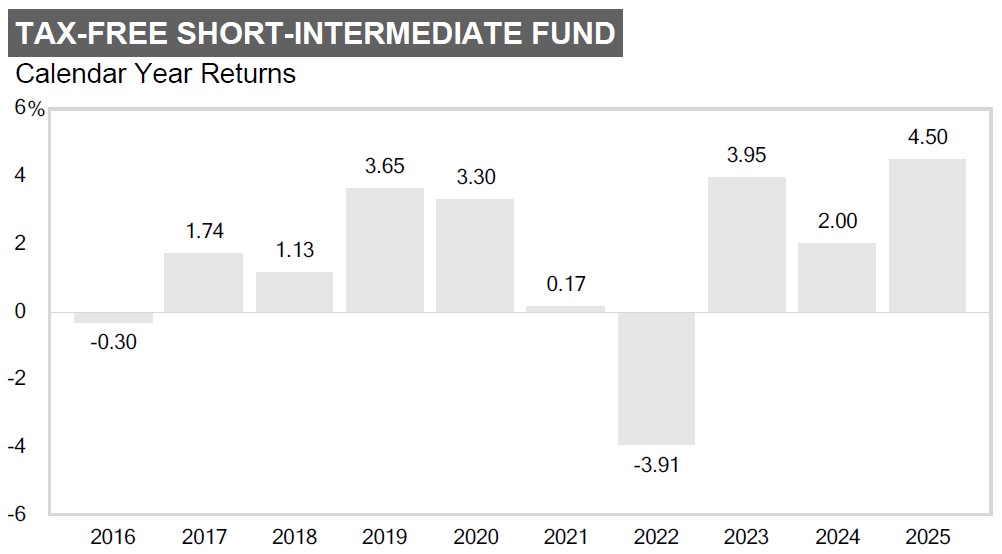
The
following bar chart illustrates how much returns can differ from year to year by showing calendar year returns and the best and worst
calendar quarter returns during those years for the fund’s Investor Class. Returns for other share classes vary since they have
different expenses.
| |
|
Quarter
Ended |
Total
Return |
|
|
Quarter
Ended |
Total
Return |
|
| |
Best
Quarter |
12/31/23 |
3.78% |
|
Worst
Quarter |
3/31/22 |
-3.41% |
|
The
following table shows the average annual total returns for each class of the fund that has been in operation for at least one full calendar
year. The fund’s performance information included in the table is compared with a regulatory required index that represents an
overall securities market (Bloomberg U.S. Aggregate Bond Index). In addition, the table may also include one or more indexes that align
to the fund’s investment strategy.
In
addition, the table shows hypothetical after-tax returns to demonstrate how taxes paid by a shareholder may influence returns. After-tax
returns are calculated using the historical highest individual federal marginal income tax rates and do not reflect the impact of state
and local taxes. Actual after-tax returns depend on an investor’s tax situation and may differ from those shown. After-tax returns
shown are not relevant to investors who hold their fund shares through tax-deferred arrangements, such as a 401(k) account or an IRA.
After-tax returns are shown only for the Investor Class and will differ for other share classes.
| Average
Annual Total Returns |
|
|
|
|
|
|
|
| |
|
|
Periods
ended |
|
| |
|
|
December
31, 2025 |
|
| |
|
|
|
|
|
|
|
|
|
|
|
|
|
|
| |
|
|
|
|
|
|
|
|
|
|
|
|
Inception |
|
| |
|
|
|
|
|
|
|
|
|
|
|
Since |
date |
|
| |
Investor
Class |
1
Year |
|
|
5
Years |
|
|
10
Years |
|
|
inception |
12/23/1983 |
|
| |
|
Returns
before taxes |
4.50 |
% |
|
1.30 |
% |
|
1.59 |
% |
|
— |
% |
|
|
|
| |
|
Returns
after taxes on distributions |
4.50 |
|
|
1.30 |
|
|
1.59 |
|
|
— |
|
|
|
|
| |
|
Returns
after taxes on distributions and sale |
|
|
|
|
|
|
|
|
|
|
|
|
|
|
| |
|
of
fund shares |
3.90 |
|
|
1.46 |
|
|
1.63 |
|
|
— |
|
|
|
|
| |
I
Class |
|
|
|
|
|
|
|
|
|
|
|
11/29/2016 |
|
|
| |
|
Returns
before taxes |
4.66 |
|
|
1.44 |
|
|
— |
|
|
1.95 |
|
|
|
|
| |
Advisor
Class |
|
|
|
|
|
|
|
|
|
|
|
08/08/2012 |
|
|
| |
|
Returns
before taxes |
4.08 |
|
|
0.95 |
|
|
1.24 |
|
|
— |
|
|
|
|
| |
|
|
|
|
|
|
|
|
|
|
|
|
|
|
|
|
| |
Bloomberg
U.S. Aggregate Bond Index (reflects no deduction for fees, expenses, or taxes) |
|
|
|
| |
|
7.30 |
|
|
-0.36 |
|
|
2.01 |
|
|
1.90 |
a |
|
|
|
| |
Bloomberg
1-5 Year Blend (1-6 Year Maturity) Index (reflects no deduction for fees, expenses, or taxes) |
|
|
|
| |
|
4.35 |
|
|
1.31 |
|
|
1.73 |
|
|
1.92 |
a |
|
|
|
| |
Lipper
Short-Intermediate Municipal Debt Funds Average |
|
|
|
| |
|
4.34 |
|
|
1.18 |
|
|
1.60 |
|
|
1.86 |
b |
|
|
|
| |
|
|
|
|
|
|
|
|
|
|
|
|
|
|
|
|
Updated
performance information is available through troweprice.com.
Management
Investment
Adviser T. Rowe Price Associates, Inc. (T. Rowe Price or Price Associates)
| Name |
Title |
Managed
Fund
Since |
Joined
Investment
Adviser |
| James
Lynch |
Portfolio
Manager and Chair of Investment Advisory Committee |
2024 |
2008 |
Purchase
and Sale of Fund Shares
The
Investor Class and Advisor Class generally require a $2,500 minimum initial investment ($1,000 minimum initial investment if opening
an IRA, a custodial account for a minor, or a small business retirement plan account). Additional purchases generally require a $100
minimum. These investment minimums generally are waived for financial intermediaries and certain employer-sponsored retirement plans
submitting orders on behalf of their customers. Advisor Class shares may generally only be purchased through a financial intermediary
or retirement plan.
The
I Class requires a $500,000 minimum initial investment per fund per account registration, although the initial investment minimum generally
is waived or reduced for financial intermediaries, eligible retirement plans, certain accounts for which T. Rowe Price or its affiliates
have discretionary investment authority, qualifying directly held accounts, and certain other accounts.
For
investors holding shares of the fund directly with T. Rowe Price, you may purchase, redeem, or exchange fund shares by mail; by
telephone (1-800-225-5132 for IRAs and nonretirement accounts; 1-800-492-7670 for small business retirement plans; and 1-800-638-8790
for institutional investors and financial intermediaries); or, for certain other accounts, by accessing your account online through troweprice.com.
If
you hold shares through a financial intermediary or retirement plan, you must purchase, redeem, and exchange shares of the fund through
your intermediary or retirement plan. You should check with your intermediary or retirement plan to determine the investment minimums
that apply to your account.
Tax
Information
The
fund declares dividends, if any, daily and pays them on the first business day of each month. Any capital gains are declared and paid
annually, usually in December. The fund intends to distribute tax-exempt income. However, a portion of the fund’s distributions
may be subject to federal income taxes or the alternative minimum tax. A redemption or exchange of fund shares, and any capital gains
distributed by the fund, may be taxable.
Payments
to Broker-Dealers and Other Financial Intermediaries
If
you purchase shares of the fund through a broker-dealer or other financial intermediary (such as a bank), the fund and its related companies
may pay the intermediary for the sale of fund shares and related services. These payments may create a conflict of interest by influencing
the broker-dealer or other intermediary and your salesperson to recommend the fund over another investment. Ask your salesperson or visit
your financial intermediary’s website for more information.

|
|
T. Rowe Price Associates, Inc.
1307 Point Street
Baltimore, MD 21231 |
F56-045 5/1/26 |