Inflation Managed Portfolio (formerly Inflation Protection Portfolio)
SUMMARY PROSPECTUS
MAY 1, 2026
Before you invest, you may want to review the Portfolio’s prospectus, which contains more information about the Portfolio and its risks. You can find the Portfolio’s prospectus, reports to shareholders, and other information about the Portfolio online at www.nmseriesfund.com. You can also get this information at no cost by calling (866) 910-1232 or by sending an e-mail request to sfprospectus@northwesternmutual.com. The current prospectus and statement of additional information, each dated May 1, 2026, along with the Portfolio’s most recent annual report dated December 31, 2025, are incorporated by reference into this Summary Prospectus. The Portfolio’s statement of additional information and annual report may be obtained, free of charge, in the same manner as the prospectus.
The Securities and Exchange Commission has not approved or disapproved these securities or passed upon the adequacy of this prospectus. Any representation to the contrary is a criminal offense.
INVESTMENT OBJECTIVE
The investment objective of the Portfolio is to pursue total return using a strategy that seeks to protect against U.S. inflation.
FEES AND EXPENSES OF THE PORTFOLIO
The table below describes the fees and expenses that you may pay when you buy, hold, and
sell interests in a separate account that invests in shares of the Portfolio as a result of your purchase of a variable annuity contract or variable
life insurance policy. The fees and expenses shown in the table and Example do not reflect fees and expenses separately charged by variable annuity
contracts or variable life insurance policies. If the fees and expenses separately charged by variable annuity contracts and variable life insurance
policies were included, the fees and expenses shown in the table and the Example would be higher.
| Shareholder Fees
(fees paid directly from your investment) |
N/A |
| Annual Portfolio Operating
Expenses (expenses that you pay each year as a percentage
of the value of your investment) |
|
| Management Fee |
0.53% |
| Distribution and Service (12b-1) Fees |
None |
| Other Expenses |
0.06% |
| Total Annual Portfolio Operating Expenses |
0.59% |
| Fee Waiver(1) |
(0.13)% |
| Total Annual Portfolio Operating Expenses After
Fee Waiver(1) |
0.46% |
(1)
The Portfolio's investment adviser has contractually agreed to waive a portion of its management fee. This contractual agreement will continue through at
least April 30, 2027 and may not be terminated prior to that date without action by the Board of Directors.
Example
This Example is intended to help you compare the cost of investing
in the Portfolio with the cost of investing in other mutual funds. The Example assumes that you invest $10,000 in the Portfolio for the time periods indicated and then redeem or hold
all of your shares at the end of those periods. The Example also assumes that your investment has a 5% return each year and that the Portfolio’s operating expenses remain the same.
The Example reflects adjustments made to the Portfolio’s operating expenses due to the fee waiver agreement with the
investment adviser for the first year only. Although your actual costs may be higher or lower, based on these assumptions your costs would
be:
| 1 Year |
3 Years |
5 Years |
10 Years |
| $47 |
$176 |
$316 |
$725 |
Portfolio Turnover
The Portfolio pays transaction costs, such as commissions, when it buys and sells securities (or “turns over” its portfolio). A higher portfolio turnover may indicate higher transaction costs. These costs, which are not reflected in Annual Portfolio Operating Expenses or in the Example, affect the Portfolio’s performance. During the most recent fiscal year, the Portfolio’s portfolio turnover rate was 42% of
the average value of its portfolio.
PRINCIPAL
INVESTMENT STRATEGIES
The Portfolio invests substantially all of its
assets in investment-grade debt securities. To help protect against U.S. inflation (as measured by the change in the Consumer Price Index over time),
under normal conditions, the Portfolio will invest over 50% of its net assets (plus any borrowings for investment purposes) in inflation-indexed debt
securities. These securities include inflation-indexed U.S. Treasury Securities, inflation-indexed securities issued by U.S. government agencies and
instrumentalities other than the U.S. Treasury, and inflation-indexed securities issued by domestic and foreign corporations and governments, and may
include those located in emerging markets. Inflation-indexed securities are designed to protect the future purchasing power of the money invested in them. The Portfolio also may invest in fixed income securities that are not inflation-indexed. Such investments may include other investment grade debt securities, including collateralized mortgage obligations, mortgage-backed securities, including commercial mortgage-backed securities and agency mortgage-backed securities, and asset-backed securities, including collateralized loan obligations, whether issued by the U.S. government, its agencies or instrumentalities, corporations or other non-governmental issuers, or foreign governments. Investment grade securities are generally securities rated investment grade by major
NMSF-SP1Northwestern Mutual Series
Fund, Inc.
Inflation Managed Portfolio (formerly Inflation Protection Portfolio) – Summary
credit rating agencies (BBB- or higher by S&P; Baa3 or higher by Moody’s; BBB-
or higher by Fitch) or, if unrated, determined by the Portfolio’s adviser to be of comparable quality.
Due to Internal Revenue Code provisions and regulations
governing insurance product funds, no more than 55% of the Portfolio’s assets may be invested in securities issued by the same entity. Because the
number of inflation-indexed debt securities issued by entities is limited, at times the Portfolio may have a substantial position in
non-inflation-indexed securities. To seek to reduce the impact of this limitation, the adviser may purchase (long) inflation swap agreements to manage
or reduce the risk of the effects of inflation with respect to the Portfolio’s position in non-inflation-indexed securities.
The adviser is not limited to a specific weighted average
maturity or duration range. However, the adviser monitors the Portfolio’s weighted average maturity and duration and seeks to adjust it as
appropriate, taking into account market conditions, the current inflation rate and other relevant factors.
The Portfolio may invest up to 20% of its total assets in
securities denominated in foreign currencies and may invest beyond this limit in U.S. dollar denominated securities of foreign issuers. The Portfolio
may hedge some or all of its foreign currency by utilizing forward foreign currency exchange contracts to seek to reduce the risk of loss due to
fluctuations in the currency exchange rates. The Portfolio may also use interest rate futures to adjust overall interest rate exposure when the adviser
deems it to be advantageous.
The Portfolio may sell a security for a variety of reasons, including its assessment of the security’s relative attractiveness in light of its evaluation of current economic conditions or the risk of inflation, or to manage the Portfolio’s maturity and credit quality standards.
PRINCIPAL RISKS
Portfolio shares will rise and fall in value and there is a risk you could lose money by investing in the Portfolio. There can be no assurance that the Portfolio will achieve its objective and there is no guarantee of inflation protection. The main risks of investing in this Portfolio are identified below.
•
Active Management Risk – The adviser’s investment strategies and techniques may not perform as expected and the adviser’s quality determinations with respect to securities that are unrated by the major credit rating agencies may be inaccurate, which could cause the Portfolio to underperform other mutual funds or lose money.
•
Counterparty Risk – The Portfolio may sustain a loss in the event the other
party(s) in an agreement or a participant to a transaction, such as a broker or swap counterparty, defaults on a contract or fails to perform by failing to pay amounts
due, failing to fulfill delivery conditions, or failing to otherwise comply with the terms of the contract. Counterparty risk is inherent in many transactions, including derivatives transactions.
•
Credit Risk – The Portfolio could lose money if the issuer or guarantor of a fixed income security is unwilling or unable to meet its financial obligations. In addition, changes in an issuer’s credit rating or the market’s perception of an issuer’s creditworthiness may also affect the value of the Portfolio’s investment in that issuer. Changes in credit spreads or improvements in an issuer’s credit quality may increase the risk that an issuer calls outstanding securities prior to their maturity.
•
Debt Obligations of Foreign Governments Risk – The issuer of the foreign debt or the governmental authorities that control the repayment of such
debt may be unable or unwilling to repay principal or interest when due, and the Portfolio may have limited recourse in the event of a default. The market prices of
debt obligations of governments and their agencies, and the Portfolio’s net asset value, may be more volatile than prices of U.S. debt obligations. In addition,
unlike debt instruments issued by the U.S. Treasury, inflation-linked bonds issued by corporations or foreign governments do not generally provide principal
protection, and in a deflationary environment, such bonds may result in the loss of principal.
•
Derivatives Risk – The value of a derivative generally depends upon, or is derived from, an underlying asset, reference rate or index. The primary risks associated with the Portfolio’s use of derivatives are the risk the risk that changes in the value of the derivatives may not correlate as intended with the underlying asset, rate or index, the risk that the counterparty to a derivatives transaction fails to make the required payment, the risk of missed opportunities in other investments, and the risk of adverse price movements in the market. Certain derivatives involve leverage, which could cause the Portfolio to lose more than the principal amount invested. Other risks include management, interest rate, liquidity risks and the risk of missed opportunities in other investments. The Portfolio's purchase of swap agreements may pose risk arising from losses if the underlying reference asset does not perform as anticipated; such agreements are also subject to counterparty credit, liquidity and leveraging risks.
•
Emerging Markets Risk – Investing in emerging market securities increases foreign investing risk, and may subject the
Portfolio to more rapid and extreme changes in the value of its holdings compared with investments made in U.S. securities or in foreign, developed countries. Investments in emerging markets may be subject to political, economic, legal, market, and currency risks. Emerging market securities trade in smaller markets which may experience significant price and market volatility, fluctuations in currency values, interest rates and commodity prices, higher transaction costs, and the increased likelihood of the occurrence of trading difficulties, such as delays in executing, clearing and settling Portfolio transactions or in receiving payment of dividends. Special risks associated with investments in emerging market issuers may include a lack of publicly available information, a lack of uniform disclosure, accounting, financial reporting, and recordkeeping standards, and more limited investor protection provisions when compared with developed economies. Emerging market risks also may include unpredictable
NMSF-SP2Northwestern Mutual Series Fund, Inc. Prospectus
Inflation Managed Portfolio (formerly Inflation Protection Portfolio) – Summary
and changing political, economic and tax policies, the imposition of capital controls and/or foreign investment limitations by a country, nationalization of businesses, and the imposition of sanctions or restrictions in certain investments by other countries, such as the United States.
•
Foreign Currency Risk – The risk that foreign (non-U.S. dollar) currency denominated securities, or derivatives that provide exposure to foreign currencies, may be adversely affected by decreases in foreign currency values relative to the U.S. dollar. Investments in securities subject to foreign currency risk may have more rapid and extreme changes in value or more losses than investments in U.S. dollar denominated securities.
•
Foreign Investing Risk – Investing in foreign securities may subject the Portfolio to more rapid and extreme changes in value or more losses than a fund that invests exclusively in U.S. securities. This risk is due to potentially smaller markets, differing reporting, accounting and auditing standards, and nationalization, expropriation or confiscatory taxation, currency blockage, political and economic conditions, or diplomatic developments. Foreign securities may be less liquid, more volatile, and harder to value than U.S. securities.
•
Forward Foreign Currency Exchange Contracts Risk – Forward foreign currency
exchange contracts are OTC contracts to purchase or sell a specified amount of a specified currency at a price and future date set at the time of the contract. Forward
foreign currency exchange contracts do not eliminate fluctuations in the value of non-U.S. securities but rather allow the Fund to establish a fixed rate of exchange for a future point in time. This strategy can have the effect of reducing returns and minimizing opportunities for gain. Engaging in forward foreign currency exchange contracts will subject the Fund to counterparty credit risk and any failure to perform by a counterparty could result in a loss to the Fund.
•
Inflation Risk – Your investment in the Portfolio may not provide enough income to keep pace with inflation. To the extent that the Portfolio holds investments in non-inflation-linked debt securities, as noted above, that portion of the Portfolio will not be automatically protected from inflation.
•
Interest Rate Risk – Prices of fixed income instruments, including inflation-indexed debt securities, generally rise and fall in response to changes in market interest rates. In a rising interest rate environment, the value of the Portfolio’s fixed income investments is likely to decline. A significant rise in interest rates over a short period of time could cause significant losses in the market value of the Portfolio’s fixed income instruments. A portfolio with a longer average portfolio duration will be more
sensitive to changes in interest rates than a portfolio with a shorter average portfolio duration. For example, the market value of a fixed income portfolio with an average duration of five years generally would be expected to fall approximately 5% if interest rates rose by one percentage point. Declining interest rates may increase the risk that an issuer calls outstanding securities prior to their maturity.
sensitive to changes in interest rates than a portfolio with a shorter average portfolio duration. For example, the market value of a fixed income portfolio with an average duration of five years generally would be expected to fall approximately 5% if interest rates rose by one percentage point. Declining interest rates may increase the risk that an issuer calls outstanding securities prior to their maturity.
•
Liquidity Risk – Fixed income and derivative investments can be difficult to purchase or sell at an advantageous time or price, if at all, during periods of reduced marketability for the investment or due to the size of the transaction. These risks may be magnified during periods of economic turmoil or in an extended economic downturn or when investing in emerging markets.
•
Market Risk – The risk that the market price of securities owned by the
Portfolio may go up or down, sometimes rapidly or unpredictably. The value of a security may decline due to changes in general market conditions, economic trends or
events that are not specifically related to the issuer of the security, or factors that affect a particular issuer or issuers, exchange, country, group of countries, region, market, industry, group of industries, sector or asset class. Global economies and financial markets are increasingly interconnected, which magnifies the potential that conditions in one country or region might adversely impact issuers in, or foreign exchange rates with, a different country or region. Geopolitical and other events, including war, terrorism, economic uncertainty, trade disputes, tariffs, public health crises (such as epidemics and pandemics), and related events have led, and in the future may lead, to increased market volatility, which may disrupt U.S. and world economies and markets and may have significant adverse direct or indirect effects on the Portfolio and its investments.
•
Mortgage- and Asset-Backed Securities Risk – The Portfolio invests in collateralized mortgage obligations, mortgage-backed securities,
including commercial mortgage-backed securities, collateralized loan obligations, and asset-backed securities. Mortgage-related and other asset-backed securities are
subject to interest rate risk, credit risk and liquidity risk as well as additional risks including prepayment and extension risk. Mortgage-related and other
asset-backed securities represent interests in pools of mortgages or other assets and often involve risks that are different or possibly more acute than risks
associated with other types of debt instruments. The value of some mortgage- or asset-backed securities may be particularly sensitive to changes in prevailing interest rates. Mortgage-backed securities offered by non-governmental issuers are subject to specific risks, such as the failure of private insurers to meet their obligations and unexpectedly high rates of default on the mortgages backing the securities. Other asset-backed securities are subject to risks similar to those associated with mortgage-backed securities, as well as risks associated with the nature and servicing of the assets underlying the securities. Asset-backed securities may not have the benefit of a security interest in collateral comparable to that of mortgage assets, resulting in additional credit risk.
•
Prepayment and Extension Risk – Prepayment risk is the risk that principal on a debt obligation will be paid earlier than
scheduled or expected, which could reduce yield and market value of the security and shorten the Portfolio’s average effective maturity. The rate of prepayments tends to increase as interest rates fall. Extension risk is the risk that, as interest rates rise, repayments on a debt obligation may occur more slowly than anticipated by the market and the obligation may remain outstanding longer.
NMSF-SP3Northwestern Mutual Series
Fund, Inc. Prospectus
Inflation Managed Portfolio (formerly Inflation Protection Portfolio) – Summary
•
Underlying Portfolio Risk – The Portfolio may serve as an investment
option, or “Underlying Portfolio,” for other portfolios of Northwestern Mutual Series Fund, Inc. that are managed as “fund of funds.” As a
result, from time to time, the Portfolio may experience relatively large investments or redemptions from those other portfolios and could be required to invest cash or
sell securities at a time when it is not advantageous to do so.
•
U.S. Government Securities Risk – Not all obligations of the U.S. government, its agencies and instrumentalities are backed by the
full faith and credit of the U.S. Treasury. Some obligations are backed only by the credit of the issuing agency or instrumentality, and in some cases there may be
some risk of default by the issuer. Any guarantee by the U.S. government or its agencies or instrumentalities of a security held by the Portfolio does not apply to the
market value of such security or to shares of the Portfolio itself.
PERFORMANCE
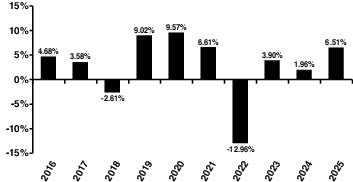
The following bar chart illustrates the risks of investing in the Portfolio by showing
how the performance of the Portfolio has varied from year to year. The table to the right of the bar chart shows the Portfolio’s average annual
total return over certain time periods and compares the Portfolio’s returns with those of an index that has characteristics relevant to the
Portfolio’s investment strategy (Strategy Index). The table also shows the Portfolio’s returns against an index that represents
the overall securities market (Broad-Based Index), which the Portfolio has added to comply with new regulatory requirements. Returns are based on past results and are not an indication of future
performance. Neither the bar chart nor the table reflects the fees and expenses separately charged by the variable annuity contract or variable life insurance policy separate account that invests in the Portfolio and returns would be lower if those fees and expenses were reflected.
| |
Quarter/Year |
Return |
| Best Quarter |
2nd quarter, 2020 |
6.08% |
| Worst Quarter |
2nd quarter, 2022 |
-6.94% |
Average Annual Total Return
(for periods ended December 31, 2025)
(for periods ended December 31, 2025)
| |
|
1 Yr |
5 Yr |
10 Yr |
| Portfolio: |
Inflation Managed Portfolio |
6.51% |
0.92% |
2.82% |
| Strategy Index: |
Bloomberg® U.S. Treasury
Inflation Protected Securities
(TIPS) Index
(reflects no deduction for fees,
expenses or taxes) |
7.01% |
1.12% |
3.08% |
| Broad-Based Index: |
Bloomberg® U.S. Aggregate Bond
Index
(reflects no deduction for fees,
expenses or taxes) |
7.30% |
-0.36% |
2.01% |
PORTFOLIO MANAGEMENT
Investment Adviser: Mason Street Advisors, LLC
Sub-Adviser: American Century Investment Management, Inc. (American Century)
Portfolio Managers: James E. Platz, CFA, Vice President and Portfolio Manager, has served American Century as a portfolio manager since 2003 and has managed the Portfolio since 2008.
Miguel Castillo, Vice President and Portfolio Manager, has served American Century as a portfolio manager since 2014 and has managed the Portfolio since 2015.
Stephen Bartolini, CFA, Vice President and Portfolio Manager, has served American Century as a portfolio manager since 2024 and has managed the Portfolio since 2024.
Sub-Adviser: American Century Investment Management, Inc. (American Century)
Portfolio Managers: James E. Platz, CFA, Vice President and Portfolio Manager, has served American Century as a portfolio manager since 2003 and has managed the Portfolio since 2008.
Miguel Castillo, Vice President and Portfolio Manager, has served American Century as a portfolio manager since 2014 and has managed the Portfolio since 2015.
Stephen Bartolini, CFA, Vice President and Portfolio Manager, has served American Century as a portfolio manager since 2024 and has managed the Portfolio since 2024.
TAX INFORMATION
Shares of the Portfolio are offered only for funding variable annuity contracts and
variable life insurance policies offered by The Northwestern Mutual Life Insurance Company through separate accounts. Insurance company separate
accounts generally do not pay tax on dividends or capital gain distributions. Investors in variable annuity contracts and variable life insurance
policies should refer to the prospectuses for the variable products for a discussion of the tax considerations that affect the insurance company and its
separate accounts and the tax consequences to investors of owning such products.
COMPENSATION TO BROKER-DEALERS AND OTHER FINANCIAL INTERMEDIARIES
Neither the Portfolio nor any related companies pay compensation to broker-dealers or
other financial intermediaries for the sale of Portfolio shares or related services. Investors in variable annuity contracts and variable life insurance
policies should refer to the prospectuses for the variable products for important information about compensation paid to financial intermediaries for
sales of variable annuity contracts and variable life insurance policies.
NMSF-SP4Northwestern Mutual Series
Fund, Inc. Prospectus