High Yield Bond Portfolio – Summary
•
Underlying Portfolio Risk – The Portfolio may serve as an investment
option, or “Underlying Portfolio,” for other portfolios of Northwestern Mutual Series Fund, Inc. that are managed as “fund of funds.” As a
result, from time to time, the Portfolio may experience relatively large investments or redemptions from those other portfolios and could be required to invest cash or
sell securities at a time when it is not advantageous to do so.
PERFORMANCE
The following bar chart illustrates the risks of investing in the Portfolio by showing
how the performance of the Portfolio has varied from year to year. The table to the right of the bar chart shows the Portfolio’s average annual
total return over certain time periods and compares the Portfolio’s returns with those of an index that has characteristics relevant to the
Portfolio’s investment strategy (Strategy Index). The table also shows the Portfolio’s returns against an index that represents
the overall securities market (Broad-Based Index), which the Portfolio has added to comply with new regulatory requirements. Returns are based on past results and are not an indication of future
performance. Neither the bar chart nor the table reflects the fees and expenses separately charged by the variable annuity contract or variable life insurance policy separate account that invests in the Portfolio and returns would be lower if those fees and expenses were reflected.
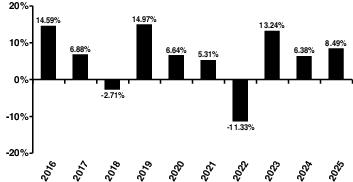
| |
Quarter/Year |
Return |
| Best Quarter |
2nd quarter, 2020 |
10.08% |
| Worst Quarter |
1st quarter, 2020 |
-12.32% |
Average Annual Total Return
(for periods ended December 31, 2025)
(for periods ended December 31, 2025)
| |
|
1 Yr |
5 Yr |
10 Yr |
| Portfolio: |
High Yield Bond Portfolio |
8.49% |
4.06% |
5.95% |
| Strategy Index: |
Bloomberg® U.S. Corporate High
Yield 2% Issuer Capped Index
(reflects no deduction for fees,
expenses or taxes) |
8.62% |
4.50% |
6.52% |
| Broad-Based Index: |
Bloomberg® U.S. Aggregate Bond
Index
(reflects no deduction for fees,
expenses or taxes) |
7.30% |
-0.36% |
2.01% |
PORTFOLIO MANAGEMENT
Investment Adviser: Mason Street Advisors, LLC
Sub-Adviser: Federated Investment Management Company (Federated)
Portfolio Manager: Mark E. Durbiano, CFA, Senior Portfolio Manager and Senior Vice President of Federated, has been with Federated since 1982 and has managed the Portfolio since 2014.
Kathryn Glass, CFA, Portfolio Manager and Vice President of Federated, has been with Federated since 1999 and has managed the Portfolio since 2024.
Thomas Scherr, CFA, Portfolio Manager and Vice President of Federated, has been with Federated since 2006 and has managed the Portfolio since 2024.
Randal Stuckwish, CFA, Portfolio Manager and Vice President of Federated, has been with Federated since 2013 and has managed the Portfolio since 2024.
Sub-Adviser: Federated Investment Management Company (Federated)
Portfolio Manager: Mark E. Durbiano, CFA, Senior Portfolio Manager and Senior Vice President of Federated, has been with Federated since 1982 and has managed the Portfolio since 2014.
Kathryn Glass, CFA, Portfolio Manager and Vice President of Federated, has been with Federated since 1999 and has managed the Portfolio since 2024.
Thomas Scherr, CFA, Portfolio Manager and Vice President of Federated, has been with Federated since 2006 and has managed the Portfolio since 2024.
Randal Stuckwish, CFA, Portfolio Manager and Vice President of Federated, has been with Federated since 2013 and has managed the Portfolio since 2024.
TAX INFORMATION
Shares of the Portfolio are offered only for funding variable annuity contracts and variable life insurance policies offered by The Northwestern Mutual Life Insurance Company through separate accounts. Insurance company separate accounts generally do not pay tax on dividends or capital gain distributions. Investors in variable annuity contracts and variable life insurance policies should refer to the prospectuses for the variable products for a discussion of the tax considerations that affect the insurance company and its separate accounts and the tax consequences to investors of owning such products.
COMPENSATION TO BROKER-DEALERS AND OTHER FINANCIAL INTERMEDIARIES
Neither the Portfolio nor any related companies pay compensation to broker-dealers or
other financial intermediaries for the sale of Portfolio shares or related services. Investors in variable annuity contracts and variable life insurance
policies should refer to the prospectuses for the variable products for important information about compensation paid to financial intermediaries for
sales of variable annuity contracts and variable life insurance policies.
NMSF-SP3Northwestern Mutual Series
Fund, Inc. Prospectus