Active/Passive Balanced Portfolio (formerly Balanced Portfolio) – Summary
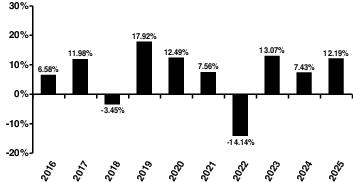
measures of market performance for both equity and fixed income securities (Broad-Based
Indices). Returns are based on past results and are not an indication
of future performance. Neither the bar chart nor the table reflects the fees and expenses separately charged by the variable annuity contract or variable life insurance policy separate account that invests in the Portfolio and returns would be lower if those fees and expenses were reflected.
| |
Quarter/Year |
Return |
| Best Quarter |
2nd quarter, 2020 |
11.69% |
| Worst Quarter |
1st quarter, 2020 |
-10.77% |
Average Annual Total Return
(for periods ended December 31, 2025)
(for periods ended December 31, 2025)
| |
|
1 Yr |
5 Yr |
10 Yr |
| Portfolio: |
Active/Passive Balanced
Portfolio |
12.19% |
4.71% |
6.76% |
| Strategy Index: |
Active/Passive Balanced
Portfolio Blended Composite
Benchmark: S&P 500® Index
(17%), S&P MidCap 400®
Index (5%), S&P SmallCap
600® Index (3%), MSCI EAFE®
Index (10%), MSCI® Emerging
Markets Index (5%), Dow Jones
U.S. Select REIT Index (4%),
Bloomberg® Commodity
IndexSM (4%), Bloomberg®
Barclays U.S. Aggregate Bond
Index (50%), and ICE of BofA®
US 3-Month Treasury Bill Index
(2%) |
12.80% |
5.39% |
7.33% |
| Broad-Based Index: |
S&P 500® Index
(reflects no deduction for fees,
expenses or taxes) |
17.88% |
14.42% |
14.82% |
| Broad-Based Index: |
Bloomberg® U.S. Aggregate
Bond Index
(reflects no deduction for fees,
expenses or taxes) |
7.30% |
-0.36% |
2.01% |
PORTFOLIO MANAGEMENT
Investment Adviser: Mason Street Advisors, LLC (MSA)
Portfolio Managers: James Fleming, CFA, Portfolio Manager of MSA, joined MSA in 2008 and has managed the Portfolio since 2025.
Rodney Schmucker, CFA, Senior Research & Portfolio Analyst of MSA, joined MSA in 2008 and has managed the Portfolio since 2025.
Brent G. Schutte, CFA, Chief Investment Officer of MSA, joined MSA in December 2021 and has managed the Portfolio since 2025.
Garrett D. Aird, CFA, Vice President of MSA, joined MSA in December 2021 and has managed the Portfolio since 2025.
Portfolio Managers: James Fleming, CFA, Portfolio Manager of MSA, joined MSA in 2008 and has managed the Portfolio since 2025.
Rodney Schmucker, CFA, Senior Research & Portfolio Analyst of MSA, joined MSA in 2008 and has managed the Portfolio since 2025.
Brent G. Schutte, CFA, Chief Investment Officer of MSA, joined MSA in December 2021 and has managed the Portfolio since 2025.
Garrett D. Aird, CFA, Vice President of MSA, joined MSA in December 2021 and has managed the Portfolio since 2025.
TAX INFORMATION
Shares of the Portfolio are offered only for funding variable annuity contracts and
variable life insurance policies offered by The Northwestern Mutual Life Insurance Company through separate accounts. Insurance company separate
accounts generally do not pay tax on dividends or capital gain distributions. Investors in variable annuity contracts and variable life insurance
policies should refer to the prospectuses for the variable products for a discussion of the tax considerations that affect the insurance company and its
separate accounts and the tax consequences to investors of owning such products.
COMPENSATION TO BROKER-DEALERS AND OTHER FINANCIAL INTERMEDIARIES
Neither the Portfolio nor any related companies pay compensation to broker-dealers or
other financial intermediaries for the sale of Portfolio shares or related services. Investors in variable annuity contracts and variable life insurance
policies should refer to the prospectuses for the variable products for important information about compensation paid to financial intermediaries for
sales of variable annuity contracts and variable life insurance policies.
NMSF-SP6Northwestern Mutual Series
Fund, Inc. Prospectus