DEF 14A
0000752714falseDEF 14A0000752714mgrc:AmountAddedForPriorServiceCostImpactingCurrentYearMemberecd:PeoMember2025-01-012025-12-310000752714ecd:NonPeoNeoMembermgrc:AdjustmentSummaryCompensationTablePensionMember2025-01-012025-12-3100007527142021-01-012021-12-310000752714ecd:NonPeoNeoMembermgrc:AmountAddedForPriorServiceCostImpactingCurrentYearMember2025-01-012025-12-310000752714ecd:EqtyAwrdsInSummryCompstnTblForAplblYrMemberecd:PeoMember2025-01-012025-12-310000752714ecd:ChngInFrValAsOfVstngDtOfPrrYrEqtyAwrdsVstdInCvrdYrMemberecd:PeoMember2025-01-012025-12-310000752714ecd:NonPeoNeoMemberecd:FrValAsOfPrrYrEndOfEqtyAwrdsGrntdInPrrYrsFldVstngCondsDrngCvrdYrMember2025-01-012025-12-31000075271412025-01-012025-12-310000752714ecd:NonPeoNeoMemberecd:ChngInFrValOfOutsdngAndUnvstdEqtyAwrdsGrntdInPrrYrsMember2025-01-012025-12-310000752714ecd:NonPeoNeoMemberecd:ChngInFrValAsOfVstngDtOfPrrYrEqtyAwrdsVstdInCvrdYrMember2025-01-012025-12-310000752714ecd:NonPeoNeoMembermgrc:AmountAddedForCurrentYearServiceCostMember2025-01-012025-12-310000752714ecd:VstngDtFrValOfEqtyAwrdsGrntdAndVstdInCvrdYrMemberecd:PeoMember2025-01-012025-12-310000752714mgrc:AmountAddedForCurrentYearServiceCostMemberecd:PeoMember2025-01-012025-12-310000752714ecd:NonPeoNeoMember2025-01-012025-12-310000752714ecd:NonPeoNeoMemberecd:YrEndFrValOfEqtyAwrdsGrntdInCvrdYrOutsdngAndUnvstdMember2025-01-012025-12-310000752714ecd:NonPeoNeoMemberecd:EqtyAwrdsAdjsExclgValRprtdInSummryCompstnTblMember2025-01-012025-12-310000752714ecd:FrValAsOfPrrYrEndOfEqtyAwrdsGrntdInPrrYrsFldVstngCondsDrngCvrdYrMemberecd:PeoMember2025-01-012025-12-310000752714ecd:NonPeoNeoMembermgrc:AdjustmentsForPensionMember2025-01-012025-12-3100007527142024-01-012024-12-310000752714ecd:EqtyAwrdsAdjsExclgValRprtdInSummryCompstnTblMemberecd:PeoMember2025-01-012025-12-310000752714mgrc:AdjustmentsForPensionMemberecd:PeoMember2025-01-012025-12-310000752714ecd:NonPeoNeoMemberecd:EqtyAwrdsInSummryCompstnTblForAplblYrMember2025-01-012025-12-310000752714ecd:NonPeoNeoMemberecd:DvddsOrOthrErngsPdOnEqtyAwrdsNtOthrwsRflctdInTtlCompForCvrdYrMember2025-01-012025-12-310000752714ecd:ChngInFrValOfOutsdngAndUnvstdEqtyAwrdsGrntdInPrrYrsMemberecd:PeoMember2025-01-012025-12-3100007527142022-01-012022-12-310000752714ecd:PeoMember2025-01-012025-12-310000752714mgrc:AdjustmentSummaryCompensationTablePensionMemberecd:PeoMember2025-01-012025-12-3100007527142023-01-012023-12-310000752714ecd:DvddsOrOthrErngsPdOnEqtyAwrdsNtOthrwsRflctdInTtlCompForCvrdYrMemberecd:PeoMember2025-01-012025-12-3100007527142025-01-012025-12-310000752714ecd:YrEndFrValOfEqtyAwrdsGrntdInCvrdYrOutsdngAndUnvstdMemberecd:PeoMember2025-01-012025-12-31000075271422025-01-012025-12-310000752714ecd:NonPeoNeoMemberecd:VstngDtFrValOfEqtyAwrdsGrntdAndVstdInCvrdYrMember2025-01-012025-12-31iso4217:USD
UNITED STATES
SECURITIES AND EXCHANGE COMMISSION
Washington, D.C. 20549
SCHEDULE 14A INFORMATION
Proxy Statement Pursuant to Section 14(a) of the
Securities Exchange Act of 1934
Filed by the Registrant ☒
Filed by a Party other than the Registrant ☐
Check the appropriate box:
|
|
|
☐ |
|
Preliminary Proxy Statement |
|
|
|
☐ |
|
Confidential, for Use of the Commission Only (as permitted by Rule 14a-6(e)(2)) |
|
|
|
☒ |
|
Definitive Proxy Statement |
|
|
|
☐ |
|
Definitive Additional Materials |
|
|
|
☐ |
|
Soliciting Material Pursuant to §240.14a-11(c) or §240.14a-12 |
McGrath RentCorp
(Name of Registrant as Specified In Its Charter)
(Name of Person(s) Filing Proxy Statement, if Other Than the Registrant)
Payment of Filing Fee (Check the appropriate box):
|
|
|
☒ |
|
No fee required. |
|
|
|
☐ |
|
Fee computed on table below per Exchange Act Rules 14a-6(i)(1) and 0-11. |
|
|
|
☐ |
|
Fee paid previously with preliminary materials. |
|
|
|
☐ |
|
Check box if any part of the fee is offset as provided by Exchange Act Rule 0-11(a)(2) and identify the filing for which the offsetting fee was paid previously. Identify the previous filing by registration statement number, or the form or schedule and the date of its filing. |
McGRATH RENTCORP
NOTICE OF ANNUAL MEETING OF SHAREHOLDERS
To Be Held June 3, 2026
To the Shareholders of McGrath RentCorp:
NOTICE IS HEREBY GIVEN that the 2026 Annual Meeting of Shareholders (the “Annual Meeting”) of McGrath RentCorp, a California corporation (the “Company”), will be held virtually only at www.proxydocs.com/MGRC, on Wednesday, June 3, 2026, at 2:00 p.m., PST. Shareholders will be able to listen, vote, and submit questions from any remote location that has internet connectivity. There will be no physical location for shareholders to attend. The Annual Meeting will be held for the following purposes:
1.To elect seven (7) directors of the Company, as specifically set forth in the attached proxy statement, to serve until the 2027 Annual Meeting of Shareholders or until their successors are elected and qualified;
2.To approve the amendment and restatement of the Company's 2016 Stock Incentive Plan (the "2016 Plan") as the Amended and Restated 2026 Stock Incentive Plan (the “2026 Plan”) and to: (i) increase the number of authorized shares of the Company’s Common Stock issuable under the 2026 Plan by 576,108 shares; (ii) re-approve the Internal Revenue Code Section 162(m) performance criteria and award limits; (iii) set minimum vesting periods for certain awards; (iv) set annual limits on the grant date fair value of awards to our non-employee directors; and (v) extend the term of the 2026 Plan for ten years from the date of shareholder approval;
3.To ratify the appointment of Grant Thornton LLP as the independent auditors for the Company for the year ending December 31, 2026;
4.To approve, in a non-binding vote, the compensation of the Company’s named executive officers; and
5.To transact such other business as may properly come before the Annual Meeting and any adjournment or postponement thereof.
The foregoing items of business are more fully described in the proxy statement which is attached and made a part hereof (the “Proxy Statement”).
The Board of Directors of the Company has fixed the close of business on April 16, 2026, as the Record Date for determining the shareholders entitled to notice of and to vote at the Annual Meeting and any adjournment or postponement thereof.
I M P O R T A N T
We are holding the Annual Meeting as a virtual meeting (via live audio webcast) format only. On behalf of the Board of Directors and management of the Company, we cordially invite you to attend the Annual Meeting by virtual presence by logging into our live webcast at: www.proxydocs.com/MGRC. Through this webcast, shareholders and proxyholders will be deemed to be present in person for purposes of conducting a vote at such meeting. In order to attend this webcast, you must register in advance at www.proxydocs.com/MGRC prior to the deadline of Wednesday, June 3, 2026, at 1:00 p.m. PST, as more fully described in the accompanying Proxy Statement.
In accordance with rules established by the Securities and Exchange Commission, we are providing you access to our proxy materials over the Internet. Accordingly, we plan to mail a Notice of Internet Availability of Proxy Materials (the “Notice”) to our shareholders on or about April 24, 2026. The Notice will describe how to access and review our proxy materials, including our Proxy Statement and Annual Report on Form 10-K for the fiscal year ended December 31, 2025. The Notice, as well as our proxy card, will also describe how you may submit your proxy electronically. If you received just a Notice by mail and would like to receive a printed copy of our proxy materials, you should follow the instructions for requesting such materials included in the Notice.
Whether or not you expect to attend the Annual Meeting via virtual presence, please vote your shares by following the instructions on the Notice, your proxy card or your voting instruction form, as applicable, as promptly as possible in order to ensure your representation at the Annual Meeting. Even if you have voted by proxy, you may still vote online if you attend the Annual Meeting via virtual presence. Please note, however, that if your shares are held of record by a broker, bank, or other nominee, and you wish to vote at the Annual Meeting, you must obtain a proxy card issued in your name from such broker, bank, or other nominee and register for the Annual Meeting in advance through our transfer agent, Computershare Trust Company, N.A. Once proof of your proxy power (legal proxy) has been obtained, send the proof reflecting your holdings along with your name and email address to legalproxy@betanxt.com to obtain your control number. Registration must be received no later than 5:00 p.m., EST, on Friday, May 29, 2026.
If you hold your shares in a brokerage account, your shares will not be voted in the election of directors, or the amendment and restatement of the 2016 Plan as the 2026 Plan, or the non-binding, advisory vote on the compensation of the Company’s named executive officers unless you provide explicit instructions to your broker as to how you wish to vote your shares. Under the NASDAQ Stock Market rules governing discretionary voting of proxies by the exchange’s members, your broker is not permitted to vote shares with respect to non-routine matters such as the election of directors or the vote on compensation without voting instructions from the beneficial owner of such shares.
|
By Order of the Board of Directors, |
Gilda Malek |
Senior Vice President, Chief Legal Officer and Corporate Secretary |
Livermore, California
April 24, 2026
McGRATH RENTCORP
5700 Las Positas Road
Livermore, California 94551
PROXY STATEMENT
FOR 2026 ANNUAL MEETING OF SHAREHOLDERS
General Information
This proxy statement (this “Proxy Statement”) is made available to the shareholders of McGrath RentCorp, a California corporation (the “Company,” “we,” “us,” or “our”), in connection with the solicitation by the Board of Directors of the Company (the “Board of Directors” or the “Board”) of proxies in the accompanying form for use in voting at the 2026 Annual Meeting of Shareholders of the Company (the “Annual Meeting”) to be held on Wednesday, June 3, 2026, at 2:00 p.m., PST, via virtual meeting only at www.proxydocs.com/MGRC, and any adjournment or postponement thereof. There will be no physical location for shareholders to attend. The shares represented by the proxies received, properly marked, dated, executed, and not revoked will be voted at the Annual Meeting.
We are using the Internet as the primary means of delivery of proxy materials to our shareholders. We are sending a Notice of Internet Availability of Proxy Materials (the “Notice”) to our shareholders of record with instructions on how to access the proxy materials online at www.proxydocs.com/MGRC. The Company expects to mail the Notice to shareholders on or about April 24, 2026.
The rules of the Securities and Exchange Commission (the “SEC”) require us to notify our shareholders of the availability of our proxy materials through the Internet.
Important Notice Regarding the Availability of Proxy Materials
for the Shareholder Meeting to be held on Wednesday, June 3, 2026
Our Proxy Statement and 2025 Annual Report to Shareholders are available at
www.proxydocs.com/MGRC
The following questions and answers provide important information about the Annual Meeting and this Proxy Statement:
When is the Annual Meeting?
The Annual Meeting will be held on Wednesday, June 3, 2026, at 2:00 p.m., PST, via virtual meeting only. There will be no physical meeting to attend. All of the members of the Board of Directors and our entire management team will participate via virtual presence only.
How do I participate in the virtual Annual Meeting?
You will not be able to attend the Annual Meeting physically. You or your proxyholder may participate, vote, and ask questions at the Annual Meeting by visiting www.proxydocs.com/MGRC and using your control number found on your Notice.
To be admitted to the virtual Annual Meeting, you will need the control number included on your Notice, or the instructions that accompanied your proxy materials, as applicable, and you must have registered in advance at www.proxydocs.com/MGRC prior to the deadline of Wednesday, June 3, 2026, at 1:00 p.m. PST. The Annual Meeting will begin promptly at 2:00 p.m., PST. Online check-in will begin at 1:00 p.m., PST, and you should allow ample time for the online check-in procedures. If you have difficulty accessing the virtual Annual Meeting, please follow the instructions from your registration confirmation email.
If you hold shares through an intermediary, such as a bank, broker, or other nominee, you will need to contact such bank, broker, or other nominee to request a legal proxy and register for the Annual Meeting in advance through our transfer agent, Computershare Trust Company, N.A. (“Computershare”). Once proof of your proxy power (legal proxy) has been obtained, send the proof reflecting your holdings along with your name and email address to legalproxy@betanxt.com to obtain your control number. Registration must be received no later than 5:00 p.m., EST, on Friday, May 29, 2026.
This year’s shareholders’ question and answer session will include questions submitted live during the Annual Meeting. You may submit a question in advance of the Annual Meeting by sending it via electronic mail to investor@mgrc.com. Questions may be submitted during the Annual Meeting through www.proxydocs.com/MGRC. We expect to respond to appropriate questions during the Annual Meeting, and may also respond to questions on an individual basis or by posting answers on our Investor Relations website after the meeting.
What matters will be considered at the Annual Meeting?
Shareholders will vote on the following items at the Annual Meeting:
1.To elect seven (7) directors of the Company, as specifically set forth in this Proxy Statement, to serve until the 2027 Annual Meeting of Shareholders or until their successors are elected and qualified (Proposal No. 1);
2.To approve the amendment and restatement of the Company's 2016 Stock Incentive Plan (the "2016 Plan") as the Amended and Restated 2026 Stock Incentive Plan (the “2026 Plan”) and to: (i) increase the number of authorized shares of the Company’s Common Stock issuable under the 2026 Plan by 576,108 shares; (ii) re-approve the Internal Revenue Code Section 162(m) performance criteria and award limits; (iii) set minimum vesting periods for certain awards; (iv) set annual limits on the grant date fair value of awards to our non-employee directors; and (v) extend the term of the 2026 Plan for ten years from the date of shareholder approval (Proposal No. 2);
3.To ratify the appointment of Grant Thornton LLP as the independent auditors for the Company for the year ending December 31, 2026 (Proposal No. 3);
4.To approve, in a non-binding vote, the compensation of the Company’s named executive officers (Proposal No. 4); and
5.To transact such other business as may properly come before the Annual Meeting and any adjournment or postponement thereof.
How does the Board of Directors recommend that shareholders vote on these matters?
The Board of Directors believes that the election of the nominated directors, the approval of the amendment and restatement of the 2016 Plan as the 2026 Plan, the ratification of the appointment of Grant Thornton LLP, and the approval on an advisory basis of the compensation of the Company’s named executive officers are in the best interests of the Company and its shareholders and, accordingly, recommends a vote “FOR” the approval of each of these proposals.
How are proxy materials being made available to shareholders?
The SEC adopted amendments to the proxy rules that change how companies must provide proxy materials. These rules are often referred to as “Notice and Access.” Under the Notice and Access model, a company may select either of the following two options for making proxy materials available to shareholders:
•the full set delivery option; or
Full Set Delivery Option
Under the full set delivery option, a company delivers all proxy materials to its shareholders as it would have done prior to the change in the rules. This can be by mail or, if a shareholder has previously agreed, by e-mail. In addition to delivering proxy materials to shareholders, a company must post all proxy materials on a publicly accessible website and provide information to shareholders about how to access that website. The Company’s proxy materials are available on the following website: www.proxydocs.com/MGRC.
Notice Only Option
Under the notice only delivery option, a company must post all of its proxy materials on a publicly accessible website. However, instead of delivering its proxy materials to shareholders, the company instead delivers a one-page notice of internet availability of proxy materials which includes, among other matters:
•information regarding the date, time, and location of the Annual Meeting of Shareholders as well as the items to be considered at the meeting;
•information regarding the website where the proxy materials are posted; and
•various means by which a shareholder may request paper or e-mail copies of the proxy materials.
A company may use a single method for all of its shareholders or use full set delivery for some while adopting the notice only option for others. The Company is required to comply with these Notice and Access rules in connection with its Annual Meeting and has elected to provide access to our proxy materials over the Internet. Accordingly, we have sent you a Notice of Internet Availability of Proxy Materials (the “Notice”) because the Board of Directors is soliciting your proxy to vote at the Annual Meeting, including at any adjournments or postponements of the Annual Meeting. All shareholders will have the ability to access the proxy materials on the website referred to in the Notice or request to receive a printed set of proxy materials. Instructions on how to access the proxy materials over the Internet or to request a printed copy may be found in the Notice.
We intend to mail the Notice on or about April 24, 2026, to all shareholders of record entitled to vote at the Annual Meeting.
What is the difference between a shareholder of record and a beneficial owner of shares held in street name?
Shareholder of Record. If your shares are registered directly in your name with the Company’s transfer agent, Computershare, then you are considered the shareholder of record with respect to those shares, and the Notice was sent directly to you by the Company.
Beneficial Owner of Shares Held in Street Name. If your shares are held in an account at a brokerage firm, bank, broker-dealer, or other similar organization, then you are the beneficial owner of shares held in “street name,” and the Notice was forwarded to you by that organization. The organization holding your account is considered the shareholder of record for purposes of voting at the Annual Meeting. As a beneficial owner, you have the right to direct that organization on how to vote the shares held in your account.
How do I vote?
To vote through the internet, go to www.proxypush.com/MGRC to complete an electronic proxy card. You will be asked to provide the control number from the Notice. You must cast your vote by 11:59 p.m., EST on June 2, 2026.
To vote using the proxy card, simply complete, sign and date the proxy card that may be delivered and return it promptly in the envelope provided. If you return your signed proxy card to us before the Annual Meeting, we will vote your shares as you direct.
To vote over the telephone, dial toll-free (866) 390-5401 using a touch-tone phone and follow the recorded instructions. You will be asked to provide the control number from the Notice. You must cast your telephone vote by 11:59 p.m. EST on June 2, 2026.
What does it mean if I receive more than one Notice?
If you receive more than one Notice, it may mean that you hold shares registered in more than one account. Please follow the voting instructions on the Notices to ensure that all of your shares are voted. If you have any questions regarding your share information or address appearing on the Notice, you may call Computershare, the Company’s transfer agent, at (800) 962-4284 if you are a shareholder of record, or contact your brokerage firm, bank, broker-dealer, or other similar organization if you are a beneficial owner of shares held in “street name.”
Can I change my vote after I have voted?
You may revoke your proxy and change your vote at any time before the final vote at the Annual Meeting. You may vote again on a later date by signing and returning a new proxy card with a later date or by attending the Annual Meeting and voting via online presence at our virtual meeting. However, your attendance at the Annual Meeting via online presence will not automatically revoke your proxy unless you vote again at the Annual Meeting or specifically request that your prior proxy be revoked by delivering a written notice of revocation to the Company’s Corporate Secretary at 5700 Las Positas Road, Livermore, California 94551 prior to the Annual Meeting. See “May I vote my shares via online presence at the virtual Annual Meeting?” below.
Who is entitled to vote?
The close of business on April 16, 2026, has been fixed as the Record Date (the “Record Date”) for determining the holders of shares of common stock of the Company, no par value (“Common Stock”), entitled to notice of and to vote at the Annual Meeting.
What constitutes a quorum?
As of the close of business on the Record Date, there were 24,561,770 shares of Common Stock outstanding and entitled to vote at the Annual Meeting. The presence at the Annual Meeting of a majority of these shares of Common Stock, either in person by online presence or by proxy, will constitute a quorum for the transaction of business at the Annual Meeting.
How are votes counted and who will count the votes?
Each outstanding share of Common Stock on the Record Date is entitled to one vote on each matter properly brought before the Annual Meeting. However, in compliance with the General Corporation Law of the State of California, if a candidate nominated for election to the Board of Directors has had such candidate’s name placed in nomination prior to the shareholder vote and a shareholder gives notice, prior to the voting, of such shareholders’ intention to cumulate such shareholder’s votes, then (and only then) every shareholder voting for the election of directors will be entitled to cumulate such shareholder’s votes for the election of directors and give one candidate a number of votes equal to the number of directors to be elected (seven) multiplied by the number of shares held or may distribute such shareholder’s votes on the same principle among as many candidates as the shareholder may select. If, in connection
with the election of directors, cumulative voting is selected, then the seven candidates receiving the highest number of affirmative votes shall be elected.
It is intended that shares represented by proxies in the accompanying form will be voted for the election of persons nominated by management. If votes are cast for any candidates other than those nominated by the Board of Directors, the persons authorized to vote shares represented by executed proxies in the enclosed form (if authority to vote for the election of Directors or for any particular nominee is not withheld) will have full discretion and authority to vote cumulatively and allocate votes among any or all of the nominees of the Board of Directors in such order and in such numbers as they may determine in their sole discretion, provided all the above-listed requirements for cumulative voting are met.
An automated system administered by BetaNXT will tabulate votes cast by proxy and Gilda Malek, the Company’s Senior Vice President, Chief Legal Officer and Corporate Secretary, will act as the inspector of elections to tabulate votes cast via online presence at the Annual Meeting.
Is my vote confidential?
Proxy instructions, ballots, and voting tabulations that identify individual shareholders are handled in a manner that protects your voting privacy. Your vote will not be disclosed either within the Company or to third parties, except:
•as necessary to meet applicable legal requirements;
•to allow for the tabulation and certification of votes; and
•to facilitate a successful proxy solicitation.
Occasionally, shareholders provide written comments on their proxy cards, which may be forwarded to the Company’s management and the Board of Directors.
How are abstentions and broker “non-votes” treated?
Under the General Corporation Law of the State of California, an abstaining vote and a broker “non-vote” are counted as present and are, therefore, included for purposes of determining whether a quorum is present at the Annual Meeting. However, abstentions are not included in determining the number of shares voting on the proposals submitted to shareholders. Generally, a broker “non-vote” occurs when a nominee (such as a brokerage firm, bank, broker-dealer, or other similar organization) holding shares for a beneficial owner in “street name” does not vote on a particular matter because the nominee does not have discretionary voting power with respect to that matter and has not received voting instructions from the beneficial owner. Broker “non-votes,” and shares as to which proxy authority has been withheld with respect to any matter, are not deemed to be entitled to vote for purposes of determining whether shareholders’ approval of that matter has been obtained.
What is the voting requirement to approve each of the proposals?
With respect to Proposal No. 1 of this Proxy Statement, a plurality of the votes cast is required for the election of directors. This means that the director nominee with the most votes for a particular slot is elected for that slot. You may vote “FOR” or “WITHHELD” with respect to the election of directors, unless prior to the vote on the election of directors a shareholder has validly given notice of its intent to cumulate votes, in which case you may allocate votes (seven per share of Common Stock held) among all director nominees. In the absence of cumulative voting, only votes “FOR” or “WITHHELD” are counted in determining whether a plurality has been cast in favor of a director. Abstentions and broker “non-votes,” if any, will have no effect on this proposal. Brokerage firms, banks, broker-dealers, and other nominees holding shares for holders who have not given specific voting instructions are not permitted to vote in their discretion with respect to Proposal No. 1. If you do not instruct your broker how to vote, your broker may not vote with respect to this proposal, and these votes will be counted as broker “non-votes,” as is described in “What happens if I do not give specific voting instructions?” in this Proxy Statement. Our Corporate Governance Guidelines set forth our procedures if a director-nominee is elected, but receives a majority of “WITHHELD” votes. In an uncontested election, any director nominee who receives a greater number of votes “WITHHELD” from his or her election than votes “FOR” such election is required to tender his or her resignation following certification of the shareholder vote. The Corporate Governance and Nominating Committee is required to make recommendations to the Board of Directors with respect to any such letter of resignation. The Board of Directors is required to take action with respect to this recommendation within 90 days following certification of the shareholder vote and to disclose its decision-making process.
With respect to Proposal No. 2 of this Proxy Statement, the affirmative vote of a majority of the shares of Common Stock represented and voting at the Annual Meeting is required. You may vote “FOR” or “AGAINST” with respect to the amendment and restatement of the 2016 Plan as the 2026 Plan. Abstentions will have the same effect as voting against this proposal. Broker “non-votes,” if any, will have no effect on this proposal.
With respect to Proposal No. 3 of this Proxy Statement, the affirmative vote of a majority of the shares of Common Stock represented and voting at the Annual Meeting is required. You may vote “FOR” or “AGAINST” with respect to the appointment of Grant Thornton LLP as the independent auditors for the Company for the year ending December 31, 2026. Abstentions will have the same effect as voting against this proposal. Because the ratification of auditors is considered a “routine” matter for which brokers may vote in the absence of shareholder direction, there will not be any broker “non-votes” on this proposal.
With respect to Proposal No. 4 of this Proxy Statement, the affirmative vote of a majority of the shares of Common Stock represented and voting at the Annual Meeting is required for approval, on an advisory basis, of the compensation of the Company’s named executive officers. You may vote “FOR” or “AGAINST” with respect to approval of the compensation of the Company’s named executive officers. Abstentions will have the same effect as voting against this proposal. Broker “non-votes,” if any, will have no effect on this proposal.
What happens if I do not give specific voting instructions?
For Shares Directly Registered in the Name of the Shareholder: If you return your signed proxy but do not indicate your voting preferences, the Company will vote on your behalf “FOR” the election of the nominated directors, “FOR” the approval of the amendment and restatement of the 2016 Plan as the 2026 Plan, “FOR” the ratification of the appointment of Grant Thornton LLP, and “FOR” approval of the compensation of the Company’s named executive officers. If any other matter properly comes before the shareholders for a vote at the Annual Meeting, the proxyholders will vote your shares in accordance with their best judgment.
For Shares Registered in the Name of a Brokerage Firm, Bank, Broker-Dealer or Other Similar Organization: If your shares are held in street name, your brokerage firm, bank, broker-dealer, or nominee will ask you how you want your shares to be voted. If you provide voting instructions, your shares must be voted as you direct. If you do not furnish voting instructions with respect to shares registered in the name of organizations that are not governed by FINRA Rule 2251, those shares will not be voted at the meeting because such organizations do not have discretionary voting power. If you do not furnish voting instructions to brokerage firms that are governed by FINRA Rule 2251, one of two things can happen, depending upon whether a proposal is “routine.” Under FINRA Rule 2251, brokerage firms, banks, broker-dealers, and other similar organizations have the discretion to cast votes on routine matters, such as the ratification of the appointment of an independent auditor (as requested in Proposal No. 3), without voting instructions from their clients. Brokerage firms, banks, broker-dealers, and other similar organizations are not permitted, however, to cast votes on “non-routine” matters, such as the election of directors (as requested in Proposal No. 1), or the approval of the amendment and restatement of the 2016 Plan as the 2026 Plan (as requested in Proposal No. 2), or votes on the compensation of the Company’s named executive officers (as requested in Proposal No. 4), without such voting instructions.
May I vote my shares via online presence at the virtual Annual Meeting?
For Shares Directly Registered in the Name of the Shareholder: Yes. To be admitted to the virtual Annual Meeting, and to vote via online presence at the Annual Meeting, you will need the control number included on your Notice.
For Shares Registered in the Name of a Brokerage Firm or Bank: Yes, but in order to do so you will need to contact such bank, broker, or other nominee to request a legal proxy and register for the Annual Meeting in advance through our transfer agent, Computershare. Once proof of your proxy power (legal proxy) has been obtained, send the proof reflecting your holdings along with your name and email address to legalproxy@betanxt.com to obtain your control number. Registration must be received no later than 5:00 p.m., EST, on Friday, May 29, 2026.
Your online attendance at the Annual Meeting in and of itself will not automatically revoke a proxy that was submitted earlier by mail.
Where can I find the voting results of the Annual Meeting?
The preliminary voting results will be announced at the Annual Meeting. The final voting results will be tallied by the inspector of elections and reported in a current report on Form 8-K to be filed by the Company within four business days following the date of the Annual Meeting.
Who pays for this proxy solicitation?
The Company will bear the entire cost of soliciting proxies, including the costs of preparing, assembling, printing, and mailing this Proxy Statement, the proxy, and any additional soliciting material furnished to shareholders by the Company. Arrangements will be made with brokerage firms, banks, broker-dealers, nominees, and fiduciaries to send proxies and proxy materials to the beneficial owners of our Common Stock, and these entities may be reimbursed by the Company for their expenses. Proxies may be solicited by directors, officers, or employees of the Company in person or by telephone, e-mail, or other means. No additional compensation will be paid to such individuals for these services.
What is the deadline for receipt of shareholder proposals?
Requirements for Shareholder Proposals. Shareholder proposals submitted pursuant to Rule 14a-8 and Rule 14a-18 under the Securities Exchange Act of 1934, as amended (the “Exchange Act”), and intended to be presented at the Annual Meeting of the Company’s shareholders to be held in 2027, including the nomination of director candidates, must be received by the Company no later than December 24, 2026, in order to be considered for inclusion in the Company’s proxy materials for the 2027 shareholder meeting. Shareholders who intend to submit a shareholder proposal for inclusion in the Company’s proxy materials for the 2027 annual meeting of shareholders also must comply with the advance notice requirements set forth in our bylaws. The shareholder or group of shareholders who wish to submit proposals pursuant to the advance notice requirements must deliver the required materials to our principal executive offices no earlier than February 4, 2027, and no later than March 6, 2027. In addition to satisfying the requirements under our bylaws, and to comply with the universal proxy rules, shareholders who intend to solicit proxies in support of director nominees other than those nominated by us must provide timely notice in the manner prescribed by, and setting forth the information required by, Rule 14a-19 under the Exchange Act. With regard to Rule 14a-19, notice must be postmarked or transmitted electronically to our Corporate Secretary at our principal executive offices no later than April 5, 2027.
Discretionary Authority. The proxies to be solicited by the Board of Directors for the 2027 Annual Meeting of the Company’s shareholders will confer discretionary authority on the proxy holders to vote on any shareholder proposal presented at such Annual Meeting if the Company fails to receive notice of such proposal by March 10, 2027.
Shareholders are advised to review our Amended and Restated Bylaws, filed as an exhibit to our annual report on Form 10-K for the fiscal year ended December 31, 2025 filed with the SEC on February 25, 2026 (the "2025 Annual Report"), which contain additional requirements with respect to advance notice of shareholder proposals and director nominations.
Householding of Annual Meeting Materials
To the extent we deliver paper copies of our annual report to shareholders, Proxy Statement, or Notice, as applicable, the SEC rules allow us to deliver a single copy of such proxy materials to any household at which two or more shareholders reside, if we believe the shareholders are members of the same family.
We will promptly deliver, upon oral or written request, a separate copy of our annual report to shareholders, proxy statement, or Notice to any shareholder residing at the same address as another shareholder and currently receiving only one copy of such proxy materials who wish to receive his or her own copy. Similarly, multiple shareholders residing at the same residence that are currently receiving separate copies of our annual report to shareholders, proxy statement, or Notice may request that a single copy of such proxy materials be delivered. We will promptly deliver a separate copy of these documents without charge to you upon written request to McGrath RentCorp, 5700 Las Positas Road, Livermore, California 94551 Attn: Investor Relations. If you want to receive separate copies of our proxy materials in the future, or if you are receiving multiple copies and would like to receive only one copy per household, you should contact your brokerage firm, bank, broker-dealer, or other nominee who is a record holder, or you may contact us at the address listed above.
Financial and Other Information
We are required to file annual, quarterly, and current reports, proxy statements and other reports with the SEC. Copies of these filings are available through our website at www.mgrc.com under the Investors section or the SEC’s website at www.sec.gov. We will furnish copies of our SEC filings (without exhibits), including our 2025 Annual Report, without charge to any shareholder upon written request to McGrath RentCorp, 5700 Las Positas Road, Livermore, California 94551 Attn: Investor Relations.
PROPOSAL NO. 1
ELECTION OF DIRECTORS
The Company’s bylaws authorize the number of directors to be not less than five (5) and not more than nine (9). The Board of Directors is currently fixed at seven (7) directors and composed of the following directors whose terms will expire upon the election and qualification of directors at the Annual Meeting: Nicolas C. Anderson, Kimberly A. Box, Smita Conjeevaram, William J. Dawson, Joseph F. Hanna, Philip B. Hawkins, and Bradley M. Shuster. At each Annual Meeting of shareholders, directors will be elected for full terms of one year to succeed those directors whose terms are expiring.
At the 2026 Annual Meeting, the shareholders will elect seven (7) directors. Messrs. Anderson, Dawson, Hanna, Hawkins, and Shuster and Mses. Box and Conjeevaram each have been nominated to serve a one-year term, until the Annual Meeting of Shareholders to be held in 2027, until their successors are elected or appointed and qualified, or until their earlier death, resignation, or removal. The Board of Directors has no reason to believe that any of Messrs. Anderson, Dawson, Hanna, Hawkins, Shuster, or Mses. Box or Conjeevaram will be unable or unwilling to serve as a nominee or as a director if elected.
Nominees
The names of the nominees and certain information about them as of April 16, 2026, are set forth below.
|
|
|
|
|
|
|
Name of Nominee |
|
Age |
|
Principal Occupation |
|
Director Since |
Nicolas C. Anderson |
|
41 |
|
Managing Partner of Elm Grove Partners and Chief Executive Officer of ArcherHall |
|
2022 |
Kimberly A. Box |
|
66 |
|
Former President and Chief Executive Officer of Gatekeeper Innovation, Inc. |
|
2018 |
Smita Conjeevaram |
|
65 |
|
Former Chief Financial Officer of Fortress Investment Group LLC |
|
2021 |
William J. Dawson |
|
71 |
|
Former Chief Financial Officer of Adamas Pharmaceuticals, Inc. |
|
1998 |
Joseph F. Hanna |
|
63 |
|
Former Chief Executive Officer and President of the Company |
|
2017 |
Philip B. Hawkins |
|
50 |
|
Chief Executive Officer and President of the Company |
|
2026 |
Bradley M. Shuster |
|
71 |
|
Chairman of the Board of Directors of the Company and Executive Chairman and Chairman of the Board of NMI Holdings, Inc. |
|
2017 |
Nicolas C. Anderson was elected a director of the Company in December 2022 and is a member of the Audit Committee, Compensation Committee, and Corporate Governance and Nominating Committee. He is the founder and Managing Partner of Elm Grove Partners, an entrepreneurial private equity firm specializing in control investments in established lower middle-market companies. Since 2013, Mr. Anderson has had primary responsibility for raising equity capital and debt financing, as well as leading investment analysis for potential acquisitions. He also serves as Chief Executive Officer of ArcherHall, an Elm Grove Partners portfolio company that provides data and document management services to law firms. Under his leadership, ArcherHall has transformed from a local legal copy business into one of the largest independent digital forensics firms in the United States. Previously, Mr. Anderson worked at JPMorgan in New York, as well as at two boutique investment banks. During his Wall Street career, he worked on transactions totaling over a billion dollars, including equipment lease financing, mortgage-backed securities, and other complex securitizations, alongside traditional debt and equity financing. He held the Series 7 and Series 63 securities licenses. Mr. Anderson currently serves on the board of the Bank of Marin (NASDAQ: BMRC), where he is chair of the Audit Committee and a member of both the Compensation Committee and the Nominating and Governance Committee. He is also on the board of YMCA of Superior California, serving on both its Audit and Finance Committees. Previously, he served on the board of American River Bank (NASDAQ: AMRB), where he chaired the Directors Loan Committee and was a member of the Nominating and Audit Committees, as well as a special committee focused on M&A opportunities. Mr. Anderson received a Bachelor of Arts in Economics from Harvard University and a Master of Business Administration with Distinction from Harvard Business School.
As an experienced public company independent director, chief executive, private equity investor, and entrepreneur, Mr. Anderson brings valuable leadership in finance to the Board of Directors and is an Audit Committee financial expert per the listing standards of the NASDAQ Stock Market.
Kimberly A. Box was elected a director of the Company in 2018 and currently serves as Chair of the Compensation Committee and is a member of the Audit Committee and Corporate Governance and Nominating Committee. Ms. Box was previously the President and Chief Executive Officer of Gatekeeper Innovation, Inc. (acquired by RxGuardian), a healthcare company that creates products to keep medications safe. She joined the company in 2016. Prior to joining Gatekeeper Innovation, Ms. Box enjoyed a successful 29-year career with Hewlett Packard (NYSE: HPQ), holding various executive positions, the most recent being Vice President, Global IT Services, a position she held until 2009 when she left Hewlett Packard. Ms. Box also serves on the Board of Directors of Cibus, Inc. (NASDAQ: CBUS) and Med One Group. Ms. Box holds a Bachelor of Science in Business Administration with a concentration in Management and a minor in Computer Science from California State University, Chico. She also completed the Executive Development
Program at The Wharton School of the University of Pennsylvania and has a NACD Directorship Certification™ (2021) and a CERT in Cybersecurity Oversight from the Software Engineering Institute at Carnegie Mellon University (2022). Ms. Box was formerly on the NACD Northern California Chapter board and served as the Chair, and was named to the NACD Directorship 100™, an annual recognition of the leading corporate directors who significantly impact boardroom practices and performance.
With her diverse cross-industry experience in the information technology and healthcare industries, Ms. Box brings a unique perspective and valuable experience to the Board of Directors. Additionally, Ms. Box’s special skills include experience with global leadership, digital transformation, mergers and acquisitions, strategic leadership, IT systems and cybersecurity, managed outsourced services, and community engagement. Ms. Box also has ample public board and committee chair experience.
Smita Conjeevaram was elected a director of the Company in January 2021 and currently serves as Chair of the Corporate Governance and Nominating Committee and is a member of the Audit Committee. Ms. Conjeevaram previously served as Chief Financial Officer of Credit Hedge Funds & Deputy Chief Financial Officer of the Credit Funds for Fortress Investment Group LLC from 2010 to 2013. She also previously served as Chief Financial Officer for Everquest Financial LLC; Strategic Value Partners, LLC; ESL Investments, Inc.; and Sentinel Advisors, LLC. She is a CPA with experience at Price Waterhouse as Manager, International Tax—Financial Services Group and at Ernst & Young as Senior, General Tax. Ms. Conjeevaram serves on the Board of Directors of SS&C Technologies Holdings, Inc. (NASDAQ: SSNC), SkyWest, Inc. (NASDAQ: SKYW), and WisdomTree Investments, Inc. (NYSE: WT). Ms. Conjeevaram has a Bachelor of Science in Accounting and Business Administration, Magna Cum Laude, from Butler University, Indianapolis and a Bachelor of Arts in Economics from Ethiraj College, Madras, India.
Ms. Conjeevaram’s leadership in the financial industry as well as her accounting and compliance background bring significant and valuable experience to the Board of Directors. Additionally, Ms. Conjeevaram’s special skills include experience in the technology industry; investment, finance, and accounting; and risk management. She also has extensive public board and committee member experience and is an Audit Committee financial expert per the listing standards of the NASDAQ Stock Market. The Company and Ms. Conjeevaram believe that she has sufficient time and attention to devote to her responsibilities as a director of the Company.
William J. Dawson was elected a director of the Company in 1998 and currently serves as Chair of the Audit Committee and is a member of the Compensation Committee. Mr. Dawson previously served as the Chief Financial Officer at Adamas Pharmaceuticals, Inc. (NASDAQ: ADMS), a specialty pharmaceutical company, from 2014 until his retirement in 2017, where he consulted in 2013 until he joined as CFO in 2014. He also previously served as Chief Financial Officer at Catalyst Biosciences, Inc., a then privately held biotechnology company, for two years from 2010 to 2012 and he was Vice President, Finance and Chief Financial Officer of Cerus Corporation (NASDAQ: CERS), a publicly held biopharmaceutical company, from August 2004 to April 2009. Prior to joining Cerus, he spent a total of 26 years in senior financial positions at companies in biotechnology, healthcare services and information technology, investment banking, energy, and transportation. As an investment banker, Mr. Dawson assisted in three public equity offerings for the Company, beginning with its initial public offering in 1984. Mr. Dawson received a Bachelor of Arts in Mechanical Engineering from Stanford University and a Master of Business Administration from Harvard Business School.
With his wealth of experience in financial and strategic transactions, as well as his experiences in the transportation, technology, and energy industries, and as Chief Financial Officer of publicly traded companies, Mr. Dawson provides significant value to the Board of Directors. Additionally, Mr. Dawson’s special skills include experience with mergers and acquisitions; finance, accounting, and SEC filings; capital markets; business development; IT systems and cybersecurity; strategic and corporate development; stockholder engagement; and philanthropic and community engagement. Mr. Dawson also has extensive public board and committee chair experience and is an Audit Committee financial expert per the listing standards of the NASDAQ Stock Market.
Joseph F. Hanna was elected a director of the Company in 2017 and concurrently served as President and Chief Executive Officer of the Company, until his retirement from the Company on April 3, 2026. During his 23-year career with the Company, Mr. Hanna held roles of increasing responsibility, including Chief Operating Officer (2007–2017), Senior Vice President of Operations (2005–2007), and Vice President of Operations (2003–2005). As Chief Executive Officer (2017–2026), he oversaw the Company’s operational strategy and led significant growth, including the development and execution of strategic product and geographic expansion across the Company’s diverse rental businesses. Prior to joining the Company, Mr. Hanna held various sales and operational leadership positions at SMC Corporation of America, a subsidiary of SMC Corporation (Tokyo, Japan), and served as an officer in the United States Army. Mr. Hanna currently serves on the board of Janus International Group (NYSE: JBI), where he is a member of the Compensation Committee. He holds a Bachelor of Science in Electrical Engineering from the United States Military Academy at West Point.
Mr. Hanna brings to the Board of Directors, public company board experience and extensive industry knowledge. His experience includes mergers and acquisitions; finance, accounting, and investments; business development and operations; strategic and corporate development; and shareholder engagement.
Philip B. Hawkins was appointed to the Board of Directors at the time of his appointment as President and Chief Executive Officer of the Company in April 2026. Mr. Hawkins brings a wealth of experience and deep knowledge of the Company to the Board. He has held positions of increasing responsibility with the Company since 2004. Most recently, Mr. Hawkins served as Chief Operating Officer (2025–2026). Prior to that, he served as Senior Vice President of Mobile Modular (2022–2025) and Vice President of Mobile Modular (2011–2021). Earlier in his career, Mr. Hawkins held a range of operational, financial, and general management roles across the Company’s rental businesses. Prior to joining the Company, he held leadership roles at Dell Financial Services. Mr. Hawkins holds a Bachelor of Science in Accounting, Finance, and Computer Information Systems from Arizona State University.
Mr. Hawkins brings to the Board of Directors deep operational and financial expertise and significant institutional knowledge of the Company. His experience includes oversight of diverse rental businesses, operational performance management, strategic planning, mergers and acquisitions, capital allocation, and long‑term growth initiatives.
Bradley M. Shuster was elected a director of the Company in 2017 and Chairman of the Board in 2021 and is a member of the Compensation Committee and Corporate Governance and Nominating Committee. He previously held the position of Vice-Chairman from 2020 to 2021. Mr. Shuster has served as Executive Chairman and Chairman of the Board of NMI Holdings, Inc. (NASDAQ: NMIH) since January 2019. Mr. Shuster founded National MI and served as Chairman and Chief Executive Officer of the company from 2012 to 2018. Prior to founding National MI, Mr. Shuster was a senior executive of The PMI Group, Inc. (NYSE: PMI), where he served as Chief Executive Officer of PMI Capital Corporation. Before joining PMI in 1995, Mr. Shuster was a partner at Deloitte LLP, where he served as partner-in-charge of Deloitte’s Northern California Insurance and Mortgage Banking practices. He also serves as an independent director of WaFd, Inc. (NASDAQ: WAFD). He holds a Bachelor of Science from the University of California, Berkeley, and a Master of Business Administration from the University of California, Los Angeles. Mr. Shuster has received both CPA and CFA certifications. Additionally, Mr. Shuster completed the NACD Cyber-Risk Oversight Program, earning the CERT Certificate in Cybersecurity Oversight.
With his extensive experience in the financial sector, as well as his experiences as Executive Chairman and as a senior executive of various publicly traded companies, Mr. Shuster provides significant value to the Board of Directors. Additionally, Mr. Shuster’s special skills include experience with mergers and acquisitions; finance, accounting, and investments; business development and operations; strategic and corporate development; and stockholder engagement. Mr. Shuster also has extensive public board and committee chair experience and is an Audit Committee financial expert per the listing standards of the NASDAQ Stock Market.
Required Vote
The nominees will be elected by a plurality of the votes cast. Abstentions and broker “non-votes,” if any, will not be counted toward the nominees’ total. However, under our Corporate Governance Guidelines, in an uncontested election, any nominee for director who receives a greater number of votes “WITHHELD” from his or her election than votes “FOR” such election (a “Majority Withheld Vote”) is required to tender his or her resignation following certification of the shareholder vote.
If prior to the vote on the election of directors a shareholder has validly given notice of its intent to cumulate votes, you will have seven votes per share of Common Stock held which you may allocate among the director nominees. In such an event, the seven nominees receiving the highest number of votes “FOR” will be elected to the Board.
If a nominee for director is required to tender his or her resignation pursuant to our Corporate Governance Guidelines, then the Corporate Governance and Nominating Committee shall consider the tendered resignation and recommend to the Board of Directors whether to accept it. The Board of Directors will act on the Corporate Governance and Nominating Committee’s recommendation within 90 days following certification of the shareholder vote. The Board of Directors will promptly disclose its decision whether to accept or reject the director’s resignation offer (and the reasons for rejecting the resignation offer, if applicable) in a current report on Form 8-K filed by the Company with the SEC.
Any director who tenders his or her resignation pursuant to this provision shall not participate in the Corporate Governance and Nominating Committee recommendation, or the Board of Directors’ action, regarding whether to accept the resignation offer.
If all members of the Corporate Governance and Nominating Committee receive a Majority Withheld Vote at the same election, then the independent directors who did not receive a Majority Withheld Vote shall appoint a committee among themselves to consider the resignation offers and recommend to the Board of Directors whether to accept them; provided, however, that if the only directors who did not receive a Majority Withheld Vote in the same election constitute three or fewer directors, then all directors may participate in the action regarding whether to accept the resignation offers.
Each nominee elected as a director will continue in office until his or her successor has been elected and qualified, or until his or her earlier death, resignation, or retirement.
THE BOARD OF DIRECTORS UNANIMOUSLY RECOMMENDS A VOTE FOR THE ELECTION OF EACH OF THE NOMINEES NAMED ABOVE.
EXECUTIVE OFFICERS AND DIRECTORS
The following table sets forth certain information with respect to the executive officers and directors of the Company as of April 16, 2026:
|
|
|
|
|
Name |
|
Age |
|
Position Held with the Company |
Philip B. Hawkins |
|
50 |
|
Chief Executive Officer, President and Director |
Keith E. Pratt |
|
63 |
|
Executive Vice President, Chief Financial Officer and Assistant Corporate Secretary |
Gilda Malek |
|
57 |
|
Senior Vice President, Chief Legal Officer and Corporate Secretary |
Chris J. Snyder |
|
55 |
|
Senior Vice President, Mobile Modular |
Kristina E. Van Trease |
|
56 |
|
Senior Vice President, Chief Strategy Officer |
Tara D. Wescott |
|
52 |
|
Senior Vice President, Chief Human Resources Officer |
David M. Whitney |
|
61 |
|
Senior Vice President, Chief Accounting Officer |
John P. Lieffrig |
|
61 |
|
Vice President, Portable Storage |
John P. Skenesky |
|
59 |
|
Vice President, TRS-RenTelco |
Nicolas C. Anderson(1)(2)(3) |
|
41 |
|
Director |
Kimberly A. Box(1)(2)(3) |
|
66 |
|
Director |
Smita Conjeevaram(2)(3) |
|
65 |
|
Director |
William J. Dawson(1)(2) |
|
71 |
|
Director |
Joseph H. Hanna |
|
63 |
|
Director |
Bradley M. Shuster(1)(3) |
|
71 |
|
Chairman of the Board of Directors |
(1)Member of the Compensation Committee
(2)Member of the Audit Committee
(3)Member of the Corporate Governance and Nominating Committee
Nicolas C. Anderson, Kimberly A. Box, Smita Conjeevaram, William J. Dawson, Joseph F. Hanna, Philip B. Hawkins, and Bradley M. Shuster are nominees to the Board of Directors and their descriptions appear under “Proposal No. 1: Election of Directors—Nominees.”
Keith E. Pratt currently serves as Executive Vice President, Chief Financial Officer of the Company, a position he has held since 2017. He was appointed Senior Vice President, Chief Financial Officer in 2007 and joined the Company in 2006 as Vice President and was appointed Chief Financial Officer in March of that year. Mr. Pratt brings a wealth of financial leadership experience to his role. Prior to joining the Company, he served as Senior Vice President and Chief Financial Officer at Advanced Fibre Communications, Inc. ("AFC") (NASDAQ: AFCI), a telecommunications equipment company. He held this position from 1999 until AFC was acquired by Tellabs, Inc. in late 2004. Before becoming CFO at AFC, he served as Director of Corporate Development from 1997 to 1999. Mr. Pratt's experience extends beyond finance. He began his career at Pacific Telesis Group, Inc., where he served as Director, Strategy & Business Development Group from 1995 to 1997. Mr. Pratt holds an undergraduate degree in Production Engineering from Cambridge University and a Master of Business Administration from Stanford University.
Gilda Malek currently serves as Senior Vice President, Chief Legal Officer and Corporate Secretary of the Company, a position she has held since January 2025. Ms. Malek joined the Company in 2023 as Vice President, General Counsel and Corporate Secretary. In her role, Ms. Malek oversees our legal, compliance, and environmental health and safety functions. Ms. Malek brings a wealth of legal experience to her role. Prior to joining the Company, she served as Deputy General Counsel at Confluent, a leading SaaS company. Before that, Ms. Malek held various leadership positions in the legal department at AECOM, a global infrastructure firm, from 2007 to 2020. Her roles at AECOM included subsidiary General Counsel, Division Chief Counsel, and Corporate Deputy General Counsel. Ms. Malek received her Juris Doctor from the University of San Francisco School of Law and her Bachelor of Arts in Political Science from the University of California, Irvine.
Chris J. Snyder currently serves as Senior Vice President of Mobile Modular, a position she has held since April 2026. She joined the Company in 2006 and has held positions of increasing responsibility within the Mobile Modular business for nearly two decades. Ms. Snyder most recently served as Vice President, West and Midwest and Enviroplex from 2023 to 2024, and was appointed Vice President, West, Central & Midwest Regions in 2025, a role she held until her promotion to Senior Vice President. From 2012 to 2023, Ms. Snyder held other regional leadership positions, most notably Senior Director, Western Region & Enviroplex, from 2015 to 2023. Throughout her tenure, Ms. Snyder has played a key role in advancing operational excellence and developing strong, people-centered teams. She established a leadership development program that has become a cornerstone of the Company’s culture and currently serves on the Company's Inclusion Steering Committee. Ms. Snyder holds a Bachelor of Arts in Speech Communications from California State University, San Jose.
Kristina E. Van Trease currently serves as Senior Vice President, Chief Strategy Officer, a position she has held since 2023. Previously, she served as Senior Vice President, Strategy and Business Development from 2022 to 2023. Ms. Van Trease brings a wealth of experience and strategic acumen to her role. She previously served as Vice President and Division Manager of Adler Tank Rentals from 2016 to 2022. Prior to that, she successfully led the startup of the Company's Mobile Modular Portable Storage business, serving as Vice President and Division Manager from 2009 to 2016. Ms. Van Trease joined the Company in 1992 and has held various leadership roles throughout her career. She served as Director of Corporate Development from 2007 to 2009 and has also held key positions within the TRS-RenTelco division, including sales and management roles. Ms. Van Trease received a Bachelor of Science in Business Administration with a concentration in Marketing from California State University, San Jose.
Tara D. Wescott currently serves as Senior Vice President, Chief Human Resources Officer of the Company, a position she has held since January 2025, and brings a wealth of human resources experience to her role. Ms. Wescott joined the Company in 2020 as Vice President, Human Resources. Prior to that, she held various senior executive leadership roles in Human Resources at Macy’s Inc. from 2000 to 2020. In her tenure at Macy’s, she notably led Human Resources for Macys.com and Macy’s Technology. Her proven track record in leading HR initiatives across diverse business units positions her well to drive strategic HR programs for the Company. Ms. Wescott holds a Bachelor of Science in Business Administration with a concentration in Marketing from California State University, East Bay (formerly known as California State University, Hayward).
David M. Whitney currently serves as Senior Vice President, Chief Accounting Officer of the Company, a position he has held since January 2025. He joined the Company in 2000 as Corporate Controller and was subsequently elected Vice President and Principal Accounting Officer in 2006. Mr. Whitney brings a wealth of accounting and financial expertise to his role. Prior to joining the Company, he served as Manager of Regional Accounting for The Permanente Medical Group. Mr. Whitney holds a Bachelor of Science in Accounting from California State University, East Bay (formerly known as California State University, Hayward), and is a Certified Public Accountant (CPA).
John P. Lieffrig currently serves as Vice President of Mobile Modular Portable Storage, a position he has held since joining the Company in 2016. Mr. Lieffrig brings extensive industry experience to his role. He previously served as Vice President of Sales, North America for Modular Space Corporation from 2005 to 2015. He has also held executive leadership roles with prominent companies such as Aramark Corporation and GE Capital. Mr. Lieffrig served on the Modular Building Institute Board of Directors for eight years, demonstrating his commitment to industry advancement. He was elected President of the Board in 2013. Mr. Lieffrig received Bachelor of Arts degrees in Business Administration and Marketing from Carthage College.
John P. Skenesky currently serves as Vice President of TRS-RenTelco, a position he has held since 2011. He previously served as the division's Director of Sales and Product Management from 2007 to 2011 and Director of Operations and Product Management from 2004 to 2007. Mr. Skenesky joined the Company in 1995 and has held various leadership roles, including branch management and sales. Prior to joining the Company, he served in lab and product management roles at Genstar Rentals from 1991 to 1994. Mr. Skenesky's career demonstrates a strong foundation in the industry, coupled with proven leadership and operational expertise. He possesses a deep understanding of the company's products, services, and customer needs. Mr. Skenesky served in the United States Navy from 1984 to 1990 as an electronics technician on submarines. He holds a Master of Business Administration from Texas Christian University.
Each executive officer of the Company serves at the pleasure of the Board of Directors.
Corporate Governance Overview
Our Board of Directors is committed to strong and effective corporate governance, and, as a result, it regularly monitors our corporate governance policies and practices to ensure compliance with applicable laws, regulations, and rules, as well as best practices.
Our corporate governance program features the following:
•We have an independent Chair of the Board of Directors;
•All of our directors, other than our Chief Executive Officer and former Chief Executive Officer, are independent;
•All of our directors are up for re-election annually;
•Two of our seven director nominees are women; additionally, two of our nominees are diverse representatives from under-represented communities;
•Each director attended at least 75% of the aggregate total number of Board meetings and the total number of meetings of Board committees on which such director served during the time he or she served on the Board or committees in 2025;
•We have no shareholder rights plan in place;
•Our Board committees regularly review and update, as necessary, the committee charters, which clearly establish the roles and responsibilities of each such committee, and such charters are posted on our website for review;
•Our Board generally has an executive session among our non-employee and independent directors after every board meeting;
•The majority of our Audit Committee members qualify as Audit Committee financial experts;
•Our Board has unrestricted access to the Company’s management, employees, and professional advisors;
•We have a code of business conduct and ethics that is reviewed regularly for best practices and is posted on our website for review;
•We have a clear set of corporate governance guidelines that are reviewed regularly for best practices and posted on our website for review;
•We are committed to corporate and social responsibility;
•We have no supermajority voting provisions in our charter documents;
•We have a compensation recoupment policy;
•Our insider trading policy prohibits hedging, pledging or engaging in derivative actions relating to our stock by all employees, officers, and directors;
•Our Board performs an annual self-assessment to evaluate its effectiveness in fulfilling its obligations;
•We conduct an annual say-on-pay vote;
•Board and Chief Executive Officer succession planning is a focus and a continual Board discussion topic;
•Our corporate governance documents do not contain a supermajority standard for the approval of a merger or a business combination, which transaction requires the affirmative vote of a majority of the outstanding shares;
•We had no related party transactions as defined by the Securities and Exchange Commission in 2025; and
•We have a stock ownership and holdback requirement to ensure that our executive officers remain aligned with the interests of the Company and our shareholders.
Director Independence
The Board of Directors has determined that Messrs. Anderson, Dawson, and Shuster and Mses. Box and Conjeevaram, are “independent,” as defined in the listing standards of the NASDAQ Stock Market and regulations of the SEC. Mr. Hanna, who recently retired as President and Chief Executive Officer of the Company on April 3, 2026, and continues to serve as a director, is not considered independent under the listing standards of the NASDAQ Stock Market due to his employment with the Company within the past three years. Mr. Hawkins, as an executive officer of the Company following his appointment as President and Chief Executive Officer of the Company on April 3, 2026, is not considered independent. In making these determinations, our Board of Directors considered transactions and relationships between each director and his or her immediate family and the Company and our subsidiaries, including those reported in the section below captioned “Certain Relationships and Related Transactions.” The purpose of this review was to determine whether any such relationships or transactions were material and, therefore, inconsistent with a determination that such a director is independent. As a result of this review, the Board of Directors affirmatively determined, based on its understanding of such
transactions and relationships, that the five (5) directors identified above are independent of the Company and, therefore, a majority of the members of our Board of Directors are independent under the applicable listing standards of the NASDAQ Stock Market.
Leadership Structure of the Board of Directors
Our Board of Directors is currently comprised of five (5) independent directors and two (2) directors who are not independent under the listing standards of the NASDAQ Stock Market. Our Corporate Governance Guidelines state that the Board of Directors should remain free to decide whether the Chairman and Chief Executive Officer positions should be held by the same person. This allows the Board of Directors to determine the best arrangement for the Company and its shareholders, given changing circumstances of the Company and the composition of the Board of Directors. Currently, the positions are separated. Mr. Hawkins, our Chief Executive Officer, is a seasoned leader with over 20 years of management and operational experience in the Company, and he clearly understands and drives our strategic growth and interacts well with the Chairman of the Board and the other directors. Mr. Shuster, our non-executive Chairman, has extensive experience as a senior executive of a public company and substantial experience on other public boards of directors and board committees. Additionally, he is experienced in the fields of mergers and acquisitions; finance, accounting, and investments; business development and operations; strategic and corporate development; stockholder engagement; and is an Audit Committee Financial Expert per the listing standards of the NASDAQ Stock Market, which is coupled with his deep knowledge of our Company. We believe our current leadership structure is optimal at this time.
Board Succession
Our Board of Directors is committed to adding new directors to infuse new ideas and fresh perspectives in the boardroom. As part of our board’s succession planning, the Corporate Governance and Nominating Committee and our Board of Directors regularly review the composition of the Board of Directors and assess the balance of knowledge, experience, skills, expertise, tenure, and diversity that is appropriate for the Board of Directors and the Company.
Following Mr. Hanna’s retirement as President and Chief Executive Officer on April 3, 2026, our Board of Directors implemented its CEO succession plan and Mr. Hawkins succeeded Mr. Hanna as President and Chief Executive Officer. In connection with Mr. Hawkins' appointment as Chief Executive Officer, the Corporate Governance and Nominating Committee evaluated Mr. Hawkins’ qualifications in accordance with its director selection criteria, including his extensive tenure with the Company, deep knowledge of the Company’s operations and strategy, leadership experience, industry expertise, and demonstrated executive capabilities. After considering these factors, the Corporate Governance and Nominating Committee recommended his appointment to the Board of Directors, and the Board approved his appointment. In connection with Mr. Hawkins’ appointment to the Board of Directors, the Board amended the Company’s bylaws to increase the number of directors from six (6) to seven (7). Mr. Hanna continues to serve as a member of the Board, supporting leadership continuity and an orderly transition.
Board Tenure
Our Board of Directors recognizes that its current members have served on the Board of Directors for various tenures, with the shortest tenure being approximately three years (other than Mr. Hawkins, who was appointed to the Board of Directors on April 3, 2026) but with other directors serving for greater than 10 years. Our Board of Directors believes that the Board represents a balance of industry, technical, and financial experiences, which provide effective guidance and oversight to management. Our governance policies reflect our belief that directors should not be subject to term limits. While term limits could facilitate fresh ideas and viewpoints being consistently brought to the Board of Directors, we believe they are counterbalanced by the disadvantage of causing the loss of a director who, over a period of time, has developed insight into our strategies, operations, and risks and continues to provide valuable contributions to board deliberations. Nonetheless, our Board of Directors is committed to adding new directors to infuse new ideas and fresh perspectives in the boardroom. In the past several years, four new directors have joined our Board of Directors, with the latest, Mr. Anderson, joining our Board in December 2022, and three long-serving directors retired or resigned. Our Nominating and Corporate Governance Committee will continue to prioritize diversity of background, and experiences, in future director searches.
Shareholder Engagement
Our Board of Directors and management focus on creating long-term, sustainable shareholder value. Key to this goal is shareholder engagement at conferences and in one-on-one meetings to discuss our financial performance, corporate governance practices, executive compensation programs, and other matters. Our conversations with shareholders allow us to better understand our shareholders’ perspectives and provide us with useful feedback to calibrate our priorities.
Meetings and Committees of the Board of Directors
The Board of Directors met four (4) times in 2025. No director attended fewer than 75% of either (i) the total number of meetings of the Board of Directors held in 2025, or (ii) the total number of meetings of the committees of the Board of Directors held in 2025 on which he or she served. All directors then in office attended the 2025 Annual Meeting of Shareholders via virtual participation. The standing committees of the Board of Directors currently consist of the Compensation Committee, the Audit Committee, and the Corporate Governance and Nominating Committee.
Compensation Committee
The Compensation Committee held four (4) meetings in 2025. The Compensation Committee currently consists of Messrs. Anderson, Dawson, and Shuster and Ms. Box. Ms. Box serves as its Chair. The Board of Directors has determined that all current members of the Compensation Committee are “independent,” as defined in the listing standards of the NASDAQ Stock Market and SEC regulations. In addition, the Board of Directors has determined that all current members of the Compensation Committee qualify as “non-employee directors” within the meaning of SEC Rule 16b-3 as promulgated under the Exchange Act, and as “outside directors” within the meaning of Section 162(m) of the Internal Revenue Code of 1986, as amended (the “Code”).
The Board of Directors adopted and approved a charter for the Compensation Committee. A copy of this charter is posted on our website at www.mgrc.com under the Investors section. The functions of the Compensation Committee, which are discussed in detail in its charter, are to (a) evaluate executive officer and director compensation policies, goals, plans, and programs; (b) determine the cash and non-cash compensation of the executive officers of the Company; (c) review and oversee the Company’s equity-based and other incentive compensation plans for employees; (d) evaluate the performance of the Company’s executive officers; and (e) direct and review the production of any reports required by the applicable rules and regulations of the SEC.
Compensation decisions for the executive officers are reviewed and approved by the Compensation Committee. Compensation decisions for the CEO are recommended by the Compensation Committee and reviewed and approved by the Board of Directors. The Compensation Committee directs the Chief Executive Officer to develop the incentive compensation guidelines for the other executive officers and to recommend the incentive compensation bonuses for each of the other executive officers, subject to approval by the Compensation Committee. Compensation decisions for directors are made by the Board of Directors based on recommendations from the Compensation Committee.
Audit Committee
The Audit Committee held five (5) meetings in 2025. The Audit Committee currently consists of Messrs. Anderson and Dawson and Mses. Box and Conjeevaram. Mr. Dawson serves as its Chair. After considering transactions and relationships between each member of the Audit Committee or his or her immediate family and the Company and its subsidiaries and reviewing the qualifications of the members of the Audit Committee, the Board of Directors has determined that all current members of the Audit Committee are “independent,” as defined in the listing standards of the NASDAQ Stock Market and SEC regulations. The Board of Directors has also determined that all current members of the Audit Committee are financially literate and have the requisite financial sophistication, as required by the listing standards of the NASDAQ Stock Market. Furthermore, the Board of Directors has determined that Messrs. Anderson and Dawson and Ms. Conjeevaram, each qualify as Audit Committee financial experts, as defined by the applicable SEC rules, pursuant to the fact that, among other things, Mr. Dawson was the Chief Financial Officer at several public and private companies, including the Chief Financial Officer of Adamas Pharmaceuticals, Inc.; Mr. Anderson is currently Managing Partner of Elm Grove Partners, a private equity firm, and is also Chief Executive Officer of ArcherHall; Ms. Conjeevaram is a CPA and has served in the capacity of Chief Financial Officer for four privately held financial and investment firms and is also an experienced independent director and audit committee member; and in those respective capacities each member of the Ausit Committee has acquired the relevant experience and expertise and has the attributes set forth in the applicable rules as being required for an Audit Committee financial expert.
The Board of Directors adopted and approved a charter for the Audit Committee. A copy of this charter is posted on our website at www.mgrc.com under the Investors section. The functions of the Audit Committee, which are discussed in detail in its charter, are to (a) oversee the engagement, replacement, compensation, qualification, independence, and performance of the Company’s independent auditors; (b) oversee the conduct of the Company’s accounting and financial reporting processes and the integrity of the Company’s audited financial statements and other financial reports; (c) oversee the performance of the Company’s internal accounting, financial, and disclosure controls function; and (d) oversee the Company’s compliance with its policies and other legal requirements as such compliance relates to the integrity of the Company’s financial reporting. The Audit Committee has also established procedures for (a) the receipt, retention, and treatment of complaints received by us regarding accounting, internal accounting controls, or auditing matters, and (b) the confidential, anonymous submission by our employees of concerns regarding questionable accounting or auditing matters. The Audit Committee also oversees the preparation of a report for inclusion in our annual proxy statements and is charged with the other duties and responsibilities listed in its charter. For details, see “Report of the Audit Committee of the Board of Directors” in this Proxy
Statement. The Audit Committee is a separately designated standing audit committee as defined in Section 3(a)(58)(A) of the Exchange Act.
Corporate Governance and Nominating Committee
The Corporate Governance and Nominating Committee held two (2) meetings in 2025. The Corporate Governance and Nominating Committee currently consists of Messrs. Anderson and Shuster and Mses. Box and Conjeevaram. Mr. Anderson joined the Corporate Governance and Nominating Committee effective January 1, 2026. Ms. Conjeevaram serves as its Chair. Our Board of Directors has determined that all current members of the Corporate Governance and Nominating Committee are “independent,” as defined in the listing standards of the NASDAQ Stock Market and SEC regulations.
The Board of Directors adopted and approved a charter for the Corporate Governance and Nominating Committee. A copy of this charter is posted on our website at www.mgrc.com under the Investors section. The functions of the Corporate Governance and Nominating Committee, which are discussed in detail in its charter, are to assist the Board of Directors in all matters relating to (a) the establishment, implementation, and monitoring of policies and processes regarding the recruitment and nomination of candidates to the Board of Directors and committees of the Board of Directors; (b) the review and making of recommendations to the Board of Directors regarding the composition and structure of the Board of Directors and committees of the Board of Directors; (c) the development, evaluation, and monitoring of the Company’s corporate governance processes and principles; (d) the development and implementation of, and monitoring of compliance with, the Company’s Code of Business Conduct and Ethics and making recommendations to the Board of Directors of revisions to the Code of Business Conduct and Ethics from time to time, as appropriate; and (e) the administration of the Board of Directors’ annual self-evaluation process and the sharing of the results thereof with the Board of Directors for discussion and deliberation.
Corporate Responsibility
We believe that sound corporate citizenship and consideration of environmental, social, and governance principles are essential to our success. Wherever possible, the products, services, and practices of the Company are designed to promote these principles. We are committed to operating with integrity, contributing to the local communities surrounding our offices and facilities, promoting diversity, developing our employees, focusing on sustainability, and being thoughtful environmental stewards.
Our Board provides oversight of management’s efforts around corporate responsibility and citizenship, including risk oversight of these matters, and is committed to supporting the Company’s efforts to operate as a sound corporate citizen. Company management provides updates to the Board on the Company’s work during each quarterly Board meeting, and the Board discusses the same. Additionally, the charter for our Corporate Governance and Nominating Committee also provides that this committee is specially designated to oversee corporate responsibility citizenship matters.
We believe that an integrated approach to business strategy, corporate governance, and corporate citizenship creates long-term value. Among the ways in which we have demonstrated our commitment to these principles are the following:
•Commitment to minimizing adverse impacts on the environment through energy management programs, including high-efficiency HVAC and energy systems, responsible use of limited available land, and use of natural light.
•When possible, using recycled (and recyclable) building materials and construction components in our modular building products.
•Creation of a strong corporate culture that promotes the highest standards of ethics and compliance for our business, including a Code of Business Conduct and Ethics that sets forth principles to guide employee, designated executive, and non-employee director conduct.
•Company and employee commitment to the local communities where our facilities are located, including supporting various non-profits, charities, and other community programs, and, from time to time, providing support through the McGrath Cares fund.
•Equal employment opportunity hiring practices, policies, and management of employees.
•Anti-harassment policy that prohibits hostility or aversion towards individuals in protected categories, prohibits sexual harassment in any form, details how to report and respond to harassment issues, and strictly prohibits retaliation against any employee for reporting harassment.
•Commitment to fostering and promoting a diverse workforce and a collaborative work environment.
The Role of the Board of Directors in the Oversight of Risk
While Company management is primarily responsible for managing risk, the Board of Directors and each of its committees play a role in overseeing the Company’s risk management practices. The full Board of Directors is ultimately responsible for risk oversight, and it discharges this responsibility by, among other things, receiving regular reports from Company management concerning the Company’s business and the material risks facing the Company. Each of the Board’s committees also plays a role in risk oversight as follows:
Audit Committee. Under its charter, the Audit Committee plays a key role in the Board of Directors’ risk oversight process. The Audit Committee’s duties include discussing the Company’s guidelines and policies with respect to risk assessment and risk management with Company management and the Company’s independent auditors. The Audit Committee also receives regular reports from Company management and discusses with management the steps taken to monitor and control risk exposures. In addition, the Audit Committee reviews all of the Company’s quarterly financial reports, including any disclosure therein of risk factors affecting the Company and its businesses. The Audit Committee regularly receives reports from, among others, the Company’s Chief Financial Officer, Chief Accounting Officer, and Compliance Officer. The Audit Committee provides regular reports to the full Board of Directors on its risk oversight activities and any issues identified.
Compensation Committee. Under its charter, the Compensation Committee reviews with its independent compensation consultant and management, as appropriate, the Company’s compensation and succession plans, policies, and practices. The Compensation Committee also sets performance goals under the Company’s annual bonus and long-term incentive plans. In setting the performance targets and overseeing the Company’s compensation plans, policies, and practices, the Compensation Committee considers whether such plans, policies, and practices are consistent with the long-term interests of the Company’s shareholders. The Compensation Committee also considers risks that may be created and whether any such risks are reasonably likely to have a material adverse impact on the Company. The Compensation Committee considers the overall mix of compensation for all employees as well as the various risk control and mitigation features of its compensation plans, including appropriate performance measures and targets and incentive plan payout maximums. The Compensation Committee provides regular reports to the full Board of Directors on the Company’s compensation plans, policies, and practices and the Compensation Committee’s oversight of compensation-related risks.
Corporate Governance and Nominating Committee. Under its charter, the Corporate Governance and Nominating Committee is responsible for, among other things, developing and recommending to the Board of Directors a set of effective corporate governance guidelines and procedures designed to assure compliance with applicable governance standards. The Corporate Governance and Nominating Committee is also responsible for providing oversight of the Company’s strategy, policies, and practices regarding corporate responsibility. As part of that responsibility, the Corporate Governance and Nominating Committee receives annual presentations from the Company’s management on the Company’s work in this area and discusses the Company’s work and strategies on corporate responsibility with the Company’s management. The Corporate Governance and Nominating Committee provides regular reports to the Board of Directors.
The Board of Directors oversees the management of risks from cybersecurity threats, including the policies, standards, processes and practices that the Company’s management implements to address risks from cybersecurity threats. The Board of Directors receives reports on the Company’s technology and cybersecurity functions, including vulnerability assessments, any third-party and independent reviews, the threat environment, and other information security considerations.
Through the activities of the Audit, Compensation, and Corporate Governance and Nominating Committees, as well as the full Board of Directors interactions with management concerning the Company’s business and the material risks that may impact the Company, the independent directors on the Board of Directors are able to monitor the Company’s risk management process and offer critical insights to Company management.
Qualifications of Directors
The Corporate Governance and Nominating Committee will consider for nomination all bona fide candidates proposed by management or shareholders and will nominate directors that it believes will serve the best interests of the Company and its shareholders. Candidates must have the education and business or organizational experience and skills that will enable them to excel in carrying out their responsibilities on the Board of Directors. Candidates must possess and have demonstrated in professional endeavors the highest personal and professional ethics, integrity, and values, and be committed to representing the long-term best interests of shareholders. Further, candidates must have an inquisitive and objective perspective, practical wisdom, and mature judgment, and be willing and able to challenge management in a constructive manner. Candidates will also be judged on their ability to work in a collegial manner with a sense of common purpose, energy, industry knowledge, business sense, and trust with other members of the Board of Directors and management, as one group acting in unison to solve difficult problems as they may arise. The candidate’s specific knowledge of the Company, its markets, and its strategy will also be considered.
When evaluating candidates, the Corporate Governance and Nominating Committee considers the diversity of the backgrounds, experience, and skills of the current directors on the Board of Directors, including their gender, age, ethnic, and cultural backgrounds, the long-term needs of the Company based on its strategic direction, and responsible succession planning for all Board positions. The Corporate Governance and Nominating Committee selects candidates who will provide the most value to the Board of Directors, management, and shareholders. The Corporate Governance and Nominating Committee assesses the effectiveness of its policy regarding diversity as part of the annual self-evaluation process.
The Board of Directors’ recommendations for inclusion in the slate of directors at an annual or special meeting of shareholders, or for appointment by the Board of Directors to fill a vacancy, are based on its determination, after reviewing recommendations from the Corporate Governance and Nominating Committee, as to the suitability of each recommended individual.
Director Nomination Process
Continuing Directors
The Corporate Governance and Nominating Committee will apply its director candidate selection criteria described above, including a director’s past contributions to the Board of Directors, prior to recommending a director for re-election to another term. Directors may not be re-nominated annually as a matter of course. Once the Corporate Governance and Nominating Committee evaluations are completed and the Corporate Governance and Nominating Committee have considered all other potential director candidates, it recommends the best slate of candidates for approval by the full Board of Directors.
New Directors
Generally, once a need to add a new member to the Board of Directors is identified, the Corporate Governance and Nominating Committee will initiate a search by working with staff support, seeking input from members of the Board of Directors and senior management, and hiring a consultant or search firm, if necessary.
After a slate of possible candidates is identified, certain members of the Corporate Governance and Nominating Committee, other members of the Board of Directors, and senior management have the opportunity to interview the prospective candidate(s). The remaining members of the Board of Directors who do not interview the prospective candidate(s) are kept informed. After completing its selection process, the Corporate Governance and Nominating Committee ultimately determines and recommends the best candidate(s) for approval by the full Board of Directors.
A description of the procedure to be followed by shareholders in submitting director recommendations is set forth in the “Shareholder Recommendations for Membership on our Board of Directors” in this Proxy Statement. The director candidate selection criteria will be equally applied to both continuing directors and shareholder-submitted director candidates.
Director Compensation
Our Compensation Committee periodically seeks input from independent compensation consultants on a range of external market factors, including evolving compensation trends, appropriate peer companies, and market survey data. The Compensation Committee reviews non-employee director compensation annually. In 2024, our Compensation Committee retained Semler Brossy Consulting Group (“Semler Brossy”) to conduct a review and analysis of the non-employee director compensation program to be considered by the Compensation Committee in establishing the 2025 compensation review cycle remuneration levels for our non-employee directors.
The 2025 compensation described below was approved by the Board of Directors after considering Semler Brossy’s analysis and the recommendation of the Compensation Committee. For a more complete description of the methodologies used by our compensation consultants and the Compensation Committee, please refer to “Compensation Consultant and Peer Group Selection” in this Proxy Statement.
For 2025, each non-employee director of the Company was compensated for his or her services as a director with an annual retainer of $85,000. In addition to the annual retainers, the Chairs of the Board of Directors, Audit Committee, Compensation Committee, and Corporate Governance and Nominating Committee received additional annual retainers of $75,000, $25,000, $18,500, and $15,000, respectively. Each other member of the Audit Committee, Compensation Committee, and Corporate Governance and Nominating Committee received annual retainers of $10,000, $7,500, and $5,500, respectively. Members of the Board of Directors do not receive additional compensation for attending Board or committee meetings. All non-employee directors are reimbursed for expenses incurred in connection with attending Board of Directors or committee meetings. Mr. Hanna, the Company's Chief Executive Officer and Director of the Company in 2025, received no additional compensation for his service as a director. These annual retainers are included in the “2025 Non-Employee Director Compensation Table” below.
For fiscal year 2026, after considering Semler Brossy’s updated analysis and recommendations conducted in 2025 for the 2026 compensation review cycle, the Compensation Committee recommended, and the Board of Directors approved, no increase to the retainers for non-employee directors in 2026. Each non-employee director of the Company will receive the same annual retainer as described in the paragraph above for their service on the Company’s Board and its committees in the 2026 fiscal year. The Compensation Committee will review the updated analysis and recommendations from Semler Brossy for fiscal year 2027. Any non-employee director not serving on the Board of Directors for the full calendar year will receive prorated compensation based on that portion of the year in which he or she served. Mr. Hawkins will not receive any additional compensation for his services as a director.
In addition to cash compensation, each of the non-employee directors of the Company has historically received an annual Restricted Stock Unit (“RSU”) equity grant denominated as a fair value and then converted to shares rounded to the nearest 100 at the date of grant. Based on Semler Brossy’s analysis conducted in 2024, the Compensation Committee recommended, and the Board of Directors approved, the fair value of the 2025 equity grant of approximately $130,000. On February 21, 2025, the Board of Directors granted each non-employee director RSUs under the 2016 Plan 1,000 shares of the Company’s Common Stock with a vesting date of April 1, 2026. Each of these grants represented an equivalent total equity compensation of $127,180, based on the NASDAQ Stock Market close price of $127.18 on February 21, 2025. The total equity compensation values can fluctuate slightly each year due to rounding. These 2025 RSU grants are included in the “2025 Non-Employee Director Compensation Table” in this Proxy Statement.
Based on Semler Brossy’s 2025 analysis for the 2026 compensation review cycle, the Compensation Committee recommended, and the Board of Directors approved, an increase to the fair value of the 2026 equity grant of approximately $145,000. On February 27, 2026, the Board of Directors granted each non-employee director RSUs under the 2016 Plan 1,300 shares of the Company’s common stock with a vesting date of April 1, 2027. Each of these grants represented an equivalent total equity compensation of $144,235, based on the NASDAQ Stock Market closing price of $110.95 on February 27, 2026. The total equity compensation values can fluctuate slightly each year due to rounding.
The table below summarizes the compensation paid by the Company to its non-employee directors for the fiscal year ended December 31, 2025.
2025 NON-EMPLOYEE DIRECTOR COMPENSATION TABLE
|
|
|
|
|
|
|
|
|
|
|
|
|
Name |
|
Fees Earned or
Paid in Cash
($) |
|
|
Stock
Awards
($) |
|
|
Total
($) |
|
Nicolas C. Anderson |
|
$ |
102,500 |
|
|
$ |
127,180 |
|
|
$ |
229,680 |
|
Kimberly A. Box |
|
$ |
119,000 |
|
|
$ |
127,180 |
|
|
$ |
246,180 |
|
Smita Conjeevaram |
|
$ |
110,000 |
|
|
$ |
127,180 |
|
|
$ |
237,180 |
|
William J. Dawson |
|
$ |
117,500 |
|
|
$ |
127,180 |
|
|
$ |
244,680 |
|
Bradley M. Shuster |
|
$ |
173,000 |
|
|
$ |
127,180 |
|
|
$ |
300,180 |
|
Director Stock Ownership
The Board of Directors believes that, in order to align the interests of directors and shareholders, directors should have a significant financial (equity) stake in the Company. Each director has a target ownership level of 5,000 shares of Common Stock to be achieved by each director within five years of joining the Board of Directors or as soon thereafter as practicable. In evaluating whether the Common Stock value ownership guideline has been met, all Common Stock owned is considered. As of April 16, 2026, the ownership level of each of our non-employee directors met or exceeded the target or is within the ownership guidelines’ five-year compliance period.
Director Annual Evaluation
It is important to the Company that the Board and its committees are performing effectively and in the best interests of the Company and its shareholders. The Board performs an annual self-assessment, led by the Chair of the Corporate Governance and Nominating Committee, to evaluate its effectiveness in fulfilling its obligations. As part of this annual self-assessment, directors are able to provide feedback on the performance of other directors. The Chair of the Corporate Governance and Nominating Committee then follows up on this feedback and takes such further action as he or she deems appropriate.
Insider Trading Policy
On February 14, 2025, the Board of Directors adopted a revised Insider Trading and Blackout Policy (the “Insider Trading Policy”), which governs the purchase, sale, and other dispositions of its securities by directors, officers and employees, and affiliates of the Company, as well as their immediate family members and other persons living in their households. The Insider Trading Policy is reasonably designed to promote compliance with insider trading laws, rules, and regulations and any listing standards applicable to the Company. The Insider Trading Policy prohibits covered persons from directly or indirectly purchasing or selling the Company’s securities while in possession of material non-public information with respect to the Company’s securities. The Insider Trading Policy was filed as an exhibit to our 2025 Annual Report and is available on the Company's website (www.mgrc.com) in the Investors section.
No Political Contributions
It is the Company’s policy that no Company funds or assets will be used to make a contribution to any political party, political campaign, political candidate, or public official in the United States or any foreign country, unless the contribution is lawfully and expressly authorized by the Board of Directors or our Chief Executive Officer. The Company made no political contributions in 2025 and intends to make no political contributions in the future.
EXECUTIVE COMPENSATION AND OTHER INFORMATION
Compensation Discussion and Analysis
In this Proxy Statement, our Named Executive Officers (NEOs) are as follows:
•Mr. Hanna—Chief Executive Officer (retired on April 3, 2026)
•Mr. Hawkins—Chief Executive Officer (effective April 3, 2026; previously Chief Operating Officer)
•Mr. Pratt—Chief Financial Officer
•Ms. Malek—one of the next three highest compensated executive officers serving as of December 31, 2025
•Ms. Van Trease—one of the next three highest compensated executive officers serving as of December 31, 2025
In this Proxy Statement, "Executive Officers" collectively includes the NEOs above, plus:
2025 Business Performance Highlights and Alignment with Compensation
Our full-year 4% growth in revenue and 3% growth in Adjusted EBITDA reflect a diligent focus on execution. We delivered solid results for the year in a mixed environment. Over the course of 2025, weakness in non‑residential construction created headwinds for our Modular and Portable Storage businesses, but progress with our modular strategic growth initiatives made positive contributions and helped offset those pressures. In addition, improved market conditions, and strong execution at TRS-RenTelco and Enviroplex further bolstered our overall Company results.
The annual incentive bonus amounts in respect of 2025 for the executive officers were based on the Company’s Adjusted EBITDA for corporate officers and division-specific Adjusted EBITDA for division officers (defined as the Company’s net income before interest expense, provision for income taxes, depreciation, amortization, non-cash impairment costs, share-based compensation, transaction costs, gains on property sales, and non-operating transactions). Adjusted EBITDA accounted for 100% of the annual profitability bonus target in compensation plans for amounts paid out in 2025. The metric used to determine the achievement of long-term performance-based restricted stock units (“PSUs”) granted during 2025 is the achievement of three-year Return on Invested Capital (“ROIC”) and revenue growth targets. In addition, in an effort to retain key managers, attract new talent, and build an ownership mentality for executive officers, the Compensation Committee continued its practice in 2025 of granting a mix of time-based and performance-based RSUs. The time-based RSUs vest over three years, and performance-based RSUs vest at the end of a three-year performance period. This approach closely aligns our equity compensation program with our peer companies and common market practices.
Executive Compensation Program Design
The Compensation Committee has the responsibility for establishing, implementing, and continually monitoring the compensation of the Company’s executive officers. The Compensation Committee oversees and approves the design of the executive compensation program to ensure that the total compensation paid to our executive officers is fair, reasonable, competitive, and aligns with the goals and objectives of the Company. For the fiscal year ended December 31, 2025, the principal components of compensation for executive officers were:
2.Non-equity annual performance-based incentive compensation (“Annual Cash Bonus”) pursuant to the Non-Equity Performance-Based Incentive Plan (the “Cash Bonus Plan”); and
3.Long-term equity incentive compensation.
The Compensation Committee determined that these three elements, with a significant percentage of total compensation allocated to “at-risk” performance-based incentives, best align the interests of our executive officers with our shareholders and achieve our overall goals for executive compensation. The Annual Cash Bonus rewards achievement of annual incentive goals and the long-term equity incentive compensation rewards achievement of long-term growth in shareholder value and sustained financial health of the Company. There is no pre-established policy or target for the allocation between either cash and non-cash or short-term and long-term incentive compensation. Rather, the Compensation Committee reviews relevant market compensation data from its compensation consultant and other sources and uses its judgment to determine the appropriate level and mix of incentive compensation on an annual basis.
Elements of 2025 Executive Compensation Program
|
|
|
|
|
Compensation Element |
|
Description |
|
Program Features |
|
|
|
|
|
Annual Base Salary |
|
•Fixed component of annual cash compensation. •Influenced by competitive market pay trends and individual performance while considering each NEOs experience and scope of responsibilities. |
|
•Offers McGrath NEOs a stable measure of certainty and predictability to meet ongoing living and financial commitments. •Ensures McGrath remains competitive with the market to ensure the Company attracts and retains top talent. |
Annual Incentive Compensation (“Annual Cash Bonus”) |
|
•Variable compensation paid to NEOs subject to pre-established financial “Profitability Bonus” targets as well as individual “Personal Annual Priorities” performance. •Each NEO is granted a target award (as a percentage of the NEO’s base salary) based upon job responsibilities, performance in role, and market competitiveness. •The Profitability Bonus Plan metric is a consistent metric of company Adjusted EBITDA for corporate officers and divisional Adjusted EBITDA for division VPs. |
|
•In 2025, Adjusted EBITDA was the only metric in the “Profitability Bonus” portion of the program, weighted 75% of the total Annual Cash Bonus. Based on Adjusted EBITDA performance, payouts can range from 50% at threshold to 200% at maximum, with linear interpolation between performance levels. •The remaining 25% of the Annual Cash Bonus was dedicated to “Personal Annual Priorities” comprised of a maximum of four (4) items deemed to be the most critical priorities for each NEO for the year. Individual priorities payout opportunity is typically capped at 100% of target; however, the Compensation Committee may, upon the CEO’s recommendation, award amounts above target for exceptional performance. |
Long-Term Equity Incentives |
|
•The Compensation Committee granted a mix of performance-based restricted stock units (“PSUs) and time-based RSUs in 2025 to retain key talent and build an ownership mentality for executive officers. •A target equity award is granted to each NEO commensurate with job responsibilities, market competitiveness, experience, and qualitative and quantitative performance factors. •PSUs utilize a multi-year performance period to link realized compensation to achievement of long-term financial performance. •In 2025, company-wide return on invested capital ("ROIC") and revenue achievement goals were used to measure performance achievement. RSUs align the executives with shareholder interests on increasing share value. |
|
•In 2025, the Compensation Committee approved long-term incentive compensation awards for the Company’s executive officers that have 50% of the equity value granted as PSUs, vesting at the end of each three-year performance period, and 50% of the equity value granted as RSUs vesting over three equal annual installments. •We believe this provides a balanced focus on both returns and growth over the three-year performance period. |
Executive Compensation Practices at a Glance
We strive to have compensation programs that serve to attract and retain our best people, align the interests of our employees with those of our shareholders by focusing incentive compensation on pay for performance, and at the same time assure good corporate governance. Over the years, always with a focus on enhancing long-term shareholder value, we have implemented many changes, including granting RSUs with longer-term targets, stock ownership guidelines, a compensation recoupment policy, a risk-hedging policy, change in control arrangements, limited perquisites, net settlement features in equity grants to reduce the effect of dilution, and setting realistic stretch targets specifically focused on our rental industry metrics.
|
|
|
|
What We Do |
|
|
What We Do Not Do |
|
|
|
|
Pay for Performance under Our Cash Bonus Plan: We link pay to performance and shareholder interests by establishing an annual cash bonus plan based on financial metrics and personal annual priorities established in advance by the CEO and/or the Compensation Committee. Performance-Based Long Term Incentive Compensation: Historically, 50% of the equity awards granted to our executive officers have performance-based vesting subject to goals associated with Company ROIC performance revenue. Compensation Recoupment Policy: The policy may require an executive officer, in the event of a financial restatement, to reimburse the Company with respect to any incentive compensation (including cash and equity awards) received during the past three years. Capped Incentives under Our Annual Cash Bonus Plan: Bonuses under our annual cash bonus plan are capped for our executive officers — the cap is tied to their base salary for the relevant year, and in no case is it greater than 200% of their target bonus. Equity Awards Vesting: Performance-based awards vest at the end of each three-year performance period. Time-based awards are subject to a three-year vesting schedule. Stock Ownership and Holdback Guidelines: Our executive officers and directors are subject to stock ownership and holdback guidelines. Compensation Committee Independence and Experience: The Compensation Committee is comprised solely of independent directors who have extensive experience. Thorough Compensation Risk Assessment: The Compensation Committee regularly conducts a comprehensive risk assessment of the Company’s executive compensation programs and practices every two years to ensure prudent risk management. Independent Compensation Advisor: The Compensation Committee utilizes its own independent advisor. Annual Stockholder Advisory Vote: We conduct an annual shareholder advisory vote on the compensation of our NEOs. |
|
|
No “Single Trigger” Change of Control Severance Payments: We generally do not have “single trigger” severance payments owing solely on account of the occurrence of a change of control event. No Guaranteed Bonuses: We do not provide guaranteed minimum bonuses or uncapped incentives under our annual cash bonus plan. No Re-Pricing of Equity Awards: Our equity plans prohibit repricing of equity awards without shareholder approval. No Special Perquisites or Retirement Benefits: We do not provide special perquisites or retirement benefits to our executive officers that are not generally made available to all of our employees except that any executive officer employed with the Company for at least 10 years may remain on the Company’s health insurance policy after retiring if he or she pays 100% of the premiums. No Tax Gross-Ups: We do not provide tax gross-ups. No Hedging in Company Securities: Our employees and directors are prohibited from engaging in any hedging transaction with respect to Company securities. No Pledging of Company Securities: Our employees and directors are prohibited from engaging in any pledging transaction with respect to Company securities. |
The following sections describe all the features of our executive compensation in more detail.
Compensation Philosophy and Objectives
The purpose of the Company’s executive compensation program is to attract and retain exceptional talent and to reward performance by establishing measurable objectives to drive future performance, thus aligning our executive officers’ interests with those of our shareholders. We believe the most effective compensation program is one that is designed to reward the achievement of specific annual, long-term, and strategic goals of the Company. Our primary objective is to align our executive officers’ interests with the interests of our shareholders by rewarding the achievement of established goals that contribute to increased long-term shareholder value. To that end, part of our executive officers’ compensation is directly tied to identifiable, objective goals by which performance can be measured. In addition, in structuring our executive compensation program, we consider the compensation of our executive officers relative to the compensation paid to similarly situated executives of our peer group companies and the broader general market.
Advisory Vote on Executive Compensation
At the 2025 Annual Meeting, 97% of the shares of Common Stock present and entitled to vote on the advisory vote on the executive compensation proposal were in favor of our named executive officer's compensation. The result of the 2025 vote was consistent with our record over the past five years of greater than 95% support for say-on-pay. The Board of Directors and Compensation Committee reviewed these final vote results and determined that, given the significant level of support, our executive compensation policies and decisions discussed in the “Compensation Discussion and Analysis” in the Proxy Statement were appropriate to achieve our objectives.
Compensation Consultant and Peer Group Selection
The Compensation Committee periodically seeks input from its outside compensation consultant on a range of external market factors, including evolving compensation trends, appropriate peer companies, and market survey data. The Compensation Committee retained Semler Brossy to conduct a review and analysis of our current compensation program to be considered by the Compensation Committee in establishing the compensation levels and severance guidelines for our non-employee directors and executive officers. After consideration of several factors relating to the independence of Semler Brossy, including those guidelines set forth in the NASDAQ listing standards, the Compensation Committee determined that Semler Brossy is independent.
In late 2024, Semler Brossy provided an analysis with relevant market data and alternatives to consider when making compensation decisions for our executive officers. The analysis compared each element of total compensation against a peer group of publicly traded companies and compensation survey data (the “Compensation Peer Group”). The Compensation Peer Group consisted of companies against which we compete for recruiting and retaining executives and independent non-employee directors. The peer group serves as a basis for which the Compensation Committee considers an analysis of market competitive pay for all of the Company’s executive officers in comparison to peers when determining pay levels for target compensation. The peer group also serves as an informative source determining competitive practices relative to pay design and governance practices. In selecting the Compensation Peer Group, the Compensation Committee also sought to comply with best-practice parameters by including companies in a similar industry or geography and with similar financial metrics, such as revenue, market capitalization, and total assets. The Compensation Committee generally reviews total compensation and considers it compared to the Compensation Peer Group.
The companies comprising the 2025 Compensation Peer Group are as follows:
|
|
|
Air Lease Corporation |
Air Transport Services Group, Inc. |
Badger Meter, Inc. |
Cohu, Inc. |
Custom Truck One Source, Inc. |
Enerpac Tool Group Corporation |
Form Factor, Inc. |
GATX Corporation |
H&E Equipment Service, Inc. |
Harmonic, Inc. |
Herc Holding Inc. |
Kratos Defense & Security Solutions, Inc. |
Montrose Environmental Group, Inc. |
Stem, Inc. |
Transcat, Inc. |
UniFirst Corporation |
WillScot Mobile Mini Holdings Corporation |
|
In connection with Semler Brossy’s updated peer analysis in 2025, the Compensation Committee approved a revised Compensation Peer Group for 2026 compensation decisions. The Company’s peer group is reviewed and selected based on companies within a similar industry, geography, and financial profile. The Company’s peers were screened to approximate one-third to three times the Company’s revenue and market cap as of the time of review. Additional consideration is given to qualitative criteria, where companies who matched the screening criteria were holistically reviewed to determine whether they were seen as a reasonable comparator for the Company (on the basis of whether they are seen as talent competitors, have similar business characteristics, and operate adjacent to the Company’s industry).
As a result, the Compensation Committee approved the removal of Stem, Inc. and Transcat, Inc. due to falling below the market cap screen. Mercury Systems and Willis Lease Finance were added to the peer group for 2026 compensation decisions.
The revised Compensation Peer Group for 2026 is as follows:
|
|
|
Air Lease Corporation |
Air Transport Services Group, Inc. |
Badger Meter, Inc. |
Cohu, Inc. |
Custom Truck One Source, Inc. |
Enerpac Tool Group Corporation |
Form Factor, Inc. |
GATX Corporation |
H&E Equipment Service, Inc. |
Harmonic, Inc. |
Herc Holding Inc. |
Kratos Defense & Security Solutions, Inc. |
Mercury Systems |
Montrose Environmental Group, Inc. |
UniFirst Corporation |
Willis Lease Finance |
WillScot Mobile Mini Holdings Corporation |
|
Process of Setting and Approving Executive Compensation; Role of Chief Executive Officer
The Compensation Committee approves annual compensation levels and equity awards to all of our executive officers. The process is described below:
The five steps below describe the process of setting and approving executive compensation and the role of the Chief Executive Officer in a typical year.
1.The Compensation Committee reviews the independent compensation consultant’s analysis to evaluate for each executive officer (1) a target total compensation amount; (2) the appropriate allocation of base salary, annual bonus, and long-term equity incentive compensation; (3) the risk that any compensation element could have an adverse impact on the Company; and (4) if there should be any change to the forms of compensation to better align our executive officer’s interests with those of our shareholders.
2.For the Chief Executive Officer, the allocation of base salary, annual bonus, and long-term equity incentive compensation and the applicable performance target levels are determined by the Compensation Committee, in consultation with the Chairman of the Board of Directors and separately with all of the independent directors. The Chief Executive Officer has no role in setting his compensation.
3.For each of the other executive officers, the Chief Executive Officer recommends the allocation of base salaries, annual bonuses, and long-term equity incentive compensation and the applicable performance target levels. These recommendations are presented to the Compensation Committee for the Compensation Committee’s consideration and, if appropriate, approval.
4.Shortly after the end of the fiscal year, the Chief Executive Officer reviews the performance of each executive officer (other than himself) against his or her established personal objectives for the year and general management responsibilities and then determines the achievement level attained.
5.At the end of the fiscal year, the Compensation Committee reviews the Chief Executive Officer’s performance. The Compensation Committee then determines, based on the market data and the Chief Executive Officer’s performance, and after consultation with the Chairman of the Board of Directors and separately with all independent directors, the compensation of the Chief Executive Officer.
2025 and 2026 Annual Base Salary
The table below sets forth the annual base salary of each of our named executive officers in 2025 and 2026. Based on the performance results of 2024, the outlook for the Company in 2025 and 2026, the updated analysis conducted by the Compensation Committee’s compensation consultant, and Mr. Hanna’s input for the named executive officers other than himself, the Compensation Committee considered and approved the increased base salaries, due to merit and alignment with relevant market trends, for the named executive officers in 2025 and 2026, as shown in the table below.
|
|
|
|
|
|
|
|
|
Name |
|
2025 Base
Salary |
|
|
2026 Base
Salary |
|
Joseph F. Hanna |
|
$ |
875,000 |
|
|
$ |
900,000 |
|
Keith E. Pratt |
|
$ |
540,000 |
|
|
$ |
557,000 |
|
Philip B. Hawkins(1) |
|
$ |
500,000 |
|
|
$ |
700,000 |
|
Gilda Malek |
|
$ |
455,000 |
|
|
$ |
470,000 |
|
Kristina E. Van Trease(2) |
|
$ |
380,000 |
|
|
$ |
450,000 |
|
(1)Mr. Hawkins succeeded Mr. Hanna as the President and Chief Executive Officer, effective April 3, 2026. His salary increase for 2026 reflects his promotion.
(2)Ms. Van Trease’s base salary increase for 2026 was higher than her prior‑year increase as a result of the Compensation Committee’s recognition of her strong performance and significant contributions to the Company, as well as to further align her compensation within the applicable market range and support retention.
2025 Non-Equity Performance-Based Incentive Plan Compensation
The 2025 Cash Bonus Plan is comprised of two components. The first component compensates the executive officer for his or her efforts leading to the Company’s success at meeting its annual profitability goals. Annual profitability goals are measured by Adjusted EBITDA for corporate executive officers. The second component measures the executive officer’s success at accomplishing his or her personal annual priorities. These two components are used to ensure an emphasis on annual profitability and to define each executive officer’s specific role with measurable goals to achieve annual and long-term increases in shareholder value. For each of our NEOs, the profitability component is weighted 75% and the personal annual priorities component is weighted 25%.
Component 1—Profitability:
The profitability goal for our NEOs, Messrs. Hanna, Hawkins, and Pratt and Mses. Malek and Van Trease, is based 100% on the Company’s Adjusted EBITDA.
Adjusted EBITDA is calculated from results reported on the Company’s income statement. For a reconciliation of Adjusted EBITDA to the comparable GAAP measure, please reference the 2025 Annual Report.
We use a collaborative process between our Chief Executive Officer, Chief Financial Officer, and other executive officers to determine the annual profitability goal for each of the executive officers of the Company. The goals are then recommended to the Compensation Committee. The Compensation Committee then reviews each executive officer’s compensation history and performance before determining final levels for profitability goals.
The annual profitability goals for each division and the Company are established at the beginning of each fiscal year based upon a “realistic stretch” philosophy. The Company’s management determines the potential annual financial performance for each division and the Company based on its outlook for the opportunity levels in the markets in which it operates, strategic and tactical initiatives, and other key factors and special circumstances, applying a “realistic stretch” view to what potentially can be accomplished. We expect that although it would take a significant amount of effort on the part of each individual, 100% of the target annual profitability level can be achieved for the year. We assume any amount in excess of the target annual profitability goal would be difficult to achieve without extraordinary effort or the occurrence of significant and unforeseen changes in the competitive landscape. Each executive officer has a designated percentage of base salary for the calendar year that can be earned for achieving 100% of his or her respective annual profitability goal. For 2025, after considering input from Semler Brossy, and consistent with common practices in the market, the threshold for the 2025 Cash Bonus Plan is such that 90% achievement will result in 50% bonus eligibility. Achievement below 90% results in zero payout. At 110% achievement, the plan pays a maximum of two times the bonus target for profitability. Achievement and resulting bonus payouts for performance between Threshold and Target, and for performance between Target and Maximum, are determined based on straight-line interpolation.
|
|
|
|
|
|
|
|
|
% of Goal
Achieved |
|
% of Bonus
Earned |
|
Below |
|
< 90% |
|
|
— |
|
Threshold |
|
90% |
|
|
50 |
% |
Target |
|
100% |
|
|
100 |
% |
Maximum |
|
110% |
|
|
200 |
% |
Component 2—Personal Annual Priorities:
The second component for the Cash Bonus Plan measures each executive officer’s success at accomplishing his or her personal annual priorities. Final determination of the personal annual priorities for each executive officer rests with the Chief Executive Officer (other than the personal annual priorities of the Chief Executive Officer, which are determined by the Compensation Committee, after consultation with the Chair of the Board of Directors and separately with all independent directors). These personal annual priorities are measured periodically throughout the year and paid annually, using a collaborative process between the Chief Executive Officer or the Executive Vice President and each executive officer. The personal annual priorities generally are comprised of four (4) items deemed to be the most critical priorities that require action to be taken for the current evaluation period. Each priority is weighted according to (1) the critical nature of the priority relative to other priorities; and (2) the amount of time and effort involved in accomplishing the priority relative to other priorities.
Listed below under “2025 Cash Bonus Plan Percentages” is a schedule identifying each NEO and the percentage amounts of base salary for calendar year 2025 that could have been earned under this component for achieving a 100% rating for all personal priorities. Each personal annual priority goal represents a challenge, and complete success is not always solely in the control of the executive officer. There are factors that may affect the outcome, including changes in market conditions and unanticipated variables. Each personal annual priority is measured, and the overall weighted average of achievement for all personal annual priorities is multiplied by the total percentage of base salary allotted to personal annual priorities available to each executive officer. The Compensation Committee annually uses its discretion to allocate specific percentages of profitability and personal annual priorities for each executive officer.
2025 Cash Bonus Plan Percentages:
Based on each named executive officer’s performance results in 2024, the outlook for the Company in 2025, and Mr. Hanna’s input for executive officers other than himself, the Compensation Committee considered and approved the Cash Bonus Plan percentages for the profitability goal and the personal annual priorities components in 2025 for the NEOs as shown in the table below (which includes percentages applicable if the target is met for each goal, as well as the maximum percentages applicable if the target is exceeded for each goal).
|
|
|
|
|
|
|
|
|
|
|
|
|
|
|
|
|
|
|
|
|
|
|
|
|
|
|
|
|
|
|
|
|
|
|
|
|
|
|
|
|
|
|
|
|
|
|
|
|
|
|
|
|
|
|
|
Adjusted EBITDA(1) |
|
|
Individual Component(2) |
|
|
|
|
|
|
|
Name |
|
2025 Base |
|
|
Target
bonus as
% of
Base |
|
|
2025
Target
Bonus $ |
|
|
Wt. |
|
|
%
Earned |
|
|
Payout $ |
|
|
Wt. |
|
|
%
Earned |
|
|
Payout $ |
|
|
Total
Payout $ |
|
|
Total
Payout as
% of
Target |
|
Joseph F. Hanna |
|
$ |
875,000 |
|
|
|
100.0 |
% |
|
$ |
875,000 |
|
|
|
75.0 |
% |
|
|
137.4 |
% |
|
$ |
902,297 |
|
|
|
25.0 |
% |
|
|
99.0 |
% |
|
$ |
216,565 |
|
|
$ |
1,118,862 |
|
|
|
127.9 |
% |
Keith E. Pratt |
|
$ |
540,000 |
|
|
|
60.0 |
% |
|
$ |
324,000 |
|
|
|
45.0 |
% |
|
|
137.4 |
% |
|
$ |
334,108 |
|
|
|
15.0 |
% |
|
|
100.0 |
% |
|
$ |
81,000 |
|
|
$ |
415,108 |
|
|
|
128.1 |
% |
Philip B. Hawkins |
|
$ |
500,000 |
|
|
|
60.0 |
% |
|
$ |
300,000 |
|
|
|
45.0 |
% |
|
|
137.4 |
% |
|
$ |
308,342 |
|
|
|
15.0 |
% |
|
|
89.0 |
% |
|
$ |
66,531 |
|
|
$ |
374,872 |
|
|
|
125.0 |
% |
Gilda Malek |
|
$ |
455,000 |
|
|
|
50.0 |
% |
|
$ |
227,500 |
|
|
|
37.5 |
% |
|
|
137.4 |
% |
|
$ |
234,597 |
|
|
|
12.5 |
% |
|
|
100.0 |
% |
|
$ |
56,875 |
|
|
$ |
291,472 |
|
|
|
128.1 |
% |
Kristina E. Van Trease |
|
$ |
380,000 |
|
|
|
60.0 |
% |
|
$ |
228,000 |
|
|
|
45.0 |
% |
|
|
137.4 |
% |
|
$ |
235,113 |
|
|
|
15.0 |
% |
|
|
98.0 |
% |
|
$ |
55,860 |
|
|
$ |
290,973 |
|
|
|
127.6 |
% |
(1)Maximum payout for Adjusted EBITDA is 200% of target.
(2)Typically, the maximum payout for Individual Component is 100% of target; however, the Compensation Committee may, upon the CEO’s recommendation, award amounts above target for exceptional performance.
Under the terms of the 2025 Cash Bonus Plan, in the event of a named executive officer’s termination by the Company without cause or a resignation for good reason, which occurs prior to the end of the fiscal year, the bonus will be prorated based on the number of days such named executive officer was employed prior to such termination for the year of termination, with the bonus amount calculated as follows: (i) for the profitability component, the target bonus amount, and (ii) for the priorities component, full satisfaction of the specified priorities. In the event of a change of control, the bonus will be prorated based on the number of days the named executive officer was employed prior to the change of control, with the bonus amount calculated as follows: (i) for the profitability component, the target bonus amount, and (ii) for the priorities component, full satisfaction of the specified priorities.
2025 Goals and Results:
With respect to annual profitability goals:
•Messrs. Hanna, Hawkins, and Pratt and Mses. Malek and Van Trease’s Company profitability goal for Adjusted EBITDA was $349,400,000, and results achieved were $362,463,000, or 103.75% of plan, resulting in a 137.49% payout for this incentive compensation component.
With respect to personal annual priorities goals:
•Mr. Hanna achieved 99% of his 2025 personal annual priorities goals, consisting of implementing and executing on the Company’s growth strategy, maximizing shareholder value, supporting the growth of the key Mobile Modular strategic initiatives, and land optimization.
•Mr. Pratt achieved 100% of his 2025 personal annual priorities goals, consisting of supporting the Company’s growth strategy, maximizing shareholder value, and supporting the development of additional organizational strengths and capabilities.
•Mr. Hawkins achieved 89% of his 2025 personal annual priorities goals, consisting of executing the Company’s core business initiatives and delivery of strategic initiatives.
•Ms. Malek achieved 100% of her 2025 personal annual priorities goals, consisting of Corporate Secretary responsibilities, enhancements of risk management framework, oversight of corporate legal matters, and other organizational excellence initiatives.
•Ms. Van Trease achieved 98% of her 2025 personal annual priorities goals, consisting of supporting the Company's growth strategy, land optimization, and support efforts that optimize the Company’s core performance.
The Annual Bonus amounts under the Cash Bonus Plan paid to each of the named executive officers are also listed in column (g) in the “Summary Compensation Table” in this Proxy Statement.
Long-Term Incentive Compensation
|
|
2025 Long-Term Equity Incentives |
|
•The Company’s long-term incentive program encourages a long-term focus through the use of equity compensation, the value of which is dependent on the performance of our common stock. •Each Company executive is granted a target value of long-term equity incentives. The number of shares underlying the grants to each NEO is equal to the target value divided by the closing share price of our common stock on the date of grant ($127.18 on February 21, 2025). •In 2025, Company executives were awarded performance based restricted stock units (“PSUs”) and time-based restricted stock units (“RSUs”). •Approximately half of the executive’s long-term awards are in the form of PSUs contingent on the performance of three-year ROIC and revenue targets, emphasizing long-term financial performance. •The remaining half, consisting of time-based RSUs, support the retention of our management team and reward executives for sustained share price appreciation. |
|
2025 Long-Term Incentive Compensation Equity Grants
|
|
|
|
|
|
|
|
|
|
|
|
|
|
|
|
|
|
|
|
|
|
|
|
|
|
|
|
|
|
|
|
|
|
Performance-Vested RSUs |
|
|
Time-Vested RSUs |
|
Name |
|
Target LTI $ |
|
|
%
of Target
LTI |
|
|
#
of Units
Granted |
|
|
$ Value |
|
|
%
of Target
LTI |
|
|
#
of Units
Granted |
|
|
$ Value |
|
Joseph F. Hanna |
|
$ |
4,300,000 |
|
|
|
50 |
% |
|
|
16,910 |
|
|
$ |
2,150,614 |
|
|
|
50 |
% |
|
|
16,910 |
|
|
$ |
2,150,614 |
|
Keith E. Pratt |
|
$ |
2,350,000 |
|
|
|
50 |
% |
|
|
9,240 |
|
|
$ |
1,175,143 |
|
|
|
50 |
% |
|
|
9,240 |
|
|
$ |
1,175,143 |
|
Philip B. Hawkins |
|
$ |
800,000 |
|
|
|
50 |
% |
|
|
3,150 |
|
|
$ |
400,617 |
|
|
|
50 |
% |
|
|
3,150 |
|
|
$ |
400,617 |
|
Gilda Malek |
|
$ |
800,000 |
|
|
|
50 |
% |
|
|
3,150 |
|
|
$ |
400,617 |
|
|
|
50 |
% |
|
|
3,150 |
|
|
$ |
400,617 |
|
Kristina E. Van Trease |
|
$ |
400,000 |
|
|
|
50 |
% |
|
|
1,570 |
|
|
$ |
199,673 |
|
|
|
50 |
% |
|
|
1,570 |
|
|
$ |
199,673 |
|
Restricted Stock Units:
The 2025 time-based RSUs vest in three annual installments over three years based on the continued service of the executive.
Performance-Based Restricted Stock Units:
PSUs granted in 2025 will be earned based upon achievement of a three-year corporate ROIC target (for corporate executive officers; division specific ROIC targets for divisional executive officers) and a revenue target, each weighed equally. The PSUs cliff vest following the completion of the three-year performance period, subject to continued service and achievement of the performance goals.
2023 Three-Year PSU Achievement:
|
|
|
|
|
|
|
|
|
|
|
|
|
Name |
|
2023-2025 Actual
Performance |
|
|
2023-2025
Target PSUs |
|
|
2023-2025
PSUs Earned |
|
Joseph F. Hanna |
|
|
159 |
% |
|
|
16,310 |
|
|
|
25,967 |
|
Keith E. Pratt |
|
|
159 |
% |
|
|
3,600 |
|
|
|
5,732 |
|
Philip B. Hawkins |
|
|
159 |
% |
|
|
1,970 |
|
|
|
3,136 |
|
Gilda Malek(1) |
|
|
— |
|
|
|
— |
|
|
|
— |
|
Kristina E. Van Trease |
|
|
159 |
% |
|
|
1,530 |
|
|
|
2,436 |
|
(1) Ms. Malek was hired on March 21, 2023, and did not receive 2023 PSUs due to her hire date being after the 2023 PSU grant date.
Executive Officer Stock Ownership and Stock Holdback Guidelines
The Board of Directors believes that, in order to better align the interests of management and shareholders, executive officers should have a significant financial (equity) stake in the Company. Historically, each executive officer has had a target level of Company Common Stock value to achieve within seven (7) years of his or her date of hire. The target level of Common Stock value to be achieved is a multiple of each executive officer’s base salary. The multiples of executive officer base salary have been four (4) times for the Chief Executive Officer and two (2) times for all other executive officer positions. In evaluating whether the Common Stock value ownership guideline has been met, all shares of Common Stock owned, in the McGrath RentCorp Employee Stock Ownership and 401(k) Plan (“KSOP”) shares and 50% of the value (market price less strike price) of all vested unexercised stock options had been considered. Additionally, it has been the Company’s policy that each executive officer has a 10% holdback provision for RSU equity grant settlements to facilitate earlier achievement of stock ownership under the Company’s stock ownership guidelines.
Effective February 14, 2025, the Board of Directors amended the Company's previous Stock Ownership Guidelines for officers as follows:
|
|
CEO Stock Ownership |
Equivalent to five (5) times annual base salary |
Other Executive Officers Stock Ownership |
Equivalent to two (2) times annual base salary |
Time to Comply |
Five (5) years |
Holding Requirement |
50% until guideline is met based on net, after-tax shares upon vesting or exercise |
Determination of Holding Requirement |
Calculation is based on all common shares owned, including shares obtained or owned in the McGrath Employee Stock Ownership and 401(k) Plan (“KSOP”). Unvested time-based and performance-based RSUs are not considered in the holding requirement calculation. |
The Board of Directors may consider exceptions to these Stock Ownership Guidelines based on various factors, including financial hardship.
Equity Granting Policy
In 2007, the Board of Directors adopted an equity granting methodology whereby there is one annual equity grant date, which is the date when the blackout window opens after the year-end earnings are released. All designated non-employee directors, executive officers, and key employees are eligible to receive an equity grant on the annual equity grant date with an exercise price (for stock options or SARs) or grant price (for RSUs), equal to the NASDAQ Stock Market close price on that day. The Board of Directors may authorize the Chief Executive Officer an additional allotment of options or shares to be granted at his discretion to new hires and promotion candidates, other than executive officers, over the course of a given time frame, with the grant date and exercise or grant price based on the last trading day of each month of the employment event. This allotment is not available to executive officers, as all grants to executive officers must be made by the Compensation Committee.
Compensation Recoupment Policy
In 2011, the Board of Directors adopted a Compensation Recoupment Policy that applies to executive officers if the Company is required to restate its financial statements. The Board believes it is desirable and in the best interests of the Company and its shareholders to maintain and enhance a culture that is focused on integrity and accountability and believes that this policy discourages conduct detrimental to the Company’s sustained growth. In 2026, the Board of Directors adopted the Company’s Amended and Restated Compensation Recoupment Policy (the “Policy”) in accordance with the NASDAQ Stock Market listing standards and Rule 10D-1 under the Exchange Act. The Policy requires any current or former executive officer, in the event of a financial restatement, to reimburse the Company with respect to any incentive compensation (including cash and performance-based equity awards) received during the past three years that is in excess of that which would have been received if such compensation had been based upon the financial statements as so restated. Additionally, the Board of Directors has discretion to recoup time-based equity awards, if warranted by the underlying circumstances and the conduct of the executive officer(s). The Policy is posted on our website at www.mgrc.com under the Investors section.
Risk-Hedging Policies
Pursuant to the Company’s Insider Trading and Blackout Policy, officers and directors of the Company are prohibited from engaging in short-term or speculative securities transactions with respect to the Company’s Common Stock. These prohibited transactions can have the effect of reducing or canceling the risk of an investment in the Common Stock, particularly in the short-term. These prohibited transactions may create the appearance that the executives are trading on inside information. Additionally, certain forms of hedging or monetization transactions allow a shareholder to lock in much of the value of his or her stock holdings, often in exchange for all or part of the potential for upside appreciation in the stock. These transactions allow the holder to continue to own the covered securities but without full risks and rewards of ownership. Therefore, Company personnel are also specifically prohibited from engaging in short sales, hedging transactions, buying or selling puts or calls, buying any of the Company’s securities on margin, pledging transactions, and engaging in derivative transactions related to the Company’s securities (such as exchange-traded options). The Company’s Insider Trading Policy further provides that Company personnel who purchase or sell Company securities in the open market may not correspondingly sell or purchase any Company securities of the same class during the six months following the purchase. The Insider Trading Policy is posted on our website at www.mgrc.com under the Investors section.
Perquisites and Other Personal Benefits
Executive officers are entitled to and eligible only for the same fringe benefits for which all of our employees are eligible. We do not have programs in place to provide personal perquisites for any employee. Our healthcare and other insurance programs, including the programs’ participation costs, are the same for all eligible employees, except that any executive officer employed with the Company for at least 10 years may remain on the Company’s health insurance policy after retiring from the Company, provided that such executive officer pays 100% of the premiums. Our annual matching contributions to the Company’s Employee Stock Ownership and 401(k) Plan (“KSOP”), expressed as a percentage of eligible wages, up to a stated percentage of eligible wages (and any discretionary contributions that we may make to the KSOP, expressed as a percentage of eligible wages), are also the same for all eligible employees, including each named executive officer, subject to all applicable Internal Revenue Service contribution limits and formulas for plans of these types. Furthermore, pursuant to the terms of the applicable RSU and PSU award agreements applicable for all employees who receive such awards, including our executive officers, we provide dividend equivalent payouts for vested RSUs and PSUs that were not factored into the grant date fair values of such RSUs and PSUs.
Change in Control Arrangements
In February 2025, the Board of Directors, in consultation with Semler Brossy, reviewed the Company’s Involuntary Termination Severance Plan for Officers and the Change in Control Severance Plan for our CEO and CFO, and approved consolidation of the two plans into the McGrath RentCorp Involuntary Termination Severance Plan for Officers (the “Amended Severance Plan”).
The Board of Directors believes that the Amended Severance Plan is in the best interests of shareholders in helping to ensure (a) Company officers who are most likely to influence a change in control opportunity are appropriately incentivized to act in the best interests of shareholders; (b) continuity of management before and during an impending transaction, or the need for continuity in management after a change in control; and (c) the Company’s continuing ability to attract talented senior management members, as well as to avoid executives departing due to limited or no remuneration protections in the event of a change in control transaction. Further, the Board of Directors believes that stable corporate leadership exhibiting the desired management behaviors is imperative for shareholders to be in a position to realize a favorable premium in the potential sale of the Company. For the fiscal year ended December 31, 2025, all of our executive officers were selected by the Board of Directors to be covered by the Amended Severance Plan.
Termination Without Cause Outside of a Change in Control Period
Under the Amended Severance Plan, upon a termination by the Company without cause, as defined in the Amended Severance Plan, prior to a change in control or after 24 months following a change in control, subject to a release of claims, our NEOs are entitled to the following severance benefits: (a) for Messrs. Hanna, Pratt, and Hawkins, a lump sum cash severance payment equal to 18 months of base salary plus 150% of the executive's target annual cash bonus for the year in which termination occurs; and for Mses. Malek and Van Trease, a lump sum cash severance payment equal to 12 months of base salary plus 100% of the executive's target annual cash bonus for the year in which termination occurs; (b) medical benefits under COBRA for up to 18 months for Messrs. Hanna, Pratt, and Hawkins, and up to 12 months for Mses. Malek and Van Trease; (c) prorated vesting of RSUs and prorated vesting of PSUs at target performance levels, in each case prorated based on the number of days elapsed during the applicable vesting period; and (d) outplacement assistance in accordance with the applicable Company policies and guidelines in effect immediately prior to termination of employment.
Termination Without Cause or Resignation for Good Reason During a Change in Control Period
Under the Amended Severance Plan, upon a termination by the Company without cause or resignation by the NEO for good reason, as defined in the Amended Severance Plan, within 24 months following a change in control, subject to a release of claims, our NEOs are entitled to the following severance benefits: (a) for Messrs. Hanna, Pratt, and Hawkins, a lump sum cash severance payment equal to 24 months of base salary plus 200% of the executive’s target annual cash bonus for the year in which termination occurs; and for Mses. Malek and Van Trease, a lump sum cash severance payment equal to 18 months of base salary plus 150% of the executive’s target annual cash bonus for the year in which termination occurs; (b) medical benefits under COBRA for up to 24 months for Messrs. Hanna, Pratt, and Hawkins, and 12 months for Mses. Malek and Van Trease; (c) one hundred percent (100%) vesting of RSUs and one hundred percent (100%) vesting of PSUs at target performance levels; and (d) outplacement assistance in accordance with the applicable Company policies and guidelines in effect immediately prior to termination of employment. Upon his retirement from the Company on April 3, 2026, Mr. Hanna was not eligible for, and did not receive, any benefits under the Amended Severance Plan.
Termination Due to Death or Disability
Under the Amended Severance Plan, upon a termination of the NEO’s employment due to death or disability, as defined in the Amended Severance Plan, subject to a release of claims, the NEO, or their estate, is entitled to the following severance benefits: (i) one hundred percent (100%) vesting of RSUs, and (ii) one hundred percent (100%) vesting of PSUs at target performance levels.
Acceleration Under Equity Plans
The Company’s existing equity compensation plans provide for full acceleration of equity awards upon a qualifying termination after a change in control for all employees of the Company. In addition, pursuant to the terms of the award agreements, in the event that a change in control occurs before the applicable performance result is determined, all outstanding 2023 PSUs will become vested, assuming achievement of target performance, on a pro-rated basis based on the date of such change in control.
The Company’s existing equity compensation plans also provide for full acceleration of equity awards in the event that the equity awards are not assumed or replaced in a change in control situation.
In addition, covered employees enjoy any additional rights provided under the terms of an equity compensation award, including but not limited to the terms of the 2016 Plan, 2007 Stock Incentive Plan, or any other Company equity plan. The Compensation Committee believes that providing this vesting acceleration assists us in attracting and retaining key employees, including our executives, and promotes stability and continuity of our key employees, which we believe is in the best interests of our shareholders. For details, see “Potential Payments upon Termination or Change in Control” in this Proxy Statement.
Tax and Accounting Implications
Deductibility of Executive Compensation
Section 162(m) of the Code generally limits our corporate tax deduction for compensation paid to certain executive officers to $1 million per year. Prior to December 22, 2017, when the Tax Cuts and Jobs Act of 2017 (“TCJA”) was signed into law, this limitation did not apply to compensation that qualified as “performance-based” compensation under Section 162(m) of the Code. Under the TCJA, this “performance-based” exception was repealed for taxable years beginning after December 31, 2017, except with respect to certain “grandfathered” compensation.
The Compensation Committee intends to maximize our ability to deduct executive compensation for tax purposes to the extent structuring our executive compensation for tax purposes is in alignment with our compensation philosophy. The Compensation Committee nonetheless reserves the right to use its judgment to authorize compensation payments that may not be deductible when the committee believes that such payments are appropriate and in the best interests of our shareholders, after taking into account changing business conditions or the executive officer’s performance.
Accounting for Stock-Based Compensation
We accrue our named executive officers’ salaries and incentive awards as an expense when earned. For our stock-based compensation, the Financial Accounting Standards Board’s Accounting Standards Codification Topic 718, Compensation—Stock Compensation (“ASC 718”), requires us to recognize compensation expense within our income statement for all share-based payment arrangements, which includes employee stock option plans. The expense is based on the grant-date fair value of the equity award granted and is recognized ratably over the requisite service period. The Compensation Committee considers the expense of equity awards as part of its overall evaluation of our equity compensation program.
Compensation Policies and Practices and Risk Management
The Compensation Committee considers potential risks when reviewing and approving the compensation programs for our executive officers and other employees. We have designed our compensation programs, including our incentive compensation plans, with specific features to address potential risks while rewarding employees for achieving long-term financial and strategic objectives through prudent business judgment and appropriate risk-taking. The following elements have been incorporated into our programs available for our executive officers:
•A Balanced Mix of Compensation Components—The target compensation mix for our executive officers is composed of base salary, annual cash bonus incentives, and long-term equity awards.
•Multiple Performance Factors—Our incentive compensation plans use both company-wide metrics and individual annual priorities, which encourage a focus on the achievement of objectives for the overall benefit of the Company.
•Different Performance Metrics—We generally use different performance metrics between our cash bonus and performance RSU programs, providing a balance and mitigating against the potential for undue risk in meeting a single goal.
•Realistic Performance Goals—Financial performance goals in our performance-based incentive plans are set at levels that are intended to be attainable without the need to take inappropriate risks.
•Capped Incentive Awards—Payouts for both the annual cash bonus incentive awards and our performance RSUs are capped for our executive officers.
•Stock Ownership Guidelines—Our stock ownership guidelines align the interests of our executive officers with preservation and appreciation of stockholder value over time.
•Multi-Year Vesting—Equity awards vest over multiple years, requiring long-term commitment on the part of employees.
•Competitive Positioning—The Compensation Committee considers our executive compensation program structure and levels relative to our peers. The Compensation Committee generally targets total compensation to be in a market-competitive range relative to our peer group and compensation survey data.
•Corporate Governance Programs—We have implemented corporate governance guidelines, a code of conduct, a compensation recoupment policy, and other corporate governance measures and internal controls.
The Compensation Committee also reviews the key design elements of our compensation programs in relation to industry practices, as well as the means by which any potential risks may be mitigated, such as through our internal controls and oversight by management and the board. As a result of this review, the Compensation Committee concluded that, based on a combination of factors, our compensation policies and practices do not incentivize excessive risk-taking that could have a material adverse effect on the Company.
Compensation Committee Report
Notwithstanding anything to the contrary set forth in any of the Company’s previous filings under the Securities Act of 1933, as amended (the “Securities Act”), or the Exchange Act, that might incorporate future filings, including this Proxy Statement, with the SEC, in whole or in part, the following report shall not be deemed to be incorporated by reference into any such filings, nor shall the following report be deemed to be incorporated by reference into any future filings under the Securities Act or the Exchange Act, unless specifically stated to be incorporated by reference therein.
The Compensation Committee of the Company has reviewed and discussed the Compensation Discussion and Analysis required by Item 402(b) of Regulation S-K with management and, based on such review and discussions, the Compensation Committee recommended to the Board of Directors that the Compensation Discussion and Analysis be included in this Proxy Statement.
|
|
|
Submitted by the Compensation Committee: |
|
|
|
Kimberly A. Box, Chair |
|
Nicolas C. Anderson |
|
William J. Dawson |
|
Bradley M. Shuster |
Summary Compensation Table
The following table provides summary information concerning the compensation earned during the fiscal years ended December 31, 2025, December 31, 2024, and December 31, 2023, by each of our NEOs.
Summary Compensation Table(1)
|
|
|
|
|
|
|
|
|
|
|
|
|
|
|
|
|
|
|
|
|
|
|
|
|
|
|
|
|
|
|
|
|
|
|
(a) |
|
(b) |
|
(c) |
|
|
(d) |
|
|
(e) |
|
|
(f) |
|
|
(g) |
|
|
(h) |
|
|
(i) |
|
|
(j) |
|
Name and Principal Position |
|
Year |
|
Salary
($) |
|
|
Bonus(2)
($) |
|
|
Stock
Awards(3)
($) |
|
|
Option
Awards(3)
($) |
|
|
Non-Equity
Incentive Plan
Compensation(4)
($) |
|
|
Nonqualified
Deferred
Compensation
Earnings
($) |
|
|
All Other
Compensation(5)
($) |
|
|
Total
($) |
|
Joseph F. Hanna |
|
2025 |
|
$ |
875,000 |
|
|
|
— |
|
|
$ |
4,301,228 |
|
|
|
— |
|
|
$ |
1,118,862 |
|
|
|
— |
|
|
$ |
224,543 |
|
|
$ |
6,519,633 |
|
Former President and Chief |
|
2024 |
|
$ |
850,000 |
|
|
$ |
300,000 |
|
|
$ |
3,299,858 |
|
|
|
— |
|
|
$ |
887,613 |
|
|
|
— |
|
|
$ |
140,372 |
|
|
$ |
5,477,843 |
|
Executive Officer |
|
2023 |
|
$ |
800,000 |
|
|
|
— |
|
|
$ |
2,700,334 |
|
|
|
— |
|
|
$ |
1,130,660 |
|
|
|
— |
|
|
$ |
140,964 |
|
|
$ |
4,771,958 |
|
Keith E. Pratt |
|
2025 |
|
$ |
540,000 |
|
|
|
— |
|
|
$ |
2,350,286 |
|
|
|
— |
|
|
$ |
415,108 |
|
|
|
— |
|
|
$ |
71,098 |
|
|
$ |
3,376,492 |
|
Executive Vice President, |
|
2024 |
|
$ |
520,000 |
|
|
$ |
40,000 |
|
|
$ |
1,150,329 |
|
|
|
— |
|
|
$ |
325,806 |
|
|
|
— |
|
|
$ |
62,175 |
|
|
$ |
2,098,310 |
|
Chief Financial Officer and |
|
2023 |
|
$ |
500,000 |
|
|
|
— |
|
|
$ |
750,672 |
|
|
|
— |
|
|
$ |
426,900 |
|
|
|
— |
|
|
$ |
61,931 |
|
|
$ |
1,739,503 |
|
Assistant Corporate Secretary |
|
|
|
|
|
|
|
|
|
|
|
|
|
|
|
|
|
|
|
|
|
|
|
|
|
|
Philip B. Hawkins |
|
2025 |
|
$ |
500,000 |
|
|
|
— |
|
|
$ |
801,234 |
|
|
|
— |
|
|
$ |
374,872 |
|
|
|
— |
|
|
$ |
42,707 |
|
|
$ |
1,718,813 |
|
President and Chief Executive |
|
2024 |
|
$ |
450,000 |
|
|
$ |
40,000 |
|
|
$ |
499,600 |
|
|
|
— |
|
|
$ |
444,434 |
|
|
|
— |
|
|
$ |
42,364 |
|
|
$ |
1,476,398 |
|
Officer |
|
2023 |
|
$ |
380,000 |
|
|
|
— |
|
|
$ |
410,784 |
|
|
|
— |
|
|
$ |
363,546 |
|
|
|
— |
|
|
$ |
43,613 |
|
|
$ |
1,197,943 |
|
Gilda Malek(6) |
|
2025 |
|
$ |
455,000 |
|
|
|
— |
|
|
$ |
801,234 |
|
|
|
— |
|
|
$ |
291,473 |
|
|
|
— |
|
|
$ |
26,437 |
|
|
$ |
1,574,144 |
|
Senior Vice President, Chief Legal |
|
2024 |
|
$ |
440,000 |
|
|
$ |
40,000 |
|
|
$ |
499,600 |
|
|
|
— |
|
|
$ |
229,735 |
|
|
|
— |
|
|
$ |
18,955 |
|
|
$ |
1,228,290 |
|
Officer and Corporate Secretary |
|
2023 |
|
$ |
313,425 |
|
|
|
— |
|
|
$ |
400,300 |
|
|
|
— |
|
|
$ |
233,823 |
|
|
|
— |
|
|
|
— |
|
|
$ |
947,548 |
|
Kristina E. Van Trease |
|
2025 |
|
$ |
380,000 |
|
|
|
— |
|
|
$ |
399,346 |
|
|
|
— |
|
|
$ |
290,973 |
|
|
|
— |
|
|
$ |
35,346 |
|
|
$ |
1,105,665 |
|
Senior Vice President, Chief |
|
2024 |
|
$ |
350,000 |
|
|
$ |
40,000 |
|
|
$ |
349,720 |
|
|
|
— |
|
|
$ |
219,293 |
|
|
|
— |
|
|
$ |
35,989 |
|
|
$ |
995,002 |
|
Strategy Officer |
|
2023 |
|
$ |
330,000 |
|
|
|
— |
|
|
$ |
479,596 |
|
|
|
— |
|
|
$ |
281,754 |
|
|
|
— |
|
|
$ |
23,650 |
|
|
$ |
1,115,000 |
|
(1)Amounts disclosed in this and other tables may minimally vary from amounts presented within the CD&A narrative due to rounding to the nearest dollar for tabular purposes.
(2)At 2024 year-end, the Compensation Committee evaluated the 2024 accomplishments of the NEOs and approved a one-time discretionary bonus for each NEO to acknowledge his/her overall achievements in 2024. The NEOs led the company through strong business results throughout 2024 while managing through a pending acquisition that was approved by the shareholders but subsequently terminated.
(3)The amounts in columns (e) and (f) reflect the aggregate grant date fair value amounts, in accordance with ASC 718, of awards granted pursuant to the 2016 Plan. RSUs were granted to our NEOs on February 21, 2025, with a grant date fair value of $2,150,614 for Mr. Hanna; $1,175,143 for Mr. Pratt; $400,617 for Mr. Hawkins; $400,617 for Ms. Malek; and $199,673 for Ms. Van Trease. The grant date fair value of each RSU granted to the NEOs, is equal to the closing share price of our common stock on the date of grant of $127.18. The PSUs were granted to our NEOs on February 21, 2025, with a grant date fair value of $2,150,614 for Mr. Hanna; $1,175,143 for Mr. Pratt; $400,617 for Mr. Hawkins; $400,617 for Ms. Malek; and $199,673 for Ms. Van Trease, based on target level of performance. If the maximum level of performance were achieved, each NEO would earn 200% of the target number of PSUs awarded. Based on the closing price of our common stock on the grant date, the maximum value of the PSUs awarded to each NEO is as follows: Mr. Hanna — $4,301,228; Mr. Pratt — $2,350,286; Mr. Hawkins — $801,234; Ms. Malek — $801,234; and Ms. Van Trease — $399,345. Assumptions used in the calculation of these amounts are included in the notes of the Company’s audited financial statements for the fiscal year ended December 31, 2025, included in the 2025 Annual Report. These amounts reflect the Company’s accounting expense and do not correspond to the actual value that may be realized by the named executive officers.
(4)The amounts in column (g) reflect amounts earned by the NEOs during the fiscal year ended December 31, 2025, and paid in 2026 pursuant to the Cash Bonus Plan. See “Non-Equity Performance-Based Incentive Plan Compensation” in this Proxy Statement for additional detail.
(5)The amounts in column (i) reflect the cash contributions allocated to each NEO pursuant to the provisions of the Company’s Employee Stock Ownership and 401(k) Plan and dividend equivalent payouts for vested RSUs and PSUs that were not factored into the grant date fair values of such RSUs and PSUs. The table below details the amounts paid to each NEO.
(6)Ms. Malek was hired on March 21, 2023.
|
|
|
|
|
|
|
|
|
|
|
|
|
|
|
Name |
|
Year |
|
Employee Stock
Ownership and
401(k) Plan
Cash
Contribution
($) |
|
|
RSU and PSU
Dividend
Payments
($) |
|
|
Total
($) |
|
Joseph F. Hanna |
|
2025 |
|
$ |
14,000 |
|
|
$ |
210,543 |
|
|
$ |
224,543 |
|
|
|
2024 |
|
$ |
13,800 |
|
|
$ |
126,572 |
|
|
$ |
140,372 |
|
|
|
2023 |
|
$ |
13,200 |
|
|
$ |
127,764 |
|
|
$ |
140,964 |
|
Keith E. Pratt |
|
2025 |
|
$ |
14,000 |
|
|
$ |
57,098 |
|
|
$ |
71,098 |
|
|
|
2024 |
|
$ |
13,800 |
|
|
$ |
48,375 |
|
|
$ |
62,175 |
|
|
|
2023 |
|
$ |
13,200 |
|
|
$ |
48,731 |
|
|
$ |
61,931 |
|
Philip B. Hawkins |
|
2025 |
|
$ |
14,000 |
|
|
$ |
28,707 |
|
|
$ |
42,707 |
|
|
|
2024 |
|
$ |
13,800 |
|
|
$ |
28,564 |
|
|
$ |
42,364 |
|
|
|
2023 |
|
$ |
13,200 |
|
|
$ |
30,413 |
|
|
$ |
43,613 |
|
Gilda Malek |
|
2025 |
|
$ |
14,000 |
|
|
$ |
12,437 |
|
|
$ |
26,437 |
|
|
|
2024 |
|
$ |
13,800 |
|
|
$ |
5,155 |
|
|
$ |
18,955 |
|
|
|
2023 |
|
|
— |
|
|
|
— |
|
|
|
— |
|
Kristina E. Van Trease |
|
2025 |
|
$ |
14,000 |
|
|
$ |
21,346 |
|
|
$ |
35,346 |
|
|
|
2024 |
|
$ |
13,800 |
|
|
$ |
22,189 |
|
|
$ |
35,989 |
|
|
|
2023 |
|
$ |
13,200 |
|
|
$ |
10,450 |
|
|
$ |
23,650 |
|
2025 GRANTS OF PLAN-BASED AWARDS
|
|
|
|
|
|
|
|
|
|
|
|
|
|
|
|
|
|
|
|
|
|
|
|
|
|
|
|
|
|
|
|
|
|
|
|
|
|
|
|
|
|
|
|
|
|
|
Estimated Future
Payouts Under
Non-Equity
Incentive Plan
Awards(1) |
|
|
Estimated Future Payouts
Under
Equity Incentive
Plan Awards |
|
|
All Other
Stock
Awards:
Number of
Shares
of Stock
or Units(2)
(#) |
|
|
All Other
Option
Awards:
Number of
Securities
Underlying
Options
(#) |
|
|
Exercise
or Base
Price of
Option
Awards
($/Sh) |
|
|
Grant
Date
Fair
Value of
Stock
and
Option
Awards(3) |
|
Name |
|
Grant
Date |
|
Threshold
($) |
|
|
Target
($) |
|
|
Maximum
($) |
|
|
Threshold
(#) |
|
|
Target
(#) |
|
|
Maximum
(#) |
|
|
|
|
|
|
|
|
|
|
|
|
|
Joseph F. Hanna |
|
|
|
$ |
546,875 |
|
|
$ |
875,000 |
|
|
$ |
1,531,250 |
|
|
|
— |
|
|
|
— |
|
|
|
— |
|
|
|
— |
|
|
|
— |
|
|
|
— |
|
|
|
— |
|
|
|
02/21/2025 |
|
|
— |
|
|
|
— |
|
|
|
— |
|
|
|
8,455 |
|
|
|
16,910 |
|
|
|
33,820 |
|
|
|
16,910 |
|
|
|
— |
|
|
|
— |
|
|
$ |
4,301,228 |
|
Keith E. Pratt |
|
|
|
$ |
202,500 |
|
|
$ |
324,000 |
|
|
$ |
567,000 |
|
|
|
— |
|
|
|
— |
|
|
|
— |
|
|
|
— |
|
|
|
— |
|
|
|
— |
|
|
|
— |
|
|
|
02/21/2025 |
|
|
— |
|
|
|
— |
|
|
|
— |
|
|
|
4,620 |
|
|
|
9,240 |
|
|
|
18,480 |
|
|
|
9,240 |
|
|
|
— |
|
|
|
— |
|
|
$ |
2,350,286 |
|
Philip B. Hawkins |
|
|
|
$ |
187,500 |
|
|
$ |
300,000 |
|
|
$ |
525,000 |
|
|
|
— |
|
|
|
— |
|
|
|
— |
|
|
|
— |
|
|
|
— |
|
|
|
— |
|
|
|
— |
|
|
|
02/21/2025 |
|
|
— |
|
|
|
— |
|
|
|
— |
|
|
|
1,575 |
|
|
|
3,150 |
|
|
|
6,300 |
|
|
|
3,150 |
|
|
|
— |
|
|
|
— |
|
|
$ |
801,234 |
|
Gilda Malek |
|
|
|
$ |
142,188 |
|
|
$ |
227,500 |
|
|
$ |
398,125 |
|
|
|
— |
|
|
|
— |
|
|
|
— |
|
|
|
— |
|
|
|
— |
|
|
|
— |
|
|
|
— |
|
|
|
02/21/2025 |
|
|
— |
|
|
|
— |
|
|
|
— |
|
|
|
1,575 |
|
|
|
3,150 |
|
|
|
6,300 |
|
|
|
3,150 |
|
|
|
— |
|
|
|
— |
|
|
$ |
801,234 |
|
Kristina E. Van Trease |
|
|
|
$ |
142,500 |
|
|
$ |
228,000 |
|
|
$ |
399,000 |
|
|
|
— |
|
|
|
— |
|
|
|
— |
|
|
|
— |
|
|
|
— |
|
|
|
— |
|
|
|
— |
|
|
|
02/21/2025 |
|
|
— |
|
|
|
— |
|
|
|
— |
|
|
|
785 |
|
|
|
1,570 |
|
|
|
3,140 |
|
|
|
1,570 |
|
|
|
— |
|
|
|
— |
|
|
$ |
399,345 |
|
(1)The amounts listed in these columns reflect the threshold, target and maximum amounts payable to the NEOs pursuant to the Cash Bonus Plan. See “Non-Equity Performance-Based Incentive Plan Compensation” in this Proxy Statement for additional detail. The threshold assumptions assume achieving 90% of the profitability target and no achievement of the personal annual priorities.
(2)On February 21, 2025, each NEO, received a grant of time-based RSUs with 33% vesting on the first annual anniversary of the grant; 33% vesting on the second annual anniversary of the grant; and 34% vesting on the third annual anniversary of the grant. Each unit represents a right to receive one share of Common Stock or an amount equal to the fair market value of the Common Stock underlying the unit on the vesting date. In addition, each named executive officer also received a grant of PSUs which are subject to a performance-based vesting component at the end of a three-year performance period. Unless earlier forfeited under the terms of the PSUs, each PSU vests and converts into no less than 50% and no more than 200% of one share of Common Stock. The PSUs vest 100% at the end of the three-year performance period if the performance goal is satisfied.
(3)The amounts listed in this column reflect the maximum amount payable to the named executive officers under the terms of the PSUs pursuant to the Cash Bonus Plan. Each PSU vests and converts into no less than 50% and no more than 200% of one share of Common Stock amounts payable to the named executive officers. The amounts in the table above reflect the probable performance outcome of a maximum payout of 200%. See “Non-Equity Performance-Based Incentive Plan Compensation” for additional detail.
2025 OUTSTANDING EQUITY AWARDS AT FISCAL YEAR-END
|
|
|
|
|
|
|
|
|
|
|
|
|
|
|
|
|
|
|
|
|
|
|
|
|
|
|
|
|
|
|
|
|
|
|
|
|
|
|
|
|
Option Awards |
|
|
Stock Awards |
|
|
|
Number
of Securities
Underlying
Unexercised
Options
(#) |
|
|
Number
of Securities
Underlying
Unexercised
Options
(#) |
|
|
Equity
Incentive
Plan
Awards:
Number of
Securities
Underlying
Unexercised
Unearned
Options
(#) |
|
|
Option
Exercise
Price
($) |
|
|
Option
Expiration
Date |
|
|
Number of
Shares or
Units of
Stock
That
Have
Not
Vested
(#) |
|
Market
Value of
Shares or
Units of
Stock
That
Have Not
Vested
($) |
|
|
Equity
Incentive
Plan
Awards:
Number of
Unearned
Shares,
Units or
Other
Rights
That Have
Not
Vested
(#) |
|
Equity
Incentive
Plan
Awards:
Market
or Payout
Value of
Unearned
Shares,
Units or
Other
Rights
That
Have Not
Vested
($) |
|
|
|
Exercisable |
|
|
Unexercisable |
|
|
|
|
|
|
|
|
|
|
|
|
|
|
|
|
|
|
|
|
|
|
|
|
Joseph F. Hanna |
|
|
— |
|
|
|
— |
|
|
|
— |
|
|
|
— |
|
|
|
— |
|
|
|
3,197 |
|
(1) |
|
$ |
335,461 |
|
|
|
16,310 |
|
(4) |
|
$ |
1,711,408 |
|
|
|
|
|
|
|
|
|
|
|
|
|
|
|
|
|
|
|
17,614 |
|
(2) |
|
$ |
1,848,237 |
|
|
|
— |
|
|
|
$ |
— |
|
|
|
|
|
|
|
|
|
|
|
|
|
|
|
|
|
|
|
16,910 |
|
(3) |
|
$ |
1,774,366 |
|
|
|
16,910 |
|
(5) |
|
$ |
1,774,366 |
|
Keith E. Pratt |
|
|
— |
|
|
|
— |
|
|
|
— |
|
|
|
— |
|
|
|
— |
|
|
|
1,201 |
|
(1) |
|
$ |
126,021 |
|
|
|
3,600 |
|
(4) |
|
$ |
377,748 |
|
|
|
|
|
|
|
|
|
|
|
|
|
|
|
|
|
|
|
6,141 |
|
(2) |
|
$ |
644,375 |
|
|
|
— |
|
|
|
$ |
— |
|
|
|
|
|
|
|
|
|
|
|
|
|
|
|
|
|
|
|
9,240 |
|
(3) |
|
$ |
969,553 |
|
|
|
9,240 |
|
(5) |
|
$ |
969,553 |
|
Philip B. Hawkins |
|
|
— |
|
|
|
— |
|
|
|
— |
|
|
|
— |
|
|
|
— |
|
|
|
657 |
|
(1) |
|
$ |
68,939 |
|
|
|
1,970 |
|
(4) |
|
$ |
206,712 |
|
|
|
|
|
|
|
|
|
|
|
|
|
|
|
|
|
|
|
2,667 |
|
(2) |
|
$ |
279,848 |
|
|
|
— |
|
|
|
$ |
— |
|
|
|
|
|
|
|
|
|
|
|
|
|
|
|
|
|
|
|
3,150 |
|
(3) |
|
$ |
330,530 |
|
|
|
3,150 |
|
(5) |
|
$ |
330,530 |
|
Gilda Malek |
|
|
— |
|
|
|
— |
|
|
|
— |
|
|
|
— |
|
|
|
— |
|
|
|
1,431 |
|
(1) |
|
$ |
150,155 |
|
|
|
— |
|
|
|
$ |
— |
|
|
|
|
|
|
|
|
|
|
|
|
|
|
|
|
|
|
|
2,667 |
|
(2) |
|
$ |
279,848 |
|
|
|
— |
|
|
|
$ |
— |
|
|
|
|
|
|
|
|
|
|
|
|
|
|
|
|
|
|
|
3,150 |
|
(3) |
|
$ |
330,530 |
|
|
|
3,150 |
|
(5) |
|
$ |
330,530 |
|
Kristina E. Van Trease |
|
|
— |
|
|
|
— |
|
|
|
— |
|
|
|
— |
|
|
|
— |
|
|
|
511 |
|
(1) |
|
$ |
53,619 |
|
|
|
1,530 |
|
(4) |
|
$ |
160,543 |
|
|
|
|
|
|
|
|
|
|
|
|
|
|
|
|
|
|
|
1,867 |
|
(2) |
|
$ |
195,904 |
|
|
|
— |
|
|
|
$ |
— |
|
|
|
|
|
|
|
|
|
|
|
|
|
|
|
|
|
|
|
1,570 |
|
(3) |
|
$ |
164,740 |
|
|
|
1,570 |
|
(5) |
|
$ |
164,740 |
|
1)Represents RSUs granted on February 24, 2023, with 33% vesting on the first annual anniversary of the grant; 33% vesting on the second annual anniversary of the grant; and 34% vesting on the third annual anniversary of the grant. Each RSU represents a right to receive one share of the Company’s common stock or an amount equal to the fair market value of the Company’s common stock underlying the unit on the vesting date, with vesting dates of 2/24/24, 2/24/25, and 2/24/26. Except for Ms. Malek who received her RSU grant on March 31, 2023, with vesting dates of 3/31/24, 3/31/25, and 3/31/26.
2)Represents RSUs granted on February 23, 2024, with 33% vesting on the first annual anniversary of the grant; 33% vesting on the second annual anniversary of the grant; and 34% vesting on the third annual anniversary of the grant. Each RSU represents a right to receive one share of the Company’s common stock or an amount equal to the fair market value of the Company’s common stock underlying the unit on the vesting date, with vesting dates of 2/23/25, 2/23/26, and 2/23/27.
3)Represents RSUs granted on February 21, 2025, with 33% vesting on the first annual anniversary of the grant; 33% vesting on the second annual anniversary of the grant; and 34% vesting on the third annual anniversary of the grant. Each RSU represents a right to receive one share of the Company’s common stock or an amount equal to the fair market value of the Company’s common stock underlying the unit on the vesting date, with vesting dates of 2/21/26, 2/21/27, and 2/21/28.
4)Represents PSUs granted on February 24, 2023, that are subject to a performance-based vesting component at the end of a three-year performance period. Unless earlier forfeited under the terms of the PSUs, each PSU vests and converts into no less than 50% and no more than 200% of one share of the Company’s common stock. The PSUs vest 100% at the end of the three-year performance period if the performance goal is satisfied, with a vesting date of 2/24/26.
5)Represents PSUs granted on February 21, 2025, that are subject to a performance-based vesting component at the end of a three-year performance period. Unless earlier forfeited under the terms of the PSUs, each PSU vests and converts into no less than 50% and no more than 200% of one share of the Company’s common stock. The PSUs vest 100% at the end of the three-year performance period if the performance goal is satisfied, with a vesting date of 2/21/28.
2025 OPTION EXERCISES AND STOCK VESTED
|
|
|
|
|
|
|
|
|
|
|
|
|
|
|
|
|
|
|
Option Awards |
|
|
Stock Awards |
|
Name |
|
Number of Shares
Acquired on Exercise
(#) |
|
|
Value Realized
on Exercise
($) |
|
|
Number of Shares
Acquired on
Vesting
(#) |
|
|
Value Realized
on Vesting
($) |
|
Joseph F. Hanna |
|
|
— |
|
|
|
— |
|
|
|
31,394 |
|
|
$ |
3,937,020 |
|
Keith E. Pratt |
|
|
— |
|
|
|
— |
|
|
|
11,806 |
|
|
$ |
1,480,452 |
|
Philip B. Hawkins |
|
|
— |
|
|
|
— |
|
|
|
6,657 |
|
|
$ |
834,605 |
|
Gilda Malek |
|
|
— |
|
|
|
— |
|
|
|
2,763 |
|
|
$ |
326,807 |
|
Kristina E. Van Trease |
|
|
— |
|
|
|
— |
|
|
|
5,107 |
|
|
$ |
640,243 |
|
Securities Authorized for Issuance under Equity Compensation Plans
The following table provides information regarding our equity compensation plans as of December 31, 2025:
EQUITY COMPENSATION PLAN INFORMATION
|
|
|
|
|
|
|
|
|
|
|
|
|
Plan Category |
|
Number of securities
to be issued upon exercise
of outstanding options,
warrants and rights |
|
|
Weighted-average
exercise price of
outstanding options,
warrants and rights |
|
|
Number of securities
remaining available for
future issuance under
equity compensation plans
(excluding securities
reflected in column (a)) |
|
|
|
(a) |
|
|
(b) |
|
|
(c) |
|
Equity compensation plans approved by
security holders |
|
|
— |
|
|
$ |
— |
|
|
|
670,546 |
|
Equity compensation plans not approved
by security holders |
|
|
— |
|
|
$ |
— |
|
|
|
— |
|
Total |
|
|
— |
|
|
$ |
— |
|
|
|
670,546 |
|
Our 2016 Plan was approved by shareholders and has been filed as an exhibit to our 2025 Annual Report.
Potential Payments upon Termination or Change-in-Control
Pursuant to the terms of the agreements for the McGrath PSU awards granted during the 2023 calendar year (“2023 PSU”), in the event of a change in control of the Company and such event occurs prior to the end of the three-year performance period, at the effective time of such change-in-control event, each outstanding 2023 PSU would accelerate and be deemed earned based on the McGrath Board’s good faith best estimate of projected actual performance through the end of the performance period. Assuming a change in control of the Company occurred on December 31, 2025, based on a closing NASDAQ Stock Market price of $104.93 per share on December 31, 2025, the value of the 2023 PSUs that each NEO would be entitled to is shown in the table below. The acceleration and vesting of a portion of the 2023 PSUs occurs on a change in control and is not contingent on a NEO’s termination of employment.
Pursuant to the terms of the agreements for the McGrath PSU awards granted during the 2025 calendar year (“2025 PSU”), in the event of a change in control of the Company occurring prior to the end of the three-year performance period, a prorated portion of the 2025 PSUs would vest assuming target performance is achieved, with the prorated portion determined based on the number of days elapsed between the grant date and the change in control event. Assuming a change in control occurred on December 31, 2025, based on a closing NASDAQ Stock Market price of $104.93 per share on December 31, 2025, the value of the 2025 PSUs that each NEO would be entitled to is shown in the table below. The acceleration and prorated vesting of a portion of the 2025 PSUs occurs on a change in control and is not contingent on an NEO's termination of employment.
|
|
|
|
|
|
|
|
|
|
|
|
|
|
|
|
|
|
|
2023 PSUs(2) |
|
|
2025 PSUs |
|
Name |
|
Number of
PSUs |
|
|
Value of
PSUs |
|
|
Number of
PSUs |
|
|
Value of
PSUs |
|
Joseph F. Hanna |
|
|
16,310 |
|
|
$ |
1,711,408 |
|
|
|
16,910 |
|
|
$ |
1,774,366 |
|
Keith E. Pratt |
|
|
3,600 |
|
|
$ |
377,748 |
|
|
|
9,240 |
|
|
$ |
969,553 |
|
Philip B. Hawkins |
|
|
1,970 |
|
|
$ |
206,712 |
|
|
|
3,150 |
|
|
$ |
330,530 |
|
Gilda Malek(1) |
|
|
— |
|
|
$ |
— |
|
|
|
3,150 |
|
|
$ |
330,530 |
|
Kristina E. Van Trease |
|
|
1,530 |
|
|
$ |
160,543 |
|
|
|
1,570 |
|
|
$ |
164,740 |
|
(1)Ms. Malek was hired on March 21, 2023, and therefore was not granted PSUs in 2023.
(2)In 2024, in connections with the proposed acquisition by WillScot, each NEO was awarded long-tem incentive compensation awards 100% in the form of RSUs, as opposed to the Company's historic practice of granting awards 50% in the form of RSUs and 50% in the form of PSUs. Therefore, no PSUs were issued in 2024. In 2025, the Company resumed its historical approach on equity grants.
Under the terms of our Cash Bonus Plan, the 2016 Plan and related equity award agreements and KSOP, as well as our Amended Severance Plan for Officers, payments may be made to each of our named executive officers upon his or her termination of employment or a change in control (as defined in each plan) of the Company. See “Compensation Discussion and Analysis” and “Equity Compensation Plan Information” in this Proxy Statement for a description of, and an explanation of, the specific circumstances that would trigger payments under each plan, agreement, or policy.
The following table sets forth the estimated payments that would be made to each of our NEOs upon involuntary termination, including termination for good reason, termination not for cause, termination for cause, termination in connection with a change in control, termination due to retirement, and termination due to death or permanent disability. The payments would be made pursuant to the plans, agreements, or Company policies identified in the preceding paragraph. The information set forth in the table below assumes the termination event occurred on December 31, 2025.
The actual amounts to be paid out can only be determined at the time of an executive’s separation from the Company and may differ materially from the amounts set forth in the table below. The amounts set forth in the table below do not reflect the withholding of applicable state and federal taxes.
|
|
|
|
|
|
|
|
|
|
|
|
|
|
|
|
|
|
|
|
|
|
|
|
|
Name |
|
Voluntary
Resignation
for Good
Reason
($) |
|
|
Involuntary Termination |
|
|
Termination
Without Cause
or Resignation
for Good Reason &
Change in Control(3)
($) |
|
|
Retirement(4)
($) |
|
|
Death or
Permanent Disability(5)
($) |
|
|
|
|
|
|
Without
Cause(1)
($) |
|
|
For Cause
($) |
|
|
|
|
|
|
|
|
|
|
Joseph F. Hanna |
|
|
|
|
|
|
|
|
|
|
|
|
|
|
|
|
|
|
Non-Equity Incentive Plan |
|
|
875,000 |
|
|
|
1,312,500 |
|
|
|
— |
|
|
|
1,750,000 |
|
|
|
— |
|
|
|
— |
|
Accelerated Awards Under Equity
Incentive Plans(2) |
|
|
— |
|
|
|
3,712,164 |
|
|
|
— |
|
|
|
7,443,839 |
|
|
|
1,014,327 |
|
|
|
7,443,839 |
|
Cash Severance |
|
|
— |
|
|
|
1,312,500 |
|
|
|
— |
|
|
|
1,750,000 |
|
|
|
— |
|
|
|
— |
|
Continuation of Medical Benefits
Under COBRA (present value) |
|
|
— |
|
|
|
37,030 |
|
|
|
— |
|
|
|
49,373 |
|
|
|
— |
|
|
|
— |
|
Reasonable Outplacement Assistance |
|
|
— |
|
|
|
15,000 |
|
|
|
— |
|
|
|
15,000 |
|
|
|
— |
|
|
|
— |
|
Total |
|
|
875,000 |
|
|
|
6,389,194 |
|
|
|
— |
|
|
|
11,008,212 |
|
|
|
1,014,327 |
|
|
|
7,443,839 |
|
Keith E. Pratt |
|
|
|
|
|
|
|
|
|
|
|
|
|
|
|
|
|
|
Non-Equity Incentive Plan |
|
|
324,000 |
|
|
|
486,000 |
|
|
|
— |
|
|
|
648,000 |
|
|
|
— |
|
|
|
— |
|
Accelerated Awards Under Equity
Incentive Plans(2) |
|
|
— |
|
|
|
1,294,493 |
|
|
|
— |
|
|
|
3,087,250 |
|
|
|
554,193 |
|
|
|
3,087,250 |
|
Cash Severance |
|
|
— |
|
|
|
810,000 |
|
|
|
— |
|
|
|
1,080,000 |
|
|
|
— |
|
|
|
— |
|
Continuation of Medical Benefits Under
COBRA (present value) |
|
|
— |
|
|
|
37,030 |
|
|
|
— |
|
|
|
49,373 |
|
|
|
— |
|
|
|
— |
|
Reasonable Outplacement Assistance |
|
|
— |
|
|
|
15,000 |
|
|
|
— |
|
|
|
15,000 |
|
|
|
— |
|
|
|
— |
|
Total |
|
|
324,000 |
|
|
|
2,642,523 |
|
|
|
— |
|
|
|
4,879,624 |
|
|
|
554,193 |
|
|
|
3,087,250 |
|
Philip B. Hawkins |
|
|
|
|
|
|
|
|
|
|
|
|
|
|
|
|
|
|
Non-Equity Incentive Plan |
|
|
300,000 |
|
|
|
450,000 |
|
|
|
— |
|
|
|
600,000 |
|
|
|
— |
|
|
|
— |
|
Accelerated Awards Under Equity
Incentive Plans(2) |
|
|
— |
|
|
|
562,938 |
|
|
|
— |
|
|
|
1,216,558 |
|
|
|
188,870 |
|
|
|
1,216,558 |
|
Cash Severance |
|
|
— |
|
|
|
750,000 |
|
|
|
— |
|
|
|
1,000,000 |
|
|
|
— |
|
|
|
— |
|
Continuation of Medical Benefits Under
COBRA (present value) |
|
|
— |
|
|
|
52,882 |
|
|
|
— |
|
|
|
70,510 |
|
|
|
— |
|
|
|
— |
|
Reasonable Outplacement Assistance |
|
|
— |
|
|
|
7,500 |
|
|
|
— |
|
|
|
7,500 |
|
|
|
— |
|
|
|
— |
|
Total |
|
|
300,000 |
|
|
|
1,823,321 |
|
|
|
— |
|
|
|
2,894,568 |
|
|
|
188,870 |
|
|
|
1,216,558 |
|
Gilda Malek |
|
|
|
|
|
|
|
|
|
|
|
|
|
|
|
|
|
|
Non-Equity Incentive Plan |
|
|
227,500 |
|
|
|
227,500 |
|
|
|
— |
|
|
|
341,250 |
|
|
|
— |
|
|
|
— |
|
Accelerated Awards Under Equity
Incentive Plans(2) |
|
|
— |
|
|
|
421,179 |
|
|
|
— |
|
|
|
1,091,062 |
|
|
|
188,870 |
|
|
|
1,091,062 |
|
Cash Severance |
|
|
— |
|
|
|
455,000 |
|
|
|
— |
|
|
|
682,500 |
|
|
|
— |
|
|
|
— |
|
Continuation of Medical Benefits Under
COBRA (present value) |
|
|
— |
|
|
|
23,640 |
|
|
|
— |
|
|
|
23,640 |
|
|
|
— |
|
|
|
— |
|
Reasonable Outplacement Assistance |
|
|
— |
|
|
|
7,500 |
|
|
|
— |
|
|
|
7,500 |
|
|
|
— |
|
|
|
— |
|
Total |
|
|
227,500 |
|
|
|
1,134,819 |
|
|
|
— |
|
|
|
2,145,952 |
|
|
|
188,870 |
|
|
|
1,091,062 |
|
Kristina E. Van Trease |
|
|
|
|
|
|
|
|
|
|
|
|
|
|
|
|
|
|
Non-Equity Incentive Plan |
|
|
228,000 |
|
|
|
228,000 |
|
|
|
— |
|
|
|
342,000 |
|
|
|
— |
|
|
|
— |
|
Accelerated Awards Under Equity
Incentive Plans(2) |
|
|
— |
|
|
|
421,399 |
|
|
|
— |
|
|
|
793,481 |
|
|
|
94,150 |
|
|
|
793,481 |
|
Cash Severance |
|
|
— |
|
|
|
380,000 |
|
|
|
— |
|
|
|
570,000 |
|
|
|
— |
|
|
|
— |
|
Continuation of Medical Benefits Under
COBRA (present value) |
|
|
— |
|
|
|
— |
|
|
|
— |
|
|
|
— |
|
|
|
— |
|
|
|
— |
|
Reasonable Outplacement Assistance |
|
|
— |
|
|
|
7,500 |
|
|
|
— |
|
|
|
7,500 |
|
|
|
— |
|
|
|
— |
|
Total |
|
|
228,000 |
|
|
|
1,036,899 |
|
|
|
— |
|
|
|
1,712,981 |
|
|
|
94,150 |
|
|
|
793,481 |
|
(1)Represents the severance payments and benefits that the NEOs would be entitled to if a termination without cause occurs prior to or after 24 months following a change in control under the Amended Severance Plan including (i) eighteen (18) months of base salary for Messrs. Hanna, Pratt, and Hawkins and twelve (12) months of base salary for Mses. Malek and Van Trease, (ii) annual cash bonus at 150% of target, prorated based on the date of termination for Messrs. Hanna, Pratt, and Hawkins and annual cash bonus at 100% of target, prorated based on the date of termination for Mses. Malek and Van Trease, (iii) 18 months of COBRA coverage payable to Messrs. Hanna, Pratt, and Hawkins and 12 months of COBRA coverage payable to Mses. Malek and Van Trease, (iv) reasonable outplacement assistance, and (v) vesting of RSUs and PSUs, the latter at target, prorated based on the number of days elapsed during the applicable vesting period.
(2)Assumes termination on the last day of the calendar year, with a closing NASDAQ Stock Market price of $104.93 per share on December 31, 2025. Under the Amended Severance Plan, if a termination of employment without cause or a resignation for good reason occurs within 24 months following a change in control of the Company, all unvested equity awards held by the NEOs would become fully vested. For the 2023 PSUs only, if the NEOs employment is terminated by the Company without cause (excluding due to death or disability), the PSUs shall immediately vest at target performance levels, and the percentage of vested PSUs earned would be prorated based on the number of days elapsed during the performance period prior to termination. For each NEO, the amount included represents (i) the value of 100% of their unvested RSUs, (ii) the value of 159.2% of their unvested 2023 PSUs based on actual performance for the performance period; and (iii) for the 2025 PSUs, prorated acceleration at target performance levels based on a termination event occurring on December 31, 2025. No PSUs were awarded in 2024.
(3)Represents the severance payments and benefits that the NEOs would be entitled to under the Amended Severance Plan if a termination of employment without cause or a resignation for good reason occurs within 24 months following a change in control of the Company, including (i) for Messrs. Hanna, Pratt, and Hawkins an amount equal to two times the sum of their annual base salary and annual target bonus for the year of termination, and for Mses. Malek and Van Trease an amount equal to 18 months of their annual base salary and target bonus for the year of termination, (ii) 24 months COBRA coverage payable to Messrs. Hanna, Pratt, and Hawkins and 18 months of COBRA coverage payable to Mses. Malek and Van Trease, (iii) reasonable outplacement assistance, and (iv) full acceleration and vesting of all equity awards. In addition, upon a termination without cause or a resignation for good reason, under the Company’s 2025 Cash Bonus Plan, each NEO would be entitled to payment of the target bonus amount prorated based on the date of termination.
(4)Represents the treatment of outstanding equity awards upon an eligible retirement under the 2025 equity award agreements. The Company did not provide retirement‑related vesting for awards granted prior to 2025, and therefore no awards outstanding from prior grant years would vest upon retirement. Under the 2025 PSU agreement, if an NEO retires prior to the determination date, the PSUs remain outstanding and eligible to vest based on actual performance results, with the number of PSUs earned prorated based on the portion of the three‑year performance period completed prior to retirement. Under the 2025 RSU agreement, if an NEO retires prior to the third anniversary of the vesting commencement date, a prorated portion of the next‑scheduled tranche vests on the retirement date based on the number of days elapsed in the applicable vesting period, and all remaining unvested RSUs are forfeited. For purposes of the 2025 awards, “Retirement” is defined as voluntary termination at or after age 60 with at least five years of Company service and at least three months’ advance written notice of termination by the NEO to the Company.
(5)Represents the treatment of outstanding equity awards upon a termination of employment due to death or disability under the 2025 equity award agreements. Under the 2025 PSU agreement, if an NEO’s employment terminates due to death or disability prior to the determination date, the PSUs immediately vest at target performance levels. Under the 2025 RSU agreement, if an NEO’s employment terminates due to death or disability prior to the third anniversary of the vesting commencement date, all unvested RSUs immediately vest in full. All vested awards are settled in accordance with their respective award agreements.
CEO Compensation Pay Ratio
We believe our executive compensation program must be internally consistent and equitable to motivate our employees to create shareholder value. We monitor the relationship between the compensation of our executive officers and the compensation of our non-managerial employees. For 2025, the total compensation of Joseph F. Hanna, our then current President and Chief Executive Officer, of $6,519,633, as shown in the “Summary Compensation Table” above, (the “CEO Compensation”), was approximately 84 times the total compensation of a median employee of $77,715, calculated in the same manner.
Our CEO to median employee pay ratio is calculated in accordance with the SEC’s rules pursuant to Item 402(u) of Regulation S-K. We identified the median employee by examining the 2025 total cash compensation for all individuals, excluding our CEO, who were employed by us on December 31, 2025, the last day of our payroll year. We included all employees, whether employed on a full-time, part-time, or seasonal basis. We did not make any assumptions, adjustments, or estimates with respect to total cash compensation, and we did not annualize the compensation for any full-time employees that were not employed by us for all of 2025. We believe the use of total cash compensation for all employees is a consistently applied compensation measure because we do not widely distribute annual equity awards to employees.
Treatment of Certain Compensation Elements Upon Termination
Executive Severance Policy. We do not have employment agreements. The Compensation Committee has, however, established terms and conditions to address involuntary termination severance benefits for executive officer-level positions in connection with a change in control of the Company or otherwise. For details, see the “Change in Control Arrangements” discussions within the “Compensation Discussion and Analysis” section of this Proxy Statement.
Retirement Plan. All employees who participate in our KSOP are entitled to their vested amounts upon termination of their employment.
Health and Welfare Benefit and Executive Benefits and Perquisites Continuation. An executive officer is not entitled to any continuation of his or her health and welfare benefits, executive benefits, or perquisites (other than pursuant to COBRA) following the termination of his or her employment, except that any executive officer employed with the Company for at least 10 years may remain on the Company’s health insurance policy after he or she retires from the Company, provided he or she pays 100% of the premiums.
Long-Term Incentives. Except in the circumstances discussed above, an executive officer forfeits his or her stock options or unvested shares of restricted stock upon termination of employment and is not entitled to any continuation of vesting or acceleration of vesting with respect to his or her options or unvested restricted stock awards. The executive would be, however, entitled to exercise any vested options for a period of 90 days after termination and is entitled to continue to hold his or her shares of restricted stock that had previously vested (in the same manner as any other employee of the Company). In the event of a qualifying termination following a change in control, an executive officer is entitled to the acceleration of vesting with respect to all of his or her equity awards, consistent with the Change in Control arrangements described above.
Pay Versus Performance
In accordance with rules adopted by the SEC, we provide the following disclosure regarding executive Compensation Actually Paid (“CAP”) (as calculated in accordance with SEC rules) and certain Company performance for the fiscal years listed below. See “Executive Compensation” in this Proxy Statement for a complete description of how executive compensation relates to Company performance and how the Compensation Committee makes its decisions.
|
|
|
|
|
|
|
|
|
|
|
|
|
|
|
|
|
|
|
|
|
|
|
|
|
|
|
|
|
|
|
|
|
|
|
|
|
|
|
|
|
|
|
|
|
|
|
Year-end value of $100
invested on 12/31/2020: |
|
|
|
|
|
|
|
Year |
|
Summary
Compensation
Table Total for
Joseph Hanna(4)
$ |
|
|
Compensation
Actually Paid
to Joseph
Hanna(1)(2)(3)(4)
$ |
|
|
Average
Summary
Compensation
Table Total for
Non-CEO
NEOs
$ |
|
|
Average
Compensation
Actually Paid to
Non-CEO
NEOs(1)(2)(3)
$ |
|
|
MGRC
$ |
|
|
S&P 500
Industrials
Index
$ |
|
|
Net Income
(in millions)
$ |
|
|
Pre-Tax
Income (in
millions)
$ |
|
2025 |
|
|
6,519,633 |
|
|
|
5,887,088 |
|
|
|
1,943,778 |
|
|
|
1,783,143 |
|
|
|
172.37 |
|
|
|
189.72 |
|
|
|
156.3 |
|
|
|
213.1 |
|
2024 |
|
|
5,477,843 |
|
|
|
4,483,538 |
|
|
|
1,449,500 |
|
|
|
1,303,477 |
|
|
|
180.65 |
|
|
|
158.87 |
|
|
|
231.7 |
|
|
|
313.6 |
|
2023 |
|
|
4,771,958 |
|
|
|
8,501,657 |
|
|
|
1,249,999 |
|
|
|
1,755,679 |
|
|
|
189.99 |
|
|
|
135.24 |
|
|
|
174.6 |
|
|
|
151.2 |
|
2022 |
|
|
3,121,167 |
|
|
|
4,871,184 |
|
|
|
1,029,825 |
|
|
|
1,480,971 |
|
|
|
153.87 |
|
|
|
114.48 |
|
|
|
115.1 |
|
|
|
150.0 |
|
2021 |
|
|
3,261,680 |
|
|
|
4,386,308 |
|
|
|
969,855 |
|
|
|
1,277,750 |
|
|
|
122.32 |
|
|
|
121.12 |
|
|
|
89.7 |
|
|
|
121.8 |
|
(1)Deductions from, and additions to, total compensation in the “Summary Compensation Table” by year to calculate CAP include:
|
|
|
|
|
|
|
|
|
|
|
2025 |
|
|
|
|
|
|
Joseph Hanna |
|
|
Average Non-CEO
NEOs |
|
Total Compensation from Summary Compensation Table |
|
$ |
6,519,633 |
|
|
$ |
1,943,778 |
|
Adjustments for Pension |
|
|
|
|
|
|
Adjustment Summary Compensation Table Pension |
|
$ |
— |
|
|
$ |
— |
|
Amount added for current year service cost |
|
$ |
— |
|
|
$ |
— |
|
Amount added for prior service cost impacting current year |
|
$ |
— |
|
|
$ |
— |
|
Total Adjustments for Pension |
|
$ |
— |
|
|
$ |
— |
|
Adjustments for Equity Awards |
|
|
|
|
|
|
Adjustment for Grant Date Values in the Summary Compensation Table |
|
$ |
— |
|
|
$ |
— |
|
Grant Date Fair Value of Equity Awards Granted in Fiscal Year |
|
$ |
(4,301,228 |
) |
|
$ |
(1,088,025 |
) |
Fair Value at Fiscal Year End of Outstanding and Unvested Equity Awards Granted in the Fiscal Year |
|
$ |
3,548,733 |
|
|
$ |
897,676 |
|
Change in Fair Value of Outstanding and Unvested Equity Awards Granted in Prior Fiscal Years |
|
$ |
(143,388 |
) |
|
$ |
(30,457 |
) |
Fair Value at Vesting of Equity Awards Granted and Vested in the Fiscal Year |
|
$ |
— |
|
|
$ |
— |
|
Change in Fair Value as of the Vesting Date of Equity Awards Granted in Prior Fiscal Years that Vested in the Fiscal Year |
|
$ |
114,575 |
|
|
$ |
31,921 |
|
Fair Value as of the Prior Fiscal Year End of Equity Awards Granted in Prior Fiscal Years that Failed to Meet Vesting Conditions in the Fiscal Year |
|
$ |
— |
|
|
$ |
— |
|
Value of Dividends or Other Earnings Paid on Equity Awards Not Otherwise Reflected in Total Compensation |
|
$ |
148,763 |
|
|
$ |
28,250 |
|
Total Adjustments for Equity Awards |
|
$ |
(632,545 |
) |
|
$ |
(160,635 |
) |
Compensation Actually Paid (as calculated) |
|
$ |
5,887,088 |
|
|
$ |
1,783,143 |
|
(2)The assumptions used in calculating the fair value of the equity awards did not differ in any material respect from the assumptions used to calculate the grant date fair value of the awards as reported in the Summary Compensation Table, except that as of the end of 2025, the fair value calculations of the PSUs granted in 2023 assumed a payout between target and maximum, in each case as compared to the grant date fair value calculations which assumed a payout at target.
(3)Non-CEO NEOs reflect the average “Summary Compensation Table” total compensation and average CAP for the following executives by year:
2025: Pratt, Keith; Hawkins, Philip; Malek, Gilda; Van Trease, Kristina
2024: Pratt, Keith; Hawkins, Philip; Malek, Gilda; Van Trease, Kristina
2023: Pratt, Keith; Hawkins, Philip; Malek, Gilda; Van Trease, Kristina
2022: Pratt, Keith; Hawkins, Philip; Craft, Melodie; Van Trease, Kristina
2021: Pratt, Keith; Hawkins, Philip; Lieffrig, John; Craft, Melodie
(4)The total compensation reported for Mr. Hanna for 2023 and 2024 has been revised to align with the Summary Compensation Table and compensation actually paid. These revisions correct a previous administrative error in the Pay Versus Performance table.
Most Important Performance Measures
In our assessment, the most important performance measures used to link CAP (as calculated in accordance with the SEC rules) to Company performance are listed in the table below. The role of each of these performance measures in our executive compensation program is discussed in “Executive Compensation Program Design” in this Proxy Statement.
|
|
|
Performance Measures |
|
|
|
Pre-Tax Income |
|
|
|
Adjusted EBITDA |
Descriptions of the Information Presented in the Pay Versus Performance Table
The illustrations below compare CAP (as calculated in accordance with the SEC rules) and the following measures:
(1)the Company’s cumulative TSR and the S&P 500 Industrials Index’s cumulative TSR;
(2)the Company’s Net Income; and
(3)the Company’s Pre-Tax Income
Due to the mechanics of how CAP is calculated, fluctuations in stock price or TSR may have a greater impact on the CAP values than any single financial metric.
Relationships Amongst Directors or Executive Officers
There are no family relationships among any of the directors or executive officers of the Company, with the exception of the following spouses: David M. Whitney and Kristina E. Van Trease; and Chris J. Snyder and Garni Zimmerman. While not a Company officer, Ms. Zimmerman serves as the Company's Vice President, Information Technology.
Compensation Committee Interlocks and Insider Participation
The Compensation Committee of the Company during 2025 consisted of Messrs. Anderson, Dawson, and Shuster, and Ms. Box. No member of the Compensation Committee is a present or former executive officer or employee of the Company or any of its subsidiaries. None of these individuals has or had relationships with us requiring disclosure under Item 404 of Regulation S-K. No executive officer of the Company has served on the board of directors or compensation committee of any entity which has one or more executive officers serving as a member of the Company’s Board of Directors or Compensation Committee.
CERTAIN RELATIONSHIPS AND RELATED TRANSACTIONS
Other than the indemnification agreements described below, there were no transactions in 2025 between the Company and a related person required to be reported under applicable SEC rules.
Indemnification Agreements
The Company has entered into indemnification agreements with each of our directors and executive officers. These agreements require the Company to indemnify our executive officers or directors against expenses and, in certain cases, judgments, settlements, or other payments incurred by an executive officer or director in suits brought by the Company, derivative actions brought by our shareholders, and suits brought by other third parties. Indemnification has been granted under these agreements to the fullest extent permitted under California law in situations where an executive officer or director is made, or threatened to be made, a party to the legal proceeding because of his or her service to the Company. In addition, these agreements require us to advance the expenses incurred by our directors and officers in any proceeding in which indemnification may be provided under the applicable indemnification agreement. In addition, our bylaws provide that we may indemnify our directors, executive officers, or other persons treated as agents under the General Corporation Law of the State of California, and advance related expenses, if approved by the shareholders or a disinterested vote of the Board of Directors.
Policies and Procedures Regarding Related Party Transactions
Pursuant to the Audit Committee Charter, the Audit Committee is responsible for reviewing and discussing with management any transactions or courses of dealing with related parties. The Audit Committee considers the following factors in determining whether to approve or disapprove (with referral to the Board of Directors) any such related party transaction or course of action: (i) the financial accounting accorded the transaction or course of action; (ii) whether the terms or other aspects differ from those that would likely be negotiated with independent parties; and (iii) whether the proposed disclosure of the transaction or course of dealing, if any, is in accordance with generally accepted accounting principles and SEC regulations.
SECURITY OWNERSHIP OF
CERTAIN BENEFICIAL OWNERS AND MANAGEMENT
The following table sets forth certain information known to the Company with respect to beneficial ownership of our Common Stock as of April 16, 2026, except to the extent indicated otherwise in the footnotes, by (i) each shareholder known to the Company to own beneficially more than 5% of our Common Stock; (ii) each of our directors; (iii) each executive officer named in the Summary Compensation Table above; and (iv) all directors and executive officers of the Company as a group:
|
|
|
|
|
|
|
|
|
Beneficial Owner(1)(2) |
|
Shares
Beneficially
Owned(3) |
|
|
Percentage of
Class of Shares
Beneficially
Owned |
|
The Vanguard Group(4)
100 Vanguard Blvd.
Malvern, PA 19355 |
|
|
2,691,278 |
|
|
|
10.9 |
% |
River Road Asset Management, LLC(5)
462 S. 4th Street, Suite 2000
Louisville, KY 40202 |
|
|
2,132,135 |
|
|
|
8.7 |
% |
BlackRock, Inc.(6)
55 East 52nd Street
New York, NY 10055 |
|
|
1,808,051 |
|
|
|
7.4 |
% |
Joseph F. Hanna(7) |
|
|
156,875 |
|
|
* |
|
Keith E. Pratt(7) |
|
|
48,778 |
|
|
* |
|
Philip B. Hawkins(7) |
|
|
25,492 |
|
|
* |
|
Gilda Malek(7) |
|
|
2,942 |
|
|
* |
|
Kristina E. Van Trease(7) |
|
|
14,395 |
|
|
* |
|
Nicolas C. Anderson |
|
|
3,500 |
|
|
* |
|
Kimberly A. Box |
|
|
7,000 |
|
|
* |
|
Smita Conjeevaram |
|
|
6,500 |
|
|
* |
|
William J. Dawson |
|
|
10,105 |
|
|
* |
|
Bradley M. Shuster |
|
|
13,700 |
|
|
* |
|
All executive officers and directors as a group (15) persons)(7) |
|
|
349,484 |
|
|
|
1.4 |
% |
* The percentage of shares beneficially owned by this director or executive officer constitutes less than 2% of our Common Stock as of April 16, 2026.
(1)Except as otherwise indicated, the address of each of the executive officers and directors is c/o McGrath RentCorp, 5700 Las Positas Road, Livermore, California 94551.
(2)To the Company’s knowledge, except as set forth in the footnotes to this table, and subject to applicable community property laws, each shareholder named in this table has sole voting and investment power with respect to the shares set forth opposite such shareholder’s name.
(3)Beneficial ownership is determined in accordance with the rules of the SEC and generally includes voting or investment power with respect to the securities. Shares of the Company’s Common Stock subject to equity awards currently exercisable or that will become exercisable within 60 days of April 16, 2026, are deemed outstanding for computing the percentage of the person holding such equity awards but are not deemed outstanding for computing the percentage of any other person. Percentages are based on 24,561,770 shares of the Company’s Common Stock outstanding as of April 16, 2026.
(4)The Vanguard Group filed Amendment No. 12 to Schedule 13G with the SEC on February 13, 2024, and reported beneficial ownership of 2,691,278 shares, sole dispositive power with respect to 2,619,230 shares of Common Stock, shared voting power with respect to 45,854 shares of Common Stock, and shared dispositive power with respect to 72,048 shares of Common Stock. The Schedule 13G/A contained information as of December 29, 2023, and may not reflect current holdings of the Company’s Common Stock.
(5)River Road Asset Management, LLC filed Amendment No. 1 to Schedule 13G with the SEC on January 29, 2026, and reported beneficial ownership of 2,132,135 shares, sole voting power with respect to 1,866,332 shares, and sole dispositive power with respect to 2,132,135 shares of Common Stock. The Schedule 13G/A contained information as of December 31, 2025, and may not reflect current holdings of the Company’s Common Stock.
(6)BlackRock, Inc. filed Amendment No. 16 to Schedule 13G with the SEC on April 17, 2025, and reported beneficial ownership of 1,808,051 shares, sole voting power with respect to 1,773,751 shares, and sole dispositive power with respect to 1,808,051 shares of Common Stock. The Schedule 13G/A contained information as of March 31, 2025, and may not reflect current holdings of the Company’s Common Stock.
(7)Includes the shares held by the KSOP for the benefit of the named individual. The number of shares included is 400 shares for Mr. Hanna; 497 shares for Mr. Pratt; 21,057 shares for Mr. Hawkins; 128 shares for Ms. Malek; 7,287 shares for Ms. Van Trease; and 46,019 shares for all executive officers as a group. These shares are included because beneficiaries under the KSOP hold sole voting power over the shares (whether or not rights to the shares have vested).
Communications with the Board of Directors
Our Board of Directors believes that full and open communication between shareholders and members of our Board of Directors is in the best interests of our shareholders. Shareholders may contact any director or committee of the Board of Directors by writing to the Compliance Officer, c/o McGrath RentCorp, 5700 Las Positas Road, Livermore, California 94551. The Compliance Officer will review all such communications for relevance to activities of the Board of Directors and will promptly forward all relevant written communications to the Board of Directors. Comments or complaints relating to our accounting, internal accounting controls, auditing matters, corporate fraud, or violations of federal or state laws may be referred directly to our Audit Committee by writing to the Chairman of the Audit Committee, c/o Compliance Officer, McGrath RentCorp, 5700 Las Positas Road, Livermore, California 94551. Further details can be found in our Whistleblower Policy (“Reporting Questionable Accounting and Auditing Practices and Policy Prohibiting Retaliation Against Reporting Employees”) and Corporate Governance Guidelines found on our website at www.mgrc.com under the Investors section.
Shareholder Recommendations for Membership on our Board of Directors
The Corporate Governance and Nominating Committee will consider shareholder recommendations of director nominees. To recommend director nominee(s), a shareholder must submit the following relevant information in writing to the attention of the Compliance Officer at our principal executive offices: (1) the name, age, business, and residence address of the prospective candidate; (2) a brief biographical description of the prospective candidate, including employment history for the past five years and a statement of the qualifications of the prospective candidate; (3) the class and number of shares of our Common Stock, if any, which are beneficially owned by the prospective candidate; (4) a description of all arrangements or understandings between the shareholder and the prospective candidate pursuant to which the nomination is to be made by the shareholder if the shareholder and the prospective candidate are different individuals; (5) the candidate’s signed consent to serve as a director if elected and to be named in our proxy statement; (6) a signed certificate providing the class and number of shares of our Common Stock which are beneficially owned by the shareholder; and (7) any other information that is required to be provided by the shareholder pursuant to Regulation 14A under the Exchange Act. Once the Corporate Governance and Nominating Committee receives the shareholder recommendation, it may deliver to the prospective candidate a questionnaire that requests additional information about the candidate’s independence, qualifications, and other matters, including a possible interview, that would assist the Corporate Governance and Nominating Committee in evaluating the candidate, as well as certain information that must be disclosed about the candidate in our proxy statement or other regulatory filings if nominated.
The Corporate Governance and Nominating Committee will not evaluate candidates differently based on who has made the recommendation. The Corporate Governance and Nominating Committee will consider candidates from any reasonable source, in addition to shareholder recommendations. The Corporate Governance and Nominating Committee has the authority under its charter to hire and pay a fee to consultants or search firms to assist in the process of identifying and evaluating candidates. No such consultants or search firms were used for the slate of director nominees up for election at the Annual Meeting, and, accordingly, no fees have been paid to consultants or search firms in the 2025 fiscal year.
We have not received a director nominee recommendation from any shareholder (or group of shareholders) that beneficially owns more than five percent of our Common Stock.
Delinquent Section 16(a) Reports
Section 16(a) of the Exchange Act requires our directors, executive officers, and persons who own more than 10% of our Common Stock (collectively, “Reporting Persons”) to file initial reports of ownership and changes in ownership of our Common Stock with the SEC and the NASDAQ Stock Market. Copies of these reports are also required to be delivered to us. See “Security Ownership of Certain Beneficial Owners and Management” above for identification of those persons who qualify as “Reporting Persons.”
We believe, based solely on our review of the copies of such reports submitted on EDGAR and written representations from Reporting Persons, that during the fiscal year ended December 31, 2025, all Reporting Persons complied with all applicable filing requirements in a timely manner.
Code of Business Conduct and Ethics
Our Board of Directors adopted and approved a Code of Business Conduct and Ethics and Whistleblower Policy. This code and Whistleblower Policy apply to all of our employees and our non-employee directors and is posted on our website at www.mgrc.com under the Investors section. The code satisfies the “Code of Ethics” requirements under the Sarbanes-Oxley Act of 2002 as well as the “Code of Conduct” requirements under the Market Place Rules of the NASDAQ Stock Market. The code, among other things, addresses issues relating to conflicts of interests, including internal reporting violations and disclosures, and compliance with applicable laws, rules, and regulations. The purpose of the code is to promote, among other things, honest and ethical conduct, full, fair, accurate, timely, and understandable public disclosures, compliance with applicable laws or regulations, and to ensure to the greatest possible extent that our business is conducted in a legal and ethical manner. Violations under the code or the Whistleblower Policy can be reported anonymously, and the procedures for doing so are set forth in the applicable document. Any waivers or approvals granted under this code with respect to our executive officers and directors may be granted only by the Board of Directors. In addition, any waivers or approvals relating to the principal executive officer, the principal financial officer, the principal accounting officer or controller, or any person performing similar functions must also be obtained from the Audit Committee. Any waivers or approvals to the code with respect to the remainder of the employees may be granted by our Compliance Officer, who is currently Gilda Malek. Any amendments to the code will be promptly disclosed to our shareholders. Our Audit Committee has also established procedures for (a) the receipt, retention, and treatment of complaints received by us regarding accounting, internal accounting controls, or auditing matters; and (b) the confidential, anonymous submission by our employees of concerns regarding questionable accounting or auditing matters.
Corporate Governance Guidelines
Our Board of Directors adopted and approved a set of Corporate Governance Guidelines. The guidelines set forth the practices our Board follows with respect to, among other things, the composition of the Board and Board committees, director responsibilities, director continuing education, and performance evaluation of the Board. The guidelines are posted on our website at www.mgrc.com under the Investors section.
No Supermajority Vote on Approval of Mergers or Other Business Combinations
Our corporate governance documents do not contain a supermajority standard for the approval of a merger or a business combination. Such transactions require the affirmative vote of a majority of the outstanding shares.
PROPOSAL NO. 2
APPROVAL OF THE AMENDMENT AND RESTATEMENT OF THE COMPANY’S 2016 STOCK INCENTIVE PLAN
Background
We are asking the Company’s shareholders to approve an amendment and restatement of the Company’s 2016 Stock Incentive Plan (the “2016 Plan”) as the Amended and Restated 2026 Stock Incentive Plan (the “2026 Plan”) in order to increase the maximum number of shares of the Company’s Common Stock authorized for issuance over the term of the 2026 Plan by 576,108 shares, from 423,892 shares (remaining shares available as of April 16, 2026) to 1,000,000 shares. The Board of Directors unanimously approved the 2026 Plan, subject to shareholder approval of same at the Annual Meeting.
Purpose of the 2026 Plan
The purpose of the 2026 Plan is to retain key employees, consultants and directors of the Company having experience and ability, to attract new employees, consultants, and directors whose services are considered valuable, and to encourage the sense of proprietorship and to stimulate the active interest of such persons in the development and financial success of the Company and its subsidiaries. All of our employees, consultants and directors are eligible to participate in the 2026 Plan. The Board believes that grants of options and other forms of equity participation may become an increasingly important means to retain and compensate employees, consultants, and directors. The Board of Directors believes that the proposed amendment and restatement of the 2016 Plan is in the best interests of the Company, consistent with our compensation strategy and essential to the Company’s continued success. The proposed amendments to the 2016 Plan will enable the Company to provide retention incentives to existing personnel and to be flexible and opportunistic in hiring additional personnel that can contribute to the successful development of the Company’s business.
Proposed Amendments
The proposed amendments to the 2016 Plan include changes that increase the maximum aggregate number of shares of the Company’s Common Stock that may be issued pursuant to awards thereunder, as well as the following proposed material amendments:
•Increasing, in a corresponding manner, the maximum number of shares that may be issued pursuant to incentive stock options of 576,108 shares to 1,000,000 shares;
•Eliminating the provision of the 2016 Plan that required each share issued in connection with an award (other than stock options and stock appreciation rights) to be counted against the 2016 Plan’s share reserve as two shares;
•Including dividend equivalent rights as a type of award that may be granted under the 2026 Plan, provided that dividend equivalent rights may only be made or paid on the satisfaction of the vesting conditions and restrictions applicable to the underlying awards;
•Providing that award agreements issued under the 2026 Plan will be subject to any clawback policy that the Company adopts; and
•Extending the termination date, such that the expiration date of the 2026 Plan will be the tenth (10th) anniversary of the date the shareholders approve the 2026 Plan, unless sooner terminated by the Board;
Finally, the proposed amendments address changes in federal tax laws. Section 162(m) of the Code previously allowed performance-based compensation that met certain requirements to be tax-deductible, regardless of the amount. This exception was repealed, effective for taxable years beginning after December 31, 2017. Proposed amendments eliminate provisions of the 2016 Plan that were designed to meet this performance-based compensation exception to Section 162(m) of the Code. However, although no longer required by Section 162(m) of the Code, the Company has not eliminated (or increased) the per-participant limits on awards in the 2026 Plan discussed below.
Shares Available under the 2026 Plan
As of December 31, 2025, we had a total of 204,279 shares subject to outstanding awards issued under the 2016 Plan, of which 204,279 are subject to RSUs and zero shares are subject to options. As of December 31, 2025, 670,546 shares remained available for future grant under the 2016 Plan. As of April 16, 2026, 423,892 shares remained available for future grant under the 2016 Plan.
Purpose of Increasing the Number of Shares Reserved
The 2026 Plan is our sole plan for providing equity incentive compensation to eligible directors, employees, and consultants. The 2026 Plan is a vital component of our compensation programs, and increasing the number of shares of Common Stock that may be issued under equity awards ensures that we have an adequate reserve of shares available for issuance in order to attract, motivate, and retain personnel and to provide an incentive to increase long-term shareholder value. The Board believes that equity and cash awards motivate high levels of performance, align the interests of our personnel and shareholders by giving directors, employees, and independent contractors the perspective of an “owner” with an equity stake in the company, and provide an effective means of recognizing their contributions to our success. The Board believes that the ability to grant equity and cash awards is a competitive necessity in our industry, and that such awards are essential to recruiting and retaining key personnel who help us meet our goals, as well as rewarding and encouraging current directors, employees, and consultants. We believe that the ability to grant equity and cash awards will continue to be important to the future success of the Company. If the 2026 Plan is not approved and we are unable to grant equity compensation in the future, we may need to consider other compensation alternatives, such as increasing cash compensation.
The Board, based on the recommendation of the Compensation Committee, is recommending that shareholders approve an additional 576,108 shares of Common Stock under the 2026 Plan. The Compensation Committee, which administers the 2026 Plan, has exercised its business judgment in concluding that increasing the number of shares of Common Stock reserved under the 2026 Plan is in the company’s best interests. In reaching its decision, the Compensation Committee considered providing the company with a sufficient share reserve to cover the awards we anticipate granting to eligible participants for approximately ten (10) years, although the actual number of shares utilized will depend on a variety of factors. Therefore, if shareholders approve the 2026 Plan, the Company currently expects that it will not ask shareholders to approve additional shares for the 2026 Plan until at least the 2036 Annual Meeting of Shareholders. The company is committed to effectively managing our equity compensation share reserve while minimizing shareholder dilution.
General Description of our 2026 Plan
A summary of the material terms and conditions of the 2026 Plan, as amended and restated, is set forth below. This summary, however, does not purport to be a complete description of all provisions of the 2026 Plan and is qualified in its entirety by reference to the 2026 Plan, a copy of which is attached to this Proxy Statement as Appendix A. Capitalized terms used but not defined herein have the meanings given them in the 2026 Plan.
Purpose. The purpose of the 2026 Plan, as stated above, is to provide the Company’s employees, consultants, and directors, whose present and potential contributions are important to the success of the Company, an incentive, through ownership of the Company’s Common Stock, to continue in service to the Company, and to help the Company compete effectively with other enterprises for the services of qualified individuals.
Stock Subject to the 2026 Plan. The maximum aggregate number of shares which may be issued pursuant to all awards is 1,000,000 shares. The maximum aggregate number of shares that may be issued pursuant to incentive stock options is also 1,000,000 shares. Notwithstanding the foregoing, any shares issued in connection with awards prior to the Company’s 2026 Annual Meeting of Shareholders other than options and SARs will be counted against the limit set forth above as two shares for every one share issued in connection with such award (and shall be counted as two shares for every one share that is returned or deemed not to have been issued from the 2026 Plan in connection with an award (other than stock options and stock appreciation rights) granted prior to the Company’s 2026 Annual Meeting of Shareholders). This counting rule will not apply to awards granted from and after the Company’s 2026 Annual Meeting of Shareholders.
Any shares covered by an award which is forfeited, canceled, or expires shall be deemed not to have been issued for purposes of determining the maximum aggregate number of shares which may be issued under the 2026 Plan. Shares that actually have been issued pursuant to an award shall not be returned to the 2026 Plan and shall not become available for future issuance, except that if unvested shares are forfeited or repurchased by the Company at the lower of their original purchase price or their fair market value, such shares shall become available for future grant. However, (i) shares tendered or withheld in payment of an option exercise price shall not be returned to the 2026 Plan and shall not become available for future issuance; (ii) shares withheld by the Company to satisfy any tax withholding obligation in connection with the exercise of an option or SAR shall not be returned to the 2026 Plan and shall not become available for future issuance; and (iii) all shares covered by the portion of a SAR that is exercised (whether or not shares are actually issued upon exercise of the SAR) shall be considered issued pursuant to the 2026 Plan. Shares withheld by the Company to satisfy any tax withholding obligation in connection with the vesting or settlement of an award other than a stock option or SAR shall be returned to the 2026 Plan and become available for future issuance.
Annual Limits on Certain Awards. The maximum number of shares with respect to which options and stock appreciation rights may be granted to a participant during a calendar year is 1,500,000 shares. The foregoing limitations shall be adjusted proportionately by the Administrator in connection with any change in the Company’s capitalization due to a stock split, stock dividend, or similar event affecting the Common Stock of the Company and its determination shall be final, binding, and conclusive.
Administration. The 2026 Plan is administered, with respect to grants to employees, directors, officers, and consultants, by the plan administrator (the “Administrator”), defined as the Board or one or more committees designated by the Board. The 2026 Plan will be administered by the Compensation Committee. With respect to grants to officers and directors, the Compensation Committee shall be constituted in such a manner as to satisfy applicable laws, including Rule 16b-3 promulgated under the Securities Exchange Act of 1934, as amended.
No Re-pricings without Shareholder Approval. The Company shall obtain shareholder approval prior to (a) the reduction of the exercise price of any stock option or the base appreciation amount of any stock appreciation right awarded under the 2026 Plan or (b) the cancellation of a stock option or stock appreciation right at a time when its exercise price or base appreciation amount exceeds the fair market value of the underlying shares, in exchange for another stock option, stock appreciation right, restricted stock, cash buyout, or other award (unless the cancellation and exchange occurs in connection with a Corporate Transaction). Notwithstanding the foregoing, canceling a stock option or stock appreciation right in exchange for another stock option, stock appreciation right, restricted stock, or other award with an exercise price, purchase price, or base appreciation amount that is equal to or greater than the exercise price or base appreciation amount of the original stock option or stock appreciation right will not be subject to shareholder approval.
Terms and Conditions of Awards. The 2026 Plan provides for the grant of stock options, restricted stock, restricted stock units, stock appreciation rights and dividend equivalent rights (collectively referred to as “awards”). Stock options granted under the 2026 Plan may be either incentive stock options under the provisions of Section 422 of the Code, or nonqualified stock options. Incentive stock options may be granted only to employees. Awards other than incentive stock options may be granted to employees, directors and consultants of the Company and its related entities. To the extent that the aggregate fair market value of shares of the Company’s Common Stock subject to options designated as incentive stock options which become exercisable for the first time by a participant during any calendar year exceeds $100,000, such excess options shall be treated as nonqualified stock options. If the Code or regulations promulgated thereunder are amended after the date of the 2026 Plan and provide for a different limit on the fair market value of shares permitted to become incentive stock options, such different limit will be automatically incorporated into the 2026 Plan. Under the 2026 Plan, awards may be granted to such employees, directors or consultants who are residing in non-U.S. jurisdictions as the Administrator may determine from time to time. Each award granted under the 2026 Plan shall be designated in an award agreement.
The Administrator may issue awards under the 2026 Plan in settlement, assumption, or substitution for outstanding awards or obligations to grant future awards in connection with the Company or a related entity acquiring another entity, or an interest in another entity or an additional interest in a related entity whether by merger, stock purchase, asset purchase, or other form of transaction. Subject to applicable laws, the Administrator has the authority, in its discretion, to select employees, consultants, and directors to whom awards may be granted from time to time, to determine whether and to what extent awards are granted, to determine the number of shares of the Company’s Common Stock or the amount of other consideration to be covered by each award, to approve award agreements for use under the 2026 Plan, to determine the terms and conditions of any award (including the vesting schedule applicable to the award), to amend the terms of any outstanding award granted under the 2026 Plan (except for certain amendments that require shareholder approval, as described below), to construe and interpret the terms of the 2026 Plan and awards granted, to establish additional terms, conditions, rules or procedures to accommodate the rules or laws of applicable non-U.S. jurisdictions and to take such other action not inconsistent with the terms of the 2026 Plan, as the Administrator deems appropriate. Additionally, the 2026 Plan provides that dividends payable with respect to all awards of restricted stock that are subject to performance vesting shall be held subject to the vesting of the underlying shares of restricted stock.
The term of any award granted under the 2026 Plan may not be for more than seven (7) years (or five (5) years in the case of an incentive stock option granted to any participant who owns stock representing more than 10% of the combined voting power of the Company or any parent or subsidiary of the Company), excluding any period for which the participant has elected to defer the receipt of the shares or cash issuable pursuant to the award pursuant to a deferral program the Administrator may establish in its discretion.
The 2026 Plan authorizes the Administrator to grant incentive stock options and non-qualified stock options at an exercise price not less than 100% of the fair market value of the Common Stock on the date the option is granted (or 110%, in the case of an incentive stock option granted to any employee who owns stock representing more than 10% of the combined voting power of the Company or any parent or subsidiary of the Company). In the case of stock appreciation rights, the base appreciation amount shall not be less than 100% of the fair market value of the Common Stock on the date of grant. In the case of all other awards granted under the 2026 Plan, the exercise or purchase price shall be determined by the Administrator. The exercise or purchase price is generally payable in cash, check, shares of Common Stock or with respect to options, payment through a broker-dealer sale and remittance procedure or a “net exercise” procedure. As of April 16, 2026, the closing price of a share of the Common Stock on the Nasdaq Stock Market was $115.39.
The 2026 Plan provides that any amendment that would adversely affect the participant’s rights under outstanding awards shall not be made without the participant’s written consent, provided, however, that an amendment or modification that may cause an incentive stock option to become a nonqualified stock option shall not be treated as adversely affecting the rights of the participant. The 2026 Plan also provides that shareholder approval is required in order to (i) reduce the exercise price of any option or the base appreciation amount of any stock appreciation right awarded under the 2026 Plan or (ii) cancel any option or stock appreciation right awarded under the 2026 Plan in exchange for another award or for cash at a time when exercise price exceeds the fair market value of the underlying shares unless the cancellation and exchange occurs in connection with a Corporate Transaction; provided that canceling an option or SAR in exchange for another award with an exercise price, purchase price or base appreciation amount (as applicable) that is equal to or greater than the exercise price or base appreciation amount (as applicable) of the original option or SAR and with a term no longer than that of the original option or SAR shall not be subject to shareholder approval.
Under the 2026 Plan, the Administrator may establish one or more programs under the 2026 Plan to permit selected participants the opportunity to elect to defer receipt of consideration payable under an award. The Administrator also may establish under the 2026 Plan separate programs for the grant of particular forms of awards to one or more classes of participants.
Minimum Vesting Requirement. Any award granted under the 2026 Plan may vest as of the date no earlier than the first anniversary of the grant date of such award, except that up to a maximum of 5% of the number of shares available for issuance under the 2026 Plan will not be subject to this minimum vesting requirement. The foregoing restriction will not apply to the Administrator’s discretion to provide for accelerated exercisability or vesting of any award, including in cases of the participant’s termination without cause, death, or disability, upon or in connection with a Corporate Transaction or change in control of the Company, pursuant to the terms of the applicable award agreement, or otherwise. In addition, the vesting of awards to non-employee directors will be deemed to satisfy the one-year minimum vesting requirement to the extent the awards vest on the earlier of (a) the one-year anniversary of the date of grant, or (b) the next annual meeting of the Company’s shareholders that is at least 50 weeks after the immediately preceding annual meeting.
Non-employee Director Awards. No non-employee director may receive awards under the 2026 Plan with a grant date fair value in excess of $300,000 in a calendar year.
Termination of Service. An award may not be exercised after the termination date of such award as set forth in the award agreement. In the event a participant in the 2026 Plan terminates continuous service with the Company, an award may be exercised only to the extent provided in the award agreement. Where an award agreement permits a participant to exercise an award following termination of service, the award shall terminate to the extent not exercised on the last day of the specified period or the last day of the original term of the award, whichever comes first. Any award designated as an incentive stock option, to the extent not exercised within the time permitted by law for the exercise of incentive stock options following the termination of employment, shall convert automatically to a nonqualified stock option and thereafter shall be exercisable as such to the extent exercisable by its terms for the period specified in the award agreement.
Dividend Equivalent Rights. During the vesting period for an award, dividend equivalent rights on the underlying shares of common stock shall be automatically retained by the company (and not paid out to participants), subject to the vesting of the restricted stock and restricted stock units and shall only be made or paid upon satisfaction of the vesting conditions and restrictions applicable to the underlying restricted stock and restricted stock units. Further, no dividend equivalent rights will be paid for stock options or stock appreciation rights.
Transferability of Awards. Under the 2026 Plan, incentive stock options may not be sold, pledged, assigned, hypothecated, transferred, or disposed of in any manner other than by will or by the laws of descent or distribution and may be exercised during the lifetime of the participant only by the participant. Other awards shall be transferable only by will and by the laws of descent and distribution and during the lifetime of a participant, to the extent and in the manner authorized by the Administrator, but only to the extent such transfers are made to family members, to family trusts, to family controlled entities, to charitable organizations, and pursuant to domestic relations orders or agreements, in all cases without payment for such transfers to the participant. The 2026 Plan permits the designation of beneficiaries by holders of awards, including incentive stock options.
Change in Capitalization. Subject to any required action by the shareholders of the Company, the number of shares of Common Stock covered by outstanding awards, the number of shares of Common Stock that have been authorized for issuance under the 2026 Plan, the exercise or purchase price of each outstanding award, the maximum number of shares of Common Stock that may be granted subject to awards to any participant in a calendar year, and the like, shall be proportionally adjusted by the Administrator in the event of (i) any increase or decrease in the number of issued shares of Common Stock resulting from a stock split, stock dividend, recapitalization, combination, or reclassification or similar event affecting the Common Stock of the Company, (ii) any other increase or decrease in the number of issued shares of Common Stock effected without receipt of consideration by the Company or (iii) any other transaction with respect to Common Stock including a corporate merger, consolidation, acquisition of property or stock, separation (including a spin-off or other distribution of stock or property), reorganization, liquidation (whether partial or complete), distribution of
cash or other assets to shareholders other than a normal cash dividend, or any similar transaction; provided, however, that conversion of any convertible securities of the Company shall not be deemed to have been “effected without receipt of consideration.” In the event of any distribution of cash or other assets to stockholders other than a normal cash dividend, the Administrator shall also make such adjustments or substitute, exchange or grant awards to effect such adjustments. Any such adjustments to outstanding awards will be effected in a manner that precludes the enlargement of rights and benefits under such awards.
Corporate Transaction. Effective upon the consummation of a Corporate Transaction, all outstanding awards shall terminate. However, all such awards shall not terminate to the extent the contractual obligations represented by the awards are assumed by the successor entity. Except as provided in an individual award agreement, for the portion of each award that is assumed by the successor corporation, such portion of the award will automatically vest and become exercisable and be released from any repurchase or forfeiture rights immediately upon termination of a participant’s continuous service if terminated without “cause” (as defined in the 2026 Plan) within twelve (12) months after such Corporate Transaction. For the portion of each award that is not assumed by the successor corporation, such portion of the award will automatically vest and become exercisable and be released from any repurchase or forfeiture rights immediately prior to the effective date of the Corporate Transaction. For awards that have an exercise feature, the portion of the award that is not assumed will terminate if not exercised prior to the Corporate Transaction.
Change in Control. Except as provided in an individual award agreement, following a Change in Control (other than a Change in Control that is also a Corporate Transaction) and upon a participant’s termination of continuous service without cause within twelve (12) months after such Change in Control, each outstanding award of such participant will automatically become fully vested and exercisable and be released from any repurchase or forfeiture rights immediately upon such termination.
Under the 2026 Plan, a Corporate Transaction is generally defined as:
•acquisition of 50% or more of the Company’s stock by any individual or entity including by tender offer;
•unless otherwise determined by the Administrator, a reverse merger in which 40% or more of the Company’s stock by any individual or entity including by tender offer is acquired;
•a sale, transfer, or other disposition of all or substantially all of the assets of the Company;
•a merger or consolidation in which the Company is not the surviving entity; or
•a complete liquidation or dissolution.
Under the 2026 Plan, a Change in Control is generally defined as:
•acquisition of 50% or more of the Company’s stock by any individual or entity which a majority of the Company’s Board members (who have served on the Company’s Board for at least twelve (12) months) do not recommend the Company’s shareholders accept, or
•a change in the composition of the Company’s Board over a period of twelve (12) months or less such that a majority of the Board members ceases, by reason of one or more contested elections for Board membership, to be comprised of individuals who have either been Board members continuously for a period of at least twelve (12) months or have been Board members for less than twelve (12) months and were elected or nominated for election by at least a majority of Board members who have served on the Company’s Board for at least twelve (12) months.
Clawback Provision for Executive Officers and Other Participants. The award agreements issued under the 2026 Plan incorporate a policy that allows us to require forfeiture or reimbursement of the employee’s incentive compensation awards if officers or certain other employees engage in defined activity detrimental to the Company. For more information regarding our incentive compensation recoupment policy, see “Compensation Recoupment Policy” within the “Compensation Discussion and Analysis” section of this Proxy Statement.
Amendment, Suspension, or Termination of the 2026 Plan. The Board may at any time amend, suspend or terminate the 2026 Plan. The 2026 Plan, as proposed to be amended and restated, will have a term of ten (10) years from the date in 2026 that the shareholders approve the amendment and restatement, unless sooner terminated by the Board. To the extent necessary to comply with applicable provisions of federal securities laws, state corporate and securities laws, the Code, the rules of any applicable stock exchange or national market system, and the rules of any non-U.S. jurisdiction applicable to awards granted to residents therein, the Company shall obtain shareholder approval of any such amendment to the 2026 Plan in such a manner and to such a degree as is required.
Nonexclusivity of the 2026 Plan. Neither the adoption of the 2026 Plan by the Board of Directors, the submission of the 2026 Plan to the shareholders of the Company for approval, nor any provision of the 2026 Plan will be construed as creating any limitations on the power of the Board of Directors to adopt such additional compensation arrangements as it may deem desirable, including, without limitation, the granting of awards otherwise than under the 2026 Plan, and such arrangements may be either generally applicable or applicable only in specific cases.
Certain Federal Tax Consequences
The following summary of the federal income tax consequences of the 2026 Plan and the awards granted thereunder is based upon federal income tax laws in effect on the date of this Proxy Statement. This summary does not purport to be complete, and does not discuss non-U.S., state or local tax consequences or additional guidance that is expected to be issued by the Treasury Department under Section 409A of the Internal Revenue Code.
Nonqualified Stock Options. The grant of a nonqualified stock option under the 2026 Plan will not result in any federal income tax consequences to the option holder or to the Company. Upon exercise of a nonqualified stock option, the option holder is subject to income taxes at the rate applicable to ordinary compensation income on the difference between the option exercise price and the fair market value of the shares on the date of exercise. This income is subject to withholding for federal income and employment tax purposes. The Company is entitled to an income tax deduction in the amount of the income recognized by the option holder, subject to possible limitations imposed by Section 162(m) of the Code and so long as the Company withholds the appropriate taxes with respect to such income (if required) and the option holder’s total compensation is deemed reasonable in amount. Any gain or loss on the option holder’s subsequent disposition of the shares of Common Stock will receive long or short-term capital gain or loss treatment, depending on whether the shares are held for more than one year following exercise. The Company does not receive a tax deduction for any such gain.
In the event a nonqualified stock option is amended, such option may be considered deferred compensation and subject to the rules of Section 409A of the Code, which provides rules regarding the timing of payment of deferred compensation. An option subject to Section 409A of the Code which fails to comply with the rules of Section 409A may result in the acceleration of income recognition, a 20% additional tax obligation, plus penalties and interest.
Incentive Stock Options. The grant of an incentive stock option under the 2026 Plan will not result in any federal income tax consequences to the option holder or the Company. An option holder recognizes no federal taxable income upon exercising an incentive stock option (subject to the alternative minimum tax rules discussed below), and the Company receives no deduction at the time of exercise. In the event of a disposition of stock acquired upon exercise of an incentive stock option, the tax consequences depend upon how long the option holder has held the shares of Common Stock. If the option holder does not dispose of the shares within two years after the incentive stock option was granted, nor within one year after the incentive stock option was exercised, the option holder will recognize a long-term capital gain (or loss) equal to the difference between the sale price of the shares and the exercise price. The Company is not entitled to any deduction under these circumstances.
If the option holder fails to satisfy either of the foregoing holding periods, he or she must recognize ordinary income in the year of the disposition (referred to as a “disqualifying disposition”). The amount of such ordinary income generally is the lesser of (i) the difference between the amount realized on the disposition and the exercise price or (ii) the difference between the fair market value of the stock on the exercise date and the exercise price. Any gain in excess of the amount taxed as ordinary income will be treated as a long or short-term capital gain, depending on whether the stock was held for more than one year. The Company, in the year of the disqualifying disposition, is entitled to a deduction equal to the amount of ordinary income recognized by the option holder, subject to possible limitations imposed by Section 162(m) of the Code and so long as the option holder’s total compensation is deemed reasonable in amount.
The “spread” under an incentive stock option—i.e., the difference between the fair market value of the shares at the time of exercise and the exercise price—is classified as an item of adjustment in the year of exercise for purposes of the alternative minimum tax. If an option holder’s alternative minimum tax liability exceeds such option holder’s regular income tax liability, the option holder will owe the larger amount of taxes. In order to avoid the application of alternative minimum tax with respect to incentive stock options, the option holder must sell the shares within the same calendar year in which the incentive stock options are exercised. However, such a sale of shares within the same year of exercise will constitute a disqualifying disposition, as described above.
In the event an incentive stock option is amended, such option may be considered deferred compensation and subject to the rules of Section 409A of the Code. An option subject to Section 409A of the Code which fails to comply with the rules of Section 409A can result in the acceleration of income recognition, a 20% additional tax obligation, plus penalties and interest. In addition, the amendment of an incentive stock option may convert the option from an incentive stock option to a nonqualified stock option.
Restricted Stock. The grant of restricted stock will subject the recipient to ordinary compensation income on the difference between the amount paid for such stock and the fair market value of the shares on the date that the restrictions lapse. This income is subject to withholding for federal income and employment tax purposes. The Company is entitled to an income tax deduction in the amount of the ordinary income recognized by the recipient, subject to possible limitations imposed by Section 162(m) of the Code and so long as the Company withholds the appropriate taxes with respect to such income (if required) and the recipient’s total compensation is deemed reasonable in amount. Any gain or loss on the recipient’s subsequent disposition of the shares will receive long or short-term
capital gain or loss treatment depending on how long the stock has been held since the restrictions lapsed. The Company does not receive a tax deduction for any such gain.
Recipients of restricted stock may make an election under Section 83(b) of the Code (a “Section 83(b) Election”) to recognize as ordinary compensation income in the year that such restricted stock is granted, the amount equal to the spread between the amount paid for such stock and the fair market value on the date of the issuance of the stock. If such an election is made, the recipient recognizes no further amounts of compensation income upon the lapse of any restrictions and any gain or loss on subsequent disposition will be long or short-term capital gain to the recipient. A Section 83(b) Election must be made within 30 days from the time the restricted stock is issued.
Stock Appreciation Rights. Recipients of SARs generally should not recognize income until a SAR is exercised (assuming there is no ceiling on the value of the right). Upon exercise, the recipient will normally recognize taxable ordinary income for federal income tax purposes equal to the amount of cash and fair market value of the shares, if any, received upon such exercise. Recipients who are employees will be subject to withholding for federal income and employment tax purposes with respect to income recognized upon exercise of a SAR. Recipients will recognize gain upon the disposition of any shares received on exercise of a SAR equal to the excess of (i) the amount realized on such disposition over (ii) the ordinary income recognized with respect to such shares under the principles set forth above. That gain will be taxable as long or short-term capital gain depending on whether the shares were held for more than one year. The Company will be entitled to a tax deduction to the extent and in the year that ordinary income is recognized by the recipient, subject to possible limitations imposed by Section 162(m) of the Code and so long as the Company withholds the appropriate taxes with respect to such income (if required) and the recipient’s total compensation is deemed reasonable in amount.
In the event a SAR is amended, such SAR may be considered deferred compensation and subject to the rules of Section 409A of the Code. A SAR subject to Section 409A of the Code which fails to comply with the rules of Section 409A may result in the acceleration of income recognition, a 20% additional tax obligation, plus penalties and interest.
Restricted Stock Units. Recipients of restricted stock units generally should not recognize income until such units are converted into cash or shares of stock. Upon conversion, the recipient will normally recognize taxable ordinary income for federal income tax purposes equal to the amount of cash and fair market value of the shares, if any, received upon such conversion. Recipients who are employees will be subject to withholding for federal income and employment tax purposes with respect to income recognized upon conversion of the restricted stock units. Participants will recognize gain upon the disposition of any shares received upon conversion of the restricted stock units equal to the excess of (i) the amount realized on such disposition over (ii) the ordinary income recognized with respect to such shares under the principles set forth above. That gain will be taxable as long or short-term capital gain depending on whether the shares were held for more than one year. The Company will be entitled to a tax deduction to the extent and in the year that ordinary income is recognized by the recipient, subject to possible limitations imposed by Section 162(m) of the Code and so long as the Company withholds the appropriate taxes with respect to such income (if required) and the recipient’s total compensation is deemed reasonable in amount.
Restricted stock units also can be considered nonqualified deferred compensation and subject to the rules of Section 409A of the Code. A restricted stock unit subject to Section 409A of the Code which fails to comply with the rules of Section 409A may result in the acceleration of income recognition, a 20% additional tax obligation, plus penalties and interest.
Dividend Equivalents. Recipients of stock-based awards that earn dividend equivalents will recognize taxable ordinary income on any dividend payments received with respect to awards, which income is subject to employment taxes and tax withholding for employees.
2026 Plan Benefits
We have not granted awards subject to shareholder approval of the 2026 Plan, as amended and restated. The amount and timing of awards under the 2026 Plan, including grants to the executive officers named in the Summary Compensation Table, are subject to the discretion of the Administrator, and, except as indicated below, the Administrator has not determined future awards or the participants who might receive them. Therefore, it is not presently possible to determine the benefits or amounts that may be received by individuals or groups pursuant to the 2026 Plan in the future, other than our non-executive directors, nor is it possible to determine the benefits or amounts which would have been received by or allocated to individuals or groups for 2026 if the 2026 Plan had been in effect.
Pursuant to our current compensation program for non-executive directors, each of our non-executive directors receives an annual grant of restricted stock units, which units will vest in full on April 1 of the year after the year of grant (for more information regarding director compensation, see “Director Compensation”). Each grant consists of that number of restricted stock units settleable in shares of the Company’s Common Stock equal to approximately $145,000 divided by the fair market value of a share of Common Stock, measured on the basis of the closing sales price as reported on the NASDAQ Stock Market on the date of determination.
Plan Grants During Fiscal Year 2025
The following table shows the number of restricted stock units, SARs, and stock options which we have awarded as of December 31, 2025, to the following individuals and groups:
•our named executive officers;
•all 9 of our current executive officers as a group;
•all 5 of our current non-employee directors as a group; and
•non-officer employees as a group. Past grant levels may not be indicative of future grants.
|
|
|
|
|
|
|
Name and Position |
|
Restricted Stock Units |
|
SARS |
|
Stock Options |
Joseph F. Hanna (Director and former Chief Executive Officer) |
|
33,820 |
|
— |
|
— |
Philip B. Hawkins (Chief Executive Officer, President and Director) |
|
6,300 |
|
— |
|
— |
Keith E. Pratt (Executive Vice President, Chief Financial Officer and Assistant Corporate Secretary) |
|
18,480 |
|
— |
|
— |
Gilda Malek (Senior Vice President, Chief Legal Officer and Corporate Secretary) |
|
6,300 |
|
— |
|
— |
Kristina E. Van Trease (Senior Vice President, Chief Strategy Officer) |
|
3,140 |
|
— |
|
— |
Executive Officer Group (9 persons)(1) |
|
77,560 |
|
— |
|
— |
Non-Executive Director Group (5 persons) |
|
5,000 |
|
— |
|
— |
Non-Officer Employee Group (60 persons)(2) |
|
26,020 |
|
— |
|
— |
(1)Includes Joseph F. Hanna, who retired as the Company's President and Chief Executive Officer effective April 3, 2026.
(2)The Non-Officer Employee Group are key employees whose present and potential contributions are important to the success of the Company, and through ownership of the Company’s Common Stock, are incentivized to continue in service to the Company.
For more information about awards previously granted to our directors, including material terms, under the 2016 Plan, see “Director Compensation.” For more information about awards previously granted to our named executive officers, including material terms, under the 2016 Plan, see “2025 Grants of Plan Based Awards” and “2025 Outstanding Equity Awards at Fiscal Year-End.”
As of December 31, 2025, the fair market value of a share of the Company’s Common Stock was $104.93 measured on the basis of the closing sales price on that date as reported on the NASDAQ Stock Market.
Required Vote
The affirmative vote of the holders of a majority of the shares of the Company’s Common Stock present or represented at the Annual Meeting is required to approve the amendment and restatement of the 2016 Plan as Amended and Restated 2026 Stock Incentive Plan. Abstentions will have the same effect as a vote against this proposal and broker “non-votes,” if any, will have no effect on this proposal.
THE BOARD OF DIRECTORS UNANIMOUSLY RECOMMENDS A VOTE FOR THE AMENDED AND RESTATED 2026 STOCK INCENTIVE PLAN.
PROPOSAL NO. 3
RATIFICATION OF SELECTION OF INDEPENDENT AUDITORS
Grant Thornton LLP has been selected by the Audit Committee to be the Company’s independent auditors for the Company’s fiscal year ending December 31, 2026. Under the Sarbanes-Oxley Act of 2002 and the rules of the SEC promulgated thereunder, the Audit Committee is solely responsible for the appointment, compensation, and oversight of the work of our independent auditors and shareholders are not required to ratify the selection of Grant Thornton LLP. However, we are submitting the selection of Grant Thornton LLP as our independent auditors to our shareholders for ratification as a matter of good corporate practice. In the event that ratification of this selection of independent auditors is not approved by a majority of the shares of Common Stock entitled to vote at the Annual Meeting via online presence or by proxy, the Audit Committee will review our future selection of independent auditors. Even if the appointment of Grant Thornton LLP is ratified by our shareholders, the Audit Committee, in its discretion, may direct the appointment of a different independent auditor at any time during the year if the Audit Committee determines that such a change is in the best interests of the Company and our shareholders.
A representative of Grant Thornton LLP is expected to be present at the Annual Meeting via online presence. The representative will have an opportunity to make a statement and will be available to respond to appropriate questions.
PRINCIPAL ACCOUNTANT FEES AND SERVICES
Audit Fees
Grant Thornton LLP performed services for the Company in fiscal years 2024 and 2025 related to financial statement audit work, quarterly reviews, and quarterly earnings release reviews. Fees related to services rendered by Grant Thornton LLP for fiscal years 2024 and 2025 were as follows:
|
|
|
|
|
|
|
|
|
|
|
2025 |
|
|
2024 |
|
Audit Fees(1) |
|
$ |
2,162,395 |
|
|
$ |
2,305,826 |
|
Audit-Related Fees(2) |
|
$ |
54,570 |
|
|
$ |
81,855 |
|
Tax Fees |
|
$ |
— |
|
|
$ |
— |
|
All Other Fees |
|
$ |
— |
|
|
$ |
— |
|
Total |
|
$ |
2,216,965 |
|
|
$ |
2,387,681 |
|
(1)Audit fees represent fees for the audit of the Company’s consolidated financial statements and internal controls over financial reporting included in our 2025 Annual Report and the review of the Company’s consolidated financial statements included in our quarterly reports on Form 10-Q and fees in connection with statutory audits and regulatory filings or engagements.
(2)Audit-Related Fees include fees associated with obtaining consents in connection with regulatory filings and audit of the Company’s Employee Stock Ownership and 401(k) Plans.
Audit and Non-Audit Services Pre-Approval Policy
Under the Sarbanes-Oxley Act of 2002, all audit and non-audit services performed by Grant Thornton LLP, the Company’s independent registered public accounting firm, must be approved in advance by the Audit Committee to assure that such services do not impair the auditors’ independence from the Company. In April 2004, the Audit Committee adopted an Audit and Non-Audit Services Pre-Approval Policy which sets forth the procedures and conditions pursuant to which audit and non-audit services to be performed by the independent auditors are to be pre-approved. Pursuant to the policy, certain services or categories of services described in detail in the policy may be pre-approved generally on an annual basis together with pre-approved maximum fee levels for such services. The services eligible for annual pre-approval consist of audit services, audit-related services, tax services, and other services. If not pre-approved on an annual basis, proposed services must otherwise be separately approved prior to being performed by the independent auditors. The Audit Committee may also pre-approve particular services on a case-by-case basis. In addition, any services that receive annual pre-approval but exceed the pre-approved maximum fee level also will require separate approval by the Audit Committee. The Audit Committee may delegate authority to pre-approve audit and non-audit services to any member of the Audit Committee but may not delegate such authority to management. The Company’s independent auditors and Chief Financial Officer are required to periodically report to the Audit Committee regarding the extent of services provided by the independent auditors in accordance with the pre-approval policy and the fees for the services performed to date. The Audit Committee pre-approved all of the audit, audit-related, tax, and all other services described as Audit Fees in the table above.
Report of the Audit Committee of the Board of Directors
Notwithstanding anything to the contrary set forth in any of the Company’s previous filings under the Securities Act or the Exchange Act that might incorporate future filings, including this Proxy Statement, with the SEC, in whole or in part, the following report shall not be deemed to be incorporated by reference into any such filings, nor shall the following report be deemed to be incorporated by reference into any future filings under the Securities Act or the Exchange Act, unless specifically stated to be incorporated by reference therein.
The Audit Committee currently has four (4) members, consisting of four (4) independent directors, Nicolas C. Anderson, Kimberly A. Box, Smita Conjeevaram, and William J. Dawson. Mr. Dawson serves as its Chairman. The Company’s management is responsible for the Company’s internal controls, financial reporting, compliance with laws and regulations, and ethical business standards. The Company’s independent registered public accounting firm, Grant Thornton LLP, is responsible for performing an independent audit of the Company’s consolidated financial statements and internal controls over financial reporting in accordance with generally accepted auditing standards of the Public Company Accounting Oversight Board (“PCAOB”) (United States) and to issue reports thereon. The Audit Committee’s responsibility is to monitor and oversee these processes as well as the independence and performance of the Company’s independent registered public accounting firm. However, the members of the Audit Committee are not professionally engaged in the practice of accounting or auditing and are not experts in the fields of accounting or auditing. They rely, without independent verification, on the information provided to them and on the representations made by management and the independent auditors.
The Audit Committee hereby reports as follows:
1.The Audit Committee has reviewed and discussed the audited consolidated financial statements for the year ended December 31, 2025, and audit of internal controls over financial reporting as of December 31, 2025, with management.
2.The Audit Committee has discussed with Grant Thornton LLP, the Company’s independent registered public accounting firm, the matters required to be discussed by the applicable requirements of the PCAOB and the SEC.
3.The Audit Committee has received an independence letter from Grant Thornton LLP as required by the standards of the PCAOB regarding Grant Thornton’s communications with the Audit Committee concerning independence and has discussed with Grant Thornton LLP its independence.
4.Based on the reviews and discussions referred to in paragraphs (1) through (3) above, the Audit Committee recommended to the Board of Directors, and the Board of Directors has approved, that the Company’s audited consolidated financial statements be included in the 2025 Annual Report that was filed with the SEC on February 25, 2026.
|
Submitted by the Audit Committee: |
|
William J. Dawson, Chair |
Nicolas C. Anderson |
Kimberly A. Box |
Smita Conjeevaram |
Required Vote
The affirmative vote of the holders of a majority of the shares of the Company’s Common Stock present or represented at the Annual Meeting and entitled to vote is required to approve the ratification of the selection of Grant Thornton LLP as our independent auditors for the year 2026. Abstentions will have the same effect as a vote against this proposal and broker “non-votes,” if any, will have no effect on this proposal. Because the ratification of auditors is considered a “routine” matter for which brokers may vote in the absence of shareholder direction, there will not be any broker “non-votes” on this proposal.
THE BOARD OF DIRECTORS UNANIMOUSLY RECOMMENDS A VOTE FOR THE RATIFICATION OF THE SELECTION OF GRANT THORNTON LLP.
PROPOSAL NO. 4
NON-BINDING, ADVISORY VOTE TO APPROVE THE COMPENSATION OF THE COMPANY’S
NAMED EXECUTIVE OFFICERS
The Dodd-Frank Wall Street Reform and Consumer Protection Act of 2010 (“the Dodd-Frank Act”) added Section 14A to the Exchange Act, which requires that we provide our shareholders with the opportunity to vote to approve, on an advisory, non-binding basis, the compensation of our named executive officers as disclosed in this Proxy Statement in accordance with the SEC’s compensation disclosure rules. At the Company’s 2023 Annual Meeting, the Company’s shareholders voted to recommend, on an advisory basis, that advisory votes on executive compensation be held every year. Based on these voting results and consistent with the Company’s recommendation, the Board of Directors is holding an advisory vote on the compensation of the Company’s named executive officers at the 2026 Annual Meeting.
As described in detail under the heading “Executive Compensation and Other Information—Compensation Discussion and Analysis,” our executive compensation program is designed to attract and retain exceptional talent, reward past performance, and establish and reward measurable objectives for future performance. Our primary objective is to align our executive officers’ interests with the interests of our shareholders by rewarding the achievement of established goals that contribute to increased long-term shareholder value. Please read the “Compensation Discussion and Analysis” in this Proxy Statement for additional details about our executive compensation programs, including information about the fiscal year 2025 compensation of our named executive officers.
As part of designing and implementing the compensation programs for all employees, the Company considers the risks that may be created and whether any such risks may have an adverse impact on the Company, and whether, overall, the Company’s compensation programs are reasonably likely to have a material adverse impact on the Company. In making this determination, the Company considers the overall mix of compensation for employees as well as the various risk control and mitigation features of our compensation plans, including appropriate performance measures and targets and incentive plan payout maximums.
The Compensation Committee continually reviews the compensation programs applicable to our named executive officers to ensure they achieve the desired goals of aligning our executive compensation structure with our shareholders’ interests and current market practices.
A more complete explanation of these changes is included in the “Compensation Discussion and Analysis” section of this Proxy Statement.
We are asking our shareholders to indicate their support for our named executive officer compensation as described in this Proxy Statement. This proposal, commonly known as a “say-on-pay” proposal, gives our shareholders the opportunity to indicate whether they approve of our named executive officers’ compensation. This vote is not intended to address any specific element of compensation but rather relates to the overall compensation of our named executive officers and the philosophy, policies, and practices described in this Proxy Statement in accordance with the SEC’s compensation disclosure rules. Accordingly, we will ask our shareholders to vote “FOR” the following resolution at the Annual Meeting:
“RESOLVED, that the Company’s shareholders approve, on an advisory basis, the compensation of the named executive officers, as disclosed in the Company’s Proxy Statement for the 2026 Annual Meeting of Shareholders pursuant to the compensation disclosure rules of the Securities and Exchange Commission, including the Compensation Discussion and Analysis, the Summary Compensation Table, and the other related tables and disclosure.”
The say-on-pay vote is advisory, and therefore not binding on the Company, the Compensation Committee, or the Board of Directors. The Board of Directors and our Compensation Committee value the opinions of our shareholders and, to the extent there is any significant vote against the named executive officer compensation as disclosed in this Proxy Statement, we will consider our shareholders’ concerns and the Compensation Committee will evaluate whether any actions are necessary to address those concerns.
Required Vote
The affirmative vote of the holders of a majority of the shares of the Company’s Common Stock present or represented at the Annual Meeting and entitled to vote is required to approve, on an advisory basis, the compensation of the Company’s named executive officers. Abstentions will have the same effect as a vote against this proposal and broker “non-votes,” if any, will have no effect on this proposal.
THE BOARD OF DIRECTORS UNANIMOUSLY RECOMMENDS A VOTE FOR THE APPROVAL OF THE COMPENSATION OF OUR NAMED EXECUTIVE OFFICERS, AS DISCLOSED IN THIS PROXY STATEMENT PURSUANT TO THE COMPENSATION DISCLOSURE RULES OF THE SECURITIES AND EXCHANGE COMMISSION.
OTHER MATTERS
The Board of Directors knows of no other business which will be presented at the Annual Meeting. If any other business is properly brought before the Annual Meeting, it is intended that proxies in the enclosed form will be voted in respect thereof in accordance with the judgments of the persons voting the proxies.
|
By Order of the Board of Directors, |
|
Gilda Malek |
Senior Vice President, Chief Legal Officer and Corporate Secretary |
April 24, 2026
Livermore, California
MCGRATH RENTCORP
2026 STOCK INCENTIVE PLAN
(As Amended and Restated Effective, [ ,] 2026)
1.Purposes of the Plan. The purposes of this Plan are to attract and retain the best available personnel, to provide additional incentives to Employees, Directors, and Consultants, and to promote the success of the Company’s business.
2.Definitions. The following definitions shall apply as used herein and in the individual Award Agreements, except as defined otherwise in an individual Award Agreement. In the event a term is separately defined in an individual Award Agreement, such definition shall supersede the definition contained in this Section 2.
(a)“Administrator” means the Board or any of the Committees appointed to administer the Plan.
(b)“Affiliate” and “Associate” shall have the respective meanings ascribed to such terms in Rule 12b-2 promulgated under the Exchange Act.
(c)“Applicable Laws” means the legal requirements relating to the Plan and the Awards under applicable provisions of federal securities laws, state corporate and securities laws, the Code, the rules of any applicable stock exchange or national market system, and the rules of any non-U.S. jurisdiction applicable to Awards granted to residents therein.
(d)“Assumed” means that pursuant to a Corporate Transaction either (i) the Award is expressly affirmed by the Company or (ii) the contractual obligations represented by the Award are expressly assumed (and not simply by operation of law) by the successor entity or its Parent in connection with the Corporate Transaction with appropriate adjustments to the number and type of securities of the successor entity or its Parent subject to the Award and the exercise or purchase price thereof which at least preserves the compensation element of the Award existing at the time of the Corporate Transaction as determined in accordance with the instruments evidencing the agreement to assume the Award.
(e)“Award” means the grant of an Option, SAR, Dividend Equivalent Right, Restricted Stock, Restricted Stock Unit, or other right or benefit under the Plan.
(f)“Award Agreement” means the written agreement evidencing the grant of an Award executed by the Company and the Grantee, including any amendments thereto.
(g)“Board” means the Board of Directors of the Company.
(h)“Cause” means, with respect to the termination by the Company or a Related Entity of the Grantee’s Continuous Service, that such termination is for “Cause” as such term (or word of like import) is expressly defined in a then-effective written agreement between the Grantee and the Company or such Related Entity, or in the absence of such then-effective written agreement and definition, is based on, in the determination of the Administrator, the Grantee’s: (i) performance of any act or failure to perform any act in bad faith and to the detriment of the Company or a Related Entity; (ii) dishonesty, intentional misconduct or material breach of any agreement with the Company or a Related Entity; or (iii) commission of a crime involving dishonesty, breach of trust, or physical or emotional harm to any person; provided, however, that with regard to any agreement that defines “Cause” on the occurrence of or in connection with a Corporate Transaction or a Change in Control, such definition of “Cause” shall not apply until a Corporate Transaction or a Change in Control actually occurs.
(i)“Change in Control” means a change in ownership or control of the Company effected through either of the following transactions:
(i)the direct or indirect acquisition by any person or related group of persons (other than an acquisition from or by the Company or by a Company-sponsored employee benefit plan or by a person that directly or indirectly controls, is controlled by, or is under common control with, the Company) of beneficial ownership (within the meaning of Rule 13d-3 of the Exchange Act) of securities possessing more than fifty percent (50%) of the total combined voting power of the Company’s outstanding securities pursuant to a tender or exchange offer made directly to the Company’s shareholders which a majority of the Continuing Directors who are not Affiliates or Associates of the offeror do not recommend such shareholders accept, or
(ii)a change in the composition of the Board over a period of twelve (12) months or less such that a majority of the Board members (rounded up to the next whole number) ceases, by reason of one or more contested elections for Board membership, to be comprised of individuals who are Continuing Directors; provided that,
for purposes of Awards granted hereunder that are subject to Section 409A and with respect to which payment or settlement of the Awards would occur in connection with the transaction, the transaction must also constitute a “change in the ownership or effective control, or in the ownership of a substantial portion of the assets” (as defined in Section 409A) of the Company.
(j)“Code” means the Internal Revenue Code of 1986, as amended.
(k)“Committee” means any committee composed of members of the Board appointed by the Board to administer the Plan.
(l)“Common Stock” means the common stock of the Company.
(m)“Company” means McGrath RentCorp, a California corporation, or any successor entity that adopts the Plan in connection with a Corporate Transaction.
(n)“Consultant” means any person (other than an Employee or a Director, solely with respect to rendering services in such person’s capacity as a Director) who is engaged by the Company or any Related Entity to render consulting or advisory services to the Company or such Related Entity.
(o)“Continuing Directors” means members of the Board who either (i) have been Board members continuously for a period of at least twelve (12) months or (ii) have been Board members for less than twelve (12) months and were elected or nominated for election as Board members by at least a majority of the Board members described in clause (i) who were still in office at the time such election or nomination was approved by the Board.
(p)“Continuous Service” means that the provision of services to the Company or a Related Entity in any capacity of Employee, Director, or Consultant is not interrupted or terminated. In jurisdictions requiring notice in advance of an effective termination as an Employee, Director, or Consultant, Continuous Service shall be deemed terminated upon the actual cessation of providing services to the Company or a Related Entity, notwithstanding any required notice period that must be fulfilled before a termination as an Employee, Director, or Consultant can be effective under Applicable Laws. A Grantee’s Continuous Service shall be deemed to have terminated either upon an actual termination of Continuous Service or upon the entity for which the Grantee provides services ceasing to be a Related Entity. Continuous Service shall not be considered interrupted in the case of (i) any approved leave of absence, (ii) transfers among the Company, any Related Entity, or any successor, in any capacity of Employee, Director or Consultant, or (iii) any change in status as long as the individual remains in the service of the Company or a Related Entity in any capacity of Employee, Director or Consultant (except as otherwise provided in the Award Agreement). Notwithstanding the foregoing, the Administrator may determine that, in the event of any spin-off of a Related Entity, service as an Employee, Director, or Consultant for such Related Entity following such spin-off shall be deemed to be Continuous Service for purposes of the Plan and any Award under the Plan. An approved leave of absence shall include sick leave, military leave, or any other authorized personal leave. For purposes of each Incentive Stock Option granted under the Plan, if such leave exceeds three (3) months, and reemployment upon expiration of such leave is not guaranteed by statute or contract, then the Incentive Stock Option shall be treated as a Non-Qualified Stock Option on the day three (3) months and one (1) day following the expiration of such three (3) month period.
(q)“Corporate Transaction” means any of the following transactions, provided, however, that the Administrator shall determine under parts (iv) and (v) whether multiple transactions are related, and its determination shall be final, binding, and conclusive:
(i)a merger or consolidation in which the Company is not the surviving entity, except for a transaction the principal purpose of which is to change the state in which the Company is incorporated;
(ii)the sale, transfer, or other disposition of all or substantially all of the assets of the Company;
(iii)the complete liquidation or dissolution of the Company;
(iv)any reverse merger or series of related transactions culminating in a reverse merger (including, but not limited to, a tender offer followed by a reverse merger) in which the Company is the surviving entity but (A) the shares of Common Stock outstanding immediately prior to such merger are converted or exchanged by virtue of the merger into other property, whether in the form of securities, cash or otherwise, or (B) in which securities possessing more than forty percent (40%) of the total combined voting power of the Company’s outstanding securities are transferred to a person or persons different from those who held such securities immediately prior to such merger or the initial transaction culminating in such merger, but excluding any such transaction or series of related transactions that the Administrator determines shall not be a Corporate Transaction; or
(v)acquisition in a single or series of related transactions by any person or related group of persons (other than the Company or by a Company-sponsored employee benefit plan) of beneficial ownership (within the meaning of Rule 13d-3 of the Exchange Act) of securities possessing more than fifty percent (50%) of the total combined voting power of the Company’s outstanding securities but excluding any such transaction or series of related transactions that the Administrator determines shall not be a Corporate Transaction; provided that, for purposes of Awards granted hereunder that are subject to Section 409A and with respect to which payment or settlement of the Awards would occur in connection with the transaction, the transaction must also constitute a “change in the ownership or effective control, or in the ownership of a substantial portion of the assets” (as defined in Section 409A) of the Company.
(r)“Director” means a member of the Board or the board of directors of any Related Entity.
(s)“Disability” means as defined under the long-term disability policy of the Company or the Related Entity to which the Grantee provides services, regardless of whether the Grantee is covered by such policy. If the Company or the Related Entity to which the Grantee provides service does not have a long-term disability plan in place, “Disability” means that a Grantee is unable to carry out the responsibilities and functions of the position held by the Grantee by reason of any medically determinable physical or mental impairment for a period of not less than ninety (90) consecutive days. A Grantee will not be considered to have incurred a Disability unless he or she furnishes proof of such impairment sufficient to satisfy the Administrator in its discretion.
(t)“Dividend Equivalent Right” means a right entitling the Grantee to compensation measured by dividends paid with respect to Common Stock, provided that no such right may be granted with respect to Options or SARs. Dividend Equivalent Rights granted in connection with Restricted Stock or Restricted Stock Units shall be held subject to the vesting of the underlying Restricted Stock or Restricted Stock Units and shall only be made or paid upon satisfaction of the vesting conditions and restrictions applicable to the underlying Restricted Stock or Restricted Stock Units.
(u)“Employee” means any person, including an Officer or Director, who is in the employ of the Company or any Related Entity, subject to the control and direction of the Company or any Related Entity as to both the work to be performed and the manner and method of performance. The payment of a director’s fee by the Company or a Related Entity shall not be sufficient to constitute “employment” by the Company.
(v)“Exchange Act” means the Securities Exchange Act of 1934, as amended.
(w)“Fair Market Value” means, as of any date, the value of Common Stock determined as follows:
(i)If the Common Stock is listed on one or more established stock exchanges or national market systems, including without limitation The NASDAQ Global Select Market, The NASDAQ Global Market or The NASDAQ Capital Market of The NASDAQ Stock Market LLC, its Fair Market Value shall be the closing sales price for such stock (or the closing bid, if no sales were reported) as quoted on the principal exchange or system on which the Common Stock is listed (as determined by the Administrator) on the date of determination (or, if no closing sales price or closing bid was reported on that date, as applicable, on the last trading date such closing sales price or closing bid was reported), as reported in The Wall Street Journal or such other source as the Administrator deems reliable;
(ii)If the Common Stock is regularly quoted on an automated quotation system (including the OTC Bulletin Board) or by a recognized securities dealer, its Fair Market Value shall be the closing sales price for such stock as quoted on such system or by such securities dealer on the date of determination, but if selling prices are not reported, the Fair Market Value of a share of Common Stock shall be the mean between the high bid and low asked prices for the Common Stock on the date of determination (or, if no such prices were reported on that date, on the last date such prices were reported), as reported in The Wall Street Journal or such other source as the Administrator deems reliable; or
(iii)In the absence of an established market for the Common Stock of the type described in (i) and (ii), above, the Fair Market Value thereof shall be determined by the Administrator in good faith.
(x)“Grantee” means an Employee, Director, or Consultant who receives an Award under the Plan.
(y)“Incentive Stock Option” means an Option intended to qualify as an incentive stock option within the meaning of Section 422 of the Code
(z)“Non-Qualified Stock Option” means an Option not intended to qualify as an Incentive Stock Option.
(aa)“Officer” means a person who is an officer of the Company or a Related Entity within the meaning of Section 16 of the Exchange Act and the rules and regulations promulgated thereunder.
(bb)“Option” means an option to purchase Shares pursuant to an Award Agreement granted under the Plan.
(cc)“Parent” means a “parent corporation”, whether now or hereafter existing, as defined in Section 424(e) of the Code.
(dd)“Performance Period” means the period of time during which the performance goals must be met in order to determine the degree of payout and/or vesting with respect to, or the amount or entitlement to, an Award.
(ee)“Plan” means this 2026 Stock Incentive Plan (formerly known as the 2016 Stock Incentive Plan and the 2007 Stock Incentive Plan).
(ff)“Related Entity” means any Parent or Subsidiary of the Company.
(gg)“Replaced” means that pursuant to a Corporate Transaction the Award is replaced with a comparable stock award or a cash incentive program of the Company, the successor entity (if applicable) or Parent of either of them which preserves the compensation element of such Award existing at the time of the Corporate Transaction and provides for subsequent payout in accordance with the same (or a more favorable) vesting schedule applicable to such Award. The determination of Award comparability shall be made by the Administrator, and its determination shall be final, binding, and conclusive.
(hh)“Restricted Stock” means Shares issued under the Plan to the Grantee for such consideration, if any, and subject to such restrictions on transfer, rights of first refusal, repurchase provisions, forfeiture provisions, and other terms and conditions as established by the Administrator. Dividends payable with respect to Restricted Stock that is subject to performance vesting shall be held subject to the vesting of the underlying Shares.
(ii)“Restricted Stock Units” means an Award which may be earned in whole or in part upon the passage of time or the attainment of performance criteria established by the Administrator and which may be settled for cash, Shares, or other securities or a combination of cash, Shares, or other securities as established by the Administrator.
(jj)“Rule 16b-3” means Rule 16b-3 promulgated under the Exchange Act or any successor thereto.
(kk)“SAR” means a stock appreciation right entitling the Grantee to Shares or cash compensation, as established by the Administrator, measured by appreciation in the value of Common Stock.
(ll)“Section 409A” means Section 409A of the Code, and any proposed, temporary, or final Treasury Regulations and Internal Revenue Service guidance thereunder, as each may be amended from time to time.
(mm)“Share” means a share of the Common Stock.
(nn)“Subsidiary” means a “subsidiary corporation”, whether now or hereafter existing, as defined in Section 424(f) of the Code.
3.Stock Subject to the Plan.
(a)Subject to the provisions of Section 10, below, the maximum aggregate number of Shares which may be issued pursuant to all Awards is 1,000,000 Shares, which includes the number of Shares that remained available for grants of awards under the Company’s 1998 Stock Option Plan (the “1998 Plan”) as of the date the Plan was originally approved by the Company’s shareholders and Shares that would otherwise have been returned to the 1998 Plan as a result of forfeiture, termination or expiration of awards previously granted under the 1998 Plan (ignoring the termination or expiration of the 1998 Plan for the purpose of determining the number of Shares available for the Plan); provided, however, that the maximum aggregate number of Shares that may be issued pursuant to Incentive Stock Options is 1,000,000 Shares. Notwithstanding the foregoing, any Shares issued in connection with Awards (other than Options and SARs) granted on or after the effective date of the Plan and prior to the Company’s 2026 annual meeting of shareholders shall be counted against the limit set forth herein as two (2) Shares for every one (1) Share issued in connection with such Award (and shall be counted as two (2) Shares for every one (1) Share returned or deemed not have been issued from the Plan pursuant to Section 3(b) below in connection with Awards (other than Options and SARs) granted on or after the effective date of the Plan and prior to the Company’s 2026 annual meeting of shareholders). For the avoidance of doubt, any Shares issued in connection with Awards granted on or after the effective date of the Plan (as determined in accordance with Section 12) and after the Company’s 2026 annual meeting of shareholders shall be counted against the limit set forth herein as one (1) Share for every one (1) Share issued in connection with such Award. The Shares to be issued pursuant to Awards may be authorized, but unissued, or reacquired Common Stock.
(b)Any Shares covered by an Award (or portion of an Award) which is forfeited, canceled, or expires (whether voluntarily or involuntarily) shall be deemed not to have been issued for purposes of determining the maximum aggregate number of Shares which may be issued under the Plan. Shares that have been issued under the Plan pursuant to an Award shall not be returned to the Plan and shall not become available for future issuance under the Plan, except that if unvested
Shares are forfeited, or repurchased by the Company at the lower of their original purchase price or their Fair Market Value at the time of repurchase, such Shares shall become available for future grant under the Plan. Notwithstanding anything to the contrary contained herein: (i) Shares tendered or withheld in payment of an Option exercise price shall not be returned to the Plan and shall not become available for future issuance under the Plan; (ii) Shares withheld by the Company to satisfy any tax withholding obligation in connection with the exercise of an Option or SAR shall not be returned to the Plan and shall not become available for future issuance under the Plan; and (iii) all Shares covered by the portion of an SAR that is exercised (whether or not Shares are actually issued to the Grantee upon exercise of the SAR) shall be considered issued pursuant to the Plan. Shares withheld by the Company to satisfy any tax withholding obligation in connection with the vesting or settlement of an Award other than an Option or SAR shall be returned to the Plan and become available for future issuance under the Plan.
4.Administration of the Plan.
(i)Administration with Respect to Directors and Officers. With respect to grants of Awards to Directors or Employees who are also Officers or Directors of the Company, the Plan shall be administered by (A) the Board or (B) a Committee designated by the Board, which Committee shall be constituted in such a manner as to satisfy the Applicable Laws and to permit such grants and related transactions under the Plan to be exempt from Section 16(b) of the Exchange Act in accordance with Rule 16b-3. Once appointed, such Committee shall continue to serve in its designated capacity until otherwise directed by the Board.
(ii)Administration With Respect to Consultants and Other Employees. With respect to grants of Awards to Employees or Consultants who are neither Directors nor Officers of the Company, the Plan shall be administered by (A) the Board or (B) a Committee designated by the Board, which Committee shall be constituted in such a manner as to satisfy the Applicable Laws. Once appointed, such Committee shall continue to serve in its designated capacity until otherwise directed by the Board. The Board may authorize one or more Officers to grant such Awards and may limit such authority as the Board determines from time to time.
(iii)Administration Errors. In the event an Award is granted in a manner inconsistent with the provisions of this subsection (a), such Award shall be presumptively valid as of its grant date to the extent permitted by the Applicable Laws.
(b)Powers of the Administrator. Subject to Applicable Laws and the provisions of the Plan (including any other powers given to the Administrator hereunder), and except as otherwise provided by the Board, the Administrator shall have the authority, in its discretion:
(i)to select the Employees, Directors, and Consultants to whom Awards may be granted from time to time hereunder;
(ii)to determine whether and to what extent Awards are granted hereunder;
(iii)to determine the number of Shares or the amount of cash or other consideration to be covered by each Award granted hereunder;
(iv)to approve forms of Award Agreements for use under the Plan;
(v)to determine the terms and conditions of any Award granted hereunder;
(vi)to amend the terms of any outstanding Award granted under the Plan, provided that (A) any amendment that would adversely affect the Grantee’s rights under an outstanding Award shall not be made without the Grantee’s written consent, provided, however, that an amendment or modification that may cause an Incentive Stock Option to become a Non-Qualified Stock Option shall not be treated as adversely affecting the rights of the Grantee, (B) the reduction of the exercise price of any Option awarded under the Plan and the base appreciation amount of any SAR awarded under the Plan shall be subject to shareholder approval and (C) canceling an Option or SAR at a time when its exercise price or base appreciation amount (as applicable) exceeds the Fair Market Value of the underlying Shares, in exchange for another Option, SAR, Restricted Stock or other Award or for cash shall be subject to shareholder approval, unless the cancellation and exchange occurs in connection with a Corporate Transaction. Notwithstanding the foregoing, canceling an Option or SAR in exchange for another Option, SAR, Restricted Stock, or for another Award with an exercise price, purchase price or base appreciation amount (as applicable) that is equal to or greater than the exercise price or base appreciation amount (as applicable) of the original Option or SAR and with a term no longer than that of the original Option or SAR shall not be subject to shareholder approval;
(vii)to construe and interpret the terms of the Plan and Awards, including, without limitation, any notice of award or Award Agreement, granted pursuant to the Plan;
(viii)to grant Awards to Employees, Directors, and Consultants employed outside the United States on such terms and conditions different from those specified in the Plan as may, in the judgment of the Administrator, be necessary or desirable to further the purpose of the Plan; and
(ix)to take such other action, not inconsistent with the terms of the Plan, as the Administrator deems appropriate.
The express grant in the Plan of any specific power to the Administrator shall not be construed as limiting any power or authority of the Administrator; provided that the Administrator may not exercise any right or power reserved to the Board. Any decision made, or action taken, by the Administrator or in connection with the administration of this Plan shall be final, conclusive, and binding on all persons having an interest in the Plan.
(c)Indemnification. In addition to such other rights of indemnification as they may have as members of the Board or as Officers or Employees of the Company or a Related Entity, members of the Board and any Officers or Employees of the Company or a Related Entity to whom authority to act for the Board, the Administrator or the Company is delegated shall be defended and indemnified by the Company to the extent permitted by law on an after-tax basis against all reasonable expenses, including attorneys’ fees, actually and necessarily incurred in connection with the defense of any claim, investigation, action, suit or proceeding, or in connection with any appeal therein, to which they or any of them may be a party by reason of any action taken or failure to act under or in connection with the Plan, or any Award granted hereunder, and against all amounts paid by them in settlement thereof (provided such settlement is approved by the Company) or paid by them in satisfaction of a judgment in any such claim, investigation, action, suit or proceeding, except in relation to matters as to which it shall be adjudged in such claim, investigation, action, suit or proceeding that such person is liable for gross negligence, bad faith or intentional misconduct; provided, however, that within thirty (30) days after the institution of such claim, investigation, action, suit or proceeding, such person shall offer to the Company, in writing, the opportunity at the Company’s expense to defend the same.
5.Eligibility. Awards other than Incentive Stock Options may be granted to Employees, Directors, and Consultants. Incentive Stock Options may be granted only to Employees of the Company or a Parent or a Subsidiary of the Company. An Employee, Director, or Consultant who has been granted an Award may, if otherwise eligible, be granted additional Awards. Awards may be granted to such Employees, Directors, or Consultants who are residing in non-U.S. jurisdictions as the Administrator may determine from time to time.
6.Terms and Conditions of Awards.
(a)Types of Awards. The Administrator is authorized under the Plan to award any type of arrangement to an Employee, Director or Consultant that is not inconsistent with the provisions of the Plan and that by its terms involves or might involve the issuance of (i) Shares, (ii) cash or (iii) an Option, a SAR, or similar right with a fixed or variable price related to the Fair Market Value of the Shares and with an exercise or conversion privilege related to the passage of time, the occurrence of one or more events, or the satisfaction of performance criteria or other conditions. Such awards include, without limitation, Options, SARs, sales or bonuses of Restricted Stock or Restricted Stock Units or Divided Equivalent Rights, and an Award may consist of one such security or benefit, or two (2) or more of them in any combination or alternative.
(b)Designation of Award. Each Award shall be designated in the Award Agreement. In the case of an Option, the Option shall be designated as either an Incentive Stock Option or a Non-Qualified Stock Option. However, notwithstanding such designation, an Option will qualify as an Incentive Stock Option under the Code only to the extent the $100,000 limitation of Section 422(d) of the Code is not exceeded. The $100,000 limitation of Section 422(d) of the Code is calculated based on the aggregate Fair Market Value of the Shares subject to Options designated as Incentive Stock Options which become exercisable for the first time by a Grantee during any calendar year (under all plans of the Company or any Parent or Subsidiary of the Company). For purposes of this calculation, Incentive Stock Options shall be taken into account in the order in which they were granted, and the Fair Market Value of the Shares shall be determined as of the grant date of the relevant Option. In the event that, the Code or the regulations promulgated thereunder are amended after the date the Plan becomes effective to provide for a different limit on the Fair Market Value of Shares permitted to be subject to Incentive Stock Options, then such different limit will be automatically incorporated herein and will apply to any Options granted after the effective date of such amendment.
(c)Conditions of Award. Subject to the terms of the Plan, the Administrator shall determine the provisions, terms, and conditions of each Award including, but not limited to, the Award vesting schedule, repurchase provisions, rights of first refusal, forfeiture provisions, form of payment (cash, Shares, or other consideration) upon settlement of the Award, payment contingencies, and satisfaction of any performance criteria. The performance criteria may be applicable to the Company, Related Entities, and/or any individual business units of the Company or any Related Entity. Partial achievement of the specified criteria may result in a payment or vesting corresponding to the degree of achievement as specified in the Award Agreement. In addition, the performance criteria shall be calculated in accordance with generally accepted accounting principles, but excluding the effect (whether positive or negative) of any change in accounting standards and any extraordinary, unusual, or nonrecurring item, as determined by the Administrator.
(d)Acquisitions and Other Transactions. The Administrator may issue Awards under the Plan in settlement, assumption or substitution for outstanding awards or obligations to grant future awards in connection with the Company or a Related Entity acquiring another entity, an interest in another entity, or an additional interest in a Related Entity, whether by merger, stock purchase, asset purchase, or other form of transaction.
(e)Deferral of Award Payment. The Administrator may establish one or more programs under the Plan to permit selected Grantees the opportunity to elect to defer receipt of consideration upon exercise of an Award, satisfaction of performance criteria, or other event that absent the election would entitle the Grantee to payment or receipt of Shares or other consideration under an Award. The Administrator may establish the election procedures, the timing of such elections, the mechanisms for payments of, and accrual of interest or other earnings, if any, on amounts, Shares or other consideration so deferred, and such other terms, conditions, rules and procedures that the Administrator deems advisable for the administration of any such deferral program.
(f)Separate Programs. The Administrator may establish one or more separate programs under the Plan for the purpose of issuing particular forms of Awards to one or more classes of Grantees on such terms and conditions as determined by the Administrator from time to time.
(g)Individual Limitations on Awards.
(i)Individual Limit for Options and SARs. The maximum number of Shares with respect to which Options and SARs may be granted to any Grantee in any calendar year shall be one million five hundred thousand (1,500,000) Shares. The foregoing limitation shall be adjusted proportionately in connection with any change in the Company’s capitalization pursuant to Section 10 below.
(ii)Individual Limit for Restricted Stock and Restricted Stock Units. For awards of Restricted Stock and Restricted Stock Units that are intended to be Performance-Based Compensation, the maximum number of Shares with respect to which such Awards may be granted to any Grantee in any calendar year shall be one million (1,000,000) Shares. The foregoing limitation shall be adjusted proportionately in connection with any change in the Company’s capitalization pursuant to Section 10 below.
(iii)Individual Limit for Non-Employee Director Awards. Effective upon the Plan’s approval by shareholders in 2026, the aggregate grant date fair value of Awards to a Director who is not then an Employee may not exceed $300,000 in any calendar year.
(iv)Deferral. If the vesting or receipt of Shares under an Award is deferred to a later date, any amount (whether denominated in Shares or cash) paid in addition to the original number of Shares subject to such Award will not be treated as an increase in the number of Shares subject to the Award if the additional amount is based either on a reasonable rate of interest or on one or more predetermined actual investments such that the amount payable by the Company at the later date will be based on the actual rate of return of a specific investment (including any decrease as well as any increase in the value of an investment).
(h)Early Exercise. The Award Agreement may, but need not, include a provision whereby the Grantee may elect at any time while an Employee, Director, or Consultant to exercise any part or all of the Award prior to full vesting of the Award. Any unvested Shares received pursuant to such exercise may be subject to a repurchase right in favor of the Company or a Related Entity or to any other restriction the Administrator determines to be appropriate.
(i)Term of Award. The term of each Award shall be no more than seven (7) years from the date of grant thereof. However, in the case of an Incentive Stock Option granted to a Grantee who, at the time the Option is granted, owns stock representing more than ten percent (10%) of the voting power of all classes of stock of the Company or any Parent or Subsidiary of the Company, the term of the Incentive Stock Option shall be five (5) years from the date of grant thereof or such shorter term as may be provided in the Award Agreement. Notwithstanding the foregoing, the specified term of any Award shall not include any period for which the Grantee has elected to defer the receipt of the Shares or cash issuable pursuant to the Award.
(j)Transferability of Awards. Incentive Stock Options may not be sold, pledged, assigned, hypothecated, transferred, or disposed of in any manner other than by will or by the laws of descent or distribution and may be exercised, during the lifetime of the Grantee, only by the Grantee. Other Awards shall be transferable (i) by will and by the laws of descent and distribution and (ii) during the lifetime of the Grantee, to the extent and in the manner authorized by the Administrator, but only to the extent such transfers are made to family members, to family trusts, to family controlled entities, to charitable organizations, and pursuant to domestic relations orders or agreements, in all cases without payment for such transfers to the Grantee. Notwithstanding the foregoing, the Grantee may designate one or more beneficiaries of the Grantee’s Award in the event of the Grantee’s death on a beneficiary designation form provided by the Administrator.
(k)Time of Granting Awards. The date of grant of an Award shall, for all purposes, be the date on which the Administrator makes the determination to grant such Award, or such other date as is determined by the Administrator.
(l)Minimum Vesting. Effective upon the Plan’s approval by shareholders in 2026, Awards shall not provide for vesting that is more rapid than vesting after (1) year; provided that, after the effective date of this provision, Awards covering up to 5% of the Shares authorized for issuance under the Plan may be granted without regard to the limitations of this Section 6(l) and provided further that the foregoing restriction shall not apply to the Administrator’s discretion to provide for accelerated exercisability or vesting of any Award, including in cases of termination without Cause, death, Disability or in connection with or upon a Corporate Transaction or Change in Control, pursuant to the terms of the applicable Award Agreement, or otherwise. In addition, the vesting of Awards granted to Directors who are not Employees will be deemed to satisfy the one-year minimum vesting requirement to the extent the Awards vest on the earlier of (a) the one-year anniversary of the date of grant, or (b) the next annual meeting of the Company’s shareholders that is at least 50 weeks after the immediately preceding annual meeting.
7.Award Exercise or Purchase Price, Consideration, and Taxes.
(a)Exercise or Purchase Price. The exercise or purchase price, if any, for an Award shall be as follows:
(i)In the case of an Incentive Stock Option:
(A)granted to an Employee who, at the time of the grant of such Incentive Stock Option owns stock representing more than ten percent (10%) of the voting power of all classes of stock of the Company or any Parent or Subsidiary of the Company, the per Share exercise price shall be not less than one hundred ten percent (110%) of the Fair Market Value per Share on the date of grant; or
(B)granted to any Employee other than an Employee described in the preceding paragraph, the per Share exercise price shall be not less than one hundred percent (100%) of the Fair Market Value per Share on the date of grant.
(ii)In the case of a Non-Qualified Stock Option, the per Share exercise price shall be not less than one hundred percent (100%) of the Fair Market Value per Share on the date of grant.
(iii)In the case of SARs, the base appreciation amount shall not be less than one hundred percent (100%) of the Fair Market Value per Share on the date of grant.
(iv)In the case of other Awards, such price as is determined by the Administrator.
(v)Notwithstanding the foregoing provisions of this Section 7(a), in the case of an Award issued pursuant to Section 6(d) above, the exercise or purchase price for the Award shall be determined in accordance with the provisions of the relevant instrument evidencing the agreement to issue such Award.
(b)Consideration. Subject to Applicable Laws, the consideration to be paid for the Shares to be issued upon exercise or purchase of an Award, including the method of payment, shall be determined by the Administrator. In addition to any other types of consideration the Administrator may determine, the Administrator is authorized to accept as consideration for Shares issued under the Plan the following:
(iii)surrender of Shares or delivery of a properly executed form of attestation of ownership of Shares as the Administrator may require, which have a Fair Market Value on the date of surrender or attestation equal to the aggregate exercise price of the Shares as to which said Award shall be exercised;
(iv)with respect to Options, payment through a broker-dealer sale and remittance procedure pursuant to which the Grantee (A) shall provide written instructions to a Company designated brokerage firm to effect the immediate sale of some or all of the purchased Shares and remit to the Company sufficient funds to cover the aggregate exercise price payable for the purchased Shares and (B) shall provide written directives to the Company to deliver the certificates for the purchased Shares directly to such brokerage firm in order to complete the sale transaction; or
(v)with respect to Options, payment through a “net exercise” such that, without the payment of any funds, the Grantee may exercise the Option and receive the net number of Shares equal to (i) the number of Shares as to which the Option is being exercised, multiplied by (ii) a fraction, the numerator of which is the Fair Market Value per Share (on such date as is determined by the Administrator) less the Exercise Price per Share, and the denominator of which is such Fair Market Value per Share (the number of net Shares to be received shall be rounded down to the nearest whole number of Shares);
(vi)any combination of the foregoing methods of payment.
The Administrator may at any time or from time to time, by adoption of or by amendment to the standard forms of Award Agreement described in Section 4(b)(iv), or by other means, grant Awards which do not permit all of the foregoing forms of consideration to be used in payment for the Shares or which otherwise restrict one or more forms of consideration.
(c)Taxes. No Shares shall be delivered under the Plan to any Grantee or other person until such Grantee or other person has made arrangements acceptable to the Administrator for the satisfaction of any non-U.S., federal, state, or local income and employment tax withholding obligations, including, without limitation, obligations incident to the receipt of Shares. Upon exercise or vesting of an Award the Company shall withhold or collect from the Grantee an amount sufficient to satisfy such tax obligations, including, but not limited to, by surrender of the whole number of Shares covered by the Award sufficient to satisfy the minimum applicable tax withholding obligations incident to the exercise or vesting of an Award (reduced to the lowest whole number of Shares if such number of Shares withheld would result in withholding a fractional Share with any remaining tax withholding settled in cash).
(a)Procedure for Exercise; Rights as a Shareholder.
(i)Any Award granted hereunder shall be exercisable at such times and under such conditions as determined by the Administrator under the terms of the Plan and specified in the Award Agreement.
(ii)An Award shall be deemed to be exercised when written notice of such exercise has been given to the Company in accordance with the terms of the Award by the person entitled to exercise the Award and full payment for the Shares with respect to which the Award is exercised has been made, including, to the extent selected, use of the broker-dealer sale and remittance procedure to pay the purchase price as provided in Section 7(b)(iv).
(b)Exercise of Award Following Termination of Continuous Service.
(i)An Award may not be exercised after the termination date of such Award set forth in the Award Agreement and may be exercised following the termination of a Grantee’s Continuous Service only to the extent provided in the Award Agreement.
(ii)Where the Award Agreement permits a Grantee to exercise an Award following the termination of the Grantee’s Continuous Service for a specified period, the Award shall terminate to the extent not exercised on the last day of the specified period or the last day of the original term of the Award, whichever occurs first.
(iii)Any Award designated as an Incentive Stock Option to the extent not exercised within the time permitted by law for the exercise of Incentive Stock Options following the termination of a Grantee’s Continuous Service shall convert automatically to a Non-Qualified Stock Option and thereafter shall be exercisable as such to the extent exercisable by its terms for the period specified in the Award Agreement.
9.Conditions Upon Issuance of Shares.
(a)If at any time the Administrator determines that the delivery of Shares pursuant to the exercise, vesting or any other provision of an Award is or may be unlawful under Applicable Laws, the vesting or right to exercise an Award or to otherwise receive Shares pursuant to the terms of an Award shall be suspended until the Administrator determines that such delivery is lawful and shall be further subject to the approval of counsel for the Company with respect to such compliance. The Company shall have no obligation to effect any registration or qualification of the Shares under federal or state laws.
(b)As a condition to the exercise of an Award, the Company may require the person exercising such Award to represent and warrant at the time of any such exercise that the Shares are being purchased only for investment and without any present intention to sell or distribute such Shares if, in the opinion of counsel for the Company, such a representation is required by any Applicable Laws.
10.Adjustments Upon Changes in Capitalization. Subject to any required action by the shareholders of the Company, the number of Shares covered by each outstanding Award, and the number of Shares which have been authorized for issuance under the Plan but as to which no Awards have yet been granted or which have been returned to the Plan, the exercise or purchase price of each such outstanding Award, the maximum number of Shares with respect to which Awards may be granted to any Grantee in any calendar year, as well as any other terms that the Administrator determines require adjustment shall be proportionately adjusted for (i) any increase or decrease in the number of issued Shares resulting from a stock split, reverse stock split, stock dividend, recapitalization, combination or reclassification of the Shares, or similar transaction affecting the Shares, (ii) any other increase or decrease in the number of issued Shares effected without receipt of consideration by the Company, or (iii) any other transaction with respect to Common Stock including a corporate merger, consolidation, acquisition of property or stock, separation (including a spin-off or other distribution of stock or property), reorganization, liquidation (whether partial or complete) or any similar transaction; provided, however that conversion of any convertible securities of the Company shall not be deemed to have been “effected without receipt of consideration.” In the event of any distribution of cash or other assets to stockholders other than a normal cash dividend, the Administrator shall also make such adjustments as provided in this Section 10 or substitute, exchange, or grant Awards to effect such adjustments (collectively “adjustments”). Any such adjustments to outstanding Awards will be effected in a manner that precludes the enlargement of rights and benefits under such Awards. In connection with the foregoing adjustments, the Administrator may, in its discretion, prohibit the exercise of Awards or other issuance of Shares, cash, or other consideration pursuant to Awards during certain periods of time. Except as the Administrator determines, no issuance by the Company of shares of any class, or securities convertible into shares of any class, shall affect, and no adjustment by reason hereof shall be made with respect to, the number or price of Shares subject to an Award.
11.Corporate Transactions and Changes in Control.
(a)Termination of Award to Extent Not Assumed in Corporate Transaction. Effective upon the consummation of a Corporate Transaction, all outstanding Awards under the Plan shall terminate. However, all such Awards shall not terminate to the extent they are Assumed in connection with the Corporate Transaction.
(b)Acceleration of Award Upon Corporate Transaction or Change in Control.
(i)Corporate Transaction. Except as provided otherwise in an individual Award Agreement, in the event of a Corporate Transaction and:
(A)for the portion of each Award that is Assumed or Replaced, then such Award (if Assumed), the replacement Award (if Replaced), or the cash incentive program (if Replaced) automatically shall become fully vested, exercisable and payable and be released from any repurchase or forfeiture rights (other than repurchase rights exercisable at Fair Market Value) for all of the Shares (or other consideration) at the time represented by such Assumed or Replaced portion of the Award, immediately upon termination of the Grantee’s Continuous Service if such Continuous Service is terminated by the successor company or the Company without Cause within twelve (12) months after the Corporate Transaction; and
(B)for the portion of each Award that is neither Assumed nor Replaced, such portion of the Award shall automatically become fully vested and exercisable and be released from any repurchase or forfeiture rights (other than repurchase rights exercisable at Fair Market Value) for all of the Shares (or other consideration) at the time represented by such portion of the Award, immediately prior to the specified effective date of such Corporate Transaction, provided that the Grantee’s Continuous Service has not terminated prior to such date. For Awards that have an exercise feature, the portion of the Award that is not Assumed shall terminate under subsection (a) of this Section 11 to the extent not exercised prior to the consummation of such Corporate Transaction.
(ii)Change in Control. Except as provided otherwise in an individual Award Agreement, following a Change in Control (other than a Change in Control which also is a Corporate Transaction) and upon the termination of the Continuous Service of a Grantee if such Continuous Service is terminated by the Company or Related Entity without Cause within twelve (12) months after a Change in Control, each Award of such Grantee which is at the time outstanding under the Plan automatically shall become fully vested and exercisable and be released from any repurchase or forfeiture rights (other than repurchase rights exercisable at Fair Market Value), immediately upon the termination of such Continuous Service.
(A)Effect of Acceleration on Incentive Stock Options. Any Incentive Stock Option accelerated under this Section 11 in connection with a Corporate Transaction or Change in Control shall remain exercisable as an Incentive Stock Option under the Code only to the extent the $100,000 dollar limitation of Section 422(d) of the Code is not exceeded.
12.Effective Date and Term of Plan. The Plan shall become effective as amended and restated upon its approval in 2026 by the shareholders of the Company. It shall continue in effect for a term of ten (10) years from such approval unless sooner terminated. Subject to Section 17, below, and Applicable Laws, Awards may be granted under the terms of the amended and restated Plan upon its becoming effective.
13.Amendment, Suspension, or Termination of the Plan.
(a)The Board may at any time amend, suspend or terminate the Plan; provided, however, that no such amendment shall be made without the approval of the Company’s shareholders to the extent such approval is required by Applicable Laws, or if such amendment would lessen the shareholder approval requirements of Section 4(b)(vi) or this Section 13(a).
(b)No Award may be granted during any suspension of the Plan or after termination of the Plan.
(c)No suspension or termination of the Plan (including termination of the Plan under Section 11, above) shall adversely affect any rights under Awards already granted to a Grantee.
14.Reservation of Shares.
(a)The Company, during the term of the Plan, will at all times reserve and keep available such number of Shares as shall be sufficient to satisfy the requirements of the Plan.
(b)The inability of the Company to obtain authority from any regulatory body having jurisdiction, which authority is deemed by the Company’s counsel to be necessary to the lawful issuance and sale of any Shares hereunder, shall relieve the Company of any liability in respect of the failure to issue or sell such Shares as to which such requisite authority shall not have been obtained.
15.No Effect on Terms of Employment/Consulting Relationship. The Plan shall not confer upon any Grantee any right with respect to the Grantee’s Continuous Service, nor shall it interfere in any way with his or her right or the right of the Company or any Related Entity to terminate the Grantee’s Continuous Service at any time, with or without Cause, including but not limited to Cause, and with or without notice. The ability of the Company or any Related Entity to terminate the employment of a Grantee who is employed at will is in no way affected by its determination that the Grantee’s Continuous Service has been terminated for Cause for the purposes of this Plan.
16.No Effect on Retirement and Other Benefit Plans. Except as specifically provided in a retirement or other benefit plan of the Company or a Related Entity, Awards shall not be deemed compensation for purposes of computing benefits or contributions under any retirement plan of the Company or a Related Entity, and shall not affect any benefits under any other benefit plan of any kind or any benefit plan subsequently instituted under which the availability or amount of benefits is related to level of compensation. The Plan is not a “Pension Plan” or “Welfare Plan” under the Employee Retirement Income Security Act of 1974, as amended.
17.Shareholder Approval. The grant of Incentive Stock Options under the Plan shall be subject to approval by the shareholders of the Company within twelve (12) months before or after the date the Plan is adopted, excluding Incentive Stock Options issued in substitution for outstanding Incentive Stock Options pursuant to Section 424(a) of the Code. Such shareholder approval shall be obtained in the degree and manner required under Applicable Laws. The Administrator may grant Incentive Stock Options under the Plan prior to approval by the shareholders, but until such approval is obtained, no such Incentive Stock Option shall be exercisable. In the event that shareholder approval is not obtained within the twelve (12) month period provided above, all Incentive Stock Options previously granted under the Plan shall be exercisable as Non-Qualified Stock Options.
18.Unfunded Obligation. Grantees shall have the status of general unsecured creditors of the Company. Any amounts payable to Grantees pursuant to the Plan shall be unfunded and unsecured obligations for all purposes, including, without limitation, Title I of the Employee Retirement Income Security Act of 1974, as amended. Neither the Company nor any Related Entity shall be required to segregate any monies from its general funds, or to create any trusts, or establish any special accounts with respect to such obligations. The Company shall retain at all times beneficial ownership of any investments, including trust investments, which the Company may make to fulfill its payment obligations hereunder. Any investments or the creation or maintenance of any trust or any Grantee account shall not create or constitute a trust or fiduciary relationship between the Administrator, the Company, or any Related Entity and a Grantee, or otherwise create any vested or beneficial interest in any Grantee or the Grantee’s creditors in any assets of the Company or a Related Entity. The Grantees shall have no claim against the Company or any Related Entity for any changes in the value of any assets that may be invested or reinvested by the Company with respect to the Plan.
19.Construction. Captions and titles contained herein are for convenience only and shall not affect the meaning or interpretation of any provision of the Plan. Except when otherwise indicated by the context, the singular shall include the plural and the plural shall include the singular. Use of the term “or” is not intended to be exclusive, unless the context clearly requires otherwise.
20.Clawback/Recovery. All Awards granted under the Plan will be subject to recoupment in accordance with any clawback policy that the Company is required to adopt pursuant to the listing standards of any national securities exchange or association on which the Company’s securities are listed or as is otherwise required by the Dodd-Frank Wall Street Reform and Consumer Protection Act or other Applicable Law and any clawback policy that the Company otherwise adopts, to the extent applicable and permissible under Applicable Law. In addition, the Administrator may impose such other clawback, recovery or recoupment provisions in an Award Agreement as the Administrator determines necessary or appropriate, including but not limited to a reacquisition right in respect of previously acquired shares of Common Stock or other cash or property upon the occurrence of Cause. No recovery of compensation under such a clawback policy will be an event giving rise to a Participant’s right to voluntarily terminate employment upon a “resignation for good reason,” or for a “constructive termination,” or any similar term under any plan of or agreement with the Company.
21.Nonexclusivity of the Plan. Neither the adoption of the Plan by the Board, the submission of the Plan to the shareholders of the Company for approval, nor any provision of the Plan will be construed as creating any limitations on the power of the Board to adopt such additional compensation arrangements as it may deem desirable, including, without limitation, the granting of Awards otherwise than under the Plan, and such arrangements may be either generally applicable or applicable only in specific cases.
22.Plan History. The Plan was originally adopted on March 9, 2007. The Plan was amended and restated effective June 4, 2009, subject to shareholder approval, in order to increase the maximum aggregate number of Shares which may be issued pursuant to all Awards under the Plan and to decrease the maximum term of Awards which may be issued under the Plan. The Plan was further amended and restated effective June 6, 2012, subject to shareholder approval, in order to increase the maximum aggregate number of shares which may be issued pursuant to all Awards under the Plan, to add performance criteria, to permit the use under the Plan of Shares withheld to pay tax on awards other than Options and SARs, to extend the term of the Plan to ten (10) years from June 6, 2012, and to make certain other nonsubstantive changes. The Plan was amended and restated effective June 8, 2016, in order to increase the maximum aggregate number of shares which may be issued pursuant to all Awards under the Plan, to implement an annual limit on non-employee director Awards, to set a minimum vesting schedule for certain Awards, to extend the term of the Plan to ten (10) years from June 8, 2016 and to change the Plan’s name. The Plan was further amended and restated effective [ ,] 2026, subject to shareholder approval, in order to increase the maximum aggregate number of shares which may be issued pursuant to all Awards under the Plan, to 1,000,000 shares, to extend the term of the Plan to ten (10) years from [ ,] 2026, and to make certain other nonsubstantive changes.
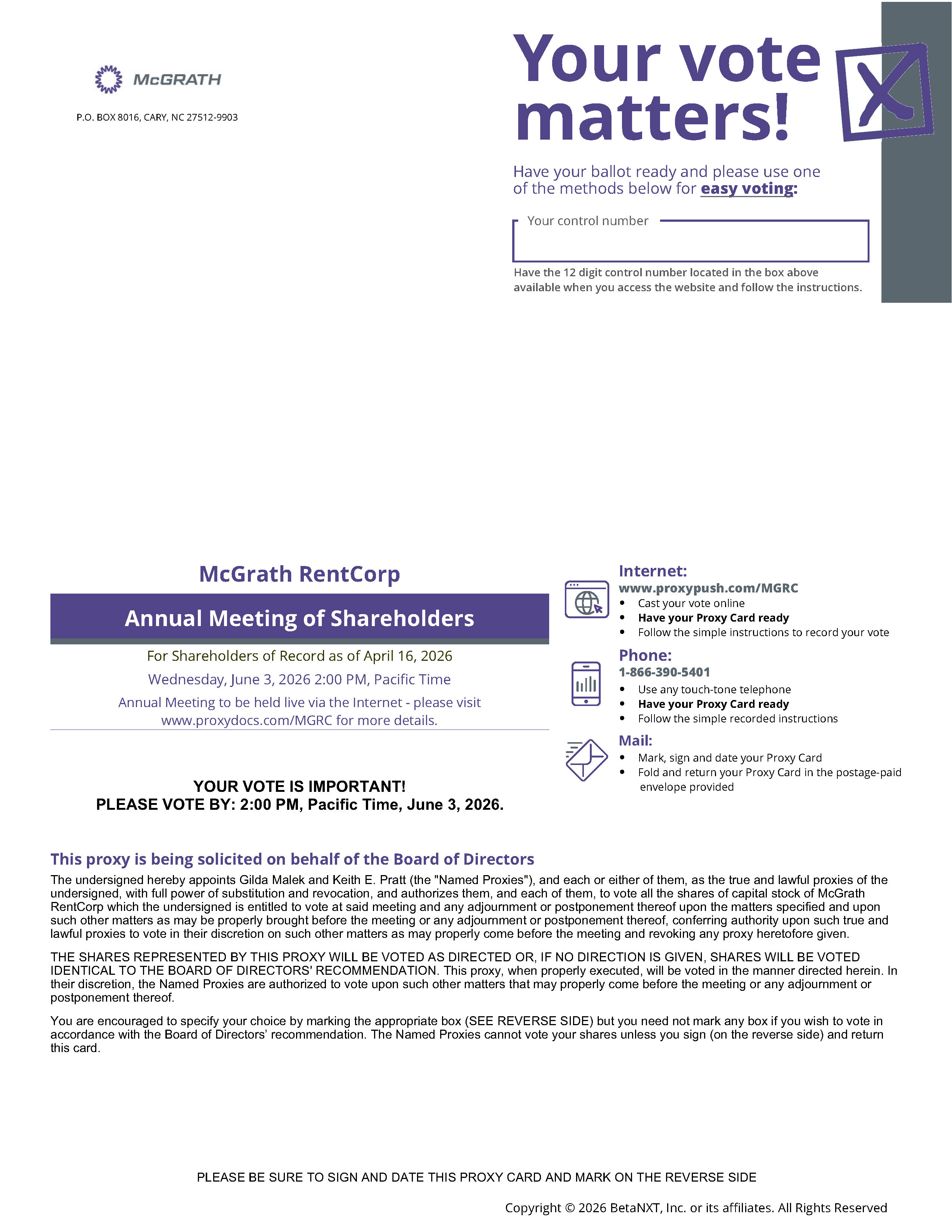
P.O. BOX 8016, CARY, NC 27512-9903 Your vote matters! Have your ballot ready and please use one of the methods below for easy voting: Your control number Have the 12 digit control number located in the box above available when you access the website and follow the instructions. McGrath RentCorp Annual Meeting of Shareholders For Shareholders of Record as of April 16, 2026 Wednesday, June 3, 2026 2:00 PM, Pacific Time Annual Meeting to be held live via the Internet - please visit www.proxydocs.com/MGRC for more details. Internet: www.proxypush.com/MGRC Cast your vote online • Have your Proxy Card ready Follow the simple instructions to record your vote Phone: 1-866-390-5401 Use any touch-tone telephone Have your Proxy Card ready Follow the simple recorded instructions Mail: Mark, sign and date your Proxy Card Fold and return your Proxy Card in the postage-paid envelope provided YOUR VOTE IS IMPORTANT! PLEASE VOTE BY: 2:00 PM, Pacific Time, June 3, 2026. This proxy is being solicited on behalf of the Board of Directors The undersigned hereby appoints Gilda Malek and Keith E. Pratt (the "Named Proxies"), and each or either of them, as the true and lawful proxies of the undersigned, with full power of substitution and revocation, and authorizes them, and each of them, to vote all the shares of capital stock of McGrath RentCorp which the undersigned is entitled to vote at said meeting and any adjournment or postponement thereof upon the matters specified and upon such other matters as may be properly brought before the meeting or any adjournment or postponement thereof, conferring authority upon such true and lawful proxies to vote in their discretion on such other matters as may properly come before the meeting and revoking any proxy heretofore given. THE SHARES REPRESENTED BY THIS PROXY WILL BE VOTED AS DIRECTED OR, IF NO DIRECTION IS GIVEN, SHARES WILL BE VOTED IDENTICAL TO THE BOARD OF DIRECTORS' RECOMMENDATION. This proxy, when properly executed, will be voted in the manner directed herein. In their discretion, the Named Proxies are authorized to vote upon such other matters that may properly come before the meeting or any adjournment or postponement thereof. You are encouraged to specify your choice by marking the appropriate box (SEE REVERSE SIDE) but you need not mark any box if you wish to vote in accordance with the Board of Directors’ recommendation. The Named Proxies cannot vote your shares unless you sign (on the reverse side) and return this card. PLEASE BE SURE TO SIGN AND DATE THIS PROXY CARD AND MARK ON THE REVERSE SIDE Copyright © 2026 BetaNXT, Inc. or its affiliates. All Rights Reserved
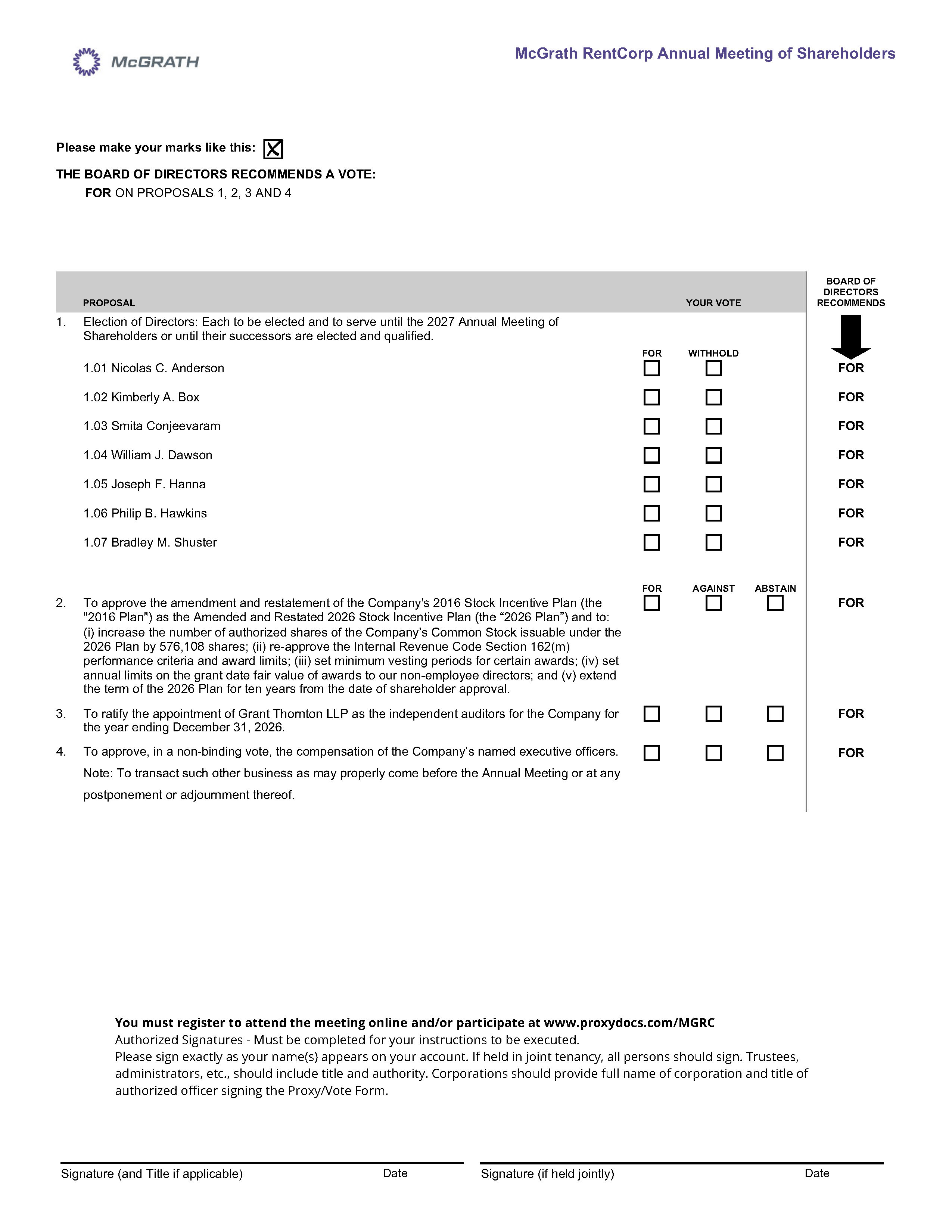
McGrath RentCorp Annual Meeting of Shareholders Please make your marks like this: THE BOARD OF DIRECTORS RECOMMENDS A VOTE: FOR ON PROPOSALS 1, 2, 3 AND 4 PROPOSAL YOUR VOTE 1. Election of Directors: Each to be elected and to serve until the 2027 Annual Meeting of Shareholders or until their successors are elected and qualified. 1.01 Nicolas C. Anderson 1.02 Kimberly A. Box 1.03 Smita Conjeevaram 1.04 William J. Dawson 1.05 Joseph F. Hanna 1.06 Philip B. Hawkins 1.07 Bradley M. Shuster FOR WITHHOLD 2. To approve the amendment and restatement of the Company's 2016 Stock Incentive Plan (the "2016 Plan") as the Amended and Restated 2026 Stock Incentive Plan (the “2026 Plan”) and to: (i) increase the number of authorized shares of the Company’s Common Stock issuable under the 2026 Plan by 576,108 shares; (ii) re-approve the Internal Revenue Code Section 162(m) performance criteria and award limits; (iii) set minimum vesting periods for certain awards; (iv) set annual limits on the grant date fair value of awards to our non-employee directors; and (v) extend the term of the 2026 Plan for ten years from the date of shareholder approval. 3. To ratify the appointment of Grant Thornton LLP as the independent auditors for the Company for the year ending December 31, 2026. 4. To approve, in a non-binding vote, the compensation of the Company’s named executive officers. Note: To transact such other business as may properly come before the Annual Meeting or at any postponement or adjournment thereof. FOR GAINST ABSTAIN BOARD OF DIRECTORS RECOMMENDS FOR FOR FOR FOR FOR FOR FOR FOR FOR FOR You must register to attend the meeting online and/or participate at www.proxydocs.com/MGRC Authorized Signatures - Must be completed for your instructions to be executed. Please sign exactly as your name(s) appears on your account. If held in joint tenancy, all persons should sign. Trustees, administrators, etc., should include title and authority. Corporations should provide full name of corporation and title of authorized officer signing the Proxy/Vote Form. Signature (and Title if applicable) Date Date Signature (if held jointly