|
|
| Summary prospectus |
Nomura VIP Balanced Series — Service Class
(formerly, Macquarie VIP Balanced Series)
April 30, 2026
Before you invest, you may want to review the Series’ statutory prospectus (and any supplements thereto), which contains more information about the Series and its risks. You can find the Series’ statutory prospectus and other information about the Series, including its statement of additional information and most recent reports to shareholders, online at nomuraassetmanagement.com/vip-literature. You can also get this information at no cost by calling 800 523-1918. The Series’ statutory prospectus and statement of additional information, both dated April 30, 2026 (and any supplements thereto), are incorporated by reference into this summary prospectus.
What is the Series’ investment objective?
Nomura VIP Balanced Series seeks to provide total return through a combination of capital appreciation and current income.
What are the Series’ fees and expenses?
The following table describes the fees and expenses that you may pay if you buy, hold, and sell shares of the Series. The fee table and example do not reflect any fees or sales charges imposed by variable insurance contracts. If they did, the expenses would be higher.
Annual series operating expenses (expenses that you pay each year as a percentage of the value of your investment)
Class | Service |
|
Management fees.............................................................................. | 0.70% |
|
Distribution and service (12b-1) fees................................................................. | 0.25% |
|
Other expenses................................................................................ | 0.12% |
|
Acquired fund fees and expenses................................................................... | 0.01%1 |
|
Total annual series operating expenses............................................................... | 1.08%2 |
|
Fee waivers and expense reimbursements ............................................................ | (0.05%)3 |
|
Total annual series operating expenses after fee waivers and expense reimbursements............................ | 1.03% |
|
| 1 | Acquired fund fees and expenses sets forth the Series’ pro rata portion of the cumulative expenses charged by the registered investment companies in which the Series invested during the last fiscal year. The actual acquired fund fees and expenses will vary with changes in the allocations of the Series’ assets. These expenses are not direct costs paid by Series shareholders, and are not used to calculate the Series’ NAV. |
| 2 | The total annual series operating expenses ratio shown above does not correlate to the expense ratio shown in the Financial Highlights table because that ratio does not include the acquired fund fees and expenses. |
| 3 | The Series’ investment manager, Delaware Management Company (Manager), has contractually agreed to waive all or a portion of its investment advisory fees and/or pay/reimburse expenses (excluding any 12b-1 fees, acquired fund fees and expenses, taxes, interest, short sale dividend and interest expenses, brokerage fees, certain insurance costs, and nonroutine expenses or costs, including, but not limited to, those relating to reorganizations, litigation, conducting shareholder meetings, and liquidations) in order to prevent total annual series operating expenses from exceeding 0.77% of the Series’ average daily net assets from April 30, 2026 through April 29, 2027. These waivers and reimbursements may only be terminated by agreement of the Manager and the Series. |
Example
This example is intended to help you compare the cost of investing in the Series with the cost of investing in other mutual funds. The example assumes that you invest $10,000 in the Series for the time periods indicated and then redeem all of your shares at the end of those periods. The example also assumes that your investment has a 5% return each year and reflects the Manager’s expense waivers and reimbursements for the 1-year contractual period and the total operating expenses without waivers for years 2 through 10. Although your actual costs may be higher or lower, based on these assumptions your costs would be:
Summary prospectus
Class | Service |
1 year......................................................................................... | $105 |
3 years........................................................................................ | $339 |
5 years........................................................................................ | $591 |
10 years....................................................................................... | $1,313 |
Portfolio turnover
The Series pays transaction costs, such as commissions, when it buys and sells securities (or “turns over” its portfolio). A higher portfolio turnover rate may indicate higher transaction costs and may result in higher taxes when Series shares are held in a taxable account. These costs, which are not reflected in the annual series operating expenses or in the example, affect the Series’ performance. During the most recent fiscal year, the Series’ portfolio turnover rate was 69% of the average value of its portfolio.
What are the Series’ principal investment strategies?
Nomura VIP Balanced Series seeks to achieve its objective by investing primarily in a diversified mix of stocks, debt securities and short-term instruments, depending on market conditions. Regarding its income-generating equity investments, including convertible securities, the Series invests primarily in medium to large, well-established companies, although it may invest in securities issued by companies of any size. The Series invests at least 50% of its total assets in equity securities including convertible securities. The Series may invest in preferred stocks and real estate investment trusts (REITs).
The Series invests at least 30% of its total assets in debt securities with the objective of providing income and diversification although such diversification may not protect against market risk. The Series’ debt securities may include US government securities or investment-grade corporate bonds rated BBB- or higher by S&P Global Ratings, a division of S&P Global, Inc. (S&P), or comparably rated by another nationally recognized statistical rating organization (NRSRO) or, if unrated, determined by the Manager to be of comparable quality. The Series may also invest up to 20% of its total assets in non-investment-grade debt securities. The Series may invest in debt securities of any maturity or duration. The Series has no limitations on the range of maturities of the debt securities in which it may invest.
The Manager uses a dynamic asset-allocation framework to determine the proportion of the Series’ assets that will be allocated to the various asset classes noted above, based on the market assessment and portfolio risk contribution for such asset classes. In addition, the Manager will also manage a tactical / completion sleeve and such sleeve will typically vary from 0% to 20% of the Series’ total assets and primarily hold derivatives and exchange-traded funds (ETFs).
In evaluating investments for the Series, the Manager focuses on companies with resilient business models characterized by stable growth rates; strong balance sheets; relative strength in earnings; attractive return profiles and valuation; and strong free cash flow generation. In so doing, the Manager evaluates a company’s management team, its financial position, its competitive position and the condition of its respective industry in addition to other factors. The Manager utilizes financial statements, independent research by its investment management personnel, third party research, brand studies done by outside parties and other tools and processes to identify what it believes to be attractive investment opportunities with a focus on the trajectory and sustainability of a company’s business model. The Manager also focuses on companies that possess a sustainable competitive advantage by evaluating factors such as brand equity/loyalty, proprietary technology, switching costs, access to distribution channels, capital requirements, economies of scale, and barriers to entry. In addition, the Manager’s analysis informs its view of an appropriate valuation for each potential investment.
The Series may use a wide range of derivatives instruments, typically including forward foreign currency contracts, options, futures contracts, options on futures contracts, and credit default swaps. The Series will use derivatives for both hedging and non-hedging purposes; as a substitute for purchasing or selling securities; and to manage the Series’ portfolio characteristics. For example, the Series may invest in: futures and options to manage duration and for defensive purposes, such as to protect gains or hedge against potential losses in the portfolio without actually selling a security, or to stay fully invested; forward foreign currency contracts to manage foreign currency exposure; and credit default swaps to hedge against a credit event, to gain exposure to certain securities or markets, or to enhance total return.
In selecting debt securities for the Series, the Manager focuses on current income and capital preservation and generally seeks to invest in investment-grade securities. The Series may invest up to 30% of its total assets in foreign securities, including equity and fixed-income securities. Additionally, many of the companies in which the Series may invest have diverse operations, with products or services in foreign markets. Therefore, the Series may have indirect exposure to various foreign markets through investments in these companies, even if the Series is not invested directly in such markets.
Generally, in determining whether to sell a security, the Manager uses the same analysis as identified above in order to determine if the security is appropriately valued or has met its anticipated price. The Manager also may sell a security if the security ceases to produce income, to reduce the Series’ holding in that security, to take advantage of what it believes are more attractive investment opportunities or to raise cash.
2
What are the principal risks of investing in the Series?
Investing in any mutual fund involves the risk that you may lose part or all of the money you invest. Over time, the value of your investment in the Series will increase and decrease according to changes in the value of the securities in the Series’ portfolio. An investment in the Series may not be appropriate for all investors. The Series’ principal risks include:
Market risk — The risk that all or a majority of the securities in a certain market — such as the stock or bond market — will decline in value because of factors such as adverse political or economic conditions, future expectations, investor confidence, or heavy institutional selling.
Preferred stock risk — The risk that preferred stocks may be subordinated to bonds in terms of rights to their share of the company’s assets, may be less liquid than many other securities, and generally offer no voting rights with respect to the issuer. Preferred stocks may also be adversely affected by interest rates and may be callable by the issuer.
Exchange-traded fund risk — The risks of investing in an ETF typically reflect the risks of the instruments in which the ETF invests. Because ETFs are investment companies, a series will bear its proportionate share of the fees and expenses of an investment in an ETF. As a result, a series’ expenses may be higher and performance may be lower.
Foreign risk — The risk that investments in foreign securities (particularly those of issuers in emerging markets) may be adversely affected by political instability, changes in currency exchange rates, inefficient markets and higher transaction costs, foreign economic conditions, the imposition of economic or trade sanctions, or inadequate or different regulatory and accounting standards.
US government securities risk — The risk that certain US government securities, such as securities issued by Fannie Mae, Freddie Mac and the Federal Home Loan Bank system (FHLB), are not backed by the “faith and credit” of the US government and, instead, may be supported only by the credit of the issuer or by the right of the issuer to borrow from the US Treasury.
Interest rate risk — The risk that the prices of bonds and other fixed income securities will increase as interest rates fall and decrease as interest rates rise. Interest rate changes are influenced by a number of factors, such as government policy, monetary policy, inflation expectations, and the supply and demand of bonds. Bonds and other fixed income securities with longer maturities or duration generally are more sensitive to interest rate changes. A series may be subject to a greater risk of rising interest rates when interest rates are low or inflation rates are high or rising.
Credit risk — The risk that an issuer of a debt security, including a governmental issuer or an entity that insures a bond, may be unable to make interest payments and/or repay principal in a timely manner.
High yield (junk) bond risk — The risk that high yield securities, commonly known as “junk bonds,” are subject to reduced creditworthiness of issuers, increased risk of default, and a more limited and less liquid secondary market. High yield securities may also be subject to greater price volatility and risk of loss of income and principal than are higher-rated securities.
REIT-related risk — The risk that the value of a series’ investments in a REIT may be adversely affected by (1) changes in the value of the REIT’s underlying property or the property secured by mortgages the REIT holds; (2) loss of REIT federal tax status (and the resulting inability to qualify for modified pass-through tax treatment under the Internal Revenue Code of 1986, as amended (the “Internal Revenue Code” or the “Code”)) or changes in laws and/or rules related to that status; or (3) the REIT’s failure to maintain its exemption from registration under the Investment Company Act of 1940 (1940 Act). In addition, a series may experience a decline in its income from REIT securities due to falling interest rates or decreasing dividend payments.
Company size risk — The risk that investments in small- and/or medium-sized companies may be more volatile than those of larger companies because of limited financial resources or dependence on narrow product lines.
Liquidity risk — The possibility that investments cannot be readily sold within seven calendar days at approximately the price at which a series has valued them.
Active management and selection risk — The risk that the securities selected by a series’ management will underperform the markets, the relevant indices, or the securities selected by other funds with similar investment objectives and investment strategies. The securities and sectors selected may vary from the securities and sectors included in the relevant index.
How has Nomura VIP Balanced Series performed?
The bar chart and table below provide some indication of the risks of investing in the Series. The bar chart shows changes in the Series’ performance from year to year and the table shows how the Series’ average annual total returns for the 1-, 5-, and 10-year periods compare with those of broad measures of market performance. The Series’ past performance is not necessarily an indication of how the Series will perform in the future. The returns reflect any expense caps in effect during these periods. The returns would be lower without the expense caps.
On April 30, 2021, Delaware Management Company became the Series’ investment manager. The returns shown from before April 30, 2021 are from the Series’ prior investment manager.
3
Summary prospectus
Effective November 15, 2021, the Series changed its investment strategy. Performance prior to November 15, 2021 reflects the Series’ former strategy; its performance may have differed if the Series’ current strategy had been in place.
You may obtain the Series’ most recently available month-end performance by calling 800 523-1918 or by visiting our website at nomuraassetmanagement.com/vip-performance.
Performance reflects all Series expenses but does not include any fees or sales charges imposed by variable insurance contracts. If they had been included, the returns shown below would be lower. Investors should consult the variable contract prospectus for more information.
Calendar year-by-year total return (Service Class)
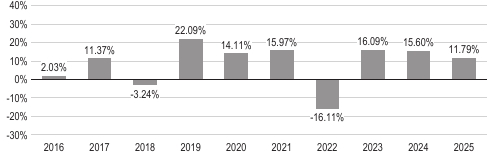
During the periods illustrated in this bar chart, Service Class’s highest quarterly return was 15.52% for the quarter ended June 30, 2020, and its lowest quarterly return was -16.23% for the quarter ended March 31, 2020.
Average annual total returns for periods ended December 31, 2025
1 year | 5 years | 10 years | |
Service Class......................................................... | 11.79% | 7.85% | 8.38% |
S&P 500® Index (reflects no deduction for fees, expenses, or taxes).................. | 17.88% | 14.42% | 14.82% |
Bloomberg US Aggregate Index (reflects no deduction for fees, expenses, or taxes)....... | 7.30% | -0.36% | 2.01% |
Who manages the Series?
Investment manager
Delaware Management Company, a series of Nomura Investment Management Business Trust (a Delaware statutory trust)
Portfolio managers | Title | Start date on the Series |
Stefan Löwenthal, CFA | Managing Director, Chief Investment Officer of Global Multi-Asset | November 2021 |
Jürgen Wurzer, CFA | Managing Director, Deputy Head of Global Multi-Asset | November 2021 |
Aaron Young | Managing Director, Senior Portfolio Manager - Global Multi-Asset | November 2021 |
Employees of the Manager’s affiliates outside the US participate in the management of certain funds as “associated persons” of the Manager under the Manager’s oversight, in accordance with SEC guidance as to “participating affiliate” arrangements. These associated persons may, on behalf of the Manager, provide discretionary investment management services, trading, research and related services directly or indirectly to the Series.
Sub-advisor
Macquarie Investment Management Global Limited (MIMGL)
Purchase and redemption of Series shares
Shares are sold, directly or indirectly, to separate accounts of life insurance companies at net asset value (NAV). Please refer to the variable annuity or variable life insurance product contract prospectus for more information about the purchase and redemption of shares.
4
Tax information
The dividends and distributions paid from the Series to the insurance company separate accounts will consist of ordinary income, capital gains, or some combination of both. Because shares of the Series must be purchased through separate accounts used to fund variable annuity contracts or variable life insurance contracts (variable contracts), such dividends and distributions will be exempt from current taxation by contract holders if left to accumulate within a separate account. You should refer to your variable contract prospectus for more information on these tax consequences.
Payments to broker/dealers and other financial intermediaries
If you purchase shares of the Series through a broker/dealer or other financial intermediary (such as an insurance company), the Series and its related companies may pay the intermediary for the sale of Series shares and related services. These payments may create a conflict of interest by influencing the broker/dealer or other intermediary and your salesperson to recommend the Series over another investment. Ask your salesperson or visit your financial intermediary’s website for more information.
5
This page intentionally left blank
6
This page intentionally left blank
7
VIPSUM-BAL 4/26
