April 28, 2026
Summary Prospectus

Vanguard Baillie Gifford Global Positive Impact Stock Fund
Investor Shares
Vanguard Baillie Gifford Global Positive Impact Stock Fund Investor Shares (VBPIX)
The Fund’s statutory Prospectus and Statement of Additional Information dated April 28, 2026, as may be amended or supplemented, are incorporated into and made part of this Summary Prospectus by reference.
Before you invest, you may want to review the Fund’s Prospectus, which contains more information about the Fund and its risks. You can find the Fund’s Prospectus and other information about the Fund online at www.vanguard.com/prospectus and https://personal.vanguard.com/us/literature/reports/MFs. You can also obtain this information at no cost by calling 800-662-7447 or by sending an email request to online@vanguard.com.
The Securities and Exchange Commission (SEC) has not approved or disapproved these securities or passed upon the adequacy of this Prospectus. Any representation to the contrary is a criminal offense.

Investment Objective
Vanguard Baillie Gifford Global Positive Impact Fund (the “Fund”) seeks capital appreciation with an emphasis on investing in businesses that deliver positive change by contributing towards a more sustainable and inclusive world.
Fees and Expenses
The following tables describe the fees and expenses you may pay if you buy, hold, and sell shares of the Fund. You may pay other fees, such as brokerage commissions and other fees to financial intermediaries, which are not reflected in the tables and example below.
Shareholder Fees
(Fees paid directly from your investment)
 
Sales Charge (Load) Imposed on Purchases
None
Purchase Fee
None
Sales Charge (Load) Imposed on Reinvested Dividends
None
Redemption Fee
None
Account Service Fee Per Year
(for certain fund account balances below $5,000,000)
$25
Annual Fund Operating Expenses
(Expenses that you pay each year as a percentage of the value of your investment)
 
Management Fees
0.45
%
12b-1 Distribution Fee
None
Other Expenses
0.14
%
Total Annual Fund Operating Expenses
0.59
%
Example
This example is intended to help you compare the cost of investing in the Fund with the cost of investing in other funds. The example assumes that you invest $10,000 in the Fund for the time periods indicated and then redeem all of your shares at the end of those periods. The example also assumes that your investment has a 5% return each year and that the Fund’s operating expenses remain the same.
1 Year
3 Years
5 Years
10 Years
$60
$189
$329
$738
Portfolio Turnover
The Fund pays transaction costs, such as commissions, when it buys and sells securities (or “turns over” its portfolio). A higher portfolio turnover rate may indicate higher transaction costs and may result in higher taxes when Fund shares are held in a taxable account. These costs, which are not reflected in
1

annual fund operating expenses or in the example, affect the Fund’s performance. During the most recent fiscal year, the Fund’s portfolio turnover rate was 32% of the average value of its portfolio.
Principal Investment Strategies
The Fund employs an active management approach, investing in a global portfolio of stocks of companies located in a number of countries throughout the world, including in developed, emerging, and frontier markets. The Fund invests in common and preferred stocks, both directly and indirectly (such as through depositary receipts), and is not constrained with respect to market capitalization or industry allocation. Under normal circumstances, the Fund invests at least 80% of its net assets, plus the amount of any borrowings for investment purposes, in stocks of companies that Baillie Gifford Overseas Limited (“Baillie Gifford”), the Fund’s advisor, determines contribute towards a more sustainable and inclusive world.

The Fund’s portfolio managers employ a bottom-up approach to stock selection and select companies without being constrained by any benchmark or securities index. The portfolio managers focus on company research and the long-term outlook of companies and industries, assessing a range of factors, including: long-term growth potential, geographic and industry positioning, competitive advantage (or attributes that give a company a favorable business position relative to its competitors), management, financial strength and valuation. In parallel, the portfolio managers assess potential holdings’ contributions to sustainability and inclusiveness, focusing on the ability of companies to deliver positive change in areas including: (1) Social Inclusion and Education, focusing on a more inclusive society and access to and quality of education; (2) Healthcare and Quality of Life, focusing on improving healthcare that affects quality of life; (3) Environment and Resource Needs, focusing on environmental impacts that affect basic resources; and (4) Base of the Pyramid, focusing on addressing the needs of the poorest populations. The portfolio managers assess positive change across these four categories by considering the company’s intent, how its products and services contribute to solving a global challenge, and the company’s business practices. To measure and report on impact, the portfolio managers monitor the progress of each issuer using metrics and/or milestones specific to each company and selected by Baillie Gifford. The portfolio managers pursue an active, positive approach; investment decisions are generally not made on the basis of negative “screening” of companies viewed as socially irresponsible.

The intended outcome is a portfolio of between 25 and 50 growth companies with the potential to outperform the Fund’s performance benchmark over the long term and which the portfolio managers consider to have core ambitions of delivering a positive change. The process can result in significant exposure to a single country or a small number of countries.

The Fund is considered nondiversified, as defined under the Investment Company Act of 1940, which means that it may invest a greater percentage of its assets in the securities of particular issuers, industries, or sectors as compared with diversified funds. The Fund aims to hold securities for long periods (typically 5-10 years), which results in relatively low portfolio turnover and is in line with the Fund’s long-term investment outlook.

The Fund may invest without limitation in securities quoted or denominated in
2

currencies other than the U.S. dollar and may hold such currencies. The Fund does not expect to engage in currency hedging and thus expects to be fully exposed to currency fluctuations relative to the U.S. dollar.
As a result of its long-term investment approach, the Fund may lose
money or underperform compared to its performance benchmark or other
funds over extended periods of time. In addition, the Fund may not
perform as expected in the long term. Therefore, an investment in the
Fund may be more suitable for long-term investors who can bear the risk
of short- or medium-term fluctuations in the value of the Fund’s portfolio.
Principal Risks
As with any investment, an investment in the Fund could lose money over any time period. The Fund’s share price and total return may fluctuate, potentially within a wide range. The principal risks of investing in the Fund are summarized below. Each of the following risks could affect the Fund’s performance:
• Impact Risk. The Fund may not be successful in assessing or identifying companies that have or could have a positive impact or support an environmental, social, and/or governance (ESG) position. In some circumstances, companies could ultimately have a negative impact, or no impact, on addressing a global challenge or on ESG matters.
• ESG Investing. The Fund is subject to ESG investing risks. The advisor selects securities for the Fund based on the ESG criteria described in the Fund’s principal investment strategies. As a result, the Fund’s investments could, in the aggregate, trail the returns of other funds that use ESG criteria or underperform the market as a whole. The advisor’s use of ESG criteria may result in the Fund becoming focused, at times, in a particular market sector, which would subject the Fund to proportionately higher exposure to the risks of that sector. Interpretations of what it means for a company or issuer to exhibit ESG characteristics can—and do—vary significantly across individuals, advisors, and other funds that use ESG criteria. The advisor’s assessment of whether or not a company or issuer meets the ESG criteria described in the Fund’s principal investment strategies, or the ESG criteria itself, may not align with your personal view of what it means for a company or issuer to exhibit ESG characteristics generally. Further, individual securities held by the Fund may not reflect your personal preferences, beliefs, expectations, and/or values. In order to assess a company or issuer against the ESG criteria described in the Fund’s principal investment strategies, the advisor depends on the availability of data obtained through voluntary or third-party reporting. There can be no assurance that this data will be accurate, complete, or current, which could result in an inaccurate assessment of a company or issuer.
• General Market Risk. The markets in which the Fund invests can be affected by a variety of factors. These factors, which can be real or perceived, may include economic, market, political, and regulatory conditions and developments as well as local, regional, or global events such as wars, military conflicts, natural disasters, and public health issues. In addition, investor sentiment and expectations regarding these factors can also impact the markets. Different parts of the market, including different industries and sectors as well as different types of securities, may react differently to factors that affect the market. These factors can contribute to market uncertainty,

3

market volatility, and fluctuations in the value of the Fund’s investments, thereby resulting in potential losses to the Fund over short or long periods.
• Investing in Foreign Markets. Foreign markets can perform differently than U.S. markets. World events could adversely affect the value and/or liquidity of securities of foreign companies or foreign issuers, potentially in ways that differ from impacts to U.S. companies or issuers. Further, global economies and financial markets are becoming increasingly interconnected, which increases the possibility that conditions in one country or region could adversely impact a different country or region. In addition, the rights and remedies associated with investments in a fund that invests in foreign securities may be different than a fund that invests in domestic securities. To the extent that the Fund invests a large portion of its assets in securities of issuers located primarily in one country or region, the Fund’s performance may be hurt disproportionately by the poor performance of its investments in such country or region. 
• Investing in Emerging and Frontier Markets. Investments in emerging markets are subject to higher degrees of risk and volatility than investments in developed markets. Compared with developed markets, emerging markets can have greater custodial and operational risks; less developed legal, tax, regulatory, financial reporting, accounting, and recordkeeping systems; and greater political, social, and economic instability than developed markets. In addition, emerging markets generally have less efficient trading markets with lower overall liquidity and more volatile currency exchange rates. The Fund also may invest in frontier markets which have even smaller economies and less developed capital markets and which carry even greater risks, including potential liquidity issues and challenges clearing and settling trades. There is also the possibility for disruptions, corrections, and failed settlements, which can result in trading losses. Each of these risks can cause losses to the Fund’s investments and/or impact the Fund’s performance.
• Currency Risk. The Fund is subject to the risk that foreign currency will perform differently than U.S. dollars and increase the potential loss to the Fund. Currency exchange rates may be volatile, move rapidly, and change as a result of changes in interest rates, inflation rates, government surpluses or deficits, and monetary policy or currency controls imposed by local governments or supranational entities such as the International Monetary Fund. Changes in currency exchange rates can affect the value of the Fund’s holdings.
• Investing in Equity Markets. The Fund invests in the equity markets. Equity markets have historically been cyclical, having periods of time when stock values rise and fall. Market volatility can lead to significant fluctuations in stock values, resulting in potential losses to the Fund.
• Market Capitalization (Market Cap). Companies are generally classified into three types of market cap depending on their size: small-, mid-, and large-cap. Companies can be further classified into micro- or mega-cap. Different factors can affect each market cap uniquely, and historically small- and mid-cap stocks have typically been more volatile due to the effects of changing economic conditions. Large companies may not reach the same levels of growth or performance as smaller companies, and they may be slower to react to competitive challenges. The performance of funds that invest in a subset of market caps could diverge from the performance of a fund that is focused on a broader representation of the stock market.
4

• Growth Investing. The Fund’s approach to growth investing could cause it to underperform other stock funds that use a different investment style. Growth stocks typically produce lower yields because growth companies prefer to reinvest earnings into research and development to promote growth and increase profitability. Research and development can be expensive and may not always produce favorable results, which could harm a company’s performance relative to the broader market.
• Active Management. The Fund is actively managed. The advisor’s security selection and/or strategy execution could cause the Fund to underperform relevant securities markets or other funds with a similar investment objective.
• Nondiversified Funds. The Fund is considered a nondiversified fund as defined under the Investment Company Act of 1940. Nondiversified funds invest a greater percentage of their assets in a small number of issuers than diversified funds, their performance may be negatively impacted by relatively few securities or even a single security, and their shares may experience significant fluctuations in value.
• Issuer Focus. The Fund has a significant portion of its assets invested in a limited number of issuers. As a result, the Fund’s performance can be negatively affected by the performance of even one of these issuers, and the Fund’s shares may experience significant fluctuations in value.
An investment in the Fund is not a deposit of a bank and is not insured or guaranteed by the Federal Deposit Insurance Corporation or any other government agency.
Annual Total Returns
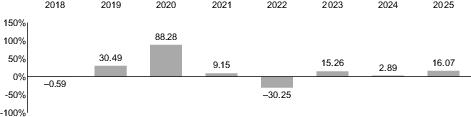
The following bar chart and table show the Fund’s historical performance and are intended to help you understand the risks of investing in the Fund. The Fund has adopted the performance of the Baillie Gifford Positive Change Equities Fund (the predecessor fund), the performance predecessor to the Fund, as a result of a reorganization of the predecessor fund into the Fund on July 18, 2022 (the Reorganization). The predecessor fund was managed using investment policies, objectives, guidelines and restrictions that were substantially similar to those of the Fund. Prior to the Reorganization, the Fund had not yet commenced operations. The bar chart shows how the performance of the Investor shares of the Fund has varied from one calendar year to another over the periods shown. The table shows how the average annual total returns of the Fund compare with those of a broad-based securities market index. MSCI ACWI Index returns are adjusted for withholding taxes. Keep in mind that the Fund’s (and the predecessor fund’s) past performance (before and after taxes) does not indicate how the Fund will perform in the future.
The returns shown for periods through July 18, 2022, are those of the predecessor fund’s Institutional Class shares. The Institutional Class and Class K shares of the predecessor fund were reorganized into the Investor shares of the Fund on July 18, 2022. Returns of the Fund’s Investor shares will be different than returns of the predecessor fund’s Institutional Class or Class K shares, as they have different expenses.
Updated performance information is available on our website at vanguard.com/performance.
5

Annual Total Returns — Vanguard Baillie Gifford Global Positive Impact Stock Fund Investor Shares
During the periods shown in the bar chart, the highest and lowest returns for a calendar quarter were:
 
Total Return
Quarter
Highest
40.15
%
June 30, 2020
Lowest
-26.74
%
June 30, 2022
Average Annual Total Returns for Periods Ended December 31, 2025
 
1 Year
5 Years
Since
Fund
Inception
Fund
Inception
Date
Vanguard Baillie Gifford Global Positive
Impact Stock Fund Investor Shares
12/14/2017
Return Before Taxes
16.07
%
0.94
%
12.61
%
Return After Taxes on Distributions
16.01
0.41
12.11
Return After Taxes on Distributions and Sale
of Fund Shares
9.54
0.70
10.40
MSCI ACWI Index
(reflects no deduction for fees or expenses)
22.34
%
11.19
%
10.91
%
Actual after-tax returns depend on your tax situation and may differ from those shown in the preceding table. When after-tax returns are calculated, it is assumed that the shareholder was in the highest individual federal marginal income tax bracket at the time of each distribution of income or capital gains or upon redemption. State and local income taxes are not reflected in the calculations. Please note that after-tax returns are not relevant for a shareholder who holds fund shares in a tax-deferred account, such as an individual retirement account or a 401(k) plan. Also, figures captioned Return After Taxes on Distributions and Sale of Fund Shares may be higher than other figures for the same period if a capital loss occurs upon redemption and results in an assumed tax deduction for the shareholder.

Investment Advisor
Baillie Gifford Overseas Limited (Baillie Gifford)
Portfolio Managers
Kate Fox, CFA, Partner of Baillie Gifford & Co., which is the 100% owner of Baillie Gifford, and Portfolio Manager at Baillie Gifford. She has co-managed the Fund since its inception in 2022 (predecessor fund since 2017).

Lee Qian, CFA, Portfolio Manager at Baillie Gifford. He has co-managed the Fund since its inception in 2022 (predecessor fund since 2017).
Purchase and Sale of Fund Shares
If you invest directly with Vanguard, you may purchase or redeem shares online through our website (vanguard.com), by mail (The Vanguard Group, P.O. Box 982901, El Paso, TX 79998-2901), or by telephone (800-662-2739). The minimum investment amount required to open a Fund account for Investor Shares is generally $3,000. The minimum investment amount required to add to an existing Fund account is generally $1.

Financial intermediaries, institutional clients, and Vanguard-advised clients should contact Vanguard for information on special eligibility rules that may apply to them regarding Investor Shares. If you invest in Vanguard fund shares indirectly through an intermediary (including investing in shares through a brokerage account offered by Vanguard Brokerage Services®), please contact that firm directly for more information regarding your eligibility. If you invest in Vanguard fund shares through an employer-sponsored retirement or savings plan, your plan administrator or your benefits office can provide you with detailed information on how you can invest through your plan.
Tax Information
The Fund’s distributions may be taxable as ordinary income or capital gains. If you are investing through a tax-advantaged account, such as an IRA or an employer-sponsored retirement or savings plan, special tax rules apply. You should consult your own tax advisor with respect to any particular U.S. or non-U.S. tax consequences of your investment in the Fund.
Payments to Financial Intermediaries
The Fund and its advisor do not pay financial intermediaries for sales of Fund shares.
CFA® is a registered trademark owned by CFA Institute.
Vanguard Baillie Gifford Global Positive Impact Stock Fund Investor Shares—Fund Number V010
To request additional information about the Fund, please visit vanguard.com or contact us at 800-662-7447.
© 2026 The Vanguard Group, Inc. All rights reserved.
Vanguard Marketing Corporation, Distributor.
SP V010 042026