| Summary Prospectus |
April 30, 2026 |
Invesco V.I. American Franchise Fund
Series I shares and Series II shares

Before you invest, you may want to review the
Fund’s prospectus, which contains more information about the Fund and its risks. You can find the Fund’s prospectus, reports to shareholders, and other information
about the Fund online at www.invesco.com/prospectus. You can also get this information at no cost by calling (800) 959-4246 or by sending an e-mail request to
ProspectusRequest@invesco.com. The Fund’s prospectus and statement of additional information, both dated April 30, 2026 (as each may be amended or supplemented), are
incorporated by reference into this Summary Prospectus and may be obtained, free of charge, at the website, phone number or e-mail address noted above.
Investment Objective(s)
The Fund's investment objective is to seek capital growth.
Fees and Expenses of the Fund
This
table describes the fees and expenses that are incurred, directly or indirectly, when a variable product owner buys, holds, or redeems interest in an insurance company separate account that invests in the Series I shares or Series II shares of the Fund but
does not represent the effect of any fees or other expenses assessed in connection with your variable product, and if it did, expenses would be higher.
| Shareholder Fees (fees paid directly from your
investment) | ||
| |
Series I shares |
Series II shares |
| Maximum Sales Charge (Load) Imposed on Purchases (as a percentage of offering price) |
None |
None |
| | ||
| Maximum Deferred Sales Charge (Load) (as a percentage of original purchase price or redemption proceeds, whichever is less) |
None |
None |
| | ||
| Annual Fund Operating Expenses (expenses that you pay each year as a percentage of the value of your investment) | ||
| |
Series I shares |
Series II shares |
| Management Fees |
0.67 % |
0.67 % |
| | ||
| Distribution and/or Service (12b-1) Fees
|
None |
0.25 |
| | ||
| Other Expenses |
0.18 |
0.18 |
| | ||
| Total Annual Fund Operating Expenses |
0.85 |
1.10 |
| | ||
Example. This Example is intended to help you compare the cost of investing in the Fund with the cost of investing in other mutual funds.
This Example does not represent the effect of any fees or expenses assessed in connection
with your variable product, and if it did, expenses would be higher.
The Example assumes that you invest $10,000 in the Fund for the time periods indicated and
then redeem all of your shares at the end of those periods. The Example also assumes that your investment has a 5% return each year and that the Fund’s operating expenses remain the same.
Although your actual costs may be higher or lower, based on these assumptions, your costs
would be:
| |
1 Year |
3 Years |
5 Years |
10 Years |
| Series I shares |
$87
|
$271
|
$471
|
$1,049
|
| | ||||
| Series II shares |
$112
|
$350
|
$606
|
$1,340
|
| | ||||
Portfolio Turnover. The Fund pays transaction costs, such as commissions, when it buys and sells securities (or “turns
over” its portfolio). A higher portfolio turnover rate may indicate higher transaction costs. These costs, which are not reflected in annual fund operating expenses or in the Example, affect the Fund’s
performance. During the most recent fiscal year, the Fund’s portfolio turnover rate was
56% of the average value of its portfolio.
Principal Investment Strategies of the Fund
The Fund invests, under normal circumstances, at least 80% of its net assets (plus any borrowings for
investment purposes) in securities of U.S. issuers and in derivatives and other instruments that have economic characteristics similar to such securities. The Fund deems an issuer to be a U.S. issuer if (i) its
principal securities trading market (i.e., a U.S. stock exchange, NASDAQ or over-the-counter markets) is in the U.S.; (ii) it (alone or through its consolidated subsidiaries) derives 50% or more of its annual revenue from either goods
produced, sales made or services performed in the U.S.; (iii) it is organized under the laws of, or has a principal office in the U.S.; or (iv) its “country of risk” is the U.S. as determined by a third party service provider.
The Fund invests primarily in equity securities of mid- and large-capitalization issuers. The principal type of equity security in which the Fund invests is common stock.
The Fund
invests primarily in securities that are considered by the Fund’s portfolio managers to have potential for earnings or revenue growth.
The Fund may invest up to 20% of its net assets in securities of foreign issuers.
The Fund may also invest up to 10% of its net assets in emerging markets countries, i.e.,
those that are generally in the early stages of their industrial cycles.
The Fund is non-diversified, which means it can invest a greater percentage of its assets in
a small group of issuers or any one issuer than a diversified fund can.
The Fund’s portfolio managers use a bottom-up stock selection process designed to seek
return on growth-oriented investments, as well as a disciplined portfolio construction process designed to manage risk. The portfolio managers use a holistic approach that closely examines company fundamentals, including detailed
modeling of a company’s financial statements and discussions with company management teams, suppliers,
1 Invesco V.I. American Franchise Fund
invesco.com/usVK-VIAMFR-SUMPRO-1
distributors, competitors, and customers.
The portfolio managers use a variety of valuation techniques based on the company in question, the
industry in which the company operates, the stage of the company’s business cycle, and
other factors that best reflect a company’s value. The portfolio managers seek to invest in companies with attractive growth outlooks at compelling valuation levels.
The portfolio managers consider whether to sell a particular security when a company is deemed to be overvalued, a company’s fundamentals deteriorate, the catalysts for
growth are no longer present or reflected in the stock price or if the company is displaced by a more attractive investment opportunity.
Principal Risks of Investing in the Fund
As with any mutual fund investment, loss of money is a risk of investing. An investment in the Fund is not a deposit in a bank and is not insured or guaranteed by the Federal Deposit
Insurance Corporation or any other governmental agency. The risks associated with an investment in the Fund can increase during times of significant market volatility. The principal risks of investing in the Fund
are:
Market Risk. The market values of the Fund’s investments, and therefore the value of the Fund’s shares, will
go up and down, sometimes rapidly or unpredictably. Market risk may affect a single issuer, industry or section of the economy, or it may affect the market as a whole. The value of the Fund’s investments may
go up or down due to general market conditions that are not specifically related to the particular issuer. These market conditions may include real or perceived adverse economic conditions, changes in trade regulation or
economic sanctions, changes in the general outlook for revenues or corporate earnings, changes in interest or currency rates, regional or global instability and uncertainty, natural or environmental disasters,
widespread disease or other public health issues, war, military conflict, acts of terrorism, economic crisis or adverse investor sentiment generally, among others. Certain changes in the U.S. economy in particular, such as when the U.S.
economy weakens or when its financial markets decline, may have a material adverse effect on global financial markets as a whole, and on the securities to which the Fund has exposure. Increasingly strained relations
between the U.S. and foreign countries, including as a result of economic sanctions and tariffs, may also adversely affect U.S. issuers, as well as non-U.S. issuers.
During a general downturn in the financial markets, multiple asset classes
may decline in value. When markets perform well, there can be no assurance that specific investments held by the Fund will rise in value.
Investing in Stocks Risk. The value of the Fund’s portfolio may be affected by changes in the stock markets. Stock markets may experience significant short-term volatility and
may fall or rise sharply at times. Adverse events in any part of the equity or fixed-income markets may have unexpected negative effects on other market segments. Different stock markets may behave differently from each
other and U.S. stock markets may move in the opposite direction from one or more foreign stock markets.
The prices of individual stocks generally do not all move in the same
direction at the same time. However, individual stock prices tend to go up and down more
dramatically than those of certain other types of investments, such as bonds. A variety of factors can negatively affect the price of a particular company’s stock. These factors may include, but are not limited to: poor earnings
reports, a loss of customers, litigation against the company, general unfavorable performance of the company’s sector or industry, or changes in government regulations affecting the company or its industry. To the extent that
securities of a particular type are emphasized (for example foreign stocks, stocks of small- or mid-cap companies, growth or value stocks, or stocks of companies in a particular industry), Fund share values may fluctuate more in
response to events affecting the market for those types of securities.
Mid-Capitalization Companies Risk. Investing in securities of mid-capitalization companies typically involves greater risk than is associated with investing in securities
of larger, more established
companies. Mid-capitalization companies’ securities may be more volatile and less liquid than those of
larger, more established companies and may have returns that vary, sometimes significantly, from the overall securities market. Mid-capitalization companies may have less experienced management, more limited product and market
diversification, and fewer financial resources compared to larger capitalization companies. Often
mid-capitalization companies and the industries in which they focus are still evolving and, as a
result, they may be more sensitive to changing market conditions.
Growth Investing Risk. The market values of growth securities may be more volatile than other types of investments. The returns on
growth securities may or may not move in tandem with the returns on other styles of investing or
the overall stock market. If a growth company’s earnings or stock price fails to increase as anticipated, or if its business plans do not produce the expected results, the value of its securities may decline sharply. Growth companies may be newer
or smaller companies that may experience greater stock price fluctuations and risks of loss than larger, more established companies. Newer growth companies tend to retain a large part of their earnings for research,
development or investments in capital assets. Therefore, they may not pay any dividends for some time. Growth securities typically invest a high portion of their earnings back into their business and may lack the
dividend yield that could cushion their decline in a market downturn. During periods when growth investing is out of favor or when markets are unstable, it may be more difficult to sell growth company securities at an
acceptable price and the securities of growth companies may underperform the securities of value companies or the overall stock market. Growth stocks may also be more volatile than other securities because of investor
speculation and the value of the Fund’s investments will vary and at times may be lower than that of other types of investments.
Sector Focus Risk. In pursuing its
investment strategy, the Fund may invest to a significant degree in securities of issuers operating in a single sector. In so doing, the Fund may face more risks than if it were diversified broadly over numerous sectors.
Such sector-based risks, any of which may adversely affect the companies in which, the Fund invests, may include, but are not limited to, legislative or regulatory changes, adverse market conditions and/or increased competition
within the sector. In addition, at times, such sector may be out of favor and underperform other sectors or the market as a whole.
Foreign Investment
Risk. Investments in the securities of non-U.S. issuers involve risks beyond those associated with investments in U.S. securities. Foreign securities may have
relatively low market liquidity, greater market volatility, decreased publicly available information and less reliable financial information about issuers, and inconsistent and potentially less stringent accounting, auditing and
financial reporting requirements and standards of practice, including recordkeeping standards, comparable to those applicable to domestic issuers. Foreign securities also are subject to the risks of possible seizure,
expropriation, nationalization, political or social instability, changes in economic or taxation policies or other adverse political or economic developments (in which the Fund could lose its entire investments in a certain market) and the
difficulty of enforcing obligations in other countries, including the possible adoption of foreign governmental restrictions such as exchange controls. Investments in foreign securities also may be subject to dividend
withholding or confiscatory taxes, currency blockage and/or transfer restrictions and higher transactional costs. To the extent the Fund invests in securities denominated in foreign currencies, fluctuations in the value of the U.S.
dollar relative to the values of other currencies may adversely affect investments in foreign securities and may negatively impact the Fund’s returns, unless the Fund has hedged its foreign currency exposure. Currency
exchange rates may fluctuate significantly over short periods of time. Currency hedging strategies, if used, may not always be successful. Foreign companies generally may be subject to less stringent regulations than U.S. companies,
including financial reporting requirements and auditing and accounting controls, and may therefore be more
2 Invesco V.I. American Franchise Fund
invesco.com/usVK-VIAMFR-SUMPRO-1
susceptible to fraud or corruption. There
may be less public information available about foreign companies than U.S. companies, making it difficult to evaluate those foreign companies. From time to time, certain companies in which the Fund invests may
operate in, or have dealings with, countries subject to sanctions or embargoes imposed by the U.S. government and the United Nations and/or in countries the U.S. government identified as state sponsors of terrorism. One or more
of these companies may be subject to constraints under U.S. law or regulations that could negatively affect the company’s performance. Additionally, one or more of these companies could suffer damage to its
reputation if the market identifies it as a company that invests or deals with countries that the U.S. government identifies as state sponsors of terrorism or is subject to sanctions.
Emerging Markets Investment Risk. Investments in the securities of issuers in emerging market countries involve risks often not associated
with investments in the securities of issuers in developed countries. Securities in emerging
markets may be subject to greater price fluctuations than securities in more developed markets. Companies in emerging market countries generally may be subject to less stringent regulatory, disclosure, financial reporting, accounting,
auditing and recordkeeping standards than companies in more developed countries. In addition, information about such companies may be less available and reliable. Emerging markets usually are subject to greater market
volatility, political, social and economic instability, uncertainty regarding the existence of trading markets and more governmental limitations on foreign investment than are more developed markets. Securities law in many
emerging market countries is relatively new and unsettled. Therefore, laws regarding foreign investment in emerging market securities, securities regulation, title to securities, and shareholder rights may change quickly and
unpredictably, and the ability to bring and enforce actions, or to obtain information needed to pursue or enforce such actions, may be limited. In addition, the enforcement of systems of taxation at federal, regional and local
levels in emerging market countries may be inconsistent and subject to sudden change. Investments in emerging market securities may be subject to additional transaction costs, delays in settlement procedures, unexpected market
closures, and lack of timely information.
Non-Diversification Risk. The Fund is non-diversified and can invest a greater portion of its assets in the obligations or securities of a small number of issuers or any single
issuer than a diversified fund can. A change in the value of one or a few issuers’ securities will therefore affect the value of the Fund more than if it was a diversified fund. This may increase the Fund’s volatility and cause
the performance of a relatively small number of issuers to have a greater impact on the Fund’s performance.
Valuation Risk. The price the Fund could receive upon the sale of a portfolio investment may differ from the Fund’s
valuation of the investment, particularly for investments that trade in thin or volatile markets or that are valued using a fair valuation methodology. Financial information related to securities of non-U.S. issuers may
be less reliable than information related to securities of U.S. issuers, which may make it difficult to obtain a current price for a non-U.S. security held by the Fund. When market quotations are not readily available for Fund
investments, those investments are fair valued by the Adviser. There are multiple methods that can be used to fair value a portfolio investment and such methods may involve more subjectivity than the use of market quotations. The
value established for an investment through fair valuation may be different from what would be produced if the investment had been valued using market quotations. In addition, there is no assurance that the Fund could
sell a portfolio investment at any time for the value ascribed to it for purposes of calculating the Fund’s net asset value, and it is possible that the Fund could incur a loss because an investment is sold at a discount to its
ascribed value. The ability to value investments may also be impacted by technological issues and/or errors by pricing services or other third-party service providers.
Management
Risk. The Fund is actively managed and depends heavily on the Adviser's judgment about markets, interest rates or the attractiveness, relative values,
liquidity, or potential appreciation of particular
investments made for the Fund’s portfolio. The Fund could experience losses if these judgments prove to
be incorrect. There can be no guarantee that the Adviser's investment techniques or investment decisions will produce the desired results. Additionally, legislative, regulatory, or tax developments may adversely affect
management of the Fund and, therefore, the ability of the Fund to achieve its investment objective.
Performance Information
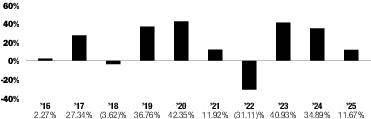
The bar chart and performance table provide an indication of the risks of investing in the Fund. The bar chart shows changes in the performance of the Series I shares of the Fund from
year to year as of December 31. The performance table compares the Fund's performance to that of a
style-specific benchmark and a broad-based securities market benchmark (in that order). The bar chart and performance table below do not reflect charges assessed in connection with your variable product; if they did, the performance shown would be
lower. The Fund's past performance is not necessarily an indication of its future performance.
Fund performance reflects any applicable fee waivers and expense
reimbursements. Performance returns would be lower without applicable fee waivers and expense
reimbursements.
All Fund performance shown assumes the reinvestment of dividends
and capital gains and the effect of the Fund's expenses.
The Series I shares and Series II shares invest in the same portfolio of
securities and will have substantially similar performance, except to the extent that the
expenses borne by each share class differ. Series II shares have higher expenses (and therefore lower performance) resulting from its Rule 12b-1 plan, which provides for a maximum fee equal to an annual rate of 0.25% (expressed as a percentage
of average daily net assets of the Fund).
Updated performance information is available on the Fund’s website at
www.invesco.com/us.
Annual Total Returns
| Series I |
Period Ended |
Returns |
| Best Quarter |
June 30, 2020 |
31.11% |
| Worst Quarter |
June 30, 2022 |
-20.31% |
Average Annual Total Returns (for the periods ended December 31, 2025)
| |
Inception Date |
1 Year |
5 Years |
10
Years |
| Series I |
7/3/1995 |
11.67 % |
10.35 % |
14.87 % |
| | ||||
| Series II |
9/18/2000 |
11.39 |
10.08 |
14.58 |
| | ||||
| Russell 1000® Growth Index (reflects no deduction for fees, expenses or taxes) |
|
18.56 |
15.32 |
18.13 |
| | ||||
| S&P 500® Index (reflects no deduction for fees, expenses or taxes) |
|
17.88 |
14.42 |
14.82 |
| | ||||
Management of the Fund
Investment Adviser: Invesco Advisers, Inc. (Invesco or the Adviser)
| Portfolio Managers |
Title |
Length of Service on the Fund |
| Ronald J. Zibelli, Jr., CFA |
Portfolio Manager (Lead) |
2022 |
| | ||
| Ido Cohen |
Portfolio Manager |
2010 |
| | ||
| Ash Shah, CFA |
Portfolio Manager |
2026 |
| | ||
3 Invesco V.I. American Franchise Fund
invesco.com/usVK-VIAMFR-SUMPRO-1
Purchase and Sale of Fund
Shares
You cannot purchase or sell (redeem) shares of the Fund directly. Please contact the insurance company that issued your variable product for more information on the purchase and sale
of Fund shares. For more information, see “Other Information—Purchase and Redemption of Shares” in the prospectus.
Tax Information
The Fund expects, based on its investment objective and strategies, that its distributions, if any, will consist of ordinary income, capital gains, or some combination of both. Because
shares of the Fund must be purchased through variable products, such distributions will be exempt from current taxation if left to accumulate within the variable product. Consult your variable insurance contract
prospectus for additional tax information.
Payments to
Insurance Companies
If you purchase the Fund through an insurance company or other financial intermediary, the Fund, the Fund’s distributor or its related companies may pay the intermediary for the
sale of Fund shares and related services. These payments may create a conflict of interest by influencing the insurance company or other intermediary and your salesperson or financial adviser to recommend the Fund over another
investment. Ask your salesperson or financial adviser or visit your financial intermediary’s website for more information.
4 Invesco V.I. American Franchise Fund
invesco.com/usVK-VIAMFR-SUMPRO-1