| Summary Prospectus |
April 30, 2026 |
Invesco V.I. Main Street
Fund®
Series I shares and Series II shares

Before you invest, you may want to review the
Fund’s prospectus, which contains more information about the Fund and its risks. You can find the Fund’s prospectus, reports to shareholders, and other information
about the Fund online at www.invesco.com/prospectus. You can also get this information at no cost by calling (800) 959-4246 or by sending an e-mail request to
ProspectusRequest@invesco.com. The Fund’s prospectus and statement of additional information, both dated April 30, 2026 (as each may be amended or supplemented), are
incorporated by reference into this Summary Prospectus and may be obtained, free of charge, at the website, phone number or e-mail address noted above.
Investment Objective(s)
The Fund’s investment objective is to seek capital appreciation.
Fees and Expenses of the Fund
This
table describes the fees and expenses that are incurred, directly or indirectly, when a variable product owner buys, holds, or redeems interest in an insurance company separate account that invests in the Series I shares or Series II shares of the Fund but
does not represent the effect of any fees or other expenses assessed in connection with your variable product, and if it did, expenses would be higher.
| Shareholder Fees (fees paid directly from your
investment) | ||
| |
Series I shares |
Series II shares |
| Maximum Sales Charge (Load) Imposed on Purchases (as a percentage of offering price) |
None |
None |
| | ||
| Maximum Deferred Sales Charge (Load) (as a percentage of original purchase price or redemption proceeds, whichever is less) |
None |
None |
| | ||
| Annual Fund Operating Expenses (expenses that you pay each year as a percentage of the value of your investment) | ||
| |
Series I shares |
Series II shares |
| Management Fees |
0.69 % |
0.69 % |
| | ||
| Distribution and/or Service (12b-1) Fees
|
None |
0.25 |
| | ||
| Other Expenses |
0.17 |
0.17 |
| | ||
| Total Annual Fund Operating Expenses |
0.86 |
1.11 |
| | ||
| Fee Waiver and/or Expense
Reimbursement1
|
0.06 |
0.06 |
| | ||
| Total Annual Fund Operating Expenses After Fee Waiver and/or Expense Reimbursement |
0.80 |
1.05 |
| | ||
| 1 |
Invesco Advisers, Inc. (Invesco or the Adviser) has contractually agreed to waive advisory fees and/or reimburse expenses to the extent necessary to limit Total Annual Fund Operating Expenses After Fee Waiver and/or Expense Reimbursement (excluding certain items discussed below) of Series I and Series II shares to 0.80% and 1.05%, respectively, of the Fund’s average daily net assets (the “expense limits”). In determining the Adviser’s obligation to waive advisory fees and/or reimburse expenses, the following expenses are not taken into account, and could cause the Total Annual Fund Operating Expenses After Fee Waiver and/or Expense Reimbursement to exceed the numbers reflected above: (i) interest; (ii) taxes; (iii) dividend expense on short sales; (iv) extraordinary or non-routine items, including litigation expenses; and (v) expenses that the Fund has incurred but did not actually pay because of an expense offset arrangement. Unless Invesco continues the fee waiver agreement, it will terminate on April 30, 2027. During its term, the fee waiver agreement cannot be terminated or amended to increase the expense limits without approval of the Board of Trustees.
|
Example. This Example is intended to help you compare the cost of investing in the Fund with the cost of investing in
other mutual funds.
This Example does not represent the effect of any fees or expenses assessed in connection with your variable product, and if it did, expenses would be higher.
The Example assumes that you invest $10,000 in the Fund for the time periods indicated and then redeem all of your shares at the end of those periods. The Example also assumes
that your investment has a 5% return each year and that the Fund’s operating expenses remain equal to the Total Annual Fund Operating Expenses After Fee Waiver and/or Expense Reimbursement in the first year and the Total
Annual Fund Operating Expenses thereafter.
Although your actual costs may be higher or lower, based on these assumptions, your costs
would be:
| |
1 Year |
3 Years |
5 Years |
10 Years |
| Series I shares |
$82
|
$268
|
$471
|
$1,055
|
| | ||||
| Series II shares |
$107
|
$347
|
$606
|
$1,346
|
| | ||||
Portfolio Turnover. The Fund pays transaction costs, such as commissions, when it buys and sells securities (or “turns
over” its portfolio). A higher portfolio turnover rate may indicate higher transaction costs. These costs, which are not reflected in annual fund operating expenses or in the Example, affect the Fund’s
performance. During the most recent fiscal year, the Fund’s portfolio turnover rate was
46% of the average value of its portfolio.
Principal Investment Strategies of the Fund
The Fund mainly invests in common stocks of U.S. companies of different capitalization ranges. The Fund
currently focuses on “larger capitalization” issuers. The Fund considers a larger-capitalization issuer to be one that has a market capitalization, at the time of purchase, within the range of market capitalizations included in the
Russell 1000 Index during the most recent 11-month period (based on month-end data) plus the most recent data during the current month. An issuer’s “market capitalization” is the value of its
outstanding stock. The portfolio managers use fundamental research to select securities for the Fund’s portfolio, which is comprised of both growth and value stocks. While the process may change over time or vary in particular cases, in general the selection
process currently uses a fundamental approach in analyzing issuers on factors such as a company’s financial performance, competitive strength and prospects, industry position,
1 Invesco V.I. Main Street Fund®
invesco.com/usO-VIMST-SUMPRO-1
and business model and management strength.
Industry outlook, market trends and general economic conditions may also be considered.
The Fund aims to maintain a broadly diversified portfolio across major economic sectors. In
constructing the portfolio, the Fund seeks to limit exposure to so-called “top-down” or “macro” risks, such as overall stock market movements, economic cycles, and interest rate or currency fluctuations. Instead, the portfolio managers
seek to add value by selecting individual securities that they believe have superior company-specific fundamental attributes or relative valuations that they expect to outperform their industry and sector peers.
This is commonly referred to as a “bottom-up” approach to portfolio construction.
The portfolio managers consider, among other criteria, stock rankings,
benchmark weightings and capitalization outlooks in determining security weightings for
individual issuers.
The portfolio managers generally use the following sell
criteria: the stock price is approaching its target, deterioration in the company’s
competitive position, poor execution by the company’s management, or identification of more
attractive alternative investment ideas.
Principal Risks of
Investing in the Fund
As with any mutual fund investment, loss of money is a risk of investing. An investment in the Fund is not a
deposit in a bank and is not insured or guaranteed by the Federal Deposit Insurance Corporation or any other governmental agency. The risks associated with an investment in the Fund can increase during times of
significant market volatility. The principal risks of investing in the Fund are:
Market Risk. The market values of the
Fund’s investments, and therefore the value of the Fund’s shares, will go up and down, sometimes rapidly or unpredictably. Market risk may affect a single issuer, industry or section of the economy, or it
may affect the market as a whole. The value of the Fund’s investments may go up or down due to general market conditions that are not specifically related to the particular issuer. These market conditions may include
real or perceived adverse economic conditions, changes in trade regulation or economic sanctions, changes in the general outlook for revenues or corporate earnings, changes in interest or currency rates, regional or
global instability and uncertainty, natural or environmental disasters, widespread disease or other public health issues, war, military conflict, acts of terrorism, economic crisis or adverse investor sentiment generally, among
others. Certain changes in the U.S. economy in particular, such as when the U.S. economy weakens or when its financial markets decline, may have a material adverse effect on global financial markets as a whole, and on the
securities to which the Fund has exposure. Increasingly strained relations between the U.S. and foreign countries, including as a result of economic sanctions and tariffs, may also adversely affect U.S. issuers, as well as
non-U.S. issuers.
During a general downturn in the financial markets, multiple
asset classes may decline in value. When markets perform well, there can be no assurance that
specific investments held by the Fund will rise in value.
Investing in Stocks
Risk. The value of the Fund’s portfolio may be affected by changes in the stock markets. Stock markets may experience significant short-term volatility and
may fall or rise sharply at times. Adverse events in any part of the equity or fixed-income markets may have unexpected negative effects on other market segments. Different stock markets may behave differently from each
other and U.S. stock markets may move in the opposite direction from one or more foreign stock markets.
The prices of individual stocks generally do not all move in the same
direction at the same time. However, individual stock prices tend to go up and down more
dramatically than those of certain other types of investments, such as bonds. A variety of factors can negatively affect the price of a particular company’s stock. These factors may include, but are not limited to: poor earnings
reports, a loss of customers, litigation against the company, general unfavorable performance of the company’s sector or industry, or changes in government regulations affecting the company or its industry. To the extent that
securities of a particular type are emphasized (for
example foreign stocks, stocks of small- or mid-cap companies, growth or value stocks, or stocks of companies
in a particular industry), Fund share values may fluctuate more in response to events affecting the market for those types of securities.
Growth Investing Risk. The market values of growth securities may be more volatile than other types of investments. The returns on
growth securities may or may not move in tandem with the returns on other styles of investing or
the overall stock market. If a growth company’s earnings or stock price fails to increase as anticipated, or if its business plans do not produce the expected results, the value of its securities may decline sharply. Growth companies may be newer
or smaller companies that may experience greater stock price fluctuations and risks of loss than larger, more established companies. Newer growth companies tend to retain a large part of their earnings for research,
development or investments in capital assets. Therefore, they may not pay any dividends for some time. Growth securities typically invest a high portion of their earnings back into their business and may lack the
dividend yield that could cushion their decline in a market downturn. During periods when growth investing is out of favor or when markets are unstable, it may be more difficult to sell growth company securities at an
acceptable price and the securities of growth companies may underperform the securities of value companies or the overall stock market. Growth stocks may also be more volatile than other securities because of investor
speculation and the value of the Fund’s investments will vary and at times may be lower than that of other types of investments.
Value Investing Risk. Value investing
entails the risk that if the market does not recognize that a selected security is undervalued, the price of that security might not appreciate as anticipated. Value securities are subject to the risk that their
valuations never improve or that the returns on value securities are lower than returns on other styles of investing or the overall stock market. Thus, the value of the Fund’s investments will vary and, at times, may be lower
than that of other types of investments. Value investing has gone in and out of favor during past market cycles and when value investing is out of favor or when markets are unstable, value securities may underperform growth
securities or the overall stock market.
Small-
and Mid-Capitalization Companies Risk. Investing in securities of small- and mid-capitalization companies involves greater risk than customarily is associated
with investing in larger, more established companies. Stocks of small- and mid-capitalization companies tend to be more vulnerable to changing market conditions, may have little or no operating history or track record of
success, and may have more limited product lines and markets, less experienced management and fewer
financial resources than larger companies. These companies’ securities may be more volatile
and less liquid than those of more established companies. They may be more sensitive to changes in a company’s earnings expectations and may experience more abrupt and erratic price movements. Smaller companies’ securities
often trade in lower volumes and in many instances, are traded over-the-counter or on a regional securities exchange, where the frequency and volume of trading is substantially less than is typical for securities of larger
companies traded on national securities exchanges. Therefore, the securities of smaller companies may be subject to wider price fluctuations and it might be harder for the Fund to dispose of its holdings at an acceptable
price when it wants to sell them. Since small- and mid-cap companies typically reinvest a high proportion of their earnings in their business, they may not pay dividends for some time, particularly if they are newer companies. It may
take a substantial period of time to realize a gain on an investment in a small- or mid-cap company, if any gain is realized at all.
Sector Focus Risk. In pursuing its
investment strategy, the Fund may invest to a significant degree in securities of issuers operating in a single sector. In so doing, the Fund may face more risks than if it were diversified broadly over numerous sectors.
Such sector-based risks, any of which may adversely affect the companies in which, the Fund invests, may include, but are not limited to, legislative or regulatory changes, adverse market
2 Invesco V.I. Main Street Fund®
invesco.com/usO-VIMST-SUMPRO-1
conditions and/or increased competition
within the sector. In addition, at times, such sector may be out of favor and underperform other sectors or the market as a whole.
Issuer Focus Risk. Although the Fund is classified as a
diversified fund, it may focus its investments in a relatively small number of issuers. The
greater the Fund's exposure to any single investment or issuer, the greater the losses the Fund may experience upon any single economic, market, business, political, regulatory, or other occurrence. As a result, there may be more fluctuation in
the price of the Fund's shares.
Valuation
Risk. The price the Fund could receive upon the sale of a portfolio investment may differ from
the Fund’s valuation of the investment, particularly for investments that trade in thin or volatile markets or that are valued using a fair valuation methodology. Financial information related to securities of non-U.S. issuers may
be less reliable than information related to securities of U.S. issuers, which may make it difficult to obtain a current price for a non-U.S. security held by the Fund. When market quotations are not readily available for Fund
investments, those investments are fair valued by the Adviser. There are multiple methods that can be used to fair value a portfolio investment and such methods may involve more subjectivity than the use of market quotations. The
value established for an investment through fair valuation may be different from what would be produced if the investment had been valued using market quotations. In addition, there is no assurance that the Fund could
sell a portfolio investment at any time for the value ascribed to it for purposes of calculating the Fund’s net asset value, and it is possible that the Fund could incur a loss because an investment is sold at a discount to its
ascribed value. The ability to value investments may also be impacted by technological issues and/or errors by pricing services or other third-party service providers.
Management
Risk. The Fund is actively managed and depends heavily on the Adviser's judgment about markets, interest rates or the attractiveness, relative values,
liquidity, or potential appreciation of particular investments made for the Fund’s portfolio. The Fund could experience losses if these judgments prove to be incorrect. There can be no guarantee that the Adviser's investment
techniques or investment decisions will produce the desired results. Additionally, legislative, regulatory, or tax developments may adversely affect management of the Fund and, therefore, the ability of the Fund to achieve
its investment objective.
Performance
Information
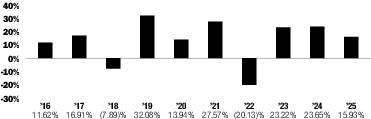
The bar chart and performance table provide an indication of the risks of investing in the Fund. The Fund has adopted the performance of the Oppenheimer Main Street Fund/VA (the
predecessor fund) as the result of a reorganization of the predecessor fund into the Fund, which was consummated after the close of business on May 24, 2019 (the “Reorganization”). Prior to the
Reorganization, the Fund had not yet commenced operations. The bar chart shows changes in the performance of the Series I shares of the Fund and the Non-Service Shares of the predecessor fund from year to year as of
December 31. The performance table compares the predecessor fund’s and the Fund’s performance to that of a broad measure of market performance. The bar chart and performance table below do not reflect charges
assessed in connection with your variable product; if they did, the performance shown would be lower. The Fund’s (and the predecessor fund’s) past performance is not necessarily an indication of how the Fund will
perform in the future.
The returns shown for periods ending on or prior to May 24,
2019 are those of the Non-Service Shares and Service Shares of the predecessor fund, and are not
offered by the Fund. The Non-Service Shares of the predecessor fund were reorganized into Series I shares of the Fund and the Service Shares of the predecessor fund were reorganized into the Series II shares of the Fund after the close
of business on May 24, 2019. Series I shares’ and Series II shares’ returns of the Fund will be different from the Non-Service Shares’ and the Service Shares’ returns of the predecessor fund as they have different
expenses.
Fund performance reflects any applicable fee waivers and expense reimbursements. Performance
returns would be lower without applicable fee waivers and expense reimbursements.
All Fund performance shown assumes the reinvestment of dividends and
capital gains and the effect of the Fund’s expenses.
The Series I shares and
Series II shares invest in the same portfolio of securities and will have substantially similar performance, except to the extent that the expenses borne by each share class differ. Series II shares have higher expenses (and
therefore lower performance) resulting from its Rule 12b-1 plan, which provides for a maximum fee equal to an annual rate of 0.25% (expressed as a percentage of average daily net assets of the Fund).
Updated performance information is available on the Fund’s website at www.invesco.com/us.
Annual Total Returns
| Series I |
Period Ended |
Returns |
| Best Quarter |
June 30, 2020 |
18.60% |
| Worst Quarter |
March 31, 2020 |
-20.38% |
Average Annual Total Returns (for the periods ended December 31, 2025)
| |
Inception Date |
1 Year |
5 Years |
10
Years |
| Series I |
7/5/1995 |
15.93 % |
12.47 % |
12.53 % |
| | ||||
| Series II |
7/13/2000 |
15.64 |
12.19 |
12.25 |
| | ||||
| S&P 500® Index (reflects no deduction for fees, expenses or taxes) |
|
17.88 |
14.42 |
14.82 |
| | ||||
Management of the Fund
Investment Adviser: Invesco Advisers, Inc. (Invesco or the Adviser)
| Portfolio Managers |
Title |
Length of Service on the Fund |
| Manind Govil, CFA |
Portfolio Manager (Lead) |
2019 (predecessor fund 2009) |
| | ||
| Benjamin Ram |
Portfolio Manager |
2019 (predecessor fund 2009) |
| | ||
Purchase and Sale of Fund Shares
You cannot purchase or sell (redeem) shares of the Fund directly. Please contact the insurance company that issued your variable product for more information on the purchase and sale
of Fund shares. For more information, see “Other Information—Purchase and Redemption of Shares” in the prospectus.
Tax Information
The Fund expects, based on its investment objective and strategies, that its distributions, if any, will consist of ordinary income, capital gains, or some combination of both. Because
shares of the Fund must be purchased through variable products, such distributions will be exempt from current taxation if left to accumulate within the variable product. Consult your variable insurance contract
prospectus for additional tax information.
Payments to
Insurance Companies
If you purchase the Fund through an insurance company or other financial intermediary, the Fund, the Fund’s distributor or its related companies may pay the intermediary for the
sale of Fund shares and related services. These payments may create a conflict of interest by influencing the insurance company or other intermediary and your salesperson or financial adviser to
3 Invesco V.I. Main Street Fund®
invesco.com/usO-VIMST-SUMPRO-1