LVIP Structured Moderate Allocation Fund
(Standard and Service Class)
Summary Prospectus
May 1, 2026
Before you invest, you may want to review the Fund’s Prospectus, which contains more information about the Fund and its risks. You can find the Fund’s Prospectus, reports to shareholders, and other information about the Fund online at www.LincolnFinancial.com/lvip. You can also get this information at no cost by calling 877 ASK LINCOLN (877-275-5462). The Fund’s Prospectus and Statement of Additional Information, both dated May 1, 2026, are incorporated by reference into this Summary Prospectus.
Investment Objective
The investment objective of the LVIP Structured Moderate Allocation Fund (the Fund) is to seek a balance between a high level of current income and growth of capital, with an emphasis on growth of capital.
Fees and Expenses
This table describes the fees and expenses that you may pay if you buy, hold and sell shares of the Fund. This table does not reflect any variable contract expenses. You may pay other fees, such as brokerage commissions and other fees to financial intermediaries, which are not reflected in the tables and examples below. If variable contract expenses were included, the expenses shown would be higher.
Annual Fund Operating Expenses
(Expenses that you pay each year as a percentage of the value of your investment)
 
Standard
Class
Service
Class
Management Fee
0.15%
0.15%
Distribution and/or Service (12b-1) Fees
None
0.25%
Other Expenses
0.06%
0.06%
Acquired Fund Fees and Expenses (AFFE)
0.35%
0.35%
Total Annual Fund Operating Expenses (including AFFE)1
0.56%
0.81%
1
Total Annual Fund Operating Expenses do not correlate to the ratio of expenses to average net assets appearing in the Financial Highlights table, which reflects only the operating expenses of the Fund and does not include Acquired Fund Fees and Expenses.
Example
This example is intended to help you compare the cost of investing in the Fund with the cost of investing in other mutual funds. The example illustrates the hypothetical expenses that you would incur over the time periods indicated if you invest $10,000 in the Fund’s shares. The example also assumes that the Fund provides a return of 5% a year and that operating expenses remain the same. Your actual costs may be higher or lower than this example. This example does not reflect any variable contract expenses. If variable contract expenses were included, the expenses shown would be higher. The results apply whether or not you redeem your investment at the end of the given period.
 
1 year
3 years
5 years
10 years
Standard Class
$57
$179
$313
$701
Service Class
$83
$259
$450
$1,002
Portfolio Turnover
The Fund pays transaction costs, such as commissions, when it buys and sells securities (or “turns over” its portfolio). A higher portfolio turnover rate may indicate higher transaction costs. These costs, which are not reflected in annual fund operating expenses or in the example, affect the Fund’s performance. During the most recent fiscal year, the Fund’s portfolio turnover rate was 17% of the average value of its portfolio.
LVIP Structured Moderate Allocation Fund1

Principal Investment Strategies
The Fund operates under a “fund of funds” structure, investing in other mutual funds (the “Underlying Funds”). The Fund, under normal circumstances, invests approximately 60% of its assets in Underlying Funds that primarily invest in equity securities (stocks), and approximately 40% of its assets in Underlying Funds that primarily invest in fixed income securities (bonds). The Underlying Funds include, but are not limited to, funds that employ a passive investment style (i.e., index funds), funds that employ a multi-factor strategy (i.e., a strategy of selecting investments that have favorable exposure to certain factors, such as quality, value, and momentum), and exchange-traded funds. The Underlying Funds are advised by the Fund's investment adviser, Lincoln Financial Investments Corporation (the “Adviser”).
The Adviser develops the Fund's asset allocation strategy based on the Fund's investment strategy. Through its investment in Underlying Funds, the Fund allocates a large percentage of assets to domestic and foreign equity securities (stocks), including stocks of small- and medium-cap companies and those with growth and value characteristics. The Fund allocates a smaller percentage of assets to Underlying Funds that invest in domestic fixed income securities (bonds), including U.S. Treasury securities, mortgage-backed securities (including to-be-announced transactions), corporate bonds and inflation-indexed bonds.
The foreign equity securities may include securities of companies in emerging market countries. An “emerging market country” is defined as an emerging or developing economy by the International Monetary Fund or defined as such by MSCI. An Underlying Fund may invest a large percentage of its assets in issuers located in a single country, a small number of countries, or a particular geographic region.
On at least an annual basis, the Adviser will reassess and may make revisions in the Fund’s asset allocation strategy consistent with the Fund's investment strategy and objective, including revising the weightings among the investments described above and adding or removing Underlying Funds from the asset allocation strategy. The Adviser also will periodically rebalance the weightings in the Underlying Funds to the current asset allocation strategy. In general, the Adviser does not anticipate making frequent changes in the asset allocation strategy and will not attempt to time the market.
The Adviser uses various analytical tools and third-party research to construct the portfolio. The Underlying Fund selection is made based on the Fund’s particular asset allocation strategy, the Adviser's desired asset class exposures, and the investment styles and performance of the Underlying Funds. The Adviser also considers the portfolio characteristics and risk profile for each Underlying Fund over various periods and market environments to assess each Underlying Fund’s suitability as an investment.
The full list of Underlying Funds used by the Fund is included in the Fund’s annual and semi-annual reports and quarterly holdings disclosures.
Principal Risks
All mutual funds carry risk. Accordingly, loss of money is a risk of investing in the Fund. Because the Fund invests its assets in shares of Underlying Funds, the Fund indirectly owns the investments made by the Underlying Funds. By investing in the Fund, therefore, you indirectly assume the same types of risks as investing directly in the Underlying Funds. The Fund's investment performance is affected by each Underlying Fund's investment performance, and the Fund's ability to achieve its investment objective depends, in large part, on each Underlying Fund's ability to meet its investment objective. The following risks reflect the Fund's principal risks, which include the Underlying Funds' principal risks.
Market Risk. The value of portfolio investments may decline. As a result, your investment in the Fund may decline in value and you could lose money.
Stock/Equity Investing Risk. Stocks and other equities generally fluctuate in value more than bonds and may decline significantly over short time periods. Equity prices overall may decline because stock markets tend to move in cycles, with periods of rising and falling prices.
Fund of Funds Risk. The Fund bears all risks associated with the investment strategies of its Underlying Funds, including the possibility that an Underlying Fund may not achieve its investment objective, which could negatively affect the Fund’s performance. In addition, among other risks, the Fund indirectly pays a proportional share of the fees and expenses of each Underlying Fund.
Investments in Affiliated Funds Risk. Along with the general fund of funds risk, the Adviser is subject to a conflict of interest in selecting Underlying Funds, as it also serves as the investment adviser to most, if not all, of the Underlying Funds in which the Fund invests its assets. The Adviser will earn management fees related to the Fund’s investment in such Underlying Funds. However, the Adviser is a fiduciary and is legally obligated to act in the Fund’s best interests when selecting Underlying Funds.
Issuer Risk. The prices of, and the income generated by, portfolio securities may decline in response to various factors directly related to the issuers of such securities.
Asset Allocation Risk. With an asset allocation strategy, the amount invested in various asset classes of securities may change over time. Asset allocation risk could result in an allocation to an underperforming asset class.
2LVIP Structured Moderate Allocation Fund

Active Management Risk. The portfolio investments are actively-managed, rather than tracking an index or rigidly following certain rules, which may negatively affect investment performance. Consequently, there is the risk that the methods and analyses, including models, tools and data, employed in this process may be flawed or incorrect and may not produce desired results.
Passive Management Risk. Index funds invest in the securities of an index rather than actively selecting among securities. With an indexing strategy there is no attempt to manage volatility, use defensive strategies, or reduce the effects of any long-term period of poor investment performance.
Investment Style Factors Risk. There can be no assurance that the multi-factor stock selection process of the Fund will enhance performance. Exposure to such investment factors may detract from performance in some market environments, perhaps for extended periods.
Concentration Risk. Investments that are concentrated in particular industries, sectors or types of investments may be subject to greater risks of adverse developments in such areas of focus than investments that are spread among a wider variety of industries, sectors or investments.
Exchange-Traded Fund (ETF) Risk. ETFs generally reflect the risks of owning the underlying securities they hold, although lack of liquidity in ETF shares could result in the price of the ETF being more volatile.
Value Stocks Risk. Value stocks tend to be inexpensive relative to their earnings or assets compared to other types of stocks, such as growth stocks. Value stocks can continue to be inexpensive for long periods of time, may not ever realize their potential value, and may even go down in price.
Growth Stocks Risk. Growth stocks, due to their relatively high market valuations, typically have been more volatile than value stocks. Growth stocks may not pay dividends, or may pay lower dividends, than value stocks and may be more adversely affected in a down market.
Small- and Medium-Cap Company Risk. The value of securities issued by small- and medium-sized companies may be subject to more abrupt market movements and may involve greater risks than investments in larger companies. These less developed, lesser-known companies may experience greater risks than those normally associated with larger companies. Small- and medium-sized companies also may be subject to interest rate risk, which is generally associated with fixed income securities, because these companies often borrow money to finance their operations; therefore, they may be adversely affected by rising interest rates.
Interest Rate Risk. When interest rates change, fixed income securities (i.e., debt obligations) generally will fluctuate in value. These fluctuations in value are greater for fixed income securities with longer maturities or durations.
Credit Risk. Credit risk is the risk that the issuer of a debt obligation will be unable or unwilling to make interest or principal payments on time. Credit risk is often gauged by “credit ratings” assigned by nationally recognized statistical rating organizations (NRSROs). A decrease in an issuer’s credit rating may cause a decline in the value of the issuer’s debt obligations. However, credit ratings may not reflect the issuer’s current financial condition or events since the security was last rated by a rating agency. Credit ratings also may be influenced by rating agency conflicts of interest or based on historical data that are no longer applicable or accurate.
U.S. Treasury Risk. Securities backed by the U.S. Treasury or the full faith and credit of the U.S. government are guaranteed as to the timely payment of interest and principal when held to maturity. Accordingly, the current market values for these securities will fluctuate with changes in interest rates.
Inflation Indexed Bond Risk. The value of inflation-indexed bonds generally changes in response to changes in real interest rates. Real interest rates in turn are tied to the relationship between nominal interest rates (i.e., non-inflation adjusted interest rates) and the rate of inflation. If the periodic adjustment rate measuring inflation falls, the principal value of inflation-indexed bonds will be adjusted downward and the interest payable will be reduced. The adjusted principal value of an inflation-related bond repaid at maturity may be less than the original principal. If nominal interest rates increase at a faster rate than inflation, the value of inflation indexed bonds may decrease. Inflation-indexed securities may not be protected from short-term increases in inflation.
Prepayment/Call Risk. Debt securities are subject to prepayment risk when the issuer can “call” the security, or repay principal, in whole or in part, prior to the security’s maturity. When the Fund reinvests the prepayments of principal it receives, it may receive a rate of interest that is lower than the rate on the called security.
Mortgage-Backed Securities Risk. The value of mortgage-backed securities (commercial and residential) may fluctuate significantly in response to changes in interest rates. During periods of falling interest rates, underlying mortgages may be paid early, lowering the potential total return (pre-payment risk). During periods of rising interest rates, the rate at which the underlying mortgages are pre-paid may slow unexpectedly, causing the maturity of the mortgage-backed securities to increase and their value to decline (maturity extension risk).
Mortgage-Backed “To Be Announced” (TBA) Transaction Risk. Some mortgage-backed securities are sold in what is referred to as to-be-announced (TBA) transactions, which include when-issued and delayed delivery securities and forward commitments. These transactions involve the Fund’s commitment to purchase securities for a predetermined price or yield with payment and delivery taking place after a period longer than the customary settlement period for that type of security (generally more than three days after the transaction). TBA transactions involve the risks that the security the Fund buys will lose value prior to its delivery and that the counterparty will default.
LVIP Structured Moderate Allocation Fund3

Foreign Investments Risk. Foreign investments have additional risks that are not present when investing in U.S. investments. Foreign currency fluctuations or economic or financial instability could cause the value of foreign investments to fluctuate. The value of foreign investments may be reduced by foreign taxes, such as foreign taxes on interest and dividends. Additionally, foreign investments include the risk of loss from foreign government or political actions including, for example, the imposition of exchange controls, the imposition of tariffs, economic and trade sanctions or embargoes, confiscations, and other government restrictions, or from problems in registration, settlement or custody. Investing in foreign investments may involve risks resulting from the reduced availability of public information concerning issuers. Foreign investments may be less liquid and their prices more volatile than comparable investments in U.S. issuers. In addition, certain foreign countries may be subject to terrorism, governmental collapse, regional conflicts and war, which could negatively impact investments in those countries.
Emerging Markets Risk. Companies located in emerging markets tend to be less liquid, have more volatile prices, and have significant potential for loss in comparison to investments in developed markets.
Foreign Currency Risk. Foreign currency risk is the risk that the U.S. dollar value of investments in foreign (non-U.S.) currencies or in securities that trade in, and receive revenues in, foreign (non-U.S.) currencies, may be negatively affected by changes in foreign (non-U.S.) currency rates. Currency exchange rates may fluctuate significantly over short periods of time.
Regional Risk. The Fund will generally have more exposure to the specific market, currency, economic, political, regulatory, geopolitical, or other risks in the regions or countries in which it invests. As a result, the Fund could experience substantial illiquidity, volatility or reduction in the value of its investments, as compared to a more geographically-diversified fund.
Limited Portfolio Holdings Risk. Because the Fund may hold large positions in a small number of Underlying Funds, an increase or decrease in the value of such securities may have a greater impact on the Fund’s value and total return.
Liquidity Risk. Liquidity risk is the risk that the Fund cannot meet requests to redeem Fund-issued shares without significantly diluting the remaining investors’ interest in the Fund. This may result when portfolio holdings may be difficult to value and may be difficult to sell, both at the time or price desired. Liquidity risk also may result from increased shareholder redemptions in the Fund. Actions by governments and regulators may have the effect of reducing market liquidity, market resiliency and money supply. Liquidity risk also refers to the risk that the Fund may be required to hold additional cash or sell other investments in order to obtain cash to close out derivatives or meet the liquidity demands that derivatives can create to make payments of margin, collateral, or settlement payments to counterparties. The Fund may have to sell a security at a disadvantageous time or price to meet such obligations. The Fund’s liquidity risk management program requires that the Fund invest no more than 15% of its net assets in illiquid investments.
Fund Performance
The following bar chart and table provide some indication of the risks of choosing to invest in the Fund. The information shows: (a) how the Fund's Standard Class investment results have varied from year to year; and (b) how the average annual total returns of the Fund's Standard and Service Classes compare with those of a broad measure of market performance. The bar chart shows performance of the Fund's Standard Class shares, but does not reflect the impact of variable contract expenses. If it did, returns would be lower than those shown. Performance in the average annual returns table does not reflect the impact of variable contract expenses. The Fund's past performance is not necessarily an indication of how the Fund will perform in the future.
Annual Total Returns (%)
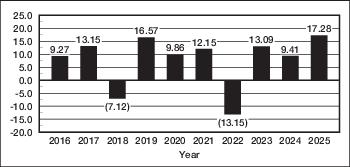
Highest Quarterly Return
Q2 2020
12.19%
Lowest Quarterly Return
Q1 2020
(15.44%)
4LVIP Structured Moderate Allocation Fund

Average Annual Total Returns for periods ended 12/31/25
 
1 year
5 years
10 years
LVIP Structured Moderate Allocation Fund – Standard Class
17.28%
7.16%
7.59%
LVIP Structured Moderate Allocation Fund – Service Class
16.98%
6.90%
7.32%
Morningstar US Core Bond Index (reflects no deductions for fees, expenses or taxes)
7.12%
-0.43%
1.96%
Structured Moderate Allocation Composite1 (reflects no deductions for fees, expenses or
taxes)
16.31%
6.40%
7.94%
1
The Moderate Structured Allocation Composite, an index compiled by the Fund's Adviser, is constructed as follows: 30% Bloomberg U.S. Aggregate Bond Index, 24% S&P 500® Index, 20% MSCI EAFE® NR Index, 10% Bloomberg U.S. TIPS Index, 6% S&P MidCap 400® Index, 6% MSCI Emerging Markets NR Index, and 4% Russell 2000® Index. The Moderate Structured Allocation Composite shows how the Fund's performance compares with the returns of an index that reflects a similar asset allocation to the market sectors in which the Fund invests.
Investment Adviser
Investment Adviser: Lincoln Financial Investments Corporation (“LFI”)
Portfolio Manager
LFI
Portfolio Manager
Company Title
Experience with Fund
Jay Shearon
Vice President and Managing Director
Since May 2016
Alex Zeng, Ph.D., CFA, CAIA
Vice President and Managing Director
Since May 2022
Jason Forsythe, CFA, CFP
Assistant Vice President and Senior Director
Since May 2022
Purchase and Sale of Fund Shares
Fund shares are available as underlying investment options for variable life insurance and variable annuity products issued by The Lincoln National Life Insurance Company (“Lincoln Life”), Lincoln Life & Annuity Company of New York (“LNY”), and unaffiliated insurance companies. These insurance companies are the record owners of the separate accounts holding the Fund’s shares. You do not buy, sell or exchange Fund shares directly – you choose investment options through your variable annuity contract or variable life insurance policy. The insurance companies then cause the separate accounts to purchase and redeem Fund shares according to the investment options you choose. Fund shares also may be available for investment by certain funds of the Lincoln Variable Insurance Products Trust.
Tax Information
In general, contract owners are taxed only on Fund amounts they withdraw from their variable accounts. Contract owners should consult their contract Prospectus for more information on the federal income tax consequences to them regarding their indirect investment in the Fund. Contract owners also may wish to consult with their own tax advisors as to the tax consequences of investments in variable contracts and the Fund, including application of state and local taxes.
Payments to Broker-Dealers and other Financial Intermediaries
Shares of the Fund are available only through the purchase of variable contracts issued by certain life insurance companies. Parties related to the Fund (such as the Fund's principal underwriter or investment adviser) may pay such insurance companies (or their related companies) for the sale of Fund shares and related services. These payments may create a conflict of interest and may influence the insurance company to include the Fund as an investment option in its variable contracts. Such insurance companies (or their related companies) may pay broker-dealers or other financial intermediaries (such as banks) for the sale and retention of variable contracts that offer Fund shares. These payments may create a conflict of interest by influencing the broker-dealers or other financial intermediaries to recommend variable contracts that offer Fund shares. The prospectus or other disclosure documents for the variable contracts may contain additional information about these payments, if any. Ask your salesperson or visit your financial intermediary's website for more information.
LVIP Structured Moderate Allocation Fund5