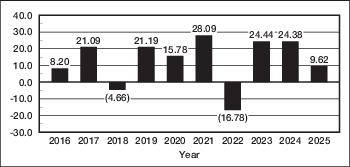
Example
This example is intended to help you compare the cost of investing in the Fund with
the cost of investing in other mutual funds. The example illustrates the hypothetical expenses that you would incur over the time periods indicated if you invest $10,000 in
the Fund’s shares. The example also assumes that the Fund provides a return of 5% a year and that operating expenses remain the same. This example reflects the net operating expenses with fee waiver and expense reimbursement for the one-year contractual period and the total operating expenses without fee waiver and expense reimbursement for the remaining time periods shown below. Your actual costs may be higher or lower than this example. This example does not reflect any variable contract expenses. If variable contract expenses were included, the expenses shown would be higher. The results apply whether or not you redeem your investment at the end of the given period.
The Fund pays transaction costs, such as commissions, when it buys and sells securities (or “turns over” its portfolio). A higher portfolio turnover rate may indicate higher transaction costs. These costs, which are not reflected in annual fund operating expenses or in the example, affect the Fund’s performance. During the most recent fiscal year, the Fund’s
portfolio turnover rate was 8% of the average value of its portfolio.
Principal Investment Strategies
The Fund, under normal circumstances, pursues its investment objective by investing
primarily in another mutual fund, the LVIP SSGA S&P 500 Index* Fund (the “Underlying Fund”), which is advised by Lincoln Financial Investments Corporation,
the Fund’s investment adviser. The Fund also seeks to manage its overall portfolio volatility with a managed volatility strategy. This is a type of risk management sometimes referred to as an “overlay” because the risk management portion of the portfolio supplements the Fund’s main investment portfolio. The Fund, under normal circumstances, invests at least 80% of its assets in a portfolio of investments that provide exposure to large capitalization U.S. companies.
The investment objective of the Underlying Fund is to seek to approximate as closely as practicable, before fees and expenses, the total rate of return of common stocks publicly traded in the U.S., as represented by the S&P 500® Index. The Underlying Fund pursues its objective by investing in the securities that make up the S&P
500® Index. The Underlying Fund, however, may not invest in
every security in the S&P 500® Index if it is not practical to do so under the circumstances (such as when the transaction costs are too
high, there is a liquidity issue, or there is a pending corporate action). The Underlying Fund attempts to replicate the target index by investing all, or substantially all,
of its assets in the stocks that make up the S&P 500®
Index, holding each stock in approximately the same proportion as its weighting in the S&P 500® Index. The Underlying Fund, under normal market conditions, invests at
least 90% of its assets, determined at the time of purchase, in the securities of issuers included in the S&P 500® Index. The S&P 500® Index is a widely used measure of large U.S. company stock performance. The market capitalization range of the S&P 500® Index was $7 billion to $4.2 trillion as of March 31, 2026. The stocks in the S&P 500 account for nearly three-quarters of the value of all U.S. stocks. The S&P 500® Index consists of the common stocks of 500 major corporations selected according to:
•
frequency and ease by which their stocks trade; and
•
range and diversity of the American economy.
The Underlying Fund may
invest in stock index futures as a substitute for a comparable market position in the securities underlying the S&P 500® Index. An index futures contract commits one party to sell and the other
party to buy a stipulated quantity of a market index at a set price on or before a given date. This tactic can reduce the costs associated with direct investing. It also
allows the Underlying Fund to approach the returns of a fully invested portfolio while keeping cash on hand, either in anticipation of shareholder redemptions or because the Underlying Fund has not yet invested new shareholder money.
*
The S&P 500® Index is a product of S&P Dow Jones Indices LLC or its affiliates (“SPDJI”), and has been licensed for use by the investment adviser on behalf of the Fund. Standard & Poor’s® and S&P® are registered trademarks of Standard & Poor’s Financial Services LLC (“S&P”); Dow Jones® is a registered trademark of Dow Jones Trademark Holdings LLC (“Dow Jones”); and these trademarks have been licensed for use by SPDJI and sublicensed for certain purposes by the investment adviser on behalf of the Fund. The Fund is not sponsored, endorsed, sold or promoted by SPDJI, Dow Jones, S&P, or their respective affiliates and none of such parties make any representation regarding the advisability of investing in the Fund nor do they have any liability for any errors, omissions, or interruptions of the S&P 500® Index.
Managed Volatility Strategy. Schroder Investment Management North America Inc. and Schroder
Investment Management North America Limited (collectively, “Schroders” or “overlay manager”) serve as sub-adviser and sub-sub-adviser to the Fund,
respectively, to implement the managed volatility strategy. This managed volatility strategy consists of selling (short) positions in exchange-traded equity futures contracts to manage overall portfolio volatility and seeks to reduce the impact on the Fund’s portfolio of significant market downturns during periods of high volatility. Schroders buys or sells (shorts) individual futures contracts on equity indices of