•
Liquidity Risk. Liquidity risk is the risk that the Fund cannot meet requests to redeem Fund-issued shares without significantly diluting the remaining investors’ interest in the Fund. This may result when portfolio holdings may be difficult to value and may be difficult to sell, both at the time or price desired. Liquidity risk also may result from increased shareholder redemptions in the Fund. Actions by governments and regulators may have the effect of reducing market liquidity, market resiliency and money supply. Liquidity risk also refers to the risk that the Fund may be required to hold additional cash or sell other investments in order to obtain cash to close out derivatives or meet the liquidity demands that derivatives can create to make payments of margin, collateral, or settlement payments to counterparties. The Fund may have to sell a security at a disadvantageous time or price to meet such obligations. The Fund’s liquidity risk management program requires that the Fund invest no more than 15% of its net assets in illiquid investments.
Fund Performance
The Fund has adopted the historical performance of the Delaware
VIP® Smid Cap Core Series, a former series of Delaware
VIP® Trust, (the “Predecessor Fund”) as the result of a reorganization in which the Fund acquired all of the assets, subject to the liabilities, of the Predecessor Fund on May 1, 2021. The returns presented for periods prior to May 1, 2021 reflect the performance of the Predecessor Fund. The Fund and the Predecessor Fund have substantially similar investment goals and strategies.
Historical performance for Standard Class and Service Class shares is based on the previous performance of Standard Class and Service Class, respectively, of the Predecessor Fund. Historical performance prior to May 1, 2021 has not been adjusted to reflect fees and expenses of Standard Class shares and Service Class shares, respectively, of the Predecessor Fund.
The following bar chart and table provide some indication of the risks of choosing to
invest in the Fund. The information shows: (a) how the Fund’s Standard Class investment results have varied from year to year; and (b) how the average annual total
returns of the Fund’s Standard and Service Classes compare with those of a broad measure of market performance. The bar chart shows historical performance of the Fund’s Standard Class shares, but does not reflect the impact of variable contract expenses. If it did, returns would be lower than those shown. Performance in the average annual returns table does not reflect the impact
of variable contract expenses. The Fund’s past performance is not necessarily an indication
of how the Fund will perform in the future.
Annual Total Returns (%)
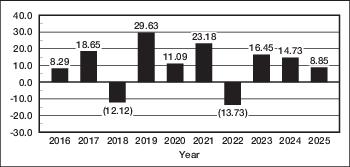
| Highest Quarterly Return |
Q4 2020 |
26.74% |
| Lowest Quarterly Return |
Q1 2020 |
(30.10%) |
Average Annual Total Returns for periods ended 12/31/25
| |
1 year |
5 years |
10 years |
| LVIP Nomura SMID Cap Core Fund – Standard Class |
8.85% |
9.10% |
9.65% |
| LVIP Nomura SMID Cap Core Fund – Service Class |
8.53% |
8.77% |
9.34% |
| Morningstar US Market Index (reflects no deductions for fees, expenses or taxes) |
17.35% |
13.29% |
14.40% |
LVIP Nomura SMID Cap Core
Fund3