•
Foreign Currency Risk. Foreign currency risk is the risk that the U.S. dollar value of investments in foreign (non-U.S.) currencies
or in securities that trade in, and receive revenues in, foreign (non-U.S.) currencies, may be negatively affected by changes in foreign (non-U.S.) currency rates. Currency
exchange rates may fluctuate significantly over short periods of time.
•
Regional Risk. The Fund will generally have more exposure to the specific market, currency,
economic, political, regulatory, geopolitical, or other risks in the regions or countries in which it invests. As a result, the Fund could experience substantial
illiquidity, volatility or reduction in the value of its investments, as compared to a more geographically-diversified fund.
•
Small- and Medium-Cap Company Risk. The value of securities issued by small- and medium-sized companies may be subject to more abrupt market
movements and may involve greater risks than investments in larger companies. These less developed, lesser-known companies may experience greater risks than those normally
associated with larger companies. Small- and medium-sized companies also may be subject to interest rate risk, which is generally associated with fixed income securities,
because these companies often borrow money to finance their operations; therefore, they may be adversely affected by rising interest rates.
•
Securities Lending Risk. An underlying fund may lend portfolio securities to generate
additional income, but is subject to the risk that the borrower may fail to return the securities in a timely manner, or at all. An underlying fund may lose money if it does
not recover the securities it lends. An underlying fund may also lose money if the value of the collateral posted for the loan declines.
•
Master-Feeder Risk. Other “feeder” funds also may invest in the Master Fund,
which may negatively affect investment performance. A larger feeder fund could have more voting power than the Fund over the operations of the Master Fund. Also, a
large-scale redemption by another feeder fund may increase the proportionate share of the costs of the Master Fund borne by the remaining feeder fund shareholders, including the Fund.
•
Liquidity Risk. Liquidity risk is the risk that the Fund cannot meet requests to redeem Fund-issued shares without significantly diluting the remaining investors’ interest in the Fund. This may result when portfolio holdings may be difficult to value and may be difficult to sell, both at the time or price desired. Liquidity risk also may result from increased shareholder redemptions in the Fund. Actions by governments and regulators may have the effect of reducing market liquidity, market resiliency and money supply. Liquidity risk also refers to the risk that the Fund may be required to hold additional cash or sell other investments in order to obtain cash to close out derivatives or meet the liquidity demands that derivatives can create to make payments of margin, collateral, or settlement payments to counterparties. The Fund may have to sell a security at a disadvantageous time or price to meet such obligations. The Fund’s liquidity risk management program requires that the Fund invest no more than 15% of its net assets in illiquid investments.
Fund Performance
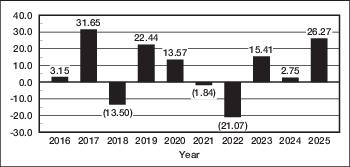
The following bar chart and table provide some indication of the risks of choosing to invest in the Fund. The
information shows: (a) how the Fund's Service Class II investment results have varied from year to year; and (b) how the average annual total returns of the Fund's Service Class II compares with those of a broad measure of market performance. The bar chart shows performance of the Fund's Service Class II shares, but does not reflect the impact of
variable contract expenses. If it did, returns would be lower than those shown. Performance in
the average annual returns table does not reflect the impact of variable contract expenses. The Fund's past performance is not necessarily an indication of how the Fund will perform in the future.
Annual Total Returns (%)
| Highest Quarterly Return |
Q4 2020 |
21.60% |
| Lowest Quarterly Return |
Q1 2020 |
(24.67%) |
LVIP American International Fund3